Exhibit
99.2

Opus Capital Markets Consultants, LLC
NRMLT 2026-RPL1
Rithm Capital Corp.
FORM ABS DUE DILIGENCE 15-E
06.30.2026
Item 4 – Description of the due diligence performed
| 1) | Type of assets reviewed |
Consultant performed the QC review of one prior securitization review
completed by the Recovco Mortgage Management LLC (“Recovco) on behalf of Rithm Capital Corp. (“Client/Customer”). This
population comprised 224 seasoned loans in which a credit and compliance review was conducted.
The QC scope of review completed by Opus is identified as the scope
of services under the terms of Exhibit A below.
The scope of review previously completed by Recovco is identified as
the scope of services under the terms of Exhibit B below.
Consultant performed a title review on 373 loans. Title reports were
ordered from a third-party title company and reviewed by Opus in accordance with the statement of work as listed in the scope below of
Exhibit C.
| a) | Consultant reviewed all loans submitted
on the data tapes. |
| 3) | Determination and Computation of Sample
Size |
| a) | Consultant reviewed all loans submitted
on the data tapes. |
| 4) | Quality or Integrity of information
or data |
| a) | A comparison with respect to certain
fields on the data tape was performed by comparing electronic copies of the original mortgage loan documents provided to the corresponding
information set forth on the data tape. The comparisons were performed with respect to certain Mortgage Loan characteristics, including
but not limited to, interest only, sales price, note date, occupancy, QM status, loan type, application date, loan purpose, units, zip
code, interest rate, second mortgage lien amount, original balance, property city, FICO, property type, original payment, property address,
appraised value, LTV, CLTV, and DTI. Discrepancies were reviewed with the originator and the data tape was modified if necessary. |
| 5) | Origination of the assets conformed
to stated underwriting or credit extension guidelines, standards, criteria or other requirements |
EXHIBIT A - Opus
The Consultant shall obtain all necessary loan files, reports, guidelines, data
tapes, and narratives that were reviewed or produced by the original due diligence vendor. Prior to commencing the Quality Control (QC)
review, the Consultant shall perform a comprehensive review of the applicable underwriting guidelines and the original scope of work.
A QC Review shall be conducted to verify the accuracy of the final
report and narrative documents produced by the original due diligence vendor. The QC Review shall encompass the following components:
| a) | Scope Review: The Consultant shall review the original scope of review details to confirm that all applicable requirements
were contemplated and performed in the original review. |
| b) | Guidelines: The Consultant shall review applicable guidelines and perform a data analysis of the final reports to confirm the
completeness and validity of the report content. |
| c) | Findings Review: The Consultant shall conduct a comprehensive review of all loans identified with exceptions in the final
report. This review shall include verification that all required trailing documents are present within the respective loan files. Additionally,
the Consultant shall confirm that all documentation used to resolve previously identified conditions is valid and sufficient to address
the original exception. In instances where trailing documents are unavailable, the Consultant shall analyze the report commentary to ensure
that adequate explanatory notes are included, detailing how the exception was otherwise resolved. |
| d) | Compliance QC Review: The Consultant shall review all calculated Annual Percentage Rates (APRs) and conduct comprehensive compliance
testing on any loan for which the APR exceeds the applicable state usury limit. Additionally, the Consultant shall compare five percent
(5%) of the original loan amount to the amount reported as “Points and Fees (Regulation Z).” For any loan in which the reported
“Points and Fees” exceed this 5% threshold, the Consultant shall perform a full compliance review to ensure adherence to applicable
regulatory requirements. |
| e) | Tax and Title Review: The Consultant will perform a title review and perform the following procedures: |
| a. | Review updated title report (One Owner O&E report) to identify judgments / liens / encumbrances (pre and post origination) which
would impact the lien position of the subject mortgage. |
| b. | Confirm subject mortgage is recorded. |
| c. | Review Schedule B: Ensure any liens recorded prior to the mortgage recordation date are listed to exceptions on the final title policy. |
| d. | Super lien Homeowners’ Association (HOA) liens. |
| e. | For the purpose of the review the following states are subject to HOA super liens |
| f. | AL, AK, CO, CT, DC, DE, FL, HI, IL, MA, MD, MN, MO, NV, NH, NJ, OR, PA, RI, TN, VA, VT, WA and WV. |
| f) | Securitization Preparation: The Consultant shall create and provide all required securitization documents, including securitization
reporting, reliance letters, narrative summaries, attestations, and a 15-E disclosure, as applicable. |
Document Review
A review of each loan file will be performed to confirm the presence
of material documentation as applicable to the specifics of the loan transaction. The Document Review will consist of the following:
a) Collateral Docs
| · | Title Commitment / Policy: Verify the presence of the title commitment or final title policy. Confirm vested parties and the description
of the property, liens and tax assessments. |
| · | Mortgage Note / Security Instrument: Verify the presence of the mortgage note, security instrument, or equivalent per Costa Rica recording
requirements. Confirm that the document has been executed by all borrowers and that all riders, addendums and endorsement are present
and duly executed. |
| · | Mortgage / Deed of Trust: Verify the presence of a copy Mortgage, Deed of Trust, or Transfer Deed. Confirm that the documents have
been executed by all required parties and that all riders, addendums and exhibits are present and duly executed. |
| · | e Deed: Verify as applicable that a proper conveyance deed is present in the loan file. Confirm the proper transfer of ownership interest
of the subject parties is detailed on the deed. |
b) Closing Docs
| · | Final Hud-1 Settlement Statement or Closing Disclosure: If required, verify the presence of a final HUD-1 / Closing Disclosure. Verify
the completeness of required data and signatures or certification depending upon state compliance requirements. |
| · | Final Truth-in-Lending Disclosure: Not Applicable |
| · | Notice of Right to Cancel: Not Applicable |
| · | Loan Estimate: If required verify the presence of the current Loan Estimate (LE) at the time of origination |
| · | Closing Disclosure: If required verify the presence of the
current Closing Disclosure (CD) at the time of origination. |
c) Credit Docs
| · | Loan Application: Verify the presence and completeness of both the initial and final loan applications. |
| · | Underwriting Worksheet: Verify the presence of the relative underwriting worksheet i.e. form 1008, FHA MCAW and VA’s Loan Analysis. |
| · | Credit Report: Verify the presence of a credit report for each borrower. Confirm that the credit report was pulled within the timing
requirements allowable per the Client provided underwriting guidelines. |
| · | Housing Payment History: In the absence of housing payment histories on the borrower(s) credit report(s), verify that that the file
contains a verification of rent or a verification of mortgage form. |
| · | Letters of Explanation: When Letters of Explanation are required by the Client provided underwriting guidelines, verify the presence
of any such letters exist in the loan file. |
| · | Gift Letters: When Gift Letters are required by the Client provided underwriting guidelines, verify the presence of any such letters
exist in the loan file. |
| · | Income Documentation: Verify the presence of income and employment related documentation required by the Client provided underwriting
guidelines for all borrowing parties contributing income to the debt ratio calculation. |
| · | Asset Documentation: Verify the presence of asset documentation required by the Client provided underwriting guidelines in the loan
file. |
| · | Property Valuation Tools: Verify that each loan file contains adequate appraisal and other third-party valuation tools to satisfy
the minimum required documentation under the relative Client provided underwriting guidelines. |
| · | Proof of Insurance: Verify the presence of insurance certificates for mortgage, hazard and flood insurance on an as needed basis depending
upon the specifics of the loan. Confirm that adequate coverage is present to meet the requirements of the Client provided underwriting
guidelines. |
| 1. | The “material”1 disclosure requirements of the
federal Truth-in-Lending Act (“TILA”), as amended by the Home Ownership and Equity
Protection Act (“HOEPA”) and Dodd-Frank, 15 U.S.C. § 1601 et seq. and
implemented by Regulation Z, 12 C.F.R. Part 1026, including the material provisions relating
to Higher-Priced Mortgage Loans in Regulation Z, 12 C.F.R. §§ 1026.35, and the
early TIL disclosure provisions of the Mortgage Disclosure Improvement Act (“MDIA”),
as implemented by Regulation Z, 12 C.F.R. §§ 1026.17 et seq; and as amended by
the TILA-RESPA Integrated Disclosure (“TRID”) Rule, as set forth below: |
| a. | For Right of Rescission |
| i. | A review of the Notice of Right to Cancel, including a verification of the transaction date and expiration date, ensuring proper execution
of the Notice of Right to Cancel by all required parties, verifying the disbursement date and determining if a full three (3) day rescission
period was adequately provided to the borrower(s). |
1
These “material” disclosures include the required disclosures of the APR, the finance charge, the amount financed, the total
number of payments, the payment schedule, and if the loan is subject to the Homeownership and Equity Protection Act (“HOEPA”),
the disclosure requirements and prohibitions of that statute which are set forth in 12 C.F.R. §§ 1026.32(c) and (d).
| A. | This review is also to be performed on transactions that are exempt from the rescission requirement but on which a Notice of Right
to Cancel was provided. |
| B. | A condition must be placed if the transaction is a refinance by the original creditor and the borrower was provided the Form H-8 rescission
notice. Consultant will note in the condition whether there was a new advance that is subject to rescission per TILA/Regulation Z. |
| b. | For TILs (Application Dates prior to 10/3/2015) |
| i. | Confirm the initial TIL disclosure and final TIL disclosures were provided. |
| ii. | Review and compare the initial and final TIL, and any re-disclosed
TIL(s), with a report outlining any TILA violations, including a recalculation of disclosed finance charge, proper execution
by all required parties, principal and interest calculations, proper completion of the interest rate and payment summary, recalculation
of disclosed APR, and a review to determine disclosure differences were within the allowed tolerances and disclosures were provided within
the required timeframes; |
| c. | For TRID Disclosures (Application Dates on or after 10/3/2015) |
| i. | Confirm the initial Loan Estimate (LE) was delivered within three (3) business days of application and seven (7) business days prior
to consummation in accordance with Client’s Underwriting Guidelines; |
| ii. | Review the required sections of each LE to ensure they were populated in accordance with the TRID Rules. (If the file reflects more
than one LE was provided, each revised LE must have corresponding Change of Circumstance documentation. The 0% and 10% fee tolerance evaluations
will be based on the fee amounts disclosed on the initial LE and any valid changes documented and disclosed after the initial LE; |
| iii. | Confirm the Closing Disclosure (CD) confirm the borrower received
the initial CD at least three (3) business days prior to consummation; |
| iv. | Review the required sections of each CD to ensure they were populated in accordance with the TRID Rules. (Any fee tolerance issues
to be cured at closing or within 60 days of loan consummation.) |
| 2. | Section 4 of the Real Estate Settlement Procedures Act (“RESPA”), 12 U.S.C. §2603 and
2604, as implemented by Regulation X, 12 C.F.R. Part 1024, and as amended by the TRID Rule. |
| 3. | The disclosure requirements and prohibitions of Section 50(a)(6), Article XVI of the Texas Constitution. |
| 4. | Confirmation that one of the following is in the loan file, per the Fair Credit Reporting Act: Consumer
Credit Score Disclosure, Your Credit Score and the Price You Pay for Credit or Notice to Home Loan Applicant. |
| 5. | Sections 1411 and 1412 of the Dodd-Frank Wall Street Reform and Consumer Protection Act (“Dodd-Frank”)
amending TILA, as implemented by Regulation Z, 12 C.F.R. 1026.43: the general Ability to Repay underwriting standards (12 C.F.R. 1026.43(c));
refinancing of non-standard mortgages (12 C.F.R. 1026.43(d)); Qualified Mortgages (12 C.F.R. 1026.43(e) (including qualified mortgages
as defined by the Department of Housing and Urban Development (24 C.F.R. 201 and 203 et seq.) and the Department of Veterans Affairs (38
C.F.R. Part 36 et seq.; and Balloon-payment qualified mortgages made by certain creditors (12 C.F.R. 1026.43(f)) In accordance with “Ability
to Repay and Qualified Mortgage Review” description below; |
| 6. | The Loan Originator Compensation and Prohibitions on Steering provisions of TILA, as implemented by
Regulation Z, 12 C.F.R 1026.36; |
| 7. | The
requirements for Higher-Price Mortgage Loans, as implemented by Regulation Z, 12 C.F.R. 1026.35; |
| 8. | The appraisal and valuation requirements of TILA and the Equal Credit Opportunity Act, as implemented
by Regulation Z, 12 C.F.R. 1026.35 and Regulation B, 12 C.F.R. 1002.14, respectively; |
| 9. | The counseling requirements of TILA, as implemented by Regulation Z, 12 C.F.R. 1026.36(k) and RESPA,
as implemented by Regulation X, 12 C.F.R. 1024.20; |
| 10. | The escrow requirements of TILA and RESPA, as implemented by Regulation Z, 12 C.F.R 1026.35, and Regulation
X, 12 C.F.R 1024.17, respectively; |
| 11. | The disclosure requirements and prohibitions of any applicable state, county and municipal laws and
ordinances, as amended, that have been enacted to regulate so-called “predatory lending”: |
| 12. | Consultant shall confirm that any mortgage property located in an area identified on a flood hazard
map or flood insurance rate map issued by the Federal Emergency Management Agency as having special flood hazards is subject to a qualified
flood insurance policy that appears to be is in effect. |
| 13. | For any loans designated as TILA exemption, Consultant shall review the loan file for evidence that
the primary purpose of the loan was for commercial or business purposes, including, but not limited to a business purpose certification. |
| 14. | Documentation. Review of the following documents for regulatory compliance: |
| a. | Final HUD-1 Settlement Statement (“HUD-1”), if applicable |
| i. | If the loan is in an escrow state, the HUD-1 will be considered final as follows: |
| i. | If HUD-1 is not marked Final, it must be stamped certified by the closing agent. |
| ii. | There should be no markings indicating that the HUD-1 is estimated. |
| B. | HUD-1 is signed by all parties (including closing agent) or stamped certified by the closing agent;
and |
| C. | If HUD-1 is stamped, the HUD-1 / stamp should be signed or initialed by the closing agent; if the stamp
does not contain the signature or initials, it must identify the name of the closing agent. |
| b. | Final Truth in Lending Disclosure (“TIL”), if applicable |
| c. | Loan Estimate, if applicable |
| i. | The Loan Estimate in will be considered delivered based on the date issued, subject to the three-day
mailing rule unless the file contains documentation indicating earlier receipt. The loan file may contain one or more Loan Estimates with
the latest one provided up until three business days prior to the issuance of an initial Closing Disclosure. |
| d. | Closing Disclosure, if applicable |
| i. | The Closing Disclosure in the loan file will be considered delivered based on the date issued, subject
to the three-day mailing rule unless the file contains documentation indicating earlier receipt. The loan file may contain one or more
Closing Disclosures with the latest one provided up until the consummation date being considered the Final with any delivered post consummation
considered as a corrected Closing Disclosure. |
| e. | Notice of Right to Cancel (if applicable) |
| f. | Initial TIL, if applicable |
| g. | Good Faith Estimate (“GFE”), if applicable |
| i. | Third party fees on the HUD-1 or Closing Disclosure, if applicable referred to as HUD-1/Closing Disclosure,
must be shown as paid to the third-party provider. A condition must be set if a third-party fee is paid to the lender, investor, etc.
or the payee is blank. |
| ii. | CONSULTANT will condition for evidence in the file indicating that a charge on the HUD-1/Closing Disclosure
exceeds the actual cost to the borrower (i.e. cost printed / stamped on the face of the document showing an amount less than the charge
on the HUD-1/Closing Disclosure). Variations of less than $1 are deemed to be within reasonable limits and are not to be reported. |
| iii. | Any refunds that are provided to the borrower must be accompanied by a revised HUD-1/Closing Disclosure
to show the final, accurate charges to the borrower. |
Each loan reviewed will be assigned a Compliance condition grade in
accordance with the Rating Agency Criteria as more fully described in Section 2(f).
Consultant will not make a determination as to whether the loans comply
with federal, state or local laws, constitutional provisions, regulations or ordinances that are not expressly enumerated above. Furthermore,
the findings reached by Consultant are dependent upon its receipt of complete and accurate data regarding the loans from loan originators
and other third parties upon which Consultant is relying in reaching such findings.
Ability to Repay and Qualified Mortgage Review
| 1. | For Agency Eligible Loans Only: Consultant reviews applicable loans for compliance with
the Qualified Mortgage (QM) rule requirements set forth in Regulation Z (12 C.F.R. 1026.43 et seq.) based upon the loan’s designation
(Safe Harbor QM, Rebuttable Presumption QM, Exempt). Consultant determines the loan’s status under the QM rule requirements and
assigns a due diligence loan designation. Consultant notes as a material exception if the due diligence findings do not confirm the same
loan designation. Additionally, Consultant notes if a loan designation was not provided. Consultant will verify if each loan meets the
requirements for a QM under § 1026.43(e)(2)—whether the loan is a safe harbor QM under § 1026.43(e)(1)(i) or a rebuttable
presumption QM under § 1026.43(e)(1)(ii). Consultant will verify the presence of documentation for lender determination of QM and
indicating factors in its ability-to-repay determination, including how the originator applied its policies and procedures in verification.
For loans applications taken on or after June 1, 2021, Consultant will verify whether the loan meets the requirements of the revised general
QM definition effective March 1, 2021. |
| 2. | For loans for which applications were received prior to July 1, 2021, if a loan was designated as QM
and identified as eligible for guarantee, purchase, or insurance by an applicable agency as permitted under the QM final rule, Consultant
reviews the loan to determine whether, based on available information in the loan file the loan satisfied (i), (ii) and (iii) in the paragraph
(3)(a)(i) below and reviews the Automated Underwriting System output within the file to confirm agency eligibility. |
| 3. | For Non-Agency Eligible Loans: Consultant reviews applicable loans for compliance with the Ability to Repay (ATR) but
not Qualified Mortgage (QM) rule requirements set forth in Regulation Z (12 C.F.R. 1026.43 et seq.). |
a. Qualified Mortgage:
| i. | For QM (Safe Harbor or HPCT) designated loans, Consultant reviews the loan to determine whether, based on available information in
the loan file: (i) the loan contains risky loan features and terms (e.g. an interest only feature or negative amortization), (ii) the
“points and fees” exceed the applicable QM threshold, (iii) the monthly payment was calculated appropriately. Consultant reviews
to the applicable consider and verify requirements under the QM rule depending on whether the QM was originated under the original general
QM definition or the revised general QM definition effective March 1, 2021. |
| ii. | For each QM designated loan that satisfied the applicable requirements enumerated above, Consultant then determines whether the loan
is a Safe Harbor QM or Higher Priced QM by comparing the loan’s actual annual percentage rate, as recalculated, to the applicable
average prime offer rate plus a certain percentage. For QM designated loans originated under the revised general QM definition effective
March 1, 2021, Consultant also determines whether the loan exceeds the pricing thresholds for QM loans. |
b. Ability to Repay:
| i. | The ability to repay portion of the review for non-agency eligible loans only will focus on the eight factors detailed in the ATR
Rule as detailed below for non-agency eligible loans. The Consultant will review the loan file to determine if the creditor verified and
considered each of the eight factors utilizing reasonably reliable third-party documentation at or before consummation. |
| 1. | Current or reasonably expected income or assets that the consumer will rely on to repay the loan. |
| 2. | Current employment status |
| 3. | Monthly mortgage payment for subject loan using the introductory or fully indexed rate, whichever is
higher, and monthly, fully amortizing payments that are substantially equal. |
| 4. | Monthly payment on any simultaneous loans secured by the subject property. |
| 5. | Monthly payments for property taxes and hazard/flood insurance and certain other costs related to the
property such as homeowner’s association fees or ground rent. |
| 6. | Debts, alimony, and child support obligations |
| 7. | Monthly debt-to-income ratio or residual income |
| ii. | For loans designated as agency eligible, Consultant will not review for compliance with the requirements of Appendix Q or General
Ability to Repay. |
| iii. | Consultant reviews loans to determine their conformity with the ATR/QM factors above and is not rendering an independent assessment
or analysis. Consultant’s review is based on information contained in the loan file at the time it is provided to Consultant and
only reflects information as of that point in time and does not mean any regulator, judicial or agency will agree with the Consultant’s
conclusion. |
| a) | Regulatory Compliance Disclaimer |
Please be advised that Consultant will not make a determination as
to whether loans complied with federal, state or local laws, constitutional provisions, regulations or ordinances that are not expressly
enumerated herein. There can be no assurance that the review uncovered all issues relating to the origination of the mortgage loans, their
compliance with applicable law and regulation and the original appraisals relating of the mortgaged properties or uncovered all relevant
factors that could affect the future performance of the mortgage loans. Furthermore, the findings reached by Consultant are dependent
upon its receiving complete and accurate data regarding the mortgage loans from loans originators and other third parties upon which Consultant
is relying in reaching such findings.
Please be further advised that Consultant does not employ personnel
who are licensed to practice law in various jurisdictions, and the findings set forth in the reports prepared by Consultant do not constitute
legal advice or opinions. They are recommendations or conclusions based on information provided to Consultant. All final decisions as
to whether to purchase or enter into a transaction related to any individual mortgage loan or the mortgage loans in the aggregate, any
investment strategy and any legal conclusions, including potential liability related to the purchase or other transaction involving any
such loans, shall be made solely by the Client, or other agreed upon party, that has engaged Consultant to prepare its reports pursuant
to its instructions and guidelines. Client, or other agreed upon party, acknowledges and agrees that the scoring models applied by Consultant
are designed to identify potential risk and the Client, or other agreed upon party, assumes sole responsibility for determining the suitability
of the information for its particular use.
| b) | Seasoning And Certain Compliance Exceptions |
Pursuant to the applicable NRSRO criteria, Consultant graded certain
compliance exceptions as non-material based on seasoning of the mortgage loan. Certain mortgage loans were seasoned beyond the applicable
period under TILA in which affirmative claims could be brought by a consumer. The time period is not limited for claims, other than recession,
which are raised as a defense to foreclosure. Information contained in any Consultant reports related to the applicable statute of limitations
for certain claims may not be accurate or reflect the most recent controlling case law. Further, a particular court in a particular jurisdiction
may extend, not enforce or otherwise allow claims beyond the statute of limitations identified in the report based on certain factors,
including the facts and circumstances of an individual loan.
Additional Disclosures and Requirements:
Consultant will confirm compliance with current documentation and timing
requirements in effect at origination of the Mortgage Loan including:
| · | Servicing Transfer Disclosure (for applications prior to 10/03/2015): |
| o | Confirm the presence of the Servicing Transfer Disclosure form in file |
| o | Verify the Servicing Transfer Disclosure was provided to the borrower(s) within three general business days of “Application” |
| · | Special Information Booklet (for applications prior to 10/03/2015)/ Home Loan Tool Kit (for applications on or after 10/03/2015): |
| o | Confirm the presence of the Home Loan Tool Kit is in file for covered loans. |
| o | Confirm the Home Loan Tool Kit is provided within three general business days of application |
| · | Affiliated Business Disclosure |
| o | Confirm the presence of the Affiliated Business Disclosure in file in the event the lender has affiliated business arrangements |
| o | Confirm the Affiliated Business Disclosure provided within three general business days of “Application” (Consultant reviews
for this disclosure to be provided within three general business days, as the lender will typically know at the time of application if
borrower(s) will be referred to affiliates for provision of third-party services) |
| o | Confirm the Affiliated Business Disclosure is executed. |
| · | Initial Escrow Disclosure Statement |
| o | Confirm the presence of the Initial Escrow Disclosure Statement in file |
| o | Confirm the Initial Escrow Disclosure Statement was provided at closing or within 45 days after settlement |
Equal Credit Opportunity Act (Regulation B)
| · | Confirm the lender has provided the borrower with a disclosure of the right to receive a copy of appraisals within three (3) business
days of application. This disclosure requirement may be met by disclosure on the Loan Estimate pursuant to 12 CFR § 1026.27(m)(1). |
| · | Confirm that the lender has provided (delivered) copies of appraisals and all other written valuations (as disclosed to the borrower
on the HUD-1 and/or contained in the Mortgage Loan File) to the borrower at least three (3) business days prior to consummation Opus uses
the following test: Was appraisal/valuation documentation processed at least 6 days prior to account opening/ consummation date (3 day
rule plus 3 days mailing time)? |
| · | For a borrower that has waived the 3-business day disclosure requirement, confirm that the borrower has either (1) signed the waiver
at least three (3) business days prior to consummation or (2) has signed an acknowledgment that the waiver occurred at least three (3)
business days prior to consummation. Additionally, confirm that the lender has provided copies of appraisals and other written valuations
at or prior to consummation. |
Fair Credit Report Act (Regulation V)
| · | Confirm that the lender has provided the borrower the risk-based pricing notice (as required by 12 CFR § 1022.73) or credit score
disclosure (as required by 12 CFR § 1022.74(d)), as applicable; (a) If the lender has provided the risk-based pricing notice, confirm
the disclosure was provided before consummation, but not earlier than the approval decision was communicated to the consumer; and (b)
If the lender has provided the credit score disclosure, confirm the disclosure was provided before consummation. |
| · | Confirm that the lender has provided a copy of the disclosure of credit score and the Notice to Home Loan Applicant (as required by
15 U.S.C. § 1681g) before consummation. |
| 5. | High-Cost, State & Local Anti-Predatory Regulations |
In addition to federal thresholds, Consultant will review the anti-predatory
lending statutes in the following states and local municipalities, as applicable, as well as any additional applicable regulations implemented
during the Term of this SOW.
| · | Arkansas Home Loan Protection Act, Ark. Stat. Ann. § 23-53-101 et seq. |
| · | California Anti-Predatory Lending Statute, Cal. Fin. Code § 4970 et seq. |
| · | California Higher-Priced Mortgage Loan Statute, Cal. Fin. Code §4995 et seq. |
| · | Colorado Consumer Equity Protection Act, Colo, Rev. Stat. § 5-3.5-101 et seq. |
| · | Connecticut Abusive Home Loan Lending Practices Act, Conn. Stat. Ann. §36a- 746 et seq., as amended from time to time. |
| · | Connecticut Nonprime Home Loans Statute, Conn. Gen. Stat. §§ 36a-760 et seq. (as originally enacted and as amended by Senate
Bill 949). |
| · | District of Columbia Home Loan Protection Act, D.C. Official Code § 26-1151.01 et seq., as implemented by 20 D.C. Municipal Reg
§ 2000.1 et seq. |
| · | Florida Fair Lending Act, Fla. Stat. Ann. § 494.0078 et seq. (for loans closed before July 1, 2014). |
| · | Georgia Fair Lending Act, Ga. Stat. Ann. § 7-6A-1 et seq. (as
originally enacted by House Bill 02-1361 and as modified by Senate Bill 03-53). |
| · | Idaho Residential Mortgage Practices Act, Idaho Code § 26-3101 et seq. |
| · | Illinois High Risk Home Loan Regulations, 38 Ill. Admin. Code §345.10 et seq. |
| · | Illinois High Risk Home Loan Act, Public Act. 93-0561 (2003) codified at 815, ILCS §§ 137/5 et seq., and as amended by SB
1692 (2012), effective January 10, 2014. |
| · | Illinois Predatory Lending Database Program, Public Act 95-0691 (SB 1167). |
| · | City of Chicago, Illinois, Anti-Predatory Lending Ordinance, Chicago Municipal Code, §§ 2-32-440; 2-32-455; 2-92-325; 4-4-155;
8-4-325. |
| · | Cook County, Illinois, Anti-Predatory Lending Ordinance, Cook County Code of Ordinances § 34-341. |
| · | Cook County, Illinois, Anti-Predatory Lending Pilot Program, Illinois House Bill 4050 (2005). |
| · | Indiana Home Loan Practices Act, as amended by HB 1179 (2005), Ind. Code §24-9-1 et seq. |
| · | Section 16a-3-308a of the Kansas Consumer Credit Code, Kan. Stat. Ann. §16a.101 et seq. |
| · | Kansas Consumer Credit Code |
| · | Kentucky Anti-Predatory Lending Statute, Ky. Rev. Stat. § 360.100 et seq. |
| · | Maine, An Act to Enhance Consumer Protections in Relation to Certain Mortgages (for loans closed prior to September 27, 2011), Me.
Rev. Stat. Ann. Tit. 9-A, §§ 8-103(1); 8-206(8);8-206A, as amended by Legislative Documents 1869 (2007), 2125 (2008) and 1439
(2009). |
| · | Maine Consumer Credit Code - Truth-in-Lending, (for loans closed on or after September 27, 2011), Me. Rev. Stat. Ann. tit. 9-A, §§
8-501 et seq., as amended from time to time. |
| · | Maryland Commercial Law, Md. Code Ann., Com. Law §§ 12-124.1; 12-127; 12- 409.1; 12-1029. |
| · | Maryland
Regulations for Higher Priced Mortgage Loans, as promulgated under the Maryland Mortgage
Lender Law, Md. Code Ann., Fin. Instit. Code §§ 11-501 et
seq.; Md. Code Regs. §§ 09.03.06.01 et
seq. |
| · | Massachusetts High-Cost Mortgage Regulations, 209 CMR Parts 32 and 40, as amended from time to time. |
| · | Massachusetts Predatory Home Loan Practices Act, M.G.L. Chapter 183C, §§ 1 et seq. |
| · | Massachusetts “Borrower’s Interest” Standard, M.G.L. Chapter 183, §28C. |
| · | Massachusetts Mortgage Lender and Broker Regulations, 940 CMR §800 (15-17). |
| · | Massachusetts Regulations for Higher Priced Mortgage Loans, 209 CMR §§ 32.00 et.seq., as amended from time to time. |
| · | Massachusetts Subprime ARMs to First Time Homebuyers, M.G.L. Chapter 184, §17B.5. |
| · | Michigan Consumer Mortgage Protection Act, Mich. Stat. Ann. § 445-1631 et seq. |
| · | Minnesota Mortgage Originator and Service Licensing Act, § 58.137 et seq. (S.F. 2988 (2002)), as amended by House File 1004 (2007)
and Senate File 988 (2007). |
| · | Nebraska Mortgage Bankers Registration and Licensing Act, Neb. Stat § 45-702 et seq. |
| · | Nevada Anti-Predatory Lending Law, Assembly Bill No. 284 (2003) and Amended by Assembly Bill No. 440 (2007), codified as NRS §
598D.010 et seq. |
| · | New Jersey Home Ownership Security Act of 2002, NJ Stat. Ann. § C:46:10B-22 et seq., as amended from time to time. |
| · | New Mexico Home Loan Protection Act, Senate Bill 449 (Regular Session 2003), codified at NM Rev. Stat. § 58-21A-1 et seq. and
as amended from time to time. |
| · | New York High-Cost Home Loan Regulations, 3 NYCCR Part 41 (2001). |
| · | New York High-Cost Home Loan Act, N.Y. Bank. L. Ch. 626., as codified in NY Bank. Law § 6-l, and
as implemented by 3 NYCCR Part 41 as amended from time to time. |
| · | New York Subprime Home Loans Statute, NY Bank. Law § 6-m. |
| · | North Carolina Anti-Predatory Lending Law, N.C. Gen. Stat. §§ 24-1.1A to 24-10.2 and North Carolina Amendments to Anti-Predatory
Lending Law, N.C. Gen. Stat. §§ 24-9; 24-1.1(E)(a); 24-10.2(a), as amended from time to time. |
| · | Ohio Anti-Predatory Lending Statute, HB 386 as amended by Senate Bill 185 (2006), and as codified in various sections of the Ohio
Code. |
| · | Ohio Consumer Sales Practices Act, Ohio Rev. Code Ann. § 1345.01, as implemented by Ohio Admin. Rules § 109 4-3-01 et seq. |
| · | City of Cleveland Heights, Ohio, Anti-Predatory Lending Ordinance, Ordinance No.
72-2003 (PSH), Mun. Code §§ 757.01 et seq. |
| · | Summit County, Ohio, Anti-Predatory Lending Ordinance, Ordinance No. 2004- 618, Muni. Code §§ 201.01 et seq. |
| · | Oklahoma Anti-Predatory Lending Law, House Bill No. 1574 (2003), as codified in various sections of Title 14A of the Oklahoma Consumer
Credit Code. |
| · | Oklahoma Higher-Priced Mortgage Loans Law, Okla. Admin. Code §§ 160:45-9- 1 et seq. |
| · | Pennsylvania Consumer Equity Protection Act, 63 Pa. Cons. Stat. Ann. § 456.501 et seq. |
| · | Rhode Island Home Loan Protection Act, R.I. Gen. L. 34-25.1-2 et seq, as implemented by Emergency Banking Regulation 3 (2006)
and Final Banking Regulation 3 (2007) and amended by Senate Bill 371 (2007). |
| · | City of Providence, Rhode Island, Anti-Predatory Lending Ordinance, Chapter 2006-33, Ordinance No. 245. |
| · | South Carolina High-Cost and Consumer Home Loans Act, S.C. Code § 37-23-10 et seq. |
| · | Tennessee Home Loan Protection Act, Tenn. H.R. 3597 (2006), as codified at Tenn. Code Ann. §§ 45-20-101 et seq. |
| · | Texas High-Cost Home Loan Statute, Tx. Fin. Code Ann. § 343.201
et seq. |
| · | Section 50(a)(6), Article XVI of the Texas Constitution |
| · | Section 50(f)(2), Article XVI of the Texas Constitution |
| · | Utah Residential Mortgage Practices Amendments, Utah Code Ann. § 61-2c-102 et seq. |
| · | Utah High-Cost Home Loan Act, Utah Code § 61-2d-101 et seq. |
| · | Vermont Interest Act, 9 V.S.A. § 104, implemented by Regulation B-98-2. |
| · | Virginia Mortgage Lender and Broker Act (for loans originated prior to July 1, 2003), Va. Code Ann. §§ 6.1-413; 6.1-422;
6.1-428. |
| · | Virginia Mortgage Lender and Broker Act (for loans originated on or after July 1, 2003, to September 30, 2010, as amended), Va. Code
Ann. §§ 6.1-411, 6.1-422.1, 6.1-425.1 and 6.1-425.2. |
| · | Virginia Mortgage Lender and Broker Act (for loans originated on or after October 1, 2010), Va. Code Ann. §§ 6.2-1600 et
seq., as amended from time to time. |
| · | Virginia Senate Bill 797 (2008), effective July 1, 2008 (uncodified). |
| · | Washington House Bill 2770, Mortgage Lending Ownership |
| · | West Virginia Residential Mortgage Lender, Broker and Servicer Act, W.Va. Code § 31-17 et seq. |
| · | Wisconsin Responsible High-Cost Mortgage Lending Act, Wis. Stat. § 428.202, as implemented by Wis. Admin. Code DFI-Bkg 46.01
et seq. |
EXHIBIT B - Recovco
Scope of Services:
| 1. | Regulatory Compliance Analysis: Recovco will test each mortgage loan to verify that it closed in
compliance with the applicable federal, state, and local anti-predatory lending statutes in effect at the time or origination of the mortgage
loan and that the mortgage loan meets the Truth in Lending ACT, the Dodd-Frank Act, the Real Estate Settlement Procedures Act disclosure
requirements and prohibitions of Section 50(a)(6) Article of the Texas Constitution and associated regulations and the disclosure requirements
and prohibitions of the applicable state and local laws and ordinances that were enacted to combat predatory lending. |
The following section is applicable
to Mortgage Loans with an application date prior to October 3, 2015:
| a. | Documentation. Review of the following documents for regulatory compliance |
| ii. | Final Truth in Lending |
| iii. | Notice of Right to Cancel |
| iv. | Initial, Final and Re-disclosed Truth in Lending Disclosure |
| v. | Initial, Final and Re-disclosed Good Faith Estimate |
| vii. | Mortgage / Deed of Trust |
| b. | High Cost and/or Anti-Predatory Laws and Regulations: Review of federal, state and local high cost, higher-priced
and/or anti predatory laws and regulations |
| c. | TILA/Regulation Z (Compliance with the January 10, 2014, requirements) |
| i. | A review and comparison of the initial and final TIL |
| a. | Recalculation of disclosed finance charges |
| d. | Review to determine disclosure difference were within tolerances and disclosures were provided |
| ii. | A review of the Notice of Right to Cancel |
| a. | Verification of the transaction and expiration date timing |
| d. | RESPA / Regulation X: Review to ensure compliance with the January 1, 2010 requirements |
| c. | Verify that all sections are accurate and complete |
| a. | Current applicable HUD-1 was provided |
| b. | Escrow deposits match initial escrow statement amount |
| c. | Verify all sections of the document are accurate and completed |
The following section is applicable
to Mortgage Loans with an application date on or after to October 3, 2015:
| a. | Documentation: Review of the following document for regulatory compliance: |
| i. | Initial and Re-disclosed Loan Estimate (LE) |
| ii. | Initial Closing Document (CD) |
| iii. | Notice of Right to Cancel (if applicable) |
| v. | Mortgage / Deed of Trust |
b.
High Cost and/or Anti-Predatory Laws and Regulations: Review of federal, state and local high cost, higher-priced and/or anti predatory
laws and regulations
| i. | A review and comparison of LEs and CDs |
| ii. | Recalculation of disclosed finance charges on LE and CD |
| iii. | Proper completion of LE and CD |
| iv. | Disclosure of LE and CD |
| d. | RESPA / Regulation X: Review to ensure compliance with the January 1, 2010, requirements |
| 2. | Credit and Guideline Review: Recovco will complete a credit review which focuses on the borrower’s
ability and willingness to pay, as well as adherence to the Guidelines. The borrower’s income and assets are verified and analyzed
to determine if there is sufficient support for the Mortgage Loan and any other obligations. Additionally, the borrower’s credit
is reviewed to determine their past history reflects a sense of integrity regarding debt repayment. For each Mortgage Loan, Recovco will
perform the following credit review and Guideline analysis services. |
| a. | Guideline Review: Recovco will verify whether |
| i. | The Mortgage Loan was originated in compliance with the required guidelines |
| ii. | The DTI of the borrower(s) meets the guidelines |
| iii. | The LTV/TLTV/HLTV meets the guidelines |
| iv. | The credit score for each borrower meets the guidelines |
| v. | The assets meet the guidelines |
| vi. | The property type and use is eligible according to the guidelines, and if the property is co-op or condo
the property adheres to required guidelines |
| vii. | All borrowers are eligible based on the guidelines (citizenship status, non-occupant borrower) |
| viii. | The transaction is eligible based on the guidelines |
| b. | Credit Application: Recovco will verify whether |
| i. | The mortgage loan file contains a complete and executed final application |
| ii. | The borrower’s employment was documented and verified according to the applicable underwriting guidelines |
| c. | Income Documentation: Recovco will verify whether |
| i. | Determine whether income documentation required by the guidelines is present for all borrowers |
| ii. | Make an assessment of whether there are any indications of potentially fraudulent documents identified
by TP, such as potentially altered documents |
| iii. | Verify whether the income was calculated and documented in accordance with the guidelines |
| iv. | Compare IRS transcripts to income documentation and note any indications of potentially fraudulent documents
identified |
| v. | Recalculated DTI ratio, including the calculation of qualifying income and liabilities according to the
guidelines |
| d. | Credit Report: Recovco will verify whether |
| i. | Assess whether the credit report contained in the mortgage loan file was obtained in accordance with,
and meets Guidelines requirements |
| ii. | Verify whether a credit report is in the Mortgage Loan File for all borrowers |
| iii. | Verify whether any fraud alerts are listed on the credit report(s) |
| iv. | Capture monthly consumer debt payments to verify total debt ratio relative to Guideline requirements and
verify all disclosed mortgage debt is listed in the application under the schedule of real estate owned |
| v. | Gather liabilities listed on the credit report and loan applications to be included in the DTI ratio as
appropriate |
| vi. | Make an assessment of the whether the borrowers’ credit profile adheres to the guidelines |
| e. | Assets: Recovco will verify whether |
| i. | Assess whether documentation required by the guidelines for verifying assets for down payment, closing
costs, prepaid items and reserves is included in the Mortgage Loan File |
| ii. | Verify whether assets were qualified in accordance with guideline requirements including a review of any
large deposits and appropriate sourcing of funds |
| iii. | Verify whether assets and monthly reserves were calculated in accordance with guideline requirements |
| iv. | For purchase transactions, verify whether any escrow or earnest money deposits are documented according
to the guidelines, including, the source of funds, transfer of funds and receipt of funds by escrow agent or seller |
| f. | Title: Recovco will verify |
| i. | Verify the appropriate vestee(s) and property description is/are on the title report |
| ii. | Verify that the APN and/or legal description on the title report matches the description on the mortgage
documents |
| iii. | Review the title report for any encumbrances, encroachments and other exceptions affecting the lien identified
through the title search and verify each issue was addressed in the transaction |
| iv. | Note the property tax status and capture the monthly tax payment |
| v. | Review the chain of title and duration of ownership by seller or borrower (whichever is applicable) meet
the guideline |
| g. | Hazard / Flood Insurance: Recovco will verify |
| i. | Verify whether the borrower obtained and meets the minimum required amount of coverage required by the
guidelines, as indicated by the applicable insurance declarations |
| ii. | Review for evidence the policy has been paid and no evidence of any policy being impaired |
| iii. | For condominium properties, confirm that the blanket policy meets the minimum amount of coverage |
| iv. | Confirm that the flood certificate is for the correct borrower, property, lender and loan number and is
for life of loan certification |
| v. | For properties in a flood zone per the flood certification, confirm that flood insurance meets guideline
requirements in the file and meets the minimum required amount of coverage |
| vi. | Confirm that the mortgagee clause lists the lender’s name and “its successors and assigns” |
| vii. | Confirm that the premium amount on both the hazard and/or flood insurance match what was used in the DTI
calculation |
| viii. | Capture the monthly fee(s) for the hazard and/or flood insurance coverage |
| h. | Occupancy Review: Recovco will verify that based on the information provided in the mortgage loan file
and any fraud report obtained in connection with the mortgage loan confirm the property is consistent with the mortgage loan approval
and borrowers’ disclosure on the mortgage loan application. |
| i. | Employment Review: Recovco will verify |
| i. | Note whether information contained in the mortgage loan file indicates employment verification at the
time of origination |
| ii. | Verify employment and income in accordance to the guidelines |
| j. | Document Review: Recovco will verify that each loan has all documents and meet guideline requirements |
| i. | Verify whether all listed borrowers signed all documents requiring signature |
| ii. | Verify that all borrowers signing documents are eighteen (18) years or older at time of loan origination |
| iii. | Compare social security numbers across all documents |
| iv. | Verify whether the mortgage appears to have been notarized properly based on images available to TPR |
| v. | Check for apparent alterations to the imaged documents |
| vi. | Verify whether all riders required by the terms of the mortgage and mortgage note are attached to the
respective documents |
| vi. | Verify whether any mortgage note term changes meet the guidelines |
GENERAL ABILITY TO REPAY
| o | Note: for loans designated as QM – Agency Eligible, Recovco will not review for compliance with
the requirements of Appendix Q or General Ability to Repay. |
| o | Recovco reviews loans to determine the Lender’s conformity with the ATR/QM factors above, and is
not rendering an independent assessment or opinion, warranting or representing that a loan will be deemed to conform to Safe Harbor, Rebuttable
Presumption, ATR or other status based on any additional or revised factors that may be considered by legislative, regulatory, administrative
or judicial authorities (“Authorities”). Recovco does not represent or warrant that the factors for which it is reviewing
the loans constitute all of the factors and/or criteria that Authorities may consider in determining the status of a loan. Recovco’s
review is based on information contained in the loan file at the time it is provided to Recovco to review and only reflects documentation
as of that point in time. |
Engagement Specific ATR
Waterfall Review Instructions
Recovco utilized the following waterfall
process to review the Lenders ATR Assessment.
| - | Review Lenders ATR Worksheet |
| o | If lender verifies ATR (No Additional review required) |
| - | Capture and Report Loan Type from 1008 |
| - | Capture if an “approved” DU / LP is in file |
| a. | Verify that the mortgage loan file has an appraisal report,
meeting the following criteria |
| i. | Appraisal report uses the standard GSE forms |
| ii. | Appraisal report is reasonably complete and includes required information |
| iii. | Appraisal report is made “as is” or provides satisfactory evidence of completion for all material
conditions |
| b. | Verify that the appraiser was appropriately licensed per FIRREA |
| c. | Verify the following Key Points |
| i. | Appraisal shows no signs of appraiser independence violations |
| ii. | The property is located within the United States |
| iii. | The named client on the appraisal report is the lender or related entity |
| iv. | The appraisal report discloses no current or planned condemnation |
| v. | The property is owned fee simple |
| vi. | The property is not subject to ground leases |
| vii. | The appraisal notes that the property is legal or legal non-conforming |
| viii. | There are no encroachments or improvements outside of boundaries |
| xi. | Property is in average or better condition |
Valuation
Waterfall
Recovco
will not complete the valuation waterfall.
Client expressly understands and agrees
that Recovco makes no representation or warrant as to the value of the subject property. Recovco is not acting as an Appraisal Management
Company and therefore it does not opine on the actual value of the subject property. Recovco is not a ‘creditor’ within the
meaning of ECOA or other lending laws and regulations, and therefore Recovco will not have any communication with or responsibility to
any individual consumer concerning property valuation.
| 4. | Data Collection: Recovco will compare data fields on the tape to the data found in the actual file
as captured by Recovco. All material discrepancies will be noted. |
| 5. | Condition Clearing: Recovco may identify certain exceptions or conditions to the mortgage loans
based on its review of the mortgage loans against the documentation and criteria set by the Client. If conditions must be cured for purchase,
the TPR will review any additional documentation to resolve or get to a terminal status. |
Exhibit C – Opus Title Review
Title Review
Title Review
To the extent required by the Client, Consultant can perform a title
review and perform the following
Procedures:
| · | Review updated title report provided by Third Party Title Company (One Owner O&E report) to identify judgments / liens / encumbrances
(pre and post origination) which would impact the lien position of the subject mortgage. |
| · | Confirm subject mortgage is recorded. |
| · | Review Schedule B: Ensure any liens recoded prior to the mortgage recordation date are listed to exceptions on the final title policy. |
| · | Super lien Homeowners’ Association (HOA) liens. |
| o | For the purpose of the review the following states are subject to HOA super liens |
| § | AL, AK, CO, CT, DC, DE, FL, HI, IL, MA, MD, MN, MO, NV, NH, NJ, OR, PA, RI, TN, VA, VT, WA and WV. |
Item 5 – Summary of findings and conclusions
of review
| 1) | The following tables provide the summary and conclusions based on the review of the assets by Consultant. |
| a) | Results of quality and integrity of information review – This table
shows the results of the review of the quality of the information and integrity of data. The column on the left entitled “Data Element”
indicates the data element that was reviewed. The column in the center entitled “Count” indicates the number of loans for
which the information in the data tape was incorrect, based on our review. |
|
Data Element |
Count |
Accuracy |
| ARM Index Margin Percent |
1 |
99.55% |
| ARM Index Type |
13 |
94.20% |
| ARM Interest Rate Rounding Factor |
9 |
95.98% |
| B1 SSN |
33 |
85.27% |
| B2 SSN |
1 |
99.55% |
| Balloon Indicator |
49 |
78.13% |
| Borrower #2 First Name |
14 |
93.75% |
| Borrower #2 Last Name |
56 |
75.00% |
| Borrower First Name |
16 |
92.86% |
| Borrower Last Name |
4 |
98.21% |
| First Pay Change Date |
6 |
97.32% |
| First Payment Date |
109 |
51.34% |
| First Rate Change Date |
6 |
97.32% |
| Interest Only Period? |
30 |
86.61% |
| Lender Doc Type |
4 |
98.21% |
| Lien Priority Type |
5 |
97.77% |
| Lifetime Downward Rate Change Cap |
1 |
99.55% |
| Lifetime Upward Rate Change Cap |
1 |
99.55% |
| Max Rate At First Adjustment |
1 |
99.55% |
| Neg. Amort Potential? |
116 |
48.21% |
| Next Pay Change Date |
9 |
95.98% |
| Next Rate Change Date |
9 |
95.98% |
| Number Of Units |
2 |
99.11% |
| Occupancy at Origination (Property Usage Type) |
29 |
87.05% |
| Original Appraised Value |
61 |
72.77% |
| Original Balance (or Line Amount) |
75 |
66.52% |
| Original CLTV Ratio Percent |
147 |
34.38% |
| Original Note Doc Date |
4 |
98.21% |
| Original Standard LTV (OLTV) |
144 |
35.71% |
| Original Stated P&I |
146 |
34.82% |
| Original Stated Rate |
109 |
51.34% |
| Property Address Street |
6 |
97.32% |
| Property City |
1 |
99.55% |
| Property Postal Code |
1 |
99.55% |
| Purpose of Transaction per HUD-1 |
13 |
94.20% |
| Rate Adjustment Subsequent Cap Percent |
1 |
99.55% |
| Representative Score |
8 |
96.43% |
| Sales Price (HUD-1 Line 101) |
11 |
95.09% |
| Servicing Look Back Days |
9 |
95.98% |
| Stated Maturity Date |
157 |
29.91% |
| Subject Property Type |
18 |
91.96% |
| Subsequent Rate Adjustment Frequency |
9 |
95.98% |
| Total Number of Loans |
224 |
|
Multiple
Loans to One Borrower: TPR firm was unable reviewed common identifiers for all loans in the population and the number of obligors
with multiple loans in the pool is unknown.
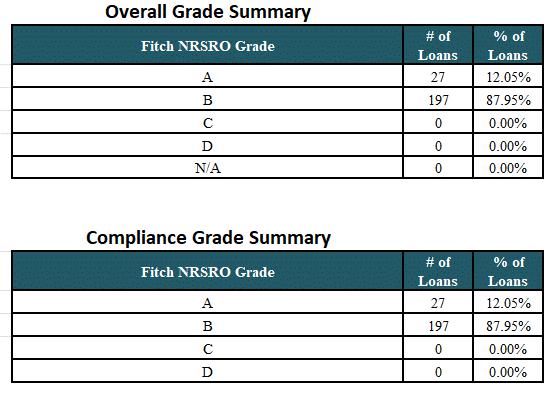
| b) | Results of credit, compliance and value reviews – The following tables show our findings with
respect to the number of loans, the final loan grade pursuant to the published criteria of the various rating agencies. The final rating
agency grade is reported on the horizontal axis of each table as “Final Grade”. The migration from the final rating agency
grade is based on our review of documents and responses received for the seller or securitizer. |