Restarting Development in Rett Syndrome NGN-401 for Rett Syndrome Phase 1/2 Update June 29, 2026
Forward Looking Statements This communication contains forward-looking statements within the meaning of the Private Securities Litigation Reform Act of 1995. These statements may discuss goals, intentions and expectations as to future plans, trends, events, results of operations or financial condition, or otherwise, based on current expectations and beliefs of the management of Neurogene, as well as assumptions made by, and information currently available to, management of Neurogene, including, but not limited to, statements regarding: the therapeutic potential and utility, efficacy and clinical benefits of its programs, including NGN-401; the potential for commercial approval of NGN-401 and the speed with which any such approval might be obtained; market opportunities for Neurogene's product candidates, including the estimated prevalence of Rett syndrome and expected levels of demand for NGN-401; the safety and tolerability profile of NGN-401; the applicability of reported results from the NGN-401 Phase 1/2 clinical trial to participants in the EmboldenTM registrational clinical trial of NGN-401; the likelihood of gaining approval of NGN-401 from the U.S. Food and Drug Administration (FDA) or any other regulator; trial designs and clinical development plans for the Embolden trial; the response rate, expected durability and deepening of clinical data results from the NGN-401 clinical trials; expected timing and availability of topline results from the Embolden registrational trial; the timing of a potential submission of a Biologics License Application (BLA) to the FDA based on the results of the Embolden trial and the ability of the Embolden registrational trial to support planned BLA submissions; the potential for NGN-401 to be a best-in-class or first-in-class gene therapy for Rett syndrome; the potential for success of the Embolden registrational clinical trial of NGN-401 for Rett Syndrome; the potential real-world impact of NGN-401; and Neurogene's cash runway, including the time period over which existing cash resources may be sufficient to fund the Company’s operations. Forward-looking statements generally include statements that are predictive in nature and depend upon or refer to future events or conditions, and include words such as “may,” “will,” “should,” “would,” “expect,” “anticipate,” “plan,” “likely,” “believe,” “estimate,” “project,” “intend,” and other similar expressions or the negative or plural of these words, or other similar expressions that are predictions or indicate future events or prospects, although not all forward-looking statements contain these words. Statements that are not historical facts are forward-looking statements. Forward-looking statements are based on current beliefs and assumptions that are subject to risks and uncertainties and are not guarantees of future performance. Actual results could differ materially from those contained in any forward-looking statement as a result of various factors, including, without limitation, the risk factors included in the Company’s most recent Annual Report on Form 10-K and Quarterly Reports on Form 10-Q filed with the Securities and Exchange Commission, as well as risk factors associated with companies, such as Neurogene, that operate in the biopharma industry. These forward-looking statements involve a number of risks, uncertainties (some of which are beyond Neurogene’s control) or other assumptions that may cause actual results or performance to be materially different from those expressed or implied by these forward-looking statements. Nothing in this communication should be regarded as a representation by any person that the forward-looking statements set forth herein will be achieved or that the contemplated results of any such forward-looking statements will be achieved. Forward-looking statements in this communication speak only as of the day they are made and are qualified in their entirety by reference to the cautionary statements herein. Except as required by applicable law, Neurogene undertakes no obligation to revise or update any forward-looking statement, or to make any other forward-looking statements, whether as a result of new information, future events or otherwise. Industry and Market Data Certain information contained in this Presentation relates to or is based on studies, publications, surveys and Neurogene’s own internal estimates and research. In this Presentation, Neurogene relies on, and refers to, publicly available information and statistics regarding market participants in the sector in which Neurogene competes and other industry data. Any comparison of Neurogene to any other entity assumes the reliability of the information available to Neurogene. Neurogene obtained this information and statistics from third-party sources, including reports by market research firms and company filings. In addition, all of the market data included in this Presentation involve a number of assumptions and limitations, and there can be no guarantee as to the accuracy or reliability of such assumptions. Finally, while Neurogene believes its internal research is reliable, such research has not been verified by any independent source and Neurogene has not independently verified the information. Trademarks This Presentation may contain trademarks, service marks, trade names and copyrights of other companies, which are the property of their respective owners. Solely for convenience, some of the trademarks, service marks, trade names and copyrights referred to in this Presentation may be listed without the TM, SM © or ® symbols, but Neurogene will assert, to the fullest extent under applicable law, the rights of the applicable owners, if any, to these trademarks, service marks, trade names and copyrights. Disclaimer 2

Today’s Speakers Rachel McMinn, Ph.D. Founder and Chief Executive Officer, Neurogene Julie Jordan, M.D. Chief Medical Officer, Neurogene Bernhard Suter, M.D. Medical Director, Blue Bird Circle Rett Center, Texas Children’s Hospital Associate Professor of Pediatrics and Neurology, Baylor College of Medicine 3

Introduction Rachel McMinn, Ph.D. Founder and Chief Executive Officer, Neurogene
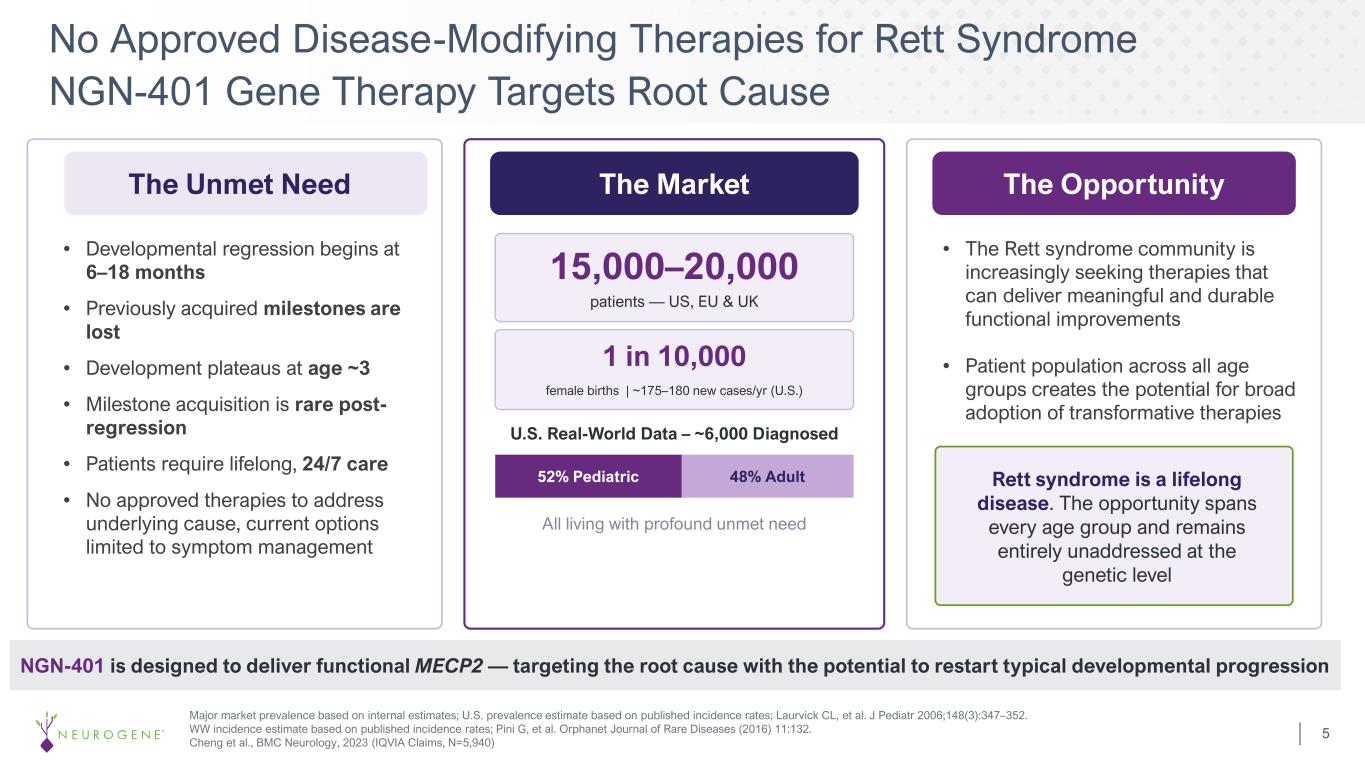
5 No Approved Disease-Modifying Therapies for Rett Syndrome NGN-401 Gene Therapy Targets Root Cause The Unmet Need • Developmental regression begins at 6–18 months • Previously acquired milestones are lost • Development plateaus at age ~3 • Milestone acquisition is rare post- regression • Patients require lifelong, 24/7 care • No approved therapies to address underlying cause, current options limited to symptom management The Market 15,000–20,000 patients — US, EU & UK 1 in 10,000 female births | ~175–180 new cases/yr (U.S.) U.S. Real-World Data – ~6,000 Diagnosed 52% Pediatric 48% Adult All living with profound unmet need The Opportunity • The Rett syndrome community is increasingly seeking therapies that can deliver meaningful and durable functional improvements • Patient population across all age groups creates the potential for broad adoption of transformative therapies Rett syndrome is a lifelong disease. The opportunity spans every age group and remains entirely unaddressed at the genetic level NGN-401 is designed to deliver functional MECP2 — targeting the root cause with the potential to restart typical developmental progression Major market prevalence based on internal estimates; U.S. prevalence estimate based on published incidence rates; Laurvick CL, et al. J Pediatr 2006;148(3):347–352. WW incidence estimate based on published incidence rates; Pini G, et al. Orphanet Journal of Rare Diseases (2016) 11:132. Cheng et al., BMC Neurology, 2023 (IQVIA Claims, N=5,940)
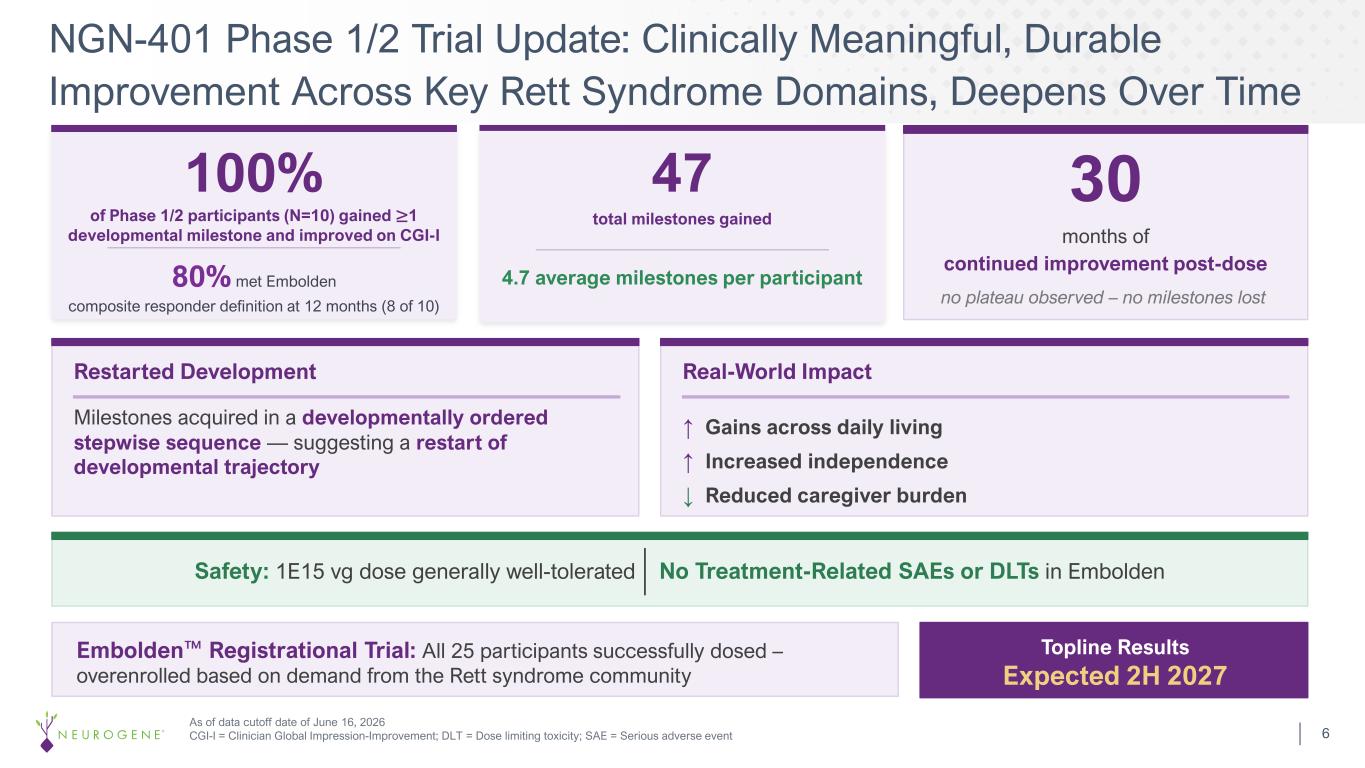
6 NGN-401 Phase 1/2 Trial Update: Clinically Meaningful, Durable Improvement Across Key Rett Syndrome Domains, Deepens Over Time 30 months of continued improvement post-dose no plateau observed – no milestones lost Restarted Development Milestones acquired in a developmentally ordered stepwise sequence — suggesting a restart of developmental trajectory Real-World Impact ↑ Gains across daily living ↑ Increased independence ↓ Reduced caregiver burden Embolden Registrational Trial: All 25 participants successfully dosed – overenrolled based on demand from the Rett syndrome community Topline Results Expected 2H 2027 As of data cutoff date of June 16, 2026 CGI-I = Clinician Global Impression-Improvement; DLT = Dose limiting toxicity; SAE = Serious adverse event 100% of Phase 1/2 participants (N=10) gained ≥1 developmental milestone and improved on CGI-I 80% met Embolden composite responder definition at 12 months (8 of 10) 47 total milestones gained 4.7 average milestones per participant Safety: 1E15 vg dose generally well-tolerated No Treatment-Related SAEs or DLTs in Embolden
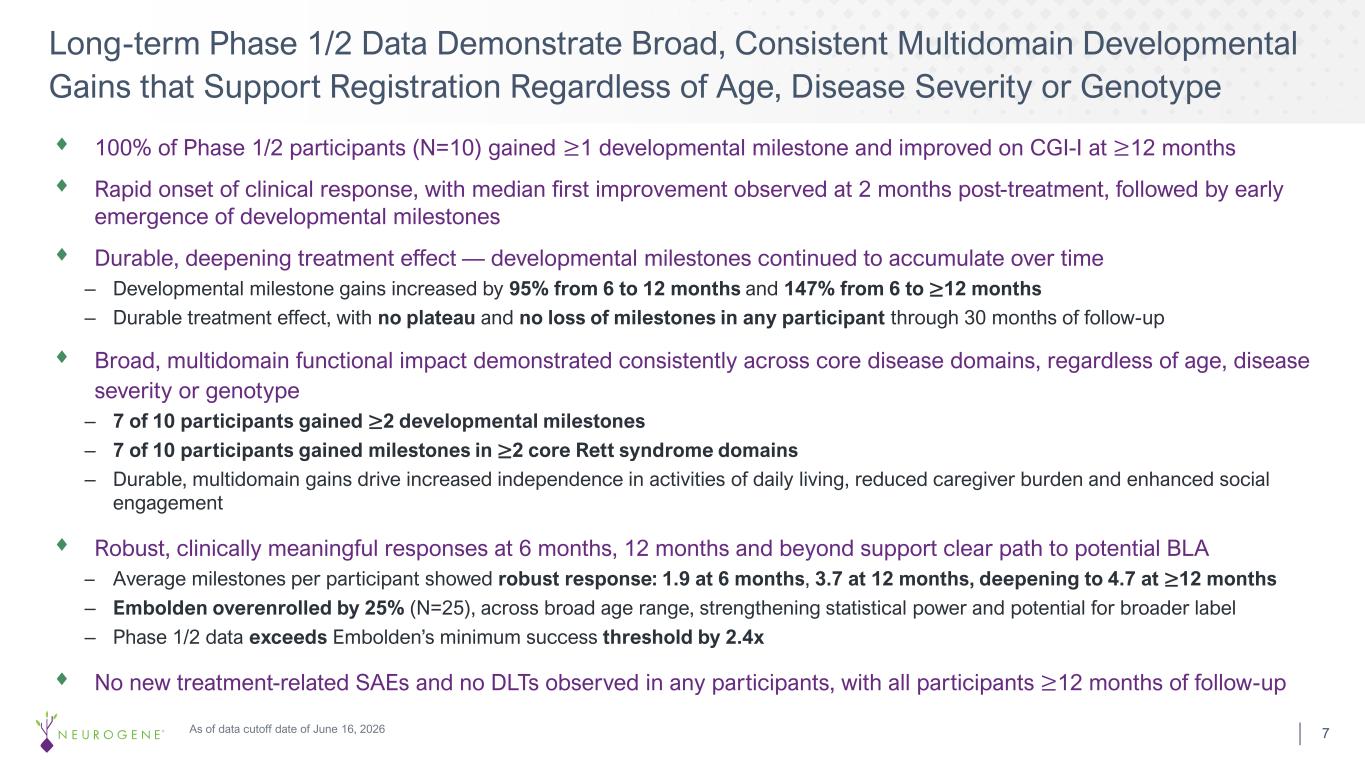
Long-term Phase 1/2 Data Demonstrate Broad, Consistent Multidomain Developmental Gains that Support Registration Regardless of Age, Disease Severity or Genotype 100% of Phase 1/2 participants (N=10) gained ≥1 developmental milestone and improved on CGI-I at ≥12 months Rapid onset of clinical response, with median first improvement observed at 2 months post-treatment, followed by early emergence of developmental milestones Durable, deepening treatment effect — developmental milestones continued to accumulate over time – Developmental milestone gains increased by 95% from 6 to 12 months and 147% from 6 to ≥12 months – Durable treatment effect, with no plateau and no loss of milestones in any participant through 30 months of follow-up Broad, multidomain functional impact demonstrated consistently across core disease domains, regardless of age, disease severity or genotype – 7 of 10 participants gained ≥2 developmental milestones – 7 of 10 participants gained milestones in ≥2 core Rett syndrome domains – Durable, multidomain gains drive increased independence in activities of daily living, reduced caregiver burden and enhanced social engagement Robust, clinically meaningful responses at 6 months, 12 months and beyond support clear path to potential BLA – Average milestones per participant showed robust response: 1.9 at 6 months, 3.7 at 12 months, deepening to 4.7 at ≥12 months – Embolden overenrolled by 25% (N=25), across broad age range, strengthening statistical power and potential for broader label – Phase 1/2 data exceeds Embolden’s minimum success threshold by 2.4x No new treatment-related SAEs and no DLTs observed in any participants, with all participants ≥12 months of follow-up 7As of data cutoff date of June 16, 2026
Phase 1/2 Data Update
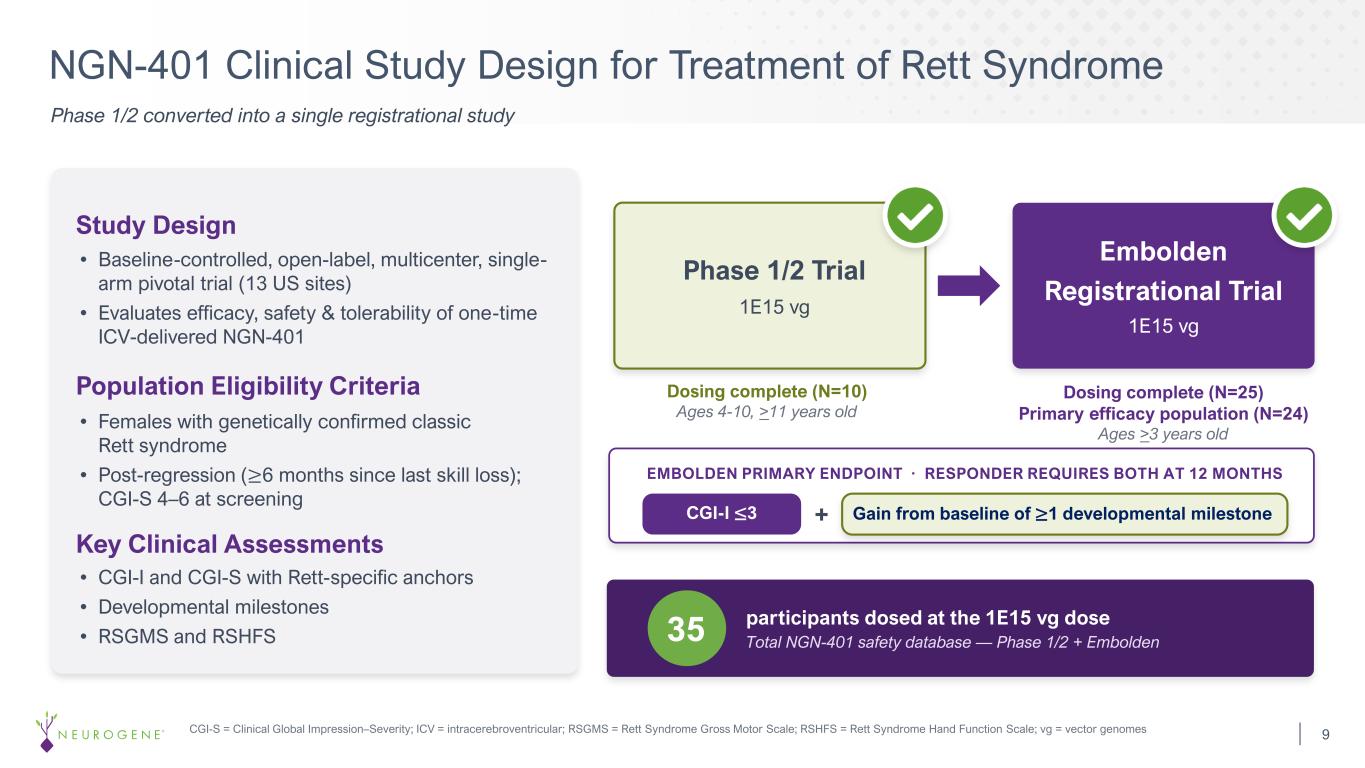
NGN-401 Clinical Study Design for Treatment of Rett Syndrome Phase 1/2 converted into a single registrational study Study Design • Baseline-controlled, open-label, multicenter, single- arm pivotal trial (13 US sites) • Evaluates efficacy, safety & tolerability of one-time ICV-delivered NGN-401 Population Eligibility Criteria • Females with genetically confirmed classic Rett syndrome • Post-regression (≥6 months since last skill loss); CGI-S 4–6 at screening Key Clinical Assessments • CGI-I and CGI-S with Rett-specific anchors • Developmental milestones • RSGMS and RSHFS Phase 1/2 Trial 1E15 vg Dosing complete (N=10) Ages 4-10, >11 years old Embolden Registrational Trial 1E15 vg Dosing complete (N=25) Primary efficacy population (N=24) Ages >3 years old 35 CGI-I ≤3 + EMBOLDEN PRIMARY ENDPOINT · RESPONDER REQUIRES BOTH AT 12 MONTHS Gain from baseline of ≥1 developmental milestone participants dosed at the 1E15 vg dose Total NGN-401 safety database — Phase 1/2 + Embolden CGI-S = Clinical Global Impression–Severity; ICV = intracerebroventricular; RSGMS = Rett Syndrome Gross Motor Scale; RSHFS = Rett Syndrome Hand Function Scale; vg = vector genomes 9
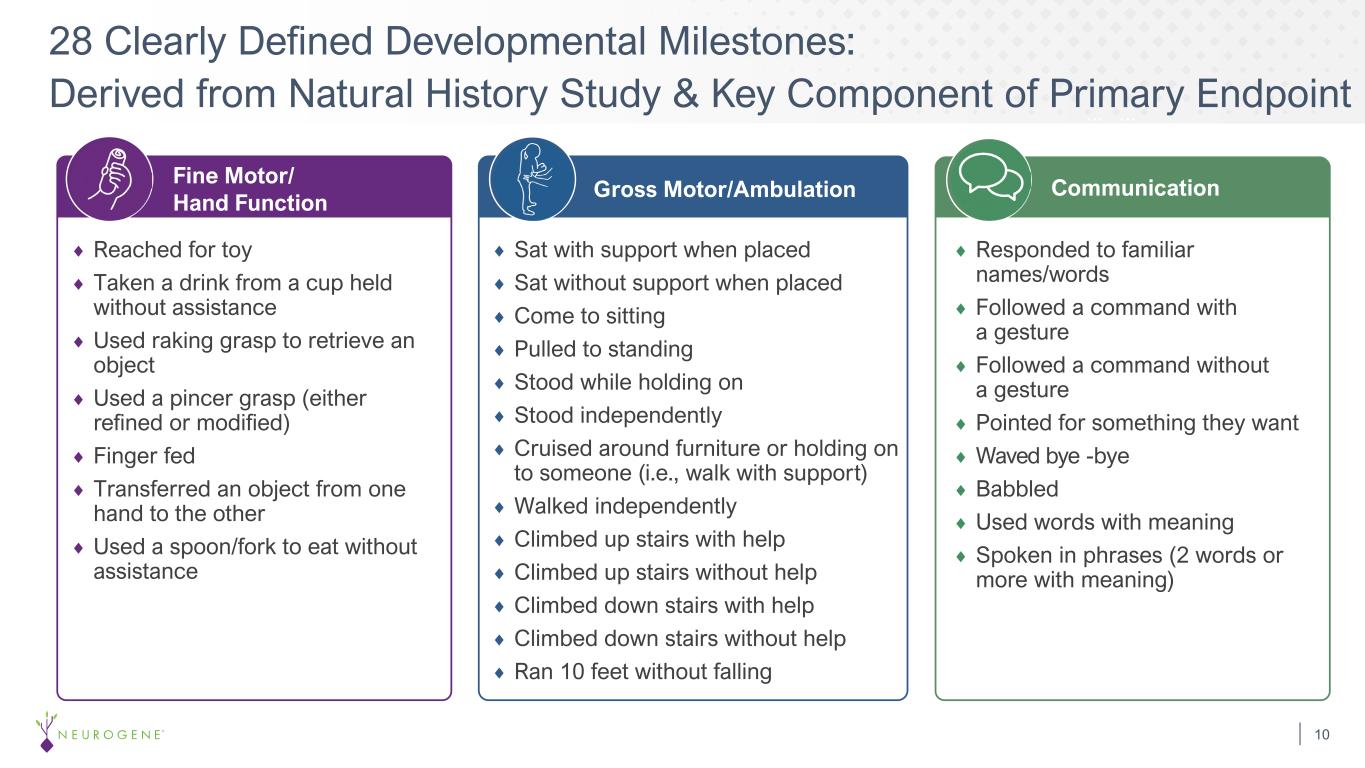
28 Clearly Defined Developmental Milestones: Derived from Natural History Study & Key Component of Primary Endpoint Fine Motor/ Hand Function Gross Motor/Ambulation Communication 1.2% - 3% 0.3 – 6.6% Reached for toy Taken a drink from a cup held without assistance Used raking grasp to retrieve an object Used a pincer grasp (either refined or modified) Finger fed Transferred an object from one hand to the other Used a spoon/fork to eat without assistance Sat with support when placed Sat without support when placed Come to sitting Pulled to standing Stood while holding on Stood independently Cruised around furniture or holding on to someone (i.e., walk with support) Walked independently Climbed up stairs with help Climbed up stairs without help Climbed down stairs with help Climbed down stairs without help Ran 10 feet without falling Responded to familiar names/words Followed a command with a gesture Followed a command without a gesture Pointed for something they want Waved bye -bye Babbled Used words with meaning Spoken in phrases (2 words or more with meaning) 10
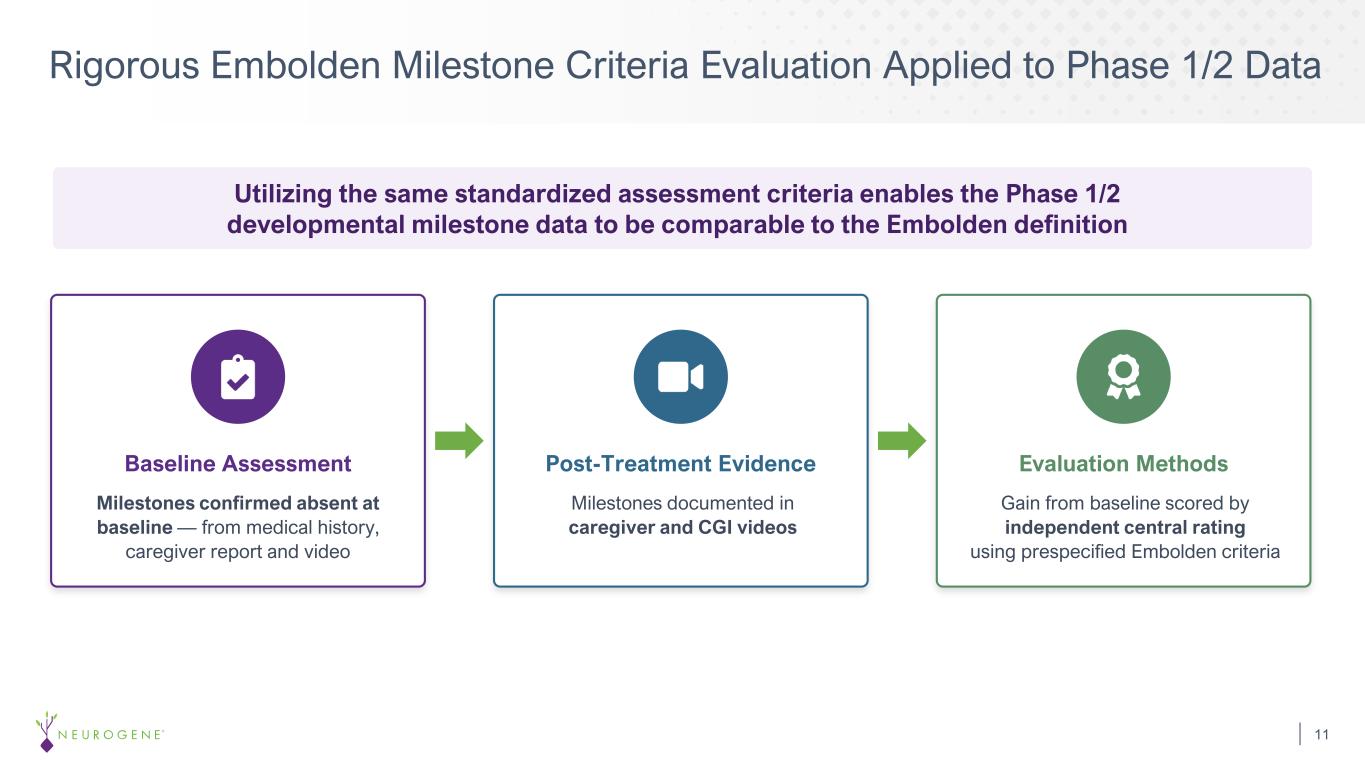
Rigorous Embolden Milestone Criteria Evaluation Applied to Phase 1/2 Data Baseline Assessment Post-Treatment Evidence Milestones documented in caregiver and CGI videos Evaluation Methods Gain from baseline scored by independent central rating using prespecified Embolden criteria Utilizing the same standardized assessment criteria enables the Phase 1/2 developmental milestone data to be comparable to the Embolden definition 11 Milestones confirmed absent at baseline — from medical history, caregiver report and video
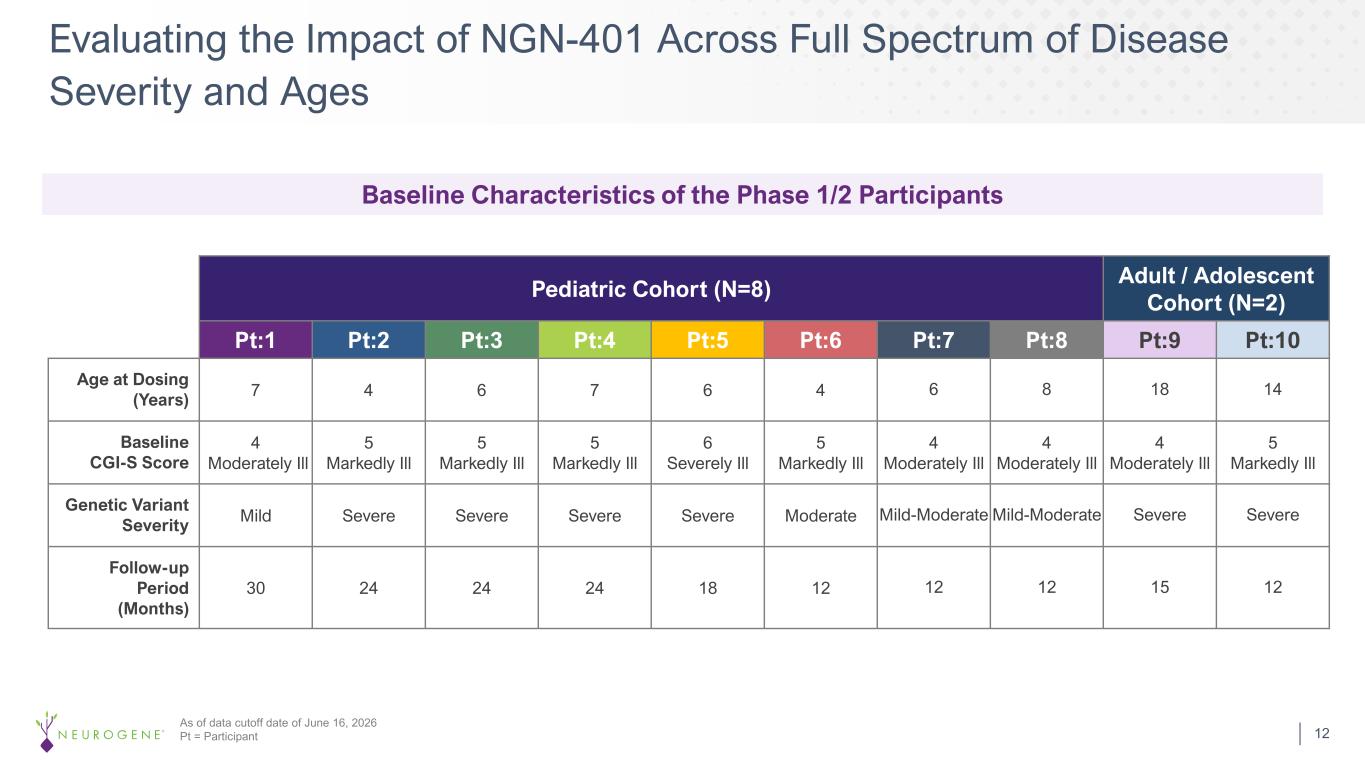
12 Evaluating the Impact of NGN-401 Across Full Spectrum of Disease Severity and Ages As of data cutoff date of June 16, 2026 Pt = Participant Pediatric Cohort (N=8) Adult / Adolescent Cohort (N=2) Pt:1 Pt:2 Pt:3 Pt:4 Pt:5 Pt:6 Pt:7 Pt:8 Pt:9 Pt:10 Age at Dosing (Years) 7 4 6 7 6 4 6 8 18 14 Baseline CGI-S Score 4 Moderately Ill 5 Markedly Ill 5 Markedly Ill 5 Markedly Ill 6 Severely Ill 5 Markedly Ill 4 Moderately Ill 4 Moderately Ill 4 Moderately Ill 5 Markedly Ill Genetic Variant Severity Mild Severe Severe Severe Severe Moderate Mild-Moderate Mild-Moderate Severe Severe Follow-up Period (Months) 30 24 24 24 18 12 12 12 15 12 Baseline Characteristics of the Phase 1/2 Participants
Phase 1/2 Data Update: Restarting Development in Long-Term NGN-401-Treated Participants Bernhard Suter, M.D. Medical Director of Blue Bird Circle Rett Center at Texas Children’s Hospital, Associate Professor of Pediatrics and Neurology, Baylor College of Medicine Principal Investigator in NGN-401 Clinical Trial
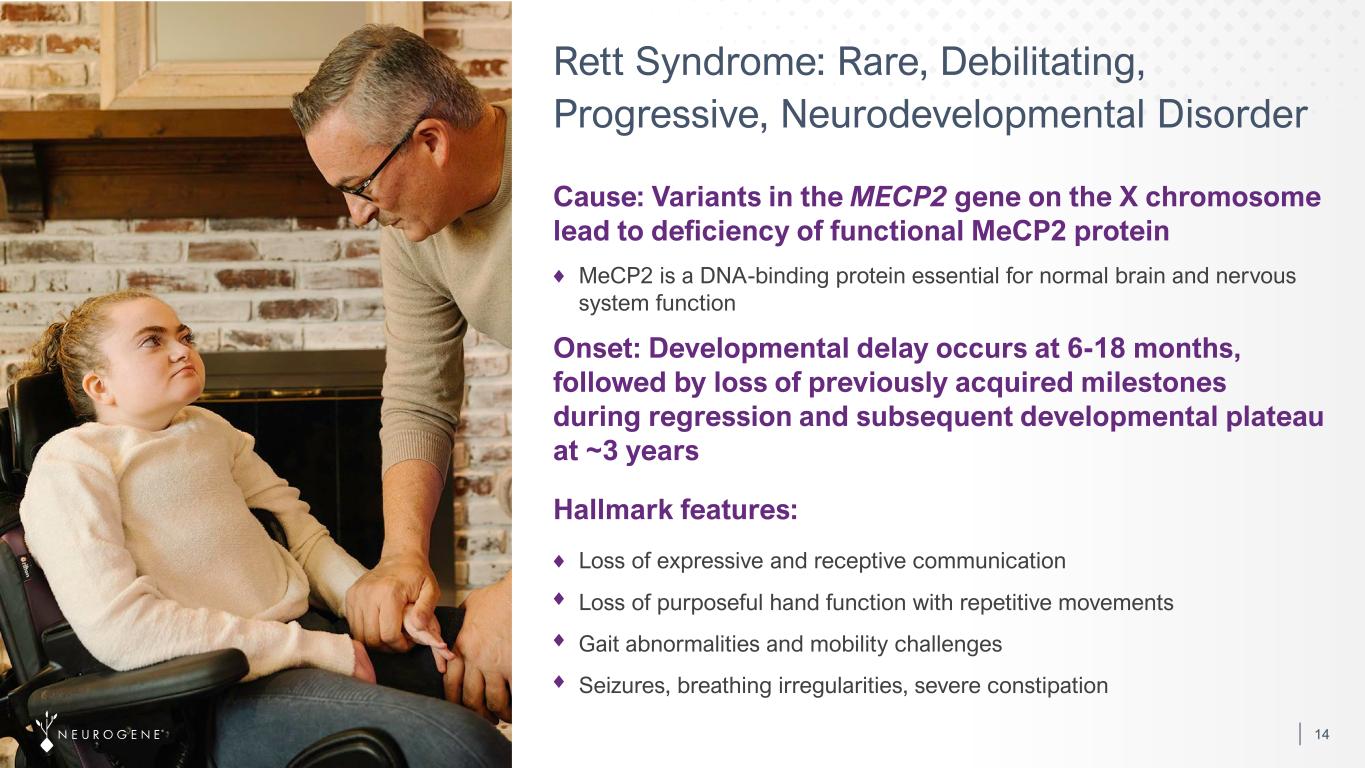
14 Cause: Variants in the MECP2 gene on the X chromosome lead to deficiency of functional MeCP2 protein MeCP2 is a DNA-binding protein essential for normal brain and nervous system function Onset: Developmental delay occurs at 6-18 months, followed by loss of previously acquired milestones during regression and subsequent developmental plateau at ~3 years Hallmark features: Loss of expressive and receptive communication Loss of purposeful hand function with repetitive movements Gait abnormalities and mobility challenges Seizures, breathing irregularities, severe constipation Rett Syndrome: Rare, Debilitating, Progressive, Neurodevelopmental Disorder
15
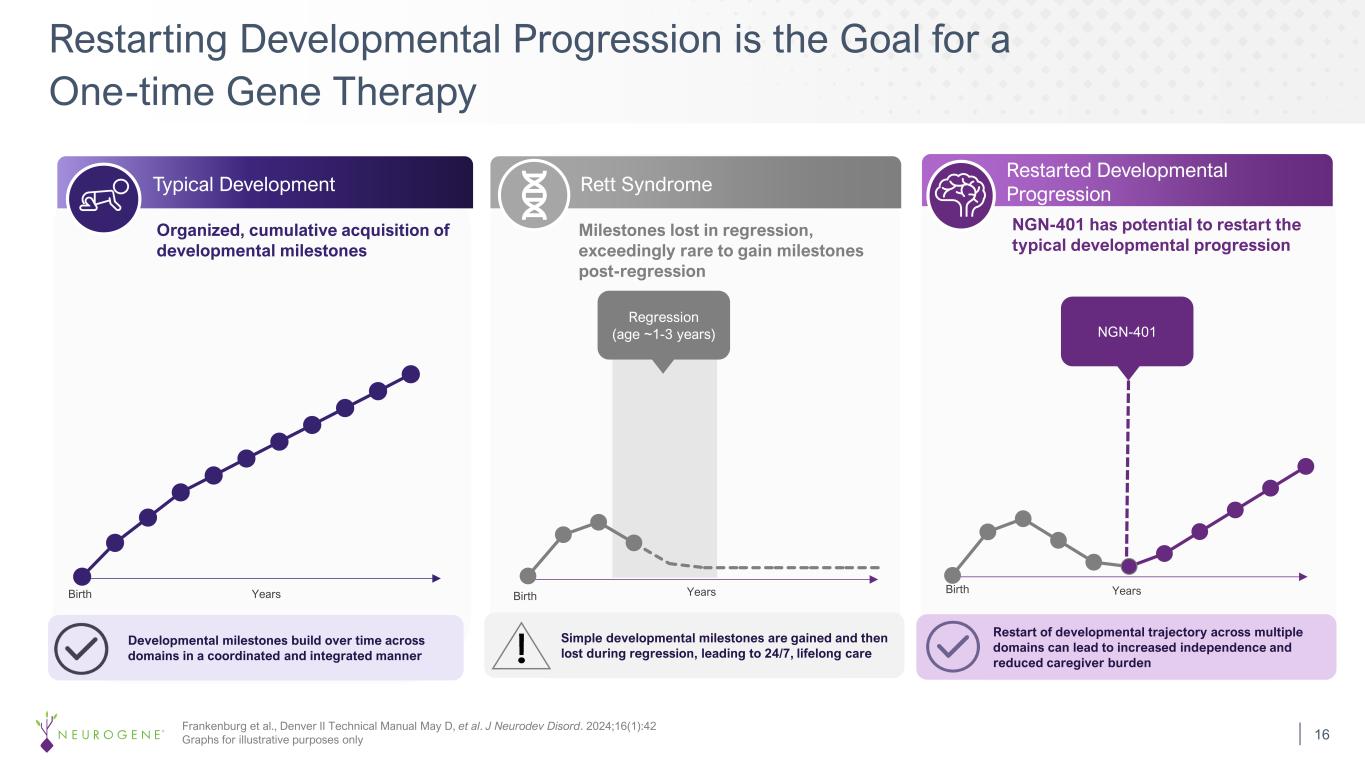
Restarting Developmental Progression is the Goal for a One-time Gene Therapy Frankenburg et al., Denver II Technical Manual May D, et al. J Neurodev Disord. 2024;16(1):42 Graphs for illustrative purposes only Typical Development Rett Syndrome Restarted Developmental Progression Birth Birth Birth Regression (age ~1-3 years) NGN-401 Organized, cumulative acquisition of developmental milestones Milestones lost in regression, exceedingly rare to gain milestones post-regression NGN-401 has potential to restart the typical developmental progression Developmental milestones build over time across domains in a coordinated and integrated manner Simple developmental milestones are gained and then lost during regression, leading to 24/7, lifelong care Restart of developmental trajectory across multiple domains can lead to increased independence and reduced caregiver burden Years Years Years 16
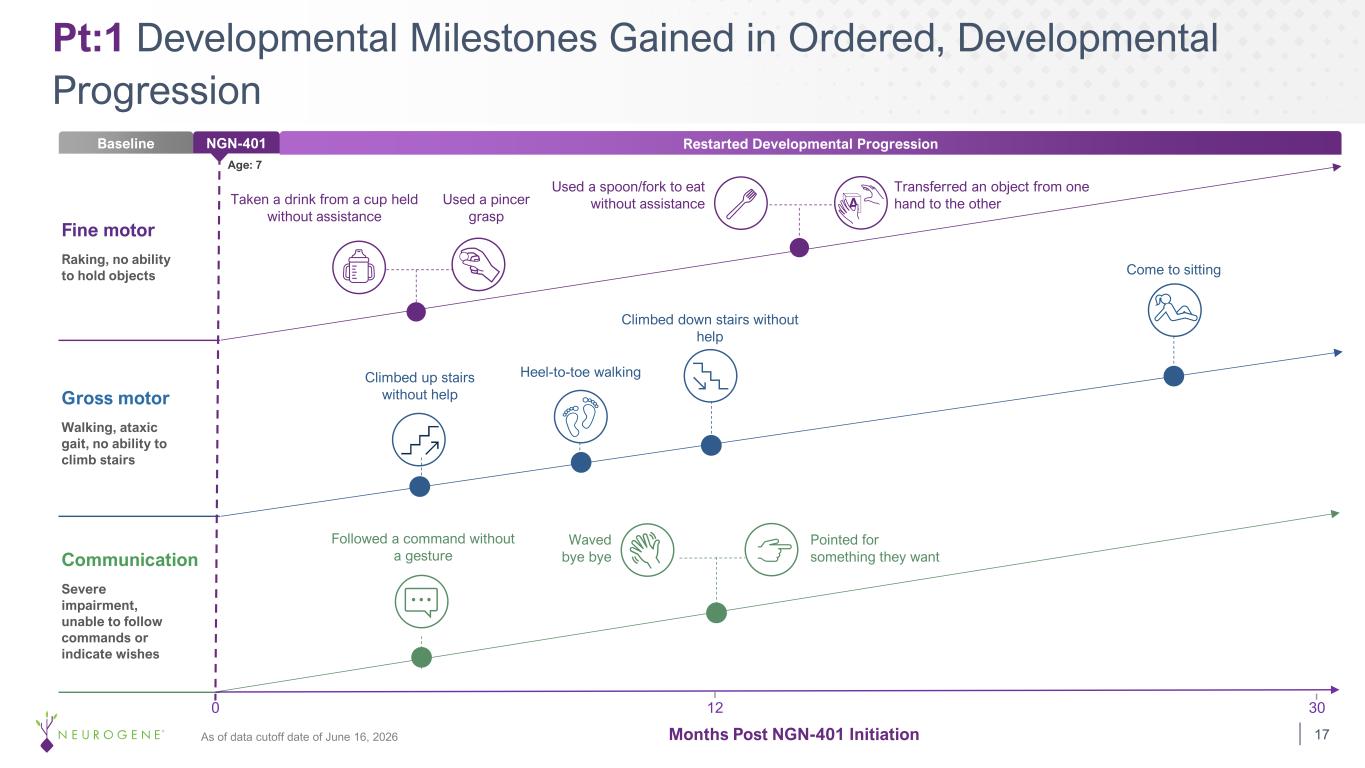
Pt:1 Developmental Milestones Gained in Ordered, Developmental Progression Baseline NGN-401 Restarted Developmental Progression 12 300 Taken a drink from a cup held without assistance Used a pincer grasp Used a spoon/fork to eat without assistance Transferred an object from one hand to the other Climbed up stairs without help Climbed down stairs without help Heel-to-toe walking Come to sitting Followed a command without a gesture Pointed for something they want Waved bye bye Fine motor Raking, no ability to hold objects Gross motor Walking, ataxic gait, no ability to climb stairs Communication Severe impairment, unable to follow commands or indicate wishes Age: 7 Months Post NGN-401 InitiationAs of data cutoff date of June 16, 2026 17
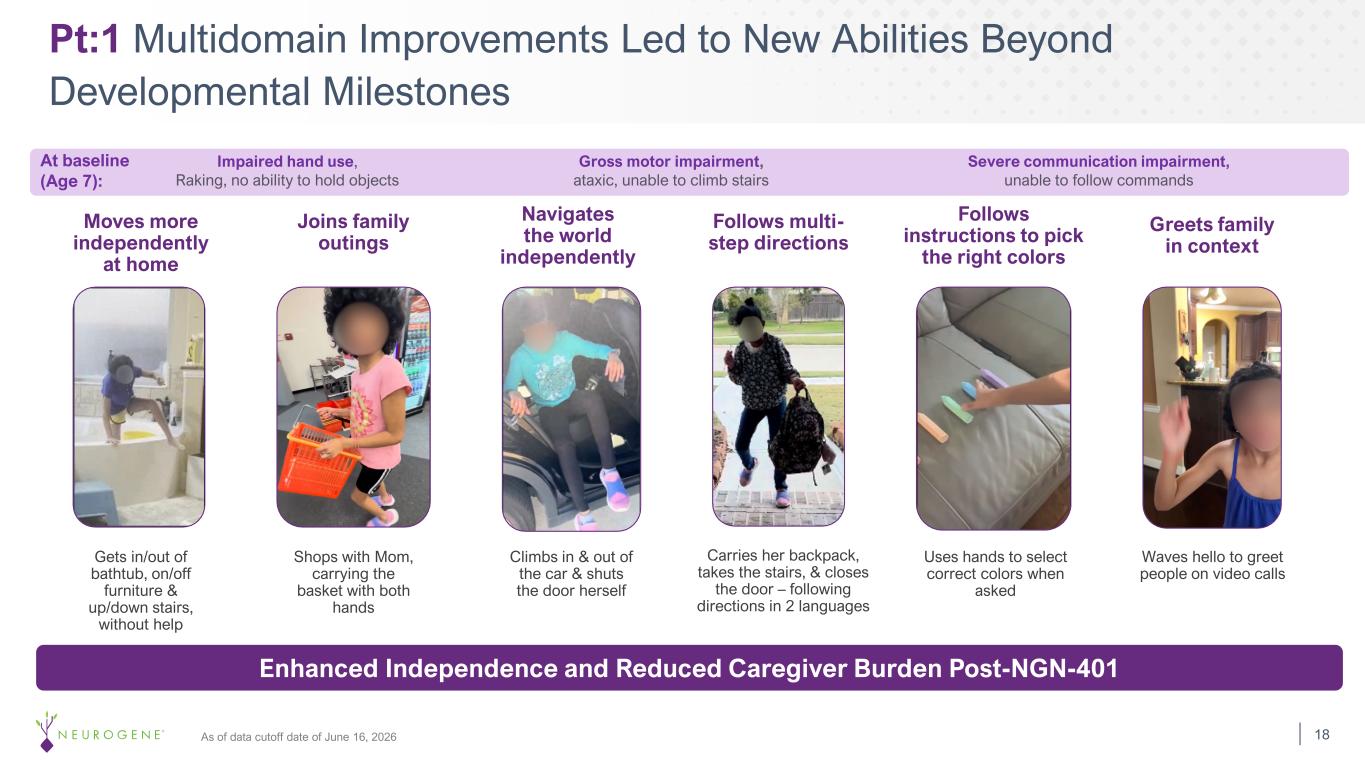
Pt:1 Multidomain Improvements Led to New Abilities Beyond Developmental Milestones As of data cutoff date of June 16, 2026 Moves more independently at home Gets in/out of bathtub, on/off furniture & up/down stairs, without help Shops with Mom, carrying the basket with both hands Joins family outings Navigates the world independently Climbs in & out of the car & shuts the door herself Follows multi- step directions Carries her backpack, takes the stairs, & closes the door – following directions in 2 languages Follows instructions to pick the right colors Uses hands to select correct colors when asked Greets family in context Waves hello to greet people on video calls Enhanced Independence and Reduced Caregiver Burden Post-NGN-401 18 Impaired hand use, Raking, no ability to hold objects At baseline (Age 7): Gross motor impairment, ataxic, unable to climb stairs Severe communication impairment, unable to follow commands
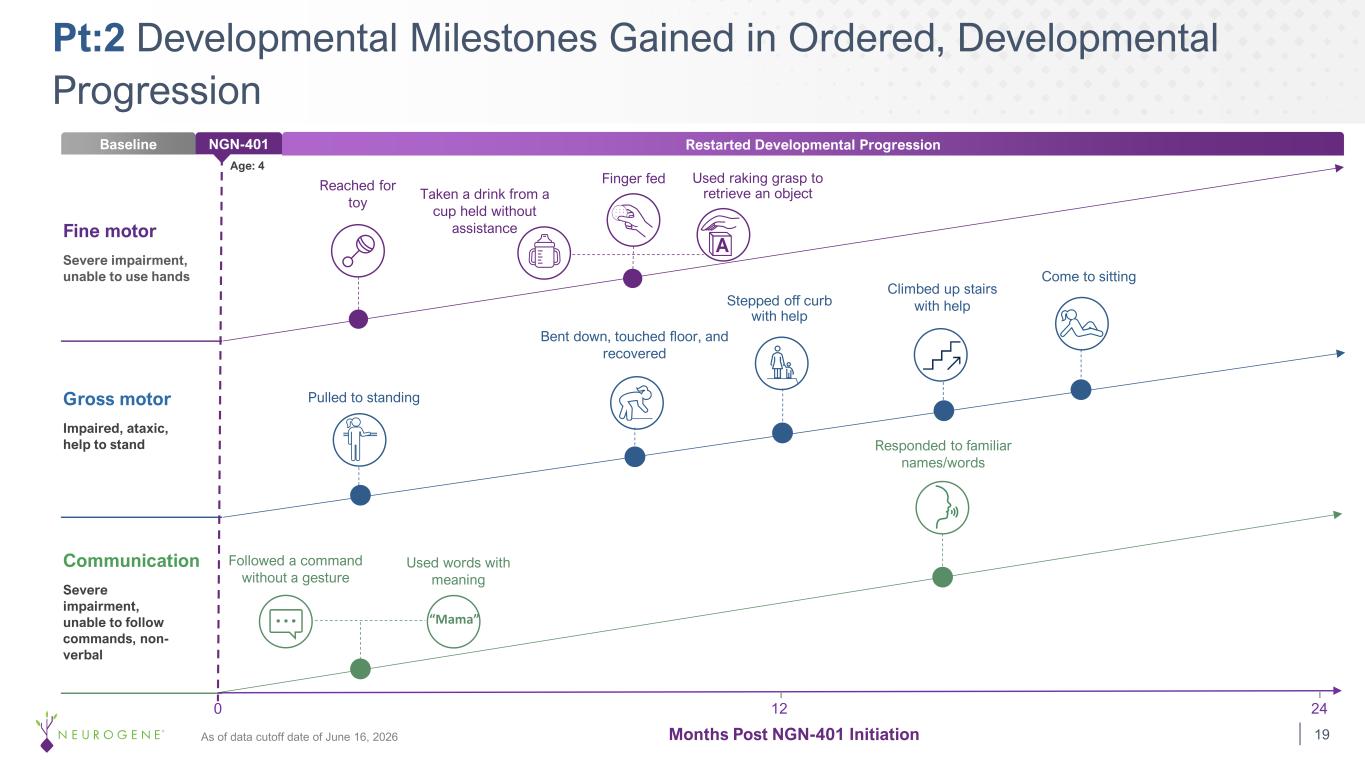
Pt:2 Developmental Milestones Gained in Ordered, Developmental Progression Months Post NGN-401 InitiationAs of data cutoff date of June 16, 2026 12 240 Baseline NGN-401 Restarted Developmental Progression Fine motor Severe impairment, unable to use hands Gross motor Impaired, ataxic, help to stand Communication Severe impairment, unable to follow commands, non- verbal Age: 4 Reached for toy Taken a drink from a cup held without assistance Finger fed Used raking grasp to retrieve an object Pulled to standing Stepped off curb with help Bent down, touched floor, and recovered Come to sitting Followed a command without a gesture Responded to familiar names/words Climbed up stairs with help Used words with meaning “Mama” 19
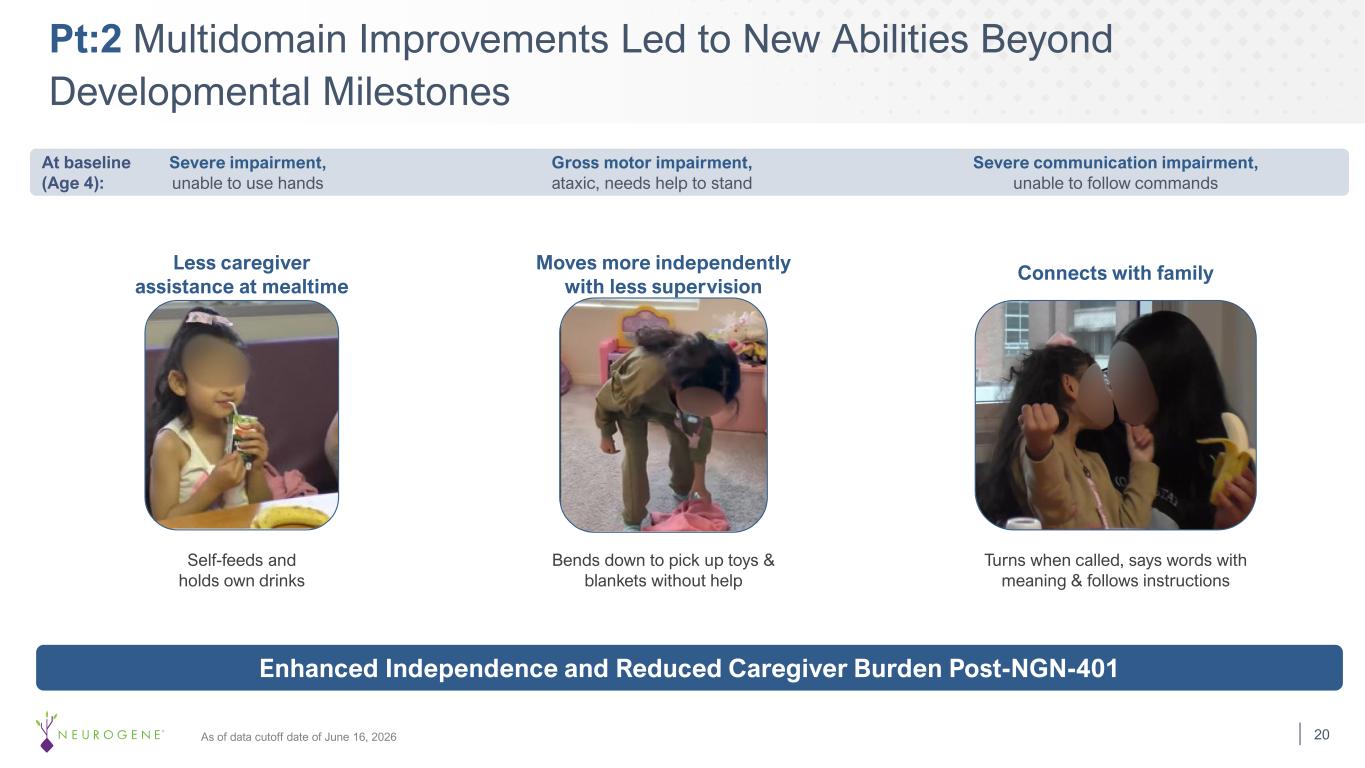
Pt:2 Multidomain Improvements Led to New Abilities Beyond Developmental Milestones As of data cutoff date of June 16, 2026 Self-feeds and holds own drinks Bends down to pick up toys & blankets without help Turns when called, says words with meaning & follows instructions Less caregiver assistance at mealtime Moves more independently with less supervision Connects with family Enhanced Independence and Reduced Caregiver Burden Post-NGN-401 20 Gross motor impairment, ataxic, needs help to stand Severe impairment, unable to use hands At baseline (Age 4): Severe communication impairment, unable to follow commands
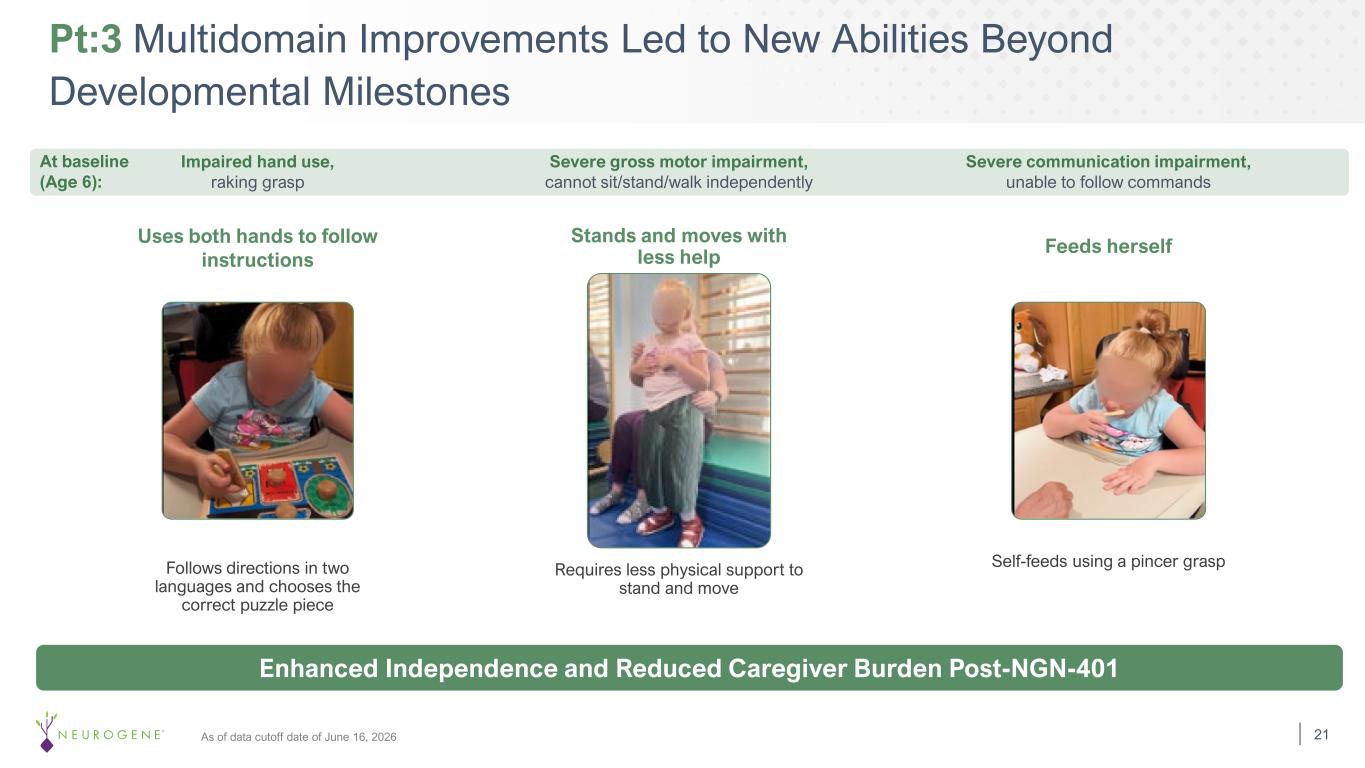
Pt:3 Multidomain Improvements Led to New Abilities Beyond Developmental Milestones As of data cutoff date of June 16, 2026 Requires less physical support to stand and move Follows directions in two languages and chooses the correct puzzle piece Self-feeds using a pincer grasp Uses both hands to follow instructions Stands and moves with less help Feeds herself Enhanced Independence and Reduced Caregiver Burden Post-NGN-401 21 Impaired hand use, raking grasp Severe gross motor impairment, cannot sit/stand/walk independently Severe communication impairment, unable to follow commands At baseline (Age 6):
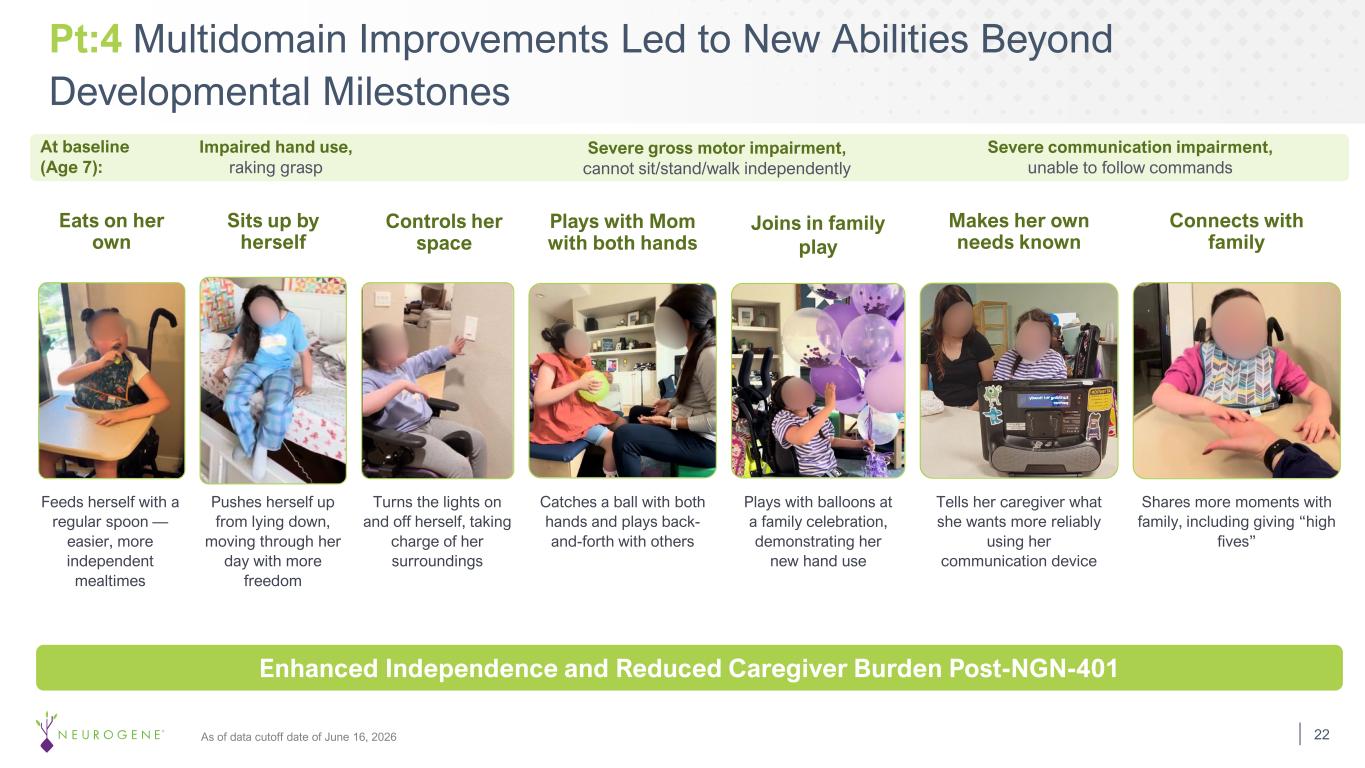
Pt:4 Multidomain Improvements Led to New Abilities Beyond Developmental Milestones As of data cutoff date of June 16, 2026 Turns the lights on and off herself, taking charge of her surroundings Feeds herself with a regular spoon — easier, more independent mealtimes Eats on her own Pushes herself up from lying down, moving through her day with more freedom Sits up by herself Controls her space Catches a ball with both hands and plays back- and-forth with others Plays with Mom with both hands Plays with balloons at a family celebration, demonstrating her new hand use Joins in family play Tells her caregiver what she wants more reliably using her communication device Makes her own needs known Shares more moments with family, including giving “high fives” Connects with family Enhanced Independence and Reduced Caregiver Burden Post-NGN-401 22 Severe gross motor impairment, cannot sit/stand/walk independently Impaired hand use, raking grasp Severe communication impairment, unable to follow commands At baseline (Age 7):
Thank you to all participants and their families and caregivers!

Phase 1/2 Data Update Julie Jordan, M.D. Chief Medical Officer
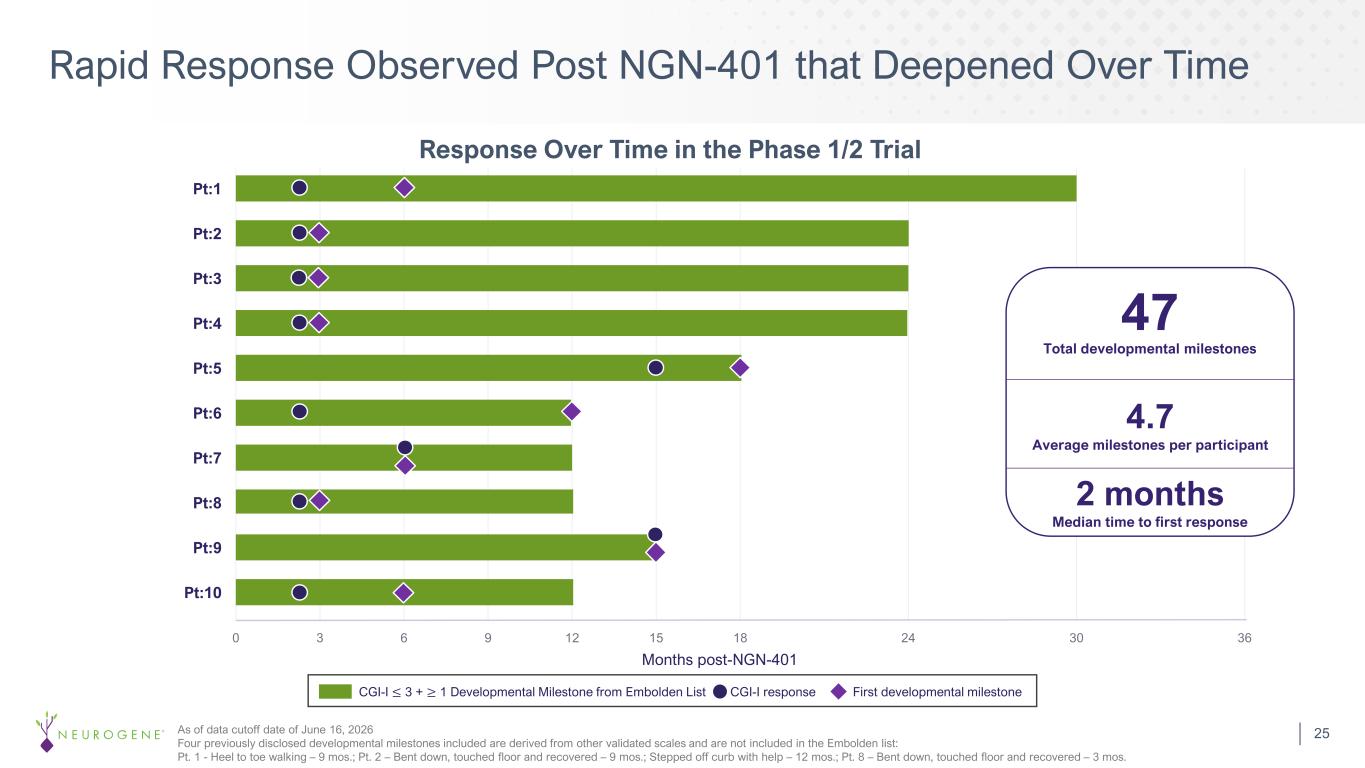
Rapid Response Observed Post NGN-401 that Deepened Over Time 25 0 3 6 9 12 15 18 24 30 36 Months post-NGN-401 Pt:1 Pt:2 Pt:3 Pt:4 Pt:5 Pt:6 Pt:7 Pt:8 Pt:9 Pt:10 Response Over Time in the Phase 1/2 Trial Total developmental milestones 47 4.7 Average milestones per participant CGI-I ≤ 3 + ≥ 1 Developmental Milestone from Embolden List CGI-I response First developmental milestone 2 months Median time to first response As of data cutoff date of June 16, 2026 Four previously disclosed developmental milestones included are derived from other validated scales and are not included in the Embolden list: Pt. 1 - Heel to toe walking – 9 mos.; Pt. 2 – Bent down, touched floor and recovered – 9 mos.; Stepped off curb with help – 12 mos.; Pt. 8 – Bent down, touched floor and recovered – 3 mos.
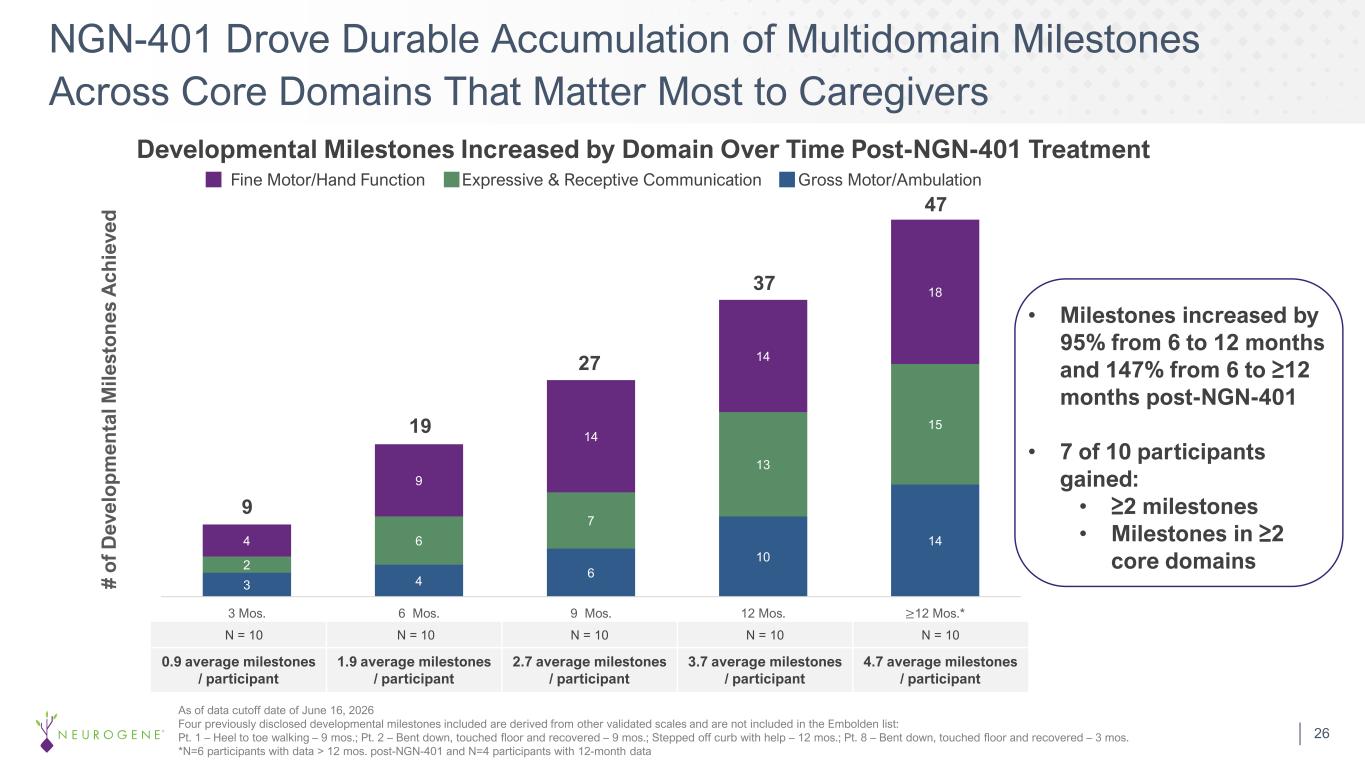
Developmental Milestones Increased by Domain Over Time Post-NGN-401 Treatment 26 NGN-401 Drove Durable Accumulation of Multidomain Milestones Across Core Domains That Matter Most to Caregivers 3 4 6 10 14 2 6 7 13 15 4 9 14 14 18 3 Mos. 6 Mos. 9 Mos. 12 Mos. ≥12 Mos.* 19 9 27 37 # o f D ev el o p m en ta l M ile st o n es A ch ie ve d Fine Motor/Hand Function Expressive & Receptive Communication Gross Motor/Ambulation 47 As of data cutoff date of June 16, 2026 Four previously disclosed developmental milestones included are derived from other validated scales and are not included in the Embolden list: Pt. 1 – Heel to toe walking – 9 mos.; Pt. 2 – Bent down, touched floor and recovered – 9 mos.; Stepped off curb with help – 12 mos.; Pt. 8 – Bent down, touched floor and recovered – 3 mos. *N=6 participants with data > 12 mos. post-NGN-401 and N=4 participants with 12-month data N = 10 N = 10 N = 10 N = 10 N = 10 0.9 average milestones / participant 1.9 average milestones / participant 2.7 average milestones / participant 3.7 average milestones / participant 4.7 average milestones / participant • Milestones increased by 95% from 6 to 12 months and 147% from 6 to ≥12 months post-NGN-401 • 7 of 10 participants gained: • ≥2 milestones • Milestones in ≥2 core domains
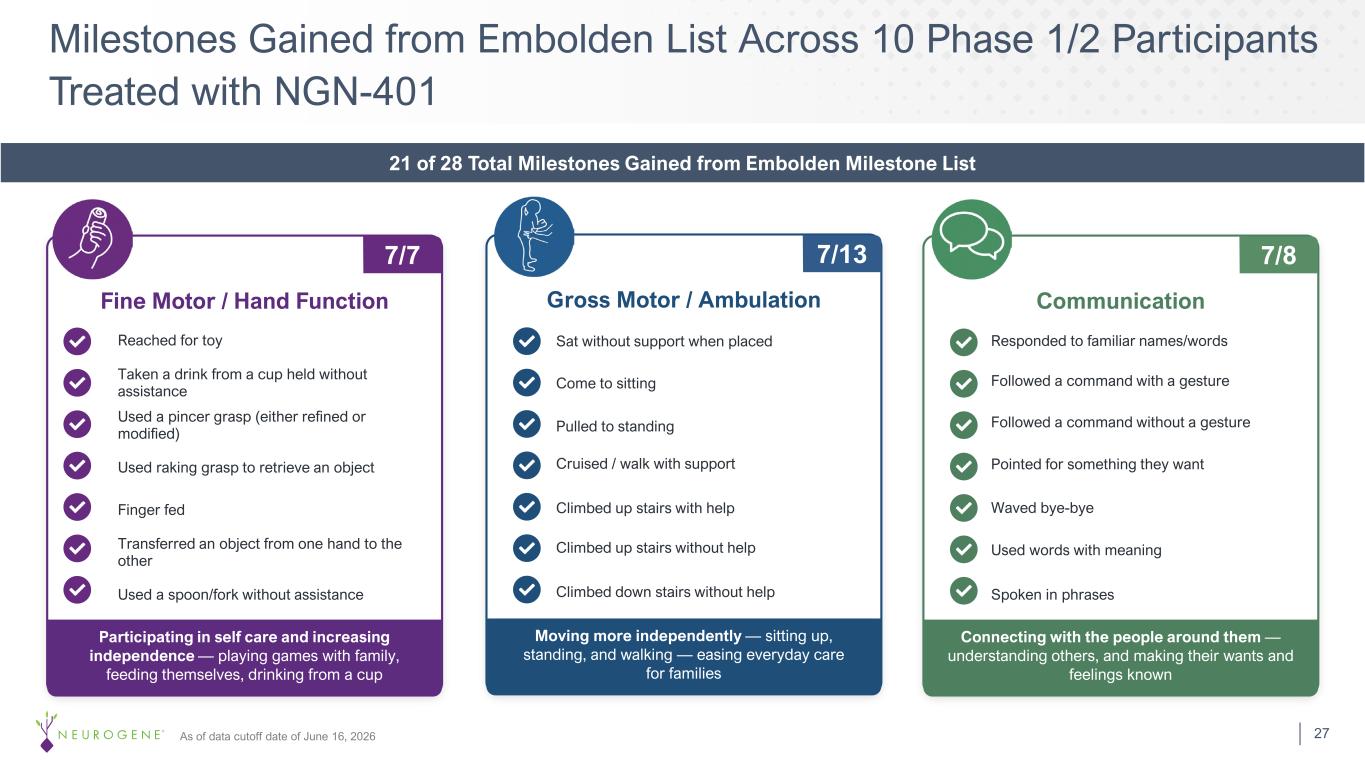
Connecting with the people around them — understanding others, and making their wants and feelings known Communication Spoken in phrases Used words with meaning Pointed for something they want Waved bye-bye Responded to familiar names/words Participating in self care and increasing independence — playing games with family, feeding themselves, drinking from a cup Fine Motor / Hand Function Used a spoon/fork without assistance Taken a drink from a cup held without assistance Finger fed Used a pincer grasp (either refined or modified) Used raking grasp to retrieve an object Reached for toy Transferred an object from one hand to the other Moving more independently — sitting up, standing, and walking — easing everyday care for families Gross Motor / Ambulation Climbed up stairs without help Climbed down stairs without help Climbed up stairs with help Cruised / walk with support Pulled to standing Come to sitting Sat without support when placed 27 Milestones Gained from Embolden List Across 10 Phase 1/2 Participants Treated with NGN-401 As of data cutoff date of June 16, 2026 7/7 Followed a command with a gesture Followed a command without a gesture 21 of 28 Total Milestones Gained from Embolden Milestone List 7/13 7/8
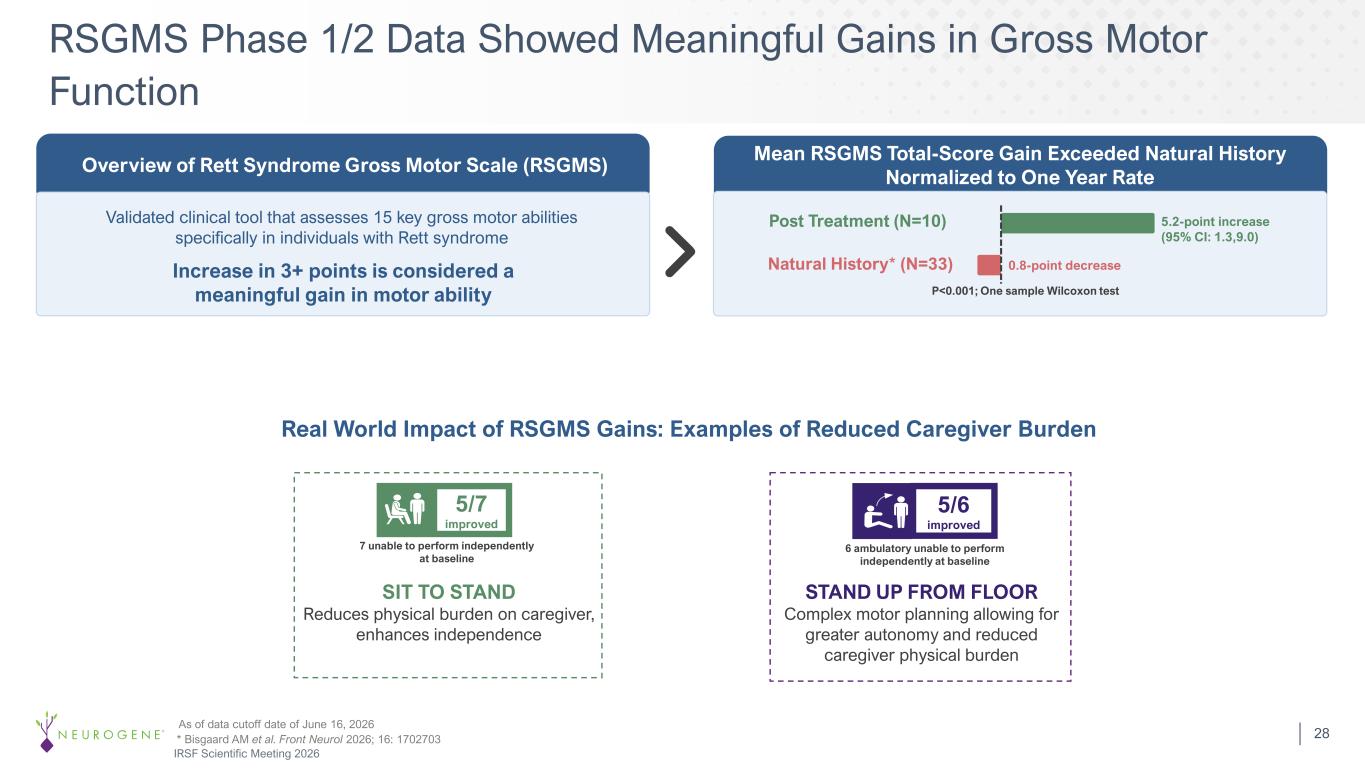
Overview of Rett Syndrome Gross Motor Scale (RSGMS) Mean RSGMS Total-Score Gain Exceeded Natural History Normalized to One Year Rate RSGMS Phase 1/2 Data Showed Meaningful Gains in Gross Motor Function Real World Impact of RSGMS Gains: Examples of Reduced Caregiver Burden SIT TO STAND Reduces physical burden on caregiver, enhances independence 7 unable to perform independently at baseline 5/7 improved STAND UP FROM FLOOR Complex motor planning allowing for greater autonomy and reduced caregiver physical burden 6 ambulatory unable to perform independently at baseline 5/6 improved Validated clinical tool that assesses 15 key gross motor abilities specifically in individuals with Rett syndrome Increase in 3+ points is considered a meaningful gain in motor ability Post Treatment (N=10) 5.2-point increase (95% CI: 1.3,9.0) Natural History* (N=33) 0.8-point decrease * Bisgaard AM et al. Front Neurol 2026; 16: 1702703 As of data cutoff date of June 16, 2026 IRSF Scientific Meeting 2026 P<0.001; One sample Wilcoxon test 28
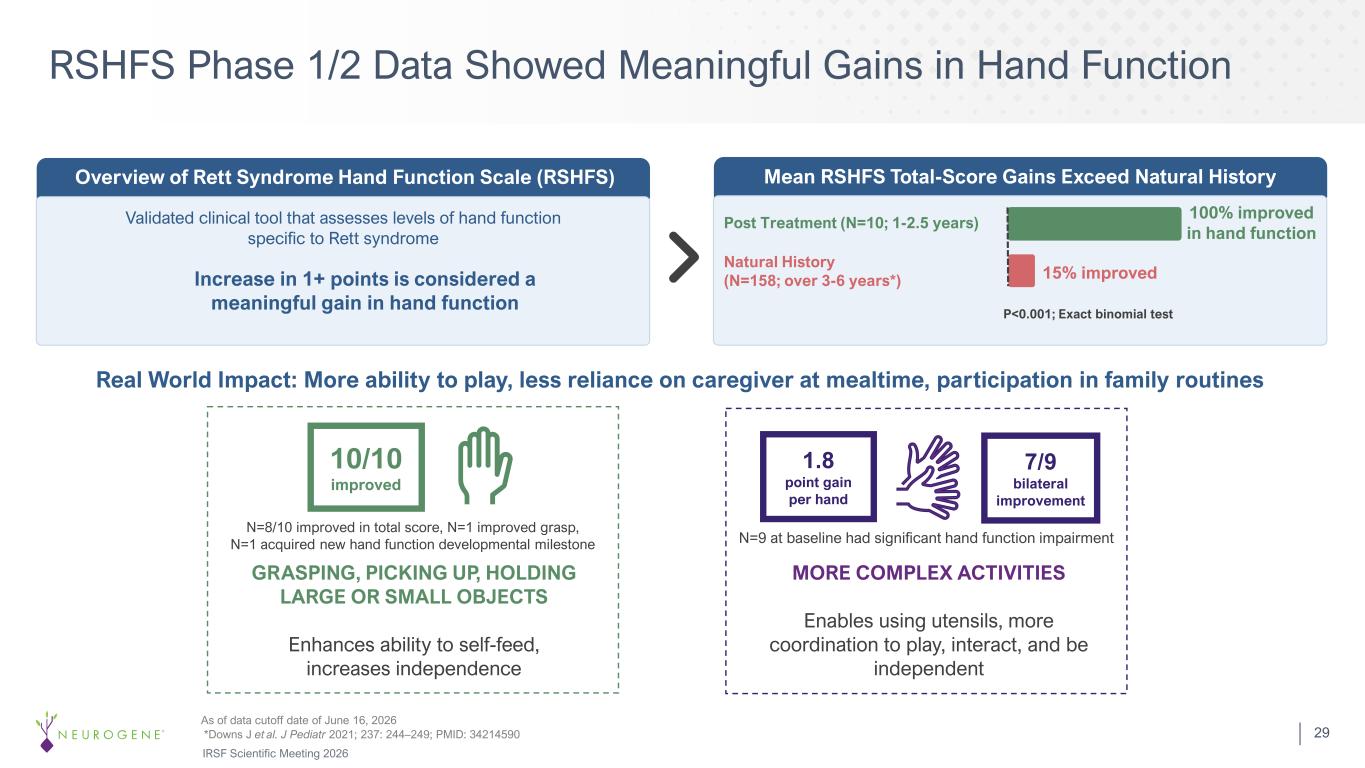
RSHFS Phase 1/2 Data Showed Meaningful Gains in Hand Function Validated clinical tool that assesses levels of hand function specific to Rett syndrome Increase in 1+ points is considered a meaningful gain in hand function Overview of Rett Syndrome Hand Function Scale (RSHFS) Mean RSHFS Total-Score Gains Exceed Natural History 29 100% improved in hand function P<0.001; Exact binomial test Post Treatment (N=10; 1-2.5 years) Natural History (N=158; over 3-6 years*) 15% improved Real World Impact: More ability to play, less reliance on caregiver at mealtime, participation in family routines GRASPING, PICKING UP, HOLDING LARGE OR SMALL OBJECTS Enhances ability to self-feed, increases independence 10/10 improved 7/9 bilateral improvement N=9 at baseline had significant hand function impairment MORE COMPLEX ACTIVITIES Enables using utensils, more coordination to play, interact, and be independent N=8/10 improved in total score, N=1 improved grasp, N=1 acquired new hand function developmental milestone *Downs J et al. J Pediatr 2021; 237: 244–249; PMID: 34214590 As of data cutoff date of June 16, 2026 IRSF Scientific Meeting 2026 1.8 point gain per hand
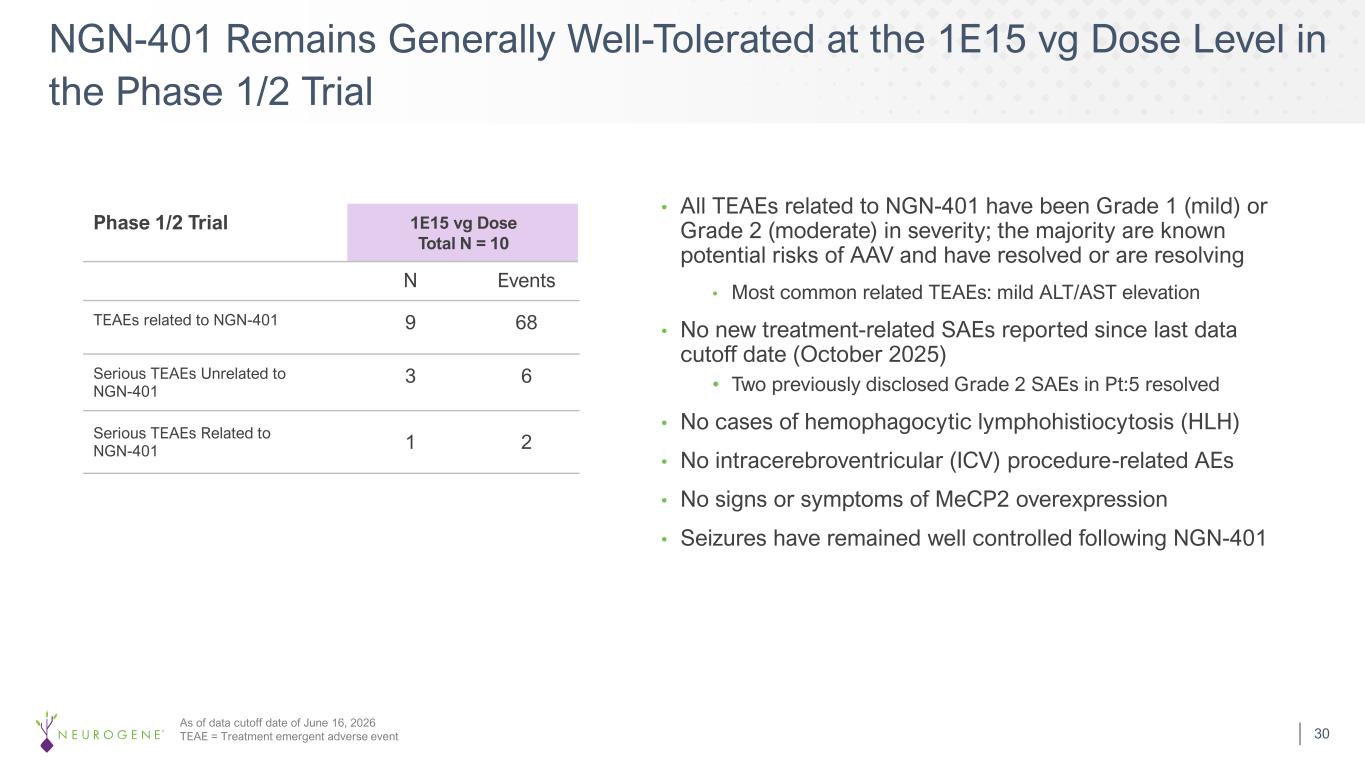
Phase 1/2 Trial 1E15 vg Dose Total N = 10 N Events TEAEs related to NGN-401 9 68 Serious TEAEs Unrelated to NGN-401 3 6 Serious TEAEs Related to NGN-401 1 2 • All TEAEs related to NGN-401 have been Grade 1 (mild) or Grade 2 (moderate) in severity; the majority are known potential risks of AAV and have resolved or are resolving • Most common related TEAEs: mild ALT/AST elevation • No new treatment-related SAEs reported since last data cutoff date (October 2025) • Two previously disclosed Grade 2 SAEs in Pt:5 resolved • No cases of hemophagocytic lymphohistiocytosis (HLH) • No intracerebroventricular (ICV) procedure-related AEs • No signs or symptoms of MeCP2 overexpression • Seizures have remained well controlled following NGN-401 As of data cutoff date of June 16, 2026 TEAE = Treatment emergent adverse event NGN-401 Remains Generally Well-Tolerated at the 1E15 vg Dose Level in the Phase 1/2 Trial 30

Embolden Registrational Trial
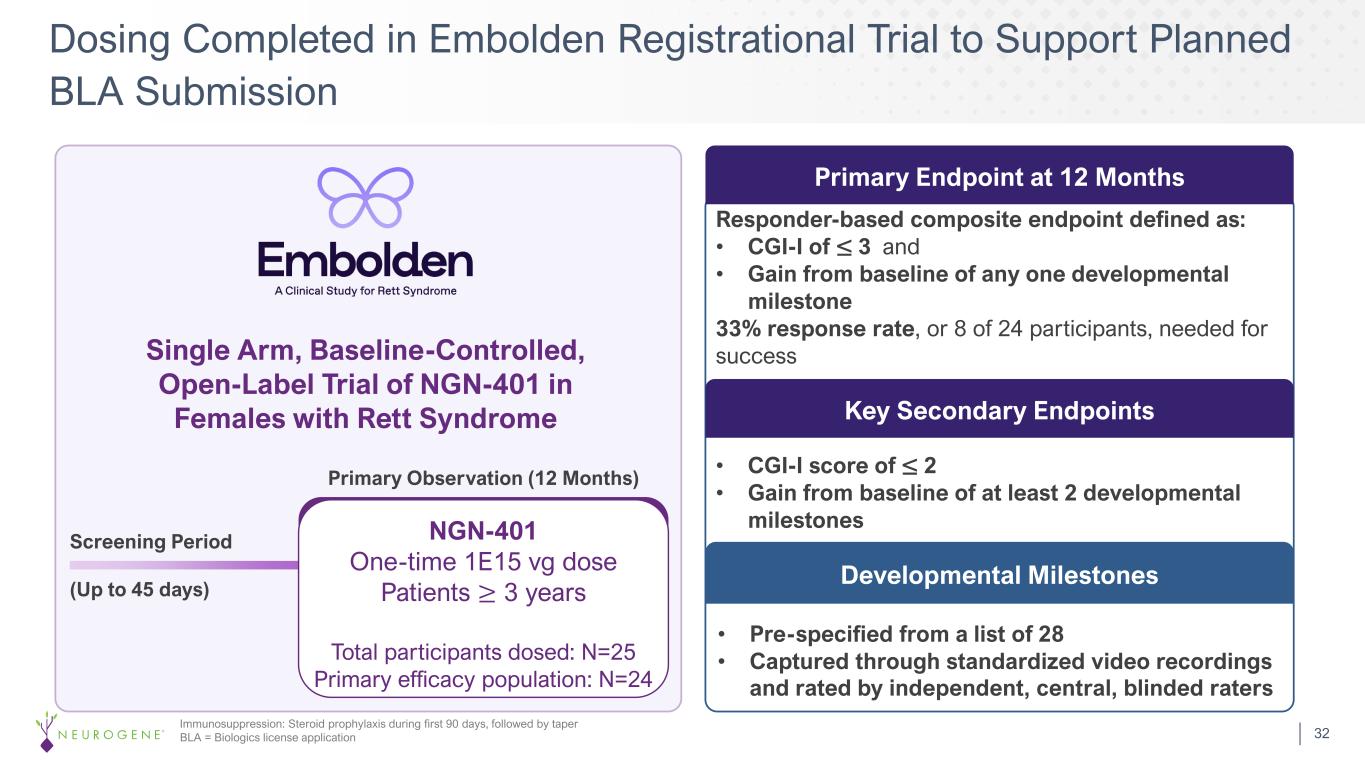
32 Dosing Completed in Embolden Registrational Trial to Support Planned BLA Submission Developmental Milestones • CGI-I score of ≤ 2 • Gain from baseline of at least 2 developmental milestones Single Arm, Baseline-Controlled, Open-Label Trial of NGN-401 in Females with Rett Syndrome Responder-based composite endpoint defined as: • CGI-I of ≤ 3 and • Gain from baseline of any one developmental milestone 33% response rate, or 8 of 24 participants, needed for success Primary Endpoint at 12 Months Key Secondary Endpoints • Pre-specified from a list of 28 • Captured through standardized video recordings and rated by independent, central, blinded raters Screening Period (Up to 45 days) NGN-401 One-time 1E15 vg dose Patients ≥ 3 years Total participants dosed: N=25 Primary efficacy population: N=24 Primary Observation (12 Months) Immunosuppression: Steroid prophylaxis during first 90 days, followed by taper BLA = Biologics license application
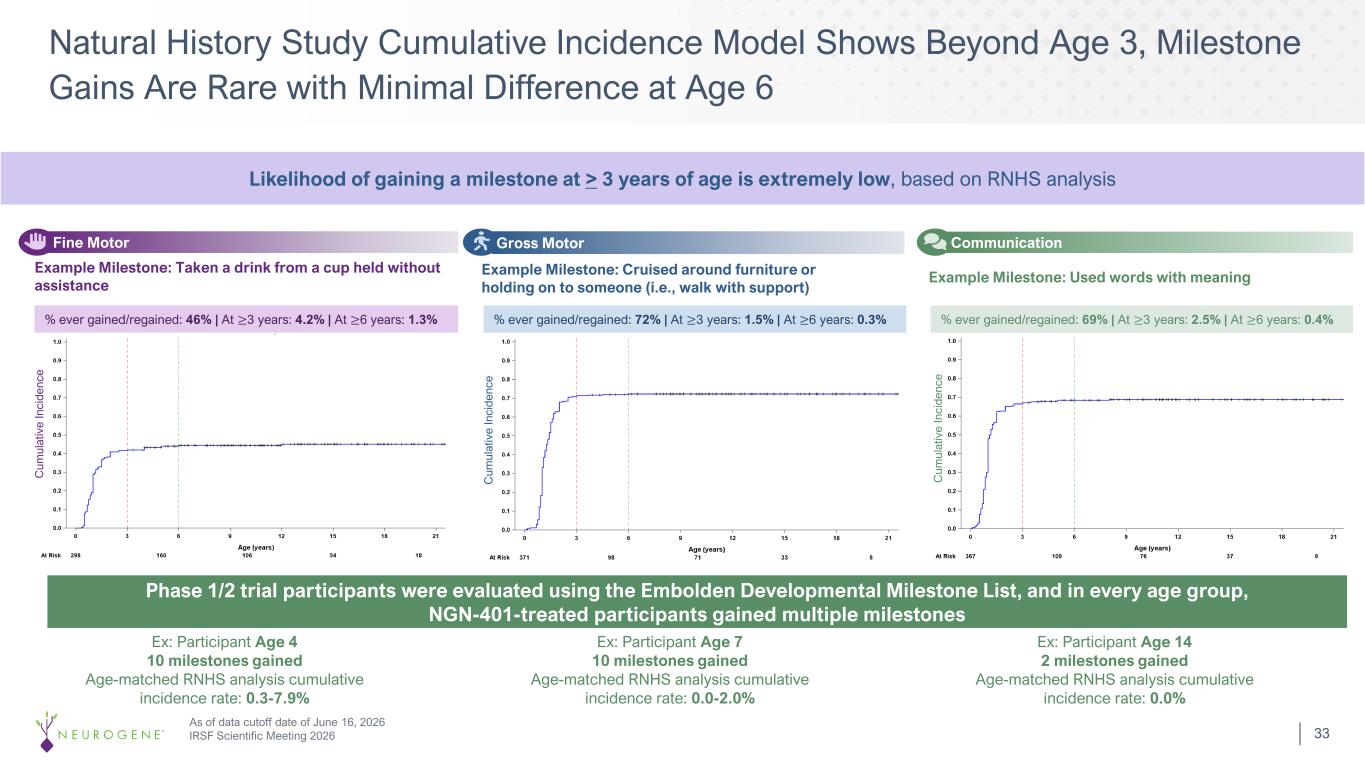
33 Natural History Study Cumulative Incidence Model Shows Beyond Age 3, Milestone Gains Are Rare with Minimal Difference at Age 6 % ever gained/regained: 69% | At ≥3 years: 2.5% | At ≥6 years: 0.4% Communication Example Milestone: Used words with meaning Age (years) % ever gained/regained: 46% | At ≥3 years: 4.2% | At ≥6 years: 1.3% Fine Motor Example Milestone: Taken a drink from a cup held without assistance Age (years) % ever gained/regained: 72% | At ≥3 years: 1.5% | At ≥6 years: 0.3% Gross Motor Example Milestone: Cruised around furniture or holding on to someone (i.e., walk with support) Age (years) Phase 1/2 trial participants were evaluated using the Embolden Developmental Milestone List, and in every age group, NGN-401-treated participants gained multiple milestones Ex: Participant Age 4 10 milestones gained Age-matched RNHS analysis cumulative incidence rate: 0.3-7.9% Ex: Participant Age 7 10 milestones gained Age-matched RNHS analysis cumulative incidence rate: 0.0-2.0% Ex: Participant Age 14 2 milestones gained Age-matched RNHS analysis cumulative incidence rate: 0.0% Likelihood of gaining a milestone at > 3 years of age is extremely low, based on RNHS analysis As of data cutoff date of June 16, 2026 IRSF Scientific Meeting 2026 C um ul at iv e In ci de nc e C um ul at iv e In ci de nc e C um ul at iv e In ci de nc e
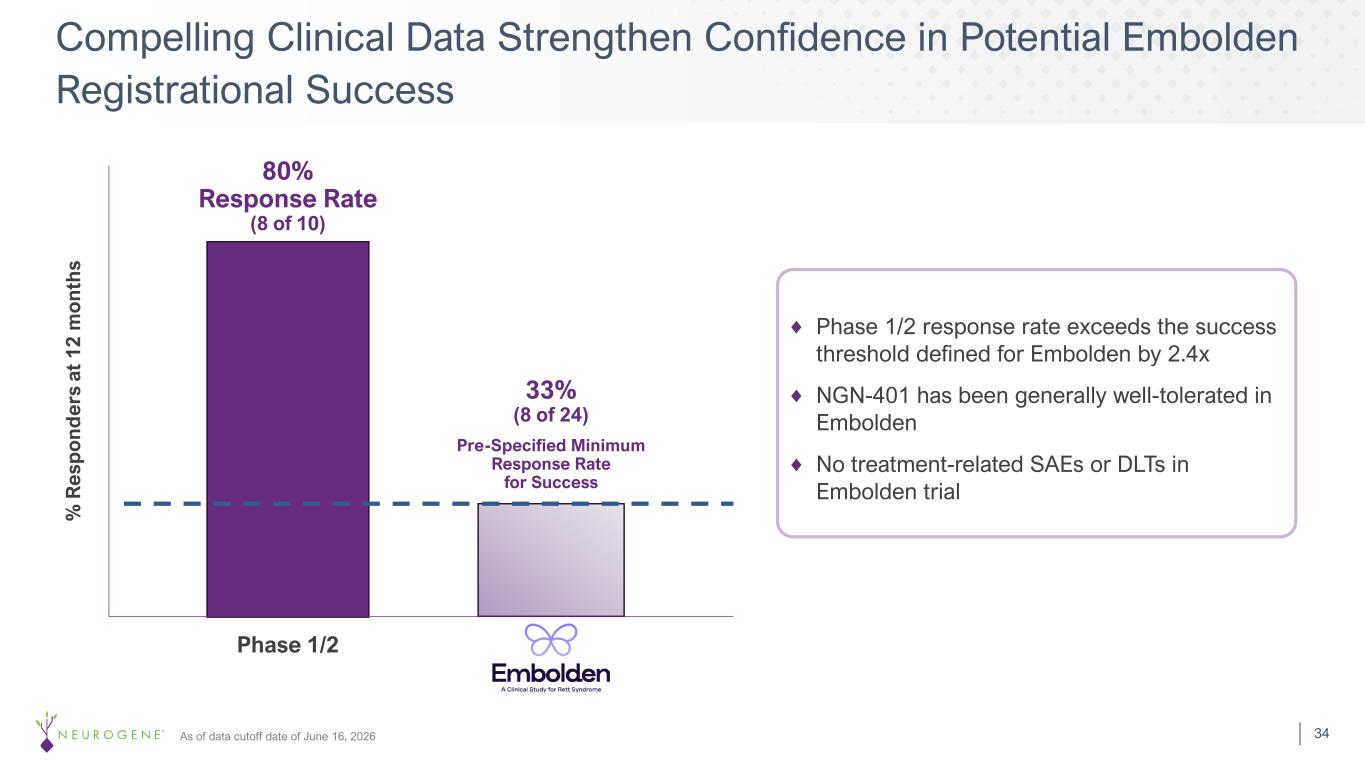
34 Compelling Clinical Data Strengthen Confidence in Potential Embolden Registrational Success 33% (8 of 24) Pre-Specified Minimum Response Rate for Success 80% Response Rate (8 of 10) % R es p o n d er s at 1 2 m o n th s Phase 1/2 Phase 1/2 response rate exceeds the success threshold defined for Embolden by 2.4x NGN-401 has been generally well-tolerated in Embolden No treatment-related SAEs or DLTs in Embolden trial As of data cutoff date of June 16, 2026
Advancing NGN-401 Towards Commercialization Rachel McMinn, Ph.D. Founder and Chief Executive Officer, Neurogene
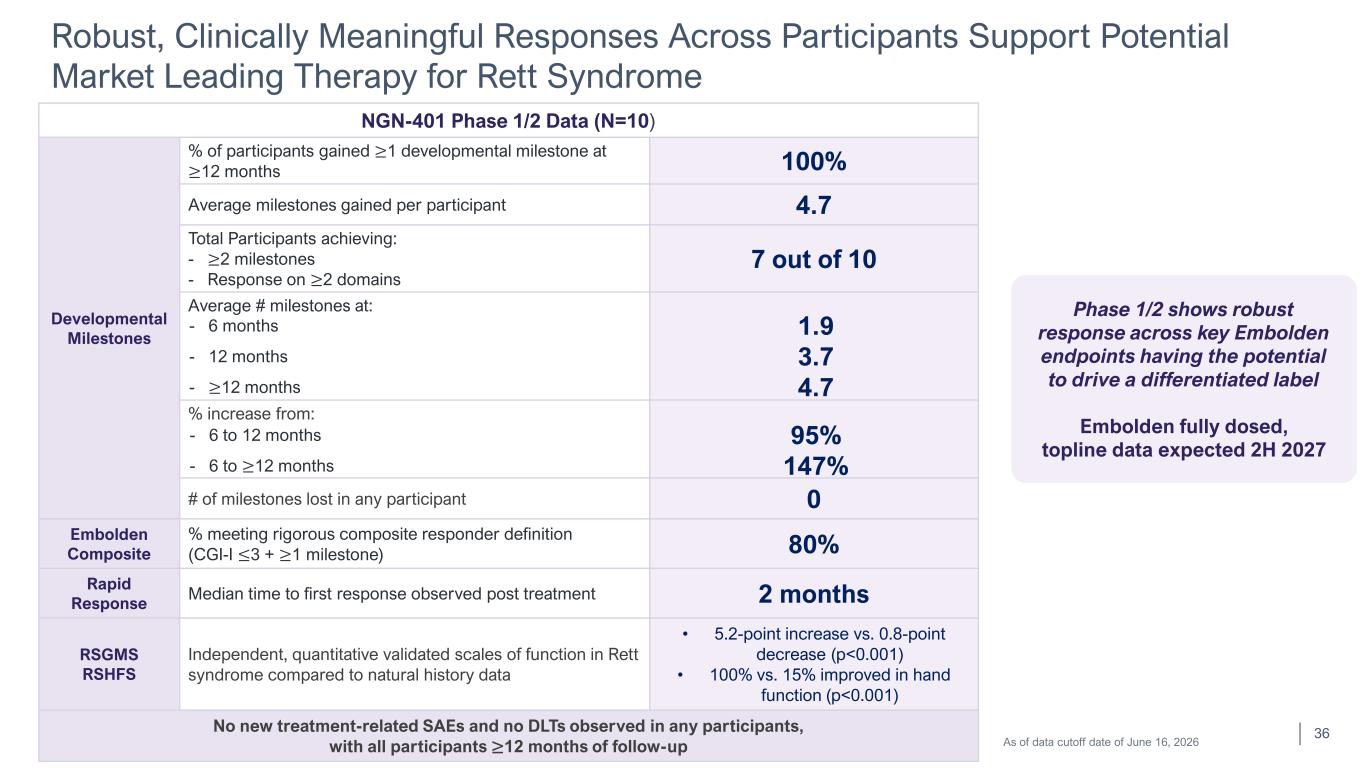
NGN-401 Phase 1/2 Data (N=10) Developmental Milestones % of participants gained ≥1 developmental milestone at ≥12 months 100% Average milestones gained per participant 4.7 Total Participants achieving: - ≥2 milestones - Response on ≥2 domains 7 out of 10 Average # milestones at: % increase from: # of milestones lost in any participant 0 Embolden Composite % meeting rigorous composite responder definition (CGI-I ≤3 + ≥1 milestone) 80% Rapid Response Median time to first response observed post treatment 2 months RSGMS RSHFS Independent, quantitative validated scales of function in Rett syndrome compared to natural history data • 5.2-point increase vs. 0.8-point decrease (p<0.001) • 100% vs. 15% improved in hand function (p<0.001) No new treatment-related SAEs and no DLTs observed in any participants, with all participants ≥12 months of follow-up Robust, Clinically Meaningful Responses Across Participants Support Potential Market Leading Therapy for Rett Syndrome Phase 1/2 shows robust response across key Embolden endpoints having the potential to drive a differentiated label Embolden fully dosed, topline data expected 2H 2027 36 - 6 months 1.9 - 12 months 3.7 - ≥12 months 4.7 - 6 to 12 months 95% - 6 to ≥12 months 147% As of data cutoff date of June 16, 2026
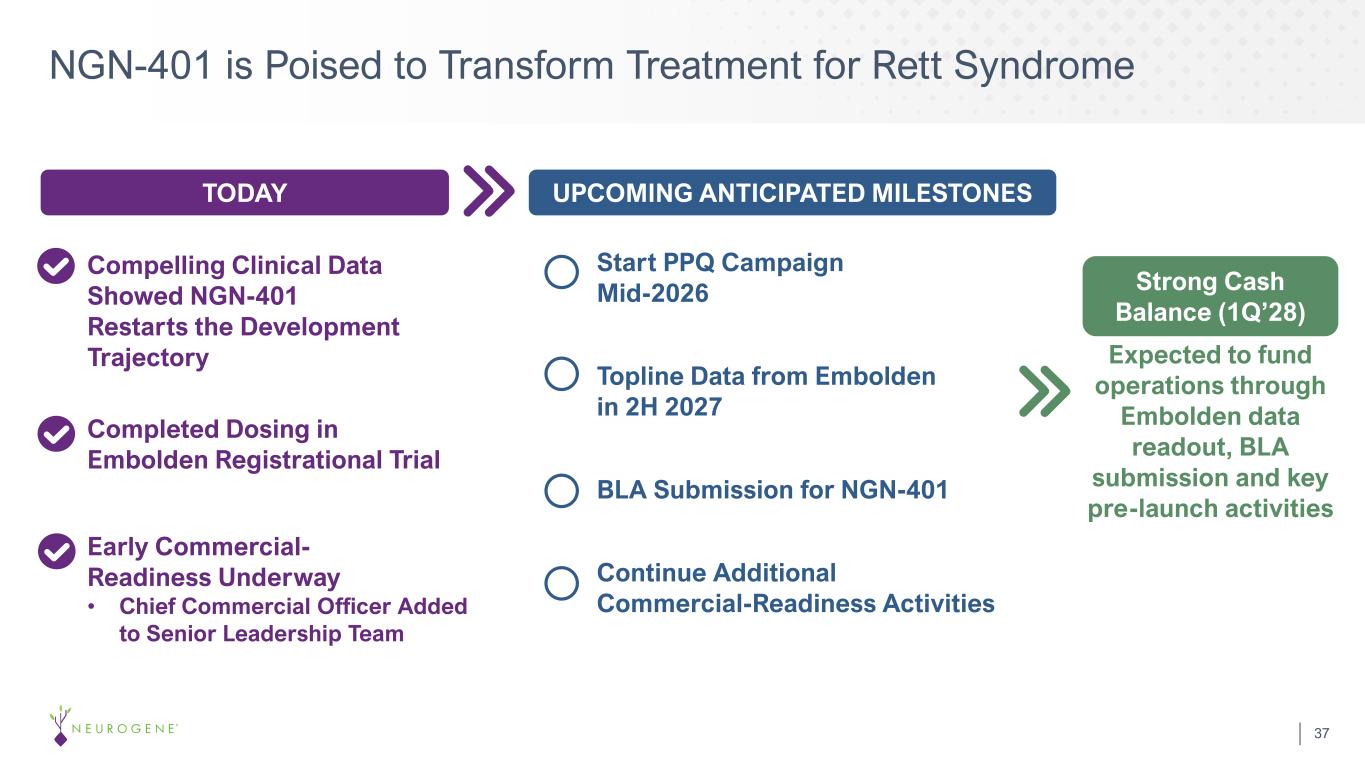
Compelling Clinical Data Showed NGN-401 Restarts the Development Trajectory NGN-401 is Poised to Transform Treatment for Rett Syndrome 37 Completed Dosing in Embolden Registrational Trial Early Commercial- Readiness Underway • Chief Commercial Officer Added to Senior Leadership Team Expected to fund operations through Embolden data readout, BLA submission and key pre-launch activities TODAY UPCOMING ANTICIPATED MILESTONES Start PPQ Campaign Mid-2026 Topline Data from Embolden in 2H 2027 BLA Submission for NGN-401 Continue Additional Commercial-Readiness Activities Strong Cash Balance (1Q’28)
Thank you to all participants, caregivers, families, investigators, clinical site coordinators, study coordinators, site staff and the Rett syndrome community for your trust, partnership and ongoing support of the development of NGN-401!