
NOTICE OF ANNUAL AND SPECIAL SHAREHOLDERS MEETING AND MANAGEMENT INFORMATION CIRCUL AR JUNE 2026
NOTICE OF ANNUAL AND SPECIAL MEETING OF SHAREHOLDERS To the shareholders of Lightspeed Commerce Inc. (the “Company”): NOTICE IS HEREBY GIVEN that the annual and special meeting of shareholders (the “Meeting”) of the Company will be held virtually via live audio webcast at https://meetings.lumiconnect.com/400-575-470-442, password “lightspeed2026” (case sensitive), on July 30, 2026 at 11:00 a.m. (ET), for the purposes of: (i) receiving the audited consolidated financial statements of the Company for the fiscal year ended March 31, 2026, together with the auditors’ report thereon; (ii) electing 7 directors for the ensuing year; (iii) appointing auditors for the ensuing year; (iv) considering an advisory, non-binding resolution on the Company's approach to executive compensation; (v) considering and, if deemed appropriate, approving an ordinary resolution, the full text of which is reproduced on Schedule D to the accompanying management information circular, to (1) approve an amendment to the Company's Amended and Restated Omnibus Incentive Plan (as defined in the accompanying management information circular) to extend the term of such plan to the tenth (10th) anniversary of the Meeting and (2) approve all unallocated options, rights and other entitlements thereunder; and (vi) transacting such other business as may properly come before the Meeting. The Company’s board of directors has fixed the close of business on June 1, 2026 as the record date for determining shareholders entitled to receive notice of, and to vote at, the Meeting, or any postponement or adjournment thereof. No person who becomes a shareholder of record after that time will be entitled to vote at the Meeting or any postponement or adjournment thereof. Since the Meeting will be held online via live audio webcast, shareholders will have an equal opportunity to attend and participate at the Meeting, regardless of their geographic location. A shareholder or its duly appointed proxyholder may attend the Meeting, ask questions and vote, all in real time. Details on how shareholders may participate in the proceedings can be found in the virtual meeting guide on the Company's website at https:// investors.lightspeedhq.com/English/events-and-presentations/upcoming-events/. If you are unable to attend the Meeting virtually, please complete, date, sign and return the accompanying form of proxy enclosed herewith for use at the Meeting or any adjournment thereof. To be effective, the attached proxy must be received not later than July 28, 2026 at 11:00 a.m. (ET) (or, if the Meeting is adjourned or postponed, forty-eight (48) hours (Saturdays, Sundays and holidays excepted) before the time at which the Meeting is reconvened). Your shares will be voted in accordance with your instructions as indicated on the proxy. Notwithstanding the foregoing, late proxies may be accepted or rejected by the Chair of the Meeting at his or her discretion and the Chair of the Meeting is under no obligation to accept or reject any particular late proxy. The time limit for deposit of proxies may be waived or extended by the Chair of the Meeting at his or her discretion, without notice. The Company is using the notice-and-access procedures permitted by Canadian securities laws for the delivery of the management information circular (the "Circular") and its audited annual consolidated financial statements for the fiscal year ended March 31, 2026 (the “Proxy Materials”), to both its registered and non-registered shareholders. Under the notice-and-access procedures, instead of shareholders receiving paper copies of the Proxy Materials, shareholders receive a copy of a Notice of Availability of Proxy Materials (the “Notice of Availability”) (which provides information on how to access copies of the Proxy Materials, how to request a paper copy of the Proxy Materials and details about the Meeting), and a form of proxy or voting instruction form, as applicable. All shareholders are reminded to access and review all of the important information contained in the Circular before voting.
The Proxy Materials are being posted online for shareholders to access at https://docs.tsxtrust.com/LSPD/EN, https:// investors.lightspeedhq.com and under the Company's profiles on SEDAR+ at www.sedarplus.com and on EDGAR at www.sec.gov. Shareholders may request a paper copy of the Proxy Materials by mail, free of charge, at any time before the Meeting on the web at https://docs.tsxtrust.com/LSPD/EN, by contacting TSX Trust Company, the Company' transfer agent, at 1-888-433-6443 (toll free in Canada and the United States) or 416-682-3801 (other countries), or by email at tsxt-fulfilment@tmx.com. Please allow a period of three (3) business days for processing your request as well as usual mailing times. To receive the Proxy Materials in advance of the proxy voting deadline and the Meeting, requests for paper copies must be received by no later than 5:00 p.m. (ET) on July 15, 2026. If a shareholder requests a paper copy of the Proxy Materials, another form of proxy or voting instruction form will not be sent, such that shareholders should retain the one received with the Notice of Availability for voting purposes. After the Meeting, requests for paper copies of the Proxy Materials may be made by calling the same numbers or sending an email to the same email indicated above, and the Proxy Materials will then be sent within ten (10) calendar days of such request. Non-registered (beneficial) shareholders who receive these materials through their broker or other intermediary should complete and send the form of proxy or voting instruction form, as applicable, in accordance with the instructions provided by their broker or intermediary. Beneficial shareholders may refer to the section entitled "VOTING AND PROXIES" in the Circular for additional information including how to appoint themselves as proxyholder, attend the Meeting online and vote their shares at the Meeting. If you have any questions about or require assistance in completing your form of proxy, or about the information contained in the accompanying Circular, please contact the Company's Corporate Secretary by email at dan.micak@lightspeedhq.com. Les actionnaires qui préféreraient recevoir la circulaire d'information de la direction en français n’ont qu’à en aviser le secrétaire corporatif de Lightspeed Commerce Inc. ou écrire à gouvernance@lightspeedhq.com. Dated at Montréal, Québec, Canada, June 26, 2026. By order of the Board of Directors, Dax Dasilva Director, Founder and Chief Executive Officer
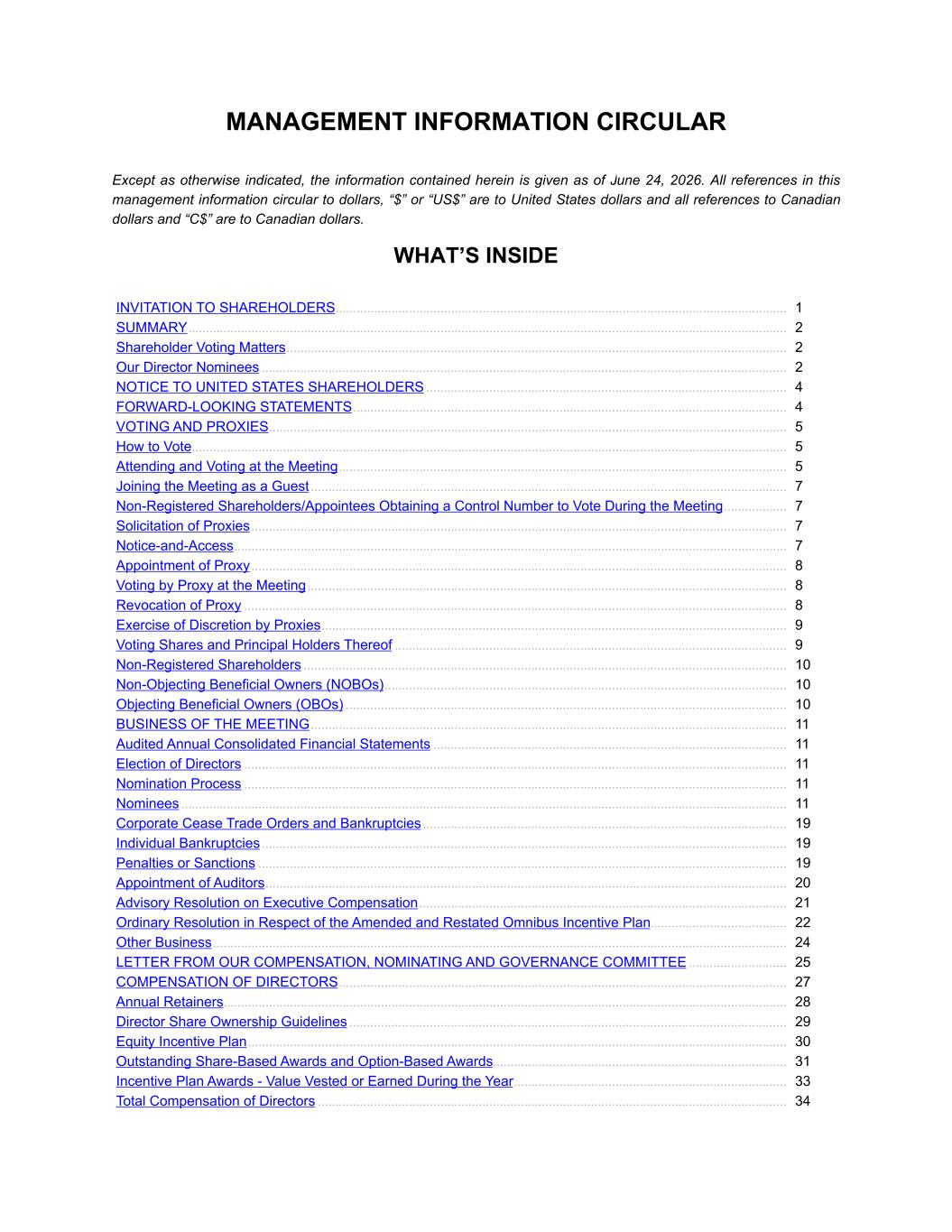
MANAGEMENT INFORMATION CIRCULAR Except as otherwise indicated, the information contained herein is given as of June 24, 2026. All references in this management information circular to dollars, “$” or “US$” are to United States dollars and all references to Canadian dollars and “C$” are to Canadian dollars. WHAT’S INSIDE INVITATION TO SHAREHOLDERS ................................................................................................................................. 1 SUMMARY ........................................................................................................................................................................... 2 Shareholder Voting Matters ............................................................................................................................................... 2 Our Director Nominees ...................................................................................................................................................... 2 NOTICE TO UNITED STATES SHAREHOLDERS ....................................................................................................... 4 FORWARD-LOOKING STATEMENTS ............................................................................................................................ 4 VOTING AND PROXIES .................................................................................................................................................... 5 How to Vote .......................................................................................................................................................................... 5 Attending and Voting at the Meeting ................................................................................................................................ 5 Joining the Meeting as a Guest ........................................................................................................................................ 7 Non-Registered Shareholders/Appointees Obtaining a Control Number to Vote During the Meeting .................. 7 Solicitation of Proxies ......................................................................................................................................................... 7 Notice-and-Access .............................................................................................................................................................. 7 Appointment of Proxy ......................................................................................................................................................... 8 Voting by Proxy at the Meeting ......................................................................................................................................... 8 Revocation of Proxy ........................................................................................................................................................... 8 Exercise of Discretion by Proxies ..................................................................................................................................... 9 Voting Shares and Principal Holders Thereof ................................................................................................................ 9 Non-Registered Shareholders .......................................................................................................................................... 10 Non-Objecting Beneficial Owners (NOBOs) ................................................................................................................... 10 Objecting Beneficial Owners (OBOs) .............................................................................................................................. 10 BUSINESS OF THE MEETING ........................................................................................................................................ 11 Audited Annual Consolidated Financial Statements ..................................................................................................... 11 Election of Directors ........................................................................................................................................................... 11 Nomination Process ........................................................................................................................................................... 11 Nominees ............................................................................................................................................................................. 11 Corporate Cease Trade Orders and Bankruptcies ........................................................................................................ 19 Individual Bankruptcies ...................................................................................................................................................... 19 Penalties or Sanctions ....................................................................................................................................................... 19 Appointment of Auditors ..................................................................................................................................................... 20 Advisory Resolution on Executive Compensation ......................................................................................................... 21 Ordinary Resolution in Respect of the Amended and Restated Omnibus Incentive Plan ....................................... 22 Other Business .................................................................................................................................................................... 24 LETTER FROM OUR COMPENSATION, NOMINATING AND GOVERNANCE COMMITTEE ............................ 25 COMPENSATION OF DIRECTORS ................................................................................................................................ 27 Annual Retainers ................................................................................................................................................................. 28 Director Share Ownership Guidelines ............................................................................................................................. 29 Equity Incentive Plan .......................................................................................................................................................... 30 Outstanding Share-Based Awards and Option-Based Awards .................................................................................... 31 Incentive Plan Awards - Value Vested or Earned During the Year .............................................................................. 33 Total Compensation of Directors ...................................................................................................................................... 34
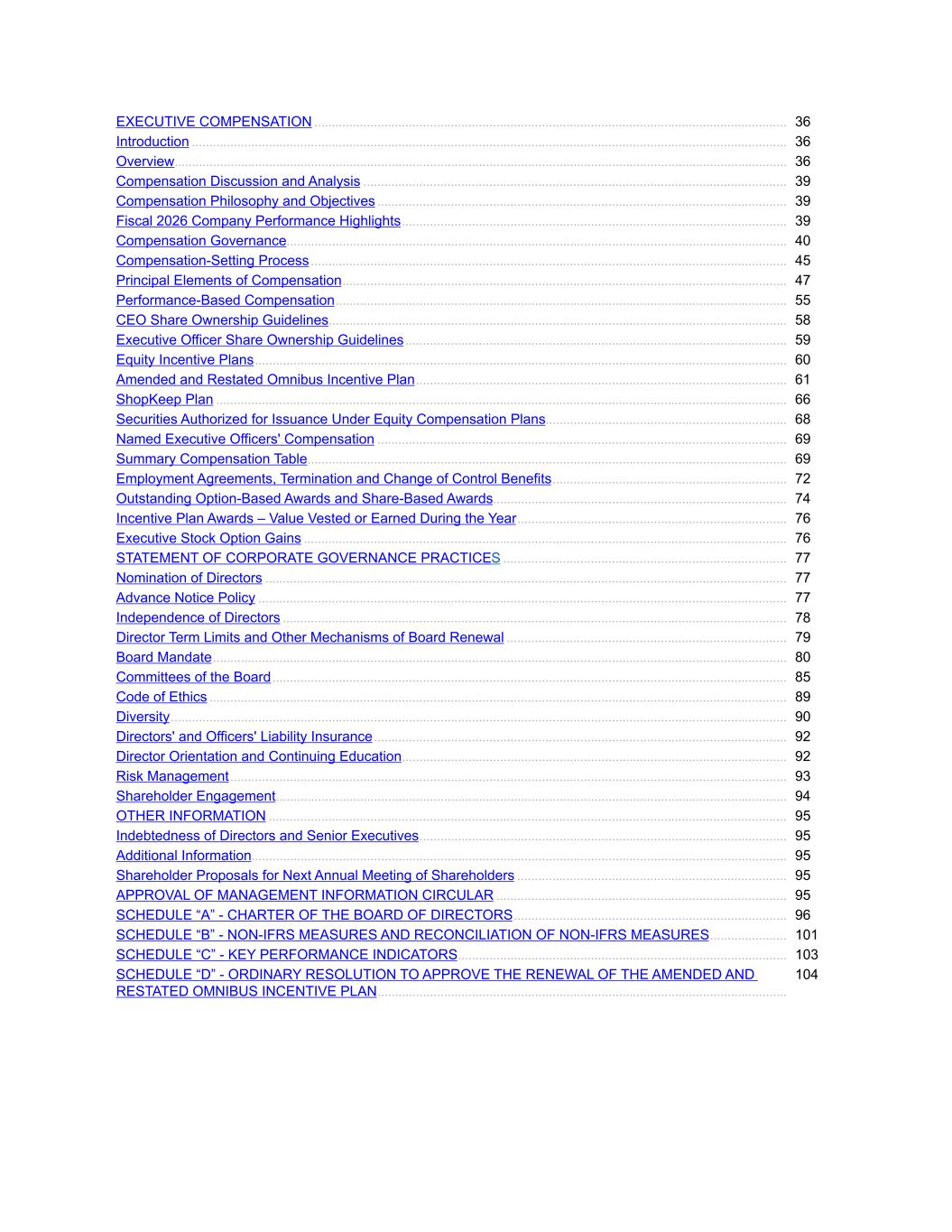
EXECUTIVE COMPENSATION ....................................................................................................................................... 36 Introduction .......................................................................................................................................................................... 36 Overview ............................................................................................................................................................................... 36 Compensation Discussion and Analysis ......................................................................................................................... 39 Compensation Philosophy and Objectives ..................................................................................................................... 39 Fiscal 2026 Company Performance Highlights .............................................................................................................. 39 Compensation Governance ............................................................................................................................................... 40 Compensation-Setting Process ........................................................................................................................................ 45 Principal Elements of Compensation ............................................................................................................................... 47 Performance-Based Compensation ................................................................................................................................. 55 CEO Share Ownership Guidelines ................................................................................................................................... 58 Executive Officer Share Ownership Guidelines ............................................................................................................. 59 Equity Incentive Plans ........................................................................................................................................................ 60 Amended and Restated Omnibus Incentive Plan .......................................................................................................... 61 ShopKeep Plan ................................................................................................................................................................... 66 Securities Authorized for Issuance Under Equity Compensation Plans ..................................................................... 68 Named Executive Officers' Compensation ..................................................................................................................... 69 Summary Compensation Table ......................................................................................................................................... 69 Employment Agreements, Termination and Change of Control Benefits ................................................................... 72 Outstanding Option-Based Awards and Share-Based Awards .................................................................................... 74 Incentive Plan Awards – Value Vested or Earned During the Year ............................................................................. 76 Executive Stock Option Gains .......................................................................................................................................... 76 STATEMENT OF CORPORATE GOVERNANCE PRACTICES ................................................................................. 77 Nomination of Directors ..................................................................................................................................................... 77 Advance Notice Policy ....................................................................................................................................................... 77 Independence of Directors ................................................................................................................................................ 78 Director Term Limits and Other Mechanisms of Board Renewal ................................................................................ 79 Board Mandate .................................................................................................................................................................... 80 Committees of the Board ................................................................................................................................................... 85 Code of Ethics ..................................................................................................................................................................... 89 Diversity ................................................................................................................................................................................ 90 Directors' and Officers' Liability Insurance ...................................................................................................................... 92 Director Orientation and Continuing Education .............................................................................................................. 92 Risk Management ............................................................................................................................................................... 93 Shareholder Engagement .................................................................................................................................................. 94 OTHER INFORMATION .................................................................................................................................................... 95 Indebtedness of Directors and Senior Executives ......................................................................................................... 95 Additional Information ......................................................................................................................................................... 95 Shareholder Proposals for Next Annual Meeting of Shareholders ............................................................................. 95 APPROVAL OF MANAGEMENT INFORMATION CIRCULAR ................................................................................... 95 SCHEDULE “A” - CHARTER OF THE BOARD OF DIRECTORS .............................................................................. 96 SCHEDULE “B” - NON-IFRS MEASURES AND RECONCILIATION OF NON-IFRS MEASURES ...................... 101 SCHEDULE “C” - KEY PERFORMANCE INDICATORS .............................................................................................. 103 SCHEDULE “D” - ORDINARY RESOLUTION TO APPROVE THE RENEWAL OF THE AMENDED AND RESTATED OMNIBUS INCENTIVE PLAN ..................................................................................................................... 104
INVITATION TO SHAREHOLDERS Dear Shareholders: On behalf of the Board of Directors and management of the Company, we are pleased to invite you to attend the annual and special meeting of shareholders that will be held virtually via live audio webcast this year on July 30, 2026 at 11:00 a.m. (ET) (the "Meeting"). To join the Meeting, please login at https:// meetings.lumiconnect.com/400-575-470-442 using the password “lightspeed2026” (case sensitive). The Company’s subordinate voting shares are listed on the Toronto Stock Exchange (“TSX”) and the New York Stock Exchange ("NYSE") under the symbol “LSPD”. As at June 24, 2026, there were 133,317,260 subordinate voting shares of the Company issued. This annual and special meeting is your opportunity to vote on a number of important matters as well as hear first-hand about our financial performance and strategic plans for the future. The enclosed management information circular describes the business to be conducted at the Meeting and provides information on the Company’s executive compensation and corporate governance practices. If you attend virtually, you will have the opportunity to interact with and to ask questions to members of the Board of Directors and management in real time. Your participation in voting at the Meeting is important to us. You can vote electronically during the virtual Meeting, or alternatively by telephone, via the internet or by completing and returning the enclosed form of proxy or voting instruction form. Please refer to the “Voting and Proxies” section of this management information circular. We look forward to welcoming you at the Meeting and thank you for your continued support. Sincerely, Dax Dasilva Director, Founder and Chief Executive Officer Manon Brouillette Executive Chair of the Board INVITATION TO SHAREHOLDERS MANAGEMENT INFORMATION CIRCULAR 1
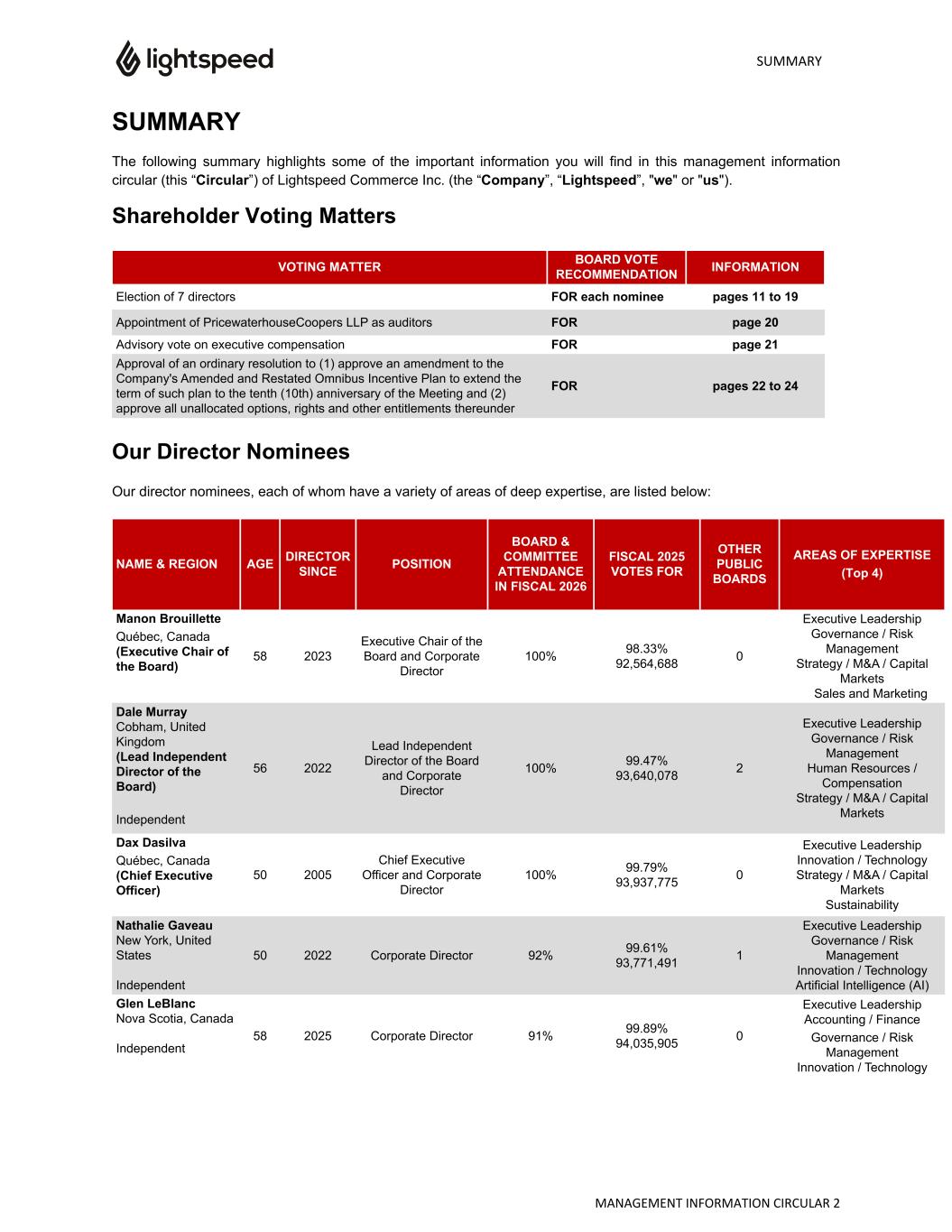
SUMMARY The following summary highlights some of the important information you will find in this management information circular (this “Circular”) of Lightspeed Commerce Inc. (the “Company”, “Lightspeed”, "we" or "us"). Shareholder Voting Matters VOTING MATTER BOARD VOTE RECOMMENDATION INFORMATION Election of 7 directors FOR each nominee pages 11 to 19 Appointment of PricewaterhouseCoopers LLP as auditors FOR page 20 Advisory vote on executive compensation FOR page 21 Approval of an ordinary resolution to (1) approve an amendment to the Company's Amended and Restated Omnibus Incentive Plan to extend the term of such plan to the tenth (10th) anniversary of the Meeting and (2) approve all unallocated options, rights and other entitlements thereunder FOR pages 22 to 24 Our Director Nominees Our director nominees, each of whom have a variety of areas of deep expertise, are listed below: NAME & REGION AGE DIRECTOR SINCE POSITION BOARD & COMMITTEE ATTENDANCE IN FISCAL 2026 FISCAL 2025 VOTES FOR OTHER PUBLIC BOARDS AREAS OF EXPERTISE (Top 4) Manon Brouillette Québec, Canada (Executive Chair of the Board) 58 2023 Executive Chair of the Board and Corporate Director 100% 98.33% 92,564,688 0 Executive Leadership Governance / Risk Management Strategy / M&A / Capital Markets Sales and Marketing Dale Murray Cobham, United Kingdom (Lead Independent Director of the Board) Independent 56 2022 Lead Independent Director of the Board and Corporate Director 100% 99.47% 93,640,078 2 Executive Leadership Governance / Risk Management Human Resources / Compensation Strategy / M&A / Capital Markets Dax Dasilva Québec, Canada (Chief Executive Officer) 50 2005 Chief Executive Officer and Corporate Director 100% 99.79% 93,937,775 0 Executive Leadership Innovation / Technology Strategy / M&A / Capital Markets Sustainability Nathalie Gaveau New York, United States Independent 50 2022 Corporate Director 92% 99.61% 93,771,491 1 Executive Leadership Governance / Risk Management Innovation / Technology Artificial Intelligence (AI) Glen LeBlanc Nova Scotia, Canada Independent 58 2025 Corporate Director 91% 99.89% 94,035,905 0 Executive Leadership Accounting / Finance Governance / Risk Management Innovation / Technology SUMMARY MANAGEMENT INFORMATION CIRCULAR 2
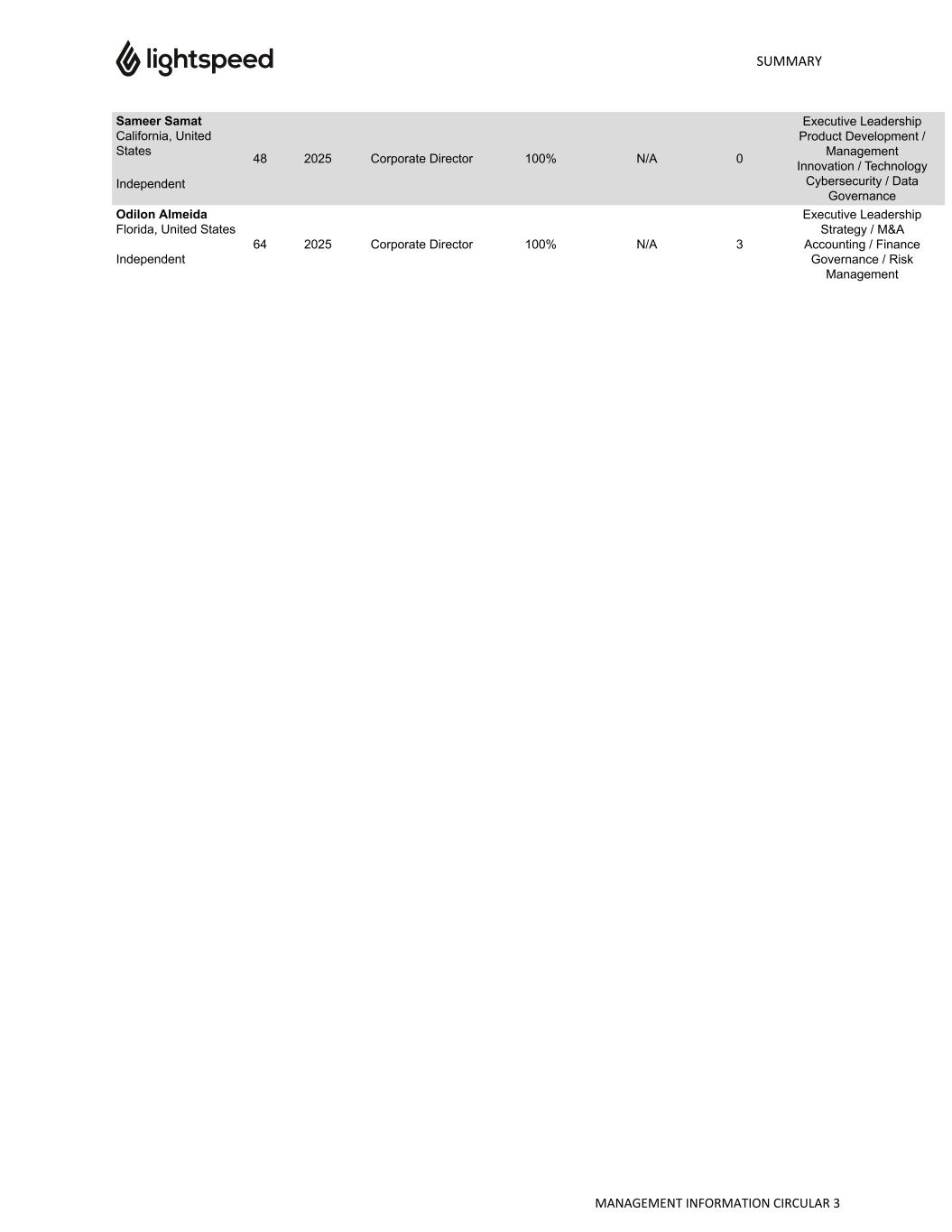
Sameer Samat California, United States Independent 48 2025 Corporate Director 100% N/A 0 Executive Leadership Product Development / Management Innovation / Technology Cybersecurity / Data Governance Odilon Almeida Florida, United States Independent 64 2025 Corporate Director 100% N/A 3 Executive Leadership Strategy / M&A Accounting / Finance Governance / Risk Management SUMMARY MANAGEMENT INFORMATION CIRCULAR 3
NOTICE TO UNITED STATES SHAREHOLDERS Lightspeed is a corporation organized under the laws of Canada and is a foreign private issuer within the meaning of Rule 3b-4 under the Securities Exchange Act of 1934, as amended (the "U.S. Exchange Act"). The solicitation of proxies for the Meeting is not subject to the proxy requirements of Section 14(a) of the U.S. Exchange Act, and Regulation 14A thereunder, by virtue of an exemption available to proxy solicitations by foreign private issuers. Accordingly, the solicitation contemplated herein is being made to United States shareholders only in accordance with Canadian corporate and securities laws and this Circular has been prepared solely in accordance with disclosure requirements applicable in Canada. United States shareholders should be aware that such requirements are different from those of the United States applicable to proxy statements under the U.S. Exchange Act. Specifically, information contained or incorporated by reference herein has been prepared in accordance with Canadian disclosure standards, which are not comparable in all respects to United States disclosure standards. Financial statements of the Company included or incorporated herein, if any, have been prepared in accordance with International Financial Reporting Standards as issued by the International Accounting Standards Board (“IFRS Accounting Standards”), and may be subject to foreign auditing and auditor independence standards, and thus may not be comparable to financial statements of United States companies. The enforcement by shareholders of civil liabilities under the United States federal and state securities laws may be affected adversely by the fact that the Company is incorporated or organized outside the United States, that some or all of its officers and directors and the experts named herein are residents of a country other than the United States, and that all or a substantial portion of the assets of the Company and such persons are located outside the United States. As a result, it may be difficult or impossible for the United States shareholders to effect service of process within the United States upon the Company, its officers and directors or the experts named herein, or to realize against them upon judgments of courts of the United States predicated upon civil liabilities under the federal securities laws of the United States or any state securities laws. In addition, the United States shareholders should not assume that the courts of Canada: (a) would enforce judgments of United States courts obtained in actions against such persons predicated upon civil liabilities under the federal securities laws of the United States or any state securities laws, or (b) would enforce, in original actions, liabilities against such persons predicated upon civil liabilities under the federal securities laws of the United States or any state securities laws. FORWARD-LOOKING STATEMENTS This Circular may include forward-looking information and forward-looking statements within the meaning of applicable securities laws ("forward-looking statements"), including regarding the design and anticipated outcomes of our compensation programs and equity incentive plan, our strategic and governance initiatives, our shareholder engagement initiatives and the composition of our executive officers and members of our board of directors. Forward- looking statements are statements that are predictive in nature, depend upon or refer to future events or conditions and are identified by words such as "will", "expects", "anticipates", "intends", "plans", "believes", "estimates" or similar expressions concerning matters that are not historical facts. Such statements are based on current expectations of Lightspeed's management and inherently involve numerous risks and uncertainties, known and unknown, including economic factors. A number of risks, uncertainties and other factors may cause actual results to differ materially from the forward-looking statements contained in this Circular, including, among other factors, those risk factors identified in our most recent Management's Discussion and Analysis of Financial Condition and Results of Operations, under "Risk Factors" in our most recent Annual Information Form, and in our other filings with the Canadian securities regulatory authorities and the U.S. Securities and Exchange Commission, all of which are available under our profiles on SEDAR+ at www.sedarplus.com and on EDGAR at www.sec.gov. Readers are cautioned to consider these and other factors carefully when making decisions with respect to Lightspeed's subordinate voting shares and not to place undue reliance on forward-looking statements. Forward-looking statements contained in this Circular are not guarantees of future performance and, while forward-looking statements are based on certain assumptions that Lightspeed considers reasonable, actual events and results could differ materially from those expressed or implied by forward-looking statements made by Lightspeed. Except as may be expressly required by applicable law, Lightspeed does not undertake any obligation to update publicly or revise any such forward-looking statements, whether as a result of new information, future events or otherwise. NOTICE TO UNITED STATES SHAREHOLDERS AND FORWARD-LOOKING STATEMENTS MANAGEMENT INFORMATION CIRCULAR 4
VOTING AND PROXIES How to Vote The voting process is described below and differs depending on whether a shareholder is a registered shareholder or non-registered (beneficial) shareholder: • You are a registered shareholder if your subordinate voting shares are registered directly in your name with the Company's transfer agent, TSX Trust Company ("TSX Trust"). Your package includes a proxy form. • You are a non-registered (beneficial) shareholder if you hold shares through an intermediary or nominee like a bank, trust company, securities broker, clearing agency or other institution. In such cases, your shares are registered in the name of the intermediary or nominee, and you are the beneficial owner and have the right to instruct them how to vote your shares. Your package includes a proxy form signed by your intermediary or a voting instruction form. Attending and Voting at the Meeting The Company decided to hold the Meeting online via live audio webcast only to facilitate increased attendance and participation for all shareholders, and in order for shareholders to have an equal opportunity to attend and participate at the Meeting, regardless of their geographic location, unlike hybrid meetings that offer two distinct experiences and may discourage virtual attendees from actively participating. Holding a virtual-only meeting is also cost-effective and reduces the carbon impact associated with traveling to a physical meeting location. Registered shareholders and duly appointed proxyholders will be able to attend the Meeting virtually, ask questions and vote, all in real time, provided they are connected to the internet and follow the instructions below. Details on how shareholders may participate in the proceedings can also be found in the virtual meeting guide on the Company's website at https:// investors.lightspeedhq.com/English/events-and-presentations/upcoming-events/. Non-registered shareholders who have not duly appointed themselves as proxyholder will be able to attend the virtual Meeting as guests but will not be able to ask questions or vote at the virtual Meeting. Shareholders who wish to appoint a person other than the management nominees identified in the form of proxy or voting instruction form (including a non-registered shareholder who wishes to appoint themselves to attend the virtual Meeting) must carefully follow the instructions below and on their form of proxy or voting instruction form. These instructions include the additional step of registering such proxyholder with our transfer agent, TSX Trust, after submitting the form of proxy or voting instruction form. Failure to register the proxyholder with TSX Trust will result in the proxyholder not receiving a proxyholder control number to participate in the virtual Meeting and only being able to attend as a guest. Guests will be able to listen to the virtual Meeting but will not be able to ask questions or vote. Shareholders are encouraged to vote in advance of the Meeting. Even if you currently plan to participate in the live audio webcast for the Meeting, you are encouraged to consider voting in advance, so that your vote will be counted if you later decide not or are unable to attend the Meeting for any reason. To vote by online ballot through the live webcast platform, follow the below instructions: 1. Log in at https://meetings.lumiconnect.com/400-575-470-442 on your browser at least 15 minutes before the Meeting starts 2. Click on “Control # / No de contrôle” 3. Enter your control number 4. Enter the password: “lightspeed2026” (case sensitive) 5. When the ballots have been opened, you will see them appear on your screen VOTING AND PROXIES MANAGEMENT INFORMATION CIRCULAR 5
If you use your control number to log in to the Meeting, any vote you cast at the Meeting will revoke any proxy you previously submitted. If you do not wish to revoke a previously submitted proxy, you should not vote during the Meeting. Proxyholders who have been duly appointed and registered with TSX Trust as described in the section titled “Appointment of Proxy” will receive a proxyholder control number by email from TSX Trust after the proxy voting deadline has passed. Registered shareholders and duly appointed proxyholders (including non-registered shareholders who have duly appointed themselves as proxyholder) that attend the Meeting online will be able to vote by completing a ballot online during the Meeting through the live webcast platform and ask questions in real time. Registered shareholders and duly appointed proxyholders will be able to ask written questions through a dialog box or verbal questions via phone during the Meeting, which questions will be moderated by a Company representative and answered by the Chair of the Meeting or members of management of the Company. In order to ask a verbal question via phone, a registered shareholder or duly appointed proxyholder will need to send their phone number and question subject in the messaging tab. Depending on the question topic, a Company representative will instruct a Lumi Canada Inc. ("Lumi") representative to dial the shareholder or proxyholder in the conference to ask their verbal question during the formal or questions-and-answers portion of the Meeting. In order to address as many submissions as possible, shareholders and proxyholders are asked to be brief and concise and to cover only one topic per question. A Company representative will group questions relating to the same matter, including when similar questions have been received via phone. The Company does not intend to address questions at the Meeting that: • are irrelevant to the Company’s operations or to the business of the Meeting; • are related to non-public information about the Company; • are repetitive of questions submitted by other persons and have already been addressed; • include derogatory references; • relate to an individual concern that is not a matter of interest to shareholders generally, including personal grievances or disputes with the Company; • relate to proposals that were not previously submitted properly in accordance with the Company’s by-laws or the CBCA; or • are out of order or not otherwise appropriate as determined by the Chair or Secretary of the Meeting in their reasonable judgment. As mentioned above, general questions that are not relevant to the business of the Meeting will not be addressed during the Meeting, and shareholders are instead encouraged to submit those as indicated in the "Statement of Corporate Governance Practices – Shareholder Engagement" section below. For any general questions submitted but not addressed during the Meeting, a member of the Company’s management will attempt to contact such shareholder to respond to the submission to the extent the shareholder has provided an email address within their submission. Further, the Company will post any appropriate questions received during the Meeting, along with the Company's answer, on its investor relations website promptly after the Meeting. If a registered shareholder or duly appointed proxyholder encounters any issues connecting to, asking questions or voting at the Meeting, a Lumi representative will be available to assist at support-ca@lumiglobal.com. VOTING AND PROXIES MANAGEMENT INFORMATION CIRCULAR 6
Joining the Meeting as a Guest Guests (including non-registered shareholders who have not duly appointed themselves as proxyholder) can log into the Meeting as set out below. Guests will be able to listen to the Meeting but will not be able to ask questions or vote during the Meeting. Guests can also listen to the Meeting by following the instructions below: 1. Log in at https://meetings.lumiconnect.com/400-575-470-442 on your browser 2. Click on “GUEST / INVITÉ” 3. Provide your name and email address (no password is required for guests) It is your responsibility to ensure internet connectivity for the duration of the Meeting and you should allow ample time to log in to the Meeting online before it begins. Non-Registered Shareholders/Appointees Obtaining a Control Number to Vote During the Meeting You or your duly appointed proxyholder must complete the additional step of registering the proxyholder by either completing the electronic form available at https://www.tsxtrust.com/control-number-request or by calling TSX Trust at 1-866-751-6315 (toll free in Canada or the United States) or 1-416-682-3860 (other countries) by no later than 11:00 a.m. (ET) on July 28, 2026 (or, if the Meeting is adjourned or postponed, forty-eight (48) hours (Saturdays, Sundays and holidays excepted) before the time at which the Meeting is reconvened). Failing to properly register your proxyholder will result in the proxyholder not receiving a control number, which is required to vote at the Meeting. Non-registered shareholders who have not duly appointed themselves as proxyholder will not be able to vote at the Meeting but will be able to participate as a guest. Solicitation of Proxies This Circular is sent in connection with the solicitation by the management of the Company of proxies to be used at the Meeting, at the time, place and for the purposes set forth in the Notice of Annual and Special Meeting of Shareholders (the “Notice of Meeting”), and at any adjournment thereof. The solicitation is being made primarily by email, but proxies may also be solicited by telephone, facsimile or other personal contact by officers or other employees of the Company. The cost of the solicitation will be borne by the Company. Notice-and-Access As permitted by Canadian securities regulators, Lightspeed is using notice-and-access (as defined in National Instrument 54-101 - Communication with Beneficial Owners of Securities of a Reporting Issuer ("NI 54-101") of the Canadian Securities Administrators ("CSA")) to deliver the Meeting materials, including this Circular, to both its registered and non-registered shareholders. Lightspeed is also using notice-and-access to deliver its audited annual consolidated financial statements to its registered and non-registered shareholders. This means that the Circular and the audited annual consolidated financial statements of the Company (the "Proxy Materials") are being posted online for shareholders to access, rather than being mailed out. Notice-and-access gives shareholders more choice, substantially reduces Lightspeed's printing and mailing costs, and is more environmentally friendly as it reduces materials and energy consumption. Shareholders will still receive a form of proxy or a voting instruction form in the mail (unless shareholders have chosen to receive proxy materials electronically) so they can vote their shares but, instead of automatically receiving a paper copy of the Proxy Materials, shareholders will receive a notice with information about how they can access VOTING AND PROXIES MANAGEMENT INFORMATION CIRCULAR 7
the Proxy Materials electronically and how to request a paper copy (the "Notice of Availability"). The Proxy Materials are available at https://docs.tsxtrust.com/LSPD/EN, on Lightspeed's website at investors.lightspeedhq.com, on SEDAR+ at www.sedarplus.com and on EDGAR at www.sec.gov. Shareholders may request a paper copy of Proxy Materials, at no cost, up to one year from the date this Circular was filed on SEDAR+. Shareholders may make such a request at any time prior to the Meeting (a) on the web at https:// docs.tsxtrust.com/LSPD/EN; (b) by contacting TSX Trust at 1-888-433-6443 (toll free in Canada and the United States) or 416-682-3801 (other countries); (c) by contacting TSX Trust by email at tsxt-fulfilment@tmx.com; and (d) by contacting the Company's Corporate Secretary by email at dan.micak@lightspeedhq.com. Shareholders must allow a period of three (3) business days for processing such a request as well as usual mailing times. To receive the Proxy Materials in advance of the proxy voting deadline and the Meeting, requests for paper copies must be received by no later than 5:00 p.m. (ET) on July 15, 2026. If a shareholder requests a paper copy of the Proxy Materials, another form of proxy or voting instruction form will not be sent, such that shareholders should retain the one received with the Notice of Availability for voting purposes. After the Meeting, requests for paper copies of the Proxy Materials may be made by calling the same numbers or sending an email to the same email indicated above, and the Proxy Materials will then be sent within ten (10) calendar days of such request. Appointment of Proxy The individuals named in the accompanying form of proxy (the "Management Appointees") are, for purposes of the Meeting, shareholders and officers and/or directors of the Company, as applicable. A shareholder wishing to appoint some other person to represent such shareholder at the Meeting has the right to do so, either by inserting such person's name in the blank space provided in the applicable form of proxy or by completing another proxy. The cost of the mailing and solicitation will be borne by the Company. A proxy will not be valid for the Meeting unless the completed form of proxy is delivered to TSX Trust: (i) by internet at www.meeting-vote.com; (ii) by email at proxyvote@tmx.com; (iii) by mail addressed to TSX Trust Company, P.O. Box 721, Agincourt, Ontario M1S 0A1; (iv) by fax to 1-416-607-7964; or (v) by touch-tone phone toll-free (in Canada and the United States) at 1-888-489-7352, in all cases received not later than July 28, 2026 at 11:00 a.m. (ET). If you have any questions about or require assistance in completing your form of proxy, please contact TSX Trust at 1-800-387-0825 (toll free in Canada and the United States) or 416-682-3860 (other countries) or by email at shareholderinquiries@tmx.com, or the Company's Corporate Secretary by email at dan.micak@lightspeedhq.com. Voting by Proxy at the Meeting A shareholder or the person they appoint as their proxy will need to either complete the electronic form available at https://www.tsxtrust.com/control-number-request or call TSX Trust at 1-866-751-6315 (toll free in Canada and the United States) or 1-416-682-3860 (other countries) by no later than 11:00 a.m. (ET) on July 28, 2026 to request a control number to be represented or vote at the Meeting. It is the responsibility of the shareholder or their proxy to contact TSX Trust to request a control number. Without the control number, proxyholders will not be able to participate at the Meeting. Revocation of Proxy In addition to revocation in any other manner permitted by law, a shareholder who has given a proxy may revoke it at any time before it is exercised, by instrument in writing executed by the shareholder or by the shareholder's attorney authorized in writing and deposited with TSX Trust: (i) by internet at www.meeting-vote.com; (ii) by email at proxyvote@tmx.com; (iii) by mail addressed to TSX Trust Company, P.O. Box 721, Agincourt, Ontario M1S 0A1; (iv) by fax to 1-416-607-7964; or (v) by touch-tone phone toll-free (in Canada and the United States) at VOTING AND PROXIES MANAGEMENT INFORMATION CIRCULAR 8
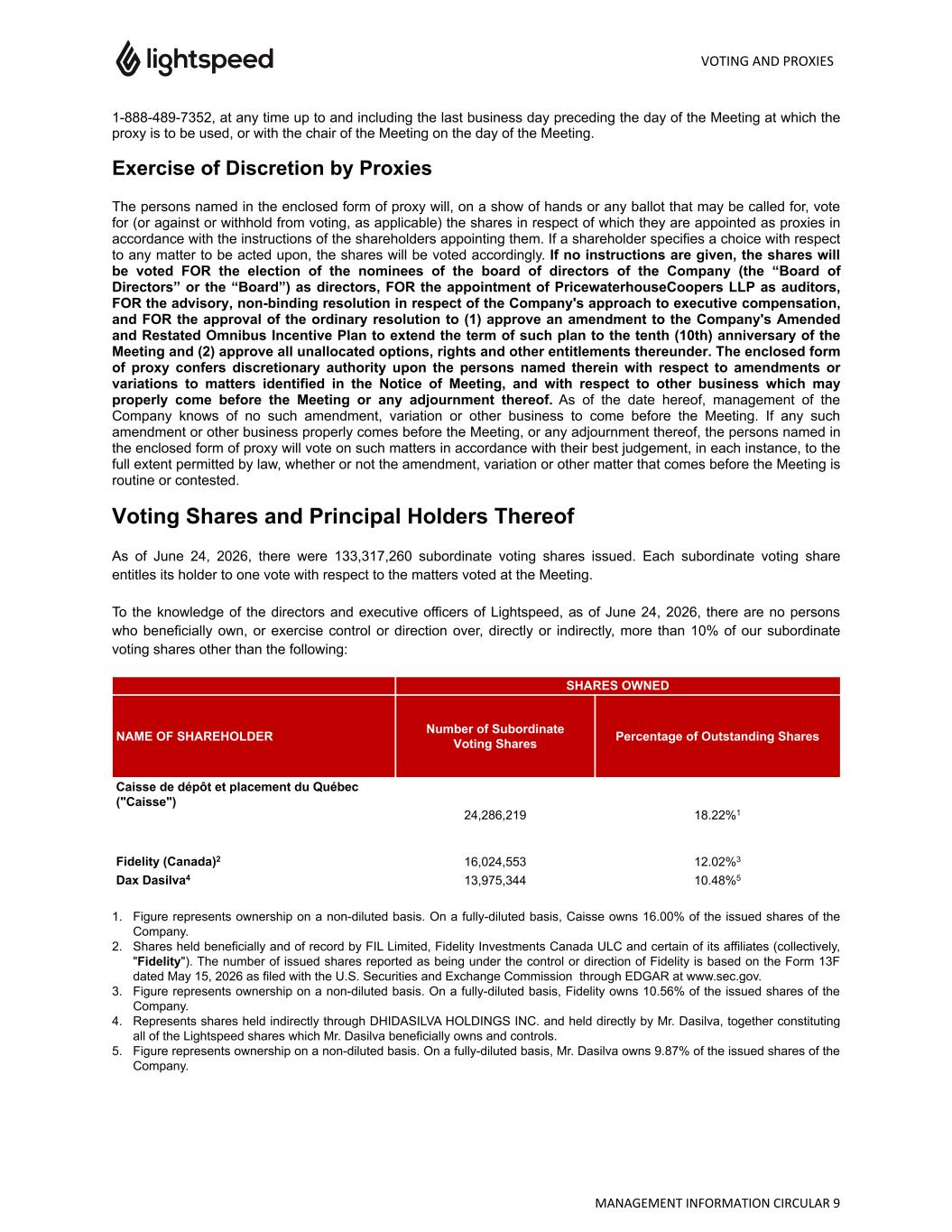
1-888-489-7352, at any time up to and including the last business day preceding the day of the Meeting at which the proxy is to be used, or with the chair of the Meeting on the day of the Meeting. Exercise of Discretion by Proxies The persons named in the enclosed form of proxy will, on a show of hands or any ballot that may be called for, vote for (or against or withhold from voting, as applicable) the shares in respect of which they are appointed as proxies in accordance with the instructions of the shareholders appointing them. If a shareholder specifies a choice with respect to any matter to be acted upon, the shares will be voted accordingly. If no instructions are given, the shares will be voted FOR the election of the nominees of the board of directors of the Company (the “Board of Directors” or the “Board”) as directors, FOR the appointment of PricewaterhouseCoopers LLP as auditors, FOR the advisory, non-binding resolution in respect of the Company's approach to executive compensation, and FOR the approval of the ordinary resolution to (1) approve an amendment to the Company's Amended and Restated Omnibus Incentive Plan to extend the term of such plan to the tenth (10th) anniversary of the Meeting and (2) approve all unallocated options, rights and other entitlements thereunder. The enclosed form of proxy confers discretionary authority upon the persons named therein with respect to amendments or variations to matters identified in the Notice of Meeting, and with respect to other business which may properly come before the Meeting or any adjournment thereof. As of the date hereof, management of the Company knows of no such amendment, variation or other business to come before the Meeting. If any such amendment or other business properly comes before the Meeting, or any adjournment thereof, the persons named in the enclosed form of proxy will vote on such matters in accordance with their best judgement, in each instance, to the full extent permitted by law, whether or not the amendment, variation or other matter that comes before the Meeting is routine or contested. Voting Shares and Principal Holders Thereof As of June 24, 2026, there were 133,317,260 subordinate voting shares issued. Each subordinate voting share entitles its holder to one vote with respect to the matters voted at the Meeting. To the knowledge of the directors and executive officers of Lightspeed, as of June 24, 2026, there are no persons who beneficially own, or exercise control or direction over, directly or indirectly, more than 10% of our subordinate voting shares other than the following: SHARES OWNED NAME OF SHAREHOLDER Number of Subordinate Voting Shares Percentage of Outstanding Shares Caisse de dépôt et placement du Québec ("Caisse") 24,286,219 18.22%1 Fidelity (Canada)2 16,024,553 12.02%3 Dax Dasilva4 13,975,344 10.48%5 1. Figure represents ownership on a non-diluted basis. On a fully-diluted basis, Caisse owns 16.00% of the issued shares of the Company. 2. Shares held beneficially and of record by FIL Limited, Fidelity Investments Canada ULC and certain of its affiliates (collectively, "Fidelity"). The number of issued shares reported as being under the control or direction of Fidelity is based on the Form 13F dated May 15, 2026 as filed with the U.S. Securities and Exchange Commission through EDGAR at www.sec.gov. 3. Figure represents ownership on a non-diluted basis. On a fully-diluted basis, Fidelity owns 10.56% of the issued shares of the Company. 4. Represents shares held indirectly through DHIDASILVA HOLDINGS INC. and held directly by Mr. Dasilva, together constituting all of the Lightspeed shares which Mr. Dasilva beneficially owns and controls. 5. Figure represents ownership on a non-diluted basis. On a fully-diluted basis, Mr. Dasilva owns 9.87% of the issued shares of the Company. VOTING AND PROXIES MANAGEMENT INFORMATION CIRCULAR 9
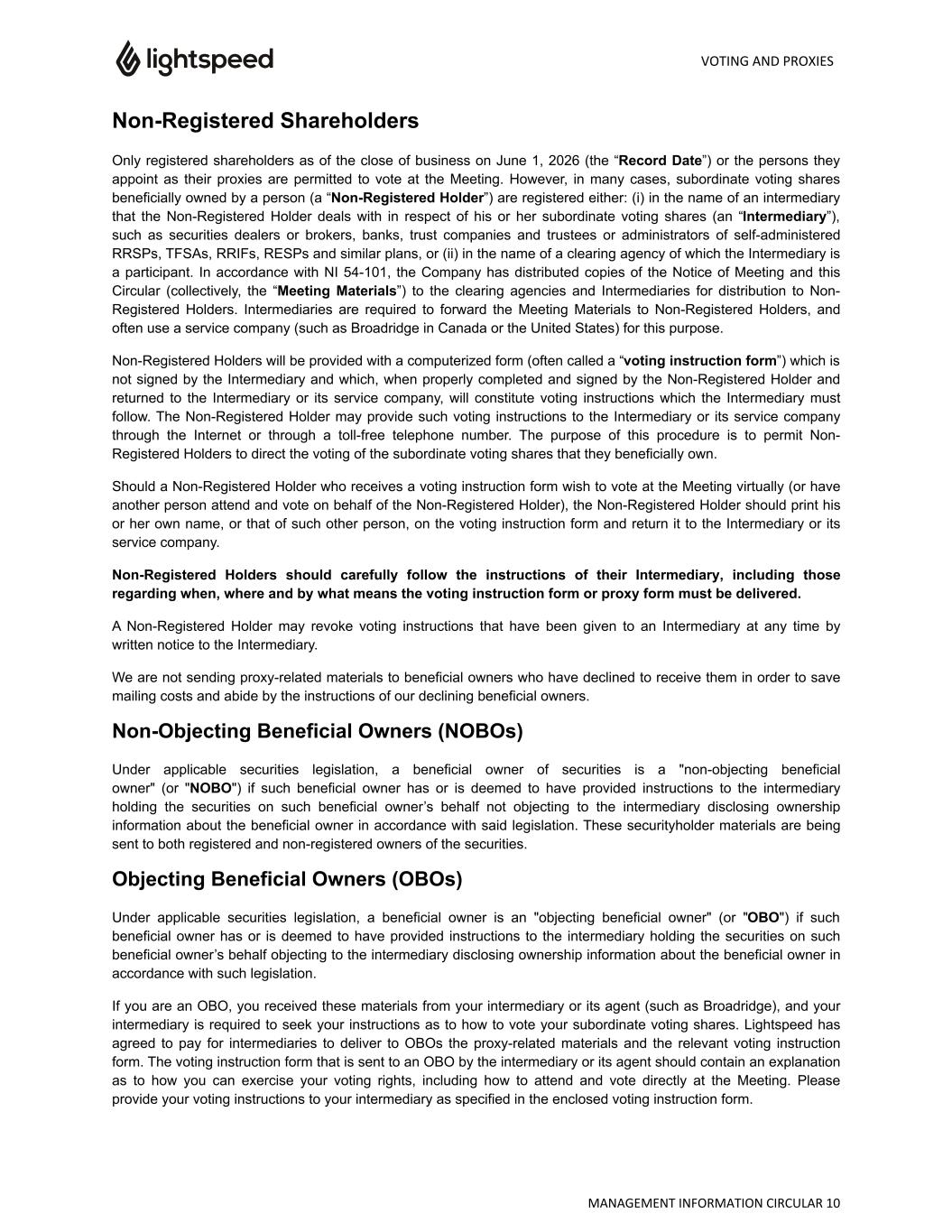
Non-Registered Shareholders Only registered shareholders as of the close of business on June 1, 2026 (the “Record Date”) or the persons they appoint as their proxies are permitted to vote at the Meeting. However, in many cases, subordinate voting shares beneficially owned by a person (a “Non-Registered Holder”) are registered either: (i) in the name of an intermediary that the Non-Registered Holder deals with in respect of his or her subordinate voting shares (an “Intermediary”), such as securities dealers or brokers, banks, trust companies and trustees or administrators of self-administered RRSPs, TFSAs, RRIFs, RESPs and similar plans, or (ii) in the name of a clearing agency of which the Intermediary is a participant. In accordance with NI 54-101, the Company has distributed copies of the Notice of Meeting and this Circular (collectively, the “Meeting Materials”) to the clearing agencies and Intermediaries for distribution to Non- Registered Holders. Intermediaries are required to forward the Meeting Materials to Non-Registered Holders, and often use a service company (such as Broadridge in Canada or the United States) for this purpose. Non-Registered Holders will be provided with a computerized form (often called a “voting instruction form”) which is not signed by the Intermediary and which, when properly completed and signed by the Non-Registered Holder and returned to the Intermediary or its service company, will constitute voting instructions which the Intermediary must follow. The Non-Registered Holder may provide such voting instructions to the Intermediary or its service company through the Internet or through a toll-free telephone number. The purpose of this procedure is to permit Non- Registered Holders to direct the voting of the subordinate voting shares that they beneficially own. Should a Non-Registered Holder who receives a voting instruction form wish to vote at the Meeting virtually (or have another person attend and vote on behalf of the Non-Registered Holder), the Non-Registered Holder should print his or her own name, or that of such other person, on the voting instruction form and return it to the Intermediary or its service company. Non-Registered Holders should carefully follow the instructions of their Intermediary, including those regarding when, where and by what means the voting instruction form or proxy form must be delivered. A Non-Registered Holder may revoke voting instructions that have been given to an Intermediary at any time by written notice to the Intermediary. We are not sending proxy-related materials to beneficial owners who have declined to receive them in order to save mailing costs and abide by the instructions of our declining beneficial owners. Non-Objecting Beneficial Owners (NOBOs) Under applicable securities legislation, a beneficial owner of securities is a "non-objecting beneficial owner" (or "NOBO") if such beneficial owner has or is deemed to have provided instructions to the intermediary holding the securities on such beneficial owner’s behalf not objecting to the intermediary disclosing ownership information about the beneficial owner in accordance with said legislation. These securityholder materials are being sent to both registered and non-registered owners of the securities. Objecting Beneficial Owners (OBOs) Under applicable securities legislation, a beneficial owner is an "objecting beneficial owner" (or "OBO") if such beneficial owner has or is deemed to have provided instructions to the intermediary holding the securities on such beneficial owner’s behalf objecting to the intermediary disclosing ownership information about the beneficial owner in accordance with such legislation. If you are an OBO, you received these materials from your intermediary or its agent (such as Broadridge), and your intermediary is required to seek your instructions as to how to vote your subordinate voting shares. Lightspeed has agreed to pay for intermediaries to deliver to OBOs the proxy-related materials and the relevant voting instruction form. The voting instruction form that is sent to an OBO by the intermediary or its agent should contain an explanation as to how you can exercise your voting rights, including how to attend and vote directly at the Meeting. Please provide your voting instructions to your intermediary as specified in the enclosed voting instruction form. VOTING AND PROXIES MANAGEMENT INFORMATION CIRCULAR 10
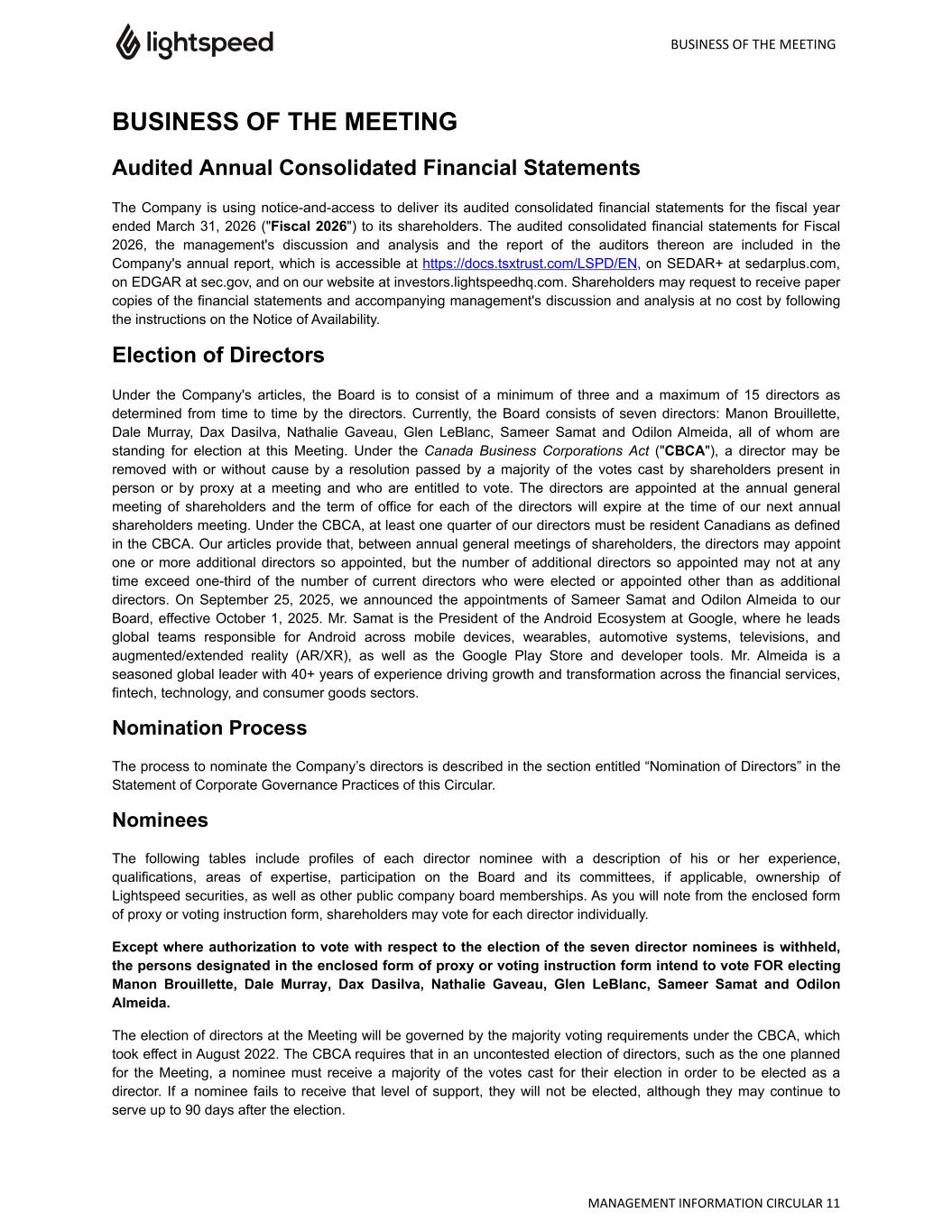
BUSINESS OF THE MEETING Audited Annual Consolidated Financial Statements The Company is using notice-and-access to deliver its audited consolidated financial statements for the fiscal year ended March 31, 2026 ("Fiscal 2026") to its shareholders. The audited consolidated financial statements for Fiscal 2026, the management's discussion and analysis and the report of the auditors thereon are included in the Company's annual report, which is accessible at https://docs.tsxtrust.com/LSPD/EN, on SEDAR+ at sedarplus.com, on EDGAR at sec.gov, and on our website at investors.lightspeedhq.com. Shareholders may request to receive paper copies of the financial statements and accompanying management's discussion and analysis at no cost by following the instructions on the Notice of Availability. Election of Directors Under the Company's articles, the Board is to consist of a minimum of three and a maximum of 15 directors as determined from time to time by the directors. Currently, the Board consists of seven directors: Manon Brouillette, Dale Murray, Dax Dasilva, Nathalie Gaveau, Glen LeBlanc, Sameer Samat and Odilon Almeida, all of whom are standing for election at this Meeting. Under the Canada Business Corporations Act ("CBCA"), a director may be removed with or without cause by a resolution passed by a majority of the votes cast by shareholders present in person or by proxy at a meeting and who are entitled to vote. The directors are appointed at the annual general meeting of shareholders and the term of office for each of the directors will expire at the time of our next annual shareholders meeting. Under the CBCA, at least one quarter of our directors must be resident Canadians as defined in the CBCA. Our articles provide that, between annual general meetings of shareholders, the directors may appoint one or more additional directors so appointed, but the number of additional directors so appointed may not at any time exceed one-third of the number of current directors who were elected or appointed other than as additional directors. On September 25, 2025, we announced the appointments of Sameer Samat and Odilon Almeida to our Board, effective October 1, 2025. Mr. Samat is the President of the Android Ecosystem at Google, where he leads global teams responsible for Android across mobile devices, wearables, automotive systems, televisions, and augmented/extended reality (AR/XR), as well as the Google Play Store and developer tools. Mr. Almeida is a seasoned global leader with 40+ years of experience driving growth and transformation across the financial services, fintech, technology, and consumer goods sectors. Nomination Process The process to nominate the Company’s directors is described in the section entitled “Nomination of Directors” in the Statement of Corporate Governance Practices of this Circular. Nominees The following tables include profiles of each director nominee with a description of his or her experience, qualifications, areas of expertise, participation on the Board and its committees, if applicable, ownership of Lightspeed securities, as well as other public company board memberships. As you will note from the enclosed form of proxy or voting instruction form, shareholders may vote for each director individually. Except where authorization to vote with respect to the election of the seven director nominees is withheld, the persons designated in the enclosed form of proxy or voting instruction form intend to vote FOR electing Manon Brouillette, Dale Murray, Dax Dasilva, Nathalie Gaveau, Glen LeBlanc, Sameer Samat and Odilon Almeida. The election of directors at the Meeting will be governed by the majority voting requirements under the CBCA, which took effect in August 2022. The CBCA requires that in an uncontested election of directors, such as the one planned for the Meeting, a nominee must receive a majority of the votes cast for their election in order to be elected as a director. If a nominee fails to receive that level of support, they will not be elected, although they may continue to serve up to 90 days after the election. BUSINESS OF THE MEETING MANAGEMENT INFORMATION CIRCULAR 11
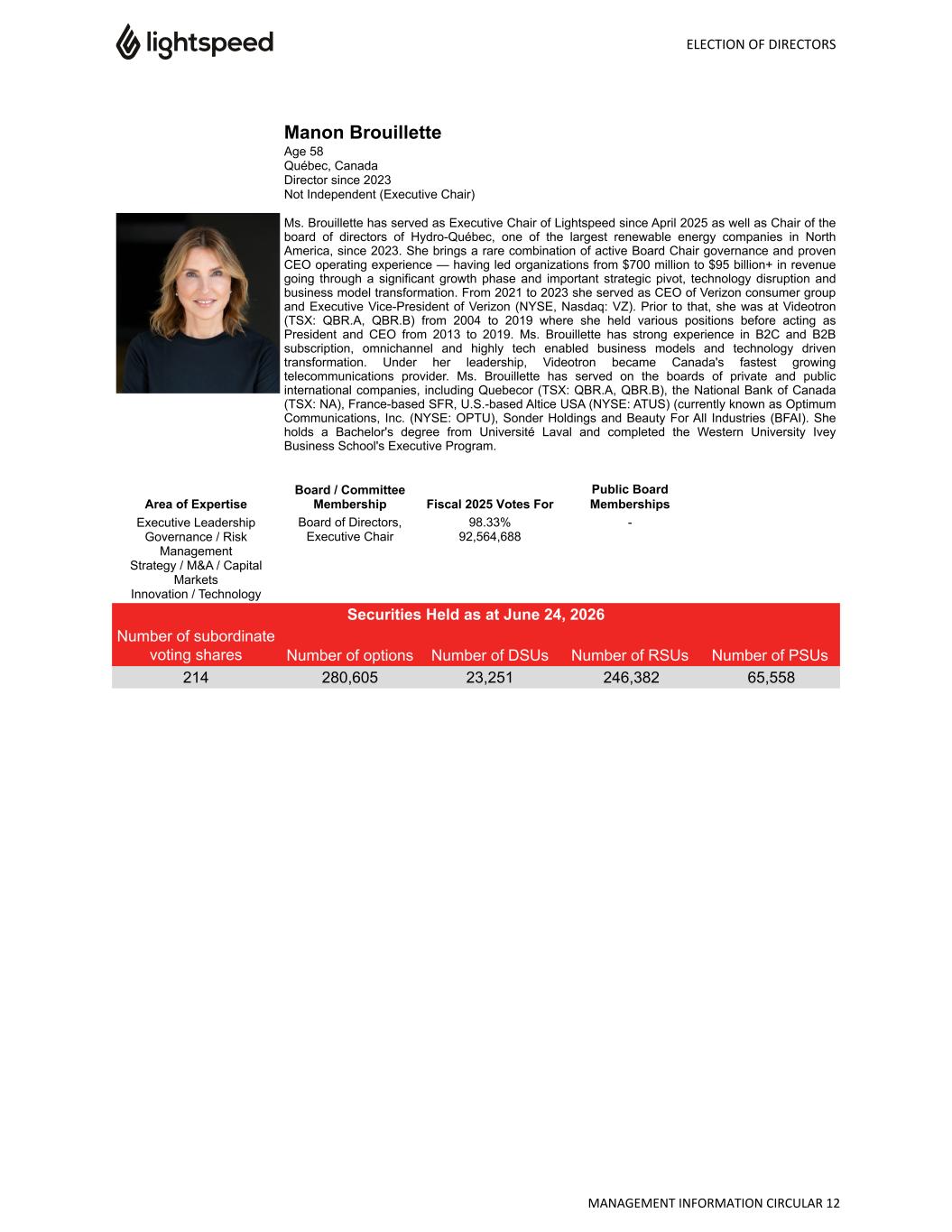
Manon Brouillette Age 58 Québec, Canada Director since 2023 Not Independent (Executive Chair) Ms. Brouillette has served as Executive Chair of Lightspeed since April 2025 as well as Chair of the board of directors of Hydro-Québec, one of the largest renewable energy companies in North America, since 2023. She brings a rare combination of active Board Chair governance and proven CEO operating experience — having led organizations from $700 million to $95 billion+ in revenue going through a significant growth phase and important strategic pivot, technology disruption and business model transformation. From 2021 to 2023 she served as CEO of Verizon consumer group and Executive Vice-President of Verizon (NYSE, Nasdaq: VZ). Prior to that, she was at Videotron (TSX: QBR.A, QBR.B) from 2004 to 2019 where she held various positions before acting as President and CEO from 2013 to 2019. Ms. Brouillette has strong experience in B2C and B2B subscription, omnichannel and highly tech enabled business models and technology driven transformation. Under her leadership, Videotron became Canada's fastest growing telecommunications provider. Ms. Brouillette has served on the boards of private and public international companies, including Quebecor (TSX: QBR.A, QBR.B), the National Bank of Canada (TSX: NA), France-based SFR, U.S.-based Altice USA (NYSE: ATUS) (currently known as Optimum Communications, Inc. (NYSE: OPTU), Sonder Holdings and Beauty For All Industries (BFAI). She holds a Bachelor's degree from Université Laval and completed the Western University Ivey Business School's Executive Program. Area of Expertise Board / Committee Membership Fiscal 2025 Votes For Public Board Memberships Executive Leadership Governance / Risk Management Strategy / M&A / Capital Markets Innovation / Technology Board of Directors, Executive Chair 98.33% 92,564,688 - Securities Held as at June 24, 2026 Number of subordinate voting shares Number of options Number of DSUs Number of RSUs Number of PSUs 214 280,605 23,251 246,382 65,558 ELECTION OF DIRECTORS MANAGEMENT INFORMATION CIRCULAR 12
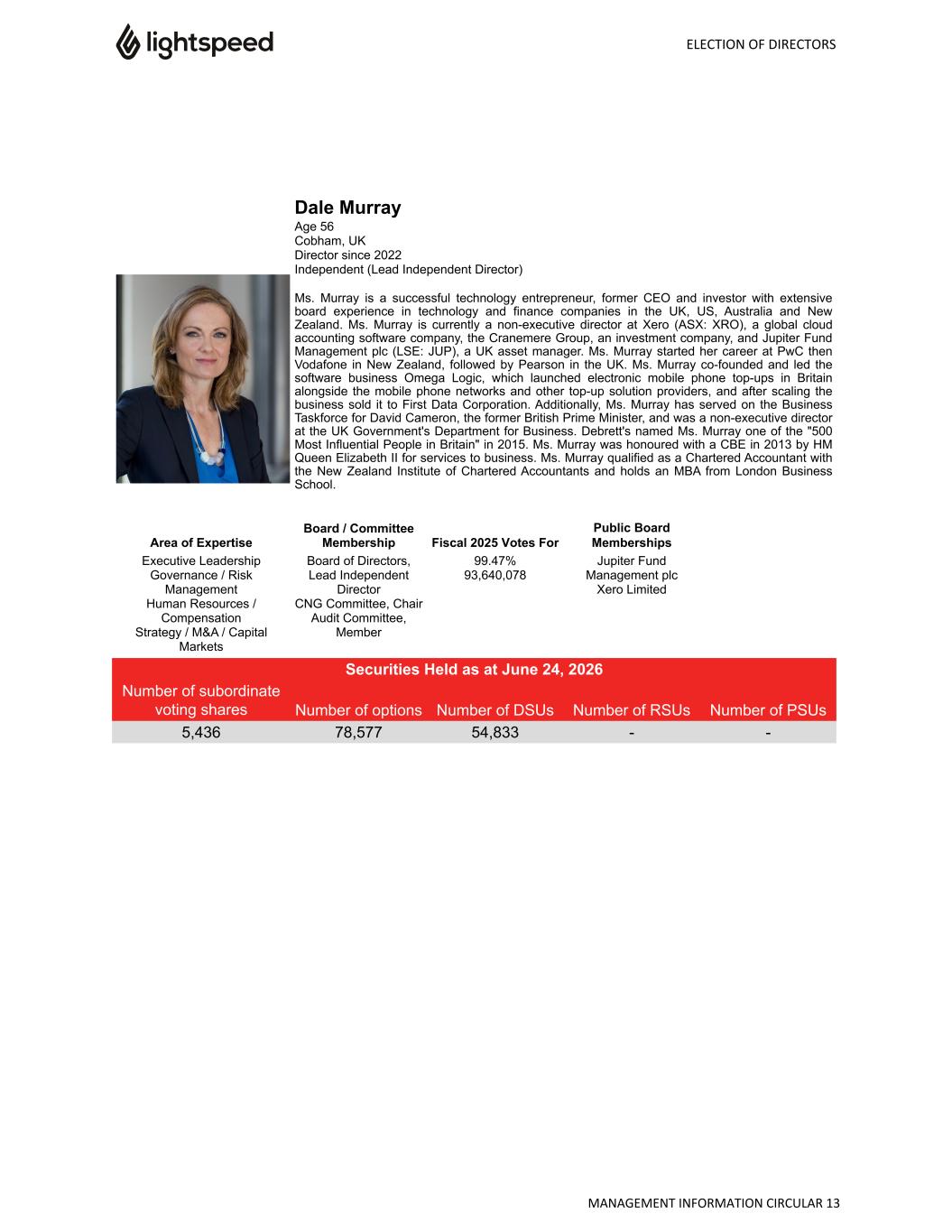
Dale Murray Age 56 Cobham, UK Director since 2022 Independent (Lead Independent Director) Ms. Murray is a successful technology entrepreneur, former CEO and investor with extensive board experience in technology and finance companies in the UK, US, Australia and New Zealand. Ms. Murray is currently a non-executive director at Xero (ASX: XRO), a global cloud accounting software company, the Cranemere Group, an investment company, and Jupiter Fund Management plc (LSE: JUP), a UK asset manager. Ms. Murray started her career at PwC then Vodafone in New Zealand, followed by Pearson in the UK. Ms. Murray co-founded and led the software business Omega Logic, which launched electronic mobile phone top-ups in Britain alongside the mobile phone networks and other top-up solution providers, and after scaling the business sold it to First Data Corporation. Additionally, Ms. Murray has served on the Business Taskforce for David Cameron, the former British Prime Minister, and was a non-executive director at the UK Government's Department for Business. Debrett's named Ms. Murray one of the "500 Most Influential People in Britain" in 2015. Ms. Murray was honoured with a CBE in 2013 by HM Queen Elizabeth II for services to business. Ms. Murray qualified as a Chartered Accountant with the New Zealand Institute of Chartered Accountants and holds an MBA from London Business School. Area of Expertise Board / Committee Membership Fiscal 2025 Votes For Public Board Memberships Executive Leadership Governance / Risk Management Human Resources / Compensation Strategy / M&A / Capital Markets Board of Directors, Lead Independent Director CNG Committee, Chair Audit Committee, Member 99.47% 93,640,078 Jupiter Fund Management plc Xero Limited Securities Held as at June 24, 2026 Number of subordinate voting shares Number of options Number of DSUs Number of RSUs Number of PSUs 5,436 78,577 54,833 - - ELECTION OF DIRECTORS MANAGEMENT INFORMATION CIRCULAR 13

Dax Dasilva Age 50 Québec, Canada Director since 2005 Not Independent (Chief Executive Officer) Mr. Dasilva has been a director of Lightspeed since he founded the Company in 2005, and was reappointed as permanent Chief Executive Officer on May 16, 2024, after serving as interim Chief Executive Officer since February 15, 2024. Prior to that, Mr. Dasilva had been serving as Executive Chair of the Board since February 2022. Prior to serving as Executive Chair, Mr. Dasilva served as Lightspeed's Chief Executive Officer until February 2022. Under Mr. Dasilva’s leadership, Lightspeed has grown into a global business with offices in North America, Europe and Asia-Pacific. Mr. Dasilva has over 20 years of entrepreneurship experience and has received numerous awards and recognitions, including the 2024 C100 Icon of Canadian Entrepreneurship Award, the 2019 Globe and Mail Innovator of the Year, Startup Canada’s Entrepreneur of the Year Award in 2016 for both Quebec and Canada, and the Ernst & Young Entrepreneur of the Year Award in 2012. Mr. Dasilva also received a King Charles III Coronation Medal in 2025 for his contribution to conservation and the protection of nature, the CGLCC 2023 2SLGBTQI+ Business Leadership Legacy Award, a Start Proud’s Technology Leader Award in 2018 and was named one of the 100 Most Intriguing Entrepreneurs by Goldman Sachs at the 2017 Builders + Innovators Summit. In 2021, Mr. Dasilva launched Age of Union, a non-profit environmental alliance that supports and makes visible a global community of change makers working on-the-ground to protect the planet's threatened species and ecosystems. Age of Union seeks to inspire through conservation efforts that solve critical environmental challenges around the world and spark high-impact change by showing the positive impact that every individual can make. Area of Expertise Board / Committee Membership Fiscal 2025 Votes For Public Board Memberships Executive Leadership Innovation / Technology Strategy / M&A / Capital Markets Sustainability Board of Directors 99.79% 93,937,775 - Securities Held as at June 24, 2026 Number of subordinate voting shares Number of options Number of DSUs Number of RSUs Number of PSUs 13,975,344 532,909 24,825 372,786 81,408 ELECTION OF DIRECTORS MANAGEMENT INFORMATION CIRCULAR 14
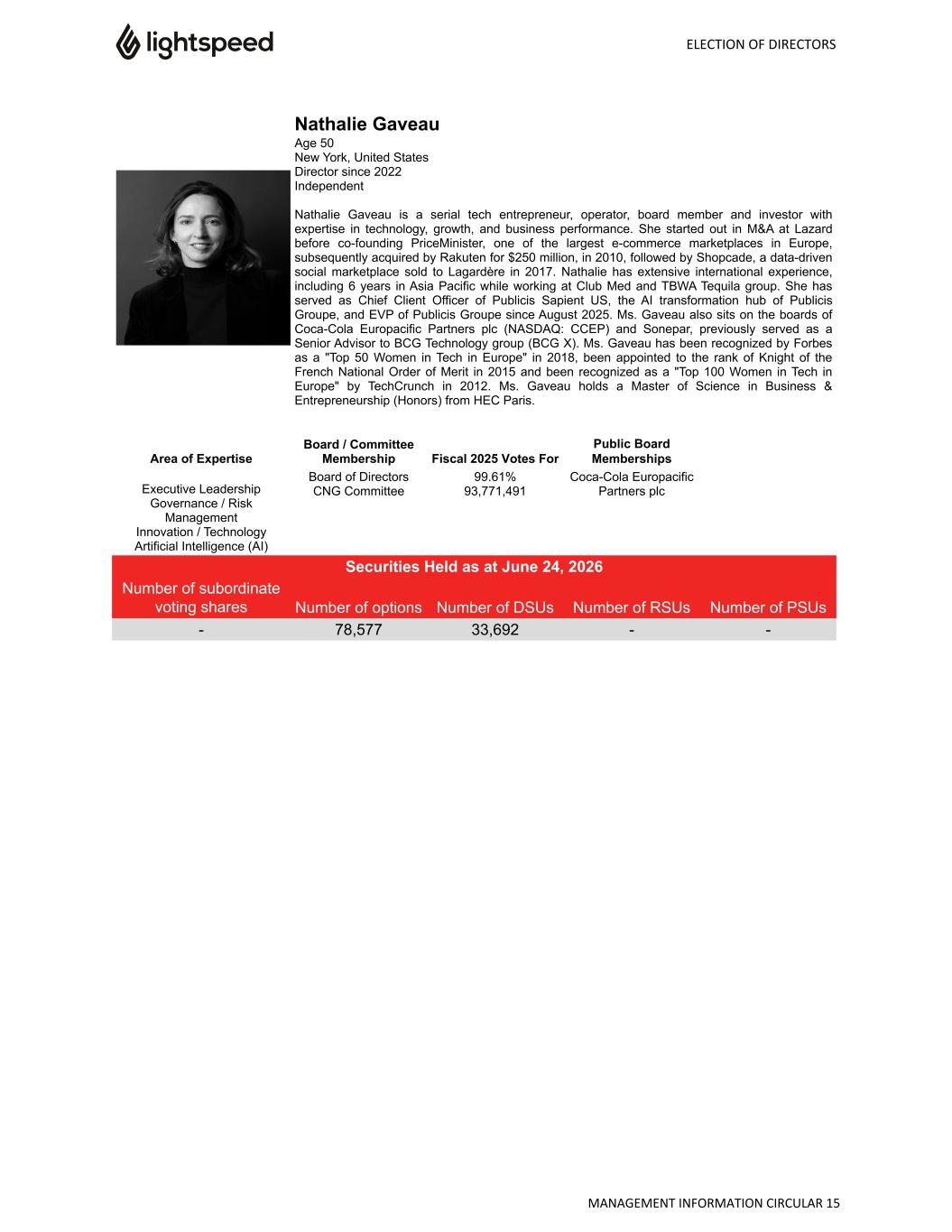
Nathalie Gaveau Age 50 New York, United States Director since 2022 Independent Nathalie Gaveau is a serial tech entrepreneur, operator, board member and investor with expertise in technology, growth, and business performance. She started out in M&A at Lazard before co-founding PriceMinister, one of the largest e-commerce marketplaces in Europe, subsequently acquired by Rakuten for $250 million, in 2010, followed by Shopcade, a data-driven social marketplace sold to Lagardère in 2017. Nathalie has extensive international experience, including 6 years in Asia Pacific while working at Club Med and TBWA Tequila group. She has served as Chief Client Officer of Publicis Sapient US, the AI transformation hub of Publicis Groupe, and EVP of Publicis Groupe since August 2025. Ms. Gaveau also sits on the boards of Coca-Cola Europacific Partners plc (NASDAQ: CCEP) and Sonepar, previously served as a Senior Advisor to BCG Technology group (BCG X). Ms. Gaveau has been recognized by Forbes as a "Top 50 Women in Tech in Europe" in 2018, been appointed to the rank of Knight of the French National Order of Merit in 2015 and been recognized as a "Top 100 Women in Tech in Europe" by TechCrunch in 2012. Ms. Gaveau holds a Master of Science in Business & Entrepreneurship (Honors) from HEC Paris. Area of Expertise Board / Committee Membership Fiscal 2025 Votes For Public Board Memberships Executive Leadership Governance / Risk Management Innovation / Technology Artificial Intelligence (AI) Board of Directors CNG Committee 99.61% 93,771,491 Coca-Cola Europacific Partners plc Securities Held as at June 24, 2026 Number of subordinate voting shares Number of options Number of DSUs Number of RSUs Number of PSUs - 78,577 33,692 - - ELECTION OF DIRECTORS MANAGEMENT INFORMATION CIRCULAR 15
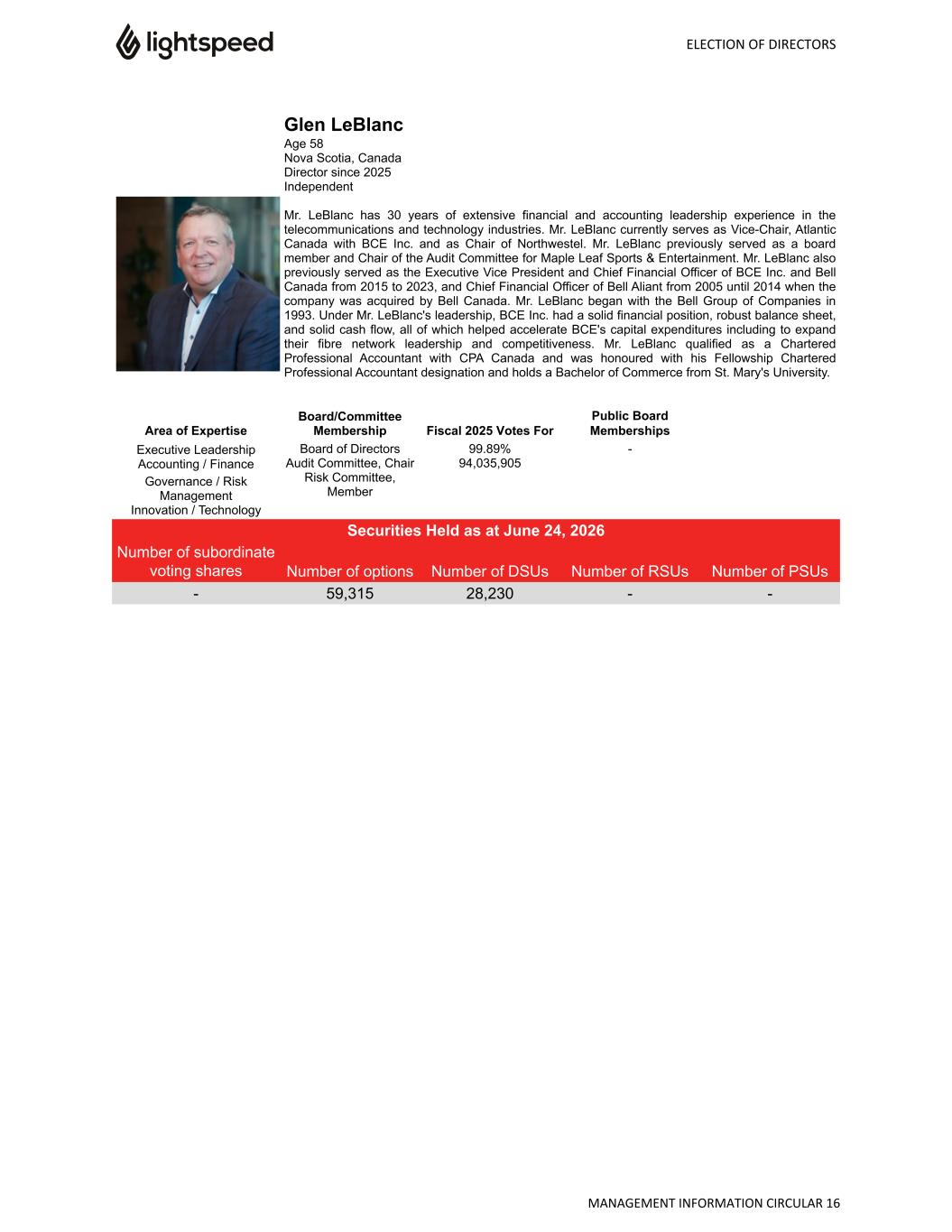
Glen LeBlanc Age 58 Nova Scotia, Canada Director since 2025 Independent Mr. LeBlanc has 30 years of extensive financial and accounting leadership experience in the telecommunications and technology industries. Mr. LeBlanc currently serves as Vice-Chair, Atlantic Canada with BCE Inc. and as Chair of Northwestel. Mr. LeBlanc previously served as a board member and Chair of the Audit Committee for Maple Leaf Sports & Entertainment. Mr. LeBlanc also previously served as the Executive Vice President and Chief Financial Officer of BCE Inc. and Bell Canada from 2015 to 2023, and Chief Financial Officer of Bell Aliant from 2005 until 2014 when the company was acquired by Bell Canada. Mr. LeBlanc began with the Bell Group of Companies in 1993. Under Mr. LeBlanc's leadership, BCE Inc. had a solid financial position, robust balance sheet, and solid cash flow, all of which helped accelerate BCE's capital expenditures including to expand their fibre network leadership and competitiveness. Mr. LeBlanc qualified as a Chartered Professional Accountant with CPA Canada and was honoured with his Fellowship Chartered Professional Accountant designation and holds a Bachelor of Commerce from St. Mary's University. Area of Expertise Board/Committee Membership Fiscal 2025 Votes For Public Board Memberships Executive Leadership Accounting / Finance Governance / Risk Management Innovation / Technology Board of Directors Audit Committee, Chair Risk Committee, Member 99.89% 94,035,905 - Securities Held as at June 24, 2026 Number of subordinate voting shares Number of options Number of DSUs Number of RSUs Number of PSUs - 59,315 28,230 - - ELECTION OF DIRECTORS MANAGEMENT INFORMATION CIRCULAR 16
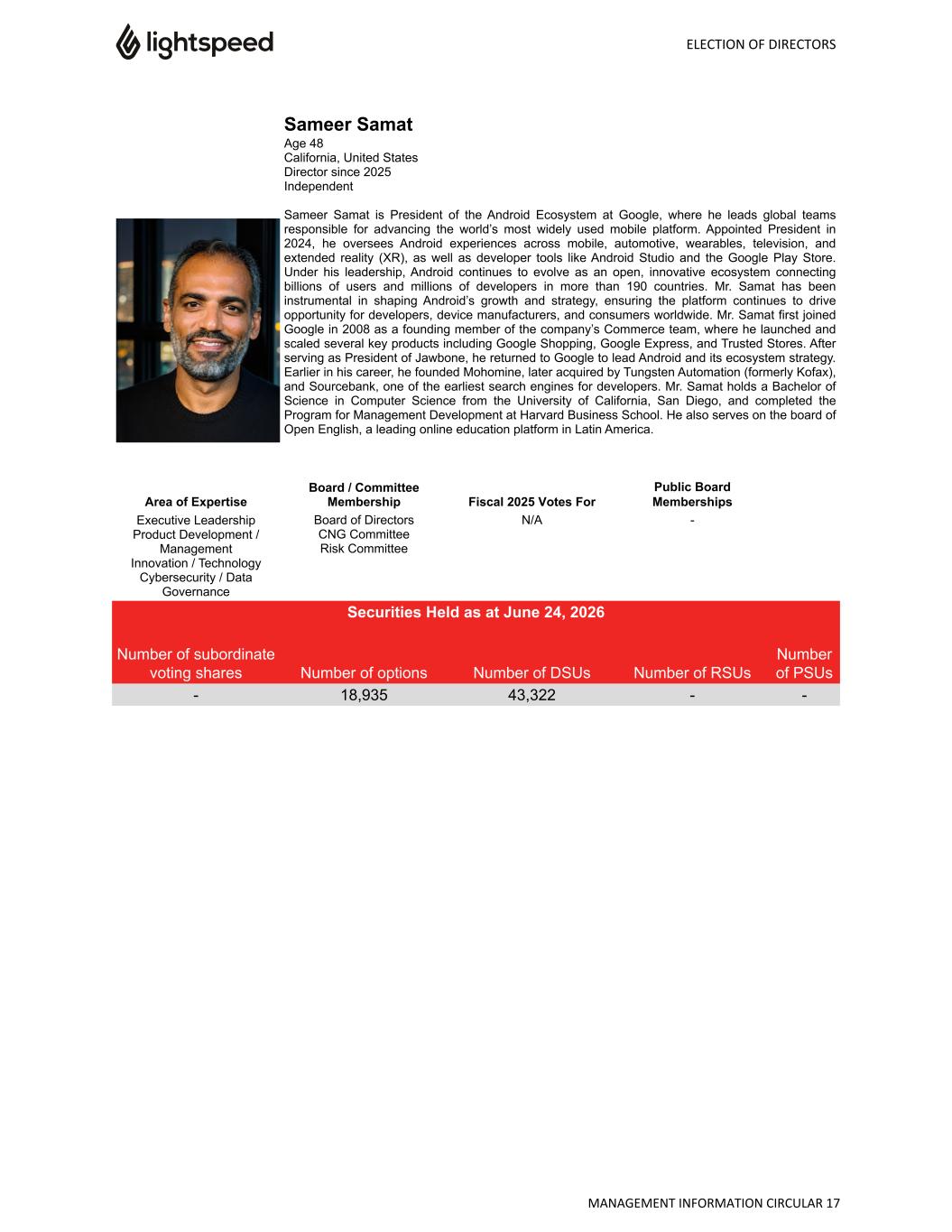
Sameer Samat Age 48 California, United States Director since 2025 Independent Sameer Samat is President of the Android Ecosystem at Google, where he leads global teams responsible for advancing the world’s most widely used mobile platform. Appointed President in 2024, he oversees Android experiences across mobile, automotive, wearables, television, and extended reality (XR), as well as developer tools like Android Studio and the Google Play Store. Under his leadership, Android continues to evolve as an open, innovative ecosystem connecting billions of users and millions of developers in more than 190 countries. Mr. Samat has been instrumental in shaping Android’s growth and strategy, ensuring the platform continues to drive opportunity for developers, device manufacturers, and consumers worldwide. Mr. Samat first joined Google in 2008 as a founding member of the company’s Commerce team, where he launched and scaled several key products including Google Shopping, Google Express, and Trusted Stores. After serving as President of Jawbone, he returned to Google to lead Android and its ecosystem strategy. Earlier in his career, he founded Mohomine, later acquired by Tungsten Automation (formerly Kofax), and Sourcebank, one of the earliest search engines for developers. Mr. Samat holds a Bachelor of Science in Computer Science from the University of California, San Diego, and completed the Program for Management Development at Harvard Business School. He also serves on the board of Open English, a leading online education platform in Latin America. Area of Expertise Board / Committee Membership Fiscal 2025 Votes For Public Board Memberships Executive Leadership Product Development / Management Innovation / Technology Cybersecurity / Data Governance Board of Directors CNG Committee Risk Committee N/A - Securities Held as at June 24, 2026 Number of subordinate voting shares Number of options Number of DSUs Number of RSUs Number of PSUs - 18,935 43,322 - - ELECTION OF DIRECTORS MANAGEMENT INFORMATION CIRCULAR 17
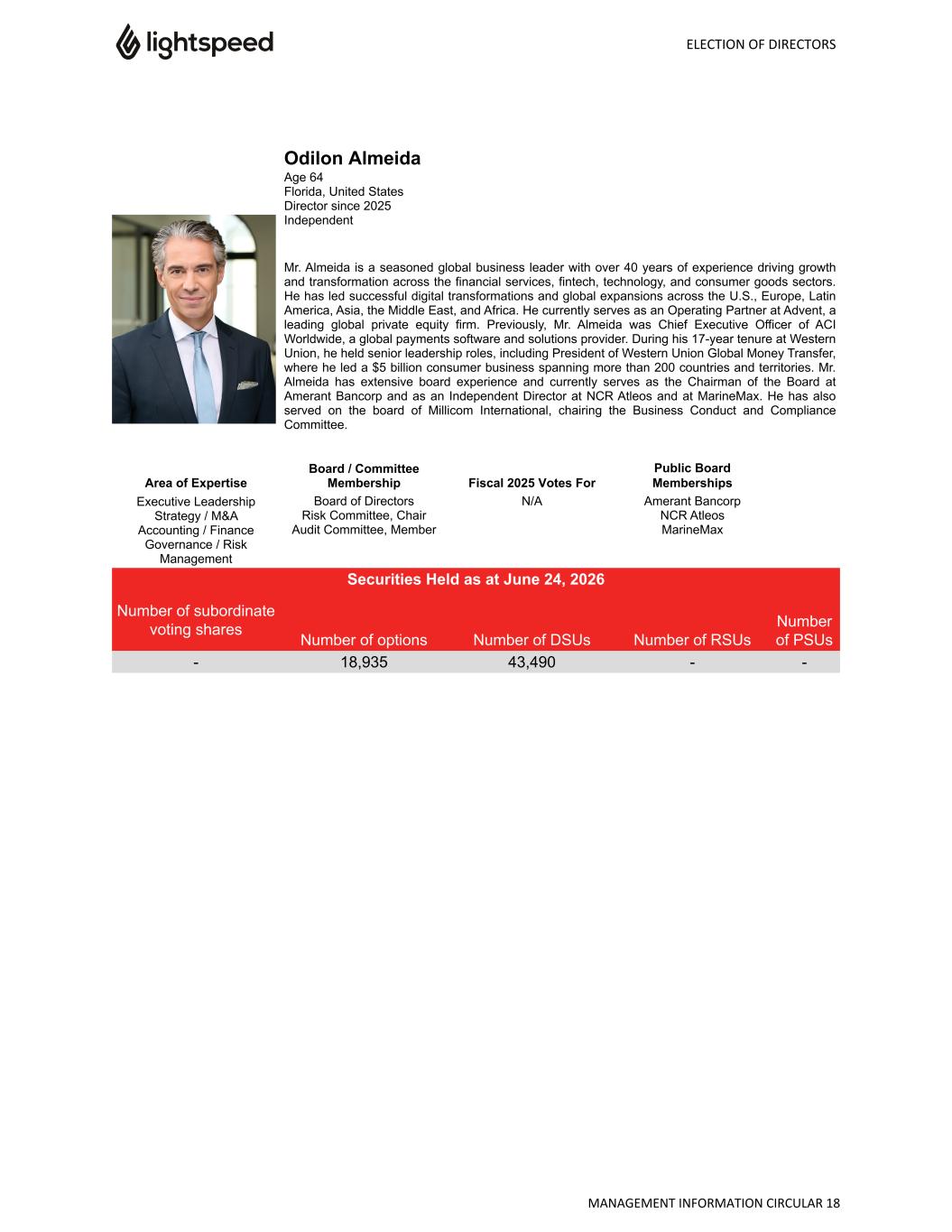
Odilon Almeida Age 64 Florida, United States Director since 2025 Independent Mr. Almeida is a seasoned global business leader with over 40 years of experience driving growth and transformation across the financial services, fintech, technology, and consumer goods sectors. He has led successful digital transformations and global expansions across the U.S., Europe, Latin America, Asia, the Middle East, and Africa. He currently serves as an Operating Partner at Advent, a leading global private equity firm. Previously, Mr. Almeida was Chief Executive Officer of ACI Worldwide, a global payments software and solutions provider. During his 17-year tenure at Western Union, he held senior leadership roles, including President of Western Union Global Money Transfer, where he led a $5 billion consumer business spanning more than 200 countries and territories. Mr. Almeida has extensive board experience and currently serves as the Chairman of the Board at Amerant Bancorp and as an Independent Director at NCR Atleos and at MarineMax. He has also served on the board of Millicom International, chairing the Business Conduct and Compliance Committee. Area of Expertise Board / Committee Membership Fiscal 2025 Votes For Public Board Memberships Executive Leadership Strategy / M&A Accounting / Finance Governance / Risk Management Board of Directors Risk Committee, Chair Audit Committee, Member N/A Amerant Bancorp NCR Atleos MarineMax Securities Held as at June 24, 2026 Number of subordinate voting shares Number of options Number of DSUs Number of RSUs Number of PSUs - 18,935 43,490 - - ELECTION OF DIRECTORS MANAGEMENT INFORMATION CIRCULAR 18
Corporate Cease Trade Orders and Bankruptcies To the knowledge of the Company and based upon information provided by the proposed director nominees, none of the Company’s proposed director nominees is, as at the date of this Circular, or has been within the 10 years before the date of this Circular: (a) a director, chief executive officer or chief financial officer of any company that was subject to an order that was issued while the director or executive officer was acting in the capacity as director, chief executive officer or chief financial officer; (b) was subject to an order that was issued after the director or executive officer ceased to be a director, chief executive officer or chief financial officer and which resulted from an event that occurred while that person was acting in the capacity as director, chief executive officer or chief financial officer; or (c) a director or executive officer of any company that, while that person was acting in that capacity, or within a year of that person ceasing to act in that capacity, became bankrupt, made a proposal under any legislation relating to bankruptcy or insolvency or was subject to or instituted any proceedings, arrangement or compromise with creditors or had a receiver, receiver manager or trustee appointed to hold its assets. For the purposes of this paragraph, “order” means a cease trade order, an order similar to a cease trade order or an order that denied the relevant company access to any exemption under securities legislation, in each case, that was in effect for a period of more than 30 consecutive days. Individual Bankruptcies To the knowledge of the Company and based upon information provided by the proposed director nominees, none of the Company’s proposed director nominees is, as at the date of this Circular, or has been within the 10 years before the date of this Circular, become bankrupt, made a proposal under any legislation relating to bankruptcy or insolvency, or become subject to or instituted any proceedings, arrangement or compromise with creditors, or had a receiver, receiver manager or trustee appointed to hold the assets of that individual. Penalties or Sanctions To the knowledge of the Company and based upon information provided by the proposed director nominees, none of the Company’s proposed director nominees has been subject to any penalties or sanctions imposed by a court relating to securities legislation or by a securities regulatory authority or has entered into a settlement agreement with a securities regulatory authority or been subject to any other penalties or sanctions imposed by a court or regulatory body that would likely be considered important to a reasonable investor making an investment decision. ELECTION OF DIRECTORS MANAGEMENT INFORMATION CIRCULAR 19
Appointment of Auditors PricewaterhouseCoopers LLP (“PwC”), chartered accountants, has served as auditors of the Company since the fiscal year ending on March 31, 2016. At the Company's last annual meeting of shareholders, 96,628,213 (99.80%) of votes cast were in favor of reappointing PwC as the Company's auditors. In Fiscal 2026, in addition to retaining PwC to report upon the annual consolidated financial statements of the Company, the Company retained PwC to provide various audit, audit-related, and non-audit services. Under its charter, the audit committee of the Company (the “Audit Committee”) is required to pre-approve all non- audit services to be performed by the external auditors in relation to the Company, together with approval of the engagement letter for such non-audit services and estimated fees thereof. Additional details regarding the Audit Committee and the above-mentioned fees can be found in the section entitled “Audit Committee” of the Company’s annual information form, available under the Company’s profile on SEDAR+ at www.sedarplus.com and EDGAR at www.sec.gov, and on the Company’s website at investors.lightspeedhq.com. Except where authorization to vote with respect to the appointment of auditors is withheld, the persons designated in the enclosed form of proxy or voting instruction form intend to vote FOR the reappointment of PwC, as auditors of the Company, to hold office until the close of the next annual meeting of shareholders at such remuneration as may be recommended by the Audit Committee and fixed by the Board. APPOINTMENT OF AUDITORS MANAGEMENT INFORMATION CIRCULAR 20
Advisory Resolution on Executive Compensation The Company is presenting a non-binding advisory vote on the Company's approach to executive compensation. The Company is committed to ensuring that its shareholders fully understand the objectives, philosophy and principles that the Board has applied in its approach to executive compensation decisions, and to providing shareholders with executive compensation disclosure that is clear and comprehensive. The Company endeavors to maintain an executive compensation program that aligns the interests of our executives with our shareholders' interests, so that we may attract, motivate and retain executives who will continue to create sustainable, long-term value for our shareholders. Please see the Compensation Discussion and Analysis section below for more information about our executive compensation program. In 2025, we received strong support from shareholders with 92,816,197 (98.60%) of votes cast at our annual meeting in favor of the Company's approach to executive compensation. In Fiscal 2026, the Company conducted extensive shareholder outreach regarding its strategy, executive compensation program and its equity incentive plan. In June 2025, the Executive Chair met with many of our largest shareholders to discuss the Company's strategy and executive leadership team in connection with her appointment to the role of Executive Chair. In November 2025, the Chair of the CNG Committee and Executive Chair met with many of our largest shareholders (representing approximately 50% of the Company's shares) to discuss various matters, including the Company's approach to executive compensation and disciplined use of equity awards to align the interests of its broader employee base to the creation of long-term shareholder value. As described in the section entitled "Compensation Governance — Shareholder Engagement" below, the Board and management of the Company have used and will use such feedback, with advice and consultation from Compensia, to help structure future compensation frameworks and enhance disclosure practices. Further details on program enhancements following shareholder outreach in Fiscal 2026 can be found in this Circular, including in the sections entitled "Compensation Governance — Shareholder Engagement", "Performance-Based Compensation" and "Executive Officer Share Ownership Guidelines". Except where authorization to vote with respect to the non-binding advisory resolution in respect of the Company's approach to executive compensation is withheld, the persons designated in the enclosed form of proxy or voting instruction form intend to vote FOR the following non-binding advisory resolution in respect of the Company's approach to executive compensation: "BE IT RESOLVED THAT, on an advisory basis, and not to diminish the role and responsibilities of the Board, the shareholders accept the approach to executive compensation disclosed in the Company's management information circular delivered in advance of the 2026 annual and special meeting of shareholders." Approval of this resolution will require an affirmative vote of a majority of the votes cast by shareholders, voting together as a single class, attending the Meeting or represented by proxy at the Meeting. Since this is an advisory vote, the results will not be binding on the Board or the Compensation, Nominating and Governance Committee. However, the Board and the Compensation, Nominating and Governance Committee will take into account the outcome of the advisory vote when considering future executive compensation decisions. The Company will disclose the results of the shareholder advisory vote as part of its report of voting results for the Meeting. ADVISORY RESOLUTION ON EXECUTIVE COMPENSATION MANAGEMENT INFORMATION CIRCULAR 21
Ordinary Resolution in Respect of the Amended and Restated Omnibus Incentive Plan Equity incentives have historically and continue to be a critical form of compensation for the Company, as they enable it to attract, motivate and retain top talent and align employees' interests with the creation of long-term shareholder value. Concurrently with the closing of the Company's initial public offering in Canada (the "IPO"), the Company adopted an omnibus incentive plan which allows the Board to grant long-term equity-based awards to eligible participants. The full amendment history of the omnibus plan is included below, but importantly, on September 7, 2020, the omnibus incentive plan was amended and restated to convert such plan from a "fixed plan" to a "rolling" and "evergreen" plan, whereby the maximum number of subordinate voting shares of the Company which may be reserved and set aside for issuance under such plan and the Legacy Option Plan (as defined below) was changed from a fixed number of subordinate voting shares to a maximum aggregate number of subordinate voting shares equal to 15% of all subordinate voting shares issued and outstanding from time to time on a non-diluted basis (the "Amended and Restated Omnibus Incentive Plan"). Additionally, on August 3, 2023, the Board and shareholders of the Company approved the renewal of the Amended and Restated Omnibus Incentive Plan and all unallocated options, rights and other entitlements thereunder. In accordance with the requirements of the Toronto Stock Exchange, every three years after adoption, all unallocated options, rights and other entitlements under a security-based compensation arrangement which does not have a fixed maximum number of securities issuable thereunder (commonly referred to as "rolling" and "evergreen" plans), such as the Amended and Restated Omnibus Incentive Plan, must be approved by a majority of votes cast by shareholders attending the Meeting or represented by proxy. Because the Amended and Restated Omnibus Incentive Plan was last approved by the shareholders of the Company on August 3, 2023, shareholders will be asked at the Meeting as part of an ordinary resolution to renew the Amended and Restated Omnibus Incentive Plan and to approve all unallocated options, rights and other entitlement issuable thereunder (the "Reserve Renewal"). In addition, the term of the Company’s Amended and Restated Omnibus Incentive Plan was established in accordance with the applicable provisions of the U.S. Internal Revenue Code (the "Code") regarding equity incentive plans providing for the issuance of Incentive Stock Options (ISOs) (as defined in the Code). Accordingly, the term of the Amended and Restated Omnibus Incentive Plan is set to expire ten (10) years from the date such plan was adopted. Therefore, at the Meeting, shareholders will also be asked as part of the ordinary resolution approving the Reserve Renewal to approve an administrative amendment to the Company's Amended and Restated Omnibus Incentive Plan to extend the term of such plan from the tenth (10th) anniversary of the IPO of the Company (being the date of initial adoption of the omnibus incentive plan) to the tenth (10th) anniversary of the Meeting (the "Plan Amendment", and collectively with the Reserve Renewal, the "Omnibus Incentive Plan Resolution"). Unallocated options, rights and other entitlements pertain to equity incentives that have not yet been granted and are therefore still available to be granted. If approval of the Omnibus Incentive Plan Resolution is obtained at the Meeting, the Company will not be required to seek further approval of the unallocated options, rights and other entitlements under the Amended and Restated Omnibus Incentive Plan until the Company's annual meeting of shareholders to be held in 2029 (provided that such meeting is held on or prior to July 30, 2029), and the Amended and Restated Omnibus Incentive Plan will remain effective for purposes of enabling ISOs as described above until July 30, 2036. If approval is not obtained at the Meeting, awards which have not been allocated as of July 30, 2026 and awards which are outstanding as of July 30, 2026 and which are subsequently cancelled, terminated or exercised will not be available for a new grant of equity incentives under the Amended and Restated Omnibus Incentive Plan. Awards allocated prior to July 30, 2026 will be unaffected by the approval or disapproval of the ordinary resolution. In addition, if the Omnibus Incentive Plan Resolution is not adopted at the Meeting, the Amended and Restated Omnibus Incentive Plan will expire on the 10th anniversary of the initial public offering of the Company, being March 15, 2029, if not otherwise amended or extended. For the avoidance of doubt, except for the Plan Amendment all other terms and conditions of the Amended and Restated Omnibus Incentive Plan shall remain the same, and the 15% reserve proposed at the Meeting is the same percentage that was previously approved by shareholders in 2023. Further, such 15% reserve now reflects a reduced reserve size as compared to the reserve approved by shareholders in 2023 in light of the share repurchases summarized below. With respect to the use of the Company’s equity incentive plan across its executive officers and broader employee base, the Company has focused on prudently managing burn rate and the dilutive impact of equity incentives. Ordinary Resolution in Respect of the Amended and Restated Omnibus Incentive Plan MANAGEMENT INFORMATION CIRCULAR 22
Ongoing disciplined management since the Company's equity plan renewal in 2023 has significantly improved the dilutive impact of the Company's equity compensation as evidenced by the following: • The Company repurchased approximately 18.7 million shares since the start of Fiscal 2025, reducing total shares outstanding by approximately 12%1, thereby decreasing the size of the Company's equity reserve from approximately 23 million shares at the start of Fiscal 2025 to approximately 21 million as of March 31, 2026, taking into account the fixed percentage calculations under the Amended and Restated Omnibus Incentive Plan. • Approximately $30 million of shares were purchased in the open market in Fiscal 2026 to fund future RSU settlements, further limiting the dilutive impact of equity incentive plan usage. • The Company will purchase additional shares in Fiscal 2027, both through a renewed normal course issuer bid as well as on the open market to fund future RSU and PSU settlements, to mitigate dilution from the Company's equity incentive plan. • The Company's average net burn rate over the past three fiscal years is aligned near the 50th percentile for its compensation peer group2. • The Company's share-based compensation as a percentage of revenue has significantly decreased over time from 8.33% in Fiscal 2024 to 4.80% in Fiscal 2026. • Further, the Company's share-based compensation as a percentage of revenue was below the 50th percentile for its compensation peer group2. The Company expects to continue to allocate a meaningful proportion of its equity-based awards to broad-based employees other than directors and executive officers of the Company as part of the Company’s ongoing annual granting activities and this is a core part of the Company’s strategy and compensation philosophy. As such, it is important that Lightspeed has a sufficient reserve of subordinate voting shares under its equity incentive plans in order to remain competitive in its aim to attract, retain and motivate top talent who are integral to achieving Lightspeed's long-term strategic goals. In Fiscal 2026, 76% of equity incentives granted went to employees outside of the Company's directors and executive officers. Further, it is important that Lightspeed has sufficient reserve in order to allocate equity incentives to the Company's performance share unit program commencing in Fiscal 2027 to further reinforce pay-for-performance alignment as detailed in the section entitled "Performance-Based Compensation". In Fiscal 2026, an aggregate of 7,904,766 awards were granted under the Amended and Restated Omnibus Incentive Plan representing 5.65% of the issued subordinate voting shares of the Company as of March 31, 2026. As at March 31, 2026, there were 16,552,457 equity incentives outstanding under the Amended and Restated Omnibus Incentive Plan representing approximately 11.83% of the Company's issued subordinate voting shares. As at June 24, 2026, there were 17,843,976 equity incentives outstanding under the Amended and Restated Omnibus Incentive Plan representing approximately 13.38% of the Company's issued subordinate voting shares. Accordingly, 4,428,614 equity incentives remained available for future issuance as at March 31, 2026 and 2,153,613 equity incentives remained available for future issuance as at June 24, 2026, representing 3.17% and 1.62%, respectively, of the Company's issued subordinate voting shares. For more information on securities granted and reserved under the Company's equity incentive plans in Fiscal 2026, see the section below entitled "Securities Authorized for Issuance Under Equity Compensation Plans". The full text of the Omnibus Incentive Plan Resolution is reproduced in its entirety under "Schedule D" attached to this Circular. The Board has determined that the Omnibus Incentive Plan Resolution is in the best interests of the Company, and unanimously recommends that shareholders vote FOR the Omnibus Incentive Plan Resolution. Except where authorization to vote with respect to the Omnibus Incentive Plan Resolution is withheld, the persons designated in the enclosed form of proxy or voting instruction form intend to vote FOR the Omnibus Incentive Plan Resolution. Amendment History The Company first adopted its omnibus incentive plan concurrently with the IPO. The omnibus incentive plan was amended and restated on September 7, 2020 to convert such plan from a "fixed plan" to a "rolling" and "evergreen" plan, whereby the maximum number of subordinate voting shares of the Company which may be reserved and set aside for issuance under such plan and the Legacy Option Plan was changed from a fixed number of subordinate Ordinary Resolution in Respect of the Amended and Restated Omnibus Incentive Plan MANAGEMENT INFORMATION CIRCULAR 23 1 Based on shares outstanding as of April 1, 2024, the beginning of Fiscal 2025. 2 Share-based compensation and average net burn rate are reported amongst our peers at different reporting dates. In certain cases, peers may report share-based compensation and burn rates differently than Lightspeed or other peers, including pursuant to different accounting standards which may lead to different recognition. As such, there are limitations to comparability across companies.

voting shares to a maximum aggregate number of subordinate voting shares equal to 15% of all subordinate voting shares issued and outstanding from time to time on a non-diluted basis (the "Amended and Restated Omnibus Incentive Plan"). Pursuant to the rules of the TSX, on August 3, 2023, the Board and shareholders of the Company approved the renewal of the Amended and Restated Omnibus Incentive Plan and all unallocated options, rights and other entitlements thereunder. In 2012, the Company established its 2012 option plan (which was amended in 2015, 2019 and 2021) (the "Legacy Option Plan"). The Legacy Option Plan was amended concurrently with the closing of the IPO such that outstanding options granted thereunder are exercisable for subordinate voting shares and no further awards can be made under the Legacy Option Plan. As of March 31, 2026, there are no options outstanding that were granted pursuant to the Legacy Option Plan. See the section entitled "Equity Incentive Plans" for more details on the Company's equity incentive plans. Other Business As of the date of this Circular, the Board and management of the Company are not aware of any other items of business to be brought before the Meeting. Ordinary Resolution in Respect of the Amended and Restated Omnibus Incentive Plan MANAGEMENT INFORMATION CIRCULAR 24
LETTER FROM OUR COMPENSATION, NOMINATING AND GOVERNANCE COMMITTEE Dear Shareholders, Lightspeed's Compensation, Nominating and Governance Committee is committed to ensuring that Lightspeed's executive compensation program and equity incentive plan for its broader employee base allows the Company to attract, hire, retain and motivate the best talent in the industry to create long-term value for its shareholders. Engaging with our shareholders is a key priority. Our approach is to go beyond just listening; we are taking clear actions to respond to your feedback. In Fiscal 2026, we conducted extensive outreach regarding our executive compensation program and our equity incentive plan. In November 2025, the Chair of the Compensation, Nominating and Governance Committee and Executive Chair met with many of our largest shareholders (representing approximately 50% of our shares) to discuss our executive compensation program and equity incentive plan—on top of our regular meetings with these investors. We also considered prior published reports from proxy advisory firms and institutions focused on governance best practices to better understand their perspectives on specific elements of our compensation program and to incorporate appropriately their views into our ongoing enhancements. We appreciate our shareholders' strong support for our governance and compensation practices, as reflected in voting results that exceeded 98% support on every ballot item at last year's annual shareholders meeting. At the same time, the Committee remains focused on understanding shareholders' perspectives and is proactive in identifying opportunities for continued improvement and alignment of our practices with shareholders' interests. As part of these extensive engagement efforts, we also collaborated with Compensia, our independent compensation consultant, together with our Chief Executive Officer and full Board, to evaluate and refine our compensation and governance programs. As a result of this ongoing review process, we have implemented a number of meaningful changes to our compensation and governance programs, including: 1. Strengthening Pay-for-Performance Alignment: We redesigned our long-term incentive compensation (“LTIP”) program to strengthen our pay-for-performance alignment, including introducing performance share units (“PSUs”) in our LTIP program beginning in Fiscal 2027 and ceasing the use of stock options (which previously comprised 50% of the LTIP mix). As detailed in the section entitled “Performance-Based Compensation,” these PSUs are subject to rigorous financial performance criteria that provide upside opportunity for overachievement (subject to maximum payout caps) but can also result in awards being forfeited entirely in the event performance criteria is not sufficiently met. For the first year of this program, the PSUs will comprise 30% of LTIP compensation and vest over a three-year period subject to challenging revenue and Adjusted EBITDA hurdles. We also expect the adoption of PSUs commencing in Fiscal 2027 will further benefit the Company's burn rate and the dilutive impact of its equity compensation program. 2. Disciplined Management of Equity Incentive Plan: With respect to the use of the Company’s equity incentive plan across its executive officers and broader employee base, we have focused on prudently managing burn rate and the dilutive impact of equity incentives. Ongoing disciplined management since our equity plan renewal in 2023 has significantly improved the dilutive impact of our equity compensation. We repurchased approximately 18.7 million shares since the start of Fiscal 2025, reducing total shares outstanding by approximately 12%3, thereby decreasing the size of our equity reserve from approximately 23 million shares at the start of Fiscal 2025 to approximately 21 million as of March 31, 2026, taking into account the fixed percentage calculations under the Amended and Restated Omnibus Incentive Plan. In addition, approximately $30 million of shares have been purchased in the open market to fund future RSU settlements, further limiting the dilutive impact of equity incentive plan usage. Our average net burn rate over the past three fiscal years is aligned near the 50th percentile for our compensation peer group. Our share- based compensation as a percentage of revenue has significantly decreased over time from 8.33% in Fiscal 2024 to 4.80% in Fiscal 2026. Further, our share-based compensation as a percentage of revenue was below the 50th percentile for our compensation peer group4. Our ability to grant equity awards broadly across our employee population, particularly among our product and technology employees, is essential to delivering future Company growth and innovation. In Fiscal 2026, 76% of equity incentives granted went to employees outside of our directors and executive officers. We will continue to prudently COMPENSATION DISCUSSION AND ANALYSIS MANAGEMENT INFORMATION CIRCULAR 25 3 Based on shares outstanding as of April 1, 2024, the beginning of Fiscal 2025. 4 Share-based compensation is reported amongst our peers at different reporting dates. In certain cases, peers may report share-based compensation differently than Lightspeed or other peers, including pursuant to different accounting standards which may lead to different recognition. As such, there are limitations to comparability across companies.
manage our equity plan, which we believe is critical for attracting, retaining and motivating the best talent in the industry to execute the Company’s multi-year plan and create long-term shareholder value. 3. Adoption of Executive Officer Share Ownership Guidelines: To further strengthen alignment between executive interests and those of our shareholders, we adopted share ownership requirements for executive officers to own, directly or indirectly, a minimum of securities of the Company representing 2 times base salary (and 5 times base salary in the case of our Executive Chair) beginning in Fiscal 2027. This is in addition to the share ownership guidelines previously adopted for the Chief Executive Officer as detailed under the section entitled “CEO Share Ownership Guidelines” and the share ownership guidelines previously adopted for non-executive directors as detailed under the section entitled “Director Share Ownership Guidelines”. 4. Commitment to Predictable and Transparent Compensation: We have reaffirmed our commitment to delivering STIP and LTIP compensation solely through established frameworks that are approved by the Board. We did not exercise any discretion outside of these Board-approved frameworks in awarding executive officers STIP or LTIP compensation in Fiscal 2026. 5. Enhanced Disclosure: We have enhanced the disclosure in this Circular, including making it clear that executive compensation targets are designed to be rigorous and incorporate stretch targets relative to our financial outlook. Further, acquisitions will not assist management in achieving any of these targets. In addition, we have added further disclosure on the roles and responsibilities of the Executive Chair and Chief Executive Officer in the section entitled “Board and Executive Leadership Position Descriptions”. Board Refreshment: To ensure our Board composition continues to reflect the evolving needs of the Company and incorporate fresh perspectives to accelerate the Company’s transformation strategy, we have appointed three new members in Fiscal 2026: Glen LeBlanc, Odilon Almeida and Sameer Samat. These new directors have bolstered the Board’s expertise in areas of growth, enterprise risk management, product and technology, capital allocation and transformation and strategy, and Mr. Samat joined the Compensation, Nominating and Governance Committee in Fiscal 2026. Engagement with our shareholders is not a one-time effort; it is a fundamental, ongoing commitment. We will continue to engage, listen, and take action to ensure our compensation practices align with your expectations and best practices. The Committee is energized by these program enhancements in Fiscal 2026 and the momentum the Company is carrying into Fiscal 2027, and appreciates our shareholders' strong support in our efforts to deliver long- term shareholder value. Sincerely, The Compensation, Nominating and Governance Committee Dale Murray Nathalie Gaveau Sameer Samat COMPENSATION DISCUSSION AND ANALYSIS MANAGEMENT INFORMATION CIRCULAR 26
COMPENSATION OF DIRECTORS The Company’s director compensation program is designed to attract and retain the most qualified individuals to serve on the Board, while staying aligned with our shareholders' interests. We compete with large, global companies, both inside and outside of Canada, that in many cases have greater resources to attract qualified director candidates. The Board, through the Compensation, Nominating and Governance Committee (the "CNG Committee"), is responsible for reviewing and approving any changes to the directors' compensation program. In consideration for serving on the Board, each director who is not an executive officer or an employee (an "Outside Director") will be paid an annual cash retainer and an annual equity retainer, and will be reimbursed for their reasonable out-of-pocket expenses incurred while serving as directors. Ms. Brouillette, as Executive Chair, and Mr. Dasilva, as Chief Executive Officer, do not and will not receive additional compensation for serving as directors on the Board. The Board retains ultimate authority to determine the form and amount of director compensation. Throughout Fiscal 2025 and Fiscal 2026, the CNG Committee continued to engage Compensia as its independent compensation advisor with respect to all Board compensation matters. As part of the Company’s leadership assessment in connection with its transformation plan, effective April 1, 2025, Manon Brouillette was appointed as Executive Chair of the Board of Directors, succeeding Mr. Pichette, who had been serving as interim Chair of the Board while the Company established its go forward leadership structure. On the same date, Dale Murray was appointed as the Lead Independent Director of the Board. In establishing the compensation framework for both Ms. Brouillette and Ms. Murray, the CNG Committee consulted with Compensia to review peer and broader technology industry market data for similar roles, and considered the distribution of roles and responsibilities associated with each position. Following this review, the CNG Committee and the Board approved setting the Lead Independent Director's annual cash retainer at $100,000 ($40,000 of such cash retainer in recognition of services as a member of the Board and $60,000 of such cash retainer in recognition of the additional responsibilities as Lead Independent Director of the Board as outlined in the section entitled "Board and Executive Leadership Position Descriptions"). For Ms. Brouillette, in line with her substantial responsibilities as a member of our executive leadership team, the CNG Committee and Board approved an annual base salary of $400,000, target annual cash incentive opportunity of 100% of annual base salary (consistent with the short-term incentive structure applicable to the Chief Executive Officer) and annual long-term incentive awards equal to 500% of annual base salary (consistent with the long-term incentive structure applicable to the Chief Executive Officer). In the event of overachievement of the targets under the short-term incentive program, the Executive Chair shall only be paid up to 200% achievement irrespective of the extent of such overachievement. The long-term incentive compensation awards for Fiscal 2026 for Ms. Brouillette were granted on March 17, 2025 in connection with her appointment as Executive Chair. See the sections below entitled "Principal Elements of Compensation – Short-Term Incentive Compensation" and "Principal Elements of Compensation – Long-Term Incentive Compensation" for further details on the performance-based program for short- term incentive compensation and the structure and rationale for long-term incentive compensation for the Company's executive leadership team. Ms. Brouillette will be reimbursed for her reasonable out-of-pocket expenses incurred while serving as Executive Chair. In Fiscal 2026, Compensia conducted an annual review of the compensation framework for Outside Directors. Compensia analyzed the competitive position of the Company's director compensation program against a peer comparator group used to benchmark executive compensation and examined how director compensation levels, practices, and design features compared to members of the peer comparator group. Following this review, the CNG Committee recommended, and the Board approved, updates to the Company's compensation program for Outside Directors as follows: • incremental increases to cash and equity retainers as described in the section below entitled "Annual Retainers"; and • new Outside Directors will receive an initial grant of $400,000 solely in the form of DSUs. This replaces the previous framework of splitting initial grants evenly between stock options and DSUs. These DSUs vest immediately but will only settle after the Outside Director leaves the Board. COMPENSATION DISCUSSION AND ANALYSIS MANAGEMENT INFORMATION CIRCULAR 27
These updates to the director compensation program were made effective October 1, 2025 in respect of the DSU portion of the retainer and August 12, 2025 in respect of the stock option portion of the retainer (to coincide with the Outside Directors' re-election following the Company's annual meeting of shareholders). Mr. Glen LeBlanc, who joined the Board effective July 1, 2025, received his initial grant in connection with his appointment split evenly between stock options (which vest in equal annual tranches over three years) and DSUs. In making these updates to the Company's director compensation program, the CNG Committee and the Board considered a number of factors, including the director compensation benchmarking report, market-based adjustments recommended by Compensia, the historical performance of the Company, overall industry trends in director compensation and the general macro-economic environment facing the Company. The removal of stock options from initial grants to new Outside Directors reflects the Board's intent to more closely align the Company's director compensation program with compensation peer group practices and broader industry best practices. The compensation program for the Company's Outside Directors was designed so that, on a per-director basis, compensation for the Company's Outside Directors remains near the peer median, which is in line with the Company's target positioning for executives. Annual Retainers Outside Directors will be entitled to be paid as members of the Board, and, with respect to Outside Directors and if applicable, as members of any committee of the Board, the following annual retainers: Position Type of Fee Amount per Year1 Amount per Year (Effective October 1, 2025)2 Independent Chair of the Board3 Cash Retainer4 $100,000 $100,000 Equity Retainer5 $190,000 $200,000 Lead Independent Director of the Board Cash Retainer4 $100,000 $100,000 Equity Retainer5 $190,000 $200,000 Member of the Board Cash Retainer4 $40,000 $42,500 Equity Retainer5 $190,000 $200,000 Audit Committee Chair Cash Retainer4 $20,000 $20,000 Audit Committee Member Cash Retainer4 $10,000 $10,000 CNG Committee Chair Cash Retainer4 $20,000 $20,000 CNG Committee Member Cash Retainer4 $10,000 $10,000 Risk Committee Chair Cash Retainer4 $15,000 $15,000 Risk Committee Member Cash Retainer4 $6,000 $7,100 1. Reflects director compensation program for Fiscal 2026 from April 1, 2025 to September 30, 2025. 2. Updates to the director compensation program were made effective October 1, 2025 in respect of the DSU portion of the retainer and August 12, 2025 in respect of the stock option portion of the retainer (to coincide with the Outside Directors' re-election following the Company's annual meeting of shareholders). 3. Ms. Brouillette, in her role as Executive Chair, does not receive additional compensation for serving as a director on the Board. See the section entitled "COMPENSATION OF DIRECTORS" for information regarding her compensation as a member of the executive leadership team. 4. Each Board member may elect to receive up to 100% of his or her cash retainer in the form of DSUs. 5. From April 1, 2025 to September 30, 2025, the equity retainer of all Outside Directors was comprised of $95,000 in the form of DSUs and $95,000 in the form of options. Following updates to the director compensation program, the equity retainer of all Outside Directors was comprised of $100,000 in the form of DSUs and $100,000 in the form of options. Updates to the director compensation program were made effective October 1, 2025 in respect of the DSU portion of the retainer and August 12, 2025 in respect of the stock option portion of the retainer (to coincide with the Outside Directors' re-election following the Company's annual meeting of shareholders). The Company does not offer a meeting attendance fee for Board or Committee members. The total retainer is deemed to be full payment for the role of Outside Director, Lead Independent Director or Independent Chair, as applicable. An exception to this approach can be made in the event of a special transaction or other special circumstance that would require more meetings than are typically required, as was the case during Fiscal 2025 with the formation of a special committee of the Board in connection with the Company's strategic review. Following such COMPENSATION DISCUSSION AND ANALYSIS MANAGEMENT INFORMATION CIRCULAR 28
special committee’s thorough analysis of the Company’s fundamentals and prospects, including an in-depth evaluation of its portfolio, including market attractiveness, competitive dynamics, and its right-to-win, the special committee unanimously determined in February 2025 that executing a full transformation plan as a public company presents the best available path to maximizing value for the Company and its shareholders. Following such determination, the object of the special committee having been fulfilled, the special committee disbanded. Therefore, no further meeting attendance fees were paid to the special committee members. The cash retainer and DSU portion of the equity retainer are paid on a quarterly basis with the number of DSUs to be issued based on the volume weighted average trading price on the TSX for the five trading days prior to such issuance. While the DSUs vest immediately, they are only settled following the director ceasing to be on the Board. The options portion of the equity retainer is granted annually, with the number of options to be issued based on the volume weighted average trading price on the TSX for the five trading days prior to such issuance. Options vest in four equal quarterly installments on each quarterly anniversary of the grant date, except that the fourth tranche vests on the date immediately prior to the Company's next scheduled annual shareholders meeting. Mr. Dasilva and Ms. Brouillette did not receive additional compensation for serving as a director on the Board in Fiscal 2026. A summary of the total compensation earned by each director during Fiscal 2026 can be found in the section entitled "Total Compensation of Directors". Director Share Ownership Guidelines The Board has adopted share ownership guidelines pursuant to which each Outside Director is required to own, directly or indirectly, a minimum of securities of the Company representing an amount equivalent in value to four times his or her annual cash retainer, through shares or DSUs (options are not included in the calculation of each Outside Director's share ownership requirements). The value of the securities is based on the greater of the market value of the shares and/or DSUs and the purchase price of the securities. Such ownership must have been achieved within five years of the later of (i) March 22, 2019 and (ii) the date the director was first appointed or elected to the Board, and subsequently be maintained for the duration of his or her tenure as director. After such time, if an Outside Director has not met or falls below the minimum ownership requirement, such director must elect to receive at least 50% of his or her annual cash retainer in the form of DSUs. For a summary of the recently adopted share ownership guidelines applicable to the Executive Chair and other executive officers, see the section entitled "Executive Officer Share Ownership Guidelines". The table below describes the total equity holdings and compliance with the share ownership guidelines of each Outside Director as of the date hereof: Name Subordinate Voting Shares Stock Options DSUs Market Value of Equity1 ($) Minimum Ownership Requirement2 ($) % of Achievement3 Nathalie Gaveau - 78,577 33,692 $300,683 $210,000 143% Dale Murray 5,436 78,577 54,833 $537,868 $520,000 103% Glen LeBlanc4 - 59,315 28,230 $251,937 $278,400 90% Odilon Almeida - 18,935 43,490 $388,125 $270,000 144% Sameer Samat - 18,935 43,322 $386,625 $238,400 162% 1. Market value of equity is the sum of (a) the value of subordinate voting shares and (b) the value of DSUs that have not yet been paid out or distributed calculated based on the value of the subordinate voting shares, in each case where the value of the subordinate voting shares is based on a price of C$12.44 per subordinate voting share, being the closing price of the subordinate voting shares on the TSX on March 31, 2026 (the last trading day in Fiscal 2026), converted into U.S. dollars using an exchange rate of 0.7174 being the daily rate of exchange posted by the Bank of Canada for conversion of Canadian dollars into U.S. dollars on March 31, 2026 (the last trading day in Fiscal 2026). Stock options are excluded from this calculation since we do not count them towards the calculation of an Outside Director's share ownership requirements. 2. Each Outside Director is required to own, directly or indirectly, a minimum of securities of the Company representing an amount equivalent in value to four times his or her annual cash retainer. COMPENSATION DISCUSSION AND ANALYSIS MANAGEMENT INFORMATION CIRCULAR 29
3. The percentage of achievement is calculated by dividing the sum of the market value of DSUs and the greater of (a) the market value of the subordinate voting shares and (b) the purchase price of the subordinate voting shares by the minimum ownership requirement applicable to such Outside Director and expressing this result as a percentage. Stock options are excluded from the calculation of an Outside Director's share ownership requirements. The percentage achievement above is presented using only the market value of the subordinate voting shares. 4. On June 27, 2025, the Company announced the appointment of Mr. LeBlanc to its board of directors, which appointment was effective on July 1, 2025. Accordingly, Mr. LeBlanc must achieve the minimum share ownership requirement by July 1, 2030. Equity Incentive Plan The Company has adopted the Amended and Restated Omnibus Incentive Plan (as defined below) which allows for a variety of equity-based awards that provide different types of incentives to be granted to directors, executive officers, employees and consultants of the Company or any of its subsidiaries, including options, RSUs, PSUs and DSUs, collectively referred to as "awards". Detailed information about the Amended and Restated Omnibus Incentive Plan can be found in the Compensation Discussion and Analysis in the section entitled "Amended and Restated Omnibus Incentive Plan". COMPENSATION DISCUSSION AND ANALYSIS MANAGEMENT INFORMATION CIRCULAR 30
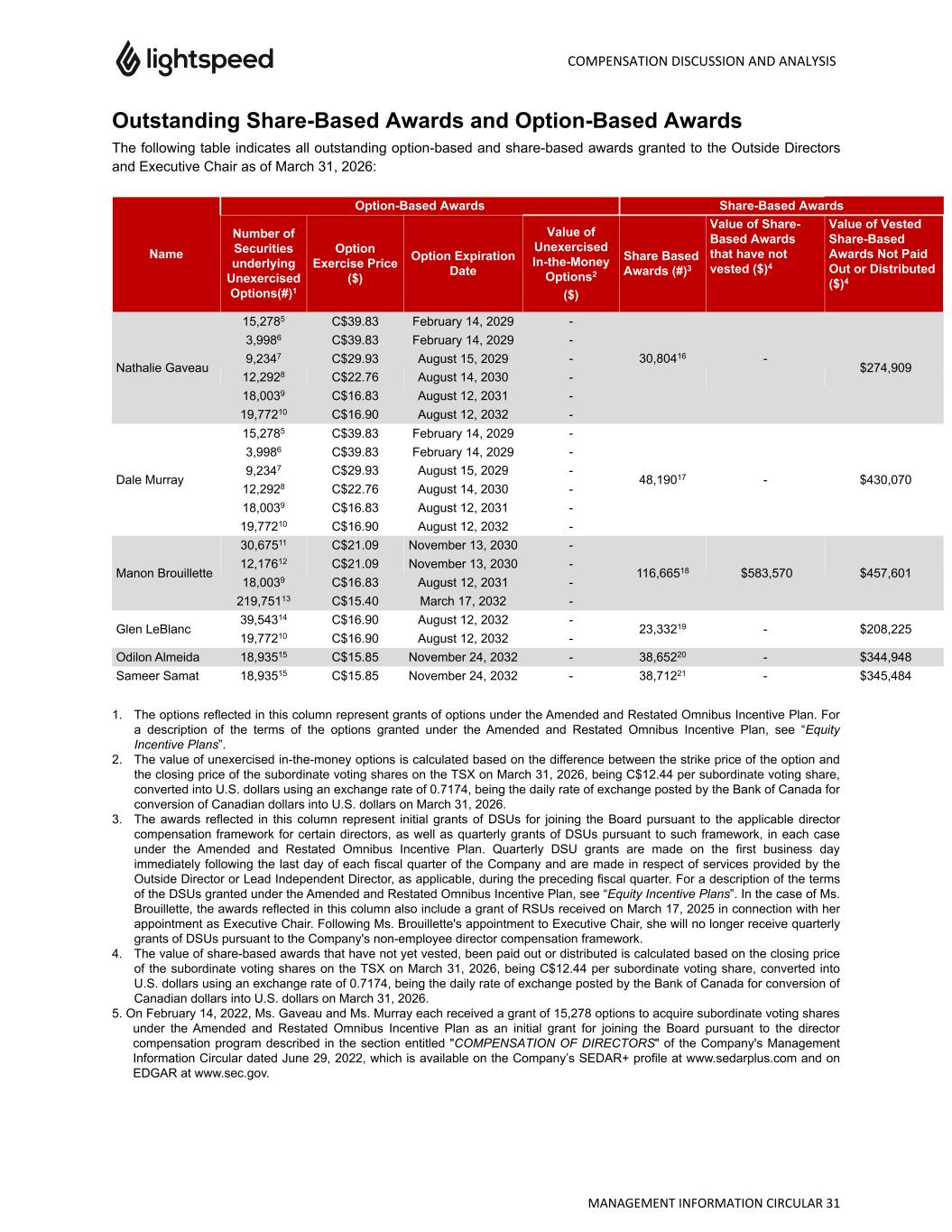
Outstanding Share-Based Awards and Option-Based Awards The following table indicates all outstanding option-based and share-based awards granted to the Outside Directors and Executive Chair as of March 31, 2026: Name Option-Based Awards Share-Based Awards Number of Securities underlying Unexercised Options(#)1 Option Exercise Price ($) Option Expiration Date Value of Unexercised In-the-Money Options2 ($) Share Based Awards (#)3 Value of Share- Based Awards that have not vested ($)4 Value of Vested Share-Based Awards Not Paid Out or Distributed ($)4 Nathalie Gaveau 15,2785 C$39.83 February 14, 2029 - 30,80416 - $274,909 3,9986 C$39.83 February 14, 2029 - 9,2347 C$29.93 August 15, 2029 - 12,2928 C$22.76 August 14, 2030 - 18,0039 C$16.83 August 12, 2031 - 19,77210 C$16.90 August 12, 2032 - Dale Murray 15,2785 C$39.83 February 14, 2029 - 48,19017 - $430,070 3,9986 C$39.83 February 14, 2029 - 9,2347 C$29.93 August 15, 2029 - 12,2928 C$22.76 August 14, 2030 - 18,0039 C$16.83 August 12, 2031 - 19,77210 C$16.90 August 12, 2032 - Manon Brouillette 30,67511 C$21.09 November 13, 2030 - 116,66518 $583,570 $457,601 12,17612 C$21.09 November 13, 2030 - 18,0039 C$16.83 August 12, 2031 - 219,75113 C$15.40 March 17, 2032 - Glen LeBlanc 39,54314 C$16.90 August 12, 2032 - 23,33219 - $208,225 19,77210 C$16.90 August 12, 2032 - Odilon Almeida 18,93515 C$15.85 November 24, 2032 - 38,65220 - $344,948 Sameer Samat 18,93515 C$15.85 November 24, 2032 - 38,71221 - $345,484 1. The options reflected in this column represent grants of options under the Amended and Restated Omnibus Incentive Plan. For a description of the terms of the options granted under the Amended and Restated Omnibus Incentive Plan, see “Equity Incentive Plans”. 2. The value of unexercised in-the-money options is calculated based on the difference between the strike price of the option and the closing price of the subordinate voting shares on the TSX on March 31, 2026, being C$12.44 per subordinate voting share, converted into U.S. dollars using an exchange rate of 0.7174, being the daily rate of exchange posted by the Bank of Canada for conversion of Canadian dollars into U.S. dollars on March 31, 2026. 3. The awards reflected in this column represent initial grants of DSUs for joining the Board pursuant to the applicable director compensation framework for certain directors, as well as quarterly grants of DSUs pursuant to such framework, in each case under the Amended and Restated Omnibus Incentive Plan. Quarterly DSU grants are made on the first business day immediately following the last day of each fiscal quarter of the Company and are made in respect of services provided by the Outside Director or Lead Independent Director, as applicable, during the preceding fiscal quarter. For a description of the terms of the DSUs granted under the Amended and Restated Omnibus Incentive Plan, see “Equity Incentive Plans”. In the case of Ms. Brouillette, the awards reflected in this column also include a grant of RSUs received on March 17, 2025 in connection with her appointment as Executive Chair. Following Ms. Brouillette's appointment to Executive Chair, she will no longer receive quarterly grants of DSUs pursuant to the Company's non-employee director compensation framework. 4. The value of share-based awards that have not yet vested, been paid out or distributed is calculated based on the closing price of the subordinate voting shares on the TSX on March 31, 2026, being C$12.44 per subordinate voting share, converted into U.S. dollars using an exchange rate of 0.7174, being the daily rate of exchange posted by the Bank of Canada for conversion of Canadian dollars into U.S. dollars on March 31, 2026. 5. On February 14, 2022, Ms. Gaveau and Ms. Murray each received a grant of 15,278 options to acquire subordinate voting shares under the Amended and Restated Omnibus Incentive Plan as an initial grant for joining the Board pursuant to the director compensation program described in the section entitled "COMPENSATION OF DIRECTORS" of the Company's Management Information Circular dated June 29, 2022, which is available on the Company’s SEDAR+ profile at www.sedarplus.com and on EDGAR at www.sec.gov. COMPENSATION DISCUSSION AND ANALYSIS MANAGEMENT INFORMATION CIRCULAR 31
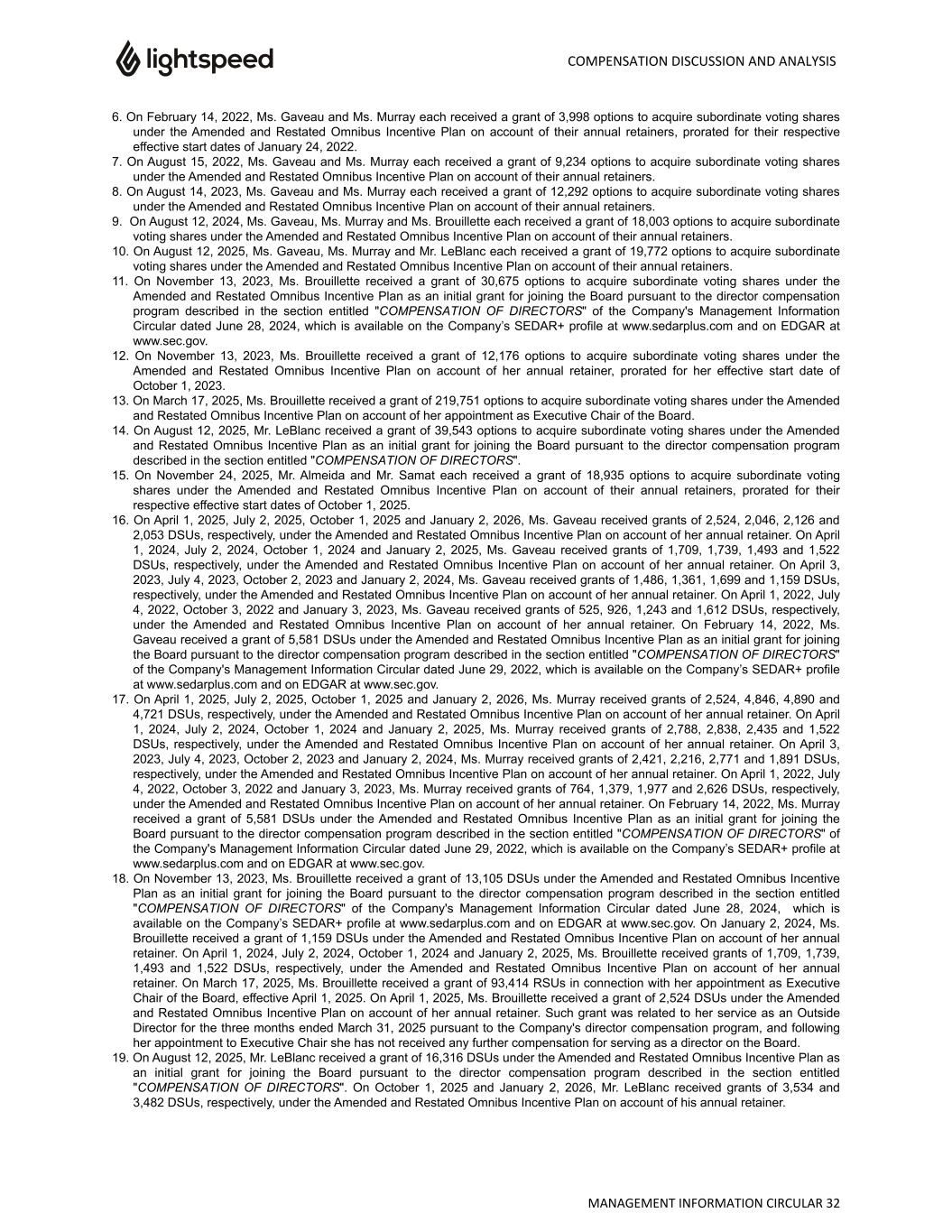
6. On February 14, 2022, Ms. Gaveau and Ms. Murray each received a grant of 3,998 options to acquire subordinate voting shares under the Amended and Restated Omnibus Incentive Plan on account of their annual retainers, prorated for their respective effective start dates of January 24, 2022. 7. On August 15, 2022, Ms. Gaveau and Ms. Murray each received a grant of 9,234 options to acquire subordinate voting shares under the Amended and Restated Omnibus Incentive Plan on account of their annual retainers. 8. On August 14, 2023, Ms. Gaveau and Ms. Murray each received a grant of 12,292 options to acquire subordinate voting shares under the Amended and Restated Omnibus Incentive Plan on account of their annual retainers. 9. On August 12, 2024, Ms. Gaveau, Ms. Murray and Ms. Brouillette each received a grant of 18,003 options to acquire subordinate voting shares under the Amended and Restated Omnibus Incentive Plan on account of their annual retainers. 10. On August 12, 2025, Ms. Gaveau, Ms. Murray and Mr. LeBlanc each received a grant of 19,772 options to acquire subordinate voting shares under the Amended and Restated Omnibus Incentive Plan on account of their annual retainers. 11. On November 13, 2023, Ms. Brouillette received a grant of 30,675 options to acquire subordinate voting shares under the Amended and Restated Omnibus Incentive Plan as an initial grant for joining the Board pursuant to the director compensation program described in the section entitled "COMPENSATION OF DIRECTORS" of the Company's Management Information Circular dated June 28, 2024, which is available on the Company’s SEDAR+ profile at www.sedarplus.com and on EDGAR at www.sec.gov. 12. On November 13, 2023, Ms. Brouillette received a grant of 12,176 options to acquire subordinate voting shares under the Amended and Restated Omnibus Incentive Plan on account of her annual retainer, prorated for her effective start date of October 1, 2023. 13. On March 17, 2025, Ms. Brouillette received a grant of 219,751 options to acquire subordinate voting shares under the Amended and Restated Omnibus Incentive Plan on account of her appointment as Executive Chair of the Board. 14. On August 12, 2025, Mr. LeBlanc received a grant of 39,543 options to acquire subordinate voting shares under the Amended and Restated Omnibus Incentive Plan as an initial grant for joining the Board pursuant to the director compensation program described in the section entitled "COMPENSATION OF DIRECTORS". 15. On November 24, 2025, Mr. Almeida and Mr. Samat each received a grant of 18,935 options to acquire subordinate voting shares under the Amended and Restated Omnibus Incentive Plan on account of their annual retainers, prorated for their respective effective start dates of October 1, 2025. 16. On April 1, 2025, July 2, 2025, October 1, 2025 and January 2, 2026, Ms. Gaveau received grants of 2,524, 2,046, 2,126 and 2,053 DSUs, respectively, under the Amended and Restated Omnibus Incentive Plan on account of her annual retainer. On April 1, 2024, July 2, 2024, October 1, 2024 and January 2, 2025, Ms. Gaveau received grants of 1,709, 1,739, 1,493 and 1,522 DSUs, respectively, under the Amended and Restated Omnibus Incentive Plan on account of her annual retainer. On April 3, 2023, July 4, 2023, October 2, 2023 and January 2, 2024, Ms. Gaveau received grants of 1,486, 1,361, 1,699 and 1,159 DSUs, respectively, under the Amended and Restated Omnibus Incentive Plan on account of her annual retainer. On April 1, 2022, July 4, 2022, October 3, 2022 and January 3, 2023, Ms. Gaveau received grants of 525, 926, 1,243 and 1,612 DSUs, respectively, under the Amended and Restated Omnibus Incentive Plan on account of her annual retainer. On February 14, 2022, Ms. Gaveau received a grant of 5,581 DSUs under the Amended and Restated Omnibus Incentive Plan as an initial grant for joining the Board pursuant to the director compensation program described in the section entitled "COMPENSATION OF DIRECTORS" of the Company's Management Information Circular dated June 29, 2022, which is available on the Company’s SEDAR+ profile at www.sedarplus.com and on EDGAR at www.sec.gov. 17. On April 1, 2025, July 2, 2025, October 1, 2025 and January 2, 2026, Ms. Murray received grants of 2,524, 4,846, 4,890 and 4,721 DSUs, respectively, under the Amended and Restated Omnibus Incentive Plan on account of her annual retainer. On April 1, 2024, July 2, 2024, October 1, 2024 and January 2, 2025, Ms. Murray received grants of 2,788, 2,838, 2,435 and 1,522 DSUs, respectively, under the Amended and Restated Omnibus Incentive Plan on account of her annual retainer. On April 3, 2023, July 4, 2023, October 2, 2023 and January 2, 2024, Ms. Murray received grants of 2,421, 2,216, 2,771 and 1,891 DSUs, respectively, under the Amended and Restated Omnibus Incentive Plan on account of her annual retainer. On April 1, 2022, July 4, 2022, October 3, 2022 and January 3, 2023, Ms. Murray received grants of 764, 1,379, 1,977 and 2,626 DSUs, respectively, under the Amended and Restated Omnibus Incentive Plan on account of her annual retainer. On February 14, 2022, Ms. Murray received a grant of 5,581 DSUs under the Amended and Restated Omnibus Incentive Plan as an initial grant for joining the Board pursuant to the director compensation program described in the section entitled "COMPENSATION OF DIRECTORS" of the Company's Management Information Circular dated June 29, 2022, which is available on the Company’s SEDAR+ profile at www.sedarplus.com and on EDGAR at www.sec.gov. 18. On November 13, 2023, Ms. Brouillette received a grant of 13,105 DSUs under the Amended and Restated Omnibus Incentive Plan as an initial grant for joining the Board pursuant to the director compensation program described in the section entitled "COMPENSATION OF DIRECTORS" of the Company's Management Information Circular dated June 28, 2024, which is available on the Company’s SEDAR+ profile at www.sedarplus.com and on EDGAR at www.sec.gov. On January 2, 2024, Ms. Brouillette received a grant of 1,159 DSUs under the Amended and Restated Omnibus Incentive Plan on account of her annual retainer. On April 1, 2024, July 2, 2024, October 1, 2024 and January 2, 2025, Ms. Brouillette received grants of 1,709, 1,739, 1,493 and 1,522 DSUs, respectively, under the Amended and Restated Omnibus Incentive Plan on account of her annual retainer. On March 17, 2025, Ms. Brouillette received a grant of 93,414 RSUs in connection with her appointment as Executive Chair of the Board, effective April 1, 2025. On April 1, 2025, Ms. Brouillette received a grant of 2,524 DSUs under the Amended and Restated Omnibus Incentive Plan on account of her annual retainer. Such grant was related to her service as an Outside Director for the three months ended March 31, 2025 pursuant to the Company's director compensation program, and following her appointment to Executive Chair she has not received any further compensation for serving as a director on the Board. 19. On August 12, 2025, Mr. LeBlanc received a grant of 16,316 DSUs under the Amended and Restated Omnibus Incentive Plan as an initial grant for joining the Board pursuant to the director compensation program described in the section entitled "COMPENSATION OF DIRECTORS". On October 1, 2025 and January 2, 2026, Mr. LeBlanc received grants of 3,534 and 3,482 DSUs, respectively, under the Amended and Restated Omnibus Incentive Plan on account of his annual retainer. COMPENSATION DISCUSSION AND ANALYSIS MANAGEMENT INFORMATION CIRCULAR 32
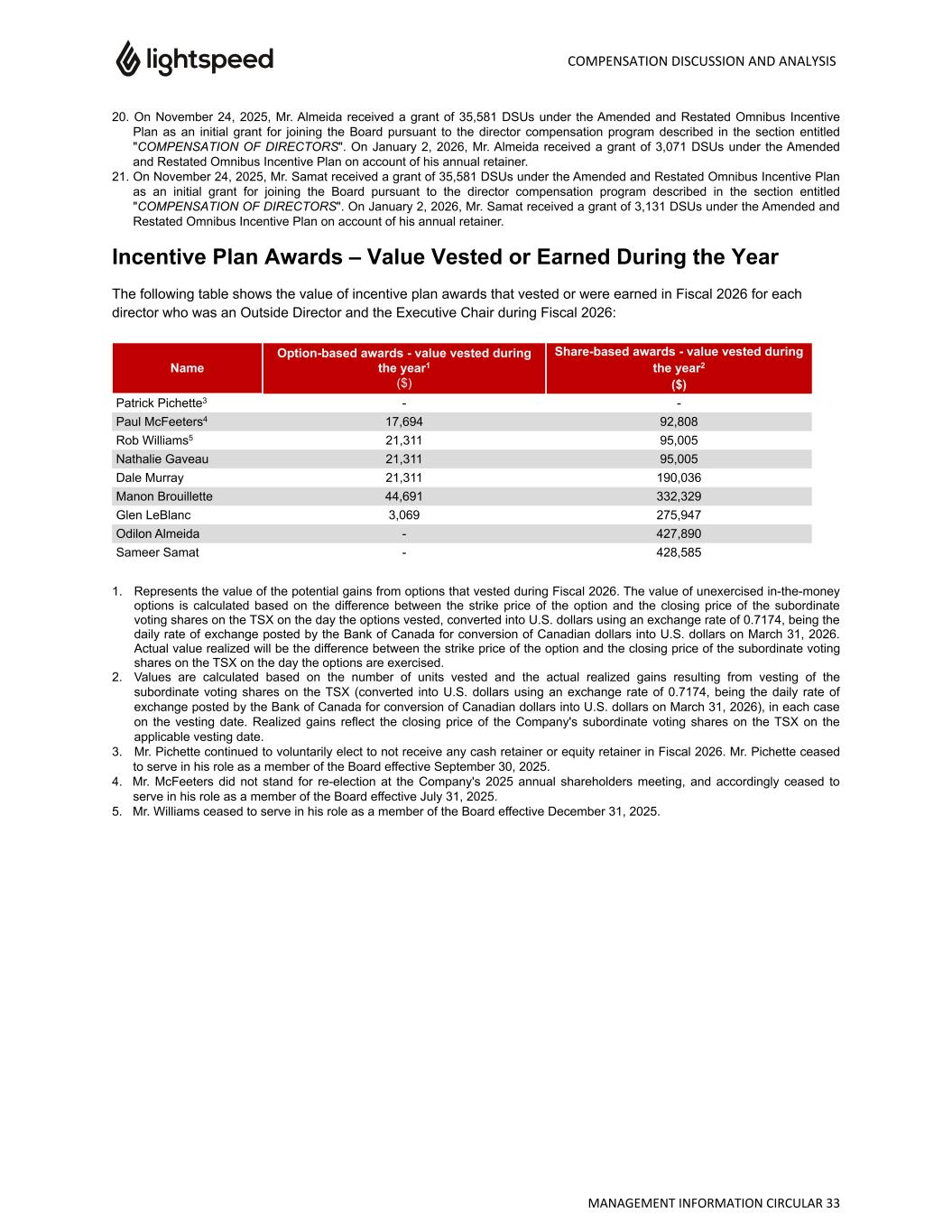
20. On November 24, 2025, Mr. Almeida received a grant of 35,581 DSUs under the Amended and Restated Omnibus Incentive Plan as an initial grant for joining the Board pursuant to the director compensation program described in the section entitled "COMPENSATION OF DIRECTORS". On January 2, 2026, Mr. Almeida received a grant of 3,071 DSUs under the Amended and Restated Omnibus Incentive Plan on account of his annual retainer. 21. On November 24, 2025, Mr. Samat received a grant of 35,581 DSUs under the Amended and Restated Omnibus Incentive Plan as an initial grant for joining the Board pursuant to the director compensation program described in the section entitled "COMPENSATION OF DIRECTORS". On January 2, 2026, Mr. Samat received a grant of 3,131 DSUs under the Amended and Restated Omnibus Incentive Plan on account of his annual retainer. Incentive Plan Awards – Value Vested or Earned During the Year The following table shows the value of incentive plan awards that vested or were earned in Fiscal 2026 for each director who was an Outside Director and the Executive Chair during Fiscal 2026: Name Option-based awards - value vested during the year1 ($) Share-based awards - value vested during the year2 ($) Patrick Pichette3 - - Paul McFeeters4 17,694 92,808 Rob Williams5 21,311 95,005 Nathalie Gaveau 21,311 95,005 Dale Murray 21,311 190,036 Manon Brouillette 44,691 332,329 Glen LeBlanc 3,069 275,947 Odilon Almeida - 427,890 Sameer Samat - 428,585 1. Represents the value of the potential gains from options that vested during Fiscal 2026. The value of unexercised in-the-money options is calculated based on the difference between the strike price of the option and the closing price of the subordinate voting shares on the TSX on the day the options vested, converted into U.S. dollars using an exchange rate of 0.7174, being the daily rate of exchange posted by the Bank of Canada for conversion of Canadian dollars into U.S. dollars on March 31, 2026. Actual value realized will be the difference between the strike price of the option and the closing price of the subordinate voting shares on the TSX on the day the options are exercised. 2. Values are calculated based on the number of units vested and the actual realized gains resulting from vesting of the subordinate voting shares on the TSX (converted into U.S. dollars using an exchange rate of 0.7174, being the daily rate of exchange posted by the Bank of Canada for conversion of Canadian dollars into U.S. dollars on March 31, 2026), in each case on the vesting date. Realized gains reflect the closing price of the Company's subordinate voting shares on the TSX on the applicable vesting date. 3. Mr. Pichette continued to voluntarily elect to not receive any cash retainer or equity retainer in Fiscal 2026. Mr. Pichette ceased to serve in his role as a member of the Board effective September 30, 2025. 4. Mr. McFeeters did not stand for re-election at the Company's 2025 annual shareholders meeting, and accordingly ceased to serve in his role as a member of the Board effective July 31, 2025. 5. Mr. Williams ceased to serve in his role as a member of the Board effective December 31, 2025. COMPENSATION DISCUSSION AND ANALYSIS MANAGEMENT INFORMATION CIRCULAR 33
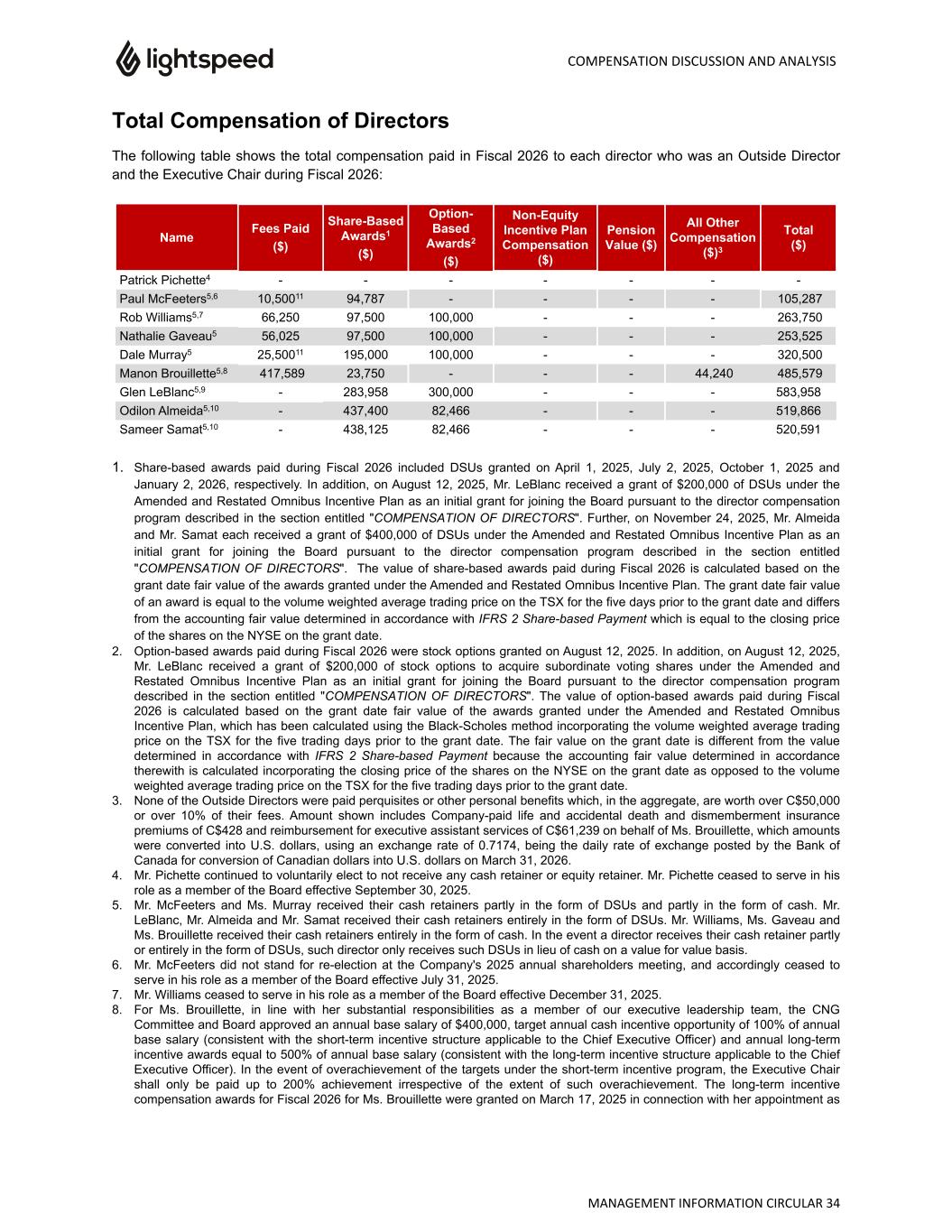
Total Compensation of Directors The following table shows the total compensation paid in Fiscal 2026 to each director who was an Outside Director and the Executive Chair during Fiscal 2026: Name Fees Paid ($) Share-Based Awards1 ($) Option- Based Awards2 ($) Non-Equity Incentive Plan Compensation ($) Pension Value ($) All Other Compensation ($)3 Total ($) Patrick Pichette4 - - - - - - - Paul McFeeters5,6 10,50011 94,787 - - - - 105,287 Rob Williams5,7 66,250 97,500 100,000 - - - 263,750 Nathalie Gaveau5 56,025 97,500 100,000 - - - 253,525 Dale Murray5 25,50011 195,000 100,000 - - - 320,500 Manon Brouillette5,8 417,589 23,750 - - - 44,240 485,579 Glen LeBlanc5,9 - 283,958 300,000 - - - 583,958 Odilon Almeida5,10 - 437,400 82,466 - - - 519,866 Sameer Samat5,10 - 438,125 82,466 - - - 520,591 1. Share-based awards paid during Fiscal 2026 included DSUs granted on April 1, 2025, July 2, 2025, October 1, 2025 and January 2, 2026, respectively. In addition, on August 12, 2025, Mr. LeBlanc received a grant of $200,000 of DSUs under the Amended and Restated Omnibus Incentive Plan as an initial grant for joining the Board pursuant to the director compensation program described in the section entitled "COMPENSATION OF DIRECTORS". Further, on November 24, 2025, Mr. Almeida and Mr. Samat each received a grant of $400,000 of DSUs under the Amended and Restated Omnibus Incentive Plan as an initial grant for joining the Board pursuant to the director compensation program described in the section entitled "COMPENSATION OF DIRECTORS". The value of share-based awards paid during Fiscal 2026 is calculated based on the grant date fair value of the awards granted under the Amended and Restated Omnibus Incentive Plan. The grant date fair value of an award is equal to the volume weighted average trading price on the TSX for the five days prior to the grant date and differs from the accounting fair value determined in accordance with IFRS 2 Share-based Payment which is equal to the closing price of the shares on the NYSE on the grant date. 2. Option-based awards paid during Fiscal 2026 were stock options granted on August 12, 2025. In addition, on August 12, 2025, Mr. LeBlanc received a grant of $200,000 of stock options to acquire subordinate voting shares under the Amended and Restated Omnibus Incentive Plan as an initial grant for joining the Board pursuant to the director compensation program described in the section entitled "COMPENSATION OF DIRECTORS". The value of option-based awards paid during Fiscal 2026 is calculated based on the grant date fair value of the awards granted under the Amended and Restated Omnibus Incentive Plan, which has been calculated using the Black-Scholes method incorporating the volume weighted average trading price on the TSX for the five trading days prior to the grant date. The fair value on the grant date is different from the value determined in accordance with IFRS 2 Share-based Payment because the accounting fair value determined in accordance therewith is calculated incorporating the closing price of the shares on the NYSE on the grant date as opposed to the volume weighted average trading price on the TSX for the five trading days prior to the grant date. 3. None of the Outside Directors were paid perquisites or other personal benefits which, in the aggregate, are worth over C$50,000 or over 10% of their fees. Amount shown includes Company-paid life and accidental death and dismemberment insurance premiums of C$428 and reimbursement for executive assistant services of C$61,239 on behalf of Ms. Brouillette, which amounts were converted into U.S. dollars, using an exchange rate of 0.7174, being the daily rate of exchange posted by the Bank of Canada for conversion of Canadian dollars into U.S. dollars on March 31, 2026. 4. Mr. Pichette continued to voluntarily elect to not receive any cash retainer or equity retainer. Mr. Pichette ceased to serve in his role as a member of the Board effective September 30, 2025. 5. Mr. McFeeters and Ms. Murray received their cash retainers partly in the form of DSUs and partly in the form of cash. Mr. LeBlanc, Mr. Almeida and Mr. Samat received their cash retainers entirely in the form of DSUs. Mr. Williams, Ms. Gaveau and Ms. Brouillette received their cash retainers entirely in the form of cash. In the event a director receives their cash retainer partly or entirely in the form of DSUs, such director only receives such DSUs in lieu of cash on a value for value basis. 6. Mr. McFeeters did not stand for re-election at the Company's 2025 annual shareholders meeting, and accordingly ceased to serve in his role as a member of the Board effective July 31, 2025. 7. Mr. Williams ceased to serve in his role as a member of the Board effective December 31, 2025. 8. For Ms. Brouillette, in line with her substantial responsibilities as a member of our executive leadership team, the CNG Committee and Board approved an annual base salary of $400,000, target annual cash incentive opportunity of 100% of annual base salary (consistent with the short-term incentive structure applicable to the Chief Executive Officer) and annual long-term incentive awards equal to 500% of annual base salary (consistent with the long-term incentive structure applicable to the Chief Executive Officer). In the event of overachievement of the targets under the short-term incentive program, the Executive Chair shall only be paid up to 200% achievement irrespective of the extent of such overachievement. The long-term incentive compensation awards for Fiscal 2026 for Ms. Brouillette were granted on March 17, 2025 in connection with her appointment as COMPENSATION DISCUSSION AND ANALYSIS MANAGEMENT INFORMATION CIRCULAR 34
Executive Chair. The base salary and all other compensation of Ms. Brouillette in respect of her role as Executive Chair were paid in Canadian dollars for Fiscal 2026. Such Fiscal 2026 amounts reported in the above table have been converted to U.S. dollars using an exchange rate of 0.7174, being the average rate of exchange posted by the Bank of Canada for conversion of Canadian dollars into U.S. dollars on March 31, 2026 (the last trading day in Fiscal 2026). Ms. Brouillette was paid C$20,133 in arrears pursuant to her cash retainer for services provided solely as a member of the Board in the three months preceding April 1, 2025. Further, Ms. Brouillette was paid $23,750 in the form of DSUs pursuant to her equity retainer for services provided solely as a member of the Board in the three months preceding April 1, 2025. 9. On June 27, 2025, the Company announced the appointment of Mr. LeBlanc to its board of directors, which appointment was effective on July 1, 2025. 10. On September 25, 2025, the Company announced the appointments of Messrs. Almeida and Samat to its board of directors, which appointments were effective on October 1, 2025. 11. The fees paid to Mr. McFeeters and Ms. Murray during Fiscal 2026 include payments amounting to $10,500 each in consideration for their services on a special committee of the Board in connection with the Company's strategic review, the results of which were announced on February 6, 2025. These fees were paid pursuant to a compensation framework for members of the special committee approved by the CNG Committee and the Board, in consultation with Compensia. The compensation framework provided that the special committee members would receive: (i) a retainer of $20,000 in the case of the committee chair and $10,000 in the case of committee members, in addition to (ii) a meeting fee of $1,750 per meeting for each meeting of the special committee. Mr. Pichette was the chair of the special committee, and elected not to receive any compensation in that capacity. Outside Directors did not receive non-equity incentive plan compensation, pensions or any other compensation. COMPENSATION DISCUSSION AND ANALYSIS MANAGEMENT INFORMATION CIRCULAR 35
EXECUTIVE COMPENSATION Introduction The following discussion describes our executive compensation philosophy, objectives, policies and practices that apply to the compensation paid to our Chief Executive Officer, Chief Financial Officer, President, Chief Product and Technology Officer, Chief People Officer and Executive Chair of the Company (collectively, the “Named Executive Officers” or “NEOs”), namely: • Dax Dasilva, Chief Executive Officer; • Asha Hotchandani Bakshani, Chief Financial Officer; • Jean-David Saint-Martin, President*; • John Shapiro, Chief Product and Technology Officer; • Shirvani Mudaly, Chief People Officer; and • Manon Brouillette, Executive Chair**. Full year compensation is presented in the Summary Compensation Table below. See "Named Executive Officers' Compensation – Summary Compensation Table". *On November 13, 2025, the Company announced the appointment of Gabriel Benavides as Chief Revenue Officer. In addition, the Company announced that Jean-David Saint-Martin would step down after the end of Fiscal 2026 to focus on mentoring and investing in early-stage founders within the Canadian technology ecosystem. **Disclosure with respect to Ms. Brouillette's service to the Company is included in the Executive Compensation section and the Director Compensation section of this Circular. Overview Lightspeed operates in a dynamic and rapidly evolving market. To succeed in this environment and to achieve its business and financial objectives, the Company needs to attract, retain and engage a highly talented team of executive officers. We expect our team to possess and demonstrate strong leadership and management capabilities, as well as foster our culture, which is at the foundation of our success and remains a pivotal part of our everyday operations. We will continue to evaluate our philosophy and compensation program as circumstances require and plan to continue to review compensation on an annual basis. As part of this review process, we expect to be guided by the philosophy and objectives outlined above, as well as other factors which may become relevant, such as the competitive market for experienced and qualified senior executives, market compensation data gathered from peer comparator groups of public companies with similar attributes to us and the relative positioning of our compensation structure, our Company's overall performance, our Company's long-term strategy, the cost to us if we were required to find a replacement for a key employee and the general macro-economic environment facing the Company. COMPENSATION DISCUSSION AND ANALYSIS MANAGEMENT INFORMATION CIRCULAR 36
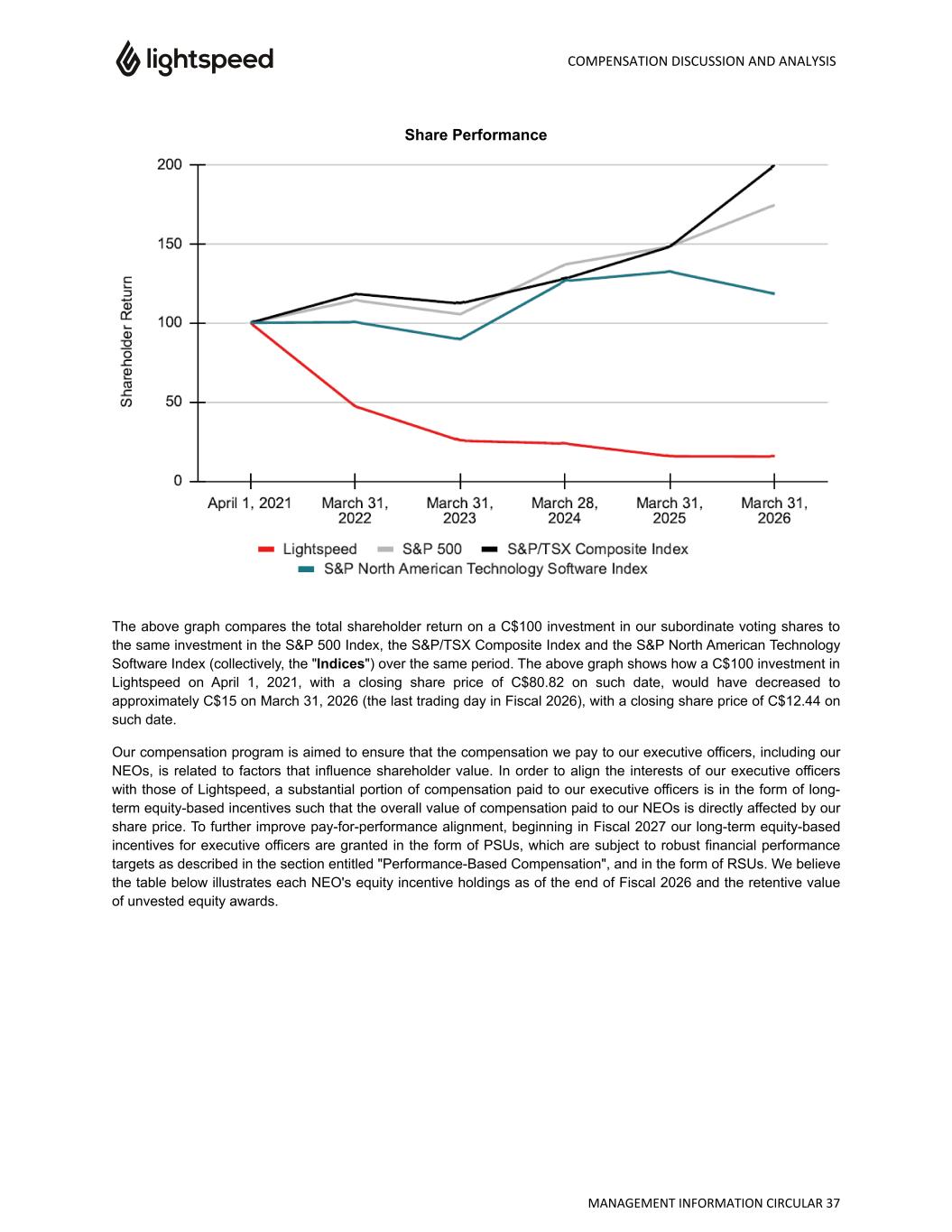
Share Performance The above graph compares the total shareholder return on a C$100 investment in our subordinate voting shares to the same investment in the S&P 500 Index, the S&P/TSX Composite Index and the S&P North American Technology Software Index (collectively, the "Indices") over the same period. The above graph shows how a C$100 investment in Lightspeed on April 1, 2021, with a closing share price of C$80.82 on such date, would have decreased to approximately C$15 on March 31, 2026 (the last trading day in Fiscal 2026), with a closing share price of C$12.44 on such date. Our compensation program is aimed to ensure that the compensation we pay to our executive officers, including our NEOs, is related to factors that influence shareholder value. In order to align the interests of our executive officers with those of Lightspeed, a substantial portion of compensation paid to our executive officers is in the form of long- term equity-based incentives such that the overall value of compensation paid to our NEOs is directly affected by our share price. To further improve pay-for-performance alignment, beginning in Fiscal 2027 our long-term equity-based incentives for executive officers are granted in the form of PSUs, which are subject to robust financial performance targets as described in the section entitled "Performance-Based Compensation", and in the form of RSUs. We believe the table below illustrates each NEO's equity incentive holdings as of the end of Fiscal 2026 and the retentive value of unvested equity awards. COMPENSATION DISCUSSION AND ANALYSIS MANAGEMENT INFORMATION CIRCULAR 37
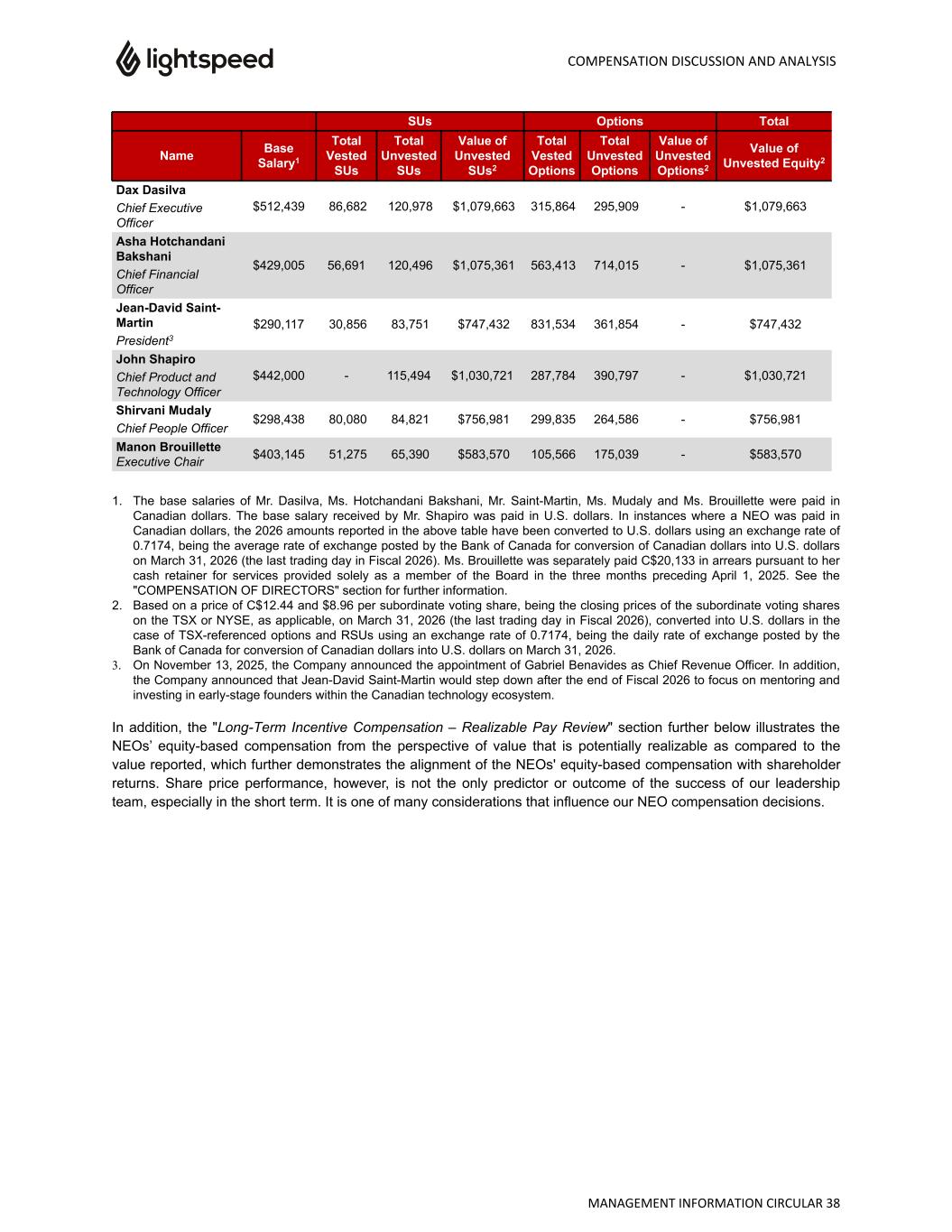
SUs Options Total Name Base Salary1 Total Vested SUs Total Unvested SUs Value of Unvested SUs2 Total Vested Options Total Unvested Options Value of Unvested Options2 Value of Unvested Equity2 Dax Dasilva Chief Executive Officer $512,439 86,682 120,978 $1,079,663 315,864 295,909 - $1,079,663 Asha Hotchandani Bakshani Chief Financial Officer $429,005 56,691 120,496 $1,075,361 563,413 714,015 - $1,075,361 Jean-David Saint- Martin President3 $290,117 30,856 83,751 $747,432 831,534 361,854 - $747,432 John Shapiro Chief Product and Technology Officer $442,000 - 115,494 $1,030,721 287,784 390,797 - $1,030,721 Shirvani Mudaly Chief People Officer $298,438 80,080 84,821 $756,981 299,835 264,586 - $756,981 Manon Brouillette Executive Chair $403,145 51,275 65,390 $583,570 105,566 175,039 - $583,570 1. The base salaries of Mr. Dasilva, Ms. Hotchandani Bakshani, Mr. Saint-Martin, Ms. Mudaly and Ms. Brouillette were paid in Canadian dollars. The base salary received by Mr. Shapiro was paid in U.S. dollars. In instances where a NEO was paid in Canadian dollars, the 2026 amounts reported in the above table have been converted to U.S. dollars using an exchange rate of 0.7174, being the average rate of exchange posted by the Bank of Canada for conversion of Canadian dollars into U.S. dollars on March 31, 2026 (the last trading day in Fiscal 2026). Ms. Brouillette was separately paid C$20,133 in arrears pursuant to her cash retainer for services provided solely as a member of the Board in the three months preceding April 1, 2025. See the "COMPENSATION OF DIRECTORS" section for further information. 2. Based on a price of C$12.44 and $8.96 per subordinate voting share, being the closing prices of the subordinate voting shares on the TSX or NYSE, as applicable, on March 31, 2026 (the last trading day in Fiscal 2026), converted into U.S. dollars in the case of TSX-referenced options and RSUs using an exchange rate of 0.7174, being the daily rate of exchange posted by the Bank of Canada for conversion of Canadian dollars into U.S. dollars on March 31, 2026. 3. On November 13, 2025, the Company announced the appointment of Gabriel Benavides as Chief Revenue Officer. In addition, the Company announced that Jean-David Saint-Martin would step down after the end of Fiscal 2026 to focus on mentoring and investing in early-stage founders within the Canadian technology ecosystem. In addition, the "Long-Term Incentive Compensation – Realizable Pay Review" section further below illustrates the NEOs’ equity-based compensation from the perspective of value that is potentially realizable as compared to the value reported, which further demonstrates the alignment of the NEOs' equity-based compensation with shareholder returns. Share price performance, however, is not the only predictor or outcome of the success of our leadership team, especially in the short term. It is one of many considerations that influence our NEO compensation decisions. COMPENSATION DISCUSSION AND ANALYSIS MANAGEMENT INFORMATION CIRCULAR 38
Compensation Discussion and Analysis Compensation Philosophy and Objectives Lightspeed's approach to compensation is designed to attract, retain, and motivate high-performing executive officers and talent who can drive growth, innovation, and long-term stakeholder value. We aim to reward performance through multiregional market-competitive compensation programs that balance fixed and variable pay components, fairness, affordability and parity. The Company’s compensation framework aims to ensure that a significant portion of compensation is “at-risk” and tracks factors that influence Company performance and stakeholder value. Major components include base salary, and short-term and long-term incentive plans. The Lightspeed executive compensation program is designed to achieve the following objectives: • provide market-competitive compensation opportunities to attract, hire, retain and motivate high performing and experienced executive officers and talent, whose knowledge, skills and level of impact are critical to our success; • provide a compensation framework that is fair, equitable and consistent across the Company, considering the relative criticality of roles and scope of responsibilities; • align the interests of executive officers and talent with those of the Company’s stakeholders by designing compensation to be affordable, linking a meaningful portion of compensation to the achievement of short- term and long-term business objectives that aim to maximize value for the Company and its shareholders, and ensuring that a significant portion of compensation for executive officers and other leaders is in the form of long-term equity-based incentives; and • motivate executive officers and employees to achieve the Company's strategic and financial goals with pay- for-performance alignment. The Company recently adopted meaningful changes to its executive compensation program as part of its focus to more closely align executive compensation with performance, including the adoption of executive share ownership guidelines and PSUs with rigorous performance targets as part of the Company's LTIP beginning in Fiscal 2027. Fiscal 2026 Company Performance Highlights In the face of constantly evolving geopolitical and macroeconomic uncertainty, Lightspeed achieved total revenue of approximately $1,227 million for Fiscal 2026 and gross profit of approximately $527 million. In addition, the Company had positive cash flow from operating activities of approximately $55.5 million and Adjusted Free Cash Flow5 of approximately $18.2 million, marking a significant milestone as the Company delivered its first year of positive Adjusted Free Cash Flow5 while continuing to invest in its multi-year strategy. The Company is successfully executing its transformation strategy to focus on growth among retail customers in North America and hospitality customers in Europe (customers where we believe we have the best product market fit and right-to-win). In Fiscal 2026, the Company grew Customer Locations6 in its growth engines (retail customers in North America and hospitality customers in Europe) by 11% year-over-year. Lightspeed continued to invest in product and technology to provide exceptional customer experiences, and launched over 500 high-impact solutions and features in the year. Notably, the Company introduced Lightspeed AI, an AI- powered intelligence with new conversational assistants within both its Retail and Restaurant flagship offering. In Lightspeed Wholesale, it launched a new Marketplace experience, offering a centralized shopping and ordering experience allowing retailers to browse, compare and purchase products across 4,000 brands in one consistent and intuitive experience. In Lightspeed Restaurant, it introduced Tempo – a service-pacing intelligence that transforms COMPENSATION DISCUSSION AND ANALYSIS MANAGEMENT INFORMATION CIRCULAR 39 5 Adjusted Free Cash Flow is not a recognized measure under IFRS Accounting Standards and does not have a standardized meaning prescribed by IFRS Accounting Standards and is therefore not necessarily comparable to similar measures presented by other companies. The IFRS Accounting Standards measure most directly comparable to Adjusted Free Cash Flow presented in our financial statements is cash flows from (used in) operating activities. Please refer to Schedule “B” – “Non-IFRS Measures and Reconciliation of Non-IFRS Measures” of this management information circular for the definition of Adjusted Free Cash Flow and a reconciliation to cash flows from (used in) operating activities. 6 Key Performance Indicator. Please refer to Schedule “C” – “Key Performance Indicators” of this management information circular for the definition of Customer Locations.
how restaurants manage the rhythm of service, enabling operators to deliver consistently elevated dining experiences at scale. With its investments in product and technology and its scaling outbound go-to-market motion, the Company signed complex customers, expanded its presence within key verticals, and also saw increased adoption of its payment processing solutions. These important results, among other achievements in Fiscal 2026, are a testament to the talent and leadership of Lightspeed's senior management team in driving and delivering disciplined growth year-over-year, which Lightspeed believes is important for long term shareholder value creation. Compensation Governance We endeavor to maintain strong governance standards in our policies and practices related to executive compensation. Below is a summary of our key compensation and corporate governance practices. Compensation and Governance Practices Highlights ✓ Shareholder engagement Actively engage in dialogue with our shareholders and incorporate feedback into our executive officer compensation program and broader employee equity incentive program. In Fiscal 2026, the Chair of the CNG Committee and Executive Chair met with many of our largest shareholders (representing approximately 50% of our shares) to discuss our executive compensation program and equity incentive plan—on top of our regular meetings with our investors. ✓ Long-term incentives aligned with creating long-term, sustained shareholder value With respect to the stock options that were granted to NEOs in Fiscal 2026, such options vest over a four-year period. NEOs do not realize the intended benefit of such options unless the Company delivers strong performance that creates sustained shareholder value over time. In addition, a portion of compensation for the Chief Financial Officer in Fiscal 2026 was at risk, based on both the Company's absolute performance and performance relative to a benchmark index. We redesigned our LTIP program to strengthen our pay-for-performance alignment, including ceasing the use of stock options and introducing PSUs in our LTIP program beginning in Fiscal 2027. As detailed in the section entitled “Performance-Based Compensation”, these PSUs are subject to rigorous financial performance criteria that provide upside opportunity for overachievement (subject to maximum payout caps) but can also result in awards being forfeited entirely in the event performance criteria is not sufficiently met. ✓ One-year cliffs for LTIP vesting Significant use of one-year cliffs before vesting of equity incentive awards to new hires to promote retention. Performance-based stock options granted to the Chief Financial Officer in Fiscal 2022 have greater than one year vesting cliff. Beginning in Fiscal 2027, the PSUs in our LTIP program will be subject to a one-year cliff before any shares vest. PSUs will be earned, if at all, based on achievement against rigorous Fiscal 2027 financial performance criteria. One-third of any PSUs earned will vest following conclusion of the performance period. The remaining two-thirds of the award, less any awards forfeited, will vest on a quarterly basis over the subsequent two years to further promote executives’ long-term focus and retention. COMPENSATION DISCUSSION AND ANALYSIS MANAGEMENT INFORMATION CIRCULAR 40
✓ Rigorous performance-based STIP Short-term incentive compensation is paid to NEOs based on the Company's achievements against rigorous revenue, Adjusted EBITDA, Adjusted Free Cash Flow and net customer location growth targets. The CNG Committee and Board review targets for short-term incentive compensation annually to ensure that they continue to align with the Company's overall strategy and shareholder value creation. In Fiscal 2026, the CNG Committee and Board also approved an incentive compensation program based on measurable performance against the Company's transformation strategy. Payout under such program was subject to stretch revenue, Adjusted EBITDA, and Adjusted Free Cash flow hurdles. The Adjusted EBITDA target required higher achievement than the Adjusted EBITDA short-term incentive compensation target, and the program was designed to be self-funding based on high Adjusted EBITDA achievement. Due to these rigorous hurdles, no payout was received by executive officers under this transformation bonus program as detailed under the section entitled "Transformation Bonus Program". ✓ Stringent share ownership requirements Our CEO is required to own, directly or indirectly, a minimum of securities of the Company representing five times his or her annual base salary, through subordinate voting shares, restricted share units ("RSUs") or PSUs. To further strengthen alignment between executive interests and those of our shareholders, we expanded the application of our share ownership requirements to all executive officers (chief executive-level employees), requiring them to own, directly or indirectly, a minimum of securities of the Company representing 2 times their base salary (and 5 times base salary in the case of our Executive Chair), such ownership to be obtained within 5 years of the later of April 1, 2026 or any new hire start date. ✓ Advisory vote on NEO compensation The Company presents a non-binding advisory vote on the Company's approach to executive compensation annually. The Board and CNG Committee takes into the account the outcome of the advisory vote when considering future executive compensation decisions. At the last annual shareholders meeting, the Company received 98.60% votes in support of the Company's approach to executive compensation in the fiscal year ended March 31, 2025 ("Fiscal 2025"). ✓ Regular reviews of executive officer compensation and peer group data The CNG Committee and the Board, with the advice of management and outside advisors, review at least annually executive officer compensation and utilize peer public company data in such review. ✓ Independent compensation consultant The CNG Committee and Board selected Compensia, a US-based independent compensation consulting firm, to provide advice in connection with director and executive officer compensation matters in Fiscal 2026. ✓ CNG Committee Oversight The CNG Committee reviews and pre-approves employee compensation arrangements above certain value thresholds and for all executive officers, including the Chief Executive Officer, Executive Chair, Chief Financial Officer and all other Named Executive Officers. ✓ Robust compensation risk oversight The Company has comprehensive and robust risk management practices, including hedging prohibitions and clawback policies as discussed below. The Company has adopted a Delegated Authority Framework ("DOA") providing robust oversight by the CNG Committee and the Board for certain compensation and equity incentive commitments made by management. In particular, the DOA mandates that any compensation or equity incentive commitments to executive officers must be approved by the Board, and that any equity incentive commitments must be made subject to Board approval. COMPENSATION DISCUSSION AND ANALYSIS MANAGEMENT INFORMATION CIRCULAR 41
✓ Commitment to Predictable and Transparent Compensation We have reaffirmed our commitment to delivering STIP and LTIP compensation solely through established frameworks that are approved by the Board. We did not exercise any discretion outside of these Board- approved frameworks in awarding executive officers STIP or LTIP compensation in Fiscal 2026. Compensation Risk Oversight The Board provides regular oversight of Lightspeed’s risk management practices, and delegates to the CNG Committee responsibility for the Company’s overall compensation philosophy and overseeing matters related to executive and director compensation. In respect of Fiscal 2026, the CNG Committee and Board concluded that there were no identified risks arising from the Company’s compensation policies or practices that are likely to have a material adverse effect on the Company. The CNG Committee and Board have concluded that the Company has policies and practices to ensure that management does not have incentives to take inappropriate or excessive risks including, among other things, the following: • an appropriate balance of fixed and variable compensation, and an appropriate weighting of share-based compensation and short- and long-term compensation; • quantitative metrics to determine the amount of awards earned by NEOs under Lightspeed’s short-term incentive compensation plan; • review and approval by the CNG Committee of employee compensation arrangements above certain value and seniority thresholds; • Board and CNG Committee oversight to adjust the amount (if any), targets for and timing of the payout of awards under the Company’s STIP, to take into account the quality of results and the level of risk required to achieve results (for the avoidance of doubt the CNG Committee did not exercise any discretion outside of Board-approved frameworks in awarding executive officers STIP or LTIP compensation in Fiscal 2026); • retention of independent compensation consultants and advisors to deliver independent advice on executive compensation, director compensation and related matters; • clawback policies (as described below); • periodic share-based compensation awards with overlapping vesting periods to provide ongoing retention incentives to management and long-term share-based exposure to the risks management undertakes; • performance-based option grant designed for Lightspeed's Chief Financial Officer to reflect a strong “pay for performance” philosophy; • the introduction of PSUs into our LTIP program beginning in Fiscal 2027, which are subject to quantitative, financial performance criteria and vest over a three-year period; • the expansion of share ownership requirements in Fiscal 2027 to require all executive officers, in addition to our CEO, to own, directly or indirectly, a minimum of securities of the Company representing 2 times their base salary (5 times their base salary in the case of our CEO and our Executive Chair); • an insider trading policy that prohibits hedging (as described below); • a DOA providing robust oversight by the CNG Committee and the Board for certain compensation and equity incentive commitments made by management, including by mandating that any such commitments to executive officers must be approved by the Board and that any equity incentive commitments must be made subject to Board approval; • a comprehensive Code of Conduct and Whistleblower Policy that encourages reporting imprudent corporate behavior; and • a CNG Committee comprised entirely of independent directors. Hedging Prohibition The Company’s insider trading policy provides that all insiders and certain employees of Lightspeed, including its directors, officers and employees in a financial reporting oversight role or investor relations role, are prohibited from buying, selling or entering into (i) any short sale of securities of Lightspeed, (ii) any put options, call options or other COMPENSATION DISCUSSION AND ANALYSIS MANAGEMENT INFORMATION CIRCULAR 42
rights or obligations to buy or sell securities of Lightspeed, (iii) any derivative instruments, agreements or securities, the market price, value or payment obligations of which are derived from, referenced to or based on the value of securities of Lightspeed, and (iv) any other derivative instruments, agreements, arrangements or understandings (commonly known as equity monetization transactions) the effect of which is to alter, directly or indirectly, the director’s, officer’s or employee's economic interest in securities of Lightspeed or economic exposure to the Company. Clawback Policy The Company implemented a formal clawback policy concurrently with the closing of the Company's IPO as an additional approach to mitigate compensation risk. The clawback policy enables the Board to require reimbursement of all or a portion of compensation received by an executive officer pursuant to awards made under the Company’s short-term and long-term incentive plans upon material financial restatements due to an executive officer engaging in prohibited conduct causing, in whole or in part, the need for the restatement. In addition, in Fiscal 2024 the Company adopted a supplemental clawback policy in accordance with Section 10D and Rule 10D-1 of the U.S. Exchange Act and the applicable NYSE listing standards (the "NYSE Clawback Policy"). The NYSE Clawback Policy enables the CNG Committee, to the extent permitted by law, to require reimbursement of erroneously awarded cash and equity incentive compensation from former and current covered executive officers in the event of an accounting restatement due to any material non-compliance of the Company with financial reporting requirements under applicable securities laws in relation to its listing on the NYSE. In the event of an accounting restatement, recovery under the NYSE Clawback Policy applies to the three completed fiscal years immediately preceding the restatement date and regardless of whether misconduct has occurred. To date, the Company has not encountered a situation where a compensation reimbursement or adjustment has been required in the circumstances described above. Shareholder Engagement The Company values the feedback of its shareholders on its executive compensation program and corporate governance policies and welcomes input, which informs the Company's ongoing decision-making. The Company also voluntarily presents a non-binding advisory vote on its executive compensation practices in addition to its broad investor outreach efforts. In Fiscal 2026, the Company conducted extensive outreach regarding its strategy, executive compensation program and its equity incentive plan. In June 2025, the Executive Chair met with many of our largest shareholders to discuss the Company's strategy and executive leadership team in connection with her appointment to the role of Executive Chair. In November 2025, the Chair of the CNG Committee and Executive Chair met with many of our largest shareholders (representing approximately 50% of the Company's shares) to discuss various matters, including the Company's approach to executive compensation and disciplined use of equity awards to align the interests of its broader employee base to the creation of long-term shareholder value. We believe our shareholders' support for our approach to executive compensation and use of equity awards was captured in the voting results for the Company's 2025 annual shareholders meeting, where the Company received 98.60% votes for its approach to executive compensation. Feedback from the shareholders with whom the Company consulted related to, among other things, the importance of pay-for-performance alignment in the Company's executive compensation framework, a disciplined approach to managing equity granting practices and share-based compensation, the adoption of executive minimum share ownership requirements, the use of rigorous "stretch" targets relative to financial outlook for incentive-based compensation, providing transparency about, and ensuring robust processes to limit, the exercise of CNG Committee discretion in respect of payouts under existing compensation frameworks, and opportunities to further enhance compensation and governance disclosures. COMPENSATION DISCUSSION AND ANALYSIS MANAGEMENT INFORMATION CIRCULAR 43
The Board and management of the Company have used and will use such feedback, with advice and consultation from Compensia, to help structure future compensation frameworks and enhance disclosure practices. In particular, informed by this feedback: • The Company redesigned its Fiscal 2027 LTIP program to strengthen pay-for-performance alignment, including ceasing the use of stock options (which previously comprised 50% of the LTIP mix) and introducing PSUs. As detailed in the section entitled “Performance-Based Compensation”, these PSUs are subject to rigorous financial performance criteria that provide upside opportunity for overachievement (subject to maximum payout caps) but can also result in awards being forfeited entirely in the event performance criteria is not sufficiently met. The Company expects the adoption of PSUs commencing in Fiscal 2027 will further benefit its burn rate and the dilutive impact of its equity compensation program. • To further strengthen alignment between executive interests and those of the Company's shareholders, the Company expanded the application of its share ownership requirements to all executive officers, requiring them to own, directly or indirectly, a minimum of securities of the Company representing 2 times base salary (and 5 times base salary in the case of the Company's Executive Chair), such ownership to be obtained within 5 years of the later of April 1, 2026 or any new hire start date. This is in addition to the share ownership guidelines previously adopted for the Chief Executive Officer as detailed under the section entitled “CEO Share Ownership Guidelines”. • Further, the CNG Committee has continued to avoid the exercise of any discretion in awarding payouts to NEOs under the Company's short-term incentive compensation framework, and the Company does not grant awards to NEOs that contain single trigger change-of-control provisions. With respect to the use of the Company’s equity incentive plan covering its executive officers and broader employee base, the Company has focused on prudently managing burn rate and the dilutive impact of equity incentives. Ongoing disciplined management since the Company's equity plan renewal in 2023 that is responsive to shareholder feedback has significantly improved the dilutive impact of its equity compensation. The Company repurchased approximately 18.7 million shares since the start of Fiscal 2025, reducing total shares outstanding by approximately 12%7, thereby decreasing the size of the Company's equity reserve from approximately 23 million shares at the start of Fiscal 2025 to approximately 21 million as of March 31, 2026, taking into consideration the fixed percentage calculations under the Amended and Restated Omnibus Incentive Plan. In addition, approximately $30 million of shares were purchased in the open market during Fiscal 2026 to fund future RSU settlements, further mitigating the dilutive impact of equity incentive plan usage. Our average net burn rate over the past three fiscal years is aligned near the 50th percentile for our compensation peer group. Our share-based compensation as a percentage of revenue has significantly decreased over time from 8.33% in Fiscal 2024 to 4.80% in Fiscal 2026. Further, our share-based compensation as a percentage of revenue was below the 50th percentile for our compensation peer group8. The Company believes that ongoing engagement builds mutual trust with its shareholders and will continue to monitor feedback from its shareholders and may solicit further feedback, as appropriate. COMPENSATION DISCUSSION AND ANALYSIS MANAGEMENT INFORMATION CIRCULAR 44 7 Based on shares outstanding as of April 1, 2024, the beginning of Fiscal 2025. 8 Share-based compensation is reported amongst our peers at different reporting dates. In certain cases, peers may report share-based compensation differently than Lightspeed or other peers, including pursuant to different accounting standards which may lead to different recognition. As such, there are limitations to comparability across companies.
Compensation-Setting Process The CNG Committee is responsible for assisting the Board in fulfilling its governance and supervisory responsibilities, and overseeing the Company’s human resources; succession planning; compensation policies, processes and practices; and environmental, social and governance programs (including regulations and developments related to greenhouse gas emissions and climate change). The CNG Committee also ensures that compensation policies and practices provide an appropriate balance of risk and reward consistent with the Company’s risk profile. The Board has established a written charter for the CNG Committee setting out its responsibilities for administering the Company’s compensation programs and reviewing and making recommendations to the Board concerning the level and nature of the compensation payable to the directors and executive officers of the Company. The CNG Committee's oversight includes setting objectives, evaluating performance, and ensuring that total compensation paid to the Company’s NEOs and various other key executive officers and key managers is fair, reasonable and consistent with the objectives of the Company’s philosophy and compensation program. The CNG Committee is responsible for reviewing and assessing at least annually the performance, effectiveness and contribution of the Board, Board committees and the directors themselves and reporting on such review and assessment to the Board. This includes a review of the Board's mandate and the charters of each committee thereof. The CNG Committee is also responsible for overseeing the onboarding of new directors and continuing education programs for the directors of the Company. The full text of the CNG Committee charter can be found at investors.lightspeedhq.com. At the end of the most recently completed fiscal year and at the date of this Circular, the CNG Committee was composed of three directors, all of whom were independent directors, namely Dale Murray (Chair), Nathalie Gaveau and Sameer Samat. None of the members of the CNG Committee is an acting chief executive officer of another company. The Board believes that the CNG Committee collectively has the knowledge, experience and background required to fulfill its mandate. Compensation Consultants In Fiscal 2026, the Board and CNG Committee retained Compensia, a US-based independent compensation consulting firm, to provide advice in connection with director and executive officer compensation matters, including, among other things, the following: • establishing a peer comparator group of public companies with similar attributes to the Company as well as providing general market trends on executive compensation matters; • conducting a market review for the purpose of benchmarking executive compensation policies and plans, including executive severance and change of control arrangements; • supporting the design of an equity-based, long-term incentive compensation framework for the executive officers of the Company, including the introduction of PSUs commencing in Fiscal 2027; • assessing market practices and reviewing strategies to prudently manage broader equity granting practices and burn rates; • advising on the compensation of the Company's non-employee directors; • assessing market practices, reviewing governance arrangements and providing advice in respect of the executive share ownership guidelines that were adopted effective April 1, 2026; • assisting with the review of our broader equity compensation strategy, shareholder engagement efforts and reviewing corporate governance practices of the Company; and • attending and supporting certain CNG Committee meetings. All decisions and actions taken by the Board and the CNG Committee in respect of director and executive compensation and the Company's broader equity compensation strategy have been based on numerous factors and circumstances, including the information and advice obtained from Compensia. Compensia did not provide any services to the Company other than directly to the CNG Committee or as overseen by the CNG Committee. The aggregate fees billed by the Company's independent compensation consulting firm in Fiscal 2026 and Fiscal 2025 are set out below: COMPENSATION DISCUSSION AND ANALYSIS MANAGEMENT INFORMATION CIRCULAR 45
Services Retained Compensia Fiscal 2026 Fiscal 2025 Executive compensation- related fees $235,957 $136,106 All other fees $0 $0 Total fees $235,957 $136,106 Market Positioning and Benchmarking As part of the executive compensation review and design process, the CNG Committee and the Board, with advice and consultation from Compensia, established a peer group for Fiscal 2026 (the "Comparator Group"). The companies forming part of the Comparator Group identified by the Company are expected to reflect the financial situation of Lightspeed as a publicly-listed organization and to have a complexity of operations and technologies comparable to Lightspeed. The selection criteria used to determine the composition of the Comparator Group are the following: • companies competing for executive and technical software development talent in North America with a focus on companies that offer POS systems, enterprise software, eCommerce platforms and broader software and services; • publicly-listed companies with similar business scope and complexity; • companies of a similar revenue size, ranging from approximately 0.33x to 3x the Company's then trailing four quarters revenue; and • companies with a similar market capitalization, ranging from approximately 0.25x to 4x the Company's then current 30-day average market capitalization. The companies forming the Comparator Group for Fiscal 2026 meet all or some of the foregoing criteria and are listed below: 2026 Comparator Group BigCommerce Holdings, Inc. BILL Holdings, Inc. Dayforce, Inc. IDT Corporation Olo Inc. Braze, Inc. Elastic N.V. GoodRx Holdings, Inc. Yelp Inc. Kinaxis Inc. Marqeta, Inc. Repay Holdings Corporation nCino, Inc. PROG Holdings, Inc. Q2 Holdings, Inc. The Descartes Systems Group Inc. UiPath, Inc. Flywire Corporation Box, Inc. EverCommerce Inc. Payoneer Global Inc. Shift4 Payments, Inc. Sabre Corporation WEX Inc. This Comparator Group, supplemented by other sources of competitive pay information, was an important input in establishing compensation levels and structure for Fiscal 2026. The CNG Committee, in accordance with its compensation philosophy, will periodically assess how competitive compensation is in order to make compensation- related decisions. COMPENSATION DISCUSSION AND ANALYSIS MANAGEMENT INFORMATION CIRCULAR 46
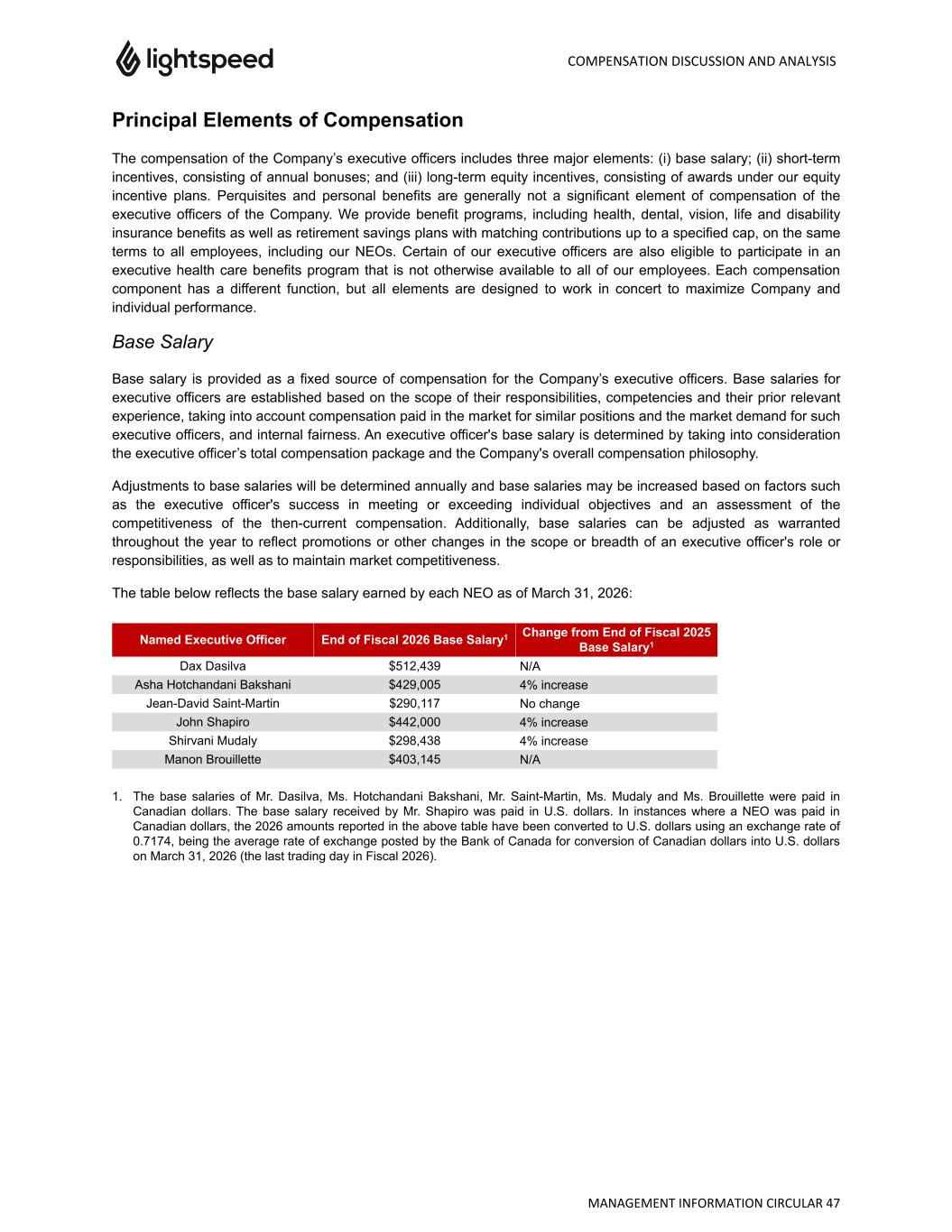
Principal Elements of Compensation The compensation of the Company’s executive officers includes three major elements: (i) base salary; (ii) short-term incentives, consisting of annual bonuses; and (iii) long-term equity incentives, consisting of awards under our equity incentive plans. Perquisites and personal benefits are generally not a significant element of compensation of the executive officers of the Company. We provide benefit programs, including health, dental, vision, life and disability insurance benefits as well as retirement savings plans with matching contributions up to a specified cap, on the same terms to all employees, including our NEOs. Certain of our executive officers are also eligible to participate in an executive health care benefits program that is not otherwise available to all of our employees. Each compensation component has a different function, but all elements are designed to work in concert to maximize Company and individual performance. Base Salary Base salary is provided as a fixed source of compensation for the Company’s executive officers. Base salaries for executive officers are established based on the scope of their responsibilities, competencies and their prior relevant experience, taking into account compensation paid in the market for similar positions and the market demand for such executive officers, and internal fairness. An executive officer's base salary is determined by taking into consideration the executive officer’s total compensation package and the Company's overall compensation philosophy. Adjustments to base salaries will be determined annually and base salaries may be increased based on factors such as the executive officer's success in meeting or exceeding individual objectives and an assessment of the competitiveness of the then-current compensation. Additionally, base salaries can be adjusted as warranted throughout the year to reflect promotions or other changes in the scope or breadth of an executive officer's role or responsibilities, as well as to maintain market competitiveness. The table below reflects the base salary earned by each NEO as of March 31, 2026: Named Executive Officer End of Fiscal 2026 Base Salary1 Change from End of Fiscal 2025 Base Salary1 Dax Dasilva $512,439 N/A Asha Hotchandani Bakshani $429,005 4% increase Jean-David Saint-Martin $290,117 No change John Shapiro $442,000 4% increase Shirvani Mudaly $298,438 4% increase Manon Brouillette $403,145 N/A 1. The base salaries of Mr. Dasilva, Ms. Hotchandani Bakshani, Mr. Saint-Martin, Ms. Mudaly and Ms. Brouillette were paid in Canadian dollars. The base salary received by Mr. Shapiro was paid in U.S. dollars. In instances where a NEO was paid in Canadian dollars, the 2026 amounts reported in the above table have been converted to U.S. dollars using an exchange rate of 0.7174, being the average rate of exchange posted by the Bank of Canada for conversion of Canadian dollars into U.S. dollars on March 31, 2026 (the last trading day in Fiscal 2026). COMPENSATION DISCUSSION AND ANALYSIS MANAGEMENT INFORMATION CIRCULAR 47
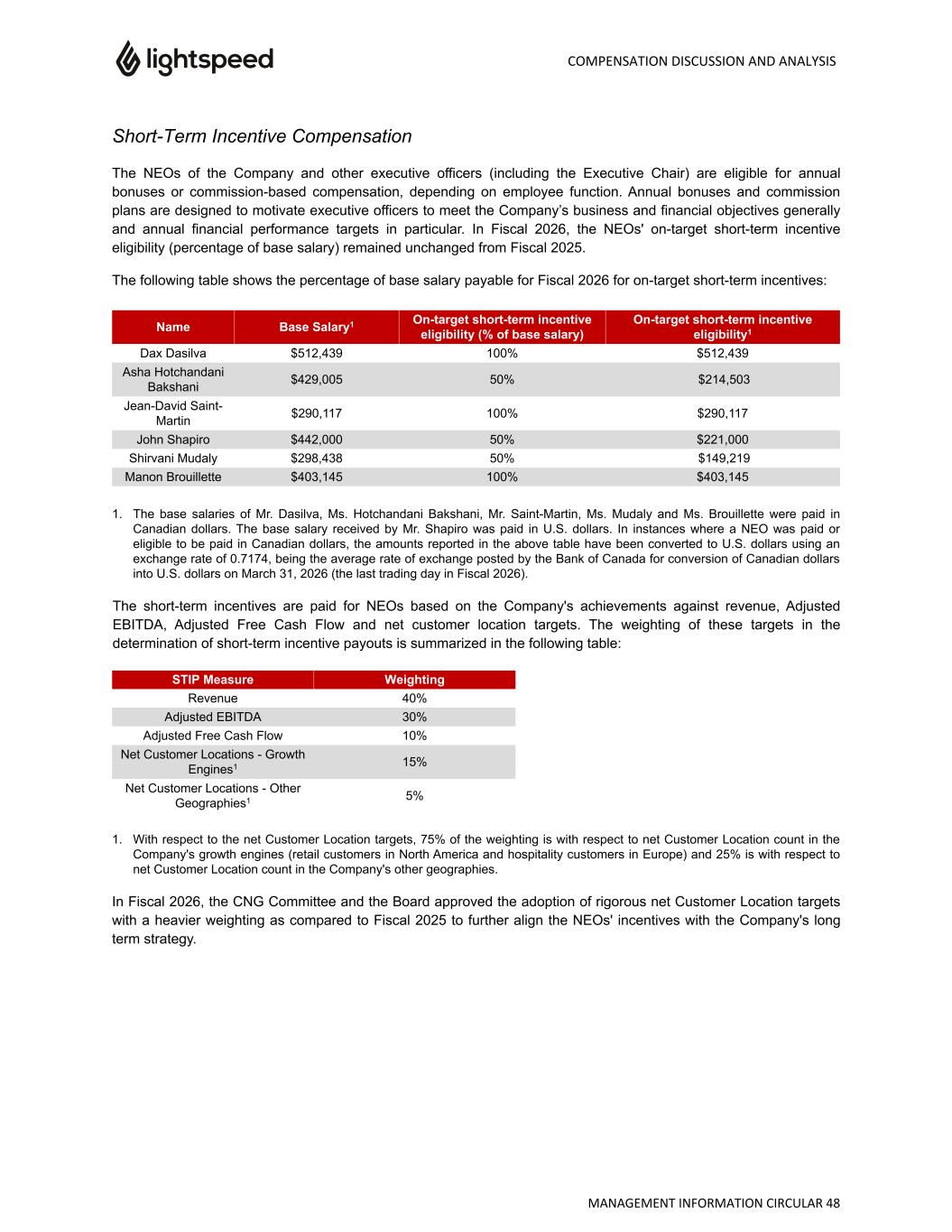
Short-Term Incentive Compensation The NEOs of the Company and other executive officers (including the Executive Chair) are eligible for annual bonuses or commission-based compensation, depending on employee function. Annual bonuses and commission plans are designed to motivate executive officers to meet the Company’s business and financial objectives generally and annual financial performance targets in particular. In Fiscal 2026, the NEOs' on-target short-term incentive eligibility (percentage of base salary) remained unchanged from Fiscal 2025. The following table shows the percentage of base salary payable for Fiscal 2026 for on-target short-term incentives: Name Base Salary1 On-target short-term incentive eligibility (% of base salary) On-target short-term incentive eligibility1 Dax Dasilva $512,439 100% $512,439 Asha Hotchandani Bakshani $429,005 50% $214,503 Jean-David Saint- Martin $290,117 100% $290,117 John Shapiro $442,000 50% $221,000 Shirvani Mudaly $298,438 50% $149,219 Manon Brouillette $403,145 100% $403,145 1. The base salaries of Mr. Dasilva, Ms. Hotchandani Bakshani, Mr. Saint-Martin, Ms. Mudaly and Ms. Brouillette were paid in Canadian dollars. The base salary received by Mr. Shapiro was paid in U.S. dollars. In instances where a NEO was paid or eligible to be paid in Canadian dollars, the amounts reported in the above table have been converted to U.S. dollars using an exchange rate of 0.7174, being the average rate of exchange posted by the Bank of Canada for conversion of Canadian dollars into U.S. dollars on March 31, 2026 (the last trading day in Fiscal 2026). The short-term incentives are paid for NEOs based on the Company's achievements against revenue, Adjusted EBITDA, Adjusted Free Cash Flow and net customer location targets. The weighting of these targets in the determination of short-term incentive payouts is summarized in the following table: STIP Measure Weighting Revenue 40% Adjusted EBITDA 30% Adjusted Free Cash Flow 10% Net Customer Locations - Growth Engines1 15% Net Customer Locations - Other Geographies1 5% 1. With respect to the net Customer Location targets, 75% of the weighting is with respect to net Customer Location count in the Company's growth engines (retail customers in North America and hospitality customers in Europe) and 25% is with respect to net Customer Location count in the Company's other geographies. In Fiscal 2026, the CNG Committee and the Board approved the adoption of rigorous net Customer Location targets with a heavier weighting as compared to Fiscal 2025 to further align the NEOs' incentives with the Company's long term strategy. COMPENSATION DISCUSSION AND ANALYSIS MANAGEMENT INFORMATION CIRCULAR 48
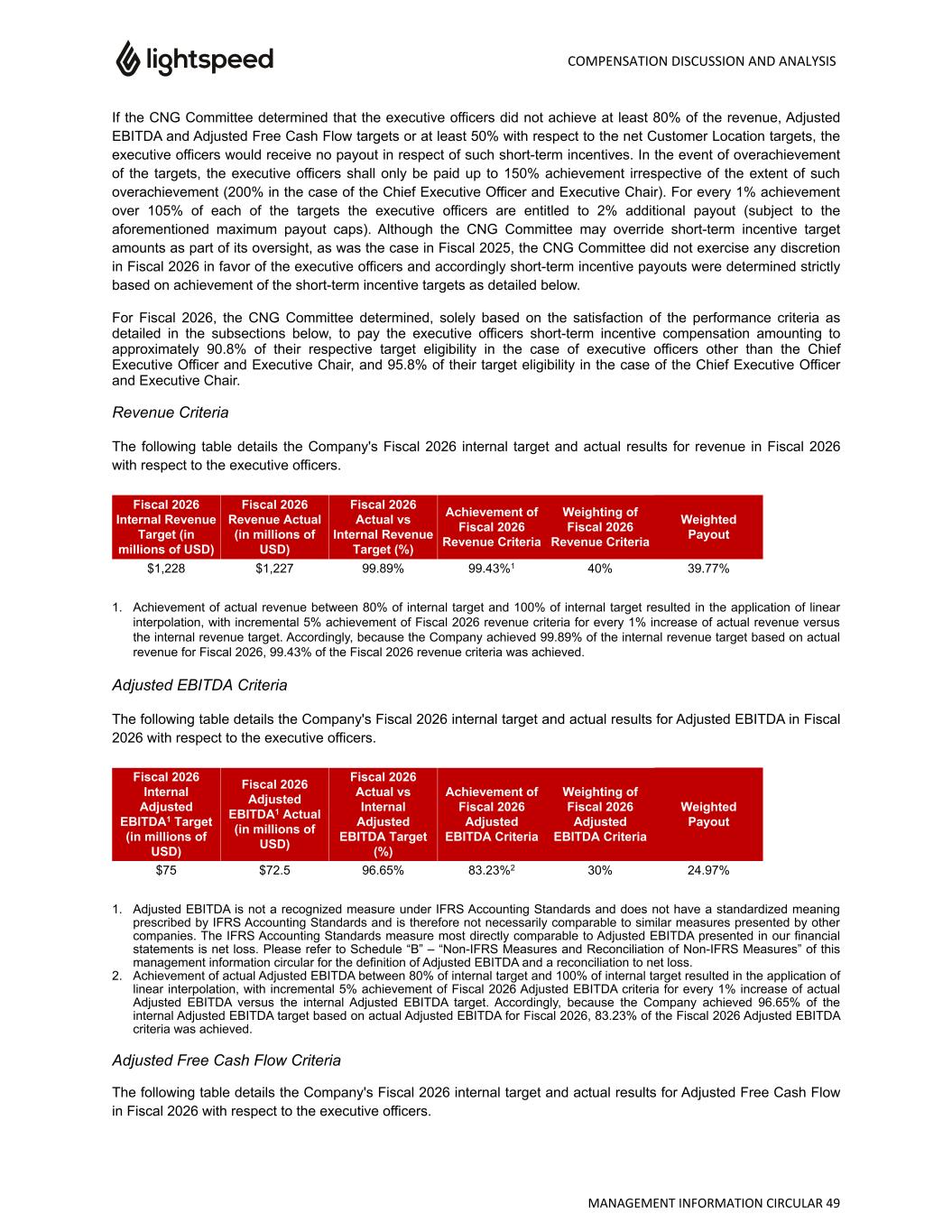
If the CNG Committee determined that the executive officers did not achieve at least 80% of the revenue, Adjusted EBITDA and Adjusted Free Cash Flow targets or at least 50% with respect to the net Customer Location targets, the executive officers would receive no payout in respect of such short-term incentives. In the event of overachievement of the targets, the executive officers shall only be paid up to 150% achievement irrespective of the extent of such overachievement (200% in the case of the Chief Executive Officer and Executive Chair). For every 1% achievement over 105% of each of the targets the executive officers are entitled to 2% additional payout (subject to the aforementioned maximum payout caps). Although the CNG Committee may override short-term incentive target amounts as part of its oversight, as was the case in Fiscal 2025, the CNG Committee did not exercise any discretion in Fiscal 2026 in favor of the executive officers and accordingly short-term incentive payouts were determined strictly based on achievement of the short-term incentive targets as detailed below. For Fiscal 2026, the CNG Committee determined, solely based on the satisfaction of the performance criteria as detailed in the subsections below, to pay the executive officers short-term incentive compensation amounting to approximately 90.8% of their respective target eligibility in the case of executive officers other than the Chief Executive Officer and Executive Chair, and 95.8% of their target eligibility in the case of the Chief Executive Officer and Executive Chair. Revenue Criteria The following table details the Company's Fiscal 2026 internal target and actual results for revenue in Fiscal 2026 with respect to the executive officers. Fiscal 2026 Internal Revenue Target (in millions of USD) Fiscal 2026 Revenue Actual (in millions of USD) Fiscal 2026 Actual vs Internal Revenue Target (%) Achievement of Fiscal 2026 Revenue Criteria Weighting of Fiscal 2026 Revenue Criteria Weighted Payout $1,228 $1,227 99.89% 99.43%1 40% 39.77% 1. Achievement of actual revenue between 80% of internal target and 100% of internal target resulted in the application of linear interpolation, with incremental 5% achievement of Fiscal 2026 revenue criteria for every 1% increase of actual revenue versus the internal revenue target. Accordingly, because the Company achieved 99.89% of the internal revenue target based on actual revenue for Fiscal 2026, 99.43% of the Fiscal 2026 revenue criteria was achieved. Adjusted EBITDA Criteria The following table details the Company's Fiscal 2026 internal target and actual results for Adjusted EBITDA in Fiscal 2026 with respect to the executive officers. Fiscal 2026 Internal Adjusted EBITDA1 Target (in millions of USD) Fiscal 2026 Adjusted EBITDA1 Actual (in millions of USD) Fiscal 2026 Actual vs Internal Adjusted EBITDA Target (%) Achievement of Fiscal 2026 Adjusted EBITDA Criteria Weighting of Fiscal 2026 Adjusted EBITDA Criteria Weighted Payout $75 $72.5 96.65% 83.23%2 30% 24.97% 1. Adjusted EBITDA is not a recognized measure under IFRS Accounting Standards and does not have a standardized meaning prescribed by IFRS Accounting Standards and is therefore not necessarily comparable to similar measures presented by other companies. The IFRS Accounting Standards measure most directly comparable to Adjusted EBITDA presented in our financial statements is net loss. Please refer to Schedule “B” – “Non-IFRS Measures and Reconciliation of Non-IFRS Measures” of this management information circular for the definition of Adjusted EBITDA and a reconciliation to net loss. 2. Achievement of actual Adjusted EBITDA between 80% of internal target and 100% of internal target resulted in the application of linear interpolation, with incremental 5% achievement of Fiscal 2026 Adjusted EBITDA criteria for every 1% increase of actual Adjusted EBITDA versus the internal Adjusted EBITDA target. Accordingly, because the Company achieved 96.65% of the internal Adjusted EBITDA target based on actual Adjusted EBITDA for Fiscal 2026, 83.23% of the Fiscal 2026 Adjusted EBITDA criteria was achieved. Adjusted Free Cash Flow Criteria The following table details the Company's Fiscal 2026 internal target and actual results for Adjusted Free Cash Flow in Fiscal 2026 with respect to the executive officers. COMPENSATION DISCUSSION AND ANALYSIS MANAGEMENT INFORMATION CIRCULAR 49
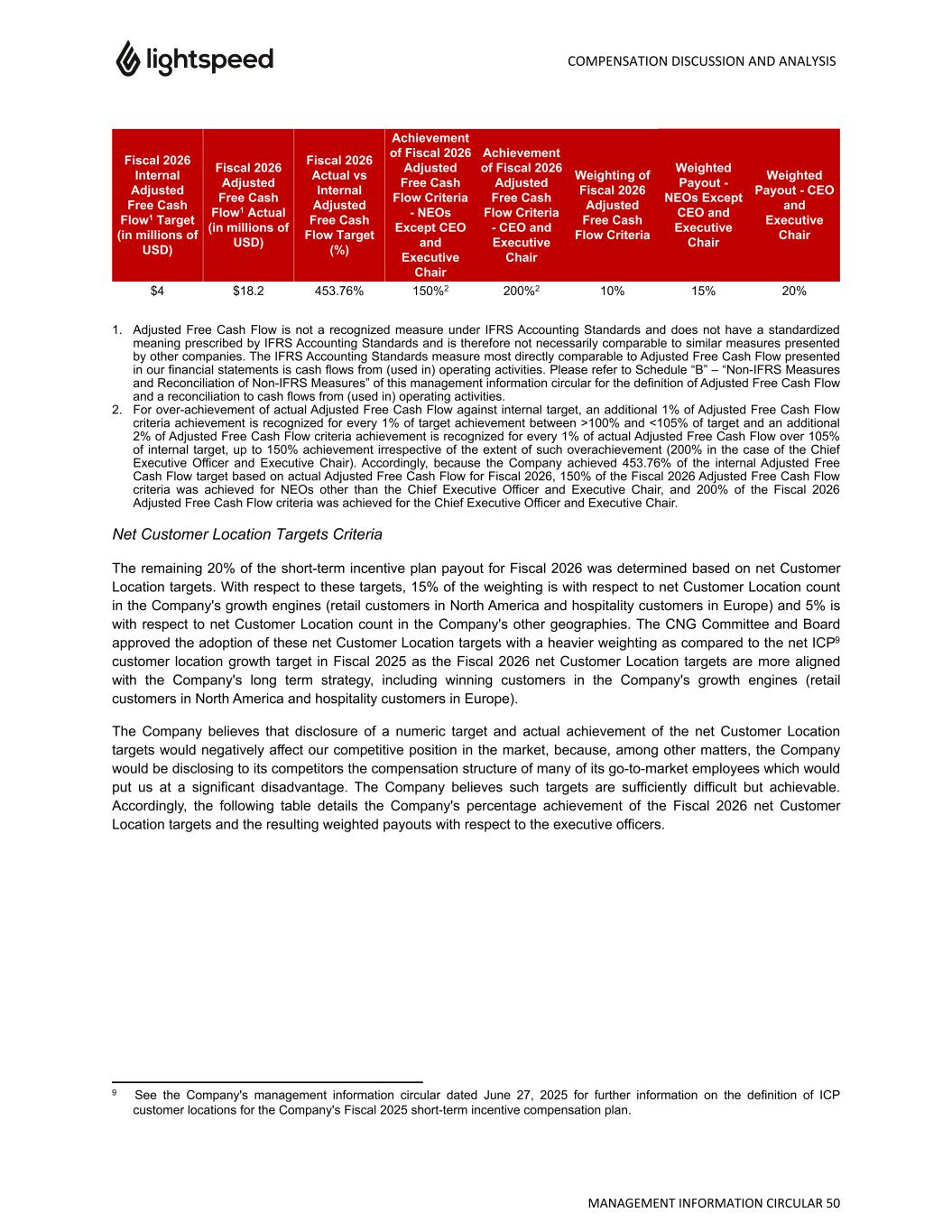
Fiscal 2026 Internal Adjusted Free Cash Flow1 Target (in millions of USD) Fiscal 2026 Adjusted Free Cash Flow1 Actual (in millions of USD) Fiscal 2026 Actual vs Internal Adjusted Free Cash Flow Target (%) Achievement of Fiscal 2026 Adjusted Free Cash Flow Criteria - NEOs Except CEO and Executive Chair Achievement of Fiscal 2026 Adjusted Free Cash Flow Criteria - CEO and Executive Chair Weighting of Fiscal 2026 Adjusted Free Cash Flow Criteria Weighted Payout - NEOs Except CEO and Executive Chair Weighted Payout - CEO and Executive Chair $4 $18.2 453.76% 150%2 200%2 10% 15% 20% 1. Adjusted Free Cash Flow is not a recognized measure under IFRS Accounting Standards and does not have a standardized meaning prescribed by IFRS Accounting Standards and is therefore not necessarily comparable to similar measures presented by other companies. The IFRS Accounting Standards measure most directly comparable to Adjusted Free Cash Flow presented in our financial statements is cash flows from (used in) operating activities. Please refer to Schedule “B” – “Non-IFRS Measures and Reconciliation of Non-IFRS Measures” of this management information circular for the definition of Adjusted Free Cash Flow and a reconciliation to cash flows from (used in) operating activities. 2. For over-achievement of actual Adjusted Free Cash Flow against internal target, an additional 1% of Adjusted Free Cash Flow criteria achievement is recognized for every 1% of target achievement between >100% and <105% of target and an additional 2% of Adjusted Free Cash Flow criteria achievement is recognized for every 1% of actual Adjusted Free Cash Flow over 105% of internal target, up to 150% achievement irrespective of the extent of such overachievement (200% in the case of the Chief Executive Officer and Executive Chair). Accordingly, because the Company achieved 453.76% of the internal Adjusted Free Cash Flow target based on actual Adjusted Free Cash Flow for Fiscal 2026, 150% of the Fiscal 2026 Adjusted Free Cash Flow criteria was achieved for NEOs other than the Chief Executive Officer and Executive Chair, and 200% of the Fiscal 2026 Adjusted Free Cash Flow criteria was achieved for the Chief Executive Officer and Executive Chair. Net Customer Location Targets Criteria The remaining 20% of the short-term incentive plan payout for Fiscal 2026 was determined based on net Customer Location targets. With respect to these targets, 15% of the weighting is with respect to net Customer Location count in the Company's growth engines (retail customers in North America and hospitality customers in Europe) and 5% is with respect to net Customer Location count in the Company's other geographies. The CNG Committee and Board approved the adoption of these net Customer Location targets with a heavier weighting as compared to the net ICP9 customer location growth target in Fiscal 2025 as the Fiscal 2026 net Customer Location targets are more aligned with the Company's long term strategy, including winning customers in the Company's growth engines (retail customers in North America and hospitality customers in Europe). The Company believes that disclosure of a numeric target and actual achievement of the net Customer Location targets would negatively affect our competitive position in the market, because, among other matters, the Company would be disclosing to its competitors the compensation structure of many of its go-to-market employees which would put us at a significant disadvantage. The Company believes such targets are sufficiently difficult but achievable. Accordingly, the following table details the Company's percentage achievement of the Fiscal 2026 net Customer Location targets and the resulting weighted payouts with respect to the executive officers. COMPENSATION DISCUSSION AND ANALYSIS MANAGEMENT INFORMATION CIRCULAR 50 9 See the Company's management information circular dated June 27, 2025 for further information on the definition of ICP customer locations for the Company's Fiscal 2025 short-term incentive compensation plan.
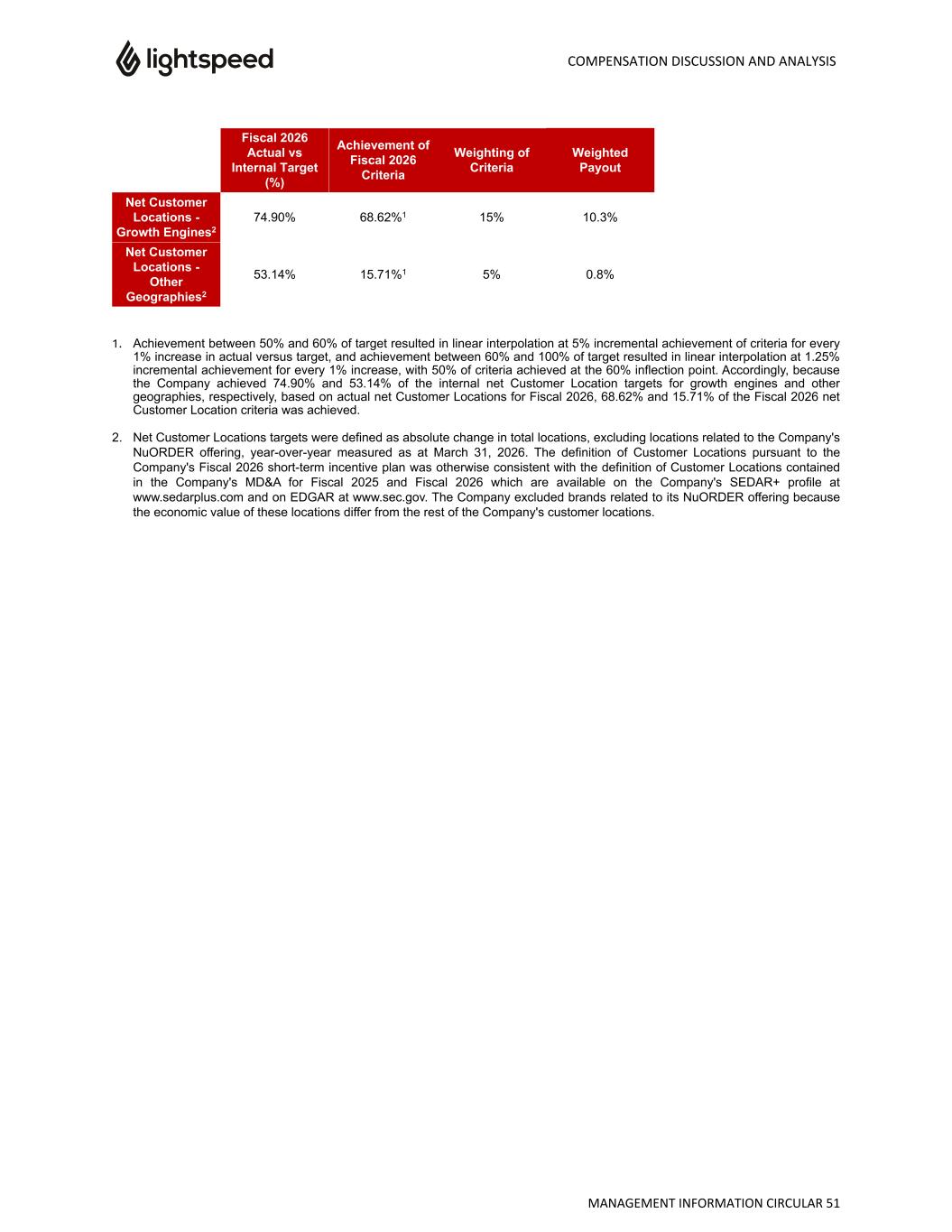
Fiscal 2026 Actual vs Internal Target (%) Achievement of Fiscal 2026 Criteria Weighting of Criteria Weighted Payout Net Customer Locations - Growth Engines2 74.90% 68.62%1 15% 10.3% Net Customer Locations - Other Geographies2 53.14% 15.71%1 5% 0.8% 1. Achievement between 50% and 60% of target resulted in linear interpolation at 5% incremental achievement of criteria for every 1% increase in actual versus target, and achievement between 60% and 100% of target resulted in linear interpolation at 1.25% incremental achievement for every 1% increase, with 50% of criteria achieved at the 60% inflection point. Accordingly, because the Company achieved 74.90% and 53.14% of the internal net Customer Location targets for growth engines and other geographies, respectively, based on actual net Customer Locations for Fiscal 2026, 68.62% and 15.71% of the Fiscal 2026 net Customer Location criteria was achieved. 2. Net Customer Locations targets were defined as absolute change in total locations, excluding locations related to the Company's NuORDER offering, year-over-year measured as at March 31, 2026. The definition of Customer Locations pursuant to the Company's Fiscal 2026 short-term incentive plan was otherwise consistent with the definition of Customer Locations contained in the Company's MD&A for Fiscal 2025 and Fiscal 2026 which are available on the Company's SEDAR+ profile at www.sedarplus.com and on EDGAR at www.sec.gov. The Company excluded brands related to its NuORDER offering because the economic value of these locations differ from the rest of the Company's customer locations. COMPENSATION DISCUSSION AND ANALYSIS MANAGEMENT INFORMATION CIRCULAR 51
Transformation Bonus Program In Fiscal 2026, as part of the Company's multi-year transformation strategy, the CNG Committee and the Board approved a transformation bonus program for certain executive officers and key personnel (the "Transformation Bonus Program"). Under the Transformation Bonus Program, executive officers and key personnel were assigned ownership of workstreams and had individualized, quantitative targets under each workstream. With respect to the executive officers, any potential bonus payout was based on the aggregate achievement of all initiatives under their workstreams. At 100% achievement, the NEOs (excluding the Chief Executive Officer and Executive Chair) would receive a cash bonus equal to 50% of their respective base salaries. In the event of overachievement of the targets, the NEOs would only be paid up to 150% achievement irrespective of the extent of such overachievement. Dax Dasilva in his role as Chief Executive Officer and Manon Brouillette in her role as Executive Chair were not eligible for any payout under the Transformation Bonus Program. The Company believes that disclosure of the individualized targets would negatively affect our competitive position in the market, because, among other matters, the Company would be disclosing to its competitors the compensation structure of many of its go-to-market, product and technology, and other key employees, as well as certain key objectives within its go-to-market and product and technology roadmaps, which would put us at a significant disadvantage. In addition to the individualized targets, any payout under the Transformation Bonus Program was subject to minimum achievement hurdles for revenue, Adjusted Free Cash Flow and Adjusted EBITDA. The Adjusted EBITDA target required higher achievement than the Adjusted EBITDA short-term incentive compensation target, and the program was designed to be self-funding based on high Adjusted EBITDA achievement. With respect to the NEOs, the revenue threshold was $1,228 million, the Adjusted Free Cash Flow10 threshold was $4 million and the Adjusted EBITDA11 threshold was $83 million. Actual achievement against these measures was approximately $1,227 million, approximately $18.2 million and approximately $72.5 million respectively in Fiscal 2026. The CNG Committee did not exercise any discretion under the Transformation Bonus Program in Fiscal 2026 in favor of the NEOs and payouts were determined strictly based on achievement against the individualized targets and revenue, Adjusted Free Cash Flow and Adjusted EBITDA hurdles. Due to the ambitious Adjusted EBITDA minimum threshold not being satisfied, no payout was awarded to the NEOs under the Transformation Bonus Program. Long-Term Incentive Compensation (LTIP) Equity-based awards are a variable element of compensation that allows the Company to incentivize and retain its executive officers for their sustained contributions to the Company. Equity awards reward performance and continued employment by an executive officer, with associated benefits to us of attracting and retaining employees. The Company's LTIP structure has historically included an equal mix of stock options and RSUs. This mix has provided a balanced approach that (i) aligns NEO pay with company performance, such that the Company's executives do not realize the intended benefit of granted options unless the Company delivers strong performance that in turn creates sustained shareholder value over time through share price appreciation, and (ii) provides more immediate retentive value for the Company's executives through the use of RSUs (which also generally result in less dilution relative to COMPENSATION DISCUSSION AND ANALYSIS MANAGEMENT INFORMATION CIRCULAR 52 10 Adjusted Free Cash Flow is not a recognized measure under IFRS Accounting Standards and does not have a standardized meaning prescribed by IFRS Accounting Standards and is therefore not necessarily comparable to similar measures presented by other companies. The IFRS Accounting Standards measure most directly comparable to Adjusted Free Cash Flow presented in our financial statements is cash flows from (used in) operating activities. Please refer to Schedule “B” – “Non-IFRS Measures and Reconciliation of Non-IFRS Measures” of this management information circular for the definition of Adjusted Free Cash Flow and a reconciliation to cash flows from (used in) operating activities. 11 Adjusted EBITDA is not a recognized measure under IFRS Accounting Standards and does not have a standardized meaning prescribed by IFRS Accounting Standards and is therefore not necessarily comparable to similar measures presented by other companies. The IFRS Accounting Standards measure most directly comparable to Adjusted EBITDA presented in our financial statements is net loss. Please refer to Schedule “B” – “Non-IFRS Measures and Reconciliation of Non-IFRS Measures” of this management information circular for the definition of Adjusted EBITDA and a reconciliation to net loss.
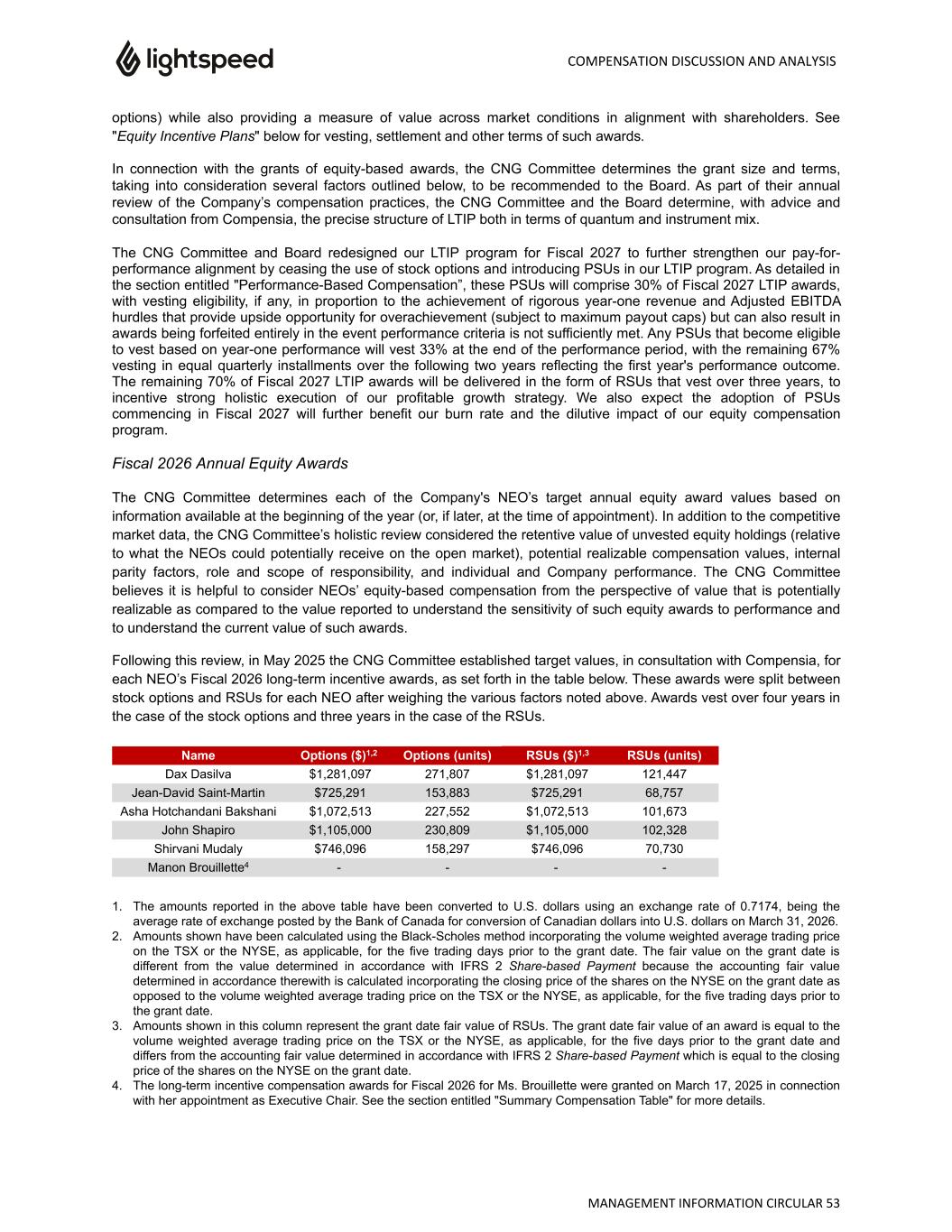
options) while also providing a measure of value across market conditions in alignment with shareholders. See "Equity Incentive Plans" below for vesting, settlement and other terms of such awards. In connection with the grants of equity-based awards, the CNG Committee determines the grant size and terms, taking into consideration several factors outlined below, to be recommended to the Board. As part of their annual review of the Company’s compensation practices, the CNG Committee and the Board determine, with advice and consultation from Compensia, the precise structure of LTIP both in terms of quantum and instrument mix. The CNG Committee and Board redesigned our LTIP program for Fiscal 2027 to further strengthen our pay-for- performance alignment by ceasing the use of stock options and introducing PSUs in our LTIP program. As detailed in the section entitled "Performance-Based Compensation”, these PSUs will comprise 30% of Fiscal 2027 LTIP awards, with vesting eligibility, if any, in proportion to the achievement of rigorous year-one revenue and Adjusted EBITDA hurdles that provide upside opportunity for overachievement (subject to maximum payout caps) but can also result in awards being forfeited entirely in the event performance criteria is not sufficiently met. Any PSUs that become eligible to vest based on year-one performance will vest 33% at the end of the performance period, with the remaining 67% vesting in equal quarterly installments over the following two years reflecting the first year's performance outcome. The remaining 70% of Fiscal 2027 LTIP awards will be delivered in the form of RSUs that vest over three years, to incentive strong holistic execution of our profitable growth strategy. We also expect the adoption of PSUs commencing in Fiscal 2027 will further benefit our burn rate and the dilutive impact of our equity compensation program. Fiscal 2026 Annual Equity Awards The CNG Committee determines each of the Company's NEO’s target annual equity award values based on information available at the beginning of the year (or, if later, at the time of appointment). In addition to the competitive market data, the CNG Committee’s holistic review considered the retentive value of unvested equity holdings (relative to what the NEOs could potentially receive on the open market), potential realizable compensation values, internal parity factors, role and scope of responsibility, and individual and Company performance. The CNG Committee believes it is helpful to consider NEOs’ equity-based compensation from the perspective of value that is potentially realizable as compared to the value reported to understand the sensitivity of such equity awards to performance and to understand the current value of such awards. Following this review, in May 2025 the CNG Committee established target values, in consultation with Compensia, for each NEO’s Fiscal 2026 long-term incentive awards, as set forth in the table below. These awards were split between stock options and RSUs for each NEO after weighing the various factors noted above. Awards vest over four years in the case of the stock options and three years in the case of the RSUs. Name Options ($)1,2 Options (units) RSUs ($)1,3 RSUs (units) Dax Dasilva $1,281,097 271,807 $1,281,097 121,447 Jean-David Saint-Martin $725,291 153,883 $725,291 68,757 Asha Hotchandani Bakshani $1,072,513 227,552 $1,072,513 101,673 John Shapiro $1,105,000 230,809 $1,105,000 102,328 Shirvani Mudaly $746,096 158,297 $746,096 70,730 Manon Brouillette4 - - - - 1. The amounts reported in the above table have been converted to U.S. dollars using an exchange rate of 0.7174, being the average rate of exchange posted by the Bank of Canada for conversion of Canadian dollars into U.S. dollars on March 31, 2026. 2. Amounts shown have been calculated using the Black-Scholes method incorporating the volume weighted average trading price on the TSX or the NYSE, as applicable, for the five trading days prior to the grant date. The fair value on the grant date is different from the value determined in accordance with IFRS 2 Share-based Payment because the accounting fair value determined in accordance therewith is calculated incorporating the closing price of the shares on the NYSE on the grant date as opposed to the volume weighted average trading price on the TSX or the NYSE, as applicable, for the five trading days prior to the grant date. 3. Amounts shown in this column represent the grant date fair value of RSUs. The grant date fair value of an award is equal to the volume weighted average trading price on the TSX or the NYSE, as applicable, for the five days prior to the grant date and differs from the accounting fair value determined in accordance with IFRS 2 Share-based Payment which is equal to the closing price of the shares on the NYSE on the grant date. 4. The long-term incentive compensation awards for Fiscal 2026 for Ms. Brouillette were granted on March 17, 2025 in connection with her appointment as Executive Chair. See the section entitled "Summary Compensation Table" for more details. COMPENSATION DISCUSSION AND ANALYSIS MANAGEMENT INFORMATION CIRCULAR 53
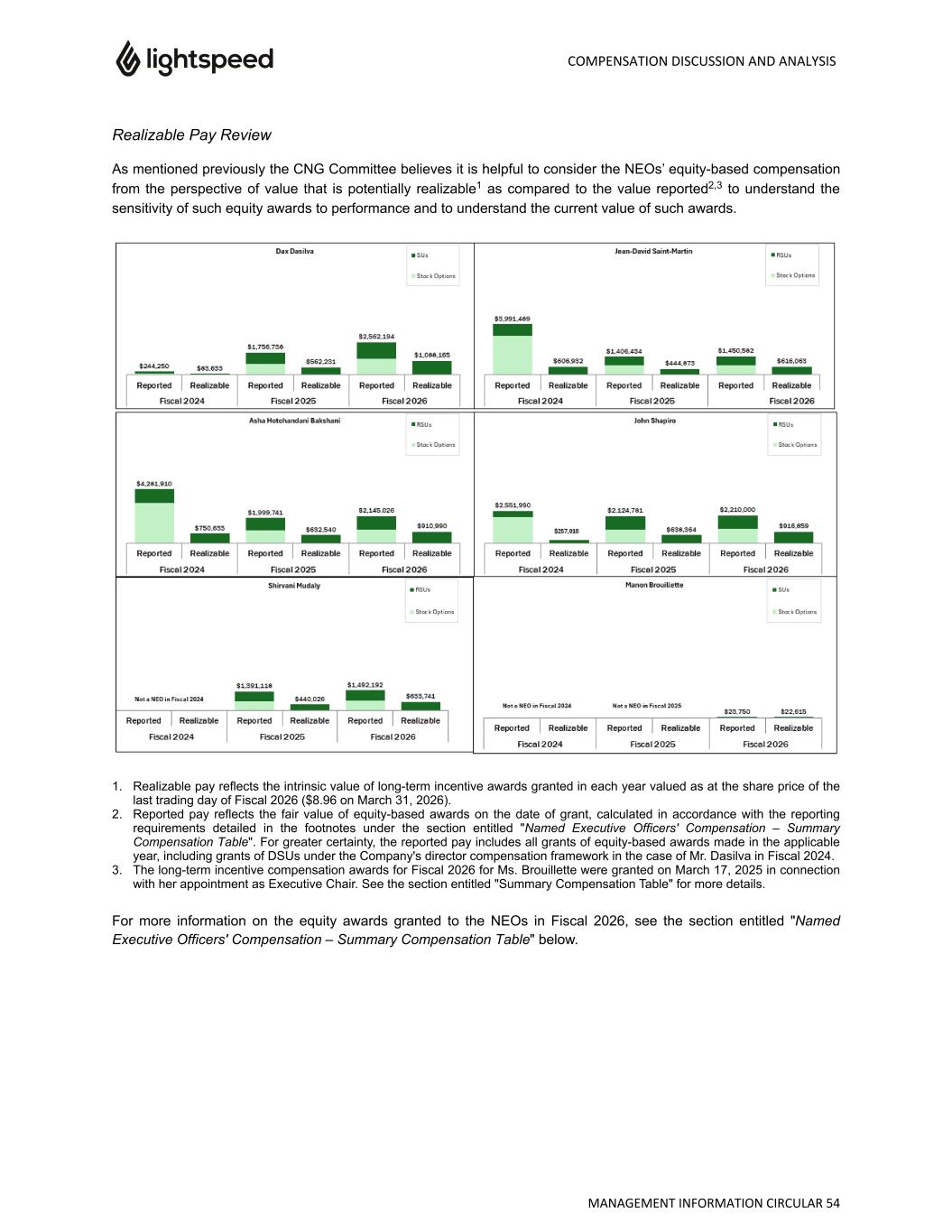
Realizable Pay Review As mentioned previously the CNG Committee believes it is helpful to consider the NEOs’ equity-based compensation from the perspective of value that is potentially realizable1 as compared to the value reported2,3 to understand the sensitivity of such equity awards to performance and to understand the current value of such awards. 1. Realizable pay reflects the intrinsic value of long-term incentive awards granted in each year valued as at the share price of the last trading day of Fiscal 2026 ($8.96 on March 31, 2026). 2. Reported pay reflects the fair value of equity-based awards on the date of grant, calculated in accordance with the reporting requirements detailed in the footnotes under the section entitled "Named Executive Officers' Compensation – Summary Compensation Table". For greater certainty, the reported pay includes all grants of equity-based awards made in the applicable year, including grants of DSUs under the Company's director compensation framework in the case of Mr. Dasilva in Fiscal 2024. 3. The long-term incentive compensation awards for Fiscal 2026 for Ms. Brouillette were granted on March 17, 2025 in connection with her appointment as Executive Chair. See the section entitled "Summary Compensation Table" for more details. For more information on the equity awards granted to the NEOs in Fiscal 2026, see the section entitled "Named Executive Officers' Compensation – Summary Compensation Table" below. COMPENSATION DISCUSSION AND ANALYSIS MANAGEMENT INFORMATION CIRCULAR 54
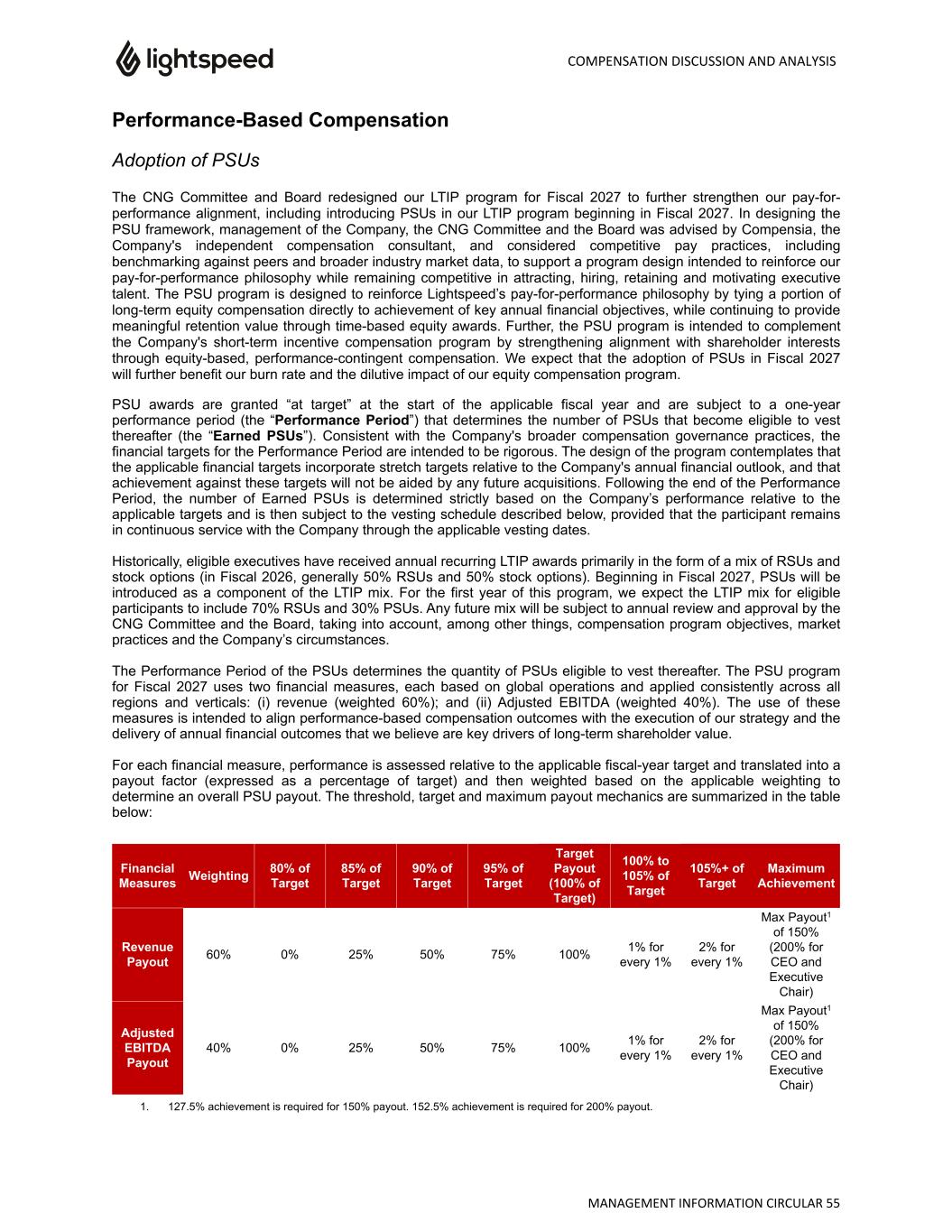
Performance-Based Compensation Adoption of PSUs The CNG Committee and Board redesigned our LTIP program for Fiscal 2027 to further strengthen our pay-for- performance alignment, including introducing PSUs in our LTIP program beginning in Fiscal 2027. In designing the PSU framework, management of the Company, the CNG Committee and the Board was advised by Compensia, the Company's independent compensation consultant, and considered competitive pay practices, including benchmarking against peers and broader industry market data, to support a program design intended to reinforce our pay-for-performance philosophy while remaining competitive in attracting, hiring, retaining and motivating executive talent. The PSU program is designed to reinforce Lightspeed’s pay-for-performance philosophy by tying a portion of long-term equity compensation directly to achievement of key annual financial objectives, while continuing to provide meaningful retention value through time-based equity awards. Further, the PSU program is intended to complement the Company's short-term incentive compensation program by strengthening alignment with shareholder interests through equity-based, performance-contingent compensation. We expect that the adoption of PSUs in Fiscal 2027 will further benefit our burn rate and the dilutive impact of our equity compensation program. PSU awards are granted “at target” at the start of the applicable fiscal year and are subject to a one-year performance period (the “Performance Period”) that determines the number of PSUs that become eligible to vest thereafter (the “Earned PSUs”). Consistent with the Company's broader compensation governance practices, the financial targets for the Performance Period are intended to be rigorous. The design of the program contemplates that the applicable financial targets incorporate stretch targets relative to the Company's annual financial outlook, and that achievement against these targets will not be aided by any future acquisitions. Following the end of the Performance Period, the number of Earned PSUs is determined strictly based on the Company’s performance relative to the applicable targets and is then subject to the vesting schedule described below, provided that the participant remains in continuous service with the Company through the applicable vesting dates. Historically, eligible executives have received annual recurring LTIP awards primarily in the form of a mix of RSUs and stock options (in Fiscal 2026, generally 50% RSUs and 50% stock options). Beginning in Fiscal 2027, PSUs will be introduced as a component of the LTIP mix. For the first year of this program, we expect the LTIP mix for eligible participants to include 70% RSUs and 30% PSUs. Any future mix will be subject to annual review and approval by the CNG Committee and the Board, taking into account, among other things, compensation program objectives, market practices and the Company’s circumstances. The Performance Period of the PSUs determines the quantity of PSUs eligible to vest thereafter. The PSU program for Fiscal 2027 uses two financial measures, each based on global operations and applied consistently across all regions and verticals: (i) revenue (weighted 60%); and (ii) Adjusted EBITDA (weighted 40%). The use of these measures is intended to align performance-based compensation outcomes with the execution of our strategy and the delivery of annual financial outcomes that we believe are key drivers of long-term shareholder value. For each financial measure, performance is assessed relative to the applicable fiscal-year target and translated into a payout factor (expressed as a percentage of target) and then weighted based on the applicable weighting to determine an overall PSU payout. The threshold, target and maximum payout mechanics are summarized in the table below: Financial Measures Weighting 80% of Target 85% of Target 90% of Target 95% of Target Target Payout (100% of Target) 100% to 105% of Target 105%+ of Target Maximum Achievement Revenue Payout 60% 0% 25% 50% 75% 100% 1% for every 1% 2% for every 1% Max Payout1 of 150% (200% for CEO and Executive Chair) Adjusted EBITDA Payout 40% 0% 25% 50% 75% 100% 1% for every 1% 2% for every 1% Max Payout1 of 150% (200% for CEO and Executive Chair) 1. 127.5% achievement is required for 150% payout. 152.5% achievement is required for 200% payout. COMPENSATION DISCUSSION AND ANALYSIS MANAGEMENT INFORMATION CIRCULAR 55
If the CNG Committee determines that the NEOs did not achieve at least 81% of the revenue and Adjusted EBITDA targets, then the entirety of the NEO's PSUs (including for years 2 and 3) are forfeited. In the event of overachievement of the targets, the NEOs shall only be paid up to 150% achievement irrespective of the extent of such overachievement (200% in the case of the Chief Executive Officer and Executive Chair). For every 1% achievement over 105% of each of the targets the NEOs are entitled to 2% additional payout (subject to the aforementioned maximum payout caps). Following the end of the Performance Period, the number of Earned PSUs is calculated by applying the applicable payout factor (as determined based on performance relative to target, subject to the threshold and maximum mechanics above) to the number of PSUs granted at target. PSUs vest over a three-year vesting schedule, subject to continued service: • up to 33% of the Earned PSUs vest on the first anniversary of the grant date following the Performance Period results; and • the remaining 67% vests in eight equal quarterly installments over years 2 and 3, continuing to reflect the Performance Period’s performance outcome. For greater clarity, any portion of the PSUs that are not earned and accordingly forfeited in year 1 are also forfeited from the PSUs eligible to vest over years 2 and 3. Earned PSUs remain subject to the terms and conditions of the Amended and Restated Omnibus Incentive Plan and the applicable award agreement, including continued service requirements through the applicable vesting dates and the treatment of awards upon termination of employment, as described under the section entitled “Equity Incentive Plans” below. Further details, including the actual financial targets and achievement against such targets, will be included in the Company's management information circular for Fiscal 2027. Status of CFO Performance Award As previously disclosed, on March 24, 2022, our Board and CNG Committee, in connection with her appointment as Chief Financial Officer effective May 23, 2022, granted a long-term, multi-year performance-based option award to Ms. Hotchandani Bakshani, providing her with the opportunity to earn options to purchase up to 400,000 subordinate voting shares in the capital of the Company (the "CFO Performance Award"). The CFO Performance Award was to be earned and vest over a period of just over five years based in part upon the Company's share price over this approximately 5-year time period measured relative to an independently-constructed Standard & Poor’s benchmark index (the S&P North American Technology Software Index) and in part upon the achievement of pre-established stock price growth rate targets. This benchmark index was selected because it is a software-specific index that captures broader market representation (with no individual company weighted more than 20% of the overall index). The CFO Performance Award was designed so that Ms. Hotchandani Bakshani would only realize value from the award upon the creation of significantly enhanced and sustained shareholder value over the ensuing five years. The CFO Performance Award is completely "at risk" since any options for which the performance criteria are not achieved will be forfeited in their entirety in accordance with the terms of the award. The exercise price per share of the CFO Performance Award is $21.60. In Fiscal 2026, in light of the rigorous design, only 3,479 options of the CFO Performance Award were earned, for a total of 8,964 since the grant date. Further, 104,100 were forfeited due to strict application of the performance criteria over the past three fiscal years. In the aggregate, approximately 2% of the CFO Performance Award has been earned at nil value based on the closing share price of the NYSE as at March 31, 2026. For further details on the CFO Performance Award, please refer to the Company's 2022 management information circular available under the Company’s profile on SEDAR+ at www.sedarplus.com and EDGAR at www.sec.gov. Fair Value of Performance Award It is important to note that certain of the values of the CFO Performance Award described in the Company's management information circulars reflect the estimated fair value of the awards on their grant date. Accordingly, these values do not reflect the actual economic value of the compensation to be received, if any, upon vesting or exercise, as applicable. Equity award values can vary significantly from year to year based on fluctuations in share price, COMPENSATION DISCUSSION AND ANALYSIS MANAGEMENT INFORMATION CIRCULAR 56

corporate performance and the timing of vesting or exercise, as applicable. Our use of aggressive performance targets in combination with the ongoing challenging market conditions has resulted in significant variability in the values of long-term incentive awards since the date of grant of such awards, which had a significant impact on the awards' current value. As at March 31, 2026 and any time after the grant date, the awards, which have been granted in the form of stock options, are and may continue to be “out-of-the money.” Accordingly, caution should be exercised when reviewing the estimated grant date fair values and total compensation of our Chief Financial Officer and other Named Executive Officers reported in the Summary Compensation Table. COMPENSATION DISCUSSION AND ANALYSIS MANAGEMENT INFORMATION CIRCULAR 57
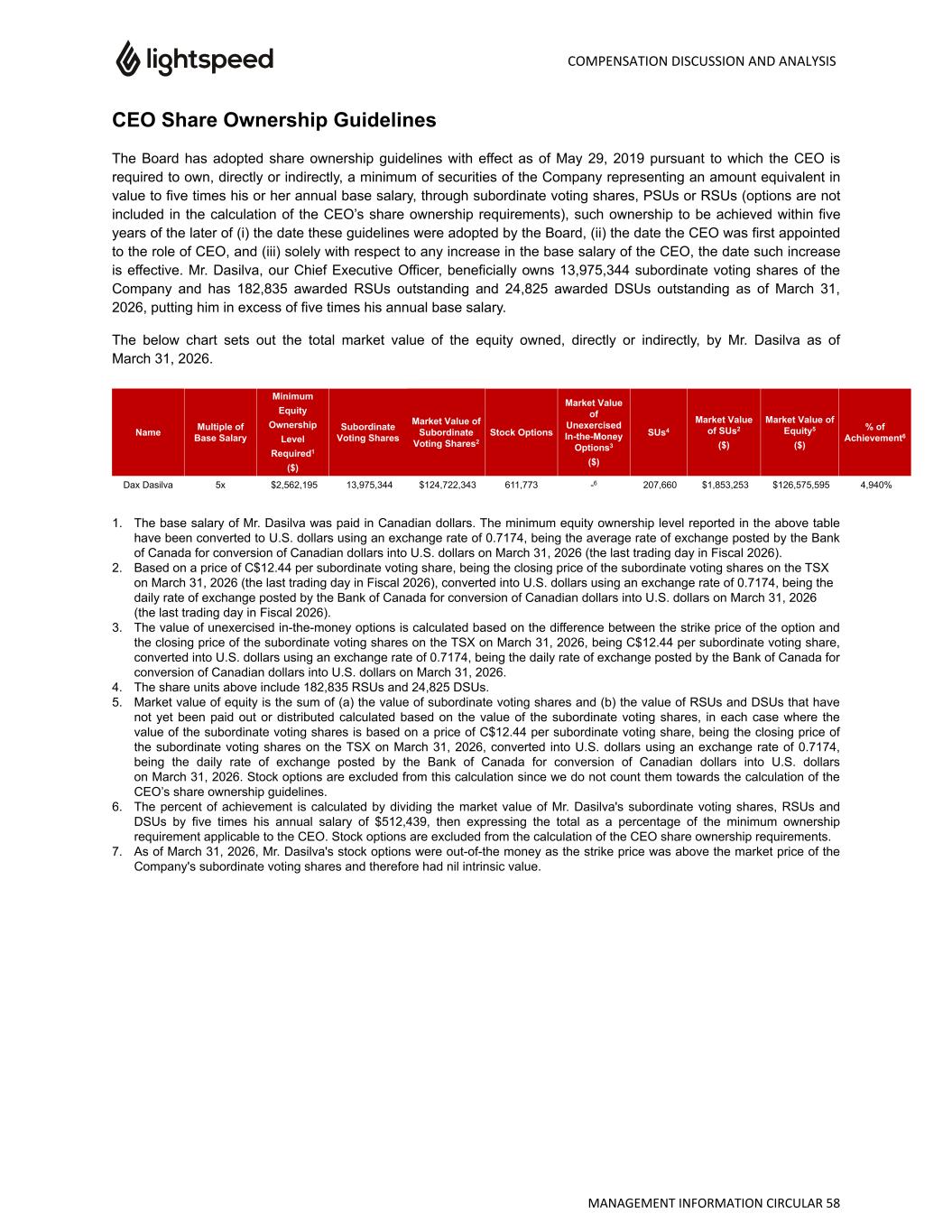
CEO Share Ownership Guidelines The Board has adopted share ownership guidelines with effect as of May 29, 2019 pursuant to which the CEO is required to own, directly or indirectly, a minimum of securities of the Company representing an amount equivalent in value to five times his or her annual base salary, through subordinate voting shares, PSUs or RSUs (options are not included in the calculation of the CEO’s share ownership requirements), such ownership to be achieved within five years of the later of (i) the date these guidelines were adopted by the Board, (ii) the date the CEO was first appointed to the role of CEO, and (iii) solely with respect to any increase in the base salary of the CEO, the date such increase is effective. Mr. Dasilva, our Chief Executive Officer, beneficially owns 13,975,344 subordinate voting shares of the Company and has 182,835 awarded RSUs outstanding and 24,825 awarded DSUs outstanding as of March 31, 2026, putting him in excess of five times his annual base salary. The below chart sets out the total market value of the equity owned, directly or indirectly, by Mr. Dasilva as of March 31, 2026. Name Multiple of Base Salary Minimum Equity Ownership Level Required1 ($) Subordinate Voting Shares Market Value of Subordinate Voting Shares2 Stock Options Market Value of Unexercised In-the-Money Options3 ($) SUs4 Market Value of SUs2 ($) Market Value of Equity5 ($) % of Achievement6 Dax Dasilva 5x $2,562,195 13,975,344 $124,722,343 611,773 -6 207,660 $1,853,253 $126,575,595 4,940% 1. The base salary of Mr. Dasilva was paid in Canadian dollars. The minimum equity ownership level reported in the above table have been converted to U.S. dollars using an exchange rate of 0.7174, being the average rate of exchange posted by the Bank of Canada for conversion of Canadian dollars into U.S. dollars on March 31, 2026 (the last trading day in Fiscal 2026). 2. Based on a price of C$12.44 per subordinate voting share, being the closing price of the subordinate voting shares on the TSX on March 31, 2026 (the last trading day in Fiscal 2026), converted into U.S. dollars using an exchange rate of 0.7174, being the daily rate of exchange posted by the Bank of Canada for conversion of Canadian dollars into U.S. dollars on March 31, 2026 (the last trading day in Fiscal 2026). 3. The value of unexercised in-the-money options is calculated based on the difference between the strike price of the option and the closing price of the subordinate voting shares on the TSX on March 31, 2026, being C$12.44 per subordinate voting share, converted into U.S. dollars using an exchange rate of 0.7174, being the daily rate of exchange posted by the Bank of Canada for conversion of Canadian dollars into U.S. dollars on March 31, 2026. 4. The share units above include 182,835 RSUs and 24,825 DSUs. 5. Market value of equity is the sum of (a) the value of subordinate voting shares and (b) the value of RSUs and DSUs that have not yet been paid out or distributed calculated based on the value of the subordinate voting shares, in each case where the value of the subordinate voting shares is based on a price of C$12.44 per subordinate voting share, being the closing price of the subordinate voting shares on the TSX on March 31, 2026, converted into U.S. dollars using an exchange rate of 0.7174, being the daily rate of exchange posted by the Bank of Canada for conversion of Canadian dollars into U.S. dollars on March 31, 2026. Stock options are excluded from this calculation since we do not count them towards the calculation of the CEO’s share ownership guidelines. 6. The percent of achievement is calculated by dividing the market value of Mr. Dasilva's subordinate voting shares, RSUs and DSUs by five times his annual salary of $512,439, then expressing the total as a percentage of the minimum ownership requirement applicable to the CEO. Stock options are excluded from the calculation of the CEO share ownership requirements. 7. As of March 31, 2026, Mr. Dasilva's stock options were out-of-the money as the strike price was above the market price of the Company's subordinate voting shares and therefore had nil intrinsic value. COMPENSATION DISCUSSION AND ANALYSIS MANAGEMENT INFORMATION CIRCULAR 58
Executive Officer Share Ownership Guidelines To further strengthen alignment between executive interests and those of the Company's shareholders, the CNG Committee and the Board expanded the application of share ownership requirements to all current and future executive officers, requiring them to own, directly or indirectly, a minimum of securities of the Company representing 2 times base salary (and 5 times base salary in the case of the Company's Executive Chair) beginning in Fiscal 2027. For shares to be considered owned under these guidelines, they must be in the form of subordinate voting shares or vested RSUs or PSUs. Stock options, whether vested or unvested, are excluded from the share ownership calculations. In designing these executive officer share ownership guidelines, management of the Company, the CNG Committee and the Board were advised by Compensia, the Company's independent compensation consultant, and considered competitive pay practices, including benchmarking against peers and broader industry market data. Under these guidelines, such minimum ownership must be achieved within five years of the later of (1) April 1, 2026 or (2) the start date of any newly appointed executive officer. The value of securities held by an executive officer under these guidelines will be based on (1) subordinate voting shares held (which are valued based on the greater of the fair market value of the shares and the purchase price of such shares) plus (2) vested RSUs and PSUs (which are valued based on the greater of the fair market value of such RSUs or PSUs, as applicable, and the grant date value of such vested awards). On at least an annual basis, the CNG Committee shall review the ownership levels and compliance under the executive officer minimum share ownership guidelines. The Company will disclose progress against the executive officer minimum share ownership guidelines in its future management information circulars beginning in Fiscal 2027. COMPENSATION DISCUSSION AND ANALYSIS MANAGEMENT INFORMATION CIRCULAR 59
Equity Incentive Plans In 2012, the Company established its 2012 option plan (which was amended in 2015, 2019 and 2021) (the "Legacy Option Plan"). The Legacy Option Plan was amended concurrently with the closing of the IPO such that outstanding options granted thereunder are exercisable for subordinate voting shares and no further awards can be made under the Legacy Option Plan. As of March 31, 2026, there are no options outstanding that were granted pursuant to the Legacy Option Plan. Concurrently with the closing of the IPO, the Company adopted an omnibus incentive plan which allows the Board to grant long-term equity-based awards to eligible participants. This omnibus incentive plan was amended and restated on November 18, 2019 to give effect to certain housekeeping amendments. On February 17, 2020, the Company adopted a sub-plan to the omnibus incentive plan to facilitate future grants of awards to persons resident in the United Kingdom (the “UK Sub-Plan”). The omnibus incentive plan was amended and restated on September 7, 2020 to convert such plan from a "fixed plan" to a "rolling plan", whereby the maximum number of subordinate voting shares of the Company which may be reserved and set aside for issuance under such plan and the Legacy Option Plan was changed from a fixed number of subordinate voting shares to a maximum aggregate number of subordinate voting shares equal to 15% of all subordinate voting shares issued and outstanding from time to time on a non-diluted basis (the "Amended and Restated Omnibus Incentive Plan"). On February 10, 2021, the Board exercised its discretion under the Legacy Option Plan and the Amended and Restated Omnibus Incentive Plan to amend certain definitions. Pursuant to the rules of the TSX, on August 3, 2023, the Board and shareholders of the Company approved the renewal of the Amended and Restated Omnibus Incentive Plan and all unallocated options, rights and other entitlements thereunder. Effective as of May 30, 2025, the Company amended 1,728,104 of its outstanding RSUs (the “Subject RSUs”) that had been previously granted to employees of the Company under the Amended and Restated Omnibus Incentive Plan in order to remove the possibility of such Subject RSUs to be settled, upon vesting, through the issuance of subordinate voting shares from treasury, and to limit the settlement options in respect of such Subject RSUs to the payment of an amount in cash in an amount equal to the fair market value of a subordinate voting share or the delivery of a subordinate voting share purchased on the open market on behalf of the applicable participant (the “RSU Amendment”). The other terms and conditions of the Subject RSUs were not amended. Following the RSU Amendment, the Subject RSUs are not taken into consideration in respect of the number of subordinate voting shares reserved for issuance in respect of awards granted under the Amended and Restated Omnibus Incentive Plan as they are non-dilutive, and a number of subordinate voting shares equal to the number of Subject RSUs was returned to the share reserve and made available under the Amended and Restated Omnibus Incentive Plan for future grant of awards. The RSU Amendment was adopted pursuant to the approval of the Board of Directors, in accordance with the terms of the Amended and Restated Omnibus Incentive Plan. Accordingly, security holder approval was not required or obtained in respect of the RSU Amendment. Approval of the TSX was, however, obtained in respect of the RSU Amendment. In connection with the RSU Amendment, the Company entered into an employee benefit plan trust agreement with an independent trustee for the purposes of acquiring in the open market the shares required to fulfill the Company’s obligations on settlement of the Subject RSUs and subsequently granted RSUs that are to be settled in cash or through the delivery of subordinate voting shares acquired on the open market. The purchase price of such shares is funded by the Company. The applicable plan trustee holds shares in trust for the purposes of the Amended and Restated Omnibus Incentive Plan. As of June 24, 2026, 4,014,840 subordinate voting shares are held in trust by the trustee. At the Meeting, shareholders of the Company will be asked to approve all unallocated options, rights and other entitlements under the Amended and Restated Omnibus Incentive Plan and to extend the term of the Amended and Restated Omnibus Incentive Plan from the tenth (10th) anniversary of the IPO to the tenth (10th) anniversary of the date of the Meeting. See "Business of the Meeting - Ordinary Resolution in Respect of the Amended and Restated Omnibus Incentive Plan". On November 25, 2020, the Company acquired ShopKeep Inc. and its affiliates (“ShopKeep”) pursuant to an Agreement and Plan of Merger and Reorganization (the "Merger Agreement") dated November 4, 2020, as amended on November 24, 2020, by and among Lightspeed, Harmony Merger Sub Inc., Lightspeed Commerce USA Inc., ShopKeep Inc. and Shareholder Representative Services LLC (the “ShopKeep Acquisition”). Pursuant to the ShopKeep Acquisition, the Company assumed ShopKeep's Amended and Restated 2011 Stock Option and Grant Plan (as may be amended from time to time, the "ShopKeep Plan") and each outstanding option to purchase ShopKeep common stock under the ShopKeep Plan. The assumed options were converted based on the option exchange ratio calculated in accordance with the definitive merger agreement into options to purchase the COMPENSATION DISCUSSION AND ANALYSIS MANAGEMENT INFORMATION CIRCULAR 60
Company's subordinate voting shares with corresponding adjustments made to (i) the number of shares issuable upon exercise of each assumed option and (ii) the exercise price of each such assumed option. A total of 1,226,214 subordinate voting shares were reserved under the ShopKeep Plan. Immediately prior to the ShopKeep Acquisition, the ShopKeep Plan was amended such that outstanding options granted thereunder are exercisable for subordinate voting shares and no further awards can be made under the ShopKeep Plan. Amended and Restated Omnibus Incentive Plan The Amended and Restated Omnibus Incentive Plan allows for a variety of equity-based awards that provide different types of incentives to be granted to directors, executive officers, employees and consultants of the Company or any of its subsidiaries, including options, RSUs, PSUs and deferred share units ("DSUs"), collectively referred to as "awards". The Board is responsible for administering the Amended and Restated Omnibus Incentive Plan and may delegate its responsibilities thereunder. The following discussion is qualified in its entirety by the full text of the Amended and Restated Omnibus Incentive Plan. The Board from time to time designates the directors, executive officers, employees and consultants to whom awards shall be granted and determine, if applicable, the number of subordinate voting shares to be covered by such awards and the terms and conditions of such awards. As at June 24, 2026, subordinate voting shares issuable or deliverable pursuant to equity-based awards granted to employees and other eligible participants, excluding directors and executive officers of the Company, represented approximately 64.80% of the total number of subordinate voting shares issuable or deliverable pursuant to all outstanding equity-based awards of the Company under the Amended and Restated Omnibus Incentive Plan and the ShopKeep Plan. In Fiscal 2026, 76% of equity incentives granted went to employees outside of the Company's directors and executive officers. In addition, the Company expects to continue to allocate a meaningful proportion of its equity-based awards to broad-based employees other than directors and executive officers of the Company as part of the Company’s ongoing annual granting activities and this is a core part of the Company’s compensation philosophy. Shares Reserved for Issuance The number of subordinate voting shares reserved for issuance under the Amended and Restated Omnibus Incentive Plan may not exceed 15% of the number of issued and outstanding subordinate voting shares of the Company. In the fiscal year ended March 31, 2021 ("Fiscal 2021"), the Company reserved 1,226,214 subordinate voting shares for issuance under the ShopKeep Plan. As of March 31, 2026, 8,005 options remain outstanding under the ShopKeep Plan. In Fiscal 2026, an aggregate of 7,904,766 subordinate voting shares were reserved for issuance in respect of an equivalent number of awards granted under the Amended and Restated Omnibus Incentive Plan representing 5.65% of the issued subordinate voting shares of the Company as of March 31, 2026. If an outstanding award under the Amended and Restated Omnibus Incentive Plan expires or is terminated, surrendered or cancelled for any reason without having been exercised or settled in full, or if subordinate voting shares acquired pursuant to an award subject to forfeiture are forfeited, the subordinate voting shares covered by such award, if any, will again be available for issuance under the Amended and Restated Omnibus Incentive Plan. Awards that may be settled only in cash or via a subordinate voting share purchased on the open market on behalf of the holder of such award are not counted towards the share reserve under the Amended and Restated Omnibus Incentive Plan as such awards are non-dilutive. Burn Rates The following table sets out the annual gross burn rate for the past three fiscal years for the Amended and Restated Omnibus Incentive Plan. The Company believes that the adjusted burn rate, net burn rate, adjusted net burn rate and three-year average burn rates under its Amended and Restated Omnibus Incentive Plan, as well as share-based compensation, in the following table can provide helpful indicators of the Company's equity incentive granting practices. COMPENSATION DISCUSSION AND ANALYSIS MANAGEMENT INFORMATION CIRCULAR 61
In considering the Company's burn rates, it is important to take into account the impact that certain macroeconomic conditions and resulting volatility on the Company's share price has had on equity usage in recent years, as well as the impact of share repurchases pursuant to the Company's normal course issuer bid ("NCIB") programs over the course of Fiscal 2026 and Fiscal 2025 (which share repurchases, while anti-dilutive, reduce the denominator in our burn rate calculations). In particular, equity grants made to our employees when our share price was experiencing significant downward pressures has the effect of increasing our burn rate. Further, our NCIB repurchase programs, which help to mitigate dilution to our shareholders by reducing the total number of subordinate voting shares issued and outstanding, also contribute to a higher burn rate for Fiscal 2026 and Fiscal 2025 due to the repurchase and cancellation of 9,013,953 and 9,722,677 subordinate voting shares issued and outstanding, respectively, which was equivalent to approximately 12% of our total shares outstanding12. Despite the impact of our NCIB repurchase programs, our average net burn rate over the past three fiscal years is aligned near the 50th percentile for our compensation peer group, reflecting our commitment to mitigating dilution to our shareholders. Our share-based compensation as a percentage of revenue has significantly decreased over time from 8.33% in Fiscal 2024 to 4.80% in Fiscal 2026. Further, our share-based compensation as a percentage of revenue was below the 50th percentile for our compensation peer group13. Gross Burn Rate1 Fiscal 20265 Fiscal 2025 Fiscal 2024 Amended and Restated Omnibus Incentive Plan 5.68% 4.43% 4.60% Adjusted Burn Rate2 Fiscal 20265 Fiscal 2025 Fiscal 2024 Amended and Restated Omnibus Incentive Plan 5.02% 4.35% 4.60% Net Burn Rate3 Fiscal 20265 Fiscal 2025 Fiscal 2024 Amended and Restated Omnibus Incentive Plan 2.55% 1.61% 2.33% Adjusted Net Burn Rate4 Fiscal 20265 Fiscal 2025 Fiscal 2024 Amended and Restated Omnibus Incentive Plan 2.25% 1.58% 2.33% Three-Year Average Burn Rates Gross Three-Year Average Net Three-Year Average2 Amended and Restated Omnibus Incentive Plan 4.90% 2.16% Share-Based Compensation Fiscal 2026 Fiscal 2025 Fiscal 2024 Total Share-Based Compensation $58,897,000 $56,578,000 $75,780,000 Share-Based Compensation as a % of revenue 4.80% 5.25% 8.33% 1. The gross burn rates in the above table represent the number of equity incentives granted under the Amended and Restated Omnibus Incentive Plan during the applicable fiscal year divided by the weighted average number of subordinate voting shares issued and outstanding for the applicable fiscal year. 2. The adjusted burn rates in the above table represent the number of equity incentives granted under the Amended and Restated Omnibus Incentive Plan during the applicable fiscal year, excluding any long-term, multi-year performance-based options granted during such fiscal year and any performance share units granted that did not vest during such fiscal year, divided by the weighted average number of subordinate voting shares issued and outstanding for the applicable fiscal year as adjusted to remove the impact of any subordinate voting shares purchased pursuant to our NCIBs or other share repurchase initiatives. There were no long-term, multi-year performance-based options granted nor any performance share units outstanding that did not vest during any of the fiscal years for which information is presented in the above table. 3. The net burn rates in the above table represent the number of equity incentives granted under the Amended and Restated Omnibus Incentive Plan during the applicable fiscal year, excluding any cancelled or forfeited equity incentives during such fiscal year, divided by the weighted average number of subordinate voting shares issued and outstanding for the applicable fiscal year. 4. The adjusted net burn rates in the above table represent the number of equity incentives granted under the Amended and Restated Omnibus Incentive Plan during the applicable fiscal year, excluding any cancelled or forfeited equity incentives during such fiscal year, divided by the weighted average number of subordinate voting shares issued and outstanding for the applicable fiscal year as adjusted to remove the impact of any subordinate voting shares purchased pursuant to our NCIBs or other share repurchase initiatives. COMPENSATION DISCUSSION AND ANALYSIS MANAGEMENT INFORMATION CIRCULAR 62 12 Based on shares outstanding as of April 1, 2024, the beginning of Fiscal 2025. 13 Share-based compensation is reported amongst our peers at different reporting dates. In certain cases, peers may report share-based compensation differently than Lightspeed or other peers, including pursuant to different accounting standards which may lead to different recognition. As such, there are limitations to comparability across companies.
5. Fiscal 2026 burn rates in the above table exclude 1,000,026 RSUs which may only be settled by payment of an amount in cash equal to the fair market value of a subordinate voting share or the delivery of a subordinate voting share purchased on the open market on behalf of the applicable participant. Such RSUs are excluded because they are non-dilutive. Insider Participation Limit The aggregate number of subordinate voting shares issuable to insiders and their associates at any time under the Amended and Restated Omnibus Incentive Plan, the ShopKeep Plan or any other proposed or established share compensation arrangement, shall not exceed 10% of the issued and outstanding subordinate voting shares, and the aggregate number of subordinate voting shares issued to insiders and their associates under the Amended and Restated Omnibus Incentive Plan, the ShopKeep Plan or any other proposed or established share compensation arrangement within any one-year period shall not exceed 10% of the issued and outstanding subordinate voting shares. Non-Employee Director Participation Limit The aggregate number of subordinate voting shares issuable to non-employee directors at any time under the Amended and Restated Omnibus Incentive Plan or any other proposed or established share compensation arrangement, shall not exceed 1% of the issued and outstanding subordinate voting shares. Options All options granted under the Amended and Restated Omnibus Incentive Plan have an exercise price determined and approved by the Board at the time of grant, which shall not be less than the market price of the subordinate voting shares on the date of the grant. For purposes of the Amended and Restated Omnibus Incentive Plan, the market price of the subordinate voting shares as at a given date shall be the volume weighted average trading price on the TSX or the NYSE, as applicable, for the five trading days before such date. Subject to any vesting conditions set forth in a participant’s grant agreement, an option shall be exercisable during a period established by the Board which shall not be more than ten years from the grant of the option. The Amended and Restated Omnibus Incentive Plan provides that the exercise period shall automatically be extended if the date on which it is scheduled to terminate shall fall during a blackout period. In such cases, the extended exercise period shall terminate ten business days after the last day of the blackout period. The Board may, in its discretion, provide for procedures to allow a participant to elect to undertake a "cashless exercise" or a "net exercise" in respect of options. Share Units The Board is authorized to grant RSUs, PSUs and DSUs evidencing the right to receive subordinate voting shares (issued from treasury or purchased on the open market), cash based on the market price of a subordinate voting share or a combination thereof at some future time to eligible persons under the Amended and Restated Omnibus Incentive Plan. Although DSUs may be available for grant to directors, executive officers, employees and consultants, the Company currently only grants DSUs as a form of director compensation. In the event a director receives their cash retainer partly or entirely in the form of DSUs, such director only receives such DSUs in lieu of cash on a value for value basis. RSUs generally become vested, if at all, following a period of continuous employment. PSUs are similar to RSUs, but their vesting is, in whole or in part, conditioned on the attainment of specified performance metrics as may be determined by the Board. The terms and conditions of grants of RSUs and PSUs, including the quantity, type of award, grant date, vesting conditions, vesting periods, settlement date and other terms and conditions with respect to these awards will be set out in the participant’s grant agreement. Subject to the achievement of the applicable vesting conditions, the payout of an RSU or PSU will generally occur on the settlement date. The payout of a DSU will generally occur upon or following the participant ceasing to be a director, executive officer, employee or consultant of the Company, subject to satisfaction of any applicable conditions. COMPENSATION DISCUSSION AND ANALYSIS MANAGEMENT INFORMATION CIRCULAR 63
Dividend Share Units If, as the case may be, dividends (other than share dividends) are paid on the subordinate voting shares, additional share unit equivalents ("Dividend Share Units") will be automatically granted to each participant who holds RSUs, PSUs or DSUs on the record date for such dividends, and be subject to the same vesting or other conditions applicable to the related RSUs, PSUs or DSUs, as applicable. Adjustments In the event of any subdivision, consolidation, reclassification, reorganization or any other change affecting the subordinate voting shares, or any merger or amalgamation with or into another corporation, or any distribution to all security holders of cash, evidences of indebtedness or other assets not in the ordinary course, or any transaction or change having a similar effect, the Board shall in its sole discretion, subject to the required approval of any stock exchange, determine the appropriate adjustments or substitutions to be made in such circumstances in order to maintain the economic rights of the participants in respect of awards under the Amended and Restated Omnibus Incentive Plan, including, without limitation, adjustments to the exercise price, the number and kind of securities subject to unexercised awards granted prior to such change and/or permitting the immediate exercise of any outstanding awards that are not otherwise exercisable. Change of Control A participant’s grant agreement or any other written agreement between a participant and us may provide, where applicable, that unvested awards be subject to acceleration of vesting and exercisability in certain circumstances, including in the event of certain change of control transactions. In the event of a change of control, the Board will have the power, in its sole discretion, to modify the terms of the Amended and Restated Omnibus Incentive Plan and/ or the awards granted thereunder (including to cause the vesting of all unvested awards) to assist the participants to tender into a take-over bid or any other transaction leading to a change of control. In such circumstances, the Board shall be entitled to, in its sole discretion, provide that any or all awards shall terminate, provided that any such outstanding awards that have vested shall remain exercisable until consummation of such change of control, and/or permit participants to conditionally exercise awards. The Board did not grant any equity incentives to participants in Fiscal 2026 that contained any single-trigger change of control provisions. The Board may at its discretion accelerate the vesting, where applicable, of any outstanding awards notwithstanding the previously established vesting schedule, regardless of any adverse or potentially adverse tax consequences resulting from such acceleration or, subject to applicable regulatory provisions and shareholder approval, extend the expiration date of any award, provided that the period during which an option is exercisable does not exceed ten years from the date such option is granted or that the period relating to RSUs and PSUs does not exceed three years. Trigger Events The Amended and Restated Omnibus Incentive Plan provides that upon the termination for cause of a participant, any awards granted to such participant, whether vested or unvested, shall automatically terminate. The Amended and Restated Omnibus Incentive Plan further provides that upon the termination without cause of a participant, or upon the resignation or retirement of a participant, (i) the Board may determine, in its sole discretion, that a portion of the PSUs, RSUs and/or DSUs granted to such participant shall immediately vest and be settled, (ii) all unvested options shall be forfeited, and (iii) vested options shall remain exercisable until the earlier of 90 days (30 days for a resignation or retirement) after the termination date or the expiry date of the options. Finally, upon a participant’s termination of employment as a result of death or disability, (i) all rights, title and interest in the options granted to such participant which are unvested will continue to vest in accordance with the terms of the Amended and Restated Omnibus Incentive Plan and the participant’s grant agreement, for a period of up to two years, (ii) vested options (including such options that vest during the period following the termination date) will remain exercisable until the earlier of (A) two years after the termination date, and (B) the expiry date of the options, and (iii) a portion of PSUs, RSUs and/or DSUs granted to the participant will immediately vest and be settled, as determined by the Board and subject to certain exceptions. COMPENSATION DISCUSSION AND ANALYSIS MANAGEMENT INFORMATION CIRCULAR 64
Amendments and Termination The Board is entitled to suspend or terminate the Amended and Restated Omnibus Incentive Plan at any time, or from time to time amend or revise the terms of the Amended and Restated Omnibus Incentive Plan or of any granted award, provided that no such suspension, termination, amendment or revision will be made, (i) except in compliance with applicable law and with the prior approval, if required, of the shareholders, the TSX, the NYSE or any other regulatory body having authority over the Company, and (ii) if it would adversely alter or impair the rights of any participant, without the consent of the participant except as permitted by the terms of the Amended and Restated Omnibus Incentive Plan, provided however, subject to any applicable rules of the TSX or the NYSE, the Board may from time to time, in its absolute discretion and without the approval of shareholders, make, amongst others, the following amendments to the Amended and Restated Omnibus Incentive Plan or any outstanding award: • any amendment to the vesting provisions, if applicable, or assignability provisions of awards; • any amendment to the expiration date of an award that does not extend the terms of the award past the original date of expiration for such award; • any amendment regarding the effect of termination of a participant’s employment or engagement; • any amendment to the terms and conditions of grants of PSUs, RSUs or DSUs, including the performance criteria, as applicable, the type of award, grant date, vesting periods, settlement date and other terms and conditions with respect to the awards; • any amendment which accelerates the date on which any award may be exercised or payable, as applicable, under the Amended and Restated Omnibus Incentive Plan; • any amendment to the definition of an eligible participant under the Amended and Restated Omnibus Incentive Plan (other than with respect to eligible participants who are eligible to receive an award of options issued under the Amended and Restated Omnibus Incentive Plan as incentive stock options intended to meet the requirements of Section 422 of the U.S. Internal Revenue Code of 1986); • any amendment necessary to comply with applicable law or the requirements of the TSX, the NYSE or any other regulatory body; • any amendment of a "housekeeping" nature, including, without limitation, to clarify the meaning of an existing provision of the Amended and Restated Omnibus Incentive Plan, correct or supplement any provision of the Amended and Restated Omnibus Incentive Plan that is inconsistent with any other provision of the Amended and Restated Omnibus Incentive Plan, correct any grammatical or typographical errors or amend the definitions in the Amended and Restated Omnibus Incentive Plan; • any amendment regarding the administration of the Amended and Restated Omnibus Incentive Plan; • any amendment to add a provision permitting the grant of awards settled otherwise than with shares issued from treasury; • any amendment to add a cashless exercise feature or net exercise procedure; • any amendment to add a form of financial assistance; and • any other amendment that does not require the approval of the holders of subordinate voting shares pursuant to the amendment provisions of the Amended and Restated Omnibus Incentive Plan. For greater certainty, the Board is required to obtain shareholder approval to make the following amendments: • any increase in the maximum number of subordinate voting shares issuable pursuant to the Amended and Restated Omnibus Incentive Plan; • except for adjustments permitted by the Amended and Restated Omnibus Incentive Plan, any reduction in the exercise price of an option or any cancellation of an option and replacement of such option with an option with a lower exercise price, to the extent such reduction or replacement benefits an insider; • any extension of the term of an award beyond its original expiry date, to the extent such amendment benefits an insider; • any increase in the maximum number of subordinate voting shares that may be issuable to insiders pursuant to the insider participation limit; • any amendment which (i) increases the maximum number of shares that may be issuable upon exercises of options issued under the Amended and Restated Omnibus Incentive Plan as incentive stock options intended to meet the requirements of Section 422 of the U.S. Internal Revenue Code of 1986 or (ii) which COMPENSATION DISCUSSION AND ANALYSIS MANAGEMENT INFORMATION CIRCULAR 65
modifies the definition of eligible participant used for purposes of determining eligibility for the grant of an incentive stock option; and • any amendment to the amendment provisions of the Amended and Restated Omnibus Incentive Plan. Except as specifically provided in a grant agreement approved by the Board, awards granted under the Amended and Restated Omnibus Incentive Plan are generally not transferable other than by will or the laws of succession. The Company currently does not provide any financial assistance to participants under the Amended and Restated Omnibus Incentive Plan. ShopKeep Plan The ShopKeep Plan allows for non-qualified stock options and incentive stock options (collectively, "ShopKeep Options") to acquire the Company's subordinate voting shares to be granted to directors, executive officers, employees, consultants and other key persons of ShopKeep. The Board is responsible for administering the ShopKeep Plan and may delegate its responsibilities thereunder. The following discussion is qualified in its entirety by the full text of the ShopKeep Plan. The Company has previously granted ShopKeep Options to certain directors, executive officers, employees, consultants and other key persons under the ShopKeep Plan. No additional options will be granted under the ShopKeep Plan. ShopKeep Options Subject to any vesting conditions set forth in a participant’s grant agreement, a ShopKeep Option shall be exercisable during a period established by the Board which shall not be more than ten years from the grant of the ShopKeep Option. The ShopKeep Plan provides that the exercise period shall automatically be extended if the date on which it is scheduled to terminate shall fall during a blackout period. In such cases, the extended exercise period shall terminate ten business days after the last day of the blackout period. All ShopKeep Options granted under the ShopKeep Plan have an exercise price determined and approved by the Board at the time of grant, which shall not be less than the market price of the subordinate voting shares on the date of the grant. For purposes of the ShopKeep Plan, the market price of the subordinate voting shares as at a given date shall be the volume weighted average trading price on the TSX or the NYSE, as applicable, for the five trading days before such date. Adjustments The ShopKeep Plan also provides that, in connection with any reorganization, recapitalization, reclassification, share dividend, share split, reverse share split or other similar change in the Company's share capital, the Company's outstanding subordinate voting shares are increased or decreased or are exchanged for a different number or kind of shares or other securities of Lightspeed, or additional subordinate voting shares or new or different shares or other securities of Lightspeed or other non-cash assets are distributed with respect to such subordinate voting shares or other securities, in each case, without the receipt of consideration by Lightspeed, or, if, as a result of any merger or consolidation, or sale of all or substantially all of the assets of Lightspeed, the outstanding subordinate voting shares are converted into or exchanged for other securities of Lightspeed or any successor entity, the Board shall make an appropriate and proportionate adjustment in (i) the maximum number of subordinate voting shares reserved for issuance under the ShopKeep Plan, (ii) the number and kind of subordinate voting shares or other securities subject to any then outstanding awards under the ShopKeep Plan, (iii) the repurchase price, if any, per subordinate voting share subject to each outstanding award, and (iv) the exercise price for each subordinate voting share subject to any then outstanding ShopKeep Option under the ShopKeep Plan, without changing the aggregate exercise price as to which such ShopKeep Options remain exercisable. COMPENSATION DISCUSSION AND ANALYSIS MANAGEMENT INFORMATION CIRCULAR 66
Trigger Events; Change of Control A participant's right to exercise a ShopKeep Option in the event of a termination of the participant shall continue until the earliest of: (i) the date which is: (A) 12 months following the date on which the participant is terminated due to death or disability, or (B) three months following the date on which the participant is terminated if the termination is due to any reason other than death or disability, or (ii) the expiration date set forth in the applicable award agreement; provided that an award agreement may provide that if a participant is terminated for cause, the ShopKeep Option shall terminate immediately upon the date of the participant's termination and shall not thereafter be exercisable. In the case of a dissolution or liquidation of the Company, sale of all or substantially all of the Company's assets to an unrelated party, or certain change of control transactions (collectively, "Sale Events"), the ShopKeep Plan and all ShopKeep Options issued thereunder shall terminate unless assumed or continued by the successor entity, subject to certain conditions. In the event of the termination of the ShopKeep Plan and all outstanding ShopKeep Options pursuant to a Sale Event, each holder of ShopKeep Options shall be permitted, within a period of time prior to the consummation of the Sale Event as specified by the Board, to exercise all such ShopKeep Options. In the event of a Sale Event, the Company shall have the right, but not the obligation, to make or provide for a cash payment to the holders of ShopKeep Options, without any consent of the holders, in exchange for the cancellation thereof. Amendments and Termination The Board may, at any time, amend or discontinue the ShopKeep Plan and may, at any time, amend or cancel any outstanding ShopKeep Option for the purpose of satisfying changes in law or for any other lawful purpose, but no such action shall (i) adversely affect rights under any outstanding ShopKeep Option without the consent of the holder of the ShopKeep Option or (ii) result in a "modification" of any outstanding incentive stock options (as that term is defined in Section 424(h) of the Internal Revenue Code of 1986, as amended). The Board is required to obtain shareholder approval to make the following amendments: • any increase to the maximum number of subordinate voting shares issuable pursuant to the ShopKeep Plan; • any reduction in the exercise price or purchase price of a ShopKeep Option or any cancellation and replacement of such option with an option with a lower exercise price or purchase price, to the extent such reduction or replacement benefits an insider; • any extension of the term of a ShopKeep Option beyond the original expiry date, to the extent such amendment benefits an insider; • any amendment which increases the maximum number of subordinate voting shares that may be issuable to insiders at any time pursuant to the insider participation limit; and • any amendment to the amendment provisions of the ShopKeep Plan. ShopKeep Options granted under the ShopKeep Plan are generally not transferable other than to limited permitted assigns. The Company currently does not provide any financial assistance to participants under the ShopKeep Plan. COMPENSATION DISCUSSION AND ANALYSIS MANAGEMENT INFORMATION CIRCULAR 67
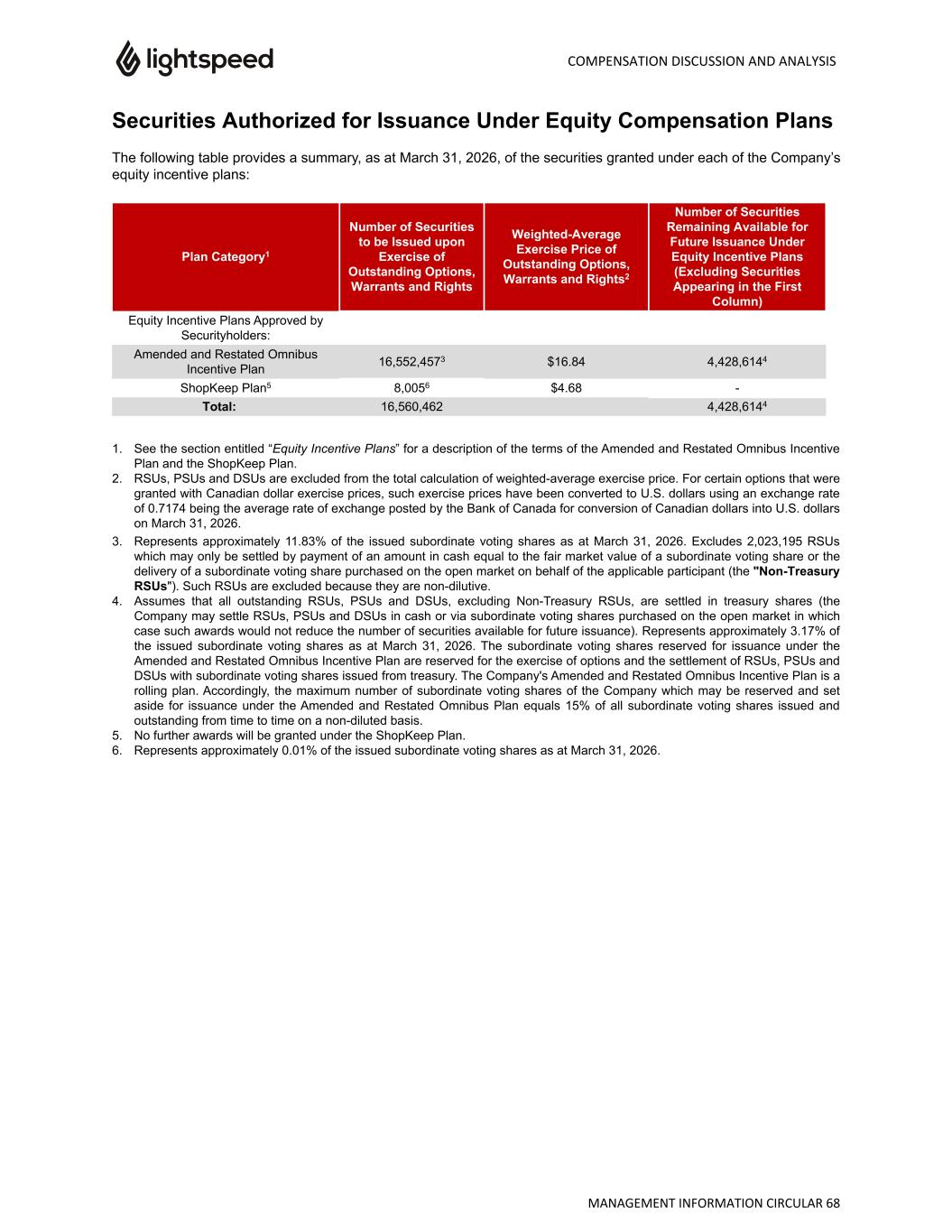
Securities Authorized for Issuance Under Equity Compensation Plans The following table provides a summary, as at March 31, 2026, of the securities granted under each of the Company’s equity incentive plans: Plan Category1 Number of Securities to be Issued upon Exercise of Outstanding Options, Warrants and Rights Weighted-Average Exercise Price of Outstanding Options, Warrants and Rights2 Number of Securities Remaining Available for Future Issuance Under Equity Incentive Plans (Excluding Securities Appearing in the First Column) Equity Incentive Plans Approved by Securityholders: Amended and Restated Omnibus Incentive Plan 16,552,4573 $16.84 4,428,6144 ShopKeep Plan5 8,0056 $4.68 - Total: 16,560,462 4,428,6144 1. See the section entitled “Equity Incentive Plans” for a description of the terms of the Amended and Restated Omnibus Incentive Plan and the ShopKeep Plan. 2. RSUs, PSUs and DSUs are excluded from the total calculation of weighted-average exercise price. For certain options that were granted with Canadian dollar exercise prices, such exercise prices have been converted to U.S. dollars using an exchange rate of 0.7174 being the average rate of exchange posted by the Bank of Canada for conversion of Canadian dollars into U.S. dollars on March 31, 2026. 3. Represents approximately 11.83% of the issued subordinate voting shares as at March 31, 2026. Excludes 2,023,195 RSUs which may only be settled by payment of an amount in cash equal to the fair market value of a subordinate voting share or the delivery of a subordinate voting share purchased on the open market on behalf of the applicable participant (the "Non-Treasury RSUs"). Such RSUs are excluded because they are non-dilutive. 4. Assumes that all outstanding RSUs, PSUs and DSUs, excluding Non-Treasury RSUs, are settled in treasury shares (the Company may settle RSUs, PSUs and DSUs in cash or via subordinate voting shares purchased on the open market in which case such awards would not reduce the number of securities available for future issuance). Represents approximately 3.17% of the issued subordinate voting shares as at March 31, 2026. The subordinate voting shares reserved for issuance under the Amended and Restated Omnibus Incentive Plan are reserved for the exercise of options and the settlement of RSUs, PSUs and DSUs with subordinate voting shares issued from treasury. The Company's Amended and Restated Omnibus Incentive Plan is a rolling plan. Accordingly, the maximum number of subordinate voting shares of the Company which may be reserved and set aside for issuance under the Amended and Restated Omnibus Plan equals 15% of all subordinate voting shares issued and outstanding from time to time on a non-diluted basis. 5. No further awards will be granted under the ShopKeep Plan. 6. Represents approximately 0.01% of the issued subordinate voting shares as at March 31, 2026. COMPENSATION DISCUSSION AND ANALYSIS MANAGEMENT INFORMATION CIRCULAR 68
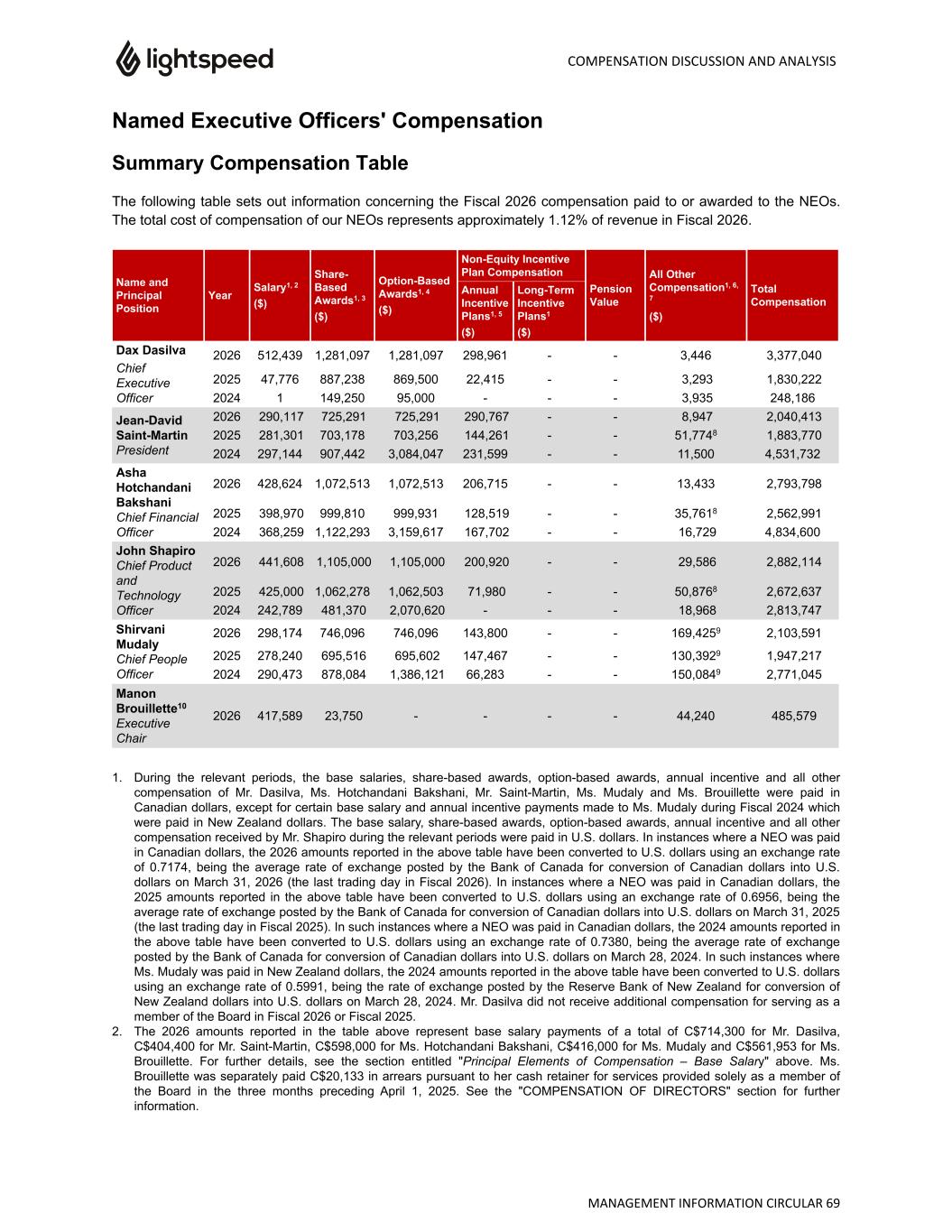
Named Executive Officers' Compensation Summary Compensation Table The following table sets out information concerning the Fiscal 2026 compensation paid to or awarded to the NEOs. The total cost of compensation of our NEOs represents approximately 1.12% of revenue in Fiscal 2026. Name and Principal Position Year Salary1, 2 ($) Share- Based Awards1, 3 ($) Option-Based Awards1, 4 ($) Non-Equity Incentive Plan Compensation Pension Value All Other Compensation1, 6, 7 ($) Total Compensation Annual Incentive Plans1, 5 ($) Long-Term Incentive Plans1 ($) Dax Dasilva Chief Executive Officer 2026 512,439 1,281,097 1,281,097 298,961 - - 3,446 3,377,040 2025 47,776 887,238 869,500 22,415 - - 3,293 1,830,222 2024 1 149,250 95,000 - - - 3,935 248,186 Jean-David Saint-Martin President 2026 290,117 725,291 725,291 290,767 - - 8,947 2,040,413 2025 281,301 703,178 703,256 144,261 - - 51,7748 1,883,770 2024 297,144 907,442 3,084,047 231,599 - - 11,500 4,531,732 Asha Hotchandani Bakshani Chief Financial Officer 2026 428,624 1,072,513 1,072,513 206,715 - - 13,433 2,793,798 2025 398,970 999,810 999,931 128,519 - - 35,7618 2,562,991 2024 368,259 1,122,293 3,159,617 167,702 - - 16,729 4,834,600 John Shapiro Chief Product and Technology Officer 2026 441,608 1,105,000 1,105,000 200,920 - - 29,586 2,882,114 2025 425,000 1,062,278 1,062,503 71,980 - - 50,8768 2,672,637 2024 242,789 481,370 2,070,620 - - - 18,968 2,813,747 Shirvani Mudaly Chief People Officer 2026 298,174 746,096 746,096 143,800 - - 169,4259 2,103,591 2025 278,240 695,516 695,602 147,467 - - 130,3929 1,947,217 2024 290,473 878,084 1,386,121 66,283 - - 150,0849 2,771,045 Manon Brouillette10 Executive Chair 2026 417,589 23,750 - - - - 44,240 485,579 1. During the relevant periods, the base salaries, share-based awards, option-based awards, annual incentive and all other compensation of Mr. Dasilva, Ms. Hotchandani Bakshani, Mr. Saint-Martin, Ms. Mudaly and Ms. Brouillette were paid in Canadian dollars, except for certain base salary and annual incentive payments made to Ms. Mudaly during Fiscal 2024 which were paid in New Zealand dollars. The base salary, share-based awards, option-based awards, annual incentive and all other compensation received by Mr. Shapiro during the relevant periods were paid in U.S. dollars. In instances where a NEO was paid in Canadian dollars, the 2026 amounts reported in the above table have been converted to U.S. dollars using an exchange rate of 0.7174, being the average rate of exchange posted by the Bank of Canada for conversion of Canadian dollars into U.S. dollars on March 31, 2026 (the last trading day in Fiscal 2026). In instances where a NEO was paid in Canadian dollars, the 2025 amounts reported in the above table have been converted to U.S. dollars using an exchange rate of 0.6956, being the average rate of exchange posted by the Bank of Canada for conversion of Canadian dollars into U.S. dollars on March 31, 2025 (the last trading day in Fiscal 2025). In such instances where a NEO was paid in Canadian dollars, the 2024 amounts reported in the above table have been converted to U.S. dollars using an exchange rate of 0.7380, being the average rate of exchange posted by the Bank of Canada for conversion of Canadian dollars into U.S. dollars on March 28, 2024. In such instances where Ms. Mudaly was paid in New Zealand dollars, the 2024 amounts reported in the above table have been converted to U.S. dollars using an exchange rate of 0.5991, being the rate of exchange posted by the Reserve Bank of New Zealand for conversion of New Zealand dollars into U.S. dollars on March 28, 2024. Mr. Dasilva did not receive additional compensation for serving as a member of the Board in Fiscal 2026 or Fiscal 2025. 2. The 2026 amounts reported in the table above represent base salary payments of a total of C$714,300 for Mr. Dasilva, C$404,400 for Mr. Saint-Martin, C$598,000 for Ms. Hotchandani Bakshani, C$416,000 for Ms. Mudaly and C$561,953 for Ms. Brouillette. For further details, see the section entitled "Principal Elements of Compensation – Base Salary" above. Ms. Brouillette was separately paid C$20,133 in arrears pursuant to her cash retainer for services provided solely as a member of the Board in the three months preceding April 1, 2025. See the "COMPENSATION OF DIRECTORS" section for further information. COMPENSATION DISCUSSION AND ANALYSIS MANAGEMENT INFORMATION CIRCULAR 69
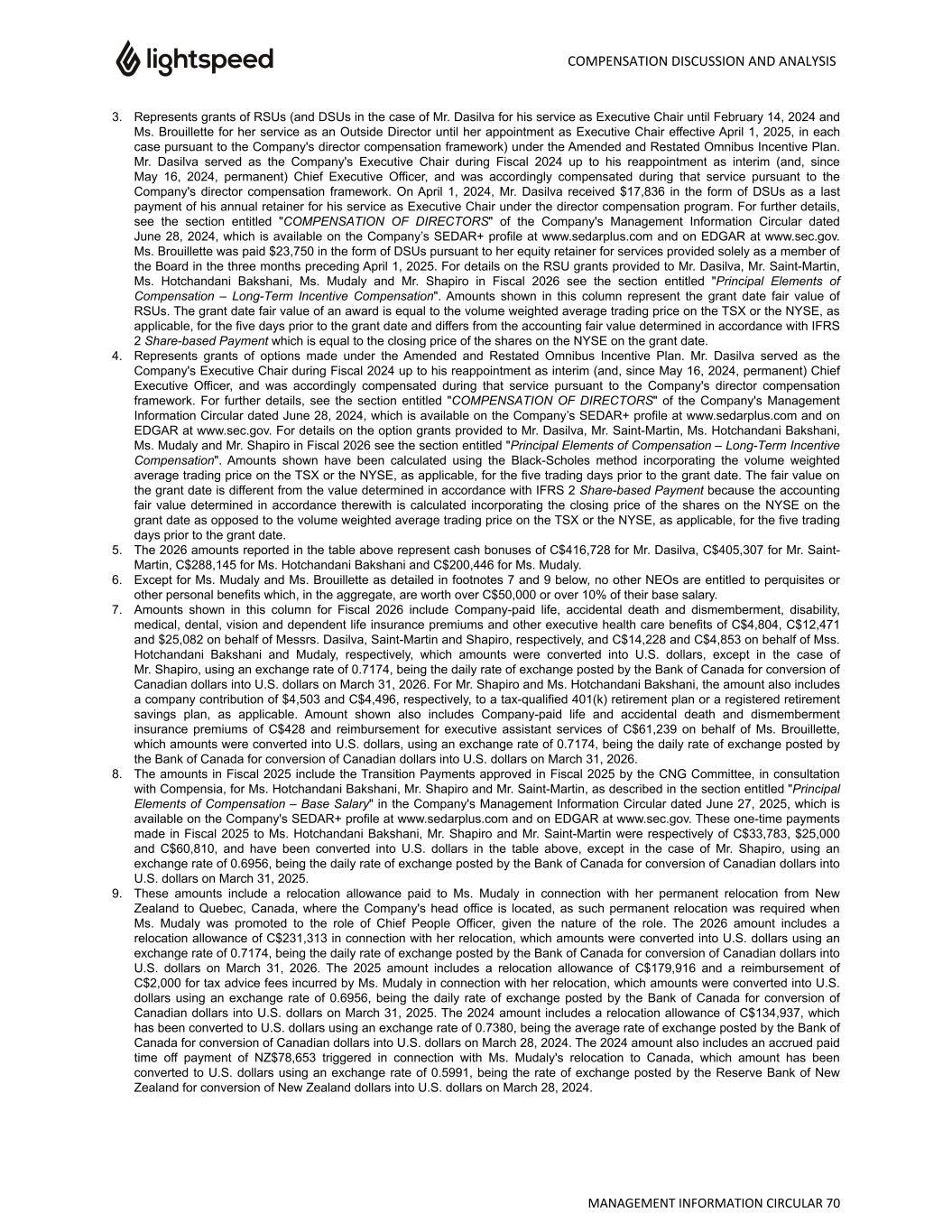
3. Represents grants of RSUs (and DSUs in the case of Mr. Dasilva for his service as Executive Chair until February 14, 2024 and Ms. Brouillette for her service as an Outside Director until her appointment as Executive Chair effective April 1, 2025, in each case pursuant to the Company's director compensation framework) under the Amended and Restated Omnibus Incentive Plan. Mr. Dasilva served as the Company's Executive Chair during Fiscal 2024 up to his reappointment as interim (and, since May 16, 2024, permanent) Chief Executive Officer, and was accordingly compensated during that service pursuant to the Company's director compensation framework. On April 1, 2024, Mr. Dasilva received $17,836 in the form of DSUs as a last payment of his annual retainer for his service as Executive Chair under the director compensation program. For further details, see the section entitled "COMPENSATION OF DIRECTORS" of the Company's Management Information Circular dated June 28, 2024, which is available on the Company’s SEDAR+ profile at www.sedarplus.com and on EDGAR at www.sec.gov. Ms. Brouillette was paid $23,750 in the form of DSUs pursuant to her equity retainer for services provided solely as a member of the Board in the three months preceding April 1, 2025. For details on the RSU grants provided to Mr. Dasilva, Mr. Saint-Martin, Ms. Hotchandani Bakshani, Ms. Mudaly and Mr. Shapiro in Fiscal 2026 see the section entitled "Principal Elements of Compensation – Long-Term Incentive Compensation". Amounts shown in this column represent the grant date fair value of RSUs. The grant date fair value of an award is equal to the volume weighted average trading price on the TSX or the NYSE, as applicable, for the five days prior to the grant date and differs from the accounting fair value determined in accordance with IFRS 2 Share-based Payment which is equal to the closing price of the shares on the NYSE on the grant date. 4. Represents grants of options made under the Amended and Restated Omnibus Incentive Plan. Mr. Dasilva served as the Company's Executive Chair during Fiscal 2024 up to his reappointment as interim (and, since May 16, 2024, permanent) Chief Executive Officer, and was accordingly compensated during that service pursuant to the Company's director compensation framework. For further details, see the section entitled "COMPENSATION OF DIRECTORS" of the Company's Management Information Circular dated June 28, 2024, which is available on the Company’s SEDAR+ profile at www.sedarplus.com and on EDGAR at www.sec.gov. For details on the option grants provided to Mr. Dasilva, Mr. Saint-Martin, Ms. Hotchandani Bakshani, Ms. Mudaly and Mr. Shapiro in Fiscal 2026 see the section entitled "Principal Elements of Compensation – Long-Term Incentive Compensation". Amounts shown have been calculated using the Black-Scholes method incorporating the volume weighted average trading price on the TSX or the NYSE, as applicable, for the five trading days prior to the grant date. The fair value on the grant date is different from the value determined in accordance with IFRS 2 Share-based Payment because the accounting fair value determined in accordance therewith is calculated incorporating the closing price of the shares on the NYSE on the grant date as opposed to the volume weighted average trading price on the TSX or the NYSE, as applicable, for the five trading days prior to the grant date. 5. The 2026 amounts reported in the table above represent cash bonuses of C$416,728 for Mr. Dasilva, C$405,307 for Mr. Saint- Martin, C$288,145 for Ms. Hotchandani Bakshani and C$200,446 for Ms. Mudaly. 6. Except for Ms. Mudaly and Ms. Brouillette as detailed in footnotes 7 and 9 below, no other NEOs are entitled to perquisites or other personal benefits which, in the aggregate, are worth over C$50,000 or over 10% of their base salary. 7. Amounts shown in this column for Fiscal 2026 include Company-paid life, accidental death and dismemberment, disability, medical, dental, vision and dependent life insurance premiums and other executive health care benefits of C$4,804, C$12,471 and $25,082 on behalf of Messrs. Dasilva, Saint-Martin and Shapiro, respectively, and C$14,228 and C$4,853 on behalf of Mss. Hotchandani Bakshani and Mudaly, respectively, which amounts were converted into U.S. dollars, except in the case of Mr. Shapiro, using an exchange rate of 0.7174, being the daily rate of exchange posted by the Bank of Canada for conversion of Canadian dollars into U.S. dollars on March 31, 2026. For Mr. Shapiro and Ms. Hotchandani Bakshani, the amount also includes a company contribution of $4,503 and C$4,496, respectively, to a tax-qualified 401(k) retirement plan or a registered retirement savings plan, as applicable. Amount shown also includes Company-paid life and accidental death and dismemberment insurance premiums of C$428 and reimbursement for executive assistant services of C$61,239 on behalf of Ms. Brouillette, which amounts were converted into U.S. dollars, using an exchange rate of 0.7174, being the daily rate of exchange posted by the Bank of Canada for conversion of Canadian dollars into U.S. dollars on March 31, 2026. 8. The amounts in Fiscal 2025 include the Transition Payments approved in Fiscal 2025 by the CNG Committee, in consultation with Compensia, for Ms. Hotchandani Bakshani, Mr. Shapiro and Mr. Saint-Martin, as described in the section entitled "Principal Elements of Compensation – Base Salary" in the Company's Management Information Circular dated June 27, 2025, which is available on the Company's SEDAR+ profile at www.sedarplus.com and on EDGAR at www.sec.gov. These one-time payments made in Fiscal 2025 to Ms. Hotchandani Bakshani, Mr. Shapiro and Mr. Saint-Martin were respectively of C$33,783, $25,000 and C$60,810, and have been converted into U.S. dollars in the table above, except in the case of Mr. Shapiro, using an exchange rate of 0.6956, being the daily rate of exchange posted by the Bank of Canada for conversion of Canadian dollars into U.S. dollars on March 31, 2025. 9. These amounts include a relocation allowance paid to Ms. Mudaly in connection with her permanent relocation from New Zealand to Quebec, Canada, where the Company's head office is located, as such permanent relocation was required when Ms. Mudaly was promoted to the role of Chief People Officer, given the nature of the role. The 2026 amount includes a relocation allowance of C$231,313 in connection with her relocation, which amounts were converted into U.S. dollars using an exchange rate of 0.7174, being the daily rate of exchange posted by the Bank of Canada for conversion of Canadian dollars into U.S. dollars on March 31, 2026. The 2025 amount includes a relocation allowance of C$179,916 and a reimbursement of C$2,000 for tax advice fees incurred by Ms. Mudaly in connection with her relocation, which amounts were converted into U.S. dollars using an exchange rate of 0.6956, being the daily rate of exchange posted by the Bank of Canada for conversion of Canadian dollars into U.S. dollars on March 31, 2025. The 2024 amount includes a relocation allowance of C$134,937, which has been converted to U.S. dollars using an exchange rate of 0.7380, being the average rate of exchange posted by the Bank of Canada for conversion of Canadian dollars into U.S. dollars on March 28, 2024. The 2024 amount also includes an accrued paid time off payment of NZ$78,653 triggered in connection with Ms. Mudaly's relocation to Canada, which amount has been converted to U.S. dollars using an exchange rate of 0.5991, being the rate of exchange posted by the Reserve Bank of New Zealand for conversion of New Zealand dollars into U.S. dollars on March 28, 2024. COMPENSATION DISCUSSION AND ANALYSIS MANAGEMENT INFORMATION CIRCULAR 70

10. For Ms. Brouillette, in line with her substantial responsibilities as a member of our executive leadership team, the CNG Committee and Board approved an annual base salary of $400,000, target annual cash incentive opportunity of 100% of annual base salary (consistent with the short-term incentive structure applicable to the Chief Executive Officer) and annual long-term incentive awards equal to 500% of annual base salary (consistent with the long-term incentive structure applicable to the Chief Executive Officer). In the event of overachievement of the targets under the short-term incentive program, the Executive Chair shall only be paid up to 200% achievement irrespective of the extent of such overachievement. The long-term incentive compensation awards for Fiscal 2026 for Ms. Brouillette were granted on March 17, 2025 in connection with her appointment as Executive Chair, $1,095,000 in the form of RSUs and $1,095,000 in the form of stock options. See the Company's management information circular dated June 27, 2025 for further information. COMPENSATION DISCUSSION AND ANALYSIS MANAGEMENT INFORMATION CIRCULAR 71
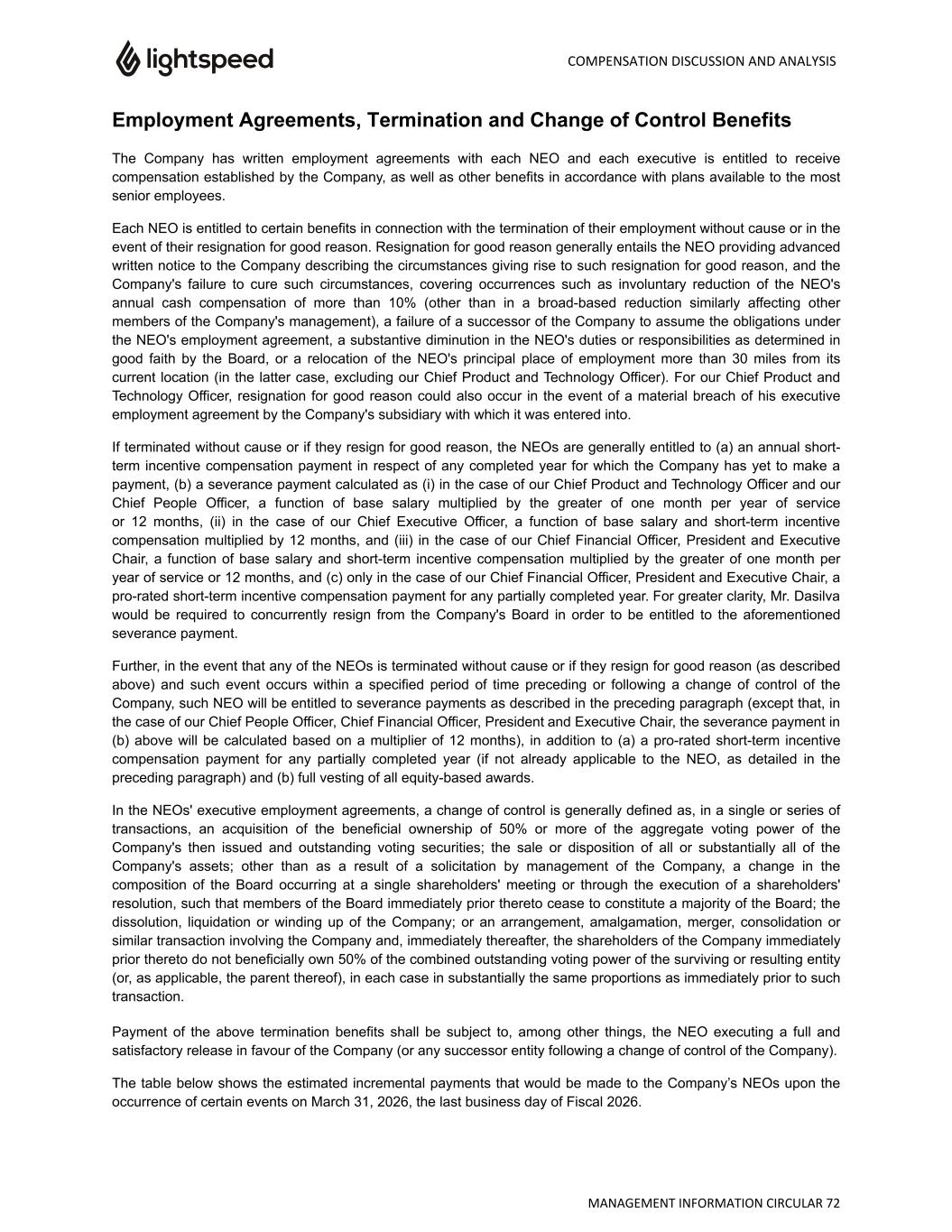
Employment Agreements, Termination and Change of Control Benefits The Company has written employment agreements with each NEO and each executive is entitled to receive compensation established by the Company, as well as other benefits in accordance with plans available to the most senior employees. Each NEO is entitled to certain benefits in connection with the termination of their employment without cause or in the event of their resignation for good reason. Resignation for good reason generally entails the NEO providing advanced written notice to the Company describing the circumstances giving rise to such resignation for good reason, and the Company's failure to cure such circumstances, covering occurrences such as involuntary reduction of the NEO's annual cash compensation of more than 10% (other than in a broad-based reduction similarly affecting other members of the Company's management), a failure of a successor of the Company to assume the obligations under the NEO's employment agreement, a substantive diminution in the NEO's duties or responsibilities as determined in good faith by the Board, or a relocation of the NEO's principal place of employment more than 30 miles from its current location (in the latter case, excluding our Chief Product and Technology Officer). For our Chief Product and Technology Officer, resignation for good reason could also occur in the event of a material breach of his executive employment agreement by the Company's subsidiary with which it was entered into. If terminated without cause or if they resign for good reason, the NEOs are generally entitled to (a) an annual short- term incentive compensation payment in respect of any completed year for which the Company has yet to make a payment, (b) a severance payment calculated as (i) in the case of our Chief Product and Technology Officer and our Chief People Officer, a function of base salary multiplied by the greater of one month per year of service or 12 months, (ii) in the case of our Chief Executive Officer, a function of base salary and short-term incentive compensation multiplied by 12 months, and (iii) in the case of our Chief Financial Officer, President and Executive Chair, a function of base salary and short-term incentive compensation multiplied by the greater of one month per year of service or 12 months, and (c) only in the case of our Chief Financial Officer, President and Executive Chair, a pro-rated short-term incentive compensation payment for any partially completed year. For greater clarity, Mr. Dasilva would be required to concurrently resign from the Company's Board in order to be entitled to the aforementioned severance payment. Further, in the event that any of the NEOs is terminated without cause or if they resign for good reason (as described above) and such event occurs within a specified period of time preceding or following a change of control of the Company, such NEO will be entitled to severance payments as described in the preceding paragraph (except that, in the case of our Chief People Officer, Chief Financial Officer, President and Executive Chair, the severance payment in (b) above will be calculated based on a multiplier of 12 months), in addition to (a) a pro-rated short-term incentive compensation payment for any partially completed year (if not already applicable to the NEO, as detailed in the preceding paragraph) and (b) full vesting of all equity-based awards. In the NEOs' executive employment agreements, a change of control is generally defined as, in a single or series of transactions, an acquisition of the beneficial ownership of 50% or more of the aggregate voting power of the Company's then issued and outstanding voting securities; the sale or disposition of all or substantially all of the Company's assets; other than as a result of a solicitation by management of the Company, a change in the composition of the Board occurring at a single shareholders' meeting or through the execution of a shareholders' resolution, such that members of the Board immediately prior thereto cease to constitute a majority of the Board; the dissolution, liquidation or winding up of the Company; or an arrangement, amalgamation, merger, consolidation or similar transaction involving the Company and, immediately thereafter, the shareholders of the Company immediately prior thereto do not beneficially own 50% of the combined outstanding voting power of the surviving or resulting entity (or, as applicable, the parent thereof), in each case in substantially the same proportions as immediately prior to such transaction. Payment of the above termination benefits shall be subject to, among other things, the NEO executing a full and satisfactory release in favour of the Company (or any successor entity following a change of control of the Company). The table below shows the estimated incremental payments that would be made to the Company’s NEOs upon the occurrence of certain events on March 31, 2026, the last business day of Fiscal 2026. COMPENSATION DISCUSSION AND ANALYSIS MANAGEMENT INFORMATION CIRCULAR 72
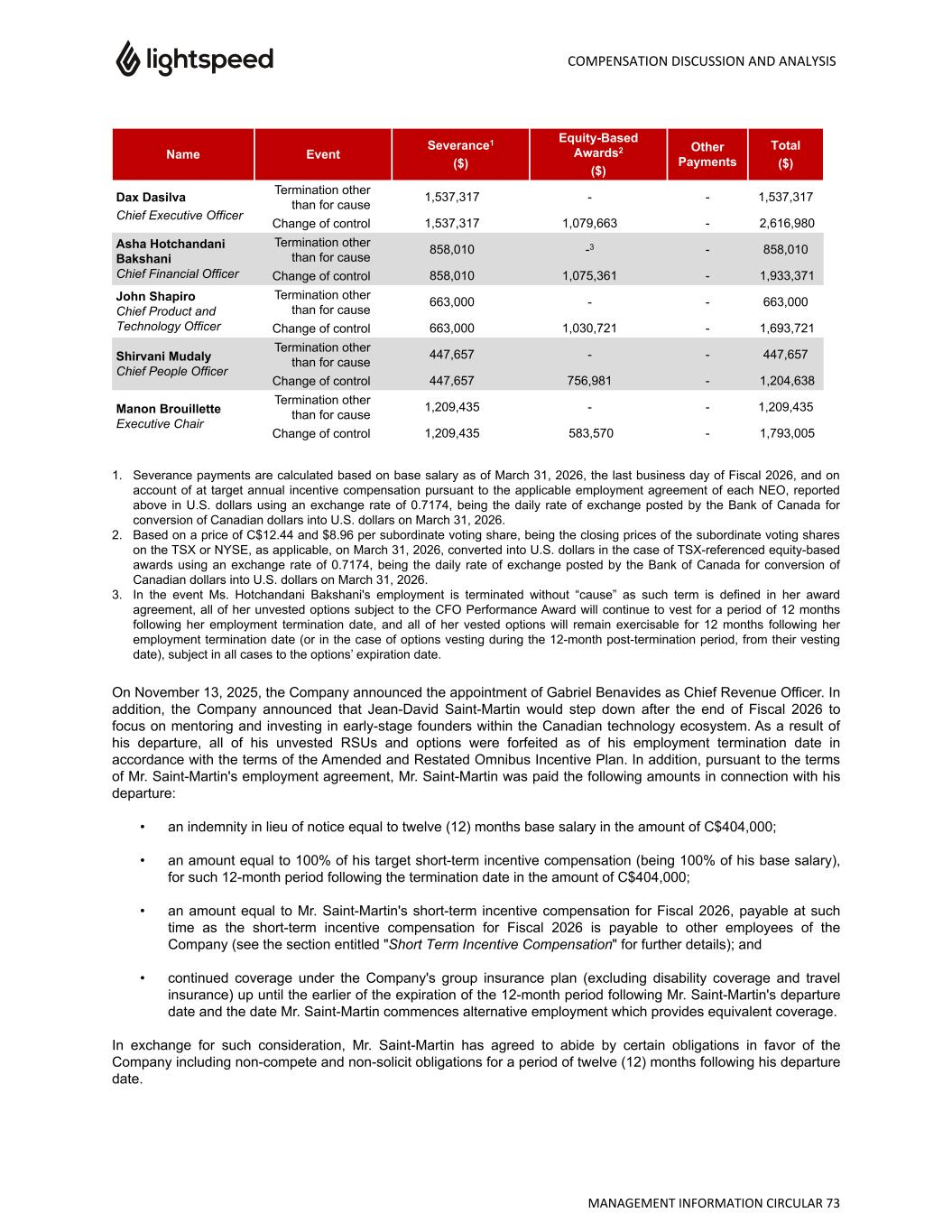
Name Event Severance1 ($) Equity-Based Awards2 ($) Other Payments Total ($) Dax Dasilva Chief Executive Officer Termination other than for cause 1,537,317 - - 1,537,317 Change of control 1,537,317 1,079,663 - 2,616,980 Asha Hotchandani Bakshani Chief Financial Officer Termination other than for cause 858,010 -3 - 858,010 Change of control 858,010 1,075,361 - 1,933,371 John Shapiro Chief Product and Technology Officer Termination other than for cause 663,000 - - 663,000 Change of control 663,000 1,030,721 - 1,693,721 Shirvani Mudaly Chief People Officer Termination other than for cause 447,657 - - 447,657 Change of control 447,657 756,981 - 1,204,638 Manon Brouillette Executive Chair Termination other than for cause 1,209,435 - - 1,209,435 Change of control 1,209,435 583,570 - 1,793,005 1. Severance payments are calculated based on base salary as of March 31, 2026, the last business day of Fiscal 2026, and on account of at target annual incentive compensation pursuant to the applicable employment agreement of each NEO, reported above in U.S. dollars using an exchange rate of 0.7174, being the daily rate of exchange posted by the Bank of Canada for conversion of Canadian dollars into U.S. dollars on March 31, 2026. 2. Based on a price of C$12.44 and $8.96 per subordinate voting share, being the closing prices of the subordinate voting shares on the TSX or NYSE, as applicable, on March 31, 2026, converted into U.S. dollars in the case of TSX-referenced equity-based awards using an exchange rate of 0.7174, being the daily rate of exchange posted by the Bank of Canada for conversion of Canadian dollars into U.S. dollars on March 31, 2026. 3. In the event Ms. Hotchandani Bakshani's employment is terminated without “cause” as such term is defined in her award agreement, all of her unvested options subject to the CFO Performance Award will continue to vest for a period of 12 months following her employment termination date, and all of her vested options will remain exercisable for 12 months following her employment termination date (or in the case of options vesting during the 12-month post-termination period, from their vesting date), subject in all cases to the options’ expiration date. On November 13, 2025, the Company announced the appointment of Gabriel Benavides as Chief Revenue Officer. In addition, the Company announced that Jean-David Saint-Martin would step down after the end of Fiscal 2026 to focus on mentoring and investing in early-stage founders within the Canadian technology ecosystem. As a result of his departure, all of his unvested RSUs and options were forfeited as of his employment termination date in accordance with the terms of the Amended and Restated Omnibus Incentive Plan. In addition, pursuant to the terms of Mr. Saint-Martin's employment agreement, Mr. Saint-Martin was paid the following amounts in connection with his departure: • an indemnity in lieu of notice equal to twelve (12) months base salary in the amount of C$404,000; • an amount equal to 100% of his target short-term incentive compensation (being 100% of his base salary), for such 12-month period following the termination date in the amount of C$404,000; • an amount equal to Mr. Saint-Martin's short-term incentive compensation for Fiscal 2026, payable at such time as the short-term incentive compensation for Fiscal 2026 is payable to other employees of the Company (see the section entitled "Short Term Incentive Compensation" for further details); and • continued coverage under the Company's group insurance plan (excluding disability coverage and travel insurance) up until the earlier of the expiration of the 12-month period following Mr. Saint-Martin's departure date and the date Mr. Saint-Martin commences alternative employment which provides equivalent coverage. In exchange for such consideration, Mr. Saint-Martin has agreed to abide by certain obligations in favor of the Company including non-compete and non-solicit obligations for a period of twelve (12) months following his departure date. COMPENSATION DISCUSSION AND ANALYSIS MANAGEMENT INFORMATION CIRCULAR 73
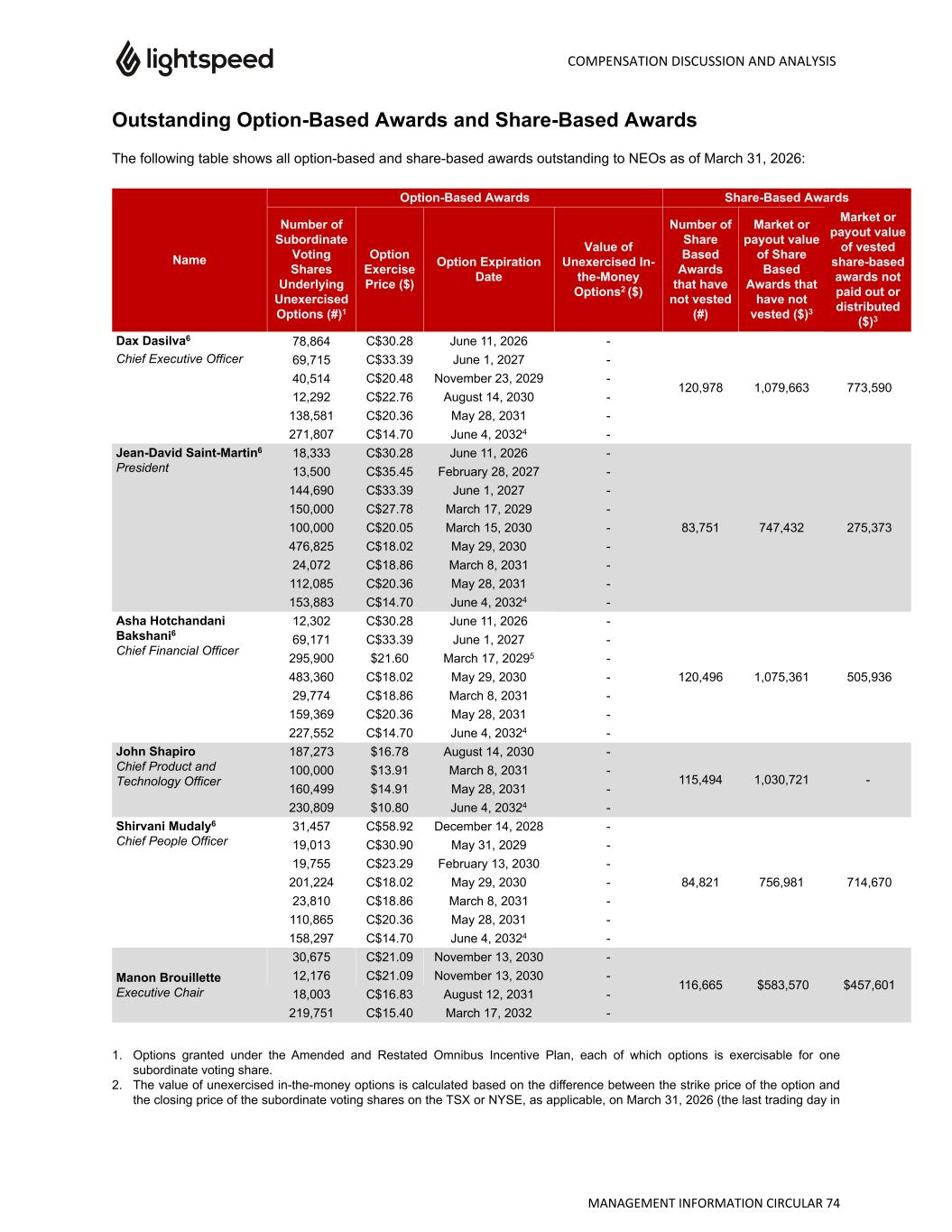
Outstanding Option-Based Awards and Share-Based Awards The following table shows all option-based and share-based awards outstanding to NEOs as of March 31, 2026: Name Option-Based Awards Share-Based Awards Number of Subordinate Voting Shares Underlying Unexercised Options (#)1 Option Exercise Price ($) Option Expiration Date Value of Unexercised In- the-Money Options2 ($) Number of Share Based Awards that have not vested (#) Market or payout value of Share Based Awards that have not vested ($)3 Market or payout value of vested share-based awards not paid out or distributed ($)3 Dax Dasilva6 Chief Executive Officer 78,864 C$30.28 June 11, 2026 - 120,978 1,079,663 773,590 69,715 C$33.39 June 1, 2027 - 40,514 C$20.48 November 23, 2029 - 12,292 C$22.76 August 14, 2030 - 138,581 C$20.36 May 28, 2031 - 271,807 C$14.70 June 4, 20324 - Jean-David Saint-Martin6 President 18,333 C$30.28 June 11, 2026 - 83,751 747,432 275,373 13,500 C$35.45 February 28, 2027 - 144,690 C$33.39 June 1, 2027 - 150,000 C$27.78 March 17, 2029 - 100,000 C$20.05 March 15, 2030 - 476,825 C$18.02 May 29, 2030 - 24,072 C$18.86 March 8, 2031 - 112,085 C$20.36 May 28, 2031 - 153,883 C$14.70 June 4, 20324 - Asha Hotchandani Bakshani6 Chief Financial Officer 12,302 C$30.28 June 11, 2026 - 120,496 1,075,361 505,936 69,171 C$33.39 June 1, 2027 - 295,900 $21.60 March 17, 20295 - 483,360 C$18.02 May 29, 2030 - 29,774 C$18.86 March 8, 2031 - 159,369 C$20.36 May 28, 2031 - 227,552 C$14.70 June 4, 20324 - John Shapiro Chief Product and Technology Officer 187,273 $16.78 August 14, 2030 - 115,494 1,030,721 - 100,000 $13.91 March 8, 2031 - 160,499 $14.91 May 28, 2031 - 230,809 $10.80 June 4, 20324 - Shirvani Mudaly6 Chief People Officer 31,457 C$58.92 December 14, 2028 - 84,821 756,981 714,670 19,013 C$30.90 May 31, 2029 - 19,755 C$23.29 February 13, 2030 - 201,224 C$18.02 May 29, 2030 - 23,810 C$18.86 March 8, 2031 - 110,865 C$20.36 May 28, 2031 - 158,297 C$14.70 June 4, 20324 - Manon Brouillette Executive Chair 30,675 C$21.09 November 13, 2030 - 116,665 $583,570 $457,601 12,176 C$21.09 November 13, 2030 - 18,003 C$16.83 August 12, 2031 - 219,751 C$15.40 March 17, 2032 - 1. Options granted under the Amended and Restated Omnibus Incentive Plan, each of which options is exercisable for one subordinate voting share. 2. The value of unexercised in-the-money options is calculated based on the difference between the strike price of the option and the closing price of the subordinate voting shares on the TSX or NYSE, as applicable, on March 31, 2026 (the last trading day in COMPENSATION DISCUSSION AND ANALYSIS MANAGEMENT INFORMATION CIRCULAR 74
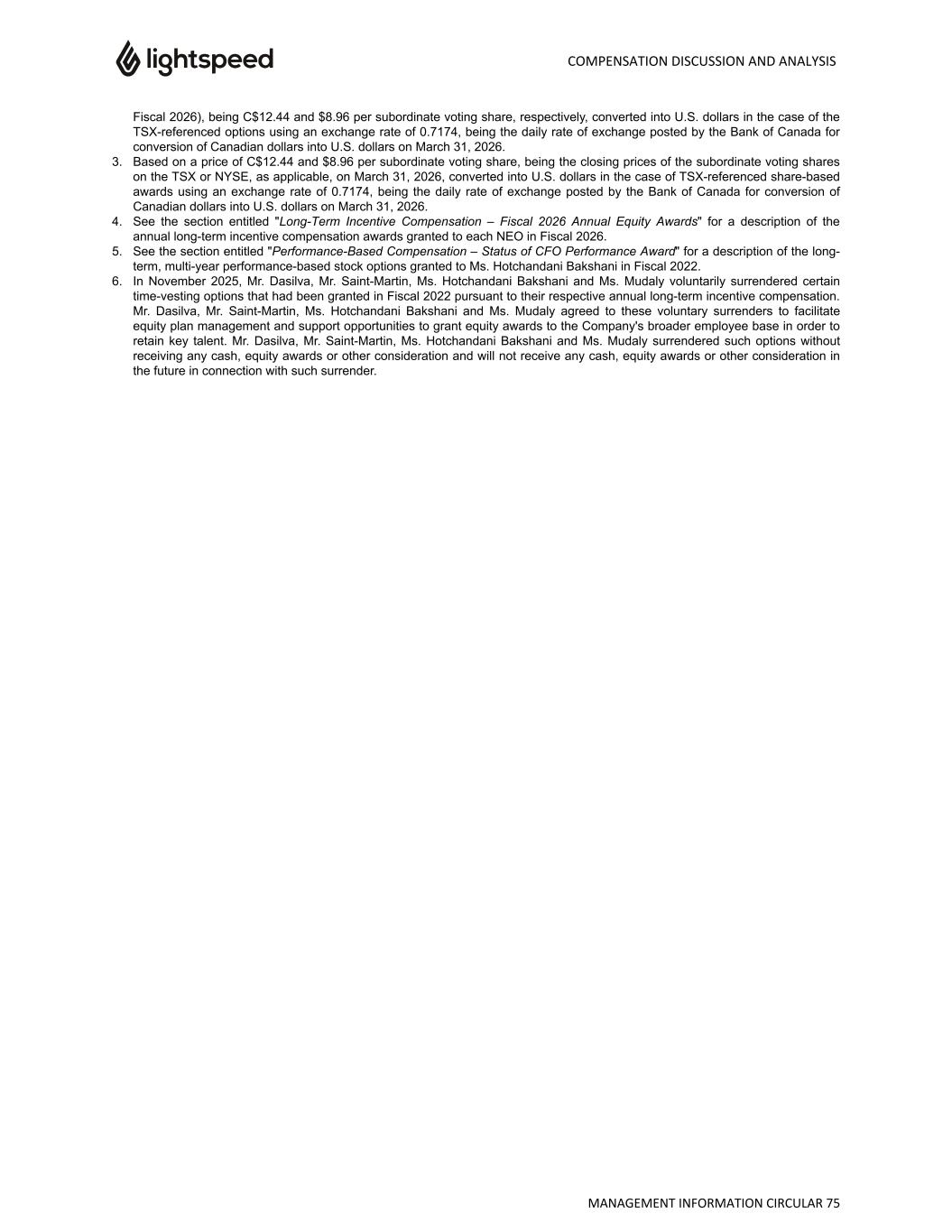
Fiscal 2026), being C$12.44 and $8.96 per subordinate voting share, respectively, converted into U.S. dollars in the case of the TSX-referenced options using an exchange rate of 0.7174, being the daily rate of exchange posted by the Bank of Canada for conversion of Canadian dollars into U.S. dollars on March 31, 2026. 3. Based on a price of C$12.44 and $8.96 per subordinate voting share, being the closing prices of the subordinate voting shares on the TSX or NYSE, as applicable, on March 31, 2026, converted into U.S. dollars in the case of TSX-referenced share-based awards using an exchange rate of 0.7174, being the daily rate of exchange posted by the Bank of Canada for conversion of Canadian dollars into U.S. dollars on March 31, 2026. 4. See the section entitled "Long-Term Incentive Compensation – Fiscal 2026 Annual Equity Awards" for a description of the annual long-term incentive compensation awards granted to each NEO in Fiscal 2026. 5. See the section entitled "Performance-Based Compensation – Status of CFO Performance Award" for a description of the long- term, multi-year performance-based stock options granted to Ms. Hotchandani Bakshani in Fiscal 2022. 6. In November 2025, Mr. Dasilva, Mr. Saint-Martin, Ms. Hotchandani Bakshani and Ms. Mudaly voluntarily surrendered certain time-vesting options that had been granted in Fiscal 2022 pursuant to their respective annual long-term incentive compensation. Mr. Dasilva, Mr. Saint-Martin, Ms. Hotchandani Bakshani and Ms. Mudaly agreed to these voluntary surrenders to facilitate equity plan management and support opportunities to grant equity awards to the Company's broader employee base in order to retain key talent. Mr. Dasilva, Mr. Saint-Martin, Ms. Hotchandani Bakshani and Ms. Mudaly surrendered such options without receiving any cash, equity awards or other consideration and will not receive any cash, equity awards or other consideration in the future in connection with such surrender. COMPENSATION DISCUSSION AND ANALYSIS MANAGEMENT INFORMATION CIRCULAR 75
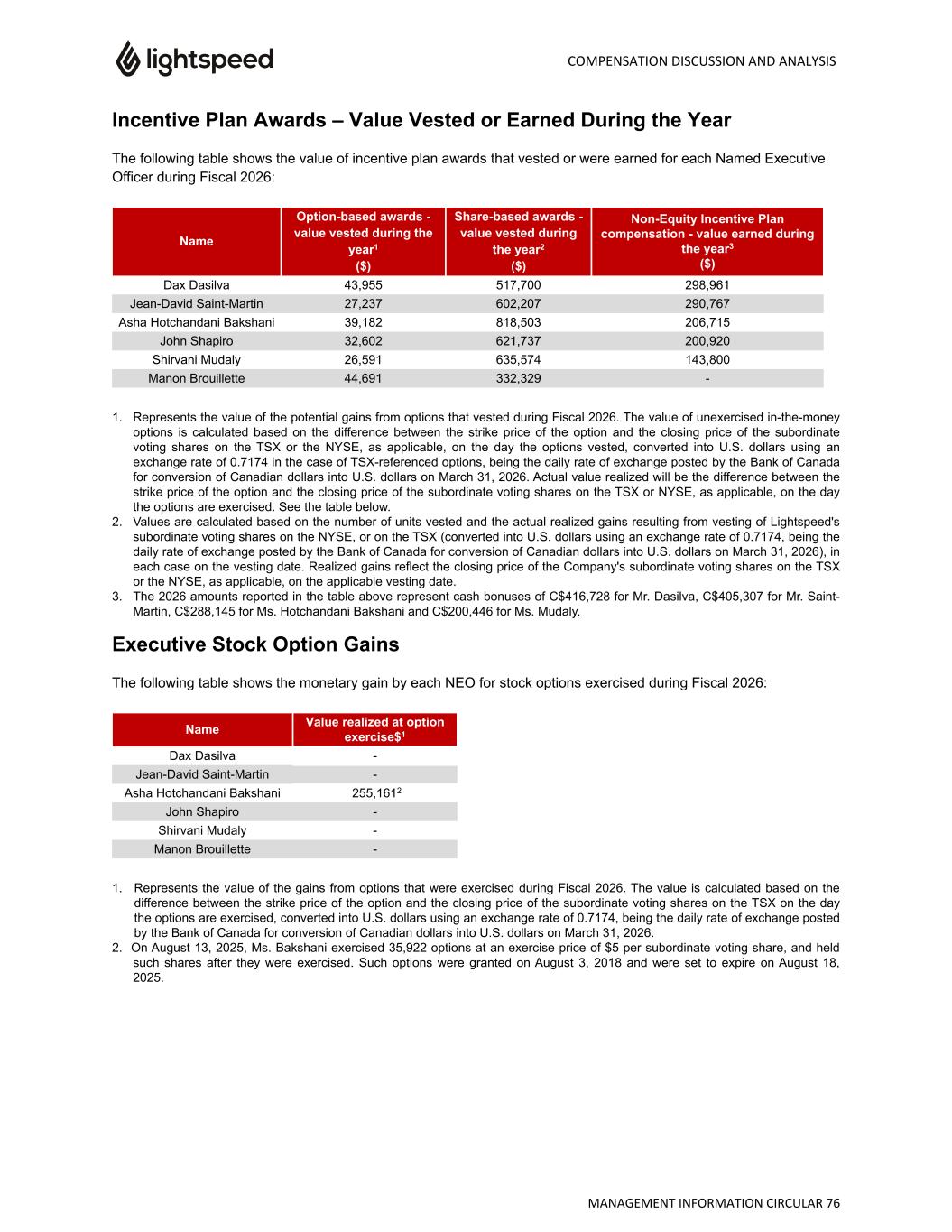
Incentive Plan Awards – Value Vested or Earned During the Year The following table shows the value of incentive plan awards that vested or were earned for each Named Executive Officer during Fiscal 2026: Name Option-based awards - value vested during the year1 ($) Share-based awards - value vested during the year2 ($) Non-Equity Incentive Plan compensation - value earned during the year3 ($) Dax Dasilva 43,955 517,700 298,961 Jean-David Saint-Martin 27,237 602,207 290,767 Asha Hotchandani Bakshani 39,182 818,503 206,715 John Shapiro 32,602 621,737 200,920 Shirvani Mudaly 26,591 635,574 143,800 Manon Brouillette 44,691 332,329 - 1. Represents the value of the potential gains from options that vested during Fiscal 2026. The value of unexercised in-the-money options is calculated based on the difference between the strike price of the option and the closing price of the subordinate voting shares on the TSX or the NYSE, as applicable, on the day the options vested, converted into U.S. dollars using an exchange rate of 0.7174 in the case of TSX-referenced options, being the daily rate of exchange posted by the Bank of Canada for conversion of Canadian dollars into U.S. dollars on March 31, 2026. Actual value realized will be the difference between the strike price of the option and the closing price of the subordinate voting shares on the TSX or NYSE, as applicable, on the day the options are exercised. See the table below. 2. Values are calculated based on the number of units vested and the actual realized gains resulting from vesting of Lightspeed's subordinate voting shares on the NYSE, or on the TSX (converted into U.S. dollars using an exchange rate of 0.7174, being the daily rate of exchange posted by the Bank of Canada for conversion of Canadian dollars into U.S. dollars on March 31, 2026), in each case on the vesting date. Realized gains reflect the closing price of the Company's subordinate voting shares on the TSX or the NYSE, as applicable, on the applicable vesting date. 3. The 2026 amounts reported in the table above represent cash bonuses of C$416,728 for Mr. Dasilva, C$405,307 for Mr. Saint- Martin, C$288,145 for Ms. Hotchandani Bakshani and C$200,446 for Ms. Mudaly. Executive Stock Option Gains The following table shows the monetary gain by each NEO for stock options exercised during Fiscal 2026: Name Value realized at option exercise$1 Dax Dasilva - Jean-David Saint-Martin - Asha Hotchandani Bakshani 255,1612 John Shapiro - Shirvani Mudaly - Manon Brouillette - 1. Represents the value of the gains from options that were exercised during Fiscal 2026. The value is calculated based on the difference between the strike price of the option and the closing price of the subordinate voting shares on the TSX on the day the options are exercised, converted into U.S. dollars using an exchange rate of 0.7174, being the daily rate of exchange posted by the Bank of Canada for conversion of Canadian dollars into U.S. dollars on March 31, 2026. 2. On August 13, 2025, Ms. Bakshani exercised 35,922 options at an exercise price of $5 per subordinate voting share, and held such shares after they were exercised. Such options were granted on August 3, 2018 and were set to expire on August 18, 2025. COMPENSATION DISCUSSION AND ANALYSIS MANAGEMENT INFORMATION CIRCULAR 76
STATEMENT OF CORPORATE GOVERNANCE PRACTICES The CSA have issued corporate governance guidelines pursuant to National Policy 58-201 – Corporate Governance Guidelines (“NP 58-201”) together with certain related disclosure requirements pursuant to National Instrument 58-101 – Disclosure of Corporate Governance Practices ("NI 58-101"). The corporate governance guidelines set forth in NP 58-201 are recommended as “best practices” for issuers to follow. The Company is also subject to certain corporate governance rules of the TSX and the NYSE, and applicable Canadian and U.S. corporate and securities rules and regulations, including the provisions of the CBCA and the applicable provisions of the U.S. Sarbanes-Oxley Act. We recognize that good corporate governance plays an important role in our overall success and in enhancing shareholder value and, accordingly, we have adopted certain corporate governance policies and practices. The Board and senior management believe that the Company’s current governance practices are appropriate and comply in all material respects with all requisite regulatory and statutory requirements. The disclosure set out below describes our approach to corporate governance. Nomination of Directors Our CNG Committee is responsible for, annually or as required, recruiting and identifying, and recommending to the Board for nomination, individuals qualified to become new Board members, as well as recommending individual directors to serve on the various Board committees. In making its recommendations, the CNG Committee considers the competencies that the Board considers to be necessary and desirable for the Board as a whole, and Board committees, to possess, the competencies and skills that the Board considers each existing director to possess, and the competencies, skills, perspective and experience each new nominee will bring to the boardroom. The CNG Committee also considers the amount of time and resources that nominees have available to fulfill their duties as a Board member. The CNG Committee is composed of independent directors within the meaning of applicable U.S. and Canadian laws, regulations, rules and listing standards. The chair of the CNG Committee leads the nominating process in accordance with and pursuant to the criteria for Board membership as set forth in the Charter of the CNG Committee. Lightspeed is subject to the statutory majority voting requirements under the CBCA (the "CBCA Majority Voting Requirements"), which became effective on August 31, 2022. As a result of the implementation of the CBCA Majority Voting Requirements, Lightspeed repealed its Majority Voting Policy and is now solely governed by the CBCA Majority Voting Requirements. In accordance with the CBCA Majority Voting Requirements, directors stand for election each year at the annual meeting of shareholders, and a separate vote of shareholders is taken with respect to each candidate nominated for director. If there is an uncontested election, each candidate is elected only if the number of votes cast in their favor represents a majority of the votes cast for and against them by the shareholders who are present in person or represented by proxy. If an incumbent director is not re-elected in an uncontested election, the director may continue in office until the earlier of (i) the 90th day after the day of the election; and (ii) the day on which their successor is appointed or elected. Majority voting will not apply in the case of a contested election of directors, in which case the directors will be elected by a plurality of votes of the shares represented in person or by proxy at the meeting and voted on the election of directors. Advance Notice Policy We have adopted an advance notice by-law that includes provisions with respect to the election of our directors in our amended and restated articles of incorporation (the “Advance Notice Provisions”). The Advance Notice Provisions are intended to: (i) facilitate orderly and efficient annual general meetings or, where the need arises, special meetings; (ii) ensure that all shareholders receive adequate notice of Board nominations and sufficient information with respect to all nominees; and (iii) allow shareholders to register an informed vote. Only persons who are STATEMENT OF CORPORATE GOVERNANCE PRACTICES MANAGEMENT INFORMATION CIRCULAR 77
nominated by shareholders in accordance with the Advance Notice Provisions will be eligible for election as directors at any annual meeting of shareholders, or at any special meeting of shareholders if one of the purposes for which the special meeting was called was the election of directors. Under the Advance Notice Provisions, a shareholder wishing to nominate a director would be required to provide us notice, in the prescribed form, within the prescribed time periods. These time periods require that we receive notice of a director’s nomination: (i) in the case of an annual meeting of shareholders (including annual and special meetings), not less than 30 days prior to the date of the annual meeting of shareholders; provided, that if the first public announcement of the date (the “Notice Date”) of the annual meeting of shareholders is less than 50 days before the meeting date, not later than the close of business on the 10th day following the Notice Date; and (ii) in the case of a special meeting (which is not also an annual meeting) of shareholders called for any purpose which includes electing directors, not later than the close of business on the 15th day following the Notice Date, provided that, in either instance, if notice-and-access (as defined in NI 54-101) is used for delivery of proxy related materials in respect of a meeting described above, and the Notice Date in respect of the meeting is not less than 50 days prior to the date of the applicable meeting, the notice must be received not later than the close of business on the 40th day before the applicable meeting (but in any event, not prior to the Notice Date); provided further, that in the event that the meeting is to be held on a date that is less than fifty days after the Notice Date, a shareholder must provide notice not later than the close of business on the 10th day following the Notice Date in the case of an annual meeting of shareholders and not later than the close of business on the 15th day following the Notice Date in the case of a special meeting of shareholders. Independence of Directors Director Independence It is the objective of the Board that all non-employee directors meet the criteria for independence required by all applicable regulatory bodies and relevant stock exchanges. Only those directors who the Board affirmatively determines have no material relationship with the Company and who meet the additional qualifications prescribed under the TSX rules, the NYSE rules and other applicable regulatory and statutory requirements will be considered independent. In particular, under NI 58-101, a director is considered to be independent if he or she is independent within the meaning of National Instrument 52-110 – Audit Committees ("NI 52-110"). Pursuant to NI 52-110, an independent director is a director who is free from any direct or indirect relationship which could, in the view of the Board, be reasonably expected to interfere with a director’s independent judgment. Based on information provided by each director concerning his or her background, employment and affiliations, the Board has determined that two of the seven director nominees on the Board will not be considered independent as a result of his or her employment relationship with the Company. As of the date hereof our independent Board members are Dale Murray, Nathalie Gaveau, Glen LeBlanc, Sameer Samat and Odilon Almeida. As of the date hereof our non-independent members of our Board are Dax Dasilva, Lightspeed's Chief Executive Officer, and Manon Brouillette, Lightspeed's Executive Chair. Certain members of the Board are also members of the board of directors of other public companies. In Fiscal 2026, the CNG Committee and Board adopted a formal policy to help ensure that Board members continue to have sufficient time to fulfill their duties as a Board member of the Company, avoid conflicts of interest and are not overboarded before accepting a new board seat or senior management role at another organization. The Board also receives a quarterly report on other directorships and significant engagements of its members. Executive Chair and Lead Independent Director of the Board On March 6, 2025, we announced that Ms. Brouillette had been appointed as Executive Chair of the Board and Ms. Murray as Lead Independent Director of the Board, in each case with effect as of April 1, 2025, to coincide with the first day of Fiscal 2026. Ms. Brouillette no longer serves on any Board committees since her appointment as Executive Chair. STATEMENT OF CORPORATE GOVERNANCE PRACTICES MANAGEMENT INFORMATION CIRCULAR 78
The leadership of our Executive Chair, Ms. Brouillette, is complemented by the robust independent oversight of our Lead Independent Director, Ms. Murray. As Executive Chair, Ms. Brouillette is principally responsible for overseeing the operations and affairs of the Board, in coordination with the Lead Independent Director. Pursuant to the written Charter adopted by the Board (the "Board Charter"), the Board meets in camera without management at each regular and special Board meeting and the independent directors meet in executive session at each regular Board meeting without management and non-independent directors. The director who presides at these executive sessions will be the Lead Independent Director. We believe such structure provides strong independent oversight. Meetings of Independent Directors The Board holds regularly-scheduled quarterly meetings as well as ad hoc meetings from time to time. In the course of any meetings of the Board or of committees of the Board, the independent directors hold portions of such meetings at which neither non-independent directors nor management of the Company are in attendance. All of our committees are made up of independent directors. If a director or officer holds an interest in a transaction or agreement under consideration at a Board meeting or a Board committee meeting, that director or officer shall not be present at the time the Board or Board committee deliberates such transaction or agreement and shall abstain from voting on the matter, subject to certain limited exceptions provided for in the CBCA. In Fiscal 2026, there were 6 Board meetings, 4 Audit Committee meetings, 4 CNG Committee meetings and 4 Risk Committee meetings. Attendance was 100% for all directors who are standing for re-election at all Board and Committee meetings of which they were a member held in Fiscal 2026, except for Ms. Gaveau who was unable to attend one ad hoc Board meeting and Mr. LeBlanc who was unable to attend one Risk Committee meeting. Related-Party Transactions In order to ensure independent judgment in considering transactions or agreements in which a director, officer or significant shareholder has a material interest, all related-party transactions are approved pursuant to the Company's written policy by the Audit Committee. The Audit Committee shall review such transactions or agreements taking into account, among other things, whether the transaction or agreement is at arm's length, the benefits to the Company and its stakeholders of entering into the transaction or agreement, whether director independence may be impaired, and the material facts of the arrangement, including the proposed aggregate value of the transaction or agreement, or, in the case of indebtedness, the amount of principal that would be involved. Director Term Limits and Other Mechanisms of Board Renewal The Board has not adopted director term limits, age-related retirement policies or other automatic mechanisms of board renewal. Rather than adopting formal term limits, mandatory age-related retirement policies and other mechanisms of board renewal, the CNG Committee seeks to maintain the composition of the Board in a way that provides, in the judgment of the Board, the best mix of skills and experience to provide for our overall stewardship. In conducting director evaluations and nominations, the CNG Committee considers the composition of the Board and whether there is a need to include nominees with different skills, experiences and perspectives on the Board. This flexible approach allows the Company to consider each director individually as well as the Board composition generally to determine if the appropriate balance is being achieved. The table below identifies the tenure of each of our director nominees and the average tenure of all director nominees, calculated by taking the calendar year 2026 (as this is the year in which the annual general meeting STATEMENT OF CORPORATE GOVERNANCE PRACTICES MANAGEMENT INFORMATION CIRCULAR 79
covered by this management information circular is taking place) and subtracting the calendar year in which the director began serving on the Board: Name Director Tenure Manon Brouillette Non-Independent 3 years Dale Murray Independent 4 years Dax Dasilva Non-Independent 21 years Nathalie Gaveau Independent 4 years Glen LeBlanc Independent 1 year Sameer Samat Independent 1 year Odilon Almeida Independent 1 year Average Tenure 5 years Excluding Mr. Dasilva who founded the Company, the average tenure of all director nominees is approximately 2.3 years. Individual Director Assessments and Peer Review In accordance with the Board Charter and the CNG Committee charter, the CNG Committee also conducts an annual process for the assessment of the Board, each Board committee and each director regarding his, her or its effectiveness, performance and contributions, and reports evaluation results to the Board (and in the case of each committee member's self-evaluation, to the applicable committee). Each director is required to complete, on an annual basis, a confidential written evaluation with respect to the performance of the Board, the performance of its committees, and a peer evaluation and self evaluation of the contributions of each individual director and her or himself, respectively. Board Mandate The Board Charter describes, inter alia, the Board’s role and overall responsibility to supervise the management of the business and affairs of the Company. The Board, directly and through its Board committees and the Chair of the Board, provides direction to the executive officers of the Company, generally through the Chief Executive Officer. The Board has overall responsibility for the Company’s strategic planning, compliance and risk management (including crisis preparedness, information system controls, business continuity, cybersecurity, artificial intelligence ("AI") and ethical uses of emerging technologies such as AI, disaster recovery and climate change related risks), matters relating to the Chief Executive Officer and other executive officers, corporate governance, and communications with the Company’s shareholders and other stakeholders. The text of the Board Charter, which includes the Board's express mandate, is reproduced in its entirety in Schedule A. STATEMENT OF CORPORATE GOVERNANCE PRACTICES MANAGEMENT INFORMATION CIRCULAR 80
Board and Executive Leadership Position Descriptions The Board has developed position descriptions for the Executive Chair of the Board and the Lead Independent Director of the Board. The Board has also developed a position description for the Chief Executive Officer. Such descriptions are available on the Company’s website at investors.lightspeedhq.com. The Chief Executive Officer is responsible for the day-to-day management of the business and affairs of the Company, including providing executive and operational leadership, developing and implementing strategic, business, capital and operating plans, overseeing financial and administrative management, maintaining effective controls and compliance practices, serving as a principal public spokesperson, and keeping the Board informed on the Company’s performance, risks, opportunities and progress against approved plans. The Executive Chair leads the Board in coordination with the Lead Independent Director, oversees the Board’s direction, administration, effectiveness and governance processes, supports strategic planning and transformation initiatives in coordination with the CEO, CFO and senior management, assists with key stakeholder relations, and helps mentor and develop the senior management team. The Lead Independent Director promotes strong, independent and impartial Board governance by ensuring the Board functions effectively and autonomously, leading the Board if the Executive Chair is conflicted or unavailable, chairing executive sessions of independent directors, facilitating open communication among the Executive Chair, management and independent directors, and providing an independent channel for shareholder and stakeholder concerns. The responsibilities of the Executive Chair of the Board, Lead Independent Director of the Board and Chief Executive Officer are listed in the tables below. STATEMENT OF CORPORATE GOVERNANCE PRACTICES MANAGEMENT INFORMATION CIRCULAR 81
Executive Chair In addition to fulfilling her duties as an individual director, the duties of the Executive Chair are to: Leadership • serve as the Board’s role model for responsible, ethical and effective decision-making; • effectively lead, in coordination with the Lead Independent Director of the Board in discharging all duties set out in the Board Charter; Ethics • foster effective, ethical and responsible decision-making by the Board and its individual members; Governance • oversee all aspects of the Board’s direction and administration in fulfilling the terms of the Board Charter; • manage the affairs of the Board, in coordination with the Lead Independent Director, to ensure that the Board is organized properly and functions effectively; • coordinate with the Lead Independent Director the oversight of the structure, size, composition, membership (including independence, financial literacy and expertise) and activities of the Board; Education • monitor developments and best practices relating to the Board’s mandate and provide information and guidance to the Board regarding such developments and practices and their potential adoption by the Company, including emerging technologies and developments such as AI; Board and Shareholder Meetings • ensure the Board meets as frequently as necessary to carry out its duties effectively (which shall be at least quarterly) and ensure that there is sufficient time during Board meetings to fully discuss all business properly put before the Board; • ensure that notice of all meetings of the Board is provided to all Board members, the external auditor, the CEO and the CFO; • chair, and together with the members of the Board, management and advisors, as appropriate, call, and in coordination with the Lead Independent Director set the agenda and determine the time and place for each Board meeting, provided that if the Executive Chair is not present, the Lead Independent Director will chair the meeting. • ensure that the Board meets periodically in closed session with management and meets periodically without management and non-independent directors present; • coordinate with the Lead Independent Director, CFO, Corporate Secretary and management to ensure that: i. materials are delivered to Board members in sufficient time in advance of Board meetings for a thorough review; ii. matters are properly presented for consideration at Board meetings; iii. directors express their viewpoints; iv. directors have an appropriate opportunity to question executive officers, management, employees, experts and advisors regarding financial results, internal controls, the collection of financial information and all other matters of importance to the Board; and v. directors work together constructively; • chair annual and special meetings of shareholders of the Company; Communication and Accountability • coordinate with the Lead Independent Director to communicate with each director and management to ensure that: i. each director is heard and participates in decision making; ii. directors receive information from and are exposed to presentations from management to fulfill their Board Charter obligations; and iii. each director is accountable to the Board; • maintain effective communication and working relationships between directors, the Board, management and advisors; • arrange for the preparation, accuracy and distribution of Board minutes to the Board and the CEO and CFO; • make Board information available to any director upon request; • coordinate with the Lead Independent Director to ensure that an annual review and assessment of the Board’s performance, effectiveness and contribution is conducted; Advisors and Resources • ensure that resources and expertise are available to the Board so that it may conduct its work effectively and efficiently; • coordinate with the Board to retain, oversee and compensate independent advisors to assist the Board in its activities; Business Activities • in coordination with the CEO and CFO, assist the Company in its relations with shareholders, analysts, business partners, financial institutions, government actors, external stakeholders and employees and act as a principal spokesperson for the Company; • in coordination with the CEO and CFO, other executive officers and senior management personnel, monitor and ensure progress on strategic planning (including providing oversight in respect of strategic transformation initiatives), annual budgets, policy implementation and succession planning; • motivate, mentor and help develop the senior management team as a high performance team, including helping to attract and retain individuals with the requisite skills, experience and values; and Other Duties • perform such other duties and responsibilities as may be required by applicable law, regulation, rule or listing standard. STATEMENT OF CORPORATE GOVERNANCE PRACTICES MANAGEMENT INFORMATION CIRCULAR 82
Lead Independent Director In addition to fulfilling her duties as an individual director, the duties of the Lead Independent Director are to: Governance • manage the affairs of the Board, in coordination with the Chair, to ensure that the Board is organized properly and functions effectively; • guide and support the Chair in managing the Board’s agenda, ensuring that it reflects the strategic priorities and governance needs of the Company; • coordinate with the Chair the oversight of the structure, size, composition, membership (including independence, financial literacy and expertise) and activities of the Board; • act as a sounding board for the Chair and provide support to the Chair in the delivery of the Board’s objectives; Leadership and Ethics • serve as a role model for responsible, ethical and effective decision-making; • effectively lead, in coordination with the Chair, the Board in discharging all duties set out in the Board Charter; • serve as the primary point of contact for concerns from shareholders and stakeholders regarding the governance of the Company; • provide leadership to the Board in situations, in particular where the Chair is conflicted or unavailable; • mentor and counsel new directors to assist them in being active and effective; • foster effective, ethical and responsible decision-making by the Board and its individual members; • promote high standards of corporate governance, ensuring compliance with legal and regulatory requirements; • together with the Compensation, Nominating and Governance Committee, ensure an orderly succession process for the Chair; Meetings • chair executive sessions of the independent directors, held by organizing the Board to function independently of and meet without management and non-independent directors present; • together with members of the Board, management and advisors, as appropriate, call, and in coordination with the Chair, set the agenda and determine the time and place for each Board meeting, and chair meetings of the Board when the Chair is not present; • coordinate with the Chair, Chief Financial Officer, Corporate Secretary and management to ensure that: i. materials are delivered to Board members in sufficient time in advance of Board meetings for a thorough review; ii. matters are properly presented for consideration at Board meetings; iii. foster an open, inclusive, and collaborative atmosphere in Board discussions, ensuring that independent directors are able to engage meaningfully in decision-making; iv. directors have an appropriate opportunity to question executive officers, management, employees, experts and advisors regarding financial results, internal controls, the collection of financial information and all other matters of importance to the Board; v. encourage constructive dialogue and debate in Board meetings while ensuring that decisions are made collectively and in the best interests of the Company and its stakeholders; Communication and Accountability • coordinate with the Chair to communicate with each director and management to ensure that: i. each director is heard, their concerns are addressed, and they each participate in decision making; ii. directors receive information from and are exposed to presentations from management to fulfill their obligations under the Board Charter; and iii. each director is accountable to the Board; • assist in maintaining effective communication and working relationships between independent directors and non- independent directors, management, and any external auditors and advisors; • coordinate with the Chair to ensure that an annual review and assessment of the Board’s performance, effectiveness and contribution is conducted; • develop and review the Chair’s position description and the position description of the CEO, and lead the Board’s review and discussion of their performance and provide appropriate feedback to the Chair; • be available, when appropriate and if requested, for consultation and direct communication with the shareholders of the Company for questions and discussions that are directed to the Lead Independent Director or the independent directors as a group; • be available, when appropriate and if requested, to shareholders and other stakeholders, in the event they have concerns which contact through the established channels has failed to resolve or is inappropriate. Advisors and Resources • assist in ensuring that resources and expertise are available to the Board so that it may conduct its work effectively and efficiently; • coordinate with the Chair to retain, oversee and compensate independent advisors to assist the Board in its activities; and Other Duties • perform such other duties and responsibilities as may be required by applicable law, regulation, rule or listing standard. STATEMENT OF CORPORATE GOVERNANCE PRACTICES MANAGEMENT INFORMATION CIRCULAR 83
Chief Executive Officer The primary duties of the Chief Executive Officer are to: • serve as the Company’s role model for responsible, ethical and effective decision-making; • provide the Company with executive and operational management; • with respect to strategic leadership: i. in collaboration with the Executive Chair, formulate the Company’s short and long term strategic and business plans; ii. present the Company’s short and long term strategic and business plans to the Board for their approval; iii. update the Board regarding the Company’s progress in carrying out the approved strategic and business plans; iv. implement capital and operating plans to support the strategic and business plans; v. update the Board regarding operational and financial matters relevant to the Company; vi. advise the Board regarding the Company’s view of prevailing economic and political conditions, industry trends (such as developments related to emerging technologies including AI), competitive landscape, opportunities, product and service offerings and risk management; and vii. identify the risks to the Company’s strategic and business plans and suggest systems and processes to manage such risks; • with respect to financial leadership, together with the Chief Financial Officer: i. propose capital commitment and expenditure budgets for approval by the Board; ii. develop operating forecasts for revenues, expenditures, operational results and financial performance; iii. authorize the commitment of funds and corporate resources to fulfilling contracts, transactions and arrangements in the ordinary course of business and as approved by the Board; iv. ensure the accuracy, completeness, integrity and appropriate disclosure of the Company's financial statements, other financial information and core disclosure documents through appropriate policies and procedures; v. periodically, but not less than quarterly, evaluate disclosure controls and procedures; and vi. take reasonable steps to ensure that the Company’s assets are safeguarded and optimized in the best interests of the Company; • with respect to administrative leadership, together with the Chief Revenue Officer, Chief Strategy and Transformation Officer, Chief People Officer and Chief Financial Officer: i. develop and maintain an effective organizational structure, including ultimate decision-making authority in respect of the structure and composition of the executive team; ii. establish clear responsibilities for individuals within the organizational structure; and iii. in collaboration with the Executive Chair, develop and recommend to the Board a succession plan for senior management including the appointment, training and monitoring of senior management; • with respect to governance leadership, together with the Chief Financial Officer and the Chief Legal Officer, take reasonable steps to: i. ensure that the Company and the executive officers are practicing responsible, ethical and effective decision making; ii. ensure that the Company and the executive officers are promoting a corporate culture of honesty and accountability that will maintain the Company’s reputation for ethics, integrity and respect; iii. establish effective control mechanisms for the Company’s operations to ensure the integrity of the Company’s internal control and management information systems; and iv. ensure that all operations and activities of the Company are conducted in compliance with applicable laws, regulations, rules and listing standards, the Company’s articles and by-laws, the Code of Conduct and Ethics, Company policies and other sound business practices, including the appropriate and timely disclosure of material information, in consultation with the Board or applicable committee thereof, established pursuant to the Company's Disclosure Policy; • with respect to public leadership, with the assistance of the Executive Chair, act as the principal spokesperson for the Company and oversee the interactions between the Company, the public, investors, government actors, regulators, analysts, the media, business partners, employees and other stakeholders; • with respect to management, and with the assistance of the Board: i. delineate management’s responsibilities; and ii. annually determine the goals and objectives to be made by management in the performance of their duties; • together with the Chief Financial Officer, provide the Company with quarterly and annual certifications, in the form required by applicable laws, regulations and listing standards, in connection with the filing of the Company’s annual and interim financial statements and management’s discussion and analysis in connection therewith; and Skills and Experience of the Board As noted above, the CNG Committee utilizes competency matrices in which directors indicate their experience in each competency identified as important for a company like Lightspeed. Each director must indicate which of these STATEMENT OF CORPORATE GOVERNANCE PRACTICES MANAGEMENT INFORMATION CIRCULAR 84
competencies he or she believes he or she possesses. The table below illustrates the mix of experiences in competencies of our nominee directors. FINANCE INDUSTRY KNOWLEDGE OTHER Geography Ex ec ut iv e Le ad er sh ip G ov er na nc e / R is k M an ag em en t A cc ou nt in g / Fi na nc e St ra te gy / M & A / C ap ita l M ar ke ts Sa le s an d M ar ke tin g Pr od uc t D ev el op m en t / M an ag em en t In no va tio n / T ec hn ol og y C yb er se cu rit y / D at a G ov er na nc e A rt ifi ci al In te lli ge nc e (A I) Pu bl ic B oa rd E xp er ie nc e H um an R es ou rc es / C om pe ns at io n Su st ai na bi lit y / E SG Manon Brouillette ✓ ✓ ✓ ✓ ✓ ✓ ✓ ✓ ✓ ✓ ✓ Global Dale Murray ✓ ✓ ✓ ✓ ✓ ✓ ✓ ✓ ✓ ✓ Global Dax Dasilva ✓ ✓ ✓ ✓ ✓ ✓ ✓ ✓ ✓ ✓ Global Nathalie Gaveau ✓ ✓ ✓ ✓ ✓ ✓ ✓ ✓ ✓ ✓ ✓ Global Glen LeBlanc ✓ ✓ ✓ ✓ ✓ ✓ ✓ ✓ Global Sameer Samat ✓ ✓ ✓ ✓ ✓ ✓ ✓ ✓ ✓ ✓ Global Odilon Almeida ✓ ✓ ✓ ✓ ✓ ✓ ✓ ✓ ✓ ✓ Global Committees of the Board The Board has established three standing committees: the Audit Committee, which is required by Canadian and U.S. securities laws for all reporting issuers, and the CNG Committee and the Risk Committee. The Board has adopted a written position description for each of our committee chairs which sets out each of the committee chair’s key responsibilities, including, among others, duties relating to setting committee meeting agendas, chairing committee meetings and working with the respective committee and management to ensure, to the greatest extent possible, the effective functioning of the committee. Such position descriptions are available on the Company’s website at investors.lightspeedhq.com. Audit Committee The Audit Committee consists of a minimum of three directors, all of whom are persons determined by the Board to be both independent directors and financially literate within the meaning of the TSX and NYSE rules, applicable U.S. securities laws and regulations and NI 52-110. The Audit Committee is comprised of Glen LeBlanc, chair of the committee, Dale Murray and Odilon Almeida. Each of the Audit Committee members has an understanding of the accounting principles used to prepare financial statements and varied experience as to the general application of such accounting principles, as well as an understanding of the internal controls and procedures necessary for financial reporting. All members of the Audit Committee are independent directors. Glen LeBlanc, Dale Murray and Odilon Almeida have been determined by the Board to be the Audit Committee financial experts. The Board adopted a written charter, the text of which is reproduced in its entirety in Exhibit A to the Company’s annual information form, available under the Company’s profile on SEDAR+ at www.sedarplus.com and EDGAR at www.sec.gov, and on the Company’s website at investors.lightspeedhq.com, setting forth the purpose, composition, authority and responsibility of the Audit Committee, consistent with the TSX and NYSE rules, applicable U.S. STATEMENT OF CORPORATE GOVERNANCE PRACTICES MANAGEMENT INFORMATION CIRCULAR 85
securities laws and regulations and NI 52-110. The Audit Committee assists the Board in fulfilling its oversight of, among other things: • the quality and integrity of the Company’s financial statements and related information; • the qualifications, independence, appointment and performance of the external auditor; • the accounting and financial reporting policies, practices and procedures of the Company and its subsidiaries and affiliates; • the Company’s financial risk management practices and financial reporting compliance; • management’s design, implementation and effective conduct of internal controls over financial reporting and disclosure controls and procedures; • the performance of the Company’s internal audit function; and • preparation of disclosures and reports required to be prepared by the Audit Committee by any law, regulation, rule or listing standard. It is the responsibility of the Audit Committee to maintain free and open means of communication between the Audit Committee, the external auditor, the internal audit function and the management of the Company. The Audit Committee has full access to the Company’s management and records, the internal audit function and external auditor as necessary to carry out these responsibilities. The Audit Committee has the authority to carry out such special investigations as it sees fit in respect of any matters within its various roles and responsibilities. The Company shall provide appropriate funding, as determined by the Audit Committee and the Board, for the payment of compensation to the external auditor for the purpose of rendering or issuing an audit report and to any advisors employed by the Audit Committee. Our Audit Committee also oversees our policies and procedures for reviewing and approving or ratifying related-party transactions, and is responsible for reviewing and approving or ratifying all related-party transactions pursuant to the Company's written policy. See "Related-Party Transactions". Additional details regarding the Audit Committee can be found in the section entitled “Audit Committee” of the Company’s annual information form, available under the Company’s profile on SEDAR+ at www.sedarplus.com and on EDGAR at www.sec.gov, and on the Company’s website at investors.lightspeedhq.com. Compensation, Nominating and Governance Committee The CNG Committee consists of a minimum of three directors, all of whom are independent directors, and are charged with overseeing executive compensation, management development and succession, director compensation and executive compensation as well as environmental, social and governance ("ESG") disclosure. It also assists the Board in overseeing corporate governance, the Company's ESG strategy and diversity program, the composition of the Board and its committees, and the effectiveness of the Board, its committees and the directors themselves. The CNG Committee is comprised of Dale Murray as chair of the CNG Committee, Nathalie Gaveau and Sameer Samat. No member of the CNG Committee is an executive officer of the Company, and as such, the Board believes that the CNG Committee is able to conduct its activities in an objective manner. The Board adopted a written charter setting forth the purpose, composition, authority and responsibility of the CNG Committee, the text of which is available on the Company’s website at investors.lightspeedhq.com. STATEMENT OF CORPORATE GOVERNANCE PRACTICES MANAGEMENT INFORMATION CIRCULAR 86
The CNG Committee is responsible for, among other things: • the Company’s overall compensation philosophy; • overseeing matters related to executive and director compensation; • reviewing and, as appropriate, pre-approving employee compensation arrangements in excess of specific thresholds to be established by the CNG Committee from time to time; • reviewing management’s assessment of existing management resources and succession plans; • reviewing executive compensation disclosure before the Company publicly discloses this information; • overseeing the Company’s corporate governance, including governance policies and processes; • reviewing and making recommendations regarding the composition of the Board and committees thereof; • identifying and selecting or recommending to the Board for selection qualified nominees for the Board and committees thereof; and • reviewing and assessing the performance, effectiveness and contribution of the Board, committees thereof and the directors themselves. The CNG Committee is responsible for reviewing and assessing at least annually the performance, effectiveness and contribution of the Board, Board committees and the directors themselves and reporting on such review and assessment to the Board. This includes a review of the Board’s mandate and the charter of the CNG Committee. The CNG Committee is also responsible for overseeing the onboarding of new directors and continuing education programs for our directors. Sustainability Initiatives The CNG Committee is responsible for providing general guidance and oversight to the Company regarding matters of corporate governance, including the Company's ESG programs. All members of the CNG Committee are independent. Sustainability is embedded in the Company's guiding principles, and it is working towards a sustainable future and a greener economy. As part of this commitment, the Company has taken steps to help its customers reduce their carbon footprint. The Company partners with GiftTrees on a Carbon Friendly Dining program. The partnership gives Lightspeed customers' diners the ability to offset the carbon emissions associated with their purchase by planting trees and provides the Company's customers with sustainable credits towards purchasing Lightspeed products. The program has resulted in the planting of over 2.5 million trees. In addition to helping offset carbon emissions, these trees provide food, income and education for the communities sponsored to plant the trees. The Company also partners with Perk with the aim to offset carbon emissions for its business travel by airplane, automobile, and train. Lightspeed chooses to partner with companies that are also environmentally conscientious. Most of the Company's solutions are powered by Amazon Web Services ("AWS") and Google Cloud platforms. In 2024, Google Cloud matched 100% of their global electricity consumption with renewable energy purchases and 100% of electricity consumed by AWS was matched with renewable energy sources. Lightspeed has an Employee-led Network focused on sustainability, through which employees can foster awareness, advocate for impactful change, and consider eco- friendly solutions that can be integrated into its operations and community interactions. Lightspeed is also a place of diversity, equity and inclusion, and it has been since its Chief Executive Officer Dax Dasilva founded the Company in Montreal’s Gay Village in 2005. The first four Lightspeed team members were all from the LGBTQ2S+ community and according to our latest 2025 DEI engagement survey (participation is voluntary), 9% of the respondents identify themselves as LGBTQ2S+, with 1% identifying as transgender. Lightspeed's commitment to a diverse and inclusive workplace can be seen at all levels of the Company, including its Employee- led Networks for women, LGBTQ2S+ community members and BIPOC community members. As of the date hereof, 43% of the members on our Board are women. Furthermore, 56% of Lightspeed's executive officers are women. The STATEMENT OF CORPORATE GOVERNANCE PRACTICES MANAGEMENT INFORMATION CIRCULAR 87
Company believes in creating value across its ecosystem, including by ensuring meaningful wealth creation opportunities for all employees. Permanent employees are granted an equity stake in the Company upon hire, ensuring employees’ interests are aligned with those of Lightspeed's shareholders. The Company provides information on ESG matters annually in a "Sustainability Report", which includes data related to the Company’s climate impact. The contents of the Company's annual Sustainability Report is informed by ESG disclosure frameworks such as the Global Reporting Initiative Standards. The Company's most recent Sustainability Report is available at www.lightspeedhq.com/sustainability/.14 The Board of the Company, with the assistance of the Risk Committee, is responsible for overseeing legal and regulatory compliance and the effectiveness of the Company's compliance and enterprise risk management practices, including by reviewing reports provided by management on the risks inherent in the Company's business. Such reports are presented to the Risk Committee at least quarterly, and include key developments and mitigation strategies in relation to the risks inherent to the Company's business (the "Risk Reports"), including cybersecurity, AI and climate change related risks. In addition, the CNG Committee is responsible for providing guidance and oversight of the Company's ESG strategy by considering ESG trends, risks and opportunities (including with respect to climate change and emissions regulations) and making recommendations to the Board as appropriate, as well as for reviewing at least annually the Company's diversity program and progress in achieving its objectives. Succession Planning Oversight of the Company’s succession planning is primarily the responsibility of the CNG Committee. The Company's process for succession planning for the roles held by the Chief Executive Officer and senior management involves the identification and consideration of potential internal and external candidates based on various factors, including, among other things, the following: executive experience; market and industry expertise; geographic location; familiarity with the Company’s business and customers; the Company's commitment to having a diverse and inclusive management team; and past successes in achieving particular corporate goals. To ensure business continuity, the Company has identified interim or emergency backfill candidates for all of our senior executive positions. These candidates may differ from those identified as potential long-term successors. The Board and the CNG Committee meet with members of the senior management team through their participation in meetings and presentations to the Board and its committees, as well as occasionally through site visits or informal meetings throughout the year, which allow directors to identify and get better acquainted with members of the senior management team who are potential future leaders of the Company and to obtain a broader perspective on the issues relevant to the Company. The CNG Committee also reviews the CEO's recommendation for the ongoing longer-term succession plans for other members of senior management. Lightspeed’s comprehensive executive succession planning process aims to: • ensure leadership continuity; • provide insight into the health of its leadership pipeline; • identify and mitigate risks associated with leadership roles; • achieve its diversity targets at all leadership levels; and • enhance talent visibility across regions and functions. The primary objective is to identify individuals capable of stepping into key leadership roles both during the Company’s planned growth and in the event of an unplanned vacancy. This process assists individuals in developing the necessary skills and competencies and, when there are gaps in readiness, identifies roles that may require an external talent search. The Company’s executive succession plan for key roles focuses on developing talent within these key roles and managing talent through robust development plans, coaching, and training. The executive STATEMENT OF CORPORATE GOVERNANCE PRACTICES MANAGEMENT INFORMATION CIRCULAR 88 14 Information contained in, or otherwise accessed through, Lightspeed's Sustainability Report and sustainability webpage are not deemed part of this Circular and such Sustainability Report and information are not incorporated by reference herein.
succession plan is reviewed at least annually and on an ad hoc basis when there are changes or developments within the Company’s senior management or key personnel. Risk Committee The Risk Committee consists of a minimum of three directors, all of whom are independent directors, and is charged with overseeing the identification, assessment, management and reporting of key risks to which the Company is exposed, as well as the development of mitigation strategies for the management of those risks. The Risk Committee is currently comprised of Odilon Almeida, chair of the committee, Glen LeBlanc and Sameer Samat. The Board adopted a written charter setting forth the purpose, composition, authority and responsibility of the Risk Committee, the text of which is available on the Company’s website at investors.lightspeedhq.com. The Risk Committee is responsible for, among other things: • overseeing legal and regulatory compliance and the effectiveness of the Company's compliance and enterprise risk management practices, including reviewing the Risk Reports provided at least quarterly by management on the risks inherent in the Company's business (including crisis preparedness, information system controls, business continuity, cybersecurity, AI and ethical uses of emerging technologies such as AI, disaster recovery and climate change related risks); • monitoring the Company's risk profile and its ongoing and potential exposure to risks of various types; • communicating formally and informally with the executive team, internal audit function and designated risk owners regarding risk governance and oversight; • providing input to the Company on risk disclosures in financial reporting and other public statements regarding risk; • reviewing and discussing with the Company the strategies developed by the Company for the identification, assessment, mitigation and management of the key risks to which the Company is or may be exposed, and regularly reviewing such strategies; • in consultation with management, identifying the Company’s major security risks that may impact the Company’s operations, including information technology, cybersecurity and data privacy risks, and reviewing the Company’s control systems in place to mitigate such risks; and • in consultation with management, defining the Company’s strategy to leverage artificial intelligence to achieve business objectives in a responsible manner. This includes overseeing the policies and controls in place to address associated cyber and data security, privacy, regulatory compliance, intellectual property protection/infringement and operational risks. The Risk Committee is also responsible for developing, assessing and reviewing an enterprise risk management framework. See "Risk Management" below. Code of Ethics We have adopted a written code of conduct and ethics (the “Code of Ethics”) that applies to all of our officers, directors, employees, contractors and agents acting on behalf of the Company. The objective of the Code of Ethics is to provide guidelines for maintaining our and our subsidiaries' integrity, trust and respect. The full text of the Code of Ethics is posted on our website at investors.lightspeedhq.com and on our profile on SEDAR+ at www.sedarplus.com. The Code of Ethics addresses, among other things, compliance with laws, rules and regulations, conflicts of interest, confidentiality, commitment, preferential treatment, financial information, internal controls and disclosure, protection and proper use of our assets, communications, fair dealing, fair competition, due diligence, illegal payments, equal employment opportunities and harassment, privacy, use of Company computers and the internet, political and charitable activities and reporting any violations of law, regulation or the Code of Ethics. The Board has ultimate STATEMENT OF CORPORATE GOVERNANCE PRACTICES MANAGEMENT INFORMATION CIRCULAR 89
responsibility for monitoring compliance with the Code of Ethics and it monitors compliance through the CNG Committee. Employees of the Company are required to acknowledge and agree to a copy of the Code of Ethics when they are hired. In addition, the Company conducts an annual training and certification process to monitor compliance with the Code of Ethics. If we make any amendment to the Code of Ethics or grant any waivers, including any implicit waiver, from a provision of the Code of Ethics, we will disclose the nature of such amendment or waiver on our website to the extent required by the rules and regulations of the U.S. Securities and Exchange Commission (the "SEC") and the CSA. To date, no such amendment or waiver has been made or granted. Complaint Reporting In order to foster a climate of openness and honesty in which any concern or complaint pertaining to a suspected violation of the law, our Code of Ethics or any of our policies, or any unethical or questionable act or behavior is reported, our Code of Ethics requires that our employees promptly report the violation or suspected violation. In order to ensure that violations or suspected violations can be reported without fear of retaliation, harassment or an adverse employment consequence, our Code of Ethics and Whistleblower Policy contain procedures designed to facilitate confidential, anonymous submissions by our employees. Lightspeed has a whistleblower reporting hotline which employees and others can access by phone or online, and choose to report concerns or complaints anonymously or not at their option. The Chair of the Audit Committee is notified of any whistleblower reports and the Audit Committee is provided with quarterly updates from management on any whistleblower reports and how they were investigated and resolved. Diversity Having a diverse Board and senior management offers a depth of perspective that enhances Board and management operations and performance. Having a diverse and inclusive organization overall is beneficial to our success, and we are committed to diversity and inclusion at all levels to ensure that we attract, retain and promote the brightest and most talented individuals. The Board values diversity of experience, perspective, education, background, race, gender and national origin as part of its overall evaluation of director nominees for election or re-election to the Board and as part of its evaluation of candidates for management positions. This is achieved through ensuring that diversity considerations are taken into account in Board and senior management succession planning, continuously monitoring the level of representation on our Board and in senior management positions of women, visible minorities, Aboriginal persons and persons with disabilities, continuing to broaden recruiting efforts to attract and interview qualified candidates, and committing to retention and training to ensure that our most talented employees are promoted from within our organization. As of the date of this Circular, the Company has been successful at achieving its target to maintain at least 37.5% representation of women on the Board, with 42.9% of the members of the Board identifying as women. For Fiscal 2027, the Board has committed to adopting a target to maintain at least 37.5% representation of women on the Board, with the achievement of such target to be measured as of the date of the Company's management information circular for its Fiscal 2027 annual meeting of shareholders. The Board has not set targets for the representation of other specific designated groups, preferring instead to consider diversity of experience, perspective, education, background, race, gender and national origin as part of its overall evaluation of director nominees for election or re-election to the Board and as part of its evaluation of candidates for management positions. As part of its recruiting efforts, the Board has directed its search firm to provide candidates with diverse backgrounds with the objective of fostering diversity on the Board. Recommendations concerning director nominees and appointment of executive officers are based on competence, merit and performance, as well as expected contribution to the Board or management’s performance. Commitment to diversity is, and will remain a key priority and consideration, as it is beneficial that a diversity of backgrounds, views and experiences be present at the Board and management levels. STATEMENT OF CORPORATE GOVERNANCE PRACTICES MANAGEMENT INFORMATION CIRCULAR 90
As of March 31, 2026, the following chart presents the diversity on the Board and senior management of the Company, as well as the percentage of the Board and senior management comprised of persons from each such designated group. Director and Management Diversity Matrix Country of Principal Executive Offices Canada Foreign Private Issuer Yes Disclosure Prohibited under Home Country Law No Total Number of Directors 7 Part I: Gender Identity Female Male Non-Binary Did not Disclose Gender Number Percent Number Percent Number Percent Number Percent Board 3 42.9% 4 57.1% 0 0% 0 0% Senior Management 4 44.4% 5 55.6% 0 0% 0 0% Part II: Demographic Background LGBTQ2S+ Visible Minorities Aboriginal Peoples Persons with Disabilities Did not Disclose Demographic Background Number Percent Number Percent Number Percent Number Percent Number Percent Board1 1 14.3% 3 42.9% 0 0% 0 0% 0 0% Senior Management 1 11.1% 3 33.3% 0 0% 0 0% 0 0% 1. One member of the Board identifies as being in both the LGBTQ2S+ and Visible Minorities groups above. STATEMENT OF CORPORATE GOVERNANCE PRACTICES MANAGEMENT INFORMATION CIRCULAR 91
Directors' and Officers' Liability Insurance Our and our subsidiaries’ directors and officers are covered under our existing directors’ and officers’ liability insurance. Under this insurance coverage, our and our subsidiaries’ individual directors and officers will be reimbursed for insured claims arising during the performance of their duties for which they are not indemnified by us or our subsidiaries. Excluded from insurance coverage are illegal acts, acts which result in personal profit and certain other acts. Director Orientation and Continuing Education New directors will meet with the Chair of the Board, the Lead Independent Director and executive officers. New directors will be provided with comprehensive orientation and education as to the nature and operation of the Company and our business, the role of the Board and Board committees, and the contribution that an individual director is expected to make. The CNG Committee is responsible for overseeing director continuing education designed to maintain or enhance the skills and abilities of the directors and to ensure that their knowledge and understanding of our business remains current. The chair of each Board committee is responsible for coordinating orientation and continuing director development programs relating to the committee’s mandate. The members of the Board are registered as members of the Institute of Corporate Directors (“ICD”). The ICD offers highly regarded professional development programs that provide flexible director education and learning opportunities and resources. In Fiscal 2026, the CNG Committee mandated that each director participate in a minimum of one course of continuing education. In April and June 2025, Ms. Brouillette attended a program entitled "Chairing Boards", which included learning how to use forward-thinking strategies to engage and empower board members to achieve higher levels of performance and contribution, as well as equipping chairs with the essential skills required to be effective leaders of their boards. In June 2025, Ms. Murray attended a course entitled "Scenario Planning and Stress Testing in Today's World", which included learning how to use scenario planning and stress testing to strengthen strategic oversight and build organizational resilience. In January 2026, Mr. Dasilva attended a conference hosted by Junglekeepers, which included discussions and learnings regarding scaling an organization through efficiencies, automation and streamlining of processes. In February 2026, Ms. Gaveau attended a course entitled "Board Oversight of Artificial Intelligence", which included learning about effective oversight of AI governance and strategy at the board level. In March 2026, Mr. LeBlanc, Mr. Samat and Mr. Almeida each attended a training provided by external securities counsel which included learning about board oversight in the context of public company regulations and disclosure obligations. The Board believes that ongoing education is important for maintaining a current and effective Board. The Board and its committees regularly invite different members of the Company's management to present to the Board and its committees on various aspects of the Company's business. Various members of management provide regular updates to the Board with respect to new developments in our business, regulatory developments, and other areas of interest or concern. More specifically, in Fiscal 2026 directors attended presentations and were provided with materials related to, among other things: finance and budget updates; legal and regulatory updates; Lightspeed's right-to-win customers in retail in North America and hospitality in Europe; Lightspeed's efficiency and margin- enhancement initiatives; Lightspeed's flagship solutions and product innovation; Lightspeed's Wholesale offering; the Company's evolving go-to-market function and initiatives; Lightspeed's competitive landscape; the Lightspeed product roadmap and vision; developments in AI in the industry and Lightspeed's solutions and operations; cybersecurity and information security at Lightspeed; director and executive compensation; director and management succession; Lightspeed's people and culture programs; Lightspeed's transformation strategy; Lightspeed's carbon emissions; Lightspeed's investor relations and trends in the broader market; Lightspeed's corporate development updates; and various aspects of corporate governance. STATEMENT OF CORPORATE GOVERNANCE PRACTICES MANAGEMENT INFORMATION CIRCULAR 92
Risk Management The Board implements its risk oversight function both as a whole and through its committees, in particular with the assistance of the Risk Committee. The Board oversees both the processes in place to identify business risks and opportunities and the implementation of processes to manage such risks and opportunities. The Board's responsibilities include: • building a culture of honesty and accountability throughout the Company by reviewing on an annual basis the recommendations of the CNG Committee regarding changes to the Code of Conduct and Ethics and any waivers or violations thereof; • overseeing legal and regulatory compliance and the effectiveness of the Company’s compliance and enterprise risk management practices, with the assistance of the Risk Committee, including reviewing reports provided at least annually by management on the risks inherent in the Company’s business (including crisis preparedness, information system controls, business continuity, cybersecurity, AI and ethical uses of emerging technologies such as AI, disaster recovery and climate change related risks); • identifying the principal risks of the Company’s business and ensuring the implementation of appropriate systems to manage these risks; • monitoring the implementation of procedures and initiatives relating to corporate, social and environmental responsibilities, and health and safety rules and regulations; and • reviewing and approving, with the assistance of the CNG Committee, any recommended changes to the corporate governance policies and processes adopted by the Company. The Risk Committee oversees the Company’s policies with respect to risk assessment and risk management, as well as the Company’s insurance coverage. The Audit Committee oversees the Company's policies with respect to major financial risk exposures and the steps management and the Risk Committee have undertaken to control them. Consistent with the Board's mandate, the Company has adopted an enterprise risk management framework that is reviewed and updated as necessary that establishes, among other things, principles to guide management's implementation and operation of the Company's risk management program. AI Governance Oversight of AI at Lightspeed is integrated across various functions. Management responsibility for AI resides with the Company's executive officers, who are supported by a cross-functional AI Acceleration Committee comprised of senior management and key personnel. These leaders work closely with the Chief Executive Officer, who provides executive oversight of AI strategy and ensures alignment with Lightspeed's overall business objectives. AI-related risks and governance considerations are incorporated into our enterprise risk management framework and are overseen by our Chief Legal Officer. Management provides regular updates on AI strategy, development and associated risks to the executive team and to the Board. The Board and Risk Committee retain ultimate oversight of AI and review AI as a distinct area of focus alongside its broader oversight of strategy, technology and risk. STATEMENT OF CORPORATE GOVERNANCE PRACTICES MANAGEMENT INFORMATION CIRCULAR 93
Shareholder Engagement On a quarterly basis, the Company's management holds a conference call available to all shareholders to review the financial and operating results of the most recently completed quarter and several of the Company's management team members regularly attend and speak at various investor conferences with groups of investors and potential investors. The Company held its Capital Markets Day at the New York Stock Exchange in March 2025, where management provided a comprehensive update on, among other topics, the Company's transformation plan, operational and financial impact, products, and go-to-market efforts. In addition, in November 2025, the Chair of the CNG Committee and Executive Chair met with many of our largest shareholders (representing approximately 50% of the Company's shares) to discuss various matters, including the Company's approach to executive compensation and disciplined use of equity awards to align the interests of its broader employee base to the creation of long-term shareholder value, as described in the section entitled "Compensation Governance — Shareholder Engagement". To facilitate communication and engagement with the Company's shareholders, the Board has approved a policy by which shareholders and other interested parties may communicate directly with the Board or the independent directors. Shareholders may contact the Board about issues or questions about Lightspeed by sending a letter to: Lightspeed Commerce Inc. 700 Saint-Antoine Street East, Suite 300 Montréal, Québec, Canada H2Y 1A6 Attn: Board of Directors By email: BoDcommCA@lightspeedhq.com If a shareholder wishes to contact the independent members of the Board, he or she should address such communication to Dale Murray at the address above. Lightspeed’s legal department will initially receive and process communications before forwarding them to the addressee, and generally will not forward a communication that it determines to be primarily commercial in nature, is related to an improper or irrelevant topic, or is a request for general information about the Company, its products or services. In addition, the Company welcomes feedback from all shareholders, who can also contact the Company's Investor Relations team at investorrelations@lightspeedhq.com. STATEMENT OF CORPORATE GOVERNANCE PRACTICES MANAGEMENT INFORMATION CIRCULAR 94
OTHER INFORMATION Indebtedness of Directors and Senior Executives As at May 31, 2026, none of our directors or executive officers, and none of their respective associates, is indebted to us or any of our subsidiaries or another entity whose indebtedness is the subject of a guarantee, support agreement, letter of credit or other similar agreement or understanding provided to us or any of our subsidiaries. Additional Information The Company is a reporting issuer under the securities legislation of all provinces of Canada, as well as the United States, and is therefore required to file financial statements and management information circulars with the various securities regulatory authorities in such provinces, as well as furnish such information on Form 6-K with the SEC. The Company also files an annual information form with such securities regulatory authorities. Copies of the Company’s latest annual information form, latest audited financial statements, interim financial statements and management’s discussion and analysis (“MD&A”) filed since the date of the latest audited financial statements, and latest management information circular may be obtained on request from the Corporate Secretary of the Company at dan.micak@lightspeedhq.com, on SEDAR+ at www.sedarplus.com, at www.sec.gov, or on Lightspeed's investor relations website at https://investors.lightspeedhq.com/English/home/default.aspx. Financial information is provided in the Company’s comparative financial statements and MD&A for its most recently completed fiscal year. The Company may require the payment of a reasonable charge when the request is made by a person other than a holder of securities of the Company. Shareholder Proposals for Next Annual Meeting of Shareholders The Company will include proposals from shareholders that comply with applicable laws in next year’s management information circular for its next annual shareholder meeting to be held in respect of the fiscal year ending on March 31, 2027. Shareholder proposals must be received during the 60-day period between March 2, 2027 and April 30, 2027 and be sent to the Company's Corporate Secretary by email at dan.micak@lightspeedhq.com. APPROVAL OF MANAGEMENT INFORMATION CIRCULAR The contents and the sending of this Circular have been approved by the Board of Directors. Dated at Montréal, Québec, Canada, June 26, 2026. OTHER INFORMATION AND APPROVAL OF MANAGEMENT INFORMATION CIRCULAR MANAGEMENT INFORMATION CIRCULAR 95
SCHEDULE “A” LIGHTSPEED COMMERCE INC. CHARTER OF THE BOARD OF DIRECTORS I. GENERAL 1. Mandate and Purpose The board of directors (the “Board”) of Lightspeed Commerce Inc. (the “Company”) is responsible for supervising the management of the business and affairs of the Company. The Company’s officers and employees are responsible for day-to-day management and conduct of business and the implementation of any strategic or business plans approved by the Board. The Board shall guide management and oversee management’s execution of the Company’s strategic and business plans. Each director is responsible for: (a) acting honestly and in good faith with a view to the Company’s best interests; and (b) exercising the care, diligence and skill that a reasonably prudent person would exercise in comparable circumstances. 2. Authority (a) The Board has the authority to delegate to subcommittees, provided however that the Board shall not delegate any power or authority required by any law, regulation, rule or listing standard to be exercised by the Board as a whole. (b) The Board has the authority, and the Company will provide it with proper funding to enable it, to: (i) engage independent counsel and other advisors as it determines necessary or advisable to carry out its duties and to set and pay the compensation for any such advisors; and (ii) communicate directly with the external auditors and to obtain any information it requires from employees, officers, directors and external parties. II. PROCEDURAL MATTERS 1. Composition The number of directors shall be not less than three (3) and not more than fifteen (15) and is to be fixed by the Board in accordance with applicable laws, regulations, rules and listing standards upon the recommendation of the Compensation, Nominating and Governance Committee. The size of the Board should be one that can function effectively as a board. The Board will be comprised of a majority of “independent” directors as such term is defined by applicable laws, regulations, rules and listing standards. For a director to qualify as “independent”, the Board must affirmatively determine that the director has no relationship with the Company that would interfere with the exercise of independent judgment in carrying out the responsibilities of a director. At least three independent directors shall be “financially literate” as such terms are defined by applicable laws, regulations, rules and listing standards and at least one director will have accounting or related financial management experience or expertise. Approved by the Board of Directors on May 21, 2025. SCHEDULE "A" MANAGEMENT INFORMATION CIRCULAR 96
2. Board Chair The Board shall appoint one member to act as its chair (the “Chair”), which Chair shall have the duties and responsibilities set out in the Board Chair Position Description. If at any point the Chair is not independent, the Board shall also appoint one member as a lead independent director, which lead independent director shall have the duties and responsibilities set out in the Lead Independent Director Position Description. The Chair may be removed from the position at any time at the discretion of the Board. The incumbent Chair will continue in office until a successor is appointed or he or she is removed by the Board or ceases to be a director of the Company. If the Chair is absent from a meeting, the lead independent director will chair the meeting. If the Chair and the lead independent director are absent from a meeting, the Board will, by majority vote, select another director to preside at that meeting. 3. Board Committees Subject to applicable laws, regulations, rules and listing standards, the Board shall determine the size, composition and role of its committees (including the type of committees to be established) and the methods by which the committees aid the Board in fulfilling its duties and responsibilities. All committees will operate pursuant to a written charter which sets forth the duties and responsibilities of the committee. Committee charters will be subject to periodic review and assessment by the relevant committees which shall recommend any proposed changes to the Board. The Board shall appoint the members of each committee of the Board promptly after each annual shareholders’ meeting upon the recommendation of the Compensation, Nominating and Governance Committee. Each committee member shall be appointed and hold office in accordance with the charter of the committee to which such member is appointed. 4. Meetings The Chair, in coordination with the lead independent director, is responsible for developing and setting the agenda for Board meetings and determining the time, place and frequency (which shall be at least quarterly) of Board meetings. Each director is responsible for attending and participating in Board meetings. The Board, the Chair and the lead independent director may invite any officer or employee of the Company or any advisors as it deems appropriate from time to time to attend Board meetings (or any part thereof) and assist in the discussion and consideration of matters relating to the Board. The Board will meet in camera at each meeting and the independent directors shall, at each regular Board meeting, hold an executive session without the non-independent directors and management present, led by the Chair, or if the Chair is not independent, the lead independent director. 5. Board Performance and Charter Review The Board will annually review and assess its performance, effectiveness and contribution, including an evaluation of whether this Charter appropriately addresses the matters that are and should be within its scope. The Board will conduct such review and assessment in such manner as it deems appropriate with the assistance of the Compensation, Nominating and Governance Committee. SCHEDULE "A" MANAGEMENT INFORMATION CIRCULAR 97
III. RESPONSIBILITIES In addition to such responsibilities as may be required by applicable laws, regulations, rules or listing standards, the responsibilities of the Board include: 1. Strategic Planning (a) Reviewing and approving the short and long term strategic and business plans prepared by management for the Company and evaluating management’s progress in carrying out these strategic and business plans. (b) Reviewing and, where appropriate, approving the Company’s financial objectives, plans and actions, including significant capital allocations and expenditures. (c) Reviewing and approving material transactions not in the ordinary course of business. 2. Chief Executive Officer and other Executive Officers (a) Appointing the Chief Executive Officer (“CEO”) and developing and maintaining a written position description for the role of CEO. (b) Developing corporate goals and objectives that the CEO is responsible for meeting, considering the Compensation, Nominating and Governance Committee’s evaluation of the CEO’s performance against such corporate goals and objectives and determining, on the basis of the Compensation, Nominating and Governance Committee’s recommendation, the CEO’s annual compensation. (c) Reviewing the Compensation, Nominating and Governance Committee’s recommendations concerning the goals and objectives of the Company’s executive compensation plans and, where appropriate, amending existing plans or adopting new ones. (d) Reviewing and, where appropriate, accepting the Compensation, Nominating and Governance Committee’s recommendations with respect to compensation of executive officers. (e) Taking steps to satisfy itself as to the integrity of the CEO and other executive officers and that the CEO and other executive officers foster a culture of integrity throughout the Company. (f) Reviewing, at least annually, with the assistance of the Compensation, Nominating and Governance Committee, appointment and succession plans for the CEO and management of the Company. 3. Reporting and Public Disclosure, Auditing and Internal Controls (a) Approving, after they have been recommended for approval by the Audit Committee, the Company’s annual and interim financial statements, MD&A, prospectus-type documents, earnings press releases (including financial outlook, future-oriented financial information and other forward- looking information) and other disclosure material filed with any securities commission before the Company publicly discloses this information. (b) Approving, based on the recommendation of the Audit Committee, the external auditor to be nominated for the purpose of preparing or issuing an auditor’s report or performing other audit, review or attest services for the Company and the compensation of the external auditor. (c) Adopting a communication policy for the Company and overseeing communications with shareholders, other stakeholders, analysts and the public, including the adoption of measures for receiving feedback from stakeholders. (d) Reviewing and monitoring, with the assistance of the Audit Committee, SCHEDULE "A" MANAGEMENT INFORMATION CIRCULAR 98
(i) the quality and integrity of the Company’s financial statements and related information; (ii) the qualifications, independence, appointment and performance of the external auditor; (iii) the accounting and financial reporting policies, practices and procedures of the Company and its subsidiaries and affiliates; and (iv) adequacy and effectiveness of the Company’s system of internal controls over financial reporting, including any significant deficiencies and significant changes in internal controls, and its disclosure controls and procedures, in the latter case with a view to ensuring all public disclosures are timely, factual, accurate and broadly disseminated in accordance with applicable laws, regulations, rules and listing standards. 4. Compliance and Risk Management (a) Building a culture of honesty and accountability throughout the Company by reviewing on an annual basis the recommendations of the Compensation, Nominating and Governance Committee regarding changes to the Code of Conduct and Ethics and any waivers or violations thereof. (b) Overseeing legal and regulatory compliance and the effectiveness of the Company’s compliance and enterprise risk management practices, with the assistance of the Risk Committee, including reviewing reports provided at least annually by management on the risks inherent in the Company’s business (including crisis preparedness, information system controls, business continuity, cybersecurity, artificial intelligence ("AI") and ethical uses of emerging technologies such as AI, disaster recovery and climate change related risks). (c) Identifying the principal risks of the Company’s business, and ensuring the implementation of appropriate systems to manage these risks. (d) Monitoring the implementation of procedures and initiatives relating to corporate, social and environmental responsibilities, and health and safety rules and regulations. (e) Reviewing and approving, with the assistance of the Compensation, Nominating and Governance Committee, any recommended changes to the corporate governance policies and processes adopted by the Company. 5. Board Composition and Administration (a) Overseeing the recruitment and selection, having regard to evaluation criteria recommended by the Compensation, Nominating and Governance Committee, of new directors and retention of existing directors. (b) Considering the recommendations of the Compensation, Nominating and Governance Committee as to the adequacy, amount and form of director compensation in light of retention objectives and director’s time commitments, responsibilities and risks faced. (c) Determining, with the assistance of the Compensation, Nominating and Governance Committee, those individuals proposed to be director nominees for each annual meeting of shareholders, taking into consideration past performance and the competencies and skills it considers necessary for effective board operation, as well as diversity of candidates, particularly with respect to the representation of women on the Board. (d) Receiving and reviewing the Compensation, Nominating and Governance Committee’s annual review and assessment of the performance, effectiveness and contributions of the Board, committees thereof and the directors themselves. (e) Considering the recommendations of the Compensation, Nominating and Governance Committee regarding new director onboarding and continuing education of existing directors. SCHEDULE "A" MANAGEMENT INFORMATION CIRCULAR 99
6. Advice and Counsel to Management (a) Providing advice and counsel to management, both in formal Board and committee meetings and through informal, individual director contacts with the CEO and other members of management. 7. Limitation on Duties of the Board The Board shall discharge its responsibilities and shall assess the information provided by the Company’s management and any external advisors, including the external auditor, in accordance with its business judgment. Directors are entitled to rely, absent knowledge to the contrary, on the integrity of the persons from whom they receive information and the accuracy and completeness of the information provided. Nothing in this Charter is intended or may be construed as to impose on any director a standard of care or diligence that is in any way more onerous or extensive than the standard to which the directors are subject under applicable law. This Charter is not intended to change or interpret the Company’s amended and restated articles of incorporation or by-laws or any law, regulation, rule or listing standard to which the Company is subject, and this Charter should be interpreted in a manner consistent with all such applicable laws, regulations, rules and listing standards. The Board may, from time to time, permit departures from the terms hereof, either prospectively or retrospectively, and no provision contained herein is intended to give rise to civil liability to Company securityholders or other liability whatsoever. ******** SCHEDULE "A" MANAGEMENT INFORMATION CIRCULAR 100
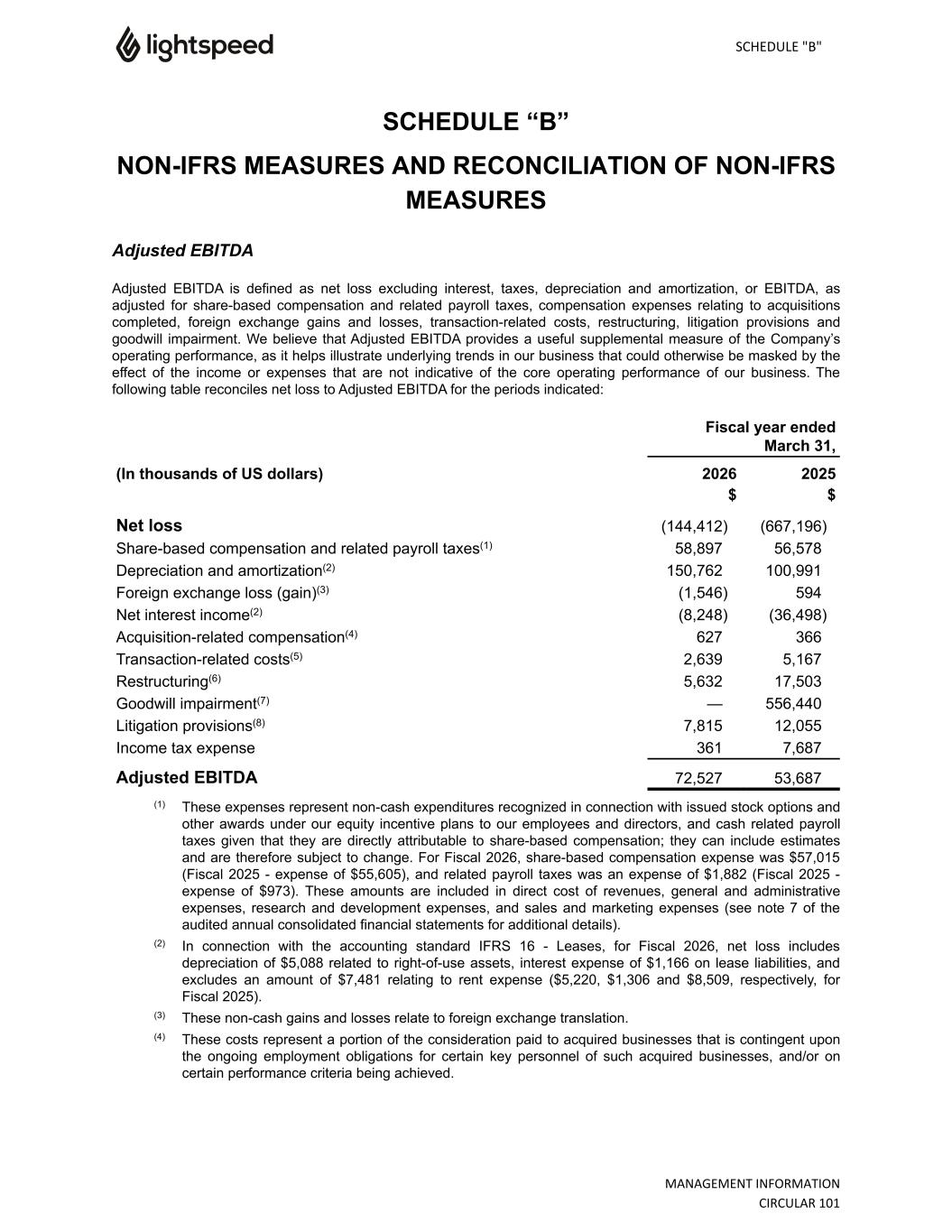
SCHEDULE “B” NON-IFRS MEASURES AND RECONCILIATION OF NON-IFRS MEASURES Adjusted EBITDA Adjusted EBITDA is defined as net loss excluding interest, taxes, depreciation and amortization, or EBITDA, as adjusted for share-based compensation and related payroll taxes, compensation expenses relating to acquisitions completed, foreign exchange gains and losses, transaction-related costs, restructuring, litigation provisions and goodwill impairment. We believe that Adjusted EBITDA provides a useful supplemental measure of the Company’s operating performance, as it helps illustrate underlying trends in our business that could otherwise be masked by the effect of the income or expenses that are not indicative of the core operating performance of our business. The following table reconciles net loss to Adjusted EBITDA for the periods indicated: Fiscal year ended March 31, (In thousands of US dollars) 2026 2025 $ $ Net loss (144,412) (667,196) Share-based compensation and related payroll taxes(1) 58,897 56,578 Depreciation and amortization(2) 150,762 100,991 Foreign exchange loss (gain)(3) (1,546) 594 Net interest income(2) (8,248) (36,498) Acquisition-related compensation(4) 627 366 Transaction-related costs(5) 2,639 5,167 Restructuring(6) 5,632 17,503 Goodwill impairment(7) — 556,440 Litigation provisions(8) 7,815 12,055 Income tax expense 361 7,687 Adjusted EBITDA 72,527 53,687 (1) These expenses represent non-cash expenditures recognized in connection with issued stock options and other awards under our equity incentive plans to our employees and directors, and cash related payroll taxes given that they are directly attributable to share-based compensation; they can include estimates and are therefore subject to change. For Fiscal 2026, share-based compensation expense was $57,015 (Fiscal 2025 - expense of $55,605), and related payroll taxes was an expense of $1,882 (Fiscal 2025 - expense of $973). These amounts are included in direct cost of revenues, general and administrative expenses, research and development expenses, and sales and marketing expenses (see note 7 of the audited annual consolidated financial statements for additional details). (2) In connection with the accounting standard IFRS 16 - Leases, for Fiscal 2026, net loss includes depreciation of $5,088 related to right-of-use assets, interest expense of $1,166 on lease liabilities, and excludes an amount of $7,481 relating to rent expense ($5,220, $1,306 and $8,509, respectively, for Fiscal 2025). (3) These non-cash gains and losses relate to foreign exchange translation. (4) These costs represent a portion of the consideration paid to acquired businesses that is contingent upon the ongoing employment obligations for certain key personnel of such acquired businesses, and/or on certain performance criteria being achieved. SCHEDULE "B" MANAGEMENT INFORMATION CIRCULAR 101
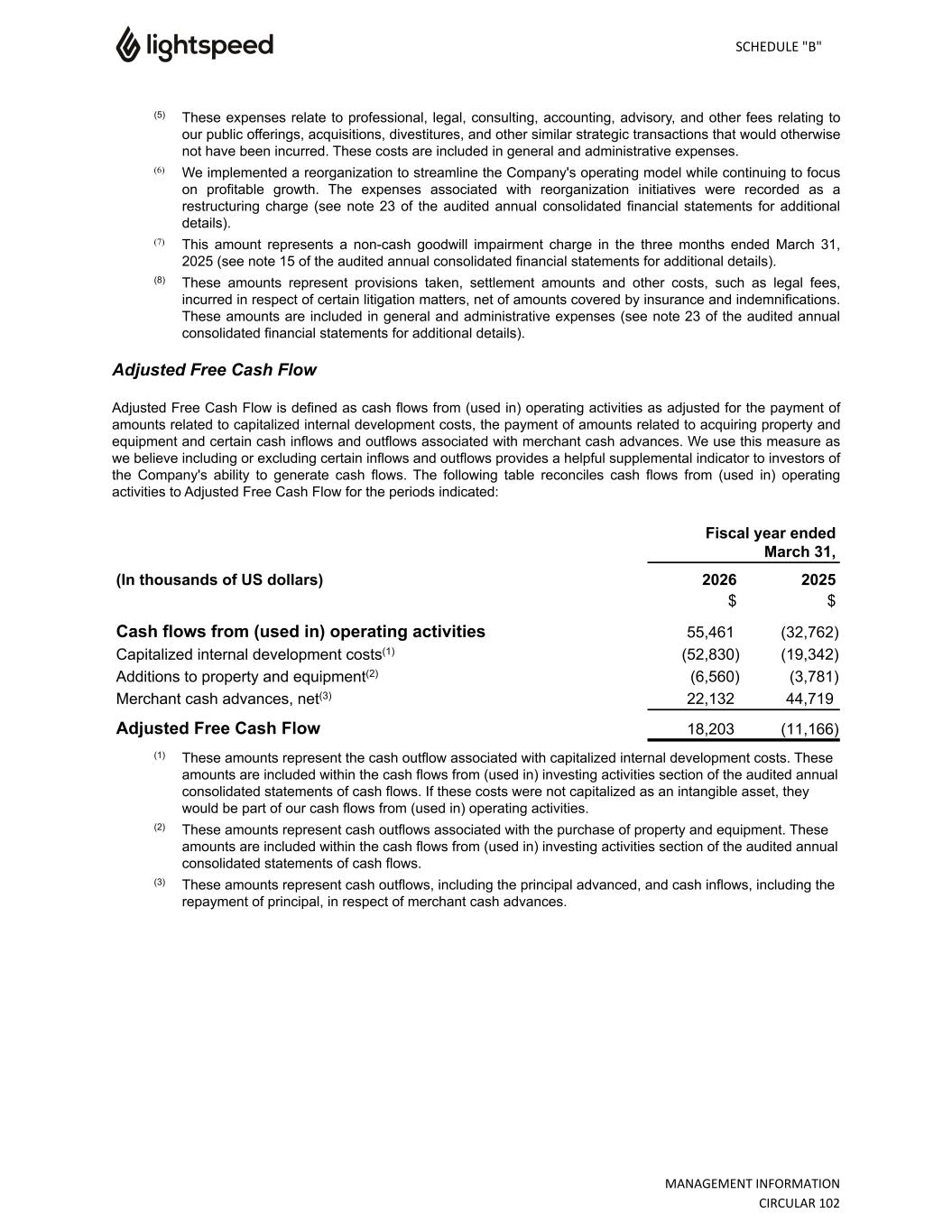
(5) These expenses relate to professional, legal, consulting, accounting, advisory, and other fees relating to our public offerings, acquisitions, divestitures, and other similar strategic transactions that would otherwise not have been incurred. These costs are included in general and administrative expenses. (6) We implemented a reorganization to streamline the Company's operating model while continuing to focus on profitable growth. The expenses associated with reorganization initiatives were recorded as a restructuring charge (see note 23 of the audited annual consolidated financial statements for additional details). (7) This amount represents a non-cash goodwill impairment charge in the three months ended March 31, 2025 (see note 15 of the audited annual consolidated financial statements for additional details). (8) These amounts represent provisions taken, settlement amounts and other costs, such as legal fees, incurred in respect of certain litigation matters, net of amounts covered by insurance and indemnifications. These amounts are included in general and administrative expenses (see note 23 of the audited annual consolidated financial statements for additional details). Adjusted Free Cash Flow Adjusted Free Cash Flow is defined as cash flows from (used in) operating activities as adjusted for the payment of amounts related to capitalized internal development costs, the payment of amounts related to acquiring property and equipment and certain cash inflows and outflows associated with merchant cash advances. We use this measure as we believe including or excluding certain inflows and outflows provides a helpful supplemental indicator to investors of the Company's ability to generate cash flows. The following table reconciles cash flows from (used in) operating activities to Adjusted Free Cash Flow for the periods indicated: Fiscal year ended March 31, (In thousands of US dollars) 2026 2025 $ $ Cash flows from (used in) operating activities 55,461 (32,762) Capitalized internal development costs(1) (52,830) (19,342) Additions to property and equipment(2) (6,560) (3,781) Merchant cash advances, net(3) 22,132 44,719 Adjusted Free Cash Flow 18,203 (11,166) (1) These amounts represent the cash outflow associated with capitalized internal development costs. These amounts are included within the cash flows from (used in) investing activities section of the audited annual consolidated statements of cash flows. If these costs were not capitalized as an intangible asset, they would be part of our cash flows from (used in) operating activities. (2) These amounts represent cash outflows associated with the purchase of property and equipment. These amounts are included within the cash flows from (used in) investing activities section of the audited annual consolidated statements of cash flows. (3) These amounts represent cash outflows, including the principal advanced, and cash inflows, including the repayment of principal, in respect of merchant cash advances. SCHEDULE "B" MANAGEMENT INFORMATION CIRCULAR 102
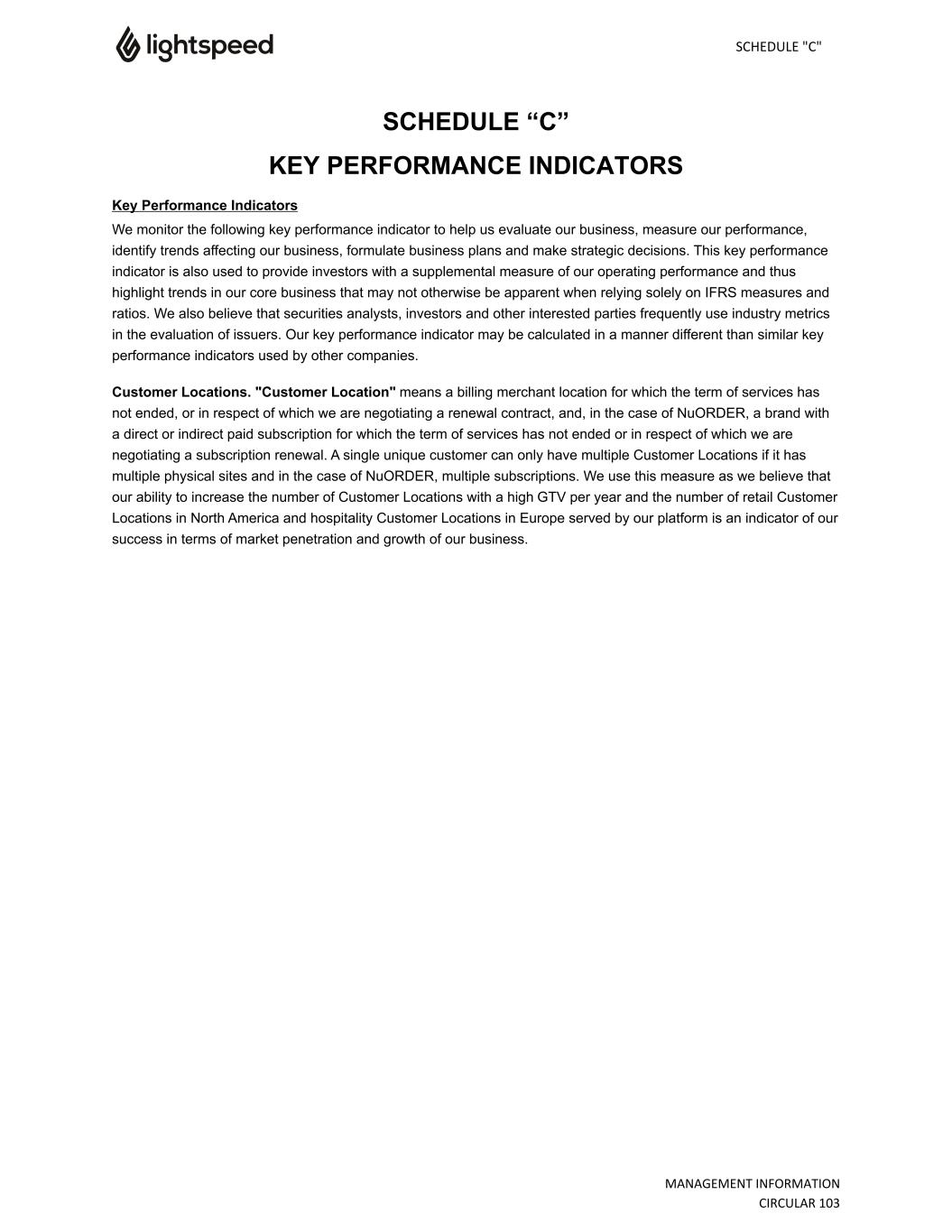
SCHEDULE “C” KEY PERFORMANCE INDICATORS Key Performance Indicators We monitor the following key performance indicator to help us evaluate our business, measure our performance, identify trends affecting our business, formulate business plans and make strategic decisions. This key performance indicator is also used to provide investors with a supplemental measure of our operating performance and thus highlight trends in our core business that may not otherwise be apparent when relying solely on IFRS measures and ratios. We also believe that securities analysts, investors and other interested parties frequently use industry metrics in the evaluation of issuers. Our key performance indicator may be calculated in a manner different than similar key performance indicators used by other companies. Customer Locations. "Customer Location" means a billing merchant location for which the term of services has not ended, or in respect of which we are negotiating a renewal contract, and, in the case of NuORDER, a brand with a direct or indirect paid subscription for which the term of services has not ended or in respect of which we are negotiating a subscription renewal. A single unique customer can only have multiple Customer Locations if it has multiple physical sites and in the case of NuORDER, multiple subscriptions. We use this measure as we believe that our ability to increase the number of Customer Locations with a high GTV per year and the number of retail Customer Locations in North America and hospitality Customer Locations in Europe served by our platform is an indicator of our success in terms of market penetration and growth of our business. SCHEDULE "C" MANAGEMENT INFORMATION CIRCULAR 103
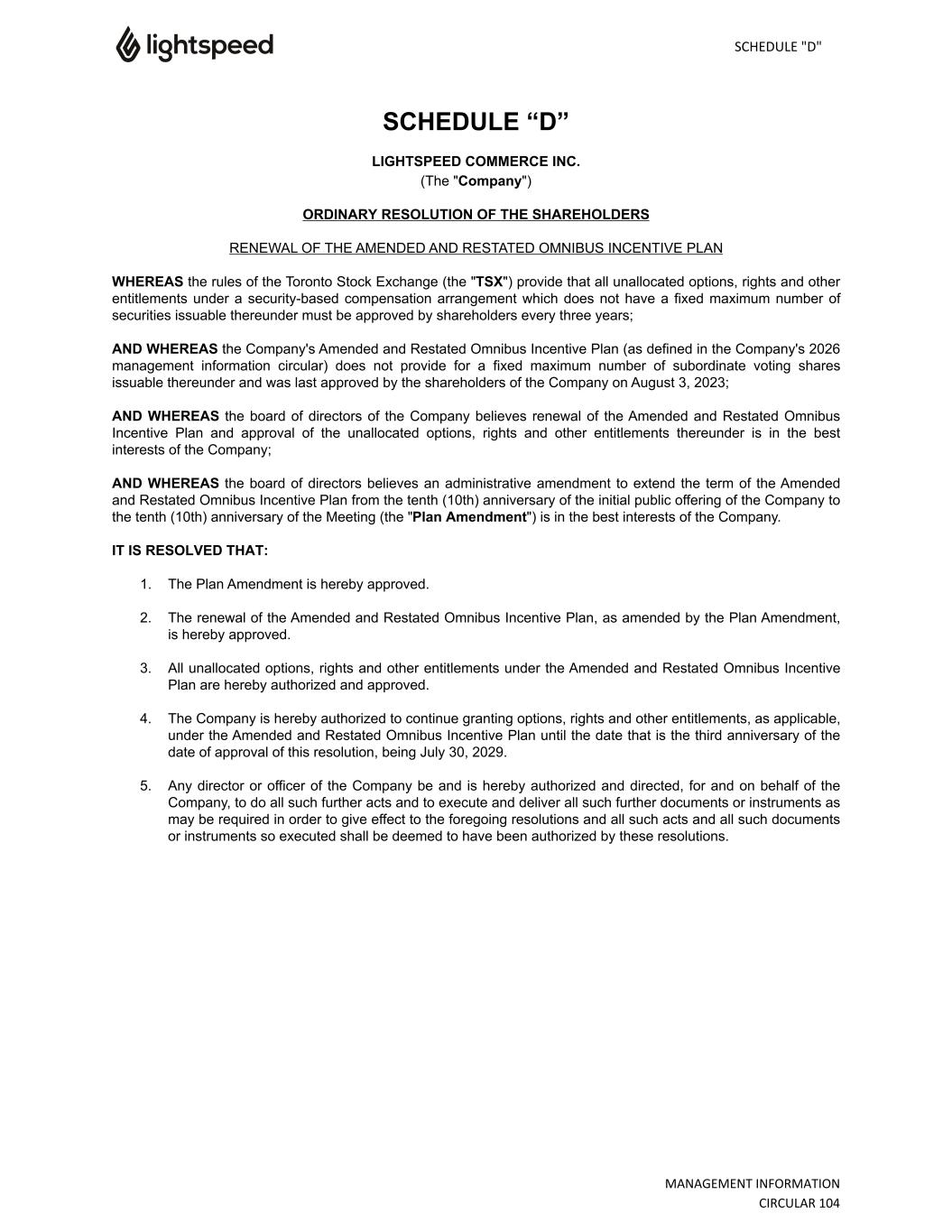
SCHEDULE “D” LIGHTSPEED COMMERCE INC. (The "Company") ORDINARY RESOLUTION OF THE SHAREHOLDERS RENEWAL OF THE AMENDED AND RESTATED OMNIBUS INCENTIVE PLAN WHEREAS the rules of the Toronto Stock Exchange (the "TSX") provide that all unallocated options, rights and other entitlements under a security-based compensation arrangement which does not have a fixed maximum number of securities issuable thereunder must be approved by shareholders every three years; AND WHEREAS the Company's Amended and Restated Omnibus Incentive Plan (as defined in the Company's 2026 management information circular) does not provide for a fixed maximum number of subordinate voting shares issuable thereunder and was last approved by the shareholders of the Company on August 3, 2023; AND WHEREAS the board of directors of the Company believes renewal of the Amended and Restated Omnibus Incentive Plan and approval of the unallocated options, rights and other entitlements thereunder is in the best interests of the Company; AND WHEREAS the board of directors believes an administrative amendment to extend the term of the Amended and Restated Omnibus Incentive Plan from the tenth (10th) anniversary of the initial public offering of the Company to the tenth (10th) anniversary of the Meeting (the "Plan Amendment") is in the best interests of the Company. IT IS RESOLVED THAT: 1. The Plan Amendment is hereby approved. 2. The renewal of the Amended and Restated Omnibus Incentive Plan, as amended by the Plan Amendment, is hereby approved. 3. All unallocated options, rights and other entitlements under the Amended and Restated Omnibus Incentive Plan are hereby authorized and approved. 4. The Company is hereby authorized to continue granting options, rights and other entitlements, as applicable, under the Amended and Restated Omnibus Incentive Plan until the date that is the third anniversary of the date of approval of this resolution, being July 30, 2029. 5. Any director or officer of the Company be and is hereby authorized and directed, for and on behalf of the Company, to do all such further acts and to execute and deliver all such further documents or instruments as may be required in order to give effect to the foregoing resolutions and all such acts and all such documents or instruments so executed shall be deemed to have been authorized by these resolutions. SCHEDULE "D" MANAGEMENT INFORMATION CIRCULAR 104

700 Saint-Antoine East, Montréal, Québec, Canada H2Y 1A6 NYSE: LSPD | TSX: LSPD investors.lightspeedhq.com