
An Offering Statement pursuant to Regulation A relating to these securities has been filed with the Securities and Exchange Commission. Information contained in this Preliminary Offering Circular is subject to completion or amendment. These securities may not be sold nor may offers to buy be accepted before the Offering Statement filed with the SEC is qualified. This Preliminary Offering Circular shall not constitute an offer to sell or the solicitation of an offer to buy nor may there be any sales of these securities in any state in which such offer, solicitation or sale would be unlawful before registration or qualification under the laws of any such state. We may elect to satisfy our obligation to deliver a Final Offering Circular by sending you a notice within two business days after the completion of our sale to you that contains the URL where the Final Offering Circular or the Offering Statement in which such Final Offering Circular was filed may be obtained.
SECURITIES AND EXCHANGE COMMISSION
FORM 1-A/A
REGULATION A OFFERING CIRCULAR UNDER THE SECURITIES ACT OF 1933
PRELIMINARY OFFERING CIRCULAR, SUBJECT TO COMPLETION
DATED June 26, 2026
NAQI LOGIX INC.
UP TO 5,747,126 VOTING COMMON SHARES, PLUS UP TO 1,149,425 BONUS SHARES (1)
The minimum investment
in this offering is 200 Voting Common Shares in the capital of the
Company (the “Common Shares”), or $522.00 plus the 3.5% investor processing fee
discussed below.
MAXIMUM OFFERING AMOUNT: $18,525,000
SEE “SECURITIES BEING OFFERED” ON PAGE 50
100 Park Royal, Suite200
West Vancouver, BC, V7T 1A2
Canada
1-888- 627-4564
www.naqilogix.com
Copy to:
Mark Godsey
100 Park Royal, Suite200
West Vancouver, BC, V7T 1A2
Canada
1-888- 627-4564
| Price to Public | Underwriting discount and commissions(2) | Proceeds
to Company before expenses(3,5) | ||||||||||
| Price Per Share | $ | 2.61 | $ | 0.118 | $ | 2.493 | ||||||
| Transaction fee per share (5) | $ | 0.09 | $ | 0.004 | $ | 0.086 | ||||||
| Price per share plus Transaction fee | $ | 2.70 | $ | 0.122 | $ | 2.579 | ||||||
| Total Maximum with processing fee(,5) | $ | 15,525,000 | $ | 1,177,500 | $ | 14,347,500 | ||||||
| Total Maximum with processing fee and Bonus Shares(1,4,5) | $ | 18,525,000 | $ | 1,177,500 | $ | 14,347,500 | ||||||
| (1) | Naqi Logix Inc. (the “Company”) is offering up to 5,747,126 Voting Common Shares (“Common Shares”), plus up to 1,149,425 additional Common Shares to be issued as bonus shares (the “Bonus Shares”) to investors based upon their eligibility in meeting certain bonus requirements as detailed in “Perks and Bonus Shares” below. An investor receiving the Bonus Shares will effectively receive a discount on our share price. Investors are eligible to receive up to 20% additional Common Shares as Bonus Shares. See “Plan of Distribution” for further details. | |
| (2) | The Company has DealMaker Securities, LLC, member FINRA/SIPC (“DealMaker Securities” or “Broker”), as a broker-dealer of record, to perform broker-dealer administrative and compliance related functions in connection with this Offering. DealMaker Securities and its affiliates will receive: (i) a one-time advance of $45,000, and (ii) a monthly payment of $13,000 for up to $39,000 for accountable expenses. Once the Commission has qualified the Offering Statement to include DealMaker Securities, it will receive a cash commission equal to four and one half percent (4.5%) of the amount raised in the Offering based on its sales. There are also monthly account management fees of $13,000 not to exceed $117,000, and a budgeted fee of $277,875 for media management and supplementary services on a case-by-case basis, but not to exceed the total. See “Plan of Distribution” for more details. In the case of a fully subscribed offering in which all investments are made through DealMaker Securities, the maximum amount the Company would pay DealMaker Securities is $1,177,500 in commissions, expenses, and fees. DealMaker Securities will not have any compensation tied to the sale or issuance of Bonus Shares. To the extent that the Company’s officers and directors make any communications in connection with the Offering they intend to conduct such efforts in accordance with an exemption from registration contained in Rule 3a4-1 under the Securities Exchange Act of 1934, as amended (the “Exchange Act”), and, therefore, none of them is required to register as a broker-dealer. | |
| (3) | Does not include effective discount that would result from the issuance of Bonus Shares. See “Plan of Distribution” for further details. | |
| (4) | Investors will be required to pay the Company a processing fee equal to 3.5% of the investment amount at the time of the investor’s subscription (excluding Bonus Shares) for shares sold by DealMaker Securities (“Transaction Fee”). See “Plan of Distribution” for additional discussion of this processing fee. Assuming the offering is fully subscribed (excluding Bonus Shares), investors would pay DealMaker Securities total processing fees of $525,000. DealMaker Securities will receive commissions on the Investor Fee. This amount is included in the Total Maximum offering amount since it counts towards the rolling 12-month maximum Offering amount that the Company is permitted to raise under Regulation A. The “Proceeds to Company before expenses” includes payment of the cash commission as well as the processing fee. | |
| (5) | We may issue up to 1,149,425 Common Shares as Bonus Shares as part of the Offering, assuming that 100% of investors achieve the highest level of Bonus Shares available and all Bonus Shares are issued. For more information on Bonus Shares, see the “Plan of Distribution” below. Assuming this Offering is fully subscribed, and the maximum number of Bonus Shares are issued, the effective purchase price per share would be $2.175 per share. |
The Company expects that the amount of expenses of the Offering that it will pay will be approximately $750,000 not including certain fees due to DealMaker Securities.
The Offering will terminate at the earlier of: (i) the date at which the maximum offering amount has been sold (ii) the date at which the offering is earlier terminated by the Company in its sole discretion or (iii) the date that is three years from the date on which this offering is qualified by the United States Securities and Exchange Commission (the “Commission”). At least every 12 months after this offering has been qualified by the Commission, the Company will file a post-qualification amendment to include the Company’s recent financial statements. The Offering covers an amount of securities that we reasonably expect to offer and sell within two years, although the offering statement of which this offering circular forms a part may be used for up to three years.
The minimum investment amount for an investor is $522 plus a 3.5% transaction fee, however, we reserve the right to waive this minimum investment amount in the sole discretion of our management.
The Company will utilize a third-party escrow account for this offering, and all funds tendered by investors will be held in an escrow account until investor subscriptions are accepted by the Company and reviewed by DealMaker Securities. The Offering is being conducted on a best-efforts basis without any minimum target and there is no minimum number of shares that needs to be sold in order for funds to be released to the Company and for this Offering to close, which may mean that the Company does not receive sufficient funds to cover the cost of this Offering. We will hold closings upon the receipt of investors’ subscriptions, review by DealMaker Securities, and acceptance of such subscriptions by the Company. We reserve the right, subject to applicable securities laws, to begin applying “dollar one” of the proceeds from the Offering towards our business strategy, including, without limitation, research and development expenses, offering expenses, working capital and general corporate purposes, and other uses, as more specifically set forth in the “Use of Proceeds to Company” section of this Offering Circular. If, on the initial closing date, we have sold less than the Maximum Offering, then we may hold one or more additional closings for additional sales, until the earlier of: (i) the sale of the Maximum Offering, or (ii) the Termination Date. We expect to commence the sale of the Common Shares on the date on which the Offering Statement of which this Offering Circular (the “Offering Circular”) is a part (the “Offering Statement”) is qualified by the SEC.
THE UNITED STATES SECURITIES AND EXCHANGE COMMISSION DOES NOT PASS UPON THE MERITS OF OR GIVE ITS APPROVAL TO ANY SECURITIES OFFERED, INCLUDING THE COMMON SHARES, OR THE TERMS OF THIS OFFERING, NOR DOES IT PASS UPON THE ACCURACY OR COMPLETENESS OF ANY OFFERING CIRCULAR OR OTHER SOLICITATION MATERIALS. THE COMMON SHARES ARE OFFERED PURSUANT TO AN EXEMPTION FROM REGISTRATION WITH THE UNITED STATES SECURITIES AND EXCHANGE COMMISSION (“SEC”); HOWEVER, THE SEC HAS NOT MADE AN INDEPENDENT DETERMINATION THAT THE COMMON SHARES OFFERED ARE EXEMPT FROM REGISTRATION.
NON-ACCREDITED INVESTOR LIMITATIONS
GENERALLY, NO SALE MAY BE MADE TO YOU IN THIS OFFERING IF THE AGGREGATE PURCHASE PRICE YOU PAY IS MORE THAN TEN PERCENT (10%) OF THE GREATER OF YOUR ANNUAL INCOME OR YOUR NET WORTH. DIFFERENT RULES APPLY TO ACCREDITED INVESTORS AND NON-NATURAL PERSONS. BEFORE MAKING ANY REPRESENTATION THAT YOUR INVESTMENT DOES NOT EXCEED APPLICABLE THRESHOLDS, WE ENCOURAGE YOU TO REVIEW RULE 251(d)(2)(i)(C) OF REGULATION A PROMULGATED UNDER THE SECURITIES ACT. FOR GENERAL INFORMATION ON INVESTING, WE ENCOURAGE YOU TO REFER TO WWW.INVESTOR.GOV.
NOTICE TO FOREIGN INVESTORS
IF THE INVESTOR LIVES OUTSIDE OF THE UNITED STATES, IT IS THE INVESTOR’S RESPONSIBILITY TO FULLY OBSERVE THE LAWS OF ANY RELEVANT TERRITORY OR JURISDICTION OUTSIDE THE UNITED STATES IN CONNECTION WITH ANY PURCHASE OF THE SECURITIES, INCLUDING OBTAINING REQUIRED GOVERNMENTAL OR OTHER CONSENTS OR OBSERVING ANY OTHER REQUIRED LEGAL OR OTHER FORMALITIES. THE COMPANY RESERVES THE RIGHT TO DENY THE PURCHASE OF THE SECURITIES BY ANY FOREIGN INVESTOR.
Investing in our Common Shares involves a high degree of risk. These are speculative securities. You should purchase these securities only if you can afford a complete loss of your investment. See “Risk Factors” starting on page 8 for a discussion of certain risks that you should consider in connection with an investment in our securities.
No application is currently being prepared for the Common Shares to trade on any public market. As a result, the Common Shares sold in this Offering may not be listed on a securities exchange or quoted on an alternative trading system for an extended period of time, if at all. If the Common Shares are not listed on a securities exchange or quoted on an alternative trading system, it may be difficult to sell or trade in the Common Shares. There can be no assurance that a liquid market for the Common Shares will develop or, if it does develop, that it will continue. If a market does develop, it may not be liquid. Therefore, investors may not be able to sell the Common Shares easily or at prices that will provide them with yield comparable to similar investments that have a developed secondary market. Illiquidity may have a severely adverse effect on the market value of the Common Shares and investors wishing to sell the Common Shares might therefore suffer losses.
The Company is following the “Offering Circular” format of disclosure under Regulation A+ pursuant to the general instructions of Part II(a)(1)(i) of Form 1-A.
We expect to commence the sale of the Common Shares on the date on which the SEC qualifies the offering statement of which this offering circular is a part.
THIS OFFERING CIRCULAR CONTAINS ALL OF THE REPRESENTATIONS BY US CONCERNING THIS OFFERING, AND NO PERSON SHALL MAKE DIFFERENT OR BROADER STATEMENTS THAN THOSE CONTAINED HEREIN. INVESTORS ARE CAUTIONED NOT TO RELY UPON ANY INFORMATION NOT EXPRESSLY SET FORTH IN THIS OFFERING CIRCULAR.
TABLE OF CONTENTS
i
IMPORTANT INFORMATION ABOUT THIS OFFERING CIRCULAR
In this offering (this “Offering”), we are offering to sell, and seeking offers to buy, “Voting Common Shares”, without par value (the “Common Shares”), of Naqi Logix Inc., a corporation formed pursuant to the laws of the Province of British Columbia and domiciled in the Province of British Columbia (the “Company”, “Naqi Logix”, “Naqi”, “we”, “our”, “us”), only in jurisdictions where such offers and sales are permitted. Please carefully read the information in this offering circular and any accompanying offering circular supplements, which we refer to collectively as the “Offering Circular.” You should rely only on the information contained in this Offering Circular. We have not authorized anyone to provide you with any information other than the information contained in this Offering Circular. The information contained in this Offering Circular is accurate only as of its date or as of the respective dates of any documents or other information incorporated herein by reference, regardless of the time of its delivery or of any sale or delivery of our securities. Neither the delivery of this Offering Circular nor any sale or delivery of the Common Shares shall, under any circumstances, imply that there has been no change in our affairs since the date of this Offering Circular. This Offering Circular will be updated and made available for delivery to the extent required by the federal securities laws.
This Offering Circular is part of an offering statement (the “Offering Statement”) that we filed with the Securities and Exchange Commission (the “SEC”) using a continuous offering process. Periodically, we may provide an Offering Circular supplement that would add, update or change information contained in this Offering Circular. Any statement that we make in this Offering Circular will be modified or superseded by any inconsistent statement made by us in a subsequent Offering Circular supplement. The Offering Statement we filed with the SEC includes exhibits that provide more detailed descriptions of the matters discussed in this Offering Circular. You should read this Offering Circular and the related exhibits filed with the SEC and any Offering Circular supplement, together with additional information contained in our annual reports, semi-annual reports and other reports and information statements that we will file periodically with the SEC. The Offering Statement and all supplements and reports that we have filed or will file in the future can be read at the SEC website, www.sec.gov EDGAR Full Text Search.
1
Unless otherwise indicated, data contained in this Offering Circular concerning the business of the Company are based on information from various public sources. This Offering Circular also includes statistical and other market data that we obtained from industry publications and research, surveys and studies conducted by third parties. Although we believe that this data is generally reliable, such information is inherently imprecise, and our estimates and expectations based on this data involves a number of assumptions and limitations. As a result, you are cautioned not to give undue weight to such data, estimates or expectations. All references in this Offering Circular to “$” or “dollars” are to United States dollars, unless specifically stated otherwise. All references in this Offering Circular to “C$” are to Canadian dollars.
CERTAIN TAX CONSIDERATIONS
No information contained herein, nor in any prior, contemporaneous or subsequent communication should be construed by a prospective investor as legal or tax advice. We are not providing any tax advice as to the acquisition, holding or disposition of the Common Shares. In making an investment decision, investors are strongly encouraged to consult their own tax advisor to determine the U.S. Federal, state and any applicable foreign tax consequences relating to their investment in the Common Shares. This written communication is not intended to be “written advice,” as defined in Circular 230 published by the U.S. Treasury Department.
CAUTIONARY STATEMENT REGARDING FORWARD-LOOKING STATEMENTS
Some of the statements under “Summary,” “Risk Factors,” “Management’s Discussion and Analysis of Financial Condition and Results of Operations,” “Description of Business” and elsewhere in this Offering Circular constitute forward-looking statements. Forward-looking statements relate to expectations, beliefs, projections, future plans and strategies, anticipated events or trends and similar matters that are not historical facts. In some cases, you can identify forward-looking statements by terms such as “anticipate,” “believe,” “could,” “estimate,” “expect,” “intend,” “may,” “plan,” “potential,” “should,” “will” and “would” or the negatives of these terms, or other comparable terminology.
You should not place undue reliance on forward-looking statements. The cautionary statements set forth in this Offering Circular, including in “Risk Factors” and elsewhere, identify important factors which you should consider in evaluating our forward-looking statements.
Although the forward-looking statements in this Offering Circular are based on our beliefs, assumptions and expectations, taking into account all information currently available to us, we cannot guarantee future transactions, results, performance, achievements or outcomes. No assurance can be made to any investor by anyone that the expectations reflected in our forward-looking statements will be attained, or that deviations from them will not be material and adverse. We undertake no obligation, other than as may be required by law, to re-issue this Offering Circular or otherwise make public statements updating our forward-looking statements.
2
This Offering summary highlights material information regarding our business, and this Offering. Because it is a summary, it may not contain all of the information that is important to you. To understand this Offering fully, you should read the entire Offering Circular carefully, including the “Risk Factors” section, before making a decision to invest in the Company. Some of the statements in this Offering Circular are forward-looking statements. See the section entitled “Cautionary Statement Regarding Forward-Looking Statements” above.
Our Business
The Company was established on August 4, 2020, under the jurisdiction of the Province of British Columbia in Canada and has its corporate office at 100 Park Royal, Suite 200, West Vancouver, British Columbia, Canada, V7T 1A2. The Company’s headquarters are in the Vancouver, British Columbia area and, as of the date of this filing, the Company conducts its operations through its Canadian parent entity and two subsidiaries, including its U.S. subsidiary incorporated in the State of Delaware in April 2025 and its subsidiary in France (Wiser Assets & Liabilities SAS, acquired on February 2, 2026).
The Company entered into a Share Purchase Agreement dated December 30, 2025 to acquire all of the issued and outstanding shares of Wisear SAS not already held by the Company, and the acquisition closed on February 2, 2026. Wisear is a neurotechnology company based in France focused on biosignal-based gesture recognition for wearable devices. The Company believes the Wisear acquisition expands its intellectual property portfolio and strengthens its capabilities in biosignal acquisition, signal processing, and machine learning technologies relevant to wearable neural interface systems.
Naqi Logix Inc. is an AI- neurotechnology company that is a non-invasive silent and invisible interface between humans and technology platform designed to enable users to control digital systems without the use of their hands, voice, or traditional graphical interfaces. The Company has developed a hardware-enabled software platform intended to interpret user intent through biosignals captured in and around the ear and translate those signals into digital commands that can interact with computers, mobile devices, robotics, and connected environments.
The platform currently consists of three primary components: (i) the Naqi Neural Earbud, a wearable sensing device embodied in an earbud form factor; (ii) the Naqi Hub, the software platform that processes biosignals and motion data and executes commands; and (iii) the Company’s patented Invisible User Interface (“IUI”), a command architecture designed to allow navigation and control without visual interaction. The Naqi Neural Earbud integrates multiple sensor technologies designed to capture biosignals and motion data, including electromyographic (EMG), electroencephalographic (EEG), and electrocardiographic (ECG) signals, along with inertial measurement units (IMUs) capable of detecting head movement and orientation. These signals may be generated by natural facial micro-gestures such as jaw clenches, eyebrow movements, eye blinks, and other subtle muscle activations. Unlike invasive brain-computer interface technologies that require surgical implantation, the Company’s solution is external to the body and can be worn and removed like a conventional earbud.
The Company believes its wearable neural interfaces could represent a potential new input modality for interacting with digital systems by enabling users to issue commands silently and without physical contact with devices. The Company has demonstrated the ability of its platform to control a range of digital systems, including personal computers, mobile devices, smart home systems, and connected hardware such as mobility devices and robotic systems, and believes the platform may support applications across accessibility technologies, consumer electronics, computing interfaces, gaming platforms, smart environments, and emerging human-machine interface systems.
The Company’s current wearable neural interface platform, as presently contemplated for consumer electronic applications, may not require regulatory clearance. In certain circumstances where the device might be used for a medical, assistive, or other regulated application, certain regulatory approvals may be required depending on intended use and jurisdiction. The Company’s technologies and services offerings are described in greater detail in “Description of Business” below together with a detailed description of its entire business.
Prior to the Wisear Acquisition and as of the fiscal year ended June 30, 2025 and six months ended December 31, 2025, our direct personnel consisted of three full-time employees, and eight part-time consultants. As of the date of Offering Circular, the Company has completed the Wisear Acquisition and now has eleven full-time employees and nine consultants and four independent contractors as part of our research and development team. The Company’s personnel operate virtually from remote locations. The principal place of business and mailing address is Naqi Logix Inc., 100 Park Royal, Suite 200, West Vancouver, BC V7T 1A2, Canada and the telephone number is 1-888-627-4564. The website address is www.naqilogix.com. The information contained therein or accessible thereby shall not be deemed to be incorporated into this Offering Circular.
3
Our Corporate Strategy
Management continues to pursue a corporate strategy that is focused on engaging with organizations that may contribute to product development, platform validation, and potential integration of the Company’s technology into broader digital and device ecosystems and in building and developing our business as a provider of end-to-end solutions to support the development, validation and commercialization of its neural interface platform. Most recently, in furtherance of this strategy, the Company completed the acquisition of Wisear Assets & Liabilities SAS on February 2, 2026, which expanded the Company’s intellectual property portfolio and strengthened its capabilities in biosignal acquisition, signal processing, and machine learning. In connection with such strategy and to facilitate our long-term growth, we continue to evaluate various strategic opportunities, including partnerships with original equipment manufacturers (“OEMs”), and providers of complementary technologies and intellectual property (“IP”) to further our goals by adding technology, differentiation, customers and/or revenue. We are primarily looking for partnerships that have business value and operational synergies, while remaining opportunistic with respect to other strategic and/or attractive transactions. We believe these complementary technologies will add value to the Company and allow us to provide a comprehensive integrated ecosystem to our customers. In addition, we may seek to expand our capabilities around robotics, accessibility technology, consumer electronics, and emerging human-machine interface systems. Candidates with proven technologies and products that complement our overall strategy may come from anywhere in the world, as long as there are strategic and financial reasons to establish the partnership. We are also exploring opportunities that will supplement our revenue growth, which may include value-enhancing acquisitions that provide business value and operational synergies, as well as other opportunistic or strategic transactions that we believe may increase overall shareholder value. These may include, but are not limited to, alternative investment opportunities, such as minority investments, acquisitions or joint ventures. If we make any acquisitions in the future, we expect that we may pay for such acquisitions using our equity securities and/or cash and debt financings in combinations appropriate for each acquisition.
Description of Property
We do not own any facilities and do not expect to own any facilities in the immediate future.
Risks Related to Our Business and Industry
Our business and our ability to execute our business strategy are subject to a number of risks, which are more fully described in the section titled “Risk Factors” beginning on page 8 . These risks include business and industry risks, including that:
| ● | We have a history of losses and can provide no assurance of our future operating results; |
| ● | The Company was recently formed and has a limited operating history and no revenues; |
| ● | We may not have adequate capital to fund our business and may need substantial additional funding to continue operations; we may not be able to raise capital when needed, if at all, which would force us to delay, reduce or eliminate our product development programs or commercialization efforts and could cause our business to fail; |
| ● | We have limited existing brand identity and customer loyalty; if we fail to attract customers to use our service offerings, our business could suffer; |
4
| ● | We depend on third-party suppliers and manufacturers, and supply chain disruptions, engineering challenges or manufacturing delays could delay commercialization of the Naqi Earbud and Naqi Hub and Invisible User Interface; |
| ● | Our business currently depends on the successful development, validation and commercialization of a limited number of products and technologies, specifically the Naqi Earbuds Framework; |
| ● | We will need to increase the size of our organization, and we may be unable to manage rapid growth effectively; |
| ● | We are not subject to Sarbanes-Oxley and lack the internal controls over financial reporting required of public companies; |
| ● | The smart earbud, gestural input, brain-computer interface and non-tactile input industries are competitive, and we may be unable to compete with companies with greater financial or technical resources than us, which could negatively affect our operations; |
| ● | New products and services may subject us to additional risks, and a failure to successfully manage these risks may have a material adverse effect on our business; |
| ● | If we are unable to develop a partner ecosystem, sales, marketing and distribution channels or to enter into agreements with third parties to perform these functions on acceptable terms, we may be unable to generate revenue; |
| ● | We may face significant competition in Canada and in other markets, including the United States, Europe and Asia where we may decide to operate in the future; |
| ● | Our revenue could fluctuate from period to period, which could have an adverse material impact on our business; |
| ● | The integration of Wisear and its operations, personnel and intellectual property involves significant risks that could adversely affect our business; |
| ● | We are subject to pending litigation that, if resolved adversely, could result in monetary damages and divert management attention; |
| ● | If we are unable to effectively protect our intellectual property and trade secrets, it may impair our ability to compete; |
| ● | Customer complaints regarding our products and services could hurt our business; |
| ● | Computer, website and/or information system breakdowns, as well as cyber security attacks, could affect our business; |
| ● | We will depend on third-party providers for a reliable Internet infrastructure as well as other aspects of our technology and applications and the failure of these third parties, or the Internet in general, for any reason would significantly impair our ability to conduct our business; |
| ● | We may be involved in legal and regulatory proceedings; |
| ● | The liability of our directors and officers and others is limited under certain circumstances; |
| ● | Our executive officers, directors and insider shareholders beneficially own or control a substantial portion of the outstanding Common Shares; |
| ● | Our success is dependent on part-time executive; |
| ● | We may have difficulty retaining and acquiring personnel; |
| ● | Our directors and officers may have conflicts of interest; |
| ● | Our financial statements have been prepared in accordance with IFRS accounting principles; |
| ● | Public health epidemics or outbreaks could adversely impact our business; |
5
Risks Related to Regulations
| ● | In certain circumstances, we will be required to seek regulatory approval for our technology if it is intended to be used for medical applications, such as wheelchair control. There is no guarantee we will be successful in procuring all necessary approvals; and |
| ● | Our business is and may become subject to complex and evolving U.S. and foreign laws and regulations regarding privacy, data use and data protection, content, competition, safety and consumer protection, e-commerce, and other matters. Many of these laws and regulations are subject to change and uncertain interpretation, and could result in claims, changes to our products and business practices, monetary penalties, increased cost of operations, or declines in user growth or engagement, or otherwise harm our business. |
Risks Related to This Offering and the Common Shares
| ● | Our outstanding convertible debentures may result in dilution to investors in this Offering upon conversion or exercise of the accompanying warrants; |
| ● | We may terminate this Offering at any time during the Offering Period and do not have a minimum capitalization; |
| ● | The Common Shares are being offered on a “best efforts” basis and we may not raise sufficient capital to satisfy our working capital needs; |
| ● | It is uncertain when the Common Shares will be listed on an exchange for trading, if ever; |
| ● | If the Common Shares become subject to the penny stock rules, it would become more difficult to trade the Common Shares; |
| ● | We have broad discretion in how we use the proceeds of this Offering and may not use these proceeds effectively, which could affect our results of operations and cause the price of our Common Shares to decline; |
| ● | We do not intend to pay dividends on the Common Shares and, consequently, your ability to achieve a return on your investment will depend on appreciation in the price of the Common Shares; |
| ● | Terms of subsequent financings, if any, may adversely impact investors’ investments; |
| ● | We determined the offering price for the Common Shares being sold in this Offering; and |
| ● | If an investor purchases Common Shares in this Offering, the investor will incur immediate and substantial dilution in the book value of the Common Shares. |
Regulation A+
We are offering the Common Shares pursuant to rules of the SEC mandated under the JOBS Act. These offering rules are often referred to as “Regulation A+.” We are relying upon “Tier 2” of Regulation A+, which allows us to offer securities of up to $75 million in a 12-month period.
In accordance with the requirements of Tier 2 of Regulation A+, we are required to publicly file annual, semi-annual, and current event reports with the SEC after the qualification of the offering statement of which this Offering Circular is a part.
6
| Company: | Naqi Logix Inc., a corporation formed pursuant to the laws of the Province of British Columbia and domiciled in the Province of British Columbia | |
| Shares Offered: | Up to 5,747,126 Common Shares, without par value plus 1,149,425 Bonus Shares | |
| Price per Share: | $2.61 | |
| Minimum Investment: | $522.00 per investor. | |
| Common Shares Outstanding before this Offering: | 51,827,154 Common Shares and 904,974 Non-Voting Common Shares issued and outstanding, totaling 52,732,128 shares (“Common Share Equivalents”) issued and outstanding. | |
| Common Shares Outstanding after this Offering: | 57,574,280 Common Shares and 904,974 Non-Voting Common Shares issued and outstanding, totaling 58,479,254 Common Share Equivalents (including the Common Shares and Non-Voting Common Shares), if the Maximum Offering is sold (excluding Bonus Shares). | |
| Use of Proceeds: | If we sell all the 5,747,126 Common Shares being offered, our net proceeds (after deducting fees and commissions and estimated offering expenses) will be approximately $13,287,000. We will use these net proceeds for prototyping and manufacturing costs; research and development; sales and marketing, general and administrative costs; legal and compliance; and general working capital, as described in “Use of Proceeds to Company” beginning on page 27. | |
| Subscribing Online: | In order to invest, you will be required to subscribe to the Offering via the Company’s website integrating Broker’s affiliated entity technology and agree to the terms of the offering, Subscription Agreement, and any other relevant exhibits attached thereto. Investors will be required to complete an online subscription agreement with a digital signature and initiate payment for the Shares in order to invest. | |
| Risk Factors: | Investing in our Common Shares involves a high degree of risk. See “Risk Factors” beginning on page 8. |
7
An investment in the Common Shares involves a high degree of risk. Each investor should carefully consider the risks described below, together with all of the other information included in this Offering Circular, before making an investment decision. If any of the following risks actually occurs, our business, financial condition or results of operations could suffer. In that case, the price of the Common Shares could decline and the investors may lose all or part of their investments. See “Cautionary Statement Regarding Forward Looking Statements” above for a discussion of forward-looking statements and the significance of such statements in the context of this Offering Circular.
Risks Related to our Business and Industry
We have a history of losses and can provide no assurance of our future operating results.
As of the date of this Offering Circular, the Company continues to develop our products and has not yet commenced revenue-generating operations related to ongoing manufacturing and/or ongoing licensing. The Company is currently testing its hardware and software platform with the Government of Canada to assess user experience and use cases for employee productivity and military applications. The Company is negotiating with 3 enterprises to conduct user tests to assess user experience and value proposition.
As we continue to develop and have not begun generating revenue from the sale of our products and services, we have experienced net losses and negative cash flows from operating activities since incorporation, and we expect such losses and negative cash flows to continue in the foreseeable future. As of December 31, 2025, the Company had working capital deficiency of $4,114,568 and a cumulative loss since inception of $20,540,439. As a result, our continuance as a going concern is dependent upon our ability to obtain adequate financing and to reach profitable levels of operation upon commercialization of our products and services.
It is not possible to predict whether financing efforts will be successful or if we will attain profitable levels of operations. Management believes it will be successful in raising the necessary funding to continue operations in the normal course of operations, however, there is no assurance that funds will continue to be available on acceptable terms or at all. Our financial statements do not reflect adjustments to the carrying value of assets and liabilities that would be necessary should we be unable to continue operations and such adjustments could be material.
The Company was recently formed and has a limited operating history and no revenues.
The Company is a pre-revenue start-up that was established to pursue the development of our products. We lack a historical operating record upon which to assess our business and prospects. Prospective operating results are subject to a multitude of uncertainties, and there is no guarantee of achieving or sustaining profitability. Our prospects must be viewed in the context of the risks inherent to companies in early-stage development, particularly those operating in novel and swiftly evolving markets. Future performance hinges on various factors, including, but not limited to, securing requisite financing, as outlined in this offering, or obtaining funding through alternative means, establishing credit or operational facilities, product development success, effective marketing strategies, customer acquisition, operational cost management, personnel retention, legal and regulatory changes in relevant jurisdictions, and broader economic conditions influencing our customer base. We cannot provide assurances regarding our ability to mitigate these risks successfully.
We may not have adequate capital to fund our business and may need substantial additional funding to continue operations. We may not be able to raise capital when needed, if at all, which would force us to delay, reduce or eliminate our product development programs or commercialization efforts and could cause our business to fail.
We have not yet initiated revenue-generating activities, relying instead on securing adequate capital to support the ongoing development of Naqi’s products, as well as any potential future products or services. The Company expects the earliest commercial launch of its product to occur in 2027. Should our initial capital be fully utilized without access to additional funding through borrowing or alternative sources, it would significantly impact our financial position, operational performance, and business prospects.
The development of our business operations and the commercialization of current and potential future products and services may necessitate further capital infusion. Unforeseen expenses, complications, and delays inherent in pioneering technology development could escalate our capital requirements and deplete our cash reserves faster than anticipated.
8
Consequently, securing additional funding is imperative for sustaining our operations. However, market conditions, regulatory constraints, or other factors may hinder our ability to raise necessary capital. There is no assurance that we will successfully obtain adequate funding to support our business activities. Failure to secure additional funding may compel us to scale back, postpone, or abandon development initiatives or overhead expenditures as necessary.
The inability to meet our operational and capital needs could have a materially adverse impact on our business operations, financial health, and financial performance.
We have limited existing brand identity and customer loyalty; if we fail to attract customers to use our service offerings, our business could suffer.
As we are presently focused on research and development and have yet to commercialize Naqi’s products, our brand identity and customer loyalty are not firmly established. We recognize that cultivating and preserving brand identity and loyalty is essential for attracting customers once our products and services become commercially available. To entice customers, significant expenditure may be required to develop and sustain brand recognition among consumers. We anticipate that the costs associated with our marketing initiatives could escalate considerably in the future.
If our endeavors to promote our products and establish brand recognition prove ineffective, it may adversely impact our revenue generation capabilities and the sustainability of our operations.
We depend on third-party suppliers and manufacturers, and supply chain disruptions, engineering challenges or manufacturing delays could delay commercialization of the Naqi Earbud and Naqi Hub and Invisible User Interface.
Naqi Logix is heavily reliant on outsourced vendors for the procurement of components, all of which are vulnerable to disruptions within the global supply chain. Delays in acquiring raw materials and electronic parts for the Naqi Earbud may occur, potentially impeding the distribution of finished products. Moreover, unforeseen engineering challenges during manufacturing, inherent to the novelty of the Naqi Earbud design, could further delay the completion of the final product, thus postponing the commercialization of Naqi’s products.
Additionally, there is a risk that the company may encounter difficulties in securing licensing agreements with established brand manufacturers or in establishing partnerships with contract manufacturers.
Our business currently depends on the successful development, validation and commercialization of a limited number of products and technologies, specifically the Naqi Earbuds and Naqi Framework.
As we continue to develop Naqi’s products, various factors, including technological and regulatory challenges within our target markets, may impede or delay their potential launch, thereby potentially constraining our profitability. Given that these products constitute our sole focus at present, our overall financial performance hinges directly on their successful development and subsequent performance.
We will need to increase the size of our organization, and we may be unable to manage rapid growth effectively.
Our inability to effectively manage growth could materially and adversely impact our business, financial condition, and results of operations. A period of substantial expansion is anticipated to accommodate the development and launch of new products and services, alongside potential internal growth to support research and marketing endeavors. This expansion will exert significant pressure on management, operational, and financial resources.
To address the anticipated growth in operations and personnel, we must enhance our existing operational and financial systems, procedures, and controls, as well as implement new ones. Additionally, expansion of our finance, administrative, and operational staff will be necessary. However, there is a risk that our current personnel, systems, procedures, and controls may not adequately support future operations.
Management may encounter challenges in recruiting, training, retaining, motivating, and supervising required personnel, or in identifying, managing, and capitalizing on existing and potential strategic relationships and market opportunities.
We are not subject to Sarbanes-Oxley and lack the internal controls over financial reporting required of public companies.
At present, we lack the internal infrastructure necessary, and are not obligated, to conduct an attestation regarding our internal controls over financial reporting, as mandated by Section 404 of the Sarbanes-Oxley Act. Consequently, there is a risk that material deficiencies or weaknesses in the effectiveness of these internal controls may go unidentified.
In the future, we may be required, by Sarbanes-Oxley or other relevant laws (including exchange and market regulations), to establish and maintain appropriate internal controls over financial reporting. Such establishment could result in significant expenses and diversion of management’s attention. Failure to establish adequate controls, or any subsequent failure of those controls, could negatively impact our public disclosures concerning our business, financial condition, or results of operations.
9
Moreover, management’s assessment of internal controls over financial reporting may reveal weaknesses and deficiencies requiring attention, or other matters that may raise investor concerns. Any actual or perceived weaknesses or deficiencies in our internal controls over financial reporting, disclosure of management’s assessment of these controls, or our public accounting firm’s attestation to or report on management’s assessment could adversely affect the price of our Common Shares.
The smart earbud, gestural input, brain-computer interface and non-tactile input industries are competitive, and we may be unable to compete with companies with greater financial or technical resources than us, which could negatively affect our operations.
The sectors encompassing smart earbuds, gestural input, brain-computer interfaces, and non-tactile inputs are characterized by rapid technological advancements and fierce competition. Our potential success is contingent upon several factors, including access to patents and other technology protections, the ability to effectively commercialize technological innovations, the availability of capital, access to market channels, and obtaining necessary approvals for testing, manufacturing, and commercialization.
We will encounter competition from major global technology firms, some of which may be integrating state-of-the-art biotechnology, signal analysis, sensor development, and computing logic into their products and services. These firms may also seek to exploit the unique patented technology we are developing. Furthermore, competition arises from academic institutions, government agencies, and private research organizations, competing with us in research and development, product development, and market and brand establishment. Additionally, these entities vie for highly skilled scientific personnel, consultants, and investment capital.
The successful development of Naqi’s products is highly speculative and dependent on numerous factors, many of which are beyond our control. The Company, recently formed to develop these products, has yet to commence revenue-generating operations. Our business hinges on the successful development and implementation of such products and prototypes. This underscores the speculative nature of our endeavors, subject to numerous risks and uncertainties.
Key aspects crucial to our success include establishing brand recognition and customer loyalty, effectively developing and deploying new products and services, competing in existing and emerging markets, managing administrative overhead costs, navigating economic conditions, developing our partner ecosystem, validating our technology with co-innovation partners, managing business growth, and expanding into adjacent markets.
There is no guarantee of success in addressing these risks and uncertainties or generating significant revenues or profits. Investment in our Common Shares is speculative, with no assurance of any return on investment. Investors face substantial risks, including the possibility of losing their entire investment.
New products and services may subject us to additional risks. A failure to successfully manage these risks may have a material adverse effect on our business.
Periodically, we may engage in the development and launch of new products and services. Such endeavors entail significant risks and uncertainties, particularly when entering markets that are not fully matured. The development and marketing of new products and services often require substantial investments of time and resources. Initial timelines for product introduction and development may not be met, and targets for pricing and profitability may prove unattainable. Moreover, external factors, including regulatory compliance, competitive alternatives, and evolving market preferences, can influence the successful implementation of new offerings.
Failure to effectively manage these risks associated with the development and implementation of new products or services could materially impact our business, financial condition, and results of operations.
If we are unable to develop a partner ecosystem, sales, marketing and distribution channels or to enter into agreements with third parties to perform these functions on acceptable terms, we may be unable to generate revenue.
Presently, we lack any internal sales, marketing, or distribution capabilities. Upon introducing products or services to the market, we must establish sales, marketing, and distribution channels for their commercialization. This process may entail substantial expenses and time commitments. Alternatively, we may opt to engage in collaborations with third parties to perform these functions.
Should we choose to directly market our products, significant financial and managerial resources will be required to cultivate a specialized marketing and sales force, equipped with technical expertise, along with supporting distribution, administration, and compliance capabilities. Alternatively, if we rely on third-party collaborations or co-promotion agreements, we must establish and sustain marketing and distribution partnerships, with no guarantee of securing favorable terms or agreements.
In engaging third-party marketing or distribution collaborators, any revenue received, whether directly or indirectly, hinges upon the efforts and profitability of these parties. There exists uncertainty regarding their ability to establish adequate sales and distribution capabilities or achieve market acceptance for our products.
Failure to successfully commercialize products, whether independently or through third-party collaborations, could have a materially adverse impact on our business, financial condition, and results of operations.
10
We may face significant competition in Canada and in other markets like United States, Europe and Asia where we may decide to operate in the future.
We anticipate encountering significant competition in Canada and potentially in other markets where we choose to introduce Naqi’s products, including but not limited to the United States, Europe, and Asia. This competition may extend to other products and services that we have yet to identify or develop. Many of our competitors may possess considerably greater financial, technical, and operational resources, such as larger research and development teams and established marketing departments. Furthermore, ongoing mergers and acquisitions within our industry could further consolidate resources among our competitors.
Our revenue could fluctuate from period to period, which could have an adverse material impact on our business.
Our revenue may experience fluctuations from period to period in the future, influenced by various factors, many of which are beyond our control. These factors include events such as changes in state and federal government regulations, international government laws and regulations, or the enforcement thereof. Additionally, general economic and political conditions, both domestically and internationally, as well as occurrences like natural disasters, risks associated with unforeseen events such as new pandemics or foreign conflicts that disrupt global supply chains and trade, may contribute to revenue volatility.
Due to these factors and others detailed elsewhere in this Offering Circular, the results of operations for any given quarterly or annual period may materially differ from those of previous or subsequent periods. Therefore, these results should not be relied upon as indicators of our future performance.
The integration of Wisear and its operations, personnel, and intellectual property involves significant risks that could adversely affect our business.
On February 2, 2026, we completed the acquisition of Wisear Assets & Liabilities SAS. The integration of Wisear’s operations, personnel, intellectual property, and technology into our existing business involves significant challenges and uncertainties, including: integration of an international team operating under French employment law and labor regulations; management of Euro-denominated financial liabilities assumed in the acquisition (approximately $1.87 million); retention of key Wisear personnel, of whom 1,600,671 acquisition shares are subject to two-year vesting conditions contingent on continued service; and validation and integration of Wisear’s intellectual property portfolio into the Company’s broader platform. In addition, our purchase price allocation for the Wisear acquisition is preliminary and provisional, and the final allocation, to be completed within 12 months of the acquisition date, may differ materially from the amounts presented in this Offering Circular, potentially resulting in material adjustments to intangible assets, goodwill, and amortization expense.
We are subject to pending litigation that, if resolved adversely, could result in monetary damages and divert management attention.
On November 24, 2025, Northern Crucible Inc. and an associated individual each filed civil claims against the Company seeking aggregate damages of approximately CAD $500,000 (approximately USD $370,000) in connection with an alleged breach of contract and non-payment of services. Although the Company believes these claims are without merit and intends to defend them vigorously, litigation is inherently uncertain. Defending these proceedings could result in substantial legal fees, require significant management time and attention, and divert financial and operational resources. An adverse outcome could affect our business, financial condition, and results of operations.
If we are unable to effectively protect our intellectual property and trade secrets, it may impair our ability to compete.
Our ability to achieve success is contingent, in part, upon securing and maintaining meaningful intellectual property (IP) protection for our assets. Challenges to the names and/or logos of our brands may arise from holders of trademarks who contest our trademark applications or file opposition notices against them. Similarly, disputes may arise concerning the ownership and use of domains or URLs owned and utilized by us.
We rely on patents, trademarks, copyrights, and trade secrets to safeguard our IP. However, there is a risk that these rights may be challenged by others, necessitating enforcement actions. Despite our efforts to protect trade secrets, inadvertent or deliberate disclosure by employees, consultants, contractors or advisors, or independent development by competitors, could compromise their confidentiality. Furthermore, courts outside the United States may offer less robust protection for trade secrets.
Infringement of our IP rights could result in significant litigation costs. Failure to adequately protect trade secrets could lead to competitors offering similar products, eroding our competitive advantage and reducing revenues. Existing IP laws provide limited protection, particularly in some foreign jurisdictions. Consequently, we may be unable to prevent unauthorized third-party use of our IP.
Enforcing claims against third-party infringement could be resource-intensive and unpredictable in outcome, potentially diverting resources and adversely affecting our operating results.
Customer complaints regarding our products and services could hurt our business.
Periodically, we may receive customer complaints regarding the quality of products and services acquired from or licensed by us. In the future, we may also receive correspondence from dissatisfied customers seeking reimbursement, with some individuals threatening legal action if reimbursement is not provided. Moreover, we face the potential risk of product liability lawsuits from customers alleging injury due to perceived defects in our products or services and seeking substantial damages.
11
As participants in the product supply or distribution chain, we bear the risk of being held legally accountable for such issues. Furthermore, these claims may not fall within the coverage of our insurance policies. Litigation arising from such claims could prove costly, divert management attention, increase business expenses, or otherwise have a material adverse impact on our business, financial condition, and results of operations.
Any negative publicity stemming from customer dissatisfaction with our products, services, or websites could tarnish our reputation and diminish the value of our brand name. Such repercussions could have a material adverse effect on our business, financial condition, and results of operations.
Computer, website and/or information system breakdowns, as well as cyber security attacks, could affect our business.
Computer, website, and/or information system failures, along with cyber security breaches, have the potential to disrupt our ability to execute our business strategies. These disruptions may result in diminished revenue and/or reputational harm, which could significantly impact on our financial performance and the investments of our shareholders.
We will depend on third-party providers for a reliable Internet infrastructure as well as other aspects of our technology and applications and the failure of these third parties, or the Internet in general, for any reason would significantly impair our ability to conduct our business.
We intend to outsource certain aspects of our online presence, server requirements, technology development, and data management to third-party providers. These providers will host the physical servers, ensuring power and security in multiple data centers across various geographic locations. However, the uninterrupted operation of these servers is contingent upon consistent access to the Internet.
Our business is vulnerable to disruptions that may arise from various factors, including natural disasters, the financial insolvency of third-party providers, or malicious electronic intrusions into the data centers. Moreover, we may face “denial-of-service” attacks, where unidentified individuals overwhelm our computer servers with data requests, leading to performance degradation. Identifying and neutralizing these attacks may pose challenges.
The failure of a third-party facility, interference with our Internet access due to general Internet equipment failure, or malicious cyber-attacks could significantly damage our business. Specifically, our Naqi Cloud environment could be materially adversely affected, impacting our business operations and financial results.
We may be involved in legal and regulatory proceedings.
From time to time, we may become involved in legal and regulatory proceedings, which may involve governmental agencies, business entities, customers, or other matters arising in the ordinary course of business. We will assess our potential exposure to these proceedings and establish reserves for estimated liabilities in accordance with generally accepted accounting principles.
However, evaluating and predicting the outcomes of these proceedings entails significant uncertainties. Unforeseen developments in legal matters or changes in management’s assessments or predictions, leading to adjustments in established reserves, could negatively affect our financial results.
The liability of our directors and officers and others is limited under certain circumstances.
We may choose to provide indemnification to directors, officers, and other individuals to the fullest extent allowed by law. Additionally, we may seek to eliminate or limit the personal liability of directors, officers, and others to us and our shareholders for monetary damages arising from certain breaches of fiduciary duty to the extent permitted by applicable law.
Such indemnification may extend to liabilities arising in connection with this Offering. However, it’s important to note that indemnification for liabilities under the Securities Act may not be enforceable. We’ve been advised that the Securities and Exchange Commission (SEC) considers such indemnification contrary to public policy as outlined in the Securities Act.
Despite this, providing such indemnification could potentially have a material adverse effect on us.
Our executive officers, directors and insider shareholders beneficially own or control a substantial portion of the outstanding Common Shares.
Our executive officers, directors, and insider shareholders collectively hold or control a significant portion of the outstanding Common Shares, which may restrict an investor’s ability to influence management decisions or the overall direction of the Company. Our CEO, Mark Godsy, currently controls 14.02% of the Common Shares, our CIO, David Segal, controls 8.6% of the outstanding Common Shares, our CBO, Sandeep Arya, controls 1.22% of the outstanding Common Shares, our CFO, Bal Bhullar, controls 0.1% of the outstanding Common Shares while director Gary Roshack controls 5.0%, director Sam Sullivan controls 0.5% and director John Occhipinti 0.5%, and Wisear controls 7.8%. Collectively our executive team and board of directors control approximately 37.8% of outstanding Common Shares. This concentrated ownership structure may deter or impede potential takeover attempts that could otherwise result in investors receiving a premium over the market price for the Common Shares. These insiders may wield considerable influence over the election of directors and the approval of shareholder actions.
12
Additionally, our executive officers, directors, and insider shareholders may possess the ability to control matters requiring shareholder approval, such as mergers or other business combinations. The Voting Agreement concentrates voting control in our Chief Executive Officer, which may limit other shareholders’ ability to influence corporate matters and could discourage transactions involving a change of control. All investors are required to enter into an adoption agreement pursuant to which they become subject to the Voting Agreement. Under the Voting Agreement, holders of our Common Shares are required to vote their shares in accordance with its terms. For so long as Mr. Godsy is providing services to the Company, shareholders must vote their Common Shares in favor of the election of up to seven directors designated by Mr. Godsy. As a result, Mr. Godsy is able to control the composition of our board of directors, notwithstanding that his economic ownership interest in the Company is significantly less than a majority. The Voting Agreement also requires shareholders to vote in favor of certain corporate actions approved by our board of directors and the requisite holders of our Common Shares, including, subject to customary exceptions, a sale of the Company or other deemed liquidation event approved by our board of directors and the holders of at least two-thirds of our outstanding Common Shares. In addition, if a shareholder fails to vote its shares as required by the Voting Agreement, our Chief Executive Officer may vote those shares pursuant to the irrevocable proxy and power of attorney granted thereunder. Accordingly, although Mr. Godsy beneficially owns approximately 14.3% of our securities (subject to recalculation), the Voting Agreement has the effect of concentrating voting control over significant matters in Mr. Godsy. This concentration of control could limit your ability to influence corporate matters, including the election of directors and the approval of significant corporate transactions, and could discourage, delay or prevent a merger, takeover or change of control transaction that other shareholders may believe is in their best interests.
These factors may also constrain the price that investors are willing to pay for the Common Shares in the future.
Our success is dependent on full-time and part-time executives
The Company relies on the contributions of its CEO, CFO, CIO and CBO, of whom CEO and CFO are not currently full-time employees and may have other commitments that demand their time and attention. As part-time executives, they may not be available on an ongoing basis to respond to emerging business challenges, regulatory issues, or operational needs, which could adversely impact the Company’s ability to execute its business plan and achieve its strategic objectives. Their limited availability may also affect the Company’s ability to raise capital, manage financial and operational risks effectively, and respond quickly to market changes. Any reduction in the time and effort that these executives are able to devote to the Company’s business could adversely affect the Company’s performance, and there can be no assurance that additional resources could be secured to fill any resulting gaps in leadership.
We may have difficulty retaining and acquiring personnel.
The departure of any member of our management team could materially impact our business and operating results. Furthermore, challenges in hiring or increased expenses associated with recruiting new personnel, including executive management, could also have a material adverse effect on our operations.
Expanding the marketing and sales of our impact products and services necessitates the acquisition, retention, and training of additional skilled employees or consultants proficient in understanding, promoting, and selling our offerings. However, the competition for talent in these areas is fierce, and there is no guarantee that we will successfully attract, onboard, integrate, motivate, or retain new personnel, vendors, or subcontractors.
Onboarding new employees and consultants typically entails significant training and a considerable timeframe before they reach peak productivity. Consequently, we may incur substantial costs related to recruiting and retaining talent, including expenses associated with salaries, benefits, and other forms of compensation. There is also a risk of losing newly acquired talent to competitors or other firms before realizing the return on our investment in recruitment and training efforts.
Additionally, as we expand into new jurisdictions, we will need to recruit skilled employees and consultants in those regions to support our operations.
Our directors and officers may have conflicts of interest.
We acknowledge the possibility of encountering conflicts of interest due to the involvement of certain officers and directors in various business activities outside of their roles with our Company. Additionally, our officers and directors may allocate time to pursue these external business interests, provided that such endeavors do not significantly or adversely impede their obligations to the Company.
It is conceivable that the fiduciary duties associated with these outside business interests may conflict with their ability to fully dedicate themselves to our Company’s affairs, potentially impacting our operations. These external commitments may demand considerable time and attention from our executive officers and directors.
Our financial statements have been prepared in accordance with IFRS accounting principles.
As a Canadian-incorporated and resident company, our financial statements are prepared in accordance with International Financial Reporting Standards (“IFRS”) as issued by the International Accounting Standards Board, which differ from the accounting principles outlined in U.S. Generally Accepted Accounting Principles (“U.S. GAAP”). IFRS represents a globally recognized framework for financial reporting utilized by numerous companies worldwide, particularly those outside the United States.
Under Regulation A, Canadian issuers are permitted to prepare and submit financial statements in compliance with IFRS rather than U.S. GAAP. It’s important to note that investors from the United States who may not be familiar with IFRS could potentially misinterpret certain information presented in our financial statements.
13
Therefore, we advise readers of our financial statements to acquaint themselves with the provisions of IFRS accounting principles to gain a comprehensive understanding of the variances between these two sets of principles.
Public health epidemics or outbreaks could adversely impact our business.
Our proposed business plan and operations may be adversely affected by potential medical pandemics, such as COVID-19 and its variants, which could lead to various challenges including impacts on employees, disruptions to operations, supply chain delays, manufacturing interruptions, and restrictions on travel and trade. These pandemics pose significant risks to maintaining a skilled workforce and could present major healthcare challenges for our Company.
There is no guarantee that our personnel will be unaffected by these pandemic diseases, and there is a possibility of reduced workforce productivity or increased medical costs and insurance premiums as a result of health risks. Furthermore, we cannot guarantee that our Company will be immune to the adverse consequences that pandemics may bring about in global financial markets, potentially leading to reduced resources, share prices, and financial liquidity, which could severely limit the availability of financing capital in our sector.
Risks Related to Regulations
In certain circumstances, we will be required to seek regulatory approval for our technology if it is intended to be used for medical applications, such as wheelchair control. There is no guarantee we will be successful in procuring all necessary approvals.
The Food and Drug Administration (FDA) oversees the approval of drugs and medical devices. This includes wheelchairs and accessories for wheelchairs that are designed to improve the quality of performance or ease of use of the wheelchair. Naqi will be required to seek FDA approval in order to market the Naqi neural earbud and Framework as an accessory that is designed to improve the usability of the wheelchair, and there is no guarantee that we will be successful in getting these approvals in the near future, or at all.
Our business is and may become subject to complex and evolving U.S. and foreign laws and regulations regarding privacy, data use and data protection, content, competition, safety and consumer protection, e-commerce, and other matters. Many of these laws and regulations are subject to change and uncertain interpretation, and could result in claims, changes to our products and business practices, monetary penalties, increased cost of operations, or declines in user growth or engagement, or otherwise harm our business.
We are and may become subject to a variety of laws and regulations in the United States and abroad that involve matters central to our business and business plan, including privacy, data use, data protection and personal information, biometrics, encryption, rights of publicity, content, integrity, intellectual property, advertising, marketing, distribution, data security, data retention and deletion, data localization and storage, data disclosure, artificial intelligence and machine learning, electronic contracts and other communications, competition, protection of minors, consumer protection, civil rights, accessibility, telecommunications, product liability, e-commerce, taxation, economic or other trade controls including sanctions, anti-corruption and political law compliance, securities law compliance, and online payment services. The introduction of new products, expansion of our activities in certain jurisdictions, or other actions that we may take may subject us to additional laws, regulations, or other government scrutiny. In addition, foreign data protection, privacy, content, competition, consumer protection, and other laws and regulations can impose different obligations or be more restrictive than those in the United States.
These U.S. federal, state, and foreign laws and regulations, which in some cases can be enforced by private parties in addition to government entities, are constantly evolving and can be subject to significant change. As a result, the application, interpretation, and enforcement of these laws and regulations are often uncertain, particularly in the new and rapidly evolving industry in which we operate, and may be interpreted and applied inconsistently from jurisdiction to jurisdiction and inconsistently with our current policies and practices. For example, regulatory or legislative actions or litigation affecting the manner in which we display content to our users, moderate content, or obtain consent to various practices could adversely affect user growth and engagement. Such actions could affect the manner in which we provide our services or adversely affect our financial results.
We are also subject to evolving laws and regulations that dictate whether, how, and under what circumstances we can transfer, process and/or receive certain data that may become critical to our operations, including data shared between countries or regions in which we operate or will operate and data shared among our products and services.
These laws and regulations, as well as any associated claims, inquiries, or investigations or any other government actions, have in the past led to, and may in the future lead to, unfavorable outcomes including increased compliance costs, loss of revenue, delays or impediments in the development of new products, negative publicity and reputational harm, increased operating costs, diversion of management time and attention, and remedies that harm our business, including fines or demands or orders that we modify or cease existing business practices.
In addition, compliance with regulatory and legislative privacy requirements require significant operational resources and modifications to our business practices, and any compliance failures may have a material adverse effect on our business, reputation, and financial results.
14
Risks Related to this Offering and the Common Shares
Our outstanding convertible debentures may result in dilution to investors in this Offering upon conversion or exercise of the accompanying warrants.
Subsequent to December 31, 2025, the Company raised an aggregate of approximately $1,720,000 through the issuance of convertible promissory notes (the’ 2025-2026 Convertible Debentures’) in private placement transactions conducted between September 2025 and June 2026. The 2025-2026 Convertible Debentures bear simple interest at 10.0% per annum, mature 12 months from issuance, and are convertible into Common Shares at a fixed conversion price of $2.175 per share. The Company also issued 790,804 share purchase warrants exercisable at $2.175 per share for a five-year term. If all of the 2025-2026 Convertible Debentures are converted and all accompanying warrants are exercised, the Company would be required to issue a material number of additional Common Shares, which would result in dilution to investors in this Offering. In addition, the debt service obligations associated with the 2025-2026 Convertible Debentures, including accruing interest at 10% per annum, increase the Company’s fixed cost obligations and may adversely affect its liquidity if the debentures are not converted prior to maturity. The Company also issued 8,325 share purchase broker warrants exercisable at $2.00 per share for a five-year term.
On June 8, 2026 the Company issued 728,579 replacement warrants to certain shareholders to purchase Common Shares of the Company with an exercise price of $2.40 per share for a two-year term.
We may terminate this Offering at any time during the Offering Period and do not have a minimum capitalization.
We reserve the right to terminate this Offering at any juncture, irrespective of the number of Common Shares sold. Should we terminate this Offering prior to the sale of all offered Common Shares, any capital raised up to that point will have been utilized by the Company, and no refunds will be issued to subscribers. Notably, we do not stipulate a minimum capitalization requirement and proceeds from this Offering may be immediately utilized following our acceptance of corresponding subscription agreements.
It’s important to note that we lack a track record for self-underwritten Regulation A offerings, thus there is no guarantee that the Maximum Offering or any other amount will be sold in this Offering. Consequently, there is a possibility that we may not raise sufficient capital solely from this Offering to execute our business plan, potentially resulting in increased operating losses unless we secure the necessary capital from alternative sources. Additionally, there is no assurance that alternative capital, if required, would be accessible on terms deemed acceptable to us or available at all.
The Common Shares are being offered on a “best efforts” basis and we may not raise sufficient capital to satisfy our working capital needs.
As the offering of the Common Shares is conducted on a “best efforts” basis, there is no guarantee that we will sell a sufficient number of Common Shares to fulfill our working capital requirements. Investors purchasing Common Shares do so without assurance that we will raise adequate funds to fully utilize the proceeds outlined in this Offering Circular or to meet our working capital needs.
It is uncertain when the Common Shares will be listed on an exchange for trading, if ever.
At present, no application is being prepared for the Common Shares to trade on a public market. Consequently, the Common Shares sold in this Offering may not be listed on a securities exchange or quoted on an alternative trading system for an extended period, if at all. Lack of listing or quotation may pose challenges in selling or trading the Common Shares. It cannot be assured that a liquid market for the Common Shares will emerge, and if it does, its sustainability is uncertain. Investors may find it difficult to sell the Common Shares easily or at prices comparable to similar investments in a developed secondary market. The illiquidity may significantly impact the market value of the Common Shares, potentially resulting in losses for investors.
There is currently no established public trading market for our Common Shares, and there can be no assurance that our Common Shares will become listed on a national securities exchange or quoted on an alternative trading system. As a result, holders of our Common Shares may be unable to sell their shares at desired times or prices, or at all. The absence of an active trading market may impair the liquidity and market value of our Common Shares and may make it more difficult for investors to evaluate the value of their investment. Even if a trading market develops, it may not be sustained and may be characterized by limited trading volume, significant price volatility and wide bid-ask spreads. Accordingly, investors should be prepared to hold their Common Shares for an indefinite period and bear the risk of a complete loss of their investment.
If our Common Shares become subject to the penny stock rules, the ability of investors to sell their shares could be adversely affected.
The SEC has adopted rules that regulate broker-dealer practices in connection with transactions in penny stocks. Penny stocks are generally equity securities with a price of less than $5.00, other than securities registered on certain national securities exchanges or authorized for quotation on certain automated quotation systems, provided that current price and volume information with respect to transactions in such securities is provided by the exchange or system. If we do not obtain and retain a listing or quotation of the Common Shares and if the price of the Common Shares is less than $5.00, the Common Shares will be deemed a penny stock. The penny stock rules require a broker-dealer, before a transaction in a penny stock not otherwise exempt from those rules, to deliver a standardized risk disclosure document containing specified information. In addition, the penny stock rules require that before effecting any transaction in a penny stock not otherwise exempt from those rules, a broker-dealer must make a special written determination that the penny stock is a suitable investment for the purchaser and receive (i) the purchaser’s written acknowledgment of the receipt of a risk disclosure statement; (ii) a written agreement to transactions involving penny stocks; and (iii) a signed and dated copy of a written suitability statement. These disclosure requirements may have the effect of reducing the trading activity in the secondary market for the Common Shares, and therefore stockholders may have difficulty selling the Common Shares.
15
We have broad discretion in how we use the proceeds of this Offering and may not use these proceeds effectively, which could affect our results of operations and cause the price of our Common Shares to decline.
We will exercise significant discretion in allocating the net proceeds of this Offering. Our intention is to deploy these funds to support our business strategy, which encompasses various initiatives such as technology development, marketing, business expansion, working capital needs, general corporate purposes including recruitment of additional personnel, and covering expenses related to this Offering. Consequently, investors will need to rely on management’s judgment, given the limited information available regarding our specific plans for utilizing the remaining net proceeds.
It is possible that we may allocate the net proceeds to purposes that do not generate a substantial return, or any return at all, for our shareholders. Furthermore, until the funds are utilized, we may invest the net proceeds in a manner that does not yield income or may result in a loss of value.
We do not intend to pay dividends on the Common Shares and, consequently, your ability to achieve a return on your investment will depend on appreciation in the price of the Common Shares.
We have not declared or distributed any cash dividends on our Common Shares to date and do not have any plans to do so in the foreseeable future. Our current intention is to utilize future earnings for the advancement, operations, and growth of our business, and we do not foresee any declaration or distribution of cash dividends in the near future. Consequently, the success of investing in our Common Shares will rely on potential future increases in their value. It is important to note that there is no assurance of appreciation in the value of the Common Shares or maintenance of their purchase price.
Terms of subsequent financings, if any, may adversely impact investors’ investments.
In the future, we may find it necessary to pursue equity or debt financings. Potential dilution resulting from future equity issuances could diminish the rights and value of each investor’s holdings in the Common Shares. Additionally, interest payments on debt securities could escalate costs and potentially impair operating results. Should we require additional equity capital through the issuance of additional stock, institutional or other investors may negotiate terms that are at least as favorable, if not more so, than the terms of existing investors’ investments.
We determined the offering price for the Common Shares being sold in this Offering.
The offering price of the Common Shares in this Offering has been determined arbitrarily by the Company. There is no correlation between the offering price and our assets, book value, net worth, or any other established economic criteria of value. Instead, the price of the Common Shares has been established through internal deliberations, taking into consideration factors such as prevailing market conditions, the Company’s projected future prospects, and its capital structure. It should be noted that the offering price may not accurately reflect the true value of the Common Shares or the price that may be achieved upon their disposition.
If an investor purchases Common Shares in this Offering, the investor will incur immediate and substantial dilution in the book value of the Common Shares.
Each investor will suffer immediate and substantial dilution in the net tangible book value of the Common Shares the investor purchases in this Offering. Assuming an offering price of $2.61 per Common Share and that all 5,747,126 Common Shares are sold for estimated net proceeds of $13,287,000 (after deducting estimated offering expenses and fees), investors purchasing Common Shares in this Offering will experience dilution to approximately $2.46 per Common Share in net tangible book value of the Common Shares. In addition, assuming the Maximum Offering amount is sold in this Offering, investors purchasing Common Shares will contribute over 58.3% of the total amount shareholders have invested in the Company since inception and will own approximately 10.6% of the Common Shares outstanding.
16
As at the date of this Offering Circular, there are 51,827,154 Common Shares and 904,974 Non-Voting Common Shares issued and outstanding, for a total 52,732,128 Common Share Equivalents issued and outstanding. The price of the Common Shares under this Offering is higher than the average per share value of the Common Shares previously issued. Accordingly, investors who purchase Common Shares in this Offering will incur immediate dilution in the pro forma value of their Common Shares. This means that investors that purchase Common Shares will pay a price per share that exceeds the average per share value of the Company’s previously issued Common Shares.
An early-stage company typically sells its shares (or grants options over its shares) to its founders and early employees at a very low cash cost, because they are, in effect, putting their “sweat equity” into the company. When the Company seeks cash investments from outside investors, like you, the new investors typically pay a much larger sum for their shares than the founders, early employees or investors from prior financings, which means that the cash value of your stake is diluted because all the shares are worth the same amount, and you paid more than earlier investors for your shares.
The following table compares the price that new investors are paying for their shares with the effective cash price paid by existing shareholders assuming that the shares are sold at $2.61 per share. The schedule presents shares and pricing as issued and reflects all transactions since inception, which gives investors a better picture of what they will pay for their investment compared to the company’s insiders than just including such transactions for the last 12 months, which is what the SEC requires.
The following table presents the approximate effective cash price paid for all shares, Non-Voting Common Shares and shares issuable by the Company upon the exercise of outstanding Stock Options and Warrants as of the date of this filing.
| Class of Securities | Date Issued | Issued Shares | Potential Shares | Total Issued and Potential Shares | Effective Cash Price Per Share | |||||||||||||||
| Common Shares | 2021 | 35,479,821 | 35,479,821 | $ | 0.00 | |||||||||||||||
| Common Shares (1) | 2021 | 8,481,092 | 8,481,092 | $ | 0.25 | |||||||||||||||
| Stock Options (Equity Incentive)(2) | 2021-2022 | 2,445,000 | 2,445,000 | $ | 1.60 | |||||||||||||||
| Common Shares(3) | 2023 | 728,579 | 728,579 | $ | 1.60 | |||||||||||||||
| 0 | ||||||||||||||||||||
| Common Shares (5) | 2022-2024 | 2,101,819 | 2,101,819 | $ | 2.00 | |||||||||||||||
| Common Shares (6) | 2024 | 62,400 | 62,400 | $ | 2.00 | |||||||||||||||
| Common Shares (7) | 2024 | 941,743 | 941,743 | $ | 2.12 | |||||||||||||||
| Common Shares (8) | 2024 | 521,946 | 521,946 | $ | 2.12 | |||||||||||||||
| Warrants (9) | 2024 | 566,483 | 566,483 | $ | 2.00 | |||||||||||||||
| 0 | ||||||||||||||||||||
| Stock Options (Equity Incentive) (11) | 2023-2026 | 2,930,000 | 2,930,000 | $ | 2.00 | |||||||||||||||
| Common Shares (12) | 2026 | 4,053,654 | 4,053,654 | |||||||||||||||||
| Common Shares (10) | 361,074 | 361,074 | ||||||||||||||||||
| Warrants (4) | 2025-2026 | 1,973,208 | 1,973,208 | 2.175 | ||||||||||||||||
| Sub - Total Common Share Equivalents | 52,732,128 | 7,914,691 | 60,646,819 | |||||||||||||||||
| - | 0 | |||||||||||||||||||
| Total Common Share Equivalents | 52,732,128 | 7,914,691 | 60,646,819 | |||||||||||||||||
| Balance Investors in this Offering | ||||||||||||||||||||
| Common Shares (12) | 2024-2026 | 5,747,126 | 0 | 5,747,126 | $ | 2.61 | ||||||||||||||
| Total after inclusion of this Offering (13) | 58,479,254 | 7,914,691 | 66,393,945 | |||||||||||||||||
| (1) | Accredited investor private placement. |
| (2) | Incentive stock options issued to employees and consultants. |
| (3) | Common Shares issued from the conversion of Convertible Notes. |
| (4) | Warrants issued to Convertible Note holders and replacement warrants to certain shareholders. |
17
| (5) | Common Shares issued to investors through crowdfunding Regulation A financing from 2022-2023. |
| (6) | Common Shares issued to accredited investors following Regulation A financing close. |
| (7) | Common Shares issued to accredited investors in private financing through DBA Advisors. |
| (8) | Common Shares issued to accredited investors in private financing, including DBA Advisors. (9) Warrants issued to DBA Advisors as part of the accredited investor raise. |
| (10) | Common Shares issued. |
| (11) | Incentive stock options issued to DBA Advisors. |
| (12) | Common Shares issued to Wisear as part of the business combination acquisition. |
| (13) | Assumes a fully subscribed Offering, excluding any Bonus Shares or shares issued to Primary with respect to this Offering. |
The following table illustrates the dilution that new investors will experience upon investment in the Company relative to existing holders of Naqi securities. Because this calculation is based on the net tangible assets of the Company, Naqi is calculating based on its net tangible book value of ($0.10) as of December 31, 2025 on a proforma basis, as included in its financial statements as adjusted for recent capital raises.
The offering costs assumed in the following table includes commissions to DealMaker Securities LLC as well as legal fees, accounting fees, registration fees and other fees incurred for this Offering (see “Offering Costs” below).
The table presents four scenarios for the convenience of the reader: a 100% fully subscribed raise (the “Maximum Offering”), a 75% partially subscribed raise, a 50% partially subscribed raise, and a 25% partially subscribed raise from this Offering.
| Funding Level | 100%
of Raise | 75%
of Raise | 50%
of Raise | 25%
of Raise | ||||||||||||
| Gross Proceeds including Investor Processing Fee | $ | 15,525,000 | $ | 11,643,750 | $ | 7,762,500 | $ | 3,881,250 | ||||||||
| Offering Price Per Share | $ | 2.61 | $ | 2.61 | $ | 2.61 | $ | 2.61 | ||||||||
| Less: Offering Costs (1) | $ | 2,238,000 | $ | 1,728,750 | $ | 1,219,500 | $ | 710,250 | ||||||||
| Net Offering Proceeds | $ | 13,287,000 | $ | 9,915,000 | $ | 6,543,000 | $ | 3,171,000 | ||||||||
| Shares Issued (2) | 5,747,126 | 4,310,345 | 2,873,563 | 1,436,782 | ||||||||||||
| Shares Issued and Outstanding as of June 26, 2026(3) | 52,732,128 | 52,732,128 | 52,732,128 | 52,732,128 | ||||||||||||
| Total Post-Financing Shares Issued and Outstanding | 58,479,254 | 57,042,473 | 55,605,691 | 54,168,910 | ||||||||||||
| Proforma Net Tangible Book Value per Common Share before Offering | $ | (0.10 | ) | $ | (0.10 | ) | $ | (0.10 | ) | $ | (0.10 | ) | ||||
| Increase per Common Share attributable to investors in this Offering | $ | 0.157 | $ | 0.101 | $ | 0.040 | $ | 0.020 | ) | |||||||
| Pro forma Net Tangible Book Value per Common Share after the Offering | $ | 0.237 | $ | 0.181 | $ | 0.120 | $ | 0.06 | ||||||||
| Dilution to investors after the Offering ($) | $ | 2.45 | $ | 2.51 | $ | 2.57 | $ | 2.63 | ||||||||
| Dilution to investors after the Offering (%) | 90.17 | % | 92.44 | % | 94.83 | % | 97.35 | % | ||||||||
| (1) | Estimated fees for DealMaker Securities and affiliates compensation, legal, accounting, EDGARization, additional filings, payment processing and other expenses. |
| (2) | Excludes any Bonus Shares to be issued in the Offering. See “Plan of Distribution” for more information on Bonus Shares. |
| (3) | All totals include Non-Voting Common Shares of 904,974. |
18
Future dilution
Another important way of looking at dilution is the dilution that happens due to future actions by the Company. The investor’s stake in a company could be diluted due to the company issuing additional shares. In other words, when a company issues more shares, the percentage of the company that you own will go down, even though the value of the company may go up. You will own a smaller piece of a larger company. This increase in number of shares outstanding could result from a stock offering (such as an initial public offering, another crowdfunding round, a venture capital round, or an angel investment), employees exercising stock options, or by conversion of certain instruments (e.g. convertible bonds, preferred shares or warrants) into stock.
If the company decides to issue more shares, an investor could experience value dilution, with each share being worth less than before, and control dilution, with the total percentage an investor owns being less than before. There may also be earnings dilution, with a reduction in the amount earned per share (though this typically occurs only if the company offers dividends, and most early-stage companies are unlikely to offer dividends, preferring to invest any earnings into the company).
The type of dilution that hurts early-stage investors most occurs when the company sells more shares in a “down round,” meaning at a lower valuation than in earlier offerings. An example of how this might occur is as follows (numbers are for illustrative purposes only):
| ● | In June 2022 Jane invests $20,000 for shares that represent 2% of a company valued at $1 million. | |
| ● | In December 2022 the company is doing very well and sells $5 million in shares to venture capitalists on a valuation (before the new investment) of $10 million. Jane now owns only 1.3% of the company but her stake is worth $200,000. | |
| ● | In June 2023 the company has run into serious problems, and in order to stay afloat it raises $1 million at a valuation of only $2 million (the “down round”). Jane now owns only 0.89% of the company and her stake is worth only $26,660. |
This type of dilution might also happen upon conversion of convertible notes into shares. Typically, the terms of convertible notes issued by early-stage companies provide that in the event of another round of financing, the holders of the convertible notes get to convert their notes into equity at a “discount” to the price paid by the new investors, i.e., they get more shares than the new investors would for the same price. Additionally, convertible notes may have a “price cap” on the conversion price, which effectively acts as a share price ceiling. Either way, the holders of the convertible notes get more shares for their money than new investors. In the event that the financing is a “down round” the holders of the convertible notes will dilute existing equity holders, and even more than the new investors do, because they get more shares for their money. Investors should pay careful attention to the amount of convertible notes that the company has issued (and may issue in the future), and the terms of those notes.
If you are making an investment expecting to own a certain percentage of the company or expecting each share to hold a certain amount of value, it’s important to realize how the value of those shares can decrease by actions taken by the company. Dilution can cause drastic changes to the value of each share, ownership percentage, voting control, and earnings per share.
Valuation
As of the date of this statement, the implied pre-money valuation of the Company for purposes of this offering is $156,266,606, as determined by the Company’s management based on valuation considerations described below and the shares outstanding prior to the offering of 59,872,263. This valuation is not based on an independent third-party appraisal.
Valuation considerations
Any valuation is difficult to assess. The valuation for the offering was established by the Company. Unlike listed companies that are valued publicly through market-driven stock prices, the valuation of private companies is difficult to assess.
As discussed in Future Dilution section above, the valuation of the Company will determine the amount by which the investor’s stake is diluted in the future. Companies typically sells its shares or grants options over its shares to its founder and early employees at a very low cash cost, because they are, in effect, putting their “sweat equity” into the Company. When the Company seeks cash investments from outside investors, like you, the new investors typically pay a much larger sum for their shares than the founder or earlier investors, which means that the cash value of your stake is immediately diluted because each share of the same type is worth the same amount, and you paid more for your shares than earlier investors did for theirs. There are several ways to value a Company, and none of them is perfect and all of them involve a certain amount of guesswork. The same method can produce a different valuation, if used by a different person.
19
Liquidation Value — This represents the estimated amount that could be realized if the Company ceased operations and sold its assets in an orderly or forced sale, minus all outstanding liabilities. For example, a bakery’s assets might include equipment such as mixers, ovens, and inventory, while liabilities could include lease obligations, loans, and accounts payable.
Liquidation value typically excludes intangible assets that may have significant economic potential, such as proprietary technology, trade secrets, brand value, or customer relationships (e.g., a “secret recipe”). As a result, liquidation value often significantly understates the value of early-stage or growth-oriented companies, particularly startups whose primary assets consist of intellectual property, software, or human capital rather than physical equipment.
For most startups, liquidation value is not a meaningful indicator of enterprise value and is not used by management to determine the offering price. However, it may be relevant as a downside or floor value, illustrating the potential recovery available to investors in an adverse scenario.
Book Value — This represents accounting value. It is derived from the Company’s balance sheet and represents total assets minus total liabilities, as recorded in accordance with generally accepted accounting principles (GAAP). Assets are generally recorded at historical cost, less depreciation or amortization, rather than at current market value.
As a result, book value may not reflect increases in asset value over time and often omits or understates the economic value of internally developed intangible assets, such as software, patents, trademarks, trade names, customer lists, or proprietary processes. Conversely, book value may include assets that have limited resale value.
Management generally views book value as a historical accounting measure rather than an indicator of economic or enterprise value, and it was not the primary method used to determine the price of the securities offered. In early-stage companies, book value frequently bears little relationship to valuation because significant value may reside in future growth prospects rather than recorded assets.
Earnings Approach — This represents an estimate the value of the Company based on the present value of expected future economic benefits, such as cash flows, earnings, or other financial returns. Under this approach, investors consider what they are willing to pay today in exchange for anticipated future returns, adjusted for factors such as inflation, opportunity cost, and the risk that expected returns may not be achieved.
This approach necessarily relies on management’s assumptions regarding future performance, including revenue growth, operating margins, capital requirements, market conditions, and competitive factors. Because earlier-stage companies often have limited operating histories, these assumptions are uncertain and inherently subjective. Small changes in assumptions can result in materially different valuations.
Although the earnings approach often produces higher valuations than liquidation or book value approaches, it is also inherently more speculative. Accordingly, management may use this approach as one of several reference points, rather than as a precise determination of value.
Comparable Company Approach – This represents management’s reviews and analysis of valuation information for other companies that operate in similar industries or markets, are at a comparable stage of development, or have similar business models (“comparable companies”). This approach generally involves reviewing publicly available or privately reported valuation metrics, such as revenue multiples or other financial and operational indicators.
Comparable companies may differ from the Company in significant ways, including size, growth rate, profitability, geographic scope, management experience, capital structure, and access to capital markets. As a result, valuations of comparable companies are not necessarily indicative of the value of the Company. Management did not rely on any single comparable company or metric, and this approach was used only as a general reference point rather than a precise measure of value.
Prior Financing Valuation – This represents a current valuation of a company implied by the Company’s value indicated in prior financings, if any. These prior valuations were established at different points in time and were based on the Company’s circumstances, operating history, and market conditions at the time of those financings.
Prior financing valuations may not reflect the Company’s current financial condition, business prospects, or market environment. In addition, prior investors may have received securities with rights, preferences, or terms that differ from the securities offered in this offering. Accordingly, prior financing valuations were not determinative of the offering price and should not be viewed as an indication of the value of the securities being offered.
Valuation Volatility
Different valuation approaches can produce materially different results. Liquidation and book value approaches tend to be more conservative, while earnings-based approaches emphasize growth and potential. Future investors, lenders, or acquirers may apply different valuation methodologies or assumptions, which could result in higher or lower valuations than the valuation implied by this offering.
It is common for later-stage investors, including institutional investors such as venture capital firms, to invest at valuations that differ from earlier offerings. If a future financing occurs at a lower valuation than the valuation implied by this offering (commonly referred to as a “down round”), the value of an investor’s securities may decrease, and the investor may experience dilution or a reduction in the perceived value of their investment, as described above in Dilution.
No single valuation method can determine the precise value of the Company or the securities offered. The offering price reflects management’s judgment, informed by multiple valuation perspectives, market conditions, and the Company’s stage of development. Investors should consider the offering price in light of the speculative nature of early-stage investments and the possibility that future valuations may differ materially from the valuation implied by this offering.
20
PLAN OF DISTRIBUTION & SELLING SECURITYHOLDERS
Plan of Distribution
The Company is offering up to 5,747,126 Commons Shares, plus up to 1,149,425 additional Common Shares to be issued as Bonus Shares to investors based upon an investor’s investment level, and whether the investors is a prior Company investor as described in this Offering Circular. Investor receiving the Bonus Shares will effectively receive a discount to our share price. The maximum offering amount is $18,525,000, but the gross amount of cash that would be collected from sales is $15,525,000.
Agreement with DealMaker Securities, LLC
DealMaker Securities, LLC, a broker-dealer registered with the Commission and a member of FINRA (the “Broker”), has been engaged to provide the administrative and compliance related functions in connection with this Offering, and as broker-dealer of record. Although this role differs from that of a traditional underwriter in that the Broker does not purchase any securities from the Company with a view to sell such for the Company as part of the distribution of the security, the Broker is a statutory underwriter under Section 2(a)(11) of the Securities Act of 1933. Affiliates of Broker have also been engaged to provide technology services and marketing advisory services, specifically Novation Solutions Inc. O/A DealMaker (“DealMaker”) and DealMaker Reach, LLC (“Reach”).
Neither the Broker nor its affiliates will receive compensation for the sale or issuance of bonus securities. The aggregate fees payable to the Broker and its affiliates are described below.
21
Administrative and Compliance Related Functions
The Broker will provide administrative and compliance related functions in connection with this Offering, including:
| ● | Reviewing and performing due diligence on the Company and the Company’s management and principals and consulting with the Company regarding same; |
| ● | Reviewing with the Company on best business practices regarding this raise in light of current market conditions and prior self-directed capital raises; |
| ● | Reviewing with the Company on question customization for investor questionnaire, selection of webhosting services, and template for the Offering campaign page; |
| ● | Advising us on compliance of marketing material and other communications with the public with applicable legal standards and requirements; |
| ● | Providing advice to the Company on preparation and completion of this Offering Circular; |
| ● | Providing extensive review, training and advice to the Company and Company personnel on how to configure and use the electronic platform for the Offering powered by Novation Solutions Inc. O/A DealMaker (“DealMaker”), an affiliate of the Broker; |
| ● | Assisting the Company in the preparation of state, Commission and FINRA filings related to the Offering; |
| ● | Working with Company personnel and counsel in providing information to the extent necessary; |
| ● | Reviewing investor information, including identity verification, performing Anti-Money Laundering (“AML”) and other compliance background checks, and providing the Company with information on an investor in order for the Company to determine whether to accept such investor into the offering; |
| ● | If necessary, discussions with us regarding additional information or clarification on a Company-invited investor; |
| ● | Coordinating with third party agents and vendors in connection with performance of services; |
| ● | Reviewing each investor’s subscription agreement to confirm such investor’s participation in the Offering and provide a recommendation to us whether or not to accept the subscription agreement for the investor’s participation; |
| ● | Contacting and/or notifying us, if needed, to gather additional information or clarification on an investor; |
| ● | Providing ongoing advice to us on compliance of marketing material and other communications with the public, including with respect to applicable legal standards and requirements; |
| ● | Reviewing with the Company regarding any material changes to the Form 1-A which may require an amended filing; and |
| ● | Reviewing third party provider work-product with respect to compliance with applicable rules and regulations. |
Such services shall not include providing any investment advice or any investment recommendations to any investor. For these services, we have agreed to pay Broker:
| ● | A one-time $27,500 payment for accountable expenses; |
| ● | A cash commission equal to four and one-half percent (4.5%) of each investor’s total amount invested in the Offering (including the 3.5% Transaction Fee), not to exceed a maximum of $723,624.95, if fully subscribed. |
Broker has not been engaged to assist in the distribution of the Bonus Shares, and will not receive any compensation in connection with the issuance of Bonus Shares.
22
Technology Services
The Company has also engaged DealMaker, an affiliate of Broker, to create and maintain the online subscription processing platform for the Offering.
After the qualification by the Commission of the Offering Statement of which this Offering Circular is a part, this Offering will be conducted using the online subscription processing platform of DealMaker through our website at https://invest.immersed.com, whereby investors will receive, review, execute and deliver subscription agreements electronically as well as make payment of the purchase price through a third party processor by ACH debit transfer, wire transfer or credit card to an account we designate. There is use of an escrow agent and establishment of an escrow account for this Offering. We will hold closings upon the receipt of investors’ subscriptions, review buy DealMaker Securities and our acceptance of such subscriptions.
For these services, we have agreed to pay DealMaker:
| ● | A one-time $5,000 payment and monthly payments of $2,000 for three months (up to $6,000) for accountable expenses; and |
| ● | After the Offering commences, $2,000 monthly marketing advisory fee, to a maximum of $18,000. |
Marketing and Advisory Services
The Company has also engaged Reach, an affiliate of Broker, for certain marketing advisory and consulting services. Reach will consult and advise on the design and messaging on creative assets, website design and implementation, paid media and email campaigns, advise on optimizing the Company’s campaign page to track investor progress, and advise on strategic planning, implementation, and execution of Company’s capital raise marketing budget.
For these services, we have agreed to pay Reach:
| ● | A one-time $15,000 payment and monthly payments of $11,000 for three months (up to $33,000) for accountable expenses for the provision of marketing consulting services and developing materials with respect to the self-directed electronic roadshow; and |
| ● | After the Offering commences, $11,000 monthly marketing advisory fee, to a maximum of $99,000. |
For supplemental marketing services, Reach will receive as compensation a maximum of $277,875, which will be requested on a case-by-case basis as the Company requests for the placement of marketing advertisements.
The Administrative and Compliance fees, the Technology Services Fees, and the Marketing and Advisory Services Fees described above will, in aggregate, not exceed $1,177,500.
Transaction Fee
In connection with this Offering, Investors will be required to pay a Transaction Fee to the Company at the time of the subscription to help offset transaction costs equal to 3.5% of the subscription price per Share (the “Transaction Fee”). The Transaction Fee will apply in connection with the issuance and sale of new Shares by the Company. The aggregate amount paid by the investors related to the Transaction Fee will be allocated to the Company to offset the Offering costs. The Transaction Fee is subject to the 4.5% commission calculation charged by DealMaker Securities. These expenses are included in the maximum compensation set forth in the table above.
Commissions, Discounts, Expenses and Fees
The following table shows the total maximum discounts, commissions, and fees payable to Broker and its affiliates, as well as certain other fees in connection with this Offering by the Company.
| Per Share | Maximum | |||||||
| Public Offering Price | $ | 2.61 | $ | 15,000,000 | ||||
| Payment processing fee paid by investors (1) | $ | 0.09 | $ | 525,000 | ||||
| DealMaker commission paid by the company to DealMaker (2) | $ | 0.1216 | $ | 698,625 | ||||
| out of pocket expenses paid by the Company (4) | $ | 0.0833 | $ | 478,875 | ||||
| Proceeds, before expenses, to us | $ | 2.501 | $ | 14,347,500 | ||||
| (1) | Investors will be required to pay directly to Company a processing fee equal to 3.5% of the investment amount at the time of the investors’ subscription. The Offering is being conducted on a best-efforts basis without any minimum target, provided that an investor purchases shares in the amount of the minimum investment, $522 (200 shares). The 3.5% processing fee will not be refunded in any event. | |
| (2) | DealMaker Securities LLC will receive commissions paid by the Company of 4.5% of the gross offering proceeds including processing fees. | |
| (4) | The Company has also paid $84,000 to Broker and affiliates for out-of-pocket accountable expenses prior to commencing. This fee will be used for the purpose of coordinating filings with regulators and conducting a compliance review of the Company’s offering. Any portion of this amount not expended and accounted for will be returned to the Company. After the offering commences the Company will also pay Broker’s affiliates $13,000 per month for a maximum of $117,000, plus a budgeted amount of $277,875 in supplementary marketing fees to be used on a case-by-case basis at the discretion of the Company. |
23
After the Offering Statement has been qualified by the Commission, the Company will accept tenders of funds to purchase the Shares. The Company may close on investments on a “rolling” basis (so not all investors will receive their shares on the same date). Investors may subscribe by tendering funds via wire, credit or debit card, or ACH only, and checks will not be accepted. Investors will subscribe via the Company’s website and investor funds will be processed via DealMaker’s integrated payment solutions. Funds will be delivered to the Escrow Agent and held in the Company’s escrow account until the Broker has reviewed the proposed subscription, and the Company has accepted the subscription. Funds released to the Company’s bank account will be net funds (investment less payment for processing fees and a holdback equivalent to 5.0% for 90 days).
The Company will be responsible for payment processing fees in relation to this Offering, estimated to be approximately 2.0% of the total proceeds. Upon each closing, funds tendered by investors will be made available to the Company for its use.
In order to invest, you will be required to subscribe to the Offering via the Company’s website integrating DealMaker’s technology and agree to the terms of the offering, Subscription Agreement, and any other relevant exhibits attached thereto.
Investors will be required to complete a subscription agreement in order to invest. The subscription agreement includes a representation by the investor to the effect that, if the investor is not an “accredited investor” as defined under securities law, the investor is investing an amount that does not exceed the greater of 10% of his or her annual income or 10% of their net worth (excluding the investor’s principal residence).
Any potential investor will have ample time to review the subscription agreement, along with their counsel, prior to making any final investment decision. Broker will review all subscription agreements completed by the investors. After Broker has completed its review of a subscription agreement for an investment in the Company, and the Company has elected to accept the investor into the offering, the funds may be released to the Company.
The Company maintains the right to accept or reject subscriptions in whole or in part, for any reason or for no reason, including, but not limited to, in the event that an investor fails to provide all necessary information, even after further requests from the Company, in the event an investor fails to provide requested follow up information to complete background checks or fails background checks, and in the event the Company receives oversubscriptions in excess of the Offering Maximum Amount.
Investors cannot waive compliance with federal securities laws and the rules and regulations thereunder. Notwithstanding any interpretation of the provisions in the Subscription Agreement to the contrary, pursuant to Section 22 of the Securities Act, investors’ claims asserted under the Securities Act and the rules and regulations thereunder are subject to concurrent state and federal court jurisdiction. Additionally, pursuant to Section 27 of the Exchange Act, and the recent Supreme Court precedent thereunder in Merrill Lynch, Pierce, Fenner & Smith Inc. v. Manning (2016), the federal courts will have exclusive jurisdiction over all suits brought to enforce any duty or liability created by the Exchange Act or the rules and regulations thereunder.
Escrow Agent
For shares sold through DealMaker Securities, the Company will utilize a third-party escrow account for this offering, and all funds tendered by investors will be held in a segregated account until investor subscriptions are accepted by the Company and reviewed by DealMaker Securities. All subscribers will be instructed to transfer funds by wire, credit or debit card, or ACH transfer which will be placed in the escrow account established for this Offering. We may terminate the Offering at any time for any reason at our sole discretion. Investors should understand that acceptance of their funds into escrow does not necessarily result in their receiving shares; escrowed funds may be returned.
The Escrow Agent is not participating as an underwriter, placement agent or sales agent of this Offering and will not solicit any investments, recommend our securities, distribute this Offering Circular or other offering materials to investors or provide investment advice to any prospective investor, and no communication through any medium, including any website, should be construed as such.
No Minimum Offering Amount
The shares being offered will be issued in one or more closings. No minimum number of shares must be sold before a closing can occur. Potential investors should be aware that there can be no assurance that any other funds will be invested in this offering other than their own funds. See “Risk Factors - This offering is being conducted on a “best efforts” basis and does not require a minimum amount to be raised.”
Investors’ Tender of Funds
After the Offering Statement has been qualified by the Commission, we will accept tenders of funds to purchase whole shares. We will conduct multiple closings on investments (so not all investors will receive their shares on the same date). Each time we accept funds transferred from the Escrow Agent is defined as a “Closing.” Some of the funds tendered by potential investors will be held by the Escrow Agent and will be transferred to us at each Closing.
No Selling Shareholders
No securities are being sold for the account of security holders; all net proceeds of this offering will go to the Company.
24
Perks and Bonus Shares
Additional Bonus Shares
Certain investors in this Offering are eligible to receive Bonus Shares in additional to the Common Shares subscribed for as part of the Offering, effectively discounting the price per share so offered. Those investors will receive, as part of their investment, additional shares for their shares purchased, Bonus Shares, equal to up to 20% (see “Aggregated Bonus Shares” below) of the Common Shares they purchase, depending upon whether they meet other prerequisites, or meet the volume-based entitlements to Bonus Shares described below. In order to receive volume-based entitlements from an investment, investors must submit a single subscription as part of this Offering to meet the minimum volume entitlement requirements. Bonus Shares based on volume entitlements will not be issued if an investor submits multiple subscriptions for Common Shares under this Offering that, when combined, meet the volume entitlement. All entitlements occur when the Offering is completed.
Loyalty Bonus
Investors who have previously invested in Naqi Logix or who were registered in the Company’s Regulation A offering as qualified on July 26, 2022, but were unable to complete their investment at that time, are eligible to receive a Loyalty Bonus of 5% additional Common Shares as Bonus Shares upon participating in this Offering.
Volume Based Bonus Shares
Investors who invest at least $1,000 will receive the following:
| ● | 2% Bonus Shares |
Investors who invest at least $2,000 will receive the following:
| ● | 5% Bonus Shares |
Investors who invest at least $3,000 will receive the following:
| ● | 10% Bonus Shares |
Investors who invest at least $5,000 will receive the following:
| ● | 15% Bonus Shares |
Investors who invest at least $10,000 will receive the following:
| ● | 20% Bonus Shares |
Investors who invest at least $50,000 will receive the following:
| ● | 20% Bonus Shares and a private virtual meeting with Naqi inventor, David Segal, our founder and CIO. |
25
Investors who invest at least $100,000 will receive the following:
| ● | 20% Bonus Shares and an exclusive in person meeting with Naqi inventor and CIO, David Segal, with a live product demonstration. Flights/transportation and accommodations will be included.1 |
Investors who invest at least $250,000 will receive the following:
| ● | 20% Bonus Shares and spend a day with Naqi’s inventor, David Segal, and CEO with hands-on experience of the Naqi earbud at Harrisburg University’s Gaming Lab. Flights/transportation and accommodations will be included.1 |
** in order to receive perks from an investment, investors must submit a single subscription under this Offering that meets the minimum entitlement requirement. The amount invested does not include amounts paid directly to DealMaker Securities LLC as part of the 3.5% processing fee. Bonus Shares from entitlements will not be granted if an investor submits multiple subscriptions that, when combined, meet the entitlement requirement. All entitlements occur when the offering is completed. Crowdfunding investments made through a self-directed IRA cannot receive perks due to tax laws. The Internal Revenue Service (IRS) prohibits self-dealing transactions in which the investor receives an immediate, personal financial gain on investments owned by their retirement account. As a result, an investor must refuse those perks because they would be receiving a benefit from their IRA account.
| 1. | Travel expenses such as flights to and from the destination, as well as accommodation for the visit will be provided to the investor by Naqi Logix. |
Aggregated Bonus Shares
The Loyalty Bonus Shares, Reservation Bonus Shares, and Volume Based Bonus Shares may be stacked up to a cumulative maximum of 20% in Bonus Shares.
Therefore, any investor that satisfies the requirements for any Bonus Shares, will receive the maximum aggregate amount of (a) Loyalty Bonus shares if they are prior owners and (b) Reservation Bonus shares if they are reservation holders and (c) Volume-Based Bonus Shares for which they qualify, up to a maximum bonus of 20%.
For example, if an investor invested $2,001.87 (not including the DealMaker Securities processing fee) rather than $522, and had not only reserved shares during TTW, but tried to invest previously, but were unable to complete the subscription, they would qualify for the Reservation, Loyalty, and Volume Based Bonus (which provides for a 5% bonus at that investment amount). In that case, their cumulative bonus would be 5% for the Loyalty Bonus, 5% for the Reservation Bonus and 5% for the Volume Based Bonus, for a total bonus of 15%. Investors receiving the 15% bonus will pay an effective price of approximately $2.27 per share before the DeaMaker Securities processing fee. All Bonus Shares will be issued by calculating the available Bonus Share amount rounded down to the nearest whole share.
TAX CONSEQUENCES FOR RECIPIENTS (INCLUDING FEDERAL, STATE, LOCAL AND FOREIGN INCOME WITH RESPECT TO REWARDS AND BONUS ARE THE SOLE RESPONSIBILITY OF THE INVESTOR. INVESTORS MUST CONSULT WITH THEIR OWN PERSONAL ACCOUNTANT(S) AND/OR TAX ADVISOR(S) REGARDING THESE MATTERS.
THE COMPANY RESERVES THE RIGHT TO DISCONTINUE ANY OF THE PERKS FOR REGULATORY PURPOSES.
Rule 3a4-1 under the Exchange Act provides an exemption from the broker-dealer registration requirements of the Exchange Act for persons associated with an issuer who participate in the offer and sale of the issuer’s securities. None of the Company’s officers or directors are subject to any statutory disqualification, as that term is defined in Section 3(a)(39) of the Exchange Act. None of the Company’s officers or directors will be compensated in connection with their participation in this Offering by the payment of commissions or other remuneration based directly or indirectly on transactions in the Company’s securities. None of the Company’s officers or directors are, or have been within the past 12 months, a broker or dealer, or an associated person of a broker or dealer. At the conclusion of this Offering, the Company’s officers and directors will continue to perform substantial duties for the Company otherwise than in connection with transactions in securities. The Company’s officers and directors will not participate in selling securities for any other issuer more than once every 12 months other than in reliance on Rule 3a4-1(a)(4)(i) or (iii) under the Exchange Act.
26
If the Maximum Offering is sold, the maximum gross proceeds from the sale of our Common Shares will be $15,525,000. The Company estimates that if it sells the maximum amount of $15,525,000 from the sale of the Common Shares, our net proceeds (after deducting fees and commissions and estimated offering expenses) will be approximately $13,287,000 The estimate of the budget for offering costs is an estimate only and the actual offering costs may differ. We will use these net proceeds for prototyping and manufacturing costs; research and development; sales and marketing, branding; general and administrative costs; legal and compliance; and general working capital.
As of the date of this Offering Circular, subsequent to December 31, 2025, the Company also raised an aggregate of approximately $1,720,000 through the issuance of convertible promissory notes (the “2025-2026 Convertible Debentures”) in private placement transactions conducted between January 2026 and June 2026. The 2025-2026 Convertible Debentures bear simple interest at 10.0% per annum, mature 12 months from the date of issuance, and are convertible into Common Shares at a fixed conversion price of $2.175 per share. In connection with the issuance of the 2025-2026 Convertible Debentures, the Company also issued 790,804 share purchase warrants, each exercisable to acquire one Common Share at a price of $2.175 per share for a period of five years from the date of issuance. These financings have improved the Company’s near-term liquidity position but have also increased the Company’s fixed debt service obligations and may result in dilution to existing shareholders upon conversion or exercise. The Company also issued 8,325 share purchase broker warrants, each exercisable to acquire one Common Share at a price of $2.00 per share for a period of five years from the date of issuance.
The Company reserves the right to alter the use of proceeds without prior notice to investors, except in circumstances where notice is required by applicable law. Investors should be aware that the Company has broad discretion in the application of net proceeds and that the actual allocation may differ from the estimates set out below based on changes in market conditions, business developments, or other factors.
To account for a varying potential use of funds from the low to high ends of this range, the following table represents management’s best estimate of the uses of net proceeds. We provide a summary of the net amount of proceeds net of offering expenses at the maximum raise amount, as well as at the 25%, 50%, 75%, 100% intervals. The planned use of the net proceeds to us at each of these intervals will then be detailed by category, with each category described in detail afterward.
Use of Proceeds by Interval of Funds Raised
All figures provided in this table are estimates and are subject to change based on adjustments to our business plan.
| 100% Raise | 75% Raise | 50% Raise | 25% Raise | |||||||||||||
| Offering Proceeds (1) | $ | 15,525,000 | $ | 11,643,750 | $ | 7,762,500 | $ | 3,881,250 | ||||||||
| Offering Expenses - Platform (2) | $ | 1,177,500 | $ | 933,375 | $ | 689,250 | $ | 445,125 | ||||||||
| Offering Expenses - Administrative (3) | $ | 1,060,500 | $ | 795,375 | $ | 530,250 | $ | 265,125 | ||||||||
| Total Proceeds Available for Use | $ | 13,287,000 | $ | 9,915,000 | $ | 6,543,000 | $ | 3,171,000 | ||||||||
| Prototyping and Manufacturing Costs | $ | 2,258,790 | $ | 1,685,548 | $ | 1,112,310 | $ | 539,068 | ||||||||
| Research & development | $ | 3,986,100 | $ | 2,974,500 | $ | 1,962,900 | $ | 951,300 | ||||||||
| Sales and Marketing, Branding | $ | 1,727,310 | $ | 1,288,950 | $ | 850,590 | $ | 412,230 | ||||||||
| Legal and Compliance | $ | 664,350 | $ | 495,750 | $ | 327,150 | $ | 158,550 | ||||||||
| General & Administrative Costs | $ | 664,350 | $ | 495,750 | $ | 327,150 | $ | 158,550 | ||||||||
| General Working Capital | $ | 3,986,100 | $ | 2,974,500 | $ | 1,962,900 | $ | 951,300 | ||||||||
| Total Expenditures | $ | 13,287,000 | $ | 9,915,000 | $ | 6,543,000 | $ | 3,171,000 | ||||||||
| (1) | Includes the transaction processing fee of 3.5% “Plan of Distribution”. |
| (2) | Fee due to Broker and affiliates for the use of their services. |
| (3) | Administrative and offering fees for legal, accounting and filing expenses, payment processing fee of 2%, etc. |
27
Prototyping and Manufacturing Costs: These funds will be used to produce quantities of Naqi Earbud prototypes for co-innovation relationships with partners and finished products for general distribution or sale.
Research and Development: Ongoing costs for applied research and development for Naqi Earbud in multiple iterations and development of the Naqi Framework.
Sales and Marketing, Branding: Funds for development of sales and marketing material including website, commercial partner ecosystem infrastructure for OEMs, and to build reseller relationships.
Legal and Compliance: We anticipate our legal and compliance costs to increase, as the Company works with counsel on additional patent filings and maintaining our existing trademarks and patents.
General and Administrative Costs: Included in general and administrative costs would be consulting, wages and salaries and other general office expenses.
General Working Capital: We anticipate our operating or “burn” expenses for the next twelve months to include consulting, wages and salaries, research and development and legal and other professional fees, which we estimate will amount to approximately $350,000 per month in aggregate.
Disclaimers Regarding Use of Funds
The intended uses of net proceeds described above represent management’s current intentions based on the Company’s present financial condition, results of operations, business plans and operating environment. The Company cannot specify with certainty all particular uses for the net proceeds or the precise amounts to be allocated to each use category. The actual amount, allocation and timing of expenditures will depend on numerous factors, including market conditions, the progress of the Company’s research and development activities, competitive developments, and the amount actually raised in this Offering. Management will have broad discretion in the application of net proceeds, and investors will be relying on the judgment of management regarding their allocation and use. The Company reserves the right to reallocate net proceeds among the categories described above, or to use them for other purposes, as business conditions warrant, subject to applicable law.
The Company reserves the right to alter the use of proceeds in this Offering without notice, except in circumstances in which such notice is required by law.
The Company reserves the right to reallocate the use of proceeds without prior notice to investors, except in circumstances where notice is required by applicable law. The Company’s business does not presently generate any cash from operations. The Company believes that if the Maximum Offering is fully subscribed, the net proceeds will be sufficient to finance its operations for at least the next twelve months following the closing. However, if the Company raises less than the Maximum Offering amount, or if operating, technology development, marketing or business development costs exceed current estimates, the Company may need to obtain additional financing prior to the end of that twelve-month period. The Company expects that, during or after such twelve-month period, it will be required to raise additional funds to finance its ongoing operations until such time as it is able to generate sustainable revenue from its commercial activities. There is no assurance that such additional financing will be available on acceptable terms or at all.
Pending deployment of the net proceeds in accordance with the uses described above, the Company may invest the net proceeds in capital preservation instruments, including short-term, investment-grade, interest-bearing instruments and United States government securities. The Company may also use a portion of the net proceeds to invest in strategic partnerships or to acquire complementary businesses, products or technologies, although the Company has no present commitments or agreements with respect to any specific acquisition or investment.
28
Our Group Structure
The following organization chart indicates the intercorporate relationships of the Company and its significant subsidiaries, together with the jurisdiction of formation, incorporation or continuance of each entity (Wisear Assets & Liabilities SAS (“Wisear”) is shown as part of the organization chart as of the date of this filing and was not a subsidiary of the Company as of the fiscal year ended June 30, 2025 and six months ended December 31, 2025).
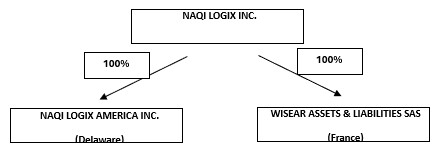
Overview of the Company
Naqi Logix Inc. (“Naqi” or “the Company”) was incorporated pursuant to the provisions of the Business Corporations Act (British Columbia) on August 4, 2020. Its corporate office location is 100 Park Royal, Suite 200, West Vancouver, British Columbia, Canada, V7T 1A2.
Naqi Logix Inc. is an AI - neurotechnology company that is a non-invasive silent and invisible interface between humans and technology platform designed to enable users to control digital systems without the use of their hands, voice, or traditional graphical interfaces. The Company’s technology is delivered through wearable devices, currently embodied in a neural earbud form factor, combined with proprietary software and signal-processing technologies.
The Company’s platform is designed to capture biosignals and motion data generated by natural facial micro-gestures and head movements and translate those signals into digital commands capable of interacting with computers, mobile devices, robotics, and connected environments. Unlike invasive brain-computer interface technologies that require surgical implantation, Naqi’s solution is external to the body and can be worn and removed like a conventional earbud.
The Company’s wearable neural interfaces could represent a potential new input modality for interacting with digital systems. By enabling users to issue commands silently and without physical contact with devices, the platform may support a range of applications across accessibility technologies, consumer electronics, computing interfaces, and connected device ecosystems.
The Company signed a Share Purchase Agreement dated December 30, 2025 (the “Wisear Purchase Agreement”) among the Company, Wisear SAS and Wisear providing for the acquisition by the Company of all of the issued and outstanding shares of Wisear not already held by the Company (the “Wisear Acquisition”). This Wisear Acquisition closed on February 2, 2026. Wisear is a neurotechnology company based in France focused on biosignal-based gesture recognition for wearable devices. The Wisear Acquisition expands the Company’s intellectual property portfolio and strengthens its capabilities in biosignal acquisition, signal processing, and machine learning technologies relevant to wearable neural interface systems.
The Company’s current wearable neural interface platform, as presently contemplated for consumer electronic applications, may not require regulatory clearance. Certain future medical, assistive or other regulated applications of the Company’s technology, including potential applications incorporating acquired Wisear technology, may require regulatory approvals depending on intended use and jurisdiction.
Our Corporate Strategy
Management continues to pursue a corporate strategy that is focused on engaging with organizations that may contribute to product development, platform validation, and potential integration of the Company’s technology into broader digital and device ecosystems and in building and developing our business as a provider of end-to-end solutions to support the development, validation and commercialization of its neural interface platform. Most recently, in furtherance of this strategy, the Company completed the acquisition of Wisear Assets & Liabilities SAS on February 2, 2026, which expanded the Company’s intellectual property portfolio and strengthened its capabilities in biosignal acquisition, signal processing, and machine learning. In connection with such strategy and to facilitate our long-term growth, we continue to evaluate various strategic opportunities, including partnerships with original equipment manufacturers (“OEMs”), and providers of complementary technologies and intellectual property (“IP”) to further our goals by adding technology, differentiation, customers and/or revenue. We are primarily looking for partnerships that have business value and operational synergies, while remaining opportunistic with respect to other strategic and/or attractive transactions. We believe these complementary technologies will add value to the Company and allow us to provide a comprehensive integrated ecosystem to our customers. In addition, we may seek to expand our capabilities around robotics, accessibility technology, consumer electronics, and emerging human-machine interface systems. Candidates with proven technologies and products that complement our overall strategy may come from anywhere in the world, as long as there are strategic and financial reasons to establish the partnership. We are also exploring opportunities that will supplement our revenue growth, which may include value-enhancing acquisitions that provide business value and operational synergies, as well as other opportunistic or strategic transactions that we believe may increase overall shareholder value. These may include, but are not limited to, alternative investment opportunities, such as minority investments, acquisitions or joint ventures. If we make any acquisitions in the future, we expect that we may pay for such acquisitions using our equity securities and/or cash and debt financings in combinations appropriate for each acquisition.
29
Naqi Platform Architecture
Naqi has developed a hardware-enabled software platform designed to interpret user intent through biosignals captured in and around the ear. The platform currently consists of three primary components:
| ● | the Naqi Neural Earbud, a wearable sensing device | |
| ● | the Naqi Hub, the software platform that interprets and executes commands | |
| ● | the Invisible User Interface (IUI), a command architecture designed to allow navigation and control without visual interaction |
Together, these components form an integrated system intended to allow users to command and control digital environments using subtle physical signals and gestures.
Naqi Neural Earbud
The Company’s initial wearable implementation of its neural interface platform is an ear-worn device similar in form factor to widely adopted consumer audio earbuds.
The device integrates multiple sensor technologies designed to capture biosignals and motion data, including electromyographic (EMG), electroencephalographic (EEG), and electrocardiographic (ECG) signals, along with inertial measurement units (IMUs) capable of detecting head movement and orientation. These signals may be generated by natural facial micro-gestures such as jaw clenches, eyebrow movements, eye blinks, and other subtle muscle activations.
When combined with the Company’s signal-processing algorithms and software environment, these signals may be translated into discrete commands capable of interacting with external digital systems.
Naqi Hub Software Platform
The Naqi Hub serves as the primary software environment for processing signals captured by the wearable device and translating them into executable commands.
The software connects to the Naqi Neural Earbud through wireless connectivity and processes biosignals and motion data using the Company’s proprietary algorithms. The platform enables command mapping, device integration, and user customization.
Naqi Hub currently supports integration with desktop and mobile computing environments and may interface with connected devices through standard communication protocols and application programming interfaces (APIs). User settings and command configurations may be stored locally or synchronized through cloud-based infrastructure.
Invisible User Interface
The Company’s proprietary Invisible User Interface (“IUI”) is designed to allow users to navigate digital commands without reliance on traditional graphical interfaces or physical controllers.
The interface architecture allows users to access command structures through intentional gestures detected by the wearable device. These gestures activate a navigation environment through which users may select commands using combinations of facial movements, head motion, and other detected signals.
The Company believes this approach may enable users to interact with digital systems in situations where traditional interfaces are impractical, such as when the user’s hands are occupied or lack motricity, when voice input is not desirable or practical, or when visual interfaces are unavailable or unwanted.
30
Use Cases
The Company has demonstrated the ability of its platform to control a range of digital systems including personal computers, mobile devices, smart home systems, and connected hardware such as mobility devices and robotic systems.
The platform is designed to be adaptable to multiple device ecosystems and may be integrated into a variety of wearable products, including head-mounted devices such as augmented reality and virtual reality systems.
Because the system translates physical signals into digital commands that can interact with software interfaces, the Company believes the platform may support a broad set of future applications across accessibility technologies, computing interfaces, gaming platforms, smart environments, and human-AI interactions.
Research and Development
Naqi Logix continues to focus on the development and refinement of its neural interface platform, including both hardware and software components. Research and development activities are directed toward improving signal acquisition, algorithmic interpretation of biosignals, system reliability, and integration with external digital systems. The Company’s current development efforts are concentrated in three primary areas: platform development, ecosystem integration, and commercialization readiness.
| (1) | Platform Development: |
The Company’s research and development activities are centered on advancing the core components of the Naqi platform, including the Naqi Neural Earbud wearable device, the Naqi Hub software environment, and the Company’s Invisible User Interface architecture.
Development work includes improving the ability of the system to capture and interpret biosignals and motion data generated by subtle facial micro-gestures and head movements. Because these signals are often low amplitude and may occur alongside normal activities such as speaking, chewing, or natural facial movement, a significant portion of development efforts is directed toward signal processing, machine learning, and artificial intelligence (AI) techniques designed to improve accuracy and reliability.
The Company’s algorithms are designed to detect and classify micro-gestural inputs, distinguish intentional commands from background activity, and adapt to individual users over time. This work includes developing scalable models capable of learning from diverse user data sets and refining gesture recognition through iterative training and testing.
In parallel with software development, the Company continues to refine the hardware design of its wearable neural earbud platform, including sensor configuration, signal acquisition methods, and system ergonomics. Ongoing engineering efforts are also focused on improving the performance and functionality of the Naqi Hub software and the Invisible User Interface architecture.
| (2) | Platform Integration and Ecosystem Development |
The Company’s platform architecture is designed to support integration with a wide range of digital devices and software environments. As part of its development efforts, the Company is expanding its application programming interface (“API”) and related software tools to enable third-party developers and device manufacturers to integrate their products with the Naqi platform.
The Company believes that enabling external developers to build integrations may expand the range of potential applications for the platform across computing environments, accessibility technologies, gaming platforms, and connected device ecosystems. While the Company expects to develop certain foundational integrations internally, such as those related to desktop computing, mobile devices, and selected accessibility applications, future integrations may also be developed by partners or third-party developers using the Company’s software interfaces.
31
| (3) | Commercialization and Product Readiness |
In parallel with technical development, the Company is engaged in activities intended to support the future commercialization of the Naqi platform. These efforts include product engineering, usability testing, developer engagement, and collaboration with potential product partners.
The Company anticipates continuing to work with selected development partners, testers, and integration partners to refine product functionality and ensure that the platform can be deployed in a manner that is reliable and user-friendly across a range of potential use cases.
The timing and scope of commercialization will depend on continued technical development, product validation, manufacturing readiness, and market engagement activities.
Wisear Acquisition and Technology
Subsequent to the fiscal year ended June 30, 2025 and six months ended December 31, 2025, the Company entered into the Wisear Purchase Agreement and closed the Wisear Acquisition on February 2, 2026. Wisear is, a neurotechnology company based in France focused on biosignal-based gesture recognition for wearable devices. The Company acquired Wisear for a base purchase price of US$11,770,000, subject to customary adjustments, satisfied through the issuance of voting common stock of the Company, at an issue price of US$2.40 per share (the “Consideration Shares”). 1,600,671 of the Consideration Shares will vest over two years following the Wisear Acquisition contingent on the continued employment or services of the Wisear team. The Wisear Acquisition follows approximately 11 months of working with Wisear under a Technology License and Services Agreement dated February 12, 2025 (“the License Agreement”) with Wisear, under which the Company exclusively licensed Wisear’s technology and was provided personnel and services to support the development of the Company’s neural interface platform.
Wisear’s technology is centered on detecting bioelectric signals generated by subtle facial muscle activity and translating those signals into digital commands capable of interacting with electronic devices. The acquired intellectual property includes patent families directed toward gesture detection systems for personal head-worn devices and methods for simultaneous sub-Nyquist acquisition of multiple bioelectric signals. These technologies relate to signal acquisition, compression, and interpretation techniques designed for wearable neural interface systems.
Through the Wisear Acquisition, the Company has integrated certain elements of the Wisear technology portfolio into its broader neural interface platform strategy. The Company expects that these intellectual property assets may support ongoing research and development efforts related to biosignal acquisition, machine learning-based gesture recognition, and wearable human-machine interface systems.
Our Market
Naqi Logix is developing a non-invasive neural interface platform designed to enable users to control digital systems without the use of their hands, voice, or traditional graphical interfaces. The Company believes that technologies enabling alternative input methods may become increasingly relevant as computing environments evolve toward more wearable, immersive, and connected device ecosystems.
The Company’s platform is designed to capture biosignals and motion data generated by subtle facial micro-gestures and head movements and translate those signals into digital commands. As a result, the Company’s technology, including any potential applications incorporating acquired Wisear technology, may have potential use cases and applications across several existing and emerging markets that rely on human-machine interaction.
Assistive Technology
The Company’s first targeted application for its platform will be assistive input for those with limited to no hand and arm motricity. Individuals with mobility impairments or limited use of their hands may benefit from alternative methods for interacting with computers, communication systems, mobility devices, and other connected technologies.
According to industry research, the global assistive technology market was valued at approximately $48 billion in 2023 and is projected to grow at an estimated compounded annual growth rate (CAGR) of approximately 7%, potentially reaching $87 billion by 2030. These solutions include a wide range of technologies intended to support individuals with physical, sensory, or cognitive impairments.
32
Wearable Technology
Naqi’s neural interface technology is currently implemented in a wearable earbud form factor similar to widely adopted consumer audio devices. As such, the Company believes its platform may align with the broader wearable technology market, which includes smart watches, fitness trackers, health monitoring devices, and other connected wearable electronics.
The global wearable technology market was valued at approximately $128 billion in 2023 and is projected by certain industry analyses to reach approximately $316 billion by 2030, reflecting continued adoption of wearable computing devices and sensor-based technologies.
Augmented and Virtual Reality
Emerging computing environments such as augmented reality (“AR”) and virtual reality (“VR”) systems may benefit from alternative input mechanisms that do not rely on handheld controllers or traditional interfaces. The Company believes wearable neural interfaces could potentially provide complementary control mechanisms for these environments.
Industry research estimates that the global AR and VR market was valued at approximately $75 billion in 2025 and is projected to grow at a compounded annual growth rate (CAGR) of approximately 34%, potentially reaching $693 billion by 2030.
Gaming and Interactive Entertainment
The Company’s platform may also have potential applications within gaming and interactive entertainment environments where users seek new interaction modalities beyond traditional controllers, keyboards, or touch interfaces.
The global gaming and esports market was estimated at approximately $298 billion in 2024 and has been projected by certain industry research firms to reach approximately $505 billion by 2030, reflecting continued growth in interactive digital entertainment.
Emerging Human-Machine Interface Markets
More broadly, the Company believes that neural and biosignal-based interfaces represent a developing category within human-machine interaction technologies. As computing environments expand beyond traditional desktop and mobile interfaces into wearable devices, connected environments, and immersive computing systems, alternative input methods may become increasingly important.
The Company’s strategy is to develop a platform capable of interacting with multiple device ecosystems rather than targeting a single vertical market. As a result, the potential commercial applications for the platform may extend across accessibility technologies, consumer electronics, computing interfaces, and connected device environments.
References:
| ● | Assistive Technologies Market: It was worth $48 billion in 2023 and is growing by roughly 7% annually, with an expectation that it will hit $87 billion in 2030. (1) | |
| ● | Wearable Technologies Market: In 2023, it was valued at $128 billion, and it’s expected to grow even faster than assistive tech at 12% CAGR to $316 billion by 2030.(2) | |
| ● | Augmented Reality/Virtual Reality Market: It was worth $75 billion in 2025 and is growing by roughly 34% annually, with an expectation that it will hit $693 billion in 2035.(3) | |
| ● | Gaming & E-Sports Market: Valued at $298 billion in 2024 and expected to reach $505 billion with 8.7% CAGR.(4) |
| (1) | Yahoo Finance. Disabled and Elderly Assistive Technology Market Research Report 2023 - Global Industry Analysis, Trends, Market Size, and Forecasts 2021-2030. https://finance.yahoo.com/news/disabled-elderly-assistive-technology-market-151300911.html. |
| (2) | Yahoo Finance. Wearable Technology Market Size to Hit $316.26 Billion by 2030 | Exclusive Report by Coherent Market Insights https://finance.yahoo.com/news/wearable-technology-market-size-hit-115000645.html |
| (3) | Precedence Research. Augmented Reality and Virtual Reality Market Size - Global Industry, Share, Analysis, Trends and Forecast 2025 - 2035. https://www.precedenceresearch.com/augmented-reality-and-virtual-reality-market#:~:text=The%20global%20augmented%20reality%20and,24.87%25%20from%202026%20to%202035. |
| (4) | Grandview Research. Global Gaming Market Size & Outlook, 2025-2030 https://www.grandviewresearch.com/horizon/outlook/gaming-market-size/global |
33
Business Development
License and Technology Collaboration
On February 12, 2025, the Company entered into the License Agreement with Wisear to access certain biosignal-processing technologies and related engineering services relevant to the development of the Company’s neural interface platform. Under the terms of the License Agreement, Wisear granted the Company a worldwide, fully paid-up, royalty-free, sublicensable, transferable, perpetual, irrevocable, and exclusive license (including exclusivity with respect to Wisear, subject to limited service-related exceptions) to use, reproduce, modify, distribute, and otherwise exploit Wisear’s licensed technology within the defined field of use in connection with the Company’s products and services. In consideration for these rights and related development services, the Company agreed to pay Wisear license fees of $20,000 per month and approximately $100,000 per month for the Wisear team through a supply agreement during the term of the License Agreement. The License Agreement also required Wisear to provide the Company with complete copies of the licensed technology and related materials to support integration and development activities. Following this collaboration period, in February 2026, the Company completed the acquisition of Wisear and its associated intellectual property portfolio, and the licensed technologies became part of the Company’s broader neural interface platform and intellectual property assets.
Robotics and Assistive Technology Collaboration
The Company has engaged with Kinova Robotics, a developer of advanced robotic arms and assistive robotic systems, to explore potential applications of the Naqi neural interface platform in robotic control environments.
Kinova’s robotic systems are widely used in research institutions, accessibility applications, and industrial environments where precise robotic manipulation and assistive technologies are required. As part of this engagement, the Company has demonstrated the ability of its neural interface platform to control robotic systems using biosignals and motion data captured through the Company’s wearable device.
These demonstrations are intended to evaluate the feasibility of enabling hands-free and voice-free robotic control through the Company’s platform. Such capabilities may have potential applications in assistive technologies for individuals with mobility impairments, as well as in research and industrial environments where alternative human-machine interaction methods may be beneficial.
The Company believes robotics control represents one of several potential application areas for its neural interface platform, though the scope and timing of any commercial deployment remain subject to continued development and collaboration.
Industry and Ecosystem Engagement
The Company continues to engage with participants across accessibility technologies, social media, gaming, consumer electronics, and emerging human-machine interface sectors to explore potential integration opportunities for its platform.
Naqi’s system architecture is designed to support integration with external hardware and software platforms through application programming interfaces (APIs) and related software development tools. These capabilities may allow device manufacturers and software developers to integrate their products with the Company’s wearable interface platform.
Technology Demonstrations and Market Engagement
Naqi Logix regularly participates in industry events, product demonstrations, and technical discussions intended to showcase the capabilities of its neural interface technology and gather feedback from potential partners, developers, and users.
These demonstrations have included examples of controlling computing systems, connected devices, and assistive technologies using the Company’s wearable neural interface platform.
Strategic Relationship Development
The Company expects to continue pursuing strategic relationships with organizations that may contribute to the development, validation, and potential commercialization of its technology. These relationships may include development collaborations, evaluation programs, integration partnerships, and licensing discussions.
While the Company engages in ongoing discussions with a range of organizations, many of these discussions remain exploratory in nature and may or may not result in formal agreements.
34
Awards & Accomplishments
Since its inception, Naqi Logix has received recognition from industry organizations, technology media, and innovation award programs for its work developing non-invasive neural interface technology. These recognitions have generally focused on the Company’s development of wearable neural interface systems designed to enable hands-free and voice-free control of digital devices.
The Company’s neural earbud platform has been recognized by several global technology and innovation programs, including TIME magazine’s “Best Inventions of 2023,” which highlighted technologies considered to have the potential to make a meaningful impact across industries and society. The Company has also received recognition through multiple CES Innovation Awards.
In addition, the Company has been recognized through the Edison Awards, where its technology received Gold Medal honors (Social & Cultural Impact.) The Edison Awards program recognizes innovations across multiple industries and is judged by a panel that includes senior business executives, academics, and industry experts.
The Company’s technology has also been recognized by industry publications and technology media covering emerging human-machine interface technologies and assistive technology solutions. Naqi Logix has been featured in articles and discussions across technology and innovation media outlets that report on developments in neural interfaces, wearable computing, and accessibility technologies.
An example of the Company’s recognition by leading publications would include the feature by Inc. magazine, which highlighted Naqi Logix and its development of non-invasive neural interface technology. The feature discussed the Company’s neural earbud platform and its potential to enable hands-free interaction with computers and connected devices through the interpretation of biosignals generated by subtle facial movements. Inc. is a widely recognized publication covering entrepreneurship, emerging technologies, and high-growth companies. The article discussed the journey leading up to the Company’s inception as well as the Company’s efforts to develop wearable neural interface systems that may support applications across accessibility technologies, computing interfaces, and connected device environments.
In addition to media coverage and industry recognition, the Company has received industry awards voted on by technology retailers and industry professionals, including recognition through the TWICE VIP Awards, which highlight innovative consumer technology products as evaluated by participants across the consumer electronics industry.
Collectively, these recognitions reflect the Company’s participation in the emerging field of non-invasive neural interfaces and wearable human-machine interaction technologies.
As of the date of this Offering Circular, Naqi has the Company has received the following accolades and industry awards:
| ● | TIME’s “The 200 Best Inventions of 2023” | |
| ● | 2024 Edison Gold Award | |
| ● | 2024 CES Innovation Honoree | |
| ● | 2024 CES TWICE Picks™ Award | |
| ● | 2024 USA TODAY/Reviewed™ AccessABILITY Award | |
| ● | 2024 Fast Company’s annual list of “World-Changing Ideas” | |
| ● | 2024 Twice VIP Award | |
| ● | 2024 INC Magazine feature | |
| ● | 2025 CES Innovation Honoree | |
| ● | 2025 TWICE VIP Innovation Award | |
| ● | 2026 CES Best of Innovation Award |
Competition
The markets for human-computer interfaces, wearable technology, neural sensing systems, and assistive input technologies are highly competitive and rapidly evolving. The Company operates within a developing ecosystem of technologies designed to enable more natural interaction between humans and digital systems.
Because the Company’s technology spans multiple emerging categories, it competes with a range of companies developing alternative approaches to device control, neural interfaces, and wearable sensing platforms.
35
Neural and Biosignal-Based Interfaces
Several companies are developing systems that interpret biosignals or neural activity to enable device interaction. These systems typically rely on technologies such as electromyography (EMG), electroencephalography (EEG), or other physiological sensing methods to translate user intent into commands for digital devices.
For example, Meta Platforms, Inc. has publicly disclosed development of wrist-based electromyography interfaces designed to interpret neural signals from the forearm to control computing systems. Other companies and research organizations are exploring ear-based biosignal sensing, neural wearables, and related technologies.
Implantable Brain-Computer Interface Systems
Certain companies are pursuing implantable brain-computer interface (BCI) technologies intended to read neural signals directly from the brain. These systems generally require surgical implantation and are currently focused primarily on clinical or research applications.
Companies pursuing implantable BCI technologies include Neuralink Corporation, Synchron Inc., and Blackrock Neurotech. While these technologies differ significantly from the Company’s non-invasive approach, they represent alternative long-term pathways for enabling neural interaction with computers and connected devices.
Consumer Electronics and Wearable Platforms
Major consumer electronics companies continue to expand the capabilities of wearable devices, including earbuds, smart glasses, and other sensor-enabled devices. Companies such as Apple Inc., Samsung Electronics, Google LLC, and Sony Group Corporation have significant resources devoted to wearable computing platforms and could potentially develop alternative user interface technologies or integrate competing sensing capabilities into future devices.
These companies possess substantial financial resources, global manufacturing capabilities, established distribution channels, and large developer ecosystems, which may enable them to introduce competing technologies.
Assistive Technology and Alternative Input Systems
The Company’s technology also intersects with the assistive technology market, where various solutions enable individuals to interact with computers and devices without traditional input methods.
Companies developing alternative accessibility solutions include manufacturers of eye-tracking systems, adaptive switches, voice-driven control systems, and specialized controllers. These technologies may compete with the Company’s platform in certain accessibility use cases.
Competitive Factors
Competition within these markets is influenced by several factors, including:
| ● | Signal accuracy and reliability | |
| ● | Ease of use and user comfort | |
| ● | Integration with software platforms and connected devices | |
| ● | Power efficiency and miniaturization | |
| ● | Intellectual property portfolios | |
| ● | Manufacturing scalability and cost | |
| ● | Regulatory requirements in medical or assistive applications | |
| ● | Distribution channels and ecosystem partnerships |
Many existing and potential competitors possess greater financial, technical, manufacturing, and marketing resources than the Company.
36
Competitive Positioning
The Company’s neural earbud platform is designed to enable hands-free, silent interaction with digital systems through non-invasive sensing technologies positioned within the ear. While the Company believes this approach represents a differentiated method for capturing user intent signals, competing technologies may emerge that provide similar or alternative capabilities.
There can be no assurance that the Company will be able to compete successfully against existing or future competitors or that competing technologies will not achieve broader adoption.
IDUN Technologies
IDUN Technologies is a Swiss neurotechnology company developing in-ear electroencephalography (EEG) earbuds designed to capture brain activity in a compact, consumer-style “hearable” form factor. Its flagship product, the IDUN Guardian, integrates dry EEG electrodes into earbuds that can measure neural signals, eye movement, and muscle activity, enabling applications such as sleep monitoring, cognitive workload tracking, and neurofeedback. The company also provides a software and cloud platform that allows developers and researchers to access and analyze neural data captured by the earbuds.
NextSense
NextSense is a U.S.-based neurotechnology company developing EEG-enabled wireless earbuds designed primarily for sleep monitoring and optimization. Its Smartbuds incorporate multiple clinical-grade EEG sensors that detect brainwave activity in real time, enabling the system to identify sleep stages and deliver precisely timed audio stimulation intended to enhance deep sleep and recovery. The company’s platform combines neural sensing hardware with machine-learning algorithms and a mobile application to provide personalized sleep insights and interventions.
AAVAA
Founded in 2019 in Montréal, Canada, AAVAA is a startup company that utilizes brain-computer interface, artificial intelligence, and acoustic technologies to allow users to focus their audio enhancement devices on the sounds they want to hear by paying attention to them. Their audio processing software simultaneously enhances those attended sounds and suppresses background noise. The platform can be implemented in different form factors, such as in-ear earbuds, headphones, and AR/VR sets.
Neuralink
Founded in 2016 in San Francisco by Elon Musk, Neuralink is a neurotechnology company developing implantable brain-machine interfaces. It uses a robotic “sewing machine-like” device to implant very thin conductive threads into the brain and demonstrates a system that reads information from a lab rat via 1,500 electrodes. In April 2021, Neuralink demonstrated a monkey playing the game “Pong” using the Neuralink implant. Neuralink is valued at over $9 billion USD.(5) In the first quarter of 2024, Neuralink implanted its device into their first human recipient, demonstrating the ability to play games like chess and “Civilization” in a hands-free and voice-free manner. Neuralink is going down a Food and Drug Administration (“FDA”) pathway as a medical device.
TechCrunch: https://techcrunch.com/2025/05/28/elon-musks-neuralink-raises-600m-at-9b-valuation/
For a description of risks related to competition, see “Risk Factors - Risks Related to our Business and Industry.”
Product Development Partners
Naqi Logix engages a network of external product development partners that support the design, engineering, and prototyping of components used within the Company’s neural interface platform. These partners provide specialized expertise across hardware engineering, firmware development, software development, and industrial design functions that complement the Company’s internal research and development activities.
Certain partners located in India provide engineering services related to the design and development of the internal printed circuit board architecture of the Company’s neural earbud platform. These services include hardware design, firmware development, embedded systems engineering, and related software development. These partners also assist with industrial and mechanical design activities associated with the earbud form factor, including vendor coordination and consultation related to sensor integration and fabrication for bioelectric signal acquisition technologies, such as electromyography (EMG) and electroencephalography (EEG).
37
The Company also engages North American development partners that provide software engineering and system architecture support for the Naqi platform. These services include development of platform software components, application programming interfaces (APIs), software development kits (SDKs), and consultation related to wireless communications, and Internet-of-Things (IoT) connectivity.
In addition, the Company has engaged contract manufacturing partners in North America to assist with the development and fabrication of prototype hardware units used in internal testing, research activities, and product development collaborations.
The Company believes that leveraging specialized external partners enables it to access technical capabilities across multiple disciplines while maintaining flexibility in its product development process. At present, the Company’s business is not substantially dependent on any single product development partner, and the Company retains ownership of the intellectual property developed as part of its platform architecture.
Intellectual Property
Naqi Logix maintains a robust and expanding intellectual property portfolio designed to support the long-term commercialization of its neural interface platform. The Company’s patents and patent applications protect core technologies related to non-invasive neural signal acquisition, biosignal processing, gesture-based command detection, and wearable neural interface systems.
As of the date of filing this Offering Circular, the Company’s intellectual property portfolio includes issued and pending patents across multiple jurisdictions. These patents cover foundational aspects of Naqi’s neural earbud platform, including methods and systems for detecting micro-gestural intent through biosignals measured in and around the ear, signal processing techniques for interpreting those signals, and architectures enabling silent, hands-free control of computers, connected devices, and robotic systems.
In addition to internally developed intellectual property, the Company has acquired patent families originally developed by Wisear, a French neurotechnology company focused on biosignal-based gesture detection in ear-worn devices. These patent families include filings directed toward gesture detection systems for personal head-worn devices and techniques for the simultaneous sub-Nyquist acquisition of multiple bioelectric signals. The Wisear portfolio includes issued and pending patents in several jurisdictions, including the United States, Europe, and China, and complements Naqi’s internally developed technologies by strengthening protection around biosignal acquisition, signal compression, and wearable neural interface architectures.
Together, Naqi’s internally developed patents (31 issued) and the acquired Wisear patents (2 issued) form a layered intellectual property position spanning signal acquisition, machine learning interpretation, wearable device architectures, and user interface control systems. The Company believes this portfolio provides a strong foundation for future product development, strategic partnerships, and licensing opportunities within the emerging market for non-invasive human-machine interfaces.
The following is a summary of patents held in connection with the Naqi Earbud technologies.
PATENT FAMILY: SYSTEM AND METHODS FOR USING IMAGINED DIRECTIONS TO DEFINE AN ACTION, FUNCTION OR EXECUTION FOR NON-TACTILE DEVICES
| COUNTRY | FILING DATE | SERIAL NUMBER | ISSUE DATE | PATENT NUMBER | STATUS | |||||||||||
| United States | 6/4/2014 | 14,295,733 | 8/2/2016 | 9,405,366 | Issued | |||||||||||
| Europe | 10/1/2014 | 18210066.9 | 8/5/2020 | 3467625 | Issued | |||||||||||
| Europe | 10/1/2014 | 14187255.6 | 12/5/2018 | 2857935 | Issued | |||||||||||
| Israel | 10/1/2014 | 234924 | 3/1/2018 | 234924 | Issued | |||||||||||
| Germany | 10/1/2014 | 14187255.6 | 12/5/2018 | 2857935 | Issued | |||||||||||
| France | 10/1/2014 | 14187255.6 | 12/5/2018 | 2857935 | Issued | |||||||||||
| United Kingdom | 10/1/2014 | 14187255.6 | 12/5/2018 | 2857935 | Issued | |||||||||||
| United States | 6/20/2016 | 15/186,910 | 11/13/2018 | 10,126,816 | Issued | |||||||||||
| United States | 9/26/2018 | 16/142,279 | 10/20/2020 | 10,809,803 | Issued | |||||||||||
| United States | 10/19/2020 | 17/073,717 | 2/22/2022 | 11,256,330 | Issued | |||||||||||
| United States | 2/18/2022 | 17/675,232 | 5/28/2024 | US11995234B2 | Issued | |||||||||||
| Hong Kong | 10/1/2014 | 19130623.2 | 2/19/2021 | HK40007483 | Issued | |||||||||||
| France | 10/1/2014 | 18210066.9 | 8/5/2020 | 3467625 | Issued | |||||||||||
| Germany | 10/1/2014 | 602014068798.9 | 8/5/2020 | 3467625 | Issued | |||||||||||
| United Kingdom | 10/1/2014 | 18210066.9 | 8/5/2020 | 3467625 | Issued | |||||||||||
| Hong Kong | 1/22/2018 | 42024087811.6 | 11/21/2025 | HK40099896 | Issued | |||||||||||
| Total Issued | 16 | |||||||||||||||
38
PATENT FAMILY: APPARATUS, METHODS AND SYSTEMS FOR USING IMAGINED DIRECTIONS, ACTIONS, FUNCTIONS OR EXECUTIONS
| COUNTRY | FILING DATE | SERIAL NUMBER | ISSUE DATE | PATENT NUMBER | STATUS | |||||||||||
| United States | 1/22/2018 | 15/877,206 | 4/30/2019 | 10,275,027 | Issued | |||||||||||
| India | 1/22/2018 | 201917029654 | 5/8/2023 | 431187 | Issued | |||||||||||
| Europe | 1/22/2018 | 18741177.2 | 8/30/2023 | EP3570740 | Issued | |||||||||||
| Hong Kong | 1/22/2018 | 62020007447.9 | 2/19/2021 | HK40007483 | Issued | |||||||||||
| United States | 3/18/2019 | 16/356,701 | 3/31/2020 | 10,606,354 | Issued | |||||||||||
| Hong Kong | 10/9/2019 | 19130623.2 | 2/19/2021 | 40007483 | Issued | |||||||||||
| United States | 3/30/2020 | 16/834,085 | 12/15/2020 | 10,866,639 | Issued | |||||||||||
| Hong Kong | 5/13/2020 | 62020007448 | 11/24/2023 | HK40017860 | Issued | |||||||||||
| United States | 12/8/2020 | 17/114,737 | 5/17/2022 | 11,334,158 | Issued | |||||||||||
| United States | 5/16/2022 | 17/663,519 | 10/3/2023 | 11,775,068 | Issued | |||||||||||
| United States | 9/8/2023 | 18/243,700 | 11/19/2024 | 12,147,602 | Issued | |||||||||||
| Europe | 1/18/2018 | 23186368.9 | 8/21/2025 | EP4250069 | Issued | |||||||||||
| Total Issued | 12 | |||||||||||||||
PATENT FAMILY: EARBUD SENSOR ASSEMBLY
| COUNTRY | FILING DATE | SERIAL NUMBER | ISSUE DATE | PATENT NUMBER | STATUS | |||||||||||
| United States | 3/16/2023 | 18/178,968 | 6/11/2024 | 12,008,163 | Issued | |||||||||||
| United States | 6/10/2024 | 18/738,278 | 5/20/2025 | 12,307,014 | Issued | |||||||||||
| Total Issued | 2 | |||||||||||||||
PATENT FAMILY: GESTURE DETECTION SYSTEM FOR PERSONAL HEAD WEARABLE DEVICE
| COUNTRY | FILING DATE | SERIAL NUMBER | ISSUE DATE | PATENT NUMBER | STATUS | |||||||||||
| United States | 5/20/2022 | 17/748,728 | 11/8/2022 | US11494001B2 | Issued | |||||||||||
| China | 5/19/20 | CN115516873A | 3/31/2026 | CN115516873B | Issued | |||||||||||
| Total Issued | 2 | |||||||||||||||
PATENT FAMILY: SIMULTANEOUS SUB-NYQUIST ACQUISITIONS OF A PLURALITY OF BIOELECTRIC SIGNALS
| COUNTRY | FILING DATE | SERIAL NUMBER | ISSUE DATE | PATENT NUMBER | STATUS | |||||||||||
| United States | 12/16/2022 | US 17/998,706 | 7/25/2023 | US11707233B1 | Issued | |||||||||||
| Total Issued | 1 | |||||||||||||||
We have filed trademarks and intend to file trademarks for the following marks, symbols and logos:
| ● | “NAQI”: Canada (#2104471 5/4/2021), USA (#97107612, 11/3/2021 Priority 5/4/2021), World Intellectual Property Organization (“WIPO”) trademark to be filed; | |
| ● | “NAQI LOGIX”: Canada (#2104470 5/4/2021), USA (#97107620, 11/3/2021 Priority 5/4/201), WIPO (Madrid System) includes countries Australia, Brazil, China, EU, India, Japan, Korea, Malaysia, Norway, Russia, Singapore, Switzerland, UK; | |
| ● | “COMMAND YOUR WORLD”: Canada (2104472, 5/4/2021), USA (#97107626, 11/3/2021 Priority 5/4/2021), WIPO trademark to be filed; and | |
| ● | “Naqi Logo”: (Canada #2104469, 5/4/2021), USA (#97107636, 11/3/2021 Priority 5/4/2021), WIPO trademark to be filed. |
39
Employees / Consultants
Prior to the Wisear Acquisition and as of the fiscal year ended June 30, 2025 and six months ended December 31, 2025, our direct personnel consisted of three full-time employees, and eight part-time consultants. As of the date of this Offering Circular the Company completed the Wisear Acquisition and now has eleven full-time employees and nine consultants and four independent contractors as part of our research and development team.
Additional Regulations
The mass-produced Naqi Earbud product will be subject to certifications needed for consumer electronics and may need other certifications required to sell in specific global markets. The product is planned to comply with Federal Communications Commission (“FCC”), conformité européenne (French for “European Conformity”) (“CE”), Waste Electrical and Electronic Equipment Directive (the “WEEE Directive”) and the Restriction of Hazardous Substances Directive (the “RoHS Directive”) certifications, as well as other certifications where necessary.
FCC
FCC certification is a type of product certification for electronic and electrical goods that are manufactured or sold in the United States. It certifies that the radio frequency emitted from a product is within limits approved by the FCC.
CE
Many products require CE marking before they can be sold in the European Union (the “EU”). CE marking indicates that a product has been assessed by the manufacturer and deemed to meet EU safety, health and environmental protection requirements. It is required for products manufactured anywhere in the world that are then marketed in the EU.
WEEE Directive
The WEEE Directive is the European Community Directive 2012/19/EU on waste electrical and electronic equipment which, together with the RoHS Directive 2011/65/EU, became European Law in February 2003. The WEEE Directive set collection, recycling and recovery targets for all types of electrical goods, with a minimum rate of four kilograms (nine pounds) per head of population per annum recovered for recycling by 2009. The RoHS Directive set restrictions upon European manufacturers as to the material content of new electronic equipment placed on the market.
RoHS Directive
The RoHS Directive, also known as Directive 2002/95/EC, originated in the EU and restricts the use of specific hazardous materials found in electrical and electronic products. All applicable products in the EU market after July 1, 2006 must pass RoHS compliance.
Legal Proceedings
On November 24, 2025, Northern Crucible Inc., a contractor previously engaged by the Company to assist with project management and administration related to a contract between the Company and the Government of Canada’s Department of Industry (Innovation, Science and Economic Development Canada), filed a Notice of Civil Claim against the Company alleging breach of contract and non-payment of services and seeking damages of approximately CAD $250,000. On the same date, an individual associated with Northern Crucible filed a separate Notice of Civil Claim asserting similar allegations and damages in the same amount. Northern Crucible had been retained by the Company in June 2023 in connection with the execution of a government contract valued at approximately CAD $1.37 million. During the first half of 2024, the Company identified discrepancies between reimbursement claims prepared by Northern Crucible and supporting project documentation and subsequently conducted an internal review with the assistance of external counsel, terminated its engagement with Northern Crucible, and notified the relevant government agency of its findings. The Company has also invoked its contractual right to arbitration and has engaged in discussions with the claimants to seek a resolution of the matter. The proceedings remain pending as of the date of this filing. The Company believes the claims are without merit; however, there can be no assurance that the Company’s assessment of the matter will prove accurate.
DESCRIPTION OF PROPERTY
We do not own any facilities and do not expect to own any facilities in the immediate future. Our mailing address is 100 Park Royal, Suite 200, West Vancouver, British Columbia, Canada, V7T 1A2, and all of the Company’s personnel operate virtually from remote locations.
40
MANAGEMENT’S DISCUSSION AND ANALYSIS OF FINANCIAL CONDITION AND RESULTS OF OPERATIONS
Please “See Item 2. Management’s Discussion and Analysis of Financial Condition and Results of Operations” in our annual report on Form 1-K, filed pursuant to Regulation A, for the fiscal annual year ended June 30, 2025, which the Company filed with the SEC on March 20, 2026 and which is incorporated by reference herein and our semi-annual report on Form 1-SA, filed pursuant to Regulation A, for the six months ended December 31, 2025, which the Company filed with the SEC on April 22, 2026 and which is incorporated by reference herein.
Plan of Operations
Naqi’s products and services are not yet commercially launched and the Company has not received any revenue from operations to date. The Company has prepared its plan of operations for the next 12 months and has identified a budget requirement of approximately $350,000 per month. The Company estimates that the earliest commercial launch of its products will occur in its fiscal year ending June 30, 2027.
As of December 31, 2025, the Company had a working capital deficiency of $4,114,568, cash on hand of $170,562, and a cumulative deficit since inception of $20,540,439. Subsequent to December 31, 2025, the Company has taken the following steps to improve its near-term liquidity: raised an aggregate of approximately $1,720,000 through the issuance of the 2025-2026 Convertible Debentures between January 2026 and June 2026, bearing interest at 10% per annum, convertible into Common Shares at $2.175 per share, with 790,804 accompanying share purchase warrants exercisable at $2.175 per share. Following the closing of the Wisear Acquisition on February 2, 2026, the Company’s organizational structure has expanded to include the Wisear team of approximately eight engineers.
As of the date of this Offering Circular, the Company has limited cash on hand and is dependent on the proceeds of this Offering to fund its ongoing operations and implement its plan of operations. The Company operates at an estimated monthly expenditure rate of approximately $300,000. At this rate, without the proceeds of this Offering or other external financing, the Company does not have sufficient cash resources to continue operations for the next 4 months. The Company believes that if sufficient proceeds are raised in this Offering, those proceeds will satisfy its cash requirements for the implementation of its plan of operations for the period described above. However, there is no assurance that the Offering will raise sufficient funds, and if the Company is unable to raise adequate proceeds through this Offering, it will need to seek alternative financing, which may not be available on acceptable terms or at all. See “Risk Factors” for a discussion of risks relating to the Company’s liquidity position and its ability to continue as a going concern. With this proposed Offering, Naqi expects to raise between $3.28 million (which reflects raising 25% plus investor processing fee of the $15 million raise) and $15.52 million (which reflects 100% plus investor processing fee of fully subscribed raise). The Company expects that the proceeds from the offering will satisfy its cash requirements, and the Company does not expect that it will be required to raise any additional funding within the next six months to implement its plan of operations.
41
DIRECTORS, EXECUTIVE OFFICERS AND SIGNIFICANT EMPLOYEES
The following table sets out the Company’s executive officers, significant personnel and directors as of the date of this Offering Circular:
| Name | Position | Age | Term of Office | Approximate
Hours per Week for Part- Time Personnel | ||||
| Executive Officers: | ||||||||
| Mark Godsy | Chief Executive Officer | 70 | August 2020 | 20 | ||||
| Bal Bhullar | Chief Financial Officer | 56 | June 2026 | 20 | ||||
| Sandeep Arya | Chief Business Officer | 47 | June 2024 | n/a | ||||
| David Segal | Chief Innovation Officer | 48 | April 2021 | n/a | ||||
| Significant Employees: | ||||||||
| Zavier Alexander | Director of Product Management | 39 | October 2021 | n/a | ||||
| Directors: | ||||||||
| Mark Godsy | Director | 70 | August 2020 | n/a | ||||
| Dino Mariutti | Director | 43 | June 2026 | n/a | ||||
| John Occhipinti | Director | 59 | October 2021 | n/a | ||||
| Sam Sullivan | Director | 65 | March 2022 | n/a | ||||
| Gary Roshak | Director | 64 | October 2021 | n/a |
With the exception of David Segal and Sandeep Arya all of the above-listed Officers are serving the Company under consulting agreements.
There is no arrangement or understanding between the persons described above and any other person pursuant to which the person was selected to his or her office or position.
Certain Relationships
Except as set forth above and in our discussion below in “Interest of Management and Others in Certain Transactions,” none of our directors, executive officers, person nominated or chosen by the Company to become a director or executive officer or significant employees have been involved in any transactions with us or any of our directors, executive officers, person nominated or chosen by the Company to become a director or executive officer or significant employees, affiliates or associates that are required to be disclosed pursuant to the rules and regulations of the United States Securities and Exchange Commission (“SEC”).
Business Experience
Mark Godsy, Chief Executive Officer
Mark Godsy is a non-practicing lawyer who practiced law for approximately four years in Vancouver, B.C., before becoming a serial entrepreneur approximately thirty years ago. Using his unique ability to build multi-disciplinary teams and navigate new concepts that can be both financed and commercialized, he has founded and helped build many companies over his career.
42
Mr. Godsy was the co-founder of ID Biomedical and Angiotech Pharmaceutical, two of the most successful biotech companies ever started in Canada, each of which grew to well over $1-billion dollars in value. ID Biomedical became the 5th largest vaccine company in the World (the largest in Canada), and Angiotech developed the first coated stent that has gone on to save tens of millions of lives around the world.
Mr. Godsy was also involved in data innovation as co-founder and founding Chairman of Mojio, which created the world’s leading connected-car platform. He was also Chairman of Code Zero, a cloud-native developers’ platform that accelerates development productivity by ten-fold.
Mr. Godsy is also a co-founder, Chairman, and current CEO of Shackelford Pharma, where he and an international team of experts are working with Dr. Alan Shackelford, a pioneer in medical cannabis, to develop regulatory-approved pharma-grade endocannabinoid treatments to treat numerous diseases affecting millions of people.
Mr. Godsy has a B.A. from University of British Columbia and a law degree from McGill University. He is a member of the Law Society of British Columbia and serves on McGill’s Faculty of Law advisory board.
Bal Bhullar, Chief Financial Officer
Bal Bhullar brings over 20+ years of diversified business, financial, investor relations and risk management experience as an Executive and/or Board Director in both public and private companies which includes such industries in technology, manufacturing, automotive, e-commerce, blockchain, resource, marine, energy, transport and health/wellness.
Among some of the areas of experience, Ms. Bhullar brings strong banking relationships, increasing market capitalization, raising capital, corporate governance, ESG, diversity as well as financial & strategic planning, initial public offerings, reverse take overs, operational & risk management, regulatory compliance reporting, investor relations, marketing, business expansion, start-up operations, financial modeling, program development, product development, corporate financing, internal controls, SOX compliance and ERP.
Previously, Ms. Bhullar has held various positions including President of BC Risk Management Association of BC, and has held positions as Board Director and CFO of several private and public companies most currently CFO/Board Member of ElectraMeccanica Vehicles Corp. NASDAQ: SOLO; CFO of Foremost Lithium NASDAQ: FMST; CFO/Board Member of Damon Inc. OTCID: DMINF, previously NASDAQ: DMN; CFO of Slate (formerly known as Re:Build Manufacturing); CEO/Founder/Board Member of KISMET Nutrients/American e-Commerce Solutions LLC. Currently holds the following positions: CFO of Naqi Logix Inc., CEO/Founder/Board Member of BKB Management Ltd., and Independent Board Member of Lexaria BioScience NASDAQ:LEXX.
Ms. Bhullar is a Chartered Professional Accountant, Certified General Accountant and as well holds a CRM designation from Simon Fraser University and a diploma in Financial Management from British Columbia Institute of Technology.
Sandeep Arya, Chief Business Officer
Sandeep Arya brings over 20 years of experience in the tech industry, having held senior positions at other prominent companies where he spearheaded numerous successful initiatives. His expertise spans various domains, including business strategy, market expansion, and stakeholder engagement. Mr. Arya is renowned for his ability to launch disruptive go-to-market strategies and foster high-value strategic partnerships across diverse global markets. Prior to joining Naqi, Mr. Arya served as Senior Director, Head of Mobile Strategic Planning and Partnerships at Samsung Electronics. In this role, he significantly enhanced revenue streams and developed global partnerships.
Mr. Arya holds a Master of Business Administration from the International Institution for Management Development, Switzerland, a Master of Engineering from the National University of Singapore, Singapore, and a Bachelor of Technology from the Indian Institute of Technology, Madras. He holds 7 US patents and is a certified Six Sigma Green Belt, underscoring his dedication to innovation and quality. As a Chief Business Officer at Naqi, Mr. Arya oversees all business operations, including strategic planning, business development, and partnership initiatives. He works closely with the executive team to identify new opportunities for growth and innovation, ensuring that Naqi remains at the forefront of the industry. Mr. Arya is passionate about driving transformative growth and making advanced, accessible tech solutions a reality for everyone.
43
David Segal, Chief Innovation Officer
Dave Segal, a seasoned veteran with more than ten years of specialized knowledge in Brain-Computer Interfaces (“BCIs”), presents an impressive portfolio of 30 patents spanning regions such as the United States, European Union, Israel, Hong Kong, and India. His patents are dedicated to advancing the hardware and system components of neural interfaces, facilitating seamless, hands-free, voice-free, and screen-free command, control, and navigation of computers and connected devices.
Driven by a passion for assisting wounded veterans and individuals with severe spinal cord injuries, Mr. Segal founded Naqi Logix Inc. His vision culminated in Naqi Logix being acknowledged as one of TIME’s “Top Inventions of 2023,” selected as an Innovation Honoree at the 2024 & 2025 Consumer Electronics Show (“CES”) and receiving the 2024 AccessABILITY Award from USA TODAY-Reviewed™. Additionally, the company’s groundbreaking work has earned a Gold Medal at the 2024 Edison Awards within their “Social & Cultural Impact” category.
Mr. Segal collaborates closely with an international team at Naqi Logix and holds a distinguished role within the corporate faculty of Harrisburg University of Science & Technology. Based at the University’s Center for Innovation & Entrepreneurship (“CIE”), he leverages this position to continue innovating wearable and emerging neural interface technologies.
As a recognized authority in this field, Mr. Segal has delivered numerous speeches including 2022 TEDx St. George, and as a Keynote Speaker at the 2016 IEEE 2nd International Conference on Applied and Theoretical Computing and Communication Technology in Bengaluru, India.
Zavier Alexander, Director of Product Management
Zavier is an accomplished product design leader with over 12 years of deep experience in the biosensor and wearable space. While leading product design at NeuroSky, Inc. he worked with global multi-disciplinary teams to design, develop and ship some of the first EEG headsets and applications available to the consumer market. He established novel best practices for biosensor product design and software, cultivating a nascent ecosystem of developers into a platform of 100+ third-party apps and products.
Throughout his career, Mr. Alexander collaborated with industry leaders such as Softbank, Mattel, Asus, Toshiba, Stanford University, and Hyundai, to integrate promising biosensors (EEG, ECG, BPI, PPG, etc.) into pioneering products that connect with people and elevate our relationship with technology. He holds a Bachelor of Fine Arts in Industrial Design from Academy of Art University. Mr. Alexander lives in San Francisco, California.
Sam Sullivan, Director
Sam Sullivan has been elected twice as Member of the Legislative Assembly of British Columbia for the riding of Vancouver False Creek. He served as Minister of Communities, Sport, and Cultural Development with responsibility for Translink. Prior to that, Mr. Sullivan served as Mayor of Vancouver from 2005-2008. He served as a Vancouver City Councillor from 1993 to 2002. He is a Member of the Order of Canada, Founder of Global Civic Policy Society, and Founder of Sam Sullivan Disability Foundation.
The Sam Sullivan Disability Foundation was founded by Sam to improve the quality of life for people with significant disabilities. To date, it has raised $20 million and served 10,000 people with disabilities throughout Canada and beyond. It consists of six nonprofit organizations: the Disabled Sailing Association, Tetra Society, ConnecTra Society, Vancouver Adapted Music Society, BC Mobility Opportunity Society, and the Disabled Independent Gardeners Association. Sam has made significant contributions to the disabled community in making outdoor activities more accessible. Through his work with the Disabled Sailing Association, the Martin 16 Sailboat was created with 150 in use around the world. He also co-invented the TrailRider with engineer Paul Cermak to help disabled people access the wilderness. Disabled people have used it to go to the top of Mount Kilimanjaro and the base camp of Mount Everest. Mr. Sullivan holds a Business Administration degree from Simon Fraser University.
John Occhipinti, Director
John Occhipinti is the Founder of Wheelhouse Partners. Mr. Occhipinti is a second-generation venture capitalist who grew up in Silicon Valley. Prior to Wheelhouse, Mr. Occhipinti was a Partner at Relay Ventures, an early-stage venture fund exclusively focused on mobile software. Before Relay, Mr. Occhipinti was Managing Director at the Woodside Fund, an early-stage technology fund founded in 1983. Mr. Occhipinti has over 20 years of experience in venture and enterprise software technology, marketing, and sales.
Mr. Occhipinti serves as the Chairman for the Early Stage Venture Capital Alliance (“ESVCA”), a federation of 160 early stage Venture Partners that meet and share best practices and discuss industry challenges. Before his investment career, Mr. Occhipinti was an early executive at Netscape Communications. Mr. Occhipinti’s team built the company’s first $50 million in revenue, helping launch Netscape through its Initial Public Offering. Mr. Occhipinti holds a Master of Business Administration from the Walter Haas School of Business at the University of California, Berkeley and a Bachelor of Arts in Legal Studies from the University of California, Berkeley. Mr. Occhipinti is based in Menlo Park, California.
44
Dino Mariutti, Director
Dino Mariutti is an entrepreneur, investor, and executive operator with more than 20 years of experience building and scaling businesses across technology, manufacturing, and international markets. He is the Founder and Chief Executive Officer of Apexmont Inc., a private investment and advisory firm focused on investment strategy, capital allocation, and advising founders and management teams on growth, governance, and operational execution.
Throughout his career, Mr. Mariutti has founded technology ventures, commercialized patented innovations, led international business operations, and served in board and advisory capacities across North America, Europe, and Asia. His experience spans engineering, manufacturing, technology commercialization, corporate strategy, venture development, and long-term value creation.
Mr. Mariutti holds a Global MBA with Distinction from University College London (UCL), completed executive studies in quantitative finance and algorithmic trading at Saïd Business School, University of Oxford, and studied Mechanical Engineering and Computer Information Systems at the British Columbia Institute of Technology (BCIT). His background combines engineering, software systems, technology commercialization, and strategic capital allocation.
Gary Roshak, Director
Gary Roshak is a wireless industry pioneer and global executive with 30+ years of experience in mobile communications and digital media. He is Founder and Managing Partner at Synthesis Works, a wireless innovation accelerator, focused on finding new use cases and repurposing of wireless spectrum assets, and currently serves as President and cofounder of portfolio company Synthesis Cloud Inc. He has led the development of the company's satellite Content Delivery Network and Broadcast Internet platform services and next generation consumer media gateway.
Mr. Roshak was lead independent Board director for Mojio; a global connected car platform company; previously he was Vice President, Mobile Advertisers and Publishers, for Yahoo! Inc., with global responsibility for mobile advertising and publishing strategy, products and business; and led global project teams for AirTouch to compete for international wireless licenses and create local joint ventures throughout Europe and Asia. Earlier in his career, Gary held management roles in several leading consulting organizations, including Arthur Young &Co., PRTM and REALOGIC. Gary is a Phi Kappa Phi graduate of the Rochester Institute of Technology.
Involvement in Certain Legal Proceedings
To our knowledge, none of our current directors, executive officers or significant employees have, during the past ten years:
| ● | been convicted in a criminal proceeding or been subject to a pending criminal proceeding (excluding traffic violations and other minor offenses); | |
| ● | had any bankruptcy petition filed by or against the business or property of the person, or of any partnership, corporation or business association of which he or she was a general partner or executive officer, either at the time of the bankruptcy filing or within two years prior to that time; | |
| ● | been subject to any order, judgment, or decree, not subsequently reversed, suspended or vacated, of any court of competent jurisdiction or federal or state authority, permanently or temporarily enjoining, barring, suspending or otherwise limiting, his involvement in any type of business, securities, futures, commodities, investment, banking, savings and loan, or insurance activities, or to be associated with persons engaged in any such activity; | |
| ● | been found by a court of competent jurisdiction in a civil action or by the SEC or the Commodity Futures Trading Commission to have violated a federal or state securities or commodities law, and the judgment has not been reversed, suspended, or vacated; | |
| ● | been the subject of, or a party to, any federal or state judicial or administrative order, judgment, decree, or finding, not subsequently reversed, suspended or vacated (not including any settlement of a civil proceeding among private litigants), relating to an alleged violation of any federal or state securities or commodities law or regulation, any law or regulation respecting financial institutions or insurance companies including, but not limited to, a temporary or permanent injunction, order of disgorgement or restitution, civil money penalty or temporary or permanent cease-and-desist order, or removal or prohibition order, or any law or regulation prohibiting mail or wire fraud or fraud in connection with any business entity; or | |
| ● | been the subject of, or a party to, any sanction or order, not subsequently reversed, suspended or vacated, of any self-regulatory organization (as defined in Section 3(a)(26) of the Securities Exchange Act of 1934, as amended (the Exchange Act)), any registered entity (as defined in Section 1(a)(29) of the Commodity Exchange Act), or any equivalent exchange, association, entity or organization that has disciplinary authority over its members or persons associated with a member. |
Except as described under “Legal Proceedings” in this Offering Circular, we are not currently a party to any legal proceedings, the adverse outcome of which, individually or in the aggregate, we believe will have a material adverse effect on our business, financial condition or operating results.
45
COMPENSATION OF DIRECTORS AND EXECUTIVE OFFICERS
For the period from July 1, 2024 to June 30, 2025, the Company paid or accrued the following cumulative consulting fees and share based compensation to its five highest paid persons who were executive officers:
| Name | Capacities in which compensation is received | Compensation $ | Other $ | Total $ | ||||||||||
| Mark Godsy | Chief Executive Officer | 120,000 | - | 120,000 | ||||||||||
| Sandeep Arya | Chief Business Officer | 295,000 | - | 295,000 | ||||||||||
| Xavier Wenzel(1) | Former Chief Financial Officer | 98,420 | - | 98,420 | ||||||||||
| Gary Roshak | Former Chief Technology Officer | 120,000 | - | 120,000 | ||||||||||
| David Segal | Chief Innovation Officer | 115,000 | - | 115,000 | ||||||||||
| (1) | Xavier Wenzel resigned as Chief Financial Officer of the Company effective November 3, 2025. The Company disclosed on Form 1-U filed with the SEC on November 5, 2025 that it does not intend to replace the Chief Financial Officer position at this time. The compensation shown reflects amounts paid or accrued, during which Mr. Wenzel served as Chief Financial Officer. Mr. Wenzel is not a current officer of the Company. |
Director and Executive Officer Compensation
The Company does not pay its directors any cash compensation for their services as directors.
On April 12, 2021, Mark Godsy entered into a consulting agreement through his wholly-owned consulting company, 0711626 B.C. Ltd. for the provision of approximately 2.5 days per week of services as Chief Executive Officer, at a monthly fee of $10,000.
On May 18, 2023, the Company entered into an agreement with Fehr & Associates (the “Fehr Agreement”) effective May 23, 2023, pursuant to which Fehr & Associates assumed responsibility of the Company’s accounting department services, which includes ongoing technical accounting support and day to day administration and bookkeeping. The Fehr Agreement stipulated that, Xavier Wenzel, Principal at Fehr & Associates, would be available to assume the role of CFO of the Company should the Company wish him to assume such role. Effective July 3, 2023, Mr. Wenzel was appointed by the board as the Company’s CFO. Compensation under the agreement was CAD$11,000 per month. Mr. Wenzel resigned as Chief Financial Officer effective November 3, 2025.
On September 18, 2023, the Company entered into a consulting agreement with Gary Roshak, a director of the Company, for services at a rate of $315 per hour to a maximum of $10,000 per month. This agreement was terminated at the end of April 2026.
On June 17, 2024, the Company entered into an employment agreement with Sandeep Arya to provide services as Chief Business Officer of the Company at an annual salary of $295,000.
A stock incentive program for the Company’s directors, executive officers, employees and key consultants has been established. Details of stock option grants are described in note 10 of the Company’s audited consolidated financial statements for the year-ended June 30, 2025, filed as part of the Company’s Annual Report on Form 1-K for the fiscal year ended June 30, 2025, incorporated by reference herein.
Personnel Agreements, Arrangements or Plans
Except as otherwise disclosed above in this Offering Circular, the Company has not entered into any other plan or arrangement with any of its directors or executive officers concerning future compensation.
During the year ended June 30, 2025 Mark Godsy received compensation of $120,000.
During the year ended June 30, 2025 David Segal received compensation of $115,000.
During the year ended June 30, 2025 Gary Roshak(2) received compensation of $120,000.
During the year ended June 30, 2025 Xavier Wenzel(1) received compensation of $98,420.
During the year ended June 30, 2025 Sandeep Arya received compensation of $295,000.
| (1) | Xavier Wenzel resigned as Chief Financial Officer effective November 3, 2025. As of June 1, 2026, Ms. Bal Bhullar has been appointed as Chief Financial Officer. Compensation shown reflects amounts paid or accrued ended June 30, 2025 while Mr. Wenzel served in that capacity. |
| (2) | Gary Roshak was terminated as Chief Technology Officer effective April 24, 2026. Compensation shown reflects amounts paid or accrued ended June 30, 2025 while Mr. Roshak served in that capacity. |
NOTE: A significant portion of the compensation mentioned above for the officers and employees was accrued. In month of April, 2025, due to the Company’s financial challenges, the following officers and employees agreed to accrue half their agreed upon salary: Sandeep Arya, Dave Segal, and Zavier Alexander. As of date of this Offering Sandeep Arya has been paid in full for the accrued wages and is no longer on accrued half salary.
46
SECURITY OWNERSHIP OF MANAGEMENT AND CERTAIN SECURITYHOLDERS
The following table shows the beneficial ownership of the Common Shares as of the date of this Offering Circular held by (i) each person known to us to be the beneficial owner of more than 10% of any class of our voting securities; (ii) each director who is the beneficial owner of more than 10% of any class of our voting securities; (iii) each executive officer who is the beneficial owner of more than 10% of any class of our voting securities; and (iv) all directors and executive officers as a group. As of December 31, 2025, there were 48,506,150 (see “Other Security Transactions” below) Common Shares issued and outstanding. As of the date of this Filing, there are 51,827,154 Common Shares issued and outstanding and 904,974 Non-Voting Common Shares.
Beneficial ownership is determined in accordance with the rules of the SEC, and generally includes voting power and/or investment power with respect to the securities held. Common Shares subject to options and warrants currently exercisable or which may become exercisable within 60 days of the date of this Annual Report, are deemed outstanding and beneficially owned by the person holding such options or warrants for purposes of computing the number of shares and percentage beneficially owned by such person, but are not deemed outstanding for purposes of computing the percentage beneficially owned by any other person. Except as indicated in the footnotes to this table, the persons or entities named have sole voting and investment power with respect to all the Common Shares shown as beneficially owned by them.
| Title of Class | Name and address of Beneficial Holder | Amount and Nature of Beneficial Ownership | Amount and nature of beneficial
ownership acquirable | Percent of Class (2) | ||||||||||
| Common Shares | 0711626 B.C. Ltd. (1) | 7,054,401 | 246,648 | 14.02 | % | |||||||||
| (1) | 0711626 BC Ltd. Is a company controlled by Mark Godsy. The business address of 0711626 BC Ltd. is 5401 Greentree Road, West Vancouver, BC, V7W 1N3, Canada. |
| (2) | Based on 51,827,154 common shares outstanding excluding non-voting common shares as of the date of this Offering Circular. |
Other Security Transactions
The following are securities transactions from December 31, 2025 to the date of this filing:
a) On December 30, 2025, the Company entered into a binding share purchase agreement to acquire 100% of Wisear Assets and Liabilities (“Wisear”) shares via a share exchange. Wisear is early-stage company that develops and licenses next-generation human computer interface technology. The business rationale for the Wisear acquisition was to acquire its intellectual property, inclusive of its patent portfolio, as well as its technology development expertise and workforce. The acquisition closed in February 2026.
Pursuant to the share purchase agreement, the Company issued 4,053,654 common shares at a value of $2.40 for gross consideration of $9,728,772 to acquire 100% of the outstanding shares of Wisear. In addition, the Company also acquired long term liabilities of $2,291,999.
No finder’s fees were paid in connection with the Acquisition. The acquisition of Wisear is considered to be a business combination under IFRS 3 as Wisear has inputs and processes that are capable of producing outputs. The Company incurred $266,406 of acquisition-related costs in its fiscal year ended June 30, 2025 which are included in professional fees in the Company’s Consolidated Statement of net loss and comprehensive loss.
b) The Company raised a total of $1,720,000 via convertible debenture issuances between January 2026 and June 2026. Each debenture bears simple interest at a rate of 10.0% per annum with a maturity date that is 12 months from the date of issuance. The Company issued 790,804 share purchase warrants with an exercise price of $2.175 and five-year life from their date of issuance as part of the convertible debenture financing.
Each debenture, plus accrued interest, can be converted into shares of the Company at anytime at the conversion price of $2.175 per share. Unless any interest is converted prior to the maturity date, all accrued and unpaid interest shall be payable at the maturity date in common shares of the Company at a conversion price of $2.175 per share.
In the event that the Company completes a go-public transaction at any time prior to the maturity date, each debenture value plus accrued interest will be automatically converted into the common at the price per share of the go-public transaction.
c) The Company also issued 8,325 share purchase broker warrants, each exercisable to acquire one Common Share at a price of $2.00 per share for a period of five years from the date of issuance.
d) The Company issued 172,324 Common Shares for the subscription receipts that were received prior to December 31, 2025.
e) On June 8, 2026 the Company issued 728,579 replacement warrants to certain shareholders to purchase Common Shares of the Company with an exercise price of $2.40 per share for a two-year term.
47
INTEREST OF MANAGEMENT AND OTHERS IN CERTAIN TRANSACTIONS
Transactions with Related Persons
The Company considers a person or entity a related party if they are a member of key management personnel, including their close relatives, an associate or joint venture, those having significant influence over the Company, as well as entities that are controlled by related parties. A transaction is considered to be a related party transaction when there is a transfer of resources or obligations between related parties. Key management personnel include those persons having authority and responsibility for planning, directing and controlling the activities of the Company. The Company has determined that key management personnel consist of executive and non-executive members of the Company’s Board of Directors and corporate officers.
The Company entered into the following related party transactions during the six month ended December 31, 2025 and 2024:
(i) Transactions with Key Management Personnel:
The following amounts were incurred with respect to Key Management Personnel; being the Company’s CEO, CBO, former CTO and CIO:
| Six months ended December 31, 2025 | Six months ended December 31, 2024 | |||||||
| $ | $ | |||||||
| Consulting fees to key management personnel | 359,166 | 372,793 | ||||||
| Share-based compensation | 166,308 | 290,337 | ||||||
| Finance expense | 28,157 | - | ||||||
| 553,631 | 663,130 | |||||||
(ii) There was no transaction incurred between the Company and non-executive directors during the six months ended December 31, 2025 and 2024.
As at December 31, 2025, $760,237 (June 30, 2025 – $560,527) was owing to directors, officers or their related companies, where $740,237 (June 30, 2025 - $540,527) was included in accounts payable & accrued liabilities and $20,000 (June 30, 2025 - $20,000) was included in shareholder demand promissory note. 45
During the six months ended December 31, 2025, the Company issued convertible debentures to officers with an aggregate principal amount of $468,959 and interest rate of 10% per annum, and matures one year from issuance of the note. During the six months ended December 31, 2025, the Company incurred $28,157 finance expense in relation to the convertible debentures issued to officers. As of December 31, 2025, amount of $418,924 convertible debenture balance owing to officers was included in convertible debentures on the consolidated statements of financial position.
Key management includes directors and executive officers of the Company. During the six months ended December 31, 2025 and 2024, no compensation other than that disclosed above was paid or payable for key management services.
Other than the related party transactions described below, the Company did not enter into any other related party transactions for the six months ended December 31, 2025 and December 31, 2024, and does not have any currently proposed transaction, in which we were or are to be a participant and the amount involved exceeded or exceeds the lesser of $120,000 and one percent of the average of the Company’s total assets at year end, and in which any related person had or will have a direct or indirect material interest (other than compensation described under “Compensation of Executive Officers” above).
48
Of the $740,237 (June 30, 2025 - $540,527) amount owing to directors, officers or their related companies, which was included in accounts payable:
| ● | $462,493 (June 30, 2025 - $397,485) is owed to Mark Godsy, Chief Executive Officer and director of the Company. | |
| ● | $nil (June 30, 2025 - $25,850) is owed to Fehr and Associates (where Xavier Wenzel, the former Chief Financial Officer of the Company works). | |
| ● | $94,220 (June 30, 2025- $65,000) is owed to results Forge, LLC, owned by Gary Roshak as former CTO and director of the Company. | |
| ● | $53,047 (June 30, 2025 - $14,714) is owed to David Segal, Chief Innovation Officer of the Company. | |
| ● | $150,477 (June 30, 2025 - $57,476) is owed to Sandeep Arya, Chief Business Officer of the Company. |
With regards to the note payable of $20,000 (June 30, 2025 - $20,000), it was owed to Mark Godsy, Chief Executive Officer and director of the Company.
Review, Approval and Ratification of Related Party Transactions
Given our small size and limited financial resources, to date we have not adopted formal written policies and procedures for the review, approval or ratification of related party transactions with our executive officers, directors, significant executives and significant shareholders. During the six months ended December 31, 2025, we have begun to establish formal policies and procedures so that such transactions will be subject to the review, approval or ratification of our Board, or an appropriate committee thereof. Until such a time where the written policies are formally adopted, our directors will continue to approve any related party transactions.
Other Transactions
Subsequent to the six months ended December 31, 2025 the Company entered into the following transactions:
| (1) | On February 2, 2026, the Company issued 4,053,654 Common Shares as consideration for the acquisition of Wisear Assets & Liabilities SAS at $2.40 per share, for aggregate equity consideration of US$9,728,772. |
| (2) | Subsequent to December 31, 2025, the Company raised gross proceeds of $1,720,000 via convertible debenture issuances under the same terms as the convertible debentures issued during the six months ended December 31, 2025. The Company paid $28,000 commission related to the convertible debenture issuances. The Company also issued 790,804 share purchase warrants with an exercise price of $2.175 and five-year life from their date of issuance as part of the convertible debenture financing. The Company also issued 8,325 share purchase broker warrants, each exercisable to acquire one Common Share at a price of $2.00 per share for a period of five years from the date of issuance. |
| (3) | Between July 1, 2025, the date of this Offering Circular, the Company issued 361,074 Common Shares for the subscription receipts that were received prior to December 31, 2025. |
| (4) | On June 8, 2026 the Company issued 728,579 replacement warrants to certain shareholders to purchase Common Shares of the Company with an exercise price of $2.40 per share for a two-year term. |
The Company did not enter into any other transactions for the six months ended December 31, 2025 and December 31, 2024, in which we were or are to be a participant and the amount involved exceeded or exceeds the lesser of $120,000 and one percent of the average of the Company’s total assets at year end, and in which any director nominee for election as director or any securityholder who beneficially owns more than 10% of any class of our voting securities, or any immediate family member, including such person’s child, stepchild, parent, stepparent, spouse, sibling, mother-in-law, father-in-law, son-in-law, daughter-in-law, brother-in-law, sister-in-law, or any person (other than a tenant or employee) sharing such person’s household (“Immediate Family Member”) of any director or executive officer or director nominee for election as director, or any securityholder who beneficially owns more than 10% of any class of our voting securities, had or will have a direct or indirect material interest (other than compensation described under “Compensation of Executive Officers” above).
49
The following is a summary of the rights of our share capital as provided in our Articles of Incorporation and Articles. For more detailed information, please see our Articles of Incorporation and Articles that have been filed as exhibits to the Offering Statement of which this Offering Circular is a part.
General
The following description summarizes the most important terms of the Company’s capital stock. This summary does not purport to be complete and is qualified in its entirety by the provisions of the Company’s Certificate of Incorporation and Articles, copies of which have been filed as exhibits to the Offering Statement of which this Offering Circular is a part. For a complete description of the Company’s capital stock, you should refer to the Certificate of Incorporation and Articles and to the applicable provisions of the Business Corporations Act (British Columbia).
The Company’s authorized capital consists of (i) an unlimited number of Voting Common Shares, without par value; and (ii) an unlimited number of Non-Voting Common Shares, without par value.
As of the date of this Offering Circular, the Company has 51,654,830 Common Shares and 904,974 Non-Voting Common Shares issued and outstanding, totaling 52,559,804 Common Share Equivalents issued and outstanding.
Voting Common Shares
The aggregate number of Common Shares subject to this Offering is 6,896,551 consisting of (i) up to 5,747,126 Common Shares that we are offering for sale to investors, at a fixed price of $2.61 per Common Share, and (ii) up to 1,149,425 Bonus Shares. The minimum purchase per investor is $522 (200 Common Shares).
If all Common Shares are sold, at least 58,723,705 Common Share Equivalents will be outstanding, together with an indeterminate number of Bonus Shares. The aforementioned number of Common Shares expected to be outstanding upon completion of this Offering assumes:
| ● | the sale of 5,747,126 Common Shares the maximum number offered for sale during the offering period; and | |
| ● | the issuance of all Bonus Shares. |
Rights, Preferences and Restrictions Attaching to The Common Shares
Common Shares
The Company’s Articles provide the following rights, privileges, restrictions and conditions attaching to our Common Shares:
| ● | One vote for each Common Share held at all meetings of shareholders. | |
| ● | The right to receive notice of and to attend all meeting of shareholders of the Company, except meetings at which only the holders of a specified class of shares (other than the Common Shares) are entitled to attend. | |
| ● | The right to vote on all matters submitted to a vote or consent of shareholders of the Company, expect matters upon which only the holders of a specified class of shares (other than the Common Shares) are entitled to vote. | |
| ● | The right to receive dividends, if, as, and when declared by the Board, which the holders of the Common Shares and Non-Voting Common Shares shall participate equally with respect to dividends without preference or priority. | |
| ● | In the event of any liquidation, dissolution or winding-up of the Company or other distribution of assets of the Company among its shareholders for the purpose of winding up its affairs, subject to the rights, privileges, restrictions and conditions attaching to any other class of shares of the Company, all of the property and assets of the Company available for distribution to the holders of Common Shares and the Non-Voting Common Shares shall be paid or distributed equally, share for share, to the holders of the Common Shares and the Non-Voting Common Shares. |
50
Non-Voting Common Shares
The Company’s Articles provide the following rights, privileges, restrictions and conditions attaching to our Non-Voting Common Shares:
| ● | Except as required under the Business Corporations Act (British Columbia) (the “BCBCA”), the holders of Non-Voting Common Shares are not entitled to receive notice or, or at attend or to vote at, any meeting of the shareholders of the Company. | |
| ● | The right to receive dividends, if, as, and when declared by the Board, which the holders of the Common Shares and Non-Voting Common Shares shall participate equally with respect to dividends without preference or priority. | |
| ● | In the event of any liquidation, dissolution or winding-up of the Company or other distribution of assets of the Company among its shareholders for the purpose of winding up its affairs, subject to the rights, privileges, restrictions and conditions attaching to any other class of shares of the Company, all of the property and assets of the Company available for distribution to the holders of Common Shares and the Non-Voting Common Shares shall be paid or distributed equally, share for share, to the holders of the Common Shares and the Non-Voting Common Shares |
The Articles may be altered by the affirmative vote of the holders of not less than two-thirds of the outstanding Common Shares. With the exception of special resolutions (e.g., resolutions in respect of fundamental changes to the Company, including: change of the Company’s name, the sale of all or substantially all of the Company’s assets, a merger or other arrangement or an alteration to the Company’s authorized capital that is not allowed by resolution of the directors) that require the approval of holders of at least two-thirds of the outstanding shares entitled to vote at a meeting, either in person or by proxy, resolutions to approve matters brought before a meeting of our shareholders require approval by a simple majority of the votes cast by shareholders entitled to vote at a meeting, either in person or by proxy.
Shareholder Meetings
The Articles provide that the location of a meeting of shareholders shall be determined by the Board and may be within or outside British Columbia. The Company must hold an annual general meeting of shareholders within 18 months after the date of incorporation and, after that, at least once in each calendar year and not more than 15 months after the last annual reference date. For the purpose of determining shareholders entitled to receive notice of or vote at meetings of shareholders, the directors may set in advance a date as the record date for that determination, provided that such date shall not precede by more than 60 days or, if we are a public company, 21 days, and otherwise 10 days, the date on which the meeting is to be held.
Under the BCBCA shareholders holding in the aggregate at least 1/20 of the issued shares of the Company that carry the right to vote at a general meeting of shareholders may requisition a meeting of shareholders. While only shareholders entitled to vote at the meeting, our directors and our auditor are entitled to be present at a meeting of shareholders. The court may, on its own motion or on the application of the Company, a director, or a shareholder entitled to vote at a meeting, order that a meeting of shareholders be called, held and conducted in the manner the court considers appropriate. The court may make such an order if it impracticable for any reason for the Company to call or conduct a meeting of shareholders in the manner required under the BCBCA or the Articles, if the Company fails to hold a meeting of shareholders if accordance with the BCBCA or for any other reason the court considers appropriate.
Pursuant to our Articles, the quorum for the transaction of business at a meeting of our shareholders is two persons who are, or who represent by proxy, shareholders who, in the aggregate, hold at least five percent of the issued shares entitled to be voted at the meeting.
Fully Paid and Non-Assessable
Provided that the consideration in respect of the Common Shares has been fully paid, and the Company has received all required corporate and other approvals, as applicable, in respect of the issuance of the Common Shares, all outstanding Common Shares are, and the Common Shares to be outstanding upon completion of this Offering will be, duly authorized, validly issued, fully paid and non-assessable.
Resale Restrictions
The Common Shares may be transferred only in accordance with applicable corporate and securities laws. The Common Shares may not be transferred without a resolution of the directors of the Company approving such transfer and such transfer may be refused by the directors, without giving any reason for such refusal.
The securities to be issued in connection with this Offering will be subject to a statutory hold period in Canada in accordance with Section 2.5(2)(3)(ii) of National Instrument 45-102 - Resale of Securities, and will contain the following legend until the end of such period: “Unless permitted under securities legislation, the holder of this security must not trade the security before the date that is 4 months, and a day after the later of (i) [insert the distribution date], and (ii) the date the issuer became a reporting issuer in any province or territory.”
The Company is not a reporting issuer in Canada.
Investors in this Offering should consult with their own professional advisers with respect to restrictions on the transferability of the securities offered hereunder.
51
Shareholder Agreements
The Company has four shareholder agreements in place: (i) a shareholder rights agreement (the “Shareholder Rights Agreement”); (ii) a right of first refusal and co-sale agreement (the “Right of First Refusal and Co-Sale Agreement”); (iii) a voting agreement (the “Voting Agreement”) and (iv) certain voting trust agreement (the “Voting Trust Agreement”) (each, a “Shareholder Agreement” and collectively, the “Shareholder Agreements”), each of which is summarized in greater detail below and attached as an exhibit hereto. Each of the Company’s Regulation A shareholders has been required to execute the Voting Agreement. Investors in the current Offering will be required to execute the Voting Agreement. The Voting Agreement will terminate in connection with the closing of the Company’s first underwritten public offering of its Common Shares (other than a registration statement relating either to the sale of securities to employees of the Company pursuant to its share option, share purchase or similar plan or an SEC Rule 145 transaction).
The Shareholder Rights Agreement
The Shareholder Rights Agreement provides the Company’s shareholders with a number of rights and ensures the Company operates according to best practices. The Shareholder Rights Agreement establishes the right of owners of at least 5% of the Company’s issued and outstanding shares (“Major Shareholders”) to receive financial statements from the Company unless waived. All other shareholders of the Company may receive such financial statements following their delivery of a written request to the Company. The Shareholder Rights Agreement provides that, subject to the terms of the Shareholder Rights Agreement and applicable law, the Company shall first offer any new securities of the Company to each Major Shareholder, and each Major Shareholder shall have the right to participate in such offering of new securities up to the percentage of the Common Shares then held by such Major Shareholder. The Major Shareholders are not required to purchase the additional securities but can do so at their option. The Shareholder Rights Agreement provides for additional standard covenants of the Company including: (i) director and officer insurance; (ii) protection of the Company’s IP and confidential information; and (iii) meetings of the Board. Certain other shareholders have the same rights as Major Shareholders under the Shareholder Rights Agreement.
The Right of First Refusal and Co-Sale Agreement
The Right of First Refusal and Co-Sale Agreement regulates the mechanics of sales and transfers of the Common Shares. The right of first refusal provides that where a shareholder proposes to transfer shares of the Company, the Company shall have a right of first refusal to purchase all or any portion of such shares that such shareholder may propose to transfer at the same price and on the same terms and conditions as those offered to the prospective transferee. The Major Shareholders shall have a secondary refusal right to purchase all or any portion of the shares proposed to be transferred but not purchased by the Company pursuant to its right of first refusal. The right of co-sale provides that if any shares to be transferred to a proposed transferee and they are not purchased pursuant to the right of first refusal by the Company (or the secondary refusal right by the Major Shareholders, as applicable), each Major Shareholder may elect to exercise its right of co-sale and participate in the proposed share transfer on a pro-rata basis on the same terms and conditions in the proposed transfer. The right of first refusal (and secondary refusal right) and the right of co-sale shall not apply to certain “exempt” transfers, which include: (i) in the case of a shareholder that is an entity, to transfers to its shareholders, members, partners or other equity holders; (ii) repurchases of shares by the Company where such repurchase is pursuant to an agreement containing vesting and/or repurchase provisions approved by a majority of the Board; and (iii) in the case of a shareholder that is a natural person, upon a transfer of shares made for bona fide estate planning purposes. Shareholders are prohibited from transferring shares to any competitor or any customer, distributor or supplier of the company if such transfer would place the Company at a competitive disadvantage with respect to such customer, distributor or supplier. The Right of First Refusal and Co-Sale Agreement further provides for a prohibition on the sale of the Company’s shares for 180 days (or such other period as may be requested by the Company or an underwriter to accommodate regulatory restrictions) following the closing of a going public transaction. A transfer of shares that is not made in compliance with the agreement shall be null and void, shall not be recorded on the books of the Company or with its transfer agent and shall not be recognized by the Company. Certain other shareholders have the same right as Major Shareholders under the Right of First Refusal and Co-Sale Agreement.
The Voting Agreement
The Voting Agreement is an agreement between the Company and its shareholders. The Voting Agreement provides Mark Godsy with the right to, among other things, designate up to seven director nominees to the board of directors for so long as he is providing services to the Company as an employee of the Company or any subsidiary, engaged as a contractor, consultant, or advisor to the Company or any subsidiary, appointed as an officer to the Company or any subsidiary, or otherwise providing services as an owner of the Company to the Company or any subsidiary. Each shareholder is required to vote their shares in favor of the election of such director nominees. At present, Mr. Godsy has elected not to exercise his right to appoint any such nominees to the board of directors.
Further, the Voting Agreement provides that any corporate action that is approved by the board of directors but which also requires shareholder approval, whether by special resolution or ordinary resolution, as applicable, as provided in the British Columbia Business Corporations Act (“BCBCA”) shareholders are obligated to vote their shares in favor of such corporate action. Under the BCBCA, such actions include, but are not limited to, certain amendments to the Notice of Articles and the Articles of the Company, amendments to the share capital of the Company, reductions in the capital on the shares of the Company, an amalgamation or arrangement involving the Company, a sale, lease or other disposition of all or substantially all of the assets of the Company, a continuance of the Company into another jurisdiction outside of British Columbia and the voluntary liquidation or dissolution of the Company. The Voting Agreement also requires shareholders to waive any dissent, appraisal or similar rights to which they may be entitled with respect to such corporate actions, to the extent permitted by law. The Voting Agreement establishes a drag-along right, which requires a minority shareholder to sell their shares in the context of a board of directors approved sale of the Company if more than 66-2/3% of shareholders approve such sale of the Company. Approximately, 100% of the Common Shares are subject to the Voting Agreement.
When subscribing for Common Shares in the Company, investors will be required to execute an adoption agreement to the Voting Agreement pursuant to which the investor will agree to be bound by the terms of the Voting Agreement as a shareholder as though such investor were originally a party thereto.
52
The Voting Trust Agreement
Certain shareholders of the Company have entered into voting trust agreements with the Company (the “Voting Trust Agreements”), whereby each such shareholder deposits its shares in a voting trust and such shares can be voted by the Chief Executive Officer of the Company appointed from time to time. In connection with entering into the Voting Trust Agreements, the shareholders delivered to the Chief Executive Officer an irrevocable power of attorney. Pursuant to the power of attorney, the Chief Executive Officer is entitled to deliver a proxy at shareholder meetings to vote the shares of such shareholders and is entitled to execute on behalf of such shareholders, any resolution or other instrument in writing to be executed by the voting shareholders of the Company, including any agreement among the shareholders of the Company.
Equity Incentive Plan
On December 29, 2021, the Company’s Board of Directors approved the Naqi Logix Inc. Equity Incentive Plan (“the Plan”), which allows for the grant of certain incentive equity awards to employees, officers, directors and consultants of the Company who will contribute to the Company’s long-term success by providing them with incentives that align their interests with those of the shareholders of the Company.
The aggregate number of Common Shares issuable upon the exercise of all options granted under the Plan has been fixed at 9,694,775 Common Shares, representing 20% of the Company’s issued and outstanding Common Shares, on a non-diluted basis as at the date of this filing.
The number of Non-Voting Common Shares available for issuance pursuant to awards granted under the Plan will increase as the number of issued and outstanding Non-Voting Common Shares of the Company increases. In general, Non-Voting Common Shares subject to awards granted under the Plan that are exercised, terminated or cancelled, or returned to the Company for any reason, shall be available for issuance pursuant to subsequent awards granted pursuant to the Plan.
Administration
Our Board, or a committee of the Board designated by the Board, will administer the Plan. Subject to the terms of the Plan, the Board has the power to determine when and how awards will be granted, which employees, directors or consultants will receive awards, the type and terms of the awards granted, including the number of Non-Voting Common Shares subject to each award and the vesting schedule of the awards, if any, and to interpret the terms of the Plan and the award agreements, among other things. The Board also has the authority to accelerate the time at which an award may vest or be exercised, to approve forms of award agreements to be used under the Plan and amend the terms of any award agreement, and to amend, suspend or terminate the Plan at any time.
The Board will determine the provisions, terms and conditions of each award granted pursuant to the Plan, including vesting schedules, forfeiture or repurchase provisions, forms of payment (cash, shares, or other consideration) upon settlement of the award, payment contingencies and satisfaction of any performance criteria.
Stock Options and Incentive Stock Options
The Plan allows for the grant of incentive stock options that qualify under Section 422 of the Internal Revenue Code, and non-incentive stock options. Prior to an initial public offering, the exercise price of all options granted under the Plan will be determined by the Board, and in effect on the day of grant. Post IPO, the Board will establish the exercise price at the time each option is granted, which exercise price must in all cases be not less than the price required by the applicable regulatory authorities. The term of an option may not exceed 10 years, except that with respect to any employee who owns more than 10% of the voting power of all classes of our outstanding stock or any parent or subsidiary corporation as of the grant date, the term must not exceed five years, and the exercise price must equal at least 110% of the fair market value of the common share on the grant date. The Board will determine the terms of stock option awards pursuant to the Plan, including, without limitation, the permitted method(s) of payment for Non-Voting Common Shares upon the exercise of an option award, and vesting terms. After the continuous service of an option recipient terminates, the recipient’s awards may be exercised, to the extent vested at the time of such termination, during the period of time specified in the recipient’s award agreement, which generally will be the period of time ending on the earlier of (i) the date that is 90 days following the termination of the recipient’s continuous service and (ii) the expiration of the term of the option. If the recipient does not exercise the option within the applicable time period, the option will terminate.
Restricted Share Units
The Plan allows for the grant of restricted share units (“RSUs”). RSUs are awards that will result in payment to a recipient at the end of a specified period only if the vesting criteria established by the Board are achieved or the award otherwise vests. Upon vesting and exercise of the award, an RSU may be settled by the delivery of Non-Voting Common Shares, their cash equivalent, any combination thereof or any other form of consideration, as determined by the Board and set forth in the applicable award agreement. The Board may determine the consideration, if any, to be paid by the recipient upon exercise of an RSU and delivery of each Non-Voting Common Share subject to the RSU. The Board may impose whatever conditions to vesting, or restrictions and conditions to payment, that it determines to be appropriate. The Board may set restrictions based on the achievement of specific performance goals or on the continuation of service or employment, or any other restrictions or conditions it deems appropriate. Upon termination of the continuous service of an RSU recipient, any unvested portion of the recipient’s RSU award will be forfeited, except as otherwise provided in the applicable award agreement.
53
Transferability of Awards
The Plan does not allow for the transfer of awards granted under the Plan except as otherwise provided in the applicable award agreement or as otherwise expressly consented to by the Board.
Certain Adjustments
In the event of certain changes in our capitalization, the Board will make appropriate and proportionate adjustments to one or more of the number of Non-Voting Common Shares that are covered by outstanding awards, the exercise or purchase price of Non-Voting Common Shares covered by outstanding awards, and the numerical share limits contained in the Plan.
Corporate Transactions
The Plan provides that in the event of a corporate transaction such as a “Sale of the Company”, as such term is defined in the Plan, the Board may take one or more of the following actions with respect to awards granted under the Plan: (i) cause the conversion or exchange of each outstanding option into Common Shares on a net issuance basis in accordance with a pre-defined formula; (ii) cause the conversion or exchange of each outstanding option into options, rights or other securities of substantially equivalent value (or greater value) as determined by the Board in its discretion, in an entity participating in or resulting from such liquidity event; (iii) accelerate the vesting, in whole or in part, of outstanding awards such that the outstanding options shall be fully vested and exercisable contemporaneously with the completion of the transaction resulting in the liquidity event; (iv) determine that any or all outstanding options will be purchased by the Company or an entity related to the Company at the liquidity event price less the exercise price for the option shares available to be purchased under such options; (v) cancel any or all of such outstanding unvested options.
The Board has the authority to amend, suspend or terminate the Plan at any time, without shareholder approval Notwithstanding the foregoing, subject to the discretion of the Board, the termination of this Plan shall have no effect on outstanding Awards, which shall continue in effect in accordance with their terms and conditions and the terms and conditions of the Plan.
Penny Stock Regulation
The SEC has adopted regulations that generally define “penny stock” to be any equity security that has a market price of less than $5.00 per share or an exercise price of less than $5.00 per share. Such securities are subject to rules that impose additional sales practice requirements on broker-dealers who sell them. For transactions covered by these rules, the broker-dealer must make a special suitability determination for the investor in such securities and have received the investor’s written consent to the transaction prior to the investment. Additionally, for any transaction involving a penny stock, unless exempt, the rules require the delivery, prior to the transaction, of a disclosure schedule prepared by the SEC relating to the penny stock market. The broker-dealer also must disclose the commissions payable to both the broker-dealer and the registered representative, current quotations for the securities and, if the broker-dealer is the sole market-maker, the broker-dealer must disclose this fact and the broker-dealer’s presumed control over the market. Finally, among other requirements, monthly statements must be sent disclosing recent price information for the penny stock held in the account and information on the limited market in penny stocks. As the Common Shares immediately following this Offering may be subject to such penny stock rules, investors in this Offering may find it more difficult to sell the Common Shares in the secondary market.
54
Absence of Public Market
We are an alternative reporting company under Regulation A, Tier 2 of the Securities Act. There is no public trading market for the Common Shares. No application is currently being prepared for the Common Shares to be listed on a securities exchange or quoted on an alternative trading system. As a result, the Common Shares sold in this Offering may not be listed on a securities exchange or quoted on an alternative trading system for an extended period of time, if at all. (See “Risk Factors” beginning on page 8).
Recent Sales of Unregistered Securities
Set forth below are recent sales of unregistered securities:
Issued 188,750 common shares, under a Regulation A financing for gross proceeds of $427,952. In accordance with the subscription agreement, certain investors were entitled to bonus shares pursuant to Schedule A (loyalty, reservation, and volume incentives), which reduced the effective average issue price per share compared to the base subscription price. The Company incurred $79,305 of share issuance costs related to the issuance of these shares.
On December 30, 2025, the Company entered into a binding share purchase agreement to acquire 100% of Wisear Assets and Liabilities (“Wisear”) shares via a share exchange. Wisear is early-stage company that develops and licenses next-generation human computer interface technology. The business rationale for the Wisear acquisition was to acquire its intellectual property, inclusive of its patent portfolio, as well as its technology development expertise and workforce. The acquisition closed in February 2026.
Pursuant to the Wisear Purchase Agreement, the Company issued 4,053,654 Common Shares at an issue price of $2.40 per share (the “Consideration Shares”). 1,600,671 of the Consideration Shares will vest over two years following the Wisear Acquisition contingent on the continued employment or services of the Wisear team. In addition, the Company also acquired Wisear long term liabilities of $2,291,999.
No finder’s fees were paid in connection with the Wisear Acquisition. The acquisition of Wisear is considered to be a business combination under IFRS 3 as Wisear has inputs and processes that are capable of producing outputs. The Company incurred $266,406 of acquisition-related costs in its fiscal year ended June 30, 2025 which are included in professional fees in the Company’s Consolidated Statement of net loss and comprehensive loss.
As a result of limited access to Wisear information required to prepare the preliminary purchase allocation, together with the limited time since the acquisition date and the effort required to conform the financial statements of Wisear to the Company’s accounting policies, the initial accounting for the business combination is incomplete at the date of these financial statements. As a result, the Company is unable to provide the amounts recognized as of the acquisition date for the major classes of assets acquired and liabilities assumed and the resulting amount of goodwill.
On May 20, 2026, the Company issued 172,324 Common Shares for the subscription receipts that were received prior to December 31, 2025.
55
WHERE YOU CAN FIND MORE INFORMATION
We have filed with the SEC an Offering Statement on Form 1-A pursuant to Regulation A promulgated under the Securities Act with respect to the Common Shares offered hereby. This Offering Circular, which constitutes a part of the Offering Statement, does not contain all of the information set forth in the Offering Statement or the exhibits and schedules filed therewith. For further information about us and the Common Shares offered hereby, we refer you to the Offering Statement and the exhibits and schedules filed therewith. Statements contained in this Offering Circular regarding the contents of any contract or other document that is filed as an exhibit to the Offering Statement are not necessarily complete, and each such statement is qualified in all respects by reference to the full text of such contract or other document filed as an exhibit to the Offering Statement. We are required to file periodic reports, proxy statements, and other information with the SEC pursuant to the Securities Exchange Act of 1934. You may obtain information on the operation of the Public Reference Room by calling the SEC at 1-800-SEC-0330. The SEC also maintains an Internet website that contains reports, proxy statements and other information about issuers, including us, that file electronically with the SEC. The address of this site is www.sec.gov.
56
INFORMATION INCORPORATED BY REFERENCE
The SEC allows us to incorporate by reference the information we file with it, which means that we can disclose important information to you by referring you to another document that we have filed separately with the SEC. We hereby incorporate by reference the following information or documents into this Offering Circular:
| ● | the Company’s annual report pursuant to Regulation A on Form 1-K for the fiscal annual year ended June 30, 2025 filed with the SEC on March 20, 2026. |
| ● | The Company’s six month ended semi-annual report pursuant to Regulation A on Form 1-SA for the six months ended December 31, 2025 filed with the SEC on April 22, 2026. |
Any information in any of the foregoing documents will automatically be deemed to be modified or superseded to the extent that information in this Offering Circular or in a later filed document that is incorporated or deemed to be incorporated herein by reference modifies or replaces such information.
We urge you to carefully read this Offering Circular and the documents incorporated by reference herein, before buying any of the Shares. This Offering Circular may add or update information contained in the documents incorporated by reference herein. To the extent that any statement that we make in this Offering Circular is inconsistent with statements made in the documents incorporated by reference herein, you should rely on the information in this Offering Circular and the statements made in this Offering Circular will be deemed to modify or supersede those made in the documents incorporated by reference herein.
You should rely only on the information contained in this Offering Circular or incorporated herein by reference. We have not authorized anyone to provide you with different information. No dealer, salesperson or other person is authorized to give any information or to represent anything not contained in this Offering Circular or incorporated herein by reference. You should not rely on any unauthorized information or representation. This Offering Circular is an offer to sell only the Shares offered hereby, and only under circumstances and in jurisdictions where it is lawful to do so. You should assume that the information in this Offering Circular is accurate only as of the date on the front of the applicable document and that any information we have incorporated by reference is accurate only as of the date of the document incorporated by reference, regardless of the time of delivery of this Offering Circular, or any sale of a security.
We further note that the representations, warranties and covenants made by us in any agreement that is filed as an exhibit to any document that is incorporated by reference in this Offering Circular were made solely for the benefit of the parties to such agreement, including, in some cases, for the purpose of allocating risk among the parties to such agreements, and should not be deemed to be a representation, warranty or covenant to you. Moreover, such representations, warranties or covenants were accurate only as of the date when made. Accordingly, such representations, warranties and covenants should not be relied on as accurately representing the current state of our affairs.
Upon written or oral request, we will provide you without charge a copy of any or all of the documents that are incorporated by reference into this Offering Circular, including but limited to financial statement information and exhibits which are specifically incorporated by reference into such documents. Requests should be directed to: Naqi Logix Inc., Attention: Investor Relations, who can be contacted at investor@naqilogix.com, or by calling 1-888-627-4564 Ext.1. Additionally, you may access this information at www.sec.gov/edgar/browse/?CIK=1902337.
57
PART F/S
Please “See Item 7. Financial Statements” in our annual report on Form 1-K, filed pursuant to Regulation A, for the fiscal annual year ended June 30, 2025, which the Company filed with the SEC on March 20, 2026 and which is incorporated by reference herein and our six-month ended semi-annual report pursuant to Regulation A on Form 1-SA for the six months ended December 31, 2025 which the Company filed with the SEC on April 22, 2026 and which is incorporated by reference herein.
INDEX TO CONSOLIDATED FINANCIAL STATEMENTS
| Page | ||
| Financial Statements of Wisear Assets & Liabilites SAS | ||
| Report of Independent Registered Public Accounting Firm | F-2 | |
| Report of Independent Registered Public Accounting Firm | ||
| Consolidated Balance Sheets as of December 31, 2025, 2024 and 2023 | F-3 | |
| Consolidated Statements of Operations for the years ended December 31, 2025, 2024 and 2023 | F-4 | |
| Consolidated Statements of Comprehensive Loss for the years ended December 31, 2025, 2024 and 2023 | F-5 | |
| Consolidated Statements of Changes in Stockholder’s Equity for the years ended December 31, 2025, 2024 and 2023 | F-6 | |
| Consolidated Statements of Cash Flows for the years ended December 31, 2025, 2024 and 2023 | F-7 | |
| Notes to Consolidated Financial Statements | F-8 | |
| Interim Unaudited Pro Forma Condensed Consolidated Financial Statements of Naqi Logix Inc. and Wisear Assets & Liabilities SAS | ||
| Condensed Consolidated Balance Sheets as of December 31, 2025 and December 31, 2025 | F-50 | |
| Condensed Consolidated Statements of Operations and Comprehensive Income (Loss) for the year ended December 31, 2025 and year ended December 31, 2025 | F-52 | |
| Notes to Interim Unaudited Pro Forma Condensed Consolidated Financial Statements | F-53 |
F-1

| WISEAR
Auxr Lab
Avenue des Plaines de l’Yonne 89000 Auxerre
Independent Auditor’s Report
|
Nos cabinets: Bourgoin-Jallieu ● Cergy-Pontoise ● Châlons-en-Champagne ● Dijon ● Lille ● Lyon ● Nancy ● Nogent-sur-Seine ● Paris
Romilly-sur-Seine ● Saint-Dié ● Saint-Dizier ● Saint-Genis-Laval ● Sens ● Strasbourg ● Troyes ● Vienne ● Vitry-le-François
Société AKELYS - Société inscrite au tableau de l’Ordre des Experts Comptables de la Région de Paris - Ile de France Société de Commissaires aux comptes, membre de la Compagnie Régionale de Paris
Siège social - 19 avenue de Messine - 75008 Paris - Tél. +33 (0)1 53 53 58 00
Siège administratif - 6 rue du Général Sarrail - 10000 Troyes - Tél. +33 (0)3 25 80 66 80
SELAS au capital de 1 040 000 euros - RC Paris B 652 008 939 - SIRET 652 008 939 00025 - APE 6920 Z – N° TVA intracommunautaire : FR04652008939
F-2
Independent Auditor’s Report
To the President of WISEAR,
Opinion
In response to your request, we have audited the financial statements of WISEAR Company (the Company), which comprise the statement of financial position as at December 31, 2025, and the statement of comprehensive income, statement of changes in equity and statement of cash flows for the year then ended, and notes to the financial statements, including a summary of significant accounting policies.
In our opinion, the accompanying financial statements present fairly, in all material respects the financial position of the Company as at December 31, 2025, and its financial performance and its cash flows for the year then ended prepared in conformity with IFRS as adopted in the European Union.
Basis for opinion
We conducted our audit in accordance with the standards of the PCAOB, the professional standards applicable in France and the professional guidelines of the National Company of Auditors (CNCC). These standards are adopted by the High Audit Authority (H2A) and approved by the Minister of Justice. The approved standards in force are generally consistent with the international auditing standards developed by IFAC (International Federation of Accountants), of which the CNCC is a member.
Our responsibilities under those standards are further described in the Auditor’s Responsibilities for the Audit of the Financial Statements section of our report. We are independent of the Company in accordance with the ethical requirements that are relevant to our audit of the financial statements in France, and we have fulfilled our other ethical responsibilities in accordance with these requirements. We believe that the audit evidence we have obtained is sufficient and appropriate to provide a basis for our opinion.
Responsibilities of Management and Those Charged with Governance for the Financial Statements
Management is responsible for the preparation and fair presentation of the financial statements in accordance with IFRSs and for such internal control as management determines is necessary to enable the preparation of financial statements that are free from material misstatement, whether due to fraud or error.
In preparing the financial statements, management is responsible for assessing the Company’s ability to continue as a going concern, disclosing, as applicable, matters related to going concern and using the going concern basis of accounting unless management either intends to liquidate the Company or to cease operations.
Those charged with governance are responsible for overseeing the Company’s financial reporting process.
F-3
WISEAR
Auditor’s Responsibilities for the Audit of the Financial Statements
Our objective is to obtain reasonable assurance about whether the financial statements as a whole are free from material misstatement, whether due to fraud or error, and to issue an auditor’s report that includes our opinion. Reasonable assurance is a high level of assurance but is not a guarantee that an audit conducted in accordance with CNCC professional guidance will always detect a material misstatement when it exists. Misstatements can arise from fraud or error and are considered material if, individually or in the aggregate, they could reasonably be expected to influence the economic decisions of users taken on the basis of these financial statements.
Paris, May 20th, 2026
AKELYS
François LAMY
F-4
FINANCIAL STATEMENTS PREPARED ACCORDING TO IFRS
FOR THE FINANCIAL YEAR ENDED DECEMBER 31, 2025
WISEAR
F-5
SUMMARY
| STATEMENT OF FINANTIAL POSITION | F-7 | ||
| STATEMENT OF COMPREHENSIVE INCOME | F-8 | ||
| STATEMENT OF CHANGE IN CASH FLOWS | F-10 | ||
| STATEMENT OF CHANGE IN EQUITY | F-11 | ||
| NOTES TO FINANCIAL STATEMENTS | F-12 | ||
| Note 1. | GENERAL INFORMATION | F-12 | |
| Note 2. | FIRST TIME APPLICATION OF IFRS | F-12 | |
| Note 3. | ACCOUNTING RULES AND METHODS | F-12 | |
| Note 4. | EVENTS AFTER THE REPORTING PERIOD | F-18 | |
| Note 5. | OPERATING PROFIT | F-18 | |
| Note 6. | FINANCE INCOME | F-19 | |
| Note 7. | INTANGIBLE ASSETS | F-19 | |
| Note 8. | TANGIBLE ASSETS | F-19 | |
| Note 9. | NON-CURRENT FINANCIAL ASSETS | F-20 | |
| Note 10. | WORKING CAPITAL REQUIREMENT | F-20 | |
| Note 11. | CASH AND CASH EQUIVALENTS | F-21 | |
| Note 12. | SHARE CAPITAL | F-21 | |
| Note 13. | EARNINGS PER SHARE | F-21 | |
| Note 14. | INFORMATION ON THE FAIR VALUE OF FINANCIAL INSTRUMENTS | F-21 | |
| Note 15. | FINANCIAL RISK MANAGEMENT | F-22 | |
| Note 16. | PROVISIONS FOR EMPLOYEE BENEFITS | F-23 | |
| Note 17. | INCOME TAX | F-23 | |
| Note 18. | SEGMENT INFORMATION | F-25 | |
| Note 19. | RELATED-PARTY TRANSACTIONS | F-25 | |
| Note 20. | OFF-BALANCE SHEET COMMITMENTS | F-25 | |
IFRS FINANCIAL STATEMENTS | F-6 | WISEA |
STATEMENT OF FINANCIAL POSITION
| As at December 31 | ||||||||||
| In thousands of euros | Notes | 2024 | 2025 | |||||||
| Goodwill | - | - | ||||||||
| Intangible assets | 7 | 6 | - | |||||||
| Property, plant and equipment | 8 | 28 | - | |||||||
| Non-current financial assets | 9 | 38 | - | |||||||
| Deferred tax assets | 17 | 1 | 2 | |||||||
| Others non-current assets | - | - | ||||||||
| Non-current assets | 73 | 2 | ||||||||
| Trade receivables | 10 | - | 83 | |||||||
| Current tax receivables | 22 | 249 | ||||||||
| Other current assets | 10 | 55 | 26 | |||||||
| Cash and cash equivalents | 11 | 108 | 59 | |||||||
| Current assets | 185 | 417 | ||||||||
| Assets held for sale or related to discontinued operations | - | 45 | ||||||||
| TOTAL ASSETS | 258 | 464 | ||||||||
| As at December 31 | ||||||||||
| In thousands of euros | Notes | 2024 | 2025 | |||||||
| Share capital | 12 | 69 | 69 | |||||||
| Share premium | - | - | ||||||||
| Reserves | (971 | ) | (1,872 | ) | ||||||
| Net comprehensive income | (902 | ) | 303 | |||||||
| Equity attributable to owners of the parent | (1,804 | ) | (1,500 | ) | ||||||
| Non-current provisions | 16 | 6 | 7 | |||||||
| Financial liabilities – non-current part | 1,687 | - | ||||||||
| Deferred tax liabilities | 17 | - | - | |||||||
| Others non-current liabilities | - | - | ||||||||
| Non-current liabilities | 1,693 | 7 | ||||||||
| Current provisions | 16 | - | - | |||||||
| Trade payables | 10 | 27 | 25 | |||||||
| Current tax debts | - | - | ||||||||
| Current financial liabilities | 166 | 227 | ||||||||
| Other current liabilities | 10 | 177 | 208 | |||||||
| Current liabilities | 370 | 460 | ||||||||
| Liabilities related to assets held for sale or related to discontinued operations | 1,498 | |||||||||
| TOTAL EQUITY AND LIABILITIES | 258 | 464 | ||||||||
IFRS FINANCIAL STATEMENTS | F-7 | WISEA |
STATEMENT OF COMPREHENSIVE INCOME
| As at December 31 | ||||||||
| In thousands of euros | 2024 | 2025 | ||||||
| Revenues from operating activities | 280 | |||||||
| Costs of sales | (12 | ) | ||||||
| External expenses | (619 | ) | ||||||
| Personnel expenses | (772 | ) | ||||||
| Tax and duties | (8 | ) | ||||||
| Depreciation and provisions | (11 | ) | ||||||
| Other current operating income and expenses | 16 | |||||||
| Current operating income | (1,126 | ) | ||||||
| Other non-current operating income and expenses | 297 | |||||||
| Current and non-current operating income | (829 | ) | ||||||
| Financial income | (74 | ) | ||||||
| Others financial income & expenses | (0 | ) | ||||||
| Profit (loss) before tax | (902 | ) | ||||||
| Income tax | 1 | |||||||
| Net income from discontinued operations | 302 | |||||||
| Net income | (901 | ) | 302 | |||||
| Basic earnings per share (in euros) | (0.13 | ) | 0.04 | |||||
| Diluted earnings per share (in euros) | (0.13 | ) | 0.04 | |||||
| 2024 | 2025 | |||||||
| Net income | (901 | ) | 302 | |||||
| Items that will not be reclassified to profit or loss | ||||||||
| Actuarial gains and losses | ||||||||
| Gross amount | 0 | 2 | ||||||
| Deferred tax | (0 | ) | (1 | ) | ||||
| Total amount, net of tax | 0 | 1 | ||||||
| Items that may be reclassified subsequently to profit or loss | ||||||||
| Total – other items of comprehensive income | 0 | 1 | ||||||
| COMPREHENSIVE INCOME | (902 | ) | 303 | |||||
| Basic comprehensive income per share (in euros) | (0.13 | ) | 0.04 | |||||
| Diluted comprehensive income per share (in euros) | (0.13 | ) | 0.04 | |||||
IFRS FINANCIAL STATEMENTS | F-8 | WISEA |
As all income and expenses are within the scope of IFRS 5 “Non-current Assets Held for Sale”, they must be grouped and reclassified on a single line “Net income after tax from continuing operations”.
To maintain consistent reading of the overall result with the comparative year 2024, the overall result before reclassification of income and expenses in accordance with IFRS 5 is presented below:
| As at December 31 | ||||||||||
| In thousands of euros | Notes | 2024 | 2025 | |||||||
| Revenues from operating activities | 280 | 975 | ||||||||
| Costs of sales | (12 | ) | (8 | ) | ||||||
| External expenses | 5.2 | (619 | ) | (430 | ) | |||||
| Personnel expenses | 5.1 | (772 | ) | (248 | ) | |||||
| Tax and duties | (8 | ) | (11 | ) | ||||||
| Depreciation and provisions | 5.3 | (11 | ) | (69 | ) | |||||
| Other current operating income and expenses | 5.4 | 16 | 270 | |||||||
| Current operating income | (1,126) | 480 | ||||||||
| Other non-current operating income and expenses | 297 | (156 | ) | |||||||
| Current and non-current operating income | (829 | ) | 323 | |||||||
| Financial income | (74 | ) | (57 | ) | ||||||
| Others financial income & expenses | 6 | (0 | ) | (1 | ) | |||||
| Profit (loss) before tax | (902 | ) | 266 | |||||||
| Income tax | 17 | 1 | 36 | |||||||
| Net income | (901 | ) | 302 | |||||||
| Basic earnings per share (in euros) | 13 | (0.13 | ) | 0.04 | ||||||
| Diluted earnings per share (in euros) | 13 | (0.13 | ) | 0.04 | ||||||
| 2024 | 2025 | |||||||
| Net income | (901 | ) | 302 | |||||
| Items that will not be reclassified to profit or loss | ||||||||
| Actuarial gains and losses | ||||||||
| Gross amount | 0 | 2 | ||||||
| Deferred tax | (0 | ) | (1 | ) | ||||
| Total amount, net of tax | 0 | 2 | ||||||
| Items that may be reclassified subsequently to profit or loss | ||||||||
| Total – other items of comprehensive income | 0 | 2 | ||||||
| COMPREHENSIVE INCOME | (902 | ) | 303 | |||||
| Basic comprehensive income per share (in euros) | (0.13 | ) | 0.04 | |||||
| Diluted comprehensive income per share (in euros) | (0.13 | ) | 0.04 | |||||
IFRS FINANCIAL STATEMENTS | F-9 | WISEA |
STATEMENT OF CHANGE IN CASH FLOWS
| In thousands of euros | 12.31.2025 | |||
| Company profit (loss) for the year | 302 | |||
| Removal of income and expenses with no cash impact: | ||||
| Allocation (reversal) of amortisation, depreciation, provisions and impairment | 22 | |||
| Financial expense (income) | 56 | |||
| Tax expense (income) for the financial year | (36 | ) | ||
| Cash flow | 343 | |||
| Tax paid in the financial year | (193 | ) | ||
| Change in working capital requirement: | (23 | ) | ||
| - Trade and other receivables | (54 | ) | ||
| - Trade and other payables | 31 | |||
| Net cash-flow generated by the business (Total I) | 128 | |||
| Investment operations | ||||
| Acquisition of non-current assets | (3 | ) | ||
| Financial investments | 10 | |||
| Net cash-flow from investment operations (Total II) | 7 | |||
| Financing operations | ||||
| Interest paid | (56 | ) | ||
| Repayment of financial liabilities | (128 | ) | ||
| Net cash-flow from financing operations (Total III) | (184 | ) | ||
| Change in cash (I+II+III) | (49 | ) | ||
| Opening cash | 108 | |||
| Closing cash | 59 | |||
| Cash change | (49 | ) | ||
IFRS FINANCIAL STATEMENTS | F-10 | WISEA |
| In thousands of euros | Share capital | Reserves | Revenue | Equity attributable to owners of the parent | Non controlling interests | Equity | ||||||||||||||||||
| As at December 31, 2023 | 59 | 64 | (1,037 | ) | (914 | ) | (915 | ) | ||||||||||||||||
| Capital increase | 10 | 2 | - | 12 | - | 12 | ||||||||||||||||||
| Profit (loss) for the period | - | - | (901 | ) | (901 | ) | - | (901 | ) | |||||||||||||||
| Other items of comprehensive income | - | - | - | - | - | - | ||||||||||||||||||
| Comprehensive income | - | - | (901 | ) | (901 | ) | - | (901 | ) | |||||||||||||||
| Allocation of the profit (loss) from the previous financial period | - | (1,037 | ) | 1,037 | - | - | ||||||||||||||||||
| As at December 31, 2024 | 69 | (971 | ) | (902 | ) | (1,804 | ) | - | (1,804 | ) | ||||||||||||||
| Profit (loss) for the period | - | - | 302 | 302 | - | 302 | ||||||||||||||||||
| Other items of comprehensive income | - | - | 1 | 1 | - | 1 | ||||||||||||||||||
| Comprehensive income | 303 | 303 | - | 303 | ||||||||||||||||||||
| Allocation of the profit (loss) from the previous financial period | - | (902 | ) | 902 | - | - | - | |||||||||||||||||
| Dividends | - | - | - | - | - | - | ||||||||||||||||||
| As at December 31, 2025 | 69 | (1,873 | ) | 303 | (1,500 | ) | - | (1,500 | ) | |||||||||||||||
IFRS FINANCIAL STATEMENTS | F-11 | WISEA |
Wisear Company (“the Company”) is a French simplified joint-stock company with its registered office located in France, at rue des Plaines de l’Yonne, 89000 Auxerre.
The Company specializes in the development of neural interface and artificial intelligence technologies that allow the integration of touchless and voice-free control into consumer electronic devices.
At the end of 2024, the Company created Wisear Assets & Liabilities to carry out a partial contribution of all these assets and liabilities, which was completed at fair value. In exchange for this partial contribution of assets, the Company received 100% of the shares of Wisear Assets & Liabilities valued at €8,893K.
Therefore, as the entire business was transferred to Wisear Assets & Liabilities by Wisear, which owns it, the financial statements presented correspond to the consolidated IFRS financial statements of the Group, comprising its parent company Wisear and its wholly-owned subsidiary Wisear Assets & Liabilities, as of December 31, 2025 (12 months), with a comparison to December 31, 2024 (12 months). Since no consolidated balance sheet is available prior to 2024, a comparison of the cash flow statement as of December 31, 2024, is not presented.
Note 2. FIRST TIME APPLICATION OF IFRS
The presented accounts have been prepared in accordance with IFRS 1 “First-time Adoption of International Financial Reporting Standards.” These accounts constitute an additional set of accounts compared to the Company’s historical statutory accounts, which are prepared in accordance with French accounting principles.
As a reminder, the transition date chosen by the Company is January 1, 2023.
Note 3. ACCOUNTING RULES AND METHODS
3.1. Basis of preparation of the financial statements
Pursuant to Regulation (EC) 1606/2002 of 19 July 2002, consolidated financial statements for the year ended 31 December 2025 have been prepared in accordance with International Financial Reporting Standards (IFRS) as adopted by the European Union at 31 December 2025. (http://ec.europa.eu/finance/company-reporting/ifrs- financial-statements/index_fr.htm)
The accounting policies used at 31 December 2025 are the same as those used in preparing the consolidated financial statements at 31 December 2024, except for the standards and/or amendments to standards described below, adopted by the European Union and mandatorily applicable as from 1 January 2025.
3.2. New standards and interpretations applied from 1 January 2025
Standards, interpretations and amendments mandatorily applicable from 1 January 2025 had no material impact on the consolidated financial statements at 31 December 2025. They mainly concern “Lack of Exchangeability” (Amendments to IAS 21): these amendments specify when a currency is exchangeable into another currency and how to determine the exchange rate when it is not.
IFRS FINANCIAL STATEMENTS | F-12 | WISEA |
3.3. Standards and interpretations adopted by the IASB but not yet applicable at 1 January 2025
The Group has not applied early any of the following amendments to standards that could concern the Group and were not mandatorily applicable at 1 January 2025:
| ● | “Amendments to the Classification and Measurement of Financial Instruments” (Amendments to IFRS 9 and IFRS 7): these amendments specify that financial assets and liabilities must be recognised or derecognised on the settlement date. However, it is possible to derecognise certain financial liabilities if they were settled by electronic transfer and if certain criteria, aimed at ensuring that the entity no longer has control over the cash, are met. |
These new amendments are not expected to have a material impact.
The financial statements are presented in thousands of euros, rounded up to the nearest thousand euros, unless otherwise indicated.
The Company’s IFRS financial statements are prepared according to the going concern principle and historical cost, except for certain financial instruments and available-for-sale financial assets, which are measured at fair value.
3.4. Use of judgements and estimates
The preparation of financial statements in accordance with IFRS requires management to make estimates and assumptions that affect the carrying amount of certain assets and liabilities, income and expenses, and the information provided in some Notes.
Certain financial accounting information has required significant estimations to be made : in particular the value of deferred tax assets, provisions for risks, retirement benefit plans.
3.5. Foreign currencies
The financial statements are presented in euros, which is the Group’s functional currency. Almost all of the Group’s transactions are denominated in euros.
3.6. Revenue recognition
Wisear’s revenue mainly comes from the sale of prototypes and connected objects incorporating its control technology, as well as from licensing this technology, particularly to Naqi.
3.7. Assets Held for Sale
Non-current assets (or groups of assets) are classified as held for sale and recorded at the lower of their carrying amount and their fair value less costs to sell, if their carrying amount is to be recovered primarily through a sale transaction rather than through continuing use.
Non-current assets (including those that are part of a group held for sale) classified as held for sale are not amortized.
IFRS FINANCIAL STATEMENTS | F-13 | WISEA |
3.8. Intangibles assets
Intangible assets are recorded at their acquisition cost less any accumulated amortisation and any accumulated impairment losses. Intangible assets with definite lives are amortised over their useful economic life, using the straight-line method.
Research and development costs
The Group regularly incurs research and development costs. Research costs are systematically expensed as incurred. Development expenditures are recognised as an intangible asset when the Group can demonstrate the following six things:
| ● | the technical feasibility required for completion of the development project; |
| ● | its intention to complete the project and put it into service; |
| ● | the capacity to use the intangible asset; |
| ● | the probability of future economic benefits being generated; |
| ● | the availability of technical, financial and other resources to complete the project; and |
| ● | the ability to reliably measure the development expenditure. |
As of the date the financial statements were prepared, the company considers that these criteria were not met prior to the commitment of costs.
Consequently, development expenses were recognized as an expense in the financial year in which they were incurred.
3.9. Tangible assets
Property, plant and equipment are initially accounted for at their acquisition cost.
Depreciation, calculated from the date of commissioning of the non-current asset, is recognised as an expense to reduce the carrying amount of assets over their estimated useful lives, on a straight-line basis over the following period:
| ● | Technical installations : 3 years/ 10 years |
| ● | Other non-current assets : |
| ● | IT and office equipments 3 years/ 10 years |
Depreciation or amortisation expense for non-current assets is recognised within the income statement as “Depreciation and amortisation”.
3.10. Leases
IFRS 16 “Leases” has been mandatory since January 1, 2019. The main effects of the implementation of IFRS 16 compared to the principles previously applied under IAS 17 (former standard) relate to the recognition of leases where the Company acts as lessee.
IFRS 16 defines a lease as a contract that gives the lessee the right to control the use of an identified asset.
All leases are recognised on the statement of financial position in the recognition of an asset in respect of the right of use of the leased assets with a corresponding liability.
As of the balance sheet date, there were no contracts of this nature.
IFRS FINANCIAL STATEMENTS | F-14 | WISEA |
3.11. Impairment of non-financial assets
When events or changes to the market environment or internal factors indicate there is a risk of an asset losing value, principally relating to property, plant and equipment or intangible assets, they undergo an impairment test. In the case of non-amortised intangible assets, the impairment tests are performed annually.
The Company does not hold any indefinite-lived assets that would require an impairment test. Furthermore, no indication of impairment has been identified that would justify testing other finite-lived assets.
3.12. Financial assets and liabilities
IFRS 9 “Financial Instruments”, whose application is mandatory as of January 1, 2018, includes the following three main components:
| - | classification and evaluation of financial assets and liabilities : the standard requires financial assets to be classified according to their type, the characteristics of their contractual cash flows and the business model followed in managing them; |
| - | impairment of financial assets: IFRS 9 determines the principles and methodology to apply to evaluate and account for the credit losses expected on the financial assets, the commitments on loans and the financial guarantees; |
| - | hedge accounting: the new text aims for better alignment between hedge accounting and risk management by establishing an approach that is founded more upon the principles of risk management. |
Application of IFRS 9 provisions has no significant impact on the financial statements as at December 31, 2025. As the Group does not have a hedging instrument, it was not impacted by the last part of the standard. The second part of the standard, relating to impairment, also did not have an impact on the Group’s financial statements.
The available-for-sale assets were themselves reclassified in “Assets at fair value through profit or loss”.
Financial assets at fair value through profit or loss
These represent the assets held-for-trading that are assets destined for short-term uses. They are valued at fair value and the changes in fair value are recognised in the income statement.
Financial liabilities at fair value through profit or loss
These represent the liabilities held for transaction purposes that are liabilities that are destined for short-term uses. They are valued at fair value and the changes in fair value are recognised in the income statement.
Loans and receivables
Loans and receivables are measured at amortised cost less any necessary impairment charge.
Financial liabilities and trade payables
Financial liabilities and trade payables are measured at amortised cost. Interest is calculated using the effective interest rate and is recognised as financial expense in the income statement.
3.13. Trade and other receivables
A provision for depreciation is recognised when there are objective indicators which indicate that the amounts due cannot be recovered fully or partially. In particular, the process of assessing the recoverable amount of trade receivables due at the balance sheet date is subject to individual consideration and the necessary provisions are recognised if there is a risk of non-recovery. Their carrying amount corresponds to a reasonable approximation of their fair value.
IFRS FINANCIAL STATEMENTS | F-15 | WISEA |
3.14. Cash and cash equivalents
The item “Cash and cash equivalents” includes cash and readily available money market investments, subject to a negligible risk of change in fair value, which can be readily used to meet existing cash outflow requirements. Monetary investments are valued at their market value at the reporting date. Changes in value are recorded in “Other financial income” or“Other financial expenses”.
3.15. Share capital
Ordinary shares are classified as equity instruments.
3.16. Personnel benefits
Retirement benefit plans
The Group applies the relevant legal obligations or provides customary supplementary pension schemes or other long-term benefits to employees. The Group offers these benefits through defined contribution plans.
Contributions relating to defined contribution plans are expensed as and when they become due for services rendered by employees.
Severance pay is governed by the collective bargaining agreement applicable within the Group and concerns retirement benefits or end-of-career payments made in the event of the voluntary departure or retirement of employees. Severance pay is part of the defined-benefit plans.
Commitments arising from defined-benefit plans and their costs are determined using the projected unit actuarial valuation method. Valuations are carried out annually. Actuarial calculations are provided by external consultants.
These plans are funded, and the residual obligation may be recognised as a pension asset in the statement of 12 financial position.
The main plan concerns end-of-career payments (retirement benefits). The change in the liability and the plan assets includes:
| - | the cost of the services rendered and the amortisation of the cost of past services recognised as operating expenses; |
| - | the reduced financial cost of the return on plan assets, recognised as financial income; and |
| - | actuarial differences directly recognised in “Other items of comprehensive income”. |
The actuarial differences come from changes in the assumptions and from the difference between the estimations according to the actuarial assumptions and the actual results of the revaluations.
3.17. Other provisions
A provision is recognised when, at the end of the period, the Group has a present obligation (legal or implied) arising from past events and it is probable that an outflow of future economic benefits will be required to settle the obligation.
Litigation is provided for when an obligation of the Group to a third party exists at the balance sheet date. The measurement of provision is based on the best estimate of projected expenditure.
Contingent liabilities represent potential obligations arising from past events whose existence will be confirmed only by the occurrence of uncertain future events which are not under the control of the entity or existing obligations where an outflow of resources is not probable. With the exception of those recognised as a result of a business combination, contingent liabilities are not recognised in the accounts but are described in a note to the financial statements.
IFRS FINANCIAL STATEMENTS | F-16 | WISEA |
3.18. Income tax
“Income tax” includes current tax for the financial year and deferred tax.
Deferred tax is recognised, using the liability method, for temporary differences existing at the balance sheet date between the tax bases of assets and liabilities and their carrying amounts ; and tax losses.
A deferred tax asset is recognised for tax losses and unused tax credits when it is probable that the Group will have future taxable profits against which these tax losses and unused tax credits can be utilised.
Deferred tax assets and liabilities are measured at the tax rates expected to apply in the year when the asset is realised or the liability is settled, based on tax rates (and tax laws) that have been adopted or substantively adopted at the reporting date.
Deferred taxes are recognised as income or expense in the income statement except where it relates to a transaction or event that is recognised directly in equity. Deferred tax is presented in specific items on the statement of financial position included in non-current assets and liabilities.
3.19. Segment information
The Company operates in a single business sector: the development of neural interface and artificial intelligence technologies that enable contactless and voice-free control in consumer electronic devices.
3.20. Others items of comprehensive income
Income and expenses in the period which are not recognised in the income statement are presented as “Other
items of comprehensive income” in comprehensive income.
3.21. Earnings per share
Earnings per share are calculated by dividing net income by the weighted average number of parent company shares outstanding after restatement for treasury shares.Diluted earnings per share is calculated by dividing net income by the weighted average number of shares outstanding after restatement for treasury shares, taking into account the maximum number of shares that could be outstanding given the probability of current or future dilutive instruments being converted.
The weighted average number of shares is the average of shares outstanding (excluding treasury shares) at the end of each month.
To date, the Company has not issued any dilutive instruments.
IFRS FINANCIAL STATEMENTS | F-17 | WISEA |
Note 4. EVENTS AFTER THE REPORTING PERIOD
No significant events have occurred after the closing date.
INFORMATION RELATING TO THE INCOME STATEMENT
5.1. Personnel expenses
The amount of personnel expenses is broken down as follows:
| In thousands of euros | 2024 | 2025 | ||||||
| Wages, salaries | (649 | ) | (133 | ) | ||||
| Social security costs | (121 | ) | (112 | ) | ||||
| Commitments for employee benefits | (2 | ) | (3 | ) | ||||
| PERSONNEL EXPENSES | (772 | ) | (248 | ) | ||||
5.2. External expenses
| In thousands of euros | 2024 | 2025 | ||||||
| Sub-contracting | (279 | ) | (167 | ) | ||||
| Leasing | (62 | ) | (59 | ) | ||||
| Fees | (220 | ) | (174 | ) | ||||
| Maintenance | (4 | ) | (5 | ) | ||||
| Insurance | (3 | ) | (2 | ) | ||||
| Transport | (0 | ) | (1 | ) | ||||
| Bank services | (5 | ) | (5 | ) | ||||
| Other | (46 | ) | (17 | ) | ||||
| EXTERNAL EXPENSES | (619 | ) | (430 | ) | ||||
5.3. Depreciation and provisions
| In thousands of euros | 2024 | 2025 | ||||||
| Allocations to depreciation or amortisation of non-current assets | (11 | ) | (69 | ) | ||||
| Allocations to provisions | - | - | ||||||
| Reversals to provisions | - | - | ||||||
| (ALLOCATIONS) / REVERSALS TO DEPRECIATION, AMORTISATION AND PROVISIONS | (11 | ) | (69 | ) | ||||
5.4. Other non-current operating income and expenses
| In thousands of euros | 2024 | 2025 | ||||||
| Operating subsidies | 299 | 30 | ||||||
| Other income and expenses | (284 | ) | 240 | |||||
| Total | 16 | 270 | ||||||
IFRS FINANCIAL STATEMENTS | F-18 | WISEA |
| In thousands of euros | 2024 | 2025 | ||||||
| Financial expenses | (77 | ) | (56 | ) | ||||
| Financial income | 3 | (0 | ) | |||||
| FINANCIAL INCOME | (73 | ) | (57 | ) | ||||
INFORMATION RELATING TO THE STATEMENT OF FINANCIAL POSITION
| In thousands of euros | Gross | Depreciation | |||||
| Values at 12/31/2024 | |||||||
| Acquisitions/allocations | |||||||
| Disposals/reversals | |||||||
| VALUE | |||||||
Under IFRS 5 ‘Non-current Assets Held for Sale’, all intangible assets have been reclassified on the balance sheet under ‘Assets Held for Sale’.
| In thousands of euros | Technical installations | Assets held for sale | Other | Total | ||||||||||||
| Gross Value at 12/31/2024 | 22 | - | 56 | 78 | ||||||||||||
| Acquisitions | - | - | - | - | ||||||||||||
| Disposals | - | - | - | - | ||||||||||||
| Other changes | (22 | ) | 81 | (56 | ) | 3 | ||||||||||
| Gross Value at 12/31/2025 | - | 81 | - | 81 | ||||||||||||
| Accumulated impairment as at 12/31/2024 | (16 | ) | - | (33 | ) | (49 | ) | |||||||||
| Allocation | - | - | (13 | ) | (13 | ) | ||||||||||
| Reversals | - | - | 1 | 1 | ||||||||||||
| Other changes | 16 | (63 | ) | 47 | - | |||||||||||
| Accumulated impairment as at 12/31/2025 | - | (63 | ) | (0 | ) | (63 | ) | |||||||||
| Net value as at 12/31/2024 | 6 | - | 22 | 28 | ||||||||||||
| NET VALUE AS AT 12/31/2025 | - | 17 | (0 | ) | 17 | |||||||||||
IFRS FINANCIAL STATEMENTS | F-19 | WISEA |
Note 9. NON-CURRENT FINANCIAL ASSETS
| In thousands of euros | Loans and receivables | Assets held for sale | Financial assets at fair value through profit or loss | Total | ||||||||||||
| Values at 12/31/2024 | 38 | - | - | 38 | ||||||||||||
| Acquisitions | - | - | - | - | ||||||||||||
| Disposals | (10 | ) | - | - | (10 | ) | ||||||||||
| Other changes | (28 | ) | 28 | - | ||||||||||||
| VALUES AT 12/31/2025 | (0 | ) | 28 | - | ||||||||||||
Note 10. WORKING CAPITAL REQUIREMENT
10.1. Trade and others receivables
| Gross value | 2024 | 2025 | ||||||
| Trade and other receivables | - | 83 | ||||||
| Other receivables | 17 | - | ||||||
| Tax and social security receivables | 37 | 26 | ||||||
| Other | 1 | - | ||||||
| Prepaid expenses | - | - | ||||||
| Total other current assets | 55 | 26 | ||||||
| Total | 55 | 109 | ||||||
| Depreciation | 2024 | 2025 | ||||||
| Trade and other receivables | - | - | ||||||
| Other receivables | ||||||||
| Tax and social security receivables | ||||||||
| Other | ||||||||
| Prepaid expenses | ||||||||
| Total other current assets | - | - | ||||||
| Total | - | - | ||||||
| Net value | 2024 | 2025 | ||||||
| Trade and other receivables | - | 83 | ||||||
| Other receivables | 17 | - | ||||||
| Tax and social security receivables | 37 | 26 | ||||||
| Other | 1 | - | ||||||
| Prepaid expenses | - | - | ||||||
| Total other current assets | 55 | 26 | ||||||
| Total | 55 | 109 | ||||||
IFRS FINANCIAL STATEMENTS | F-20 | WISEA |
10.2. Trade and other payables
| 2024 | 2025 | |||||||
| Trade and other payables | 27 | 25 | ||||||
| Tax and social security payables | 68 | 104 | ||||||
| Other payables | 108 | 105 | ||||||
| Prepaid incomes | - | - | ||||||
| Total other current liabilities | 177 | 208 | ||||||
| Total | 203 | 234 | ||||||
Note 11. CASH AND CASH EQUIVALENTS
| In thousands of euros | 2024 | 2025 | ||||||
| Marketable securities | - | - | ||||||
| Cash and cash equivalents | 108 | 59 | ||||||
| Cash on statement of financial position | 108 | 59 | ||||||
| Bank overdrafts and equivalent | - | - | ||||||
| NET CASH POSITION | 108 | 59 | ||||||
Marketable securities mainly comprise term accounts, stated at fair value and meeting the criteria for classification as cash equivalents.
As at December 31, 2025, the share capital was composed of 6,880,765 shares with a nominal unit value of 0.01 euros.
| 2024 | 2025 | |||||||
| Net income (in euros) | (900,509 | ) | 302,028 | |||||
| Weighted average number of shares outstanding | 6,880,765 | 6,880,765 | ||||||
| Number of diluted shares | 6,880,765 | 6,880,765 | ||||||
| Basic earnings per share (in euros) | (0.13 | ) | 0.04 | |||||
| Diluted earnings per share (in euros) | (0.13 | ) | 0.04 | |||||
Note 14. INFORMATION ON THE FAIR VALUE OF FINANCIAL INSTRUMENTS
Information relative to the fair value of financial instruments concerns only cash and short-term investments that are measured at fair value.
IFRS FINANCIAL STATEMENTS | F-21 | WISEA |
Note 15. FINANCIAL RISK MANAGEMENT
15.1. Credit risk
Credit risk represents the risk of financial loss for the Company in the event that a client or a counterparty to a financial instrument fails to meet its contractual obligations. The carrying amounts of financial assets represent the maximum exposure to credit risk.
Cash and cash equivalents
The Company’s cash and cash equivalents are held with first-class banking and financial institutions. The Company considers that its cash and cash equivalents carry a very low credit risk in light of the external credit ratings of their counterparties.
Trade receivables and contract assets
The credit risk related to receivables from customers is considered to be managed.
15.2. Interest rate risk
The Company’s interest rate risk is limited as its main borrowings are at fixed rates. The Company does not use any derivative financial instruments to hedge its interest rate risk.
15.3. Foreign exchange rate
Purchases and sales are carried out almost entirely in euros, which is the company’s functional currency. In the event of a significant change in exchange rates, contracts concluded with international clients provide for an adjustment of the selling price to compensate for any potential discrepancy related to currency fluctuations.
The company therefore considers itself not to be exposed to significant foreign exchange risk.
15.4. Liquidity risk
Liquidity risk refers to the risk faced by the Company when it experiences difficulties in meeting its obligations related to financial liabilities that will be settled by transferring cash or other financial assets. The Company’s objective in managing liquidity risk is to ensure, as far as possible, that it will have sufficient liquidity to meet its liabilities as they fall due, under normal or “stressed” conditions, without incurring unacceptable losses or damaging the Company’s reputation.
As of the date of this document, the cash position of the Company and its Subsidiary allows them to meet their commitments. The Company therefore considers itself not to be exposed to liquidity risk.
IFRS FINANCIAL STATEMENTS | F-22 | WISEA |
Note 16. PROVISIONS FOR EMPLOYEE BENEFITS
16.1 Assumptions
| 2024 | 2025 | |||||||
| Discount rate | 3.35 | % | 3.60 | % | ||||
| Retirement age | 65 to 67 years | 65 to 67 years | ||||||
| Salary increase rate | 1.00 | % | 1.00 | % | ||||
| Turn over | Average | Average | ||||||
| Social security rate | 45.00 | % | 45.00 | % | ||||
| Mortality table | INSEE 2024 | INSEE 2024 | ||||||
16.2 Change in value of the commitments
| In thousands of euros | 2024 | 2025 | ||||||
| Opening balance of the value of the commitments net of assets | 4 | 6 | ||||||
| Cost of past services | 2 | 3 | ||||||
| Actuarial (losses) and gains | - | (2 | ) | |||||
| Interest income (expense) | - | - | ||||||
| Net value of the commitments | 6 | 7 | ||||||
| Fair value of the assets | - | - | ||||||
| EMPLOYEE BENEFIT PROVISIONS | 6 | 7 | ||||||
17.1. Analysis of tax expenses
| In thousands of euros | 2024 | |||
| Current tax | ||||
| Deferred tax | ||||
| Total | ||||
17.2. Current tax expenses
The current tax expense is equal to the income tax due to the tax authorities for the financial year, based on the rules and tax rates present in the various countries.
The applicable tax rate is 25%.
IFRS FINANCIAL STATEMENTS | F-23 | WISEA |
17.3. Reconciliation of tax expenses
| 2024 | 2025 | |||||||
| Net income | (901 | ) | 302 | |||||
| Income tax | (1 | ) | (36 | ) | ||||
| Accounting income before tax | (902 | ) | 267 | |||||
| Ordinary tax rate | 25.00 | % | 25.00 | % | ||||
| Notional tax expenses | (225 | ) | 67 | |||||
| Effect on permanent differences | (54 | ) | (175 | ) | ||||
| Carryforward tax loss | 279 | 245 | ||||||
| Rate differential | - | (3 | ) | |||||
| Tax credit (research and profit-sharing) | - | (169 | ) | |||||
| TOTAL INCOME TAX EXPENSES | (1 | ) | (36 | ) | ||||
The valuation of deferred tax assets and liabilities is based on the way that the Group expects to recover or settle the carrying amount of assets and liabilities, using tax rates expected to apply to the year in which the asset is realised or the liability settled.
A deferred tax asset is recognised only if it is probable that the Group will have future taxable profits against which the asset can be utilised.
Carryforward deficits are not recognized in the IFRS accounts. Their potentially recognized amounts are presented below:
| Losses carried forwards | Potential deferred tax assets | |||||||
| As at December 31, 2024 | 1,115 | 279 | ||||||
| As at December 31, 2025 | 1,880 | 470 | ||||||
17.4. Origin of deferred tax assets and liabilities
| In thousands of euros | ||||
| Deferred tax assets | ||||
| On employ | ||||
IFRS FINANCIAL STATEMENTS | F-24 | WISEA |
The Group has only one operating segments as defined in IFRS 8 – “Operating Segments”
Note 19. RELATED-PARTY TRANSACTIONS
19.1 Transactions with shareholders
Nothing.
19.2 Executive compensation
For privacy reasons, the remuneration of executives cannot be disclosed.
Note 20. OFF-BALANCE SHEET COMMITMENTS
20.1. Commitments related to simple leases
The rents paid under simple lease agreements entered into by the Company are not significant.
20.2. Obligations under other contracts
Nothing
IFRS FINANCIAL STATEMENTS | F-25 | WISEA |

WISEAR
Auxr Lab
Avenue des Plaines de l’Yonne 89000 Auxerre
Independent Auditor’s Report |
Nos cabinets : Bourgoin-Jallieu ● Cergy-Pontoise ● Châlons-en-Champagne ● Dijon ● Lille ● Lyon ● Nancy ● Nogent-sur-Seine ● Paris
Romilly-sur-Seine ● Saint-Dié ● Saint-Dizier ● Saint-Genis-Laval ● Sens ● Strasbourg ● Troyes ● Vienne ● Vitry-le-François
Société AKELYS - Société inscrite au tableau de l’Ordre des Experts Comptables de la Région de Paris - Ile de France Société de Commissaires aux comptes, membre de la Compagnie Régionale de Paris
Siège social - 19 avenue de Messine - 75008 Paris - Tél. +33 (0)1 53 53 58 00
Siège administratif - 6 rue du Général Sarrail - 10000 Troyes - Tél. +33 (0)3 25 80 66 80
SELAS au capital de 1 040 000 euros - RC Paris B 652 008 939 - SIRET 652 008 939 00025 - APE 6920 Z - N° TVA intracommunautaire : FR04652008939
F-26
WISEAR
Independent Auditor’s Report
To the President of WISEAR,
Opinion
In response to your request, we have audited the financial statements of WISEAR Company (the Company), which comprise the statement of financial position as at December 31, 2024, and the statement of comprehensive income, statement of changes in equity and statement of cash flows for the year then ended, and notes to the financial statements, including a summary of significant accounting policies.
In our opinion, the accompanying financial statements present fairly, in all material respects the financial position of the Company as at December 31, 2024, and its financial performance and its cash flows for the year then ended prepared in conformity with IFRS as adopted in the European Union.
Basis for opinion
We conducted our audit in accordance with the standards of the PCAOB, the professional standards applicable in France and the professional guidelines of the National Company of Auditors (CNCC). These standards are adopted by the High Audit Authority (H2A) and approved by the Minister of Justice. The approved standards in force are generally consistent with the international auditing standards developed by IFAC (International Federation of Accountants), of which the CNCC is a member.
Our responsibilities under those standards are further described in the Auditor’s Responsibilities for the Audit of the Financial Statements section of our report. We are independent of the Company in accordance with the ethical requirements that are relevant to our audit of the financial statements in France, and we have fulfilled our other ethical responsibilities in accordance with these requirements. We believe that the audit evidence we have obtained is sufficient and appropriate to provide a basis for our opinion.
Responsibilities of Management and Those Charged with Governance for the Financial Statements
Management is responsible for the preparation and fair presentation of the financial statements in accordance with IFRSs and for such internal control as management determines is necessary to enable the preparation of financial statements that are free from material misstatement, whether due to fraud or error.
In preparing the financial statements, management is responsible for assessing the Company’s ability to continue as a going concern, disclosing, as applicable, matters related to going concern and using the going concern basis of accounting unless management either intends to liquidate the Company or to cease operations.
Those charged with governance are responsible for overseeing the Company’s financial reporting process.
F-27
WISEAR
Auditor’s Responsibilities for the Audit of the Financial Statements
Our objective is to obtain reasonable assurance about whether the financial statements as a whole are free from material misstatement, whether due to fraud or error, and to issue an auditor’s report that includes our opinion. Reasonable assurance is a high level of assurance but is not a guarantee that an audit conducted in accordance with CNCC professional guidance will always detect a material misstatement when it exists. Misstatements can arise from fraud or error and are considered material if, individually or in the aggregate, they could reasonably be expected to influence the economic decisions of users taken on the basis of these financial statements.
Paris, November 25, 2025
AKELYS
François LAMY
F-28
FINANCIAL STATEMENTS PREPARED ACCORDING
TO IFRS FOR THE FINANCIAL YEAR ENDED
DECEMBER 31, 2024
| WISEAR |
F-29
SUMMARY
F-30
STATEMENT OF FINANCIAL POSITION
| As at December 31 | ||||||||||||||||
| In thousands of euros | Notes | 01.01.2023 | 2023 | 2024 | ||||||||||||
| Goodwill | - | - | - | |||||||||||||
| Intangible assets | 7 | 9 | 7 | 6 | ||||||||||||
| Property, plant and equipment | 8 | 52 | 37 | 28 | ||||||||||||
| Non-current financial assets | 9 | 9 | 38 | 38 | ||||||||||||
| Deferred tax assets | 17 | - | 1 | 1 | ||||||||||||
| Others non-current assets | - | - | - | |||||||||||||
| Non-current assets | 70 | 83 | 73 | |||||||||||||
| Trade receivables | 10 | - | - | - | ||||||||||||
| Current tax receivables | 188 | 318 | 22 | |||||||||||||
| Other current assets | 10 | 99 | 264 | 55 | ||||||||||||
| Cash and cash equivalents | 11 | 1,114 | 660 | 108 | ||||||||||||
| Current assets | 1,401 | 1,242 | 185 | |||||||||||||
| TOTAL ASSETS | 1,471 | 1,325 | 258 | |||||||||||||
| As at December 31 | ||||||||||||||||
| In thousands of euros | Notes | 01.01.2023 | 2023 | 2024 | ||||||||||||
| Share capital | 12 | 59 | 59 | 69 | ||||||||||||
| Share premium | - | - | - | |||||||||||||
| Reserves | 64 | 64 | (971 | ) | ||||||||||||
| Net comprehensive income | - | (1,037 | ) | (902 | ) | |||||||||||
| Equity attributable to owners of the parent | 123 | (914 | ) | (1,804 | ) | |||||||||||
| Non-current provisions | 16 | 1 | 4 | 6 | ||||||||||||
| Financial liabilities - non-current part | 1,250 | 2,054 | 1,687 | |||||||||||||
| Deferred tax liabilities | 17 | - | - | - | ||||||||||||
| Others non-current liabilities | - | - | - | |||||||||||||
| Non-current liabilities | 1,251 | 2,058 | 1,693 | |||||||||||||
| Current provisions | 16 | - | - | - | ||||||||||||
| Trade payables | 10 | 17 | 45 | 27 | ||||||||||||
| Current tax debts | - | - | - | |||||||||||||
| Current financial liabilities | 48 | 68 | 166 | |||||||||||||
| Other current liabilities | 10 | 31 | 68 | 177 | ||||||||||||
| Current liabilities | 96 | 181 | 370 | |||||||||||||
| TOTAL EQUITY AND LIABILITIES | 1,471 | 1,325 | 258 | |||||||||||||
F-31
STATEMENT OF COMPREHENSIVE INCOME
| As at December 31 | ||||||||||||
| In thousands of euros | Notes | 2023 | 2024 | |||||||||
| Revenues from operating activities | 6 | 280 | ||||||||||
| Costs of sales | (19 | ) | (12 | ) | ||||||||
| External expenses | 5.2 | (479 | ) | (619 | ) | |||||||
| Personnel expenses | 5.1 | (532 | ) | (772 | ) | |||||||
| Tax and duties | (8 | ) | (8 | ) | ||||||||
| Depreciation and provisions | 5.3 | (23 | ) | (11 | ) | |||||||
| Other current operating income and expenses | 5.4 | 79 | 16 | |||||||||
| Current operating income | (976 | ) | (1,126 | ) | ||||||||
| Other non-current operating income and expenses | - | 297 | ||||||||||
| Current and non-current operating income | (976 | ) | (829 | ) | ||||||||
| Financial income | (63 | ) | (74 | ) | ||||||||
| Others financial income & expenses | 6 | 2 | (0 | ) | ||||||||
| Profit (loss) before tax | (1,037 | ) | (902 | ) | ||||||||
| Income tax | 17 | 0 | 1 | |||||||||
| Net income | (1,037 | ) | (901 | ) | ||||||||
| Basic earnings per share (in euros) | 13 | (0.18 | ) | (0.13 | ) | |||||||
| Diluted earnings per share (in euros) | 13 | (0.18 | ) | (0.13 | ) | |||||||
| 2023 | 2024 | |||||||
| Net income | (1,037 | ) | (901 | ) | ||||
| Items that will not be reclassified to profit or loss | ||||||||
| Actuarial gains and losses | ||||||||
| Gross amount | (1 | ) | 0 | |||||
| Deferred tax | 0 | (0 | ) | |||||
| Total amount, net of tax | (0 | ) | 0 | |||||
| Items that may be reclassified subsequently to profit or loss | ||||||||
| Total - other items of comprehensive income | (0 | ) | 0 | |||||
| COMPREHENSIVE INCOME | (1,037 | ) | (902 | ) | ||||
| Basic comprehensive income per share (in euros) | (0.18 | ) | (0.13 | ) | ||||
| Diluted comprehensive income per share (in euros) | (0.18 | ) | (0.13 | ) | ||||
F-32
STATEMENT OF CHANGE IN CASH FLOWS
| In thousands of euros | 12.31.2023 | |||
| Company profit (loss) for the year | (1,037 | ) | ||
| Removal of income and expenses with no cash impact: | ||||
| Allocation (reversal) of amortisation, depreciation, provisions and impairment | 24 | |||
| Financial expense (income) | 63 | |||
| Tax expense (income) for the financial year | - | |||
| Cash flow | (950 | ) | ||
| Tax paid in the financial year | (368 | ) | ||
| Change in working capital requirement: | 136 | |||
| - Trade and other receivables | 74 | |||
| - Trade and other payables | 62 | |||
| -Other operating assets and liabilities | - | |||
| Net cash-flow generated by the business (Total I) | (1,182 | ) | ||
| Investment operations | ||||
| Acquisition of non-current assets | (6 | ) | ||
| Financial investments | (29 | ) | ||
| Net cash-flow from investment operations (Total II) | (35 | ) | ||
| Financing operations | ||||
| Interest paid | (63 | ) | ||
| Increase of financial liabilities | 865 | |||
| Repayment of financial liabilities | (39 | ) | ||
| Net cash-flow from financing operations (Total III) | 763 | |||
| Change in cash (I+II+III) | (452 | ) | ||
| Opening cash | 1,112 | |||
| Closing cash | 660 | |||
| Cash change | (452 | ) | ||
F-33
| In thousands of euros | Share capital | Reserves | Revenue | Equity attributable to owners of the parent | Non controlling interests | Equity | ||||||||||||||||||
| As at January 1, 2023 | 59 | 64 | - | 123 | 123 | |||||||||||||||||||
| Profit (loss) for the period | - | - | (1,037 | ) | (1,037 | ) | - | (1,037 | ) | |||||||||||||||
| Other items of comprehensive income | - | - | - | - | - | - | ||||||||||||||||||
| Comprehensive income | - | - | (1,037 | ) | (1,037 | ) | - | (1,037 | ) | |||||||||||||||
| As at December 31, 2023 | 59 | 64 | (1,037 | ) | (914 | ) | - | (915 | ) | |||||||||||||||
| Capital increase | 10 | 2 | - | 12 | - | 12 | ||||||||||||||||||
| Profit (loss) for the period | - | - | (901 | ) | (901 | ) | - | (901 | ) | |||||||||||||||
| Other items of comprehensive income | - | - | - | - | - | - | ||||||||||||||||||
| Comprehensive income | (901 | ) | (901 | ) | - | (901 | ) | |||||||||||||||||
| Allocation of the profit (loss) from the previous financial period | - | (1,037 | ) | 1,037 | - | - | - | |||||||||||||||||
| Dividends | - | - | - | - | - | - | ||||||||||||||||||
| As at December 31, 2024 | 69 | (971 | ) | (901 | ) | (1,804 | ) | - | (1,804 | ) | ||||||||||||||
F-34
Wisear Company (“the Company”) is a French simplified joint-stock company with its registered office located in France, at rue des Plaines de l’Yonne, 89000 Auxerre.
The Company specializes in the development of neural interface and artificial intelligence technologies that allow the integration of touchless and voice-free control into consumer electronic devices
At the end of 2024, the Company created Wisear Assets & Liabilities to carry out a partial contribution of all these assets and liabilities, which was completed at fair value. In exchange for this partial contribution of assets, the Company received 100% of the shares of Wisear Assets & Liabilities valued at €8,893K.
Consequently, since the entirety of the activity was transferred to Wisear Assets & Liabilities by Wisear, which owns it, for the sake of consistency in the comparability of the accounts presented below in IFRS, the year 2023 corresponds to the IFRS financial statements of Wisear, and the year 2024 corresponds to the consolidated IFRS financial statements of the Group, consisting of its parent company Wisear and its wholly-owned subsidiary Wisear Assets & Liabilities. This is also the reason why a comparative cash flow statement as of December 31, 2023, is not presented.
Note 2. FIRST TIME APPLICATION OF IFRS
The presented accounts have been prepared in accordance with IFRS 1 “First-time Adoption of International Financial Reporting Standards.” These accounts constitute an additional set of accounts compared to the Company’s historical statutory accounts, which are prepared in accordance with French accounting principles.
The transition date chosen by the Company is January 1, 2023.
The first IFRS financial statements are presented as of December 31, 2024, and therefore cover the fiscal years ending December 31, 2023, and 2024.
IFRS 1 provides for exceptions (mandatory) and exemptions (optional) to the retrospective application of IFRS standards at the date of transition. In this context, the Company has not opted for any exemptions provided by IFRS 1.
Information relating to the first-time adoption of IFRS and the reconciliation with the financial statements prepared by the Company for the same periods according to French accounting principles is presented in note 21.
Note 3. ACCOUNTING RULES AND METHODS
3.1. Basis of preparation of the financial statements
The accounts were prepared in compliance with IFRS as adopted by the European Union applicable on December 31, 2024, and this applies for all the presented periods.
F-35
The IFRS framework includes IFRS standards, IAS (International Accounting Standards), as well as their interpretations (IFRIC and SIC), which are available at the following link:
https://eur-lex.europa.eu/FR/legal-content/summary/international-financial-reporting-standards-ifrs-adopted- by-the-european-union.html
The Group applied the following standards, amendments of standards and interpretations adopted by the European Union and applicable as of January 1, 2023:
These standards, interpretations and amendments, mandatory as of January 1, 2023, have no material impact on the Group’s financial statements.
| - | Amendments to IAS 8 : « Definition of Accounting Estimates ». |
| - | Amendments to IAS 1 and IFRS Practice Statement 2 : « Disclosure of Accounting Policies ». |
| - | Amendments to IAS 1 : « Deferred Tax related to Assets and Liabilities arising from a Single Transaction ». |
| - | Amendments to IAS 12 : « International Tax Reform - Pillar Two Model Rules» |
The Group applied the following standards, amendments of standards and interpretations adopted by the European Union and applicable as of January 1, 2024:
These standards, interpretations and amendments, mandatory as of January 1, 2024, have no material impact on the Group’s financial statements.
| - | Amendments to IFRS 16 « Lease liability in a sale and leaseback » ; |
| - | Amendments to IAS 1 « Presentation of the financial statements - Classification of liabilities as current or non-current» ; |
| - | Amendments to IAS 7 and IFRS 7 « Financial instruments». |
The financial statements are presented in thousands of euros, rounded up to the nearest thousand euros, unless otherwise indicated.
The Company’s first IFRS financial statements are prepared according to the going concern principle and historical cost, except for certain financial instruments and available-for-sale financial assets, which are measured at fair value.
3.2. Use of judgements and estimates
The preparation of financial statements in accordance with IFRS requires management to make estimates and assumptions that affect the carrying amount of certain assets and liabilities, income and expenses, and the information provided in some Notes.
Certain financial accounting information has required significant estimations to be made: in particular the value of deferred tax assets, provisions for risks, retirement benefit plans.
3.3. Foreign currencies
The financial statements are presented in euros, which is the Group’s functional currency. Almost all of the Group’s transactions are denominated in euros.
3.4. Revenue recognition
Wisear’s revenue mainly comes from the sale of prototypes and connected objects incorporating its control technology, as well as from licensing this technology, particularly to Naqi.
F-36
3.5. Intangibles assets
Intangible assets are recorded at their acquisition cost less any accumulated amortisation and any accumulated impairment losses. Intangible assets with definite lives are amortised over their useful economic life, using the straight-line method.
Research and development costs
The Group regularly incurs research and development costs. Research costs are systematically expensed as incurred. Development expenditures are recognised as an intangible asset when the Group can demonstrate the following six things:
| ● | the technical feasibility required for completion of the development project; |
| ● | its intention to complete the project and put it into service; |
| ● | the capacity to use the intangible asset; |
| ● | the probability of future economic benefits being generated; |
| ● | the availability of technical, financial and other resources to complete the project; and |
| ● | the ability to reliably measure the development expenditure. |
As of the date the financial statements were prepared, the company considers that these criteria were not met prior to the commitment of costs.
Consequently, development expenses were recognized as an expense in the financial year in which they were incurred.
3.6. Tangible assets
Property, plant and equipment are initially accounted for at their acquisition cost. Depreciation, calculated from the date of commissioning of the non-current asset, is recognised as an expense to reduce the carrying amount of assets over their estimated useful lives, on a straight-line basis over the following period:
| ● | Technical installations : 3 years/ 10 years |
| ● | Other non-current assets : |
| ● | IT and office equipments 3 years/ 10 years |
Depreciation or amortisation expense for non-current assets is recognised within the income statement as “Depreciation and amortisation”.
3.7. Leases
IFRS 16 “Leases” has been mandatory since January 1, 2019. The main effects of the implementation of IFRS 16 compared to the principles previously applied under IAS 17 (former standard) relate to the recognition of leases where the Company acts as lessee.
IFRS 16 defines a lease as a contract that gives the lessee the right to control the use of an identified asset.
All leases are recognised on the statement of financial position in the recognition of an asset in respect of the right of use of the leased assets with a corresponding liability.
As of the balance sheet date, there were no contracts of this nature.
F-37
3.8. Impairment of non-financial assets
When events or changes to the market environment or internal factors indicate there is a risk of an asset losing value, principally relating to property, plant and equipment or intangible assets, they undergo an impairment test. In the case of non-amortised intangible assets, the impairment tests are performed annually. The Company does not hold any indefinite-lived assets that would require an impairment test. Furthermore, no indication of impairment has been identified that would justify testing other finite-lived assets.
3.9. Financial assets and liabilities
IFRS 9 “Financial Instruments”, whose application is mandatory as of January 1, 2018, includes the following three main components:
| - | classification and evaluation of financial assets and liabilities : the standard requires financial assets to be classified according to their type, the characteristics of their contractual cash flows and the business model followed in managing them; |
| - | impairment of financial assets: IFRS 9 determines the principles and methodology to apply to evaluate and account for the credit losses expected on the financial assets, the commitments on loans and the financial guarantees; |
| - | hedge accounting: the new text aims for better alignment between hedge accounting and risk management by establishing an approach that is founded more upon the principles of risk management. |
Application of IFRS 9 provisions has no significant impact on the financial statements as at December 31, 2024. As the Group does not have a hedging instrument, it was not impacted by the last part of the standard. The second part of the standard, relating to impairment, also did not have an impact on the Group’s financial statements.
The available-for-sale assets were themselves reclassified in “Assets at fair value through profit or loss”.
Financial assets at fair value through profit or loss
These represent the assets held-for-trading that are assets destined for short-term uses. They are valued at fair value and the changes in fair value are recognised in the income statement.
Financial liabilities at fair value through profit or loss
These represent the liabilities held for transaction purposes that are liabilities that are destined for short-term uses. They are valued at fair value and the changes in fair value are recognised in the income statement.
Loans and receivables
Loans and receivables are measured at amortised cost less any necessary impairment charge.
Financial liabilities and trade payables
Financial liabilities and trade payables are measured at amortised cost. Interest is calculated using the effective interest rate and is recognised as financial expense in the income statement.
3.10. Trade and other receivables
A provision for depreciation is recognised when there are objective indicators which indicate that the amounts due cannot be recovered fully or partially. In particular, the process of assessing the recoverable amount of trade receivables due at the balance sheet date is subject to individual consideration and the necessary provisions are recognised if there is a risk of non-recovery. Their carrying amount corresponds to a reasonable approximation of their fair value.
F-38
3.11. Cash and cash equivalents
The item “Cash and cash equivalents” includes cash and readily available money market investments, subject to a negligible risk of change in fair value, which can be readily used to meet existing cash outflow requirements. Monetary investments are valued at their market value at the reporting date. Changes in value are recorded in “Other financial income” or“Other financial expenses”.
3.12. Share capital
Ordinary shares are classified as equity instruments.
3.13. Personnel benefits
Retirement benefit plans
The Group applies the relevant legal obligations or provides customary supplementary pension schemes or other long-term benefits to employees. The Group offers these benefits through defined contribution plans.
Contributions relating to defined contribution plans are expensed as and when they become due for services rendered by employees.
Severance pay is governed by the collective bargaining agreement applicable within the Group and concerns retirement benefits or end-of-career payments made in the event of the voluntary departure or retirement of employees. Severance pay is part of the defined-benefit plans.
Commitments arising from defined-benefit plans and their costs are determined using the projected unit actuarial valuation method. Valuations are carried out annually. Actuarial calculations are provided by external consultants.
These plans are funded, and the residual obligation may be recognised as a pension asset in the statement of financial position.
The main plan concerns end-of-career payments (retirement benefits). The change in the liability and the plan assets includes:
| - | the cost of the services rendered and the amortisation of the cost of past services recognised as operating expenses; |
| - | the reduced financial cost of the return on plan assets, recognised as financial income; and |
| - | actuarial differences directly recognised in “Other items of comprehensive income”. |
The actuarial differences come from changes in the assumptions and from the difference between the estimations according to the actuarial assumptions and the actual results of the revaluations.
3.14. Other provisions
A provision is recognised when, at the end of the period, the Group has a present obligation (legal or implied) arising from past events and it is probable that an outflow of future economic benefits will be required to settle the obligation.
Litigation is provided for when an obligation of the Group to a third party exists at the balance sheet date. The measurement of provision is based on the best estimate of projected expenditure.
Contingent liabilities represent potential obligations arising from past events whose existence will be confirmed only by the occurrence of uncertain future events which are not under the control of the entity or existing obligations where an outflow of resources is not probable. With the exception of those recognised as a result of a business combination, contingent liabilities are not recognised in the accounts but are described in a note to the financial statements.
F-39
3.15. Income tax
“Income tax” includes current tax for the financial year and deferred tax.
Deferred tax is recognised, using the liability method, for temporary differences existing at the balance sheet date between the tax bases of assets and liabilities and their carrying amounts ; and tax losses.
A deferred tax asset is recognised for tax losses and unused tax credits when it is probable that the Group will have future taxable profits against which these tax losses and unused tax credits can be utilised.
Deferred tax assets and liabilities are measured at the tax rates expected to apply in the year when the asset is realised or the liability is settled, based on tax rates (and tax laws) that have been adopted or substantively adopted at the reporting date.
Deferred taxes are recognised as income or expense in the income statement except where it relates to a transaction or event that is recognised directly in equity. Deferred tax is presented in specific items on the statement of financial position included in non-current assets and liabilities.
3.16. Segment information
The Company operates in a single business sector: the development of neural interface and artificial intelligence technologies that enable contactless and voice-free control in consumer electronic devices.
3.17. Others items of comprehensive income
Income and expenses in the period which are not recognised in the income statement are presented as “Other items of comprehensive income” in comprehensive income.
3.18. Earnings per share
Earnings per share are calculated by dividing net income by the weighted average number of parent company shares outstanding after restatement for treasury shares.Diluted earnings per share is calculated by dividing net income by the weighted average number of shares outstanding after restatement for treasury shares, taking into account the maximum number of shares that could be outstanding given the probability of current or future dilutive instruments being converted.
The weighted average number of shares is the average of shares outstanding (excluding treasury shares) at the end of each month.
To date, the Company has not issued any dilutive instruments.
Note 4. EVENTS AFTER THE REPORTING PERIOD
No significant events have occurred after the closing date.
F-40
INFORMATION RELATING TO THE INCOME STATEMENT
5.1. Personnel expenses
The amount of personnel expenses is broken down as follows:
| In thousands of euros | 2023 | 2024 | ||||||
| Wages, salaries | (426 | ) | (649 | ) | ||||
| Social security costs | (105 | ) | (121 | ) | ||||
| Commitments for employee benefits | (1 | ) | (2 | ) | ||||
| PERSONNEL EXPENSES | (532 | ) | (772 | ) | ||||
5.2. External expenses
In thousands of euros | 2023 | 2024 | ||||||
| Sub-contracting | (82 | ) | (279 | ) | ||||
| Leasing | (54 | ) | (62 | ) | ||||
| Fees | (255 | ) | (220 | ) | ||||
| Maintenance | (5 | ) | (4 | ) | ||||
| Insurance | 13 | (3 | ) | |||||
| Bank services | (3 | ) | (5 | ) | ||||
| Other | (93 | ) | (46 | ) | ||||
| EXTERNAL EXPENSES | (479 | ) | (619 | ) | ||||
5.3. Depreciation and provisions
| In thousands of euros | 2023 | 2024 | ||||||
| Allocations to depreciation or amortisation of non-current assets | (23 | ) | (11 | ) | ||||
| Allocations to provisions | - | - | ||||||
| Reversals to provisions | - | - | ||||||
| (ALLOCATIONS) / REVERSALS TO DEPRECIATION, AMORTISATION AND PROVISIONS | (23 | ) | (11 | ) | ||||
| In thousands of euros | 2023 | 2024 | ||||||
| Financial expenses | (63 | ) | (77 | ) | ||||
| Financial income | 2 | 3 | ||||||
| FINANCIAL INCOME | (61 | ) | (73 | ) | ||||
INFORMATION RELATING TO THE STATEMENT OF FINANCIAL POSITION
| In thousands of euros | Gross | Depreciation | ||||||
| Values at 01/01/2023 | 12 | |||||||
| Acquisitions/allocations | ||||||||
| Disposals/reversals | ||||||||
| Values at 12/31/2023 | ||||||||
| Acquisitions/allocation | ||||||||
| Disposals/rev | ||||||||
| VALU | ||||||||
F-41
| In thousands of euros | Land and buildings | Technical installations | Non-current assets under finance leases (IFRS 16) | Other | Total | |||||||||||||||
| - | 22 | - | 50 | 72 | ||||||||||||||||
| Gross Value at 01/01/2023 | - | - | - | 6 | 6 | |||||||||||||||
| Acquisitions | - | 22 | - | 56 | 78 | |||||||||||||||
| Disposals | - | - | - | - | - | |||||||||||||||
| Gross Value at 12/31/2023 | - | - | - | - | - | |||||||||||||||
| Acquisitions | - | 22 | - | 56 | 78 | |||||||||||||||
| Disposals | (10 | ) | - | (10 | ) | (20 | ) | |||||||||||||
| (5 | ) | - | (16 | ) | (21 | ) | ||||||||||||||
| Gross Value at 12/31/2024 | - | - | - | - | - | |||||||||||||||
| - | (15 | ) | - | (26 | ) | (41 | ) | |||||||||||||
| Accumulated impairment as at 01/01/2023 | (2 | ) | - | (7 | ) | (9 | ) | |||||||||||||
| Allocation | - | - | - | - | - | |||||||||||||||
| - | 1 | - | (1 | ) | - | |||||||||||||||
| Reversals | - | (16 | ) | - | (33 | ) | (49 | ) | ||||||||||||
| Accumulated impairment as at 12/31/2023 | - | 13 | - | 40 | 52 | |||||||||||||||
| Allocation | - | 8 | - | 30 | 37 | |||||||||||||||
| Reversals | - | 6 | - | 22 | 28 | |||||||||||||||
| Accumulated impairment as at | ||||||||||||||||||||
| 12/31/2024 | ||||||||||||||||||||
| Net value as at 01/01/2022 | ||||||||||||||||||||
| Net value as at 12/31/2023 | ||||||||||||||||||||
| NET VALUE AS AT | ||||||||||||||||||||
| 12/31/2024 | ||||||||||||||||||||
Note 9. NON-CURRENT FINANCIAL ASSETS
| En milliers d’euros | Loans and receivables | Financial assets at fair value through profit or loss | ||||||
| Values at 01/01/2023 | 9 | |||||||
| Acquisitions | 38 | |||||||
| Disposals | ||||||||
| Other changes | ||||||||
| Values at 12/31/2023 | ||||||||
| Acquisitions | ||||||||
| Disposals | ||||||||
| Other cha | ||||||||
| VA | ||||||||
F-42
Note 10. WORKING CAPITAL REQUIREMENT
10.1. Trade and others receivables
| Gross value | 01.01.2023 | 2023 | 2024 | |||||||||
| - | - | |||||||||||
| Trade and other receivables | ||||||||||||
| Other receivables | 4 | 1 | 17 | |||||||||
| Tax and social security receivables | 78 | 261 | 37 | |||||||||
| - | - | 1 | ||||||||||
| Other | 16 | 2 | - | |||||||||
| 99 | 264 | 55 | ||||||||||
| Prepaid expenses | ||||||||||||
| 99 | 264 | 55 | ||||||||||
| Total other current assets | ||||||||||||
| Total | ||||||||||||
| Depreciation | 01.01.2023 | 2023 | 2024 | |||||||||
| Trade and other receivables | - | - | - | |||||||||
| Other receivables | ||||||||||||
| Tax and social security receivables | ||||||||||||
| Other | ||||||||||||
| Prepaid expenses | - | |||||||||||
| Total other current assets | - | - | - | |||||||||
| Total | ||||||||||||
| Net value | 01.01.2023 | 2023 | 2024 | |||||||||
| Trade and other receivables | - | - | - | |||||||||
| Other receivables | 4 | 1 | 17 | |||||||||
| Tax and social security receivables | 78 | 261 | 37 | |||||||||
| Other | - | - | 1 | |||||||||
| 16 | 2 | - | ||||||||||
| Prepaid expenses | 99 | 264 | 55 | |||||||||
| Total other current assets | 99 | 264 | 55 | |||||||||
| Total | ||||||||||||
10.2. Trade and other payables
| 01.01.2023 | 2023 | 2024 | ||||||||||
| Trade and other payables | 17 | 45 | 27 | |||||||||
| Tax and social security payables | 30 | 67 | 68 | |||||||||
| Other payables | 1 | 1 | 108 | |||||||||
| Prepaid incomes | - | - | - | |||||||||
| Total other current liabilities | 31 | 68 | 177 | |||||||||
| Total | 48 | 113 | 203 | |||||||||
F-43
Note 11. CASH AND CASH EQUIVALENTS
| In thousands of euros | 01.01.2023 | 2023 | 2024 | |||||||||
| Marketable securities | 560 | 350 | - | |||||||||
| Cash and cash equivalents | 554 | 310 | 108 | |||||||||
| Cash on statement of financial position | 1,114 | 660 | 108 | |||||||||
| Bank overdrafts and equivalent | - | - | - | |||||||||
| NET CASH POSITION | 1,114 | 660 | 108 | |||||||||
Marketable securities mainly comprise term accounts, stated at fair value and meeting the criteria for classification as cash equivalents.
As at December 31, 2024, the share capital was composed of 6 880 765 shares with a nominal unit value of 0.01 euros.
| 2023 | 2024 | |||||||
| Net income (in euros) | (1,036,578 | ) | (900,828 | ) | ||||
| Weighted average number of shares outstanding | 5,920,155 | 6,880,765 | ||||||
| Number of diluted shares | 5,920,155 | 6,880,765 | ||||||
| Basic earnings per share (in euros) | (0.18 | ) | (0.13 | ) | ||||
| Diluted earnings per share (in euros) | (0.18 | ) | (0.13 | ) | ||||
Note 14. INFORMATION ON THE FAIR VALUE OF FINANCIAL INSTRUMENTS
Information relative to the fair value of financial instruments concerns only cash and short-term investments that are measured at fair value.
Note 15. FINANCIAL RISK MANAGEMENT
15.1. Credit risk
Credit risk represents the risk of financial loss for the Company in the event that a client or a counterparty to a financial instrument fails to meet its contractual obligations. The carrying amounts of financial assets represent the maximum exposure to credit risk.
Cash and cash equivalents
The Company’s cash and cash equivalents are held with first-class banking and financial institutions. The Company considers that its cash and cash equivalents carry a very low credit risk in light of the external credit ratings of their counterparties.
Trade receivables and contract assets
The credit risk related to receivables from customers is considered to be managed.
15.2. Interest rate risk
The Company’s interest rate risk is limited as its main borrowings are at fixed rates. The Company does not use any derivative financial instruments to hedge its interest rate risk.
F-44
15.3. Foreign exchange rate
Purchases and sales are carried out almost entirely in euros, which is the company’s functional currency. In the event of a significant change in exchange rates, contracts concluded with international clients provide for an adjustment of the selling price to compensate for any potential discrepancy related to currency fluctuations. The company therefore considers itself not to be exposed to significant foreign exchange risk.
15.4. Liquidity risk
Liquidity risk refers to the risk faced by the Company when it experiences difficulties in meeting its obligations related to financial liabilities that will be settled by transferring cash or other financial assets. The Company’s objective in managing liquidity risk is to ensure, as far as possible, that it will have sufficient liquidity to meet its liabilities as they fall due, under normal or “stressed” conditions, without incurring unacceptable losses or damaging the Company’s reputation.
As of the date of this document, the cash position of the Company and its Subsidiary allows them to meet their commitments. The Company therefore considers itself not to be exposed to liquidity risk.
Note 16. PROVISIONS FOR EMPLOYEE BENEFITS
| 01.01.2023 | 2023 | 2024 | ||||||||||
| Discount rate | 3.75 | % | 3.2 | % | 3.35 | % | ||||||
| Retirement age | 65 to 67 years | 65 to 67 years | 65 to 67 years | |||||||||
| Salary increase rate | 1.00 | % | 1.00 | % | 1.00 | % | ||||||
| Turn over | Moyen | Moyen | Moyen | |||||||||
| Social security rate | 45.00 | % | 45.00 | % | 45.00 | % | ||||||
| Mortality table | INSEE 2024 | INSEE 2024 | INSEE 2024 | |||||||||
16.1 Assumptions
Discount rate Retirement age
Salary increase rate Turn over
Social security rate Mortality table
16.2 Change in value of the commitments
| In thousands of euros | 01.01.2023 | 2023 | ||||||
| Opening balance of the value of the commitments net of assets | - | |||||||
| Cost of past services | ||||||||
| Actuarial (losses) and gains | ||||||||
| Interest income (expense) | ||||||||
| Net value of the commitments | ||||||||
| Fair value of the as | ||||||||
| EMPL | ||||||||
F-45
17.1. Analysis of tax expenses
| In thousands of euros | 2023 | 2024 | ||||||
| Current tax | - | - | ||||||
| Deferred tax | - | 1 | ||||||
| Total | - | 1 | ||||||
17.2. Current tax expense
The current tax expense is equal to the income tax due to the tax authorities for the financial year, based on the rules and tax rates present in the various countries.
The applicable tax rate is 25%
17.3. Reconciliation of tax expenses
| 2023 | 2024 | |||||||
| Net income | (1,037 | ) | (901 | ) | ||||
| Income tax | - | (1 | ) | |||||
| Accounting income before tax | (1,037 | ) | (901 | ) | ||||
| Ordinary tax rate | 25.00 | % | 25.00 | % | ||||
| Notional tax expenses | (259 | ) | (225 | ) | ||||
| Effect on permanent differences | (39 | ) | (54 | ) | ||||
| Carryforward tax loss | 298 | 279 | ||||||
| TOTAL INCOME TAX EXPENSES | 0 | (1 | ) | |||||
The valuation of deferred tax assets and liabilities is based on the way that the Group expects to recover or settle the carrying amount of assets and liabilities, using tax rates expected to apply to the year in which the asset is realised or the liability settled.
A deferred tax asset is recognised only if it is probable that the Group will have future taxable profits against which the asset can be utilised.
Carryforward deficits are not recognized in the IFRS accounts. Their potentially recognized amounts are presented below:
| Losses carried forwards | Potential deferred tax assets | |||||||
| As at January 1, 2023 | 1,219 | 305 | ||||||
| As at December 31, 2023 | 1,193 | 298 | ||||||
| As at December 31, 2024 | 1,115 | 279 | ||||||
| Total | 3,527 | 882 | ||||||
17.4. Origin of deferred tax assets and liabilities
| In thousands of euros | 01.01.2023 | 2023 | 2024 | |||||||||
| Deferred tax assets | ||||||||||||
| On employee benefits commitments | - | 1 | 1 | |||||||||
F-46
The Group has only one operating segments as defined in IFRS 8 - “Operating Segments”
Note 19. RELATED-PARTY TRANSACTIONS
19.1 Transactions with shareholders
Nothing.
19.2 Executive compensation
For privacy reasons, the remuneration of executives cannot be disclosed.
Note 20. OFF-BALANCE SHEET COMMITMENTS
20.1. Commitments related to simple leases
The rents paid under simple lease agreements entered into by the Company are not significant.
20.2. Obligations under other contracts
Nothing
Note 21. NOTE REGARDING THE TRANSITION TO IFRS STANDARDS
21.1. Reconciliation of equity from January 1, 2023, to December 31, 2024
A. Differences related to IFRS 1, First-time Adoption of IFRS Standards
IFRS 1 “First-time Adoption of International Financial Reporting Standards” deals with the procedures for the initial application of IFRS. This standard provides “first-time adopters” with a number of exemptions from the principle of retrospective application of IFRS.
Business Combinations
IFRS 1 provides the option not to restate business combinations prior to the transition date, which is January 1, 2023. The Company has chosen this option, and any business acquisitions made before this date have not been restated in the opening IFRS balance sheet.
Intangibles assets
IFRS 1 offers the option to measure property, plant and equipment and certain intangible assets at their fair value at the date of transition, with this fair value being considered their deemed cost. The Company has chosen not to use this option.
B. Employee benefits
In accounts prepared according to French standards, retirement commitments are not recorded and are disclosed as off-balance sheet commitments.
In accordance with IAS 19 “Employee Benefits,” all commitments to employees must be recognized based on a discounted amount.
Commitments for retirement severance pay are subject to an actuarial calculation, which, after taking into account any dedicated funding assets, results in the recognition of a corresponding provision. The change in this liability is recorded as personnel expenses, as “Finance Costs,” and as “Other Comprehensive Income” (for actuarial gains and losses).
If the value of the dedicated assets exceeds the amount of the actuarial liability, the difference is recognized as an asset on the balance sheet.
As a result of the above, net liabilities for retirement commitments are recognized (before tax effect) at:
| - | On January 1,2023 : 1 K€ |
| - | On December31, 2023 : 3 K€ |
| - | On December31, 2024 : 4 K€. |
F-47
C. Financial assets
Under French standards, cash investments are recorded at their cost.
Under IFRS standards, they are recorded at their fair value, with a corresponding entry in financial income.
As of January 1, 2023, the company does not have any cash investments that would require revaluation at fair value.
D. Deferred taxes evaluation
In accounts prepared according to French standards, deferred taxes are not recognized. Under IFRS, a deferred tax asset or liability is recognized in the case of a temporary difference between the tax base and the carrying amount of an asset or liability.
Balance sheet presentation
E. Current/Non-Current Distinction
The Company presents Assets and Liabilities in accordance with IAS 1 ‘Presentation of Financial Statements,’ distinguishing between ‘current’ and ‘non-current’ items. Reclassifications have been made, particularly regarding ‘financial liabilities’ and ‘provisions for risks and charges.’ Tax assets and liabilities are, by convention, presented as non-current items.
F. Deferred taxes presentation
In accordance with IAS 1 “Presentation of Financial Statements” (§70) and IAS 12 “Income Taxes”, all deferred tax assets and liabilities are classified as non-current items and presented on a separate line in the balance sheet.
G. Regulated provisions
Under French standards, regulated provisions (exceptional depreciation and investment provisions) are recorded in equity at their gross amount.
Under IFRS, regulated provisions are treated as tax-related entries. They are neutralized, taking into account a tax effect.
Income statement presentation
A. Research tax credit
Expenditures incurred in research and development may give rise, under certain conditions, to a Research Tax Credit (CIR).
Under French accounting standards, the Research Tax Credit is treated as a tax income and recorded as a deduction from corporate income tax.
Under IFRS, the CIR is treated as a subsidy recorded as operating income.
B. Employee participation
Under French standards, the amounts owed to employees under a legal Profit-Sharing agreement are recorded under exceptional income.
Under IFRS standards, this expense is reclassified under Salaries, as operating expenses.
C. Charge Transfers and Capitalized Production
Under French standards, certain expenses can be reclassified in the income statement or on the balance sheet as assets through expense transfer accounts. The same applies to expenses that are capitalized, through the Capitalized Production account.
Under IFRS standards, the expense transfer accounts and capitalized production account result in the reversal of the related expenses.
D. Reversal of provision
Under French standards, reversals of provisions are recognized as income, the nature of which (operating, financial, or exceptional) depends on that of the original allocation.
Under IFRS, reversals of provisions are recognized as a credit to the corresponding expenses.
F-48
E. Presentation of exceptional items
In financial statements prepared in accordance with French standards, exceptional items are excluded from operating income and presented on a separate line in the income statement.
In accordance with IAS 1, Presentation of Financial Statements, exceptional items cannot be presented separately. Consequently, exceptional expenses and income have been reclassified under other operating or financial income and expenses, as appropriate.
21.2. Income statement, balance sheet, statement of changes in equity, and cash flow statement
Net income IFRS 2023 to 2024
| 2023 | 2024 | |||||||
| Net Income - French Gaap | (1,036 | ) | 9,942 | |||||
| Provisions for employee benefits | (1 | ) | (2 | ) | ||||
| Cancellation of internal transfer related to the APA | - | (10,840 | ) | |||||
| Net Income - IFRS Gaap | (1,037 | ) | (901 | ) | ||||
Balance sheet as of January 1, 2023 under IFRS standards
The table below presents a reconciliation between the balance sheet prepared according to French standards and the balance sheet prepared under IFRS as of January 1, 2023:
| As at January 1, 2023 | ||||||||||||
| French Gaap | Adjustments IFRS | IFRS Gaap | ||||||||||
| Intangible assets | 9 | - | 9 | |||||||||
| Goodwill | - | - | ||||||||||
| Property, plant and equipment | 52 | - | 52 | |||||||||
| Non-current financial assets | 9 | - | 9 | |||||||||
| Deferred tax assets | - | - | - | |||||||||
| Non-current assets | 70 | - | 70 | |||||||||
| Trade receivables | - | |||||||||||
| Other current assets | 287 | - | 287 | |||||||||
| Cash and cash equivalents | 1,114 | - | 1,114 | |||||||||
| Current assets | 1,401 | - | 1,401 | |||||||||
| TOTAL ASSETS | 1,470 | - | 1,470 | |||||||||
| As at January 1, 2023 | ||||||||||||
| French Gaap | Adjustments IFRS | IFRS Gaap | ||||||||||
| Share capital | 59 | - | 59 | |||||||||
| Share premium | - | - | - | |||||||||
| Reserves | 65 | (1 | ) | 64 | ||||||||
| Equity attributable to owners of the parent | 124 | (1 | ) | 123 | ||||||||
| Non-current provisions | - | 1 | 1 | |||||||||
| Financial liabilities - non-current part | 1,250 | - | 1,250 | |||||||||
| Deferred tax liabilities | - | - | - | |||||||||
| Others non-currents liabilities | - | - | - | |||||||||
| Non-current liabilities | 1,250 | 1 | 1,251 | |||||||||
| Current provisions | - | - | - | |||||||||
| Current financial liabilities | 48 | - | 48 | |||||||||
| Trade payables | 17 | - | 17 | |||||||||
| Current tax debts | - | - | - | |||||||||
| Other current liabilities | 31 | - | 31 | |||||||||
| Current liabilities | 96 | - | 96 | |||||||||
| TOTAL EQUITY AND LIABILITIES | 1,470 | 1 | 1,470 | |||||||||
Cash flow statement
The cash flow statement under IFRS does not show any significant difference from the one prepared under the French framework.
F-49
Unaudited Pro Forma Condensed Combined Financial Information
The following unaudited pro forma condensed combined financial statements (the “pro forma financial information”) combine the separate historical financial information of Naqi Logix Inc. (“Naqi”) and Wisear Assets and Liabilities SAS (“Wisear”) after giving effect to the share purchase agreement (as described in Note 2 below), and the pro forma effects of certain assumptions and adjustments described in the accompanying notes.
The pro forma financial information gives effect to the acquisition of Wisear as if it had occurred on January 1, 2025. The pro forma statement of operations combines Naqi’s results for the twelve months ended December 31, 2025 with Wisear’s results for the year ended December 31, 2025.
The pro forma financial information should be read together with:
| • | The accompanying notes to the unaudited pro forma condensed combined financial statements; |
| • | Naqi’s separate unaudited historical consolidated financial statements and accompanying notes as of and for the six months ended December 31, 2025, included in Naqi’s Semiannual Report on Form 1-SA for the semiannual period ended December 31, 2025, filed with the SEC on April 22, 2026; |
| • | Naqi’s separate audited historical consolidated financial statements and accompanying notes as of and for the year ended June 30, 2025, included in Naqi’s Annual Report on Form 1-K for the fiscal year ended June 30, 2025, filed with the SEC on March 20, 2026; |
| • | Naqi’s separate unaudited historical consolidated financial statements and accompanying notes as of and for the six months ended December 31, 2024, included in Naqi’s Semiannual Report on Form 1-SA for the semiannual period ended December 31, 2024, filed with the SEC on March 28, 2025; |
| • | Wisear’s separate audited historical consolidated financial statements and accompanying notes as of and for the year ended December 31, 2025, included herein. |
In connection with the planned integration of Wisear, the Naqi anticipates that nonrecurring charges will be incurred. The timing, nature, and amount of these charges cannot be determined at this time and are not reflected in the pro forma financial information.
| December 31, | December 31, | Transaction Accounting | ||||||||||||||||||
| 2025 | 2025 | Adjustments | ||||||||||||||||||
| Reclassification | Pro Forma | |||||||||||||||||||
| Naqi | Wisear | Adjustments | Adjustments | |||||||||||||||||
| Historic | Historic | (Note 4) | (Note 5) | Proforma | ||||||||||||||||
| Current assets | ||||||||||||||||||||
| Cash | 170,562 | - | 69,257 | - | 239,819 | |||||||||||||||
| Restricted cash | 25,865 | - | - | - | 25,865 | |||||||||||||||
| Cash and cash equivalents | - | 69,257 | (69,257 | ) | - | - | ||||||||||||||
| Trade receivables | - | 97,430 | - | (97,430 | ) | - | ||||||||||||||
| Prepaid expenses | 48,351 | - | - | - | 48,351 | |||||||||||||||
| Other receivables | 62,171 | - | 30,520 | - | 92,691 | |||||||||||||||
| Current tax receivables | - | 292,290 | - | - | 292,290 | |||||||||||||||
| Other current assets | - | 30,520 | (30,520 | ) | - | - | ||||||||||||||
| 306,949 | 489,497 | - | (97,430 | ) | 699,016 | |||||||||||||||
F-50
| December 31, | December 31, | Transaction Accounting | ||||||||||||||||||||
| 2025 | 2025 | Adjustments | ||||||||||||||||||||
| Reclassification | Pro Forma | |||||||||||||||||||||
| Naqi | Wisear | Adjustments | Adjustments | |||||||||||||||||||
| Historic | Historic | (Note 4) | (Note 5) | Proforma | ||||||||||||||||||
| Non-current assets | ||||||||||||||||||||||
| Convertible loan receivable | 130,885 | - | - | (130,885 | ) | A | - | |||||||||||||||
| Intangible assets and goodwill | 537,809 | - | - | 10,897,038 | B F | 11,434,847 | ||||||||||||||||
| Property, plant and equipment | - | 19,956 | - | - | 19,956 | |||||||||||||||||
| Non-current financial assets | - | 32,868 | - | - | 32,868 | |||||||||||||||||
| Deferred tax assets | - | 2,348 | - | - | 2,348 | |||||||||||||||||
| 668,694 | 55,172 | - | 10,766,153 | 11,490,019 | ||||||||||||||||||
| Total assets | 975,643 | 544,669 | - | 10,668,723 | 12,189,035 | |||||||||||||||||
| Current liabilities | ||||||||||||||||||||||
| Accounts payable & accrued liabilities | 3,278,705 | - | 273,509 | (100,000 | ) | 3,452,214 | ||||||||||||||||
| Trade payables | - | 29,347 | (29,347 | ) | - | - | ||||||||||||||||
| Current financial liabilities | - | 266,465 | - | - | 266,465 | |||||||||||||||||
| Other current liabilities | - | 244,162 | (244,162 | ) | - | - | ||||||||||||||||
| Convertible debenture | 1,122,812 | - | - | - | 1,122,812 | |||||||||||||||||
| Share subscriptions received | - | - | - | - | - | |||||||||||||||||
| Shareholder demand promissory note | 20,000 | - | - | - | 20,000 | |||||||||||||||||
| 4,421,517 | 539,974 | - | - | 4,861,491 | ||||||||||||||||||
| Non-current liabilities | ||||||||||||||||||||||
| Non-current provisions | - | 8,217 | - | - | 8,217 | |||||||||||||||||
| Financial liabilities - non-current | - | 1,758,432 | - | (112,000 | ) | A | 1,646,432 | |||||||||||||||
| - | 1,766,649 | - | (112,000 | ) | 1,654,649 | |||||||||||||||||
| Total liabilities | 4,421,517 | 2,306,623 | - | (112,000 | ) | 6,516,140 | ||||||||||||||||
| Shareholders’ equity | ||||||||||||||||||||||
| Share capital | 10,435,778 | 80,868 | - | (80,868 | ) | C | 10,435,778 | |||||||||||||||
| Shares to be issued | 398,483 | - | - | - | 398,483 | |||||||||||||||||
| Common share reserve | 6,260,304 | - | - | 9,728,772 | C | 15,989,076 | ||||||||||||||||
| Accumulated deficit | (20,540,439 | ) | - | - | (610,003 | ) | A D F | (21,150,442 | ) | |||||||||||||
| Reserves | - | (2,195,156 | ) | - | 2,195,156 | C | - | |||||||||||||||
| Net comprehensive income (loss) | - | 352,334 | - | (352,334 | ) | - | ||||||||||||||||
| Total shareholders’ equity | (3,445,874 | ) | (1,761,954 | ) | - | 10,880,723 | 5,672,895 | |||||||||||||||
| Total liabilities and shareholders’ equity | 975,643 | 544,669 | - | 10,668,723 | 12,189,035 | |||||||||||||||||
F-51
| December 31, 2025 | December 31, 2025 | Transaction Accounting Adjustments | ||||||||||||||||||||||
| Reclassification | Pro Forma | |||||||||||||||||||||||
| Naqi | Wisear | Adjustments | Adjustments | |||||||||||||||||||||
| Historic | Historic | (Note 4) | (Note 5) | Proforma | ||||||||||||||||||||
| Revenues and Expenses | ||||||||||||||||||||||||
| Revenues from operating activities | - | 1,101,280 | - | (1,101,280 | ) | D | - | |||||||||||||||||
| Expenses | ||||||||||||||||||||||||
| Amortization | 35,074 | - | 77,937 | 593,688 | F | 706,699 | ||||||||||||||||||
| Consulting fees and salaries | 1,436,876 | - | 188,629 | - | 1,625,505 | |||||||||||||||||||
| Interest and bank charges | 2,786 | - | 5,648 | - | 8,434 | |||||||||||||||||||
| Marketing and communication | 297,451 | - | - | - | 297,451 | |||||||||||||||||||
| Office and other | 218,191 | - | 116,341 | - | 334,532 | |||||||||||||||||||
| Professional fees | 532,385 | - | 196,536 | (240,678 | ) | E | 488,243 | |||||||||||||||||
| Research and development expenses | 1,351,730 | - | 280,120 | (1,081,782 | ) | D | 550,068 | |||||||||||||||||
| Share-based compensation | 2,265,374 | - | - | - | 2,265,374 | |||||||||||||||||||
| Cost of sales | - | 9,036 | (9,036 | ) | - | - | ||||||||||||||||||
| External expenses | - | 485,693 | (485,693 | ) | - | - | ||||||||||||||||||
| Personnel expenses | - | 280,120 | (280,120 | ) | - | - | ||||||||||||||||||
| Tax and duties | - | 12,425 | (12,425 | ) | - | - | ||||||||||||||||||
| Depreciation and provisions | - | 77,937 | (77,937 | ) | - | - | ||||||||||||||||||
| Total expenses | 6,139,867 | 865,211 | - | (728,772 | ) | 6,276,306 | ||||||||||||||||||
| Income (loss) before other items | (6,139,867 | ) | 236,069 | - | (372,508 | ) | (6,276,306 | ) | ||||||||||||||||
| Other income (expense) | ||||||||||||||||||||||||
| Gain on fair value of convertible loan receivable | 18,885 | - | - | (18,885 | ) | A | - | |||||||||||||||||
| Finance expense | (53,853 | ) | - | (53,853 | ) | |||||||||||||||||||
| Foreign exchange loss | (2,563 | ) | - | - | - | (2,563 | ) | |||||||||||||||||
| Other operating income and expenses | - | 304,970 | - | - | 304,970 | |||||||||||||||||||
| Other non-current operating income and expenses | - | (176,205 | ) | - | - | (176,205 | ) | |||||||||||||||||
| Financial expense | (65,512 | ) | - | - | (65,512 | ) | ||||||||||||||||||
| 37,531 | 63,253 | - | (18,885 | ) | 6,837 | |||||||||||||||||||
| Loss before income tax | (6,177,398 | ) | 299,322 | - | (391,393 | ) | (6,269,469 | ) | ||||||||||||||||
| Income tax recovery | - | 40,663 | - | - | 40,663 | |||||||||||||||||||
| Net income (loss) for the year | (6,177,398 | ) | 339,985 | - | (391,393 | ) | (6,228,806 | ) | ||||||||||||||||
| December 31, | December 31, | Transaction Accounting | ||||||||||||||||||
| 2025 | 2025 | Adjustments | ||||||||||||||||||
| Reclassification | Pro Forma | |||||||||||||||||||
| Naqi | Wisear | Adjustments | Adjustments | |||||||||||||||||
| Historic | Historic | (Note 4) | (Note 5) | Proforma | ||||||||||||||||
| Other comprehensive income (loss) | ||||||||||||||||||||
| Exchange differences on translation of foreign operations | - | 12,349 | - | - | 12,349 | |||||||||||||||
| Net loss and comprehensive income (loss) for the year | (6,177,398 | ) | 352,334 | - | (391,393 | ) | (6,216,457 | ) | ||||||||||||
| Basic and diluted income (loss) per share | (0.13 | ) | 0.05 | N/A | N/A | (0.12 | ) | |||||||||||||
| Weighted average number of common shares outstanding, basic and diluted | 47,892,384 | 6,880,765 | N/A | (2,827,111 | ) | 51,946,038 | ||||||||||||||
F-52
1. Basis of Presentation
The accompanying unaudited pro forma condensed combined financial information has been prepared in accordance with the applicable rules and regulations of the U.S. Securities and Exchange Commission. The pro forma financial information has been prepared using accounting policies consistent with IFRS Accounting Standards as issued by the International Accounting Standards Board (“IFRS”), which Naqi applies in its financial statements as a foreign private issuer.
The historical financial statements of Wisear for the year ended December 31, 2025 were audited by Akelys, an independent registered public accounting firm, in accordance with the standards of the Public Company Accounting Oversight Board (United States), as well as the professional standards applicable in France and the professional guidelines of the Compagnie Nationale des Commissaires aux Comptes (CNCC).
The historical financial statements of Naqi for the year ended December 31, 2025 were derived by combining the unaudited financial statements for the six months ended December 31, 2025 and the unaudited financial statements for the six months ended June 30, 2025. The unaudited financial statements for the six months ended June 30, 2025 were calculated by extracting the unaudited financial statements for the six months ended December 31, 2024, from the audited financial statements for the year ended June 30, 2025.
Certain information and disclosures normally included in financial statements prepared in accordance with IFRS have been condensed or omitted in accordance with SEC requirements applicable to pro forma financial information. Management believes that the assumptions used and the resulting pro forma adjustments provide a reasonable basis for presenting the significant effects of the transaction and that the presentation is adequate to make the information not misleading.
2. Description of Transaction
On December 30, 2025 (the “Acquisition Date”), the Naqi entered into and closed a binding share purchase agreement to acquire 100% of the issued and outstanding shares of Wisear by way of a share exchange. Wisear is an early-stage company that develops and licenses next-generation human-computer interface technology with a focus on ear-based neural sensing for human-machine interaction in audio and mobile environments. The acquisition aligns with the Naqi’s long-term strategy of developing and commercializing non-invasive neural interface technology and expands its intellectual property portfolio and technical expertise in that field.
Pursuant to the share purchase agreement, the Naqi issued 4,053,654 common shares at a deemed value of $2.40 per share for total consideration of $9,728,772. The fair value of consideration was determined with reference to the latest financing. No cash consideration was transferred. The acquisition of Wisear is considered to be a business combination under IFRS 3 as Wisear has inputs and processes that are capable of producing outputs.
3. Preliminary Fair Value Estimate of Assets Acquired and Liabilities Assumed
The purchase price allocation is preliminary and has been prepared for purposes of this pro forma financial information. Fair values assigned to identifiable intangible assets are provisional. The final allocation, to be completed within 12 months of the Acquisition Date, may differ materially from the amounts presented. Any adjustments will be applied retrospectively.
Assets Acquired and Liabilities Assumed
The following table summarizes the estimated fair values of identifiable assets acquired and liabilities assumed at the Acquisition Date. Intangible assets of $11,490,726 represents a fair value recognized through purchase accounting (see Note 3A).
| Fair Value ($) | ||||
| Assets acquired | ||||
| Cash and cash equivalents | 69,257 | |||
| Trade receivables | 97,430 | |||
| Current tax receivables | 292,290 | |||
| Other current assets | 30,520 | |||
| Intangible assets and goodwill | 11,490,726 | |||
| Property, plant and equipment | 19,956 | |||
| Non-current financial assets | 32,868 | |||
| Deferred tax assets | 2,348 | |||
| Total assets acquired | 12,035,395 | |||
| Liabilities assumed | ||||
| Trade payables | 29,347 | |||
| Current financial liabilities | 266,465 | |||
| Other current liabilities | 244,162 | |||
| Non-current provisions | 8,217 | |||
| Financial liabilities -- non-current | 1,758,432 | |||
| Total liabilities assumed | 2,306,623 | |||
| Net assets acquired | 9,728,772 | |||
| Total consideration transferred | 9,728,772 | |||
F-53
A. Identifiable Intangible Assets
In connection with the acquisition of Wisear, the Company recognized identifiable intangible assets across the following categories: patents and patent applications, developed technology, in-process research and development, and proprietary know-how and trade secrets. The total intangible asset balance of $11,490,726 consistent with the technology-intensive nature of Wisear’s business and the centrality of its intellectual property to the negotiated acquisition price.
Wisear holds 4 granted patents across 2 patent families and additional patent applications relating to non-invasive brain-computer interface wearable technology, including EEG signal processing and neural interface design. The acquired engineering team of 8 employees, including the co-founding researchers, holds specialized expertise in these areas, representing approximately 7 years of accumulated research and development activity.
As the acquisition was completed recently, a formal valuation of the acquired identifiable intangible assets has not been performed. The Company is therefore unable to determine a reliable allocation between identifiable intangible assets and goodwill at this time, and these amounts have been presented on a combined basis in the pro forma balance sheet. Any adjustments to the provisional allocation will be applied retrospectively.
4. Reclassification Adjustments
The pro forma financial statements have been adjusted to reflect reclassifications of Wisear’s historical financial statements to conform to the Naqi’s financial statement presentation. Wisear’s financial statements are denominated in euros and have been translated into U.S. dollars in accordance with IAS 21, with assets and liabilities translated at the closing exchange rate as of December 31, 2025 of EURUSD 1.1739, and income statement amounts translated using the average exchange rate for the year then ended of EURUSD 1.1295.
Pro Forma Balance Sheet as of December 31, 2025
| ● | Reclassification of Cash and Cash equivalents of $69,257 to Cash; | |
| ● | Reclassification of Other current assets of $30,520 to Other receivables; | |
| ● | Reclassification of Trade Payables of $29,347 and Other current liabilities of $244,162 to Accounts payable and accrued liabilities; |
Pro Forma Statement of Operations and Comprehensive Loss for the year ended December 31, 2025
| ● | Reclassification of Cost of Sales of $9,036 and Tax and duties of $12,425 to Office and other; | |
| ● | Reclassification of Personnel expenses of $280,120 to Research and development expenses; | |
| ● | Reclassification of Depreciation and provisions of $77,937 to Amortization. |
Wisear’s External expenses have been reclassified across multiple line items based on a detailed review of the underlying transactions within Wisear’s condensed financial statements:
| ● | Reclassification of External expenses of $188,629 to Consulting fees and salaries; | |
| ● | Reclassification of External expenses of $5,648 to Interest and bank charges; | |
| ● | Reclassification of External expenses of $94,880 to Office and other. External expenses of $196,536 to Professional fees; |
F-54
5. Adjustments to Unaudited Pro Forma Condensed Combined Balance Sheet and Statement of Operations and Comprehensive Loss
Explanations of the adjustments to the unaudited pro forma condensed combined Balance Sheet and Statement of Operations and Comprehensive Loss are as follows:
A. Represents the elimination of a convertible note receivable advanced to Wisear prior to the Acquisition Date, together with the corresponding note payable. As the convertible note was remeasured to fair value immediately prior to closing, a fair value gain of $18,885 was recognized in the Naqi’s historical results. This gain has been eliminated as part of this adjustment as it is directly attributable to the transaction and is non-recurring in nature.
B. Represents the estimated fair value of acquired identifiable intangible assets that were previously not carried at fair value. (See Note 3A.)
C. Represents the elimination of Wisear’s historical equity and the establishment of the preliminary acquisition consideration. (See Note 2.)
D. Represents the elimination of intercompany revenue and corresponding expenses, and intercompany receivable and payable balances arising from a licensing agreement between the Naqi and Wisear prior to the Acquisition Date, as these transactions do not reflect activity of the combined entity.
E. Represents the elimination of non-recurring acquisition-related transaction costs incurred in connection with the Wisear acquisition, as these costs are directly attributable to the transaction and will not have a continuing impact on the combined entity.
F. Represents incremental adjustments to record amortization of intangible assets acquired as if the acquisition of Wisear had taken place on January 1, 2025. The following table is a summary of information related to certain intangible assets acquired, including information used to calculate the amortization expense for each period presented:
| Identified intangible assets | Fair Value | Years of Amortization | For the Year Ended December 31, 2025 | |||||||
| In-Process research and development | $ | 2,298,145 | indefinite | $ | - | |||||
| Patents and patent applications | 8,618,045 | 18 | 478,781 | |||||||
| Proprietary know-how | 574,536 | 5 | 114,907 | |||||||
| Total amortization expense | $ | 593,688 | ||||||||
6. Acquisition Date and Post-Acquisition Results
The pro forma financial information is presented for informational purposes only and is not necessarily indicative of the results that would have been achieved had the acquisition been completed on those dates, or of results that may be achieved in the future.
7. Status of Acquisition
On December 30, 2025, the Company entered into a binding share purchase agreement to acquire 100% of Wisear Assets and Liabilities (“Wisear”) shares via a share exchange. Wisear is early-stage company that develops and licenses next-generation human computer interface technology. The business rationale for the Wisear acquisition was to acquire its intellectual property, inclusive of its patent portfolio, as well as its technology development expertise and workforce. The acquisition closed in February 2026.
8. Pro Forma Earnings Per Share
The following table sets forth the computation of unaudited pro forma basic and diluted loss per share for the year ended December 31, 2025:
| Year Ended December 31, 2025 | ||||
| Pro forma net loss attributable to common shareholders ($) | (6,228,806 | ) | ||
| Pro forma weighted average shares outstanding -- basic and diluted | 51,946,038 | |||
| Pro forma net loss per share -- basic and diluted ($) | (0.12 | ) | ||
Pro forma weighted average shares outstanding reflects the Naqi’s historical weighted average shares outstanding for the year ended December 31, 2025, adjusted to include the 4,053,654 common shares issued as consideration for the acquisition of Wisear as if those shares had been outstanding from January 1, 2025.
All potentially dilutive securities, including stock options and warrants, have been excluded from the computation of diluted loss per share as their effect would be anti-dilutive given the pro forma net loss position.
F-55
III-1
| * | Filed Herewith |
III-2
Pursuant to the requirements of Regulation A, the issuer certifies that it has reasonable grounds to believe that it meets all of the requirements for filing on Form 1-A and has duly caused this offering statement to be signed on its behalf by the undersigned, thereunto duly authorized, in the City of Vancouver, Province of British Columbia, Canada, on June 26, 2026.
| NAQI LOGIX INC. | ||
| /s/ Mark Godsy | ||
| Name: | Mark Godsy | |
| Title: | Chief Executive Officer | |
KNOW ALL PERSONS BY THESE PRESENTS, that each person whose signature appears below constitutes and appoints Mark Godsy his or her true and lawful attorney-in-fact and agent, with full power of substitution, for her or him and in her or his name, place and stead, in any and all capacities, to sign any and all amendments to this Form 1-A offering statement, and to file the same with all exhibits thereto, and other documents in connection therewith, with the Securities and Exchange Commission, granting unto said attorney-in-fact and agent full power and authority to do and perform each and every act and thing requisite and ratifying and confirming all that said attorney-in-fact and agent or her or his substitute or substitutes may lawfully do or cause to be done by virtue hereof.
This offering statement has been signed by the following persons in the capacities and on the dates indicated.
| By: /s/ Mark Godsy | June 26, 2026 | |
| Name: Mark Godsy | ||
| Title: Chief Executive Officer and Director (Principal Executive Officer) |
||
| By: /s/ John Occhipinti | June 26, 2026 | |
| Name: John Occhipinti | ||
| Title: Director | ||
| By: /s/ Dino Mariutti | June 26, 2026 | |
| Name: Dino Mariutti | ||
| Title:, Director | ||
| By: /s/ Sam Sullivan | June 26, 2026 | |
| Name: Sam Sullivan | ||
| Title: Director | ||
| By: /s/ Gary Roshak | June 26, 2026 | |
| Name: Gary Roshak | ||
| Title: Director |
III-3