
Management's Discussion and Analysis
For the financial year ended
March 31, 2026
Dated: June 25, 2026
(Expressed in Canadian Dollars)
Introduction
This Management Discussion and Analysis ("MD&A") is dated June 25, 2026 and is in respect of the financial year ended March 31, 2026. The following discussion of the financial condition and results of operations of Zentek Ltd. (the "Company" or "Zentek") constitutes management's review of the factors that affected the Company's financial and operating performance for the financial year ended March 31, 2026.
This discussion should be read in conjunction with the Company's audited consolidated financial statements and corresponding notes to the consolidated financial statements for the financial year ended March 31, 2026. The Company's audited consolidated financial statements have been prepared using accounting policies consistent with IFRS Accounting Standards as issued by the International Accounting Standards Board ("IASB") (collectively "IFRS Accounting Standards"). Unless otherwise stated, all amounts discussed herein are denominated in Canadian dollars which is the Company's functional and reporting currency.
Additional information relating to the Company can be found under the Company's profile on SEDAR+ at www.sedarplus.ca.
Forward-Looking Statements
This MD&A and the documents incorporated into this MD&A contain "forward-looking statements" and "forward-looking information" within the meaning of applicable securities laws (forward-looking information and forward-looking statements being collectively hereinafter referred to as "forward-looking statements"). Such forward-looking statements are based on expectations, estimates and projections as at the date of this MD&A or the dates of the documents incorporated herein, as applicable. Any statements that involve discussions with respect to predictions, expectations, beliefs, plans, projections, objectives, assumptions or future events or performance (often but not always using phrases such as "expects" or "does not expect", "is expected", "anticipates" or "does not anticipate", "plans", "budget", "scheduled", "forecasts", "estimates", "believes" or "intends", or variations of such words and phrases, or stating that certain actions, events or results "may" or "could", "would", "should", "might" or "will" be taken, occur or be achieved) are not statements of historical fact and may be forward-looking statements and are intended to identify forward-looking statements. These forward-looking statements include, but are not limited to, statements and information concerning: the intentions, plans and future actions of the Company; statements relating to the business and future activities of the Company after the date of this MD&A; market position, ability to compete and future financial or operating performance of the Company after the date of this MD&A; statements based on the audited and unaudited financial statements of the Company; anticipated developments in operations; the timing and amount of funding required to execute the Company's development and business plans; intellectual property expenditures; capital and exploration and development expenditures; the effect on the Company of any changes to existing legislation or policy; government regulation of patent law or mining operations; the length of time required to obtain permits, certifications and approvals; markets for the Company's graphene related products and the ability to supply those markets; the success of exploration, development and mining activities; the geology of mineral properties; environmental risks; the availability of labour; demand and market outlook for precious metals and the prices thereof; progress in development of mineral properties; estimated budgets; currency fluctuations; requirements for additional capital; government regulation; limitations on insurance coverage; the timing and possible outcome of litigation in future periods; the timing and possible outcome of regulatory and permitting matters; goals; strategies; future growth; planned business activities and planned future acquisitions; the adequacy of financial resources; and other events or conditions that may occur in the future.
Forward-looking statements are based on the beliefs of the Company's management, as well as on assumptions, which such management believes to be reasonable based on information currently available at the time such statements were made. However, by their nature, forward-looking statements are based on assumptions and involve known and unknown risks, uncertainties, and other factors that may cause the actual results, performance, or achievements to be materially different from any future results, performance, or achievements expressed or implied by the forward-looking statements. Forward-looking statements are subject to a variety of risks, uncertainties, and other factors that could cause actual events or results to differ from those expressed or implied by the forward-looking statements, including, without limitation, those risks outlined under the heading Risk and Uncertainties in this MD&A.
The list of risk factors set out in this MD&A is not exhaustive of the factors that may affect any forward-looking statements of the Company. Forward-looking statements are statements about the future and are inherently uncertain. Actual results could differ materially from those projected in the forward-looking statements as a result of the matters set out or incorporated by reference in this MD&A generally and certain economic and business factors, some of which may be beyond the control of the Company, including, among other things, potential direct or indirect operational impacts resulting from infectious diseases or pandemics, from international or domestic conflicts or political crises, and other factors not currently viewed as material that could cause actual results to differ materially from those described in the forward-looking statements. In addition, recent events in the world economy and global financial and credit markets have resulted in high market and commodity volatility and a contraction in debt and equity markets, which could have a particularly significant, detrimental, and unpredictable effect on forward-looking statements. The Company does not intend and does not assume any obligation, to update any forward-looking statements, other than as required by applicable law. For all these reasons, the Company's securityholders should not place undue reliance on forward-looking statements.
Company Overview and Discussion of Operations
The Company was incorporated in Ontario, Canada as 1774119 Ontario Limited on July 29, 2008. Pursuant to Articles of Amendment dated November 24, 2009, the Company changed its name to "Zenyatta Ventures Ltd." On January 1, 2019, the Company filed Articles of Amendment changing its name from "Zenyatta Ventures Ltd." to "ZEN Graphene Solutions Ltd." On October 27, 2021 (effective October 28, 2021), the Company filed Articles of Amendment changing its name from "ZEN Graphene Solutions Ltd." to "Zentek Ltd." The common shares of the Company trade on the TSX Venture Exchange ("TSXV") under the symbol "ZEN" and in the United States on the Nasdaq Capital Market ("NASDAQ") under the symbol "ZTEK".
The Company commenced operations as a junior mineral exploration company focused primarily on mineral deposits in Northern Ontario, Canada. The Company was actively engaged in exploring mining projects and held an interest in exploration licenses on properties located north of Lake Superior and west of James Bay in Northern Ontario, Canada in the "Arc of Fire" area. The properties, located north of Lake Superior and southwest of James Bay in northeastern Ontario, Canada, were unpatented, non-contiguous, and consisted of nine claim blocks, including 234 claims comprised of 3,549 claim units over a total of 56,784 ha.
Within such claim blocks, the Company continued to hold a 100% undivided interest in Claim Block 4F, comprised of 521 mining claims (461 single-cell claims and 60 boundary-cell claims), which hosts an igneous-hosted, fluid-derived graphite deposit (the "Albany Graphite Project"). The Company did extensive work to determine potential uses for the graphite materials to be extracted from the Albany Graphite Project, including engaging in testing the properties of the graphite material and studies on graphene materials.
In May 2018, the Company began to focus resources on the research and development of graphene and related applications, which was supported by shareholders of the Company who voted in favour of a new Board of Directors with an interdisciplinary team to augment key management personnel with expertise in business, science, marketing, and government relations.
In February of 2020, the Company opened a research facility in Guelph, Ontario, to support its university and industrial partners' ongoing research and to scale-up production of graphene products. Subsequently, the COVID-19 pandemic halted research at the Company's collaborators' laboratories. The Company pivoted to focus its resources to develop graphene-based solutions for the fight against COVID-19.
On September 22, 2020, the Company announced, based on the results from a report to the Company dated September 18, 2020, from the ImPaKT Centre at the University of Western Ontario entitled "Zen Graphene - Lab Test Report No. Z03-092020", the development and successful testing of a now patented GO/silver compound that showed to be highly effective against enveloped virus surrogates, suggesting general efficacy against such viruses as SARS-VoV-2. On December 22, 2020, the Company announced the successful testing at the Department of Microbiology at Mount Sinai Hospital/University Health Network of the GO/silver compound that also demonstrated efficacy against both gram-positive and gram-negative aerobic bacteria as well as against fungus/yeast, based on a report to the Company dated December 18, 2020, entitled "Evaluation of Graphene Oxide with Silver Cations (GO-Ag+) as an Antibacterial Agent against Respiratory Pathogens". If the compound could be shown to be safe and effective, it could represent a breakthrough protective technology against pathogenic transmission in high traffic, highly sensitive, or medical environments featured in an array of different products e.g. Otolaryngology, Ophthalmology and intensive care units.
The Company filed patent applications relating to its antimicrobial coating, and on April 13, 2021, announced the brand name ZenGUARD ("ZenGUARD™") for such coating. On September 27, 2022, the Company announced that its patent application directed to the ZenGUARD™ technology for use on personal protective equipment ("PPE") and heating, ventilation, and air conditioning ("HVAC") had been allowed in Canada including all 54 claims made in the application, and on December 6, 2022, the patent was granted with a term until September 20, 2041.
Pursuant to a License Agreement dated September 22, 2020, between the Company and the University of Guelph, the Company holds the exclusive global rights to intellectual property regarding an electrochemical exfoliation ("ECE") process to produce graphene oxide ("GO").
On October 18, 2021, the TSXV changed the Company's classification from a "mining issuer" to an "industrial, technology, or life sciences issuer", which was approved by the shareholders of the Company on September 27, 2021, in accordance with the rules and policies of the TSXV.
Strategic Transformation (2024-2026) Building on its materials innovation capabilities, Zentek is evolving into a business-to-business specialty materials platform focused on contract research and development. This transformation leverages the Company's graphene coating expertise, pilot-scale manufacturing infrastructure, and strategic ultra-high-purity graphite asset (Albany) to serve partners across defense, energy, aviation, and industrial sectors through IP licensing and knowledge-intensive development services.
On November 29, 2021, the Company was issued a Medical Device Establishment Licence ("MDEL") from Health Canada (licence number 18823). This licence permits the Company, as an establishment, to manufacture and distribute Class I medical devices in Canada, including devices incorporating the ZenGUARD™ coating, subject to compliance with the Medical Devices Regulations.
On May 23, 2023, the Company completed the transfer of the ownership of the Albany Graphite Project to a wholly owned subsidiary of the Company, Albany Graphite Corp. ("AGC") pursuant to a property purchase agreement dated April 24, 2023, as described in more detail under the heading "Albany Graphite Project" below. The Company does not require materials extracted from the Albany Graphite Project for its current business plans, although such materials could hold significant value to the Company in the future.
On June 12, 2023, the Company incorporated a wholly owned subsidiary, Triera Biosciences Ltd., and assigned to it all rights and obligations under the Company's exclusive, worldwide license agreement with McMaster University dated June 11, 2021 (as amended on June 23, 2023). Through this agreement, Triera holds exclusive global licensing rights to the aptamer-based technologies developed under the collaboration with McMaster University and included within the licensed patent portfolio.
Intellectual Property
Portfolio Overview As at March 31, 2026, Zentek's intellectual property (IP) portfolio continues to expand and mature, consistent with the Company's strategic focus on building a defensible technology platform in advanced materials and aptamer-based solutions. The portfolio currently comprises multiple patent families covering antimicrobial graphene-silver and graphene-oxide nanocomposites (including our proprietary ZenGUARD™ technology), advanced anti-corrosion and intumescent coating additives, ice phobic elastomer coatings, and licensed multivalent aptamer constructs developed in collaboration with McMaster University. Furthermore, the Company maintains a global ZenGUARD™ trademark family, with registrations or applications pending across North America, Europe, South America, Africa, and the Asia-Pacific region, supplemented by additional marks such as ZenARMOR™ and TRIERA™ at various stages of protection.
Strategic Significance Management views this portfolio as a core competitive asset that underpins Zentek's primary commercialization verticals, including HVAC and filtration, protective and functional coatings, and future therapeutic and diagnostic applications. The Company aligns the breadth of its patent and trademark jurisdictions with current and anticipated target markets, OEM partners, and licensing opportunities. To maintain cost discipline, the Company employs a strategy of selective national-phase entry and rationalization of lower-priority filings.
Operational Developments The Company, in conjunction with external counsel, intends to conduct a comprehensive review of its IP portfolio to identify and address critical upcoming actions, including issue-fee payments, maintenance fees, national-phase deadlines, and required assignments or declarations. Through this initiative, Management intends to address near-term decisions required in major markets, particularly the United States and Europe, regarding key ZenGUARD™ and advanced coating patent families, as well as ongoing prosecution steps for licensed McMaster aptamer applications. Management anticipates that the timely completion of these actions will enhance the strength and certainty of Zentek's IP position within its priority product areas.
Outlook and Governance Looking forward, the Company's IP strategy prioritizes quality and strategic fit over portfolio size. New patent filings, continuations, and country selections will focus on technologies that directly support commercial products, revenue-adjacent development programs, and high-value partnering opportunities, allowing non-core or outdated concepts to lapse where appropriate.
To support this objective, management is implementing a formal IP governance framework which includes:
• A centralized IP register;
• Clear accountability by business line; and
• Regular cross-functional reviews involving R&D, commercial, and legal teams to assess whether individual assets should be maintained, expanded, licensed, or discontinued.
The Company intends to leverage its IP not only for defensive purposes but also as a platform for value creation. Zentek expects to utilize its patents and trademarks to facilitate strategic collaborations and licensing arrangements, particularly where its graphene-based coatings and aptamer technologies can be integrated into partners' products in regulated or global markets requiring strong IP protection. Management believes that disciplined execution of this strategy will better position Zentek to protect its innovations, support sustainable competitive advantage, and unlock additional monetization paths.
Current Business
Speciality Materials Platform.
Zentek is evolving into a B2B specialty materials coatings company focused on mission-critical applications including ice phobic protection, fire suppression, antimicrobial defense, corrosion inhibition, and thermal management across infrastructure, defense, energy, aviation, and industrial sectors.
Core Objectives:
Safeguard IP Portfolio: Systematically manage, maintain, and protect Zentek's existing intellectual property inventory.
IP Portfolio Optimization: Continuously review prior and current development work to capture, assess, categorize, and prioritize all generated IP for strategic pursuit.
CRO Services: Offer a comprehensive Contract Research Organization (CRO) environment from formulation creation through production scaling and validation for partners seeking protective materials solutions.
Development Platform: Provide a turnkey development ecosystem enabling new B2B customers to rapidly prototype and commercialize graphene-enhanced coatings.
Graphene Core: Leverage graphene and nanomaterials as the foundational platform across all applications.
Revenue Model: Generate value through three complimentary commercialization pathways: (i) IP licensing and technology transfer of proprietary formulations; (ii) supply of finished coated media to supply-chain partners; and (iii) a planned direct-to-consumer channel for finished ZenGUARD™-enhanced products, currently under evaluation. These pathways are complemented by knowledge-intensive CRO services billed on a milestone or time-and-materials basis.
During the reporting period, the Company continued to advance toward commercial production of its ZenGUARD™ coating at industrial scale for application to non-woven, spunbond polypropylene material to be used in surgical mask manufacturing and potentially on other materials and products including HVAC filters.
The Company developed ZenGUARD™ Enhanced Surgical Masks featuring its patented graphene coating. Independent testing by GAP Labs (May 2021) demonstrated increased viral filtration efficiency compared to uncoated masks. The Company received a Medical Device Establishment License from Health Canada (November 2021, license #18823) permitting manufacture and distribution of Class I medical devices including ZenGUARD™ coated products. Manufacturing was performed under contract by Viva Healthcare Packaging (VMedCare), producing approximately 340,000 masks between December 2024 and February 2025. In January 2026, VMedCare notified the Company of its decision to discontinue manufacturing activities effective March 31, 2026. Following the VMedCare decision to discontinue manufacturing, the Company is evaluating alternative manufacturing options to maintain continuity of supply for its ZenGUARD™ product offerings.
The Company maintains distribution agreements with Southmedic Inc. (Canadian hospitals and medical facilities), Henry Schein Inc. (dental practices in Canada, with potential US expansion subject to FDA approval), and Medwell Solutions LLC (United States, pending FDA clearance). The Henry Schein partnership has generated recurring and growing sales over three years. In Year 3 (April 2025 to March 2026), the Company shipped approximately 264,300 units (roughly 22,000 per month), generating gross sales of approximately $54,600, increases of approximately 13% in units and 12% in gross dollars over Year 2, achieved on one fewer order. Average order size grew approximately 32% year-over-year, from 1.1 to 1.5 skid-equivalents, reflecting deeper per-order throughput rather than simply a higher order count.
Growth to Date
| Period | Orders | Skid-Equiv. | Boxes | Masks | Gross $ (incl. tax) |
| Year 1: Apr 2023–Mar 2024 (launch, partial) | 1 | 0.8 | ~500 | ~24,900 | ~$5,200 |
| Year 2: Apr 2024–Mar 2025 | 7 | 7.8 | ~4,700 | ~234,900 | ~$48,600 |
| Year 3: Apr 2025–Mar 2026 | 6 | 8.8 | ~5,300 | ~264,300 | ~$54,600 |
The Company is actively evaluating alternative manufacturing capacity both domestic and international to ensure continuity for existing customers, with current inventory providing uninterrupted supply through this transition while maintaining product quality and regulatory compliance.
On March 22, 2023, the Company announced that further testing had been completed by SGS Standard Technical Services Co. on ZenGUARD™-coated mask material to characterize its performance under laboratory conditions. The testing measured changes in concentrations of E. coli and H1N1 on coated versus uncoated mask fabric over time and reported significant reductions in recoverable organisms on the coated material relative to untreated controls.
ZenGUARD™ Compound - HVAC Filtration
On September 30, 2020, the Company first announced testing on ZenGUARD™ use for HVAC systems. On January 13, 2021, the Company announced that testing by a major Canadian certification company had confirmed that there was very little effect on air flow and pressure drop with a ZenGUARD™ treated filter compared to an untreated filter. The Company spent approximately $60,000 on testing, including preliminary testing of ZenGUARD™ coated HVAC filter media for pressure drop and increased challenge bacterial filtration efficiency on uncoated and coated MERV 8 and MERV 13 HVAC filters.
Further to the press release dated November 30, 2021, the Company announced that it was awarded a research and development test contract through the ISC Testing Stream Call for Proposals to test ZenGUARD™ coated HVAC filters with interest from three different units within the NRC. The goal of the testing, conducted by CREM Co Laboratories with assistance from the Aerospace Research Centre, a department of the NRC was to demonstrate: (i) a net reduction in the airborne viral and bacterial load with ZenGUARD™ coating applied to standard filters; (ii) no modifications required to existing HVAC systems to achieve (i) above; (iii) no reduction in air flow rates, which means air exchange rates in the space will be unchanged; and (iv) no reduction in the air quality as the ZenGUARD™ coating was tested to ensure it does not contribute particles into the air stream.
Phase 1 testing commenced in December 2021 after an extensive design process, calibration, and assessment of the testing rig, and involved the test rig being installed inside an aerobiology chamber to push air through HVAC filter material with test organisms to study how these live airborne organisms were reduced by the ZenGUARD™ coating. Testing used multiple samples with repeated tests so that each filter's performance could be compared. It was determined that all Phase 1 targets were met including sufficient reduction in live airborne test organisms, no significant shedding of the ZenGUARD™ coating and air flow rates that were not impacted by the coating.
On December 15, 2022, the Company announced the successful completion of Phase 2 HVAC filter testing and that the preliminary report from Phase 2 testing had been received. The final report was received in January 2023 and announced on February 6, 2023. The report notes a significant reduction in live airborne test organisms with ZenGUARD™ coating applied to standard HVAC filters without modification to existing HVAC systems, with no reduction in air flow rates or increasing energy use. The testing demonstrated a reduction in live airborne bacteriophage surrogate contamination within a modular classroom environment, simulating a real-world environment. The testing was performed at the NRC's purpose-build bioaerosol testing facility, designed, and built specifically for testing wet aerosolized droplets, which is the primary mechanism for the spread of disease in an indoor setting.
The Company has also consulted and tested with LMS Technologies ("LMS"), a United States-based air media and filter testing company providing testing services and product certification for filter manufacturers LMS' independent testing of ZenGUARD™ enhanced MERV 8 filters demonstrated a significant increase in both bacterial and viral filtration efficiency in line with or better than the results from the NRC. The Company currently intends to continue to work to optimize configurations of HVAC filter materials coated with ZenGUARD™ technology at LMS to optimize its product and complete all testing and documentation required for regulatory submissions in Canada and the United States. The Company has engaged Intertek Group plc to conduct a review of regulatory requirements in other geographies of interest.
On September 6, 2023, the Company announced the results of a study comparing the viral filtration efficiency ("VFE") of ZenGUARD™ enhanced MERV 9 filters with an uncoated MERV 9 filter. The testing was performed by LMS, which specializes in the testing and certification of filter manufacturers across the world referring to the new American Society of Heating, Refrigerating and Air-Conditioning Engineers ("ASHRAE") standards for aerosolized particles and determining the impact of dust loading on VFE and particle filtration efficiency ("PFE") as per ASHRAE 52.2 testing standards. Key findings of the study included: (i) the VFE of ZenGUARD™ Enhanced Air Filters started with a significant advantage over equivalent non-coated filters, from 23.7% to 37.7%, a 59% enhancement or a 14% net gain overall, and, the VFE performance consistently increased faster for the ZenGUARD™ Enhanced Air Filters compared to the uncoated filters (at six months equivalent dust, loading, the VFE of the ZenGUARD™ Enhanced Air Filter was 85.6% compared to 55.2% for the uncoated filter, a 28.4$ net gain); (ii) the pressure drop remained consistent between ZenGUARD™ Enhanced Air Filters and uncoated filters as dust loading increased, indicating that ZenGUARD™ Enhanced Air Filters operated similarly to regular MERV 9 filters when tested for PFE, effectively removing particles across all size ranges.
On September 11, 2023, the Company announced the results of a study conducted by ParticleOne Inc., an RWDL Ventures company. The study evaluated the performance of ZenGUARD™ Enhanced Air Filter technology in comparison to a standard MERV 9 filter. The study was conducted to assess the effectiveness of filters in removing infectious particles from the air and to determine the potential return on investment ("ROI") of enhanced viral filtration from using ZenGUARD™ technology. The ParticleOne model ROI analysis indicated that the ZenGUARD™ enhanced MERV 9 filter resulted in a substantial reduction in annual absenteeism costs ($15,016.95) compared to a regular MERV 9 filter in an office space of 10,000 square feet with 75 occupants.
On December 8, 2023, the Company announced a distribution agreement with 1Click Heating and Cooling Inc. ("1Click"), a private HVAC company focused on the heat pump market, for ZenGUARD™ MERV 9 filters in various sizes and is expected to include other ZenGUARD™ enhanced MERV-rated filters in the future. This agreement will see 1Click utilize ZenGUARD™ filters for its regular customer service maintenance programs, along with making ZenGUARD™ filters available to customers from inventory held in various provinces. The Company's agreement with 1Click has an initial term of 2 years from the date of approval from the Pesticide Management Regulatory Agency and may be extended by mutual agreement of the parties.
On January 22, 2024, the Company announced the completion of a new study highlighting the potential energy emission and cost savings for commercial buildings adopting ZenGUARD™ Enhanced Air Filters. By using ZenGUARD™ Enhanced Air Filters to control infectious aerosols instead of increasing the percentage of outside air to achieve a similar risk reduction, the Company estimates that a typical office space of 10,000 square feet with 75 occupants can reduce HVAC energy consumption by approximately 62%.
On May 7, 2024, the Company announced that it completed a case study based on the City of Toronto highlighting the economic and environmental benefits related to using MERV 9A filters compared to using MERV 13 filters. The study quantifies cost savings and reductions in carbon emission and waste assuming the City of Toronto is currently using MERV 13 filters in all its buildings and switches to MERV 9A filters. The study found potential savings of over $40 million stemming from significantly reduced labour costs due to filters being changed every six months rather than every three months, reduced expenditures on air filters from replacing filters every six months rather than every three months, reduced energy requirements and costs due to improved air flow and lower waste disposal costs from fewer filters being used.
On May 23, 2024, the Company announced that it had entered into a distribution agreement effective March 19, 2024, with DCL Supply Ltd., a private HVAC master product distributor. The initial term of the agreement is for one year, and it automatically renews for subsequent one-year terms unless 90 days' notice is given by either party prior to renewal. The initial product to be distributed will be ZenGUARD™ Enhanced Air Filters for the HVAC market, subject to the assessment by the Health Canada Pesticide Management Regulatory Agency for registration under the Pest Control Products Act, which remains ongoing. Subject to receipt of such registration, this agreement would allow DCL Supply Ltd. to distribute ZenGUARD™ Enhanced Air Filters through its distributor network serving numerous industrial, commercial and institutional clients within and across Canada.
On June 12, 2025, the Company announced new independent test results comparing the viral filtration efficiency ("VFE") of ZenGUARD™ Enhanced Air Filters against the bacteriophage MS2 compared to equivalent Minimum Efficiency Reporting Value ("MERV")-rated filters without ZenGUARD™. The testing was performed by the third-party ISO 17025:2017 certified lab LMS Technologies Inc. ("LMS"), which specializes in the testing and certification of filter Manufacturers across the world in line with American Society of Heating, Refrigerating and Air-Conditioning Engineers ("ASHRAE") standards. The test results showed that the ZenGUARD™ Enhanced Air Filters achieved an average infectious aerosol removal efficiency of MS2 bacteriophage of 42% compared to an untreated filter, which achieved an average of 16%. These strong results align with previous tests performed with bacteriophage Phi6, which is often used as a surrogate for SARS-VoV-2 and other enveloped viruses. This milestone adds to a growing body of third-party validation demonstrating ZenGUARD™ Enhanced Air Filter's unique combination of effectiveness and simplicity. Based on these new test results using MS2 bacteriophage, the Company now has science-based, directly comparable data demonstrating that ZenGUARD™ is highly effective and is fully aligned with ASHRAE Standard 241 testing methodology. These results support the technical performance of the product but do not replace the need for registration or other authorization before marketing ZenGUARD™ Enhanced Air Filters in Canada or the United States.
The Company had previously completed its Innovative Solutions Canada Testing Stream contract to validate ZenGUARD™ Enhanced Air filters as a safe and effective device. As a result, the product is eligible for purchase by the Government of Canada through the Pathway to Commercialization opportunity.
Health Canada (PMRA) and United States EPA
On December 3, 2021, the Health Canada Pest Management Regulatory Agency ("PMRA") issued a preliminary position classifying ZenGUARD™ Enhanced Air Filters as pest control products under the Pest Control Products Act ("PCPA") subsection 2(1). On October 31, 2024, the Company announced that it had withdrawn its submission to PMRA for its ZenGUARD™ Enhanced Air Filters. On November 27, 2024, the Company announced its intention to add ZenGUARD™ Enhanced Air Filters as a Class 1 medical device under its existing MDEL similar to surgical masks.
On March 12, 2025, the Company announced that shelf-life efficacy testing has been completed on aged ZenGUARD™ Enhanced Air Filters, which is required for medical device compliance ZenGUARD™ Enhanced Air Filters were aged for 20 months prior to testing to establish the product's shelf life. Viral filtration efficiency ("VFE") was unchanged after aging demonstrating that the ZenGUARD™ coating has a consistent performance over a duration of 20 months. Notwithstanding these technical results, commercial use of ZenGUARD™ Enhanced Air Filters in Canada remains subject to obtaining appropriate authorization under the PCPA as described above.
On March 24, 2025, the United States Environmental Protection Agency ("EPA") issued a written determination (M009 FIFRA Regulated Determination: Pesticide Determination, EPA File Symbol 103888PA1) that ZenGUARD™ Enhanced Air Filters are a pesticide under the U.S. Federal Insecticide, Fungicide, and Rodenticide Act ("FIFRA") and also constitute a pesticidal device. EPA reached this conclusion because the filters are treated with a silver-based coating and are promoted with viral filtration efficiency and other public-health claims. As a result, sale or distribution of ZenGUARD™ Enhanced Air Filters with pesticidal claims in the United States would require compliance with FIFRA, which may include registration of the product and its active ingredient(s) and approval of labelling. The Company is assessing the feasibility, cost and timing of any potential FIFRA registration pathway and has not yet filed a full registration application for ZenGUARD™ Enhanced Air Filters with EPA.
On April 29, 2025, the Company announced that the Forensic Services and Coroner's Complex ("FSCC") in Toronto Ontario, where Dexterra Group Inc. provides integrated facility management services, has issued a purchase order for the procurement of ZenGUARD™ Enhanced Air Filters to be used across its facility.
On June 26, 2025, the Company announced that it had received a letter from Health Canada noting that Health Canada was considering the classification of ZenGUARD™ Enhanced Air Filters and inviting the Company to submit additional information regarding the appropriate regulatory classification.
On March 4, 2026, the Company announced the initiation of a pilot evaluation program with Quality Filters Inc. ("Quality"), a U.S.-based manufacturer of HVAC and industrial air filtration products, to assess the integration of the Company's proprietary air filtration media technology into Quality's commercial product lines.
Over the course of the next several months, the Company corresponded with Health Canada making submissions and providing scientific evidence and positions in order to properly classify ZenGUARD™ Enhanced Air Filters.
On May 6, 2026, the Company announced that it had received a revised classification by Health Canada's Pesticides Regulatory Directorate that ZenGUARD™ Enhanced Air Filters are not subject to regulation under the Pest Control Products Act. The product is exempt under section 3(1)(a) of the Pest Control Products Regulations on the basis that it operates through a mechanical mode of action. Based on the classification by Health Canada, the Company is now accepting commercial orders for ZenGUARD™ Enhanced Air Filters in Canada and is seeking to advance additional commercialization pathways, including licensing and the sale of ZenGUARD™ enhanced air filter media to participants in the HVAC supply chain. ZenGUARD™ is the subject of an issued Canadian patent (granted 2022; term to 2041) covering its application to personal protective equipment and HVAC applications.
On May 13, 2026, the Company announced that ISC had added ZenGUARD™ Enhanced Air Filters to its Pathway to Commercialization source list.
The Company has spent approximately $696,300 on this project.
ZenGUARD™ Enhanced air filters and disposable surgical masks Monetization Framework
The Company's ZenGUARD™ Enhanced Air Filter and mask technology offers three principal commercialization pathways, capitalizing on Zentek's proprietary graphene-oxide dispersion coating process and manufacturing expertise developed at its Guelph, Ontario facility where the Company has invested approximately $5.3 million in property, equipment, R&D, and process validation to establish pilot-scale compounding capabilities.
Pathway 1: Comprehensive IP Licensing and Technology Transfer
Zentek would license its ZenGUARD™ intellectual property, precise dispersion coating formulation molecular synthesis protocols, and operational know-how to a well-capitalized regional partner. The partner would assume full capital expenditure responsibility to construct:
• A commercial-scale dispersion coating facility for continuous filter media treatment; and
• An integrated molecular synthesis and compounding facility to produce the active ZenGUARD™ nanocomposite.
• Partner CapEx requirements mirror Zentek's Guelph benchmark, estimated at $4-8 million depending on targeted production capacity (e.g., 1-5 million filters annually), with license fees, running royalties (typically 5-10% of net sales), and technical milestones generating high-margin, recurring revenue for Zentek post-Health Canada commercial authorization.
Pathway 2: Finished Coated Media Supply
Following Health Canada approval for commercial-scale production (extending beyond current R&D scale), Zentek would supply pre-coated filter media directly to partners for final assembly into finished HVAC filters and or face masks. This model requires minimal partner CapEx (assembly equipment only, ~$0.5-1M) while delivering Zentek scalable, high-margin media sales revenue through validated supply chain and quality assurance protocols.
Zentek's licensing model contemplates partner-led regulatory navigation in target markets; the Company's revenue realization is thus contingent upon local partners' proficiency in securing requisite product registrations and certifications.
Pathway 3: Direct-to-Consumer (planned)
As a planned, forward-looking channel, the Company is evaluating direct-to-consumer sales of finished ZenGUARDTM-enhanced products to end users, including potential online and e-commerce fulfillment. The Company has not operated a direct-to-consumer model to date, and any such channel would be pursued only where supported by regulatory clearance, available manufacturing capacity, and acceptable margins.
The Company views Pathway 1 (IP licensing with technology transfer) as the preferred commercialization route, as it generates high-margin recurring revenue without significant capital requirements from Zentek while enabling rapid geographic expansion through well-capitalized regional partners.
Global Partnership Landscape
The Company has strategically deployed significant management time and travel resources over the past 18 months cultivating Gulf Cooperation Counsel ("GCC") commercialization channels, with new leadership now applying rigorous capital discipline requiring validated revenue paths and partner BD cost-sharing prior to incremental commitments. Below are key initiatives contextualized by required partner CapEx and monetization alignment.
On March 30, 2023, the Company announced that it had signed an agreement with Arka BRENStech Pvt Ltd ("BRENStech"), a company incorporated under the laws of the Republic of India (India), pursuant to which BRENStech will act as a local partner to the Company as it seeks to develop business opportunities in India. BRENStech's primary focus will be to establish sales and distribution opportunities for the Company's masks and HVAC filters and potentially other products as they become available. The Company also expects that BRENStech will connect the Company with university research facilities, assist with the navigation of applicable regulatory regimes, and source potential manufacturing partners for the Company's business opportunities in India and globally. During the period, the Company reviewed its strategy for developing business opportunities in India under the agreement with Arka BRENStech Pvt Ltd ("BRENStech"). While the agreement remains in effect, the Company has elected to prioritize resources toward partnerships with nearer-term revenue potential while maintaining the BRENStech relationship for future opportunities aligned with clearer market access pathways.
ZenGUARD™ HVAC Collaboration - FSCO (Saudi Arabia/GCC) - Pathway 1 Priority. The Company maintains a three-year manufacturing and distribution collaboration with Filtration Solutions Industrial Co. ("FSCO"), a leading Saudi Arabian filtration specialist, to produce and commercialize ZenGUARD™ Enhanced Air Filters across the GCC under revenue-sharing terms with renewal options. FSCO alignment contemplates Pathway 1 execution: partner-funded construction of coating (~$2-4M) and compounding facilities (~$1-2M) in KSA to serve Aramco, regional infrastructure, and offtake demand. Recent milestones include:
• Technical discussions for 30-filter production run targeting local resellers.
• FSCO preparation for Aramco SAP Ariba procurement system integration (prerequisite for POs).
• Inventory positioned for prospective UAE pilot deployment under Company evaluation.
While FSCO has completed initial sampling and customer validation phase and is advancing integration into Aramco's procurement systems, its manufacturing pedigree and Aramco adjacency position it as a cornerstone Pathway 1 partner with demonstrated regional scalability.
Aramco MECC MoU (Saudi Arabia) - Pathway 1 Strategic Priority. The Company formalized collaboration with Aramco via Memorandum of Understanding at the Middle East Corrosion Conference (MECC), targeting graphene-based HVAC filtration aligned with Saudi Vision 2030 IKTVA localization mandates. This flagship initiative maps to Pathway 1: Aramco/local partner consortium funding coating and compounding facilities (~$4-6M total CapEx) to enable Kingdom-first commercialization. Technical dialogues have validated:
• Pilot scope for Saudi facilities targeting operational/energy/emissions savings.
• Local manufacturing requirements integration.
• Follow-on protocols for technical validation and deployment coordination.
While technical validation has progressed, the pace of commercial discussions has been slower than anticipated. Management is actively evaluating all available opportunities to accelerate these dialogues and convert the MoU into definitive agreements. The Company remains focused on architecting a value realization path that ensures prudent capital allocation commensurate with Aramco's strategic stature, while seeking to expedite the transition to the execution phase. Furthermore, Management emphasizes that filtration is not the sole opportunity within this partnership. The Company looks forward to approaching the organization with a full suite of deployable products relevant to their broad industrial and infrastructure use cases. Leveraging its maturing intellectual property portfolio, Zentek intends to introduce its advanced anti-corrosion and intumescent coating additives to demonstrate how the Company's platform technologies can address critical operational challenges beyond HVAC. Management believes that presenting this comprehensive portfolio will better position Zentek to architect a definitive value realization path commensurate with Aramco's strategic stature.
International Sales Platform - RSK Environment Limited (GCC/Global) - Pathway 2 Sales Conduit. The Company engaged RSK Environment Limited, a globally scaled environmental consultancy with extensive GCC infrastructure exposure, as a pure sales and project development conduit for ZenGUARD™ Enhanced Air Filters. Pathway 2 alignment: Zentek retains complete responsibility for manufacturing, coating, and fulfillment, compensating RSK solely through fixed commissions on closed sales requiring zero partner CapEx beyond basic assembly capabilities. This model enables rapid market testing without licensing or facility commitments. Strategic optionality: Should RSK surface substantial demand exceeding Zentek's Guelph capacity, it could catalyze Pathway 1 evolution (licensing IP + know-how to a local manufacturer) or Pathway 2 scaling (supplying coated media to regional fabricators serving RSK-originated orders). Absent CapEx-justified scale, Zentek would ship finished coated filters directly to RSK-sourced end customers. While the core relationship has not yet yielded transformative opportunities, RSK's network has generated ancillary engagements advancing toward a prospective UAE pilot affirming channel viability with negligible incremental Company investment.
Localization Proposal - Ministry of Mining and Industries (KSA/UAE) - Pathway 1 Potential. The Company submitted a formal localization proposal to KSA's Ministry of Mining and Industries advocating ZenGUARD™ manufacturing indigenization, presently under review. Success would mandate Pathway 1 partner CapEx (~$4-8M facilities) potentially subsidized through government incentives, with capital requirements contingent upon adjudicative outcomes within this deliberative continuum.
Initiatives under Strategic Surveillance - CapEx Assessment Pending
The following legacy initiatives-all requiring Pathway 1 partner CapEx ($3-8M facilities) without proximate revenue validation-have been suspended pending BD cost-sharing commitments:
• Levidian Nanosystems Limited ("Levidian") (Middle East Manufacturing): Graphene incompatibility with ZenGUARD™ oxide formulation; paused pending technical reconciliation.
• Al-Ramez / Saudi Excellence MoU: Multi-IP commercialization framework yielded no milestones despite KSA executive immersions; value proposition unclarified.
• Jazeera Paints Company ("Jazeera Paints") (ZenARMOR™ Coatings): Pre-commercial technology absent defined product spec; paused pending partner-funded brand development.
• Gulf Air Filters Factory Company ("GAFCO") (KSA Filter Manufacturing): Filtech discussions deemed temporarily infeasible; relationship maintained on low-touch basis for future reactivation.
These relationships remain under strategic surveillance, with GCC market intelligence gathered cost-effectively and culturally attuned re-engagement protocols refined for opportunistic advancement. This disciplined framework positions Zentek to capture IP value through partner-funded scale while preserving capital for near term commercialization priorities.
Corrosion Coating Collaboration ZenARMOR™ - Jazeera Paints (Saudi Arabia/GCC). Zentek Ltd. has entered into a collaboration with Jazeera Paints (Saudi Arabia/GCC) to evaluate ZenARMOR™ corrosion-prevention nano-pigments in industrial and infrastructure coatings.
Industrial Exposure via MECC / Aramco MoU (Saudi Arabia)
The Company participated in the Middle East Corrosion Conference (MECC) and formalized collaboration with Aramco through a nonbinding MoU focused on graphene-based technologies, prioritizing HVAC air filtration. Discussions confirmed pilot studies in Saudi Arabia, alignment with IKTVA requirements, and intent to work with a local Saudi manufacturer, with follow-up on advancing pilot scope and technical validation. As of recent, Management will focus on ensuring that a strategic value creation path is defined to ensure responsible capital allocation.
GAFCO (KSA/UAE Filter Manufacturer)
The Company engaged GAFCO, a KSA filter manufacturer, in person at the Filtech conference regarding potential contract manufacturing. No agreements were reached as it was not deemed feasible; Management will continue to maintain the relationship on a soft touch basis as a potential partner to develop once capital is available to do so.
Localization of ZenGUARD™ Filters and Manufacturing - Ministry of Mining and Industries (KSA/UAE). The Company submitted a proposal to the Ministry of Mining and Industries-KSA for localization of ZenGUARD™ filter manufacturing, which remains under review. Capital requirements would depend on the outcome.
Looking ahead, management intends to focus commercialization of ZenGUARD™ Enhanced Air Filters through qualified partners in markets where the regulatory pathway, value proposition and route-to-market are clearly defined and capital efficient. The Company is applying lessons learned from its Canadian and U.S. regulatory experience to implement a more disciplined global business development process that prioritizes:
(i) Rigorous qualification of partners and target geographies;
(ii) Alignment on regulatory strategy and cost-sharing; and
(iii) Prioritization of opportunities where independent performance data and energy-savings benefits can be translated into durable, recurring revenue.
By combining a science-based regulatory strategy with a more selective partnering model, Zentek aims to accelerate the commercialization of its underlying intellectual property globally while improving risk-adjusted returns on future ZenGUARD™ deployments.
ZenGUARD™ Industrial Scale Production and Coating Facility
Detailed engineering of equipment for manufacturing the ZenGUARD™ compound began in July 2021. On February 28, 2022, the Company announced that the facility was fully licensed and permitted for ZenGUARD™ production. The Company has installed industrial-scale production equipment to produce the ZenGUARD™ coating formulation at its York Road, Guelph, Ontario location, which location is permitted for industrial use. The Company has also purchased coating equipment so the process of applying the ZenGUARD™ coating formulation to spunbond polypropylene for use in surgical masks, HVAC filter materials, other PPE equipment, and potentially other uses, can be completed by the Company on-site. The Company spent cumulatively approximately $2.8M on this objective with no further additional expenditures required.
The effective construction completion date for the coating line was November 30, 2022. Following completion of installation, a period of training and certification began. The coating line became commercially operational in August 2023. The existing slitter configuration is not appropriate for commercial-scale production of coated HVAC filters, and, if and when the Company is authorized to sell ZenGUARD™-coated filters, it expects to incur additional capital expenditures of at least approximately $10,000 for basic retrofit and scale-up modifications to the coating line in order to provide custom size coated media.
On May 18, 2023, the Company announced that it had been granted the ISO 13485:2016 Quality Management System certification standard by the British Standards Institution. The Company also received Medical Device Single Audit Program ("MDSAP") certificate No. 777967. The ISO and MDSAP are required for Zentek's Quality Management System that is specific to medical devices (i.e. ZenGUARD™ Surgical Masks) and does not include the lab facility at Corporate Court in Guelph, Ontario.
Proposed Construction of Graphene Oxide Production Facility
In addition to the construction of the ZenGUARD™ industrial scale production and coating equipment, as discussed above, the Company intends to construct a plant to produce GO. The Company believes that the ability to produce GO itself, which is the precursor for the ZenGUARD™ compound, rather than relying on third-party suppliers of GO, will be economically favourable to the Company over the long term, as well as reducing supply and shipping risk. The Company believes that there are three primary reasons it would benefit from an ability to produce GO internally: (i) it should eliminate or significantly reduce supply chain risk; (ii) GO is not a homogeneous substance and by producing its own GO the Company could ensure product consistency; and (iii) the Company believes that the demand for GO is increasing and that a domestic production facility could have the potential to generate product for third-party users of the material.
The Company engaged Bantrel Co. to begin engineering work on the proposed GO production plant in January 2021. Potential sites have been investigated. A site has not yet been selected, and the permitting process has not yet begun. As of March 31, 2026, the Company has spent $35,000 in preliminary investigations relating to this project and expects that approximately $7,500,000 will be required to complete construction of a GO production facility.
The Company estimates that fifteen to eighteen months will be required to complete the construction of a GO production plant from the time of commencement, which is a management estimate based on the expectation of securing an agreement for the purchase of technology from an existing GO producer.
Risks include, but are not limited to, the inability to reach an acceptable agreement for the purchase of such technology, the inability to adapt existing technology to Canadian regulatory requirements, scaling-up from known existing production capacities could become a requirement, and delays as a result of ongoing material and equipment supply shortages.
Product & Business in Development
ZenGUARD™ and Other Research and Development Activities
Fire Retardant
The Company announced on March 28, 2022, that it had filed a provisional patent with the United States Patent and Trademark Office for an innovative Graphene Oxide-Metal-Organic Framework ("GO-MOF") compound for use in fire retardant products. The provisional patent application has since been filed as an international (PCT) patent application with the World Intellectual Property Office on March 27, 2023, and entered national phase in the United States on September 25, 2024. Management of the Company considers the manufacturing of the GO-MOF compound as relatively easily scalable and efficient, due to the patent-pending facile synthesis process. The Company believes the fire-retardant GO-MOF additive could potentially be placed in a variety of coating products, such as latex, epoxies or included in polymers. When integrated into a polymer, it could potentially create a fire-resistant plastic that could be used in electric vehicles, providing a fire-resistant non-metal casing for the batteries. Management currently expects that GO-MOF production could be achieved on the existing ZenGUARD™ industrial scale production facility with minimal additional capital expense.
The Company has spent approximately $175,700 on this research and development project, and intends to conduct further testing, which it currently estimates will cost approximately $50,000. In the financial year ended March 31, 2026, optimizations to the formulations were performed at the Company's lab. Testing and optimization work remains ongoing as of March 31, 2026.
On September 3, 2025, the Company announced that it had entered into a binding letter of intent ("LOI") with Altek Advanced Materials Inc. ("Altek"), a Nevada incorporated private company focused on the commercialization of advanced material technologies in the United States, to negotiate one or more non-exclusive licensing agreements relating to Zentek's various technologies, including ZenGUARD™, in order to accelerate Zentek's efforts and opportunities for commercialization in the United States. The LOI provides for an initial licensing term for ZenGUARD™ of five years, with an option to renew the term for an additional five years. Royalties of between 5% and 8% of net sales of ZenGUARD™ or ZenGUARD™ products based on certain net sales thresholds. Altek shall be responsible for manufacturing and commercializing the products in the United States, and Zentek shall retain ownership of all of its intellectual property.
On November 5, 2025, the Company announced the development of a novel Graphite Gel-Based Fire-Retardant ("GBFR") product that combines both rapid gelation and intumescent components to rapidly protect homes from wildfires. Altek was granted conditional, exclusive rights to commercialize the technology in the US, pursuant to a development and collaboration agreement between Zentek and Altek dated November 4, 2025 ("GBFR Agreement"). Pursuant to the GBFR agreement, Zentek granted an exclusive license to Altek to develop, manufacture and commercialize the GBFR in the US, in consideration for Altek funding the development of the GBFR, providing, however, that such license will convert to a non-exclusive license in the event that the annual royalty payments to Zentek are less than $1M annually, following a ramp-up period of 18 months from the date hereof. Zentek shall retain ownership of the GBFR intellectual property, and Altek shall be responsible and liable for all regulatory matters in the US. The term of the GBFR Agreement is five years, with a renewal option for an additional five years.
During the three-month period ended March 31, 2026, the Company substantially completed the defined GBFR development work packages. On March 3, 2026, Altek informed the Company that they were moving forward in another direction and work with Altek ceased.
During the period, the Company initiated discussions with a U.S.-based HVAC filter manufacturer that is evaluating the integration of ZenGUARD™ into its product portfolio. Management is actively engaged in development and commercialization discussions with this partner, with an initial priority on defining and validating the appropriate U.S. regulatory and market access pathway for ZenGUARD™-enhanced air filters from the partner's side, as it also pursues broader applications in Canada or other jurisdictions. This approach reflects Management's view that progressing a clear regulatory strategy with a commercially motivated U.S. partner may provide a more efficient route to market than relying solely on domestic Canadian pathways, which have experienced classification uncertainty and extended timelines in prior filings.
Diesel Fuel Additive
The Company is working to develop a stable graphene-based diesel fuel additive to improve combustion, increase burn rate, reduce greenhouse gas emissions and to improve fuel economy of diesel fuels. Initial testing has shown an increase in the performance of diesel fuel. The Company is working to improve on these early results through optimization work. The Company has filed a provisional patent application for its graphene-based fuel additive technology.
The Company is developing a process to functionalize GO to produce a stable dispersion in diesel fuel. The fuel additive was tested by Conestoga College in a Gunt 159 single-cylinder test engine, which yielded an improvement in fuel economy of over 10% under certain rpm.
The Company completed its work with Dr. Sina Kheirkah at the University of British Columbia-Okanagan Campus ("UBCO") to test GO-doped fuel as part of an NSERC alliance project for $110,500 cash contribution and a total budget of $311,500 over two years to continue doped fuel research. The project focused on measuring the combustion of doped fuel in both droplet and spray combustion. The Company has spent approximately $98,900 on this research and development project.
This project was abandoned due to the unavailability of further funding, and no additional development work is currently planned under this program.
Icephobic Coating ("ZICE01")
The Company is also working to develop a new, patent-pending, carbon-based, nanotechnology-enhanced coating designed to prevent or reduce ice accretion for aviation (including drone) and wind energy applications.
The Company has conducted testing at the National Research Council of Canada's ("NRC") Altitude Icing Wind Tunnel in Ottawa and prepared graphene-enhanced elastomer material and coated coupons for testing.
The Company disclosed on February 28, 2022, that the ZICE01 coatings were undergoing full flight trials on a specially equipped research aircraft under real-world ice-forming weather conditions. On March 14, 2022, the Company announced the results of three rounds of testing of its ZICE01 coating, including laboratory tests, real-world flights and applications related to drone operations in adverse weather. In real-world testing, the Company reported that video footage of its ZICE01coating on test pieces attached to a research aircraft undergoing flight trials targeting adverse weather environments has shown positive results and demonstrated that, under significant icing conditions, the coatings provide an effective de-icing and anti-icing solution. Drone testing showed that propellers coated with the ice ZICE01material can maintain higher thrust, when compared to a non-coated propeller, due to the shedding of ice that forms on the blades that would otherwise degrade the drone's ability to maintain stable flight. Accelerated ageing testing has been completed by exposing samples coated with ice ZICE01 elastomer to UV weathering for 1,000 hours, which approximates two years' worth of sun damage in typical Canadian weather. These samples were then tested in an icing wind tunnel under dynamic conditions and demonstrated significant retention of their icephobicity.
On August 2, 2022, the Company filed a full patent application with the World Intellectual Property Office for Nanomaterial-Enhanced Elastomer for Passive Ice Accretion Prevention. The Company disclosed this on September 19, 2022. The patent application has since been filed by the Company in Canada and Europe.
On September 19, 2022, the Company announced the successful completion of sand erosion testing at the NRC and rain erosion testing at the Anti-icing Materials International Laboratory in Quebec which demonstrated the ZICE01 material's durability in adverse conditions for both wind turbine and drone industries.
On May 4, 2023, the Company announced successful drone testing, where thrust was maintained under calibrated icing conditions of freezing drizzle and freezing rain in an outdoor, real-world environment. The drone with the Company's ZICE01 coating applied to the propeller blades hovered under the outdoor icing rig and, on all tests conducted, maintained flight until the end of the battery life of the drone. The same drone with uncoated propeller blades rapidly lost the ability to maintain flight. These tests are expected to satisfy the Transport Canada requirement for anti-icing equipment. The current regulations for civilian drone operations in Canada as per Transport Canada regulations state that no pilot shall operate a remotely piloted aircraft system when icing conditions are observed, are reported to exist or are likely to be encountered along the route of flight unless the aircraft is equipped with de-icing or anti-icing equipment and equipment designed to detect icing.
The Company is currently consulting with Transport Canada to propose the Company's passive ice accretion technology as a potential means of compliance to satisfy the requirements as well as working to find a collaborator that could provide equipment designed to detect icing.
On May 30, 2023, the Company announced a collaboration with Pattern Energy Group LP to optimize, test and validate the Company's ZICE01 coating for the wind turbine industry. The partnership is being supported financially by both the Natural Sciences and Engineering Research Council of Canada and PRIMA Quebec - Advanced Materials Moving Forward.
The Company continues to consider and seek partners to commercialize this technology, including drone companies and companies specializing in elastomer production. Because the NRC has been testing a variety of coatings, the Company has been able to participate in the NRC testing process thus far at no cost to the Company. However, the Company anticipates additional testing and development to cost approximately $150,000.
The demand for this class of product across industry and consumer facing products suggests that, subject to the availability of appropriate funding and commercial partners, further development of this technology would be warranted.
Battery Technology
The Company has been collaborating with Dr. Michael Pope at the University of Waterloo since 2017, developing battery technology to improve anode performance. One highly studied area for lithium-ion battery development is to improve the anode material. Currently, electric vehicle anodes are composed of graphite, which has a limited theoretical specific capacity of ~372 mAhg-1. Silicon has attracted significant attention as a replacement material, mainly due to its high specific capacity of 4,200 mAhg-1, but also due to its low working potential, low price and availability. However, silicon has an enormous volumetric fluctuation (greater than 300% in all dimensions) when charging and discharging. This feature is the root cause behind the issues of poor cycle lifetime, irreversible capacity loss, and destruction and reformation of the solid electrolyte interface.
Using silicon in the anode material, Dr. Pope has attempted to address these issues and has created a patent-pending graphene-wrapped silicon anode material. On February 18, 2022, the Company announced the filing of a provisional patent with the United States Patent and Trademark Office relating to a graphene-wrapped silicon anode material. Since April, Dr. Pope's team has optimized the anode material, which now has a specific capacity of over 1,000 mAh/g and retains over 80% of its capacity over 320 charge-discharge cycles. The specific capacity of this material is a significant improvement over common graphite anodes; however, the cycle life still requires improvement compared to typical electric vehicle batteries, which lose about 4% capacity over 1,000 charge-discharge cycles. The Company intends to continue to work with Dr. Pope's team to develop this technology with the goal of improving performance to meet industry requirements. The Company filed a patent application under the Patent Cooperation Treaty on May 17, 2022.
On October 28, 2022, the Company announced the commencement of a four-year, $1,600,000 research project in collaboration with Professors Mohini Sain and Ning Yan from the University of Toronto and Ford Powertrain Engineering Research and Development Centre. Funding for the project includes $1,200,000 from the Mitacs Accelerate program. The project seeks to assess novel concepts for the purpose of inventing multifunctional materials to be used in automotive battery components including anode, cathode, electrolyte, and separator. The Company will be working in tandem with University of Toronto researchers providing and testing advanced graphene materials including the Company's patent-pending anode material developed by Dr. Michael Pope.
On August 8, 2024, the Company announced preliminary battery testing results and the commencement of a three-year $441,000 project in collaboration with Professors Mohini Sain and Ning Yan from the University of Toronto. Funding for the project is provided by a NSERC Mission Alliance Grant. The Company announced that promising preliminary results have already been achieved from this research with pouch cell batteries featuring engineered Albany graphite by the University of Toronto with a minimum 17% increase in capacity over batteries using commercial grade anode material. The project seeks to characterize and optimize the Albany graphite by exploring various pathways to purify, increase capacity, enhance cycle life, and engineer the graphite to meet or exceed commercial standards for anode material in the EV market. The results achieved are preliminary and will be verified through further testing or at an independent third-party facility.
Buidling on these results, and as part of the work supporting its updated Preliminary Economic Assessment, the Company is exploring the potential to create a new category of batteries powered by ultra-high-purity (UHP) graphite purified through a fluidized bed reactor (FBR) process. This collaboration with the University of Toronto is ongoing, with a focus on NATO-aligned defence applications, where supply-chain security, material qualification, and performance requirements take priority over commodity-scale cost. The Company believes that pairing engineered Albany graphite with FBR-based purification may support battery components capable of meeting the demanding standards of allied defence end users. This work is exploratory in nature, the results achieved to date are preliminary, and any path to commercialization would be subject to further testing, independent verification, qualification, and the availability of appropriate funding and partners.
Corrosion Protection
On February 8, 2023, the Company announced the development of ZenARMOR™, a novel corrosion protection technology based on functionalized GO, for potential use in naval and marine infrastructure, bridges, buildings, pipelines, and other industries. ZenARMOR™ could be produced in the ZenGUARD™ facility. Third-party testing on ZenARMOR™ yielded excellent corrosion resistance with no blisters or other signs of corrosion after 1,500 hours of ASTM B-117 Salt Spray Test with ZenARMOR™, and ZenARMOR™ qualified for the Innovative Solutions Canada ("ISC") Testing Stream - Military Call for Prototypes. The Company has filed an International Patent Application on this corrosion protection technology, which was filed in Canada and the United States, as well as a trademark for ZenARMOR™.
On October 4, 2023, the Company announced that it had prepared and shipped the first corrosion paint samples to the NRC for the first round of testing as part of the ISC - Testing Stream - Military Call for Proposals. NRC's Aerospace Research Centre's Aerospace Manufacturing Technologies Centre tested the Company's nano pigment in military-grade chromate-free paints for evaluation in its first of three rounds of testing. ZenARMOR™ was evaluated in commercial non-chromate aviation paint systems developed by PPG Industries Inc. and Akzo Nobel N.V. Three rounds of corrosion testing were completed from September 2023 to July 2024. Testing followed ASTM B117 (salt spray) and ASTM D5894 (cyclical corrosion) standards. The Company announced on April 16, 2025, that the tests were successful in demonstrating the effectiveness of ZenARMOR™ nano-pigments in inhibiting corrosion of the aluminum alloy AA2024-T3.
The Company continues to seek the most effective, cost-efficient, and scalable process to produce high-quality GO. The production of GO requires a consistent source (or precursor) material for conversion to graphene, which is then applied to various products for enhancement. The Company believes that it has a potential competitive advantage with its interest in AGC and the large and high-quality supply of source material from the Albany Graphite Project, if and when the Company determines it is cost effective to use such material.
Advanced testing on potential new processes for commercial GO production is underway. The Company also continues to work with universities on different processes that could potentially lead to a more efficient and/or lower-cost process for GO production.
The following table sets out some of the specific research and development projects that the Company is undertaking:
| Initiative | R&D Timing and Stage(1) |
Major Components to be Funded |
Research Site | Funds Spent to Date | |
| ZenGUARD™- Coated Masks | Advanced stage of development (currently in the market) | Coating of ZenGUARD™ compound on PPE masks (polypropylene fabric) for reduced microbial transmission through aerosols. Continued work of optimizing material and characterization of compound. | Internal | Approximately $170,000 has been spent as at March 31, 2026. | |
| ZenGUARD™ HVAC | Advanced stage of development | Coating of ZenGUARD™ compound on HVAC filter systems in buildings, transportation, etc., for deactivation of aerosolized viral particles in enclosed spaces to develop pathogen de-activating HVAC filters. | Internal | Approximately $696,300 has been spent as at March 31, 2026. |
| Initiative | R&D Timing and Stage(1) |
Major Components to be Funded |
Research Site | Funds Spent to Date | |
| Aptamer-based rapid test | Intermediate stage of development | Validation of efficacy of disease detection platform for a broad range of aptamer-based disease detection. |
McMaster University | Approximately $2,686,000 has been spent as at March 31, 2026. | |
| GO based fuel additive | Early stage of development | Development of graphene-based additives to liquid fuels for improved performance metrics, including burn time, burn temperature, droplet size and fuel economy to create a high-efficiency fuel additive. | Internally | Approximately $98,900 has been spent as at March 31, 2026. | |
| 3D Printing/Shielding | Early stage of development | Adding GO and nanomaterials into polymers to improve conductivity and to develop complex shapes for E&M shielding for space and other applications to develop conductive 3D printable filaments. | UBC Okanagan | Approximately $65,600 has been spent as at March 31, 2026. | |
| Icephobic Coatings | Intermediate stage of development | GO and/or polymer composite icephobic coating for application in the wind turbine and drone industries to develop icephobic coating for prop-blades, and wind turbine blades. | Internally and externally | Approximately $19,900 has been spent as at March 31, 2026. |
| Initiative | R&D Timing and Stage(1) |
Major Components to be Funded |
Research Site | Funds Spent to Date | |
| Anode and Battery Technologies | Early stage of development | Development of graphene-enhanced anode material. Mitacs Accelerate project develops new materials for all aspects of an automotive battery including anode, cathode, separator, electrolyte. |
University of Waterloo and University of Toronto | Approximately $302,100 has been spent as at March 31, 2026. | |
| Fire Retardant Intumescent Coatings | Intermediate stage of development | Additives for an intumescent coating to improve the performance of regular formulations. | Internally and externally | Approximately $175,700 has been spent as at March 31, 2026. | |
| Corrosion Protection | Intermediate stage of development | Nano pigment additives to improve the corrosion protection and mechanical performance of organic coatings. | Internally and externally | Approximately $91,200 has been spent as at March 31, 2026. | |
| SARS-CoV-2 prophylactic/therapeutic | Early stage (pre-clinical) | An inhalation, delivered universal, aptamer-based, therapeutic and prophylactic. | Externally | Approximately $92,000 has been spent as at March 31, 2026. | |
| Influenza prophylactic/therapeutic | Early stage | Development of an aptamer-based therapeutic/prophylactic for the treatment of influenza and H5N1 in particular. | Internally and externally | Approximately $94,600 has been spent as at March 31, 2026. |
Notes:
(1) Timing is based on management's reasonable business judgement and subject to certain assumptions and risk factors that may or may not be foreseeable to the Company. See "Forward-Looking Statements" and "Risk Factors". Management currently believes that products that are in the advanced stage of development are no more than one year from being marketable, intermediate stage of development are approximately 1-2 years from being marketable, and products that are in the early stage of development are approximately 3-5 years from being marketable.
Aptamer-Based Technology
Pursuant to a license agreement dated June 11, 2021, as amended June 23, 2023, McMaster University has granted to the Company, for a twenty-year term, a worldwide exclusive royalty-bearing license to use and practice all aptamer and DNAzyme uses, including, but not limited to, diagnostics, therapeutics, and as neutralization agents, including, but not limited to SARS-CoV-2. On October 5, 2023, the Company announced the launch of a wholly owned subsidiary that owns the exclusive, global licensing rights for all aptamer-based technology from the collaboration with McMaster University. The technology was developed by a team of researchers under the guidance of Drs. Yingfu Li, John Brennan and Leyla Soleymani, who have expertise in biosensing technologies and applications as point of care diagnostics. This patent-pending technology was validated with clinical samples from patients recruited under the supervision of two clinicians, Drs. Deborah Yamamura and Bruno Salena, who also work at McMaster University. The project was funded by the Canadian Institutes of Health Research. This technology has shown to be accurate (similar to current PCR tests), is saliva-based, affordable and scalable, and provides results in under 10 minutes. A license fee of $100,000, comprised of $50,000 cash and $50,000 in common shares of the Company (19,157 common shares at $2.61 per share) was paid to McMaster University as consideration. Although this technology was initially being developed specifically for COVID-19, this technology platform is designed to be able to detect other diseases by changing the aptamer to match new diseases.
On May 19, 2022, the Company announced that McMaster received two Natural Sciences and Engineering Research Council ("NSERC") grants related to the aptamer-based rapid detection technology; the Alliance Missions Grant in the amount of $1,000,000, and an Idea to Innovation (I2I) Grant in the amount of $350,000, of which the Company will make a $140,000 contribution. The Company intends to continue working with Dr. Yingfu Li and the research team at McMaster through in-kind contributions, using these grants towards commercializing the rapid diagnostic platform. The grants will be used to advance commercialization efforts by improving the performance of aptamers, optimizing chip synthesis, and initiating tests for additional pathogens that can be incorporated into its pathogen detection platform. The Company currently expects the cost to reach commercialization to be approximately $2,500,000, which includes enhancements and further development of the technology. StarFish Product Engineering Inc. is to conduct product strategy alignment, usability analysis, device and architecture development, proof of concept and prototyping, and program development.
To bring the product to market, the Company will be required to obtain authorization from Health Canada under an interim order, or to obtain a Class IV Medical Device Active License ("MDAL"). The process for obtaining an MDAL involves completing certain testing requirements and demonstrating that the product is (i) safe, (ii) effective, and (iii) fit for purpose. Assuming that process is completed, the Company would then start preparing a product technical file and then seek to complete a Health Canada Class IV application.
On July 27, 2023, the Company announced a new aptamer technology platform with McMaster University that significantly increases the binding affinity of aptamers. The increased binding affinity enhances the limits of detection for aptamer-based diagnostics and could lead to the successful adaptation of these same aptamers for new therapeutic and prophylactic treatments. Provisional patent applications were filed with the United States Patent and Trademark Office which have since resulted in the filing of three international patent applications filed with the World Intellectual Property Office as of December 31, 2025.
On October 10, 2023, the Company announced further pre-clinical testing results of the aptamer-based platform technology by the Dr. Matthew Miller Lab. Further preclinical testing was completed supporting the aptamer as a lead therapeutic target. An in vivo preclinical longevity of protection study was conducted to assess the safety and efficacy of the aptamer-based treatment over a period of 24 hours and demonstrated that the aptamer provided 24 hours of neutralizing protection against SARS-CoV-2. A subsequent study was conducted to determine the minimal effective dose of the aptamer required to protect against a lethal challenge of SARS-CoV-2.
On November 15, 2023, the Company announced the development of a significant upgrade to its aptamer platform improving the binding affinity of the universal COVID-19 aptamer from 300 to over 500 times, compared to the base aptamer. The improved platform also solved key challenges for manufacturing, and these High-Binding Affinity ("HBA") aptamers are now produced with approximately a 95% yield. The Company estimates that an additional $1,000,000 will be required to complete the pre-clinical program for the SARS-CoV-2 therapeutic and enter clinical trials.
On November 29, 2023, the Company announced the successful testing of its COVID-19 HBA aptamer against the Omicron XBB 1.5 variant (Omicron) by the Miller Lab at McMaster University in the latest pre-clinical study. The performance of the COVID-19 HBA aptamer was comparable to the performance of monoclonal antibodies, according to the Miller Lab, as it provided clinical protection against infection with the Omicron XBB 1.5 variant. The Company will now begin to explore partnership opportunities in the pharmaceutical space as its aptamer platform may offer a fast, economical, and novel approach to the development of new therapeutics for clinically relevant biological markers.
On December 13, 2023, the Company announced the launch of Triera Biosciences Ltd. ("Triera") as a wholly owned subsidiary for its aptamer platform technology. Triera now owns the exclusive, global licensing rights for all aptamer-based technologies from the collaboration with McMaster University.
On January 30, 2024, the Company announced the positive therapeutic results achieved by Triera Biosciences for C19HBA aptamer as a potential therapeutic. In the most recent trial completed in January 2024 by the Miller lab at McMaster University, C19HBA was tested for its therapeutic potential. The treatment that featured C19HBA demonstrated improved therapeutic benefit over no treatment of the LMA therapeutic. The full results of this preclinical investigation are pending publication in a peer reviewed journal.
On March 25, 2024, the Company announced that Triera completed testing demonstrating that its C19HBA SARS-CoV-2 universal aptamer built on the proprietary high-binding affinity aptamer platform has shown a promising safety and toxicity profile in preclinical testing.
On May 6, 2024, the Company announced that Triera has prioritized the development of a prophylaxis and therapeutic for highly pathogenic avian influenza. The mechanism of neutralizing the H5N1 virus is comparable to the mechanism used by C19HBA against the SARS-CoV-2 virus. More specifically, the aptamer is believed to bind to and neutralize multiple subtypes of the HA surface protein (e.g., H1, H2, H5, etc.), preventing the virus from entering healthy cells and spreading infection.
On November 6, 2024, the Company announced that Triera had been awarded a $1,100,000 Government of Canada contract to test multivalent aptamer technology for the rapid drug discovery of therapeutics or prophylactics of highly pathogenic avian influenza ("HPAI") A(H5N1). On April 23, 2025, the Company announce that it had completed the first phase of the contract by delivering a lead candidate countermeasure for A(H5N1) and has now moved to the testing phase of the project. The contract began in November 2024 to develop both a prophylactic and therapeutic for A(H5N1) using a multivalent aptamer strategy that previously led to the successful development of a SARS-VoV-2 aptamer. Most activities for the lead countermeasure candidate development were performed through collaboration with the Li Lab at McMaster University.
On September 18, 2025, the Company announced that it had completed the first in vivo tests of the lead candidate countermeasure for seasonal influenza (H1N1) as part of the $1,100,000 Government of Canada contract. Testing of the lead candidate in vivo (mouse model) was facilitated by Nexus Health at McMaster University under the supervision of Dr. Matthew Miller. Animals given the aptamer lead candidate prophylactically had substantially improved clinical scores, 5x greater survival rates, 80% less weight loss 5 days post-infection, and decreased recovery times compared to the control group.
On January 29, 2026, the Company announced the departure of its Chief Science Officer, Colin van der Kuur. The responsibilities of the Chief Science Officer role have been redistributed across the existing technical leadership team.
The testing phase of the project concluded on March 23, 2026, and the Company recognized $156,522 in the financial year 2026 in government grants.
Triera Biosciences continues to advance its multivalent aptamer platform in collaboration with McMaster University, including ongoing preclinical work in the Miller Lab evaluating C19HBA and related candidates as both prophylactic and therapeutic agents. Management looks forward to receiving Dr. Matthew Miller's final data set and reports on this program in the last fiscal quarter, which is expected to further characterize the aptamer platform's potential as an accelerated drug-development engine, with the goal of reducing time and cost from target identification to lead candidate selection.
Albany Graphite Project
Strategic Role in Materials Platform
The Albany Graphite Project represents a strategic asset within Zentek's evolving specialty materials platform. Albany's demonstrated capability to produce ultra-high-purity (5N - 99.9992%) graphite with sub-3ppm boron content via chloride-free processing positions the deposit as a potential secure, Western-hemisphere source of nuclear-grade and advanced battery-grade graphite. The Company is pursuing a phased capital program to de-risk the asset through scale purification validation and pre-feasibility studies, with the objective of positioning Albany for a monetization event (spin-out, strategic partnership, or sale) within 12-18 months while simultaneously integrating UHP graphite into Zentek's materials development pipeline for advanced coating and composites applications.
The Company owns 100% of the issued and outstanding shares of AGC which owns the Albany Graphite Project in Northern Ontario, Canada. The unusual nature of the formation of graphite in the Albany Graphite Project and its potential chemical and economic significance motivated additional exploration drilling from 2011 to 2013. The current claims require a total of $197,200 worth of assessment work per year to keep them in good standing and the Company has a total of approximately $7.1M in available assessment work credits in reserve. On October 18, 2021, the TSXV changed the Company's classification from a "mining issuer" to an "industrial, technology, or life sciences issuer." The change of classification was approved by the shareholders of the Company on September 27, 2021, in accordance with the rules and policies of the TSXV.
On May 19, 2023, the Company transferred to AGC the ownership of the Albany Graphite Project, including the mining claims and all related chattel, drill core, and applicable contracts, in consideration for the issuance by AGC to the Company of 59,999,900 common shares of AGC.
The Company is focused on building a best-in-class relationship with Constance Lake First Nation ("CLFN"), grounded in transparency, respect, and shared decision-making, and on developing sustainable, long-term programming that supports employment, skills development, and enduring economic participation for the Nation.
The Albany Graphite Project is located within the traditional territory of CLFN, with whom the Company has maintained a long-standing relationship under an Exploration Agreement, Memorandum of Understanding and subsequent Implementation Agreement that together outline shared governance, roles and responsibilities for project advancement. Building on this framework, management is working with CLFN leadership to design a broader Indigenous participation and procurement model in which CLFN-affiliated businesses can benefit from federal and provincial Indigenous procurement programs, while Zentek acts as the production, administration and fulfilment provider for certain goods and services. This approach is intended to create scalable, repeatable commercial opportunities tied to both Albany and Zentek's specialty materials portfolio, aligning economic participation for CLFN with the Company's long-term growth strategy.
Zentek deeply values its long-standing relationship with CLFN and recognizes them as a critical partner in the future of the Albany Graphite Project. Building on our existing Exploration and Implementation Agreements, we are working together in a constructive and positive spirit to co-develop the right governance, participation and benefit-sharing framework, with a shared focus on training, employment, business opportunities and long-term environmental stewardship for the community.
On July 26, 2023, the Company published an updated mineral resource estimate for the Albany Graphite Project, prepared by SLR Consulting (Canada) Ltd. ("SLR"). The updated mineral resource estimate is set out in the report entitled "Technical Report on the Albany Graphite Project, Ontario, Canada - Report for NI 43-101" dated July 31, 2023 (effective date of April 30, 2023), prepared by SLR, and filed on SEDAR+ on September 1, 2023.
More recently, AGC is investigating if Albany graphite has the required characteristics and performance to develop an ideal anode material for the electric vehicle market. Test work has initially focused on the purification of Albany flotation concentrate to produce a consistent high-purity (>99.95%) material. On July 17, 2024, the Company announced that AGC has achieved a five nines purity of 99.99915% for a graphite sample from the Albany Graphite Project. A sample of the homogenized bulk flotation concentrate produced by SGS Canada Inc. in the 2017 flotation pilot plant campaign was upgraded from approximately 85% to >99% using a simple hydrometallurgical process. A 100g sample of the >99% feed was subsequently thermally purified in a fixed-bed furnace at a temperature of 2,700C for five minutes in an argon atmosphere. A 10g sample of the purified material was then shipped to Eurofins EAG Laboratories for a full 72 element GDMS analysis. The concentrations of all elements above the detection limits (22 of the 72 total) were summed to yield the total concentration of the detectable impurity elements that remained in the purified sample at 8.48 ppm wt. or 0.00085% wt. The boron concentration in the sample was 0.42 ppm wt.
On January 8, 2025, the Company announced that AGC had achieved a preliminary five-nines purity of 99.9991% directly from a second larger Albany graphite deposit flotation concentrate sample utilizing a fluidized bed reactor ("FBR"). In follow up to the July 17, 2024, testing a second sample of the 2017 homogenized bulk flotation concentrate was upgraded from approximately 85% ("TGC") to over 96% TGC using a small pilot hydrometallurgical process with standard metallurgical equipment. A 100g sample of the >96% TGC feed was then thermally purified in a fixed-bed furnace under the same conditions as before (2,700°C for five minutes in an argon atmosphere). A 10g sample of the purified material was subsequently shipped to Eurofins EAG Laboratories for a full 72 element GDMS analysis. The concentrations of all elements above the detection limits (25 of the 72 total) were summed to yield the total concentration of the detectable impurity elements that remained in the purified sample at 11.61 ppm wt. or 0.00116 % wt. yielding a purity of 99.99884 % wt. The boron concentration in the sample was 1.8 ppm wt.
Subsequently, the Company contracted a highly reputable North American manufacturing company specializing in industrial graphite and carbon to explore the direct purification of Albany flotation concentrate (~85% TGC) using its proprietary continuous processing equipment. The Company supplied a 1kg sample of the homogenized bulk flotation concentrate which was characterized, aggregated into 3-D particles, and then run in a pilot-scale FBR. The feed material was thermally purified utilizing their proprietary process. A platinum crucible LOI analysis conducted at 950°C on a sample of the purified material indicated an ash content of 0.0009 % wt. corresponding to a purity of 99.9991 % wt. Notably, the manufacturing company reported that the Albany material was easily purified to an ultra-high purity level without the use of chlorine gas or any other halogen gases that are commonly used for graphite purification when 5N nuclear purity levels need to be achieved.
On February 14, 2025, the Company reported that as part of the characterization process, an elemental analysis (59 elements) was performed to identify the impurity elements. In its report, the manufacturing company noted that the feed material contained concentrations of rare earth elements ("REE") and other potential elements of value that could be recovered as part of the thermal purification process. Impurity elements, including the REEs, that were removed from the graphite during the purification process were collected and concentrated in a scrubber that handles all the FBR exhaust products. The Company intends to continue to investigate the REE potential of the Albany graphite deposit and send samples of unprocessed mineralization and tailings material for additional elemental analyses to verify their REE content and determine if there is any consistency within the two pipes, which REEs are enriched, and also provide an estimate of their average concentrations.
On September 2, 2025, the Company that AGC was awarded a grant of $500,000 from the Ontario Government's Critical Minerals Innovation Fund ("CMIF") for its Albany Graphite Purification and Anode Material Development Project. AGC will be collaborating with certain North American companies and Natural Resources Canada ("NRCan") in order to aim to produce approximately 5-6 tonnes of flotation concentrate (~85%) while concurrent testwork will involve purification with NRCan's newly developed electrothermal fluidized bed reactor ("FBR") (and suitability testing of previous samples of ultra-high purity Albany graphite for lithium-ion battery (anode and cathode additive) and nuclear applications. AGC will contribute $314,500 to the project, and NRCan will provide $200,000 of in-kind support.
On September 22, 2025, the Company announced that AGC in collaboration with American Energy Technologies Company ("AETC"), had successfully purified a second batch of Albany graphite deposit flotation concentrate to an ultra-high 5N purity level of 99.9992 wt.% C. Subsequent elemental analysis of this material yielded a calculated Equivalent Boron Concentration ("EBC") of 2.60 ppm which is below the 3 ppm specification required by the nuclear industry. The findings indicate that the electrothermal Fluidized Bed Reactor ("FBR") purification process developed by AETC has the potential to produce reproducible results, and that ultra-high purity Albany Graphite could be suitable for use in the nuclear energy industry, a field traditionally dominated by synthetic graphite.
On October 6, 2025, the Company announced that AGC, in collaboration with AETC, had successfully completed additional material characterization tests that confirm nuclear specifications continue to be met. The test confirmed that Albany graphite meets the specified particle size distribution and D50 (median particle diameter) required for nuclear applications. Achieving the proper particle size ensures the graphite can be processed efficiently and maintains consistent performance during manufacturing. This is critical for the reliability and integrity of nuclear-grade graphite components used in reactor environments. Albany graphite demonstrated high compact density and low elastic expansion after compression, which are essential for maintaining the structural integrity and long-term stability of matrix graphite used in nuclear reactors, especially those of pebble bed type. High compact density and minimal expansion ensure components can withstand the extreme conditions present in nuclear operations. The material also exhibited low electrical resistivity, indicating a high degree of graphitization, which enhances thermal and electrical conductivity, and is vital for efficient and safe reactor performance, especially in pebble-bed and other advanced nuclear reactors. This property supports the overall efficiency and safety of nuclear energy systems. Albany graphite also met or exceeded industry standards for frictional performance.
On December 17, 2025, the Company announced that AGC had achieved near theoretical anode performance in independent lithium-ion battery testing using ultrahigh purity Albany graphite. In four-industry standard coin cell tests, carbon coated, spheroidized Albany graphite delivered an average reversible capacity of approximately 367 mAh/g - just 1.3% below the theoretical maximum for graphite - with strong cycling stability and efficient processing. These results indicate that Albany graphite has the potential to serve as a high-performance, natural graphite anode material for lithium-ion batteries, supporting Zentek's strategy to build a value-added position in the North American battery supply chain.
On January 5, 2026, the Company announced that AGC had received final, positive results indicating that is ultra-high purity Albany graphite meets the threshold for applications in a range of high-return markets, including: nuclear energy; defense and national security infrastructure; advanced aerospace and hypersonics; and premium lithium-ion batteries. The latest independent testing of Albany graphite bricks represents the culmination of the current stage of AGC's nuclear suitability program and further validates Albany's broader ultra-high-purity performance.
During the financial year ended March 31, 2026, approximately $699,800 (2025 - $183,214) was spent by AGC on the Albany Graphite Project including professional fees and geologist wages. These costs have been capitalized in accordance with the Company's accounting policy on Exploration and Evaluation Assets. Testing costs incurred under the Critical Minerals Innovation Fund ("CMIF") have been expensed and included in research and development costs. During the financial year ended March 31, 2026, approximately $1,068,000 was spent by AGC on the CMIF program.
On January 29, 2026, the Company issued a shareholder letter outlining a strategic reset and confirming that Albany Graphite is the Company's lead value-creation asset and one of three core platforms, alongside ZenGUARD™ and Triera Biosciences. In that letter, management reiterated its intention to continue de-risking and advancing Albany through additional technical work, pilot-scale purification, and by improving the quality and completeness of the technical and economic information base so that the Company can evaluate strategic options such as partnerships, offtake agreements and other potential monetization events when market conditions are supportive.
On April 9, 2026, the Company announced that AGC has engaged Micon International Limited to complete a new Preliminary Economic Assessment ("PEA") National Instrument 43-101 technical report for the Albany Graphite
Project.
On April 16, 2026, the Company announced that AGC has engaged AppEco Inc., an independent economic research and advisory firm, to complete a comprehensive market research and economic analysis study for the Albany Graphite Project.
On April 21, 2026, the Company announced that AGC has executed an agreement with AETC of Wheeling, Illinois to manufacture certified graphite samples and deliver the process engineering inputs for the PEA on the Albany Graphite Project.
On April 28, 2026, the Company announced that AGC has engaged ERM Consultants Canada Ltd. to execute the 2026 environmental and social baseline scoping program at the Albany Graphite Project. Constance Lake First Nation ("CLFN") members will be integrated into every field campaign planned for the season. The scoping program builds on baseline work initiated in 2019 with the same consultant and advances Albany toward the standard that nuclear, defense, and allied-nation critical mineral buyers are increasingly setting for graphite origin and traceability.
Management believes Albany Graphite is strategically positioned as an ultra-high-purity asset serving multiple high-value markets, including nuclear energy, defense and advanced battery materials. Building on recent testing results and independent validation of its nuclear and anode performance, the Company is focused on systematically de-risking the project and advancing it through the standard criticial-minerals development sequence. The Company’s objective is to build Albany’s value at each stage of that sequence. Strategic partnerships, offtake agreements and other transactions are options the Company may pursue whee they enhance value, rather than a predetermined outcome.
As part of this work, the Company intends to refresh Albany’s technical and economic studies to reflet the higher-value end markets now accessible through advances in graphite purification, and to advance the project toward a future construction and investment decision while preserving strategic flexibility.
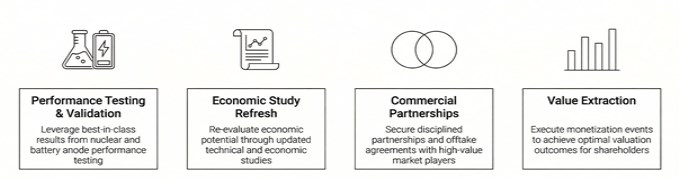
Albany Capital Program and Financing Strategy
The Company is pursuing a targeted capital raise
1. De-risking activities: Pilot-scale purification and anode material production, updated Preliminary Economic Assessment (PEA), advancement toward Pre-Feasibility Study (PFS).
2. Environmental and social baseline work: Continued partnership with Constance Lake First Nation, permitting advancement.
3. Operational support: As part of this work, the Company intends to refresh Albany’s technical and economic studies to reflect the higher-value end markets now accessible through advances in graphite purification, and to advance the project toward a future construction and investment decision while preserving strategic flexibility.
4. Integration activities: Development of applications for Albany graphite in specialty coatings and advanced materials.
This capital program is designed to advance Albany through its next development milestones, increasing the project’s value and preserving strategic optionality, while supporting the Company’s corporate operations. The Company received early validation of Albany’s strategic importance through a $500,000 grant from the Canadian government’s Critical Minearls Innovtion Fund (2025).
Overall Performance
During the financial year ended March 31, 2026, the Company advanced its strategic transformation from product-focused operations to an IP licensing and contract research organization (CRO) business model, while simultaneously de-risking the Albany Graphite Project. Operating activities reflected continued investment in R&D, regulatory advancement, and partnership development, offset by non-operating proceeds including the strategic sale of the Corporate Court property ($2.4M) and financing activities ($2.0M convertible debentures, $2.5M equity) that strengthened the Company's capital position. The Company recognized an inventory impairment of $1,936,000. The write-down primarily relates to aged graphene oxide inventory for which management no longer expects to realize amounts substantially in excess of nominal proceeds through sale. Accordingly, the affected inventory was written down to its estimated recoverable amount, which management determined to be nominal. These activities, combined with the $500,000 Critical Minerals Innovation Fund grant for Albany development, positioned the Company to commence its transformation strategy while maintaining operational flexibility. The private placement financing completed in May 2026 for gross proceeds of $18,000,000, will allow the Company to make significant progress in advancing the Albany Graphite Project.
Results of Operations
Net loss
The Company recorded a net loss of $3,526,268 with basic and diluted net loss per share of $0.04 for the three-month period ended March 31, 2026 (2025 - loss of $1,839,671 and $0.02). The loss for the financial year ended March 31, 2026, was $9,767,958 with basic and diluted loss per share of $0.09 (2025 - loss of $10,039,658 and $0.10).
The Company's net loss reflects the transitional nature of operations as revenue generation shifts from direct product sales (historically low-margin, low-volume) toward IP licensing and CRO services (high-margin, scalable). During the financial year ended March 31, 2026, the Company generated its first IP development fee revenue $56,050), representing initial validation of the CRO business model. Operating expenses include a change in the allowance for impairment of inventory for the three-month period ended March 31, 2026 of approximately $1,698,000 ($1,596,000 for the financial year ended March 31, 2026) and ongoing investment in Albany de-risking activities supported by government grants ($500,000 recognized in the financial year ended Mar 31 2026) and R&D infrastructure required to support contracted development partnerships.
Net Sales
Consolidated net sales for the three-month period ended March 31, 2026, was $36,767 (2025 - $813,596). Sales generated from operations for the financial year ended March 31, 2026, was $166,048 (2025 - $872,495). Net sales recognized in the three-month period ended includes the sale of products of $23,217 and IP development fees earned of $13,550. The same period of the prior year includes the sale of products of $21,096 and service revenue of $792,500. Net sales recognized in the financial year ended March 31, 2026, includes the sale of products of $109,998 and IP development fees earned of $56,050. The same period of the prior year includes the sale of products of$79,995 and service revenue of $792,500.
| Financial year ended March 31 |
Intellectual Property Development |
Biotech | Albany Project |
Total | |
| Net Sales | 2026 | $166,048 | $Nil | $Nil | $166,048 |
| 2025 | $79,995 | $792,500 | $Nil | $872,495 |
Cost of Sales
Consolidated cost of sales for the three-month period ended March 31, 2026, was $1,714,957(2025 - $256,226). Cost of sales includes the allowance for impairment of inventory in the amount of ($1,698,000) for the three-month period ended March 31, 2026 (2025 - $(166,890)). Consolidated cost of sales for the financial year ended March 31, 2026, was $1,838,971 (2025 - $644,610). Cost of sales includes the allowance for impairment of inventory in the amount of ($1,596,000) for the financial year ended March 31, 2026 (2025 - $136,447).
| Financial year ended March 31 |
Intellectual Property Development |
Biotech | Albany Project |
Total | |
| Cost of sales | 2026 | $1,838,971 | $Nil | $Nil | $1,838,971 |
| 2025 | $578,419 | $66,191 | $Nil | $644,610 |
Expenses
Accretion expense was $32,442 for the three-month period ended March 31, 2026 (2025 - $Nil) and $117,381 for the financial year ended March 31, 2026 (2025 - $Nil). The carrying value of the debt element of the convertible debentures is accreted to the original face value of the convertible debentures, over their expected term to maturity and is new in April 2025.
Depreciation and amortization expense was $126,856 for the three-month period ended March 31, 2026 (2025 - $139,554) and $526,405 for the financial year ended March 31, 2026 (2025 - $600,322). Amortization is taken on the capitalized cost of the Company's building, computers, equipment, leasehold improvements, and right-of-use assets.
Bad debts were $32,347 for the three-month period and financial year ended March 31, 2026, and represent amounts owing on the Altek GBFR agreement which remain outstanding and unpaid for work performed and billed.
Consulting fees were $23,840 for the three-month period ended March 31, 2026 (2025 - $5,479) and $44,720 for the financial year ended March 31, 2026 (2025 - $127,480). The most significant component of the consulting costs incurred was for consultants working on regulatory and government matters. Less fees were paid to outside consultants as this work was moved internally.
Directors' fees expense was $59,792 for the three-month period ended March 31, 2026 (2025 - $63,125) and $245,416 for the financial year ended March 31, 2026 (2025 - $252,500). This expense relates to compensation paid to the Company's independent Directors.
Insurance expense was $73,997 for the three-month period ended March 31, 2026 (2025 - $76,884) and $307,994 for the financial year ended March 31, 2026 (2025- $354,186). These expenses relate to the costs required to adequately insure the Company's assets, operations and directors and officers. Overall insurance expense has decreased in the three and financial year ended March 31, 2026, compared to the same periods of the prior year even though insurance coverage and programs have remained the same year-over-year as a result of reduced premiums.
Investor relations and promotion expenses were -$33,924 for the three-month period ended March 31, 2026 (2025 - $16,017) and $84,861 for the financial year ended March 31, 2026 (2025 - $94,411). These expenses consist primarily of the costs of consultants, marketing trips and other costs such as attending industry conferences. During the quarter ended March 31, 2026, the Company reclassified $67,848 of expenses to listing and filing fees to properly account for expenses previously reported to investor relations and promotion expenses during the nine-month period ended December 31, 2025.
Listing and filing fees were $91,178 for the three-month period ended March 31, 2026 (2025 - $44,580) and $259,487 for the financial year ended March 31, 2026 (2025 - $222,945). These expenses consist primarily of the costs of maintaining registered status on various stock listing exchanges. During the quarter ended March 31, 2026, the Company reclassified $67,848 of expenses from Investor relations and promotion expenses to Listing and filing fees to properly account for expenses previously reported to investor relations and promotion expenses during the nine-month period ended December 31, 2025. Overall listing and filing fees for the financial year ended March 31, 2026 are up as compared to the same period of the prior year as a result of the additional mailing costs of a supplement to the Company's Notice of Meeting and Management's Information Circular done in September 2025.
Office expenses were $28,372 for the three-month period ended March 31, 2026 (2025 - $25,264) and $97,738 for the financial year ended March 31, 2026 (2025 - $106,698). Expenses have decreased as a result of the reduced head count, year-over-year.
Professional fees were $1,942 for the three-month period ended March 31, 2026 (2025 - $927,795) and $1,095,872 for the financial year ending March 31, 2026 (2025 - $2,288,633). These fees consist primarily of the amounts charged for services provided by the Company's lawyers, auditors, and accountants. The three-month period ended March 31, 2025 included additional legal fees of approximately $300,000 for the trial that was held in the Ontario Superior court of Justice in October 2024, additional professional fees were incurred related to the convertible debenture for valuation and audit services and additional legal and audit fees related to the at-the market offering. The Company is involved in legal proceedings relating to claims involving a former director and officer of the Company. See further discussions under "Legal proceedings and regulatory actions During the three-month period ended March 31, 2026, $175,000 of the legal fees recovered as a result of the Company's employment practice insurance policy related to this claim, was recognized as a reduction in professional fees.
Rent expense was $95,958 for the three-month period ended March 31, 2026 (2025 - $77,100) and $375,218 for the financial year ending March 31, 2026 (2025 - $311,556). Commencing May 15, 2025, the Company entered into a short-term leaseback with the purchaser of the Corporate Court location for $5,610 per month which ended on Jan 31, 2026. The Company entered into a new lease agreement with the University of Guelph for $4,137 per month effective December 1, 2025, for laboratory space
Research and development expenses were $500,067 for the three-month period ended March 31, 2026 (2025 - $203,304) and $1,653,393 for the financial year ended March 31, 2026 (2025 - $465,653). These expenses related to continued research and development activities across all 3 segments of business including the further development of graphene use and development, as well as aptamer research and Albany Project development. Testing costs incurred under the Critical Minerals Innovation Fund for the development of the Albany project are included in this expense. For the three-month period ended March 31, 2026, the related spend was $114,000 (2024 - $61,317) and for the financial year ended March 31, 2026, was $917,483 (2025 - $84,827). During the quarter ended March 31, 2026, approximately $167,000 (2025 - $8,187) and $449,896 for the financial year ended March 31, 2026 (2025 - $324,181) was spent on the continued development of the BioTech segment with continued aptamer development. During the three-month period ended March 31, 2026, $219,116 was spent on the IP Development (2025 - $80,006) and the financial year ended March 31, 2026, $350,809 was spent on continued research on graphene related activities (2025 - $141,472). A request for a refund of a deposit of $225,000 made in December 2021 for a research project that was cancelled in December 2022, was recorded as a reduction in research and development expenses in Q1 2025.
Salaries and benefits expense was $585,855 for the three-month period ended March 31, 2026 (2025 - $674,095) and $2,811,087 or financial year ended March 31, 2026 (2025 - $3,023,656). These expenses relate to staffing costs required to operate the business. At March 31, 2026, there were 10 employees on payroll versus 18 during the same period of the prior year. Salaries and benefits expense for 2026, included severance and retention payments of approximately $506,000.
Share-based compensation costs were $534,687 for the three-month period ended March 31,2026 (2025 - $279,680) and $1,256,134 for the financial year ended March 31, 2026 (2025 - $1,529,934). Share-based compensation was based on the fair value of the options and restricted stock units as described in Note 12(c) and 12(d) of the audited consolidated financial statements. Options were calculated using the Black-Scholes option pricing model and for restricted stock units, fair value was the grant date share value. Share-based compensation is recognized over the vesting period of the underlying options and restricted stock units. Share-based compensation costs increased in the three-month period ended and for the financial year ended March 31, 2026 as a result of the Company issuing for the first time restricted stock units accounting for $400,774 of the share-based compensation expense for the quarter ended March 31, 2026 (2025 - $Nil) and $469,171 for the financial year ended March 31, 2026 (2025 - $Nil).
Supplies and materials expense was $6,092 for the three-month period ended March 31, 2026 (2025 - $11,278) and $19,125 for the financial year ended March 31, 2026 (2025 - $35,400). These expenses mainly related to supplies and materials purchased to continue graphene development.
Travel expense was $3,954 for the three-month period ended March 31, 2026 (2025 - $43,811) and $112,073 for the financial year ended March 31, 2026 (2025 - $165,741). This decrease reflects overall less travel by staff compared to the same period of the prior year.
Other expenses excluding office and travel expenses were $52,183 for the three-month period ended March 31, 2026 (2025 - $70,883) and $266,457 for the financial year ended March 31, 2026 (2025 - $254,183). The following table details the material components of the Company's other expenses for the financial year ended March 31, 2026, and 2025.
| Financial Year Ended March 31, 2026 |
Financial Year Ended March 31, 2025 |
|
| Automotive | 10,361 | 27,149 |
| Bank fees | 32,197 | 4,781 |
| Dues and subscriptions | 24,050 | 37,215 |
| Freight and delivery | 32,014 | 11,038 |
| Meals and entertainment | 21,717 | 33,293 |
| Other expenses | 24,103 | 22,081 |
| Financial Year Ended March 31, 2026 |
Financial Year Ended March 31, 2025 |
|
| Property taxes | 26,393 | 34,030 |
| Repairs and maintenance | 60,460 | 48,158 |
| Telephone | 17,208 | 20,325 |
| Utilities | 17,954 | 16,113 |
| Total | 266,457 | 254,183 |
The decrease in automotive in the financial year ended March 31, 2026, is a result of the completion of a company leased vehicle for the former CEO.
The increase in bank fees in the financial year ended March 31, 2026, are fees charged to utilize the ATM which commenced in September 2025.
The increase in freight and delivery includes freight costs to ship the core samples from storage in Thunder Bay to SGS Canada Inc. in Lakefield, Ontario for $21,640 as part of the CMIF program.
The decrease in meals and entertainment in the financial year ended March 31, 2026, is a result of less travel by staff compared to the same period of the prior year.
The increase in repairs and maintenance in the financial year ended March 31, 2026, are related to moving of the lab facilities in January 2026.
Interest income for the three-month period ended March 31,2026, was $7,073 (2025 - $3,557) and $40,308 for the financial year ended March 31, 2026 (2025 - $101,613). The Company continued to earn interest on cashable guaranteed investment certificates. However, since less funds were held in cashable guaranteed investment certificates; less interest income was generated during the three-month and financial year ended March 31, 2026.
Interest expense for the three-month period ended March 31, 2026, was $32,914 (2025 - $181,419) and $139,657 for the financial year ended March 31, 2026 (2025 - $91,323). The three-month period and financial year ended March 31, 2026, included interest incurred on the convertible debentures which were new in April 2025.
Loss on disposal of property and equipment for the three-month period ended March 31, 2026, was $13,727 (2025 - $14,544) and a gain of $392,124 for financial year ended March 31, 2026 (2025 - loss of $14,544). Approximately $475,000 represents the gain on sale of the Corporate Court building, which was completed on May 15, 2025, offset by losses on disposal of equipment with the move from the Corporate Court location
In January 2025, the Canada Revenue Agency ("CRA") completed its CRA audit of the Company's 2018 and 2019 renunciation of Canadian exploration expenses ("CEE") in favour of subscribers of flow-through share private placements that closed on December 21, 2018, and December 20, 2019 (the "Flow-Through Financings") for aggregate proceeds of $4,210,000.
In February 2025, the Company received a Notice of Reassessment ("NOR") from CRA in respect of its 2018 Flow-Through Financing. This NOR assessed a reduction in amounts previously renounced and resulted in additional Part XII.6 tax of $59,693.
In November 2025, the Company received a Notice of Reassessment ("NOR") from CRA in respect of its 2019 Flow-through Financing. This NOR assessed a reduction in amounts previously renounced and resulted in additional Part XII.6 tax of $22,482.
The Company has estimated its potential Part XII.6 liability as a result of the CRA audit to be $93,000. The reduction in previously provided renunciations may also result in an additional obligation for the Company to indemnify certain flow-through shareholders due to reductions in previously flowed through CEE deductions. Management has estimated this indemnification obligation to be $427,000.
At September 30, 2024, a provision of $520,000 was originally recognized for this liability and included in accounts payable and accrued liabilities. $93,000 of this liability consisted of management's estimate of Part XII.6 tax owing and $427,000 consisted of management's estimate of the Company' indemnification obligation. During the financial year ended March 31, 2026, payments have been made to CRA in respect of the Part XII.6 liability for $82,175 and to subscribers for the Company's indemnification obligations of $22,482.
The Company recognized $393,929 in government grants during the three-month period ended March 31, 2026 (2025-$Nil) and $865,005 during the financial year ended March 31, 2026 (2025 - $Nil). The Company has entered into an agreement with Critical Minerals Innovation Fund under which the Company received assistance and cost recoveries to a maximum of $500,000 for work on Albany Graphite purification and anode material development project. The Company entered into an agreement with Natural Resources Canada's Energy Innovation Program ("NRCan") which supports Canadian clean energy technologies. The Company's researchers along with the University of Waterloo's Si-C lithium-ion battery anode material research team will work together with a goal of producing full pouch cells which demonstrate the material's superior storage and performance characteristics. The project is for the period April 1, 2025 to March 31, 2029 with a total budget cost of approximately $2.1M, with approximately $1.55M being funded by NRCan. The Company received $208,483 from NRCan as government grant in the three-month and financial year ended March 31, 2026.
Cash Flows
During the financial year ended March 31, 2026, cash increased overall by $1,181,257 (2025 - cash decreased overall by $3,399,939). Operating activities resulted in a decrease in cash of $5,069,298 (2025 -$6,282,441) due to continued spending on consulting and professional fees, research and development, salaries and benefits and other expenses. Investing activities resulted in an increase in cash of $1,668,099 (2025 - $358,651) with the completion of the sale of Corporate Court for proceeds on sale of $2,369,961. Financing activities resulted in an increase in cash of $4,582,456 (2025 - $2,523,851) with gross proceeds from the convertible debentures of $1,976,003, a private equity raise of $2,479,226, and proceeds from stock options exercised of $40,795 and the at-the-market offering of $702,838 offset by repayments of long-term debt and the lease liability. The same period of the prior year saw a private equity raise of $3,069,950 offset by long-term debt repayments and the lease liability.
Mineral Exploration and Development
Albany Graphite Project
The claims comprising the Albany Graphite Project are presently held in good standing by AGC and there are sufficient assessment credits available to keep all the 4F claims in good standing for approximately 30 years. There are no environmental liability issues related to any previous exploration work on the claims. Neither the Company nor AGC have received from any government authority any communication or notice concerning any actual or alleged breach of any environmental laws, regulations, policies or permits. The claims are located in the traditional territory of the CLFN. In July 2011, the Company and CLFN signed an exploration agreement (assigned to AGC as part of the property transfer of the Albany Graphite Project) for a mutually beneficial and co-operative relationship regarding exploration and pre-feasibility activities on the Albany Graphite Project. Under this agreement, the Company committed to establishing a joint implementation committee and conveying preferential opportunities for employment and contracting as well as contributing to a social fund for the benefit of CLFN children, youth and elders. In 2018, the parties signed a new Memorandum of Understanding under which a project partnership structure will be created in support of the development of the Albany Graphite Project. Subsequent to 2015, most of the Albany Graphite Project work has been focused on metallurgical process development, environmental baseline studies, market studies, and research and development to determine the most attractive market opportunities for the Albany Graphite Project.
As described above under "Company Overview and Discussion of Operations - Albany Graphite Project", the Company transferred the Albany Graphite Project to AGC with the purpose of moving the Albany Graphite Project forward with a separate corporate entity and management team dedicated exclusively to its development. The Company is not dependent on materials extracted from the Albany Graphite Project for its current business plans.
Administration and Capitalization
On April 9, 2025, the Company announced that it had closed a non-brokered private placement (the "Offering") of 2,000 debenture units (the "Debenture Units") through the issuance of 2,000 Debenture Units for gross proceeds of $2,000,000. Each Debenture Unit consists of (i) $1,000 principal amount of 5% secured convertible debentures of the Company (each a "Convertible Debenture"); and (ii) 454 warrants (the "Warrants") to purchase common shares in the capital of the Company (the "Common Shares"). Each Convertible Debenture will mature on April 9, 2028, (the "Maturity Date") and bears interest at a rate of 5% per annum payable as a balloon payment on the Maturity Date. Each Convertible Debenture is convertible at the option of the holder, in whole or in part, into Common Shares, at any time prior to the Maturity Date at a conversion of the Convertible Debentures into Common Shares at the Conversion Price at any time after the second anniversary of closing and prior to the Maturity Date in the event that the volume weighted average trading price of the Common Shares on the TSX Venture Exchange (the "TSXV") for the preceding 30 business days exceeds $4.40.
The Convertible Debentures are secured by the Company's interest in the 521 mining claims held by the Company's subsidiary Albany Graphite Corp., with a first ranking above all other creditors or loans by the Company.
908,000 Warrants were issued pursuant to the Offering, each entitling the holder to purchase one Common Share at the Conversion Price until the Maturity Date. The Warrants will only vest and be exercisable: (i) in the event, and from the date, that the Company completes a sale or otherwise transfers all of its rights, title and interests in the Secured Assets to a third party; and (ii) in such number equal to the result of dividing the outstanding principal amount of Convertible Debentures held by the holder at the time of exercise by the Conversion Price.
Net proceeds from the Offering will be used for working capital and general corporate purposes.
On April 17, 2025, the Company announced that it had entered into an agreement of purchase and sale dated April 15, 2025, for the sale of its property located at 24 Corporate Court in Guelph, ON (the "Property") which houses the Company's corporate office and laboratory space. On May 15, 2025, the Company announced the completed sale for $2,500,000 and will lease back the property from the purchaser until January 31, 2026.
On April 30, 2025, 250,000 stock options were exercised using a "cashless" exercise method whereby 55,555 fewer shares were issued than options exercised as compensation for the $100,000 in cash that traditionally would have been received by the Company upon exercise.
On May 12, 2025, 100,000 stock options were exercised at $0.40 per option resulting in proceeds of $40,000 to the Company.
On May 28, 2025, 33,334 stock options were exercised using a "cashless" exercise method whereby 10,446 fewer shares were issued than options exercised as compensation for the $22,667 in cash that traditionally would have been received by the Company upon exercise.
On June 9, 2025, 8,750 stock options were exercised using a "cashless" exercise method whereby 6,552 fewer shares were issued than options exercised as compensation for the $13,300 in cash that traditionally would have been received by the Company upon exercise.
On July 11, 2025, the Company announced that the consulting contract for its Chief Executive Officer Greg Fenton would not be extended following its expiry on March 31, 2026, and that the Company had begun a search for a successor. Effective September 3, 2025, Mr. Fenton resigned as a director and officer of the Company.
On August 26, 2025, the Company received a notification from the Nasdaq that the Company is not in compliance with the Nasdaq Listing Rule 5550(a)(2), as the minimum bid price of the Company's common shares has been below US $1.00 per share for 31 consecutive business days. In accordance with the Nasdaq Listing Rule 580(c)(3)(A), the Company has a period of 180 calendar days, or until February 23, 2026, in which to regain compliance with the minimum bid price requirement. To regain compliance, the closing bid price of the Company's shares must meet or exceed US $1.00 for at least ten consecutive business days during this 180-calendar day period. On February 25, 2026, the Company announced that it had been granted a 180 calendar day extension from the NASDAQ to regain compliance with the Nasdaq's minimum US$1.00 bid price requirement set forth in Nasdaq Listing Rule 5550(a)(2) (the "Rule") for continued listing on NASDAQ (the "Minimum Bid Price Requirement"), following the expiration of the initial 180 calendar day period to regain compliance on February 23, 2026. The Company now has until August 24, 2026, to meet the Minimum Bid Price Requirement set forth in Nasdaq Listing Rule 5550(a)(2). To regain compliance with the Rule, the Company must maintain a closing bid price of at least US$1.00 per share for a minimum of ten (10) consecutive business days on or prior to August 24, 2026. The Company's management intends to actively monitor the bid price for its shares and will consider all available options, including a consolidation, to regain compliance with the NASDAQ Minimum Bid Price Requirement, or delist from the NASDAQ.
On September 3, 2025, the Company announced that Ilse Treurnicht had resigned from the Company's board of directors, and that Lisa Sim had determined not to stand for re-election at the Company's upcoming shareholder meeting.
On September 25, 2025, 250,000 stock options were exercised using a "cashless" exercise method whereby 158,898 fewer shares were issued than options exercised as compensation for the $187,500 in cash that traditionally would have been received by the Company upon exercise.
On October 1, 2025, 1,104,000 stock options were issued to a number of directors, officers and employees of the Company. The stock options have an exercise price of $1.06 per common share. The options granted to the directors and officers will vest one third on the date of grant, one third on the first anniversary of the grant and one third on the second anniversary of the grant. For employees, the options will vest one quarter on the date of grant and one quarter on each anniversary thereafter. The Company also issued 654,000 restricted share units which will vest on October 1, 2026.
On October 22, 2025, the Company completed a non-brokered private placement of units (the "Units") through the issuance of 2,338,893 Units at a price of $1.06 per Unit (the "Offering") for gross proceeds of $2,479,227. Each Unit consisted of (i) one common share in the capital of the Company (each, a "Common Share"); (ii) one-half of one Common Share purchase warrant (each, a "Series A Warrant"); and (iii) one-half of one Common Share purchase warrant (each, a "Series B Warrant"). Each whole Series A Warrant entitles the holder thereof to purchase one Common Share at a price of $1.50 until October 22, 2027 (the "Series A Expiry Date"). If at any time between the date that is four months and one day from the closing date of the Offering and the Series A Expiry Date, the closing price of the Common Shares on the TSX Venture Exchange ("TSXV") is at least $2.00 for a period of 10 consecutive trading days, the Series A Expiry Date can be accelerated to such day that is no less than thirty days from the date notice is given by the Company of such accelerated expiry. Each whole Series B Warrant entitles the holder thereof to purchase one Common Share at a price of $2.00 until October 22, 2028 (the "Series B Expiry Date"). If at any time between the date that is six months from the closing date of the Offering and the Series B Expiry Date, the closing price of the Common Shares on the TSXV is at least $3.00 for a period of 10 consecutive trading days, the Series B Expiry Date can be accelerated to such day that is no less than thirty days from the date notice is given by the Company of such accelerated expiry. In connection with the closing of the Offering, unit issue costs of $84,971 consisted of cash finder fees, finder warrants, entitling the holders thereof to purchase an aggregate of 33,424 Units at a price of $1.06 per Unit until October 22, 2027, and legal fees.
On January 12, 2026, 750 stock options were exercised at $1.06 per option resulting in proceeds of $795 to the Company.
On April 1, 2026, the Company announced that it engaged ICP Securities Inc. ("ICP") to provide automated market-making services, including the use of its proprietary ICP Premium algorithm, in compliance with the policies and guidelines of the TSX Venture Exchange and other applicable legislation.
During the financial year ended March 31, 2026, the Company issued 650,798(2025 - Nil) common shares for gross proceeds of $702,837 (2025 - Nil) through an at-the-market offering.
Subsequent Events
On May 27, 2026, the Company announced the closing of a private placement for gross proceeds of $18,000,000. Pursuant to the offering, the Company sold 18,000,000 units at a price of $1.00 per unit, with Red Cloud Securities Inc. acting as a sole agent and bookrunner. Each Unit consists of one common share and one common share purchase warrant exercisable at a price of $1.50 until May 27, 2029. The Company announced that it intends to use the net proceeds of the offering of the development and derisking of the Albany Graphite Project, including the completion of the new preliminary economic assessment, advancement of subsequent preliminary feasibility study work, and business development activities targeting small modular reactor developers, nation defence end-users, and other high-intensity end-user markets for which Albany ultra-high-purity graphite is suited; the continued commercialization of the Company's ZenGUARDTM platform; payment obligations; and general working capital and corporate purposes. As consideration for its services, Red Cloud received a cash fee of $1,197,360 and was issued 1,197,360 non-transferrable common share purchase warrants, each exercisable into one common share at the offering price until May 27, 2029.
Subsequent to the year ended March 31, 2026, the Company issued 800,033 common shares for gross proceeds of $571,841 through an at-the-market offering.
Selected Annual Information
The following table sets forth selected financial information with respect to the Company as at and for the end of the three most recently completed financial years of the Company. The selected financial information has been derived from the audited consolidated financial statements of the Company for the financial years indicated. The following should be read in conjunction with the said consolidated financial statements related notes thereto.
| Year ended March 31, 2026 |
Year ended March 31, 2025 |
Year ended March 31, 2024 |
|
| Net Sales | $166,048 | $872,495 | $29,816 |
| Total Other Income (expense) | $1,210,673 | $(434,245) | $697,439 |
| Net Loss | ($9,767,958) | $(10,039,658) | $(11,703,990) |
| # Shares Outstanding | 107,792,002 | 104,390,928 | 100,819,577 |
| Net Loss per Share (Basic) | $(0.09) | $(0.10) | $(0.12) |
| Net Loss per Share (Diluted) | $(0.09) | $(0.10) | $(0.12) |
| Total Assets | $15,086,932 | $18,396,185 | $22,585,056 |
| Total non-current liabilities | $1,751,314 | $161,737 | $592,841 |
| Total Equity | $9,802,144 | $14,749,447 | $20,173,211 |
Summary of Quarterly Results
The following table sets out selected quarterly information for the eight most recently completed quarters, for which consolidated financial statements are prepared.
| Mar. 31, 2026 |
Dec. 31, 2025 ($) |
Sept. 30, 2025 ($) |
Jun. 30, 2025 ($) |
Mar. 31, 2025 ($) |
Dec. 31, 2024 ($) |
Sept. 30, 2024 ($) | Jun. 30, 2024 ($) | |
| Net Sales | 36,767 | 65,280 | 6,204 | 57,797 | 813,596 |
37,718 |
15,692 |
5,489 |
| Other income (expense) | 367,560 | 325,706 | 51,909 | 465,498 | 261,808 |
695 |
(711,143) | 14,395 |
| Net Loss | 3,526,268 | 2,488,152 | 2,391,190 | 1,362,348 | 1,839,671 | 2,601,769 | 3,045,029 | 2,553,189 |
| Net Loss per Share (basic and diluted) |
0.04 | 0.02 | 0.02 | 0.01 | 0.02 | 0.02 | 0.03 | 0.03 |
Discussion of Interim Period Results
The Company continued to generate limited revenue during the eight most recently completed quarters with the quarter ended March 31, 2025, being an exception, recognizing $792,500 in sales in its BioTech segment.
The quarterly net loss figure for the quarter ended March 31, 2026, included the change in the allowance for impairment of inventory in the amount of $1,698,000 representing an impairment for excess GO held in long term storage since 2022. The Company is currently discussing the sale of its excess GO at liquidation pricing with potential customers. If unable to sell, the Company's intention is to dispose of the excess inventory in fiscal 2027.
The quarterly net loss figure for the quarter ended December 31, 2025, was a result of the Company's 50% share of costs associated with the Albany Graphite project testing related to the CMIF program of approximately $665,500 and approximately $461,300 of additional share-based compensation expense as a result of 1,579,000 new options and 1,079,000 restricted stock units issued during the quarter. Government grants of $384,838 were recognized in the quarter representing CMIF funding of $332,768 and ISC Challenge of $52,071.
The quarterly net loss figure for the quarter ended September 30, 2025, was more as a direct result of additional salaries expense of approximately $350,000 related to retention and retirement. The Company's 50% share of costs associated with the Albany Graphite Project testing related to the CMIF program of approximately $90,000; additional professional fees of approximately $50,000 for the CEO search and additional mailing fees incurred related to the supplement to the management information circular of approximately $50,000.
The quarterly net loss figure for the quarter ended June 30, 2025, was less as a direct result of the completed sale of Corporate Court. resulting in a gain on sale of property of $488,829.
Government grants are recognized when there is reasonable assurance that the Company will comply with the terms and conditions associated with the grants and the grants will be received. No grant revenue was recognized during the four quarters of fiscal 2025, increasing the loss for these quarters.
The quarter ended September 30, 2024, included some one-time costs for the contingent liability as a result of the Canada Revenue Agency flow-through share audit of $720,000.
Liquidity and Capital Resources
As at March 31, 2026, the Company had working capital deficit of $1,256,222 (March 31, 2025, working capital surplus - $882,892) and cash and cash equivalents of $1,302,738 (March 31, 2025 - $121,481). As at March 31, 2026, the Company has not yet achieved profitable operations and had an accumulated deficit of $91,223,358 as at March 31, 2026.
Going Concern and Capital Strategy: These conditions reflect the Company's ongoing transition from product-sales operations to an IP licensing and CRO business model. Management is executing a multi-faceted capital strategy to support operations and value creation:
1. Albany Capital Program: Pursuing a capital raise 2026 to fund Albany de-risking activities while supporting corporate operations during business model transformation. Subsequent to year-end, the Company announced on May 27, 2026, the closing of a private placement for gross proceeds of $18,000,000 (see Subsequent Events).
2. Government Funding: Successfully secured $500,000 Critical Minerals Innovation Fund grant for Albany development, fully received and recognized in the financial year ended March 31, 2026 ($500,000 recognized in the financial year ended March 31, 2026), with potential for additional government support programs.
3. CRO Revenue Ramp: Generated first IP development fee revenue of $42,500 in Q3 FY2026, with multiple additional partnership discussions underway targeting higher-value, multi-quarter development engagements.
4. Cost Optimization: Reduced quarterly operating cash burn from $1.67M (Q4 FY2025) to $0.498M (Q4 FY2026), with further optimization planned as product-sales operations wind down and CRO model scales. Management believes the planned Albany capital raise, combined with CRO revenue growth and continued cost discipline, will provide sufficient liquidity to execute the Company's transformation strategy. While the proceeds from the May 2026 private placement have significantly strengthened the Company's liquidity position, the Company remains dependent on the successful commercialization of its products and technologies, achieving profitable operations, and/or obtaining additional financing in the future.
Accordingly, the audited consolidated financial statements have been prepared on a going concern basis, which assumes that the Company will be able to realize its assets and discharge its liabilities in the normal course of operations.
Transactions with Related Parties
The remuneration of key management personnel during the financial year ended March 31 2026 and 2025 were as follows:
a) Directors' fees - $245,416 (2025 - $252,500)
b) Salaries and benefits - $1,121,666 (2025 - $1,010,201)
c) Share-based compensation - $1,107,256 (2025 - $1,191,219)
Key management personnel are those persons having authority and responsibility for planning, directing and controlling the activities of the Company directly or indirectly, including any directors (executive and non-executive) of the Company.
On September 3, 2025, the Company's CEO Greg Fenton, resigned his position as CEO and as a member of the Board of Directors effective immediately, to become the full-time CEO of Altek Advanced Materials Inc. ("Altek"), a Nevada incorporated private company focused on the commercialization of advanced material technologies in the United States of which Mr. Fenton owns more than a 50% beneficial equity interest. The Company has entered into a non-arm's length, binding letter of intent with Altek to negotiate one or more non-exclusive licensing agreements relating to the Company's various technologies. On October 6, 2025, the Company's former Chief Science Officer, Colin van der Kuur joined the board of Altek as a director.
Current and Future Changes in Accounting Policy
Statement of Compliance
The audited consolidated financial statements for the year ended March 31, 2026, including comparatives for the financial year ended March 31, 2025, have been prepared, using accounting policies in compliance with IFRS Accounting Standards as issued by the International Accounting Standards Board ("IASB").
New Standards, Interpretations and Amendments not yet Effective
There are a number of standards, amendments to standards, and interpretations which have been issued by the IASB that are effective in future accounting periods that the Company has decided not to adopt early.
The following amendments are effective for the year beginning April 1, 2026:
Classification and Measurement of Financial Instruments (Amendments to IFRS 7 Financial Instruments: Disclosures and IFRS 9 Financial Instruments)
The following amendments are effective for the year beginning April 1, 2027:
IFRS 18 Presentation and Disclosure in Financial Statements (New)
The Company is currently assessing the impact of these new accounting standards and amendments.
Critical Judgments and estimation uncertainties
The areas which require management to make significant judgments, estimates and assumptions in determining carrying values include, but are not limited to:
Inventory
Judgement is required in determining whether net realizable value should be evaluated on a product-by-product basis or if products cannot be evaluated separately from other products in inventory and should be grouped with similar products.
Expected credit loss allowance and provision
The Company determines an expected credit loss allowance for trade receivables based on the estimated expected lifetime credit loss, considering the actual credit loss in prior years and forward-looking estimates of expected collections. This estimate varies depending on the nature of the trade receivables, the majority of which are associated with the health sciences business; however, also includes receivables from government agencies and related parties. The loss allowance is reviewed on a quarterly basis and any change in estimate is accounted for prospectively.
Impairment (impairment reversal) of exploration and evaluation assets
While assessing whether any indications of impairment or impairment reversal exist for exploration and evaluation assets, consideration is given to both external and internal sources of information. Information the Company considers includes changes in the market, economic and legal environment in which the Company operates that are not within its control that could affect the recoverable amount of exploration and evaluation assets. Internal sources of information include the manner in which exploration and evaluation assets are being used or are expected to be used and indications of expected economic performance of the assets.
Impairment (impairment reversal) of property and equipment
Judgements are required to assess when internal or external indicators of impairment or impairment reversal exist, and impairment testing is required. Management considers internal and external sources of information including forecasted sales, cashflows and expected production volumes. Judgement is required to assess these internal and external factors when determining if the carrying amount of an asset is impaired, or in the case of a previously impaired asset, whether the carrying amount of the asset has been restored.
Share-based payments
Management determines costs for share-based payments using market-based valuation techniques. The fair value of the market-based and performance-based share awards are determined at the date of grant using generally accepted valuation techniques. Assumptions are made and judgment used in applying valuation techniques. These assumptions and judgments include estimating the future volatility of the stock price, expected dividend yield, future employee turnover rates and future employee stock option exercise behaviours and corporate performance. Such judgments and assumptions are inherently uncertain. Changes in these assumptions affect the fair value estimates.
Contingencies
By their nature, contingencies will only be resolved when one or more future events transpire. The assessment of contingencies inherently involves estimating the outcomes of future events. The Company has disclosed its disputes and was required to exercise judgement in assessing the recorded amounts.
Financial Instruments and Other Instruments
The Company's financial instruments consist of cash and cash equivalents, accounts and other receivables, accounts payable and accrued liabilities, lease liability and long-term debt. Unless otherwise noted, the Company does not expect to be exposed to significant interest, currency or credit risks arising from these financial instruments. The Company estimates that the fair value of these financial instruments approximates carrying values.
As at March 31, 2026 the Company does have financial instruments recorded at fair value that require classification within the fair value hierarchy. On April 9, 2025, the Company completed a non-brokered private placement of debenture units through the issuance of 2,000 Debenture Units for gross proceeds of $2,000,000. Note 11 to the audited consolidated financial statements present the inputs used to fair value the debenture units and their associated components.
Fair value estimates are made at the balance sheet date based on relevant market information and information about the financial instrument. These estimates are subjective in nature and involve uncertainties in significant matters of judgment and therefore cannot be determined with precision. Changes in assumptions could significantly affect these estimates.
Disclosure of Outstanding Share Data
The Company is authorized to issue an unlimited number of shares, of which 107,792,002 (March 31, 2025 - 104,390,928 shares were issued and outstanding as fully paid and non-assessable as at March 31, 2026.
Refer to Note 12(c) to the audited consolidated financial statements for details regarding stock options issued and exercisable as at March 31, 2026.
As at the date hereof, the Company had 126,619,532 common shares issued and outstanding as fully paid and non-assessable, stock options exercisable for an aggregate of 5,311,750 common shares outstanding and 1,006,000 restricted share units.
Risks and Uncertainties
The operations of the Company are speculative due to the high-risk nature of its business, which includes the development of certain intellectual property and the manufacturing of graphene related products, and which may include the future acquisition, financing, and development of the Albany Graphite Project. These risk factors could materially affect the Company's future operating results and could cause actual events to differ materially from those described in forward-looking information relating to the Company. Accordingly, any investment in securities of the Company is speculative and investors should not invest in securities of the Company unless they can afford to lose their entire investment.
The Company assesses and attempts to minimize the effects of these risks through careful management and planning of its operations and hiring qualified personnel but is subject to a number of limitations in managing risk resulting from its early stage of development. Below is a non-exhaustive summary of the principal risks and related uncertainties that may impact the Company. Such risk factors, as well as additional risks and uncertainties set out elsewhere in the Company's publicly filed documents, and additional risks and uncertainties not presently known to Company or that the Company currently deems immaterial, could have a material adverse effect on the Company's business, financial condition and results of operations or the trading price of the common shares.
Negative Operating Cash Flow
During the financial year ended March 31, 2026, the Company had negative operating cash flow because its revenues did not exceed its operating expenses. In addition, as a result of the Company's business plans for the development of its products, the Company expects cash flow from operations to be negative until revenues improve to offset its operating expenditures. The Company's cash flow from operations may be affected in the future by expenditures incurred by the Company to continue to develop its products. To the extent the Company has negative cash flow in any future period, the Company may be required to allocate funds to fund such negative cash flow from operating activities. In order to stay in business, in the absence of cash flow from operations, the Company will have to raise funding through financing activities. However, there is no certainty the Company will be able to raise funds at all or on terms acceptable to the Company in the event it needs to do so. Furthermore, additional funds raised by the Company through the issuance of equity or convertible debt securities would cause the Company's current shareholders to experience dilution. Such securities also may grant rights, preferences or privileges senior to those of the Company's shareholders. The Company does not have any contractual restrictions on its ability to incur debt and, accordingly, the Company could incur significant amounts of indebtedness to finance its operations. Any such indebtedness could contain restrictive covenants, which likely would restrict the Company's operations.
Uncertainties Relating to the Company's Business Plans
There is no assurance that broad successful commercial applications may be feasible for the Company. The Company is continuing to explore, develop, and test its current products and new products, and there can be no assurance that new uses of existing products or new products will be fully developed for commercial application, that test results will be successful, if completed at all, that any necessary permits or approvals required in order to market such products will be obtained by the Company, or that existing technology or products will become profitable. Furthermore, there is no assurance that the Company will complete any acquisitions or acquire any know-how or trade secrets to carry out certain of its future objectives. Should the Company fail to achieve any of the foregoing, this could have a material adverse impact on the business and planned business of the Company.
The Company's business is in part dependent on patents, trade secret and other intellectual property laws of Canada, and potentially foreign jurisdictions. The Company may be unable to prevent third parties from using its intellectual property without its authorization. Some of the Company's current or future technologies and trade secrets may not be covered by any patent or patent application, and the Company's issued and pending patents may not provide the Company with any competitive advantage and could be challenged by third parties. The Company's inability to secure issuance of pending patent applications may limit its ability to protect the intellectual property rights these pending patent applications were intended to cover. The Company's competitors may attempt to design around its patents to avoid liability for infringement and, if successful, could adversely affect the Company's market share. Furthermore, the expiration of the Company's patents may lead to increased competition.
Additionally, the Company plans to construct facilities for some of its operations and business activities. There can be no assurance that locations will be secured on terms favourable to the Company or at all, that engineering plans will be completed or will be satisfactory for the intended business activities of the Company, that any required permitting will be obtained, that construction of such facilities will be completed, or that such facilities will ever become operational. If such facilities are not constructed, or do not become operational, or do not operate at the capacity required or anticipated, there could be a material adverse effect of the Company's planned business and operations.
Economic and Political Conditions
Worldwide financial and economic cycles or conditions are uncertain, and recovery from a business downturn or recession could be very slow and have a significant impact on the Company's business. The Company's business is sensitive to changes in economic and political conditions, including interest rates, currency issues, energy prices, trade issues including the potential imposition of tariffs by the United States or other nations, international or domestic conflicts or political crises, and epidemics or pandemics.
The credit and financial markets have experienced extreme volatility and disruptions due to the current conflicts in the Middle East and between Ukraine and Russia. The conflicts are expected to have further global economic consequences, including but not limited to the possibility of severely diminished liquidity and credit availability, declines in consumer confidence, declines in economic growth, increases in inflation rates and uncertainty about economic and political stability. In addition, the United States and other countries have imposed sanctions on Russia which increases the risk that Russia, as a retaliatory action, may launch cyberattacks against the United States, its government, infrastructure and businesses. Any of the foregoing consequences, including those we cannot yet predict, may cause our business, financial condition, results of operations and the price of our ordinary shares to be adversely affected.
Revenue from Graphene-related Products Sales; Long and Complex Sales Cycle
To date, the Company has recorded minimal revenue from its graphene enhanced products sales. There can be no assurance that significant losses will not occur in the near future or that the Company will be profitable in the future. The Company's operating expenses, and capital expenditures may increase in subsequent years. The Company expects to continue to incur losses unless and until such time as it enters into long-term and large-volume supply agreements and generates sufficient revenues to fund its continuing operations.
Intellectual Property
The Company relies on the patent, trade secret and other intellectual property laws of Canada, and foreign jurisdictions. The Company may be unable to prevent third parties from using its intellectual property without its authorization. The unauthorized use of the Company's intellectual property could reduce any competitive advantage that it has developed, reduce its market share or otherwise harm its business. In the event of unauthorized use of the Company's intellectual property, litigation to protect and enforce the Company's rights could be costly, and the Company may not prevail.
Some of the Company's current or future technologies and trade secrets may not be covered by any patent or patent application, and the Company's issued and pending patents may not provide the Company with any competitive advantage and could be challenged by third parties. The Company's inability to secure issuance of pending patent applications may limit its ability to protect the intellectual property rights these pending patent applications were intended to cover.
The Company's competitors may attempt to design around its patents to avoid liability for infringement and, if successful, could adversely affect the Company's market share. Furthermore, the expiration of the Company's patents may lead to increased competition.
In addition, effective patent, trade secret and other intellectual property protection may be unavailable or limited in some foreign countries. In some countries, the Company may not apply for patent or other intellectual property protection. The Company also relies on unpatented technological innovation and other trade secrets to develop and maintain its competitive position. Although the Company generally enters into confidentiality agreements with its employees and third parties to protect its intellectual property, these confidentiality agreements are limited in duration, could be breached and may not provide meaningful protection of its trade secrets. Adequate remedies may not be available if there is an unauthorized use or disclosure of the Company's trade secrets and manufacturing expertise. In addition, others may obtain knowledge about the Company's trade secrets through independent development or by legal means. The failure to protect the Company's processes, technology, trade secrets and proprietary manufacturing expertise, methods and compounds could have a material adverse effect on its business by jeopardizing critical intellectual property.
Where a product formulation or process is kept as a trade secret, third parties may independently develop or invent and patent products or processes identical to such trade secret products or processes. This could have a material adverse effect on the Company's ability to make and sell products or use such processes and could potentially result in costly litigation in which the Company might not prevail. The Company could face intellectual property infringement claims that could result in significant legal costs and damages and impede its ability to produce key products, which could have a material adverse effect on its business, financial condition, and results of operations.
Product Development and Technological Change
There is no assurance that broad successful commercial applications for the Company's products may be feasible. Most, if not all, of the scientific and engineering data related to the Company's products has been generated by the Company's own laboratories or laboratory environments of the Company's partners, such as universities. There can be no assurance that laboratory data translates to or is representative in commercial applications.
Additionally, the industries in which the Company seeks to operate are characterized by rapid technological change and frequent new product introductions. Part of the Company's business strategy is to monitor such changes and take steps to remain technologically current, but there is no assurance that such a strategy will be successful. If the Company is not able to adapt to new advances in materials sciences, or if unforeseen technologies or materials emerge that are not compatible with the Company's or that could replace its products, the Company's revenues and business would likely be adversely affected.
Market Development and Growth
Failure to further develop the Company's key markets and existing geographic markets or to successfully expand its business in the future into new markets could have an adverse impact on sales growth and operating results. The Company's ability to further penetrate its key markets and the existing geographic markets in which it competes and/or aims to compete, and to successfully expand its business into other countries, is subject to numerous factors, many of which are beyond its control. There can be no assurance that efforts to increase market penetration in the Company's key markets and existing geographic markets will be successful. Failure to achieve these goals may have a material adverse effect on the Company's operating results.
Unpredictable Sales Cycles
The sales cycle for graphene products may range considerably from one to multiple years from the time a customer begins testing the Company's product until the time that they could be used in a commercial product. Timing of product introduction could vary significantly based on the target market.
The Company has demonstrated little track record of success in completing customer development projects, which makes it difficult to evaluate the likelihood of future success. The sales and development cycles for the Company's products are subject to customer budgetary constraints, internal acceptance procedures, competitive product assessments, scientific and development resource allocations, and other factors beyond the Company's control. If the Company is not able to successfully accommodate these factors to achieve commercial success, the Company may be unable to achieve sufficient sales to reach profitability.
Government Regulation and Import/Export Controls
The Company's future operations, including development, and commencement and continuation of commercial production, require licenses, permits or other approvals from various federal, provincial, local and potentially foreign governmental authorities, and such operations are or will be governed by laws and regulations relating to production, exports, taxes, labor standards, occupational health and safety, waste disposal, toxic substances, prospecting, development, mining, land use, water use, environmental protection, land claims of indigenous people and other matters. Furthermore, in certain foreign jurisdictions, these regulatory requirements may be more stringent than those in Canada. Certain export control laws or economic sanctions laws may include restrictions or prohibitions on the sale or supply of certain products and services to embargoed or sanctioned countries, governments, persons and entities. In addition, various countries regulate the import of certain technology, including import and export permitting and licensing requirements, and have enacted or could enact laws that could limit the Company's ability to distribute its products. Changes in the Company's products, or future changes in export and import regulations may prevent any potential international customers from utilizing the Company's products globally or, in some cases, prevent the export or import of the Company's products to certain countries, governments, or persons altogether.
Additionally, the United States government has taken certain actions that could negatively impact trade with the United States, including imposing tariffs on certain imported goods and prohibiting certain imports into the United States. In retaliation, Canada, Mexico and China continue to evaluate imposing tariffs on a wide range of American products. There is also a concern that the imposition of additional tariffs by the United States could result in the adoption of tariffs by other countries as well, potentially leading to a global trade war. Such tariffs and prohibitions, if expanded to other categories, could have a significant impact on the Company's business, particularly on the importation of certain equipment manufactured in other countries and the sale of the Company's products in other countries.
Any change in export or import regulations, economic sanctions, or related legislation, or change in the countries, governments, persons, or technologies targeted by such regulations, could result in decreased use of the Company's products in the future by, or in the Company's decreased ability to export or sell its products to, potential international customers. Any limitation on the Company's ability to export or sell its products would likely adversely affect the Company's future business, results of operations, and financial results.
Large volume production of graphene requires permits and approvals from various government authorities, and is subject to extensive federal, provincial, state, and local laws and regulations governing development, production, exports, taxes, labour standards, occupational health and safety, environment, and other matters. As graphene is a new chemical substance, production and sale of graphene may be subject to specific occupational health and safety and environment regulatory approvals in different jurisdictions including, without limitations, under the Canadian Environmental Protection Act (Canada), the Food and Drug Act (Canada), the Toxic Substances Control Act (USA), the Food Drug and Cosmetic Act (USA) and the Registration, Evaluation, Authorization and Restriction of Chemicals (Europe).
Health Canada also regulates certain markets into which the Company intends to supply products or license its intellectual property. There is no assurance that Health Canada or any other body will grant license for sales into markets it regulates. Each foreign jurisdiction for the Company's products is regulated, and no assurance exists that sales of graphene-related products will be permitted. Any inability by the Company to obtain approval from Health Canada and/or international bodies could have a material adverse impact of the business of the Company.
The Company is also subject to consumer protection laws that may impact its sales and marketing efforts. These laws, as well as any changes in these laws, could make it more difficult for the Company to sell and market its products. These laws and regulations are subject to change over time and thus the Company must continue to monitor and dedicate resources to ensure continued compliance. Non-compliance with applicable regulations or requirements could subject the Company to investigations, sanctions, enforcement actions, disgorgement of profits, fines, damages, civil and criminal penalties, or injunctions. If any governmental sanctions are imposed, or if the Company does not prevail in any possible civil or criminal litigation, its business, operating results, and financial condition could be materially adversely affected.
Additionally, in order for the Company to carry out its activities, any required licenses and permits must be obtained and kept current. There can be no assurance, however, that the Company will obtain on reasonable terms or at all the permits and approvals, and the renewals thereof, which it may require for the conduct of its future operations or that compliance with applicable laws, regulations, permits and approvals will not have an adverse effect on the Company's business plans. Possible future environmental and mineral tax legislation, regulations and actions could cause additional expense, capital expenditures, restrictions and delay on the Company's planned exploration and operations, the extent of which cannot be predicted.
Failure to comply with applicable laws, regulations and permitting requirements may result in enforcement actions thereunder, including orders issued by regulatory or judicial authorities causing operations to cease or be curtailed, and may include corrective measures requiring capital expenditures, installation of additional equipment, or remedial actions. Parties engaged in mining operations may be required to compensate those suffering loss or damage by reason of the mining activities and may have civil or criminal fines or penalties imposed for violations of applicable laws or regulations.
Industry Competition
The Company seeks to compete with other graphene and manufacturing companies, in highly competitive markets. Some of the Company's competitors have substantially greater financial, marketing and other resources and higher market share than the Company has in certain products or geographic areas. As the markets for the Company's products expand, additional competition may emerge, and competitors may commit more resources to products which directly compete with the Company's products. There can be no assurance that the Company will be able to compete successfully with existing competitors or be able to develop any market for its products, or that its business will not be adversely affected by increased competition or by new competitors.
There is no assurance that the Company will continue to be able to compete successfully with its competitors in acquiring such properties or prospects and any such inability could have a material adverse effect on the Company's business and financial condition.
Lack of Trading Market for Graphene
Unlike commodity minerals such as copper, gold or silver, industrial minerals such as graphene precursor graphene materials and graphite do not have a metals exchange or an open market upon which to trade and therefore prices are not set in an open market or publicly traded market, and there can be no assurance that certain items can be sold or purchased at any time. As prices are set with private suppliers and private customers, it is difficult to predict what market prices may be at the time of any transaction. There can be no guarantees that the Company will be able to sell its graphene products in a profitable manner, or at all.
Shortages
The Company will be dependent on various supplies, equipment, parts and labour, and the services of contractors to carry out its business objectives. The availability and cost of such supplies, equipment, parts or labour or the services of contractors could have a material adverse effect on the Company's ability to successfully carry out its exploration and development activities.
Liquidity Concerns and Future Financing
The Company's approach to managing liquidity risk is to ensure that it will have sufficient liquidity to meet liabilities when due. As of March 31, 2026, the Company had a cash balance of $1,302,738 (March 31, 2025 - $121,481) to settle current liabilities of $3,533,474 (March 31, 2025 - $3,485,001). On October 22, 2025, the Company completed a non-brokered private placement of units through the issuance of 2,338,893 Units at a price of $1.06 per Unit for gross proceeds of $2,479,227. Net proceeds of the Offering will be used for working capital and general corporate purposes. On August 19, 2024, the Company closed a Non-Brokered Private Placement of units (the "Units") through the issuance of 2,361,500 Units at a price of $1.30 per Unit for gross proceeds of $3,069,950. Net proceeds of the Offering will be used for working capital and general corporate purposes. On April 9, 2025, the Company closed a non-brokered private placement of debenture units through the issuance of 2,000 Debenture Units for gross proceeds of $2,000,000. Net proceeds of the Offering will be used for working capital and general corporate purposes. On May 15, 2025, the Company completed the sale of 24 Corporate Court. in Guelph, Ontario for $2,500,000 which currently is the registered head office of the Company. On May 15, 2025, the proceeds from the closing of the sale were used to fully repay and discharge the mortgage. The Company leased back the property from the purchaser until January 31, 2026 and in December 2025 moved its laboratory to a new location within Guelph, Ontario. In May 2026, the Company completed a private placement for gross proceeds of $18 million, which significantly strengthened its liquidity position. As at March 31, 2026, the Company had not yet achieved profitable operations, had an accumulated deficit of $90.8 million, reported a net loss of $9.5 million and cash outflows from operating activities of $5.1 million, and expects to incur further losses in the development and commercialization of its products and technologies. These events and conditions indicate that a material uncertainty exists that may cast substantial doubt on the Company's ability to continue as a going concern. While the proceeds from the May 2026 private placement have significantly strengthened the Company's liquidity position, the Company remains dependent on the successful commercialization of its products and technologies, achieving profitable operations, and/or obtaining additional financing in the future.
Reliance on Key Personnel
The Company's development to date has depended, and in the future, will depend largely on the efforts of key management and other key personnel. Loss of any of these people, particularly to competitors, could have a material adverse effect on the Company's business. Further, with respect to the future development of the Company's projects, it may become necessary to attract both international and local personnel for such development. The marketplace for key skilled personnel is becoming more competitive, which means the cost of hiring, training, and retaining such personnel may increase. Factors outside the Company's control, including competition for human capital and the high-level of technical expertise and experience required to execute this development will affect the Company's ability to employ the specific personnel required. The failure to retain or attract a sufficient number of key skilled personnel could have a material adverse effect on the Company's business, results of operations, and financial condition. The Company has not taken out and does not intend to take out "key man insurance" in respect of any directors, officer, or other employees.
Qualified Employees
Recruiting and retaining qualified personnel is critical to the Company's success. Especially if it relates to its graphene operations, finding skilled scientists and a sales team familiar with the subject matter is difficult. As the Company grows further, the need for skilled labour will increase. The number of persons skilled in the high-tech manufacturing business is limited and competition for this workforce is intense. This may adversely affect the business of the Company if it is unable to recruit and retain qualified personnel as and when required.
Cybersecurity Threats
The reliability and security of the Company's information technology ("IT") systems are important to the Company's business and operations. Although the Company has established and continues to enhance security controls intended to protect the Company's IT systems and infrastructure, there is no guarantee that such security measures will be effective in preventing unauthorized physical access or cyberattacks. A significant breach of the Company's IT systems could, among other things, cause disruptions in the Company's manufacturing operations (such as operational delays from production downtime, inability to manage the supply chain or produce products for customers, disruptions in inventory management), lead to the loss, destruction, corruption or inappropriate use of sensitive data, including employee information or intellectual property, result in lost revenues due to theft of funds or due to a disruption of activities, including remediation costs, or from litigation, fines and liability or higher insurance premiums, the costs of maintaining security and effective IT systems, which could negatively affect results of operations and the potential adverse impact of changing laws and regulations related to cybersecurity or result in theft of the Company's, its customers' or suppliers' intellectual property or confidential information. If any of the foregoing events (or other events related to cybersecurity) occurs, the Company may be subject to a number of consequences, including reputational damage, a diminished competitive advantage and negative impacts on future opportunities which could have a material adverse effect on the Company.
Share Price Fluctuations
The market price of securities of many companies, particularly development stage companies, experience wide fluctuations in price that are not necessarily related to the operating performance, underlying asset values or prospects of such companies. There can be no assurance that fluctuations in the Company's share price will not occur. In particular, the fluctuations may be exaggerated if the trading volume of the Company's common shares is low.
Cost Absorption and Purchase Orders
Especially as it relates to its activities in the transportation industry, and given the current trends in that industry, the Company is under continuing pressure to absorb costs related to product design and development, engineering, program management, prototypes and validation. In particular, OEMs are requesting that suppliers pay for the above costs and recover these costs through the piece price of the applicable component. Contract volumes for customer programs not yet in production are based on the Company's customers' estimates of their own future production levels. However, actual production volumes may vary significantly from these estimates due to a reduction in consumer demand or new product launch delays, often without any compensation to the supplier by its OEM customer. Typical purchase orders issued by customers do not require that they purchase a minimum number of the Company's products. For programs currently under production, the Company is generally unable to request price changes when volumes differ significantly from production estimates used during the quotation stage. If estimated production volumes are not achieved, the product development, design, engineering, prototype and validation costs incurred by the Company may not be fully recovered. Similarly, future pricing pressure or volume reductions by the Company's customers may also reduce the amount of amortized costs otherwise recoverable in the piece price of the Company's products. Either of these factors could have an adverse effect on the Company's profitability. While it is generally the case that once the Company receives a purchase order for products of a particular vehicle program it would continue to supply those products until the end of such program, customers could cease to source their production requirements from the Company for a variety of reasons, including the Company's refusal to accept demands for price reductions or other concessions.
Acquisitions
The Company could seek to acquire complementary businesses, assets, technologies, services or products, at competitive prices. The Company could pursue acquisitions in those product areas which were identified as key to the Company's long-term business strategy. However, as a result of intense competition in these strategic areas, the Company may not be able to acquire the targets needed to achieve its strategic objectives. The completion of such transactions poses additional risks to the Company's business.
Acquisitions are subject to a range of inherent risks, including the assumption of incremental regulatory/compliance, pricing, supply chain, commodities, labor relations, litigation, environmental, pensions, warranty, recall, IT, tax or other risks. Although the Company seeks to conduct appropriate levels of due diligence on acquisition targets, these efforts may not always prove to be sufficient in identifying all risks and liabilities related to the acquisition, including as a result of limited access to information; time constraints for conducting due diligence; inability to access target company facilities and/or personnel; or other limitations in the due diligence process. Additionally, the Company may identify risks and liabilities that cannot be sufficiently mitigated through appropriate contractual or other protections. The realization of any such risks could have a material adverse effect on the Company's operations or profitability. The benefit to the Company of previous and future acquisitions is highly dependent on the Company's ability to integrate the acquired businesses and their technologies, employees and products into the Company, and the Company may incur costs associated with integrating and rationalizing the facilities (some of which may need to be closed in the future).
The Company cannot be certain that it will successfully integrate acquired businesses or that acquisitions will ultimately benefit the Company. Any failure to successfully integrate businesses or failure of the businesses to benefit the Company could have a material adverse effect on its business and results of operations. Such transactions may also result in additional dilution to the Company's shareholders or increased debt. Such transactions may involve partners, and the formula for determining contractual sale provisions may be subject to a variety of factors that may not be easily quantified or estimated until the time of sale (such as market conditions and determining fair market value).
Launch and Operational Costs
The launch of new business, in an existing or new facility, is a complex process, the success of which depends on a wide range of factors, including the production readiness of the Company and its suppliers, as well as factors related to tooling, equipment, employees, initial product quality and other factors. A failure to successfully launch material new or takeover business could have an adverse effect on profitability. The Company's manufacturing processes are vulnerable to operational problems that can impair its ability to manufacture its products in a timely manner, or which may not be performing at expected levels of profitability. The Company's facilities and proposed facilities contain complex and sophisticated equipment that is used in its manufacturing processes. The Company could experience equipment failure in the future due to wear and tear, design error or operator error, among other things, which could have an adverse effect on profitability. From time to time, the Company may have some operating divisions which are not performing at expected levels of profitability. Significant underperformance of one or more operating divisions could have a material adverse effect on the Company's profitability and operations.
Material and Commodity Prices
Prices for key raw materials and commodities used in the production of graphene-based products, as well as energy prices, have proven to be volatile at certain times. To the extent that the Company is unable to fully mitigate its exposure to price change of key raw materials and commodities, particularly through engineering products with reduced content, by passing price increases to customers, or otherwise, such additional costs could have a material adverse effect on profitability. Increased energy prices could also have an impact on production or transportation costs which in turn could affect competitiveness.
Uninsured Risks
The Company maintains insurance to cover normal business risks. In the course of its manufacturing businesses, certain risks and, in particular, unexpected or unusual catastrophic events including explosions and fire may occur. It is not always possible to fully insure against such risks as a result of high premiums or other reasons. Should such liabilities arise, they could reduce or eliminate any future profitability and result in increasing costs and a decline in the value of the common shares of the Company.
Litigation
The Company has entered into legally binding agreements with various third parties, including supply, license, distribution, non-disclosure, consulting and partnership agreements. The interpretation of the rights and obligations that arise from such agreements is open to interpretation and the Company may disagree with the position taken by the various other parties resulting in a dispute that could potentially initiate litigation and cause the Company to incur legal costs in the future. Given the speculative and unpredictable nature of litigation, the outcome of any such disputes could have a material adverse effect on the Company's business.
Credit Risk
As at March 31, 2026, the Company's credit risk was primarily attributable to cash, accounts and other receivables. Financial instruments included in accounts and other receivables consisted of trade receivables generated through sales as well as recoverable Harmonized Sale Tax. The Company's cash is held with reputable financial institutions. Management believes that the credit risk with respect to financial instruments included in accounts and other receivables is remote.
Interest Rate Risk
The Company has cash and cash equivalent balances at federally regulated Canadian banks. The Company periodically monitors the investments it makes, the security of such investments and is satisfied with the credit ratings of its banks. The Company closely monitors interest rates to determine the appropriate course of action to be taken by the Company.
Price Risk
The Company is exposed to price risk with respect to commodity prices. The Company closely monitors commodity prices to determine the appropriate course of action to be taken by the Company.
Financial Capability and Additional Financing
The Company has limited financial resources and there is no assurance that sufficient additional funding will be available to enable it to fulfill its business objectives or obligations, on acceptable terms or at all. Unanticipated expenses and other developments could cause existing funds to be depleted sooner than expected. In the event that its existing cash resources are inadequate to fund operational expenses, and in order to fund the planned business objectives of the Company, the Company will be required to raise additional financing from external sources, such as debt financing, equity financing or joint ventures. The Company's ability to raise additional equity financing may be affected by numerous factors beyond the Company's control, including, but not limited to, adverse market conditions, commodity price changes and an economic downturn. Failure to obtain additional funding on a timely basis could result in delay or indefinite postponement of the development of the Company's business and could cause the Company to reduce or terminate its operations. Additional funds raised by the Company from treasury share issuances may result in significant dilution to existing shareholders, a depressive effect on the price of the common shares and/or a change of control.
Permits and Government Regulation
Although the Company believes it has all of the necessary permits to carry out the proposed business programs, the operations of the Company may require licenses and permits from time to time from various governmental authorities to carry out exploration and development at its projects or locations. Obtaining permits can be a complex, time-consuming process. There can be no assurance that the Company will be able to obtain the necessary licenses and permits on acceptable terms, in a timely manner or at all. The costs and delays associated with obtaining permits and complying with these permits and applicable laws and regulations could stop or materially delay or restrict the Company from continuing or proceeding with existing or future operations or projects. Any failure to comply with permits and applicable laws and regulations, even if inadvertent, could result in the interruption or closure of operations or material fines, penalties or other liabilities. In addition, the requirements applicable to sustain existing permits and licenses may change or become more stringent over time and there is no assurance that the Company will have the resources or expertise to meet its obligations under such licenses and permits.
Fluctuating Prices
The profitability of the Company's operations will be dependent upon the market price of the ZenGUARD™ masks and other products, their global acceptance and demand along with their regulatory approvals in other jurisdictions. The level of interest rates, rate of inflation, production costs, healthcare and consumer demand, and stability of exchange rates can all cause significant fluctuations in revenue. Such external economic factors are in turn influenced by changes in international purchasing patterns, COVID-19 pandemic situation, monetary systems and political developments.
Environmental Regulation
AGC's Albany Graphite Project is subject to environmental laws and regulations which may materially and adversely affect its future operations. These laws and regulations control the exploration and development of the Albany Graphite Project and their effects on the environment, including air and water quality, waste handling and disposal, the protection of different species of plant and animal life, and the preservation of lands. These laws and regulations will require AGC to acquire permits and other authorizations for certain activities. There can be no assurance that AGC will be able to acquire such necessary permits or authorizations on a timely basis, if at all.
Further, environmental legislation is evolving in a manner which will require stricter standards and enforcement, increased fines and penalties for non-compliance, more stringent environmental assessments of proposed projects and a heightened degree of responsibility for companies and their officers, directors and employees. There is no assurance that future changes in environmental regulation, if any, will not adversely affect AGC's operations.
AGC is not currently insured against most environmental risks. Without such insurance, and if AGC becomes subject to environmental liabilities, the payment of such liabilities would reduce or eliminate its available funds or could exceed the funds AGC has to pay such liabilities and result in bankruptcy.
Economic Dependence on Supply Agreements
Currently, the Company has entered into a limited number of supply or sales agreements for the sale of its products. Until additional supply agreements are executed by the Company, the Company's revenues will be completely dependent on such agreements. If such agreements are terminated, or if less of the Company's product than anticipated is purchased pursuant to such agreements, this could have a material adverse impact on the Company's business, operations and results.
Legal proceedings and regulatory actions
Other than as set out below, the Company was not subject to any material legal proceedings during its most recently completed financial year, nor is the Company or any of its properties a party to or the subject of any such proceedings, and no such proceedings are known to be contemplated. The Company may be involved in routine, non-material litigation arising in the ordinary course of business, from time to time.
There were no penalties or sanctions imposed against the Company by a court relating to provincial and territorial securities legislation or by a securities regulatory authority during its most recently completed financial year, nor have there been any other penalties or sanctions imposed by a court or regulatory body against the Company, and the Company has not entered into any settlement agreements before a court relating to provincial and territorial securities legislation or with a securities regulatory authority.
The Company is involved in legal proceedings relating to claims involving a former director and officer of the Company. The claim was commenced in the Ontario Superior Court of Justice on September 26, 2018, by Aubrey Eveleigh and Eveleigh Geological Consulting. Mr. Eveleigh seeks damages in excess of $5,000,000 in connection with an employment dispute. The Company is defending the claim, and the proceedings remain ongoing, though the Company believes that the risk of significant loss in respect of the litigation is remote.
The Company subsequently commenced a claim against Mr. Eveleigh and Eveleigh Geological Consulting on March 24, 2020, in the Ontario Superior Court of Justice (Commercial List), in connection with past breaches of Mr. Eveleigh's fiduciary duties. Mr. Eveleigh has defended the claim, and the Company submits that it continues to defend the action and maintains that the allegations as set out in the claim are frivolous and without merit.
On November 28, 2022, following the discovery process, the Company amongst other things, amended its claim to: (i) seek an order that Mr. Eveleigh disgorge any benefits obtained as a result of his misconduct; (ii) seek an order cancelling certain common shares of the Company held by Mr. Eveleigh; (iii) seek an order declaring that Mr. Eveleigh has no entitlement to any royalty payments or success fees in connection with the Albany Graphite Project; and (iv) seek an order that declares a constructive trust in favour of the Company over any and all monies received, directly or indirectly. The trial commenced on October 21, 2024, and closing submissions were held on January 17, 2025. On March 13, 2026, the Company announced that the Ontario Superior Court of Justice (Commercial List) has issued its Reasons for Judgment dated March 12, 2026, in the companion actions Eveleigh et al. v. Zenyatta; Zentek v. Eveleigh et al., 2026 ONSC 1510. The court dismissed substantially all claims advanced by Mr. Eveleigh and his consulting firm, Eveleigh Geological Consulting Inc. At trial, the claims were refined and the Court denied all remaining monetary claims. With respect to the Company's claim for cancellation of 4.5 million founder shares and disgorgement of profits, the Court found that the shares had been properly issued and that there was no basis to set aside the issuance. On March 27, 2026, the Company submitted a cost submission to the Courts for approximately $797,000 for partial indemnity cost and disbursement relief. On June 17, 2026, the Company received a decision that there would be no order as to costs and that the Company's cost submission had been denied.
On January 29, 2021, the Company was served with a statement claim issued by Graphene Composites Ltd. and is in the process of defending the action, which it considers frivolous and without merit.
The Company has considered the allegations as set out in the claim and, in light of the facts, the lack of clarity in the claim, and, based on discussions with the Company's litigation counsel, the assessment of the merits of the claim and the defenses available to the Company, and the Company's conclusion is that the risk of the Company suffering loss in respect of the claim is remote, and therefore the Company determined the claim not to be material or constituting "significant litigation" pursuant to the policies of the TSXV. The Company continues to view this claim as frivolous and will continue to vigorously defend itself against these allegations.
Proposed Transactions
As is typical of rapidly growing companies, the Company is continually reviewing partnerships, potential merger, acquisition, investment and joint venture transactions and opportunities.
Employment Agreements
On November 25, 2025, the Company announced the appointment of Mohammed Jiwan as Chief Executive Officer ("CEO") and a director of the Company, effective December 1, 2025. During the financial year ended March 31, 2026, the base salary for Mr. Jiwan under his employment agreement was set at $400,000 per annum.
The Company has a consulting agreement with its former CEO. On September 3, 2025, the former CEO resigned his position as CEO and as a member of the Board of Directors. The Company agreed that the term of the consulting agreement would come to an end on March 31, 2026. During the financial year ended March 31, 2026, the salary level for the individual pursuant to the consulting agreement was $325,000 annually.
The Company has an employment agreement with its Chief Financial Officer. During the financial year ended March 31, 2026, the salary level for the individual pursuant to the employment agreement is $290,000 annually.
Contingent Liabilities
See "Legal proceedings and regulatory actions".
Material Accounting Policies
A detailed summary of all of the Company's significant accounting policies is included in Note 2 to the March 31, 2026, audited annual consolidated financial statements.
Internal Control over Financial Reporting
Management is responsible for the design of internal controls over financial reporting to provide reasonable assurance regarding the reliability of financial reporting and the preparation of the consolidated financial statements in accordance with IFRS Accounting Standards. Based on regular reviews of its internal control procedures an evaluation of the effectiveness of the Company's internal control over financial reporting was conducted as of March 31, 2026, based on the criterial described in "Internal Control - Integrated Framework (2013)" issued by the Committee of Sponsoring Organizations of the Treadway Commission. Based on this assessment, management has determined that its internal controls and procedures are effective in providing reasonable assurance that financial information is recorded, processed, summarized and reported in a timely manner.
Changes to Internal Control over Financial Reporting
The Company is required to disclose herein any change in the Company's internal control over financial reporting that occurred during the quarter and year ended March 31, 2026, that has materially affected, or is reasonably likely to materially affect, the Company's internal control over financial reporting. During the quarter and year ended March 31, 2026, there have been no changes to the Company's internal controls over financial reporting that occurred, that have materially affected, or are reasonably likely to materially affect, the Company's internal control over financial reporting.
Disclosure Controls
Management is also responsible for the design and effectiveness of disclosure controls and procedures to provide reasonable assurance that material information related to the Company is made known to the Company's certifying officers. The Company's Chief Executive Officer and Chief Financial Officer have concluded that the disclosure controls and procedures were effective as of March 31, 2026.