Jun. 25, 2026
The Fund’s investment objective is to seek tax-free income.
This table describes the fees and expenses that you may pay if you buy, hold and sell shares of the Fund.
The table and Examples below do not reflect any transaction fees that may be charged by financial intermediaries or commissions that a shareholder may be required to pay directly to its financial intermediary when buying or selling Class Y or Class R6 shares. You may qualify for sales charge discounts if you and your family invest, or agree to invest in the future, at least $100,000 in the Invesco Funds. More information about these and other discounts is available from your financial professional and in the section “Shareholder Account Information – Initial Sales Charges (Class A Shares Only)” on page A-3 of the prospectus and the section “Purchase, Redemption and Pricing of Shares-Purchase and Redemption of Shares” on page L-1 of the statement of additional information (SAI).
| Shareholder Fees (fees paid directly from your investment) | ||||
| Class: | A | C | Y | R6 |
| Maximum Sales Charge (Load) Imposed on Purchases (as a percentage of offering price) | 4.25 % | None | None | None |
| | ||||
| Maximum Deferred Sales Charge (Load) (as a percentage of original purchase price or redemption proceeds, whichever is less) | None1 | 1.00 % | None | None |
| | ||||
| Annual Fund Operating Expenses (expenses that you pay each year as a percentage of the value of your investment) | ||||
| Class: | A | C | Y | R6 |
| Management Fees | 0.44 % | 0.44 % | 0.44 % | 0.44 % |
| | ||||
| Distribution and/or Service (12b-1) Fees | 0.24 | 1.00 | None | None |
| | ||||
| Other Expenses | 0.10 | 0.10 | 0.10 | 0.05 |
| | ||||
| Interest Expense | 0.37 | 0.37 | 0.37 | 0.37 |
| | ||||
| Total Other Expenses | 0.47 | 0.47 | 0.47 | 0.42 |
| | ||||
| Total Annual Fund Operating Expenses | 1.15 | 1.91 | 0.91 | 0.86 |
| | ||||
| 1 | A contingent deferred sales charge may apply in some cases. See “Shareholder Account Information-Contingent Deferred Sales Charges (CDSCs).” |
This Example is intended to help you compare the cost of investing in the Fund with the cost of investing in other mutual funds.
The Example assumes that you invest $10,000 in the Fund for the time periods indicated and then redeem all of your shares at the end of those periods. This Example does not include commissions and/or other forms of compensation that investors may pay on transactions in Class Y and Class R6 shares. The Example also assumes that your investment has a 5% return each year and that the Fund’s operating expenses remain the same.
Although your actual costs may be higher or lower, based on these assumptions, your costs would be:
| | 1 Year | 3 Years | 5 Years | 10 Years |
| Class A | $537 | $775 | $1,031 | $1,763 |
| | ||||
| Class C | $294 | $600 | $1,032 | $2,035 |
| | ||||
| Class Y | $93 | $290 | $504 | $1,120 |
| | ||||
| Class R6 | $88 | $274 | $477 | $1,061 |
| | ||||
You would pay the following expenses if you did not redeem your shares:
|
|
1 Year
|
3 Years
|
5 Years
|
10 Years
|
|
Class A
|
$537 |
$775 |
$1,031 |
$1,763 |
|
|
||||
|
Class C
|
$194 |
$600 |
$1,032 |
$2,035 |
|
|
||||
|
Class Y
|
$93 |
$290 |
$504 |
$1,120 |
|
|
||||
|
Class R6
|
$88 |
$274 |
$477 |
$1,061 |
|
|
||||
The Fund pays transaction costs, such as commissions, when it buys and sells securities (or “turns over” its portfolio). A higher portfolio turnover rate may indicate higher transaction costs and may result in higher taxes when Fund shares are held in a taxable account. These costs, which are not reflected in annual fund operating expenses or in the Example, affect the Fund’s performance. During the most recent fiscal year, the Fund’s portfolio turnover rate was 26% of the average value of its portfolio.
Under normal market conditions, and as a fundamental policy, the Fund invests at least 80% of its net assets (plus borrowings for investment purposes) in securities the income from which, in the opinion of counsel to the issuer of each security, is exempt from regular federal individual and, as applicable, the Fund’s state income tax. Additionally, under normal market conditions, and as a fundamental policy, the Fund invests at least 80% of its net assets (plus borrowings for investment purposes) in New York municipal securities. The 80% investment policies stated in the foregoing sentences may not be changed without shareholder approval of a majority of the Fund’s outstanding voting securities, as defined in the Investment Company Act of 1940, as amended (1940 Act). In complying with the 80% investment policies, the Fund may invest in derivatives and other instruments that have economic characteristics similar to the Fund’s investments that are counted toward the 80% investment policies.
As a fundamental policy, the Fund may invest up to 20% of its net assets in securities subject to the federal alternative minimum tax (AMT). For purposes of the Fund's 80% investment policies, the Fund invests mainly in New York municipal securities that pay interest that, in the opinion of counsel to the issuer of each security, is exempt from federal and New York personal income taxes. Municipal securities are generally issued by the state and its political subdivisions (such as cities, towns, counties, agencies and authorities) and primarily include municipal bonds (long-term (generally more than one-year) obligations), municipal notes (short-term obligations), interests in municipal leases and tax-exempt commercial paper. Municipal securities generally are classified as general or revenue obligations. General obligations are secured by the issuer’s pledge of its full faith, credit and taxing power for the payment of principal and interest. Revenue obligations are bonds whose interest is payable only from the revenues derived from a particular facility or class of facilities, or a specific excise tax or other revenue source. The securities in which the Fund invests as part of its 80% policy related to New York municipal securities may also include those issuers located outside of New York, such as U.S. territories, commonwealths and possessions or by their agencies, instrumentalities and authorities, if the interest on such securities is not subject to New York and federal income tax. These securities are “New York municipal securities” for purposes of this prospectus.
The Fund can invest up to 25% of its total assets in below-investment-grade securities (commonly called “junk bonds”). This restriction is applied at the time of purchase and the Fund may continue to hold a security whose credit rating has been downgraded or, in the case of an unrated security, after the Fund’s adviser, Invesco Advisers, Inc. (Invesco or the Adviser), has changed its assessment of the security’s credit quality. As a result, credit rating downgrades or other market fluctuations may cause the Fund’s holdings of below-investment-grade securities to exceed,
at times significantly, this restriction for an extended period of time. If the Fund has more than 25% of its total assets invested in below-investment-grade securities, the Adviser will not purchase additional below-investment-grade securities until the level of holdings in those securities no longer exceeds the restriction. Investment-grade securities are: (i) securities rated BBB- or higher by S&P Global Ratings (S&P) or Baa3 or higher by Moody's Ratings (Moody's) or an equivalent rating by another nationally recognized statistical rating organization (NRSRO), (ii) securities with comparable short-term NRSRO ratings, or (iii) unrated securities determined by the Adviser to be of comparable quality. While securities rated BBB+, BBB or BBB- by S&P or Baa1, Baa2 or Baa3 by Moody's are considered investment-grade, they have some speculative characteristics. If two or more nationally recognized statistical rating organizations have assigned different ratings to a security, the Adviser uses the highest rating assigned. The Fund may also invest in unrated securities, in which case the Adviser internally assigns ratings to those securities, after assessing their credit quality and other factors, in investment-grade or below-investment-grade categories similar to those of nationally recognized statistical rating organizations.
To the extent the Fund invests in pre-refunded municipal securities collateralized by U.S. government securities, the Fund may treat those securities as investment-grade (AAA) securities even if the issuer itself has a below-investment-grade rating.
The Fund’s investments have no maturity limitations and can include municipal bonds, municipal notes, and interests in municipal leases and tax-exempt commercial paper. At times, the Fund may focus on longer-term securities to seek higher yields. This portfolio strategy is subject to change. The Fund can buy general obligation bonds and revenue bonds, including “private activity” municipal securities that pay income subject to alternative minimum taxation. The Fund may invest a substantial percentage of its assets in “callable” securities, which may be redeemed by the issuer before their maturity date.
The Fund can invest in inverse floating rate interests (Inverse Floaters) issued in connection with municipal tender option bond (TOB) financing transactions to generate leverage for the Fund. The Fund can expose up to 20% of its total assets to the effects of leverage from its investments in Inverse Floaters. The Fund's investments in Inverse Floaters are included for purposes of the 80% policies described above.
The Fund can invest in derivative instruments, including futures contracts and swap contracts.
The Fund can use futures contracts, including interest rate futures, to reduce exposure to interest rate changes and to manage duration.
The Fund can use swap contracts, including interest rate swaps, to seek to hedge its exposure to interest rates. The Fund may not enter into interest rate swaps with respect to more than 25% of its total assets.
Derivatives and other instruments that provide investment exposure to the investments subject to the 80% investment policies and derivatives that provide investment exposure to one or more market risk factors associated with such investments may be included in the Fund's 80% investment policies.
The Fund can borrow money for investment-related purposes including to purchase additional securities, which is another form of leverage. Although the amount of borrowing will vary from time to time, the amount of leveraging from borrowings will not exceed one-third of the Fund’s total assets. The Fund may also borrow to meet redemption obligations or for temporary and emergency purposes.
The Fund can invest up to 20% of its net assets (plus borrowings for investment purposes) in investments that generate income subject to income taxes. Taxable investments include many of the types of securities the Fund would buy for temporary defensive purposes. The Fund does not anticipate investing substantial amounts of its assets in taxable investments under normal market conditions or as part of its normal trading strategies and policies.
The Fund may invest more than 25% of its net assets in a segment of the municipal securities market with similar characteristics if the Adviser determines that the yields available from obligations in a particular segment justify the additional risks of a larger investment in such segment. The Fund may not, however, invest more than 25% of its net assets in industrial development revenue bonds issued for companies in the same industry.
The Fund can invest up to 25% of its total assets in tobacco settlement revenue bonds and up to 25% of its total assets in tobacco-related bonds without an appropriation pledge that make payments only from a state’s interest in the Master Settlement Agreement (MSA).
The Fund can invest in reverse repurchase agreements.
The Fund may invest in securities that are subject to resale restrictions such as those contained in Rule 144A promulgated under the Securities Act of 1933, as amended. The Fund’s investments may include securities that do not produce immediate cash income, such as zero coupon securities and payment-in-kind securities. Zero coupon securities are debt securities that do not entitle the holder to any periodic payment of interest prior to maturity or a specified date when the securities begin paying current interest. Payment-in-kind securities are debt securities that pay interest through the issuance of additional securities.
Decisions to purchase or sell securities are determined by the relative value considerations of the portfolio managers that factor in economic and credit-related fundamentals, market supply and demand, market dislocations and situation-specific opportunities. The purchase or sale of securities may be related to a decision to alter the Fund's macro risk exposure (such as duration, yield curve positioning and sector exposure), a need to limit or reduce the Fund's exposure to a particular security or issuer, degradation of an issuer's credit quality, or general liquidity needs of the Fund. The potential for realization of capital gains or losses resulting from possible changes in interest rates will not be a major consideration and frequency of portfolio turnover generally will not be a limiting factor if the Adviser considers it advantageous to purchase or sell securities.
These factors may change over time and may vary in particular cases. The portfolio managers may consider selling a security if any of these factors no longer applies to a security purchased for the Fund, but are not required to do so.
The bar chart and performance table provide an indication of the risks of investing in the Fund. The Fund has adopted the performance of the Oppenheimer Rochester Fund Municipals (the predecessor fund) as the result of a reorganization of the predecessor fund into the Fund, which was consummated after the close of business on May 24, 2019 (the “Reorganization”). Prior to the Reorganization, the Fund had not yet commenced operations. The bar chart shows changes in the performance of the predecessor fund and the Fund from year to year as of December 31. The performance table compares the predecessor fund’s and the Fund’s performance to that of a broad measure of market performance and one or more additional indices with characteristics relevant to the Fund. The Fund’s (and the predecessor fund’s) past performance (before and after taxes) is not necessarily an indication of how the Fund will perform in the future.
The returns shown for periods ending on or prior to May 24, 2019 are those of the Class A, Class C and Class Y shares of the predecessor fund. Class A, Class C and Class Y shares of the predecessor fund were reorganized into Class A, Class C and Class Y shares, respectively, of the Fund after the close of business on May 24, 2019. Class A, Class C and Class Y shares’ returns of the Fund will be different from the returns of the predecessor fund as they have different expenses. Performance for Class A shares has been restated to reflect the Fund’s applicable sales charge.
Fund performance reflects any applicable fee waivers and expense reimbursements. Performance returns would be lower without applicable fee waivers and expense reimbursements.
All Fund performance shown assumes the reinvestment of dividends and capital gains and the effect of the Fund’s expenses.
Updated performance information is available on the Fund's website at www.invesco.com/us.
The bar chart does not reflect sales loads. If it did, the annual total returns shown would be lower.
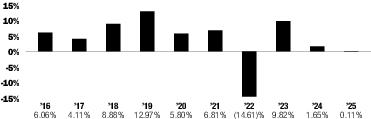
| Class A | Period Ended | Returns |
| Year-to-date | March 31, 2026 | -0.20% |
| Best Quarter | December 31, 2023 | 11.01% |
| Worst Quarter | March 31, 2022 | -8.25% |
| | Inception Date | 1 Year | 5 Years | 10 Years |
| Class A | | | | |
| Return Before Taxes | 5/15/1986 | -4.15 % | -0.48 % | 3.44 % |
| Return After Taxes on Distributions | | -4.15 | -0.49 | 3.43 |
| Return After Taxes on Distributions and Sale of Fund Shares | | -0.71 | 0.49 | 3.59 |
| | ||||
| Class C | 3/17/1997 | -1.59 | -0.36 | 3.26 |
| | ||||
| Class Y | 4/28/2000 | 0.35 | 0.62 | 4.13 |
| | ||||
| Class R6 | 5/24/2019 | 0.40 | 0.68 | 4.10 1 |
| | ||||
| S&P Municipal Bond New York 5+ Year Investment Grade Index (reflects no deduction for fees, expenses or taxes) | | 3.68 | 0.69 | 2.29 |
| | ||||
| S&P Municipal Bond Index (reflects no deduction for fees, expenses or taxes) | | 4.26 | 1.06 | 2.44 |
| | ||||
1
Performance shown on or prior to the inception date is that of the predecessor fund's Class A shares at net asset value and includes the 12b-1 fees applicable to that class. Although invested in the same portfolio of securities, Class R6 shares' returns of the Fund will be different from Class A shares' returns of the predecessor fund as they have different expenses.
After-tax returns are calculated using the historical highest individual federal marginal income tax rates and do not reflect the impact of state and local taxes. Actual after-tax returns depend on an investor's tax situation and may differ from those shown, and after-tax returns shown are not relevant to investors who hold their Fund shares through tax-advantaged arrangements, such as 401(k) plans, 529 college savings plans or individual retirement accounts. After-tax returns are shown for Class A shares only and after-tax returns for other classes will vary.