Exhibit 99.2
Investor Presentation June 2026
Disclaimer 2 Disclaimer This presentation and any oral statements regarding the subject matter of this presentation (this "Presentation") is being furnished solely for the purpose of assisting the parties to whom it is addressed in making their independent evaluation with respect to a proposed business combination (the "Business Combination") among Launch Two Acquisition Corp. ("Launch Two"), NuCube Energy, Inc. ("NuCube"), and Tesseract Merger Sub Inc., a Delaware corporation and a direct wholly owned subsidiary of SPAC ("Merger Sub" and together with Launch Two and NuCube, the "Parties"). The provisions of this Presentation shall not be taken as any form of commitment on the part of the Parties with respect to the consummation of the Business Combination or any other transaction, and each of NuCube and Launch Two reserve the right to terminate the Business Combination Agreement in accordance with its terms. No Representations or Warranties No representations or warranties, express or implied are given in, or in respect of, the accuracy or completeness of the information contained in this Presentation or any other information (whether written or oral) that has been or will be provided to you. In particular, no representation or warranty of Launch Two, NuCube, or their respective representatives is given as to the achievement or reasonableness of future projections, management targets, estimates, prospects or returns, if any. To the fullest extent permitted by law, neither NuCube, Launch Two, nor any of their respective subsidiaries, equity holders, affiliates, representatives, partners, directors, officers, employees, advisers or agents shall be responsible or liable for any direct, indirect or consequential loss or loss of profit arising from the use of this Presentation, its contents, its accuracy or sufficiency, its omissions, its errors, reliance on the information contained within it, or on opinions communicated in relation thereto or otherwise arising in connection therewith. In addition, this Presentation does not purport to be inclusive of all of the information necessary to make an evaluation of NuCube, Launch Two, the post-Business Combination company (the "Combined Company") or the Business Combination. Recipients of this Presentation should each make their own evaluation of NuCube, Launch Two, the Combined Company and of the relevance and adequacy of the information and should make such other investigations as they deem necessary. Nothing herein should be construed as legal, financial, tax or other advice. You should consult your own advisers concerning any legal, financial, tax or other considerations concerning the opportunity described herein. The general explanations included in this Presentation cannot address, nor are intended to address, your specific investment objectives, financial situations or financial needs. This Presentation contains certain forward-looking statements within the meaning of the U.S. federal securities laws with respect to the Parties and the Business Combination, including expectations, hopes, beliefs, intentions, plans, prospects, financial results or strategies regarding NuCube, Launch Two, the Combined Company, and statements regarding the anticipated benefits and timing of the completion of the Business Combination, the assets held by NuCube and by Launch Two, advanced nuclear energy, microreactor deployment, industrial power generation, AI data center energy demand and related energy infrastructure trends, the anticipated business of the Combined Company, NuCube and the markets in which they operate, planned business strategies, including, without limitation, NuCube's plans to deploy its microreactor technologies to support industrial, manufacturing and data center energy needs, plans and use of proceeds, objectives of management for future operations of NuCube, expected operating costs of the Combined Company and its subsidiaries, the upside potential and opportunity for investors, the Combined Company and NuCube's plan for value creation and strategic advantages, market size and growth opportunities, regulatory conditions, competitive position and the interest of other corporations in similar business strategies, technological and market trends, future financial condition and performance and expected financial impacts of the Business Combination, the satisfaction of closing conditions to the Business Combination and the level of redemptions of Launch Two's public shareholders, and the Parties' respective or collective expectations, intentions, strategies, assumptions, or beliefs about future events, results of operations, or performance or that do not solely relate to historical or current facts. These forward-looking statements generally are identified by the words "believe," "project," "expect," "anticipate," "estimate," "intend," "strategy," "future," "opportunity," "potential," "plan," "may," "should," "will," "would," "will be," "will continue," "will likely result," and similar expressions; but the Presentation may include other forward-looking information and data that are not preceded by any of the foregoing words. In addition, any statements that refer to projections, forecasts or other characterizations of future events or circumstances, including any underlying assumptions, are forward-looking statements. Forward-looking statements are predictions, projections and other statements about future events or conditions that are based on current expectations and assumptions and, as a result, are subject to risks and uncertainties. Many factors could cause actual future events to differ materially from the forward-looking statements in this Presentation, including, but not limited to: the risk that the Business Combination may not be completed in a timely manner or at all, which may adversely affect the price of Launch Two's securities; the risk that the Business Combination may not be completed by Launch Two's business combination deadline or any extension thereto; the failure by the Parties to satisfy the conditions to the consummation of the Business Combination, including the approval of Launch Two's shareholders; the failure of the Combined Company to obtain or maintain the listing of its securities on the Nasdaq Stock Market or the New York Stock Exchange after closing of the Business Combination; costs related to the Business Combination; changes in business, market, financial, political and regulatory conditions; risks relating to NuCube's or the Combined Company's anticipated operations and business, including, without limitation, NuCube's plans to design, license, commercialize and deploy its microreactor technologies, including the costs, timeline, regulatory approvals and risks associated therewith; risks related to increased competition in the industries in which the Combined Company will operate; risks that after consummation of the Business Combination, the Combined Company may experience difficulties managing its growth, expanding operations, or executing its strategies; risks relating to the licensing, regulatory approval, construction, deployment and operation of advanced nuclear reactor technologies and related energy infrastructure; the outcome of any potential legal proceedings that may be instituted against NuCube, Launch Two, or others following announcement of the Business Combination; and those risk factors discussed in documents that NuCube or Launch Two filed, or will file, with the Securities and Exchange Commission ("SEC"). The foregoing list of risk factors is not exhaustive. You should carefully consider the foregoing factors and the other risks and uncertainties described in the "Risk Factors" section of the (i) final prospectus of Launch Two dated as of October 7, 2024 and filed by Launch Two with the SEC on October 8, 2024 (the "IPO Prospectus"), (ii) the annual report on Form 10-K filed by Launch Two with the SEC on March 27, 2026, (iii) a registration statement on Form S-4 that Launch Two and NuCube intend to file in connection with the Business Combination, which will include a proxy statement of Launch Two, and other documents filed or to be filed by Launch Two and NuCube from time to time with the SEC, as well as (iv) the list of risk factors included on page 32 hereto. These materials do or will identify and address other important risks and uncertainties that could cause actual events and results to differ materially from those contained in the forward-looking statements. There may be additional risks that neither Launch Two nor NuCube presently knows or that Launch Two and NuCube currently believe are immaterial that could also cause actual results to differ from those contained in the forward-looking statements. Forward-looking statements speak only as of the date they are made. Readers are cautioned not to put undue reliance on forward-looking statements, and none of the Parties or any of their representatives assumes any obligation and do not intend to update or revise these forward-looking statements, whether as a result of new information, future events, or otherwise. None of the Parties nor any of their representatives gives any assurance that any of Launch Two, NuCube, or the Combined Company will achieve its expectations. Industry and Market Data In this Presentation, NuCube and Launch Two rely on and refer to certain information and statistics regarding the markets and industries in which NuCube competes. Such information and statistics are based on NuCube's management's estimates and/or obtained from third-party sources, including reports by market research firms and company filings. While NuCube believes such third-party information is reliable, there can be no assurance as to the accuracy or completeness of the indicated information. Neither of NuCube or Launch Two has independently verified the accuracy or completeness of the information provided by the third-party sources. Each of Launch Two and NuCube expressly disclaims any responsibility or liability for any damages or losses in connection with the use of such information herein.
Disclaimer (Cont.) 3 Trademarks This Presentation may contain trademarks, service marks, trade names and copyrights of other companies, which are the property of their respective owners, and NuCube's and Launch Two's use thereof does not imply an affiliation with, or endorsement by, the owners of such trademarks, service marks, trade names and copyrights. Solely for convenience, some of the trademarks, service marks, trade names and copyrights referred to in this Presentation may be listed without the TM, © or ® symbols, but NuCube and Launch Two will assert, to the fullest extent under applicable law, the rights of the applicable owners, if any, to these trademarks, service marks, trade names and copyrights. No Offer or Solicitation This Presentation and any oral statements made in connection with this Presentation do not constitute (i) a solicitation of a proxy, consent or authorization with respect to any securities or in respect of the Business Combination or (ii) an offer to sell, a solicitation of an offer to buy or a recommendation to purchase any security of NuCube or Launch Two, or any of their respective affiliates in any jurisdiction, nor shall there be any sale, issuance or transfer of any securities in any jurisdiction where, or to any person to whom, such offer, solicitation or sale may be unlawful under the laws of such jurisdiction. This Presentation does not constitute either advice or a recommendation regarding any securities. No offering of securities shall be made except by means of a prospectus meeting the requirements of the Securities Act of 1933, as amended, or an exemption therefrom. Investment in any securities described herein has not been approved or disapproved by the SEC or any other regulatory authority nor has any authority passed upon or endorsed the merits of the offering or the accuracy or adequacy of the information contained herein any representation to the contrary is a criminal offense. Participants in Solicitation NuCube and Launch Two and their respective directors, managers and executive officers may be deemed under SEC rules to be participants in the solicitation of proxies of Launch Two's shareholders in connection with the Business Combination. Investors and security holders may obtain more detailed information regarding the names and interests of Launch Two's directors and officers in the Business Combination in Launch Two's filings with the SEC, including the IPO Prospectus. To the extent that holdings of Launch Two's securities have changed from the amounts reported in the IPO Prospectus, such changes have been or will be reflected on Statements of Change in Ownership on Form 4 filed with the SEC. Information regarding the persons who may, under SEC rules, be deemed participants in the solicitation of proxies of Launch Two's shareholders in connection with the Business Combination will be set forth in the proxy statement/prospectus on Form S-4 for the Business Combination, which will be filed by Launch Two and NuCube with the SEC. Investors, shareholders and other interested persons are urged to read the proxy statement/prospectus and other relevant documents that will be filed with the SEC carefully and in their entirety when they become available because they will contain important information about the Business Combination. Investors, shareholders and other interested persons will be able to obtain free copies of the proxy statement/prospectus and other documents containing important information about NuCube and Launch Two through the website maintained by the SEC at www.sec.gov.
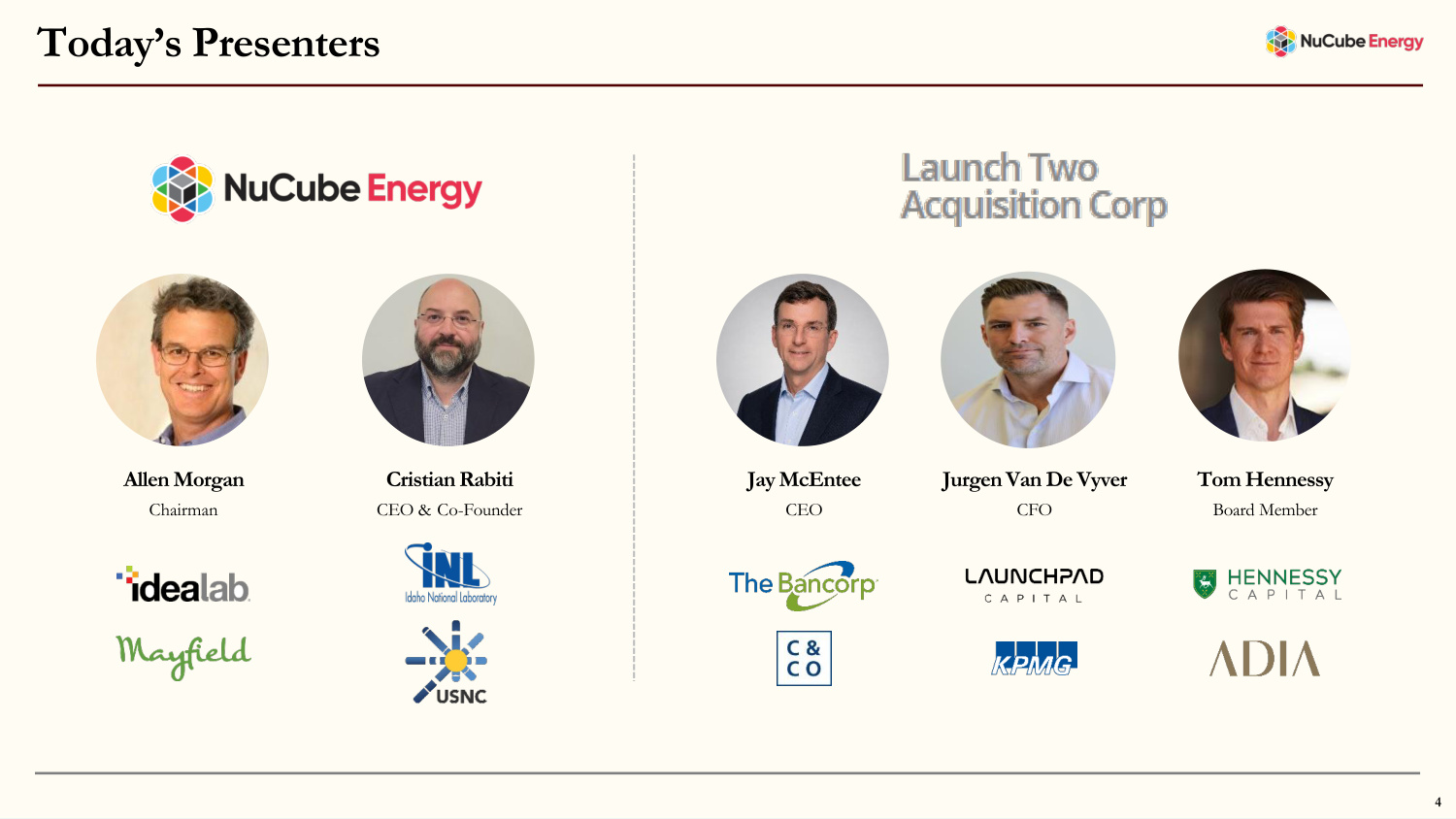
Today's Presenters 4 Allen Morgan Chairman Cristian Rabiti CEO & Co-Founder Jurgen Van De Vyver CFO Jay McEntee CEO Tom Hennessy Board Member
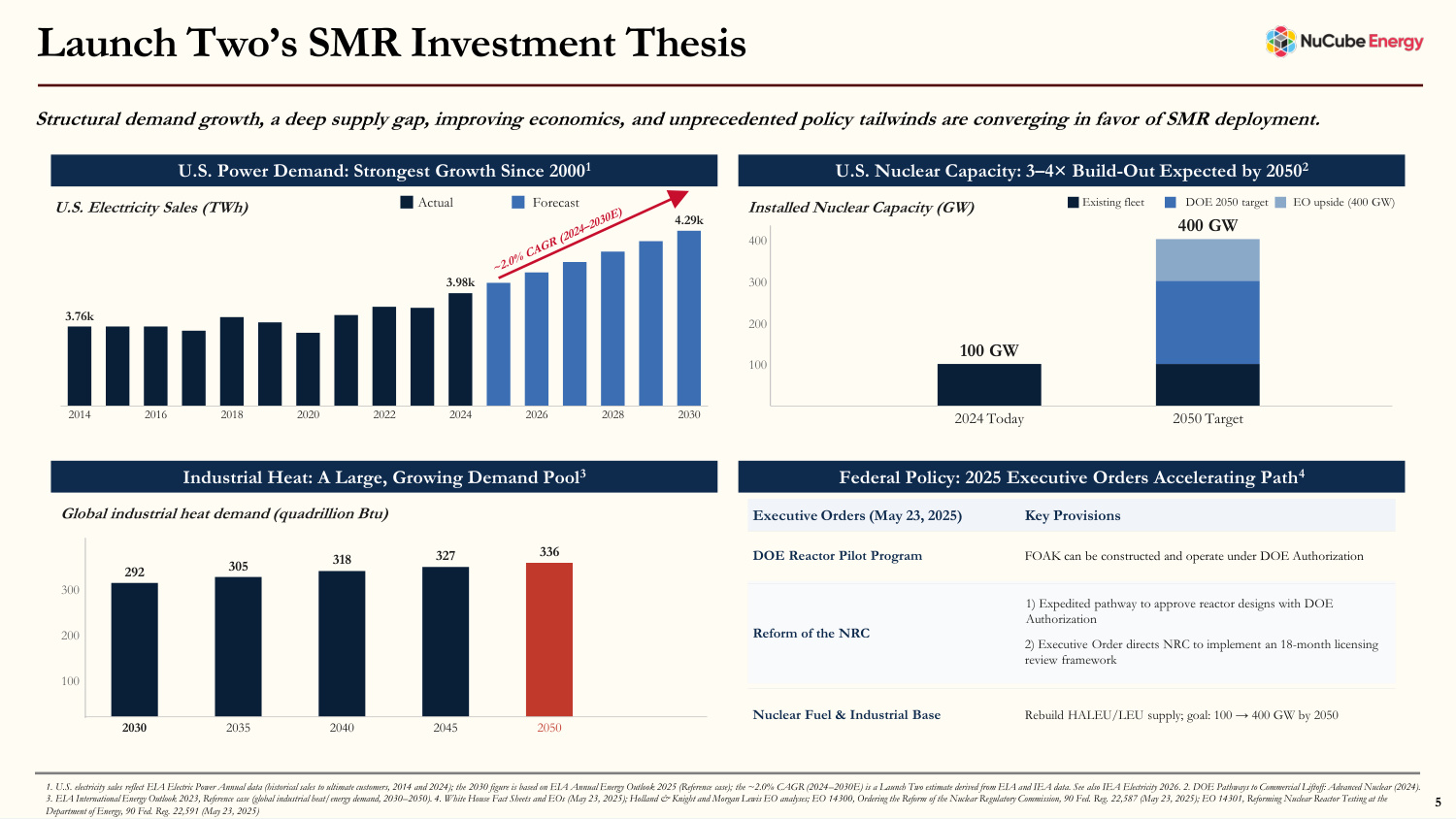
Launch Two's SMR Investment Thesis Structural demand growth, a deep supply gap, improving economics, and unprecedented policy tailwinds are converging in favor of SMR deployment. 5 1. U.S. electricity sales reflect EIA Electric Power Annual data (historical sales to ultimate customers, 2014 and 2024); the 2030 figure is based on EIA Annual Energy Outlook 2025 (Reference case); the ~2.0% CAGR (2024–2030E) is a Launch Two estimate derived from EIA and IEA data. See also IEA Electricity 2026. 2. DOE Pathways to Commercial Liftoff: Advanced Nuclear (2024). 3. EIA International Energy Outlook 2023, Reference case (global industrial heat/energy demand, 2030–2050). 4. White House Fact Sheets and EOs (May 23, 2025); Holland & Knight and Morgan Lewis EO analyses; EO 14300, Ordering the Reform of the Nuclear Regulatory Commission, 90 Fed. Reg. 22,587 (May 23, 2025); EO 14301, Reforming Nuclear Reactor Testing at the Department of Energy, 90 Fed. Reg. 22,591 (May 23, 2025) U.S. Power Demand: Strongest Growth Since 20001 U.S. Electricity Sales (TWh) 2014 3.76k 2016 2018 2020 2022 2024 3.98k 2026 2028 2030 4.29k Actual Forecast U.S. Nuclear Capacity: 3–4× Build-Out Expected by 20502 Installed Nuclear Capacity (GW) 100 GW 2024 Today 400 GW 2050 Target 100 200 300 400 Existing fleet DOE 2050 target EO upside (400 GW) Federal Policy: 2025 Executive Orders Accelerating Path4 Executive Orders (May 23, 2025) Key Provisions DOE Reactor Pilot Program FOAK can be constructed and operate under DOE Authorization Nuclear Fuel & Industrial Base Rebuild HALEU/LEU supply; goal: 100 → 400 GW by 2050 2) Executive Order directs NRC to implement an 18-month licensing review framework Reform of the NRC 1) Expedited pathway to approve reactor designs with DOE Authorization Industrial Heat: A Large, Growing Demand Pool3 Global industrial heat demand (quadrillion Btu) 292 2030 305 2035 318 2040 327 2045 336 2050 100 200 300
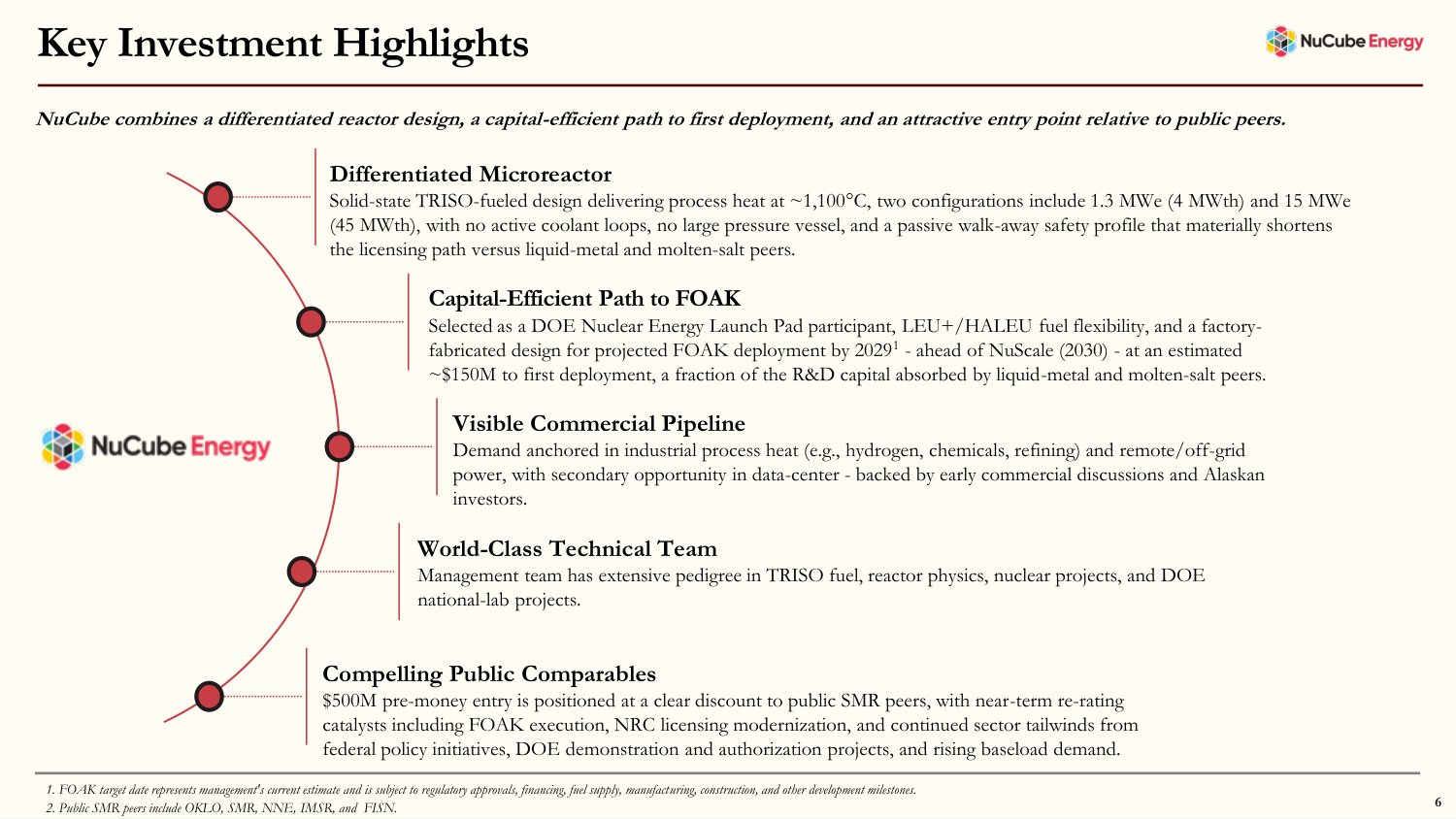
Key Investment Highlights 6 Differentiated Microreactor Solid-state TRISO-fueled design delivering process heat at ~1,100°C, two configurations include 1.3 MWe (4 MWth) and 15 MWe (45 MWth), with no active coolant loops, no large pressure vessel, and a passive walk-away safety profile that materially shortens the licensing path versus liquid-metal and molten-salt peers. Capital-Efficient Path to FOAK Selected as a DOE Nuclear Energy Launch Pad participant, LEU+/HALEU fuel flexibility, and a factory- fabricated design for projected FOAK deployment by 20291 - ahead of NuScale (2030) - at an estimated ~$150M to first deployment, a fraction of the R&D capital absorbed by liquid-metal and molten-salt peers. Visible Commercial Pipeline Demand anchored in industrial process heat (e.g., hydrogen, chemicals, refining) and remote/off-grid power, with secondary opportunity in data-center - backed by early commercial discussions and Alaskan investors. World-Class Technical Team Management team has extensive pedigree in TRISO fuel, reactor physics, nuclear projects, and DOE national-lab projects. Compelling Public Comparables $500M pre-money entry is positioned at a clear discount to public SMR peers, with near-term re-rating catalysts including FOAK execution, NRC licensing modernization, and continued sector tailwinds from federal policy initiatives, DOE demonstration and authorization projects, and rising baseload demand. NuCube combines a differentiated reactor design, a capital-efficient path to first deployment, and an attractive entry point relative to public peers. 1. FOAK target date represents management's current estimate and is subject to regulatory approvals, financing, fuel supply, manufacturing, construction, and other development milestones. 2. Public SMR peers include OKLO, SMR, NNE, IMSR, and FISN.
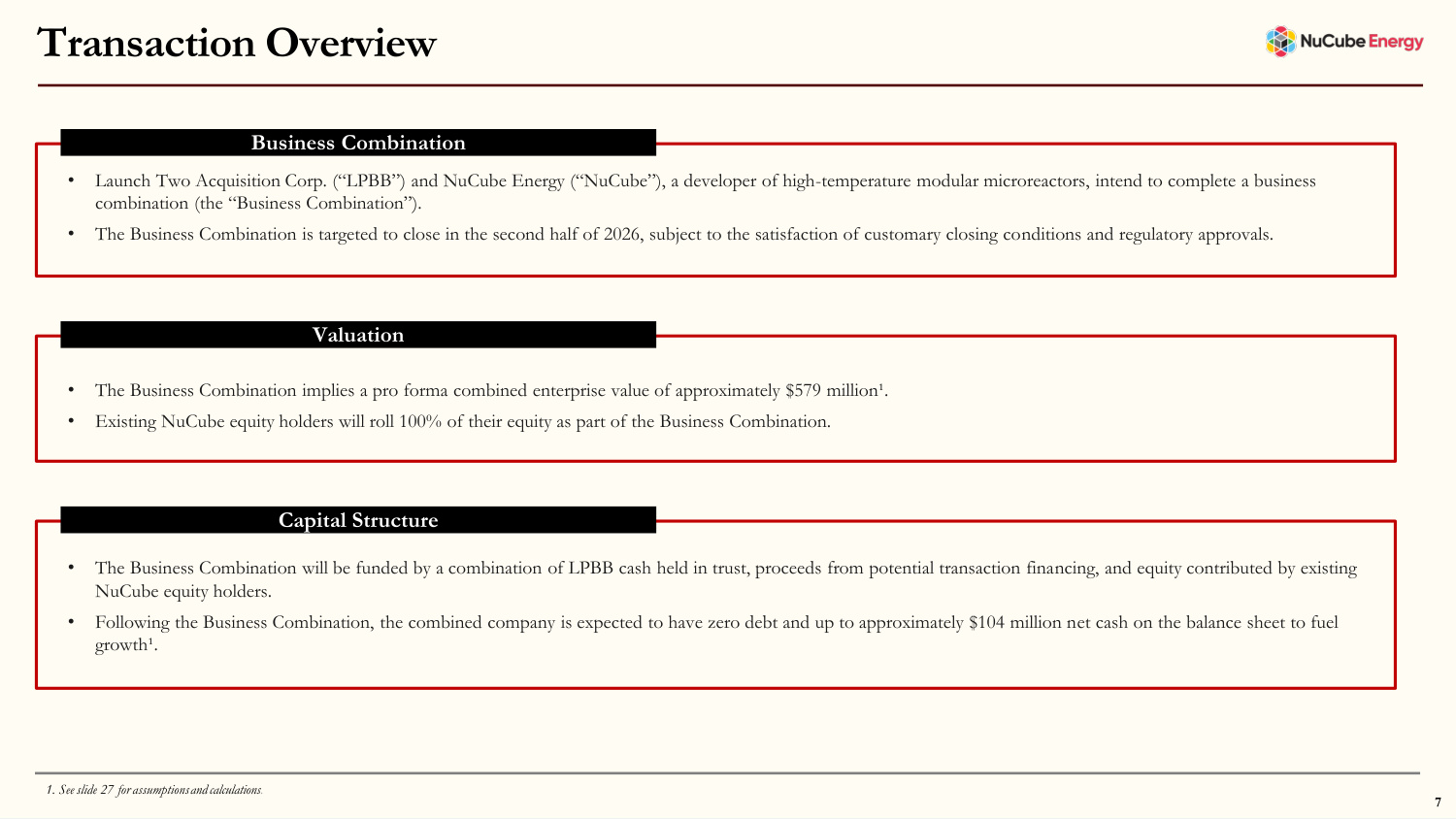
Transaction Overview 7 Business Combination • Launch Two Acquisition Corp. ("LPBB") and NuCube Energy ("NuCube"), a developer of high-temperature modular microreactors, intend to complete a business combination (the "Business Combination"). • The Business Combination is targeted to close in the second half of 2026, subject to the satisfaction of customary closing conditions and regulatory approvals. Capital Structure • The Business Combination will be funded by a combination of LPBB cash held in trust, proceeds from potential transaction financing, and equity contributed by existing NuCube equity holders. • Following the Business Combination, the combined company is expected to have zero debt and up to approximately $104 million net cash on the balance sheet to fuel growth¹. Valuation • The Business Combination implies a pro forma combined enterprise value of approximately $579 million¹. • Existing NuCube equity holders will roll 100% of their equity as part of the Business Combination. 1. See slide 27 forassumptionsandcalculations.
I. NuCube Overview
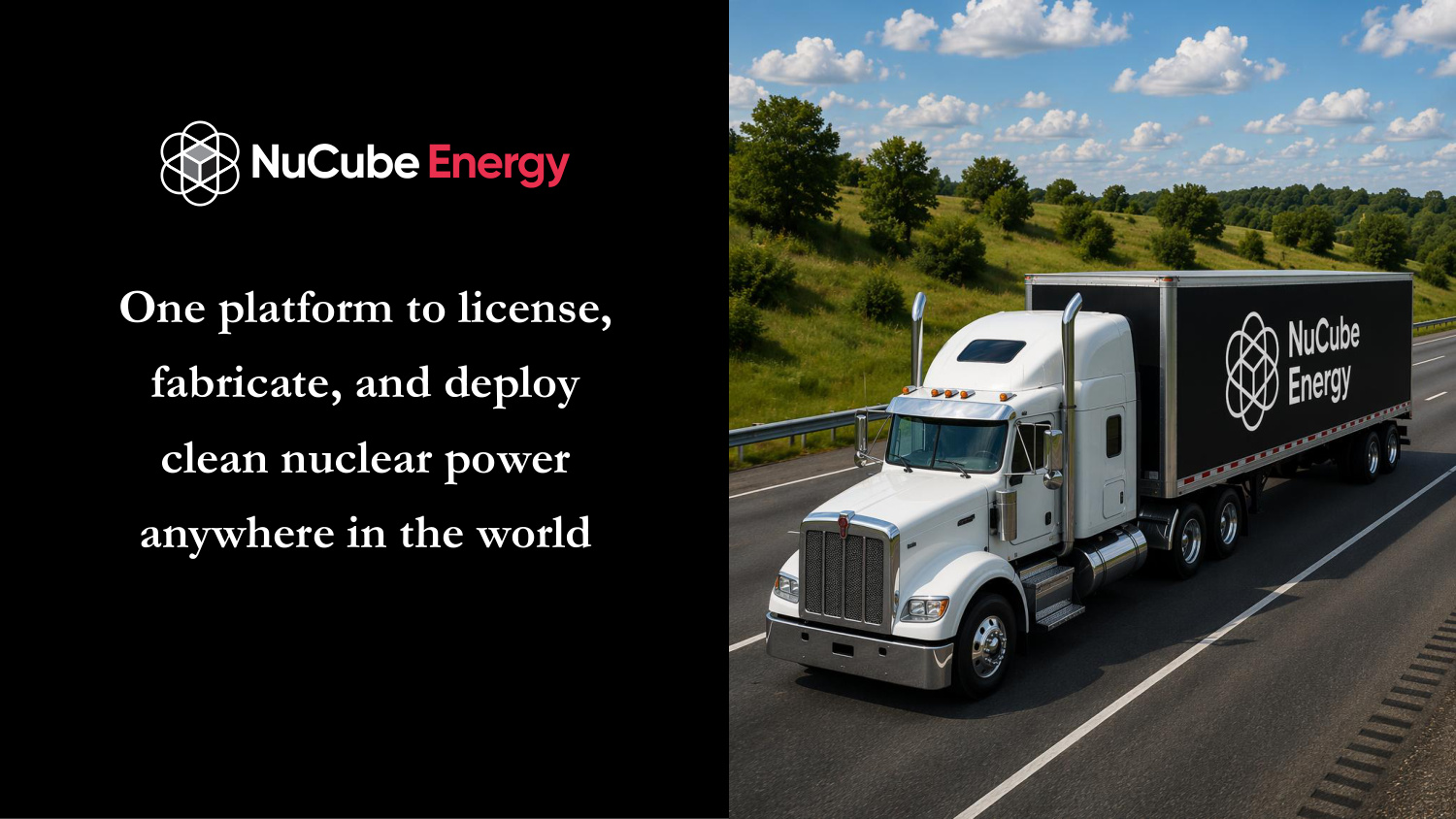
9 One platform to license, fabricate, and deploy clean nuclear power anywhere in the world
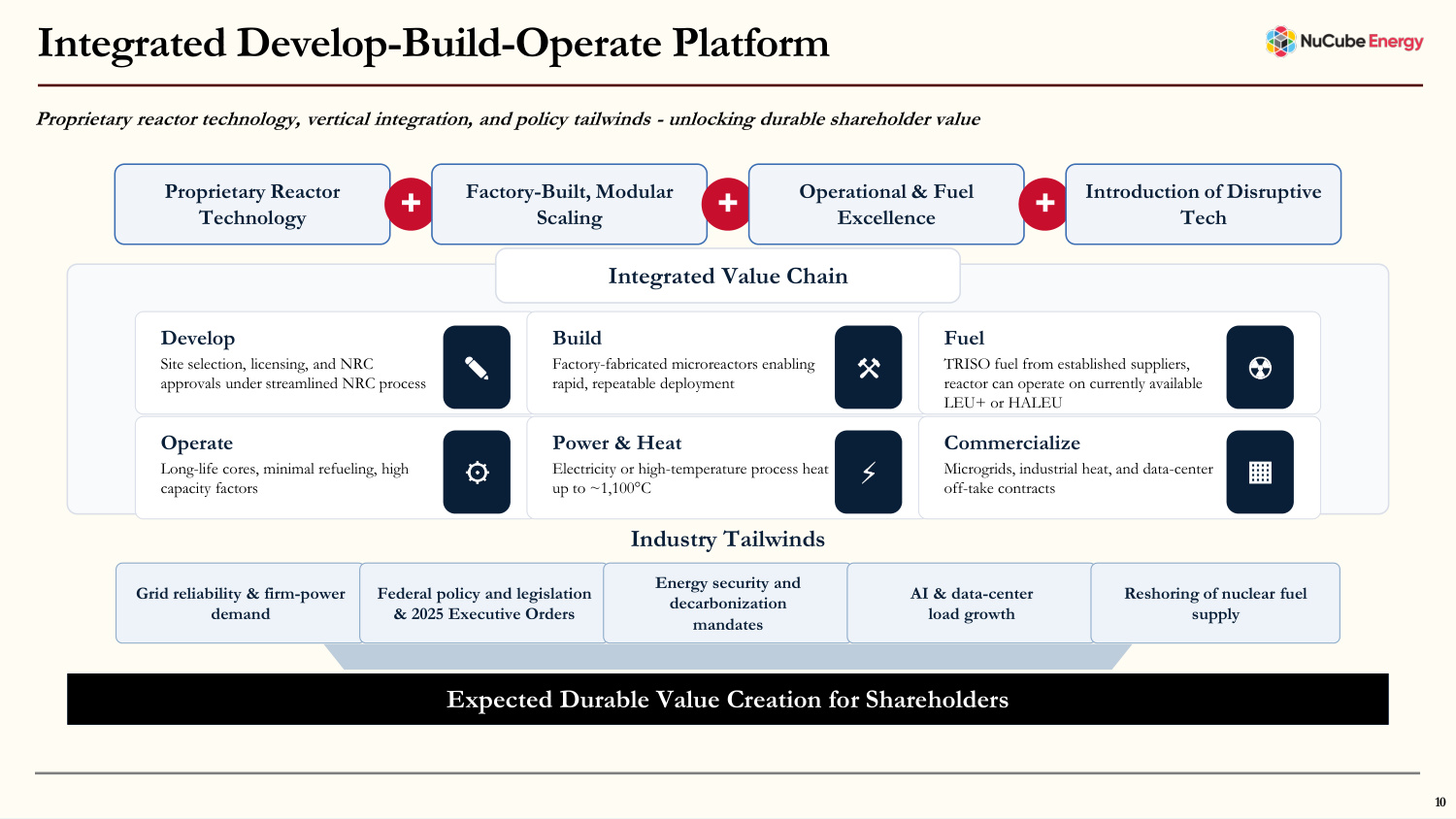
Integrated Develop-Build-Operate Platform Proprietary reactor technology, vertical integration, and policy tailwinds - unlocking durable shareholder value 10 Proprietary Reactor Technology + Factory-Built, Modular Scaling + Operational & Fuel Excellence + Introduction of Disruptive Tech Integrated Value Chain ✎ Develop Site selection, licensing, and NRC approvals under streamlined NRC process Build Factory-fabricated microreactors enabling rapid, repeatable deployment Fuel TRISO fuel from established suppliers, reactor can operate on currently available LEU+ or HALEU Operate Long-life cores, minimal refueling, high capacity factors Power & Heat Electricity or high-temperature process heat up to ~1,100°C ▦ Commercialize Microgrids, industrial heat, and data-center off-take contracts Industry Tailwinds Grid reliability & firm-power demand Federal policy and legislation & 2025 Executive Orders Energy security and decarbonization mandates AI & data-center load growth Reshoring of nuclear fuel supply Expected Durable Value Creation for Shareholders
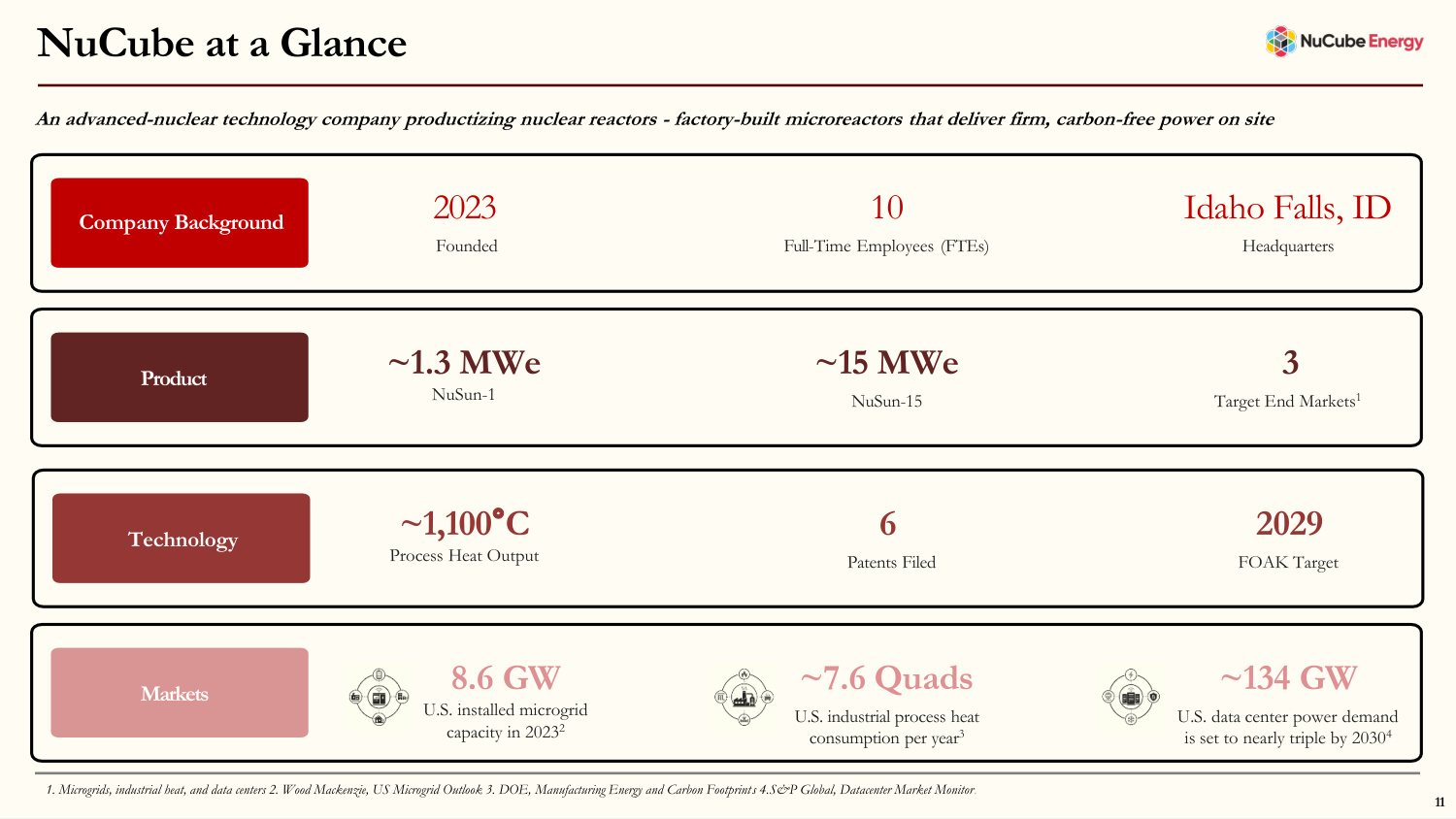
NuCube at a Glance An advanced-nuclear technology company productizing nuclear reactors - factory-built microreactors that deliver firm, carbon-free power on site 11 ~1.3 MWe NuSun-1 ~15 MWe NuSun-15 3 Target End Markets1 Product Technology ~1,100°C Process Heat Output 6 Patents Filed 2029 FOAK Target Company Background 2023 Founded 10 Full-Time Employees (FTEs) Idaho Falls, ID Headquarters 1. Microgrids, industrial heat, and data centers 2. Wood Mackenzie, US Microgrid Outlook 3. DOE, Manufacturing Energy and Carbon Footprints 4.S&P Global, Datacenter Market Monitor. 8.6 GW U.S. installed microgrid capacity in 20232 ~7.6 Quads U.S. industrial process heat consumption per year3 ~134 GW U.S. data center power demand is set to nearly triple by 20304 Markets
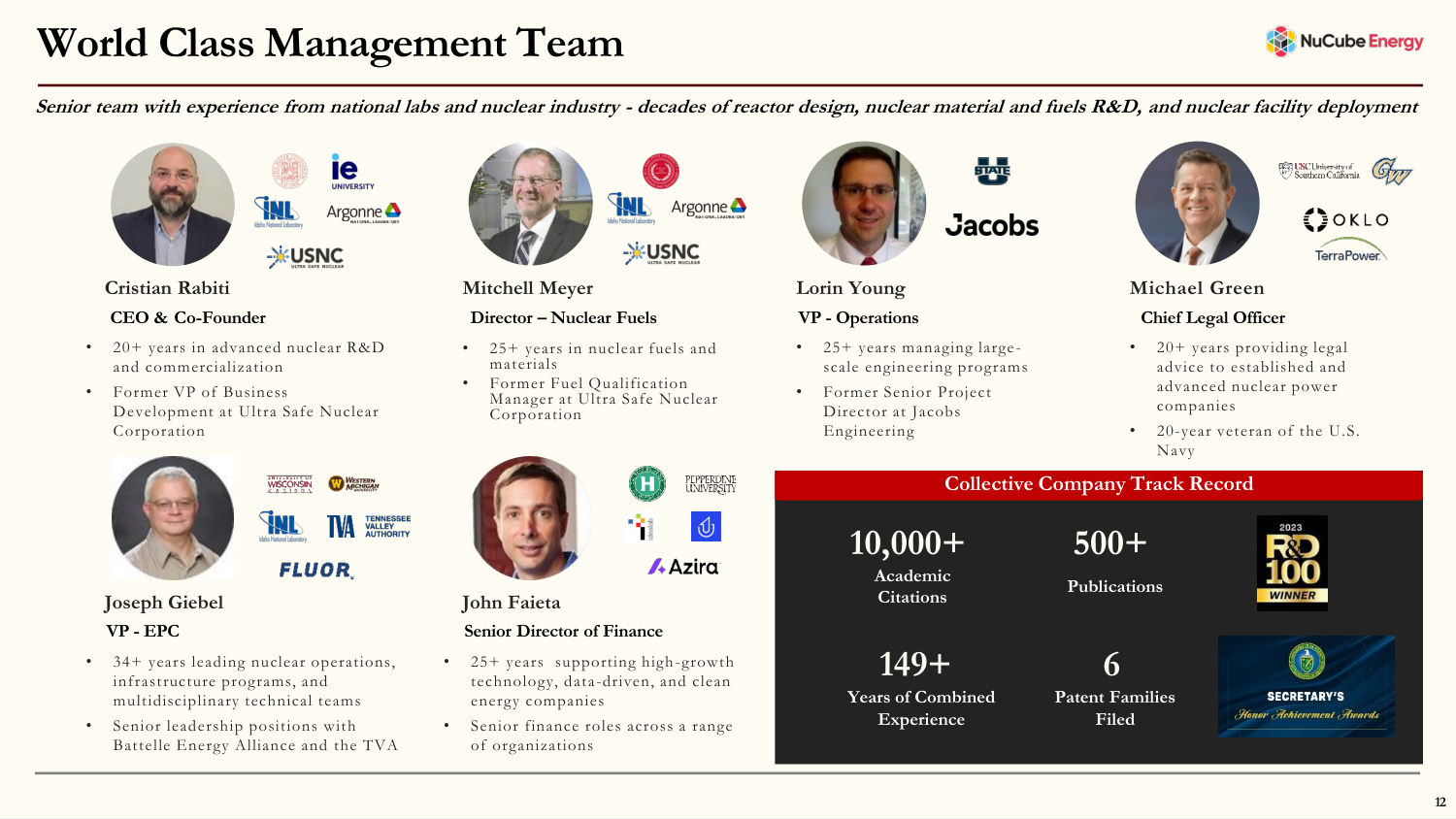
World Class Management Team • 25+ years managing large- scale engineering programs • Former Senior Project Director at Jacobs Engineering Lorin Young VP - Operations • 25+ years in nuclear fuels and materials • Former Fuel Qualification Manager at Ultra Safe Nuclear Corporation Mitchell Meyer Director – Nuclear Fuels Senior team with experience from national labs and nuclear industry - decades of reactor design, nuclear material and fuels R&D, and nuclear facility deployment 12 Michael Green • 20+ years providing legal advice to established and advanced nuclear power companies • 20-year veteran of the U.S. Navy Chief Legal Officer • 20+ years in advanced nuclear R&D and commercialization • Former VP of Business Development at Ultra Safe Nuclear Corporation Cristian Rabiti CEO & Co-Founder • 34+ years leading nuclear operations, infrastructure programs, and multidisciplinary technical teams • Senior leadership positions with Battelle Energy Alliance and the TVA Joseph Giebel VP - EPC • 25+ years supporting high-growth technology, data-driven, and clean energy companies • Senior finance roles across a range of organizations John Faieta Senior Director of Finance 10,000+ Academic Citations 500+ Publications 149+ Years of Combined Experience 6 Patent Families Filed Collective Company Track Record
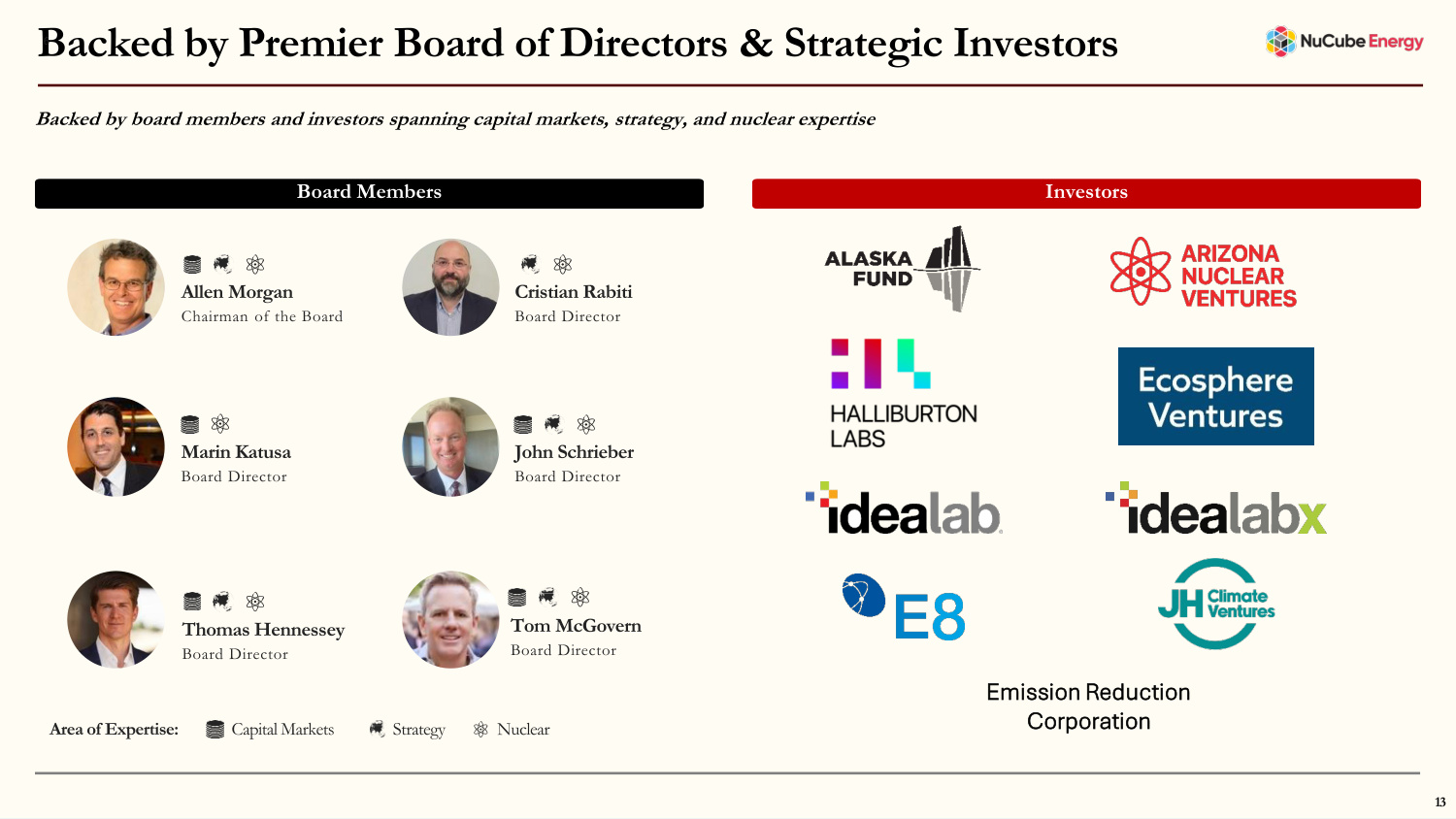
Backed by Premier Board of Directors & Strategic Investors Backed by board members and investors spanning capital markets, strategy, and nuclear expertise 13 6 Investors Allen Morgan Chairman of the Board Marin Katusa Board Director Thomas Hennessey Board Director Cristian Rabiti Board Director John Schrieber Board Director Tom McGovern Board Director Board Members Area of Expertise: Capital Markets Strategy Nuclear Emission Reduction Corporation
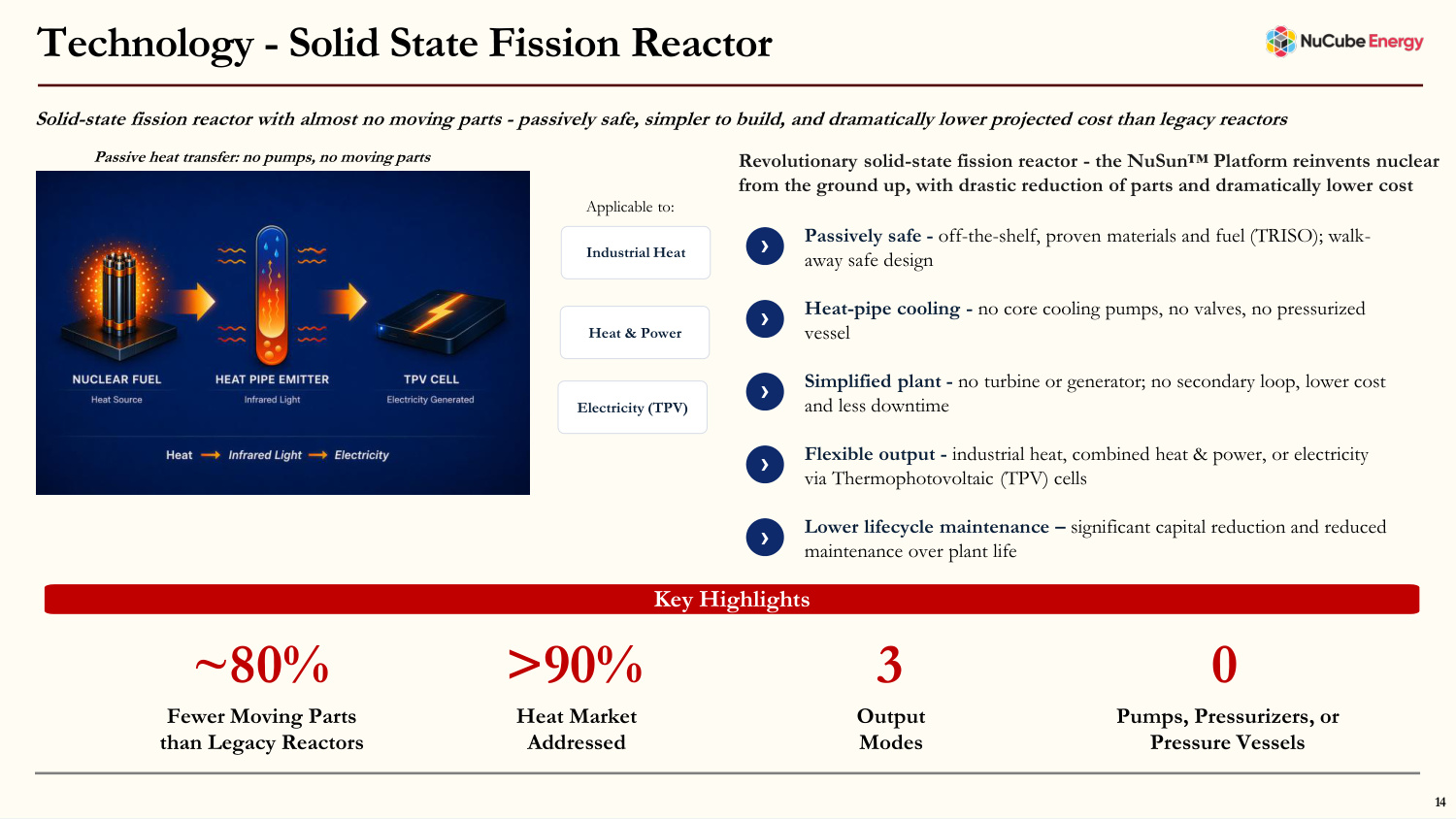
Technology - Solid State Fission Reactor Solid-state fission reactor with almost no moving parts - passively safe, simpler to build, and dramatically lower projected cost than legacy reactors 14 Revolutionary solid-state fission reactor - the NuSun Platform reinvents nuclear from the ground up, with drastic reduction of parts and dramatically lower cost › Passively safe - off-the-shelf, proven materials and fuel (TRISO); walk- away safe design › Heat-pipe cooling - no core cooling pumps, no valves, no pressurized vessel › Simplified plant - no turbine or generator; no secondary loop, lower cost and less downtime › Flexible output - industrial heat, combined heat & power, or electricity via Thermophotovoltaic (TPV) cells › Lower lifecycle maintenance – significant capital reduction and reduced maintenance over plant life Industrial Heat Heat & Power Electricity (TPV) Passive heat transfer: no pumps, no moving parts ~80% Fewer Moving Parts than Legacy Reactors >90% Heat Market Addressed 3 Output Modes 0 Pumps, Pressurizers, or Pressure Vessels Key Highlights Applicable to:
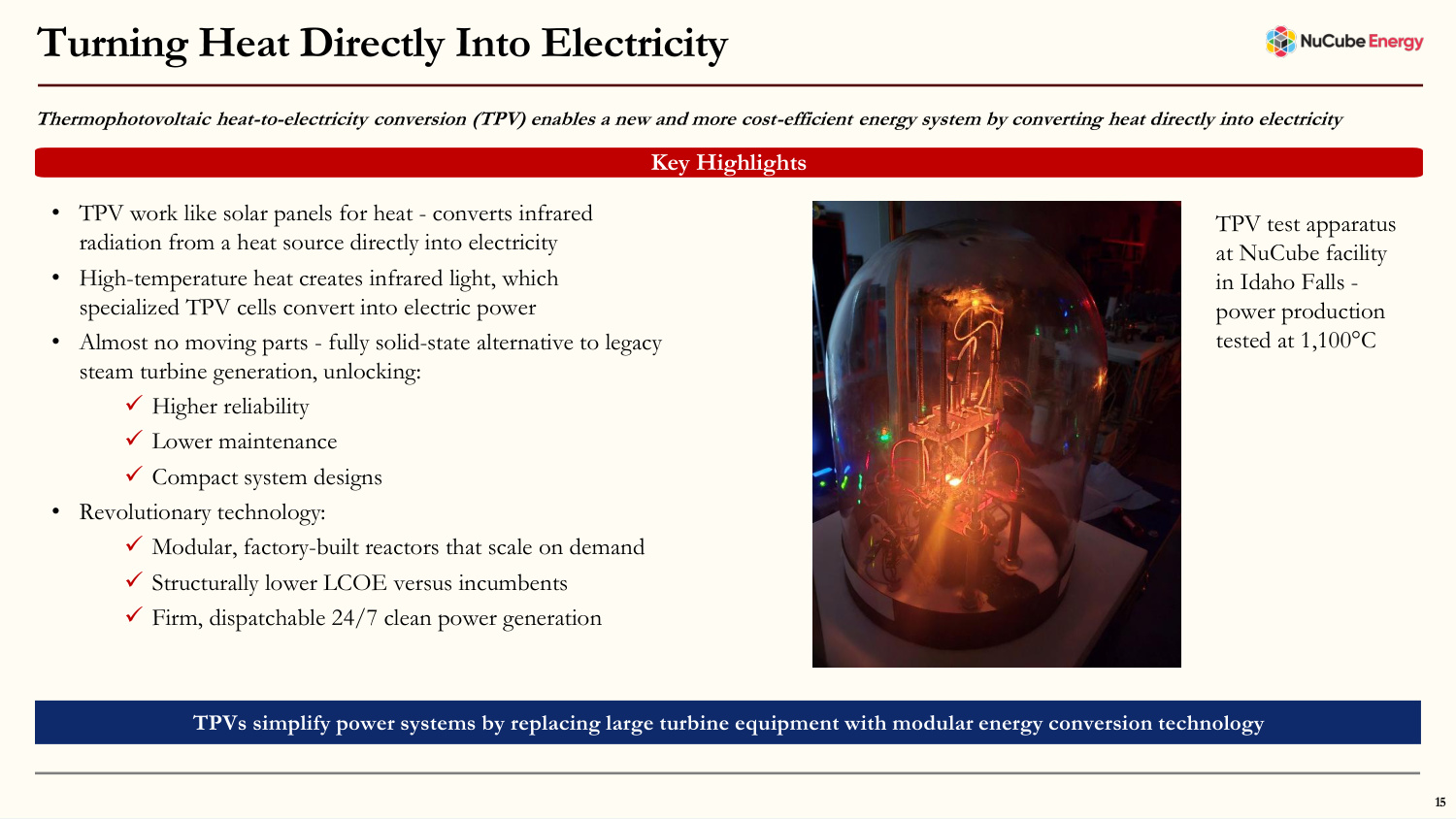
Turning Heat Directly Into Electricity 15 Thermophotovoltaic heat-to-electricity conversion (TPV) enables a new and more cost-efficient energy system by converting heat directly into electricity TPVs simplify power systems by replacing large turbine equipment with modular energy conversion technology Key Highlights • TPV work like solar panels for heat - converts infrared radiation from a heat source directly into electricity • High-temperature heat creates infrared light, which specialized TPV cells convert into electric power • Almost no moving parts - fully solid-state alternative to legacy steam turbine generation, unlocking: ✓Higher reliability ✓Lower maintenance ✓Compact system designs • Revolutionary technology: ✓Modular, factory-built reactors that scale on demand ✓Structurally lower LCOE versus incumbents ✓Firm, dispatchable 24/7 clean power generation TPV test apparatus at NuCube facility in Idaho Falls - power production tested at 1,100°C
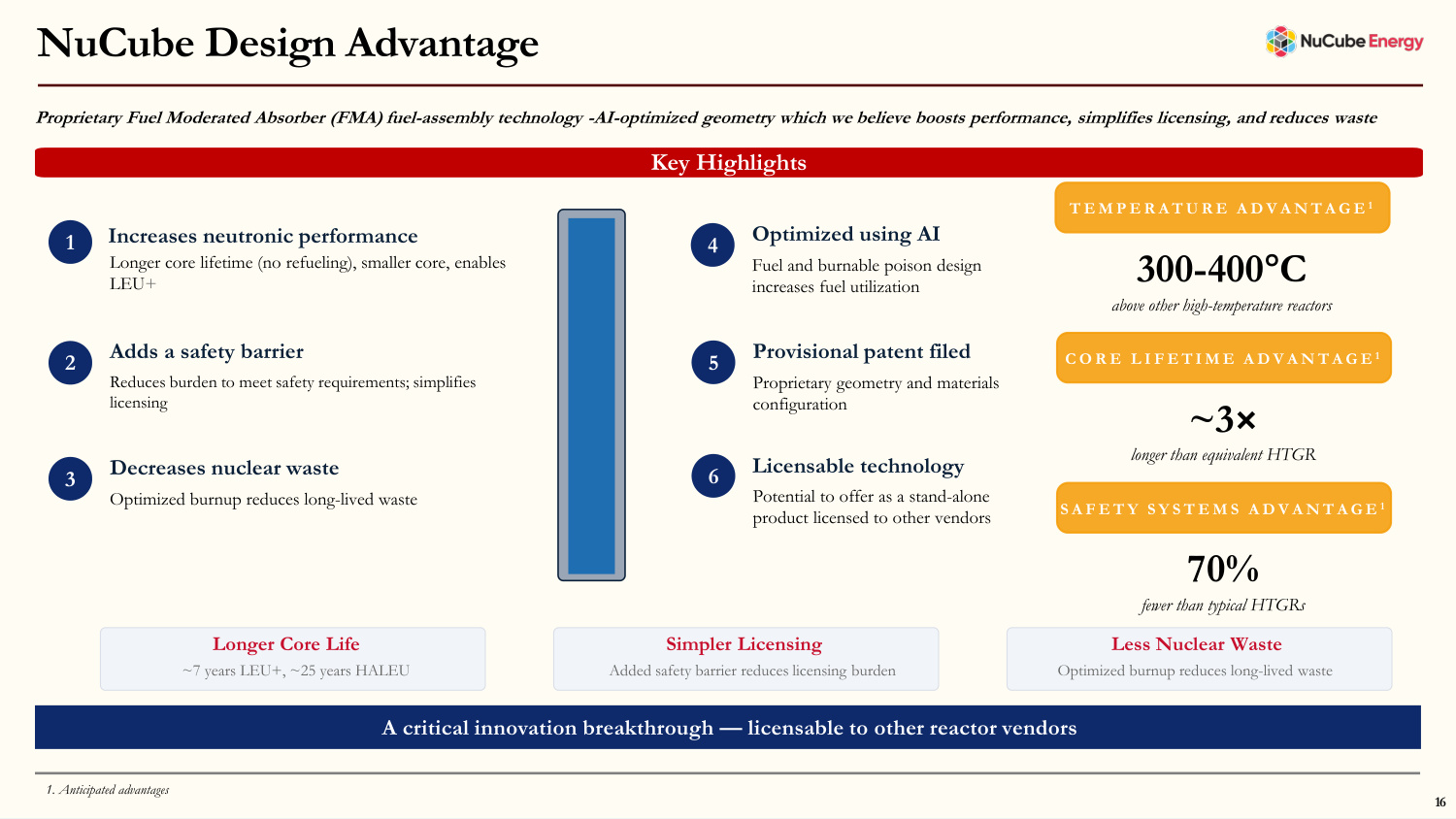
NuCube Design Advantage Proprietary Fuel Moderated Absorber (FMA) fuel-assembly technology -AI-optimized geometry which we believe boosts performance, simplifies licensing, and reduces waste 16 1 Increases neutronic performance Longer core lifetime (no refueling), smaller core, enables LEU+ 2 Adds a safety barrier Reduces burden to meet safety requirements; simplifies licensing 3 Decreases nuclear waste Optimized burnup reduces long-lived waste 4 Optimized using AI Fuel and burnable poison design increases fuel utilization 5 Provisional patent filed Proprietary geometry and materials configuration Licensable technology 6 Potential to offer as a stand-alone product licensed to other vendors Longer Core Life ~7 years LEU+, ~25 years HALEU Simpler Licensing Added safety barrier reduces licensing burden Less Nuclear Waste Optimized burnup reduces long-lived waste A critical innovation breakthrough — licensable to other reactor vendors Key Highlights T E M P E R A T U R E A D V A N T A G E 1 300-400°C above other high-temperature reactors C O R E L I F E T I M E A D V A N T A G E 1 ~3× longer than equivalent HTGR S A F E T Y S Y S T E M S A D V A N T A G E 1 70% fewer than typical HTGRs 1. Anticipated advantages
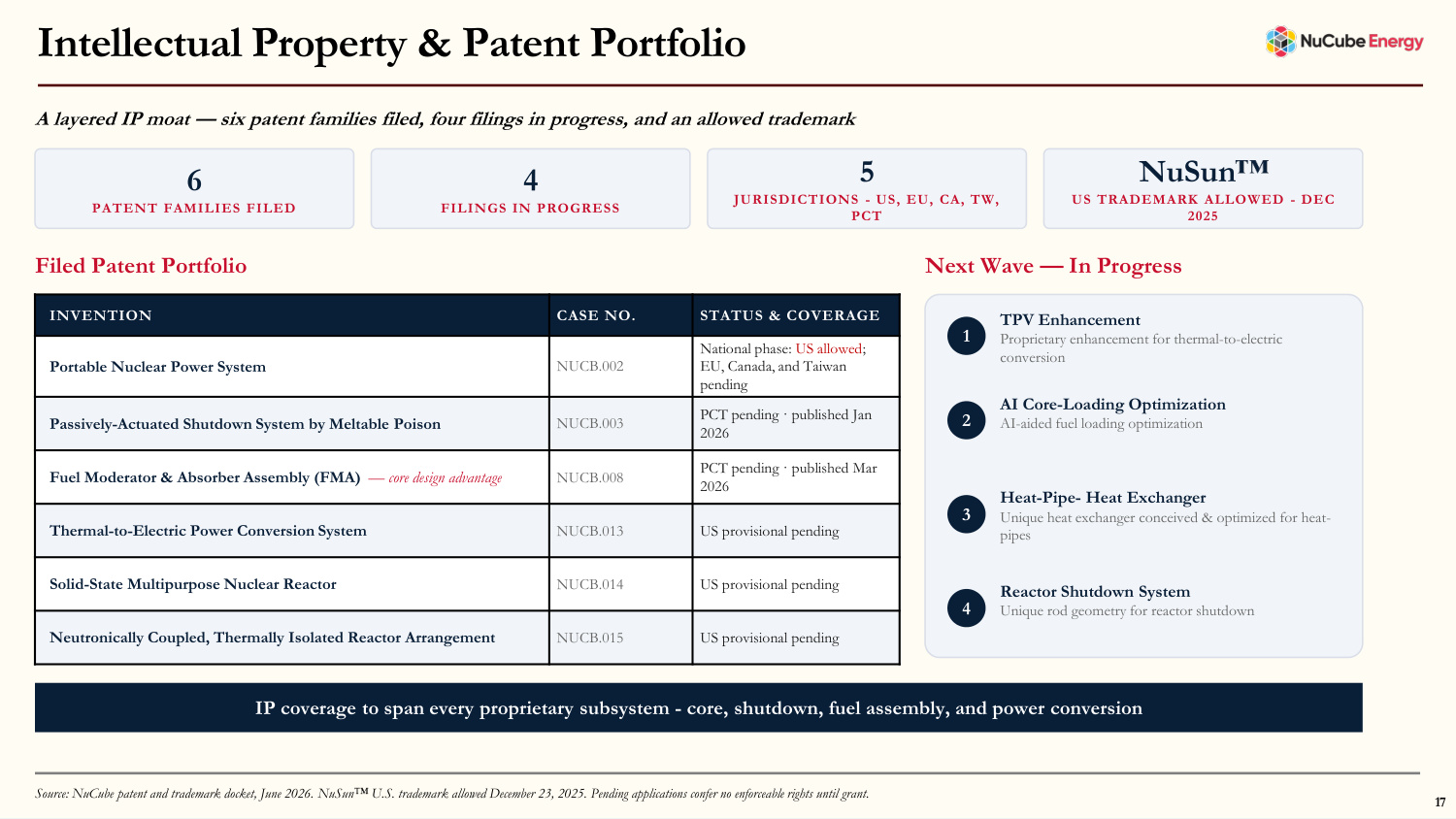
Intellectual Property & Patent Portfolio A layered IP moat — six patent families filed, four filings in progress, and an allowed trademark 17 6 PATENT FAMILIES FILED 4 FILINGS IN PROGRESS 5 JURISDICTIONS - US, EU, CA, TW, PCT NuSun US TRADEMARK ALLOWED - DEC 2025 Filed Patent Portfolio Next Wave — In Progress INVENTION CASE NO. STATUS & COVERAGE Portable Nuclear Power System NUCB.002 National phase: US allowed; EU, Canada, and Taiwan pending Passively-Actuated Shutdown System by Meltable Poison NUCB.003 PCT pending · published Jan 2026 Fuel Moderator & Absorber Assembly (FMA) — core design advantage NUCB.008 PCT pending · published Mar 2026 Thermal-to-Electric Power Conversion System NUCB.013 US provisional pending Solid-State Multipurpose Nuclear Reactor NUCB.014 US provisional pending Neutronically Coupled, Thermally Isolated Reactor Arrangement NUCB.015 US provisional pending 1 TPV Enhancement Proprietary enhancement for thermal-to-electric conversion 2 AI Core-Loading Optimization AI-aided fuel loading optimization 3 Heat-Pipe- Heat Exchanger Unique heat exchanger conceived & optimized for heat- pipes 4 Reactor Shutdown System Unique rod geometry for reactor shutdown IP coverage to span every proprietary subsystem - core, shutdown, fuel assembly, and power conversion Source: NuCube patent and trademark docket, June 2026. NuSun U.S. trademark allowed December 23, 2025. Pending applications confer no enforceable rights until grant.
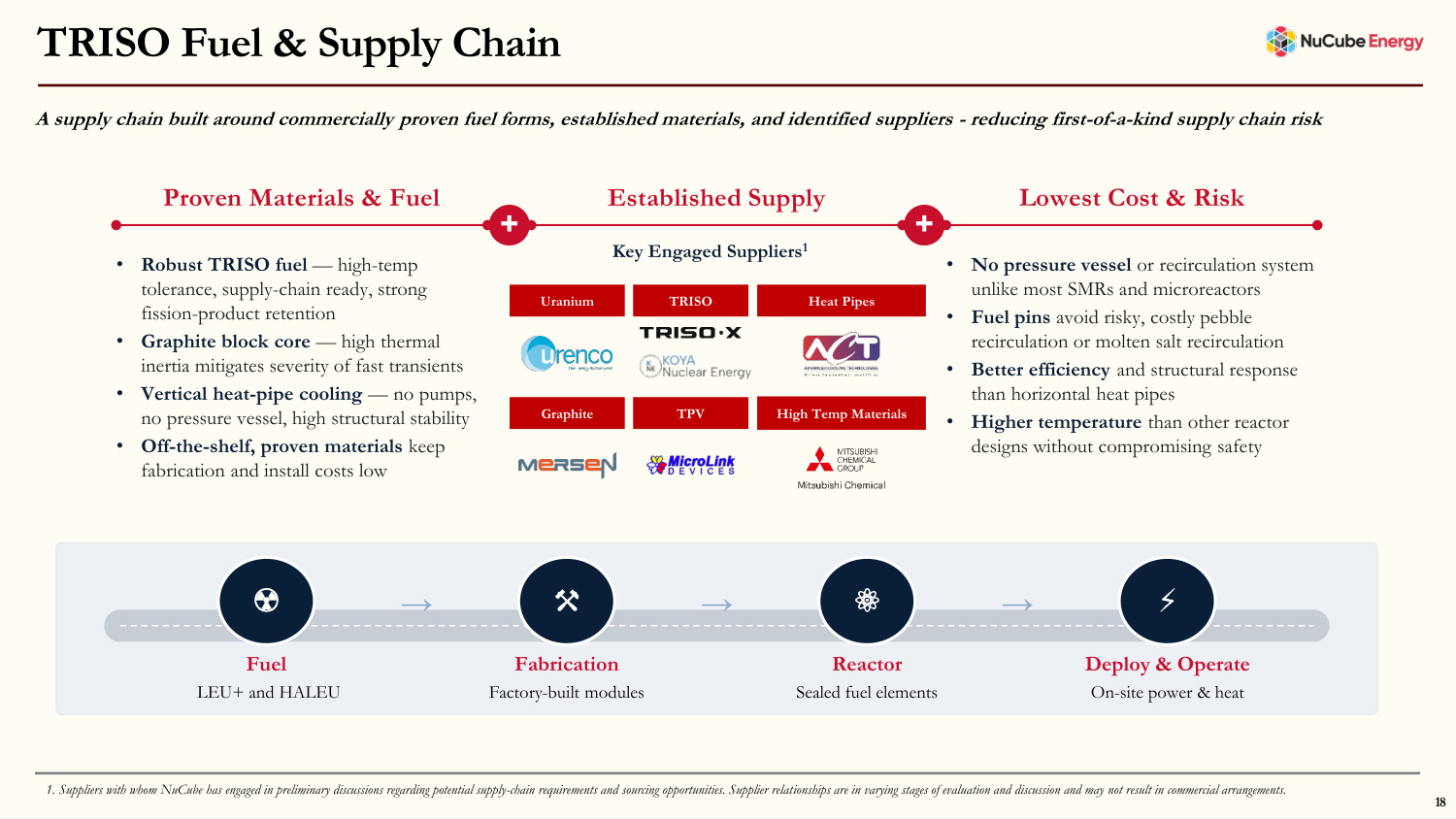
TRISO Fuel & Supply Chain A supply chain built around commercially proven fuel forms, established materials, and identified suppliers - reducing first-of-a-kind supply chain risk 18 Proven Materials & Fuel Established Supply Lowest Cost & Risk + + • Robust TRISO fuel — high-temp tolerance, supply-chain ready, strong fission-product retention • Graphite block core — high thermal inertia mitigates severity of fast transients • Vertical heat-pipe cooling — no pumps, no pressure vessel, high structural stability • Off-the-shelf, proven materials keep fabrication and install costs low Key Engaged Suppliers1 Covering HALEU, SiC, heat pipes, TPV, APMT — NDAs/budgetary estimates for most needs • No pressure vessel or recirculation system unlike most SMRs and microreactors • Fuel pins avoid risky, costly pebble recirculation or molten salt recirculation • Better efficiency and structural response than horizontal heat pipes • Higher temperature than other reactor designs without compromising safety Fuel LEU+ and HALEU → Fabrication Factory-built modules → Reactor Sealed fuel elements → Deploy & Operate On-site power & heat Graphite TPV TRISO Uranium High Temp Materials Heat Pipes 1. Suppliers with whom NuCube has engaged in preliminary discussions regarding potential supply-chain requirements and sourcing opportunities. Supplier relationships are in varying stages of evaluation and discussion and may not result in commercial arrangements.
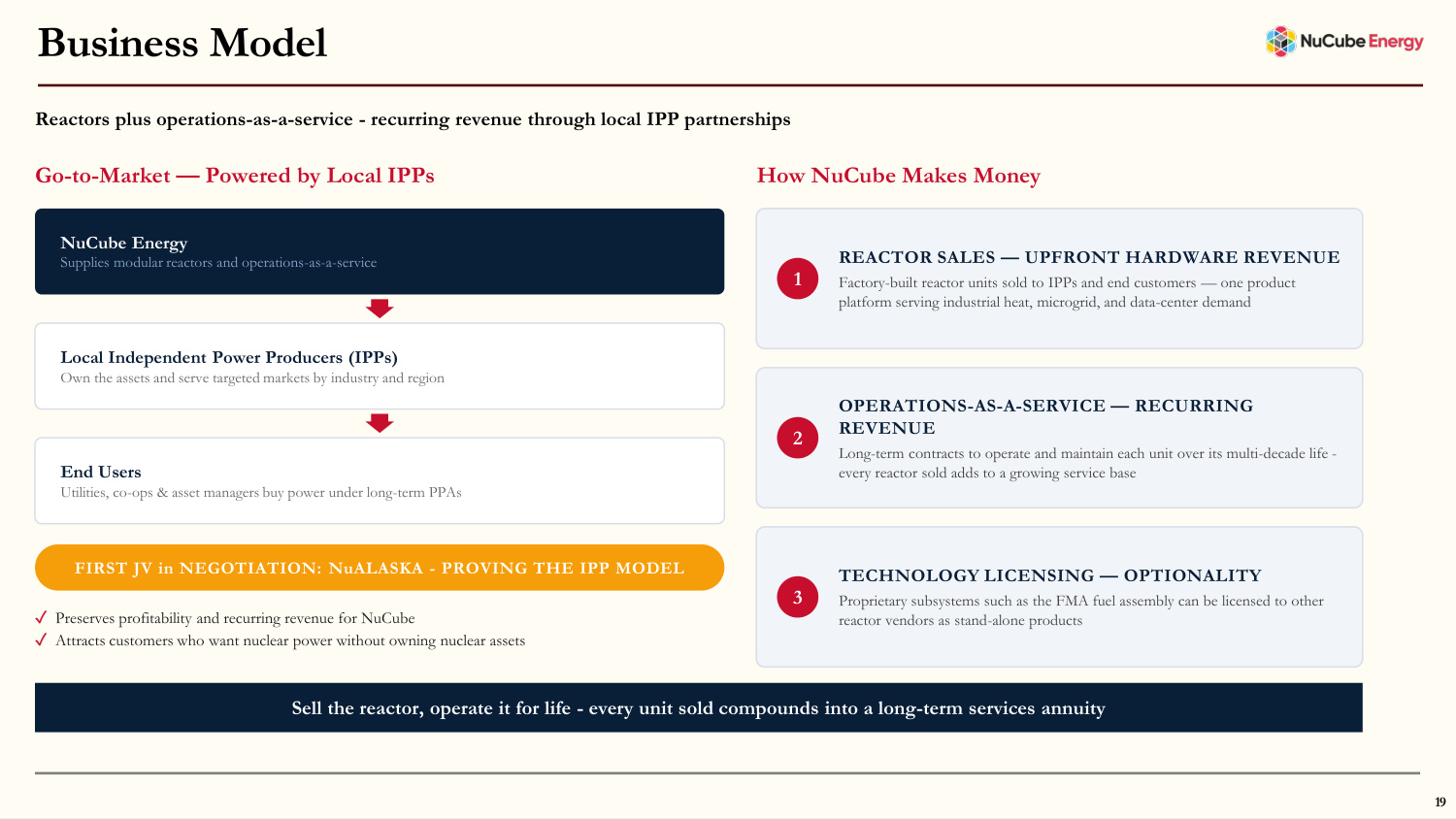
Business Model Reactors plus operations-as-a-service - recurring revenue through local IPP partnerships 19 Go-to-Market — Powered by Local IPPs How NuCube Makes Money NuCube Energy Supplies modular reactors and operations-as-a-service Local Independent Power Producers (IPPs) Own the assets and serve targeted markets by industry and region End Users Utilities, co-ops & asset managers buy power under long-term PPAs FIRST JV in NEGOTIATION: NuALASKA - PROVING THE IPP MODEL ✓Preserves profitability and recurring revenue for NuCube ✓Attracts customers who want nuclear power without owning nuclear assets REACTOR SALES — UPFRONT HARDWARE REVENUE Factory-built reactor units sold to IPPs and end customers — one product platform serving industrial heat, microgrid, and data-center demand 1 OPERATIONS-AS-A-SERVICE — RECURRING REVENUE Long-term contracts to operate and maintain each unit over its multi-decade life - every reactor sold adds to a growing service base 2 TECHNOLOGY LICENSING — OPTIONALITY Proprietary subsystems such as the FMA fuel assembly can be licensed to other reactor vendors as stand-alone products 3 Sell the reactor, operate it for life - every unit sold compounds into a long-term services annuity
II. Markets & Pipeline
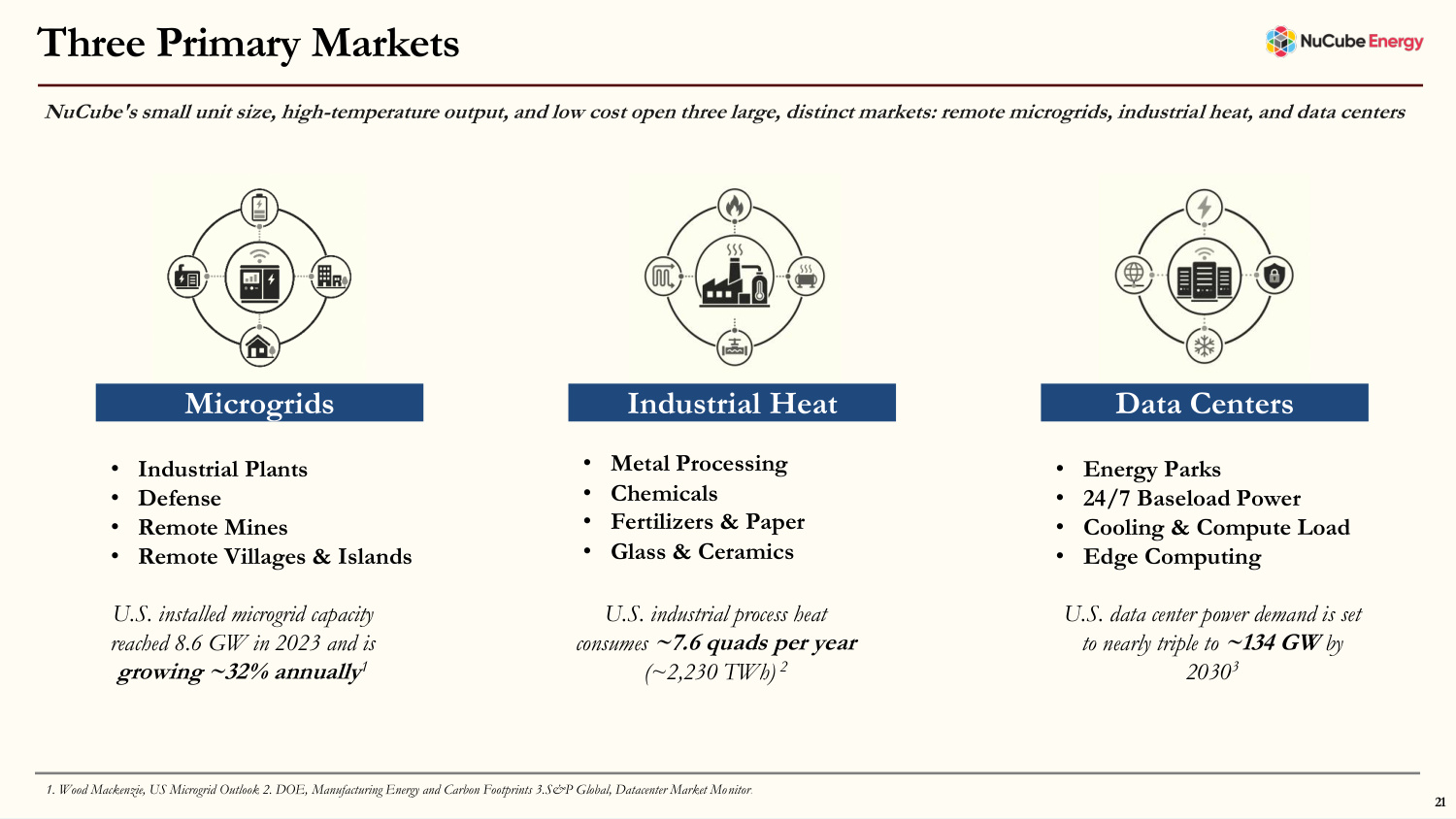
Three Primary Markets 21 NuCube's small unit size, high-temperature output, and low cost open three large, distinct markets: remote microgrids, industrial heat, and data centers 1. Wood Mackenzie, US Microgrid Outlook 2. DOE, Manufacturing Energy and Carbon Footprints 3.S&P Global, Datacenter Market Monitor. Microgrids • Industrial Plants • Defense • Remote Mines • Remote Villages & Islands Industrial Heat • Metal Processing • Chemicals • Fertilizers & Paper • Glass & Ceramics Data Centers • Energy Parks • 24/7 Baseload Power • Cooling & Compute Load • Edge Computing U.S. installed microgrid capacity reached 8.6 GW in 2023 and is growing ~32% annually1 U.S. data center power demand is set to nearly triple to ~134 GW by 20303 U.S. industrial process heat consumes ~7.6 quads per year (~2,230 TWh) 2
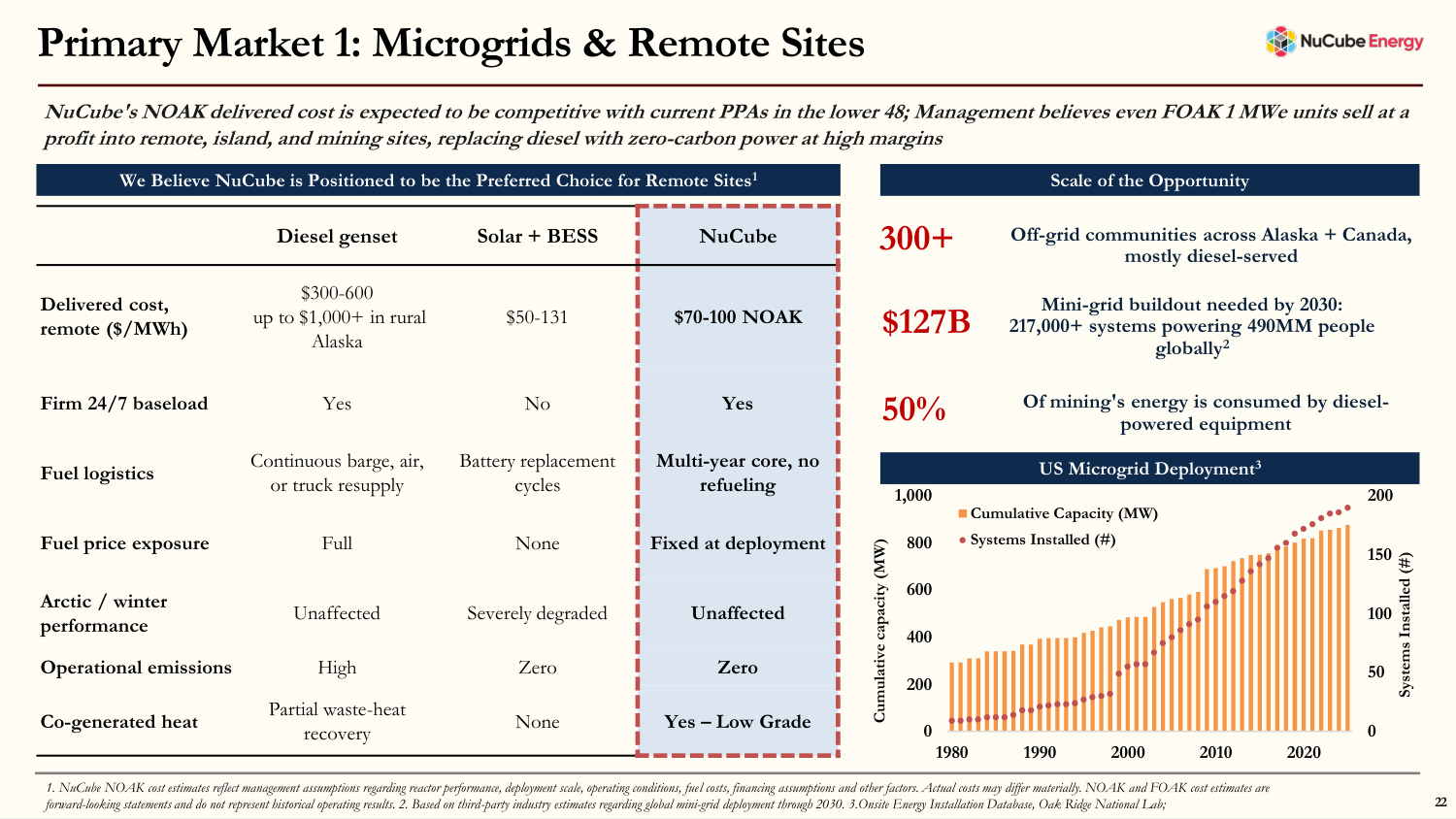
Primary Market 1: Microgrids & Remote Sites NuCube's NOAK delivered cost is expected to be competitive with current PPAs in the lower 48; Management believes even FOAK 1 MWe units sell at a profit into remote, island, and mining sites, replacing diesel with zero-carbon power at high margins 22 We Believe NuCube is Positioned to be the Preferred Choice for Remote Sites1 Scale of the Opportunity Off-grid communities across Alaska + Canada, mostly diesel-served 300+ Mini-grid buildout needed by 2030: 217,000+ systems powering 490MM people globally2 $127B Of mining's energy is consumed by diesel- powered equipment 50% Diesel genset Solar + BESS NuCube Delivered cost, remote ($/MWh) $300-600 up to $1,000+ in rural Alaska $50-131 $70-100 NOAK Firm 24/7 baseload Yes No Yes Fuel logistics Continuous barge, air, or truck resupply Battery replacement cycles Multi-year core, no refueling Fuel price exposure Full None Fixed at deployment Arctic / winter performance Unaffected Severely degraded Unaffected Operational emissions High Zero Zero Co-generated heat Partial waste-heat recovery None Yes – Low Grade 0 50 100 150 200 0 200 400 600 800 1,000 1980 1990 2000 2010 2020 Systems Installed (#) Cumulative capacity (MW) Cumulative Capacity (MW) Systems Installed (#) US Microgrid Deployment3 1. NuCube NOAK cost estimates reflect management assumptions regarding reactor performance, deployment scale, operating conditions, fuel costs, financing assumptions and other factors. Actual costs may differ materially. NOAK and FOAK cost estimates are forward-looking statements and do not represent historical operating results. 2. Based on third-party industry estimates regarding global mini-grid deployment through 2030. 3.Onsite Energy Installation Database, Oak Ridge National Lab;
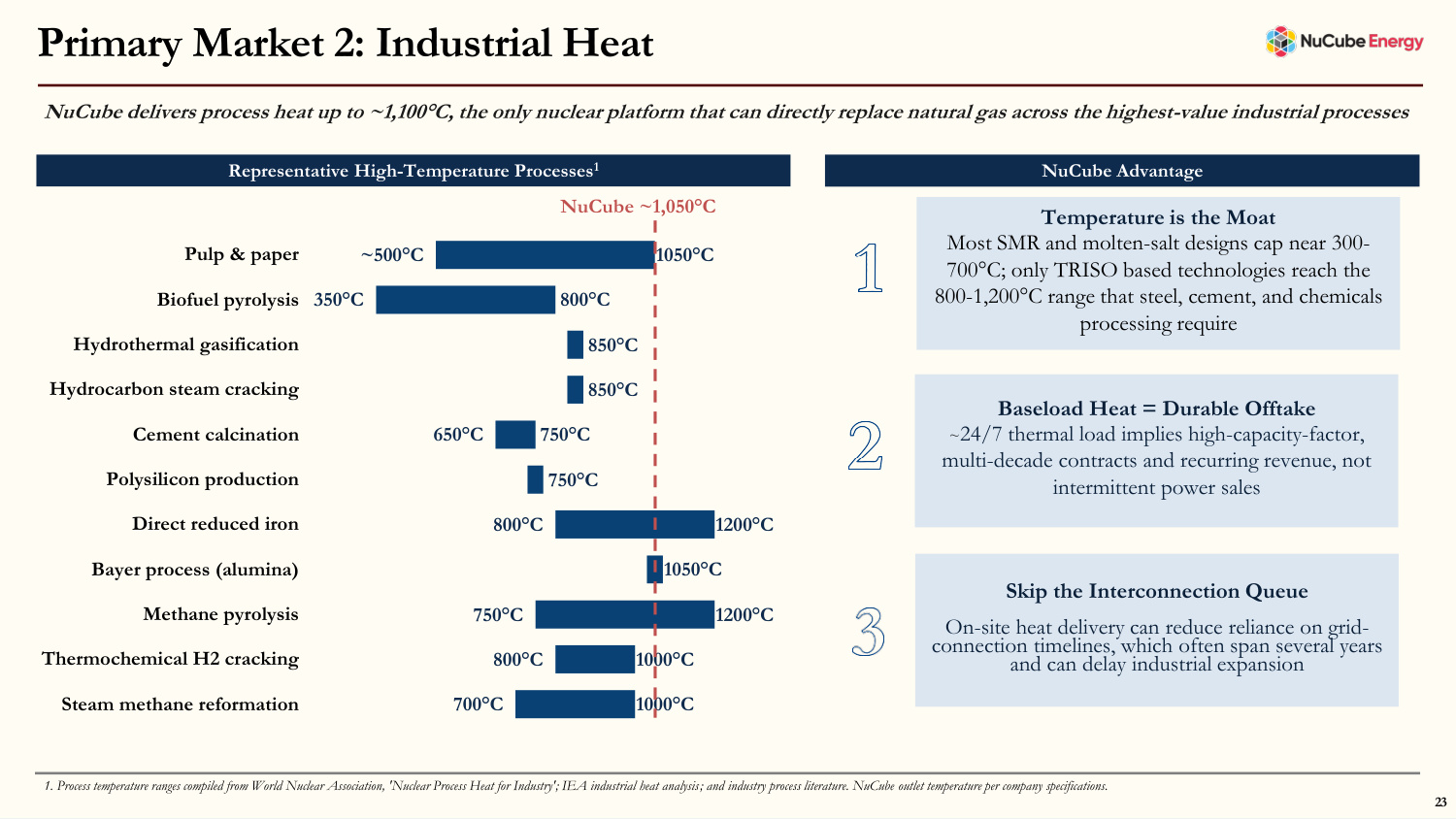
Primary Market 2: Industrial Heat 23 NuCube delivers process heat up to ~1,100°C, the only nuclear platform that can directly replace natural gas across the highest-value industrial processes Representative High-Temperature Processes1 NuCube Advantage Temperature is the Moat Most SMR and molten-salt designs cap near 300- 700°C; only TRISO based technologies reach the 800-1,200°C range that steel, cement, and chemicals processing require Baseload Heat = Durable Offtake ~24/7 thermal load implies high-capacity-factor, multi-decade contracts and recurring revenue, not intermittent power sales Skip the Interconnection Queue On-site heat delivery can reduce reliance on grid- connection timelines, which often span several years and can delay industrial expansion 700°C 800°C 750°C 800°C 650°C 350°C ~500°C 1000°C 1000°C 1200°C 1050°C 1200°C 750°C 750°C 850°C 850°C 800°C 1050°C Steam methane reformation Thermochemical H2 cracking Methane pyrolysis Bayer process (alumina) Direct reduced iron Polysilicon production Cement calcination Hydrocarbon steam cracking Hydrothermal gasification Biofuel pyrolysis Pulp & paper NuCube ~1,050°C 1. Process temperature ranges compiled from World Nuclear Association, 'Nuclear Process Heat for Industry'; IEA industrial heat analysis; and industry process literature. NuCube outlet temperature per company specifications.
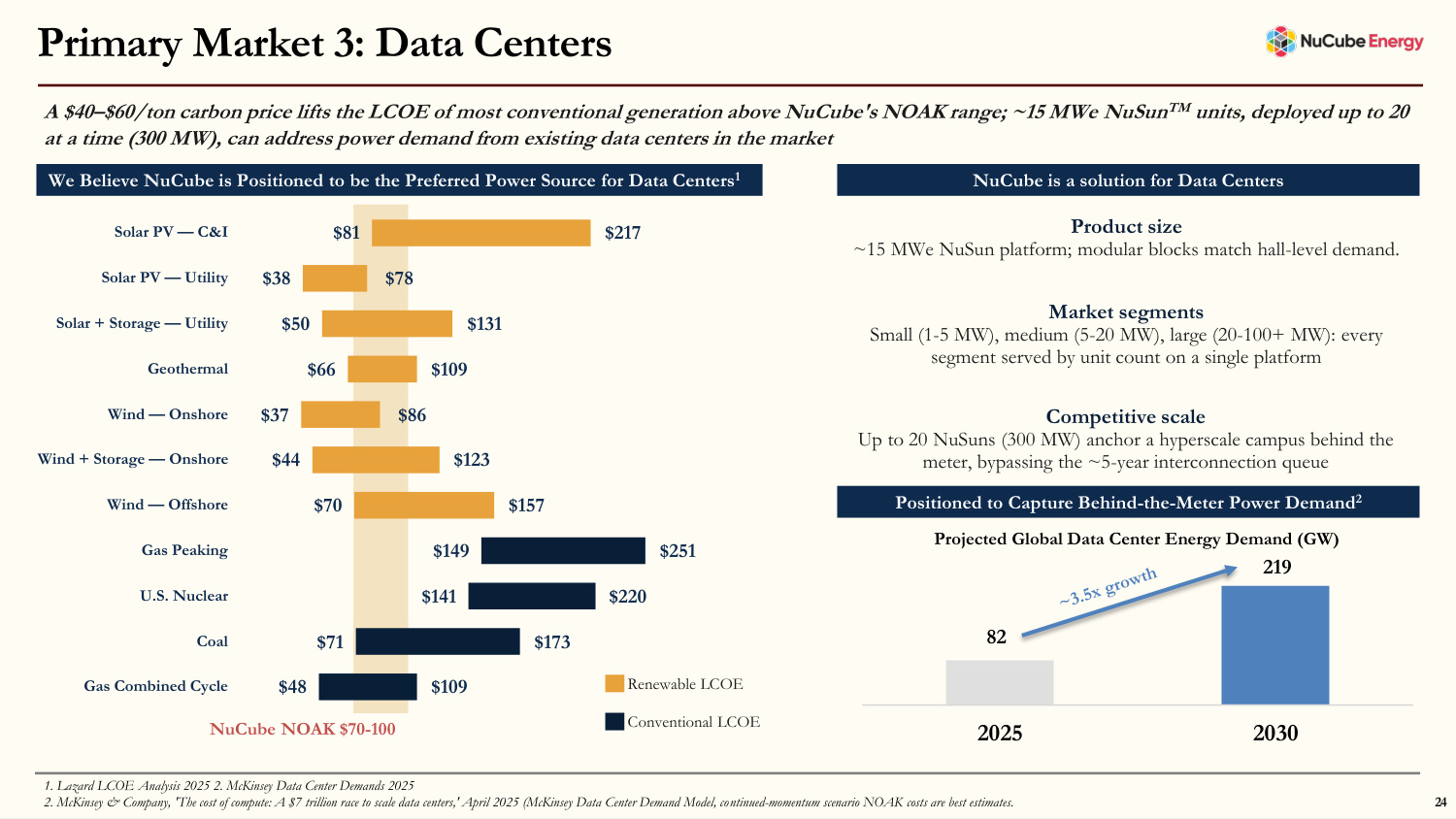
$48 $71 $141 $149 $70 $44 $37 $66 $50 $38 $81 $109 $173 $220 $251 $157 $123 $86 $109 $131 $78 $217 Gas Combined Cycle Coal U.S. Nuclear Gas Peaking Wind — Offshore Wind + Storage — Onshore Wind — Onshore Geothermal Solar + Storage — Utility Solar PV — Utility Solar PV — C&I Primary Market 3: Data Centers 24 A $40–$60/ton carbon price lifts the LCOE of most conventional generation above NuCube's NOAK range; ~15 MWe NuSunTM units, deployed up to 20 at a time (300 MW), can address power demand from existing data centers in the market 1. Lazard LCOE Analysis 2025 2. McKinsey Data Center Demands 2025 2. McKinsey & Company, 'The cost of compute: A $7 trillion race to scale data centers,' April 2025 (McKinsey Data Center Demand Model, continued-momentum scenario NOAK costs are best estimates. We Believe NuCube is Positioned to be the Preferred Power Source for Data Centers1 NuCube NOAK $70-100 Renewable LCOE Conventional LCOE NuCube is a solution for Data Centers Product size ~15 MWe NuSun platform; modular blocks match hall-level demand. Market segments Small (1-5 MW), medium (5-20 MW), large (20-100+ MW): every segment served by unit count on a single platform Competitive scale Up to 20 NuSuns (300 MW) anchor a hyperscale campus behind the meter, bypassing the ~5-year interconnection queue 82 219 2025 2030 Projected Global Data Center Energy Demand (GW) Positioned to Capture Behind-the-Meter Power Demand2
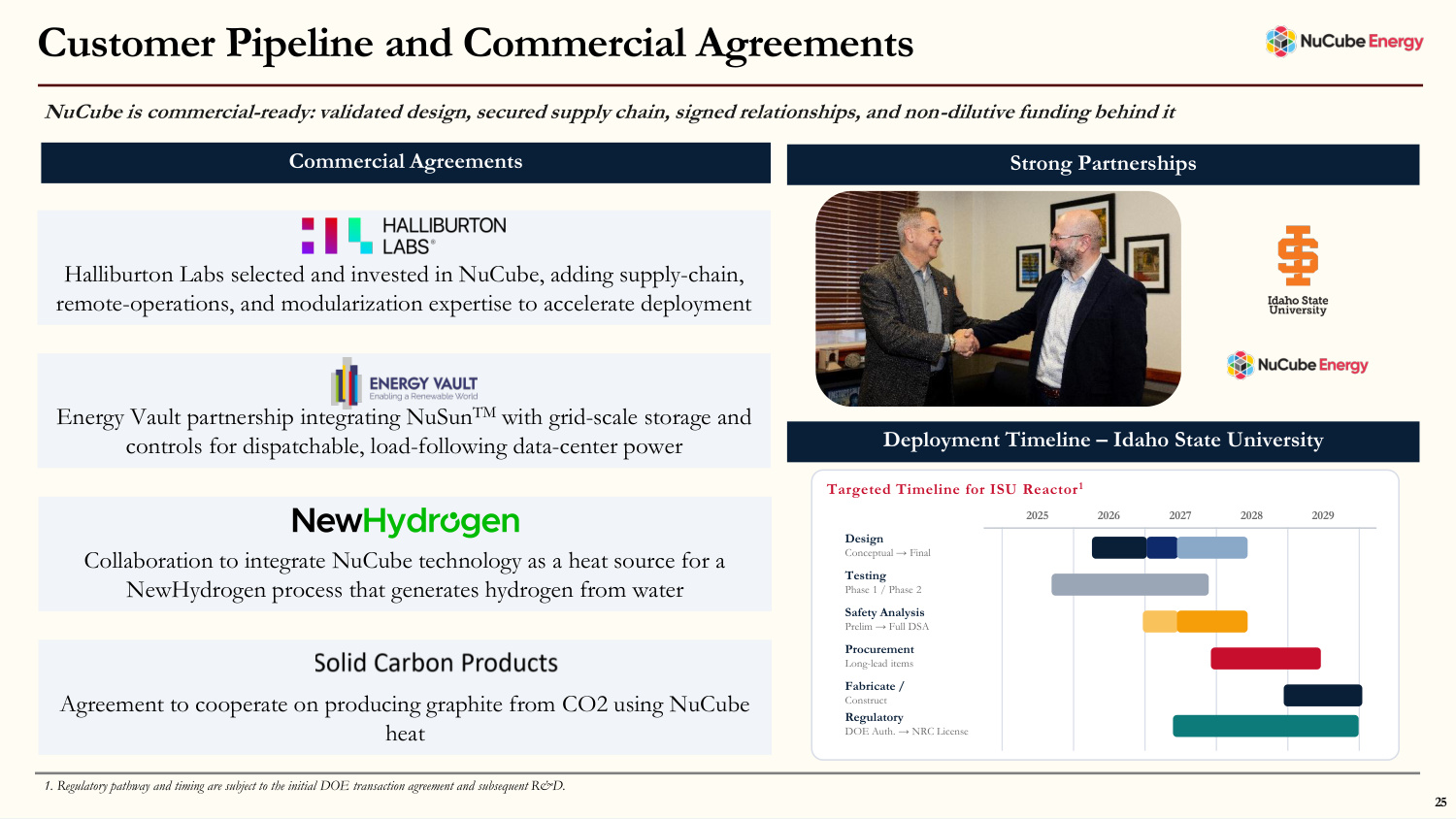
Customer Pipeline and Commercial Agreements 25 NuCube is commercial-ready: validated design, secured supply chain, signed relationships, and non-dilutive funding behind it Commercial Agreements Halliburton Labs selected and invested in NuCube, adding supply-chain, remote-operations, and modularization expertise to accelerate deployment Energy Vault partnership integrating NuSunTM with grid-scale storage and controls for dispatchable, load-following data-center power Collaboration to integrate NuCube technology as a heat source for a NewHydrogen process that generates hydrogen from water Deployment Timeline – Idaho State University Agreement to cooperate on producing graphite from CO2 using NuCube heat Strong Partnerships Targeted Timeline for ISU Reactor1 2025 2026 2027 2028 2029 Design Conceptual → Final Testing Phase 1 / Phase 2 Safety Analysis Prelim → Full DSA Procurement Long-lead items Fabricate / Construct Regulatory DOE Auth. → NRC License 1. Regulatory pathway and timing are subject to the initial DOE transaction agreement and subsequent R&D.
III. Transaction Overview
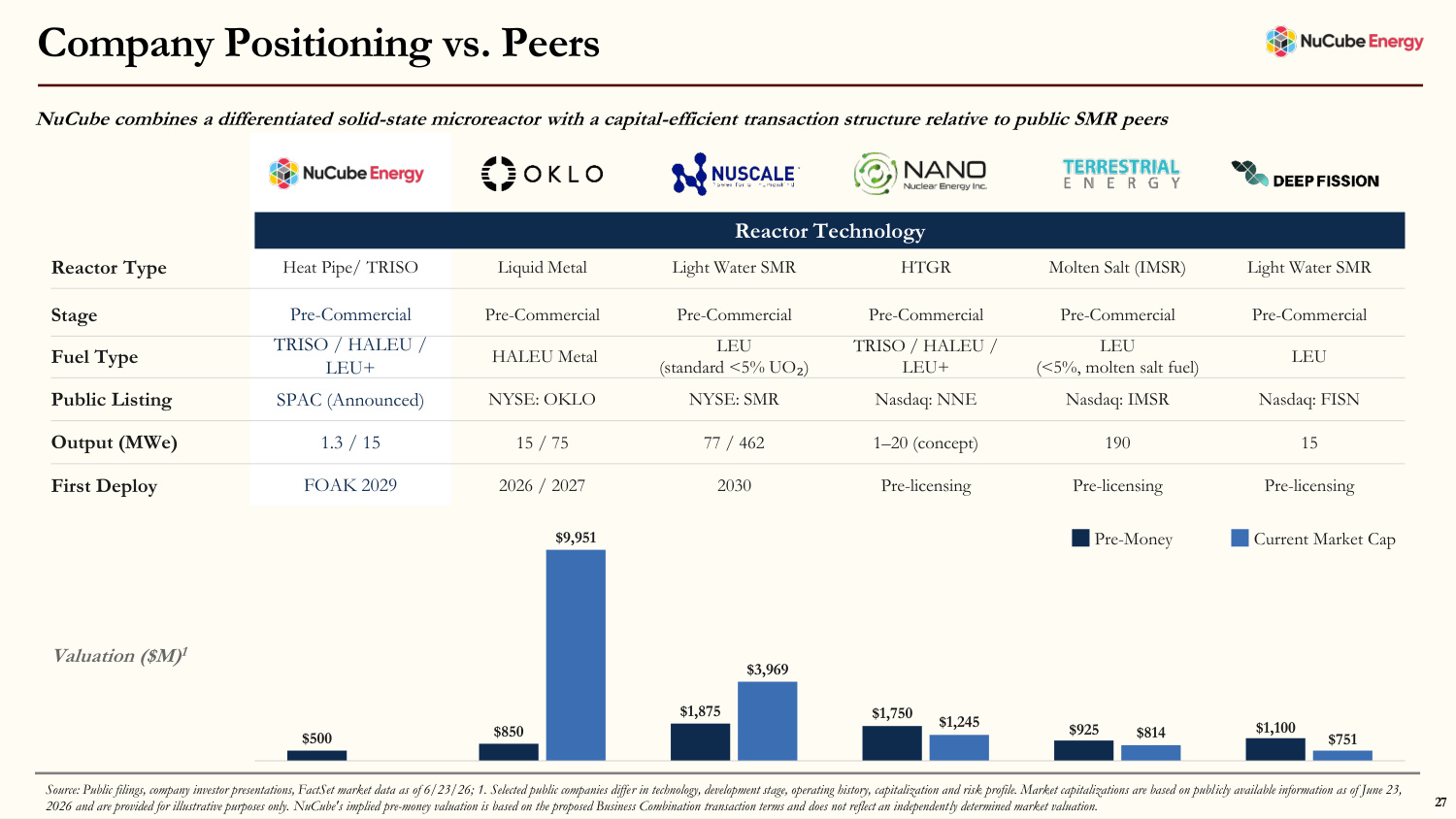
Company Positioning vs. Peers NuCube combines a differentiated solid-state microreactor with a capital-efficient transaction structure relative to public SMR peers 27 Valuation ($M)1 Pre-Money Current Market Cap $500 $850 $9,951 $1,875 $3,969 $1,750 $1,245 $925 $814 $1,100 $751 Reactor Technology Heat Pipe/ TRISO Liquid Metal Light Water SMR HTGR Molten Salt (IMSR) Light Water SMR Fuel Type TRISO / HALEU / LEU+ HALEU Metal LEU (standard <5% UO₂) TRISO / HALEU / LEU+ LEU (<5%, molten salt fuel) LEU Public Listing SPAC (Announced) NYSE: OKLO NYSE: SMR Nasdaq: NNE Nasdaq: IMSR Nasdaq: FISN Output (MWe) 1.3 / 15 15 / 75 77 / 462 1–20 (concept) 190 15 First Deploy FOAK 2029 2026 / 2027 2030 Pre-licensing Pre-licensing Pre-licensing Reactor Type Source: Public filings, company investor presentations, FactSet market data as of 6/23/26; 1. Selected public companies differ in technology, development stage, operating history, capitalization and risk profile. Market capitalizations are based on publicly available information as of June 23, 2026 and are provided for illustrative purposes only. NuCube's implied pre-money valuation is based on the proposed Business Combination transaction terms and does not reflect an independently determined market valuation. Stage Pre-Commercial Pre-Commercial Pre-Commercial Pre-Commercial Pre-Commercial Pre-Commercial
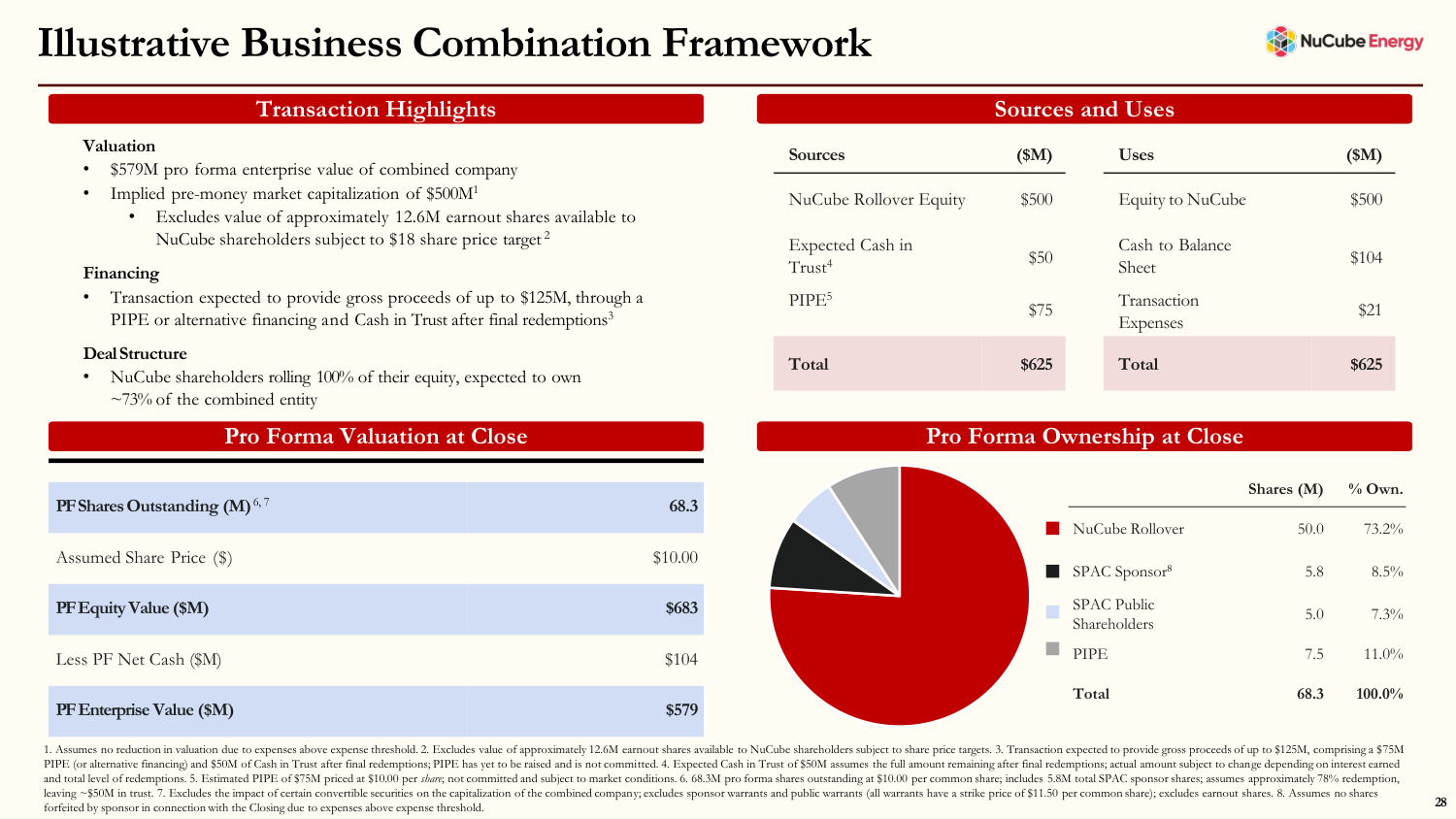
Illustrative Business Combination Framework 28 Transaction Highlights Sources and Uses Pro Forma Valuation at Close Pro Forma Ownership at Close Valuation • $579M pro forma enterprise value of combined company • Implied pre-money market capitalization of $500M1 • Excludes value of approximately 12.6M earnout shares available to NuCube shareholders subject to $18 share price target 2 Financing • Transaction expected to provide gross proceeds of up to $125M, through a PIPE or alternative financing and Cash in Trust after final redemptions3 DealStructure • NuCube shareholders rolling 100% of their equity, expected to own ~73% of the combined entity Uses ($M) Equity to NuCube $500 Cash to Balance Sheet $104 Transaction Expenses $21 Total $625 PFSharesOutstanding (M) 6, 7 68.3 Assumed Share Price ($) $10.00 PFEquityValue ($M) $683 Less PF Net Cash ($M) $104 PFEnterprise Value ($M) $579 1. Assumes no reduction in valuation due to expenses above expense threshold. 2. Excludes value of approximately 12.6M earnout shares available to NuCube shareholders subject to share price targets. 3. Transaction expected to provide gross proceeds of up to $125M, comprising a $75M PIPE (or alternative financing) and $50M of Cash in Trust after final redemptions; PIPE has yet to be raised and is not committed. 4. Expected Cash in Trust of $50M assumes the full amount remaining after final redemptions; actual amount subject to change depending on interest earned and total level of redemptions. 5. Estimated PIPE of $75M priced at $10.00 per share; not committed and subject to market conditions. 6. 68.3M pro forma shares outstanding at $10.00 per common share; includes 5.8M total SPAC sponsor shares; assumes approximately 78% redemption, leaving ~$50M in trust. 7. Excludes the impact of certain convertible securities on the capitalization of the combined company; excludes sponsor warrants and public warrants (all warrants have a strike price of $11.50 per common share); excludes earnout shares. 8. Assumes no shares forfeited by sponsor in connection with the Closing due to expenses above expense threshold. Sources ($M) NuCube Rollover Equity $500 Expected Cash in Trust4 $50 PIPE5 $75 Total $625 Shares (M) % Own. NuCube Rollover 50.0 73.2% SPAC Sponsor8 5.8 8.5% SPAC Public Shareholders 5.0 7.3% PIPE 7.5 11.0% Total 68.3 100.0%
IV. Appendix
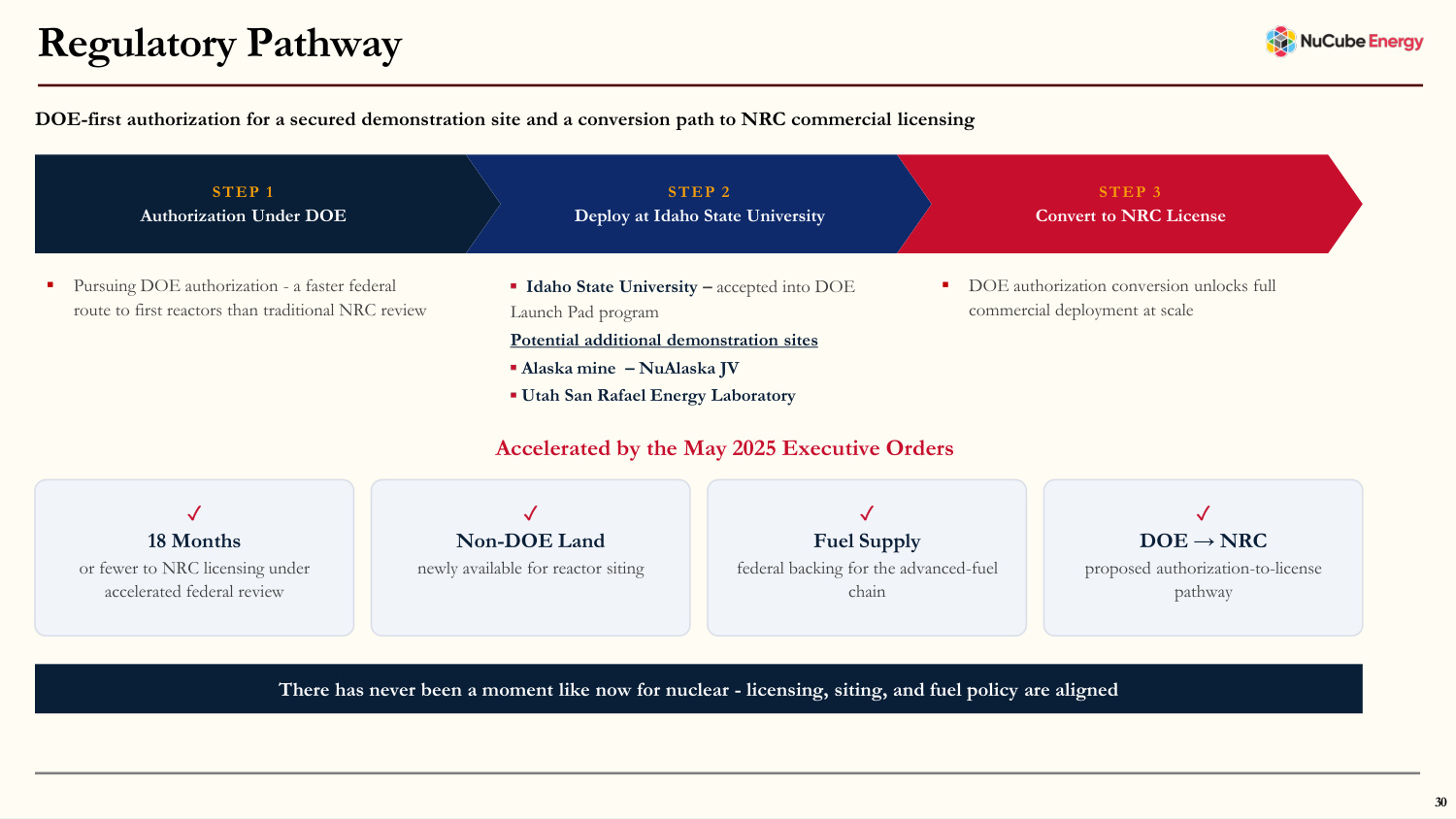
Regulatory Pathway DOE-first authorization for a secured demonstration site and a conversion path to NRC commercial licensing 30 STEP 1 Authorization Under DOE STEP 2 Deploy at Idaho State University STEP 3 Convert to NRC License ▪ Pursuing DOE authorization - a faster federal route to first reactors than traditional NRC review Idaho State University – accepted into DOE Launch Pad program Potential additional demonstration sites Alaska mine – NuAlaska JV Utah San Rafael Energy Laboratory ▪ DOE authorization conversion unlocks full commercial deployment at scale Accelerated by the May 2025 Executive Orders ✓ 18 Months or fewer to NRC licensing under accelerated federal review ✓ Non-DOE Land newly available for reactor siting ✓ Fuel Supply federal backing for the advanced-fuel chain ✓ DOE → NRC proposed authorization-to-license pathway There has never been a moment like now for nuclear - licensing, siting, and fuel policy are aligned
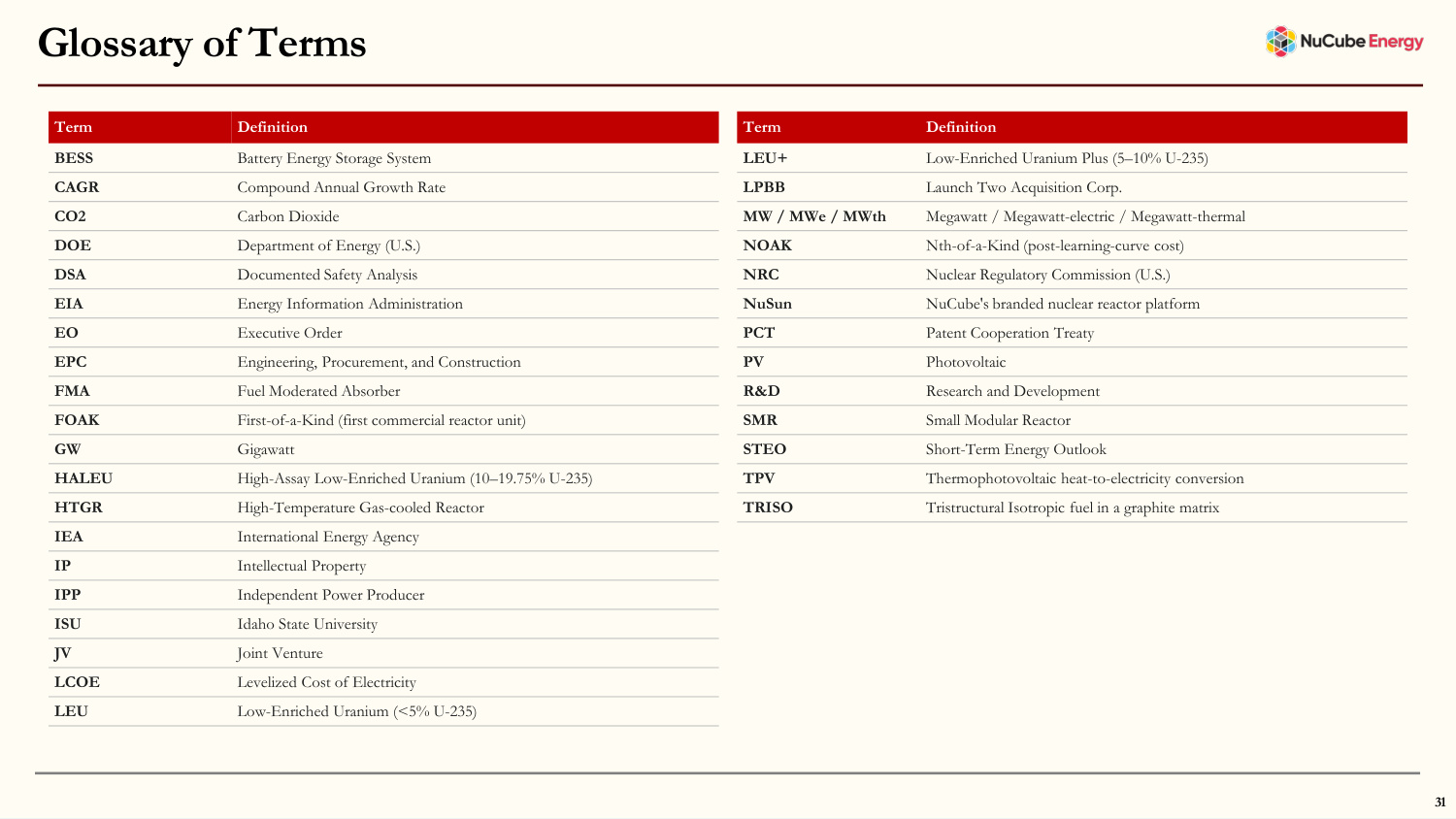
Glossary of Terms 31 Term Definition BESS Battery Energy Storage System CAGR Compound Annual Growth Rate CO2 Carbon Dioxide DOE Department of Energy (U.S.) DSA Documented Safety Analysis EIA Energy Information Administration EO Executive Order EPC Engineering, Procurement, and Construction FMA Fuel Moderated Absorber FOAK First-of-a-Kind (first commercial reactor unit) GW Gigawatt HALEU High-Assay Low-Enriched Uranium (10–19.75% U-235) HTGR High-Temperature Gas-cooled Reactor IEA International Energy Agency IP Intellectual Property IPP Independent Power Producer ISU Idaho State University JV Joint Venture LCOE Levelized Cost of Electricity LEU Low-Enriched Uranium (<5% U-235) Term Definition LEU+ Low-Enriched Uranium Plus (5–10% U-235) LPBB Launch Two Acquisition Corp. MW / MWe / MWth Megawatt / Megawatt-electric / Megawatt-thermal NOAK Nth-of-a-Kind (post-learning-curve cost) NRC Nuclear Regulatory Commission (U.S.) NuSun NuCube's branded nuclear reactor platform PCT Patent Cooperation Treaty PV Photovoltaic R&D Research and Development SMR Small Modular Reactor STEO Short-Term Energy Outlook TPV Thermophotovoltaic heat-to-electricity conversion TRISO Tristructural Isotropic fuel in a graphite matrix
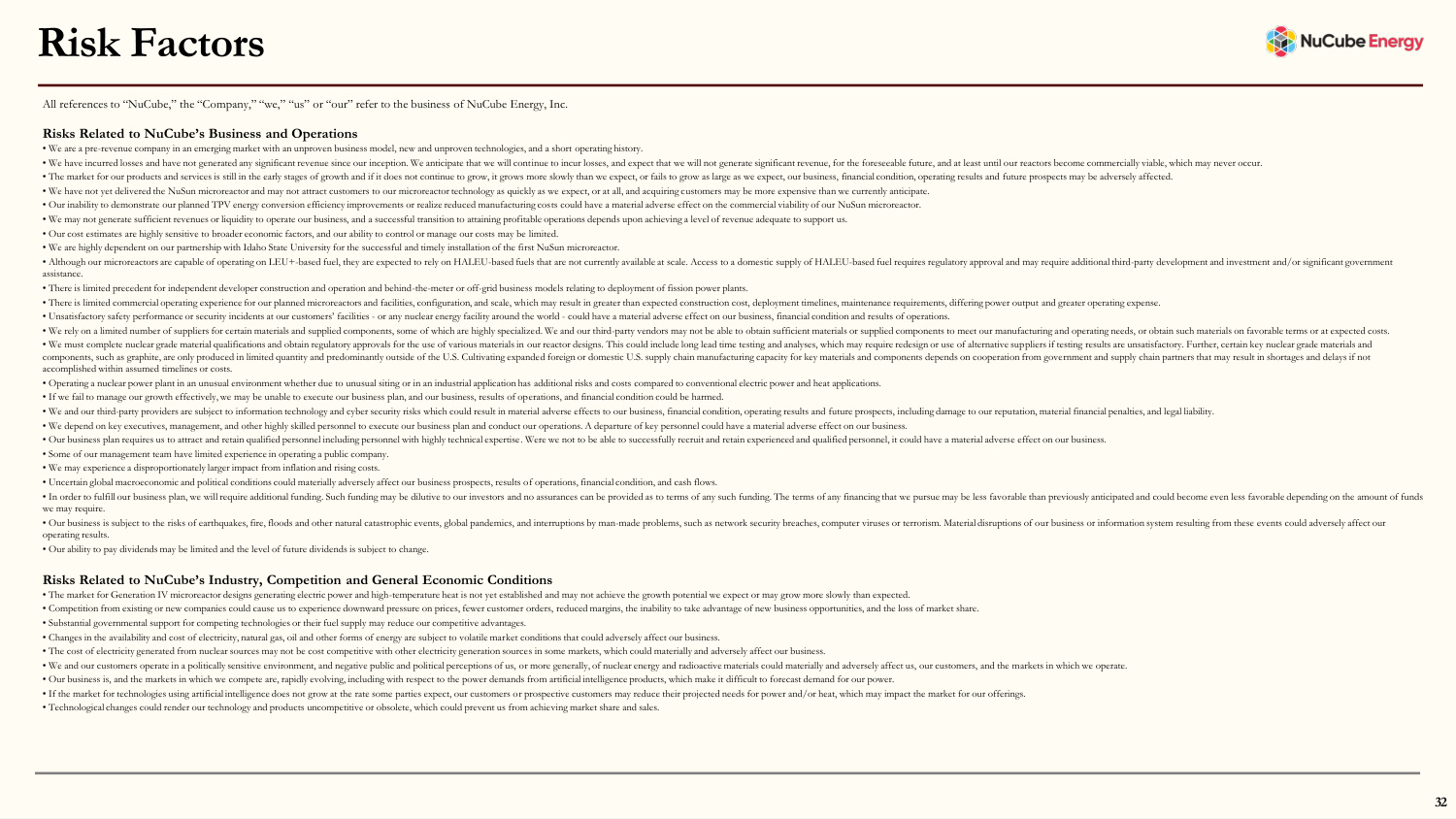
Risk Factors 32 All references to "NuCube," the "Company," "we," "us" or "our" refer to the business of NuCube Energy, Inc. Risks Related to NuCube's Business and Operations • We are a pre-revenue company in an emerging market with an unproven business model, new and unproven technologies, and a short operating history. • We have incurred losses and have not generated any significant revenue since our inception. We anticipate that we will continue to incur losses, and expect that we will not generate significant revenue, for the foreseeable future, and at least until our reactors become commercially viable, which may never occur. • The market for our products and services is still in the early stages of growth and if it does not continue to grow, it grows more slowly than we expect, or fails to grow as large as we expect, our business, financial condition, operating results and future prospects may be adversely affected. • We have not yet delivered the NuSun microreactor and may not attract customers to our microreactor technology as quickly as we expect, or at all, and acquiring customers may be more expensive than we currently anticipate. • Our inability to demonstrate our planned TPV energy conversion efficiency improvements or realize reduced manufacturing costs could have a material adverse effect on the commercial viability of our NuSun microreactor. • We may not generate sufficient revenues or liquidity to operate our business, and a successful transition to attaining profitable operations depends upon achieving a level of revenue adequate to support us. • Our cost estimates are highly sensitive to broader economic factors, and our ability to control or manage our costs may be limited. • We are highly dependent on our partnership with Idaho State University for the successful and timely installation of the first NuSun microreactor. • Although our microreactors are capable of operating on LEU+-based fuel, they are expected to rely on HALEU-based fuels that are not currently available at scale. Access to a domestic supply of HALEU-based fuel requires regulatory approval and may require additional third-party development and investment and/or significant government assistance. • There is limited precedent for independent developer construction and operation and behind-the-meter or off-grid business models relating to deployment of fission power plants. • There is limited commercial operating experience for our planned microreactors and facilities, configuration, and scale, which may result in greater than expected construction cost, deployment timelines, maintenance requirements, differing power output and greater operating expense. • Unsatisfactory safety performance or security incidents at our customers' facilities - or any nuclear energy facility around the world - could have a material adverse effect on our business, financial condition and results of operations. • We rely on a limited number of suppliers for certain materials and supplied components, some of which are highly specialized. We and our third-party vendors may not be able to obtain sufficient materials or supplied components to meet our manufacturing and operating needs, or obtain such materials on favorable terms or at expected costs. • We must complete nuclear grade material qualifications and obtain regulatory approvals for the use of various materials in our reactor designs. This could include long lead time testing and analyses, which may require redesign or use of alternative suppliers if testing results are unsatisfactory. Further, certain key nuclear grade materials and components, such as graphite, are only produced in limited quantity and predominantly outside of the U.S. Cultivating expanded foreign or domestic U.S. supply chain manufacturing capacity for key materials and components depends on cooperation from government and supply chain partners that may result in shortages and delays if not accomplished within assumed timelines or costs. • Operating a nuclear power plant in an unusual environment whether due to unusual siting or in an industrial application has additional risks and costs compared to conventional electric power and heat applications. • If we fail to manage our growth effectively, we may be unable to execute our business plan, and our business, results of operations, and financial condition could be harmed. • We and our third-party providers are subject to information technology and cyber security risks which could result in material adverse effects to our business, financial condition, operating results and future prospects, including damage to our reputation, material financial penalties, and legal liability. • We depend on key executives, management, and other highly skilled personnel to execute our business plan and conduct our operations. A departure of key personnel could have a material adverse effect on our business. • Our business plan requires us to attract and retain qualified personnel including personnel with highly technical expertise. Were we not to be able to successfully recruit and retain experienced and qualified personnel, it could have a material adverse effect on our business. • Some of our management team have limited experience in operating a public company. • We may experience a disproportionately larger impact from inflation and rising costs. • Uncertain global macroeconomic and political conditions could materially adversely affect our business prospects, results of operations, financial condition, and cash flows. • In order to fulfill our business plan, we will require additional funding. Such funding may be dilutive to our investors and no assurances can be provided as to terms of any such funding. The terms of any financing that we pursue may be less favorable than previously anticipated and could become even less favorable depending on the amount of funds we may require. • Our business is subject to the risks of earthquakes, fire, floods and other natural catastrophic events, global pandemics, and interruptions by man-made problems, such as network security breaches, computer viruses or terrorism. Material disruptions of our business or information system resulting from these events could adversely affect our operating results. • Our ability to pay dividends may be limited and the level of future dividends is subject to change. Risks Related to NuCube's Industry, Competition and General Economic Conditions • The market for Generation IV microreactor designs generating electric power and high-temperature heat is not yet established and may not achieve the growth potential we expect or may grow more slowly than expected. • Competition from existing or new companies could cause us to experience downward pressure on prices, fewer customer orders, reduced margins, the inability to take advantage of new business opportunities, and the loss of market share. • Substantial governmental support for competing technologies or their fuel supply may reduce our competitive advantages. • Changes in the availability and cost of electricity, natural gas, oil and other forms of energy are subject to volatile market conditions that could adversely affect our business. • The cost of electricity generated from nuclear sources may not be cost competitive with other electricity generation sources in some markets, which could materially and adversely affect our business. • We and our customers operate in a politically sensitive environment, and negative public and political perceptions of us, or more generally, of nuclear energy and radioactive materials could materially and adversely affect us, our customers, and the markets in which we operate. • Our business is, and the markets in which we compete are, rapidly evolving, including with respect to the power demands from artificial intelligence products, which make it difficult to forecast demand for our power. • If the market for technologies using artificial intelligence does not grow at the rate some parties expect, our customers or prospective customers may reduce their projected needs for power and/or heat, which may impact the market for our offerings. • Technological changes could render our technology and products uncompetitive or obsolete, which could prevent us from achieving market share and sales.
Risk Factors (Cont.) 33 Risks Related to NuCube's Intellectual Property Rights • We rely heavily on our intellectual property portfolio. Our ability to protect our patents and other intellectual property rights may be challenged and is not guaranteed. If we are unable to protect our intellectual property rights, our business and competitive position may be harmed. • We currently enjoy only limited geographical protection with respect to certain issued patents and may not be able to protect our intellectual property rights throughout the world. • We may need to defend ourselves against intellectual property infringement claims, which may be time-consuming and could cause us to incur substantial fees and costs. • We may be subject to claims of ownership and other rights to our patents and other intellectual property by third parties. Risks Related to Compliance with Law, Government Regulation and Litigation • The NuSun microreactor design has not yet been approved or licensed for use at any site by the DOE or NRC, and approval or licensing of our design is not guaranteed. • Our business is subject to the policies, priorities, regulations and mandates of multiple governmental entities and may be negatively or positively impacted by any change thereto. • The reduction or elimination of favorable tax treatment for certain clean energy projects and technologies under the Inflation Reduction Act of 2022, as amended by the One Big Beautiful Bill Act of 2025, (i.e., Section 48C Qualifying Advanced Energy Project Credit ("48C"), investment tax credits ("48E") and production tax credits ("45Y") could adversely affect our business and reduce the demand for our NuSun microreactor. • Changes in governmental agency budgets as well as staffing shortages at national laboratories and other governmental agencies may lengthen our estimated timelines for regulatory approval and construction. • The U.S. government's budget deficit and the national debt, as well as any inability of the U.S. government to complete its budget or appropriations process for any government fiscal year could have an adverse impact on our business, results of operations, and financial condition. • We and our suppliers are subject to stringent U.S. export and import control laws and regulations and analogous laws and regulations in other jurisdictions. Unfavorable changes in these laws and regulations or U.S. government or other relevant government licensing policies, our failure to secure timely U.S. government or other relevant government authorizations under such laws and regulations, or our failure to comply with such laws and regulations could have a material adverse effect on our business prospects, financial condition, results of operations and cash flows. • Our ability to rely on global supply chains for source components and/or raw materials may be impacted by tariffs, trade disputes, or other changes in trade policy or trade regulation. • Our operations involve the use, transportation and disposal of toxic, hazardous and/or radioactive materials and could result in liability without regard to fault or negligence. • Unresolved spent nuclear fuel storage and disposal issues and associated costs could have a significant negative impact on NuCube's business operations if potential NuSun customers view the risks associated with these issues and costs as unacceptably high. Additionally, U.S. policy related to storage and disposal of used fuel from our power plant and/or negative customer perception of risks relating to these policies could have a significant negative impact on our business prospects, financial condition, results of operations and cash flows. • We may pursue government awards involving cost-share related to our research and development work, which could be affected by our failure to comply with certain laws and regulations. • Our microreactors may not qualify as low-emissions or emissions-free pursuant to regulatory or incentive frameworks that consider emissions on a lifecycle basis or that otherwise account for fuel cycle emissions or energy consumption. • Our business plan includes the use of investment tax credits, production tax credits, and other forms of government funding to finance the commercial development of our microreactors, and there is no guarantee that our projects will qualify for these credits or that government funding will be available in the future. • We could incur substantial costs as a result of violations of, or liabilities under, environmental laws. Risks Related to SPAC and the Proposed Business Combination • The ability of SPAC shareholders to exercise redemption rights with respect to a large number of public shares, the terms of the proposed Business Combination and other factors may not allow SPAC to complete the proposed Business Combination or optimize its capital structure. • There is no assurance that SPAC's diligence will reveal all material risks that may be present with regard to NuCube. If SPAC's due diligence investigation was inadequate, shareholders of SPAC and the Combined Company could lose some or all of their investment. • Past performance by any member of the SPAC management team or the board of directors of SPAC, the SPAC's sponsor (the "Sponsor") or any of their respective affiliates, may not be indicative of future performance of an investment in SPAC or the Combined Company. • SPAC's Sponsor, directors and officers have potential conflicts of interest in recommending that SPAC shareholders vote in favor of the proposed Business Combination. • If the proposed Business Combination is not approved and SPAC does not consummate another initial business combination by its deadline, then the Sponsor's shares and warrants of SPAC will become worthless and the expenses it has incurred will not be reimbursed. These interests may influence the Sponsor's decision to approve the proposed Business Combination. • SPAC's Sponsor, directors and officers have agreed to vote in favor of the proposed Business Combination, which will increase the likelihood that the SPAC will receive the requisite shareholder approval of the proposed Business Combination. • SPAC may not have valued NuCube's business and prospects accurately, which could affect trading prices of the Combined Company's common stock after closing. • The proposed Business Combination and the transactions contemplated thereby may be approved regardless of how SPAC's public shareholders vote. Holders of SPAC founder shares, including SPAC's Sponsor, directors and officers and any of their respective affiliates, may receive a positive return on such shares, even if SPAC's public shareholders experience a negative return on their investment after the consummation of the proposed Business Combination. • SPAC and NuCube will incur significant transaction and transition costs in connection with the proposed Business Combination, which will limit the amount of proceeds, if any, from the proposed Business Combination and any related financing transactions available to the Combined Company to carry out its business plans. • If the conditions to the proposed Business Combination are not met, the proposed Business Combination may not occur. • The Business Combination Agreement contains provisions that limit SPAC from seeking an alternative business combination. • The Combined Company will need to satisfy initial listing requirements of the national securities exchange on which the Combined Company's shares are listed at Closing, its status as a "shell company" may impact the Combined Company's ability to maintain compliance with exchange listing requirements and restrict reliance on certain rules or forms in connection with the offering, sale or resale of securities. • SPAC's shareholders will experience significant dilution as a consequence of the proposed Business Combination and related financings, if any. • SPAC and its shareholders will not have the protection of any indemnification, escrow, price adjustment or other provisions that allow for a post-closing adjustment to be made to the total merger consideration in the event that any of the representations and warranties in the Business Combination Agreement made by NuCube or any other party thereto ultimately proves to be inaccurate or incorrect.
Risk Factors (Cont.) 34 Risks Related to Operating as a Public Company • Future sales and issuances of the Combined Company's common stock or rights to purchase common stock, including pursuant to equity incentive plans, in connection with strategic or commercial transactions and future capital raise or other financing transactions, if any, may result in material dilution of the percentage ownership of the Combined Company's stockholders and could cause the Combined Company's stock price to decline. • If the Combined Company experiences significant fluctuations in its operating results, the market price of its common stock may fall rapidly and without advance notice • There can be no assurances that a liquid trading market for the Combined Company's common stock will develop or be maintained after closing of the proposed Business Combination. • Redemptions by SPAC public shareholders prior to or in connection with the Closing will reduce proceeds from the SPAC trust account available to NuCube from the proposed Business Combination. • NuCube has not previously been a public company and some of NuCube's management have limited experience in operating a public company. • Operating as a public company will require significant management attention and increased costs, which may strain resources and divert focus from executing NuCube's business strategy. • The Combined Company will incur significant expenses and administrative burdens as a public company, which could have an adverse effect on the Combined Company's business, financial condition, and results of operations. • The Combined Company will be required to develop and maintain proper and effective internal control over financial reporting. • The Combined Company will need to hire additional personnel to satisfy its public reporting and other obligations. • The Combined Company is expected to qualify as an emerging growth company and smaller reporting company, eligible for exemptions from certain disclosure requirements. The reduced disclosure may provide less information to investors, limiting comparability to common stock of other similar companies and reduce demand for, and the trading price of, the Combined Company's common stock. • If analysts publish unfavorable reports or do not provide research coverage of the Combined Company's common stock, the trading price and liquidity of the Combined Company's common stock may be adversely affected. • There can be no assurance that the Combined Company will be able to comply with the continued listing standards of the national securities exchange on which Combined Company shares are listed. For additional risks relating to SPAC operations, see the section titled "Risk Factors" contained in (i) SPAC's registration statement on Form S-1 dated October 7, 2024, filed with the U.S. Securities and Exchange Commission (the "SEC") on October 8, 2024, (the "Registration Statement"), (ii) Annual Report on Form 10-K for the year ended December 31, 2025, filed with the SEC on March 27, 2026, (iii) Quarterly Report on Form 10-Q for the quarterly periods ended March 31, 2026 filed with the SEC on May 13, 2025, and (iv) other filings with the SEC. As of the date of this Presentation, there have been no material changes to such risk factors. Any of these previously disclosed risk factors could result in a significant or material adverse effect on the SPAC's results of operations or financial condition. Additional risks not presently known to the SPAC or that the SPAC currently deem immaterial may also adversely affect its business, financial condition, results of operations or ability to consummate the proposed Business Combination. SPAC may disclose changes to such risk factors or additional risk factors from time to time in its future filings with the SEC.