Jun. 25, 2026
The Fund’s investment objective is to provide protection from the negative effects of unanticipated inflation.
This table describes the fees and expenses that you may pay if you buy, hold and sell shares of the Fund.
The table and Examples below do not reflect any transaction fees that may be charged by financial intermediaries or commissions that a shareholder may be required to pay directly to its financial intermediary when buying or selling Class Y or Class R6 shares. You may qualify for sales charge discounts if you and your family invest, or agree to invest in the future, at least $100,000 in the Invesco Funds. More information about these and other discounts is available from your financial professional and in the section “Shareholder Account Information – Initial Sales Charges (Class A Shares Only)” on page A-3 of the prospectus and the section “Purchase, Redemption and Pricing of Shares-Purchase and Redemption of Shares” on page L-1 of the statement of additional information (SAI).
| Shareholder Fees (fees paid directly from your investment) | |||||
| Class: | A | A2 | Y | R5 | R6 |
| Maximum Sales Charge (Load) Imposed on Purchases (as a percentage of offering price) | 2.50 % | 1.00 % | None | None | None |
| | |||||
| Maximum Deferred Sales Charge (Load) (as a percentage of original purchase price or redemption proceeds, whichever is less) | None1 | None | None | None | None |
| | |||||
| Annual Fund Operating Expenses (expenses that you pay each year as a percentage of the value of your investment) | |||||
| Class: | A | A2 | Y | R5 | R6 |
| Management Fees | 0.20 % | 0.20 % | 0.20 % | 0.20 % | 0.20 % |
| | |||||
| Distribution and/or Service (12b-1) Fees | 0.25 | 0.15 | None | None | None |
| | |||||
| Other Expenses | 0.21 | 0.21 | 0.21 | 0.12 | 0.11 |
| | |||||
| Total Annual Fund Operating Expenses | 0.66 | 0.56 | 0.41 | 0.32 | 0.31 |
| | |||||
| Fee Waiver and/or Expense Reimbursement2 | 0.06 | 0.06 | 0.06 | 0.01 | 0.05 |
| | |||||
| Total Annual Fund Operating Expenses After Fee Waiver and/or Expense Reimbursement | 0.60 | 0.50 | 0.35 | 0.31 | 0.26 |
| | |||||
| 1 | A contingent deferred sales charge may apply in some cases. See “Shareholder Account Information-Contingent Deferred Sales Charges (CDSCs).” |
| 2 | Invesco Advisers, Inc. (Invesco or the Adviser) has contractually agreed, through June 30, 2026, to waive advisory fees and/or reimburse expenses to the extent necessary to limit Total Annual Fund Operating Expenses After Fee Waiver and/or Expense Reimbursement (excluding certain items discussed in the SAI) of Class A, Class A2, Class Y, Class R5 and Class R6 shares to 0.55%, 0.45%, 0.30%, 0.30% and 0.30%, respectively, of the Fund’s average daily net assets (the “expense limits”). Effective July 1, 2026, the Adviser has contractually agreed to waive advisory fees and/or reimburse expenses to the extent necessary to limit Total Annual Fund Operating Expenses After Fee Waiver and/or Expense Reimbursement (excluding certain items discussed in the SAI) of Class A, Class A2, Class Y, Class R5 and Class R6 shares to 0.60%, 0.50%, 0.35%, 0.31% and 0.26%, respectively, of the Fund’s average daily net assets. Unless Invesco continues the fee waiver agreement, it will terminate on June 30, 2027. During its term, the fee waiver agreement cannot be terminated or amended to increase the expense limits without approval of the Board of Trustees. |
This Example is intended to help you compare the cost of investing in the Fund with the cost of investing in other mutual funds.
The Example assumes that you invest $10,000 in the Fund for the time periods indicated and then redeem all of your shares at the end of those periods. This Example does not include commissions and/or other forms of compensation that investors may pay on transactions in Class Y and Class R6 shares. The Example also assumes that your investment has a 5% return each year and that the Fund’s operating expenses remain equal to the Total
Annual Fund Operating Expenses After Fee Waiver and/or Expense Reimbursement in the first year and the Total Annual Fund Operating Expenses thereafter.
Although your actual costs may be higher or lower, based on these assumptions, your costs would be:
|
|
1 Year
|
3 Years
|
5 Years
|
10 Years
|
|
Class A
|
$310 |
$450 |
$603 |
$1,046 |
|
|
||||
|
Class A2
|
$151 |
$272 |
$404 |
$789 |
|
|
||||
|
Class Y
|
$36 |
$126 |
$224 |
$512 |
|
|
||||
|
Class R5
|
$32 |
$102 |
$179 |
$405 |
|
|
||||
|
Class R6
|
$27 |
$95 |
$169 |
$388 |
|
|
||||
The Fund pays transaction costs, such as commissions, when it buys and sells securities (or “turns over” its portfolio). A higher portfolio turnover rate may indicate higher transaction costs and may result in higher taxes when Fund shares are held in a taxable account. These costs, which are not reflected in annual fund operating expenses or in the Example, affect the Fund’s performance. During the most recent fiscal year, the Fund’s portfolio turnover rate was 41% of the average value of its portfolio.
The Fund invests under normal circumstances at least 80% of its net assets (plus any borrowings for investment purposes) in the component securities of the ICE BofA 1-5 Year US Inflation-Linked Treasury Index (the Index) and in derivatives and other instruments that have economic characteristics similar to such securities. For purposes of the Fund’s 80% investment policy, the Fund considers the components of the index to be short duration inflation-protected securities. The Index is comprised of U.S. Treasury Inflation-Protected Securities (TIPS) with at least $1 billion in outstanding face value, at least 18 months to maturity at point of issuance, and a remaining term to final maturity of at least 1 year and less than 5 years at the time of index rebalancing. The Fund can also invest the remainder of its assets in fixed income securities that are not included in the Index, but which the Fund’s investment adviser, Invesco Advisers, Inc. (Invesco or the Adviser), believes will help the Fund track the Index. The Fund generally expects that its duration, yield and maturity will be substantially similar to those of the Index.
The Fund normally seeks to maintain an average portfolio effective duration that is within +/- 1 year of the duration of the Index, which was 1.78 years as of February 28, 2026.
TIPS are publicly issued, U.S dollar denominated, U.S. government debt securities issued by the U.S. Treasury that have principal and interest payments linked to official inflation (as measured by the Consumer Price Index or CPI) and their payments are supported by the full faith and credit of the United States. As of February 28, 2026, there were 20 TIPS in the Index.
The Fund can invest in derivative instruments, such as swap contracts, options and futures contracts, to seek exposure to certain securities or groups of securities included in the Index.
Derivatives and other instruments that provide investment exposure to the investments that are the subject of the 80% investment policy stated above and derivatives that provide investment exposure to one or more market risk factors associated with such investments may be included in the Fund's 80% investment policy.
The Fund may purchase and sell securities on a when-issued, delayed delivery or forward commitment basis, which means that the Fund buys or sells a security with payment and delivery taking place in the future.
The portfolio manager primarily uses a replication strategy to track, as closely as possible, the securities in the Index and their respective weightings, by investing directly in securities that make up the Index. The
portfolio manager adjusts the composition of the Fund to reflect changes in the composition of the Index generally at each rebalance of the Index. The Fund may also use a representative sampling methodology to track the performance of the Index. Representative sampling means that the portfolio manager may use a quantitative analysis to select either a subset of the securities that make up the Index or a combination of some or all of the securities that make up the Index and other securities that are not part of the Index. In either case, the representative sampling of securities selected by the portfolio manager should have, in the aggregate, investment characteristics that are similar to the Index in terms of key risk factors, performance attributes and other characteristics, such as market capitalization, duration, maturity, credit quality, yield and coupon, as applicable. It is expected that the portfolio manager will use this representative sampling methodology where it is difficult to acquire the necessary securities that make up the Index, where the asset levels of the Fund do not allow for the holding of all the securities that make up the Index or where it is otherwise beneficial to the Fund to do so.
Unlike many investment companies, the Fund does not utilize an investment strategy that attempts to outperform the Index. Rather, the Fund utilizes an indexing approach, which may eliminate the chance that the Fund will substantially outperform the Index, but it may also reduce some of the risk of active management. Indexing generally achieves lower costs by keeping portfolio turnover low in comparison to actively managed investment companies.
The bar chart and performance table provide an indication of the risks of investing in the Fund. The bar chart shows changes in the performance of the Fund from year to year as of December 31. The performance table compares the Fund’s performance to that of a broad measure of market performance and one or more additional indices with characteristics relevant to the Fund. The Fund's past performance (before and after taxes) is not necessarily an indication of its future performance.
Fund performance reflects any applicable fee waivers and expense reimbursements. Performance returns would be lower without applicable fee waivers and expense reimbursements.
All Fund performance shown assumes the reinvestment of dividends and capital gains and the effect of the Fund’s expenses.
Updated performance information is available on the Fund's website at www.invesco.com/us.
The bar chart does not reflect sales loads. If it did, the annual total returns shown would be lower.
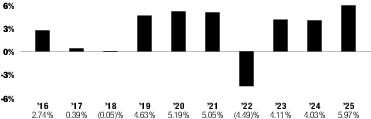
| Class A2 | Period Ended | Returns |
| Year-to-date | March 31, 2026 | 0.85% |
| Best Quarter | March 31, 2025 | 3.29% |
| Worst Quarter | September 30, 2022 | -3.28% |
| | Inception Date | 1 Year | 5 Years | 10 Years |
| Class A2 | | | | |
| Return Before Taxes | 12/15/1987 | 4.90 % | 2.65 % | 2.61 % |
| Return After Taxes on Distributions | | 3.13 | 0.96 | 1.40 |
| Return After Taxes on Distributions and Sale of Fund Shares | | 2.89 | 1.29 | 1.47 |
| | ||||
| Class A | 10/31/2002 | 3.24 | 2.23 | 2.33 |
| | ||||
| Class Y | 10/3/2008 | 6.12 | 3.02 | 2.86 |
| | ||||
| Class R5 | 7/13/1987 | 6.12 | 3.02 | 2.87 |
| | ||||
| Class R6 | 12/31/2015 | 6.12 | 3.02 | 2.87 |
| | ||||
| ICE BofA 1-5 Year US Inflation-Linked Treasury Index (reflects no deduction for fees, expenses or taxes) | | 6.46 | 3.30 | 3.15 |
| | ||||
| Bloomberg U.S. Aggregate Bond Index (reflects no deduction for fees, expenses or taxes) | | 7.30 | -0.36 | 2.01 |
| | ||||
After-tax returns are calculated using the historical highest individual federal marginal income tax rates and do not reflect the impact of state and local taxes. Actual after-tax returns depend on an investor's tax situation and may differ from those shown, and after-tax returns shown are not relevant to investors who hold their Fund shares through tax-advantaged arrangements, such as 401(k) plans, 529 college savings plans or individual retirement accounts. After-tax returns are shown for Class A2 shares only and after-tax returns for other classes will vary.