Jun. 25, 2026
The Fund’s investment objective is total return through growth of capital and current income.
This table describes the fees and expenses that you may pay if you buy, hold and sell shares of the Fund.
The table and Examples below do not reflect any transaction fees that may be charged by financial intermediaries or commissions that a shareholder may be required to pay directly to its financial intermediary when buying or selling Class Y or Class R6 shares. You may qualify for sales charge discounts if you and your family invest, or agree to invest in the future, at least $50,000 in the Invesco Funds. More information about these and other discounts is available from your financial professional and in the section “Shareholder Account Information – Initial Sales Charges (Class A Shares Only)” on page A-3 of the prospectus and the section “Purchase, Redemption and Pricing of Shares – Purchase and Redemption of Shares” on page L-1 of the statement of additional information (SAI).
| Shareholder Fees (fees paid directly from your investment) | |||||||
| Class: | A | C | R | Y | Investor | R5 | R6 |
| Maximum Sales Charge (Load) Imposed on Purchases (as a percentage of offering price) | 5.50 % | None | None | None | None | None | None |
| | |||||||
| Maximum Deferred Sales Charge (Load) (as a percentage of original purchase price or redemption proceeds, whichever is less) | None1 | 1.00 % | None | None | None | None | None |
| | |||||||
| Annual Fund Operating Expenses (expenses that you pay each year as a percentage of the value of your investment) | |||||||
| Class: | A | C | R | Y | Investor | R5 | R6 |
| Management Fees | 0.74 % | 0.74 % | 0.74 % | 0.74 % | 0.74 % | 0.74 % | 0.74 % |
| | |||||||
| Distribution and/or Service (12b-1) Fees | 0.25 | 1.00 | 0.50 | None | 0.22 | None | None |
| | |||||||
| Other Expenses2 | 0.28 | 0.28 | 0.28 | 0.28 | 0.28 | 0.15 | 0.10 |
| | |||||||
| Total Annual Fund Operating Expenses | 1.27 | 2.02 | 1.52 | 1.02 | 1.24 | 0.89 | 0.84 |
| | |||||||
| 1 | A contingent deferred sales charge may apply in some cases. See “Shareholder Account Information-Contingent Deferred Sales Charges (CDSCs).” |
| 2 | “Other Expenses” have been restated to reflect current fees. |
This Example is intended to help you compare the cost of investing in the Fund with the cost of investing in other mutual funds.
The Example assumes that you invest $10,000 in the Fund for the time periods indicated and then redeem all of your shares at the end of those periods. This Example does not include commissions and/or other forms of compensation that investors may pay on transactions in Class Y and Class R6 shares. The Example also assumes that your investment has a 5% return each year and that the Fund’s operating expenses remain the same.
Although your actual costs may be higher or lower, based on these assumptions, your costs would be:
| | 1 Year | 3 Years | 5 Years | 10 Years |
| Class A | $672 | $931 | $1,209 | $2,000 |
| | ||||
| Class C | $305 | $634 | $1,088 | $2,155 |
| | ||||
| Class R | $155 | $480 | $829 | $1,813 |
| | ||||
| Class Y | $104 | $325 | $563 | $1,248 |
| | ||||
| Investor Class | $126 | $393 | $681 | $1,500 |
| | ||||
| Class R5 | $91 | $284 | $493 | $1,096 |
| | ||||
| Class R6 | $86 | $268 | $466 | $1,037 |
| | ||||
You would pay the following expenses if you did not redeem your shares:
|
|
1 Year
|
3 Years
|
5 Years
|
10 Years
|
|
Class A
|
$672 |
$931 |
$1,209 |
$2,000 |
|
|
||||
|
Class C
|
$205 |
$634 |
$1,088 |
$2,155 |
|
|
||||
|
Class R
|
$155 |
$480 |
$829 |
$1,813 |
|
|
||||
|
Class Y
|
$104 |
$325 |
$563 |
$1,248 |
|
|
||||
|
Investor Class
|
$126 |
$393 |
$681 |
$1,500 |
|
|
||||
|
Class R5
|
$91 |
$284 |
$493 |
$1,096 |
|
|
||||
|
Class R6
|
$86 |
$268 |
$466 |
$1,037 |
|
|
||||
The Fund pays transaction costs, such as commissions, when it buys and sells securities (or “turns over” its portfolio). A higher portfolio turnover rate may indicate higher transaction costs and may result in higher taxes when Fund shares are held in a taxable account. These costs, which are not reflected in annual fund operating expenses or in the Example, affect the Fund’s performance. During the most recent fiscal year, the Fund’s portfolio turnover rate was 63% of the average value of its portfolio.
The Fund invests, under normal circumstances, at least 80% of its net assets (plus any borrowings for investment purposes) in securities of real estate and real estate-related issuers, and in derivatives and other instruments that have economic characteristics similar to such securities. The Fund invests primarily in real estate investment trusts (REITs) and equity securities, including common and preferred stock and convertible securities.
For purposes of the Fund’s 80% investment policy, the Fund considers an issuer to be a real estate or real estate-related company if at least 50% of its assets, gross income or net profits are attributable to ownership, construction, management or sale of residential, commercial or industrial real estate. These issuers include (i) REITs or other real estate operating companies that (a) own property, (b) make or invest in short-term construction and development mortgage loans, or (c) invest in long-term mortgages or mortgage pools, and (ii) issuers whose products and services are related to the real estate industry, such as manufacturers and distributors of building supplies and financial institutions that issue or service mortgages.
The Fund concentrates its investments in the securities of domestic and foreign real estate and real estate-related companies.
The Fund may also invest in debt securities, including corporate debt obligations and commercial mortgage-backed securities. The Fund may invest up to 10% of its net assets in non-investment grade debt securities (commonly known as “junk bonds”) of real estate and real estate-related issuers.
The Fund may invest in securities of issuers of all capitalization sizes. Real estate companies tend to have smaller asset bases compared with other market sectors, therefore, the Fund may hold a significant amount of securities of small- and mid-capitalization issuers.
The Fund may invest up to 25% of its net assets in foreign securities. In regard to foreign security holdings, up to 10% of the Fund’s net assets may be in securities of issuers located in emerging market countries, i.e., those that are generally in the early stages of their industrial cycles.
The Fund may engage in short sales of securities. The Fund may engage in short sales with respect to securities it owns or securities it does not own. Generally, the Fund will sell a security short to (1) take advantage of an expected decline in the security price in anticipation of purchasing the same security at a later date at a lower price, or (2) to protect a profit in a security that it owns. The Fund will not sell a security short if, as a result of
such short sale, the aggregate market value of all securities sold short exceeds 10% of the Fund’s net assets.
The Fund can invest in derivative instruments including forward foreign currency contracts.
The Fund can use forward foreign currency contracts to seek to hedge against adverse movements in the foreign currencies in which portfolio securities are denominated; though the Fund has not historically used these instruments.
Derivatives and other instruments that provide investment exposure to the investments that are the subject of the 80% investment policy stated above and derivatives that provide investment exposure to one or more market risk factors associated with such investments may be included in the Fund's 80% investment policy.
The Fund is non-diversified, which means it can invest a greater percentage of its assets in a small group of issuers or any one issuer than a diversified fund can.
When constructing the portfolio, the portfolio managers use a fundamentals-driven investment process, including an evaluation of factors such as property market cycle analysis, property evaluation and management and structure review to identify securities with characteristics including (i) quality underlying properties, (ii) solid management teams with the ability to effectively manage capital structure decisions and execute their stated strategic plan, and (iii) attractive valuations relative to peer investment alternatives.
The portfolio managers focus on equity REITs and real estate operating issuers. Each qualified security in the investment universe is analyzed using fundamental real estate analysis and valuation review to identify securities that appear to have relatively favorable long-term prospects and attractive values. Some of the fundamental real estate factors that are considered include: forecasted occupancy and rental rates of the various property markets in which a firm may operate, property locations, physical attributes, management depth and skill, insider ownership, overall debt levels, percentage of variable rate financing and fixed charge coverage ratios. The issuers that are believed to have the most attractive fundamental real estate attributes are then evaluated on the basis of relative value. Some of the valuation factors that are considered include: cash flow consistency and growth, dividend yield, dividend coverage and growth, and cash flow and assets to price multiples.
The portfolio managers seek to construct a portfolio with risk characteristics similar to the FTSE Nareit All Equity REITs Index. The Fund uses this index as a guide in structuring the portfolio, but the Fund is not an index fund.
The portfolio managers seek to limit risk through various controls, such as diversifying the portfolio property types and geographic areas as well as by considering the relative liquidity of each security and limiting the size of any one holding.
The portfolio managers will consider selling a security if they conclude (1) its relative valuation has fallen below desired levels, (2) its risk/return profile has changed significantly, (3) its fundamentals have changed, or (4) a more attractive investment opportunity is identified.
The bar chart and performance table provide an indication of the risks of investing in the Fund. The bar chart shows changes in the performance of
the Fund from year to year as of December 31. The performance table compares the Fund’s performance to that of a broad measure of market performance and one or more additional indices with characteristics relevant to the Fund. The Fund's past performance (before and after taxes) is not necessarily an indication of its future performance.
Fund performance reflects any applicable fee waivers and expense reimbursements. Performance returns would be lower without applicable fee waivers and expense reimbursements.
All Fund performance shown assumes the reinvestment of dividends and capital gains and the effect of the Fund’s expenses.
Updated performance information is available on the Fund's website at www.invesco.com/us.
The bar chart does not reflect sales loads. If it did, the annual total returns shown would be lower.
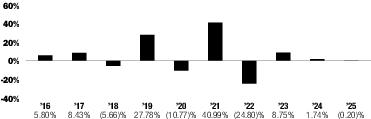
| Class A | Period Ended | Returns |
| Year-to-date | March 31, 2026 | 3.31% |
| Best Quarter | March 31, 2019 | 16.92% |
| Worst Quarter | March 31, 2020 | -24.40% |
| | Inception Date | 1 Year | 5 Years | 10 Years |
| Class A | | | | |
| Return Before Taxes | 12/31/1996 | -5.69 % | 2.05 % | 3.16 % |
| Return After Taxes on Distributions | | -7.26 | 0.37 | 1.09 |
| Return After Taxes on Distributions and Sale of Fund Shares | | -2.73 | 1.28 | 2.00 |
| | ||||
| Class C | 5/1/1995 | -1.86 | 2.44 | 3.13 |
| | ||||
| Class R | 4/30/2004 | -0.45 | 2.94 | 3.48 |
| | ||||
| Class Y | 10/3/2008 | -0.01 | 3.45 | 4.00 |
| | ||||
| Investor Class | 9/30/2003 | -0.15 | 3.23 | 3.78 |
| | ||||
| Class R5 | 4/30/2004 | 0.12 | 3.57 | 4.13 |
| | ||||
| Class R6 | 9/24/2012 | 0.25 | 3.65 | 4.22 |
| | ||||
| FTSE Nareit All Equity REITs Index (reflects no deduction for fees, expenses or taxes) | | 2.27 | 4.85 | 5.77 |
| | ||||
| S&P 500® Index (reflects no deduction for fees, expenses or taxes) | | 17.88 | 14.42 | 14.82 |
| | ||||
After-tax returns are calculated using the historical highest individual federal marginal income tax rates and do not reflect the impact of state and local taxes. Actual after-tax returns depend on an investor's tax situation and may differ from those shown, and after-tax returns shown are not relevant to investors who hold their Fund shares through tax-advantaged arrangements, such as 401(k) plans, 529 college savings plans or individual retirement accounts. After-tax returns are shown for Class A shares only and after-tax returns for other classes will vary.