June 25, 2026 | 10AM–12PM ET | New York Stock Exchange Barnes & Noble Education, Inc. (NYSE: BNED)

Safe Harbor This presentation contains certain “forward-looking statements” within the meaning of the Private Securities Litigation Reform Act of 1995 and information relating to us and our business that are based on the beliefs of our management as well as assumptions made by and information currently available to our management. When used in this presentation, the words “anticipate,” “believe,” “estimate,” “expect,” “intend,” “plan,” “may,” “should,” “will,” “forecasts,” “projections,” “continue to,” “committed to,” and similar expressions, as they relate to us or our management, identify forward-looking statements. Actual results could differ materially from those projected in the forward-looking statements, and such statements include but are not limited to those related to our positioning, strategic and operational objectives, broader market trends, anticipated growth in our BNC First Day program, expected trends in financial results, including those related to seasonality, as well as forward-looking continued top line growth, anticipated gross profit dollar increases, continued expense discipline, Adjusted EBITDA, interest costs, capital expenditures and long-term projected growth in Adjusted EBITDA. We caution you not to place undue reliance on these forward-looking statements. Such statements reflect our current views with respect to future events, the outcome of which is subject to certain risks, including, but not limited to: the amount of our indebtedness and ability to comply with covenants contained in our credit agreement; our ability to maintain adequate liquidity levels to support ongoing inventory purchases and related vendor payments in a timely manner; slower than anticipated pace of adoption of our BNC First Day® equitable and inclusive access course material models; our dependency on strategic service provider relationships and the potential for adverse operational and financial changes to these relationships; non-renewal of our managed bookstore, physical and/or online store contracts; general competitive conditions; a decline in college enrollment or decreased funding available for students; technological changes, including the adoption of artificial intelligence technologies for educational content; disruptions to our information technology systems, infrastructure, data, supplier systems, and customer ordering and payment systems due to computer malware, viruses, hacking and phishing attacks; disruption of or interference with third party service providers and our own proprietary technology; and changes in applicable domestic and international laws, rules or regulations or changes in enforcement practices, including, without limitation, U.S. tax reform, changes in tax rates, tariffs, import and export control laws and regulations, changes to consumer data privacy rights legislation, as well as related guidance. Moreover, we operate in a very competitive and rapidly changing environment and new risks may emerge from time to time. It is not possible for our management to predict all risks, nor can we assess the impact of all factors on our business or the extent to which any factor, or combination of factors, may cause actual results to differ materially from those contained in any forward- looking statements we may make. In addition, the declaration of any future dividends will be subject to further review and approval by the Board in accordance with applicable law. The Board reserves the right to adjust or withdraw any quarterly dividend in future periods as it reviews our capital allocation strategy from time-to- time and ensures compliance with any applicable restrictions, including those set forth in our credit agreement with our lenders. For a more detailed discussion of these factors, and other factors that could cause actual results to vary materially, interested parties should review the risk factors listed in the Company’s Annual Report on Form 10-K for the year ended May 3, 2025, filed with the SEC on December 23, 2025. Any forward-looking statements made by us in this presentation speak only as of the date of this presentation, and we do not intend to update these forward-looking statements after the date of this presentation, except as required by law.

WELCOME ABOUT US
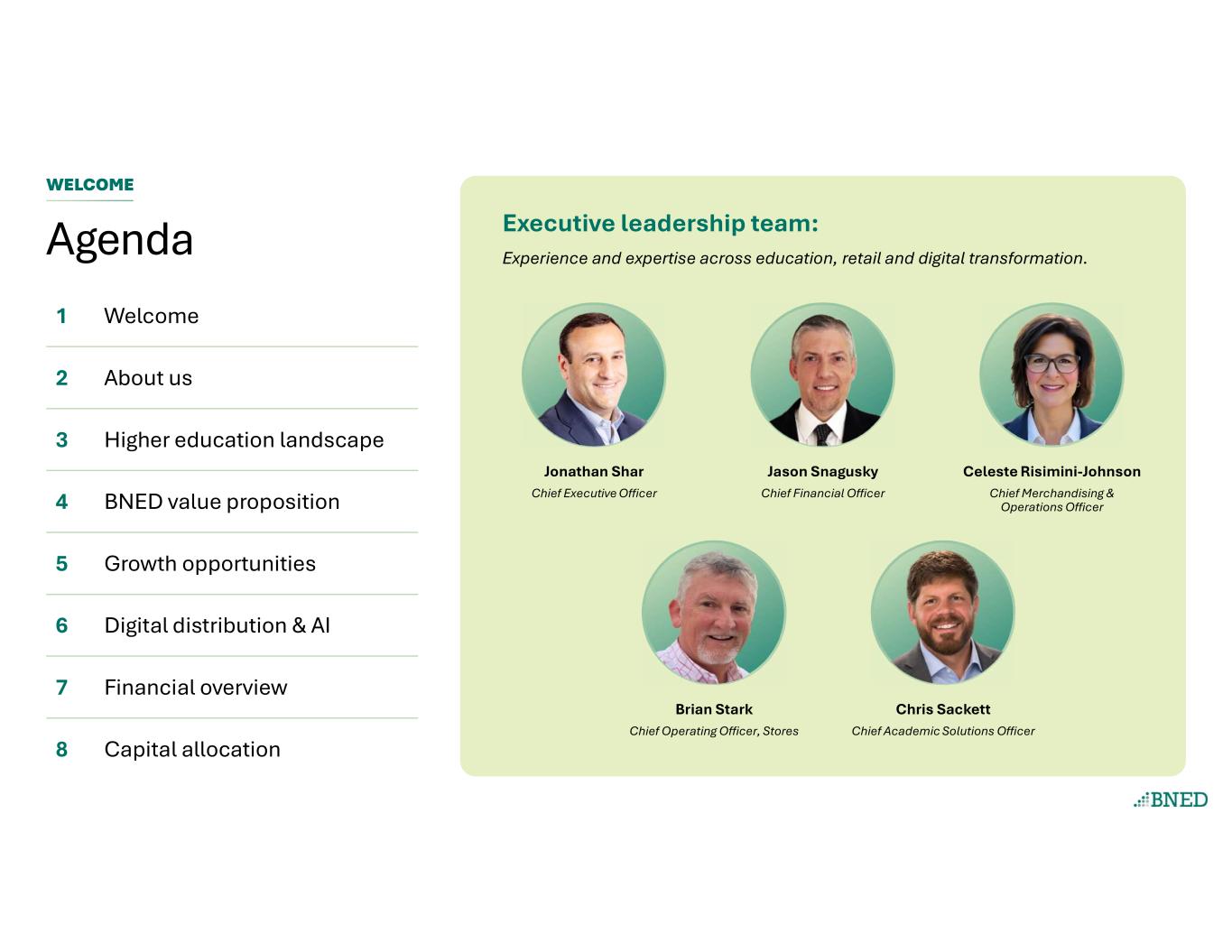
WELCOME Executive leadership team: Experience and expertise across education, retail and digital transformation. Jonathan Shar Chief Executive Officer Brian Stark Chief Operating Officer, Stores Jason Snagusky Chief Financial Officer Celeste Risimini-Johnson Chief Merchandising & Operations Officer Chris Sackett Chief Academic Solutions Officer Agenda Welcome1 About us2 Higher education landscape3 BNED value proposition4 Growth opportunities5 Digital distribution & AI6 Financial overview7 Capital allocation8
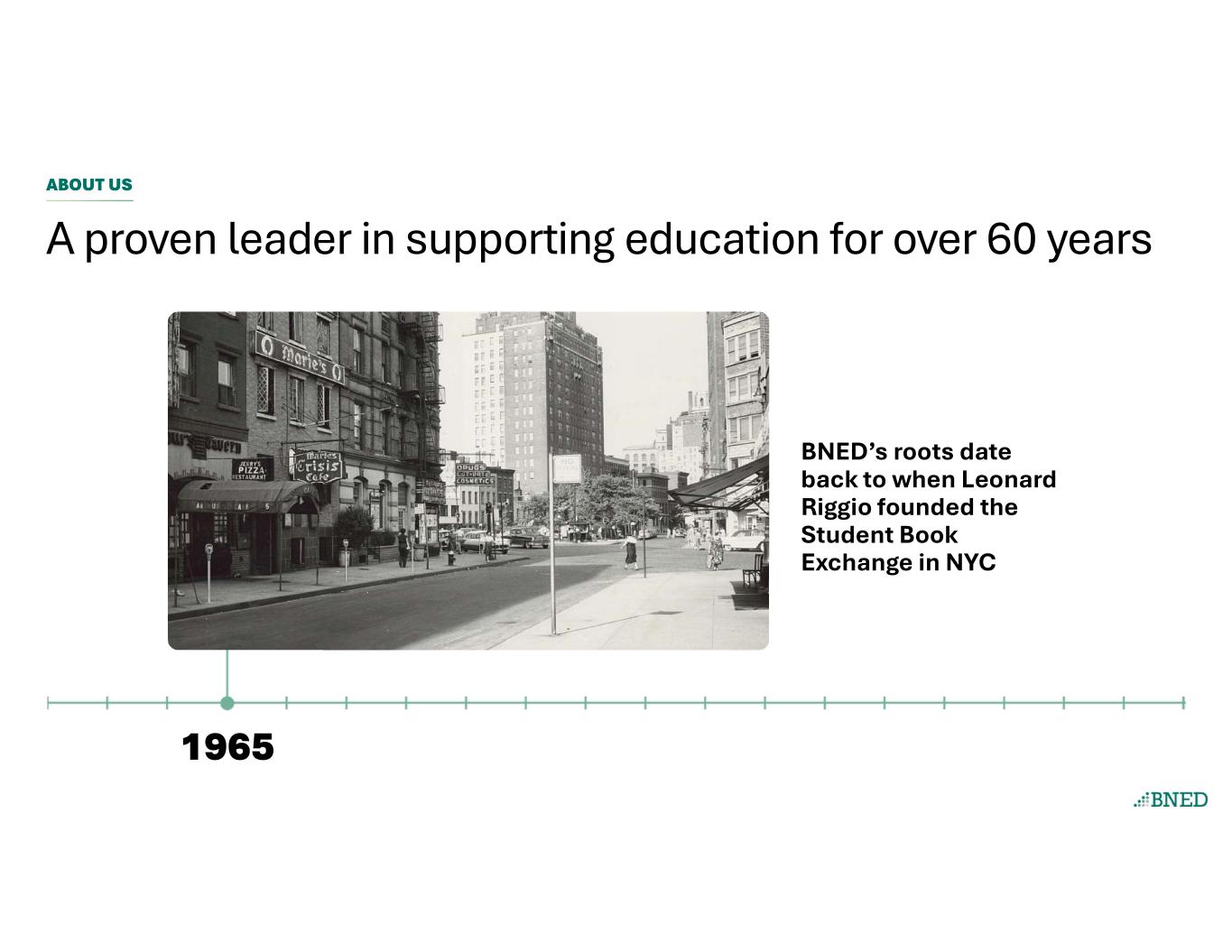
A proven leader in supporting education for over 60 years ABOUT US 1965 BNED’s roots date back to when Leonard Riggio founded the Student Book Exchange in NYC
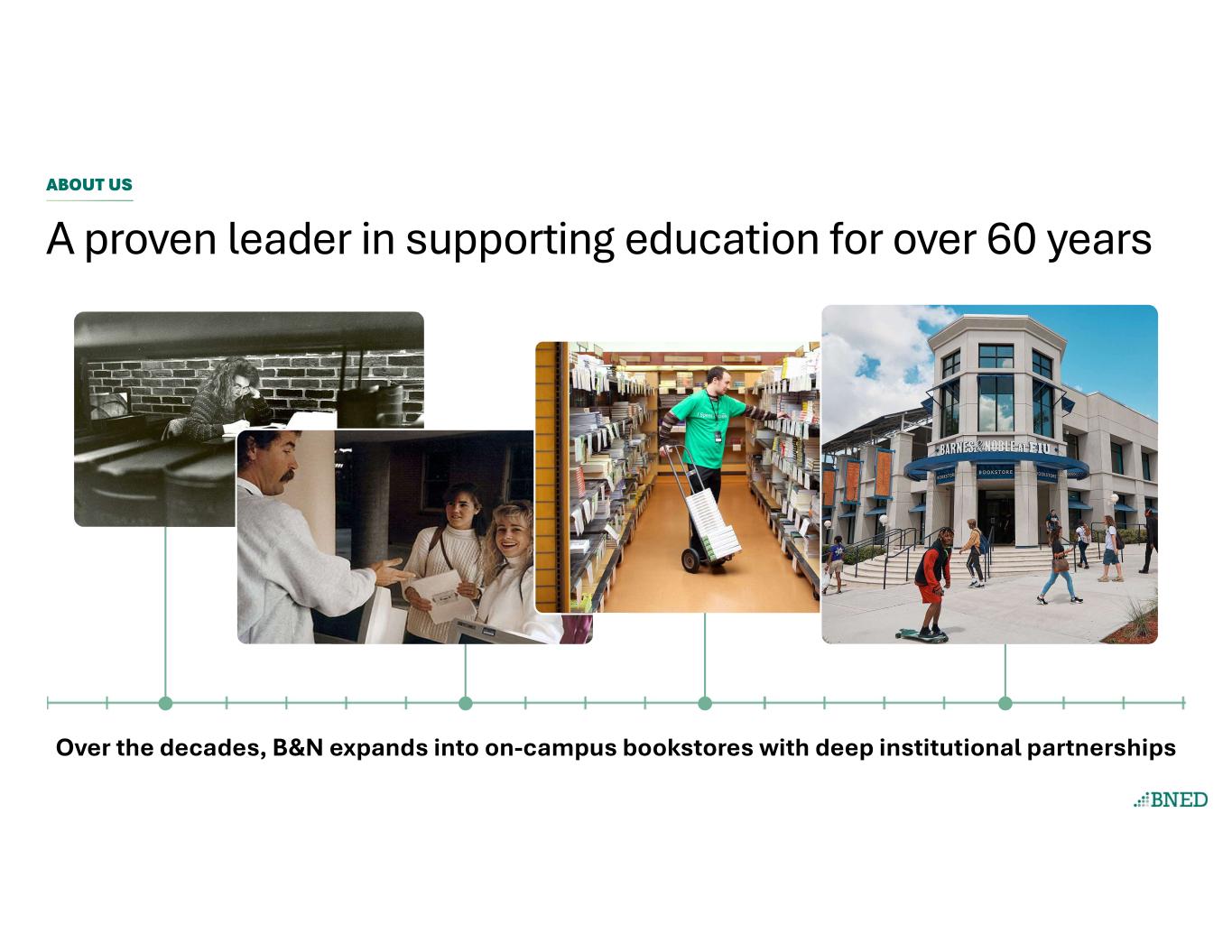
A proven leader in supporting education for over 60 years ABOUT US Over the decades, B&N expands into on-campus bookstores with deep institutional partnerships
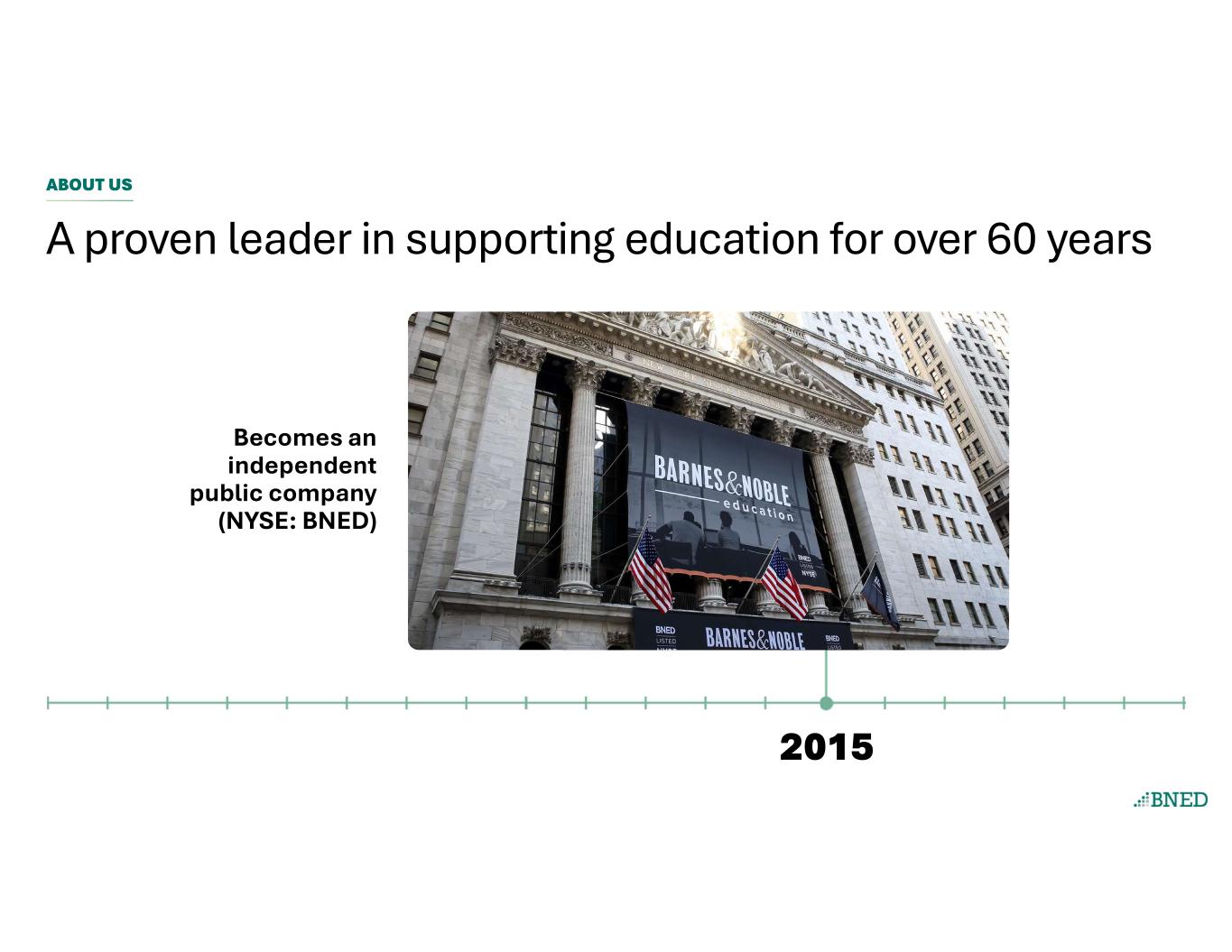
A proven leader in supporting education for over 60 years ABOUT US 2015 Becomes an independent public company (NYSE: BNED)

Today, BNED is a leading solutions provider for higher education ABOUT US We drive affordability, access, and student success across hundreds of institutions, supporting millions of students nationwide.
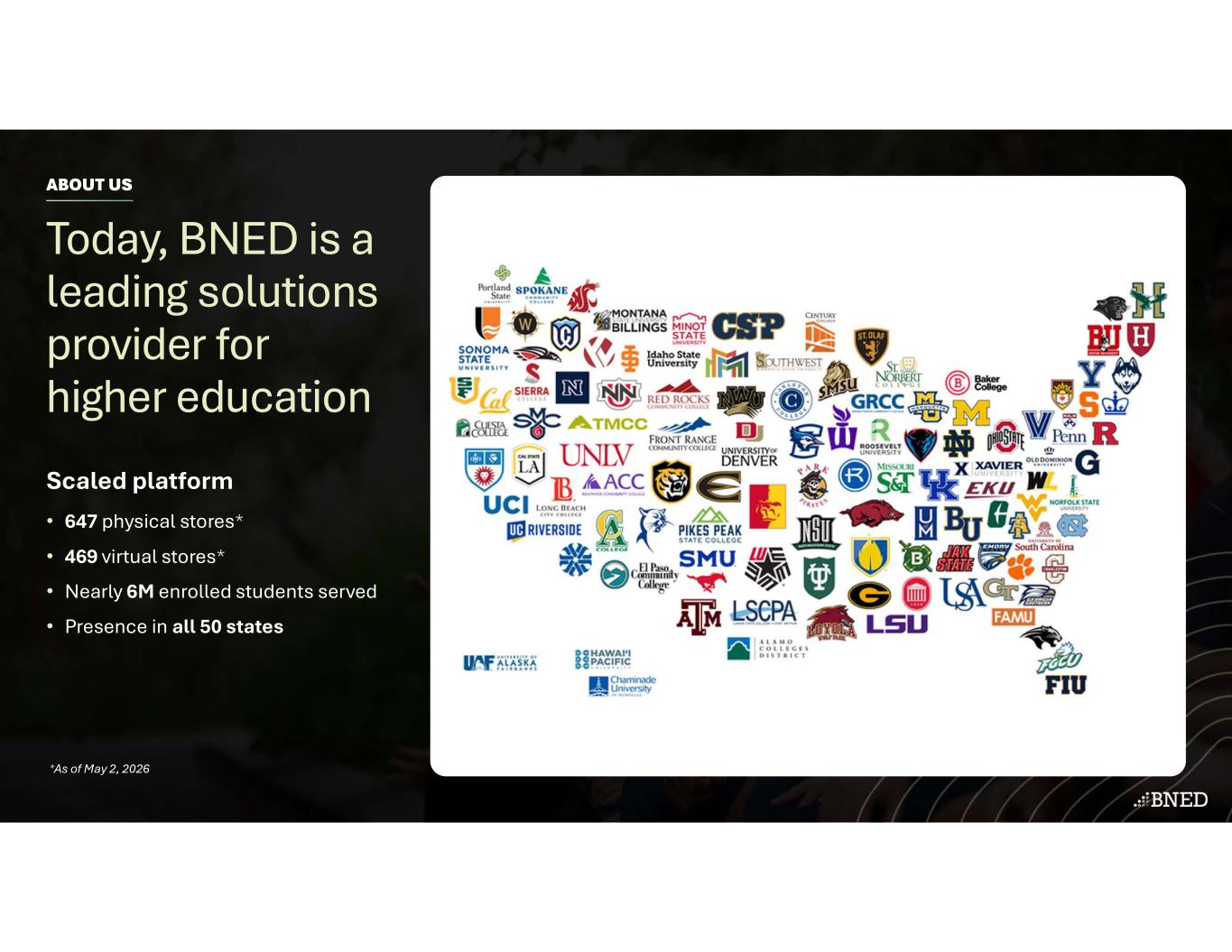
Today, BNED is a leading solutions provider for higher education ABOUT US Scaled platform • 647 physical stores* • 469 virtual stores* • Nearly 6M enrolled students served • Presence in all 50 states *As of May 2, 2026

Today, BNED is a leading solutions provider for higher education ABOUT US Broad and diverse reach • Serving public and private 4-year and 2-year institutions • Supporting students, alumni, faculty and local communities
BNED combines institutional relationships, digital infrastructure, and campus operations into an integrated student platform. WHAT WE DO
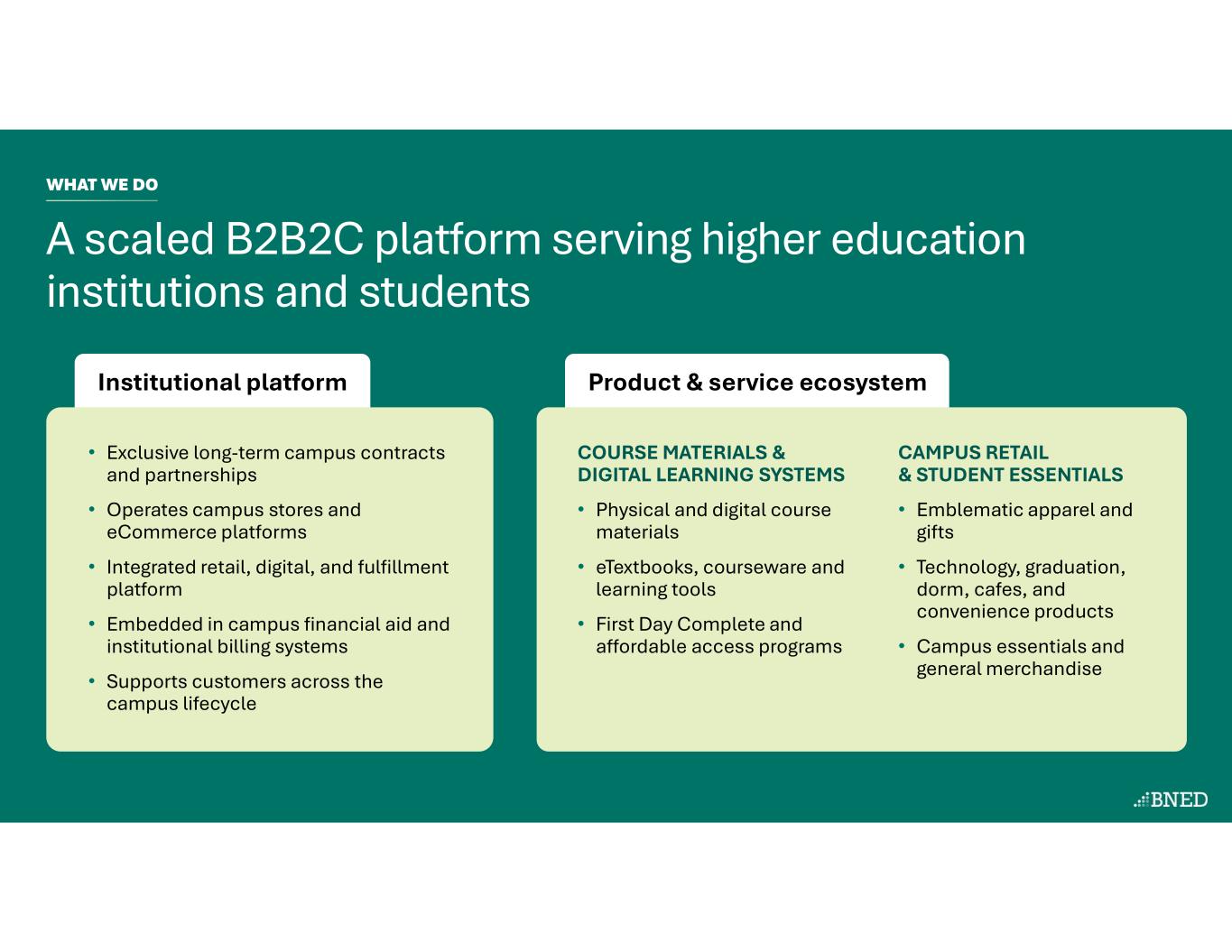
A scaled B2B2C platform serving higher education institutions and students WHAT WE DO Product & service ecosystem COURSE MATERIALS & DIGITAL LEARNING SYSTEMS • Physical and digital course materials • eTextbooks, courseware and learning tools • First Day Complete and affordable access programs CAMPUS RETAIL & STUDENT ESSENTIALS • Emblematic apparel and gifts • Technology, graduation, dorm, cafes, and convenience products • Campus essentials and general merchandise Institutional platform • Exclusive long-term campus contracts and partnerships • Operates campus stores and eCommerce platforms • Integrated retail, digital, and fulfillment platform • Embedded in campus financial aid and institutional billing systems • Supports customers across the campus lifecycle
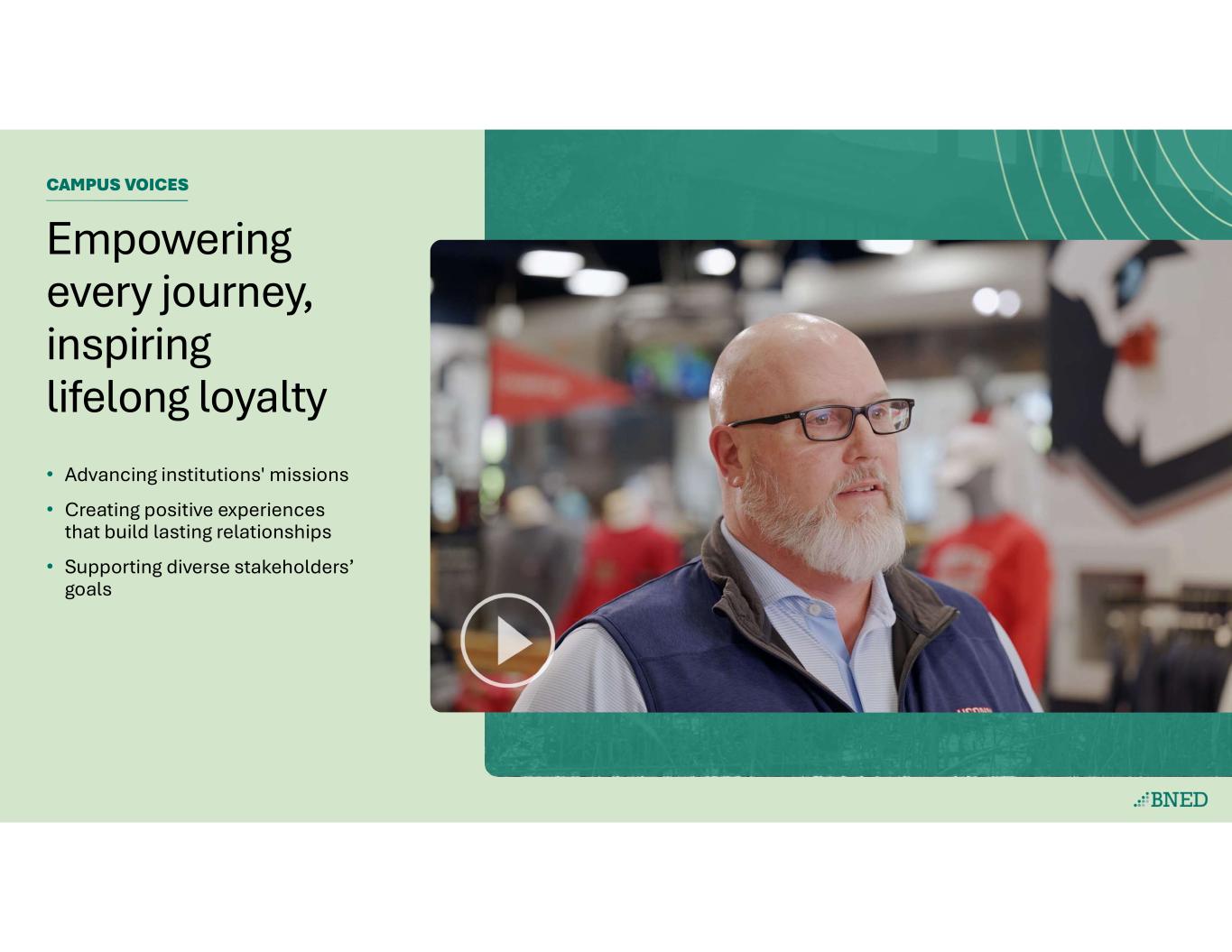
Empowering every journey, inspiring lifelong loyalty • Advancing institutions' missions • Creating positive experiences that build lasting relationships • Supporting diverse stakeholders’ goals CAMPUS VOICES

HIGHER EDUCATION LANDSCAPE
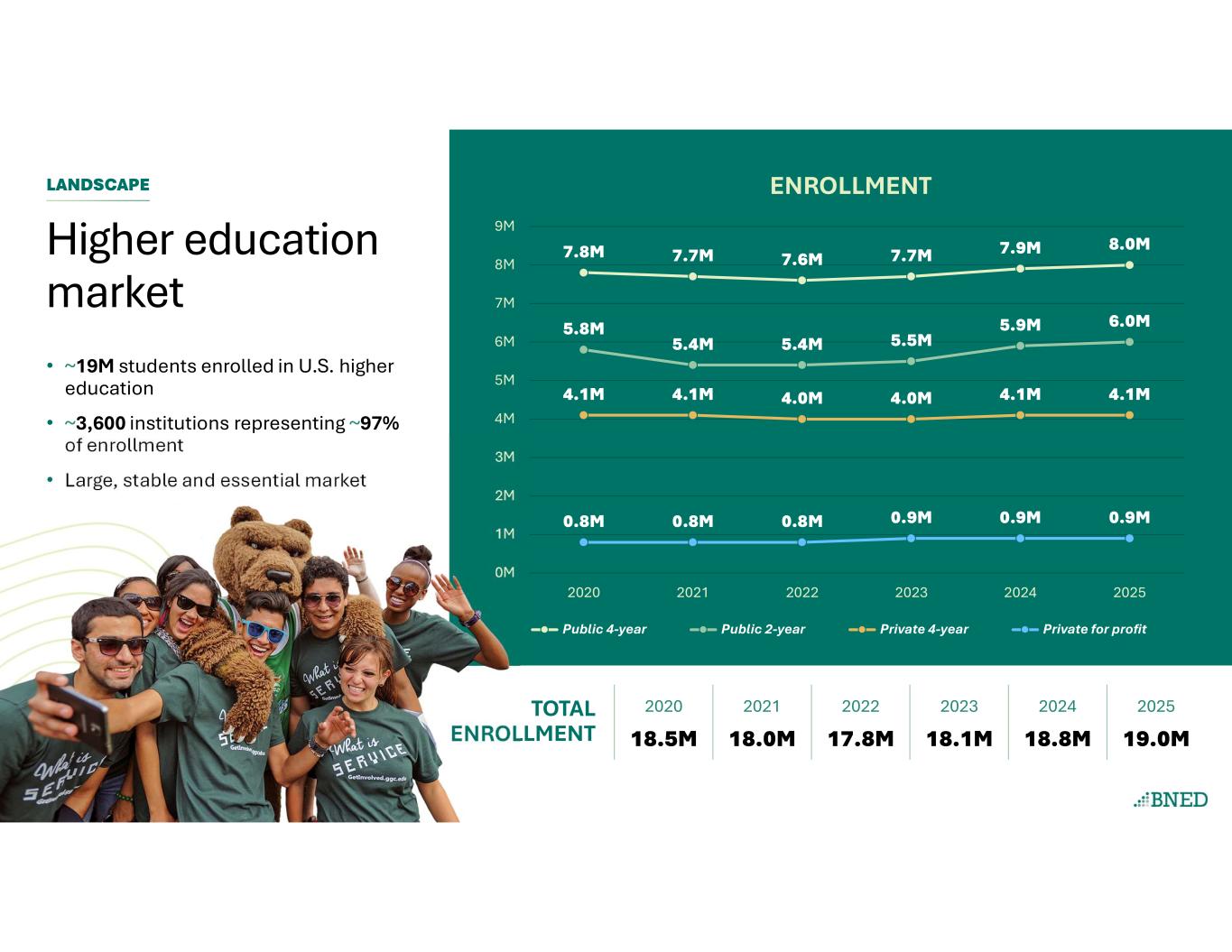
Higher education market LANDSCAPE • ~19M students enrolled in U.S. higher education • ~3,600 institutions representing ~97% of enrollment • Large, stable and essential market 7.8M 7.7M 7.6M 7.7M 7.9M 8.0M 5.8M 5.4M 5.4M 5.5M 5.9M 6.0M 4.1M 4.1M 4.0M 4.0M 4.1M 4.1M 0.8M 0.8M 0.8M 0.9M 0.9M 0.9M 0M 1M 2M 3M 4M 5M 6M 7M 8M 9M 2020 2021 2022 2023 2024 2025 ENROLLMENT Public 4-year Public 2-year Private 4-year Private for profit 202520242023202220212020TOTAL ENROLLMENT 19.0M18.8M18.1M17.8M18.0M18.5M
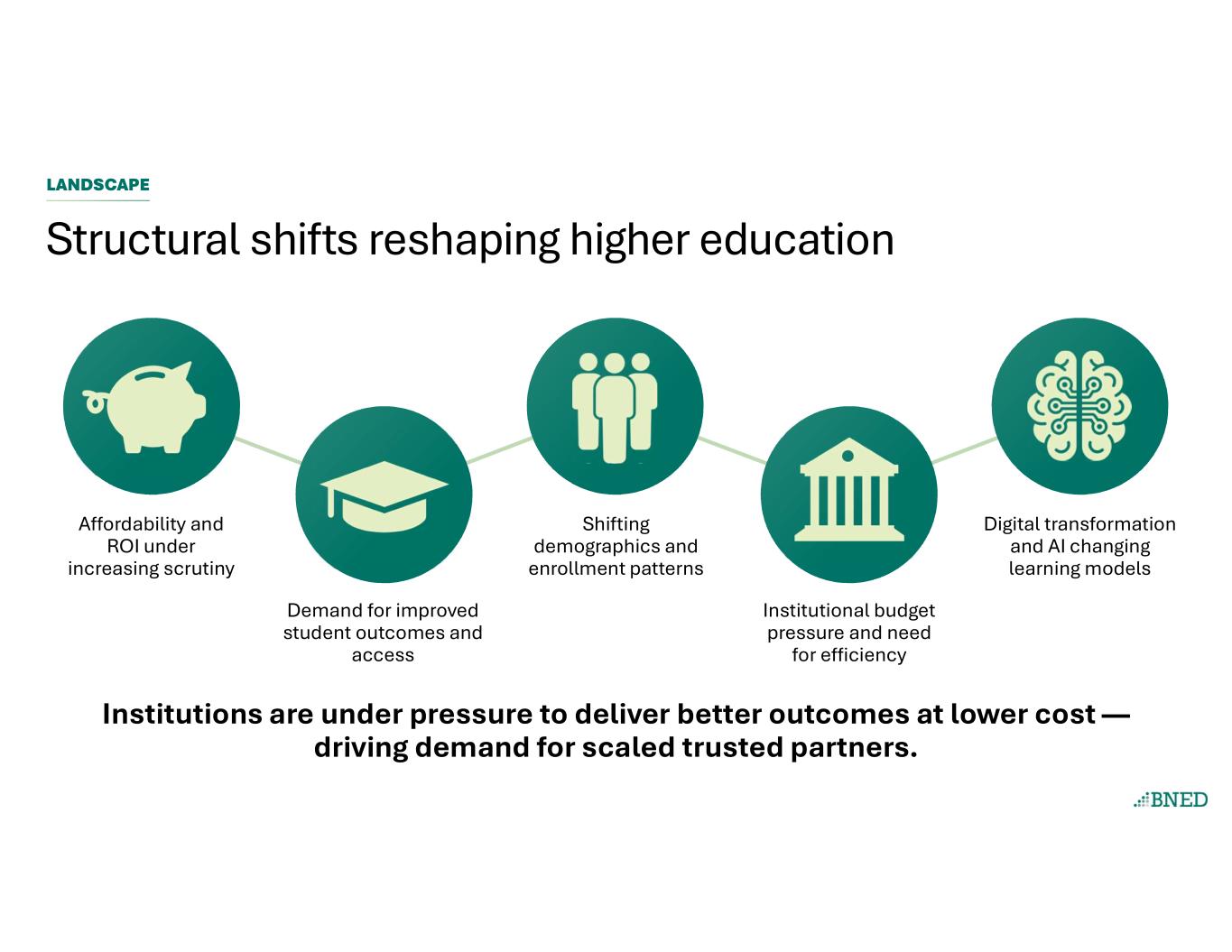
Structural shifts reshaping higher education LANDSCAPE Institutions are under pressure to deliver better outcomes at lower cost — driving demand for scaled trusted partners. Affordability and ROI under increasing scrutiny Institutional budget pressure and need for efficiency Demand for improved student outcomes and access Digital transformation and AI changing learning models Shifting demographics and enrollment patterns
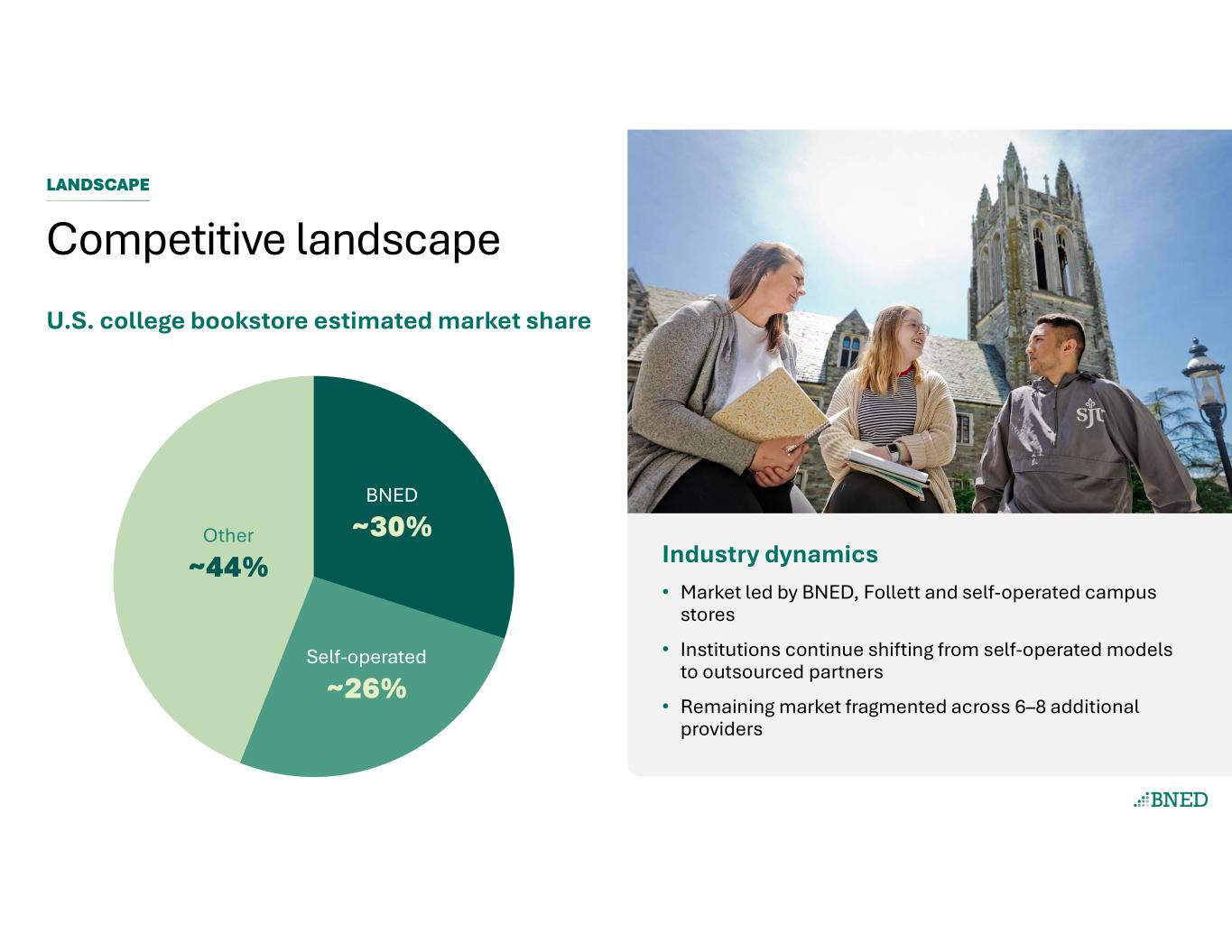
Competitive landscape LANDSCAPE BNED ~30% Self-operated ~26% Other ~44% U.S. college bookstore estimated market share Industry dynamics • Market led by BNED, Follett and self-operated campus stores • Institutions continue shifting from self-operated models to outsourced partners • Remaining market fragmented across 6–8 additional providers
Scale, infrastructure, and institutional relationships create durable competitive advantages; BNED is well positioned to gain share through its scaled, integrated platform. COMPETITIVE LANDSCAPE
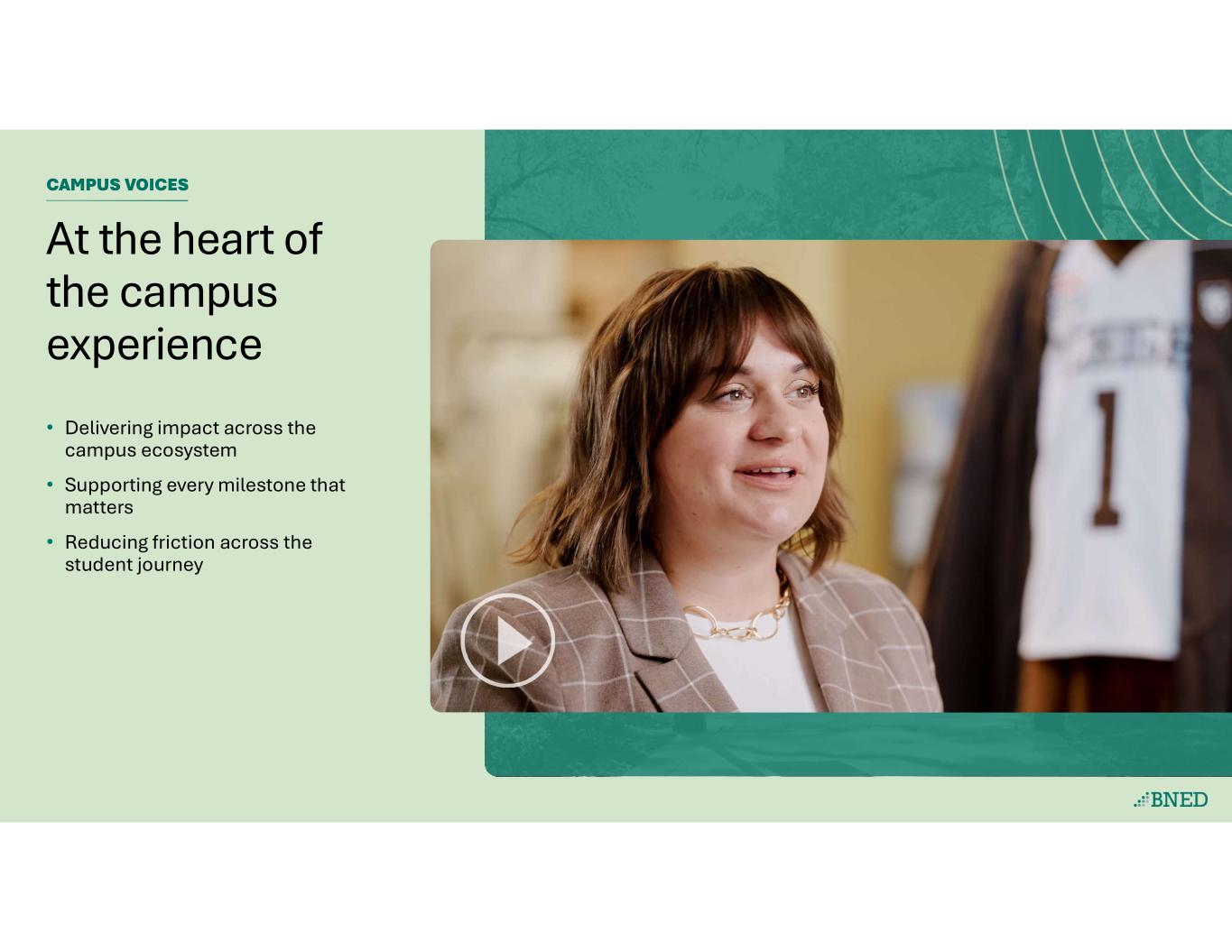
At the heart of the campus experience CAMPUS VOICES • Delivering impact across the campus ecosystem • Supporting every milestone that matters • Reducing friction across the student journey
BNED VALUE PROPOSITION
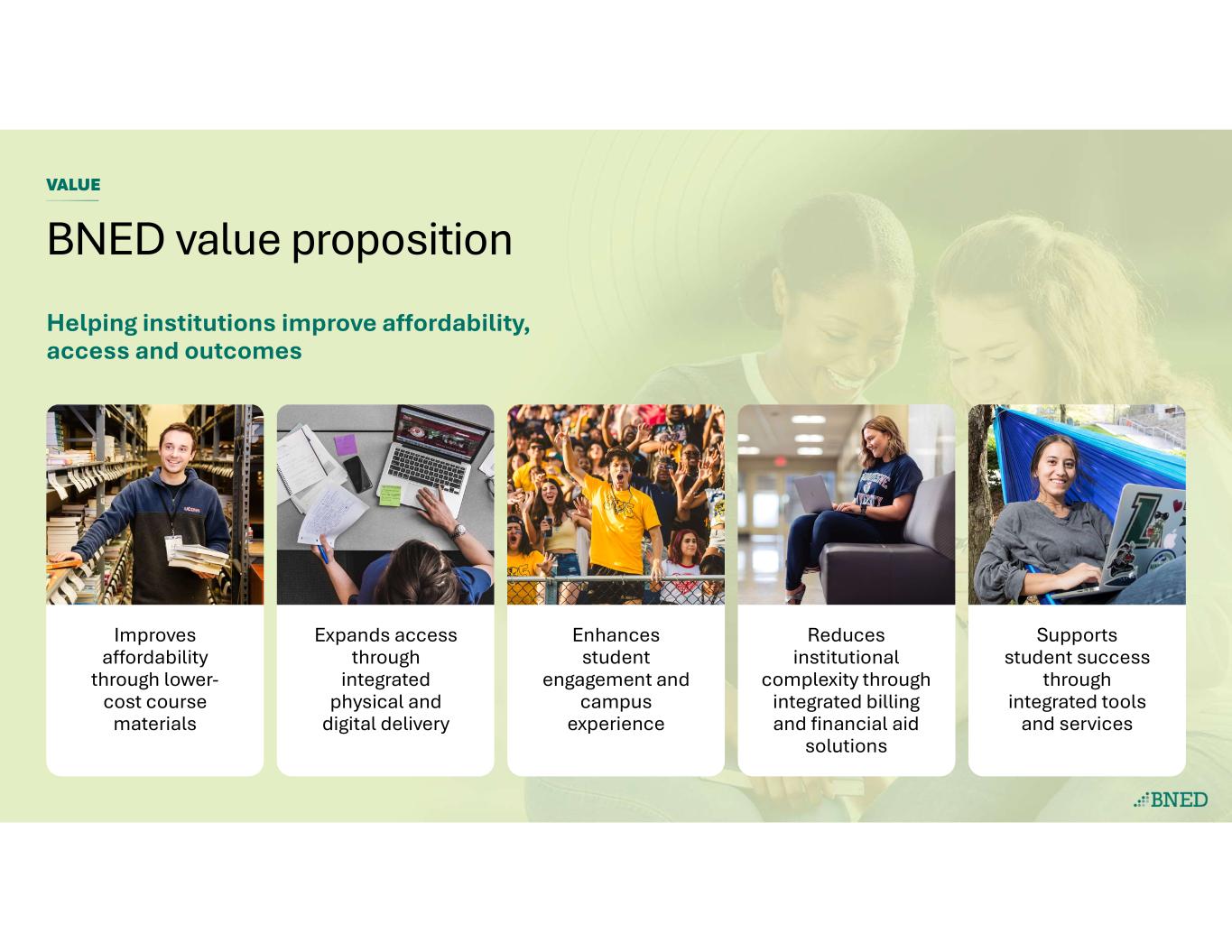
BNED value proposition VALUE Helping institutions improve affordability, access and outcomes Improves affordability through lower- cost course materials Expands access through integrated physical and digital delivery Enhances student engagement and campus experience Reduces institutional complexity through integrated billing and financial aid solutions Supports student success through integrated tools and services

BNED value proposition VALUE Helping institutions improve affordability, access and outcomes of BNED students rated the bookstore GOOD, VERY GOOD or EXCELLENT
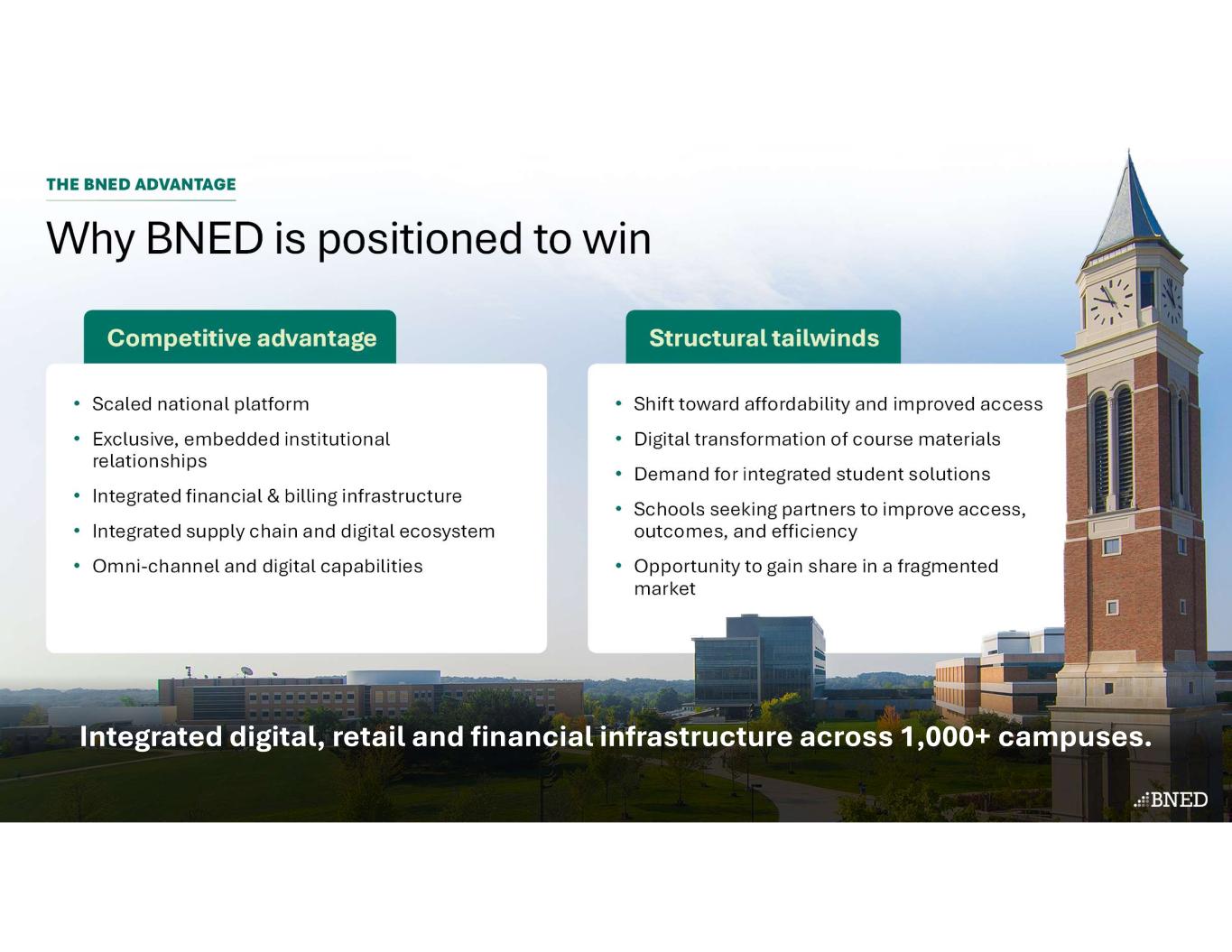
Why BNED is positioned to win THE BNED ADVANTAGE • Scaled national platform • Exclusive, embedded institutional relationships • Integrated financial & billing infrastructure • Integrated supply chain and digital ecosystem • Omni-channel and digital capabilities Competitive advantage • Shift toward affordability and improved access • Digital transformation of course materials • Demand for integrated student solutions • Schools seeking partners to improve access, outcomes, and efficiency • Opportunity to gain share in a fragmented market Structural tailwinds Integrated digital, retail and financial infrastructure across 1,000+ campuses.
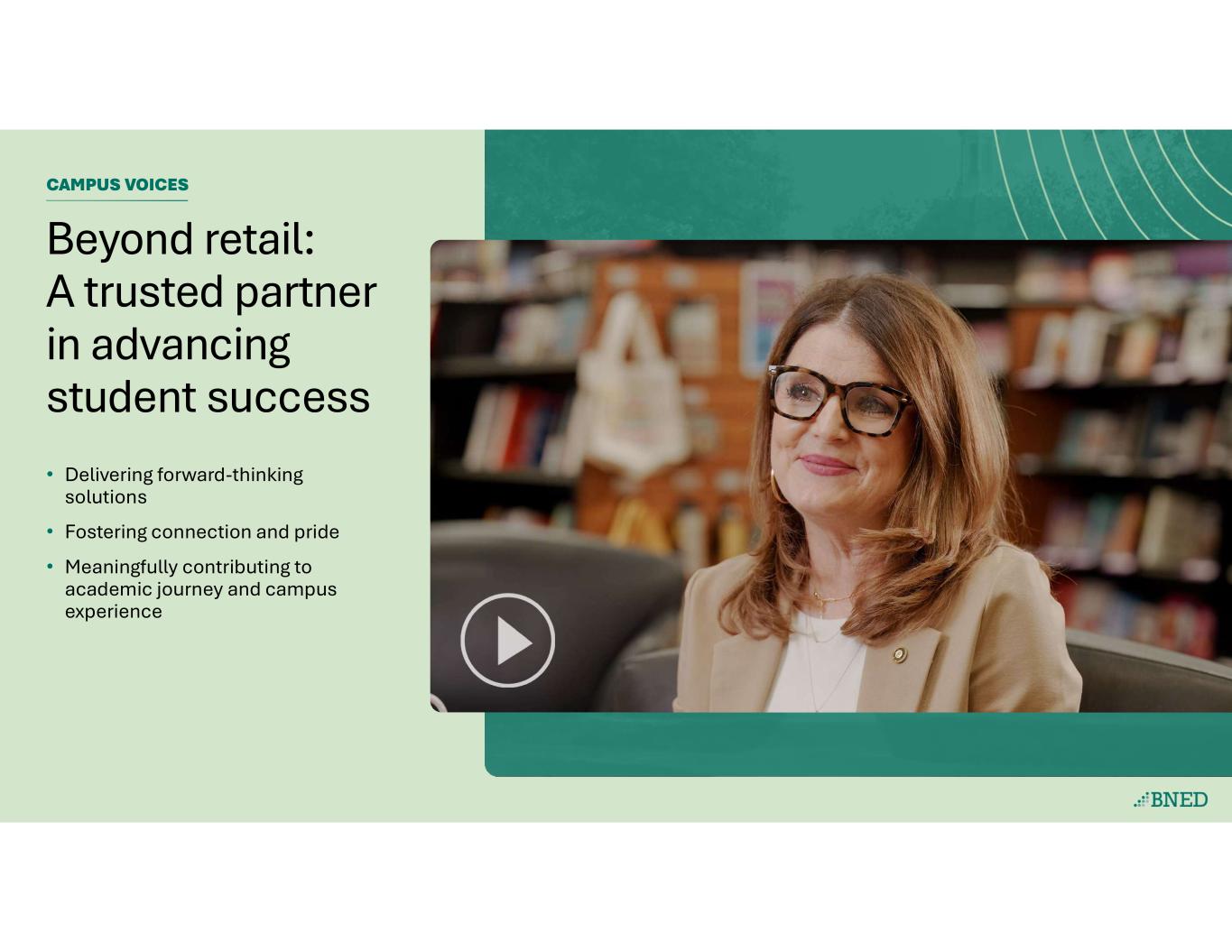
Beyond retail: A trusted partner in advancing student success • Delivering forward-thinking solutions • Fostering connection and pride • Meaningfully contributing to academic journey and campus experience CAMPUS VOICES
TRANSFORMING THE COURSE MATERIALS BUSINESS MODEL
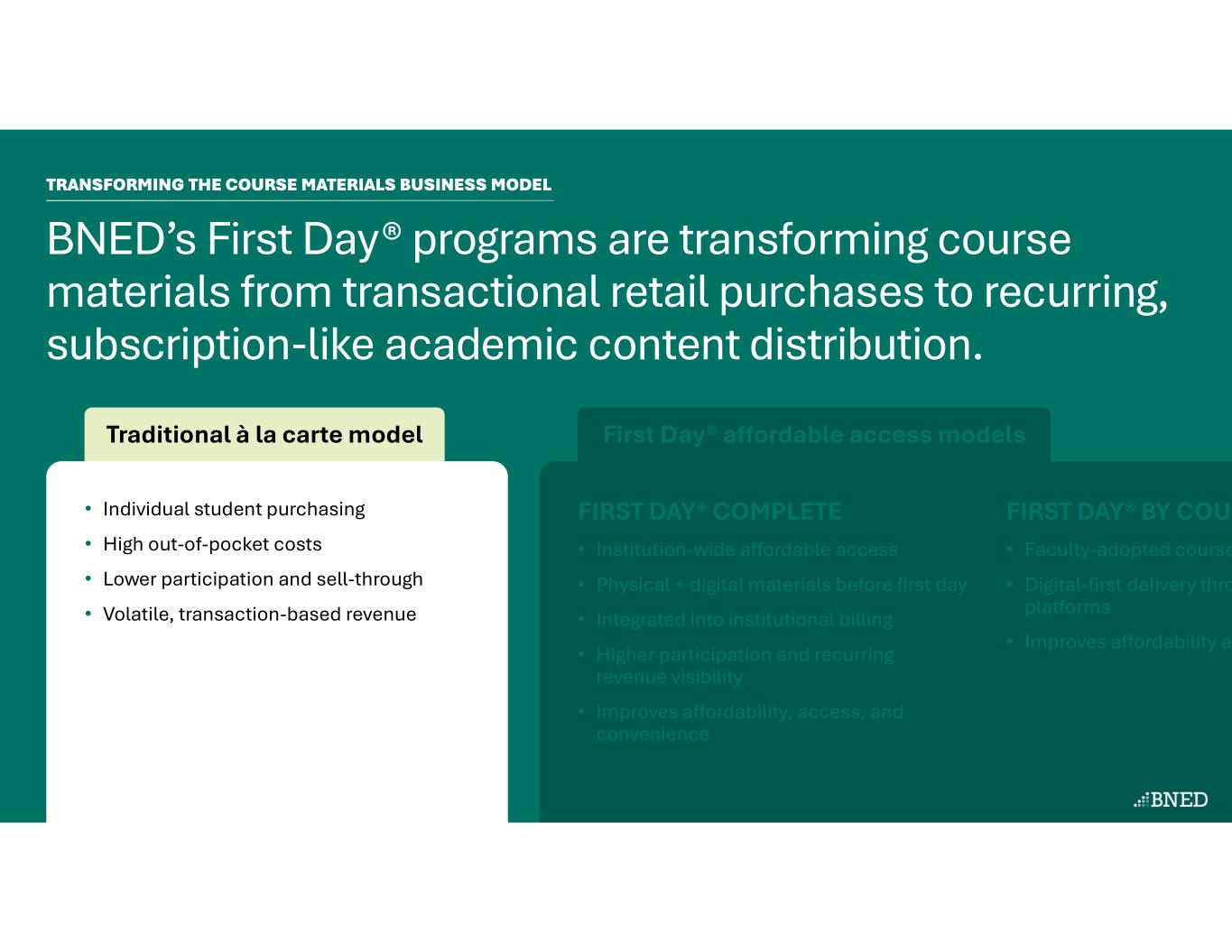
BNED’s First Day® programs are transforming course materials from transactional retail purchases to recurring, subscription-like academic content distribution. TRANSFORMING THE COURSE MATERIALS BUSINESS MODEL Traditional à la carte model • Individual student purchasing • High out-of-pocket costs • Lower participation and sell-through • Volatile, transaction-based revenue First Day® affordable access models FIRST DAY® BY COURSE • Faculty-adopted course • Digital-first delivery through LMS platforms • Improves affordability and access FIRST DAY® COMPLETE • Institution-wide affordable access • Physical + digital materials before first day • Integrated into institutional billing • Higher participation and recurring revenue visibility • Improves affordability, access, and convenience
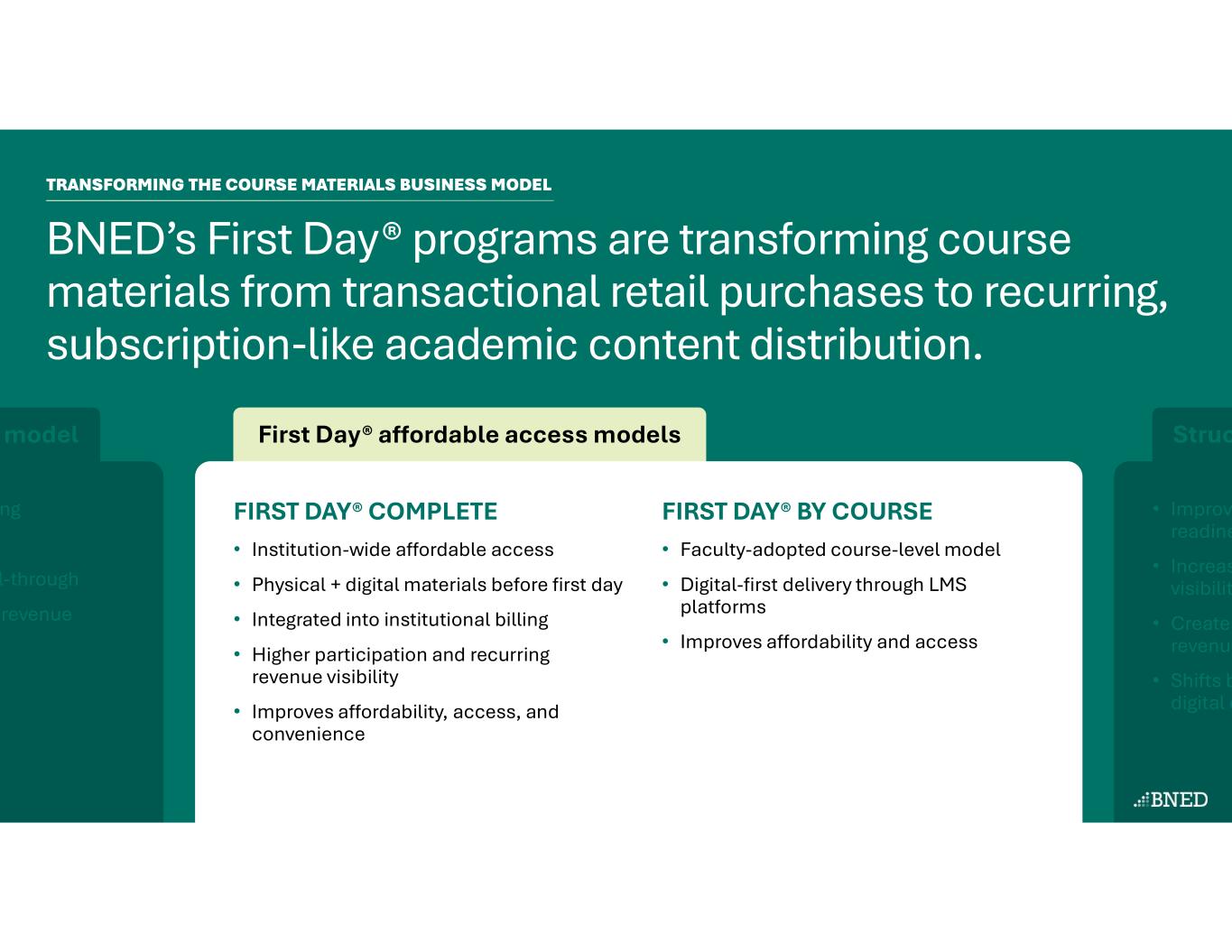
BNED’s First Day® programs are transforming course materials from transactional retail purchases to recurring, subscription-like academic content distribution. TRANSFORMING THE COURSE MATERIALS BUSINESS MODEL Traditional à la carte model Individual student purchasing Lower participation and sell-through based revenue Structural transformation • Improves affordability and student readiness • Increases participation and revenue visibility • Creates recurring, subscription revenue streams • Shifts business toward capital digital economics First Day® affordable access models FIRST DAY® BY COURSE • Faculty-adopted course-level model • Digital-first delivery through LMS platforms • Improves affordability and access FIRST DAY® COMPLETE • Institution-wide affordable access • Physical + digital materials before first day • Integrated into institutional billing • Higher participation and recurring revenue visibility • Improves affordability, access, and convenience
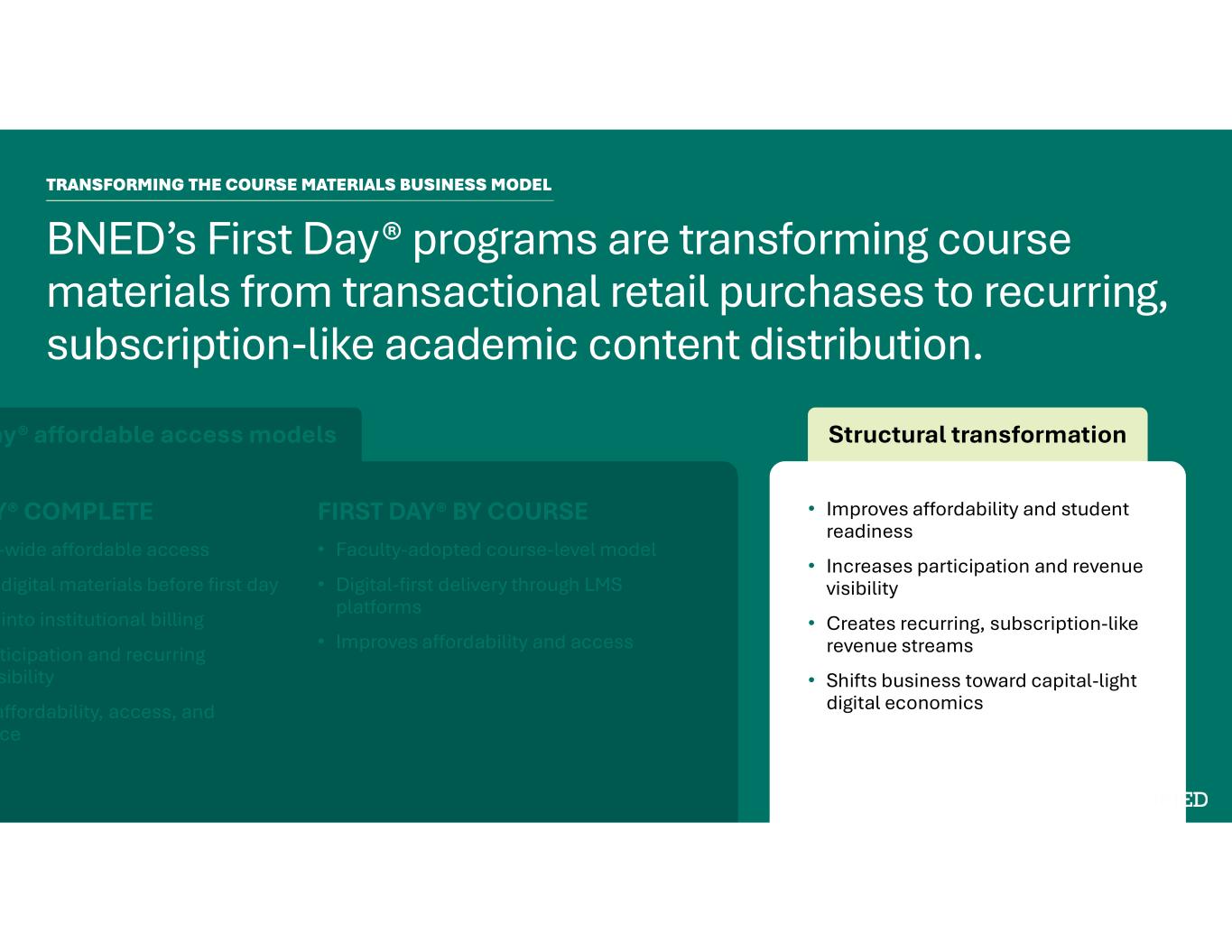
BNED’s First Day® programs are transforming course materials from transactional retail purchases to recurring, subscription-like academic content distribution. TRANSFORMING THE COURSE MATERIALS BUSINESS MODEL Structural transformation • Improves affordability and student readiness • Increases participation and revenue visibility • Creates recurring, subscription-like revenue streams • Shifts business toward capital-light digital economics First Day® affordable access models FIRST DAY® BY COURSE • Faculty-adopted course-level model • Digital-first delivery through LMS platforms • Improves affordability and access FIRST DAY® COMPLETE -wide affordable access Physical + digital materials before first day Integrated into institutional billing Higher participation and recurring revenue visibility Improves affordability, access, and convenience
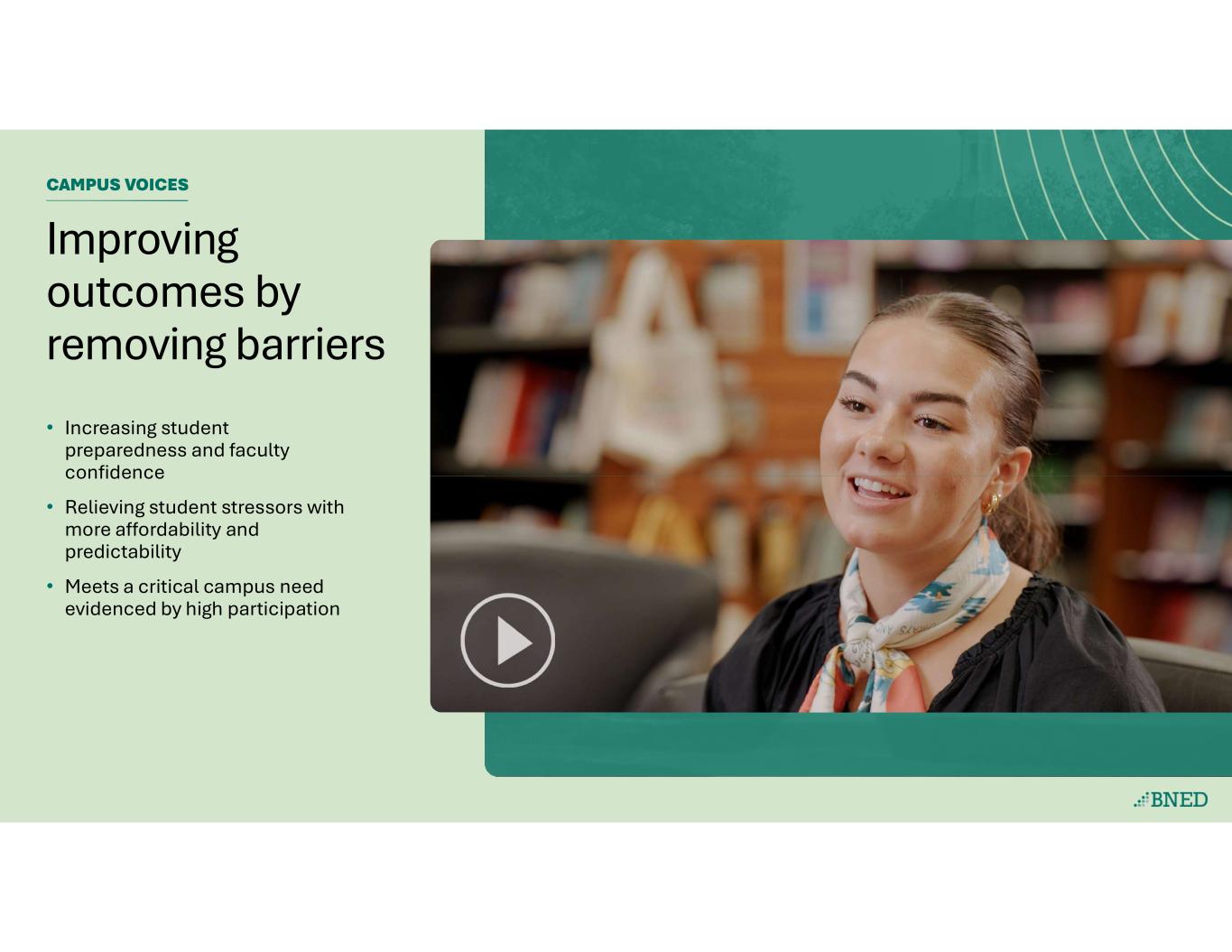
Improving outcomes by removing barriers • Increasing student preparedness and faculty confidence • Relieving student stressors with more affordability and predictability • Meets a critical campus need evidenced by high participation CAMPUS VOICES
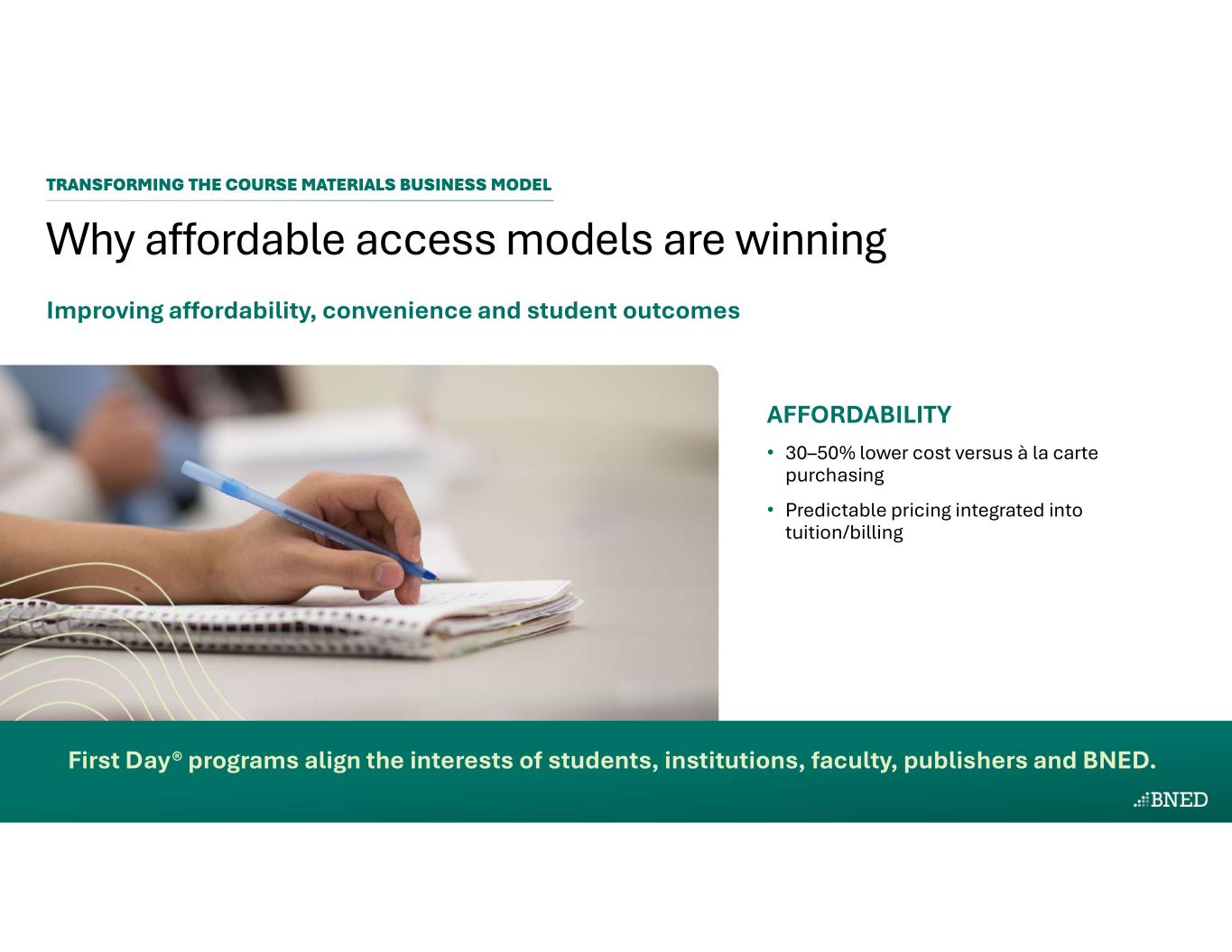
Why affordable access models are winning TRANSFORMING THE COURSE MATERIALS BUSINESS MODEL Improving affordability, convenience and student outcomes First Day® programs align the interests of students, institutions, faculty, publishers and BNED. AFFORDABILITY • 30–50% lower cost versus à la carte purchasing • Predictable pricing integrated into tuition/billing
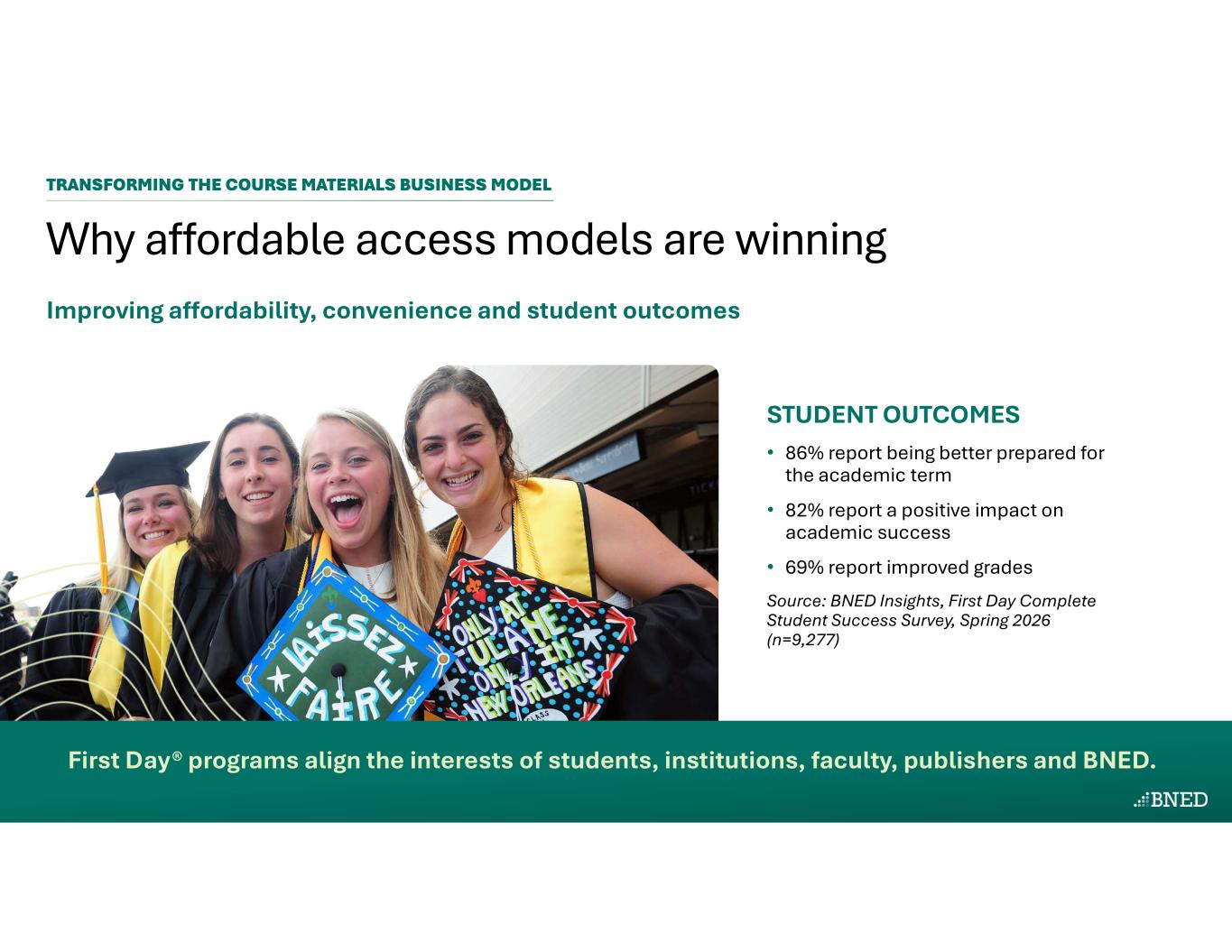
Why affordable access models are winning TRANSFORMING THE COURSE MATERIALS BUSINESS MODEL Improving affordability, convenience and student outcomes First Day® programs align the interests of students, institutions, faculty, publishers and BNED. STUDENT OUTCOMES • 86% report being better prepared for the academic term • 82% report a positive impact on academic success • 69% report improved grades Source: BNED Insights, First Day Complete Student Success Survey, Spring 2026 (n=9,277)
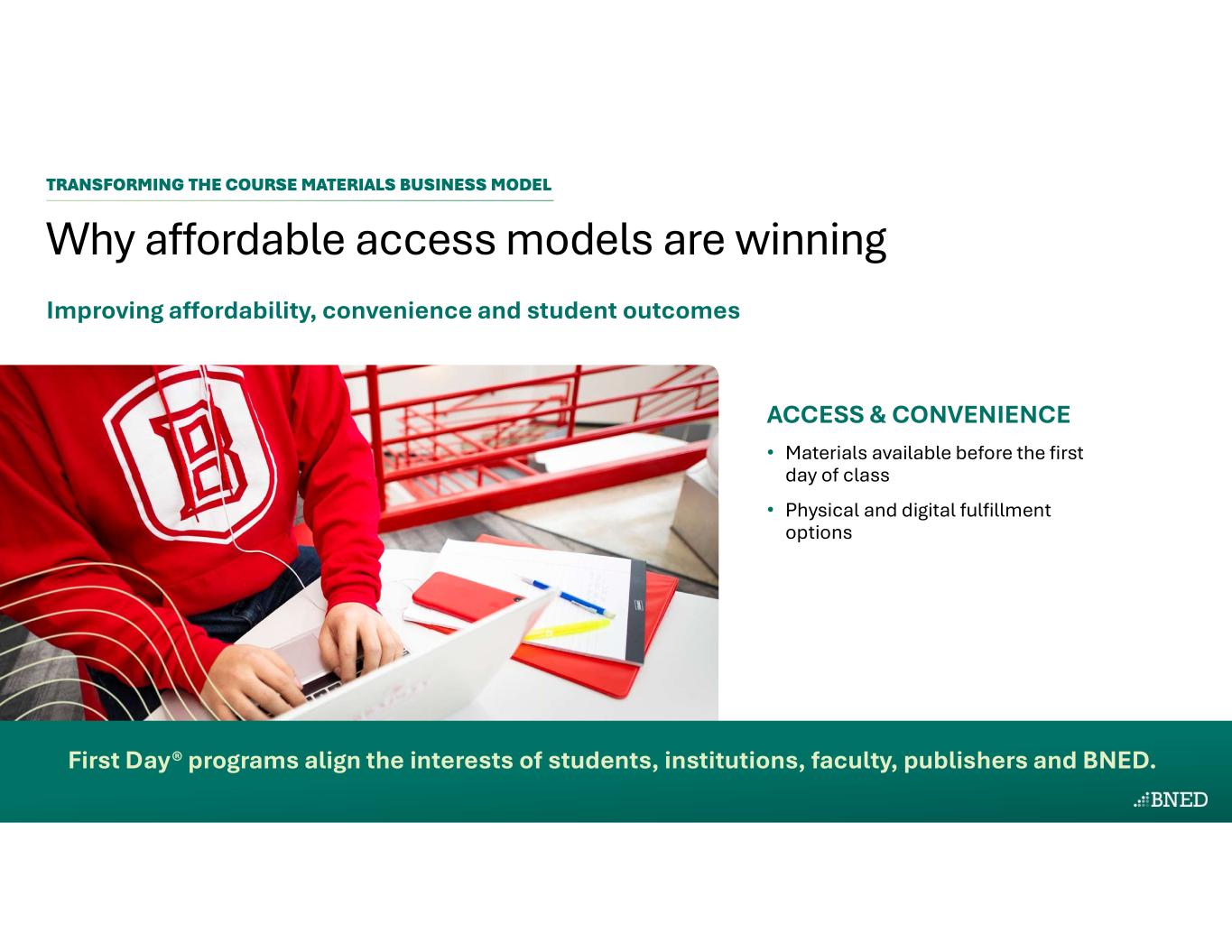
Why affordable access models are winning TRANSFORMING THE COURSE MATERIALS BUSINESS MODEL Improving affordability, convenience and student outcomes First Day® programs align the interests of students, institutions, faculty, publishers and BNED. ACCESS & CONVENIENCE • Materials available before the first day of class • Physical and digital fulfillment options
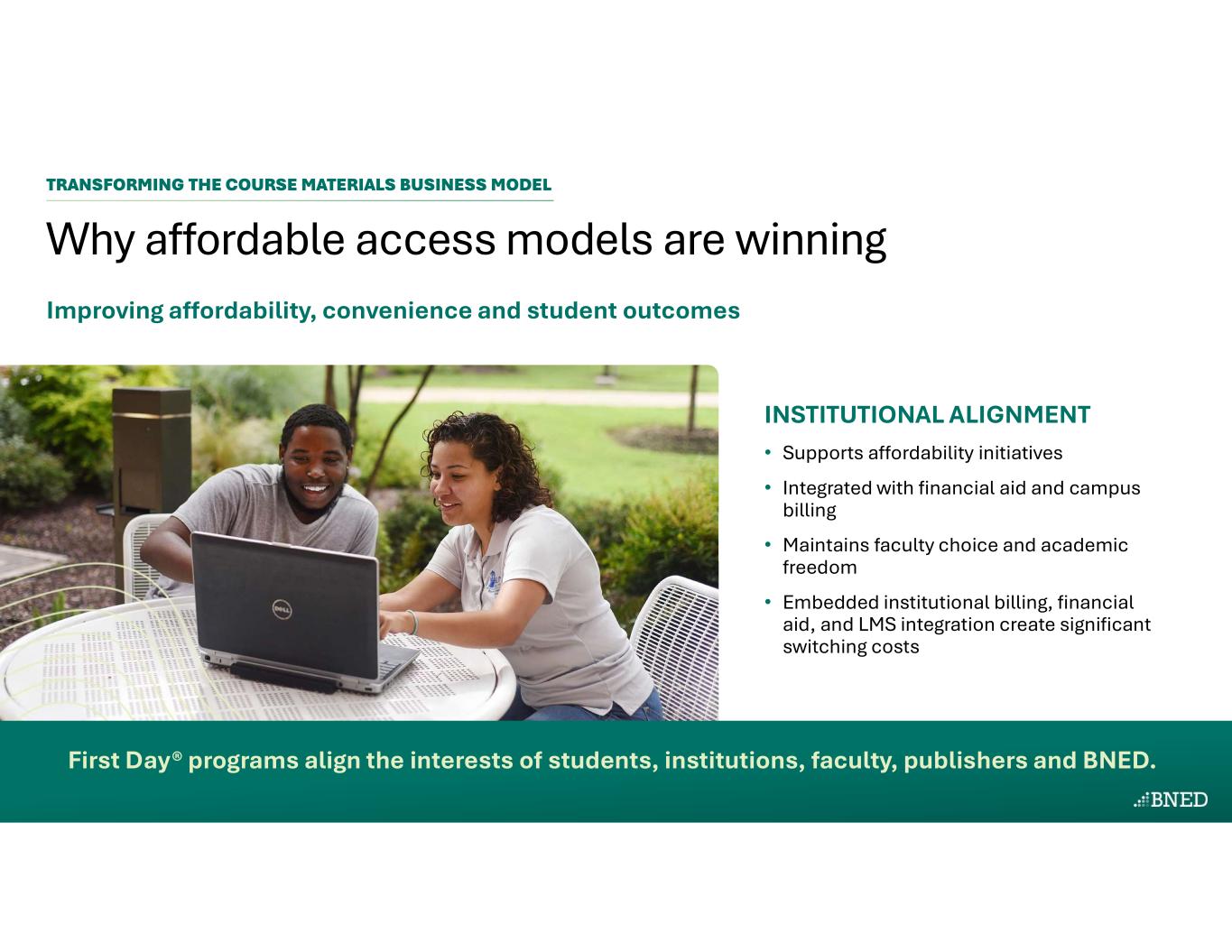
Why affordable access models are winning TRANSFORMING THE COURSE MATERIALS BUSINESS MODEL Improving affordability, convenience and student outcomes INSTITUTIONAL ALIGNMENT • Supports affordability initiatives • Integrated with financial aid and campus billing • Maintains faculty choice and academic freedom • Embedded institutional billing, financial aid, and LMS integration create significant switching costs First Day® programs align the interests of students, institutions, faculty, publishers and BNED.
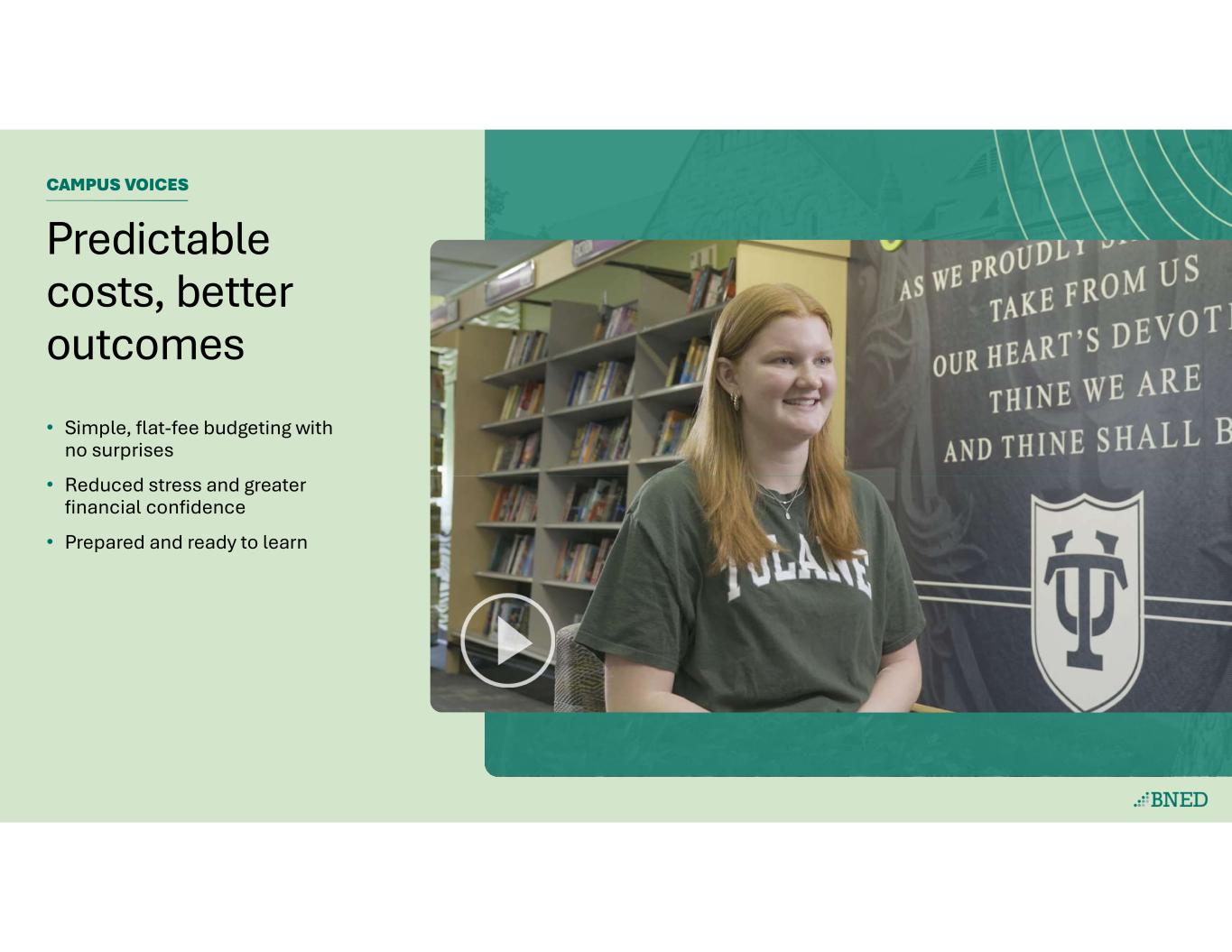
Predictable costs, better outcomes • Simple, flat-fee budgeting with no surprises • Reduced stress and greater financial confidence • Prepared and ready to learn CAMPUS VOICES
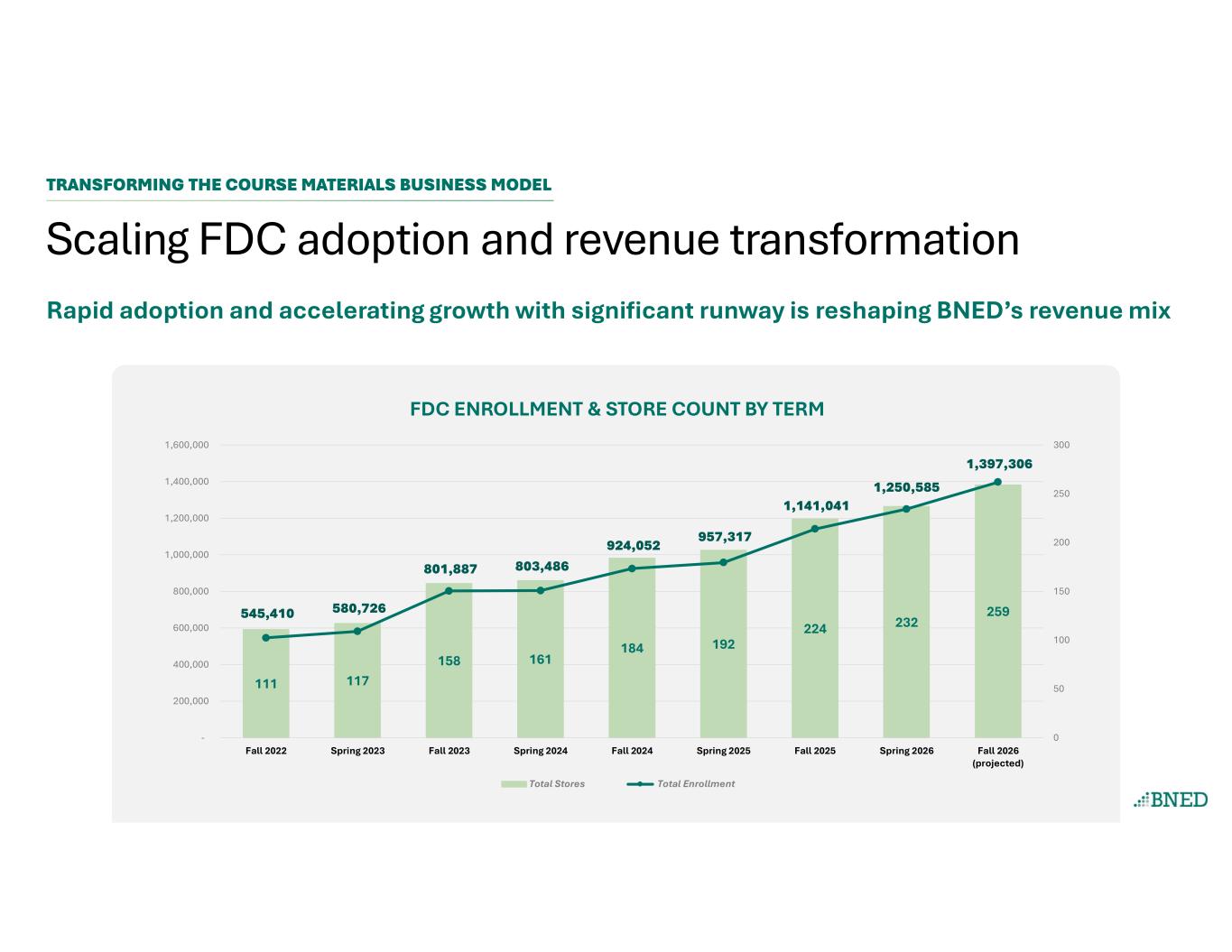
Scaling FDC adoption and revenue transformation TRANSFORMING THE COURSE MATERIALS BUSINESS MODEL 111 117 158 161 184 192 224 232 259545,410 580,726 801,887 803,486 924,052 957,317 1,141,041 1,250,585 1,397,306 0 50 100 150 200 250 300 - 200,000 400,000 600,000 800,000 1,000,000 1,200,000 1,400,000 1,600,000 Fall 2022 Spring 2023 Fall 2023 Spring 2024 Fall 2024 Spring 2025 Fall 2025 Spring 2026 Fall 2026 (projected) FDC ENROLLMENT & STORE COUNT BY TERM Total Stores Total Enrollment Rapid adoption and accelerating growth with significant runway is reshaping BNED’s revenue mix
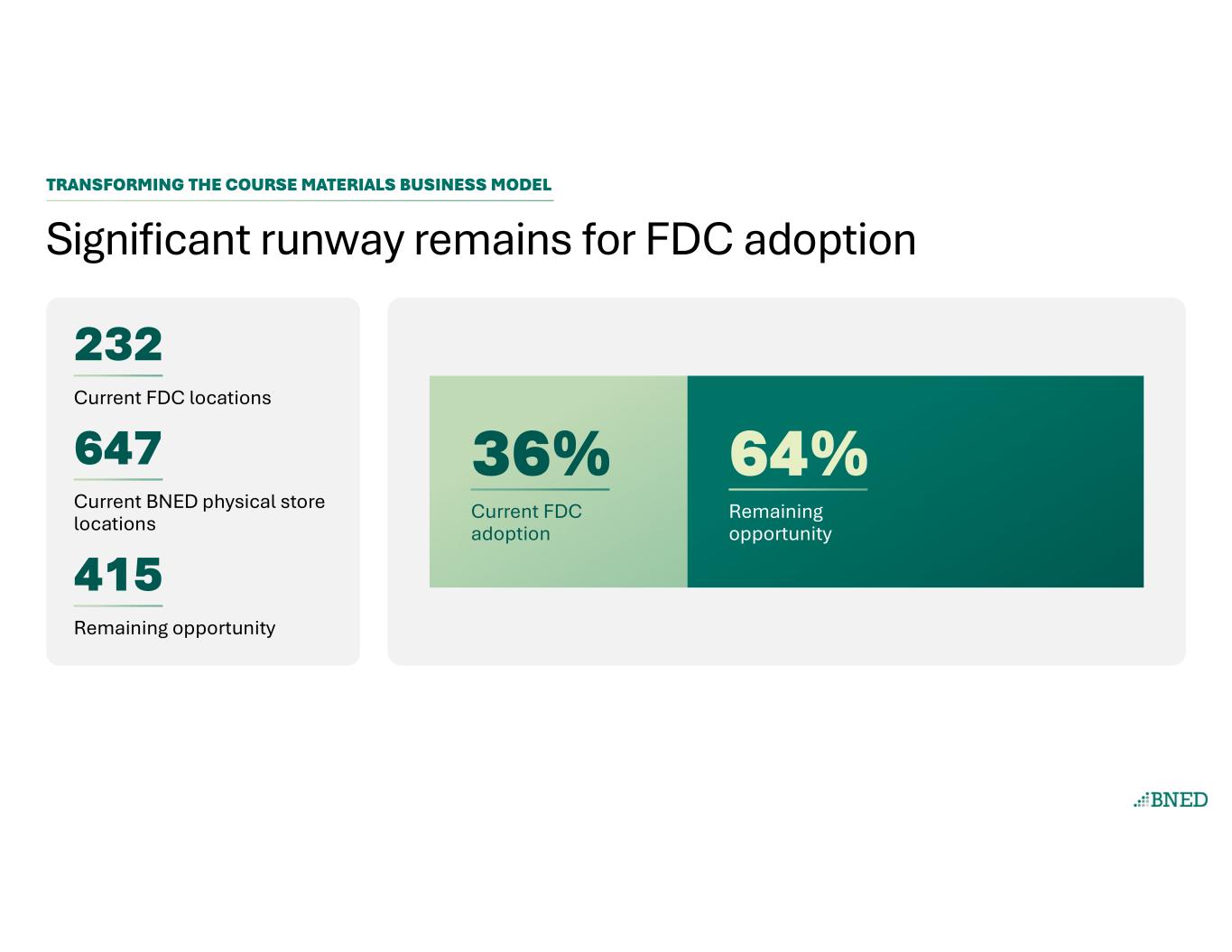
Significant runway remains for FDC adoption TRANSFORMING THE COURSE MATERIALS BUSINESS MODEL 232 Current FDC locations 647 Current BNED physical store locations 415 Remaining opportunity 36% Current FDC adoption 64% Remaining opportunity
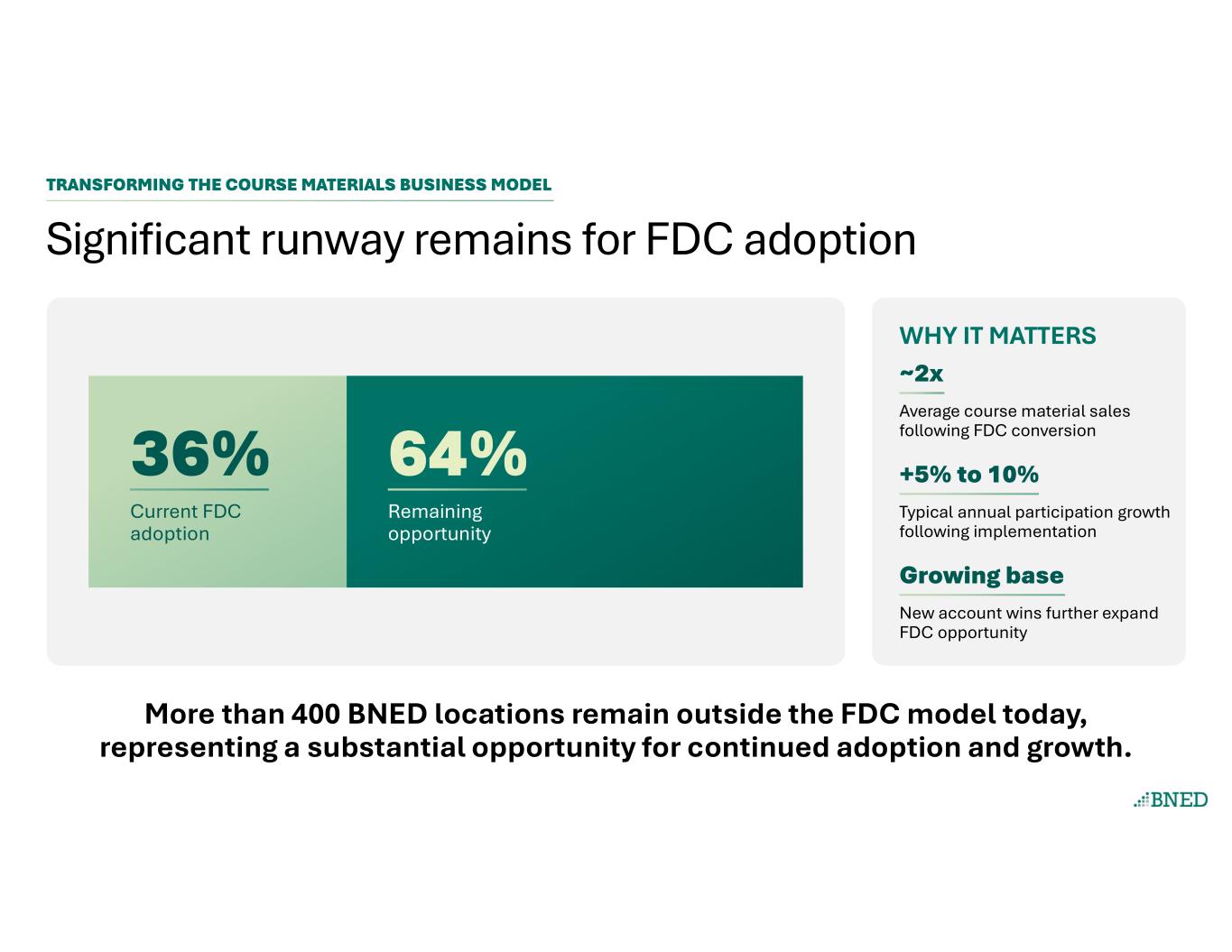
Significant runway remains for FDC adoption TRANSFORMING THE COURSE MATERIALS BUSINESS MODEL More than 400 BNED locations remain outside the FDC model today, representing a substantial opportunity for continued adoption and growth. 36% Current FDC adoption 64% Remaining opportunity ~2x Average course material sales following FDC conversion WHY IT MATTERS +5% to 10% Typical annual participation growth following implementation Growing base New account wins further expand FDC opportunity
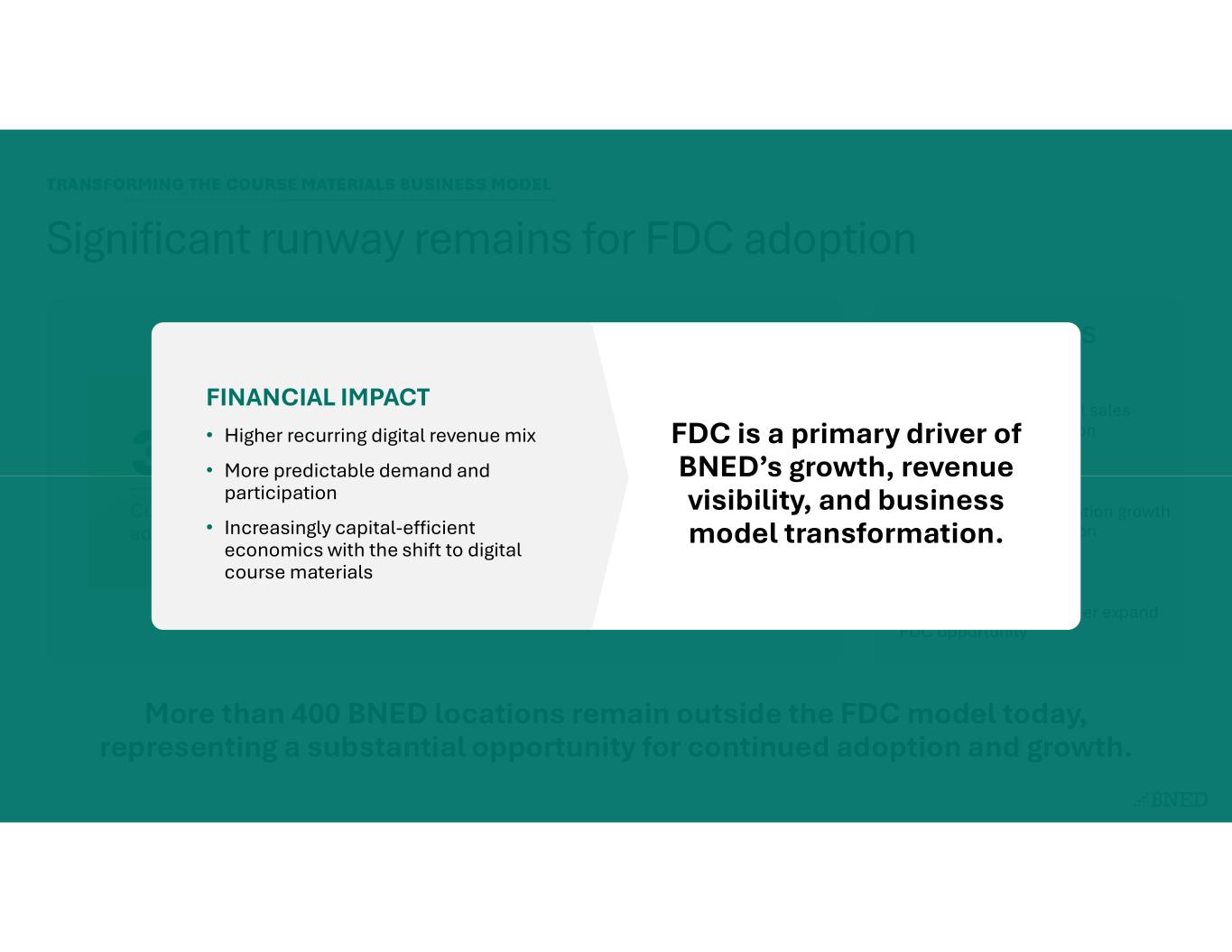
Significant runway remains for FDC adoption TRANSFORMING THE COURSE MATERIALS BUSINESS MODEL More than 400 BNED locations remain outside the FDC model today, representing a substantial opportunity for continued adoption and growth. 36% Current FDC adoption 64% Remaining opportunity ~2x Average course material sales following FDC conversion WHY IT MATTERS +5% to 10% Typical annual participation growth following implementation Growing base New account wins further expand FDC opportunity FDC is a primary driver of BNED’s growth, revenue visibility, and business model transformation. FINANCIAL IMPACT • Higher recurring digital revenue mix • More predictable demand and participation • Increasingly capital-efficient economics with the shift to digital course materials

ADDITIONAL GROWTH OPPORTUNITIES
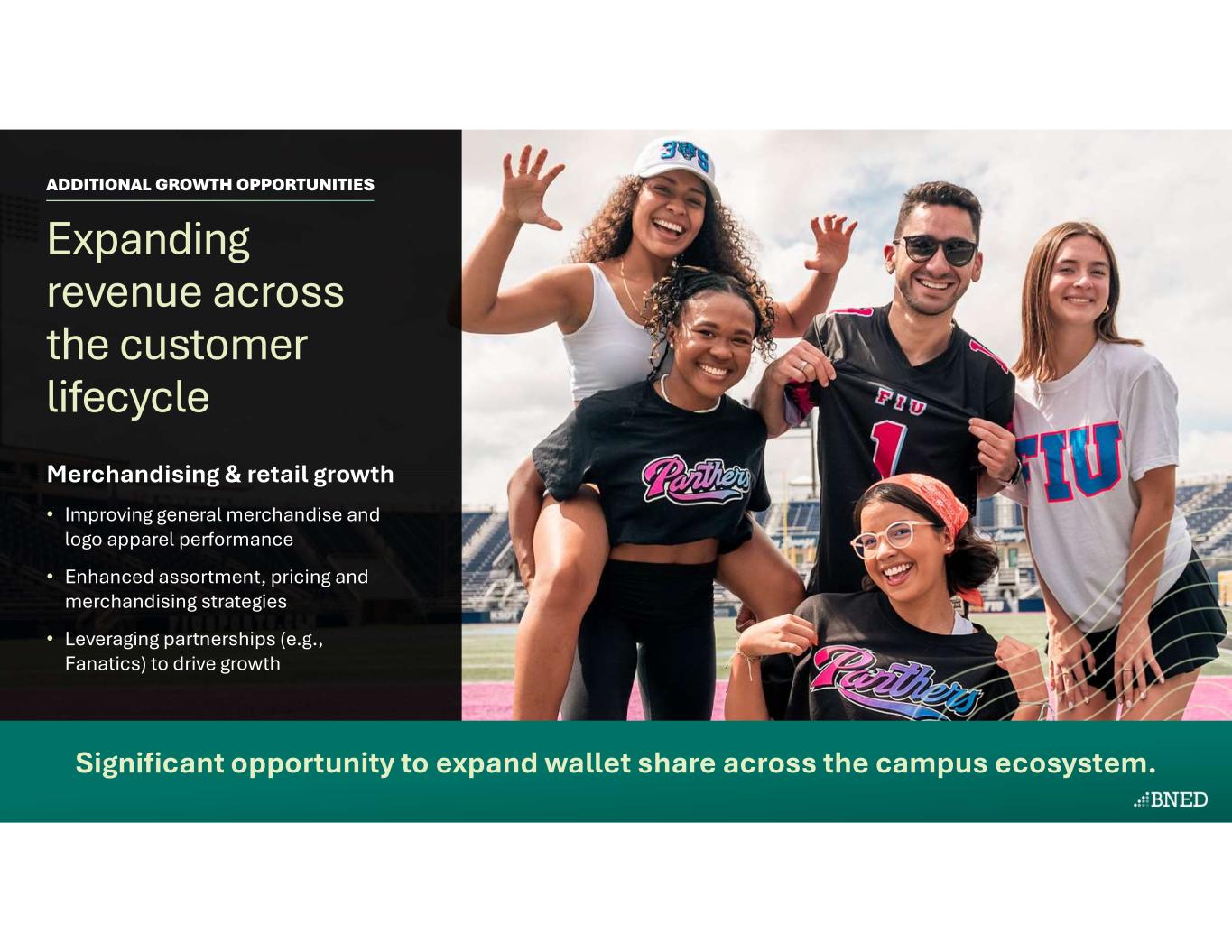
Expanding revenue across the customer lifecycle ADDITIONAL GROWTH OPPORTUNITIES Merchandising & retail growth • Improving general merchandise and logo apparel performance • Enhanced assortment, pricing and merchandising strategies • Leveraging partnerships (e.g., Fanatics) to drive growth Significant opportunity to expand wallet share across the campus ecosystem.
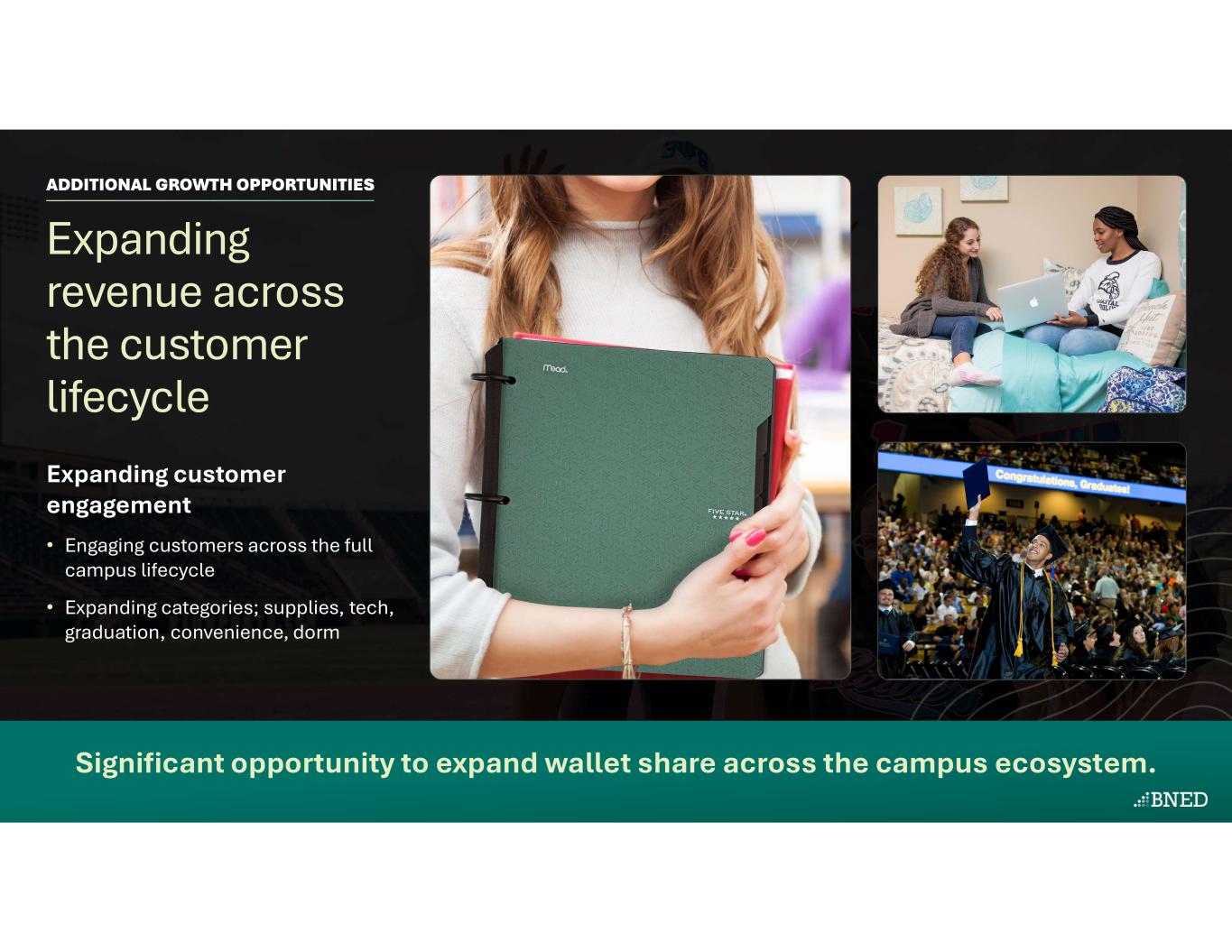
Expanding revenue across the customer lifecycle Expanding customer engagement • Engaging customers across the full campus lifecycle • Expanding categories; supplies, tech, graduation, convenience, dorm Significant opportunity to expand wallet share across the campus ecosystem. ADDITIONAL GROWTH OPPORTUNITIES

Expanding revenue across the customer lifecycle High-margin partnership & marketing opportunities • Large base of recurring campus engagement and transactions • Expanding high-margin partnership and marketing revenue Significant opportunity to expand wallet share across the campus ecosystem. ADDITIONAL GROWTH OPPORTUNITIES
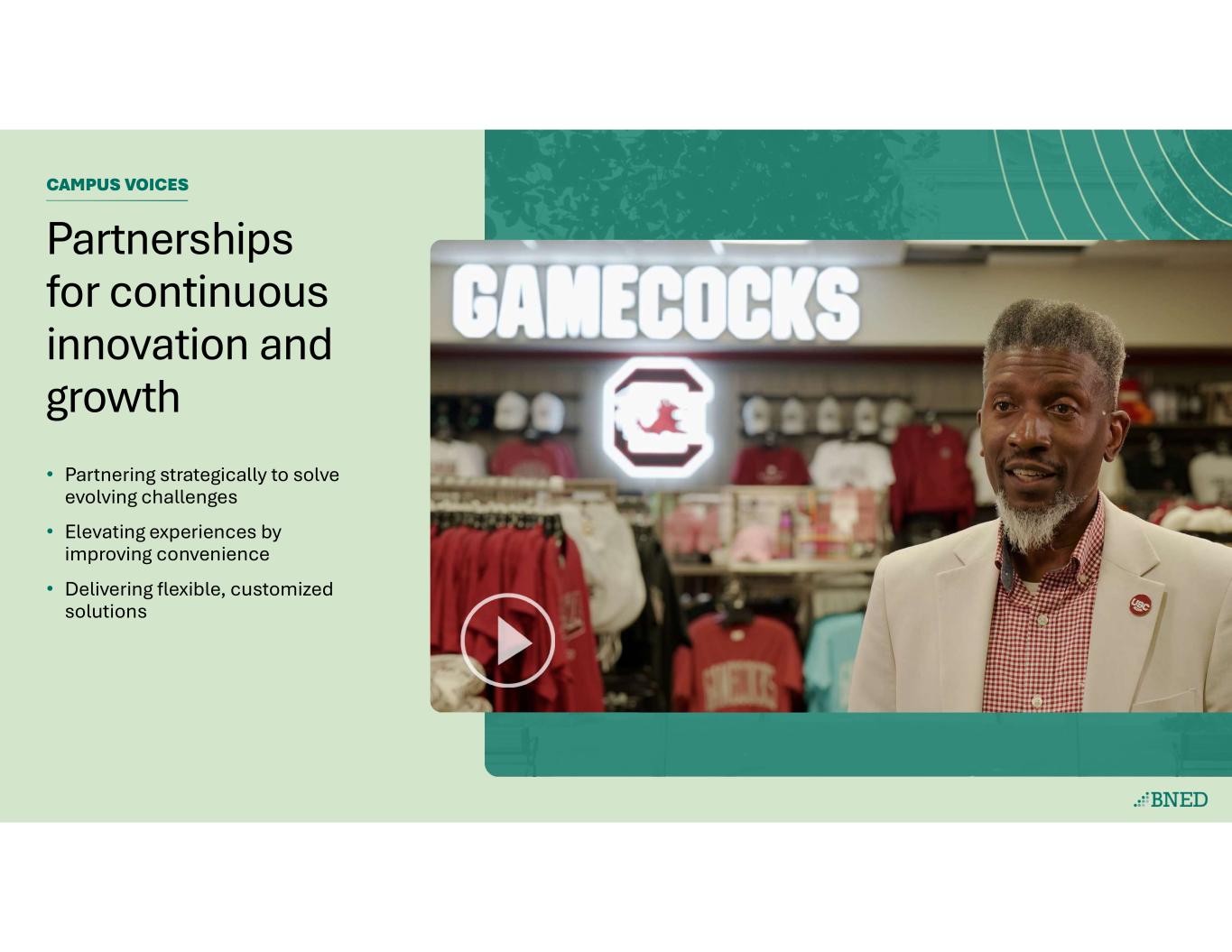
Partnerships for continuous innovation and growth CAMPUS VOICES • Partnering strategically to solve evolving challenges • Elevating experiences by improving convenience • Delivering flexible, customized solutions
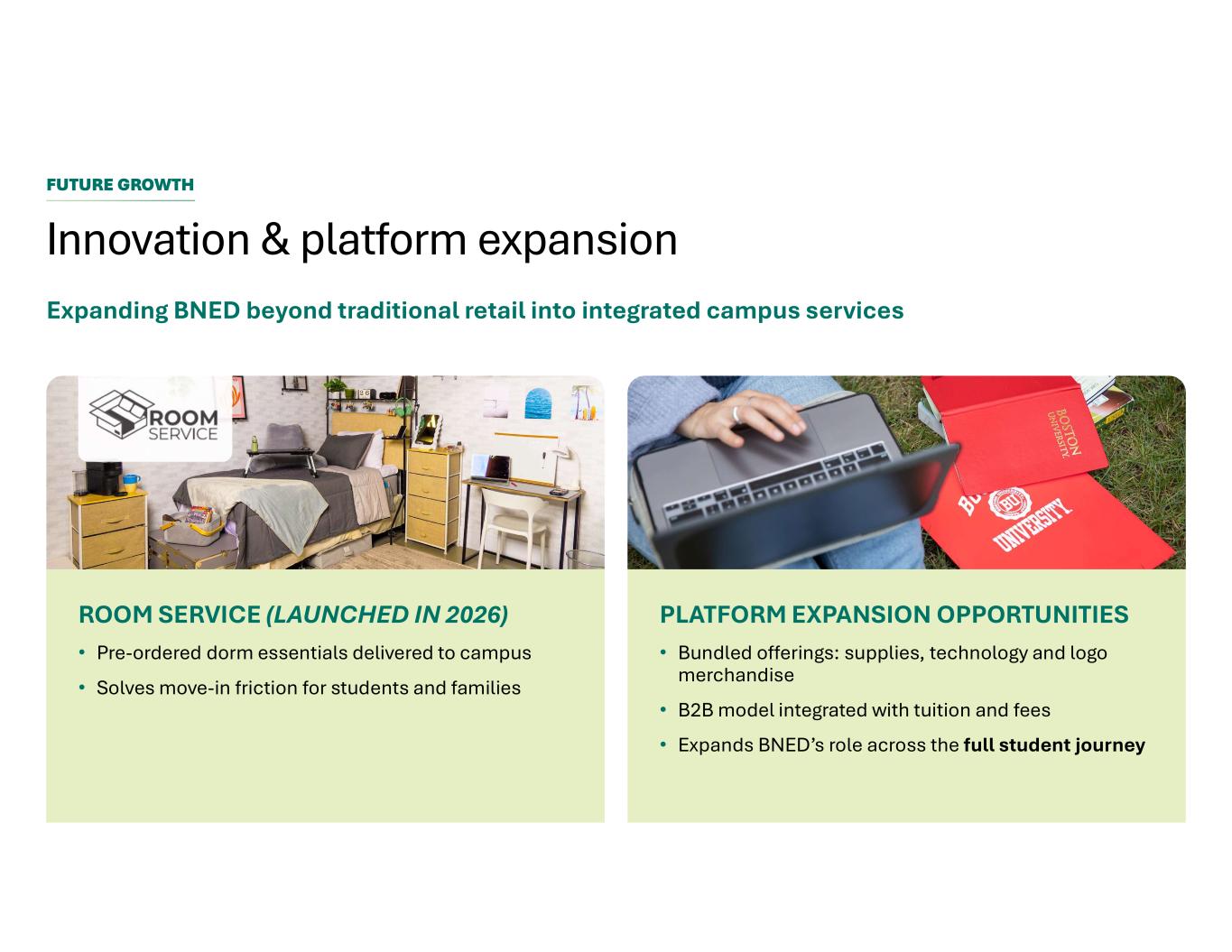
Innovation & platform expansion FUTURE GROWTH Expanding BNED beyond traditional retail into integrated campus services PLATFORM EXPANSION OPPORTUNITIES • Bundled offerings: supplies, technology and logo merchandise • B2B model integrated with tuition and fees • Expands BNED’s role across the full student journey ROOM SERVICE (LAUNCHED IN 2026) • Pre-ordered dorm essentials delivered to campus • Solves move-in friction for students and families
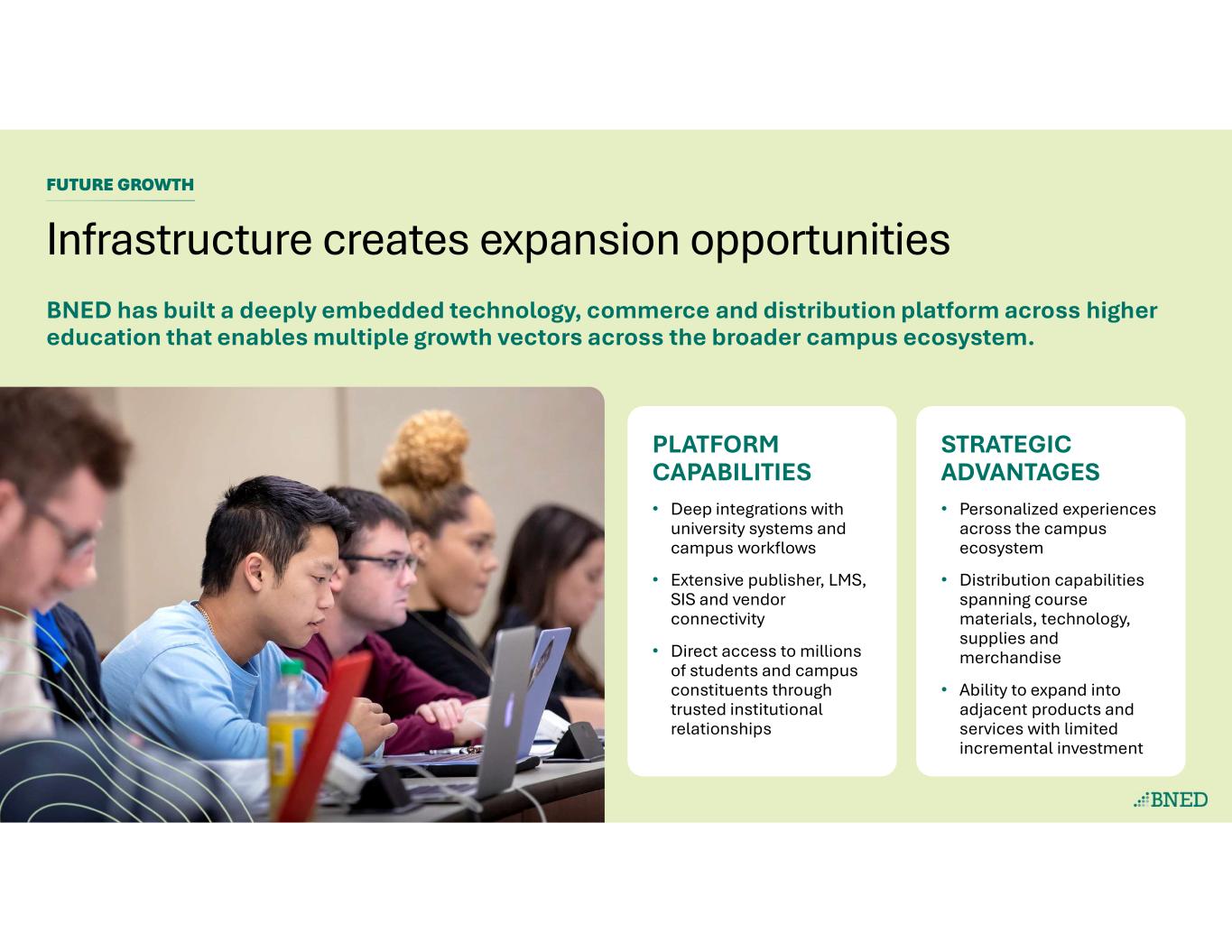
Infrastructure creates expansion opportunities BNED has built a deeply embedded technology, commerce and distribution platform across higher education that enables multiple growth vectors across the broader campus ecosystem. FUTURE GROWTH PLATFORM CAPABILITIES • Deep integrations with university systems and campus workflows • Extensive publisher, LMS, SIS and vendor connectivity • Direct access to millions of students and campus constituents through trusted institutional relationships STRATEGIC ADVANTAGES • Personalized experiences across the campus ecosystem • Distribution capabilities spanning course materials, technology, supplies and merchandise • Ability to expand into adjacent products and services with limited incremental investment
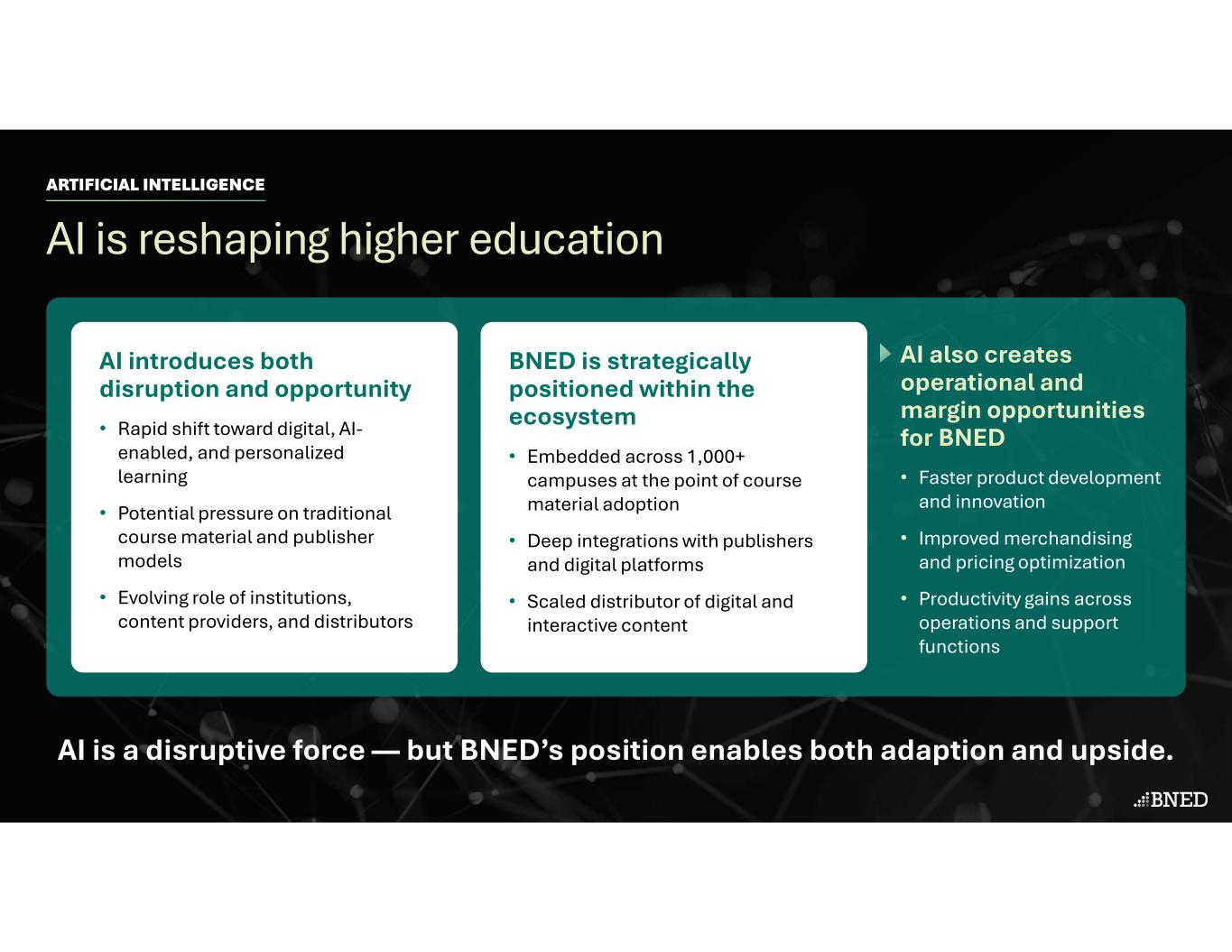
AI is reshaping higher education ARTIFICIAL INTELLIGENCE AI is a disruptive force — but BNED’s position enables both adaption and upside. BNED is strategically positioned within the ecosystem • Embedded across 1,000+ campuses at the point of course material adoption • Deep integrations with publishers and digital platforms • Scaled distributor of digital and interactive content AI also creates operational and margin opportunities for BNED • Faster product development and innovation • Improved merchandising and pricing optimization • Productivity gains across operations and support functions AI introduces both disruption and opportunity • Rapid shift toward digital, AI- enabled, and personalized learning • Potential pressure on traditional course material and publisher models • Evolving role of institutions, content providers, and distributors

FINANCIAL OVERVIEW
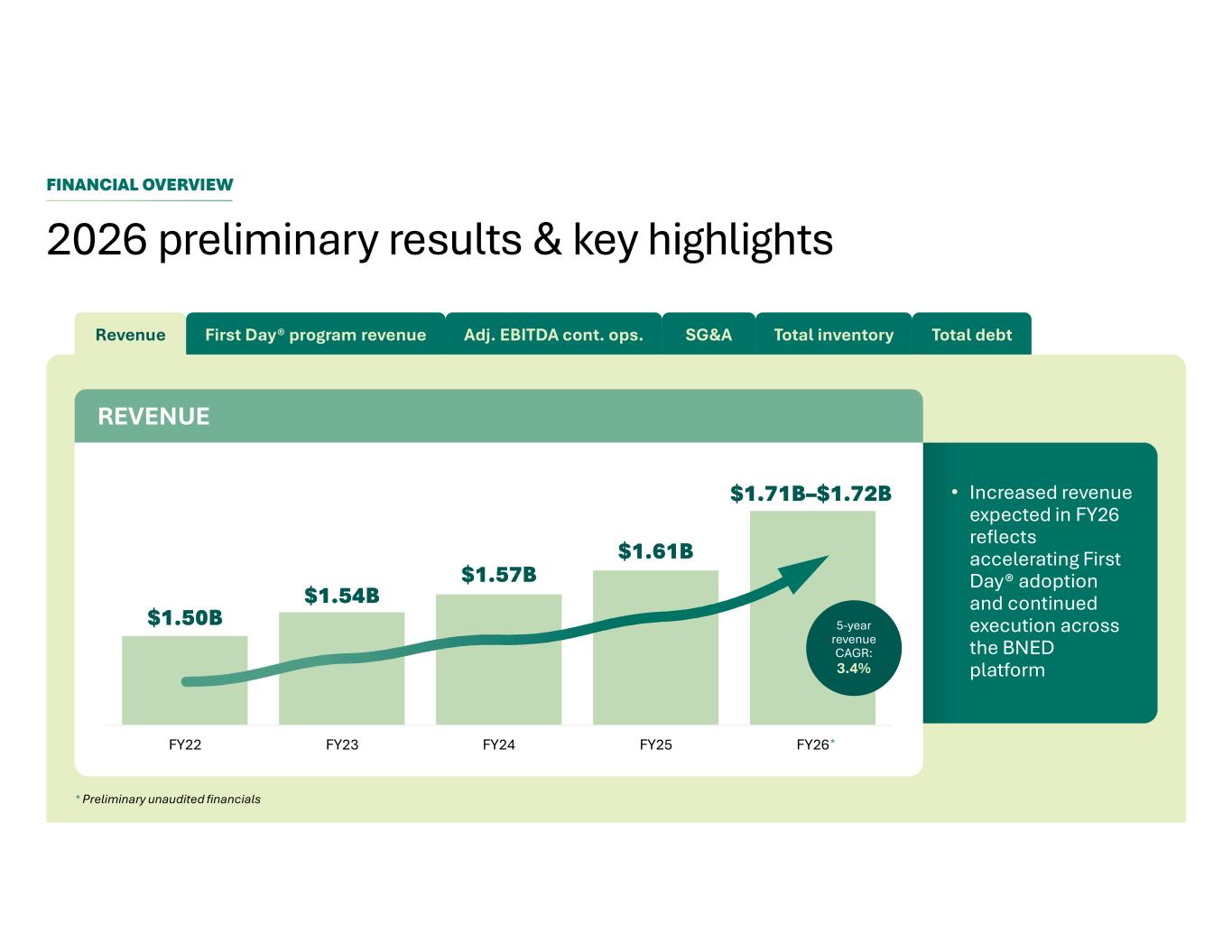
2026 preliminary results & key highlights FINANCIAL OVERVIEW Revenue • Increased revenue expected in FY26 reflects accelerating First Day® adoption and continued execution across the BNED platform REVENUE $1.50B $1.54B $1.57B $1.61B $1.71B–$1.72B FY22 FY23 FY24 FY25 FY26 * Preliminary unaudited financials * 5-year revenue CAGR: 3.4% Adj. EBITDA cont. ops. SG&AFirst Day® program revenue Total inventory Total debt
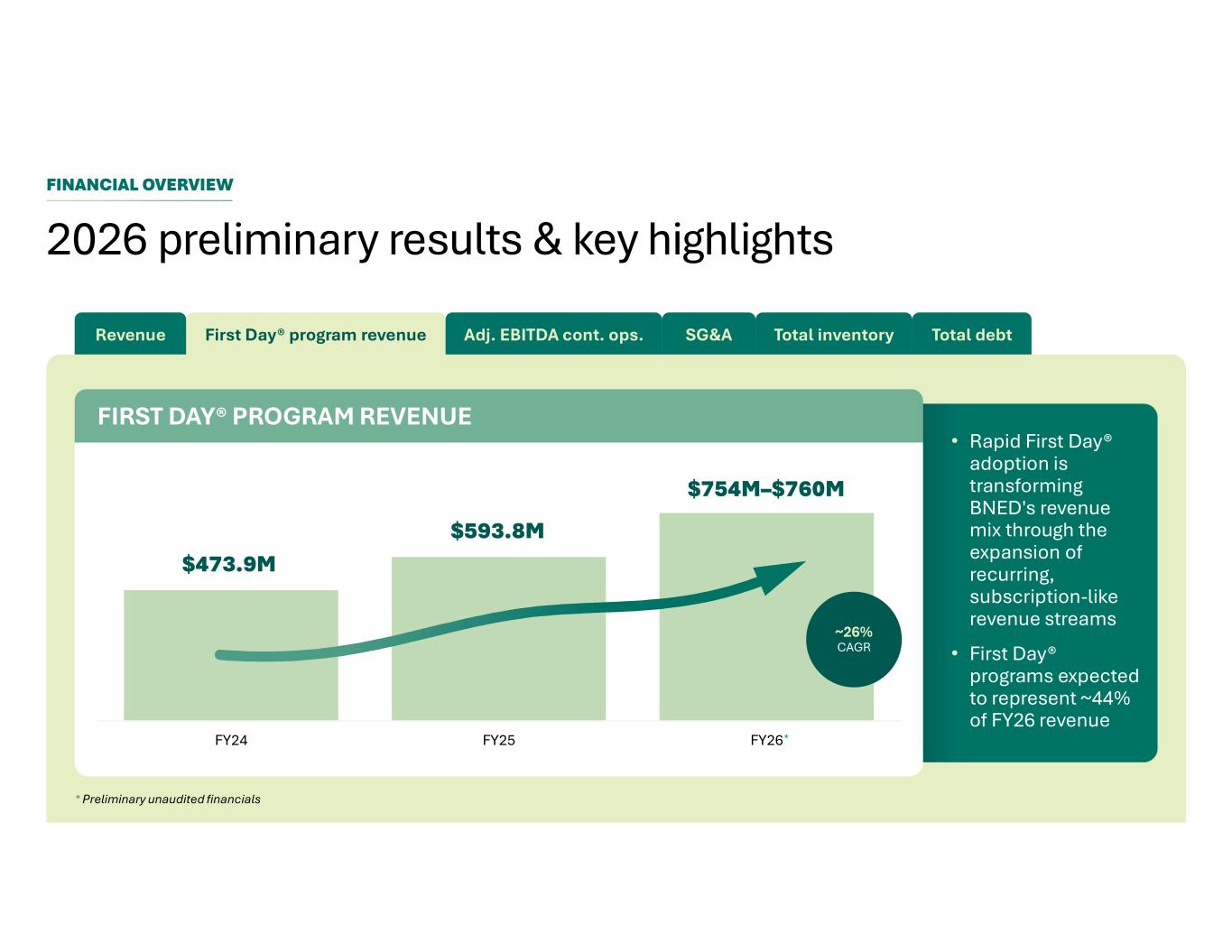
2026 preliminary results & key highlights FINANCIAL OVERVIEW Revenue • Rapid First Day® adoption is transforming BNED's revenue mix through the expansion of recurring, subscription-like revenue streams • First Day® programs expected to represent ~44% of FY26 revenue FIRST DAY® PROGRAM REVENUE $473.9M $593.8M $754M–$760M FY24 FY25 FY26 * Preliminary unaudited financials * ~26% CAGR Adj. EBITDA cont. ops. SG&AFirst Day® program revenue Total inventory Total debt
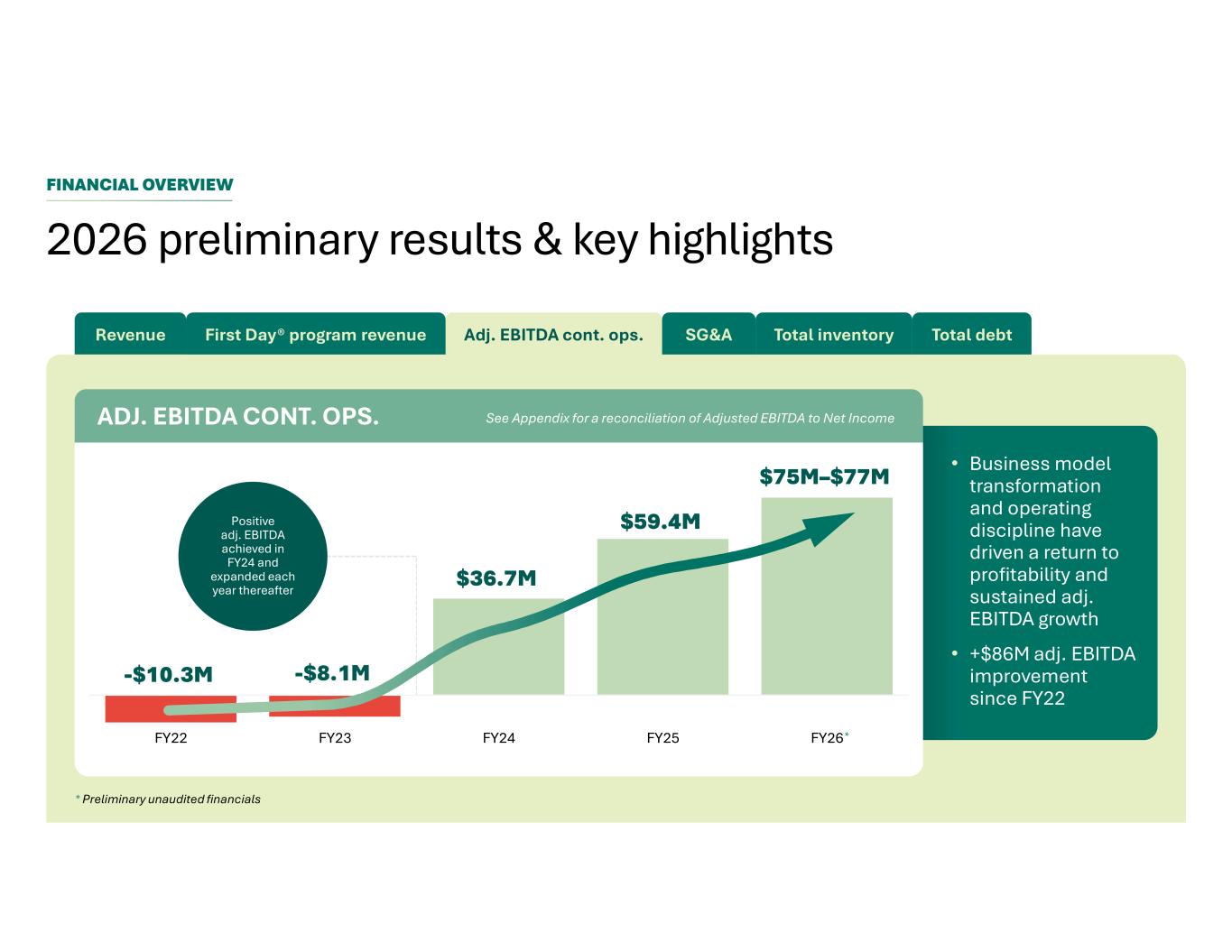
2026 preliminary results & key highlights FINANCIAL OVERVIEW Revenue • Business model transformation and operating discipline have driven a return to profitability and sustained adj. EBITDA growth • +$86M adj. EBITDA improvement since FY22 Adj. EBITDA cont. ops. SG&AFirst Day® program revenue Total inventory Total debt ADJ. EBITDA CONT. OPS. -$10.3M -$8.1M $36.7M $59.4M $75M–$77M FY22 FY23 FY24 FY25 FY26 * Preliminary unaudited financials * See Appendix for a reconciliation of Adjusted EBITDA to Net Income Positive adj. EBITDA achieved in FY24 and expanded each year thereafter
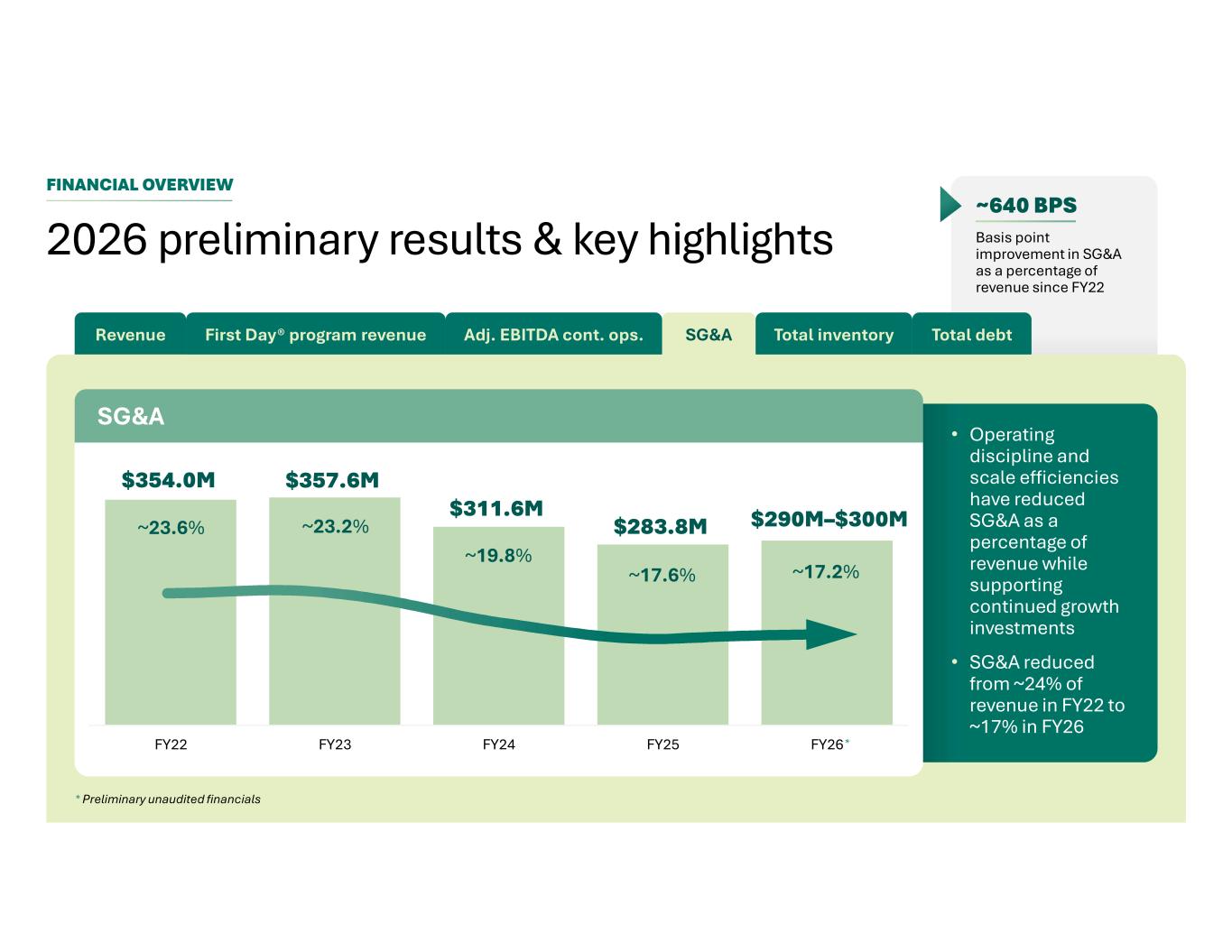
2026 preliminary results & key highlights FINANCIAL OVERVIEW Revenue • Operating discipline and scale efficiencies have reduced SG&A as a percentage of revenue while supporting continued growth investments • SG&A reduced from ~24% of revenue in FY22 to ~17% in FY26 SG&A $354.0M $357.6M $311.6M $283.8M $290M–$300M FY22 FY23 FY24 FY25 FY26 * Preliminary unaudited financials * ~23.6% ~23.2% ~19.8% ~17.6% ~17.2% ~640 BPS Basis point improvement in SG&A as a percentage of revenue since FY22 Adj. EBITDA cont. ops. SG&AFirst Day® program revenue Total inventory Total debt
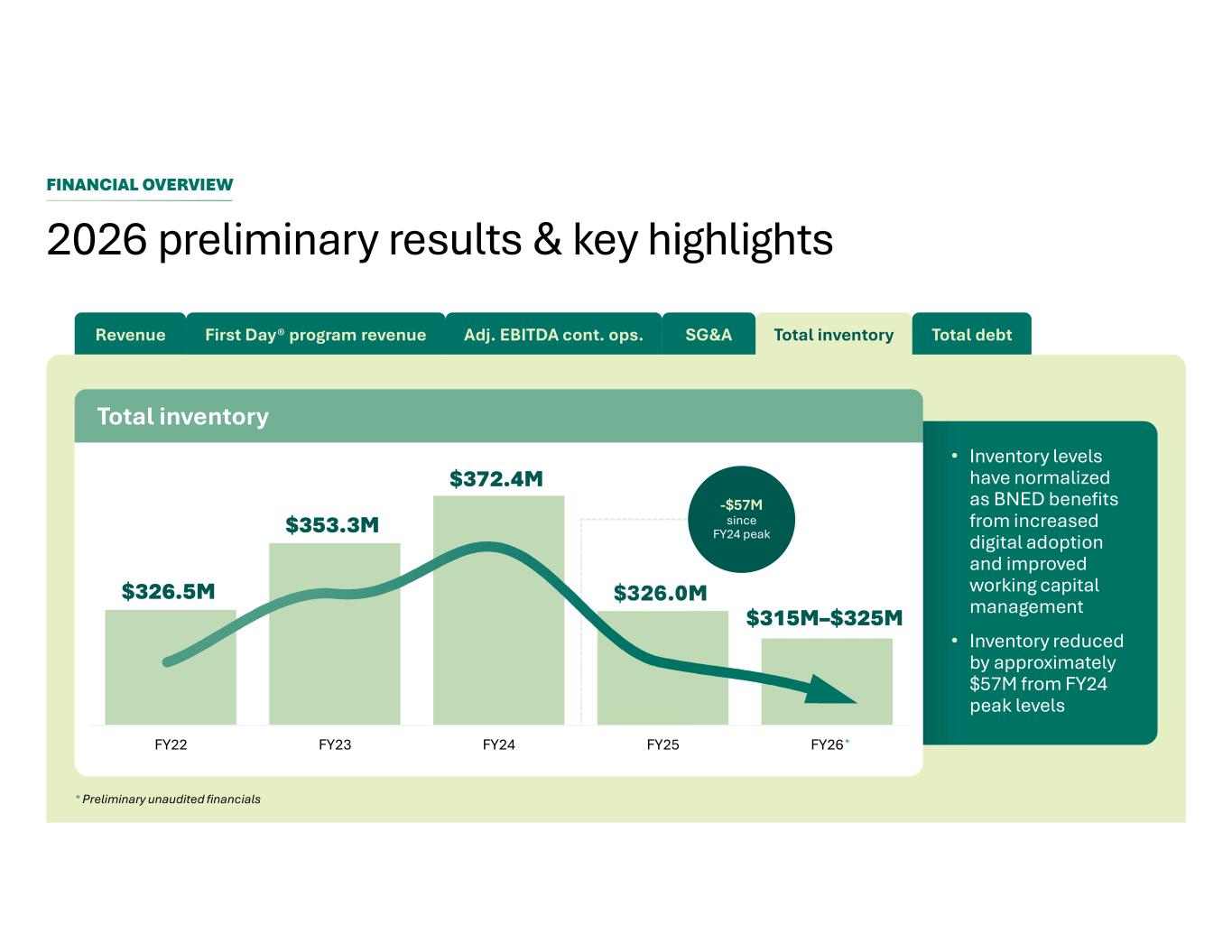
2026 preliminary results & key highlights FINANCIAL OVERVIEW Revenue Total inventory $326.5M $353.3M $372.4M $326.0M $315M–$325M FY22 FY23 FY24 FY25 FY26 * Preliminary unaudited financials * • Inventory levels have normalized as BNED benefits from increased digital adoption and improved working capital management • Inventory reduced by approximately $57M from FY24 peak levels -$57M since FY24 peak Adj. EBITDA cont. ops. SG&AFirst Day® program revenue Total inventory Total debt
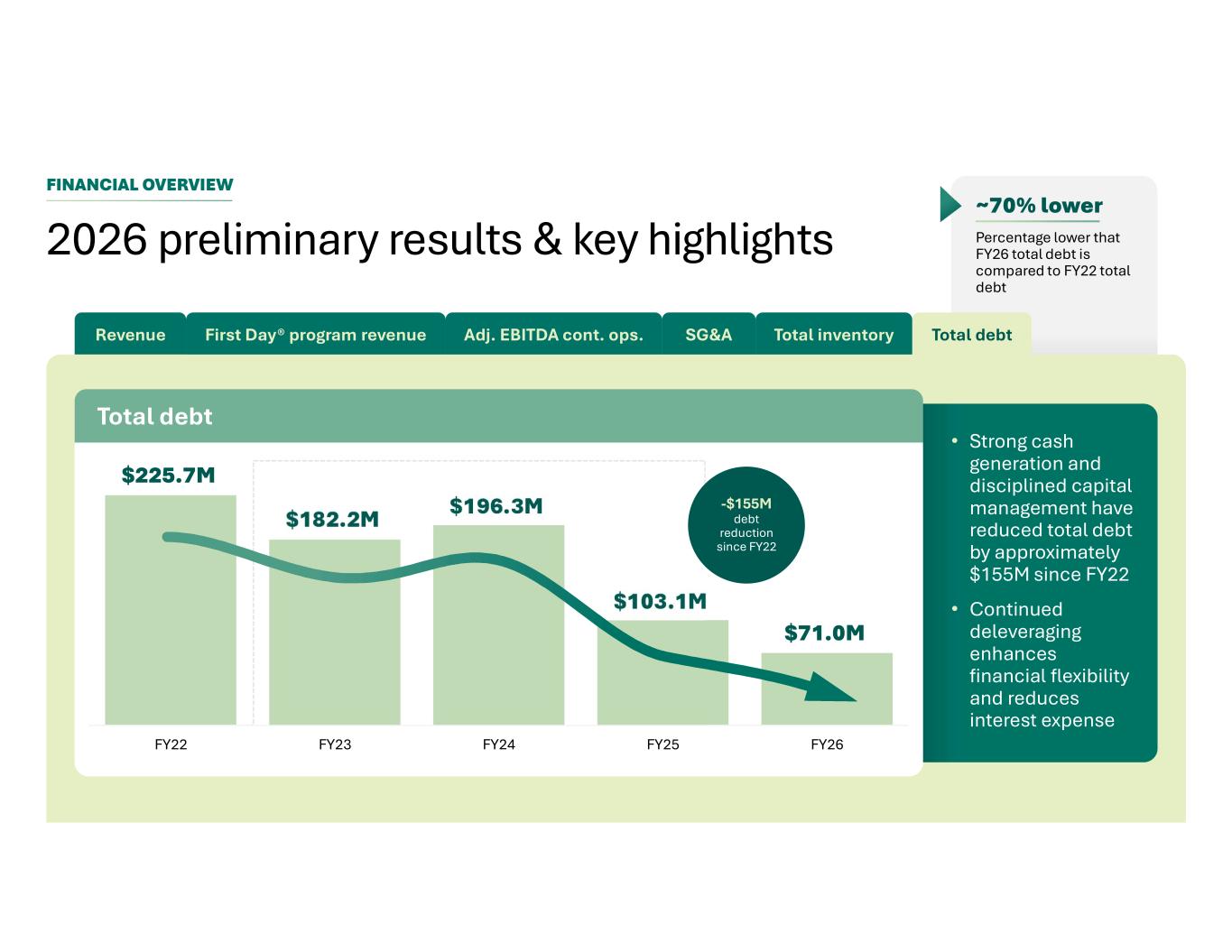
~70% lower Percentage lower that FY26 total debt is compared to FY22 total debt 2026 preliminary results & key highlights FINANCIAL OVERVIEW Revenue Total debt $225.7M $182.2M $196.3M $103.1M $71.0M FY22 FY23 FY24 FY25 FY26 • Strong cash generation and disciplined capital management have reduced total debt by approximately $155M since FY22 • Continued deleveraging enhances financial flexibility and reduces interest expense -$155M debt reduction since FY22 Adj. EBITDA cont. ops. SG&AFirst Day® program revenue Total inventory Total debt
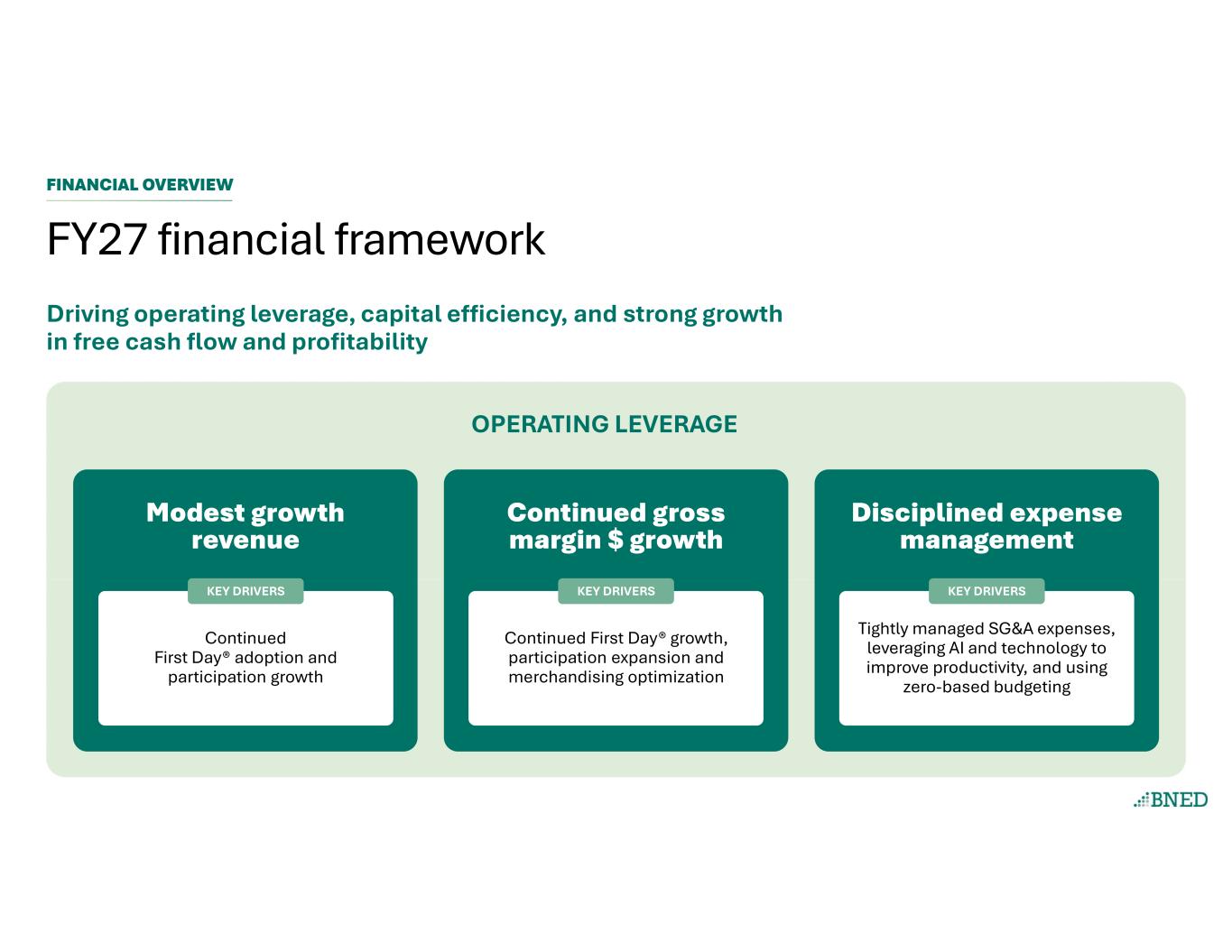
FY27 financial framework FINANCIAL OVERVIEW Driving operating leverage, capital efficiency, and strong growth in free cash flow and profitability OPERATING LEVERAGE KEY DRIVERS Continued First Day® growth, participation expansion and merchandising optimization Continued gross margin $ growth Continued First Day® adoption and participation growth KEY DRIVERS Modest growth revenue KEY DRIVERS Tightly managed SG&A expenses, leveraging AI and technology to improve productivity, and using zero-based budgeting Disciplined expense management
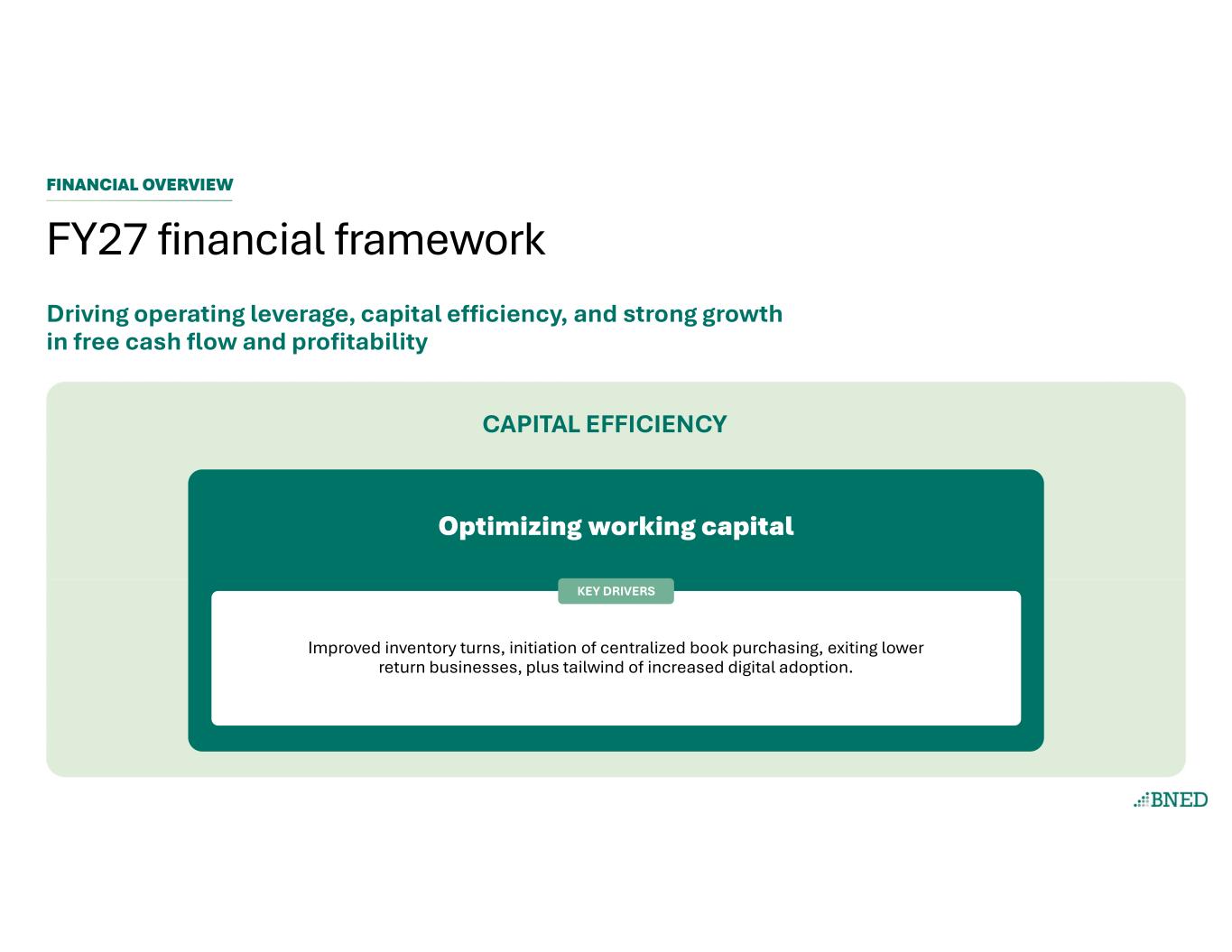
FY27 financial framework FINANCIAL OVERVIEW Driving operating leverage, capital efficiency, and strong growth in free cash flow and profitability CAPITAL EFFICIENCY Improved inventory turns, initiation of centralized book purchasing, exiting lower return businesses, plus tailwind of increased digital adoption. KEY DRIVERS Optimizing working capital
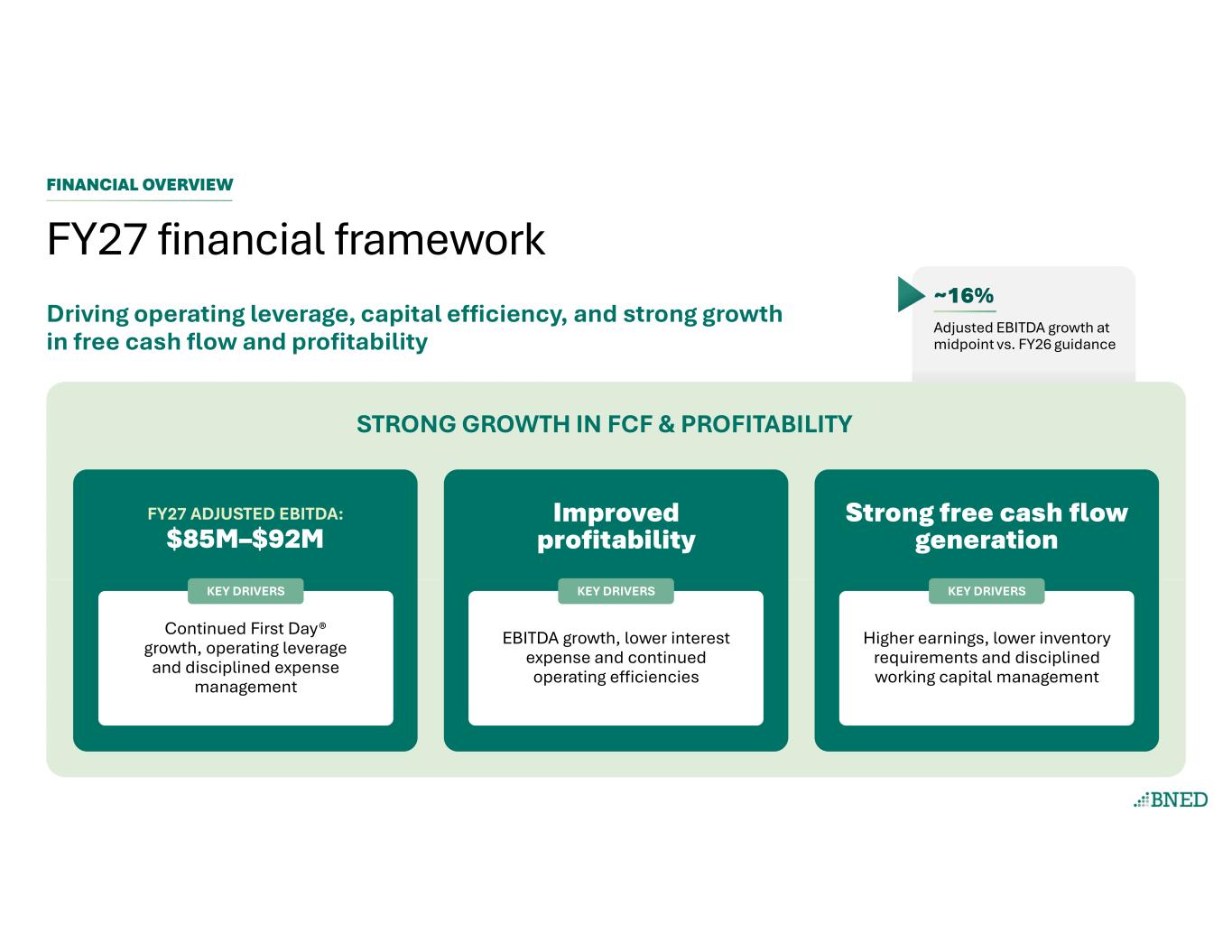
~16% Adjusted EBITDA growth at midpoint vs. FY26 guidance FY27 financial framework FINANCIAL OVERVIEW Driving operating leverage, capital efficiency, and strong growth in free cash flow and profitability STRONG GROWTH IN FCF & PROFITABILITY KEY DRIVERS EBITDA growth, lower interest expense and continued operating efficiencies Improved profitability KEY DRIVERS Higher earnings, lower inventory requirements and disciplined working capital management Strong free cash flow generation Continued First Day® growth, operating leverage and disciplined expense management KEY DRIVERS $85M–$92M FY27 ADJUSTED EBITDA:
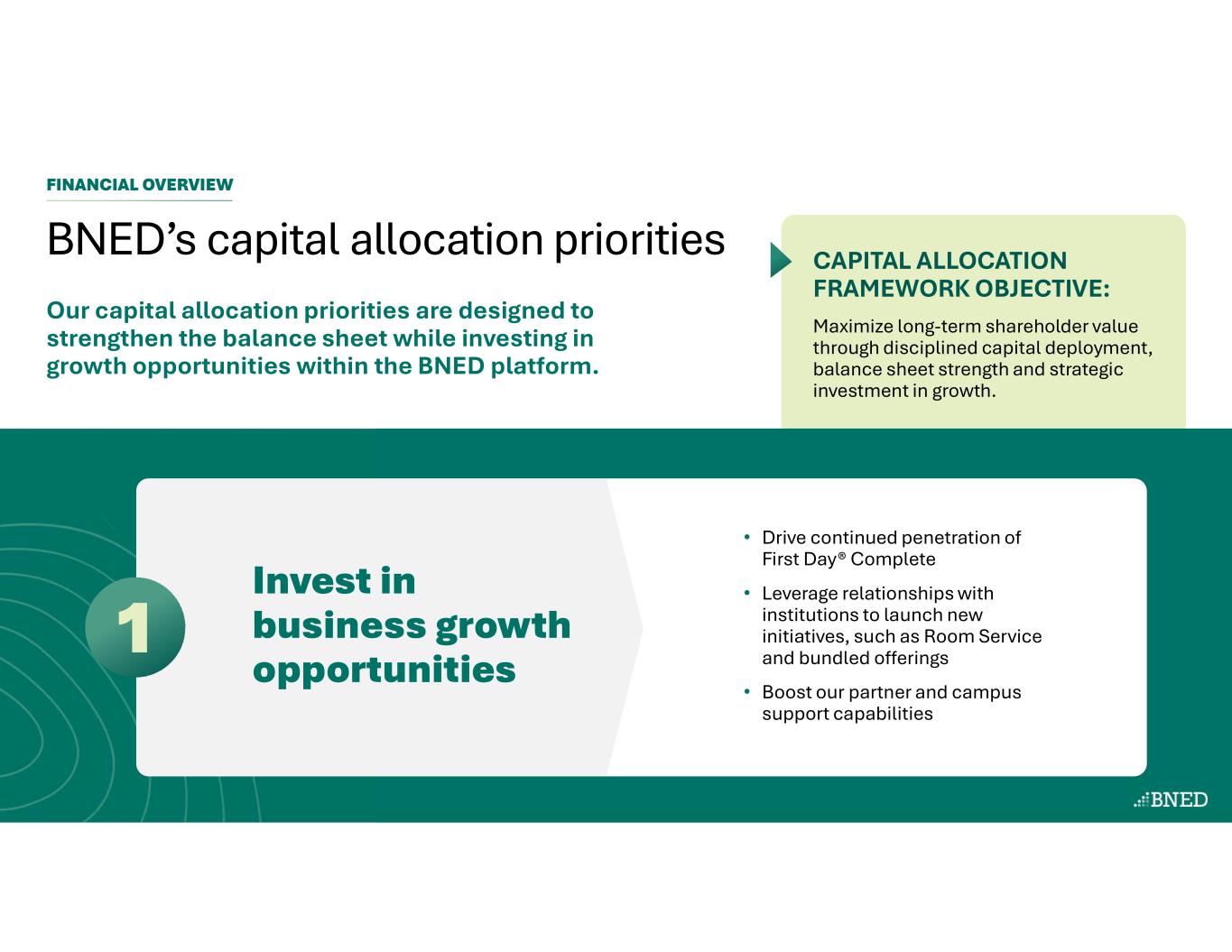
BNED’s capital allocation priorities FINANCIAL OVERVIEW Our capital allocation priorities are designed to strengthen the balance sheet while investing in growth opportunities within the BNED platform. CAPITAL ALLOCATION FRAMEWORK OBJECTIVE: Maximize long-term shareholder value through disciplined capital deployment, balance sheet strength and strategic investment in growth. Invest in business growth opportunities • Drive continued penetration of First Day® Complete • Leverage relationships with institutions to launch new initiatives, such as Room Service and bundled offerings • Boost our partner and campus support capabilities 1
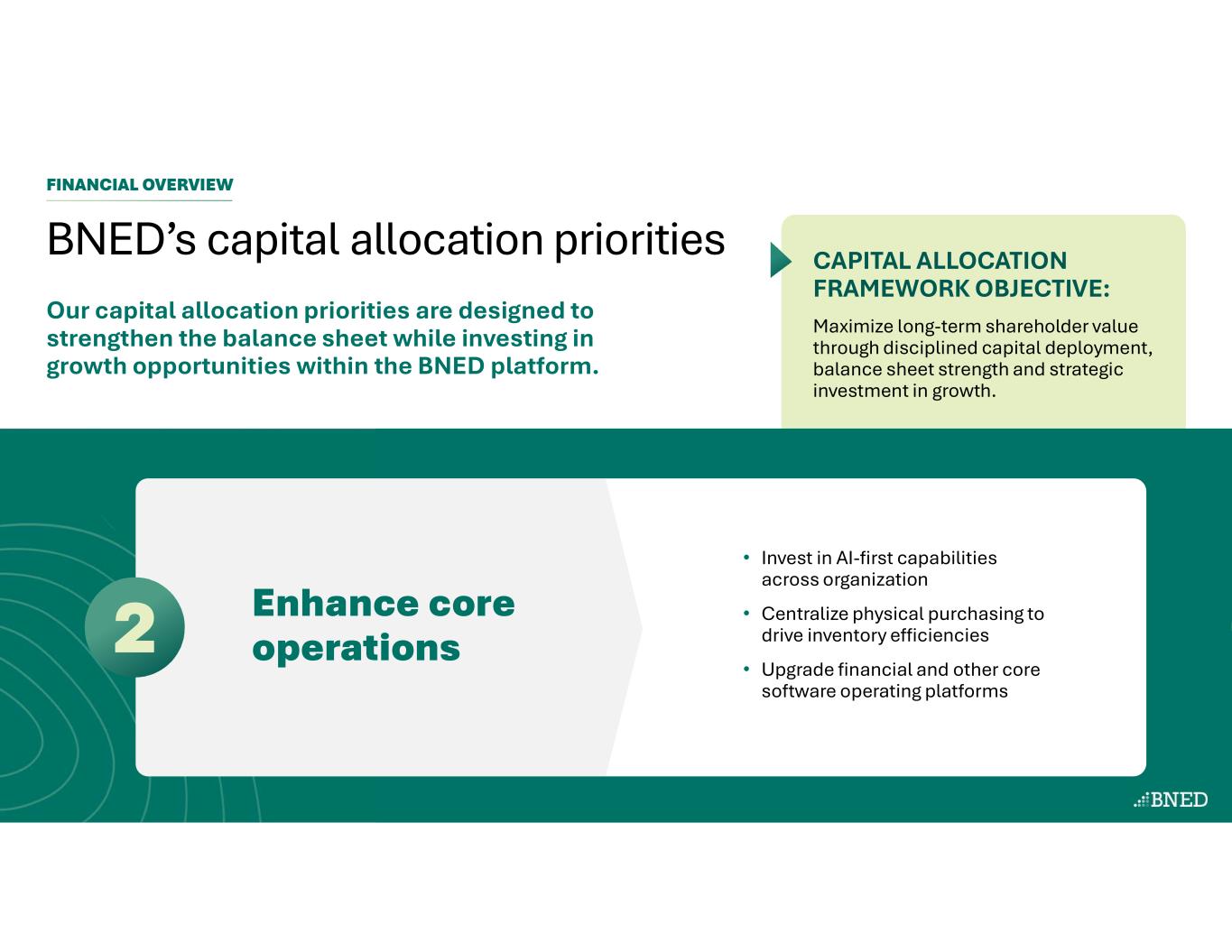
BNED’s capital allocation priorities FINANCIAL OVERVIEW Our capital allocation priorities are designed to strengthen the balance sheet while investing in growth opportunities within the BNED platform. CAPITAL ALLOCATION FRAMEWORK OBJECTIVE: Maximize long-term shareholder value through disciplined capital deployment, balance sheet strength and strategic investment in growth. Enhance core operations • Invest in AI-first capabilities across organization • Centralize physical purchasing to drive inventory efficiencies • Upgrade financial and other core software operating platforms 2
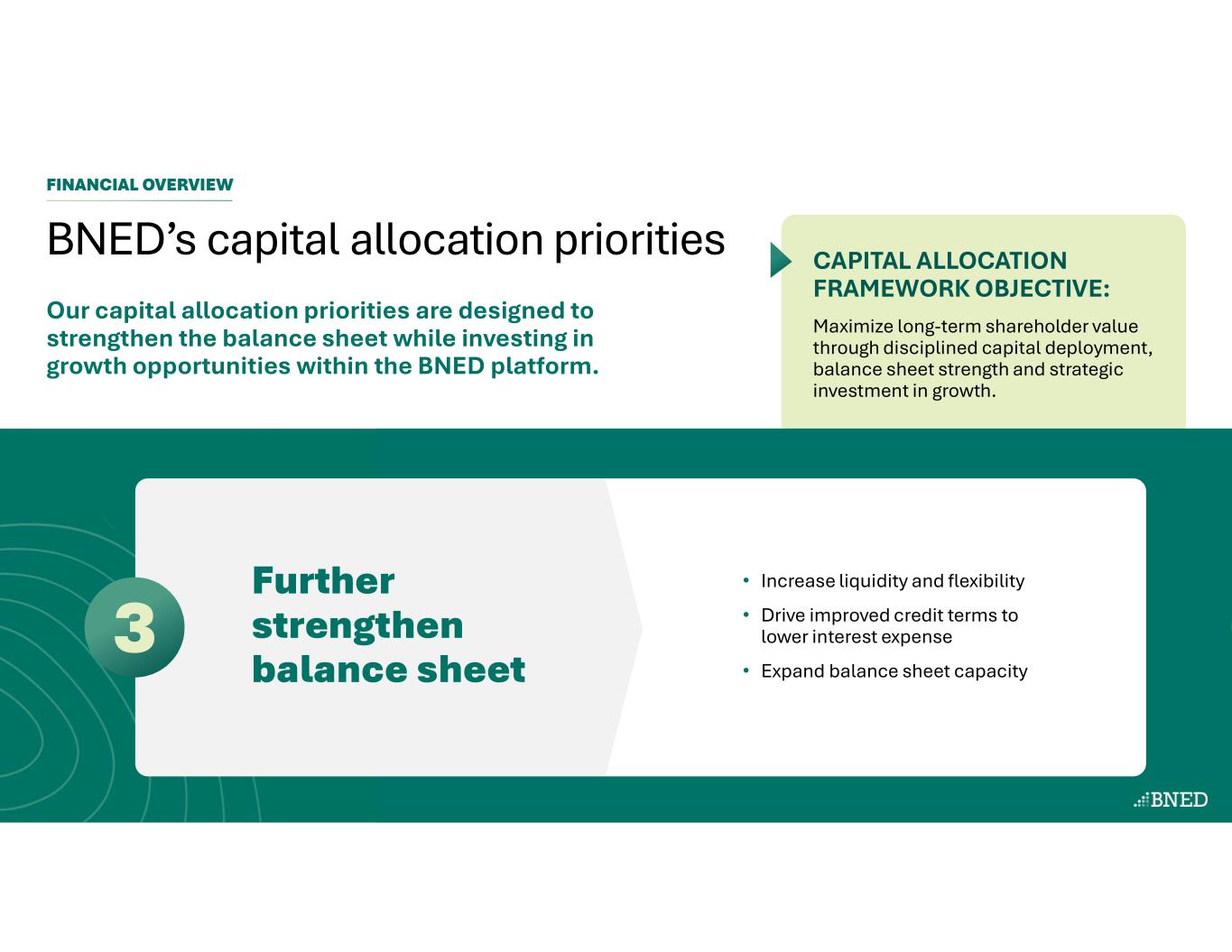
BNED’s capital allocation priorities FINANCIAL OVERVIEW Our capital allocation priorities are designed to strengthen the balance sheet while investing in growth opportunities within the BNED platform. CAPITAL ALLOCATION FRAMEWORK OBJECTIVE: Maximize long-term shareholder value through disciplined capital deployment, balance sheet strength and strategic investment in growth. Further strengthen balance sheet • Increase liquidity and flexibility • Drive improved credit terms to lower interest expense • Expand balance sheet capacity 3
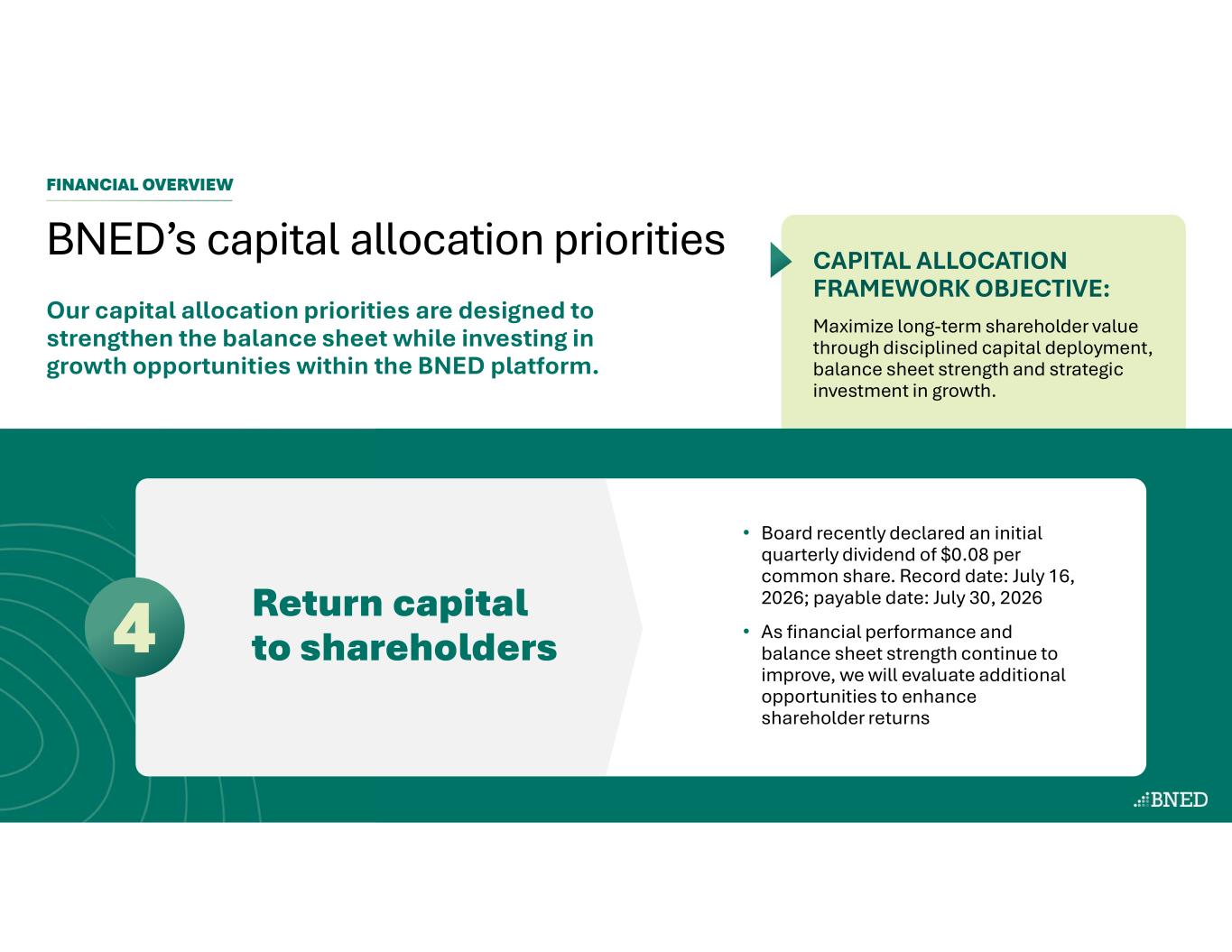
BNED’s capital allocation priorities FINANCIAL OVERVIEW Our capital allocation priorities are designed to strengthen the balance sheet while investing in growth opportunities within the BNED platform. CAPITAL ALLOCATION FRAMEWORK OBJECTIVE: Maximize long-term shareholder value through disciplined capital deployment, balance sheet strength and strategic investment in growth. Return capital to shareholders • Board recently declared an initial quarterly dividend of $0.08 per common share. Record date: July 16, 2026; payable date: July 30, 2026 • As financial performance and balance sheet strength continue to improve, we will evaluate additional opportunities to enhance shareholder returns 4

SUMMARY
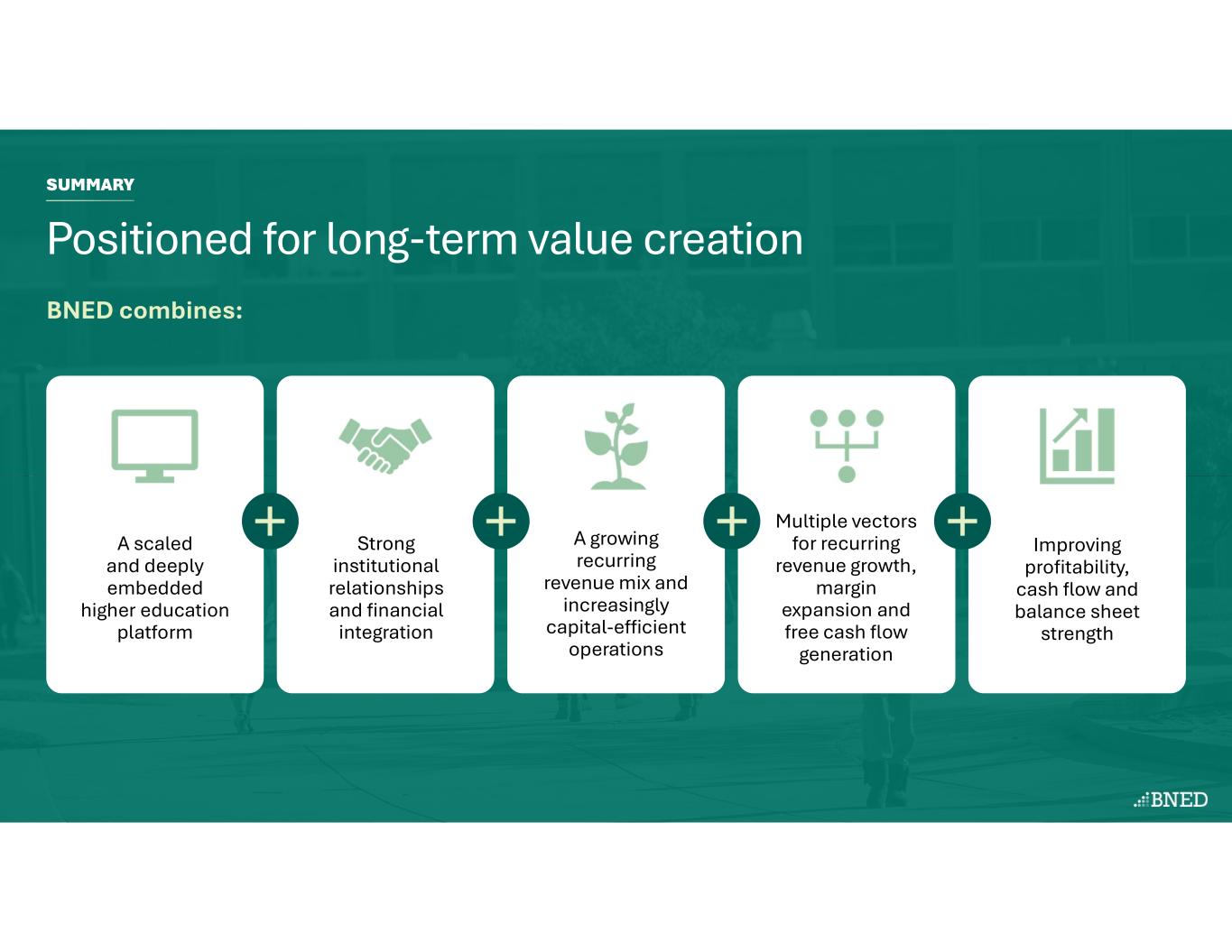
Improving profitability, cash flow and balance sheet strength Strong institutional relationships and financial integration A scaled and deeply embedded higher education platform A growing recurring revenue mix and increasingly capital-efficient operations Multiple vectors for recurring revenue growth, margin expansion and free cash flow generation Positioned for long-term value creation SUMMARY BNED combines:
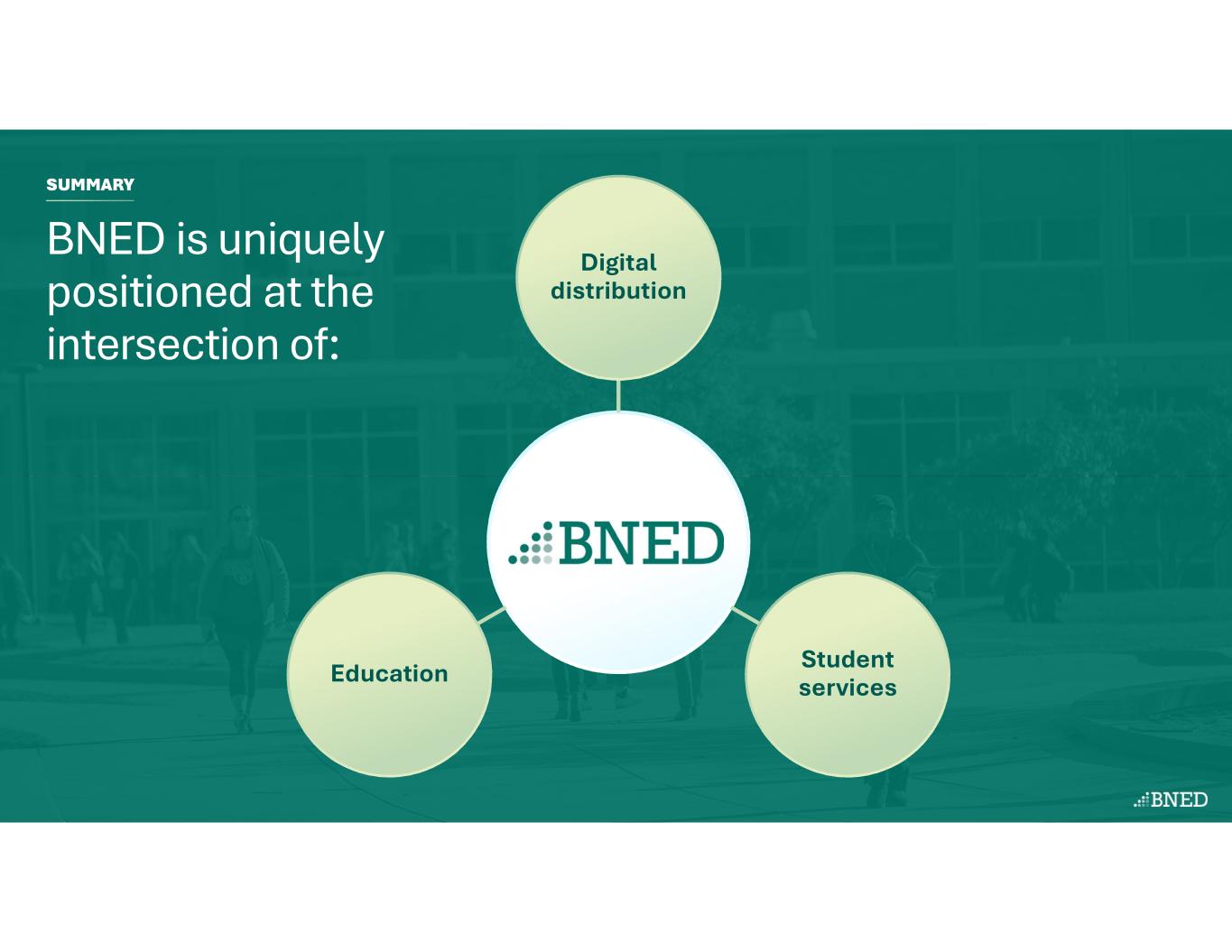
BNED is uniquely positioned at the intersection of: SUMMARY Digital distribution Student servicesEducation
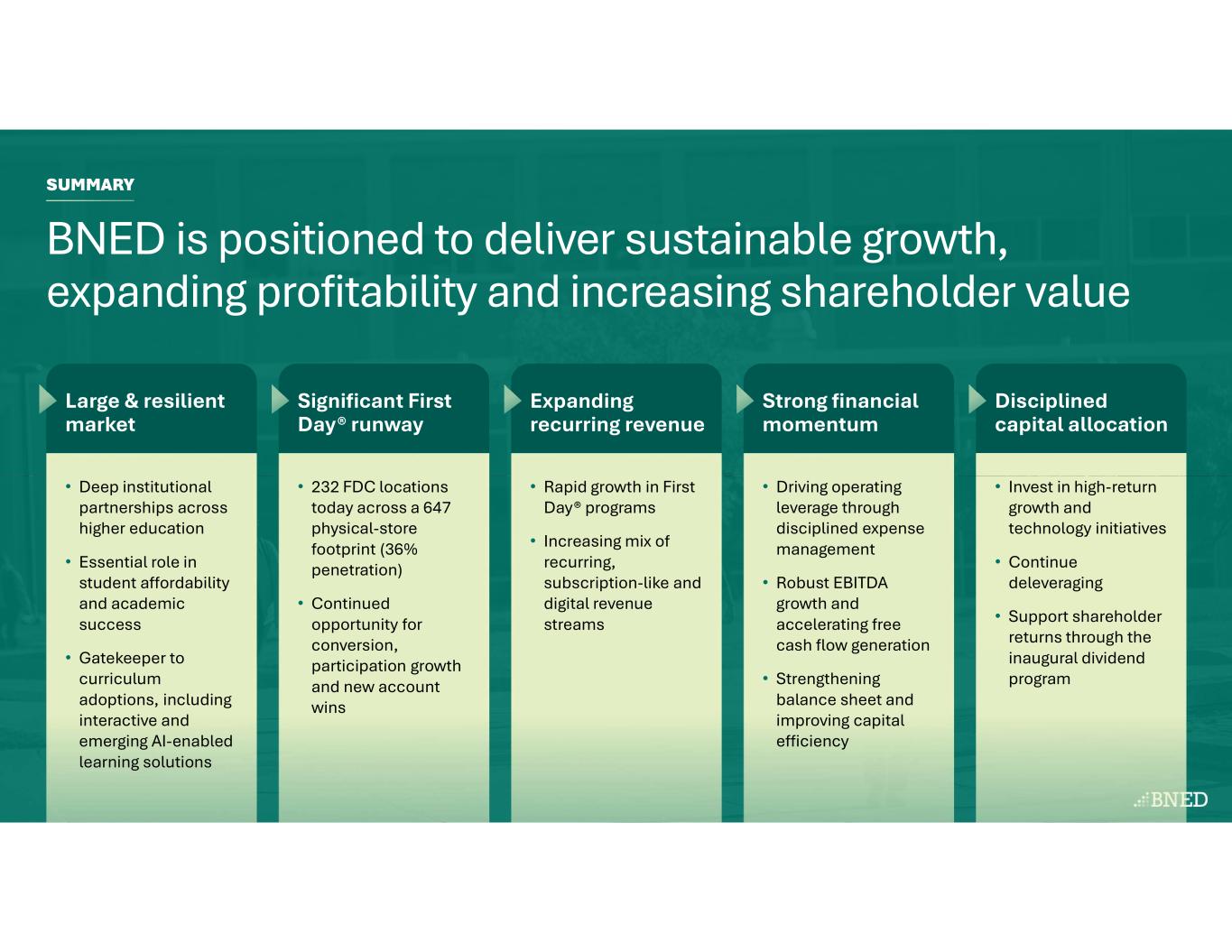
• Invest in high-return growth and technology initiatives • Continue deleveraging • Support shareholder returns through the inaugural dividend program Disciplined capital allocation BNED is positioned to deliver sustainable growth, expanding profitability and increasing shareholder value SUMMARY • Deep institutional partnerships across higher education • Essential role in student affordability and academic success • Gatekeeper to curriculum adoptions, including interactive and emerging AI-enabled learning solutions Large & resilient market • 232 FDC locations today across a 647 physical-store footprint (36% penetration) • Continued opportunity for conversion, participation growth and new account wins Significant First Day® runway • Rapid growth in First Day® programs • Increasing mix of recurring, subscription-like and digital revenue streams Expanding recurring revenue • Driving operating leverage through disciplined expense management • Robust EBITDA growth and accelerating free cash flow generation • Strengthening balance sheet and improving capital efficiency Strong financial momentum
THANK YOU Questions & discussion
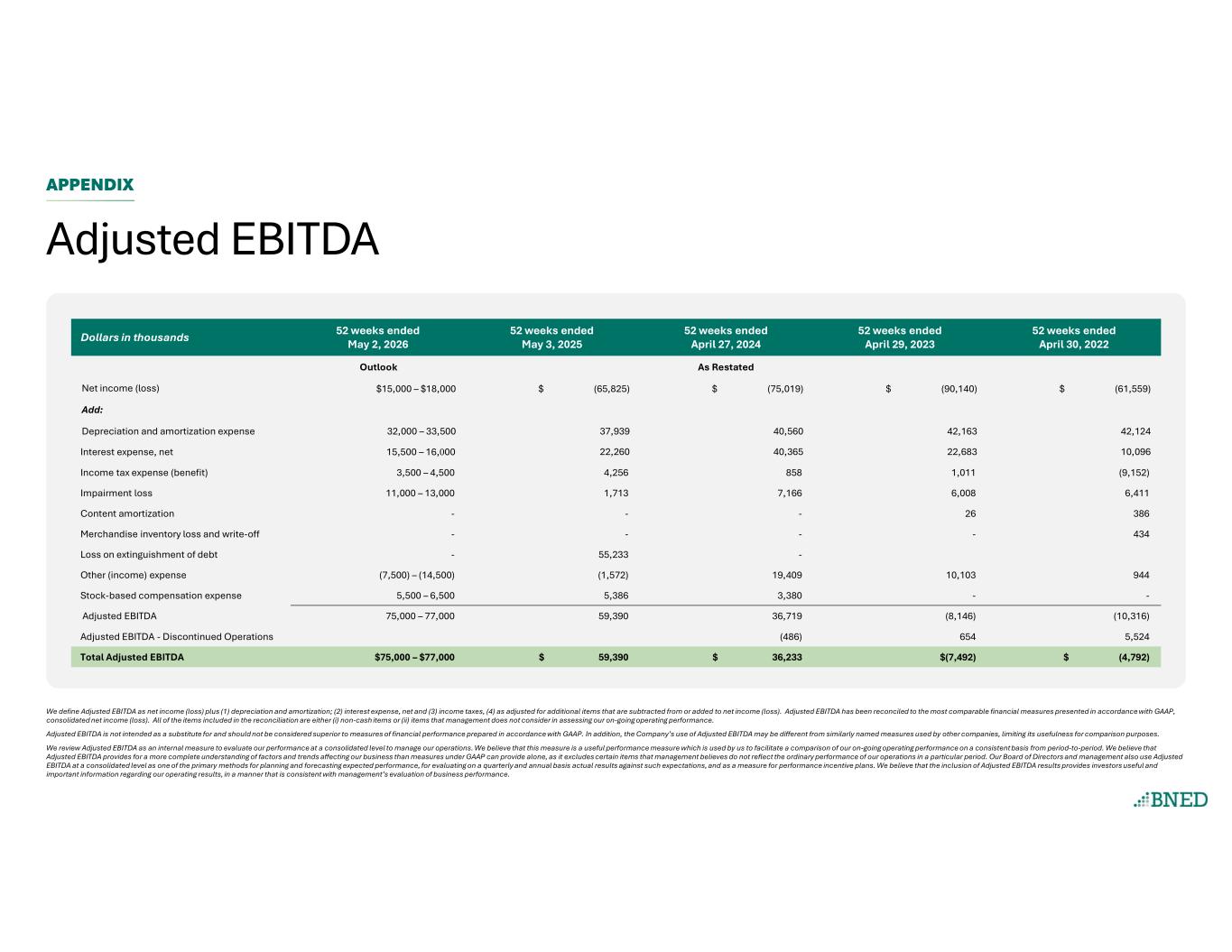
Adjusted EBITDA APPENDIX We define Adjusted EBITDA as net income (loss) plus (1) depreciation and amortization; (2) interest expense, net and (3) income taxes, (4) as adjusted for additional items that are subtracted from or added to net income (loss). Adjusted EBITDA has been reconciled to the most comparable financial measures presented in accordance with GAAP, consolidated net income (loss). All of the items included in the reconciliation are either (i) non-cash items or (ii) items that management does not consider in assessing our on-going operating performance. Adjusted EBITDA is not intended as a substitute for and should not be considered superior to measures of financial performance prepared in accordance with GAAP. In addition, the Company’s use of Adjusted EBITDA may be different from similarly named measures used by other companies, limiting its usefulness for comparison purposes. We review Adjusted EBITDA as an internal measure to evaluate our performance at a consolidated level to manage our operations. We believe that this measure is a useful performance measure which is used by us to facilitate a comparison of our on-going operating performance on a consistent basis from period-to-period. We believe that Adjusted EBITDA provides for a more complete understanding of factors and trends affecting our business than measures under GAAP can provide alone, as it excludes certain items that management believes do not reflect the ordinary performance of our operations in a particular period. Our Board of Directors and management also use Adjusted EBITDA at a consolidated level as one of the primary methods for planning and forecasting expected performance, for evaluating on a quarterly and annual basis actual results against such expectations, and as a measure for performance incentive plans. We believe that the inclusion of Adjusted EBITDA results provides investors useful and important information regarding our operating results, in a manner that is consistent with management’s evaluation of business performance. 52 weeks ended April 30, 2022 52 weeks ended April 29, 2023 52 weeks ended April 27, 2024 52 weeks ended May 3, 2025 52 weeks ended May 2, 2026Dollars in thousands As RestatedOutlook $ (61,559)$ (90,140)$ (75,019)$ (65,825)$15,000 – $18,000Net income (loss) Add: 42,124 42,163 40,560 37,939 32,000 – 33,500 Depreciation and amortization expense 10,096 22,683 40,365 22,260 15,500 – 16,000 Interest expense, net (9,152)1,011 858 4,256 3,500 – 4,500 Income tax expense (benefit) 6,411 6,008 7,166 1,713 11,000 – 13,000 Impairment loss 386 26 ---Content amortization 434 ----Merchandise inventory loss and write-off -55,233 -Loss on extinguishment of debt 944 10,103 19,409(1,572)(7,500) – (14,500)Other (income) expense --3,3805,386 5,500 – 6,500Stock-based compensation expense (10,316)(8,146)36,719 59,39075,000 – 77,000Adjusted EBITDA 5,524654(486)Adjusted EBITDA - Discontinued Operations $ (4,792)$(7,492)$ 36,233 $ 59,390 $75,000 – $77,000 Total Adjusted EBITDA