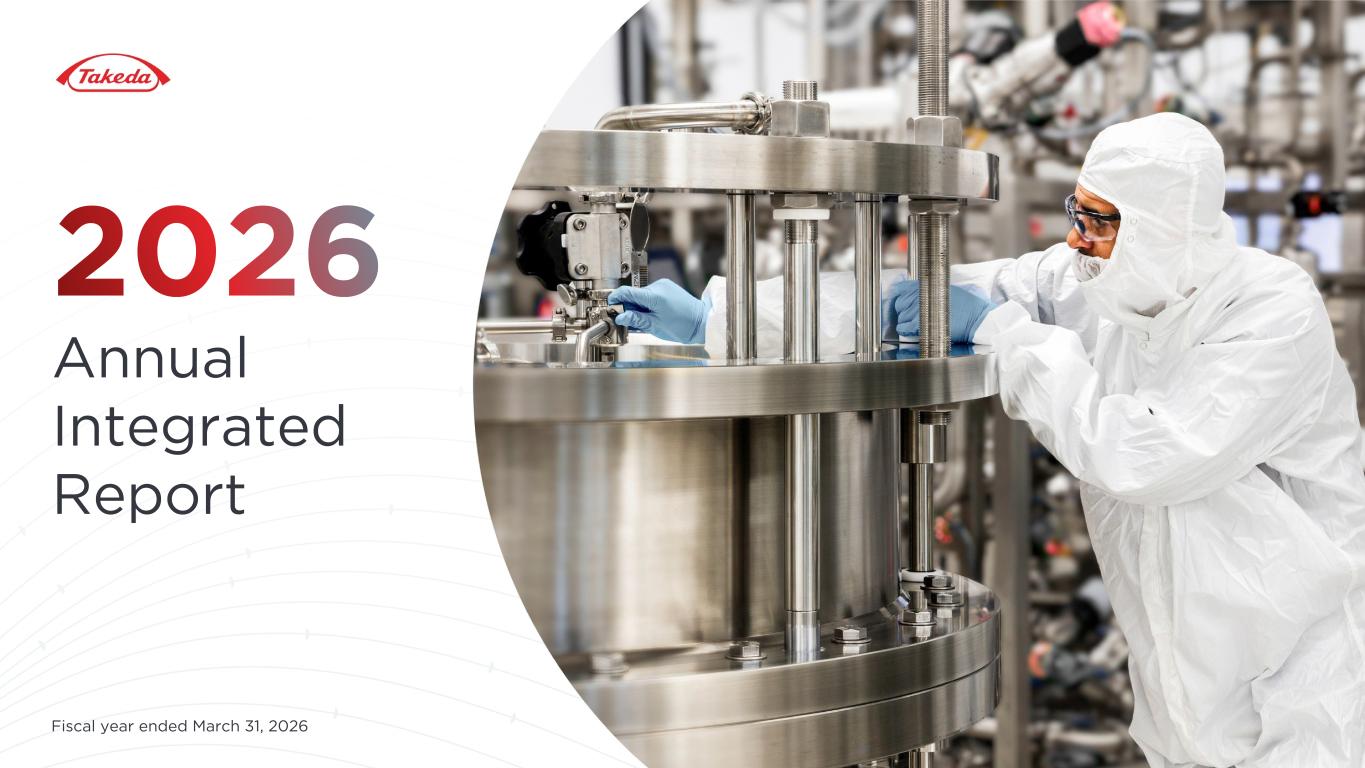
Annual Integrated Report Fiscal year ended March 31, 2026
02TAKEDA 2026 ANNUAL INTEGRATED REPORTOur Commitments Our Values in Action Financial Performance AppendixIntroduction Contents Our Commitments Our Values in Action Message from our President and CEO About Takeda FY2025 Highlights Commitment to Patients Driving Transformative R&D Ensuring Supply and Quality Accelerating Access Commitment to our People Building a Future-ready Workforce Developing Leaders who Inspire Fostering a Culture of Inclusion Engaging Employees Commitment to the Planet Advancing our Net-zero Ambition Managing our Impacts on Nature Integrating Sustainability Across the Product Life Cycle Commitment to Values-based Governance Leading with Robust Governance Upholding Ethics and Compliance Redefining Treatment Options for Message from our CFO FY2025 Financial Results FY2026 Financial Outlook Our Annual Integrated Report covers the operations of Takeda Pharmaceutical Company Limited and its consolidated subsidiaries. The report relates to fiscal year (FY) 2025 (April 1, 2025 to March 31, 2026) but may include information reflecting events occurring outside that period. Supplementary environmental, social and governance (ESG) metrics for FY2025 and calculation methodologies can be found in our 2026 ESG Databook. For further details on our approach to this report, please see page 45. A list of abbreviations used in the report may be found on page 53. Introduction Financial Performance ABOUT THIS REPORT Appendix Our Approach to Reporting FY2025 Corporate Philosophy Metrics Legal Disclaimers Definition and Explanation of Non-IFRS Measures Abbreviations Endnotes 03 32 38 40 39 45 44 53 06 16 22 27 People Living with Narcolepsy Type 1 Driving Innovation in Plasma-derived Therapies Creating the Future-ready Takeda 31 12 10 07 17 18 19 20 23 26 25 28 29 04 05 35 42 43 46 48 50 54
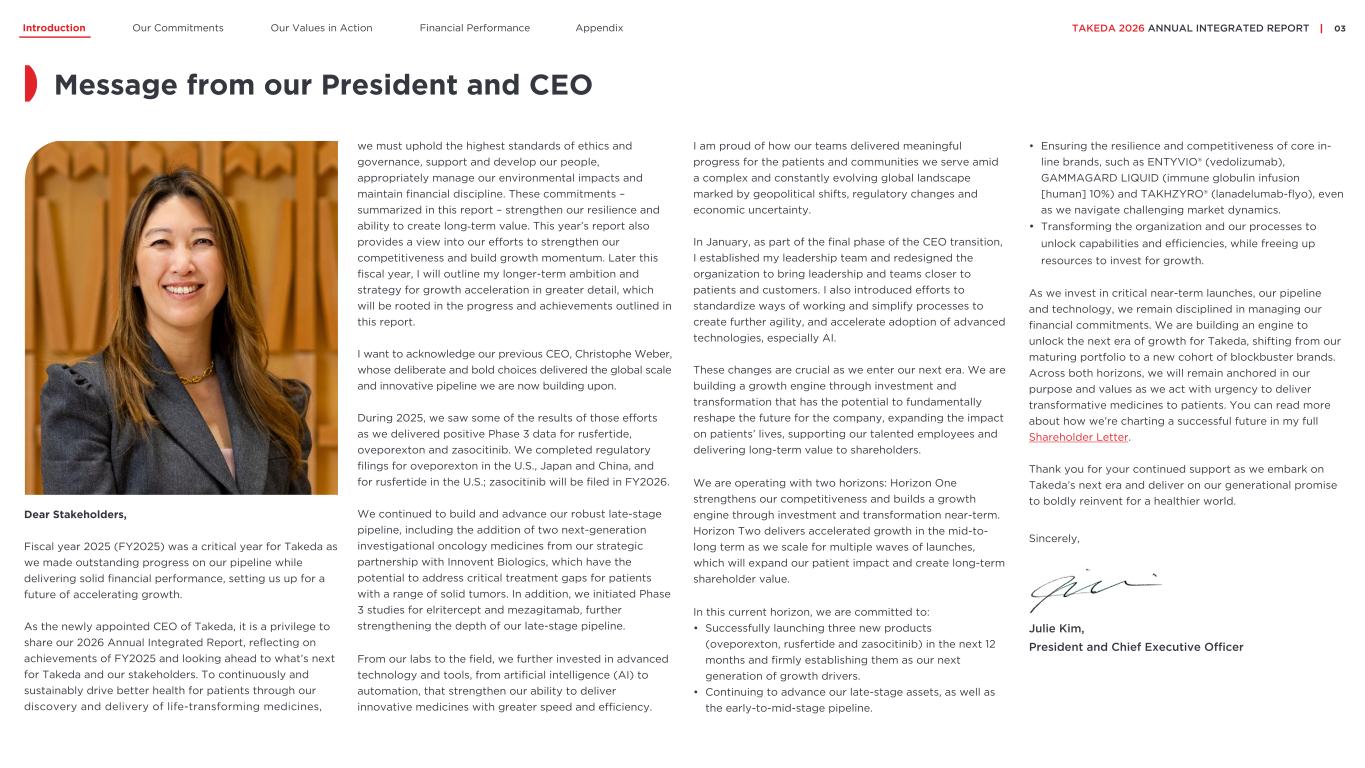
Our Values in Action Financial Performance AppendixIntroduction Message from our President and CEO Dear Stakeholders, Fiscal year 2025 (FY2025) was a critical year for Takeda as we made outstanding progress on our pipeline while delivering solid financial performance, setting us up for a future of accelerating growth. As the newly appointed CEO of Takeda, it is a privilege to share our 2026 Annual Integrated Report, reflecting on achievements of FY2025 and looking ahead to what’s next for Takeda and our stakeholders. To continuously and sustainably drive better health for patients through our discovery and delivery of life-transforming medicines, • Ensuring the resilience and competitiveness of core in- line brands, such as ENTYVIO® (vedolizumab), GAMMAGARD LIQUID (immune globulin infusion [human] 10%) and TAKHZYRO® (lanadelumab-flyo), even as we navigate challenging market dynamics. • Transforming the organization and our processes to unlock capabilities and efficiencies, while freeing up resources to invest for growth. As we invest in critical near-term launches, our pipeline and technology, we remain disciplined in managing our financial commitments. We are building an engine to unlock the next era of growth for Takeda, shifting from our maturing portfolio to a new cohort of blockbuster brands. Across both horizons, we will remain anchored in our purpose and values as we act with urgency to deliver transformative medicines to patients. You can read more about how we’re charting a successful future in my full Shareholder Letter. Thank you for your continued support as we embark on Takeda’s next era and deliver on our generational promise to boldly reinvent for a healthier world. Sincerely, we must uphold the highest standards of ethics and governance, support and develop our people, appropriately manage our environmental impacts and maintain financial discipline. These commitments – summarized in this report – strengthen our resilience and ability to create long-term value. This year’s report also provides a view into our efforts to strengthen our competitiveness and build growth momentum. Later this fiscal year, I will outline my longer-term ambition and strategy for growth acceleration in greater detail, which will be rooted in the progress and achievements outlined in this report. I want to acknowledge our previous CEO, Christophe Weber, whose deliberate and bold choices delivered the global scale and innovative pipeline we are now building upon. During 2025, we saw some of the results of those efforts as we delivered positive Phase 3 data for rusfertide, oveporexton and zasocitinib. We completed regulatory filings for oveporexton in the U.S., Japan and China, and for rusfertide in the U.S.; zasocitinib will be filed in FY2026. We continued to build and advance our robust late-stage pipeline, including the addition of two next-generation investigational oncology medicines from our strategic partnership with Innovent Biologics, which have the potential to address critical treatment gaps for patients with a range of solid tumors. In addition, we initiated Phase 3 studies for elritercept and mezagitamab, further strengthening the depth of our late-stage pipeline. From our labs to the field, we further invested in advanced technology and tools, from artificial intelligence (AI) to automation, that strengthen our ability to deliver innovative medicines with greater speed and efficiency. Julie Kim, President and Chief Executive Officer 03TAKEDA 2026 ANNUAL INTEGRATED REPORT I am proud of how our teams delivered meaningful progress for the patients and communities we serve amid a complex and constantly evolving global landscape marked by geopolitical shifts, regulatory changes and economic uncertainty. In January, as part of the final phase of the CEO transition, I established my leadership team and redesigned the organization to bring leadership and teams closer to patients and customers. I also introduced efforts to standardize ways of working and simplify processes to create further agility, and accelerate adoption of advanced technologies, especially AI. These changes are crucial as we enter our next era. We are building a growth engine through investment and transformation that has the potential to fundamentally reshape the future for the company, expanding the impact on patients’ lives, supporting our talented employees and delivering long-term value to shareholders. We are operating with two horizons: Horizon One strengthens our competitiveness and builds a growth engine through investment and transformation near-term. Horizon Two delivers accelerated growth in the mid-to- long term as we scale for multiple waves of launches, which will expand our patient impact and create long-term shareholder value. In this current horizon, we are committed to: • Successfully launching three new products (oveporexton, rusfertide and zasocitinib) in the next 12 months and firmly establishing them as our next generation of growth drivers. • Continuing to advance our late-stage assets, as well as the early-to-mid-stage pipeline. Our Commitments
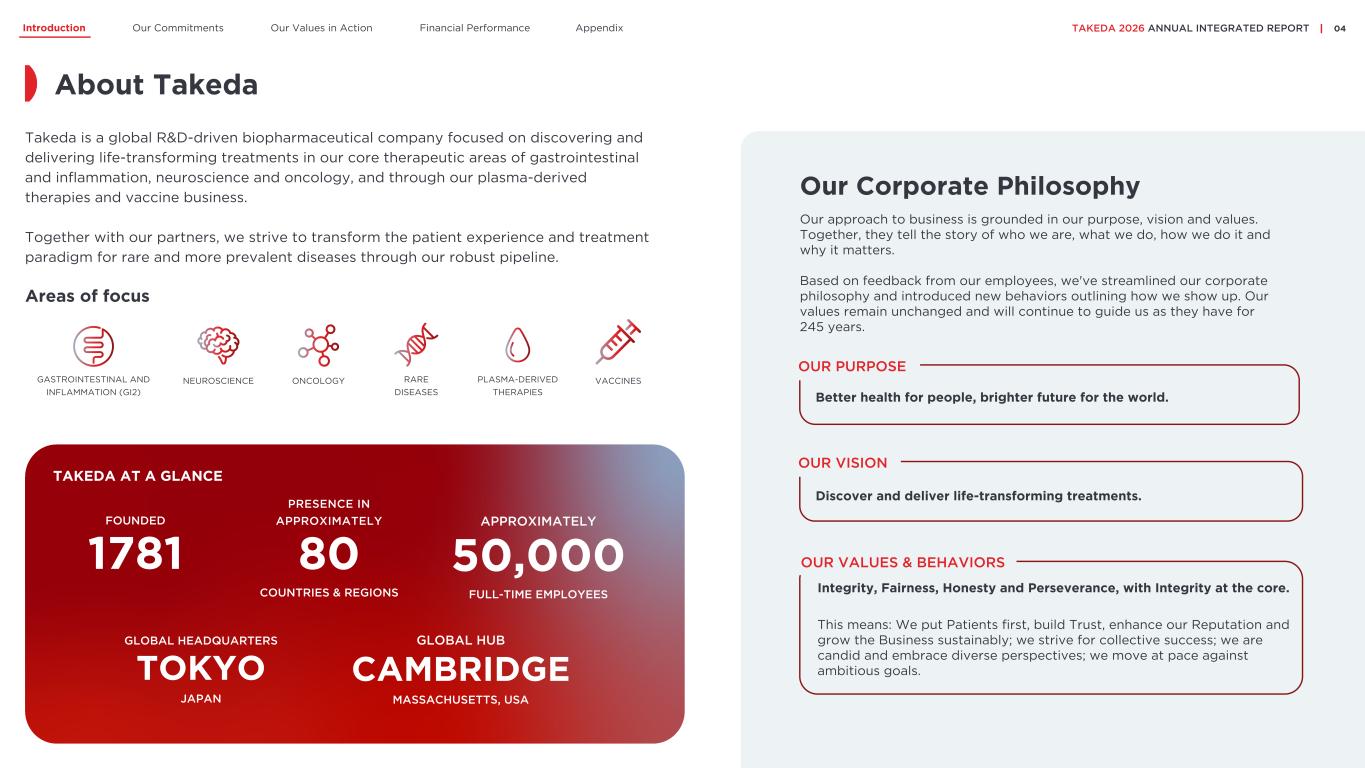
About Takeda Areas of focus TAKEDA AT A GLANCE FOUNDED 1781 PRESENCE IN APPROXIMATELY 80 COUNTRIES & REGIONS APPROXIMATELY 50,000 FULL-TIME EMPLOYEES OUR PURPOSE OUR VISION OUR VALUES & BEHAVIORS Better health for people, brighter future for the world. Integrity, Fairness, Honesty and Perseverance, with Integrity at the core. This means: We put Patients first, build Trust, enhance our Reputation and grow the Business sustainably; we strive for collective success; we are candid and embrace diverse perspectives; we move at pace against ambitious goals. Discover and deliver life-transforming treatments. GLOBAL HUB CAMBRIDGE MASSACHUSETTS, USA Our Corporate Philosophy Our approach to business is grounded in our purpose, vision and values. Together, they tell the story of who we are, what we do, how we do it and why it matters. Based on feedback from our employees, we've streamlined our corporate philosophy and introduced new behaviors outlining how we show up. Our values remain unchanged and will continue to guide us as they have for 245 years. GLOBAL HEADQUARTERS TOKYO JAPAN 04TAKEDA 2026 ANNUAL INTEGRATED REPORT Takeda is a global R&D-driven biopharmaceutical company focused on discovering and delivering life-transforming treatments in our core therapeutic areas of gastrointestinal and inflammation, neuroscience and oncology, and through our plasma-derived therapies and vaccine business. Together with our partners, we strive to transform the patient experience and treatment paradigm for rare and more prevalent diseases through our robust pipeline. GASTROINTESTINAL AND INFLAMMATION (GI2) RARE DISEASES PLASMA-DERIVED THERAPIES ONCOLOGYNEUROSCIENCE VACCINES Our Values in Action Financial Performance AppendixIntroduction Our Commitments
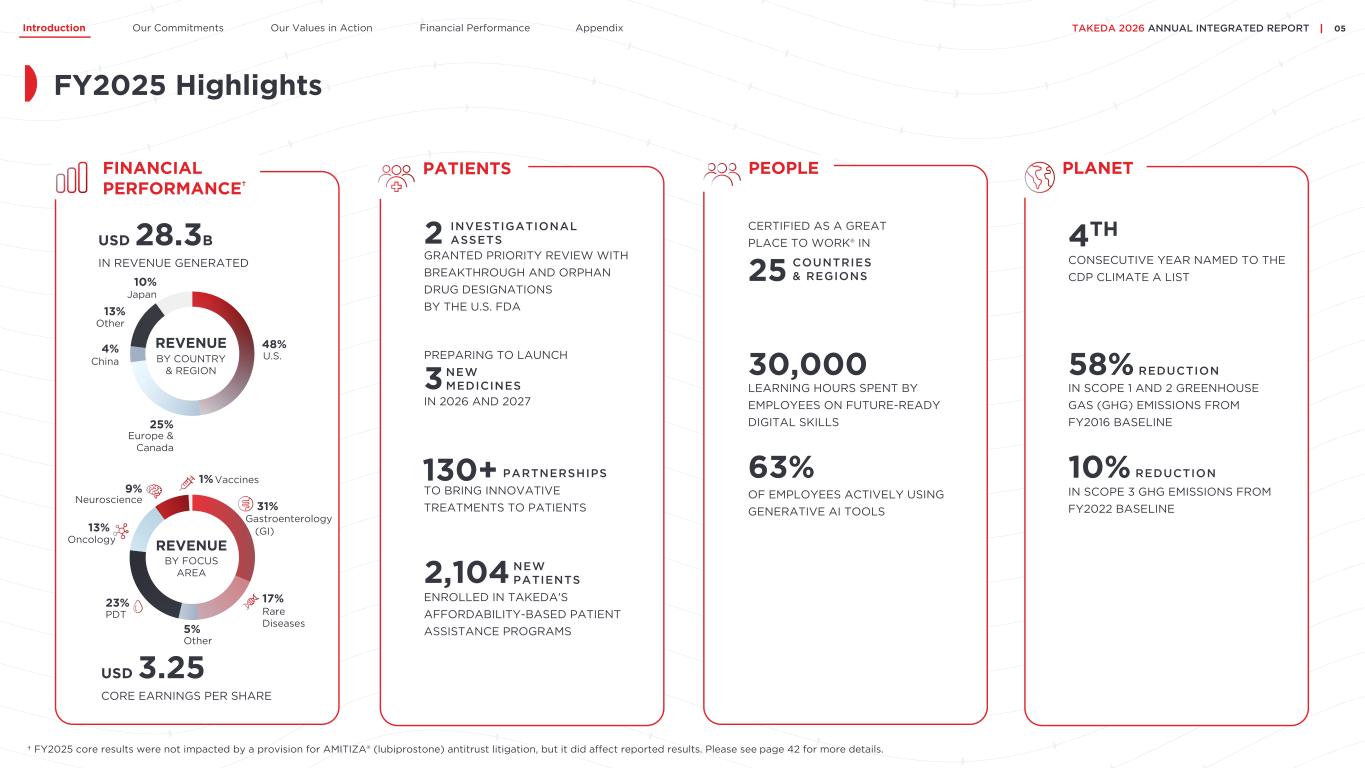
FY2025 Highlights USD 28.3B IN REVENUE GENERATED USD 3.25 CORE EARNINGS PER SHARE 2 3 2,104 INVESTIGATIONAL ASSETS NEW MEDICINES PARTNERSHIPS NEW PATIENTS GRANTED PRIORITY REVIEW WITH BREAKTHROUGH AND ORPHAN DRUG DESIGNATIONS BY THE U.S. FDA PREPARING TO LAUNCH TO BRING INNOVATIVE TREATMENTS TO PATIENTS ENROLLED IN TAKEDA'S AFFORDABILITY-BASED PATIENT ASSISTANCE PROGRAMS CERTIFIED AS A GREAT PLACE TO WORK® IN 25 COUNTRIES & REGIONS 30,000 LEARNING HOURS SPENT BY EMPLOYEES ON FUTURE-READY DIGITAL SKILLS OF EMPLOYEES ACTIVELY USING GENERATIVE AI TOOLS CONSECUTIVE YEAR NAMED TO THE CDP CLIMATE A LIST IN SCOPE 1 AND 2 GREENHOUSE GAS (GHG) EMISSIONS FROM FY2016 BASELINE IN SCOPE 3 GHG EMISSIONS FROM FY2022 BASELINE REDUCTION 63% 58% 10% 4TH REDUCTION IN 2026 AND 2027 PATIENTS PEOPLE PLANET 48% 10% 4% 13% 25% Vaccines China Europe & Canada FINANCIAL PERFORMANCE† U.S. 05TAKEDA 2026 ANNUAL INTEGRATED REPORT 1% 31% 17%23% 13% 9% Other PDT Oncology Gastroenterology Neuroscience Rare Diseases REVENUE BY FOCUS AREA BY COUNTRY & REGION REVENUE 5% Other † FY2025 core results were not impacted by a provision for AMITIZA® (lubiprostone) antitrust litigation, but it did affect reported results. Please see page 42 for more details. 130+ Japan (GI) Financial Performance AppendixIntroduction Our Commitments Our Values in Action
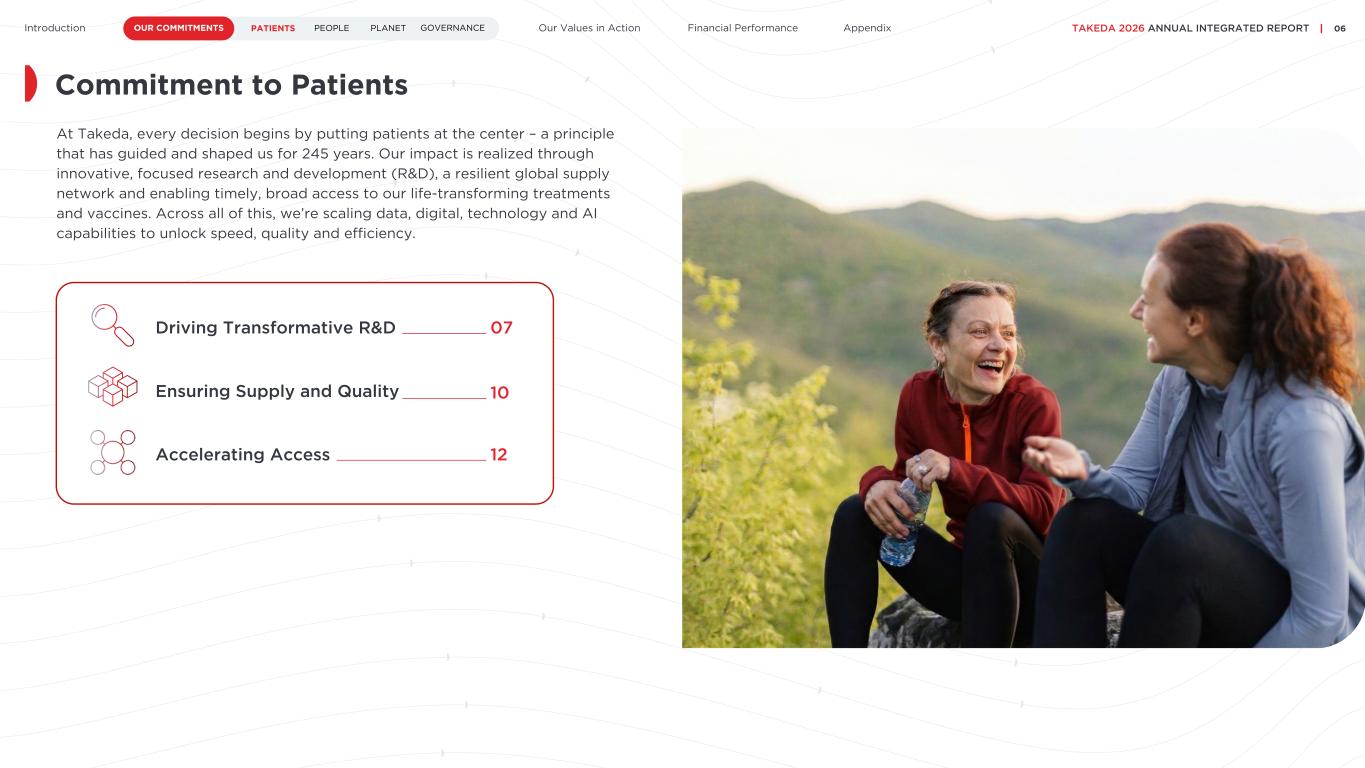
PATIENTS PLANETPEOPLE GOVERNANCE Financial Performance AppendixOUR COMMITMENTS TAKEDA 2026 ANNUAL INTEGRATED REPORT 06Introduction Our Values in Action At Takeda, every decision begins by putting patients at the center – a principle that has guided and shaped us for 245 years. Our impact is realized through innovative, focused research and development (R&D), a resilient global supply network and enabling timely, broad access to our life-transforming treatments and vaccines. Across all of this, we’re scaling data, digital, technology and AI capabilities to unlock speed, quality and efficiency. Commitment to Patients Driving Transformative R&D Ensuring Supply and Quality Accelerating Access 07 10 12
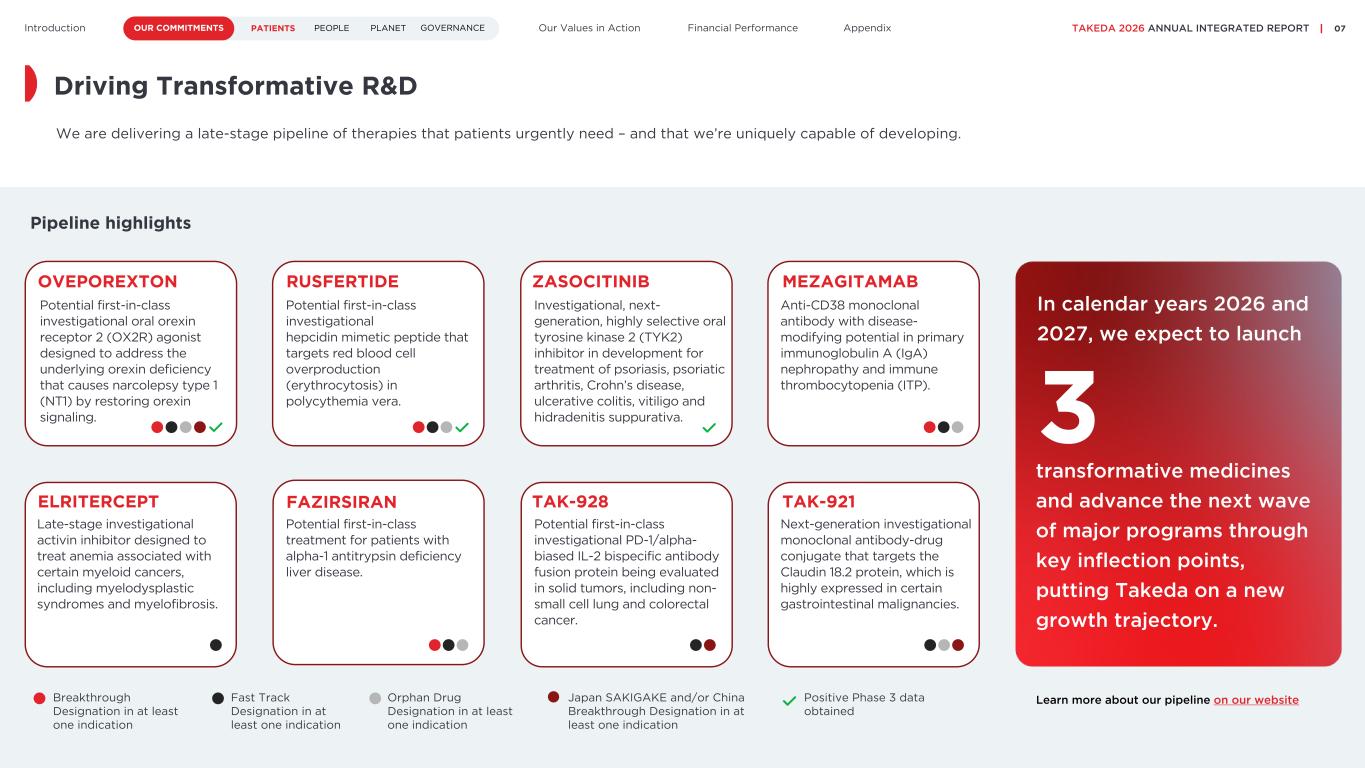
Potential first-in-class treatment for patients with alpha-1 antitrypsin deficiency liver disease. Late-stage investigational activin inhibitor designed to treat anemia associated with certain myeloid cancers, including myelodysplastic syndromes and myelofibrosis. Next-generation investigational monoclonal antibody-drug conjugate that targets the Claudin 18.2 protein, which is highly expressed in certain gastrointestinal malignancies. Potential first-in-class investigational PD-1/alpha- biased IL-2 bispecific antibody fusion protein being evaluated in solid tumors, including non- small cell lung and colorectal cancer. Anti-CD38 monoclonal antibody with disease- modifying potential in primary immunoglobulin A (IgA) nephropathy and immune thrombocytopenia (ITP). Potential first-in-class investigational hepcidin mimetic peptide that targets red blood cell overproduction (erythrocytosis) in polycythemia vera. Investigational, next- generation, highly selective oral tyrosine kinase 2 (TYK2) inhibitor in development for treatment of psoriasis, psoriatic arthritis, Crohn’s disease, ulcerative colitis, vitiligo and hidradenitis suppurativa. Potential first-in-class investigational oral orexin receptor 2 (OX2R) agonist designed to address the underlying orexin deficiency that causes narcolepsy type 1 (NT1) by restoring orexin signaling. MEZAGITAMAB We are delivering a late-stage pipeline of therapies that patients urgently need – and that we’re uniquely capable of developing. ZASOCITINIBOVEPOREXTON RUSFERTIDE ELRITERCEPT TAK-928 TAK-921 transformative medicines and advance the next wave of major programs through key inflection points, putting Takeda on a new growth trajectory. Learn more about our pipeline on our website Pipeline highlights FAZIRSIRAN Breakthrough Designation in at least one indication Fast Track Designation in at least one indication Orphan Drug Designation in at least one indication Positive Phase 3 data obtained In calendar years 2026 and 2027, we expect to launch 3 Japan SAKIGAKE and/or China Breakthrough Designation in at least one indication Driving Transformative R&D TAKEDA 2026 ANNUAL INTEGRATED REPORT 07PATIENTS PLANETPEOPLE GOVERNANCE Financial Performance AppendixIntroduction Our Values in ActionOUR COMMITMENTS
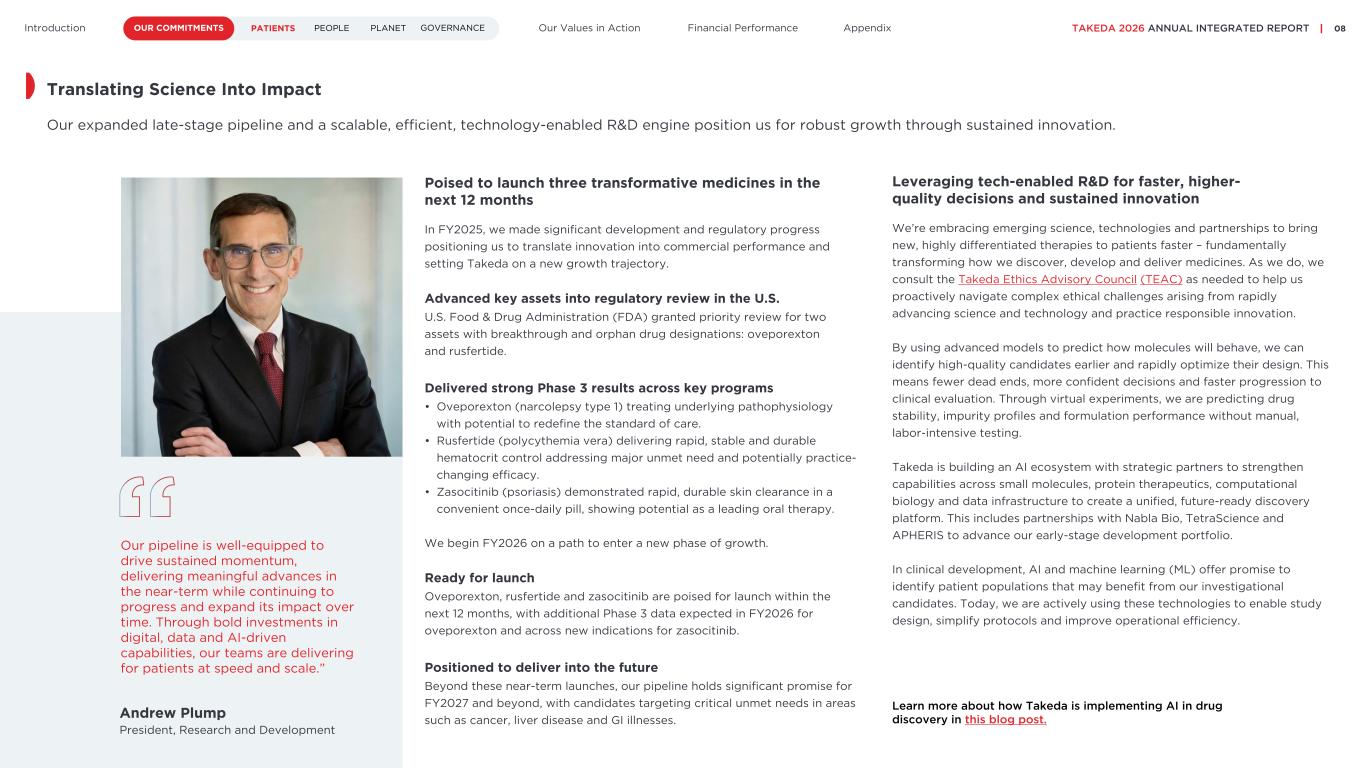
Translating Science Into Impact Our pipeline is well-equipped to drive sustained momentum, delivering meaningful advances in the near-term while continuing to progress and expand its impact over time. Through bold investments in digital, data and AI-driven capabilities, our teams are delivering for patients at speed and scale.” Leveraging tech-enabled R&D for faster, higher- quality decisions and sustained innovation We’re embracing emerging science, technologies and partnerships to bring new, highly differentiated therapies to patients faster – fundamentally transforming how we discover, develop and deliver medicines. As we do, we consult the Takeda Ethics Advisory Council (TEAC) as needed to help us proactively navigate complex ethical challenges arising from rapidly advancing science and technology and practice responsible innovation. By using advanced models to predict how molecules will behave, we can identify high-quality candidates earlier and rapidly optimize their design. This means fewer dead ends, more confident decisions and faster progression to clinical evaluation. Through virtual experiments, we are predicting drug stability, impurity profiles and formulation performance without manual, labor-intensive testing. Takeda is building an AI ecosystem with strategic partners to strengthen capabilities across small molecules, protein therapeutics, computational biology and data infrastructure to create a unified, future-ready discovery platform. This includes partnerships with Nabla Bio, TetraScience and APHERIS to advance our early-stage development portfolio. In clinical development, AI and machine learning (ML) offer promise to identify patient populations that may benefit from our investigational candidates. Today, we are actively using these technologies to enable study design, simplify protocols and improve operational efficiency. Learn more about how Takeda is implementing AI in drug discovery in this blog post.Andrew Plump President, Research and Development Our expanded late-stage pipeline and a scalable, efficient, technology-enabled R&D engine position us for robust growth through sustained innovation. Poised to launch three transformative medicines in the next 12 months In FY2025, we made significant development and regulatory progress positioning us to translate innovation into commercial performance and setting Takeda on a new growth trajectory. Advanced key assets into regulatory review in the U.S. U.S. Food & Drug Administration (FDA) granted priority review for two assets with breakthrough and orphan drug designations: oveporexton and rusfertide. Delivered strong Phase 3 results across key programs • Oveporexton (narcolepsy type 1) treating underlying pathophysiology with potential to redefine the standard of care. • Rusfertide (polycythemia vera) delivering rapid, stable and durable hematocrit control addressing major unmet need and potentially practice- changing efficacy. • Zasocitinib (psoriasis) demonstrated rapid, durable skin clearance in a convenient once-daily pill, showing potential as a leading oral therapy. We begin FY2026 on a path to enter a new phase of growth. Ready for launch Oveporexton, rusfertide and zasocitinib are poised for launch within the next 12 months, with additional Phase 3 data expected in FY2026 for oveporexton and across new indications for zasocitinib. Positioned to deliver into the future Beyond these near-term launches, our pipeline holds significant promise for FY2027 and beyond, with candidates targeting critical unmet needs in areas such as cancer, liver disease and GI illnesses. TAKEDA 2026 ANNUAL INTEGRATED REPORT 08PATIENTS PLANETPEOPLE GOVERNANCE Financial Performance AppendixIntroduction Our Values in ActionOUR COMMITMENTS
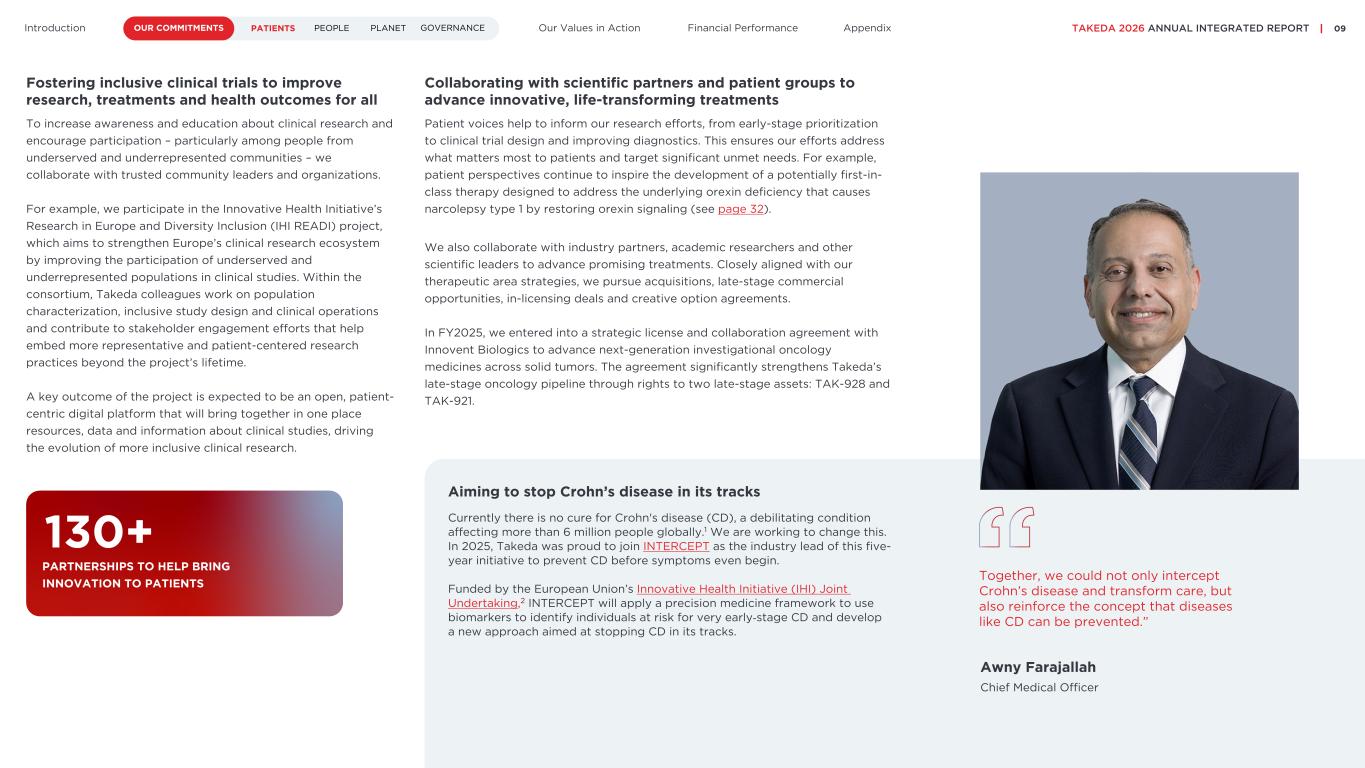
To increase awareness and education about clinical research and encourage participation – particularly among people from underserved and underrepresented communities – we collaborate with trusted community leaders and organizations. For example, we participate in the Innovative Health Initiative’s Research in Europe and Diversity Inclusion (IHI READI) project, which aims to strengthen Europe’s clinical research ecosystem by improving the participation of underserved and underrepresented populations in clinical studies. Within the consortium, Takeda colleagues work on population characterization, inclusive study design and clinical operations and contribute to stakeholder engagement efforts that help embed more representative and patient-centered research practices beyond the project’s lifetime. A key outcome of the project is expected to be an open, patient- centric digital platform that will bring together in one place resources, data and information about clinical studies, driving the evolution of more inclusive clinical research. Collaborating with scientific partners and patient groups to advance innovative, life-transforming treatments 130+ PARTNERSHIPS TO HELP BRING INNOVATION TO PATIENTS Awny Farajallah Chief Medical Officer Together, we could not only intercept Crohn’s disease and transform care, but also reinforce the concept that diseases like CD can be prevented.” Fostering inclusive clinical trials to improve research, treatments and health outcomes for all Aiming to stop Crohn’s disease in its tracks Currently there is no cure for Crohn's disease (CD), a debilitating condition affecting more than 6 million people globally.1 We are working to change this. In 2025, Takeda was proud to join INTERCEPT as the industry lead of this five- year initiative to prevent CD before symptoms even begin. Funded by the European Union’s Innovative Health Initiative (IHI) Joint Undertaking,2 INTERCEPT will apply a precision medicine framework to use biomarkers to identify individuals at risk for very early-stage CD and develop a new approach aimed at stopping CD in its tracks. Patient voices help to inform our research efforts, from early-stage prioritization to clinical trial design and improving diagnostics. This ensures our efforts address what matters most to patients and target significant unmet needs. For example, patient perspectives continue to inspire the development of a potentially first-in- class therapy designed to address the underlying orexin deficiency that causes narcolepsy type 1 by restoring orexin signaling (see page 32). We also collaborate with industry partners, academic researchers and other scientific leaders to advance promising treatments. Closely aligned with our therapeutic area strategies, we pursue acquisitions, late-stage commercial opportunities, in-licensing deals and creative option agreements. In FY2025, we entered into a strategic license and collaboration agreement with Innovent Biologics to advance next-generation investigational oncology medicines across solid tumors. The agreement significantly strengthens Takeda’s late-stage oncology pipeline through rights to two late-stage assets: TAK-928 and TAK-921. TAKEDA 2026 ANNUAL INTEGRATED REPORT 09PATIENTS PLANETPEOPLE GOVERNANCE Financial Performance AppendixIntroduction Our Values in ActionOUR COMMITMENTS
Ensuring Supply and Quality Together, the following initiatives show how combining advanced technology with human expertise is transforming our manufacturing and quality ecosystem to be more agile, efficient and resilient for patients worldwide. • At our Lessines site in Belgium, we’ve deployed more than 170 AI- enabled predictive maintenance agents that help prevent unexpected equipment failures and reduce operational losses, including production disruptions. We plan to expand this technology to additional global sites by 2027. • Takeda was one of the first pharmaceutical companies in Japan to implement an AI-powered demand forecasting model and combine it with our inventory optimization tool to predict the amount of materials needed at each stage of the production process. As a result, our Hikari plant has significantly lowered inventory costs while minimizing product expiration and improving overall inventory efficiency. 99.6% of order lines dispatched on-time, in-full in FY2025 • Traditionally, releasing medicines from our manufacturing facilities involves many manual steps that can take several weeks to complete. With our One Day Batch Release (ODBR) program, we aim to simplify and harmonize the process into one digital, automated end- to-end process. This program reflects our aspiration and commitment to accelerating cycle time to release products as quickly as possible after manufacturing. In 2025, we completed pilots at six sites and are developing plans to reduce the release lead time by 60% by 2028. We plan to roll out the program to all sites globally by 2029. • We continue strengthening protections against illicit activity by expanding digital authentication technologies across select products and markets. A new digital watermark-like feature for select brands enables faster, more reliable authentication of primary and secondary packaging. These steps move us beyond traditional serialization toward a layered digital security approach that strengthens the integrity of our supply chain. Elaine Shannon Patients rely on Takeda for uninterrupted access to life-transforming treatments. By embedding quality and resilience into how we operate, we are well positioned to meet demand sustainably – doing what’s right for patients.” President, Global Supply and Quality We are strengthening the efficiency and resilience of our manufacturing and supply networks to serve patients reliably now and into the future. Delivering reliably and at scale Building more efficient operations through digital and AI-driven innovations Supply continuity is critical to our ability to serve patients, especially as we prepare for the potential launch of multiple new treatments in a dynamic operating environment. We are making targeted, disciplined investments in our manufacturing network and advanced planning capabilities to ensure we can respond quickly to change and deliver our treatments safely and reliably to the patients who depend on them. Takeda’s Customer Service Level is among the highest in our industry. In FY2025, we released 99.6% of all product orders on- time, in-full (OTIF) to our customers.3 Our manufacturing teams are also preparing for potential approval of new products in 2026 and 2027. They are partnering closely with R&D to ensure treatments can be produced at the scale needed during ramp-up periods so we can get these treatments to patients as soon as possible. TAKEDA 2026 ANNUAL INTEGRATED REPORT 10PATIENTS PLANETPEOPLE GOVERNANCE Financial Performance AppendixIntroduction Our Values in ActionOUR COMMITMENTS
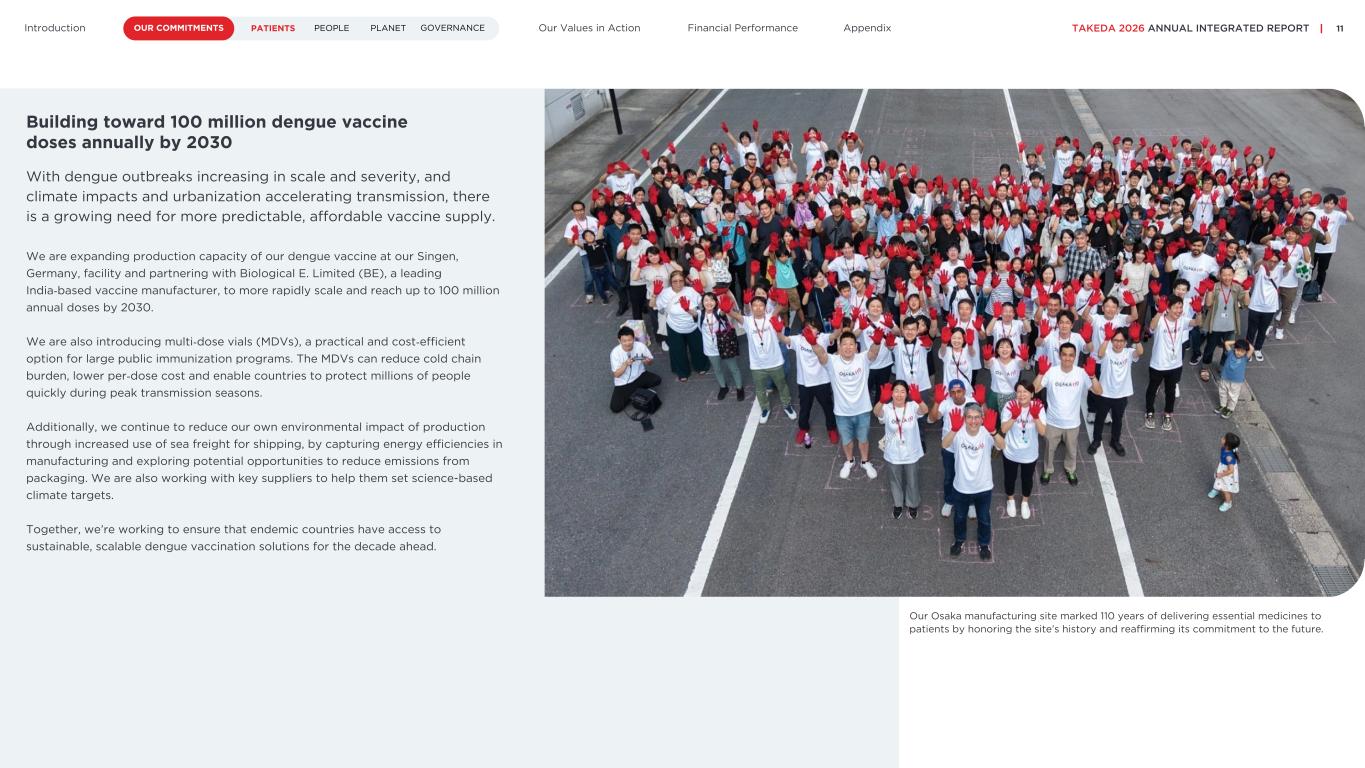
Building toward 100 million dengue vaccine doses annually by 2030 With dengue outbreaks increasing in scale and severity, and climate impacts and urbanization accelerating transmission, there is a growing need for more predictable, affordable vaccine supply. We are expanding production capacity of our dengue vaccine at our Singen, Germany, facility and partnering with Biological E. Limited (BE), a leading India-based vaccine manufacturer, to more rapidly scale and reach up to 100 million annual doses by 2030. We are also introducing multi-dose vials (MDVs), a practical and cost-efficient option for large public immunization programs. The MDVs can reduce cold chain burden, lower per-dose cost and enable countries to protect millions of people quickly during peak transmission seasons. Additionally, we continue to reduce our own environmental impact of production through increased use of sea freight for shipping, by capturing energy efficiencies in manufacturing and exploring potential opportunities to reduce emissions from packaging. We are also working with key suppliers to help them set science-based climate targets. Together, we’re working to ensure that endemic countries have access to sustainable, scalable dengue vaccination solutions for the decade ahead. Our Osaka manufacturing site marked 110 years of delivering essential medicines to patients by honoring the site’s history and reaffirming its commitment to the future. TAKEDA 2026 ANNUAL INTEGRATED REPORT 11PATIENTS PLANETPEOPLE GOVERNANCE Financial Performance AppendixIntroduction Our Values in ActionOUR COMMITMENTS
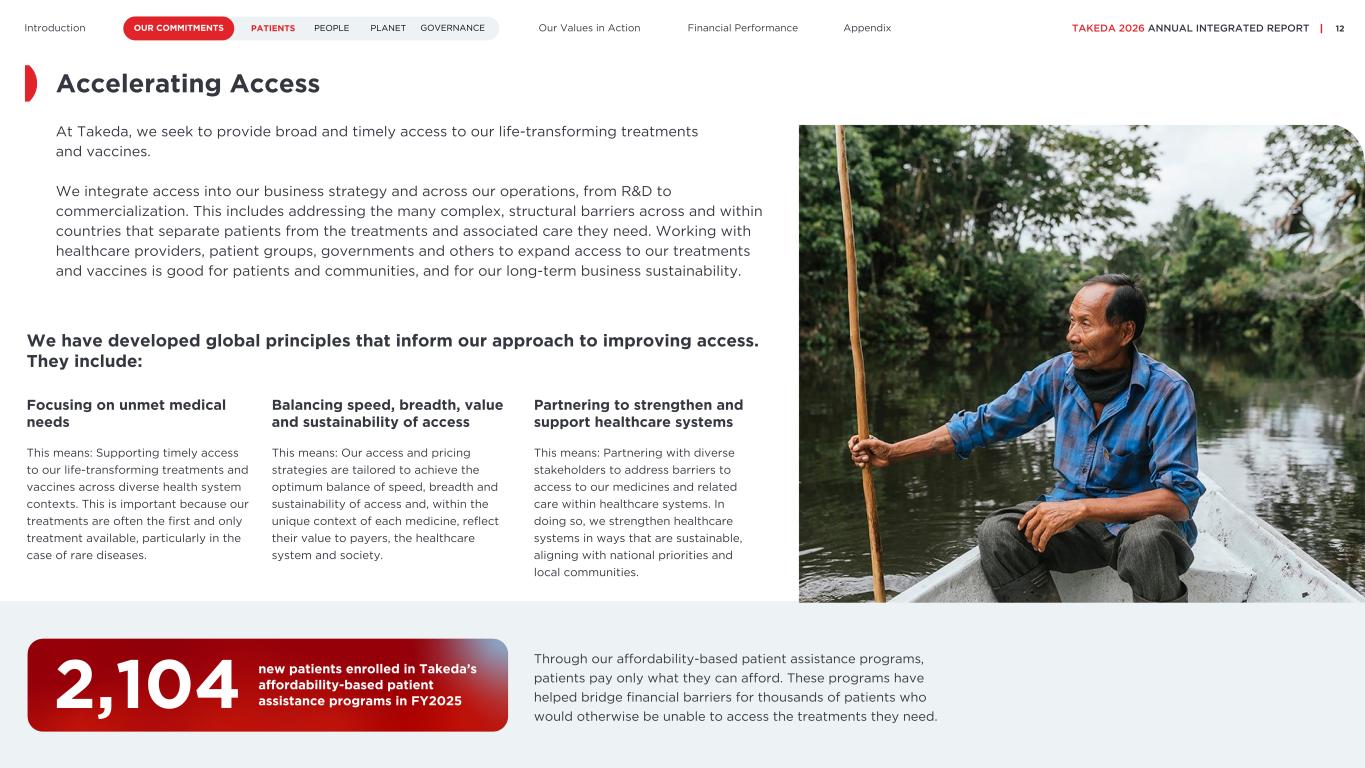
Accelerating Access At Takeda, we seek to provide broad and timely access to our life-transforming treatments and vaccines. We integrate access into our business strategy and across our operations, from R&D to commercialization. This includes addressing the many complex, structural barriers across and within countries that separate patients from the treatments and associated care they need. Working with healthcare providers, patient groups, governments and others to expand access to our treatments and vaccines is good for patients and communities, and for our long-term business sustainability. We have developed global principles that inform our approach to improving access. They include: Focusing on unmet medical needs This means: Supporting timely access to our life-transforming treatments and vaccines across diverse health system contexts. This is important because our treatments are often the first and only treatment available, particularly in the case of rare diseases. Balancing speed, breadth, value and sustainability of access This means: Our access and pricing strategies are tailored to achieve the optimum balance of speed, breadth and sustainability of access and, within the unique context of each medicine, reflect their value to payers, the healthcare system and society. Partnering to strengthen and support healthcare systems This means: Partnering with diverse stakeholders to address barriers to access to our medicines and related care within healthcare systems. In doing so, we strengthen healthcare systems in ways that are sustainable, aligning with national priorities and local communities. 2,104 new patients enrolled in Takeda’s affordability-based patient assistance programs in FY2025 Through our affordability-based patient assistance programs, patients pay only what they can afford. These programs have helped bridge financial barriers for thousands of patients who would otherwise be unable to access the treatments they need. TAKEDA 2026 ANNUAL INTEGRATED REPORT 12PATIENTS PLANETPEOPLE GOVERNANCE Financial Performance AppendixIntroduction Our Values in ActionOUR COMMITMENTS
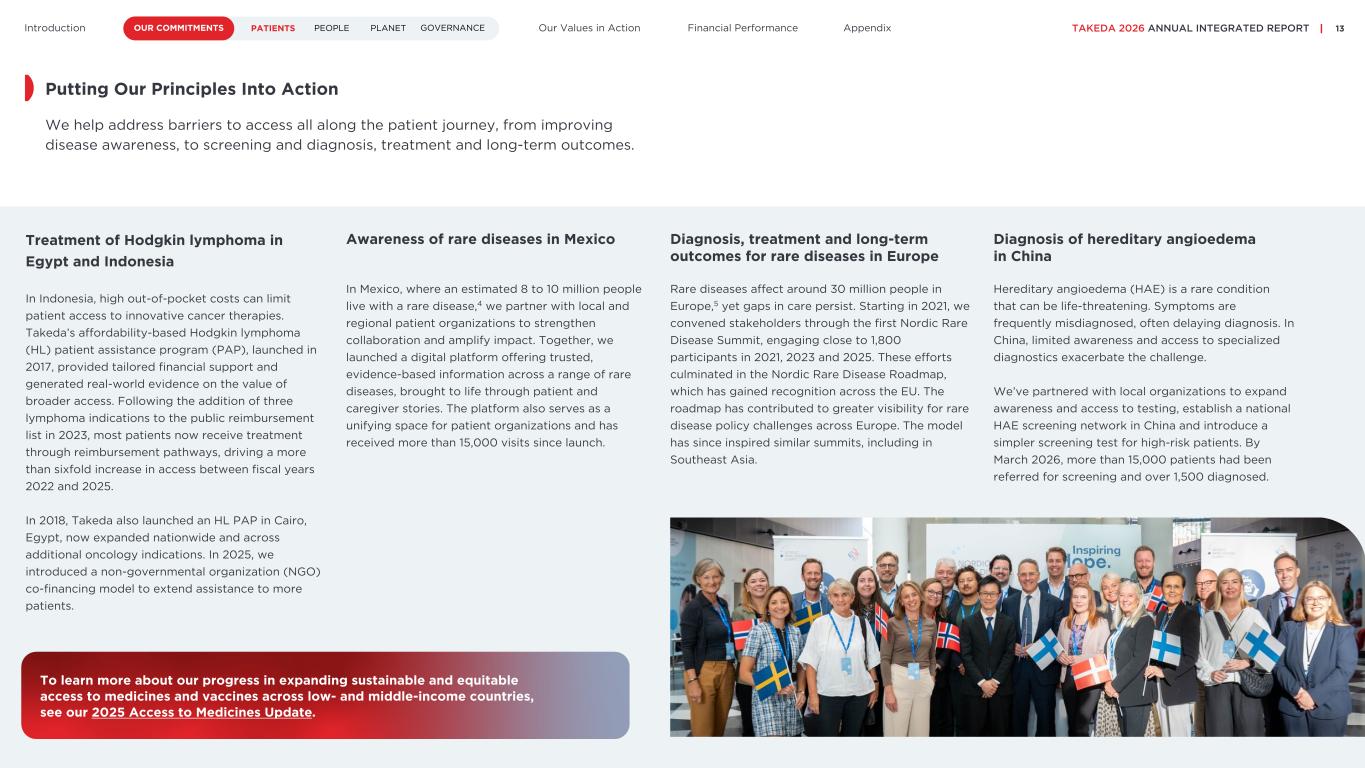
Awareness of rare diseases in Mexico In Mexico, where an estimated 8 to 10 million people live with a rare disease,4 we partner with local and regional patient organizations to strengthen collaboration and amplify impact. Together, we launched a digital platform offering trusted, evidence-based information across a range of rare diseases, brought to life through patient and caregiver stories. The platform also serves as a unifying space for patient organizations and has received more than 15,000 visits since launch. We help address barriers to access all along the patient journey, from improving disease awareness, to screening and diagnosis, treatment and long-term outcomes. Treatment of Hodgkin lymphoma in Egypt and Indonesia In Indonesia, high out-of-pocket costs can limit patient access to innovative cancer therapies. Takeda’s affordability-based Hodgkin lymphoma (HL) patient assistance program (PAP), launched in 2017, provided tailored financial support and generated real-world evidence on the value of broader access. Following the addition of three lymphoma indications to the public reimbursement list in 2023, most patients now receive treatment through reimbursement pathways, driving a more than sixfold increase in access between fiscal years 2022 and 2025. In 2018, Takeda also launched an HL PAP in Cairo, Egypt, now expanded nationwide and across additional oncology indications. In 2025, we introduced a non-governmental organization (NGO) co-financing model to extend assistance to more patients. To learn more about our progress in expanding sustainable and equitable access to medicines and vaccines across low- and middle-income countries, see our 2025 Access to Medicines Update. Putting Our Principles Into Action Diagnosis, treatment and long-term outcomes for rare diseases in Europe Rare diseases affect around 30 million people in Europe,5 yet gaps in care persist. Starting in 2021, we convened stakeholders through the first Nordic Rare Disease Summit, engaging close to 1,800 participants in 2021, 2023 and 2025. These efforts culminated in the Nordic Rare Disease Roadmap, which has gained recognition across the EU. The roadmap has contributed to greater visibility for rare disease policy challenges across Europe. The model has since inspired similar summits, including in Southeast Asia. Diagnosis of hereditary angioedema in China Hereditary angioedema (HAE) is a rare condition that can be life-threatening. Symptoms are frequently misdiagnosed, often delaying diagnosis. In China, limited awareness and access to specialized diagnostics exacerbate the challenge. We’ve partnered with local organizations to expand awareness and access to testing, establish a national HAE screening network in China and introduce a simpler screening test for high-risk patients. By March 2026, more than 15,000 patients had been referred for screening and over 1,500 diagnosed. TAKEDA 2026 ANNUAL INTEGRATED REPORT 13PATIENTS PLANETPEOPLE GOVERNANCE Financial Performance AppendixIntroduction Our Values in ActionOUR COMMITMENTS
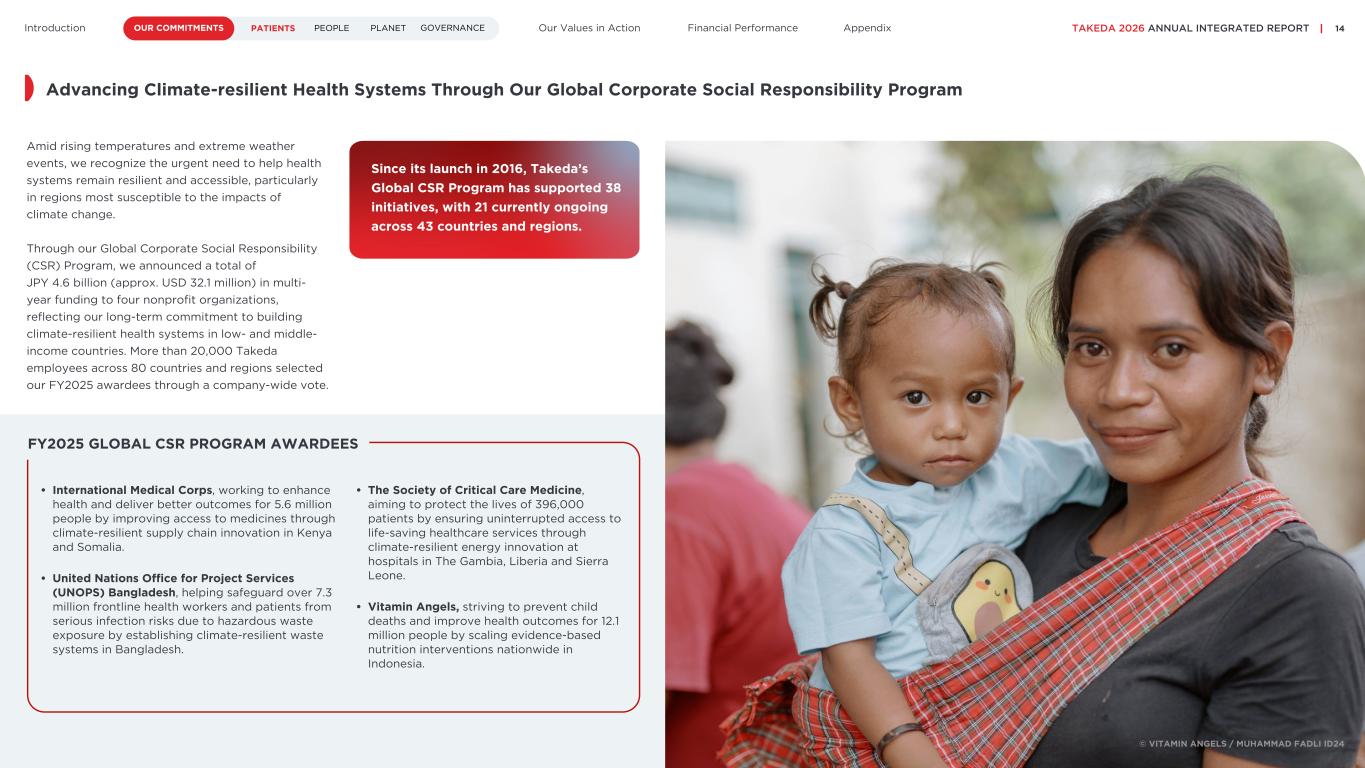
Amid rising temperatures and extreme weather events, we recognize the urgent need to help health systems remain resilient and accessible, particularly in regions most susceptible to the impacts of climate change. Through our Global Corporate Social Responsibility (CSR) Program, we announced a total of JPY 4.6 billion (approx. USD 32.1 million) in multi- year funding to four nonprofit organizations, reflecting our long-term commitment to building climate-resilient health systems in low- and middle- income countries. More than 20,000 Takeda employees across 80 countries and regions selected our FY2025 awardees through a company-wide vote. • The Society of Critical Care Medicine, aiming to protect the lives of 396,000 patients by ensuring uninterrupted access to life-saving healthcare services through climate-resilient energy innovation at hospitals in The Gambia, Liberia and Sierra Leone. • Vitamin Angels, striving to prevent child deaths and improve health outcomes for 12.1 million people by scaling evidence-based nutrition interventions nationwide in Indonesia. • International Medical Corps, working to enhance health and deliver better outcomes for 5.6 million people by improving access to medicines through climate-resilient supply chain innovation in Kenya and Somalia. • United Nations Office for Project Services (UNOPS) Bangladesh, helping safeguard over 7.3 million frontline health workers and patients from serious infection risks due to hazardous waste exposure by establishing climate-resilient waste systems in Bangladesh. Since its launch in 2016, Takeda’s Global CSR Program has supported 38 initiatives, with 21 currently ongoing across 43 countries and regions. Advancing Climate-resilient Health Systems Through Our Global Corporate Social Responsibility Program TAKEDA 2026 ANNUAL INTEGRATED REPORT 14 © VITAMIN ANGELS / MUHAMMAD FADLI ID24 FY2025 GLOBAL CSR PROGRAM AWARDEES PATIENTS PLANETPEOPLE GOVERNANCE Financial Performance AppendixIntroduction Our Values in ActionOUR COMMITMENTS
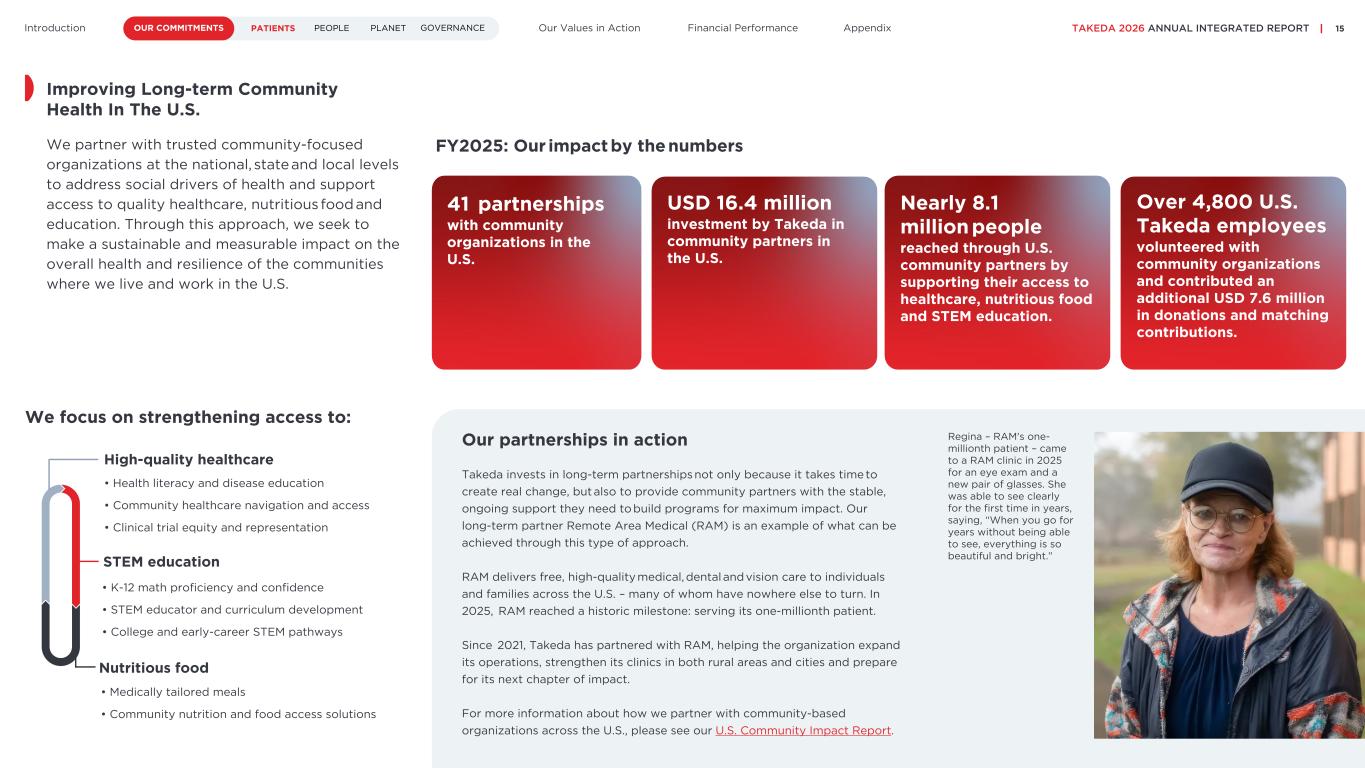
Improving Long-term Community Health In The U.S. We partner with trusted community-focused organizations at the national, state and local levels to address social drivers of health and support access to quality healthcare, nutritious food and education. Through this approach, we seek to make a sustainable and measurable impact on the overall health and resilience of the communities where we live and work in the U.S. Our partnerships in action Takeda invests in long-term partnerships not only because it takes time to create real change, but also to provide community partners with the stable, ongoing support they need to build programs for maximum impact. Our long-term partner Remote Area Medical (RAM) is an example of what can be achieved through this type of approach. RAM delivers free, high-quality medical, dental and vision care to individuals and families across the U.S. – many of whom have nowhere else to turn. In 2025, RAM reached a historic milestone: serving its one-millionth patient. Since 2021, Takeda has partnered with RAM, helping the organization expand its operations, strengthen its clinics in both rural areas and cities and prepare for its next chapter of impact. For more information about how we partner with community-based organizations across the U.S., please see our U.S. Community Impact Report. FY2025: Our impact by the numbers Regina – RAM's one- millionth patient – came to a RAM clinic in 2025 for an eye exam and a new pair of glasses. She was able to see clearly for the first time in years, saying, “When you go for years without being able to see, everything is so beautiful and bright.” High-quality healthcare Nutritious food STEM education • Health literacy and disease education • Community healthcare navigation and access • Clinical trial equity and representation We focus on strengthening access to: • K-12 math proficiency and confidence • STEM educator and curriculum development • College and early-career STEM pathways • Medically tailored meals • Community nutrition and food access solutions TAKEDA 2026 ANNUAL INTEGRATED REPORT 15 41 partnerships with community organizations in the U.S. USD 16.4 million investment by Takeda in community partners in the U.S. Nearly 8.1 million people reached through U.S. community partners by supporting their access to healthcare, nutritious food and STEM education. Over 4,800 U.S. Takeda employees volunteered with community organizations and contributed an additional USD 7.6 million in donations and matching contributions. PATIENTS PLANETPEOPLE GOVERNANCE Financial Performance AppendixIntroduction Our Values in ActionOUR COMMITMENTS
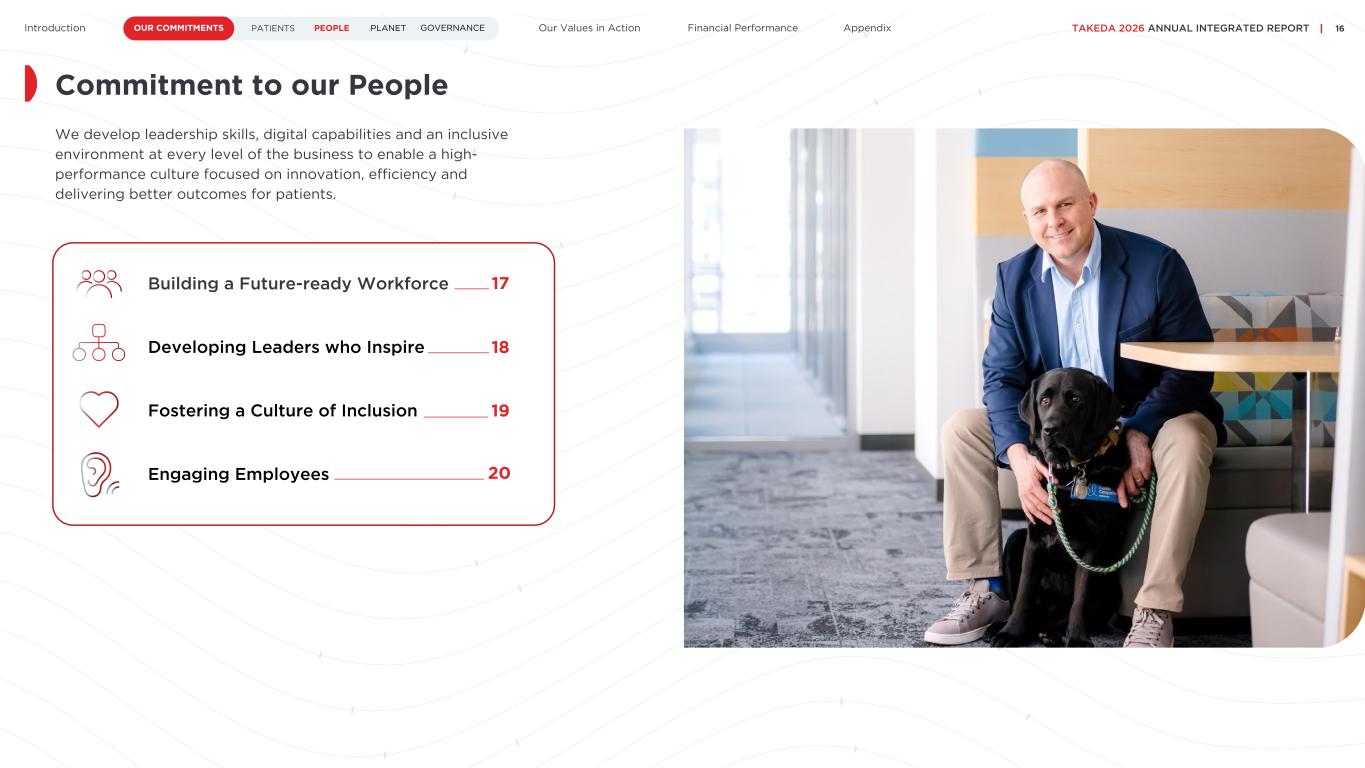
Our Values in Action Commitment to our People We develop leadership skills, digital capabilities and an inclusive environment at every level of the business to enable a high- performance culture focused on innovation, efficiency and delivering better outcomes for patients. Building a Future-ready Workforce Developing Leaders who Inspire Fostering a Culture of Inclusion Engaging Employees 17 18 19 20 TAKEDA 2026 ANNUAL INTEGRATED REPORT 16PATIENTS PLANETPEOPLE GOVERNANCE Financial Performance AppendixIntroduction OUR COMMITMENTS
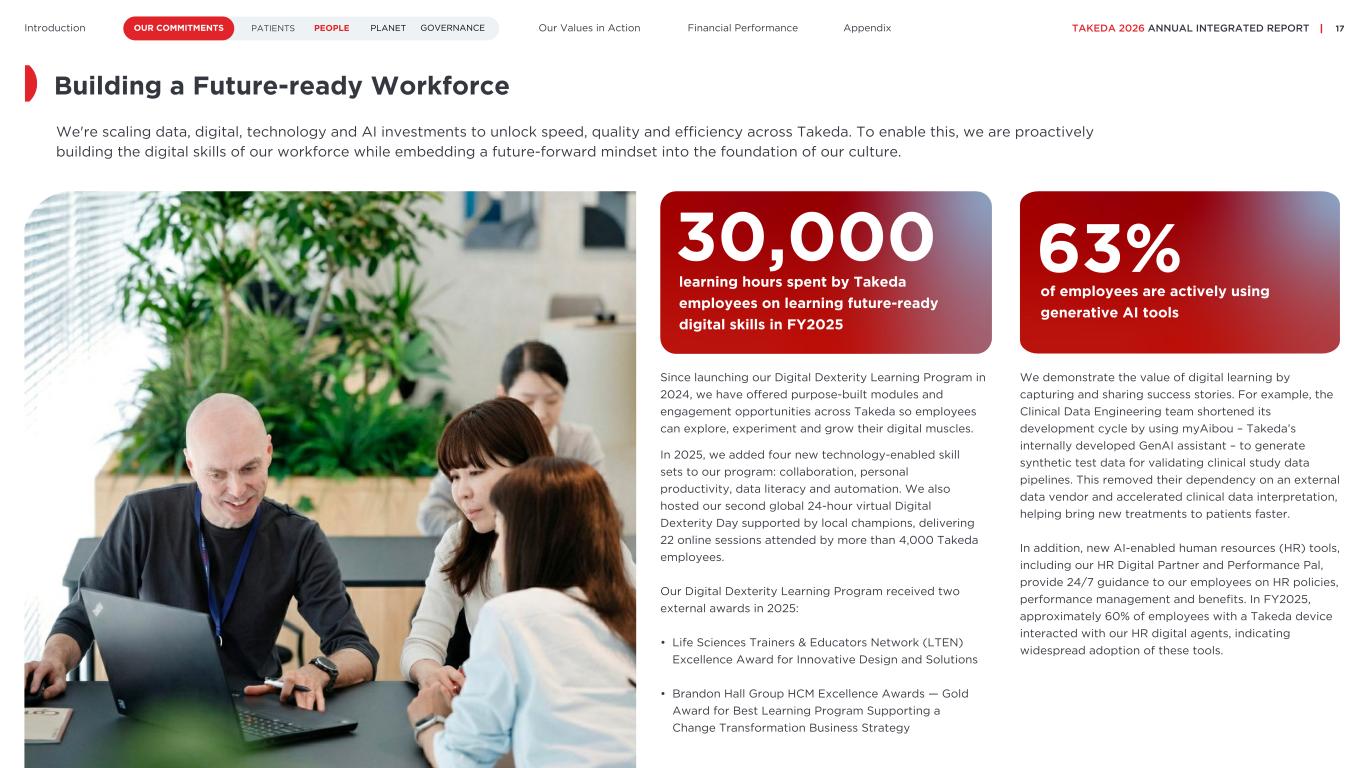
Building a Future-ready Workforce We're scaling data, digital, technology and AI investments to unlock speed, quality and efficiency across Takeda. To enable this, we are proactively building the digital skills of our workforce while embedding a future-forward mindset into the foundation of our culture. Since launching our Digital Dexterity Learning Program in 2024, we have offered purpose-built modules and engagement opportunities across Takeda so employees can explore, experiment and grow their digital muscles. 30,000 learning hours spent by Takeda employees on learning future-ready digital skills in FY2025 In 2025, we added four new technology-enabled skill sets to our program: collaboration, personal productivity, data literacy and automation. We also hosted our second global 24-hour virtual Digital Dexterity Day supported by local champions, delivering 22 online sessions attended by more than 4,000 Takeda employees. Our Digital Dexterity Learning Program received two external awards in 2025: • Life Sciences Trainers & Educators Network (LTEN) Excellence Award for Innovative Design and Solutions • Brandon Hall Group HCM Excellence Awards — Gold Award for Best Learning Program Supporting a Change Transformation Business Strategy We demonstrate the value of digital learning by capturing and sharing success stories. For example, the Clinical Data Engineering team shortened its development cycle by using myAibou – Takeda’s internally developed GenAI assistant – to generate synthetic test data for validating clinical study data pipelines. This removed their dependency on an external data vendor and accelerated clinical data interpretation, helping bring new treatments to patients faster. In addition, new AI-enabled human resources (HR) tools, including our HR Digital Partner and Performance Pal, provide 24/7 guidance to our employees on HR policies, performance management and benefits. In FY2025, approximately 60% of employees with a Takeda device interacted with our HR digital agents, indicating widespread adoption of these tools. of employees are actively using generative AI tools 63% TAKEDA 2026 ANNUAL INTEGRATED REPORT 17PATIENTS PLANETPEOPLE GOVERNANCE Financial Performance AppendixIntroduction Our Values in ActionOUR COMMITMENTS
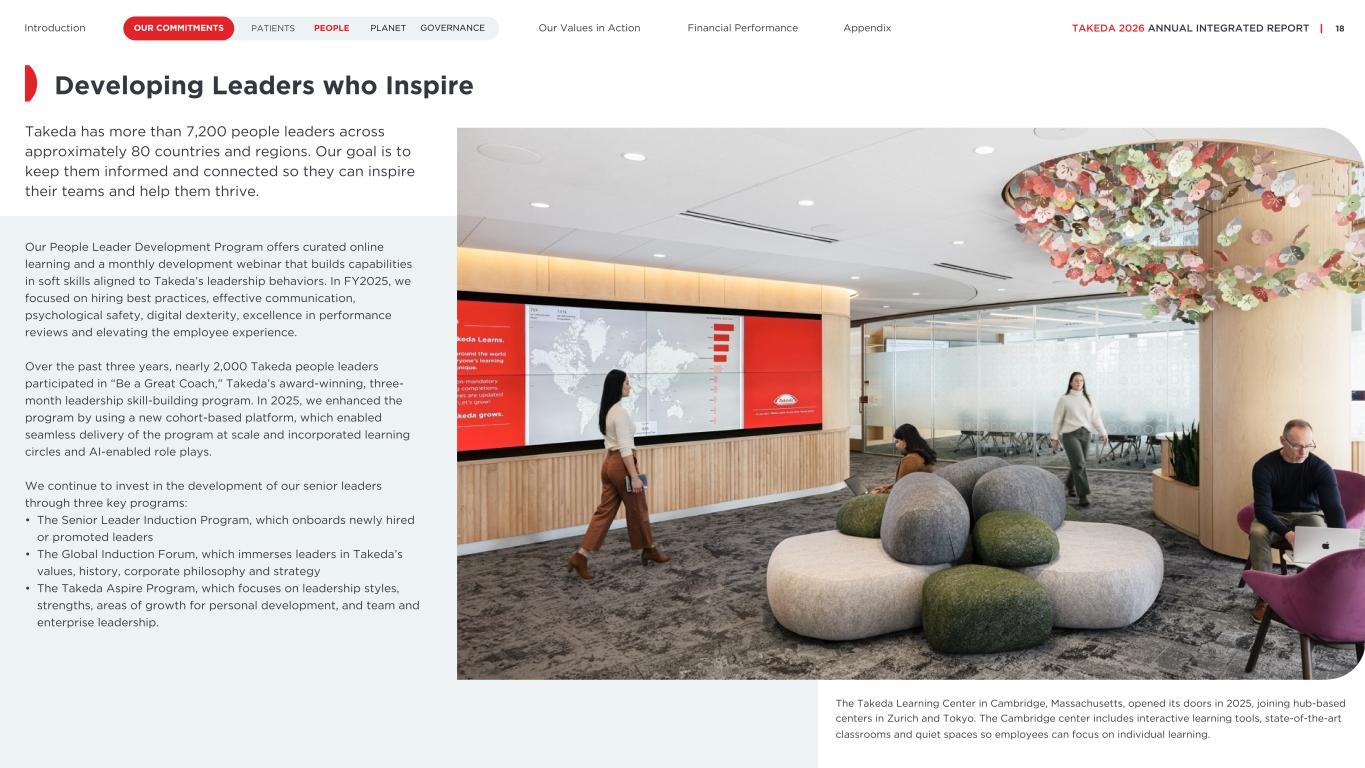
Our Values in Action Developing Leaders who Inspire Takeda has more than 7,200 people leaders across approximately 80 countries and regions. Our goal is to keep them informed and connected so they can inspire their teams and help them thrive. The Takeda Learning Center in Cambridge, Massachusetts, opened its doors in 2025, joining hub-based centers in Zurich and Tokyo. The Cambridge center includes interactive learning tools, state-of-the-art classrooms and quiet spaces so employees can focus on individual learning. TAKEDA 2026 ANNUAL INTEGRATED REPORT 18 Our People Leader Development Program offers curated online learning and a monthly development webinar that builds capabilities in soft skills aligned to Takeda’s leadership behaviors. In FY2025, we focused on hiring best practices, effective communication, psychological safety, digital dexterity, excellence in performance reviews and elevating the employee experience. Over the past three years, nearly 2,000 Takeda people leaders participated in “Be a Great Coach,” Takeda’s award-winning, three- month leadership skill-building program. In 2025, we enhanced the program by using a new cohort-based platform, which enabled seamless delivery of the program at scale and incorporated learning circles and AI-enabled role plays. We continue to invest in the development of our senior leaders through three key programs: • The Senior Leader Induction Program, which onboards newly hired or promoted leaders • The Global Induction Forum, which immerses leaders in Takeda’s values, history, corporate philosophy and strategy • The Takeda Aspire Program, which focuses on leadership styles, strengths, areas of growth for personal development, and team and enterprise leadership. PATIENTS PLANETPEOPLE GOVERNANCE Financial Performance AppendixIntroduction OUR COMMITMENTS
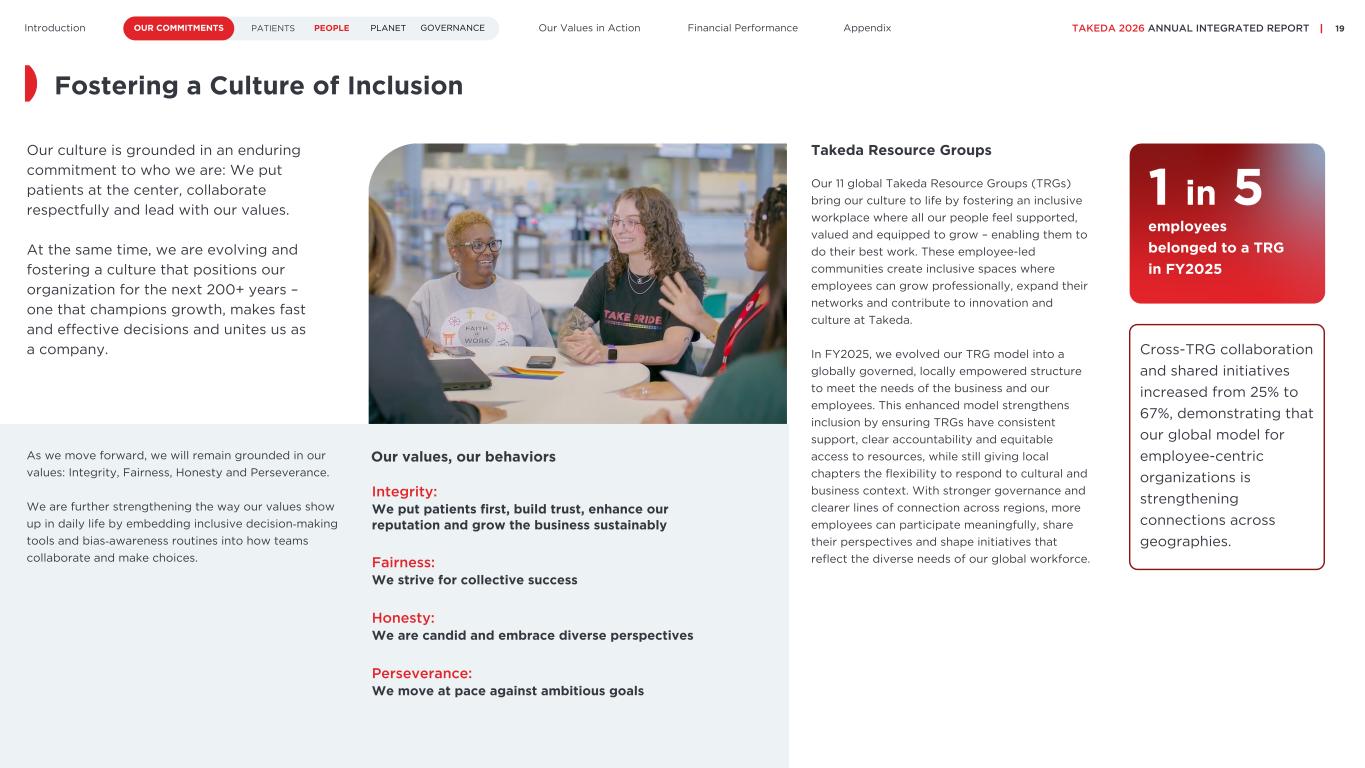
Fostering a Culture of Inclusion Our culture is grounded in an enduring commitment to who we are: We put patients at the center, collaborate respectfully and lead with our values. At the same time, we are evolving and fostering a culture that positions our organization for the next 200+ years – one that champions growth, makes fast and effective decisions and unites us as a company. Takeda Resource Groups Our 11 global Takeda Resource Groups (TRGs) bring our culture to life by fostering an inclusive workplace where all our people feel supported, valued and equipped to grow – enabling them to do their best work. These employee-led communities create inclusive spaces where employees can grow professionally, expand their networks and contribute to innovation and culture at Takeda. In FY2025, we evolved our TRG model into a globally governed, locally empowered structure to meet the needs of the business and our employees. This enhanced model strengthens inclusion by ensuring TRGs have consistent support, clear accountability and equitable access to resources, while still giving local chapters the flexibility to respond to cultural and business context. With stronger governance and clearer lines of connection across regions, more employees can participate meaningfully, share their perspectives and shape initiatives that reflect the diverse needs of our global workforce. Cross-TRG collaboration and shared initiatives increased from 25% to 67%, demonstrating that our global model for employee-centric organizations is strengthening connections across geographies. Integrity: We put patients first, build trust, enhance our reputation and grow the business sustainably Fairness: We strive for collective success Honesty: We are candid and embrace diverse perspectives Perseverance: We move at pace against ambitious goals 1 in 5 employees belonged to a TRG in FY2025 Our values, our behaviorsAs we move forward, we will remain grounded in our values: Integrity, Fairness, Honesty and Perseverance. We are further strengthening the way our values show up in daily life by embedding inclusive decision-making tools and bias-awareness routines into how teams collaborate and make choices. TAKEDA 2026 ANNUAL INTEGRATED REPORT 19PATIENTS PLANETPEOPLE GOVERNANCE Financial Performance AppendixIntroduction Our Values in ActionOUR COMMITMENTS
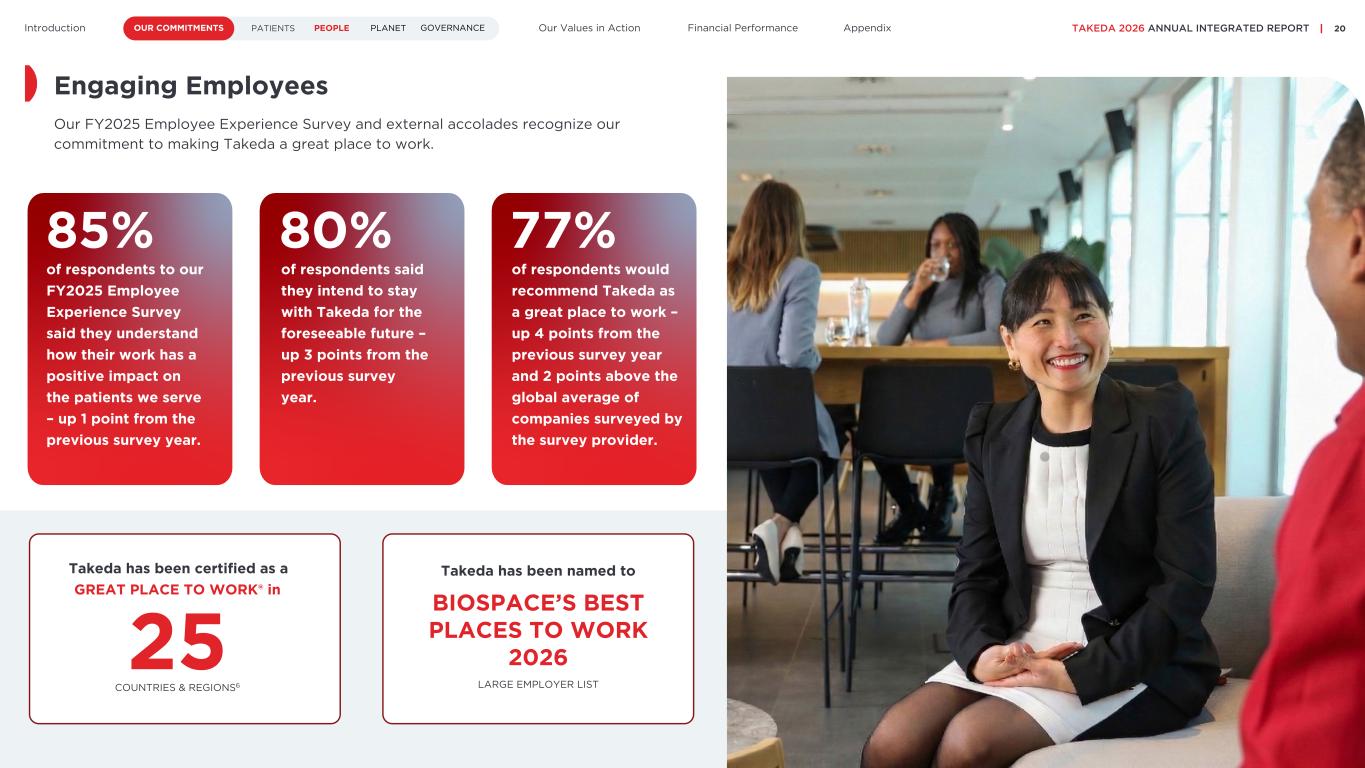
Our Values in Action Engaging Employees of respondents to our FY2025 Employee Experience Survey said they understand how their work has a positive impact on the patients we serve – up 1 point from the previous survey year. 85% of respondents said they intend to stay with Takeda for the foreseeable future – up 3 points from the previous survey year. 77% of respondents would recommend Takeda as a great place to work – up 4 points from the previous survey year and 2 points above the global average of companies surveyed by the survey provider. 80% Our FY2025 Employee Experience Survey and external accolades recognize our commitment to making Takeda a great place to work. GREAT PLACE TO WORK® in 25 COUNTRIES & REGIONS6 BIOSPACE’S BEST PLACES TO WORK 2026 LARGE EMPLOYER LIST TAKEDA 2026 ANNUAL INTEGRATED REPORT 20 Takeda has been certified as a Takeda has been named to PATIENTS PLANETPEOPLE GOVERNANCE Financial Performance AppendixIntroduction OUR COMMITMENTS
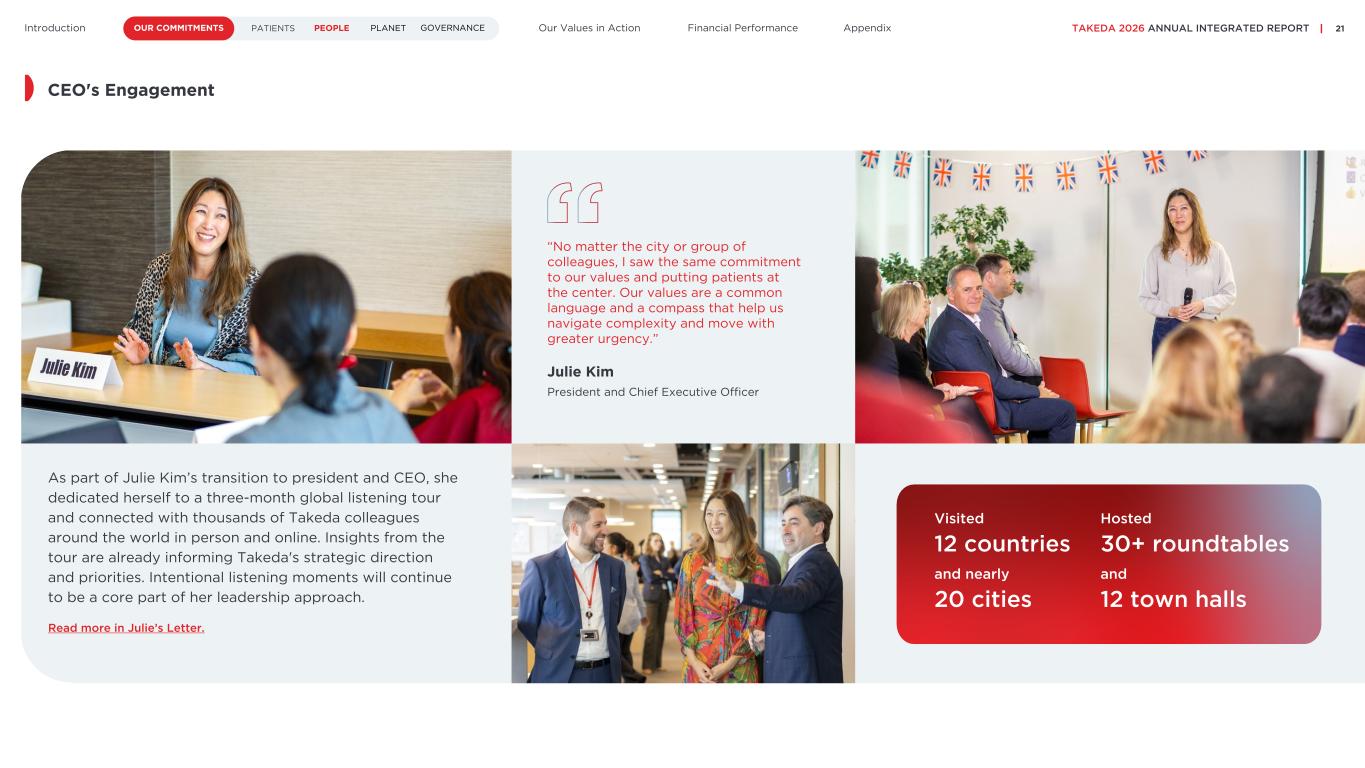
TAKEDA 2026 ANNUAL INTEGRATED REPORT 21Our Values in Action CEO's Engagement As part of Julie Kim’s transition to president and CEO, she dedicated herself to a three-month global listening tour and connected with thousands of Takeda colleagues around the world in person and online. Insights from the tour are already informing Takeda's strategic direction and priorities. Intentional listening moments will continue to be a core part of her leadership approach. Read more in Julie’s Letter. “No matter the city or group of colleagues, I saw the same commitment to our values and putting patients at the center. Our values are a common language and a compass that help us navigate complexity and move with greater urgency.” Julie Kim Visited 12 countries and nearly 20 cities Hosted 30+ roundtables and 12 town halls President and Chief Executive Officer PATIENTS PLANETPEOPLE GOVERNANCE Financial Performance AppendixIntroduction OUR COMMITMENTS
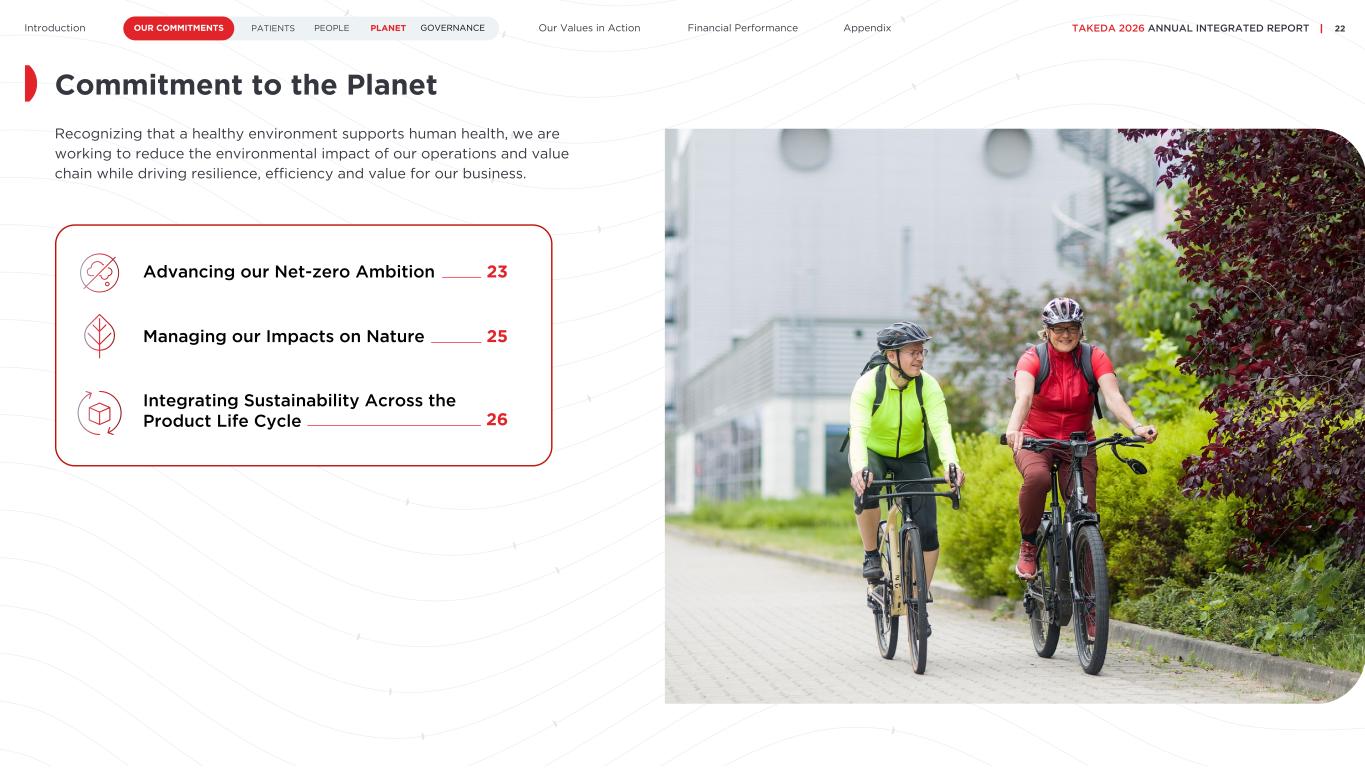
TAKEDA 2026 ANNUAL INTEGRATED REPORT 22PATIENTS PLANETPEOPLE GOVERNANCE Financial Performance AppendixIntroduction Our Values in ActionOUR COMMITMENTS Commitment to the Planet Recognizing that a healthy environment supports human health, we are working to reduce the environmental impact of our operations and value chain while driving resilience, efficiency and value for our business. Advancing our Net-zero Ambition Managing our Impacts on Nature Integrating Sustainability Across the Product Life Cycle 23 25 26
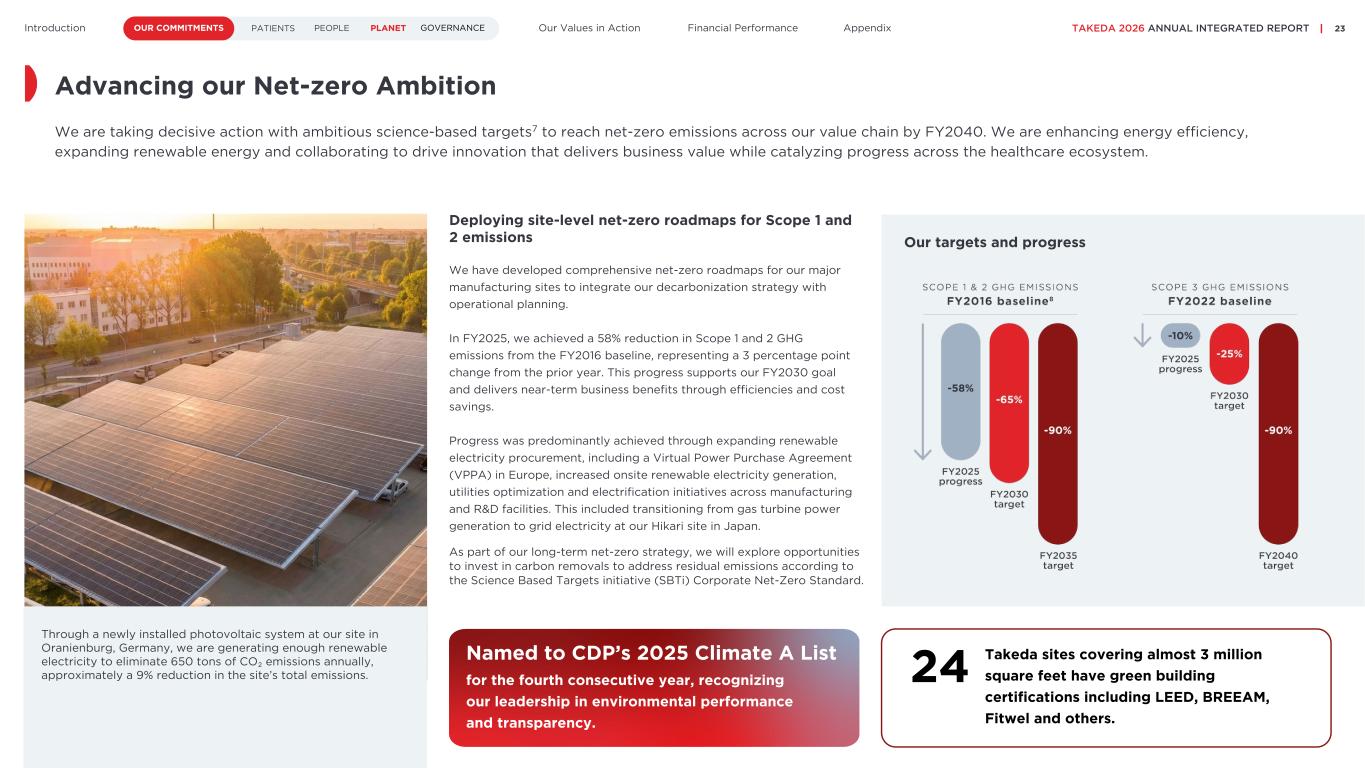
Deploying site-level net-zero roadmaps for Scope 1 and 2 emissions We have developed comprehensive net-zero roadmaps for our major manufacturing sites to integrate our decarbonization strategy with operational planning. In FY2025, we achieved a 58% reduction in Scope 1 and 2 GHG emissions from the FY2016 baseline, representing a 3 percentage point change from the prior year. This progress supports our FY2030 goal and delivers near-term business benefits through efficiencies and cost savings. Progress was predominantly achieved through expanding renewable electricity procurement, including a Virtual Power Purchase Agreement (VPPA) in Europe, increased onsite renewable electricity generation, utilities optimization and electrification initiatives across manufacturing and R&D facilities. This included transitioning from gas turbine power generation to grid electricity at our Hikari site in Japan. Our targets and progress Advancing our Net-zero Ambition Takeda sites covering almost 3 million square feet have green building certifications including LEED, BREEAM, Fitwel and others. 24Named to CDP’s 2025 Climate A List for the fourth consecutive year, recognizing our leadership in environmental performance and transparency. We are taking decisive action with ambitious science-based targets7 to reach net-zero emissions across our value chain by FY2040. We are enhancing energy efficiency, expanding renewable energy and collaborating to drive innovation that delivers business value while catalyzing progress across the healthcare ecosystem. As part of our long-term net-zero strategy, we will explore opportunities to invest in carbon removals to address residual emissions according to the Science Based Targets initiative (SBTi) Corporate Net-Zero Standard. TAKEDA 2026 ANNUAL INTEGRATED REPORT 23 Through a newly installed photovoltaic system at our site in Oranienburg, Germany, we are generating enough renewable electricity to eliminate 650 tons of CO₂ emissions annually, approximately a 9% reduction in the site’s total emissions. PATIENTS PLANETPEOPLE GOVERNANCE Financial Performance AppendixIntroduction Our Values in ActionOUR COMMITMENTS
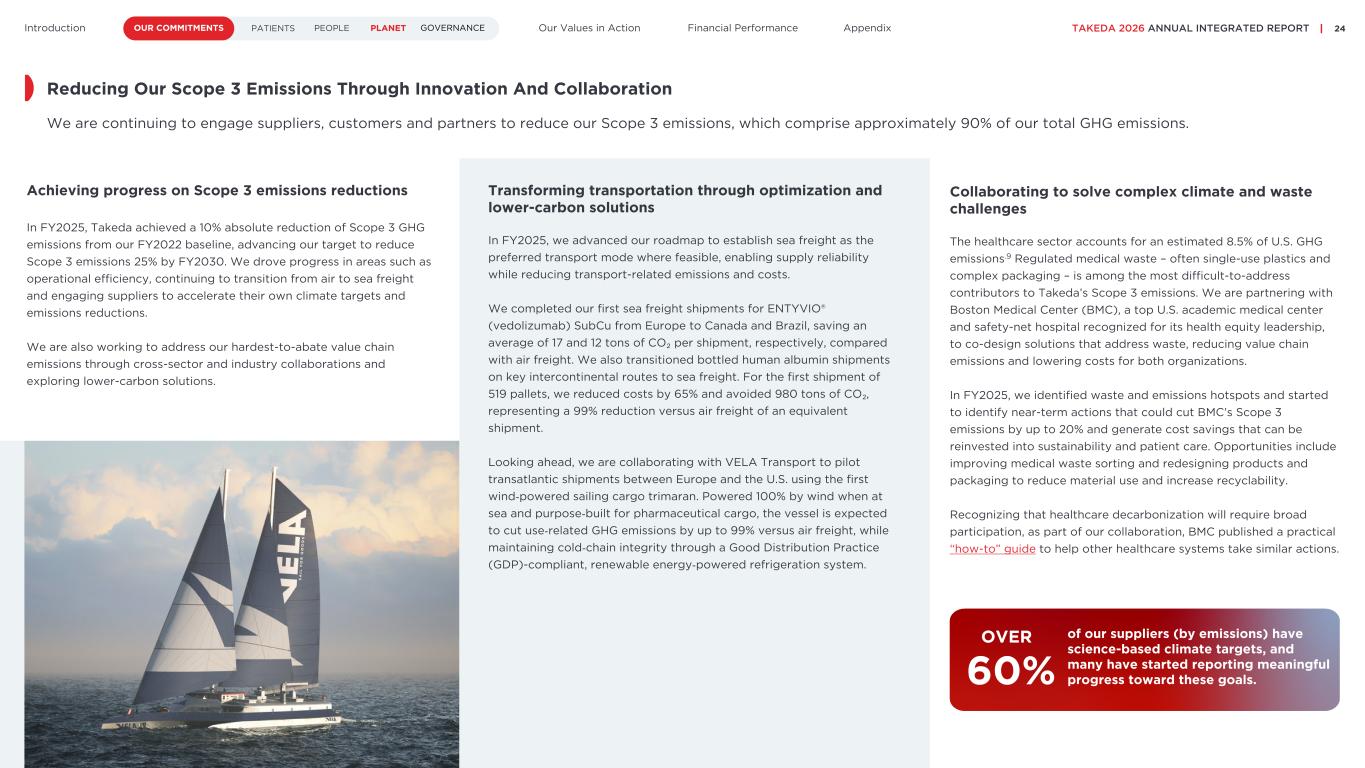
Reducing Our Scope 3 Emissions Through Innovation And Collaboration We are continuing to engage suppliers, customers and partners to reduce our Scope 3 emissions, which comprise approximately 90% of our total GHG emissions. Collaborating to solve complex climate and waste challenges The healthcare sector accounts for an estimated 8.5% of U.S. GHG emissions.9 Regulated medical waste – often single-use plastics and complex packaging – is among the most difficult-to-address contributors to Takeda’s Scope 3 emissions. We are partnering with Boston Medical Center (BMC), a top U.S. academic medical center and safety-net hospital recognized for its health equity leadership, to co-design solutions that address waste, reducing value chain emissions and lowering costs for both organizations. In FY2025, we identified waste and emissions hotspots and started to identify near-term actions that could cut BMC’s Scope 3 emissions by up to 20% and generate cost savings that can be reinvested into sustainability and patient care. Opportunities include improving medical waste sorting and redesigning products and packaging to reduce material use and increase recyclability. Recognizing that healthcare decarbonization will require broad participation, as part of our collaboration, BMC published a practical “how-to” guide to help other healthcare systems take similar actions. Transforming transportation through optimization and lower-carbon solutions In FY2025, we advanced our roadmap to establish sea freight as the preferred transport mode where feasible, enabling supply reliability while reducing transport-related emissions and costs. We completed our first sea freight shipments for ENTYVIO® (vedolizumab) SubCu from Europe to Canada and Brazil, saving an average of 17 and 12 tons of CO₂ per shipment, respectively, compared with air freight. We also transitioned bottled human albumin shipments on key intercontinental routes to sea freight. For the first shipment of 519 pallets, we reduced costs by 65% and avoided 980 tons of CO₂, representing a 99% reduction versus air freight of an equivalent shipment. Looking ahead, we are collaborating with VELA Transport to pilot transatlantic shipments between Europe and the U.S. using the first wind-powered sailing cargo trimaran. Powered 100% by wind when at sea and purpose-built for pharmaceutical cargo, the vessel is expected to cut use-related GHG emissions by up to 99% versus air freight, while maintaining cold-chain integrity through a Good Distribution Practice (GDP)-compliant, renewable energy-powered refrigeration system. of our suppliers (by emissions) have science-based climate targets, and many have started reporting meaningful progress toward these goals. Achieving progress on Scope 3 emissions reductions In FY2025, Takeda achieved a 10% absolute reduction of Scope 3 GHG emissions from our FY2022 baseline, advancing our target to reduce Scope 3 emissions 25% by FY2030. We drove progress in areas such as operational efficiency, continuing to transition from air to sea freight and engaging suppliers to accelerate their own climate targets and emissions reductions. We are also working to address our hardest-to-abate value chain emissions through cross-sector and industry collaborations and exploring lower-carbon solutions. TAKEDA 2026 ANNUAL INTEGRATED REPORT 24 60% OVER PATIENTS PLANETPEOPLE GOVERNANCE Financial Performance AppendixIntroduction Our Values in ActionOUR COMMITMENTS
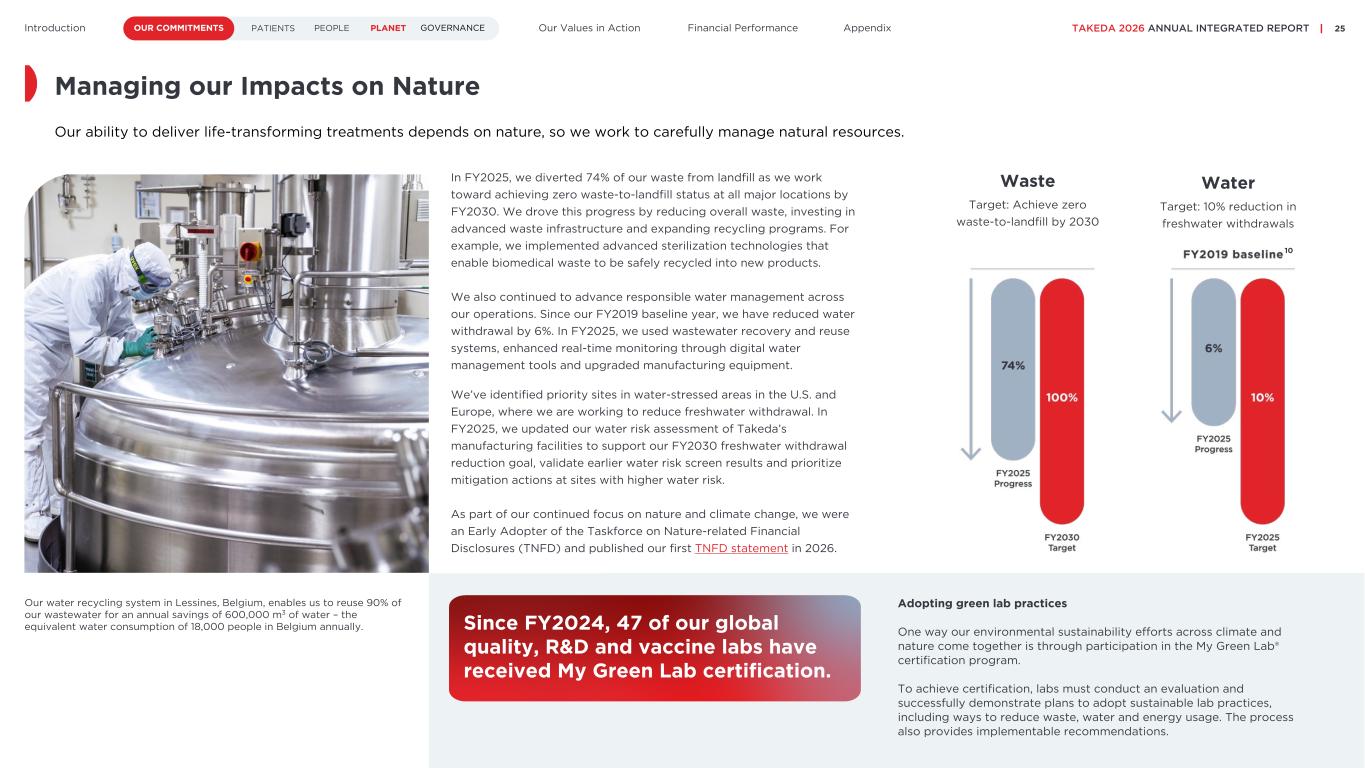
Managing our Impacts on Nature Adopting green lab practices One way our environmental sustainability efforts across climate and nature come together is through participation in the My Green Lab® certification program. To achieve certification, labs must conduct an evaluation and successfully demonstrate plans to adopt sustainable lab practices, including ways to reduce waste, water and energy usage. The process also provides implementable recommendations. Waste Water Target: Achieve zero waste-to-landfill by 2030 Target: 10% reduction in freshwater withdrawals In FY2025, we diverted 74% of our waste from landfill as we work toward achieving zero waste-to-landfill status at all major locations by FY2030. We drove this progress by reducing overall waste, investing in advanced waste infrastructure and expanding recycling programs. For example, we implemented advanced sterilization technologies that enable biomedical waste to be safely recycled into new products. We also continued to advance responsible water management across our operations. Since our FY2019 baseline year, we have reduced water withdrawal by 6%. In FY2025, we used wastewater recovery and reuse systems, enhanced real-time monitoring through digital water management tools and upgraded manufacturing equipment. We’ve identified priority sites in water-stressed areas in the U.S. and Europe, where we are working to reduce freshwater withdrawal. In FY2025, we updated our water risk assessment of Takeda’s manufacturing facilities to support our FY2030 freshwater withdrawal reduction goal, validate earlier water risk screen results and prioritize mitigation actions at sites with higher water risk. As part of our continued focus on nature and climate change, we were an Early Adopter of the Taskforce on Nature-related Financial Disclosures (TNFD) and published our first TNFD statement in 2026. Our ability to deliver life-transforming treatments depends on nature, so we work to carefully manage natural resources. TAKEDA 2026 ANNUAL INTEGRATED REPORT 25 10 Our water recycling system in Lessines, Belgium, enables us to reuse 90% of our wastewater for an annual savings of 600,000 m3 of water – the equivalent water consumption of 18,000 people in Belgium annually. Since FY2024, 47 of our global quality, R&D and vaccine labs have received My Green Lab certification. PATIENTS PLANETPEOPLE GOVERNANCE Financial Performance AppendixIntroduction Our Values in ActionOUR COMMITMENTS
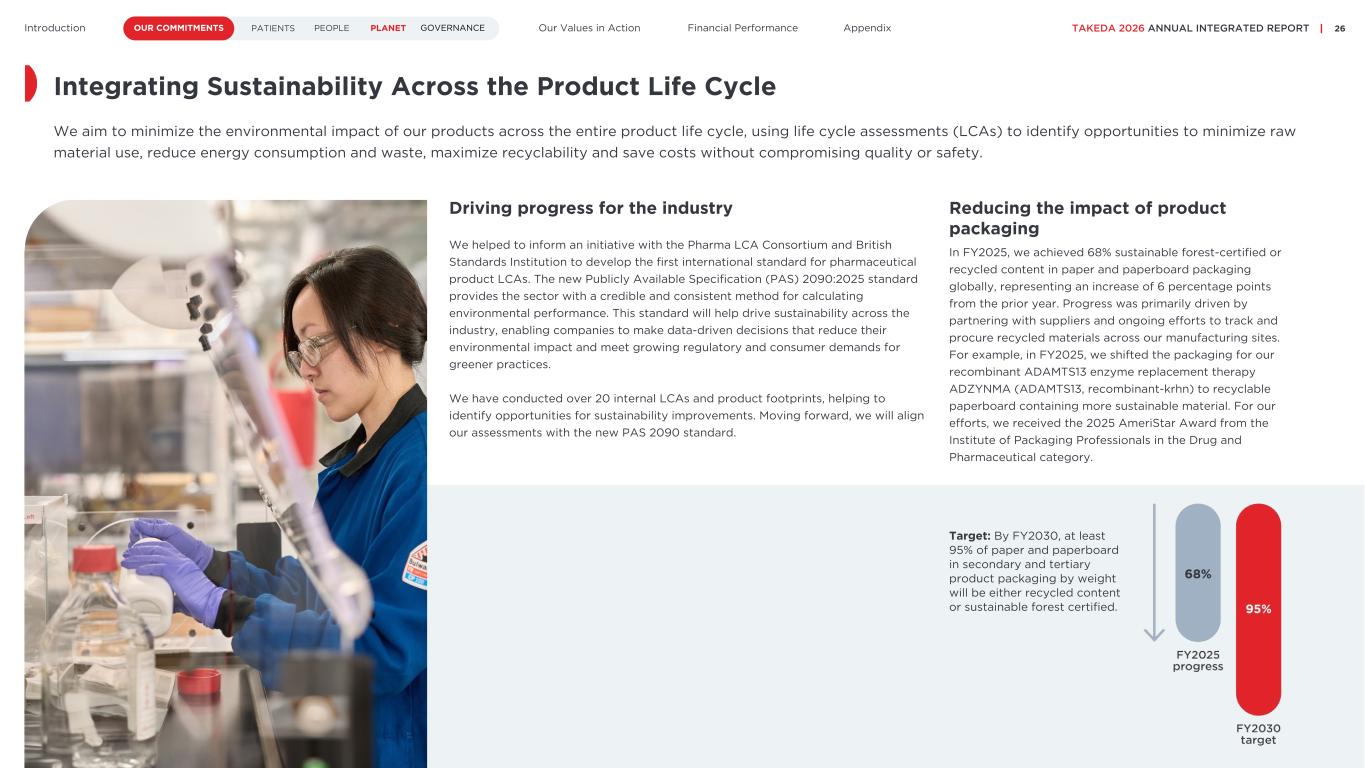
Integrating Sustainability Across the Product Life Cycle Driving progress for the industry Reducing the impact of product packaging We helped to inform an initiative with the Pharma LCA Consortium and British Standards Institution to develop the first international standard for pharmaceutical product LCAs. The new Publicly Available Specification (PAS) 2090:2025 standard provides the sector with a credible and consistent method for calculating environmental performance. This standard will help drive sustainability across the industry, enabling companies to make data-driven decisions that reduce their environmental impact and meet growing regulatory and consumer demands for greener practices. We have conducted over 20 internal LCAs and product footprints, helping to identify opportunities for sustainability improvements. Moving forward, we will align our assessments with the new PAS 2090 standard. In FY2025, we achieved 68% sustainable forest-certified or recycled content in paper and paperboard packaging globally, representing an increase of 6 percentage points from the prior year. Progress was primarily driven by partnering with suppliers and ongoing efforts to track and procure recycled materials across our manufacturing sites. For example, in FY2025, we shifted the packaging for our recombinant ADAMTS13 enzyme replacement therapy ADZYNMA (ADAMTS13, recombinant-krhn) to recyclable paperboard containing more sustainable material. For our efforts, we received the 2025 AmeriStar Award from the Institute of Packaging Professionals in the Drug and Pharmaceutical category. Target: By FY2030, at least 95% of paper and paperboard in secondary and tertiary product packaging by weight will be either recycled content or sustainable forest certified. We aim to minimize the environmental impact of our products across the entire product life cycle, using life cycle assessments (LCAs) to identify opportunities to minimize raw material use, reduce energy consumption and waste, maximize recyclability and save costs without compromising quality or safety. TAKEDA 2026 ANNUAL INTEGRATED REPORT 26PATIENTS PLANETPEOPLE GOVERNANCE Financial Performance AppendixIntroduction Our Values in ActionOUR COMMITMENTS
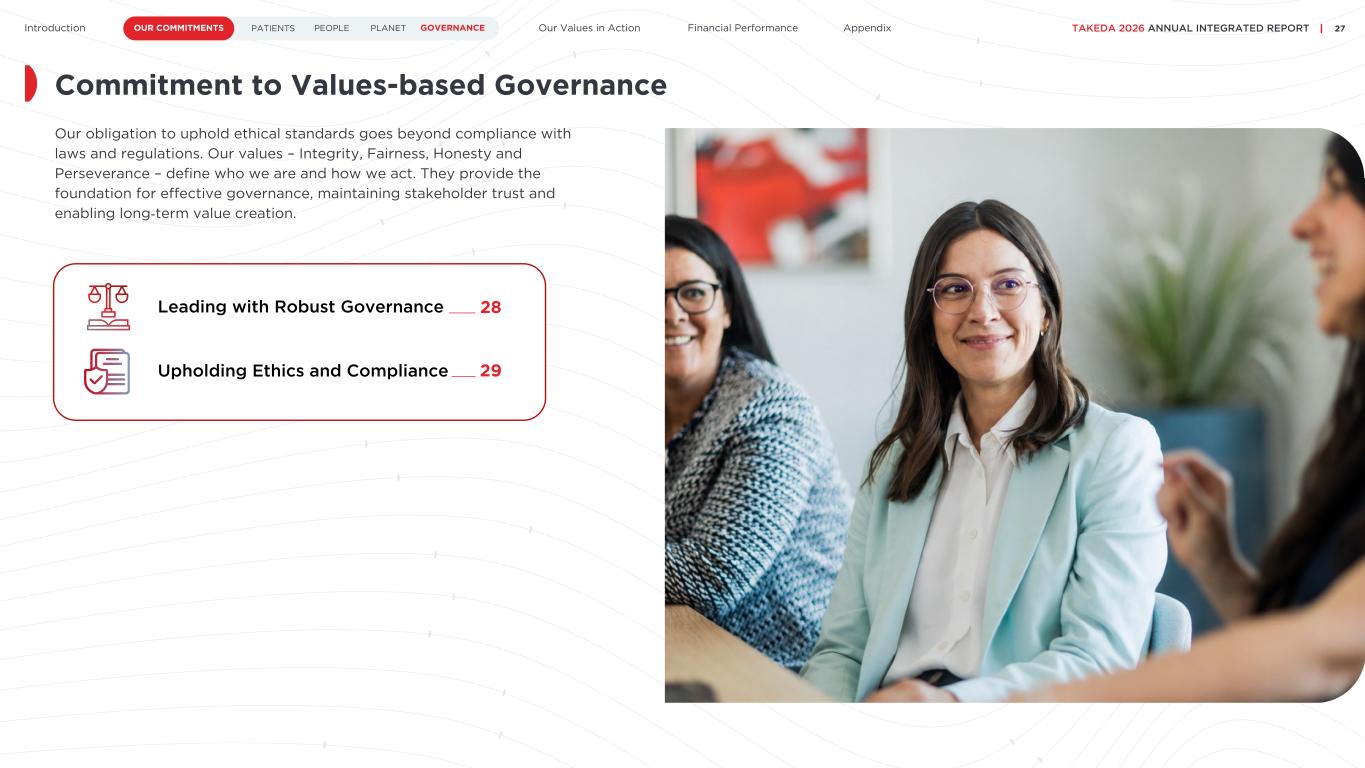
PATIENTS PLANETPEOPLE GOVERNANCE Financial Performance AppendixIntroduction Our Values in ActionOUR COMMITMENTS 28Leading with Robust Governance Our obligation to uphold ethical standards goes beyond compliance with laws and regulations. Our values – Integrity, Fairness, Honesty and Perseverance – define who we are and how we act. They provide the foundation for effective governance, maintaining stakeholder trust and enabling long-term value creation. 29Upholding Ethics and Compliance TAKEDA 2026 ANNUAL INTEGRATED REPORT 27 Commitment to Values-based Governance
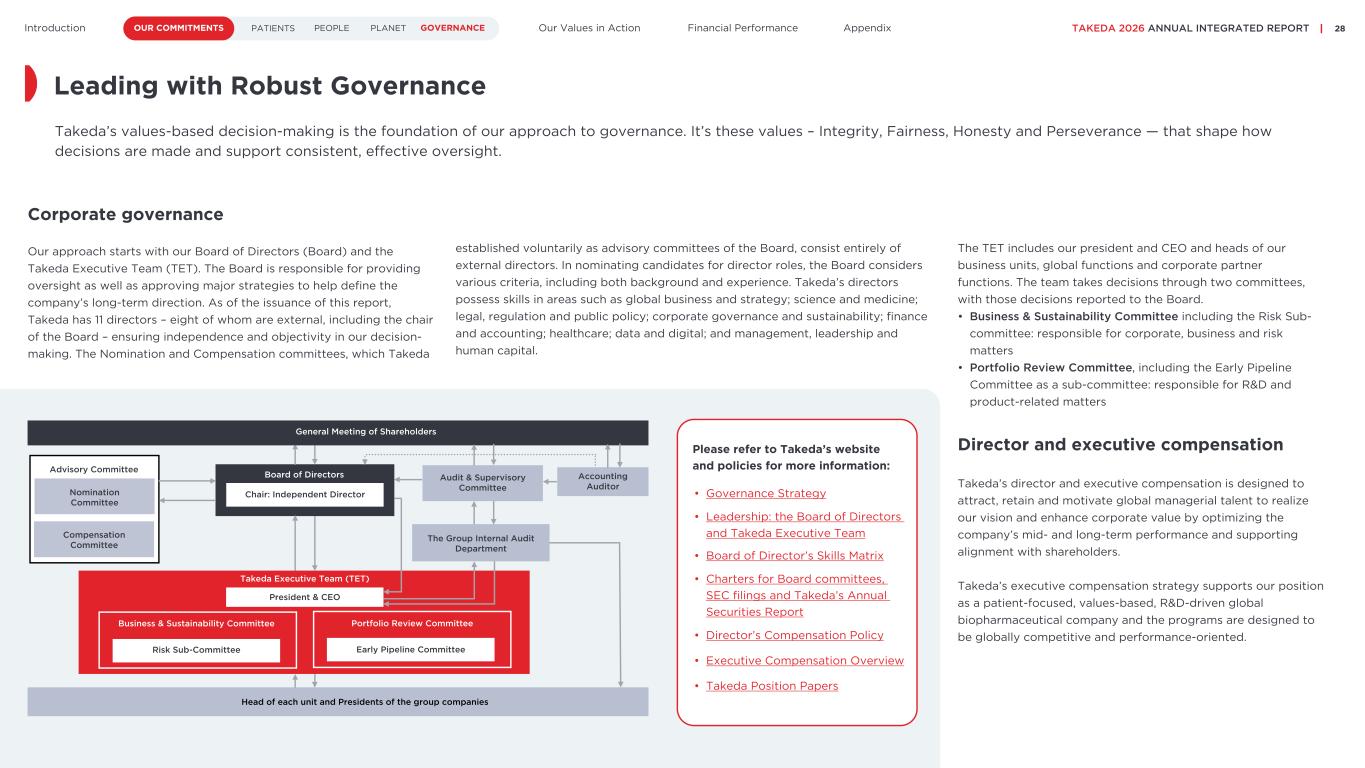
Accounting Auditor Board of Directors Audit & Supervisory Committee Business & Sustainability Committee Portfolio Review Committee Advisory Committee Takeda Executive Team (TET) Risk Sub-Committee Early Pipeline Committee Nomination Committee Compensation Committee Head of each unit and Presidents of the group companies General Meeting of Shareholders Chair: Independent Director The Group Internal Audit Department President & CEO Our approach starts with our Board of Directors (Board) and the Takeda Executive Team (TET). The Board is responsible for providing oversight as well as approving major strategies to help define the company’s long-term direction. As of the issuance of this report, Takeda has 11 directors – eight of whom are external, including the chair of the Board – ensuring independence and objectivity in our decision- making. The Nomination and Compensation committees, which Takeda Takeda’s values-based decision-making is the foundation of our approach to governance. It’s these values – Integrity, Fairness, Honesty and Perseverance — that shape how decisions are made and support consistent, effective oversight. Corporate governance Leading with Robust Governance established voluntarily as advisory committees of the Board, consist entirely of external directors. In nominating candidates for director roles, the Board considers various criteria, including both background and experience. Takeda’s directors possess skills in areas such as global business and strategy; science and medicine; legal, regulation and public policy; corporate governance and sustainability; finance and accounting; healthcare; data and digital; and management, leadership and human capital. The TET includes our president and CEO and heads of our business units, global functions and corporate partner functions. The team takes decisions through two committees, with those decisions reported to the Board. • Business & Sustainability Committee including the Risk Sub- committee: responsible for corporate, business and risk matters • Portfolio Review Committee, including the Early Pipeline Committee as a sub-committee: responsible for R&D and product-related matters Director and executive compensation Takeda’s director and executive compensation is designed to attract, retain and motivate global managerial talent to realize our vision and enhance corporate value by optimizing the company’s mid- and long-term performance and supporting alignment with shareholders. Takeda’s executive compensation strategy supports our position as a patient-focused, values-based, R&D-driven global biopharmaceutical company and the programs are designed to be globally competitive and performance-oriented. TAKEDA 2026 ANNUAL INTEGRATED REPORT 28 Please refer to Takeda’s website and policies for more information: • Governance Strategy • Leadership: the Board of Directors and Takeda Executive Team • Board of Director’s Skills Matrix • Charters for Board committees, SEC filings and Takeda’s Annual Securities Report • Director’s Compensation Policy • Executive Compensation Overview • Takeda Position Papers PATIENTS PLANETPEOPLE GOVERNANCE Financial Performance AppendixIntroduction Our Values in ActionOUR COMMITMENTS
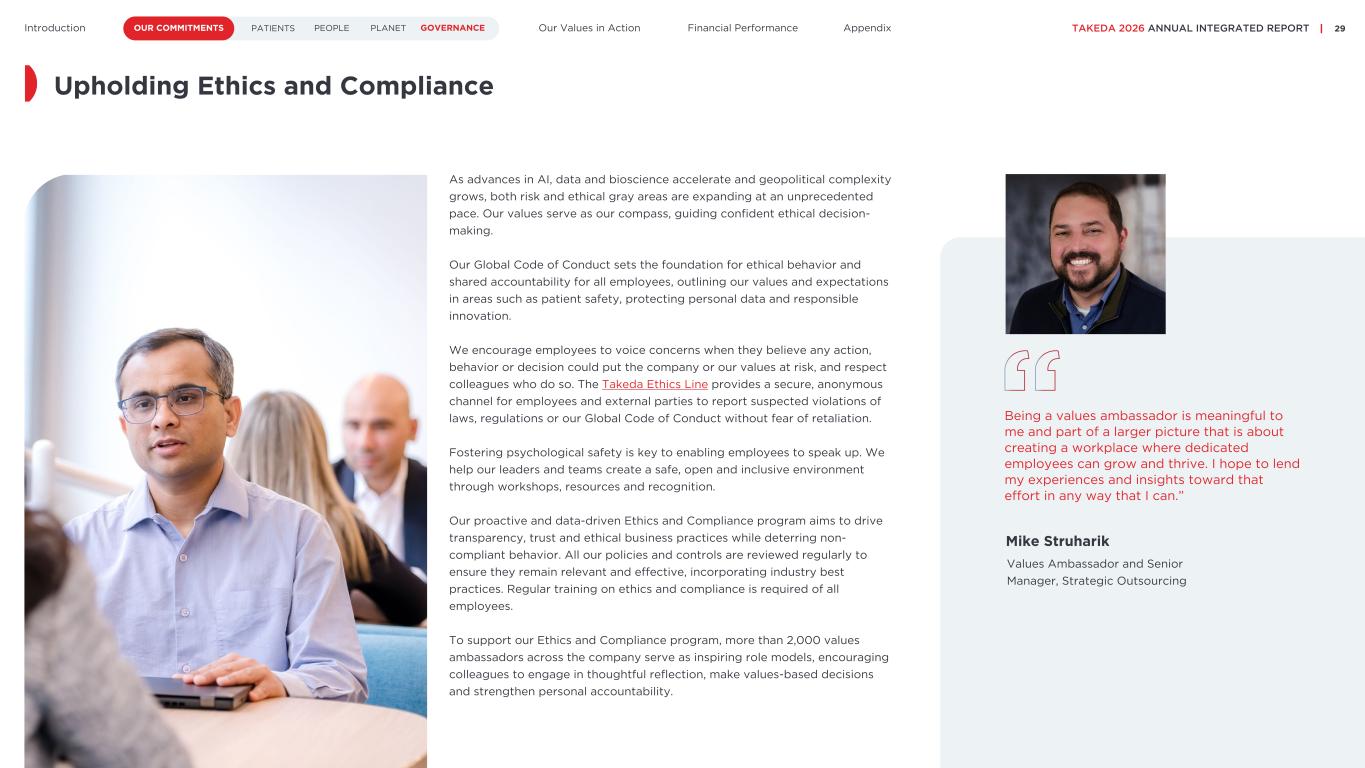
Upholding Ethics and Compliance Mike Struharik Values Ambassador and Senior Manager, Strategic Outsourcing Being a values ambassador is meaningful to me and part of a larger picture that is about creating a workplace where dedicated employees can grow and thrive. I hope to lend my experiences and insights toward that effort in any way that I can.” As advances in AI, data and bioscience accelerate and geopolitical complexity grows, both risk and ethical gray areas are expanding at an unprecedented pace. Our values serve as our compass, guiding confident ethical decision- making. Our Global Code of Conduct sets the foundation for ethical behavior and shared accountability for all employees, outlining our values and expectations in areas such as patient safety, protecting personal data and responsible innovation. We encourage employees to voice concerns when they believe any action, behavior or decision could put the company or our values at risk, and respect colleagues who do so. The Takeda Ethics Line provides a secure, anonymous channel for employees and external parties to report suspected violations of laws, regulations or our Global Code of Conduct without fear of retaliation. Fostering psychological safety is key to enabling employees to speak up. We help our leaders and teams create a safe, open and inclusive environment through workshops, resources and recognition. Our proactive and data-driven Ethics and Compliance program aims to drive transparency, trust and ethical business practices while deterring non- compliant behavior. All our policies and controls are reviewed regularly to ensure they remain relevant and effective, incorporating industry best practices. Regular training on ethics and compliance is required of all employees. To support our Ethics and Compliance program, more than 2,000 values ambassadors across the company serve as inspiring role models, encouraging colleagues to engage in thoughtful reflection, make values-based decisions and strengthen personal accountability. TAKEDA 2026 ANNUAL INTEGRATED REPORT 29PATIENTS PLANETPEOPLE GOVERNANCE Our Values in Action Financial Performance AppendixIntroduction OUR COMMITMENTS
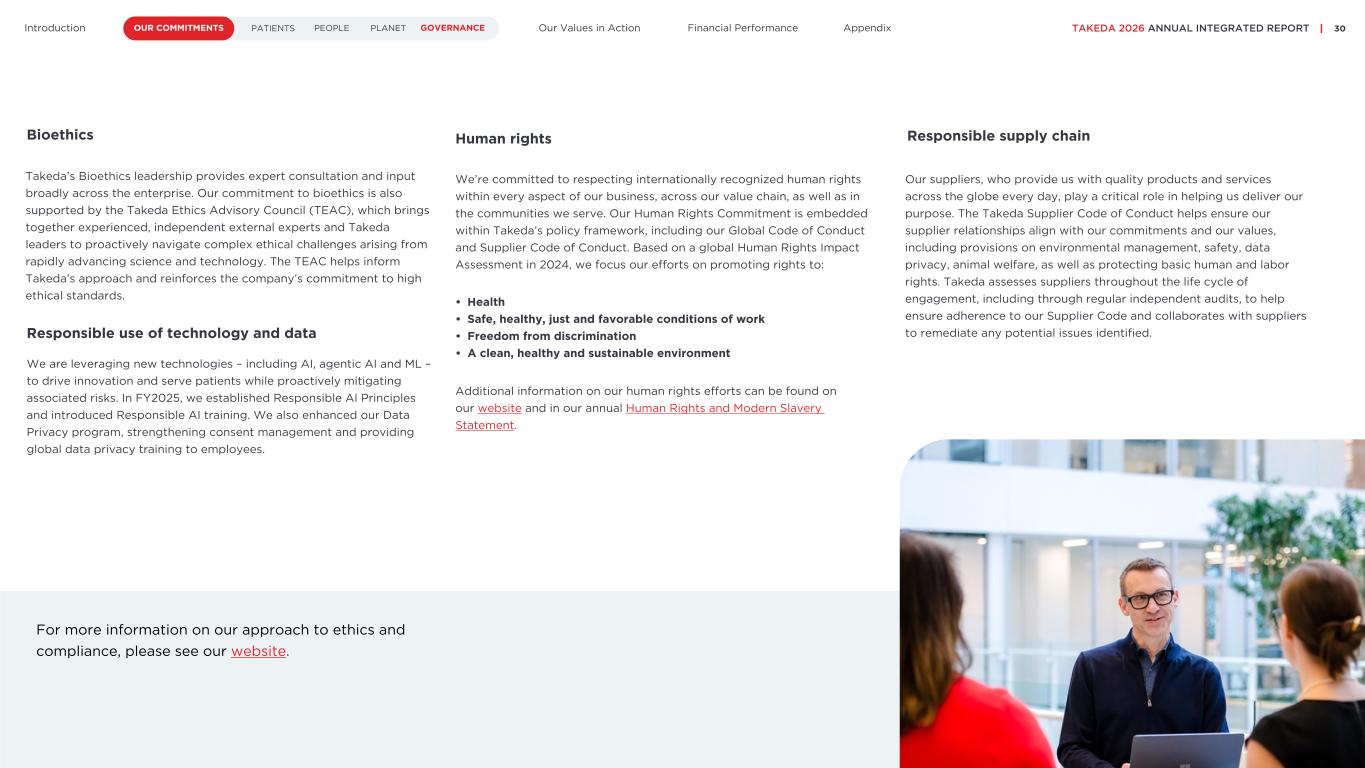
• Health • Safe, healthy, just and favorable conditions of work • Freedom from discrimination • A clean, healthy and sustainable environment Bioethics Human rights Responsible supply chain Takeda’s Bioethics leadership provides expert consultation and input broadly across the enterprise. Our commitment to bioethics is also supported by the Takeda Ethics Advisory Council (TEAC), which brings together experienced, independent external experts and Takeda leaders to proactively navigate complex ethical challenges arising from rapidly advancing science and technology. The TEAC helps inform Takeda’s approach and reinforces the company’s commitment to high ethical standards. We’re committed to respecting internationally recognized human rights within every aspect of our business, across our value chain, as well as in the communities we serve. Our Human Rights Commitment is embedded within Takeda’s policy framework, including our Global Code of Conduct and Supplier Code of Conduct. Based on a global Human Rights Impact Assessment in 2024, we focus our efforts on promoting rights to: Our suppliers, who provide us with quality products and services across the globe every day, play a critical role in helping us deliver our purpose. The Takeda Supplier Code of Conduct helps ensure our supplier relationships align with our commitments and our values, including provisions on environmental management, safety, data privacy, animal welfare, as well as protecting basic human and labor rights. Takeda assesses suppliers throughout the life cycle of engagement, including through regular independent audits, to help ensure adherence to our Supplier Code and collaborates with suppliers to remediate any potential issues identified. Responsible use of technology and data We are leveraging new technologies – including AI, agentic AI and ML – to drive innovation and serve patients while proactively mitigating associated risks. In FY2025, we established Responsible AI Principles and introduced Responsible AI training. We also enhanced our Data Privacy program, strengthening consent management and providing global data privacy training to employees. Additional information on our human rights efforts can be found on our website and in our annual Human Rights and Modern Slavery Statement. TAKEDA 2026 ANNUAL INTEGRATED REPORT 30 For more information on our approach to ethics and compliance, please see our website. PATIENTS PLANETPEOPLE GOVERNANCE Financial Performance AppendixIntroduction Our Values in ActionOUR COMMITMENTS
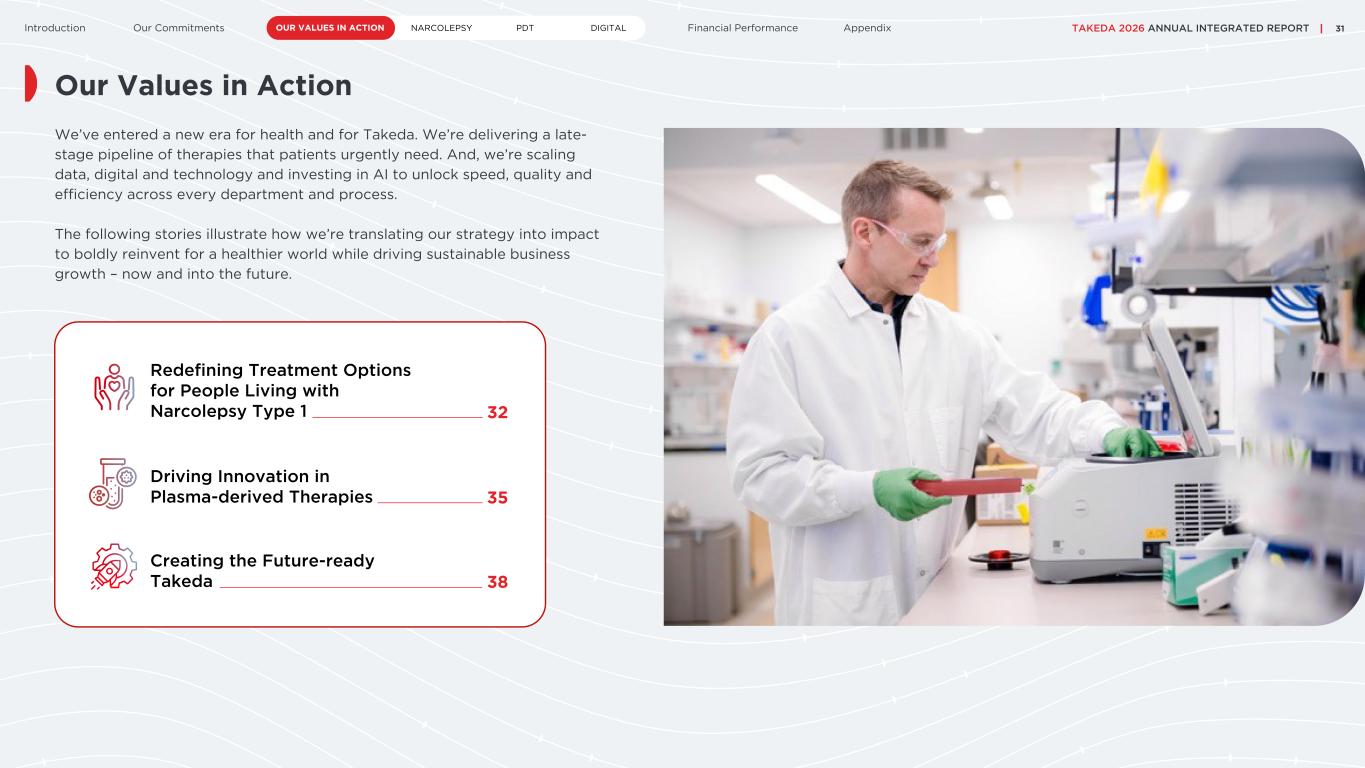
PLANETPEOPLE GOVERNANCE Financial Performance AppendixOur Commitments NARC LEPSY PDT DIGITAL Our Values in Action We’ve entered a new era for health and for Takeda. We’re delivering a late- stage pipeline of therapies that patients urgently need. And, we’re scaling data, digital and technology and investing in AI to unlock speed, quality and efficiency across every department and process. The following stories illustrate how we’re translating our strategy into impact to boldly reinvent for a healthier world while driving sustainable business growth – now and into the future. Redefining Treatment Options for People Living with Narcolepsy Type 1 Driving Innovation in Plasma-derived Therapies Creating the Future-ready Takeda OUR VALUES IN ACTION 32 35 38 TAKEDA 2026 ANNUAL INTEGRATED REPORT 31Introduction
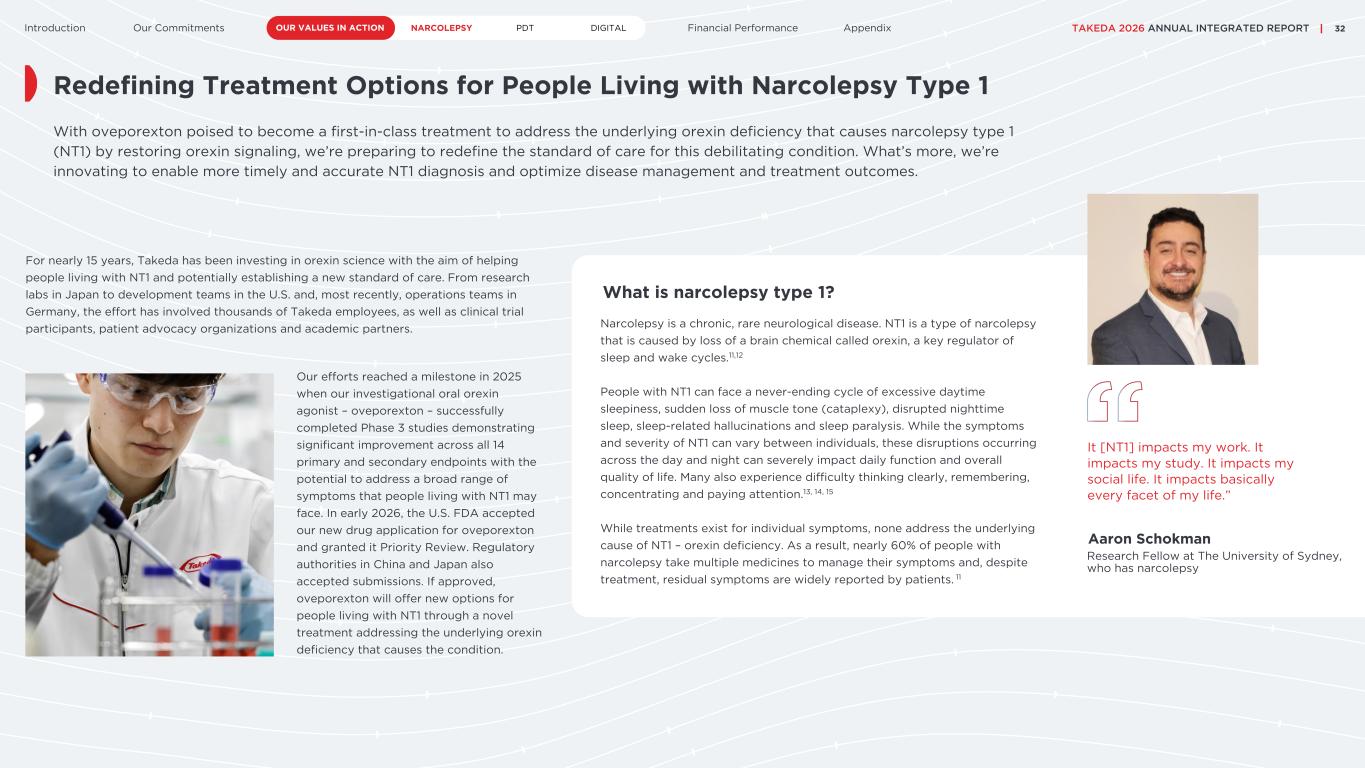
TAKEDA 2026 ANNUAL INTEGRATED REPORT 32 PLANETPEOPLE GOVERNANCE Financial Performance AppendixNARC LEPSY PDT DIGITALOUR VALUES IN ACTIONIntroduction Our Commitments For nearly 15 years, Takeda has been investing in orexin science with the aim of helping people living with NT1 and potentially establishing a new standard of care. From research labs in Japan to development teams in the U.S. and, most recently, operations teams in Germany, the effort has involved thousands of Takeda employees, as well as clinical trial participants, patient advocacy organizations and academic partners. Narcolepsy is a chronic, rare neurological disease. NT1 is a type of narcolepsy that is caused by loss of a brain chemical called orexin, a key regulator of sleep and wake cycles.11,12 People with NT1 can face a never-ending cycle of excessive daytime sleepiness, sudden loss of muscle tone (cataplexy), disrupted nighttime sleep, sleep-related hallucinations and sleep paralysis. While the symptoms and severity of NT1 can vary between individuals, these disruptions occurring across the day and night can severely impact daily function and overall quality of life. Many also experience difficulty thinking clearly, remembering, concentrating and paying attention.13, 14, 15 While treatments exist for individual symptoms, none address the underlying cause of NT1 – orexin deficiency. As a result, nearly 60% of people with narcolepsy take multiple medicines to manage their symptoms and, despite treatment, residual symptoms are widely reported by patients. 11 With oveporexton poised to become a first-in-class treatment to address the underlying orexin deficiency that causes narcolepsy type 1 (NT1) by restoring orexin signaling, we’re preparing to redefine the standard of care for this debilitating condition. What’s more, we’re innovating to enable more timely and accurate NT1 diagnosis and optimize disease management and treatment outcomes. Aaron Schokman It [NT1] impacts my work. It impacts my study. It impacts my social life. It impacts basically every facet of my life.” What is narcolepsy type 1? Redefining Treatment Options for People Living with Narcolepsy Type 1 Our efforts reached a milestone in 2025 when our investigational oral orexin agonist – oveporexton – successfully completed Phase 3 studies demonstrating significant improvement across all 14 primary and secondary endpoints with the potential to address a broad range of symptoms that people living with NT1 may face. In early 2026, the U.S. FDA accepted our new drug application for oveporexton and granted it Priority Review. Regulatory authorities in China and Japan also accepted submissions. If approved, oveporexton will offer new options for people living with NT1 through a novel treatment addressing the underlying orexin deficiency that causes the condition. Takeda Scientist Photo Research Fellow at The University of Sydney, who has narcolepsy
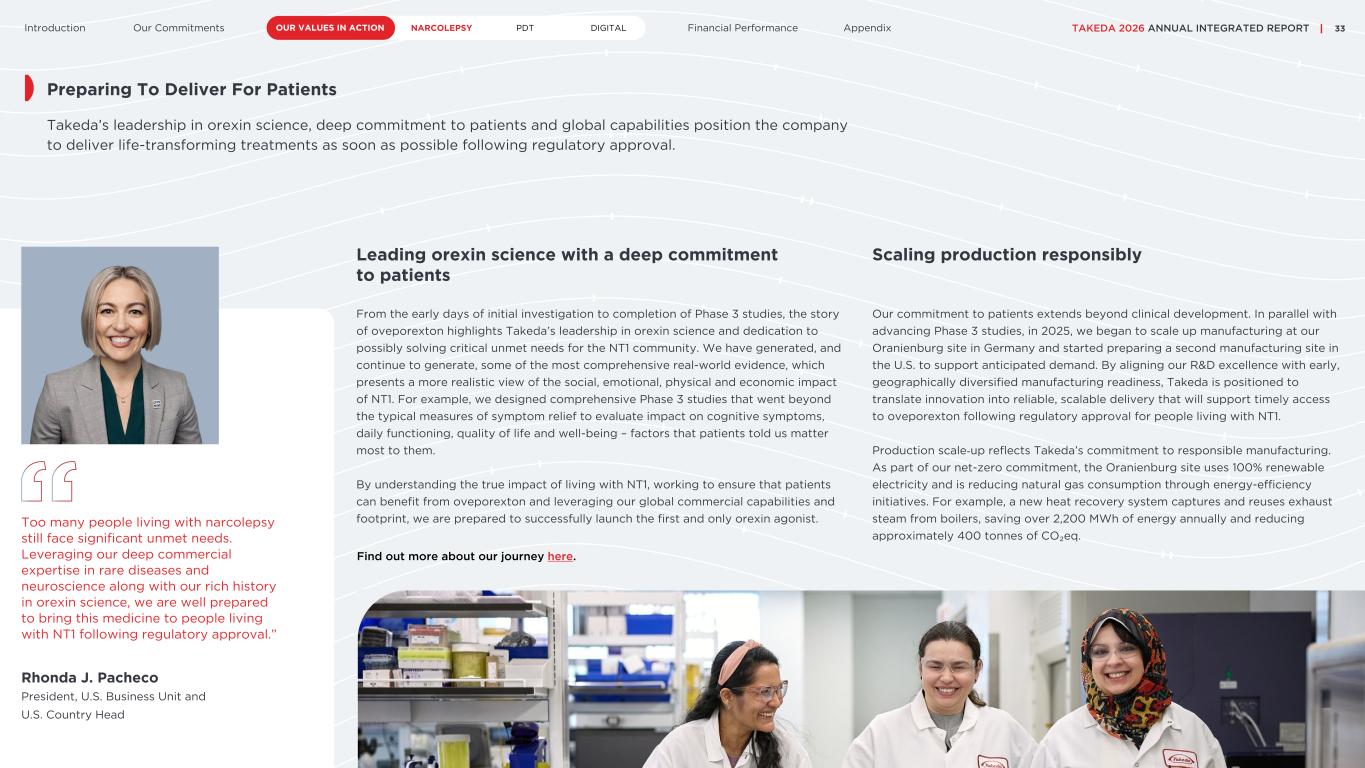
From the early days of initial investigation to completion of Phase 3 studies, the story of oveporexton highlights Takeda’s leadership in orexin science and dedication to possibly solving critical unmet needs for the NT1 community. We have generated, and continue to generate, some of the most comprehensive real-world evidence, which presents a more realistic view of the social, emotional, physical and economic impact of NT1. For example, we designed comprehensive Phase 3 studies that went beyond the typical measures of symptom relief to evaluate impact on cognitive symptoms, daily functioning, quality of life and well-being – factors that patients told us matter most to them. By understanding the true impact of living with NT1, working to ensure that patients can benefit from oveporexton and leveraging our global commercial capabilities and footprint, we are prepared to successfully launch the first and only orexin agonist.Too many people living with narcolepsy still face significant unmet needs. Leveraging our deep commercial expertise in rare diseases and neuroscience along with our rich history in orexin science, we are well prepared to bring this medicine to people living with NT1 following regulatory approval.” Preparing To Deliver For Patients Leading orexin science with a deep commitment to patients Find out more about our journey here. Our commitment to patients extends beyond clinical development. In parallel with advancing Phase 3 studies, in 2025, we began to scale up manufacturing at our Oranienburg site in Germany and started preparing a second manufacturing site in the U.S. to support anticipated demand. By aligning our R&D excellence with early, geographically diversified manufacturing readiness, Takeda is positioned to translate innovation into reliable, scalable delivery that will support timely access to oveporexton following regulatory approval for people living with NT1. Production scale-up reflects Takeda’s commitment to responsible manufacturing. As part of our net-zero commitment, the Oranienburg site uses 100% renewable electricity and is reducing natural gas consumption through energy-efficiency initiatives. For example, a new heat recovery system captures and reuses exhaust steam from boilers, saving over 2,200 MWh of energy annually and reducing approximately 400 tonnes of CO₂eq. Scaling production responsibly Takeda’s leadership in orexin science, deep commitment to patients and global capabilities position the company to deliver life-transforming treatments as soon as possible following regulatory approval. Rhonda J. Pacheco President, U.S. Business Unit and U.S. Country Head TAKEDA 2026 ANNUAL INTEGRATED REPORT 33 PLANETPEOPLE GOVERNANCE Financial Performance AppendixNARC LEPSY PDT DIGITALOUR VALUES IN ACTIONIntroduction Our Commitments
Beyond Drug Development Daniel Leutenegger Patient Health Excellence Lead Wearable technology enables the collection of richer, real-time data while reducing the burden for patients and healthcare providers, thereby expanding access to faster and more accurate diagnosis.” Driven by our deep commitment to improving the patient experience, we are embracing cutting-edge science, technology and partnerships to address the long and complicated NT1 diagnosis journey. Addressing the challenge of narcolepsy diagnosis Developing diagnostic solutions Diagnosing NT1 is often delayed due to low awareness of the condition among patients and healthcare providers.12,16 In addition, narcolepsy symptoms often overlap or are mistaken for more recognized disorders, leading to symptoms being misdiagnosed and missing the chance for early detection. Lack of access to sleep specialists and limited sleep lab testing also make it harder to identify NT1.16,18 Additionally, a diagnostic assessment for NT1 usually requires spending one night and one full day at a sleep clinic, which can be challenging, especially for caregivers or those who cannot easily take time off work. Over the past several years, Takeda’s R&D teams have collaborated closely with leading experts in sleep medicine and digital health technologies to develop new approaches that may enable earlier, differential diagnosis. Today, we are working with partners to translate diagnostic innovation into clinical practice to reduce the burden on patients and help support more accurate diagnosis. We are collaborating with Beacon Biosignals to evaluate a wearable headband device that could remotely monitor a patient’s brain activity at home, with a current focus on applicability in the U.S. This could enable more frequent and longitudinal sleep data collection and better capture the variable nature of narcolepsy symptoms than single-night studies. Another solution we are exploring is enhanced in-laboratory polysomnography (PSG) algorithms that could improve detection of subtle NT1 signatures that are often missed or misinterpreted. In partnership with EnsoData, a pioneer in healthcare AI currently focused on the U.S., we are co-developing and validating AI- based PSG algorithms as diagnostic aids to enable more accurate, scalable diagnosis of NT1. • People living with NT1 in the U.S. spend an average of 10–15 years cycling through misdiagnoses or missed diagnoses before receiving an accurate diagnosis.12,16 • 50% of people living with NT1 in the U.S. are never diagnosed.16 • Up to 40% of patients report seeing more than three physicians before a correct diagnosis.17 By the numbers: The challenge of diagnosis TAKEDA 2026 ANNUAL INTEGRATED REPORT 34 PLANETPEOPLE GOVERNANCE Financial Performance AppendixNARC LEPSY PDT DIGITALOUR VALUES IN ACTIONIntroduction Our Commitments
TAKEDA 2026 ANNUAL INTEGRATED REPORT 35 PLANETPEOPLE GOVERNANCE Financial Performance AppendixNARC LEPSY PDT DIGITALOUR VALUES IN ACTIONIntroduction Our Commitments Driving Innovation in Plasma-derived Therapies We are investing in plasma-derived therapies (PDTs) and applying the latest technology across our end-to-end process, from development to delivery, to expand access to life-transforming treatments in more countries than ever before and improve the patient experience. From vein to vein Ramy Riad President, Plasma-Derived Therapies Business Unit Across the plasma value chain, our efforts demonstrate how Takeda is building a more resilient, innovative and patient-centered plasma business, one positioned to deliver sustainable growth and long-term value for patients, donors and the communities we serve.” With more than 80 years of leadership in PDTs, we are equipped with an end-to-end, integrated plasma value chain and a portfolio of more than 20 differentiated PDT medicines and integrated care solutions, reaching patients in more than 80 countries. The importance of these therapies is unmistakable; they treat people with rare, complex and chronic conditions, many of which are lifelong and have few or no other treatment options. The process of producing PDTs is long, complex and capital-intensive: It can take up to 12 months from plasma donation until medicines reach patients. Our process begins with plasma collection from healthy donors through our global network, including our more than 270 BioLife donation centers across the U.S. and Europe. The plasma is then processed at one of our eight PDT manufacturing facilities, where our team transforms it into life-saving and life-sustaining treatments for patients. Our PDT R&D team works across the value chain, from enhancing donation and manufacturing processes to pursuing new indications and innovations that can improve the patient experience. In FY2025, we introduced Takeda’s first customized devices for use with a PDT in the U.S. – HyHub™ and HyHub Duo. Informed by patient and provider feedback, these devices simplify the HyQvia® infusion process by reducing the steps required to prepare an infusion by up to half. We are also exploring ways to reduce the treatment burden for patients who rely on immunoglobulin (IG) therapies. Our Phase 2/3 study of TAK-881, a next-generation facilitated subcutaneous IG (SCIG), showed positive results for patients with primary immunodeficiencies, delivering the required treatment with reduced infusion volume and duration compared to our established facilitated SCIG. Beyond these innovations, we are focused on maximizing the reach of our existing therapies by working to expand their potential to patient populations with significant unmet need. This includes exploring IG, a protein found in human plasma, for certain people living with secondary immunodeficiency (SID).19 SID disproportionally impacts patients with certain cancers, either due to cancer itself or as a side effect of treatments. IG treatment for SID is approved in Europe, and as diagnosis rates improve and oncology treatments advance, demand for SID therapies is expected to grow. This sustained innovation reflects the importance of our PDT business to Takeda’s long-term value creation. The business remains a key driver of Takeda’s topline performance.
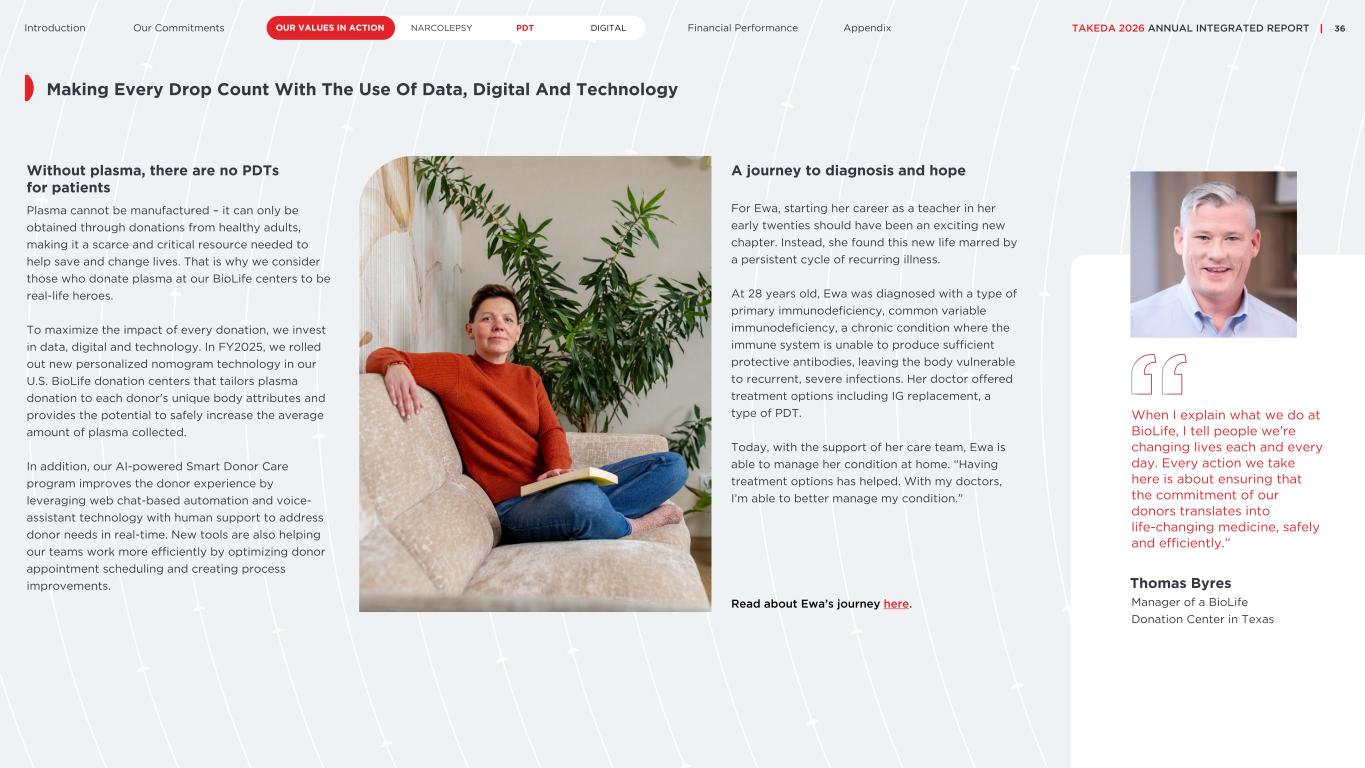
Photo A journey to diagnosis and hope Plasma cannot be manufactured – it can only be obtained through donations from healthy adults, making it a scarce and critical resource needed to help save and change lives. That is why we consider those who donate plasma at our BioLife centers to be real-life heroes. To maximize the impact of every donation, we invest in data, digital and technology. In FY2025, we rolled out new personalized nomogram technology in our U.S. BioLife donation centers that tailors plasma donation to each donor's unique body attributes and provides the potential to safely increase the average amount of plasma collected. In addition, our AI-powered Smart Donor Care program improves the donor experience by leveraging web chat-based automation and voice- assistant technology with human support to address donor needs in real-time. New tools are also helping our teams work more efficiently by optimizing donor appointment scheduling and creating process improvements. For Ewa, starting her career as a teacher in her early twenties should have been an exciting new chapter. Instead, she found this new life marred by a persistent cycle of recurring illness. At 28 years old, Ewa was diagnosed with a type of primary immunodeficiency, common variable immunodeficiency, a chronic condition where the immune system is unable to produce sufficient protective antibodies, leaving the body vulnerable to recurrent, severe infections. Her doctor offered treatment options including IG replacement, a type of PDT. Today, with the support of her care team, Ewa is able to manage her condition at home. “Having treatment options has helped. With my doctors, I’m able to better manage my condition.” Read about Ewa’s journey here. Thomas Byres Manager of a BioLife Donation Center in Texas When I explain what we do at BioLife, I tell people we’re changing lives each and every day. Every action we take here is about ensuring that the commitment of our donors translates into life-changing medicine, safely and efficiently.” Making Every Drop Count With The Use Of Data, Digital And Technology TAKEDA 2026 ANNUAL INTEGRATED REPORT 36 Without plasma, there are no PDTs for patients PLANETPEOPLE GOVERNANCE Financial Performance AppendixNARC LEPSY PDT DIGITALOUR VALUES IN ACTIONIntroduction Our Commitments
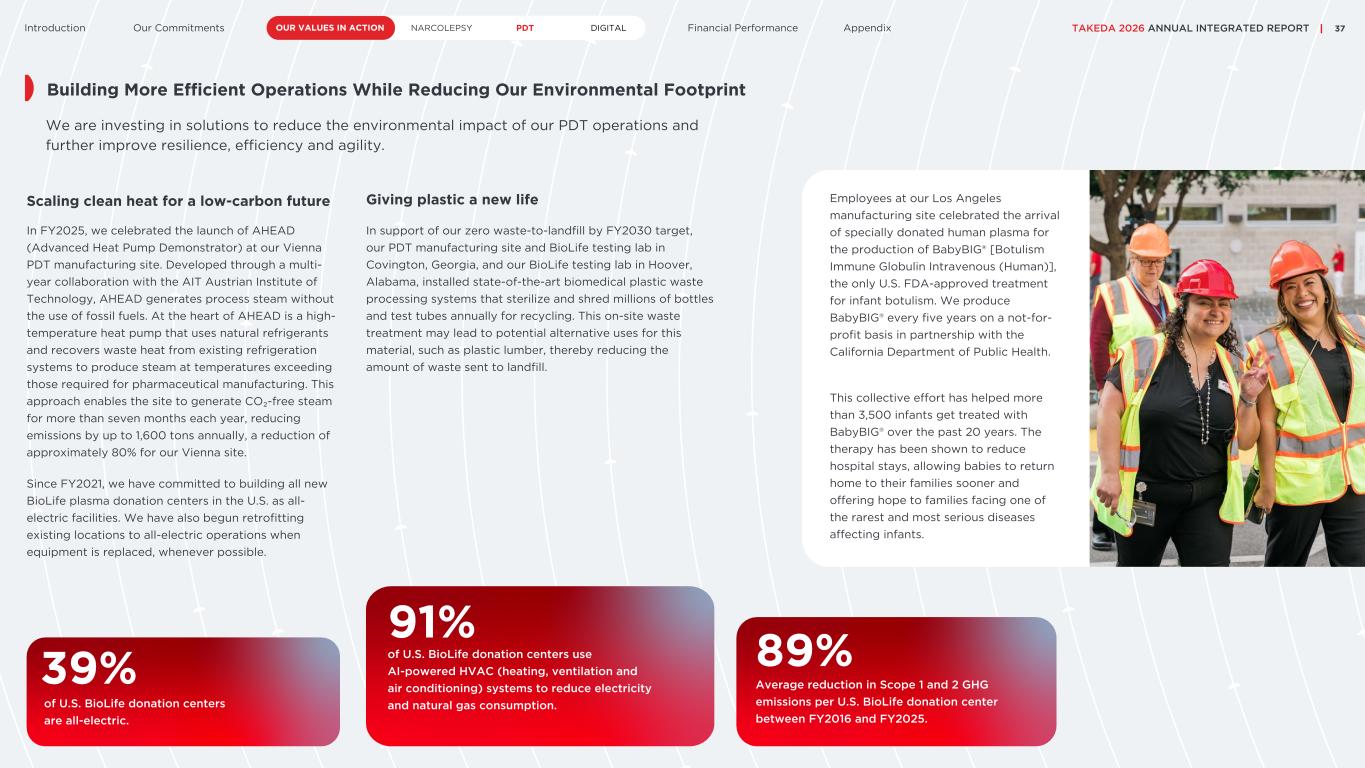
Building More Efficient Operations While Reducing Our Environmental Footprint We are investing in solutions to reduce the environmental impact of our PDT operations and further improve resilience, efficiency and agility. Giving plastic a new lifeScaling clean heat for a low-carbon future In support of our zero waste-to-landfill by FY2030 target, our PDT manufacturing site and BioLife testing lab in Covington, Georgia, and our BioLife testing lab in Hoover, Alabama, installed state-of-the-art biomedical plastic waste processing systems that sterilize and shred millions of bottles and test tubes annually for recycling. This on-site waste treatment may lead to potential alternative uses for this material, such as plastic lumber, thereby reducing the amount of waste sent to landfill. In FY2025, we celebrated the launch of AHEAD (Advanced Heat Pump Demonstrator) at our Vienna PDT manufacturing site. Developed through a multi- year collaboration with the AIT Austrian Institute of Technology, AHEAD generates process steam without the use of fossil fuels. At the heart of AHEAD is a high- temperature heat pump that uses natural refrigerants and recovers waste heat from existing refrigeration systems to produce steam at temperatures exceeding those required for pharmaceutical manufacturing. This approach enables the site to generate CO₂-free steam for more than seven months each year, reducing emissions by up to 1,600 tons annually, a reduction of approximately 80% for our Vienna site. Since FY2021, we have committed to building all new BioLife plasma donation centers in the U.S. as all- electric facilities. We have also begun retrofitting existing locations to all-electric operations when equipment is replaced, whenever possible. of U.S. BioLife donation centers use AI-powered HVAC (heating, ventilation and air conditioning) systems to reduce electricity and natural gas consumption. 39% 89%91% Average reduction in Scope 1 and 2 GHG emissions per U.S. BioLife donation center between FY2016 and FY2025. of U.S. BioLife donation centers are all-electric. Employees at our Los Angeles manufacturing site celebrated the arrival of specially donated human plasma for the production of BabyBIG® [Botulism Immune Globulin Intravenous (Human)], the only U.S. FDA-approved treatment for infant botulism. We produce BabyBIG® every five years on a not-for- profit basis in partnership with the California Department of Public Health. This collective effort has helped more than 3,500 infants get treated with BabyBIG® over the past 20 years. The therapy has been shown to reduce hospital stays, allowing babies to return home to their families sooner and offering hope to families facing one of the rarest and most serious diseases affecting infants. TAKEDA 2026 ANNUAL INTEGRATED REPORT 37 PLANETPEOPLE GOVERNANCE Financial Performance AppendixNARC LEPSY PDT DIGITALOUR VALUES IN ACTIONIntroduction Our Commitments
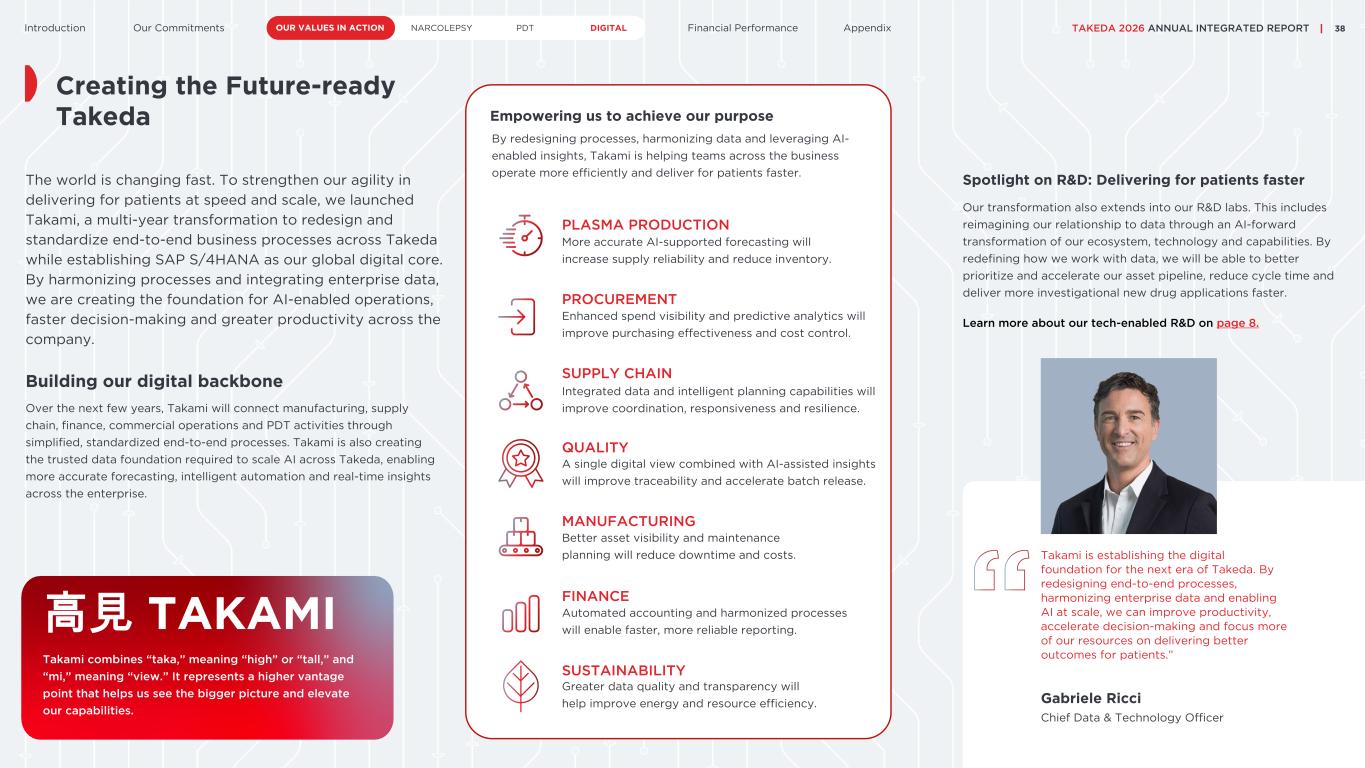
TAKEDA 2026 ANNUAL INTEGRATED REPORT 38 PLANETPEOPLE GOVERNANCE Financial Performance AppendixNARC LEPSY PDT DIGITALOUR VALUES IN ACTIONIntroduction Our Commitments Better asset visibility and maintenance planning will reduce downtime and costs. Our transformation also extends into our R&D labs. This includes reimagining our relationship to data through an AI-forward transformation of our ecosystem, technology and capabilities. By redefining how we work with data, we will be able to better prioritize and accelerate our asset pipeline, reduce cycle time and deliver more investigational new drug applications faster. Takami combines “taka,” meaning “high” or “tall,” and “mi,” meaning “view.” It represents a higher vantage point that helps us see the bigger picture and elevate our capabilities. 高見 TAKAMI Creating the Future-ready Takeda Building our digital backbone Empowering us to achieve our purpose Spotlight on R&D: Delivering for patients faster Learn more about our tech-enabled R&D on page 8. PLASMA PRODUCTION PROCUREMENT SUPPLY CHAIN MANUFACTURING FINANCE SUSTAINABILITY More accurate AI-supported forecasting will increase supply reliability and reduce inventory. Enhanced spend visibility and predictive analytics will improve purchasing effectiveness and cost control. Integrated data and intelligent planning capabilities will improve coordination, responsiveness and resilience. Automated accounting and harmonized processes will enable faster, more reliable reporting. Greater data quality and transparency will help improve energy and resource efficiency. Takami is establishing the digital foundation for the next era of Takeda. By redesigning end-to-end processes, harmonizing enterprise data and enabling AI at scale, we can improve productivity, accelerate decision-making and focus more of our resources on delivering better outcomes for patients.” The world is changing fast. To strengthen our agility in delivering for patients at speed and scale, we launched Takami, a multi-year transformation to redesign and standardize end-to-end business processes across Takeda while establishing SAP S/4HANA as our global digital core. By harmonizing processes and integrating enterprise data, we are creating the foundation for AI-enabled operations, faster decision-making and greater productivity across the company. By redesigning processes, harmonizing data and leveraging AI- enabled insights, Takami is helping teams across the business operate more efficiently and deliver for patients faster. Over the next few years, Takami will connect manufacturing, supply chain, finance, commercial operations and PDT activities through simplified, standardized end-to-end processes. Takami is also creating the trusted data foundation required to scale AI across Takeda, enabling more accurate forecasting, intelligent automation and real-time insights across the enterprise. Gabriele Ricci Chief Data & Technology Officer QUALITY A single digital view combined with AI-assisted insights will improve traceability and accelerate batch release.
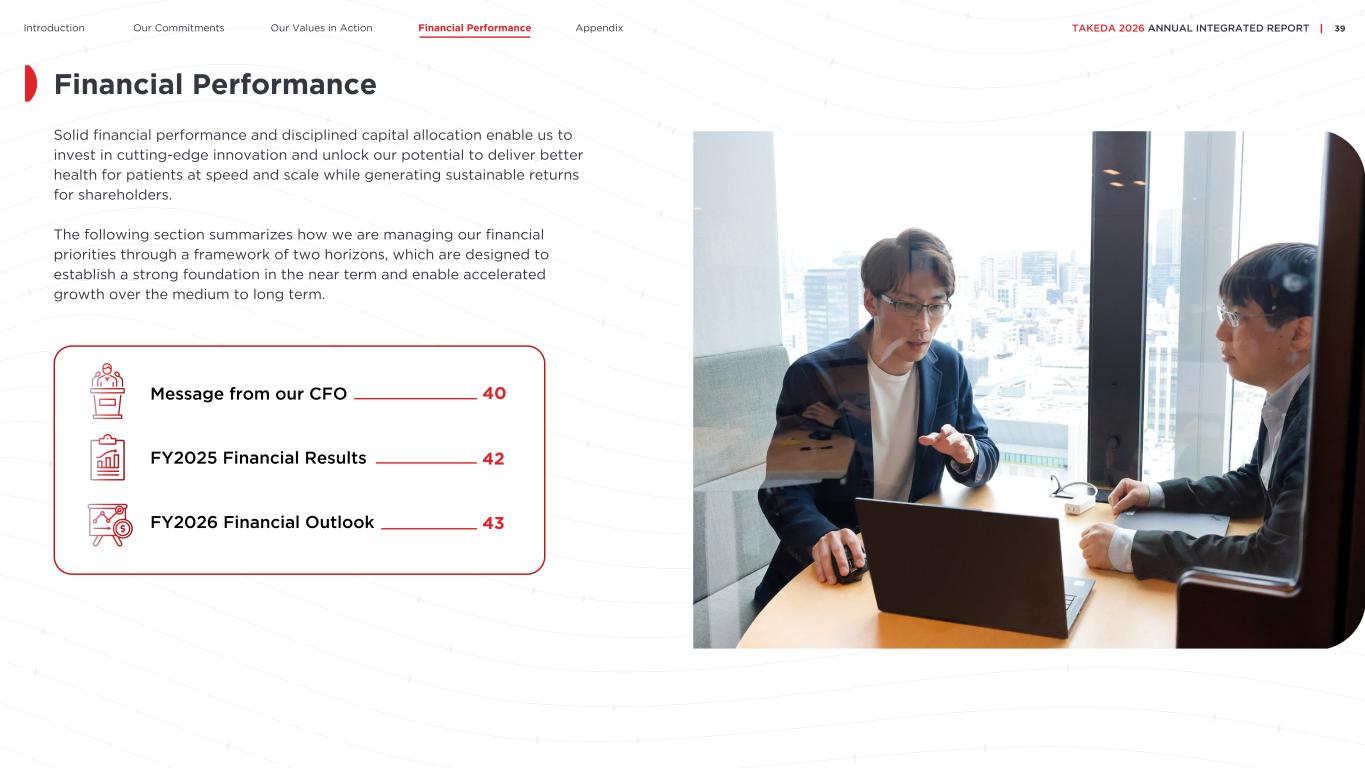
Introduction Our Commitments Financial Performance Solid financial performance and disciplined capital allocation enable us to invest in cutting-edge innovation and unlock our potential to deliver better health for patients at speed and scale while generating sustainable returns for shareholders. The following section summarizes how we are managing our financial priorities through a framework of two horizons, which are designed to establish a strong foundation in the near term and enable accelerated growth over the medium to long term. 40Message from our CFO 42FY2025 Financial Results 43FY2026 Financial Outlook Financial Performance 39TAKEDA 2026 ANNUAL INTEGRATED REPORTOur Values in Action AppendixIntroduction
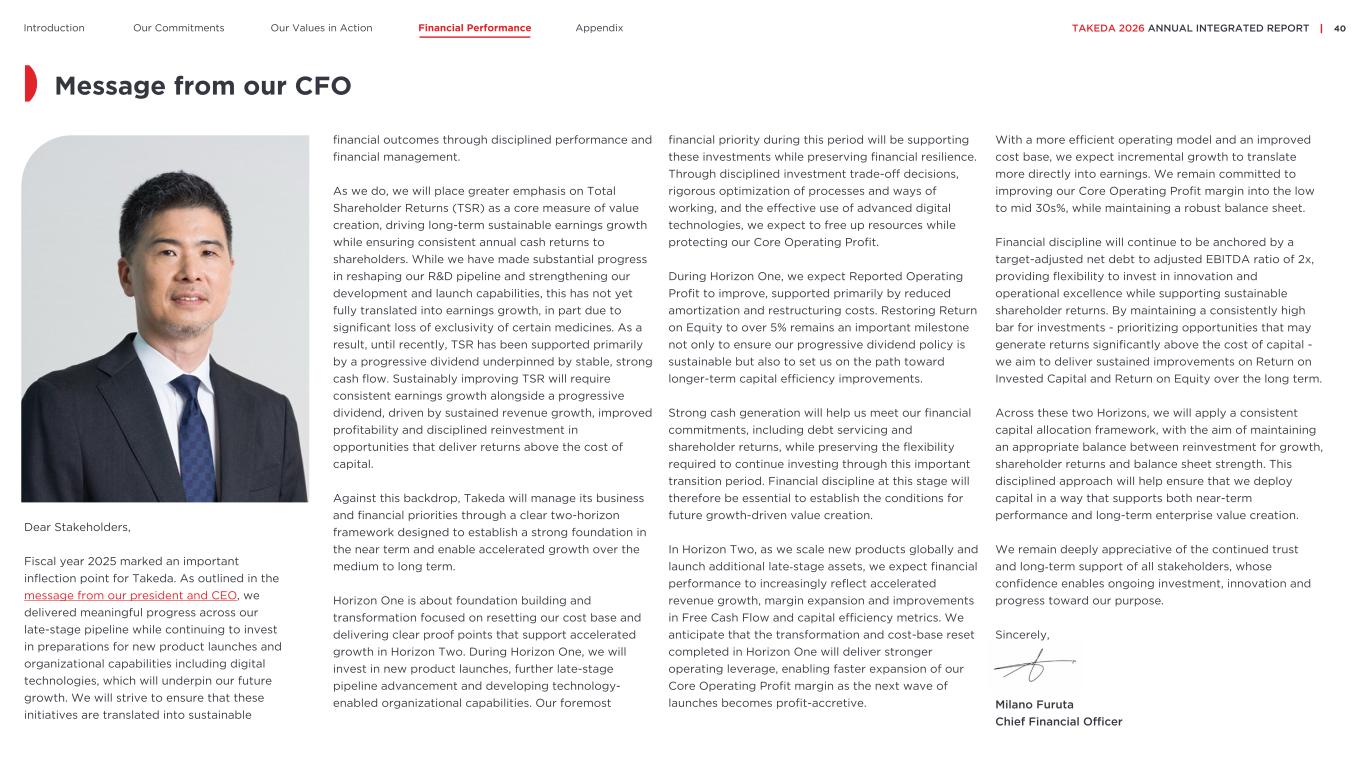
With a more efficient operating model and an improved cost base, we expect incremental growth to translate more directly into earnings. We remain committed to improving our Core Operating Profit margin into the low to mid 30s%, while maintaining a robust balance sheet. Financial discipline will continue to be anchored by a target-adjusted net debt to adjusted EBITDA ratio of 2x, providing flexibility to invest in innovation and operational excellence while supporting sustainable shareholder returns. By maintaining a consistently high bar for investments - prioritizing opportunities that may generate returns significantly above the cost of capital - we aim to deliver sustained improvements on Return on Invested Capital and Return on Equity over the long term. Across these two Horizons, we will apply a consistent capital allocation framework, with the aim of maintaining an appropriate balance between reinvestment for growth, shareholder returns and balance sheet strength. This disciplined approach will help ensure that we deploy capital in a way that supports both near-term performance and long-term enterprise value creation. We remain deeply appreciative of the continued trust and long-term support of all stakeholders, whose confidence enables ongoing investment, innovation and progress toward our purpose. Sincerely, Message from our CFO financial priority during this period will be supporting these investments while preserving financial resilience. Through disciplined investment trade-off decisions, rigorous optimization of processes and ways of working, and the effective use of advanced digital technologies, we expect to free up resources while protecting our Core Operating Profit. During Horizon One, we expect Reported Operating Profit to improve, supported primarily by reduced amortization and restructuring costs. Restoring Return on Equity to over 5% remains an important milestone not only to ensure our progressive dividend policy is sustainable but also to set us on the path toward longer-term capital efficiency improvements. Strong cash generation will help us meet our financial commitments, including debt servicing and shareholder returns, while preserving the flexibility required to continue investing through this important transition period. Financial discipline at this stage will therefore be essential to establish the conditions for future growth-driven value creation. In Horizon Two, as we scale new products globally and launch additional late-stage assets, we expect financial performance to increasingly reflect accelerated revenue growth, margin expansion and improvements in Free Cash Flow and capital efficiency metrics. We anticipate that the transformation and cost-base reset completed in Horizon One will deliver stronger operating leverage, enabling faster expansion of our Core Operating Profit margin as the next wave of launches becomes profit-accretive. financial outcomes through disciplined performance and financial management. As we do, we will place greater emphasis on Total Shareholder Returns (TSR) as a core measure of value creation, driving long-term sustainable earnings growth while ensuring consistent annual cash returns to shareholders. While we have made substantial progress in reshaping our R&D pipeline and strengthening our development and launch capabilities, this has not yet fully translated into earnings growth, in part due to significant loss of exclusivity of certain medicines. As a result, until recently, TSR has been supported primarily by a progressive dividend underpinned by stable, strong cash flow. Sustainably improving TSR will require consistent earnings growth alongside a progressive dividend, driven by sustained revenue growth, improved profitability and disciplined reinvestment in opportunities that deliver returns above the cost of capital. Against this backdrop, Takeda will manage its business and financial priorities through a clear two-horizon framework designed to establish a strong foundation in the near term and enable accelerated growth over the medium to long term. Horizon One is about foundation building and transformation focused on resetting our cost base and delivering clear proof points that support accelerated growth in Horizon Two. During Horizon One, we will invest in new product launches, further late-stage pipeline advancement and developing technology- enabled organizational capabilities. Our foremost 40TAKEDA 2026 ANNUAL INTEGRATED REPORT Dear Stakeholders, Fiscal year 2025 marked an important inflection point for Takeda. As outlined in the message from our president and CEO, we delivered meaningful progress across our late-stage pipeline while continuing to invest in preparations for new product launches and organizational capabilities including digital technologies, which will underpin our future growth. We will strive to ensure that these initiatives are translated into sustainable Milano Furuta Chief Financial Officer Financial PerformanceOur Values in Action AppendixIntroduction Our Commitments
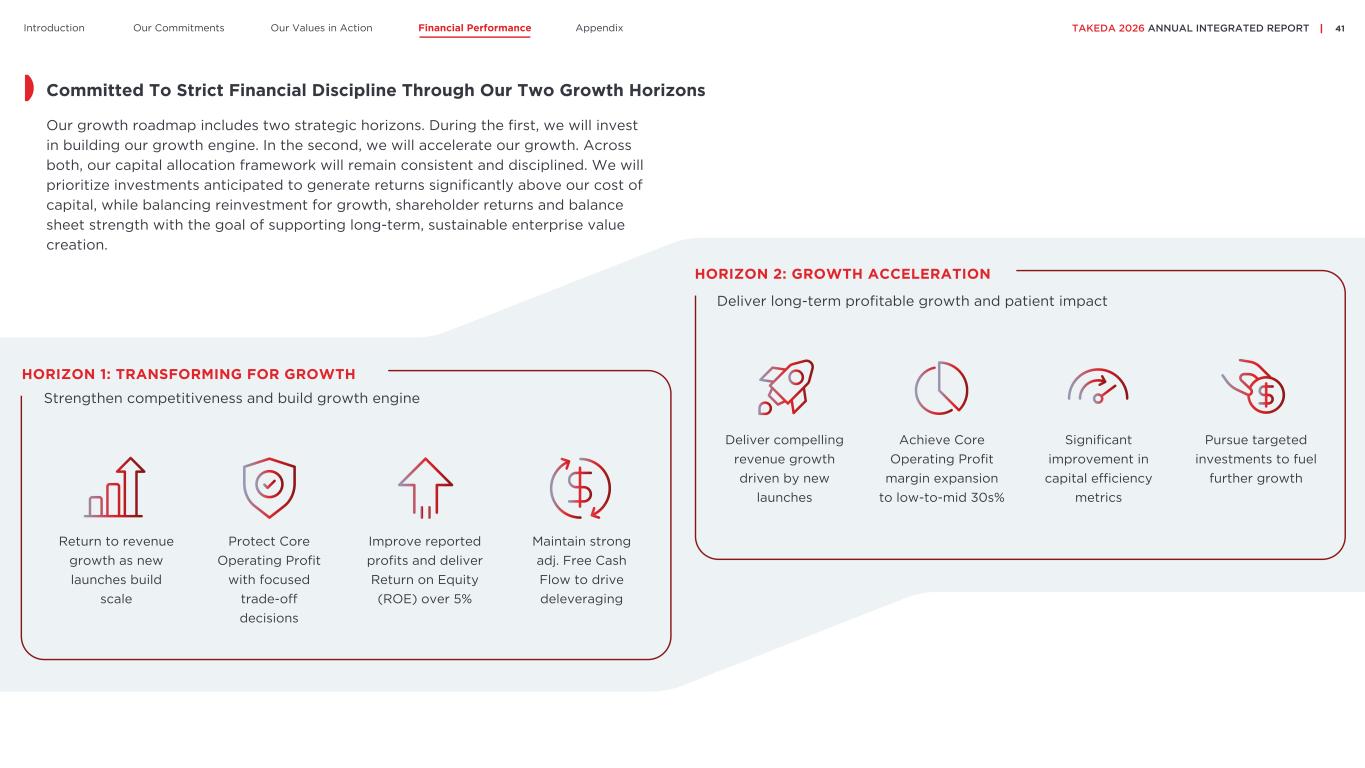
Committed To Strict Financial Discipline Through Our Two Growth Horizons Our growth roadmap includes two strategic horizons. During the first, we will invest in building our growth engine. In the second, we will accelerate our growth. Across both, our capital allocation framework will remain consistent and disciplined. We will prioritize investments anticipated to generate returns significantly above our cost of capital, while balancing reinvestment for growth, shareholder returns and balance sheet strength with the goal of supporting long-term, sustainable enterprise value creation. HORIZON 1: TRANSFORMING FOR GROWTH HORIZON 2: GROWTH ACCELERATION Strengthen competitiveness and build growth engine Deliver long-term profitable growth and patient impact Return to revenue growth as new launches build scale Protect Core Operating Profit with focused trade-off decisions Improve reported profits and deliver Return on Equity (ROE) over 5% Maintain strong adj. Free Cash Flow to drive deleveraging Deliver compelling revenue growth driven by new launches Achieve Core Operating Profit margin expansion to low-to-mid 30s% Significant improvement in capital efficiency metrics Pursue targeted investments to fuel further growth 41TAKEDA 2026 ANNUAL INTEGRATED REPORTFinancial PerformanceOur Values in Action AppendixIntroduction Our Commitments
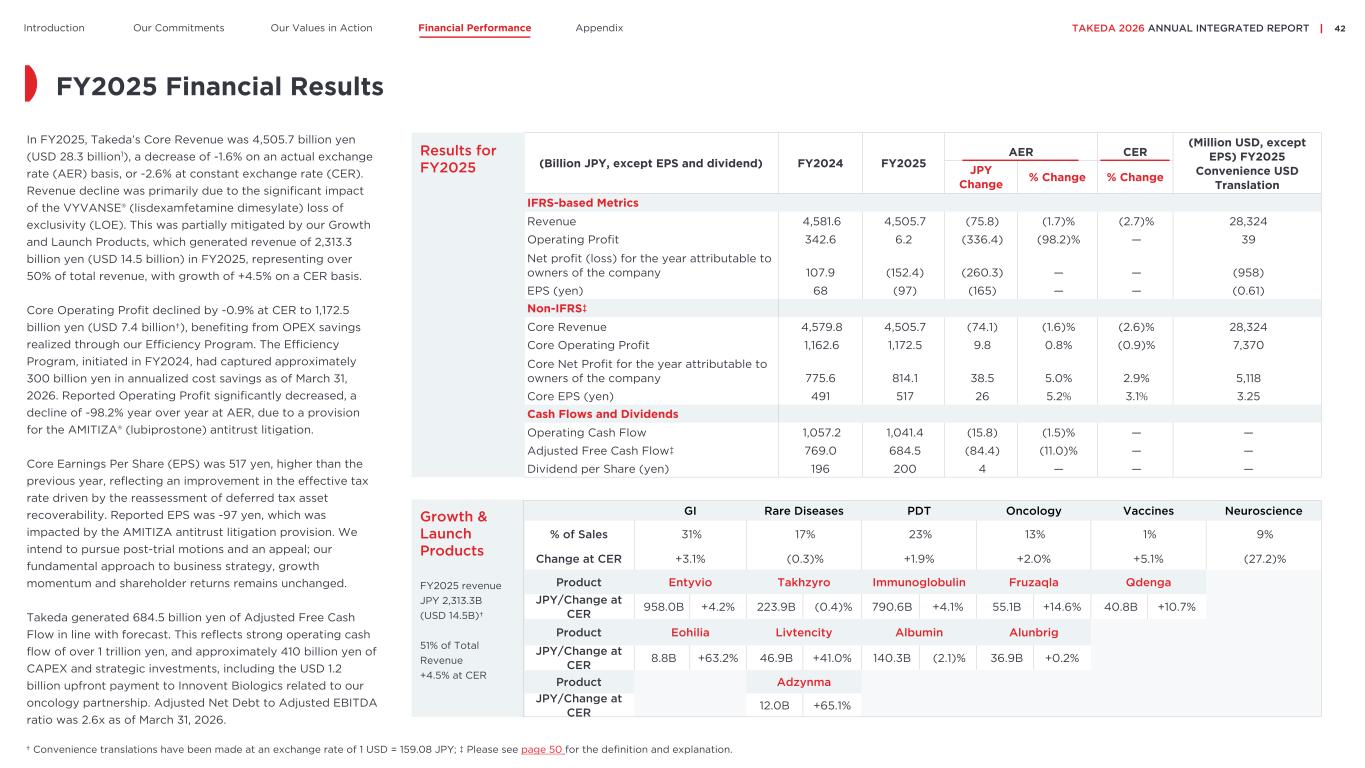
FY2025 Financial Results In FY2025, Takeda’s Core Revenue was 4,505.7 billion yen (USD 28.3 billion1), a decrease of -1.6% on an actual exchange rate (AER) basis, or -2.6% at constant exchange rate (CER). Revenue decline was primarily due to the significant impact of the VYVANSE® (lisdexamfetamine dimesylate) loss of exclusivity (LOE). This was partially mitigated by our Growth and Launch Products, which generated revenue of 2,313.3 billion yen (USD 14.5 billion) in FY2025, representing over 50% of total revenue, with growth of +4.5% on a CER basis. Core Operating Profit declined by -0.9% at CER to 1,172.5 billion yen (USD 7.4 billion†), benefiting from OPEX savings realized through our Efficiency Program. The Efficiency Program, initiated in FY2024, had captured approximately 300 billion yen in annualized cost savings as of March 31, 2026. Reported Operating Profit significantly decreased, a decline of -98.2% year over year at AER, due to a provision for the AMITIZA® (lubiprostone) antitrust litigation. Core Earnings Per Share (EPS) was 517 yen, higher than the previous year, reflecting an improvement in the effective tax rate driven by the reassessment of deferred tax asset recoverability. Reported EPS was -97 yen, which was impacted by the AMITIZA antitrust litigation provision. We intend to pursue post-trial motions and an appeal; our fundamental approach to business strategy, growth momentum and shareholder returns remains unchanged. Takeda generated 684.5 billion yen of Adjusted Free Cash Flow in line with forecast. This reflects strong operating cash flow of over 1 trillion yen, and approximately 410 billion yen of CAPEX and strategic investments, including the USD 1.2 billion upfront payment to Innovent Biologics related to our oncology partnership. Adjusted Net Debt to Adjusted EBITDA ratio was 2.6x as of March 31, 2026. (Billion JPY, except EPS and dividend) FY2024 FY2025 AER CER (Million USD, except EPS) FY2025 Convenience USD Translation JPY Change % Change % Change IFRS-based Metrics Revenue 4,581.6 4,505.7 (75.8) (1.7)% (2.7)% 28,324 Operating Profit 342.6 6.2 (336.4) (98.2)% — 39 Net profit (loss) for the year attributable to owners of the company 107.9 (152.4) (260.3) — — (958) EPS (yen) 68 (97) (165) — — (0.61) Non-IFRS‡ Core Revenue 4,579.8 4,505.7 (74.1) (1.6)% (2.6)% 28,324 Core Operating Profit 1,162.6 1,172.5 9.8 0.8% (0.9)% 7,370 Core Net Profit for the year attributable to owners of the company 775.6 814.1 38.5 5.0% 2.9% 5,118 Core EPS (yen) 491 517 26 5.2% 3.1% 3.25 Cash Flows and Dividends Operating Cash Flow 1,057.2 1,041.4 (15.8) (1.5)% — — Adjusted Free Cash Flow‡ 769.0 684.5 (84.4) (11.0)% — — Dividend per Share (yen) 196 200 4 — — — † Convenience translations have been made at an exchange rate of 1 USD = 159.08 JPY; ‡ Please see page 50 for the definition and explanation. GI Rare Diseases PDT Oncology Vaccines Neuroscience % of Sales 31% 17% 23% 13% 1% 9% Change at CER +3.1% (0.3)% +1.9% +2.0% +5.1% (27.2)% Product Entyvio Takhzyro Immunoglobulin Fruzaqla Qdenga JPY/Change at CER 958.0B +4.2% 223.9B (0.4)% 790.6B +4.1% 55.1B +14.6% 40.8B +10.7% Product Eohilia Livtencity Albumin Alunbrig JPY/Change at CER 8.8B +63.2% 46.9B +41.0% 140.3B (2.1)% 36.9B +0.2% Product Adzynma JPY/Change at CER 12.0B +65.1% Growth & Launch Products FY2025 revenue JPY 2,313.3B (USD 14.5B)† 51% of Total Revenue +4.5% at CER 42TAKEDA 2026 ANNUAL INTEGRATED REPORT Results for FY2025 Financial PerformanceOur Values in Action AppendixIntroduction Our Commitments
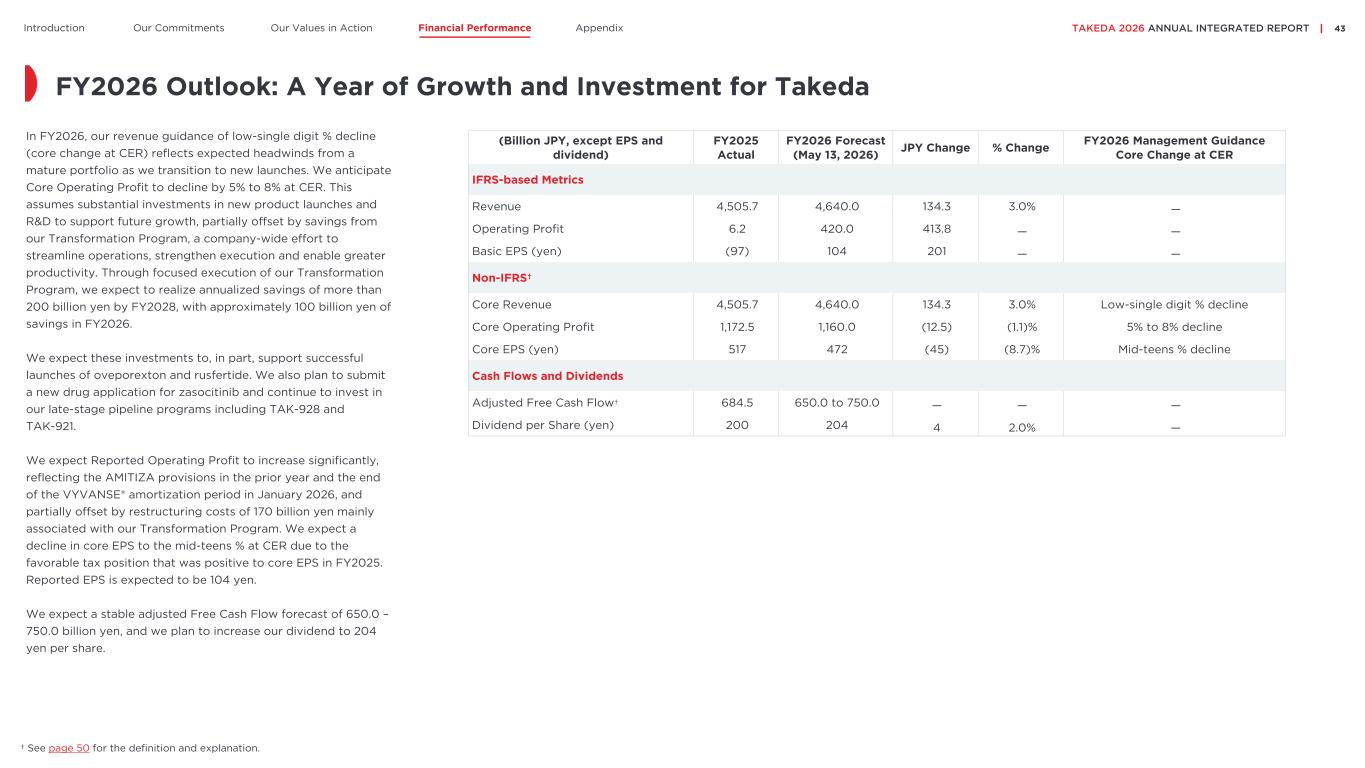
FY2026 Outlook: A Year of Growth and Investment for Takeda (Billion JPY, except EPS and dividend) FY2025 Actual FY2026 Forecast (May 13, 2026) JPY Change % Change FY2026 Management Guidance Core Change at CER IFRS-based Metrics Revenue 4,505.7 4,640.0 134.3 3.0% — Operating Profit 6.2 420.0 413.8 — — Basic EPS (yen) (97) 104 201 — — Non-IFRS† Core Revenue 4,505.7 4,640.0 134.3 3.0% Low-single digit % decline Core Operating Profit 1,172.5 1,160.0 (12.5) (1.1)% 5% to 8% decline Core EPS (yen) 517 472 (45) (8.7)% Mid-teens % decline Cash Flows and Dividends Adjusted Free Cash Flow† 684.5 650.0 to 750.0 — — — Dividend per Share (yen) 200 204 4 2.0% — In FY2026, our revenue guidance of low-single digit % decline (core change at CER) reflects expected headwinds from a mature portfolio as we transition to new launches. We anticipate Core Operating Profit to decline by 5% to 8% at CER. This assumes substantial investments in new product launches and R&D to support future growth, partially offset by savings from our Transformation Program, a company-wide effort to streamline operations, strengthen execution and enable greater productivity. Through focused execution of our Transformation Program, we expect to realize annualized savings of more than 200 billion yen by FY2028, with approximately 100 billion yen of savings in FY2026. We expect these investments to, in part, support successful launches of oveporexton and rusfertide. We also plan to submit a new drug application for zasocitinib and continue to invest in our late-stage pipeline programs including TAK-928 and TAK-921. We expect Reported Operating Profit to increase significantly, reflecting the AMITIZA provisions in the prior year and the end of the VYVANSE® amortization period in January 2026, and partially offset by restructuring costs of 170 billion yen mainly associated with our Transformation Program. We expect a decline in core EPS to the mid-teens % at CER due to the favorable tax position that was positive to core EPS in FY2025. Reported EPS is expected to be 104 yen. We expect a stable adjusted Free Cash Flow forecast of 650.0 – 750.0 billion yen, and we plan to increase our dividend to 204 yen per share. 43TAKEDA 2026 ANNUAL INTEGRATED REPORT † See page 50 for the definition and explanation. Financial PerformanceOur Values in Action AppendixIntroduction Our Commitments
44Financial PerformanceOur Values in Action AppendixIntroduction Our Commitments Appendix 50 Financial Definition and Explanation of Non-IFRS Measures 48Legal Disclaimers 46FY2025 Corporate Philosophy Metrics 45Our Approach to Reporting 53Abbreviations 54Endnotes TAKEDA 2026 ANNUAL INTEGRATED REPORT
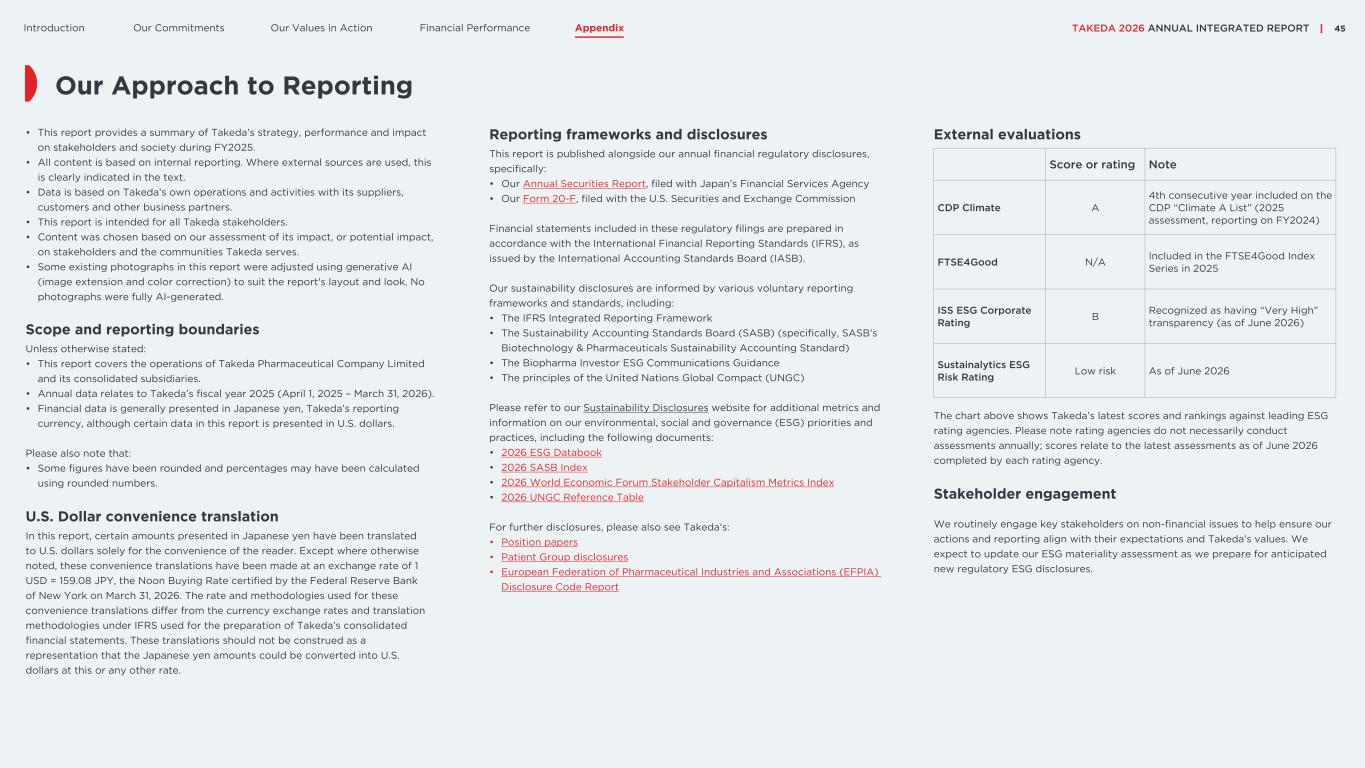
The chart above shows Takeda’s latest scores and rankings against leading ESG rating agencies. Please note rating agencies do not necessarily conduct assessments annually; scores relate to the latest assessments as of June 2026 completed by each rating agency. Our Approach to Reporting U.S. Dollar convenience translation In this report, certain amounts presented in Japanese yen have been translated to U.S. dollars solely for the convenience of the reader. Except where otherwise noted, these convenience translations have been made at an exchange rate of 1 USD = 159.08 JPY, the Noon Buying Rate certified by the Federal Reserve Bank of New York on March 31, 2026. The rate and methodologies used for these convenience translations differ from the currency exchange rates and translation methodologies under IFRS used for the preparation of Takeda’s consolidated financial statements. These translations should not be construed as a representation that the Japanese yen amounts could be converted into U.S. dollars at this or any other rate. Reporting frameworks and disclosures This report is published alongside our annual financial regulatory disclosures, specifically: • Our Annual Securities Report, filed with Japan’s Financial Services Agency • Our Form 20-F, filed with the U.S. Securities and Exchange Commission Financial statements included in these regulatory filings are prepared in accordance with the International Financial Reporting Standards (IFRS), as issued by the International Accounting Standards Board (IASB). Our sustainability disclosures are informed by various voluntary reporting frameworks and standards, including: • The IFRS Integrated Reporting Framework • The Sustainability Accounting Standards Board (SASB) (specifically, SASB’s Biotechnology & Pharmaceuticals Sustainability Accounting Standard) • The Biopharma Investor ESG Communications Guidance • The principles of the United Nations Global Compact (UNGC) Please refer to our Sustainability Disclosures website for additional metrics and information on our environmental, social and governance (ESG) priorities and practices, including the following documents: • 2026 ESG Databook • 2026 SASB Index • 2026 World Economic Forum Stakeholder Capitalism Metrics Index • 2026 UNGC Reference Table For further disclosures, please also see Takeda’s: • Position papers • Patient Group disclosures • European Federation of Pharmaceutical Industries and Associations (EFPIA) Disclosure Code Report • This report provides a summary of Takeda’s strategy, performance and impact on stakeholders and society during FY2025. • All content is based on internal reporting. Where external sources are used, this is clearly indicated in the text. • Data is based on Takeda’s own operations and activities with its suppliers, customers and other business partners. • This report is intended for all Takeda stakeholders. • Content was chosen based on our assessment of its impact, or potential impact, on stakeholders and the communities Takeda serves. • Some existing photographs in this report were adjusted using generative AI (image extension and color correction) to suit the report's layout and look. No photographs were fully AI-generated. Stakeholder engagement We routinely engage key stakeholders on non-financial issues to help ensure our actions and reporting align with their expectations and Takeda’s values. We expect to update our ESG materiality assessment as we prepare for anticipated new regulatory ESG disclosures. Scope and reporting boundaries Unless otherwise stated: • This report covers the operations of Takeda Pharmaceutical Company Limited and its consolidated subsidiaries. • Annual data relates to Takeda’s fiscal year 2025 (April 1, 2025 – March 31, 2026). • Financial data is generally presented in Japanese yen, Takeda’s reporting currency, although certain data in this report is presented in U.S. dollars. Please also note that: • Some figures have been rounded and percentages may have been calculated using rounded numbers. Score or rating Note CDP Climate A 4th consecutive year included on the CDP “Climate A List” (2025 assessment, reporting on FY2024) FTSE4Good N/A Included in the FTSE4Good Index Series in 2025 ISS ESG Corporate Rating B Recognized as having “Very High” transparency (as of June 2026) Sustainalytics ESG Risk Rating Low risk As of June 2026 External evaluations 45TAKEDA 2026 ANNUAL INTEGRATED REPORTFinancial PerformanceOur Values in Action AppendixIntroduction Our Commitments
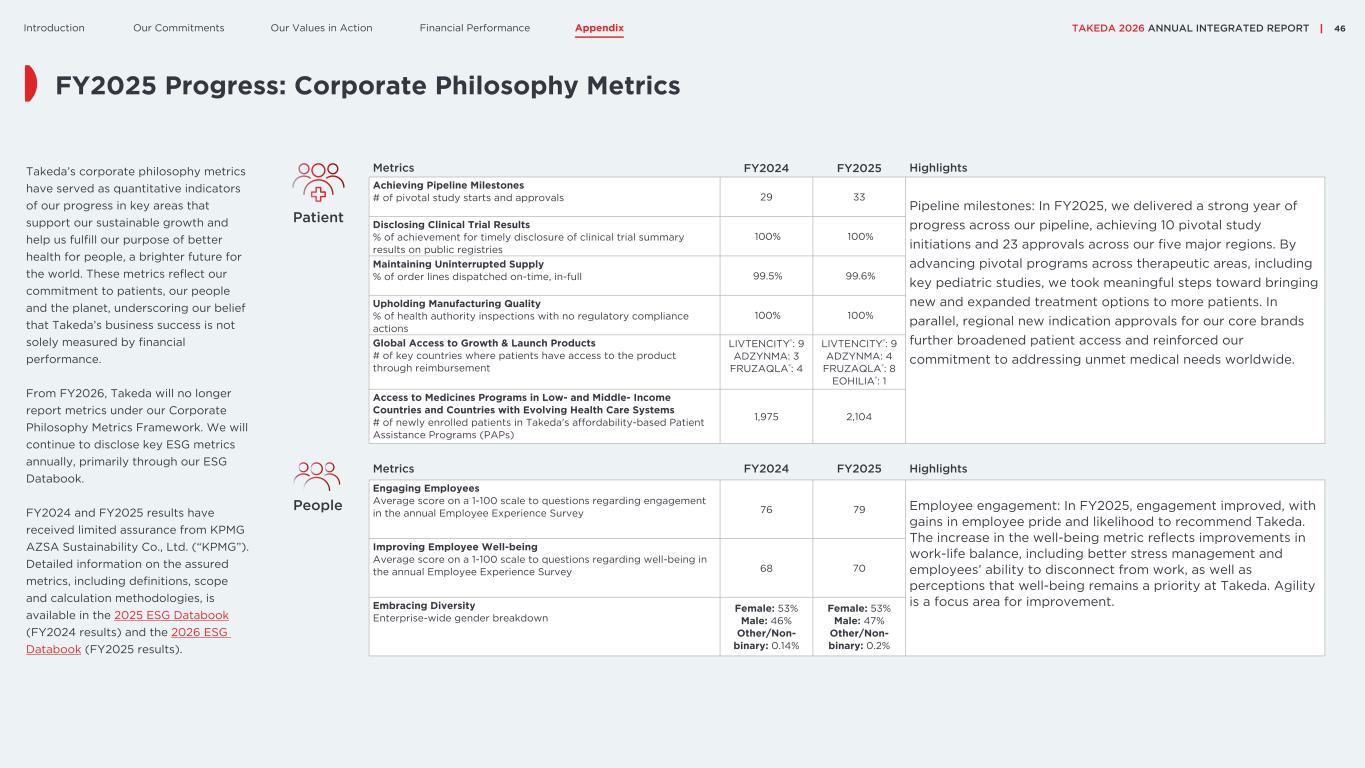
Metrics FY2024 FY2025 Highlights Achieving Pipeline Milestones # of pivotal study starts and approvals 29 33 Pipeline milestones: In FY2025, we delivered a strong year of progress across our pipeline, achieving 10 pivotal study initiations and 23 approvals across our five major regions. By advancing pivotal programs across therapeutic areas, including key pediatric studies, we took meaningful steps toward bringing new and expanded treatment options to more patients. In parallel, regional new indication approvals for our core brands further broadened patient access and reinforced our commitment to addressing unmet medical needs worldwide. Disclosing Clinical Trial Results % of achievement for timely disclosure of clinical trial summary results on public registries 100% 100% Maintaining Uninterrupted Supply % of order lines dispatched on-time, in-full 99.5% 99.6% Upholding Manufacturing Quality % of health authority inspections with no regulatory compliance actions 100% 100% Global Access to Growth & Launch Products # of key countries where patients have access to the product through reimbursement LIVTENCITY®: 9 ADZYNMA: 3 FRUZAQLA®: 4 LIVTENCITY®: 9 ADZYNMA: 4 FRUZAQLA®: 8 EOHILIA®: 1 Access to Medicines Programs in Low- and Middle- Income Countries and Countries with Evolving Health Care Systems # of newly enrolled patients in Takeda's affordability-based Patient Assistance Programs (PAPs) 1,975 2,104 FY2025 Progress: Corporate Philosophy Metrics Metrics FY2024 FY2025 Highlights Engaging Employees Average score on a 1-100 scale to questions regarding engagement in the annual Employee Experience Survey 76 79 Employee engagement: In FY2025, engagement improved, with gains in employee pride and likelihood to recommend Takeda. The increase in the well-being metric reflects improvements in work-life balance, including better stress management and employees’ ability to disconnect from work, as well as perceptions that well-being remains a priority at Takeda. Agility is a focus area for improvement. Improving Employee Well-being Average score on a 1-100 scale to questions regarding well-being in the annual Employee Experience Survey 68 70 Embracing Diversity Enterprise-wide gender breakdown Female: 53% Male: 46% Other/Non- binary: 0.14% Female: 53% Male: 47% Other/Non- binary: 0.2% Patient People Takeda’s corporate philosophy metrics have served as quantitative indicators of our progress in key areas that support our sustainable growth and help us fulfill our purpose of better health for people, a brighter future for the world. These metrics reflect our commitment to patients, our people and the planet, underscoring our belief that Takeda’s business success is not solely measured by financial performance. From FY2026, Takeda will no longer report metrics under our Corporate Philosophy Metrics Framework. We will continue to disclose key ESG metrics annually, primarily through our ESG Databook. FY2024 and FY2025 results have received limited assurance from KPMG AZSA Sustainability Co., Ltd. (“KPMG”). Detailed information on the assured metrics, including definitions, scope and calculation methodologies, is available in the 2025 ESG Databook (FY2024 results) and the 2026 ESG Databook (FY2025 results). 46TAKEDA 2026 ANNUAL INTEGRATED REPORTFinancial PerformanceOur Values in Action AppendixIntroduction Our Commitments
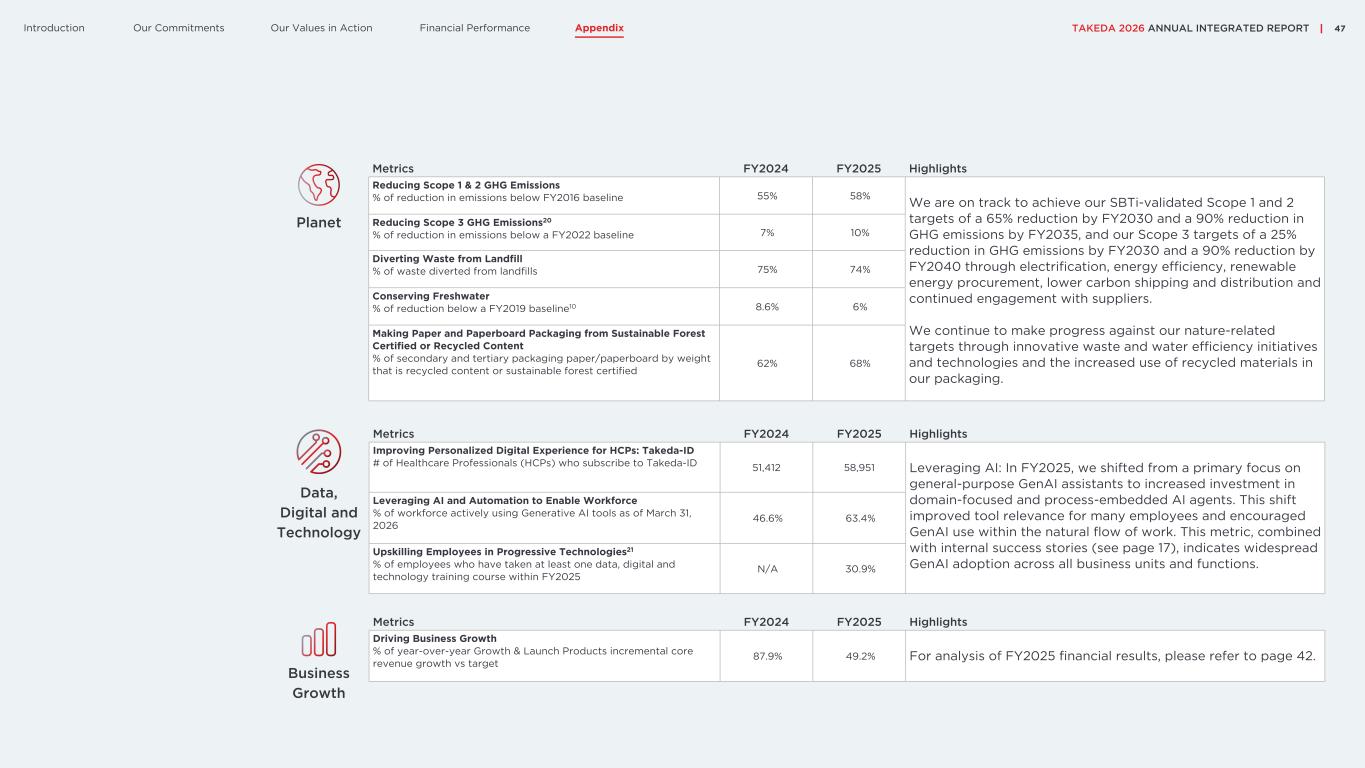
Metrics FY2024 FY2025 Highlights Improving Personalized Digital Experience for HCPs: Takeda-ID # of Healthcare Professionals (HCPs) who subscribe to Takeda-ID 51,412 58,951 Leveraging AI: In FY2025, we shifted from a primary focus on general-purpose GenAI assistants to increased investment in domain-focused and process-embedded AI agents. This shift improved tool relevance for many employees and encouraged GenAI use within the natural flow of work. This metric, combined with internal success stories (see page 17), indicates widespread GenAI adoption across all business units and functions. Leveraging AI and Automation to Enable Workforce % of workforce actively using Generative AI tools as of March 31, 2026 46.6% 63.4% Upskilling Employees in Progressive Technologies21 % of employees who have taken at least one data, digital and technology training course within FY2025 N/A 30.9% Metrics FY2024 FY2025 Highlights Driving Business Growth % of year-over-year Growth & Launch Products incremental core revenue growth vs target 87.9% 49.2% For analysis of FY2025 financial results, please refer to page 42. Business Growth Data, Digital and Technology Planet Metrics FY2024 FY2025 Highlights Reducing Scope 1 & 2 GHG Emissions % of reduction in emissions below FY2016 baseline 55% 58% We are on track to achieve our SBTi-validated Scope 1 and 2 targets of a 65% reduction by FY2030 and a 90% reduction in GHG emissions by FY2035, and our Scope 3 targets of a 25% reduction in GHG emissions by FY2030 and a 90% reduction by FY2040 through electrification, energy efficiency, renewable energy procurement, lower carbon shipping and distribution and continued engagement with suppliers. We continue to make progress against our nature-related targets through innovative waste and water efficiency initiatives and technologies and the increased use of recycled materials in our packaging. Reducing Scope 3 GHG Emissions20 % of reduction in emissions below a FY2022 baseline 7% 10% Diverting Waste from Landfill % of waste diverted from landfills 75% 74% Conserving Freshwater % of reduction below a FY2019 baseline10 8.6% 6% Making Paper and Paperboard Packaging from Sustainable Forest Certified or Recycled Content % of secondary and tertiary packaging paper/paperboard by weight that is recycled content or sustainable forest certified 62% 68% 47TAKEDA 2026 ANNUAL INTEGRATED REPORTFinancial PerformanceOur Values in Action AppendixIntroduction Our Commitments
Legal Disclaimers For the purposes of this notice, “report” means this document, any oral presentation, any question and answer session and any written or oral material discussed or distributed by Takeda Pharmaceutical Company Limited (“Takeda”) regarding this report. This report (including any oral briefing and any question-and-answer in connection with it) is not intended to, and does not constitute, represent or form part of any offer, invitation or solicitation of any offer to purchase, otherwise acquire, subscribe for, exchange, sell or otherwise dispose of, any securities or the solicitation of any vote or approval in any jurisdiction. No shares or other securities are being offered to the public by means of this report. No offering of securities shall be made in the United States except pursuant to registration under the U.S. Securities Act of 1933, as amended, or an exemption therefrom. This report is being given (together with any further information which may be provided to the recipient) on the condition that it is for use by the recipient for information purposes only (and not for the evaluation of any investment, acquisition, disposal or any other transaction). Any failure to comply with these restrictions may constitute a violation of applicable securities laws. Important notice The companies in which Takeda directly and indirectly owns investments are separate entities. In this report, “Takeda” is sometimes used for convenience where references are made to Takeda and its subsidiaries in general. Likewise, the words “we”, “us” and “our” are also used to refer to subsidiaries in general or to those who work for them. These expressions are also used where no useful purpose is served by identifying the particular company or companies. The product names appearing in this document are trademarks or registered trademarks owned by Takeda, or their respective owners. These forward-looking statements are based on assumptions about many important factors, including the following, which could cause actual results to differ materially from those expressed or implied by the forward-looking statements: the economic circumstances surrounding Takeda’s global business, including general economic conditions in Japan and the United States and with respect to international trade relations; competitive pressures and developments; changes to applicable laws and regulations, including drug pricing, tax, tariff and other trade-related rules; challenges inherent in new product development, including uncertainty of clinical success and decisions of regulatory authorities and the timing thereof; uncertainty of commercial success for new and existing products; manufacturing difficulties or delays; fluctuations in interest and currency exchange rates; claims or concerns regarding the safety or efficacy of marketed products or product candidates; the impact of health crises, like the novel coronavirus pandemic; the success of our environmental sustainability efforts, in enabling us to reduce our greenhouse gas emissions or meet our other environmental goals; the extent to which our efforts to increase efficiency, productivity or cost-savings, such as the integration of digital technologies, including artificial intelligence, in our business or other initiatives to restructure our operations will lead to the expected benefits; and Forward-looking statements This report and any materials distributed in connection with this report may contain forward- looking statements, beliefs or opinions regarding Takeda’s future business, future position and results of operations, including estimates, forecasts, targets and plans for Takeda. Without limitation, forward- looking statements often include words such as “targets”, “plans”, “believes”, “hopes”, “continues”, “expects”, “aims”, “intends”, “ensures”, “will”, “may”, “should”, “would”, “could”, “anticipates”, “estimates”, “projects”, “forecasts”, “outlook” or similar expressions or the negative thereof. 48TAKEDA 2026 ANNUAL INTEGRATED REPORT other factors identified in Takeda’s most recent Annual Report on Form 20-F and Takeda’s other reports filed with the U.S. Securities and Exchange Commission, available on Takeda’s website at: www.takeda.com/investors/sec-filings-and-security- reports/ or at www.sec.gov. Takeda does not undertake to update any of the forward-looking statements contained in this report or any other forward-looking statements it may make, except as required by law or stock exchange rule. Past performance is not an indicator of future results and the results or statements of Takeda in this report may not be indicative of, and are not an estimate, forecast, guarantee or projection of Takeda’s future results. Financial PerformanceOur Values in Action AppendixIntroduction Our Commitments
Financial information and non-IFRS measures Takeda’s financial statements are prepared in accordance with IFRS. This report and materials distributed in connection with this report include certain financial measures not presented in accordance with IFRS, such as Core Revenue, Core Operating Profit, Core Net Profit for the year attributable to owners of the company, Core EPS, Constant Exchange Rate (“CER”) change, Net Debt, Adjusted Net Debt, EBITDA, Adjusted EBITDA, Free Cash Flow and Adjusted Free Cash Flow. Takeda’s management evaluates results and makes operating and investment decisions using both IFRS and non- IFRS measures included in this report. These non- IFRS measures exclude certain income, cost and cash flow items that are included in, or are calculated differently from, the most closely comparable measures presented in accordance with IFRS. Takeda’s non-IFRS measures are not prepared in accordance with IFRS and such non-IFRS measures should be considered a supplement to, and not a substitute for, measures prepared in accordance with IFRS (which we sometimes refer to as “reported” measures). Investors are encouraged to review the definitions and reconciliations of non-IFRS measures to their most directly comparable IFRS measures, which are in the Financial Appendix appearing at the end of our FY2025 Earnings Announcement presentation. Clinical Trial Terminology In this report and with respect to clinical trials, (1) “proof-of-concept” (or “POC”) means obtaining clinical data sufficient to initiate pivotal trials or late- stage development; and (2) a “readout” for a clinical trial occurs when Takeda has (a) received the relevant clinical data, (b) completed any necessary analysis and review of such clinical data, and (c) in instances where it is required or otherwise common convention or practice, consulted with applicable regulatory authorities regarding such clinical data, provided that, where a readout is indicated for a class of related indications (e.g., solid tumors) involving multiple POC clinical trials, such readout occurs upon the earlier of (x) the first achievement of POC in an indication in such class, or (y) the conclusion of all of the POC clinical trials in such class. Medical information This report contains information about products that may not be available in all countries, or may be available under different trademarks, for different indications, in different dosages or in different strengths. Nothing contained herein should be considered a solicitation, promotion or advertisement for any prescription medicines including the ones under development. 49TAKEDA 2026 ANNUAL INTEGRATED REPORTFinancial PerformanceOur Values in Action AppendixIntroduction Our Commitments
50TAKEDA 2026 ANNUAL INTEGRATED REPORTFinancial PerformanceOur Values in Action AppendixIntroduction Our Commitments Definition and Explanation of Non-IFRS Measures Core Financial Measures Takeda’s Core Financial Measures, particularly Core Revenue, Core Operating Profit, Core Net Profit for the Year attributable to owners of the company and Core EPS, exclude revenue from divestments, amortization and impairment losses on intangible assets associated with products (including in- process R&D) and other impacts unrelated to the underlying trends and business performance of Takeda’s core operations, such as non-recurring items, purchase accounting effects and transaction related costs. Core Revenue represents revenue adjusted to exclude revenue items unrelated to the underlying trends and business performance of Takeda’s core operations (primarily revenue or related adjustments associated with divestments and liquidations). Core Operating Profit represents operating profit adjusted to exclude other operating expenses and income, amortization and impairment losses on intangible assets associated with products (including in-process R&D) and non-cash items or items unrelated to the underlying trends and business performance of Takeda’s core operations. Core Net Profit for the Year attributable to owners of the company represents net profit for the year attributable to owners of the company, adjusted to eliminate the impact of items excluded in the calculation of Core Operating Profit and other non- operating items (e.g. amongst other items, fair value adjustments and the imputed financial charge related to contingent consideration) that are unusual, non- recurring in nature or unrelated to the underlying trends and business performance of Takeda’s ongoing operations and the tax effect of each of the adjustments. Core EPS is calculated by dividing Core Net Profit for the Year attributable to owners of the company by the average outstanding shares (excluding treasury shares) of the reporting periods presented. We present our Core Financial Measures because we believe that these measures are useful to understanding our business without the effect of items that Takeda considers to be unrelated to the underlying trends and business performance of our core operations, including items (i) which may vary significantly from year-to-year or may not occur in each year or (ii) whose recognition Takeda believes is largely uncorrelated to trends in the underlying performance of our core business. We believe that similar measures are frequently used by other companies in our industry and that providing these measures helps investors evaluate Takeda’s performance against not only our performance in prior years but on a similar basis as our competitors. We also present Core Financial Measures because we use these measures for budgetary planning and compensation purposes (i.e., certain targets for the purposes of Takeda’s Short-Term Incentive and Long- Term Incentive compensation programs, including incentive compensation of the CEO and CFO, are set in relation to the results of Takeda’s Core Financial Measures). Constant Exchange Rate (CER) Change CER Change eliminates the effect of foreign exchange rates from year-over-year comparisons by translating financial results in accordance with IFRS or Core (non-IFRS) financial measures for the current period using corresponding exchange rates in the same period of the previous fiscal year, provided, however, that the results of operations of subsidiaries in countries experiencing hyperinflation, and for which IAS 29, Financial Reporting in Hyperinflationary Economies, is applied, are not adjusted for CER Change, and instead are calculated in accordance with IAS 29. Takeda presents CER Change because we believe that this measure is useful to investors to better understand the effect of exchange rates on our business and to understand how our results of operations might have changed from year to year without the effect of fluctuations in exchange rates. These are the primary ways in which our management uses these measures to evaluate our results of operations. We also believe that this is a useful measure for investors as similar performance measures are frequently used by securities analysts, investors and other interested parties in the evaluation of the results of operations of other companies in our industry (many of whom similarly present measures that adjust for the effect of exchange rates). The usefulness of this presentation has significant limitations including but not limited to, that while CER Change is calculated using the same exchange rates used to calculate financial results as presented under IFRS for the previous fiscal year, this does not necessarily mean that the transactions entered into during the relevant fiscal year could have been entered into or would have been recorded at the same exchange rates. Moreover, other companies in our industry using similarly titled measures may define and calculate those measures differently than we do and therefore such measures may not be directly comparable. Accordingly, CER Change should not be considered in isolation and is not, and should not be viewed as, a substitute for change in financial results as prepared and presented in accordance with IFRS.
Free Cash Flow and Adjusted Free Cash Flow Takeda also believes that Free Cash Flow and Adjusted Free Cash Flow are helpful to investors in understanding how our strategic acquisitions and divestitures of businesses contribute to our cash flows and liquidity. The usefulness of Free Cash Flow and Adjusted Free Cash Flow to investors has significant limitations including, but not limited to, (i) they may not be comparable to similarly titled measures used by other companies, including those in our industry, (ii) they do not reflect the effect of our current and future contractual and other commitments requiring the use or allocation of capital and (iii) the addition of proceeds from sales and redemption of investments and the proceeds from sales of business, net of cash and cash equivalents divested do not represent cash received from our core ongoing operations. Free Cash Flow and Adjusted Free Cash Flow should not be considered in isolation and are not, and should not be viewed as, substitutes for cash flows from operating activities or any other measure of liquidity presented in accordance with IFRS. The most directly comparable measure under IFRS for Free Cash Flow and Adjusted Free Cash Flow is net cash from operating activities. EBITDA and Adjusted EBITDA Takeda defines EBITDA as consolidated net profit before income tax expenses, depreciation and amortization and net interest expense. Takeda defines Adjusted EBITDA as EBITDA further adjusted to exclude impairment losses, other operating income and expenses (excluding depreciation and amortization, as well as impairment losses), finance income and expenses (excluding net interest expense), our share of profit or loss of investments accounted for using the equity method, other non- cash items such as non-cash equity-based compensation expense, and other items that management believes are unrelated to our core operations, including EBITDA from divested products, purchase accounting effects and transaction related costs. Takeda presents EBITDA and Adjusted EBITDA because Takeda believes that these measures are useful to investors as they are frequently used by securities analysts, investors and other interested parties in the evaluation of companies in our industry. Primarily, Adjusted EBITDA is used by Takeda for the purposes of monitoring its financial leverage. Takeda further believes that Adjusted EBITDA is helpful to investors in identifying trends in its business that could otherwise be obscured by certain items unrelated to ongoing operations because they are highly variable, difficult to predict, may substantially impact our results of operations and may limit the ability to evaluate our performance from one period to another on a consistent basis. The usefulness of EBITDA and Adjusted EBITDA to investors has significant limitations including, but not limited to, (i) they may not be comparable to similarly titled measures used by other companies, including those in the pharmaceutical industry, (ii) they exclude financial information and events, such as the effects of an acquisition, or amortization of intangible assets, that some may consider important in evaluating Takeda’s performance, value or prospects for the future, (iii) they exclude items or types of items that may continue to occur from period to period in the future and (iv) they may not include all items which investors may consider important to an understanding of our results of operations, or may not exclude all items which investors may not consider important for such understanding. EBITDA and Adjusted EBITDA should not be considered in isolation and are not, and should not be viewed as, substitutes for operating income, net profit for the year or any other measure of performance presented in accordance with IFRS. The most closely comparable measure presented in accordance with IFRS is net profit for the year. Takeda defines Free Cash Flow as cash flows from operating activities less acquisition of property, plant and equipment (“PP&E”). Takeda defines Adjusted Free Cash Flow as cash flows from operating activities, subtracting payments for acquisition of PP&E, intangible assets, investments (excluding debt investments classified as Level 1 in the fair value hierarchy), shares in associates and businesses, net of cash and cash equivalents acquired and other transactional payments deemed related or similar in substance thereto as well as adding proceeds from sales of PP&E, sales and redemption of investments (excluding debt investments classified as Level 1 in the fair value hierarchy), sales of shares in associates and sales of businesses, net of cash and cash equivalents divested and further adjusting for the movement of any other cash that is not available to Takeda’s immediate or general business use. Takeda presents Free Cash Flow and Adjusted Free Cash Flow because Takeda believes that these measures are useful to investors as similar measures of liquidity are frequently used by securities analysts, investors and other interested parties in the evaluation of companies in our industry. Adjusted Free Cash Flow is also used by our management to evaluate our liquidity and our cash flows, particularly as they relate to our ability to meet our liquidity requirements and to support our capital allocation policies. 51TAKEDA 2026 ANNUAL INTEGRATED REPORTFinancial PerformanceOur Values in Action AppendixIntroduction Our Commitments
52TAKEDA 2026 ANNUAL INTEGRATED REPORT Net Debt and Adjusted Net Debt Takeda defines Net Debt as the book value of bonds and loans on consolidated statements of financial position adjusted only for cash and cash equivalents and Adjusted Net Debt first by calculating the sum of the current and non-current portions of bonds and loans as shown on our consolidated statement of financial position, which is then adjusted to reflect (i) the use of prior 12-month average exchange rates for non-JPY debt outstanding at the beginning of the current quarter and the use of relevant spot rates for new non-JPY debt incurred and existing non-JPY debt redeemed during the current quarter, which reflects the methodology our management uses to monitor our leverage, and (ii) the “equity credit” applied to Takeda’s “hybrid” subordinated indebtedness by S&P Global Rating Japan in recognition of the equity-like features of those instruments pursuant to such agency’s ratings methodology. To calculate Adjusted Net Debt, Takeda deducts from this figure cash and cash equivalents, excluding cash temporarily held by Takeda on behalf of third parties related to vaccine operations and to the trade receivables sales program, and debt investments classified as Level 1 in the fair value hierarchy being recorded as Other Financial Assets. Takeda presents Net Debt and Adjusted Net Debt because we believe that these measures are useful to investors in that our management uses them to monitor and evaluate our indebtedness, net of cash and cash equivalents and, in conjunction with Adjusted EBITDA, to monitor our financial leverage (for the avoidance of doubt, Adjusted Net Debt and the ratio of Adjusted Net Debt to Adjusted EBITDA are not intended to be indicators of Takeda’s liquidity). Takeda also believes that similar measures of indebtedness are frequently used by securities analysts, investors and other interested parties in the evaluation of companies in our industry. Particularly following the acquisition of Shire, investors, analysts and, in particular, ratings agencies, have closely monitored Takeda’s leverage, as represented by the ratio of its Adjusted Net Debt to Adjusted EBITDA. In light of the weight given by ratings agencies in particular to this ratio, Takeda believes that such information is useful to investors to help understand not only Takeda’s financial leverage, but also how ratings agencies evaluate the level of financial leverage in evaluating Takeda’s quality of credit. Accordingly, as described further on this page, Takeda includes an adjustment to its Adjusted Net Debt to reflect the “equity credit” afforded to certain subordinated indebtedness by ratings agencies (such indebtedness does not qualify for treatment as equity under IFRS). The usefulness of Adjusted Net Debt to investors has significant limitations including, but not limited to, (i) it may not be comparable to similarly titled measures used by other companies, including those in the pharmaceutical industry, (ii) it does not reflect the amounts of interest payments to be paid on Takeda’s indebtedness, (iii) it does not reflect any restrictions on Takeda’s ability to prepay or redeem any of our indebtedness, (iv) it does not reflect any fees, costs or other expenses that Takeda may incur in converting cash equivalents to cash, in converting cash from one currency into another or in moving cash within our consolidated group, (v) it applies to gross debt an adjustment for average foreign exchange rates which, although consistent with Takeda’s financing agreements, does not reflect the actual rates at which Takeda would be able to convert one currency into another and (vi) it reflects an equity credit despite the fact that Takeda’s subordinated bonds are not eligible for equity treatment under IFRS, although Takeda believes this adjustment to be reasonable and useful to investors. Adjusted Net Debt should not be considered in isolation and is not, and should not be viewed as, a substitute for bonds and loans or any other measure of indebtedness presented in accordance with IFRS. The most directly comparable measures under IFRS for Net Debt are bonds and loans. Financial PerformanceOur Values in Action AppendixIntroduction Our Commitments
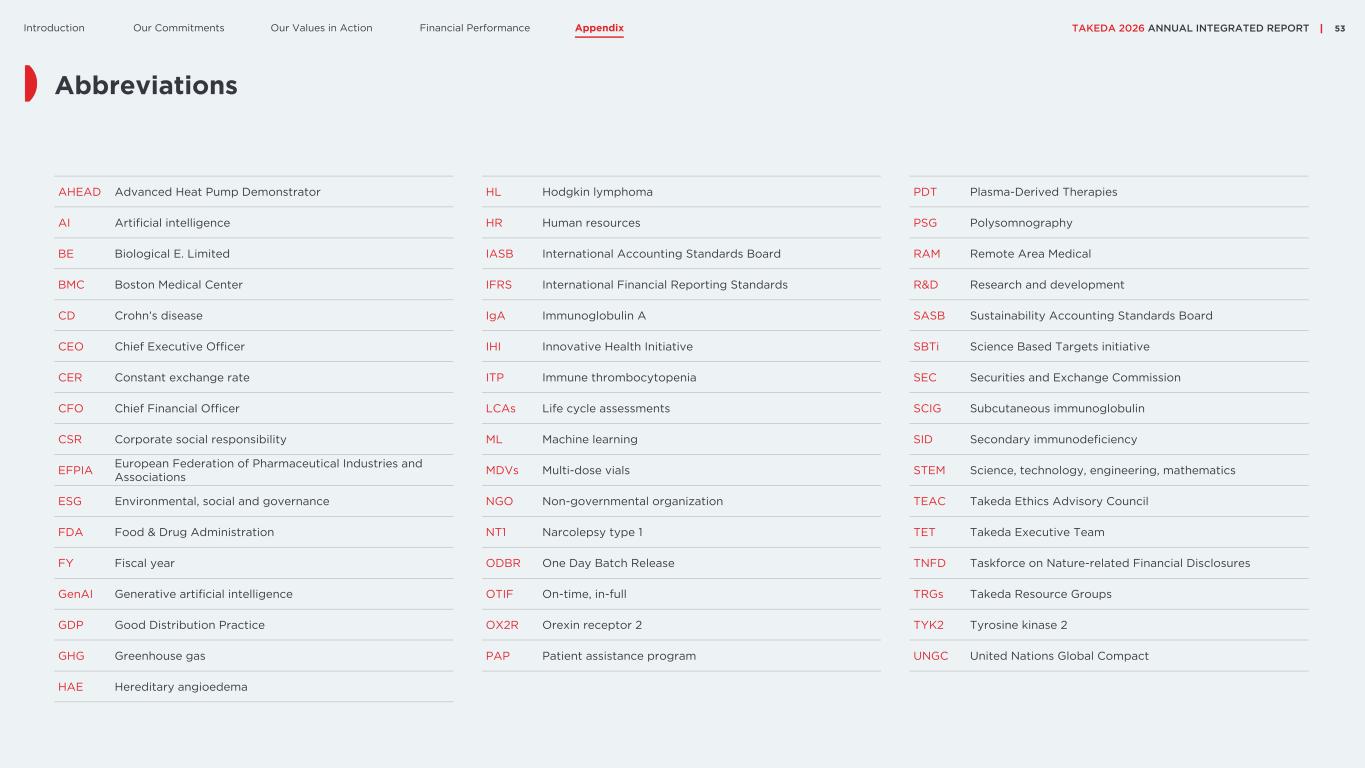
Financial PerformanceOur Values in Action AppendixIntroduction Our Commitments Abbreviations 53TAKEDA 2026 ANNUAL INTEGRATED REPORT AHEAD Advanced Heat Pump Demonstrator AI Artificial intelligence BE Biological E. Limited BMC Boston Medical Center CD Crohn’s disease CEO Chief Executive Officer CER Constant exchange rate CFO Chief Financial Officer CSR Corporate social responsibility EFPIA European Federation of Pharmaceutical Industries and Associations ESG Environmental, social and governance FDA Food & Drug Administration FY Fiscal year GenAI Generative artificial intelligence GDP Good Distribution Practice GHG Greenhouse gas HAE Hereditary angioedema HL Hodgkin lymphoma HR Human resources IASB International Accounting Standards Board IFRS International Financial Reporting Standards IgA Immunoglobulin A IHI Innovative Health Initiative ITP Immune thrombocytopenia LCAs Life cycle assessments ML Machine learning MDVs Multi-dose vials NGO Non-governmental organization NT1 Narcolepsy type 1 ODBR One Day Batch Release OTIF On-time, in-full OX2R Orexin receptor 2 PAP Patient assistance program PDT Plasma-Derived Therapies PSG Polysomnography RAM Remote Area Medical R&D Research and development SASB Sustainability Accounting Standards Board SBTi Science Based Targets initiative SEC Securities and Exchange Commission SCIG Subcutaneous immunoglobulin SID Secondary immunodeficiency STEM Science, technology, engineering, mathematics TEAC Takeda Ethics Advisory Council TET Takeda Executive Team TNFD Taskforce on Nature-related Financial Disclosures TRGs Takeda Resource Groups TYK2 Tyrosine kinase 2 UNGC United Nations Global Compact
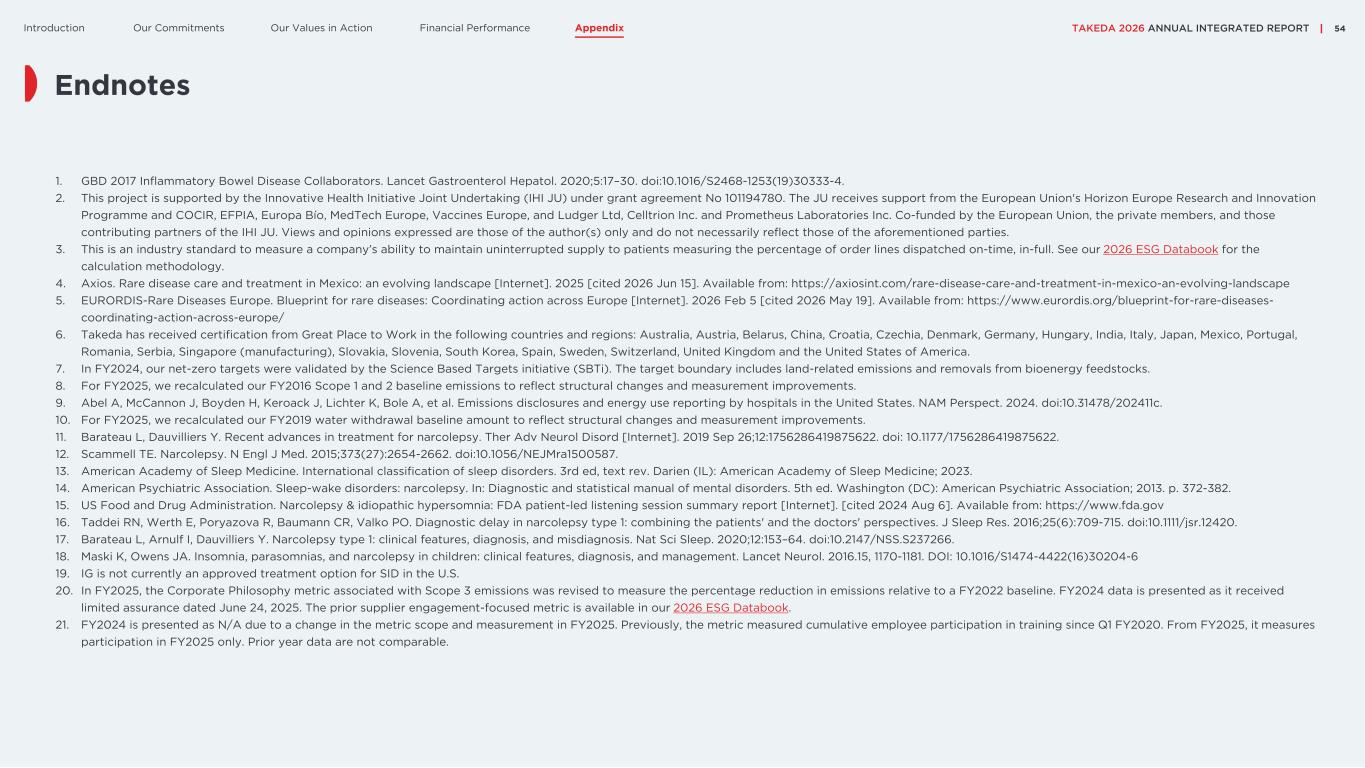
54TAKEDA 2026 ANNUAL INTEGRATED REPORTFinancial PerformanceOur Values in Action AppendixIntroduction Our Commitments Endnotes 1. GBD 2017 Inflammatory Bowel Disease Collaborators. Lancet Gastroenterol Hepatol. 2020;5:17–30. doi:10.1016/S2468-1253(19)30333-4. 2. This project is supported by the Innovative Health Initiative Joint Undertaking (IHI JU) under grant agreement No 101194780. The JU receives support from the European Union's Horizon Europe Research and Innovation Programme and COCIR, EFPIA, Europa Bío, MedTech Europe, Vaccines Europe, and Ludger Ltd, Celltrion Inc. and Prometheus Laboratories Inc. Co-funded by the European Union, the private members, and those contributing partners of the IHI JU. Views and opinions expressed are those of the author(s) only and do not necessarily reflect those of the aforementioned parties. 3. This is an industry standard to measure a company’s ability to maintain uninterrupted supply to patients measuring the percentage of order lines dispatched on-time, in-full. See our 2026 ESG Databook for the calculation methodology. 4. Axios. Rare disease care and treatment in Mexico: an evolving landscape [Internet]. 2025 [cited 2026 Jun 15]. Available from: https://axiosint.com/rare-disease-care-and-treatment-in-mexico-an-evolving-landscape 5. EURORDIS-Rare Diseases Europe. Blueprint for rare diseases: Coordinating action across Europe [Internet]. 2026 Feb 5 [cited 2026 May 19]. Available from: https://www.eurordis.org/blueprint-for-rare-diseases- coordinating-action-across-europe/ 6. Takeda has received certification from Great Place to Work in the following countries and regions: Australia, Austria, Belarus, China, Croatia, Czechia, Denmark, Germany, Hungary, India, Italy, Japan, Mexico, Portugal, Romania, Serbia, Singapore (manufacturing), Slovakia, Slovenia, South Korea, Spain, Sweden, Switzerland, United Kingdom and the United States of America. 7. In FY2024, our net-zero targets were validated by the Science Based Targets initiative (SBTi). The target boundary includes land-related emissions and removals from bioenergy feedstocks. 8. For FY2025, we recalculated our FY2016 Scope 1 and 2 baseline emissions to reflect structural changes and measurement improvements. 9. Abel A, McCannon J, Boyden H, Keroack J, Lichter K, Bole A, et al. Emissions disclosures and energy use reporting by hospitals in the United States. NAM Perspect. 2024. doi:10.31478/202411c. 10. For FY2025, we recalculated our FY2019 water withdrawal baseline amount to reflect structural changes and measurement improvements. 11. Barateau L, Dauvilliers Y. Recent advances in treatment for narcolepsy. Ther Adv Neurol Disord [Internet]. 2019 Sep 26;12:1756286419875622. doi: 10.1177/1756286419875622. 12. Scammell TE. Narcolepsy. N Engl J Med. 2015;373(27):2654-2662. doi:10.1056/NEJMra1500587. 13. American Academy of Sleep Medicine. International classification of sleep disorders. 3rd ed, text rev. Darien (IL): American Academy of Sleep Medicine; 2023. 14. American Psychiatric Association. Sleep-wake disorders: narcolepsy. In: Diagnostic and statistical manual of mental disorders. 5th ed. Washington (DC): American Psychiatric Association; 2013. p. 372-382. 15. US Food and Drug Administration. Narcolepsy & idiopathic hypersomnia: FDA patient-led listening session summary report [Internet]. [cited 2024 Aug 6]. Available from: https://www.fda.gov 16. Taddei RN, Werth E, Poryazova R, Baumann CR, Valko PO. Diagnostic delay in narcolepsy type 1: combining the patients' and the doctors' perspectives. J Sleep Res. 2016;25(6):709-715. doi:10.1111/jsr.12420. 17. Barateau L, Arnulf I, Dauvilliers Y. Narcolepsy type 1: clinical features, diagnosis, and misdiagnosis. Nat Sci Sleep. 2020;12:153–64. doi:10.2147/NSS.S237266. 18. Maski K, Owens JA. Insomnia, parasomnias, and narcolepsy in children: clinical features, diagnosis, and management. Lancet Neurol. 2016.15, 1170-1181. DOI: 10.1016/S1474-4422(16)30204-6 19. IG is not currently an approved treatment option for SID in the U.S. 20. In FY2025, the Corporate Philosophy metric associated with Scope 3 emissions was revised to measure the percentage reduction in emissions relative to a FY2022 baseline. FY2024 data is presented as it received limited assurance dated June 24, 2025. The prior supplier engagement-focused metric is available in our 2026 ESG Databook. 21. FY2024 is presented as N/A due to a change in the metric scope and measurement in FY2025. Previously, the metric measured cumulative employee participation in training since Q1 FY2020. From FY2025, it measures participation in FY2025 only. Prior year data are not comparable.

For all comments and suggestions on our Annual Integrated Report please contact us at: www.takeda.com/contact-us LinkedIn YouTube You can also write to us at: Takeda Pharmaceutical Company Limited Takeda Global Headquarters 1-1, Nihonbashi-Honcho-2-chome, Chuo-ku, Tokyo 103-8668, Japan www.takeda.com © 2026 Takeda Pharmaceutical Company Limited. All rights reserved.