Exhibit 99.2
Exhibit 99.2
| Paramount Gold Nevada Corp. | Sleeper Gold Mine S-K 1300 Technical Report Summary |
June 17, 2026 SLR Project No.: 123.020721.00001 |
Table of Contents
| 1.0 | Executive Summary |
1-1 | ||||
| 1.1 | Summary |
1-1 | ||||
| 1.2 | Economic Analysis |
1-9 | ||||
| 1.3 | Technical Summary |
1-28 | ||||
| 2.0 | Introduction |
2-1 | ||||
| 2.1 | Site Visits |
2-3 | ||||
| 2.2 | Sources of Information |
2-3 | ||||
| 2.3 | List of Abbreviations |
2-4 | ||||
| 3.0 | Property Description |
3-1 | ||||
| 3.1 | Location |
3-1 | ||||
| 3.2 | Land Tenure |
3-3 | ||||
| 3.3 | Encumbrances |
3-7 | ||||
| 3.4 | Royalties |
3-7 | ||||
| 3.5 | Required Permits and Status |
3-7 | ||||
| 3.6 | Other Significant Factors and Risks |
3-9 | ||||
| 4.0 | Accessibility, Climate, Local Resources, Infrastructure, and Physiography |
4-1 | ||||
| 4.1 | Accessibility |
4-1 | ||||
| 4.2 | Climate |
4-1 | ||||
| 4.3 | Local Resources and Infrastructure |
4-1 | ||||
| 4.4 | Physiography |
4-4 | ||||
| 5.0 | History |
5-1 | ||||
| 5.1 | Early Mining – Awakening District (Pre-1982) |
5-1 | ||||
| 5.2 | Ownership |
5-1 | ||||
| 5.3 | Exploration and Development History |
5-3 | ||||
| 5.4 | Past Production |
5-6 | ||||
| 6.0 | Geological Setting, Mineralization, and Deposit |
6-1 | ||||
| 6.1 | Regional Geology |
6-1 | ||||
| 6.2 | Local Geology |
6-5 | ||||
| 6.3 | Mineralization |
6-10 | ||||
| 6.4 | Deposit Types |
6-13 | ||||
| 7.0 | Exploration |
7-1 | ||||
| 7.1 | Exploration |
7-1 | ||||
| i |

|
| Paramount Gold Nevada Corp. | Sleeper Gold Mine S-K 1300 Technical Report Summary |
June 17, 2026 SLR Project No.: 123.020721.00001 |
| 7.2 | Drilling |
7-2 | ||||
| 7.3 | Hydrogeology Data |
7-8 | ||||
| 7.4 | Geotechnical Data |
7-13 | ||||
| 8.0 | Sample Preparation, Analyses, and Security |
8-1 | ||||
| 8.1 | Sample Method and Approach |
8-1 | ||||
| 8.2 | Sample Preparation and Analysis |
8-2 | ||||
| 8.3 | Quality Assurance and Quality Control |
8-6 | ||||
| 8.4 | Sample Security |
8-22 | ||||
| 8.5 | QP Opinion |
8-23 | ||||
| 9.0 | Data Verification |
9-1 | ||||
| 9.1 | RESPEC Data Validation |
9-1 | ||||
| 9.2 | SLR Data Verification |
9-2 | ||||
| 9.3 | QP Opinion |
9-2 | ||||
| 10.0 | Mineral Processing and Metallurgical Testing |
10-1 | ||||
| 10.1 | Introduction |
10-1 | ||||
| 10.2 | Nature and Extent of Metallurgical Testing and Analytical Procedures |
10-1 | ||||
| 10.3 | Sample Representativeness |
10-2 | ||||
| 10.4 | Testing Laboratories |
10-3 | ||||
| 10.5 | Relevant Metallurgical Results |
10-3 | ||||
| 10.6 | Recovery Assumptions and Basis for Estimation |
10-5 | ||||
| 10.7 | QP Opinion - Adequacy of Data |
10-11 | ||||
| 11.0 | Mineral Resource Estimates |
11-1 | ||||
| 11.1 | Summary |
11-1 | ||||
| 11.2 | Resource Database |
11-6 | ||||
| 11.3 | Geological Interpretation |
11-6 | ||||
| 11.4 | Resource Assays |
11-13 | ||||
| 11.5 | Treatment of High-Grade Assays |
11-13 | ||||
| 11.6 | Compositing |
11-14 | ||||
| 11.7 | Spatial Analysis |
11-16 | ||||
| 11.8 | Bulk Density |
11-17 | ||||
| 11.9 | Block Models |
11-18 | ||||
| 11.10 | Search Strategy and Grade Interpolation Parameters |
11-20 | ||||
| 11.11 | Reasonable Prospects for Economic Extraction for Mineral Resources |
11-21 | ||||
| 11.12 | Classification |
11-27 | ||||
| ii |
|
| Paramount Gold Nevada Corp. | Sleeper Gold Mine S-K 1300 Technical Report Summary |
June 17, 2026 SLR Project No.: 123.020721.00001 |
| 11.13 | Block Model Validation |
11-28 | ||||
| 11.14 | Sensitivity to Reporting Cut-off |
11-37 | ||||
| 11.15 | Comparison with Previous Estimate |
11-38 | ||||
| 11.16 | Mineral Resource Reporting |
11-40 | ||||
| 12.0 | Mineral Reserve Estimates |
12-1 | ||||
| 13.0 | Mining Methods |
13-1 | ||||
| 13.1 | Geotechnical Studies |
13-1 | ||||
| 13.2 | Mine Design |
13-1 | ||||
| 13.3 | Waste Rock Storage Facilities Design |
13-6 | ||||
| 13.4 | Mining Method |
13-8 | ||||
| 13.5 | Life of Mine Plan |
13-10 | ||||
| 13.6 | Contract Mining Discussion |
13-13 | ||||
| 13.7 | Mine Infrastructure |
13-15 | ||||
| 13.8 | Mine Equipment |
13-17 | ||||
| 13.9 | Mine Personnel |
13-20 | ||||
| 14.0 | Processing and Recovery Methods |
14-1 | ||||
| 14.1 | Selected Processing Strategy |
14-1 | ||||
| 14.2 | Proposed Process Description |
14-1 | ||||
| 14.3 | Plant Throughput and Design Basis |
14-2 | ||||
| 14.4 | Energy, Water, Process Materials, and Personnel |
14-2 | ||||
| 14.5 | Suitability of the Selected Method |
14-2 | ||||
| 15.0 | Infrastructure |
15-1 | ||||
| 15.1 | Access Roads |
15-3 | ||||
| 15.2 | Leach Pad |
15-3 | ||||
| 15.3 | Buildings and Facilities |
15-5 | ||||
| 15.4 | Power Supply and Distribution |
15-6 | ||||
| 15.5 | Water |
15-7 | ||||
| 15.6 | Accommodation Camp |
15-9 | ||||
| 16.0 | Market Studies and Contracts |
16-1 | ||||
| 16.1 | Markets |
16-1 | ||||
| 16.2 | Contracts |
16-1 | ||||
| 17.0 | Environmental Studies, Permitting and Plans, and Social or Community Impact |
17-1 | ||||
| 17.1 | Site Environmental Conditions and Monitoring Programs |
17-1 | ||||
| 17.2 | Waste and Tailings Disposal, Site Monitoring, and Water Management |
17-3 | ||||
| iii |
|
| Paramount Gold Nevada Corp. | Sleeper Gold Mine S-K 1300 Technical Report Summary |
June 17, 2026 SLR Project No.: 123.020721.00001 |
| 17.3 | Project Permitting |
17-5 | ||||
| 17.4 | Social or Community Requirements |
17-7 | ||||
| 17.5 | Mine Closure Requirements and Summary |
17-8 | ||||
| 17.6 | QP Opinion |
17-8 | ||||
| 18.0 | Capital and Operating Costs |
18-1 | ||||
| 18.1 | Capital Costs |
18-1 | ||||
| 18.2 | Operating Costs |
18-2 | ||||
| 19.0 | Economic Analysis |
19-1 | ||||
| 19.1 | Base Case |
19-1 | ||||
| 19.2 | Alternative Case - Measured and Indicated Only |
19-10 | ||||
| 20.0 | Adjacent Properties |
20-1 | ||||
| 21.0 | Other Relevant Data and Information |
21-1 | ||||
| 21.1 | Sleeper PFS - Project Overview and Execution Philosophy |
21-1 | ||||
| 21.2 | Project Development Strategy |
21-1 | ||||
| 21.3 | Workstreams and Scope of Activities |
21-2 | ||||
| 21.4 | Schedule and Critical Path |
21-5 | ||||
| 21.5 | Procurement and Contracting Strategy |
21-6 | ||||
| 21.6 | Sulfide Mineralization – Future Work Programs |
21-6 | ||||
| 21.7 | Risk Management |
21-8 | ||||
| 21.8 | Conclusion |
21-9 | ||||
| 22.0 | Interpretation and Conclusions |
22-1 | ||||
| 22.1 | Geology and Mineral Resources |
22-1 | ||||
| 22.2 | Mining and Mineral Reserves |
22-2 | ||||
| 22.3 | Mineral Processing |
22-2 | ||||
| 22.4 | Infrastructure |
22-3 | ||||
| 22.5 | Environment |
22-3 | ||||
| 22.6 | Capital and Operating Costs |
22-3 | ||||
| 22.7 | Risks |
22-4 | ||||
| 23.0 | Recommendations |
23-1 | ||||
| 23.1 | Geology and Mineral Resources |
23-1 | ||||
| 23.2 | Mining and Mineral Reserves |
23-3 | ||||
| 23.3 | Mineral Processing |
23-3 | ||||
| 23.4 | Infrastructure |
23-3 | ||||
| 23.5 | Environment |
23-4 | ||||
| iv |
|
| Paramount Gold Nevada Corp. | Sleeper Gold Mine S-K 1300 Technical Report Summary |
June 17, 2026 SLR Project No.: 123.020721.00001 |
| 23.6 | Capital and Operating Costs |
23-4 | ||||
| 24.0 | References |
24-1 | ||||
| 25.0 | Reliance on Information Provided by the Registrant |
25-1 | ||||
| 26.0 | Date and Signature Page |
26-1 | ||||
| 27.0 | Appendix 1 List of Claims |
27-1 | ||||
| 28.0 | Appendix 2 Cash Flow Summaries |
28-1 | ||||
Tables
| Table 1-1: | Proposed Sleeper 2026-2027 Exploration Budget |
1-6 | ||||
| Table 1-2: | Sleeper Base Case Production Physicals Summary |
1-11 | ||||
| Table 1-3: | Federal and State Tax Summary |
1-12 | ||||
| Table 1-4: | Royalties Summary |
1-12 | ||||
| Table 1-5: | Total Life of Mine Metrics – Base Case |
1-15 | ||||
| Table 1-6: | Base Case All-in Sustaining Costs Composition |
1-16 | ||||
| Table 1-7: | Base Case After-Tax Sensitivity Analyses |
1-17 | ||||
| Table 1-8: | Sleeper Alternative Case Production Physicals Summary |
1-20 | ||||
| Table 1-9: | Federal and State Tax Summary |
1-21 | ||||
| Table 1-10: | Royalties Summary |
1-21 | ||||
| Table 1-11: | Total Life of Mine Metrics – Alternative Case (Measured and Indicated Only) |
1-24 | ||||
| Table 1-12: | Alternative Case All-in Sustaining Costs Composition |
1-25 | ||||
| Table 1-13: | Alternative Case After-Tax Sensitivity Analyses |
1-27 | ||||
| Table 1-14: | Summary of Mineral Resources Estimate – April 29, 2026 |
1-31 | ||||
| Table 3-1: | Sleeper – Summary of Claim Holdings |
3-3 | ||||
| Table 3-2: | Property Holding Costs |
3-7 | ||||
| Table 3-3: | Royalty Agreement Summary |
3-7 | ||||
| Table 3-4: | Sleeper - Key BLM and State Permits in Place |
3-8 | ||||
| Table 3-5: | Sleeper Reclamation Bonds |
3-9 | ||||
| Table 5-1: | Sleeper Gold Mine – Total Annual Production (1986–1996) |
5-6 | ||||
| Table 7-1: | Drill Hole Database |
7-3 | ||||
| Table 7-2: | Hydrostratigraphic Unit Hydraulic Properties |
7-10 | ||||
| Table 7-3: | Monthly Water Balance for the Calibrated Pit Lake Numerical Model |
7-10 | ||||
| Table 7-4: | Evolution of Pit Lake Water Quality |
7-11 | ||||
| Table 7-5: | Groundwater Sample Distribution |
7-12 | ||||
| Table 7-6: | Exceedances of USEPA Water Quality Standards in Dewatering Discharge |
7-12 | ||||
| v |
|
| Paramount Gold Nevada Corp. | Sleeper Gold Mine S-K 1300 Technical Report Summary |
June 17, 2026 SLR Project No.: 123.020721.00001 |
| Table 8-1: | Summary Counts of Sleeper QA/QC Analysis (X-Cal and Paramount) |
8-8 | ||||
| Table 8-2: | Paramount Gold Certified Reference Material |
8-9 | ||||
| Table 8-3: | Summary of Sleeper Gold Results for CRMs 2010–2013 |
8-10 | ||||
| Table 8-4: | Gold Failure Details 2010–2013 |
8-10 | ||||
| Table 8-5: | Summary of Sleeper Silver Results for CRMs 2010–2013 |
8-12 | ||||
| Table 8-6: | Summary of Results X-Cal Historical and Paramount Field Duplicates |
8-17 | ||||
| Table 8-7: | X-Cal Blank Samples 2003–2007 |
8-20 | ||||
| Table 8-8: | X-Cal Blank Failures and Preceding Sample 2003–2007 |
8-20 | ||||
| Table 8-9: | Blank Materials Used in Paramount QA/QC Program |
8-21 | ||||
| Table 10-1: | Metallurgical Reports Reviewed |
10-1 | ||||
| Table 10-2: | Laboratory Accreditation Summary |
10-3 | ||||
| Table 10-3: | Recovery Assumptions and Process Basis by Material Type |
10-7 | ||||
| Table 11-1: | Summary of Mineral Resources Estimate – April 29, 2026 |
11-5 | ||||
| Table 11-2: | Summary of Drill Hole Data used in Mineral Resource Estimation |
11-7 | ||||
| Table 11-3: | Sleeper In Situ Gold and Silver Capping Levels by Domain |
11-14 | ||||
| Table 11-4: | Sleeper In Situ Gold Composite by Domain |
11-16 | ||||
| Table 11-5: | Sleeper In Situ Silver Composite by Domain |
11-17 | ||||
| Table 11-6: | Sleeper Density Values by Lithology |
11-19 | ||||
| Table 11-7: | Summary of In Situ Block Model Extents |
11-20 | ||||
| Table 11-8: | Summary of Waste Rock Dumps and Heap Leach Block Model Extents |
11-20 | ||||
| Table 11-9: | Summary of TSF Block Model Extents |
11-20 | ||||
| Table 11-10: | Sleeper Estimation Parameters by Domain |
11-22 | ||||
| Table 11-11: | Sleeper Cut-off Grade Parameters by Domain |
11-25 | ||||
| Table 11-12: | Summarized Methodology for Resource Classification |
11-28 | ||||
| Table 11-13: | Summary of Composite vs Block Model Mean Au (ppm) Oxide/Mixed Pit – In Situ |
11-29 | ||||
| Table 11-14: | Summary of Composite vs Block Model Mean Au (ppm) Sulfide Pit – In Situ |
11-30 | ||||
| Table 11-15: | Summary of Composite vs Block Model Mean Au (ppm) Dumps |
11-30 | ||||
| Table 11-16: | Summary of Composite vs Block Model Mean Au (ppm) Heaps and TSF |
11-31 | ||||
| Table 11-17: | Open Pit Grade vs Tonnage for Measured + Indicated Resources (Oxide/Mixed Pit Constrained) |
11-38 | ||||
| Table 11-18: | Detailed Summary of Mineral Resources by Area – April 29, 2026 |
11-42 | ||||
| Table 13-1: | Geotechnical Design Criteria |
13-1 | ||||
| Table 13-2: | Mine Design Parameters |
13-5 | ||||
| Table 13-3: | WRSF Design Parameters |
13-6 | ||||
| vi |
|
| Paramount Gold Nevada Corp. | Sleeper Gold Mine S-K 1300 Technical Report Summary |
June 17, 2026 SLR Project No.: 123.020721.00001 |
| Table 13-4: | Drilling and Blasting Parameters |
13-8 | ||||
| Table 13-5: | Mining Method and Equipment Summary |
13-10 | ||||
| Table 13-6: | Process Feed from Existing Dumps to the Crusher |
13-11 | ||||
| Table 13-7: | Process Feed from Open Pit to the Crusher |
13-11 | ||||
| Table 13-8: | Mining Inventory Processed by Year |
13-12 | ||||
| Table 13-9: | Base Case Open Pit Production Schedule |
13-12 | ||||
| Table 13-10: | Primary Fleet Estimate |
13-17 | ||||
| Table 13-11: | Equipment Diesel Consumption Estimate |
13-19 | ||||
| Table 13-12: | Diesel Storage Comparisons |
13-19 | ||||
| Table 13-13: | Recommended Diesel Storage Arrangements |
13-20 | ||||
| Table 15-1: | Estimated Power Load by Area |
15-7 | ||||
| Table 16-1: | Economic Analysis Metal Price Assumptions |
16-1 | ||||
| Table 17-1: | Required or Potentially Required Permits |
17-6 | ||||
| Table 18-1: | LOM Capital Cost Estimate |
18-1 | ||||
| Table 18-2: | LOM Capital Cost Estimate by Major Area |
18-2 | ||||
| Table 18-3: | LOM Average Unit Operating Costs |
18-2 | ||||
| Table 18-4: | Sleeper Workforce (Year 3) |
18-3 | ||||
| Table 19-1: | Sleeper Base Case Production Physicals Summary |
19-2 | ||||
| Table 19-2: | Federal and State Tax Summary |
19-3 | ||||
| Table 19-3: | Royalties Summary |
19-3 | ||||
| Table 19-4: | Total Life of Mine Metrics – Base Case |
19-6 | ||||
| Table 19-5: | Base Case All-in Sustaining Costs Composition |
19-8 | ||||
| Table 19-6: | Base Case After-Tax Sensitivity Analyses |
19-9 | ||||
| Table 19-7: | Sleeper Alternative Case Production Physicals Summary |
19-11 | ||||
| Table 19-9: | Royalties Summary |
19-12 | ||||
| Table 19-10: | Total Life of Mine Metrics – Alternative Case (Measured and Indicated Only) |
19-15 | ||||
| Table 19-11: | Alternative Case All-in Sustaining Costs Composition |
19-16 | ||||
| Table 19-12: | Alternative Case After-Tax Sensitivity Analyses |
19-18 | ||||
| Table 23-1: | Proposed Sleeper 2026-2027 Exploration Budget |
23-2 | ||||
| Figures | ||||||
| Figure 1-1: | Mine Production Profile by Material Movement – Base Case |
1-13 | ||||
| Figure 1-2: | Process Production Profile and Head Grade – Base Case |
1-13 | ||||
| vii |
|
| Paramount Gold Nevada Corp. | Sleeper Gold Mine S-K 1300 Technical Report Summary |
June 17, 2026 SLR Project No.: 123.020721.00001 |
| Figure 1-3: | Annual Processing Gold Production and Head Grade Profile – Base Case |
1-14 | ||||
| Figure 1-4: | Base Case Project After-Tax Metrics Summary |
1-15 | ||||
| Figure 1-5: | Base Case After-Tax Sensitivity Analysis |
1-19 | ||||
| Figure 1-6: | Mine Production Profile by Material Movement – Alternative Case |
1-22 | ||||
| Figure 1-7: | Process Production Profile and Head Grade – Alternative Case |
1-22 | ||||
| Figure 1-8: | Annual Processing Gold Production and Head Grade Profile |
1-23 | ||||
| Figure 1-9: | Alternative Case Project After-Tax Metrics Summary |
1-24 | ||||
| Figure 1-10: | Alternative Case After-Tax Sensitivity Analysis |
1-28 | ||||
| Figure 3-1: | Location Map |
3-2 | ||||
| Figure 3-2: | Sleeper Tenement Map |
3-5 | ||||
| Figure 6-1: | Regional Geology |
6-3 | ||||
| Figure 6-2: | Cross Section of Regional Geology |
6-4 | ||||
| Figure 6-3: | Stratigraphic Column |
6-7 | ||||
| Figure 6-4: | Local Geology |
6-8 | ||||
| Figure 6-5: | Cross Section of Local Geology |
6-9 | ||||
| Figure 6-6: | Schematic Model of Low-Sulfidation Epithermal System |
6-11 | ||||
| Figure 7-1: | Drill Hole Location Map |
7-5 | ||||
| Figure 8-1: | Gold Control Chart for MEG-Au.09.02 |
8-11 | ||||
| Figure 8-2: | X-Cal Core Preparation Duplicates, Relative Differences 2003-2007 |
8-13 | ||||
| Figure 8-3: | X-Cal Core Preparation Duplicates, Relative Differences 2003-2007 |
8-14 | ||||
| Figure 8-4: | X-Cal Gold RC Field Duplicates, Relative Differences 2003-2007 |
8-14 | ||||
| Figure 8-5: | X-Cal Gold RC Field Duplicates, Absolute Values of the Relative Differences 2003-2007 |
8-15 | ||||
| Figure 8-6: | Paramount RC Field Duplicates, Relative Differences 2010-2013 |
8-18 | ||||
| Figure 8-7: | Paramount Core Field Duplicates, Relative Differences 2010-2013 |
8-19 | ||||
| Figure 8-8: | X-Cal Gold in Blanks and Preceding Samples 2003–2007 |
8-20 | ||||
| Figure 8-9: | Gold Values of Paramount Coarse Blanks and Preceding Samples |
8-21 | ||||
| Figure 10-1: | Comparison of Reported Metallurgical Recovery Results |
10-9 | ||||
| Figure 10-2: | Material Specific Reagent Consumption and IA Heap Leach Recovery Assumptions by Material Type |
10-10 | ||||
| Mineral Resources are classified in accordance with S-K 1300 definitions (Figure 11-1: Sleeper Mineral Resource Domains | 11-2 | |||||
| Figure 11-1: | Sleeper Mineral Resource Domains |
11-3 | ||||
| Figure 11-2: | Sleeper Geologic Model Cross Section |
11-8 | ||||
| Figure 11-3: | Sleeper Mineralization Model Cross Section |
11-10 | ||||
| viii |
|
| Paramount Gold Nevada Corp. | Sleeper Gold Mine S-K 1300 Technical Report Summary |
June 17, 2026 SLR Project No.: 123.020721.00001 |
| Figure 11-4: | Sleeper Alteration Model Cross Section |
11-12 | ||||
| Figure 11-5: | Histogram of Sample Lengths in the Estimation Domains |
11-14 | ||||
| Figure 11-6: | Sleeper Material Type/Area Distribution Map |
11-23 | ||||
| Figure 11-7: | East-West Cross Section Oxide Pit |
11-31 | ||||
| Figure 11-8: | East-West Cross Section Sulfide Pit |
11-32 | ||||
| Figure 11-9: | Swath Plots in the X, Y, and Z Directions – Waste Rock Dumps |
11-34 | ||||
| Figure 11-10: | Swath Plots in the X, Y, and Z Directions – Heap Pads |
11-35 | ||||
| Figure 11-11: | Swath Plots in the X, Y, and Z Directions – TSF |
11-36 | ||||
| Figure 11-12: | Open Pit Grade Tonnage Curve for Measured + Indicated Mineral Resources |
11-38 | ||||
| Figure 13-1: | Initial Mine Topography |
13-3 | ||||
| Figure 13-2: | Oxide Pit Cross Section 4,576,271 N |
13-4 | ||||
| Figure 13-3: | Final Pit Design and Waste Storage Facility Design |
13-7 | ||||
| Figure 14-1: | Crushing & Agglomeration Process Flow Sheet |
14-3 | ||||
| Figure 14-2: | Process Plant Flow Sheet |
14-4 | ||||
| Figure 15-1: | Infrastructure Layout |
15-2 | ||||
| Figure 19-1: | Mine Production Profile by Material Movement – Base Case |
19-4 | ||||
| Figure 19-2: | Process Production Profile and Head Grade – Base Case |
19-5 | ||||
| Figure 19-3: | Annual Processing Gold Production and Head Grade Profile – Base Case |
19-5 | ||||
| Figure 19-4: | Base Case Project After-Tax Metrics Summary |
19-6 | ||||
| Figure 19-5: | Base Case After-Tax Sensitivity Analysis |
19-10 | ||||
| Figure 19-6: | Mine Production Profile by Material Movement – Alternative Case |
19-13 | ||||
| Figure 19-7: | Process Production Profile and Head Grade – Alternative Case |
19-13 | ||||
| Figure 19-8: | Annual Processing Gold Production and Head Grade Profile |
19-14 | ||||
| Figure 19-9: | Alternative Case Project After-Tax Metrics Summary |
19-15 | ||||
| Figure 19-10: | Alternative Case After-Tax Sensitivity Analysis |
19-19 | ||||
Appendix Tables
| Table 31-1: | Base Case Cash Flow Summary |
28-2 | ||||
| Table 31-2: | Alternative Case Cash Flow Summary |
28-6 | ||||
| ix |
|
| Paramount Gold Nevada Corp. | Sleeper Gold Mine S-K 1300 Technical Report Summary |
June 17, 2026 SLR Project No.: 123.020721.00001 |
| 1.0 | Executive Summary |
| 1.1 | Summary |
SLR International Corporation (SLR) was retained by Paramount Gold Nevada Corp. (PGN, Paramount Gold, or the Company) to prepare an independent Technical Report Summary (TRS) on the Sleeper Gold Mine (Sleeper or the Project), located in Humboldt County, Nevada, USA. The purpose of this TRS is to provide an Initial Assessment to support Mineral Resource disclosure. This TRS conforms to the United States Securities and Exchange Commission’s (SEC) Modernized Property Disclosure Requirements for Mining Registrants as described in Subpart 229.1300 of Regulation S-K, Disclosure by Registrants Engaged in Mining Operations (S-K 1300) and Item 601(b)(96) Technical Report Summary.
Paramount Gold is a U.S.-domiciled precious metals exploration and development company engaged in the acquisition, exploration, and development of gold and silver projects in the United States. The company’s principal assets include the Sleeper Gold Mine in Nevada and the Grassy Mountain Gold Project in Oregon, as well as additional exploration properties in the western United States. Paramount Gold is publicly listed on the NYSE exchange under the ticker symbol PZG and maintains its corporate offices in Winnemucca, Nevada.
Paramount Gold holds a 100% interest in the Sleeper Gold Mine, which includes the historical Sleeper open-pit gold mine and a large surrounding claim block totaling 2,474 unpatented mining claims covering approximately 44,917 acres (approximately 18,178 hectares) in Humboldt County, Nevada. The Sleeper mine was operated by AMAX Gold Inc. (AMAX) from 1986 through 1996, producing approximately 1.66 million ounces (Moz) of gold and 2.3 Moz of silver from open-pit mining and heap leaching and milling operations.
The Project is currently at the Initial Assessment (IA) stage, and as such, the level of engineering, geological definition, and metallurgical characterization remains preliminary. The Mineral Resources for the Project comprise in situ oxide and mixed material, in situ sulfide material, and material from existing waste rock dumps, heap leach pads (HLPs), and tailing storage facilities (TSFs). The development concept considered in the cash flow analysis presented in this TRS contemplates the restart of mining and processing operations with a focus on those Mineral Resources amenable to heap leaching, i.e., existing waste rock dumps and in situ oxide and mixed mineralized material. Additional work is required to develop the cash flow analysis for the sulfide Mineral Resources, including the heap leach and tailings material.
The existing waste rock dumps were generated during prior mining operations conducted under substantially lower gold prices, which led to the application of higher cut-off grades (COGs) at the time of mining. Consequently, material that was classified as waste under historical economic conditions contains grades that are potentially economic under current or reasonably foreseeable gold price assumptions and processing technologies. This reclassification to Mineral Resources forms a key component of the Project’s economic rationale.
To support this evaluation, the waste rock dumps have been subject to initial drilling, sampling, and assaying programs, supplemented by preliminary metallurgical test work. These programs have been designed to characterize the grade distribution, material variability, and metallurgical response of the dump material, including leachability and recovery potential. While these datasets provide an important foundation for the current assessment, they remain limited in scope and density relative to that required for higher-confidence classifications, and additional work will be required to support future Mineral Resource estimation, metallurgical modeling, and process design.
| 1-1 |
|
| Paramount Gold Nevada Corp. | Sleeper Gold Mine S-K 1300 Technical Report Summary |
June 17, 2026 SLR Project No.: 123.020721.00001 |
In parallel, the Project concept includes recovery of in situ oxide and mixed mineralized material remaining in the vicinity of the historical pit. These materials are considered amenable to conventional surface mining methods and heap leach processing, consistent with prior operations at Sleeper, although additional drilling, metallurgical testing, and engineering studies will be required to confirm recoveries, processing parameters, and economic viability.
Overall, the Project represents a brownfields redevelopment opportunity, leveraging existing site disturbance, historical data, and previously mined material inventories; however, given the early stage of evaluation, all assumptions related to mineralization, processing performance, and economic outcomes should be considered preliminary and subject to refinement through subsequent phases of study. The development concept assumes a nominal processing rate of approximately 30,000 tonnes per day (tpd), utilizing conventional open pit mining, crushing and agglomeration, cyanide heap leaching, and Merrill-Crowe zinc precipitation to recover gold and silver.
The Base Case economic analysis presented in this TRS evaluates the potential economic viability of processing Measured, Indicated, and Inferred Mineral Resources. The Base Case mining inventory comprises the following:
| • | Approximately 47 million tonnes (Mt) of waste rock dump material, classified as Inferred Mineral Resources, grading approximately 0.28 g/t gold (Au) |
| • | In situ oxide and mixed mineralized material including approximately 2 Mt Measured Resources grading 0.29 g/t Au, 78 Mt Indicated Resources grading 0.26 g/t Au, and 49 Mt Inferred Resources grading 0.24 g/t Au. |
Overall, the Base Case production schedule includes approximately 55% of Inferred Resources as part of the economic analysis. An Alternative Case was considered that included only in situ Measured and Indicated Resources in the economic analysis.
| 1.1.1 | Conclusions |
| 1.1.1.1 | Geology and Mineral Resources |
| • | The geological interpretation and deposit model are appropriate, internally consistent, and aligned with a low-sulfidation epithermal system, with mineralization strongly controlled by fault architecture and lithological contrasts. |
| • | Mineralization exhibits high spatial variability, with discontinuous high-grade veins embedded within a laterally and vertically continuous low-grade stockwork domain, which comprises most of the tonnage. |
| • | The Mineral Resource estimate has been prepared in accordance with S-K 1300 and CIM (2019) Best Practice Guidelines, supported by appropriate domain modeling, compositing, grade capping, interpolation, and validation workflows. |
| • | The estimate is constrained within optimized open-pit shells demonstrating Reasonable Prospects for Economic Extraction (RPEE,) based on reasonable mining, processing, and economic assumptions, including a long-term gold price of US$3,100/oz. |
| • | The drilling database is large and generally adequate (approximately 4,300+ drill holes); however, gaps in historical metadata, incomplete records, and exclusion of unverifiable data introduce uncertainty, which is appropriately reflected in classification. |
| 1-2 |
|
| Paramount Gold Nevada Corp. | Sleeper Gold Mine S-K 1300 Technical Report Summary |
June 17, 2026 SLR Project No.: 123.020721.00001 |
| • | Historical drilling is predominantly vertical RC, which adequately defines bulk-tonnage mineralization but limits confidence in true geometry and continuity of steeply dipping high-grade structures. |
| • | The QA/QC and sampling protocols, while variable in early historical programs, are considered sufficient overall due to: |
| • | Exclusion of unreliable or unsupported data from the Mineral Resource Estimate (MRE) |
| • | Validation of assay datasets through statistical analysis, capping, compositing, and multi-method estimation checks |
| • | Use of industry-standard QA/QC review and data screening prior to estimation. Accordingly, the QP considers the analytical dataset valid and appropriate to support the MRE, with remaining uncertainties reflected in classification. |
| • | The oxidation model has been reviewed and corrected for inconsistencies and is considered appropriate for current estimation; however, localized coding issues indicate moderate residual uncertainty where metallurgical assumptions are sensitive. |
| • | Exploration datasets (geophysical, geochemical, geological) are well integrated and effective for targeting, defining structural corridors, and mineralized trends extending beyond historically mined areas. |
| • | Mineralization remains open along strike, at depth, and beneath cover, with identified targets considered conceptual but supported by integrated datasets. |
| • | Compared to the 2023 estimate, the 2026 MRE shows a material increase in tonnage and contained metal, driven by: |
| • | Inclusion and delineation of surface materials (existing waste rock dumps, heap leach pads, and tailings storage facility); |
| • | Expanded pit shells under higher gold price assumptions (US$3,100/oz versus approximately US$1,800/oz); and |
| • | Updated geological interpretation and database validation. |
| • | This increase in tonnage is accompanied by a moderate reduction in average grade, consistent with inclusion of marginal material and not indicative of estimation bias. |
| 1.1.1.2 | Mining and Mineral Reserves |
| • | There is no current geotechnical information for the pit slopes. Current pit slope assumptions may be optimized once geotechnical information has been collected and incorporated into the pit design. |
| • | The current Base Case life of mine (LOM) plan includes a significant proportion of Inferred Mineral Resources (approximately 55%). The next stage of the Project will require converting Inferred Resources to Indicated Resources to reduce the project risk. |
| • | Pit slope design assumes dry (i.e., dewatered) walls. Pit dewatering needs to start early enough for the open-pit mining operation to begin. |
| • | There is potential to extend the mine life with the addition of a sulfide pit. To include the sulfide pit in the LOM plan, additional metallurgical test work and block modeling will be required. |
| 1-3 |
|
| Paramount Gold Nevada Corp. | Sleeper Gold Mine S-K 1300 Technical Report Summary |
June 17, 2026 SLR Project No.: 123.020721.00001 |
| 1.1.1.3 | Mineral Processing |
| • | Metallurgical test work supports heap leaching with Merrill-Crowe recovery for oxide, mixed, and selected waste-rock materials, and flotation with off-site toll treatment or concentrate sale for sulfide, existing heap leach pad (HLP), and existing tailings material. |
| • | The Base Case economic analysis is restricted to the heap-leach scenario, which is supported by the most complete, representative, and internally consistent metallurgical dataset. |
| • | The proposed Base Case processing facility is a 30,000 tpd conventional crush–agglomerate–heap-leach operation employing Merrill-Crowe recovery. Design parameters include crushing to approximately P80 19 mm and agglomeration using cement and/or lime. |
| • | Facilities oxide material demonstrates the strongest metallurgical response to heap leaching, with additional oxide, mixed, and selected waste-dump composites also supporting inclusion in the heap-leach feed blend. |
| • | Gold and silver recovery assumptions for the heap-leach case are derived primarily from column leach testing, with conservative assumptions applied where only bottle-roll or limited test data exist. |
| • | Sulfide, HLP, and tailings materials represent future processing opportunities via flotation. Recoveries have been reduced by 12% to account for toll-milling deductions and downstream treatment charges. |
| • | No silver recovery is currently attributed to the flotation scenario; silver is treated as upside potential pending further metallurgical test work and commercial assessment. |
| • | The heap leach flowsheet is a commercially proven, low-risk processing route appropriate for IA-level planning. |
| • | Preliminary test work of the flotation option as a processing method for the sulfide material and existing HLP and TSF material is sufficient for the declaration of Mineral Resources; however, additional variability testing, concentrate characterization, and commercial evaluation are required to advance this option. |
| 1.1.1.4 | Infrastructure |
| • | Access to the mine site is reliable via frequently traveled and maintained public infrastructure from Winnemucca, Nevada. |
| • | Access and haul roads constructed on site will be designed and constructed in a manner sufficient to facilitate required on-site vehicular movement |
| • | The proposed heap leach pad has been sited based on terrain, environmental, and operational bases and has been adequately sized to accommodate 175 Mt of agglomerated mineralized material. |
| • | The pregnant solution and barren solution ponds have been located in proximity to the leach pad to take advantage to native slopes and have been sized to accommodate operational solution flow rates. |
| • | The storm event pond has been located adjacent to the process ponds and has been sized to accommodate the 100-year 24-hour storm volume. |
| 1-4 |
|
| Paramount Gold Nevada Corp. | Sleeper Gold Mine S-K 1300 Technical Report Summary |
June 17, 2026 SLR Project No.: 123.020721.00001 |
| • | Rapid infiltration basins have been designed to accommodate infiltration from pit dewatering efforts at an average rate of 4,542 m3/hr (20,000 US gallons per minute [gpm]). |
| • | No accommodation camp has been included in the proposed infrastructure as the town of Winnemucca is within commuting distance and hosts a knowledgeable mining industry labor force. |
| 1.1.1.5 | Environment |
| • | There are no known significant environmental issues at the site, and the former mine is in an advanced state of closure with post-closure monitoring and minor operational and maintenance activities being conducted. |
| • | The regulatory environment is well developed, and the environmental permitting path forward for the mine plan presented in this TRS is generally well understood. |
| 1.1.1.6 | Capital and Operating Costs |
| • | Preliminary capital and operating cost estimates have been prepared for the proposed mining operation based on a conceptual processing rate of approximately 30,000 tpd. |
| • | For the Base Case, initial capital costs required to restart mining operations are estimated to be approximately US$201 million, with sustaining capital estimated at approximately US$342 million over the life of mine. |
| • | Life-of-mine operating costs for the Base Case are estimated to average approximately US$13.03 per tonne processed, resulting in an estimated all-in sustaining cost of approximately US$2,407 per ounce of gold produced. |
| 1.1.1.7 | Risks |
| • | The economic analysis presented in the Base Case as part of this TRS includes a material proportion of Inferred Mineral Resources within the mine plan and associated cash flow. The Inferred Mineral Resources are included at the beginning of the life-of-mine plan by mining existing dumps in the economic analysis, which introduces significant uncertainty. |
| 1.1.2 | Recommendations |
The SLR QPs offer the following recommendations by discipline:
| 1.1.2.1 | Geology and Mineral Resources |
| 1 | Conduct the following drilling and exploration programs: |
| a) | Infill drilling to support conversion of Inferred to Indicated Mineral Resources (in situ and surface materials) by conducting systematic infill drilling within pit-constrained in situ domains and within surface material domains (dumps, heap leach pads, and TSF) to increase data density and improve confidence in grade continuity, tonnage, and material variability, consistent with S-K 1300 classification criteria. |
| b) | Targeted infill drilling within established mineralization domains to increase drill density within defined grade domains to better constrain grade variability and continuity, particularly in areas where current spacing limits classification. |
| 1-5 |
|
| Paramount Gold Nevada Corp. | Sleeper Gold Mine S-K 1300 Technical Report Summary |
June 17, 2026 SLR Project No.: 123.020721.00001 |
| c) | Additional drilling and geological logging to improve confidence in oxide, mixed, and sulfide boundaries, which directly influence metallurgical assumptions applied in the MRE. |
| 2 | Geology and Mineral Resource Estimate |
| a) | Maintain domain-controlled drilling and sampling protocols to ensure all new data collection aligns with the current geological, mineralization, and estimation domain framework to support direct integration into future MRE updates. |
| b) | Incorporate new data into updated geological interpretations and block models to support iterative improvement of the Mineral Resource estimate in accordance with S-K 1300 reporting requirements. |
| c) | Acquire additional bulk density measurements across in situ and surface material domains where current density assignments are based on limited data, to improve tonnage estimates. |
| d) | Focus drilling within the existing Mineral Resource footprint by prioritizing data acquisition in areas where incremental drilling is most likely to materially improve classification, rather than expanding the resource footprint at this stage. |
| 3 | Quality Assurance and Quality Control |
| a) | Implement consistent QA/QC protocols for future work. Apply standardized QA/QC procedures (sampling, insertion rates, documentation) to ensure all new data meets S-K 1300 and CIM (2019) requirements and supports classification upgrades. |
| b) | Recommend investigation of incomplete database information and update the database through investigation of historic files |
To advance the Project, the QP recommends that Paramount Gold undertake a two-phase exploration and data validation program totaling $8.52 million, as summarized in Table 1-1.
The goal is to support upgrading Inferred Mineral Resources to the Indicated category, validate key project assumptions regarding density and metallurgy, and continue delineation in underexplored areas.
This budget reflects a disciplined yet robust investment to de-risk the MRE, validate key technical assumptions (density, metallurgical recovery), and support a potential future Preliminary Feasibility Study (PFS). The recommended work is expected to materially enhance the geological understanding and economic viability of the Sleeper Project.
The two phases of the work program are independent of each other.
Table 1-1: Proposed Sleeper 2026-2027 Exploration Budget
| Activity |
Details |
Estimated Cost (US$ 000) |
||||
| Phase 1 – Surface and In Situ Resource Definition, QA/QC Implementation, and Metallurgical Studies |
| |||||
| ESG Permitting |
Exploration and Environmental Permits for Phase 1 drilling | 25 | ||||
| Sonic Drilling |
Up to 30 holes (4000 ft) of sonic drilling at $90/ft focused on obtaining metallurgical samples from Waste dumps, TSF and HL pads | 360 | ||||
| RC Drilling |
Up to 500 holes (50,000 ft) of RC drilling in Waste dumps, HL pads at $50/ft | 2,500 | ||||
| 1-6 |
|
| Paramount Gold Nevada Corp. | Sleeper Gold Mine S-K 1300 Technical Report Summary |
June 17, 2026 SLR Project No.: 123.020721.00001 |
| Activity |
Details |
Estimated Cost (US$ 000) |
||||
| Core drilling |
Confirmation core drilling of up to 10,000 ft at $120/ft (HQ/NQ core) | 1,200 | ||||
| Bulk Density Sampling |
Collection and testing of up to 200 core and/or pit samples across all domains | 12 | ||||
| Geochemical Assays |
Assaying of approximately 15,000 samples incl. duplicates, standards, and blanks | 750 | ||||
| QA/QC Program Implementation |
Establish certified sample control and auditing protocols | 100 | ||||
| Metallurgical Testing |
Leach testing of mineralized core for recovery studies | 750 | ||||
| Technical Staff & Supervision |
Field geologist, QA/QC lead, database tech | 300 | ||||
|
|
|
|||||
| Total Phase 1 |
5,997 | |||||
|
|
|
|||||
| Phase 2 – Project Development Scoping |
| |||||
| ESG Permitting |
Exploration and Environmental Permits for Phase 2 Geotech |
25 | ||||
| Ground Support Geotechnical Testing |
Geotech and analysis studies for Ground Support |
250 | ||||
| Heap Leach Pad Geotechnical Testing and Design |
Geotech and design engineering studies for Heap Leach Pad |
600 | ||||
| Mining and Process Design & Engineering Analysis |
Process design and engineering cost analysis and modeling |
400 | ||||
| Environmental Baseline Studies |
Hydrogeology, cultural, flora/fauna baseline for mine permitting |
800 | ||||
| Stakeholder Engagement & Permitting Prep |
Initial outreach, permitting roadmap |
100 | ||||
| Technical Oversight & Contingency (10%) |
Includes legal, overhead, permitting scope prep |
218 | ||||
| Reporting and Independent Review |
S-K 1300 PFS update and QP sign-off |
350 | ||||
|
|
|
|||||
| Total Phase 2 |
2,723 | |||||
|
|
|
|||||
| Grand Total |
8,740 | |||||
|
|
|
|||||
| 1.1.2.2 | Mining and Mineral Reserves |
| 1 | Collect geotechnical information and develop geotechnical studies to support the pit design slopes for the next stage of the project. |
| 2 | Ensure the open-pit mining sequence is closely coordinated with the open-pit dewatering plan. |
| 3 | Continue the analysis of the sulfide pit as an opportunity after the oxide pit mining. |
| 1-7 |
|
| Paramount Gold Nevada Corp. | Sleeper Gold Mine S-K 1300 Technical Report Summary |
June 17, 2026 SLR Project No.: 123.020721.00001 |
| 1.1.2.3 | Mineral Processing |
| 1. | Complete additional variability column leach testing on oxide, mixed, and waste rock dump domains to confirm recovery, leach kinetics, and reagent consumption across the planned heap leach feed range. |
| 2. | Confirm provisional recovery assumptions for Sleeper oxide, Sleeper mixed, and West Wood mixed material with representative column leach test work. |
| 3. | Refine crush-size and agglomeration test work to confirm the selected coarse-crush heap leach design basis and optimize cement and lime addition by material type. |
| 4. | Expand reagent-consumption testing to better define sodium cyanide, lime, and cement demand for oxide, mixed, and waste rock dump materials, particularly where existing results indicate variable or elevated consumable requirements. |
| 5. | Complete additional column leach testing on selected waste rock dump materials to refine recovery assumptions by dump area and improve confidence in domain-based economic modeling. |
| 6. | Complete additional deleterious-element and precipitate-quality testing for Hg, As, Sb, and sulfur to confirm mercury management requirements and refine refinery and operating cost assumptions. |
| 7. | Complete flotation variability, optimization, and locked-cycle test work on representative sulfide, HLP and tailings composites to confirm recovery, consumable requirements, concentrate quality, and the suitability of an off-site toll-treatment or concentrate-sale route. |
| 1.1.2.4 | Infrastructure |
| 1 | Evaluate site-wide water balance and discharge requirements. |
| 2 | Perform a hydrogeological evaluation to support PFS level engineering of the rapid infiltration basin. |
| 3 | Confirm power requirements and supply availability. |
| 4 | Develop site-specific design criteria for the HLP and perform field investigations and laboratory testing to support advancing the HLP design. |
| 5 | Develop a PFS level HLP design that incorporates site specific data into the engineering calculations and analysis for such items as grading plan, slope stability analysis, water balance, settlement, and closure. |
| 1.1.2.5 | Environment |
| 1. | Complete updated baseline studies in accordance with National Environmental Policy Act of 1969 (NEPA) and applicable guidelines. |
| 2. | Engage early with local stakeholders and tribes and develop a stakeholder outreach plan. |
| 3. | Develop a permitting strategy and timeline. |
| 1-8 |
|
| Paramount Gold Nevada Corp. | Sleeper Gold Mine S-K 1300 Technical Report Summary |
June 17, 2026 SLR Project No.: 123.020721.00001 |
| 1.1.2.6 | Capital and Operating Costs |
| 1 | Move the dewatering from an “Allowance” to a full ‘Engineered System’, e.g., calibrated groundwater model; staged dewatering sequencing; pumping lift curves by pit phase; transient inflow modeling; wellfield spacing and drawdown analysis; contingency pumping scenarios; and power demand modeling for peak pumping periods. |
| 2 | Re-evaluate the crushing/agglomeration trade-off, e.g., variability column testing; permeability testing; compaction testing; fines migration testing; cement consumption optimization; lift-height testing; and irrigation optimization. |
| 3 | Tighten the heap leach pad phasing strategy, e.g., minimizing initial lined acreage; maximizing early vertical expansion; deferring later phases; reducing early pond construction; and sequencing underdrain installation. |
| 4 | Lock down power infrastructure requirements early, e.g., actual condition of transmission line; substation rebuild requirements; transformer replacement needs; utility interconnect requirements; and backup generation philosophy. |
| 5 | Validate the contractor mining strategy, i.e., obtain budgetary contractor bids; benchmark Nevada owner-mining versus contractor-mining; validate bank cubic meter (bcm) assumptions; stress-test diesel escalation; and stress-test productivity losses from wet conditions. |
| 6 | Refine the estimate by: |
| a) | Improving mine haulage and re-handle modeling. |
| b) | Tightening reagent consumption assumptions. |
| c) | Adding more detailed closure escalation and water management costs. |
| 1.2 | Economic Analysis |
The economic analysis presented in this IA considers the processing of the in situ oxide and mixed Mineral Resources and the Mineral Resources in the existing waste rock dumps only.
The economic analyses contained in this TRS are preliminary in nature and are based, in part, on Inferred Mineral Resources that are considered too speculative geologically to have modifying factors applied to them that would enable them to be categorized as Mineral Reserves. It is important to note that, unlike Mineral Reserves, Mineral Resources do not have demonstrated economic viability, and there is no certainty that the economic projections presented in this IA will be realized.
Taxes and revenues are assumed. Discounted cash flow analyses are based on assumed production rates and revenues from available Mineral Resources.
SLR notes that the economic analysis presented in this section is based on revenue from gold and silver only. After-tax cash flow projections have been generated from the Base Case and the Alternative Case LOM production schedules and capital and operating cost estimates, as summarized in the sub-sections that follow.
| 1-9 |
|
| Paramount Gold Nevada Corp. | Sleeper Gold Mine S-K 1300 Technical Report Summary |
June 17, 2026 SLR Project No.: 123.020721.00001 |
| 1.2.1 | Base Case |
The Project’s Base Case is based on a production plan with a mine life of 17 years and includes a mineralized material inventory of approximately:
| • | Approximately 47 million tonnes (Mt) of waste rock dump material, classified as Inferred Mineral Resources, grading approximately 0.28 g/t gold (Au) |
| • | In situ oxide and mixed Mineral Resources including approximately 2 Mt Measured Resources grading 0.29 g/t Au, 78 Mt Indicated Resources grading 0.26 g/t Au, and 49 Mt Inferred Resources grading 0.24 g/t Au. |
The Base Case mineralized material inventory includes approximately 95.6 Mt of Inferred Mineral Resources containing 788 koz of gold and 6,484 koz of silver, representing approximately:
| • | 55% of the total Base Case tonnage. |
| • | 54% of the total Base Case gold ounces. |
| • | 41% of the total Base Case silver ounces. |
The remaining material in the mined inventory is from Measured and Indicated Mineral Resources. A summary of the Base Case criteria is provided below.
| 1.2.1.1 | Economic Criteria |
| 1.2.1.1.1 | Revenue |
| • | Mine life: 17 years. |
| • | LOM production and processing plans as summarized in Table 13-9 and Table 13-8, respectively. |
| • | 30,000 tpd mineralized material stacked (approximately 10.8 Mt per year), average stacked grade of 0.26 g/t Au and silver grade of 2.79 g/t Ag (ROM, crushed, and stockpile mine plan). |
| • | Mine life averages 65,000 ounces per year of gold recovered and 205,000 ounces per year of silver recovered from the mine plan, with LOM stacked process gold recovery averaging 75.8% and silver recovery averaging 22.1%. |
| • | Total 1.11 Moz of gold recovered, and 3.5 Moz of silver recovered over the LOM operation. |
| • | The summary of the physicals in the financial model is listed in Table 1-2. It has been estimated that 420 koz of gold and 2,952 koz of silver are in waste rock dumps and are accounted for in the financial model over the first five years of Leach Pad operations. |
| • | Gold and silver payable at the refinery are assumed at 99.95% Au payable and 97.0% Ag payable |
| • | Gold and silver prices are based on analyst consensus price forecasts from the end of March 2026. For the economic analysis it was assumed: |
| • | Y1: US$4,000/oz Au and US$59.00/oz Ag |
| • | Y2 to Y17: US$3,600/oz Au and US$48.00/oz Ag |
| • | Resulting in LOM net realized prices of:US$3,618/oz Au and US$48.70/oz Ag |
| • | Net Smelter Return (NSR) includes doré refining, transport, and insurance costs. |
| • | NSR royalty assumed at 3%. The property is subject to different royalties between 0.5% and 3%, and for modeling purposes was assumed at an overall 3% |
| 1-10 |
|
| Paramount Gold Nevada Corp. | Sleeper Gold Mine S-K 1300 Technical Report Summary |
June 17, 2026 SLR Project No.: 123.020721.00001 |
| • | Revenue is recognized at the time of gold and silver production. |
| • | Non-cash inventory adjustments are not included in the SLR cash flow model. |
| • | LOM net revenue is US$4,014 million (after royalty, transportation, and refining charges) |
Table 1-2: Sleeper Base Case Production Physicals Summary
| Physicals |
Value | |||
| Total Mineralized Material Stacked (kt) |
175,445 | |||
| Max Process Rate (tpd) |
30,000 | |||
| Au Head Grade (g/t) |
0.26 | |||
| Ag Head Grade (g/t) |
2.79 | |||
| Contained Au (koz) |
1,459 | |||
| Contained Ag (koz) |
15,721 | |||
| Average Recovery, Au |
75.8 | % | ||
| Average Recovery, Ag |
22.1 | % | ||
| Recovered Au (koz) |
1,106 | |||
| Recovered Ag (koz |
3,481 | |||
| Payable Au (koz) |
1,101 | |||
| Payable Ag (koz) |
3,376 | |||
| Avg Annual Au - LOM (koz / yr) |
65 | |||
| Avg Annual Ag Sales - LOM (koz / yr) |
199 | |||
| 1.2.1.1.2 | Costs |
| • | Pre-production period assumes 24 months (Year -1 to Year -2). |
| • | Initial (Growth) and development capital costs total US$201 million |
| • | Mine life sustaining capital totals US$343 million |
| • | Final reclamation costs from after year 17 total US$52.4 million. |
| • | Mine life capital totals US$596 million. |
| • | Average LOM operating cost is US$13.03 per tonne stacked. |
| • | Open pit operating costs of US$2.53 per tonne mined (US$6.37 per tonne stacked). Includes out-of-scope mining operations. |
| • | Dewatering operating costs of US$0.59 per tonne stacked. |
| • | Processing operating costs of US$5.55 per tonne stacked. |
| • | Site services & general and administrative (G&A) costs of US$5.6 million per year for years of full production (LOM average of US$0.52 per tonne stacked). |
| • | Life of Mine production plan as summarized in Table 13-9. |
| 1.2.1.1.3 | Taxation and Royalties |
The federal and state income taxes are summarized in Table 1-3.
| 1-11 |
|
| Paramount Gold Nevada Corp. | Sleeper Gold Mine S-K 1300 Technical Report Summary |
June 17, 2026 SLR Project No.: 123.020721.00001 |
Table 1-3: Federal and State Tax Summary
| Tax Type |
Rate | |
| Federal Corporate Income Tax | 21.0% | |
| Nevada Corporate Income Tax | 5.0% of federal taxable income | |
| Royalties and Severance Fees | Based on ore extracted (state-regulated). |
A total of five NSR royalties apply to future mineral production from portions of the Project. These royalties are summarized in Table 1-4.
Table 1-4: Royalties Summary
| Royalty Holder |
Royalty Terms | |
| Snyder Syndicate | 1% NSR on the 1,044 Sleeper Gold Mine claims (All claims, EXCEPT for ALL MIMI, ALL SP, AL SS, AND ALL BLUE.) | |
| Franco-Nevada U.S. Corporation | 2% NSR on minerals produced from all 2,474 claims | |
| Evolving Gold / Quinton Hennigh | 2% NSR royalty on all SS and all SP claims. | |
| Dry Lake Placer Association | 3% NSR on Dry Lake Placer claims | |
| ICN Resources Ltd. | 0.5% NSR on all SS and all SP claims; 1.5% NSR on all Blue claims |
For the economic analysis and financial modeling purposes, an overall 3% NSR royalty rate was assumed over the LOM.
| 1.2.1.2 | Cash Flow Analysis |
SLR has prepared its own unlevered after-tax LOM cash flow model based on the information contained in this TRS to confirm the physical and economic parameters of the Project.
The Project’s Base Case economics have been evaluated using the discounted cash flow method, considering annual processed tonnages and the associated gold and silver grades. The process gold and silver recoveries, gold and silver price forecasts, operating costs, refining and transportation charges, royalties, and initial and sustaining capital expenditures were also considered.
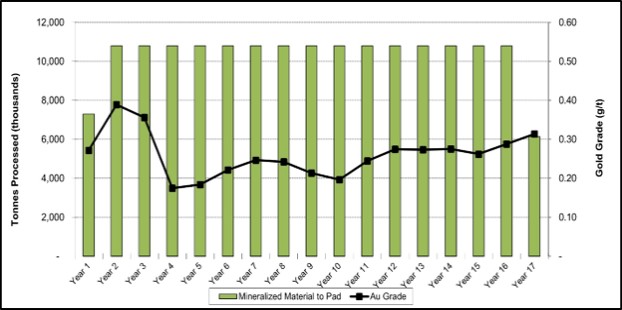
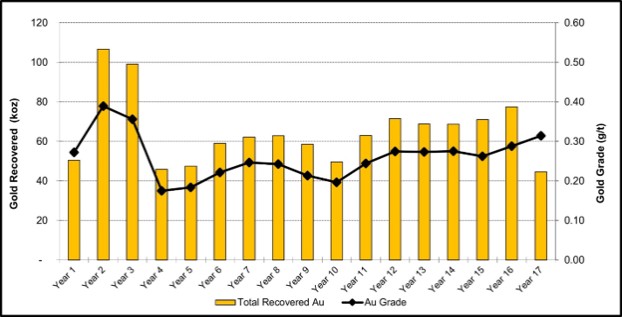
The Project, as currently designed, has variations in the mining and processing amounts over its planned 17-year life. These variations are shown in Figure 1-1, Figure 1-2, and Figure 1-3.
| 1-12 |
|
| Paramount Gold Nevada Corp. | Sleeper Gold Mine S-K 1300 Technical Report Summary |
June 17, 2026 SLR Project No.: 123.020721.00001 |
Figure 1-1: Mine Production Profile by Material Movement – Base Case
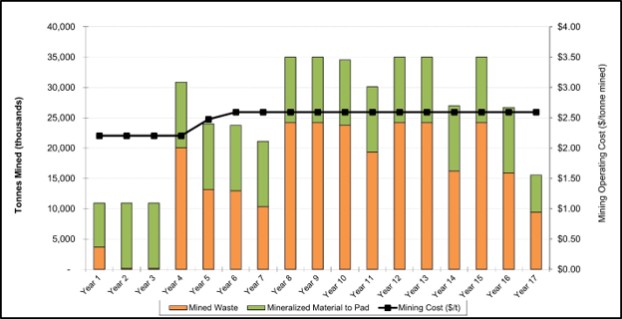
Figure 1-2: Process Production Profile and Head Grade – Base Case
| 1-13 |
|
| Paramount Gold Nevada Corp. | Sleeper Gold Mine S-K 1300 Technical Report Summary |
June 17, 2026 SLR Project No.: 123.020721.00001 |
Figure 1-3: Annual Processing Gold Production and Head Grade Profile – Base Case
The economic analysis demonstrates that the Project’s Mineral Resources have reasonable prospects for economic extraction at the LOM net average realized prices of US$3,618/oz Au and US$48.70/oz Ag, and with long-term prices of US$3,600/oz Au and US$48.00/oz Ag, and that further advancement of Project studies is warranted.
A base discount rate of 8% has been applied in this TRS for the Project. This rate is considered reasonable for evaluating a precious metals project at a preliminary level of project definition, such as Sleeper. Discounted present values of annual cash flows are summed to arrive at the Mine’s Base Case NPV.
Considering the Project’s Base Case on a stand-alone basis, the Project’s pre-tax NPV at an 8% discount rate is approximately US$505 million, and the pre-tax internal rate of return (IRR) is approximately 51.3%. The Project’s after-tax NPV at an 8% discount is approximately US$402 million, the after-tax IRR is approximately 44.5%, and the payback period is approximately 1.4 years from the start of production.
The LOM undiscounted pre-tax cash flow totals approximately US$1,132 million, and the LOM undiscounted after-tax cash flow totals approximately US$918 million.
SLR has also run a stand-alone economic analysis for the Project using flat resource metal prices of US$3,100/oz Au and US$34/oz Ag, and the analysis demonstrates that the Project’s Mineral Resources also have reasonable prospects for economic extraction at these prices.
The Project’s after-tax free cash flow profile and gold payable metal per year are presented in Figure 1-4.
| 1-14 |
|
| Paramount Gold Nevada Corp. | Sleeper Gold Mine S-K 1300 Technical Report Summary |
June 17, 2026 SLR Project No.: 123.020721.00001 |
Figure 1-4: Base Case Project After-Tax Metrics Summary
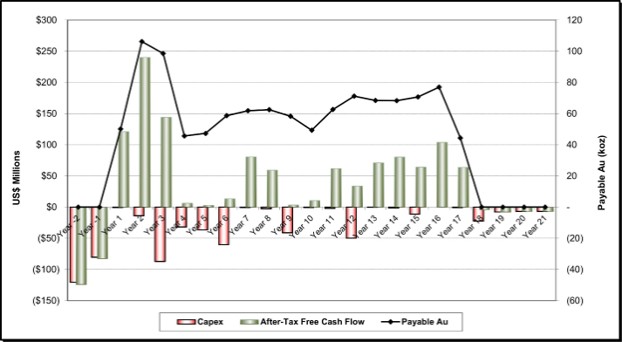
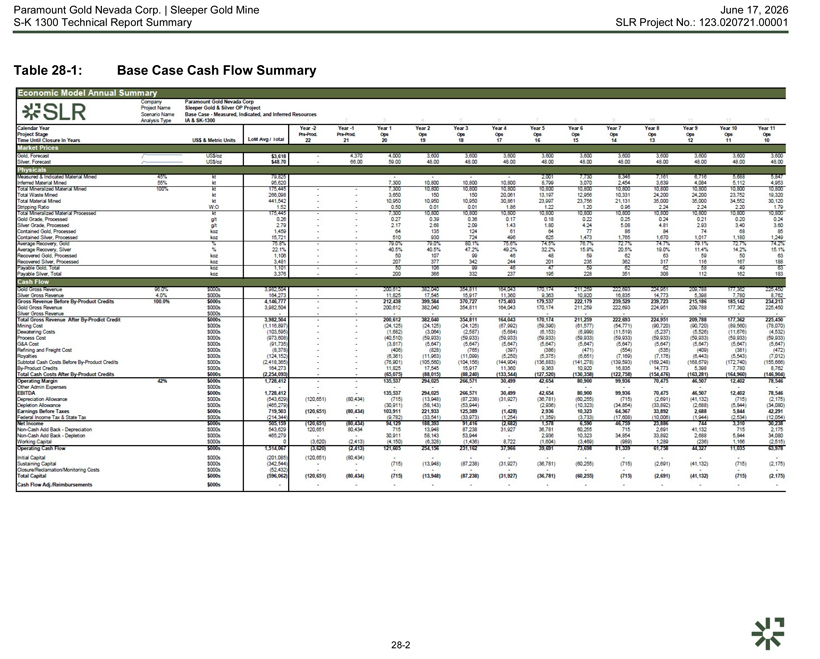
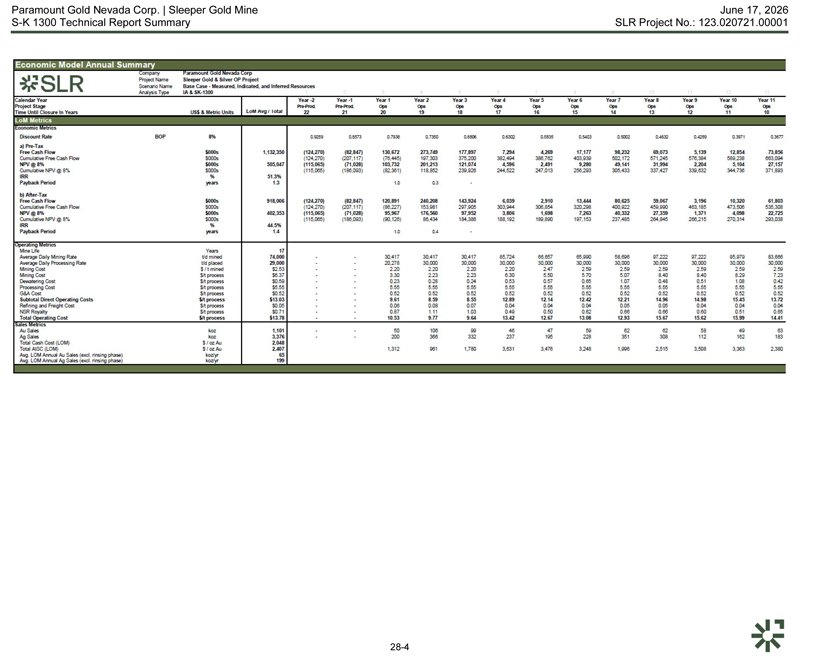
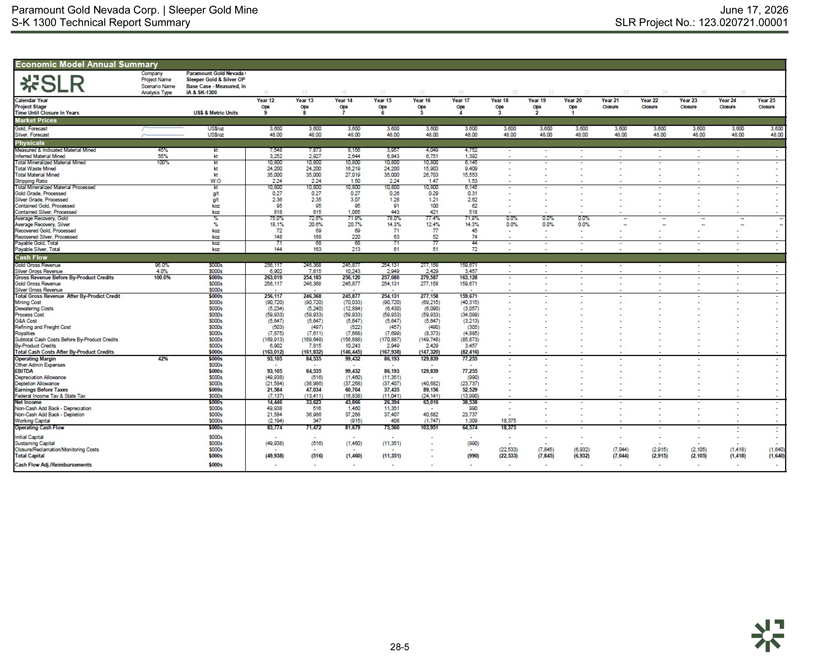
Table 1-5 shows the LOM total metrics for the Sleeper mine as currently designed. Due to the length of the mine life, the full annual cash flow model is presented in Appendix 2.
Table 1-5: Total Life of Mine Metrics – Base Case
| Item |
Units |
Base Case Values |
||||
| Realized Market Prices |
| |||||
| Au Price |
US$/oz | $ | 3,618 | |||
| Ag Price |
US$/oz | $ | 48.70 | |||
| Payable Gold |
koz | 1,101 | ||||
| Payable Silver |
koz | 3,376 | ||||
|
|
|
|||||
| Total Gross Revenue |
US$ million | 4,147 | ||||
|
|
|
|||||
| Mining Cost |
US$ million | (1,117 | ) | |||
| Dewatering Costs |
US$ million | (104 | ) | |||
| Process Cost |
US$ million | (974 | ) | |||
| G & A Cost |
US$ million | (92 | ) | |||
| Refining/Freight |
US$ million | (8 | ) | |||
| Royalties |
US$ million | (124 | ) | |||
|
|
|
|||||
| Total Operating Costs |
US$ million | (2,418 | ) | |||
|
|
|
|||||
| Operating Margin (EBITDA) |
US$ million | 1,728 | ||||
| Federal Income Tax |
US$ million | (134 | ) | |||
| 1-15 |
|
| Paramount Gold Nevada Corp. | Sleeper Gold Mine S-K 1300 Technical Report Summary |
June 17, 2026 SLR Project No.: 123.020721.00001 |
| Item |
Units | Base Case Values | ||||||
| State Tax - Nevada Mining Tax |
US$ | million | (80 | ) | ||||
| Working Capital |
US$ | million | 0 | |||||
| Operating Cash Flow |
US$ | million | 1,514 | |||||
| Development (Initial) Capital |
US$ | million | (201 | ) | ||||
| Sustaining Capital |
US$ | million | (343 | ) | ||||
| Closure/Reclamation Capital |
US$ | million | (52 | ) | ||||
|
|
|
|||||||
| Total Capital |
US$ | million | (596 | ) | ||||
|
|
|
|||||||
| Pre-tax Free Cash Flow |
US$ | million | 1,132 | |||||
| Pre-tax NPV @ 5% |
US$ | million | 670 | |||||
| Pre-tax NPV @ 8% |
US$ | million | 505 | |||||
| Pre-Tax IRR |
% | 51.3 | % | |||||
| Pre-Tax Payback |
years | 1.3 | ||||||
| After-tax Free Cash Flow |
US$ | million | 918 | |||||
| After-tax NPV @ 5% |
US$ | million | 539 | |||||
| After-tax NPV @ 8% |
US$ | million | 402 | |||||
| After-Tax IRR |
% | 44.5 | % | |||||
| After-Tax Payback |
years | 1.4 | ||||||
Note: Numbers may not add due to rounding.
The Project’s World Gold Council Adjusted Operating Cost (AOC) net of Ag by-product credits is US$2,048/oz Au payable. The mine life sustaining capital costs are US$359/oz Au payable, for an All-in Sustaining Cost (AISC) net of Ag by-products credits of US$2,407/oz Au payable.
The average annual gold sales during operations are approximately 64,746 payable ounces. Table 1-6 shows the AISC build-up.
Table 1-6: Base Case All-in Sustaining Costs Composition
| Item |
Total LOM ($ million) |
Unit Cost ($/oz Au) |
||||||
| Mining |
1,117 | 1,015 | ||||||
| Dewatering |
104 | 94 | ||||||
| Process |
974 | 885 | ||||||
| Site G&A |
92 | 83 | ||||||
|
|
|
|
|
|||||
| Subtotal Site Costs |
2,286 | 2,077 | ||||||
|
|
|
|
|
|||||
| Refining/Freight |
8 | 8 | ||||||
| Mining Royalties |
124 | 113 | ||||||
| 1-16 |
|
| Paramount Gold Nevada Corp. | Sleeper Gold Mine S-K 1300 Technical Report Summary |
June 17, 2026 SLR Project No.: 123.020721.00001 |
| Item |
Total LOM ($ million) |
Unit Cost ($/oz Au) |
||||||
| Total Cash Costs before by-product credits |
2,418 | 2,197 | ||||||
|
|
|
|
|
|||||
| Ag By-Product Credit |
(164 | ) | (149 | ) | ||||
| Total Cash Costs net of by-product credits |
2,254 | 2,048 | ||||||
|
|
|
|
|
|||||
| Sustaining Capital Cost |
343 | 311 | ||||||
| Closure/Reclamation Costs |
52 | 48 | ||||||
| Total Sustaining Costs |
395 | 359 | ||||||
|
|
|
|
|
|||||
| Total All-in Sustaining Costs |
2,649 | 2,407 | ||||||
|
|
|
|
|
|||||
Note: Numbers may not add due to rounding.
The AISC calculated in the cash flow analysis reflects the benefit of low-cost ounces already stacked on the heap leach pads, compared to AISC estimated in a steady-state model that assumes current input costs. Much of Sleeper’s near-term production comes from material mined and placed in prior years, when gold prices, fuel, and consumable costs were lower. These ounces require minimal additional spending to recover, resulting in lower realized cash costs. As these legacy ounces are depleted and replaced with newly mined material, unit costs are expected to gradually normalize toward long-term levels.
| 1.2.1.3 | Sensitivity Analysis |
The Project’s Base Case risks can be identified in both economic and non-economic terms. Key economic risks were examined by running cash flow sensitivities:
| • | Metal prices |
| • | Head grade |
| • | Metallurgical Recovery |
| • | Operating costs |
| • | Pre-production and sustaining capital costs |
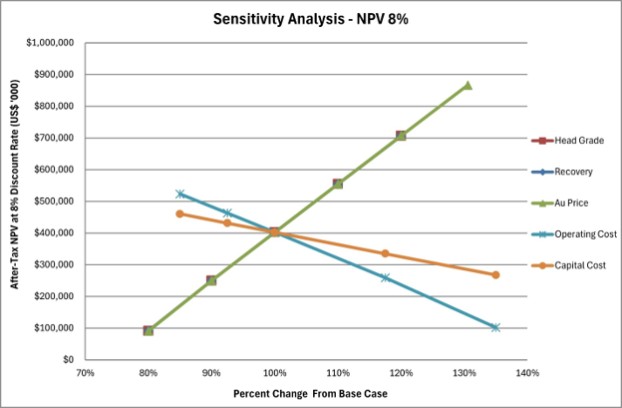
Where possible, the after-tax NPV 8% sensitivities relative to the Base Case have been calculated for -20% to +20% variations in head grade and recovery, and -20% to +30% in metal prices. Operating and capital cost sensitivities have been calculated at -15% to +35% variations. The sensitivities are shown in Table 1-7 and Figure 1-5.
Table 1-7: Base Case After-Tax Sensitivity Analyses
| Variance |
Head Grade (g/t Au) |
NPV at 8% (US$ 000) |
||||||
| 80% |
0.21 | 91,329 | ||||||
| 90% |
0.23 | 249,814 | ||||||
| 100% |
0.26 | 402,353 | ||||||
| 110% |
0.28 | 554,310 | ||||||
| 120% |
0.31 | 706,171 | ||||||
| 1-17 |
|
| Paramount Gold Nevada Corp. | Sleeper Gold Mine S-K 1300 Technical Report Summary |
June 17, 2026 SLR Project No.: 123.020721.00001 |
| Variance |
Recovery (% Au) |
NPV at 8% (US$ 000) |
||||||
| 80% |
60.7 | % | 91,329 | |||||
| 90% |
68.2 | % | 249,814 | |||||
| 100% |
75.8 | % | 402,353 | |||||
| 110% |
83.4 | % | 554,310 | |||||
| 120% |
91.0 | % | 706,171 | |||||
| Variance |
Metal Prices (US$/oz Au) |
NPV at 8% (US$ 000) |
||||||
| 80% |
$ | 2,880 | 90,637 | |||||
| 90% |
$ | 3,240 | 249,505 | |||||
| 100% |
$ | 3,600 | 402,353 | |||||
| 110% |
$ | 3,960 | 554,614 | |||||
| 131% |
$ | 4,700 | 866,553 | |||||
| Variance |
Operating Costs (US$/t) |
NPV at 8% (US$ 000) |
||||||
| 85% |
$ | 11.07 | 523,205 | |||||
| 93% |
$ | 12.05 | 462,780 | |||||
| 100% |
$ | 13.03 | 402,353 | |||||
| 118% |
$ | 15.31 | 259,020 | |||||
| 135% |
$ | 17.59 | 102,091 | |||||
| Variance |
Capital Costs (US$ 000) |
NPV at 8% (US$ 000) |
||||||
| 85% |
$ | 506,652 | 460,155 | |||||
| 93% |
$ | 551,357 | 431,254 | |||||
| 100% |
$ | 596,062 | 402,353 | |||||
| 118% |
$ | 700,372 | 334,916 | |||||
| 135% |
$ | 804,683 | 267,480 | |||||
| 1-18 |
|
| Paramount Gold Nevada Corp. | Sleeper Gold Mine S-K 1300 Technical Report Summary |
June 17, 2026 SLR Project No.: 123.020721.00001 |
Figure 1-5: Base Case After-Tax Sensitivity Analysis
| 1.2.2 | Alternative Case - Measured and Indicated Only |
| 1.2.2.1 | Economic Criteria |
The Alternative Case assumes a production schedule based exclusively on Measured and Indicated Mineral Resources, resulting in a mineralized material inventory of 62.4 Mt and a projected mine life of seven years. A summary of the Measured and Indicated Only Case criteria is provided below.
| 1.2.2.1.1 | Revenue |
| • | Mine life: 7 years. |
| • | 30,000 tpd mineralized material stacked (approximately 10.8 Mt per year), average stacked grade of 0.27 g/t Au and silver grade of 3.83 g/t Ag (ROM, crushed, and stockpile mine plan). |
| • | Mine life averages 58,500 ounces per year of gold recovered and 200,000 ounces per year of silver recovered from the mine plan, with LOM stacked process gold recovery averaging 74.3% and silver recovery averaging 18.1%. |
| • | Total 410 koz of gold recovered, and 1,396 koz of silver recovered over the LOM operation. |
| • | Gold and silver payable at the refinery are assumed at 99.95% Au payable and 97% Ag payable |
| 1-19 |
|
| Paramount Gold Nevada Corp. | Sleeper Gold Mine S-K 1300 Technical Report Summary |
June 17, 2026 SLR Project No.: 123.020721.00001 |
| • | Gold and silver prices are based on analyst consensus price forecasts from the end of March 2026. For the economic analysis was assumed: |
| • | Y1: US$4,000/oz Au and US$59.00/oz Ag |
| • | Y2 to Y7: US$3,600/oz Au and US$48.00/oz Ag |
| • | Resulting in LOM net realized prices of:US$3,622/oz Au and US$48.00/oz Ag |
| • | Net Smelter Return (NSR) includes doré refining, transport, and insurance costs. |
| • | NSR royalty assumed at 3%. The property is subject to different royalties between 0.5% and 3%, and for modeling purposes was assumed at an overall 3% |
| • | Revenue is recognized at the time of gold and silver production. |
| • | Non-cash inventory adjustments are not included in the SLR cash flow model. |
| • | LOM net revenue is US$1,493 million (after royalty, and transportation, and refining charges). |
Table 1-8: Sleeper Alternative Case Production Physicals Summary
| Physicals |
Value | |||
| Total Mineralized Material Stacked (kt) |
62,447 | |||
| Max Process Rate (tpd) |
30,000 | |||
| Au Head Grade (g/t) |
0.27 | |||
| Ag Head Grade (g/t) |
3.83 | |||
| Contained Au (koz) |
552 | |||
| Contained Ag (koz) |
7,697 | |||
| Average Recovery, Au |
74.3 | % | ||
| Average Recovery, Ag |
18.1 | % | ||
| Recovered Au (koz) |
410 | |||
| Recovered Ag (koz |
1,396 | |||
| Payable Au (koz) |
408 | |||
| Payable Ag (koz) |
1,354 | |||
| Avg Annual Au Sales - LOM (koz / yr) – full production |
64 | |||
| Avg Annual Ag Sales - LOM (koz / yr) – Full production |
218 | |||
| 1.2.2.1.2 | Costs |
| • | Pre-production period: assumes at 24 months (Year -1 to Year -2). |
| • | Initial (Growth) and development capital costs total US$335 million.1 |
| • | Mine life sustaining capital totals US$120 million |
| 1 | Note that, in the Alternative Case, only in situ Measured and Indicated Mineral Resources are included in the mining inventory. The existing waste dumps are not included in the LOM plan for the Alternative Case because they are currently classified as Inferred Mineral Resources. As dewatering of the in situ Mineral Resources must start before mining, the rapid infiltration basins cost and the dewatering costs are Initial Capital Costs for the Alternative Case rather than Sustaining Capital as in the Base Case. |
| 1-20 |
|
| Paramount Gold Nevada Corp. | Sleeper Gold Mine S-K 1300 Technical Report Summary |
June 17, 2026 SLR Project No.: 123.020721.00001 |
| • | Final reclamation costs from after year 7 total US$18.7 million. |
| • | Mine life capital totals US$473 million. |
| • | Average LOM operating cost is US$11.87 per tonne stacked. |
| • | Open pit operating costs of US$2.59 per tonne mined (US$5.03 per tonne stacked). Includes out-of-scope mining operations. |
| • | Dewatering operating costs of US$0.73 per tonne stacked. |
| • | Processing operating costs of US$5.55 per tonne stacked. |
| • | Site services & general and administrative (G&A) costs of US$5.6 million per year for years of full production (LOM average of US$0.56 per tonne stacked). |
| 1.2.2.1.3 | Taxation and Royalties |
The federal and state income taxes are summarized in Table 1-9.
Table 1-9: Federal and State Tax Summary
| Tax Type |
Rate | |
| Federal Corporate Income Tax | 21.0% | |
| Nevada Corporate Income Tax | 5.0% of federal taxable income | |
| Royalties and Severance Fees | Based on ore extracted (state-regulated). |
A total of five NSR royalties apply to future mineral production from portions of the Project. These royalties are summarized in Table 1-10.
Table 1-10: Royalties Summary
| Royalty Holder |
Royalty Terms | |
| Snyder Syndicate | 1% NSR on the 1,044 Sleeper Gold Mine claims (All claims, EXCEPT for ALL MIMI, ALL SP, AL SS, AND ALL BLUE.) | |
| Franco-Nevada U.S. Corporation | 2% NSR on minerals produced from all 2,474 claims | |
| Evolving Gold / Quinton Hennigh | 2% NSR royalty on all SS and all SP claims. | |
| Dry Lake Placer Association | 3% NSR on Dry Lake Placer claims | |
| ICN Resources Ltd. | 0.5% NSR on all SS and all SP claims; 1.5% NSR on all Blue claims |
For the economic analysis and financial modeling purposes, an overall 3% NSR royalty rate was assumed over the LOM.
| 1.2.2.2 | Cash Flow Analysis |
SLR has prepared its own unlevered after-tax LOM cash flow model based on the information contained in this TRS to confirm the physical and economic parameters of the Project.
The Project’s Alternative Case economics have been evaluated using the discounted cash flow method, considering annual processed tonnages and the associated gold and silver grades. The process gold and silver recoveries, gold and silver price forecasts, operating costs, refining and transportation charges, royalties, and initial and sustaining capital expenditures were also considered.
| 1-21 |
|
| Paramount Gold Nevada Corp. | Sleeper Gold Mine S-K 1300 Technical Report Summary |
June 17, 2026 SLR Project No.: 123.020721.00001 |
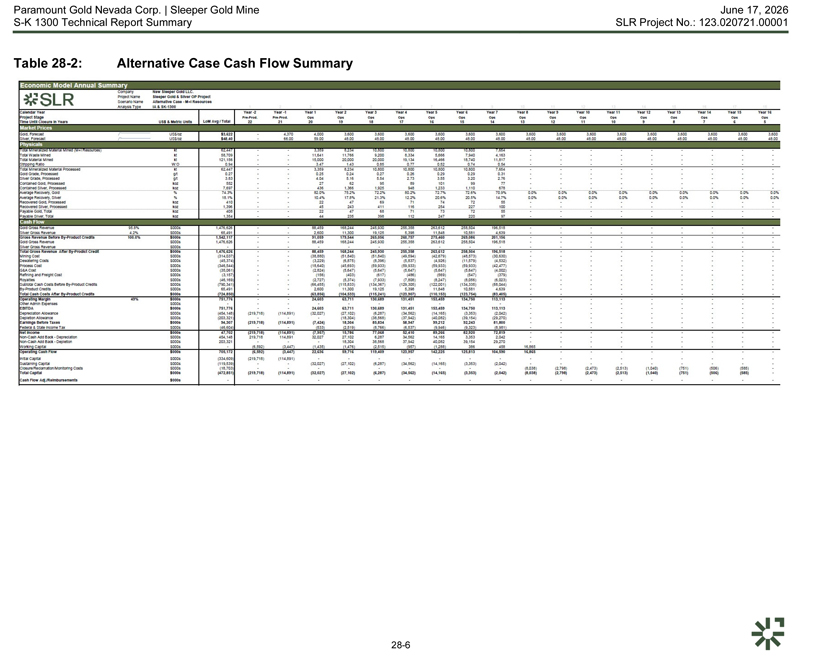
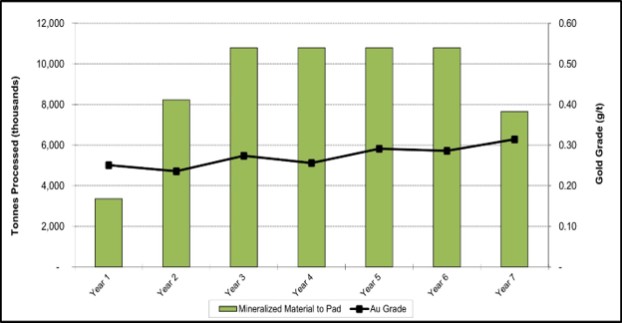
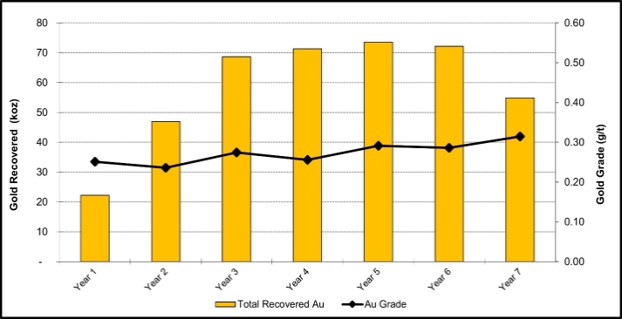
The Project, as currently designed, has variations in the mining and processing amounts over its planned 7-year life. These variations are shown in Figure 1-6, Figure 1-7, and Figure 1-8.
Figure 1-6: Mine Production Profile by Material Movement – Alternative Case
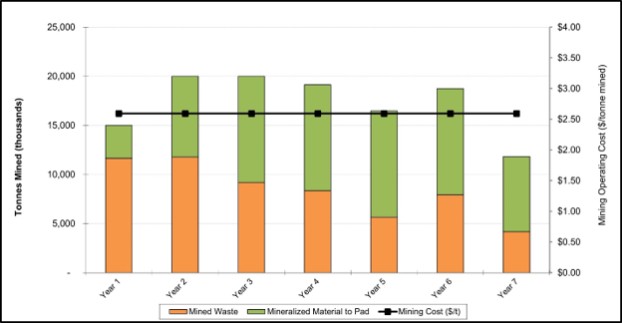
Figure 1-7: Process Production Profile and Head Grade – Alternative Case
| 1-22 |
|
| Paramount Gold Nevada Corp. | Sleeper Gold Mine S-K 1300 Technical Report Summary |
June 17, 2026 SLR Project No.: 123.020721.00001 |
Figure 1-8: Annual Processing Gold Production and Head Grade Profile
The economic analysis demonstrates that the Project’s Mineral Resources have reasonable prospects for economic extraction, at the LOM net average realized prices of US$3,622/oz Au and US$48.40/oz Ag, with long-term prices of US$3,600/oz Au and US$48.00/oz Ag, and that further advancement of Project studies is warranted.
A base discount rate of 8% has been applied in this TRS for the Project. This rate is considered reasonable for evaluating a precious metals project at a preliminary level of project definition, such as Sleeper. Discounted present values of annual cash flows are summed to arrive at the Mine’s Base Case NPV.
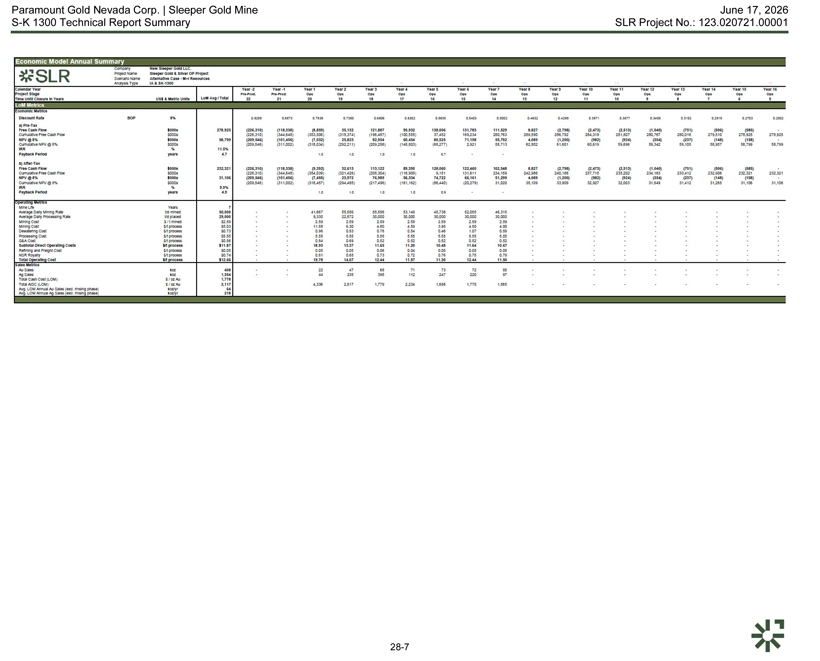
Considering the Project’s Alternative Case on a stand-alone basis, the Project’s pre-tax NPV at an 8% discount rate is approximately US$59 million, and the pre-tax internal rate of return (IRR) is approximately 11.5%. The Project’s after-tax NPV at an 8% discount is approximately US$31 million, the after-tax IRR is approximately 9.9%, and the payback period is approximately 4.9 years from the start of production.
The LOM undiscounted pre-tax cash flow totals approximately US$279 million, and the LOM undiscounted after-tax cash flow totals approximately US$232 million.
The Project’s after-tax free cash flow profile and gold payable metal per year are presented in Figure 1-9.
| 1-23 |
|
| Paramount Gold Nevada Corp. | Sleeper Gold Mine S-K 1300 Technical Report Summary |
June 17, 2026 SLR Project No.: 123.020721.00001 |
Figure 1-9: Alternative Case Project After-Tax Metrics Summary
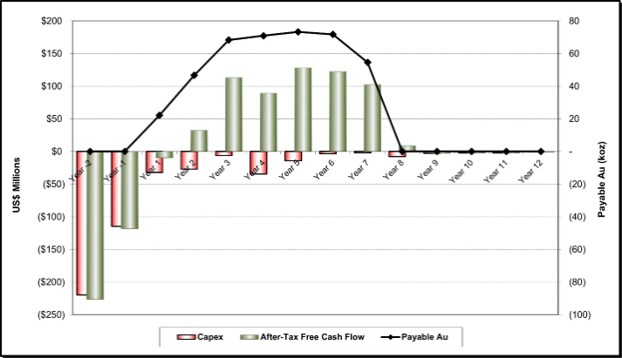
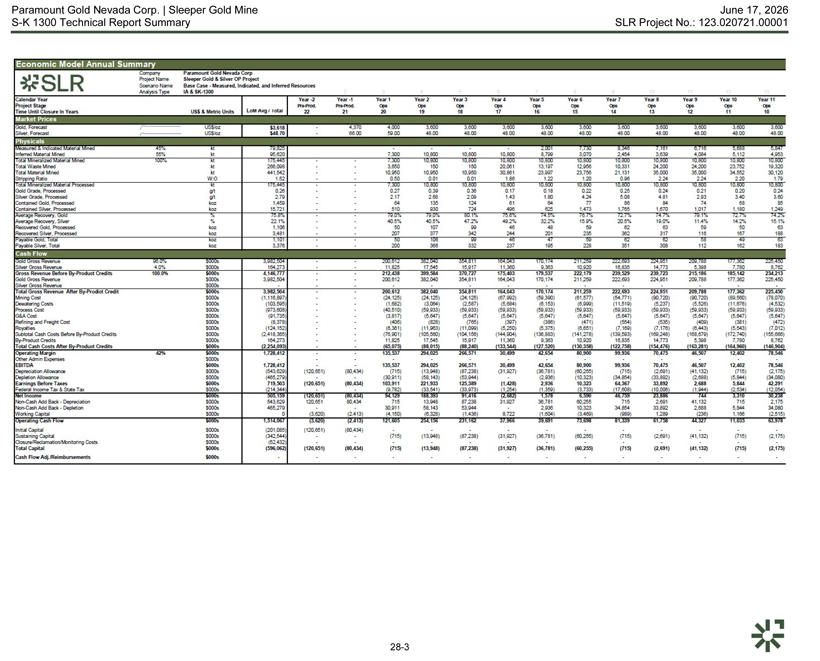
Table 1-11 shows the LOM total metrics for the Project’s Alternative Case. The full annual cash flow model is presented in Appendix 2.
Table 1-11: Total Life of Mine Metrics – Alternative Case (Measured and Indicated Only)
| Item |
Units |
Base Case Values |
||||
| Realized Market Prices |
| |||||
| Au Price |
US$/oz | $ | 3,622 | |||
| Ag Price |
US$/oz | $ | 48.40 | |||
| Payable Gold |
koz | 408 | ||||
| Payable Silver |
koz | 1,354 | ||||
|
|
|
|||||
| Total Gross Revenue |
US$ million | 1,542 | ||||
|
|
|
|||||
| Mining Cost |
US$ million | (314 | ) | |||
| Dewatering Costs |
US$ million | (45 | ) | |||
| Process Cost |
US$ million | (347 | ) | |||
| G & A Cost |
US$ million | (35 | ) | |||
| Refining/Freight |
US$ million | (3 | ) | |||
| Royalties |
US$ million | (46 | ) | |||
|
|
|
|||||
| Total Operating Costs |
US$ million | (790 | ) | |||
|
|
|
|||||
| Operating Margin (EBITDA) |
US$ million | 752 | ||||
| Federal Income Tax |
US$ million | (12 | ) | |||
| 1-24 |
|
| Paramount Gold Nevada Corp. | Sleeper Gold Mine S-K 1300 Technical Report Summary |
June 17, 2026 SLR Project No.: 123.020721.00001 |
| Item |
Units |
Base Case Values |
||||
| State Tax - Nevada Mining Tax |
US$ million | (34 | ) | |||
| Working Capital |
US$ million | 0 | ||||
| Operating Cash Flow |
US$ million | 705 | ||||
| Development (Initial) Capital |
US$ million | (335 | ) | |||
| Sustaining Capital |
US$ million | (120 | ) | |||
| Closure/Reclamation Capital |
US$ million | (19 | ) | |||
|
|
|
|||||
| Total Capital |
US$ million | (473 | ) | |||
|
|
|
|||||
| Pre-tax Free Cash Flow |
US$ million | 279 | ||||
| Pre-tax NPV @ 5% |
US$ million | 124 | ||||
| Pre-tax NPV @ 8% |
US$ million | 59 | ||||
| Pre-Tax IRR |
% | 11.5 | % | |||
| Pre-Tax Payback |
years | 4.7 | ||||
| After-tax Free Cash Flow |
US$ million | 232 | ||||
| After-tax NPV @ 5% |
US$ million | 91 | ||||
| After-tax NPV @ 8% |
US$ million | 31 | ||||
| After-Tax IRR |
% | 9.9 | % | |||
| After-Tax Payback |
years | 4.9 | ||||
Note:Numbers may not add due to rounding.
The Project’s World Gold Council Adjusted Operating Cost (AOC) net of Ag by-product credits is US$1,778/oz Au payable. The mine life sustaining capital costs are US$339/oz Au payable, for an All-in Sustaining Cost (AISC) net of Ag by-products credits of US$2,117/oz Au payable.
The average annual gold sales during operations are approximately 64,267 payable ounces. Table 1-12 shows the AISC build-up.
Table 1-12: Alternative Case All-in Sustaining Costs Composition
| Item |
Total LOM |
Unit Cost |
||||||
| Mining |
314 | 770 | ||||||
| Dewatering |
45 | 111 | ||||||
| Process |
347 | 850 | ||||||
| Site G&A |
35 | 86 | ||||||
|
|
|
|
|
|||||
| Subtotal Site Costs |
741 | 1,817 | ||||||
|
|
|
|
|
|||||
| Refining/Freight |
3 | 8 | ||||||
| 1-25 |
|
| Paramount Gold Nevada Corp. | Sleeper Gold Mine S-K 1300 Technical Report Summary |
June 17, 2026 SLR Project No.: 123.020721.00001 |
| Item |
Total LOM |
Unit Cost |
||||||
| Mining Royalties |
46 | 113 | ||||||
| Total Cash Costs before by-product credits |
790 | 1,938 | ||||||
|
|
|
|
|
|||||
| Ag By-Product Credit |
(65 | ) | (161 | ) | ||||
| Total Cash Costs net of by-product credits |
725 | 1,778 | ||||||
|
|
|
|
|
|||||
| Sustaining Capital Cost |
120 | 293 | ||||||
| Closure/Reclamation Costs |
19 | 46 | ||||||
| Total Sustaining Costs |
138 | 339 | ||||||
|
|
|
|
|
|||||
| Total All-in Sustaining Costs |
863 | 2,117 | ||||||
|
|
|
|
|
|||||
Note: Numbers may not add due to rounding.
| 1.2.2.3 | Sensitivity Analysis |
The project’s Alternative Case risks can be identified in both economic and non-economic terms. Key economic risks were examined by running cash flow sensitivities:
| • | Metal prices |
| • | Head grade |
| • | Metallurgical Recovery |
| • | Operating costs |
| • | Pre-production and sustaining capital costs |
Where possible, the after-tax NPV 8% sensitivities relative to the Alternative Case have been calculated for -20% to +20% variations in head grade and recovery, and -20% to +30% in metal prices. Operating and capital cost sensitivities have been calculated at -15% to +35% variations. The sensitivities are shown in Table 1-13 and Figure 19-10.
| 1-26 |
|
| Paramount Gold Nevada Corp. | Sleeper Gold Mine S-K 1300 Technical Report Summary |
June 17, 2026 SLR Project No.: 123.020721.00001 |
Table 1-13: Alternative Case After-Tax Sensitivity Analyses
| Variance |
Head Grade (g/t Au) |
NPV at 8% (US$000) |
||||||
| 80% |
0.22 | (140,512 | ) | |||||
| 90% |
0.25 | (54,187 | ) | |||||
| 100% |
0.27 | 31,106 | ||||||
| 110% |
0.30 | 106,275 | ||||||
| 120% |
0.33 | 180,559 | ||||||
| Variance |
Recovery (% Au) |
NPV at 8% (US$000) |
||||||
| 80% |
59.4 | % | (140,512 | ) | ||||
| 90% |
66.9 | % | (54,187 | ) | ||||
| 100% |
74.3 | % | 31,106 | |||||
| 110% |
81.7 | % | 106,275 | |||||
| 120% |
89.2 | % | 180,559 | |||||
| Variance |
Metal Prices (US$/oz Au) |
NPV at 8% (US$000) |
||||||
| 80% |
$ | 2,880 | (140,868 | ) | ||||
| 90% |
$ | 3,240 | (54,363 | ) | ||||
| 100% |
$ | 3,600 | 31,106 | |||||
| 110% |
$ | 3,960 | 106,424 | |||||
| 131% |
$ | 4,700 | 258,552 | |||||
| Variance |
Operating Costs (US$/t) |
NPV at 8% (US$000) |
||||||
| 85% |
$ | 10.09 | 87,662 | |||||
| 93% |
$ | 10.98 | 59,481 | |||||
| 100% |
$ | 11.87 | 31,106 | |||||
| 118% |
$ | 13.94 | (44,879 | ) | ||||
| 135% |
$ | 16.02 | (122,212 | ) | ||||
| Variance |
Capital Costs (US$000) |
NPV at 8% (US$000) |
||||||
| 85% |
$ | 401,924 | 90,847 | |||||
| 93% |
$ | 437,387 | 60,977 | |||||
| 100% |
$ | 472,851 | 31,106 | |||||
| 118% |
$ | 555,600 | (38,591 | ) | ||||
| 135% |
$ | 638,349 | (108,288 | ) | ||||
| 1-27 |
|
| Paramount Gold Nevada Corp. | Sleeper Gold Mine S-K 1300 Technical Report Summary |
June 17, 2026 SLR Project No.: 123.020721.00001 |
Figure 1-10: Alternative Case After-Tax Sensitivity Analysis
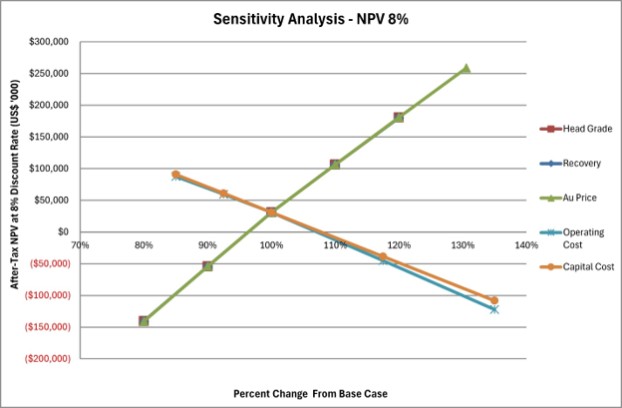
| 1.3 | Technical Summary |
| 1.3.1 | Property Description |
The Sleeper Gold Mine is in Humboldt County in north-central Nevada, approximately 42 km (26 mi) northwest of the city of Winnemucca, Nevada. The Project is situated within Desert Valley along the western flank of the Slumbering Hills within the Basin and Range physiographic province. The property includes the historical Sleeper open pit, associated waste rock storage facilities, former process plant areas, and surrounding exploration targets.
The Project is being evaluated as a restart operation focused on processing of existing waste rock dumps and mining of in situ oxide and mixed mineralized material within and adjacent to the historical pit. These materials are considered suitable for heap leach processing with Merrill-Crowe recovery.
| 1.3.2 | Land Tenure |
The Sleeper property consists of a block of unpatented lode mining claims, together with associated surface rights covering portions of Townships 36 through 40 North and Ranges 34 and 35 East, Mount Diablo Base and Meridian, Humboldt County, Nevada.
The property comprises approximately 2,474 unpatented mining claims, approximately 18,178 hectares (44,917 acres). The claims are held by Paramount Gold Nevada Corp (Paramount Gold). through its wholly owned subsidiaries of Sleeper Mining Company LLC and South
| 1-28 |
|
| Paramount Gold Nevada Corp. | Sleeper Gold Mine S-K 1300 Technical Report Summary |
June 17, 2026 SLR Project No.: 123.020721.00001 |
Sleeper Mining Company LLC. All claims are in good standing with the U.S. Bureau of Land Management and Humboldt County as of the date of this report.
| 1.3.3 | History |
The Sleeper deposit was discovered in the early 1980s and subsequently developed by AMAX Gold Inc. Mining operations commenced in 1986 and continued through 1996.
During this period, the Sleeper mine produced approximately 1.66 million ounces of gold and approximately 2.3 million ounces of silver from the open pit mining operations. Ore was processed through both conventional milling and heap leach processing circuits. Following the closure of mining operations in 1996, the site underwent reclamation activities; however, substantial volumes of mineralized material remain within existing waste rock dumps and oxide mineralized zones adjacent to the pit.
Subsequent exploration and technical studies conducted by Paramount Gold and previous operators have identified the potential to reprocess historical surface materials and recover additional gold from remaining oxide and mixed mineralization.
| 1.3.4 | Geological Setting, Mineralization, and Deposit |
The Sleeper deposit is a low-sulfidation epithermal gold-silver system hosted within Miocene volcanic rocks typical of the northern Nevada volcanic field. Mineralization occurs within a sequence of rhyolitic flows, volcanic breccias, and ash-flow tuffs that have been affected by hydrothermal alteration and silicification.
Gold mineralization occurs as disseminated and fracture-controlled mineralization associated with hydrothermal brecciation, silicification, and quartz-adularia veining. Near-surface oxidation of sulfide minerals has produced oxide and mixed mineralization amenable to cyanide heap-leach processing.
| 1.3.5 | Exploration |
Exploration activities at the Sleeper property have included geological mapping, geochemical sampling, geophysical surveys, and diamond and reverse circulation drilling. Since mine closure, exploration has focused on delineating oxide and mixed mineralization and on evaluating the gold content of existing waste rock dump, heap leach pads, and tailings. Drilling has identified gold mineralization in oxide and mixed zones, and sampling of existing waste rock dumps indicates that portions of this material contain measurable gold.
| 1.3.6 | Mineral Resource Estimates |
The Mineral Resource estimate for the Sleeper Gold Mine (Table 1-14) was developed using a three-dimensional block modeling approach incorporating validated drilling data, geological and oxidation domain modeling, compositing, grade capping, and domain-controlled interpolation. The estimate has been independently reviewed by the SLR QP and is compliant with SEC Regulation S-K 1300 and prepared in accordance with CIM (2019) Best Practice Guidelines. Mineral Resources include both in situ mineralization constrained within an optimized open-pit shell demonstrating RRPEE and surface materials, including waste rock dumps, heap leach pads, and tailings storage facilities. The estimate is based on appropriate mining, processing, metallurgical, and economic assumptions and supersedes prior disclosures for the Project.
| 1-29 |
|
| Paramount Gold Nevada Corp. | Sleeper Gold Mine S-K 1300 Technical Report Summary |
June 17, 2026 SLR Project No.: 123.020721.00001 |
Measured Mineral Resources total 5.5 Mt at 0.492 g/t Au and 3.487 g/t Ag, containing 0.09 Moz Au and 0.62 Moz Ag. Indicated Mineral Resources total 179.2 Mt at 0.330 g/t Au and 3.842 g/t Ag, containing 1.90 Moz Au and 22.1 Moz Ag. Measured and Indicated Mineral Resources combined total 184.7 Mt at 0.335 g/t Au and 3.832 g/t Ag, containing 1.99 Moz Au and 22.8 Moz Ag, with average metallurgical recoveries of approximately 70.0% for Au and 7.5% for Ag.
Inferred Mineral Resources total 238.0 Mt at 0.301 g/t Au and 3.403 g/t Ag, containing 2.30 Moz Au and 26.0 Moz Ag, including 89.7 Mt of surface materials (waste rock dumps, heap leach pads, and tailings storage facilities) at 0.327 g/t Au and 4.738 g/t Ag.
| 1-30 |
|
| Paramount Gold Nevada Corp. | Sleeper Gold Mine S-K 1300 Technical Report Summary |
June 17, 2026 SLR Project No.: 123.020721.00001 |
Table 1-14: Summary of Mineral Resources Estimate – April 29, 2026
| Category |
Tonnage (000 t) |
Grade (g/t Au) |
Grade (g/t Ag) |
Contained Metal (000 oz Au) |
Contained Metal (000 oz Ag) |
Metallurgical Au Recovery (%) |
Metallurgical Ag Recovery (%) |
|||||||||||||||||||||
| Measured Oxide/Mixed Pit (non-sulfide) |
2,004 | 0.293 | 3.019 | 19 | 195 | 75.2 | % | 17.1 | % | |||||||||||||||||||
| Measured Oxide/Mixed Pit (sulfide) |
178 | 0.316 | 4.307 | 2 | 25 | 70.6 | % | 0.0 | % | |||||||||||||||||||
| Measured Sulfide Pit |
3,347 | 0.621 | 3.724 | 67 | 401 | 66.5 | % | 0.0 | % | |||||||||||||||||||
|
|
|
|
|
|
|
|
|
|
|
|
|
|
|
|||||||||||||||
| Total Measured In Situ |
5,528 | 0.492 | 3.487 | 88 | 620 | 69.8 | % | 6.2 | % | |||||||||||||||||||
|
|
|
|
|
|
|
|
|
|
|
|
|
|
|
|||||||||||||||
| Indicated Oxide/Mixed Pit (non-sulfide) |
77,899 | 0.261 | 3.613 | 653 | 9,049 | 74.2 | % | 17.3 | % | |||||||||||||||||||
| Indicated Oxide/Mixed Pit (sulfide) |
15,941 | 0.328 | 4.934 | 168 | 2,529 | 68.7 | % | 0.0 | % | |||||||||||||||||||
| Indicated Sulfide Pit |
85,336 | 0.393 | 3.848 | 1,078 | 10,558 | 66.5 | % | 0.0 | % | |||||||||||||||||||
| Total Indicated In Situ |
179,176 | 0.330 | 3.842 | 1,900 | 22,135 | 70.1 | % | 7.5 | % | |||||||||||||||||||
|
|
|
|
|
|
|
|
|
|
|
|
|
|
|
|||||||||||||||
| Total Measured + Indicated In Situ |
184,704 | 0.335 | 3.832 | 1,987 | 22,755 | 70.0 | % | 7.5 | % | |||||||||||||||||||
|
|
|
|
|
|
|
|
|
|
|
|
|
|
|
|||||||||||||||
| Inferred Dumps |
46,893 | 0.279 | 1.941 | 420 | 2,927 | 77.1 | % | 44.6 | % | |||||||||||||||||||
| Inferred Heap Leach |
31,600 | 0.301 | 8.363 | 306 | 8,497 | 40.0 | % | 0.0 | % | |||||||||||||||||||
| Inferred TSF |
11,165 | 0.599 | 6.221 | 215 | 2,233 | 50.1 | % | 0.0 | % | |||||||||||||||||||
|
|
|
|
|
|
|
|
|
|
|
|
|
|
|
|||||||||||||||
| Total Inferred Surface |
89,658 | 0.327 | 4.738 | 942 | 13,657 | 60.6 | % | 23.3 | % | |||||||||||||||||||
|
|
|
|
|
|
|
|
|
|
|
|
|
|
|
|||||||||||||||
| Inferred Oxide/Mixed Pit (non-sulfide) |
48,656 | 0.235 | 2.384 | 367 | 3,729 | 76.6 | % | 14.4 | % | |||||||||||||||||||
| Inferred Oxide/Mixed Pit (sulfide) |
4,960 | 0.286 | 3.543 | 46 | 565 | 68.9 | % | 0.0 | % | |||||||||||||||||||
| Inferred Sulfide Pit |
94,761 | 0.311 | 2.657 | 948 | 8,095 | 66.5 | % | 0.0 | % | |||||||||||||||||||
| Total Inferred In Situ |
148,377 | 0.285 | 2.597 | 1,361 | 12,390 | 69.9 | % | 4.7 | % | |||||||||||||||||||
|
|
|
|
|
|
|
|
|
|
|
|
|
|
|
|||||||||||||||
| Total Inferred Surface + In Situ |
238,035 | 0.301 | 3.403 | 2,303 | 26,047 | 97.9 | % | 8.8 | % | |||||||||||||||||||
|
|
|
|
|
|
|
|
|
|
|
|
|
|
|
|||||||||||||||
| 1-31 |
|
| Paramount Gold Nevada Corp. | Sleeper Gold Mine S-K 1300 Technical Report Summary |
June 17, 2026 SLR Project No.: 123.020721.00001 |
Notes:
| 1. | The definitions for Mineral Resources in S-K 1300 were followed for Mineral Resources |
| 2. | The Mineral Resource estimate is reported on a 100% ownership basis. |
| 3. | The point of reference for the Mineral Resource is before the crusher (in situ). |
| 4. | Open Pit Mineral Resources are reported at a cut-off grade ranging from 0.074 g/t to 0.217 g/t Au, depending on area and constrained by a preliminary optimized pit shell with a pit slope angle of 45° for rock and 22° for alluvium and a bench height of 10 m. |
| 5. | The optimized pit shell and cut-off grades were generated by assuming metallurgical gold recovery ranging from 63.7% to 85.0% and silver recoveries ranging from 0.0% to 54.6%, standard treatment and refining charges, mining costs of US$2.40/t moved for open pit, processing costs of $5.51/t oxide/mixed and $10.44 sulfide processed, and general and administrative costs of $0.46/t processed |
| 6. | Minimal mining width was 60 m for oxide/mixed material and 20 m for sulfide material |
| 7. | Mineral Resources are estimated using a long-term gold price of US$3,100 per ounce |
| 8. | Bulk density ranges from 1.5 t/m3 in the tailings storage area to 2.7 t/m3 for in situ material |
| 9. | Mineral Resources that are not Mineral Reserves do not have demonstrated economic viability. |
| 10. | Numbers may not add due to rounding. |
| 1-32 |
|
| Paramount Gold Nevada Corp. | Sleeper Gold Mine S-K 1300 Technical Report Summary |
June 17, 2026 SLR Project No.: 123.020721.00001 |
| 1.3.7 | Mineral Reserve Estimates |
There are no defined Mineral Reserves for the Sleeper Gold Mine as of the date of this TRS.
| 1.3.8 | Mining Methods |
Mining operations are planned as a conventional open pit operation using drill, blast, load, and haul methods on benches. Mining will be performed by a third-party mining contractor. The mining fleet is expected to consist of diesel-powered hydraulic excavators and/or front-end loaders, supported by haul trucks typical of modern open pit mining operations in Nevada. Mining activities will include both the rehandling of existing waste rock dump material and the extraction of in situ oxide and mixed mineralized material considered amenable to heap leaching and Merrill-Crowe recovery.
The Initial Assessment (IA) economic analysis considers only leachable mineralized material, including oxide and mixed material within the pit limits and existing waste rock dump material. Existing waste rock dump material is currently estimated at approximately 47 Mt grading approximately 0.28 g/t gold, while in situ oxide and mixed mineralized material totals approximately 129 Mt grading approximately 0.25 g/t gold. Sulfide mineralization, as well as material contained within the tailings storage facility (TSF) and heap leach pad (HLP), demonstrates RPEE; however, additional metallurgical testing, engineering studies, environmental review, and economic evaluation are required before these materials can be considered for inclusion in the IA economic analysis.
The Base Case mine plan considers Measured, Indicated, and Inferred Mineral Resources. Inferred Mineral Resources account for approximately 55% of the total mining inventory and are considered too speculative geologically to have the economic considerations applied to them that would enable them to be categorized as Mineral Reserves. There is no certainty that the results of the Base Case economic analysis will be realized.
An Alternative Case was also evaluated comprising Measured and Indicated Mineral Resources only, excluding all Inferred Mineral Resources from the mine plan and economic analysis.
| 1.3.9 | Processing and Recovery Methods |
Processing of mined material is planned using conventional crushing, agglomeration, and cyanide heap leach processing, followed by Merrill-Crowe zinc precipitation for recovery of gold and silver.
The conceptual processing rate for the operation is approximately 30,000 tpd. Heap leach processing will involve stacking crushed material on lined leach pads and applying cyanide solution to dissolve precious metals.
To date, metallurgical test work at Sleeper has included historical bottle roll and column leach testing on oxide, mixed, waste rock dump, and selected sulfide materials; flotation testing on sulfide and existing tailings composites; and later bio-oxidation, pressure oxidation, mineralogical, and comminution testing on selected refractory or sulfide-bearing materials. Overall, the work supports heap leach evaluation for oxide, mixed, and waste materials, and flotation-based evaluation for tailings, HLP, and sulfide materials.
For the oxide, mixed, and waste rock dump material groups included in the heap leach case, applied recoveries range from 65.0% Au to 83.9% Au and 8.1% Ag to 54.6% Ag. For the existing HLP and tailings, and sulfide material groups evaluated under the flotation and toll-milling case, applied gold recoveries range from 50.0% Au to 71.2% Au. No silver recovery is applied to the flotation case at this stage, and silver remains upside potential pending additional metallurgical and commercial evaluation.
| 1-33 |
|
| Paramount Gold Nevada Corp. | Sleeper Gold Mine S-K 1300 Technical Report Summary |
June 17, 2026 SLR Project No.: 123.020721.00001 |
For oxide, mixed, and waste rock dump material within the Measured and Indicated Resource categories, estimated recoveries of approximately 70% Au and 7.5% Ag were applied.
| 1.3.10 | Infrastructure |
Existing infrastructure at the Sleeper property includes exploration offices, equipment maintenance shops, water management ponds, monitoring wells, and a network of access roads constructed during historical mining operations.
Electrical power is available via an existing 120-kV transmission line serving the region. Water supply for operations will be sourced from groundwater within the Desert Valley hydrographic basin under existing water rights.
| 1.3.11 | Market Studies |
Gold and silver produced from the proposed operation would be recovered as doré bars through the Merrill-Crowe process and transported to third-party refineries for final metal recovery.
Gold and silver are internationally traded commodities with established global markets. Market studies are therefore not considered necessary for the Project’s evaluation.
| 1.3.12 | Environmental Studies, Permitting and Plans, Negotiations, or Agreements with Local Individuals or Groups |
Historical mining operations at Sleeper were conducted under permits issued by federal and state regulatory agencies, including the U.S. Bureau of Land Management and the Nevada Division of Environmental Protection.
Future development of the Project will require updated environmental studies, permitting, and regulatory approvals associated with the restart of mining operations. These will include updates to existing permits and approvals for mine operations, water management, and heap leach processing facilities.
The project area is in a sparsely populated region with limited nearby residential development. Consultation with regulatory agencies and local stakeholders will continue throughout the permitting process.
| 1.3.13 | Capital and Operating Cost Estimates |
The capital and operating cost estimates for the IA were developed by SLR using a combination of first-principles estimating, benchmarking against comparable operations, and available contractor quotations, with all costs expressed in Q2 2026 US dollars and based on metric tonnes. Consistent with AACE International Class 5 scoping-level estimates, the cost estimates reflect a preliminary level of engineering definition with an expected accuracy range of approximately ±50%. The capital costs include a 25% contingency.
For the Base Case, total LOM capital costs are estimated at approximately $596 million, including $201 million in initial growth and development capital, $343 million in sustaining capital, and approximately $52 million allocated for reclamation and closure activities. Initial capital requirements are reduced through the use of contract mining and phased heap leach pad development. Sustaining capital is dominated by pit dewatering expenditures totaling approximately $139 million over the LOM. Additional sustaining expenditures are associated with staged heap leach pad expansions occurring in years 6, 9, and 12, as well as ongoing infrastructure and indirect costs.
| 1-34 |
|
| Paramount Gold Nevada Corp. | Sleeper Gold Mine S-K 1300 Technical Report Summary |
June 17, 2026 SLR Project No.: 123.020721.00001 |
Average LOM operating costs are estimated at approximately $13.03/t processed, including mining, dewatering, processing, and general and administrative costs. Open pit mining costs are estimated at $2.40/t mined, with total mining costs averaging $6.37/t processed after accounting for waste movement, rehandling requirements, and out-of-scope contractor allowances. Processing costs are estimated at $5.55/t processed and reflect a relatively simple crushing, heap leach, and Merrill-Crowe flowsheet.
Primary consumable costs include power at approximately $0.085/kWh based on NV Energy Northern Nevada industrial tariffs, off-highway diesel at approximately $3.50 per US gallon, propane at approximately $2.25 per US gallon, sodium cyanide at approximately $2,650 per tonne delivered, and quicklime at approximately $375 per tonne.
The proposed operation is expected to employ approximately 210 to 220 personnel during steady-state operations using a conventional four-crew, 12-hour shift rotation to support continuous 24-hour-per-day mining and processing activities. Staffing requirements are moderated by the use of large 150 t class haul trucks, contractor mining, and a relatively simple processing flowsheet; however, additional personnel are required to support significant pit dewatering activities. Approximately 75% of the workforce is expected to reside in Humboldt County, Nevada, with the balance drawn from surrounding regions on a drive-in/drive-out basis without the use of an on-site accommodation camp.
| 1-35 |
|
| Paramount Gold Nevada Corp. | Sleeper Gold Mine S-K 1300 Technical Report Summary |
June 17, 2026 SLR Project No.: 123.020721.00001 |
| 2.0 | Introduction |
SLR International Corporation (SLR) was retained by Paramount Gold Nevada Corp. (PGN, Paramount Gold, or the Company) to prepare an independent Technical Report Summary (TRS) on the Sleeper Gold Mine (Sleeper or the Project). The purpose of this TRS is to provide an Initial Assessment to support Mineral Resource disclosure. This TRS conforms to the United States Securities and Exchange Commission’s (SEC) Modernized Property Disclosure Requirements for Mining Registrants as described in Subpart 229.1300 of Regulation S-K, Disclosure by Registrants Engaged in Mining Operations (S-K 1300) and Item 601(b)(96) Technical Report Summary.
Paramount Gold is a U.S.-domiciled precious metals exploration and development company engaged in the acquisition, exploration, and development of gold and silver projects in the United States. The company’s principal assets include the Sleeper Gold Mine in Nevada and the Grassy Mountain Gold Project in Oregon, as well as additional exploration properties in the western United States. Paramount Gold is publicly listed on the NYSE exchange under the ticker symbol PZG and maintains its corporate offices in Winnemucca, Nevada.
Paramount Gold holds a 100% interest in the Sleeper Gold Mine, which includes the historical Sleeper open-pit gold mine and a large surrounding claim block totaling 2,474 unpatented mining claims covering approximately 44,917 acres (approximately 18,178 hectares) in Humboldt County, Nevada. The Sleeper mine was operated by AMAX Gold Inc. (AMAX) from 1986 through 1996, producing approximately 1.66 million ounces (Moz) of gold and 2.3 Moz of silver from open-pit mining and heap leaching and milling operations.
The Project is currently at the Initial Assessment (IA) stage, and as such, the level of engineering, geological definition, and metallurgical characterization remains preliminary. The Mineral Resources for the Project comprise in situ oxide and mixed material, in situ sulfide material, and material from existing waste rock dumps, heap leach pads (HLPs), and tailing storage facilities (TSFs). The development concept considered in the cash flow analysis presented in this TRS contemplates the restart of mining and processing operations with a focus on those Mineral Resources amenable to heap leaching, i.e., existing waste rock dumps and in situ oxide and mixed mineralized material. Additional work is required to develop the cash flow analysis for the sulfide Mineral Resources, including the heap leach and tailings material.
The existing waste rock dumps were generated during prior mining operations conducted under substantially lower gold prices, which led to the application of higher cut-off grades (COGs) at the time of mining. Consequently, material that was classified as waste under historical economic conditions contains grades that are potentially economic under current or reasonably foreseeable gold price assumptions and processing technologies. This reclassification to Mineral Resources forms a key component of the Project’s economic rationale.
To support this evaluation, the waste rock dumps have been subject to initial drilling, sampling, and assaying programs, supplemented by preliminary metallurgical test work. These programs have been designed to characterize the grade distribution, material variability, and metallurgical response of the dump material, including leachability and recovery potential. While these datasets provide an important foundation for the current assessment, they remain limited in scope and density relative to that required for higher-confidence classifications, and additional work will be required to support future Mineral Resource estimation, metallurgical modeling, and process design.
| 2-1 |
|
| Paramount Gold Nevada Corp. | Sleeper Gold Mine S-K 1300 Technical Report Summary |
June 17, 2026 SLR Project No.: 123.020721.00001 |
In parallel, the Project concept includes recovery of in situ oxide and mixed mineralized material remaining in the vicinity of the historical pit. These materials are considered amenable to conventional surface mining methods and heap leach processing, consistent with prior operations at Sleeper, although additional drilling, metallurgical testing, and engineering studies will be required to confirm recoveries, processing parameters, and economic viability.
Overall, the Project represents a brownfields redevelopment opportunity, leveraging existing site disturbance, historical data, and previously mined material inventories; however, given the early stage of evaluation, all assumptions related to mineralization, processing performance, and economic outcomes should be considered preliminary and subject to refinement through subsequent phases of study. The development concept assumes a nominal processing rate of approximately 30,000 tonnes per day (tpd), utilizing conventional open pit mining, crushing and agglomeration, cyanide heap leaching, and Merrill-Crowe zinc precipitation to recover gold and silver.
The Base Case economic analysis presented in this TRS evaluates the potential economic viability of processing Measured, Indicated, and Inferred Mineral Resources. The Base Case mining inventory comprises the following:
| • | Approximately 47 million tonnes (Mt) of waste rock dump material, classified as Inferred Mineral Resources, grading approximately 0.28 g/t gold (Au) |
| • | In situ oxide and mixed mineralized material including approximately 2 Mt Measured Resources grading 0.29 g/t Au, 78 Mt Indicated Resources grading 0.26 g/t Au, and 49 Mt Inferred Resources grading 0.24 g/t Au. |
The Base Case production schedule includes approximately 55% of Inferred Resources as part of the economic analysis. An Alternative Case was considered that included only in situ Measured and Indicated Resources in the economic analysis.
Unlike Mineral Reserves, Mineral Resources do not have demonstrated economic viability. The economic analysis contained in this TRS is preliminary in nature and is based, in part, on Inferred Mineral Resources that are considered too speculative geologically to have modifying factors applied to them that would enable them to be categorized as Mineral Reserves. There is no certainty that economic forecasts on which this Initial Assessment is based will be realized.
Terms of Reference and Purpose
This Technical Report Summary has been prepared for Paramount Gold Nevada Corp. in accordance with the requirements of Regulation S-K 1300 for disclosure of Mineral Resources, exploration results, and initial assessments for mining properties.
The purposes of this TRS are listed:
| • | Summarize the geology, mineralization, exploration history, and technical studies conducted on the Project. |
| • | Present the results of an IA evaluating the potential economic viability of processing existing waste rock dump material and in situ oxide and mixed mineralization. |
| • | Provide disclosure of Mineral Resources, mining methods, processing methods, infrastructure, and economic assumptions consistent with S-K 1300 disclosure standards. |
This TRS supersedes all previously filed TRS for the Sleeper Gold Mine and is an update to the most recent TRS titled, “Technical Report Summary for the Sleeper Gold-Silver Project, Humboldt County, Nevada, USA” with an effective date of June 30, 2023, prepared for Paramount Gold Nevada Corp. by RESPEC Company LLC., dated August 31, 2023 (RESPEC 2023).
| 2-2 |
|
| Paramount Gold Nevada Corp. | Sleeper Gold Mine S-K 1300 Technical Report Summary |
June 17, 2026 SLR Project No.: 123.020721.00001 |
| 2.1 | Site Visits |
The Qualified Persons (QPs) responsible for the preparation of this TRS include professionals from SLR with relevant expertise in geology, mining engineering, metallurgy, and economic evaluation.
Personal inspections of Sleeper were completed by SLR QPs on April 2, 2026, and May 17, 2024. During the April 2, 2026, site visit, the SLR mining and geology QPs reviewed the historical mine site, surface geology, waste rock dump areas, exploration facilities, and infrastructure relevant to the Project evaluation. During the May 17, 2024, site visit, the SLR heap leach QP reviewed the historical mine site, waste rock dump areas, exploration facilities, and infrastructure relevant to the Project evaluation. The Environmental QP has visited the site several times over the past five years, including the most recent visit on January 27, 2026, at which time all permitted facilities were reviewed.
| 2.2 | Sources of Information |
During the preparation of this TRS, discussions were held with personnel from PGN:
| • | Rachel Goldman, CEO, Paramount Gold Nevada Corp. |
| • | Michael McGinnis, CPG, Owner’s Representative, Paramount Gold Nevada Corp. |
| • | Carlo Buffone, CFO, Paramount Gold Nevada Corp. |
This TRS has been prepared using information and data obtained from multiple sources, including:
| • | Historical technical reports and feasibility studies for the Sleeper Gold Mine |
| • | Company reports, internal studies, and databases provided by Paramount Gold Nevada Corp. |
| • | Geological, metallurgical, and engineering studies prepared by previous operators and consultants |
| • | Publicly available technical publications and regulatory filings |
| • | Site visits and technical discussions with Paramount Gold personnel |
Where appropriate, data sources are referenced within the relevant sections of this report.
The documentation reviewed and other sources of information are listed at the end of this TRS in Section 24.0 References.
| 2-3 |
|
| Paramount Gold Nevada Corp. | Sleeper Gold Mine S-K 1300 Technical Report Summary |
June 17, 2026 SLR Project No.: 123.020721.00001 |
| 2.3 | List of Abbreviations |
Units of measurement used in this TRS conform to the metric system, unless otherwise noted. All currency in this TRS is US dollars (US$) unless otherwise noted.
| µ | micron | kVA | kilovolt-amperes | |||
| µg | microgram | kW | kilowatt | |||
| a | annum | kWh | kilowatt-hour | |||
| A | ampere | L | litre | |||
| bbl | barrels | lb | pound | |||
| Btu | British thermal units | L/s | litres per second | |||
| °C | degree Celsius | m | metre | |||
| C$ | Canadian dollars | M | mega (million); molar | |||
| cal | calorie | m2 | square metre | |||
| cfm | cubic feet per minute | m3 | cubic metre | |||
| cm | centimetre | MASL | metres above sea level | |||
| cm2 | square centimetre | m3/h | cubic metres per hour | |||
| d | day | mi | mile | |||
| dia | diameter | min | minute | |||
| dmt | dry metric tonne | µm | micrometre | |||
| dwt | dead-weight ton | mm | millimetre | |||
| °F | degree Fahrenheit | mph | miles per hour | |||
| ft | foot | MVA | megavolt-amperes | |||
| ft2 | square foot | MW | megawatt | |||
| ft3 | cubic foot | MWh | megawatt-hour | |||
| ft/s | foot per second | oz | Troy ounce (31.1035g) | |||
| g | gram | oz/st, opt | ounce per short ton | |||
| G | giga (billion) | ppb | part per billion | |||
| gal | US gallon | ppm | part per million | |||
| g/L | gram per litre | psia | pound per square inch absolute | |||
| gpm | US gallons per minute | psig | pound per square inch gauge | |||
| g/t | gram per tonne | RL | relative elevation | |||
| gr/ft3 | grain per cubic foot | s | second | |||
| gr/m3 | grain per cubic metre | st | short ton | |||
| ha | hectare | stpa | short ton per year | |||
| hp | horsepower | stpd | short ton per day | |||
| hr | hour | t | metric tonne | |||
| Hz | hertz | tpa | metric tonne per year | |||
| in. | inch | tpd | metric tonne per day | |||
| in2 | square inch | US$ | United States dollar | |||
| kcal | kilocalorie | V | volt | |||
| kg | kilogram | W | watt | |||
| km | kilometre | wmt | wet metric tonne | |||
| km2 | square kilometre | wt% | weight percent | |||
| km/h | kilometre per hour | yd3 | cubic yard | |||
| kPa | kilopascal | yr | year |
| 2-4 |
|
| Paramount Gold Nevada Corp. | Sleeper Gold Mine S-K 1300 Technical Report Summary |
June 17, 2026 SLR Project No.: 123.020721.00001 |
| 3.0 | Property Description |
| 3.1 | Location |
The Sleeper Gold Mine, a material exploration property of Paramount Gold, is located in Desert Valley at the western base of the Slumbering Hills within the Awakening Mining District, Humboldt County, Nevada, United States. The Company holds the rights to explore, develop, and mine the property through its 100% ownership of unpatented lode mining claims (the Property). The Property lies approximately 42 kilometers (km) (26 miles [mi]) northwest of Winnemucca, Nevada, and is centered at approximately latitude 41°20’03” North and longitude 118°03’10” West. The location of the Property is illustrated in Figure 3-1 and is shown on the Jackson Well 7.5-minute quadrangle published by the United States Geological Survey. The main historical Sleeper mine workings are located near these coordinates.
| 3-1 |
|
| Paramount Gold Nevada Corp. | Sleeper Gold Mine S-K 1300 Technical Report Summary |
June 17, 2026 SLR Project No.: 123.020721.00001 |
Figure 3-1: Location Map
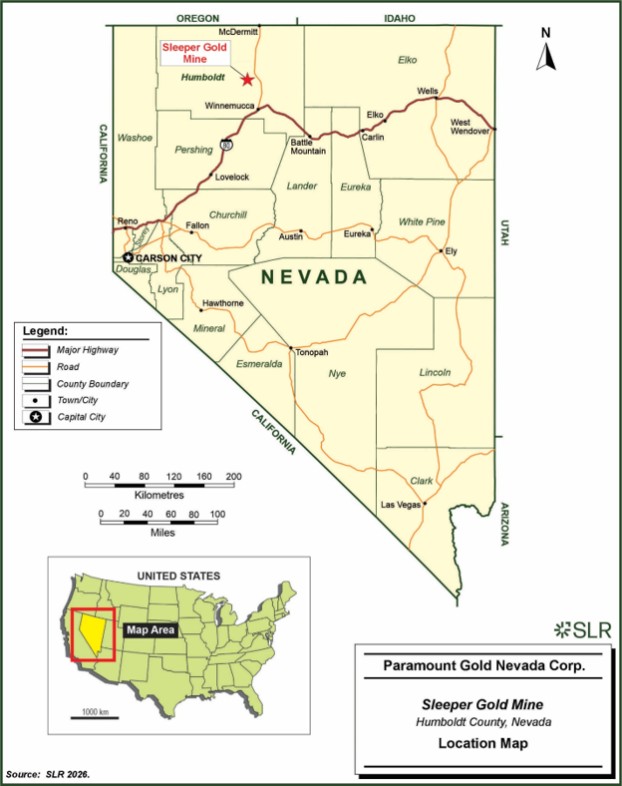
| 3-2 |
|
| Paramount Gold Nevada Corp. | Sleeper Gold Mine S-K 1300 Technical Report Summary |
June 17, 2026 SLR Project No.: 123.020721.00001 |
| 3.2 | Land Tenure |
The Property comprises 2,474 unpatented federal lode mining claims covering approximately 18,178 hectares (approximately 44,917 acres) in Humboldt County, Nevada. The claims are administered by the U.S. Bureau of Land Management (BLM) under the provisions of the Mining Law of 1872. Paramount Gold Nevada Corp., through its wholly owned subsidiaries Sleeper Mining LLC and New Sleeper LLC, holds 100% ownership of the claims that make up the Project.
Ownership of unpatented mining claims conveys the right to explore, develop, and mine locatable minerals subject to compliance with federal and state regulations. The surface estate remains under the title of the United States Government and is managed by the BLM. Surface use associated with exploration and mining activities is subject to applicable environmental and land management regulations.
Paramount Gold’s latest Title Report was completed in December 2023, and the land position has not been altered since. The properties subject to this 2023 Title Report Update include all the Claims.
The Property consists of contiguous unpatented lode and placer mining claims covering portions of Sections 35 through 36 in Township 40 North, Range 34 East; Sections 3 through 10, 11, 14 through 23, and 25 through 36 in Township 40 North, Range 35 East; Sections 1 through 2, 11 through 14, 23 through 26, and 35 through 36 in Township 39 North, Range 34 East; Sections 1 through 12, 16 through 22, and 28 through 33 in Township 39 North, Range 35 East; Sections 1, 2, 11, and 12 in Township 38 North, Range 34 East; Sections 9, 16, 19 through 21, 28, and 32 through 34 in Township 38 North, Range 35 East; Sections 24, and 35 through 36 in Township 37 North, Range 34 East; Sections 1 through 5, 8, 9, 15 through 17, and 27 through 28 in Township 37 North, Range 35 East; Sections 2 through 3, in Township 36 North, Range 34 East, Mount Diablo Base and Meridian, Humboldt County, Nevada. Surface rights for the unpatented claims are owned by the United States Government.
| 3.2.1 | Mining Claims |
The Project consists of four primary claim groups totaling 2,474 unpatented lode mining claims. These claim groups were assembled through a series of acquisitions and claim-staking programs from 2010 to 2021.
Table 3-1: Sleeper – Summary of Claim Holdings
| Claim Group (SUB CLAIM NAMES) | Number of Claims |
Approximate Surface Area |
||||||||||
| (Hectares) | (Acres) | |||||||||||
| Sleeper Gold Mine (AW, CR, DAY, DRYLAKE, ELECTRUM, FREE GOLD, LAM, LLY, MORNING, MORNING STAR, NA, NEW ALMA, NEW EVENING, NEW SNOWSTORM, PDSLP, SK, SLEEPER, SS, VIRGINIA, YORK) |
1,044 | 6,544 | 16,171 | |||||||||
| Dunes (Blue No., SP, SS) |
394 | 2,997 | 7,405 | |||||||||
| Mimi (MIMI) |
884 | 7,383 | 18,243 | |||||||||
| South Sleeper (RO, SH) |
152 | 1,254 | 3,098 | |||||||||
|
|
|
|
|
|
|
|||||||
| Total |
2,474 | 18,178 | 44,917 | |||||||||
|
|
|
|
|
|
|
|||||||
| 3-3 |
|
| Paramount Gold Nevada Corp. | Sleeper Gold Mine S-K 1300 Technical Report Summary |
June 17, 2026 SLR Project No.: 123.020721.00001 |
Section 27.0 provides a complete list of individual mining claims that comprise the Property.
Federal and State Mining Law Framework
Federal laws governing mining activities on public lands in the United States are primarily contained in Title 30 of the United States Code (USC), “Mineral Lands and Mining,” and Title 43 of the United States Code, Chapter 35, “Federal Land Policy and Management Act” (FLPMA). Implementing regulations for these statutes are contained in Title 43 of the Code of Federal Regulations (CFR), “Public Lands.”
Nevada state laws applicable to mining operations are primarily contained in the Nevada Revised Statutes (NRS), particularly Chapters 512 through 520, and in the Nevada Administrative Code (NAC), primarily Chapter 517.
Federal mining claim law applicable to claims located on federal lands is based on the General Mining Law of 1872, formally titled “An Act to Promote the Development of Mineral Resources of the United States”. Federal regulations governing mining claims and surface disturbance are implemented through provisions in 30 USC, 43 USC, and 43 CFR, as well as corresponding Nevada statutes, including NRS 517.
Approximately 85 percent of the land area within the State of Nevada is federally owned. Most of these lands are administered by federal agencies, including the BLM, the United States Forest Service (USFS), the United States Department of Energy (DoE), and the United States Department of Defense. Large areas of land administered by the Bureau of Land Management and the Forest Service remain open to mineral exploration and to the location of mining claims under the General Mining Law.
| 3-4 |
|
| Paramount Gold Nevada Corp. | Sleeper Gold Mine S-K 1300 Technical Report Summary |
June 17, 2026 SLR Project No.: 123.020721.00001 |
Figure 3-2: Sleeper Tenement Map
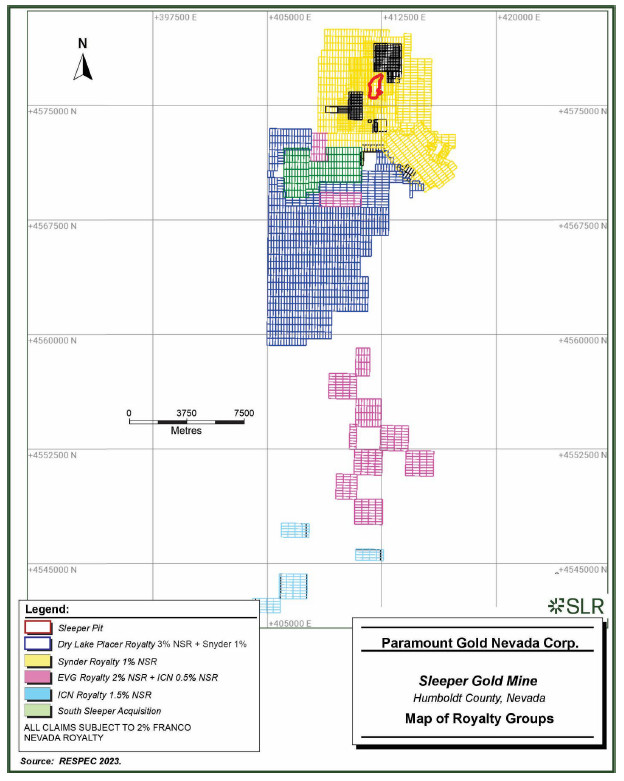
| 3-5 |
|
| Paramount Gold Nevada Corp. | Sleeper Gold Mine S-K 1300 Technical Report Summary |
June 17, 2026 SLR Project No.: 123.020721.00001 |
Federal Requirements for Exploration and Mining Activities
Regulations administered by the BLM governing surface disturbance and reclamation are contained in 43 CFR 3809. These regulations require that exploration activities involving disturbance of five acres or less be conducted under a Notice of Intent submitted to the appropriate BLM Field Office (43 CFR 3809.1-1 through 3809.1-4).
A Plan of Operations (POO) must be submitted and approved for mining or processing activities, as well as for exploration activities that will disturb more than five acres. A Plan of Operations is also required for bulk sampling programs where 1,000 short tons or more of presumed ore are proposed to be removed (43 CFR 3802.1 through 3802.6; 43 CFR 3809.1-4 and 3809.1-5).
BLM regulations further require that operators post reclamation bonds sufficient to ensure reclamation of disturbances caused by activities exceeding casual use (43 CFR 3809.500 through 3809.560).
Federal Mining Claim Location and Maintenance Requirements
Federal regulations (43 USC 1744; 43 CFR 3833.1-2) require that the locator of a mining claim, mill site, or tunnel site file a copy of the notice or certificate of location with the appropriate State Office of the Bureau of Land Management. This filing must include a map showing the claim location and must be completed within 90 days after the claim is located. Failure to complete this filing within the required period renders the claim void.
The certificate of location must include:
| • | The name and current mailing address of the claim owner or owners |
| • | The type of claim |
| • | The legal location of the claim, including township, range, section, and quarter section |
| • | The accompanying map must correspond to the claim location requirements established under Nevada state law. |
Federal law (30 USC 28f; 43 CFR 3833.1-5) also requires payment of an annual claim maintenance fee to the Bureau of Land Management. This fee must be paid to the appropriate BLM State Office on or before September 1 of each year. During the initial assessment year (the year in which the claim is located), the maintenance fee must be paid at the time the notice of location is filed with the BLM. Failure to pay the claim maintenance fee results in the claim being declared void.
Nevada State Requirements
Nevada law also requires claim holders to file documentation demonstrating continued intent to hold mining claims. Under NRS 517.230, on or before November 1 of each year, the claimant, or an authorized representative, must record with the County Recorder a Notice of Intent to Hold if annual assessment work is not being performed.
This affidavit must include the following:
| • | Name and mailing address of the claimant |
| • | Name of the mining claim |
| • | Bureau of Land Management serial number (if assigned) |
| 3-6 |
|
| Paramount Gold Nevada Corp. | Sleeper Gold Mine S-K 1300 Technical Report Summary |
June 17, 2026 SLR Project No.: 123.020721.00001 |
| • | Statement affirming the claimant’s intention to maintain the claim |
The Notice of Intent to Hold establishes the claimant’s intent to maintain the claim from 12:00 pm on September 1 of the previous year through 11:59 am on September 1 of the current year.
| 3.3 | Encumbrances |
Unpatented mining claims require annual maintenance fees paid to the BLM as well as county recording fees. As of the Effective Date of this report, claim maintenance fees have been paid in full through August 31, 2026.
Table 3-2: Property Holding Costs
| Cost Category |
Annual Cost |
Notes | ||
| Annual Claim Fees | 494,800 | BLM maintenance fees ($200/claim) | ||
| County Recording Fees | 37,110 | Humboldt County recording costs (approximately $15/claim) | ||
|
|
||||
| Total Annual Holding Cost | 531,910 | Estimated annual property holding cost | ||
|
|
| 3.4 | Royalties |
A total of five net smelter return (NSR) royalties apply to future mineral production from portions of the Project. These royalties are summarized in Table 3-3.
Table 3-3: Royalty Agreement Summary
| Royalty Holder |
Royalty Terms | |
| Montezuma | 1% NSR on ALL RO and SH claims (South Sleeper) | |
| Geologix | 1% NSR on ALL RO and SH claims (South Sleeper) | |
| Snyder Syndicate | 1% NSR on the 1,044 Sleeper Gold Mine claims (All claims, EXCEPT for ALL MIMI, ALL SP, ALL SS, AND ALL BLUE.) | |
| Franco-Nevada U.S. Corporation | 2% NSR on minerals produced from all 2,474 claims | |
| Evolving Gold / Quinton Hennigh | 2% NSR royalty on all SS and all SP claims. | |
| Dry Lake Placer Association | 3% NSR on Dry Lake Placer claims | |
| ICN Resources Ltd. | 0.5% NSR on all SS and all SP claims; 1.5% NSR on all Blue claims | |
| 3.5 | Required Permits and Status |
The permits are summarized in Table 3-4 represent the principal BLM and State of Nevada authorizations for exploration, reclamation, historical operations, and ongoing site maintenance at the Property as of the report’s Effective Date. The summary preserves the permit numbers, bond references, and compliance details from the source material and is intended to support a concise yet complete permit section in the technical report.
| 3-7 |
|
| Paramount Gold Nevada Corp. | Sleeper Gold Mine S-K 1300 Technical Report Summary |
June 17, 2026 SLR Project No.: 123.020721.00001 |
| 3.5.1 | Key BLM and State Permits in Place |
Table 1 summarizes the key BLM and State permits identified as being in place as of the Effective Date of the report. These permits are associated with exploration, mine operations, air quality, reclamation, water management, solid waste, and related site activities.
Table 3-4: Sleeper—Key BLM and State Permits in Place
| Permit / Authorization |
Permit Number |
Regulatory Agency |
Notes/Scope | |||
| Exploration Reclamation Permit | #0219 | Nevada Division of Environmental Protection / Nevada Division of Minerals | Exploration reclamation authorization maintained for exploration disturbance and associated reclamation obligations. | |||
| Exploration Plan of Operations | #NVN077104 | BLM | Federal exploration plan covering exploration activities and related surface disturbance. | |||
| Sleeper Mine | #NVN064100 | BLM | Mine-level federal authorization associated with the Sleeper Mine operations area. | |||
| Class II Air Quality Operating Permit – Surface Area Disturbance | #AP1041-2831 | State of Nevada | Air quality operating permit associated with surface disturbance activities. | |||
| Mine Reclamation Permit | #0037 | State of Nevada | Legacy permit maintained from prior mining activities for future reactivation flexibility. | |||
| Water Pollution Control Permit | #NEV50006 | State of Nevada | Water pollution control authorization maintained from prior operations. | |||
| Ground Water Appropriation Permits | #53228, #53231, and #53236 | State of Nevada | Groundwater rights and appropriation permits applicable to the project area. | |||
| Hazardous Materials Permit | #30473; FDID #08250; Facility #1168-2326 | State / Local | Hazardous materials registration and related compliance records for the site. | |||
| Class III Solid Waste Landfill Waiver | #SWMI-08-10 | State of Nevada | Waiver associated with the site landfill / solid waste management function. | |||
| Industrial Artificial Pond Permit | #S34480 | State of Nevada | Industrial pond authorization maintained from prior operating conditions. | |||
| Mine Plan of Operations | #N64100 | BLM | Mine plan maintained for historical operations and future updating if production is reinitiated. | |||
| 3-8 |
|
| Paramount Gold Nevada Corp. | Sleeper Gold Mine S-K 1300 Technical Report Summary |
June 17, 2026 SLR Project No.: 123.020721.00001 |
In addition to the principal permits listed above, the property maintains numerous other permits associated with previous mining activities. These legacy permits are retained to facilitate future updates should a decision be made to reinitiate production at the site. Ongoing maintenance of these permits includes monthly, quarterly, and annual monitoring and reporting, as applicable.
| 3.5.2 | Reclamation Bonds |
Table 3-5 summarizes the reclamation bonds associated with the principal BLM-authorized activities. The BLM Nevada State Office currently holds both bonds, and the current bond obligation was approved on October 9, 2020. The bond amounts are reviewed every three years.
Table 3-5: Sleeper Reclamation Bonds
| Bond Number |
Principal |
Covered |
Current Obligation (US$) |
Purpose | ||||
| NVB000444 | New Sleeper Gold LLC | NVN077104 | 345,044 | Surface reclamation coverage for the Sleeper Gold Exploration Plan. | ||||
| NVB000330 | Sleeper Mining Company LLC | NVN064100 | 3,966,373 | Surface reclamation coverage for operations conducted under the Sleeper Mine authorization. | ||||
| 3.5.3 | Compliance and Permit Status |
According to the source material, Paramount Gold is currently in compliance with all issued permits and is in the process of renewing those permits that require renewal. The bonds held by the BLM provide surface reclamation coverage for operations conducted by the relevant principals under NVN064100 and NVN077104, respectively.
The current bond obligation was approved on October 9, 2020, and is reviewed every three years. Permit maintenance activities include monthly, quarterly, and annual monitoring and reporting. Retaining legacy permits from previous mining activities is intended to simplify future permit updates if production is restarted.
| 3.6 | Other Significant Factors and Risks |
The SLR QP is not aware of any environmental liabilities on the property. Paramount Gold has, or can obtain, all the required permits to conduct the proposed work on the property. The SLR QP is not aware of any other significant factors and risks that may affect access, title, or the right or ability to perform the proposed work program on the property.
| 3-9 |
|
| Paramount Gold Nevada Corp. | Sleeper Gold Mine S-K 1300 Technical Report Summary |
June 17, 2026 SLR Project No.: 123.020721.00001 |
| 4.0 | Accessibility, Climate, Local Resources, Infrastructure, and Physiography |
| 4.1 | Accessibility |
The Sleeper Gold Mine is in Humboldt County in north-central Nevada, approximately 42 km (26 mi) northwest of Winnemucca, Nevada, which lies along Interstate 80, the principal east–west transportation corridor across northern Nevada connecting Reno, Nevada, and Salt Lake City, Utah. Access to the project area is provided by Nevada State Highway 95, approximately 51 km (32 mi) north of Winnemucca, and Nevada State Highway 140, approximately 23 km (14 mi) west toward the project area. The property is connected to the paved highway network by Sod House Road, a maintained gravel road that provides direct access to the mine site and surrounding exploration areas. Interstate 80 parallels the Union Pacific transcontinental railroad, providing efficient transportation of bulk materials and mining consumables to Winnemucca and the surrounding mining district. The project area can be reached year-round by vehicle under typical weather conditions, given the region’s generally dry climate and moderate winter snowfall.
| 4.2 | Climate |
The Sleeper Gold Mine is in Desert Valley at the western base of the Slumbering Hills in Humboldt County, Nevada. The project area lies within the Basin and Range physiographic province at an elevation of approximately 1,300 m (about 4,265 ft) above sea level. The regional climate is characteristic of the semi-arid high desert of northern Nevada, with relatively low annual precipitation, large daily temperature variations, and generally clear skies throughout much of the year. Winters are typically cool to cold, with average daytime temperatures in January of approximately 6°C to 8°C and nighttime temperatures commonly declining to approximately -7°C to -9°C, although colder temperatures may occur during periodic Arctic air incursions. Snowfall occurs intermittently during winter storm events; however, snow accumulations at the valley floor are generally modest and short-lived, typically melting within several days.
Average annual precipitation in the Desert Valley area is approximately 130 mm to 150 mm per year (about 5 to 6 inches), with most precipitation occurring during winter and early spring frontal systems. Summers are generally warm to hot during the day, with temperatures often exceeding 30°C, while nighttime temperatures typically cool significantly due to the dry desert air and elevation. Summer precipitation is relatively limited and typically occurs as isolated convective thunderstorms associated with late-season Great Basin monsoonal activity. Overall, the area is characterized by low humidity, high evaporation rates, and sparse high-desert vegetation. Because of the relatively dry climate, moderate winter snowfall, and the absence of prolonged severe weather conditions, the Sleeper property area is considered favorable for year-round exploration, development, and mining operations, with only minor seasonal impacts on access or operational efficiency.
| 4.3 | Local Resources and Infrastructure |
The Project lies within a region with a long history of mining activity. The historical Sleeper mine was operated by AMAX from 1986 to 1996 as a large open-pit gold and silver operation. The previous operation required the development of significant mining infrastructure, including haul roads, processing facilities, water supply systems, electrical distribution systems, and support
| 4-1 |
|
| Paramount Gold Nevada Corp. | Sleeper Gold Mine S-K 1300 Technical Report Summary |
June 17, 2026 SLR Project No.: 123.020721.00001 |
facilities, demonstrating that the area can support large-scale mining operations. Several facilities remain on-site and are currently utilized to support exploration activities, including office space, equipment maintenance facilities, and storage areas used for drilling and exploration programs.
The nearest regional service center is Winnemucca, Nevada, located approximately 42 km southeast of the property. The city of Winnemucca is the county seat of Humboldt County and has a population of approximately 8,400 people. The city functions as a primary commercial and logistical hub for mining operations throughout north-central Nevada and provides access to equipment suppliers, fuel distribution, heavy equipment maintenance facilities, drilling and blasting contractors, warehousing, lodging, medical services, and other industrial support services commonly required by mining projects.
Transportation and Access
Regional access to the Sleeper property is provided by Interstate 80, which passes through Winnemucca and serves as the principal east–west transportation corridor across northern Nevada. Interstate 80 provides direct connections to major mining centers, including Elko, Nevada and Salt Lake City, Utah, to the east and Reno, Nevada, to the west.
An extensive network of historical mine haul roads, exploration access roads, and drill roads exists throughout the property, resulting from mining activities conducted between 1986 and 1996 and subsequent exploration programs. These roads provide access to the historical open pit, heap-leach pads, waste-rock facilities, and exploration targets throughout the Sleeper district. Depending on the development scenario, portions of this road network may require upgrading or rehabilitation to support future operations.
Electrical Power
Electrical power in northern Nevada is supplied by regional utilities through a network of high-voltage transmission lines serving numerous mining operations. Transmission infrastructure in the broader region commonly includes 69-kV, 120-kV, and 230-kV lines that connect mines and industrial facilities to the regional grid operated by NV Energy. Typical overhead transmission lines in the region consist of aluminum-conductor steel-reinforced (ACSR) cables mounted on steel or wooden monopole structures spaced approximately 90 m to 135 m apart, with structure heights typically ranging from about 17 m to 25 m, depending on terrain and span requirements. Transmission corridors commonly occupy rights-of-way approximately 27 m wide.
Historical mining operations at Sleeper required electrical power for mining equipment, ore processing facilities, pumping systems, and general site infrastructure. Historically, electrical power to the project area was supplied by an existing 120-kV transmission line approaching the property from the north, operated by Harney Electric Cooperative. Future operations could utilize regional transmission connections, combined with on-site substations and electrical distribution systems similar to those used at other open-pit mining operations in northern Nevada.
Airports and Air Transportation
The closest airport to the project area is Winnemucca Municipal Airport, approximately 10 km southwest of Winnemucca. The airport has a primary asphalt runway approximately 2,134 m (7,000 ft) in length and supports general aviation and charter aircraft used by mining companies operating in the region. The nearest airports offering scheduled commercial airline service are Reno–Tahoe International Airport, approximately 260 km southwest of the project area, and Elko Regional Airport, approximately 200 km east of the project area.
| 4-2 |
|
| Paramount Gold Nevada Corp. | Sleeper Gold Mine S-K 1300 Technical Report Summary |
June 17, 2026 SLR Project No.: 123.020721.00001 |
Workforce and Mining Services
Northern Nevada is one of the most active gold-mining regions in the world and hosts numerous large mining operations. As a result, the region supports a well-established mining workforce, including equipment operators, geologists, engineers, mechanics, electricians, and other skilled trades. Many workers employed at regional mines reside in Winnemucca or nearby communities. The presence of multiple operating mines has also resulted in the establishment of numerous mining contractors and equipment suppliers capable of supporting exploration programs, construction activities, and large-scale mining operations.
Services available in Winnemucca and the surrounding region include heavy equipment repair facilities, fuel distribution, drilling and blasting contractors, industrial construction contractors, mining equipment suppliers, and transportation and logistics companies. These services support both existing mining operations and exploration activities throughout Humboldt County and the broader northern Nevada mining district.
Sources of Water
Water for the previous operations was obtained from groundwater sources within the Desert Valley basin, supplemented by pit dewatering systems during mining operations. Paramount Gold currently holds water rights associated with the Project.
General Infrastructure
Much of the previous mining infrastructure has been reclaimed following the mine’s closure in 1996; however, several facilities remain available to support exploration and future development. The property’s subdued topography provides suitable areas for the construction of mine infrastructure, including processing facilities, heap leach pads, waste rock storage areas, and associated operational infrastructure.
Existing infrastructure at the Sleeper site is listed below:
| • | Exploration and administrative office building |
| • | Heavy equipment maintenance shop (four-bay truck shop) |
| • | Dewatering well service shop |
| • | Truck maintenance facilities |
| • | Diesel storage and fuel tanks |
| • | Electrical transmission and distribution lines |
| • | Groundwater monitoring wells |
| • | Water management ponds |
| • | Administrative and storage buildings |
| • | On-site landfill area |
| • | Existing mine haul roads and exploration access roads |
| 4-3 |
|
| Paramount Gold Nevada Corp. | Sleeper Gold Mine S-K 1300 Technical Report Summary |
June 17, 2026 SLR Project No.: 123.020721.00001 |
| 4.4 | Physiography |
The Project is in north-central Nevada within the Basin and Range physiographic province, a region characterized by alternating north–south trending mountain ranges and broad alluvial valleys formed by extensional tectonics. The Sleeper property lies primarily within Desert Valley and along the western flank of the Slumbering Hills, a low mountain range that forms the eastern boundary of the valley. Elevations in the immediate project area average approximately 1,300 m above sea level (masl) (about 4,265 feet above mean sea level [fasl]) on the valley floor, increasing eastward into the Slumbering Hills where elevations exceed approximately 1,700 masl. The terrain surrounding the historical Sleeper open pit consists of gently sloping alluvial fans, pediments, and low bedrock ridges, which transition into steeper volcanic uplands within the Slumbering Hills. Relief within the immediate mine area is generally moderate, with local elevation differences of several hundred meters between the valley floor and adjacent uplands.
Desert Valley is a broad internally drained basin typical of northern Nevada, formed by fault-bounded mountain ranges and filled with unconsolidated alluvial and lacustrine sediments derived from surrounding highlands. Surface drainage in the project area is limited and largely ephemeral, consisting of intermittent washes and small drainage channels that flow only during seasonal precipitation or localized storm events. These ephemeral drainages typically flow westward across the valley floor and dissipate into alluvial sediments, forming no perennial streams. Vegetation in the area is characteristic of Great Basin high-desert shrubland, dominated by sagebrush, rabbitbrush, and scattered grasses adapted to semi-arid conditions. The relatively subdued topography of the valley floor, combined with sparse vegetation and arid conditions, provides favorable terrain for the development of large open-pit mining operations, heap leach facilities, and associated infrastructure. Overall, the physiography of the Sleeper property is typical of the northern Nevada Basin and Range region and presents few significant natural constraints to exploration, development, or mining activities.
| 4-4 |
|
| Paramount Gold Nevada Corp. | Sleeper Gold Mine S-K 1300 Technical Report Summary |
June 17, 2026 SLR Project No.: 123.020721.00001 |
| 5.0 | History |
| 5.1 | Early Mining – Awakening District (Pre-1982) |
The Sleeper Gold Mine is in the Awakening Mining District. Gold mineralization in the district was recognized well before the discovery of the Sleeper deposit. Early mining activity in the district dates to the early 1900s, with production associated primarily with gold-bearing quartz veins hosted in metasedimentary rocks.
Significant production began in the 1930s from the Jumbo and Alma mines in the Slumbering Hills, approximately 6 km southeast of the eventual Sleeper pit. Narrow quartz–adularia veins were mined by underground and small open pit methods. Historical compilations report that the Awakening District produced approximately 26,262 ounces of gold between 1932 and 1958. Numerous historical shafts, adits, and prospect pits occur within a few kilometers of the Sleeper deposit, indicating widespread early exploration activity.
| 5.2 | Ownership |
| 5.2.1 | AMAX Gold Inc. Discovery and Mining (1982–1996) |
The modern history of the Sleeper deposit began in 1982 when John Wood, an exploration geologist with AMAX, recognized iron-oxide staining in an outcrop during aerial reconnaissance. AMAX conducted geological mapping, geochemical sampling, and drilling programs between 1982 and 1984.
A breakthrough occurred in late 1984 when a step-out drill hole intersected approximately 102 m of silicified breccia averaging approximately 27.87 g/t gold and 61.7 g/t silver. The discovery hole confirmed the presence of a high-grade epithermal gold system and led to rapid project advancement. AMAX formally announced the Sleeper gold discovery in February 1985. Regulatory approvals for the mine’s construction were granted later in 1985. Mining began in January 1986, and mill commissioning commenced the following month. The first gold bar was poured on March 26, 1986, only slightly more than a year after the discovery announcement.
The operation processed oxide mineralization using both milling and heap-leaching circuits. Initial mine plans projected modest production, but actual production greatly exceeded expectations due to exceptionally high grades encountered early in the Sleeper vein system. Gold production during 1986 reached approximately 126,000 ounces, with operating costs reported at less than US$60 per ounce.
Production increased to approximately 159,000 oz in 1987 and approximately 230,000 oz in 1988. The mine was widely recognized as one of the lowest-cost gold producers in the world during the late 1980s. AMAX later added heap-leach facilities to process lower-grade oxide material.
In 1994, AMAX merged with Cyprus Minerals to form Cyprus Amax Minerals Company. Mining at Sleeper continued until 1996, when operations were suspended. Total historical production from the Sleeper mine is approximately 1.66 Moz Au and 2.3 Moz Ag. Approximately 1,219,880 Moz Au were recovered from milling operations and approximately 438,609 Moz Au from heap-leach processing.
| 5-1 |
|
| Paramount Gold Nevada Corp. | Sleeper Gold Mine S-K 1300 Technical Report Summary |
June 17, 2026 SLR Project No.: 123.020721.00001 |
Following closure, groundwater began filling the open pit, forming a pit lake. AMAX accelerated the filling of the open pit to prevent the formation of acidic water. Processing facilities and crushing equipment have since been removed, and the former mill area has been reclaimed.
| 5.2.2 | X-Cal Resources Ltd. and Joint Venture Exploration (1993–2010) |
X-Cal Resources Ltd (X-Cal) began assembling a land package in the district in 1993 when it acquired property around the Alma Mine through an agreement with Leland York. Surface mapping and sampling identified several areas of anomalous gold mineralization. Additional claims were acquired in 1994 and 1995, extending X-Cal’s holdings to the boundary of the AMAX Sleeper property.
In April 1996, X-Cal and AMAX entered into a joint venture agreement to explore the Sleeper property and the surrounding land package. In 1997, X-Cal entered into an option agreement with Placer Dome Inc. (Placer Dome). During a 40-day review period, Placer Dome conducted data compilation, completed an aeromagnetic survey, and drilled 47 holes totaling approximately 13,323 m (43,710 ft) of reverse circulation (RC) drilling and of diamond core drilling. The option ultimately expired after revised terms could not be negotiated.
Kinross Gold Corp. (Kinross) acquired AMAX’s interest in the Sleeper project. Between 1998 and 2003, X-Cal negotiated several agreements with Kinross regarding ownership of the property.
On January 9, 2004, X-Cal and New Sleeper Gold Corp. (New Sleeper Gold) formed a 50/50 joint venture and acquired Kinross’s 50% interest in the Sleeper property. New Sleeper Gold assumed management of the Project and funded extensive exploration programs between 2004 and 2005. These programs included approximately 29,780 m (97,704 ft) of drilling, consisting of sonic, reverse-circulation, and diamond-core drilling, as well as trenching, induced polarization and magnetotelluric geophysical surveys, gravity surveys, soil-gas surveys, geological mapping, and geochemical sampling.
In May 2006, X-Cal acquired New Sleeper Gold’s 50% interest in the joint venture, consolidating 100% ownership of the Sleeper project.
| 5.2.3 | Paramount Gold Nevada Corp. (2010–Present) |
In August 2010, Paramount Gold and Silver Corp. acquired all outstanding shares of X-Cal Resources Ltd. through a plan of arrangement. Following the acquisition, Paramount Gold Corp. began renewed exploration drilling at Sleeper in October 2010.
In 2011, Paramount Gold Corp. acquired the Dunes Project claims located south of the Sleeper deposit from ICN Resources Ltd. (ICN). In 2012, additional claims known as the Mimi Project were staked adjacent to the historical Sleeper mine.
In connection with the acquisition of Paramount Gold and Silver Corp. by Coeur Mining, Inc., the Nevada assets were spun out into a separate publicly traded company, Paramount Gold Nevada Corp., in 2015. Paramount Gold Nevada Corp. now controls the Project through its subsidiaries, Sleeper Mining LLC and New Sleeper LLC.
Additional claims known as the South Sleeper (RO and SH groups) were acquired in 2021, expanding the overall property. The Sleeper Gold Mine currently comprises a large district-scale land position comprising 2,474 unpatented federal mining claims administered by the BLM. The Project is an advanced exploration and redevelopment project centered on the historical open pit mine and numerous surrounding exploration targets within the Awakening Mining District.
| 5-2 |
|
| Paramount Gold Nevada Corp. | Sleeper Gold Mine S-K 1300 Technical Report Summary |
June 17, 2026 SLR Project No.: 123.020721.00001 |
| 5.3 | Exploration and Development History |
| 5.3.1 | Historical Drilling (1983–2010) |
Drilling at the Project has been conducted intermittently since the early 1980s by multiple operators and forms the primary basis for the current geological, structural, and grade interpretation of the deposit. Initial drilling programs undertaken by AMAX between 1983 and 1995 established the core of the drilling database. Subsequent exploration and evaluation programs were completed by Placer Dome, X-Cal, New Sleeper Gold, and others through approximately 2010.
The historical drilling database is extensive and represents the majority of drilling completed at the Project. Reverse circulation (RC) drilling predominates, accounting for approximately 95% of all drill holes and meters drilled, with most holes oriented vertically, reflecting the exploration and production objectives of early-stage development. Later programs incorporated angled diamond core drilling to better define structural controls, vein orientations, and the geometry of higher-grade mineralization. These core programs significantly improved geological control, particularly in areas characterized by steeply dipping vein systems and structurally controlled mineralization. Integration of RC and core datasets has enabled the development of a refined geological and structural model, including the recognition of multiple vein sets, hydrothermal breccias, and stratigraphically controlled mineralized domains. However, portions of the historical database are incomplete, with missing hole metadata, survey information, and total depths for certain programs. These limitations have been considered by the QP in evaluating data reliability and Mineral Resource classification.
Modern exploration commenced with AMAX in April 1982, following reconnaissance identification of iron staining. Surface mapping, geochemical sampling, and drilling culminated in a late-1984 step-out hole intercepting 102 m averaging 27.87 g/t Au (0.81 oz/st Au) and 61.7 g/t silver, including a high-grade quartz-electrum vein with visible gold. Discovery was announced in February 1985, construction was approved in August 1985, and mining began in January 1986. The mill was commissioned in February 1986, and first gold was poured on March 26, 1986. Between 1986 and 1996, production totaled approximately 1.66 Moz of gold and 2.3 Moz of silver. During the 1983–1995 period, AMAX completed 3,668 drill holes totaling 509,043 m and conducted an IP/resistivity survey in 1987. Mining concluded in 1996.
In 1989, NGM reportedly drilled nine holes totaling 438 m; however, SLR is unaware of NGM’s full name or of any relationship, if any, between NGM and AMAX. No information is available regarding NGM’s drilling contractors, drill rig types, sample collection procedures, or collar and down-hole survey methods.
From 1996 to 1997, under the X-Cal/AMAX joint venture, work focused on data compilation, mapping, surface geochemistry, and geophysics. Between 1993 and 1997, X-Cal collected 7,599 soil samples and 2,480 rock samples and completed 140 RC holes totaling 27,700 m. QA/QC procedures established during this period formed the basis for protocols adopted in later programs.
In 1997, Placer Dome optioned the property, conducted a comprehensive database review, and completed a high-resolution airborne magnetic survey (50 m line spacing with 2 m readings). Placer Dome drilled 47 holes totaling 13,323 m, including RC and RC/core combination holes. During this period, Mineral Resources Development Inc. (MRDI) evaluated tailings and heap-leach pads using six auger holes in tailings (7.6 m to 10.7 m depth), two RC holes, and three auger holes in leach pads.
| 5-3 |
|
| Paramount Gold Nevada Corp. | Sleeper Gold Mine S-K 1300 Technical Report Summary |
June 17, 2026 SLR Project No.: 123.020721.00001 |
Between 1998 and 2003, X-Cal focused on consolidating and evaluating tailings and heap-leach materials. This work included ten auger holes drilled into tailings in 1999, 83 sonic holes completed in 2002 (9.1 m to 10.7 m depth with 1.52 m sampling intervals), and a gravity survey conducted in 2003 on 500 m line spacing with 200 m stations. Sampling and analytical procedures were generally consistent with industry standards, although documentation from early programs is incomplete.
In January 2004, New Sleeper Gold acquired Kinross’ 50% interest and entered into a joint venture with X-Cal. Between 2004 and 2005, exploration and development activities included 29,780 m of drilling (comprising 17,028.9 m core, 11,373.6 m RC, and 688.8 m sonic drilling), trenching, IP, magnetotelluric (MT), gravity surveys, soil-gas surveys (Hg and O₂/CO₂), surface mapping, geochemical sampling, and aerial photography. During this period, mill and crusher facilities were removed and reclaimed. Joint funding commenced in August 2005, and X-Cal acquired full ownership in May 2006.
From 2004 to 2007, integrated interpretation of magnetic, gravity, IP, and MT datasets refined the understanding of structural controls on mineralization. Magnetic inversion modeling in 2005 identified mineralization within a magnetic low bounded by magnetic highs, while gravity surveys completed between 2003 and 2005 delineated density contrasts and major structural trends. Soil-gas and geochemical anomalies further highlighted concealed structures. QA/QC procedures applied during this period were consistent with industry practice.
Between 2003 and 2007, X-Cal drilled an additional 47,347 m, including 30 core holes (9,027 m), 133 RC holes (35,546 m), eight RC/core combination holes (2,776 m), and one hole of unknown type. Drilling, sampling, and QA/QC procedures implemented in 2006 and refined in 2007 became standard for subsequent programs. Work during this period also included structural interpretation, target generation, blasthole modeling, and continued evaluation of tailings and heap-leach materials. Subsequent exploration drilling included 69 drill holes totaling 18,041 m by New Sleeper Gold between 2004 and 2005, followed by an additional 34 holes (6,636 m) completed by Evolving Gold in 2008, and by Montezuma Mines, 11 holes (1,940 m) between 2011 and 2012. Evolving Gold also conducted gravity, IP/resistivity, and ground magnetic surveys between 2007 and 2008, while Montezuma completed ground magnetics (2009–2010) and gravity/IP surveys (2011–2012). Some drill hole locations from these programs were not incorporated into the historical drilling database due to unresolved drill hole location surveys. In 2021, Paramount Gold conducted an exploration RC drilling program focused on the Range Front target area southeast of the pit in the hills east of the South Dump. Drilling of 6 RC holes totaling 2,644 m was completed.
| 5.3.2 | Historical Geophysical and Surface Exploration Programs |
| 5.3.2.1 | Airborne Geophysical Surveys (1980s–1997) |
Airborne geophysical surveys were conducted during several phases of exploration from the 1980s through the late 1990s, culminating in a detailed aeromagnetic survey completed in 1997. This survey utilized closely spaced east–west and north–south flight lines, approximately 50 m apart, with high-frequency data acquisition along the lines. The airborne magnetic data were used to identify lithologic variations and structural features, including volcanic units, intrusive bodies, and fault zones. Magnetic highs were interpreted to be associated with volcanic, hypabyssal, and metasedimentary rock units, providing important context for geological interpretation and exploration targeting. These airborne datasets provided regional-scale coverage of the property and were instrumental in defining large-scale structural trends and lithologic domains that guided subsequent ground-based exploration and drilling programs.
| 5-4 |
|
| Paramount Gold Nevada Corp. | Sleeper Gold Mine S-K 1300 Technical Report Summary |
June 17, 2026 SLR Project No.: 123.020721.00001 |
| 5.3.2.2 | Ground Geophysical Surveys (1980s–2012) |
Ground-based geophysical surveys were conducted from the early 1980s through 2012 and included magnetic, gravity, IP, resistivity, and MT methods. Ground magnetic surveys were used to refine interpretations derived from airborne data and to provide higher-resolution mapping of local structures and lithologic contacts. Gravity surveys conducted throughout this period, including early programs and later expansions, were used to define basin geometry, bedrock topography, and density contrasts associated with lithologic and alteration variations. These data were particularly important in identifying structural features beneath post-mineral cover and in constraining the geometry of the basin hosting the Sleeper deposit. Electrical geophysical methods, including induced polarization and resistivity surveys conducted during multiple phases of exploration, including the 2004–2005 joint venture period, were used to detect chargeability anomalies and resistivity contrasts associated with sulfide mineralization, silicification, and hydrothermal alteration. MT surveys conducted during this period provided insight into deeper conductivity structures and regional controls on hydrothermal fluid pathways.
| 5.3.2.3 | Surface Geochemical Programs (1980s–2012) |
Surface geochemical sampling programs were conducted from the early 1980s through 2012 and included extensive soil and rock-chip sampling campaigns across the property. Soil geochemical programs, comprising more than 11,000 samples collected over multiple phases, were designed to identify anomalous concentrations of gold and pathfinder elements, particularly in areas of shallow alluvial cover.
Rock-chip sampling programs were used to verify mineralization exposed at surface and to characterize lithologic units and alteration zones. The integration of geochemical data with geological mapping and geophysical interpretations enabled the delineation of coherent mineralized trends and target areas for follow-up drilling.
| 5.3.2.4 | Soil Gas and Specialized Geochemical Surveys (2004–2005) |
During the 2004–2005 joint venture exploration programs, specialized soil gas surveys were conducted, including mercury vapor and O₂/CO₂ measurements. These techniques were applied to detect subtle geochemical signatures associated with concealed mineralization and hydrothermal activity, particularly in areas where conventional soil geochemistry was less effective due to cover conditions. These data were integrated with other exploration datasets to refine target generation.
| 5.3.3 | Geological Mapping and Trenching (1980s–2005) |
Geological mapping programs were conducted throughout the property’s exploration history, beginning in the early 1980s and continuing through later campaigns, including the 2004–2005 joint venture period. These programs focused on defining lithologic units, alteration assemblages, and structural features across the property.
Trenching programs, particularly those conducted during the 2004–2005 period, were used to expose bedrock beneath shallow cover and to allow direct observation and sampling of mineralized zones. These activities supported refinement of the geological model and validation of geochemical and geophysical anomalies.
The integration of these historical geophysical and surface exploration programs resulted in the identification of multiple mineralized trends and structurally controlled zones across the property. Several of these trends, including those associated with volcanic contacts and major structural corridors, have not been extensively drill tested and remain prospective for additional mineralization
| 5-5 |
|
| Paramount Gold Nevada Corp. | Sleeper Gold Mine S-K 1300 Technical Report Summary |
June 17, 2026 SLR Project No.: 123.020721.00001 |
| 5.4 | Past Production |
Table 5-1 combines gold production from both the mill and heap-leach circuits operated by AMAX Gold Inc. at the Sleeper Mine. Silver production was primarily recovered from mill operations. Totals correspond with reported cumulative production of approximately 1.66 Moz of gold and approximately 2.3 Moz of silver.
Table 5-1: Sleeper Gold Mine – Total Annual Production (1986–1996)
| Year |
Mill Gold (000 oz) |
Heap Gold (000 oz) |
Total Gold (000 oz) |
Mill Silver (000 oz) |
Heap Silver (000 oz) |
Total Silver (000 oz) |
||||||||||||||||||
| 1986 |
132.6 | 4.9 | 137.6 | 93.1 | 11.4 | 104.5 | ||||||||||||||||||
| 1987 |
152.8 | 16.8 | 169.6 | 131.3 | 38.8 | 170.1 | ||||||||||||||||||
| 1988 |
170.6 | 56.7 | 227.3 | 173.4 | 74.3 | 247.7 | ||||||||||||||||||
| 1989 |
196.3 | 57.9 | 254.3 | 245.0 | 97.2 | 342.2 | ||||||||||||||||||
| 1990 |
191.1 | 53.6 | 244.7 | 269.7 | 120.8 | 390.5 | ||||||||||||||||||
| 1991 |
121.1 | 62.6 | 183.7 | 183.2 | 108.0 | 291.2 | ||||||||||||||||||
| 1992 |
78.3 | 61.7 | 140.0 | 130.0 | 122.0 | 252.0 | ||||||||||||||||||
| 1993 |
51.3 | 48.9 | 100.2 | 157.7 | 98.5 | 256.2 | ||||||||||||||||||
| 1994 |
70.9 | 36.2 | 107.1 | 59.6 | 83.8 | 143.3 | ||||||||||||||||||
| 1995 |
54.7 | 27.3 | 82.1 | 47.7 | 51.0 | 98.7 | ||||||||||||||||||
| 1996 |
— | 12.0 | 12.0 | — | 9.9 | 9.9 | ||||||||||||||||||
|
|
|
|
|
|
|
|
|
|
|
|
|
|||||||||||||
| Totals |
1,219.9 | 438.6 | 1,658.5 | 1,490.8 | 815.6 | 2,306.4 | ||||||||||||||||||
|
|
|
|
|
|
|
|
|
|
|
|
|
|||||||||||||
| Avg. Metallurgical Recovery (%) |
89.6 | 42.9 | — | 43.4 | 39.5 | — | ||||||||||||||||||
|
|
|
|
|
|
|
|
|
|
|
|
|
|||||||||||||
| 5-6 |
|
| Paramount Gold Nevada Corp. | Sleeper Gold Mine S-K 1300 Technical Report Summary |
June 17, 2026 SLR Project No.: 123.020721.00001 |
| 6.0 | Geological Setting, Mineralization, and Deposit |
The information presented herein has been reviewed, edited, and, where appropriate, directly derived from RESPEC (2023) and Wilson and SRK (2012). The geological framework, mineralization models, and deposit interpretations have been evaluated by SLR for completeness, internal consistency, and technical reasonableness.
| 6.1 | Regional Geology |
The Project is located within the northern Basin and Range Province of Nevada, a region characterized by extensional tectonics, high-angle normal faulting, and widespread Cenozoic magmatism. The regional geologic framework comprises the following (Figure 6-1 and Figure 6-2):
| • | Mesozoic metasedimentary basement rocks of the Auld Lang Syne Group |
| • | Cretaceous granitic intrusive rocks |
| • | Overlying Tertiary volcanic sequences, including bimodal basaltic and rhyolitic units |
| • | Basin-fill sediments associated with post-mineral extensional deformation |
The Project is situated along the western flank of the Slumbering Hills within the western portion of the Northern Nevada Rift (NNR), a northwest-trending mid-Miocene geologic province extending from southeastern Oregon to southeastern Nevada. As described in RESPEC (2023) and Wilson and SRK (2012), the NNR is characterized by bimodal basalt–rhyolite volcanism, extensional tectonics, and a documented spatial association with low-sulfidation epithermal gold-silver mineralization (John 2001).
Available geological information indicates that the NNR developed during a period of regional extension beginning in the mid-Miocene (approximately 17 Ma), expressed by high-angle normal faulting and associated volcanic activity. These structural and magmatic features are widely recognized as key controls on epithermal mineral systems in northern Nevada. The association between mineralization and this tectono-magmatic framework at the Project is based on regional analogs and published studies and should be considered interpretive.
Pre-Tertiary rocks in the Slumbering Hills consist of metasedimentary rocks of the Auld Lang Syne Group and Cretaceous granitic intrusions, consistent with descriptions in both source reports. The metasedimentary sequence has been interpreted as part of an early Mesozoic back-arc basin assemblage that was subsequently deformed and metamorphosed to greenschist facies during late Jurassic contraction associated with the Luning–Fencemaker thrust system.
Tertiary volcanic and volcaniclastic rocks unconformably overlie the pre-Tertiary basement and locally intrude it. As described in the Wilson and SRK report (2012), many of these volcanic units are interpreted to represent outflow facies of the McDermitt volcanic field and related caldera complexes to the north. Volcanic rocks hosting mineralization at Sleeper are interpreted to have been derived from a local volcanic center; however, the extent, timing, and configuration of this source remain open to interpretation.
Quaternary pediment gravels and aeolian deposits occur west of the Slumbering Hills and locally cover portions of the Project area, limiting bedrock exposure and influencing surface geological mapping and exploration methods.
| 6-1 |
|
| Paramount Gold Nevada Corp. | Sleeper Gold Mine S-K 1300 Technical Report Summary |
June 17, 2026 SLR Project No.: 123.020721.00001 |
The regional structural framework is dominated by northwest- to north-northeast–trending high-angle normal faults, which control basin development and are interpreted to have provided conduits for hydrothermal fluid flow. Basin and Range extension is also expressed by tilting of structural blocks. District-scale interpretations in the Wilson and SRK report (2012) suggest a northeast-trending arch or anticline within the northern Slumbering Hills, characterized by opposing limb dips; however, this feature is inferred from regional mapping and remains conceptual.
The association between extensional faulting, bimodal volcanism, and epithermal mineralization is supported by regional studies and both technical reports; however, the specific structural and lithologic controls on mineralization at the Property remain interpretive and subject to refinement with additional geological and drilling data.
| 6-2 |
|
| Paramount Gold Nevada Corp. | Sleeper Gold Mine S-K 1300 Technical Report Summary |
June 17, 2026 SLR Project No.: 123.020721.00001 |
Figure 6-1: Regional Geology

| 6-3 |
|
| Paramount Gold Nevada Corp. | Sleeper Gold Mine S-K 1300 Technical Report Summary |
June 17, 2026 SLR Project No.: 123.020721.00001 |
Figure 6-2: Cross Section of Regional Geology
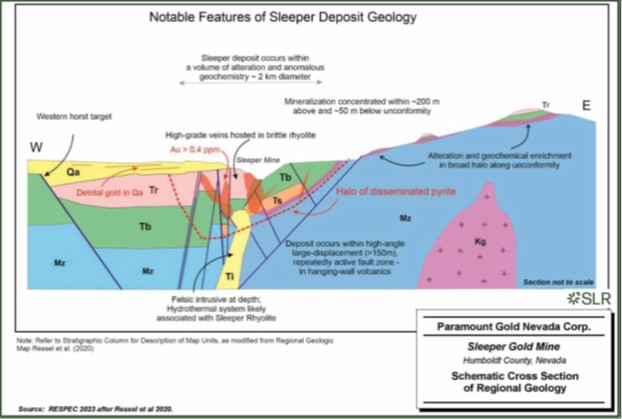
| 6-4 |
|
| Paramount Gold Nevada Corp. | Sleeper Gold Mine S-K 1300 Technical Report Summary |
June 17, 2026 SLR Project No.: 123.020721.00001 |
| 6.2 | Local Geology |
At the local scale, the Sleeper Gold-Silver Project is situated along the western flank of the Slumbering Hills within Desert Valley, where the geological framework has been significantly modified by Basin and Range extensional tectonics. The present-day configuration reflects substantial displacement along north- to northeast-trending normal faults, which have down-dropped the volcanic and basin-fill sequences by approximately 900 m to 1,000 m (3,000 ft to 3,300 ft) relative to the exposed basement rocks in the adjacent uplifts. In addition to these dominant structures, northwest-striking faults are present and are interpreted as reactivated regional structural trends, contributing to a complex structural architecture that exerts primary control over lithological distribution and mineralization.
The stratigraphic framework at the property comprises Mesozoic basement rocks overlain by a sequence of Tertiary volcanic and volcaniclastic units. The basement consists of the Auld Lang Syne Group, composed of slate, phyllite, quartzite, and calcareous metasedimentary rocks that have undergone deformation and low-grade metamorphism to greenschist facies, and which are locally intruded by Cretaceous granodioritic to monzonitic bodies. These rocks form the structural footwall to the principal mineralized system. Overlying the basement is a succession of Miocene volcanic rocks, which serve as the primary host sequence for mineralization.
The volcanic stratigraphy begins with a basal sequence of intermediate-composition volcaniclastic rocks and minor flow units, which are overlain by dacitic to basaltic lava flows and associated flow breccias. This sequence is succeeded by felsic pyroclastic units, including pumiceous lapilli tuffs, and culminates in the emplacement of the Sleeper rhyolite. The Sleeper rhyolite, consisting of flows, domes, dikes, and sills characterized by quartz-eye textures and sanidine phenocrysts, represents the principal host to gold-silver mineralization and is interpreted to have played a critical role in the development of the hydrothermal system. Post-mineral volcanic units, including peralkaline ash-flow tuffs, overlie the mineralized sequence and are interpreted to post-date mineralization.
Structurally, the deposit is dominated by a west-dipping, range-bounding normal fault that juxtaposes the Mesozoic basement rocks in the footwall against the Miocene volcanic sequence in the hanging wall. This structure is interpreted to have served as the principal conduit for hydrothermal fluids and represents the first-order control on mineralization. Secondary structures within the hanging wall, including splays, vein arrays, and fault intersections, create localized zones of enhanced permeability and are closely associated with the distribution of mineralized veins, breccias, and stockwork zones. The resulting structural framework is hierarchical, with primary faults controlling the overall geometry of the system and secondary structures governing local mineralization patterns and grade distribution.
At the property scale, the Sleeper deposit is defined by a well-developed mineralized system comprising a central zone of historically mined high-grade quartz–adularia veins surrounded by halos of stockwork and breccia-hosted mineralization, which transition outward into peripheral zones of lower-grade mineralization (Figure 6-3, Figure 6-4, and Figure 6-5).
The deposit extends approximately 1,500 m to 1,700 m along strike, is on the order of 600 m in width, and has a vertical extent exceeding 600 m from near-surface to depth. This geometry reflects the combined influence of structural controls and lithological competency contrasts, which together governed the development of permeability and fluid flow within the hydrothermal system.
| 6-5 |
|
| Paramount Gold Nevada Corp. | Sleeper Gold Mine S-K 1300 Technical Report Summary |
June 17, 2026 SLR Project No.: 123.020721.00001 |
Following historical mining, the geological setting is characterized by extensive envelopes of low-grade stockwork mineralization that surround and underlie the previously mined high-grade vein systems. Remnant mid- to high-grade zones persist beneath and adjacent to mined areas, representing down-dip and along-strike extensions of the primary vein systems as well as mineralization associated with secondary structural zones. Additional mineralization is recognized at targets such as West Wood, where hydrothermal breccia-hosted mineralization is associated with structural complexity and possible intrusive influences, indicating that the mineralizing system remains open and locally underexplored.
The Qualified Person notes that geological continuity is generally well defined within the broader low-grade stockwork domains, which form laterally and vertically continuous mineralized envelopes suitable for bulk-tonnage evaluation. In contrast, high-grade vein-hosted mineralization is discontinuous and strongly controlled by structural features, resulting in significant spatial variability. This variability is an inherent characteristic of the deposit and represents an important consideration in geological modeling and Mineral Resource estimation. The overall geological interpretation is considered robust and appropriate for the current level of study and is consistent with CIM (2014) Definition Standards, CIM (2019) Best Practice Guidelines, and SEC Regulation S-K 1300 reporting requirements.
| 6-6 |
|
| Paramount Gold Nevada Corp. | Sleeper Gold Mine S-K 1300 Technical Report Summary |
June 17, 2026 SLR Project No.: 123.020721.00001 |
Figure 6-3: Stratigraphic Column
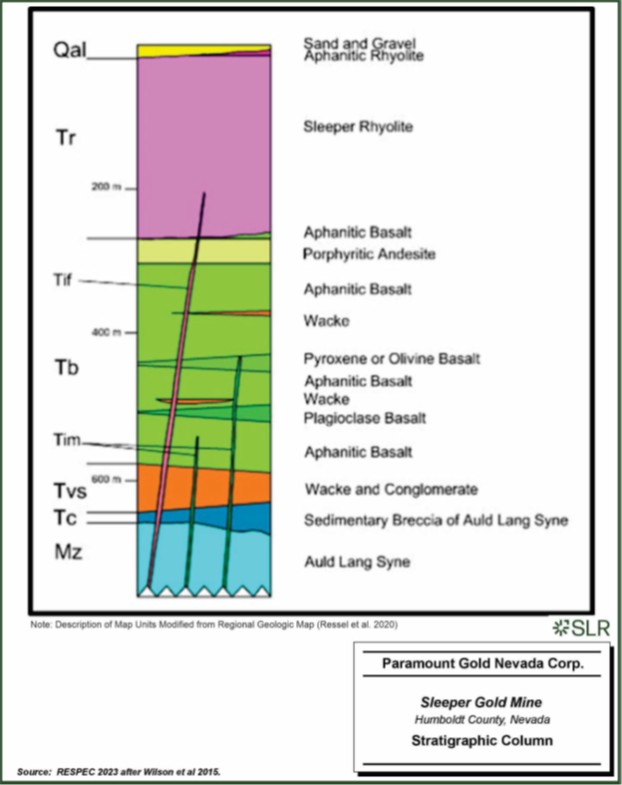
| 6-7 |
|
| Paramount Gold Nevada Corp. | Sleeper Gold Mine S-K 1300 Technical Report Summary |
June 17, 2026 SLR Project No.: 123.020721.00001 |
Figure 6-4: Local Geology
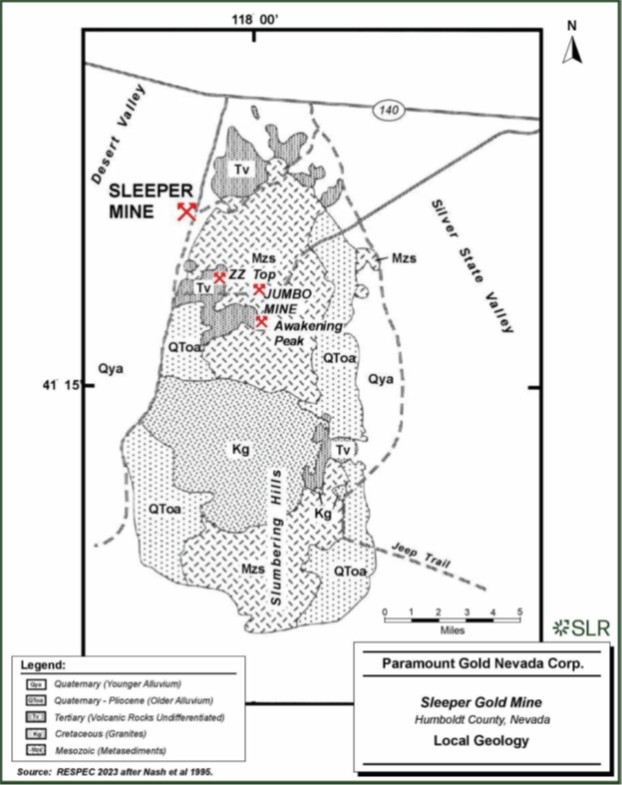
| 6-8 |
|
| Paramount Gold Nevada Corp. | Sleeper Gold Mine S-K 1300 Technical Report Summary |
June 17, 2026 SLR Project No.: 123.020721.00001 |
Figure 6-5: Cross Section of Local Geology
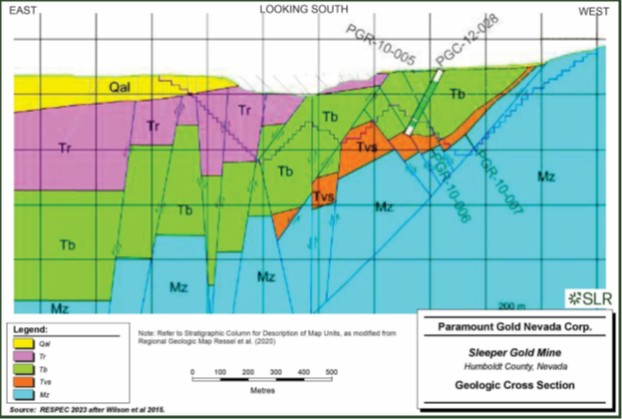
| 6-9 |
|
| Paramount Gold Nevada Corp. | Sleeper Gold Mine S-K 1300 Technical Report Summary |
June 17, 2026 SLR Project No.: 123.020721.00001 |
| 6.3 | Mineralization |
Mineralization at the Sleeper Gold-Silver Project is characteristic of a low-sulfidation epithermal system (Figure 6-6) developed within a Miocene volcanic center and spatially associated with a major west-dipping, range-bounding normal fault. Gold and silver mineralization occurs predominantly within the hanging-wall volcanic sequence, particularly within the Sleeper rhyolite and underlying basaltic units, and reflects a structurally controlled hydrothermal system with multiple phases of fluid flow and mineral deposition.
| 6-10 |
|
| Paramount Gold Nevada Corp. | Sleeper Gold Mine S-K 1300 Technical Report Summary |
June 17, 2026 SLR Project No.: 123.020721.00001 |
Figure 6-6: Schematic Model of Low-Sulfidation Epithermal System
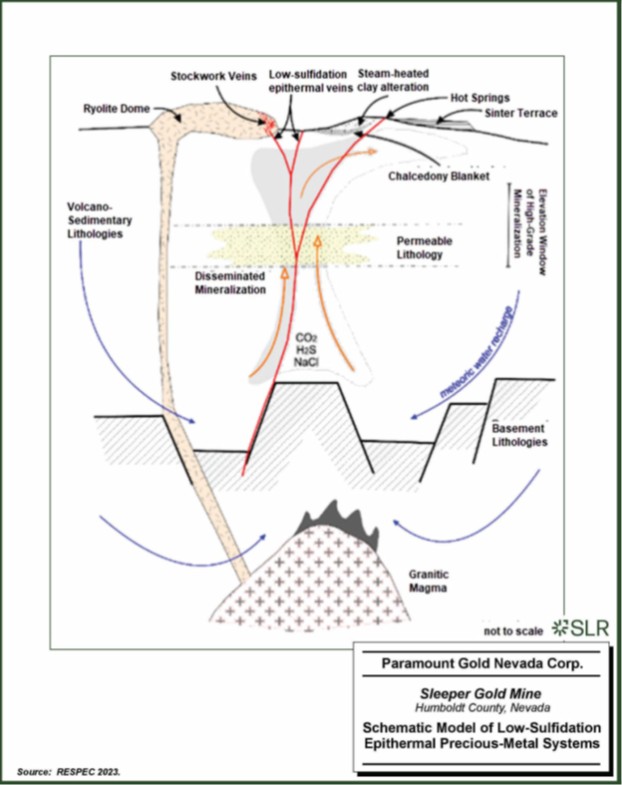
| 6-11 |
|
| Paramount Gold Nevada Corp. | Sleeper Gold Mine S-K 1300 Technical Report Summary |
June 17, 2026 SLR Project No.: 123.020721.00001 |
Mineralization at Sleeper comprises four principal styles that collectively define the deposit architecture: (i) quartz–adularia vein systems, which host the highest grades and represent the primary fluid conduits; (ii) hydrothermal breccias, which occur in structurally prepared zones and locally host moderate- to high-grade mineralization; (iii) stockwork veinlets and disseminated mineralization, which form a broad, lower-grade halo surrounding higher-grade structures; and (iv) alluvial or placer mineralization, derived from erosion of primary mineralized zones and preserved in post-mineral sedimentary units. These styles reflect a continuum of hydrothermal processes ranging from focused fluid flow in discrete structures to more diffuse fluid dispersion into the surrounding host rocks.
Gold and silver mineralization is spatially and genetically linked to the structural framework of the deposit. The principal control is the regional-scale normal fault system, which provided the primary conduit for hydrothermal fluids and established the hanging-wall domain in which mineralization is concentrated. Secondary controls include hanging-wall splays, vein arrays, and structural intersections, which created localized zones of enhanced permeability. These structural features governed the distribution of mineralization and are directly associated with the development of high-grade veins, breccia bodies, and vein swarms. The interaction between structure and lithology, particularly within competent rhyolitic units, played a critical role in focusing fluid flow and controlling mineral deposition.
The mineralization exhibits a clear relationship between style and grade distribution. High-grade mineralization is localized within quartz–adularia vein systems that may extend along strike over significant distances but are typically limited in width and continuity. Bonanza veins were as much as 4 to 5 m wide. Although disrupted by post-ore faulting, the reconstructed strike length of bonanza veins were quite consistent along strike for distances of more than 200 m. These veins can locally exceed 100 g/t Au, particularly within bonanza-grade shoots, although such grades are spatially restricted. Mid-grade mineralization is typically associated with hydrothermal breccias and structurally controlled vein swarms, where grades generally range from approximately 3 g/t Au to 34 g/t Au. These zones represent transitional domains between high-grade vein systems and the broader mineralized envelope. Low-grade mineralization occurs as pervasive stockwork veinlets and disseminations, generally grading less than 3 g/t Au, but forming the bulk of the tonnage within the current Mineral Resource.
Mineralogically, the system is dominated by quartz–adularia gangue assemblages with associated electrum, pyrite, and marcasite, consistent with deposition from near-neutral pH hydrothermal fluids under low-sulfidation epithermal conditions. Alteration is characterized by strong silicification associated with veins and breccias, adularia alteration indicative of boiling conditions, and weaker argillic to sericitic halos in surrounding wall rocks. Distal propylitic alteration is locally developed and reflects background fluid–rock interaction outside the main mineralized zones.
The geometry and continuity of mineralization reflect the underlying structural controls. Mineralized zones extend over a strike length of approximately 1.5 km to 2.0 km, widths of several hundred meters to over 1 km, and vertical extents exceeding 600 m. However, continuity varies significantly by mineralization style, with high-grade veins exhibiting limited lateral and vertical continuity relative to the more continuous, lower grade stockwork domains. This results in a deposit characterized by a highly heterogeneous grade distribution, with localized high-grade zones embedded within a large, lower-grade mineralized envelope.
Following historical mining, the remaining mineralization is dominated by lower-grade stockwork material, down-dip extensions of previously mined high-grade veins, and secondary structural zones hosting moderate-grade mineralization. Discrete zones such as the West Wood area demonstrate the continued presence of structurally controlled, higher-grade mineralization associated with hydrothermal breccias and intrusive-related features.
| 6-12 |
|
| Paramount Gold Nevada Corp. | Sleeper Gold Mine S-K 1300 Technical Report Summary |
June 17, 2026 SLR Project No.: 123.020721.00001 |
| 6.4 | Deposit Types |
The Project is classified as a low-sulfidation epithermal gold-silver deposit developed within a middle Miocene volcanic center in an extensional tectonic environment. This classification is supported by the observed geological, mineralogical, structural, and alteration characteristics, including quartz–adularia vein systems, hydrothermal breccias, stockwork mineralization, and associated alteration assemblages typical of epithermal systems formed at shallow crustal levels.
Low-sulfidation epithermal deposits are formed from near-neutral pH hydrothermal fluids, typically derived from magmatic sources and circulating through structurally prepared volcanic sequences. At Sleeper, mineralization is spatially associated with a major west-dipping, range-bounding normal fault and related structural splays, which provided the principal conduits for hydrothermal fluid flow. The deposit is hosted predominantly within Miocene basaltic and rhyolitic volcanic rocks, with the Sleeper rhyolite representing the primary host lithology. The structural and lithological framework is consistent with the development of an epithermal system in an extensional volcanic setting, where repeated fault movement and magmatism facilitated fluid migration and metal deposition.
The mineralization at Sleeper exhibits the key features of low-sulfidation epithermal systems, including banded quartz–adularia veins, chalcedonic silica, and hydrothermal breccias, with associated gold occurring primarily as electrum. Sulfide mineralization is generally limited to pyrite and marcasite, reflecting relatively low sulfur fugacity conditions compared to high-sulfidation systems. The alteration assemblage is dominated by silicification and adularia, with subordinate argillic to sericitic halos and distal propylitic alteration, consistent with deposition from low-temperature hydrothermal fluids under boiling and fluid-mixing conditions.
The deposit displays a well-developed vertical and lateral zonation typical of epithermal systems. High-grade mineralization occurs in structurally controlled quartz–adularia veins and associated breccias within the central portion of the system, representing zones of focused fluid flow and boiling. These zones transition outward and downward into intermediate grade breccias and vein swarms, and ultimately into broad envelopes of low-grade stockwork and disseminated mineralization. This zonation reflects decreasing fluid flux and permeability away from the principal structural conduits and is consistent with established genetic models for low-sulfidation epithermal deposits.
The overall geometry and scale of the Sleeper system are also consistent with this deposit type, with mineralization extending over approximately 1.5 km to 2.0 km along strike, several hundred meters in width, and more than 600 m vertically. The system comprises a combination of discrete high-grade vein structures and a large, lower-grade mineralized envelope, reflecting both focused and diffuse hydrothermal processes. The presence of alluvial or placer mineralization derived from erosion of primary mineralized zones further supports the interpretation of a shallow-level epithermal system that has undergone post-mineral erosion and sediment redistribution.
| 6-13 |
|
| Paramount Gold Nevada Corp. | Sleeper Gold Mine S-K 1300 Technical Report Summary |
June 17, 2026 SLR Project No.: 123.020721.00001 |
| 7.0 | Exploration |
Exploration at the Project comprises an extensive, multi-decade dataset integrating drilling, geochemical sampling, geological mapping, and a wide range of geophysical surveys completed by multiple operators from the early 1980s through 2013. The deposit was discovered beneath shallow alluvial cover through drilling, and subsequent programs have included more than 4,400 drill holes, extensive soil and rock geochemical datasets, and numerous geophysical surveys, including gravity, airborne and ground magnetics, induced polarization (IP), resistivity, magnetotelluric (MT), and seismic methods
| 7.1 | Exploration |
| 7.1.1 | Paramount Gold Geophysical Surveys (2010–2013) |
| 7.1.1.1 | Overview (2010–2013) |
Following the acquisition of the Project in 2010, Paramount Gold undertook a series of targeted geophysical surveys between 2010 and 2013 to enhance the understanding of the structural and lithologic framework controlling mineralization. These surveys were designed to complement and refine the extensive historical geophysical database and were interpreted by a qualified geophysical consultant in the context of both newly acquired and legacy datasets. The primary objective of this work was to delineate structural corridors, identify lithologic contrasts, and define alteration patterns associated with the hydrothermal system.
| 7.1.1.2 | Gravity Survey (2012) |
In 2012, Paramount Gold completed a detailed ground gravity survey over the southern portion of the property. The survey was conducted between late March and mid-April 2012 and comprised approximately 1,019 gravity stations collected on variable grid spacing, including 100 m and 200 m grids, supplemented by wider-spaced reconnaissance stations.
Gravity measurements were acquired using LaCoste & Romberg Model-G gravity meters, with station locations surveyed using Trimble Real-Time Kinematic (RTK) and Fast-Static GPS methods to ensure accurate positioning and elevation control. The dataset was processed to Complete Bouguer Anomaly using a range of assumed densities, with a representative density of approximately 2.35 g/cm³ applied based on prior work in the area. Terrain corrections were applied over multiple radii extending to regional scales, and the processed data were gridded and filtered to generate regional, residual, and horizontal gradient products suitable for structural interpretation.
Interpretation of the gravity data identified three north–south–trending structural corridors extending more than 30 km southward from the Sleeper deposit. These features define a series of basin and horst geometries and are interpreted to represent fundamental controls on the distribution of mineralization and the architecture of the hydrothermal system.
| 7.1.1.3 | Induced Polarization and Electrical Surveys (2012–2013) |
Induced polarization (IP) and associated resistivity surveys were conducted during the 2012–2013 period to further investigate subsurface chargeability and resistivity contrasts. These surveys were designed to identify zones of sulfide mineralization, silicification, and hydrothermal alteration that may not be evident from surface observations or magnetic data.
| 7-1 |
|
| Paramount Gold Nevada Corp. | Sleeper Gold Mine S-K 1300 Technical Report Summary |
June 17, 2026 SLR Project No.: 123.020721.00001 |
The IP data were integrated with gravity and magnetic datasets to refine interpretations of subsurface structures and alteration zones. Chargeability anomalies identified through these surveys were interpreted as zones of disseminated sulfides and hydrothermal activity, providing additional drilling targets and contributing to the overall understanding of mineralization controls.
| 7.1.1.4 | Data Integration and Interpretation (2010–2013) |
All geophysical datasets acquired by Paramount Gold between 2010 and 2013 were integrated with historical geophysical, geological, and drilling data to produce a coherent interpretation of the property-scale structural framework. The combined dataset allowed for improved delineation of major structural trends, basin geometry, and potential mineralized corridors extending beyond the limits of historical mining.
This integrated interpretation confirmed that the Sleeper deposit is situated within a structurally complex setting characterized by major north–south structural corridors and associated secondary structures that control the localization of high-grade vein systems and broader zones of disseminated mineralization. The results of the Paramount Gold geophysical programs have therefore provided a critical foundation for ongoing exploration targeting, particularly in areas beneath post-mineral cover and along underexplored structural trends.
| 7.1.2 | Exploration Targeting – QP Comment |
Exploration targeting at Sleeper is based on integrating geological, geochemical, and geophysical datasets, with particular emphasis on structural controls and the distribution of hydrothermal alteration. High-grade mineralization is interpreted to be localized along steeply dipping structural zones and associated vein systems, while broader zones of lower-grade mineralization occur within stratigraphically controlled envelopes surrounding these structures.
Geophysical data, particularly gravity and IP surveys, have played a critical role in identifying structural corridors, basin architecture, and potential alteration zones beneath the cover. These features provide key vectors for exploration, particularly in areas beyond the limits of historical mining and drilling. Targets include down-dip and along-strike extensions of known vein systems, structurally controlled high-grade zones, and underexplored areas beneath post-mineral cover, including West Wood within the broader mineralized halo.
The QP emphasizes that these exploration targets are conceptual and based on geological interpretation supported by available data. There has been insufficient exploration to define Mineral Resources in these areas, and it is uncertain whether further exploration will result in the delineation of additional Mineral Resources.
| 7.2 | Drilling |
Drilling at the Project has been conducted by numerous operators over several decades and has served as the primary source of geological and grade information supporting the current understanding of the deposit. As of the effective date of this Technical Report, Paramount Gold and the Project’s predecessor owners have completed approximately 4,400 drill holes totaling about 638,000 m of drilling completed between 1983 and 2021 by multiple operators (Table 7-1 and Figure 7-1). Drilling methods are dominated by Reverse Circulation (RC), with limited core and sonic drilling incorporated in later programs. Some historical drilling records lack complete information, including hole type and total depth for certain programs, and these data gaps introduce uncertainty that has been considered in the evaluation of the dataset and Mineral Resource classification.
| 7-2 |
|
| Paramount Gold Nevada Corp. | Sleeper Gold Mine S-K 1300 Technical Report Summary |
June 17, 2026 SLR Project No.: 123.020721.00001 |
Table 7-1: Drill Hole Database
| Year |
Operator /Property |
Program /Area |
Drill Type |
Number of Drill Holes |
Total Depth Drilled (m) |
|||||||||||
| 1983–2010 |
Unknown | Exploration | RC | 20 | 780 | |||||||||||
| 1983–1995 |
AMAX | Exploration / Production | RC | 3,668 | 509,043 | |||||||||||
| 1989 |
NGM | Exploration | RC | 9 | 438 | |||||||||||
| 1997 |
Placer Dome | Exploration | RC | 47 | 13,323 | |||||||||||
| 1996–1997 |
X-Cal | Exploration | RC | 140 | 27,700 | |||||||||||
| 1998–2003 |
X-Cal* | Exploration | RC | 83 | N/A | |||||||||||
| 2003–2007 |
X-Cal | Exploration | RC | 169 | 47,169 | |||||||||||
| 2004–2005 |
New Sleeper Gold | Exploration | RC | 69 | 18,363 | |||||||||||
| 2007–2008 |
Evolving Gold* | Exploration | RC | 34 | 6,636 | |||||||||||
| 2009–2012 |
Montezuma Mines* | Exploration | RC | 11 | 1,940 | |||||||||||
| 2010–2021 |
Paramount Gold | Exploration | RC | 155 | 29,752 | |||||||||||
| Waste Rock Dump | RC | 65 | 2,397 | |||||||||||||
| SONIC | 9 | 261 | ||||||||||||||
| Heap Leach Pad | CORE | 40 | 978 | |||||||||||||
| TSF | SONIC | 83 | 825 | |||||||||||||
|
|
|
|
|
|||||||||||||
| Total |
4,596 | 659,605 | ||||||||||||||
|
|
|
|
|
|||||||||||||
| Note: * reported historical drilling not contained in Mineral Resource Database |
| |||||||||||||||
Reconciliation of historically reported drilling totals with the drill hole database provided to SLR indicates that, while the datasets are broadly consistent in overall scale and principal contributors, differences exist due to incomplete, missing, or unverified data within the database available for review and use in the Mineral Resource Estimate (MRE).
AMAX drilling (3,668 holes; approximately 509,000 m), which comprises most of the dataset, is fully reconciled between sources and serves as the primary basis for the database. NGM (9 holes; 438 m) and Placer Dome (47 holes; 13,323 m) drilling was also consistent across datasets and was considered complete.
Discrepancies were identified between historical drilling records and the drill hole database provided to SLR for the X-Cal, Paramount Gold, and related programs. Historical records indicate that X-Cal completed 394 drill holes, including 83 holes drilled between 1998 and 2003 for which total depths are not reported. The database provided to SLR includes 309 X-Cal holes totaling 74,869 m. Consequently, a portion of the X-Cal drilling—primarily from the 1998–2003 program—was excluded from the Mineral Resource Estimate (MRE) due to insufficient or unverifiable supporting information.
Historical documentation also indicates that Evolving Gold drilled 34 holes totaling 6,636 m between 2007 and 2008, and Montezuma Mines drilled 11 holes totaling 1,940 m between 2009 and 2012. These drill holes were not included in the database provided to SLR and were therefore excluded from the MRE.
| 7-3 |
|
| Paramount Gold Nevada Corp. | Sleeper Gold Mine S-K 1300 Technical Report Summary |
June 17, 2026 SLR Project No.: 123.020721.00001 |
A similar variance is noted for Paramount Gold drilling. Records report 155 drill holes totaling 29,752 m, whereas the database provided to SLR contains 136 holes totaling 23,756 m. The exclusion of 13 holes (approximately 3,300 m) reflects the absence of complete or verifiable supporting data at the time of review. As this drilling is relatively recent, the omission is noted as a limitation on overall data completeness.
In contrast, New Sleeper Gold drilling shows consistency between datasets, with 69 drill holes reported and only a minor variance of approximately 300 m in total drilled length, which is not considered material. The 20 drill holes classified as “Unknown” (780 m) are present in both datasets; however, due to the lack of ownership attribution and supporting metadata, their use remains limited and subject to further verification.
Overall, the historically reported dataset comprises 4,596 drill holes totaling 656,960 m, compared to 4,455 drill holes (exploration, waste rock dumps, heap leach pads and TSF) totaling 645,033 m in the database provided to SLR, resulting in a net shortfall of 215 drill holes totaling 14,584 m. These differences are primarily attributable to incomplete X-Cal and Paramount Gold datasets. Consistent with S-K 1300 and CIM (2019) guidance, the QP has excluded data that could not be verified or adequately supported and considers the remaining dataset sufficient to support the current Mineral Resource classification, while recognizing that the excluded data represent a limitation on overall data completeness.
| 7-4 |
|
| Paramount Gold Nevada Corp. | Sleeper Gold Mine S-K 1300 Technical Report Summary |
June 17, 2026 SLR Project No.: 123.020721.00001 |
Figure 7-1: Drill Hole Location Map
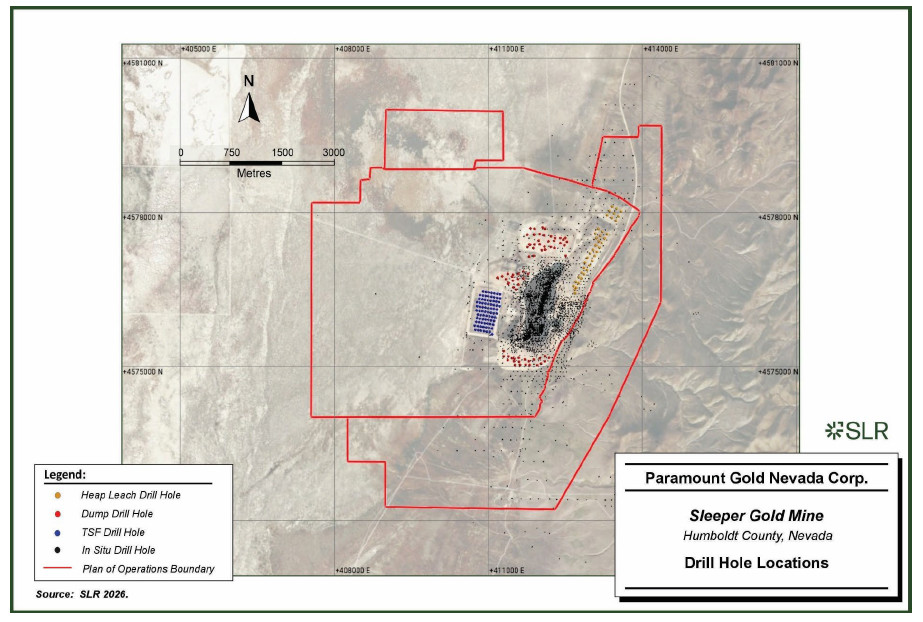
| 7-5 |
|
| Paramount Gold Nevada Corp. | Sleeper Gold Mine S-K 1300 Technical Report Summary |
June 17, 2026 SLR Project No.: 123.020721.00001 |
| 7.2.1 | Paramount Gold (2010–2021) |
Drilling conducted by Paramount Gold Nevada Corp. and Silver Corp. between 2010 and 2021 represents the most recent phase of systematic exploration at the Project and was undertaken to validate historical data, refine the geological model, and test extensions of known mineralization. A total of 136 drill holes comprising approximately 23,756 m were included in the drill hole database provided to SLR and used in the Mineral Resource Estimate (MRE). Drilling was primarily focused on the Sleeper deposit core area and surrounding zones, including structurally controlled targets and underexplored areas such as West Wood and areas beneath post-mineral cover.
| 7.2.1.1 | 2010 Drilling |
The 2010 program comprised 14 drill holes totaling approximately 4,123 m and represents the initial phase of Paramount Gold’s drilling following acquisition of the project. This program focused on the central Sleeper deposit, including areas within and adjacent to the historical open pit, with the objective of validating historical drilling results and confirming the continuity of known mineralization. Limited step-out drilling also tested extensions of mineralization along the primary structural trends associated with the Sleeper vein system.
| 7.2.1.2 | 2011 Drilling |
The 2011 program was the largest of the Paramount Gold campaigns, comprising 93 drill holes totaling approximately 9,028 m. During this phase, drilling focused on expanding mineralization within the broader low-grade halo surrounding the historical high-grade vein systems, as well as testing along-strike and down-dip extensions of the principal structures. Additional drilling targeted peripheral zones, including the West Wood area and other structurally controlled targets interpreted to host hydrothermal breccias and vein-related mineralization.
| 7.2.1.3 | 2012 Drilling |
The 2012 program included 19 drill holes totaling approximately 6,158 m and was designed to follow up on targets generated from the 2011 drilling and concurrent geophysical surveys. Drilling focused on structurally controlled zones identified through gravity and IP data, including areas south of the historical pit and beneath post-mineral cover. The program emphasized refining the geometry of mineralized zones and testing newly identified structural corridors interpreted to control mineralization.
| 7.2.1.4 | 2013 Drilling |
The 2013 program comprised 10 drill holes totaling approximately 4,448 m and represents the final phase of Paramount Gold’s drilling during this period. Drilling was more selective and focused on priority targets identified from previous programs, including infill and step-out drilling in the core deposit area and targeted testing of structurally controlled zones and peripheral exploration areas.
| 7.2.1.5 | 2021 Drilling |
The 2021 program consisted of 6 RC exploration holes drilled to the southeast of the open pit. A total of 2,645 m were drilled. One of the holes was an RC pre-collar in the West Wood zone. However, the planned core tail portion of the hole was never initiated due to budgeting issues at the time.
| 7-6 |
|
| Paramount Gold Nevada Corp. | Sleeper Gold Mine S-K 1300 Technical Report Summary |
June 17, 2026 SLR Project No.: 123.020721.00001 |
| 7.2.2 | Drill Hole Orientation |
Historical drilling at the Project was predominantly completed using vertical reverse circulation (RC) drill holes, reflecting the early focus on delineating near-surface mineralization and supporting open-pit mine development. This approach was appropriate for defining the broad, laterally continuous low-grade mineralized envelope; however, vertical drilling provides limited control on the true thickness and geometry of steeply dipping structures.
Subsequent drilling programs incorporated angled holes, particularly core drilling, to better define the orientation and continuity of steeply dipping vein systems, hydrothermal breccias, and structurally controlled zones. Drill hole orientations and intercept relationships indicate that high-grade mineralization is commonly associated with steeply dipping structures, and angled drilling was therefore required to adequately characterize these features and support geological modeling.
Paramount Gold drilling (2010–2021) continued to utilize primarily RC methods with a combination of vertical and locally angled holes, targeting both confirmation of historical mineralization and improved definition of structural controls. Drill orientations were selected to test down-dip and along-strike extensions of known mineralized zones and to evaluate targets identified through integrated geological and geophysical interpretation.
The QP considers that, while the predominance of vertical drilling in the historical dataset introduces some uncertainty in defining true thickness and structural geometry, the incorporation of angled drilling and the overall drilling density provides an adequate basis for interpreting mineralization continuity and supporting the current Mineral Resource Estimate.
| 7.2.3 | Drill Hole Collar Surveys |
Drill hole collar locations for historical and more recent drilling programs were established using survey methods consistent with industry practices at the time of drilling. Early drilling campaigns (1980s–1990s) generally relied on conventional ground survey techniques, including optical and manual methods, which may be subject to greater positional uncertainty relative to modern standards.
More recent programs, including those conducted during the 2000s and by Paramount Gold Nevada Corp. between 2010 and 2013, utilized improved survey techniques, including differential Global Positioning System (GPS) methods, providing greater spatial accuracy for collar positioning. Collar coordinates were compiled into a centralized database and, where possible, validated against historical records and mapping.
For certain historical drill holes, survey control data are incomplete or lack documentation regarding survey methodology and accuracy. In accordance with S-K 1300 requirements and CIM (2019) Best Practice Guidelines, the QP has assessed these limitations and considers that the overall collar dataset is sufficiently reliable to support Mineral Resource estimation, with associated uncertainties addressed during the Mineral Resource estimation process.
| 7.2.4 | Drill Hole Coordinate System |
Drill hole collar locations at the Project have been recorded using multiple coordinate systems over time, reflecting changes in surveying practices and data management by successive operators.
| 7-7 |
|
| Paramount Gold Nevada Corp. | Sleeper Gold Mine S-K 1300 Technical Report Summary |
June 17, 2026 SLR Project No.: 123.020721.00001 |
During initial exploration in the early 1980s, AMAX established a local mine grid coordinate system based on a truncated State Plane system referenced to NAD27, Western Nevada Zone, in feet. This local grid was defined such that local coordinates of X = 0 and Y = 0 correspond to State Plane coordinates of X = 640,000 ft and Y = 2,390,000 ft, respectively. This coordinate system remained in use for all drilling and data management activities through August 2004.
In August 2004, X-Cal converted all relevant project data, including drill hole collar locations, to the Universal Transverse Mercator (UTM) coordinate system, NAD27, Zone 11, in meters. The transformation included the establishment of a local mine grid reference tied to UTM coordinates (local Mine Grid X = 0 corresponding to UTM Easting 410,125.39 m and local Mine Grid Y = 0 corresponding to UTM Northing 4,573,808.38 m).
All drilling completed after this conversion, including the Paramount Gold drilling programs (2010–2021), was surveyed directly in UTM NAD27 Zone 11 coordinates (meters). Paramount Gold did not resurvey historical drill hole collars, as many locations had been disturbed by mining or reclamation activities. Instead, collar data were compiled from historical records, including drill logs and electronic databases.
A review of the collar dataset indicates that most historical collar coordinates were transcribed into electronic format during the X-Cal conversion and show good agreement between original mine grid records and UTM-transformed coordinates.
In accordance with S-K 1300 and CIM (2019) Best Practice Guidelines, the QP considers the coordinate system transformation and compilation process to be appropriate for Mineral Resource estimation, with any residual uncertainty associated with historical collar locations addressed through data validation procedures and the Mineral Resource estimation process.
| 7.2.5 | QP Comment – Drilling Data Considerations and Limitations |
While the overall drilling database is extensive, certain portions of the historical drilling record are incomplete or lack detailed documentation regarding drilling methods, sampling procedures, and survey control. Some historical programs, although conducted by reputable operators, do not include sufficient supporting information on data-acquisition protocols, which introduces uncertainty and implications for the confidence and classification of Mineral Resources.
Despite these limitations, the QP considers that the available drilling data, when integrated with geological interpretation and supported by more recent drilling and validation work, provides an adequate basis for the current Mineral Resource estimates. Continued drilling, particularly using modern standards and oriented core techniques, is expected to further refine the geological model, improve confidence in structural interpretations, and support potential future upgrades in resource classification.
| 7.3 | Hydrogeology Data |
The Project is located along the eastern margin of Desert Valley in Humboldt County, Nevada, where basin-fill alluvium overlies a sequence of Mesozoic and Cenozoic bedrock units. The hydrogeologic system is well characterized based on pre-mining investigations, extensive dewatering records from mine operations (1985–1996), and post-closure monitoring data collected since 1996. SLR has reviewed numerous technical reports prepared over the past three decades, including documents submitted to state and federal regulatory agencies such as the Nevada Division of Environmental Protection (NDEP), Bureau of Mining Regulation and Reclamation (BMRR), and the BLM.
| 7-8 |
|
| Paramount Gold Nevada Corp. | Sleeper Gold Mine S-K 1300 Technical Report Summary |
June 17, 2026 SLR Project No.: 123.020721.00001 |
Since the Sleeper pit has previously been dewatered by a network of dewatering wells (61 drilled over the mine life), there is an extensive physical and chemical hydrogeological database collected from these dewatering wells and a supporting network of monitoring wells (68 installed over the mine life). At full capacity, the dewatering system discharged 87,200 m3/day (16,000 US gallons per minute [gpm]) from 12 pumping wells installed into the bedrock and 28 interceptor wells installed in the basal gravel aquifer.
| 7.3.1 | Physical Hydrogeology |
Hydrostratigraphic units generally consist of layered lacustrine clays, silts, and sands overlying alluvial gravel, followed by faulted rhyolite bedrock. The lacustrine sands (known locally as the intermediate sands) are interpreted to have been beach deposits on the shores of periglacial Lake Lahontan. The intermediate sands were de-watered under an induced hydraulic gradient from the intermediate sands into the basal alluvial gravel. As such, no dewatering wells were installed in the intermediate sands (WMC 1995).
The basal gravel is the primary aquifer and the main source of recharge to the pit lake. The basal gravel is thin to non-existent on the east wall of the pit. Approximately 70% of the discharged groundwater was extracted from the basal gravel aquifer (WMC 2005). Groundwater discharged from the interceptor wells (installed in the basal gravel on the west side of the pit) is intercepted prior to discharging to the pit.
Faults transecting the rhyolite bedrock have been found to be generally non-transmissive and effectively compartmentalize groundwater flow in the bedrock. There is a fracture zone underlying the base of the pit (below 1,087 masl), known as the Deep Fracture System (DFS), that was targeted to complete bedrock wells. Approximately 22 % of the discharged groundwater was extracted from DFS bedrock wells (WMC 2005). Generally, de-pressurizing the deep fracture system induced downward flow from fractures above and allowed for efficient dewatering of the bedrock pit walls and floor.
However, in zones where pressurized shallow fracture (PSF) systems were found not to be connected to the DFS and were at risk of de-stabilizing the pit walls, additional bedrock wells were installed. Approximately 9% of the discharged groundwater was discharged from PSF bedrock wells (WMC 2005).
A total of approximately 30 dewatering wells were operational at any one time. Some redundancy was built into the dewatering well network to allow for well and pump maintenance; as such, 61 dewatering wells were drilled over the mine life (WMC 2005). Approximately 5,450 m3/day (1,000 gpm) of the discharged water was used for mine operation (heap process water, mill operations, and dust control), while the remainder was discharged into a temporary wetland comprised of engineered and permitted dyke structures that impounded 47 Mm3 (3,800 acre-feet) of water located in the middle of the Desert Valley (WMC 2005). Of the discharged water, approximately 40% infiltrated into the subsurface, while the remainder evaporated (WMC 2005). The discharge system consisted of 4.8 km of conveyance channel and 17.7 km of containment dyke and required excavation, placement, and compaction of 264,000 m3 (350,000 yd3) of material.
Basal gravel and bedrock aquifer properties have been reasonably assessed and presented in Table 7-2.
| 7-9 |
|
| Paramount Gold Nevada Corp. | Sleeper Gold Mine S-K 1300 Technical Report Summary |
June 17, 2026 SLR Project No.: 123.020721.00001 |
Table 7-2: Hydrostratigraphic Unit Hydraulic Properties
| Hydrostratigraphic Unit |
Hydraulic Conductivity (m/s) |
Specific Storage |
Specific Yield | |||
| Lacustrine Deposits | 4E-8 to 2E-5 | 2E-5 to 3E-3 | 0.1 to 0.15 | |||
| Basal Gravel Aquifer | 1E-5 to 1E-4 | 5E-5 to 5E-4 | 0.1 to 0.2 | |||
| Volcanic Bedrock | 4E-7 | 3E-7 | 0.0001 | |||
| Source: WMC 1995. | ||||||
Using the hydraulic properties presented above, a three-dimensional numerical model using MODFLOW-USG was calibrated with a 90% to 95% correlation coefficient to measured piezometric heads in the aquifers (Piteau 2021). The monthly water balance of the calibrated model is presented in Table 7-3.
Table 7-3: Monthly Water Balance for the Calibrated Pit Lake Numerical Model
| Month |
Water Level Elevation (masl) |
Surface Area of Open Water (m2) |
Precipitation (m3/day) |
Evaporation (m3/day) |
Lake Water Balance (m3/day) |
|||||||||||||||
| October |
1,248 | 655,290 | 255 | 1,739 | -1484 | |||||||||||||||
| November |
1,248 | 655,290 | 245 | 940 | -696 | |||||||||||||||
| December |
1,248 | 655,290 | 250 | 576 | -326 | |||||||||||||||
| January |
1,248 | 655,290 | 190 | 603 | -413 | |||||||||||||||
| February |
1,248 | 655,290 | 120 | 875 | -755 | |||||||||||||||
| March |
1,248 | 655,290 | 228 | 1,755 | -1,527 | |||||||||||||||
| April |
1,248 | 655,290 | 315 | 2,076 | -1,761 | |||||||||||||||
| May |
1,248 | 655,290 | 456 | 2,913 | -2,457 | |||||||||||||||
| June |
1,248 | 655,290 | 163 | 3,755 | -3,592 | |||||||||||||||
| July |
1,248 | 655,290 | 65 | 4,076 | -4,011 | |||||||||||||||
| August |
1,248 | 655,290 | 38 | 2,870 | -2,832 | |||||||||||||||
| September |
1,248 | 655,290 | 92 | 2,755 | -2,663 | |||||||||||||||
| Source: Piteau 2021. |
| |||||||||||||||||||
The water balance is consistent with a net evaporative loss whereby there is no significant recharge to the subsurface.
The model was run under two climactic scenarios: 1) current climactic conditions and 2) assuming a 15% increase in evapotranspiration. The model showed that, under each scenario, the pit lake was a regional groundwater receptor, that the pit lake was not recharging aquifers in any direction, and that it would continue to do so for at least 100 years into the future. The physical hydrogeology data collected to date and the calibrated model show that physical hydrogeology at Sleeper is reasonably well understood.
| 7-10 |
|
| Paramount Gold Nevada Corp. | Sleeper Gold Mine S-K 1300 Technical Report Summary |
June 17, 2026 SLR Project No.: 123.020721.00001 |
| 7.3.2 | Hydrogeochemistry |
A database comprising 24 years of quarterly monitoring of pit lake water quality has been developed. The data set includes depth profiling within the pit lake. Since the pumps were turned off in 1996, the pit lake water quality has consistently improved (Table 7-4). Except for isolated exceedances of fluoride, the 2020 pit lake water quality generally met the Nevada Profile III Reference values.
While the mine was operational, a groundwater quality database was developed consisting of groundwater samples collected from exploration drill holes, groundwater monitoring wells and dewatering wells distributed as outlined in Table 7-5.
No formal quality assurance/quality control (QA/QC) system was implemented in the characterization of groundwater and pit lake quality.
Groundwater quality reported from each hydrostratigraphic unit was generally diagnostic of that hydrostratigraphic unit. Generally, groundwater at the margins of the basin was younger calcium -bicarbonate type water, whereas groundwater at the center of the basin was older and trended toward a sodium-chloride type water. Since the groundwater quality from each hydrostratigraphic unit is diagnostic, the influence of leakage across hydrostratigraphic unit boundaries can be qualitatively determined. Based on hydrogeochemical data, as dewatering progressed, an increasing percentage of the groundwater discharge originates from the basal gravel aquifer but also an increasing percentage is older water originating from the center of the basin (WMC 1995).
Exceedances of U.S. Environmental Protection Agency (USEPA) water quality standards in the discharged groundwater to the temporary wetland are presented in Table 7-6.
Table 7-4: Evolution of Pit Lake Water Quality
| Analyte |
1996 Lake | 2008 Lake | 1Q2011 | 1Q2014 | 1Q2020 | |||||
| Alkalinity (total) |
nr | 62.9 | 53 | 66 | 75 | |||||
| pH (pH units) |
1.9 | 7.6 | 7.78 | 7.77 | 7.27 | |||||
| Antimony |
0.12 | <0.003 | 0.002 | <0.002 | <0.0025 | |||||
| Arsenic |
31.8 | 0.002 | 0.005 | 0.006 | 0.01 | |||||
| Cadmium |
0.12 | <0.002 | <0.002 | <0.002 | <0.0020 | |||||
| Chloride |
178 | 280 | 280 | 280 | 310 | |||||
| Copper |
9.01 | 0.007 | 0.002 | <0.002 | <0.0020 | |||||
| Iron |
1,348 | <0.05 | <0.1 | <0.1 | <0.20 | |||||
| Lithium |
nr | nr | nr | nr | <0.20 | |||||
| Magnesium |
253 | 52 | 57 | 59 | 60 | |||||
| Manganese |
27.7 | 0.098 | 0.074 | 0.063 | 0.05 | |||||
| Molybdenum |
nr | nr | nr | nr | <0.040 | |||||
| Nickel |
16.1 | 0.06 | 0.045 | 0.034 | <0.050 | |||||
| Nitrate |
0.53 | 0.3 | <0.5 | <0.5 | <0.1 | |||||
| Phosphorus |
nr | nr | nr | nr | <1.0 | |||||
| Potassium |
32 | 24 | 29 | 29 | 31 |
| 7-11 |
|
| Paramount Gold Nevada Corp. | Sleeper Gold Mine S-K 1300 Technical Report Summary |
June 17, 2026 SLR Project No.: 123.020721.00001 |
| Selenium | 0.02 | 0.006 | <0.01 | <0.01 | <0.0050 | |||||
| Sodium |
241 | 330 | 340 | 350 | 390 | |||||
| Strontium |
nr | nr | nr | nr | 1 | |||||
| Sulfate |
6,366 | 1,330 | 1,300 | 1,400 | 1,400 | |||||
| Thallium |
1.37 | 0.002 | 0.003 | 0.002 | 0.002 | |||||
| Tin |
nr | nr | nr | nr | <0.20 | |||||
| Total Dissolved Solids |
9,000 | 2,480 | 2,600 | 2,600 | 2,700 | |||||
| Uranium |
nr | nr | nr | nr | <0.0050 | |||||
| Vanadium |
nr | nr | nr | nr | <0.020 | |||||
| Zinc |
39.5 | 0.015 | 0.06 | 0.05 | <0.040 | |||||
| Source: Piteau 2021. |
Notes:
| nr | analyte concentration not reported |
| < | less than the method detection indicated |
All concentrations (except pH) are reported as mg/litre unless otherwise indicated
Table 7-5: Groundwater Sample Distribution
| Source |
Total Number of Samples Collected | |||
| Lahontan Clays |
66 | |||
| Intermediate Sand |
20 | |||
| Basal Gravel Aquifer |
57 | |||
| Bedrock |
14 | |||
| Regional Monitoring Locations |
73 | |||
| Composite Dewatering Discharge |
38 | |||
| Source: WMC 1995. |
| |||
Table 7-6: Exceedances of USEPA Water Quality Standards in Dewatering Discharge
| Primary Drinking Water |
Irrigation |
Livestock Watering |
Aquatic Life |
Wildlife | ||||||
| Dewatering Discharge | Arsenic Selenium |
TDS Fluorine Boron |
None | Fluorine Arsenic Boron Copper Zinc |
Bicarbonate Alkalinity | |||||
| Source: WMC 1995.
Notes:
TDS total dissolved solids | ||||||||||
| 7-12 |
|
| Paramount Gold Nevada Corp. | Sleeper Gold Mine S-K 1300 Technical Report Summary |
June 17, 2026 SLR Project No.: 123.020721.00001 |
| 7.4 | Geotechnical Data |
No relevant geotechnical data have been collected by Paramount Gold recently, and the authors are not aware of any existing geotechnical data. The SLR QP recommends that Paramount Gold compile relevant historical geotechnical data.
| 7-13 |
|
| Paramount Gold Nevada Corp. | Sleeper Gold Mine S-K 1300 Technical Report Summary |
June 17, 2026 SLR Project No.: 123.020721.00001 |
| 8.0 | Sample Preparation, Analyses, and Security |
This section has been reviewed and edited by SLR and is derived, where applicable, from RESPEC (2023) and Wilson and SRK (2012). SLR reviewed the information for completeness, internal consistency, and compliance with SEC Regulation S-K 1300, CIM (2019) Best Practice Guidelines.
The review covered sampling methods, sample preparation and analytical procedures, QA/QC protocols, and sample security practices. Supporting documentation, including original sampling records, full QA/QC datasets, and laboratory certificates, was not available for independent verification; therefore, the review relies on information presented in the source reports.
The SLP QP considers the sampling, preparation, analytical, and security practices to be consistent with industry standards for the deposit type and period of work. Despite data limitations, the information is sufficient to support the Mineral Resource Estimate, with uncertainties addressed through data validation and reflected in the Mineral Resource classification.
| 8.1 | Sample Method and Approach |
Sampling at the Project was completed by multiple operators between 1983 and 2013 and forms the basis of the geological and assay database supporting the MRE. Sampling methods evolved over time; however, the overall approach is considered appropriate for the style of mineralization and consistent with industry practice.
| 8.1.1 | Historical (1983–2010) |
Historical sampling was conducted by AMAX (1983–1995), NGM (1989), Placer Dome (1997), X-Cal (1996–2007), and New Sleeper Gold (2004–2005). Approximately 95% of the drill hole database comprises RC drilling. RC samples were collected at the rig using cyclone and splitter systems to produce representative subsamples at regular intervals, designed to capture lithologic and mineralization variability.
During the AMAX period, sampling focused on near-surface bulk-tonnage mineralization, predominantly using vertical drill holes. Documentation is limited; however, methods are consistent with industry practice for the period. NGM and Placer Dome used similar RC-based approaches with limited documentation but no identified deviations from standard practice.
X-Cal and New Sleeper Gold implemented more structured procedures, including cyclone and splitter sampling, systematic labeling and tracking, and field duplicates at approximately 150 ft intervals. Limited diamond drilling was completed in structurally complex areas; core was logged and sampled by lithology, alteration, and mineralization, and split with half retained.
Sampling targeted both the low-grade mineralized envelope and higher-grade structurally controlled mineralization associated with veins and hydrothermal breccias. Where coarse gold was suspected, a metallic screen fire assay was used to address sampling bias.
| 8.1.2 | Paramount Gold (2010–2021) |
Sampling during the Paramount Gold and Silver Corp. programs (2010–2021) represents the most recent data collection phase and was completed to validate historical data, refine the geological model, and test extensions of mineralization A total of 155 drill holes (29752 m) were sampled, primarily using RC drilling methods similar to those used in earlier programs.
| 8-1 |
|
| Paramount Gold Nevada Corp. | Sleeper Gold Mine S-K 1300 Technical Report Summary |
June 17, 2026 SLR Project No.: 123.020721.00001 |
RC samples were collected at the rig using cyclone and splitter systems at regular intervals. Intervals were defined from geological logging to capture mineralization associated with vein systems, hydrothermal breccias, and disseminated zones within the broader low-grade envelope. Sampling covered the main Sleeper deposit and peripheral targets, including structurally controlled zones and areas beneath post-mineral cover such as West Wood.
Paramount applied standardized procedures for sample collection, labeling, and tracking, using trained personnel to maintain sample integrity. Methods were consistent with earlier programs to maintain database continuity. Where coarse gold was suspected, a metallic screen fire assay was applied.
| 8.1.3 | QP Comment |
Sampling methods across all programs are appropriate for the mineralization style and intended data use. Documentation for early programs is limited; however, later programs by X-Cal, New Sleeper Gold, and Paramount demonstrate adherence to industry-standard practices.
In the opinion of the QP, the sampling approach is adequate to support the MRE, with uncertainties from historical practices addressed through data validation and Mineral Resource classification.
| 8.2 | Sample Preparation and Analysis |
| 8.2.1 | Historical (1983–2010) |
| 8.2.1.1 | Sampling, Handling, and Chain of Custody |
Sample preparation and analytical procedures for historical drilling at the Project were completed by AMAX, NGM, Placer Dome, X-Cal, and New Sleeper Gold. Documentation has improved since the late 1990s. Early programs (1983–1997) lacked detailed records of sample handling, chain of custody, and laboratory protocols. Although conducted by established operators and consistent with industry practice at the time, supporting documentation, including laboratory certificates and QA/QC records, was not available for independent verification.
Later programs, particularly X-Cal (1996–2007) and New Sleeper Gold (2004–2005), implemented more structured handling and chain-of-custody procedures. Samples were collected at drill sites and transported to commercial laboratories in accordance with documented protocols, thereby improving traceability and control.
| 8.2.1.2 | Sample Preparation |
Sample preparation during later historical programs was completed at commercial laboratories, primarily ALS Chemex (ALS Global or ALS), which is located in Elko, Nevada. Procedures followed standard workflows, including drying (if required), whole-sample crushing, subsampling, and pulverization to produce a pulp for analysis, ensuring homogeneity and minimizing bias.
Prepared pulps were retained by the laboratory or returned to the site for storage and potential verification.
| 8-2 |
|
| Paramount Gold Nevada Corp. | Sleeper Gold Mine S-K 1300 Technical Report Summary |
June 17, 2026 SLR Project No.: 123.020721.00001 |
| 8.2.1.3 | Analytical Methods |
Gold was analyzed primarily by fire assay, the industry-standard method. Routine samples used fire assay with atomic absorption finish. Samples with elevated gold or suspected coarse gold were analyzed by metallic screen fire assay to address nugget effects and improve accuracy.
Selected samples were analyzed for multiple elements using aqua regia or four-acid digestion followed by ICP techniques to support geological interpretation and mineralization characterization.
| 8.2.1.4 | Laboratory Accreditation and Quality Systems |
Analytical work during the historical programs was completed by independent commercial laboratories, primarily ALS Chemex (ALS Global) and, during the New Sleeper Gold programs, American Assay Laboratories (AAL), located in Sparks, Nevada.
ALS Global operates laboratories accredited to ISO/IEC 17025, requiring validated methods, calibrated instrumentation, and quality management systems to support analytical accuracy, precision, and reproducibility. Specific certification numbers for the Elko and Vancouver facilities were not provided; however, ALS laboratories are widely recognized as ISO-accredited.
AAL is accredited to ISO/IEC 17025:2017 by the International Accreditation Service (IAS) (Laboratory No. TL-536). The accreditation scope includes sample preparation, fire-assay for gold, and multi-element analysis by acid digestion and fusion. AAL maintains a formal quality management system and applicable regulatory approvals, including from the Nevada Division of Environmental Protection.
| 8.2.1.5 | Sample Retention |
Pulps generated during sample preparation were typically returned to the site for storage and potential re-analysis. The use of established laboratories and standard methods supports dataset reliability; however, incomplete documentation for early programs remains a limitation in data evaluation and Mineral Resource classification.
| 8.2.2 | Paramount Gold (2010–2021) |
Sample preparation and analytical procedures during the Paramount Gold and Silver Corp. drilling programs (2010–2021) followed documented protocols outlined in the 2023 Technical Report (RESPEC 2023) and reflect a controlled workflow from drill-site collection through laboratory analysis at accredited facilities.
| 8.2.2.1 | Sampling, Handling, and Chain of Custody |
Samples were transported by drill contractors from drill sites to the Paramount logging facility at the Sleeper site near Winnemucca, Nevada. Drill core was placed in core boxes, marked in feet, and transported daily for logging, where depths were converted to meters. Core boxes were photographed and placed on logging tables prior to logging.
Paramount geologists logged lithology, alteration, mineralization, and structural features, including fault intersections, lineations, fractures, veins, and bedding. Sample intervals were defined on geological boundaries to separate lithologies and mineralization styles, typically not exceeding 1.52 m (5 ft) and aligned with drilling runs where possible. Mineralized features were marked to ensure representative sampling.
Samples were assigned unique numeric identifiers. Tags were placed in core boxes and sample bags, with all numbers recorded in tag books. Sample numbering excluded drill hole, depth, and location to prevent bias.
| 8-3 |
|
| Paramount Gold Nevada Corp. | Sleeper Gold Mine S-K 1300 Technical Report Summary |
June 17, 2026 SLR Project No.: 123.020721.00001 |
Core was sampled at a dedicated station. The competent core was cut with a diamond saw; the broken core was split manually. One-half was bagged, and the remaining half was retained. Sampling technicians recorded sample numbers, intervals, and dates.
Sample bags were stored in a secure facility until shipment. Samples were organized sequentially, including QA/QC materials, inventoried, and placed in sealed rice bags with numbered seals. Each shipment contained samples from a single drill hole. Submittal forms documented shipment details, sample numbers, analyses, and duplicate requirements and were provided in hard copy and electronic format.
Reverse Circulation (RC) Drilling
Reverse circulation (RC) samples were collected at the drill rig using a cyclone system and placed in cloth bags within five-gallon buckets to capture coarse and fine fractions. Each sample was assigned a unique numeric identifier, with records linking the sample number to drill hole, depth, and interval.
Sample bags were tied, placed in crates, and stored at the drill site or in secured areas behind locked gates at the Sleeper site. Samples were handled to preserve integrity and prevent contamination or loss.
Before shipment, samples were arranged sequentially, including blanks, CRMs, and duplicates. Batches were verified and photographed as part of QA/QC.
Samples were transported to the laboratory by ALS personnel. Shipment dates and counts were recorded on handling forms, maintaining the chain of custody from drill site to laboratory receipt.
Sonic Drilling
Sonic drilling samples were collected from the drill pipe and placed in plastic bags labeled with the ending footage and orientation. Samples were transported to the Paramount facility and arranged sequentially on logging tables.
A geologist logged the samples and converted measurements to meters. Each 1 m interval was transferred into one or two sealed plastic bags (approximately 45.7 cm × 61 cm) for shipment.
Samples were placed in bins with nailed lids and transported to McClelland Laboratories, typically on the day of collection, minimizing degradation or contamination. At McClelland, samples were logged, split, and coarse crushed before transfer to ALS Chemex for final preparation and analysis.
Chain of Custody Controls
Across all drilling methods (RC, sonic, core), chain-of-custody procedures included:
| • | Unique numeric sample identifiers |
| • | Recording of sample interval, drill hole, and depth in field logs and tag books |
| • | Secure on-site storage with controlled access |
| • | Sequential organization and verification of all samples, including QA/QC materials |
| • | Sealed containers (rice bags or bins) with numbered security seals |
| 8-4 |
|
| Paramount Gold Nevada Corp. | Sleeper Gold Mine S-K 1300 Technical Report Summary |
June 17, 2026 SLR Project No.: 123.020721.00001 |
| • | Detailed sample submittal forms documenting shipment and analytical requirements |
| • | Direct transport to laboratories by authorized personnel (ALS or contractors) |
| • | Documentation of sample movement using handling forms and photographs |
These procedures maintained sample security, traceability, and representativity through collection, handling, and shipment. The QP considers these protocols consistent with industry best practice and sufficient to support the integrity of the analytical dataset for the Mineral Resource Estimate.
| 8.2.2.2 | Sample Preparation |
Sample preparation for Paramount drilling was completed at ALS Chemex (Elko), using standardized, ISO-accredited procedures. Samples were logged, assigned laboratory IDs, and prepared under ALS protocols.
Preparation included the following steps:
| • | Drying (if required) |
| • | Primary crushing to approximately 75% passing 6 mm |
| • | Mechanical splitting to approximately 250 g subsample |
| • | Pulverization to approximately 85% passing 75 µm (200 mesh) |
These steps reduce particle-size variability and improve sample representativity.
Contamination control included cleaner sand through the crushing circuit every five samples or with lithology changes, and between all pulverization stages.
For sonic drilling, samples were initially processed at McClelland Laboratories, where coarse crushing was completed before transfer to ALS. Samples were transported in sealed bins and delivered the same day.
Prepared pulps were shipped to ALS Vancouver for analysis.
| 8.2.2.3 | Analytical Methods |
Analytical methods for the Paramount Gold drilling programs (2010–2013) were selected to provide an accurate determination of gold and associated elements across a wide grade range and to address coarse gold effects. The program included multiple analytical methods, re-assay protocols, and verification procedures.
Gold was determined primarily by fire assay fusion. Both 30 g and 50 g aliquots were used, with 50 g charges improving the representativeness of nuggety mineralization. Routine samples used fire assay with atomic absorption (AA) finish (e.g., ALS Au-AA23).
For elevated gold values or AA over limits:
| • | Fire assay with gravimetric finish (ALS Au-GRA21) for >10 g/t Au |
| • | 50 g fire assay charges to improve precision |
| • | Metallic screen fire assay for coarse gold, separating coarse and fine fractions to mitigate nugget effects |
| 8-5 |
|
| Paramount Gold Nevada Corp. | Sleeper Gold Mine S-K 1300 Technical Report Summary |
June 17, 2026 SLR Project No.: 123.020721.00001 |
Silver and multi-element analyses used four-acid digestion with inductively coupled plasma atomic emission spectroscopy (ICP-AES) (e.g., ALS ME-ICP61) on approximately 5 g aliquots, providing near-total digestion and analysis of approximately 32 elements.
For elevated silver values:
| • | >100 g/t Ag: four-acid digestion with atomic absorption finish (ALS AG-OG62) |
| • | >1,500 g/t Ag: fire assay with gravimetric finish (ALS Ag-GRA21) |
During parts of 2011–2012, silver was also analyzed by three-acid digestion with ICP and, in some cases, by 50 g fire assay with gravimetric finish. Gold was similarly analyzed using 30 g and 50 g charges with AA or gravimetric finish.
Independent check assays were completed by Inspectorate (Sparks, Nevada) using 30 g and 50 g fire assay for gold (AA or gravimetric finish) and atomic absorption or ICP methods for silver. This provided external verification of analytical results.
Laboratories applied QA/QC protocols, including blanks, CRMs, and duplicates. Samples were processed in numerical sequence to distribute QA/QC materials across batches. Results were monitored, and out-of-tolerance values triggered review and re-assay.
The combined use of fire assay, gravimetric and metallic screen methods, multi-element ICP analysis, and independent verification is consistent with industry best practice and supports the use of the data for Mineral Resource estimation
| 8.2.2.4 | Laboratory Accreditation and Quality Systems |
Analytical work was completed by ALS Chemex (ALS Global), accredited to ISO/IEC 17025:2005 for analytical testing, including gold assays, and ISO 9001:2008 for quality management. ISO/IEC 17025 requires validated methods, calibrated instrumentation, QA/QC protocols, external proficiency testing, and independent audits to support analytical accuracy, precision, reproducibility, and traceability.
Laboratory QA/QC included internal standards, blanks, duplicates, and defined re-assay protocols for out-of-limit results. These controls complemented Paramount’s field QA/QC program and provided an integrated framework from sampling through analysis.
Inspectorate was used as an independent laboratory for check assays, providing external verification; however, certification details for the reporting period were unavailable.
| 8.2.2.5 | Sample Retention |
Following analysis, pulps and coarse rejects were retained by the laboratory or returned to the site for storage, allowing future verification and re-analysis.
The QP considers sample preparation, analytical methods, and laboratory quality systems, including use of ISO-accredited laboratories, consistent with industry best practice and sufficient to support the analytical dataset for the Mineral Resource Estimate.
| 8.3 | Quality Assurance and Quality Control |
Quality assurance (QA) demonstrates that assay data meet accepted precision and accuracy limits for the methods used, supporting confidence in the Mineral Resource estimate. Quality control (QC) comprises procedures to maintain data quality during sampling, preparation, and analysis. QA/QC programs detect contamination and quantify accuracy, precision, repeatability, and overall sampling variability.
| 8-6 |
|
| Paramount Gold Nevada Corp. | Sleeper Gold Mine S-K 1300 Technical Report Summary |
June 17, 2026 SLR Project No.: 123.020721.00001 |
QA/QC procedures at the Project evolved over time, with limited documentation for early programs and more robust protocols in later programs (X-Cal, New Sleeper Gold, Paramount 2010–2013). The Paramount QA/QC program included certified reference materials (CRMs), blanks, duplicates, and secondary laboratory check assays to monitor accuracy, precision, contamination, and reproducibility.
QA/QC data for historical programs is incomplete and was not fully available for independent verification. The Paramount dataset includes a comprehensive QA/QC program with documented performance and validation.
| 8.3.1 | Procedures |
| 8.3.1.1 | Historical |
QA/QC procedures for early historical programs (AMAX, NGM, Placer Dome) are poorly documented, and records of standards, blanks, and duplicates were not available to SLR. Direct evaluation of analytical accuracy and precision is, therefore, limited.
Later programs (X-Cal and New Sleeper Gold) implemented formal QA/QC procedures, including:
| • | Insertion of certified reference materials |
| • | Use of blanks for contamination control |
| • | Collection of field and laboratory duplicates |
| • | Submission of check assays to independent laboratories |
Duplicate sampling was conducted at regular intervals (e.g., approximately 150 ft for RC drilling), with standards inserted at defined frequencies. Sample shipments were tracked, and results were monitored against expected values.
These procedures are consistent with industry practice; however, incomplete QA/QC datasets limit quantitative assessment of overall performance.
| 8.3.1.2 | Paramount |
The QA/QC program for the Paramount (2010–2013) drilling programs incorporated CRMs, blanks, and duplicates, together with internal laboratory QA/QC procedures and independent check assays to monitor accuracy, precision, and contamination.
QA/QC samples were inserted approximately once every 20 routine samples for each control type (CRMs, blanks, duplicates). Samples were submitted and processed in numerical sequence to ensure distribution across analytical batches. Protocols included CRM acceptance criteria, duplicate precision monitoring, and blank contamination review. Failures or out-of-tolerance results triggered batch review and re-assay where required.
The QA/QC dataset is summarized in Table 8-1, which presents counts of QA/QC samples by type relative to the total number of samples. QA/QC insertion rates are consistent and provide coverage for accuracy (CRMs), contamination (blanks), and precision (duplicates).
Based on SLR’s review and noted limitations, the QA/QC program is consistent with industry best practice and supports confidence in the analytical dataset.
| 8-7 |
|
| Paramount Gold Nevada Corp. | Sleeper Gold Mine S-K 1300 Technical Report Summary |
June 17, 2026 SLR Project No.: 123.020721.00001 |
Table 8-1: Summary Counts of Sleeper QA/QC Analysis (X-Cal and Paramount)
| Category |
2003–2007 (X-Cal) | 2011–2013 (Paramount) | ||||||||||||||
| QA/QC Type |
Au | Ag | Au | Ag | ||||||||||||
| Standard (CRM): |
||||||||||||||||
| Number in Use |
N/A | N/A | 12 | 6 | ||||||||||||
| Number of Analyses |
N/A | N/A | 387 | 16 | ||||||||||||
| Number of Failures |
N/A | N/A | 13 | 0 | ||||||||||||
| Duplicate |
||||||||||||||||
| Field Duplicate |
822 | 875 | 200 | 199 | ||||||||||||
| Preparation Duplicate |
642 | 309 | 0 | 0 | ||||||||||||
| Pulp Duplicate |
1,610 | 2,451 | 0 | 42 | ||||||||||||
| Lab Preparation Duplicate |
0 | 64 | 0 | 6 | ||||||||||||
| Lab Pulp Duplicate |
162 | 11 | 0 | |||||||||||||
| Blank |
||||||||||||||||
| Pulp Blank |
0 | 0 | 56 | 0 | ||||||||||||
| Coarse Blank |
42 | 35 | 231 | 230 | ||||||||||||
| Lab Prep Blanks |
0 | 0 | 8 | 10 | ||||||||||||
| Drill Hole Samples |
51,325 | 44,980 | 10,134 | 10,137 | ||||||||||||
|
|
|
|
|
|
|
|
|
|||||||||
| Total Insertion Percent (%) |
5.00 | 4.93 | 8.11 | 4.42 | ||||||||||||
|
|
|
|
|
|
|
|
|
|||||||||
| 8.3.2 | Certified Reference Material |
| 8.3.2.1 | Historical |
CRMs) were used in later historical programs, including X-Cal (1996–2007) and New Sleeper Gold (2004–2005), to monitor analytical accuracy and laboratory performance.
RESPEC confirmed the use of CRMs in the 2003–2007 X-Cal program; however, supporting documentation was not available for review. CRMs were sourced from commercial providers and selected to represent relevant gold grade ranges, but records of insertion frequency, standard types, certified values, and performance metrics (bias, variance, pass/fail) were not provided to SLR.
Findings and Limitations:
| • | CRM use confirms the implementation of accuracy monitoring |
| • | Insufficient documentation to assess performance against tolerance limits |
| • | No statistical evaluation (control charts or bias analysis) available |
| • | No systematic failures or analytical bias reported |
CRM use is confirmed; however, the effectiveness of accuracy control cannot be quantitatively verified and remains a limitation in the QA/QC assessment.
| 8-8 |
|
| Paramount Gold Nevada Corp. | Sleeper Gold Mine S-K 1300 Technical Report Summary |
June 17, 2026 SLR Project No.: 123.020721.00001 |
| 8.3.2.2 | Paramount Gold |
Certified Reference Materials (CRMs) were used during the Paramount Gold (2010–2013) programs to monitor analytical accuracy and laboratory performance. CRMs from Mineral Exploration Geochemistry (MEG), RockLabs Ltd. (RockLabs), and CDN Resource Laboratories (CDN) were inserted at approximately one per 20 samples and selected to represent low-, medium-, and high-grade gold ranges. Some included listed silver values for multi-element verification. CRMs were distributed throughout the sample stream and processed in sequence with routine samples.
Performance was evaluated against certified values using ±3 standard deviation (SD) acceptance limits. Most results met these criteria, indicating acceptable accuracy and no systematic bias. Performance was consistent across grade ranges, with variability within expected analytical limits.
Isolated CRM failures occurred but were not systematic or batch related. These triggered a review of associated batches and re-assay where warranted. Results indicate analytical accuracy was controlled and laboratory performance was stable for Mineral Resource estimation.
Paramount used four MEG CRMs (Reno, Nevada) and eight RockLabs CRMs (Perth, Western Australia). All 12 were certified for gold, some listed uncertified silver values. RESPEC data indicate CRM insertion rates of approximately 4% for gold and <1% for silver, reflecting limited silver-certified standards and selective silver analysis. Table 8-2 summarizes the CRMs used.
Table 8-2: Paramount Gold Certified Reference Material
| Standard ID |
Drill Years | Insertion Count | Certified Au (ppm) |
Au SD (ppm) |
Listed Ag (ppm) |
|||||||||||||||
| MEG S107005X |
2011-13 | 32 | 1.347 | 0.085 | 9.00 | |||||||||||||||
| MEG S107006X |
2011-13 | 34 | 2.850 | 0.364 | 8.00 | |||||||||||||||
| MEG S107010X |
2011-13 | 17 | 6.405 | 0.302 | 18.00 | |||||||||||||||
| MEG-Au.09.02 |
2011-13 | 35 | 0.185 | 0.019 | 0.10 | |||||||||||||||
| OxA89 |
2011-13 | 29 | 0.084 | 0.008 | ||||||||||||||||
| OxC30 |
2011-13 | 18 | 0.200 | 0.005 | ||||||||||||||||
| OxD87 |
2011-13 | 59 | 0.417 | 0.013 | ||||||||||||||||
| Si25 |
2011-13 | 44 | 1.801 | 0.044 | 33.25 | |||||||||||||||
| Si42 |
2011-13 | 40 | 1.761 | 0.054 | ||||||||||||||||
| SJ63 |
2011-13 | 31 | 2.632 | 0.055 | ||||||||||||||||
| SL61 |
2011-13 | 30 | 5.931 | 0.177 | ||||||||||||||||
| SN16 |
2011-13 | 18 | 8.367 | 0.217 | 17.64 | |||||||||||||||
RESPEC identified three high and ten low failures in ALS gold analyses requiring review. Three of four MEG CRMs and five of eight RockLabs CRMs show slight negative bias. Three CRM pulps were also analyzed by Inspectorate (Reno, Nevada). Due to the limited Inspectorate dataset and equivalent detection limits, results from both laboratories were evaluated together. Results are summarized in Table 8-3, with failures detailed in Table 8-4.
| 8-9 |
|
| Paramount Gold Nevada Corp. | Sleeper Gold Mine S-K 1300 Technical Report Summary |
June 17, 2026 SLR Project No.: 123.020721.00001 |
Table 8-3: Summary of Sleeper Gold Results for CRMs 2010–2013
| Standard ID |
Grades in Au in ppm | Count | Date Used | Failure Counts | Bias Pct |
|||||||||||||||||||||||||||||||||||
| Target | Ave | Max | Min | First | Last | High | Low | |||||||||||||||||||||||||||||||||
| MEGS107005X |
1.347 | 1.336 | 1.490 | 1.130 | 32 | 7/9/2011 | 8/26/2012 | 0 | 0 | -0.8 | ||||||||||||||||||||||||||||||
| MEG S107006X |
2.850 | 3.001 | 3.350 | 2.150 | 34 | 7/13/2011 | 8/31/2012 | 0 | 0 | 5.3 | ||||||||||||||||||||||||||||||
| MEG S107010X |
6.405 | 5.899 | 6.450 | 5.080 | 17 | 7/9/2011 | 8/26/2012 | 0 | 2 | -7.9 | ||||||||||||||||||||||||||||||
| MEG-Au.09.02 |
0.185 | 0.172 | 0.198 | 0.124 | 35 | 7/9/2011 | 8/26/2012 | 0 | 1 | -6.9 | ||||||||||||||||||||||||||||||
| OxA89 |
0.084 | 0.080 | 0.089 | 0.073 | 29 | 9/20/2012 | 6/8/2013 | 0 | 0 | -4.8 | ||||||||||||||||||||||||||||||
| OxC30 |
0.200 | 0.366 | 3.250 | 0.181 | 18 | 7/9/2011 | 9/20/2012 | 1 | 2 | 83.2 | ||||||||||||||||||||||||||||||
| OxD87 |
0.417 | 0.410 | 0.431 | 0.392 | 59 | 7/26/2012 | 6/8/2013 | 0 | 0 | -1.8 | ||||||||||||||||||||||||||||||
| Si25 |
1.801 | 1.796 | 1.915 | 1.395 | 44 | 7/9/2011 | 4/26/2013 | 0 | 1 | -0.3 | ||||||||||||||||||||||||||||||
| Si42 |
1.761 | 1.802 | 1.875 | 1.750 | 40 | 10/5/2012 | 6/8/2013 | 0 | 0 | 2.3 | ||||||||||||||||||||||||||||||
| SJ63 |
2.632 | 2.653 | 2.790 | 2.540 | 31 | 9/20/2012 | 6/8/2013 | 0 | 0 | 0.8 | ||||||||||||||||||||||||||||||
| SL61 |
5.931 | 5.808 | 6.270 | 4.800 | 30 | 7/26/2012 | 6/3/2013 | 0 | 1 | -2.1 | ||||||||||||||||||||||||||||||
| SN16 |
8.367 | 8.087 | 9.603 | 4.610 | 18 | 7/9/2011 | 1/30/2012 | 2 | 3 | -3.4 | ||||||||||||||||||||||||||||||
Table 8-4: Gold Failure Details 2010–2013
| Standard ID |
Hole ID | Values in Au ppm | Sample Number | Certificate | ||||||||||||||||||||||||
| Target for Std | Fail Type | Fail Limit | Failed Value | |||||||||||||||||||||||||
| MEGS107010X |
PGC-11-007 | 6.405 | Low | 5.499 | 5.330 | 613065 | RE11131983 | |||||||||||||||||||||
| MEGS107010X |
PGC-11-014 | 6.405 | Low | 5.499 | 5.080 | 613897 | WN11189542 | |||||||||||||||||||||
| MEG-Au.09.02 |
PGC-11-007 | 0.185 | Low | 0.128 | 0.124 | 613075 | RE11131983 | |||||||||||||||||||||
| OxC30 |
PGC-12-021 | 0.200 | High | 0.215 | 3.250 | 616935 | WN12209477 | |||||||||||||||||||||
| OxC30 |
NDRC-11-041 | 0.200 | Low | 0.185 | 0.181 | 612271 | 11-338-10754-01 | |||||||||||||||||||||
| OxC30 |
SDRC-11-051 | 0.200 | Low | 0.185 | 0.183 | 612548 | 11-338-10755-01 | |||||||||||||||||||||
| Si25 |
PGR-11-015 | 1.801 | Low | 1.700 | 1.395 | 609960 | WN11114096 | |||||||||||||||||||||
| SL61 |
PGC-12-016 | 5.931 | Low | 5.400 | 4.800 | 614254 | WN12152755 | |||||||||||||||||||||
| SN16 |
NDRC-11-041 | 8.367 | High | 9.018 | 9.603 | 612436 | 11-338-10754-01 | |||||||||||||||||||||
| SN16 |
NDRC-12-061 | 8.367 | High | 9.018 | 9.117 | 612745 | 12-338-00257-01 | |||||||||||||||||||||
| SN16 |
PGR-11-013 | 8.367 | Low | 7.716 | 5.330 | 609511A | WN11114451 | |||||||||||||||||||||
| SN16 |
PGR-11-014 | 8.367 | Low | 7.716 | 4.610 | 609762A | WN11112727 | |||||||||||||||||||||
| SN16 |
PGC-11-011 | 8.367 | Low | 7.716 | 7.620 | 613501 | WN11164001 | |||||||||||||||||||||
| 8-10 |
|
| Paramount Gold Nevada Corp. | Sleeper Gold Mine S-K 1300 Technical Report Summary |
June 17, 2026 SLR Project No.: 123.020721.00001 |
Two failures are from certificate RE11131983. Sample 616935 is likely mislabeled, as MEG S107006X was in use and falls within that range. Four failures lie near the failure limit and, given the observed negative bias, are likely to be due to bias rather than analytical error. CRMs were analyzed by ALS using atomic absorption fire-assay, not the gravimetric method used for certification.
Figure 8-1 shows the control chart for CRM MEG-Au.09.02, indicating one low-side failure. A consistent low bias is present; adjusted for this bias, the result would not be considered a failure.
Figure 8-1: Gold Control Chart for MEG-Au.09.02
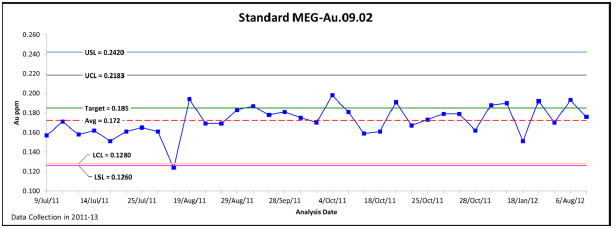
Notes:
| • | USL Upper Specification Limit Target + 3 Std Dev (CRM) |
| • | Target Expected Value (CRM) |
| • | LSL Lower Specification Limit Target - 3 Std Dev (CRM) |
| • | Items Calculated using Paramount Data |
| • | UCL Upper Control Limit Avg + 3 Std Dev (Population) |
| • | Avg Mean Value (Population) |
| • | LCL Lower Control Limit Avg - 3 Std Dev (Population) |
Only six CRMs had listed but uncertified silver values. ALS analyzed all silver samples using three-acid digestion with ICP finish (detection limit <0.5 ppm). Sixteen CRM silver analyses at Inspectorate used aqua regia digestion with atomic absorption finish.
Because listed values lacked standard deviations, LCL/UCL control limits for the sample population were used to evaluate performance. Table 8-5 shows no silver failures for the 2011–2013 program. Low-side bias in MEG S107006X, MEG S107010X, and SN16 is attributed to differences in analytical methods
| 8-11 |
|
| Paramount Gold Nevada Corp. | Sleeper Gold Mine S-K 1300 Technical Report Summary |
June 17, 2026 SLR Project No.: 123.020721.00001 |
Table 8-5: Summary of Sleeper Silver Results for CRMs 2010–2013
| Standard ID |
Grades in Ag in ppm | Count | Date Used | Failure Counts |
Bias Pct |
|||||||||||||||||||||||||||||||||||
| Target | Ave | Max | Min | First | Last | High | Low | |||||||||||||||||||||||||||||||||
| MEGS107005X |
9.0 | 8.9 | 9.6 | 8.4 | 3 | 1/18/2012 | 1/23/2012 | 0 | 0 | -1.5 | ||||||||||||||||||||||||||||||
| MEGS107006X |
8.0 | 7.2 | 7.2 | 7.1 | 2 | 1/18/2012 | 1/18/2012 | 0 | 0 | -10.6 | ||||||||||||||||||||||||||||||
| MEGS107010X |
18.0 | 9.8 | 9.8 | 9.8 | 1 | 1/30/2012 | 1/30/2012 | 0 | 0 | -45.6 | ||||||||||||||||||||||||||||||
| OxC30 |
0.1 | 0.1 | 0.1 | 0.1 | 2 | 1/18/2012 | 1/30/2012 | 0 | 0 | 0.0 | ||||||||||||||||||||||||||||||
| Si25 |
33.3 | 31.7 | 34.3 | 28.4 | 3 | 1/23/2012 | 1/30/2012 | 0 | 0 | -4.8 | ||||||||||||||||||||||||||||||
| SN16 |
17.6 | 15.7 | 17.6 | 14.0 | 5 | 1/18/2012 | 1/30/2012 | 0 | 0 | -10.9 | ||||||||||||||||||||||||||||||
| 8.3.3 | Duplicates |
| 8.3.3.1 | Historical |
Duplicate sampling during the historical programs was implemented primarily during the X-Cal (1996–2007) and New Sleeper Gold (2004–2005) periods, reflecting more structured QA/QC protocols. Duplicate types included field duplicates, mainly from RC drilling at regular intervals, and laboratory duplicates, including coarse reject and pulp duplicates. Sampling frequency was variable but typically followed defined intervals, such as approximately one duplicate per 150 ft or similar spacing within batches.
Duplicate sampling indicates that analytical precision was monitored during these programs. However, detailed datasets required for quantitative assessment, including duplicate-pair analysis, RPD calculations, and statistical precision measures, were not available to SLR. Formal evaluation of precision was therefore not possible.
Available documentation does not identify systematic precision issues or reproducibility concerns. Duplicate sampling practices are consistent with industry standards, and although supporting data are incomplete, there is no indication that precision materially affects the reliability of the historical dataset.
X-Cal Duplicates 2003–2007
RESPEC evaluated duplicate pairs using scatterplots (RMA regression), quantile–quantile plots, relative percent difference (RPD) plots, and absolute RPD plots. Two RPD methods were applied:
| • | RPD (max) = 100 × ((Duplicate – Original) / Lesser of (Duplicate, Original)) |
| • | RPD (mean) = 100 × ((Duplicate – Original) / Mean of (Duplicate, Original)) |
RPD (max) yields larger relative differences than RPD (mean).
Outliers were excluded from scatterplots by visual assessment, and pairs with absolute RPD >2,000% were removed from RPD plots. These outliers may remain relevant and should be considered in the overall evaluation; only pairs with incorrect sample identification are excluded. Causes of extreme variability require further review.
| 8-12 |
|
| Paramount Gold Nevada Corp. | Sleeper Gold Mine S-K 1300 Technical Report Summary |
June 17, 2026 SLR Project No.: 123.020721.00001 |
Preparation Duplicates: Giroux et al. (2009) reported core duplicates collected from coarse rejects returned by AAL. Selected samples were re-prepared and analyzed at ALS, representing preparation duplicates of core samples. These were not processed at the primary laboratory (AAL), which is preferred practice. Figure 8-2 presents the RPD plot for gold core preparation duplicates.
Figure 8-2: X-Cal Core Preparation Duplicates, Relative Differences 2003-2007
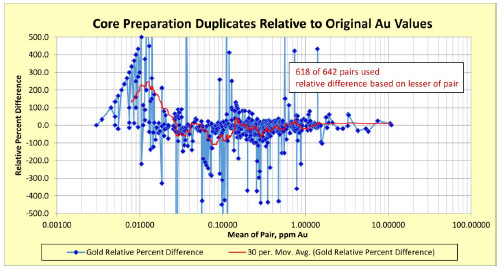
Source: RESPEC 2023
At grades >0.1 g/t Au, most duplicate pairs fall within RPD limits of ±50%, with most within ±25%. A small proportion of pairs exhibit higher RPDs, indicating greater variability between the original and duplicate assays. No bias is evident; however, high-variability pairs cause the moving-average line to deviate from 0% RPD. Data with a mean RPD near 0% indicates no bias.
Figure 8-3 presents absolute RPD values for each gold pair, illustrating the magnitude of variability. Figure 8-4 shows RPDs for X-Cal RC gold field duplicates.
.
| 8-13 |
|
| Paramount Gold Nevada Corp. | Sleeper Gold Mine S-K 1300 Technical Report Summary |
June 17, 2026 SLR Project No.: 123.020721.00001 |
Figure 8-3: X-Cal Core Preparation Duplicates, Relative Differences 2003-2007
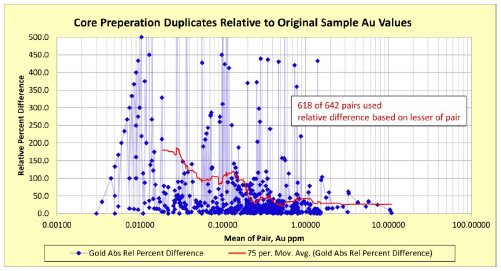
Source: RESPEC 2023
Figure 8-4: X-Cal Gold RC Field Duplicates, Relative Differences 2003-2007
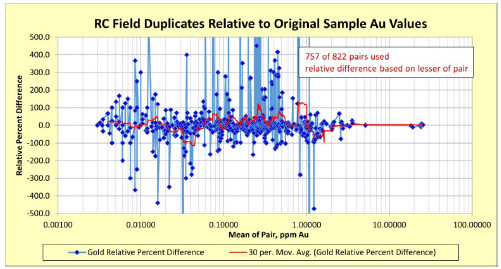
Source: RESPEC 2023
The moving-average line is influenced by extreme outliers, limiting its utility. Statistical analysis indicates an apparent high bias in duplicate assays relative to original samples; however, this bias is eliminated when the 16% of pairs with absolute value (AV) RPD >100% are removed, indicating it is entirely attributable to this subset of highly variable pairs. Silver RC field duplicates show similar behavior, consistent with gold and silver occurring in electrum.
| 8-14 |
|
| Paramount Gold Nevada Corp. | Sleeper Gold Mine S-K 1300 Technical Report Summary |
June 17, 2026 SLR Project No.: 123.020721.00001 |
The average AV RPD is 24% for pairs with AV < 100%, with most pairs < 50%, which is typical for field duplicates. The primary issue is the proportion of pairs with AV RPD >100% and the tendency for these pairs to show higher duplicate grades. Elevated variability at low grades is expected due to reduced analytical precision and amplification of percentage differences.
Excluding sample mix-ups or data errors, the most likely cause of AV RPD >100% is unrepresentative RC sample splitting at the drill rig. This may be limited to duplicate intervals if sampling protocols differed from routine intervals. Otherwise, routine RC splitting may have been non-representative in approximately 15% to 20% of cases.
Figure 8-5 presents absolute RPD values for RC duplicate pairs (RPD max). Pairs exceeding the AV RPD of 500% are truncated and shown as blue lines without apices.
Figure 8-5: X-Cal Gold RC Field Duplicates, Absolute Values of the Relative Differences 2003-2007
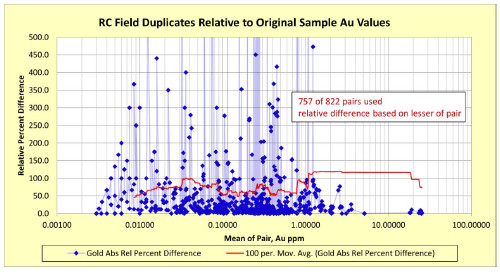
Source: RESPEC 2023
| 8-15 |
|
| Paramount Gold Nevada Corp. | Sleeper Gold Mine S-K 1300 Technical Report Summary |
June 17, 2026 SLR Project No.: 123.020721.00001 |
Field duplicates reflect inherent mineralization variability and variability from all subsampling stages: (i) coarse reject splitting; (ii) pulp preparation; (iii) assay aliquot selection; and (iv) analytical error. Variability introduced prior to duplicate splitting is captured in preparation duplicates.
At Sleeper, approximately half of the variability observed in RC field duplicates is present in core preparation duplicates. Although core duplicates were analyzed at a different laboratory, the absence of bias supports comparison of the datasets for variability assessment.
Core preparation duplicates show high variability at relevant gold grades, like RC field duplicates, but with fewer high-variability pairs and no associated bias. This supports potential RC splitting issues during the X-Cal 2003–2007 programs.
High-variability pairs should be reviewed to confirm validity and assess causes, including temporal or spatial clustering.
Elevated variability is also expected due to the nugget effect associated with gold and silver in electrum. This inherent variability introduces risk to resource estimation and should be considered when selecting an estimation methodology.
| 8.3.3.2 | Paramount Gold |
Duplicate sampling during the Paramount Gold (2010–2013) programs was systematic and included multiple precision controls: coarse reject and pulp duplicates at approximately 1 in 20 samples, and quarter-core duplicates, where one sample per batch was split and submitted under separate identifiers. Laboratories also performed internal duplicate analyses. Routine field core duplicates were not collected; however, laboratory duplicates and quarter-core splits provide an adequate framework to evaluate analytical precision. Table 8-6 summarizes field duplicate data for X-Cal and Paramount (2011–2013). No QA/QC data were available for the 2010 five-hole program (RESPEC 2023).
Duplicate results show good agreement across most grade ranges. Precision is consistent at low to moderate grades, with increased variability at higher grades reflecting coarse gold and nugget effects typical of the deposit. Elevated relative differences at higher grades occur but are not systematic. No systematic bias or material precision issues are identified. Overall, duplicate data indicate acceptable precision consistent with the mineralization style (Table 8-6) and support the reliability of the analytical dataset for the Mineral Resource Estimate.
| 8-16 |
|
| Paramount Gold Nevada Corp. | Sleeper Gold Mine S-K 1300 Technical Report Summary |
June 17, 2026 SLR Project No.: 123.020721.00001 |
Table 8-6: Summary of Results X-Cal Historical and Paramount Field Duplicates
| Laboratory |
Duplicate Type | Drill Type(s) | Element | Period | Counts | RMA Regression |
Averages as Percent | |||||||||||||||||||||||||||||||
| All | Used | Outliers | y = Duplicate |
RPD | AV RPD | |||||||||||||||||||||||||||||||||
| ALS Minerals Inspectorate ACME Labs |
Field Dup | R/C | Au | 2003-2007 | 822 | 757 | 65 | Y = 1.0047x + 0.0027 | 3.56 | 31.12 | ||||||||||||||||||||||||||||
| ALS Minerals Inspectorate ACME Labs |
Prep Dup | Core | Au | 2003-2007 | 642 | 618 | 24 | Y = 1.0229x - 0.0238 | 0.97 | 33.64 | ||||||||||||||||||||||||||||
| ALS Minerals Inspectorate ACME Labs |
Field Dup | R/C Core | Au | 2011-2013 | 200 | 192 | 8 | Y = 0.8866x + 0.0126 | 8.02 | 31.38 | ||||||||||||||||||||||||||||
| ALS Minerals Inspectorate ACME Labs |
Field Dup | R/C | Au | 2011-2013 | 137 | 132 | 5 | Y = 1.5165x – 0.0439 | 16.60 | 31.78 | ||||||||||||||||||||||||||||
| ALS Minerals Inspectorate ACME Labs |
Field Dup | Core | Au | 2011-2013 | 63 | 60 | 3 | Y = 1.037x – 0.0107 | -9.26 | 30.44 | ||||||||||||||||||||||||||||
| ALS Minerals Inspectorate ACME Labs |
Field Dup | R/C Core | Ag | 2003-2007 | 875 | 870 | 5 | Y= 0.992x + 0.126 | 0.30 | 54.20 | ||||||||||||||||||||||||||||
| ALS Minerals Inspectorate ACME Labs |
Field Dup | R/C Core | Ag | 2011-2013 | 225 | 224 | 1 | Y = 1.063x + 0.241 | -27.20 | 66.50 | ||||||||||||||||||||||||||||
| Notes: AV absolute value RPD relative percent difference |
| |||||||||||||||||||||||||||||||||||||
| 8-17 |
|
| Paramount Gold Nevada Corp. | Sleeper Gold Mine S-K 1300 Technical Report Summary |
June 17, 2026 SLR Project No.: 123.020721.00001 |
Pulp and Preparation Duplicates.
Paramount’s pulp and preparation duplicate data were in final compilation and analysis as of the 2023 Technical Report (RESPEC, 2023) and not available for review.
Field Duplicates:
A total of 137 RC field duplicates were compiled from the 2011–2013 program. Figure 8-6 presents an RPD plot for 121 pairs, excluding pairs where both values are below the detection limit.
Figure 8-6: Paramount RC Field Duplicates, Relative Differences 2010-2013
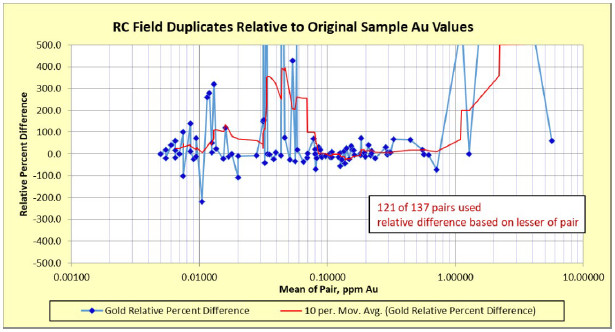
Source: RESPEC 2023
No bias is evident at grades greater than 0.1 g/t Au. Five of 51 pairs with mean grades >0.1 ppm have AV RPD greater than 100%, all within the highest-grade subset (1.1–2.2 ppm).
Fewer core field-duplicate pairs exceed detection limits (Figure 8-7). These data indicate a consistent low bias, with duplicate values lower than original assays; additional data are required to confirm. Three of 26 pairs with mean grades greater than 0.1 g/t Au have AV RPD greater than 100%.
| 8-18 |
|
| Paramount Gold Nevada Corp. | Sleeper Gold Mine S-K 1300 Technical Report Summary |
June 17, 2026 SLR Project No.: 123.020721.00001 |
Figure 8-7: Paramount Core Field Duplicates, Relative Differences 2010-2013
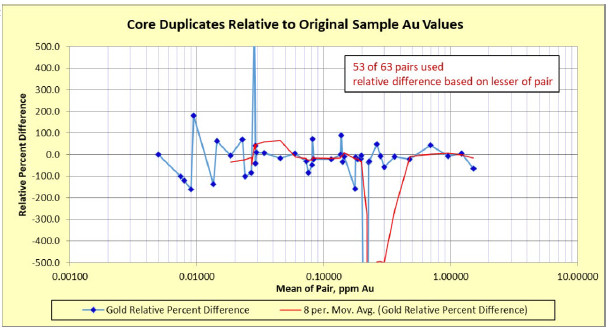
Source: RESPEC, 2023
| 8.3.4 | Blanks |
| 8.3.4.1 | Historical |
Blank samples were used during later historical programs, particularly X-Cal and New Sleeper Gold, to monitor contamination during sample preparation and analysis, confirming inclusion of contamination control in the QA/QC framework.
Blank materials were likely inert or low-grade; however, documentation of blank types, insertion frequency, and analytical results was not available to the SLR. Blank performance cannot be quantitatively assessed, and no statistical evaluation of contamination is available.
No systematic contamination issues are identified, and no sample integrity concerns are reported. However, the absence of detailed QA/QC records limits verification of blank effectiveness and remains a constraint on the QA/QC assessment of the historical dataset.
X-Cal Blanks 2003–2007
A total of 38 coarse blanks from the X-Cal drilling were analyzed for gold and, in 35 cases, for silver, with detection limits of 0.005 ppm and 0.2 ppm, respectively (Table 8-7). This represents a subset of the blanks analyzed, as many were not sufficiently described or not reported in the RESPEC dataset.
Four gold failures and one silver failure were identified using thresholds of five times the detection limit for gold and two times for silver, reflecting the higher silver detection limit (Table 8-8). Three of the four failures were preceded by higher-grade samples (Figure 8-8), indicating intermittent cross-contamination in the AAL crushing circuit between May 2004 and April 2005. The remaining failure may reflect a mislabeled sample.
| 8-19 |
|
| Paramount Gold Nevada Corp. | Sleeper Gold Mine S-K 1300 Technical Report Summary |
June 17, 2026 SLR Project No.: 123.020721.00001 |
Table 8-7: X-Cal Blank Samples 2003–2007
| Blank ID |
Drill Program | Elem | Counts | Maximum (ppm) |
Dates of Analyses | |||||||||||||||||||||||
| All | Above Warning |
Start | End | |||||||||||||||||||||||||
| Coarse Blank |
2003-07 | Au | 38 | 4 | 0.171 | 23-Mar-04 | 20-Jun-05 | |||||||||||||||||||||
| Coarse Blank |
2003-07 | Ag | 35 | 1 | 5.300 | 23-Mar-04 | 20-Jun-05 | |||||||||||||||||||||
Table 8-8: X-Cal Blank Failures and Preceding Sample 2003–2007
| Blank |
Certificate |
Elem |
Method |
Preceding |
Blank |
5x
Det |
||||||||||||||||||||||||||
| Sample |
Value (ppm) |
Sample |
Value |
|||||||||||||||||||||||||||||
| Blank |
SP065348 | Au | ICP | 27805 | 1.226 | 27806 | 0.028 | 0.025 | ||||||||||||||||||||||||
| Blank |
SP065582 | Au | F50/ICP | 28127 | 1.620 | 28128 | 0.050 | 0.025 | ||||||||||||||||||||||||
| Blank |
SP065732 | Au | F50/ICP | 28248 | 0.672 | 28249 | 0.030 | 0.025 | ||||||||||||||||||||||||
| Blank |
SP068824 | Au | F50/ICP | WW39-05 34018 | 0.011 | WW39-05 34019 | 0.171 | 0.025 | ||||||||||||||||||||||||
| Blank |
SP068894 | Ag | AA | NS-01-05 30854 | 0.600 | NS-01-05 30855 | 5.300 | 1.000 | ||||||||||||||||||||||||
Figure 8-8: X-Cal Gold in Blanks and Preceding Samples 2003–2007
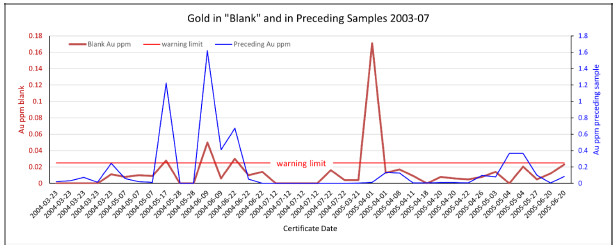
Source: RESPEC 2023
| 8.3.4.2 | Paramount |
Blank samples were systematically incorporated into the QA/QC program during the Paramount Gold (2010–2013) drilling programs at approximately one blank per 20 samples, consistent with industry best practice for contamination monitoring. Both coarse and pulp blanks were used, including commercially prepared blanks and inert materials. These included MEG laboratory blanks such as AuBlank40 (<0.002 ppm Au) and MEG-Blank.11.01 (<0.005 ppm Au), together with coarse blank material consisting of commercially crushed white marble with certified values below 0.005 ppm Au (Table 8-9)
| 8-20 |
|
| Paramount Gold Nevada Corp. | Sleeper Gold Mine S-K 1300 Technical Report Summary |
June 17, 2026 SLR Project No.: 123.020721.00001 |
Table 8-9: Blank Materials Used in Paramount QA/QC Program
| Blank ID |
Certified Value | Type | Origin | |||
| AuBlank40 |
<0.002 ppm | Coarse | MEG Labs | |||
| MEG-Blank 11.01 |
<0.005 ppm | Pulp | MEG Labs | |||
| Blank |
<0.005 ppm | Coarse | Commercial crushed white marble |
Blank samples were inserted into the sample stream and distributed throughout analytical batches to monitor contamination during sample preparation and analysis. The use of both coarse and pulp blanks allowed assessment of contamination during crushing, pulverizing, and analytical procedures.
Analytical results show most blank values at or below detection limits, indicating minimal contamination. Performance was consistent across batches and laboratories, indicating controlled laboratory conditions.
Coarse blanks, including two from MEG and one prepared by Paramount using commercially crushed rock, and pulp blanks were inserted at a rate of approximately one per 30 samples (RESPEC). Values exceeding five times the detection limit were considered failures and reviewed.
A total of 231 coarse blanks were analyzed for gold and 230 for silver, with no failures. A total of 56 pulp blanks were analyzed for gold, with no failures. ALS internal blank data (eight gold, 10 silver) also showed no issues.
Figure 8-9 shows gold values for coarse blanks plotted with preceding sample values. Some elevated blank values, although not failures, correspond to high-grade preceding samples, indicating minor cross-contamination from the preceding sample.
Figure 8-9: Gold Values of Paramount Coarse Blanks and Preceding Samples
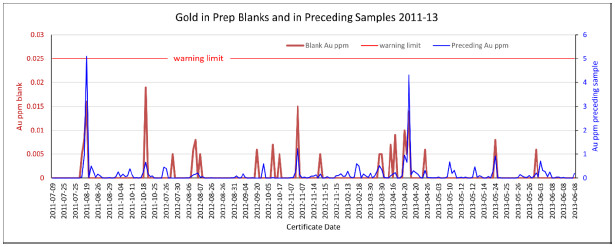
Source: RESPEC, 2023
Occasional elevated blank values were recorded but were isolated and not systematic. These results triggered a review of associated batches and adjacent samples to assess potential contamination. No persistent contamination trends or material impact on the analytical dataset were identified.
| 8-21 |
|
| Paramount Gold Nevada Corp. | Sleeper Gold Mine S-K 1300 Technical Report Summary |
June 17, 2026 SLR Project No.: 123.020721.00001 |
Blank results indicate that contamination during sampling, preparation, and analysis was effectively controlled. The absence of systematic blank failures supports the integrity of the analytical dataset and confirms that field and laboratory procedures were effective in limiting cross-contamination.
| 8.4 | Sample Security |
Sample security at the Project was maintained through field handling procedures, controlled storage, documented chain-of-custody protocols, and laboratory custody practices. The level of control and documentation improved over time, with the most comprehensive procedures implemented during the Paramount Gold (2010–2013) programs.
| 8.4.1 | Historical (1983–2010) |
Sample security procedures during the historical programs were generally consistent with industry practice, but documentation for early operators, including AMAX, NGM, and Placer Dome, was limited. Samples were collected by trained personnel and sent to commercial laboratories for preparation and analysis; however, detailed records of the chain of custody, storage conditions, and access controls were not available to SLR for independent verification.
During the later historical programs, particularly those completed by X-Cal and New Sleeper Gold, more formal sample security procedures were implemented. Samples were stored in secured areas, including fenced compounds or controlled-access facilities, before shipment. Shipments to laboratories were documented, and the laboratories maintained custody during preparation and analysis.
These procedures are consistent with accepted industry practice. However, the lack of detailed supporting documentation limits SLR’s ability to fully evaluate the effectiveness of sample security for the historical datasets. There is no indication in the available information of sample tampering, loss, or material compromise of sample integrity.
| 8.4.2 | Paramount (2010–2013) |
Sample security during the Paramount drilling programs included controls from drill site collection through laboratory analysis. Drill contractors transported samples from the drill sites to the Paramount logging and sampling facility at the Sleeper site near Winnemucca, Nevada, where they were logged, processed, and stored in a secure, controlled-access facility.
Drill core was stored in core boxes within the secured facility. Reverse circulation and sonic samples were stored in designated secure areas before shipment. Trained personnel handled samples, and access to storage areas was controlled to prevent unauthorized handling.
Before shipment, samples were organized, inventoried, and packaged in sealed containers, including rice bags or bins secured with numbered security seals. Each shipment contained samples from a single drill hole and included sample submittal documentation listing sample numbers, requested analyses, and QA/QC instructions. Sample batches were verified and photographed before shipment to confirm completeness and integrity.
ALS personnel or authorized contractors transported samples to the laboratory. All transfers were documented on sample handling forms, maintaining a continuous chain of custody from the project site to the laboratory. On receipt, the laboratories logged the samples into internal tracking systems and maintained custody through preparation and analysis.
| 8-22 |
|
| Paramount Gold Nevada Corp. | Sleeper Gold Mine S-K 1300 Technical Report Summary |
June 17, 2026 SLR Project No.: 123.020721.00001 |
After analysis, pulps and coarse rejects were retained by the laboratory or returned to the project site for secure storage, allowing future verification and re-analysis.
These sample security procedures are consistent with industry’s best practice and support confidence in the integrity, traceability, and security of the analytical dataset used to support the Mineral Resource Estimate.
| 8.5 | QP Opinion |
In the QP’s opinion the sample preparation, security and analytical procedures are suitable to support the disclosure of the MRE in this TRS.
Sampling (1983–2013) is appropriate for the mineralization style. RC drilling (approximately 95%) using cyclone and splitter systems, with limited diamond drilling, supports both bulk-tonnage and structurally controlled mineralization. Later programs (X-Cal, New Sleeper Gold, Paramount) show improved controls. Early programs lack documentation but show no material deficiencies; uncertainties are addressed through classification.
Sample preparation and analytical methods are consistent with industry standards. Accredited laboratories (ALS, AAL), standard preparation, fire assay, and the use of metallic screen and gravimetric methods, where required, are appropriate. Multi-element ICP and check assays support data validity.
QA/QC is robust in the Paramount (2010–2013) dataset, including CRMs, blanks, duplicates, check assays, and re-assay protocols. CRM results show acceptable accuracy with minor, non-systematic bias. Blanks show no systematic contamination. Duplicates show acceptable precision, with higher variability at elevated grades consistent with nugget effects.
Historical QA/QC data are incomplete, limiting quantitative assessment. No systematic bias, contamination, or precision issues are identified. Elevated variability in X-Cal RC duplicates, including RPD outliers and potential splitting issues, has been taken into account in classification.
Sample security is adequate. Paramount programs demonstrate a controlled chain of custody, secure storage, documented tracking, and sealed shipments. Historical documentation is limited; no evidence of tampering or loss is identified.
Key limitations are listed:
| • | Incomplete QA/QC and custody records for early programs (1983–1997) |
| • | Limited analytical certificates for verification |
| • | Elevated variability in X-Cal RC duplicates from splitting and nugget effects |
These are addressed through validation, reliance on later datasets, and classification.
The dataset is sufficiently accurate and reliable to support the MRE and meets the requirements of S-K 1300 and CIM (2019), with uncertainties reflected in the Mineral Resource classification.
| 8-23 |
|
| Paramount Gold Nevada Corp. | Sleeper Gold Mine S-K 1300 Technical Report Summary |
June 17, 2026 SLR Project No.: 123.020721.00001 |
| 9.0 | Data Verification |
Data verification comprises a systematic process to confirm that exploration and analytical data were collected using appropriate procedures, accurately transcribed into the Project database, and are suitable for use in the preparation of this Technical Report.
All available data relevant to the Project were compiled, digitized, and incorporated into a database by personnel from Paramount Gold. The QP audited the database for completeness, accuracy, and reliability.
The QP is of the opinion that database verification procedures for the Sleeper project comply with industry standards and are adequate for the purposes of Mineral Resource estimation.
Project data was provided to the QP in the form of Microsoft Excel spreadsheets and subsequently imported into Leapfrog Geo and Maptek Vulcan software for independent modeling and resource interpolation.
Verification procedures included checks for:
| • | Unique, missing, or overlapping intervals |
| • | Total depth consistency |
| • | Duplicate hole identification |
| • | Boundary compliance |
Database certification was conducted by the QP through a combination of visual inspections and statistical checks, including cross-referencing lithology, assay values, and spatial data against original hard copy records. Identified inconsistencies were either corrected using primary source documents or excluded from the Mineral Resource estimation
| 9.1 | RESPEC Data Validation |
A SLR review shows that RESPEC undertook a comprehensive data verification program to confirm that the Sleeper project database is reliable and suitable for Mineral Resource estimation.
This work included multiple site visits between 2021 and 2023, during which RESPEC personnel inspected drill core and RC cuttings, reviewed logging, sampling, and data management procedures, assessed sample storage conditions, and collected GPS collar locations for comparison with the database. RESPEC also examined original drill logs, assay certificates, and supporting records, and reviewed geological interpretations used in modeling.
The drill hole database was subjected to detailed validation testing to identify data integrity issues such as missing or duplicated collar information, inconsistent survey data, invalid assay intervals, and gaps or overlaps in geological and analytical records. Where discrepancies were identified, they were evaluated, corrected where appropriate, and documented using the original data sources provided by Paramount. Collar locations were verified against historical drill logs and electronic records, including validation of coordinate system conversions from local mine grid to UTM. Downhole survey data were reviewed against available records and found to be generally consistent, although many historical holes lack survey data, limiting full verification. Assay data verification included comparison of the database against original laboratory certificates, with a complete digital audit of available electronic records and partial manual verification of scanned certificates.
| 9-1 |
|
| Paramount Gold Nevada Corp. | Sleeper Gold Mine S-K 1300 Technical Report Summary |
June 17, 2026 SLR Project No.: 123.020721.00001 |
Additional confidence in the dataset was obtained through review of QA/QC programs and results, including resampling programs completed by Paramount to validate historical assays.
| 9.2 | SLR Data Verification |
The QP conducted a site visit on April 2, 2026. During the visit, the QP reviewed the historical mine site, waste rock dump areas, exploration facilities, and infrastructure relevant to the evaluation of the Project. Historical drill sites were examined, selected drill collar locations were confirmed with GPS, and detailed discussions were held with Paramount technical staff regarding exploration plans, drilling methods, analytical procedures, and geological controls on mineralization. The Paramount technical team demonstrated a strong understanding of deposit geology and assay interpretation.
| 9.2.1 | Limitations |
No material restrictions were encountered during the QP’s independent verification of the Sleeper drill hole database; however, the following limitations were identified:
| • | Bulk Density: A comprehensive bulk density sampling program has not been completed for all geological units used in the Mineral Resource model. Additional bulk density data are required to improve confidence in tonnage estimates. |
| • | QA/QC Records: Documentation supporting the use of certified reference materials, blanks, and duplicates for historical channel sampling is unavailable. A formal QA/QC program is recommended for future drilling and sampling campaigns. |
| • | Alteration Logging: A review of the oxidation model indicates that oxide and sulfide classifications were interchanged across a portion of the historical drill hole database. Comparisons with historical mining records from AMAX are inconsistent with the logged oxidation data, further evidence of this issue. Resolution of these discrepancies and validation of oxidation state logging are recommended to improve confidence in the geological and metallurgical interpretations. |
| • | Downhole Surveying: Most historical drill holes lack deviation surveys and are assumed to be vertical. This assumption introduces uncertainty in the interpretation of true mineralization geometry and thickness. |
| 9.3 | QP Opinion |
Although some historical information (including portions of QA/QC documentation, downhole surveys, and legacy records) could not be independently verified, the drill hole database compiled by Paramount and validated by RESPEC aligns with S-K 1300 industry practices. The SLR QP is of the opinion that the database is reliable, internally consistent, and suitable for use in the Mineral Resource Estimate.
The Project’s extensive production history and prior operational use of these data support their adequacy. Historical grade control and metallurgical studies corroborate reported gold grades, although recent independent assay verification is lacking for certain legacy datasets.
Data with incomplete collars or insufficient documentation were excluded where necessary and are not considered material to the estimate. Sampling methods from historical and recent programs are consistent with industry standards. While additional QA/QC documentation and targeted resampling are recommended to further improve confidence, the database is considered appropriate for Mineral Resource estimation.
| 9-2 |
|
| Paramount Gold Nevada Corp. | Sleeper Gold Mine S-K 1300 Technical Report Summary |
June 17, 2026 SLR Project No.: 123.020721.00001 |
| 10.0 | Mineral Processing and Metallurgical Testing |
| 10.1 | Introduction |
The metallurgical information reviewed for the Project includes historical operating performance, bottle roll and column leach testing, flotation investigations, and later oxidation studies.
For this Initial Assessment, the proposed processing method is heap leach treatment of selected oxide, mixed, and waste rock dump material with Merrill-Crowe recovery. Processing of sulfide, historical heap leach pad (HLP), and historical tailings materials is considered separately through on-site flotation, with rougher concentrate assumed to be sold or toll treated off site. Sulfide processing test work remains preliminary and requires additional variability test work, concentrate quality, and commercial review.
| 10.2 | Nature and Extent of Metallurgical Testing and Analytical Procedures |
SLR reviewed historical oxide milling and heap leaching records; bottle roll and column leach testing on oxide, mixed and waste rock dump composites; flotation investigations on selected historic HLP, tailings, waste, and sulfide-related materials; and later bio-oxidation and pressure-oxidation studies. For the current study, the McClelland bottle roll and column leach programs provide the principal support for the coarse-crush agglomerated heap leach flowsheet, while flotation test work supports preliminary consideration of a separate flotation route for sulfide, historic HLP, and tailings materials.
Table 10-1 lists the principal metallurgical reports reviewed for the project. Later technical reports were used as summary references, while the McClelland, Hazen, SGS, MRDI, KCA, and other historical studies provided the primary metallurgical support for interpretation of processing options and recovery assumptions.
Table 10-1: Metallurgical Reports Reviewed
| Report / Document |
Date |
Laboratory / Organization |
Comment | |||
| Sampling and Metallurgical Evaluation of Existing Leach Heaps and Mill Tailings | 1997 | Mineral Resources Development Inc. (MRDI) | Existing heap and tailings metallurgical study. | |||
| Sleeper Project Sampling and Metallurgical Test Program | 1999 | Kappes, Cassiday & Associates (KCA) | Internal report for X-Cal Resources Ltd. | |||
| Sleeper Mine Tailings and Heap Evaluation as Potential Gold Resources | 2007 | Edouard K. Zoutomou / X-Cal Resources Ltd. | Existing tailings and heap evaluation study. | |||
| Phase 2 Metallurgical Evaluation – Waste Rock Dump, Westwood and Facilities Composites | 2012 | McClelland Laboratories Inc. (including ALS and Inspectorate results) | Existing waste rock dump, West Wood, and Facilities cyanidation test work. | |||
| 10-1 |
|
| Paramount Gold Nevada Corp. | Sleeper Gold Mine S-K 1300 Technical Report Summary |
June 17, 2026 SLR Project No.: 123.020721.00001 |
| Report / Document |
Date |
Laboratory / Organization |
Comment | |||
| Pressure Oxidation Pretreatment and Cyanide Leaching of Sleeper Mine Samples | 2013 | Hazen Research, Inc. | POX subcontract work reported within the 2015 McClelland study. | |||
| Metallurgical Tests and Analyses on 12 Sleeper Project Core Composites | 2014 | McClelland Laboratories Inc. | Bottle roll, column leach, and related cyanidation test work on core composites. | |||
| Biooxidation and Pressure Oxidation Testing – Sleeper Drill Core Composites | 2015 | McClelland Laboratories Inc. | Sulfide-focused metallurgical test work including biooxidation and cyanidation. | |||
| Mineralogical study appendix to 2015 McClelland report | 2015 | SGS Canada Inc. | Supporting mineralogical/deportment study. | |||
| Technical Report and Preliminary Economic Assessment – Sleeper Project (Amended) | 2017 | Metal Mining Consultants Inc. | Technical Report summarizing prior metallurgical work; not a laboratory report. | |||
| 2022 Sleeper S-K 1300 Technical Report Summary | 2022 | RESPEC / Woods Process Services LLC | TRS compiling historical metallurgical work; not a laboratory report. | |||
The analytical procedures described in the reviewed reports are conventional for scoping-level evaluation of gold-silver heap leach and flotation performance and include head assays, bottle roll tests, column leach tests, flotation tests, and reagent-consumption measurements. These procedures are standard industry practice for preliminary assessment of cyanide amenability, leach kinetics, reagent demand, and flotation response. No non-conventional analytical procedure has been identified as the basis for either the heap leach case or the preliminary flotation case. Certain recovery values remain provisional where direct representative test work is limited.
| 10.3 | Sample Representativeness |
The metallurgical dataset includes several distinct oxide and mixed material groups evaluated as potential heap leach feed, including Facilities Oxide, West Wood Oxide, and Sleeper Oxide, together with Facilities Mixed, Sleeper Mixed, and West Wood Mixed material. These groups represent separate source areas within the Project and are treated individually because the available test work support, cyanide amenability, recovery response, and reagent demand differ by material type. The available metallurgical testing and analysis are adequate for preliminary evaluation of selected oxide, mixed, and waste rock dump material as early heap leach feed. Facilities Oxide is the best-supported heap leach feed type in the database, and selected West Wood Oxide and waste rock dump composites also support a phased heap leach processing scenario. Available flotation work is sufficient to justify preliminary consideration of a separate flotation-concentrate route for sulfide, HLP, and tailings materials, but not yet for definitive design or pre-feasibility-level recovery prediction.
Sample representativeness is weaker for the sulfide, HLP, and tailings materials now grouped in the separate flotation case. The current data does not support inclusion of these materials in the same heap leach recovery framework used for oxide, mixed, and waste materials. Historic HLP, tailings, and sulfides require additional metallurgical testing, analysis, and economic evaluation before they can be assigned definitive recoveries, concentrate terms, and operating cost.
| 10-2 |
|
| Paramount Gold Nevada Corp. | Sleeper Gold Mine S-K 1300 Technical Report Summary |
June 17, 2026 SLR Project No.: 123.020721.00001 |
| 10.4 | Testing Laboratories |
The test work reports identify McClelland Laboratories in Sparks, Nevada as the principal metallurgical laboratory for the bottle roll, column leach, flotation, and related process test work programs used in the oxide, mixed, waste rock dump, and sulfide evaluations. Supporting specialized work was also completed by Hazen Research and SGS Canada, and project QA/QC documentation (Metal Mining Consultants Inc. 2017) references ALS and Inspectorate for analytical and check-assay work. Based on the files reviewed, the SLR QP understands these laboratories to have been independent of the project owner.
Table 10-2 summarizes the accreditation details, which are shown only where identified during review. “No public certification record identified” indicates that no specific accreditation record was located during the present review. All listed organizations are considered independent of the mine owner based on the available information.
Table 10-2: Laboratory Accreditation Summary
| Laboratory / Organization |
Location |
Certification/ accreditation |
Affiliation with mine/ owner | |||
| McClelland Laboratories, Inc. (MLI) | Sparks, Nevada | 2012–2015 accreditation: IAS-accredited to ANSI/ISO/IEC 17025:2005; accreditation in place since November 12, 2012. | Independent Laboratory | |||
| Hazen Research, Inc. | Golden, Colorado | No public certification record identified | Independent Laboratory | |||
| SGS Canada Inc. / SGS Minerals Services | Ontario, Canada | Accredited to ISO/IEC 17025 | Independent Laboratory | |||
| Kappes, Cassiday & Associates (KCA) | Reno, Nevada | No public certification record identified | Independent Technical Consultant | |||
| 10.5 | Relevant Metallurgical Results |
Historical operating records show that Sleeper successfully processed oxide material by both milling and heap leaching, supporting oxide material as the clearest near-term development path. The prior assessments and mine history, therefore, provide a precedent for a large-scale oxide heap leach concept supplied by open-pit mining and, where justified, rehandling of selected existing waste rock dump material.
| 10.5.1 | Oxides |
Facilities oxide is the strongest candidate for initial processing utilizing heap leach and Merrill-Crowe processing. The column and bottle roll results show favorable gold recovery and cyanide amenability, a coarse crush size of P80 19 mm, with column gold recoveries averaging 83.9% and bottle roll recovery of about 81% Au. West Wood oxide also showed a positive heap leach response with an average column gold recovery of 76.5%, although with greater variability and higher reagent demand. Sleeper oxide bottle roll gold performance was favorable at 93.9%, but the database does not provide the same level of direct column confirmation as Facilities oxide.
| 10-3 |
|
| Paramount Gold Nevada Corp. | Sleeper Gold Mine S-K 1300 Technical Report Summary |
June 17, 2026 SLR Project No.: 123.020721.00001 |
| 10.5.2 | Waste Rock Dumps |
Selected waste rock dump material also shows potential for a heap leach case. Historical testing concluded that the dump composites evaluated were amenable to agglomerated heap leach cyanidation at coarse crush size, with column gold recoveries ranging from the mid-60% range to the low-80% range, depending on dump area and composite. Reagent consumption was variable and, in some cases, high. Waste material is therefore technically amenable to heap leaching, but economic performance is sensitive to recovery, crush-size, and reagent assumptions.
| 10.5.3 | HLP, Tailings, and Sulfide Flotation |
Historical metallurgical data indicate that HLP, tailings, and sulfide materials are more amenable to flotation recovery than through direct heap leaching. The available database is limited and variable in scope, but it provides a reasonable preliminary basis for evaluation of a flotation process at the IA level. Historical tailings work reported cleaner flotation-related recoveries of 63% Au and 33% Ag at P75 200 mesh (75 µm) in the 1997 program and approximately 50.8% Au and 64.8% Ag, at P85 400 mesh (37 µm), in the 1999 program, demonstrating that precious metals can be recovered from these materials, although performance was variable and the work did not establish a final commercial flowsheet.
Sulfide rougher and cleaner flotation test work was completed at P80 200 mesh (75 µm) by McClelland in 2012. The rougher flotation results showed generally favorable recovery performance and are therefore included for the flotation results. For Facilities sulfide material, rougher flotation testing returned gold recoveries of 70.7% and 91.2%, with reported silver recoveries of 43.6% and less than 48.8%. For West Wood argillic-silicic sulfide material, rougher flotation gold recoveries ranged from 57.7% to 79.7%, averaging 70.8%, with an average silver recovery of about 57.0%. For West Wood strong silicic sulfide material, rougher flotation gold recoveries ranged from 65.0% to 84.9%, averaging 75.1%, with an average silver recovery of 67.1%. McClelland noted that these flotation results were scoping-level in nature and that additional optimization and locked-cycle testing would be required.
Existing heap leach pad material has not been supported by a sufficiently robust and dedicated flotation testing program and was historically evaluated primarily for in-place or re-leach potential rather than as flotation feed. At this time, HLP material is considered with the existing tailings for a flotation-processing case based on the closest available historical flotation analogs. The QP considers this approach acceptable for initial assessment only. Additional variability testing, concentrate characterization, and economic viability are required before HLP, tailings, and sulfide materials can be assigned recoveries and operating costs for a flotation flowsheet.
The principal processing factors identified in the test work are sulfide content, refractory gold locking, variable leach kinetics, and elevated reagent demand in certain materials. Sulfide-rich, HLP, and tailings materials are not included in the heap leach case and are instead considered through flotation, followed by sale or toll treatment of rougher concentrate. For IA purposes, a 12% discount to flotation recoveries is applied to reflect toll milling fees and related downstream charges.
| 10.5.4 | Deleterious Elements |
Review of the available multi-element dataset for the oxide, mixed, and waste rock dump materials indicates that mercury, arsenic, antimony and sulfur are the primary deleterious constituents requiring additional evaluation for the Sleeper Project. The West Wood Oxide samples show elevated mean mercury and antimony concentrations, while the Facilities Mixed and North Dump materials show elevated arsenic and antimony. The North Dump also reports elevated total sulfur concentrations.
| 10-4 |
|
| Paramount Gold Nevada Corp. | Sleeper Gold Mine S-K 1300 Technical Report Summary |
June 17, 2026 SLR Project No.: 123.020721.00001 |
The identified deleterious elements are not currently considered to be prohibitive to heap leach development, however, the elevated mercury, arsenic, antimony, and total sulfur in selected material groups warrant additional metallurgical and precipitate-quality test work prior to pre-feasibility level design.
Initial refinery capital cost allowances include a mercury retort to address the elevated mercury concentrations identified in selected material groups. This allowance is intended to provide an IA level provision for mercury management during doré production and refinery handling. Additional test work, precipitate characterization, and doré/refinery assessments are recommended in future study phases to confirm the required mercury-control measures and refine the associated capital and operating cost assumptions.
| 10.6 | Recovery Assumptions and Basis for Estimation |
Recovery assumptions used for the preliminary economic evaluation were derived from available test work and adjusted to reflect confidence levels across the resource. For heap leach materials, column leach results were given greater weight than bottle roll results because they are more representative of coarse-crush heap leach conditions and kinetics. When only bottle-roll data were available, conservative adjustments were applied. Sulfide, HLP, and tailings materials are considered separately on the basis of flotation performance, with payable recoveries reduced by 12% to reflect toll milling fees and related concentrate handling charges.
| 10.6.1 | Sleeper Oxide |
The recovery value assigned to Sleeper oxide was based on reported bottle roll test results; however, because no directly comparable representative column leach result is presently available for that material, the reported bottle roll recoveries of 93.9% Au and 11% Ag were discounted by 10% for use in the recovery model. This adjustment is intended to provide a conservative approximation of expected heap leach performance and to recognize the generally more optimistic nature of bottle roll extraction results relative to column leach performance under field-relevant conditions.
| 10.6.2 | Sleeper Mixed and West Wood Mixed |
Recovery values assigned to Sleeper mixed and West Wood mixed material are estimated assumptions rather than direct outputs from a complete set of representative column leach tests. These values were developed from metallurgical interpretation of the available data, including oxidation state, relative cyanide amenability, bottle roll, and limited column response, and comparison with analogous oxide and mixed composites. These recoveries are suitable only for initial assessment and should be confirmed by additional representative column leach testing.
| 10.6.3 | HLP, Tailings, and Sulfides |
For the IA, flotation recoveries assigned to HLP, tailings, and sulfide materials were derived from the available historical test work and reduced by 12% to reflect the assumed toll-milling and downstream concentrate treatment charges associated with off-site processing of rougher concentrate. These values are preliminary planning assumptions only and should not be interpreted as demonstrated commercial recoveries.
| 10-5 |
|
| Paramount Gold Nevada Corp. | Sleeper Gold Mine S-K 1300 Technical Report Summary |
June 17, 2026 SLR Project No.: 123.020721.00001 |
| 10.6.3.1 | HLP and Tailings – Gold |
The recovery assumptions for HLP and tailings were based on the average of the historical tailings flotation results from the 1997 and 1999 test programs. Using reported recoveries of 63% Au from the 1997 program and approximately 50.8% Au from the 1999 program results in average unadjusted recoveries of 56.9.0% Au. After application of the 12% discount, the assumed recoveries for both HLP and tailings are 50.0% Au. This assumption is necessarily approximate because direct flotation test work on HLP material is limited, and the historical HLP studies were not designed to support a modern flotation circuit.
| 10.6.3.2 | Facilities Sulfide |
The Facilities sulfide recovery assumption was based on the average of the two available McClelland rougher flotation tests. The average unadjusted gold recovery was 80.95%, which results in an applied recovery of 71.2% Au after the 12% discount.
| 10.6.4 | West Wood Strong Silicic and West Wood Argillic |
The West Wood strong silicic recovery assumption was based on the average West Wood strong silicic rougher flotation results reported by McClelland. Average unadjusted recoveries were 75.1% Au, resulting in applied recoveries of 66.1% Au after the 12% discount. The West Wood argillic-silicic recovery assumption was based on the average West Wood argillic-silicic rougher flotation results. Average unadjusted recoveries were 70.8% Au, resulting in applied recoveries of 62.3% Au after discount.
These recovery assumptions provide a consistent preliminary basis for evaluating flotation treatment of HLP, tailings, and sulfide materials in the IA. However, the underlying test work remains limited, variably representative, and unsupported by pilot-scale confirmation, finalized concentrate specifications, or project-specific commercial toll-treatment terms. Additional metallurgical test work is required before these materials can be assigned a proven processing route with demonstrated recoveries and acceptable operating costs.
| 10.6.5 | HLP Tailings and Sulfides Ag |
No silver recovery has been applied to the HLP, tailings, or sulfide flotation cases at this time. Although historical testing reported some silver recovery, the available dataset is limited and variable, and it is not yet supported by sufficient concentrate characterization or downstream payable assumptions. Silver is therefore excluded from the current flotation recovery model and treated as upside potential only, pending additional metallurgical and commercial evaluation.
| 10.6.6 | Summary of Assumptions |
Metallurgical recovery assumptions applied in the IA are summarized in Table 10-3. The table distinguishes between recoveries supported by representative column leach test work, adjusted values derived from bottle roll testing, and provisional estimates assigned where direct representative test work is limited. Oxide, mixed, and waste rock dump materials are evaluated within the heap leach framework, whereas historic HLP, tailings, and sulfide materials are considered separately through a preliminary flotation-concentrate route.
| 10-6 |
|
| Paramount Gold Nevada Corp. | Sleeper Gold Mine S-K 1300 Technical Report Summary |
June 17, 2026 SLR Project No.: 123.020721.00001 |
Table 10-3: Recovery Assumptions and Process Basis by Material Type
| Material Type |
Test Basis |
Au Rec (%) |
Ag Rec (%) |
Recovery Basis |
Note | |||||
| Facilities Oxide |
Column | 83.9 | 8.1 | Column Average | Historical column basis | |||||
| Sleeper Oxide |
Bottle Roll | 84.5 | 9.9 | Adjusted Bottle Roll | 10% discount applied | |||||
| West Wood Oxide |
Column | 76.5 | 9.0 | Column Average | Historical column basis | |||||
| Facilities Mixed |
Column | 71.3 | 22.3 | Column Value | Historical column basis | |||||
| Sleeper Mixed |
Limited data | 70.0 | 15.0 | Estimated | IA-level assumption | |||||
| West Wood Mixed |
Limited data | 65.0 | 10.0 | Estimated | IA-level assumption | |||||
| North Dump |
Column | 79.0 | 40.5 | Column Value | Historical column basis | |||||
| South Dump |
Column | 69.8 | 43.9 | Column Average | Historical column basis | |||||
| West Dump |
Column | 81.4 | 54.6 | Column Value | Historical column basis | |||||
| HLP and Tailings Material |
Flotation/ Limited data | 50.0 | — | Separate process route | Preliminary flotation/toll milling case | |||||
| Facilities Sulfide |
Flotation | 71.2 | — | Separate process | Preliminary flotation/toll milling case | |||||
| West Wood Strong Silicic Sulfide |
Flotation | 66.1 | — | Separate process | Preliminary flotation/toll milling case | |||||
| West Wood Argillic Sulfide |
Flotation | 62.3 | — | Separate process | Preliminary flotation/toll milling case | |||||
For heap leach materials, column leach results were given greater weight than bottle roll results because they better reflect coarse-crush heap leach conditions and leach kinetics. In several cases, column recoveries equaled or exceeded corresponding bottle roll results because some bottle roll tests were run at coarse size and did not reach asymptotic recovery, whereas most column tests were run longer and more closely approached asymptotic extraction under heap-representative conditions. Figure 10-1 presents the comparison of bottle roll and column test results by material type.
No uniform discount has been applied to the reported column-based recoveries at this stage. Although column results are often reduced to approximate field performance, the available data shows substantial variability by material type, particularly within the waste rock dump domains, and does not support a single discount factor across all heap leach materials. Additional variability and confirmatory testing are recommended before applying any blanket reduction.
An exception was made for Sleeper Oxide, for which no representative column leach result is currently available. In this case, the reported bottle roll recovery was reduced by 10% for use in the recovery model to provide a conservative estimate of expected coarse-crush heap leach performance pending confirmatory column testing.
Recoveries for Sleeper Mixed and West Wood Mixed were assigned as IA-level estimates because the available test work is insufficient to support fully representative column-based recovery assumptions. These values were derived from metallurgical interpretation of the available data and comparison with analogous oxide and mixed composites.
| 10-7 |
|
| Paramount Gold Nevada Corp. | Sleeper Gold Mine S-K 1300 Technical Report Summary |
June 17, 2026 SLR Project No.: 123.020721.00001 |
For heap leach consumables, the NaCN consumption value used for capital and operating cost development was derived as 33% of the average laboratory column test consumption. Lime/cement consumption was conservatively based on the average laboratory-scale consumptions, excluding the 40 kg/t North Dump value, with no deduction applied. The historical data shows extreme variability and does not support a representative reduction factor without further test work. Figure 10-2 presents the reagent consumption comparison.
Existing HLP, tailings, and sulfide materials are shown separately because they are not included in the heap leach recovery framework. For IA purposes, these materials are considered through a preliminary flotation process, with rougher concentrate assumed to be sold or toll treated off site. Applied gold recoveries for these materials include a 12% deduction to reflect toll milling and related downstream treatment charges. No silver recovery has been applied to the flotation cases at this stage, and silver is treated as upside potential pending additional metallurgical, concentrate-quality, and commercial evaluation.
| 10-8 |
|
| Paramount Gold Nevada Corp. | Sleeper Gold Mine S-K 1300 Technical Report Summary |
June 17, 2026 SLR Project No.: 123.020721.00001 |
Figure 10-1: Comparison of Reported Metallurgical Recovery Results
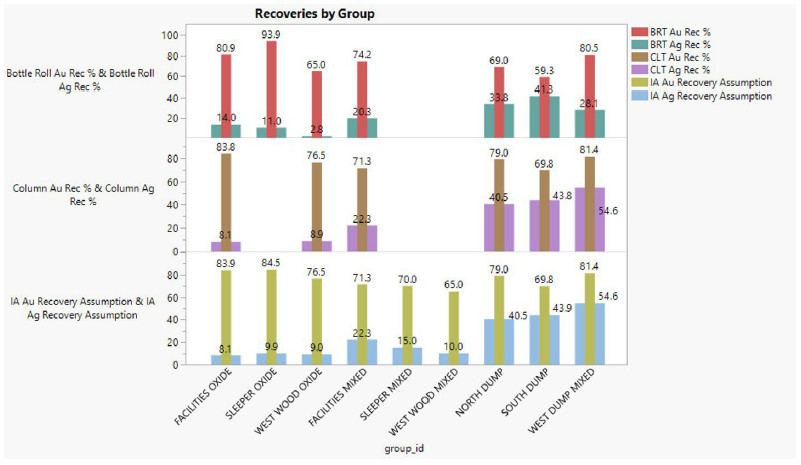
| 10-9 |
|
| Paramount Gold Nevada Corp. | Sleeper Gold Mine S-K 1300 Technical Report Summary |
June 17, 2026 SLR Project No.: 123.020721.00001 |
Figure 10-2: Material Specific Reagent Consumption and IA Heap Leach Recovery Assumptions by Material Type
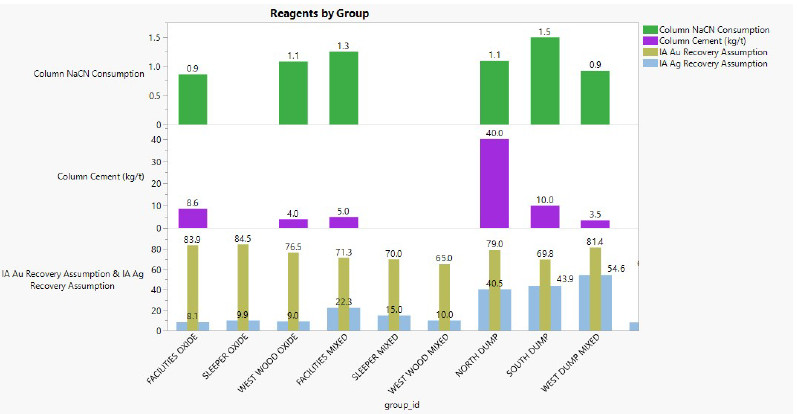
| 10-10 |
|
| Paramount Gold Nevada Corp. | Sleeper Gold Mine S-K 1300 Technical Report Summary |
June 17, 2026 SLR Project No.: 123.020721.00001 |
| 10.7 | QP Opinion - Adequacy of Data |
In the opinion of the QP, the available metallurgical data are adequate for an IA focused on heap leach processing for oxide, mixed, and existing waste rock dump material.
There is also sufficient metallurgical test work to support the estimation of Mineral Resources from sulfide materials, including existing HLP and tailings material. The proposed processing method for these Mineral Resources is flotation.
The data are not yet adequate to support definitive recoveries, concentrate terms, and operating costs for the flotation case at pre-feasibility level. Additional variability testing, concentrate characterization, marketing review, and process-specific cost definition are required before those materials can be incorporated into a more advanced development scenario.
| 10-11 |
|
| Paramount Gold Nevada Corp. | Sleeper Gold Mine S-K 1300 Technical Report Summary |
June 17, 2026 SLR Project No.: 123.020721.00001 |
| 11.0 | Mineral Resource Estimates |
The information presented herein has been reviewed, edited, and, where appropriate, directly derived from RESPEC (2023). The Mineral Resource estimate, prepared by RESPEC Company LLC (RESPEC), has been independently reviewed and validated by SLR QPs for completeness, internal consistency, and technical accuracy.
The SLR QPs confirm that the Mineral Resource estimate complies with disclosure requirements of SEC Regulation S-K 1300. The estimate is supported by appropriate geological interpretation, drilling and sampling data, analytical and QA/QC procedures, and industry-standard geostatistical methods. It incorporates inputs and assumptions sufficient to demonstrate reasonable prospects for economic extraction (RPEE). In situ Mineral Resources are classified as Measured, Indicated, or Inferred. Material contained in waste rock dumps, heap leach pads, and tailings storage facilities (TSF) is classified as Inferred. Mineral Resources do not constitute Mineral Reserves.
SLR’s review included assessment of the database, geological and domain interpretations, compositing, grade capping, variography, interpolation parameters, classification criteria, and block model validation. The SLR QP assumes responsibility for the estimate and considers it reasonable, suitable for disclosure, and compliant in all material respects with applicable reporting requirements.
This TRS presents an updated Mineral Resource estimate for the Project, with an effective date of April 29, 2026. The estimate incorporates a review of historical drilling for surface material and supersedes prior disclosures, reflecting updated geological interpretation, revised economic parameters, and application of RPEE through open-pit optimization and metallurgical recovery assumptions.
| 11.1 | Summary |
The Mineral Resource estimate for the Project was completed using a conventional three-dimensional block modeling approach developed by RESPEC. The workflow included database validation, geological and oxidation domain modeling, density assignment, compositing and grade capping, followed by gold and silver grade interpolation and open-pit constraint using industry-standard software and methodologies.
Gold and silver mineralization domains were defined based on lithology, structure, alteration style, oxidation state, and grade continuity. Separate estimation domains were constructed for gold and silver to reflect differences in grade distribution and continuity. Mineralized domains encompass stockwork, breccia, and vein-related mineralization hosted primarily within altered volcanic units in the hanging wall of the range-bounding fault system. Oxidation was independently modeled and classified into oxide, mixed, and sulfide material, based on its metallurgical significance.
Grade estimation was validated using standard industry practices, including statistical comparison of raw assays, capped values, and composites, as well as comparative estimates generated using inverse distance squared (ID²). Additional validation included swath plots, visual assessment of grade distributions in plan and cross-section, and direct comparison of block estimates against drill hole assays to confirm geological and analytical consistency.
The updated Mineral Resource estimate, prepared by SLR, supersedes prior disclosures for the Project and includes gold and silver only; no other commodities are reported.
| 11-1 |
|
| Paramount Gold Nevada Corp. | Sleeper Gold Mine S-K 1300 Technical Report Summary |
June 17, 2026 SLR Project No.: 123.020721.00001 |
In situ Mineral Resources are constrained within an optimized conceptual open-pit shell demonstrating RPEE. Pit optimization assumes open-pit mining and heap leaching, with metallurgical recoveries supported by test work and economic parameters appropriate for the deposit.
The Mineral Resource Estimates (MRE) for the Project are reported by estimation domain consistent with the geological, processing, and material type distinctions illustrated in Figure 11-1. Domain classifications include open-pit oxide material, open-pit sulfide material, and surface material domains comprising west, north, and south dumps, multiple heap leach domains, and tailings storage facility (TSF) material. These domains were defined to reflect differences in lithology, oxidation state, material origin, and anticipated processing response
Mineral Resources are classified in accordance with S-K 1300 definitions (Table 11-1).
The SLR QP is of the opinion that, with consideration of the recommendations summarized in Sections 1 and 23 of this TRS, any issues relating to all relevant technical and economic factors likely to influence the prospect of economic extraction can be resolved with further work.
| 11-2 |
|
| Paramount Gold Nevada Corp. | Sleeper Gold Mine S-K 1300 Technical Report Summary |
June 17, 2026 SLR Project No.: 123.020721.00001 |
Figure 11-1: Sleeper Mineral Resource Domains
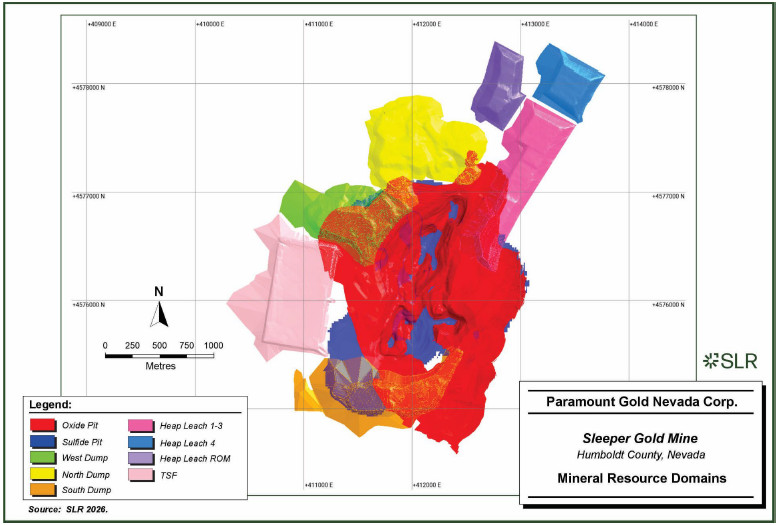
| 11-3 |
|
| Paramount Gold Nevada Corp. | Sleeper Gold Mine S-K 1300 Technical Report Summary |
June 17, 2026 SLR Project No.: 123.020721.00001 |
Table 11-1: Summary of Mineral Resources Estimate – April 29, 2026
| Category |
Tonnage (000 t) |
Grade (g/t Au) |
Grade (g/t Ag) |
Contained Metal (000 oz Au) |
Contained Metal (000 oz Ag) |
Metallurgical Au Recovery (%) |
Metallurgical Ag Recovery (%) | |||||||
| Measured Oxide/Mixed Pit (non-sulfide) |
2,004 | 0.293 | 3.019 | 19 | 195 | 75.2% | 17.1% | |||||||
| Measured Oxide/Mixed Pit (sulfide) |
178 | 0.316 | 4.307 | 2 | 25 | 70.6% | 0.0% | |||||||
| Measured Sulfide Pit |
3,347 | 0.621 | 3.724 | 67 | 401 | 66.5% | 0.0% | |||||||
|
|
|
|
|
|
|
| ||||||||
| Total Measured In Situ |
5,528 | 0.492 | 3.487 | 88 | 620 | 69.8% | 6.2% | |||||||
|
|
|
|
|
|
|
| ||||||||
| Indicated Oxide/Mixed Pit (non-sulfide) |
77,899 | 0.261 | 3.613 | 653 | 9,049 | 74.2% | 17.3% | |||||||
| Indicated Oxide/Mixed Pit (sulfide) |
15,941 | 0.328 | 4.934 | 168 | 2,529 | 68.7% | 0.0% | |||||||
| Indicated Sulfide Pit |
85,336 | 0.393 | 3.848 | 1,078 | 10,558 | 66.5% | 0.0% | |||||||
| Total Indicated In Situ |
179,176 | 0.330 | 3.842 | 1,900 | 22,135 | 70.1% | 7.5% | |||||||
|
|
|
|
|
|
|
| ||||||||
| Total Measured + Indicated In Situ |
184,704 | 0.335 | 3.832 | 1,987 | 22,755 | 70.0% | 7.5% | |||||||
|
|
|
|
|
|
|
| ||||||||
| Inferred Dumps |
46,893 | 0.279 | 1.941 | 420 | 2,927 | 77.1% | 44.6% | |||||||
| Inferred Heap Leach |
31,600 | 0.301 | 8.363 | 306 | 8,497 | 40.0% | 0.0% | |||||||
| Inferred TSF |
11,165 | 0.599 | 6.221 | 215 | 2,233 | 50.1% | 0.0% | |||||||
|
|
|
|
|
|
|
| ||||||||
| Total Inferred Surface |
89,658 | 0.327 | 4.738 | 942 | 13,657 | 60.6% | 23.3% | |||||||
|
|
|
|
|
|
|
| ||||||||
| Inferred Oxide/Mixed Pit (non-sulfide) |
48,656 | 0.235 | 2.384 | 367 | 3,729 | 76.6% | 14.4% | |||||||
| Inferred Oxide/Mixed Pit (sulfide) |
4,960 | 0.286 | 3.543 | 46 | 565 | 68.9% | 0.0% | |||||||
| Inferred Sulfide Pit |
94,761 | 0.311 | 2.657 | 948 | 8,095 | 66.5% | 0.0% | |||||||
| Total Inferred In Situ |
148,377 | 0.285 | 2.597 | 1,361 | 12,390 | 69.9% | 4.7% | |||||||
|
|
|
|
|
|
|
| ||||||||
| Total Inferred Surface + In Situ |
238,035 | 0.301 | 3.403 | 2,303 | 26,047 | 97.9% | 8.8% | |||||||
|
|
|
|
|
|
|
|
| 11-4 |
|
| Paramount Gold Nevada Corp. | Sleeper Gold Mine S-K 1300 Technical Report Summary |
June 17, 2026 SLR Project No.: 123.020721.00001 |
Notes:
| 1. | The definitions for Mineral Resources in S-K 1300 were followed for Mineral Resources |
| 2. | The Mineral Resource estimate is reported on a 100% ownership basis. |
| 3. | The point of reference for the Mineral Resource is before the crusher (in situ). |
| 4. | Open Pit Mineral Resources are reported at a cut-off grade ranging from 0.074 g/t to 0.217 g/t Au, depending on area and constrained by a preliminary optimized pit shell with a pit slope angle of 45° for rock and 22° for alluvium and a bench height of 10 m. |
| 5. | The optimized pit shell and cut-off grades were generated by assuming metallurgical gold recovery ranging from 63.7% to 85.0% and silver recoveries ranging from 0.0% to 54.6%, standard treatment and refining charges, mining costs of US$2.40/t moved for open pit, processing costs of $5.51/t oxide/mixed and $10.44 sulfide processed, and general and administrative costs of $0.46/t processed |
| 6. | Minimal mining width was 60 m for oxide/mixed material and 20 m for sulfide material |
| 7. | Mineral Resources are estimated using a long-term gold price of US$3,100 per ounce |
| 8. | Bulk density ranges from 1.5 t/m3 in the tailings storage area to 2.7 t/m3 for in situ material |
| 9. | Mineral Resources that are not Mineral Reserves do not have demonstrated economic viability. |
| 10. | Numbers may not add due to rounding. |
| 11-5 |
|
| Paramount Gold Nevada Corp. | Sleeper Gold Mine S-K 1300 Technical Report Summary |
June 17, 2026 SLR Project No.: 123.020721.00001 |
| 11.2 | Resource Database |
As of the effective date of this report, Paramount and its predecessor operators have completed more than 4,455 drill holes at the Project. These include a mix of reverse-circulation (RC), diamond core (DD), sonic, and limited-auger drilling conducted between 1983 and 2013.
The Mineral Resource database used for the in situ estimate contains 4,258 drill holes, of which 3,994 are located within or near the Mineral Resource model area and were considered in the resource estimation. Drill holes located outside the modeled mineralized zones, including those intersecting unmineralized alluvium or barren volcanic and metasedimentary units, were excluded from the Mineral Resource estimate.
Drill holes associated with the heap leach and waste rock dumps were treated as separate estimation domains; however, the estimated mineralized material from these domains is included in the Mineral Resource Estimate.
The Project Mineral Resource database includes surveyed drill hole collar locations, down-hole survey data (dip and azimuth), gold and silver assay data, geological and alteration logs, oxidation state information, and supporting QA/QC records collected from multiple drill programs. Drill holes or assay intervals deemed unreliable due to data integrity issues or potential contamination were marked and excluded from grade estimation in accordance with SLR’s modeling protocols.
The compilation, validation, and appropriateness of the drilling database for Mineral Resource estimation were reviewed by SLR QP, who agrees that the dataset is suitable for supporting the Mineral Resource estimate under SEC Regulation S-K1300, subject to the classification limitations discussed elsewhere in this report.
Table 11-2: Summary of Drill Hole Data used in Mineral Resource Estimation
| Area |
No. Holes | Total Depth (m) |
Average Depth (m) |
Number of Records | ||||||||
| Survey | Lithology | Assay | ||||||||||
| In Situ |
4,258 | 640,572.96 | 150.43 | 10,709 | 287,878 | 320,560 | ||||||
| North Dump |
34 | 1316.4 | 38.71 | 34 | 0 | 868 | ||||||
| South Dump |
22 | 789.36 | 35.88 | 22 | 0 | 425 | ||||||
| West Dump |
18 | 552.01 | 30.66 | 18 | 0 | 381 | ||||||
| Heap Leach 1-3 |
31 | 772.83 | 24.45 | 31 | 0 | 827 | ||||||
| Heap Leach 4 |
9 | 205.17 | 22.79 | 9 | 0 | 270 | ||||||
| TSF |
83 | 824.61 | 9.93 | 80 | 0 | 553 | ||||||
|
|
|
|
|
|
| |||||||
| Grand Total |
4,455 | 645,033.34 | 312.85 | 10,903 | 287,878 | 323,884 | ||||||
|
|
|
|
|
|
| |||||||
| 11.3 | Geological Interpretation |
The Project is located within the northern Nevada rift, where gold–silver mineralization is hosted in a structurally controlled epithermal system within Middle Miocene volcanic rocks. The geological model reflects this fault-controlled geometry and incorporates the established regional volcanic stratigraphic framework. The model integrates lithological, structural, alteration, oxidation, and assay data from multiple drilling campaigns to define the
| 11-6 |
|
| Paramount Gold Nevada Corp. | Sleeper Gold Mine S-K 1300 Technical Report Summary |
June 17, 2026 SLR Project No.: 123.020721.00001 |
three-dimensional distribution of mineralized rock. Geological interpretation focuses on the volcanic host sequence and the principal fault systems that control the geometry and continuity of mineralization and constrain the Mineral Resource model, as illustrated in Figure 11-2. The geological model was reinterpreted and refined by SLR based on the original geological modeling framework described in RESPEC (2023).
At the local scale, the geological model defines fault-bounded mineralized zones characterized by vein-, breccia-, and stockwork-style mineralization. These zones are spatially associated with structural features, lithological contrasts, and areas of enhanced permeability and extend along strike and down-dip from the historical mining area into adjacent zones. In addition, distinct estimation domains were created within the heap leach and waste rock dumps to account for differences in material type, grade distribution, and metallurgical behavior relative to in-situ mineralization.
| 11-7 |
|
| Paramount Gold Nevada Corp. | Sleeper Gold Mine S-K 1300 Technical Report Summary |
June 17, 2026 SLR Project No.: 123.020721.00001 |
Figure 11-2: Sleeper Geologic Model Cross Section
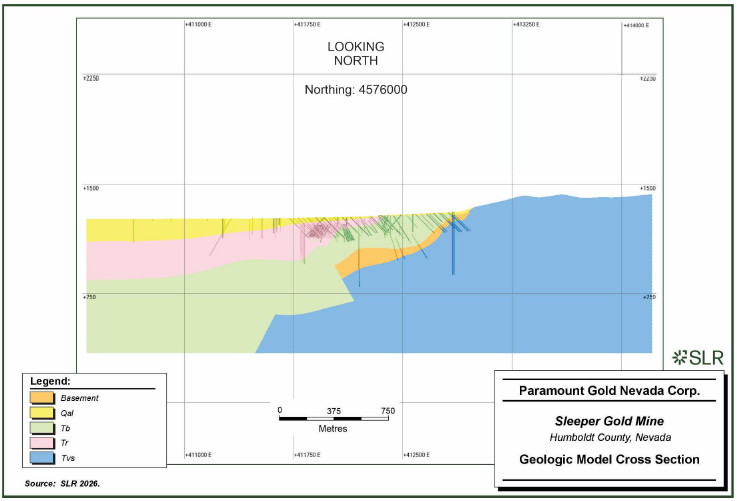
| 11-8 |
|
| Paramount Gold Nevada Corp. | Sleeper Gold Mine S-K 1300 Technical Report Summary |
June 17, 2026 SLR Project No.: 123.020721.00001 |
| 11.3.1 | Mineralization |
In situ mineralization at the Project was subdivided into three grade-based mineral domains to support Mineral Resource estimation and to reflect differences in grade distribution, continuity, and variability of gold and silver mineralization. The domains were defined primarily on gold-grade populations, with silver domains guided by the spatial distribution of gold, given their strong genetic and spatial association, and consisted of a low-grade, mid-grade, and high-grade domain.
The low-grade (LG) domain represents disseminated and stockwork mineralization that forms a laterally and vertically extensive envelope surrounding higher-grade mineralization, as illustrated in Figure 11-3. This domain comprises most of the mineralized volume and is characterized by relatively continuous grades and lower variance. This domain is modeled at a cut-off grade of 0.1 g/t Au to 1.0 g/t Au and 1.80 g/t Ag to 10 g/t Ag.
The mid-grade (MG) domain comprises narrow veins and hydrothermal breccias that extend down-dip and laterally from areas of historically mined high-grade mineralization. Mineralization within this domain exhibits moderate continuity and increased grade variability relative to the low-grade domain. Boundaries between the low- and mid-grade domains are generally sharp and grade-controlled. This domain is modeled at a cut-off grade of 1.0 g/t Au to 8.0 g/t Au and 10 g/t Ag to 20 g/t Ag.
The high-grade (HG) domain represents discrete, discontinuous zones of bonanza-grade mineralization associated with banded quartz–chalcedony veins and localized hydrothermal breccias. These zones are typically narrow, steeply dipping, structurally controlled, and exhibit high-grade variability. Contacts between the mid- and high-grade domains are commonly gradational. This domain is modeled at a cut-off grade of > 8.0 g/t Au and >20 g/t Ag.
| 11-9 |
|
| Paramount Gold Nevada Corp. | Sleeper Gold Mine S-K 1300 Technical Report Summary |
June 17, 2026 SLR Project No.: 123.020721.00001 |
Figure 11-3: Sleeper Mineralization Model Cross Section
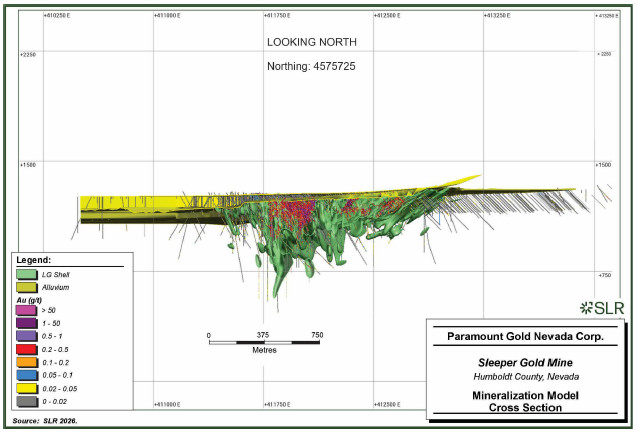
| 11-10 |
|
| Paramount Gold Nevada Corp. | Sleeper Gold Mine S-K 1300 Technical Report Summary |
June 17, 2026 SLR Project No.: 123.020721.00001 |
| 11.3.2 | Oxidation Model |
An oxidation model was developed to support in-situ Mineral Resource estimation and associated metallurgical recovery assumptions by defining the spatial distribution of oxide, mixed, and sulfide material. The oxidation model was re-interpreted and refined based on the original oxidation framework described in RESPEC (2023). The review of the historical database identified instances in which oxide and sulfide intervals were locally exchanged or inconsistently coded. These inconsistencies were addressed through SLR’s reinterpretation, which incorporated geological context and supporting information to correct oxidation assignments for the current Mineral Resource estimate.
Oxidation-state interpretation was based on geological logging, alteration characteristics, and historical mining information, with oxide material representing fully oxidized mineralization, mixed material representing partially oxidized mineralization, and sulfide material representing relatively unoxidized mineralization dominated by primary sulfide assemblages. Oxidation domains were modeled independently of lithology and mineralization domains and constrained using drill hole data and sectional interpretations, reflecting a general transition from oxide material near the surface to sulfide material at depth, with locally variable boundaries influenced by structure and permeability.
While the identified oxidation coding issues were corrected within the current SLR reinterpretation, the SLR QP recommends additional verification and review for future Mineral Resource estimation updates, particularly where oxidation state affects metallurgical routing, recovery assumptions, and economic parameters.
In the opinion of the SLR QP, the refined oxidation model is appropriate for the current in situ Mineral Resource estimation in accordance with SEC Regulation S-K 1300 and CIM (2019) Best Practice Guidelines, subject to the limitations noted above.
| 11-11 |
|
| Paramount Gold Nevada Corp. | Sleeper Gold Mine S-K 1300 Technical Report Summary |
June 17, 2026 SLR Project No.: 123.020721.00001 |
Figure 11-4: Sleeper Alteration Model Cross Section
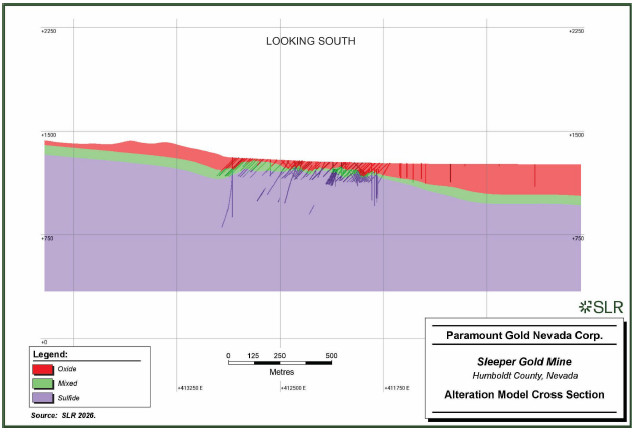
| 11-12 |
|
| Paramount Gold Nevada Corp. | Sleeper Gold Mine S-K 1300 Technical Report Summary |
June 17, 2026 SLR Project No.: 123.020721.00001 |
| 11.4 | Resource Assays |
Gold and silver assay intervals were coded to mineralization domains prior to any statistical treatment or grade estimation. Domain coding was based on the interpreted geological and mineralization models and confirmed that assays were assigned solely to geologically consistent populations. This method prevented the mixing of mineralized and non-mineralized material and ensured that subsequent statistical analysis, capping, compositing, and interpolation were performed within appropriate geological controls.
Only assays from accepted drill holes and intervals were coded for resource estimation. Intervals impacted by identified down-hole contamination or other data quality issues were excluded from further analysis.
| 11.5 | Treatment of High-Grade Assays |
| 11.5.1 | Capping Levels |
Gold and silver assay data for the Sleeper deposit were coded by mineral domain, including modeled mineralized domains, Outside domains, and alluvium (Qal), prior to grade interpolation as part of the in-situ mineral resource estimation. Domain coding ensured that assay data were assigned to geologically appropriate populations and that subsequent statistical analysis, capping, and interpolation honored geological controls. Assay data were then evaluated for high-grade outliers to ensure that estimated block grades are representative of the underlying mineralization and not unduly influenced by extreme values. The Sleeper deposit exhibits significant grade variability and localized nugget effects, characteristic of low-sulfidation epithermal gold-silver mineralization; accordingly, assay capping and high-grade restrictions were applied as complementary risk-management measures consistent with accepted industry practice.
Assay capping was conducted on a domain-by-domain basis, recognizing that grade distributions, continuity, and variability differ between mineralized domains, Outside domains, and alluvium (Table 11-3). Domain-specific gold and silver capping thresholds were established using statistical analysis, including histogram, log-probability plot, and descriptive statistics reviews. The selected caps were designed to limit the influence of rare, extreme assay values while preserving the overall grade tenor and geological character of each domain. Assay values exceeding the selected domain caps were reduced to the cap value prior to compositing and grade estimation.
Table 11-3: Sleeper In Situ Gold and Silver Capping Levels by Domain
| Domain |
Au Samples Capped |
Au Cap (g/t) | Ag Samples Capped |
Ag Cap (g/t) | ||||||||||||
| Outside |
19 | 6 | 76 | 20 | ||||||||||||
| Low - Grade |
107 | 3 | 154 | 35 | ||||||||||||
| Mid - Grade |
0 | N/A | 8 | 65 | ||||||||||||
| High - Grade |
0 | N/A | 0 | N/A | ||||||||||||
| Alluvium (Qal) |
23 | 5 | 0 | N/A | ||||||||||||
| 11-13 |
|
| Paramount Gold Nevada Corp. | Sleeper Gold Mine S-K 1300 Technical Report Summary |
June 17, 2026 SLR Project No.: 123.020721.00001 |
| 11.6 | Compositing |
Capped gold and silver grade assay intervals from drill holes were combined into 3.05 m composite lengths for in situ grade estimation to ensure consistent sample support. This composite length was chosen to honor historical assay data originally sampled at 5 ft intervals and then converted to metric units, aligning closely with the original sampling support used in most drilling at the Sleeper deposit. The selected composite length is appropriate, given the drill spacing and the style of mineralization (Table 11-4 and Table 11-5). Figure 11-5 illustrates a histogram of the distribution of composite lengths.
Material sampled from waste rock dumps and heap leach pads was combined into 5 m intervals to reflect the broader sampling support and the generally lower spatial variability typical of these areas. Compositing strictly respected mineral domain boundaries, ensuring no composite included assay data from more than one domain. Residual intervals at the ends of drill holes, at domain boundaries, or at dump and heap leach pad boundaries were composited using length-weighted averaging.
The resulting gold and silver composites were reviewed statistically to confirm that the compositing methodology produced stable and representative grade distributions suitable for block-model interpolation. In the opinion of the QP, the compositing procedures applied are appropriate for the nature of the available data and support the estimation of Mineral Resources.
Figure 11-5: Histogram of Sample Lengths in the Estimation Domains
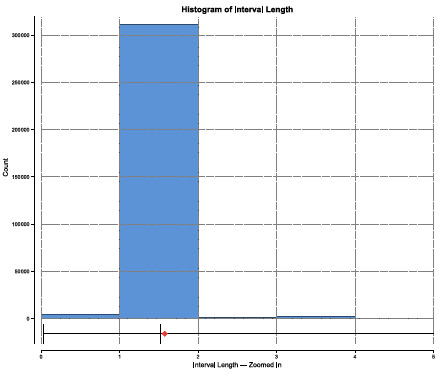
| 11-14 |
|
| Paramount Gold Nevada Corp. | Sleeper Gold Mine S-K 1300 Technical Report Summary |
June 17, 2026 SLR Project No.: 123.020721.00001 |
Table 11-4: Sleeper In Situ Gold Composite by Domain
| Domain |
Pre - Capping Au (g/t) | Post - Capping Au (g/t) | ||||||||||
| Low - Grade Gold |
Median | 0.24 | 0.24 | |||||||||
| Mean | 0.30 | 0.30 | ||||||||||
| SD | 0.33 | 0.23 | ||||||||||
| Maximum | 34.00 | 3.00 | ||||||||||
| Mid - Grade Gold |
Median | 1.46 | 1.46 | |||||||||
| Mean | 1.84 | 1.84 | ||||||||||
| SD | 1.16 | 1.16 | ||||||||||
| Maximum | 27.63 | 27.63 | ||||||||||
| High - Grade Gold |
Median | 11.02 | 11.02 | |||||||||
| Mean | 19.52 | 19.52 | ||||||||||
| SD | 31.33 | 31.33 | ||||||||||
| Maximum | 297.73 | 297.73 | ||||||||||
| Alluvium (Qal) |
Median | 0.71 | 0.71 | |||||||||
| Mean | 1.43 | 1.10 | ||||||||||
| SD | 2.25 | 1.11 | ||||||||||
| Maximum | 15.23 | 5.00 | ||||||||||
| Outside Gold |
Median | 0.03 | 0.03 | |||||||||
| Mean | 0.09 | 0.06 | ||||||||||
| SD | 6.48 | 0.13 | ||||||||||
| Maximum | 1497.58 | 6.00 | ||||||||||
| 11-15 |
|
| Paramount Gold Nevada Corp. | Sleeper Gold Mine S-K 1300 Technical Report Summary |
June 17, 2026 SLR Project No.: 123.020721.00001 |
Table 11-5: Sleeper In Situ Silver Composite by Domain
| Domain |
Pre - Capping Ag (g/t) | Post - Capping Ag (g/t) | ||||||||||
| Low - Grade Silver |
Median | 3.33 | 3.33 | |||||||||
| Mean | 4.24 | 4.02 | ||||||||||
| Std Dev | 7.34 | 3.07 | ||||||||||
| Maximum | 478.01 | 35.00 | ||||||||||
| Mid - Grade Silver |
Median | 13.31 | 13.31 | |||||||||
| Mean | 14.06 | 13.81 | ||||||||||
| Std Dev | 10.75 | 4.17 | ||||||||||
| Maximum | 402.73 | 65.00 | ||||||||||
| High - Grade Silver |
Median | 33.43 | 33.43 | |||||||||
| Mean | 55.17 | 55.17 | ||||||||||
| Std Dev | 90.94 | 90.94 | ||||||||||
| Maximum | 1683.41 | 1683.41 | ||||||||||
| Alluvium (Qal) |
Median | 5.94 | 5.94 | |||||||||
| Mean | 6.32 | 6.32 | ||||||||||
| Std Dev | 2.81 | 2.81 | ||||||||||
| Maximum | 13.03 | 13.03 | ||||||||||
| Outside Silver |
Median | 0.31 | 0.31 | |||||||||
| Mean | 0.63 | 0.60 | ||||||||||
| Std Dev | 2.44 | 0.98 | ||||||||||
| Maximum | 274.70 | 20.00 | ||||||||||
| 11.7 | Spatial Analysis |
| 11.7.1 | Variography |
Spatial continuity was evaluated to assess the suitability of the data for geostatistical interpolation and to determine whether variogram models could be reliably developed. This review considered grade distributions, spatial continuity, and potential directional trends within the mineralized domains. The available dataset did not demonstrate sufficient variability or well-defined spatial structure to support the development of robust and defensible variogram models.
Given the limited variability and the absence of a clearly defined anisotropy, formal variography was not undertaken, and grade estimation was completed using inverse distance squared (ID²) and inverse distance cubed (ID³) interpolation methods, which do not require variogram inputs. A planar ellipsoid search strategy was applied to reflect the general geometry of the mineralized zones and to provide appropriate spatial weighting of sample data during estimation.
| 11-16 |
|
| Paramount Gold Nevada Corp. | Sleeper Gold Mine S-K 1300 Technical Report Summary |
June 17, 2026 SLR Project No.: 123.020721.00001 |
| 11.8 | Bulk Density |
Bulk density values used for the Mineral Resource estimate were assigned by material type, lithology, and, where applicable, redox domain. Bulk density values were applied to convert block model volumes to tonnage. A total of 2,546 in situ bulk density measurements were available from historical drilling programs completed by X-Cal and Paramount. Density determinations were derived from water-immersion measurements on drill core samples. The density data were reviewed for reasonableness and statistically summarized prior to application in the resource model.
For the in situ Mineral Resource estimate, the dataset has a sample-weighted average applied density of approximately 2.33 g/cm³. The strongest sample support is in Tertiary Sleeper Rhyolite Mixed (970 samples) and Tertiary Sleeper Basalt Mixed (800 samples), both assigned 2.33 g/cm³. Tertiary Intrusive Felsic is also well supported, with 398 samples and an applied density of 2.36 g/cm³.
In situ density assignments show expected lithological variation. Quaternary Alluvium was assigned 1.90 g/cm³; West Wood Breccia, Breccia, and Tertiary Sleeper Volcanic Sediment range from 2.35 g/cm³ to 2.46 g/cm³; Tertiary Sleeper Rhyolite ranges from 2.18 g/cm³ to 2.33 g/cm³; Tertiary Sleeper Basalt ranges from 2.24 g/cm³ to 2.33 g/cm³; and Mesozoic Basement was assigned the highest density at 2.64 g/cm³. These values are consistent with the expected density contrast between unconsolidated cover, volcanic host rocks, intrusive units, and basement.
Density values were assigned deterministically to block model cells based on lithology and oxidation state and were not interpolated. This approach provides consistent and stable tonnage estimates given the distribution, spatial coverage, and quality of the available density measurements. Representative values were selected for each lithologic and redox domain based on measured data and supplemented by geological judgment where direct measurements were limited.
Lower densities assigned by SLR to the waste rock dumps, heap leach, and TSF reflect deposited, crushed, stacked, or rehandled material with greater void space than competent in situ bedrock. The applied density of 1.80 g/cm³ for waste rock dumps is reasonable for broken, rehandled waste rock in a Nevada open-pit gold setting. The applied density of 1.65 g/cm³ for heap leach material reflects crushed and stacked leach material. The applied density of 1.50 g/cm³ for tailings is consistent with lower-density deposited tailings material.
In the opinion of the SLR QP, the density assignment methodology and applied values are appropriate for the style of mineralization and the available data and are adequate for use in estimating Mineral Resources.
The applied densities used in the Mineral Resource estimation are summarized in Table 11-6.
| 11-17 |
|
| Paramount Gold Nevada Corp. | Sleeper Gold Mine S-K 1300 Technical Report Summary |
June 17, 2026 SLR Project No.: 123.020721.00001 |
Table 11-6: Sleeper Density Values by Lithology
| Material / Lithology |
Redox Domain |
No. Samples |
Density Range (g/cm³) |
Applied Density (g/cm³) | ||||
| Waste Rock Dumps |
All | 521 | Not reported | 1.80 | ||||
| Heap Leach |
All | 187 | Not reported | 1.65 | ||||
| TSF |
All | Not reported | Not reported | 1.50 | ||||
| Quaternary Alluvium |
All | 7 | 1.76–2.42 | 1.90 | ||||
| West Wood Breccia |
All | 20 | 2.04–2.56 | 2.35 | ||||
| Breccia |
All | 1 | 2.42–2.42 | 2.42 | ||||
| Tertiary Intrusive Felsic |
All | 398 | 0.06–2.90 | 2.36 | ||||
| Tertiary Intrusive Mafic |
All | 0 | Not reported | 2.30 | ||||
| Tertiary Sleeper Rhyolite |
All | 115 | 1.86–3.11 | 2.18 | ||||
| Tertiary Sleeper Rhyolite |
Oxide | 84 | 1.68–2.42 | 2.18 | ||||
| Tertiary Sleeper Rhyolite |
Mixed | 970 | 1.39–3.83 | 2.33 | ||||
| Tertiary Sleeper Basalt |
Sulfide | 28 | 1.88–2.48 | 2.24 | ||||
| Tertiary Sleeper Basalt |
Oxide | 51 | 1.91–2.65 | 2.33 | ||||
| Tertiary Sleeper Basalt |
Mixed | 800 | 1.58–3.74 | 2.33 | ||||
| Tertiary Sleeper Volcanic Sediment |
Sulfide | 26 | 2.06–2.80 | 2.46 | ||||
| Mesozoic Basement |
All | 46 | 2.32–3.24 | 2.64 |
| 11.9 | Block Models |
The in situ mineralization geology model was developed by RESPEC using Seequent Leapfrog Geo software, while grade estimation for the in situ Mineral Resource Estimate was completed in MineSight. SLR imported the completed in situ block model estimate into Leapfrog Geo for review, validation, and integration with the waste rock dump, heap leach, and tailings models. The waste rock dump, heap leach, and tailings Mineral Resource Estimates were prepared by SLR using Seequent Leapfrog Geo, version 2025.3. Collectively, these models provide the basis for domain-controlled estimation, validation, integration, and final Mineral Resource reporting.
| 11.9.1 | RESPEC In situ |
The in situ block model was constructed using an unrotated approach. Each block was assigned to the geological domain containing its centroid, ensuring appropriate domain representation and that grade estimation and reporting were constrained to the relevant geological controls. The model was oriented with an azimuth, dip, and plunge of 0.0° and employed a parent block size of 10 m (X) × 10 m (Y) × 10.0 m (Z) to reflect the geometry of the mineralized zones and the anticipated selective mining unit dimensions, while honoring the interpreted geological surfaces and wireframes. The block model was prepared by RESPEC and includes representations of the in situ mineralized zones (Table 11-7).
| 11-18 |
|
| Paramount Gold Nevada Corp. | Sleeper Gold Mine S-K 1300 Technical Report Summary |
June 17, 2026 SLR Project No.: 123.020721.00001 |
Table 11-7: Summary of In Situ Block Model Extents
| Description |
Easting (X) (m) |
Northing (Y) (m) |
Elevation (Z) (masl) |
|||||||||
| Block Model Origin (lower left corner) |
410,520 | 4,573,830 | 1600 | |||||||||
| Parent Block Dimension (m) |
10 | 10 | 10 | |||||||||
| Number of Blocks |
333 | 412 | 120 | |||||||||
| Rotation |
0 | 0 | 0 | |||||||||
| 11.9.2 | SLR Waste Rock Dumps and Heap Leach |
The heap leach and dump block model was constructed in Leapfrog Edge (version 2025.2.1) using an unrotated, sub-blocked approach. Each block was assigned to the geological domain containing its centroid, ensuring appropriate domain representation. The model was oriented with an azimuth, dip, and plunge of 0.0° and employed a parent block size of 10 m (X) by 10 m (Y) by 5 m (Z) to reflect the deposit geometry and anticipated selective mining unit dimensions, while honoring modeled geological surfaces. A summary of the block model extents is provided in Table 11-8.
Table 11-8: Summary of Waste Rock Dumps and Heap Leach Block Model Extents
| Description |
Easting (X) (m) |
Northing (Y) (m) |
Elevation (Z) (masl) |
|||||||||
| Block Model Origin (lower left corner) |
410,020 | 453,830 | 1600 | |||||||||
| Parent Block Dimension (m) |
10 | 10 | 5 | |||||||||
| Number of Blocks |
383 | 462 | 240 | |||||||||
| Rotation |
0 | 0 | 0 | |||||||||
| 11.9.3 | SLR Tailing Storage Facility |
The TSF block model was constructed in Leapfrog Edge (version 2025.2.1) using an unrotated, sub-blocked approach. Each block was assigned to the geological domain containing its centroid, ensuring appropriate domain representation. The model was oriented with an azimuth, dip, and plunge of 0.0° and employed a parent block size of 10 m (X) by 10 m (Y) by 5. m (Z) to reflect the deposit geometry and anticipated selective mining unit dimensions, while honoring modeled geological surfaces. A summary of the block model extents is provided in Table 11-9.
Table 11-9: Summary of TSF Block Model Extents
| Description |
Easting (X) (m) |
Northing (Y) (m) |
Elevation (Z) (masl) |
|||||||||
| Block Model Origin (lower left corner) |
410,020 | 453,830 | 1600 | |||||||||
| Parent Block Dimension (m) |
10 | 10 | 5 | |||||||||
| Number of Blocks |
383 | 462 | 240 | |||||||||
| Rotation |
0 | 0 | 0 | |||||||||
| 11-19 |
|
| Paramount Gold Nevada Corp. | Sleeper Gold Mine S-K 1300 Technical Report Summary |
June 17, 2026 SLR Project No.: 123.020721.00001 |
| 11.9.4 | SLR Vulcan Block Model |
For final Mineral Resource Estimate reporting, the in situ, waste rock dump, heap leach, and tailings block models were combined into one regularized 10 m × 10 m × 10 m block model using Maptek Vulcan software. The consolidated Vulcan model provided a consistent reporting framework across all material types and was used for final MRE tabulation and disclosure.
| 11.10 | Search Strategy and Grade Interpolation Parameters |
Gold and silver grades for the Sleeper deposit were estimated for the in situ Mineral Resource estimate using domain-controlled inverse-distance interpolation methods applied to the three-dimensional block model. Grade interpolation was completed separately by mineralized domain to ensure that estimates honored the geological controls, grade populations, and spatial continuity characteristics established during domain modeling.
The primary estimation method was inverse-distance weighting, with inverse distance cubed (ID³) applied to the mid-grade and high-grade domains and inverse distance squared (ID²) applied to the low-grade domains. These domain-specific distance powers were selected to reflect differences in grade variability, continuity, and nugget effect, while balancing local grade influence against excessive smoothing. Ordinary kriging (OK) and nearest-neighbor (NN) estimates were also generated for validation and comparison against the inverse-distance estimates.
Interpolation used domain-specific search ellipsoids, orientations, and maximum search distances consistent with the geometry of the mineralized zones. Sample selection was controlled by minimum, maximum, and maximum-per-hole constraints to reduce spatial bias and limit over-representation of closely spaced drill data. Although the RESPEC (2023) report does not expressly use the term “hard boundaries,” the estimation workflow is consistent with hard-boundary estimation, as composite samples were restricted to their respective grade domains and were not used across domain contacts. Partial-volume block coding was used to represent domain proportions within blocks; however, the report does not document the use of soft-boundary interpolation or cross-domain sample sharing.
In the opinion of the SLR QP, the grade interpolation approach is appropriate for the in situ Mineral Resource estimate. The use of domain-controlled estimation, domain-specific search parameters, and validation checks is consistent with SEC Regulation S-K 1300 reporting expectations and CIM (2019) Best Practice Guidelines.
11.10.1 High Grade Restriction
In addition to assay capping, high-grade restrictions (HGRs) were applied during grade interpolation to limit the spatial influence of elevated composite grades. The restrictions were implemented using grade–distance limits, whereby composites above defined threshold grades were restricted to a shorter search distance, generally less than the primary search ellipse and commonly approximating one-half of the main search distance.
High-grade restriction thresholds were selected by estimation domain based on statistical review, grade distribution analysis, and visual assessment of the apparent continuity of high-grade values. This approach was used to reduce the potential for grade smearing and localized overestimation, particularly in domains characterized by high-grade variability or nugget effect. Thresholds and restriction distances were defined on a domain-specific basis to reflect geological continuity, grade population characteristics, and confidence in spatial continuity (Table 11-10).
| 11-20 |
|
| Paramount Gold Nevada Corp. | Sleeper Gold Mine S-K 1300 Technical Report Summary |
June 17, 2026 SLR Project No.: 123.020721.00001 |
The effects of assay coding, capping, and high-grade restrictions were evaluated by comparing pre- and post-capping statistics and reviewing grade distributions. Based on this review, the selected controls appropriately limited the influence of extreme values without materially altering mean grades or distorting the underlying domain grade populations.
Table 11-10: Sleeper Estimation Parameters by Domain
| Domain |
Min Samples |
Max Samples |
Max per Hole |
Search Major |
Search Semimajor |
Search Minor (Vertical) |
ID Power |
Au Grade Cap |
Au Distance (m) |
Ag Grade Cap |
Ag Distance (m) | |||||||||||
| Low-Grade |
1 | 12 | 3 | 1 | 1 | 0.5 | 2 | 1.6 | 75 | 10.5 | 75 | |||||||||||
| Mid-Grade |
1 | 12 | 3 | 1 | 1 | 0.33 | 3 | 8 | 75 | 30 | 75 | |||||||||||
| High-Grade |
1 | 12 | 4 | 1 | 1 | 0.33 | 3 | 100 | 75 | 290 | 75 | |||||||||||
| Outside Domains |
2 | 12 | 3 | 1 | 1 | 0.5 | 2 | 1.1 | 20 | 11 | 20 | |||||||||||
| Qal |
1 | 9 | 3 | 1 | 1 | 0.5 | 3 | 1.5 | 20 | 11 | 20 |
In the opinion of the SLR QP, the combined application of domain-specific assay coding, assay capping, and high-grade restrictions is appropriate for the style of mineralization and the quality and variability of the available data and supports the estimation of Mineral Resources.
| 11.11 | Reasonable Prospects for Economic Extraction for Mineral Resources |
Mineral Resources must demonstrate reasonable prospects for economic extraction (RPEE), which generally implies that the quantity and grade estimates meet certain economic thresholds and that the Mineral Resources are reported at an appropriate cut-off grade, taking into account extraction scenarios.
Metal prices used to determine Mineral Reserves are based on consensus long-term forecasts from banks, financial institutions, and other sources. For Mineral Resources, metal prices are typically higher than those used for Mineral Reserves.
A reporting cut-off grade was established for the Project based on assumed costs for an open pit mining and heap leaching operation and commodity prices that provide a reasonable basis for establishing RPEE for Mineral Resources.
These cost references were modified to align with the Project’s assumed production rate. These cost and price assumptions have been used to inform an optimization process using the Whittle optimized pit shell software. Metallurgical recoveries and process costs were applied by metallurgical domains (Table 10-3)
| 11.11.1 | Cut-off Grade Estimation |
To demonstrate RPEE in accordance with SEC Regulation S-K 1300, Mineral Resources were constrained within pit shells developed using Whittle pit optimization software. The optimization incorporated gold and silver prices of US$3,100/oz and US$34/oz, with payable metal factors of 99% and royalties of 3%. Selling costs of US$6.00/oz Au and US$0.50/oz Ag were applied.
The Whittle pit-optimization metallurgical recoveries were applied on a material-type basis, reflecting variability across oxide, mixed, and sulfide domains.
| 11-21 |
|
| Paramount Gold Nevada Corp. | Sleeper Gold Mine S-K 1300 Technical Report Summary |
June 17, 2026 SLR Project No.: 123.020721.00001 |
The pit optimization utilized material-specific processing costs ranging from US$5.51/t (heap leach) to US$10.44/t (sulfide processing), with general and administrative costs of US$0.46/t processed. Mining costs of US$2.40/t moved were applied in the pit optimization but excluded from the cut-off grade (COG) calculation.
Open-pit Mineral Resources are reported within the selected Whittle pit shells (an Oxide/Mixed Pit and a Sulfide Pit) at material-specific cut-off grades derived from the above economic parameters and metallurgical assumptions. The applied cut-off grades (g/t Au) by material type are summarized in Table 11-11. Figure 11-6 illustrates the spatial distribution of material types across the project area.
These cut-off grades reflect differences in metallurgical recovery (Au recovery ranging from 40.0% to 84.5% for leachable materials and from 50.1% to 71.2% for sulfides; Ag recovery ranging from 0% to 54.6%) and processing routes. Sulfide material is assigned a higher cut-off grade due to increased processing costs and lack of defined recoveries within the current flowsheet assumptions.
The Whittle pit shell serves solely as a reporting constraint and does not represent a Mineral Reserve, mine plan, or final pit design. Mineralized material below the applicable cut-off grade or outside the optimized pit shell is excluded from the reported Mineral Resources.
For reporting, the block model was reblocked to a 10 m bench height consistent with the open-pit mining assumption. No additional mining dilution or mining recovery factors were applied. The applied cut-off grades and pit constraint are considered appropriate to support RPEE and Mineral Resource disclosure.
| 11-22 |
|
| Paramount Gold Nevada Corp. | Sleeper Gold Mine S-K 1300 Technical Report Summary |
June 17, 2026 SLR Project No.: 123.020721.00001 |
Figure 11-6: Sleeper Material Type/Area Distribution Map
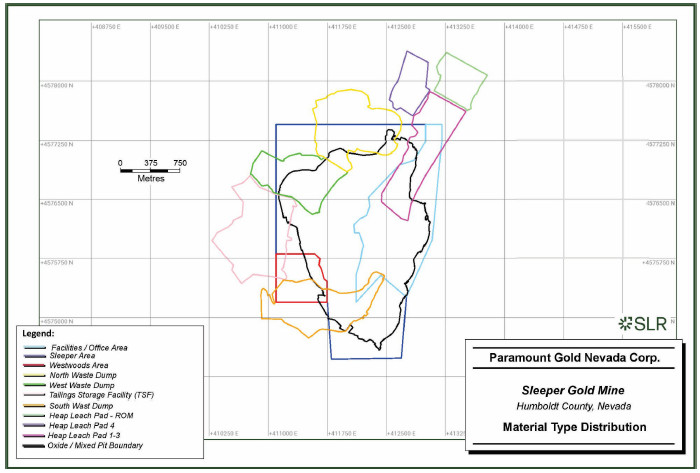
| 11-23 |
|
| Paramount Gold Nevada Corp. | Sleeper Gold Mine S-K 1300 Technical Report Summary |
June 17, 2026 SLR Project No.: 123.020721.00001 |
Table 11-11: Sleeper Cut-off Grade Parameters by Domain
| Area |
Unit | West Wood Sulfide |
Facilities / Office Sulfide |
TSF | Heap | North Dump |
South Dump |
West Dump |
Alluvium | |||||||||||||||||||||||||||
| Block Model Codes |
Type | Sulfides | Sulfides | Mixed | Mixed | Oxide | Oxide | Oxide | Oxide | |||||||||||||||||||||||||||
| Recovery Code |
RecCode | 1 | 15 | 14 | 13 | 12 | 11 | 10 | 9 | 8 | ||||||||||||||||||||||||||
| Price Au |
US$ | /oz | 3,100 | 3,100 | 3,100 | 3,100 | 3,100 | 3,100 | 3,100 | 3,100 | ||||||||||||||||||||||||||
| Price Ag |
US$ | /oz | 34 | 34 | 34 | 34 | 34 | 34 | 34 | 34 | ||||||||||||||||||||||||||
| Payable |
% | 99 | % | 99 | % | 99 | % | 99 | % | 99 | % | 99 | % | 99 | % | 99 | % | |||||||||||||||||||
| Selling Cost Au |
US$ | /oz | 6.00 | 6.00 | 6.00 | 6.00 | 6.00 | 6.00 | 6.00 | 6.00 | ||||||||||||||||||||||||||
| Selling Cost Ag |
US$ | /oz | 0.50 | 0.50 | 0.50 | 0.50 | 0.50 | 0.50 | 0.50 | |||||||||||||||||||||||||||
| Royalties |
% | 3 | % | 3 | % | 3 | % | 3 | % | 3 | % | 3 | % | 3 | % | 3 | % | |||||||||||||||||||
| Net Price Au |
US$ | /g | 95.53 | 95.53 | 95.53 | 95.53 | 95.53 | 95.53 | 95.53 | 95.53 | ||||||||||||||||||||||||||
| Recovery Au |
% | 64.2 | % | 71.2 | % | 50.1 | % | 40.0 | % | 79.0 | % | 69.8 | % | 81.4 | % | 60.0 | % | |||||||||||||||||||
| Recovery Ag |
% | 0.0 | % | 0.0 | % | 0.0 | % | 0.0 | % | 40.5 | % | 43.9 | % | 54.6 | % | 8.0 | % | |||||||||||||||||||
| Mining (excluded from COG) |
$ | /t mined | 2.40 | 2.40 | 2.40 | 2.40 | 2.40 | 2.40 | 2.40 | 2.40 | ||||||||||||||||||||||||||
| Processing |
$ | /t processed | 10.53 | 10.26 | 10.15 | 4.00 | 5.51 | 5.51 | 5.51 | 5.51 | ||||||||||||||||||||||||||
| G&A |
0.46 | 0.46 | 0.46 | 0.46 | 0.46 | 0.46 | 0.46 | |||||||||||||||||||||||||||||
| COG |
gr/tonne | 0.179 | 0.157 | 0.222 | 0.105 | 0.079 | 0.089 | 0.077 | 0.104 | |||||||||||||||||||||||||||
| 11-24 |
|
| Paramount Gold Nevada Corp. | Sleeper Gold Mine S-K 1300 Technical Report Summary |
June 17, 2026 SLR Project No.: 123.020721.00001 |
| Area |
Unit | Facilities / Office Oxide |
Facilities / Office Mixed |
Sleeper Oxide |
West Wood Oxide |
Sleeper Mixed |
West Wood Mixed |
Sulfides | ||||||||||||||||||||||||
| Block Model Codes |
Type | Oxide | Mixed | Oxide | Oxide | Mixed | Mixed | Sulfides | ||||||||||||||||||||||||
| Recovery Code |
RecCode | 1 | 7 | 6 | 5 | 4 | 3 | 2 | 1 | |||||||||||||||||||||||
| Price Au |
US$ | /oz | 3,100 | 3,100 | 3,100 | 3,100 | 3,100 | 3,100 | 3,100 | |||||||||||||||||||||||
| Price Ag |
US$ | /oz | 34 | 34 | 34 | 34 | 34 | 34 | 34 | |||||||||||||||||||||||
| Payable |
% | 99 | % | 99 | % | 99 | % | 99 | % | 99 | % | 99 | % | 99 | % | |||||||||||||||||
| Selling Cost Au |
US$ | /oz | 6.00 | 6.00 | 6.00 | 6.00 | 6.00 | 6.00 | 6.00 | |||||||||||||||||||||||
| Selling Cost Ag |
US$ | /oz | 0.50 | 0.50 | 0.50 | 0.50 | 0.50 | 0.50 | 0.50 | |||||||||||||||||||||||
| Royalties |
% | 3 | % | 3 | % | 3 | % | 3 | % | 3 | % | 3 | % | 3 | % | |||||||||||||||||
| Net Price Au |
US$ | /g | 95.53 | 95.53 | 95.53 | 95.53 | 95.53 | 95.53 | 95.53 | |||||||||||||||||||||||
| Recovery Au |
% | 83.9 | % | 71.3 | % | 84.5 | % | 76.5 | % | 70.0 | % | 65.0 | % | 66.5 | % | |||||||||||||||||
| Recovery Ag |
% | 8.1 | % | 22.3 | % | 9.9 | % | 9.0 | % | 15.0 | % | 10.0 | % | 0.0 | % | |||||||||||||||||
| Mining (excluded from COG) |
$ | /t mined | 2.40 | 2.40 | 2.40 | 2.40 | 2.40 | 2.40 | 2.40 | |||||||||||||||||||||||
| Processing |
$ | /t processed | 5.51 | 5.51 | 5.51 | 5.51 | 5.51 | 5.51 | 10.44 | |||||||||||||||||||||||
| G&A |
0.46 | 0.46 | 0.46 | 0.46 | 0.46 | 0.46 | 0.46 | |||||||||||||||||||||||||
| COG |
g/t Au | 0.074 | 0.088 | 0.074 | 0.082 | 0.089 | 0.096 | 0.171 | ||||||||||||||||||||||||
Note:
| 1 | Recovery Code: RECCODE is a variable added to the block model to designate material type based on the metallurgical recovery factor for reporting Mineral Resources |
| 11-25 |
|
| Paramount Gold Nevada Corp. | Sleeper Gold Mine S-K 1300 Technical Report Summary |
June 17, 2026 SLR Project No.: 123.020721.00001 |
11.11.2 Factors Affecting the Mineral Resource
Mineral Resources, which are not Mineral Reserves, do not have demonstrated economic viability. The Mineral Resource Estimate is reported within a Whittle optimized open-pit shell and at material-specific cut-off grades derived from the economic, metallurgical, and cost parameters summarized in Section 11.11.1. At the time of reporting, the SLR QP is not aware of any title, taxation, socio-political, marketing, or other relevant issues that materially impact the Mineral Resource estimate beyond those outlined below.
Key factors that may materially affect the Mineral Resource estimate are listed:
| • | Changes to metal price assumptions (US$3,100/oz Au and US$34/oz Ag) and associated payable factors (99%) and royalties (3%), which directly influence net realized metal values and cut-off grades. |
| • | Changes to cut-off grade assumptions, including processing costs, which underpin the material-specific cut-off grades applied for reporting. |
| • | Changes to metallurgical recovery assumptions by material type, which directly impact economic value and cut-off grade determination. |
| • | Changes to the assumptions and parameters used in the Whittle pit optimization, including slope angles, cost inputs, and economic criteria used to define the reporting pit shell for RPEE as described in Sections 13.1 and 13.2 of this report. |
| • | Changes to geological interpretations, including mineralized domain geometry, continuity, and grade distribution, which may affect block model estimation and classification. |
| • | Changes resulting from additional drilling, sampling, or data acquisition that modify the understanding of geological controls, grade continuity, or domain boundaries. |
| • | Changes to estimation methodology, including treatment of high-grade values (e.g., capping and high-grade restrictions), which may influence grade distribution and local estimates. |
| • | Changes to assigned bulk density values, which directly impact tonnage estimates. |
| 11.11.3 | QP Comments on the Prospect of Economic Extraction |
The Mineral Resources are reported within Whittle optimized open-pit shells using a gold price of US$3,100/oz and material-specific cut-off grades derived from appropriate cost, recovery, and economic assumptions. These parameters are consistent with current market conditions and industry benchmarks for comparable Nevada gold operations.
In the QP’s opinion, the combination of metal price assumptions, metallurgical recoveries, processing costs, and pit optimization parameters provides a reasonable basis for demonstrating RPEE. The use of material-specific cut-off grades and a Whittle pit shell constraint appropriately reflects the variability in processing performance and economic value across material types and supports the technical and economic plausibility of the reported Mineral Resources.
| 11-26 |
|
| Paramount Gold Nevada Corp. | Sleeper Gold Mine S-K 1300 Technical Report Summary |
June 17, 2026 SLR Project No.: 123.020721.00001 |
11.12 Classification
Mineral Resources for the Project were classified as Measured, Indicated, and Inferred in accordance with SEC Regulation S-K 1300, using a conservative, block-level classification methodology that integrates drill-hole confidence, data density, proximity to supporting data, geological continuity, and verification status, consistent with CIM (2019) Best Practice Guidelines. Classification was applied only to blocks located within modeled mineral domains and constrained to material demonstrating reasonable prospects for economic extraction.
Resource classification was controlled using quantitative criteria summarized in Table 11-12 incorporating drill hole confidence codes, sample counts, and distance to the nearest informing samples:
| • | Measured Mineral Resources were defined within modeled domains where drill hole confidence codes are ≥ 0.9, supported by at least seven samples with a closest sample distance of ≤ 10 m. |
| • | Indicated Mineral Resources were defined within modeled domains where drill hole confidence codes are ≥ 0.55, supported either by at least seven samples within ≤ 22 m, or by at least two samples within ≤ 10 m. |
| • | Inferred Mineral Resources comprise remaining modeled domain material not meeting Measured or Indicated criteria, or material supported by drill hole confidence codes ≥ 0.5 with at least one sample within ≤ 10 m. |
Drill hole confidence codes were assigned by the drilling program based on the availability and quality of supporting documentation used for data verification, including assay certificates and down-hole surveys, and range from 1.0 (full documentation available) to 0.0 (no supporting documentation). These confidence attributes were propagated to the block model and used as a primary control on classification. Drill intervals with insufficient documentation or identified data quality concerns were excluded from resource estimation.
In the opinion of the SLR QP, the resulting Measured, Indicated, and Inferred Mineral Resource classifications appropriately reflect the current level of geological confidence and data reliability for the Sleeper deposit. Additional data verification and targeted infill drilling is required to support future upgrades of Inferred material to higher-confidence resource categories.
Table 11-12: Summarized Methodology for Resource Classification
| Class |
Confidence Code |
Sampling & Distance Criteria |
Data Quality / Documentation | |||
| Measured | ≥ 0.9 | ≥ 7 samples with the closest sample ≤ 10 m | Fully verified data; complete assay certificates and down - hole survey documentation | |||
| Indicated | ≥ 0.55 | ≥ 7 samples ≤ 22 m or ≥ 2 samples ≤ 10 m | Assay data available with partial supporting documentation; some limitations in historical records | |||
| Inferred | ≥ 0.5 | ≥ 1 sample with the closest sample ≤ 10 m | Limited supporting documentation; data verification is incomplete or reliant on historical drilling |
| 11-27 |
|
| Paramount Gold Nevada Corp. | Sleeper Gold Mine S-K 1300 Technical Report Summary |
June 17, 2026 SLR Project No.: 123.020721.00001 |
| 11.13 | Block Model Validation |
Block model validation was conducted to ensure the Mineral Resource estimate for the Project is consistent with the input data, geological interpretation, and estimation methodology.
The process included:
| • | Global Statistical comparison of block grades against composite grades to evaluate estimation bias and smoothing. |
| • | Visual inspection of grade distribution, domain boundaries, and composite alignment using cross-sections and 3D views. |
| • | Swath plots to assess grade trends along principal directions and confirm the model reflects spatial patterns in the data. |
The QP found grade continuity to be reasonable and confirmed that the block grades were reasonably consistent with local drill hole composite grades.
| 11.13.1 | Global Statistics |
Statistical comparisons were conducted between composite grades and estimated block grades to evaluate the consistency of the interpolation. This analysis helps identify potential smoothing or bias and ensures that the block model reasonably reflects the input data, as shown in Table 11-13 through Table 11-16.
Table 11-13: Summary of Composite vs Block Model Mean Au (ppm) Oxide/Mixed Pit – In Situ
| Area |
Oxide | Mixed | Sulfide | |||||||||||||||||||||
| Descriptive Statistic |
Comp | Block Model | Comp | Block Model | Comp | Block Model | ||||||||||||||||||
| Count |
23,429 | 108,433 | 13,763 | 57,481 | 8,633 | 13,613 | ||||||||||||||||||
| Mean |
0.11 | 0.08 | 0.26 | 0.19 | 0.32 | 0.24 | ||||||||||||||||||
| SD |
0.37 | 0.13 | 0.40 | 0.17 | 1.11 | 0.21 | ||||||||||||||||||
| CV |
3.47 | 1.71 | 1.58 | 0.88 | 3.49 | 0.85 | ||||||||||||||||||
| Variance |
0.14 | 0.02 | 0.16 | 0.03 | 1.24 | 0.04 | ||||||||||||||||||
| Min |
0.00 | 0.00 | 0.00 | 0.00 | 0.00 | 0.00 | ||||||||||||||||||
| Lower Quartile |
0.00 | 0.00 | 0.06 | 0.07 | 0.08 | 0.13 | ||||||||||||||||||
| Median |
0.01 | 0.01 | 0.16 | 0.16 | 0.18 | 0.21 | ||||||||||||||||||
| Upper Quartile |
0.10 | 0.11 | 0.31 | 0.26 | 0.35 | 0.30 | ||||||||||||||||||
| Max |
13.96 | 4.27 | 21.53 | 4.63 | 79.26 | 6.72 | ||||||||||||||||||
| 11-28 |
|
| Paramount Gold Nevada Corp. | Sleeper Gold Mine S-K 1300 Technical Report Summary |
June 17, 2026 SLR Project No.: 123.020721.00001 |
Table 11-14: Summary of Composite vs Block Model Mean Au (ppm) Sulfide Pit – In Situ
| Area |
Oxide | Mixed | Sulfide | |||||||||||||||||||||
| Descriptive Statistic |
Comp | Block Model | Comp | Block Model | Comp | Block Model | ||||||||||||||||||
| Count |
9,781 | 40,769 | 3,001 | 19,406 | 33,856 | 114,569 | ||||||||||||||||||
| Mean |
0.05 | 0.05 | 0.13 | 0.08 | 0.43 | 0.26 | ||||||||||||||||||
| SD |
0.22 | 0.09 | 0.36 | 0.13 | 2.15 | 0.38 | ||||||||||||||||||
| CV |
4.62 | 1.87 | 2.70 | 1.52 | 5.04 | 1.47 | ||||||||||||||||||
| Variance |
0.05 | 0.01 | 0.13 | 0.02 | 4.63 | 0.14 | ||||||||||||||||||
| Min |
0.00 | 0.00 | 0.00 | 0.00 | 0.00 | 0.00 | ||||||||||||||||||
| Lower Quartile |
0.00 | 0.00 | 0.01 | 0.01 | 0.04 | 0.10 | ||||||||||||||||||
| Median |
0.00 | 0.01 | 0.03 | 0.04 | 0.16 | 0.22 | ||||||||||||||||||
| Upper Quartile |
0.03 | 0.07 | 0.10 | 0.10 | 0.38 | 0.32 | ||||||||||||||||||
| Max |
14.11 | 2.51 | 6.23 | 2.36 | 244.75 | 35.02 | ||||||||||||||||||
Table 11-15: Summary of Composite vs Block Model Mean Au (ppm) Dumps
| Area |
North Dump | West Dump | South Dump | |||||||||||||||||||||
| Descriptive Statistic |
Comp | Block Model | Comp | Block Model | Comp | Block Model | ||||||||||||||||||
| Count |
231 | 17,725 | 102 | 9,886 | 111 | 11,780 | ||||||||||||||||||
| Mean |
0.32 | 0.30 | 0.14 | 0.15 | 0.13 | 0.14 | ||||||||||||||||||
| SD |
0.31 | 0.20 | 0.23 | 0.14 | 0.19 | 0.09 | ||||||||||||||||||
| CV |
0.96 | 0.68 | 1.58 | 0.90 | 1.41 | 0.69 | ||||||||||||||||||
| Variance |
0.09 | 0.04 | 0.05 | 0.02 | 0.04 | 0.01 | ||||||||||||||||||
| Min |
0.00 | 0.01 | 0.00 | 0.00 | 0.00 | 0.00 | ||||||||||||||||||
| Lower Quartile |
0.06 | 0.15 | 0.02 | 0.06 | 0.00 | 0.07 | ||||||||||||||||||
| Median |
0.25 | 0.27 | 0.05 | 0.11 | 0.03 | 0.12 | ||||||||||||||||||
| Upper Quartile |
0.47 | 0.44 | 0.16 | 0.19 | 0.26 | 0.19 | ||||||||||||||||||
| Max |
1.37 | 0.99 | 1.48 | 1.24 | 1.36 | 1.10 | ||||||||||||||||||
| 11-29 |
|
| Paramount Gold Nevada Corp. | Sleeper Gold Mine S-K 1300 Technical Report Summary |
June 17, 2026 SLR Project No.: 123.020721.00001 |
Table 11-16: Summary of Composite vs Block Model Mean Au (ppm) Heaps and TSF
| Area |
Heap Leach 1-3 | Heap Leach 4 | TSF | |||||||||||||||||||||
| Descriptive Statistic |
Comp | Block Model | Comp | Block Model | Comp | Block Model | ||||||||||||||||||
| Count |
142 | 15,896 | 45 | 5,498 | 207 | 10,061 | ||||||||||||||||||
| Mean |
0.28 | 0.28 | 0.37 | 0.35 | 0.65 | 0.61 | ||||||||||||||||||
| SD |
0.13 | 0.09 | 0.11 | 0.06 | 0.15 | 0.13 | ||||||||||||||||||
| CV |
0.45 | 0.30 | 0.31 | 0.17 | 0.23 | 0.21 | ||||||||||||||||||
| Variance |
0.02 | 0.01 | 0.01 | 0.00 | 0.02 | 0.02 | ||||||||||||||||||
| Min |
0.06 | 0.00 | 0.20 | 0.20 | 0.00 | 0.04 | ||||||||||||||||||
| Lower Quartile |
0.20 | 0.23 | 0.29 | 0.31 | 0.55 | 0.51 | ||||||||||||||||||
| Median |
0.25 | 0.28 | 0.35 | 0.34 | 0.66 | 0.61 | ||||||||||||||||||
| Upper Quartile |
0.34 | 0.32 | 0.43 | 0.37 | 0.77 | 0.72 | ||||||||||||||||||
| Max |
0.79 | 0.68 | 0.62 | 0.58 | 1.09 | 1.04 | ||||||||||||||||||
The SLR QP reviewed the statistical results and observed that the estimated block grades are consistent with the composite grades, with no material bias or over-smoothing. The QP considers the statistical comparison results to be reasonable and supportive of the reported Mineral Resource Estimate.
| 11.13.2 | Visual Comparison |
Cross-sections, long sections, and 3D views were reviewed to verify that block grades align with composite data and are properly constrained within mineralized domains. Cross sections through the oxide/mixed pit and the sulfide pit are shown in Figure 11-7 and Figure 11-8, respectively.
The QP confirms that the visual inspection shows good agreement between block estimates and input composites. No inconsistencies or estimation artifacts were observed.
| 11-30 |
|
| Paramount Gold Nevada Corp. | Sleeper Gold Mine S-K 1300 Technical Report Summary |
June 17, 2026 SLR Project No.: 123.020721.00001 |
Figure 11-7: East-West Cross Section Oxide Pit
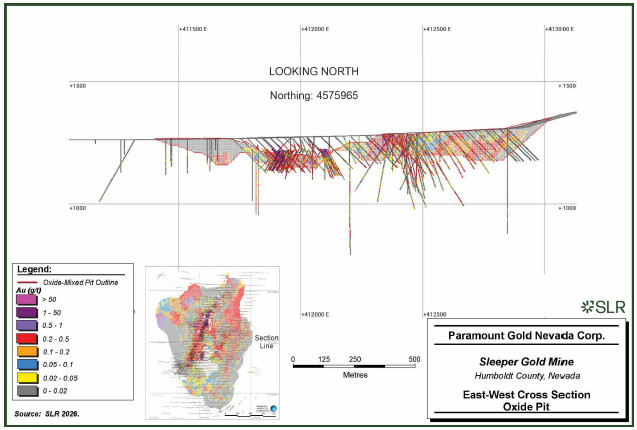
| 11-31 |
|
| Paramount Gold Nevada Corp. | Sleeper Gold Mine S-K 1300 Technical Report Summary |
June 17, 2026 SLR Project No.: 123.020721.00001 |
Figure 11-8: East-West Cross Section Sulfide Pit
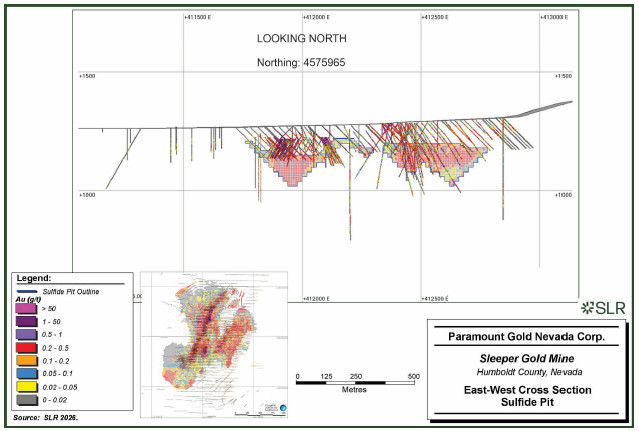
| 11-32 |
|
| Paramount Gold Nevada Corp. | Sleeper Gold Mine S-K 1300 Technical Report Summary |
June 17, 2026 SLR Project No.: 123.020721.00001 |
11.13.3 Swath Plots
Swath plots were generated to compare composite and block grades along the easting, northing, and elevation directions. These plots are used to assess local grade trends and continuity, and to verify that the block model appropriately reflects the spatial grade distribution observed in the underlying data. Representative examples for the Waste rock dumps, Heap Leach Pads, and Tailings Storage Facilities (TSF) are presented in Figure 11-9 through Figure 11-11.
The QP reviewed the swath plots and confirmed that the block models satisfactorily reproduce the grade trends observed in the composite data. No significant smoothing or anomalous behavior is evident, and there is good spatial correlation between composite grades and block model grades.
| 11-33 |
|
| Paramount Gold Nevada Corp. | Sleeper Gold Mine S-K 1300 Technical Report Summary |
June 17, 2026 SLR Project No.: 123.020721.00001 |
Figure 11-9: Swath Plots in the X, Y, and Z Directions – Waste Rock Dumps
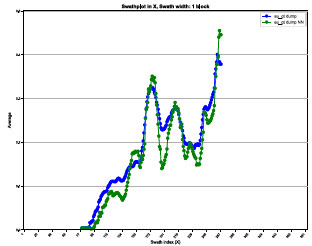
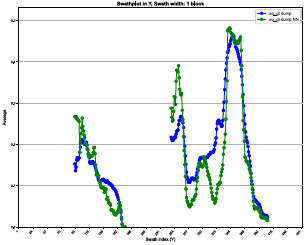
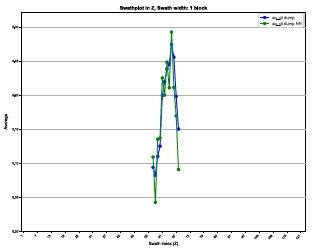
| 11-34 |
|
| Paramount Gold Nevada Corp. | Sleeper Gold Mine S-K 1300 Technical Report Summary |
June 17, 2026 SLR Project No.: 123.020721.00001 |
Figure 11-10: Swath Plots in the X, Y, and Z Directions – Heap Pads
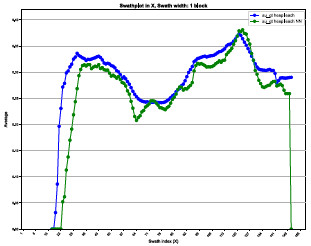
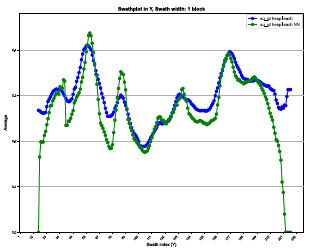
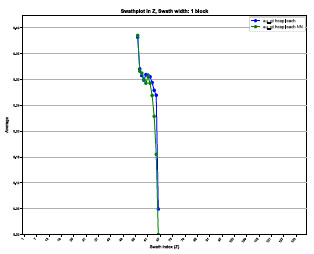
| 11-35 |
|
| Paramount Gold Nevada Corp. | Sleeper Gold Mine S-K 1300 Technical Report Summary |
June 17, 2026 SLR Project No.: 123.020721.00001 |
Figure 11-11: Swath Plots in the X, Y, and Z Directions – TSF
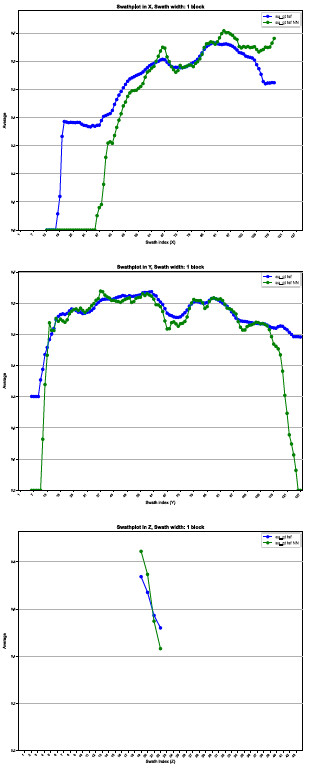
| 11-36 |
|
| Paramount Gold Nevada Corp. | Sleeper Gold Mine S-K 1300 Technical Report Summary |
June 17, 2026 SLR Project No.: 123.020721.00001 |
| 11.14 | Sensitivity to Reporting Cut-off |
The reported Mineral Resource estimates for the Project are sensitive to the metal price assumptions used to establish the reporting cut-off parameters. To evaluate this sensitivity, Mineral Resource tonnage and average grade estimates derived from the block model were assessed for oxide and mixed open pit scenarios across a range of gold price assumptions from US$1,500/oz to US$4,500/oz. The analysis applies to Measured + Indicated Mineral Resources and incorporates corresponding revenue factors, metallurgical recovery assumptions, and waste-to-ore strip ratios (Table 11-17 and Figure 11-12).
At lower gold price assumptions, reported Mineral Resource tonnage is limited to higher-grade material, resulting in lower total tonnes, higher average gold grades, and relatively low strip ratios. As the gold price assumption increases, additional lower-grade material becomes reportable, resulting in a material increase in reported Mineral Resource tonnage, a corresponding decrease in average gold grade, and progressively higher strip ratios. Metallurgical recovery assumptions remain relatively consistent across the evaluated price range.
A gold price of US$3,100/oz was selected for the cash flow estimate presented in this report. For purposes of by-product valuation, this assumption corresponds to a silver price of US$34/oz, equivalent to a silver-to-gold price ratio of approximately 0.011:1, or silver pricing representing approximately 1.1% of the assumed gold price.
This sensitivity analysis demonstrates that the reported Mineral Resource estimates are materially dependent on the selected metal price assumptions and associated reporting cut-off parameters and supports the conclusion that the reported Mineral Resources have RPEE within the range of metal price assumptions evaluated, consistent with the requirements of Regulation S-K 1300.
Table 11-17: Open Pit Grade vs Tonnage for Measured + Indicated Resources (Oxide/Mixed Pit Constrained)
| Gold Price |
RF | Total Rock (t) |
Resource M+I (t) |
Strip Rato (W:O) |
Au Grade (g/t) |
Ag Grade (g/t) |
Au Rec (%) |
Ag Rec (%) |
||||||||||||||||||||||||
| 1,694 |
0.48 | 35,732,409 | 20,468,964 | 0.75 | 0.37 | 4.49 | 74.99 | 16.72 | ||||||||||||||||||||||||
| 2,033 |
0.58 | 68,197,241 | 37,612,499 | 0.81 | 0.32 | 4.16 | 74.61 | 17.56 | ||||||||||||||||||||||||
| 2,257 |
0.65 | 81,659,853 | 45,065,866 | 0.81 | 0.31 | 4.07 | 74.55 | 17.67 | ||||||||||||||||||||||||
| 2,597 |
0.74 | 99,200,686 | 53,323,671 | 0.86 | 0.30 | 4.02 | 74.50 | 17.73 | ||||||||||||||||||||||||
| 2,936 |
0.84 | 110,812,588 | 58,689,771 | 0.89 | 0.29 | 3.93 | 74.54 | 17.62 | ||||||||||||||||||||||||
| 3,272 |
0.94 | 124,512,625 | 63,344,842 | 0.97 | 0.28 | 3.84 | 74.57 | 17.58 | ||||||||||||||||||||||||
| 3,100 |
1.00 | 132,050,829 | 66,288,945 | 0.99 | 0.27 | 3.79 | 74.56 | 17.53 | ||||||||||||||||||||||||
| 3,951 |
1.13 | 144,294,460 | 70,633,066 | 1.04 | 0.27 | 3.71 | 74.50 | 17.54 | ||||||||||||||||||||||||
| 4,291 |
1.23 | 165,570,401 | 74,237,792 | 1.23 | 0.27 | 3.63 | 74.42 | 17.43 | ||||||||||||||||||||||||
| 4,630 |
1.32 | 171,018,579 | 75,830,152 | 1.26 | 0.26 | 3.60 | 74.40 | 17.41 | ||||||||||||||||||||||||
| 5,082 |
1.45 | 177,363,755 | 77,429,268 | 1.29 | 0.26 | 3.56 | 74.38 | 17.39 | ||||||||||||||||||||||||
| Notes: RF revenue factor |
| 11-37 |
|
| Paramount Gold Nevada Corp. | Sleeper Gold Mine S-K 1300 Technical Report Summary |
June 17, 2026 SLR Project No.: 123.020721.00001 |
Figure 11-12: Open Pit Grade Tonnage Curve for Measured + Indicated Mineral Resources
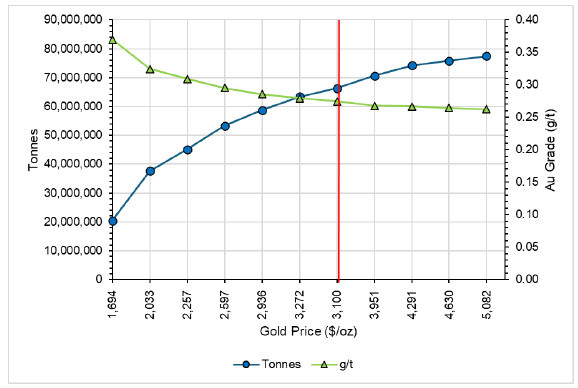
| 11.15 | Comparison with Previous Estimate |
The Mineral Resource estimate prepared by SLR (2026) was compared with the RESPEC (2023) Mineral Resource estimate to assess changes in tonnage, grade, contained metal, classification, and the assumptions supporting the determination of RPEE.
The 2026 SLR estimate reports increases in Mineral Resources across all classification categories relative to the 2023 RESPEC estimate. Measured Mineral Resources increased from 4.9 Mt at 0.537 g/t Au and 3.615 g/t Ag to 5.5 Mt at 0.492 g/t Au and 3.487 g/t Ag, representing a modest increase in tonnage with slightly lower grades. Indicated Mineral Resources increased from 158.3 Mt at 0.356 g/t Au and 4.059 g/t Ag to 179.2 Mt at 0.330 g/t Au and 3.842 g/t Ag, an increase of approximately 13% in tonnage with broadly comparable grades. Inferred Mineral Resources increased from 119.9 Mt at 0.315 g/t Au and 2.454 g/t Ag to 238.0 Mt at 0.301 g/t Au and 3.403 g/t Ag, nearly doubling the reported tonnage.
The increase in Inferred Mineral Resources is primarily attributable to the inclusion of additional surface Mineral Resources, including waste rock dumps, heap leach materials, and TSF materials totaling 89.7 Mt, together with expanded pit-constrained oxide/mixed and sulfide Mineral Resources. More broadly, the changes reflect updated geological and block models, enhanced database validation, revised estimation parameters, and updated economic assumptions, including a long-term gold price of US$3,100/oz and optimized pit shells and cut-off grades based on current mining, processing, and metallurgical recovery assumptions.
Mineral Resources are not Mineral Reserves and do not have demonstrated economic viability.
| 11-38 |
|
| Paramount Gold Nevada Corp. | Sleeper Gold Mine S-K 1300 Technical Report Summary |
June 17, 2026 SLR Project No.: 123.020721.00001 |
| 11.15.1 | In Situ Mineral Resources (Pit-Constrained) |
For in situ mineralization, excluding surface materials, the 2026 estimate reports Measured Mineral Resources of 5.5 Mt at 0.492 g/t Au, Indicated Mineral Resources of 179.2 Mt at 0.330 g/t Au, and combined Measured and Indicated Mineral Resources of 184.7 Mt at 0.335 g/t Au, compared with 163.2 Mt at 0.361 g/t Au reported by RESPEC (2023). Inferred in situ Mineral Resources total 148.4 Mt at 0.285 g/t Au, compared with 119.9 Mt at 0.315 g/t Au in the previous estimate.
These results represent a moderate increase in tonnage of approximately 13% for Measured and Indicated Mineral Resources and approximately 24% for Inferred Mineral Resources, with a corresponding decrease in average gold grade. The changes are attributable to updated geological interpretations, revised domain wireframes, incorporation of additional drilling and improved database validation, and expansion of optimized pit shells under higher metal price assumptions, which support the inclusion of additional marginal material. Contained gold remains broadly consistent with the previous estimate, indicating no evidence of material global estimation bias
| 11.15.2 | Surface Materials (Dumps, Heap Leach, TSF) |
A significant difference between the estimates is the treatment of surface materials, which are reported entirely as Inferred Mineral Resources in the 2026 estimate. SLR (2026) reports 89.7 Mt at 0.327 g/t Au and 4.738 g/t Ag, containing approximately 942 koz Au and 13.7 Moz Ag, comprising waste rock dumps, heap leach pads, and TSF materials.
In contrast, in 2023 15.8 Mt of Inferred dump material was reported and heap leach pad and TSF inventories were not separately estimated. The expanded surface Mineral Resource inventory in the 2026 estimate reflects the incorporation of additional datasets and operational inventories, improved delineation and classification of anthropogenic deposits, and the separation of material types to support appropriate processing and metallurgical recovery assumptions. The higher long-term gold price assumption of US$3,100/oz also supports lower cut-off grades and demonstrates reasonable prospects for eventual economic extraction for additional lower-grade material.
11.15.3 Metallurgical Recovery Assumptions
Metallurgical recovery assumptions differ materially:
| • | RESPEC (2023): Generalized recoveries by material type, including high silver recoveries for sulfide material (up to 70%) |
| • | SLR (2026): Process- and material-specific recoveries applied at a detailed domain level, including: |
| • | Variable gold recoveries (generally approximately 63.7% to 85.0% basis for pit optimization inputs) |
| • | Zero silver recovery assigned to sulfide material |
| • | Distinct recovery assumptions for dumps, heap leach, and TSF materials reflecting leachable characteristics |
These revisions represent a more conservative and operationally realistic basis for RPEE. While recovery assumptions do not affect reported grades or contained metal, they materially influence the derivation of the cut-off grade and the economic evaluation.
| 11-39 |
|
| Paramount Gold Nevada Corp. | Sleeper Gold Mine S-K 1300 Technical Report Summary |
June 17, 2026 SLR Project No.: 123.020721.00001 |
| 11.15.4 | Classification |
The distribution of Mineral Resources by classification remains broadly consistent. The 2026 estimate reports modest increases in Measured and Indicated tonnage, reflecting:
| • | Improved database validation and reconciliation; |
| • | Refinement of geological domains and estimation controls; and |
| • | Incorporation of additional drilling and updated interpretations. |
No material changes to classification methodology or confidence criteria are identified.
| 11.15.5 | Cut-off Grades |
Cut-off grades in the 2026 estimate range from 0.074 g/t to 0.217 g/t Au, depending on material type and location, and are constrained by optimized pit shells developed using updated economic assumptions.
The primary differentiator relative to the 2023 estimate is the increase in assumed gold price of US$1,800/oz to US$3,100/oz, which has the following impacts:
| • | Lowers economic cut-off grades |
| • | Expands pit limits |
| • | Increases total tonnage reported |
| • | Incorporates additional lower-grade material |
The overall reporting framework remains consistent, but the economic basis for RPEE is materially more favorable in the 2026 estimate.
11.15.6 QP Opinion
In the opinion of the QP, the 2026 Mineral Resource estimate represents a reasonable, transparent, and defensible update to the 2023 estimate. The increase in tonnage and contained metal is primarily attributable to the following:
| • | Inclusion and improved delineation of surface materials |
| • | Expansion of in situ mineralization under revised economic assumptions |
| • | Higher gold price assumptions supporting lower cut-off grades and expanded pit shells |
The reduction in average grade is consistent with the inclusion of marginal material and does not indicate estimation bias. Metallurgical recovery assumptions have been revised to a more conservative and operationally supportable basis consistent with S-K 1300 requirements.
| 11.16 | Mineral Resource Reporting |
Table 11-18 presents a detailed breakdown of the Mineral Resource estimate by classification category and area, in accordance with the reporting requirements of S-K 1300. The QP has reviewed and accepted the application of relevant modifying factors, including the results of open pit optimization, as described in Section 11.11. These constraints define the spatial volumes within which the Mineral Resources are considered to have RPEE and may therefore be reported in accordance with S-K 1300.
| 11-40 |
|
| Paramount Gold Nevada Corp. | Sleeper Gold Mine S-K 1300 Technical Report Summary |
June 17, 2026 SLR Project No.: 123.020721.00001 |
Table 11-18: Detailed Summary of Mineral Resources by Area – April 29, 2026
| Category |
Area |
Tonnage (000 t) |
Grade (g/t Au) |
Grade (g/t Ag) |
Contained Metal (000 oz Au) |
Contained Metal (000 oz Ag) |
Metallurgical Au Recovery (%) |
Metallurgical Ag Recovery (%) |
||||||||||||||||||||||
| Measured |
||||||||||||||||||||||||||||||
| Oxide/Mixed Pit |
Facilities/Office Mixed | 1,148 | 0.327 | 3.194 | 12.1 | 117.9 | 71.3% | 22.3% | ||||||||||||||||||||||
| Facilities/Office Oxide | 560 | 0.264 | 2.543 | 4.8 | 45.8 | 83.9% | 8.1% | |||||||||||||||||||||||
| Sleeper Mixed | 220 | 0.234 | 4.031 | 1.7 | 28.5 | 70.0% | 15.0% | |||||||||||||||||||||||
| Sleeper Oxide | 76 | 0.177 | 0.957 | 0.4 | 2.3 | 84.5% | 9.9% | |||||||||||||||||||||||
| West Wood Mixed | 65.0% | 10.0% | ||||||||||||||||||||||||||||
| West Wood Oxide | 76.5% | 9.0% | ||||||||||||||||||||||||||||
| Oxide/Mixed Pit (non-sulfides) | 2,004 | 0.293 | 3.019 | 18.9 | 194.5 | 75.2% | 17.1% | |||||||||||||||||||||||
| Sulfide | 24 | 0.261 | 3.843 | 0.2 | 2.9 | 66.5% | 0.0% | |||||||||||||||||||||||
| Facilities/Office Sulfide | 154 | 0.325 | 4.378 | 1.6 | 21.7 | 71.2% | 0.0% | |||||||||||||||||||||||
| Oxide/Mixed Pit (sulfides) | 178 | 0.316 | 4.307 | 1.8 | 24.6 | 70.6% | 0.0% | |||||||||||||||||||||||
| Subtotal Measured Oxide/Mixed Pit | 2,182 | 0.295 | 3.124 | 20.7 | 219.2 | 74.8% | 15.7% | |||||||||||||||||||||||
| Sulfide Pit |
Sulfide | 340 | 0.409 | 2.405 | 4.5 | 26.3 | 66.5% | 0.0% | ||||||||||||||||||||||
| West Wood Sulfide | 928 | 1.206 | 4.826 | 36.0 | 144.0 | 64.2% | 0.0% | |||||||||||||||||||||||
| Facilities/Office Sulfide | 1,899 | 0.372 | 3.291 | 22.7 | 201.0 | 71.2% | 0.0% | |||||||||||||||||||||||
| Facilities/Office Mixed | 21 | 0.354 | 2.500 | 0.2 | 1.7 | 71.3% | 22.3% | |||||||||||||||||||||||
| Facilities/Office Oxide | 83.9% | 8.1% | ||||||||||||||||||||||||||||
| Sleeper Mixed | 7 | 0.285 | 0.870 | 0.1 | 0.2 | 70.0% | 15.0% | |||||||||||||||||||||||
| Sleeper Oxide | 22.0 | 84.5% | 9.9% | |||||||||||||||||||||||||||
| West Wood Mixed | 77 | 0.764 | 8.881 | 1.9 | 5.5 | 65.0% | 10.0% | |||||||||||||||||||||||
| West Wood Oxide | 74 | 0.612 | 2.325 | 1.5 | 76.5% | 9.0% | ||||||||||||||||||||||||
| Subtotal Measured Sulfide Pit | 3,347 | 0.621 | 3.724 | 66.8 | 400.7 | 68.8% | 0.6% | |||||||||||||||||||||||
| Total Measured |
5,528 | 0.492 | 3.487 | 87.5 | 619.9 | 71.2% | 6.5% | |||||||||||||||||||||||
|
|
|
|
|
|
|
|
|
|
|
|
|
|
|
|||||||||||||||||
| 11-41 |
|
| Paramount Gold Nevada Corp. | Sleeper Gold Mine S-K 1300 Technical Report Summary |
June 17, 2026 SLR Project No.: 123.020721.00001 |
| Category |
Area |
Tonnage (000 t) |
Grade (g/t Au) |
Grade (g/t Ag) |
Contained Metal (000 oz Au) |
Contained Metal (000 oz Ag) |
Metallurgical Au Recovery (%) |
Metallurgical Ag Recovery (%) |
||||||||||||||||||||||
| Indicated |
||||||||||||||||||||||||||||||
| Oxide/Mixed Pit |
Facilities/Office Mixed | 41,658 | 0.275 | 4.373 | 368.5 | 5,856.6 | 71.3% | 22.3% | ||||||||||||||||||||||
| Facilities/Office Oxide | 15,030 | 0.226 | 2.644 | 109.3 | 1,277.7 | 83.9% | 8.1% | |||||||||||||||||||||||
| Sleeper Mixed | 16,910 | 0.260 | 2.981 | 141.5 | 1,620.7 | 70.0% | 15.0% | |||||||||||||||||||||||
| Sleeper Oxide | 4,300 | 0.245 | 2.123 | 33.9 | 293.5 | 84.5% | 9.9% | |||||||||||||||||||||||
| West Wood Mixed | 65.0% | 10.0% | ||||||||||||||||||||||||||||
| West Wood Oxide | 76.5% | 9.0% | ||||||||||||||||||||||||||||
| Oxide/Mixed Pit (non-sulfides) | 77,899 | 0.261 | 3.613 | 653 | 9,049 | 74.2% | 17.3% | |||||||||||||||||||||||
| Sulfide | 8,618 | 0.360 | 4.996 | 99.8 | 1,384.2 | 66.5% | 0.0% | |||||||||||||||||||||||
| Facilities/Office Sulfide | 7,323 | 0.290 | 4.861 | 68.2 | 1,144.5 | 71.2% | 0.0% | |||||||||||||||||||||||
| Oxide/Mixed Pit (sulfides) | 15,941 | 0.328 | 4.934 | 168.0 | 2,528.7 | 68.7% | 0.0% | |||||||||||||||||||||||
| Subtotal Indicated Oxide/Mixed Pit | 93,840 | 0.272 | 3.837 | 821.2 | 11,577.3 | 73.2% | 14.4% | |||||||||||||||||||||||
| Sulfide Pit |
Sulfide | 56,544 | 0.382 | 4.245 | 694.2 | 7,717.5 | 66.5% | 0.0% | ||||||||||||||||||||||
| West Wood Sulfide | 8,286 | 0.709 | 2.342 | 188.9 | 624.0 | 64.2% | 0.0% | |||||||||||||||||||||||
| Facilities/Office Sulfide | 16,184 | 0.302 | 3.691 | 157.0 | 1,920.5 | 71.2% | 0.0% | |||||||||||||||||||||||
| Facilities/Office Mixed | 1,556 | 0.218 | 2.669 | 10.9 | 133.5 | 71.3% | 22.3% | |||||||||||||||||||||||
| Facilities/Office Oxide | 83 | 0.186 | 2.224 | 0.5 | 6.0 | 83.9% | 8.1% | |||||||||||||||||||||||
| Sleeper Mixed | 1,344 | 0.248 | 1.948 | 10.7 | 84.1 | 70.0% | 15.0% | |||||||||||||||||||||||
| Sleeper Oxide | 83 | 0.187 | 0.500 | 0.5 | 1.3 | 84.5% | 9.9% | |||||||||||||||||||||||
| West Wood Mixed | 757 | 0.374 | 2.108 | 9.1 | 51.3 | 65.0% | 10.0% | |||||||||||||||||||||||
| West Wood Oxide | 499 | 0.413 | 1.219 | 6.6 | 19.6 | 76.5% | 9.0% | |||||||||||||||||||||||
| Subtotal Indicated Sulfide Pit | 85,336 | 0.393 | 3.848 | 1,078.5 | 10,557.9 | 67.4% | 0.8% | |||||||||||||||||||||||
|
|
|
|
|
|
|
|
|
|
|
|
|
|
|
|
||||||||||||||||
| Total Indicated |
179,176 | 0.330 | 3.842 | 1,899.7 | 22,135.2 | 70.5% | 7.9% | |||||||||||||||||||||||
|
|
|
|
|
|
|
|
|
|
|
|
|
|
|
|||||||||||||||||
| 11-42 |
|
| Paramount Gold Nevada Corp. | Sleeper Gold Mine S-K 1300 Technical Report Summary |
June 17, 2026 SLR Project No.: 123.020721.00001 |
| Category |
Area |
Tonnage (000 t) |
Grade (g/t Au) |
Grade (g/t Ag) |
Contained Metal (000 oz Au) |
Contained Metal (000 oz Ag) |
Metallurgical Au Recovery (%) |
Metallurgical Ag Recovery (%) |
||||||||||||||||||||||
| Measured + Indicated |
||||||||||||||||||||||||||||||
| Oxide/Mixed Pit |
Facilities/Office Mixed | 42,806 | 0.277 | 4.341 | 380.5 | 5,974.5 | 71.3 | % | 22.3 | % | ||||||||||||||||||||
| Facilities/Office Oxide | 15,590 | 0.228 | 2.640 | 114.1 | 1,323.5 | 83.9 | % | 8.1 | % | |||||||||||||||||||||
| Sleeper Mixed | 17,130 | 0.260 | 2.995 | 143.2 | 1,649.3 | 70.0 | % | 15.0 | % | |||||||||||||||||||||
| Sleeper Oxide | 4,376 | 0.244 | 2.103 | 34.4 | 295.9 | 84.5 | % | 9.9 | % | |||||||||||||||||||||
| West Wood Mixed | 0 | 0.000 | 0.000 | 0.0 | 0.0 | 65.0 | % | 10.0 | % | |||||||||||||||||||||
| West Wood Oxide | 0 | 0.000 | 0.000 | 0.0 | 0.0 | 76.5 | % | 9.0 | % | |||||||||||||||||||||
| Oxide/Mixed Pit (non-sulfides) | 79,903 | 0.262 | 3.598 | 672 | 9,243 | 74.2 | % | 17.3 | % | |||||||||||||||||||||
| Sulfide |
8,642 | 0.360 | 4.993 | 100.0 | 1,387.2 | 66.5 | % | 0.0 | % | |||||||||||||||||||||
| Facilities/Office Sulfide |
7,477 | 0.290 | 4.851 | 69.8 | 1,166.2 | 71.2 | % | 0.0 | % | |||||||||||||||||||||
| Oxide/Mixed Pit (sulfides) | 16,119 | 0.328 | 4.927 | 169.8 | 2,553.4 | 68.7 | % | 0.0 | % | |||||||||||||||||||||
| Subtotal Measured + Indicated Oxide/Mixed Pit | 96,022 | 0.273 | 3.821 | 841.9 | 11,796.5 | 73.3 | % | 14.4 | % | |||||||||||||||||||||
| Sulfide Pit |
Sulfide |
56,884 | 0.382 | 4.234 | 698.7 | 7,743.8 | 66.5 | % | 0.0 | % | ||||||||||||||||||||
| West Wood Sulfide |
9,214 | 0.759 | 2.592 | 224.9 | 768.0 | 64.20 | % | 0.00 | % | |||||||||||||||||||||
| Facilities/Office Sulfide |
18,084 | 0.309 | 3.649 | 179.8 | 2,121.5 | 71.2 | % | 0.0 | % | |||||||||||||||||||||
| Facilities/Office Mixed |
1,577 | 0.220 | 2.667 | 11.2 | 135.2 | 71.3 | % | 22.3 | % | |||||||||||||||||||||
| Facilities/Office Oxide |
83 | 0.186 | 2.224 | 0.5 | 6.0 | 83.9 | % | 8.1 | % | |||||||||||||||||||||
| Sleeper Mixed |
1,350 | 0.248 | 1.942 | 10.8 | 84.3 | 70.0 | % | 15.0 | % | |||||||||||||||||||||
| Sleeper Oxide |
83 | 0.187 | 8.727 | 0.5 | 23.4 | 84.5 | % | 9.9 | % | |||||||||||||||||||||
| West Wood Mixed |
834 | 0.410 | 2.119 | 11.0 | 56.8 | 65.0 | % | 10.0 | % | |||||||||||||||||||||
| West Wood Oxide |
573 | 0.439 | 1.062 | 8.1 | 19.6 | 76.5 | % | 9.0 | % | |||||||||||||||||||||
| Subtotal Measured + Indicated Sulfide Pit | 88,683 | 0.402 | 3.843 | 1,145.3 | 10,958.6 | 67.5 | % | 0.8 | % | |||||||||||||||||||||
|
|
|
|
|
|
|
|
|
|
|
|
|
|
|
|
||||||||||||||||
| Total Measured + Indicated |
184,704 | 0.335 | 3.832 | 1,987.2 | 22,755.0 | 70.5 | % | 7.9 | % | |||||||||||||||||||||
|
|
|
|
|
|
|
|
|
|
|
|
|
|
|
|||||||||||||||||
| 11-43 |
|
| Paramount Gold Nevada Corp. | Sleeper Gold Mine S-K 1300 Technical Report Summary |
June 17, 2026 SLR Project No.: 123.020721.00001 |
| Category |
Area |
Tonnage (000 t) |
Grade (g/t Au) |
Grade (g/t Ag) |
Contained Metal (000 oz Au) |
Contained Metal (000 oz Ag) |
Metallurgical Au Recovery (%) |
Metallurgical Ag Recovery (%) |
||||||||||||||||||||||
| Inferred |
||||||||||||||||||||||||||||||
| Surface |
North Dump | 23,747 | 0.364 | 2.584 | 277.7 | 1,972.8 | 79.0 | % | 40.5 | % | ||||||||||||||||||||
| South Dump | 12,667 | 0.182 | 1.612 | 74.2 | 656.7 | 69.8 | % | 43.9 | % | |||||||||||||||||||||
| West Dump | 10,478 | 0.203 | 0.883 | 68.5 | 297.4 | 81.4 | % | 54.6 | % | |||||||||||||||||||||
| Subtotal Inferred Dumps | 46,893 | 0.279 | 1.941 | 420.3 | 2,926.9 | 77.1 | % | 44.6 | % | |||||||||||||||||||||
| Heap Leach Pads | 31,600 | 0.301 | 8.363 | 306.3 | 8,496.9 | 40.0 | % | 0.0 | % | |||||||||||||||||||||
| TSF | 11,165 | 0.599 | 6.221 | 215.2 | 2,233.2 | 50.1 | % | 0.0 | % | |||||||||||||||||||||
| Subtotal Inferred Surface | 89,658 | 0.327 | 4.738 | 941.8 | 13,656.9 | 60.6 | % | 23.3 | % | |||||||||||||||||||||
| Oxide/Mixed Pit |
Facilities/Office Mixed | 12,668 | 0.251 | 3.233 | 102.1 | 1,316.9 | 71.3 | % | 22.3 | % | ||||||||||||||||||||
| Facilities/Office Oxide | 6,461 | 0.198 | 1.800 | 41.1 | 373.9 | 83.9 | % | 8.1 | % | |||||||||||||||||||||
| Sleeper Mixed | 14,851 | 0.232 | 2.884 | 110.6 | 1,377.2 | 70.0 | % | 15.0 | % | |||||||||||||||||||||
| Sleeper Oxide | 14,661 | 0.240 | 1.403 | 113.0 | 661.2 | 84.5 | % | 9.9 | % | |||||||||||||||||||||
| West Wood Mixed | 65.0 | % | 10.0 | % | ||||||||||||||||||||||||||
| West Wood Oxide | 15 | 0.136 | 0.272 | 0.1 | 0.1 | 76.5 | % | 9.0 | % | |||||||||||||||||||||
| Oxide/Mixed Pit (non-sulfides) | 48,656 | 0.235 | 2.384 | 367 | 3,729 | 76.6 | % | 14.4 | % | |||||||||||||||||||||
| Sulfide | 2,485 | 0.302 | 3.288 | 24.1 | 262.6 | 66.5 | % | 0.0 | % | |||||||||||||||||||||
| Facilities/Office Sulfide | 2,475 | 0.271 | 3.800 | 21.6 | 302.4 | 71.2 | % | 0.0 | % | |||||||||||||||||||||
| Oxide/Mixed Pit (sulfides) | 4,960 | 0.286 | 3.543 | 45.7 | 565.0 | 68.9 | % | 0.0 | % | |||||||||||||||||||||
| Subtotal Inferred Oxide/Mix Pit | 53,616 | 0.239 | 2.491 | 412.6 | 4,294.4 | 75.8 | % | 13.1 | % | |||||||||||||||||||||
| Sulfide Pit |
Sulfide | 69,108 | 0.324 | 2.661 | 718.8 | 5,913.4 | 66.5 | % | 0.0 | % | ||||||||||||||||||||
| West Wood Sulfide |
1,242 | 0.369 | 0.987 | 14.7 | 39.4 | 64.2 | % | 0.0 | % | |||||||||||||||||||||
| Facilities/Office Sulfide | 14,602 | 0.316 | 3.848 | 148.3 | 1,806.5 | 71.2 | % | 0.0 | % | |||||||||||||||||||||
| Facilities/Office Mixed | 1,728 | 0.217 | 2.208 | 12.1 | 122.7 | 71.3 | % | 22.3 | % | |||||||||||||||||||||
| Facilities/Office Oxide | 225 | 0.190 | 1.443 | 1.4 | 10.5 | 83.9 | % | 8.1 | % | |||||||||||||||||||||
| 11-44 |
|
| Paramount Gold Nevada Corp. | Sleeper Gold Mine S-K 1300 Technical Report Summary |
June 17, 2026 SLR Project No.: 123.020721.00001 |
| Category |
Area |
Tonnage (000 t) |
Grade (g/t Au) |
Grade (g/t Ag) |
Contained Metal (000 oz Au) |
Contained Metal (000 oz Ag) |
Metallurgical Au Recovery (%) |
Metallurgical Ag Recovery (%) |
||||||||||||||||||||||
| Sleeper Mixed |
3,348 | 0.237 | 1.036 | 25.5 | 111.5 | 70.0 | % | 15.0 | % | |||||||||||||||||||||
| Sleeper Oxide |
2,152 | 0.183 | 0.700 | 12.6 | 48.4 | 84.5 | % | 9.9 | % | |||||||||||||||||||||
| West Wood Mixed |
932 | 0.204 | 0.616 | 6.1 | 18.4 | 65.0 | % | 10.0 | % | |||||||||||||||||||||
| West Wood Oxide | 1,424 | 0.193 | 0.534 | 8.8 | 24.4 | 76.5 | % | 9.0 | % | |||||||||||||||||||||
| Subtotal Inferred Sulfide Pit | 94,761 | 0.311 | 2.657 | 948.3 | 8,095.3 | 68.0 | % | 1.4 | % | |||||||||||||||||||||
| Total Inferred |
238,035 | 0.301 | 3.403 | 2,302.7 | 26,046.7 | 67.0 | % | 12.3 | % | |||||||||||||||||||||
|
|
|
|
|
|
|
|
|
|
|
|
|
|
|
|||||||||||||||||
Notes:
| 1. | The definitions for Mineral Resources in S-K 1300 were followed for Mineral Resources |
| 2. | The Mineral Resource estimate is reported on a 100% ownership basis. |
| 3. | The point of reference for the Mineral Resource is before the crusher (in situ). |
| 4. | Open Pit Mineral Resources are reported at a cut-off grade ranging from 0.074 g/t to 0.217 g/t Au, depending on area and constrained by a preliminary optimized pit shell with a pit slope angle of 45° for rock and 22° for alluvium and a bench height of 10 m. |
| 5. | The optimized pit shell and cut-off grades were generated by assuming metallurgical gold recovery ranging from 63.7% to 85.0% and silver recoveries ranging from 0.0% to 54.6%, standard treatment and refining charges, mining costs of US$2.40/t moved for open pit, processing costs of $5.51/t oxide/mixed and $10.44 sulfide processed, and general and administrative costs of $0.46/t processed |
| 6. | Minimal mining width was 60 m for oxide/mixed material and 20 m for sulfide material |
| 7. | Mineral Resources are estimated using a long-term gold price of US$3,100 per ounce |
| 8. | Bulk density ranges from 1.5 t/m3 in the tailings storage area to 2.7 t/m3 for in situ material |
| 9. | Mineral Resources that are not Mineral Reserves do not have demonstrated economic viability. |
| 10. | Numbers may not add due to rounding. |
| 11-45 |
|
| Paramount Gold Nevada Corp. | Sleeper Gold Mine S-K 1300 Technical Report Summary |
June 17, 2026 SLR Project No.: 123.020721.00001 |
12.0 Mineral Reserve Estimates
There are no Mineral Reserves defined at the Sleeper Gold Mine at this time.
| 12-1 |
|
| Paramount Gold Nevada Corp. | Sleeper Gold Mine S-K 1300 Technical Report Summary |
June 17, 2026 SLR Project No.: 123.020721.00001 |
13.0 Mining Methods
The proposed Base Case mining operations include a conventional open pit truck-shovel operation and rehandling of mineralized material from three existing waste rock dumps. The in situ mining inventory is approximately 128.5 Mt and the rehandled existing waste dump rock material totals approximately 46.9 Mt. The operation is designed to deliver approximately 30,000 tpd of mineralized material to the processing facilities, with a LOM open pit average strip ratio of 1.9:1 (waste tonne: process feed tonne).
In the Alternative Case, only in situ material is mined and processed; no material from the existing waste rock dumps is reclaimed for processing.
13.1 Geotechnical Studies
The current pit slope design is based on preliminary geotechnical assumptions appropriate for an Initial Assessment level of study. In competent bedrock, an overall slope angle of approximately 45° has been applied, as observed in the existing pit walls, reflecting assumed favorable rock mass conditions and stable bench-scale performance. In contrast, alluvial materials are assigned a significantly flatter overall slope angle of approximately 22°, which is also observed in the current pit slopes and is consistent with reduced material strength, potential for raveling, and sensitivity to groundwater and weathering.
Bench-scale geometry is based on 10 m bench heights, which are compatible with production drilling, loading equipment reach, and operational efficiency. In competent rock, bench face angles of 80° and berm widths of approximately 8.24 m have been assumed, while alluvial zones utilize flatter bench face angles of approximately 34° with wider berms of approximately 9.93 m, as shown in Figure 13-3. These parameters are considered reasonable for conceptual planning but will require confirmation through detailed geotechnical investigation, including drilling, laboratory testing, structural analysis, and slope stability modeling in future study phases.
Groundwater conditions have not been explicitly incorporated into slope design at this stage; however, given the pit’s depth (approximately 230 m), dewatering and depressurization will be required and will influence the final slope configurations. The current design criteria are considered appropriate for the Initial Assessment but are subject to refinement.
Table 13-1: Geotechnical Design Criteria
| Parameter |
Competent Rock | Alluvium | ||
| Bench height (m) |
10 | 10 | ||
| Bench face angle (degrees) |
80 | 34 | ||
| Overall slope angle (degrees) |
45 | 22 | ||
| Bench berm width (m) |
8.24 | 9.93 |
| 13-1 |
|
| Paramount Gold Nevada Corp. | Sleeper Gold Mine S-K 1300 Technical Report Summary |
June 17, 2026 SLR Project No.: 123.020721.00001 |
13.2 Mine Design
The current pit lake water elevation is 1,255 masl as presented in Figure 13-1. The conceptual open pit design has approximate plan dimensions of 2,650 m (north-south) by 1,860 m (east-west) and a maximum depth of approximately 230 m, with a pit bottom elevation of approximately 1,080 masl, as shown in Figure 13-2. Primary pit access is provided via a south-side waste haul exit at approximately 1,270 masl and a west-side crusher exit at approximately 1,265 masl, allowing for separation of mineralized material and waste haulage where practical.
The pit design was developed based on pit optimization results at a revenue factor of 1.0 derived using 20 m × 20 m × 20 m blocks. Slope assumptions applied during the optimization were assumed at an overall slope angle of 45° for fresh rock and 22° for alluvial material. Pit Optimization economic parameters and recoveries are provided in Table 11-11, and the mining cost of $2.40 per tonne mined.
| 13-2 |
|
| Paramount Gold Nevada Corp. | Sleeper Gold Mine S-K 1300 Technical Report Summary |
June 17, 2026 SLR Project No.: 123.020721.00001 |
Figure 13-1: Initial Mine Topography
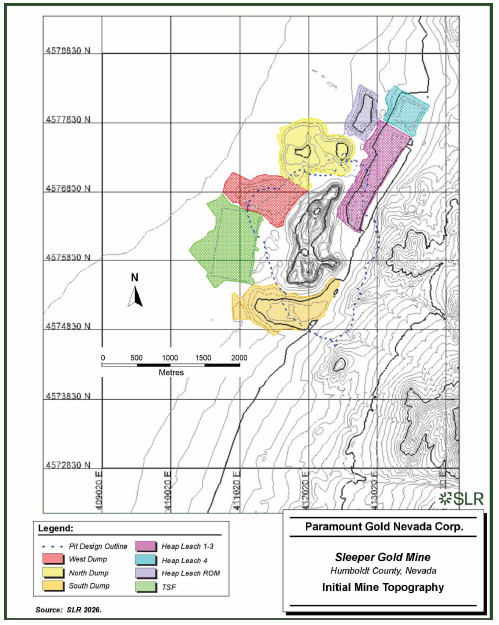
| 13-3 |
|
| Paramount Gold Nevada Corp. | Sleeper Gold Mine S-K 1300 Technical Report Summary |
June 17, 2026 SLR Project No.: 123.020721.00001 |
Figure 13-2: Oxide Pit Cross Section 4,576,271 N
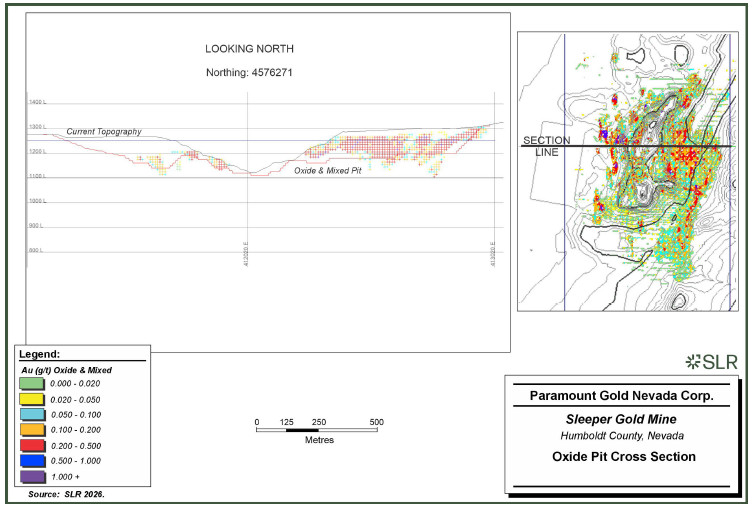
| 13-4 |
|
| Paramount Gold Nevada Corp. | Sleeper Gold Mine S-K 1300 Technical Report Summary |
June 17, 2026 SLR Project No.: 123.020721.00001 |
Mining will be conducted on 10 m benches with a minimum mining width of 60 m, providing adequate working space for drilling, loading, haulage, and safe operation of large production equipment. Haul road design is based on 150 t class haul trucks, with main ramps constructed at approximately 35 m width and 10% gradient. In the bottom two benches of the pit, where space is constrained, single-lane haulage (supported by traffic management controls and localized passing areas) is proposed.
Ex-pit haul distances to the crusher and waste rock storage facilities are estimated to range from approximately 0.8 km to 2.4 km (0.5 miles to 1.5 miles). Haul cycle times are based on typical industry operating speeds for 150 t haul trucks, accounting for loaded and unloaded travel, ramp grades, and road conditions consistent with a well-maintained Nevada open pit operation.
Material movement assumptions include a swell factor of 35% and a loose density of 1.7 t/m3, resulting in an approximate loose volume of 88 m3 per truck load, equivalent to approximately 65 bank cubic meters (bcm) per load. The SLR QP considers these values to be appropriate for preliminary equipment productivity and haulage calculations.
Operational assumptions include 24-hour continuous operation, utilizing two 12-hour shifts per day across four rotating crews. Effective operating time is assumed to be 53 minutes per hour, reflecting delays for operational inefficiencies, shift changes, and minor interruptions. Equipment performance is further adjusted to 90% mechanical availability utilization, consistent with contractor-operated mining fleets.
Table 13-2: Mine Design Parameters
| Parameter |
Value | |
| Pit dimensions (N-S) |
2,650 m | |
| Pit dimensions (E-W) |
1,860 m | |
| Pit depth |
230 m | |
| Pit bottom elevation |
1,080 masl | |
| Waste exit elevation (south) |
1,270 masl | |
| Crusher exit elevation (west) |
1,265 masl | |
| Bench height |
10 m | |
| Minimum mining width |
60 m | |
| Ramp width |
35 m | |
| Ramp grade |
10% | |
| Bottom benches |
Single-lane haulage | |
| Ex-pit haul distance |
0.8 km to 2.4 km (0.5–1.5 miles) | |
| Swell Percent |
35% | |
| Swell Factor |
0.7407 | |
| Loose density |
1.7 t/m3 |
| 13-5 |
|
| Paramount Gold Nevada Corp. | Sleeper Gold Mine S-K 1300 Technical Report Summary |
June 17, 2026 SLR Project No.: 123.020721.00001 |
| Parameter |
Value | |
| Operating schedule |
24 hr/day, 2 shifts, 4 crews | |
| Effective time |
53 min/hr | |
| Utilization |
90% of availability |
| 13.3 | Waste Rock Storage Facilities Design |
Waste rock generated from open pit mining is planned to be placed in conventional end-dumped waste rock storage facilities (WRSF) located adjacent to the pit. The WRSFs are conceptualized to a maximum height of approximately 150 m and developed in 30 m lifts, consistent with typical large-scale open pit operations in Nevada. Waste material is assumed to have an in situ density of approximately 2.3 t/m3, a swell factor of 35%, and a corresponding loose density of approximately 1.70 t/m3, which forms the basis for volumetric and capacity estimates.
During active operations, waste will be placed by end-dumping over the advancing dump crest in 30 m lift, with the working face developing at an approximate angle of repose of 35°, equivalent to about 1.5H:1V. This geometry reflects the typical behavior of coarse, fragmented rock under gravity placement conditions. For long-term stability and closure, the external slopes of the waste rock dumps are assumed to be regraded to a final 3H:1V slope.
The assumed geometry is appropriate for an IA; however, detailed WRSF design, including slope stability, drainage control, compaction behavior, and closure landform development, will require further geotechnical and hydrological evaluation in future study phases.
Table 13-3 summarizes the WRSF design parameters. Figure 13-3 presents the Final Pit Design and Waste Rock Storage Facility Design based on the parameters summarized in this section.
Table 13-3: WRSF Design Parameters
| Parameter |
Value | |
| Maximum dump height |
104 m | |
| Lift height |
30 m | |
| Number of lifts |
3.5 | |
| In situ density |
2.3 t/m3 | |
| Swell Percent |
35% | |
| Loose density |
1.70 t/m3 | |
| Active dump slope |
35° (~1.5H:1V) | |
| Final reclaimed slope |
3H:1V |
| 13-6 |
|
| Paramount Gold Nevada Corp. | Sleeper Gold Mine S-K 1300 Technical Report Summary |
June 17, 2026 SLR Project No.: 123.020721.00001 |
Figure 13-3: Final Pit Design and Waste Storage Facility Design
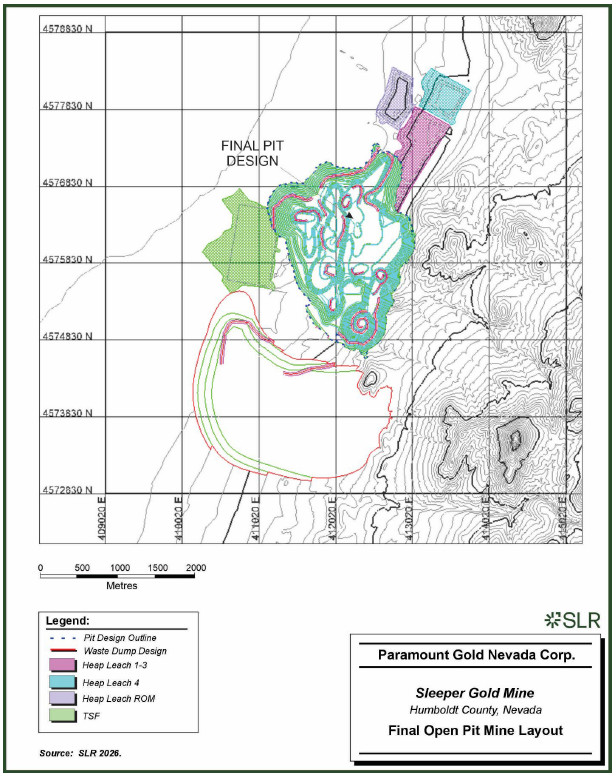
| 13-7 |
|
| Paramount Gold Nevada Corp. | Sleeper Gold Mine S-K 1300 Technical Report Summary |
June 17, 2026 SLR Project No.: 123.020721.00001 |
| 13.4 | Mining Method |
At the stated production rate, the operation will mine approximately 66,300 tpd of waste, resulting in a total material movement of approximately 95,890 tpd. This equates to approximately 10.8 Mtpa of mineralized material, 24.2 Mtpa of waste, and 35.0 Mtpa of total pit movement, assuming continuous operations.
Primary loading is performed using CAT 6060-class hydraulic shovels equipped with 18 m3 to 22 m3 buckets, supplemented by large wheel loaders for operational flexibility, rehandle, and backup loading. The loading configuration is designed around a 4-pass match with 150 t haul trucks, which provides an efficient balance between productivity and truck utilization.
Production drilling is carried out using single-pass diesel rotary drills, such as Pit Viper-class drills, capable of drilling the full 10 m bench height in a single pass. This approach improves drilling efficiency, reduces hole deviation, and supports consistent blast performance. Drill and blast parameters will be refined in future phases based on rock mass characteristics and fragmentation requirements.
Production blasting is assumed to be conducted using conventional rotary blasthole drilling on 10 m bench heights. Blastholes are designed at a nominal diameter of 229 mm and drilled on a 6.5 m burden by 7.5 m spacing pattern, which is considered appropriate for the volcanic and locally silicified rock units present at the Sleeper deposit.
Each blasthole is drilled to include approximately 1.0 m of subdrill to ensure full breakage at the bench floor. Stemming length is assumed to be 4.0 m, resulting in an effective charged length of approximately 7.0 m per hole.
The average in situ rock density is assumed to be 2.3 t/m³, yielding approximately 1,120 t of rock broken per blasthole under the selected pattern geometry.
Given the anticipated groundwater conditions and the requirement for ongoing pit dewatering, wet blasthole conditions are expected to be common. Accordingly, blasting is assumed to utilize bulk emulsion or heavy ANFO–emulsion blends rather than dry ANFO. An average explosive density of approximately 1.15 t/m³ is assumed, resulting in a charge concentration of approximately 47 kg of explosive per metre of loaded hole. This corresponds to approximately 330 kg of explosive per blasthole. Blasting practices are expected to be optimized during operations through field trials to achieve the desired fragmentation for efficient loading, hauling, and downstream crushing or heap leach performance.
Based on these parameters, a powder factor of approximately 0.28 kg of explosive per tonne of rock blasted has been adopted for the mine plan. This value is considered appropriate for preliminary design and cost estimation and is consistent with similar open-pit gold operations in northern Nevada operating under comparable ground and groundwater conditions. Drilling and blasting parameters are summarized in Table 13-4.
Table 13-4: Drilling and Blasting Parameters
| Parameter |
Unit |
Value | ||
| Bench height |
m | 10 | ||
| Hole diameter |
mm | 229 | ||
| Burden |
m | 6.5 | ||
| Spacing |
m | 7.5 |
| 13-8 |
|
| Paramount Gold Nevada Corp. | Sleeper Gold Mine S-K 1300 Technical Report Summary |
June 17, 2026 SLR Project No.: 123.020721.00001 |
| Parameter |
Unit |
Value | ||
| Pattern |
m × m | 6.5 × 7.5 | ||
| Subdrill |
m | 1.0 | ||
| Total hole depth |
m | 11.0 | ||
| Stemming length |
m | 4.0 | ||
| Charged length |
m | 7.0 | ||
| Explosive type |
— | Bulk emulsion / heavy ANFO–emulsion | ||
| Explosive density |
t/m³ | 1.15 | ||
| Explosive per metre |
kg/m | 47 | ||
| Explosive per hole |
kg | 330 | ||
| Rock density |
t/m³ | 2.3 | ||
| Rock broken per hole |
t | 1,120 | ||
| Powder factor |
kg/t | 0.28 |
Notes:
| 1. | Parameters reflect production blasting on 10 m benches with 229 mm-diameter blastholes. |
| 2. | The 6.5 m × 7.5 m pattern is considered appropriate for the volcanic and locally silicified rock units at Sleeper. |
| 3. | Wet blasthole conditions are expected to be common due to groundwater inflows; therefore, bulk emulsion or heavy ANFO–emulsion blends are assumed rather than dry ANFO. |
| 4. | The powder factor is derived from the geometry, explosive density, and charge length and is appropriate for preliminary mine planning and cost estimation. |
Haulage is performed using a fleet of 150 t class rigid frame haul trucks, which transport mineralized material to the crusher and waste to designated storage areas. Based on nominal payload assumptions, the approximate required truckloads per day are listed:
| • | 200 mineralized material truckloads |
| • | 442 waste truckloads |
| • | 642 total loaded truckloads |
Additional haulage demand will be generated by the reclaim of the existing waste rock dump material, depending on the production schedule adopted.
Reclaim of waste rock dumps will be conducted using loaders and/or hydraulic shovels, with material excavated in controlled lifts and hauled directly to the processing facilities. This activity is expected to require limited or no drilling and blasting, depending on material consolidation, and represents a conventional rehandle operation.
Mine support activities include road maintenance using CAT 16H motor graders, along with track dozers, water trucks, and service equipment. Proper road maintenance is critical to maintaining haul truck productivity, extending tire life, minimizing rolling resistance, and ensuring safe operating conditions.
Overall, the selected mining method, comprised of a 10 m bench open pit mining using 150 t haul trucks, CAT 6060-class hydraulic shovels, Pit Viper-class drills, and CAT 16H graders, combined with rehandle of existing waste rock dumps, is considered appropriate for the scale and nature of the Project and consistent with industry practice for Nevada heap leach operations. A summary of the mining method and proposed equipment fleet is provided in Table 13-5.
| 13-9 |
|
| Paramount Gold Nevada Corp. | Sleeper Gold Mine S-K 1300 Technical Report Summary |
June 17, 2026 SLR Project No.: 123.020721.00001 |
Table 13-5: Mining Method and Equipment Summary
| Category |
Description | |
| Mining method | Conventional open pit truck-shovel plus waste dump reclaim | |
| Process rate | 30,000 tpd mineralized material | |
| Strip ratio (W:O) | 1.9:1 | |
| Waste mined | 66,300 tpd | |
| Total movement | 95,890 tpd | |
| Haul trucks | 150 t class | |
| Hydraulic shovel | CAT 6060 class | |
| Bucket size | 18–22 m3 | |
| Loading | 4-pass | |
| Drills | Single-pass diesel rotary (Pit Viper class) | |
| Graders | CAT 16H | |
| Waste dump reclaim | 46.9 Mt | |
| Truckloads (process feed) | approximately 200/day | |
| Truckloads (waste) | approximately 442/day |
| 13.5 | Life of Mine Plan |
Base Case production schedule starts by mining the existing waste rock dumps, followed by the in situ oxide and mixed Mineral Resources located around the previous open pit operation.
The total mineralized inventory processed in the Base Case LOM plan is 175.4 Mt at average grades of 0.26 g/t Au and 2.8 g/t Ag. Inferred Resources account for 54.5% of the Base Case production schedule.
Compared to the previous LOM plan (RESPEC 2023), the pit optimization resulted in additional material at lower average gold and silver grades being included in the LOM plan, due to the higher gold price and lower cut-off grades. Cut-off grades by material type, recoveries, and economic parameters used are presented in Table 11-11. Silver is considered a by-product, accounting for less than 4% of the Base Case cash flow on gross revenue average.
There are sufficient Existing Dump Mineral Resources to allow processing for five years, as presented in Table 13-6, totaling Oxide and Mixed Resources of 46.9 Mt at an average gold grade of 0.28 g/t.
| 13-10 |
|
| Paramount Gold Nevada Corp. | Sleeper Gold Mine S-K 1300 Technical Report Summary |
June 17, 2026 SLR Project No.: 123.020721.00001 |
Table 13-6: Process Feed from Existing Dumps to the Crusher
| Units |
Dumps | Grade | Contained | Recovery | Recovered | |||||||||||||||||||||||||||||||
| Oxide+ Mixed (Mt) |
Gold (g/t) |
Silver (g/t) |
Gold (koz) |
Silver (koz) |
Gold (%) |
Silver (%) |
Gold (koz) |
Silver (koz) |
||||||||||||||||||||||||||||
| Year 1 |
7.3 | 0.27 | 2.2 | 63.8 | 510 | 79.0 | % | 40.5 | % | 50.4 | 207 | |||||||||||||||||||||||||
| Year 2 |
10.8 | 0.39 | 2.7 | 135.0 | 930 | 79.0 | % | 40.5 | % | 106.7 | 377 | |||||||||||||||||||||||||
| Year 3 |
10.8 | 0.36 | 2.1 | 123.6 | 724 | 80.1 | % | 47.2 | % | 99.1 | 342 | |||||||||||||||||||||||||
| Year 4 |
10.8 | 0.17 | 1.4 | 60.6 | 496 | 75.6 | % | 49.2 | % | 45.8 | 244 | |||||||||||||||||||||||||
| Year 5 |
7.2 | 0.16 | 1.2 | 37.6 | 268 | 69.8 | % | 43.9 | % | 26.3 | 118 | |||||||||||||||||||||||||
|
|
|
|
|
|
|
|
|
|
|
|
|
|
|
|
|
|
|
|||||||||||||||||||
| Totals |
46.9 | 0.28 | 1.9 | 420.6 | 2,929 | 78.0 | % | 43.9 | % | 328.2 | 1,287 | |||||||||||||||||||||||||
|
|
|
|
|
|
|
|
|
|
|
|
|
|
|
|
|
|
|
|||||||||||||||||||
Table 13-7 shows the In Situ Mineral Resources feeding the crusher starting in year five and continuing for approximately 12.5 years. The In Situ Oxide and Mixed material feed totals 128.5 Mt at an average gold grade of 0.25 g/t.
Table 13-7: Process Feed from Open Pit to the Crusher
| Units |
Pit | Grade | Contained | Recovery | Recovered | |||||||||||||||||||||||||||||||
| In Situ Oxide+Mixed (Mt) |
Gold (g/t) |
Silver (g/t) |
Gold (koz) |
Silver (koz) |
Gold (%) |
Silver (%) |
Gold (koz) |
Silver (koz) |
||||||||||||||||||||||||||||
| Year 1 |
||||||||||||||||||||||||||||||||||||
| Year 2 |
||||||||||||||||||||||||||||||||||||
| Year 3 |
||||||||||||||||||||||||||||||||||||
| Year 4 |
||||||||||||||||||||||||||||||||||||
| Year 5 |
3.6 | 0.23 | 3.1 | 26.2 | 357 | 74.1 | % | 32.1 | % | 19.4 | 115 | |||||||||||||||||||||||||
| Year 6 |
10.8 | 0.22 | 4.2 | 76.8 | 1,473 | 76.7 | % | 15.9 | % | 59.0 | 235 | |||||||||||||||||||||||||
| Year 7 |
10.8 | 0.25 | 5.1 | 85.6 | 1,765 | 72.7 | % | 20.5 | % | 62.2 | 362 | |||||||||||||||||||||||||
| Year 8 |
10.8 | 0.24 | 4.8 | 84.1 | 1,670 | 74.7 | % | 19.0 | % | 62.8 | 317 | |||||||||||||||||||||||||
| Year 9 |
10.8 | 0.21 | 2.9 | 74.1 | 1,017 | 79.1 | % | 11.4 | % | 58.6 | 116 | |||||||||||||||||||||||||
| Year 10 |
10.8 | 0.20 | 3.4 | 68.2 | 1,180 | 72.7 | % | 14.2 | % | 49.5 | 167 | |||||||||||||||||||||||||
| Year 11 |
10.8 | 0.24 | 3.6 | 84.8 | 1,249 | 74.2 | % | 15.1 | % | 62.9 | 188 | |||||||||||||||||||||||||
| Year 12 |
10.8 | 0.27 | 2.4 | 95.3 | 818 | 75.0 | % | 18.1 | % | 71.5 | 148 | |||||||||||||||||||||||||
| Year 13 |
10.8 | 0.27 | 2.3 | 94.8 | 815 | 72.6 | % | 20.6 | % | 68.8 | 168 | |||||||||||||||||||||||||
| Year 14 |
10.8 | 0.27 | 3.1 | 95.5 | 1,065 | 71.9 | % | 20.7 | % | 68.6 | 220 | |||||||||||||||||||||||||
| Year 15 |
10.8 | 0.26 | 1.3 | 91.0 | 443 | 78.0 | % | 14.3 | % | 70.9 | 63 | |||||||||||||||||||||||||
| Year 16 |
10.8 | 0.29 | 1.2 | 99.9 | 421 | 77.4 | % | 12.4 | % | 77.4 | 52 | |||||||||||||||||||||||||
| Year 17 |
6.1 | 0.31 | 2.6 | 62.0 | 518 | 71.9 | % | 14.3 | % | 44.6 | 74 | |||||||||||||||||||||||||
|
|
|
|
|
|
|
|
|
|
|
|
|
|
|
|
|
|
|
|||||||||||||||||||
| Totals |
128.5 | 0.25 | 3.1 | 1,038.2 | 12,793 | 74.8 | % | 17.4 | % | 776.2 | 2,225 | |||||||||||||||||||||||||
|
|
|
|
|
|
|
|
|
|
|
|
|
|
|
|
|
|
|
|||||||||||||||||||
Table 13-8 includes all Oxide and Mixed Resources processed during the life of mine, totaling of 175.4 Mt at an average gold grade of 0.26 g/t, as summarized in Table 13-8.
| 13-11 |
|
| Paramount Gold Nevada Corp. | Sleeper Gold Mine S-K 1300 Technical Report Summary |
June 17, 2026 SLR Project No.: 123.020721.00001 |
Table 13-8: Mining Inventory Processed by Year
| Units |
Pit | Grade | Contained | Recovery | Recovered | |||||||||||||||||||||||||||||||
| Total Oxide+ Mixed (Mt) |
Gold (g/t) |
Silver (g/t) |
Gold (koz) |
Silver (koz) |
Gold (%) |
Silver (%) |
Gold (koz) |
Silver (koz) |
||||||||||||||||||||||||||||
| Year 1 |
7.3 | 0.27 | 2.2 | 63.8 | 510.2 | 79.0 | % | 40.5 | % | 50.4 | 207 | |||||||||||||||||||||||||
| Year 2 |
10.8 | 0.39 | 2.7 | 135.0 | 930.4 | 79.0 | % | 40.5 | % | 106.7 | 377 | |||||||||||||||||||||||||
| Year 3 |
10.8 | 0.36 | 2.1 | 123.6 | 724.2 | 80.1 | % | 47.2 | % | 99.1 | 342 | |||||||||||||||||||||||||
| Year 4 |
10.8 | 0.17 | 1.4 | 60.6 | 495.8 | 75.6 | % | 49.2 | % | 45.8 | 244 | |||||||||||||||||||||||||
| Year 5 |
10.8 | 0.18 | 1.8 | 63.8 | 625.3 | 74.5 | % | 32.2 | % | 47.5 | 201 | |||||||||||||||||||||||||
| Year 6 |
10.8 | 0.22 | 4.2 | 76.8 | 1,472.5 | 76.7 | % | 15.9 | % | 59.0 | 235 | |||||||||||||||||||||||||
| Year 7 |
10.8 | 0.25 | 5.1 | 85.6 | 1,764.6 | 72.7 | % | 20.5 | % | 62.2 | 362 | |||||||||||||||||||||||||
| Year 8 |
10.8 | 0.24 | 4.8 | 84.1 | 1,670.4 | 74.7 | % | 19.0 | % | 62.8 | 317 | |||||||||||||||||||||||||
| Year 9 |
10.8 | 0.21 | 2.9 | 74.1 | 1,016.9 | 79.1 | % | 11.4 | % | 58.6 | 116 | |||||||||||||||||||||||||
| Year 10 |
10.8 | 0.20 | 3.4. | 68.2 | 1,180.4 | 72.7 | % | 14.2 | % | 49.5 | 167 | |||||||||||||||||||||||||
| Year 11 |
10.8 | 0.24 | 3.6 | 84.8 | 1,249.5 | 74.2 | % | 15.1 | % | 62.9 | 188 | |||||||||||||||||||||||||
| Year 12 |
10.8 | 0.27 | 2.4 | 95.3 | 818.3 | 75.0 | % | 18.1 | % | 71.5 | 148 | |||||||||||||||||||||||||
| Year 13 |
10.8 | 0.27 | 2.4 | 94.8 | 815.2 | 72.6 | % | 20.6 | % | 68.8 | 168 | |||||||||||||||||||||||||
| Year 14 |
10.8 | 0.27 | 3.1 | 95.5 | 1,065.1 | 71.9 | % | 20.7 | % | 68.6 | 220 | |||||||||||||||||||||||||
| Year 15 |
10.8 | 0.26 | 1.3 | 91.0 | 443.1 | 78.0 | % | 14.3 | % | 70.9 | 63 | |||||||||||||||||||||||||
| Year 16 |
10.8 | 0.29 | 1.2 | 99.9 | 421.2 | 77.4 | % | 12.4 | % | 77.4 | 52 | |||||||||||||||||||||||||
| Year 17 |
6.1 | 0.31 | 2.6 | 62.0 | 518.2 | 71.9 | % | 14.3 | % | 44.6 | 74 | |||||||||||||||||||||||||
|
|
|
|
|
|
|
|
|
|
|
|
|
|
|
|
|
|
|
|||||||||||||||||||
| Totals |
175.4 | 0.26 | 2.8 | 1,458.9 | 15,721.1 | 75.8 | % | 22.1 | % | 1,106.2 | 3,481 | |||||||||||||||||||||||||
|
|
|
|
|
|
|
|
|
|
|
|
|
|
|
|
|
|
|
|||||||||||||||||||
The LOM plan requires extracting waste along with the mineralized material from the open pit and existing dumps. Table 13-9 summarizes all open pit materials relevant to the Base Case operation cost estimates, excluding existing dump extraction.
Table 13-9: Base Case Open Pit Production Schedule
| Units |
Total Oxide + Mixed (Mt) |
Gold Grade (g/t) |
Silver Grade (g/t) |
Total Waste Tonnage (Mt) |
Total Material Tonnage (Mt) |
Strip Ratio (W:O) |
Resource Mining Rate (tpd) |
Waste Mining Rate (tpd) |
Total Mining Rate (tpd) |
|||||||||||||||||||||||||||
| Year 1 |
— | — | — | — | — | — | — | — | — | |||||||||||||||||||||||||||
| Year 2 |
— | — | — | — | — | — | — | — | — | |||||||||||||||||||||||||||
| Year 3 |
— | — | — | — | — | — | — | — | — | |||||||||||||||||||||||||||
| Year 4 |
— | — | — | — | — | — | — | — | — | |||||||||||||||||||||||||||
| Year 5 |
3.6 | 0.23 | 3.1 | 13.2 | 16.8 | 3.7 | 9,927 | 36,155 | 45,946 | |||||||||||||||||||||||||||
| Year 6 |
10.8 | 0.22 | 4.2 | 13.0 | 23.8 | 1.2 | 30,000 | 35,497 | 65,086 | |||||||||||||||||||||||||||
| 13-12 |
|
| Paramount Gold Nevada Corp. | Sleeper Gold Mine S-K 1300 Technical Report Summary |
June 17, 2026 SLR Project No.: 123.020721.00001 |
| Units |
Total Oxide + Mixed (Mt) |
Gold Grade (g/t) |
Silver Grade (g/t) |
Total Waste Tonnage (Mt) |
Total Material Tonnage (Mt) |
Strip Ratio (W:O) |
Resource Mining Rate (tpd) |
Waste Mining Rate (tpd) |
Total Mining Rate (tpd) |
|||||||||||||||||||||||||||
| Year 7 |
10.8 | 0.25 | 5.1 | 10.3 | 21.1 | 1.0 | 30,000 | 28,303 | 57,892 | |||||||||||||||||||||||||||
| Year 8 |
10.8 | 0.24 | 4.8 | 24.2 | 35.0 | 2.2 | 30,000 | 66,301 | 95,890 | |||||||||||||||||||||||||||
| Year 9 |
10.8 | 0.21 | 2.9 | 24.2 | 35.0 | 2.2 | 30,000 | 66,31 | 95,890 | |||||||||||||||||||||||||||
| Year 10 |
10.8 | 0.20 | 3.4 | 23.8 | 34.6 | 2.2 | 30,000 | 65,075 | 94,664 | |||||||||||||||||||||||||||
| Year 11 |
10.8 | 0.24 | 3.6 | 19.3 | 30.1 | 1.8 | 30,000 | 52,931 | 82,520 | |||||||||||||||||||||||||||
| Year 12 |
10.8 | 0.27 | 2.4 | 24.2 | 35.0 | 2.2 | 30,000 | 66,301 | 95,890 | |||||||||||||||||||||||||||
| Year 13 |
10.8 | 0.27 | 2.3 | 24.2 | 35.0 | 2.2 | 30,000 | 66,301 | 95,890 | |||||||||||||||||||||||||||
| Year 14 |
10.8 | 0.27 | 3.1 | 16.2 | 27.0 | 1.5 | 30,000 | 44,436 | 74,025 | |||||||||||||||||||||||||||
| Year 15 |
10.8 | 0.26 | 1.3 | 24.2 | 35.0 | 2.2 | 30,000 | 66,301 | 95,890 | |||||||||||||||||||||||||||
| Year 16 |
10.8 | 0.29 | 1.2 | 15.9 | 26.7 | 1.5 | 30,000 | 43,571 | 73,160 | |||||||||||||||||||||||||||
| Year 17 |
6.1 | 0.31 | 2.6 | 9.4 | 15.6 | 1.5 | 17,069 | 25,778 | 42,612 | |||||||||||||||||||||||||||
|
|
|
|
|
|
|
|
|
|
|
|
|
|||||||||||||||||||||||||
| Totals |
128.5 | 0.25 | 3.1 | 242.1 | 370.6 | 1.9 | ||||||||||||||||||||||||||||||
|
|
|
|
|
|
|
|
|
|
|
|
|
|||||||||||||||||||||||||
Note:
Resource mining rates are based on 360 days per year.
Waste and Total mining rates are based on 365 days per year
| 13.6 | Contract Mining Discussion |
Mining at the Project is planned to be executed by an experienced third-party mining contractor under a unit-rate contract. This approach has been selected based on the relatively small size of the Company and the desire to minimize initial capital expenditures associated with the purchase, commissioning, and maintenance of a mining fleet. By utilizing a contractor, the Project avoids significant upfront capital outlays and transfers a portion of the operational and maintenance risk to the contractor, while maintaining flexibility to scale operations as required.
| 13.6.1 | Mining Rate and Production Basis |
As previously noted, for the Base Case, operations will begin by mining the existing waste rock dumps at 30,000 tpd, followed by mining the in situ material, which will require additional equipment and personnel.
The mine plan contemplates a nominal processing rate of approximately 30,000 tpd of process feed, supported by a LOM strip ratio of approximately 1.9:1 (waste:process feed) when mining in situ material, resulting in a total material movement rate of approximately 95,890 tpd.Mining activities will include drilling, blasting, loading, and hauling of both process feed and waste materials. Process feed will be transported to the primary crusher and/or ROM stockpiles for downstream processing, while waste material will be hauled to designated waste rock storage facilities.
| 13-13 |
|
| Paramount Gold Nevada Corp. | Sleeper Gold Mine S-K 1300 Technical Report Summary |
June 17, 2026 SLR Project No.: 123.020721.00001 |
| 13.6.2 | Contract Structure and Unit Rates |
The estimated cost of contract mining is US$1.04 per banked cubic meter (bcm), equivalent to approximately US$2.40 per tonne (based on assumed bulk densities).
The unit rate is expected to include all standard open pit mining activities, including drilling and blasting, loading, hauling, equipment operation, maintenance, supervision, and typical consumables required for production. The use of a unit-rate contract provides cost transparency and aligns contractor compensation directly with production volumes.
| 13.6.3 | Out-of-Scope (“Forced Work”) Allowance |
In addition to the base unit mining rate, an allowance has been included for out-of-scope or “forced work”, which encompasses activities not explicitly covered under the base mining contract. These may include, but are not limited to, the following:
| • | Road construction beyond normal maintenance requirements |
| • | Sump excavation and water management support |
| • | Rehandling of material outside planned sequences |
| • | Additional dozer support or cleanup activities |
| • | Standby time or operational inefficiencies outside contractor control |
| • | Owner-directed miscellaneous work |
Based on benchmarking and preliminary discussions, a monthly allowance of approximately US$112,000 has been included for such activities. This represents approximately 10% of the estimated base mining cost and is considered appropriate for an IA level estimate.
| 13.6.4 | Grade Control and Sampling |
The contractor will be responsible for the collection of blasthole drill cuttings during production drilling operations. These samples will be used for grade control purposes and will be collected in accordance with procedures established by the Company to ensure representativity and data quality.
Blasthole sampling will support short-term ore control, including mineralized material/waste delineation and routing of material to the appropriate destinations (crusher, stockpile, or waste dump).
A separate contract will be established for dedicated grade control drilling, which will provide a higher-resolution definition of mineralization boundaries and support the conversion of Mineral Resources and reconciliation of production. This work is not included in the mining contractor’s scope or unit rate.
| 13.6.5 | Operational Considerations |
The contractor will be expected to supply and operate a fleet of appropriately sized equipment, likely including hydraulic excavators, front-end loaders, and haul trucks in the 150 t class, along with ancillary support equipment such as dozers, graders, water trucks, and service vehicles.
The contractor will be responsible for the following:
| • | Equipment supply, operation, and maintenance |
| • | Provision of qualified labor and supervision |
| 13-14 |
|
| Paramount Gold Nevada Corp. | Sleeper Gold Mine S-K 1300 Technical Report Summary |
June 17, 2026 SLR Project No.: 123.020721.00001 |
| • | Compliance with site safety, environmental, and operational standards |
| • | Execution of the mine plan in accordance with Company specifications |
Paramount will retain responsibility for mine planning, scheduling, grade control, and overall operational oversight to ensure that mining activities are conducted in accordance with the Project’s technical and economic objectives.
| 13.6.6 | Contract Mining Summary |
The use of a contract mining strategy provides a capital-efficient and flexible approach to Project development. The selected unit rate and allowances are considered reasonable for an IA level study and are consistent with similar operations in the region. The inclusion of a defined allowance for out-of-scope work and separation of grade control drilling provides appropriate transparency and conservatism in the cost estimate.
| 13.7 | Mine Infrastructure |
The proposed mining operation is a conventional open pit mining operation designed to support a nominal process feed production rate of approximately 30,000 tpd, with an associated waste-to-process feed strip ratio of approximately 1.92:1, resulting in total material movement of approximately 95,890 tpd. The mine infrastructure has been conceptually designed to support continuous, year-round operations in a manner consistent with industry practice for open pit heap leach operations in northern Nevada.
| 13.7.1 | Mine Access and Haul Roads |
The open pit will be developed with a series of engineered haul roads and ramps designed to accommodate 150 t-class rear-dump haul trucks. Ramp widths are expected to be approximately 35 m for two-way traffic, including safety berms and drainage features, with maximum sustained grades of approximately 10%, consistent with standard open pit design criteria. Haul roads will be constructed using locally sourced waste rock and maintained by motor graders to ensure appropriate rolling resistance and safety. Internal pit access will be designed to provide flexibility for multiple working faces and phased pushbacks over the mine life.
| 13.7.2 | Material Handling |
Material handling will consist of conventional truck-and-shovel/loader operations, with process feed hauled from the pit to a primary crushing facility located adjacent to the heap leach pad. Process feed haul distances are expected to range from approximately 1.5 km to 4.5 km one-way, while waste material will be hauled to designated waste rock storage facilities located approximately 2.5 km from the pit exit. The primary crusher will reduce ROM material to a size suitable for heap leaching, after which the material may be conveyed or trucked to the leach pad for stacking. Agglomeration may be employed depending on final metallurgical test results.
| 13.7.3 | Backfill |
No backfilling of the open pit is currently planned during operations. Waste rock will be placed in external waste rock storage facilities designed to ensure geotechnical stability, drainage control, and long-term reclamation. Placement will be managed using track dozers and haul trucks, with lift heights and dump configurations consistent with industry practice. Partial backfilling of the pit may be considered at closure, depending on the final reclamation plan.
| 13-15 |
|
| Paramount Gold Nevada Corp. | Sleeper Gold Mine S-K 1300 Technical Report Summary |
June 17, 2026 SLR Project No.: 123.020721.00001 |
| 13.7.4 | Dewatering |
Mine dewatering is expected to be a significant component of the operation, with inflows estimated at approximately 53 m3/min (14,000 gpm). Dewatering will be achieved using a staged pumping system installed within the pit, consisting of submersible or vertical turbine pumps located in sumps and on intermediate benches. Water will be pumped to surface pipelines and conveyed to designated storage or discharge areas. Consistent with operational constraints, no electrical infrastructure will be installed within active mining areas beyond the dewatering pump installations. Excess water not required for processing will be discharged, subject to permitting, to rapid infiltration basin(s) or equivalent area located several kilometers from the pit. The dewatering system will be designed to maintain safe and dry working conditions. and it will include redundancy to ensure reliability.
| 13.7.5 | Maintenance Facilities |
The Project currently includes an existing four-bay truck shop located within the footprint of the planned ultimate pit and will therefore require relocation. A new maintenance facility will be constructed outside of the pit limits in a location suitable for long-term operations. The replacement facility is expected to include multiple service bays sized for 150-tonne haul trucks, overhead cranes, lubrication systems, tire handling equipment, and supporting infrastructure. The shop will be supported by adjacent maintenance yards, parts storage, and fueling facilities. Additional light-vehicle and support-equipment maintenance will be accommodated within the same complex or in dedicated auxiliary buildings.
| 13.7.6 | Fuel Storage and Distribution |
Diesel fuel storage and distribution facilities will be constructed on-site to support the mining fleet and auxiliary equipment. Fuel will be delivered by tanker truck and stored in above-ground tanks with appropriate containment. Mobile fueling units will be used for in-pit refueling of haul trucks and support equipment to minimize downtime. Refer to Table 13-13 for details on fuel storage arrangements.
| 13.7.7 | Power Supply and Distribution |
Electrical power distribution at the mine would utilize multiple voltage levels consistent with industry practice. Major mine loads will be the mine dewatering, support facilities, and maintenance infrastructure.
| 13.7.8 | Communications and Control Systems |
The mine will be equipped with a comprehensive communications system, including two-way radio networks, cellular or satellite backup systems, and data communication infrastructure to support operational coordination and safety. A dispatch system may be implemented to optimize fleet productivity and monitor equipment performance. Supervisory control and data acquisition (SCADA) systems will be used to monitor and control key process and infrastructure components, including power distribution and dewatering systems.
| 13.7.9 | Water Supply and Management Infrastructure |
Water management infrastructure will include pipelines, storage ponds, and pumping systems to manage both process water and dewatering flows. Given the significant dewatering inflows, the site is expected to be a net water producer, with water reused in processing where practical and excess water discharged in accordance with regulatory requirements. Potable water will be supplied by truck, as no permanent accommodation camp is planned.
| 13-16 |
|
| Paramount Gold Nevada Corp. | Sleeper Gold Mine S-K 1300 Technical Report Summary |
June 17, 2026 SLR Project No.: 123.020721.00001 |
| 13.7.10 | Mine Infrastructure Summary |
The proposed mine infrastructure for the Sleeper operation is conventional and appropriate for a 30,000 tpd open pit heap leach project. Key infrastructure elements, including haul roads, material handling systems, dewatering, maintenance facilities, power supply, and communications, have been conceptually designed in accordance with industry standards and comparable operations in Nevada. The relocation of the existing truck shop and the development of new surface infrastructure will support efficient and safe mining operations over the LOM.
| 13.8 | Mine Equipment |
The proposed open pit operation will be carry out by contractors, extracting approximately 30,000 tpd of process feed and 66,000 tpd waste, for a maximum total daily material movement of approximately 95,890 tpd based on a waste-to-process feed strip ratio of 1.9:1. Given the projected haul distances, with process feed transported 1.5 km to 4.5 km one-way to the crusher and waste hauled approximately 2.5 km one-way to the waste dump, a conventional diesel-powered truck and shovel fleet using 150 t class rear-dump haul trucks is appropriate.
Based on the planned production rate and a weighted-average haul profile, the haulage fleet would consist of approximately 15 trucks of 150 t trucks. This fleet size is expected to provide adequate capacity to meet the required material movement under average conditions, while allowing for normal mechanical downtime, delays, and short-term cycle-time variability.
Primary loading would be carried out by two hydraulic excavators in the 18 m3 to 22 m3 bucket class, which are suitably matched to the 150 t trucks and would typically load each truck in approximately 4 to 6 passes. A large wheel loader in the 16 m3 to 20 m3 class would supplement the excavator fleet and provide flexibility for ore control. Table 13-10 summarizes the anticipated primary mining equipment fleet requirements.
The support fleet would include a conventional complement of ancillary equipment, including production drills, track dozers, graders, water trucks, fuel and lube trucks, service trucks, and a tire handler. A likely configuration would include two production drills, with one active and one shared standby or campaign support unit, two large track dozers for dump maintenance, pit cleanup, and push assistance, one medium dozer for bench and auxiliary work, two motor graders for haul road maintenance, and two water trucks for dust suppression. Mobile maintenance support would be provided by field service units, lubrication trucks, and a tire handler suitable for the selected truck class.
Table 13-10: Primary Fleet Estimate
| Equipment |
Typical Size / Class |
Qty Operating |
Qty Standby / Relief |
Total Qty |
Primary Duty | |||||
| Hydraulic excavator | 18 to 22 m3 bucket | 2 | 0 | 2 | Primary process feed and waste loading | |||||
| Front-end wheel loader | 16 to 20 m3 bucket | 1 | 0 | 1 | Backup loading, blending, crusher support, and cleanup | |||||
| Rear-dump haul trucks | 150 t payload | 15 | 2 | 17 | Process feed and waste haulage |
| 13-17 |
|
| Paramount Gold Nevada Corp. | Sleeper Gold Mine S-K 1300 Technical Report Summary |
June 17, 2026 SLR Project No.: 123.020721.00001 |
| Equipment |
Typical Size / Class |
Qty Operating |
Qty Standby / Relief |
Total Qty |
Primary Duty | |||||
| Production drill | 171 to 229 mm class | 1 | 1 shared/relief | 2 | Production drilling | |||||
| Track dozer | Cat D10/D11 class | 2 | 0 | 2 | Dump maintenance, push assist, pit cleanup | |||||
| Track dozer | Cat D8 class | 1 | 0 | 1 | Bench cleanup, support work | |||||
| Motor grader | 16M/24M class | 1 | 1 | 2 | Haul road maintenance | |||||
| Water truck | 50,000 to 60,000 L |
2 | 0 | 2 | Dust suppression | |||||
| Fuel/lube truck | service unit | 1 | 0 | 1 | In-pit fueling and lubrication | |||||
| Service truck | field mechanic unit | 1 | 0 | 1 | Mobile maintenance support | |||||
| Tire handler | 150 t truck class | 1 | 0 | 1 | Tire changes | |||||
| Crane / utility truck | site support | 1 | 0 | 1 | Field lifting and support |
| 13.8.1 | Fuel Consumption |
Using the fleet basis from the mining assumptions, the SLR QP estimates that the operation will consume on the order of 72,000 L to 75,000 L per day of diesel, with a practical base case of about 72,500 L/d (about 19,000 to 19,700 US gal/d). That estimate includes the production fleet and the principal support equipment, not just haulage. The haul fleet consists of 150 t class trucks and uses the Cat 785 as a reasonable proxy, since its nominal payload is 147 t and gross power is 1,193 kW (1,600 hp). The shovel selected was a Cat 6060 hydraulic shovel, which has a gross power of about 2,248 to 2,256 kW, Pit Viper 271-class diesel drills at 652 to 708 kW, and Cat 16 graders at 216 kW.
For the mining rate of approximately 87,600 tpd (total material movement), using an operating basis of 24 h/d, 2 shifts, 4 crews, 53 min/h effective time, and 90% utilization of availability, the mine effectively needs enough active equipment to sustain the target rate of about 19.1 effective operating hours per day. On the haul side, using normal loaded and empty truck speeds for an 8% ramp, plus a 0.8 km to 2.4 km (0.5 to 1.5 miles) ex-pit haul distances, the estimated average cycle time is about 23 minutes for process feed and 26.5 minutes for waste. That supports an operating fleet of approximately 13 haul trucks in service at any one time, which would translate into a purchased or contracted fleet of 14 to 15 trucks total to cover float, maintenance, and shift change. This is an engineering estimate, not a vendor guarantee.
| 13.8.1.1 | Estimated Diesel Consumption by Equipment |
Table 13-11 shows the estimated daily diesel consumption for the Base Case. The hourly fuel burn rates are engineering assumptions based on machine class, installed power, and a typical mining duty cycle.
| 13-18 |
|
| Paramount Gold Nevada Corp. | Sleeper Gold Mine S-K 1300 Technical Report Summary |
June 17, 2026 SLR Project No.: 123.020721.00001 |
Table 13-11: Equipment Diesel Consumption Estimate
| Equipment |
Assumed Count Operating |
Assumed Fuel Burn (L/h each) |
Assumed Operating Hours/Day |
Estimated L/d |
||||||||||||
| 150-t haul trucks |
15 | 190 | 21.2 | 60,420 | ||||||||||||
| Cat 6060 hydraulic shovel |
1 | 320 | 21.2 | 6,784 | ||||||||||||
| Large wheel loaders |
2 | 105 | 21.2 | 4,452 | ||||||||||||
| Pit Viper-class drills |
2 | 100 | 18.0 | 3,600 | ||||||||||||
| Cat 16H graders |
2 | 38 | 18.0 | 1,368 | ||||||||||||
| Track dozers |
2 | 50 | 18.0 | 1,800 | ||||||||||||
| Water truck |
1 | 80 | 18.0 | 1,440 | ||||||||||||
| Lube truck |
1 | 15 | 12.0 | 180 | ||||||||||||
| Service truck |
1 | 15 | 12.0 | 180 | ||||||||||||
| Light vehicles / pickups |
6 | 5 | 10.0 | 300 | ||||||||||||
|
|
|
|||||||||||||||
| Total |
80,524 | |||||||||||||||
|
|
|
|||||||||||||||
That base case is about 80.5 m3/d, approximately 29.4 million L/y.
| 13.8.1.2 | Diesel Storage Comparisons |
For storage, the SLR QP recommends that there should be enough fuel on-site to account for weather, supplier delays, delivery timing, and maintenance outages. Using the Base Case burn of about 80.5 m3/d, the recommended storage requirements are shown in Table 13-13.
Table 13-12: Diesel Storage Comparisons
| Basis |
Days of Storage |
Required Diesel (m3) | ||||||
| Base consumption only |
7 | 564 | ||||||
| Base consumption + 15% reserve |
7 | 647 | ||||||
| Base consumption only |
10 | 805 | ||||||
| Base consumption + 15% reserve |
10 | 926 | ||||||
| Base consumption only |
14 | 1,127 | ||||||
| Base consumption + 15% reserve |
14 | 1,296 | ||||||
For this Project, a practical recommendation would be to install a total of 850 m3 to 1,000 m3 of diesel storage. The arrangements are provided in Table 13-13.
| 13-19 |
|
| Paramount Gold Nevada Corp. | Sleeper Gold Mine S-K 1300 Technical Report Summary |
June 17, 2026 SLR Project No.: 123.020721.00001 |
Table 13-13: Recommended Diesel Storage Arrangements
| Tank Arrangement |
Total Capacity |
Comment | ||
| 2 × 100,000 gal ASTs + 1 × 25,000 gal day tank | 850 m3 (225,000 gal) |
Preferred base case (10.6 days) | ||
| 3 × 75,000 gal ASTs + 1 × 10,000 to 15,000 gal day tank | 890- 900 m3 (235,000 to 240,000 gal) |
Good redundancy, smaller units (11-11.3 days) | ||
| 2 × 120,000 gal ASTs + 1 × 25,000 gal day tank | 1,000 m3 (265,000 gal) |
Better if deliveries are less frequent (12.5 days) | ||
| AST – Aboveground Storage Tank | ||||
The preferred base case is approximately 850 m3 of total storage, consisting of two 378.5 m3 bulk tanks and one 94.6 m3 day tank, providing approximately 11 to 12 days of base-case storage and just over 10 days including reserve margin. For the current study level, the QP recommends the following parameters for the budget and layout of the fuel system as follows:
| • | Diesel consumption: 80,524L/d base case |
| • | Annual diesel: about 80.5 million L/y |
| 13.9 | Mine Personnel |
The operation is planned to run continuously on a 24-hour-per-day, year-round basis using a conventional four-crew rotation on 12-hour shifts. Mining activities will be carried out by a mining contractor, who will provide the majority of the operational workforce, including equipment operators, maintenance personnel, and mine-related site support.
The total workforce is estimated at approximately 220 personnel. Of these, about 170 personnel will be employed by the contractor and will support mining operations, equipment maintenance, dewatering, and site services. The remaining approximately 50 personnel will be employed by Paramount owner and will provide technical, supervisory, and administrative functions, including geology, mine engineering, technical services, management, and contract administration.
| 13-20 |
|
| Paramount Gold Nevada Corp. | Sleeper Gold Mine S-K 1300 Technical Report Summary |
June 17, 2026 SLR Project No.: 123.020721.00001 |
| 14.0 | Processing and Recovery Methods |
| 14.1 | Selected Processing Strategy |
Based on the metallurgical test work summarized in Section 10.0, the oxide and mixed Mineral Resources and the existing waste rock dumps are amenable to processing via heap leach with Merrill-Crowe processing. The economic analysis presented in this IA considers the processing of these Mineral Resources only.
Sulfide, HLP, and tailings materials are amenable to processing via flotation, with rougher concentrate assumed to be sold or toll treated at an off-site facility. Sulfide processing is not considered in the economic analysis of this IA. The proposed processing for sulfide, HLP, and tailings materials is presented as an opportunity meriting further evaluation.
| 14.2 | Proposed Process Description |
The proposed plant for the initial development case is a conventional crush-agglomerate-heap-leach operation with Merrill-Crowe solution processing. Merrill-Crowe processing has been selected because recovered Ag:Au ratios are expected to exceed 4:1. ROM material from oxide pits and selected waste sources would be crushed to a coarse target size consistent with the historical McClelland test programs, approximately P80 19 mm, and agglomerated with cement at approximately 6.2 kg/t and/or lime as required for pH control. Planned crushing throughput is 30,000 tpd and would consist of primary gyratory crushing followed by secondary cone crushing. Agglomerated material would be conveyor stacked on a lined heap leach pad using a series of conveyors and a radial stacker, with heap lifts constructed at approximately 10 m heights.
Dilute sodium cyanide solution would be applied to the stacked mineralized material using drip emitters at an application rate of approximately 7 L/m²/hr to 8 L/m²/hr. The minimum planned leach cycle is 45 days. Barren solution would be applied to the heap leach pad at a nominal flow rate of approximately 500 m³/hr to 510 m³/hr, with a cyanide concentration of approximately 300 ppm to 400 ppm NaCN. As the solution percolates through the heap, cyanide-soluble gold and silver would dissolve into solution. Pregnant leach solution would be collected through the pad drainage system and pumped to the Merrill-Crowe plant for metal recovery.
In the Merrill-Crowe circuit, pregnant solution would be clarified to remove suspended solids, de-aerated to reduce dissolved oxygen, and contacted with zinc dust to precipitate dissolved gold and silver. The precious-metal precipitate would be recovered by filtration, dried, and smelted to produce doré bars. The barren solution would then be recycled back to the heap leach circuit, with cyanide, lime or pH-control reagents, and make-up water added as required. Make-up water demand is currently estimated at approximately 40 m³/hr to 50 m³/hr. Figure 14-1 shows the crushing and agglomeration flowsheet, and Figure 14-2 provides the overall process plant flowsheet.
| 14.2.1 | Defining Sulfides for the Mineral Resources |
Although sulfides are not included as part of the Sleeper process recovery in this IA, sulfide material was included in the Mineral Resource estimate, and a process method was selected. Sulfide, HLP, and tailings materials will be considered separately through a conventional flotation circuit, producing a rougher concentrate. For the definition of Mineral Resources in this IA, the flotation concentrate is assumed to be sold or toll treated off-site rather than processed through an on-site oxidation or concentrate leach plant. Operating costs and payable recoveries for this route, therefore, include a 12% discount to flotation recoveries to reflect toll milling and related downstream charges. Additional test work is required to further refine opportunities for processing the sulfide, HLP, and TSF material.
| 14-1 |
|
| Paramount Gold Nevada Corp. | Sleeper Gold Mine S-K 1300 Technical Report Summary |
June 17, 2026 SLR Project No.: 123.020721.00001 |
| 14.3 | Plant Throughput and Design Basis |
The available resource base supports evaluation of a nominal 30,000 tpd heap leach operation, equivalent to approximately 11 Mtpa, as a reasonable benchmark for the conceptual heap leach plant and infrastructure basis. Final throughput should be confirmed against mine scheduling, the proportion of metallurgically supported feed, and the reagent and cycle-time implications of the selected domains.
Major equipment for the heap leach case would include crushing facilities, agglomeration equipment, conveying and stacking systems, lined heap leach cells, solution collection ponds, Merrill-Crowe clarification and precipitation equipment, refining and doré handling facilities, reagent storage and addition systems, and associated utilities.
| 14.4 | Energy, Water, Process Materials, and Personnel |
Projected requirements for energy, water, and process consumables for the heap leach case are typical of a Nevada gold-silver heap leach operation. Estimated electrical demand for crushing and conveying, heap leach solution pumping, Merrill Crowe processing and refinery circuits is approximately 4.35 MW operating load. Primary water requirements include make-up water for crushing/agglomeration moisture control, heap leach solution inventory, evaporative losses, and process water make-up. Make-up water is assumed to be provided by pit-dewatering. Principal process consumables include 0.34 kg/mt sodium cyanide, 6.26 kg/mt cement and/or lime for agglomeration and pH control, zinc dust, lead nitrate, diatomaceous earth or filter aid, anti-scalant/flocculant as required, and other Merrill Crowe, refinery and laboratory consumables. Personnel requirements would include 42 operators, 10 maintenance/electrical, and 13 supervision and technical support staff.
| 14.5 | Suitability of the Selected Method |
Given the oxide and mixed material is consistent with Sleeper’s historical oxide processing history and with the most reliable portions of the metallurgical database (namely Facilities oxide and selected oxide, mixed, and waste composites), it is the QP’s opinion that the proposed heap leach and Merrill-Crowe route is a suitable processing method. It is a commercially proven extraction method and does not require special justification as a novel process.
The identified deleterious elements are not currently considered prohibitive; however, elevated Hg, As, Sb, and total sulfur in selected material groups warrant additional metallurgical, precipitate-quality, and refinery test work in future study phases.
Initial refinery capital allowances include a mercury retort as an IA-level provision for mercury management during precipitate handling, doré production, and refinery handling. Future test work should confirm mercury behavior, precipitate, and doré quality, and any required mercury-control measures to refine capital and operating cost assumptions. Sulfide, HLP, and tailings materials may be considered at IA level through conventional flotation, followed by sale or toll treatment of rougher concentrate at an off-site facility. This is also a commercially used approach, but the current application remains preliminary because concentrate quality, payable terms, impurity penalties, and toll milling costs have not yet been demonstrated by project-specific commercial arrangements.
| 14-2 |
|
| Paramount Gold Nevada Corp. | Sleeper Gold Mine S-K 1300 Technical Report Summary |
June 17, 2026 SLR Project No.: 123.020721.00001 |
Figure 14-1: Crushing & Agglomeration Process Flow Sheet
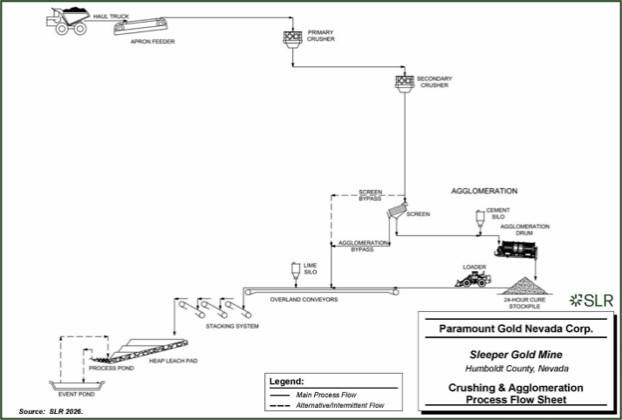
| 14-3 |
|
| Paramount Gold Nevada Corp. | Sleeper Gold Mine S-K 1300 Technical Report Summary |
June 17, 2026 SLR Project No.: 123.020721.00001 |
Figure 14-2: Process Plant Flow Sheet
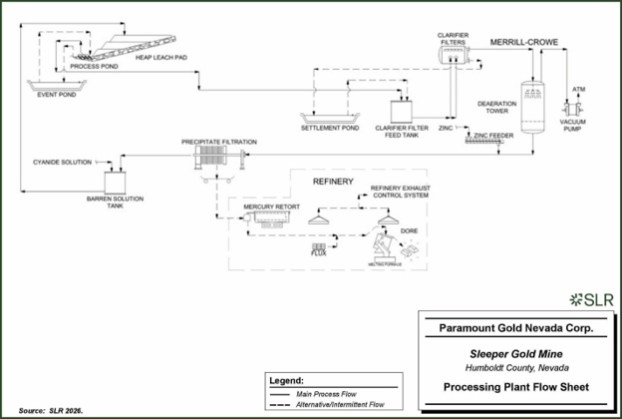
| 14-4 |
|
| Paramount Gold Nevada Corp. | Sleeper Gold Mine S-K 1300 Technical Report Summary |
June 17, 2026 SLR Project No.: 123.020721.00001 |
| 15.0 | Infrastructure |
The Project infrastructure has been designed to support a large-scale open pit mining and heap leach operation utilizing conventional, well-established technologies commonly employed in northern Nevada. Major infrastructure components include site access and internal mine roads, waste rock storage facilities, ROM and crushed mineralized material stockpiles, a single heap leach pad with associated solution management and storm event ponds, Merrill Crowe Plant for precious metals recovery, electrical power supply and distribution systems, and process and raw water pipelines. The Project benefits from its location within an established mining district with access to existing regional infrastructure, experienced contractors, grid power, and services. Infrastructure development is planned to be staged in alignment with the mine production schedule and designed to meet regulatory, environmental, and operational requirements.
| 15-1 |
|
| Paramount Gold Nevada Corp. | Sleeper Gold Mine S-K 1300 Technical Report Summary |
June 17, 2026 SLR Project No.: 123.020721.00001 |
Figure 15-1: Infrastructure Layout
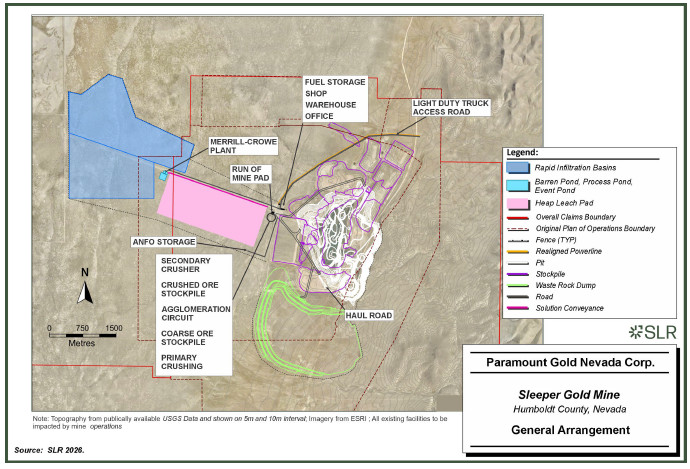
| 15-2 |
|
| Paramount Gold Nevada Corp. | Sleeper Gold Mine S-K 1300 Technical Report Summary |
June 17, 2026 SLR Project No.: 123.020721.00001 |
| 15.1 | Access Roads |
Existing access to the Project truck shop from Winnemucca, Nevada, is via a combination of paved highway and maintained gravel access roads, with a total one-way distance of approximately 56 km (35 mi). From Winnemucca, proceed north on U.S. Highway 95 for approximately 40 km (25 mi). This segment is fully paved and generally in good condition, providing reliable year-round access. At approximately Milepost 66 to 68 (measured from Winnemucca), turn west onto a graded dirt access road that serves local ranching and mining activities. After leaving U.S. 95, follow the gravel access road for approximately 10 km (6 mi) toward the Sleeper Mine site. This road is typically maintained to accommodate mine-related traffic, although conditions can vary with weather and usage, including sections of wash boarding or minor erosion. The route trends generally west-northwest across gently rolling basin and range terrain. Upon reaching the mine property boundary, continue along internal haul and service roads for an additional 1 to 3 km (1 to 2 miles) to access the main operational area. The current truck shop is located within the central yard complex, adjacent to maintenance bays, fueling stations, and equipment staging areas.
In total, the route comprises approximately 40 km (25 mi) of paved highway driving and approximately 16 km (10 mi) of gravel and site roads, with an estimated travel time of 45 to 60 minutes under normal conditions. Seasonal weather, particularly winter precipitation or spring runoff, may temporarily affect road conditions on the unpaved segments.
| 15.2 | Leach Pad |
A synthetically lined Heap Leach Pad (HLP) of approximately 2 Mm2 in size will be constructed near the open pit crest to accommodate approximately 175 Mt of mineralized material. The heap will have a total height of 60 m (200 ft), lifts will be placed by radial stacker at a thickness of 10 m (33 ft). The pad footprint of 2 Mm2, as shown in Figure 15-1, contains the 175 Mt of heap material at 60 m high and 3H:1V final outslopes at closure.
Mineralized material will be placed on the HLP and irrigated with a cyanide solution. The solution will be recovered from the HLP and stored in the pregnant solution pond (Preg Pond) before being processed and recirculated to the HLP as barren solution. The HLP and External Ponds, collectively referred to as the Heap Leach Facility (HLF), will be synthetically lined so that the solution is in a closed system, with the only net solution loss being to evaporation.
SLR identified a conceptual HLF site within the general area that could be sized to contain the ultimate (175 Mt) HLP capacity, and generally met the following siting constraints:
| • | Proximity to mining activities |
| • | Gently sloping terrain to maintain positive drainage for solution along the pad liner while remaining geotechnically stable |
The leach pad will be synthetically lined with a geomembrane primary liner that is underlain with either a prepared low permeability subgrade or geosynthetic clay liner (GCL). Both applications are acceptable to the State of Nevada. A network of collection system pipelines will be placed over the liner and embedded in a 1-meter-thick lift of granular drain fill (Overliner Drain Fill (ODF)) The pipes will be sized and placed such that the solution application rate over the leached mineralized material will not allow for head to build up on the liner. The particle size distribution of the ODF will allow for free draining of the PLS and will be specified to be two orders of magnitude greater permeability than the barren application rate.
| 15-3 |
|
| Paramount Gold Nevada Corp. | Sleeper Gold Mine S-K 1300 Technical Report Summary |
June 17, 2026 SLR Project No.: 123.020721.00001 |
The conceptual HLP layout and capital cost estimate assumed the geotechnical and hydrogeological conditions were suitable. Typical design values were assumed, or values were estimated from previous experience on similar projects, and key criteria were comprised of the following:
| • | Storage of approximately 175 Mt |
| • | An average annual mineralized material loading rate of 30,000 tpd / 11 million tonnes per annum (Mtpa), resulting in a project life of approximately 16 years (Base Case). |
| • | Mineralized material will be prepared as described in Section 14.0 (crushed and agglomerated) and placed on the HLP using conveyors in 10 m lifts in a retreating manner to limit material compaction. A stability analysis was not performed, and SLR assumed that agglomerated mineralized material will be placed at an overall 3H:1V slope to facilitate closure, a maximum height of approximately 60 m (200 ft), and an average density of 100 pounds per cubic foot (pcf). |
| • | The HLP was designed as a “zero discharge” facility. Containment for the HLP will be provided with a composite lining system, comprised of a Geosynthetic Clay Liner (GCL) overlain by a High-Density Polyethylene (HDPE) geomembrane, over a total area of approximately 200 acres. This liner system is acceptable to the state of Nevada; |
| • | A network of collection system pipelines will be placed over the HDPE geomembrane and embedded in a 2 ft thick lift of granular drain fill (Overliner Drain Fill [ODF]). The pipes will be sized and placed to minimize the risk of head (i.e., pressure) build-up on the liner |
| • | Construction of the HLP was assumed to be over five stages (i.e., approximately three-year increments) to reduce initial capital. |
Three external ponds were included in the capital cost estimate, including a pregnant solution pond (Preg Pond), barren solution pond (Barren Pond), and storm event pond (collectively, the Ponds). The HLP will be connected to the pond system via a solution corridor. Typical design values for the external ponds were assumed, or values were estimated from previous experience on similar projects, and key criteria were comprised of the following:
| • | A water balance was not performed to size the ponds, as pond sizing is based on site specific and operational based criteria, such as dead storage, emergency draindown, operational volume, freeboard, and a design storm event, which is typically the 100-year, 24-hour storm event. For the purpose of the IA, storage of approximately 2.5 million gallons, 2.1 million gallons, and 30.9 million gallons were assumed for the Preg, Barren, and Event Ponds, respectively, based on the QP’s previous experience with similar projects. |
| • | The Ponds were designed as a “zero discharge” facility. Containment for the Ponds will be provided with a double liner system with Leak Collection and Recovery System (LCRS), comprised of a Geosynthetic Clay Liner (GCL) overlain by a HDPE Secondary geomembrane, Geonet drainage layer, and a HDPE Primary geomembrane. This liner has been previously approved by the State of Nevada at similar projects. |
| • | Construction of the Ponds, in their entirety, is assumed to be performed during initial construction. |
| • | The ponds will be double lined with integrated leak collection and recovery systems (LCRS) and will be sized to accommodate: |
| • | Freeboard (0.6 m) |
| 15-4 |
|
| Paramount Gold Nevada Corp. | Sleeper Gold Mine S-K 1300 Technical Report Summary |
June 17, 2026 SLR Project No.: 123.020721.00001 |
| • | Operational Volume |
| • | Emergency Draindown Volume (24-hours of Barren Application Rate) |
| • | Design Storm Volume |
| • | Dead Storage for Sedimentation and Pump Priming |
The HLP and solution ponds are synthetically lined so that the solution is contained within a closed system, with the only net solution loss due to evaporation, which will be empirically confirmed during pond design using the sitewide water balance.
| 15.3 | Buildings and Facilities |
The buildings and facilities described below are in the main plant and offices area, as shown in Figure 15-1:
| • | Truck shop and mobile maintenance warehouse: The Sleeper truck shop complex will be located near the mine entrance. It is a four-bay shop sized up to 200 t class haul trucks. The shop will contain a tool crib, oil and lubricant bulk storage, multiple offices, locker rooms, a training room, and a warehouse. A covered warehouse storage yard is located adjacent to the admin building complex. |
| • | Process building: The mill building, which is currently not operating, consists of facilities supporting the mineral processing operations, including grinding, gravity separation, flotation, sulfide concentrate filtration and load-out, leach CIP circuit (bypassed), tailings filtration and agglomeration, recovery, and doré casting, and metallurgical laboratory. Adjacent to the mill building is the thickener water storage tank and the remaining CIL tanks from the 1989 flowsheet. |
| • | Crushing plant: The crushing plant will produce P80 19 mm (0.79-in) material for leaching. Stemming for blastholes, road material, and initial material overliner material for the leach pad which will require additional crushing and screening and will be completed using mobile equipment, not a part of the primary crushing circuit, phased according to construction and development activities. |
| • | Process Recovery: Merrill-Crowe Circuit, zinc precipitation, doré casting, and solution pumping and management. The recovery plant will contain analytical and metallurgical laboratories. |
| • | Wash bay: The wash bay will be located next to the truck shop and consists of one covered bay. |
| • | Administration buildings: The main administration building encompasses most site-support departments. |
| • | Assay laboratory: The assay laboratory will support ongoing mine operations, including grade control and gold solution analysis. |
| • | Motor control center (MCC): The MCC will house controls for the pumps and boosters for the barren and pregnant solution ponds. |
| 15-5 |
|
| Paramount Gold Nevada Corp. | Sleeper Gold Mine S-K 1300 Technical Report Summary |
June 17, 2026 SLR Project No.: 123.020721.00001 |
| 15.4 | Power Supply and Distribution |
Electrical power for the proposed Project is expected to be supplied from the regional electrical grid operated by NV Energy. The project area is situated within a well-established mining district with existing transmission infrastructure, and grid power is considered available within a reasonable distance of the site. Power would be delivered via a new overhead transmission line, anticipated to be either 69 kilovolt (kV) or 120 kV, depending on final engineering, load growth considerations, and utility interconnection requirements. For the projected peak demand, a 120 kV supply is preferred to provide additional capacity, improved voltage stability, and flexibility for future expansion.
The total connected electrical load for the operation is estimated to be approximately 9 megawatts (MW) to 15 MW, with an average operating demand of 10 MW, based on first principles estimates and benchmarking against comparable heap-leach operations in Nevada. The primary contributors to electrical demand include crushing and conveying, heap leach solution pumping, the Merrill-Crowe recovery plant, pit dewatering, and general site infrastructure, including maintenance facilities, buildings, and lighting. Among these, pit dewatering represents a significant continuous load, reflecting the need to pump approximately 4,542 m3/hr (20,000 gpm) from the open pit.
Electrical power received at the site would be stepped down through a central substation equipped with a primary transformer rated at approximately 25 megavolt-amperes (MVA). The substation would convert transmission voltage (69 kV or 120 kV) to a primary site distribution voltage of 13.8 kV, which would serve as the backbone of the site-wide electrical system. Distribution from the substation would be configured in a radial arrangement with looped circuits for critical infrastructure, including the process plant and dewatering systems, to enhance operational reliability.
Power distribution across the site would utilize multiple voltage levels consistent with industry practice. Major process loads, including crushing, conveying, and high-capacity pumping systems, would operate at 13.8 kV or 4.16 kV, with local step-down transformers where required. The Merrill-Crowe plant, maintenance facilities, warehouse, and ancillary infrastructure would primarily utilize 480-volt (V) systems, while lighting, offices, and control systems would be supplied at 240/120 V. Motor control centers and variable frequency drives would be employed extensively to optimize energy efficiency and process control.
The crushing and conveying circuit are estimated to require approximately 3 MW to 5 MW, supplied at medium voltage, with large motors driving the primary crusher and overland conveyors. Heap leach solution handling systems, including pregnant and barren solution pumps, are estimated to require approximately 0.35 MW to 1 MW. The Merrill-Crowe recovery plant, including clarification, deaeration, zinc precipitation, and refining circuits, is expected to require approximately 1 MW to 2 MW.
Pit dewatering is estimated to require approximately 2 MW to 3.5 MW, depending on final pump configuration, total dynamic head, and system efficiency. The system would consist of staged pumping installations located on pit benches or in sump areas, supplied via medium-voltage distribution. Consistent with operational requirements, no electrical infrastructure would be installed within active mining faces beyond the dewatering pump installations.
Site infrastructure, including the truck shop, maintenance facilities, warehouse, assay laboratory, administrative buildings, and site lighting, is estimated to require approximately 0.5 MW to 1 MW. Additional miscellaneous loads, including reagent handling systems, control systems, and contingency allowances, are estimated at 2 MW to 3 MW.
Emergency and backup power systems would be installed to support critical operations, including process control systems, Merrill-Crowe circuits, and minimum dewatering capacity. These systems would consist of diesel-powered generators with sufficient capacity to maintain safe shutdown and restart conditions. The electrical system would be monitored and controlled through a supervisory control and data acquisition (SCADA) system integrated with plant operations.
| 15-6 |
|
| Paramount Gold Nevada Corp. | Sleeper Gold Mine S-K 1300 Technical Report Summary |
June 17, 2026 SLR Project No.: 123.020721.00001 |
Overall, the proposed electrical power system is conventional for a Nevada-based heap leach operation of this scale and is considered technically feasible. The use of grid power supplied by NV Energy, combined with standard substation and distribution infrastructure, provides a reliable and scalable solution to support the planned mining and processing activities.
Table 15-1: Estimated Power Load by Area
| Area |
Estimated Load (kW) | Estimated Load (MW) | ||||||
| Crushing and Conveying |
3,100 | 3.10 | ||||||
| Heap Leach Solution Pumping |
350 | 0.35 | ||||||
| Merrill-Crowe Plant/Recovery/Refining |
1250 | 1.25 | ||||||
| Pit Dewatering (20,000 gpm-nominal) |
2,400 | 2.40 | ||||||
| Infrastructure, Maintenance & Lab Facilities |
1,000 | 1.00 | ||||||
| Miscellaneous and Contingency |
2,000 | 2.00 | ||||||
|
|
|
|
|
|||||
| Total Connected Load |
10,100 | 10.00 – 12.00 | ||||||
|
|
|
|
|
|||||
| 15.5 | Water |
The Project water balance for the proposed 30,000 tpd operation would be dominated by pit dewatering inflows, process solution inventory, heap leach application losses, and evaporation. Mine dewatering, estimated to average approximately 4,542 m3/hr (20,000 gpm), is expected to provide substantially more water than required for crushing, possible agglomeration, heap leaching, and Merrill-Crowe recovery, such that excess water would likely be discharged, subject to permitting and water quality requirements, to engineered rapid infiltration basins (RIBs) located several kilometers and down gradient from the pit.
Process water demand would include dust suppression, ore agglomeration if required, heap leach solution make-up, and plant service water, with solution losses principally associated with heap and pond inventory, evaporation, and residual moisture retained in spent material. No accommodation camp is planned, which materially reduces domestic water demand, and potable water for personnel would be trucked to the site.
Overall, the operation is expected to be a net water producer, with site water management focused primarily on collection, storage, reuse where practical, controlled discharge of surplus dewatering water, and maintenance of adequate operational and environmental water controls.
| 15.5.1 | Current Well Network |
As of 2022, four interceptor wells remained operational. All bedrock dewatering wells and the remaining interceptor wells have been decommissioned. In 2005, three of the operational dewatering wells were reported to be completed with line-shaft turbine pumps (WMC 2005a); however, pump reports from 2022 show groundwater discharged from only one of the interceptor wells (New Sleeper Gold 2022). The power lines servicing any on-site line-shaft turbine pumps are expected to remain in place.
| 15-7 |
|
| Paramount Gold Nevada Corp. | Sleeper Gold Mine S-K 1300 Technical Report Summary |
June 17, 2026 SLR Project No.: 123.020721.00001 |
As of 2005, four monitoring wells installed adjacent to the tails dam were reported to remain operational. All of the remaining monitoring wells are reported to have been decommissioned (WMC 2005a).
| 15.5.2 | Pit Dewatering Plan |
To dewater the Slumber pit lake, infrastructure and service requirements are expected to be as follows:
| • | One barge-mounted pump operating in the pit lake having a capacity of 631 L/s (10,000 gpm) and an additional barge-mounted pump available on-standby if one of the barge-mounted pumps required maintenance |
| • | Conveyance pipe from the barge pump to the conveyance channel on the west crest of the pit |
| • | Power to the barge-mounted pump |
| • | Submersible camera inspection and rehabilitation of the four interceptor wells remaining from previous dewatering |
| • | A monitoring well network to monitor both groundwater pressures and groundwater quality. |
| • | Approximately fourteen 50 mm diameter PVC standpipe monitoring wells installed in 200 mm nominal diameter boreholes. |
| • | Approximately six monitoring wells can be installed to 90 m below grade in the basal gravel aquifer |
| • | Three monitoring wells installed in the bedrock DFS at 244 m below grade |
| • | Five monitoring wells in the compartmentalized bedrock PSF assumed to be at 200 m below grade. |
| • | Total monitoring well drilling would be 2,280 m. |
| • | Twenty 350 mm nominal diameter interceptor wells complete with louvered well screens installed in 450 mm nominal diameter boreholes. As pit lake water level decreases, it is conceivable that as many as 8 additional interceptor wells will be required to lower the head in areas with greater storage capacity. |
| • | Twelve 350 mm nominal diameter bedrock dewatering wells complete with 450 mm nominal diameter surface casings. Since the continuity and interconnectedness of the fracture network is unknown, it is conceivable that as many as four additional bedrock wells will be required. Initially, seven bedrock wells will target the DFS 244 m below grade from the crest of the west wall. Following substantial dewatering of the pit, the remaining bedrock wells will be installed adjacent to compartmentalized zones where groundwater pressures have not been substantially lowered. |
| • | Ten 350 mm nominal diameter wells installed in 450 mm diameter boreholes from the 1,220 m (4,000 ft) elevation in the waste rock piles at the based of the pit. These wells could not be installed until the pit has been dewatered to expose the waste rock and access can be developed for the drill rig. |
| • | Each of the interceptor, bedrock, and waste rock wells completed with a line shaft turbine pump. |
| 15-8 |
|
| Paramount Gold Nevada Corp. | Sleeper Gold Mine S-K 1300 Technical Report Summary |
June 17, 2026 SLR Project No.: 123.020721.00001 |
| • | Conveyance pipe from each wellhead to the conveyance channel to the artificial wetland. |
| • | Power to each of the line shaft turbine pumps. |
| • | Excavation of a conveyance channel from the west crest of the pit to the artificial wetland in the middle of the Desert Valley. |
| • | Construction of the impoundment dykes required to develop the artificial wetland. |
Generally, installation of functional groundwater dewatering infrastructure is considered to be the critical path that limits the rate at which the pit is dewatered. To maintain pit wall stability groundwater piezometric pressures must be maintained at a level only slightly higher than the level in the pit lake (WMC 2005d).
| 15.6 | Accommodation Camp |
An accommodation camp is not required for the Project due to its proximity to the established community of Winnemucca, located approximately 70 km to 80 km (45 to 50 miles) by road from the site. Winnemucca provides sufficient existing infrastructure to support the workforce, including housing, hotels, dining, medical services, and commercial amenities. The Project is accessible via U.S. Highway 95 and maintained access roads, enabling reliable daily commuting for employees.
The operation is expected to utilize a local and regional workforce on a drive-in/drive-out basis, consistent with standard practice for mining operations in north central Nevada. This approach reduces capital and operating costs associated with constructing and maintaining a camp, while also minimizing environmental disturbance and permitting requirements.
| 15-9 |
|
| Paramount Gold Nevada Corp. | Sleeper Gold Mine S-K 1300 Technical Report Summary |
June 17, 2026 SLR Project No.: 123.020721.00001 |
| 16.0 | Market Studies and Contracts |
| 16.1 | Markets |
Gold is the principal commodity at the Sleeper Gold Mine and is freely traded at prices that are widely known, so that prospects for sale of any production are virtually assured. Metal prices for the economic analysis were estimated based on recent consensus industry metal price forecasts and compared with those used in other published studies. The metal prices used for the economic analysis, shown in Table 16-1. These represent the average analyst consensus prices of March 2026.
Table 16-1: Economic Analysis Metal Price Assumptions
| Metal Price |
Units | Y-1 | Y1 | Y2 | Y3 | Y4 | Long- Term |
|||||||||||||||||||||
| Gold |
$ | /oz | 4,370 | 4,000 | 3,600 | 3,600 | 3,600 | 3,600 | ||||||||||||||||||||
| Silver1 |
$ | /oz | 66.00 | 59.00 | 48.00 | 48.00 | 48.00 | 48.00 | ||||||||||||||||||||
Note 1: Silver was modeled and evaluated in the cash flow; silver is recovered in the Sleeper recovery facilities.
The doré is securely transported by road freight to a refinery where it is refined into gold bullion. The bullion will be sold by reputable gold trader to banks that specialize in the purchase and sale of gold bullion.
| 16.2 | Contracts |
Some of the major contracts that will be negotiated and implemented are discussed below.
| • | Mining. Mining operations are expected to be executed by a contract mining firm under a unit-rate agreement, with costs structured primarily on a volumetric basis (US$/bcm mined) covering drilling, blasting, loading, and haulage activities. The contract would include a schedule of rates for additional “out-of-scope” work, such as road construction, dewatering, and other ancillary services, with provisions for escalation, productivity adjustments, and fuel price variability. Contractor performance would be managed through standard key performance indicators (KPIs), including productivity, dilution control, and safety compliance. |
| • | Diesel Fuel Supply Contract. Diesel fuel for mining and mobile equipment would be supplied under a term supply agreement with a regional fuel distributor, with pricing typically referenced to published rack or index prices (e.g., OPIS), plus a negotiated differential for delivery, handling, and the supplier’s margin. The contract would include provisions for volume commitments, delivery scheduling, on-site storage and inventory management, and adjustments tied to market fuel price fluctuations. Additional terms may address fuel quality specifications, winterization requirements, and contingency supply arrangements to ensure continuity of operations. |
| • | Cyanide Supply Contract. Sodium cyanide would be procured under a supply agreement with a qualified manufacturer or distributor, with pricing generally based on US$/tonne delivered and indexed to market conditions and potentially adjusted for freight and energy-related cost drivers. The contract would include provisions for delivery in solid briquette or liquid form, storage and handling requirements, and compliance with applicable safety and environmental regulations (including the International Cyanide Management Code, where applicable). Supplier support services may include technical assistance, inventory management, and emergency response provisions. |
| 16-1 |
|
| Paramount Gold Nevada Corp. | Sleeper Gold Mine S-K 1300 Technical Report Summary |
June 17, 2026 SLR Project No.: 123.020721.00001 |
| • | Grinding Media Supply Contract. Grinding media (e.g., steel balls) for the comminution circuit would be supplied under a contract with an established manufacturer, with pricing based on US$/t delivered and dependent on media specifications, alloy composition, and wear performance guarantees. The agreement would typically include provisions for quality control, delivery schedules, minimum order quantities, and potential price adjustments linked to steel input costs or indices. Supplier performance may be monitored through consumption rates and wear characteristics to optimize operating costs and milling efficiency. |
| • | Smelting and Refining. Gold and silver doré produced on site would be sold under standard refining agreements with established precious metal refineries, in which the refineries purchase the doré and pay for the contained metal based on agreed payable percentages. The contract would include typical industry terms for refining charges, treatment fees, assay procedures, and settlement timelines, with deductions for impurities and processing losses as applicable. Final payments are generally based on independently verified assays and prevailing market prices at the time of settlement. |
| • | Transportation and Handling. Transportation of doré bullion from site to the refinery would be conducted by a specialized, insured security logistics provider under a contract covering handling, transport, and custody of the material. The agreement would include provisions for secure packaging, chain-of-custody documentation, insurance coverage based on metal value, and defined responsibilities for loss or damage during transit. Logistics arrangements would be coordinated to align with production schedules and refinery delivery requirements. |
| • | Sales, Hedging, Forward Sales. The Project may consider implementing a hedging or forward sales strategy for a portion of future gold and silver production to support financing requirements or mitigate commodity price volatility. Any such program would be structured in accordance with standard industry practices and may include instruments such as forward sales, collars, or other price protection mechanisms, subject to market conditions and lender requirements. At this stage, no specific hedging arrangements have been defined. |
All contracts described above are expected to be negotiated on commercially reasonable terms consistent with industry norms for comparable Nevada heap leach operations, and no unusual or non-standard contractual provisions are anticipated.
| 16-2 |
|
| Paramount Gold Nevada Corp. | Sleeper Gold Mine S-K 1300 Technical Report Summary |
June 17, 2026 SLR Project No.: 123.020721.00001 |
| 17.0 | Environmental Studies, Permitting and Plans, and Social or Community Impact |
The Project was developed (mined, milled, and heap leached) by AMAX in the 1980s and 1990s. Operation ceased in 1996. Reclamation has occurred on most of the mine facilities (waste rock dumps, tailing impounds, heap leach pads and ancillary facilities (access and haul roads) and the open pit has been allowed to refill with water. Current activities at the site involve exploration, permit and reclamation maintenance (including e-cells associated with the former heap leach units), and post-closure environmental monitoring.
| 17.1 | Site Environmental Conditions and Monitoring Programs |
The summaries of environmental conditions and studies in this section are based on information documented in environmental impact statement (EIS) and environmental assessment (EA) baseline reports as well as the water pollution control permit (WPCP) and regulatory submissions required under the various permits and EIS/EA conditions. A Final Permanent Closure Plan (FPCP) for the Sleeper site was submitted to the Nevada Department of Environmental Protection (NDEP) in 2003 for site-wide closure of the former project. The FPCP included details supporting characterization and stabilization information relative to the various facilities at the site and the stabilization and closure of remaining process facilities.
| 17.1.1 | Physiography |
Sleeper is located in northern Nevada in the Great Basin region of the Basin and Range physiographic province. The Project area is situated in a valley on a gently west-sloping alluvial plain at an approximate elevation of 1,300 masl (4,265 fasl).
| 17.1.2 | Geology |
The Basin and Range is characterized by a series of generally north-trending, fault-bounded mountain ranges separated by broad alluvium or lake sediment-filled valleys. The Project is at the northwestern flank of the Slumbering Hills within the Desert Valley, which is a typical Basin and Range, fault-bounded valley. The underlying geology is comprised of Mesozoic basement rocks overlain by a sequence of Tertiary volcanic and volcaniclastic units.
| 17.1.3 | Acid Rock Drainage/Metal Leaching Potential |
Acid base accounting (ABA) and meteoric water mobility procedures (MWMP) were performed by Hydrotechnica in 1989 to determine acid rock drainage and metal leaching potential in support of the initial WPCP. The results have been used to update the pit lake model, with the latest update in 2021 by Piteau. The MWMP analysis for alluvium indicated that arsenic, iron, mercury, and manganese have the potential for mobility in the alluvial system. In the oxidized volcanic bedrock, analysis conducted to date indicates most metals are immobile; however, the unoxidized volcanic bedrock indicates significant potential exists for mobilizing major cations and anions, as well as trace metals such as manganese and arsenic. The current updated 2016 pit lake model shows that modelled results of these parameters will remain within Profile III reference ranges for the 104-year model simulation, with the possible exception of fluoride (Piteau 2021).
| 17-1 |
|
| Paramount Gold Nevada Corp. | Sleeper Gold Mine S-K 1300 Technical Report Summary |
June 17, 2026 SLR Project No.: 123.020721.00001 |
To reduce the impact of acid generation and metal leaching, the open pits on site were partially backfilled with oxidized and unoxidized material and rapid filled through pumping to form a pit lake. Lime slurry was added to the pit lake between July 1996 and November 2001 to increase the pH of the pit lake water. Consistent monitoring of the pit lake and modeled lake chemistry has shown that most parameters are stable, with a slow increase of alkalinity from alluvial groundwater. The data from monitoring indicates there are no increasing constituent trends and seasonal differences appear to be low. The main control of future water quality is evapoconcentration; however, the rate of evapoconcentration on the site remains low (NDEP 2017).
Oxide and sulfide ore was placed on the existing heap leach pads during operations. The heap leach pads were reclaimed in 2000 in accordance with approved closure plans. Solution from heap leach draindown is monitored semi-annually and quarterly, and indicates the solution is acidic. Draindown solution from the heap leach facilities is managed through passive e-cells. Draindown solution for all pads contain elevated metals and sulfate, with the NROM pad showing consistently higher concentrations of aluminum, arsenic, iron, sulfate, zinc and total dissolved solids.
The existing waste rock dumps consist of alluvial material and both oxidized and unoxidized argillized volcanic tuffs. Acid neutralizing potential (ANP) / acid generating potential (AGP) ratios indicate a net acid generating potential. It is unknown where potentially acid-generating material was placed within the existing waste rock dumps, and no seeps have been observed during quarterly inspections conducted since the completion of reclamation.
| 17.1.4 | Atmospheric Environment |
The climate at Sleeper is arid, characterized by warm, dry summers and cold, dry winters. Site-specific data is collected from a meteorological station on the northern side of the site. Site data collected from 2003 to 2025 indicates an average annual temperature of 10°C with a range of -30°C to 36°C, and 153 mm of average annual precipitation with a range of 47 mm to 447 mm.
The air quality in the region of the Project is generally good, due to the limited population and industrial activity. Several mines in the vicinity have the potential to contribute to particulate emissions and industrial pollutants within the Project area. The nearest currently active mine is the Turquoise Ridge-Twin Creeks mine, located approximately 72 km (45 miles) as the crow flies to the east.
| 17.1.5 | Acoustic Environment |
Sleeper is in a remote area with limited human activity, and no substantive anthropogenic noise sources within 42 km (29 mi). The nearest town is Winnemucca, Nevada, located approximately 42 km (29 mi) south of the Project area. Ranching activities occur in proximity to the site, which contribute limited noise to the surrounding area. Highway 95 is located approximately 19 km (12 mi) east of the project site, which contributes traffic noise in proximity to the Project area as one of the main travel ways to Idaho and Oregon.
| 17.1.6 | Groundwater and Surface Water |
The Project area is located within the Desert Valley (031) groundwater basin. The depth to water in the shallow aquifer before mining activity was approximately 9 m (30 ft) to 12 m (40 ft) below ground surface (bgs). Several hydrologic and hydrochemical models for the site that have been prepared by Water Management Consultants Inc. (WMC) are listed (WMC 1995):
| • | Sleeper Mine Summary of Groundwater Conditions Beneath the Tailings Dam (1994) |
| • | Preliminary Assessment of Hydrologic and Hydrochemical Conditions in the Final Pit (1994) |
| 17-2 |
|
| Paramount Gold Nevada Corp. | Sleeper Gold Mine S-K 1300 Technical Report Summary |
June 17, 2026 SLR Project No.: 123.020721.00001 |
| • | Results of Supplemental Pit Lake Modeling and Closure Plan for the Final Pit (1995) |
Additionally, the most recent update to the Sleeper project was completed by Piteau in 2021.
There are three hydrogeologic units identified within the Project area:
| • | Shallow groundwater zone – lacustrine unit comprised of silty-clay sediments, varying in thickness from near zero to 30 m (100 ft) in the vicinity of the pit area. |
| • | Basal Gravel Aquifer – this aquifer largely dominates the regional groundwater flow system in the Project area and ranges in thickness from near zero to over 152 m (500 ft) west of the pit. |
| • | Volcanic bedrock aquifer – groundwater movement in this aquifer is a result of fracture flow, with variable hydraulic conductivity. The thickness ranges from near zero to 52 m (170 ft). |
| • | Because of the abundant fractures within the rocks, the bedrock complex in the Project area, along with the overlying Basal Gravel Aquifer, is the principal source of groundwater. Water chemistry in the shallow groundwater zone is believed to represent background conditions. No baseline data exists on the volcanic bedrock aquifer. |
There are no surface waters at or near the mine site, with the exception of the pit lake. Groundwater modeling and pit lake monitoring indicate the pit lake water level has stabilized at an elevation of about 6 m (20 ft) below the pre-mining groundwater level. The latest pit lake model by Piteau in 2021 indicates the pit lake effectively collects groundwater beneath the mine site facilities and will remain a permanent hydrogeologic sink. Contact stormwater is contained on site and non-contact stormwater (stormwater runoff generated from the closed waste rock dumps) discharges off site. The site is considered a zero-discharge facility.
| 17.1.7 | Wildlife |
There is limited data available for the Project regarding wildlife and biological resources within the area. Big game species, such as mule deer and pronghorn antelope, small mammals, reptiles, aquatic, and avian species exist within the project area. Several raptor species inhabit the project area, including owls and hawks. It is unknown if golden eagles are present in the project area. No known special status species or threatened or endangered species occur within the project area. There is evidence of aquatic species within the pit lake.
| 17.1.8 | Cultural Resources |
A cultural resources survey was conducted for the 1985 EA resulting in the identification of one obsidian flake within the project area. There is no evidence of significant cultural or archaeological sites.
| 17.2 | Waste and Tailings Disposal, Site Monitoring, and Water Management |
| 17.2.1 | Tailings Storage Facility |
The tailings impoundment was designed as a zero-discharge facility. It was constructed as a native clay-lined facility in accordance with existing standards and was approved by the Nevada Department of Environmental Protection (NDEP). The tailings impoundment was designed to allow for 6.6 million tons of tailings to be deposited over 63 hectares (156 acres). The facility
| 17-3 |
|
| Paramount Gold Nevada Corp. | Sleeper Gold Mine S-K 1300 Technical Report Summary |
June 17, 2026 SLR Project No.: 123.020721.00001 |
was constructed in four phases from 1985 through 1994. The final thickness of tailings is about 13.7 m (45 ft) in the southeast corner of the impoundment and about 13.1 m (43 ft) in the northwest corner. The present surface area of the tailings is approximately 45 hectares (113 acres). The tailings facility is closed and released, in accordance with the Closure and Reclamation Plan for the Tailings Impoundment (June 1998) and Final Plan for Permanent Closure (2003), with revegetation remaining as the only remaining activity that has yet to be released. No drain down has been measured since 2009, and the Tailings Seepage Pond was closed in 2017.
| 17.2.2 | Waste Rock Storage Facilities |
There are three existing waste rock storage facilities on the site (North, West, and South dumps) that total approximately 171 hectares (423 acres). The waste rock storage facilities on site are reclaimed and revegetated, except for a small laydown area on the South Waste Rock Dump, a non-hazardous solid waste landfill within the West Waste Rock Dump, and a portion of the site access road is located on the North Waste Rock Dump to allow for access to associated collection ponds for processing. Approximately 44.2 metric tons (48.8 million short tons) of oxide and sulfide material was placed onto the heap leach pads during operations. Leaching or recirculation of solution has not occurred since 1997.
| 17.2.3 | Heap Leach Facilities |
The heap leach pads were capped and covered in 2000 in accordance with the closure and reclamation plans approved by the NDEP. Pads were graded and revegetated to allow for surface water runoff, which is routed to a long-term stormwater diversion channel that runs along the facility, designed for the 100-year, 24-hour storm event. Process ponds have been closed and in 2023, process ponds for pads 2 (Process Pond #2), 4 (Overflow Pond #4) and NROM (Overflow Pond NROM) were converted to double-lined E-cells with leak detection to passively manage draindown through evaporative disposal. E-cell conversion was completed in 2024 in accordance with approved plans and designs.
The following ponds were closed between 2017 and 2020:
| • | Overflow Pond #2 |
| • | Overflow Pond #3 |
| • | Process Pond #4 |
| • | South Barren Pond |
| • | Process Pond NROM |
The following ponds were closed in 2023:
| • | Closure of Process Pond #3 |
| • | Conversion of Process Pond #2 to E-cell #1 |
| • | Conversion of Overflow Pond #4 to E-cell #2 |
| • | Conversion of Overflow Pond NROM to E-cell #3 |
Flows from heap leach pads 1 and 2 are routed via gravity piping to E-Cell 1, flow from heap leach pad 4 is routed via gravity piping to E-Cell 2, and flows from heap leach pads 3 and NROM are routed via gravity piping to E-Cell 3.
| 17-4 |
|
| Paramount Gold Nevada Corp. | Sleeper Gold Mine S-K 1300 Technical Report Summary |
June 17, 2026 SLR Project No.: 123.020721.00001 |
| 17.2.4 | Water Management |
The project site is considered a zero-discharge facility. All contact stormwater is captured on-site, and facilities have been designed to manage stormwater in diversion channels and features to prevent off-site discharge of contact water. Draindown solution from the heap leach pads is routed to and managed within the E-cells. The pit lake is passively contained.
| 17.2.5 | Monitoring |
Routine monitoring is conducted on a quarterly, semi-annual and annual basis as required in the WPCP. Monitoring includes groundwater, pit lake, heap leach pad draindown, erosional stability of closed landforms, and identification of seeps. The site is in compliance with all current permits. There are no known Notices of Violation active at the site; however, some erosion has occurred on the North Waste Rock Dump that is being monitored.
Tailings Storage Facility
The tailings storage facility is reclaimed and released, and monitoring is no longer required.
Waste Rock Dump Facilities
The waste rock dumps are monitored semi-annually for physical stability and presence of seeps.
Heap Leach Facilities
The heap leach pads are monitored for erosion and stability. Process solution is monitored for weekly fluid in the leak detection systems. The draindown solution is monitored on a quarterly basis from each pad, as well as combined E-Cell fluid.
Water Management
Seven groundwater wells are located around the perimeter of the facility to monitor any potential impacts to groundwater on a quarterly basis. The pit lake is monitored continuously for water elevation, quarterly for surface water quality and semi-annually at different depths within the pit. Additionally, meteorological conditions at the site are monitored as required in the WPCP.
| 17.3 | Project Permitting |
Current permits for the site exist at the county, state and federal levels, and the Project will be subject to additional permits and amendments to ensure compliance with regulatory requirements and to mitigate potential environmental impacts. Current permits at the site are referenced in Table 17-1 and include the Record of Decision for exploration and closure from the Bureau of Land Management, a WPCP, Reclamation Permit, Surface Area Disturbance Permit, and Class III Solid Landfill Waiver from the NDEP, which may require modification for operations as described within this IA.
The Project is within public lands and is authorized under BLM 43 CFR 3809 mining regulations. Mining activities in accordance with the IA would require an amendment to the current Plan of Operations, which would be submitted to the BLM for National Environmental Policy Act of 1969 (NEPA) determination. Following their review, the BLM will determine whether an EA or an EIS is required for compliance with NEPA. The EA or EIS would be prepared, and would require additional baseline surveys to be conducted, in accordance with NEPA and BLM guidelines for mining on public lands. Baseline studies and preparation of a new EA or EIS could take 12 to 36 months to complete for an operating site. Baseline studies would be required to assess current conditions for multiple resources including but not limited to groundwater and surface water,
| 17-5 |
|
| Paramount Gold Nevada Corp. | Sleeper Gold Mine S-K 1300 Technical Report Summary |
June 17, 2026 SLR Project No.: 123.020721.00001 |
flora and fauna, cultural and social environment, air and wildlife. During the NEPA process, baseline studies will be utilized to facilitate the NEPA process and potential impacts to resources in the EA or EIS. Cultural resources determined to be significant by the Nevada State Historic Preservation Office (SHPO) office will need to be managed through avoidance or approved mitigation during development.
State permits will need to be obtained from NDEP and other state agencies. The primary permit is the WPCP in accordance with NAC 445A.350-445A.447, for any mining operation that has a “mine, waste rock piles, ore piles, beneficiation process components, processed ore disposal sites, and all associated buildings and structures that have the potential to degrade waters of the state”. The Project currently has a WPCP for a closure facility, and a new permit would need to be obtained for mining and processing operations as described in this IA. The Project would also require a new or modified Reclamation Permit in accordance with NAC519A.010-519A.415, “for any exploration, mining, milling, or other beneficiation process activity that proposes to create disturbance of greater than five acres, or remove an excess of 36,500 tons of material from the earth in any calendar year.”
Required or potential permits are included in Table 17-1.
Table 17-1: Required or Potentially Required Permits
| Regulatory Agency |
Permit Name |
Activity |
Status | |||
| BLM | Record of Decision resulting from NEPA process | Mine Operation, Exploration | Will require modification through NEPA process | |||
| EPA | EPA/RCRA ID | Hazardous waste generation and storage | To be initiated | |||
| Federal Bureau of Alcohol. Tobacco, and Firearms | Explosives License | Transport, shipment, receiving, or possessing explosive materials | To be initiated | |||
| NDEP-BMRR | Water Pollution Control Permit | Protection for Waters of the State | Amended or new permit to be initiated | |||
| NDEP-BMRR | Water Pollution Control Permit (RIBS) | Discharge of water produced from the dewatering of the open pits | New permit to be initiated | |||
| NDEP-BMRR | Reclamation Permit | Reclamation Plan and Bond | Amended or New permit to be initiated | |||
| NDEP- BAPC | Air Quality Permit | Facilities that emit air pollutants | To be initiated | |||
| NDEP- BAPC | Surface Area Disturbance Permit | Surface disturbances of more than 5 acres for dust generation | Amended or New permit to be initiated | |||
| NDEP- BWPC | Mining Stormwater Permit | Control of stormwater discharges from mining facilities | To be initiated | |||
| NDEP- BWPC | Onsite Sewage Disposal Permit | Disposal of sewage | To be initiated | |||
| 17-6 |
|
| Paramount Gold Nevada Corp. | Sleeper Gold Mine S-K 1300 Technical Report Summary |
June 17, 2026 SLR Project No.: 123.020721.00001 |
| NDEP- BSDW | Potable Water Permit | Providing potable and drinking water | To be initiated | |||
| NDEP- BWM | Waste management Permit | Generation of waste and determination | To be initiated, Landfill application amended | |||
| NDWR | Permit to Appropriate Public Waters | Water rights for use or production | Amended | |||
| NDOW | Industrial Artificial Pond Permit | Protection of wildlife from process solutions | Amended | |||
| NDOT | Encroachment Permit | Transportation and use of roads to site | To be initiated | |||
| NDOM | Mine Registry Form | Registration of mining projects in Nevada | To be initiated | |||
| NDIR | Opening of Mine Notification | Business notification of opening a mine | To be initiated | |||
| Nevada State Fire Marshall | Emergency Response Plan | Inventory and response plan for hazardous materials | To be initiated | |||
| Humboldt County | Building Permits | Mine operations and facilities | To be initiated | |||
| Notes: BAPC Bureau of Air Pollution Control BLM Bureau of Land Management BMRR Bureau of Mining Regulation and Reclamation BSDW Bureau of Safe Drinking Water BWPC Bureau of Water Pollution Control BWM Bureau of Waste Management EPA Environmental Protection Agency NDEP Nevada Division of Environmental Protection NDIR Nevada Division of Industrial Relations NDOM Nevada Division of Minerals NDOT Nevada Department of Transportation NDOW Nevada Department of Wildlife |
||||||
| 17.4 | Social or Community Requirements |
There are no known social or community issues that would have a material impact to the Project. Identified socioeconomic issues (employment, payroll, services and supply purchases, and State and local tax payments) are anticipated to be positive through the creation of direct and indirect jobs. Hiring practices will include local staff to the extent practicable.
As many new development projects have been identified in the area, community and tribal engagement is a key element to the successful development of a mining project. As the Project progresses beyond IA, Paramount will engage with the local community and tribal entities to allow an understanding of concerns, opportunities, and goals for the Project leading up to, during, and post operation. Engagement at this level has not occurred to date but will occur as part of the mine planning and permitting process.
| 17-7 |
|
| Paramount Gold Nevada Corp. | Sleeper Gold Mine S-K 1300 Technical Report Summary |
June 17, 2026 SLR Project No.: 123.020721.00001 |
| 17.5 | Mine Closure Requirements and Summary |
The BLM and NDEP-BMRR require a closure plan to be submitted with the submittal of a Plan of Operations, which includes closure and reclamation cost estimate for bonding as well as reclamation and closure plans for facilities and disturbance. A closure cost estimate is required to provide the BLM and/or NDEP surety bonds in the event the operator is unable to fulfill closure requirements to prevent unnecessary or undue degradation of the environment. Closure planning is conceptual at this point, as the mine plan has not been fully developed. All facilities will be closed in accordance with applicable closure regulations. Growth media will be salvaged from existing waste rock dumps and stockpiled for use in reclamation.
The open pit will become a pit lake, and earthen berms will be placed around the perimeter at closure. Depending on water quality analysis and modeling during the Project, inert backfill or lime may be placed within the pit upon closure. This closure approach mirrors the current successful closed condition of the pit lake.
The existing TSF is closed, and no additional closure is expected to occur.
The Heap Leach Pad will be recontoured to a final stable slope, and inert cover material or growth media will be placed on the top and slopes. The area will be revegetated with an approved BLM seed mix. The top will be graded to allow for stormwater runoff. Solution management ponds will be drained and converted to evaporative cells to manage long-term solution. This closure approach mirrors the current successful closed condition of the existing heap leach pads.
Waste rock dumps will be recontoured to a final stable slope and graded to allow for stormwater runoff. Inert cover material or growth media will be placed on top and slopes, and the top and slopes will be revegetated with an approved BLM seed mix.
Buildings and facilities will be demolished and disposed of in accordance with applicable waste regulations, at an on-site non-hazardous landfill. Roads, yards, and other ancillary disturbances will be graded to mirror pre-existing topography and prevent erosion or ponding and revegetated with an approved BLM seed mix.
Reclamation bonding will be prepared using the State Reclamation Cost Estimator (SRCE) model and submitted to the BLM and State agencies to provide financial assurance for the Project. The SRCE model was originally developed as a cooperative effort between the NDEP-BMRR, the U.S. Department of the Interior, BLM, and the Nevada Mining Association (NVMA), to facilitate accuracy, completeness, and consistency in the calculation of costs for mine site closure and reclamation. It is not possible to prepare a SRCE at this stage due to the preliminary nature of the project development. However, based on the size and processing rate described in this IA, a preliminary closure cost estimate ranges between US$35 million to US$60 million.
| 17.6 | QP Opinion |
The SLR QP is of the opinion that the current plans are adequate to address any issues related to environmental compliance, permitting and local individuals or groups. Plans will be modified as needed to address new issues as they arise.
| 17-8 |
|
| Paramount Gold Nevada Corp. | Sleeper Gold Mine S-K 1300 Technical Report Summary |
June 17, 2026 SLR Project No.: 123.020721.00001 |
| 18.0 | Capital and Operating Costs |
The capital and operating costs presented in this section include those required to mine and process Mineral Resources from Sleeper Gold Mine. All capital and operating costs in this section are expressed in Q2 2026 US dollars, and unit costs are based on metric tonnes.
SLR’s forecast capital and operating cost estimates for the development of Mineral Resources have been prepared using a combination of first principles estimating, benchmarking against comparable projects, and available contractor quotations.
In accordance with the American Association of Cost Engineers (AACE) classification system, the estimates are predominantly Class 5 (scoping-level), indicating a preliminary level of project definition. At this stage, the expected accuracy range is approximately -50% to +50%.
A 25% contingency allowance has been applied to the base capital estimate. This contingency is considered appropriate for a Class 5 estimate and is intended to account for uncertainties associated with limited scope definition, quantities, unit pricing, and execution factors. The contingency does not eliminate the inherent variability in a scoping-level estimate but provides a reasonable allowance for the identified and anticipated risks consistent with the current level of engineering and project development.
| 18.1 | Capital Costs |
Life of mine (LOM) capital costs for the Project are estimated at $596.1 million, and reclamation/closure costs are estimated at $52.4 million, as summarized in Table 18-1. Initial capital is $201.1 million and is considered reasonable because (i) the mining fleet will not be purchased as the Base Case assumes contract mining, and (ii) the leach pad will be built in phases.
Costs related to the leach pad are needed to provide additional space for mined process feed. Finishing the Phase 2 construction for the leach pad is estimated to cost approximately $19 million (year 6), Phase 3 is estimated at $19 million (year 9), and Phase 4 will cost $19 million (year 12). These costs have been distributed over time.
As dewatering capital costs will start in year 3, these are considered sustaining capital; the LOM total for dewatering costs is $139 million (excluding indirect costs).
The Project’s economic analysis includes $52.4 million for Mine Reclamation and Closure, per the updated asset retirement obligation (ARO) estimate and LOM reclamation spend schedule as of 2026. SLR’s initial estimate for re-permitting the Project is $5.5 million.
Table 18-1: LOM Capital Cost Estimate
| Capital Area |
LOM Total ($ 000) |
|||
| Initial Growth and Development Capital |
201,085 | |||
| Sustaining Capital |
342,544 | |||
| Reclamation/Closure Capital |
52,432 | |||
|
|
|
|||
| Total |
596,062 | |||
|
|
|
|||
| 18-1 |
|
| Paramount Gold Nevada Corp. | Sleeper Gold Mine S-K 1300 Technical Report Summary |
June 17, 2026 SLR Project No.: 123.020721.00001 |
Table 18-2: LOM Capital Cost Estimate by Major Area
| Capital Area | Initial Growth and Development Capital ($ 000) |
Sustaining Capital ($ 000) |
LOM Total ($ 000) |
|||||||||
| (Year -2 to Year -1) | (Year 1 to Year 17) | (Year -2 to Year 17) | ||||||||||
| Mining – Mine Equipment |
— | — | — | |||||||||
| Mining – Dewatering |
— | 138,866 | 138,866 | |||||||||
| Processing – Leach Pad / Ponds |
40,635 | 58,132 | 98,767 | |||||||||
| Process – Recovery Plant |
56,964 | 2,316 | 59,280 | |||||||||
| Infrastructure |
23,497 | 41,007 | 64,504 | |||||||||
| Indirects |
39,772 | 33,714 | 73,486 | |||||||||
| Contingency |
40,217 | 68,509 | 108,726 | |||||||||
|
|
|
|
|
|
|
|||||||
| Total Before Closure |
201,085 | 342,544 | 543,629 | |||||||||
|
|
|
|
|
|
|
|||||||
| Reclamation / Closure Capital |
52,432 | 52,432 | ||||||||||
|
|
|
|
|
|
|
|||||||
| Total |
201,085 | 394,977 | 596,062 | |||||||||
|
|
|
|
|
|
|
|||||||
| 18.2 | Operating Costs |
Table 18-3 presents the average LOM unit operating costs.
Table 18-3: LOM Average Unit Operating Costs
| Mining Area |
Unit Mining Cost | |||
| OP Mining-Base ($/t mined) – typical year of full production |
$ | 2.40/t | ||
| OP Mining-Out of Scope Work ($ 000/yr) – LOM annual average |
$ | 4,867/yr | ||
| Total Mining ($/t processed) |
$ | 6.37 | ||
| Total Dewatering ($/t processed) |
$ | 0.59 | ||
| Processing ($/t processed) |
$ | 5.55 | ||
| G&A ($/t processed) |
$ | 0.52 | ||
|
|
|
|||
| Total ($/t processed) |
13.03 | |||
|
|
|
|||
| 18.2.1 | Primary Consumable Costs |
Power costs are estimated based on NV Energy Northern Nevada tariffs and benchmarked against comparable industrial operations, with an assumed high load factor typical of continuous mining operations. SLR used US$0.085/kWh for the Base Case.
Diesel fuel costs are based on off-highway (dyed) diesel pricing in northern Nevada, benchmarked against recent retail prices, less applicable federal and state fuel taxes, and adjusted for bulk supply conditions typical of large mining operations. SLR used US$3.50 per US gallon ($0.92/L).
Propane costs are based on bulk delivered pricing in northern Nevada, benchmarked against wholesale propane indices and commercial delivery rates. A base case of approximately $2.25 per US gallon has been assumed.
| 18-2 |
|
| Paramount Gold Nevada Corp. | Sleeper Gold Mine S-K 1300 Technical Report Summary |
June 17, 2026 SLR Project No.: 123.020721.00001 |
Sodium cyanide costs are estimated at approximately US$2,650/t (equivalent to approximately US$2,400/st) delivered to site.
It has been assumed that high-calcium pebble quicklime (CaO) will be used and slaked on site as needed. Costs for the type of lime are assumed to be US$375/t.
| 18.2.2 | Workforce |
Sleeper will be one of the largest employers in Humboldt County, Nevada, and it will contribute significant tax revenue to the State of Nevada. The average full-time employee count in year 3 of the operation is estimated at 220. PGN anticipates that approximately 75% of the workforce will live in Humboldt County and approximately 12.5% in Elko and Eureka Counties, with the remaining workforce from other areas. A tabulation of the Project’s workforce is presented in Table 18-4. On average, 75% of the workforce is paid hourly.
The proposed operation would employ a conventional four-crew rotation on 12-hour shifts to support continuous 24-hour-per-day, year-round mining and processing activities. The total workforce is estimated at approximately 220 personnel, including both hourly and salaried staff. The hourly workforce, comprising approximately 170 personnel, supports mining, maintenance, processing, and site services, while the remaining 55 personnel consist of supervisory, technical, engineering, geological, and administrative staff.
Mine operations represent the largest component of the workforce, followed by maintenance and processing functions. Staffing levels reflect the use of a 150 t class truck and shovel fleet, which reduces operator requirements relative to smaller truck configurations, as well as the relatively simple processing flowsheet consisting of crushing, heap leaching, and Merrill-Crowe recovery. Additional personnel are allocated to support pit dewatering operations, which represent a significant operational component at the site. The absence of an accommodation camp further reduces total staffing requirements, as all personnel are expected to operate on a drive-in/drive-out basis from nearby communities.
Table 18-4: Sleeper Workforce (Year 3)
| Category |
Personnel | |||
| Mine Operations |
80-90 | |||
| Mine Maintenance |
40-50 | |||
| Processing / Water / Merrill-Crowe |
25-35 | |||
| Geology / Ore Control |
8-12 | |||
| Engineering |
8-12 | |||
| Supervision |
12-16 | |||
| HSE / Environmental |
6-10 | |||
| Warehouse / Admin / Support |
20-25 | |||
|
|
|
|||
| Total |
210–220 | |||
|
|
|
|||
| 18-3 |
|
| Paramount Gold Nevada Corp. | Sleeper Gold Mine S-K 1300 Technical Report Summary |
June 17, 2026 SLR Project No.: 123.020721.00001 |
| 19.0 | Economic Analysis |
The economic analysis presented in this IA considers the processing of the in situ oxide and mixed Mineral Resources and the Mineral Resources in the existing waste rock dumps only.
The economic analyses contained in this TRS are preliminary in nature and are based, in part, on Inferred Mineral Resources that are considered too speculative geologically to have modifying factors applied to them that would enable them to be categorized as Mineral Reserves. It is important to note that, unlike Mineral Reserves, Mineral Resources do not have demonstrated economic viability, and there is no certainty that the economic projections presented in this IA will be realized.
Taxes and revenues are assumed. Discounted cash flow analyses are based on assumed production rates and revenues from available Mineral Resources.
SLR notes that the economic analysis presented in this section is based on revenue from gold and silver only. After-tax cash flow projections have been generated from the Base Case and the Alternative Case LOM production schedules and capital and operating cost estimates, as summarized in the sub-sections that follow.
| 19.1 | Base Case |
The Project’s Base Case is based on a production plan with a mine life of 17 years and includes a mineralized material inventory of approximately:
| • | Approximately 47 million tonnes (Mt) of waste rock dump material, classified as Inferred Mineral Resources, grading approximately 0.28 g/t gold (Au) |
| • | In situ oxide and mixed Mineral Resources, including approximately 2 Mt Measured Resources grading 0.29 g/t Au, 78 Mt Indicated Resources grading 0.26 g/t Au, and 49 Mt Inferred Resources grading 0.24 g/t Au. |
The Base Case mineralized material inventory includes approximately 95.6 Mt of Inferred Mineral Resources containing 788 koz of gold and 6,484 koz of silver, representing approximately:
| • | 55% of the total Base Case tonnage. |
| • | 54% of the total Base Case gold ounces. |
| • | 41% of the total Base Case silver ounces. |
The remaining material in the mined inventory is from Measured and Indicated Mineral Resources. A summary of the Base Case criteria is provided below.
| 19.1.1 | Economic Criteria |
| 19.1.1.1 | Revenue |
| • | Mine life: 17 years. |
| • | LOM production and processing plans as summarized in Table 13-9 and Table 13-8, respectively. |
| • | 30,000 tpd mineralized material stacked (approximately 10.8 Mt per year), average stacked grade of 0.26 g/t Au and silver grade of 2.79 g/t Ag (ROM, crushed, and stockpile mine plan). |
| 19-1 |
|
| Paramount Gold Nevada Corp. | Sleeper Gold Mine S-K 1300 Technical Report Summary |
June 17, 2026 SLR Project No.: 123.020721.00001 |
| • | Mine life averages 65,000 ounces per year of gold recovered and 205,000 ounces per year of silver recovered from the mine plan, with LOM stacked process gold recovery averaging 75.8% and silver recovery averaging 22.1%. |
| • | Total 1.11 Moz of gold recovered, and 3.5 Moz of silver recovered over the LOM operation. |
| • | The summary of the physicals in the financial model is listed in Table 19-1. It has been estimated that 420 koz of gold and 2,952 koz of silver are in waste rock dumps and are accounted for in the financial model over the first five years of Leach Pad operations. |
| • | Gold and silver payable at the refinery are assumed at 99.95% Au payable and 97.0% Ag payable |
| • | Gold and silver prices are based on analyst consensus price forecasts from the end of March 2026. For the economic analysis it was assumed: |
| • | Y1: US$4,000/oz Au and US$59.00/oz Ag |
| • | Y2 to Y17: US$3,600/oz Au and US$48.00/oz Ag |
| • | Resulting in LOM net realized prices of:US$3,618/oz Au and US$48.70/oz Ag |
| • | Net Smelter Return (NSR) includes doré refining, transport, and insurance costs. |
| • | NSR royalty assumed at 3%. The property is subject to different royalties between 0.5% and 3%, and for modeling purposes was assumed at an overall 3% |
| • | Revenue is recognized at the time of gold and silver production. |
| • | Non-cash inventory adjustments are not included in the SLR cash flow model. |
| • | LOM net revenue is US$4,014 million (after royalty, transportation, and refining charges) |
Table 19-1: Sleeper Base Case Production Physicals Summary
| Physicals |
Value | |||
| Total Mineralized Material Stacked (kt) |
175,445 | |||
| Max Process Rate (tpd) |
30,000 | |||
| Au Head Grade (g/t) |
0.26 | |||
| Ag Head Grade (g/t) |
2.79 | |||
| Contained Au (koz) |
1,459 | |||
| Contained Ag (koz) |
15,721 | |||
| Average Recovery, Au |
75.8 | % | ||
| Average Recovery, Ag |
22.1 | % | ||
| Recovered Au (koz) |
1,106 | |||
| Recovered Ag (koz |
3,481 | |||
| Payable Au (koz) |
1,101 | |||
| Payable Ag (koz) |
3,376 | |||
| Avg Annual Au—LOM (koz / yr) |
65 | |||
| Avg Annual Ag Sales—LOM (koz / yr) |
199 | |||
| 19-2 |
|
| Paramount Gold Nevada Corp. | Sleeper Gold Mine S-K 1300 Technical Report Summary |
June 17, 2026 SLR Project No.: 123.020721.00001 |
| 19.1.1.2 | Costs |
| • | Pre-production period assumes 24 months (Year -1 to Year -2). |
| • | Initial (Growth) and development capital costs total US$201 million |
| • | Mine life sustaining capital totals US$343 million |
| • | Final reclamation costs from after year 17 total US$52.4 million. |
| • | Mine life capital totals US$596 million. |
| • | Average LOM operating cost is US$13.03 per tonne stacked. |
| • | Open pit operating costs of US$2.53 per tonne mined (US$6.37 per tonne stacked). Includes out-of-scope mining operations. |
| • | Dewatering operating costs of US$0.59 per tonne stacked. |
| • | Processing operating costs of US$5.55 per tonne stacked. |
| • | Site services & general and administrative (G&A) costs of US$5.6 million per year for years of full production (LOM average of US$0.52 per tonne stacked). |
| • | Life of Mine production plan as summarized in Table 13-9. |
| 19.1.1.3 | Taxation and Royalties |
The federal and state income taxes are summarized in Table 19-2.
Table 19-2: Federal and State Tax Summary
| Tax Type |
Rate | |
| Federal Corporate Income Tax | 21.0% | |
| Nevada Corporate Income Tax | 5.0% of federal taxable income | |
| Royalties and Severance Fees | Based on ore extracted (state-regulated). |
A total of five NSR royalties apply to future mineral production from portions of the Project. These royalties are summarized in Table 19-3.
Table 19-3: Royalties Summary
| Royalty Holder |
Royalty Terms | |
| Snyder Syndicate | 1% NSR on the 1,044 Sleeper Gold Mine claims (All claims, EXCEPT for ALL MIMI, ALL SP, AL SS, AND ALL BLUE.) | |
| Franco-Nevada U.S. Corporation | 2% NSR on minerals produced from all 2,474 claims | |
| Evolving Gold / Quinton Hennigh | 2% NSR royalty on all SS and all SP claims. | |
| Dry Lake Placer Association | 3% NSR on Dry Lake Placer claims | |
| ICN Resources Ltd. | 0.5% NSR on all SS and all SP claims; 1.5% NSR on all Blue claims | |
For the economic analysis and financial modeling purposes, an overall 3% NSR royalty rate was assumed over the LOM.
| 19-3 |
|
| Paramount Gold Nevada Corp. | Sleeper Gold Mine S-K 1300 Technical Report Summary |
June 17, 2026 SLR Project No.: 123.020721.00001 |
| 19.1.2 | Cash Flow Analysis |
SLR has prepared its own unlevered after-tax LOM cash flow model based on the information contained in this TRS to confirm the physical and economic parameters of the Project.
The Project’s Base Case economics have been evaluated using the discounted cash flow method, considering annual processed tonnages and the associated gold and silver grades. The process gold and silver recoveries, gold and silver price forecasts, operating costs, refining and transportation charges, royalties, and initial and sustaining capital expenditures were also considered.
The Project, as currently designed, has variations in the mining and processing amounts over its planned 17-year life. These variations are shown in Figure 19-1, Figure 19-2, and Figure 19-3.
Figure 19-1: Mine Production Profile by Material Movement – Base Case
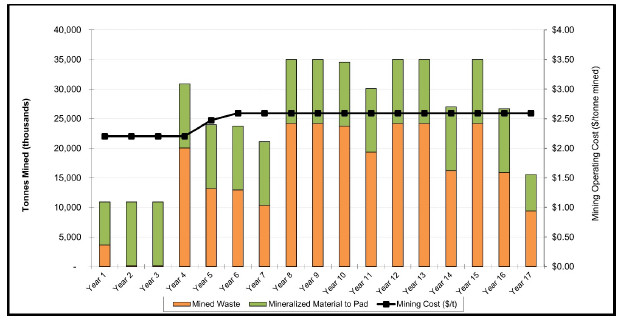
| 19-4 |
|
| Paramount Gold Nevada Corp. | Sleeper Gold Mine S-K 1300 Technical Report Summary |
June 17, 2026 SLR Project No.: 123.020721.00001 |
Figure 19-2: Process Production Profile and Head Grade – Base Case
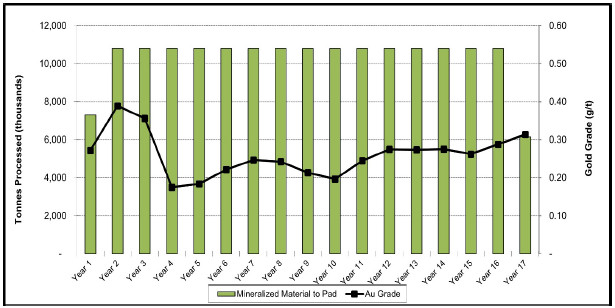
Figure 19-3: Annual Processing Gold Production and Head Grade Profile – Base Case
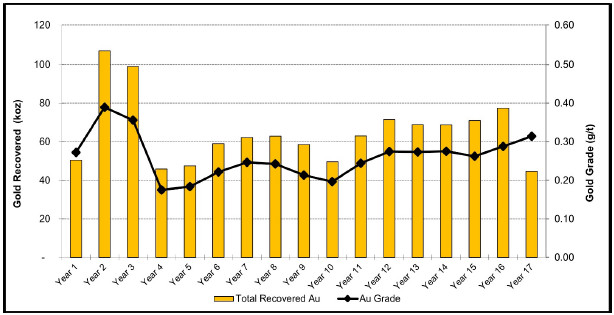
The economic analysis demonstrates that the Project’s Mineral Resources have reasonable prospects for economic extraction at the LOM net average realized prices of US$3,618/oz Au and US$48.70/oz Ag, and with long-term prices of US$3,600/oz Au and US$48.00/oz Ag, and that further advancement of Project studies is warranted.
A base discount rate of 8% has been applied in this TRS for the Project. This rate is considered reasonable for evaluating a precious metals project at a preliminary level of project definition, such as Sleeper. Discounted present values of annual cash flows are summed to arrive at the Mine’s Base Case NPV.
| 19-5 |
|
| Paramount Gold Nevada Corp. | Sleeper Gold Mine S-K 1300 Technical Report Summary |
June 17, 2026 SLR Project No.: 123.020721.00001 |
Considering the Project’s Base Case on a stand-alone basis, the Project’s pre-tax NPV at an 8% discount rate is approximately US$505 million, and the pre-tax internal rate of return (IRR) is approximately 51.3%. The Project’s after-tax NPV at an 8% discount is approximately US$402 million, the after-tax IRR is approximately 44.5%, and the payback period is approximately 1.4 years from the start of production.
The LOM undiscounted pre-tax cash flow totals approximately US$1,132 million, and the LOM undiscounted after-tax cash flow totals approximately US$918 million.
SLR has also run a stand-alone economic analysis for the Project using flat resource metal prices of US$3,100/oz Au and US$34/oz Ag, and the analysis demonstrates that the Project’s Mineral Resources also have reasonable prospects for economic extraction at these prices.
The Project’s after-tax free cash flow profile and gold payable metal per year are presented in Figure 19-4.
Figure 19-4: Base Case Project After-Tax Metrics Summary
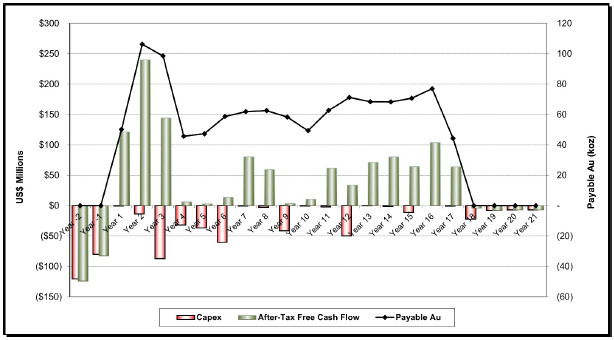
Table 19-4 shows the LOM total metrics for the Sleeper mine as currently designed. Due to the length of the mine life, the full annual cash flow model is presented in Appendix 2 Cash Flow Summaries.
Table 19-4: Total Life of Mine Metrics – Base Case
| Item | Units | Base Case Values | ||||||
| Realized Market Prices |
| |||||||
| Au Price |
US$ | /oz | $ | 3,618 | ||||
| Ag Price |
US$ | /oz | $ | 48.70 | ||||
| Payable Gold |
koz | 1,101 | ||||||
| Payable Silver |
koz | 3,376 | ||||||
| 19-6 |
|
| Paramount Gold Nevada Corp. | Sleeper Gold Mine S-K 1300 Technical Report Summary |
June 17, 2026 SLR Project No.: 123.020721.00001 |
| Item | Units | Base Case Values | ||||||
| Total Gross Revenue |
US$ | million | 4,147 | |||||
| Mining Cost |
US$ | million | (1,117 | ) | ||||
| Dewatering Costs |
US$ | million | (104 | ) | ||||
| Process Cost |
US$ | million | (974 | ) | ||||
| G & A Cost |
US$ | million | (92 | ) | ||||
| Refining/Freight |
US$ | million | (8 | ) | ||||
| Royalties |
US$ | million | (124 | ) | ||||
| Total Operating Costs |
US$ | million | (2,418 | ) | ||||
| Operating Margin (EBITDA) |
US$ | million | 1,728 | |||||
| Federal Income Tax |
US$ | million | (134 | ) | ||||
| State Tax—Nevada Mining Tax |
US$ | million | (80 | ) | ||||
| Working Capital |
US$ | million | 0 | |||||
| Operating Cash Flow |
US$ | million | 1,514 | |||||
| Development (Initial) Capital |
US$ | million | (201 | ) | ||||
| Sustaining Capital |
US$ | million | (343 | ) | ||||
| Closure/Reclamation Capital |
US$ | million | (52 | ) | ||||
| Total Capital |
US$ | million | (596 | ) | ||||
| Pre-tax Free Cash Flow |
US$ | million | 1,132 | |||||
| Pre-tax NPV @ 5% |
US$ | million | 670 | |||||
| Pre-tax NPV @ 8% |
US$ | million | 505 | |||||
| Pre-Tax IRR |
% | 51.3 | % | |||||
| Pre-Tax Payback |
years | 1.3 | ||||||
| After-tax Free Cash Flow |
US$ | million | 918 | |||||
| After-tax NPV @ 5% |
US$ | million | 539 | |||||
| After-tax NPV @ 8% |
US$ | million | 402 | |||||
| After-Tax IRR |
% | 44.5 | % | |||||
| After-Tax Payback |
years | 1.4 | ||||||
| Note: | Numbers may not add due to rounding. |
The Project’s World Gold Council Adjusted Operating Cost (AOC) net of Ag by-product credits is US$2,048/oz Au payable. The mine life sustaining capital costs are US$359/oz Au payable, for an All-in Sustaining Cost (AISC) net of Ag by-products credits of US$2,407/oz Au payable.
The average annual gold sales during operations are approximately 64,746 payable ounces. Table 19-5 shows the AISC build-up.
| 19-7 |
|
| Paramount Gold Nevada Corp. | Sleeper Gold Mine S-K 1300 Technical Report Summary |
June 17, 2026 SLR Project No.: 123.020721.00001 |
Table 19-5: Base Case All-in Sustaining Costs Composition
| Item | Total LOM ($ million) |
Unit Cost ($/oz Au) |
||||||
| Mining |
1,117 | 1,015 | ||||||
| Dewatering |
104 | 94 | ||||||
| Process |
974 | 885 | ||||||
| Site G&A |
92 | 83 | ||||||
|
|
|
|
|
|||||
| Subtotal Site Costs |
2,286 | 2,077 | ||||||
|
|
|
|
|
|||||
| Refining/Freight |
8 | 8 | ||||||
| Mining Royalties |
124 | 113 | ||||||
|
|
|
|
|
|||||
| Total Cash Costs before by-product credits |
2,418 | 2,197 | ||||||
|
|
|
|
|
|||||
| Ag By-Product Credit |
(164 | ) | (149 | ) | ||||
|
|
|
|
|
|||||
| Total Cash Costs net of by-product credits |
2,254 | 2,048 | ||||||
|
|
|
|
|
|||||
| Sustaining Capital Cost |
343 | 311 | ||||||
| Closure/Reclamation Costs |
52 | 48 | ||||||
|
|
|
|
|
|||||
| Total Sustaining Costs |
395 | 359 | ||||||
|
|
|
|
|
|||||
| Total All-in Sustaining Costs |
2,649 | 2,407 | ||||||
|
|
|
|
|
|||||
| Note: | Numbers may not add due to rounding. |
The AISC calculated in the cash flow analysis reflects the benefit of low-cost ounces already stacked on the heap leach pads, compared to AISC estimated in a steady-state model that assumes current input costs. Much of Sleeper’s near-term production comes from material mined and placed in prior years, when gold prices, fuel, and consumable costs were lower. These ounces require minimal additional spending to recover, resulting in lower realized cash costs. As these legacy ounces are depleted and replaced with newly mined material, unit costs are expected to gradually normalize toward long-term levels.
| 19.1.3 | Sensitivity Analysis |
The Project’s Base Case risks can be identified in both economic and non-economic terms. Key economic risks were examined by running cash flow sensitivities:
| • | Metal prices |
| • | Head grade |
| • | Metallurgical Recovery |
| • | Operating costs |
| • | Pre-production and sustaining capital costs |
| 19-8 |
|
| Paramount Gold Nevada Corp. | Sleeper Gold Mine S-K 1300 Technical Report Summary |
June 17, 2026 SLR Project No.: 123.020721.00001 |
Where possible, the after-tax NPV 8% sensitivities relative to the Base Case have been calculated for -20% to +20% variations in head grade and recovery, and -20% to +30% in metal prices. Operating and capital cost sensitivities have been calculated at -15% to +35% variations. The sensitivities are shown in Table 19-6 and Figure 19-5
Table 19-6: Base Case After-Tax Sensitivity Analyses
| Variance |
Head Grade (g/t Au) |
NPV at 8% (US$ 000) |
||||||
| 80% |
0.21 | 91,329 | ||||||
| 90% |
0.23 | 249,814 | ||||||
| 100% |
0.26 | 402,353 | ||||||
| 110% |
0.28 | 554,310 | ||||||
| 120% |
0.31 | 706,171 | ||||||
| Variance |
Recovery (% Au) |
NPV at 8% (US$ 000) |
||||||
| 80% |
60.7 | % | 91,329 | |||||
| 90% |
68.2 | % | 249,814 | |||||
| 100% |
75.8 | % | 402,353 | |||||
| 110% |
83.4 | % | 554,310 | |||||
| 120% |
91.0 | % | 706,171 | |||||
| Variance |
Metal Prices (US$/oz Au) |
NPV at 8% (US$ 000) |
||||||
| 80% |
$ | 2,880 | 90,637 | |||||
| 90% |
$ | 3,240 | 249,505 | |||||
| 100% |
$ | 3,600 | 402,353 | |||||
| 110% |
$ | 3,960 | 554,614 | |||||
| 131% |
$ | 4,700 | 866,553 | |||||
| Variance |
Operating Costs (US$/t) |
NPV at 8% (US$ 000) |
||||||
| 85% |
$ | 11.07 | 523,205 | |||||
| 93% |
$ | 12.05 | 462,780 | |||||
| 100% |
$ | 13.03 | 402,353 | |||||
| 118% |
$ | 15.31 | 259,020 | |||||
| 135% |
$ | 17.59 | 102,091 | |||||
| Variance |
Capital Costs (US$ 000) |
NPV at 8% (US$ 000) |
||||||
| 85% |
$ | 506,652 | 460,155 | |||||
| 93% |
$ | 551,357 | 431,254 | |||||
| 100% |
$ | 596,062 | 402,353 | |||||
| 118% |
$ | 700,372 | 334,916 | |||||
| 135% |
$ | 804,683 | 267,480 | |||||
| 19-9 |
|
| Paramount Gold Nevada Corp. | Sleeper Gold Mine S-K 1300 Technical Report Summary |
June 17, 2026 SLR Project No.: 123.020721.00001 |
Figure 19-5: Base Case After-Tax Sensitivity Analysis
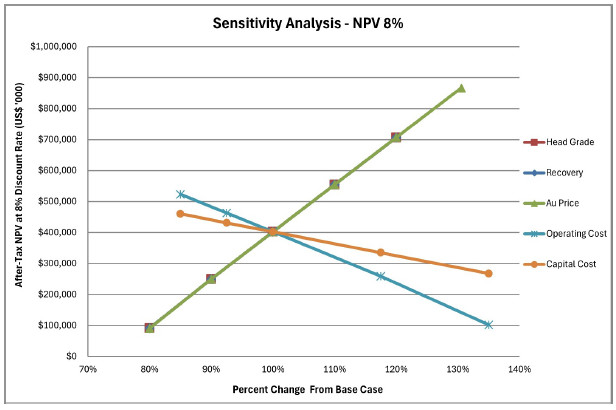
| 19.2 | Alternative Case—Measured and Indicated Only |
| 19.2.1 | Economic Criteria |
The Alternative Case assumes a production schedule based exclusively on Measured and Indicated Mineral Resources, resulting in a mineralized material inventory of 62.4 Mt and a projected mine life of seven years. A summary of the Measured and Indicated Only Case criteria is provided below.
| 19.2.1.1 | Revenue |
| • | Mine life: 7 years. |
| • | 30,000 tpd mineralized material stacked (approximately 10.8 Mt per year), average stacked grade of 0.27 g/t Au and silver grade of 3.83 g/t Ag (ROM, crushed, and stockpile mine plan). |
| • | Mine life averages 58,500 ounces per year of gold recovered and 200,000 ounces per year of silver recovered from the mine plan, with LOM stacked process gold recovery averaging 74.3% and silver recovery averaging 18.1%. |
| • | Total 410 koz of gold recovered, and 1,396 koz of silver recovered over the LOM operation. |
| • | Gold and silver payable at the refinery are assumed at 99.95% Au payable and 97% Ag payable |
| • | Gold and silver prices are based on analyst consensus price forecasts from the end of March 2026. For the economic analysis was assumed: |
| 19-10 |
|
| Paramount Gold Nevada Corp. | Sleeper Gold Mine S-K 1300 Technical Report Summary |
June 17, 2026 SLR Project No.: 123.020721.00001 |
| • | Y1: US$4,000/oz Au and US$59.00/oz Ag |
| • | Y2 to Y7: US$3,600/oz Au and US$48.00/oz Ag |
| • | Resulting in LOM net realized prices of:US$3,622/oz Au and US$48.00/oz Ag |
| • | Net Smelter Return (NSR) includes doré refining, transport, and insurance costs. |
| • | NSR royalty assumed at 3%. The property is subject to different royalties between 0.5% and 3%, and for modeling purposes was assumed at an overall 3% |
| • | Revenue is recognized at the time of gold and silver production. |
| • | Non-cash inventory adjustments are not included in the SLR cash flow model. |
| • | LOM net revenue is US$1,493 million (after royalty, and transportation, and refining charges). |
Table 19-7: Sleeper Alternative Case Production Physicals Summary
| Physicals | Value | |||
| Total Mineralized Material Stacked (kt) |
62,447 | |||
| Max Process Rate (tpd) |
30,000 | |||
| Au Head Grade (g/t) |
0.27 | |||
| Ag Head Grade (g/t) |
3.83 | |||
| Contained Au (koz) |
552 | |||
| Contained Ag (koz) |
7,697 | |||
| Average Recovery, Au |
74.3 | % | ||
| Average Recovery, Ag |
18.1 | % | ||
| Recovered Au (koz) |
410 | |||
| Recovered Ag (koz |
1,396 | |||
| Payable Au (koz) |
408 | |||
| Payable Ag (koz) |
1,354 | |||
| Avg Annual Au Sales-LOM (koz / yr) – full production |
64 | |||
| Avg Annual Ag Sales-LOM (koz / yr) – Full production |
218 | |||
| 19.2.1.2 | Costs |
| • | Pre-production period assumes at 24 months (Year -1 to Year -2). |
| • | Initial (Growth) and development capital costs total US$335 million.2 |
| • | Mine life sustaining capital totals US$120 million |
| • | Final reclamation costs from after year 7 total US$18.7 million. |
| • | Mine life capital totals US$473 million. |
| 2 | Note that, in the Alternative Case, only in situ Measured and Indicated Mineral Resources are included in the mining inventory. The existing waste dumps are not included in the LOM plan for the Alternative Case because they are currently classified as Inferred Mineral Resources. As dewatering of the in situ Mineral Resources must start before mining, the rapid infiltration basins cost and the dewatering costs are Initial Capital Costs for the Alternative Case rather than Sustaining Capital as in the Base Case. |
| 19-11 |
|
| Paramount Gold Nevada Corp. | Sleeper Gold Mine S-K 1300 Technical Report Summary |
June 17, 2026 SLR Project No.: 123.020721.00001 |
| • | Average LOM operating cost is US$11.87 per tonne stacked. |
| • | Open pit operating costs of US$2.59 per tonne mined (US$5.03 per tonne stacked). Includes out-of-scope mining operations. |
| • | Dewatering operating costs of US$0.73 per tonne stacked. |
| • | Processing operating costs of US$5.55 per tonne stacked. |
| • | Site services & general and administrative (G&A) costs of US$5.6 million per year for years of full production (LOM average of US$0.56 per tonne stacked). |
| 19.2.1.3 | Taxation and Royalties |
The federal and state income taxes are summarized in Table 19-8
Table 19-8: Federal and State Tax Summary
| Tax Type |
Rate | |
| Federal Corporate Income Tax | 21.0% | |
| Nevada Corporate Income Tax | 5.0% of federal taxable income | |
| Royalties and Severance Fees | Based on ore extracted (state-regulated). |
A total of five NSR royalties apply to future mineral production from portions of the Project. These royalties are summarized in Table 19-9.
Table 19-9: Royalties Summary
| Royalty Holder |
Royalty Terms | |
| Snyder Syndicate | 1% NSR on the 1,044 Sleeper Gold Mine claims (All claims, EXCEPT for ALL MIMI, ALL SP, AL SS, AND ALL BLUE.) | |
| Franco-Nevada U.S. Corporation | 2% NSR on minerals produced from all 2,474 claims | |
| Evolving Gold / Quinton Hennigh | 2% NSR royalty on all SS and all SP claims. | |
| Dry Lake Placer Association | 3% NSR on Dry Lake Placer claims | |
| ICN Resources Ltd. | 0.5% NSR on all SS and all SP claims; 1.5% NSR on all Blue claims |
For the economic analysis and financial modeling purposes, an overall 3% NSR royalty rate was assumed over the LOM.
| 19.2.2 | Cash Flow Analysis |
SLR has prepared its own unlevered after-tax LOM cash flow model based on the information contained in this TRS to confirm the physical and economic parameters of the Project.
The Project’s Alternative Case economics have been evaluated using the discounted cash flow method, considering annual processed tonnages and the associated gold and silver grades. The process gold and silver recoveries, gold and silver price forecasts, operating costs, refining and transportation charges, royalties, and initial and sustaining capital expenditures were also considered.
| 19-12 |
|
| Paramount Gold Nevada Corp. | Sleeper Gold Mine S-K 1300 Technical Report Summary |
June 17, 2026 SLR Project No.: 123.020721.00001 |
The Project, as currently designed, has variations in the mining and processing amounts over its planned 7-year life. These variations are shown in Figure 19-6, Figure 19-7, and Figure 19-8.
Figure 19-6: Mine Production Profile by Material Movement – Alternative Case
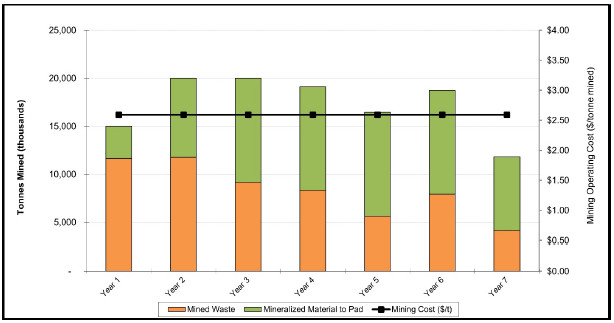
Figure 19-7: Process Production Profile and Head Grade – Alternative Case
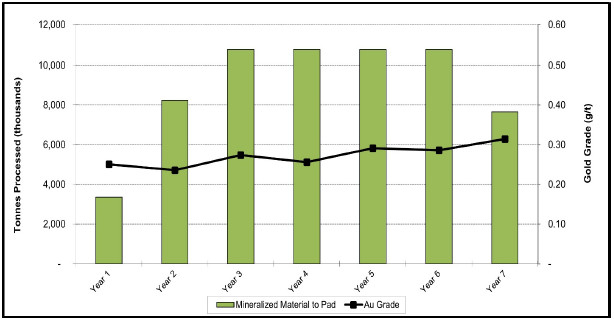
| 19-13 |
|
| Paramount Gold Nevada Corp. | Sleeper Gold Mine S-K 1300 Technical Report Summary |
June 17, 2026 SLR Project No.: 123.020721.00001 |
Figure 19-8: Annual Processing Gold Production and Head Grade Profile
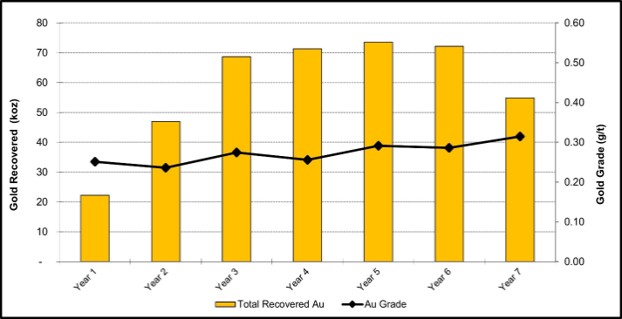
The economic analysis demonstrates that the Project’s Mineral Resources have reasonable prospects for economic extraction, at the LOM net average realized prices of US$3,622/oz Au and US$48.40/oz Ag, with long-term prices of US$3,600/oz Au and US$48.00/oz Ag, and that further advancement of Project studies is warranted.
A base discount rate of 8% has been applied in this TRS for the Project. This rate is considered reasonable for evaluating a precious metals project at a preliminary level of project definition, such as Sleeper. Discounted present values of annual cash flows are summed to arrive at the Mine’s Base Case NPV.
Considering the Project’s Alternative Case on a stand-alone basis, the Project’s pre-tax NPV at an 8% discount rate is approximately US$59 million, and the pre-tax internal rate of return (IRR) is approximately 11.5%. The Project’s after-tax NPV at an 8% discount is approximately US$31 million, the after-tax IRR is approximately 9.9%, and the payback period is approximately 4.9 years from the start of production.
The LOM undiscounted pre-tax cash flow totals approximately US$279 million, and the LOM undiscounted after-tax cash flow totals approximately US$232 million.
The Project’s after-tax free cash flow profile and gold payable metal per year are presented in Figure 19-9.
| 19-14 |
|
| Paramount Gold Nevada Corp. | Sleeper Gold Mine S-K 1300 Technical Report Summary |
June 17, 2026 SLR Project No.: 123.020721.00001 |
Figure 19-9: Alternative Case Project After-Tax Metrics Summary
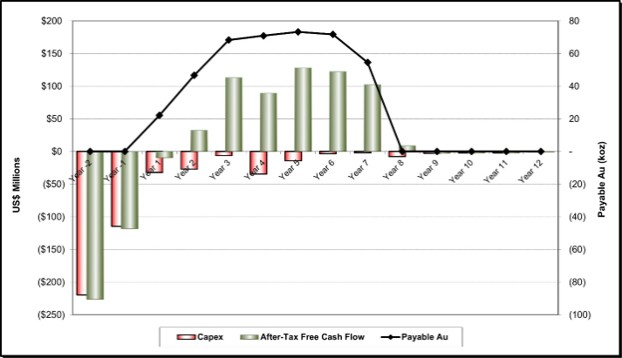
Table 19-10 shows the LOM total metrics for the Project’s Alternative Case. The full annual cash flow model is presented in Appendix 2 Cash Flow Summaries.
Table 19-10: Total Life of Mine Metrics – Alternative Case (Measured and Indicated Only)
| Item |
Units | Base Case Values | ||||
| Realized Market Prices |
| |||||
| Au Price |
US$/oz | $ | 3,622 | |||
| Ag Price |
US$/oz | $ | 48.40 | |||
| Payable Gold |
koz | 408 | ||||
| Payable Silver |
koz | 1,354 | ||||
|
|
|
|||||
| Total Gross Revenue |
US$ million | 1,542 | ||||
|
|
|
|||||
| Mining Cost |
US$ million | (314 | ) | |||
| Dewatering Costs |
US$ million | (45 | ) | |||
| Process Cost |
US$ million | (347 | ) | |||
| G & A Cost |
US$ million | (35 | ) | |||
| Refining/Freight |
US$ million | (3 | ) | |||
| Royalties |
US$ million | (46 | ) | |||
|
|
|
|||||
| Total Operating Costs |
US$ million | (790 | ) | |||
|
|
|
|||||
| Operating Margin (EBITDA) |
US$ million | 752 | ||||
| Federal Income Tax |
US$ million | (12 | ) | |||
| 19-15 |
|
| Paramount Gold Nevada Corp. | Sleeper Gold Mine S-K 1300 Technical Report Summary |
June 17, 2026 SLR Project No.: 123.020721.00001 |
| Item |
Units |
Base Case Values |
||||
| State Tax - Nevada Mining Tax |
US$ million | (34 | ) | |||
| Working Capital |
US$ million | 0 | ||||
| Operating Cash Flow |
US$ million | 705 | ||||
| Development (Initial) Capital |
US$ million | (335 | ) | |||
| Sustaining Capital |
US$ million | (120 | ) | |||
| Closure/Reclamation Capital |
US$ million | (19 | ) | |||
|
|
|
|||||
| Total Capital |
US$ million | (473 | ) | |||
|
|
|
|||||
| Pre-tax Free Cash Flow |
US$ million | 279 | ||||
| Pre-tax NPV @ 5% |
US$ million | 124 | ||||
|
|
|
|||||
| Pre-tax NPV @ 8% |
US$ million | 59 | ||||
|
|
|
|||||
| Pre-Tax IRR |
% | 11.5 | % | |||
| Pre-Tax Payback |
years | 4.7 | ||||
| After-tax Free Cash Flow |
US$ million | 232 | ||||
| After-tax NPV @ 5% |
US$ million | 91 | ||||
|
|
|
|||||
| After-tax NPV @ 8% |
US$ million | 31 | ||||
|
|
|
|||||
| After-Tax IRR |
% | 9.9 | % | |||
| After-Tax Payback |
years | 4.9 | ||||
Note: Numbers may not add due to rounding.
The Project’s World Gold Council Adjusted Operating Cost (AOC) net of Ag by-product credits is US$1,778/oz Au payable. The mine life sustaining capital costs are US$339/oz Au payable, for an All-in Sustaining Cost (AISC) net of Ag by-products credits of US$2,117/oz Au payable.
The average annual gold sales during operations are approximately 64,267 payable ounces.
Table 19-11 shows the AISC build-up.
Table 19-11: Alternative Case All-in Sustaining Costs Composition
| Item |
Total LOM ($ million) |
Unit Cost ($/oz Au) |
||||||
| Mining |
314 | 770 | ||||||
| Dewatering |
45 | 111 | ||||||
| Process |
347 | 850 | ||||||
| Site G&A |
35 | 86 | ||||||
|
|
|
|
|
|||||
| Subtotal Site Costs |
741 | 1,817 | ||||||
|
|
|
|
|
|||||
| 19-16 |
|
| Paramount Gold Nevada Corp. | Sleeper Gold Mine S-K 1300 Technical Report Summary |
June 17, 2026 SLR Project No.: 123.020721.00001 |
| Item |
Total LOM ($ million) |
Unit Cost ($/oz Au) |
||||||
| Refining/Freight |
3 | 8 | ||||||
| Mining Royalties |
46 | 113 | ||||||
|
|
|
|
|
|||||
| Total Cash Costs before by-product credits |
790 | 1,938 | ||||||
|
|
|
|
|
|||||
| Ag By-Product Credit |
(65 | ) | (161 | ) | ||||
|
|
|
|
|
|||||
| Total Cash Costs net of by-product credits |
725 | 1,778 | ||||||
|
|
|
|
|
|||||
| Sustaining Capital Cost |
120 | 293 | ||||||
| Closure/Reclamation Costs |
19 | 46 | ||||||
| Total Sustaining Costs |
138 | 339 | ||||||
|
|
|
|
|
|||||
| Total All-in Sustaining Costs |
863 | 2,117 | ||||||
|
|
|
|
|
|||||
Note: Numbers may not add due to rounding.
| 19.2.3 | Sensitivity Analysis |
The project’s Alternative Case risks can be identified in both economic and non-economic terms. Key economic risks were examined by running cash flow sensitivities:
| • | Metal prices |
| • | Head grade |
| • | Metallurgical Recovery |
| • | Operating costs |
| • | Pre-production and sustaining capital costs |
Where possible, the after-tax NPV 8% sensitivities relative to the Alternative Case have been calculated for -20% to +20% variations in head grade and recovery, and -20% to +30% in metal prices. Operating and capital cost sensitivities have been calculated at -15% to +35% variations. The sensitivities are shown in Table 19-12 and Figure 19-10.
| 19-17 |
|
| Paramount Gold Nevada Corp. | Sleeper Gold Mine S-K 1300 Technical Report Summary |
June 17, 2026 SLR Project No.: 123.020721.00001 |
Table 19-12: Alternative Case After-Tax Sensitivity Analyses
| Variance |
Head Grade (g/t Au) |
NPV at 8% (US$000) | ||
| 80% |
0.22 | (140,512) | ||
| 90% |
0.25 | (54,187) | ||
| 100% |
0.27 | 31,106 | ||
| 110% |
0.30 | 106,275 | ||
| 120% |
0.33 | 180,559 | ||
| Variance |
Recovery (% Au) |
NPV at 8% (US$000) | ||
| 80% |
59.4% | (140,512) | ||
| 90% |
66.9% | (54,187) | ||
| 100% |
74.3% | 31,106 | ||
| 110% |
81.7% | 106,275 | ||
| 120% |
89.2% | 180,559 | ||
| Variance |
Metal Prices (US$/oz Au) |
NPV at 8% (US$000) | ||
| 80% |
$2,880 | (140,868) | ||
| 90% |
$3,240 | (54,363) | ||
| 100% |
$3,600 | 31,106 | ||
| 110% |
$3,960 | 106,424 | ||
| 131% |
$4,700 | 258,552 | ||
| Variance |
Operating Costs (US$/t) |
NPV at 8% (US$000) | ||
| 85% |
$10.09 | 87,662 | ||
| 93% |
$10.98 | 59,481 | ||
| 100% |
$11.87 | 31,106 | ||
| 118% |
$13.94 | (44,879) | ||
| 135% |
$16.02 | (122,212) | ||
| Variance |
Capital Costs (US$000) |
NPV at 8% (US$000) | ||
| 85% |
$401,924 | 90,847 | ||
| 93% |
$437,387 | 60,977 | ||
| 100% |
$472,851 | 31,106 | ||
| 118% |
$555,600 | (38,591) | ||
| 135% |
$638,349 | (108,288) | ||
| 19-18 |
|
| Paramount Gold Nevada Corp. | Sleeper Gold Mine S-K 1300 Technical Report Summary |
June 17, 2026 SLR Project No.: 123.020721.00001 |
Figure 19-10: Alternative Case After-Tax Sensitivity Analysis
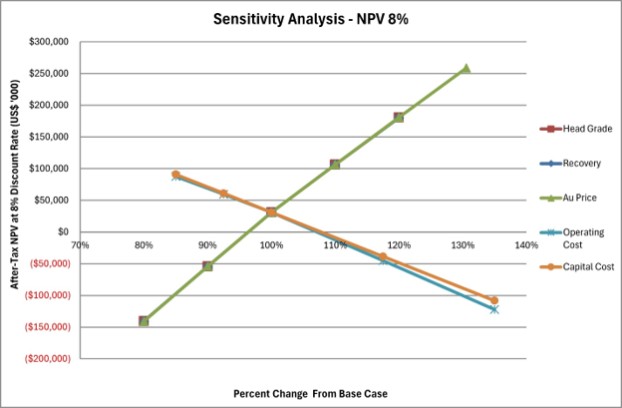
| 19-19 |
|
| Paramount Gold Nevada Corp. | Sleeper Gold Mine S-K 1300 Technical Report Summary |
June 17, 2026 SLR Project No.: 123.020721.00001 |
| 20.0 | Adjacent Properties |
The Project is located within the Sleeper Mining District of Humboldt County, Nevada, an area that hosts several past-producing precious-metal deposits and active exploration properties.
Several exploration properties occur within a 10 km radius of the Project, targeting similar epithermal mineralization hosted in Miocene volcanic rocks. Historical exploration programs in the district have included geologic mapping, geochemical sampling, geophysical surveys, and drilling.
Publicly available information indicates that these adjacent properties host epithermal gold-silver mineralization genetically related to regional volcanic and structural systems.
The SLR QP has not independently verified this information, and this information is not necessarily indicative of the mineralization at the Sleeper Gold Project.
| 20-1 |
|
| Paramount Gold Nevada Corp. | Sleeper Gold Mine S-K 1300 Technical Report Summary |
June 17, 2026 SLR Project No.: 123.020721.00001 |
| 21.0 | Other Relevant Data and Information |
| 21.1 | Sleeper PFS - Project Overview and Execution Philosophy |
The Project Execution Plan (PEP) defines the strategy for advancing the Project from the current S-K 1300 IA stage through Pre-Feasibility Study (PFS), permitting, construction, and into operations. The development scenario evaluated in the IA consists of a 30,000 tpd open pit mining operation feeding a probable processing scenario comprising a crush–agglomerate–heap-leach process with Merrill-Crowe recovery.
The scope of the IA, and therefore this PEP, is limited to the reprocessing of waste dump material and the mining of in situ oxide and mixed mineralization. Processing will occur on a single-use heap leach pad designed in accordance with Nevada regulatory requirements.
The execution philosophy is based on a practical and capital-efficient restart strategy, incorporating the following principles:
| • | Low initial capital intensity with contractor mining and modular process infrastructure. This approach minimizes upfront fleet purchases and reduces financing requirements during early project development. |
| • | Immediate advancement to a PFS, with overlapping technical, environmental, and permitting workstreams to accelerate the overall project schedule. |
| • | Maximizing the use of existing disturbed areas, including waste rock dumps and previously impacted process areas, to streamline permitting and reduce environmental footprint. |
| • | Parallel advancement of engineering, metallurgical test work, and environmental baseline programs to avoid sequential delays. |
| • | Maintaining optionality for future expansion, including potential treatment of sulfide material under a separate development scenario. |
| 21.2 | Project Development Strategy |
| 21.2.1 | Development Pathway |
The Project will advance through a structured, but overlapping, series of development phases designed to minimize schedule duration while maintaining technical rigor:
| • | PFS Phase (Immediate Initiation): Comprehensive technical evaluation, including updated mine planning, metallurgical test work, cost estimation, and trade-off studies. |
| • | Permitting and Baseline Study Advancement: Collection of environmental baseline data and preparation of regulatory submissions. This phase represents the Project’s critical path. |
| • | Definitive Engineering: Advancement of engineering design to a level sufficient to support construction, procurement, and cost certainty. |
| • | Early Works and Site Preparation: Initial site activities, including relocation of existing infrastructure, earthworks, and utility installation. |
| • | Construction and Commissioning: Development of process facilities, heap leach pad, ponds, and supporting infrastructure, followed by commissioning. |
| 21-1 |
|
| Paramount Gold Nevada Corp. | Sleeper Gold Mine S-K 1300 Technical Report Summary |
June 17, 2026 SLR Project No.: 123.020721.00001 |
| • | Ramp-up to Steady-State Operations: Progressive increase to the design throughput of approximately 30,000 tpd. |
The Company intends to initiate the PFS immediately and pursue an execution strategy targeting first production approximately 24 months from initiation, subject to permitting timelines and technical outcomes.
| 21.3 | Workstreams and Scope of Activities |
| 21.3.1 | Geological, Resource, and Drilling Programs |
A comprehensive drilling and sampling program will be implemented to support resource confidence, metallurgical characterization, and engineering design. The program is designed to address both waste dump material and in situ oxide and mixed mineralization.
Key programs are listed:
| • | Sonic and reverse circulation (RC) drilling of waste dumps, TSF, and heap leach pads to characterize grade distribution, material variability, and bulk density. |
| • | RC drilling of in situ oxide and mixed material to support resource classification upgrades and mine planning. |
| • | Twin drilling and QA/QC validation to confirm historical data reliability and ensure compliance with reporting standards. |
| • | Bulk sampling to provide representative material for metallurgical test work and variability analysis of waste dumps, heap leach pads and TSF. |
The outputs of these programs will support updates to the Mineral Resource Estimate, development of a geometallurgical model, and refinement of mine planning inputs for the PFS.
| 21.3.2 | Metallurgical Test Work |
Metallurgical test work is a critical component of technical risk reduction, particularly given the presence of mixed oxides and transition materials, as well as reprocessed waste rock dumps.
The metallurgical program will include the following:
| • | Bottle roll testing across all defined material domains to establish baseline recoveries and reagent consumption. |
| • | Column leach testing at multiple crush sizes to evaluate heap leach performance and optimize particle size distribution. |
| • | Agglomeration optimization to improve permeability and leach kinetics for fine-grained or clay-rich materials. |
| • | Permeability testing to assess heap stability and solution flow characteristics. |
| • | Cyanide consumption and reagent optimization to define operating cost inputs. |
| • | Gold and silver recovery variability testing to establish recovery models by domain. |
| • | Evaluation of gravity recovery potential, where applicable. |
Deliverables will include recovery models by domain, heap leach design criteria, reagent consumption forecasts, and inputs for operating cost estimation.
| 21-2 |
|
| Paramount Gold Nevada Corp. | Sleeper Gold Mine S-K 1300 Technical Report Summary |
June 17, 2026 SLR Project No.: 123.020721.00001 |
| 21.3.3 | Mining and Production Planning |
Mining operations will be executed by a contractor to minimize initial capital requirements and provide operational flexibility during the early years of production.
Key components of the mining plan include:
| • | Open pit optimization and shell selection based on updated economic and metallurgical inputs. |
| • | Mine sequencing to prioritize oxide and mixed material and optimize cash flow. |
| • | Waste dump reclaim sequencing integrated with in situ mining operations. |
| • | Haulage design, including process feed haul distances of approximately 1.5 km to 4.5 km and waste haul distances of approximately 2.5 km. |
| • | Development of a production schedule supporting approximately 30,000 tpd of material processing. |
The mining contractor is expected to supply and operate a fleet comprising 150 t to 200 t class haul trucks, hydraulic excavators, loaders, and support equipment. The Owner’s team will provide oversight, grade control, and reconciliation.
| 21.3.4 | Process Design and Infrastructure |
The process flowsheet is based on conventional and well-established technologies suitable for oxide and mixed gold mineralization.
Process plant components include:
| • | Primary crushing to achieve the target particle size for heap leaching. |
| • | Agglomeration, if required, to improve heap permeability and recovery. |
| • | Heap leach stacking using conveyor or truck stacking systems. |
| • | Solution management systems, including pregnant and barren solution circuits. |
| • | Merrill-Crowe recovery plant for gold and silver extraction. |
| • | Refining facilities for doré production. |
Infrastructure components include:
| • | Single-use heap leach pad designed with double-liner systems consistent with Nevada regulatory requirements. |
| • | Solution ponds, including pregnant, barren, and stormwater ponds. |
| • | Recovery/Merrill-Crowe processing facilities. |
| • | Power supply infrastructure, which may include grid connection or hybrid systems. |
| • | Water supply and distribution systems. |
| • | Maintenance facilities, including relocation of the existing truck shop affected by pit expansion. |
| • | Site access roads, haul roads, and support infrastructure. |
| 21-3 |
|
| Paramount Gold Nevada Corp. | Sleeper Gold Mine S-K 1300 Technical Report Summary |
June 17, 2026 SLR Project No.: 123.020721.00001 |
| 21.3.5 | Water Management and Dewatering |
SLR considers water management to be a key operational and permitting consideration for the Project. A comprehensive program will be implemented to define water availability, manage process water, and ensure compliance with regulatory requirements.
Key components include:
| • | Groundwater baseline data collection and pump testing to define aquifer characteristics. |
| • | Development of a groundwater model to support dewatering design and water balance calculations. |
| • | Evaluation of pit dewatering and discharge requirements. |
| • | Preparation of a detailed process water balance. |
| • | Design of heap leach solution management systems, including containment and recycling. |
| • | Stormwater management systems to control runoff and protect water quality. |
Water supply is expected to be sourced from a combination of groundwater and recycled process water, subject to permitting and availability.
| 21.3.6 | Environmental Baseline and Permitting |
Permitting represents the critical path for Project development and will be advanced in parallel with technical studies.
The anticipated environmental baseline studies that will be required are listed:
| • | Surface water quality and hydrology. |
| • | Groundwater quality and levels. |
| • | Air quality and emissions. |
| • | Flora and fauna surveys. |
| • | Cultural and archaeological resource assessments. |
| • | Geochemical characterization, including acid rock drainage and metal leaching potential. |
| • | Meteorological data collection. |
The permitting strategy includes the following steps.
| • | Submission of a Notice of Intent (NOI) to the BLM. |
| • | Advancement through the EA process, or EIS process if required. |
| • | Modification of existing Plans of Operations and permits. |
| • | Coordination with relevant agencies, including the BLM, NDEP, and Nevada Division of Water Resources. |
A key advantage of the Project is that existing disturbance areas, including waste rock dumps, heap leach pads, and tailings storage facilities, remain bonded and permitted. This condition is expected to facilitate a brownfields redevelopment pathway and reduce permitting complexity.
| 21-4 |
|
| Paramount Gold Nevada Corp. | Sleeper Gold Mine S-K 1300 Technical Report Summary |
June 17, 2026 SLR Project No.: 123.020721.00001 |
| 21.3.7 | Project Organization and Execution Model |
| 21.3.7.1 | Execution Model |
The Project will be executed using a combination of Owner’s team oversight, contractor execution, and specialist consulting support.
| • | Owner’s Team: Responsible for overall project management, technical oversight, permitting coordination, and stakeholder engagement. |
| • | EPCM/EPC Contractor: Responsible for engineering, procurement, and construction management or execution. |
| • | Mining Contractor: Responsible for all mining operations, including drilling, blasting, loading, and hauling. |
| • | Specialist Consultants: Provide expertise in metallurgy, geotechnical engineering, environmental studies, and hydrogeology. |
| 21.3.7.2 | Staffing Philosophy |
The staffing approach will be scaled to the project phase:
| • | Lean Owner’s team during PFS and early development. |
| • | Increased staffing during construction and commissioning. |
| • | Transition to steady-state operational staffing levels during production. |
No on-site camp is required, as the Project will utilize a local or regional workforce.
| 21.4 | Schedule and Critical Path |
| 21.4.1 | Overall Timeline |
The Project schedule is structured to allow overlapping activities and accelerated development:
| • | PFS initiation: Immediate. |
| • | Permitting and baseline data collection: Approximately 12 to 36 months. |
| • | Engineering and procurement: Approximately 12 to 18 months, overlapping with permitting. |
| • | Construction: Approximately 9 to 12 months. |
| • | Commissioning and ramp-up: Several months following construction completion. |
The target for first gold production is approximately 24 months from project initiation, subject to permitting approvals and technical validation.
| 21-5 |
|
| Paramount Gold Nevada Corp. | Sleeper Gold Mine S-K 1300 Technical Report Summary |
June 17, 2026 SLR Project No.: 123.020721.00001 |
| 21.4.2 | Critical Path Elements |
The primary critical path elements include:
| • | Completion of environmental baseline data collection. |
| • | Progression through the BLM permitting process, including NOI submission, EA/EIS preparation, and Record of Decision. |
| • | Water rights acquisition and discharge permitting. |
| • | Resolution of metallurgical variability and confirmation of recovery assumptions. |
| 21.5 | Procurement and Contracting Strategy |
| 21.5.1 | Mining |
Mining will be conducted by a contractor under a unit-rate contract, typically expressed in US dollars per cubic meter of mined material. Contracts will include provisions for standard mining activities and rate schedules for out-of-scope work.
| 21.5.2 | Process and Infrastructure |
Major process equipment and infrastructure components will be procured through competitive bidding processes. Key items include crushers, Merrill-Crowe plant components, pumps, and piping systems.
Anticipated bulk consumables and services contracts and agreements are listed:
| • | Diesel fuel supply contracts |
| • | Cyanide supply agreements |
| • | Lime and other reagents |
| • | Grinding media, if required |
| 21.5.3 | Refining and Sales |
Gold and silver doré will be transported to third-party refineries under standard industry contracts. Transportation, security, and refining arrangements will be structured to align with industry norms. The potential use of hedging or forward sales will be evaluated during the PFS.
| 21.6 | Sulfide Mineralization – Future Work Programs |
Although sulfide mineralization is included within the Mineral Resource inventory, it is explicitly excluded from the economic analysis presented in this Initial Assessment. The sulfide material represents a potential future development opportunity; however, additional technical studies, test work, and engineering are required to determine an appropriate processing pathway and economic viability. Sulfides have been identified in the heap leach pads, the TSF, and are found in the in situ material.
The following work programs are recommended to advance understanding of sulfide mineralization and support future evaluation:
| 21-6 |
|
| Paramount Gold Nevada Corp. | Sleeper Gold Mine S-K 1300 Technical Report Summary |
June 17, 2026 SLR Project No.: 123.020721.00001 |
| 21.6.1 | Geological and Resource Definition |
Additional drilling and geological modeling will be required to improve confidence in the sulfide Mineral Resources and support potential conversion to higher confidence categories. Key activities include:
| • | Infill drilling to improve spatial continuity and grade confidence within sulfide domains. |
| • | Extension drilling to evaluate down-dip and along-strike mineralization potential. |
| • | Detailed geological modeling to refine lithological, structural, and alteration controls on sulfide mineralization. |
| • | Density measurements and validation to support tonnage estimates. |
These efforts will support a future Mineral Resource update and will be instrumental in the conversion to Mineral Reserves and provide a foundation for mine planning studies specific to sulfide material.
| 21.6.2 | Metallurgical Test Work |
Sulfide mineralization at Sleeper is not amenable to conventional heap leaching and will require alternative processing methods. A staged metallurgical program is required to evaluate viable treatment options.
Recommended test work includes:
| • | Mineralogical and deportment studies to define gold association (e.g., refractory vs. free milling components). |
| • | Gravity concentration studies. |
| • | Flotation testing to evaluate concentrate grade, recovery, and mass pull. |
| • | Diagnostic leach testing to assess gold liberation characteristics. |
| • | Evaluation of oxidation processes, including pressure oxidation (POX), bio-oxidation, or roasting, where applicable. |
| • | Cyanidation testing of flotation concentrates and/or oxidized products. |
The objective of this program is to identify a technically viable and economically competitive flowsheet for sulfide processing.
| 21.6.3 | Process and Infrastructure Trade-Off Studies |
Development of sulfide mineralization will require significant additional infrastructure compared to the oxide heap-leach scenario. Trade-off studies should evaluate:
| • | Standalone sulfide processing facility versus integration with existing oxide infrastructure. |
| • | Processing options, gravity concentration circuit, including flotation with concentrate sale, flotation with on-site oxidation, or whole ore processing. |
| • | Consideration of POX Toll Mill for flotation concentrate |
| • | Capital and operating cost implications of each processing route. |
| • | Power requirements and supply options for high-energy processing circuits. |
| • | Water demand and additional permitting requirements. |
These studies will define the preferred development pathway and associated capital intensity.
| 21-7 |
|
| Paramount Gold Nevada Corp. | Sleeper Gold Mine S-K 1300 Technical Report Summary |
June 17, 2026 SLR Project No.: 123.020721.00001 |
| 21.7 | Risk Management |
| 21.7.1 | Key Risks |
Key project risks are listed:
| • | Metallurgical variability, particularly within transition material |
| • | Permitting delays or regulatory challenges |
| • | Water availability and water management (dewatering) constraints |
| • | Contractor performance and productivity |
| • | Cost escalation for fuel, reagents, and construction materials |
| 21.7.2 | Mitigation Measures |
Risk mitigation strategies include the following:
| • | Early and comprehensive metallurgical testing across all material types |
| • | Parallel advancement of permitting and engineering activities |
| • | Use of conservative design assumptions and contingency allowances |
| • | Engagement of experienced contractors with Nevada operating experience |
| • | Inclusion of appropriate contingency in capital and operating cost estimates |
| 21.7.3 | Capital Efficiency Strategy |
The Project has been designed to minimize initial capital requirements while maintaining operational flexibility. Key elements of this strategy are listed:
| • | Use of contractor mining to eliminate the need for owner-purchased mining fleet. |
| • | Development within existing disturbed areas to reduce earthworks and permitting requirements. |
| • | Modular process plant design to allow phased expansion. |
| • | Deferral of major capital expenditures associated with sulfide processing. |
| 21.7.4 | Transition to Pre-Feasibility Study (PFS) |
The PFS will build upon the IA and refine all technical and economic assumptions. The study will upgrade cost estimates to an AACE Class 4 level, with an expected accuracy range of approximately minus 25 percent to plus 25 percent.
Key PFS deliverables will include the following:
| • | Development and geotechnical drilling, assaying, and metallurgical test work. |
| • | Updated mine plan and production schedule. |
| • | Refined metallurgical recovery models. |
| • | Detailed capital and operating cost estimates. |
| • | Permitting plan and status updates. |
| • | Comprehensive set of trade off studies, yet to be defined. |
| • | Economic analysis, including net present value and internal rate of return. |
| 21-8 |
|
| Paramount Gold Nevada Corp. | Sleeper Gold Mine S-K 1300 Technical Report Summary |
June 17, 2026 SLR Project No.: 123.020721.00001 |
| 21.7.5 | Mining and Scheduling Considerations |
Future development of sulfide material will require integration into the overall mine plan. Key considerations include:
| • | Sequencing oxide and sulfide material to optimize project economics. |
| • | Potential stockpiling strategies for sulfide material during oxide operations. |
| • | Evaluation of cut-off grades specific to sulfide processing costs and recoveries. |
| • | Impact on strip ratio and overall mine life. |
These factors will be incorporated into future mine planning studies.
| 21.7.6 | Environmental and Permitting Requirements |
Processing of sulfide mineralization will likely introduce additional environmental considerations and permitting requirements, including:
| • | Expanded process facilities and tailings storage requirements. |
| • | Increased water usage and potential discharge considerations. |
| • | Additional air quality permitting, particularly for oxidation processes. |
| • | Enhanced geochemical characterization to assess acid rock drainage and metal leaching potential. |
Early engagement with regulatory agencies is recommended to define permitting pathways and timelines for sulfide development.
| 21.7.7 | Future Sulfide Study Pathway |
Advancement of sulfide mineralization is expected to follow a staged study approach, including:
| • | Scoping-level evaluation of processing options and economics. |
| • | Pre-Feasibility Study (PFS) specific to sulfide development, if warranted. |
| • | Feasibility Study (FS) and detailed engineering following confirmation of economic viability. |
The sulfide resource represents a longer-term opportunity that could materially extend mine life and increase total metal production; however, it is associated with higher capital intensity and greater technical complexity than the oxide heap leach operation.
| 21.8 | Conclusion |
The Project PEP outlines a practical and efficient pathway to develop the Project through the reprocessing of waste rock dumps and the mining of oxide and mixed material using heap-leach technology. The strategy leverages existing site conditions, proven processing methods, and contractor-based mining to reduce capital intensity and accelerate development.
Permitting remains the critical path, supported by environmental baseline programs and regulatory engagement. With immediate initiation of the PFS and execution of parallel workstreams, the Project has the potential to achieve first production within approximately two years, subject to permitting timelines and successful completion of technical programs.
| 21-9 |
|
| Paramount Gold Nevada Corp. | Sleeper Gold Mine S-K 1300 Technical Report Summary |
June 17, 2026 SLR Project No.: 123.020721.00001 |
| 22.0 | Interpretation and Conclusions |
| 22.1 | Geology and Mineral Resources |
| • | The geological interpretation and deposit model are appropriate, internally consistent, and aligned with a low-sulfidation epithermal system, with mineralization strongly controlled by fault architecture and lithological contrasts. |
| • | Mineralization exhibits high spatial variability, with discontinuous high-grade veins embedded within a laterally and vertically continuous low-grade stockwork domain, which comprises most of the tonnage. |
| • | The Mineral Resource estimate has been prepared in accordance with S-K 1300 and CIM (2019) Best Practice Guidelines, supported by appropriate domain modeling, compositing, grade capping, interpolation, and validation workflows. |
| • | The estimate is constrained within optimized open-pit shells demonstrating Reasonable Prospects for Economic Extraction (RPEE,) based on reasonable mining, processing, and economic assumptions, including a long-term gold price of US$3,100/oz. |
| • | The drilling database is large and generally adequate (approximately 4,300+ drill holes); however, gaps in historical metadata, incomplete records, and exclusion of unverifiable data introduce uncertainty, which is appropriately reflected in classification. |
| • | Historical drilling is predominantly vertical RC, which adequately defines bulk-tonnage mineralization but limits confidence in true geometry and continuity of steeply dipping high-grade structures. |
| • | The QA/QC and sampling protocols, while variable in early historical programs, are considered sufficient overall due to: |
| • | Exclusion of unreliable or unsupported data from the Mineral Resource Estimate (MRE) |
| • | Validation of assay datasets through statistical analysis, capping, compositing, and multi-method estimation checks |
| • | Use of industry-standard QA/QC review and data screening prior to estimation. Accordingly, the QP considers the analytical dataset valid and appropriate to support the MRE, with remaining uncertainties reflected in classification. |
| • | The oxidation model has been reviewed and corrected for inconsistencies and is considered appropriate for current estimation; however, localized coding issues indicate moderate residual uncertainty where metallurgical assumptions are sensitive. |
| • | Exploration datasets (geophysical, geochemical, geological) are well integrated and effective for targeting, defining structural corridors, and mineralized trends extending beyond historically mined areas. |
| • | Mineralization remains open along strike, at depth, and beneath cover, with identified targets considered conceptual but supported by integrated datasets. |
| • | Compared to the 2023 estimate, the 2026 MRE shows a material increase in tonnage and contained metal, driven by: |
| 22-1 |
|
| Paramount Gold Nevada Corp. | Sleeper Gold Mine S-K 1300 Technical Report Summary |
June 17, 2026 SLR Project No.: 123.020721.00001 |
| • | Inclusion and delineation of surface materials (existing waste rock dumps, heap leach pads, and tailings storage facility); |
| • | Expanded pit shells under higher gold price assumptions (US$3,100/oz versus approximately US$1,800/oz); and |
| • | Updated geological interpretation and database validation. |
| • | This increase in tonnage is accompanied by a moderate reduction in average grade, consistent with inclusion of marginal material and not indicative of estimation bias. |
| 22.2 | Mining and Mineral Reserves |
| • | There is no current geotechnical information for the pit slopes. Current pit slope assumptions may be optimized once geotechnical information has been collected and incorporated into the pit design. |
| • | The current Base Case life of mine (LOM) plan includes a significant proportion of Inferred Mineral Resources (approximately 55%). The next stage of the Project will require converting Inferred Resources to Indicated Resources to reduce the project risk. |
| • | Pit slope design assumes dry (i.e., dewatered) walls. Pit dewatering needs to start early enough for the open-pit mining operation to begin. |
| • | There is potential to extend the mine life with the addition of a sulfide pit. To include the sulfide pit in the LOM plan, additional metallurgical test work and block modeling will be required. |
| 22.3 | Mineral Processing |
| • | Metallurgical test work supports heap leaching with Merrill-Crowe recovery for oxide, mixed, and selected waste-rock materials, and flotation with off-site toll treatment or concentrate sale for sulfide, existing heap leach pad (HLP), and existing tailings material. |
| • | The Base Case economic analysis is restricted to the heap-leach scenario, which is supported by the most complete, representative, and internally consistent metallurgical dataset. |
| • | The proposed Base Case processing facility is a 30,000 tpd conventional crush–agglomerate–heap-leach operation employing Merrill-Crowe recovery. Design parameters include crushing to approximately P80 19 mm and agglomeration using cement and/or lime. |
| • | Facilities oxide material demonstrates the strongest metallurgical response to heap leaching, with additional oxide, mixed, and selected waste-dump composites also supporting inclusion in the heap-leach feed blend. |
| • | Gold and silver recovery assumptions for the heap-leach case are derived primarily from column leach testing, with conservative assumptions applied where only bottle-roll or limited test data exist. |
| • | Sulfide, HLP, and tailings materials represent future processing opportunities via flotation. Recoveries have been reduced by 12% to account for toll-milling deductions and downstream treatment charges. |
| 22-2 |
|
| Paramount Gold Nevada Corp. | Sleeper Gold Mine S-K 1300 Technical Report Summary |
June 17, 2026 SLR Project No.: 123.020721.00001 |
| • | No silver recovery is currently attributed to the flotation scenario; silver is treated as upside potential pending further metallurgical test work and commercial assessment. |
| • | The heap leach flowsheet is a commercially proven, low-risk processing route appropriate for IA-level planning. |
| • | Preliminary test work of the flotation option as a processing method for the sulfide material and existing HLP and TSF material is sufficient for the declaration of Mineral Resources; however, additional variability testing, concentrate characterization, and commercial evaluation are required to advance this option. |
| 22.4 | Infrastructure |
| • | Access to the mine site is reliable via frequently traveled and maintained public infrastructure from Winnemucca, Nevada. |
| • | Access and haul roads constructed on site will be designed and constructed in a manner sufficient to facilitate required on-site vehicular movement |
| • | The proposed heap leach pad has been sited based on terrain, environmental, and operational bases and has been adequately sized to accommodate 175 Mt of agglomerated mineralized material. |
| • | The pregnant solution and barren solution ponds have been located in proximity to the leach pad to take advantage to native slopes and have been sized to accommodate operational solution flow rates. |
| • | The storm event pond has been located adjacent to the process ponds and has been sized to accommodate the 100-year 24-hour storm volume. |
| • | Rapid infiltration basins have been designed to accommodate infiltration from pit dewatering efforts at an average rate of 4,542 m3/hr (20,000 US gallons per minute [gpm]). |
| • | No accommodation camp has been included in the proposed infrastructure as the town of Winnemucca is within commuting distance and hosts a knowledgeable mining industry labor force. |
| 22.5 | Environment |
| • | There are no known significant environmental issues at the site, and the former mine is in an advanced state of closure with post-closure monitoring and minor operational and maintenance activities being conducted. |
| • | The regulatory environment is well developed, and the environmental permitting path forward for the mine plan presented in this TRS is generally well understood. |
| 22.6 | Capital and Operating Costs |
| • | Preliminary capital and operating cost estimates have been prepared for the proposed mining operation based on a conceptual processing rate of approximately 30,000 tpd. |
| • | For the Base Case, initial capital costs required to restart mining operations are estimated to be approximately US$201 million, with sustaining capital estimated at approximately US$342 million over the life of mine. |
| • | Life-of-mine operating costs for the Base Case are estimated to average approximately US$13.03 per tonne processed, resulting in an estimated all-in sustaining cost of approximately US$2,407 per ounce of gold produced. |
| 22-3 |
|
| Paramount Gold Nevada Corp. | Sleeper Gold Mine S-K 1300 Technical Report Summary |
June 17, 2026 SLR Project No.: 123.020721.00001 |
| 22.7 | Risks |
| • | The economic analysis presented in the Base Case as part of this TRS includes a material proportion of Inferred Mineral Resources within the mine plan and associated cash flow. The Inferred Mineral Resources are included at the beginning of the life-of-mine plan by mining existing dumps in the economic analysis, which introduces significant uncertainty. |
| 22-4 |
|
| Paramount Gold Nevada Corp. | Sleeper Gold Mine S-K 1300 Technical Report Summary |
June 17, 2026 SLR Project No.: 123.020721.00001 |
| 23.0 | Recommendations |
The SLR QPs offer the following recommendations by discipline:
| 23.1 | Geology and Mineral Resources |
| 1 | Conduct the following drilling and exploration programs: |
| a) | Infill drilling to support conversion of Inferred to Indicated Mineral Resources (in situ and surface materials) by conducting systematic infill drilling within pit-constrained in situ domains and within surface material domains (dumps, heap leach pads, and TSF) to increase data density and improve confidence in grade continuity, tonnage, and material variability, consistent with S-K 1300 classification criteria. |
| b) | Targeted infill drilling within established mineralization domains to increase drill density within defined grade domains to better constrain grade variability and continuity, particularly in areas where current spacing limits classification. |
| c) | Additional drilling and geological logging to improve confidence in oxide, mixed, and sulfide boundaries, which directly influence metallurgical assumptions applied in the MRE. |
| 2 | Geology and Mineral Resource Estimate |
| a) | Maintain domain-controlled drilling and sampling protocols to ensure all new data collection aligns with the current geological, mineralization, and estimation domain framework to support direct integration into future MRE updates. |
| b) | Incorporate new data into updated geological interpretations and block models to support iterative improvement of the Mineral Resource estimate in accordance with S-K 1300 reporting requirements. |
| c) | Acquire additional bulk density measurements across in situ and surface material domains where current density assignments are based on limited data, to improve tonnage estimates. |
| d) | Focus drilling within the existing Mineral Resource footprint by prioritizing data acquisition in areas where incremental drilling is most likely to materially improve classification, rather than expanding the resource footprint at this stage. |
| 3 | Quality Assurance and Quality Control |
| a) | Implement consistent QA/QC protocols for future work. Apply standardized QA/QC procedures (sampling, insertion rates, documentation) to ensure all new data meets S-K 1300 and CIM (2019) requirements and supports classification upgrades. |
| b) | Recommend investigation of incomplete database information and update the database through investigation of historic files |
To advance the Project, the QP recommends that Paramount Gold undertake a two-phase exploration and data validation program totaling $8.52 million, as summarized in Table 23-1.
The goal is to support upgrading Inferred Mineral Resources to the Indicated category, validate key project assumptions regarding density and metallurgy, and continue delineation in underexplored areas.
| 23-1 |
|
| Paramount Gold Nevada Corp. | Sleeper Gold Mine S-K 1300 Technical Report Summary |
June 17, 2026 SLR Project No.: 123.020721.00001 |
This budget reflects a disciplined yet robust investment to de-risk the MRE, validate key technical assumptions (density, metallurgical recovery), and support a potential future Preliminary Feasibility Study (PFS). The recommended work is expected to materially enhance the geological understanding and economic viability of the Sleeper Project.
The two phases of the work program are independent of each other.
Table 23-1: Proposed Sleeper 2026-2027 Exploration Budget
| Activity |
Details |
Estimated Cost (US$ 000) |
||||
| Phase 1 – Surface and In Situ Resource Definition, QA/QC Implementation, and Metallurgical Studies |
| |||||
| ESG Permitting | Exploration and Environmental Permits for Phase 1 drilling | 25 | ||||
| Sonic Drilling | Up to 30 holes (4000 ft) of sonic drilling at $90/ft focused on obtaining metallurgical samples from Waste dumps, TSF and HL pads | 360 | ||||
| RC Drilling | Up to 500 holes (50,000 ft) of RC drilling in Waste dumps, HL pads at $50/ft | 2,500 | ||||
| Core drilling | Confirmation core drilling of up to 10,000 ft at $120/ft (HQ/NQ core) | 1,200 | ||||
| Bulk Density Sampling | Collection and testing of up to 200 core and/or pit samples across all domains | 12 | ||||
| Geochemical Assays | Assaying of approximately 15,000 samples incl. duplicates, standards, blanks | 750 | ||||
| QA/QC Program Implementation | Establish certified sample control and auditing protocols | 100 | ||||
| Metallurgical Testing | Leach testing of mineralized core for recovery studies | 750 | ||||
| Technical Staff & Supervision | Field geologist, QA/QC lead, database tech | 300 | ||||
| Total Phase 1 | 5,997 | |||||
| Phase 2 – Project Development Scoping |
| |||||
| ESG Permitting | Exploration and Environmental Permits for Phase 2 Geotech | 25 | ||||
| Ground Support Geotechnical Testing | Geotech and analysis studies for Ground Support | 250 | ||||
| Heap Leach Pad Geotechnical Testing and Design | Geotech and design engineering studies for Heap Leach Pad | 600 | ||||
| Mining and Process Design & Engineering Analysis | Process design and engineering cost analysis and modeling | 400 | ||||
| Environmental Baseline Studies | Hydrogeology, cultural, flora/fauna baseline for mine permitting | 600 | ||||
| Stakeholder Engagement & Permitting Prep | Initial outreach, permitting roadmap | 100 | ||||
| 23-2 |
|
| Paramount Gold Nevada Corp. | Sleeper Gold Mine S-K 1300 Technical Report Summary |
June 17, 2026 SLR Project No.: 123.020721.00001 |
| Activity |
Details |
Estimated Cost (US$ 000) |
||||
| Technical Oversight & Contingency (10%) | Includes legal, overhead, permitting scope prep | 198 | ||||
| Reporting and Independent Review | S-K 1300 PFS update and QP sign-off | 350 | ||||
| Total Phase 2 | 2,523 | |||||
| Grand Total | 8,520 | |||||
| 23.2 | Mining and Mineral Reserves |
| 1 | Collect geotechnical information and develop geotechnical studies to support the pit design slopes for the next stage of the project. |
| 2 | Ensure the open-pit mining sequence is closely coordinated with the open-pit dewatering plan. |
| 3 | Continue the analysis of the sulfide pit as an opportunity after the oxide pit mining. |
| 23.3 | Mineral Processing |
| 1. | Complete additional variability column leach testing on oxide, mixed, and waste rock dump domains to confirm recovery, leach kinetics, and reagent consumption across the planned heap leach feed range. |
| 2. | Confirm provisional recovery assumptions for Sleeper oxide, Sleeper mixed, and West Wood mixed material with representative column leach test work. |
| 3. | Refine crush-size and agglomeration test work to confirm the selected coarse-crush heap leach design basis and optimize cement and lime addition by material type. |
| 4. | Expand reagent-consumption testing to better define sodium cyanide, lime, and cement demand for oxide, mixed, and waste rock dump materials, particularly where existing results indicate variable or elevated consumable requirements. |
| 5. | Complete additional column leach testing on selected waste rock dump materials to refine recovery assumptions by dump area and improve confidence in domain-based economic modeling. |
| 6. | Complete additional deleterious-element and precipitate-quality testing for Hg, As, Sb, and sulfur to confirm mercury management requirements and refine refinery and operating cost assumptions. |
| 7. | Complete flotation variability, optimization, and locked-cycle test work on representative sulfide, HLP and tailings composites to confirm recovery, consumable requirements, concentrate quality, and the suitability of an off-site toll-treatment or concentrate-sale route. |
| 23.4 | Infrastructure |
| 1 | Evaluate site-wide water balance and discharge requirements. |
| 23-3 |
|
| Paramount Gold Nevada Corp. | Sleeper Gold Mine S-K 1300 Technical Report Summary |
June 17, 2026 SLR Project No.: 123.020721.00001 |
| 2 | Perform a hydrogeological evaluation to support PFS level engineering of the rapid infiltration basin. |
| 3 | Confirm power requirements and supply availability. |
| 4 | Develop site-specific design criteria for the HLP and perform field investigations and laboratory testing to support advancing the HLP design. |
| 5 | Develop a PFS level HLP design that incorporates site specific data into the engineering calculations and analysis for such items as grading plan, slope stability analysis, water balance, settlement, and closure. |
| 23.5 | Environment |
| 1. | Complete updated baseline studies in accordance with National Environmental Policy Act of 1969 (NEPA) and applicable guidelines. |
| 2. | Engage early with local stakeholders and tribes and develop a stakeholder outreach plan. |
| 3. | Develop a permitting strategy and timeline. |
| 23.6 | Capital and Operating Costs |
| 1 | Move the dewatering from an “Allowance” to a full ‘Engineered System’, e.g., calibrated groundwater model; staged dewatering sequencing; pumping lift curves by pit phase; transient inflow modeling; wellfield spacing and drawdown analysis; contingency pumping scenarios; and power demand modeling for peak pumping periods. |
| 2 | Re-evaluate the crushing/agglomeration trade-off, e.g., variability column testing; permeability testing; compaction testing; fines migration testing; cement consumption optimization; lift-height testing; and irrigation optimization. |
| 3 | Tighten the heap leach pad phasing strategy, e.g., minimizing initial lined acreage; maximizing early vertical expansion; deferring later phases; reducing early pond construction; and sequencing underdrain installation. |
| 4 | Lock down power infrastructure requirements early, e.g., actual condition of transmission line; substation rebuild requirements; transformer replacement needs; utility interconnect requirements; and backup generation philosophy. |
| 5 | Validate the contractor mining strategy, i.e., obtain budgetary contractor bids; benchmark Nevada owner-mining versus contractor-mining; validate bank cubic meter (bcm) assumptions; stress-test diesel escalation; and stress-test productivity losses from wet conditions. |
| 6 | Refine the estimate by: |
| a) | Improving mine haulage and re-handle modeling. |
| b) | Tightening reagent consumption assumptions. |
| c) | Adding more detailed closure escalation and water management costs. |
| 23-4 |
|
| Paramount Gold Nevada Corp. | Sleeper Gold Mine S-K 1300 Technical Report Summary |
June 17, 2026 SLR Project No.: 123.020721.00001 |
| 24.0 | References |
Alexander, G. 2005. Pit Dewatering, Internal Memo, New Sleeper Gold, from Glenn Alexander to Jim Smithson, June 1, 2005.
AMAX Gold Inc. 1985. Sleeper Gold Mine Project Development Documentation. Corporate technical release.
AMAX Gold Inc. 1986–1996. Sleeper Mine Production Records and Operating Reports.
Bevan, Peter A. 2002. Sleeper Tailings Project, Winnemucca, Nevada, USA. Confidential report for X-Cal Resources Ltd. Dated October 11, 2002.
Borg, I. and Handin, J. 1966. Experimental deformation of crystalline rocks: Tectonophysics, v. 3(4), p. 249-368.
Bradley, Mark A. 2005. Progress Report – Sleeper Facilities Area. Confidential report for New Sleeper Gold LLC dated May 4, 2005.
Bureau of Land Management, Nevada State Office. Mining Claim Regulations and Surface Management Requirements.
Burke, D.B. and Silberling, N.J. 1973. The Auld Lang Syne Group, of Late Triassic and Jurassic (?) age, north-central Nevada: U.S. Geol. Sur(?) age. 1394-E, p. E1E14.
Chevillon, Vic. 2006. Internal memo to X-Cal Resources of August 14, 2006.
Code of Federal Regulations (CFR), Title 43. Public Lands: Interior.
Cooper, J.J., and Vikre, P.G., eds., Bulk Mineable Precious Metal Deposits of the Western United States: Reno, Nevada, Geological Society of Nevada, Symposium Proceedings, p. 11–34., p. 293-302.
Conrad, J.E., McKee, E.H., Rytuba, J.J., Nash, J.T., and Utterback, W.C., 1993, Geochronology of the Sleeper deposit, Humboldt County, Nevada: Epithermal gold silver mineralization following emplacement of a silicic flow-dome complex: Econ. Geol., v. 88, p. 317-327.
Cooke, D.R. and Simmons, S.F. 2000, Characteristics and genesis of epithermal gold deposits, in Hagemann, S.G., and Brown, P.E., eds., Gold in 2000: Reviews in Economic Geology, v. 13, p. 221-244.
Corbett, G. J. 2005. Sleeper, PowerPoint presentation. Presented to New Sleeper Gold LLC staff in April 2005.
Corbett, G.J. 2005. Comments on Continued Exploration at the Sleeper Gold Mine and Environs, Nevada. Confidential report for New Sleeper Gold LLC dated May 2005.
Crawford, A. E. J. 2007. Geologic Map of Nevada; USGS Data Series, DS-249
Cyprus Amax Minerals Company, 1994–1996. Sleeper Mine Operational Summaries.
Doerner, Bill, 2005, New Sleeper Gold Corporation Titan – 24 Magnetic Telluric Survey, Data Processing, Inversion, and Interpretation. Confidential report for New Sleeper Gold LLC by Quantech Consulting Inc, Reno NV dated Sep 2005.
Doucette, John. 2005. Summary of XRF data for Silicic Rocks from Sleeper Mine Area. Confidential memo for New Sleeper Gold LLC dated Nov 2, 2005.
| 24-1 |
|
| Paramount Gold Nevada Corp. | Sleeper Gold Mine S-K 1300 Technical Report Summary |
June 17, 2026 SLR Project No.: 123.020721.00001 |
Even, G., Nur, J., and Gochnour, L. 2012. Mineral Resource Estimation Sleeper Gold Project, Nevada, USA, SRK Consulting (Chile) S.A. October 2012.
Ferdock, Gregory C., Bradley, M., Ross, K., Martin, L., Fleming, A., Wellman, J., and Blair, K. 2005. Mineralogy and mineralization at the New Sleeper Gold project, Awakening Mining District, Slumbering Hills, Humboldt County, Nevada, in Rhoden, H.N., Steininger, R.C., and Vikre, P.G., eds., Geological Society of Nevada Symposium 2005: Window to the World, Reno, Nevada, May 2005, pp. 497-510.
Ferdock, Gregory C. 2005. BC-03-03 Target Generation. Confidential memo for New Sleeper Gold LLC dated May 2005.
Ferdock, Gregory C. 2005. Mineralogical Sample Evaluation, placer gold collected from OP-01-05and BC-03-03. Confidential memo for New Sleeper Gold LLC dated Nov 2005.
Fleming, Adrian. 2005. Sleeper Project Nevada 2004 Report. Contributions from: Blair, K., Bradley, M., Doucette, J., Ferdock, G., Martin, L., O’Donnell, M., Ross, K., Wellman, J. Annual report for year ending 2004, for New Sleeper Gold Corp. and X-Cal Resources Ltd., dated April 2005.
Giroux, G., Kornze, L., and Martin, L.G., and Healy, T.H.A. 2009. Sleeper Gold Property Preliminary Economic Assessment, effective date November 16, 2009.
Gustin, M.S. and Fleming, J. 2004. Environmental and Geochemical Studies of the Sleeper Mine Area. University of Nevada, Reno.
Gustin, M.M. and Fleming, A. 2004. Technical Report on the Sleeper Gold Project, Nevada, USA. Report prepared for New Sleeper Gold Corporation and Upland Resource Corporation by Mine Development Associates and RockWorks Ltd.
Hedenquist, J.W., Arribas, A.R., and Gonzalez-Urien, E. 2000. Exploration for epithermal gold deposits, in Hagemann, S.G., and Brown, P.E., eds., Gold in 2000: Reviews in Economic Geology, vol. 13, pp. 245-277.
Hedenquist, J.W. 2005. Observations on the Sleeper Gold Project, Nevada. Confidential memorandum to X-Cal Resources Ltd. dated December 2005.
Histed, Rich. 2005. Trench ICP Analysis. Confidential report for New Sleeper Gold LLC dated August 2005. Histed, Rich, 2005, Sleeper Range Front Review. Confidential report for New Sleeper Gold LLC dated August 27, 2005.
Histed, Rich. 2005. Range Front South Target Area. Confidential report for New Sleeper Gold LLC dated November 2005.
Hudson, D.M. 2013a. Simplified Sleeper geology and stratigraphy. Internal technical report prepared for Paramount Gold and Silver dated August 2013, 5 p.
Hudson, D.M. 2013b. “Series of east-west cross sections across the Sleeper deposit on 25-meter spaced intervals,” internal data with text and stratigraphic column prepared for Paramount Gold and Silver Corporation dated August 2013.
Hudson, D.M. 2014a. Petrography of select samples for diamond drill holes MC-21A, MC-24, MC-26, MC-42-04, WW-27-04, XW-07-60, and MC-11 from the Sleeper Project, Humboldt County, Nevada,” 92 p.
| 24-2 |
|
| Paramount Gold Nevada Corp. | Sleeper Gold Mine S-K 1300 Technical Report Summary |
June 17, 2026 SLR Project No.: 123.020721.00001 |
Hudson, D.M. 2014b. Geologic observations from core relogging of the Sleeper Project, Humboldt County, Nevada,” report prepared for Paramount Gold and Silver Corporation, 30 p.
Giroux, Kornze, and Martin. 2008. Technical Report 2008 on the Sleeper Gold Property, dated September 22, 2008.
Goldstrand, P.M. and Schmidt, K.W. 2000. Geology, mineralization, and ore controls at the Ken Snyder mine, Elko County, Nevada: Geol. Soc. Nevada, in Geology and Ore Deposits 2000: The Great Basin and Beyond Symposium, May 15-8, 2000, Reno-Sparks, Nevada, Proceedings, p. 265-287.
Jaacks, Jeffrey A. 2005. Review of Sleeper Soil Gas Program. Confidential report for New Sleeper Gold LLC dated Sep 26, 2005.
Jackson, R.G. 2006. Alteration mineralogy 3D model of the Sleeper low-sulfidation gold system, Nevada. Report prepared for New Sleeper Gold Corporation, 12 p.
Jackson, R.G., and Chevillon, C.V. 2007. 3D geochemical and mineralogical model of the Sleeper low-sulphidation gold system, Nevada: Exploration 2007: Toronto, Ontario, Canada, International Conference on Mineral Exploration, poster presentation.
John, D.A. 2001. Miocene and Early Pliocene epithermal gold-silver deposits in the Northern Great Basin, Western United States: characteristics, distribution, and relationship to magmatism: Economic Geology, v. 96, no. 8, p. 1827-1853.
KCA. 1999. Sleeper project sampling and metallurgical test program: Internal report by Kappes, Cassiday & Associates for X-Cal Resources, Ltd., dated 28 February 1999, 25 p.
Kinakin, D. 2012a. Sleeper Gold Project Preliminary Economic Assessment-Open Pit Slope Design Recommendations, Preliminary, a letter report to Glen van Treek, VP Exploration, Paramount Gold & Silver Corp., from BGC Engineering Inc. , Report No. 1059-001, Vancouver, BC, February 10, 2012.
Kornze, L.D. and Phinisey, J.D. 2002. Geologic due diligence report and Sleeper gold district exploration proposal for X-Cal Resources Ltd., Humboldt County, Nevada: Private report for Dundee Capital, 31 p.
Martin, Larry G. 2005. Trench 03. Confidential report for New Sleeper Gold LLC dated April 2005.
Martin, Larry G. 2005. Targets to the North/Northwest. Confidential memo for New Sleeper Gold LLC dated May 26, 2005.
Martin, Larry G. 2005. Trench Update. Confidential memo for New Sleeper Gold LLC dated July 15, 2005. Martin, Larry G., 2005, Photo Lineament Study. Confidential report for New Sleeper Gold LLC dated August 05, 2005.
Martin, Larry G. 2005. Trench Study. Confidential report for New Sleeper Gold LLC dated November 05, 2005.
McClelland, G. 2012. Report on Phase 2 Metallurgical Evaluation – Waste Dump, Westwood and Facilities Composites (“bench” scale tests), a report to Glen van Treek, VP Exploration, Paramount Gold & Silver Corp. , from McClelland Laboratories, Inc., Sparks, NV, January 27, 2012.
| 24-3 |
|
| Paramount Gold Nevada Corp. | Sleeper Gold Mine S-K 1300 Technical Report Summary |
June 17, 2026 SLR Project No.: 123.020721.00001 |
McPhie, J., Doyle, M., and Allen, R. 1993. Volcanic Textures, A guide to the interpretation of textures in volcanic rocks. Centre for ore deposit OD and Exploration Studies, University of Tasmania, 198p.
MRDI. 1997. Modeling and resource estimation of the Facility, Saddle, West Wood, and Silica Cap area, Sleeper Gold property. Report prepared for Placer Dome U.S. Inc. and X-Cal Resources Ltd. by Mineral Resources Development Inc. Dated August 1997. 155 p.
| 24-4 |
|
| Paramount Gold Nevada Corp. | Sleeper Gold Mine S-K 1300 Technical Report Summary |
June 17, 2026 SLR Project No.: 123.020721.00001 |
Nash, J.T., Utterback, W.C., and Saunders, J.A. 1991. Geology and Geochemistry of the Sleeper Gold Deposits, Humboldt County, Nevada: An Interim Report, in Raines, G.L., Lisle, R.E., Schafer, R.W., and Wilkinson, W.H., eds., Geology and Ore Deposits of the Great Basin, Symposium Proceedings: Reno, Geological Society of Nevada and U.S. Geological Survey, p. 1063-1084.
Nash, J.T., Utterback, W.C., and Trudel, W.C. 1995. Geology and geochemistry of Tertiary volcanic host rocks, Sleeper gold-silver deposit, Humboldt County, Nevada: U.S. Geological Survey Bulletin 2090, 63 p.
Nash, J.T. and Trudel, W.S. 1996. Bulk mineable gold ore at the Sleeper mine, Nevada: Importance of extensional faults, breccia, framboids, and oxidation, in Coyner, A.R., and Fahey, P.L., eds., Geology and Ore Deposits of the American Cordillera: Geological Society of Nevada Symposium Proceedings, Reno, Nevada, April 1995, p. 235-256.
New Sleeper Gold LLC. 2022. Monthly Water Reports to Nevada Department of Conservation & Natural Resources. Division of Water Resources, January to December.
Nevada Bureau of Mines and Geology. Regional geologic mapping and mineral resource reports for Humboldt County, Nevada.
Nevada Division of Environmental Protection. 2017. New Sleeper Gold LLC NEV00500006 Fact Sheet.
Nevada Revised Statutes (NRS). Chapters 512–520. Mining Laws of the State of Nevada.
Nevada Administrative Code (NAC). Chapter 517. Nevada Mining Regulations.
Nyman, Mark. 2005. Notes Regarding Northwest Sleeper Drill Target. Confidential memo for New Sleeper Gold LLC dated November 3, 2005.
Oldow, J.S. 1984. Evolution of a Late Mesozoic back-arc fold and thrust belt, northwestern Great Basin, USA: Tectonophysics, v. 102, p. 245–274.
O’Donnell, Megan. 2005. Red Mercury Concept Test Proposal – Phase I. Confidential memo for New Sleeper Gold LLC dated November 2005.
Paramount. 2022a. “Amendment Paramount PEA 2017_Section 4_11_REV_mfm_08032022.docx,” project document received from M. McGinnis of New Sleeper Gold LLC via email on August 29, 2022.
Paramount. 2022b. “Sleeper Claims Aug 2022.xlsx,” project document received M. McGinnis of New Sleeper Gold LLC via email on August 29, 2022.
Paramount. 2022c. “Sleeper Royalties_mfm_20220829.docx,” project document received from M. McGinnis of New Sleeper Gold LLC via email on August 29, 2022.
Piteau (Piteau Associates USA). 2021. Sleeper Pit Lake Model, Update – May 2021.Prepared for Paramount Gold. Project 3938. May 2021.
Proteus. 2002. Information Memorandum: X-Cal Resources Ltd., dated August 6, 2002, by Proteus Capital Corporation, 30 p.
Redfern, R.R. and Rowe, W.A. 2003, “Technical report on the Sleeper Gold property,” report prepared for X-Cal Resources Ltd. dated December 2003, 118 p.
RESPEC. 2023. Technical Report Summary for the Sleeper Gold Project, Humboldt County, Nevada, USA, SK 1300 Report (RSI(RNO) – MO 144.21001 Rev 7, prepared for Paramount Gold Nevada, August 31, 2023, p. 215
| 24-5 |
|
| Paramount Gold Nevada Corp. | Sleeper Gold Mine S-K 1300 Technical Report Summary |
June 17, 2026 SLR Project No.: 123.020721.00001 |
Ressel, M., Christensen, O.D., and Gustin, M.M., 2020, “Evaluation of the exploration potential at the Sleeper Project, Humboldt County, Nevada,” report prepared for Paramount Gold and Silver Corporation, dated November 17, 2020, 215 p.
Ross, Ken. 2005. Preliminary Report on Mineralization of the West Wood Breccias. Confidential report for New Sleeper Gold LLC dated December 2005.
Rowe, Winthrop A. 1998. Sleeper Gold Project, internal memo for X-Cal Resources Ltd, report dated June 1998. 69 p.
Rowe, Winthrop A. 2004. General Observations on the Deep Core Holes Under the Sleeper Pit. Confidential memo for New Sleeper Gold LLC dated August 2004.
Sierra Mining and Engineering LLC. 1999. Mineral inventory report: Sleeper mine, Humboldt County, Nevada. Report prepared for X-Cal Resources Ltd. dated November 1999.
Sillitoe, R.H. and Hedenquist, J.W. 2003. Linkages between volcanotectonic setting, ore-fluid compositions and epithermal precious metal deposits. Society of Economic Geologists Special Publication 10. p. 315-343.
Simmons, S.F., White, N.C., and John, D.A. 2005. Geological characteristics of epithermal precious and base metal deposits. Economic Geology 100th Anniversary Volume, pp. 485-522.
SLR International Corporation. 2023. Water Pollution Control Permit Renewal Application.
Smithson, Jim. 2005. Environmental reports, monitor sampling and observations, compliance documents, regulatory agency reports, confidential memos to Sleeper Joint Venture.
Snyder, Ken. 2005. Sleeper Exploration Review. Memo dated May 9, 2005.
Snyder, Ken. 2005. Status of Sleeper Project, Exploration. Memo dated June 27, 2005.
Snyder, Ken. 2005. Sleeper Technical Summit. Memo dated Sep 30, 2005.
Tarnocai, C. 2000. Structural setting of the Sleeper Project, Confidential Memo with maps and plates for Placer Dome, made available to X-Cal, dated October, 2000, 3p.
Taylor, John D. 2007. Sleeper Project – Blasthole Modeling Update, Confidential memo to X-Cal Resources Ltd.
Thomason, R.E., Kornze, L., and Rowe, W.A. 2006. Technical Report on the Sleeper Gold Property for X-Cal Resources Ltd., report dated March 12, 2006, 149 p.
Thompson, R. 2012b. Sleeper Gold Project Preliminary Economic Assessment-Open Pit Depressurization Recommendations, Preliminary, a letter report to Glen van Treek, VP Exploration, Paramount Gold & Silver Corp., from BGC Engineering Inc., Report No. 1059-001, Vancouver, BC, February 10, 2010. Utterback, William C., 2005, Critical Review and Commentary of: “Comments on Continued Exploration at the Sleeper Gold Mine and Environs, Nevada”, Corbett, G.J., May 2005. Confidential report for New Sleeper Gold LLC dated Sep 18, 2005.
United States Code (USC). Title 30. Mineral Lands and Mining.
United States Code (USC). Title 43. Public Lands and the Federal Land Policy and Management Act.
U.S. Geological Survey. Various publications. Geologic studies of the Sleeper gold-silver deposit and Awakening District.
| 24-6 |
|
| Paramount Gold Nevada Corp. | Sleeper Gold Mine S-K 1300 Technical Report Summary |
June 17, 2026 SLR Project No.: 123.020721.00001 |
Utterback, William C. 2005. Conclusions and Recommendations Resulting from Drill Core Features. Confidential report for New Sleeper Gold LLC dated Aug 18, 2005. Water Management Consultants, Inc. (WMCI). 1996. Sleeper Mine, Results of Supplemental Pit Lake Modeling and Closure Plan for the Final Pit.
White, T.L. 2003. Airborne magnetic survey and IP survey lines for the Sleeper Project. Internal report prepared for X-Cal Resources Ltd., 2 p.
White, N.C. and Hedenquist, J.W. 1995. Epithermal gold deposits: styles, characteristics and exploration. Society of Economic Geologists Newsletter, No. 23, pp. 1, 9-13.
Willden, R. 1964. Geology and Mineral Deposits of Humboldt County, Nevada: Nevada Bureau of Mines and Geology Bulletin 59, 154 p.
Wilson, S.E. and SRK. 2012. Technical Report and Preliminary Economic Assessment, Sleeper Gold Project, Nevada, USA, Paramount Gold Nevada Corp., July 30, 2012, 261 p.
Wilson, B. and Pennstrom, R.K. 2012. “Preliminary economic assessment for the Sleeper Gold Project, Nevada, USA,” report prepared by Scott E. Wilson Consulting, Inc., dated July 2012, 261 p.
Wilson, S.E., Brechtel, C., and Pennstrom, W.J., Jr. 2015. Preliminary economic assessment, Paramount Gold Nevada Corp. Sleeper Project, Humboldt County, Nevada: report by Metal Mining Consultants Inc., 218 p.
Wilson, S.E. and Brechtel, C. 2017. Technical report and preliminary economic assessment, Paramount Gold Nevada Corp. Sleeper Project, Humboldt County, Nevada, December 10, 2015, amended September 25, 2017: report by Metal Mining Consultants Inc., 215 p.
Wilson, S.E., Pennstrom, W.J., Jr, Brechtel, C.E., and Even, G. 2012, Technical Report and Preliminary Economic Assessment, Sleeper Gold Project, Nevada, USA, prepared for Paramount Gold and Silver Corp., July 30, 2012, p. 261
Wood, J.D. 1988. Geology of the Sleeper gold deposit, Humboldt County, Nevada, in Schafer, R.W., et al., eds., Bulk mineable precious metal deposits of the Western United States: Reno, Geological Society of Nevada, p. 293-302.
WMC (Water Management Consultants Inc.). 1995. Sleeper Mine, Preliminary Assessment of Hydrologic and Hydrochemical Conditions in the Final Pit. Prepared for Nevada Gold Mining Inc. – Sleeper Mine. Project 1006/R11. April 1995.
WMC. 2005a. Memorandum to Adrian Fleming – New Sleeper Gold, Pit Dewatering – Reestablishing Historic Cone of Depression, 1006 Technical Memo. June 20, 2005, 11p.
WMC. 2005b. Memorandum to Adrian Fleming – New Sleeper Gold, Pit Dewatering – Partial Dewatering, 1006 Technical Memo. June 21, 2005, 2p.
WMC. 2005c. Memorandum to Adrian Fleming – New Sleeper Gold, Pit Dewatering – Expanded Pit, 1006 Technical Memo. June 22, 2005, 2p.
WMC. 2005d. Technical Memorandum to Adrian Fleming – New Sleeper Gold, Future Sleeper Dewatering, 1006 Technical Memo. July 8, 2005, 3p.
Wood, J.D. and Hamilton, S.K. 1991. The Sleeper gold-silver deposit: Discovery through feasibility: Econ. Geol. Monograph 8, p. 289-299.
Wright, James L., 2005. Sleeper Property Induced Polarization Inverted Sections. Confidential report for New Sleeper Gold LLC dated Jan 15, 2005.
| 24-7 |
|
| Paramount Gold Nevada Corp. | Sleeper Gold Mine S-K 1300 Technical Report Summary |
June 17, 2026 SLR Project No.: 123.020721.00001 |
Wright, James L. 2005. Sleeper Property Gravity and Induced Polarization Surveys GIS Database. Confidential report for New Sleeper Gold LLC dated Jan 15, 2005.
Wright, James L. 2005. Sleeper Property Induced Polarization Survey. Confidential report for New Sleeper Gold LLC dated April 25, 2005.
Wright, James L. 2005. Sleeper Property Magnetic – Telluric Survey GIS Database.
Wright, J.L. 2012. Sleeper project Evolving Gold data compilation. Report prepared for Paramount Gold. 6 pages.
Wright, J., 2012a. Sleeper project – induced polarization survey, 2012: internal company report prepared for Paramount Gold, 21 p.
Wright, J. 2012b. Sleeper project – gravity survey, 2012: internal company report prepared for Paramount Gold, 17 p.
Wright, J. 2015. Sleeper property airborne magnetic survey, GIS database: internal company report prepared for Paramount Gold Nevada: 15 p.
Wyld, S.J. 2002, Structural evolution of a Mesozoic backarc fold-and-thrust belt in the U.S. Cordillera: New evidence from northern Nevada: Geological Society of America Bulletin, v. 114; no. 11; p. 1452–1468.
Zamudio, Joe. 2005. ASD mineralogical determinations of selected holes from Sleeper Gold Project. Internal confidential memos to Sleeper Joint Venture.
Zoutomou, Edouard K. 2007. Sleeper Mine Tailings and Heap Evaluation as Potential Gold Resources. Confidential report to X-Cal Resources Ltd
| 24-8 |
|
| Paramount Gold Nevada Corp. | Sleeper Gold Mine S-K 1300 Technical Report Summary |
June 17, 2026 SLR Project No.: 123.020721.00001 |
| 25.0 | Reliance on Information Provided by the Registrant |
This TRS has been prepared by SLR for PGN. The information, conclusions, opinions, and estimates contained herein are based on:
| • | Information available to SLR at the time of preparation of this TRS. |
| • | Assumptions, conditions, and qualifications as set forth in this TRS. |
| • | Data, reports, and other information supplied by PGN and other third-party sources. |
For the purpose of this TRS, SLR has relied on current ownership information provided by PGN in a Title Report from PGN’s Owner Representative dated December 1, 2023, entitled “2023 Update of Title Report on Sleeper Project, Humboldt County, Nevada.” SLR has not researched property title or mineral rights for the Property as we consider it reasonable to rely on PGN’s legal counsel, who is responsible for maintaining this information.
SLR has relied on PGN for guidance on applicable taxes, royalties, and other government levies or interests, applicable to revenue or income from the Property in the Executive Summary and Sections 4 and 19.
The SLR QP have taken all appropriate steps, in their professional opinion, to ensure that the above information from PGN is sound.
Except as specifically provided by applicable laws, any use of this TRS by any third party is at that party’s sole risk.
| 25-1 |
|
| Paramount Gold Nevada Corp. | Sleeper Gold Mine S-K 1300 Technical Report Summary |
June 17, 2026 SLR Project No.: 123.020721.00001 |
| 26.0 | Date and Signature Page |
This report titled “S-K 1300 Technical Report Summary, Sleeper Gold Mine, Humboldt County, Nevada” with an effective date of April 29, 2026, was prepared and signed by:
(Signed) SLR International Corporation
| Dated at Lakewood, CO June 17, 2026 |
SLR International Corporation |
| 26-1 |
|
| Paramount Gold Nevada Corp. | Sleeper Gold Mine S-K 1300 Technical Report Summary |
June 17, 2026 SLR Project No.: 123.020721.00001 |
| 27.0 | Appendix 1 List of Claims |
Table 27-1: Sleeper List of Claims
| Claim Group |
Claim Name |
BLM Serial No. |
Claim Group |
Claim Name |
BLM Serial No. | |||||
| SLEEPER | SLEEPER# 1 | NMC250715 | MIMI | MIMI 371 | NMC1072951 | |||||
| SLEEPER | SLEEPER# 2 | NMC250716 | MIMI | MIMI 372 | NMC1 072952 | |||||
| SLEEPER | SLEEPER# 3 | NMC250717 | MIMI | MIMI 373 | NMC1072953 | |||||
| SLEEPER | SLEEPER# 4 | NMC250718 | MIMI | MIMI 374 | NMC1072954 | |||||
| SLEEPER | SLEEPER# 5 | NMC250719 | MIMI | MIMI 375 | NMC1072955 | |||||
| SLEEPER | SLEEPER# 6 | NMC250720 | MIMI | MIMI 376 | NMC1072956 | |||||
| SLEEPER | SLEEPER# 7 | NMC250721 | MIMI | MIMI 377 | NMC1072957 | |||||
| SLEEPER | SLEEPER# 8 | NMC250722 | MIMI | MIMI 378 | NMC1072958 | |||||
| SLEEPER | SLEEPER# 9 | NMC250723 | MIMI | MIMI 379 | NMC1072959 | |||||
| SLEEPER | SLEEPER# 10 | NMC250724 | MIMI | MIMI 380 | NMC1 072960 | |||||
| SLEEPER | SLEEPER # 11 | NMC250725 | MIMI | MIMI 381 | NMC1072961 | |||||
| SLEEPER | SLEEPER# 12 | NMC250726 | MIMI | MIMI 382 | NMC1072962 | |||||
| SLEEPER | SLEEPER# 13 | NMC250727 | MIMI | MIMI 383 | NMC1072963 | |||||
| SLEEPER | SLEEPER# 14 | NMC250728 | MIMI | MIMI 384 | NMC1072964 | |||||
| SLEEPER | SLEEPER# 15 | NMC250729 | MIMI | MIMI 385 | NMC1072965 | |||||
| SLEEPER | SLEEPER# 16 | NMC250730 | MIMI | MIMI 386 | NMC1072966 | |||||
| SLEEPER | SLEEPER # 17 | NMC250731 | MIMI | MIMI 387 | NMC1072967 | |||||
| SLEEPER | SLEEPER # 18 | NMC250732 | MIMI | MIMI 388 | NMC1072968 | |||||
| SLEEPER | SLEEPER# 19 | NMC250733 | MIMI | MIMI 389 | NMC1072969 | |||||
| SLEEPER | SLEEPER # 20 | NMC250734 | MIMI | MIMI 390 | NMC1072970 | |||||
| SLEEPER | SLEEPER#21 | NMC250735 | MIMI | MIMI 391 | NMC1072971 | |||||
| SLEEPER | SLEEPER # 22 | NMC250736 | MIMI | MIMI 392 | NMC1072972 | |||||
| SLEEPER | SLEEPER # 23 | NMC250737 | MIMI | MIMI 393 | NMC1072973 | |||||
| SLEEPER | SLEEPER # 24 | NMC250738 | MIMI | MIMI 394 | NMC1072974 | |||||
| SLEEPER | SLEEPER # 25 | NMC250739 | MIMI | MIMI 395 | NMC1072975 | |||||
| SLEEPER | SLEEPER # 26 | NMC250740 | MIMI | MIMI 396 | NMC1072976 | |||||
| SLEEPER | SLEEPER # 27 | NMC250741 | MIMI | MIMI 397 | NMC1072977 | |||||
| SLEEPER | SLEEPER # 28 | NMC250742 | MIMI | MIMI 398 | NMC1072978 | |||||
| SLEEPER | SLEEPER # 29 | NMC250743 | MIMI | MIMI 399 | NMC1072979 | |||||
| SLEEPER | SLEEPER#30 | NMC250744 | MIMI | MIMI 400 | NMC1072980 | |||||
| SLEEPER | SLEEPER# 31 | NMC250745 | MIMI | MIMI 401 | NMC1072981 | |||||
| SLEEPER | SLEEPER # 32 | NMC250746 | MIMI | MIMI 402 | NMC1072982 | |||||
| SLEEPER | SLEEPER# 33 | NMC250747 | MIMI | MIMI 403 | NMC1 072983 | |||||
| SLEEPER | SLEEPER # 34 | NMC250748 | MIMI | MIMI 404 | NMC1072984 | |||||
| SLEEPER | SLEEPER#35 | NMC250749 | MIMI | MIMI 405 | NMC1072985 | |||||
| SLEEPER | SLEEPER# 36 | NMC250750 | MIMI | MIMI 406 | NMC1072986 |
| 27-1 |
|
| Paramount Gold Nevada Corp. | Sleeper Gold Mine S-K 1300 Technical Report Summary |
June 17, 2026 SLR Project No.: 123.020721.00001 |
| SLEEPER | SLEEPER# 37 | NMC250751 | MIMI | MIMI 407 | NMC1072987 | |||||
| SLEEPER | SLEEPER# 38 | NMC250752 | MIMI | MIMI 408 | NMC1072988 | |||||
| SLEEPER | SLEEPER # 39 | NMC250753 | MIMI | MIMI 409 | NMC1072989 | |||||
| SLEEPER | SLEEPER # 40 | NMC250754 | MIMI | MIMI 410 | NMC1072990 | |||||
| SLEEPER | SLEEPER# 41 | NMC250755 | MIMI | MIMI 411 | NMC1072991 | |||||
| SLEEPER | SLEEPER # 42 | NMC250756 | MIMI | MIMI 412 | NMC1072992 | |||||
| SLEEPER | SLEEPER # 43 | NMC250757 | MIMI | MIMI 413 | NMC1072993 | |||||
| SLEEPER | SLEEPER # 44 | NMC250758 | MIMI | MIMI 414 | NMC1072994 | |||||
| SLEEPER | SLEEPER # 45 | NMC250759 | MIMI | MIMI 415 | NMC1072995 | |||||
| SLEEPER | SLEEPER # 46 | NMC250760 | MIMI | MIMI 416 | NMC1072996 | |||||
| SLEEPER | SLEEPER # 47 | NMC250761 | MIMI | MIMI 417 | NMC1072997 | |||||
| SLEEPER | SLEEPER # 48 | NMC250762 | MIMI | MIMI 418 | NMC1072998 | |||||
| SLEEPER | SLEEPER # 49 | NMC250763 | MIMI | MIMI 419 | NMC1072999 | |||||
| SLEEPER | SLEEPER # 50 | NMC250764 | MIMI | MIMI 420 | NMC1073000 | |||||
| SLEEPER | SLEEPER# 51 | NMC250765 | MIMI | MIMI 421 | NMC1073001 | |||||
| SLEEPER | SLEEPER # 52 | NMC250766 | MIMI | MIMI 422 | NMC1073002 | |||||
| SLEEPER | SLEEPER # 53 | NMC250767 | MIMI | MIMI 423 | NMC1073003 | |||||
| SLEEPER | SLEEPER # 54 | NMC250768 | MIMI | MIMI 424 | NMC1073004 | |||||
| SLEEPER | SLEEPER# 55 | NMC250769 | MIMI | MIMI 425 | NMC1073005 | |||||
| SLEEPER | SLEEPER # 56 | NMC250770 | MIMI | MIMI 426 | NMC1073006 | |||||
| SLEEPER | SLEEPER# 57 | NMC250771 | MIMI | MIMI 427 | NMC1073007 | |||||
| SLEEPER | SLEEPER# 58 | NMC250772 | MIMI | MIMI 428 | NMC1073008 | |||||
| SLEEPER | SLEEPER # 59 | NMC250773 | MIMI | MIMI 429 | NMC1073009 | |||||
| SLEEPER | SLEEPER # 60 | NMC250774 | MIMI | MIMI 430 | NMC1073010 | |||||
| SLEEPER | SLEEPER# 61 | NMC250775 | MIMI | MIMI 431 | NMC1073011 | |||||
| SLEEPER | SLEEPER # 62 | NMC250776 | MIMI | MIMI 432 | NMC1073012 | |||||
| SLEEPER | SLEEPER # 63 | NMC250777 | MIMI | MIMI 433 | NMC1073013 | |||||
| SLEEPER | SLEEPER # 64 | NMC250778 | MIMI | MIMI 434 | NMC1073014 | |||||
| SLEEPER | SLEEPER # 65 | NMC250779 | MIMI | MIMI 435 | NMC1073015 | |||||
| SLEEPER | SLEEPER # 66 | NMC250780 | MIMI | MIMI 436 | NMC1073016 | |||||
| SLEEPER | SLEEPER # 67 | NMC250781 | MIMI | MIMI 437 | NMC1073017 | |||||
| SLEEPER | SLEEPER # 68 | NMC250782 | MIMI | MIMI 438 | NMC1073018 | |||||
| SLEEPER | SLEEPER # 69 | NMC250783 | MIMI | MIMI 439 | NMC1073019 | |||||
| SLEEPER | SLEEPER # 70 | NMC250784 | MIMI | MIMI 440 | NMC1073020 | |||||
| SLEEPER | SLEEPER#71 | NMC250785 | MIMI | MIMI 441 | NMC1073021 | |||||
| SLEEPER | SLEEPER # 72 | NMC250786 | MIMI | MIMI 442 | NMC1073022 | |||||
| SLEEPER | SLEEPER # 73 | NMC250787 | MIMI | MIMI 443 | NMC1073023 | |||||
| SLEEPER | SLEEPER # 74 | NMC250788 | MIMI | MIMI 444 | NMC1073024 | |||||
| SLEEPER | SLEEPER # 75 | NMC250789 | MIMI | MIMI 445 | NMC1073025 | |||||
| SLEEPER | SLEEPER # 76 | NMC250790 | MIMI | MIMI 446 | NMC1073026 |
| 27-2 |
|
| Paramount Gold Nevada Corp. | Sleeper Gold Mine S-K 1300 Technical Report Summary |
June 17, 2026 SLR Project No.: 123.020721.00001 |
| SLEEPER | SLEEPER # 77 | NMC250791 | MIMI | MIMI 447 | NMC1073027 | |||||
| SLEEPER | SLEEPER#78 | NMC250792 | MIMI | MIMI 448 | NMC1073028 | |||||
| SLEEPER | SLEEPER # 79 | NMC250793 | MIMI | MIMI 449 | NMC1073029 | |||||
| SLEEPER | SLEEPER # 80 | NMC250794 | MIMI | MIMI 450 | NMC1073030 | |||||
| SLEEPER | SLEEPER# 81 | NMC250795 | MIMI | MIMI 451 | NMC1073031 | |||||
| SLEEPER | SLEEPER # 82 | NMC250796 | MIMI | MIMI 452 | NMC1073032 | |||||
| SLEEPER | SLEEPER # 83 | NMC250797 | MIMI | MIMI 453 | NMC1073033 | |||||
| SLEEPER | SLEEPER # 84 | NMC250798 | MIMI | MIMI 454 | NMC1073034 | |||||
| SLEEPER | SLEEPER # 85 | NMC250799 | MIMI | MIMI 455 | NMC1073035 | |||||
| SLEEPER | SLEEPER # 86 | NMC250800 | MIMI | MIMI 456 | NMC1073036 | |||||
| SLEEPER | SLEEPER # 87 | NMC250801 | MIMI | MIMI 457 | NMC1073037 | |||||
| NA | NA# 1 | NMC250802 | MIMI | MIMI 458 | NMC1073038 | |||||
| NA | NA# 2 | NMC250803 | MIMI | MIMI 459 | NMC1073039 | |||||
| NA | NA# 3 | NMC250804 | MIMI | MIMI 460 | NMC1073040 | |||||
| NA | NA# 4 | NMC250805 | MIMI | MIMI 461 | NMC1073041 | |||||
| NA | NA# 5 | NMC250806 | MIMI | MIMI 462 | NMC1073042 | |||||
| NA | NA# 6 | NMC250807 | MIMI | MIMI 463 | NMC1073043 | |||||
| NA | NA# 7 | NMC250808 | MIMI | MIMI 464 | NMC1 073044 | |||||
| NA | NA# 8 | NMC250809 | MIMI | MIMI 465 | NMC1073045 | |||||
| NA | NA# 9 | NMC250810 | MIMI | MIMI 466 | NMC1073046 | |||||
| NA | NA# 10 | NMC250811 | MIMI | MIMI 467 | NMC1073047 | |||||
| NA | NA# 11 | NMC250812 | MIMI | MIMI 468 | NMC1073048 | |||||
| NA | NA# 12 | NMC250813 | MIMI | MIMI 469 | NMC1073049 | |||||
| NA | NA# 13 | NMC250814 | MIMI | MIMI 470 | NMC1073050 | |||||
| NA | NA# 14 | NMC250815 | MIMI | MIMI 471 | NMC1073051 | |||||
| NA | NA# 15 | NMC250816 | MIMI | MIMI 472 | NMC1073052 | |||||
| NA | NA# 16 | NMC250817 | MIMI | MIMI 473 | NMC1073053 | |||||
| NA | NA# 17 | NMC250818 | MIMI | MIMI 474 | NMC1073054 | |||||
| NA | NA# 18 | NMC250819 | MIMI | MIMI 475 | NMC1073055 | |||||
| NA | NA# 19 | NMC250820 | MIMI | MIMI 476 | NMC1073056 | |||||
| NA | NA#20 | NMC250821 | MIMI | MIMI 477 | NMC1073057 | |||||
| NA | NA#21 | NMC250822 | MIMI | MIMI 478 | NMC1073058 | |||||
| NA | NA#22 | NMC250823 | MIMI | MIMI 479 | NMC1073059 | |||||
| NA | NA#23 | NMC250824 | MIMI | MIMI 480 | NMC1073060 | |||||
| NA | NA#24 | NMC250825 | MIMI | MIMI 481 | NMC1073061 | |||||
| NA | NA#25 | NMC250826 | MIMI | MIMI 482 | NMC1073062 | |||||
| NA | NA#26 | NMC250827 | MIMI | MIMI 483 | NMC1 073063 | |||||
| NA | NA#27 | NMC250828 | MIMI | MIMI 484 | NMC1073064 | |||||
| NA | NA#28 | NMC250829 | MIMI | MIMI 485 | NMC1073065 | |||||
| NA | NA#37 | NMC250838 | MIMI | MIMI 486 | NMC1073066 |
| 27-3 |
|
| Paramount Gold Nevada Corp. | Sleeper Gold Mine S-K 1300 Technical Report Summary |
June 17, 2026 SLR Project No.: 123.020721.00001 |
| NA | NA#38 | NMC250839 | MIMI | MIMI 487 | NMC1073067 | |||||
| NA | NA#39 | NMC250840 | MIMI | MIMI 488 | NMC1073068 | |||||
| NA | NA#40 | NMC250841 | MIMI | MIMI 489 | NMC1073069 | |||||
| NA | NA#41 | NMC250842 | MIMI | MIMI 490 | NMC1073070 | |||||
| NA | NA#42 | NMC250843 | MIMI | MIMI 491 | NMC1073071 | |||||
| NA | NA#43 | NMC250844 | MIMI | MIMI 492 | NMC1073072 | |||||
| NA | NA#44 | NMC250845 | MIMI | MIMI 493 | NMC1073073 | |||||
| NA | NA#45 | NMC250846 | MIMI | MIMI 494 | NMC1 073074 | |||||
| NA | NA#46 | NMC250847 | MIMI | MIMI 495 | NMC1073075 | |||||
| NA | NA#47 | NMC250848 | MIMI | MIMI 496 | NMC1073076 | |||||
| NA | NA#48 | NMC250849 | MIMI | MIMI 497 | NMC1073077 | |||||
| NA | NA#49 | NMC250850 | MIMI | MIMI 498 | NMC1073078 | |||||
| NA | NA#50 | NMC250851 | MIMI | MIMI 499 | NMC1073079 | |||||
| NA | NA# 51 | NMC250852 | MIMI | MIMI 500 | NMC1073080 | |||||
| NA | NA#52 | NMC250853 | MIMI | MIMI 501 | NMC1073081 | |||||
| NA | NA#53 | NMC250854 | MIMI | MIMI 502 | NMC 1073082 | |||||
| NA | NA# 54 | NMC250855 | MIMI | MIMI 503 | NMC1073083 | |||||
| NA | NA#55 | NMC250856 | MIMI | MIMI 504 | NMC1073084 | |||||
| NA | NA# 56 | NMC250857 | MIMI | MIMI 505 | NMC1073085 | |||||
| NA | NA#57 | NMC250858 | MIMI | MIMI 506 | NMC1073086 | |||||
| NA | NA# 58 | NMC250859 | MIMI | MIMI 507 | NMC1073087 | |||||
| NA | NA# 59 | NMC250860 | MIMI | MIMI 508 | NMC1073088 | |||||
| NA | NA# 60 | NMC250861 | MIMI | MIMI 509 | NMC1 073089 | |||||
| NA | NA# 61 | NMC250862 | MIMI | MIMI 510 | NMC1073090 | |||||
| NA | NA#62 | NMC250863 | MIMI | MIMI 511 | NMC1073091 | |||||
| DRYLAKE | DRYLAKE# 4 | NMC251345 | MIMI | MIMI 512 | NMC1073092 | |||||
| DRYLAKE | DRYLAKE# 15 | NMC251346 | MIMI | MIMI 513 | NMC1 073093 | |||||
| DRYLAKE | DRYLAKE# 17 | NMC251347 | MIMI | MIMI 514 | NMC1 073094 | |||||
| DRYLAKE | DRYLAKE# 18 | NMC251348 | MIMI | MIMI 515 | NMC1073095 | |||||
| DRYLAKE | DRYLAKE # 20 | NMC251350 | MIMI | MIMI 516 | NMC1073096 | |||||
| DRYLAKE | DRYLAKE# 21 | NMC251351 | MIMI | MIMI 517 | NMC1 073097 | |||||
| DRYLAKE | DRYLAKE # 25 | NMC251352 | MIMI | MIMI 518 | NMC1073098 | |||||
| DRYLAKE | DRYLAKE # 28 | NMC251353 | MIMI | MIMI 519 | NMC1073099 | |||||
| DRYLAKE | DRYLAKE # 40 | NMC251354 | MIMI | MIMI 520 | NMC1073100 | |||||
| NA | NA#63 | NMC262286 | MIMI | MIMI 521 | NMC1073101 | |||||
| NA | NA#64 | NMC262287 | MIMI | MIMI 522 | NMC1073102 | |||||
| NA | NA#65 | NMC262288 | MIMI | MIMI 523 | NMC1073103 | |||||
| NA | NA#66 | NMC262289 | MIMI | MIMI 524 | NMC1073104 | |||||
| NA | NA#67 | NMC262290 | MIMI | MIMI 525 | NMC1073105 | |||||
| NA | NA#68 | NMC262291 | MIMI | MIMI 526 | NMC1073106 |
| 27-4 |
|
| Paramount Gold Nevada Corp. | Sleeper Gold Mine S-K 1300 Technical Report Summary |
June 17, 2026 SLR Project No.: 123.020721.00001 |
| NA | NA#69 | NMC262292 | MIMI | MIMI 527 | NMC1073107 | |||||
| NA | NA#70 | NMC262293 | MIMI | MIMI 528 | NMC1073108 | |||||
| NA | NA#71 | NMC262294 | MIMI | MIMI 529 | NMC1073109 | |||||
| NA | NA#72 | NMC262295 | MIMI | MIMI 530 | NMC1073110 | |||||
| NA | NA# 73 | NMC262296 | MIMI | MIMI 531 | NMC1073111 | |||||
| NA | NA#74 | NMC262297 | MIMI | MIMI 532 | NMC1073112 | |||||
| NA | NA# 75 | NMC262298 | MIMI | MIMI 533 | NMC1073113 | |||||
| NA | NA#76 | NMC262299 | MIMI | MIMI 534 | NMC1073114 | |||||
| NA | NA#77 | NMC262300 | MIMI | MIMI 535 | NMC1073115 | |||||
| NA | NA# 78 | NMC262301 | MIMI | MIMI 536 | NMC1073116 | |||||
| NA | NA#79 | NMC262302 | MIMI | MIMI 537 | NMC1073117 | |||||
| NA | NA#80 | NMC262303 | MIMI | MIMI 538 | NMC1073118 | |||||
| NA | NA#81 | NMC262304 | MIMI | MIMI 539 | NMC1073119 | |||||
| NA | NA# 82 | NMC262305 | MIMI | MIMI 540 | NMC1073120 | |||||
| NA | NA# 83 | NMC262306 | MIMI | MIMI 541 | NMC1073121 | |||||
| NA | NA# 84 | NMC262307 | MIMI | MIMI 542 | NMC1073122 | |||||
| NA | NA#85 | NMC262308 | MIMI | MIMI 543 | NMC1073 123 | |||||
| NA | NA# 86 | NMC262309 | MIMI | MIMI 544 | NMC1073124 | |||||
| NA | NA# 87 | NMC262310 | MIMI | MIMI 545 | NMC1073125 | |||||
| NA | NA#88 | NMC262311 | MIMI | MIMI 546 | NMC1073 126 | |||||
| NA | NA# 89 | NMC262312 | MIMI | MIMI 547 | NMC1073127 | |||||
| NA | NA#90 | NMC262313 | MIMI | MIMI 548 | NMC1073128 | |||||
| NA | NA#91 | NMC262314 | MIMI | MIMI 549 | NMC1073129 | |||||
| NA | NA#92 | NMC262315 | MIMI | MIMI 550 | NMC1073130 | |||||
| NA | NA#93 | NMC262316 | MIMI | MIMI 551 | NMC1073131 | |||||
| NA | NA#94 | NMC262317 | MIMI | MIMI 552 | NMC1073132 | |||||
| NA | NA#95 | NMC321784 | MIMI | MIMI 553 | NMC1073133 | |||||
| NA | NA#96 | NMC321785 | MIMI | MIMI 554 | NMC1073134 | |||||
| NA | NA#97 | NMC321786 | MIMI | MIMI 555 | NMC1073135 | |||||
| NA | NA#98 | NMC321787 | MIMI | MIMI 556 | NMC1073136 | |||||
| NA | NA#99 | NMC321788 | MIMI | MIMI 557 | NMC1073137 | |||||
| NA | NA#100 | NMC321789 | MIMI | MIMI 558 | NMC1073138 | |||||
| NA | NA#101 | NMC321790 | MIMI | MIMI 559 | NMC1073139 | |||||
| NA | NA#102 | NMC321791 | MIMI | MIMI 560 | NMC1073 140 | |||||
| NA | NA#103 | NMC321792 | MIMI | MIMI 561 | NMC1073141 | |||||
| NA | NA#104 | NMC321793 | MIMI | MIMI 562 | NMC1073142 | |||||
| NA | NA#105 | NMC321794 | MIMI | MIMI 563 | NMC1073143 | |||||
| NA | NA#106 | NMC321795 | MIMI | MIMI 564 | NMC1073144 | |||||
| NA | NA#107 | NMC321796 | MIMI | MIMI 565 | NMC1073145 | |||||
| NA | NA#108 | NMC321797 | MIMI | MIMI 566 | NMC1073146 |
| 27-5 |
|
| Paramount Gold Nevada Corp. | Sleeper Gold Mine S-K 1300 Technical Report Summary |
June 17, 2026 SLR Project No.: 123.020721.00001 |
| NA | NA#109 | NMC321798 | MIMI | MIMI 567 | NMC1073147 | |||||
| NA | NA#110 | NMC321799 | MIMI | MIMI 568 | NMC1073148 | |||||
| NA | NA#111 | NMC321800 | MIMI | MIMI 569 | NMC1073149 | |||||
| NA | NA#112 | NMC321801 | MIMI | MIMI 570 | NMC1073150 | |||||
| NA | NA#113 | NMC321802 | MIMI | MIMI 571 | NMC1073151 | |||||
| NA | NA#115 | NMC321803 | MIMI | MIMI 572 | NMC1073152 | |||||
| NA | NA#116 | NMC321804 | MIMI | MIMI 573 | NMC1073153 | |||||
| NA | NA#117 | NMC321805 | MIMI | MIMI 574 | NMC1073154 | |||||
| NA | NA#118 | NMC321806 | MIMI | MIMI 575 | NMC1073155 | |||||
| NA | NA#119 | NMC321807 | MIMI | MIMI 576 | NMC1073156 | |||||
| NA | NA#120 | NMC321808 | MIMI | MIMI 577 | NMC1073157 | |||||
| NA | NA#121 | NMC321809 | MIMI | MIMI 578 | NMC1073158 | |||||
| NA | NA#122 | NMC321810 | MIMI | MIMI 579 | NMC1073159 | |||||
| NA | NA#123 | NMC321811 | MIMI | MIMI 580 | NMC1073160 | |||||
| NA | NA#124 | NMC321812 | MIMI | MIMI 581 | NMC1073161 | |||||
| NA | NA#125 | NMC321813 | MIMI | MIMI 582 | NMC1073162 | |||||
| NA | NA#126 | NMC321814 | MIMI | MIMI 583 | NMC1073163 | |||||
| NA | NA#127 | NMC321815 | MIMI | MIMI 584 | NMC1073164 | |||||
| NA | NA#128 | NMC321816 | MIMI | MIMI 585 | NMC1073 165 | |||||
| NA | NA#129 | NMC321817 | MIMI | MIMI 586 | NMC1073166 | |||||
| NA | NA#130 | NMC321818 | MIMI | MIMI 587 | NMC1073167 | |||||
| NA | NA#131 | NMC321819 | MIMI | MIMI 588 | NMC1073168 | |||||
| NA | NA#132 | NMC321820 | MIMI | MIMI 589 | NMC1073169 | |||||
| NA | NA#133 | NMC321821 | MIMI | MIMI 590 | NMC1073170 | |||||
| NA | NA#134 | NMC321822 | MIMI | MIMI 591 | NMC1073171 | |||||
| NA | NA#135 | NMC321823 | MIMI | MIMI 592 | NMC1073172 | |||||
| NA | NA#136 | NMC321824 | MIMI | MIMI 593 | NMC1073173 | |||||
| NA | NA#137 | NMC321825 | MIMI | MIMI 594 | NMC1073 174 | |||||
| NA | NA#138 | NMC321826 | MIMI | MIMI 595 | NMC1073175 | |||||
| NA | NA#139 | NMC321827 | MIMI | MIMI 596 | NMC1073176 | |||||
| NA | NA#140 | NMC321828 | MIMI | MIMI 597 | NMC1073177 | |||||
| NA | NA#141 | NMC321829 | MIMI | MIMI 598 | NMC1073 178 | |||||
| NA | NA#142 | NMC321830 | MIMI | MIMI 599 | NMC1073179 | |||||
| NA | NA#143 | NMC321831 | MIMI | MIMI 600 | NMC1073180 | |||||
| NA | NA#144 | NMC321832 | MIMI | MIMI 601 | NMC1073181 | |||||
| NA | NA#145 | NMC321833 | MIMI | MIMI 602 | NMC1073 182 | |||||
| NA | NA#146 | NMC321834 | MIMI | MIMI 603 | NMC1073183 | |||||
| NA | NA#147 | NMC321835 | MIMI | MIMI 604 | NMC1073184 | |||||
| NA | NA#148 | NMC321836 | MIMI | MIMI 605 | NMC1073185 | |||||
| NA | NA#149 | NMC321837 | MIMI | MIMI 606 | NMC1073 186 |
| 27-6 |
|
| Paramount Gold Nevada Corp. | Sleeper Gold Mine S-K 1300 Technical Report Summary |
June 17, 2026 SLR Project No.: 123.020721.00001 |
| NA | NA#150 | NMC321838 | MIMI | MIMI 607 | NMC1073187 | |||||
| NA | NA#151 | NMC321839 | MIMI | MIMI 608 | NMC1073188 | |||||
| NA | NA#152 | NMC321840 | MIMI | MIMI 609 | NMC1073189 | |||||
| NA | NA#153 | NMC321841 | MIMI | MIMI 610 | NMC1073190 | |||||
| NA | NA#154 | NMC321842 | MIMI | MIMI 611 | NMC1073191 | |||||
| NA | NA#155 | NMC321843 | MIMI | MIMI 612 | NMC1073192 | |||||
| NA | NA#156 | NMC321844 | MIMI | MIMI 613 | NMC1073193 | |||||
| NA | NA#157 | NMC321845 | MIMI | MIMI 614 | NMC1073194 | |||||
| NA | NA#158 | NMC321846 | MIMI | MIMI 615 | NMC1073195 | |||||
| NA | NA#159 | NMC321847 | MIMI | MIMI 616 | NMC1073196 | |||||
| NA | NA#159A | NMC321848 | MIMI | MIMI 617 | NMC1073197 | |||||
| NA | NA#165 | NMC321854 | MIMI | MIMI 618 | NMC1073198 | |||||
| NA | NA#166 | NMC321855 | MIMI | MIMI 619 | NMC1073199 | |||||
| NA | NA#167 | NMC321856 | MIMI | MIMI 620 | NMC1073200 | |||||
| NA | NA#168 | NMC321857 | MIMI | MIMI 621 | NMC1073201 | |||||
| NA | NA#169 | NMC321858 | MIMI | MIMI 622 | NMC1073202 | |||||
| NA | NA#170 | NMC321859 | MIMI | MIMI 623 | NMC1073203 | |||||
| NA | NA#171 | NMC321860 | MIMI | MIMI 624 | NMC1073204 | |||||
| NA | NA#172 | NMC321861 | MIMI | MIMI 625 | NMC1 073205 | |||||
| NA | NA#173 | NMC321862 | MIMI | MIMI 626 | NMC1 073206 | |||||
| NA | NA#174 | NMC321863 | MIMI | MIMI 627 | NMC1073207 | |||||
| NA | NA#175 | NMC321864 | MIMI | MIMI 628 | NMC1 073208 | |||||
| NA | NA#182 | NMC321871 | MIMI | MIMI 629 | NMC1073209 | |||||
| NA | NA#183 | NMC321872 | MIMI | MIMI 630 | NMC1073210 | |||||
| NA | NA#184 | NMC321873 | MIMI | MIMI 631 | NMC1073211 | |||||
| NA | NA#185 | NMC321874 | MIMI | MIMI 632 | NMC1073212 | |||||
| NA | NA#186 | NMC321875 | MIMI | MIMI 633 | NMC1073213 | |||||
| NA | NA#187 | NMC321876 | MIMI | MIMI 634 | NMC1073214 | |||||
| NA | NA#188 | NMC321877 | MIMI | MIMI 635 | NMC1073215 | |||||
| NA | NA#189 | NMC321878 | MIMI | MIMI 636 | NMC1073216 | |||||
| NA | NA#190 | NMC321879 | MIMI | MIMI 637 | NMC1073217 | |||||
| NA | NA#191 | NMC321880 | MIMI | MIMI 638 | NMC1073218 | |||||
| NA | NA#192 | NMC321881 | MIMI | MIMI 639 | NMC1073219 | |||||
| NA | NA#193 | NMC321882 | MIMI | MIMI 640 | NMC1073220 | |||||
| NA | NA#194 | NMC321883 | MIMI | MIMI 641 | NMC1073221 | |||||
| NA | NA#195 | NMC321884 | MIMI | MIMI 642 | NMC1 073222 | |||||
| NA | NA#196 | NMC321885 | MIMI | MIMI 643 | NMC1073223 | |||||
| NA | NA#197 | NMC321886 | MIMI | MIMI 644 | NMC1073224 | |||||
| NA | NA#198 | NMC321887 | MIMI | MIMI 645 | NMC1073225 | |||||
| NA | NA#199 | NMC321888 | MIMI | MIMI 646 | NMC1073226 |
| 27-7 |
|
| Paramount Gold Nevada Corp. | Sleeper Gold Mine S-K 1300 Technical Report Summary |
June 17, 2026 SLR Project No.: 123.020721.00001 |
| NA | NA#206 | NMC321895 | MIMI | MIMI 647 | NMC1 073227 | |||||
| NA | NA#207 | NMC321896 | MIMI | MIMI 648 | NMC1073228 | |||||
| NA | NA#208 | NMC321897 | MIMI | MIMI 649 | NMC1073229 | |||||
| NA | NA#209 | NMC321898 | MIMI | MIMI 650 | NMC1073230 | |||||
| NA | NA#210 | NMC321899 | MIMI | MIMI 651 | NMC1073231 | |||||
| NA | NA#211 | NMC321900 | MIMI | MIMI 652 | NMC1073232 | |||||
| NA | NA#212 | NMC321901 | MIMI | MIMI 653 | NMC1073233 | |||||
| NA | NA#213 | NMC321902 | MIMI | MIMI 654 | NMC1073234 | |||||
| NA | NA#214 | NMC321903 | MIMI | MIMI 655 | NMC1073235 | |||||
| NA | NA#215 | NMC321904 | MIMI | MIMI 656 | NMC1073236 | |||||
| NA | NA#216 | NMC321905 | MIMI | MIMI 657 | NMC1073237 | |||||
| NA | NA#217 | NMC321906 | MIMI | MIMI 658 | NMC1073238 | |||||
| NA | NA#218 | NMC321907 | MIMI | MIMI 659 | NMC1073239 | |||||
| NA | NA#219 | NMC321908 | MIMI | MIMI 660 | NMC1073240 | |||||
| NA | NA#220 | NMC321909 | MIMI | MIMI 661 | NMC1073241 | |||||
| NA | NA#221 | NMC321910 | MIMI | MIMI 662 | NMC1073242 | |||||
| NA | NA#222 | NMC321911 | MIMI | MIMI 663 | NMC1073243 | |||||
| NA | NA#223 | NMC321912 | MIMI | MIMI 664 | NMC1073244 | |||||
| NA | NA#226 | NMC321915 | MIMI | MIMI 665 | NMC1073245 | |||||
| NA | NA#227 | NMC321916 | MIMI | MIMI 666 | NMC1 073246 | |||||
| SLEEPER | SLEEPER# 88 | NMC322017 | MIMI | MIMI 667 | NMC1073247 | |||||
| SLEEPER | SLEEPER # 89 | NMC322018 | MIMI | MIMI 668 | NMC1073248 | |||||
| SLEEPER | SLEEPER # 90 | NMC322019 | MIMI | MIMI 669 | NMC1 073249 | |||||
| SLEEPER | SLEEPER#91 | NMC322020 | MIMI | MIMI 670 | NMC1073250 | |||||
| SLEEPER | SLEEPER # 92 | NMC322021 | MIMI | MIMI 671 | NMC1073251 | |||||
| SLEEPER | SLEEPER # 93 | NMC322022 | MIMI | MIMI 672 | NMC1073252 | |||||
| SLEEPER | SLEEPER # 94 | NMC322023 | MIMI | MIMI 673 | NMC1073253 | |||||
| SLEEPER | SLEEPER # 95 | NMC322024 | MIMI | MIMI 674 | NMC1073254 | |||||
| SLEEPER | SLEEPER # 96 | NMC322025 | MIMI | MIMI 675 | NMC1073255 | |||||
| SLEEPER | SLEEPER # 97 | NMC322026 | MIMI | MIMI 676 | NMC1073256 | |||||
| SLEEPER | SLEEPER # 98 | NMC322027 | MIMI | MIMI 677 | NMC1073257 | |||||
| SLEEPER | SLEEPER # 99 | NMC322028 | MIMI | MIMI 678 | NMC1073258 | |||||
| SLEEPER | SLEEPER#100 | NMC322029 | MIMI | MIMI 679 | NMC1073259 | |||||
| SLEEPER | SLEEPER#101 | NMC322030 | MIMI | MIMI 680 | NMC1 073260 | |||||
| SLEEPER | SLEEPER#102 | NMC322031 | MIMI | MIMI 681 | NMC1073261 | |||||
| SLEEPER | SLEEPER#103 | NMC322032 | MIMI | MIMI 682 | NMC1073262 | |||||
| SLEEPER | SLEEPER#104 | NMC322033 | MIMI | MIMI 683 | NMC1073263 | |||||
| SLEEPER | SLEEPER#105 | NMC322034 | MIMI | MIMI 684 | NMC1073264 | |||||
| SLEEPER | SLEEPER#106 | NMC322035 | MIMI | MIMI 685 | NMC1073265 | |||||
| SLEEPER | SLEEPER#107 | NMC322036 | MIMI | MIMI 686 | NMC1073266 |
| 27-8 |
|
| Paramount Gold Nevada Corp. | Sleeper Gold Mine S-K 1300 Technical Report Summary |
June 17, 2026 SLR Project No.: 123.020721.00001 |
| SLEEPER | SLEEPER#108 | NMC322037 | MIMI | MIMI 687 | NMC1 073267 | |||||
| SLEEPER | SLEEPER#109 | NMC322038 | MIMI | MIMI 688 | NMC1073268 | |||||
| SLEEPER | SLEEPER#110 | NMC322039 | MIMI | MIMI 689 | NMC1073269 | |||||
| SLEEPER | SLEEPER#111 | NMC322040 | MIMI | MIMI 690 | NMC1073270 | |||||
| SLEEPER | SLEEPER#112 | NMC322041 | MIMI | MIMI 691 | NMC1073271 | |||||
| SLEEPER | SLEEPER#113 | NMC322042 | MIMI | MIMI 692 | NMC1 073272 | |||||
| SLEEPER | SLEEPER#114 | NMC322043 | MIMI | MIMI 693 | NMC1073273 | |||||
| SLEEPER | SLEEPER#! 15 | NMC322044 | MIMI | MIMI 694 | NMC1073274 | |||||
| SLEEPER | SLEEPER#116 | NMC322045 | MIMI | MIMI 695 | NMC1 073275 | |||||
| SLEEPER | SLEEPER#117 | NMC322046 | MIMI | MIMI 696 | NMC1 073276 | |||||
| SLEEPER | SLEEPER #118 | NMC322047 | MIMI | MIMI 697 | NMC1 073277 | |||||
| SLEEPER | SLEEPER#119 | NMC322048 | MIMI | MIMI 698 | NMC1073278 | |||||
| SLEEPER | SLEEPER#120 | NMC322049 | MIMI | MIMI 699 | NMC1 073279 | |||||
| SLEEPER | SLEEPER#121 | NMC322050 | MIMI | MIMI 700 | NMC1073280 | |||||
| SLEEPER | SLEEPER#122 | NMC322051 | MIMI | MIMI 701 | NMC1073281 | |||||
| SLEEPER | SLEEPER#123 | NMC322052 | MIMI | MIMI 702 | NMC1073282 | |||||
| SLEEPER | SLEEPER#124 | NMC322053 | MIMI | MIMI 703 | NMC1073283 | |||||
| SLEEPER | SLEEPER#125 | NMC322054 | MIMI | MIMI 704 | NMC1 073284 | |||||
| SLEEPER | SLEEPER#126 | NMC322055 | MIMI | MIMI 705 | NMC1 073285 | |||||
| SLEEPER | SLEEPER#127 | NMC322056 | MIMI | MIMI 706 | NMC1073286 | |||||
| SLEEPER | SLEEPER#128 | NMC322057 | MIMI | MIMI 707 | NMC1073287 | |||||
| SLEEPER | SLEEPER#129 | NMC322058 | MIMI | MIMI 708 | NMC1073288 | |||||
| SLEEPER | SLEEPER#130 | NMC322059 | MIMI | MIMI 709 | NMC1073289 | |||||
| SLEEPER | SLEEPER#131 | NMC322060 | MIMI | MIMI 710 | NMC1 073290 | |||||
| SLEEPER | SLEEPER#132 | NMC322061 | MIMI | MIMI 711 | NMC1073291 | |||||
| SLEEPER | SLEEPER#133 | NMC322062 | MIMI | MIMI 712 | NMC1073292 | |||||
| SLEEPER | SLEEPER#134 | NMC322063 | MIMI | MIMI 713 | NMC1073293 | |||||
| SLEEPER | SLEEPER#135 | NMC322064 | MIMI | MIMI 714 | NMC1073294 | |||||
| SLEEPER | SLEEPER#136 | NMC322065 | MIMI | MIMI 715 | NMC1073295 | |||||
| SLEEPER | SLEEPER#137 | NMC322066 | MIMI | MIMI 716 | NMC1073296 | |||||
| SLEEPER | SLEEPER#138 | NMC322067 | MIMI | MIMI 717 | NMC1073297 | |||||
| SLEEPER | SLEEPER#139 | NMC322068 | MIMI | MIMI 718 | NMC1073298 | |||||
| SLEEPER | SLEEPER#140 | NMC322069 | MIMI | MIMI 719 | NMC1073299 | |||||
| SLEEPER | SLEEPER#141 | NMC322070 | MIMI | MIMI 720 | NMC1073300 | |||||
| SLEEPER | SLEEPER#142 | NMC322071 | MIMI | MIMI 721 | NMC1073301 | |||||
| SLEEPER | SLEEPER#143 | NMC322072 | MIMI | MIMI 722 | NMC1073302 | |||||
| SLEEPER | SLEEPER#144 | NMC322073 | MIMI | MIMI 723 | NMC1073303 | |||||
| SLEEPER | SLEEPER#145 | NMC322074 | MIMI | MIMI 724 | NMC1073304 | |||||
| SLEEPER | SLEEPER#146 | NMC322075 | MIMI | MIMI 725 | NMC1073305 | |||||
| SLEEPER | SLEEPER#147 | NMC322076 | MIMI | MIMI 726 | NMC1073306 |
| 27-9 |
|
| Paramount Gold Nevada Corp. | Sleeper Gold Mine S-K 1300 Technical Report Summary |
June 17, 2026 SLR Project No.: 123.020721.00001 |
| SLEEPER | SLEEPER#148 | NMC322077 | MIMI | MIMI 727 | NMC1073307 | |||||
| SLEEPER | SLEEPER#149 | NMC322078 | MIMI | MIMI 728 | NMC1073308 | |||||
| SLEEPER | SLEEPER#150 | NMC322079 | MIMI | MIMI 729 | NMC1073309 | |||||
| SLEEPER | SLEEPER#151 | NMC322080 | MIMI | MIMI 730 | NMC1073310 | |||||
| SLEEPER | SLEEPER#152 | NMC322081 | MIMI | MIMI 731 | NMC1073311 | |||||
| SLEEPER | SLEEPER#153 | NMC322082 | MIMI | MIMI 732 | NMC1073312 | |||||
| SLEEPER | SLEEPER#154 | NMC322083 | MIMI | MIMI 733 | NMC1073313 | |||||
| SLEEPER | SLEEPER#155 | NMC322084 | MIMI | MIMI 734 | NMC1073314 | |||||
| SLEEPER | SLEEPER#156 | NMC322085 | MIMI | MIMI 735 | NMC1073315 | |||||
| SLEEPER | SLEEPER#157 | NMC322086 | MIMI | MIMI 736 | NMC1073316 | |||||
| SLEEPER | SLEEPER#158 | NMC322087 | MIMI | MIMI 737 | NMC1073317 | |||||
| SLEEPER | SLEEPER#159 | NMC322088 | MIMI | MIMI 738 | NMC1073318 | |||||
| SLEEPER | SLEEPER#160 | NMC322089 | MIMI | MIMI 739 | NMC1073319 | |||||
| SLEEPER | SLEEPER#161 | NMC322090 | MIMI | MIMI 740 | NMC1073320 | |||||
| SLEEPER | SLEEPER#162 | NMC322091 | MIMI | MIMI 741 | NMC1073321 | |||||
| SLEEPER | SLEEPER#163 | NMC322092 | MIMI | MIMI 742 | NMC1073322 | |||||
| SLEEPER | SLEEPER#164 | NMC322093 | MIMI | MIMI 743 | NMC1073323 | |||||
| SLEEPER | SLEEPER#165 | NMC322094 | MIMI | MIMI 744 | NMC1073324 | |||||
| SLEEPER | SLEEPER#166 | NMC322095 | MIMI | MIMI 745 | NMC1073325 | |||||
| SLEEPER | SLEEPER#167 | NMC322096 | MIMI | MIMI 746 | NMC1073326 | |||||
| SLEEPER | SLEEPER#168 | NMC322097 | MIMI | MIMI 747 | NMC1073327 | |||||
| SLEEPER | SLEEPER#169 | NMC322098 | MIMI | MIMI 748 | NMC1073328 | |||||
| SLEEPER | SLEEPER#170 | NMC322099 | MIMI | MIMI 749 | NMC1073329 | |||||
| SLEEPER | SLEEPER#171 | NMC322100 | MIMI | MIMI 750 | NMC1073330 | |||||
| SLEEPER | SLEEPER#172 | NMC322101 | MIMI | MIMI 751 | NMC1073331 | |||||
| SLEEPER | SLEEPER#173 | NMC322102 | MIMI | MIMI 752 | NMC1073332 | |||||
| SLEEPER | SLEEPER#174 | NMC322103 | MIMI | MIMI 753 | NMC1073333 | |||||
| SLEEPER | SLEEPER#175 | NMC322104 | MIMI | MIMI 754 | NMC1073334 | |||||
| SLEEPER | SLEEPER#176 | NMC322105 | MIMI | MIMI 755 | NMC1073335 | |||||
| SLEEPER | SLEEPER#177 | NMC322106 | MIMI | MIMI 756 | NMC1073336 | |||||
| SLEEPER | SLEEPER#178 | NMC322107 | MIMI | MIMI 757 | NMC1073337 | |||||
| SLEEPER | SLEEPER#179 | NMC322108 | MIMI | MIMI 758 | NMC1073338 | |||||
| SLEEPER | SLEEPER#180 | NMC322109 | MIMI | MIMI 759 | NMC1073339 | |||||
| SLEEPER | SLEEPER#181 | NMC322110 | MIMI | MIMI 760 | NMC1073340 | |||||
| SLEEPER | SLEEPER#182 | NMC322111 | MIMI | MIMI 761 | NMC1073341 | |||||
| SLEEPER | SLEEPER#183 | NMC322112 | MIMI | MIMI 762 | NMC1 073342 | |||||
| SLEEPER | SLEEPER#184 | NMC322113 | MIMI | MIMI 763 | NMC1073343 | |||||
| SLEEPER | SLEEPER#185 | NMC322114 | MIMI | MIMI 764 | NMC1073344 | |||||
| SLEEPER | SLEEPER#186 | NMC322115 | MIMI | MIMI 765 | NMC1073345 | |||||
| SLEEPER | SLEEPER#187 | NMC322116 | MIMI | MIMI 766 | NMC1073346 |
| 27-10 |
|
| Paramount Gold Nevada Corp. | Sleeper Gold Mine S-K 1300 Technical Report Summary |
June 17, 2026 SLR Project No.: 123.020721.00001 |
| SLEEPER | SLEEPER#188 | NMC322117 | MIMI | MIMI 767 | NMC1 073347 | |||||
| SLEEPER | SLEEPER#189 | NMC322118 | MIMI | MIMI 768 | NMC1073348 | |||||
| SLEEPER | SLEEPER#190 | NMC322119 | MIMI | MIMI 769 | NMC1073349 | |||||
| SLEEPER | SLEEPER#191 | NMC322120 | MIMI | MIMI 770 | NMC1073350 | |||||
| SLEEPER | SLEEPER#192 | NMC322121 | MIMI | MIMI 771 | NMC1073351 | |||||
| SLEEPER | SLEEPER#193 | NMC322122 | MIMI | MIMI 772 | NMC1073352 | |||||
| SLEEPER | SLEEPER#194 | NMC322123 | MIMI | MIMI 773 | NMC1073353 | |||||
| SLEEPER | SLEEPER#195 | NMC322124 | MIMI | MIMI 774 | NMC1073354 | |||||
| SLEEPER | SLEEPER#196 | NMC322125 | MIMI | MIMI 775 | NMC1073355 | |||||
| SLEEPER | SLEEPER#197 | NMC322126 | MIMI | MIMI 776 | NMC1073356 | |||||
| SLEEPER | SLEEPER#198 | NMC322127 | MIMI | MIMI 777 | NMC1073357 | |||||
| SLEEPER | SLEEPER#199 | NMC322128 | MIMI | MIMI 778 | NMC1073358 | |||||
| SLEEPER | SLEEPER#200 | NMC322129 | MIMI | MIMI 779 | NMC1073359 | |||||
| SLEEPER | SLEEPER#201 | NMC322130 | MIMI | MIMI 780 | NMC1073360 | |||||
| SLEEPER | SLEEPER#202 | NMC322131 | MIMI | MIMI 786 | NMC1073361 | |||||
| SLEEPER | SLEEPER#203 | NMC322132 | MIMI | MIMI 787 | NMC1073362 | |||||
| SLEEPER | SLEEPER#204 | NMC322133 | MIMI | MIMI 788 | NMC1073363 | |||||
| SLEEPER | SLEEPER#205 | NMC322134 | MIMI | MIMI 789 | NMC1073364 | |||||
| SLEEPER | SLEEPER#206 | NMC322135 | MIMI | MIMI 790 | NMC1073365 | |||||
| SLEEPER | SLEEPER#207 | NMC322136 | MIMI | MIMI 791 | NMC1073366 | |||||
| SLEEPER | SLEEPER#208 | NMC322137 | MIMI | MIMI 792 | NMC1073367 | |||||
| SLEEPER | SLEEPER#209 | NMC322138 | MIMI | MIMI 793 | NMC1073368 | |||||
| SLEEPER | SLEEPER#210 | NMC322139 | MIMI | MIMI 794 | NMC1073369 | |||||
| SLEEPER | SLEEPER#312 | NMC405562 | MIMI | MIMI 795 | NMC1073370 | |||||
| SLEEPER | SLEEPER#317 | NMC405567 | MIMI | MIMI 796 | NMC1073371 | |||||
| SLEEPER | SLEEPER#318 | NMC405568 | MIMI | MIMI 797 | NMC1 073372 | |||||
| SLEEPER | SLEEPER#319 | NMC405569 | MIMI | MIMI 798 | NMC1073373 | |||||
| SLEEPER | SLEEPER#320 | NMC405570 | MIMI | MIMI 799 | NMC1073374 | |||||
| SLEEPER | SLEEPER#321 | NMC405571 | MIMI | MIMI 800 | NMC1073375 | |||||
| SLEEPER | SLEEPER#326 | NMC405576 | MIMI | MIMI 801 | NMC1073376 | |||||
| SLEEPER | SLEEPER#327 | NMC405577 | MIMI | MIMI 802 | NMC1073377 | |||||
| SLEEPER | SLEEPER#328 | NMC405578 | MIMI | MIMI 803 | NMC1073378 | |||||
| SLEEPER | SLEEPER#329 | NMC405579 | MIMI | MIMI 804 | NMC1073379 | |||||
| SLEEPER | SLEEPER#330 | NMC405580 | MIMI | MIMI 805 | NMC1073380 | |||||
| SLEEPER | SLEEPER#335 | NMC405585 | MIMI | MIMI 806 | NMC1073381 | |||||
| SLEEPER | SLEEPER#336 | NMC405586 | MIMI | MIMI 807 | NMC1073382 | |||||
| SLEEPER | SLEEPER#337 | NMC405587 | MIMI | MIMI 808 | NMC1073383 | |||||
| SLEEPER | SLEEPER#338 | NMC405588 | MIMI | MIMI 809 | NMC1073384 | |||||
| SLEEPER | SLEEPER#339 | NMC405589 | MIMI | MIMI 810 | NMC1073385 | |||||
| SLEEPER | SLEEPER#343 | NMC405593 | MIMI | MIMI 811 | NMC1073386 |
| 27-11 |
|
| Paramount Gold Nevada Corp. | Sleeper Gold Mine S-K 1300 Technical Report Summary |
June 17, 2026 SLR Project No.: 123.020721.00001 |
| SLEEPER | SLEEPER#344 | NMC405594 | MIMI | MIMI 812 | NMC1073387 | |||||
| SLEEPER | SLEEPER#345 | NMC405595 | MIMI | MIMI 813 | NMC1073388 | |||||
| SLEEPER | SLEEPER#346 | NMC405596 | MIMI | MIMI 814 | NMC1073389 | |||||
| SLEEPER | SLEEPER#347 | NMC405597 | MIMI | MIMI 815 | NMC1 073390 | |||||
| SLEEPER | SLEEPER#348 | NMC405598 | MIMI | MIMI 816 | NMC1073391 | |||||
| SLEEPER | SLEEPER#349 | NMC405599 | MIMI | MIMI 817 | NMC1073392 | |||||
| SLEEPER | SLEEPER#350 | NMC405600 | MIMI | MIMI 818 | NMC1073393 | |||||
| SLEEPER | SLEEPER#351 | NMC405601 | MIMI | MIMI 819 | NMC1073394 | |||||
| SLEEPER | SLEEPER#352 | NMC405602 | MIMI | MIMI 820 | NMC1073395 | |||||
| SLEEPER | SLEEPER#353 | NMC405603 | MIMI | MIMI 821 | NMC1073396 | |||||
| SLEEPER | SLEEPER#354 | NMC405604 | MIMI | MIMI 822 | NMC1073397 | |||||
| SLEEPER | SLEEPER#355 | NMC405605 | MIMI | MIMI 823 | NMC1073398 | |||||
| SLEEPER | SLEEPER#356 | NMC405606 | MIMI | MIMI 824 | NMC1073399 | |||||
| SLEEPER | SLEEPER#357 | NMC405607 | MIMI | MIMI 825 | NMC1073400 | |||||
| SLEEPER | SLEEPER#358 | NMC405608 | MIMI | MIMI 826 | NMC1073401 | |||||
| SLEEPER | SLEEPER#359 | NMC405609 | MIMI | MIMI 827 | NMC1073402 | |||||
| SLEEPER | SLEEPER#360 | NMC405610 | MIMI | MIMI 828 | NMC1073403 | |||||
| SLEEPER | SLEEPER#361 | NMC405611 | MIMI | MIMI 829 | NMC1073404 | |||||
| SLEEPER | SLEEPER#362 | NMC405612 | MIMI | MIMI 830 | NMC1073405 | |||||
| SLEEPER | SLEEPER#363 | NMC405613 | MIMI | MIMI 831 | NMC1073406 | |||||
| SLEEPER | SLEEPER#364 | NMC405614 | MIMI | MIMI 832 | NMC1073407 | |||||
| SLEEPER | SLEEPER#365 | NMC405615 | MIMI | MIMI 833 | NMC1073408 | |||||
| SLEEPER | SLEEPER#366 | NMC405616 | MIMI | MIMI 834 | NMC1 073409 | |||||
| SLEEPER | SLEEPER#367 | NMC405617 | MIMI | MIMI 835 | NMC1073410 | |||||
| SLEEPER | SLEEPER#368 | NMC405618 | MIMI | MIMI 836 | NMC1073411 | |||||
| SLEEPER | SLEEPER#369 | NMC405619 | MIMI | MIMI 837 | NMC1073412 | |||||
| SLEEPER | SLEEPER#370 | NMC405620 | MIMI | MIMI 838 | NMC 1073413 | |||||
| SLEEPER | SLEEPER#371 | NMC405621 | MIMI | MIMI 839 | NMC1073414 | |||||
| SLEEPER | SLEEPER#372 | NMC405622 | MIMI | MIMI 840 | NMC1073415 | |||||
| SLEEPER | SLEEPER#373 | NMC405623 | MIMI | MIMI 841 | NMC1073416 | |||||
| SLEEPER | SLEEPER#374 | NMC405624 | MIMI | MIMI 842 | NMC1073417 | |||||
| SLEEPER | SLEEPER#375 | NMC405625 | MIMI | MIMI 843 | NMC1073418 | |||||
| SLEEPER | SLEEPER#376 | NMC405626 | MIMI | MIMI 844 | NMC1073419 | |||||
| LAM | LAM 90 | NMC764009 | MIMI | MIMI 845 | NMC1073420 | |||||
| LAM | LAM 91 | NMC764010 | MIMI | MIMI 846 | NMC1073421 | |||||
| LAM | LAM 92 | NMC764011 | MIMI | MIMI 847 | NMC1073422 | |||||
| LAM | LAM 93 | NMC764012 | MIMI | MIMI 848 | NMC1073423 | |||||
| LAM | LAM 94 | NMC764013 | MIMI | MIMI 849 | NMC1073424 | |||||
| LAM | LAM 95 | NMC764014 | MIMI | MIMI 850 | NMC1073425 | |||||
| LAM | LAM 96 | NMC764015 | MIMI | MIMI 851 | NMC1073426 |
| 27-12 |
|
| Paramount Gold Nevada Corp. | Sleeper Gold Mine S-K 1300 Technical Report Summary |
June 17, 2026 SLR Project No.: 123.020721.00001 |
| LAM | LAM 97 | NMC764016 | MIMI | MIMI 852 | NMC1073427 | |||||
| LAM | LAM 98 | NMC764017 | MIMI | MIMI 853 | NMC1073428 | |||||
| LAM | LAM 99 | NMC764018 | MIMI | MIMI 854 | NMC1073429 | |||||
| LAM | LAM 100 | NMC764019 | MIMI | MIMI 855 | NMC1073430 | |||||
| LAM | LAM 102 | NMC764021 | MIMI | MIMI 856 | NMC1073431 | |||||
| LAM | LAM 104 | NMC764023 | MIMI | MIMI 857 | NMC1073432 | |||||
| LAM | LAM 106 | NMC764025 | MIMI | MIMI 858 | NMC1073433 | |||||
| LAM | LAM 108 | NMC764027 | MIMI | MIMI 859 | NMC1073434 | |||||
| LAM | LAM 110 | NMC764029 | MIMI | MIMI 860 | NMC1073435 | |||||
| LAM | LAM 112 | NMC764031 | MIMI | MIMI 861 | NMC1073436 | |||||
| LAM | LAM 114 | NMC764033 | MIMI | MIMI 862 | NMC1073437 | |||||
| LAM | LAM 116 | NMC764035 | MIMI | MIMI 863 | NMC1073438 | |||||
| LAM | LAM 118 | NMC764037 | MIMI | MIMI 864 | NMC1 073439 | |||||
| LAM | LAM 120 | NMC764039 | MIMI | MIMI 865 | NMC1073440 | |||||
| LAM | LAM 122 | NMC764041 | MIMI | MIMI 866 | NMC1073441 | |||||
| LAM | LAM 124 | NMC764043 | MIMI | MIMI 867 | NMC1073442 | |||||
| LAM | LAM 126 | NMC764045 | MIMI | MIMI 868 | NMC1073443 | |||||
| LAM | LAM 128 | NMC764047 | MIMI | MIMI 869 | NMC1073444 | |||||
| LAM | LAM 130 | NMC764049 | MIMI | MIMI 870 | NMC1 073445 | |||||
| LAM | LAM 132 | NMC764051 | MIMI | MIMI 871 | NMC1073446 | |||||
| LAM | LAM 134 | NMC764053 | MIMI | MIMI 872 | NMC1073447 | |||||
| LAM | LAM 136 | NMC764055 | MIMI | MIMI 873 | NMC1073448 | |||||
| LAM | LAM 138 | NMC764057 | MIMI | MIMI 874 | NMC1073449 | |||||
| LAM | LAM 140 | NMC764059 | MIMI | MIMI 875 | NMC1073450 | |||||
| LAM | LAM 142 | NMC764061 | MIMI | MIMI 876 | NMC1073451 | |||||
| LAM | LAM 144 | NMC764063 | MIMI | MIMI 877 | NMC1 073452 | |||||
| LAM | LAM 146 | NMC764065 | MIMI | MIMI 878 | NMC1073453 | |||||
| LAM | LAM 148 | NMC764067 | MIMI | MIMI 879 | NMC1073454 | |||||
| LAM | LAM 150 | NMC764069 | MIMI | MIMI 880 | NMC1 073455 | |||||
| LAM | LAM 152 | NMC764071 | MIMI | MIMI 881 | NMC1073456 | |||||
| LAM | LAM 153 | NMC764072 | MIMI | MIMI 882 | NMC1073457 | |||||
| LAM | LAM 154 | NMC764073 | MIMI | MIMI 883 | NMC1073458 | |||||
| LAM | LAM 155 | NMC764074 | MIMI | MIMI 884 | NMC1073459 | |||||
| LAM | LAM 156 | NMC764075 | MIMI | MIMI 885 | NMC1073460 | |||||
| LAM | LAM 157 | NMC764076 | MIMI | MIMI 886 | NMC1073461 | |||||
| LAM | LAM 158 | NMC764077 | MIMI | MIMI 887 | NMC1073462 | |||||
| LAM | LAM 159 | NMC764078 | MIMI | MIMI 888 | NMC1073463 | |||||
| LAM | LAM 160 | NMC764079 | MIMI | MIMI 889 | NMC1073464 | |||||
| LAM | LAM 161 | NMC764080 | MIMI | MIMI 890 | NMC1073465 | |||||
| LAM | LAM 162 | NMC764081 | MIMI | MIMI 891 | NMC1073466 |
| 27-13 |
|
| Paramount Gold Nevada Corp. | Sleeper Gold Mine S-K 1300 Technical Report Summary |
June 17, 2026 SLR Project No.: 123.020721.00001 |
| LAM | LAM 163 | NMC764082 | MIMI | MIMI 892 | NMC1073467 | |||||
| LAM | LAM 164 | NMC764083 | MIMI | MIMI 893 | NMC1073468 | |||||
| LAM | LAM 165 | NMC764084 | MIMI | MIMI 894 | NMC1073469 | |||||
| LAM | LAM 166 | NMC764085 | MIMI | MIMI 895 | NMC1073470 | |||||
| LAM | LAM 167 | NMC764086 | MIMI | MIMI 896 | NMC1073471 | |||||
| LAM | LAM 168 | NMC764087 | MIMI | MIMI 897 | NMC1073472 | |||||
| LAM | LAM 169 | NMC764088 | MIMI | MIMI 898 | NMC1073473 | |||||
| LAM | LAM 170 | NMC764089 | MIMI | MIMI 899 | NMC1073474 | |||||
| LAM | LAM 171 | NMC764090 | MIMI | MIMI 900 | NMC1073475 | |||||
| LAM | LAM 172 | NMC764091 | MIMI | MIMI 901 | NMC1073476 | |||||
| LAM | LAM 173 | NMC764092 | MIMI | MIMI 902 | NMC 1073477 | |||||
| LAM | LAM 174 | NMC764093 | MIMI | MIMI 903 | NMC1 073478 | |||||
| LAM | LAM 175 | NMC764094 | MIMI | MIMI 904 | NMC1073479 | |||||
| LAM | LAM 176 | NMC764095 | MIMI | MIMI 905 | NMC1073480 | |||||
| LAM | LAM 177 | NMC764096 | MIMI | MIMI 906 | NMC1073481 | |||||
| LAM | LAM 178 | NMC771946 | MIMI | MIMI 907 | NMC1073482 | |||||
| LAM | LAM 180 | NMC771947 | MIMI | MIMI 908 | NMC1073483 | |||||
| LAM | LAM 181 | NMC771948 | MIMI | MIMI 909 | NMC1073484 | |||||
| LAM | LAM 182 | NMC771949 | MIMI | MIMI 910 | NMC1073485 | |||||
| LAM | LAM 183 | NMC771950 | MIMI | MIMI 911 | NMC1073486 | |||||
| LAM | LAM 184 | NMC771951 | MIMI | MIMI 912 | NMC1073487 | |||||
| LAM | LAM 185 | NMC771952 | MIMI | MIMI 913 | NMC1073488 | |||||
| LAM | LAM 186 | NMC771953 | MIMI | MIMI 914 | NMC1073489 | |||||
| LAM | LAM 187 | NMC771954 | MIMI | MIMI 915 | NMC1073490 | |||||
| LAM | LAM 188 | NMC771955 | MIMI | MIMI 916 | NMC1073491 | |||||
| LAM | LAM 189 | NMC771956 | MIMI | MIMI 917 | NMC1073492 | |||||
| LAM | LAM 191 | NMC771958 | MIMI | MIMI 918 | NMC1073493 | |||||
| LAM | LAM 192 | NMC771959 | MIMI | MIMI 919 | NMC1073494 | |||||
| LAM | LAM 193 | NMC771960 | MIMI | MIMI 920 | NMC1073495 | |||||
| LAM | LAM 194 | NMC771961 | MIMI | MIMI 921 | NMC1073496 | |||||
| LAM | LAM 195 | NMC771962 | MIMI | MIMI 922 | NMC1073497 | |||||
| LAM | LAM 196 | NMC771963 | MIMI | MIMI 923 | NMC1073498 | |||||
| LAM | LAM 197 | NMC771964 | MIMI | MIMI 924 | NMC1073499 | |||||
| LAM | LAM 198 | NMC771965 | MIMI | MIMI 925 | NMC1073500 | |||||
| LAM | LAM 199 | NMC771966 | MIMI | MIMI 926 | NMC1073501 | |||||
| LAM | LAM 200 | NMC771967 | MIMI | MIMI 927 | NMC1073502 | |||||
| LAM | LAM 201 | NMC771968 | MIMI | MIMI 928 | NMC1073503 | |||||
| LAM | LAM 202 | NMC771969 | MIMI | MIMI 929 | NMC1073504 | |||||
| LAM | LAM 203 | NMC771970 | MIMI | MIMI 930 | NMC1073505 | |||||
| PDSLP | PDSLP 104 | NMC778341 | MIMI | MIMI 931 | NMC1073506 |
| 27-14 |
|
| Paramount Gold Nevada Corp. | Sleeper Gold Mine S-K 1300 Technical Report Summary |
June 17, 2026 SLR Project No.: 123.020721.00001 |
| PDSLP | PDSLP 106 | NMC778342 | MIMI | MIMI 932 | NMC1073507 | |||||
| PDSLP | PDSLP 108 | NMC778343 | MIMI | MIMI 933 | NMC1073508 | |||||
| PDSLP | PDSLP 110 | NMC778344 | MIMI | MIMI 934 | NMC1073509 | |||||
| PDSLP | PDSLP 112 | NMC778346 | MIMI | MIMI 935 | NMC1073510 | |||||
| PDSLP | PDSLP 114 | NMC778348 | MIMI | MIMI 936 | NMC1073511 | |||||
| PDSLP | PDSLP 116 | NMC778350 | MIMI | MIMI 937 | NMC1073512 | |||||
| PDSLP | PDSLP 118 | NMC778352 | MIMI | MIMI 938 | NMC1073513 | |||||
| PDSLP | PDSLP 120 | NMC778354 | MIMI | MIMI 939 | NMC1073514 | |||||
| PDSLP | PDSLP 122 | NMC778356 | MIMI | MIMI 955 | NMC1077567 | |||||
| PDSLP | PDSLP 124 | NMC778358 | MIMI | MIMI 956 | NMC1 077568 | |||||
| PDSLP | PDSLP 126 | NMC778360 | MIMI | MIMI 957 | NMC1077569 | |||||
| PDSLP | PDSLP 128 | NMC778362 | MIMI | MIMI 958 | NMC1077570 | |||||
| PDSLP | PDSLP 130 | NMC778364 | MIMI | MIMI 959 | NMC1077571 | |||||
| PDSLP | PDSLP 132 | NMC778366 | MIMI | MIMI 960 | NMC1077572 | |||||
| PDSLP | PDSLP 134 | NMC778368 | MIMI | MIMI 961 | NMC1077573 | |||||
| PDSLP | PDSLP 136 | NMC778370 | MIMI | MIMI 962 | NMC1077574 | |||||
| PDSLP | PDSLP 138 | NMC778372 | MIMI | MIMI 963 | NMC1077575 | |||||
| PDSLP | PDSLP 140 | NMC778374 | MIMI | MIMI 964 | NMC1077576 | |||||
| PDSLP | PDSLP 142 | NMC778376 | MIMI | MIMI 965 | NMC1077577 | |||||
| PDSLP | PDSLP 144 | NMC778378 | MIMI | MIMI 966 | NMC1077578 | |||||
| PDSLP | PDSLP 146 | NMC778380 | MIMI | MIMI 940 | NMC1080362 | |||||
| PDSLP | PDSLP 148 | NMC778382 | MIMI | MIMI 941 | NMC1080363 | |||||
| PDSLP | PDSLP 177 | NMC778383 | MIMI | MIMI 942 | NMC1 080364 | |||||
| PDSLP | PDSLP 178 | NMC778384 | MIMI | MIMI 943 | NMC1 080365 | |||||
| PDSLP | PDSLP 179 | NMC778385 | MIMI | MIMI 944 | NMC1080366 | |||||
| PDSLP | PDSLP 180 | NMC778386 | MIMI | MIMI 945 | NMC1080367 | |||||
| PDSLP | PDSLP 181 | NMC778387 | MIMI | MIMI 946 | NMC1080368 | |||||
| PDSLP | PDSLP 182 | NMC778388 | MIMI | MIMI 947 | NMC1080369 | |||||
| PDSLP | PDSLP 183 | NMC778389 | MIMI | MIMI 948 | NMC1080370 | |||||
| PDSLP | PDSLP 184 | NMC778390 | MIMI | MIMI 949 | NMC1080371 | |||||
| PDSLP | PDSLP 185 | NMC778391 | MIMI | MIMI 950 | NMC1080372 | |||||
| PDSLP | PDSLP 186 | NMC778392 | MIMI | MIMI 951 | NMC1080373 | |||||
| PDSLP | PDSLP 187 | NMC778393 | MIMI | MIMI 952 | NMC1080374 | |||||
| PDSLP | PDSLP 188 | NMC778394 | MIMI | MIMI 953 | NMC1080375 | |||||
| PDSLP | PDSLP 189 | NMC778395 | MIMI | MIMI 954 | NMC1080376 | |||||
| PDSLP | PDSLP 190 | NMC778396 | ELECTRUM | ELECTRUM # 11 | NMC235675 | |||||
| PDSLP | PDSLP 191 | NMC778397 | ELECTRUM | ELECTRUM# 12 | NMC235676 | |||||
| PDSLP | PDSLP 192 | NMC778398 | ELECTRUM | ELECTRUM# 13 | NMC235677 | |||||
| PDSLP | PDSLP 193 | NMC778399 | ELECTRUM | ELECTRUM#21 | NMC239887 | |||||
| PDSLP | PDSLP 194 | NMC778400 | ELECTRUM | ELECTRUM # 23 | NMC239889 |
| 27-15 |
|
| Paramount Gold Nevada Corp. | Sleeper Gold Mine S-K 1300 Technical Report Summary |
June 17, 2026 SLR Project No.: 123.020721.00001 |
| PDSLP | PDSLP 195 | NMC778401 | FREE GOLD | FREE GOLD# 1 | NMC252825 | |||||
| PDSLP | PDSLP 196 | NMC778402 | FREE GOLD | FREE GOLD# 2 | NMC252826 | |||||
| PDSLP | PDSLP 197 | NMC778403 | FREE GOLD | FREE GOLD# 3 | NMC252827 | |||||
| PDSLP | PDSLP 198 | NMC778404 | FREE GOLD | FREE GOLD # 4 | NMC252828 | |||||
| PDSLP | PDSLP 199 | NMC778405 | FREE GOLD | FREE GOLD# 5 | NMC252829 | |||||
| PDSLP | PDSLP 200 | NMC778406 | FREE GOLD | FREE GOLD# 6 | NMC252830 | |||||
| PDSLP | PDSLP 201 | NMC778407 | FREE GOLD | FREE GOLD# 7 | NMC252831 | |||||
| PDSLP | PDSLP 202 | NMC778408 | FREE GOLD | FREE GOLD# 8 | NMC252832 | |||||
| PDSLP | PDSLP 203 | NMC778409 | FREE GOLD | FREE GOLD# 9 | NMC252833 | |||||
| PDSLP | PDSLP 204 | NMC778410 | FREE GOLD | FREE GOLD# 10 | NMC252834 | |||||
| PDSLP | PDSLP 230 | NMC778415 | DAY | DAYLIGHT FRACTION | NMC269681 | |||||
| PDSLP | PDSLP 231 | NMC778416 | RR | RR#2 | NMC340619 | |||||
| PDSLP | PDSLP 232 | NMC778417 | RR | RR#13 | NMC340630 | |||||
| PDSLP | PDSLP 233 | NMC778418 | RR | RR#24 | NMC340641 | |||||
| PDSLP | PDSLP 234 | NMC778419 | RR | RR#26 | NMC340643 | |||||
| PDSLP | PDSLP 235 | NMC778420 | RR | RR#28 | NMC340645 | |||||
| PDSLP | PDSLP 236 | NMC778421 | RR | RR#35 | NMC340652 | |||||
| PDSLP | PDSLP 237 | NMC778422 | RR | RR#37 | NMC340654 | |||||
| PDSLP | PDSLP 238 | NMC778423 | RR | RR#38 | NMC340655 | |||||
| PDSLP | PDSLP 239 | NMC778424 | RR | RR#39 | NMC340656 | |||||
| PDSLP | PDSLP 240 | NMC778425 | RR | RR#40 | NMC340657 | |||||
| PDSLP | PDSLP 241 | NMC778426 | ELECTRUM | ELECTRUM# 1 | NMC371654 | |||||
| PDSLP | PDSLP 242 | NMC778427 | ELECTRUM | ELECTRUM# 2 | NMC371655 | |||||
| PDSLP | PDSLP 243 | NMC778428 | ELECTRUM | ELECTRUM# 3 | NMC371656 | |||||
| PDSLP | PDSLP 244 | NMC778429 | LLY | LLY 1 | NMC683286 | |||||
| PDSLP | PDSLP 245 | NMC778430 | LLY | LLY2 | NMC683287 | |||||
| PDSLP | PDSLP 246 | NMC778431 | LLY | LLY 3 | NMC683288 | |||||
| PDSLP | PDSLP 247 | NMC778432 | LLY | LLY 4 | NMC683289 | |||||
| PDSLP | PDSLP 248 | NMC778433 | LLY | LLY 5 | NMC683290 | |||||
| PDSLP | PDSLP 249 | NMC778434 | LLY | LLY 6 | NMC683291 | |||||
| PDSLP | PDSLP 250 | NMC778435 | LLY | LLY 7 | NMC683292 | |||||
| PDSLP | PDSLP 251 | NMC778436 | LLY | LLY 8 | NMC683293 | |||||
| PDSLP | PDSLP 252 | NMC778437 | LLY | LLY 9 | NMC683294 | |||||
| PDSLP | PDSLP 253 | NMC778438 | LLY | LLY 10 | NMC683295 | |||||
| PDSLP | PDSLP 254 | NMC778439 | LLY | LLY 11 | NMC683296 | |||||
| PDSLP | PDSLP 279 | NMC778448 | LLY | LLY 12 | NMC683297 | |||||
| PDSLP | PDSLP 280 | NMC778449 | LLY | LLY 13 | NMC683298 | |||||
| PDSLP | PDSLP 281 | NMC778450 | LLY | LLY 14 | NMC683299 | |||||
| PDSLP | PDSLP 282 | NMC778451 | LLY | LLY 15 | NMC683300 | |||||
| PDSLP | PDSLP 283 | NMC778452 | LLY | LLY 16 | NMC683301 |
| 27-16 |
|
| Paramount Gold Nevada Corp. | Sleeper Gold Mine S-K 1300 Technical Report Summary |
June 17, 2026 SLR Project No.: 123.020721.00001 |
| PDSLP | PDSLP 284 | NMC778453 | LLY | LLY 17 | NMC683302 | |||||
| PDSLP | PDSLP 285 | NMC778454 | LLY | LLY 18 | NMC683303 | |||||
| PDSLP | PDSLP 286 | NMC778455 | LLY | LLY 19 | NMC683304 | |||||
| PDSLP | PDSLP 287 | NMC778456 | LLY | LLY 20 | NMC683305 | |||||
| PDSLP | PDSLP 288 | NMC778457 | LLY | LLY 21 | NMC683306 | |||||
| PDSLP | PDSLP 289 | NMC778458 | LLY | LLY 22 | NMC683307 | |||||
| PDSLP | PDSLP 290 | NMC778459 | LLY | LLY 23 | NMC683308 | |||||
| PDSLP | PDSLP 291 | NMC778460 | LLY | LLY 24 | NMC683309 | |||||
| PDSLP | PDSLP 292 | NMC778461 | LLY | LLY 25 | NMC683310 | |||||
| PDSLP | PDSLP 293 | NMC778462 | LLY | LLY 26 | NMC683311 | |||||
| PDSLP | PDSLP 294 | NMC778463 | LLY | LLY 27 | NMC683312 | |||||
| PDSLP | PDSLP 295 | NMC778464 | LLY | LLY 28 | NMC683313 | |||||
| PDSLP | PDSLP 296 | NMC778465 | LLY | LLY 29 | NMC683314 | |||||
| PDSLP | PDSLP 297 | NMC778466 | LLY | LLY 30 | NMC683315 | |||||
| PDSLP | PDSLP 298 | NMC778467 | LLY | LLY 31 | NMC683316 | |||||
| PDSLP | PDSLP 299 | NMC778468 | LLY | LLY 32 | NMC683317 | |||||
| PDSLP | PDSLP 300 | NMC778469 | LLY | LLY 33 | NMC683318 | |||||
| PDSLP | PDSLP 325 | NMC778478 | LLY | LLY 34 | NMC683319 | |||||
| PDSLP | PDSLP 326 | NMC778479 | LLY | LLY 35 | NMC683320 | |||||
| PDSLP | PDSLP 327 | NMC778480 | LLY | LLY36 | NMC683321 | |||||
| PDSLP | PDSLP 328 | NMC778481 | LLY | LLY 37 | NMC683322 | |||||
| PDSLP | PDSLP 329 | NMC778482 | LLY | LLY 38 | NMC683323 | |||||
| PDSLP | PDSLP 330 | NMC778483 | LLY | LLY 39 | NMC683324 | |||||
| PDSLP | PDSLP 331 | NMC778484 | DAY | DAY 1 | NMC700996 | |||||
| PDSLP | PDSLP 332 | NMC778485 | DAY | DAY 2 | NMC700997 | |||||
| PDSLP | PDSLP 333 | NMC778486 | DAY | DAY 3 | NMC700998 | |||||
| PDSLP | PDSLP 334 | NMC778487 | DAY | DAY 4 | NMC700999 | |||||
| PDSLP | PDSLP 335 | NMC778488 | DAY | DAY 5 | NMC701000 | |||||
| PDSLP | PDSLP 336 | NMC778489 | DAY | DAY 6 | NMC701001 | |||||
| PDSLP | PDSLP 337 | NMC778490 | DAY | DAY 7 | NMC701002 | |||||
| PDSLP | PDSLP338 | NMC778491 | DAY | DAY 8 | NMC701003 | |||||
| PDSLP | PDSLP 339 | NMC778492 | DAY | DAY 9 | NMC701004 | |||||
| PDSLP | PDSLP 340 | NMC778493 | DAY | DAY 10 | NMC701005 | |||||
| PDSLP | PDSLP 341 | NMC778494 | DAY | DAY 11 | NMC701006 | |||||
| PDSLP | PDSLP 342 | NMC778495 | DAY | DAY 12 | NMC701007 | |||||
| PDSLP | PDSLP 343 | NMC778496 | DAY | DAY 13 | NMC701008 | |||||
| PDSLP | PDSLP 344 | NMC778497 | DAY | DAY 14 | NMC701009 | |||||
| PDSLP | PDSLP 369 | NMC778506 | DAY | DAY 15 | NMC701010 | |||||
| PDSLP | PDSLP 370 | NMC778507 | DAY | DAY 16 | NMC701011 | |||||
| PDSLP | PDSLP 371 | NMC778508 | DAY | DAY 17 | NMC701012 |
| 27-17 |
|
| Paramount Gold Nevada Corp. | Sleeper Gold Mine S-K 1300 Technical Report Summary |
June 17, 2026 SLR Project No.: 123.020721.00001 |
| PDSLP | PDSLP 372 | NMC778509 | DAY | DAY 18 | NMC701013 | |||||
| PDSLP | PDSLP 373 | NMC778510 | DAY | DAY 19 | NMC701014 | |||||
| PDSLP | PDSLP 374 | NMC77851 1 | DAY | DAY 20 | NMC701015 | |||||
| PDSLP | PDSLP 375 | NMC778512 | DAY | DAY 21 | NMC701016 | |||||
| PDSLP | PDSLP 376 | NMC778513 | DAY | DAY 22 | NMC701017 | |||||
| PDSLP | PDSLP 377 | NMC778514 | DAY | DAY 23 | NMC701018 | |||||
| PDSLP | PDSLP 378 | NMC778515 | DAY | DAY 24 | NMC701019 | |||||
| PDSLP | PDSLP 379 | NMC778516 | DAY | DAY 25 | NMC701020 | |||||
| PDSLP | PDSLP 380 | NMC778517 | DAY | DAY 26 | NMC701021 | |||||
| PDSLP | PDSLP 381 | NMC778518 | DAY | DAY 27 | NMC701022 | |||||
| PDSLP | PDSLP 382 | NMC778519 | DAY | DAY 28 | NMC701023 | |||||
| PDSLP | PDSLP 383 | NMC778520 | DAY | DAY 29 | NMC701024 | |||||
| PDSLP | PDSLP 384 | NMC778521 | DAY | DAY 30 | NMC701025 | |||||
| PDSLP | PDSLP 409 | NMC778530 | DAY | DAY 31 | NMC701026 | |||||
| PDSLP | PDSLP 410 | NMC778531 | DAY | DAY 32 | NMC701027 | |||||
| PDSLP | PDSLP 411 | NMC778532 | DAY | DAY 33 | NMC701028 | |||||
| PDSLP | PDSLP 412 | NMC778533 | DAY | DAY 34 | NMC701029 | |||||
| PDSLP | PDSLP 413 | NMC778534 | DAY | DAY 35 | NMC701030 | |||||
| PDSLP | PDSLP 414 | NMC778535 | DAY | DAY 36 | NMC701031 | |||||
| PDSLP | PDSLP 415 | NMC778536 | DAY | DAY 37 | NMC701032 | |||||
| PDSLP | PDSLP 416 | NMC778537 | DAY | DAY 38 | NMC701033 | |||||
| PDSLP | PDSLP 417 | NMC778538 | DAY | DAY 39 | NMC701034 | |||||
| PDSLP | PDSLP 418 | NMC778539 | DAY | DAY 40 | NMC701035 | |||||
| PDSLP | PDSLP419 | NMC778540 | DAY | DAY 41 | NMC701036 | |||||
| PDSLP | PDSLP 420 | NMC778541 | DAY | DAY 42 | NMC701037 | |||||
| PDSLP | PDSLP 421 | NMC778542 | DAY | DAY 43 | NMC701038 | |||||
| PDSLP | PDSLP 422 | NMC778543 | DAY | DAY 44 | NMC701039 | |||||
| PDSLP | PDSLP 439 | NMC778552 | DAY | DAY 45 | NMC701040 | |||||
| PDSLP | PDSLP 440 | NMC778553 | DAY | DAY 46 | NMC701041 | |||||
| PDSLP | PDSLP 441 | NMC778554 | DAY | DAY 47 | NMC701042 | |||||
| PDSLP | PDSLP 442 | NMC778555 | DAY | DAY 48 | NMC701043 | |||||
| PDSLP | PDSLP 443 | NMC778556 | DAY | DAY 49 | NMC701044 | |||||
| PDSLP | PDSLP 444 | NMC778557 | DAY | DAY 50 | NMC713671 | |||||
| PDSLP | PDSLP 445 | NMC778558 | DAY | DAY 51 | NMC713672 | |||||
| PDSLP | PDSLP 446 | NMC778559 | DAY | DAY 52 | NMC713673 | |||||
| PDSLP | PDSLP 447 | NMC778560 | DAY | DAY 53 | NMC713674 | |||||
| PDSLP | PDSLP 448 | NMC778561 | DAY | DAY 54 | NMC713675 | |||||
| PDSLP | PDSLP 449 | NMC778562 | DAY | DAY 55 | NMC713676 | |||||
| PDSLP | PDSLP 450 | NMC778563 | DAY | DAY 56 | NMC713677 | |||||
| PDSLP | PDSLP 451 | NMC778564 | DAY | DAY 57 | NMC713678 |
| 27-18 |
|
| Paramount Gold Nevada Corp. | Sleeper Gold Mine S-K 1300 Technical Report Summary |
June 17, 2026 SLR Project No.: 123.020721.00001 |
| PDSLP | PDSLP 452 | NMC778565 | DAY | DAY 58 | NMC713679 | |||||
| LAM | LAM#206 | NMC785737 | DAY | DAY 59 | NMC713680 | |||||
| LAM | LAM#207 | NMC785738 | LAM | LAM 1 | NMC730912 | |||||
| LAM | LAM#208 | NMC785739 | LAM | LAM 2 | NMC730913 | |||||
| LAM | LAM#209 | NMC785740 | LAM | LAM 3 | NMC730914 | |||||
| LAM | LAM#210 | NMC785741 | LAM | LAM 4 | NMC730915 | |||||
| SK | SK 1 | NMC789774 | LAM | LAM 5 | NMC730916 | |||||
| SK | SK2 | NMC789775 | LAM | LAM 6 | NMC730917 | |||||
| SK | SK 3 | NMC789776 | LAM | LAM 7 | NMC730918 | |||||
| SK | SK4 | NMC789777 | LAM | LAM 8 | NMC730919 | |||||
| SK | SK5 | NMC789778 | LAM | LAM 9 | NMC730920 | |||||
| SK | SK6 | NMC789779 | LAM | LAM 10 | NMC730921 | |||||
| SK | SK7 | NMC789780 | LAM | LAM 11 | NMC730922 | |||||
| SK | SK8 | NMC789781 | LAM | LAM 12 | NMC730923 | |||||
| SK | SK9 | NMC789782 | LAM | LAM 13 | NMC730924 | |||||
| SK | SK 14 | NMC789783 | LAM | LAM 14 | NMC730925 | |||||
| SK | SK 15 | NMC789784 | LAM | LAM 15 | NMC730926 | |||||
| SK | SK 16 | NMC789785 | LAM | LAM 16 | NMC730927 | |||||
| SK | SK 17 | NMC789786 | LAM | LAM 17 | NMC730928 | |||||
| SK | SK 18 | NMC789787 | LAM | LAM 18 | NMC730929 | |||||
| SK | SK 19 | NMC789788 | LAM | LAM 19 | NMC730930 | |||||
| SK | SK21 | NMC789790 | LAM | LAM 20 | NMC730931 | |||||
| SK | SK 23 | NMC789792 | LAM | LAM 21 | NMC730932 | |||||
| SK | SK25 | NMC789794 | LAM | LAM 22 | NMC730933 | |||||
| SK | SK 27 | NMC789796 | LAM | LAM 23 | NMC730934 | |||||
| AW | AW 1 | NMC850604 | LAM | LAM 24 | NMC730935 | |||||
| AW | AW 2 | NMC850605 | LAM | LAM 25 | NMC730936 | |||||
| AW | AW 3 | NMC850606 | LAM | LAM 26 | NMC730937 | |||||
| AW | AW 4 | NMC850607 | LAM | LAM 27 | NMC730938 | |||||
| AW | AW 5 | NMC850608 | LAM | LAM 28 | NMC730939 | |||||
| AW | AW 6 | NMC850609 | LAM | LAM 29 | NMC730940 | |||||
| AW | AW 7 | NMC850610 | LAM | LAM 30 | NMC730941 | |||||
| AW | AW 8 | NMC850611 | LAM | LAM 31 | NMC730942 | |||||
| AW | AW 9 | NMC850612 | LAM | LAM 32 | NMC730943 | |||||
| AW | AW 10 | NMC850613 | LAM | LAM 33 | NMC730944 | |||||
| AW | AW 11 | NMC850614 | LAM | LAM 34 | NMC730945 | |||||
| AW | AW 12 | NMC850615 | LAM | LAM 35 | NMC730946 | |||||
| AW | AW 13 | NMC850616 | LAM | LAM 36 | NMC730947 | |||||
| AW | AW 14 | NMC850617 | LAM | LAM 37 | NMC730948 | |||||
| AW | AW 15 | NMC850618 | LAM | LAM 38 | NMC730949 |
| 27-19 |
|
| Paramount Gold Nevada Corp. | Sleeper Gold Mine S-K 1300 Technical Report Summary |
June 17, 2026 SLR Project No.: 123.020721.00001 |
| AW | AW 16 | NMC850619 | LAM | LAM 39 | NMC730950 | |||||
| AW | AW 17 | NMC850620 | LAM | LAM 40 | NMC730951 | |||||
| AW | AW 18 | NMC850621 | LAM | LAM 41 | NMC730952 | |||||
| AW | AW 19 | NMC850622 | LAM | LAM 42 | NMC730953 | |||||
| AW | AW 20 | NMC850623 | LAM | LAM 43 | NMC730954 | |||||
| AW | AW 21 | NMC850624 | LAM | LAM 44 | NMC730955 | |||||
| AW | AW 22 | NMC850625 | LAM | LAM 45 | NMC730956 | |||||
| AW | AW 23 | NMC850626 | LAM | LAM 46 | NMC730957 | |||||
| AW | AW 24 | NMC850627 | LAM | LAM 47 | NMC730958 | |||||
| AW | AW 25 | NMC850628 | LAM | LAM 48 | NMC730959 | |||||
| AW | AW 26 | NMC850629 | LAM | LAM 49 | NMC730960 | |||||
| AW | AW 27 | NMC850630 | LAM | LAM 50 | NMC730961 | |||||
| AW | AW 28 | NMC850631 | LAM | LAM 51 | NMC730962 | |||||
| AW | AW 29 | NMC850632 | LAM | LAM 52 | NMC730963 | |||||
| SS | SSG 1 | NMC909185 | LAM | LAM 53 | NMC730964 | |||||
| SS | SSG2 | NMC909186 | LAM | LAM 54 | NMC730965 | |||||
| SS | SSG 3 | NMC909187 | LAM | LAM 55 | NMC730966 | |||||
| SS | SSG 4 | NMC909188 | LAM | LAM 56 | NMC730967 | |||||
| SS | SSG 5 | NMC909189 | LAM | LAM 57 | NMC730968 | |||||
| SS | SSG 6 | NMC909190 | LAM | LAM 58 | NMC730969 | |||||
| SS | SSG 7 | NMC909191 | LAM | LAM 59 | NMC730970 | |||||
| SS | SSG 8 | NMC909192 | LAM | LAM 60 | NMC730971 | |||||
| SS | SSG 9 | NMC909193 | LAM | LAM 61 | NMC730972 | |||||
| SS | SSG 10 | NMC909194 | LAM | LAM 62 | NMC730973 | |||||
| SS | SSG 11 | NMC909195 | LAM | LAM 63 | NMC730974 | |||||
| SS | SSG 12 | NMC909196 | LAM | LAM 64 | NMC730975 | |||||
| SS | SSG 13 | NMC909197 | LAM | LAM 65 | NMC730976 | |||||
| SS | SSG 14 | NMC909198 | LAM | LAM 66 | NMC730977 | |||||
| SS | SSG 15 | NMC909199 | LAM | LAM 67 | NMC730978 | |||||
| SS | SSG 16 | NMC909200 | LAM | LAM 68 | NMC730979 | |||||
| SS | SSG 17 | NMC909201 | LAM | LAM 69 | NMC730980 | |||||
| SS | SSG 18 | NMC909202 | LAM | LAM 70 | NMC730981 | |||||
| SS | SSG 19 | NMC909203 | LAM | LAM 71 | NMC730982 | |||||
| SS | SSG 20 | NMC909204 | LAM | LAM 72 | NMC730983 | |||||
| SS | SSG 21 | NMC909205 | LAM | LAM 73 | NMC730984 | |||||
| SS | SSG 22 | NMC909206 | LAM | LAM 74 | NMC730985 | |||||
| SS | SSG 23 | NMC909207 | LAM | LAM 75 | NMC730986 | |||||
| SS | SSG 24 | NMC909208 | LAM | LAM 80 | NMC730991 | |||||
| RO | RO 1 | 859961 | LAM | LAM 82 | NMC730993 | |||||
| RO | RO 2 | 859962 | LAM | LAM 84 | NMC730995 |
| 27-20 |
|
| Paramount Gold Nevada Corp. | Sleeper Gold Mine S-K 1300 Technical Report Summary |
June 17, 2026 SLR Project No.: 123.020721.00001 |
| RO | RO 3 | 859963 | LAM | LAM 85 | NMC730996 | |||||
| RO | RO 4 | 859964 | LAM | LAM 86 | NMC730997 | |||||
| RO | RO 5 | 859965 | LAM | LAM 87 | NMC730998 | |||||
| RO | RO 6 | 859966 | LAM | LAM 88 | NMC730999 | |||||
| RO | RO 7 | 859967 | LAM | LAM 89 | NMC731000 | |||||
| RO | RO 8 | 859968 | NEW ALMA | NEW ALMA | NMC75273 | |||||
| RO | RO 9 | 859969 | VIRGINIA | VIRGINIA | NMC75274 | |||||
| RO | RO 10 | 859970 | MORNING | MORNING | NMC75275 | |||||
| RO | RO 11 | 859971 | MORNING STAR | MORNING STAR | NMC75276 | |||||
| RO | RO 12 | 859972 | NEW EVENING | NEW EVENING | NMC75277 | |||||
| RO | RO 13 | 859973 | NEW SNOWSTORM | NEW SNOWSTORM | NMC75278 | |||||
| RO | RO 14 | 859974 | LAM | LAM 76 | NMC771939 | |||||
| RO | RO 15 | 859975 | LAM | LAM 77 | NMC771940 | |||||
| RO | RO 16 | 859976 | LAM | LAM 78 | NMC771941 | |||||
| RO | RO 17 | 859977 | LAM | LAM 79 | NMC771942 | |||||
| RO | RO 18 | 859978 | LAM | LAM 81 | NMC771943 | |||||
| RO | RO 19 | 859979 | LAM | LAM 83 | NMC771944 | |||||
| RO | RO 20 | 859980 | YORK | YORK#1 | NMC787346 | |||||
| RO | RO 21 | 859981 | YORK | YORK#2 | NMC787347 | |||||
| RO | RO 22 | 859982 | YORK | YORK#3 | NMC787348 | |||||
| RO | RO 23 | 859983 | YORK | YORK#4 | NMC787349 | |||||
| RO | RO 24 | 859984 | YORK | YORK#5 | NMC787350 | |||||
| RO | RO 25 | 859985 | BLUE NO. | BLUE NO. 982 | NMC1024274 | |||||
| RO | RO 26 | 859986 | BLUE NO. | BLUE NO. 983 | NMC1024275 | |||||
| RO | RO 27 | 859987 | BLUE NO. | BLUE NO. 984 | NMC1024276 | |||||
| RO | RO 28 | 859988 | BLUE NO. | BLUE NO. 985 | NMC1024277 | |||||
| RO | RO 29 | 859989 | BLUE NO. | BLUE NO. 986 | NMC1024278 | |||||
| RO | RO 30 | 859990 | BLUE NO. | BLUE NO. 987 | NMC1024279 | |||||
| RO | RO 31 | 859991 | BLUE NO. | BLUE NO. 988 | NMC1024280 | |||||
| RO | RO 32 | 859992 | BLUE NO. | BLUE NO. 989 | NMC1024281 | |||||
| RO | RO 33 | 859993 | BLUE NO. | BLUE NO. 990 | NMC1024282 | |||||
| RO | RO 34 | 859994 | BLUE NO. | BLUE NO. 991 | NMC1024283 | |||||
| RO | RO 35 | 859995 | BLUE NO. | BLUE NO. 992 | NMC1024284 | |||||
| RO | RO 36 | 859996 | BLUE NO. | BLUE NO. 993 | NMC1 024285 | |||||
| RO | RO 37 | 859997 | BLUE NO. | BLUE NO. 994 | NMC1024286 | |||||
| RO | RO 38 | 859998 | BLUE NO. | BLUE NO. 995 | NMC1024287 | |||||
| RO | RO 39 | 859999 | BLUE NO. | BLUE NO. 996 | NMC1024288 | |||||
| RO | RO 40 | 860000 | BLUE NO. | BLUE NO. 997 | NMC1024289 | |||||
| RO | RO 41 | 860001 | BLUE NO. | BLUE NO. 928 | NMC1029648 | |||||
| RO | RO 42 | 860002 | BLUE NO. | BLUE NO. 929 | NMC1029649 |
| 27-21 |
|
| Paramount Gold Nevada Corp. | Sleeper Gold Mine S-K 1300 Technical Report Summary |
June 17, 2026 SLR Project No.: 123.020721.00001 |
| RO | RO 43 | 860003 | BLUE NO. | BLUE NO. 930 | NMC1029650 | |||||
| RO | RO 44 | 860004 | BLUE NO. | BLUE NO. 931 | NMC1029651 | |||||
| RO | RO 45 | 860005 | BLUE NO. | BLUE NO. 932 | NMC1029652 | |||||
| RO | RO 46 | 860006 | BLUE NO. | BLUE NO. 933 | NMC1029653 | |||||
| RO | RO 47 | 860007 | BLUE NO. | BLUE NO. 934 | NMC1029654 | |||||
| RO | RO 48 | 860008 | BLUE NO. | BLUE NO. 935 | NMC1029655 | |||||
| RO | RO 49 | 860009 | BLUE NO. | BLUE NO. 936 | NMC1 029656 | |||||
| RO | RO 50 | 860010 | BLUE NO. | BLUE NO. 937 | NMC1029657 | |||||
| RO | RO 51 | 860011 | BLUE NO. | BLUE NO. 938 | NMC102965 8 | |||||
| RO | RO 52 | 860012 | BLUE NO. | BLUE NO. 939 | NMC1029659 | |||||
| RO | RO 53 | 860013 | BLUE NO. | BLUE NO. 940 | NMC1029660 | |||||
| RO | RO 54 | 860014 | BLUE NO. | BLUE NO. 941 | NMC1029661 | |||||
| RO | RO 55 | 860015 | BLUE NO. | BLUE NO. 942 | NMC1029662 | |||||
| RO | RO 56 | 860016 | BLUE NO. | BLUE NO. 943 | NMC1029663 | |||||
| RO | RO 57 | 860017 | BLUE NO. | BLUE NO. 944 | NMC1029664 | |||||
| RO | RO 58 | 860018 | BLUE NO. | BLUE NO. 945 | NMC1029665 | |||||
| RO | RO 59 | 860019 | BLUE NO. | BLUE NO. 946 | NMC1029666 | |||||
| RO | RO 60 | 860020 | BLUE NO. | BLUE NO. 947 | NMC1029667 | |||||
| SH | SH 1 | 1067899 | BLUE NO. | BLUE NO. 948 | NMC1029668 | |||||
| SH | SH2 | 1067900 | BLUE NO. | BLUE NO. 949 | NMC1029669 | |||||
| SH | SH 3 | 1067901 | BLUE NO. | BLUE NO. 950 | NMC 1029670 | |||||
| SH | SH4 | 1067902 | BLUE NO. | BLUE NO. 951 | NMC1029671 | |||||
| SH | SH5 | 1067903 | BLUE NO. | BLUE NO. 952 | NMC1029672 | |||||
| SH | SH6 | 1067904 | BLUE NO. | BLUE NO. 953 | NMC1029673 | |||||
| SH | SH7 | 1067905 | BLUE NO. | BLUE NO. 954 | NMC1029674 | |||||
| SH | SH 8 | 1067906 | BLUE NO. | BLUE NO. 955 | NMC1029675 | |||||
| SH | SH9 | 1067907 | BLUE NO. | BLUE NO. 956 | NMC1029676 | |||||
| SH | SH 10 | 1067908 | BLUE NO. | BLUE NO. 957 | NMC1029677 | |||||
| SH | SH 11 | 1067909 | BLUE NO. | BLUE NO. 958 | NMC1029678 | |||||
| SH | SH 12 | 1067910 | BLUE NO. | BLUE NO. 959 | NMC1029679 | |||||
| SH | SH 13 | 1067911 | BLUE NO. | BLUE NO. 960 | NMC1029680 | |||||
| SH | SH 14 | 1067912 | BLUE NO. | BLUE NO. 961 | NMC 1029681 | |||||
| SH | SH 15 | 1067913 | BLUE NO. | BLUE NO. 962 | NMC1029682 | |||||
| SH | SH 16 | 1067914 | BLUE NO. | BLUE NO. 963 | NMC1029683 | |||||
| SH | SH 17 | 1067915 | BLUE NO. | BLUE NO. 2000 | NMC1029684 | |||||
| SH | SH 18 | 1067916 | BLUE NO. | BLUE NO. 2001 | NMC1029685 | |||||
| SH | SH 19 | 1067917 | BLUE NO. | BLUE NO. 2002 | NMC1029686 | |||||
| SH | SH 20 | 1067918 | BLUE NO. | BLUE NO. 2003 | NMC1029687 | |||||
| SH | SH21 | 1067919 | BLUE NO. | BLUE NO. 2004 | NMC1029688 | |||||
| SH | SH22 | 1067920 | BLUE NO. | BLUE NO. 2005 | NMC1029689 |
| 27-22 |
|
| Paramount Gold Nevada Corp. | Sleeper Gold Mine S-K 1300 Technical Report Summary |
June 17, 2026 SLR Project No.: 123.020721.00001 |
| SH | SH 23 | 1067921 | BLUE NO. | BLUE NO. 2006 | NMC1029690 | |||||
| SH | SH 24 | 1067922 | BLUE NO. | BLUE NO. 2007 | NMC1029691 | |||||
| SH | SH25 | 1067923 | BLUE NO. | BLUE NO. 2008 | NMC1029692 | |||||
| SH | SH26 | 1067924 | BLUE NO. | BLUE NO. 2009 | NMC1029693 | |||||
| SH | SH 27 | 1067925 | BLUE NO. | BLUE NO. 2010 | NMC1029694 | |||||
| SH | SH43 | 1067926 | BLUE NO. | BLUE NO. 2011 | NMC1029695 | |||||
| SH | SH 44 | 1067927 | BLUE NO. | BLUE NO. 2012 | NMC1029696 | |||||
| SH | SH51 | 1067928 | BLUE NO. | BLUE NO. 2013 | NMC1029697 | |||||
| SH | SH 52 | 1067929 | BLUE NO. | BLUE NO. 2014 | NMC1029698 | |||||
| SH | SH 53 | 1067930 | BLUE NO. | BLUE NO. 2015 | NMC1029699 | |||||
| SH | SH 54 | 1067931 | BLUE NO. | BLUE NO. 2016 | NMC1029700 | |||||
| SH | SH55 | 1067932 | BLUE NO. | BLUE NO. 2017 | NMC1029701 | |||||
| SH | SH56 | 1067933 | BLUE NO. | BLUE NO. 2018 | NMC1029702 | |||||
| SH | SH57 | 1067934 | BLUE NO. | BLUE NO. 2019 | NMC1029703 | |||||
| SH | SH58 | 1067935 | BLUE NO. | BLUE NO. 2020 | NMC1029704 | |||||
| SH | SH59 | 1067936 | BLUE NO. | BLUE NO. 2021 | NMC1029705 | |||||
| SH | SH 60 | 1067937 | BLUE NO. | BLUE NO. 2022 | NMC1029706 | |||||
| SH | SH61 | 1067938 | BLUE NO. | BLUE NO. 2023 | NMC1029707 | |||||
| SH | SH 62 | 1067939 | BLUE NO. | BLUE NO. 2024 | NMC1029708 | |||||
| SH | SH 63 | 1067940 | BLUE NO. | BLUE NO. 2025 | NMC1029709 | |||||
| SH | SH 64 | 1067941 | BLUE NO. | BLUE NO. 2026 | NMC1029710 | |||||
| SH | SH 65 | 1067942 | BLUE NO. | BLUE NO. 2027 | NMC1029711 | |||||
| SH | SH 66 | 1067943 | BLUE NO. | .BLUE NO. 2028 | NMC1029712 | |||||
| SH | SH 67 | 1067944 | BLUE NO. | BLUE NO. 2029 | NMC1029713 | |||||
| SH | SH 68 | 1067945 | BLUE NO. | BLUE NO. 2030 | NMC1029714 | |||||
| SH | SH 69 | 1067946 | BLUE NO. | BLUE NO. 2031 | NMC1029715 | |||||
| SH | SH 70 | 1067947 | BLUE NO. | BLUE NO. 2032 | NMC1029716 | |||||
| SH | SH71 | 1067948 | BLUE NO. | BLUE NO. 2033 | NMC1029717 | |||||
| SH | SH 72 | 1067949 | BLUE NO. | BLUE NO. 2034 | NMC1029718 | |||||
| SH | SH 73 | 1067950 | BLUE NO. | BLUE NO. 2035 | NMC1029719 | |||||
| SH | SH 74 | 1067951 | BLUE NO. | BLUE NO. 2036 | NMC1029720 | |||||
| SH | SH 75 | 1067952 | BLUE NO. | BLUE NO. 2037 | NMC1029721 | |||||
| SH | SH 76 | 1067953 | BLUE NO. | BLUE NO. 2038 | NMC1029722 | |||||
| SH | SH77 | 1067954 | BLUE NO. | BLUE NO. 2039 | NMC1029723 | |||||
| SH | SH78 | 1067955 | SP | SP 1 | NMC955469 | |||||
| SH | SH 79 | 1067956 | SP | SP 2 | NMC955470 | |||||
| SH | SH 80 | 1067957 | SP | SP 3 | NMC955471 | |||||
| SH | SH 81 | 1067958 | SP | SP 4 | NMC955472 | |||||
| SH | SH 82 | 1067959 | SP | SP 5 | NMC955473 | |||||
| SH | SH 83 | 1067960 | SP | SP 52 | NMC955520 |
| 27-23 |
|
| Paramount Gold Nevada Corp. | Sleeper Gold Mine S-K 1300 Technical Report Summary |
June 17, 2026 SLR Project No.: 123.020721.00001 |
| SH | SH 84 | 1067961 | SP | SP 53 | NMC955521 | |||||
| SH | SH85 | 1067962 | SP | SP 54 | NMC955522 | |||||
| SH | SH 86 | 1067963 | SP | SP 55 | NMC955523 | |||||
| SH | SH 87 | 1067964 | SP | SP 56 | NMC955524 | |||||
| SH | SH88 | 1067965 | SP | SP 103 | NMC955571 | |||||
| SH | SH 89 | 1067966 | SP | SP 104 | NMC955572 | |||||
| SH | SH 90 | 1067967 | SP | SP 105 | NMC955573 | |||||
| SH | SH91 | 1067968 | SP | SP 106 | NMC955574 | |||||
| SH | SH 92 | 1067969 | SP | SP 107 | NMC955575 | |||||
| SH | SH 93 | 1067970 | SP | SP 154 | NMC955622 | |||||
| SH | SH 94 | 1067971 | SP | SP 155 | NMC955623 | |||||
| SH | SH95 | 1067972 | SP | SP 156 | NMC955624 | |||||
| SH | SH 96 | 1067973 | SP | SP 157 | NMC955625 | |||||
| SH | SH97 | 1067974 | SP | SP 158 | NMC955626 | |||||
| SH | SH98 | 1067975 | SP | SP 205 | NMC955673 | |||||
| SH | SH 99 | 1067976 | SP | SP 206 | NMC955674 | |||||
| SH | SH 100 | 1067977 | SP | SP 207 | NMC955675 | |||||
| SH | SH 101 | 1067978 | SP | SP 208 | NMC955676 | |||||
| SH | SH 102 | 1067979 | SP | SP 209 | NMC955677 | |||||
| SH | SH 103 | 1067980 | SP | SP 256 | NMC955724 | |||||
| SH | SH 104 | 1067981 | SP | SP 257 | NMC955725 | |||||
| SH | SH 105 | 1067982 | SP | SP 258 | NMC955726 | |||||
| SH | SH 106 | 1067983 | SP | SP 259 | NMC955727 | |||||
| SH | SH 107 | 1067984 | SP | SP 260 | NMC955728 | |||||
| SH | SH 108 | 1067985 | SP | SP 347 | NMC955815 | |||||
| SH | SH 109 | 1067986 | SP | SP 348 | NMC955816 | |||||
| SH | SH 110 | 1067987 | SP | SP 349 | NMC955817 | |||||
| SH | SH 111 | 1067988 | SP | SP 350 | NMC955818 | |||||
| SH | SH 112 | 1067989 | SP | SP 351 | NMC955819 | |||||
| SH | SH 113 | 1067990 | SP | SP 352 | NMC955820 | |||||
| MIMI | MIMI 1 | NMC1065272 | SP | SP 353 | NMC955821 | |||||
| MIMI | MIMI 2 | NMC1065273 | SP | SP 354 | NMC955822 | |||||
| MIMI | MIMI 3 | NMC1065274 | SP | SP 355 | NMC955823 | |||||
| MIMI | MIMI 4 | NMC1065275 | SP | SP 356 | NMC955824 | |||||
| MIMI | MIMI 5 | NMC1065276 | SP | SP 357 | NMC955825 | |||||
| MIMI | MIMI 6 | NMC1065277 | SP | SP 358 | NMC955826 | |||||
| MIMI | MIMI 7 | NMC1065278 | SP | SP 359 | NMC955827 | |||||
| MIMI | MIMI 8 | NMC1065279 | SP | SP 360 | NMC955828 | |||||
| MIMI | MIMI 9 | NMC1 065280 | SP | SP 361 | NMC955829 | |||||
| MIMI | MIMI 10 | NMC1065281 | SP | SP 362 | NMC955830 |
| 27-24 |
|
| Paramount Gold Nevada Corp. | Sleeper Gold Mine S-K 1300 Technical Report Summary |
June 17, 2026 SLR Project No.: 123.020721.00001 |
| MIMI | MIMI 11 | NMC1065282 | SP | SP 363 | NMC955831 | |||||
| MIMI | MIMI 12 | NMC1065283 | SP | SP 364 | NMC955832 | |||||
| MIMI | MIMI 13 | NMC1065284 | SP | SP 365 | NMC955833 | |||||
| MIMI | MIMI 14 | NMC1065285 | SP | SP 366 | NMC955834 | |||||
| MIMI | MIMI 15 | NMC1065286 | SP | SP 367 | NMC955835 | |||||
| MIMI | MIMI 16 | NMC1065287 | SP | SP 368 | NMC955836 | |||||
| MIMI | MIMI 17 | NMC1065288 | SP | SP 369 | NMC955837 | |||||
| MIMI | MIMI 18 | NMC1065289 | SP | SP 370 | NMC955838 | |||||
| MIMI | MIMI 19 | NMC1065290 | SP | SP 371 | NMC955839 | |||||
| MIMI | MIMI 20 | NMC1065291 | SP | SP 372 | NMC955840 | |||||
| MIMI | MIMI 21 | NMC1065292 | SP | SP 373 | NMC955841 | |||||
| MIMI | MIMI 22 | NMC1065293 | SP | SP 374 | NMC955842 | |||||
| MIMI | MIMI 23 | NMC1065294 | SP | SP 375 | NMC955843 | |||||
| MIMI | MIMI 24 | NMC1065295 | SP | SP 376 | NMC955844 | |||||
| MIMI | MIMI 25 | NMC1065296 | SP | SP 377 | NMC955845 | |||||
| MIMI | MIMI 26 | NMC1065297 | SP | SP 378 | NMC955846 | |||||
| MIMI | MIMI 27 | NMC1065298 | SP | SP 379 | NMC955847 | |||||
| MIMI | MIMI 28 | NMC1065299 | SP | SP 380 | NMC955848 | |||||
| MIMI | MIMI 29 | NMC1 065300 | SP | SP 381 | NMC955849 | |||||
| MIMI | MIMI 30 | NMC1065301 | SP | SP 382 | NMC955850 | |||||
| MIMI | MIMI 31 | NMC1065302 | SP | SP 383 | NMC955851 | |||||
| MIMI | MIMI 32 | NMC1065303 | SP | SP 384 | NMC955852 | |||||
| MIMI | MIMI 33 | NMC1065304 | SP | SP 385 | NMC955853 | |||||
| MIMI | MIMI 34 | NMC1065305 | SP | SP 386 | NMC955854 | |||||
| MIMI | MIMI 35 | NMC1065306 | SP | SP 387 | NMC955855 | |||||
| MIMI | MIMI 36 | NMC1065307 | SP | SP 388 | NMC955856 | |||||
| MIMI | MIMI 37 | NMC1065308 | SP | SP 389 | NMC955857 | |||||
| MIMI | MIMI 38 | NMC1065309 | SP | SP 390 | NMC955858 | |||||
| MIMI | MIMI 39 | NMC1065310 | SP | SP 391 | NMC955859 | |||||
| MIMI | MIMI 40 | NMC10653 11 | SP | SP 392 | NMC955860 | |||||
| MIMI | MIMI 41 | NMC1065312 | SP | SP 393 | NMC955861 | |||||
| MIMI | MIMI 42 | NMC1065313 | SP | SP 394 | NMC9555862 | |||||
| MIMI | MIMI 43 | NMC1065314 | SP | SP 395 | NMC9555863 | |||||
| MIMI | MIMI 44 | NMC1065315 | SP | SP 396 | NMC9555864 | |||||
| MIMI | MIMI 45 | NMC1065316 | SP | SP 397 | NMC9555865 | |||||
| MIMI | MIMI 46 | NMC1065317 | SP | SP 398 | NMC9555866 | |||||
| MIMI | MIMI 47 | NMC1065318 | SP | SP 399 | NMC9555867 | |||||
| MIMI | MIMI 48 | NMC1065319 | SP | SP 400 | NMC9555868 | |||||
| MIMI | MIMI 49 | NMC1065320 | SP | SP 401 | NMC9555869 | |||||
| MIMI | MIMI 50 | NMC1065321 | SP | SP 402 | NMC9555870 |
| 27-25 |
|
| Paramount Gold Nevada Corp. | Sleeper Gold Mine S-K 1300 Technical Report Summary |
June 17, 2026 SLR Project No.: 123.020721.00001 |
| MIMI | MIMI 51 | NMC1065322 | SP | SP 423 | NMC9555891 | |||||
| MIMI | MIMI 52 | NMC1065323 | SP | SP 424 | NMC9555892 | |||||
| MIMI | MIMI 53 | NMC1065324 | SP | SP 425 | NMC9555893 | |||||
| MIMI | MIMI 54 | NMC1065325 | SP | SP 426 | NMC9555894 | |||||
| MIMI | MIMI 55 | NMC1065326 | SP | SP 427 | NMC9555895 | |||||
| MIMI | MIMI 56 | NMC1065327 | SP | SP 428 | NMC9555896 | |||||
| MIMI | MIMI 57 | NMC1065328 | SP | SP 429 | NMC9555897 | |||||
| MIMI | MIMI 58 | NMC1065329 | SP | SP 430 | NMC9555898 | |||||
| MIMI | MIMI 59 | NMC1065330 | SP | SP 431 | NMC9555899 | |||||
| MIMI | MIMI 60 | NMC1065331 | SP | SP 432 | NMC9555900 | |||||
| MIMI | MIMI 61 | NMC1065332 | SP | SP 433 | NMC9555901 | |||||
| MIMI | MIMI 62 | NMC1065333 | SP | SP 434 | NMC9555902 | |||||
| MIMI | MIMI 63 | NMC1065334 | SP | SP 435 | NMC9555903 | |||||
| MIMI | MIMI 64 | NMC1065335 | SP | SP 436 | NMC9555904 | |||||
| MIMI | MIMI 65 | NMC1065336 | SP | SP 437 | NMC9555905 | |||||
| MIMI | MIMI 66 | NMC1065337 | SP | SP 438 | NMC9555906 | |||||
| MIMI | MIMI 67 | NMC1065338 | SP | SP 439 | NMC9555907 | |||||
| MIMI | MIMI 68 | NMC1065339 | SP | SP 440 | NMC9555908 | |||||
| MIMI | MIMI 69 | NMC1065340 | SP | SP 441 | NMC9555909 | |||||
| MIMI | MIMI 70 | NMC1065341 | SP | SP 442 | NMC9555910 | |||||
| MIMI | MIMI 71 | NMC1065342 | SP | SP 443 | NMC9555911 | |||||
| MIMI | MIMI 72 | NMC1065343 | SP | SP 444 | NMC9555912 | |||||
| MIMI | MIMI 73 | NMC1065344 | SP | SP 445 | NMC9555913 | |||||
| MIMI | MIMI 74 | NMC1 065345 | SP | SP 446 | NMC9555914 | |||||
| MIMI | MIMI 75 | NMC1065346 | SP | SP 447 | NMC9555915 | |||||
| MIMI | MIMI 76 | NMC1065347 | SP | SP 448 | NMC9555916 | |||||
| MIMI | MIMI 77 | NMC1065348 | SP | SP 449 | NMC955917 | |||||
| MIMI | MIMI 78 | NMC1 065349 | SP | SP 450 | NMC955918 | |||||
| MIMI | MIMI 79 | NMC1065350 | SP | SP 451 | NMC955919 | |||||
| MIMI | MIMI 80 | NMC1065351 | SP | SP 452 | NMC955920 | |||||
| MIMI |
MIMI 81 | NMC1065352 | SP | SP 453 | NMC955921 | |||||
| MIMI | MIMI 82 | NMC1065353 | SP | SP 454 | NMC955922 | |||||
| MIMI | MIMI 83 | NMC1065354 | SP | SP 455 | NMC955923 | |||||
| MIMI | MIMI 84 | NMC1065355 | SP | SP 456 | NMC955924 | |||||
| MIMI | MIMI 103 | NMC1065374 | SP | SP 457 | NMC955925 | |||||
| MIMI | MIMI 104 | NMC1065375 | SP | SP 458 | NMC955926 | |||||
| MIMI | MIMI 110 | NMC1065381 | SP | SP 486 | NMC955954 | |||||
| MIMI | MIMI 111 | NMC1065382 | SP | SP 487 | NMC955955 | |||||
| MIMI | MIMI 112 | NMC1065383 | SP | SP 488 | NMC955956 | |||||
| MIMI | MIMI 113 | NMC1065384 | SP | SP 489 | NMC955957 |
| 27-26 |
|
| Paramount Gold Nevada Corp. | Sleeper Gold Mine S-K 1300 Technical Report Summary |
June 17, 2026 SLR Project No.: 123.020721.00001 |
| MIMI | MIMI 114 | NMC1065385 | SP | SP 490 | NMC955958 | |||||
| MIMI | MIMI 115 | NMC1065386 | SP | SP 491 | NMC955959 | |||||
| MIMI | MIMI 118 | NMC1065389 | SP | SP 492 | NMC955960 | |||||
| MIMI | MIMI 119 | NMC1065390 | SP | SP 493 | NMC955961 | |||||
| MIMI | MIMI 120 | NMC1065391 | SP | SP 494 | NMC955962 | |||||
| MIMI | MIMI 121 | NMC1065392 | SP | SP 495 | NMC955963 | |||||
| MIMI | MIMI 122 | NMC1065393 | SP | SP 496 | NMC955964 | |||||
| MIMI | MIMI 123 | NMC1065394 | SP | SP 497 | NMC955965 | |||||
| MIMI | MIMI 124 | NMC1065395 | SP | SP 498 | NMC955966 | |||||
| MIMI | MIMI 125 | NMC1065396 | SP | SP 499 | NMC955967 | |||||
| MIMI | MIMI 126 | NMC1065397 | SP | SP 500 | NMC955968 | |||||
| MIMI | MIMI 127 | NMC1065398 | SP | SP 501 | NMC955969 | |||||
| MIMI | MIMI 128 | NMC1065399 | SP | SP 502 | NMC955970 | |||||
| MIMI | MIMI 129 | NMC1065400 | SP | SP 503 | NMC955971 | |||||
| MIMI | MIMI 130 | NMC1065401 | SP | SP 504 | NMC955972 | |||||
| MIMI | MIMI 131 | NMC1065402 | SP | SP 505 | NMC955973 | |||||
| MIMI | MIMI 132 | NMC1065403 | SP | SP 506 | NMC955974 | |||||
| MIMI | MIMI 133 | NMC1065404 | SP | SP 507 | NMC955975 | |||||
| MIMI | MIMI 134 | NMC1065405 | SP | SP 508 | NMC955976 | |||||
| MIMI | MIMI 137 | NMC1065406 | SP | SP 509 | NMC955977 | |||||
| MIMI | MIMI 138 | NMC1065407 | SP | SP 510 | NMC955978 | |||||
| MIMI | MIMI 139 | NMC1065408 | SP | SP 511 | NMC955979 | |||||
| MIMI | MIMI 140 | NMC 1068172 | SP | SP 512 | NMC955980 | |||||
| MIMI | MIMI 141 | NMC1068173 | SP | SP 513 | NMC955981 | |||||
| MIMI | MIMI 142 | NMC1068174 | SP | SP 514 | NMC955982 | |||||
| MIMI | MIMI 143 | NMC1068175 | SP | SP 515 | NMC955983 | |||||
| MIMI | MIMI 144 | NMC1068176 | SP | SP 516 | NMC955984 | |||||
| MIMI | MIMI 145 | NMC1068177 | SP | SP 517 | NMC955985 | |||||
| MIMI | MIMI 146 | NMC1068178 | SP | SP 518 | NMC955986 | |||||
| MIMI | MIMI 147 | NMC1068179 | SP | SP 519 | NMC955987 | |||||
| MIMI | MIMI 148 | NMC1068180 | SP | SP 520 | NMC955988 | |||||
| MIMI | MIMI 149 | NMC1068181 | SP | SP 521 | NMC955989 | |||||
| MIMI | MIMI 150 | NMC1068182 | SP | SP 522 | NMC955990 | |||||
| MIMI | MIMI 151 | NMC1068183 | SP | SP 523 | NMC955991 | |||||
| MIMI | MIMI 152 | NMC1068184 | SP | SP 524 | NMC955992 | |||||
| MIMI | MIMI 153 | NMC1068185 | SP | SP 525 | NMC955993 | |||||
| MIMI | MIMI 154 | NMC1068186 | SP | SP 526 | NMC955994 | |||||
| MIMI | MIMI 155 | NMC1068187 | SP | SP 527 | NMC955995 | |||||
| MIMI | MIMI 156 | NMC1068188 | SP | SP 528 | NMC955996 | |||||
| MIMI | MIMI 157 | NMC1068189 | SP | SP 529 | NMC955997 |
| 27-27 |
|
| Paramount Gold Nevada Corp. | Sleeper Gold Mine S-K 1300 Technical Report Summary |
June 17, 2026 SLR Project No.: 123.020721.00001 |
| MIMI | MIMI 158 | NMC1068190 | SP | SP 530 | NMC955998 | |||||
| MIMI | MIMI 159 | NMC1068191 | SP | SP 531 | NMC955999 | |||||
| MIMI | MIMI 160 | NMC1068192 | SP | SP 532 | NMC956000 | |||||
| MIMI | MIMI 161 | NMC1068193 | SP | SP 533 | NMC956001 | |||||
| MIMI | MIMI 162 | NMC1068194 | SP | SP 534 | NMC956002 | |||||
| MIMI | MIMI 163 | NMC1068195 | SP | SP 535 | NMC956003 | |||||
| MIMI | MIMI 164 | NMC1068196 | SP | SP 536 | NMC956004 | |||||
| MIMI | MIMI 165 | NMC1068197 | SP | SP 537 | NMC956005 | |||||
| MIMI | MIMI 166 | NMC1068198 | SP | SP 538 | NMC956006 | |||||
| MIMI | MIMI 167 | NMC1068199 | SP | SP 539 | NMC956007 | |||||
| MIMI | MIMI 168 | NMC1068200 | SP | SP 540 | NMC956008 | |||||
| MIMI | MIMI 169 | NMC1068201 | SP | SP 541 | NMC956009 | |||||
| MIMI | MIMI 170 | NMC1068202 | SP | SP 542 | NMC956010 | |||||
| MIMI | MIMI 171 | NMC1068203 | SP | SP 543 | NMC956011 | |||||
| MIMI | MIMI 172 | NMC1068204 | SP | SP 544 | NMC956012 | |||||
| MIMI | MIMI 173 | NMC1068205 | SP | SP 545 | NMC956013 | |||||
| MIMI | MIMI 174 | NMC1068206 | SP | SP 546 | NMC956014 | |||||
| MIMI | MIMI 175 | NMC1 068207 | SP | SP 547 | NMC956015 | |||||
| MIMI | MIMI 176 | NMC1068208 | SP | SP 548 | NMC956016 | |||||
| MIMI | MIMI 177 | NMC1068209 | SP | SP 549 | NMC956017 | |||||
| MIMI | MIMI 194 | NMC1068226 | SP | SP 550 | NMC956018 | |||||
| MIMI | MIMI 195 | NMC1068227 | SP | SP 551 | NMC956019 | |||||
| MIMI | MIMI 196 | NMC1 068228 | SP | SP 552 | NMC956020 | |||||
| MIMI | MIMI 197 | NMC1068229 | SP | SP 553 | NMC956021 | |||||
| MIMI | MIMI 198 | NMC1068230 | SP | SP 554 | NMC956022 | |||||
| MIMI | MIMI 199 | NMC1 068231 | SP | SP 555 | NMC956023 | |||||
| MIMI | MIMI 200 | NMC1 068232 | SP | SP 556 | NMC956024 | |||||
| MIMI | MIMI 201 | NMC1068233 | SP | SP 557 | NMC956025 | |||||
| MIMI | MIMI 202 | NMC1068234 | SP | SP 558 | NMC956026 | |||||
| MIMI | MIMI 203 | NMC1 068235 | SP | SP 559 | NMC956027 | |||||
| MIMI | MIMI 204 | NMC1068236 | SP | SP 560 | NMC956028 | |||||
| MIMI | MIMI 205 | NMC1068237 | SP | SP 561 | NMC956029 | |||||
| MIMI | MIMI 206 | NMC1068238 | SP | SP 562 | NMC956030 | |||||
| MIMI | MIMI 207 | NMC1068239 | SP | SP 563 | NMC956031 | |||||
| MIMI | MIMI 208 | NMC1068240 | SP | SP 564 | NMC956032 | |||||
| MIMI | MIMI 209 | NMC1068241 | SP | SP 565 | NMC956033 | |||||
| MIMI | MIMI 210 | NMC1068242 | SP | SP 566 | NMC956034 | |||||
| MIMI | MIMI 211 | NMC1068243 | SP | SP 567 | NMC956035 | |||||
| MIMI | MIMI 212 | NMC1068244 | SP | SP 568 | NMC956036 | |||||
| MIMI | MIMI 213 | NMC1068245 | SP | SP 569 | NMC956037 |
| 27-28 |
|
| Paramount Gold Nevada Corp. | Sleeper Gold Mine S-K 1300 Technical Report Summary |
June 17, 2026 SLR Project No.: 123.020721.00001 |
| MIMI | MIMI 214 | NMC1068246 | SP | SP 570 | NMC956038 | |||||
| MIMI | MIMI 215 | NMC1068247 | SP | SP 571 | NMC956039 | |||||
| MIMI | MIMI 216 | NMC1068248 | SP | SP 572 | NMC956040 | |||||
| MIMI | MIMI 217 | NMC1068249 | SP | SP 573 | NMC956041 | |||||
| MIMI | MIMI 218 | NMC1068250 | SP | SP 574 | NMC956042 | |||||
| MIMI | MIMI 219 | NMC1068251 | SP | SP 575 | NMC956043 | |||||
| MIMI | MIMI 225 | NMC1068257 | SP | SP 576 | NMC956044 | |||||
| MIMI | MIMI 226 | NMC1068258 | SP | SP 577 | NMC956045 | |||||
| MIMI | MIMI 227 | NMC1 068259 | SP | SP 578 | NMC956046 | |||||
| MIMI | MIMI 228 | NMC1068260 | SP | SP 579 | NMC956047 | |||||
| MIMI | MIMI 229 | NMC1068261 | SP | SP 580 | NMC956048 | |||||
| MIMI | MIMI 230 | NMC1068262 | SP | SP 581 | NMC956049 | |||||
| MIMI | MIMI 231 | NMC1068263 | SP | SP 582 | NMC956050 | |||||
| MIMI | MIMI 232 | NMC1068264 | SP | SP 583 | NMC956051 | |||||
| MIMI | MIMI 239 | NMC1068271 | SP | SP 584 | NMC956052 | |||||
| MIMI | MIMI 240 | NMC1 068272 | SP | SP 585 | NMC956053 | |||||
| MIMI | MIMI 241 | NMC1068273 | SP | SP 586 | NMC956054 | |||||
| MIMI | MIMI 242 | NMC1068274 | SP | SP 587 | NMC956055 | |||||
| MIMI | MIMI 246 | NMC 1068278 | SP | SP 588 | NMC956056 | |||||
| MIMI | MIMI 247 | NMC1068279 | SP | SP 589 | NMC956057 | |||||
| MIMI | MIMI 248 | NMC1068280 | SP | SP 590 | NMC956058 | |||||
| MIMI | MIMI 257 | NMC1072849 | SP | SP 591 | NMC956059 | |||||
| MIMI | MIMI 258 | NMC1072850 | SP | SP 592 | NMC956060 | |||||
| MIMI | MIMI 259 | NMC1072851 | SP | SP 593 | NMC956061 | |||||
| MIMI | MIMI 260 | NMC1072852 | SP | SP 594 | NMC956062 | |||||
| MIMI | MIMI 261 | NMC1072853 | SP | SP 595 | NMC956063 | |||||
| MIMI | MIMI 262 | NMC1072854 | SP | SP 596 | NMC956064 | |||||
| MIMI | MIMI 263 | NMC1072855 | SP | SP 597 | NMC956065 | |||||
| MIMI | MIMI 264 | NMC1072856 | SP | SP 598 | NMC956066 | |||||
| MIMI | MIMI 265 | NMC1072857 | SP | SP 599 | NMC956067 | |||||
| MIMI | MIMI 266 | NMC1072858 | SP | SP 600 | NMC956068 | |||||
| MIMI | MIMI 267 | NMC1072859 | SP | SP 601 | NMC956069 | |||||
| MIMI | MIMI 268 | NMC1072860 | SP | SP 602 | NMC956070 | |||||
| MIMI | MIMI 269 | NMC1072861 | SP | SP 612 | NMC956080 | |||||
| MIMI | MIMI 270 | NMC1072862 | SP | SP 613 | NMC956081 | |||||
| MIMI | MIMI 271 | NMC1 072863 | SP | SP 614 | NMC956082 | |||||
| MIMI | MIMI 272 | NMC1072864 | SP | SP 615 | NMC956083 | |||||
| MIMI | MIMI 273 | NMC1072865 | SP | SP 616 | NMC956084 | |||||
| MIMI | MIMI 274 | NMC1072866 | SP | SP 617 | NMC956085 | |||||
| MIMI | MIMI 275 | NMC1072867 | SP | SP 618 | NMC956086 |
| 27-29 |
|
| Paramount Gold Nevada Corp. | Sleeper Gold Mine S-K 1300 Technical Report Summary |
June 17, 2026 SLR Project No.: 123.020721.00001 |
| MIMI | MIMI 276 | NMC1072868 | SP | SP 619 | NMC956087 | |||||
| MIMI | MIMI 277 | NMC1072869 | SP | SP 620 | NMC956088 | |||||
| MIMI | MIMI 278 | NMC1072870 | SP | SP 621 | NMC956089 | |||||
| MIMI | MIMI 279 | NMC1072871 | SP | SP 622 | NMC956090 | |||||
| MIMI | MIMI 280 | NMC1072872 | SP | SP 623 | NMC956091 | |||||
| MIMI | MIMI 281 | NMC1072873 | SP | SP 624 | NMC956092 | |||||
| MIMI | MIMI 282 | NMC1072874 | SP | SP 625 | NMC956093 | |||||
| MIMI | MIMI 283 | NMC1072875 | SP | SP 626 | NMC956094 | |||||
| MIMI | MIMI 284 | NMC1072876 | SP | SP 627 | NMC956095 | |||||
| MIMI | MIMI 285 | NMC1072877 | SP | SP 628 | NMC956096 | |||||
| MIMI | MIMI 286 | NMC1072878 | SP | SP 629 | NMC956097 | |||||
| MIMI | MIMI 287 | NMC1072879 | SP | SP 630 | NMC956098 | |||||
| MIMI | MIMI 288 | NMC1072880 | SP | SP 631 | NMC956099 | |||||
| MIMI | MIMI 289 | NMC1072881 | SP | SP 632 | NMC956100 | |||||
| MIMI | MIMI 290 | NMC1072882 | SP | SP 633 | NMC956101 | |||||
| MIMI | MIMI 291 | NMC1072883 | SP | SP 634 | NMC956102 | |||||
| MIMI | MIMI 292 | NMC1072884 | SP | SP 635 | NMC956103 | |||||
| MIMI | MIMI 293 | NMC1 072885 | SP | SP 636 | NMC956104 | |||||
| MIMI | MIMI 294 | NMC1072886 | SP | SP 637 | NMC956105 | |||||
| MIMI | MIMI 295 | NMC1072887 | SP | SP 638 | NMC956106 | |||||
| MIMI | MIMI 296 | NMC1072888 | SS | SS 65 | NMC985080 | |||||
| MIMI | MIMI 297 | NMC1072889 | SS | SS66 | NMC985081 | |||||
| MIMI | MIMI 301 | NMC1 072890 | SS | SS67 | NMC985082 | |||||
| MIMI | MIMI 302 | NMC1072891 | SS | SS68 | NMC985083 | |||||
| MIMI | MIMI 303 | NMC1072892 | SS | SS 69 | NMC985084 | |||||
| MIMI | MIMI 304 | NMC1072893 | SS | SS 70 | NMC985085 | |||||
| MIMI | MIMI 305 | NMC1 072894 | SS | SS71 | NMC985086 | |||||
| MIMI | MIMI 315 | NMC1072895 | SS | SS 72 | NMC985087 | |||||
| MIMI | MIMI 316 | NMC1072896 | SS | SS 73 | NMC985088 | |||||
| MIMI | MIMI 317 | NMC1072897 | SS | SS 74 | NMC985089 | |||||
| MIMI | MIMI 318 | NMC1072898 | SS | SS 75 | NMC985090 | |||||
| MIMI | MIMI 319 | NMC1072899 | SS | SS76 | NMC985091 | |||||
| MIMI | MIMI 320 | NMC1072900 | SS | SS 77 | NMC985092 | |||||
| MIMI | MIMI 321 | NMC1072901 | SS | SS 78 | NMC985093 | |||||
| MIMI | MIMI 322 | NMC1072902 | SS | SS 79 | NMC985094 | |||||
| MIMI | MIMI 323 | NMC1072903 | SS | SS 80 | NMC985095 | |||||
| MIMI | MIMI 324 | NMC1072904 | SS | SS 81 | NMC985096 | |||||
| MIMI | MIMI 325 | NMC1072905 | SS | SS 82 | NMC985097 | |||||
| MIMI | MIMI 326 | NMC1072906 | SS | SS 83 | NMC985098 | |||||
| MIMI | MIMI 327 | NMC1072907 | SS | SS 84 | NMC985099 |
| 27-30 |
|
| Paramount Gold Nevada Corp. | Sleeper Gold Mine S-K 1300 Technical Report Summary |
June 17, 2026 SLR Project No.: 123.020721.00001 |
| MIMI | MIMI 328 | NMC1072908 | SS | SS 85 | NMC985100 | |||||
| MIMI | MIMI 329 | NMC1072909 | SS | SS 86 | NMC985101 | |||||
| MIMI | MIMI 330 | NMC1072910 | SS | SS 87 | NMC985102 | |||||
| MIMI | MIMI 331 | NMC1072911 | SS | SS 88 | NMC985103 | |||||
| MIMI | MIMI 332 | NMC1072912 | SS | SS 89 | NMC985104 | |||||
| MIMI | MIMI 333 | NMC1072913 | SS | SS 90 | NMC985105 | |||||
| MIMI | MIMI 334 | NMC1072914 | SS | SS 91 | NMC985106 | |||||
| MIMI | MIMI 335 | NMC1072915 | SS | SS 92 | NMC985107 | |||||
| MIMI | MIMI 336 | NMC1072916 | SS | SS 93 | NMC985108 | |||||
| MIMI | MIMI 337 | NMC1072917 | SS | SS 94 | NMC985109 | |||||
| MIMI | MIMI 338 | NMC1072918 | SS | SS 95 | NMC985110 | |||||
| MIMI | MIMI 339 | NMC1072919 | SS | SS 96 | NMC9851 11 | |||||
| MIMI | MIMI 340 | NMC1072920 | SS | SS 97 | NMC985112 | |||||
| MIMI | MIMI 341 | NMC1072921 | SS | SS 98 | NMC985113 | |||||
| MIMI | MIMI 342 | NMC1072922 | SS | SS 99 | NMC9851 14 | |||||
| MIMI | MIMI 343 | NMC1072923 | SS | SS 100 | NMC985115 | |||||
| MIMI | MIMI 344 | NMC1072924 | LAM | LAM 190 | NMC771957 | |||||
| MIMI | MIMI 345 | NMC1 072925 | LAM | LAM 204 | NMC771971 | |||||
| MIMI | MIMI 346 | NMC1072926 | LAM | LAM 205 | NMC771972 | |||||
| MIMI | MIMI 347 | NMC1072927 | LAM | LAM 0201 | NMC833020 | |||||
| MIMI | MIMI 348 | NMC1072928 | LAM | LAM 0202 | NMC833021 | |||||
| MIMI | MIMI 349 | NMC1072929 | LAM | LAM 0203 | NMC833022 | |||||
| MIMI | MIMI 350 | NMC1072930 | LAM | LAM 0204 | NMC833023 | |||||
| MIMI | MIMI 351 | NMC1072931 | LAM | LAM 0205 | NMC833024 | |||||
| MIMI | MIMI 352 | NMC1072932 | LAM | LAM 0206 | NMC833025 | |||||
| MIMI | MIMI 353 | NMC1072933 | LAM | LAM 0207 | NMC833026 | |||||
| MIMI | MIMI 354 | NMC1 072934 | LAM | LAM 0208 | NMC833027 | |||||
| MIMI | MIMI 355 | NMC1072935 | LAM | LAM 0209 | NMC833028 | |||||
| MIMI | MIMI 356 | NMC1 072936 | LAM | LAM 0210 | NMC833029 | |||||
| MIMI | MIMI 357 | NMC1072937 | CR | CR 1 | NMC945647 | |||||
| MIMI | MIMI 358 | NMC1072938 | CR | CR2 | NMC945648 | |||||
| MIMI | MIMI 359 | NMC1072939 | CR | CR3 | NMC945649 | |||||
| MIMI | MIMI 360 | NMC1 072940 | CR | CR4 | NMC945650 | |||||
| MIMI | MIMI 361 | NMC1072941 | CR | CR5 | NMC945651 | |||||
| MIMI | MIMI 362 | NMC1072942 | CR | CR6 | NMC945652 | |||||
| MIMI | MIMI 363 | NMC1072943 | CR | CR7 | NMC945653 | |||||
| MIMI | MIMI 364 | NMC1072944 | CR | CR8 | NMC945654 | |||||
| MIMI | MIMI 365 | NMC1072945 | CR | CR9 | NMC945655 | |||||
| MIMI | MIMI 366 | NMC1072946 | CR | CR 10 | NMC945656 | |||||
| MIMI | MIMI 367 | NMC1072947 | ||||||||
| MIMI | MIMI 368 | NMC1072948 | ||||||||
| MIMI | MIMI 369 | NMC1072949 | ||||||||
| MIMI | MIMI 370 | NMC1 072950 |
| 27-30 |
|
| Paramount Gold Nevada Corp. | Sleeper Gold Mine S-K 1300 Technical Report Summary |
June 17, 2026 SLR Project No.: 123.020721.00001 |
| 28.0 | Appendix 2 Cash Flow Summaries |
| 28-1 |