Exhibit D
TABLE OF CONTENTS
| INTRODUCTION |
D-1 | |||
| SUMMARY |
D-2 | |||
| RECENT DEVELOPMENTS |
D-4 | |||
| UNITED MEXICAN STATES |
D-41 | |||
| Geography and Population |
D-41 | |||
| Form of Government |
D-42 | |||
| Civil and Regulatory Procedures |
D-48 | |||
| Criminal Justice |
D-49 | |||
| Internal Security |
D-50 | |||
| Anti-Corruption |
D-56 | |||
| Access to Information, Government Procurement and Transparency |
D-60 | |||
| Foreign Affairs, International Organizations and International Economic Cooperation |
D-62 | |||
| Environment |
D-68 | |||
| THE ECONOMY |
D-79 | |||
| General |
D-79 | |||
| The Role of the Government in the Economy; Privatization |
D-80 | |||
| Private Sector Investment |
D-81 | |||
| Gross Domestic Product |
D-81 | |||
| Employment and Labor |
D-85 | |||
| Principal Sectors of the Economy |
D-91 | |||
| FINANCIAL SYSTEM |
D-127 | |||
| Monetary Policy, Inflation and Interest Rates |
D-127 | |||
| Money Supply and Savings |
D-128 | |||
| Exchange Controls and Foreign Exchange Rates |
D-131 | |||
| Banking System |
D-133 | |||
| Banking Supervision and Support |
D-136 | |||
| Credit Allocation by Sector |
D-142 | |||
| Insurance Companies, Mutual Funds and Auxiliary Credit Institutions |
D-142 | |||
| Financial Technology |
D-143 | |||
| Securities Markets |
D-145 | |||
| FOREIGN TRADE AND BALANCE OF PAYMENTS |
D-146 | |||
| Foreign Trade |
D-146 | |||
| Geographic Distribution of Trade |
D-154 | |||
| In-bond Industry |
D-154 | |||
| Balance of Payments and International Reserves |
D-156 | |||
| Foreign Investment in Mexico |
D-157 | |||
| Memberships in International Institutions |
D-160 | |||
| PUBLIC FINANCE |
D-161 | |||
| General |
D-161 | |||
| Fiscal Policy |
D-163 | |||
| The Budget |
D-166 | |||
| Revenues and Expenditures |
D-168 | |||
| Government Agencies and Enterprises |
D-179 | |||
i
| PUBLIC DEBT |
D-181 | |||
| General |
D-181 | |||
| Historical Balance of Public Sector Borrowing Requirements |
D-182 | |||
| Internal Debt |
D-183 | |||
| External Debt |
D-187 | |||
| External Government Debt |
D-191 | |||
| Debt Record |
D-192 | |||
| IMF Credit Lines |
D-192 | |||
| Liability Management and Debt Reduction Transactions |
D-193 | |||
| External Securities Offerings |
D-193 | |||
ii
LIST OF TABLES
| Table No. 1 – Party Representation in Congress |
D-4 | |||
| Table No. 2 – Real GDP and Expenditures |
D-12 | |||
| Table No. 3 – Real GDP and Expenditures (As a Percentage of Total GDP) |
D-12 | |||
| Table No. 4 – Real GDP by Sector |
D-13 | |||
| Table No. 5 – Real GDP Growth by Sector |
D-14 | |||
| Table No. 6 – Industrial Manufacturing Output by Sector |
D-16 | |||
| Table No. 7 – Money Supply |
D-21 | |||
| Table No. 8 – Rates of Change in Price Indices |
D-22 | |||
| Table No. 9 – Average Cetes, CPP and TIIE Rates |
D-23 | |||
| Table No. 10 – Exchange Rates |
D-24 | |||
| Table No. 11 – Exports and Imports |
D-28 | |||
| Table No. 12 – Balance of Payments |
D-29 | |||
| Table No. 13 – International Reserves and Net International Assets |
D-30 | |||
| Table No. 14 – Selected Budgetary Expenditures; 2026 Expenditure Budget |
D-31 | |||
| Table No. 15 – Budgetary Results; 2026 Budget Assumptions and Targets |
D-32 | |||
| Table No. 16 – Public Sector Budgetary Revenues |
D-33 | |||
| Table No. 17 – Historical Balance of Public Sector Borrowing Requirements |
D-35 | |||
| Table No. 18 – Gross and Net Internal Debt of the Public Sector |
D-36 | |||
| Table No. 19 – Gross and Net Internal Debt of the Government |
D-37 | |||
| Table No. 20 – Summary of External Public Sector Debt by Type |
D-38 | |||
| Table No. 21 – Summary of External Public Sector Debt by Currency |
D-38 | |||
| Table No. 22 – Net External Debt of the Public Sector |
D-39 | |||
| Table No. 23 – Gross External Debt of the Government by Currency |
D-40 | |||
| Table No. 24 – Net External Debt of the Government |
D-40 | |||
| Table No. 25 – Net Debt of the Government |
D-40 | |||
| Table No. 26 – Selected Comparative Statistics |
D-42 | |||
| Table No. 27 – Party Representation in Congress |
D-48 | |||
| Table No. 28 – Real GDP and Expenditures (In Billions of Pesos) |
D-81 | |||
| Table No. 29 – Real GDP and Expenditures (As a Percentage of Total GDP) |
D-82 | |||
| Table No. 30 – Real GDP by Sector (In Billions of Pesos) |
D-83 | |||
| Table No. 31 – Real GDP Growth by Sector (Percent Change Against Prior Year) |
D-84 | |||
| Table No. 32 – Unemployed Population by Age and Gender |
D-86 | |||
| Table No. 33 – Employed Population by Sector |
D-86 | |||
| Table No. 34 – Underemployment as Percentage of Active Population |
D-86 | |||
| Table No. 35 – Industrial Manufacturing Output by Sector |
D-93 | |||
| Table No. 36 – Industrial Manufacturing Output Growth by Sector |
D-94 | |||
| Table No. 37 – Tourism Revenues and Expenditures |
D-105 |
iii
| Table No. 38 – Development of Mexico’s Road Network |
D-110 | |||
| Table No. 39 – Communications |
D-115 | |||
| Table No. 40 – Mining |
D-118 | |||
| Table No. 41 – Electricity Generation by Source (gigawatt hours (GWh)) |
D-121 | |||
| Table No. 42 – Money Supply |
D-129 | |||
| Table No. 43 – Rates of Change in Price Indices |
D-130 | |||
| Table No. 44 – Average Cetes, CPP and TIIE Rates |
D-131 | |||
| Table No. 45 – Exchange Rates |
D-133 | |||
| Table No. 46 – Commercial Banking System |
D-135 | |||
| Table No. 47 – Credit Allocation by Sector |
D-142 | |||
| Table No. 48 – Mexican Stock Exchange Performance |
D-145 | |||
| Table No. 49 – Exports and Imports |
D-148 | |||
| Table No. 50 – Distribution of Mexican Merchandise Exports |
D-154 | |||
| Table No. 51 – Distribution of Mexican Merchandise Imports |
D-154 | |||
| Table No. 52 – In-bond Industry |
D-155 | |||
| Table No. 53 – In-bond Industry Revenues |
D-155 | |||
| Table No. 54 – Balance of Payments |
D-156 | |||
| Table No. 55 – International Reserves and Net International Assets |
D-157 | |||
| Table No. 56 – Foreign Direct Investment by Sector |
D-159 | |||
| Table No. 57 – Foreign Direct Investment |
D-160 | |||
| Table No. 58 – Public Sector Balance |
D-163 | |||
| Table No. 59 – Public Sector Borrowing Requirements |
D-163 | |||
| Table No. 60 – Selected Budgetary Expenditures; 2026 Expenditure Budget |
D-167 | |||
| Table No. 61 – Budgetary Results; 2026 Budget Assumptions and Targets |
D-167 | |||
| Table No. 62 – Selected Public Finance Indicators |
D-168 | |||
| Table No. 63 – Public Sector Budgetary Revenues |
D-169 | |||
| Table No. 64 – Composition of Tax Revenues 2021 vs. 2025 |
D-173 | |||
| Table No. 65 – Public Sector Budgetary Expenditures |
D-174 | |||
| Table No. 66 – Principal Government Parastatal Agencies, State-Owned Public Companies and Enterprises |
D-179 | |||
| Table No. 67 – Historical Balance of Public Sector Borrowing Requirements |
D-182 | |||
| Table No. 68 – Gross and Net Internal Debt of the Public Sector |
D-183 | |||
| Table No. 69 – Gross and Net Internal Debt of the Government |
D-186 | |||
| Table No. 70 – Public Sector Debt Creditors at December 31, 2025 |
D-188 | |||
| Table No. 71 – Summary of External Public Sector Debt by Type |
D-189 | |||
| Table No. 72 – Summary of External Public Sector Debt by Currency |
D-189 | |||
| Table No. 73 – Net External Debt of the Public Sector |
D-189 | |||
| Table No. 74 – Amortization Schedule of Total Public Sector External Debt |
D-190 | |||
| Table No. 75 – Gross External Debt of the Government by Currency |
D-191 | |||
| Table No. 76 – Net External Debt of the Government |
D-192 | |||
| Table No. 77 – Net Debt of the Government |
D-192 |
iv
INTRODUCTION
References herein to “U.S.$”, “$”, “U.S. dollars” or “dollars” are to United States dollars. References herein to “pesos” or “Ps.” are to the lawful currency of the United Mexican States (Mexico). References herein to “nominal” data are to data expressed in pesos that have not been adjusted for inflation, and references to “real” data are to data expressed in inflation-adjusted pesos. Unless otherwise indicated, U.S. dollar equivalents of peso amounts as of a specified date are based on the exchange rate for such date announced by Banco de México for the payment of obligations denominated in currencies other than pesos and payable within Mexico, and U.S. dollar equivalents of peso amounts for a specified period are based on the average of such announced daily exchange rates for such period. Note that due to fluctuations in the peso/dollar exchange rate, the exchange rate on any subsequent date could be materially different from the rate provided in this document.
Banco de México calculates the announced peso/dollar exchange rate daily, on the basis of an average of rates obtained in a representative sample of financial institutions whose quotations reflect market conditions for wholesale operations. Banco de México uses this rate when calculating Mexico’s official economic statistics. The exchange rate announced by Banco de México on December 31, 2025 (which took effect on the second business day thereafter) was Ps. 18.0012 = U.S.$1.00. See “Financial System—Exchange Controls and Foreign Exchange Rates.”
Under the Ley Monetaria de los Estados Unidos Mexicanos (Monetary Law of the United Mexican States), payments which are required to be made in Mexico in a foreign currency, whether by agreement or upon a judgment of a Mexican court, may be discharged in pesos at the prevailing peso exchange rate at the time of payment.
The fiscal year of the Federal Government of Mexico (the Government) is aligned with the calendar year and ends on December 31 of each year. The fiscal year ended December 31, 2025 is referred to as “2025” and all other years are referred to in a similar manner.
The information included herein reflects the most recent information available at the time of filing.
D-1
SUMMARY
The following is a summary of Mexico’s economic information for the periods ended and as of December 31, 2021-2025 and March 31, 2025 and 2026. This summary also includes certain assumptions and targets from Mexico’s 2026 Budget. This summary does not purport to be complete and is qualified by the more detailed information appearing elsewhere in this document.
Selected Economic Indicators
| 2021 | 2022 | 2023 | 2024(1) | 2025(1) | First three months 2025(1) |
First three months 2026(1) |
||||||||||||||||||||||
| (in millions of dollars or pesos, except percentages) | ||||||||||||||||||||||||||||
| The Economy |
||||||||||||||||||||||||||||
| GDP: |
||||||||||||||||||||||||||||
| Nominal |
Ps. | 26,690,033.4 | Ps. | 29,525,508.6 | (2) | Ps. | 31,871,088.6 | (2) | Ps. | 33,582,899.3 | (2) | Ps. | 35,301,585.1 | 2) | Ps. | 34,303,347.2 | (2) | Ps. | 35,455,860.9 | (2) | ||||||||
| Real(3) |
Ps. | 23,404,831.1 | Ps. | 24,273,093.5 | (2) | Ps. | 25,031,031.6 | (2) | Ps. | 25,396,468.5 | (2) | Ps. | 25,522,696.0 | (2) | Ps. | 24,913,610.3 | Ps. | 24,973,976.1 | ||||||||||
| Real GDP growth |
6.0 | % | 3.7 | % | 3.1 | % | 1.5 | % | 0.5 | % | 0.6 | % | 0.2 | % | ||||||||||||||
| Increase in national consumer price index |
5.7 | % | 7.9 | % | 5.5 | % | 4.7 | % | 3.8 | % | 3.7 | % | 4.1 | % | ||||||||||||||
| Merchandise export growth(4) |
18.6 | % | 16.7 | % | 2.6 | % | 4.2 | % | 7.6 | % | 3.7 | % | 17.9 | % | ||||||||||||||
| Non-oil merchandise export growth(4) |
16.5 | % | 15.7 | % | 3.9 | % | 5.2 | % | 9.3 | % | 5.2 | % | 19.7 | % | ||||||||||||||
| Oil export growth |
64.6 | % | 29.2 | % | (12.7 | )% | (19.4 | )% | (33.3 | )% | (26.7 | )% | (32.3 | )% | ||||||||||||||
| Oil exports as % of merchandise exports(4) |
5.9 | % | 6.7 | % | 5.6 | % | 4.7 | % | 3.2 | % | 3.9 | % | 2.5 | % | ||||||||||||||
| Balance of payments: |
||||||||||||||||||||||||||||
| Current account |
U.S.$ | (4,485.7 | ) | U.S.$ | (15,007.6 | ) | U.S.$ | (10.259.1 | ) | U.S.$ | (16,889.7 | ) | U.S.$ | (8,804.5 | ) | U.S.$ | (13,337.8 | ) | U.S.$ | (15,877.6 | ) | |||||||
| Trade balance |
U.S.$ | (10,754.1 | ) | U.S.$ | (28,107.9 | ) | U.S.$ | (12,278.5 | ) | U.S.$ | (18,540.9 | ) | U.S.$ | 770.9 | U.S.$ | (269.2 | ) | U.S.$ | (1,011.8 | ) | ||||||||
| Capital account |
U.S.$ | (58.7 | ) | U.S.$ | (78.8 | ) | U.S.$ | (18.1 | ) | U.S.$ | 24.5 | U.S.$ | (54.7 | ) | U.S.$ | (7.0 | ) | U.S.$ | 4.5 | |||||||||
| Change in international reserves(5) |
U.S.$ | 6,732.0 | U.S.$ | (3,305.0 | ) | U.S.$ | 13,667.7 | U.S.$ | 16,027.5 | U.S.$ | 23,340.2 | U.S.$ | 19,812.3 | U.S.$ | 17,064.2 | |||||||||||||
| International reserves (end of period)(6) |
U.S.$ | 202,399.2 | U.S.$ | 199,094.2 | U.S.$ | 212,761.9 | U.S.$ | 228,789.4 | U.S.$ | 252,129.6 | U.S.$ | 237,006.1 | U.S.$ | 254,070.3 | ||||||||||||||
| Net international assets(7) |
U.S.$ | 207,738.8 | U.S.$ | 201,066.0 | U.S.$ | 214,300.0 | U.S.$ | 231,799.3 | U.S.$ | 256,585.3 | U.S.$ | 246,467.4 | U.S.$ | 267,784.1 | ||||||||||||||
| Ps./$ representative market exchange rate (end of period)(8) |
Ps. | 20.4672 | Ps. | 19.4715 | Ps. | 16.9190 | Ps. | 20.7862 | Ps. | 18.0012 | Ps. | 20.4380 | Ps. | 18.0033 | ||||||||||||||
| 28-day Cetes (Treasury bill) rate (% per annum)(9) |
4.4 | % | 7.7 | % | 11.1 | % | 10.7 | % | 8.1 | % | 9.5 | % | 6.9 | % | ||||||||||||||
| Unemployment rate (end of period) |
3.5 | % | 2.8 | % | 2.6 | % | 2.4 | % | 2.4 | % | 2.2 | % | 2.4 | % | ||||||||||||||
| 2021 | 2022 | 2023 | 2024(1) | 2025(1) | First three months 2025(1) |
First three months 2026(1) |
2026 Budget(10) | |||||||||||||||||||||||||
| (in billions of current pesos, except percentages) | ||||||||||||||||||||||||||||||||
| Public Finance(11) |
||||||||||||||||||||||||||||||||
| Public sector revenues |
Ps. | 5,960.9 | Ps. | 6,602.8 | Ps. | 7,039.4 | Ps. 7,492.9 | Ps. 8,228.7 | Ps. | 2,150.8 | Ps. | 2,224.3 | Ps. | 8,721.1 | ||||||||||||||||||
| As % of GDP |
22.3 | % | 22.4 | % | 22.1 | % | 22.3 | % | 23.3 | % | 6.3 | % | 6.3 | % | 22.5 | % | ||||||||||||||||
| Public sector expenditures |
Ps. | 6,735.8 | Ps. | 7,554.1 | Ps. | 8,121.9 | Ps. 9,164.2 | Ps. 9,596.6 | Ps. | 2,274.9 | Ps. | 2,434.4 | Ps. | 10,114.8 | ||||||||||||||||||
| As % of GDP |
25.2 | % | 25.6 | % | 25.5 | % | 27.3 | % | 27.2 | % | 6.6 | % | 6.9 | % | 26.1 | % | ||||||||||||||||
| Public sector balance as % of GDP(12) |
(2.8 | )% | (3.2 | )% | (3.3 | )% | (5.0 | )% | (3.8 | )% | (0.26 | )% | (0.51 | )% | (3.6 | )% | ||||||||||||||||
D-2
| As of December 31, | As of March 31, 2025(1) |
As of March 31, 2026(1) |
||||||||||||||||||||||||||
| 2021 | 2022 | 2023 | 2024(1) | 2025(1) | ||||||||||||||||||||||||
| (in billions of dollars or pesos, except percentages) | ||||||||||||||||||||||||||||
| Public Debt(13) |
||||||||||||||||||||||||||||
| Historical Balance of Public Sector borrowing requirements as % of nominal GDP(14) |
49.1 | % | 47.6 | % | 46.6 | % | 51.9 | % | 52.6 | % | 51.5 | % | 53.0 | % | ||||||||||||||
| Public sector debt(15) |
||||||||||||||||||||||||||||
| Gross internal public sector debt |
Ps. | 8,927.7 | Ps. | 10,012.0 | Ps. | 11,447.4 | Ps. | 13,635.0 | Ps. | 15,397.2 | Ps. | 13,966.0 | Ps. | 15,609.4 | ||||||||||||||
| Net internal public sector debt(16) |
Ps. | 8,545.8 | Ps. | 9,826.4 | Ps. | 11,258.9 | Ps. | 13,129.5 | Ps. | 14,719.2 | Ps. | 13,236.9 | Ps. | 15,015.4 | ||||||||||||||
| Gross external public sector debt |
U.S.$ | 221.6 | U.S.$ | 217.8 | U.S.$ | 215.1 | U.S.$ | 221.0 | U.S.$ | 240.3 | U.S.$ | 240.0 | U.S.$ | 249.3 | ||||||||||||||
| Net external public sector debt |
U.S.$ | 218.4 | U.S.$ | 216.5 | U.S.$ | 213.1 | U.S.$ | 218.3 | U.S.$ | 234.7 | U.S.$ | 230.6 | U.S.$ | 235.7 | ||||||||||||||
| Government debt(17) |
||||||||||||||||||||||||||||
| Gross internal Government debt |
Ps. | 8,334.5 | Ps. | 9,395.2 | Ps. | 10,686.3 | Ps. | 12,876.2 | Ps. | 14,635.4 | Ps. | 13,191.3 | Ps. | 14,840.6 | ||||||||||||||
| Net internal Government debt(16) |
Ps. | 8,074.4 | Ps. | 9,261.8 | Ps. | 10,699.5 | Ps. | 12,703.8 | Ps. | 14,350.3 | Ps. | 12,857.8 | Ps. | 14,653.9 | ||||||||||||||
| Gross external Government debt |
U.S.$ | 114.8 | U.S.$ | 115.1 | U.S.$ | 118.9 | U.S.$ | 125.1 | U.S.$ | 152.0 | U.S.$ | 138.7 | U.S.$ | 165.9 | ||||||||||||||
| Net external Government debt |
U.S.$ | 112.7 | U.S.$ | 114.9 | U.S.$ | 118.8 | U.S.$ | 123.9 | U.S.$ | 149.2 | U.S.$ | 131.1 | U.S.$ | 154.5 | ||||||||||||||
| Interest on external public debt as % |
2.2 | % | 1.8 | % | 2.4 | % | 2.3 | % | 2.2 | % | 3.1 | % | 3.0 | % | ||||||||||||||
Note: Numbers may not total due to rounding.
| (1) | Preliminary figures. In particular, unemployment figures and GDP figures remain subject to periodic revision. Nominal GDP figures for 2025 represent the latest Instituto Nacional de Estadística y Geografía (National Institute of Statistics and Geography, or INEGI) release of such figures on May 22, 2026. |
| (2) | Annualized. Actual first quarter nominal GDP data has been annualized by multiplying it by four for comparison purposes. First quarter data is not necessarily indicative of performance for the full fiscal year. |
| (3) | Constant pesos with purchasing power as of December 31, 2018. |
| (4) | Merchandise export figures include the maquiladora (or the in-bond industry) and exclude tourism. |
| (5) | Due to the impact of errors and omissions, as well as the purchase, sale and revaluation of bullion, figures for changes in total reserves do not reflect the sum of the current and capital accounts. |
| (6) | “International reserves” are equivalent to gross international reserves minus international liabilities of Banco de México with maturities of less than six months. |
| (7) | “Net international assets” are defined as (a) gross international reserves plus (b) assets with a maturity longer than six months derived from credit agreements with central banks, less (x) liabilities outstanding to the International Monetary Fund (IMF) and (y) liabilities with a maturity of less than six months derived from credit agreements with central banks. |
| (8) | “Representative market rate” represents the end-of-period exchange rate published by Banco de México for the payment of obligations denominated in currencies other than pesos and payable within Mexico. |
| (9) | Annual average of weekly rates, calculated on a month-by-month basis. |
| (10) | 2026 Budget figures represent budgetary estimates, based on the economic assumptions contained in the Criterios Generales de Política Económica 2026 (General Economic Policy Guidelines for 2026) and in the Programa Económico 2026 (Economic Program for 2026) and do not reflect actual results for 2026 or updated estimates of Mexico’s 2026 economic results. Percentages of GDP are presented using annual GDP calculated quarterly with a base year of 2018. |
| (11) | Includes the Government’s aggregate revenues and expenditures, as well as the aggregate revenues and expenditures of budget-controlled and administratively-controlled agencies (each as defined in “Public Finance–General”). This does not include off-budget revenues or expenditures. |
| (12) | The calculation of public sector balance is discussed in “Public Finance—General—Methods for Reporting Fiscal Balance.” |
| (13) | Public debt includes the Government’s direct debt, public sector debt guaranteed by the Government and other public sector debt, except as indicated. |
| (14) | The calculation of Historical Balance of Public Sector Borrowing Requirements is discussed in footnote 1 to Table No. 67 in “Public Debt—Historical Balance of Public Sector Borrowing Requirements.” |
| (15) | The calculation of public sector debt is discussed in “Public Debt—Public Debt Classification.” |
| (16) | The calculation of net internal debt is discussed in footnote 2 to Table No. 68 in “Public Debt—Internal Debt—Internal Public Sector Debt.” |
| (17) | The calculation of Government debt is discussed in “Public Debt—Public Debt Classification.” |
Source: Secretaría de Hacienda y Crédito Público (Ministry of Finance and Public Credit).
D-3
RECENT DEVELOPMENTS
The following information provides a summary of selected recent developments relating to each section of this report since December 31, 2025.
UNITED MEXICAN STATES
Form of Government
The Government
The following table provides the distribution, as of the date of this filing, of Congressional seats reflecting the party affiliations of Mexico’s senators and deputies.
Table No. 1 – Party Representation in Congress(1)
| Senate | Chamber of Deputies | |||||||||||||||
| Seats | % of Total | Seats | % of Total | |||||||||||||
| MORENA |
67 | 52.3 | 253 | 50.6 | ||||||||||||
| National Action Party |
21 | 16.4 | 70 | 14 | ||||||||||||
| Institutional Revolutionary Party |
13 | 10.2 | 37 | 7.4 | ||||||||||||
| Citizen Movement Party |
6 | 4.7 | 28 | 5.6 | ||||||||||||
| Ecological Green Party of Mexico |
14 | 10.9 | 62 | 12.4 | ||||||||||||
| Labor Party |
6 | 4.7 | 49 | 9.8 | ||||||||||||
| Unaffiliated |
1 | 0.8 | 1 | 0.2 | ||||||||||||
| Total |
128 | 100.0 | % | 500 | 100.0 | % | ||||||||||
|
|
|
|
|
|
|
|
|
|||||||||
Note: Percentages may not total due to rounding. Individual members of Congress may change party affiliations.
| (1) | As of June 19, 2026. |
Source: Senate and Chamber of Deputies.
Legal and Political Reforms
On January 15, 2026, a decree was published in the Official Gazette amending the Ley General de Salud (General Health Law) with the objective of reorganizing the Sistema Nacional de Salud (National Health System). The amendments seek to strengthen public infrastructure planning, adjust the administrative management of health information and redefine procurement instruments through consolidated public contracting frameworks. The reform also incorporates a digital health chapter establishing operational obligations for healthcare institutions and medical personnel, with the objective of enhancing traceability, inter-institutional coordination and regulatory oversight across service delivery, public investment and health sector supervision.
On February 3, 2026, President Sheinbaum announced the Plan de Inversión en Infraestructura para el Desarrollo con Bienestar 2026-2030 (Infrastructure Investment Plan for Development with Wellbeing 2026-2030), which aims to mobilize an additional Ps. 5.6 trillion of investments across eight strategic sectors: (i) energy, (ii) railways, (iii) highways, (iv) ports, (v) airports, (vi) healthcare, (vii) water and (viii) education by 2030, including Ps. 722 billion (approximately 2% of projected GDP) in 2026. The plan is centered on public investment and involved a financial and technical analysis of more than 1,500 projects.
D-4
On April 9, 2026, a decree was published in the Official Gazette enacting the Ley para el Fomento de la Inversión en Infraestructura Estratégica para el Desarrollo del Bienestar (Law for the Promotion of Investment in Strategic Infrastructure for the Development of Wellbeing), and amending the Federal Budget and Ley Federal de Presupuesto y Responsabilidad Hacendaria (Fiscal Responsibility Law) to establish the legal framework for strategic infrastructure projects, including by (i) providing rules on financing, transparency, and sustainability; (ii) enabling public and public-private investment schemes; and (iii) creating planning and oversight mechanisms, including the Consejo de Planeación Estratégica (National Strategic Planning Council) and the Base de Datos Nacional de Infraestructura Estratégica (National Strategic Infrastructure Database).
On April 9, 2026, a decree was published in the Official Gazette amending Article 141 of the Código Fiscal de la Federación (Federal Fiscal Code) to modify how taxpayers are required to guarantee tax liabilities, including (i) repealing the mandatory hierarchy of methods by which taxpayers were required to abide when guaranteeing a tax liability in the context of challenging a tax assessment, which had come into effect in January 2026, and (ii) requiring such tax guarantees to be updated annually, until the debt is paid in full, to ensure that any changes in the taxpayers’ liability, including surcharges and penalties for the following twelve months, are covered in the guarantee.
On April 10, 2026, a decree was published in the Official Gazette amending and supplementing Article 127 of the Constitución Política de los Estados Unidos Mexicanos (Political Constitution of Mexico, or the Constitution), to cap retirements, pensions, and retirement benefits financed with public resources at 50% of the maximum compensation received by the President, with the aim of promoting the responsible and equitable use of public resources.
On April 17, 2026, a decree was published in the Official Gazette establishing the Servicio Universal de Salud (Universal Health Service), with the objective of providing individuals with comprehensive and effective access to healthcare by enabling all citizens to seek medical attention at any of the healthcare facility administered by (i) Instituto Mexicano de Seguro Social (Mexican Institute of Social Security, or IMSS), (ii) Instituto de Seguridad y Servicios Sociales de los Trabajadores del Estado (Institute for Social Security and Social Services of Government Workers, or ISSSTE) or (iii) Instituto Mexicano del Seguro Social para el Bienestar (Mexican Institute of Social Security Wellbeing, or IMSS-Bienestar), or (iv) Petróleos Mexicanos (PEMEX). The incorporation of the health care facilities of the public institutions participating in the Universal Health Service into the program is subject to a one-year deadline (and a three-year deadline in the case of PEMEX) to allow for the institutions to make the necessary regulatory, administrative and technological adjustments to participate in the program.
On April 23, 2026, a decree was published in the Official Gazette amending Articles 115, 116 and 134 of the Constitution. The amendment seeks to strengthen municipal governance by (i) redefining the composition of local councils, (ii) incorporating mandatory gender-party criteria, (iii) strengthening anti-nepotism restrictions for municipal and state legislative elections, and (iv) limiting the compensation and benefits of elected officials at both the federal and state levels. The decree includes transitional provisions requiring state legislatures to harmonize their legal frameworks by May 30, 2026.
On April 29, 2026, a decree was published in the Official Gazette incorporating various provisions to the Ley de Vivienda (Housing Law), mainly seeking to redefine the concept of “adequate housing” as it relates to the national housing policy by reference to seven core elements: accessibility, cultural adequacy, affordability, availability of services and infrastructure, habitability, security of tenure, and adequate location. The decree also reinforces obligations toward vulnerable groups, updates national housing policy instruments and authorizes federal agencies and worker-housing funds to (i) acquire, rehabilitate, construct and demolish housing and (ii) to finance the construction of housing.
On May 7, 2026, a decree was published in the Official Gazette amending Article 36 of the Ley Orgánica de la Administración Pública Federal (Organic Law of the Federal Public Administration) by adding a new subsection authorizing the Secretaría de Infraestructura, Comunicaciones y Transportes (Ministry of Infrastructure, Communications and Transportation, or SICT) to participate, at the request of the competent federal authorities, in the construction, equipment, rehabilitation, reinforcement, reconstruction, replacement, expansion and refurbishment of public works associated with infrastructure projects, including facilities intended for the provision of health services.
On May 8, 2026, a decree was published in the Official Gazette approving the regulation of the Ley para el Fomento de la Inversión en Infraestructura Estratégica para el Desarrollo del Bienestar, which seeks to establish the operational, financial and governance framework for structuring, evaluating and implementing strategic infrastructure projects through public, private or public-private partnership schemes. The decree sets forth the regulation of activities by special purpose vehicles, including their classification, risk management requirements, financial prudential criteria and reporting obligations.
D-5
On April 28, 2026, a decree was published in the Official Gazette enacting a new Reglamento de la Ley Federal de Protección a la Propiedad Industrial (Regulations of the Federal Law for the Protection of Industrial Property), modernizing procedures for (i) patent and trademark registration, (ii) industrial designs and utility models, (iii) designations of origin and (iv) administrative enforcement.
On June 2, 2026, a decree was published in the Official Gazette amending the Constitution to adjust the judicial election framework established by the September 2024 judicial reform. The amendments (i) postpone the second phase of judicial elections from 2027 to June 2028, (ii) modify the structure and operation of the Suprema Corte de Justicia (Supreme Court), (iii) establish new rules for evaluation committee integration and (iv) create judicial electoral districts. Elected judges and magistrates will serve eight-year terms expiring in 2036.
Criminal Justice
On February 22, 2026, the Secretaría de la Defensa Nacional (Ministry of National Defense) announced that Mexican federal forces, in coordination with Mexican military intelligence and the United States, carried out an operation in Tapalpa, Jalisco resulting in the arrest of Nemesio Rubén Oseguera Cervantes, who died while being transported in law enforcement custody.
On April 14, 2026, the Secretaría de Hacienda y Crédito Público (Ministry of Finance and Public Credit) announced that the Unidad de Inteligencia Financiera (Financial Intelligence Unit, or UIF), in coordination with the United States, heightened enforcement efforts against a Northeast Cartel-linked network operating casinos in Tamaulipas, resulting in the suspension of operations at several establishments and the freezing of accounts to prevent money laundering.
On April 14, 2026, the Secretaría de Seguridad y Protección Ciudadana (Ministry of Security and Citizen Protection, or SSPC) announced that, between October 2024 and March 2026, the implementation of the Estrategia Nacional de Seguridad (National Security Strategy) contributed to: (i) a 45% decline in the daily homicide rate, (ii) the arrest of 49,530 individuals for high-impact crimes, (iii) the seizure of 25,700 firearms and almost 500 tons of drugs, and (iv) the dismantling of 2,330 clandestine methamphetamine laboratories.
Internal Security
On February 5, 2026, the guidelines for granting subsidies to federal entities to further institutional, technical, and operational capacities for the search and identification of missing persons within the framework of the Ley General en Materia de Desaparición Forzada de Personas, Desaparición Cometida por Particulares y del Sistema Nacional de Búsqueda de Personas (General Law on Enforced Disappearance of Persons, Disappearance Committed by Private Individuals and the National System for the Search for Persons) were published in the Official Gazette.
On February 5, 2026, the Ministry of Finance and Public Credit announced that Mexico received the Grupo de Acción Financiera de Latinoamérica (Financial Action Task Force of Latin America, or GAFILAT) CAMPUS GAFILAT 2025 Award in recognition of its regional leadership in anti-money laundering and anti-terrorist financing training.
On March 16, 2026, the Ministry of Finance and Public Credit announced that the UIF and the Comisión Nacional Bancaria y de Valores (CNBV) signed a cooperation agreement to strengthen coordination within the national anti-money laundering system, with the aim of more effectively preventing and combating illicit-source transactions.
D-6
Human Rights
On January 8, 2026, the Secretaría de la Mujer (Ministry of Women) announced that Mexico’s Ley Olimpia (Olimpia Law), the legal framework that defines and criminalizes digital sexual violence, was adopted by the Organization of American States as the primary model for the new Ley Modelo Interamericana para Prevenir, Sancionar y Erradicar la Violencia Digital contra las Mujeres por Razones de Género (Inter-American Model Law to Prevent, Punish, and Eradicate Digital Violence against Women). The Ministry emphasized that digital violence is structural in nature and requires coordinated regional action to ensure that women can safely exercise their rights in digital environments.
On March 6, 2026, the Comisión Federal de Electricidad (Federal Electricity Commission, or CFE) and the Ministry of Women signed a cooperation agreement to further gender equality in the national electricity sector, including by (i) developing the first institutional model to address workplace sexual harassment and (ii) promoting equal opportunities for CFE’s women employees, in line with recent constitutional reforms.
On March 23, 2026, the Supreme Court, the Órgano de Administración Judicial (Judicial Administration Office, or OAJ) and the Ministry of Women signed a cooperation agreement to (i) strengthen access to justice for women and girls, (ii) promote substantive equality and (iii) address structural inequalities in judicial proceedings, including by enhancing institutional capabilities and integrating gender perspectives across judicial policies.
On March 24, 2026, the Ministry of Women announced that, according to the United Nations (UN) Gender Snapshot 2025 report, between 2018 and 2024, the share of women living below the income poverty line in Mexico decreased from 50.7% to 36.3%, and the number of women without access to adequate nutrition decreased from 13.7 million to 9.8 million. The report also highlights advancements in the legal and institutional framework governing women’s rights in Mexico, rising educational achievement, and strengthened political representation, with women now holding 50.2% of seats in the Congreso de la Unión (Congress), despite lingering structural challenges.
On March 24, 2026, the Ministry for Women, the UN Entity for Gender Equality and the Empowerment of Women (UN Women), the Global Center of Excellence on Gender Statistics, and Instituto Nacional de Estadística y Geografía (National Institute of Statistics and Geography, or INEGI) announced the publication of a national report on gender indicators, reflecting efforts to improve gender-sensitive data, support informed decision-making and reinforce Mexico’s commitments under international human rights and development agreements. The report includes a data-driven analysis of Mexico’s progress toward the 2030 Agenda for Sustainable Development and remaining gaps in gender equality, and emphasizes the importance of robust statistical systems to guide public policy, address persistent inequalities and accelerate substantive equality.
On March 30, 2026, the Ministry of Women announced the development of the Cartilla de Derechos de las Mujeres Agrarias (Handbook on the Rights of Agrarian Women), an initiative that aims to (i) promote equality in agrarian communities, (ii) address longstanding gender property access gaps and (iii) protect the land rights of agrarian women, who hold just 30% of social property in Mexico.
Anti-Corruption
On February 6, 2026, the UIF, through the CNBV, published guidelines for the preparation of Reportes de Operaciones Inusuales (Unusual Transaction Reports) and Reportes de Operaciones Internas Preocupantes (Concerning Internal Transactions Reports). The guidelines, which were distributed to 114 money transmitters and 15 general deposit warehouses, aim to (i) improve the quality and timeliness of information submitted to the UIF, (ii) strengthen financial intelligence analysis, and (iii) align national practices with GAFILAT international standards.
On March 27, 2026, the Secretaría de Energía (Ministry of Energy, or SENER), the SAT and the Comisión Nacional de Energía (National Energy Commission, or CNE) announced the Complemento Concepto para la facturación de Hidrocarburos y Petrolíferos (Concept Supplement for the Invoicing of Hydrocarbons and Petroleum Products), which introduces mandatory tax digital invoices for the sale of fuel with the aim of strengthening transparency and preventing corruption.
D-7
On May 20, 2026, the Ministry of Finance and Public Credit announced that a court in Miami had ruled in favor of Mexico in a civil proceeding filed to recover assets related to an illicit public procurement scheme linked to a former Secretary of Public Security. The judgment orders the defendants to pay compensation for financial damages to Mexico, as a result of their participation in operations linked to a corruption scheme.
Cyber-Crimes and Cybersecurity
On February 26, 2026, the Guardia Nacional (National Guard) launched the Internet Seguro para Todas y Todos (Safe Internet for Everyone) program, a comprehensive prevention initiative aimed at strengthening Mexico’s digital security and reducing cybercrimes. The program seeks to inform, raise awareness and train both the general public and institutions on cybersecurity risks, and covers topics such as electronic fraud, identity theft, protection of minors in digital environments, social engineering, phishing, and the safe use of social media and digital platforms.
Access to Information, Government Procurement and Transparency
On March 13, 2026, the Secretaría Anticorrupción y Buen Gobierno (Ministry of Anti-Corruption and Good Governance), announced a transparency initiative requiring that government agencies and entities publicize the names and pension amounts of retired public officials receiving retirement benefits, with the aim of strengthening transparency and social accountability.
On April 18, 2026, the SSPC created the Comité de Ética en Prevención y Reinserción Social (Ethics Committee on Prevention and Social Reintegration), which will aim to (i) strengthen institutional integrity, (ii) promote transparency and accountability and (iii) build public trust in institutions.
Foreign Affairs, International Organizations and International Economic Cooperation
On January 16, 2026, Mexico and the United States co-led a meeting between the Grupo de Trabajo sobre Delincuencia Organizada Transnacional – TOC-WC (Working Group on Transnational Organized Crime or TOC-WG), an initiative involving more than ten countries, and Red de Control de Delitos Financieros del Departamento del Tesoro de los Estados Unidos de América (Financial Crimes Enforcement Network, or FinCEN), with the aim of strengthening international cooperation in financial intelligence to combat money laundering and organized crime.
On January 22, 2026, Mexico and Germany signed the Plan de Trabajo 2026–2027 en Infraestructura de la Calidad (2026–2027 National Quality Infrastructure Program), with the aim of strengthening bilateral cooperation to further consumer protection.
On January 30, 2026, the Ministry of Finance and Public Credit announced that Mexico assumed the pro tempore presidency of the Pacific Alliance. In this role, Mexico will aim to (i) strengthen regional cooperation, (ii) prioritize young people, gender equality, the environment, education, and culture, (iii) promote financial inclusion and strategic sectors, such as semiconductors, the automotive industry, and electromobility, and (iv) work towards Costa Rica becoming a Member State, as well as towards Singapore’s integration as an Associate State of the Pacific Alliance.
On February 3, 2026, the Secretaría de Medio Ambiente y Recursos Naturales (Ministry of Environment and Natural Resources, or SEMARNAT) announced an agreement between Mexico and the United States for water management in the Rio Grande basin that prioritizes the human right to water and food for Mexican communities. The agreement establishes guidelines for meeting minimum annual water deliveries under the 1944 Water Treaty based on hydrological conditions, while prioritizing human consumption and agricultural production. It also aims to strengthen binational cooperation, incorporate long-term adaptation measures and infrastructure, and reaffirm Mexico’s commitment to protecting its productive activities while complying with the treaty.
D-8
On March 23, 2026, Mexico and the United States announced joint efforts to improve intellectual property enforcement under the United States-Mexico-Canada Agreement (“USMCA”) framework, including the formation of a new binational working group involving the Secretaría de Economía and the United States Trade Representative that will aim to strengthen criminal investigations and judicial proceedings.
On March 27, 2026, representatives of Mexico and New Zealand held the first Diálogo de Alto Nivel México-Nueva Zelandia sobre Asuntos Multilaterales (Mexico-New Zealand High-Level Dialogue on Multilateral Affairs), emphasizing international cooperation on issues such as disarmament, nuclear non-proliferation and human rights.
On May 27, 2026, the European Investment Bank (EIB) and the Ministry of Economy signed a memorandum of agreement to strengthen coordination in support of Mexico’s energy transition, including renewable energy and electricity infrastructure. The agreement aims to promote the exchange of information and best practices, as well as to explore financing opportunities for priority projects in both the public and private sectors.
Environment
On January 16, 2026, a decree was published in the Official Gazette ratifying the UN Agreement on Marine Biological Diversity of Areas Beyond National Jurisdiction (High Seas Treaty), which was signed in June 2023 and aims to strengthen global cooperation to protect marine biodiversity in international areas and promote sustainable use of the oceans.
On January 19, 2026, a decree was published in the Official Gazette enacting the Ley General de Economía Circular (General Law on Circular Economy) and amending and adding various provisions to the Ley General del Equilibrio Ecológico y la Protección al Ambiente (General Law on Ecological Balance and Environmental Protection) and the Ley General para la Prevención y Gestión Integral de los Residuos (General Law on Waste Prevention and Management). The decree aims to further public policies on (i) circularity, (ii) extended producer responsibility, (iii) sustainable use of materials and (iv) waste reduction in order to reduce environmental impacts and foster sustainable economic models.
On January 23, 2026, an agreement was published in the Official Gazette establishing regulations on hydrochlorofluorocarbons (HCFC) in effect between 2026 and 2030, with the objective of strengthening the regulatory and legal framework governing HCFC and providing certainty to the refrigeration and air conditioning sector. The regulations are part of the Plan de Eliminación de HCFC (HCFC Phase-out Plan), which is being implemented by SEMARNAT and has thus far achieved an 84.2% reduction in HCFC consumption since 2013.
On March 28, 2026, the Secretaría de Marina (Ministry of the Navy), SEMARNAT, SENER, the Agencia de Seguridad, Energía y Ambiente (Security, Energy and Environmental Agency, or ASEA) Petróleos Mexicanos (PEMEX) and Procuraduría Federal de Protección al Ambiente (Federal Attorney for Environmental Protection, or PROFEPA), which comprise the Grupo Interinstitucional (Interagency Group) task force charged with addressing the incident along with state and municipal authorities, announced that the effects of a recent oil spill in the Gulf of Mexico had been contained and the coastline had been restored. On April 16, 2026, SEMARNAT announced that President Sheinbaum ordered a full investigation into the spill and the suspension of three PEMEX employees.
On April 11, 2026, the Comisión Nacional Forestal (National Forestry Commission, or CONAFOR) and the Sembrando Vida program began a national training initiative targeting more than 423,000 planters and 4,636 field technicians with the aim of (i) strengthening the sustainable management of natural resources, (ii) integrating community work with technical knowledge and institutional coordination and (iii) promoting forest protection and the well-being of rural communities. The initiative will cover more than one million hectares nationwide and includes actions to prevent and combat forest fires, as well as promoting ecological restoration and forest health.
On April 20, 2026, SEMARNAT and the Banco de Desarrollo de América Latina y el Caribe (American Development Bank and Development Bank of Latin America, or CAF) signed a letter of intent with the purpose of strengthening the strategic partnership between both entities and establishing a framework for a joint agenda on environmental, climate and circular economy matters.
D-9
On April 22, 2026, Mexico and France signed two declarations of intent addressing climate change, ecosystem degradation, and biodiversity loss. These declarations reaffirm Mexico’s commitment to strengthening international cooperation to tackle the climate crisis and biodiversity loss.
On April 24, 2026, a decree was published in the Official Gazette amending and adding various provisions to the regulations on registration, import and export authorizations for pesticides, plant nutrients, and toxic or hazardous substances and materials. The regulatory changes seek to strengthen documentation and patent-verification requirements for sanitary registrations.
D-10
THE ECONOMY
General
On February 26, 2026, the Secretaría de Economía (Ministry of Economy) published the Programa Nacional de Infraestructura de la Calidad 2026 (National Quality Infrastructure Program 2026), which aims to ensure alignment with Article 29 of the Ley de Infraestructura de la Calidad (Quality Infrastructure Law) and applicable regulations, thus strengthening a modern, effective regulatory framework aimed at consumer protection and social welfare.
In April 2026, the Ministry of Finance and Public Credit announced the Pre-Criterios Generales de Política Económica 2026 (Pre-General Criteria for Economic Policy for 2026), which sets forth macroeconomic and public finance forecasts for year-end 2025 and 2026. The Pre-General Criteria for Economic Policy for 2026 highlights that the international outlook poses material risks to the Mexican economy, but that the ongoing trend toward trade regionalization presents structural opportunities for Mexico. Further, the document stresses that strengthening long-term economic integration with the United States and Canada and effectively resolving trade disputes under the USMCA remain essential to sustaining investor confidence and securing stable capital flows into strategic growth sectors.
On May 4, 2026, a decree was published in the Official Gazette providing for the streamlined authorization of investments as part of the Estrategia Nacional de Industrialización y Prosperidad Compartida “Plan México” (the National Strategy for Industrialization and Shared Prosperity, or Plan México), the government’s comprehensive project aimed at promoting Mexico’s economic development while reducing poverty and inequality. The decree seeks to establish an expedited authorization process for private investment projects, aimed at reducing administrative burdens and accelerating project development.
Private Sector Investment
On February 4, 2026, President Sheinbaum announced at the Primera Reunión Nacional de Promoción de Inversiones that, since the launch of Plan México, the private sector investment portfolio has increased to approximately U.S.$406.8 billion, with 2,539 active projects and approximately 1.63 million jobs expected to be generated. President Sheinbaum emphasized that private capital remains essential to the implementation of strategic infrastructure under Plan México.
On April 12, 2026, the Government inaugurated the first Polo de Desarrollo Económico para el Bienestar (Economic Wellbeing Development Hub, or PODECOBI) in Huamantla, Tlaxcala, as part of Plan México. With the aim of promoting regional development and attracting investment, businesses operating in the PODECOBIs will benefit from access to infrastructure, basic services and certain economic incentives. The first PODECOBI is expected to attract approximately U.S.$540 million in domestic and foreign investment, cover over 53 hectares and generate more than 5,000 direct and indirect jobs.
On May 4, 2026, the Government announced several measures to facilitate investment and streamline regulatory procedures as part of Plan México, including: (i) a decree for the immediate authorization of private investment projects in strategic sectors, projects located in development hubs, and investments of at least Ps. 2 billion, (ii) the creation of a single window for foreign trade procedures, and (iii) the simplification of the procedures of the Comisión Federal para la Protección contra Riesgos Sanitarios (Federal Commission for the Protection against Sanitary Risks, or COFEPRIS). These measures seek to expand private participation in renewable energy and infrastructure, promote public-private projects to achieve an additional 11,000 MW in renewable energy production, and attract approximately Ps. 295 billion in private investment to complement public infrastructure projects.
Gross Domestic Product
According to preliminary figures, Mexico’s GDP increased by 0.2% during the first quarter of 2026 as compared to the first quarter of 2025. In the first quarter of 2026, GDP decreased by a seasonally adjusted quarterly rate of 0.6%, in real terms, reflecting weaker-than-expected economic activity during the period and uncertainty related to trade policy in the United States and the upcoming review of the USMCA. For more information on the long-term factors affecting Mexico’s GDP, see “The Economy—Gross Domestic Product.”
D-11
The following tables set forth the composition of Mexico’s real GDP by economic sector and percentage change by economic sector, in pesos and in percentage terms, for the periods indicated.
Table No. 2 – Real GDP and Expenditures (In Billions of Pesos)(1)
| First quarter (annualized)(2) | ||||||||
| 2025(3) | 2026(3) | |||||||
| GDP |
Ps. | 24,913.6 | Ps. | 24,974.0 | ||||
| Add: Imports of goods and services |
10,953.3 | 12,668.7 | ||||||
|
|
|
|
|
|||||
| Total supply of goods and services |
35,866.9 | 37,642.7 | ||||||
| Less: Exports of goods and services |
10,318.2 | 10,465.4 | ||||||
|
|
|
|
|
|||||
| Total goods and services available for domestic expenditure |
Ps. | 25,548.7 | Ps. | 27,177.3 | ||||
| Allocation of total goods and services: |
||||||||
| Private consumption |
17,465.8 | 17,847.5 | ||||||
| Public consumption |
2,832.9 | 2,929.4 | ||||||
|
|
|
|
|
|||||
| Total consumption |
20,298.8 | 20,776.9 | ||||||
|
|
|
|
|
|||||
| Total gross fixed investment |
5,654.1 | 5,457.2 | ||||||
|
|
|
|
|
|||||
| Changes in inventory |
55.5 | 69.8 | ||||||
|
|
|
|
|
|||||
| Total domestic expenditures |
Ps. | 26,008.4 | Ps. | 26,303.9 | ||||
|
|
|
|
|
|||||
| Errors and Omissions |
(459.7 | ) | 873.4 | |||||
|
|
|
|
|
|||||
Note: Numbers may not total due to rounding.
| (1) | Constant pesos with purchasing power as of December 31, 2018. |
| (2) | Annualized. Actual first quarter nominal GDP data has been annualized by multiplying it by four for comparison purposes. First quarter data is not necessarily indicative of performance for the full fiscal year. |
| (3) | Preliminary figures. |
Source: INEGI.
Table No. 3 – Real GDP and Expenditures (As a Percentage of Total GDP)
| First quarter | ||||||||
| 2025(1) | 2026(1) | |||||||
| GDP |
100.0 | % | 100.0 | % | ||||
| Add: Imports of goods and services |
44.0 | 50.7 | ||||||
|
|
|
|
|
|||||
| Total supply of goods and services |
144.0 | 150.7 | ||||||
| Less: Exports of goods and services |
41.4 | 41.9 | ||||||
|
|
|
|
|
|||||
| Total goods and services available for domestic expenditures |
102.5 | % | 108.8 | % | ||||
| Allocation of total goods and services: |
||||||||
| Private consumption |
70.1 | % | 71.5 | % | ||||
| Public consumption |
11.4 | 11.7 | ||||||
|
|
|
|
|
|||||
| Total consumption |
81.5 | 83.2 | ||||||
| Total gross fixed investment |
22.7 | 21.9 | ||||||
| Changes in inventory |
0.2 | 0.3 | ||||||
|
|
|
|
|
|||||
| Total domestic expenditures |
104.4 | % | 105.3 | % | ||||
|
|
|
|
|
|||||
| Errors and Omissions |
1.8 | % | 3.5 | % | ||||
Note: Percentages may not total due to rounding.
| (1) | Preliminary figures. |
Source: INEGI.
D-12
Table No. 4 – Real GDP by Sector (In Billions of Pesos)(1)
| First quarter (annualized)(2) | ||||||||
| 2025(3) | 2026(3) | |||||||
| Primary Activities: |
||||||||
| Agriculture, forestry, fishing, hunting and livestock(4) |
Ps. | 794.7 | Ps. | 797.7 | ||||
| Secondary Activities: |
||||||||
| Mining |
818.4 | 839.7 | ||||||
| Utilities |
277.8 | 277.3 | ||||||
| Construction |
1,441.6 | 1,431.3 | ||||||
| Manufacturing |
5,177.6 | 5,073.5 | ||||||
| Tertiary Activities: |
||||||||
| Wholesale and retail trade |
4,846.7 | 4,912.0 | ||||||
| Transportation and warehousing |
1,850.3 | 1,857.0 | ||||||
| Information |
463.0 | 466.1 | ||||||
| Finance and insurance |
1,025.9 | 1,047.3 | ||||||
| Real estate, rental and leasing |
2,415.7 | 2,440.0 | ||||||
| Professional, scientific and technical services |
602.9 | 582.3 | ||||||
| Management of companies and enterprises |
159.9 | 158.6 | ||||||
| Support for business |
230.1 | 227.5 | ||||||
| Education services |
873.9 | 877.1 | ||||||
| Health care and social assistance |
592.2 | 611.6 | ||||||
| Arts, entertainment and recreation |
108.0 | 110.5 | ||||||
| Accommodation and food services |
557.5 | 541.5 | ||||||
| Other services (except public administration) |
433.2 | 434.1 | ||||||
| Public administration |
825.2 | 868.7 | ||||||
|
|
|
|
|
|||||
| Gross value added at basic values |
23,494.5 | 23,553.8 | ||||||
| Taxes on products, net of subsidies |
1,419.1 | 1,420.2 | ||||||
|
|
|
|
|
|||||
| GDP |
Ps. | 24,913.3 | Ps. | 24,974.0 | ||||
|
|
|
|
|
|||||
Note: Numbers may not total due to rounding.
| (1) | Based on GDP calculated in constant pesos with purchasing power as of December 31, 2018. |
| (2) | Annualized. Actual first quarter nominal GDP data has been annualized by multiplying it by four for comparison purposes. First quarter is not necessarily indicative of performance for the full fiscal year. |
| (3) | Preliminary figures. |
| (4) | GDP figures relating to agricultural production set forth in this table and elsewhere herein are based on figures for “agricultural years,” with the definition of the relevant “agricultural year” varying from crop to crop based on the season during which it is grown. Calendar year figures are used for the other components of GDP. |
Source: INEGI.
D-13
Table No. 5 – Real GDP Growth by Sector
(Percent Change Against Corresponding Period of Prior Year)(1)
| First quarter | ||||||||
| 2025(2) | 2026(2) | |||||||
| GDP (real pesos) |
0.6 | % | 0.2 | % | ||||
| Primary Activities: |
||||||||
| Agriculture, forestry, fishing, hunting and livestock(3) |
4.1 | 0.4 | ||||||
| Secondary Activities: |
||||||||
| Mining |
(11.8 | ) | 2.6 | |||||
| Utilities |
0.5 | (0.2 | ) | |||||
| Construction |
(1.4 | ) | (0.7 | ) | ||||
| Manufacturing |
0.9 | (2.0 | ) | |||||
| Tertiary Activities: |
||||||||
| Wholesale and retail trade |
(0.3 | ) | 1.3 | |||||
| Transportation and warehousing |
0.4 | 0.4 | ||||||
| Information |
1.4 | 0.7 | ||||||
| Finance and insurance |
2.0 | 2.1 | ||||||
| Real estate, rental and leasing |
1.8 | 1.0 | ||||||
| Professional, scientific and technical services |
12.6 | (3.4 | ) | |||||
| Management of companies and enterprises |
3.7 | (0.8 | ) | |||||
| Administrative support, waste management and remediation services |
14.3 | (1.1 | ) | |||||
| Education services |
1.7 | 0.4 | ||||||
| Health care and social assistance |
2.9 | 3.3 | ||||||
| Arts, entertainment and recreation |
3.9 | 2.3 | ||||||
| Accommodation and food services |
(2.4 | ) | (2.9 | ) | ||||
| Other services (except public administration) |
(2.3 | ) | 0.2 | |||||
| Public administration |
2.1 | 5.3 | ||||||
Note: Percentages may not total due to rounding.
| (1) | Based on GDP calculated in constant pesos with purchasing power as of December 31, 2018. |
| (2) | Preliminary figures. |
| (3) | GDP figures relating to agricultural production set forth in this table and elsewhere herein are based on figures for “agricultural years,” with the definition of the relevant “agricultural year” varying from crop to crop based on the season during which it is grown. Calendar year figures are used for the other components of GDP. |
Source: INEGI.
Employment and Labor
According to preliminary Tasa de Desocupación Abierta (open unemployment rate) figures, Mexico’s unemployment rate was 2.42% as of March 31, 2026, virtually unchanged from the rate as of December 31, 2025. As of March 31, 2026, the economically active population in Mexico (fifteen years of age and older) was 61.6 million. On June 19, 2026, the minimum wages were Ps. 440.87 per day for municipalities in the Zona Libre de la Frontera Norte (Northern Border Free Trade Zone) and Ps. 315.04 per day for the rest of Mexico, an increase of 5% and 13%, respectively, from the applicable minimum wages in effect from January 1, 2025 to December 31, 2025. For additional information on Mexico’s minimum wage policy, see “The Economy—Employment and Labor.”
On January 5, 2026, Secretaría del Trabajo y Previsión Social (Ministry of Labor and Social Security) announced the allocation of Ps. 25.2 billion to the Programa Jóvenes Construyendo el Futuro (Youth Building the Future Program), which aims to guarantee the right to work and training opportunities, to benefit 500,000 unemployed young people in underserved communities through a monthly stipend equivalent to one minimum wage and access to IMSS health coverage. On February 26, 2026, the Ministry of Labor and Social Security announced that seven out of ten participants have secured formal employment after completing the program.
D-14
On February 5, 2026, the Ministry of Labor and Social Security introduced the Certificado Laboral para la Agroexportación (Labor Certificate for Agricultural Exports), an initiative aimed at protecting labor rights by formalizing the employment of over 200,000 agricultural workers involved in export-oriented production.
On March 3, 2026, a decree was published in the Official Gazette amending Article 123 of the Constitution to establish weekly work limits and regulate overtime work, among other provisions, with the aim of (i) improving workers’ quality of life, (ii) promoting fairer working conditions and (iii) balancing productivity with social well-being. The reform gradually reduces the work week from 48 hours in 2026 to 40 hours by 2030 without impacting salaries or employment benefits.
On April 5, 2026, the Ministry of Labor and Social Security announced that 45,549 collective bargaining agreements, including 15,000 new agreements, were active pursuant to the 2019 labor framework, which sought to strengthen labor relations, union democracy and transparency by protecting the free, direct and secret vote of each worker.
On April 24, 2026, the Secretaría de Anticorrupción y Buen Gobierno (Ministry of Anti-Corruption and Good Government) and the Consejo Nacional de Normalización y Certificación (National Council for Standardization and Certification of Work Competencies, or CONOCER) signed a Convenio General de Colaboración (General Cooperation Agreement) to certify and strengthen occupational competencies of public servants.
On May 1, 2026, following the amendment to Article 123 of the Constitution on March 3, 2026, a decree was published in the Official Gazette amending the Ley Federal del Trabajo (Federal Labor Law) by (i) reducing Mexico’s standard workweek from 48 to 40 hours on a phased basis through 2030, with the reduction expressly prohibited from resulting in any decrease in wages, salaries or benefits, (ii) limiting weekly overtime at 12 hours and any excess beyond that cap to four additional hours per week (compensated at 200% above the ordinary wage), and (iii) introducing a mandatory electronic system for recording employees’ working hours.
On May 1, 2026, a decree was published in the Official Gazette amending the Ley Orgánica de la Administración Pública Federal (Organic Law of the Federal Public Administration), the Ley de Comercio Exterior (Foreign Trade Law) and the Federal Labor Law, to establish a labor certification regime for agro-exports and to strengthen the protection of forest ecosystems. The decree empowers the Secretaría del Trabajo y Previsión Social (Ministry of Labor and Social Welfare) to issue certificates of compliance with labor and social security obligations, expands the grounds for imposing foreign trade restrictions to include the prevention of deforestation and unauthorized changes in the use of forest land, and adds labor and social security standards as a basis for trade regulation where no applicable official Mexican standards exist.
Principal Sectors of the Economy
Manufacturing
On May 10, 2026, the Ministry of Economy, the Ministry of Health and COFEPRIS announced a trade mission to Canada to strengthen bilateral cooperation in the health and pharmaceutical industries, aiming to promote and develop pharmaceutical manufacturing, digital health, technology transfer, specialized talent development and potential investment opportunities.
The following table shows the value of industrial manufacturing output in billions of constant 2018 pesos and the percentage change of each sector as compared to the corresponding period in the prior year.
D-15
Table No. 6 – Industrial Manufacturing Output by Sector
(In Billions of Pesos and Percent Change Against Corresponding Period of Prior Year)(1)
| First quarter | ||||||||||||||||
| 2025(2) | 2026(2) | |||||||||||||||
| Food |
Ps. | 1,018.7 | 0.9 | % | Ps. | 1,019.6 | 0.1 | % | ||||||||
| Beverage and tobacco products |
234.4 | (1.3 | ) | 233.8 | (0.3 | ) | ||||||||||
| Textile mills |
25.9 | (2.0 | ) | 23.7 | (8.4 | ) | ||||||||||
| Textile product mills |
14.8 | (0.5 | ) | 14.0 | (5.3 | ) | ||||||||||
| Apparel |
48.7 | (4.0 | ) | 46.4 | (4.8 | ) | ||||||||||
| Leather and allied products |
23.1 | (6.4 | ) | 22.1 | (4.7 | ) | ||||||||||
| Wood products |
33.1 | (0.9 | ) | 30.9 | (6.7 | ) | ||||||||||
| Paper |
104.6 | 3.0 | 98.8 | (5.6 | ) | |||||||||||
| Printing and related support activities |
22.6 | 7.6 | 21.8 | (3.3 | ) | |||||||||||
| Petroleum and coal products |
222.6 | (9.6 | ) | 274.7 | 23.4 | |||||||||||
| Chemicals |
347.8 | (0.0 | ) | 338.0 | (2.8 | ) | ||||||||||
| Plastics and rubber products |
162.1 | 4.1 | 154.6 | (4.7 | ) | |||||||||||
| Nonmetallic mineral products |
146.1 | (2.5 | ) | 145.6 | (0.3 | ) | ||||||||||
| Primary metals |
261.7 | (2.0 | ) | 258.2 | (1.3 | ) | ||||||||||
| Fabricated metal products |
164.7 | 0.5 | 155.3 | (5.7 | ) | |||||||||||
| Machinery |
215.1 | (1.4 | ) | 218.2 | 1.4 | |||||||||||
| Computers and electronic products |
480.5 | 2.3 | 467.9 | (2.6 | ) | |||||||||||
| Electrical equipment, appliances and components |
215.1 | 6.5 | 196.5 | (8.7 | ) | |||||||||||
| Transportation equipment |
1,190.7 | (0.7 | ) | 1,115.0 | (6.4 | ) | ||||||||||
| Furniture and related products |
47.5 | (3.1 | ) | 45.3 | (4.6 | ) | ||||||||||
| Miscellaneous |
197.6 | 40.6 | 193.1 | (2.3 | ) | |||||||||||
|
|
|
|
|
|
|
|
|
|||||||||
| Total expansion/contraction |
Ps. | 5,177.6 | 0.9 | % | Ps. | 5,073.5 | (2.0 | )% | ||||||||
|
|
|
|
|
|
|
|
|
|||||||||
| (1) | Constant pesos with purchasing power as of December 31, 2018. Percent change reflects differential in constant 2018 pesos. |
| (2) | Preliminary figures. |
Source: INEGI.
Petroleum and Petrochemicals
On February 13, 2026, PEMEX, a state-owned public company (empresa pública del estado), issued Ps. 31.5 billion aggregate principal amount of new bonds in the local market, structured in three tranches with maturities in 2031, 2034 and 2036, respectively, in line with its Plan Estratégico 2025-2035 (2025–2035 Strategic Plan).
On April 22, 2026, the Ministry of Finance and Public Credit announced that the government and representatives of the fuel retail sector agreed to maintain a maximum diesel price of Ps. 28 per liter. Under the agreement, the government committed to maintaining fiscal incentives on the Impuesto Especial de Productos y Servicios (Special Tax on Production and Services, or IEPS) applicable to diesel, while working to reduce payment processing fees on card, voucher and electronic transactions and to streamline administrative procedures and strengthen fuel supply chain logistics and security. Fuel station operators agreed to expand the number of service stations participating in the price-cap effort nationwide.
On February 13, 2026, Fitch affirmed PEMEX’s BB+ rating with a stable outlook. On May 13, 2026, S&P affirmed PEMEX’s BBB rating and revised its outlook to negative. On May 22, 2026, Moody’s affirmed PEMEX’s B1 rating with a stable outlook.
Electric Power
On January 11, 2026, CFE announced the addition of 26.8 MW of electric power capacity to support industrial and technological development, including in connection with investments by U.S. companies, in the state of Querétaro. This initiative aims to strengthen the availability of resources to support technological infrastructure and the digital economy.
D-16
On January 22, 2026, CFE issued two bonds in international markets for a total aggregate amount of U.S.$1.5 billion. The transaction attracted total demand of U.S.$10.451 billion, approximately seven times the amount offered, and consisted of an eight-year bullet bond and a 25-year amortizing bond. The proceeds of the eight-year bond are expected to be used for debt refinancing, while the proceeds of the 25-year bond are expected to be used to finance investment projects.
On March 22, 2026, CFE presented the Cartera de Proyectos de Transmisión y Transformación 2026-2027 (2026-2027 Transmission and Transformation Projects Portfolio), aimed at strengthening electricity transmission in Mexico. The portfolio includes 49 bidding packages, 58 projects and 387 individual works, including 138 transmission lines and 249 substations. The projects are expected to be financed through mixed schemes and tendered in various stages.
On May 5, 2026, CFE announced that it carried out strategic electric infrastructure works to support a reliable electricity supply for the Tren Felipe Ángeles, Buenavista-AIFA route, including modifications to electric crossings and medium-voltage infrastructure. The rail route covers approximately 41 kilometers and is intended to improve connectivity with the Felipe Ángeles International Airport.
On April 22, 2026, Fitch affirmed CFE’s BBB- rating with a stable outlook. On May 22, 2026, S&P affirmed CFE’s BBB rating and revised its outlook to negative. On May 21, 2026, Moody’s downgraded CFE’s rating to Baa3 with a stable outlook.
Tourism
On January 30, 2026, SECTUR presented the Nueva Estrategia Nacional de Pueblos Mágicos (New National Strategy for Magical Towns) to the Cámara de Diputados (Chamber of Deputies), an initiative that aims to drive social inclusion and regional growth by strengthening sustainable tourism development, boosting local economies and preserving cultural heritage.
On May 12, 2026, the Secretaría de Turismo (Ministry of Tourism, or SECTUR) reported that from January to March 2026, 26.22 million international visitors traveled to Mexico, a 10.2% increase compared to the same period in 2025. Further, SECTUR announced that during the first quarter of 2026, 12.66 million international tourists traveled to Mexico, representing a 6.7% increase compared to the same period in 2025. During the same period, foreign exchange revenue from international travelers reached approximately U.S.$10.3 billion.
Agriculture
On January 26, 2026, the Ministry of Agriculture and Rural Development, CFE and the Comisión Nacional del Agua (National Water Commission) entered into a collaboration agreement to develop an updated general registry of agricultural users. The agreement is intended to strengthen coordination among the participating entities, improve the regularization and management of water concessions, optimize electricity supply for agricultural activities and support the administration of subsidies granted through the Programa Especial de Energía para el Campo en Materia de Energía Eléctrica de Uso Agrícola (Special Energy Program for Agricultural Use, or PEUA).
On February 19, 2026, the Secretaría de Agricultura y Desarrollo Rural (Ministry of Agriculture and Rural Development) announced that Mexico and the United States had launched an educational campaign on the prevention and reporting of the barren worm to strengthen the practical knowledge of livestock producers, technical staff and communities, reflecting the nations’ ongoing collaboration on agricultural health issues.
On April 1, 2026, the Secretaría de Bienestar (Ministry of Wellbeing) announced that the Sembrando Vida program currently operates 16,706 community bio-factories that produce organic fertilizers, in line with efforts to strengthen small-scale agriculture and promote agroecological practices that improve productivity and reduce the use of chemicals. Further, on March 24, 2026, the Ministry of Wellbeing and the Instituto Politécnico Nacional (National Polytechnic Institute, or IPN) announced a collaboration agreement to provide specialized technical training for farmers in the Sembrando Vida program, with the aim of promoting rural development, community organization and sustainable production.
D-17
On April 21, 2026, the Ministry of Wellbeing announced that the Subsecretaría de Inclusión Productiva (Undersecretariat of Productive Inclusion) signed three collaboration agreements between the Sembrando Vida program and institutions in Michoacán to ensure that farmers’ products have direct access to markets at a fair price. This measure is part of a strategy to address the structural causes of rural poverty, generate employment, strengthen production, and open up real income opportunities for rural communities.
On April 23, 2026, the Ministry of Agriculture and Rural Development and the Instituto Interamericano de Cooperación para la Agricultura (Inter-American Institute for Cooperation on Agriculture, or IICA) signed the Acuerdo General de Cooperación y Gestión de Proyectos (General Agreement on Cooperation and Project Management), with the aim of strengthening technical cooperation to support the agricultural sector, the wellbeing of rural communities and Mexico’s food sovereignty. The areas of cooperation under the agreement are aimed at fostering a more sustainable, competitive and inclusive agricultural sector, and include: (i) capacity building, (ii) strategic planning, (iii) agricultural, aquaculture, and fisheries health, (iv) strengthening agri-food supply chains, (v) value-added activities, (vi) marketing, and (vii) water efficiency. Further, the Ministry of Agriculture and Rural Development and the IICA entered into the Plan de Colaboración Agricultura–IICA 2026–2028 (Agriculture–IICA Collaboration Plan 2026–2028), a technical cooperation framework focused on animal health, sanitary innovation and regional coordination in support of Mexico’s agri-food sector.
Education Services and Healthcare and Social Assistance
On January 15, 2026, a decree reforming, adding, and repealing various provisions of the Ley General de Salud (General Health Law) was published in the Official Gazette, with the aim of (i) updating the regulatory framework for medical care and health regulations, (ii) strengthening public health policies, (iii) improving institutional efficiency and (iv) protecting patients’ rights.
On January 16, 2026, guidelines for the installation, maintenance and operation of educational facilities associated with the Programa Universidades para el Bienestar Benito Juárez García en el Programa Presupuestal U083 (Benito Juárez García Universities for Wellbeing Program in Budget Program U083), an initiative by the Government to provide access to higher education for underserved communities, were published in the Official Gazette.
On January 20, 2026, the Government announced the acquisition of 27.3 million vaccines and that, as a result, it counts with sufficient availability of vaccines in 2026 to meet the requirements of the national immunization strategy, which aims at strengthening national vaccination coverage, preventing outbreaks, promoting child health and fulfilling health commitments.
On February 25, 2026, the Secretaría de Educación Pública (Ministry of Public Education) announced that in 2026 the Government is expected to allocate Ps. 26 billion to the La Escuela es Nuestra (The School is Ours) program. The program is expected to benefit 8.5 million students and improve conditions in nearly 75,000 schools.
On April 14, 2026, the IMSS and the SSPC announced an agreement that aims to provide prisoners with access to comprehensive medical care in hospitals that provide secondary and tertiary care, including specialized services, emergency care, surgical procedures, and hospitalization, with the objective of improving their welfare and contributing to effective social reintegration.
Transportation and Communications
Highways
On January 23, 2026, the SICT announced that the Government is expected to invest Ps. 11.1 billion in road infrastructure projects in the State of Veracruz during 2026. The works include road conservation, slope stabilization, drainage, retaining walls and pothole repair, including Ps. 4.3 billion allocated to conservation works.
D-18
On April 2, 2026, the Lineamientos de Operación del Programa Presupuestario U004 para el Ejercicio Fiscal 2026 y Subsecuentes (Operational Guidelines for Budget Program U004 for Fiscal Year 2026 and Subsequent Years) were published in the Official Gazette, establishing selection and disbursement rules, as well as oversight mechanisms, for subsidies allocated to indigenous municipalities and communities for the development and maintenance of rural highways and access roads.
On April 23, 2026, a decree was published in the Official Gazette establishing the Corredor Interoceánico del Istmo de Tehuantepec (Interoceanic Corridor of the Isthmus of Tehuantepec), a state-owned entity that will be in charge of integrating the port services of four national port system administrations (Coatzacoalcos, Salina Cruz, Dos Bocas, and Puerto Chiapas) with rail freight operations provided by the Tehuantepec Isthmus Railway. In addition to its logistics function, the entity is responsible for acquiring, developing, subdividing, marketing, granting concessions over, and, where applicable, disposing of real property designated as Polos de Desarrollo para el Bienestar (Wellbeing Development Hubs, or PODEBIs), with the objective of fostering economic, social, and cultural growth based on certain productive activities.
On May 10, 2026, the SICT reported progress under the Programa Nacional de Conservación de Carreteras 2026 (2026 National Road Conservation Program). From January to April 2026, maintenance works were carried out on 37,854 kilometers of the federal toll-free road network, including the repair of 32,500 potholes and the paving of 962 kilometers. The SICT also reported that routine conservation works had been conducted on 36,000 kilometers, or 80% of the 45,624 kilometers scheduled for 2026.
Seaports
On February 3, 2026, the Coordinación General de Puertos y Marina Mercante (General Coordination of Ports and Merchant Marine), an entity within the Ministry of the Navy, published the Tarifas Portuarias A/B (A/B Port Tariffs), which aim to ensure transparency, fairness, and legal certainty regarding the costs associated with the use of port infrastructure and services.
On May 6, 2026, the Government of Yucatán announced that the first phase of the project for the modernization and expansion of the port of Progreso was close to completion, and that the second phase, involving private sector participation, remained under review. The project is part of a three-phase plan intended to strengthen port infrastructure in Yucatán.
Aviation
On January 20, 2026, the SICT announced that the Agencia Federal de Aviación Civil (Federal Civil Aviation Agency, or AFAC) will begin issuing digital licenses to aviation personnel as part of strategic initiatives to modernize Mexico’s aviation sector.
On April 20, 2026, an agreement establishing the Zonas de Vigilancia y Protección del Espacio Aéreo Mexicano para el Desarrollo de la Copa Mundial FIFA 2026 (Surveillance and Protection Zones for Mexican Airspace for the 2026 FIFA World Cup) was published in the Official Gazette, defining security zones around stadiums and festival venues in Mexico City, Guadalajara, Monterrey, and Cancún.
Railways
On January 13, 2026, a decree was published in the Official Gazette establishing the Agencia de Trenes y Transporte Público Integrado (Trains and Integrated Public Transport Agency), a decentralized body responsible for planning, regulating and operating the Mexican railway and public passenger transport systems.
On April 23, 2026, the Government announced that it had acquired the Suburban Train, which will be renamed “Tren Felipe Ángeles,” for an aggregate amount of approximately Ps. 6.0 billion. The train will be operated by the Government pursuant to an agreement with its previous private operators and is intended to support passenger rail connectivity in the Mexico City metropolitan area, including access to the Felipe Ángeles International Airport.
D-19
Communications
On April 2, 2026, the Comisión Reguladora de Telecomunicaciones (Telecommunications Regulatory Commission) announced the temporary availability of additional radio spectrum for wireless operators during the 2026 FIFA World Cup, aiming to address extraordinary demand for data traffic in stadiums and high-density areas and ensure access to efficient and stable services.
On April 20, 2026, the Plan Nacional de Conectividad 2026-2030 (National Connectivity Plan 2026–2030, or PNC) was published in the Official Gazette, establishing a public policy framework for universal, affordable and high-quality connectivity, with a focus on serving underserved population groups and regions.
On May 11, 2026, Telecommunications Regulatory Commission approved temporary authorizations for the use of radio spectrum by mobile operators to support connectivity during the 2026 FIFA World Cup. The measures are intended to address higher data demand in areas surrounding stadiums and gathering points, while ensuring the continuity of calls, messages, digital services and emergency communications.
Mining
On February 4, 2026, the Ministry of Economy published the Plan de Acción entre Estados Unidos y México sobre Minerales Críticos (U.S.-Mexico Action Plan on Critical Minerals), which seeks to strengthen bilateral cooperation in critical mineral supply chains and support regional competitiveness in strategic inputs.
On February 12, 2026, President Sheinbaum announced the revocation of 1,126 mining concessions over 889,512 hectares of land, including 249,108 hectares of Áreas Naturales Protegidas (Protected Natural Areas) due to non-payment of mining fees or failure to submit statistical and work reports. These enforcement actions aim to ensure that no mining takes place in Protected Natural Areas and reaffirm that strategic resources, including lithium, are the exclusive property of Mexico.
On May 13, 2026, the Programa Institucional del Fideicomiso de Fomento Minero 2026-2030 (Institutional Program of the Mining Development Trust Fund 2026–2030) was published in the Official Gazette. The program seeks to promote the sustainable development and competitiveness of the Mexican mining sector, with a focus on increasing financing and technological innovation.
D-20
FINANCIAL SYSTEM
Monetary Policy, Inflation and Interest Rates
Monetary Policy
Money Supply and Savings
The following table shows Mexico’s M1 and M4 money supply aggregates at each of the dates indicated. The methodology for the calculation of Mexico’s M1 and M4 money supply is discussed in “Financial System—Monetary Policy, Inflation and Interest Rates—Money Supply and Savings.”
Table No. 7 – Money Supply
| At March 31, | ||||||||
| 2025 | 2026(1) | |||||||
| M1: | (in millions of nominal pesos) | |||||||
| Bills and coins |
Ps. | 3,015,455 | Ps. | 3,245,902 | ||||
| Checking deposits |
||||||||
| In domestic currency |
2,594,136 | 2,857,489 | ||||||
| In foreign currency |
692,835 | 618,486 | ||||||
| Interest-bearing peso deposits |
1,586,102 | 1,762,761 | ||||||
| Savings and loan deposits |
95,702 | 137,315 | ||||||
|
|
|
|
|
|||||
| Total M1 |
Ps. | 7,984,229 | Ps. | 8,621,953 | ||||
|
|
|
|
|
|||||
| M4 |
Ps. | 20,316,153 | Ps. | 21,608,963 | ||||
|
|
|
|
|
|||||
Note: Numbers may not total due to rounding.
| (1) | Preliminary figures. |
Source: Banco de México.
Inflation
Consumer inflation at the end of the first quarter of 2026 was 4.6%, which was above Banco de México’s 3.0% (+/-1.0%) target inflation for the year, 0.9 percentage point higher than the 3.7% consumer inflation for 2025 and 0.4 percentage point higher than the 4.2% consumer inflation for 2024. This increase in annual inflation during the period was mainly associated with increases in prices of certain agricultural products with a significant weight in the Índice Nacional de Precios al Consumidor (National Consumer Price Index, or INPC) and certain merchandise prices, which were affected by fiscal measures adopted at the beginning of the year, including changes to the Impuesto Especial de Productos y Servicios (Special Tax on Production and Services, or IEPS). Further, geopolitical tensions, particularly conflicts in the Middle East, led to significant increases in energy prices and other commodities, adding uncertainty to the inflation outlook and representing an upside risk to inflation.
Annual core inflation, which better reflects medium-term price pressures on the economy, remained higher than target inflation for the year and was 4.5% at the end of the first quarter of 2026, higher than core inflation of 3.6% for 2025.
The following table shows, in percentage terms, the changes in price indices and increases in the minimum wage for the periods indicated.
D-21
Table No. 8 – Rates of Change in Price Indices
| National Consumer Price Index(1)(2) |
National Producer Price Index(1)(3)(4) |
Increase in Minimum Wage(5) |
||||||||||
| 2022 |
7.8 | 5.3 | 22.0;(6) 22.0(7) | |||||||||
| 2023 |
4.7 | 1.4 | 20.0;(6) 20.0(7) | |||||||||
| 2024 |
4.2 | 7.4 | 20.0;(6) 20.0(7) | |||||||||
| 2025 |
3.7 | 2.6 | 12.0;(6) 12.0(7) | |||||||||
| 2026 |
||||||||||||
| January |
3.8 | 2.1 | 5.0;(6) 13.0(7) | |||||||||
| February |
4.0 | 1.7 | — | |||||||||
| March |
4.6 | 2.5 | — | |||||||||
| April |
4.5 | 2.0 | — | |||||||||
| May |
3.9 | 2.0 | — | |||||||||
| (1) | Changes in price indices are calculated as the 12-month percentage change. For annual figures, changes in price indices are calculated each December. Monthly figures are annualized. |
| (2) | Effective August 2018, the INPC was changed to: (1) update the base date to the second half of July 2018; (2) increase the number of categories for goods and services; (3) increase the number of areas represented; and (4) adjust the weighting of each component. |
| (3) | Índice Nacional de Precios al Productor (National Producer Price Index, or INPP) figures represent changes in producer prices for goods and services (excluding oil prices). INPP takes July 2019 as a base date. |
| (4) | Preliminary figures for 2026. |
| (5) | Effective January 1, 2019, Mexico has two minimum wages: one rate applicable to municipalities located on the border with the United States, which are included in the Northern Border Free Trade Zone, and a different rate applicable to the rest of Mexico. The rate of change for 2019, for both the minimum wage applicable to municipalities located in the Northern Border Free Trade Zone and the minimum wage applicable to the rest of Mexico, is as compared to the minimum wage in effect prior to January 1, 2019. |
| (6) | Rate of change for minimum wage applicable to municipalities located in the Northern Border Free Trade Zone. |
| (7) | Rate of change for minimum wage applicable to areas other than the Northern Border Free Trade Zone. |
Sources: INEGI; Ministry of Labor and Social Security.
D-22
Interest Rates
The following table sets forth the average interest rates per annum on 28-day and 91-day Certificados de la Tesorería de la Federación (Federal Treasury Certificates, or Cetes), the costo porcentual promedio (average weighted cost of term deposits for commercial banks, or CPP) and the 28-day and 91-day tasa de interés interbancaria de equilibrio (equilibrium interbank interest rate, or TIIE) for the periods indicated.
Table No. 9 – Average Cetes, CPP and TIIE Rates
| 28-Day Cetes |
91-Day Cetes |
CPP | 28-Day TIIE |
91-Day TIIE |
||||||||||||||||
| 2022: |
||||||||||||||||||||
| January-June |
6.4 | 7.0 | 4.3 | 6.6 | 6.8 | |||||||||||||||
| July-December |
8.9 | 9.6 | 6.0 | 9.2 | 9.6 | |||||||||||||||
| 2023: |
||||||||||||||||||||
| January-June |
11.1 | 11.4 | 7.9 | 11.3 | 11.4 | |||||||||||||||
| July-December |
11.1 | 11.3 | 8.5 | 11.5 | 11.5 | |||||||||||||||
| 2024: |
||||||||||||||||||||
| January-June |
11.0 | 11.2 | 8.7 | 11.4 | 11.5 | |||||||||||||||
| July-December |
10.4 | 10.5 | 8.3 | 10.8 | 11.0 | |||||||||||||||
| 2025: |
||||||||||||||||||||
| January-June |
9.0 | 8.9 | 7.3 | 9.5 | 9.6 | |||||||||||||||
| July-December |
7.3 | 7.5 | 6.0 | 7.9 | 7.9 | |||||||||||||||
| 2026: |
||||||||||||||||||||
| January |
7.0 | 7.1 | 5.6 | 7.3 | 7.3 | |||||||||||||||
| February |
6.9 | 7.0 | 5.6 | 7.3 | 7.3 | |||||||||||||||
| March |
6.8 | 7.1 | 5.5 | 7.2 | 7.3 | |||||||||||||||
| April |
6.6 | 6.8 | 5.4 | 7.0 | 7.1 | |||||||||||||||
| May |
6.5 | 6.6 | 5.4 | 6.8 | 6.9 | |||||||||||||||
Source: Banco de México.
During the first three months of 2026, interest rates on 28-day Cetes averaged 6.9%, as compared to 9.5% during the same period of 2025. Interest rates on 91-day Cetes averaged 7.0%, as compared to 9.4% during the same period of 2025.
On June 18, 2026, the 28-day Cetes rate was 6.28% and the 91-day Cetes rate was 6.56%.
On February 5, 2026, Banco de México held its first monetary policy meeting of 2026, maintaining the Tasa de Fondeo Bancario (overnight interbank funding rate) benchmark rate at 7.00%.This decision took into account the revision of inflation forecasts, the impact of fiscal adjustments implemented in the beginning of the year, the exchange rate, the weakness of economic activity and the degree to which the monetary stance remained restrictive.
On March 26 and May 7, 2026, Banco de México held its second and third monetary policy meetings of 2026, respectively, decreasing the overnight interbank funding rate by 25 basis points in each meeting. The decisions took into account the exchange rate, the weakness of economic activity, the potential escalation of geopolitical tensions, and the evolution of inflation during the first months of the year. Therefore, as of May 8, 2026, the overnight interbank funding rate reached a level of 6.50%, compared to 7.00% as of December 31, 2025.
Exchange Controls and Foreign Exchange Rates
Foreign Exchange Rates
The following table sets forth, for the periods indicated, the daily peso/U.S. dollar exchange rates published by Banco de México for the payment of obligations denominated in dollars and payable in pesos within Mexico.
D-23
Table No. 10 – Exchange Rates
| Representative Market Rate | ||||||||
| End-of-Period | Average | |||||||
| 2021 |
20.4672 | 20.2787 | ||||||
| 2022 |
19.4715 | 20.1193 | ||||||
| 2023 |
16.9190 | 17.7382 | ||||||
| 2024 |
20.7862 | 18.3336 | ||||||
| 2025 |
18.0012 | 19.2157 | ||||||
| 2026 |
||||||||
| January |
17.3310 | 17.6449 | ||||||
| February |
17.2193 | 17.2228 | ||||||
| March |
18.0033 | 17.7692 | ||||||
| April |
17.5118 | 17.4187 | ||||||
| May |
17.3505 | 17.3034 | ||||||
Source: Banco de México.
On June 19, 2026, the peso/U.S. dollar exchange rate closed at Ps. 17.3345 = U.S.$1.00, a 3.9% appreciation in dollar terms as compared to the rate on December 31, 2025. The peso/U.S. dollar buying exchange rate published by Banco de México on June 19, 2026 (which took effect on the second business day thereafter) was Ps. 17.3100 = U.S.$1.00.
Banking System
As of March 31, 2026, the total assets of the banking sector were Ps. 15,895.3 billion, which represented a real decrease of 0.5% as compared to March 31, 2025. As of March 31, 2026, the current loan portfolio of the banking sector had a balance of Ps. 8,263.3 billion, a real increase of 1.6% as compared to March 31, 2025. Finally, the banking sector’s net result was Ps. 80.7 billion as of March 31, 2026, 1.4% higher in real terms as compared to March 31, 2025.
In March 2026, the Consejo de Estabilidad Financiera (Financial Stability Board, or the FSB) presented its annual report on the state of financial system stability in Mexico and on the activities carried out between April 1, 2025 and March 31, 2026. The report highlights moderate inflationary pressures, exchange-rate volatility and emerging risks related to financial digitalization and cybersecurity. The FSB concluded that Mexico’s financial institutions remain resilient to external shocks and systemic risks. On March 27, 2026, the FSB updated its balance of risks faced by the Mexican financial system, concluding that the Mexican financial system remains solid and resilient, although it faces risks stemming from international volatility and the global economic slowdown.
D-24
Banking Supervision and Support
As of March 31, 2026, the Índice de Capitalización (Capitalization Index, or ICAP) for the multiple banking sector was 20.3%, as compared to 20.2% at the end of December 2025. For more information on ICAP, see “Financial System—Banking Supervision and Support—Bank Supervision Policy.”
As of March 31, 2026, all multiple banking institutions fell under the first early warning category, indicating that the institutions met the minimum capitalization requirements and were sufficiently capitalized in the event of unexpected loss scenarios. No immediate supervisory actions by the CNBV were required as of that date.
On April 15, 2026, the Instituto para la Protección al Ahorro Bancario (Institute for the Protection of Bank Savings, or IPAB) announced that FinCEN amended its previous order regarding the orderly liquidation of CI Banco, S.A., Institución de Banca Múltiple (CIBanco) to authorize specific transfers necessary for the liquidation process, without altering its legal status. IPAB continues to oversee CIBanco’s liquidation, which began in October 2025, to ensure it is conducted in an orderly and transparent manner.
Credit Allocation by Sector
On February 25, 2026, NAFIN and Banco Nacional de Comercio Exterior launched the Impulsora de Innovación México (Innovation Promotion Mexico) initiative, a strategic instrument under Plan México aimed at accelerating Mexico’s productive transformation and strengthening high value-added sectors. The initiative seeks to promote national projects focused on technological innovation and artificial intelligence through equity co-investment schemes. For this purpose, NAFIN and Bancomext are expected to invest up to Ps. 800 million, which are expected to be complemented by an additional contribution in the same amount by the Ministry of Economy. On May 11, 2026, the Government announced that the call for proposals had received 345 projects from 28 states.
On March 12, 2026, Nacional Financiera, S.N.C. (NAFIN) announced that, in January 2026, NAFIN granted Ps. 32,204 million in loans and guarantees to SMEs, representing approximately a 40% increase compared to the same period in 2025 and benefitting 59,981 people.
Insurance Companies, Mutual Funds and Auxiliary Credit Institutions
On January 15, 2026, the Ministry of Finance and Public Credit reported that during 2025, contributions to the Sistema de Ahorro para el Retiro (Retirement Savings System, or SAR) amounted to Ps. 1.14 trillion, bringing total assets under management to Ps. 8.3 trillion (representing 23.8% of GDP). For the first time in 28 years, returns surpassed the Ps. 1 trillion mark, doubling the amount recorded in 2024. Further, commissions continued their downward trend, decreasing from 0.55% in 2025 to 0.54% in 2026, allowing for additional savings of Ps. 6.9 billion for workers.
On January 15, 2026,the Comisión Nacional del Sistema de Ahorro para el Retiro (National Retirement Savings System Commission, or CONSAR) announced initiatives to strengthen the retirement savings system and ensure retirement security, including (i) a fee decrease by the Administradoras de Fondos para el Retiro (Afores) and (ii) new online tools for investors to monitor their savings and to enhance transparency.
On January 22, 2026, the Ministry of Finance and Public Credit and the Comisión Nacional de Seguros y Fianzas (National Insurance and Surety Commission, or CNSF) announced the renewal of provisional equivalence with the European Union (EU)’s Solvency II regime. The renewal ensures continued recognition of Mexico’s regulatory framework for insurers as equivalent to the EU’s framework through 2035, thus strengthening financial stability and confidence in the national insurance system.
D-25
Securities Markets
On June 19, 2026, the Índice de Precios y Cotizaciones (Stock Market Index, or IPC), which is calculated based on a group of the thirty-five most actively traded shares, stood at 67,705.35 points, representing a 5.3% increase from the level at December 31, 2025.
D-26
FOREIGN TRADE AND BALANCE OF PAYMENTS
Foreign Trade
On January 12, 2026, the Ministry of Finance and Public Credit published the Anexo 2 de las Reglas Generales de Comercio Exterior para 2026 (Annex 2 of the General Rules of Foreign Trade for 2026), which contains forms relevant to customs processes and procedures, and aims to standardize requirements, provide legal certainty and facilitate foreign trade operations.
On February 23, 2026, amendments to the Reglamento de la Ley Aduanera (Customs Law Regulatory Framework) were published in the Official Gazette, consolidating the functions of the Agencia Nacional de Aduanas de México (National Customs Agency of Mexico, or ANAM), strengthening the Sistema Electrónico Aduanero (Electronic Customs System) and expanding digital requirements for customs operations.
On April 23, 2026, a decree was published in the Official Gazette amending the Ley de los Impuestos Generales de Importación y de Exportación (General Import and Export Tax Law) and a decree establishing various sectoral promotion programs. The decree establishes temporary tariffs ranging from 5% to 35% on 185 products, including chemicals, paper, textiles, steel, aluminum, electrical materials and various manufactured goods, seeking to protect domestic industries facing market distortions and to strengthen internal market conditions.
D-27
Foreign Trade Performance
The following table provides information about the value of Mexico’s merchandise exports and imports (excluding tourism) for the periods indicated.
Table No. 11 – Exports and Imports
| First three months | ||||||||
| 2025(1) | 2026(1) | |||||||
| (in millions of dollars, except average price of the Mexican crude oil mix ) |
||||||||
| Merchandise exports (f.o.b.) |
||||||||
| Oil and oil products |
U.S.$ | 5,777.6 | U.S.$ | 4,304.8 | ||||
| Crude oil |
4,264.6 | 2,885.5 | ||||||
| Other |
1,512.9 | 1,419.3 | ||||||
| Non-oil products |
143,124.2 | 171,281.2 | ||||||
| Agricultural |
6,343.9 | 5,856.0 | ||||||
| Mining |
2,781.9 | 5,419.7 | ||||||
| Manufactured goods(2) |
133,998.4 | 160,005.4 | ||||||
|
|
|
|
|
|||||
| Total merchandise exports |
148,901.8 | 175,586.0 | ||||||
|
|
|
|
|
|||||
| Merchandise imports (f.o.b.) |
||||||||
| Consumer goods |
21,034.2 | 22,460.6 | ||||||
| Intermediate goods(2) |
114,537.3 | 140,768.3 | ||||||
| Capital goods |
13,750.2 | 13,368.8 | ||||||
|
|
|
|
|
|||||
| Total merchandise imports |
149,171.0 | 176,597.8 | ||||||
|
|
|
|
|
|||||
| Trade balance |
U.S.$ | (269.2 | ) | U.S.$ | (1,011.8 | ) | ||
|
|
|
|
|
|||||
| Average price of Mexican oil mix(3) |
U.S.$ | 64.7 | U.S.$ | 57.9 | ||||
|
|
|
|
|
|||||
Note: Numbers may not total due to rounding.
| (1) | Preliminary figures. |
| (2) | Includes the in-bond industry. |
| (3) | In U.S. dollars per barrel. |
Source: Banco de México/PEMEX.
Foreign Trade Relations and Agreements
On January 20, 2026, a decree was published in the Official Gazette approving the Protocolo de Adhesión del Reino Unido de Gran Bretaña e Irlanda del Norte al Tratado Integral y Progresista de Asociación Transpacífico (Protocol of Accession of the United Kingdom of Great Britain and Northern Ireland to the Comprehensive and Progressive Agreement for Trans-Pacific Partnership), formalizing the United Kingdom’s incorporation into the trade agreement.
On April 21, 2026, during the second bilateral meeting between the Ministry of Economy and the U.S. Trade Representative’s Office, representatives of Mexico and the United States discussed trade barriers and the Special 301 Report on Intellectual Property Rights, as well as rules of origin, reducing dependence on imports from outside the region, tariffs on steel, aluminum and copper imposed by the United States, and the strengthening of supply chains between both nations.
In May 2026, Mexico and the European Union signed the Acuerdo Global México-Unión Europea (Mexico-European Union Global Agreement), modernizing the trade and political partnership between Mexico and the European Union. The agreement is subject to ratification by Mexico and the EU member states.
D-28
On May 7, 2026, the Ministry of Economy announced that the Undersecretary of Economy and the Canadian Minister of Trade agreed to increase bilateral trade and investment, in accordance with the Plan de Acción México-Canadá (Mexico-Canada Action Plan), which has the objective of strengthening the strategic economic partnership between the two countries.
Balance of Payments and International Reserves
The following table sets forth Mexico’s balance of payments for the periods indicated:
Table No. 12 – Balance of Payments
| First quarter | ||||||||
| 2025(1) | 2026(1) | |||||||
| (in millions of dollars) | ||||||||
| Current account(2) |
U.S.$ | (13,337.8 | ) | U.S.$ | (15,877.6 | ) | ||
| Credits |
186,856.3 | 215,128.6 | ||||||
| Merchandise exports (f.o.b.) |
149,040.3 | 175,741.5 | ||||||
| Non-factor services |
18,256.3 | 18,324.4 | ||||||
| Transport |
2,528.5 | 1,803.5 | ||||||
| Tourism |
10,268.5 | 10,286.6 | ||||||
| Insurance and pensions |
1,142.0 | 1,192.9 | ||||||
| Financial services |
177.9 | 163.8 | ||||||
| Others |
4,139.5 | 4,877.5 | ||||||
| Primary income |
4,953.4 | 6,144.5 | ||||||
| Secondary income |
14,606.3 | 14,918.2 | ||||||
| Debits |
200,194.0 | 231,006.1 | ||||||
| Merchandise imports (f.o.b.) |
149,377.4 | 176,781.0 | ||||||
| Non-factor services |
18,351.7 | 19,691.7 | ||||||
| Transport |
6,008.8 | 6,855.7 | ||||||
| Tourism |
2,830.3 | 3,507.2 | ||||||
| Insurance and pensions |
2,843.3 | 2,769.6 | ||||||
| Financial services |
580.1 | 828.0 | ||||||
| Others |
6,089.3 | 5,731.1 | ||||||
| Primary income |
32,156.3 | 34,207.3 | ||||||
| Secondary income |
308.6 | 326.2 | ||||||
| Capital account |
(7.0 | ) | 4.5 | |||||
| Credit |
70.1 | 68.0 | ||||||
| Debit |
77.1 | 63.5 | ||||||
| Financial account |
(12,661.6 | ) | (13,144.8 | ) | ||||
| Direct investment |
(23,504.7 | ) | (21,543.9 | ) | ||||
| Portfolio investment |
871.5 | (6,409.4 | ) | |||||
| Financial derivatives |
2,816.9 | 1,526.7 | ||||||
| Other investment |
(3,973.0 | ) | 1,924.4 | |||||
| Reserve assets |
11,127.7 | 11,357.5 | ||||||
| International reserves |
14,763.1 | 12,464.6 | ||||||
| Valuation adjustment |
3,635.4 | 1,107.0 | ||||||
| Errors and omissions |
683.2 | 2,728.3 | ||||||
Note: Numbers may not total due to rounding.
| (1) | Preliminary figures. |
| (2) | Current account figures are calculated according to a methodology developed to conform to new international standards under which merchandise exports and merchandise imports include the in-bond industry. |
Source: Banco de México.
In the first quarter of 2026, Mexico’s current account registered a deficit of U.S.$15.9 billion, or 3.1% of GDP, compared to a deficit of U.S.$13.3 billion, or 3.2% of GDP, in the first quarter of 2025. The increase in the current account deficit was mainly due to higher deficits in the oil merchandise balance, services balance and primary income balance, which were partially offset by higher surpluses in the non-oil merchandise balance and secondary income balance.
D-29
International Reserves and Assets
The following table sets forth Banco de México’s international reserves and net international assets at the end of each period indicated.
Table No. 13 – International Reserves and Net International Assets(1)
| End-of-Period International Reserves(2)(3) |
End-of-Period Net International Assets |
|||||||
| (in billions of U.S dollars) | ||||||||
| 2022 |
199.1 | 201.1 | ||||||
| 2023 |
212.8 | 214.3 | ||||||
| 2024 |
228.8 | 231.8 | ||||||
| 2025(4) |
252.1 | 256.6 | ||||||
| 2026(4): |
||||||||
| January |
255.6 | 272.0 | ||||||
| February |
257.8 | 272.6 | ||||||
| March |
254.1 | 267.8 | ||||||
| April |
256.3 | 269.5 | ||||||
| May |
256.6 | 267.8 | ||||||
| (1) | “Net international assets” are defined as: (a) gross international reserves, plus (b) assets with maturities greater than six months derived from credit agreements with central banks, less (x) liabilities outstanding to the International Monetary Fund (IMF) and (y) liabilities with maturities of less than six months derived from credit agreements with central banks. |
| (2) | Includes gold, Special Drawing Rights (international reserve assets created by the IMF) and foreign exchange holdings. |
| (3) | “International reserves” are equivalent to: (a) gross international reserves, minus (b) international liabilities of Banco de México with maturities of less than six months. |
| (4) | Preliminary figures. |
Source: Banco de México.
Foreign Investment in Mexico
On May 26, 2026, the Government announced that Mexico’s foreign direct investment expanded in the first quarter of 2026, reaching U.S.$23.6 billion and representing a record amount of foreign direct investment for a single quarter.
D-30
PUBLIC FINANCE
General
On February 26, 2026, the Ministry of Finance and Public Credit announced the publication of the Organization for Economic Cooperation and Development (OECD) Economic Survey: Mexico 2026, which highlights the country’s macroeconomic stability, the strength of its financial system and progress in poverty reduction, as well as the Plan México agenda.
On March 27, 2026, the Consejo de Estabilidad del Sistema Financiero (Financial System Stability Council, or CESF) held its 63rd meeting, concluding that the Mexican financial system remains resilient and is able to absorb external impacts, despite the geopolitical pressures and market volatility at the global level.
Fiscal Policy
On May 14, 2026, a decree was published in the Official Gazette reforming, amending and repealing various provisions of the Ley de Fiscalización y Rendición de Cuentas de la Federación (Law on Oversight and Accountability of the Federation) and the Ley General de Contabilidad Gubernamental (General Law on Government Accounting), with the objective of strengthening the fiscal system, achieving a higher level of oversight with respect to public finances and public officials’ compliance with their related responsibilities and expanding the powers of the Auditoría Superior de la Federación (Senior Audit Office) to investigate and impose sanctions and fines in connection with the use of federal public funds.
The Budget
Selected estimated budget expenditures and preliminary results are set forth in the table below.
Table No. 14 – Selected Budgetary Expenditures; 2026 Expenditure Budget (In Billions of Pesos)
| Actual | ||||||||||||||||
| 2025(1) | First three months of 2025 |
First three months of 2026(1) |
2026 Budget(2) | |||||||||||||
| Health |
Ps. | 60.1 | Ps. | 9.3 | Ps. | 8.8 | Ps. | 66.8 | ||||||||
| Education |
488.9 | 108.0 | 112.0 | 523.9 | ||||||||||||
| Housing and community development |
23.4 | 5.1 | 0.7 | 36.3 | ||||||||||||
| Government debt service |
1,132.2 | 247.4 | 252.0 | 1,297.7 | ||||||||||||
| CFE and PEMEX debt service |
177.7 | 55.4 | 53.4 | 238.8 | ||||||||||||
| PEMEX debt service |
140.0 | 46.3 | 41.0 | 190.8 | ||||||||||||
| CFE debt service |
37.8 | 9.1 | 12.4 | 48.0 | ||||||||||||
| (1) | Preliminary figures. |
| (2) | 2026 Budget figures represent budgetary estimates for the full year, based on the economic assumptions contained in the General Economic Policy Guidelines and in the Economic Program for 2026. These figures do not reflect actual results for the year or updated estimates of Mexico’s 2026 economic results. |
Source: Ministry of Finance and Public Credit.
D-31
The table below sets forth the budgetary results for the periods indicated. It also sets forth certain assumptions and targets from Mexico’s 2026 Budget.
Table No. 15 – Budgetary Results; 2026 Budget Assumptions and Targets
| Actual | ||||||||||||||||
| 2025(1) | First three months of 2025 |
First three months of 2026(1) |
2026 Budget(2) | |||||||||||||
| Real GDP growth (%)(3) |
0.7 | % | 0.005 | % | 0.002 | % | 1.5-2.5 | % | ||||||||
| Increase in the national consumer price index (%)(4) |
3.7 | % | 3.8 | % | 4.6 | % | 3.0 | % | ||||||||
| Average export price of Mexican oil mix (U.S.$/barrel)(5) |
61.1 | 64.9 | 69.9 | 55.3 | ||||||||||||
| Average exchange rate (Ps./$1.00) |
19.2 | 20.4 | 17.5 | 19.7 | ||||||||||||
| Average rate on 28day Cetes (%) |
8.1 | % | 9.5 | % | 6.9 | % | 7.4 | % | ||||||||
| Public sector balance as % of GDP(6) |
(3.9 | )% | (0.3 | )% | (0.5 | )% | (2.7 | )% | ||||||||
| Primary balance as % of GDP(6) |
(0.1 | )% | 0.5 | % | 0.3 | % | 0.5 | % | ||||||||
| Current account deficit as % of GDP |
(0.4 | )% | (3.2 | )% | (3.1 | )% | (0.4 | )% | ||||||||
| (1) | Preliminary figures. |
| (2) | 2026 Budget figures represent budgetary estimates for the full year, based on the economic assumptions contained in the General Economic Policy Guidelines and in the Economic Program for 2026. These figures do not reflect actual results for the year or updated estimates of Mexico’s 2026 economic results. |
| (3) | Figures represent year-over-year change for the first three months of 2025 and first three months of 2026. |
| (4) | Figures represent the 12-month percentage change in the consumer price index for the last month in the period indicated. |
| (5) | The Government entered into hedging agreements to mitigate the effects of a change in oil prices with respect to the level that was assumed in the 2026 Revenue Law. Therefore, the approved expenditures level should not be affected if the weighted average price of crude oil exported by PEMEX for the year falls below the price assumed in the 2026 Budget. |
| (6) | Includes the effect of expenditures related to the issuance of bonds pursuant to reforms to the Ley del Instituto de Seguridad y Servicios Sociales de los Trabajadores del Estado (Law of the Institute for Social Security and Social Services of Government Workers, or ISSSTE Law) and the recognition as public sector debt of certain long-term infrastructure-related projects (PIDIREGAS) obligations, as discussed under “Public Finance—Revenues and Expenditures—General.” |
Source: Ministry of Finance and Public Credit.
D-32
Revenues and Expenditures
General
The following table presents the composition of public sector budgetary revenues for the first three months of 2025 and 2026 in billions of pesos. It also sets forth certain assumptions and targets from Mexico’s 2026 Budget.
Table No. 16 – Public Sector Budgetary Revenues (In Billions of Pesos)(1)
| Actual | ||||||||||||
| First three months of 2025(2) |
First three months of 2026(2) |
2026 Budget(3) |
||||||||||
| Budgetary revenues |
2,149.1 | 2,224.3 | 8,721.1 | |||||||||
| Federal Government |
1,714.1 | 1,761.1 | 6,448.3 | |||||||||
| Taxes |
1,522.1 | 1,575.4 | 5,838.5 | |||||||||
| Income tax(4) |
901.3 | 900.0 | 3,069.9 | |||||||||
| Value-added tax |
400.4 | 401.6 | 1,589.1 | |||||||||
| Excise taxes |
154.2 | 191.6 | 761.5 | |||||||||
| Import duties |
42.3 | 43.7 | 254.8 | |||||||||
| Tax on the exploration and exploitation of hydrocarbons |
— | 1.8 | 7.1 | |||||||||
| Export duties |
1.7 | — | — | |||||||||
| Other |
22.2 | 36.7 | 156.2 | |||||||||
| Non-tax revenue |
192.0 | 185.7 | 609.8 | |||||||||
| Fees and tolls(5) |
65.7 | 77.0 | 173.6 | |||||||||
| Transfers from the Mexican Petroleum Fund for Stabilization and Development |
68.7 | 51.7 | 232.6 | |||||||||
| Fines and surcharges |
57.6 | 57.0 | 203.5 | |||||||||
| Other |
— | — | — | |||||||||
| Public enterprises and agencies |
435.0 | 463.2 | 2,272.8 | |||||||||
| PEMEX(6) |
158.8 | 164.5 | 971.7 | |||||||||
| Others(7) |
276.1 | 298.7 | 1,301.1 | |||||||||
Note: Numbers may not total due to rounding.
| (1) | Nominal pesos. |
| (2) | Preliminary figures. |
| (3) | 2026 Budget figures represent budgetary estimates, based on the economic assumptions contained in the General Economic Policy Guidelines and in the Economic Program for 2026. These figures do not reflect actual results for the year or updated estimates of Mexico’s 2026 economic results. |
| (4) | Includes tax and oil Impuesto Sobre la Renta (Income Tax). |
| (5) | Includes oil and non-tax duties. |
| (6) | Includes oil revenues, which are classified as non-tax revenues for information consistency purposes. |
| (7) | Includes CFE, IMSS and ISSSTE. |
Source: Ministry of Finance and Public Credit.
Expenditures
Health and Labor, Education and Other Social Welfare Expenditures
On January 13, 2026, the Instituto Mexicano de Seguro Social (Mexican Institute of Social Security, or IMSS) reported that during 2025, IMSS-Bienestar provided (i) over 51 million primary care consultations, achieving 103% of its annual target and (ii) 6 million specialty care consultations, reaching 123% of the projected amount. Additionally, IMSS-Bienestar performed nearly one million surgeries, managed over 500,000 deliveries and executed more than 250 complex transplant procedures.
D-33
On February 27, 2026, the Ministry of Wellbeing announced that the Government expects to invest an additional Ps. 1 billion in 2026 to expand the scope of the Programas de Bienestar (Wellbeing Programs), with the objective of benefiting women, students, seniors and people with disabilities.
On April 3, 2026, the Ministry of Wellbeing announced that more than 14.5 million seniors and people with disabilities have received home medical visits through the Salud Casa por Casa (Home by Home Health) program, which provides free care, monitoring of chronic conditions and basic laboratory tests.
On April 4, 2026, the Ministry of Wellbeing announced that more than 18.2 million women, seniors, people with disabilities and students benefit from the Pensiones de Bienestar (Wellbeing Pensions) welfare programs.
On June 1, 2026, the Government announced that it expects to allocate Ps. 1 trillion to welfare programs in 2026, of which Ps. 490.3 billion had been executed as of May 31, 2026. These programs are expected to benefit approximately 42.9 million people.
Government Agencies and Enterprises
On March 17, 2026, the Supreme Court resolved an unconstitutionality action brought by members of the Senate against the executive decree published in the Official Gazette on November 6, 2020, which mandated the termination of various public funds and fideicomisos públicos (public trusts). The Supreme Court concluded that the process of the decree was free of invalidating procedural defects and that the objective of optimizing public expenditure transparency and efficiency constituted sufficient justification for the decree.
D-34
PUBLIC DEBT
Historical Balance of Public Sector Borrowing Requirements
The following table sets forth the Historical Balance of Public Sector Borrowing Requirements as a percentage of GDP at each of the dates indicated:
Table No. 17 – Historical Balance of Public Sector Borrowing Requirements (Percentage of GDP)(1)
| At December 31, 2025(2) | At March 31, 2026(2) | |||||||
| Historical Balance of Public Sector Borrowing Requirements |
52.6 | % | 50.4 | % | ||||
| (1) | The calculation of Historical Balance of Public Sector Borrowing Requirements is discussed in footnote 1 to Table No. 67 in “Public Debt—Historical Balance of Public Sector Borrowing Requirements.” |
| (2) | Preliminary figures. |
For an explanation of Mexico’s public debt classification, including an explanation of the Historical Balance of Public Sector Borrowing Requirements, please see “Public Debt—Public Debt Classification.”
Internal Debt
On January 7, 2026, the Ministry of Finance and Public Credit updated its Marco de Referencia Soberano de Financiamiento Sostenible (Sovereign Sustainable Financing Framework) to align it with the Plan Nacional de Desarrollo 2025-2030 (National Development Plan 2025-2030) and incorporate the Taxonomía Sostenible de México (Mexico’s Sustainable Taxonomy), with the objective of strengthening Mexico’s role in sustainable finance and enabling access to international markets through instruments such as green bonds, social bonds, and Sustainable Development Goals (SDG) bonds.
On January 19, 2026, the Ministry of Finance and Public Credit carried out a refinancing transaction in the local market in the amount of Ps. 235.6 billion consisting of CETES, M Bonos, and unidad de inversión (Investment Units, or UDIs) denominated bonds (“Udibonos”), of which Ps. 71.9 billion, Ps. 44.4 billion and Ps. 119.3 billion had maturity dates in 2026, 2027 and 2027 onward, respectively. The refinancing transaction involved the issuance of Udibonos maturing in October 2057.
On February 19, 2026, the Ministry of Finance and Public Credit carried out sustainability-linked bond offerings in the local market in the amount of Ps. 35 billion, consisting of an issuance of BONDES G with three, four and six year maturities and an issuance of a Bono S with a 10 year maturity, each under the SDG Sovereign Framework.
On April 26, 2026, the Ministry of Finance and Public Credit carried out a refinancing transaction in the local market in the amount of Ps. 101.368 billion, in which Cetes, Bonos M and Udibonos maturing between 2026 and 2029 were exchanged for instruments maturing between 2028 and 2046. The transaction resulted in an extension of 4.32 years in the average maturity of the refinanced debt instruments.
D-35
Internal Public Sector Debt
The following table summarizes the gross and net internal debt of the public sector at each of the dates indicated:
Table No. 18 – Gross and Net Internal Debt of the Public Sector
| At December 31, 2025(1) | At March 31, 2026(1) | |||||||
| (in billions of pesos) | ||||||||
| Gross Debt |
Ps. 15,397.2 | Ps. 15,609.4 | ||||||
| By Term |
||||||||
| Long-term |
14,686.7 | 15,026.0 | ||||||
| Short-term |
710.5 | 583.5 | ||||||
| By User |
||||||||
| Federal Government |
14,635.4 | 14,840.6 | ||||||
| State-Owned Public Companies (PEMEX and CFE) |
299.1 | 293.5 | ||||||
| Development Banks |
462.7 | 475.4 | ||||||
| Financial Assets |
678.1 | 594.1 | ||||||
| Total Net Debt |
Ps. 14,719.2 | Ps. 15,015.4 | ||||||
| Gross Internal Debt/GDP |
43.6 | % | 44.0 | % | ||||
| Net Internal Debt/GDP(2) |
41.7 | % | 42.3 | % | ||||
| Preliminary figures. |
| The calculation of net internal debt is discussed in footnote 2 to Table No. 68 in “Public Debt—Internal Debt—Internal Public Sector Debt”. |
D-36
Internal Government Debt
As of June 19, 2026, there was no debt of any state or municipality guaranteed by the Government outstanding.
The following table summarizes the gross and net internal debt of the Government at each of the dates indicated.
Table No. 19 – Gross and Net Internal Debt of the Government(1)
| At December 31, 2025(2) | At March 31, 2026(2) | |||||||||||||||
| (in billions of pesos, except percentages) | ||||||||||||||||
| Gross Debt |
||||||||||||||||
| Government Securities |
Ps. 14,164.6 | 96.8 | % | Ps. 14,360.0 | 96.8 | % | ||||||||||
| Cetes |
2,249.3 | 15.4 | % | 2,207.5 | 14.9 | % | ||||||||||
| Floating Rate Bonds(5) |
2,176.8 | 14.9 | % | 2,187.5 | 14.7 | % | ||||||||||
| Inflation-Linked Bonds |
4,270.2 | 29.2 | % | 4,475.0 | 30.2 | % | ||||||||||
| Fixed Rate Bonds |
5,458.1 | 37.3 | % | 5,479.6 | 36.9 | % | ||||||||||
| STRIPS of Udibonos |
10.3 | 0.1 | % | 10.4 | 0.1 | % | ||||||||||
| Other(3) |
470.7 | 3.2 | % | 480.6 | 3.2 | % | ||||||||||
|
|
|
|
|
|
|
|
|
|||||||||
| Total Gross Debt |
Ps. 14,635.4 | 100.0 | % | Ps. 14,840.6 | 100.0 | % | ||||||||||
|
|
|
|
|
|
|
|
|
|||||||||
| Net Debt |
||||||||||||||||
| Financial Assets(4) |
285.1 | 186.6 | ||||||||||||||
|
|
|
|
|
|||||||||||||
| Total Net Debt |
Ps. 14,350.3 | Ps. 14,653.9 | ||||||||||||||
|
|
|
|
|
|||||||||||||
| Gross Internal Debt/GDP |
41.5 | % | 41.9 | % | ||||||||||||
| Net Internal Debt/GDP |
40.7 | % | 41.3 | % | ||||||||||||
Note: Numbers may not total due to rounding.
| (1) | Internal debt figures do not include securities sold by Banco de México in open-market operations to manage liquidity levels pursuant to Regulación Monetaria. This is because this does not increase the Government’s overall level of internal debt. Banco de México must reimburse the Government for any allocated debt that Banco de México sells into the secondary market and that is presented to the Government for payment. If Banco de México undertakes extensive sales of allocated debt in the secondary market, however, this can result in an elevated level of outstanding internal debt as compared to the Government’s figure for net internal debt. |
| (2) | Preliminary figures. |
| (3) | Includes Ps. 88.3 billion at December 31, 2025 and Ps. 83.8 billion at March 31, 2026 in liabilities associated with social security under the ISSSTE Law. |
| (4) | Includes the net balance (denominated in pesos) of the General Account of the Tesorería de la Federación (Treasury of the Federation) in Banco de México. |
| (5) | Figures in connection with BONDES D, BONDES F and BONDES G floating rate bonds, which are linked to the one-day tasa de interés interbancaria de equilibrio (equilibrium interbank interest rate, or TIIE). |
Source: Ministry of Finance and Public Credit
D-37
External Debt
External Public Sector Debt
According to preliminary figures, as of March 31, 2026, outstanding gross external public sector debt totaled U.S.$249.3 billion, an approximate U.S.$9.0 billion increase from the U.S.$240.3 billion outstanding on December 31, 2025. Of this amount, U.S.$247.4 billion represented long-term debt and U.S.$1.9 billion represented short-term debt. Net external indebtedness increased by U.S.$1.1 billion during the first three months of 2026.
The following tables set forth a summary of Mexico’s external public sector debt, including a breakdown of such debt by type, a breakdown of such debt by currency and net external public sector debt at the dates indicated.
Table No. 20 – Summary of External Public Sector Debt by Type(1)(2)
| At December 31, 2025(3) | At March 31, 2026(3) | |||||||
| (in millions of U.S. dollars) | ||||||||
| Long-Term Direct Debt of the Government |
U.S.$ | 152,027.2 | U.S.$ | 165,937.7 | ||||
| Long-Term Debt of Budget Controlled Agencies |
80,629.7 | 77,221.4 | ||||||
| Other Long-Term Public Debt(4) |
4,306.6 | 4,254.8 | ||||||
|
|
|
|
|
|||||
| Total Long-Term Debt |
U.S.$ | 236,963.5 | U.S.$ | 247,413.9 | ||||
|
|
|
|
|
|||||
| Total Short-Term Debt |
3,355.4 | 1,935.7 | ||||||
|
|
|
|
|
|||||
| Total Long- and Short-Term Debt |
U.S.$ | 240,318.9 | U.S.$ | 249,349.6 | ||||
|
|
|
|
|
|||||
Table No. 21 – Summary of External Public Sector Debt by Currency(1)
| At December 31, 2025(3) | At March 31, 2026(3) | |||||||||||||||
| (in millions of U.S. dollars, except for percentages) | ||||||||||||||||
| U.S. Dollars |
U.S.$ | 177,544 | 73.9 | % | U.S.$ | 181,533 | 72.8 | % | ||||||||
| Japanese Yen |
6,671 | 2.8 | % | 6,524 | 2.6 | % | ||||||||||
| Swiss Francs |
4,489 | 1.9 | % | 5,367 | 2.2 | % | ||||||||||
| Pounds Sterling |
1,345 | 0.6 | % | 1,319 | 0.5 | % | ||||||||||
| Euros |
33,311 | 13.9 | % | 38,074 | 15.3 | % | ||||||||||
| Others |
16,959 | 7.1 | % | 16,533 | 6.6 | % | ||||||||||
|
|
|
|
|
|
|
|
|
|||||||||
| Total |
U.S.$ | 240,319 | 100.0 | % | U.S.$ | 249,350 | 100.0 | % | ||||||||
|
|
|
|
|
|
|
|
|
|||||||||
D-38
Table No. 22 – Net External Debt of the Public Sector(1)
| At December 31, 2025(3) | At March 31, 2026(3) | |||||||
| (in millions of U.S. dollars, except for percentages) | ||||||||
| Total Net Debt |
U.S.$ | 234,679.1 | U.S.$ | 235,743.9 | ||||
| Gross External Debt/GDP |
12.2 | % | 12.1 | % | ||||
| Net External Debt/GDP |
12.0 | % | 11.4 | % | ||||
Note: Numbers may not total due to rounding.
| (1) | Preliminary figures. |
| (2) | External debt denominated in foreign currencies other than U.S. dollars has been translated into dollars at exchange rates as of each of the dates indicated. External public debt does not include (a) repurchase obligations of Banco de México with the IMF (none of which was outstanding as of March 31, 2026) or (b) loans from the Commodity Credit Corporation to public sector Mexican banks. External debt is presented herein on a “gross” basis and includes external obligations of the public sector at their full outstanding face or principal amount. For certain informational and statistical purposes, Mexico sometimes reports its external public sector debt on a “net” basis, which is calculated as the gross debt net of certain financial assets held abroad. These financial assets include Mexican public sector external debt that is held by public sector entities but that has not been cancelled. |
| (3) | Adjusted to reflect the effect of currency swaps. |
| (4) | Includes debt of development banks and other administratively-controlled agencies whose finances are consolidated with those of the Government. |
Source: Ministry of Finance and Public Credit
External Government Debt
On April 10, 2026, the credit rating agency Fitch affirmed its BBB- rating with a stable outlook for Mexico’s long-term foreign currency debt.
On May 1, 2026, the credit rating agency DBRS Morningstar affirmed its BBB rating with a stable outlook for Mexico’s long-term foreign currency debt.
On May 12, 2026, the credit rating agency S&P Global Ratings affirmed its BBB rating with a negative outlook for Mexico’s long-term foreign currency debt.
On May 20, 2026, the credit rating agency Moody’s downgraded its Baa2 rating with a negative outlook to Baa3 with a stable outlook for Mexico’s long-term foreign and local currency debt.
D-39
The following tables set forth a summary of Mexico’s external Government debt, including the gross external Government debt, net external Government debt and net Government debt at the dates indicated.
Table No. 23 – Gross External Debt of the Government by Currency
| At December 31, 2025 | At March 31, 2026 | |||||||||||||||
| (in millions of U.S. dollars, except for percentages) | ||||||||||||||||
| U.S. Dollars |
U.S.$ | 93,833 | 61.7 | % | U.S.$ | 102,614 | 61.8 | % | ||||||||
| Japanese Yen |
5,925 | 3.9 | 5,789 | 3.5 | ||||||||||||
| Swiss Francs |
4,889 | 3.2 | 5,367 | 3.2 | ||||||||||||
| Pounds Sterling |
1,345 | 0.9 | 1,319 | 0.8 | ||||||||||||
| Euros |
30,238 | 19.9 | 35,060 | 21.1 | ||||||||||||
| Others |
15,797 | 10.4 | 15,789 | 9.5 | ||||||||||||
|
|
|
|
|
|
|
|
|
|||||||||
| Total |
U.S.$ | 152,027 | 100.0 | % | U.S.$ | 165,938 | 100.0 | % | ||||||||
|
|
|
|
|
|
|
|
|
|||||||||
Table No. 24 – Net External Debt of the Government
| At December 31, 2025(2) | At March 31, 2026(2) | |||||||
| (in millions of U.S. dollars, except for percentages) | ||||||||
| Total Net Debt |
U.S.$ | 149,160.7 | U.S.$ | 154,480.0 | ||||
| Gross External Debt/GDP |
7.7 | % | 8.0 | % | ||||
| Net External Debt/GDP |
7.6 | % | 7.5 | % | ||||
Table No. 25 – Net Debt of the Government
| At December 31, 2025(2) | At March 31, 2026(2) | |||||||
| Internal Debt |
84.3 | % | 84.0 | % | ||||
| External Debt(1) |
15.7 | % | 16.0 | % | ||||
Note: Numbers may not total due to rounding.
| (1) | The calculation of external debt is discussed in footnote 3 to Table No. 77 in “Public Debt—External Government Debt.” |
| (2) | Preliminary figures. |
Source: Ministry of Finance and Public Credit.
External Securities Offerings and Liability Management Transactions
On January 9, 2026, Mexico issued U.S.$3,000,000,000 of its 5.625% Global Notes due 2034, U.S.$4,000,000,000 of its 6.125% Global Notes due 2038 and U.S.$2,000,000,000 of its 6.75% Global Notes due 2056.
On January 16, 2026, Mexico issued 2,000,000,000 of its 3.875% Global Notes due 2031, 1,750,000,000 of its 4.875% Global Notes due 2036 and 1,000,000,000 of its 5.375% Global Notes due 2040.
D-40
UNITED MEXICAN STATES
Geography and Population
Mexico is the fifth largest nation in the Americas and the thirteenth largest nation in the world by total area, occupying a territory of 1,964,375 square kilometers (km). To the north, Mexico shares a 3,141 km border with the United States. To the southeast, Mexico shares a 641 km border with Guatemala and a 249 km border with Belize. To the east, its coastline extends 2,429 km along the Gulf of Mexico and 865 km along the Caribbean Sea, and to the west, its coastline extends 7,828 km along the Pacific Ocean.
Mexico has great geographical diversity. It contains mountain ranges and large coastal plains, as well as valleys, canyons, plateaus and depressions, among other features. Among Mexico’s most notable geographical features are the Sierra Madre Occidental and Sierra Madre Oriental, the Península de Baja California, the Mesa del Centro and the Península de Yucatán. Approximately 87.9 million ha of Mexico’s land is arable, approximately 57.3 million ha is suitable for grazing and approximately 15.6 million ha is forested.
Mexico is exposed to natural disasters, such as hurricanes, earthquakes, severe rainstorms and flooding and accidents affecting the environment, such as oil spills in the Gulf of Mexico or mining incidents. See “United Mexican States—Environment—Natural Disaster Policies.” On October 25, 2023, the state of Guerrero was affected by Category 5 Hurricane Otis. The storm caused significant damage to local and tourist infrastructure in the port of Acapulco, Guerrero. In accordance with the President’s instructions, Plan DN-III, Plan Marina, and Plan Guardia Nacional were activated, deploying thousands of soldiers, marines, and members of the Guardia Nacional (National Guard) to the site.
On October 31, 2023, the Plan general de reconstrucción y apoyo a población afectada en Acapulco y Coyuca de Benítez por el Huracán Otis (General Reconstruction and Support Plan for the Population Affected by Hurricane Otis in Acapulco and Coyuca de Benítez) was published, aiming to: (1) support family members of the deceased and missing, (2) grant a six-month extension for Infonavit, Fovissste, and IMSS payments, (3) deliver packages of household goods to affected families, (4) allocate Ps. 10 billion for the improvement of water distribution lines, drainage, street repairs, public lighting, hospitals, schools, airports, and other services, and (5) provide tax exemptions from October 2023 to February 2024 in Acapulco and Coyuca de Benítez, Guerrero. The Ministry of Finance and Public Credit announced on November 1, 2023 the Plan de Atención a la Población Afectada por el Huracán Otis (Attention Plan for the Population Affected by Hurricane Otis), for an amount of Ps. 61,313 million to be distributed among: (1) support for families of the deceased and missing, (2) advance pension payments and welfare programs, (3) electricity service exemptions from October 2023 to January 2024, (4) an urban infrastructure recovery plan, and (5) support for housing and businesses.
On February 15, 2024, the Government provided an update on the reconstruction process in the areas most heavily hit by Hurricane Otis, including: (i) over Ps. 28.4 billion invested in reconstruction in Guerrero, (ii) an extension of the electric service payment remission through the end of June 2024, and (iii) the distribution of clothes, shoes, fabrics, toys, furniture, household appliances, and wood to 159 communities in the two affected municipalities. On April 30, 2024, Banco de México extended until October 31, 2024, the previously issued suspension of collection of minimum credit card payments for holders in the hurricane’s affected municipalities.
On January 24, 2025, a decree was published in the Official Gazette establishing the Acapulco se Transforma Contigo (Acapulco Transforms with You) program, which provides for (i) the construction of pedestrian pathways, (ii) tourism corridor remodeling, (iii) the renovation of the Terminal Marítima de Cruceros (Maritime Cruise Terminal), and (iv) major water and drainage infrastructure works. On February 24, 2025, the Secretaría de Desarrollo Agrario, Territorial y Urbano (Ministry of Agrarian, Territorial and Urban Development, or SEDATU) and the Inbursa Foundation signed an agreement to collaborate on more than 700 projects in 2025 for the rehabilitation and reconstruction of homes damaged by Hurricane Otis in late 2023. On October 23, 2025, the Fondo Nacional de Fomento al Turismo (National Tourism Development Fund, or FONATUR), announced that the reconstruction of Acapulco de Juárez remains a priority for the Government. In 2025, the Government allocated approximately Ps. 3.1 billion to reconstruction efforts, of which Ps. 700 million were spent by FONATUR on urban maintenance, tourism rehabilitation and the restoration of public spaces. On October 23, 2025, FONATUR reported that private investment resulting from these measures reached approximately Ps. 7.46 billion.
D-41
On July 16, 2025, a decree amending, adding, and repealing various provisions of the Ley Federal de Presupuesto y Responsabilidad Hacendaria (Federal Budget and Fiscal Responsibility Law) was published in the Official Gazette to strengthen the allocation of social spending on the basis of empirical evidence. The decree abolishes the National Council for the Evaluation of Social Development Policy and transfers its powers to the INEGI, which is now responsible for issuing and updating the technical guidelines for poverty measurement and social policy evaluation. This transfer of power seeks to enhance fiscal oversight, ensure methodological consistency, and reinforce transparency and independence in public finance management. Pursuant to its new mandate, on August 13, 2025, INEGI published the first official measurement of multidimensional poverty in Mexico, using the Encuesta Nacional de Ingresos y Gastos de los Hogares (National Survey of Household Income and Expenditure, or ENIGH) 2024, reporting that 29.6% of the population (38.5 million people) were living in multidimensional poverty, while 7.0 million people were living in extreme poverty.
Mexico is the third most populous nation in the Americas. Based on the Consejo Nacional de Población (National Population Council, or CONAPO) 2025 population estimates, Mexico has a population of approximately 133 million, an increase from the 126 million reported by INEGI in its 2020 Censo de Población y Vivienda (Population and Housing Census). Based on the results of the 2020 census, 79% of Mexico’s population lives in urban areas and 21% lives in rural areas. Mexico’s three largest metropolitan areas are Estado de México, Ciudad de México and Jalisco, with populations of 17.0 million, 9.2 million and 8.3 million, respectively.
Mexico is generally classified as an upper middle-income developing country. The following table sets forth the latest selected comparative statistics published by the World Bank’s International Bank for Reconstruction and Development (IBRD) on Mexico and other countries in the Americas.
Table No. 26 – Selected Comparative Statistics
| Mexico | Brazil | Argentina | Chile | United States | ||||||||||||||||
| Per capita GDP(1)(3) |
U.S.$ | 14,185.8 | U.S.$ | 10,310.5 | U.S.$ | 13,969.8 | U.S.$ | 16,709.9 | U.S.$ | 84,534.0 | ||||||||||
| Life expectancy at birth(1) |
75.3 | 76.0 | 77.5 | 81.4 | 78.9 | |||||||||||||||
| Youth literacy rate:(1)(4) |
||||||||||||||||||||
| Male |
98.8 | %(1) | 99.2 | %(1) | n.a. | 99.1 | %(2) | n.a. | ||||||||||||
| Female |
99.1 | %(1) | 99.7 | %(1) | n.a. | 99.5 | %(2) | n.a. | ||||||||||||
| Infant mortality rate(1)(5) |
12.1 | 12.3 | 8.0 | 5.8 | 5.5 | |||||||||||||||
n.a. = Not available.
| (1) | Figures as of 2024. |
| (2) | Figures as of 2022. |
| (3) | Figures are in current U.S. dollars. |
| (4) | Ages fifteen to twenty four. |
| (5) | Infant mortality per 1,000 live births. |
Source: World Development Indicators from the World Bank.
Form of Government
Mexico is a nation consisting of thirty-two states, including Mexico City. The Constitución Política de los Estados Unidos Mexicanos (the Political Constitution of Mexico, or the Constitution), effective May 1, 1917, establishes Mexico’s current form of government as a federal republic, consisting of both the Government and state governments.
The Government
The Constitution provides for the separation of powers by dividing the Government into three distinct branches: the executive branch, the judicial branch and the legislative branch.
D-42
A decree reforming, adding and repealing several provisions of the Ley General de Instituciones y Procedimientos Electorales (General Law of Electoral Institutions and Procedures), the Ley General de Partidos Políticos (the General Law of Political Parties), the former Ley Orgánica del Poder Judicial de la Federación (Organic Law of the Federal Judicial Branch) and enacting the Ley General de los Medios de Impugnación en Materia Electoral (General Law on Electoral Appeals) was published on March 2, 2023 in the Diario Oficial de la Federación (Official Gazette). These electoral reforms aimed, among other things, to (i) modify the composition of the Instituto Nacional Electoral (National Electoral Institute), (ii) reduce the composition of the local electoral offices, and (iii) facilitate access to voting for Mexican citizens abroad. The General Law on Electoral Appeals, among other things, reduces the number of appeal procedures in electoral matters, reduces the scenarios for imposing sanctions, and adds regulations for processing online lawsuits. On March 24, 2023, a complaint was filed before the Suprema Corte de Justicia de la Nación (Supreme Court of Justice of the Nation, or Supreme Court) against the decree. On June 22, 2023, the Supreme Court issued a judgment invalidating the decree, determining that it did not comply with legislative procedure, and ruled that in order to maintain the principle of certainty that governs electoral matters, the rules amended through the decree would be reinstated to their original form. For more information, see “Recent Developments—United Mexican States—Legal and Political Reforms.”
The Constitution was amended on June 6, 2023, lowering the minimum age requirements to hold public office as a federal deputy and a Secretario de Estado (Minister of State), from 21 to 18 and from 30 to 25 years old, respectively.
In 2024, the Constitution was amended on several occasions. On September 30, 2024, the Constitution was amended to incorporate the National Guard into the Secretaría de la Defensa Nacional (Ministry of National Defense) and on October 30, 2024 to allow the Government to resume passenger service on freight railroad tracks. On October 31, 2024, two decrees were published in the Official Gazette amending the Constitution to: (1) change the legal nature of state-owned productive companies to state-owned public companies, and (2) make any constitutional controversies or unconstitutional actions aimed at challenging additions or amendments to the Constitution inadmissible.
On December 2, 2024, the Constitution was amended to recognize the constitutional right to adequate housing and establish the obligation of the Government and federal entities to guarantee the payment of (i) a non-contributory pension to persons with permanent disabilities under the age of 65 and (ii) a non-contributory old-age pension to persons over the age of 65.
On December 20, 2024, the Constitution was amended to simplify the functions of the public administration, transferring the responsibilities of seven autonomous constitutional bodies to certain ministries as follows: (i) Instituto Nacional de Transparencia, Acceso a la Información y Protección de Datos Personales (National Institute of Transparency, Access to Information and Protection of Private Data, or INAI) to the Secretaría Anticorrupción y Buen Gobierno (Ministry of Anti-Corruption and Good Governance); (ii) Consejo Nacional de Evaluación de la Política de Desarrollo Social (National Council for the Evaluation of Social Development Policy, or CONEVAL) to the National Institute of Statistics and Geography; (iii) Comisión Federal de Competencia Económica (Federal Commission for Economic Competition, or COFECE) to the Secretaría de Economía (Ministry of Economy) as an órgano descentralizado (decentralized entity); (iv) Instituto Federal de Telecomunicaciones (Federal Telecommunications Institute) to the Secretaría de Infraestructura, Comunicaciones y Transportes (Ministry of Infrastructure, Communications and Transportation, or SICT) as a decentralized entity; (v) Comisión Nacional para la Mejora Continua de la Educación (National Commission for the Continuous Improvement of Education) to the Secretaría de Educación Pública (Ministry of Public Education); (vi) Comisión Reguladora de Energía (Energy Regulatory Commission, or CRE) to the Secretaría de Energía (Ministry of Energy, or SENER), and (vii) Comisión Nacional Hidrocarburos (National Hydrocarbons Commission, or CNH) to the newly incorporated Comisión Nacional de Energía (National Energy Commission, or CNE) an órgano sectorizado (sectoral body) of the Ministry of Energy.
On December 31, 2024, the Constitution was amended as it relates to public safety, establishing that (1) the investigation of crimes is carried out by the Ministerio Público de la Federación (Federal Public Prosecutor’s Office), the Secretaría de Seguridad y Protección Ciudadana (Ministry of Security and Citizen Protection, or SSPC), the National Guard and the police; (2) the Estrategia Nacional de Seguridad Pública (National Public Security Strategy), including the respective programs, policies and actions, is formulated, coordinated, and directed by the SSPC; and (3) the actions necessary to establish uniform standards and criteria and to improve coordination among the three levels of government are carried out by the Secretariado Ejecutivo del Sistema Nacional de Seguridad Pública (Executive Secretariat of the National Public Security System).
D-43
The Ley Orgánica de la Administración Pública Federal (Organic Law of the Federal Public Administration) was amended on November 28, 2024, modifying the name of the Secretaría de la Función Pública (Ministry of Public Administration) to the Ministry of Anti-Corruption and Good Governance. Additionally, the decree created the following ministries and agencies: (i) Secretaría de Ciencia, Humanidades, Tecnología e Innovación (Ministry for Science, Humanities, Technology and Innovation) formerly the Consejo Nacional de Humanidades, Ciencias y Tecnologías (National Council for Humanities, Science and Technology), (ii) Secretaría de las Mujeres (Ministry for Women), and (iii) Agencia de Transformación Digital y Telecomunicaciones (Digital Transformation and Telecommunications Agency).
The Ley Federal del Trabajo (Federal Labor Law) was amended on December 19, 2024 to (1) provide workers with the right to adequate seating and rest areas during the working day and (2) prohibit employers from requiring workers to stand throughout the working day, except as necessary for specific safety or functional reasons.
On April 1, 2025, the Constitution was amended to (1) establish a monthly economic support of at least the equivalent of the minimum wage for people between the ages of 18 and 29 who are neither employed nor in school, so they can receive work training in different economic units for up to 12 months; (2) prohibit immediate re-election of members of Congress, municipal presidents, other municipal authorities, governors, lawmakers and other officials, and introduce restrictions to prevent electoral nepotism, preventing close relatives of those who hold elected office from running for the same position in the following period; and (3) increase penalties for illegal arms trafficking.
On April 15, 2025, a decree was published in the Official Gazette amending Articles 25 and 73 of the Constitution, to incorporate a constitutional mandate aimed at administrative simplification and the digitalization of government procedures and services. The amendment requires authorities at all levels of the Government to implement public policies on administrative simplification, digitalization of procedures and services, regulatory best practices, and the development and strengthening of public technological capabilities.
As of December 31, 2025, there were six national political parties represented in the executive and legislative branches, as well as in the state governments.
Executive Branch
The President of Mexico is the chief of the executive branch and is elected by the popular vote of Mexican citizens who are eighteen years of age or older. The Constitution limits the President to one six-year term. Anyone who has held the office of the President, by popular vote or in an interim, substitute or provisional capacity, may never hold such office again.
Mexico’s presidential and other federal elections took place on June 2, 2024. Claudia Sheinbaum, a member of the Movimiento Regeneración Nacional (National Regeneration Movement, or MORENA) party, was elected president, the first woman to be elected to the position. President Sheinbaum took office on October 1, 2024, replacing President Andrés Manuel López Obrador of the MORENA party. Pursuant to the constitutional reform of February 10, 2014, President Sheinbaum’s presidential term began on October 1, 2024, instead of December 1, 2024. As a result of the reform of the judicial system, the traditional process for designating judges was replaced by a democratic election model. Following the judicial election on June 1, 2025, the Supreme Court reduced its membership from 11 to 9 justices, who are now elected by direct popular vote for a 12-year term.
The executive branch further consists of twenty-two ministries and the Consejería Jurídica del Ejecutivo Federal (Legal Counsel to the Presidency). For more information, see “Recent Developments—United Mexican States—Legal and Political Reforms.”
The National Electoral Institute can, pursuant to the Ley Federal de Revocación de Mandato (Federal Recall Law) published in the Official Gazette on September 14, 2021, convene a recall referendum of the presidency at the request of citizens equivalent to at least three percent of those registered on the nominal list of voters. This law establishes the procedures required to convene, develop and organize a recall referendum of the Mexican federal executive branch, including that the referendum can only be requested once per presidential term and must be held during the three months after the third year of the President’s term. For the recall referendum to be valid, at least forty percent of the people registered on the nominal list of voters must participate, and it must be approved by an absolute majority.
D-44
The President appoints the principal officials of every ministry. The President’s appointment of the Secretaria or Secretario (minister) and empleados superiores (senior employees) of the Secretaría de Hacienda y Crédito Público (Ministry of Finance and Public Credit) is subject to ratification by the Cámara de Diputados (Chamber of Deputies). For more information, see “Recent Developments—United Mexican States—Form of Government.”
A decree was published in the Official Gazette on February 24, 2025 amending the Reglamento Interior de la Secretaría de Hacienda y Crédito Público (Internal Regulation of the Ministry of Finance and Public Credit). These amendments create the Subsecretaría de Ingresos (Undersecretariat of Revenues) and update the organizational structure and operational procedures of the Ministry of Finance and Public Credit.
On March 8, 2025, President Sheinbaum appointed Edgar Amador Zamora as the Minister of Finance and Public Credit.
The Plan Nacional de Desarrollo (National Development Plan), a five-year strategy setting out the executive administration’s priorities, was published in the Official Gazette on April 15, 2025, setting forth four guiding objectives for the Mexican Government’s public policy: (1) governance with justice and citizen participation as a means to a more democratic and efficient state; (2) development centered on welfare and humanism, including through the strengthening of the rights to education, health, housing and culture; (3) dignified employment and moral economic policies that center worker well-being; and (4) sustainable development, with the goal of achieving a balance between economic, social and environmental development and preserving the environment. Additionally, the plan has the three overarching goals of promoting: (1) policies to achieve substantive equality and safeguard women’s rights; (2) public innovation to optimize government processes and improve the quality of government services; and (3) policies to protect the rights of indigenous and Afro-Mexican peoples and communities, with a focus on respecting their traditions and ensuring their well-being and access to basic services.
On August 4, 2025, a decree was published in the Official Gazette creating the Comisión Presidencial para la Reforma Electoral (Presidential Commission for Electoral Reform), with the aims of increasing citizen participation in the improvement of the electoral system and carrying out analyses and preparing reports on electoral reform topics. The Commission, which will carry out its functions until the earlier of September 30, 2030 or its dissolution by Mexico’s President, will (i) report directly to the President, (ii) be funded with resources included in the federal budget, and (iii) be chaired by a federal executive branch appointee and composed of representatives from various agencies.
Judicial Branch
Mexico’s federal judicial branch (the Federal Judiciary) consists of the Supreme Court, the Tribunal Electoral (Electoral Court), the Plenos Regionales (Regional Full Benches), the Tribunales Colegiados de Circuito (Circuit Courts), the Tribunales Colegiados de Apelación (Collegiate Appellate Courts), the Juzgados de Distrito (District Courts), the Tribunal de Disciplina Judicial (Judicial Disciplinary Court) and the Órgano de Administración Judicial (Judicial Administration Body). The Supreme Court is composed of nine justices who serve twelve-year staggered terms. Each Supreme Court justice is freely, directly, and secretly elected by Mexican citizens in federal judicial elections. Every two years, the position of Ministro Presidente (Chief Justice) is renewed from among the members of the Supreme Court, based on the number of votes obtained by each candidate in the respective election. The Judicial Administration Body is in charge of the administration of all the organs of the judicial branch, and is responsible for ensuring their proper functioning, autonomy, independence, impartiality and legitimacy. The Judicial Disciplinary Court is in charge of the discipline and supervision of judges and magistrates.
D-45
The Constitution grants powers of judicial review to the Federal Judiciary, including the power to declare laws unconstitutional.
In 2019, the Supreme Court invalidated certain provisions of the Ley Federal de Remuneración de los Servidores Públicos (Federal Public Servants Salary Law) and two articles of the Código Penal Federal (Federal Criminal Code), which established penalties for making excess salary and benefit payments or for not reporting receipt of excess payments, and ordered Congress to enact legislation on the invalidated provisions during the next regular legislative session. A new Federal Public Servants Salary Law was published in the Official Gazette on May 19, 2021.
The Constitution was amended on February 19, 2021 to allow the President of Mexico to be prosecuted for any crimes for which any ordinary citizen could be charged and tried. The Constitution was also amended on March 11, 2021 to introduce changes applicable to the judicial branch, with the aim of strengthening the judicial branch, ensuring adequate training and expediting the review of cases. The opinions decided by the Supreme Court with a majority of eight votes and by the Supreme Court’s Salas (Chambers) by a majority of four votes are binding on all judicial authorities of the Federation and the Federal Entities.
On May 19, 2021, the Congress amended the Ley Federal de Consulta Popular (Federal Referendum Law) to establish that when at least forty percent of citizens registered in the nominal voters list participate in a referendum, the result will be binding for the federal executive and legislative branches.
The Ley de Amparo, Reglamentaria de los Artículos 103 y 107 de la Constitución Política de los Estados Unidos Mexicanos (Amparo Law, Regulating Articles 103 and 107 of the Political Constitution of Mexico) was amended on June 14, 2024 to limit the effects of amparo proceeding rulings with respect to the constitutionality of general norms, such that the suspension of the norm at issue shall only benefit the party that filed the legal challenge. For more information, see “Recent Developments—United Mexican States—Legal and Political Reforms.”
The Constitution was amended on September 15, 2024 to reform the judicial branch. This reform provides for the election by popular vote of Justices of the Supreme Court of Justice, Magistrates of the Electoral Tribunal, Circuit Court Magistrates, Federal District Judges and members of a new Judicial Discipline Tribunal. Except for the Supreme Court, whose entire membership will be renewed in 2025, the renewal of half of these federal judges took place through an election in June 2025 and the other half through an election in June 2027. Candidates must have technical legal knowledge, and be renowned for their honesty, reputation, competence, and academic and professional background. Public or private financing of their campaigns is prohibited, as is public advertising. Political parties are also prohibited from engaging in promotional acts for or against any candidate.
The General Law of Electoral Institutions and Procedures was amended on October 14, 2024, establishing that the National Electoral Institute will guarantee the holding of periodic elections to renew members of the Judicial Branch. Pursuant to the amended law, members of the Judicial Branch shall be elected by the relative majority and direct vote of the citizenship in accordance with the principles, procedures, requirements, and time limits established by the Constitution. Elections for judges, magistrates and ministers were held on June 1, 2025.
The Ley General del Sistema de Medios de Impugnación en Materia Electoral (General Law of the System of Electoral Appeals) was amended on October 14, 2024 to set forth the subject matter of the electoral jurisdictional procedure for Judicial Branch electoral candidates, to maintain the balance and equality of circumstances during the electoral contest.
D-46
The Organic Law of the Judiciary of the Federation was enacted on December 20, 2024, establishing a new organizational structure for the Judicial Branch and providing new functions to guarantee effective access to prompt and expeditious justice. Some of the modifications include: (1) distributing the functions of the Consejo de la Judicatura Federal (Federal Judiciary Council) between the Judicial Administration Body and the Judicial Disciplinary Court; (2) assigning the Judicial Disciplinary Court responsibility for the discipline and supervision of judges and magistrates; (3) reducing the number of members of the Supreme Court from eleven to nine, limiting their terms from 15 to 12 years and prohibiting their re-elections; (4) prohibiting former justices from acting as lawyers or representatives in any process before the bodies of the Judicial Branch for two years following the date of their retirement; (5) granting the newly-created National Judicial Training School technical and management autonomy, and assigning it responsibility for designing and implementing training, evaluation, certification and updating processes of the judicial and administrative career personnel of the Judicial Branch, its auxiliary bodies and public defenders’ offices and, where appropriate, the staff of the local Judicial Branches, prosecutor’s offices, human rights protection organizations, public security institutions and the general public; and (6) establishing sanctions for administrative offenses, including suspension from employment, position or commission, and the dismissal or disqualification from office (from one to 10 years).
On March 13, 2025, a decree was published in the Official Gazette amending the Amparo Law, Regulating Articles 103 and 107 of the Political Constitution of Mexico. The reform modified provisions relating to the functioning and responsibilities of the Supreme Court, in alignment with recent constitutional reforms in connection with the Judicial Branch. The modifications include (1) a mandate that the Supreme Court operate only by plenary session, (2) a reduction from eight to six justice votes required for Supreme Court decisions to be binding on all jurisdictional authorities where case law is established by precedent or by declaration of unconstitutionality of a general rule, and (3) a requirement that the legal reasoning for any decision adopted by a majority of four Supreme Court justices be binding precedent for all judicial authorities of the Federation and federal entities. Nevertheless, transitional measures within the decree state that, until elected justices are sworn in before the Senate on September 1, 2025, the Supreme Court will be governed by the voting rules contained in the Amparo Law in effect before the publication of the decree. The reform also modifies several features of the amparo, the constitutional right to appeal Mexican federal court actions. For one, when the urgent resolution of an amparo proceeding is in the public interest, the president of either chamber of Congress or the federal executive branch may request expedition by the Supreme Court. Further, the reform replaces the Federal Judiciary Council with the newly created Judicial Administration Body, and provides that amparo actions may not be brought against either the Judicial Discipline Court or the Judicial Administration Body. Finally, the reform modifies several procedural aspects of amparo proceedings, including by allowing certain requests to be made orally and briefs to be filed physically or electronically. The modifications also seek to enhance the efficiency and transparency of the amparo system through document digitalization and information technology.
A decree was published in the Official Gazette on April 3, 2025 amending the Ley Reglamentaria de las Fracciones I y II del Artículo 105 de la Constitución Política de los Estados Unidos Mexicanos (Regulatory Law of Sections I and II of Article 105 of the Constitution), modifying voting rules for the Supreme Court and establishing that, in cases involving constitutional controversies regarding general regulations, the admission of such cases shall not result in the suspension of the challenged provisions.
On June 1, 2025, judicial elections for Supreme Court Justices, magistrates for the Judicial Discipline Tribunal, magistrates for the Superior Chamber of the Electoral Tribunal of the Federal Judicial Power, regional court magistrates, circuit magistrates, and district judges were held in Mexico. On June 15, 2025, the National Electoral Institute announced the results of the election and declared the election valid.
A decree was published in the Official Gazette on October 16, 2025 reforming and supplementing various provisions of the Amparo Law, Regulating Articles 103 and 107 of the Political Constitution of Mexico, the Código Fiscal de la Federación (Federal Tax Code) and the Ley Orgánica del Tribunal Federal de Justicia Administrativa (Organic Law of the Federal Court of Administrative Justice). The reform aims to streamline judicial proceedings, ensure procedural efficiency and improve access to justice by redefining and clarifying legal concepts, including the requirements for standing and injunctive relief, as well as by enabling the use of electronic means for the relevant processes and procedures.
The Reglamento Orgánico de la Suprema Corte de Justicia de la Nación (Organic Regulations of the Supreme Court), which regulates the powers of members of the court, its administrative procedures and its organizational structure was published in the Official Gazette on December 10, 2025.
D-47
Legislative Branch
Legislative authority is vested in the Congreso de la Unión (Congress), which is composed of the Senate and the Chamber of Deputies. Under the Constitution, the President may veto bills and Congress may override such vetoes with a two-thirds majority vote of each chamber. Members of Congress are elected either directly by the popular vote of Mexican citizens who are eighteen years of age or older or through a proportional representation system. Under that system, a political party will nominate candidates to serve as federal deputies or senators on ordered nomination lists. Legislative seats are allocated to a political party, in the order specified in its nomination lists, based on the proportion of the votes cast for that political party during the relevant election, so long as that party receives at least three percent of the national vote, among other requirements. The Chamber of Deputies is composed of 500 members, of whom 300 are elected directly by voters in national congressional districts and the other 200 are elected through the proportional representation system. The Senate is composed of 128 members, of whom ninety-six are elected directly and the other thirty-two are elected through the proportional representation system. Once elected, senators serve a six-year term and are eligible for immediate reelection for up to one additional six-year term. Federal deputies serve a three-year term and are eligible for immediate reelection for up to three additional terms. Elections for the Chamber of Deputies and the Senate were held on June 2, 2024. The next elections for the Chamber of Deputies and the Senate will be held in 2027 and 2030, respectively. The Constitution was amended on January 24, 2024 to change the start of ordinary sessions of the Mexican Congress to September 1, instead of August 1, during Presidential election years. The following table provides the distribution as of the end of 2025 of Congressional seats reflecting certain post-election changes in the party affiliations of certain senators and deputies. See “Recent Developments—United Mexican States—Form of Government” for a more recent distribution of Congressional seats.
Table No. 27 – Party Representation in Congress(1)
| Senate | Chamber of Deputies | |||||||||||||||
| Seats | % of Total | Seats | % of Total | |||||||||||||
| MORENA |
67 | 52.3 | 253 | 50.6 | ||||||||||||
| National Action Party |
21 | 16.4 | 70 | 14 | ||||||||||||
| Institutional Revolutionary Party |
13 | 10.2 | 37 | 7.4 | ||||||||||||
| Citizen Movement Party |
6 | 4.7 | 28 | 5.6 | ||||||||||||
| Ecological Green Party of Mexico |
14 | 10.9 | 62 | 12.4 | ||||||||||||
| Labor Party |
6 | 4.7 | 49 | 9.8 | ||||||||||||
| Unaffiliated |
1 | 0.8 | 1 | 0.2 | ||||||||||||
| Total |
128 | 100.0 | 500 | 100.0 | ||||||||||||
|
|
|
|
|
|
|
|
|
|||||||||
Note: Percentages may not total due to rounding. Individual members of Congress may change party affiliations.
| (1) | As of December 31, 2025. |
Source: Senate and Chamber of Deputies.
On July 2, 2025, the Ley Orgánica del Congreso General de los Estados Unidos Mexicanos (Organic Law of the General Congress) was amended to strengthen the internal control and accountability mechanisms for the Chamber of Deputies and the power of the chamber’s Administration Committee to monitor the use of public resources, among other changes.
State Government
The head of the executive branch of each Mexican state, except for Mexico City, is a governor elected by popular vote. The head of the executive branch of Mexico City is a mayor, also elected by popular vote.
Civil and Regulatory Procedures
The Código Nacional de Procedimientos Civiles y Familiares (National Code of Civil and Family Procedures) was published in the Official Gazette on June 7, 2023. The National Code of Civil and Family Procedures repealed the Código Federal de Procedimientos Civiles (Federal Code of Civil Procedures), and established alternative dispute resolution mechanisms for civil and family matters, as well as additional evidentiary standards relating to information stored in blockchain.
D-48
The Federal Code of Civil Procedures was amended on December 16, 2024, to establish that the judicial authority must take immediate measures in cases of family violence and, in particular, must protect the integrity of children, adolescents and women in cases of violence by third parties. Additionally, the authority must identify possible cases of this type of violence, even when it is perpetrated by third parties.
On September 19, 2024, the Ministry of Economy announced that as part of its efforts to ensure legal certainty and combat corruption in the enforcement of the Normas Oficiales Mexicanas (Mexican Official Standards, or NOM), it temporarily suspended the license of Mexicana de Acreditación, A.C. (MAAC), the civil association in charge of the accreditation of organizations that evaluate compliance with the NOM, due to its violation of the Ley de Infraestructura de la Calidad (Quality Infrastructure Law). The suspension aims to ensure that the accreditation activities of the Organismos de Evaluación de la Conformidad (Conformity Assessment Bodies) are carried out in strict compliance with the current legal framework, providing legal certainty to users and members of the Sistema Nacional de Infraestructura de Calidad (National Quality Infrastructure System).
On November 14, 2025, a decree was published in the Official Gazette reforming certain provisions of various legal codes in connection with the implementation of the National Code of Civil and Family Procedures by local legislatures throughout Mexico.
Criminal Justice
Mexico has an accusatory criminal justice system, in which defendants are presumed innocent until proven guilty. The Código Nacional de Procedimientos Penales (National Criminal Procedure Code) establishes nation-wide uniform criminal procedure rules following the principles set forth in the Constitution and in international treaties to which Mexico is party. Its goals include promoting an expedited legal process, increasing protection of victims and their rights, implementing the presumption of innocence and increasing respect for due process. On January 26, 2024, the National Criminal Procedure Code was amended to: (1) allow victims to directly appeal a Magistrate Judge’s decision not to pursue criminal charges, with that decision’s effects suspended until a final ruling is issued, and (2) broaden the range of appealable judicial decisions to include determinations of legality of detention, admissibility of evidence, and competency of the judicial authority.
The Registro Nacional de Detenciones (National Detentions Registry) consolidates information on detentions at a national level with the aim of preventing human rights violations of detained persons, acts of torture, cruel, inhuman and degrading treatment and forced disappearances. The National Detentions Registry, which is part of the Sistema Nacional de Información en Seguridad Pública (National Public Security Information System), includes information on which stage in the criminal or administrative procedure each detainee is in and allows any interested person to search the registry for a detainee’s status.
On May 20, 2021, Mexico adopted the Ley de la Fiscalía General de la República (National Prosecutor’s Office Law) to reform the integration, structure, operation and powers of the Fiscalía General de la República (National Prosecutor’s Office), as well as the organization, responsibilities and ethical obligations of the Ministerio Público de la Federación (Public Ministry of the Federation), with the aim of better protecting human rights, due process and objectivity.
The Fifth North American Defense Ministers Meeting was hosted by the Secretaría de Marina (Ministry of the Navy) on February 22, 2024, at which strategic guidelines were ratified to advance mutual commitments to the security and defense of North America. On March 16, 2024, at the 67th United Nations (UN) Commission on Narcotic Drugs, Mexico committed to the Global Coalition for the Traceability of Chemical Substances to Prevent their Diversion for the Manufacture of Illicit Drugs, which aims to contribute to national and international efforts in reducing the spread of illicit drugs.
The Undersecretary of Finance and Public Credit and the Undersecretary of the U.S. Treasury for Terrorism and Financial Intelligence held a meeting on April 16, 2024 to discuss bilateral cooperation in the fight against illegal activities, prioritizing drug trafficking, corruption, arms trafficking, human trafficking and smuggling and fraud.
D-49
On June 29, 2025, the Ministry of Security and Citizen Protection (SSPC) announced that the SSPC, together with the Secretaría de la Defensa Nacional (Ministry of National Defense, or Sedena), the Ministry of the Navy, the National Prosecutor’s Office, the National Guard, Petróleos Mexicanos (PEMEX) and local police and authorities conducted 13 raids in Coahuila, Querétaro, Mexico City, and the State of Mexico, resulting in the seizure of supplies and contraband connected to illegal hydrocarbon extraction operations. In addition, two clandestine taps were closed and almost Ps. 16 million were seized.
The Gabinete de Seguridad (Security Cabinet) announced on July 8, 2025 that the implementation of recent strategies for combatting high-impact crimes, together with the strengthening of strategies to combat extortion, such as collaborative efforts with federal entities including the Unidad de Inteligencia Financiera (Financial Intelligence Unit), had led to the arrest of 25,255 individuals for high-impact crimes and the seizure of 13,275 firearms and 188 tons of drugs, in addition to the disabling of more than 1,160 laboratories and drug trafficking concentration areas.
On July 16, 2025, several decrees were published in the Official Gazette amending, adding, and repealing certain provisions of the Código Militar de Procedimientos Penales (Military Code of Criminal Procedure), Ley de Disciplina del Ejército y Fuerza Aérea Mexicanos (Mexican Army and Air Force Discipline Act), and the Código de Justicia Militar (Code of Military Justice). These reforms expand military jurisdiction over members of the National Guard, among other changes.
A decree was published in the Official Gazette on October 9, 2025, reforming Article 73, Section XXI, item (a), of the Constitution. The reform aims to combat extortion by granting Congress the authority to enact a general law that establishes, at a minimum, a single criminal offense definition for extortion, applicable nationwide and with uniform penalties.
On November 28, 2025, a decree was published in the Official Gazette enacting the Ley General para Prevenir, Investigar y Sancionar los Delitos en Materia de Extorsión (General Law to Prevent, Investigate and Punish Crimes Related to Extortion), and amending, adding and repealing certain provisions of the Federal Criminal Code, the National Code of Criminal Procedure, the Ley Federal Contra la Delincuencia Organizada (Federal Law against Organized Crime), the Ley Nacional de Extinción de Dominio (National Law on Asset Forfeiture) and the Ley Orgánica del Poder Judicial de la Federación (Organic Law of the Federal Judiciary). The decree amends and supplements the existing legal framework for the enforcement and prosecution of extortion-related crimes, including (i) modifications to the legal requirements related to jurisdiction, sentencing and aggravating circumstances, (ii) mechanisms for coordination between authorities, (iii) victim protection measures, and (iv) rules for criminal investigation and enforcement, including the creation of a specialized Complaint Response Center.
Internal Security
General
In recent years, the Government has heightened its efforts to combat organized crime, particularly as it relates to the activities of producing, processing and trafficking of narcotics, fuel theft and cyber-crimes. The Government has implemented various security measures and has strengthened its military and police forces.
INEGI’s Encuesta Nacional de Victimización y Percepción sobre Seguridad Pública 2025 (National Poll on Victimization and Perception of Public Security 2025) found that, excluding federal crimes such as narcotics trafficking and organized crime, which are not subject to victimization polling, local crimes and related security measures represented an approximate cost of Ps. 269.6 billion to Mexican households, or 1.07% of GDP, in 2024, compared to an approximate cost of Ps. 282.0 billion, or 1.15% of GDP, in 2023. This cost is the equivalent of Ps. 6,226 per person affected by local crimes.
In order to combat corruption and to increase security in Mexico’s customs and ports, on December 7, 2020, the Organic Law of the Federal Public Administration, the Ley de Navegación y Comercio Marítimos (Law on Maritime Navigation and Trade) and the Ley de Puertos (Law on Ports) were amended to transfer some of the powers of the former Secretaría de Comunicaciones y Transportes (Ministry of Communication and Transportation), including the administration and surveillance of maritime and port security, to the Ministry of the Navy.
D-50
High-level meetings between the Mexican and United States governments on their bilateral shared security strategy were convened on June 30 and July 1, 2021. This bilateral strategy aims to address internal security priorities including decreasing arms trafficking, reducing violence caused by organized crime and reducing drug production, trafficking and consumption with the goal of combatting violent crime.
To further promote regional security, on December 14, 2021 the Grupo de Alto Nivel de Seguridad México-Estados Unidos (U.S.-Mexico High Level Security Group, or GANSEG) met for the first time to launch the Bicentennial Framework, which proposes a shared vision of regional security and collaboration, and establishes a comprehensive and long-term approach to guide future bilateral actions. On January 31, 2022, senior government officials from Mexico and the United States announced the Action Plan for the Bicentennial Framework for the next three years. Mexico and the United States, on March 10, 2023, agreed to launch the second phase of the Bicentennial Framework to further increase cooperation to combat transnational organized crime, the production of illicit fentanyl and the trafficking of high-caliber weapons and ammunition into Mexico.
From September 1, 2023 to June 30, 2024, 31 national meetings, 22 binational meetings and two High Level Security Dialogues of the Operational Subgroup for the Prevention of Crimes were held between Mexico and the United States. As a result, three intelligence roundtables were established, focusing on key areas of bilateral cooperation: firearms trafficking, migrant smuggling, and chemical precursors.
On October 13, 2023, Mexico and the United States issued a joint statement on the progress made under the Bicentennial Framework, including new plans, programs and actions to prevent transnational crime and prosecute criminal networks. The joint statement also detailed goals for 2024, including, among other things: (1) investing in public health, drug treatment and recovery programs, (2) investigating and prosecuting the production and use of synthetic drugs, (3) expanding evidence-based crime prevention models, including civil justice and community policing, (4) ensuring legal and safer migration, and (5) dismantling criminal organizations engaged in human trafficking and smuggling.
The Trilateral Fentanyl Committee, which was created at the North American Leaders Summit in January 2023, met for the first time on April 13, 2023 to discuss the ongoing threat of synthetic opioids to North America. At the meeting, the three members of the Committee – Mexico, the United States and Canada – committed to strengthening their respective drug monitoring capabilities.
On January 26, 2024, the Ley de Mecanismos Alternativos de Solución de Controversias (Law of Alternative Dispute Resolution Mechanisms) was published in the Official Gazette which aims to establish the foundations, general principles and allocation of responsibilities regarding alternative dispute resolution mechanisms.
On September 30, 2024, the Ministry of the Navy announced the Política Nacional Marítima (National Maritime Policy), which details the Government’s plans with respect to maritime matters through 2045, including: (1) ensuring the sovereignty and maritime security of Mexico; (2) strengthening the national port system to guarantee the effective operation and sustainable logistical connectivity in the exchange of goods and services at port interfaces, in accordance with Mexico’s port decarbonization strategy; (3) supporting the expansion of national and international maritime trade; (4) strengthening the national merchant marine to ensure its integration with other modes of transportation; (5) preserving security, protection, and operability conditions for the sustainable development of the marine environment, marine and coastal ecosystems, biodiversity, and ecosystem services, and (6) safeguarding the population’s right to health, social economy, and a healthy environment, including consumer protections and measures to combat illicit markets, particularly in fuels and contraband, to restrict the importation of goods used to alter or adulterate petroleum and hydrocarbons.
On October 8, 2024, the Estrategia Nacional de Seguridad (National Security Strategy) was announced, focusing on: (i) attention to the root causes of crime; (ii) consolidation of the National Guard; (iii) strengthening of intelligence and (iv) investigation, aided by the creation of a new National Intelligence System, as well as coordination with the states.
D-51
A high-level binational security meeting between representatives of the Mexican and U.S. governments was held on February 27, 2025, at the U.S. Department of State in Washington, D.C. The meeting emphasized the two governments’ shared commitment to cooperate in matters of security and community protection.
The Ministry of Security and Citizen Protection, the Ministry of Justice of Italy and the United Nations Interregional Crime and Justice Research Institute signed a Letter of Intent on March 8, 2025, with the aim of enhancing cooperation in the field of corrections, promoting the exchange of information and strengthening security strategies. On May 29, 2025, a decree amending various provisions of the Ley Federal de Armas de Fuego y Explosivos (Federal Law on Firearms and Explosives) was published, increasing penalties for the illegal use of firearms.
Three decrees were published in the Official Gazette on July 16, 2025, enacting: (1) the Ley del Sistema Nacional de Investigación e Inteligencia en Materia de Seguridad Pública (Law on the National Public Security Investigation and Intelligence System), which aims to regulate the organization and operations of the Sistema Nacional de Seguridad Pública (National Public Security System) as well as the distribution of powers and coordination among federal, state and municipal institutions in accordance with the provisions of Article 21 of the Constitution; (2) the Ley General del Sistema Nacional de Seguridad Pública (General Law on the National Public Security System), which aims to enhance coordination, efficiency and transparency in addressing current security challenges in Mexico; and (3) the Ley de la Guardia Nacional (National Guard Law), as well as reforming the Organic Law of the Federal Public Administration. Under the National Guard Law, the aim of the National Guard is to carry out public security functions and, in certain cases, collaborate with federal entities or municipalities to preserve order and protect rights. The law also provides that the National Guard may enter into agreements to temporarily assist state or municipal authorities in matters of public security and participate in environmental protection issues. Reforms to the Organic Law of the Federal Public Administration include incorporating the National Guard as a permanent part of the Sedena, granting Sedena a supervisory role over the public security operations of the National Guard, and restructuring the National Guard’s administrative units to strengthen coordination among institutions, among other changes.
A decree was published in the Official Gazette on July 22, 2025, issuing the Internal Regulations of the Secretaría de Cultura (Ministry of Culture), which, among other provisions, establish the agency’s structure and operations, define its leadership’s roles and responsibilities, and set forth the duties and responsibilities of the different units within the agency.
On July 22, 2025, the Mexican government launched the Cero Robos (Zero Robberies) strategy to reinforce security on the Mexico-Puebla, Mexico-Querétaro, and Culiacán-Mazatlán highways. As part of the strategy, the National Guard deployed more than 1,100 troops, vehicles, helicopters, drones, and stolen vehicle detection towers. Under the program, the Secretaría de Infraestructura, Comunicaciones y Transportes (Ministry of Infrastructure, Communications and Transportation, or SICT) is expected to modernize infrastructure and build 13 highway rest stops with services and security, among other efforts. This strategy, which will be initially implemented along these three highways, is expected to be expanded to Mexico’s entire federal highway network.
The decree reforming the Ley Aduanera (Customs Law) was published in the Official Gazette on November 19, 2025, with the aim of combatting evasion and smuggling, and protecting lawful trade. The reform, which came into effect on January 1, 2026, introduces, among other measures, (i) the implementation of digital tools and systems to facilitate customs controls, (ii) strengthened oversight responsibilities for customs agents, (iii) higher duties for imports not subject to free trade agreements, (iv) expanded compliance obligations, (v) stricter documentation requirements, and (vi) enhanced digital monitoring across the customs process.
On December 15, 2025, a decree was published in the Official Gazette reforming, adding and repealing certain provisions of the Reglamento Interior de la Secretaría de la Defensa Nacional (Internal Regulations of the Ministry of National Defense), including to, among other changes, (i) incorporate the Comandancia de la Guardia Nacional (National Guard Command) into the organizational structure of the Ministry of National Defense, (ii) create the Centro Nacional de Vigilancia y Protección del Espacio Aéreo (National Airspace Surveillance and Protection Center), and (iii) redefine the functions of various related administrative bodies.
D-52
Organized Crime, Arms Trafficking and Money Laundering
The Ministry of Citizen Security and Protection, on behalf of Mexico, and the United States agreed on January 16, 2020 to a bilateral program to reduce trafficking in firearms, drugs and financial assets by transnational crime networks, to reduce drug consumption and combat addiction and to treat fentanyl as a common problem. This agreement followed several 2019 discussions of the GANSEG focused on combatting organized and cross-border crime.
In December 2019, the Secretaría de Relaciones Exteriores (Ministry of Foreign Affairs or SRE), the Ministry of Citizen Security and Protection, the Office of the Federal Attorney General and representatives of certain countries of the European Union (EU), with the support of the Delegación de la Unión Europea en México (European Union Delegation in Mexico), agreed to initiate a collaborative process on matters of security in order to: (i) curb the illicit flow of weapons; and (ii) explore cooperation mechanisms for the exchange of information. In a separate meeting with the European Union Agency for Law Enforcement Cooperation (Europol), the Ministry of Citizen Security and Protection signed an acuerdo de trabajo (working arrangement), in effect as of July 1, 2020, to expand and deepen collaboration on security matters. The working arrangement guarantees a secure system for the exchange of information between the parties, linking Mexico with the police authorities of the member states of the EU, as well as with third countries and organizations associated with Europol.
A Presidential Commission tasked with monitoring and combating the illicit trafficking of synthetic drugs, firearms and ammunition was created on April 12, 2023.
The Government of Mexico, the United Nations Office on Drugs and Crime (UNODC) and the U.S. Embassy launched the Container Control Programme (CCP) in the port of Manzanillo on September 6, 2023, a joint initiative with the World Customs Organization (WCO), which aims to promote legal trade and minimize the use of containers for the trafficking of drugs, precursor chemicals, weapons, wildlife, and counterfeit goods. The CCP is expected to begin in the port of Manzanillo and expand to include four additional ports: Ensenada and Lázaro Cárdenas on the Pacific coast, and Altamira and Veracruz on the Atlantic coast.
The Financial Intelligence Unit of the Ministry of Finance and Public Credit, the Financial Action Task Force (FATF), the Grupo de Acción Financiera de Latinoamérica (Latin American Financial Action Task Force) and the Inter-American Development Bank organized an event on March 11, 2025 to encourage public and private sector representatives of the institutions and entities that comprise Mexico’s national system for preventing money laundering and combating the financing of terrorism (PLD-CFT) to participate in a Pre-Evaluation Course developed under the FATF’s review process framework.
On September 3, 2025, Mexico and the United States reaffirmed their commitment to cooperation on matters of security with the aim of dismantling transnational organized crime by strengthening the countries’ respective national security and law enforcement institutions and judicial authorities. Additionally, the two countries agreed to address the illegal movement of people across the border with the goal of strengthening border security, halting the trafficking of firearms, as well as fentanyl and other illicit drugs.
The Ministry of Finance and Public Credit through the Financial Intelligence Unit announced on November 11, 2025 that, as a result of an investigation into suspected money-laundering by alleged organized crime groups, 13 casinos were identified and listed as sanctioned legal entities, pursuant to the financial blocking measures administered by the UIF. As a result of such investigation, the Dirección General de Juegos y Sorteos ordered the suspension of the operations of the aforementioned casinos.
On November 13, 2025, the UIF, in coordination with the Office of Foreign Assets Control (OFAC) and the Financial Crimes Enforcement Network (FinCEN) of the U.S. Department of the Treasury, carried out joint actions to block financial transactions and suspend the activities of companies allegedly linked to an organized crime group associated with the Cartel del Pacífico and foreign entities responsible for operating international money laundering and tax crime networks through casinos, restaurants and entertainment companies in Mexico, the United States and Europe.
D-53
Human Rights
Mexico has policies aimed at protecting human rights, including: (1) designated infrastructure and budgetary resources for the protection of human rights defenders and journalists; (2) a national coordination system, led by representatives of civil society, the Comisión Nacional de los Derechos Humanos (National Commission of Human Rights) and the Government, for identifying and reducing the risk of violence; and (3) the Fiscalía Especial para la Atención de Delitos Cometidos Contra la Libertad de Expresión (Special Prosecutor’s Office for Crimes Against Freedom of Expression), which conducts and resolves investigations in cases of violence against human rights defenders and journalists.
The Ley General en Materia de Desaparición Forzada de Personas, Desaparición Cometida por Particulares y del Sistema Nacional de Búsqueda de Personas (General Law on Forced Disappearances, Disappearances Committed by Individuals and the National Search System for Missing Persons) aims to combat impunity and defend the rights of victims and their families by creating tools such as the Sistema Nacional de Búsqueda de Personas (National Search System for Missing Persons), which is responsible for determining, executing and following up on missing persons searches, and the Comisión Nacional de Búsqueda (National Search Commission, or CNB), which functions as a consultative and participatory body made up of victims’ family members, civil society organizations and federal and local prosecutors’ offices. On April 1, 2024, the General Law on Forced Disappearances, Disappearances Committed by Individuals and the National Search System for Missing Persons was amended to incorporate the right to memory. This expansion strengthens victims’ rights to reparation damages and aims to ensure non-repetition.
Mexico’s adoption of the Inter-American Convention on the Rights of Older Persons, which focuses on promoting, protecting and ensuring the recognition and the full enjoyment and exercise of all human rights and fundamental freedoms of older persons, became effective on April 27, 2023.
Mexico and the United Kingdom held the inaugural Multilateral and Human Rights Dialogue on January 16, 2024, where they exchanged views on current geopolitical challenges within the multilateral system, discussed reforming and revitalizing multilateral processes to address global needs, and addressed the defense and promotion of human rights through multilateral institutions. To maintain and strengthen cooperation between the two countries, Mexico and the United Kingdom agreed to hold an annual Multilateral and Human Rights Dialogue.
The Consejo Nacional de Pueblos Indígenas (National Council of Indigenous Peoples, or NCIP) was created on February 28, 2024, with the goal of fostering better participation, consultation and connection between indigenous people and the Mexican State.
The National Search System for Missing Persons held its third session on September 13, 2024, in which it was reported that during 2024, the CNB: (1) carried out 3,852 search actions, resulting in 247 live recoveries and 292 forensic findings, quadrupling the efforts of the previous five years; (2) allocated over Ps. 420 million to local commissions, and updated more than 1,800 records in the national registry of missing persons; and (3) processed over 3,500 genetic profiles, leading to 22 matches with deceased individuals. The CNB also launched a preventive campaign focused on minors and neurodivergent individuals.
The UN General Assembly’s Sixth Committee (Legal Affairs) approved a resolution on November 22, 2024, led by Mexico and Gambia, with the co-sponsorship of 99 countries, calling for a plenipotentiary conference for the negotiation of a convention on crimes against humanity to be held in 2028, with the possibility of extending its mandate until 2029.
On June 19, 2025, Mexico and Switzerland participated in the 2025 Bilateral Dialogue on Human Rights in Geneva, during which both nations reaffirmed their commitment to (i) implementing measures to fight violence against women, (ii) contributing to the development of public policies and (iii) strengthening future cooperation between Mexico and Switzerland.
The Committee on the Elimination of Discrimination against Women (CEDAW) published its concluding observations on Mexico’s Tenth Periodic Report on July 7, 2025, and Mexico reaffirmed its commitment to addressing the CEDAW’s observations through the CEDAW’s Follow-up Commission.
D-54
A decree was published in the Official Gazette on July 16, 2025, amending various provisions of the General Law on Forced Disappearances, Disappearances Committed by Individuals and the National Search System for Missing Persons and the Ley General de Población (General Population Law), in order to strengthen the search, location and identification of missing persons.
The Mexican government presented ten key actions to implement reforms to the General Law on Disappearance and Search for Missing Persons on July 23, 2025, with the goals of streamlining the identification and location of missing persons, institutionalizing the mandatory use of the Clave Única de Registro de Población (Unique Population Registry Code, or CURP) with biometric data, and guaranteeing comprehensive care for victims and their families. The measures include, among others, (i) launching the Plataforma Única de Identidad (Single Identity Platform) and the Alerta Nacional de Búsqueda (National Search Alert), (ii) strengthening the role of prosecutors’ offices and forensic databases, (iii) harmonizing local laws, (iv) updating approved search protocols, and (v) promoting inter-institutional coordination between over 450 national and international organizations.
On August 15, 2025, the Secretaría de Gobernación (Ministry of the Interior) held a meeting for federal and state institutions and international organizations on the protection of human rights advocates and journalists, with the aims of (i) strengthening inter-institutional coordination, (ii) reviewing the advances with respect to the application of standards of freedom of expression, human rights, and justice, and (iii) implementing a standardized protocol for the investigation of crimes against freedom of expression.
A decree was published in the Official Gazette on December 15, 2025, establishing rules for the organization and operation of the Sistema Nacional para la Igualdad entre Mujeres y Hombres (National System for Equality between Women and Men), including defining its structure, powers and coordination mechanisms, with the aim of promoting substantive equality between women and men in Mexico.
Cyber-Crimes and Cybersecurity
In 2017 and 2018, following a series of international cyber-attacks and cyber violations affecting participants in Mexico’s Sistema de Pagos Electrónicos (Interbanking Electronic Payment System), Mexico’s then-existing Policía Federal (Federal Police, which was dissolved in 2019 and replaced by the Guardia Nacional (National Guard)) issued guidance with technical recommendations for improved security of federal agencies’ computer equipment and Banco de México strengthened its data protection through a series of reforms and control measures aimed at improving its technological infrastructure protections, permitting additional operational verification and providing the Gerencia de Seguridad de Tecnologías (Technology Security Management) with supervisory powers over cybersecurity management. Mexico also has a collaboration protocol agreement between the Comisión Nacional de Seguridad (National Security Commission, or CNS) and corresponding agencies from other countries to manage cybernetic incidents linked to ransomware software.
In August 2019, the Organization of American States (OAS) released a report titled Estado de la Ciberseguridad en el Sistema Financiero Mexicano (State of Cybersecurity in the Mexican Financial System), carried out with the support of the CNBV based on a survey of institutions from different sectors of the financial system. The information and data contained in the report helped guide the CNBV’s supervision, collaboration and communication and regulation of resources in order better prepare the financial system for cyber-attacks and information security issues.
The National Guard published the Protocolo Nacional Homologado de Gestión de Incidentes Cibernéticos (Homologated National Protocol for the Management of Cyber Incidents) on September 21, 2021. The protocol aims to strengthen cybersecurity in federal agencies, federal entities, autonomous constitutional bodies, academia and the private sector in order to better manage cybersecurity risks, maintain constitutional order, preserve democracy and contribute to the economic, social and political development of Mexico and its citizens.
On May 24, 2022, Banco de México issued the Decálogo Forense Digital (Digital Forensic Decalogue), which contains guidelines that financial institutions can adopt to identify, collect, preserve, analyze and deliver digital forensic evidence in the event of an information security breach.
D-55
The Decreto por el que se crea la Comisión Intersecretarial de Tecnologías de la Información y Comunicación, y de la Seguridad de la Información (Decree creating the Inter-Ministerial Commission on Information and Communication Technologies and Information Security) was published in the Official Gazette on January 10, 2023. The Commission, a permanent body, replaces the Comisión Intersecretarial para el Desarrollo del Gobierno Electrónico (Inter-Ministerial Commission for the Development of Electronic Government), and its purpose is to coordinate and implement federal policy on information and communication technology and information security.
A cybersecurity guide for users of telecommunication services to identify and prevent malware cyberattacks was published by the Ministry of Infrastructure, Communications and Transportation on July 19, 2023. The guide aims to disseminate relevant information on the negative impact of malware in work, academic, family, and personal environments and promote the adoption of best practices to prevent and respond to cybersecurity incidents.
On April 19, 2024, the Secretaría Ejecutiva del Sistema Nacional Anticorrupción (Executive Office of the National Anti-Corruption System, or SESNA) experienced a cyber-security incident, tied to an extortion attempt. The SESNA concluded that although there was a phishing attack known as email spoofing, there was no breach of the information contained in SESNA’s electronic files.
In 2024, Banco de México updated its Estrategia de Ciberseguridad 2024-2027 (Cybersecurity Strategy 2024-2027) to strengthen the cybersecurity of Banco de México and the financial system, as well as to address the current cybersecurity threat environment. For Banco de México, the strategy: (1) strengthens cybersecurity regulations and provisions, (2) enhances compliance and internal cybersecurity controls, (3) fosters a cybersecurity culture of collaboration and cooperation with the authorities, (4) strengthens cyber resilience across the financial sector, and (5) supports effective incident management.
On December 8, 2025, the Digital Transformation and Telecommunications Agency published the Plan Nacional de Ciberseguridad (National Cybersecurity Plan), establishing strategic guidelines to, among other aims, (i) strengthen the protection of critical infrastructure, (ii) promote the safe use of digital technologies, (iii) define mechanisms for interinstitutional coordination against cyberthreats, and (iv) ensure the safeguarding of citizens’ rights and national sovereignty in the cyberspace.
On December 17, 2025, the Digital Transformation and Telecommunications Agency confirmed its commitment to strengthening Mexico’s cybersecurity framework, by continuing to work on the following initiatives: (i) improving the regulatory framework, in line with the National Cybersecurity Plan, which assigns responsibilities across institutional tiers, establishes strategic priorities and inter-agency coordination mechanisms, and requires periodic diagnostic assessments designed to ensure traceability and auditability of compliance; (ii) conducting centralized cyber-defense operations, consisting of the monitoring, threat detection and automated response capabilities of the Centro Nacional de Operaciones de Ciberseguridad (National Cybersecurity Operations Center) and the incident detection, containment and coordination activities of the Centro Nacional de Respuesta a Incidentes (National Incident Response Center); and (iii) achieving a comprehensive governmental resilience program consisting of the National Cybersecurity Maturity Model for security benchmarking for federal entities, the Programa Nacional de Evaluación Técnica de Seguridad (National Technical Security Evaluation Program) for control verification and remediation planning, a national cyber-simulation platform for crisis exercises and operational continuity testing, and a training and certification program aimed at developing a specialized public-sector cybersecurity workforce.
Anti-Corruption
The Sistema Nacional Anticorrupción (National Anticorruption System, or SNA) is the Government’s overarching institutional framework that seeks to combat corruption and bribery in public administration and governmental accounting. On January 29, 2020, the Comité Coordinador del Sistema Nacional Anticorrupción (Coordinating Committee of the National Anticorruption System) approved the Política Nacional Anticorrupción (National Anticorruption Policy, or PNA). The PNA establishes the Government’s strategy for fighting corruption and articulates around forty public policy priorities that guide the actions of all public institutions related to anti-corruption. On January 27, 2022, the Coordinating Committee of the National Anticorruption System approved the Implementation Program of the National Anticorruption Policy (PI-PNA). The first edition of the PI-PNA, which was in effect for three years through January 2025, established concrete and measurable actions for Mexico’s public institutions to combat corruption, including the presentation of annual progress reports and the preparation of a report on the implementation of the PI-PNA every three years. On December 15, 2023, the guidelines for the execution and monitoring of the PI-PNA were modified, establishing actions for the implementation of strategies, lines of action and the preparation of annual reports by the PI-PNA. Furthermore, the guidelines state that the PI-PNA’s performance will be evaluated every three years to provide feedback on its definition and implementation process.
D-56
In addition to the National Anticorruption System, the Programa Nacional de Combate a la Corrupción y a la Impunidad, y de Mejora de la Gestión Pública 2019-2024 (National Program to Combat Corruption and Impunity, and Improvement of Public Management 2019-2024, or Program), set out five priority objectives, specific actions for compliance and goals and measurement parameters. The Program, which was adopted on August 30, 2019 and expired in 2024, was mandatory for all government agencies, units and entities of the Administración Pública Federal (Federal Public Administration). On May 9, 2025, the successor program, the Programa Sectorial de Anticorrupción y Buen Gobierno 2025-2030 (Anticorruption and Good Governance Sectoral Program 2025-2030), was published in the Official Gazette, establishing new objectives and guidelines for the current administration.
INEGI’s biannual Encuesta Nacional de Calidad e Impacto Gubernamental 2023 (National Poll on Governmental Quality and Impact 2023) found that approximately 14% of people who interacted with a public servant experienced at least one act of corruption. This poll also found that of the population aged eighteen years or older at the time of the survey, 49.9% had at least some trust in municipal governments, 48.2% had at least some trust in state governments and 59.1% had at least some trust in the federal government.
The same poll found that in 2023, acts of corruption cost an average of Ps. 3,368 per adult victim, or Ps. 11.9 billion total. The statistics also show that processes and services involving interactions with public safety authorities and the Federal Public Prosecutor’s Office were the procedures with the highest incidence of corruption in 2023. INEGI’s Encuesta Nacional de Calidad Regulatoria e Impacto Gubernamental en Empresas 2020 (National Poll on Regulatory Quality and Governmental Impact on Businesses 2020) found that in 2020, 72.6% of business entities believed that the main motive for corruption was to expedite government processes.
Beginning in 2016, the former Ministry of Public Administration began undergoing a process of institutional strengthening through the implementation of the National Anticorruption System and the Plataforma Digital Nacional (National Digital Platform). Through the integration of six subsystems—(i) the Sistema de Evolución Patrimonial, de Declaración de Intereses y Constancia de Presentación de Declaración Fiscal (System for Asset Evolution, Conflict of Interest Declarations, and Proof of Tax Filing, or System 1); (ii) the Sistema de los Servidores Públicos que Intervengan en Procedimientos de Contrataciones Públicas (System of Public Servants Involved in Public Procurement, or System 2); (iii) the Sistema Nacional de Servidores Públicos y Particulares Sancionados (National System of Sanctioned Public Servants and Private Parties, or System 3); (iv) the Sistema de Información y Comunicación del Sistema Nacional Anticorrupción y del Sistema Nacional de Fiscalización (Information and Communication System of the National Anticorruption and Audit Systems, or System 4); (v) the Sistema de Denuncias Públicas de Faltas Administrativas y Hechos de Corrupción (Public Complaints System on Administrative Misconduct and Corruption, or System 5); and (vi) the Sistema de Información Pública de Contrataciones (Public Contracting Information System, or System 6)—four of which are currently in operation, with information on asset declarations, public contracts and complaints against public servants, among others, the National Digital Platform aims to be the primary source of information permitting the detection of corruption and facilitating the actions of the National Anticorruption System’s executing agencies.
On February 27, 2024, the Guidelines for the Incorporation of Information into the System for Asset Evolution, Conflict of Interest Declarations, and Proof of Tax Filing of the National Digital Platform, as Provided in Article 49, Section I of the General Law of the National Anti-Corruption System, were published in the Official Gazette. The guidelines provide for the participation of the Secretarías Ejecutivas (Executive Secretariats) in the local anticorruption systems and the procedures to be followed by public entities at all levels of government for the incorporation of information into System 1.
D-57
On June 5, 2024, the Declaration of the Start of Operations of the System for Asset Evolution, Conflict of Interest Declarations, and Proof of Tax Filing of the National Digital Platform, as Provided in Article 49, Section I of the General Law of the National Anti-Corruption System, was published in the Official Gazette. The Declaration marks the start of System 1, sets out its functions and obligations, and requires all relevant Mexican government entities to submit their property declarations with the National Digital Platform within one year. The Declaration also streamlines the exchange of information between authorities and implements methodologies and intelligence technologies to improve the efficiency of property verification processes.
There are several other programs and laws intended to further the Government’s efforts to combat corruption. These include the requirement that certain details of public officials’ personal finances be made public and extending the scope of government extinción de dominio (seizures) to be permitted over assets related to a broader list of offenses now including acts of corruption and crimes committed by public officials.
In 2019, the former Ministry of Public Administration banned for three years Constructora Norberto Odebrecht, S.A. and Odebrecht Ingeniería y Construcción Internacional de México, S.A. de C.V., subsidiaries of Odebrecht S.A., from participating in any procurement process or entering into any contract with agencies and entities of the Federal Public Administration and the Office of the Federal Attorney General, as well as any agencies or entities of the states where federal resources are used. On December 9, 2024, the Ministry of Anti-Corruption and Good Governance extended the ban on Constructora Norberto Odebrecht, S.A. for four more years.
The Ley Federal de Austeridad Republicana (Federal Republican Austerity Law) establishes measures to govern public resource expenditures, reduce conflicts of interest among public servants, prevent misuse of privileged information by public servants and regulate the creation and use of public trusts to prevent them from being misused.
The Ministry of Finance and Public Credit and the National Electoral Institute signed an agreement on March 1, 2021, to develop training strategies aimed at: (i) preventing, detecting and punishing the improper use of public funds during any electoral process, and (ii) combatting crimes related to fiscal and financial matters.
The former Ministry of Public Administration began operating the Bitácora Electrónica de Seguimiento de Adquisiciones (Electronic Procurement Follow-up Logbook, or BESA) on October 1, 2021, an online tool that allows the former Ministry of Public Administration to monitor the fulfilment and compliance of contracts for goods and services by suppliers and third parties entering into agreements with entities of the Federal Public Administration. The BESA can audit in real time 80% of the amount of public procurement throughout the former Ministry of Public Administration and will strengthen the former Ministry of Public Administration auditing systems. In the event of non-compliance with contracts, the BESA provides a system of supervisory alerts to review possible irregularities that can be prevented, investigated and, if necessary, sanctioned. On August 26, 2022, the former Ministry of Public Administration launched the second stage of the BESA, which incorporates an alert system that monitors and detects irregularities in the execution and performance of public procurement, leasing and service contracts, from their formalization to the receipt and payment of the goods and services.
On October 27, 2021, a group of Ministers focused on anti-corruption efforts in the Community of Latin American and Caribbean States (CELAC) formally established the Grupo Especializado en la Prevención y Lucha contra la Corrupción (CELAC Specialized Group for the Prevention and Fight against Corruption, or GEPLC). GEPLC’s objective is to analyze and exchange best practices, experiences and information with respect to fighting corruption, as well as to promote and facilitate regional political coordination and collaboration among member states. In accordance with the 2022 Work Program for the GEPLC, the GEPLC will focus on the following priorities: (1) ethics and integrity in public service, (2) business integrity and public-private partnerships, (3) open government and open data for the prevention and fight against corruption, and (4) protection for whistleblowers.
The Procuraduría Fiscal de la Federación (Federal Fiscal Attorney’s Office, or PFF) and the Confederación de Asociaciones de Agentes Aduanales de la República Mexicana (Confederation of Customs Brokers Associations of the Mexican Republic, or CAAAREM), signed a collaboration agreement on December 10, 2021, to combat tax evasion, smuggling and corruption in foreign trade. The agreement alerts customs agents to the risks and consequences of tax and customs offenses, and will develop the forms, mechanisms and conditions to create a compliance program, as well as related training, workshops, conferences and seminars.
D-58
On August 5, 2022, the former Ministry of Public Administration and the CNBV entered into a collaboration agreement that will, through the exchange of information, strengthen investigations for administrative misconduct and unsubstantiated increases in the net worth of civil servants in the Federal Public Administration.
On September 26, 2023, the former Ministry of Public Administration and the Comisión Federal para la Protección contra Riesgos Sanitarios (Federal Commission for the Protection against Sanitary Risks, or COFEPRIS) published the Estrategia Nacional de Buen Gobierno en el Sistema Federal Sanitario (National Strategy for Good Governance in the Federal Health System), which, under COFEPRIS’s supervision, aims to prevent corruption, increase accountability and promote integrity in public healthcare through standardizing tools, operating mechanisms and reporting procedures.
The former Ministry of Public Administration and the International Chamber of Commerce of Mexico renewed their collaboration agreement on March 27, 2023, which aims to combat corruption by (1) strengthening public institutions and the rule of law, (2) preparing documents on matters related to the fight against corruption, (3) implementing an integrity-based framework in the private and public sectors, and (4) organizing forums and seminars on topics related to the implementation of anti-corruption corporate practices in the private sector.
New guidelines to regulate accountability procedures for public institutions and public servants of the Federal Public Administration were published in the Official Gazette on July 11, 2023.
A Decree amending and adding various provisions of the Federal Law of Budget and Fiscal Accountability in order to include the Transversal Anticorruption Annex was published in the Official Gazette on November 13, 2023. The decree stipulates that the Presupuesto de Egresos de la Federación para el Ejercicio Fiscal (Federal Expenditure Budget, or the Expenditure Budget) should include provisions for the prevention, detection, investigation, and sanction of corruption, as well as for the control and audit of public resources.
On January 12, 2024, the Sistema de Seguimiento y Evaluación (Monitoring and Evaluation System, or SiSE) of the SNA was approved by the Coordinating Committee of the SNA. The SNA is responsible for the collection of evidence to analyze the results of public anti-corruption policies and strengthen decision-making, in alignment with the PNA.
On February 16, 2024, Programas Anuales de Trabajo (Annual Work Programs, or PATs), annual action plans detailing public entities’ strategic goals, were signed to strengthen collaboration between society and the supervisory bodies of the 32 states. These programs enhance coordination, promote social oversight, encourage citizen participation, and foster connections with the business sector.
The OECD published the Anti-Corruption and Integrity Outlook on March 26, 2024, in which it reports that Mexico has one of the best strategic frameworks on anti-corruption and public integrity among OECD countries. The report highlights the National Program to Combat Corruption and Impunity, and Improvement of Public Management 2019-2024, which includes a situation analysis that is comprised of identifying existing public integrity risks, outcome level indicators for public integrity objectives, and target values for all outcome-level indicators.
On June 2, 2025, the Servicio de Administración Tributaria (Tax Administration Service, or SAT) announced that it is strengthening its fight against corruption and tax evasion, including by providing ongoing training for public servants and enhancing its surveillance of compliance with laws and regulations governing public servant conduct.
A decree approving the Programa Sectorial de Anticorrupción y Buen Gobierno 2025-2030 (Anti-Corruption and Good Governance Sector Program 2025-2030) was published in the Official Gazette on September 5, 2025, establishing policies for federal agencies to eradicate corruption, strengthen public ethics, and prioritize honest, austere and efficient government. The plan is based on four objectives: (i) modernizing public administration, (ii) preventing corruption and impunity, (iii) involving society and the private sector in anti-corruption efforts and (iv) strengthening transparency and access to information. Its implementation will be supervised by the Ministry of Anti-Corruption and Good Governance, in coordination with the Ministry of Finance and Public Credit.
D-59
On December 8, 2025, the Ministry of Anti-Corruption and Good Governance announced sanctions against an individual, Santiago López Pérez, and five supplier companies: (i) Instalaciones Eléctricas Industriales MT, S.A. de C.V.; (ii) Tameztec, S.A. de C.V.; (iii) C-Gallegos, S.A. de C.V.; (iv) Construcciones San Benito, S.A. de C.V.; and (v) Grupo Corporativo C y C, S.A. de C.V.; each of which was temporarily disqualified and fined for submitting false information or failing to formalize public procurement contracts. All five companies and the individual were registered in the Directorio de Proveedores y Contratistas Sancionados (Directory of Sanctioned Suppliers and Contractors), thereby prohibiting them from participating in new contracts with the Government.
Access to Information, Government Procurement and Transparency
The Government has enacted a number of legal and political measures to improve access to information and government transparency.
Prior to its dissolution on December 21, 2024, the INAI operated as an autonomous legal entity aimed at guaranteeing the rights to public information access and personal data protection set forth in the Constitution and strengthening a culture of transparency, accountability and due treatment of personal data in order to promote an inclusive and participatory society. Following its dissolution, these responsibilities were transferred to the Ministry of Anti-Corruption and Good Governance.
The Ley Federal de Transparencia y Acceso a la Información Pública (Federal Law of Transparency and Access to Public Information) established the sanctioning authority of the INAI, ensures the right of access to information held by governmental entities and sets forth transparency obligations for the military, several Government agencies and commissions, productive state-owned companies and productive subsidiaries. For more information, see “Recent Developments—United Mexican States—Legal and Political Reforms.”
The former Ministry of Public Administration makes all current and historical information regarding public servants’ declaraciones patrimoniales (declarations of assets and interests) publicly available in open data on a designated Government website.
The Government’s Contrataciones Abiertas (Open Contracting Platform), a collaboration with the INAI, Transparencia Mexicana, A.C. (Mexican Transparency), the World Bank, the Alianza Internacional para las Contrataciones Abiertas (Open Contracting Partnership) and the Global Initiative for Fiscal Transparency, was established to prevent corruption, increase confidence in private sector providers and increase trust in institutions.
The Alianza para las Contrataciones Abiertas (Alliance for Open Contracting) is composed of the Office of the President’s Coordinación de Estrategia Digital Nacional (National Digital Strategy Coordination), the Ministry of Finance and Public Credit, the former Ministry of Public Administration, the INAI and Transparencia Mexicana A.C. (Mexican Transparency).
The Government also adheres to several plans, including the Plan Nacional de Socialización del Derecho de Acceso a la Información (National Plan for the Socialization of the Right of Access to Information, or PlanDAI) and the Cuarto Plan de Acción 2019-2021 (Fourth Plan of Action 2019-2021, or 4PA), implemented in 2018 and 2019, respectively, which seek to improve the public’s access to information, government transparency, accountability and citizen participation. In September 2022, Mexico’s Coordinating Committee of the Open Government began validating the Government’s results and compliance with each of the commitments under the 4PA. On June 1, 2023, the Alianza para el Gobierno Abierto (Open Government Partnership) published the independent review mechanism results for the 4PA, highlighting the plan’s achievements in increasing spaces for citizen participation, improving transparency and access to information, and fostering more effective dialogues between civil society and the government. On May 9, 2024, the following ten strategic actions for the PlanDAI were established: (1) reduce operational costs; (2) accelerate the processing of applications, appeals and notifications; (3) simplify the workload of local regulatory bodies; (4) reinstate the implementation of the traffic light system; (5) reconfigure the PlanDAI website; (6) allow certification by the Consejo Nacional de Normalización y Certificación de Competencias Laborales (National Council for Standardization and Certification of Work Competencies, or CONOCER); (7) define roles within the local socialization network; (8) evaluate public policy; (9) involve companies in local networks to disseminate progress and results; and (10) seek to internationalize public policy in the region.
D-60
The Sistema de Seguimiento y Atención de Recomendaciones Internacionales en Materia de Derechos Humanos (System for Monitoring and Addressing International Human Rights Recommendations, or SERIDH), a computer platform that systematizes the approximately 3,500 recommendations and action items that treaty bodies have made to Mexico since 1994, was presented by the Ministry of Foreign Affairs on February 21, 2020. The SERIDH links the recommendations and the action items received with the United Nations’ Sustainable Development Goals of the 2030 Agenda.
On March 1, 2023, the INAI assumed the presidency of the Red Iberoamericana de Protección de Datos (Ibero-American Data Protection Network, or RIPD) for the 2023-2025 period. The RIPD is an international forum that brings together authorities from 12 different countries with the goal of exchanging experiences and knowledge in order to develop regulations around personal data protection rights. The INAI also assumed the presidency of the Red para la Integridad (Integrity Network) for the 2023-2025 period on May 7, 2023. The Integrity Network is an international forum that brings together 19 authorities from four different continents with the goal of sharing best practices and mechanisms to promote integrity and combat corruption in the public sector.
The INAI and the Personal Data Protection Commission (PDPC) of Singapore signed a Memorandum of Understanding on December 2, 2023, with the aim to strengthen personal data protection between the two countries, by sharing best practices and researching new privacy and data protection issues and trends.
During an environmental conference held in Mexico on April 25, 2024, the INAI stated that the Acuerdo de Escazú (Regional Agreement on Access to Information, Public Participation and Justice in Environmental Matters in Latin America and the Caribbean) succeeded in placing environmental protection and conservation at the top of the global public agenda, including through developing policies and solutions based on access to information, public participation and environmental justice.
The RIPD, of which Mexico is a member, and the INAI, which was elected as chair of the RIPD for the 2023-2025 term, signed a Memorandum of Understanding on July 15, 2024, with the Ibero-American General Secretariat to strengthen cooperation on data protection in Ibero-America by (1) updating personal data protection and privacy standards; (2) developing non-intrusive tools for the protection of the data and privacy of minors in the digital environment; (3) strengthening the capabilities of data protection authorities; and (4) promoting the adoption of the Ibero-American Charter of Principles and Rights in Digital Environments.
On December 21, 2024, the Constitution was amended to dissolve the INAI, among other autonomous bodies, and transfer its responsibilities on transparency and data protection to the Ministry of Anti-Corruption and Good Governance upon the enactment of secondary legislation. For more information, see “Recent Developments—United Mexican States—Legal and Political Reforms.”
On March 20, 2025, a decree was published in the Official Gazette issuing the Ley General de Transparencia y Acceso a la Información Pública (General Law on Transparency and Access to Public Information); the Ley General de Protección de Datos Personales en Posesión de Sujetos Obligados (General Law on the Protection of Personal Data Held by Obligated Subjects); and the Ley Federal de Protección de Datos Personales en Posesión de los Particulares (Federal Law on the Protection of Personal Data Held by Private Parties). The decree also (i) amends the Organic Law of the Federal Public Administration, transferring certain powers previously held by the INAI to the Ministry of Anti-Corruption and Good Governance, an authority under the federal executive branch, and (ii) creates Transparencia para el Pueblo (Transparency for the People), a decentralized administrative body of the Ministry of Anti-Corruption and Good Governance.
A decree was published in the Official Gazette on March 21, 2025 amending the Reglamento Interior de la Secretaría Anticorrupción y Buen Gobierno (Internal Rules of the Ministry of Anti-Corruption and Good Governance) and issuing the Reglamento Interior de Transparencia para el Pueblo (Internal Rules of Transparency for the People) establishing the powers of Transparency for the People, which include, among others, hearing and resolving appeals for non-compliance filed by private individuals against resolutions issued by local guarantor authorities, so long as such appeals are linked to federal public resources.
D-61
On April 16, 2025, a decree was published in the Official Gazette amending the Ley de Obras Públicas y Servicios Relacionados con las Mismas (Construction and Related Services Law) to (1) modernize the public procurement system to improve contracting conditions; (2) systemize procurement orders and automate the contracting process; (3) enhance the Plataforma Digital de Contrataciones Públicas (Digital Platform for Public Procurement); (4) create exemptions for certain contracts between public entities and priority programs carried out by the Armed Forces; (5) require contracting entities to conduct market research and verify the capacities of the contracted entity; and (6) require the Ministry of Anti-Corruption and Good Governance to issue general procurement policies, among other provisions.
A decree was published in the Official Gazette on April 16, 2025 issuing the new Ley de Adquisiciones, Arrendamientos y Servicios del Sector Público (Public Sector Acquisitions, Leasing and Services Law) and repealing the Public Sector Acquisitions, Leasing and Services Law. The objectives of the Public Sector Acquisitions, Leasing and Services Law include fighting corruption in government procurement procedures, promoting fair competition among suppliers, creating systems for procurement orders, and establishing dispute resolution procedures and sanctions to prevent improper conduct.
The Ministry of Finance and Public Credit published new management guidelines for investment programs and projects carried out by federal agencies and entities in the Official Gazette on August 20, 2025, with the goal of prioritizing prosperity, equitable development and social justice, and reducing inequality.
On August 21, 2025, the Internal Control Body of the National Electoral Institute published new regulations on the powers of INE’s Autoridad Garante (Guarantee Authority) in matters of transparency and personal data protection in the Official Gazette, including procedures for voluntary audits and the filing of complaints, with the goal of ensuring access to public information and the protection of personal data, pursuant to applicable constitutional and regulatory frameworks.
On December 4, 2025, the Government published the 2025, Censo Nacional de Gobiernos Estatales (National Census of State Governments, or CNGE). The National Census of State Governments is a statistical and geographic data-collection initiative aimed at generating information on the management and performance of the public administration institutions of each of Mexico’s 32 states. The census is intended to provide data for the design, implementation, monitoring and evaluation of national public policies.
Foreign Affairs, International Organizations and International Economic Cooperation
Mexico has diplomatic ties with 193 countries and is a charter member of the United Nations. Mexico is a signatory, along with Canada and the United States, of the United States-Mexico-Canada Trade Agreement (USMCA), and is a member of the European Bank for Reconstruction and Development (EBRD), the IDB, the International Finance Corporation (IFC), the International Monetary Fund (IMF), the OAS, the CELAC, the Agencia Latinoamericana y Caribeña del Espacio (Latin American and Caribbean Space Agency, or ALCE), the International Maritime Organization (IMO), and the World Bank. It is also a non-borrowing regional member of the Caribbean Development Bank (CDB) and a full member of CAF Development Bank of Latin America (CAF). On July 31, 2024, the Ministry of the Interior held a meeting with representatives of the UNODC, the International Labor Organization (ILO), the International Organization for Migration (IOM) and the Pan American Development Foundation (PADF), in which it stated its commitment to raising societal awareness about the crime of human trafficking and providing comprehensive support to victims, especially minority groups, and emphasized the importance of the coordination and participation from all states to promote concrete actions that prevent and punish all forms of human trafficking.
On July 29, 2024, the Ministry of the Interior, through the Comisión Ejecutiva de Atención a Víctimas (Executive Commission for Victim Attention, or CEAV), published the Quinta Edición de la Cartilla de Prevención de Delitos en Materia de Trata de Personas (Fifth Edition of the Trafficking in Persons Crime Prevention Booklet), which outlines victim support mechanisms and the locations of Centros de Atención Integral (Integral Attention Centers, or CAI) across the country.
D-62
Mexico remains a member of the United Nations Human Rights Council (UNHRC) until 2027. In addition, Mexico was elected for a three-year term as a member of the United Nations Economic and Social Council (ECOSOC) on June 8, 2024.
Mexico served in the role of Presidency Pro Tempore of CELAC from January 2020 to January 2022, and as President of the Consejo de Ministros de la Asociación de Estados del Caribe (Council of Ministers of the Association of Caribbean States, or AEC) from May 2021 to May 2022.
On July 23, 2021, Mexico and Panama signed the Acuerdo de Asociación Estratégica (Strategic Partnership Agreement), aimed at promoting dialogue and cooperation on bilateral, regional and multilateral issues. The Agreement is focused on strengthening the economic relationship between the two countries, including through treaties relating to trade and investment.
The U.S.-Mexico High-Level Economic Dialogue (HLED) was reactivated on September 9, 2021, with the goal of advancing strategic economic, social and commercial priorities between the two countries. The HLED has four central pillars: (1) strengthening supply chains and facilitating trade between the U.S. and Mexico; (2) promoting economic, social and sustainable development in southern Mexico and Central America to address the structural causes of emigration in northern Central America; (3) mitigating cyber threats and improving the flow of data between the two countries; and (4) training and promoting a more educated and competitive workforce, as well as integrating small- and medium-sized businesses into regional value chains. On December 13, 2021, the Ministry of Foreign Affairs, the Ministry of Economy and the Ministry of Finance and Public Credit, along with the current U.S. administration, presented the working plan derived from the HLED, which includes more than ten concrete projects based on the four pillars. On September 12, 2022, the U.S and Mexico held the second annual meeting of the HLED, which highlighted both countries’ commitment to strengthening North American supply chains and regional competitiveness, particularly through the U.S.-Mexico semiconductor and information and communications technology supply chain ecosystems. The two governments also committed to invest in border infrastructure and modernization projects through the enactment by the U.S. Congress of the Infrastructure Investment and Jobs Act, which dedicates U.S.$3.4 billion for 26 major construction and modernization projects at land ports of entry, and Mexico’s commitment to invest U.S.$1.5 billion in border infrastructure between 2022-2024. The third annual meeting of the HLED was held on September 29, 2023. The meeting highlighted actions taken by the U.S. Environmental Protection Agency and the SEMARNAT to jointly promote the use of innovative environmental technologies.
The Latin American and Caribbean Space Agency is an international organization aimed at coordinating cooperation in space technology, research, exploration, and related applications to strengthen the comprehensive and sustainable development of a regional space program in order to enhance the region’s capabilities in observation systems for use in agriculture, natural disasters, security and surveillance, oceanography, meteorology, exploration of natural resources and urban intelligence and cartography.
On May 6, 2024, Belize ratified the Convenio Constitutivo de la Agencia Latinoamericana y Caribeña del Espacio (Constitutive Agreement Establishing the Latin American and Caribbean Space Agency), which formally establishes an agency to coordinate space cooperation and promote regional development and enables member countries to establish cooperation agreements and share experiences in satellite monitoring of environmental conditions and natural phenomena, particularly hydrometeorological events. The Dominican Republic and Cuba subsequently ratified the agreement on May 28 and September 27, 2024, respectively.
The Constitutive Agreement Establishing the Latin American and Caribbean Space Agency was published in the Official Gazette on October 25, 2024, and entered into force on October 27, 2024. The agreement was signed by 21 countries and ratified by 11 countries who agree to be legally bound by it. The ratifying countries are Antigua and Barbuda, Belize, Cuba, Dominica, Mexico, Nicaragua, Paraguay, Dominican Republic, Saint Lucia, Saint Vincent and the Grenadines, and Venezuela.
Mexico was reelected to the IMO Council during the 34th IMO General Assembly on December 1, 2024 for the 2025-2026 period, and, as a founding member of the IMO, has actively participated in the IMO Council’s work to develop and implement international instruments and cooperative actions in the areas of safety, protection of the marine environment, technical cooperation and training. Mexico remains committed to strengthening international maritime cooperation with other members of the IMO Council to protect biodiversity, preserve ecosystems and seascapes, combat marine litter and plastic pollution, and promote the sustainable management of seas and coasts for the benefit of fishing communities.
D-63
On May 31, 2022, the World Bank approved a U.S.$700 million transaction to support inclusive and sustainable economic growth in Mexico, including initiatives to promote a new simplified tax regime, develop financial support mechanisms in the event of natural disasters, expand coverage and quality of financial services and improve market regulations regarding digital payment systems.
Mexico is a member of the Comité Interamericano contra el Terrorismo (Inter-American Committee against Terrorism, or CICTE) and on July 27, 2022, was elected chair for the 2022-2023 term.
The 2023 North American Leaders’ Summit was held in Mexico City on January 10, 2023, where leaders of Mexico, the United States and Canada agreed to fortify the region’s security, prosperity, sustainability and inclusivity through commitments across six pillars: (1) diversity, equity, and inclusion, (2) climate change and the environment, (3) regional competitiveness, (4) migration and development, (5) health, and (6) regional security. In addition, some of the trilateral strategies discussed at the summit included: (1) exploring standards to develop hydrogen as a regional source of clean energy, (2) increasing production and adoption of zero-emission vehicles in North America, (3) strengthening regional supply chains, (4) promoting targeted investment in key industries of the future, such as semiconductors and electric vehicle batteries, and (5) updating the North American Plan for Animal and Pandemic Influenza.
Mexico, jointly with governments of Latin America, the United States and the Caribbean, launched the Alianza para la Prosperidad Económica en las Américas (Americas Partnership for Economic Prosperity) on January 27, 2023, which aims to deepen economic cooperation and strengthen the collective stability and resilience of its signatories. In September 2024, Mexico hosted the Second Symposium of the Americas Partnership for Economic Prosperity under the theme “Building the Supply Ecosystem.” At the symposium, government and industry representatives from across the region highlighted joint efforts to strengthen the semiconductor supply chain, integrate micro, small, and medium-sized enterprises (MSMEs) and promote transparency, talent development, and investment confidence in the sector.
On March 16, 2023, Mexico was elected to head, from 2023 to 2024, the Consejo de la Autoridad Internacional de los Fondos Marinos (Council of the International Seabed Authority), an organization established by the United Nations Convention on the Law of the Sea (UNCLOS) to organize and control all mineral-resources-related activities in the seabeds outside national jurisdictions.
On October 23, 2023, the CNBV participated in a seminar organized by the Economic Commission for Latin America and the Caribbean (ECLAC) to discuss the private financial sector’s progress in addressing climate change. During the event, authorities from Brazil, Chile and Mexico shared their advancements in environmental, social, and governance (ESG) disclosure. Mexico emphasized its adoption of International Sustainability Standards Board (ISSB) standards and its collaboration to create sustainability-promoting standards. The CNBV reiterated its commitment to engage in regulatory initiatives that foster a sustainable and resilient financial system.
On January 23, 2024, the former COFECE, the Competition Bureau of Canada and the U.S. Federal Trade Commission and Antitrust Division of the U.S. Department of Justice met to discuss key advances and opportunities for trilateral cooperation in competition policy and reaffirmed the importance of regional cooperation in promoting competitive markets, innovation and entrepreneurship.
On January 31, 2024, Mexico, as part of the United Nations Framework Convention of Climate Change, committed to transparent disclosure regarding its progress on climate change and its actions to reduce greenhouse gas emissions. Also on January 31, the International Astronautical Federation recognized the Mexican Space Agency for its efforts in space over the last four years.
D-64
UN representatives based in Mexico and the Ministry of Foreign Affairs met on February 28, 2024, to discuss strategies to build a more just, equitable and sustainable Mexico, including through collaborative initiatives and projects relating to equality, inclusion, innovation, sustainability, climate change and the rule of law.
On March 21, 2024, the Ninth High Level Political Dialogue between the EU and Mexico was held, in which both parties stated: (1) their commitment to strengthen bilateral cooperation to address common challenges such as human mobility, transnational organized crime, illicit drug and firearms trafficking, and cybersecurity; (2) their interest in leveraging the political momentum of the III CELAC-EU Summit held in Brussels, Belgium, in July 2023, to reinforce the bi-regional strategic partnership; and (3) their intention to continue building synergies ahead of the next summit, to be held in Bogotá in 2025. On May 13, 2024, the Third High Level Dialogue on Multilateral Issues between the EU and Mexico was held, in which both representatives agreed to strengthen cooperation and coordination of positions at the multilateral level to address common challenges, such as human migration, the fight against climate change, as well as the global drug problem.
On April 5, 2024, former President Andrés Manuel López Obrador, ordered the termination of diplomatic relations with Ecuador after Ecuadorian police broke into the Mexican embassy in Quito, Ecuador. On April 11, Mexico instituted proceedings against Ecuador before the International Court of Justice (ICJ) for the violations and requested provisional measures to guarantee the security of the Mexican embassy. On May 23, the ICJ confirmed that Ecuador must: (i) provide full protection and security of Mexican facilities, property and archives; (ii) allow the evacuation of the diplomatic premises and the private residences of Mexico’s diplomatic agents; (iii) abstain from any action that could aggravate or widen the dispute before the ICJ and (iv) seek the peaceful settlement of disputes. Mexico and Switzerland signed an agreement on June 18, 2024, pursuant to which Switzerland will protect, represent and carry out the interests and diplomatic and consular functions of Mexico in Ecuador following the severance of diplomatic relations between the two countries. On July 19, 2024, the ICJ set deadlines for the submission of Ecuador’s and Mexico’s brief and counter-brief, respectively.
Mexico was elected or re-elected on April 12, 2024, as the case may be, to three committees of the UN Economic and Social Council: (i) the Statistical Commission for the 2025-2028 term, (ii) the Intergovernmental Group of Experts on International Standards of Accounting and Reporting for the 2025-2027 term, and (iii) the Committee on Economic, Social and Cultural Rights for the 2025-2028 term.
The Undersecretary of Finance and Public Credit and the Regional Director of the French Development Agency signed a letter of intent on April 18, 2024, which solidifies the binational commitment to sustainable development and will allow Mexico to mobilize financial resources to finance the transition towards a sustainable economy.
Mexico, Honduras and Guatemala published a Memorandum of Understanding on Cooperation, Protection and Consular Assistance to migrant communities on May 7, 2024, which aims to defend and promote the human rights of migrants through integration and socialization events.
The President Commissioner of former COFECE was elected as one of two Vice-Presidencies of the International Competition Network on May 23, 2024. The Commissioner will focus on issues such as inclusive development, social justice, gender equality and sustainability.
At the 77th World Health Assembly, held from May 27 to June 1, 2024, Mexico announced its support for the World Health Organization’s draft of the Global Action Plan for Infection Prevention and Control.
The Ministry of Foreign Affairs participated in the inauguration of the 10th Joint Conference between the European Organization of Supreme Audit Institutions and the Organización Latinoamericana y del Caribe de Entidades Fiscalizadoras Superiores (Latin American and Caribbean Organization of Supreme Audit Institutions) on July 9, 2024, during which the organizations discussed their objective of strengthening audit institutions in the face of global phenomena, such as climate change, demographic shifts and pandemics, through sustainability practices and resilience mechanisms.
D-65
Mexico and the EU launched the Mexico-European Union Chamber of Commerce (MexChamEU) on July 17, 2024, with the aim of strengthening economic ties, promoting business collaboration, and improving and facilitating trade and investment relations between Mexico and the EU member states.
On August 27, 2024, the President Commissioner of the former COFECE was elected Secretary of the Grupo de Agencias de Competencia de América (Group of Competition Agencies of America, or GrACA) for the 2024-2026 period. GrACA is an international forum for competition authorities from Latin American, Caribbean and North American countries to share lessons learned from the application of competition laws in their respective jurisdictions, with the aim of enhancing the members’ technical and operational capabilities.
On September 6, 2024, Mexico attended the second meeting of the Mexico-China Working Group on Precursor Chemicals, which aimed to further advance bilateral cooperation efforts in the control and detection of precursor chemicals and other substances used in the illicit manufacturing of drugs. The Chinese delegation also held a working meeting at the Agencia de Investigación Criminal (Criminal Investigation Agency, or AIC) of the National Prosecutor’s Office to explore areas of bilateral cooperation in the investigation of transnational organized crime.
On September 22, 2024, Mexico attended the Summit of the Future at the 79th session of the United Nations General Assembly (UNGA), which aims to analyze the multilateral system and propose concrete actions to address the most pressing current and emerging international challenges. At the summit, the Pact for the Future and its two annexes, the Global Digital Pact and the Declaration on Future Generations, were adopted. Further, during the summit, Mexico highlighted three key contributions of the Pact for the Future: (1) the urgency of a nuclear-weapon-free world during a time of high military tensions; (2) the critical need for financing for development; and (3) the need to reform multilateral governance. Additionally, during the 79th session of the UNGA (i) on September 24, 2024, Mexico organized, as annual coordinator, the 26th MIKTA (Mexico, Indonesia, Republic of Korea, Turkey and Australia) Foreign Ministers’ Meeting, and (ii) on September 25, 2024, the Ministry of Foreign Affairs participated in the United Nations Security Council open debate on “Leadership for Peace” and the second G20 Foreign Ministers’ Meeting.
Mexico, Canada and the United States published the Iniciativa de América del Norte para la Preparación ante Pandemias en Animales y Humanos (North American Initiative for the Preparedness for Pandemics in Animals and Humans, or NAPAHPI) on October 23, 2024, which includes a broad range of public health threats and adopts a “One Health” approach that recognizes the interdependencies between human, animal, and environmental health. The NAPAHPI will promote North American cooperation and enhance collective capacity to mitigate, prepare for, respond to, and recover from public health threats.
On November 14, 2024, Mexico, Canada, and the United States held the 8th North American Drug Dialogue (NADD), to enhance trilateral cooperation to better understand and respond to the challenges posed by the involvement of transnational organized crime in the production and trafficking of illicit drugs and their impact on public health.
During the 29th United Nations Climate Change conference (COP29), held from November 11 to 22, 2024, Mexico reinforced its commitment to achieving net-zero emissions by 2050 and emphasized the importance of collective action to mitigate the adverse effects of climate change. A key outcome of the COP29 was the approval of the New Collective Quantified Goal (NCQG), under which developed nations agreed to triple annual climate financing to U.S.$300 billion by 2035, significantly enhancing financial support for mitigation and adaptation initiatives.
Mexico presided over the annual General Conference of the Organismo para la Proscripción de las Armas Nucleares en América Latina y el Caribe (Agency for the Prohibition of Nuclear Weapons in Latin America and the Caribbean, or OPANAL) on November 28, 2024, during which several states highlighted their concerns about explicit or veiled threats of the possible use of nuclear weapons. Mexico emphasized that any use or threat of use of nuclear weapons by any entity and under any circumstances is contrary to international law, including the United Nations Charter, as well as the principles and norms of international humanitarian law.
D-66
On February 20, 2025, Mexico concluded its one-year term as president of MIKTA, a multilateral group comprised of Mexico, Indonesia, the Republic of Korea, Turkey and Australia.
At the G20 Foreign Ministers’ Meeting held on February 21, 2025, Mexico reaffirmed its commitment to strengthening multilateralism and promoting a more equitable and sustainable international order, emphasizing the need to strengthen multilateral mechanisms for the peaceful settlement of disputes and to promote respect for the sovereignty of States. The Ministry of Foreign Affairs urged the international community to prioritize diplomatic and sustainable solutions that advocate for the reduction of inequality and the strengthening of food security as key elements of peace and development.
The United Kingdom and Mexico held the Second Multilateral and Human Rights Dialogue on May 14, 2025, in which the two countries emphasized cooperation on multilateral issues and human rights.
On May 26, 2025, the European Union and Mexico held the tenth meeting of the High Level Political Dialogue, where both parties agreed on the urgency of working for international peace and security and revitalizing multilateralism.
Mexico presided over the Second Assembly of the United Nations Human Settlements Programme on May 30, 2025, during which the Strategic Plan for 2026–2029, which prioritizes adequate housing, land, basic services, and the transformation of informal settlements, was adopted.
Representatives from the Ministry of Foreign Affairs, the Secretaría de Agricultura y Desarrollo Rural (Ministry of Agriculture and Rural Development), the Agencia Mexicana de Cooperación Internacional para el Desarrollo (Mexican Agency for International Development Cooperation, or AMEXCID), and the International Maize and Wheat Improvement Center entered into the Framework Agreement for International Cooperation and the Specific Cooperation Agreement on July 22, 2025. These agreements will promote international technical and scientific cooperation and development to support the farming sector, including furthering the Estrategia Nacional de Industrialización y Prosperidad Compartida “Plan México” (the National Strategy for Industrialization and Shared Prosperity, or Plan Mexico) to advance self-sufficiency and food sovereignty.
On August 28, 2025, representatives of Brazil and Mexico signed several agreements for bilateral cooperation on trade and investment, as well as in the agriculture, health, and energy sectors, with the aim of building a stronger bilateral partnership.
The 14th Reunión del Comité para la Mejora del Ambiente de Negocios (Meeting of the Committee for the Improvement of the Business Environment, CIBE) was held on August 28, 2025, pursuant to the Acuerdo para el Fortalecimiento de la Asociación Económica entre México y Japón (Agreement for the Strengthening of the Economic Partnership between Mexico and Japan, AAEMJ), with the purpose of reaffirming Mexico and Japan’s commitment to promoting an environment conducive to business, innovation, and sustainable development.
On September 18, 2025, Mexico and Canada announced the Mexico-Canada Action Plan 2025–2028, which will serve as a roadmap for strengthening the economic partnership between the two countries.
On October 24, 2025, the Ministry of Foreign Affairs announced that Mexico and the UN had signed the Marco de Cooperación de Naciones Unidas en México 2026-2031 (United Nations Cooperation Framework in Mexico 2026-2031) with the aim of strengthening collaboration on sustainable development, human rights and governance.
Mexico also has a number of international agreements in place that promote economic cooperation. See “Environment—Environmental Policies” below and “Foreign Trade and Balance of Payments—Foreign Trade—Foreign Trade Relations and Agreements.”
D-67
Environment
Environmental Policies
Mexico’s principal environmental concerns include promoting and generating resources and benefits through the conservation and restoration of Mexico’s natural heritage with innovative economic, financial and public policy instruments, as well as promoting the consumption of environmental goods and services. The Constitution grants all citizens the right to a healthy environment for their development and welfare. This right is guaranteed through an established framework of laws, regulations, decrees and municipal ordinances that address the protection of the environment. The base for Mexico’s environmental policy is the Ley General del Equilibrio Ecológico y la Protección al Ambiente (General Law of Ecological Balance and Environmental Protection), which seeks to, among other things: (1) guarantee the right of every person to live in a healthy environment for their development and welfare; (2) define the principles of environmental policy and mechanisms for its execution; (3) preserve, restore and improve the environment; (4) preserve and protect biodiversity, as well as establish and manage protected natural areas; (5) promote the sustainable use, preservation, and, where applicable, restoration of soil, water, and other natural resources, in a way that balances economic benefits and societal activities with ecosystem preservation; (6) prevent and control air, water, and soil pollution; (7) ensure the co-responsible participation of individuals and groups in preserving and restoring ecological balance and protecting the environment; (8) establish the environmental powers of the federal government, the states, municipalities, and territorial divisions of Mexico City, in accordance with constitutional principles; (9) promote coordination among authorities, academic and research institutions, and the public and private sectors on environmental matters; and (10) ensure compliance with the law through control and safety measures, and by imposing corresponding administrative and criminal sanctions. Mexican law also requires that economic growth be conditioned on the protection of the environment.
The Secretaría de Medio Ambiente y Recursos Naturales (Ministry of Environment and Natural Resources, or SEMARNAT) creates and advises on government environmental policies. SEMARNAT also collaborates with the agencies of other governments and international organizations, including the German Agency for International Cooperation (GIZ) and the United Nations Educational, Scientific and Cultural Organization (UNESCO), to, among other things, support Mexican institutions in the development and implementation of policies, programs and measures to manage water resources to promote sustainable use at local and national levels and reduce greenhouse gas emissions and air pollutants generated by cargo and passenger vehicles.
In 2019, SEMARNAT announced that Mexico had achieved a 99% reduction in the consumption of ozone-depleting substances. As of June 2020, the use of hydrochlorofluorocarbons declined by 79.5% as compared to 2014.
In 2024, the trade exchange of carbon dioxide was U.S.$41.7 million. On October 5, 2021, the National Institute of Ecology and Climate Change presented an update on the Inventario Nacional de Emisiones de Gases y Compuestos de Efecto Invernadero 1990-2019 (National Inventory of Greenhouse Gas and Compound Emissions, or INEGYCEI). On August 13, 2024, the INEGYCEI reported that in Mexico, as of 2022, the energy sector is the largest contributor to greenhouse gas emissions, accounting for 84.5%, followed by the waste sector at 12.8% and the industrial processes and product use sector at 11.4%, while the agriculture, forestry, and land use change sector contributed a reduction equivalent to 8.7%, reflecting its role as a net carbon sink.
In addition to SEMARNAT, the Government has a number of entities that, among other things, monitor compliance with environmental regulations, preserve biodiversity, promote sustainable development policies, promote conservation and reforestation and generate and use scientific and technical knowledge to protect the environment, preserve and restore ecology and mitigate climate change concerns in the country.
Transportation-related pollution accounts for the vast majority of air pollution in Mexico City and, indirectly, for the vast majority of ozone emissions present in the atmosphere. As a result, curbing transportation-related pollution is a primary objective of the Government’s anti-pollution programs. In June 2019, the government of Mexico City authorized Ps. 145 billion for the Programa Ambiental y de Cambio Climático para la Ciudad de México 2019-2024 (Environmental and Climate Change Program for Mexico City 2019-2024). The program’s goals are to improve environmental conditions and public health and to promote employment and the economy in the country’s capital. It focuses on seven main areas: (1) re-vegetating portions of the city and countryside, (2) rescuing bodies of water, (3) implementing sustainable water management, (4) achieving “zero waste,” (5) focusing on integrated and sustainable mobility, (6) improving air quality and (7) creating cities more reliant on solar energy. From 2019 to early 2023, Mexico City made progress in all seven main areas identified in its Environmental and Climate Change Program: (1) over 1,500 hectares were reforested and 46 million trees were planted; (2) 29 km of rivers and over 700 hectares of wetlands were restored; (3) the water network was modernized, with 484 sectors being upgraded and 48,000 leaks repaired, as well as rainwater harvesting systems being installed; (4) the amount of waste sent to landfills was reduced by 40%, and the development of a circular economy was promoted; (5) sustainable transport was expanded with the addition of 442 trolleybuses, 468 RTP buses, three Metrobús lines and 236 km of cycle lanes; (6) air quality improved thanks to the ProAire program; and (7) solar energy was boosted with the installation of 25,000 systems and the development of the solar park at the Central de Abastos market.
D-68
On September 30, 2024, SEMARNAT published an update to the Estrategia Nacional de Cambio Climático (National Climate Change Strategy, or ENCC) in the Official Gazette. The update was prepared by SEMARNAT with the participation of the National Institute of Ecology and Climate Change and approved unanimously by the Comisión Intersecretarial de Cambio Climático (Inter-Ministerial Commission on Climate Change) on January 31, 2024, in compliance with Article 61 of the Ley General de Cambio Climático (General Law on Climate Change), which requires review of the strategy at least every ten and six years on mitigation and adaptation objectives, respectively. The updated strategy serves as the governing instrument for Mexico’s medium- and long-term climate policy, structured around three components: (i) mitigation, (ii) adaptation and (iii) cross-cutting climate policy. It aligns Mexico’s climate action with its commitments under the Paris Agreement and the country’s Nationally Determined Contribution under such agreement. On June 25, 2025, SEMARNAT presented the Programa Nacional de Restauración Ambiental (National Environmental Restoration Program 2025–2030, or PNRA), a five-year framework aimed at coordinating ecosystem restoration across the country. The program was developed with the participation of over 100 stakeholders, and identified 50 priority sites for restoration in 2025 and 28 additional sites for 2026, with key targets including (i) net-zero deforestation by 2030, (ii) the restoration of 100,000 hectares of forest ecosystems by 2030, (iii) restoration of four priority watersheds and two reservoirs, (iv) the designation of ten Marine Prosperity Areas in the Gulf of California, and (v) working toward a 35% reduction in greenhouse gas emissions by 2030.
All new cars driven in Mexico City and several other cities in Mexico must be equipped with emissions control equipment that meets U.S. performance standards, and the Government has established maximum permissible limits for the emission of various atmospheric pollutant gases and particles from the exhaust of new engines and certain new motor vehicles that use diesel as fuel. Mexico City continues to enforce the Hoy No Circula (No Driving Today) program, a program requiring one-fifth of the City’s private vehicles to be kept out of circulation each weekday and which is periodically expanded to regulate weekend driving and upon detection of high levels of pollution in the city. Vehicles satisfying emissions standards may be used daily if certain emissions standards tests are satisfied. In addition, in December 2019 the Government announced a measure to grant vehicle verification holograms that assess fuel economy and determine a vehicle’s circulation restrictions on the No Driving Today program. From 2019 to 2022, the Programa de verificación vehicular (Mandatory vehicle verification program) and the No Driving Today program generated environmental benefits amounting to 5.4 million tons of carbon dioxide equivalent. On January 3, 2024, the Government published a guide for the implementation of the 2025 Programa Hoy No Circula (No Driving Today Program), establishing measures aimed at preventing, minimizing and controlling the emission of pollutants by motor vehicles in the Zona Metropolitana del Valle de México (Metropolitan Area of the Valley of Mexico).
The Mexico City government uses a mobile laboratory to measure the air quality of four locations within Mexico City as part of its efforts to curb air pollution within the city. Within the Zona Metropolitana del Valle de México (Metropolitan Area of the Valley of Mexico), Government measures to improve air quality include regulations on volatile organic compounds in household products to lower the amounts of ozone-depleting materials in these products, regulations on motorcycle emissions to encourage manufacturers to introduce clean technologies and advanced emission control systems, better fire management and prevention practices and restrictions on cargo transports at certain times.
D-69
Industry-related pollution, mostly caused by industries located within the Valley of Mexico, which includes Mexico City, also greatly contributes to Mexico’s air pollution levels. While most of the manufacturing sector has relocated to areas outside of the Valley of Mexico, a significant percentage of Mexico’s manufacturing output still originates from plants within this area. Government authorities have attempted to address this industry-related pollution in several ways, including by discouraging the construction of new plants in the Valley of Mexico or other major industrial cities, such as Monterrey and Guadalajara, and by requiring certain types of plants to reduce operations or temporarily close when the concentration of pollutants in the air rises to certain levels.
The Secretaría de Agricultura y Desarrollo Rural (Ministry of Agriculture and Rural Development, or Ministry of Agriculture) also works to promote environmental initiatives in rural settings. The Comisión Nacional de las Zonas Áridas (National Commission of Arid Zones, or Arid Zones Commission) develops arid and uncultivated regions in Mexico. The Arid Zones Commission focuses on restoring productivity and promoting practices for soil conservation and rainfall harvesting, including through promoting the conservation, sustainable use and management of soil, water and vegetation used in primary production. These goals are accomplished by encouraging rural communities to: (1) invest in conservation projects; (2) establish and develop procedures for the collection, storage and treatment of rainwater; and (3) employ the use of vegetation cover.
The Energy Transition Law aims to combat climate change by promoting cleaner energy sources. The law establishes a program of clean energy certificates and sets as a goal for Mexico to generate at least 35 % of its electricity supply from clean energy sources by 2024. On February 7, 2020, the Government updated the Estrategia de Transición para Promover el Uso de Tecnologías y Combustibles más Limpios (Transition Strategy to Promote the Use of Cleaner Technologies and Fuels). The strategy contains three main objectives based on a medium-term planning component for a period of fifteen years and a long-term planning component for a period of thirty years: (i) to establish set goals and a roadmap to implementing a cleaner and more sustainable energy sector in Mexico, (ii) to promote the reduction of pollutant emissions from the electrical industry and (iii) to reduce, under conditions of economic viability, Mexico’s dependence on fossil fuels as a primary source of energy. According to the Programa de Desarrollo del Sistema Eléctrico Nacional 2024-2038 (National Electricity System Development Program 2024-2038, or PRODESEN), in 2023, 39.2% of Mexico’s total installed capacity (including commercial operation, testing, and distributed solar generation, but excluding isolated supply) came from clean energy and battery storage.
SEMARNAT announced the Diagnóstico Básico para la Gestión Integral de Residuos 2020 (Basic Diagnosis for Comprehensive Waste Management 2020, or DBGIR 2020) in June 2020, a study that identifies Mexico’s generation and management of different types of waste, as well as emerging issues including marine pollution and energy use of waste. In December 2022, Mexico introduced two programs related to waste management.
The first, the Programa Nacional para la Prevención y Gestión Integral de los Residuos 2022-2024 (National Program for Waste Prevention and Comprehensive Waste Management 2022-2024), aims to: (1) enhance the capabilities of the urban solid waste recycling market, (2) promote regulatory changes to sustainable waste management activities, (3) encourage infrastructure and equipment for sustainable waste management activities, (4) professionalize and formalize the waste management services currently provided by the informal sector, and (5) achieve a responsible waste generation and management culture. From January 2023 to June 2024, the program reported the following progress: (1) the recycling market capacity was strengthened through diagnostics, studies, and international collaboration, resulting in six waste recovery actions and the implementation of integrated waste management projects in three municipalities; (2) the regulatory framework was updated with 17 legal modifications, and enhanced by participation in international environmental agreements; (3) sustainable infrastructure was promoted through the development of composting and separation facilities, and identification of funding sources; (4) municipal staff and the informal waste sector were professionalized through 14 training sessions, nationwide outreach, and the establishment of waste picker cooperatives; and (5) a responsible environmental culture was encouraged via public campaigns, educational materials, workshops, and initiatives like the Zero Waste Project, laying the foundation for an inclusive and sustainable circular economy.
D-70
The second, the Programa Nacional para la Prevención y Gestión Integral de los Residuos de Manejo Especial 2022-2024 (National Program for Special Handling Waste Prevention and Comprehensive Special Handling Waste Management 2022-2024), which was published in the Official Gazette on December 9, 2022. This program focuses on: (1) improving policymaking regarding special handling of waste, (2) preventing the generation of special handling waste and promoting adequate management and use of special handling waste, and (3) assigning responsibilities in connection with special handling waste management to different government levels. From September 2023 to June 2024, the program reported the following progress: (1) the issuance of 581 registrations for hazardous waste generators and 807 for special handling waste generators; (2) the registration of 11 management plans for hazardous waste and eight management plans for special handling waste; (3) the approval of 6,852.6 tons and 52,908.1 cubic meters (liquid waste) of authorized installed capacity for facilities and transportation related to hazardous waste under ASEA’s jurisdiction; and (4) the authorized installed capacity for facilities and transportation of special handling waste amounted to 365,309.4 tons. Between October 2024 and June 2025, the Government reported the following achievements in connection with the program: (i) 8,487 registrations for hazardous waste, (ii) 133 letters sent to municipal governments to promote risk prevention in the handling of hazardous substances and their inclusion in planning, urban development and urban settlement criteria, (iii) a total of 4,235 applications for authorization to import substances such as pesticides, plant nutrients and toxic or hazardous materials, and (iv) 265 applications for authorization to export hazardous materials.
In August 2022, Mexico announced two domestic environmental-related updates. It published the Estrategia de Instrumentación para una Economía Oceánica Sostenible 2021-2024 (Implementation Strategy for a Sustainable Ocean Economy 2021-2024) on August 12, establishing the meaning of a sustainable ocean economy for Mexico. On August 17, 2022, SEMARNAT, in collaboration with the Instituto Nacional de Ecología y Cambio Climático (National Institute of Ecology and Climate Change, or INECC) and GIZ, launched a platform, the Sistema de Información de la Agenda de Transparencia de Acciones Climáticas a Nivel Subnacional (Information System of the Transparency Agenda for Climate Actions at the Subnational Level), to allow federal entities to evaluate annually their progress in the implementation of mitigation measures for greenhouse gases and adaptation to climate change.
The Ministry of Environment and Natural Resources in collaboration with the Instituto Mexicano de Tecnología del Agua (Mexican Institute for Water Technology) launched on January 24, 2023 a geographic information system, Agua y Minería (Water and Mining), focused on determining the appropriate uses of Mexico’s natural resources and strengthening preservation efforts through the implementation of policies that encourage economic development. This system provides information on the current regulatory framework governing mining in Mexico, including details on tailing dams and the volume of water used in mining activities. The system also offers an interactive map of Mexico’s mining companies, dams, aquifers and watersheds.
In 2024, the Ministry of Energy published the Informe Pormenorizado sobre el Desempeño y las Tendencias de la Industria Eléctrica Nacional 2023 (the Detailed Report on the Performance and Trends of the National Electric Power Industry 2023), which reported that in 2023 Mexico generated 24.3% of its electricity from clean sources.
On January 23, 2024, the Transition Strategy to Promote the Use of Cleaner Technologies and Fuel was published in the Official Gazette. The strategy aims to establish clean and renewable energy projects focused on sustainability and emissions reduction.
D-71
The Programa Nacional de Remediación de Sitios Contaminados 2021-2024 (National Program for Remediation of Contaminated Sites 2021-2024), published on November 5, 2021, aligns with Mexico’s commitments under the Stockholm and Minamata Conventions and has three main objectives: (i) to strengthen the National Inventory of Contaminated Sites in order to assist decision-making in dealing with contaminated sites, (ii) to promote remediation actions at contaminated sites, and (iii) to strengthen the regulatory framework around the remediation of contaminated sites. The Programa Especial de Cambio Climático 2021-2024 (Special Climate Change Program 2021-2024), published on November 8, 2021 has four main objectives: (i) to reduce the vulnerability of the population, ecosystem and infrastructure to climate change by strengthening adaptation processes and increasing resilience, (ii) to reduce greenhouse gas emissions, (iii) to promote actions and policies that prioritize the generation of environmental, social and economic co-benefits, and (iv) to strengthen coordination mechanisms, financing and implementation strategies among various levels of government, prioritizing inclusion and human rights. Both the National Program for Remediation of Contaminated Sites and the Special Climate Change Program describe the sources of funding for implementation and specific targets to achieve the main objectives. The Special Climate Change Program’s results and objectives include: (i) from 2020 to 2022, the index for municipalities’ adaptive capacities to respond to climate change increased from 364 to 529, (ii) the Third Biennial Update Report to the United Nations Framework Convention on Climate Change was presented on June 2022, in which Mexico’s national circumstances for meeting its mitigation commitments were reported, as well as mitigation actions taken at the federal, state, and local levels between 2018 and 2020, (iii) in 2022, ecological restoration actions were implemented in 19,640 hectares within the Natural Protected Areas, and (iv) the Sistema de Información de la Agenda de Transparencia del Programa Especial de Cambio Climático (Information System of the Transparency Agenda of the Special Program on Climate Change, or SIAT-PECC) was implemented to ensure the traceability, evaluation and verification of climate actions. As of December 2024, 67.1% of the Special Climate Change Program had been implemented. In 2025, the Government updated the SIAT-PECC as part of the National Climate Change Strategy.
From September 2023 to June 2024, the Agencia Nacional de Seguridad Industrial y Protección al Medio Ambiente del Sector Hidrocarburos (National Agency for Industrial Safety and Environmental Protection of the Hydrocarbons Sector, or ASEA) registered 45 sites with contaminated soil that were remediated due to environmental emergencies pertaining to activities in the hydrocarbons sector. On March 28, 2025, ASEA and the Comisión Nacional de Áreas Naturales Protegidas (National Commission for Natural and Protected Areas, or CONANP) signed a collaboration agreement to strengthen the conservation, remediation and restoration of protected natural areas throughout Mexico, incorporating an innovative mechanism that allows public and private companies in the hydrocarbons sector to fulfill their environmental obligations by converting fines into other forms of compliance.
The Programa Nacional Hídrico 2024-2030 (National Water Program 2024-2030) and the Programa Nacional Forestal 2024-2030 (National Forest Program 2024-2030) were both adopted in 2024. The National Water Program 2024-2030 consists of four guiding principles: (i) water policy and national sovereignty; (ii) justice and access to water; (iii) environmental impact mitigation and climate change adaptation; and (iv) integral and transparent management. The National Forest Program aims to help Mexico achieve international commitments in forestry matters while promoting sustainable development. Both programs are mandatory for all government agencies, units and entities of the Federal Public Administration. On November 25, 2024, Mexico, the Comision Nacional del Agua (National Water Commission) and national water users signed the Acuerdo Nacional por el Derecho Humano al Agua y la Sustentabilidad (National Agreement for the Human Right to Water and Sustainability), which aims to guarantee the human right to water in sufficient quantity and quality, ensure the sustainability of resources and promote proper water management in all its uses, as well as to contribute to food security and national development by coordinating efforts among the federal government, state governments, municipalities, and territorial districts, as well as representatives from the agricultural, livestock, industrial, social, and academic sectors. From 2023 to 2024, the volume of water protected, allocated or concessioned for domestic or public urban use increased from 13.6 billion cubic meters to 14.3 billion cubic meters. With respect to the National Forest Program, for the same period, (i) the percentage of area covered by forest restoration actions with an integrated land management approach at the national level increased from 1.3% to 1.4%, and (ii) the Index of Inclusion and Social Participation in the Forestry Sector (IIPS) at the national level decreased from 65.7 to 53.8.
The National Agreement for the Human Right to Water and Sustainability was published in the Official Gazette on December 19, 2024, with the goal of addressing water stress through ten general commitments: (i) guarantee the human right to water in sufficient quantity and quality; (ii) achieve efficient water usage in industrial, agricultural, and livestock activities; (iii) invest in infrastructure; (iv) foster collaboration between the public, private, and social sectors to carry out improvement actions in local environments; (v) implement effective, organized, and sustainable management of concessions; (vi) develop a program for the digitalization and simplification of procedures; (vii) promote technological innovation for water treatment, reuse, and purification, including biotechnology and green infrastructure; (viii) carry out adaptation and mitigation measures against the effects of climate change, including reforestation and environmental restoration; (ix) prevent pollution of rivers and bodies of water, as well as contribute to their restoration and sanitation, and (x) implement an ongoing campaign to raise awareness, conserve and reuse water.
On February 13, 2025, the Ministry of the Navy entered into a collaboration agreement with the Sea Shepherd Conservation Society to promote joint action within the Mexican Marine Zones aimed at safeguarding the marine environment and the surveillance of protected natural areas.
D-72
The Ley de Planeación y Transición Energética (Energy Planning and Transition Law) was published in the Official Gazette on March 18, 2025, rescinding the Ley de Transición Energética (Energy Transition Law). The new law regulates energy sector planning and strengthens efforts to transition to clean energy, including by requiring the Ministry of Energy to set targets for electricity generation through clean energy, in accordance with the long-term goals established in the Ley General de Cambio Climático (General Law on Climate Change).
On May 21, 2025, Mexico launched the development of its Plan de Acción Nacional (National Action Plan, or NAP) for maritime decarbonization, aimed at fostering a sustainable and resilient shipping sector.
SEMARNAT presented the Programa Nacional de Restauración Ambiental 2025-2030 (National Environmental Restoration Program 2025-2030, or PNRA) on June 25, 2025, which aims to promote environmental restoration in Mexico by, among other initiatives, focusing on productive practices that regenerate the environment, transitioning to sustainable systems with a focus on local economies, strengthening community capacities for land management and coordinating federal and state funding.
On August 13, 2025, ASEA and PEMEX signed a collaboration agreement to strengthen environmental protection in the hydrocarbons sector through joint actions such as the use of mobile laboratories, training programs, workshops, and the exchange of technical information. This agreement, which is in alignment with the commitments made by the federal executive branch and the National Development Plan, seeks to reduce air pollution, improve air quality, and ensure the safe and efficient operations of hydrocarbon sector facilities.
A decree approving the Programa Sectorial de Medio Ambiente y Recursos Naturales 2025-2030 (Environment and Natural Resources Sector Program 2025-2030) was published in the Official Gazette on September 8, 2025. The program establishes objectives such as reducing pollutant emissions, protecting and restoring ecosystems and sustainable water management, among others, and its implementation will be mandatory for federal agencies.
On December 11, 2025, a decree was published in the Official Gazette, enacting the Ley General de Aguas (General Water Law) and amending, adding and repealing various provisions of the Ley de Aguas Nacionales (National Water Law), with the purpose of regulating the human right to access, availability and sanitation of water, as recognized by the Constitution. The legislation establishes a legal regime to improve water management in Mexico by, among other measures, strengthening equitable water distribution and intergovernmental coordination, promoting the sustainable management of water through the use of basins and aquifers, and improving system capacity to adapt to the effects of climate change, while prioritizing human rights, community systems, the general interest and promoting public participation in conservation efforts. The regulatory framework necessary to carry out this reform must be issued or amended within 180 calendar days of the decree taking effect and, during the interim period, existing regulations will continue to apply to the extent that they do not contravene the principles and guidelines of the General Water Law or the amendments to the National Water Law.
An agreement was published in the Official Gazette on December 16, 2025 establishing the Política Nacional para el Manejo Sustentable de Mares y Costas (National Policy for the Sustainable Management of Seas and Coasts), setting forth objectives and short, medium and long term strategies for the protection and sustainable use of marine and coastal ecosystems, in accordance with Mexico’s international and domestic commitments.
On December 15, 2025, Mexico and the United States signed Minute 333 of the Comisión Internacional de Límites y Aguas (International Boundary and Water Commission, or CILA), establishing a binational framework for comprehensive border sanitation in the Tijuana–San Diego region. The agreement provides for new wastewater treatment and sediment control infrastructure on Mexican territory to reduce untreated discharges into the Tijuana River and the Pacific Ocean, with the United States sharing financial responsibility for operation and maintenance through the North American Development Bank. The agreement also contemplates a long-term water master plan and technical studies to anticipate urban growth in the border area.
On December 17, 2025, SEMARNAT, the Ministry of Foreign Affairs and the Ministry of the Navy jointly announced the publication of the Plan Oceánico Sostenible (Sustainable Ocean Plan, or POS). The POS serves as Mexico’s principal long-term planning instrument for the integrated management of marine and coastal areas, and is aligned with the 2030 Agenda, the Paris Agreement and the Kunming-Montreal Global Biodiversity Framework.
D-73
International Agreements
Mexico is a party to the Kyoto Protocol to the United Nations Framework Convention on Climate Change (UNFCCC), a party to the Montreal Protocol on Substances That Deplete the Ozone Layer, a signatory to the Paris Agreement, a signatory to the Acuerdo en Materia de Cooperación Ambiental entre los Gobiernos de los Estados Unidos Mexicanos, de los Estados Unidos de América y de Canadá (U.S.-Mexico-Canada Environmental Cooperation Agreement), a signatory to the Declaración Voluntaria de Líderes por la Naturaleza y las Personas (Leaders’ Pledge For Nature), a signatory to the Minamata Convention on Mercury, a party to the High Level Panel for a Sustainable Ocean Economy (the Ocean Panel), a party to the Acuerdo Regional sobre el Acceso a la Información, la Participación Pública y el Acceso a la Justicia en Asuntos Ambientales en América Latina y el Caribe (Regional Agreement on Access to Information, Public Participation and Justice in Environmental Matters in Latin America and the Caribbean) and a party to the High Ambition Coalition (HAC) for Nature and People.
Mexico, along with Argentina, Bolivia, Ecuador, Paraguay, Peru, Uruguay, is working on the Sistema Integral Regional de Información Satelital (Integrated Regional Satellite Information System, or SIRIS). The platform will allow Mexico access to relevant satellite data to: (i) receive information on relevant variables in the agricultural and forestry sectors, (ii) monitor forest fires and other important meteorological variables and (iii) receive disease risk stratification maps and information to visualize values of socio-environmental and social indicators that predispose the spread of certain diseases at a regional level.
In connection with the international commitments undertaken with respect to the Paris Agreement, on January 1, 2021, Mexico began a three-year Pilot Program for the Emissions Trading System, which regulates companies in the energy and industrial sectors, including, among others, electricity generation; cement, iron and steel production; and refinement. From September 2023 to June 2024, meetings were held with representatives from the industry and energy sectors to gather technical input for the next phase of the Emissions Trading System, as well as with other stakeholders interested in its implementation. In January 2024, Mexico submitted its first Informe Bienal de Transparencia (Biennial Transparency Report) to the United Nations Framework Convention on Climate Change to address the climate crisis and ensure compliance with the Paris Agreement. As of June 2024, the program regulates 289 installations engaged in activities in the industry and energy sectors.
The Acuerdo Regional sobre el Acceso a la Información, la Participación Pública y el Acceso a la Justicia en Asuntos Ambientales en América Latina y el Caribe (Regional Agreement on Access to Information, Public Participation and Justice in Environmental Matters in Latin America and the Caribbean) entered into force in Mexico on April 22, 2021. The agreement aims to guarantee the rights of access to environmental information, public participation in the environmental decision-making process and access to justice in environmental matters in Latin America and the Caribbean.
Mexico participated in a number of international climate-related initiatives in 2021, 2022, 2023 and 2024. At the 26th UN Climate Change Conference held on November 2, 2021, Mexico joined the Declaration on Forests and Land Use, aimed at halting and reversing forest loss and land degradation by 2030 by promoting sustainable development and inclusive rural transformation, and joined the Global Methane Pledge, aimed at reducing global methane emissions by at least 30 percent from 2020 levels by 2030. At the 27th UN Climate Change Conference held on November 17, 2022, Mexico presented its progress towards addressing climate change, and increased its commitment to reduce greenhouse gas emissions to 35% by 2030. At the 28th UN Climate Change Conference held from November 30 to December 13, 2023, the parties adopted the rules for the operation of the loss and damage fund and the first global assessment of the implementation of the Paris Agreement was disclosed, which (i) recognized the progress made and the challenges faced by countries in the areas of mitigation, adaptation, finance, technology transfer, capacity building, loss and damage, and (ii) stressed the urgency of stepping up climate action in light of the recent Intergovernmental Panel on Climate Change (IPCC) findings on global warming. At the 29th UN Climate Change Conference held from November 11 to 23, 2024, Mexico reaffirmed its commitment to achieve net zero emissions by 2050, ensuring alignment with the goals set out in the Paris Agreement. At the 30th UN Climate Change Conference held from November 10 to 21, 2025, Mexico reaffirmed its commitment to promote global climate action to accelerate the implementation of the Paris Agreement.
D-74
On December 1, 2021, Mexico adopted the Amendment to the Basel Convention on the Control of Transboundary Movements of Hazardous Waste and its Disposal, aimed at reducing the generation of hazardous waste, ensuring that hazardous materials are disposed of in an environmentally sound manner and promoting international cooperation and monitoring mechanisms.
On June 9, 2022, Mexico became a signatory, along with Canada, Chile, Colombia, Costa Rica, Ecuador, Panama, Peru and the United States, to the Americas for the Protection of the Ocean Declaration, which aims to promote cooperation and collaboration with respect to protecting and conserving marine environmental and ecological systems.
Mexico presented its progress to reduce the impact on climate change during the 27th session of the Conference of the Parties (COP27) of the United Nations Framework Convention on Climate Change on November 17, 2022, and increased its nationally determined contribution (NDC) commitment to reduce greenhouse gas emissions from 22% to 35% by 2030.
On December 2, 2022, Mexico attended the first session of the Intergovernmental Negotiating Committee (INC) on plastic pollution and announced its membership to the High Ambition Coalition to End Plastic Pollution, the goals of which are to: (1) limit plastic consumption and production to sustainable levels, (2) enable a circular economy for plastics that protects the environment and human health, and (3) achieve environmentally sound management and recycling of plastic waste. The second and third sessions of the INC were held from May 29 to June 2, 2023, and November 13 to 19, 2023, respectively, during which Mexico presented its position on the possible creation of a legally binding instrument on plastic pollution, including in the marine environment. The fourth session of the INC was held from April 23 to April 29, 2024, with the goal of developing an international legally binding instrument relating to plastic pollution. On December 2, 2024, the fifth session of the INC was suspended after negotiating countries agreed on a “Chair’s Text” that will serve as the starting point for the second part of negotiations. The fifth session of the INC negotiations was held from August 5 to 14, 2025, during which Mexico presented its position on the possible creation of a global treaty to combat plastic pollution.
The Mexican Senate approved Mexico’s entry into the United Nations Food and Agriculture Organization’s Agreement on Port State Measures on March 1, 2023, which aims to prevent, deter and eliminate illegal, unreported and unregulated (IUU) fishing. This agreement, which first entered into force on June 5, 2016 and has been adopted by 74 parties since then, aims to reduce the damage caused by IUU fishing to the productivity and welfare of Mexico’s national fishing communities.
On May 22, 2023, the Food and Agriculture Organization of the United Nations (FAO) recognized the Peninsular Mayan Milpa in the states of Yucatán, Campeche and Quintana Roo as Mexico’s second Globally Important Agricultural Heritage System (GIAHS), following the FAO’s recognition of the Sistema de Chinampas of Mexico City as a GIHAS in 2017.
Mexico was elected president of the Network of National Forest Inventories of Latin America and the Caribbean (NFI-LAC) for the 2023-2025 term on August 20, 2023. The NFI-LAC seeks to improve data gathering in national forests and decision-making processes aimed at promoting sustainable forest development in the region.
On September 14, 2023, the German government agreed to allocate 280.5 million for sustainable development projects, as well as technical and financial cooperation with Mexico, aimed at further developing Mexico’s strategic sectors such as climate change mitigation and adaptation, sustainable urban development, biodiversity conservation and local, national and regional governance.
On May 7 and May 8, 2024, the Comité Intergubernamental de Cooperación para la Conservación de Áreas Protegidas de América del Norte (Intergovernmental Cooperation Committee for the Conservation of Protected Areas of North America, or NAPA) held its first meeting between Mexico, the United States and Canada to coordinate efforts on priority issues, such as conserving the biodiversity of protected areas in North America.
On May 15, 2024, the World Bank’s IBRD issued a new catastrophe (CAT) bond to finance U.S.$175 million of additional insurance protection for Mexico against named storm events occurring on the Pacific coast of the country. Mexico’s overall insurance coverage supported by the CAT bond market in 2024 is U.S.$595 million.
D-75
On June 20, 2024, the Ministry of Environment and Natural Resources and the Comisión Nacional de Áreas Naturales Protegidas (National Commission of Natural Protected Areas, or Conanp) presented the MEx30x30: Conservando la biodiversidad mexicana a través de las comunidades y sus áreas naturales protegidas (MEx30x30: Conserving Mexican Biodiversity through Communities and their Protected Natural Areas) project. The project, which will receive U.S.$17 million in funding from the Global Biodiversity Framework Fund and will be supported by Conservation International and the Mexican Fund for the Conservation of Nature, is expected to support six to nine new protected areas and help achieve compliance with the new Kunming-Montreal Global Biodiversity Framework.
On October 30, 2024, during the 2024 United Nations Biodiversity Conference of the Parties (COP16), Mexico announced the launch of MEx30x30: Conserving Mexican biodiversity through communities and their protected natural areas. MEx30x30 promotes international and national efforts that are essential for the preservation of Mexico’s nature and culture and is aligned with the 48 goals of the National Biodiversity Strategy. The presentation of Mex30x30 at COP16 reaffirms Mexico’s commitment to biodiversity conservation and sustainable development for future generations.
On September 27, 2024, the Ministry of Environment and Natural Resources, the German Embassy in Mexico and the GIZ presented the Digital Platform for International Projects and Commitments in the Environmental Sector, which provides comprehensive information on bilateral, regional, and multilateral projects in which the environmental sector participates with international financial resources and cooperation.
Representatives of the Ministry of Environment and Natural Resources participated in the 7th United Nations High-Level Forum on Geospatial Information on October 8, 2024, emphasizing the importance of having tools that allow for the timely prevention of environmental impacts and increase resilience and environmental protection.
Mexico and the United States entered into the “Measures to Improve the Reliability and Predictability of Río Bravo River Water Deliveries for the Benefit of Mexico and the United States” agreement on November 9, 2024, which aims to strengthen bilateral cooperation on critical issues such as water supply, the environment, and water conservation and quality in the Río Bravo. The agreement aims to: (1) grant greater reliability and predictability in water allocations to users in both countries; (2) establish working groups on projects, new water sources and the environment; and (3) improve water quality in the Río Bravo basin.
On December 9, 2024, the Ministry of Foreign Affairs attended the hearings held by the ICJ regarding the request for an advisory opinion on the obligations of states in relation to climate change. Mexico reaffirmed its commitment to climate action, promoting legal, financial and international cooperation frameworks and emphasizing the need for unified global action based on the principles of equity, justice and sustainability.
On February 28, 2025, certain Mexican government environmental authorities participated in the 16th meeting of the United Nations Biodiversity Conference of the Parties to the Convention on Biological Diversity (COP16). At the conference, parties agreed on a process for mobilizing resources to close the global biodiversity financing gap and adopted the Resource Mobilization Strategy, which aims to mobilize resources for the implementation of the Kunming-Montreal Global Biodiversity Framework.
On June 17, 2025, representatives of Mexico, Canada and the United States, as parties to the USMCA, met to review Chapter 24 of the agreement, which establishes the parties’ obligations to protect the environment, promote public participation, and ensure compliance with environmental legislation.
Representatives of SEMARNAT and the U.S. Environmental Protection Agency signed a Memorandum of Understanding on July 24, 2025 to address the health and environmental situation in the Tijuana-San Diego border region, reaffirming the countries’ commitment to achieving cross-border solutions to the problems caused by untreated wastewater.
On August 15, 2025, Mexico, Guatemala, and Belize signed an agreement to create the Great Mayan Jungle Biocultural Corridor throughout 5.7 million hectares of tropical rainforest in the region. This initiative, which includes joint actions to improve fire management and combat illegal logging, and is expected to promote rural development through the Sembrando Vida program, seeks to preserve biodiversity and strengthen environmental cooperation among the three countries.
D-76
The Ministry of Finance and Public Credit and the EU released a comparative report on Mexico’s Sustainable Taxonomy and the EU’s Green Taxonomy on March 5, 2025. The report highlights that both taxonomies share key objectives in climate change mitigation and adaptation, with Mexico’s also integrating social criteria such as gender equality. The EU and Mexican taxonomies, published in 2020 and 2023, respectively, use similar metrics and thresholds for investment in sustainable projects, enabling interoperability, fostering international cooperation and promoting greater financial transparency.
As part of a national policy to transition to safer and more sustainable agricultural practices, President Sheinbaum announced the ban of 35 pesticides that pose a high risk to public health and the environment on September 3, 2025.
On November 18, 2025, the Ministry of Foreign Affairs issued a statement announcing that Mexico participated in COP30 in Belém, Brazil with the objective of promoting stronger climate action by advancing international commitments to reduce emissions and protect biodiversity.
Natural Disaster Policies
The Fondo de Desastres Naturales (Natural Disasters Fund, or FONDEN) was a financial vehicle that the Government established to support ex-post disaster risk management activities related to emergencies, recovery and reconstruction, including to apply resources to mitigate the effects caused by natural disasters within the framework of the National Civil Protection System and the Reglas Generales del Fondo de Desastres Naturales (General Regulations for the Natural Disasters Fund). The process to liquidate the fund began in 2021, with the remainder of resources reverting to the Treasury and allocated by the Ministry of Finance and Public Credit for the attention of natural disasters, as well as to cover any prior obligations of FONDEN.
As of 2021, the Federal Expenditure Budget, or the Expenditure Budget must include specific provisions to carry out preventive actions or execute programs and projects to address damages caused by natural disasters within the framework of the National Civil Protection System, the Lineamientos de Operación Específicos para atender los daños desencadenados por fenómenos naturales perturbadores (Specific Operating Guidelines for dealing with damage caused by natural disasters), the Programa para la Atención de Emergencias por Amenazas Naturales (Natural Hazards Emergency Response Program) and the Disposiciones específicas que establecen los mecanismos presupuestarios para ejecutar programas y proyectos para atender los daños ocasionados por fenómenos naturales (Specific provisions that establish the budgetary mechanisms to implement programs and projects to address damages caused by natural disasters).
During 2025, the Government authorized Ps. 3,321.6 million for reconstruction projects related to infrastructure damaged by natural disasters. Further, during 2025, the federal government allocated Ps.18.7 billion to the FONDEN. These funds were used to address outstanding reconstruction commitments from previous years.
In March 2020, the World Bank issued four tranches of Catastrophe bonds (CAT bonds), providing FONDEN with U.S.$485 million of insurance coverage against losses caused by earthquakes and hurricanes during a four-year period. In exchange, FONDEN pays the World Bank a premium that the World Bank transfers to the holders of the CAT bonds, which include dedicated CAT bond funds, asset management companies, pension funds, hedge funds and reinsurance companies. Following the liquidation of the FONDEN in 2021, all rights and obligations pursuant to its agreement with the World Bank were transferred to the Federal Government through the Ministry of Finance.
D-77
Through the Seguro para Catástrofes (Catastrophe Insurance), the Government maintains a natural disasters-related insurance policy, which was renewed for the period from August 5, 2025 to June 5, 2026. This policy provides financial protection to budgetary resources for reconstruction of damage due to a natural disaster and offers coverage of up to Ps. 5.0 billion, activated by natural disasters that exceed a minimum level of damage, differentiated by sector, and cumulative damage of Ps. 750.0 million. During 2024 and 2025, the Government provided assistance to 158,586 people affected by natural disasters and implemented the Plan de Auxilio a la Población Civil en Casos de Desastre (Plan DN-III-E), which sets forth the Ministry of National Defense’s guidelines for the provision of assistance to the population in the event of natural or man-made disasters, and the Plan Marina de Auxilio a la Población Civil en Casos y Zonas de Emergencia o Desastre (Navy Plan for Assistance to the Civilian Population in Emergency or Disaster Situations and Areas), which establishes the Ministry of Navy’s strategy to provide assistance to the civilian population in cases of emergencies or disasters.
After the earthquakes in September 2017, priority areas for reconstruction were identified according to the nature and magnitude of the damage caused by the earthquakes. Following the earthquakes, the Government and the Mexico City government created websites where the general public can monitor the progress of the various reconstruction efforts in the areas affected by these earthquakes, one of which is still active. As of 2025, 20,304 grants had been awarded to individuals affected by these natural disasters.
In 2024, the Programa Nacional de Reconstrucción (National Reconstruction Program) received Ps. 1.9 billion from several sources, including FONDEN, the Federal Expenditure Budget and other foundations, to finance disaster relief activities. In 2025, with sources from the National Reconstruction Program, restoration work was completed on 50 historic buildings damaged by the earthquakes of 2017 and 2018, for an investment of approximately Ps. 198 billion.
As of December 2024, a total of 152 projects had been carried out—147 in the culture sector, 99% of which had been completed, and five in the health sector, all of which were in progress. No actions were undertaken in the housing or education sectors.
On June 25, 2025, the Mexican government reported that the Ministry of Security and Citizen Protection, the Ministry of National Defense, the Ministry of the Navy, and the Sistema Nacional de Protección Civil (National Civil Protection System) participated in recovery efforts in communities in Oaxaca and Guerrero affected by Hurricane Erick, including by providing humanitarian aid, rebuilding infrastructure and restoring access to basic utilities.
The Government has been following the Reglas de Operación del Programa Nacional de Reconstrucción (Operating Rules of the National Reconstruction Program). Targeted at communities impacted by the earthquakes, these guidelines establish general criteria and mechanisms to aid inter-institutional collaboration between the Comisión Nacional de Vivienda (National Housing Commission, or CONAVI), the Instituto Nacional de la Infraestructura Física Educativa (National Institute of Physical Infrastructure for Education, or INIFED), the Health Ministry and Ministry of Culture, state and municipal governments and private actors in order to rebuild housing and physical educational and health infrastructures, as well as the restoration, rehabilitation, maintenance and training for the preservation and conservation of cultural, historical, archaeological and artistic assets.
The Ley General de Protección Civil (General Civil Protection Law) created and regulates the National Civil Protection System, which includes and coordinates risk management procedures across the private sector and all levels of the public sector. Pursuant to the General Civil Protection Law, each state is responsible for the creation and administration of a Fondo de Protección Civil (Civil Protection Fund) to promote the training, equipment and systematization of their Unidades de Protección Civil (Civil Protection Units) including resources provided by each state, as well as federal subsidies, to the extent available.
Mexico’s Sistemas de Alerta Temprana (Early Warning Systems), consisting of a set of land, sea, air and space monitoring instruments, can timely disseminate meaningful warnings to the population through telecommunications equipment about possible life-threatening natural disasters and other extreme events or hazards. These Early Warning Systems include the Servicio Sismológico Nacional (National Seismology System), Sistema de Alerta Sísmica Mexicano (Mexican Seismic Alert System), Sistema de Monitoreo del Volcán Popocatépetl (Popocateptl Volcano Monitoring System), Sistema de Alerta Temprana para Ciclones Tropicales (Early Warning Tropical Cyclone System), Sistema Nacional de Alerta de Tsunamis (National Tsunami Alert System), Sistema de Alerta Temprana de Incendios en México (Early Warning Wildfire System) and Servicio Meteorológico Nacional (National Meteorological System).
D-78
THE ECONOMY
General
According to IMF data, the Mexican economy, as measured by 2025 GDP (at current prices in U.S. dollars), is the fifteenth largest in the world. The Mexican economy had a real GDP of Ps. 25,507.7 billion in 2025 and an increase in GDP of Ps. 2,102.9 billion between 2021 and 2025, a compound annual increase of 2.2% each year.
The Special Program for Productivity and Competitiveness 2025-2030, published in the Official Gazette on October 29, 2025, aims to strengthen the national economy by: (1) increasing resources and improving their allocation, (2) promoting the creation of new enterprises and improving the productivity of existing ones, (3) increasing productivity by enhancing the well-being of people and businesses through human capital, infrastructure, and innovation, (4) promoting competitiveness, and (5) reducing regional disparities and strengthening strategic economic sectors. The program has specific goals and measurement parameters to evaluate compliance and successful implementation and is mandatory for all government agencies, units and entities of the Federal Public Administration.
The Rumbo a una Política Industrial (Towards an Industrial Policy) strategy, presented by the Ministry of Economy on September 20, 2022, is aimed at providing a roadmap for public and private industrial sector reform efforts. The strategy is focused on new technologies and innovation, human capital development, the role of regional economies and small and medium businesses, and sustainability in industrial activities.
Mexico announced the nationalization of Exportadora de Sal, S.A. de C.V. (ESSA), which was previously 51% owned by the federal government and 49% owned by the Mitsubishi Corporation, on February 24, 2024. The Ps. 1.5 billion purchase was financed 75% by the Fideicomiso de Fomento Minero (Mining Development Trust) and 25% by the Servicio Geológico Mexicano (Mexican Geological Service). The decision to fully acquire ESSA was driven by the company’s key role in the national and international salt industry as it relates to Mexico’s economic development policy.
The Ministry of Energy published the Evaluación del Programa Nacional para el Aprovechamiento Sustentable de la Energía 2020-2024 (2020-2024 Evaluation of the National Program for the Sustainable Use of Energy) in July 2024, identifying the need to update the diffusion and capacitation mechanisms in connection with the program to better align them with industrial trends, such as (i) the relocation of productive processes (nearshoring) and decarbonization of regional supply chains, (ii) the implementation of energy efficiency measures, and (iii) regulatory reforms to upgrade technology and address energy sector waste.
The Ley para Impulsar el Incremento Sostenido de la Productividad y la Competitividad de la Economía Nacional (Law to Promote the Sustained Increase of Productivity and Competitiveness of the National Economy) was amended pursuant to a decree published in the Official Gazette on April 17, 2024 to allow the Comité Nacional de Productividad (National Productivity Committee, or CNP) to analyze, at its discretion or at the President’s request, certain policies, programs, rules, regulatory changes and recommendations in order to stimulate an increase in productivity and competitiveness, as well as sustainable industrial development of the national economy, a specific economic sector or a specific region.
The Ministry of Finance and Public Credit submitted to Congress a report on the progress and results of the Special Program for Productivity and Competitiveness 2020-2024 on January 29, 2025, highlighting the Government’s efforts to: (1) strengthen physical and technological banking infrastructure and develop strategies for women’s economic empowerment, (2) promote the development of startups and a sustainable financial system, (3) finance projects to combat climate change and close social gaps through the issuance of Bondes G, (4) strengthen land transport security regulations and (5) develop and support projects in strategic sectors of the economy.
D-79
On March 18, 2025, a decree was published in the Official Gazette issuing the Ley de Planeación y Transición Energética (Energy Planning and Transition Law), in line with the 2024 constitutional reforms to the energy regulatory framework. The decree replaced the Programa Nacional para el Aprovechamiento Sustentable de la Energía 2020-2024 (National Program for the Sustainable Use of Energy 2020-2024) with the Programa para la Transición Energética y el Aprovechamiento Sustentable de la Energía (Program for Energy Transition and the Sustainable Use of Energy), which sets forth 15-year targets with respect to renewable energy, energy efficiency and the reduction of inequality in access to energy. The decree also established the Plan de Desarrollo del Sector Eléctrico (Electricity Sector Development Plan) and the Plan de Desarrollo del Sector Hidrocarburos (Hydrocarbons Sector Development Plan) with the aim of strengthening national energy planning.
The Role of the Government in the Economy; Privatization
Over the past several decades, the Government has taken steps to increase the productivity and competitiveness of the economy through deregulation, privatization and increased private-sector investment. These measures include: (1) constitutional amendments and legislation allowing the Government to permit private participation in railways and satellite communications; (2) legislation permitting Mexican private-sector companies to engage in the storage, distribution and transportation of natural gas; (3) the privatization of airports, seaports and highways; (4) civil aviation legislation allowing private companies to secure thirty-year concesiones (concessions) to operate commercial air transportation services within Mexico; and (5) constitutional amendments and legislation allowing the Government to permit private sector participation in mineral and oil extraction and the production and distribution of electricity.
As of August 14, 2025, there were 182 Government-owned or controlled entities. These entities include: (1) empresas de participación estatal mayoritaria (enterprises that are majority-owned by the Government); (2) organismos descentralizados (decentralized instrumentalities); (3) fideicomisos públicos (public trusts); and (4) empresas públicas del estado (state-owned public companies), including their empresas productivas subsidiarias (productive state-owned subsidiaries). Majority-owned enterprises include banking development institutions, such as the Banco del Bienestar, S.N.C., Institución de Banca de Desarrollo (Bank of Wellbeing), an institution that promotes savings, use and promotion of technological innovation and financial and gender inclusion to individuals and companies that have limited access to credit. The decentralized instrumentalities are independent legal entities that generally have technical, operational, budgetary and managerial autonomy, such as the Instituto para la Protección al Ahorro Bancario (Institute for the Protection of Bank Savings, or IPAB), which seeks to guarantee bank deposits, mainly for small and medium-sized savers, and provide solutions to banks with solvency issues, contributing to the stability of the banking system and safeguarding the national payment system. Public trusts are public entities created to provide a public good or right in the service of a defined objective, such as the Fondo Nacional de Fomento al Turismo (National Fund for Tourism Development), which seeks to identify sustainable investment projects in the tourism sector oriented toward regional development, job creation, economic development, social welfare and the improvement of quality of life. State-owned public companies are companies that are entirely owned by the Government. Mexico’s state-owned public companies are Petróleos Mexicanos (PEMEX), which, through its state-owned public subsidiaries, engages in the exploration, production, industrial transformation, logistics and marketing of hydrocarbons, and Comisión Federal de Electricidad (CFE), which, through its state-owned public subsidiaries, promotes the efficient operation of the electricity sector and open access to the Red Nacional de Transmisión (National Transmission Network) and Redes Generales de Distribución (General Distribution Networks), in line with the regulatory framework established in 2025.
During recent years, Congress has adopted a series of laws that increase the scope of private and foreign participation in key sectors of the Mexican economy. For example, Fondo Nacional de Infraestructura (FONADIN) serves as the financial platform for developing infrastructure projects with the participation of the public and private sectors. In addition, under the Federal Republican Austerity Law, the Government prioritizes the use of public tender processes for the award of purchase, lease and service contracts. In 2024, the Ministry of Interior (Secretaría de Gobernación) reported that Ps. 1.3 billion pesos were spent in contracts, 68.5% of which were directly awarded, while the rest were awarded by public tender subject to the terms of the Ley de Adquisiciones Arrendamientos y Servicios del Sector Público (Law of Acquisitions, Leases and Services of the Public Sector). For more information on measures to increase the scope of foreign and private participation in the petroleum and petrochemicals and electric power sectors of the economy, see “—Principal Sectors of the Economy—Petroleum and Petrochemicals” and “—Principal Sectors of the Economy—Electric Power” below.
D-80
An executive agreement aimed at improving the execution of public infrastructure projects to align with stated budgetary and social benefits goals was published in the Official Gazette on November 22, 2021. Under this decree, Federal Public Administration entities are instructed to grant within five business days a provisional authorization to commence certain public infrastructure projects considered to be in the interest of public and national security. On May 18, 2023, the Supreme Court declared the executive agreement invalid due to its incompatibility with the mandate of the INAI to promote transparency and access to information for the public. The judgment was published in the Official Gazette on November 11, 2023.
On May 18, 2023, a presidential decree was published in the Official Gazette declaring the construction, operation, and infrastructure related to the Tren Maya (Mayan Train), the Interoceanic Corridor of the Isthmus of Tehuantepec, and the airports of Palenque (Chiapas), Chetumal, and Tulum (Quintana Roo) matters of national security and public interest, exempting the projects from transparency regulations.
Private Sector Investment
A presidential decree was published in the Official Gazette on June 2, 2025, promoting investment for the development of the pharmaceutical industry and the production of health supplies, as well as scientific research and development.
A decree was published in the Official Gazette on July 4, 2025 with the aim of offering tax benefits to taxpayers who invest in circular economy projects within the Polos de Desarrollo de Economía Circular para el Bienestar (Circular Economy Wellbeing Development Hubs). Investments must be in sustainable and socially responsible economic activities approved by the Ministry of Environment and Natural Resources, such as the sustainable production of goods and elimination of pollution. Further, on July 21, 2025, guidelines were published in the Official Gazette setting forth (i) criteria for selecting properties for the Development Hubs, (ii) the roles of SEMARNAT, public entities, developers, and circular economy companies in the program, (iii) regulations for tenant committees and other technical, financial, and environmental requirements, and (iv) the procedures for the issuance and grounds for revocation of the licenses required to develop activities within the Development Hubs.
On July 9, 2025, the Secretaría de Turismo (Ministry of Tourism, or SECTUR) announced the release of the Guía para el Financiamiento de Proyectos de Inversión Turística (Guide for Financing Tourism Investment Projects), a resource designed to strengthen the growth and development of companies in the tourism industry by facilitating access to financing for essential business needs, including working capital, fixed asset acquisition, technological improvements, and environmental sustainability initiatives.
Gross Domestic Product
The following tables set forth Mexico’s real GDP and expenditures, in pesos and in percentage terms, for the periods indicated.
Table No. 28 – Real GDP and Expenditures
(In Billions of Pesos)(1)
| 2021 | 2022 | 2023(2) | 2024(2) | 2025(2) | ||||||||||||||||
| GDP |
Ps.23,404.8 | Ps.24,273.1 | Ps.25,027.2 | Ps.25,365.2 | Ps.25,507.7 | |||||||||||||||
| Add: Imports of goods and services |
10,029.6 | 10,894.9 | 11,295.2 | 11,662.7 | 12,024.6 | |||||||||||||||
|
|
|
|
|
|
|
|
|
|
|
|||||||||||
| Total supply of goods and services |
33,434.5 | 35,168.0 | 36,322.5 | 37,028.0 | 37,532.3 | |||||||||||||||
| Less: Exports of goods and services |
9,508.3 | 10,412.2 | 9,668.9 | 10,006.7 | 10,702.8 | |||||||||||||||
|
|
|
|
|
|
|
|
|
|
|
|||||||||||
| Total goods and services available for domestic expenditure |
Ps.23,926.1 | Ps.24,755.8 | Ps.26,653.6 | Ps.27,021.2 | Ps.26,829.5 | |||||||||||||||
| Allocation of total goods and services: |
||||||||||||||||||||
| Private consumption |
16,070.2 | 16,846.6 | 17,549.2 | 17,998.4 | 18,197.6 | |||||||||||||||
| Public consumption |
2,642.5 | 2,695.8 | 2,761.5 | 2,863.4 | 2,899.6 | |||||||||||||||
| Total consumption |
18,712.7 | 19,542.4 | 20,310.6 | 20,861.7 | 21,097.1 | |||||||||||||||
|
|
|
|
|
|
|
|
|
|
|
|||||||||||
| Total gross fixed investment |
4,873.8 | 5,238.3 | 5,966.4 | 6,174.8 | 5,782.7 | |||||||||||||||
| Changes in inventory |
68.6 | 66.5 | 28.0 | 44.6 | 41.7 | |||||||||||||||
|
|
|
|
|
|
|
|
|
|
|
|||||||||||
| Total domestic expenditures |
Ps.23,655.1 | Ps.24,847.3 | Ps.26,305.0 | Ps.27,081.1 | Ps.26,921.6 | |||||||||||||||
|
|
|
|
|
|
|
|
|
|
|
|||||||||||
| Errors and Omissions |
271.1 | (91.5 | ) | 348.6 | (59.9 | ) | (92.1 | ) | ||||||||||||
|
|
|
|
|
|
|
|
|
|
|
|||||||||||
Note: Numbers may not total due to rounding.
| (1) | Constant pesos with purchasing power as of December 31, 2018. |
| (2) | Preliminary figures. |
Source: INEGI.
D-81
Table No. 29 – Real GDP and Expenditures (As a Percentage of Total GDP)
| 2021 | 2022 | 2023(1) | 2024(1) | 2025(1) | ||||||||||||||||
| GDP |
100.0 | % | 100.0 | % | 100.0 | % | 100.0 | % | 100.0 | % | ||||||||||
| Add: Imports of goods and services |
42.9 | 44.9 | 45.1 | 46.0 | 47.1 | |||||||||||||||
|
|
|
|
|
|
|
|
|
|
|
|||||||||||
| Total supply of goods and services |
142.9 | 144.9 | 145.1 | 146.0 | 147.1 | |||||||||||||||
| Less: Exports of goods and services |
40.6 | 42.9 | 38.6 | 39.5 | 42.0 | |||||||||||||||
|
|
|
|
|
|
|
|
|
|
|
|||||||||||
| Total goods and services available for domestic expenditures |
102.2 | 102.0 | 106.5 | 106.5 | 105.2 | |||||||||||||||
| Allocation of total goods and services: |
||||||||||||||||||||
| Private consumption |
68.7 | % | 69.4 | % | 70.1 | % | 71.0 | % | 71.3 | % | ||||||||||
| Public consumption |
11.3 | 11.1 | 11.0 | 11.3 | 11.4 | |||||||||||||||
|
|
|
|
|
|
|
|
|
|
|
|||||||||||
| Total consumption |
80.0 | 80.5 | 81.2 | 82.2 | 82.7 | |||||||||||||||
| Total gross fixed investment |
20.8 | 21.6 | 23.8 | 24.3 | 22.7 | |||||||||||||||
| Changes in inventory |
0.3 | 0.3 | 0.1 | 0.2 | 0.2 | |||||||||||||||
|
|
|
|
|
|
|
|
|
|
|
|||||||||||
| Total domestic expenditures |
101.1 | % | 102.4 | % | 105.1 | % | 106.8 | % | 105.5 | % | ||||||||||
|
|
|
|
|
|
|
|
|
|
|
|||||||||||
| Errors and Omissions |
1.2 | % | (0.4 | )% | 1.4 | % | (0.2 | )% | (0.4 | )% | ||||||||||
Note: Numbers may not total due to rounding.
| (1) | Preliminary figures. |
Source: INEGI.
D-82
The following tables set forth the composition of Mexico’s real GDP by economic sector, in pesos and in percentage terms, for the periods indicated.
Table No. 30 – Real GDP by Sector
(In Billions of Pesos)(1)
| 2021 | 2022 | 2023(2) | 2024(2) | 2025(2) | ||||||||||||||||
| Primary Activities: |
||||||||||||||||||||
| Agriculture, forestry, fishing, hunting and livestock(3) |
Ps. | 827.2 | Ps. | 840.2 | Ps. | 830.7 | Ps. | 833.9 | Ps. | 869.0 | ||||||||||
| Secondary Activities: |
||||||||||||||||||||
| Mining |
916.5 | 954.1 | 958.3 | 890.3 | 832.6 | |||||||||||||||
| Utilities |
321.4 | 322.4 | 314.5 | 307.2 | 306.5 | |||||||||||||||
| Construction |
1,273.8 | 1,312.8 | 1,473.2 | 1,517.1 | 1,502.0 | |||||||||||||||
| Manufacturing |
4,870.6 | 5,143.9 | 5,216.8 | 5,214.0 | 5,187.2 | |||||||||||||||
| Tertiary Activities: |
||||||||||||||||||||
| Wholesale and retail trade |
4,436.7 | 4,705.4 | 4,896.4 | 5,008.4 | 5,006.6 | |||||||||||||||
| Transportation and warehousing |
1,569.2 | 1,754.0 | 1,810.3 | 1,891.5 | 1,904.1 | |||||||||||||||
| Information |
374.8 | 422.6 | 453.7 | 467.5 | 478.3 | |||||||||||||||
| Finance and insurance |
862.0 | 917.5 | 988.4 | 1,010.7 | 1,035.5 | |||||||||||||||
| Real estate, rental and leasing |
2,248.5 | 2,313.7 | 2,369.7 | 2,394.3 | 2,435.3 | |||||||||||||||
| Professional, scientific and technical services |
454.2 | 484.0 | 517.0 | 587.4 | 637.9 | |||||||||||||||
| Management of companies and enterprises |
149.5 | 154.6 | 148.1 | 162.5 | 164.7 | |||||||||||||||
| Administrative and support and waste management and remediation services |
622.6 | 244.1 | 233.7 | 223.8 | 249.5 | |||||||||||||||
| Education services |
858.2 | 868.4 | 880.0 | 881.7 | 891.3 | |||||||||||||||
| Health care and social assistance |
581.6 | 576.4 | 582.5 | 585.9 | 610.0 | |||||||||||||||
| Arts, entertainment and recreation |
86.5 | 119.9 | 125.5 | 129.1 | 143.3 | |||||||||||||||
| Accommodation and food services |
463.5 | 562.2 | 579.4 | 568.8 | 551.7 | |||||||||||||||
| Other services (except public administration) |
411.5 | 422.0 | 435.8 | 442.1 | 437.7 | |||||||||||||||
| Public administration |
821.5 | 821.7 | 824.4 | 839.3 | 846.2 | |||||||||||||||
|
|
|
|
|
|
|
|
|
|
|
|||||||||||
| Gross value added at basic values |
22,149.6 | 22,939.7 | 23,638.2 | 23,955.4 | 24,089.2 | |||||||||||||||
| Taxes on products, net of subsidies |
1,255.2 | 1,333.5 | 1,389.0 | 1,409.8 | 1,418.5 | |||||||||||||||
|
|
|
|
|
|
|
|
|
|
|
|||||||||||
| GDP |
Ps. | 23,404.8 | Ps. | 24,273.1 | Ps. | 25,027.2 | Ps. | 25,365.2 | Ps. | 25,507.7 | ||||||||||
|
|
|
|
|
|
|
|
|
|
|
|||||||||||
Note: Numbers may not total due to rounding.
| (1) | Based on GDP calculated in constant pesos with purchasing power as of December 31, 2018. |
| (2) | Preliminary figures. |
| (3) | GDP figures relating to agricultural production set forth in this table and elsewhere herein are based on figures for “agricultural years,” with the definition of the relevant “agricultural year” varying from crop to crop based on the season during which it is grown. Calendar year figures are used for the other components of GDP. |
Source: INEGI.
D-83
Table No. 31 – Real GDP Growth by Sector
(Percent Change Against Prior Year)(1)
| 2021 | 2022 | 2023(2) | 2024(2) | 2025(2) | ||||||||||||||||
| GDP (constant 2018 prices) |
6.0 | % | 3.7 | % | 3.1 | % | 1.4 | % | 0.6 | % | ||||||||||
| Primary Activities: |
||||||||||||||||||||
| Agriculture, forestry, fishing, hunting and livestock(3) |
2.3 | 1.6 | (1.1 | ) | 0.4 | 4.2 | ||||||||||||||
| Secondary Activities: |
||||||||||||||||||||
| Mining |
2.6 | 4.1 | 0.4 | (7.1 | ) | (6.5 | ) | |||||||||||||
| Utilities |
(22.3 | ) | 0.3 | (2.4 | ) | (2.3 | ) | (0.3 | ) | |||||||||||
| Construction |
10.4 | 3.1 | 12.2 | 3.0 | (1.0 | ) | ||||||||||||||
| Manufacturing |
8.8 | 5.6 | 1.4 | (0.1 | ) | (0.5 | ) | |||||||||||||
| Tertiary Activities: |
||||||||||||||||||||
| Wholesale and retail trade |
8.6 | 6.1 | 4.1 | 2.3 | 0.0 | |||||||||||||||
| Transportation and warehousing |
15.7 | 11.8 | 3.2 | 4.5 | 0.7 | |||||||||||||||
| Information |
7.3 | 12.8 | 7.4 | 3.0 | 2.3 | |||||||||||||||
| Finance and insurance |
1.9 | 6.4 | 7.7 | 2.3 | 2.5 | |||||||||||||||
| Real estate, rental and leasing |
4.8 | 2.9 | 2.4 | 1.0 | 1.7 | |||||||||||||||
| Professional, scientific and technical services |
5.1 | 6.6 | 6.8 | 13.6 | 8.6 | |||||||||||||||
| Management of companies and enterprises |
11.1 | 3.4 | (4.2 | ) | 9.7 | 1.4 | ||||||||||||||
| Administrative support, waste management and remediation services |
(21.3 | ) | (60.8 | ) | (4.3 | ) | (4.2 | ) | 11.5 | |||||||||||
| Education services |
0.1 | 1.2 | 1.3 | 0.2 | 1.1 | |||||||||||||||
| Health care and social assistance |
6.0 | (0.9 | ) | 1.1 | 0.6 | 4.1 | ||||||||||||||
| Arts, entertainment and recreation |
29.5 | 38.5 | 4.7 | 2.9 | 11.0 | |||||||||||||||
| Accommodation and food services |
31.2 | 21.3 | 3.0 | (1.8 | ) | (3.0 | ) | |||||||||||||
| Other services (except public administration) |
4.8 | 2.6 | 3.3 | 1.4 | (1.0 | ) | ||||||||||||||
| Public administration |
(1.7 | ) | 0.0 | 0.3 | 1.8 | 0.8 | ||||||||||||||
Note: Numbers may not total due to rounding.
| (1) | Based on GDP calculated in constant pesos with purchasing power as of December 31, 2018. |
| (2) | Preliminary figures. |
| (3) | GDP figures relating to agricultural production set forth in this table and elsewhere herein are based on figures for “agricultural years,” with the definition of the relevant “agricultural year” varying from crop to crop based on the season during which it is grown. Calendar year figures are used for the other components of GDP. |
Source: INEGI.
In 2021, economic recovery in Mexico overall remained slow due to a number of factors, including new restrictions enacted to combat outbreaks of COVID-19 throughout the year, supply chain disruptions, a temporary interruption in the supply of natural gas from northern Mexico in the first quarter, a reform to the Ley Federal del Trabajo (Federal Labor Law) regarding the outsourcing of labor (which adversely impacted the services sector, described below under —Labor), and a shortage of semiconductors that impeded the manufacturing of computer, communication and measuring equipment. In 2022, economic activity in Mexico remained slow, especially in the fourth quarter, mainly as a result of weakening industrial production, especially tertiary activities, in the context of more moderate global growth, persistent high global inflation and tight monetary and financial conditions, as well as high uncertainty in connection with the effects of the COVID-19 pandemic in China and the ongoing Russia-Ukraine conflict. In 2023, economic activity in Mexico grew 3.1%. In 2024, economic activity in Mexico grew 1.4% mainly due to increases in consumption and investment, which were partially offset by external factors and weather events that slowed manufacturing production and primary economic activities.
In 2025, economic activity in Mexico grew by 0.6% in real terms based on non-seasonally adjusted data, mainly due to an increase of 4.2% and 1.3% in primary activities and tertiary activities, respectively, which was partially offset by a 1.3% contraction in secondary activities, which account for 30.7% of GDP. In the first quarter of 2025, both secondary and tertiary activities contracted in a context in which the U.S. government’s tariff announcements may have affected economic agents’ investment and consumption decisions. In the second quarter of 2025, economic activity grew at a faster pace than in the previous quarter, mainly as a result of an increase in secondary and tertiary activities. In the third quarter of 2025, economic activity remained subdued mainly due to a contraction in industrial production, which was partially offset by growth in primary activities and a modest expansion in the services sector. In the fourth quarter of 2025, economic activity grew mainly due to an increase in the services sector and a recovery of industrial activity, partially offset by a contraction in primary activities.
D-84
In 2021, Mexico exhibited a gradual recovery from the economic effects of the COVID-19 pandemic, with GDP increasing by 5.7% in real terms, with heterogeneous growth performance across economic sectors. In 2022, Mexico’s GDP increased by 3.9% in real terms, reflecting an increase in domestic demand, especially private consumption, and external demand. In 2023, Mexico’s GDP increased by 3.2% in real terms, reflecting the lessening effects of the COVID-19 pandemic, the resilience of the U.S. economy, progress in public infrastructure projects, strong levels of private consumption and domestic spending, and a strong labor market and industrial sector. In 2024, Mexico’s GDP increased by 1.5% in real terms, reflecting weaker growth in consumption and investment, despite growth in exports. In 2025, GDP increased by 0.6% in real terms, reflecting weak economic momentum amid uncertainty surrounding U.S. trade policy, and driven mainly by a moderate expansion in the services sector and a partial recovery in industrial activity toward the end of the year.
For information on Mexico’s economic performance and GDP in 2026, see “Recent Developments—The Economy.”
Employment and Labor
Employment
Since the early 1990s, Mexico’s trade liberalization policies have produced structural changes in the economy that generate underemployment. Mexico does not have a comprehensive unemployment benefits scheme or a fully developed social welfare system. The Government is committed to generating short- and medium-term employment opportunities for the country’s large labor force, but addressing Mexico’s significant underemployment remains a challenge. As of December 31, 2025, the number of workers covered by the IMSS, which is an indicator of employment in the “formal” sector of the economy, was 22.5 million, an increase of 1.25% from the level recorded at the end of 2024. IMSS provides medical benefits and pensions for retired employees.
In some regions of Mexico, especially where industrial growth has been rapid, industry has experienced a shortage of skilled laborers and management personnel, as well as high turnover rates. The Government has sought to address these problems through legislation requiring in-house training programs, the costs of which are tax deductible. For example, the Programa de Capacitación a Distancia para Trabajadores (Distance Training Program for Workers, or PROCADIST), a free online platform created by the Ministry of Labor and Social Security, offers training courses for workers to help them improve their skills and productivity.
In 2019, the Government initiated the Programa Jóvenes Construyendo el Futuro (Youth Building the Future Program), which connects eighteen to twenty-nine-year old “apprentices” (prioritizing individuals from indigenous populations who are not studying or working) with “tutors” from companies, workshops, institutions or businesses. The apprentices train for up to one year with the tutors to increase their employability, while receiving monthly financial support and medical insurance. As of September 29, 2025, 3.3 million youths benefited from the program, 58.0% of whom are women, representing a historic investment by the Government of Ps. 150.0 billion.
Mexico’s unemployment rate was 2.6% as of December 31, 2025, unchanged from the rate as of December 31, 2024. As of December 31, 2025, the economically active population in Mexico (fifteen years of age and older) was 61.3 million. The table below sets forth the total, as well as the percentage, of unemployed individuals in Mexico based on age and gender as of December 31, 2025.
D-85
Table No. 32 – Unemployed Population by Age and Gender
| Total(1)(2) | % | Men(1)(2) | % | Women(1)(2) | % | |||||||||||||||||||
| Total |
1,562.4 | 100.0 | % | 905.5 | 100.0 | % | 656.9 | 100.0 | % | |||||||||||||||
| 15-24 years |
540.4 | 34.6 | % | 305.2 | 33.7 | % | 235.1 | 35.8 | % | |||||||||||||||
| 25-44 years |
715.1 | 45.8 | % | 395.0 | 43.6 | % | 320.0 | 48.7 | % | |||||||||||||||
| 45-64 years |
283.9 | 18.2 | % | 188.2 | 20.8 | % | 95.7 | 14.6 | % | |||||||||||||||
| 65+ years |
22.8 | 1.5 | % | 17.0 | 1.9 | % | 5.8 | 0.9 | % | |||||||||||||||
| Unspecified |
0.3 | 0.0 | % | 0.1 | 0.0 | % | 0.2 | 0.0 | % | |||||||||||||||
| (1) | Preliminary figures |
| (2) | In thousands. |
Source: INEGI
The services sector employs the largest percentage of Mexico’s economically active population. The following table sets forth the percentage of Mexico’s employed population by sector of the Mexican economy as of December 31, 2025, according to preliminary figures.
Table No. 33 – Employed Population by Sector
| Percentage | ||||
| Services |
44.1 | % | ||
| Commerce |
20.5 | % | ||
| Manufacturing |
15.7 | % | ||
| Agriculture |
10.6 | % | ||
| Construction |
7.8 | % | ||
| Other |
0.6 | % | ||
| Unspecified |
0.7 | % | ||
Source: INEGI and National Population Council.
The table below sets forth underemployment as a percentage of the active population for the periods indicated.
Table No. 34 – Underemployment as Percentage of Active Population
| Percentage | ||||
| 2021 |
12.6 | % | ||
| 2022 |
8.3 | % | ||
| 2023 |
7.8 | % | ||
| 2024 |
7.7 | % | ||
| 2025 |
7.0 | % | ||
Source: INEGI and National Population Council.
Labor
Mexican labor legislation requires that collective bargaining agreements be renewed at least every two years (with wages subject to renegotiation annually) and contains legal limitations on strikes. The Ministry of Labor and Social Security reported 1,474 calls to strike and 14 strikes in 2025, affecting the sectors regulated under federal jurisdiction.
Under the USMCA, Mexico is committed to reforming its labor system. According to the Comité Independiente de Expertos Laborales sobre México (Independent Mexico Labor Expert Board), as of 2025, major reforms had been substantially completed, establishing a new labor justice system with specialized courts intended to expedite resolution of labor conflicts and more democratic processes around union-related voting, as well as new processes to ensure better gender equality, transparency and accountability in union directives and collective bargaining.
D-86
In connection with the commitments undertaken by signing the USMCA and the ratification of the International Labor Organization Convention 98, on May 1, 2019, the Government reformed the Federal Labor Law with the aim to end discrimination and workplace harassment, ensure workers’ rights to vote for union representation and contracts, promote more representative and transparent procedures for the negotiation of collective bargaining agreements and provide effective judicial protections for workers. In addition, on November 18, 2020, the Centro Federal de Conciliación y Registro Laboral (Federal Center for Labor Conciliation and Registration), an entity that is responsible for keeping records of unions and collective contracts at the national level, monitoring the interests and rights of workers and incorporating gender and human rights perspectives into management, promotion and compensation mechanisms in the public sector, began operating in seven states. As of October 2022, all entities had joined this labor justice system. At the 2024 USMCA Mid-Year Meeting in Toronto held in January 2024, representatives of Mexico, the United States and Canada discussed the implementation of labor obligations under the USMCA, including efforts to combat forced labor, labor violence and discrimination. In May 2024, at the Fourth Meeting of the Free Trade Commission of the USMCA in Phoenix, Arizona, representatives from each of Mexico, the United States and Canada reaffirmed a shared commitment to protecting labor rights under the USMCA, including freedom of association and collective bargaining. The meeting also included a roundtable discussion with U.S. labor representatives that emphasized collaboration between the three countries to counter the import of goods produced with forced labor and a commitment to continue addressing supply chain issues. For more information about the USMCA, see “Foreign Trade and Balance of Payments—Foreign Trade—Foreign Trade Relations and Agreements—Regional.”
The Federal Labor Law, which defines what is considered to be remote work and establishes obligations for both employers and workers, as well as the right to voluntarily return to on-site work, was amended three times in 2021. The Law was first amended on January 11 to regulate remote working conditions, followed by an amendment on March 30 guaranteeing that the annual increase of the minimum wages will always be at least as high as inflation for the previous year. Finally, the Law was amended on April 23 to limit the use of outsourcing. As a result of this latter reform, only certain specialized services and the execution of certain specialized works may be subcontracted, and those services must be provided by individuals and legal entities that meet certain requirements and are registered with the Ministry of Labor and Social Security.
Reforms to the Federal Labor Law, Ley del Seguro Social (Social Security Law), Federal Fiscal Code, Ley del Instituto del Fondo Nacional de la Vivienda para los Trabajadores (National Workers’ Housing Fund Institute Law), Ley del Impuesto Sobre la Renta (Income Tax Law), Ley del Impuesto al Valor Agregado (Value-Added Tax Law) and Ley Federal de los Trabajadores al Servicio del Estado, Reglamentaria del Apartado (B) del Artículo 123 Constitucional (Federal Law of Workers in the Service of the State, Regulation of Section (B) of Article 123 of the Constitution), published in the Official Gazette on April 23, 2021, intend to provide more employment protections to workers and provide, among other things, that companies may not subcontract workers unless the workers perform special services that are not part of the company’s main social objective or economic activity.
The Comité Nacional de Concertación y Productividad Laboral (National Committee for Labor Concertation and Productivity) was created on May 18, 2022 to monitor and evaluate the impact of labor sector reforms, including the new labor justice model. The Committee, through representatives of employees, employers and academia, will: (1) assess the results of dispute resolution mechanisms and discuss the issue of training and certification for mediation personnel in connection with the creation of a pre-judicial mediation body for labor disputes, (2) conduct an evaluation of labor registration procedures for unions, collective bargaining agreements, and other related administrative processes, and (3) assess compliance with the new rules on union legitimacy and collective bargaining, training, and promotions resulting from the labor sector reform.
Articles 76 and 78 of the Federal Labor Law were amended on December 27, 2022 to increase the number of paid vacation days accrued during the first year of employment from six to 12, and the amendments entered into force on January 1, 2023.
The International Labor Organization’s Violence and Harassment Convention, which aims to eradicate violence and harassment in the workplace, was approved by Mexico on April 6, 2022.
The International Labor Organization’s Protocol of 2014 of the Forced Labour Convention, 1930, which aims to eradicate forced labor, was ratified by Mexico on June 11, 2023.
D-87
On January 31, 2024, the Secretaría del Trabajo y Previsión Social (Ministry of Labor and Social Security) presented the Plataforma de Indicadores y Estadística de la Reforma Laboral (Labor Reform Indicators and Statistics Platform, or INDERLAB), a transparency tool that allows the integration of labor reform-related data and offers general public indicators and statistics related to the labor reform in six key areas: (i) individual conciliation; (ii) trade union democracy; (iii) local justice delivery; (iv) collective bargaining; (v) gender perspective; and (vi) trade union registration.
A collaboration agreement was signed between the Ministry of Labor and Social Security and the Tribunal Federal de Conciliación y Arbitraje (Federal Court of Conciliation and Arbitration) on February 14, 2024, to reinforce coordination between both institutions, strengthen the promotion of workers’ rights, and promote conciliation as the preferred method of conflict resolution, in addition to the actions carried out by the Ministry as the governing body of labor policy in the country and also to carry out actions to comply with the agency’s awards.
The Federal Labor Law was amended on April 4, 2024 to establish new sanctions for employers who fail to comply with certain employment laws. On September 30, 2024, an amendment to the labor law was enacted declaring October 1 a mandatory day of rest every six years, coinciding with the change of administration at the federal level. In December 2024, three new amendments were passed to (i) eradicate the gender pay gap, (ii) protect workers’ access to adequate seating in the workplace, and (iii) regulate digital platform employers, including to protect the labor rights of delivery workers and app-based drivers.
On July 9, 2025, the Secretaría del Trabajo y Previsión Social (Ministry of Labor and Social Security) announced the Programa de Inspección Federal del Trabajo 2025 (Federal Labor Inspection Program 2025), which aims to promote fair and equitable labor conditions that uphold workers’ fundamental rights.
A decree was published in the Official Gazette on December 15, 2025 amending the Ley Federal de los Trabajadores al Servicio del Estado Reglamentaria del Apartado B) del Artículo 123 de la Constitución Política de los Estados Unidos Mexicanos, (Federal Law of Workers in the Service of the State, Regulating Article 123, Section B) of the Political Constitution of Mexico) and adding a new provision to the Ley General de Responsabilidades Administrativas (General Law on Administrative Responsibilities), with the aim of protecting union autonomy and penalizing public servant interference in union processes as a serious administrative offense.
Social Security Laws
The Ley del Seguro Social (Social Security Law) and the Ley del Instituto de Seguridad y Servicios Sociales de los Trabajadores del Estado (Law of the Institute for Social Security and Social Services of Government Workers, or ISSSTE Law) require employers (including government entity employers) to deposit an amount equal to 2% of each worker’s base salary to an account that is opened for withdrawals in the event of such worker’s retirement or permanent disability. The Social Security Law and the Ley de Sistema de Ahorro para el Retiro (Law of Pension System) were amended on December 16, 2020 to: (i) increase retirement contributions made by employers, (ii) reduce the number of weeks of contribution required to achieve the right to a guaranteed pension, (iii) increase the amount of the guaranteed pension, and (iv) limit the fees charged by retirement fund administrators to an average of fees charged in certain other countries.
In accordance with the ISSSTE Law, federal employees are required to join a fully funded pension system created by the law. Federal employees working prior to the enactment of the ISSSTE Law in 2007 may choose between the ISSSTE pension system and the pay-as-you-go pension system that existed before the enactment of the ISSSTE Law. The ISSSTE pension system aims to help the Government address the difficult financial situations of healthcare and pension systems for federal employees and of the ISSSTE. The ISSSTE Law is designed to reduce ISSSTE’s costs over time, thereby providing ISSSTE with additional means of contributing to economic growth and social welfare by increasing domestic savings, in particular long-term savings.
The ISSSTE Law gives workers the right to transfer their retirement contributions and seniority credits between the private and public healthcare and pension systems, encouraging movement between the private and public sectors.
D-88
The Federal Labor Law and the Social Security Law were amended in 2019 to provide better protection for the labor rights of domestic workers, including a broader definition of the work considered as domestic labor and an obligation of employers to enroll domestic employees in IMSS, pay the corresponding fees and enter into a proper written contract with domestic employees. These amendments will become fully effective six months after the completion of a pilot program, phase one of which began in April 2019, followed by phase two which started in August 2020. On March 11, 2021, the director of IMSS submitted a report to the Senate emphasizing the introduction of measures to enhance worker benefits in phase two of the program, including measures such as the shift in responsibility to employers for the registration, retention and payment of employee quotas. The Social Security Law was further amended in April 2021 as part of the reforms discussed above under “Employment and Labor—Employment.” As of June 2025, the IMSS reported that 60,073 people were enrolled in the “Domestic Workers” program established in April 2019 in connection with the Federal Labor Law and Social Security Law amendments.
A decree was published in the Official Gazette on June 24, 2025 recognizing the right to a fair retirement pension for federal workers under the Ley del Instituto de Seguridad y Servicios Sociales de los Trabajadores del Estado (Law of the Institute for Social Security and Social Services of Government Workers), and providing for the phased decrease of minimum age eligibility requirements starting in 2028 from the current age requirement of 56 for women and 58 for men to 53 and 55 by 2034, respectively.
On August 6, 2025, the Mexican government, through the Secretaría del Trabajo y Previsión Social (Ministry of Labor and Social Welfare, or STPS) and the Instituto Mexicano del Seguro Social (Mexican Social Security Institute, or IMSS), announced the expansion of full social security coverage to digital platform workers, such as delivery drivers and couriers, expanding access to health care, pensions, daycare, and accident protection. Following this measure, more than 1.2 million digital platform workers have enrolled for social security benefits under the IMSS.
Pension and Housing Funds
AFORES
Mexico’s retirement savings system is designed to both improve the economic condition of Mexican workers and promote long-term savings in the economy, providing financing for investment projects in both the public and private sectors. The independent retirement accounts of each worker are managed by Administradoras de Fondos para el Retiro (Retirement Fund Administrators, or AFORES). These private sector entities are established, subject to Government approval, to manage individual pension accounts and mutual funds known as Sociedades de Inversión Especializadas de Fondos para el Retiro (Specialized Retirement Mutual Investment Funds, or SIEFORES). Although investments in AFORES by foreign financial institutions are permitted, Mexican persons must own a majority of the outstanding shares of each AFORES entity. No single person may acquire control over more than 10% of any class of shares.
AFORES may invest up to 100% of the funds they manage in government debt securities or in debt securities issued by private sector companies, depending on the credit rating of the issuer, and up to 20% in foreign securities, with specific limits on the credit rating of debt securities. AFORES are also permitted to invest in equity securities issued by Mexican entities.
As of December 31, 2025, 69.7 million individual retirement accounts had been established with, and managed by, AFORES. According to preliminary figures, as of December 31, 2025, the assets managed by AFORES totaled Ps. 8.3 billion.
The Comisión Nacional del Sistema de Ahorro para el Retiro (National Commission for the Pension System, or CONSAR) has established general provisions for the investment regime applicable to investment companies specialized in retirement funds. These provisions include a list of countries eligible for such investments, considering the safety and development of their markets. On August 22, 2019, the governing board of CONSAR agreed to increase worker pensions and to help workers maximize their retirement savings by gradually reducing commissions to internationally competitive levels, with reference to international standards through benchmarking activities.
D-89
On June 14, 2024, a decree was published in the Official Gazette amending the Ley de Vivienda (Housing Law), the Ley de los Derechos de las Personas Adultas Mayores (Law on the Rights of the Elderly) and the Ley General para la Inclusión de las Personas con Discapacidad (General Law for the Inclusion of Persons with Disabilities) to incorporate accessibility and universal design criteria in housing, with the aim of guaranteeing adequate housing for the elderly and persons with disabilities.
Amendments to the general legal framework governing pension plans were published in the Official Gazette on November 13, 2025, including, among other measures, provisions to strengthen the protection of supplementary retirement savings for workers, provide certainty for employers, and improve the traceability of pension plan information with the aim of combatting fraud.
INFONAVIT
The Instituto del Fondo Nacional de la Vivienda para los Trabajadores (Institute of the National Housing Fund for Workers, or INFONAVIT), which was created in 1972, administers housing programs for workers and addresses the shortage of housing. INFONAVIT acts as a financial intermediary, extending credit to workers for the construction and purchase of homes. Currently, employers are required to contribute an amount equal to 5% of each worker’s base salary to a housing sub-account with a banking institution. As with the retirement sub-accounts, the funds contributed are deductible from the employer’s current income for tax purposes. These funds are, in turn, required to be deposited to an INFONAVIT account at Banco de México. Upon a worker’s receipt of an INFONAVIT loan for the purchase or construction of a home, any amounts in the worker’s housing sub-account are available for financing the down payment on the home. Unused amounts may be withdrawn by the worker upon retirement or permanent disability.
On February 21, 2025, a decree was published in the Official Gazette amending the Ley Federal del Trabajo (Federal Labor Law) and the Ley del INFONAVIT (INFONAVIT Law) to grant INFONAVIT the authority to function as a construction and leasing entity. Pursuant to this reform, INFONAVIT is authorized to directly finance and build housing, with the aim of improving access to affordable housing for low-income workers.
As of December 31, 2025, INFONAVIT’s total equity amounted to Ps. 426.8 billion, 42.0% higher than the estimate published in the Plan Estratégico y Financiero 2024–2028 (2024-2028 Strategic and Financial Plan). As of December 31, 2025, INFONAVIT’s total loan portfolio was Ps. 1,724.0 billion, 9.3% higher than the estimate published in the 2024-2028 Strategic and Financial Plan. As of January 1, 2024, INFONAVIT implemented changes in the presentation of its financial statements in accordance with amendments to the Disposiciones de Carácter General Aplicables a las Entidades de Fomento y Organismos de Fomento (Resolutions Applicable to Development Entities and Development Agencies), such that the financial information reported for 2024 and subsequent years is not comparable with that published for 2023 or previous years.
Pension and Housing Fund Totals
As of December 31, 2025, the total amount of funds accumulated in housing sub-accounts managed by INFONAVIT and individual accounts of workers with AFORES was Ps. 10,996.3 billion. This figure includes transfers from the pension sub accounts established with banks under the prior social security laws, as well as direct contributions under the new pension system and recognition bonuses for ISSSTE beneficiaries that opted for the defined contribution system.
During 2025, Ps. 10,517.7 billion was deposited in the pension and housing funds, of which Ps. 8,030.2 billion corresponded to deposits made to workers’ retirement sub accounts and Ps. 2,487.5 billion corresponded to deposits made to workers’ housing sub accounts.
D-90
Wages
Mexico’s minimum wage is set by the Comisión Nacional de los Salarios Mínimos (National Minimum Wage Commission), which consists of representatives of the business and labor sectors and the Government. On January 1, 2019, a policy went into effect declaring that Mexico has two minimum wages: one rate applicable to municipalities located on the border with the United States, which are included in a newly created Northern Border Free Trade Zone, and a different rate applicable to the rest of Mexico. As of December 31, 2025, the minimum wages were Ps. 419.88 per day for municipalities in the Northern Border Free Trade Zone and Ps. 278.80 per day for the rest of Mexico, an increase of 12.0% in each case, from the applicable minimum wages in effect from January 1, 2024 to January 1, 2025.
For a table comparing minimum wage increases and changes in price indices, see “Financial System—Money Supply and Savings—Inflation,” and for more recent information on the minimum wage in Mexico, see “Recent Developments—The Economy—Employment and Labor.”
Mexican law requires any businesses operating in Mexico to provide substantial worker benefits, including mandatory profit sharing through a distribution of 10% of pre-tax profits to workers. Other benefits include mandatory participation in the pension fund and worker housing fund systems.
Principal Sectors of the Economy
The principal sectors of the Mexican economy are manufacturing, petroleum and petrochemicals, tourism, agriculture, transportation and communications, construction, mining and electric power. In 2025, the services sector represented 60.3% of GDP and 64.6% of the workforce, followed by the industrial sector, which represented 30.7% of GDP and 24.2% of the workforce, and the primary sector, which represented 3.4% of GDP and 10.6% of the workforce.
Manufacturing
Mexico has developed its manufacturing sector with the dual goals of capitalizing on: (1) lower manufacturing overhead and (2) its common border with the United States, its major export trading partner. Mexico’s current policies seek to strengthen the domestic market, encourage entrepreneurs and strengthen micro, small and medium enterprises, while fostering the social economy through improved access to financing.
From 2016 to 2019, Mexico’s total industrial manufacturing output increased significantly due to an increase in (i) the manufacturing of primary metals, fabricated metal products and transportation equipment, and (ii) automotive manufacturing exports to the United States. In 2020, manufacturing production declined due to the negative effects of the COVID-19 pandemic, including operating restrictions on non-essential industries, reduced operational capacity, disrupted transportation networks and supply chains and mandatory lockdowns to contain subsequent waves of infections. In 2021 and 2022, total manufacturing output grew 9.3% and 6.3% respectively, due mainly to a recovery to almost pre-pandemic levels, especially in the automotive and transport sectors. In 2022, manufacturing growth was boosted by an increase in foreign investment and external demand. In 2023, manufacturing production slowed, with the number of personnel employed in manufacturing declining by 1.6% and total hours worked decreasing by 1.9%, although average real compensation grew by 5.1% and manufacturing output showed positive performance overall due to a strong automotive sector. In 2024, total manufacturing output grew by 0.2%, its weakest growth in four years. In 2025, industrial activity decreased by 1.3%, reflecting the impact of changes in international trade policy and the contractions observed in the mining and construction sectors.
As of December 31, 2025, 9.4 million people were employed within the manufacturing industry.
As of September 3, 2020, there were tariffs within the automotive industry, specifically concerning the import and export of electric vehicles. On such date, a decree was published in the Official Gazette modifying the tariff classifications under the Ley de los Impuestos Generales de Importación y de Exportación (General Import and Export Tax Law), exempting three categories of new electric vehicles from import and export tariffs. This measure remained in effect until September 30, 2024. On December 29, 2025, a decree was published in the Official Gazette amending several tariff classifications, including the increase in tariffs on certain electric and hybrid vehicles to 50%, which became effective on January 1, 2026.
D-91
On November 22, 2021, the Tarifa de la Ley de los Impuestos Generales de Importación y de Exportación (Tariff of the Law on General Import and Export Taxes), was amended to establish a temporary 15% import tariff on certain products and categories of products in the steel sector, which expired in May 2023.
Several laws relating to manufacturing, the maquila industry and imports and exports were enacted in December 2020, which, among other things, harmonized prior import and export laws with the USMCA and established new tariffs covering certain manufacturing goods. This legal framework has since been subject to various amendments that seek to strengthen customs oversight, including on August 13, 2021, when an executive decree was published in the Official Gazette regarding the regulation, interpretation and administration of certain chapters in the USMCA relating to rules of origin, origin procedures, textile and apparel goods and customs administration and trade facilitation.
A decree granting tax incentives to companies operating in industrial parks within the Polos de Desarrollo para el Bienestar (Wellbeing Development Hubs, or PODEBIs) in the Isthmus of Tehuantepec was published in the Official Gazette on June 5, 2023. The incentives include: (i) a tax credit against income tax incurred in connection with the activities carried out in the PODEBIs equivalent to 100% for the first three fiscal years and 50% (or 90% if the minimum employment levels for the project and sector are met) for the following three fiscal years; (ii) an immediate 100% deduction of the amount invested in new fixed assets used for productive activities during the first six years; and (iii) a tax credit equivalent to 100% of the Impuesto al Valor Agregado (value-added tax, or VAT) on the sale and leasing of goods and the provision of services by taxpayers operating in a PODEBI to persons or entities carrying out economic activities in a PODEBI during the first four years of operation.
A decree published in the Official Gazette on May 8, 2024 amended the Ley de los Impuestos Generales de Importación y de Exportación (General Import and Export Tax Law), setting a 35% tariff on imports of ammonium sulfate.
A decree was published in the Official Gazette on December 19, 2024 modifying the tariff under the Ley de los Impuestos Generales de Importación y de Exportación (General Import and Export Tax Law) and the Decreto para el Fomento de la Industria Manufacturera, Maquiladora y de Servicios de Exportación (Decree for the Promotion of the Manufacturing, Maquiladora, and Export Services Industry, or IMMEX Decree). The decree aims to protect the Mexican textile industry by temporarily increasing tariffs by 35% on 138 categories of manufactured goods and by 15% on 17 categories of textile goods. Additionally, the decree expands the list of products that cannot be imported through the Manufacturing, Maquiladora, and Export Services Industry Program (IMMEX).
On May 14, 2025, the Ministry of Economy announced agreements with domestic and U.S. buyers in the textile industry totaling U.S.$55 million, with an expected benefit of U.S.$8 billion for Mexico’s textile producers.
On December 29, 2025, a decree was published in the Official Gazette amending the General Import and Export Tax Law and establishing an updated tariff regime effective January 1, 2026. The new regime increases import duties on a broad selection of consumer goods, chemical preparations and manufacturing components arriving in Mexico from countries with which Mexico does not have a free trade agreement, including import tariff rates between 25% and 35% on certain steel and aluminum products.
The following table presents the value of industrial manufacturing output in pesos and the percentage of total output accounted for by each manufacturing sector for the years indicated.
D-92
Table No. 35 – Industrial Manufacturing Output by Sector
| 2021 | 2022 | 2023(1) | 2024(1) | 2025(1) | 2024(1) | 2025(1) | ||||||||||||||||||||||
| (in billions of pesos)(2) | (% of total) | |||||||||||||||||||||||||||
| Food |
963.4 | 992.1 | 988.7 | 986.5 | 994.0 | 18.9 | % | 19.2 | % | |||||||||||||||||||
| Beverage and tobacco products |
248.2 | 260.0 | 249.8 | 252.6 | 250.0 | 4.8 | % | 4.8 | % | |||||||||||||||||||
| Textile mills |
30.6 | 30.7 | 28.1 | 26.5 | 25.0 | 0.5 | % | 0.5 | % | |||||||||||||||||||
| Textile product mills |
18.5 | 17.3 | 16.9 | 16.2 | 16.0 | 0.3 | % | 0.3 | % | |||||||||||||||||||
| Apparel |
59.9 | 62.1 | 58.1 | 53.0 | 49.5 | 1.0 | % | 1.0 | % | |||||||||||||||||||
| Leather and allied products |
27.7 | 30.4 | 29.7 | 25.2 | 23.7 | 0.5 | % | 0.5 | % | |||||||||||||||||||
| Wood products |
41.0 | 39.9 | 35.8 | 34.0 | 31.5 | 0.7 | % | 0.6 | % | |||||||||||||||||||
| Paper |
105.8 | 109.6 | 104.2 | 101.8 | 100.6 | 2.0 | % | 1.9 | % | |||||||||||||||||||
| Printing and related support activities |
23.8 | 24.8 | 24.2 | 23.9 | 23.8 | 0.5 | % | 0.5 | % | |||||||||||||||||||
| Petroleum and coal products |
180.0 | 208.4 | 203.0 | 222.4 | 250.1 | 4.3 | % | 4.8 | % | |||||||||||||||||||
| Chemicals |
350.3 | 354.9 | 344.8 | 372.8 | 362.9 | 7.2 | % | 7.0 | % | |||||||||||||||||||
| Plastics and rubber products |
162.0 | 167.9 | 162.7 | 162.4 | 161.6 | 3.1 | % | 3.1 | % | |||||||||||||||||||
| Nonmetallic mineral products |
163.0 | 162.0 | 157.9 | 154.9 | 153.2 | 3.0 | % | 3.0 | % | |||||||||||||||||||
| Primary metals |
264.8 | 270.2 | 269.6 | 256.3 | 253.2 | 4.9 | % | 4.9 | % | |||||||||||||||||||
| Fabricated metal products |
168.3 | 166.5 | 169.1 | 166.3 | 160.2 | 3.2 | % | 3.1 | % | |||||||||||||||||||
| Machinery |
202.4 | 219.9 | 224.6 | 214.5 | 213.5 | 4.1 | % | 4.1 | % | |||||||||||||||||||
| Computers and electronic products |
423.9 | 468.3 | 492.3 | 479.4 | 492.6 | 9.2 | % | 9.5 | % | |||||||||||||||||||
| Electrical equipment, appliances and components |
200.6 | 207.5 | 212.0 | 212.3 | 213.9 | 4.1 | % | 4.1 | % | |||||||||||||||||||
| Transportation equipment |
1,043.5 | 1,155.7 | 1,255.7 | 1,251.9 | 1,181.6 | 24.0 | % | 22.8 | % | |||||||||||||||||||
| Furniture and related products |
56.9 | 56.5 | 51.7 | 49.5 | 47.3 | 0.9 | % | 0.9 | % | |||||||||||||||||||
| Miscellaneous |
136.1 | 139.4 | 138.0 | 151.5 | 182.9 | 2.9 | % | 3.5 | % | |||||||||||||||||||
|
|
|
|
|
|
|
|
|
|
|
|
|
|
|
|||||||||||||||
| Total |
4,870.6 | 5,143.9 | 5,216.8 | 5,214.0 | 5,187.2 | 100.0 | % | 100.0 | % | |||||||||||||||||||
|
|
|
|
|
|
|
|
|
|
|
|
|
|
|
|||||||||||||||
Note: Numbers may not total due to rounding.
| (1) | Preliminary figures. |
| (2) | Constant pesos with purchasing power at December 31, 2018. |
Source: INEGI.
In 2025, overall production of petroleum and coal products experienced a 12.4% increase as compared to 2024. Although oil production declined from 2024 to 2025, mainly due to reduced output from some of the major fields as a result of adverse weather conditions that disrupted the continuity of offshore operations and delays in well completion, this decline was partially offset by an increase in production that resulted from the Sistema Nacional de Refinación (National Refining System) significantly boosting its activity, processing 44.4% more barrels per day and producing 41.5% more petroleum products in 2025 than in the previous year.
D-93
The following table shows the percentage change from year to year of industrial manufacturing output by manufacturing sector.
Table No. 36 – Industrial Manufacturing Output Growth by Sector(1)
| 2021 | 2022 | 2023(2) | 2024(2) | 2025(2) | ||||||||||||||||
| Food |
2.5 | 3.0 | (0.3 | ) | (0.2 | ) | 0.8 | |||||||||||||
| Beverage and tobacco products |
7.9 | 4.7 | (3.9 | ) | 1.1 | (1.1 | ) | |||||||||||||
| Textile mills |
32.1 | 0.4 | (8.6 | ) | (5.8 | ) | (5.4 | ) | ||||||||||||
| Textile product mills |
10.9 | (6.1 | ) | (2.3 | ) | (4.1 | ) | (1.2 | ) | |||||||||||
| Apparel |
11.3 | 3.7 | (6.5 | ) | (8.7 | ) | (6.6 | ) | ||||||||||||
| Leather and allied products |
10.6 | 9.9 | (2.2 | ) | (15.2 | ) | (6.2 | ) | ||||||||||||
| Wood products |
8.8 | (2.8 | ) | (10.2 | ) | (5.1 | ) | (7.2 | ) | |||||||||||
| Paper |
7.6 | 3.7 | (4.9 | ) | (2.3 | ) | (1.2 | ) | ||||||||||||
| Printing and related support activities |
10.3 | 3.9 | (2.4 | ) | (1.2 | ) | (0.3 | ) | ||||||||||||
| Petroleum and coal products |
19.9 | 15.8 | (2.6 | ) | 9.6 | 12.4 | ||||||||||||||
| Chemicals |
3.1 | 1.3 | (2.8 | ) | 8.1 | (2.6 | ) | |||||||||||||
| Plastics and rubber products |
15.4 | 3.6 | (3.2 | ) | (0.1 | ) | (0.5 | ) | ||||||||||||
| Nonmetallic mineral products |
9.3 | (0.6 | ) | (2.5 | ) | (1.9 | ) | (1.1 | ) | |||||||||||
| Primary metals |
10.0 | 2.0 | (0.2 | ) | (4.9 | ) | (1.2 | ) | ||||||||||||
| Fabricated metal products |
11.4 | (1.1 | ) | 1.6 | (1.7 | ) | (3.6 | ) | ||||||||||||
| Machinery |
17.7 | 8.7 | 2.1 | (4.5 | ) | (0.5 | ) | |||||||||||||
| Computers and electronic products |
9.8 | 10.5 | 5.1 | (2.6 | ) | 2.8 | ||||||||||||||
| Electrical equipment, appliances and components |
15.0 | 3.4 | 2.2 | 0.1 | 0.8 | |||||||||||||||
| Transportation equipment |
9.4 | 10.7 | 8.7 | (0.3 | ) | (5.6 | ) | |||||||||||||
| Furniture and related products |
8.2 | (0.7 | ) | (8.5 | ) | (4.2 | ) | (4.3 | ) | |||||||||||
| Miscellaneous |
12.0 | 2.5 | (1.0 | ) | 9.8 | 20.7 | ||||||||||||||
|
|
|
|
|
|
|
|
|
|
|
|||||||||||
| Total expansion/contraction |
8.8 | 5.6 | 1.4 | (0.1 | ) | (0.5 | ) | |||||||||||||
|
|
|
|
|
|
|
|
|
|
|
|||||||||||
| (1) | Percent change against prior years. Percent change reflects differential in constant 2018 pesos. |
| (2) | Preliminary figures. |
Source: INEGI.
Petroleum and Petrochemicals
The Ministry of Energy opened the Olmeca refinery in Dos Bocas, Tabasco, for test work on July 1, 2022, with the site expected to process 340,000 barrels of crude oil per day, producing 170,000 barrels of gasoline per day and 120,000 barrels of low-sulfur diesel per day. In 2023, the refinery was in stabilization stage and concluded certain works pertaining to its operation of the aqueduct and gas pipeline. PEMEX announced on August 3, 2024, that the Olmeca refinery in Dos Bocas, Tabasco started its oil refining operations, processing 170 thousand barrels of crude oil per day, equivalent to 87.5 thousand barrels of gasoline per day and 65 thousand barrels of diesel per day. As of August 2024, the refinery was processing 340 thousand barrels of crude oil per day, equivalent to 175 thousand barrels of gasoline per day and 130 thousand barrels of low-sulfur diesel per day.
PEMEX and the U.S. Environmental Protection Agency (EPA) announced a collaboration to reduce greenhouse gas emissions, specifically methane, on November 12, 2022. With support from the EPA, PEMEX developed and launched a mitigation plan in 2023 with the goal of reducing methane emissions in onshore oil and natural gas operations. In December 2023, PEMEX’s administration submitted to its board the first version of its sustainability plan, which aims to reduce methane emissions 30% by 2030. In March 2024, PEMEX’s board of directors approved a sustainability plan with the key objectives of reducing methane emissions by 30% (from 2020 levels) and phasing out routine gas flaring by 2030, while allocating 10% to 18% of capital expenditures toward ESG projects through 2030. In 2024, PEMEX reduced carbon dioxide equivalent emissions by 6.6% compared to 2023, reaching 57.0 million tons. However, in 2025, total Scope 1 greenhouse gas emissions increased 17.8% year-over-year to approximately 68.8 million tons of CO2 equivalent in Mexico and 3.0 million tons at the Deer Park refinery, primarily due to the ramp-up and temporary operational deviations at the Olmeca refinery. Since 2023, PEMEX has implemented mitigation initiatives including energy-efficiency overhauls, gas-management rehabilitations, and Leak Detection and Repair (LDAR) protocols, while maintaining compliance with the Mexican Emissions Trading System (ETS) Pilot Phase and collaborating with the EPA, World Bank, and UN Environment Programme.
D-94
The Government announced on January 30, 2020 that it would carry out 21 construction projects to double the hydrocarbon storage capacity of port terminals. Twelve of these projects will be implemented in the Mexican Gulf to increase storage capacity up to 13 million barrels and nine will be implemented in the Pacific Ocean to increase storage capacity up to eight million barrels. Fifteen out of the 21 projects have already been authorized.
In 2020, CFE began construction of the Gasoducto Cuxtal I (Cuxtal I Gas Pipeline), which is 14 kilometers long and spans 36 feet in diameter. The Cuxtal I Gas Pipeline aims to increase the supply of natural gas to the Gasoducto Mayakan (Mayakan Gas Pipeline) to meet the demand for natural gas in the Yucatan peninsula and decrease generation costs. From September 2022 to June 2023, the Cuxtal I Gas Pipeline processed an estimated 174 million cubic feet of natural gas per day. In 2023, CFE announced the second phase of the project, Gasoducto Cuxtal II (Cuxtal II Gas Pipeline), which will span 700 kilometers long and is expected to increase capacity up to 567 million cubic feet per day. On June 13, 2024, CFE and Energía Mayakan, the Mexican energy infrastructure company responsible for the development and operation of the Mayakan Gas Pipeline, launched construction of Cuxtal II Gas Pipeline in collaboration with ENGIE México. The project represents an investment of over U.S.$2 billion and is expected to generate more than 4,000 direct and indirect jobs. The pipeline will cross the states of Chiapas, Tabasco, Campeche, and Yucatán and include three new compression stations and three new measurement stations. The project is expected to be completed by the end of 2026.
On March 2, 2023, PEMEX created a Sustainability Committee of its board of directors to propose and recommend guidelines, general policies, standards and best practices in environmental, social and governance (ESG) matters.
The Comisión Nacional de Hidrocarburos (National Hydrocarbons Commission, or CNH) approved on June 1, 2023 the Development Plan for the Extraction of the Unified Area between the Asignación AE-0152-M-Uchukil and the CNH-R01-L01-A7/2015 Campo Zama contract, which will be operated by PEMEX and targets recovery of a volume of 625.68 million oil barrels and 243.29 billion cubic feet of gas by the end of the contract term in September 2045.
PEMEX announced a 40% non-operating partnership with the Australian oil company Woodside Energy for the development of the Trión field on August 29, 2023, which was approved by the National Hydrocarbons Commission. This development is expected to produce approximately 478.7 million barrels of oil and involve U.S.$7.2 billion in investments. The production of hydrocarbons is expected to begin in 2028.
The Ministry of Energy began construction of a catalyst plant on September 6, 2023, with an estimated production capacity of 890 tons of oil per year. This project aims to save PEMEX approximately Ps. 80 million per year, which is the approximate amount it currently spends to import catalyst products from foreign companies.
Pursuant to a series of decrees published in the Official Gazette from December 29, 2023 to April 18, 2024, the U-3400 hydrogen plant at the Miguel Hidalgo refinery in Tula was designated to be in the public interest and subsequently transferred to Pemex Transformación Industrial (Pemex Industrial Transformation), a subsidiary of PEMEX, which took permanent charge of the plant’s property, assets and operations. Consequently, Pemex Industrial Transformation will be responsible for covering the indemnification owed to the plant’s former operators in an amount to be determined pursuant to an assessment to be carried out by Mexico’s Instituto de Administración y Avalúos de Bienes Nacionales (INDAABIN). The transfer of the U-3400 hydrogen plant to PEMEX Industrial Transformation was completed, and PEMEX does not expect this to result in a material increase in its assets. On April 7, 2025, Air Liquide International S.A., the parent company of Air Liquide Mexico, S. de R. L. de C.V., the former owners of the U-3400 hydrogen plant at the Miguel Hidalgo refinery in Tula that had been designated to be in the public interest in late 2023, commenced arbitration proceedings against the Mexican Government with the International Centre for Settlement of Investment Disputes for the expropriation of the U-3400 hydrogen plant. As of the date of this filing, such dispute remains pending.
On November 6, 2024, the Instituto Mexicano del Petróleo (Mexican Petroleum Institute, or IMP) and PEMEX signed the Convenio de Investigación, Desarrollo Tecnológico e Innovación (Agreement for Research, Technological Development and Innovation ), as well as the Carta Intención para la Ampliación del Contrato Abierto de Productos y Servicios del IMP (Letter of Intent for the Expansion of IMP’s Open Contract for Products and Services), with the purposes of (i) strengthening energy sovereignty and national security, (ii) advancing technological development and research, (iii) supporting sustainable and environmental development, (iv) promoting gender equality, (v) strengthening talent for the energy sector, and (vi) developing joint initiatives with universities and research institutions.
D-95
Two decrees were published in the Official Gazette on October 3, 2025, establishing regulatory frameworks for various aspects of the hydrocarbons sector, including (i) the Reglamento de la Ley del Sector Hidrocarburos (Regulations of the Law of the Hydrocarbon Sector), which establishes the administrative, technical and legal framework for the regulation of hydrocarbon exploration, extraction, transportation and commercialization; and (ii) the Reglamento de la Ley de Ingresos Sobre Hidrocarburos (Regulations of the Hydrocarbons Revenue Law), which, among other measures, updates energy sector administrative procedures regarding the allocation of and bidding process for hydrocarbon exploration and extraction contracts.
The Norma Oficial Mexicana de Emergencia NOM-EM-006-ASEA-2025, Transporte de Gas Licuado de Petróleo (Mexican Official Emergency Standard NOM-EM-006-ASEA-2025, Transportation of Liquefied Petroleum Gas), was published in the Official Gazette on October 3, 2025. The standard aims to enhance safety measures and heighten obligations for regulated entities, including through requiring the submission of annual reports on the state of transportation and distribution units, with the aim of ensuring compliance and the timely detection of defects that could cause leaks or failures.
SENER published an agreement in the Official Gazette on December 11, 2025 with the aim of establishing clear criteria for recognizing the occurrence of fortuitous or force majeure events with respect to contracts for the exploration and extraction of hydrocarbons that may affect the fulfillment of contractual obligations.
In 2025, crude oil processing in the National Refining System (“NRS”) averaged 1,013.8 thousand barrels per day, representing an increase of 108.2 thousand barrels per day, or 11.9%, compared to 905.6 thousand barrels per day in 2024. The refineries with the highest processing levels in 2025 were Tula, Salina Cruz, Cadereyta, Dos Bocas (Olmeca) and Salamanca, which averaged 212 thousand barrels per day, 201 thousand barrels per day, 146 thousand barrels per day, 134 thousand barrels per day, and 117 thousand barrels per day, respectively.
Legal Framework and Energy Reform
The Programa Sectorial de Energía 2025-2030 (Energy Sector Program 2025-2030) established the Government’s priority objectives, strategies and actions with respect to the energy sector to be accomplished during the five-year period. The Ministry of Energy leads the efforts to implement the Energy Sector Program, coordinating with state-owned companies, decentralized administrative bodies, parastatal entities and regulatory bodies.
The Ley de Hidrocarburos (Hydrocarbons Law) and the Ley de Ingresos sobre Hidrocarburos (Hydrocarbons Revenue Law) regulate activities ranging from the exploration, extraction and refining to the distribution, storage, sales and marketing of hydrocarbons and allow Mexican and non-Mexican investors to participate in the bidding process for the exploration, production and transportation of oil and gas. These laws allow the Government to assign oil and gas exploration and extraction activities to private oil and gas companies, in addition to PEMEX, which was reorganized into a productive state-owned entity through the constitutional energy reform approved in 2013 and transformed into a state-owned public company by constitutional amendment in 2024. Regulations effected in December 2020 with respect to the permitting process involved in the importing and exporting of fuels and nuclear materials in Mexico are intended to combat tax evasion, customs fraud and smuggling with respect to hydrocarbons and adapt to the current flow of international trade.
The Hydrocarbons Law was amended on May 4 and 19, 2021 to: (i) establish a new requirement to verify a prospective permit holder’s storage capacity for the hydrocarbons, petroleum products or petrochemicals in question before granting a permit; (ii) empower the Ministry of Energy or the Comisión Reguladora de Energía (Energy Regulatory Commission, or CRE), which has since been replaced by the Comisión Nacional de Energía (National Energy Commission, or CNE), to (a) revoke permits for applicants found guilty of smuggling hydrocarbons, oil or petrochemicals and (b) suspend permits in the case of imminent and foreseeable danger to national security, energy security or the national economy; and (iii) reduce the Energy Regulatory Commission’s power to regulate PEMEX and its subsidiary entities’ direct sales and marketing of hydrocarbons, petroleum products and petrochemicals. The law also provides procedures to safeguard third-party rights, including the ability for permit holders to respond to any revocation or suspension of permits.
D-96
On October 31, 2024, constitutional amendments to Articles 25, 27, and 28 (the Energy Reform Decree) transformed PEMEX’s legal regime from a productive state-owned company to a state-owned public company. The legislation implementing the Energy Reform Decree (the Secondary Legislation) was published in the Official Gazette on March 18, 2025. Together, the Energy Reform Decree and the Secondary Legislation introduced significant changes to PEMEX’s legal framework, corporate structure, and governance.
As of December 31, 2025, PEMEX remains the largest participant in the industry.
Since January 1, 2016, private companies can (i) own gasoline and diesel service stations outside the PEMEX franchise and (ii) import gasoline and diesel. The number of retail service stations owned or franchised by PEMEX increased by 2.9% in 2025 as compared to the prior year, mainly due to an expansion of PEMEX’s operations.
As of December 31, 2025, PEMEX held 58.2% of the domestic market share in gas stations with 7,480 retail service stations. Of these, 7,435 were privately-owned and operated as franchises, while the remaining 45 were owned by PEMEX. In addition, PEMEX supplied oil products to 4,308 service stations with mixed supply.
Following the Government’s gradual removal of price controls on gasoline and diesel in 2017, domestic fuel prices became fully liberalized and are largely determined by the market. However, the CNE reserves the right to intervene, and PEMEX’s sale prices are subject to potential future regulations by the CNE until the Comisión Federal de Competencia Económica (Federal Commission for Economic Competition, or COFECE) determines that there is effective competition in the wholesale market. For more information, see “Public Finance—Revenues and Expenditures—Revenues—Taxation and Tax Revenues.”
Public Bidding
The energy reform outlined a multi-round process for opening Mexico’s petroleum and petrochemicals sector to public bidding and participation. Round Zero determined the initial allocation of PEMEX’s rights to continue carrying out exploration and production activities in Mexico and culminated in the Ministry of Energy granting PEMEX the right to continue exploring and developing areas containing, in the aggregate, 95.9% of Mexico’s estimated proven reserves of crude oil and natural gas.
Subsequently, Round One subjected the areas not assigned to PEMEX in Round Zero to bidding by PEMEX and other companies, subject to certain requirements, and, in Round Two, the National Hydrocarbons Commission received bids for the right to carry out exploration and development in Mexico’s shallow waters, land and deep sea. Round Two included four bidding sessions, during which PEMEX won bids, in consortium with international companies, for six of 68 total “blocks” offered.
On March 27, 2018, following the first bidding session of Round Three, PEMEX won seven of the 11 concession contracts it sought for the exploration and production of hydrocarbons in shallow waters of the Gulf of Mexico granted by the Ministry of Energy and the National Hydrocarbons Commission. The Government estimated that it will receive between 72% and 78% of the profits from the granted concessions. As of November 30, 2024, the Government had received approximately U.S.$12.3 billion in profits over the lifespan of the public bidding rounds in Mexico.
On June 13, 2019, the Government announced the suspension of bidding rounds for new third party assignments of oil, natural gas and mineral interests, or “farm-outs,” to provide an opportunity to evaluate the performance of existing farm-outs while existing farm-outs continue to operate in accordance with the terms and conditions of their respective contracts. Based on the results of the evaluation, the Government decided not to pursue additional farm-outs.
D-97
During 2023, PEMEX evaluated bids of Contratos de Servicios Integrales de Exploración y Extracción (long-term service contracts for oil production, or CSIEEs) as replacements for farm-outs. CSIEEs aim to promote private sector participation in order to reduce or reallocate risks in oil and gas exploration, production, refining, transportation and processing activities. As of December 31, 2024, PEMEX had signed four CSIEEs with Cuitláhuac (on July 25, 2023), Bacab-Lum (on July 1, 2024), Lakach (on July 5, 2024), and Coapechaca Block IV (on November 27, 2024).
The Ministry of Energy, in coordination with National Hydrocarbons Commission, approved the Plan Quinquenal de Licitaciones para la Exploración y Extracción de Hidrocarburos 2020-2024 (Five-Year Tender Plan for the Exploration and Extraction of Hydrocarbons 2020-2024, or Plan Quinquenal) on October 28, 2020 and a second Plan Quinquenal de Expansión del Sistema de Transporte y Almacenamiento Nacional Integrado de Gas Natural 2020-2024 (Five-Year Expansion Plan for the Integrated National Natural Gas Transportation and Storage System 2020-2024) on November 5, 2020. The first Five-Year Plan identifies a total of 155,322 square kilometers of hydrocarbon exploration and extraction areas that are available for contractual bidding and includes total prospective resources of 12,645 million barrels of crude oil equivalent, excluding the resources that have already been awarded to PEMEX and to other exploration and extraction contracts. The second Five-Year Plan identifies infrastructure needs required to meet Mexico’s long-term demand for natural gas, which will be integrated with projects developed in the coming years to transport and store natural gas, along with other strategic and social projects that the Ministry of Energy determines necessary.
On November 13, 2023, the third revision of the Five-Year Expansion Plan for the Integrated National Natural Gas Transportation and Storage System 2020-2024 was published, updating (1) long-term natural gas supply and demand projections in accordance with market evolution and (2) project rankings based on long-term risks and benefits.
In December 2023, the Ministry of Energy published the Five-Year Tender Plan for the Exploration and Extraction of Hydrocarbons Program. The plan identified 180 areas for exploration and extraction, of which 112 are located offshore and 68 are conventional onshore areas.
On September 19, 2024, the Ministry of Energy published the Evaluación 2024 a la Ejecución del Plan Quinquenal de Licitaciones para la Exploración y Extracción de Hidrocarburos 2020-2024 (2024 Evaluation of the Five-Year Plan). The plan updated the national inventory of areas available for hydrocarbon exploration and extraction in Mexico to a total of 183 (of which 62 are located in shallow waters, 48 in deep waters, and 73 in onshore zones with conventional resources), covering 162,705.6 km² and holding an estimated 13,250.6 million barrels of crude oil equivalent in prospective resources and 37.4 million barrels of crude oil equivalent in total reserves.
PEMEX
PEMEX is the largest company in Mexico in terms of revenue and the nineteenth largest oil and gas company in the world based on 2024 data. PEMEX is a state-owned public company and an independent legal entity empowered to own property and carry on business in its own name. For more information, see “Recent Developments—The Economy—Principal Sectors of the Economy—Petroleum and Petrochemicals” and “Recent Developments—The Economy—Principal Sectors of the Economy—Electric Power.”
PEMEX’s activities are regulated primarily by the Constitution, the Hydrocarbons Sector Law, the Ley de la Empresa Pública del Estado, Petróleos Mexicanos (Petróleos Mexicanos Law) and the Reglamento de la Ley de la Empresa Pública del Estado, Petróleos Mexicanos (Regulations to the Petróleos Mexicanos Law). PEMEX’s business operations are considered a strategic area as defined in Articles 27 and 28 of the Constitution.
D-98
The Government has been evaluating measures to address the future development of the Mexican oil and gas sector, including the financial and operational challenges faced by PEMEX. On February 15, 2019, the Ministry of Finance and Public Credit announced a Programa de Fortalecimiento de Petróleos Mexicanos (Program to Strengthen Petróleos Mexicanos) that includes several measures to improve the financial position of PEMEX with the goal of repositioning it as a strategic asset of Mexico and inducing structural changes in the company. This program consists of (i) a Ps. 25.0 billion capital injection, (ii) a reduction of PEMEX’s tax burden by approximately Ps. 15.0 billion per year, for an anticipated cumulative reduction of Ps. 90.0 billion by the end of 2024, (iii) prepayment of Ps. 35.0 billion under Government obligations related to PEMEX’s pension liabilities and (iv) approximately Ps. 32.0 billion in estimated benefits from lower fuel theft as a result of Government measures. Under the program, the Derecho por la Utilidad Compartida (Profit-Sharing Duty, or DUC) was reduced from 65% in 2019 to 30% in 2024. Beginning in 2025, the DUC was replaced by the Derecho Petrolero para el Bienestar (Hydrocarbons Welfare Duty), which amounts to 30% for petroleum and 11.63% for unassociated natural gas, and is directly transferred by PEMEX to the Tesorería de la Federación (Treasury of the Federation).
On February 24, 2021, the Ministry of Finance and Public Credit provided a capital injection of U.S.$1.6 billion to PEMEX to cover debt amortizations that came due in 2021. The Ministry of Finance and Public Credit provided an additional U.S.$3.4 billion throughout 2021 to cover amortizations for the year. The Government funded this financial support from resources available under existing authorizations without incurring additional indebtedness. In December 2021, the Government made an additional U.S.$3.5 billion capital injection in PEMEX. On December 23, 2021, PEMEX completed a tender offer and liability management transaction, which reduced PEMEX’s indebtedness and improved the maturity profile of its debt by extending its short and medium-term debt. PEMEX issued an aggregate of U.S.$6.8 billion of new amortizing notes due 2032 in the transaction, of which U.S.$5.8 billion was issued in exchange for outstanding PEMEX bonds. On January 9, 2022, PEMEX completed the refinancing of its short-term debt, which consisted of the exchange of bonds with shorter maturities for a new 10-year bond, together with a capital injection of U.S.$3.5 billion provided by the Ministry of Finance and Public Credit. Additionally, part of the refinancing proceeds were used to repurchase medium-term bonds trading at lower prices. On February 7, 2023, PEMEX issued U.S.$2 billion of its 10.000% notes due 2033, the proceeds of which were used to refinance PEMEX’s liabilities, without increasing its net debt balances. On November 25, 2023, the Federal Budget for 2024 was published in the Official Gazette, which provided for capital contributions to PEMEX in pesos equivalent to U.S.$8.6 billion. In 2024, PEMEX’s liquidity was supported by Ps. 156.5 billion in capital contributions from the Mexican government, primarily for debt service, with an additional Ps. 80.0 billion contributed in the first quarter of 2025, and Ps. 14.5 billion contributed between April 1 and June 13, 2025. On September 2, 2025, PEMEX launched an offer to purchase for cash certain of its outstanding dollar-denominated and euro-denominated notes with maturities between 2026 and 2029. The total aggregate principal amount of tenders accepted for purchase amounted to U.S.$9.9 billion, and the offers settled on October 1, 2025. The Government continues to evaluate further measures to support PEMEX in reducing its overall indebtedness and manage the maturity profile of its debt.
In 2025, the Government contributed approximately Ps. 395.3 billion to PEMEX through the Ministry of Energy. The PEMEX 2026 budget contemplates a financial balance of Ps. 263.5 billion, including a capital contribution from the Mexican Government of Ps. 263.5 billion for debt amortization. The Government has made capital contributions to PEMEX amounting to Ps. 122.1 billion in 2019, Ps. 46.3 billion in 2020, Ps. 316.4 billion in 2021, Ps. 188.3 billion in 2022, Ps. 166.6 billion in 2023, Ps. 156.5 billion in 2024 and Ps. 395.3 billion in 2025. As part of these efforts, in August 2025, the Government announced the Plan Estratégico 2025–2035 (Strategic Plan 2025-2035), which sets forth a roadmap aimed at ensuring PEMEX’s financial viability in the short-, medium-, and long-term. This strategy includes direct capital injections and tax incentives, with the objective of enabling PEMEX to become self-sufficient by 2027 and support the national target of producing 1.8 million barrels of oil per day, while also increasing petrochemical and gas production. These contributions, which were designated mainly to strengthen PEMEX’s financial position and for the Proyecto de Aprovechamiento de Residuales (Waste Utilization Project) at the Salina Cruz and Miguel Hidalgo refineries, represented a significant source of funds for PEMEX and were essential to address PEMEX’s liquidity needs and financial stability, and ensure the continuity of its operations.
D-99
In addition to the capital contributions, the Government has further supported the measures outlined in the Program to Strengthen Petróleos Mexicanos through various tax and credit deferrals. On May 13, 2019, the President issued a decree to reduce the fiscal burden of PEMEX and strengthen its finances during 2019. This reduction in the tax burden was intended to allow PEMEX to increase investment in exploration and production, as well as improve its fiscal balance. In December 2019, the Government adjusted PEMEX’s tax regime to reduce its Derecho por la Utilidad Compartida (Profit-Sharing Duty), the most significant tax paid by PEMEX, by 11 percentage points in two incremental steps from 65% to 58% in 2020 then to 54% by 2021. On April 21, 2020, the Government granted PEMEX a reduction in its tax burden via a tax credit applicable to the Profit-Sharing Duty of up to Ps. 65.0 billion for 2020 to reduce its Profit-Sharing Duty to 58%. On February 19, 2021, the Government reduced PEMEX’s tax burden to provide it with additional resources of up to Ps. 73.3 billion for 2021 to reduce its Profit-Sharing Duty to 54%. PEMEX’s Profit-Sharing Duty was reduced to 40% beginning in 2022, which generated savings of Ps. 139.5 billion in 2022 and represents an overall reduction in the Profit-Sharing Duty of 25 percentage points over four years. In October 2023, PEMEX’s Profit-Sharing Duty was further reduced to 30.0% for 2024, a rate 10 percentage points less than in 2023.
In 2024, the Government issued multiple decrees providing PEMEX with fiscal relief through deferrals and tax credits on the Profit-Sharing Duty and the Derecho de Extracción de Hidrocarburos (Hydrocarbon Extraction Duty). On January 24 and February 13, 2024, PEMEX was authorized to defer and later received a 100% tax credit on these duties for the months of October, November, and December 2023. Subsequent decrees issued between June and November authorized the deferral of these duties for the months of May through October 2024, and granted a 100% tax incentive for the Profit-Sharing Duty for May, June, and July, and for the Hydrocarbon Extraction Duty for June and July. A decree published in the Official Gazette on November 22, 2024 also granted a full tax credit on surcharges and fines related to the Hydrocarbon Extraction Duty for August. On November 13, 2024, President Sheinbaum announced a new tax regime for PEMEX called Derecho Petrolero del Bienestar (Welfare Oil Duty), aimed at simplifying the company’s tax burden and strengthening it as a strategic state entity. This new model replaces the Derecho de Exploración (Exploration Duty), Profit-Sharing Duty, and Hydrocarbon Extraction Duty with a single simplified tax, the Welfare Oil Duty, set at 30% for oil and 11.63% for non-associated natural gas. This tax regime was accompanied by the Plan de Austeridad Republicana (Republican Austerity Plan), which is expected to generate savings of Ps. 50.0 billion by reducing PEMEX’s more than 40 subsidiaries to only those strictly necessary by means of mergers, without affecting workers’ rights. The broader strategy also emphasizes sustainability, stable energy prices, increased refining capacity, and reduced reliance on capital markets to manage PEMEX’s debt. Further, between 2020 and 2024, PEMEX received an amount of Ps. 309.1 billion through the Derecho de Utilidad Compartida (Shared Utility Duty) fiscal stimulus and Hydrocarbon Extraction Duty tax credit and deferrals. The impact of the tax and credit deferrals upon Mexico’s budgetary revenues is fiscally neutral with respect to the Public Sector’s fiscal balance, as it entails a redistribution of resources between PEMEX and the Federal Government. For more information, see “Recent Developments—Public Finance—Revenues and Expenditures.”
The “Gas Bienestar” program, which was announced in August 2021, is designed to improve the economic well-being of low-income families by offering them higher quality LP gas at lower prices through a maximum price policy. In 2024, as a result of this policy, households benefited from estimated total savings of Ps. 17.9 billion, with average savings of Ps. 642.7 per household.
On January 20, 2022, PEMEX, as authorized by the Committee on Foreign Investment in the United States (CFIUS), completed its acquisition of the Deer Park refinery in Houston, Texas by acquiring from Shell the 50% interest it did not already own for U.S.$596 million.
The Plan de Negocios de Petróleos Mexicanos y sus Empresas Productivas Subsidiarias 2023-2027 (Business Plan of Petróleos Mexicanos and its Subsidiary Productive Companies 2023-2027) was released in March 2023. This plan aims to: (1) consolidate PEMEX’s path to sustainable performance, (2) achieve reserve incorporation rates in line with the production platform, (3) optimize PEMEX’s exploration and production projects portfolio, (4) strengthen downstream infrastructure, (5) support operations by ensuring efficiency of services, treatment, transportation, storage facilities and measurement systems, (6) increase the reliability and operational efficiency of PEMEX facilities, (7) improve PEMEX’s competitive position and domestic market share and (8) align corporate and administrative services to promptly respond to value chain needs.
D-100
On November 1, 2024, constitutional amendments to Articles 25, 27, and 28 (the Energy Reform Decree) came into effect, transforming PEMEX’s legal regime from a productive state-owned company to a state-owned public company. Pursuant to such constitutional amendments, on March 18, 2025, legislation implementing the Energy Reform Decree (the Secondary Legislation) was published in the Official Gazette. The Secondary Legislation, which included amendments to the Ley de la Empresa Pública del Estado, Petróleos Mexicanos (Law of the State-Owned Public Company, PEMEX), the Ley del Sector Hidrocarburos (Law of the Hydrocarbon Sector) and the Ley del Fondo Mexicano del Petróleo para la Estabilización y el Desarrollo (Law of the Mexican Petroleum Fund for Stabilization and Development), among other laws, defines PEMEX’s purpose and organization, and establishes regulations for implementing new sustainability guidelines, optimized accounting practices, and certain austerity measures. PEMEX’s transformation from a productive state-owned company to a state-owned public company aims to achieve vertical integration with other public sector entities with the goal of strengthening the efficiency and transparency of PEMEX’s operations, as well as allowing PEMEX to implement public policies established by the Secretaría de Energia (Ministry of Energy, or SENER), among other entities of the federal government, and ensure alignment with the objectives of the Plan Nacional de Desarrollo (National Development Plan). Further, under the new legal framework, PEMEX has absorbed its three former subsidiary entities, PEMEX Exploración y Producción (PEMEX Exploration and Production), PEMEX Industrial Transformation and PEMEX Logística (PEMEX Logistics), each of which was a productive state-owned subsidiary under the previous legal regime. The transformation leaves PEMEX as the single public entity responsible for activities related to the exploration and extraction of hydrocarbons, including those previously performed by its three absorbed subsidiaries, and does not affect the obligations of, nor guarantees granted by, PEMEX or its absorbed subsidiaries for which PEMEX is successor. The assets and liabilities of such subsidiaries were assumed by PEMEX.
As a result of PEMEX’s change in legal status into a state-owned public company, PEMEX is now authorized to participate in the electricity, biofuels, renewable energies and lithium industries, with the aim of facilitating the transition toward a low-carbon economy and promoting clean energy and energy efficiency to preserve Mexico’s sovereignty, security, sustainability, self-sufficiency and energy justice.
On February 12, 2025, PEMEX announced the Plan de Trabajo 2025-2030 (Work Plan 2025-2030), which encompasses six core functions: (i) efficient resource production, (ii) energy security, (iii) social welfare, (iv) strengthening of the national economy, (v) environmental responsibility, and (vi) clean energy promotion. The plan aims to enhance PEMEX’s capacity to meet its objectives of protecting the production of gasoline, diesel, and turbosine, preventing sudden increases in gasoline prices, ensuring the domestic market is adequately supplied, and maintaining gasoline prices below Ps. 24 per liter.
PEMEX announced the commencement of an institutional reorganization process with the objective of optimizing the company’s operations on June 4, 2025. This reorganization aims to (i) strengthen the value chain by eliminating redundant roles and positions, (ii) redirect resources toward essential operational activities, (iii) optimize public spending and (iv) improve operational efficiency. As part of the reorganization process, PEMEX will reduce its administrative structure in areas such as marketing, planning, human resources, cost management and service contracting. On May 22, 2025, the PEMEX Board of Directors approved the company’s amended bylaws, which were published in the Official Gazette on May 30, 2025.
PEMEX presented its Plan Estratégico 2025-2035 (Strategic Plan 2025-2035) on August 5, 2025. The Strategic Plan 2025-2035 established PEMEX’s Comprehensive Capitalization and Financing Strategy, which is based on the continuous improvement in PEMEX’s financial operations in terms of efficiency, discipline, risk management, and process optimization, as well as PEMEX’s responsible use of resources. To this end, PEMEX, SENER and the Ministry of Finance and Public Credit are working together to implement financial mechanisms to strengthen PEMEX’s financial position and achieve the stability and resilience necessary to ensure its operational and financial continuity. These mechanisms are intended to reduce PEMEX’s debt levels to ensure timely access to financing sources under competitive conditions. As part of these mechanisms, on December 1, 2025, the Government granted a guaranty in connection with a credit facility of up to Ps. 257.5 billion, the proceeds of which will be used to support energy sector investment projects.
The credit rating agency Fitch upgraded its long-term foreign and local currency debt rating for PEMEX from B+ to BB, with a stable outlook, and from BB to BB+, with a stable outlook, on August 4, 2025 and October 2, 2025, respectively. On September 8, 2025, the credit rating agency Moody’s upgraded PEMEX’s rating from B3 to B1, with a stable outlook.
D-101
Performance
Besides crude oil and natural gas, PEMEX markets a full range of refined products in Mexico, including liquefied petroleum gas, gasoline, jet fuel, diesel, fuel oil, asphalts, lubricants and petrochemicals. PEMEX is one of a few major producers of crude oil worldwide that experiences significant domestic demand for its refined products.
Crude oil exports decreased in volume by 28.0% in 2025 to 581 thousand barrels per day from 806 thousand barrels per day in 2024. During 2025, PEMEX produced 1,022.1 thousand barrels of petroleum products per day and sold 1,165.4 thousand barrels of refined products per day in the domestic market. Total exports of crude oil, natural gas, petroleum products and petrochemical products averaged U.S.$30.2 billion per year between 2021 and 2024 and were U.S.$16.9 billion in 2025.
As of December 31, 2025, P.M.I. Comercio Internacional, S.A. de C.V., the company that manages international crude oil product imports and exports for PEMEX, had 14 customers in seven countries. Among these countries, in 2025, 59.2% of PEMEX’s crude oil exports were to customers in the United States and Canada, which represents an increase of 2.3% as compared to 2024. Since 2014, as a result of the increased availability of light crude oil in the United States and other developing trends in international demand for imported crude oil, PEMEX has expanded the scope of its geographic distribution and adapted its strategy to diversify and strengthen the position of Mexican crude oil in the international market.
Although Mexico is not a member of the Organization of the Petroleum Exporting Countries (OPEC), it has periodically announced increases and decreases in PEMEX’s crude oil exports reflecting production revisions made by other oil producing countries in order to contribute to the stabilization of crude oil prices. In 2020, the price of crude oil was exceptionally volatile due to measures taken by numerous governments to combat the spread of the COVID-19 pandemic, and in subsequent years it continued to stabilize while showing an upward trajectory. In 2023, the price of crude oil experienced a decline as compared to 2022. In 2024 and 2025, crude oil prices fell again compared to the previous years. As of December 2025, the OPEC Reference Basket (ORB) stood at U.S.$60.96 per barrel, while the annual average for 2025 was U.S.$69.59 per barrel.
PEMEX imported 843.1 million cubic feet per day of natural gas in 2025, an increase of 14.3% from the 737.7 million cubic feet per day imported in 2024. This increase was mainly due to higher self-consumption of gas due to the consolidation of operations of the Olmeca Refinery. PEMEX exported 0.7 million cubic feet per day of natural gas in 2025, representing a 7.0% decrease compared to 2024. According to a report published by the International Energy Agency on March 12, 2026, oil production in Mexico for 2026 is forecast to decline by 80.0 thousand barrels per day, to an average total production of 1.8 million barrels per day.
In 2025, PEMEX completed the drilling of 18 exploratory wells, a 45.5% decrease from the 33 exploratory wells completed in 2024. PEMEX exploration activities in 2025 were primarily focused on onshore regions and shallow waters of the Gulf of Mexico. In 2025, development drilling activity decreased by 42.9% compared to 2024, from 105 development wells completed in 2024 to 60 development wells completed in 2025. In 2024, PEMEX discovered the Tlatitok-101EXP oil and gas producing well in the South Marine Exploration Asset, with preliminary reserves estimated at 40 million barrels of crude oil equivalent.
PEMEX is subject to certain known trends that may materially affect its liquidity, including continued reliance on government capital support, substantial near-term debt maturities, exposure to crude oil price fluctuations, exchange rate volatility, and changes to the fiscal regime. Additional information regarding the financial condition and results of operations of PEMEX can be found in PEMEX’s annual report furnished to the SEC on Form 20-F on April 30, 2026, and its quarterly report furnished to the SEC on Form 6-K on March 25, 2026, each of which can be found on the SEC website at www.sec.gov. The information contained in those reports is not incorporated by reference in this filing.
Certain Financing and Support Transactions
As part of its implementation of a series of measures to provide support to PEMEX in the management and improvement of its balance sheet, on August 14, 2025, the Government, acting through the Ministry of Finance and Public Credit, executed, as sponsor, an offering of pre-capitalized securities (“P-Caps”) redeemable August 17, 2030 with an aggregate face amount of U.S.$12 billion by a Luxembourg special purpose vehicle, acting in respect of its sole compartment (“EFL I”). The gross proceeds from the offering were used by EFL I to purchase eligible assets in the form of U.S. Treasury Securities and/or principal and interest strips of U.S. Treasury Securities (collectively, the “Eligible Assets”). EFL I agreed to make distributions to the holders of the P-Caps, pro rata with respect to each P-Cap, of the funds available to EFL I for each applicable distribution period, after deducting all expenses of EFL I with respect to such period, equal to (i) the interest on the P-Caps (at a rate of 5.500% per annum) and (ii) an amortization payment in respect of the face amount of the P-Caps on each August 17, commencing on August 17, 2027.
D-102
To maximize the financial benefits of the transaction and optimize credit conditions, concurrently with the issuance of the P-Caps, Mexico entered into a facility agreement with EFL I (the “Facility Agreement”) pursuant to which the Eligible Assets were delivered to PEMEX in exchange for PEMEX’s payment of a fee to EFL I under an uncollateralized global master securities lending agreement (the “GMSLA”). Under the Facility Agreement, Mexico (i) must either transfer (or cause to be transferred) all principal and interest payments on the Eligible Assets to EFL I or return (or cause to be returned) the Eligible Assets to EFL I, and (ii) has the obligation to issue and sell to EFL I an aggregate principal amount of its notes due 2030 (the “Notes”), in an amount equivalent to the aggregate face value of the outstanding P-Caps, upon the occurrence of certain events, including as a result of (A) failure by Mexico to pay the facility fee due under the Facility Agreement, (B) failure by Mexico or PEMEX to return any Eligible Assets to EFL I, (C) a general moratorium in respect of any public external indebtedness of Mexico or (D) an event of default under Mexico’s Notes. Following the issuance of the Notes upon the occurrence of such events, EFL I will liquidate its assets and distribute the Notes to the holders of the P-Caps.
Upon the closing of the P-Caps offering, Mexico directed EFL I to deliver the Eligible Assets to PEMEX under the GMSLA. PEMEX then entered into repurchase transactions with three banks, pursuant to which PEMEX transferred the Eligible Assets to such banks in return for U.S. dollars. PEMEX is expected to use the proceeds received under the repurchase agreement transactions to improve its financial position. The P-Caps issued by EFL I will not be consolidated with the liabilities of PEMEX or Mexico, and are not guaranteed by Mexico. The Notes, when and if issued by Mexico pursuant to the Facility Agreement, will constitute public debt of the Government, according to the relevant regulatory provisions of the Government.
Tourism
Tourism plays a prominent role in the Mexican economy. Through initiatives such as the National Fund for Tourism Development, the Government has established tourist centers in several beach towns, such as Huatulco, Cancún, Cabo San Lucas, Ixtapa and Puerto Vallarta. Through the development of these areas, Mexico aims to use its tourism sector as a means of generating employment opportunities, capturing foreign currencies, stimulating economic development, promoting social well-being and improving the Mexican population’s quality of life.
The Consejo de Diplomacia Turística (Tourism Diplomacy Council), established by the Ministers of Foreign Affairs and Tourism in July 2019, was created to improve the competitiveness of the country’s tourism and promote Mexico internationally. The Secretaría de Turismo (Ministry of Tourism, or SECTUR) is also responsible for promoting Mexico’s products, destinations, culture and activities in national and international markets.
In 2020, Mexico experienced an unprecedented decline in tourism due to the COVID-19 pandemic. At the end of 2020 and throughout 2021, as restrictions on non-essential economic activities gradually reopened, the Government utilized several pre-existing programs to support different industries, including by providing grants to small businesses to mitigate the economic impacts of the pandemic. As part of the Acuerdo para la Reactivación Económica (Agreement for Economic Reactivation), the Government and the Consejo Coordinador Empresarial (Business Coordinating Council) agreed on a set of projects financed through private capital, which include the promotion of tourism. For more information on this agreement, see “—Transportation and Communications” below.
In 2021, SECTUR launched a series of programs designed to promote tourism in Mexico, including the Master Plan for the Integral Tourism Development of the Huasteca Potosina and the Master Plan for the Sustainable Tourism Development Center, with the goal of identifying basic infrastructure and service requirements for several tourist sites, and developing short and long-term tourist attractions in twenty municipalities.
D-103
SECTUR also launched the Guía Rápida para la Integración de la Adaptación al Cambio Climático en la Hotelería (Quick Guide to Integrating Adaptation to Climate Change in the Hotel Industry) on September 7, 2021 as a tool to promote sustainability and risk management in the hotel industry.
On September 20, 2021, SECTUR launched the Cruzada Nacional por la Digitalización Turística en Pueblos Mágicos (National Crusade for the Digitalization of Tourism in Magical Towns), which in collaboration with world-class companies such as Google and Despegar, is aimed at incorporating information and communication technologies into the operations of indigenous, rural towns known as the Pueblos Mágicos (Magical Towns) to better position them to compete with other tourist destinations in the country.
As a part of a strategy to promote the growth in Mexico’s Magical Towns, SECTUR published the Convocatoria para el Nombramiento de Pueblos Mágicos, 2023 (Convocation for the Naming of Magical Towns, 2023). The designation of Magical Town implies an annual increase of 8% of the gross censal added value of the destination receiving the designation. Mexico has designated 177 towns as Magical Towns.
SECTUR and Financiera Nacional de Desarrollo Agropecuario, Rural, Forestal y Pesquero (National Financier for Agricultural, Rural, Forestry and Fisheries Development, or FND) entered into a collaboration agreement on January 28, 2022, to implement strategies and financing instruments that favor the production and sale of regional products, handicrafts and services of micro-, small- and medium-sized enterprises (MSMEs) in the tourism sector. Under this collaboration agreement, the Ministry of Tourism identifies tourism projects in rural areas and the FND promotes access to financing, and grants loans for projects carried out in those areas, with interest rates ranging from seven to 16 percent depending on the project. On March 10, 2022, SECTUR, Nacional Financiera, S.N.C. (NAFIN) and Banco Nacional de Comercio Exterior, S.N.C. (National Foreign Trade Bank, or BANCOMEXT) launched a new stage of the financing program, which will provide SMEs access to financing through a network of BANCOMEXT and NAFIN financial intermediaries that assist with working capital, acquisition of fixed assets, and technological and environmental improvements. As of August 2023, more than Ps. 150.6 billion in loans have been granted to 3,455 companies in the tourism sector.
SECTUR reported that, from 2019 to August 15, 2024, 280 conferences and 55 financing seminars were held, benefiting 7,500 entrepreneurs, and six cooperation agreements were signed to boost the development of tourism-related MSMEs. In addition, SECTUR participated in six investment forums and produced two tourism investment guides. To aid the recovery of Acapulco and Coyuca de Benítez in Guerrero after Hurricane Otis, NAFIN implemented a financing program through commercial banks offering loans with 0% interest, no opening fee, and no prepayment penalty. Ps. 500 million were allocated to the program, of which more than Ps. 142 million had been granted as of July 2, 2024, benefiting 50 tourism service providers.
SECTUR and the Development Bank of Latin America and the Caribbean published a memorandum of understanding on April 11, 2024 aimed at promoting and developing collaborative tourism activities. The MoU is especially focused on MSMEs, as well as sustainable development efforts aimed at economic development and environmental protection.
The Ministry of Foreign Affairs and the Servicio Postal Mexicano (Mexican Postal Service, or Sepomex) signed a collaboration agreement to promote Mexican products in international markets on September 24, 2024. The agreement aims to benefit women, artisans and MSMEs in Mexico by facilitating the dissemination and use of the “CorreosClic” platform, enabling their products to reach the Mexican community abroad.
The Ministry of Economy and the Development Bank of Latin America and the Caribbean entered into an agreement on September 27, 2024 to empower Mexican MSMEs through the re-launch of the digital services platform MIPYMESMX 2.0. The platform’s objective is to promote digitalization and business training, with the aim of increasing the number of businesses opening and operating, the marketing of their products and services, as well as facilitating the internationalization of MSMEs.
D-104
On January 26, 2025, SECTUR became an institutional member of the Ibero-American Network of Smart Tourism Destinations, whose objective is to foster alliances between public and private sector actors that support the competitive and sustainable development of destinations to ensure that communities of indigenous and African descent, as well as their products and services, are able to respond to the challenges of smart tourism.
On February 5, 2025, SECTUR led the Sustainable and Community Tourism Workshop with the United Nations Development Program (UNDP), the Global Environment Facility (GEF) and the German Society for International Cooperation (GIZ) with the aim of strengthening Mexico’s tourism policies and sustainability agenda.
On July 1, 2025, SECTUR and the Ministry of Tourism of the Republic of Cuba entered into the Programa de Acciones de Cooperación Turística 2025-2028 (Tourism Cooperation Action Program 2025-2028), through which Mexico and Cuba will collaborate on initiatives within the tourism industry, including through the training of tourism professionals.
SECTUR announced on July 1, 2025 that it had reached agreements with the Ministry of Finance and Public Credit, the Instituto Nacional de Migración (National Migration Institute), and the Florida-Caribbean Cruise Association to strengthen the Mexican tourism sector’s participation in Plan Mexico. The agreements aim to increase job opportunities for Mexicans working on cruise ships and support local suppliers of Mexican products.
The Mexican tourism sector recorded a U.S.$21.3 billion surplus in the balance of payments in 2025, a 1.4% decrease from the U.S.$21.6 billion surplus recorded in 2024. Mexico’s tourism sector expanded in 2025, as set forth in the table below, due to an inflow of 98.2 million international visitors, representing a 13.6% increase compared to 2024 and a record annual number of international visitors.
Table No. 37 – Tourism Revenues and Expenditures (1)
| 2021 | 2022 | 2023 | 2024 | 2025 | ||||||||||||||||
| Revenues from international travelers(2)(3) |
U.S.$ | 19.8 | U.S.$ | 28.0 | U.S.$ | 30.7 | U.S.$ | 33.0 | U.S.$ | 35.0 | ||||||||||
| Revenues from tourists to the interior(2) |
U.S.$ | 17.3 | U.S.$ | 25.0 | U.S.$ | 27.0 | U.S.$ | 28.3 | U.S.$ | 29.4 | ||||||||||
| Average expenditure per tourist to the interior |
U.S.$ | 959.8 | U.S.$ | 984.2 | U.S.$ | 1,010.5 | U.S.$ | 1,046.6 | U.S.$ | 1074.4 | ||||||||||
| Number of tourists to the interior (millions of people) |
18.0 | 25.4 | 26.7 | 27.1 | 27.4 | |||||||||||||||
| Expenditures by Mexican tourists abroad |
U.S.$ | 3.9 | U.S.$ | 5.2 | U.S.$ | 6.8 | U.S.$ | 7.6 | U.S.$ | 9.1 | ||||||||||
| Expenditures by Mexicans traveling abroad(3) |
U.S.$ | 5.2 | U.S.$ | 7.1 | U.S.$ | 9.3 | U.S.$ | 11.3 | U.S.$ | 13.7 | ||||||||||
| (1) | Numbers expressed in billions, except average expenditure and number of tourists. |
| (2) | Includes both tourists and visitors who enter and leave the country on the same day. |
| (3) | Includes both tourists and one-day visitors. |
Source: Banco de México.
Foreign exchange income from international visitors in 2025 was U.S.$35.0 billion, a 6.2% increase with respect to 2024. In 2025, 47.8 million international tourists traveled to Mexico, generating U.S.$35.0 billion in income. Additionally, in 2025, Foreign Direct Investment in tourism was U.S.$3,179.4 million, compared to U.S.$3,131.6 million in 2024.
D-105
Agriculture
Agriculture Policy
The Government considers its agricultural sector to be a national priority and has various measures aimed at increasing agricultural productivity and improving the rural population’s standard of living. Government policies targeted at increasing agricultural productivity include: (1) the consolidation of production into larger units, (2) the expansion of the national irrigation system and (3) increased availability of credit to farmers and of government-sponsored hedges to cover risks affecting agricultural commodities. With respect to improving the rural population’s standard of living, the Government has a policy of reviewing agricultural prices to ensure that these prices do not fall below cost.
Since 1992, when Mexico changed its ejido system of community ownership with restrictions on land transfers, Mexico has continued to modernize the land ownership system. These efforts have fostered increased agricultural investment by permitting landowners to: (1) access new sources of capital, (2) transfer land to more efficient producers, subject to certain requirements and (3) make more efficient use of inputs. Increases in the productivity of the agricultural sector also generates employment opportunities for many farm workers outside of major urban areas. In 2007, the Government initiated the Programa de Modernización del Catastro Rural Nacional (Program for the Modernization of the National Rural Cadaster, or PMCRN), which aims to strengthen oversight of land holdings and protect community property ownership rights through the modernization of the national rural land register. This program has helped standardize land registration and valuation processes by creating one central system that integrates and updates communal land ownership data. The Registro Agrario Nacional (National Agrarian Registry) has reported the annual results of the PMCRN since 2019. In 2025, the National Agrarian Registry delivered 0.2 million land certificates and titles, benefiting more than 113.0 thousand people.
From January 1, 2023 to May 31, 2023, the Secretaría de Desarrollo Agrario, Territorial y Urbano (Secretariat for Agrarian, Land and Urban Development, or SEDATU), with the aid of PMCRN, performed an array of actions to promote the modernization of the National Agrarian Registry, including updating the information of 12,675 agrarian nuclei and 51.6 million hectares of land.
The Lineamientos del Programa de Modernización de los Registros Públicos de la Propiedad y Catastros 2025 (2025 Guidelines for the Program for the Modernization of Public Land Registers and Real Estate Records), the program aimed at promoting territorial planning by modernizing registry and cadastral institutions, including through the adoption of new technologies and harmonization of regulation across levels of government, were published in the Official Gazette on February 24, 2025. For more information, see “Recent Developments—The Economy—Principal Sectors of the Economy—Agriculture.”
The Ministry of Agriculture is responsible for developing policies aimed at: (1) increasing food production, (2) maximizing the comparative advantages of the agricultural sector, (3) integrating the activities of rural environment production chains with the rest of the economy and (4) encouraging collaboration among producers.
Operating under the direction of the Ministry of Agriculture, the Apoyos y Servicios a la Comercialización Agropecuaria (Support and Services for Agricultural Trading) aims to enhance Mexican agricultural product exports and to reduce the competitive disadvantages facing Mexican agricultural producers. Support and Services for Agricultural Trading also operates and administers the Programa Producción para el Bienestar (Program for Welfare Production), which was previously referred to as Programa de Apoyos Directos al Campo (Direct Field Support Program, or PROCAMPO). This program provides local agricultural producers with Government funds to help offset the subsidies that foreign competitors receive from their respective governments. On September 28, 2022, the Consejo Nacional de Evaluación de la Política de Desarrollo Social (National Council for the Evaluation of Social Development Policy, or CONEVAL) presented its assessment of the program, including: (1) the consolidation of a publicly available beneficiary registry, which contributes to delivery of program benefits and tracking of beneficiaries; (2) a technical support strategy designed to focus on producers’ needs and enhance their interest in adopting agroecological practices; and (3) the applicability of the agroecological technologies under the program to a range of different crops, suggesting that the adopted practices may be maintained by producers beyond the end of the program.
D-106
The Lineamientos de Operación del Programa Sembrando Vida (Operation Guidelines of the Sembrando Vida Program), established in 2019, encourage agricultural producers to establish agroforestry systems that can contribute to job generation, food self-sufficiency, improved incomes and quality of life and the reduction and repair of erosion. These guidelines include financial support as well as in-kind support, including plants, community nurseries, biofactories, technical support and ongoing training. On February 21, 2025, the Reglas de Operación del Programa Sembrando Vida, para el Ejercicio Fiscal 2025 (Rules of Operation of the Sembrando Vida Program for Fiscal Year 2025) were published in the Official Gazette, establishing the program’s target population, coverage area and eligibility criteria, among other guidelines. As of July 31, 2025, the Sembrando Vida Program had 427,000 beneficiaries in 24 states. For more information on the program, see “Recent Developments—The Economy—Principal Sectors of the Economy—Agriculture.”
The Secretaría de Agricultura y Desarrollo Rural (Ministry of Agriculture and Rural Development, or Ministry of Agriculture) announced the Programa Cosechando Soberanía (Harvesting Sovereignty Program) on June 15, 2025, which aims to benefit rural producers by offering financing at an 8.5% interest rate and subsidized agricultural insurance.
The Ministry of Agriculture announced on July 2, 2025 that the Japanese Ministry of Health, Labor, and Welfare approved the commercial exchange of avocados and meat products after confirming that Mexican packers and producers adhere to optimal safety standards and meet the requirements of Japanese companies.
On July 8, 2025, representatives of the Ministry of Agriculture and the Secretaría de Ciencia, Humanidades, Tecnología e Innovación (Ministry for Science, Humanities, Technology and Innovation) held a meeting with the International Maize and Wheat Improvement Center (CIMMYT) to discuss scientific advances, strategic alliances, and initiatives promoted by CIMMYT to transform the country’s agricultural and food systems. CIMMYT reaffirmed its continued commitment to being a strategic partner of the Mexican government.
Performance
The agricultural sector (including livestock, fishing, forestry and hunting) accounted for approximately 3.4% of Mexico’s total GDP in 2025, compared to 3.3% of GDP in 2024. In 2025, the sector registered 22,042 economic units, with the highest number located in the states of Oaxaca, Tabasco and Veracruz de Ignacio de la Llave. Agricultural output during 2025 increased by 4.2% as compared to 2024.
During the fourth quarter of 2025, 6.2 million people were employed in the agricultural sector, 86.1% of whom were male and 13.9% female, with an average hourly wage of Ps. 42.39 for the fourth quarter of 2025.
According to preliminary figures, approximately 10.6% of Mexico’s economically active population was employed within the agriculture industry as of December 31, 2025.
According to USDA data, Mexico is one of the largest agricultural trading partners of the United States, being the leading import source and export destination of the United States for agricultural products. The main agricultural products exported during 2025 were beverages and vinegar, representing approximately 59.1% of total agricultural exports.
Transportation and Communications
The modernization and expansion of the country’s transportation and communications infrastructure is a national priority. During 2025, the transportation and storage industry increased by 0.7% in real terms.
On October 5, 2020, the Government and the Business Coordinating Council formalized the Agreement for Economic Reactivation, which includes a set of actions and infrastructure projects financed by private capital. The agreement includes 39 projects in the communications, transportation, energy, water and environmental sectors, of which seven were already in progress at the time of the agreement, which translates into a total investment of Ps. 297.34 billion. The actions included in this agreement are: (i) the use of the USMCA to develop competitive national suppliers, attract investment and increase exports to the eastern coast of the United States, among other things, and (ii) the promotion of tourism, which includes the maintenance of roads, passenger trains, the rehabilitation and construction of airports and the strengthening of public security. On November 30, 2020, the Government and private sector entities announced a second agreement to promote infrastructure investment and support economic recovery. This agreement contemplated 29 new projects in the energy, communications and transportation, water, sanitation and environmental sectors, with a total investment of Ps. 228.6 billion. As of July 2022, 25 projects were in progress, 10 of which were over 80% complete, and 16 new projects were authorized to start. Investment in the 25 projects represents more than 70% of the planned total investments.
D-107
On September 5, 2025, the Programa Sectorial de Infraestructura, Comunicaciones y Transportes 2025-2030 (Sectoral Program for Infrastructure, Communications and Transportation 2025-2030) was published in the Official Gazette, setting forth the medium-term strategy for the sector with the aim of improving connectivity and territorial accessibility through the construction, modernization and conservation of transportation infrastructure.
Roads and Highways
The Government builds and maintains a large part of Mexico’s road network, but, since 2003, the Government has granted long-term concessions to private sector companies, allowing these companies to construct, operate and maintain toll roads.
As of December 31, 2025, Mexico’s road network totaled an estimated 1,004,795 km, of which 178,608 km consisted of paved roads and 11,382 km consisted of toll expressways. The increase of 73,138 km compared to 2024 was concentrated in urban roads within the Red Nacional de Caminos (National Road Network).
The Programa Nacional de Infraestructura Carretera (National Highway Infrastructure Program) allocates priority for highway construction and maintenance to areas of Mexico that lack significant roads and highway infrastructure in order to encourage development, modernize and improve Mexico’s connectivity and competitiveness. The Secretaría de Infraestructura, Comunicaciones y Transportes (Ministry of Infrastructure, Communications and Transportation, or SICT) announced the Programa Nacional de Infraestructura Carretera 2025-2030 (National Highway Infrastructure Program 2025-2030) on January 16, 2025. The program includes the construction of nine highways to enhance, connect and modernize the country’s road network, the construction of 18 bridges and public-private investment projects and continued funding for four ongoing projects, and is expected to generate 162,000 jobs. On February 26, 2025, the SICT announced that the National Highway Infrastructure Program 2025-2030 will deploy a total of Ps. 173 billion for the construction, modernization and expansion of more than 4,000 kilometers of road infrastructure. President Sheinbaum announced on May 7, 2025 that Ps. 369.8 billion will be invested in the National Highway Infrastructure Program 2025-2030 by 2030, including for the construction and modernization of 2,220 kilometers of highway in 10 priority corridors, 16 kilometers of bridges and road interchanges, 48,653 kilometers of routine maintenance and 9,472 kilometers of periodic maintenance. The first stage of routine maintenance has been completed, addressing 288,694 potholes over 45,900 kilometers, with the periodic maintenance stage spanning 668 kilometers nearing completion. On June 4, 2025, the SICT reported that the Government plans to invest a total of Ps. 372 billion in highway development by 2030, with certain projects, including the construction of the Bavispe–Nuevo Casas Grandes highway with an investment of Ps. 1.8 billion, already in progress. On June 25, 2025, the SICT announced that the National Highway Infrastructure Program had generated 52,762 direct and indirect jobs, supported by an investment of Ps. 53 billion in 2025, with total investment expected to reach Ps. 397 billion by 2030. On October 8, 2025, President Sheinbaum announced that the National Highway Infrastructure Program had achieved 60% overall completion.
The Don-Nogales Station highway segment in Sonora is approximately 655.3 kilometers in length. During 2023, major maintenance was performed, and from January to June 2024, repair work on bridge slabs and maintenance activities, including painting, metal signage installation and drainage system upkeep, were conducted.
In October 2022, the SICT announced the completion of four major highway infrastructure improvement projects in the states of Sonora, Tabasco, Veracruz and Oaxaca, with a combined investment of Ps. 2,779 million. The highway improvements, which will enhance the interconnectedness between cities, tourist sites and business centers and contribute to strengthening trade flows between Mexico and the United States, are estimated to have generated 30,200 jobs.
D-108
The SICT announced on September 21, 2023 an investment of Ps. 75.93 billion to build 3,537 km of roads in Oaxaca, aiming to address socio-economic imbalances within the region.
The SICT reported on February 28, 2024, that, in the first two months of the year, 10 infrastructure projects consisting of over 380 kms of new roads were completed for a total investment of Ps. 18.6 billion. One of these projects, the Oaxaca-Puerto Escondido highway, better known as Barranca Larga-Ventanilla, started operations on February 4, 2024.
The SICT reported on June 28, 2024, that the Programa de Infraestructura de Carreteras, Caminos y Autopistas del Gobierno de México (Mexican Government’s Infrastructure Program for Roads, Highways and Freeways) was 90% complete. This program involves Ps. 227.9 billion (about 1% of GDP) in investment and includes 555 projects that span nearly 8,000 kilometers, nearly three quarters of which will connect communities that lacked paved roads. Additionally, the program is expected to benefit around 55 million people, generate 1.6 million jobs, and reduce travel time by an average of 1.5 hours.
The SICT inaugurated the construction and upgrade of a bridge, a highway and a road in Chiapas, Oaxaca, and Veracruz, respectively, on August 8, 2024. With a total investment of Ps. 10.7 billion and length spanning 232 kilometers, these projects will reduce travel times for more than 1.3 million inhabitants and contribute to local business growth as a result of improved transportation conditions for products to reach a larger and more diverse market.
In 2025, the Government continued advancing key infrastructure works, including the completion of the La Concordia Cable-Stayed Bridge in Chiapas and the expansion of community road circuits under the Caminos de Mano de Obra (Labor Routes) program in states such as Oaxaca and Guerrero. The Government continued advancing federal infrastructure projects that remained pending due to their technical complexity or challenging topographical conditions, successfully completing projects such as (i) the Mitla-Tehuantepec Highway in Oaxaca, (ii) the Real del Monte–Huasca Highway in Hidalgo, and (iii) the interstate San Ignacio–Tayoltita corridor between Sinaloa and Durango. Further, long-term unfinished projects were incorporated and restructured under the National Highway Infrastructure Program 2025–2030. In 2025, the Mexican government announced the National Highway Infrastructure Program 2025–2030, with an expected initial investment of Ps. 173 billion to upgrade 4,000 km of highways, prioritizing vulnerable areas.
An agreement was published in the Official Gazette on January 28, 2025 by which the SICT delegated and strengthened the powers of the Railway Transport Regulatory Agency to enhance operations and improve efficiency.
On October 28, 2025, SICT reported that construction of the San Ignacio–Tayoltita Highway connecting Sinaloa and Durango had been completed. The highway is expected to reduce travel time between San Ignacio, Sinaloa and Tayoltita, Durango by approximately 10 hours and to benefit around 11,000 inhabitants in the region.
On August 18, 2025, the SICT reported that it was working on 10 priority road corridors covering a total length of 2,220 kilometers in 14 states across the country, with an estimated investment of Ps. 112.2 billion. As of June 30, 2025, construction and modernization works had started on 195 kilometers across seven of the 10 priority corridors, with Ps. 2.1 billion invested. The corridors with reported physical progress are: Cuautla-Tlapa, Tamazunchale-Huejutla-Pachuca, Bavispe-Nuevo Casas Grandes, Macuspana-Escárcega, Salina Cruz-Zihuatanejo, Circuito Tierra y Libertad and Toluca-Zihuatanejo.
On November 22, 2025, the SICT reported that 644 out of 820 kilometers of roads in the Mixteca region of Oaxaca have been expanded, maintained and modernized as part of and representing 78% completion of the Ps. 6.2 billion Plan General Lázaro Cárdenas del Río (General Lázaro Cárdenas del Río Plan). From October 1, 2024 to June 30, 2025, construction and modernization works were carried out on 82.5 kilometers of roads across four priority corridors, and by the end of 2025, conservation work began on four highway sections covering 388 kilometers.
D-109
The following table illustrates the development of Mexico’s road network for the periods indicated.
Table No. 38 – Development of Mexico’s Road Network
| 2021 | 2022 | 2023 | 2024 | 2025 | ||||||||||||||||
| National Road Network (total) (km) |
807,194 | 810,130 | 852,407 | 931,657 | 1,004,795 | |||||||||||||||
| Paved roads (km) |
175,526 | 176,984 | 178,217 | 179,536 | 178,608 | |||||||||||||||
| Expressways and toll roads (km) |
10,912 | 11,078 | 11,139 | 11,496 | 11,382 | |||||||||||||||
Source: Secretaría de Infraestructura, Comunicaciones y Transportes (Ministry of Infrastructure, Communications and Transportation) and INEGI
Seaports
During 2025, the amount of cargo transported via Mexican seaports totaled 248.7 million tons, an 8.8% decrease as compared to 2024.
As with its road network, the Government has promoted an increased role for the private sector in the development, management and improvement of Mexico’s seaport facilities. In exchange, private sector operators are expected to develop and modernize the seaport facilities, as well as any surrounding transportation infrastructure. Notwithstanding these concessions, the Government still operates a significant portion of Mexico’s principal seaport facilities.
On December 5, 2024, the Government announced an investment of Ps. 32.9 billion for the modernization of six strategic ports in the country, including Ps. 13.6 billion for Manzanillo and Nuevo Manzanillo; Ps. 6.1 billion for Lázaro Cárdenas; Ps. 5.7 billion for Ensenada; Ps. 5.2 billion for Progreso; Ps. 1.8 billion for Veracruz; and Ps. 386 million for Acapulco.
In December 2023, the Tren Interoceánico (Interoceanic Train) began operations from Coatzacoalcos, Veracruz to Salina Cruz, Oaxaca. During 2023, the “K” line of the Interoceanic Train, which runs from Ciudad Ixtepec to Ciudad Hidalgo and interconnects with the Port of Chiapas and Guatemala, began construction for the rehabilitation of 459 kilometers of track, 526 bridges, 318 drainage works. As of December 2025, 87.68% of rehabilitation of the K line had been completed, with expected completion in June 2026.
As of June 2024, the rehabilitation of the “Z” line of the Isthmus of Tehuantepec Railway was completed, including the restoration of 227 kilometers of track and the improvement of 82 bridges, as well as the completion of the breakwater at the Port of Salina Cruz.
During 2019, the Government announced a plan to expand the Port of Manzanillo in the Laguna de Cuyutlán, which will include the construction of four new terminals and, to protect the city and the environment, the construction of five water retention dams in the Punta de Agua stream and the modernization of a water treatment plant. On December 30, 2020, the Government announced that the port expansion will include connections with the Port of Cuyutlán through a tunnel, viaducts and highways, as well as a customs office, outer harbor and two cargo terminals on water and land. The total estimated cost for the construction of the two terminals, including complementary works, is Ps. 22,425 million. The third phase of the Port of Manzanillo expansion commenced in December 2022, with an estimated total cost of U.S.$230 million. On December 17, 2025, the Secretaría de Medio Ambiente y Recursos Naturales (Ministry of Environment and Natural Resources, or SEMARNAT) decided to suspend the project due to practical impossibility, meaning that further studies must be conducted before construction can begin.
On July 23, 2025, the Mexican government announced an investment of more than Ps. 296 billion to modernize nine strategic ports in the country, including Ensenada, Manzanillo, Lázaro Cárdenas, Acapulco, Veracruz, Progreso, Guaymas, Topolobampo, and Altamira. This initiative, led by the Secretaría de Marina (Ministry of the Navy), seeks to turn Mexico into a regional port powerhouse through projects that will boost trade, tourism, and employment, taking advantage of its geographical location with access to the Pacific Ocean, the Gulf of Mexico, and the Caribbean Sea.
D-110
On August 20, 2025, the Agencia Nacional de Aduanas de México (National Customs Agency of Mexico) announced that the customs office of Manzanillo, the country’s busiest port in terms of cargo volume, carried out more than 6,700 customs inspections in June 2025, with turnaround times that meet international efficiency standards. Each inspection officer handled an average of nearly 200 inspections per month, ensuring continuous cargo flow without significant backlogs. In 2025, almost 4 million containers were transported through the port of Manzanillo.
Aviation
Airports located in major Mexican cities, such as Mexico City, Guadalajara and Monterrey, are serviced by both domestic and international airlines, while airports located in smaller cities are limited to scheduled service by domestic airlines. As of December 31, 2025, there were 80 airports in Mexico, of which 14 service domestic flights and 66 service international flights. During 2025, the number of airline passengers on international and domestic flights to and from Mexico increased by 2.5%, as compared to 2024, while the number of airline passengers on international flights to and from Mexico increased by 1.6%, as compared to 2024.
The Ley de Aviación Civil (Civil Aviation Law) was amended on May 20, 2021 to expand and improve operational safety in civil aviation, mainly by: (1) increasing collection and systematization of information for use in operational safety management systems, (2) creating the Comisión Investigadora y Dictaminadora de Accidentes Aéreos (Investigative and Judging Commission of Air Accidents), and (3) expanding the types of infractions subject to the law. On May 25, 2021 the United States Federal Aviation Administration (FAA) announced that, following an assessment of Mexico’s civil aviation authority, Mexico’s aviation safety rating was downgraded from “Category 1” to “Category 2,” which may have a negative impact on Mexico’s passenger traffic or the public perception of the safety of Mexican airports. On May 26, 2021, representatives from the Ministry of Communication and Transportation met with senior executives of Mexico’s commercial airlines to develop strategies for returning to Category 1 status. On July 25, 2021, the Agencia Federal de Aviación Civil (Federal Civil Aviation Agency, or AFAC) and the FAA signed an agreement pursuant to which FAA safety experts will visit Mexico to provide technical assistance, with the aim of restoring Mexico’s Category 1 aviation safety rating. On May 3, 2023, amendments to the Civil Aviation Law and the Ley de Aeropuertos (Airports Law), which aim to strengthen air safety, introduce various administrative changes and reinforce the powers of relevant authorities, were published in the Official Gazette.
Mexico returned to Category 1 in international aviation safety standards on September 14, 2023, which is expected to contribute to Mexico’s economic development by boosting air cargo transportation, and strengthen international trade, logistics and the aerospace industry. On October 16, 2023, Mexico and the United States held a working meeting on aviation and transportation in Washington, D.C. to discuss: (i) progress on the Category 1 maintenance plan, (ii) the AICM dedicated cargo decree, which mandates the migration of all cargo operations from AICM to the AIFA, and (iii) implementation of best practices in transportation. With respect to the AICM dedicated cargo decree, Mexico reported that 21 cargo companies are currently operating at AIFA and have received all necessary technical assistance to meet the decree’s deadlines.
Under applicable Mexican law, foreigners may own up to 49% of Mexico’s airports, although higher participation percentages may be obtained with the approval of the Comisión Nacional de Inversiones Extranjeras (National Foreign Investments Commission). A concession granted by the Ministry of Communication and Transportation is required in order to operate, maintain and develop an airport. A Government-owned company operates the Aeropuerto Internacional de la Ciudad de México (Mexico City International Airport, or AICM).
The Felipe Ángeles International Airport (AIFA) began operating on March 21, 2022. During 2025, AIFA reported a total of 67,709 operations, including commercial, general and cargo operations, as compared to 67,730 operations during 2024. AIFA also received a total of 7.1 million passengers, of which 6.7 million were domestic and 0.4 million were international in 2025. Between March 21, 2022 and December 31, 2025, 17.0 million passengers were transported, and, as of December 2025, AIFA had 41 domestic and five international routes.
On October 7, 2025, an announcement was published in the Official Gazette setting forth the Programa Institucional Aeropuerto Internacional Felipe Ángeles, S.A. de C.V. 2025-2030 (Felipe Ángeles, S.A. de C.V. Institutional Program 2025–2030), which establishes the operational, financial and development strategy for AIFA, in line with the National Development Plan, and aims to maximize air connectivity and advance the airport’s technological capabilities, among other objectives.
D-111
A decree establishing the closure of the Mexico City International Airport for permit holders that provide (i) national, international, scheduled or non-scheduled public transportation services, or (ii) cargo and passenger transportation services jointly was published in the Official Gazette on February 2, 2023. This decree aims to improve the operation of the Mexico City International Airport and reduce its current saturation.
The Ley de Protección del Espacio Aéreo Mexicano (Mexican Airspace Protection Law) was published in the Official Gazette on March 1, 2023. This law regulates activities related to the security, protection and preservation of the national sovereignty and independence of Mexico’s airspace.
On May 18, 2023, the authorization to create the majority state participation company Aerolínea del Estado Mexicano, S. A. de C.V. (Mexicana de Aviación) was published in the Official Gazette. The airline is managed by the Ministry of Navy, was formally incorporated on June 15, 2023 and began operations on December 26, 2023 with 14 domestic destinations including Tulum International Airport (TQO). Its purpose is to improve the quality and coverage of air services.
On August 8, 2023, Grupo Aeroportuario de la Ciudad de México, S.A. de C.V, Servicios Aeroportuarios de la Ciudad de México, S.A. de C.V and AICM were determined to be part of the security sector of the Government, under the jurisdiction of the Secretaría de Marina (Ministry of the Navy).
The SICT announced the completion of the reconstruction of Acapulco’s International Airport following Hurricane Otis on February 15, 2024. International flights to the United States resumed in May 2024.
The AFAC announced the conclusion of its verification program covering the review and calibration of 95 radio aids across 74 stations as part of the audit of the Organización de Aviación Civil Internacional (International Civil Aviation Organization, or ICAO) on May 16, 2024.
On August 12, 2024, the Ministry of Finance and Public Credit authorized the merger of two state-owned enterprises, Grupo Aeroportuario de la Ciudad de México, S.A. de C.V. and Servicios Aeroportuarios de la Ciudad de México, S.A. de C.V., which merged into Aeropuerto Internacional de la Ciudad de México, S.A. de C.V. The merger is part of the Government’s proposed reorganization published on August 8, 2023, which aims to eliminate redundancies in the corporate structure of certain state-owned entities that hold infrastructure assets.
On January 24, 2025, the SICT announced that Aeropuertos y Servicios Auxiliares (Airports and Auxiliary Services, or ASA) and Grupo Aeroportuario de la Ciudad de México, S.A. de C.V. signed the Convenio Marco de Colaboración (Framework Cooperation Agreement), which aims to establish general bases and mechanisms for joint efforts in areas of common interest regarding airports.
On February 26, 2025, ASA reinforced its commitment to quality and anti-corruption by renewing its certifications in accordance with international standards ISO 9001:2015 (Quality Management System) and ISO 37001:2016 (Anti-Bribery Management System). These certifications were granted by Organismo de Certificación The Quality Alliance S.A. de C.V., recognizing that ASA maintains satisfactory quality management systems.
The SICT reported on July 19, 2025 that measures had been implemented to improve the safety, efficiency, and competitiveness of the aviation sector, including the planned reduction of operations at AICM, the transfer of cargo operations to AIFA, and the modernization of metropolitan airport infrastructure. The SICT emphasized its dedication to ensuring safe, efficient and competitive aviation that meets user needs, promotes sector development and strengthens international connectivity.
The SICT announced on December 9, 2025 that Ps. 129.1 billion is expected to be invested in airport infrastructure by 2030. In 2025, Ps. 36.5 billion of federal government and private sector funding was allocated to 62 airports, including for expansion and modernization projects at the Puerto Escondido, Tepic, Monterrey, Guadalajara, Mexico City, Puerto Vallarta, Cancún, Tijuana, Mérida and Chihuahua airports.
D-112
Railways
Mexico’s railway system is divided into three regional lines, several short lines and one railway terminal in the Valley of Mexico.
In 2025, Mexico’s railway system carried 128.9 million tons of freight, a 2.9% decrease as compared with 2024. Transportation of exports by train increased by 2.9%, from 22.4 million tons in 2024 to 23.0 million tons in 2025, while transportation of imports increased by 2.3%, from 73.7 million tons in 2024 to 75.4 million tons in 2025.
The Agencia Reguladora del Transporte Ferroviario (Regulatory Agency for Railway Transportation) regulates, among other matters, the operation of railways, passage and trackage rights, competition among carriers and the tariffs that may be charged. No new concessions were made during 2024 and 2025.
The Tren Maya (Mayan Train) development project was approved by the indigenous communities of the Yucatán Peninsula in December 2019. It connects the states of Yucatán, Campeche, Quintana Roo, Tabasco and Chiapas and involves 1,500 kilometers of new railway infrastructure for tourists, passengers and cargo, with the capacity to transport 3 million visitors a year. On December 15, 2024, Sections 6 and 7 of the Mayan Train were inaugurated, completing a 1,554 kilometer rail circuit and, as of the same date, construction of the Mayan Train had generated over 600,000 jobs. As of November 19, 2025, the Mayan Train had transported 1,129,204 passengers since the beginning of 2025, equivalent to 94.10% of its annual goal, and had served 1,809,754 passengers since the start of operations.
The Government has also granted private sector companies the right to provide passenger railway transportation services and ownership rights in the terminal in the Valley of Mexico as well as an allocation to the state of Jalisco to provide railway transport for tourism purposes on a portion of the Pacific-North railway route.
In 2022, (i) a Government resolution granted FONADIN a concession to operate and provide rail transport passenger services on the Interurban Train, (ii) Mexico and California signed an agreement to split toll revenues from the Otay Mesa II—Otay Mesa East border crossing equally between the parties aiming to generate significant savings in both operating costs and time, as there will only be one facility on the U.S. territory; and (iii) construction commenced on the second railroad bridge between Nuevo Laredo, Tamaulipas and Laredo, Texas on November 1, 2022, with the goal of expediting bilateral trade between Mexico and the U.S. The second railroad bridge was completed in the second quarter of 2024.
A decree establishing public rail transport service for passengers within the Mexican Railway System as a primary focus area for national development was published in the Official Gazette on November 20, 2023.
The Lineamientos para el Trámite de Expedición, Revalidación y Reposición de la Licencia Federal Digital Ferroviaria (Guidelines for the Process of Issuance, Revalidation and Replacement of the Federal Digital Railway License), aimed at prioritizing rail transportation safety and efficiency, were published in the Official Gazette on October 10, 2023.
The Tren Interoceánico (Interoceanic Train) began operations from Coatzacoalcos, Veracruz to Salina Cruz, Oaxaca on December 22, 2023.
The Tren Interurbano or “El Insurgente” (Interurban Train), which spans 58 kilometers from Mexico City to Toluca, began operations on September 15, 2023. The first stage of the Interurban Train consists of four stations over a stretch of 20 km that will benefit half a million residents and, as of August 2024, had already transported over 3 million passengers. On August 31, 2024, the SICT announced the start of operations of the second stage of the Interurban Train, which spans 29 kilometers and is expected to serve over 5 million residents. In 2025, civil engineering work continued to progress, reaching 98% overall completion by September 2025. In December 2025, the SICT conducted a series of tests to ensure compliance with operational and safety standards.
D-113
As of December 2024, 227 kilometers of the 323-kilometer-long Z line connecting Coatzacoalcos to Salina Cruz had been rehabilitated, including the restoration of 82 railway bridges and 290 drainage structures. From December 2023 to December 2024, the Z line transported more than 231,000 tons of cargo and more than 65,000 passengers.
As of December 2024, 310 kilometers of the FA line, running from Coatzacoalcos, Veracruz, to Palenque, Chiapas, where it connects with the Mayan Train, had been rehabilitated, including the restoration of 91 bridges and 667 drainage structures. The line was fully operational as of December 2024, with two transfer yards and nine sidings under construction. Plans for a new access track connecting the Ingeniero Roberto Ayala station with the Port of Dos Bocas are expected to connect several strategic ports and facilitate fuel transport from the Olmeca refinery to the Yucatán Peninsula via the Mayan Train. The project is expected to be completed by March 2027.
In July 2023, the SICT announced an investment of Ps. 145.9 billion for the construction and renovation of 209 kilometers of four passenger transportation systems: the Interurban Train; the Lechería Branch Suburban Train (servicing AIFA); the Chalco-Santa Martha Trolleybus; and the extension of Line 12 of the Mixcoac-Observatorio Metro, which is expected to improve connectivity between the eastern and western zones of Mexico City. The investment will also be used for the ongoing construction of 2,500 kilometers of railways in southeast Mexico. As of the end of the first quarter of 2024, construction of three elevated viaducts in the Lechería–AIFA branch of the Suburban Train was complete, progress on track installation was 90% complete and the installation of catenary systems was nearing completion. Additionally, the installation of metal structures was 90% completed for four stations and the foundation works had been completed for the remaining two stations. As of September 2024, progress on the extension works of Line 12 of the Mixcoac-Observatorio Metro, which include the construction of seven shafts, a 3.9 kilometer tunnel, two connecting stations and the terminal station Observatorio, and which will serve as a strategic hub for integration with the Interurban Train, was 52% complete. As of June 30, 2025, the project was 87% complete.
The SICT and the EU signed a letter of intent on September 13, 2024, aimed at contributing to the establishment of a long-term public policy for the development of the Sistema Ferroviario Mexicano (Mexican Railway System) with the goal of consolidating it as an efficient and sustainable transport alternative. The letter of intent is part of the Global Gateway Investment Agenda, which aims to facilitate investments for sustainable projects in priority sectors in Mexico, such as sustainable, inclusive, safe and smart transport.
A decree was published in the Official Gazette on January 28, 2025 aiming to strengthen the capabilities of the Agencia Reguladora del Transporte Ferroviario (Rail Transport Regulatory Agency, or ARTF). This initiative seeks to develop the national rail infrastructure to improve passenger and freight transportation by integrating an intermodal network that provides economical, safe, sustainable and efficient service.
On March 22, 2025, President Sheinbaum announced the beginning of construction of the Mexico City-Pachuca train line, which is expected to serve 80,000 daily passengers upon completion in August 2026. The project is expected to benefit around 1.2 million residents and will include construction of 57 kilometers of electrified double track connecting AIFA and Pachuca stations, as well as two electric substation complexes to power the infrastructure.
On April 27, 2025, President Sheinbaum announced the beginning of construction for the Mexico-Querétaro train line, which will include 226 kilometer of double track, and is expected to be inaugurated in 2027.
A decree was published in the Official Gazette on July 16, 2025 announcing the establishment of the Agencia de Trenes y Transporte Público Integrado (Integrated Train and Public Transport Agency), a decentralized body with its own legal status, property and technical and managerial autonomy. The agency will be operated under the SICT and responsible for strategic planning, construction, maintenance and other operations of the national railway system.
D-114
On November 25, 2025, the SICT announced that construction was underway on four passenger train routes in northern and central Mexico, including the Mexico City-Querétaro Train, the Mexico City-Pachuca Train, and the Querétaro-Irapuato Train. These projects aim to construct or rehabilitate approximately 785 kilometers of railway infrastructure, along with the development of main and secondary stations. As of December 4, 2025, the Querétaro-Irapuato Train project was in its initial phases, with the bidding process for stations and auxiliary buildings ongoing. On December 20, 2025, President Sheinbaum announced that construction of the Mexico City–Querétaro train line had achieved 8% completion.
On November 27, 2025, President Sheinbaum announced an expected investment of between Ps. 500 and Ps. 2,000 million in transportation infrastructure for each of the venues hosting the FIFA World Cup 2026 in Mexico, Mexico City (Metro Line 2), Jalisco (Line 5) and Nuevo León (Lines 4 and 6).
On December 23, 2025, the Agencia Reguladora del Transporte Ferroviario (Regulatory Agency for Railway Transportation) announced the launch of the Sistema Nacional de Indicadores Ferroviarios 2025 (National Railway Indicators System 2025), a tool that consolidates information on the operations, safety and sustainability of the Mexican railway system.
Communications
The table below demonstrates the growth in telephone, cellular mobile and internet connectivity in Mexico for the periods indicated.
Table No. 39 – Communications
| As of December 31, | ||||||||||||||||||||
| 2021 | 2022 | 2023(1) | 2024(1) | 2025(4) | ||||||||||||||||
| Telephone lines in service(2) |
68.0 | 70.0 | 75.0 | 84.0 | N/A | |||||||||||||||
| Cellular telephones in service(3) |
98.0 | 104.0 | 110.0 | 121.0 | N/A | |||||||||||||||
| Inhabitants with internet connectivity(2) |
68.0 | 70.0 | 69.0 | 81.0 | N/A | |||||||||||||||
| (1) | Preliminary figures. |
| (2) | Figure per 100 homes. |
| (3) | Figure per 100 inhabitants. |
| (4) | Due to the dissolution of the Instituto Federal de Telecomunicaciones (Federal Telecommunications Institute, or IFT) in 2025, comparable figures for 2025 were not available as of the date of this filing. |
Source: IFT.
The Government aims to provide Mexican citizens with access to better and cheaper telecommunications services and to increase competition and investment in these industries. CFE has a nonprofit subsidiary, CFE Telecomunicaciones e Internet para Todos (CFE Telecommunications and Internet for All), which was created in 2019. Its purpose is to provide telecommunications services to guarantee the right to access information and communication technologies, including broadband and internet, throughout Mexico. As of June 30, 2023, CFE has installed 920 telecom towers with 4G equipment covering 2,362 locations for the benefit of 546,998 inhabitants, and is currently building 2,800 towers. In 2023, 1,439 telecom towers went into operation, for a total of 1,615 towers in operation, representing a 63.5% completion of the project. As of September 2024, 113,683 equipment sites had been installed to provide free internet service in public spaces, representing 81.2% completion of the project, with the number of sites installed expected to reach 140,000 by 2025. CFE reported on the progress of the CFE Internet for All project on August 14, 2024, which has installed dark fiber optic routes in transmission lines with a total length of 23,570 kilometers. In 2025, the CFE reported that 5,229 telecom towers were in operation, providing coverage to 101,111 localities and 2,452 municipalities across the country and benefiting up to 118,869,273 residents. As of December 2025, 13,000 cell phone SIM cards had been distributed with the aim of improving communications during emergency events.
D-115
Through a public-private partnership that began in March 2018, the Government also started work on the Red Compartida (Shared Network), a project to increase telecommunications coverage in Mexico through 4.5G or higher wireless networks. As of May 2025, the project offered broadband services to 83.8% of Mexico’s population, or 94 million people, including in 96 out of 177 Magical Towns. The project’s goal is to reach 97.8% of the population by 2030.
In accordance with these aims, the Government permits up to 100% foreign direct investment within the telecommunications and satellite communication sector (including cable television). The Government also permits up to 49% foreign direct investment in broadcasting, subject to any reciprocity agreement between Mexico and the investor’s or operator’s country of origin.
The Federal Telecommunications and Broadcasting Law aims to both increase access to telecommunications and broadcasting generally and eliminate or alleviate certain cell phone carrier charges, including long distance charges. The Sistema Público de Radiodifusión del Estado Mexicano (Public Broadcasting System of the Mexican State) is a decentralized public entity that ensures steady access to broadcasting services in each Mexican state.
The Estrategia Digital Nacional 2021-2024 (National Digital Strategy 2021-2024), a program to facilitate improved communications, was published in the Official Gazette on September 6, 2021. The program has two main policies: (1) the Digital Policy in the Federal Public Administration, aimed at using information and communication technologies to improve and make government services available to citizens, and (2) the Social Digital Policy, aimed at increasing internet coverage throughout the most rural and poor areas of Mexico in order to combat marginalization and improve communications, facilitating the integration of these areas into the national economy.
On January 16, 2023, the Programa de Cobertura Social 2022-2023 (Social Coverage Program 2022-2023) and the Programa de Conectividad en Sitios Públicos 2023 (Connectivity Program in Public Places 2023) were published in the Official Gazette. The programs, respectively, aim to: (1) achieve universal Internet service coverage by evaluating coverage needs and increasing internet affordability, and (2) identify and locate public spaces in need of free Internet in order to achieve universal coverage. The programs prioritize bringing universal Internet coverage to the following public sectors: education, health, social development (welfare), rural development, and labor.
The Ministry of Economy and the SICT met with the Ministry of Digital Affairs and Transport of Germany on January 15, 2024 to sign a work plan focused on “digital dialogue.” The plan contains key items to strengthen MSMEs, such as the use and adoption of digital commerce, digital transformation, internet governance, identification and promotion of 5G use cases, artificial intelligence and intelligent transportation systems and new business models.
The Ley en Materia de Telecomunicaciones y Radiodifusión (Telecommunications and Broadcasting Law) was published in the Official Gazette on July 16, 2025. Among other provisions, the law (i) establishes policies on telecommunications, broadcasting, and satellite communications, (ii) regulates the use of the radio spectrum and public telecommunications networks, (iii) sets forth the requirements in connection with active and passive infrastructure, orbital resources and satellite communications, (iv) aims to protect the rights of users and audiences, and ensure the efficient development of the telecommunications and broadcasting sectors.
The Programa Sectorial de Infraestructura, Comunicaciones y Transportes 2025-2030 (Infrastructure, Communications and Transportation Sector Program 2025-2030) was published in the Official Gazette on September 5, 2025, establishing strategic objectives and guidelines for developing Mexico’s infrastructure and connectivity. The program’s main goal is to promote inclusive, sustainable and efficient means of transport and communication nationwide, to strengthen balanced economic growth among regions, economic competitiveness, and social well-being.
D-116
On July 16, 2025, a decree was published in the Official Gazette amending the Ley Federal de Competencia Económica (Federal Antitrust Law) to establish the Comisión Nacional Antimonopolio (National Antitrust Commission, or CNA), and the appointment process for the CNA’s president and its five commissioners commenced on July 17, 2025. Until the CNA board is appointed, COFECE and IFT will continue to operate under the legal framework prior to the decree taking effect. Further, an agreement was published in the Official Gazette on November 19, 2025 issuing the Estatuto Orgánico de la Comisión Nacional Antimonopolio (Organic Statute of the National Antimonopoly Commission), which establishes the organizational structure and operating bases of the CNA as a decentralized public body of the government, in accordance with the Ley Federal de Competencia Económica (Federal Antitrust Law).
On October 21, 2025, the Comisión Reguladora de Telecomunicaciones (Telecommunications Regulatory Commission, or CRT) announced the completion of the restructuring of the economic competition and telecommunications system. As part of this process, the Comisión Nacional Antimonopolio (National Antitrust Commission, or CNA) was established to replace the former Comisión Federal de Competencia Económica (Federal Commission for Economic Competition, or COFECE), and the CRT was created to succeed the Federal Telecommunications Institute. The CRT is a decentralized administrative body of the Agencia de Transformación Digital y Telecomunicaciones (Digital Transformation and Telecommunications Agency), an independent agency tasked with furthering the efficient development of telecommunications and broadcasting in Mexico.
On December 19, 2025, an agreement was published in the Official Gazette establishing a new methodology to determine the fees to be paid in connection with services provided by the CNA, such as concentrations analyses, which is informed by, international practices and the costs incurred by the CNA in providing such services, among other factors. Under this methodology, applicable fees are determined using a tiered structure based on the estimated maximum value of the operation and include an additional 15% sustainability surcharge.
Construction
During 2025, construction sector output decreased by 1.0% in real terms, as compared to a 3.0% increase in real terms during 2024. The construction sector is subject to cyclical trends and is one of the sectors most affected by changes in Governmental and private sector expenditures. It has thus largely benefited from the recent reconstruction, modernization and expansion of the federal highway network, as well as other infrastructure projects.
Mining
Under the Constitution and applicable Mexican laws, mineral mining activities may only be carried out by the Government or, alternatively, by Mexican individuals or corporations, if issued a Government concession. Foreign investment, including controlling interests, in Mexican mining companies is permitted under Mexican laws, with the exception of any mining of radioactive minerals. Foreign investment and mining regulations permit foreign investors to hold a majority interest in any Mexican company engaged in mining activities for the period of the concession. These foreign investment regulations promote the development of the mining industry, as they allow for: (1) broader exploration, (2) the discovery of new financing sources, and (3) further domestic technology development. Under the Ley Minera (Mining Law), private companies are granted concessions to explore for up to six years and to mine for up to fifty years.
D-117
The following table presents mining sector performance for the periods indicated.
Table No. 40 – Mining
| As of December 31, | ||||||||||||||||||||
| 2021 | 2022 | 2023 | 2024 | 2025 | ||||||||||||||||
| Mining, petroleum and gas sector output (% change over prior year) |
2.6 | 4.1 | 0.4 | (7.1 | ) | (6.5 | ) | |||||||||||||
| Extractive mineral exports (excluding oil) (% change over prior year) |
29.0 | (4.2 | ) | 0.2 | 18.6 | 26.9 | ||||||||||||||
| Extractive mineral exports (including oil and oil products) as a percentage of total merchandise exports |
7.9 | 8.3 | 7.1 | 6.4 | 5.3 | |||||||||||||||
Source: Banco de México.
In 2020, the mining sector began recovering from a decline in output and moderately increased between 2020 and 2021 mainly due to higher oil and gas extraction. In 2022, mining sector output experienced increased growth, while showing high volatility, particularly in connection with services related to mining, and a stagnation of mineral, oil and gas activities. In 2023, the industry recorded a 2.0% decrease as a result of adverse international conditions and other internal factors, decreasing the sector’s share of national GDP from 2.8% in 2022 to 2.7% in 2023, and of industrial GDP from 9.0% to 8.6% during the same period. The value of national mining-metallurgical production totaled Ps. 261.1 billion, representing a 17.6% decrease as compared to 2022. In December 2024, the country’s mining-metallurgical production index, which includes the extraction, processing, smelting, and refining of metals and non-metal minerals, reached a level of 83.3 points, representing a 17.7% increase as compared to the same period in 2023. In 2024, mining sector value added amounted to Ps. 1,078.5 billion, showing an increase of 1.6% compared to 2023. Additionally, the non-metal minerals mining sector registered 3,415 economic units during the year, with the highest number of economic units located in Puebla, Guerrero and Sonora. In the first quarter of 2025, the mining sector continued to experience a marked decline, driven primarily by weak oil and gas production, partially offset by a rebound of the metallic and nonmetallic minerals mining subsector after three consecutive quarters of contraction. In the second quarter of 2025, the mining sector’s decline deepened as oil and gas production fell to historically low levels. In the third quarter of 2025, activity in the mining sector picked up, although still remaining at particularly low levels. By the end of 2025, the mining sector continued to show signs of recovery from the decline observed between mid-2023 and the second quarter of 2025.
The Mining Law was amended on April 20, 2022 to designate Mexico’s lithium reserves as part of its national heritage. Under the Mining Law, the executive branch is responsible for designating a decentralized public entity to carry out all exploration and use of lithium reserves. On August 23, 2022, Litio para México (Lithium for Mexico), which is supervised by the Ministry of Energy, was created for these purposes. The Decreto de la Nacionalización del Litio (Decree of the Nationalization of Lithium) was enacted on February 18, 2023, to safeguard lithium reserves in 234,855 hectares across the municipalities of Arivechi, Divisadero, Granados, Huásabas, Nácori Chico, Sahuaripa and Bacadéhuachi. Bacadéhuachi is the territory with the greatest estimated potential for lithium exploitation in Mexico.
The Mining Law was amended by a decree published in the Official Gazette on May 8, 2023 to increase state control, limit private access and strengthen environmental and social responsibilities through reforms including:(i) ending preferential treatment for mining over other land uses, (ii) banning deep-sea and protected area mining, (iii) eliminating “free land” claims for concessions, (iv) giving the Government exclusive control over exploration of strategic minerals like lithium and uranium, (v) restricting mining concessions through various means, including by expanding grounds for revocation, and (vi) increasing sanctions and requiring financial guarantees for mine closure and environmental remediation.
D-118
On August 21, 2025, the Ministry of Economy issued three exploration orders for the Servicio Geológico Mexicano (Mexican Geological Service, or SGM) to carry out research in certain areas of the states of Sonora, Sinaloa, Durango, and the State of Mexico, with the aim of identifying and measuring potential mineral deposits containing gold, copper, silver, lead, zinc, molybdenum, and tungsten. Such geological information is expected to be used to drive innovation, sustainable development, and land-use planning.
Electric Power
Under the National Development Plan, the Government intends to provide resources to CFE to modernize its infrastructure and to alleviate certain tax burdens. The new energy policies will encourage Mexico’s population to incorporate renewable energy sources into electricity production, which is expected to improve access to electricity for approximately two million people who live in small, isolated communities that still lack access.
The Ministry of Energy announced the Programa de Desarrollo del Sistema Eléctrico Nacional 2024-2038 (National Electric System Development Program 2024-2038, or PRODESEN) on May 31, 2024, which details the Government’s plans for the next fifteen years to guarantee the supply of electrical energy in accordance with the country’s economic growth and international commitments relating to climate change and emission reduction, while aiming to provide the best quality and prices for consumers. Regulations will be applied equally among state and private electricity companies. The Ministry of Energy published the Reporte Anual del Potencial de Mitigación de Gases de Efecto Invernadero del Sector Eléctrico 2023 (2023 Annual Report on the Greenhouse Gas Mitigation Potential of the Electricity Sector) on July 26, 2024, which, among other findings, states that, in line with the PRODESEN, 24.32% of the energy in the National Electric System came from clean sources in 2023.
PRODESEN includes the Programa Indicativo para la Instalación y Retiro de Centrales Eléctricas (Indicative Program for the Installation and Removal of Power Plants, or PIIRCE), the Programa de Ampliación y Modernización de la Red Nacional de Trasmisión y Redes Generales de Distribución del Mercado Eléctrico Mayorista (Program for the Expansion and Modernization of the National Transmission Network and General Distribution Networks of the Wholesale Electricity Market), and the Programa de Ampliación y Modernización de las Redes Generales de Distribución no correspondientes al Mercado Eléctrico Mayorista (Program for the Expansion and Modernization of General Distribution Networks Not Corresponding to the Wholesale Electricity Market). On April 27, 2023, the CFE Telecommunications and Internet for All, a nonprofit subsidiary of CFE, announced an integrated mobility plan, which aims to provide mobile, wireless broadband and Internet of Things (IoT) services. The plan will be implemented in three phases: (1) pilot testing for mobile, wireless broadband and IoT services, (2) commercial activation testing for mobile, wireless broadband and Internet services, and (3) commercialization. On May 29, 2023, CFE announced an update to the PRODESEN, which supersedes the PRODESEN 2020-2024 established in January 2021, a program that details a national energy policy specific to electricity. On May 31, 2024, the Ministry of Energy published the PRODESEN 2024–2038, which contains a 15-year plan for Mexico’s electricity sector and includes projections for growth in electricity demand.
Increased access to electricity is a Government priority. As of December 31, 2025, approximately 99.8% of the total population had access to electric power. The Government continues to invest in electricity generation, transmission and distribution infrastructure to address Mexico’s growing demand for electricity. The Plan de Negocios 2024-2028 de la CFE (CFE’s Business Plan for 2024-2028), published on January 11, 2024, aims to: (1) strengthen national energy sovereignty and security; (2) increase CFE’s share in total electricity generation; (3) ensure affordable electricity rates; (4) promote the efficient, sustainable and clean use of energy resources; (5) modernize electrical infrastructure; (6) expand the “Internet for All” program; (7) enhance operations; and (8) prioritize the financial strengthening of CFE through strategic investments that preserve budgetary balance, ensuring long-term viability and profitability. For information on CFE’s Business Plan for 2025-2029, see “Recent Developments—The Economy—Principal Sectors of the Economy—Electric Power.”
CFE’s Plan Integral de Modernización de Centrales Hidroeléctricas (Integral Plan for the Modernization of Hydroelectric Power Plants) contemplates a U.S.$1 billion investment and the modernization of 14 power plants. This plan, published on July 14, 2021, is aimed at strengthening the Sistema Eléctrico Nacional (National Electric System, or SEN) by increasing annual electricity generation, modernizing equipment and extending the useful life of the plants for 50 years. CFE reported that modernization and rehabilitation works had increased generation capacity by 535.6 megawatts (MW), with investment of approximately U.S.$1.6 billion. CFE also announced that the modernization of the Zimapán, Minas and La Villita hydroelectric plants had been completed, while modernization and rehabilitation works are expected to continue through 2028 across 23 generating units at the Infiernillo, El Caracol, La Villita, Zimapán, Portezuelo I and II, Angostura, Malpaso, Peñitas, Mazatepec, Minas and Encanto hydroelectric plants. CFE plans to make further investments, including 20 projects through the Clean Energy Trust Fund that will include the construction, installation, operation and outfitting of hydroelectric plants, two additional phases of the Puerto Peñasco photovoltaic power plant and a green hydrogen plant in Puerto Libertad. Collectively, these projects are expected to add 1,567 MW of installed capacity to the Sistema Eléctrico Nacional (National Electric System, or SEN), with an estimated investment of Ps. 43.1 billion. As of December 22, 2025, CFE’s 60 hydroelectric plants represented 12,143.36 MW, or approximately 12% of Mexico’s total generation capacity.
D-119
The Supreme Court held on January 31, 2024 that the order of priority in the dispatch of electricity regulated in the Electricity Industry Law of 2021, which determines which electricity generating plants inject their energy into the national grid first, violates constitutional principles of competition and free concurrence.
The Government of Mexico City handed over the facilities of a photovoltaic power plant that represents an investment of approximately Ps. 600 million to CFE on February 20, 2024. The plant has an installed capacity of 18 MW, can generate up to 25 GWh per year and can supply 10,000 homes in the city.
The Ministry of Energy published the Lineamientos en Materia de Hidrógeno (Hydrogen Guidelines) on March 19, 2024, which include priorities, regulatory frameworks and goals relating to the promotion, development and use of hydrogen within Mexico.
The Availability Index of the National Transmission Network as of March 31, 2024, reached 99.5% and exceeded the minimum value required.
On May 3, 2024, CFE formalized with the French Development Agency a loan for 150 million for a term of 15 years with a two-year grace period under preferential financial conditions. The resources will be used to finance the first floating solar power plant in Mexico and Latin America. The project will increase the generation of renewable electricity by more than 120 MW, with low environmental and social impact in the planned areas, in addition to contributing to the diversification of CFE’s generation fleet, compensating for the reduction of hydroelectric generation in times of drought and promoting water savings during the day.
CFE announced the start of construction of the Mayakan Energy expansion pipeline on June 12, 2024, a project involving over U.S.$2 billion of investments, which aims to transport more than 567 million cubic feet of natural gas per day through 700 kms of pipeline to the states of Campeche, Chiapas, Tabasco and Yucatán.
Within the framework of the Mexico-Denmark Energy Partnership Program, CFE and the Agencia Danesa de Energía (Danish Energy Agency, or DEA) signed the Work Plan for Technical Cooperation in the Energy Sector for the October 2024 – November 2025 period on September 13, 2024. The general objective of the plan is to enhance the collaboration between the two entities to design and develop energy generation projects based on renewable technologies that will ultimately improve energy efficiency and reduce energy losses.
On September 18, 2024, the Fideicomiso de Inversión en Energía México (Mexico Energy Investment Trust, or Fiemex), the private trust sponsored by FONADIN and managed by Mexico Infrastructure Partners FF, S.A.P.I. de C.V. for the purpose of acquiring thirteen power plants from Iberdrola, issued approximately U.S.$1.5 billion principal amount of its 7.25% bonds due 2041 in the international capital markets. The proceeds of the offering were used to refinance the short-term loan from private banks that was used to partially fund the acquisition of the power plants, and the remainder for general corporate purposes.
In 2025, Mexico produced 255.0 terawatt hours of electricity, an increase of 1.0%, as compared to 2024.
As of December 31, 2025, CFE’s installed generating capacity was 63,163 MW, an increase of 2.3% from 2024.
The above-mentioned domestic energy generation takes into account self-supply energy generation (independent power producers, or IPP), which is private-sector based and which has rapidly increased over the last several years. In 2025, IPP energy generation bought by CFE totaled 104.4 terawatt hours, an increase of 0.8% from the 103.6 terawatt hours bought in 2024. Domestic energy generation also considers energy bought by CFE from dedicated generation private plants in long term auctions (LTA).
D-120
The diversification of energy resources is also an important objective of the Government. The following table provides certain information regarding the composition of the main energy sources in Mexico for 2022 through 2025.
Table No. 41 – Electricity Generation by Source (gigawatt hours (GWh))
| Electricity Generation 2022 |
Participation % |
Electricity Generation 2023 |
Participation % |
Electricity Generation 2024 |
Participation % |
Electricity Generation 2025 |
Participation % |
|||||||||||||||||||||||||
| Conventional Sources |
234,542 | 68.8 | % | 266,163 | 75.7 | % | 274,094 | 77.8 | % | N/A | N/A | |||||||||||||||||||||
| Combined-cycle |
187,574 | 55.1 | % | 205,601 | 58.5 | % | 211,012 | 59.9 | % | N/A | N/A | |||||||||||||||||||||
| Thermoelectric |
20,044 | 5.9 | % | 30,351 | 8.6 | % | 29,080 | 8.3 | % | N/A | N/A | |||||||||||||||||||||
| Carbo-electric |
14,194 | 4.2 | % | 14,244 | 4.1 | % | 12,968 | 3.7 | % | N/A | N/A | |||||||||||||||||||||
| Combustion Turbine |
10,251 | 3.0 | % | 12,344 | 3.5 | % | 17,171 | 4.9 | % | N/A | N/A | |||||||||||||||||||||
| Internal Combustion |
2,232 | 0.7 | % | 3,622 | 1.0 | % | 3,864 | 1.1 | % | N/A | N/A | |||||||||||||||||||||
| Others |
247 | 0.1 | % | 0 | 0.0 | % | 0 | 0.0 | % | N/A | N/A | |||||||||||||||||||||
| Clean Energy |
106,171 | 31.2 | % | 85,532 | 24.3 | % | 78,040 | 22.2 | % | N/A | N/A | |||||||||||||||||||||
| Renewable |
82,984 | 24.4 | % | 69,319 | 19.7 | % | 78,040 | 22.2 | % | N/A | N/A | |||||||||||||||||||||
| Hydroelectric |
35,559 | 10.4 | % | 20,609 | 5.9 | % | 23,809 | 6.8 | % | N/A | N/A | |||||||||||||||||||||
| Eolic |
20,527 | 6.0 | % | 20,715 | 5.9 | % | 19,986 | 5.7 | % | N/A | N/A | |||||||||||||||||||||
| Geothermal |
4,413 | 1.3 | % | 4,150 | 1.2 | % | 3,528 | 1.0 | % | N/A | N/A | |||||||||||||||||||||
| Solar |
16,293 | 4.8 | % | 18,147 | 5.2 | % | 18,639 | 5.3 | % | N/A | N/A | |||||||||||||||||||||
| Bioenergy |
2,099 | 0.6 | % | 492 | 0.1 | % | 101 | 0.0 | % | N/A | N/A | |||||||||||||||||||||
| Distributed Generation |
4,094 | 1.2 | % | 5,205 | 1.5 | % | 11,978 | 3.4 | % | N/A | N/A | |||||||||||||||||||||
| Others |
23,187 | 6.8 | % | 16,213 | 4.6 | % | 0 | 0.0 | % | N/A | N/A | |||||||||||||||||||||
|
|
|
|
|
|
|
|
|
|
|
|
|
|
|
|
|
|||||||||||||||||
| Total |
340,713 | 100.0 | % | 351,695 | 100.0 | % | 352,134 | 100.0 | % | N/A | N/A | |||||||||||||||||||||
Note: Numbers may not total due to rounding.
Source: PRODESEN 2024-2038, Ministry of Finance and Public Credit and CFE.
The Ley de la Industria Eléctrica (Electric Power Industry Law, or LIE) establishes a regulatory framework that enables private-sector companies to obtain permits for the generation and commercialization of electric power in a new wholesale electricity market, and the Reglamento de la Ley de la Industria Eléctrica (Rules for the Electric Power Industry Law) details the bidding process for participation in the electric power sector. The law was amended on March 9, 2021 to include the Contrato de Cobertura Eléctrica con Compromiso de Entrega Física (Electricity Coverage Agreement with Physical Delivery Commitment), which regulated certain practices for private sector generation of electricity. Upon court order, this reform was suspended by the Ministry of Energy on March 24, 2021. On April 7, 2022, the Supreme Court held that the amendment to the Electric Power Industry Law was constitutionally valid.
On March 18, 2025, a decree was published in the Official Gazette enacting the Ley del Sector Eléctrico (Electricity Sector Law, or LSE) to replace the Ley de la Industria Eléctrica. The LSE aims to redefine Mexico’s energy framework by (i) strengthening the role of the Government and the CFE in transmission and distribution, (ii) limiting private participation to generation, self-consumption, and clean energy projects and (iii) furthering energy security, self-sufficiency and equitable access to electricity, with a focus on transitioning to renewable resources. On October 3, 2025, a decree enacting the Reglamento de la Ley del Sector Eléctrico (Regulations of the LSE, or RLSE) was published in the Official Gazette, setting forth the regulatory framework for implementation of the LSE. The RLSE, among other provisions, (i) requires SENER to issue the Plan de Desarrollo del Sector Eléctrico (Electric Sector Development Plan, or PLADESE) on a yearly basis (ii) mandates that 54% of electricity generation in a calendar year come from the CFE, and (iii) requires larger plants to choose between an isolated self-consumption model without interconnection to the grid, or interconnecting to the grid with the obligation to sell surpluses to the CFE, thereby consolidating a state-controlled framework with clear rules for private sector participation.
D-121
As of December 31, 2025, there were 103 active permits granted by the Government for the transport of natural gas and oil and 64 permits for the distribution of natural gas and oil.
In 2014, the Ley de la Comisión Federal de Electricidad (Federal Electricity Commission Law) converted CFE from a decentralized public entity to a productive state-owned company. Subsequently, CFE was transformed into a state-owned public company by constitutional amendments in 2024. CFE now acts through its state-owned public subsidiaries to undertake the generation, transmission, distribution and commercialization of electric power.
In 2019, CFE reached settlement agreements with respect to arbitration proceedings relating to certain costs that CFE incurred due to a delay in the start of operations for seven natural gas pipelines intended to supply CFE with natural gas for electricity generation. These settlement agreements are expected to guarantee the supply of natural gas for a period of over 20 years, while avoiding increases in electricity prices for consumers in Mexico. In May 2021, several counterparties initiated arbitration proceedings against a U.S. subsidiary of CFE asserting claims totaling more than U.S.$400 million under natural gas purchase agreements, which were not guaranteed by CFE or the Government. In January 2025, the CFE subsidiary and the counterparties reached an agreement to settle the dispute. Further, in January 2025, CFE International, a U.S. subsidiary of CFE, reached a settlement agreement with J. Aron & Company LLC, a subsidiary of Goldman Sachs & Co., in connection with arbitration proceedings initiated against CFE International in May 2021. CFE agreed to pay U.S.$300 million to settle claims under natural gas purchase agreements, which were not guaranteed by CFE or the Government. As of December 2025, CFE had 10 ongoing legal and arbitration proceedings at various procedural stages arising from disputes with various suppliers: one domestic case initiated by CFE, three international proceedings, and six arbitration proceedings brought against CFE by counterparties operating in Mexico.
In 2021, 2022, and 2023, CFE issued a number of bonds in local and international markets. In July 2021, it issued a bond in the international market, the proceeds of which were used to refinance CFE’s previous obligations. In December 2021, CFE conducted its first tender offer in the local financial market for a repurchase of Cebures for a total of Ps. 7.8 billion and carried out an issuance of Certificados Bursátiles (or Cebures) for Ps. 10.5 billion. On July 3, 2023 and December 5, 2023, CFE conducted its second and third ESG issuance of Cebures in the Mexican Stock Exchange for Ps. 10.5 billion, respectively.
In 2022, CFE issued its first sustainable bonds, carried out its first liability management transaction in the international market and carried out its first green and social issuance of Cebures, the proceeds of which were used to promote investment in renewable energy, energy efficiency, electro-mobility and green building projects, as well as to provide basic electricity and internet services to remote and rural communities. On September 26, 2023, CFE completed its second liability management transaction in the international financial markets for U.S.$877.5 million, which resulted in the repurchasing of all bonds below par and a capital savings of U.S.$20.5 million.
CFE launched its short-term Cebures program on August 8, 2024, with the issuance of Ps. 148.4 million of its 28-day Cebures at a yield of 11.25% and Ps. 451.6 million of its 84-day Cebures at a yield of 11.29%. Additionally, on August 14, 2024, CFE issued Ps. 162.1 million of its 28-day Cebures at a yield of 10.98% and Ps. 437.9 million of its 84-day Cebures at a yield of 11.02%. CFE will use the proceeds to finance short-term working capital needs, repay more onerous bank debt or replace bank loans under more onerous terms.
On July 1, 2022, CFE entered into participation agreements with TC Energía and NewFortress Energy Corporation, with the goal of strengthening Mexico’s energy security and improving Mexico’s commercial relationship with the North American private energy sector. The agreement with TC Energía will improve and expand infrastructure for the transportation of natural gas to central and southeast Mexico. The agreement with NewFortress Energy will allow CFE to partner in natural gas liquefaction projects and use infrastructure to export natural gas to international markets for a period of 12 months. On March 23, 2023, CFEnergía, S.A. de C.V., a subsidiary of CFE, and NFE Altamira Fast LNG, S. de R. L. de C.V. entered into a contract for the supply of natural gas off the coast of Altamira, Tamaulipas. The contract grants the entities the power to build liquefaction plants, marine gas platforms and a floating natural gas liquefaction plant in Altamira. In October 2024, NewFortress Energy, in collaboration with CFE and the Government of Tamaulipas, shipped the first shipment of liquefied natural gas (LNG) to Europe. The second phase of the LNG liquefaction plant operated by NewFortress Energy in Altamira is expected to generate more than 400 direct jobs and operate over the course of the next 20 years.
D-122
On January 11, 2023, CFE renewed a syndicated revolving credit facility for U.S.$1.5 billion for an initial term of three years, which may optionally be extended for two more years, for a total term of five years. In 2023, seven withdrawals were made under the facility for a total of U.S.$1.2 billion. During the first half of 2023, CFE issued Ps. 10,000 million through its “sustainability-linked” funding scheme due to CFE satisfying certain environmental and social performance indicators. In December 2023, CFE made a new issuance for a total amount of Ps. 10,000 million.
In September 2023, CFE carried out a liability management operation in the international capital markets for a target amount of U.S.$800 million and a maximum amount of up to U.S.$1,000 million. The results of the operation generated capital savings of U.S.$20.5 million. In December 2023, CFE repurchased the total outstanding amount of U.S.$387 million of its “4.875% Notes due 2024” bonds, which were set to expire in January 2024. This transaction allowed CFE to lower external debt payment pressures for the year 2024.
On September 17, 2024, CFE issued its second sustainable bonds, structured in two tranches with maturities in January 2030 and January 2035, respectively, for a total of U.S.$1.5 billion. Additionally, on December 10, 2024, CFE conducted ESG issuances of Cebures, structured in three tranches for a total of Ps. 10 billion, two reopenings of bonds issued in 2023 and a new inflation-indexed fixed interest rate bond denominated in Unidades de Inversión (Investment Units, or UDIs).
On April 10, 2025, CFE conducted ESG issuances of Cebures, structured in three tranches for a total of Ps. 15.0 billion with maturities in 2028, 2034 and 2037. Additionally, on October 6, 2025, CFE conducted ESG issuances of Cebures, structured in three tranches for a total of Ps. 15.0 billion with maturities in 2028, 2036 and 2040. The proceeds of these debt issuances will be used to finance short-term working capital needs, refinance existing obligations and fund green and social projects aligned with CFE’s Sustainable Financing Framework.
The operating license for Unit 2 of the Central Nucleoeléctrica Laguna Verde (Laguna Verde Nuclear Power Plant) was renewed on August 25, 2022, and is expected to be valid from April 11, 2025 to April 10, 2055.
The first phase of the Puerto Peñasco Photovoltaic Power Plant was inaugurated on February 17, 2023, which, when finalized, is expected to produce 1,000 MW of clean and efficient energy and 192 MW in batteries. On June 28, 2023, CFE and Agence Française de Développement (AFD) announced a 20-year, U.S.$98.7 million credit agreement for the financing of renewable energy investment projects, which will be used in the first phase of the Puerto Peñasco Photovoltaic Power Plant. The first stage of the project added 120 MW to the Sistema Interconectado Nacional (National Interconnected System) through the Puerto Peñasco electrical substation, and involved the installation of 278,000 solar panels. The second phase was completed in 2024, contributing 300 MW to the Baja California System. The third and fourth phases, scheduled to begin operations in April 2026 and April 2028, are expected to add another 300 and 280 MW, respectively. Altogether, the Puerto Peñasco Photovoltaic Power Plant and its transmission network are expected to have the capacity to generate 1,000 MW to the National Interconnected System.
On June 12, 2023, the Government executed an agreement for the purchase from Iberdrola, a multinational energy sector company, of thirteen power plants (including renewable energy plants), located across seven Mexican states, for approximately U.S.$6 billion. This transaction was entered into by a national investment vehicle with majority participation of FONADIN, and covers 8,500 MW of energy generation, increasing the State’s participation in the electricity market from 39.6% to 55.5%.
The Government continues to promote private sector participation in the electric power sector and in electricity production. As of December 31, 2025, electricity generation capacity by fossil fuels represented 83% of the country’s total electricity generation capacity, as compared to 77.8% as of December 31, 2024, while electricity generation capacity from clean sources was 17%, as compared to 22.2% as of December 31, 2024.
On November 6, 2024, President Sheinbaum presented the Estrategia Nacional del Sector Eléctrico (National Strategy for the Electric Sector), which aims to guarantee electricity access for all Mexicans and support the country’s development, and is based on four guiding principles: (i) strengthening national electricity sector planning; (ii) promoting energy justice; (iii) ensuring a robust, reliable, and secure electrical system; and (iv) establishing clear rules to encourage private investment.
D-123
President Sheinbaum presented the Plan de Fortalecimiento y Expansión del Sistema Eléctrico Nacional 2025-2030 (National Electric System Strengthening and Expansion Plan 2025-2030) on February 5, 2025, which has the goal of increasing generation capacity, reinforcing transmission and distribution infrastructure, and accelerating the transition to clean energy sources. The plan will invest over U.S.$22 billion between 2025 and 2030 to develop 51 energy generation projects, which will add 29,074 MW of energy capacity in Mexico, with 22,674 MW attributable to production by the Comisión Federal de Electricidad (Federal Electricity Commission, or CFE) and 6,400 MW attributable to production from private companies. Under the plan, a second portfolio of 65 projects totaling Ps. 46.6 billion was created to support the expansion and modernization of the National Transmission Network. Further, to promote energy justice, Ps. 14.3 billion is expected to be allocated to 557,817 beneficiaries. Free internet is expected to reach over 129,000 additional locations, aiming for coverage of more than 97% of Mexico’s population by 2030. On October 17, 2025, the Ministry of Energy published the Plan de Desarrollo del Sector Eléctrico (Electric Power Sector Development Plan, or PLADESE) in the Official Gazette, establishing a binding framework for the expansion of the energy grid. According to the CFE, the expansion is expected to result in 29,000 MW of additional capacity comprising (i) 13,230 MW from new CFE generation facilities, (ii) 2,216 MW from state-managed battery storage systems, and (iii) 6,400 MW from private clean energy developments.
From October 1, 2024 to June 30, 2025, the installed capacity of the energy grid was increased by over 1,380 MW through the commercial integration of two combined-cycle plants (Salamanca I and Villa de Reyes) and the modernization of three hydroelectric facilities (Zimapan, Minas and Villita). To mitigate medium-term demand pressures, the Government accelerated the procurement process for five power plants originally scheduled for 2026 (four combined-cycle and one internal combustion facility), representing 2,806 MW of incremental capacity and an investment of approximately U.S.$2.6 billion. Further, 158 grid transmission projects were allocated through 2030, representing an estimated capital expenditure of U.S.$7.0 billion (with 36 projects completed in 2025), alongside a distribution network expansion consisting of 49,288 projects for an expected investment of U.S.$3.6 billion.
CFE announced the Plan de Expansión de la Generación 2025–2030 (Generation Expansion Plan 2025-2030) on March 4, 2025, which includes 12 strategic projects (five of which are currently in progress) totaling 5,840 MW benefitting nine of Mexico’s regions (Baja California Sur, Sonora, Sinaloa, Durango, Coahuila, Tamaulipas, Guanajuato, Jalisco and Hidalgo). The Government, through CFE and the Ministry of Energy, announced on August 21, 2025, that the National Transmission Network would be strengthened through an investment of U.S.$8.2 billion aimed at constructing 275 new transmission lines and 524 new electrical substation projects. To fulfill the Government’s commitment to a clean energy transition, the plan contemplates incorporating 15,759 MW of new clean generation and storage capacity by 2030, meaning that 72% of the total capacity added by the plan is expected to come from clean sources.
On March 18, 2025, a decree amending the Ley del Fondo Mexicano del Petróleo para la Estabilización y el Desarrollo (Law of the Mexican Petroleum Fund for Stabilization and Development) and the Ley Orgánica de la Administración Pública Federal (Organic Law of the Federal Public Administration) was published in the Official Gazette. This decree also established the following eight secondary energy laws: (i) the Law of the State-Owned Public Company for the Federal Electricity Commission; (ii) the Law of the State-Owned Public Company for Petróleos Mexicanos; (iii) the Electricity Sector Law; (iv) the Hydrocarbon Sector Law; (v) the Energy Planning and Transition Law; (vi) the Biofuels Law; (vii) the Geothermal Energy Law; and (viii) the National Energy Commission Law. These amendments and laws aim to strengthen state-owned public companies, provide certainty for private actors, enhance monitoring capabilities, improve regulation from a technical perspective, strengthen process traceability, and establish a clear legal framework for energy transition activities and the electricity and hydrocarbon sectors. Pursuant to these reforms, the CFE was transformed from a productive state-owned company to a state-owned public company. The CFE Board of Directors approved a new organizational model that strengthens seven key divisions and creates two special committees, the Subsidiary Companies Committee and Sustainability Committee on June 2, 2025.
President Sheinbaum and representatives of SENER and CFE reported on July 17, 2025 that the Sistema Eléctrico Nacional (National Electric System, or SEN) had adequate electricity generation capacity, with a 12% reserve margin and an additional 6% cold reserve. To ensure the reliability of short- and medium-term national electricity supply, electricity generation capacity is supported by initiatives including improved planning with Centro Nacional de Control de Energía (National Energy Control Center, or CENACE), the commissioning of new combined-cycle plants, ongoing projects including at least eight additional plants by 2027 and 64 transmission modernization projects, and an expansion plan comprising 73 additional projects.
D-124
CFE and the Cámara Nacional de Manufacturas Eléctricas (National Chamber of Electrical Manufacturers, or CANAME) signed an agreement on August 18, 2025 that aims to strengthen Mexico’s energy security and ensure the continuity of electrical service in the event of natural disasters, in line with the energy security and sovereignty objectives of the National Development Plan. With this alliance, CFE will have immediate access to critical materials and services to repair and restore electricity after emergencies, including hurricanes, storms, and other weather events, through a coordination mechanism that provides real-time information on the availability of supplies, inventories, and services nationwide.
Representatives of CFE and the Ministry of Energy announced on August 21, 2025 that CFE will invest U.S.$8.2 billion, as part of the Plan de Fortalecimiento y Expansión 2025-2030 (2025-2030 Strengthening and Expansion Plan), to build 275 transmission lines and 524 substations, benefiting 50 million users. The project is expected to increase generation capacity by 29,074 MW by 2030.
On September 11, 2025, CFE FIBRA E, a Fideicomiso de Inversión en Energía Infraestructura (Energy and Infrastructure Investment Trust), which is managed by an affiliate of the Comisión Federal de Electricidad (Federal Electricity Commission, or CFE) and in respect of which CFE has residual beneficiary rights, and which is focused on investing in energy and infrastructure (primarily collection rights in respect of fees charged for electricity transmission), issued U.S.$725 million of its 5.875% notes due 2040 in the international markets. This inaugural issuance by CFE FIBRA E attracted a record demand of U.S.$6.36 billion, the highest ever for an issuance by an energy and infrastructure trust in Mexico. The proceeds were used to acquire an additional 2.43% of the beneficiary rights under a trust holding collection rights, to reach an aggregate 6.78% of beneficiary rights under such trust. CFE is the ultimate beneficiary under the trust holding collection rights and expects to use the proceeds to finance strategic projects in connection with the Red Nacional de Transmisión (National Transmission Network, or RNT), within the framework of CFE’s Plan de Fortalecimiento y Expansión del Sistema Eléctrico Nacional 2025-2030 (National Electric System Strengthening and Expansion Plan 2025-2030).
A series of decrees issuing new energy sector regulations were published in the Official Gazette on October 3, 2025. First, the Reglamento de la Ley de Planeación y Transición Energética (Regulations of the Energy Transition Law) established a binding framework for energy sector planning, with the aims of (i) strengthening the energy transition, (ii) promoting the sustainable use of energy, (iii) utilizing clean energy sources, and (iv) reducing polluting emissions, while ensuring the country’s competitiveness and energy sovereignty. Second, the Reglamento de la Ley de Geotermia (Regulations of the Geothermal Energy Law) established an administrative, technical and environmental regulatory framework for the exploration and use of geothermal resources, including by articulating (i) requirements for obtaining permits and concessions, (ii) terms and conditions for each stage of geothermal development, and (iii) environmental assessment criteria. Third, the Reglamento de la Ley de Biocombustibles (Regulations for the Biofuels Law) sets forth regulations for production, commercialization, distribution and employment within the biofuels sector, with the aim of (i) promoting energy security and sustainable development, (ii) reducing pollutant emissions, and (iii) establishing technical, environmental and administrative requirements for value chain participants.
A decree was published in the Official Gazette on October 3, 2025 issuing the Reglamento de la Ley del Sector Eléctrico (Regulations of the Electricity Sector Law), which establishes regulations for the generation, transmission, distribution, and commercialization of electricity, with the aim of ensuring the Government’s role in the administration and control of the national electricity system. The regulation also seeks to define procedures for granting permissions, establishing participation mechanisms and ensuring compliance with technical, environmental, and energy efficiency criteria.
D-125
On November 27, 2025, the SENER and CFE reported that, between 2018 and 2024, a total of 404 indigenous communities and 24,704 people benefitted from electrification projects, including through completed electrification works in 190 O’dam, 43 Wixárika, and 171 Meshikan communities. On December 4, 2025, the Supreme Court affirmed the constitutionality of a decree published on May 8, 2023 in the Official Gazette that reformed, added and repealed various provisions on mining and water concessions contained in the Mining Law, the Ley de Aguas Nacionales (National Water Law), the Ley General del Equilibrio Ecológico y la Protección al Ambiente (General Law of Ecological Balance and Environmental Protection) and the Ley General para la Prevención y Gestión Integral de los Residuos (General Law for the Prevention and Comprehensive Management of Waste). Further, the Supreme Court affirmed that Congress has the power to redefine the regulation of the mining and water sector, and that concession titles contain regulatory clauses that can be adjusted for the public interest.
The operating guidelines of the Consejo de Planeación Energética (Energy Planning Council) were published in the Official Gazette on December 16, 2025, with the objective of strengthening coordination in national energy sector planning.
Science and Technology
The Government announced a new program, the Programa Especial de Ciencia, Tecnología e Innovación 2021-2024 (Special Program for Science, Technology and Innovation 2021-2024), on December 28, 2021. The program has six main objectives: (i) to promote the training and updating of high-level specialists in scientific, humanistic, technological and socioeconomic research, (ii) to achieve scientific and technological independence and global leadership positions in these fields, (iii) to coordinate the production of humanistic, scientific and technological knowledge among the private and public sectors, (iv) to ensure that scientific knowledge, technology and innovation is translated into sustainable solutions, (v) to provide universal access to and the benefits of scientific, technological and humanistic knowledge to all sectors of the population, and (vi) to coordinate collaboration between different levels of government, institutions of higher education and research centers. The program specifies the sources of funding for implementation and specific targets to achieve the main objectives. From September 2022 to June 2023, the program awarded 19,924 new scholarships and 76,172 postgraduate scholarships and other support. On May 23, 2024, a decree changing the name of the program to the Programa Especial en Materia de Humanidades, Ciencias, Tecnologías e Innovación 2021-2024 (Special Program on Humanities, Science, Technology and Innovation 2021–2024) was published in the Official Gazette.
On September 17, 2025, the Programa Sectorial de Ciencia, Humanidades, Tecnología e Innovación (Sectoral Program for Science, Humanities, Technology and Innovation, or PSCHTI) was published in the Official Gazette. The PSCHTI is aimed at: (i) promoting the training of highly specialized professionals in science, humanities, technology and innovation; (ii) fostering the growth and professional development of researchers; (iii) ensuring the implementation of both basic and applied research across all fields of knowledge in order to generate new knowledge and address national challenges; (iv) promoting technological development within the national innovation ecosystem through the advancement and scaling of priority technologies; (v) providing society with technological solutions through collaboration, enhanced innovation, knowledge protection and technology transfer; and (vi) guaranteeing the integration and effective operation of the National System for Science, Humanities, Technology, and Innovation.
D-126
FINANCIAL SYSTEM
Mexico’s financial system consists of public- and private-sector financial institutions. As of December 31, 2025, the Mexican financial system included 52 commercial banks, six development banks and a number of securities brokerage houses and non-bank institutions.
Monetary Policy, Inflation and Interest Rates
Monetary Policy
Banco de México is Mexico’s central bank. Its functions and administration are governed by Article 28 of the Constitution, as further regulated by the provisions of the Ley del Banco de México (Bank of Mexico Law). Banco de México’s main purpose is to provide the country’s economy with domestic currency, the peso. In pursuing this purpose, its primary objective is to seek the stability of the purchasing power of the peso.
Banco de México is authorized to issue regulations aimed at monetary and foreign exchange management, the sound development of the financial system, including the regulation of financial derivatives, the proper functioning of the payment systems and the protection of the financial public interest. Banco de México also performs the following functions, among others: (1) regulate the issuance and circulation of currency, foreign currency exchange, financial intermediation and services, as well as payment systems, (2) operate as reserve bank and lender of last resort for credit institutions, (3) provide treasury services to the Government and act as its financial agent, including by managing Mexico’s international reserves, (4) counsel the Government on economic and, in particular, financial issues and (5) participate in the IMF and other international financial institutions.
As of December 31, 2025, Banco de México had assets totaling Ps. 5,424.3 billion (U.S.$301.9 billion).
Banco de México is managed by a five-member Junta de Gobierno (Board of Governors) appointed by the President and confirmed by the Senate. From among these members, the President appoints a Governor, who presides over the Board of Governors. Victoria Rodríguez Ceja is the current Governor of Banco de México and will serve through December 31, 2027.
The principal objective of the Government’s monetary policy is to create an environment of low and stable inflation. These objectives are achieved through actions taken by Banco de México to influence interest rates and inflation expectations to conform price behavior with the overarching goals of the Government’s monetary policy. By creating an environment of low and stable inflation, Banco de México encourages appropriate conditions for both sustained growth and the creation of permanent jobs. Accordingly, in the past, Banco de México has decreased the availability of domestic credit when: (1) the value of the peso has depreciated, (2) capital outflows have occurred or (3) inflation was higher than projected. Banco de México uses reserve requirements to facilitate the regulation of liquidity and reduce Banco de México’s daily net extension of credit. Banco de México also establishes quarterly targets for the expansion of net domestic credit for each quarter.
Banco de México uses an overnight interbank funding rate, the Tasa de Fondeo Bancario, as its primary monetary policy instrument. Under this policy, Mexico’s overnight interbank funding rate changes when medium-term inflation projections deviate from the target of 3.0% (+/-1.0%), which is intended to stabilize the purchasing power of the peso. From August 2019 to February 2021, Banco de México’s Board of Governors consistently announced decreases in the overnight interbank funding rate. Following a series of increases between June 2021 and March 2023 to address inflation, the Board of Governors announced a series of consecutive decreases in the overnight interbank funding rates from March 2024 to December 2025. For more information about the overnight interbank funding rate, see “—Money Supply and Savings—Interest Rates” below.
On January 24, 2025, Banco de México published the 2025 Monetary Program, which sets forth the guidelines for Mexico’s monetary policy for 2025. The 2025 Monetary Program indicated that monetary policy would be conducted with the aim of maintaining a low rate of price increases during 2025 and provided for a 3.0% target for the annual change in the Índice Nacional de Precios al Consumidor (National Consumer Price Index, or INPC).
D-127
As of December 31, 2025, Banco de México’s net domestic credit, which is equal to the sum of net claims on the central government and claims on other sectors of the domestic economy, registered a negative balance of Ps. 1,065.5 billion, as compared to a negative balance of Ps. 1,528.2 billion on December 31, 2024.
The Consejo Nacional de Inclusión Financiera (National Council for Financial Inclusion, or CONAIF) and the Comité de Educación Financiera (Committee on Financial Education, or CEF) presented the Política Nacional de Inclusión Financiera (National Policy for Financial Inclusion, or PNIF) on March 11, 2020, which has six main goals to strengthen the financial health of the Mexican population: (1) expanding access to, and use of, financial services; (2) expanding the use of digital payment in the private and public sectors; (3) improving financial services infrastructure; (4) improving financial competency; (5) improving financial protection and access to financial information; and (6) improving the financial wellbeing of vulnerable groups to contribute to social mobility and economy growth.
In June 2024, the Grupo de Seguimiento de Inclusión Financiera (Financial Inclusion Monitoring Group, or GSIF) and the Grupo de Seguimiento, Desarrollo e Investigación (Monitoring, Development and Research Group, or GSDI) presented the PNIF Execution Report for the period from July 2023 to June 2024 (2024 Execution Report). The 2024 Execution Report noted that by the end of June 2024, 69 of the 96 planned activities aimed at promoting the goals of the PNIF were completed or reported as permanent activities, zero were restructured and zero were removed from the PNIF. The 2020-2024 Execution Report, published in December 2024, reported that more than 480 activities had been executed, including 92 of the 97 lines of action across the PNIF’s six main goals.
On November 26, 2025, the Government presented the PNIF 2025-2030, which was designed to strengthen the financial well-being of individuals and businesses in Mexico by promoting greater access to and use of formal financial products and services within a framework of adequate regulation and robust consumer protection mechanisms, while prioritizing gender equality and the inclusion of vulnerable groups. The framework builds upon prior national financial inclusion strategies and is intended to serve as a complementary and cross-cutting framework across the Government’s broader economic and social policy agenda. The PNIF 2025-2030 is structured around four thematic pillars: (i) formal deposit and savings products, (ii) formal financing, (iii) the payments ecosystem and (iv) insurance and specialized products.
Money Supply and Savings
Banco de México’s monetary aggregates measure monetary supply provided by both internal and external financial sources, separating residents’ and nonresidents’ savings in both markets. The monetary aggregates also differentiate public and private sector financial savings. Banco de México’s M1 monetary aggregate consists of bills and coins held by the public, plus: (1) checking accounts denominated in local currency and foreign currency, (2) interest-bearing deposits denominated in pesos and operated by debit cards and (3) savings and loan deposits. M2 consists of M1, plus: (1) bank deposits, (2) Government-issued securities, (3) securities issued by firms and non-bank financial intermediaries and (4) Government and INFONAVIT liabilities related to Mexico’s retirement savings system. M3 consists of M2, plus financial assets issued in Mexico and held by residents. M4 consists of M3, plus holdings by non-residents of all instruments included in M3.
D-128
The following table shows Mexico’s M1 and M4 money supply aggregates at each of the dates indicated.
Table No. 42 – Money Supply
| December 31, | ||||||||||||||||||||
| 2021 | 2022 | 2023 (1) | 2024 (1) | 2025 (1) | ||||||||||||||||
| (in millions of nominal pesos) | ||||||||||||||||||||
| M1: |
||||||||||||||||||||
| Bills and coins |
Ps. | 2,226,644 | Ps. | 2,474,604 | Ps. | 2,708,848 | Ps. | 3,026,289 | Ps. | 3,263,470 | ||||||||||
| Checking deposits |
||||||||||||||||||||
| In domestic currency |
2,145,483 | 2,361,986 | 2,591,382 | 2,846,971 | 2,988,118 | |||||||||||||||
| In foreign currency |
658,895 | 664,302 | 579,191 | 685,484 | 670,768 | |||||||||||||||
| Interest-bearing peso deposits |
1,316,345 | 1,394,745 | 1,512,850 | 1,649,515 | 1,763,432 | |||||||||||||||
| Savings and loan deposits |
29,767 | 30,429 | 50,048 | 96,260 | 141,259 | |||||||||||||||
|
|
|
|
|
|
|
|
|
|
|
|||||||||||
| Total M1 |
Ps. | 6,377,134 | Ps. | 6,926,065 | Ps. | 7,442,319 | Ps. | 8,304,519 | Ps. | 8,827,048 | ||||||||||
|
|
|
|
|
|
|
|
|
|
|
|||||||||||
| M4 |
Ps. | 15,300,183 | Ps. | 16,442,012 | Ps. | 18,023,063 | Ps. | 20,110,101 | Ps. | 21,792,006 | ||||||||||
|
|
|
|
|
|
|
|
|
|
|
|||||||||||
Note: Numbers may not total due to rounding.
| (1) | Preliminary figures |
Source: Banco de México.
In 2025, the M1 money supply increased by 2.5% in real terms. The increase was due to a 3.1% real increase in the interest-bearing peso deposits component, a 5.6% real decrease in the foreign currency checking deposits component, and a 4.0% real increase in the bills and coins component.
Financial savings — defined as the difference between the monetary aggregate M4 and the bills and coins component of the M1 money supply held by the public —increased in 2025, a 4.6% increase in real terms from financial savings in 2024. This increase was attributable to a 4.5% real increase in the aggregate M4 component. From 2024 to 2025, there was a 5.8% real increase in savings generated by residents in real terms, as compared to a 8.3% increase from the prior annual period, while savings generated by non-residents decreased by 5.6% in real terms. The decrease in non-residents’ savings was primarily attributable to a 19.3% decrease in real terms in term deposits of immediate receivable in banks and a 34.5% increase in value held by non-resident creditors in repurchase agreements.
The 2025 monetary base (currency in circulation plus bank deposits at Banco de México) totaled Ps. 3,539.8 billion, which represents a 7.4% nominal increase from the 2024 monetary base total. This expansion was due to a 7.4% nominal increase in the bills and coins in circulation and an increase in the banking deposits component from Ps. 763.8 million in 2024 to Ps. 1,133.3 million in 2025.
Inflation
Consumer inflation for 2025 was 3.7%, which was above Banco de México’s 3.0% (+/- 1.0%) target inflation for the year, 0.5 percentage points lower than the 4.2% consumer inflation for 2024 and 1.0 percentage points lower than the 4.7% consumer inflation for 2023. This trend reflects the easing of inflationary pressures in the fruits and vegetables sector, despite persisting global uncertainty resulting from the potential escalation of geopolitical and trade tensions. Annual core inflation, which better reflects medium-term price pressures on the economy, remained higher than target inflation for the year and was 4.3%, 0.7 percentage points higher than the 3.7% core inflation for 2024. Domestic fuel prices are determined by the market and are reported by each service station to the Comisión Reguladora de Energía (CRE) in accordance with Resolution A/041/2018 and the Hydrocarbons Law. For more information about fuel pricing policies, see “Public Finance—Revenues and Expenditures.”
D-129
On May 4, 2022, the Government announced the Paquete Contra la Inflación y la Carestía (Anti-Inflation and Deficit Package, or PACIC), which implemented several measures to increase production and distribution of goods, including a six-month suspension of import tariffs on 21 food staples, the creation of a corn reserve, price guarantees for smaller producers of corn, beans, rice and milk, additional support for food supply programs, and meetings between the Government and private companies aimed at stabilizing the prices of certain food staples. On October 19, 2022, a decree exempting basic goods from import duty payments and simplifying the import regime for these goods was published in the Official Gazette. On January 6, 2023, a decree repealing the October 2022 decree and temporarily exempting basic goods from import duty payments and simplifying the import regime for these goods was published in the Official Gazette. On December 31, 2024, an amendment to the January 2023 decree was published in the Official Gazette, revising Mexico’s list of basic goods temporarily exempt from import duties and extending the decree’s validity until December 31, 2025. The Government announced renewals of the PACIC on November 12, 2024, May 13, 2025 and November 18, 2025, as part of which the private sector will contribute to stabilizing the prices of basic products, promoting a more balanced outlook between producers and consumers. The PACIC is intended to serve as a permanent platform for constructive dialogue between private companies and the public sector. The following table shows, in percentage terms, the changes in price indices and annual increases in the minimum wage for the periods indicated. For additional information on Mexico’s minimum wage policy, see “The Economy—Employment and Labor.”
Table No. 43 – Rates of Change in Price Indices
| National Producer Price Index(1)(2) |
National Consumer Price Index(1)(3) |
Increase in Minimum Wage(4) |
||||||||||
| 2021 |
9.3 | 7.4 | 15.0;(5) 15.0 | (6) | ||||||||
| 2022 |
5.3 | 7.8 | 22.0(5); 22.0 | (6) | ||||||||
| 2023 |
1.4 | 4.7 | 20.0(5); 20.0 | (6) | ||||||||
| 2024 |
7.4 | (7) | 4.2 | (7) | 20.0(5); 20.0 | (6) | ||||||
| 2025 |
2.6 | (7) | 3.7 | (7) | 12.0;(5) 12.1 | (6) | ||||||
| (1) | For annual figures, changes in price indices are calculated each December. |
| (2) | Índice Nacional de Precios al Productor (National Producer Price Index, or INPP) figures represent the changes in the prices for basic merchandise and services (excluding oil prices). The index is based on a methodology implemented in June 2012. INPP takes July 2019 as a base date. |
| (3) | Effective August 2018, the INPC was changed to: (1) update the base date to the second half of July 2018, (2) increase the number of categories for goods and services, (3) increase the number of areas represented and (4) adjust the weighting of each component. |
| (4) | Effective January 1, 2019, Mexico has two minimum wages: one rate applicable to municipalities located on the border with the United States, which are included in the Northern Border Free Trade Zone, and a different rate applicable to the rest of Mexico. The rate of change for the year, for both the minimum wage applicable to municipalities located in the Northern Border Free Trade Zone and the minimum wage applicable to the rest of Mexico, is as compared to the minimum wage in effect prior to January 1 of that year. |
| (5) | Rate of change for minimum wage applicable to municipalities located in the Northern Border Free Trade Zone. |
| (6) | Rate of change for minimum wage applicable to areas other than the Northern Border Free Trade Zone. |
| (7) | Preliminary figures. |
Sources: INEGI; Ministry of Labor.
Interest Rates
Moving away from the monetary tightening cycle that mostly characterized previous years, on February 6,March 27, May 15 and June 26, 2025, Banco de México held its first, second, third and fourth monetary policy meetings of 2025, respectively, reducing the overnight interbank funding rate by 50 basis points at each meeting and bringing the benchmark rate to 8.0%, compared to 10.0% as of December 31, 2024. These decisions took into account the levels of headline and core inflation, above-target expectations, the inflationary outlook and the challenges posed by global trade policy changes.
On August 7, September 25 and November 6, 2025, Banco de México held its fifth, sixth and seventh monetary policy meetings of 2025, respectively, and decreased the overnight interbank funding rate by 25 basis points at each meeting, bringing the rate to 7.25%. These decisions took into account the inflation outlook, the degree to which the monetary stance remained restrictive, the recent weakening of economic activity, exchange rate dynamics and potential spillovers from global trade policy shifts.
Banco de México decreased the overnight interbank funding rate to 7.0% at its meeting on December 18, 2025. That decision took into account the trajectory of inflation, the deceleration in domestic economic activity, exchange rate developments, and the prevailing global environment marked by trade tensions and geopolitical risks, as well as the degree to which the monetary stance remained restrictive. Therefore, as of December 31, 2025, the overnight interbank funding rate stood at 7.0%, compared to 10.0% as of December 31, 2024.
D-130
Cetes Rates
One indicator used to measure Mexico’s interest rates is the interest rate on Certificados de la Tesorería de la Federación (Federal Treasury Certificates, or Cetes), which are zero-coupon bonds issued by the Government. During 2025, interest rates on 28-day Cetes averaged 8.1%, as compared to 10.7% in 2024. Interest rates on 91-day Cetes averaged 8.2% in 2025, as compared to 10.9% in 2024.
TIIE Rates
Banco de México publishes an interest rate called the tasa de interés interbancaria de equilibrio (the equilibrium interbank interest rate, or TIIE). The TIIE is calculated for twenty-eight days and ninety-one days as the interest rate at which the supply and demand for funds in the domestic financial market reach equilibrium. In contrast, the costo porcentual promedio (the average weighted cost of term deposits for commercial banks, or CPP), an alternative measure of interest rates, tends to lag somewhat behind current market conditions.
On April 13, 2023, Banco de México published a circular establishing the dates starting on which the use of TIIE as a benchmark for new credit agreements with maturity of over one banking business day will be restricted.
The following table sets forth the average interest rates per annum on 28-day and 91-day Cetes, the CPP and the 28-day and 91-day TIIE for the periods indicated.
Table No. 44 – Average Cetes, CPP and TIIE Rates
| 28-Day Cetes |
91-Day Cetes |
CPP | 28-Day TIIE |
91-Day TIIE |
||||||||||||||||
| 2021: |
||||||||||||||||||||
| January-June |
4.1 | 4.1 | 3.2 | 4.3 | 4.3 | |||||||||||||||
| July-December |
4.7 | 5.1 | 3.3 | 4.9 | 5.0 | |||||||||||||||
| 2022: |
||||||||||||||||||||
| January-June |
6.4 | 7.0 | 4.3 | 6.6 | 6.8 | |||||||||||||||
| July-December |
8.9 | 9.6 | 6.0 | 9.2 | 9.6 | |||||||||||||||
| 2023: |
||||||||||||||||||||
| January-June |
11.1 | 11.4 | 7.9 | 11.3 | 11.4 | |||||||||||||||
| July-December |
11.1 | 11.3 | 8.5 | 11.5 | 11.5 | |||||||||||||||
| 2024: |
||||||||||||||||||||
| January-June |
11.0 | 11.2 | 8.7 | 11.4 | 11.5 | |||||||||||||||
| July-December |
10.4 | 10.5 | 8.3 | 10.8 | 11.0 | |||||||||||||||
| 2025: |
||||||||||||||||||||
| January-June |
9.0 | 8.9 | 7.3 | 9.5 | 9.6 | |||||||||||||||
| July-December |
7.3 | 7.5 | 6.0 | 7.9 | 7.9 | |||||||||||||||
Source: Banco de México.
Exchange Controls and Foreign Exchange Rates
Foreign Exchange Policy
The Comisión de Cambios (Foreign Exchange Commission), made up of officials from the Ministry of Finance and Public Credit and Banco de México, is responsible for foreign exchange policy, as well as policies for the accumulation of international reserves in Mexico. The Foreign Exchange Commission: (1) authorizes loans from the IMF, agencies of international financial cooperation, central banks, foreign legal persons that exercise authority in financial matters and foreign financial institutions for purposes of currency regulation, (2) sets the criteria for Banco de México’s foreign currency operations, (3) determines the exchange rate for foreign exchange, (4) establishes the limits on the amount of active and passive transactions involving exchange risks of development banks, and (5) creates guidelines for the management and valuation of international reserve assets. The Foreign Exchange Commission mandates that market forces determine the exchange rate (a floating exchange rate or free floating regime).
D-131
The Government directly establishes the quarterly targets for the expansion of “net domestic credit.” “Net domestic credit” is defined as the variation of the monetary base (currency in circulation plus bank deposits at Banco de México), less the variation of Banco de México’s “net international assets.” “Net international assets” is, in turn, defined as Mexico’s gross international reserves plus its assets with a maturity longer than six months that are derived from its credit agreements with central banks, minus its (1) liabilities outstanding to the IMF and (2) liabilities with a maturity shorter than six months that are derived from its credit agreements with central banks.
The Foreign Exchange Commission has adopted several different mechanisms to moderate the rate of Mexico’s accumulation of international reserves through the auctioned sale of U.S. dollars, including through a foreign exchange market mechanism consisting of non-deliverable forward auctions to be settled in Mexican pesos. The foreign exchange market mechanism aims to maintain the local exchange market while supplying market participants with a foreign exchange hedging instrument in order to mitigate exposure to foreign exchange risk. The market mechanism’s original maximum program size was U.S.$20 billion. The Foreign Exchange Commission increased the maximum program size to U.S.$30 billion on March 9, 2020 in response to foreign exchange volatility arising from COVID-19-related global market stress. On August 31, 2023, the Foreign Exchange Commission announced changes to the foreign exchange hedging program as of September 2023, including (i) the renewal of maturities of foreign exchange hedges for 50% of the amount outstanding and (ii) the reduction to a one month term, on the renewal date, of those exchange hedges with a six month term. Exchange hedges with original terms of nine and twelve months will be allowed to mature in their entirety on their respective maturity date. The foreign exchange swap hedging program in local currency will remain available for the current amount of U.S.$30 billion. The Foreign Exchange Commission may intervene in the exchange market again at its discretion in the event of exceptional conditions. On November 1, 2024, the SHCP and Banco de México announced that, following the conclusion of the mid-term review performed by the IMF, and due to the continued uncertainty and risks stemming from the global economy and the volatility in financial markets with respect to the demand for assets from emerging economies, the Foreign Exchange Commission decided to maintain access to the Línea de Crédito Flexible (Flexible Credit Line or FCL) with the IMF for an amount of approximately U.S.$35.0 billion to strengthen Mexico’s position in the face of international volatility. Subsequently, on November 14, 2025, the SHCP and Banco de México announced that the IMF Executive Board had approved a new two-year flexible credit line for Mexico, in an amount equivalent to approximately U.S.$24.0 billion, replacing the previous arrangement. For more information about the FCL, see “Public Debt—IMF Credit Lines” below.
Banco de México and the U.S. Federal Reserve established on March 19, 2020 a temporary U.S. dollar liquidity swap line arrangement in an amount up to U.S.$60.0 billion as a liquidity backstop to mitigate strains in the global funding markets. The Foreign Exchange Commission of Banco de México activated this arrangement on March 30, 2020 and carried out thirteen dollar financing operations since March 2020 intended to use resources from the swap line to renew the maturities from previous auctions and to offer additional liquidity in U.S. dollars.
On March 1, 2021, the Foreign Exchange Commission announced two dollar financing operations intended to use resources from the temporary U.S. dollar liquidity swap line arrangement established on March 19, 2020 in an amount up to U.S.$60 billion to renew the maturities of the two swap operations held in December 2020. Accordingly, in a swap transaction with the U.S. Federal Reserve, Banco de México offered a total of U.S.$1.5 billion in auctions on March 3, 2021 and March 8, 2021. Both operations had a maturity of eighty-four days. Subsequently, on each of May 26 and 28, 2021, Banco de México offered U.S.$400 million each operation day. The operations had a maturity term of eighty-four and seventy-nine days, respectively. On August 18, 2021 and November 10, 2021, Banco de México offered U.S.$400 million and U.S.$200 million, respectively. Both operations had a maturity of eighty-four days. As of February 4, 2022, the liquidity swap line arrangement was fully settled.
Foreign Exchange Rates
The Government maintains a floating exchange rate policy, with Banco de México intervening in the foreign exchange market from time to time in order to minimize volatility and ensure an orderly market. The Government also promotes market-based mechanisms for stabilizing the exchange rate, including offering over-the-counter forward and options contracts between banks and their clients in Mexico, as well as authorizing peso futures trading on the Chicago Mercantile Exchange. In addition, Banco de México permits foreign financial institutions to open peso-denominated accounts and to borrow and lend pesos (subject to general restrictions on operating banking activities in Mexico).
D-132
In the first quarter of 2025, domestic financial markets were affected by an increase in global economic uncertainty, but remained stable. In particular, the peso showed signs of appreciation.
In the second quarter of 2025, following the announcement of a pause in the implementation of changes to tariff policy by the U.S. Government, domestic financial markets saw a decline in volatility and sovereign credit risk indicators. These factors led to an appreciation of the peso.
In the third quarter of 2025, sovereign credit risk indicators continued trending downward, and the peso appreciated further.
In the fourth quarter of 2025, the peso continued to appreciate and volatility decreased, mainly due to the U.S. Federal Reserve’s benchmark rate cuts in October and December, expectations that monetary easing in the U.S would continue going forward, the weakening of the U.S. dollar, and the exemption from U.S. tariffs for products traded under the USMCA.
On December 31, 2025, the peso/U.S. dollar exchange rate closed at Ps. 18.0012 = U.S.$1.00, a 13.4% appreciation in dollar terms as compared to the rate on December 31, 2024.
The following table sets forth, for the periods indicated, the daily peso/dollar exchange rates published by Banco de México for the payment of obligations denominated in dollars and payable in pesos within Mexico.
Table No. 45 – Exchange Rates
| Representative Market Rate | ||||||||
| End-of-Period | Average | |||||||
| 2021 |
20.4672 | 20.2787 | ||||||
| 2022 |
19.4715 | 20.1193 | ||||||
| 2023 |
16.9190 | 17.7382 | ||||||
| 2024 |
20.7862 | 18.3336 | ||||||
| 2025 |
18.0012 | 18.0739 | ||||||
| 2026: |
||||||||
| January |
17.3310 | 17.6449 | ||||||
| February |
17.2193 | 17.2228 | ||||||
| March |
18.0033 | 17.7692 | ||||||
| April |
17.5118 | 17.4187 | ||||||
| May |
17.3505 | 17.3034 | ||||||
Source: Banco de México.
Banking System
The Mexican banking system is regulated by the Ley de Instituciones de Crédito (Credit Institutions Law, or LIC), and is composed of Banco de México, commercial banks, development banks and, to a limited extent, public trusts created by the Government. The LIC regulates the banking and credit activities in Mexico, particularly the organization, ownership and operation of credit institutions, as well as the activities and transactions that credit institutions may perform and their capitalization and reserve levels. Pursuant to the LIC, banking and credit services can only be provided by credit institutions. The LIC provides that credit institutions are (1) commercial banks and (2) development banks. The LIC was amended on March 11, 2022 to: (i) authorize the Ministry of Finance to block individuals from participating in financial transactions upon finding sufficient evidence that the person is engaged in financing terrorism or operations with illicit resources, and (ii) establish legal procedures for individuals to contest their inclusion on the list of blocked persons.
D-133
On January 24, 2024, a decree was published in the Official Gazette amending the LIC to standardize the administrative procedures for supervising, sanctioning, and revoking authorizations of financial institutions in Mexico. The decree also established similar procedural amendments to the following laws: the Ley para la Transparencia y Ordenamiento de los Servicios Financieros (Transparency and Financial Services Arrangement Law), the Ley de Protección y Defensa al Usuario de Servicios Financieros (Law for the Protection and Defense of the User of Financial Services), the Ley del Mercado de Valores (Securities Market Law), the Ley para Regular las Agrupaciones Financieras (Law to Regulate Financial Groups), the Ley General de Organizaciones y Actividades Auxiliares del Crédito (General Law of Credit Organizations and Auxiliary Credit Activities), the Ley para Regular las Sociedades de Información Crediticia (Law to Regulate Credit Information Corporations), the Ley de Fondos de Inversión (Investment Funds Law), the Ley de Ahorro y Crédito Popular (Law of Savings and Popular Credit), the Ley para Regular las Actividades de las Sociedades Cooperativas de Ahorro y Préstamo (Regulate Savings and Loan Cooperatives Societies Activities Law), the Ley de Uniones de Crédito (Credit Union Law), the Ley para Regular las Instituciones de Tecnología Financiera or Ley FINTECH (Law to Regulate Financial Technology Institutions or FINTECH Law), the Ley de Instituciones de Seguros y de Fianzas (Insurance and Surety Institutions Law), and the Ley de los Sistemas de Ahorro para el Retiro (Law on Retirement Savings Systems). On November 14, 2025, the LIC was amended as part of a comprehensive regulatory harmonization initiative related to the Código Nacional de Procedimientos Civiles y Familiares (National Code of Civil and Family Procedures), standardizing procedural terminology across various financial laws.
Mexico underwent a financial reform in 2014, which aimed to strengthen the overall banking institutional framework, foster competition and ensure prudence in the financial sector, allowing for more robust and sustainable provision of credit. This financial reform increased the Mexican legal framework’s compliance with the Key Attributes of Effective Resolution Regimes for Financial Institutions established by the Consejo de Estabilidad Financiera (Financial Stability Board, or FSB). In March 2025, the FSB presented its annual report on the stability of Mexico’s financial system and on the activities carried out by the FSB between April 1, 2024 and March 31, 2025. The report stated that external risks to the Mexican financial system increased compared to the previous year, due to the international uncertainty, especially regarding global trade and geopolitical tensions. On December 23, 2025, the FSB updated its assessment of risks faced by the Mexican financial system, concluding that, as a whole, the system remained solid, resilient and with sufficient capacity to absorb shocks despite the prevailing trade and geopolitical tensions.
Additional laws governing the Mexican banking system include the Law to Regulate Financial Groups, which strengthens governance standards applicable to holding companies and subsidiaries forming a financial group. Pursuant to this law, multiple financial service companies may operate as a single group in certain circumstances.
On January 24, 2024, the Law to Regulate Financial Groups was amended, requiring that a decision by the Ministry of Finance and Public Credit to revoke a license granted to a financial group must be published in the Official Gazette and registered in the corresponding Public Registry of Commerce.
The FINTECH Law regulates the organization, operation, functioning and authorization of entities that offer alternative means of access to financing and investment, such as crowdfunding, the issuance and management of electronic payments and the exchange of virtual assets or cryptocurrency. The FINTECH Law recognizes two new types of financial entities: crowdfunding entities and electronic payment institutions, which require approval from the CNBV to be incorporated and to operate.
The Comisión Nacional para la Protección y Defensa de los Usuarios de Servicios Financieros (National Commission for the Protection and Defense of Users of Financial Services, or CONDUSEF) is tasked with increasing financial institution transparency and enforcement by issuing and publishing recommendations to financial institutions, regulating standard agreements used with consumers and initiating class actions for the benefit of consumers.
On March 21, 2023, the CONDUSEF and the United Nations Development Program signed a Memorandum of Understanding, which formalized a strategic alliance aiming to reduce financial stress on the Mexican population by focusing on community inclusion, health, and financial resilience.
On February 23, 2024, Mexico was selected to chair the Financial Action Task Force (FATF), an intergovernmental body that sets standards and promotes and evaluates the implementation of legal, regulatory and operational measures to combat money laundering, terrorist financing and the proliferation of weapons of mass destruction, from July 1, 2024 to June 30, 2026.
D-134
Mexican financial authorities periodically evaluate bank performance and the overextension of credit and reinforce the coordination mechanisms among themselves.
Mexico continues to improve the regulatory framework of various financial institutions in order to prevent illicit financial transactions and the financing of terrorism. On September 9, 2021, the Federal government modified several General Provisions referred to in Article 124 of the Law of Savings and Popular Credit in order to comply with recommendations of the FATF.
At the end of December 2025, the total assets of the banking sector were Ps. 15,549.7 billion, which represented a real annual decrease of 1.4% as compared to the end of December 2024. The total loan portfolio of the banking sector was Ps. 8,166.5 billion, a real annual increase of 2.8% as compared to the end of December 2024. The banking sector’s net result was Ps. 304.9 billion at the end of December 2025, 1.26% higher in real terms as compared to the end of December 2024. At the end of December 2025, there were 52 operating commercial banking institutions.
Commercial Banks
In accordance with the LIC, commercial banks are required to obtain authorization from the Government in order to be organized and operate as such. Authorization may be granted by the CNBV upon prior approval of its Board of Governors and the favorable opinion of Banco de México. These authorizations are non-transferable due to their particular nature.
Foreign financial firms operate in Mexico through subsidiaries, not branches. Therefore, all banks operating in Mexico constitute separate legal entities, which are locally incorporated and subject to local regulation and supervision. The resolution regime applies to all commercial banks established in Mexico, including subsidiaries of foreign banks.
The following table shows selected metrics measuring the performance of the commercial banking system.
Table No. 46 – Commercial Banking System(In Billions of Pesos)(1)
| 2021 | 2022(2) | 2023(2) | 2024(2) | 2025(2) | ||||||||||||||||
| Total loan portfolio |
Ps. | 5,549.3 | Ps. | 6,240.1 | Ps. | 6,793.6 | Ps. | 7,659.6 | Ps. | 8,166.5 | ||||||||||
| Past-due commercial bank loans(3) |
45.6 | 62.2 | 57.5 | 61.9 | 66.4 | |||||||||||||||
| Commercial bank loan loss reserves(3) |
70.1 | 68.7 | 62.0 | 67.2 | 71.6 | |||||||||||||||
| (1) | Current pesos. |
| (2) | Preliminary figures. |
| (3) | Excluding banks under Government intervention and those in special situations. |
Source: CNBV.
As of December 31, 2025, there were 52 commercial banks registered with the CNBV.
On May 8, 2025, the Government, Banco de México, and the Asociación de Bancos de México (Mexican Association of Banks) agreed to increase financing for small and medium enterprises by 3.5% annually through 2030.
Development Banks
Development banks are entities of the Federal Public Administration that have legal and budgetary autonomy from the Government. Development banks are incorporated as national credit entities, which compose a portion of the Mexican banking system. Congress determines the area of focus of each development bank. The development banks’ main objective is to provide access to savings and financing for individuals and corporations in their respective areas of focus, as well as to provide technical assistance and training. Development banks are mandated to favor the extension of credit and are encouraged to develop new programs and financial products that broaden access to financial opportunities.
D-135
There are currently six institutions that constitute the Mexican development bank system, with a wide spectrum in terms of areas of focus, including small and medium enterprises, public infrastructure, support for foreign trade, housing, savings improvement and credit to the military. These institutions are:
| | Nacional Financiera, S.N.C. (NAFIN), |
| | Banco Nacional de Obras y Servicios Públicos, S.N.C. (National Bank of Public Works and Services, or BANOBRAS), |
| | Banco Nacional de Comercio Exterior, S.N.C. (National Foreign Trade Bank, or BANCOMEXT), |
| | Sociedad Hipotecaria Federal, S.N.C. (Federal Mortgage Society, or SHF), |
| | Banco del Bienestar, S.N.C. (Bank of Wellbeing) and |
| | Banco Nacional del Ejército, Fuerza Aérea y Armada, S.N.C. (National Bank of the Army, Air Force and Marines, or BANJERCITO). |
BANOBRAS, NAFIN and BANCOMEXT are the three largest Mexican development banks in terms of loans outstanding.
NAFIN’s principal activities include: (1) granting credit to small- and medium-sized businesses, (2) promoting the development of the securities market, and (3) serving as the Government’s financial agent in certain international transactions.
BANOBRAS’s principal activities include: (1) providing short-, medium- and long-term financing to public enterprises and federal, state and municipal governments and (2) granting credit for low-income housing.
BANCOMEXT’s principal activities include: (1) granting export- and import-related credit and (2) issuing guaranties to private- and public-sector entities in the promotion of foreign trade. Certain BANCOMEXT international trade and investment responsibilities were managed by ProMéxico, a public trust that was formerly overseen by the Ministry of Economy, until May 2019 when it was disbanded.
The Government owns a substantial majority of each development bank’s capital. In addition, under the laws establishing NAFIN, BANOBRAS and BANCOMEXT, the Government is responsible, at all times, for the transactions between these development banks and foreign private, governmental and inter-governmental institutions, among others. Such statutory responsibility does not extend to transactions between each of the development banks and non-Mexican individuals. There is no specific procedure and no time period to enforce the Government’s statutory responsibility. Additionally, the Government’s statutory responsibility is subject to its legal and budgetary restrictions.
The Bank of Wellbeing, formerly called the Banco del Ahorro Nacional y Servicios Financieros (National Savings and Financial Services Bank), is intended to deliver funds from the Government’s social programs using transparent methods to more than 20 million beneficiaries and address the specific needs of migrants by offering the best exchange rates on remittances.
Banking Supervision and Support
National Banking and Securities Commission (CNBV)
Under the LIC, the CNBV authorizes both commercial and development banks’ operation as instituciones de banca múltiple (multiple banking institutions) and is responsible for their supervision. The CNBV has the authority to make inspection visits and impose sanctions for a bank’s failure to comply with the LIC or any regulations thereunder. The CNBV also oversees financial holding companies, banks and securities dealers and has the power to declare an intervención (managerial intervention) or resolución (liquidation) and manage a financial group at either the holding or operating company level.
D-136
Bank Supervision Policy
The Government has instituted various programs to supervise the banking system. These programs and measures include, among others, the strengthening of the CNBV’s authority to supervise and intervene in the activities of financial holding companies, and the CNBV’s adoption of significant changes to the accounting practices applicable to Mexican commercial banks and development banks, with the intent of making those practices more consistent with international accounting standards, including U.S. generally accepted accounting principles.
The CNBV announced on June 9, 2023 four key areas that it intends to focus on in order to transition toward a sustainable financial system: (1) active involvement in international groups, (2) inter-institutional coordination, (3) ESG self-diagnosis instruments, and (4) information transparency through strengthening regulatory systems.
The Ley Federal para la Prevención e Identificación de Operaciones con Recursos de Procedencia Ilícita (Federal Law for the Prevention and Identification of Operations with Resources of Illicit Origin) establishes measures and procedures for the identification, through inter-institutional coordination, of specific non-financial sector operations between individuals that could present a higher risk of illicit resource use.
The capital requirements under the Third Basel Accord (Basel III) issued by the Basel Committee on Banking and Supervision, which provides global regulatory standards with respect to adequate bank capital and liquidity, became effective in Mexico on January 1, 2013, and the Resolución que Modifica las Disposiciones de Carácter General Aplicables a las Instituciones de Crédito (Resolution Modifying the General Provisions Applicable to Credit Institutions) of June 22, 2016 aimed to bring Mexico into full compliance with the Basel III requirements.
The Basel III post-crisis regulatory reforms endorsed by the Basel Committee on Banking Supervision entered into force in Mexico on January 1, 2022, and Banco de México and the CNBV will work to progressively implement the reforms within the established deadlines over the subsequent five years. The Group of Central Bank Governors and Heads of Supervision (GHOS) and the oversight body of the Basel Committee on Banking Supervision (BCBS) met on December 16, 2022 to endorse: (i) a finalized prudential standard for banks’ exposures to cryptoassets to be implemented by January 1, 2025, and (ii) the Basel Committee’s work program and strategic priorities for 2023–2024. As of October 2025, the Mexican multiple banking sector’s capitalization index stood at 20.51%, with a basic capital coefficient of 18.48% and a fundamental capital coefficient of 17.19%, and institutions designated as Locally Systemically Important Banks (BISL) by the CNBV complied with the systemic risk capital supplement, demonstrating adequate adherence to Basel III standards.
The CNBV participated in the 213th meeting of the BCBS on March 22 and 23, 2023. At the meeting, the BCBS agreed to continue closely monitoring banking and market developments, as well as the global banking system’s peak interest rates, and to implement measures to improve the resilience of the banking system and provide a fair regulatory environment for internationally active banks.
Subsequently, at its 214th meeting on June 6, 2023, the BCBS emphasized that the Basel III reforms implemented to date have helped to protect the global banking system from more severe crises, and committed to publishing a paper on credit risk practices, working towards improving liquidity risk management, and reporting on the revision of the Basel Basic Principles for Effective Banking Supervision.
On September 27, 2023, the CNBV participated in the meeting of the GHOS, which oversees the BCBS. During the meeting, the GHOS reported on the status of the implementation of the Basel III prudential standards, indicating that about one-third of its members have implemented all or most of the standards, while two-thirds expect to do so by the end of 2024 and only a few jurisdictions are expected to be fully compliant by 2025. The GHOS reiterated the importance of fully implementing Basel III as soon as possible, and the CNBV reaffirmed its commitment to working with the BCBS to consolidate Basel III principles to preserve the soundness of the Mexican banking system.
D-137
On May 13, 2024, the GHOS convened and acknowledged the progress made in implementing Basel III, while reiterating its expectation to implement all aspects of the Basel Framework fully, consistently and promptly. It also extended the implementation timeline for the cryptoasset standard to January 1, 2026.
On February 4, 2025, the CNBV participated in the latest meeting of the GHOS. During the meeting, the group approved the work program and strategic priorities for the 2025-2026 period, which are focused on: (i) Basel III implementation, (ii) risk assessment and safeguarding of resilience, (iii) digitalization of finance, and (iv) liquidity.
On February 29, 2024, the CNBV participated in the Fintech Mexico Forum 2024, where it emphasized its goal of establishing new tools such as cloud computing and artificial intelligence within the regulatory framework, and reported that it had authorized 52 electronic payment fund institutions and 24 crowdfunding institutions.
On May 23, 2024, the CNBV and the Programa de las Naciones Unidas para el Desarrollo (PNUD) signed a memorandum of understanding with the objective of contributing to the promotion of financial inclusion of vulnerable populations and the strengthening of the technical capacities of both institutions in order to advance sustainability efforts in Mexico’s financial system.
The CNBV publishes the Índice de Capitalización (Capitalization Index or ICAP) on a regular basis. The ICAP for multiple banking institutions is the ratio of their net capital as compared to their credit risk weighted assets, market risk and operational risk and is intended to measure the resilience of multiple banking institutions in the event of unexpected losses. In April 2020, the CNBV announced new temporary capitalization facilities that allowed multiple banking institutions to use up to 50% of their supplemental capital buffer, with the aim of incentivizing lending during the pandemic. In September 2020, the CNBV extended the facilities through December 2021, which were gradually phased out during 2022. At the end of December 2025, the ICAP for the multiple banking sector was 20.17%, as compared to 19.1% at the end of December 2024. As a result, the multiple banking institutions fell under the first “early warning” category, indicating that the institutions met the minimum capitalization requirements and were sufficiently capitalized in the event of unexpected loss scenarios. No immediate supervisory actions by the CNBV are required at this stage.
The Ministry of Finance and Public Credit announced on September 18, 2023 the Estrategia de Movilización de Financiamiento Sostenible (Sustainable Finance Mobilization Strategy), aiming to mobilize and redirect financing to projects that positively impact the environment and society, as well as to monitor compliance, follow-up and evaluation of objectives and targets under the strategy.
The FSB published on March 19, 2020 its peer review report of Mexico, which found that financial authorities in Mexico had made progress in implementing the Group of Twenty (G20) commitments on over-the-counter (OTC) derivatives reforms, including initiatives like comprehensive requirements for trade reporting, central clearing and platform trading, with a strong focus on quality, public transparency and analysis of trade repository data. The report also concluded that further steps could be taken in order to uphold the commitments, including (i) implementing any remaining over-the-counter derivatives reforms on a timely basis, including margin and final capital requirements for non-centrally cleared derivatives; (ii) expanding the authority of the CNBV for aspects of the supervision and enforcement of conduct of market participants; and (iii) expanding the scope and sharing of trade repository data, including removing barriers to full reporting of Mexican trade repository data to foreign trade repositories. On March 19, 2020, the FSB reported that Mexico made progress in implementing the G20 commitments on OTC derivatives reforms, and recommended that the CNBV expanded its supervisory and enforcement powers to strengthen oversight of market participants’ conduct.
As part of the OTC derivatives reforms, on December 14, 2022 Banco de México published rules to facilitate the aggregation and identification of OTC derivative transactions data, and to adopt standardized elements including the Unique Product Identifier and the Unique Transaction Identifier, with the goal of improving the quality of information regarding such transactions and contributing to international efforts to identify excessive risk levels.
D-138
The CNBV revoked domestic lender Banco Ahorro Famsa’s (BAF) commercial banking license on June 30, 2020 due to inappropriate risk management, granting credits above regulatory limits, improper record-keeping and recurrent noncompliance with various regulatory provisions. The savings deposits in BAF are protected by the IPAB. IPAB will use resources from the Fondo de Protección al Ahorro Bancario (Bank Savings Protection Fund), which receives monthly installments from multiple banking institutions, to reimburse the deposits. Following this revocation, Grupo FAMSA, S.A.B. de C.V., the parent company of BAF, declared bankruptcy in Mexico and Chapter 15 bankruptcy in the U.S. On November 11, 2020, the IPAB was notified of the ruling to begin the judicial liquidation of BAF. On June 30, 2021, the court in charge of the liquidation of BAF published a ruling recognizing and establishing a priority ranking for creditors of BAF in the Official Gazette. A notice announcing the permanent closure of all BAF offices was published in the Official Gazette on December 8, 2022. As of January 31, 2023, 99.3% of the deposits covered by the IPAB guarantee, or Ps. 24,733 million, had been collected by former BAF depositors. The depositors corresponding to the remaining 0.7% did not exercise their right to collect under the IPAB guarantee within the legally required period. Of the 633,886 holders whose deposits qualified for the IPAB guarantee, only 2,330 individuals, or 0.4% of the total, had balances that exceeded the IPAB guarantee limit. Pursuant to the LIC and the Ley de Protección al Ahorro Bancario (Bank Savings Protection Law), these depositors may file claims for the amounts in excess of the IPAB guarantee limit against BAF. As of December 2024, 99.32% of BAF’s insured deposits had been covered and delivered to beneficiaries. However, BAF’s liquidation process remains subject to a range of legal proceedings in commercial, mortgage, civil, labor, and administrative forums, as certain creditors continue to challenge judgments concerning the recognition, ranking, and priority of claims. In its 2025 report, the IPAB announced that during 2025 it monitored the progress of the relevant proceedings before the competent judicial authority, which authorized payments to the IPAB totaling Ps. 10.7 billion.
On June 25, 2025, the U.S. Department of the Treasury announced measures concerning CIBanco S.A., Institución de Banca Múltiple (CIBanco), Intercam Banco S.A., Institución de Banca Múltiple (Intercam), and Vector Casa de Bolsa, S.A. de C.V. (Vector). The next day, to safeguard the rights of clients, the Board of Governors of the CNBV ordered the temporary managerial intervention of CIBanco, Intercam and Vector, replacing each institution’s management bodies and legal representatives. Simultaneously, IPAB published precautionary measures in line with the Securities Market Law and the LIC to protect investor and creditor interests. Mexican financial authorities reaffirmed their confidence in the strength and resilience of the Mexican financial system and their commitment to preserving its stability, integrity and proper functioning.
On July 4, 2025, the Ministry of Finance and Public Credit announced that, as a result of the managerial intervention of CIBanco and Intercam, a demerger of both institutions’ trust businesses had been initiated. The trust businesses were temporarily transferred to Mexican development banking entities to protect the interests of the settlors, beneficiaries, and third parties, ensure uninterrupted service and maintain appropriate regulatory and operational controls.
On July 9, 2025, the U.S. Department of Treasury extended restrictions on certain fund transfers with CIBanco, Intercam and Vector by 45 days. On July 15, 2025, the CNBV imposed fines in the amount of Ps. 185 million on such institutions and affiliated entities for failing to comply with anti-money laundering regulations, failing to duly keep records, and for processing excessive cash amounts of U.S. dollars.
Following temporary interventions by the CNBV, on August 19, 2025, the Ministry of Finance and Public Credit reported that coordinated efforts with Mexican financial authorities and the banking sector had led to agreements for the acquisition of significant parts of the business of each of CIBanco and Intercam, with the aim of ensuring continuity of financial services and protecting clients’ and depositors’ rights in compliance with the LIC. On October 10, 2025, IPAB announced the beginning of the liquidation process of CIBanco and that, in its role as liquidator, it would start to make payments in connection with insured deposits of up to 400,000 Unidades de Inversión (Investment Units, or UDIs), expected to fully cover 99.4% of affected banking clients without the use of public funds. IPAB also announced the implementation of deposit protection measures for Intercam clients, ensuring coverage of insured deposits up to 400,000 UDIs. On October 13, 2025, the CNBV officially revoked CIBanco’s authorization to operate as a multiple banking institution. Authorities noted that because CIBanco held only a 0.44% share of total banking system assets, its orderly liquidation posed no risk to the overall stability of the Mexican financial system.
D-139
On July 16, 2025, a decree was published in the Official Gazette amending the Federal Law for the Prevention and Identification of Operations with Resources of Illicit Origin and modifying Article 400 Bis of the Código Penal Federal (Federal Criminal Code) to enhance the traceability of funds, improve the identification of beneficial owners, and align national legislation with international standards set by the FATF.
On July 30, 2025, the Ministry of Finance and Public Credit published the Resolución Final de la Evaluación de Desempeño de Instituciones de Banca Múltiple y Panorama Estratégico de la Banca 2024 (Final Resolution of the Performance Evaluation of Multiple Banking Institutions and Strategic Outlook for Mexican Banking in 2024). In the report, the Ministry of Finance and Public Credit concluded that the banking system in Mexico remained solid and resilient with 45 out of 49 multiple banking institutions operating in 2024 receiving satisfactory ratings.
On October 13, 2025, the CNBV published an official notice revoking the authorization granted to CIBanco to operate as a full-service bank in response to the request submitted by the general shareholders’ meeting of such company on October 8, 2025.
On November 19, 2025, the Ministry of Finance and Public Credit, through the UIF, reported that it was coordinating actions with the U.S. Department of the Treasury, including the Office of Foreign Assets Control (OFAC) and the Financial Crimes Enforcement Network (FinCEN), to identify and disrupt financial structures associated with criminal organizations dedicated to the trafficking of narcotics. These joint efforts aimed to block assets, prevent the use of front companies, and strengthen bilateral information-sharing mechanisms to limit the circulation of illicit proceeds in the Mexican and U.S. financial systems.
Institute for the Protection of Bank Savings (IPAB)
IPAB is a decentralized instrumentality of the Government that is tasked with administering Mexico’s bank savings protection system. Congress allocates funds to IPAB on an annual basis to manage and service IPAB’s net liabilities. IPAB’s net liabilities are not considered public sector debt. In emergency situations, IPAB is permitted to obtain additional financing every three years, in an amount not to exceed 6% of Mexican banking institutions’ total liabilities, without the need for authorization from Congress. In addition to Mexico’s auctions of debt securities in the domestic market, IPAB also sells, through auctions conducted in Mexico by Banco de México, peso-denominated debt securities known as Bonos de Protección al Ahorro (Savings Protection Bonds, or BPAs).
IPAB also manages a deposit insurance program, which is assessed per person or entity, per banking institution. Currently, deposit insurance is limited to 400,000 UDIs, an index unit of funds that can be traded in currency markets and whose value in pesos is indexed to inflation on a daily basis as measured by the change in the INPC. For the past ten years, IPAB has also undertaken the sale of loan portfolios, including significant sales of commercial loan assets. At the end of December 31, 2025, IPAB’s balance was Ps. 121.44 million, 14.25% higher than the previous year.
On October 10, 2025, IPAB announced that it would guarantee bank deposits of up to 400,000 UDIs in connection with the CIBanco liquidation.
Bank Support Policy
The Government has instituted various programs to support troubled banks and a number of additional measures to generally support the banking system. These programs and measures include, among others: an increase in the capitalization requirements for Mexican banks, including new capital reserve requirements introduced by Banco de México; an increase in permitted foreign and domestic investment in Mexican financial institutions; the creation of a number of debtor support programs to restructure past-due loans; the establishment of the Programa de Capitalización Temporal de la Banca (Temporary Capitalization Program), a voluntary program designed to assist viable but undercapitalized banks; and the provision of foreign exchange credit windows through the Fondo Bancario de Protección al Ahorro (Banking Fund for the Protection of Savings, or FOBAPROA) to help banks meet U.S. dollar liquidity needs.
D-140
Mexico’s bankruptcy procedures include joint procedimientos de concurso mercantil (insolvency proceedings) for entities of the same corporate group and an IPAB-supervised liquidation procedure for credit institutions.
Mexico’s Banking Resolution Regime includes, among other things: (1) regulation for the granting and execution of loan guarantees, which creates legal certainty for creditors and thereby favorably impacts the expansion of credit, (2) a commercial framework, which aims to reduce procedural times in trials, (3) streamlined bankruptcy processes that empower merchants to file suits collectively when a company is part of the same corporate group and (4) an arbitration system for disputes pertaining to financial matters between institutions and individuals.
In 2020, the FSB analyzed and approved the operating rules of the Comité de Finanzas Sostenibles (Sustainable Finance Committee), promoting the transition of Mexico’s financial system towards a more sustainable and stable system. In addition, four working groups were formed: (1) Development of Sustainable Taxonomy (coordinated by the Ministry of Finance), (2) Measurement of Environmental, Social and Governance Risks (ESG) (coordinated by Banco de México), (3) Capital Mobilization (coordinated by the Comisión Nacional del Sistema de Ahorro para el Retiro (National Commission for the Retirement Savings System, or CONSAR) and Banco de México), and (4) Disclosure of Information and Commitment to ESG Standards (coordinated by the CNBV).
During the first quarter of 2024, the Sustainable Finance Committee conducted 11 training sessions that benefited 22 institutions and more than 980 participants from the financial sector. The objective was to promote the effective adoption and implementation of the Taxonomía Sostenible de México (Sustainable Taxonomy of Mexico, or TSM). In February 2024, a pilot exercise was carried out with 10 financial institutions to identify barriers and opportunities in the implementation of the TSM. Initial findings highlighted the importance of strengthening institutional capacities, developing implementation and learning tools, promoting the development and dissemination of information, and establishing regulations that enhance transparency and certainty within the financial system. With regard to ESG regulation associated with the TSM, in February 2024, the regulations governing the Sistema de Ahorro para el Retiro (Retirement Savings System, or SAR) were amended to encourage greater sustainability, and in May 2024, the Consejo Mexicano de Normas de Información Financiera (Mexican Council of Financial Information Norms, or CINIF) released new sustainability reporting standards.
Banco de México decided on September 15, 2020 to extend until February 28, 2021 the term of the facilities that it announced on April 21, 2020, and on February 25, 2021 further extended the term until September 30, 2021. The facilities were intended to: (i) promote the orderly development of the financial markets, (ii) strengthen credit-granting channels, and (iii) provide liquidity for the healthy development of the financial system. Banco de México and the CNBV also agreed to extend until March 1, 2021 the period of exceptions to the liquidity provisions for multiple banking institutions first announced by the Comité de Regulación de Liquidez Bancaria (Banking Liquidity Regulation Committee, or CRLB) on April 8, 2020. On August 23, 2021, the disposiciones de carácter general sobre los requerimientos de liquidez para las Instituciones de Banca Múltiple (general provisions on liquidity requirements for multiple banking institutions), were published in the Official Gazette, becoming effective on March 1, 2022. In June 2022, the liquidity and financing measures implemented by the authorities in response to the COVID-19 pandemic expired.
Financial Education
On December 18, 2025, the Comisión Nacional de Educación Financiera 2025-2030 (Commission for Financial Education 2025–2030) announced the launch of the Estrategia Nacional de Educación Financiera 2025-2030 (National Strategy for Financial Education 2025–2030), which is structured around six key objectives: (i) developing financial skills for daily life and long-term planning, (ii) strengthening digital financial capabilities, (iii) promoting informed decisions regarding the responsible use of financial products and services, (iv) fostering economic resilience among individuals and businesses in the face of unforeseen events, (v) prioritizing historically excluded or vulnerable groups, and (vi) consolidating inter-institutional coordination, monitoring and evaluation of results.
D-141
Credit Allocation by Sector
The following table shows the allocation, by sector, of credit extended by commercial and development banks at each of the dates indicated.
Table No. 47 – Credit Allocation by Sector (1)
| December 31, | ||||||||||||||||||||||||||||||||||||||||
| 2021 | 2022 | 2023 | 2024(2) | 2025(2) | ||||||||||||||||||||||||||||||||||||
| (in billions of pesos and as % of total) | ||||||||||||||||||||||||||||||||||||||||
| Agriculture, forestry and fishing |
Ps. | 117.5 | 2 | % | Ps. | 129.4 | 2 | % | Ps. | 133.9 | 2 | % | Ps. | 145.3 | 2 | % | 139.5 | 1 | % | |||||||||||||||||||||
| Industry |
1,317.8 | 20 | 1,412.0 | 19 | 1,469.0 | 19 | 1,614.4 | 18 | 1,648.9 | 18 | ||||||||||||||||||||||||||||||
| Services and other activities |
1,524.6 | 23 | 1,743.2 | 24 | 1,920.6 | 24 | 2,247.4 | 25 | 2,403.9 | 26 | ||||||||||||||||||||||||||||||
| Housing credit |
1,130.5 | 17 | 1,255.4 | 17 | 1,366.7 | 17 | 1,467.8 | 17 | 1,547.7 | 17 | ||||||||||||||||||||||||||||||
| Spending credit |
883.0 | 14 | 1,026.3 | 14 | 1,342.0 | 17 | 1,543.8 | 17 | 1,724.9 | 18 | ||||||||||||||||||||||||||||||
| Statistical adjustment |
0.0 | 0 | 0.0 | 0 | 0.0 | 0 | 0.0 | 0 | 0.0 | 0 | ||||||||||||||||||||||||||||||
| Financial sector |
480.1 | 7 | 555.7 | 8 | 548.1 | 7 | 683.6 | 8 | 810.7 | 9 | ||||||||||||||||||||||||||||||
| Public sector |
984.6 | 15 | 1,037.4 | 14 | 1,038.3 | 13 | 1,056.8 | 12 | 941.5 | 10 | ||||||||||||||||||||||||||||||
| Others |
0.0 | 0 | 0.0 | 0 | 0.0 | 0 | 0.0 | 0 | 0.0 | 0 | ||||||||||||||||||||||||||||||
| External sector |
81.3 | 1 | 93.0 | 1 | 108.8 | 1 | 117.4 | 1 | 107.0 | 1 | ||||||||||||||||||||||||||||||
|
|
|
|
|
|
|
|
|
|
|
|
|
|
|
|
|
|
|
|
|
|||||||||||||||||||||
| Total |
6,519.3 | 100 | % | 7,252.5 | 100 | % | 7,927.4 | 100 | % | 8,876.5 | 100 | % | 9,324.1 | 100 | % | |||||||||||||||||||||||||
|
|
|
|
|
|
|
|
|
|
|
|
|
|
|
|
|
|
|
|
|
|||||||||||||||||||||
| Interbank sector |
1.5 | 0.5 | 2.2 | 18.1 | 142 | |||||||||||||||||||||||||||||||||||
Note: Numbers may not total due to rounding.
| (1) | Includes both commercial and development banks. |
| (2) | Preliminary figures. |
Source: Banco de México.
Insurance Companies, Mutual Funds and Auxiliary Credit Institutions
The Comisión Nacional de Seguros y Fianzas (National Insurance and Surety Commission, or CNSF) is a decentralized governmental agency tasked with supervising the insurance and surety sectors. The CNSF has the authority to inspect and impose sanctions on institutions in these sectors for failing to comply with the Insurance and Surety Institutions Law or any other applicable regulations.
Non-Mexican financial groups and financial intermediaries are permitted, through Mexican subsidiaries, to engage in various activities in Mexico, including providing insurance.
Foreign investors are permitted to hold up to 49% of the equity in Mexican insurance companies pursuant to the Insurance and Surety Institutions Law. In addition, foreign financial institutions domiciled in countries that have entered into trade agreements with Mexico may, with the approval of the Ministry of Finance and Public Credit, acquire a majority of the equity in a Mexican insurance company. Mexican insurance companies may use the services of intermediaries located in Mexico or abroad for their reinsurance transactions and may issue non-voting or limited-voting shares, as well as subordinated debt obligations. Foreign insurance companies are also permitted, with the prior approval of the Ministry of Finance and Public Credit, to establish representative offices in Mexico.
Financial intermediaries are governed by the General Law of Auxiliary Credit Organizations and Activities, as amended. This law provides that: (1) no individual or entity is permitted to hold, directly or indirectly, more than 10% of the paid-in capital of financial intermediaries without the Ministry of Finance and Public Credit’s prior authorization, (2) auxiliary credit institutions and foreign exchange brokers are required to allocate 10% of their profits to a capital reserve fund until that fund equals their paid-in capital, (3) financial leasing companies are entitled to judicial remedies to enforce the repossession of goods leased in the event of a default by the lessee, (4) the CNBV is authorized to prevent auxiliary credit institutions from using misleading documentation, and (5) the CNBV is authorized to inspect and survey both regulated and non-regulated sociedades financieras de objeto múltiple (multiple purpose financial entities). The General Law on Auxiliary Credit Organizations and Activities was amended in March 2018 to permit electronic payments, subject to regulation by the FINTECH Law.
Foreign investors may purchase up to 49% of the equity of auxiliary credit institutions. Foreign financial institutions domiciled in countries that have entered into trade agreements with Mexico may, with the approval of the Ministry of Finance and Public Credit, acquire a majority of the capital stock of auxiliary credit institutions.
D-142
The Investment Funds Law takes measures to make the regulation of investment funds more efficient by improving corporate governance and internal procedures and controls. This law recognizes the role and responsibility of independent external auditors by establishing the rules governing their interaction with investment funds and underscoring the need for both impartiality and the adequate handling of conflicts of interest.
On October 25, 2024, CONSAR announced adjustments to the regulatory framework applicable to investments in the Administradoras de Fondos para el Retiro (Afores). The most significant changes include: (i) investment limits in Structured Instruments; (ii) investment limits in Fideicomiso de Inversión de Bienes Raíces (FIBRAs); (iii) investment limits in foreign currency instruments; (iv) limits on the Conditional Value-at-Risk Differential (DCVaR); and (v) the introduction of the definition of emisoras simplificadas (Simplified Issuers). On November 27, 2024, CONSAR announced a reduction in the level of the commission to be charged by Afores to workers during 2025, which will result in a reduction in the average commission rate for the system from 0.566% in 2024 to 0.547% for 2025. This reduction will result in Ps. 9 billion in additional savings for workers by 2030.
As of December 31, 2025, CONSAR reported that total net assets managed within the Sistema de Ahorro para el Retiro (Retirement Savings System, or SAR) reached Ps. 8.3 trillion, representing more than 23.8% of Mexico’s GDP. These resources are invested under a diversified regime, allowing the Sociedades de Inversión Especializada en Fondos para el Retiro (Specialized Investment Companies in Retirement Funds, or SIEFORES) to maximize workers’ savings based on the maturity profile of each fund. As of December 31, 2025, 51.5% of net assets managed within the SAR was invested in Mexican government bonds.
On January 15, 2025, the Ministry of Finance and Public Credit reported that, at the end of 2024, contributions to the SAR increased to 8.5% of workers’ salaries, boosting SAR resources to Ps. 6.8 trillion, which represents 20.3% of GDP. This marked a 14% increase compared to 2023, equivalent to Ps. 833,243 million. Historical capital gains amounted to Ps. 3,616.7 billion, representing 53.4% of the assets managed by the Afores.
On April 1, 2025, a decree was published in the Official Gazette amending, adding and repealing several articles of the decree creating the decentralized agency Financiera para el Bienestar (Finance for Well-Being), formerly known as Telégrafos Nacionales. This decree redefines the responsibilities of the Finance for Well-Being to focus exclusively on financial services, financing, remittances and the provision of national and international telegraphic services.
The average commission charged by Afores was reduced from 0.57% to 0.55% for 2025, generating an expected additional savings of Ps. 9 billion for workers by 2030. Workers’ savings financed Ps. 1,878 billion in national projects, with significant investments in infrastructure (Ps. 766,929 million), roads and bridges (Ps. 100,997 million), energy (Ps. 311,951 million), and state-owned public companies, such as PEMEX and CFE (Ps. 113,347 million). Foreign securities investments totaled Ps. 1,025 billion, representing 15.12% of the total, while national equity investments reached Ps. 324,605 million. Investment in Mexican Government Bonds (Bonos M) amounted to Ps. 1,167 billion, reflecting a Ps. 154,358 million increase from 2023.
The CNSF reported that as of December 31, 2025, the insurance and sureties market included 113 institutions and issued Ps. 1,076 billion in premiums. In 2025, direct premiums in the insurance sector increased 8% compared to 2024, increasing from Ps. 927.4 billion to Ps. 1,047.6 billion. The insurance and surety sector recorded a 12.7% decline in profits, decreasing from Ps. 79.3 billion at the end of December 2024 to Ps. 72 billion in 2025.
Financial Technology
The FINTECH Law regulates the organization, operation, functioning and authorization of companies that offer alternative means of access to finance and investment, such as crowdfunding, the issuance and management of electronic payments and the exchange of virtual assets or cryptocurrency. The FINTECH Law also establishes new types of financial technology institutions: Instituciones de Financiamiento Colectivo (Crowdfunding Institutions) and Instituciones de Fondos de Pago Electrónico (Electronic Payment Fund Institutions). These entities, which require approval from the CNBV, undertake financing, investment, savings, payments or transfer activities through interfaces such as electronic applications, the internet or any other means of electronic or digital communications.
D-143
The FINTECH Law was updated on January 28, 2021 to include provisions related to electronic payment fund institutions, with the goal of consolidating security measures and guidelines for electronic payment institutions, preserving their technological infrastructure and preparing business continuity plans.
The Ministry of Finance, along with the CNBV and Banco de México, held the first Fintech Week in Mexico from August 28 to August 30, 2023. The event centered around innovation, sustainability, inclusion and education in the digital financial services ecosystem, including panels on technologies applied to insurance and regional experiences in digital payments.
The FINTECH Law was amended on January 24, 2024 to provide that if the CNBV revokes a license granted to a financial technology institution, the decision must be published in the Official Gazette and registered in the Public Registry of Commerce. From the date of the publication, the financial technology institution will not be allowed to carry out any new activities.
On January 26, 2024, the SAR electronic signature came into effect with the purpose of protecting individual account information and resources and serving as a means of authentication to be used in the transfer request through the AforeMóvil application. As of April 24, 2024, the use of the SAR electronic signature as a means of authentication was generalized for all personal services offered by the Afores.
COFECE participated in the Technological Development Network Forum on March 26, 2024, with more than 20 international competition and consumer protection authorities from countries including Australia, Canada, Brazil, France, Germany, Japan, Malaysia, Spain, United Kingdom, United States and the European Union. This was the first global meeting held to promote the technological development and digital capabilities of competition authorities in a changing economic environment.
The Ley General de Títulos y Operaciones de Crédito (General Law of Credit Instruments and Operations) and the General Law of Credit Organizations and Auxiliary Credit Activities were amended on March 26, 2024 to set out the principles governing electronic financial instruments and detail the rules related to the issuance and operation of electronic depository receipts, the methods and types of endorsements for their financing, the elimination of the pledge bond and the establishment of a unitary blockchain for the issuance, registration, assignment and financing of electronic certificates.
On July 22, 2025, in an initiative reaffirming the commitment to technological innovation in the public sector, the Servicio de Administración Tributaria (Tax Administration Service, or SAT) and the CNBV signed a collaboration agreement to promote digitalization and security in financial regulatory processes through the use of an electronic signature (e.firma), with the objective of incorporating the electronic signature as an authentication mechanism in various internal processes and in interactions with financial entities and the public.
On July 24, 2025, the CNBV published a resolution in the Official Gazette introducing special accounting criteria and recordkeeping requirements for financial technology institutions, with the aim of addressing disruptive events and emergency situations, and guaranteeing financial stability.
As of November 2025, a total of 88 Instituciones de Tecnología Financiera (ITFs) had been authorized under the Ley para Regular las Instituciones de Tecnología Financiera (LRITF). Of these, 27 are Instituciones de Financiamiento Colectivo (IFCs) and 61 are Instituciones de Fondos de Pago Electrónico (IFPEs). These entities provide innovative financial services that can complement the existing offering and help promote financial inclusion, efficiency, and competition among market participants.
Although the ITF sector remains relatively small, its capital accounts for only 4.9% of the capital held by commercial banks, its steady growth has made its size comparable to that of other groups of small financial intermediaries. Specifically, the ITFs’ capital stock is equivalent to 42.1% of the contributed capital of Sociedades Financieras Populares (SOFIPOs) and 153.6% of that of Sociedades Cooperativas de Ahorro y Préstamo (SOCAPs) as of December 2025.
D-144
According to information published by the entities themselves on their websites, as of the end of the third quarter of 2025, financing granted through debt-based crowdfunding institutions (IFCs) continues to grow. However, the level of non-performing financing remains high in certain institutions, with some cases exceeding 30%. That said, the weighted average (by amount financed) across all debt-based IFCs reporting data stood at 8.4%.
Securities Markets
The Mexican Stock Exchanges
The Bolsa Mexicana de Valores (Mexican Stock Exchange, or BMV) is the largest authorized stock exchange involved in the listing and trading of equity and debt securities in Mexico. The securities listed and traded on the Mexican Stock Exchange include: (1) stocks and bonds of private sector corporations, (2) equity certificates or shares issued by banks, (3) commercial paper, (4) bankers’ acceptances, (5) certificates of deposit, (6) Government debt, and (7) special hedging instruments. The Mexican Stock Exchange is a sociedad anónima bursátil de capital variable (public company).
As part of its program to develop the Mexican securities market, the Ministry of Finance and Public Credit published a concession for a new stock exchange in August 2017. The Bolsa Institucional de Valores (Institutional Stock Exchange, or BIVA) began operations on July 25, 2018. The Institutional Stock Exchange is a sociedad anónima de capital variable (private company). As of December 2025, the Institutional Stock Exchange reported 18.4% market participation and Ps. 85,600 million in listed securities. On December 31, 2025, the IPC stood at 64,308.29 points, representing a 29.88% increase from the level at December 31, 2024.
The Securities Market Law governs the sale and purchase of securities in Mexico. This law includes an Oferta Restringida (Restricted Offer) regime, which allows issuers of securities to engage in public offerings directed exclusively at certain classes of investors. The law also establishes that placement programs can be used by all issuers, thereby facilitating the security registration process and certain public offerings, including public offerings of equity securities.
The Securities Market Law and Investment Funds Law were amended on December 28, 2023 to, respectively, (i) improve small and medium-sized companies’ access to the securities market by simplifying procedures and reducing time and costs, and (ii) recognize and regulate hedge funds.
The Disposiciones de Carácter General Aplicables a las Bolsas de Valores (General Provisions Applicable to Securities Exchanges) set forth several measures to strengthen the regulatory framework applicable to securities exchanges, including, among others, enhanced internal controls of the securities exchanges, rules covering the disclosure of material market information and the establishment of contingency plans for securities exchanges experiencing operational distress.
Mexican Stock Exchange Performance
The Mexican Stock Exchange publishes the Stock Market Index based on a group of the thirty-five most actively traded shares. The following table provides the index, along with two other metrics for the performance of the Mexican Stock Exchange.
Table No. 48 – Mexican Stock Exchange Performance(In Billions of U.S. Dollars, Except Index)
| 2021 | 2022 | 2023 | 2024 | 2025 | ||||||||||||||||
| Index (points) |
53,272.4 | 48,463.9 | 57,386.3 | 49,513.3 | 64,308.3 | |||||||||||||||
| Market capitalization |
459.6 | 454.4 | 577.9 | 408.4 | 559.16 | |||||||||||||||
| Value of transactions |
101.4 | 111.6 | 128.6 | 136.4 | 129.5 | |||||||||||||||
Source: Banco de México/Mexican Stock Exchange.
In 2025, equity securities, including shares and certificates of patrimonial contribution, accounted for 99.8% of transactions on the Mexican Stock Exchange (of which 0.061% corresponded to infrastructure trusts), Certificados de Capital de Desarrollo (Development Capital Certificates) accounted for 0.21% and fixed income securities, including commercial paper, notes, bonds and ordinary participation certificates, accounted for 0.002% of transactions.
D-145
FOREIGN TRADE AND BALANCE OF PAYMENTS
Foreign Trade
Foreign Trade Policy
Mexico uses an economic development model based on increasing its foreign trade returns. In order to do so, Mexico primarily focuses on expanding its total exports through various trade, fiscal, financial and promotional measures to grow and increase the competitiveness of its non-oil exports.
For several decades, Mexico’s foreign trade policy has focused on removing barriers to foreign trade, which has resulted in an increase in Mexican non-oil exports and has led to increased importance of manufactured goods relative to agricultural products.
The Ley de Comercio Exterior (Foreign Trade Law) grants the President broad powers to establish import and export duties, as well as other trade restrictions. This law also created the Comisión de Comercio Exterior (Foreign Trade Commission), a consulting body of the Administración Pública Federal (Federal Public Administration) for mandatory consultations with respect to foreign trade matters, including the imposition of countervailing duties, which are import duties imposed under the World Trade Organization’s (WTO) rules to neutralize the effect of a foreign country’s subsidy of its exports. In addition, the Foreign Trade Law defines and regulates unfair trade practices, thereby aligning Mexico’s regulatory trade framework more closely with current international practices and standards.
Mexico’s largest export trading partners are the United States, the European Union, Canada, China, Germany and South Korea, with several other countries located in Europe, South America and eastern Asia also representing significant export trading partners. Mexico has a large number of free trade agreements with trade partners around the world.
Actions that have been, or may be, taken by the U.S. administration relating to trade, tariffs and immigration can impact economic and other conditions in Mexico, including exchange rates, interest rates, inflation, foreign direct investment and foreign relations.
Mexico has several initiatives to assist with increasing global trade and meeting international obligations. On March 3, 2021, the Ministry of Economy and the Inter-American Development Bank (IDB) presented Comercia MX, a new digital platform aimed at helping businesses gain information to help them enter global markets. The Comité Nacional de Facilitación del Comercio (National Committee for Trade Facilitation) started operating on March 16, 2021 and currently has the Banco de México, the Servicio de Administración Tributaria, the Comisión Nacional de Mejora Regulatoria, and the former Comisión Federal de Competencia Económica as permanent guests. This Committee is aimed at facilitating coordination between agencies, entities of the Federal Public Administration and autonomous constitutional bodies that participate in the regulation of programs related to foreign trade in order to help Mexico meet international commitments under the World Trade Organization Trade Facilitation Agreement.
The Tarifa de la Ley de los Impuestos Generales de Importación y de Exportación (Tariff of the Law of General Import and Export Taxes) was amended on April 22, 2024, establishing temporary tariffs, ranging from 5% to 50%, on the import of goods related to steel, aluminum, textiles, apparel, footwear, wood, plastic and plastic-manufactured goods, among others.
On July 10, 2024, Mexico and the United States agreed to jointly implement measures to prevent steel and aluminum tariff evasion and strengthen the North American steel and aluminum supply chains. The Monitor de Comercio de Acero en México (Steel Trade Monitor in Mexico, or MoCA MX), an innovative tool designed to improve transparency, traceability and control in the trade of steel products, was launched by the Ministry of Economy on February 27, 2025. MoCA MX aims to provide access to steel imports and exports data, including detailed volumes by category, product and country of origin.
D-146
On December 19, 2024, a decree was published in the Official Gazette modifying the tariff under the Ley de los Impuestos Generales de Importación y de Exportación (General Import and Export Tax Law) and the Decreto para el Fomento de la Industria Manufacturera, Maquiladora y de Servicios de Exportación (Decree for the Promotion of the Manufacturing, Maquiladora, and Export Services Industry, or IMMEX Decree). The decree temporarily increases tariffs by 35% on 138 categories of manufactured goods and by 15% on 17 categories of textile goods until April 23, 2026. Additionally, it expands the list of products that cannot be imported through the Manufacturing, Maquiladora, and Export Services Industry Program (IMMEX).
The final resolution of the administrative anti-dumping investigation procedure on imports of micro-wire for welding originating in the Socialist Republic of Vietnam, regardless of the country of origin, was published in the Official Gazette on December 23, 2024. This resolution seeks to ensure fair competition and protect the interests of national production by enabling the Ministry of Economy to apply a definitive compensatory tariff of 36.23% to imports of microwires from Vietnam regardless of the country of origin. This tariff will be in force for five years and may be extended in the future.
The final resolution of the administrative proceeding of the sunset review and the ex officio review of the countervailing duty imposed on imports of seamless steel pipe from the People’s Republic of China, regardless of the country of origin, was published in the Official Gazette on February 12, 2025. The resolution concluded that lifting the countervailing duty on such products would lead to the recurrence of dumping practices and injury to domestic industry. As a result, the Ministry of Economy concluded that the current duty should be extended, under the same terms and conditions, for an additional five years effective January 8, 2024.
The Ministry of Economy established the Primer Comité Educativo de Minería México 2025 (First Mexico 2025 Mining Education Committee) on June 18, 2025, consisting of industry associations, specialized colleges and federal authorities affiliated with the Cámara Minera de México (Mining Chamber of Mexico, or CAMIMEX), with the goal of fostering the development of Mexican patents and strengthening the industry.
On November 19, 2025, amendments to the Ley Aduanera (Customs Law) were published in the Official Gazette. The amendments entered into force on January 1, 2026 and introduced changes to customs enforcement, trade regulation procedures and provisions related to modifications to (i) the definition of “customs regime” and “tariff deferral programs,” (ii) customs guarantee accounts, (iii) technology system requirements for customs control and (iv) temporary import periods for certain goods.
The Government, through the Ministry of Economy, announced the Paquete Arancelario (Tariff Package) on December 15, 2025. The Tariff Package, which came into effect on January 1, 2026, is intended to protect 350,000 jobs in the automotive, steel, footwear, textile and apparel industries in the states of Aguascalientes, Baja California, Chihuahua, Coahuila, State of Mexico, Guanajuato, Jalisco, Nuevo León, Puebla, and Querétaro, without harming any trade partner or affecting trade relations with countries with which Mexico does not have a trade agreement in place.
Foreign Trade Performance
The global economic slowdown, disruptions in global supply chains, and volatile inflation rates in global supply chains, especially with respect to manufactured goods, have had, and are likely to continue to have, a material impact on Mexico’s foreign trade performance.
According to preliminary figures, during 2025, Mexico registered a trade surplus of U.S.$771 million, compared to a trade deficit of U.S.$18.5 billion in 2024. This increased balance was the result of: (i) an increase in the non-oil balance surplus from U.S.$2.7 billion in 2024 to U.S.$26.3 billion in 2025 and (ii) an increase in the oil products balance deficit from U.S.$21.2 billion in 2024 to U.S.$25.6 billion in 2025.
According to preliminary figures, during 2025, total imports (excluding services) increased by 4.4% as compared to 2024. This was mainly due to a 5.3% increase in non-oil imports and a 6.6% decrease in oil imports, in each case as compared to 2024. Of these imports, 76.8% were intermediate goods, 14.7% were consumer goods and 8.5% were capital goods. According to preliminary figures, during 2025 total exports (excluding services) increased by 7.6% as compared to 2024. This was mainly due to a 9.3% increase in non-oil exports and a 26.4% decrease in oil exports as compared to 2024. In 2025, the most significant annual increases in exports were attributed to machinery and special equipment for various industries (93.4%), mining and metallurgy products (41.2%), electrical and electronic equipment and appliances (15.2%), professional and scientific equipment (5.4%), and automotive products (0.8%). The increase in exports of automotive products was the result of a decrease of 3.7% in sales to the United States and an increase of 30.9% in sales to other markets.
D-147
The following table provides information about the value of Mexico’s merchandise exports and imports (excluding tourism) for the periods indicated.
Table No. 49 – Exports and Imports
| 2021 | 2022 | 2023(1) | 2024(1) | 2025(1) | ||||||||||||||||
| (in millions of dollars, except average price of the Mexican crude oil mix) | ||||||||||||||||||||
| Merchandise exports (f.o.b.) |
||||||||||||||||||||
| Oil and oil products |
U.S.$ | 29,390 | U.S.$ | 38,934 | U.S.$ | 33,190 | U.S.$ | 28,860 | U.S.$ | 21,246 | ||||||||||
| Crude oil |
24,448 | 31,587 | 27,576 | 22,219 | 14,819 | |||||||||||||||
| Other |
4,942 | 7,347 | 5,614 | 6,642 | 6,427 | |||||||||||||||
| Non-oil products |
465,559 | 538,763 | 559,811 | 588,817 | 643,592 | |||||||||||||||
| Agricultural |
19,922 | 21,192 | 21,809 | 23,511 | 20,969 | |||||||||||||||
| Mining |
9,555 | 9,150 | 9,171 | 10,874 | 13,804 | |||||||||||||||
| Manufactured goods(2) |
436,082 | 508,422 | 528,831 | 554,432 | 608,819 | |||||||||||||||
|
|
|
|
|
|
|
|
|
|
|
|||||||||||
| Total merchandise exports |
494,949 | 577,697 | 593,001 | 617,677 | 664,837 | |||||||||||||||
|
|
|
|
|
|
|
|
|
|
|
|||||||||||
| Merchandise imports (f.o.b.) |
||||||||||||||||||||
| Consumer goods |
62,025 | 81,254 | 92,489 | 99,266 | 98,021 | |||||||||||||||
| Intermediate goods(2) |
403,151 | 476,349 | 454,940 | 475,376 | 509,801 | |||||||||||||||
| Capital goods |
40,528 | 48,203 | 57,852 | 61,575 | 56,245 | |||||||||||||||
|
|
|
|
|
|
|
|
|
|
|
|||||||||||
| Total merchandise imports |
505,703 | 605,805 | 605,280 | 636,218 | 664,066 | |||||||||||||||
|
|
|
|
|
|
|
|
|
|
|
|||||||||||
| Trade balance |
U.S.$ | (10,754 | ) | U.S.$ | (28,108 | ) | U.S.$ | (12,279 | ) | U.S.$ | (18,541 | ) | U.S.$ | 771 | ||||||
|
|
|
|
|
|
|
|
|
|
|
|||||||||||
| Average price of Mexican oil mix(3) |
U.S.$ | 65.78 | U.S.$ | 89.24 | U.S.$ | 70.97 | U.S.$ | 70.57 | U.S.$ | 61.11 | ||||||||||
Note: Numbers may not total due to rounding.
| (1) | Preliminary figures. |
| (2) | Includes the in-bond industry. |
| (3) | In dollars per barrel. |
Source: Banco de México/PEMEX.
Foreign Trade Relations and Agreements
Mexico has a number of international agreements in place that promote free trade and economic cooperation at the multilateral, regional and bilateral levels.
Multilateral
Mexico became a member of the WTO when the WTO superseded the General Agreement on Tariffs and Trade (GATT) in 1995. Mexico actively participates in WTO’s multilateral trade negotiations. Mexico is also a member of the Asia-Pacific Economic Cooperation (APEC).
The Pacific Alliance, a trade bloc committed to the liberalization of trade flows and commercial integration, especially with respect to the Asia-Pacific region, was formed on April 28, 2011 between Mexico, Chile, Colombia and Peru. On January 26, 2022, Singapore became the first partner state to the trade bloc under a free trade agreement. In July and November 2022, Costa Rica and Honduras, respectively, submitted their formal application to join the Pacific Alliance, of which Mexico is the pro tempore president. On July 2, 2023, Mexico ratified a convention, which became effective on January 1, 2024, signed by the parties to the Pacific Alliance Framework Agreement, which establishes a standard tax treatment for interest and capital gains derived from the sale of shares through any stock exchange of the Latin American Integrated Market and aims to encourage institutional investors to participate in the capital markets of Pacific Alliance member countries.
D-148
On March 8, 2018, the Ministry of Economy signed the Tratado Integral y Progresista de Asociación Transpacífico (Comprehensive and Progressive Agreement for Trans-Pacific Partnership, or CPTPP) on behalf of Mexico, together with the trade ministers of Australia, Brunei, Canada, Chile, Japan, Malaysia, New Zealand, Peru, Singapore and Vietnam. The Senate ratified the CPTPP on April 24, 2018 and the agreement is currently in force for Mexico, Australia, Canada, Japan, New Zealand, Singapore (as of December 30, 2018), Vietnam (as of January 14, 2019), Peru (as of September 19, 2021), Malaysia (as of November 29, 2022), Chile (as of February 21, 2023) and Brunei (as of July 12, 2023); for the remaining signatories, the CPTPP will take effect 60 days after their ratification. On June 2, 2021, the ministers and senior officials of the eleven member countries of the CPTPP established a working group for the accession of the United Kingdom to the trade agreement, and China and Taiwan formally requested their accession to the CPTPP on September 16 and 22, 2021, respectively. On November 30, 2022, Uruguay formally requested its accession to the CPTPP. On March 31, 2023, the United Kingdom reached an agreement to join the CPTPP trade bloc. On April 7, 2023, the Ministry of Labor and Social Security published regulations on public communications referred to in Article 19.9 of the Labor Chapter of the CPTPP in the Official Gazette. On July 12, 2023, a treaty under the CPTPP regarding the Applicable Rate of the General Import Tax for goods originating in the regions that are party to the CPTPP, was amended to reflect, among other things, changes in certain payments of duties and updates to tariff rates. The CPTPP entered into force for the United Kingdom and Brunei on December 15, 2024 and January 20, 2025, respectively.
In compliance with the Trade Facilitation Agreement of the WTO and Decision No. 5 of the USMCA, the Comité Nacional de Facilitación del Comercio y de Respuesta en Situaciones de Emergencia (National Trade Facilitation and Emergency Response Committee) was created on August 15, 2023 to coordinate the policies, programs and actions of the entities of the Federal Public Administration involved in foreign trade procedures, with the aim of developing joint action protocols for emergency situations that may affect trade flows, such as the COVID-19 pandemic.
Regional
At the regional level, Mexico is a member of the USMCA, which replaced the North American Free Trade Agreement (NAFTA) in 2018. The USMCA, signed by the presidents of Mexico, the United States and Canada on November 30, 2018, is meant to modernize the free trade relationship between the three countries by supporting mutually beneficial trade leading to freer, fairer markets and robust economic growth in the region. On June 19, 2019, the Mexican Senate ratified the USMCA. The USMCA became effective on July 1, 2020 and the Government published and amended several laws to carry out its commitments under the USMCA. The new laws are: Ley Federal de Protección a la Propiedad Industrial (Federal Law for the Protection of Industrial Property), Ley de Infraestructura de la Calidad (Quality Infrastructure Law), and Ley de los Impuestos Generales de Importación y de Exportación (General Tax on Imports and Exports Law). The amended laws are: Federal Criminal Code, Ley Federal del Derecho de Autor (Federal Copyright Law), and Ley Aduanera (Customs Law).
On August 20, 2021, Mexico submitted dispute settlement consultations with the United States in relation to the United States’ interpretation of regional value content requirements for passenger vehicles and light trucks. Mexico argued that because the USMCA allows for several methods to calculate the regional value content of those vehicles, the U.S.’s interpretation of the requirements was inconsistent with its commitments under the USMCA. On January 6, 2022, Mexico requested that a panel be established to resolve the matter, and Canada requested to join as a co-complainant on January 13, 2022. On January 11, 2023, the panel overseeing the dispute rejected the U.S.’s view that the regional value content of a vehicle as a whole should be determined using the regional value content percentage corresponding to each part of the vehicle that individually meets the regional content requirements. Instead, the panel held that the essential parts that have met the minimum percentage of regional content set forth in the USMCA will count as fully “regionally originating” for purposes of calculating the whole vehicle’s regional content.
On July 20, 2022, the United States and Canada each requested dispute settlement consultations with Mexico in relation to Mexico’s energy policies, claiming that certain actions taken by Mexico were inconsistent with its commitments under the USMCA. On December 12, 2022, Mexico presented a working plan aimed at amicably resolving the dispute settlement consultations requested. Under the working plan, Mexico proposed creating a technical working team to answer the third round of questions in connection with the consultations, as well as working groups to address the legal status of Mexico’s Electric Power Industry Law and the reform to such law published in the Official Gazette on March 9, 2021, protections of companies, the transition to ultra-low sulfur diesel, and the status of pipelines established in the north of Mexico. On January 31, 2024, the Supreme Court concluded that seven articles of the Electricity Power Industry Law, as reformed, were unconstitutional for threatening free competition in the electricity generation sector. The Electricity Power Industry Law was replaced with the Ley del Sector Eléctrico (Electricity Sector Law, or LSE) on March 18, 2025. See “The Economy—Principal Sectors of the Economy—Electric Power.”
D-149
The Ministry of Labor and Social Security and the Ministry of Economy published an agreement in the Official Gazette on February 17, 2023, aiming to restrict the entry into Mexico of goods made totally or partially with forced or compulsory labor, including forced child labor, in accordance with Article 23.6 of the USMCA. On April 7, 2023, the Ministry of Labor and Social Security published regulations on public communications referred to in Article 23.11 of the Labor Chapter of the USMCA.
At the second USMCA Labor Council held on June 29, 2023, the United States, Mexico and Canada reaffirmed their adherence to the labor commitments established in the USMCA, the protection of internationally recognized labor rights within their respective domestic legal frameworks, and the promotion of trade of goods produced in conformity with the Labor Chapter of the USMCA.
On January 25, 2024, Mexico, the United States and Canada recognized the critical role of the USMCA in ensuring that MSMEs and marginalized and underrepresented communities benefit more from trade. The countries discussed the importance of strengthening and increasing the competitiveness of the North American steel and aluminum industries, and proposed to cooperate in identifying the origin of these products outside the region and exchanging information among antidumping agencies.
The fourth meeting of the USMCA Free Trade Commission was held on May 22, 2024. At the meeting, the United States, Mexico and Canada agreed to: (i) increase the integration of MSMEs into regional and global supply chains, (ii) strengthen implementation of the USMCA’s environmental commitments, (iii) recognize that emergency response work is critical to the security and competitiveness of North America, and (iv) reaffirm the USMCA’s commitment to defend workers’ rights, including the right to freedom of association and collective bargaining.
On July 14, 2024, the Ministry of Economy announced the launch of a new tool within its economic data visualization and analysis platform, DataMexico, that provides key statistical information for the analysis of the USMCA trade relationship between the three partner countries. On September 22, 2024, the Ministry of Economy announced a new section of the platform that includes public announcements on private-sector foreign investment made in Mexico, with the aim of identifying investment trends in the country.
The Government introduced a new reporting mechanism for imports produced using forced labor using the Ventanilla Digital Mexicana de Comercio Exterior (Mexican Digital Foreign Trade Window) on June 27, 2025, thereby fulfilling Mexico’s commitment under the USMCA.
An agreement was published in the Official Gazette on September 23, 2025 establishing the Reglas de Procedimiento del artículo 10.12 (Revisión ante un Panel Binacional) del Tratado entre los Estados Unidos Mexicanos, los Estados Unidos de América y Canadá (Rules of Procedure of Article 10.12 (Review before a Binational Panel) of the United States-Mexico-Canada Agreement (USMCA), which govern binational panel reviews in connection with Chapter 10 of the USMCA on trade remedies.
Bilateral
Mexico also is party to free trade agreements and other similar agreements with countries/unions including Argentina, Bolivia, Brazil, Chile, Colombia, Costa Rica, Cuba, the Northern Triangle (El Salvador, Guatemala and Honduras), Ecuador, the EU, the European Free Trade Association (Iceland, Liechtenstein, Norway and Switzerland), Israel, Japan, Nicaragua, Panama, Peru and Uruguay.
Mexico entered into an acuerdo de complementación económica (economic complementation agreement, or ACE), dated September 27, 2002, with each of Argentina, Brazil, Paraguay and Uruguay, the founding members of the Mercado Común del Sur (MERCOSUR). The ACEs with each of Argentina, Brazil and Uruguay entered into force for Mexico on January 1, 2003, and the ACE with Paraguay entered into force on February 1, 2011.
D-150
Mexico and the EU concluded negotiations on the Tratado de Libre Comercio entre México y la Unión Europea (Free Trade Agreement between Mexico and the European Union, or TLCUEM) on April 28, 2020. The modernization of Mexico’s free trade agreement with the EU was a priority in Mexico’s trade agenda. By 2025, imports to Mexico from the EU and exports from Mexico to the EU increased by 4.3% and decreased by 5.4%, respectively, compared to the previous year. The Commissioner for Trade of the European Commission and the Minister of Economy finalized the scope of the reciprocal opening of public procurement markets, including a high level of predictability and transparency in public procurement processes. The TLCUEM includes duty-free trade on almost all goods between the EU and Mexico, progressive rules on sustainable development, measures to protect investments and simpler customs procedures. In April 2024, at virtual meetings of the Comité Especial en Materia de Propiedad Intelectual (Special Committee on Intellectual Property) and the Comité Especial en Materia de Contratación Pública (Special Committee on Public Procurement), Mexico and the European Union discussed the implementation of intellectual property protection in both territories and the mutual exchange of statistical information. On June 17, 2025, during the 51st G7 Leaders’ Summit in Canada, President Sheinbaum met with the President of the European Council and the President of the European Commission to discuss updates to the trade agreement between Mexico and the European Union.
On December 15, 2020, Mexico and the United Kingdom signed a trade continuity agreement. The agreement, which was ratified by the Senate on March 10, 2021 and entered into force on June 1, 2021, preserves preferential trade conditions, grants specific tariff rates and provides a platform to promote greater market liberalization between Mexico and the United Kingdom after the latter country’s exit from the EU. Under the continuity agreement, both countries have committed to negotiating a new, broader and longer-lasting free trade agreement within a three-year period. From July 11 to 15, 2022, Mexico and the United Kingdom held the first round of negotiations concerning the countries’ Free Trade Agreement. From October 31 to November 11, 2022 and May 15 to 19, 2023, Mexico and the United Kingdom held the second and third rounds of negotiations respectively, with the objective of reviewing each country’s proposals for and working towards a mutually agreeable draft of the Free Trade Agreement, and in November 2023, the two countries agreed to extend the agreement until negotiations are concluded.
The Agreement for the Reciprocal Protection and Promotion of Investments (APPRI), entered into by Mexico and Hong Kong on June 16, 2021, is one of Mexico’s 30 reciprocal agreements with other countries and seeks to promote economic cooperation by granting non-discriminatory treatment to their investors, allowing the free transfer of capital, providing access to international arbitration to resolve disputes and granting compensation in the event of expropriation. In 2022, Mexico held negotiations to modernize its APPRIs with China, South Korea and Switzerland. In May 2024, Mexico held additional negotiations with Switzerland to review and discuss the APPRI provisions related to investment protection, dispute settlement and final resolutions.
Mexico continued to enter into bilateral agreements with other countries in 2022. In September, during the tenth meeting of the Grupo de Trabajo de Alto Nivel (High Level Working Group) with China, the parties entered into cooperation agreements for investment in green development and the digital economy. Also in September 2022, Mexico and Ecuador approved a new bilateral cooperation framework for 2022-2024, consisting of four projects in the production and trade, agriculture, biotechnology and health sectors. In December 2022, the U.S. and Mexico met to continue bilateral collaboration on key issues affecting the shared border, aiming to improve border security and promote North America’s economic competitiveness. These include close coordination on issues such as facilitating and expediting the legal flow of goods and people, modernizing border infrastructure, promoting public safety, and combatting transnational crime. Finally, on January 24, 2024, representatives of the U.S. and Mexico convened for the Reunión Plenaria del Comité Ejecutivo Bilateral para la Administración de la Frontera en el Siglo XXI (Plenary Meeting of the Bilateral Executive Committee for Border Management in the 21st Century), where they developed action plans on border security and infrastructure.
The Acuerdo de Asociación Estratégica entre los Estados Unidos Mexicanos y la República de Panamá (Strategic Partnership Agreement between the United Mexican States and the Republic of Panama), which was signed in July 2021, became effective on April 4, 2023. The agreement aims to strengthen the bilateral relationship between Mexico and Panama through strategic association and cooperation in political, economic, social and cultural matters.
D-151
The Acuerdo entre los Estados Unidos Mexicanos y la República de Costa Rica sobre Cooperación Técnica y Asistencia Mutua en Asuntos Aduaneros (Agreement on Technical Cooperation and Mutual Administrative Assistance in Customs Matters between the United Mexican States and the Republic of Costa Rica), which was signed on February 29, 2016, became effective on December 10, 2023. The agreement provides for technical cooperation and assistance between the countries’ customs agencies, with the aim of improving the application of each country’s respective customs legislation, allowing them to prevent, investigate and combat any violation of such legislation, and reducing security risks in the international trade logistics chain.
On February 7, 2024, the Cámara de Comercio e Industria Luso-Mexicana (Portuguese-Mexican Chamber of Commerce and Industry) and the Intermunicipal Community of the Coimbra Region of Portugal signed a partnership protocol, which aims to promote business opportunities, commercial exchange, and investment between Mexico and Portugal.
The Ministry of Economy held a meeting with officials from the Office of the United States Trade Representative on February 27, 2024 to continue dialogue and cooperation between the two nations and strengthen the steel industry in the region. The parties also reached agreements about certain tariffs, as well as publication of foreign trade information, relating to steel and aluminum products. On April 15, 2024, a decree was published in the Official Gazette to (i) strengthen the control and monitoring of steel product imports; (ii) update the documentation needed to process automatic import notices; (iii) create a registry to allow registered importers to obtain automatic one-year import notices and facilitate notice renewals; (iv) add 72 new tariff items into the existing scheme in accordance with their treatment under U.S. legislation; and (v) reduce regulatory costs and facilitate compliance for foreign trade users.
Mexico and Sweden held a business forum, “Innovating a sustainable future,” focused on promoting sustainable trade and investment between the two nations on March 14, 2024.
Mexico and the United States agreed on April 28, 2025 to implement measures aimed at mitigating Mexico’s potential shortfall in water deliveries to the United States pursuant to the 1944 Water Treaty between the two countries. The measures, which include immediate as well as future water transfers from Mexico to the United States, will be formalized within the framework of the International Boundary and Water Commission, the body created by Mexico and the United States to oversee the application of boundary and water treaties between the two countries.
President Sheinbaum announced on June 4, 2025 the continuation of diplomatic efforts to reach agreements with the United States through ongoing meetings between the Mexican Ministry of Economy and the U.S. Secretary of Commerce.
Representatives of the Ministry of Economy met with representatives of Germany’s Ministry of Economy and Energy on June 10, 2025 to promote the Mexico-Germany Dialogue on Quality Infrastructure and discuss the November 2025 Annual Meeting, within the framework of the memorandum of understanding signed between the two countries in 2018.
The fourth meeting of the U.S.-Mexico Semiconductor Collaboration Forum was held in the United States on June 24, 2025, highlighting efforts to move towards greater integration of global supply chains. The fifth meeting of the Forum was held in Mexico City on September 24, 2025, highlighting cooperation between the public and private sectors, as well as with academic institutions.
On July 3, 2025, the Ministry of Economy hosted the Switzerland & Mexico Startup and Innovation Exchange 2025, an initiative that aims to strengthen international cooperation, promote technological transfer and explore investment opportunities in strategic sectors such as healthcare, clean technologies and artificial intelligence.
On July 5, 2025, at the XVII BRICS Leaders’ Summit, Mexican representatives met with (i) representatives of Brazil to discuss the implementation of electronic visas to increase Brazilian tourism in Mexico and to advance agreements on pharmaceutical regulation, and (ii) representatives from Uruguay to discuss Uruguay’s upcoming CELAC chairmanship, multilateral cooperation initiatives, and strategies to enhance regional economic integration.
D-152
On July 7, 2025, the Ministry of Agriculture announced the resumption of live cattle exports to the United States, with nearly 900 cattle exported from the quarantine station in Agua Prieta, Sonora.
A Mexican delegation composed of representatives of the Mexican Ministries of Economy, Foreign Affairs, Finance, Public Security and Energy met with the U.S. Departments of State, Commerce and Energy, as well as the U.S. National Security Council and the Trade Representative Office on July 11, 2025, with the objective of establishing a permanent bilateral working group to discuss the main issues affecting the relationship between both countries. The following day, the U.S. government announced that it would be imposing 30% tariffs on imports from Mexico and the European Union, effective as of August 1, 2025. Both countries’ representatives agreed that the bilateral working group will prioritize finding an alternative to the tariffs on imports from Mexico before the measures become effective, while still protecting local businesses and jobs.
The U.S. Department of Commerce notified the Mexican government on July 14, 2025 of its decision to withdraw from the 2019 Agreement Suspending the Antidumping Duty Investigation on Fresh Tomatoes from Mexico and introduce a 17.09% antidumping duty on Mexican tomato exports. The Mexican government announced that the Ministries of Economy and Agriculture will support Mexican tomato producers in their efforts toward the negotiation of a successor agreement to suspend the application of the new duty.
With the goal of strengthening the safe trade of animal and plant products, on July 23, 2025, Mexico’s Ministry of Agriculture and Rural Development collaborated with the Department of Agricultural Defense of Brazil’s Ministry of Agriculture, Livestock and Supply (MAPA) to enhance commercial ties between the two countries. The National Service of Agri-Food Health, Safety and Quality (Senasica) hosted Brazilian officials to establish a work plan benefiting food production in both nations. Further, on August 28, 2025, the Ministry of Foreign Affairs announced that Mexico and Brazil had signed agreements on trade, health, agriculture, and energy to strengthen bilateral cooperation and expand opportunities for joint development.
On August 5, 2025, with the purpose of strengthening the safe trade of agri-food products between Mexico and Canada, the sanitary agencies of both countries started working on strategies to streamline existing protocols and facilitate trade of new products, benefiting producers and consumers in both nations. In a virtual meeting, Mexico’s Ministry of Agriculture and Rural Development, the Senasica, and the Canadian Food Inspection Agency (CFIA) emphasized the importance of cooperation to ensure the flow of safe food.
Representatives of Mexico and Canada attended the first meeting of the Asociación Estratégica Integral México-Canadá (Mexico-Canada Integral Strategic Association, or AEIMC) on November 28, 2025, with the aim of strengthening bilateral cooperation in priority sectors that contribute to joint development and well-being of both countries.
For additional information on Mexico’s foreign trade agreements, including its trade relationship with the U.K., see “Recent Developments—Foreign Trade and Balance of Payments—Foreign Trade—Foreign Trade Relations and Agreements.”
D-153
Geographic Distribution of Trade
The following table shows the distribution of Mexico’s external trade for the periods indicated:
Table No. 50 – Distribution of Mexican Merchandise Exports (1)
| 2021 | 2022 | 2023(2) | 2024(2) | 2025(2) | ||||||||||||||||
| Exports (f.o.b.): |
||||||||||||||||||||
| U.S. |
82.1 | % | 82.7 | % | 83.3 | % | 84.1 | % | 83.7 | % | ||||||||||
| Canada |
2.8 | 2.9 | 3.2 | 3.2 | 3.4 | |||||||||||||||
| EU |
4.4 | 4.0 | 4.0 | 3.5 | 3.6 | |||||||||||||||
| Of which: |
||||||||||||||||||||
| Spain |
0.3 | 0.3 | 0.3 | 0.3 | 0.2 | |||||||||||||||
| U.K.(3) |
0.6 | 0.5 | 0.5 | 0.5 | 0.6 | |||||||||||||||
| Germany |
1.6 | 1.5 | 1.6 | 1.2 | 1.2 | |||||||||||||||
| Netherlands |
0.5 | 0.4 | 0.4 | 0.4 | 0.3 | |||||||||||||||
| China |
2.0 | 2.0 | 1.7 | 1.6 | 1.6 | |||||||||||||||
| Japan |
0.9 | 0.8 | 0.7 | 0.7 | 0.7 | |||||||||||||||
| Others |
7.9 | 7.6 | 7.1 | 6.9 | 7.0 | |||||||||||||||
|
|
|
|
|
|
|
|
|
|
|
|||||||||||
| Total |
100.0 | % | 100.0 | % | 100.0 | % | 100.0 | % | 100.0 | % | ||||||||||
|
|
|
|
|
|
|
|
|
|
|
|||||||||||
Note: Numbers may not total due to rounding.
| (1) | Includes the in-bond industry on a gross basis. |
| (2) | Preliminary figures. |
| (3) | EU data includes the United Kingdom for 2021 during the Brexit transition period. |
Source: Banco de México.
Table No. 51 – Distribution of Mexican Merchandise Imports (1)
| 2021(2) | 2022(2) | 2023(2) | 2024(2) | 2025(2) | ||||||||||||||||
| Imports (f.o.b.): |
||||||||||||||||||||
| U.S. |
38.1 | % | 37.4 | % | 38.2 | % | 36.8 | % | 33.6 | % | ||||||||||
| Canada |
2.3 | 2.4 | 2.3 | 2.1 | 1.9 | |||||||||||||||
| EU |
11.3 | 11.0 | 12.3 | 11.9 | 10.8 | |||||||||||||||
| Of which: |
||||||||||||||||||||
| Spain |
1.0 | 1.0 | 1.1 | 1.2 | 1.0 | |||||||||||||||
| U.K.(3) |
0.5 | 0.5 | 0.5 | 0.5 | 0.4 | |||||||||||||||
| Germany |
3.8 | 3.4 | 3.9 | 3.6 | 3.2 | |||||||||||||||
| Netherlands |
0.4 | 0.3 | 0.4 | 0.4 | 0.3 | |||||||||||||||
| China |
22.2 | 22.2 | 20.7 | 21.9 | 21.4 | |||||||||||||||
| Japan |
3.8 | 3.4 | 3.7 | 3.3 | 3.0 | |||||||||||||||
| Others |
22.3 | 23.7 | 22.8 | 24.0 | 29.3 | |||||||||||||||
|
|
|
|
|
|
|
|
|
|
|
|||||||||||
| Total |
100.0 | % | 100.0 | % | 100.0 | % | 100.0 | % | 100.0 | % | ||||||||||
|
|
|
|
|
|
|
|
|
|
|
|||||||||||
Note: Numbers may not total due to rounding.
| (1) | Includes the in-bond industry on a gross basis. |
| (2) | Preliminary figures. |
| (3) | EU data includes the United Kingdom for 2021 during the Brexit transition period. |
Source: Banco de México.
In-bond Industry
The Mexican maquiladora (in-bond) industry is comprised of entities that import raw materials and component parts on a duty-free basis and, in turn, export their finished products, with suppliers only paying tariffs on a value-added basis for work done in Mexico. Initially established mostly along the Mexico-U.S. border, in-bond plants now operate in other regions of the country. By expanding production to these other regions, in-bond plants and suppliers have greater access to a larger and more diverse labor pool. This expansion has also provided in-bond plants with greater access to raw materials made available by Mexican suppliers. According to preliminary figures, 31.2% of the value added by the in-bond industry in 2025 involved the production of transportation equipment.
D-154
The following tables set forth the number of in-bond plants, the number of workers employed at in-bond plants and the revenues from in-bond operations at the end of each period indicated.
Table No. 52 – In-bond Industry (1)
| December 31, | ||||||||||||||||||||||||||||||||||||||||
| 2021 | 2022 | 2023(1) | 2024(1) | 2025(1) | ||||||||||||||||||||||||||||||||||||
| (yearly figures and percent change over prior year) | ||||||||||||||||||||||||||||||||||||||||
| Number of in-bond plants |
5,184 | 0.4 | % | 5,153 | (0.6 | )% | 5,167 | 0.3 | % | 5,210 | 0.8 | % | 5,211 | 0.0 | % | |||||||||||||||||||||||||
| Number of workers employed by in-bond plants |
2,791,909 | 3.8 | % | 2,907,309 | 4.1 | % | 2,914,332 | 0.2 | % | 2,892,555 | (0.7 | )% | 2,796,849 | (3.3 | )% | |||||||||||||||||||||||||
Note: Numbers may not total due to rounding.
| (1) | Preliminary figures. |
Source: INEGI.
Table No. 53 – In-bond Industry Revenues (1)
| December 31, | ||||||||||||||||||||||||||||||||||||||||
| 2021 | 2022 | 2023(1) | 2024(1) | 2025(1) | ||||||||||||||||||||||||||||||||||||
| (in billions of pesos and percent change over prior year) | ||||||||||||||||||||||||||||||||||||||||
| Export Sales |
Ps. 3,673.8 | 17.4 | % | Ps. 4,218.3 | 14.8 | % | Ps. 4,186.0 | (0.8 | )% | Ps. 4,367.9 | 4.3 | % | Ps. 4,566.1 | 4.5 | % | |||||||||||||||||||||||||
| Domestic Sales |
Ps. 2,272.4 | 23.7 | % | Ps. 2,732.2 | 20.2 | % | Ps. 2,826.6 | 3.5 | % | Ps. 3,053.6 | 8.0 | % | Ps. 2,953.6 | (3.3 | )% | |||||||||||||||||||||||||
|
|
|
|
|
|
|
|
|
|
|
|
|
|
|
|
|
|
|
|
|
|||||||||||||||||||||
| Total Revenues |
Ps. 5,946.2 | 19.7 | % | Ps.6,950.5 | 16.9 | % | Ps.7,012.6 | 0.9 | % | Ps.7,421.6 | 5.8 | % | Ps. 7,519.7 | 1.3 | % | |||||||||||||||||||||||||
|
|
|
|
|
|
|
|
|
|
|
|
|
|
|
|
|
|
|
|
|
|||||||||||||||||||||
Note: Numbers may not total due to rounding.
| (1) | Preliminary figures. |
Source: INEGI.
D-155
Balance of Payments and International Reserves
The balance of payments is a system of recording all of a country’s economic transactions with the rest of the world over a one-year period. The following table sets forth Mexico’s balance of payments for the periods indicated.
Table No. 54 – Balance of Payments
| 2021(1) | 2022(1) | 2023(1) | 2024(1) | 2025(1) | ||||||||||||||||
| (in millions of dollars) | ||||||||||||||||||||
| Current account(2) |
U.S.$ | (4,486 | ) | U.S.$ | (18,693 | ) | U.S.$ | (12,544 | ) | U.S.$ | (16,696 | ) | U.S.$ | (8,200 | ) | |||||
| Credits |
601,075 | 708,881 | 735,704 | 769,645 | 813,656 | |||||||||||||||
| Merchandise exports (f.o.b.) |
495,274 | 578,185 | 593,570 | 618,342 | 665,598 | |||||||||||||||
| Non-factor services |
42,440 | 52,161 | 56,155 | 62,972 | 63,965 | |||||||||||||||
| Transport |
7,232 | 8,346 | 8,488 | 10,293 | 7,378 | |||||||||||||||
| Tourism |
19,765 | 28,017 | 30,694 | 32,956 | 34,992 | |||||||||||||||
| Insurance and pension |
3,618 | 3,806 | 4,561 | 5,336 | 5,012 | |||||||||||||||
| Financial Services |
744 | 755 | 717 | 960 | 1,069 | |||||||||||||||
| Others |
11,080 | 11,237 | 11,695 | 13,427 | 15,515 | |||||||||||||||
| Primary Income |
9,871 | 18,564 | 21,694 | 22,588 | 21,362 | |||||||||||||||
| Secondary Income |
53,491 | 59,971 | 64,285 | 65,744 | 62,731 | |||||||||||||||
| Debits |
605,561 | 727,574 | 748,248 | 786,340 | 821,855 | |||||||||||||||
| Merchandise imports (f.o.b.) |
506,005 | 606,492 | 605,927 | 636,916 | 664,803 | |||||||||||||||
| Non-factor services |
54,837 | 67,641 | 75,749 | 72,024 | 75,418 | |||||||||||||||
| Transport |
20,827 | 26,430 | 28,827 | 25,140 | 25,384 | |||||||||||||||
| Tourism |
5,147 | 7,054 | 9,254 | 11,324 | 13,655 | |||||||||||||||
| Insurance and pensions |
6,599 | 6,965 | 8,815 | 9,313 | 9,458 | |||||||||||||||
| Financial Services |
3,636 | 3,458 | 3,595 | 3,189 | 2,338 | |||||||||||||||
| Others |
18,629 | 23,734 | 25,258 | 23,058 | 24,583 | |||||||||||||||
| Primary Income |
43,815 | 52,384 | 65,388 | 75,989 | 80,371 | |||||||||||||||
| Secondary Income |
904 | 1,056 | 1,185 | 1,411 | 1,264 | |||||||||||||||
| Capital account |
(59 | ) | (79 | ) | (18 | ) | (63 | ) | (27 | ) | ||||||||||
| Credits |
218 | 238 | 353 | 302 | 188 | |||||||||||||||
| Debits |
277 | 316 | 372 | 365 | 215 | |||||||||||||||
| Financial account |
(3,682 | ) | (14,387 | ) | (7,888 | ) | (12,233 | ) | (4,854 | ) | ||||||||||
| Direct investment |
(35,918 | ) | (21,837 | ) | (29,877 | ) | (32,454 | ) | (31,797 | ) | ||||||||||
| Portfolio investment |
41,579 | 5,494 | 11,268 | 8,140 | 14,696 | |||||||||||||||
| Financial derivatives |
2,113 | 2,924 | 5,608 | 675 | 4,329 | |||||||||||||||
| Other investment |
(21,744 | ) | 725 | (2,469 | ) | (2,470 | ) | (3,471 | ) | |||||||||||
| Reserve assets |
10,288 | (1,692 | ) | 7,582 | 13,876 | 11,389 | ||||||||||||||
| International reserves |
8,689 | (6,601 | ) | 13,270 | 17,643 | 24,140 | ||||||||||||||
| Valuation adjustment |
(1,600 | ) | (4,909 | ) | 5,688 | 3,767 | 12,751 | |||||||||||||
| Errors and omissions |
862 | 4,385 | 4,675 | 4,526 | 3,373 | |||||||||||||||
Note: Numbers may not total due to rounding.
| (1) | Preliminary figures. |
| (2) | Current account figures are calculated according to a methodology developed to conform to new international standards under which merchandise exports and merchandise imports include the in-bond industry. |
Source: Banco de México.
Current Account
From 1988 to 2024, with the exception of 2020, in which Mexico registered a surplus, Mexico registered a deficit in its current account, primarily due to the Government’s liberalization of trade policies that increased private sector imports. In 2025, Mexico’s current account registered a deficit of 0.4% of GDP, or U.S.$8.2 billion, a decrease from the current account deficit in 2024 of U.S.$16.7 billion. The decrease in the current account deficit, as compared to 2024, was principally due to an increase in the non-oil goods balance surplus, which was partially offset by an increase in the deficit in the oil goods, primary income and services balances, and a decrease in the surplus of secondary income.
Capital Account
From 2020 to 2024, Mexico’s capital account registered a deficit. In 2025, the capital account registered a deficit of U.S.$27 million, compared to a deficit of U.S.$63 million in 2024 as set forth in the table above.
D-156
Financial Account
Mexico’s financial account records investment flows and, together with the capital account, balances the current account after accounting for statistical discrepancies, accounting conventions and exchange rate movements that affect the recorded value of transactions. Mexico’s financial account registered deficits in 2021, 2022, 2023, 2024 and 2025, and registered a surplus in 2020, as set forth in the table above.
Mexico’s financial account registered outflows of U.S.$4.9 billion in 2025, a decrease from outflows of U.S.$12.2 billion in 2024, as set forth in the table above.
International Reserves and Assets
The following table sets forth Banco de México’s international reserves and net international assets at the end of each period indicated.
Table No. 55 – International Reserves and Net International Assets
| End-of-Period International Reserves(1)(2) |
End-of-Period Net International Assets(3) |
|||||||
| (in billions of dollars) | ||||||||
| 2021(4) |
202.4 | 207.7 | ||||||
| 2022(4) |
199.1 | 201.1 | ||||||
| 2023(4) |
212.8 | 214.3 | ||||||
| 2024(4) |
228.8 | 231.8 | ||||||
| 2025(4) |
252.1 | 256.6 | ||||||
| (1) | Includes gold, Special Drawing Rights (international reserve assets created by the IMF) and foreign exchange holdings. |
| (2) | “International reserves” are equivalent to: (a) gross international reserves, minus (b) international liabilities of Banco de México with maturities of less than six months. |
| (3) | “Net international assets” are defined as: (a) gross international reserves, plus (b) assets with maturities greater than six months derived from credit agreements with central banks, less (x) liabilities outstanding to the IMF and (y) liabilities with maturities of less than six months derived from credit agreements with central banks. |
| (4) | Preliminary figures. |
Source: Banco de México.
Over the past five years, Banco de México’s international reserves generally demonstrated a stable trend. At December 31, 2025, Banco de México’s international reserves had increased U.S.$23.3 billion from the amount at December 31, 2024, and Banco de México’s net international assets had increased U.S.$24.8 billion from the amount at December 31, 2024. The changes in Banco de México’s international reserves and net international assets were primarily attributable to the sale of dollars by the Fondo Mexicano del Petróleo para la Estabilización y el Desarrollo (Mexican Petroleum Fund for Stabilization and Development) to Banco de México and the change in the valuation of Banco de México’s international assets.
Foreign Investment in Mexico
Mexico competes for foreign investment with many other countries, including China and nations in Eastern and Central Europe. The Government believes that it will be able to maintain continued access to foreign investment because of the increased competitiveness and productivity of Mexico’s economy.
Foreign Investment Policy
Mexico’s Ley de Inversión Extranjera (Foreign Investment Law) establishes a legal framework designed to encourage foreign investment in Mexico and to place certain limited restrictions on foreign investment in Mexico. For example, the Foreign Investment Law permits foreign investors to own 100% of a Mexican company’s capital stock if certain conditions are satisfied. The Foreign Investment Law also details which economic activities are reserved exclusively for the Government or for Mexican investors. It also delineates certain activities in which foreign investment may not exceed either 10%, 25%, 30% or 49% of the total investment without the approval of the Foreign Investment Commission.
D-157
In addition, the Foreign Investment Law allows foreign investors to purchase securities, known as ordinary participation certificates, that are based on equity securities issued by Mexican companies and traded on the Mexican Stock Exchange that would otherwise be restricted to Mexican investors, provided that certain conditions are satisfied. With the authorization of the Ministry of Economy, Mexican banks may establish investment trusts, with the banks acting as trustees to purchase these restricted equity securities on behalf of foreign investors. These trusts, in turn, issue ordinary participation certificates, which only grant economic rights to their holders, that may be acquired by foreign investors. Any and all voting rights are exercisable only by the trustee.
The Ministry of Foreign Affairs and the Mexican office of the United Nations Development Program presented the Mecanismo de Facilitación para la Inversión y Promoción en el Exterior (Foreign Investment and Promotion Facilitation Mechanism) in September 2022, in order to strengthen initiatives for the private sector and local governments to promote themselves abroad and attract foreign investment, as well as help foreign companies fulfill their investment projects in Mexico.
On July 26, 2023, Mexico instituted the Ventanilla Única para Inversionistas (Single Window for Investors), a single point of contact mechanism for investors aimed at providing guidance and legal certainty with respect to investment procedures and reducing possible acts of corruption. On the same day, Mexico established the Registro Único de Proyectos de Inversión (Single Registry of Investment Projects), a free electronic public registry aimed at simplifying the administration of investments of at least U.S.$100 million in Mexico.
A meeting was held at the Davos Economic Forum on January 19, 2024 to promote Mexico as a priority investment destination and highlight the Government’s strategy to encourage foreign companies to initiate or expand business into Mexico.
The Mexico-Italy Business and Investment Forum was inaugurated on November 26, 2024. During the event, the participants highlighted and discussed the most strategic sectors for commercial relations between Italy and Mexico, including industrial parks, automotive, pharmaceutical and biotechnology, sustainable infrastructure and energy transition.
The Mexico-France Chamber of Commerce and a delegation of executives of French companies with presence in Mexico met on June 10, 2025 with the objective of strengthening business relationships in Mexico. France expressed its commitment to continue investing in Mexico.
President Sheinbaum met with the Business Council of Canada on June 16, 2025 to discuss increasing investments in Mexico within the framework of Plan México.
During the 51st G7 Leaders’ Summit in Canada on June 17, 2025, President Sheinbaum and Indian Prime Minister Narendra Modi discussed strengthening relations between Mexico and India through investments in scientific and technological development.
On May 22, 2025, at the Mexico-Italy Business Forum, Mexico and Italy agreed on efforts to strengthen investment and business between the two countries in sectors including maritime, aerospace and metal mechanics.
The Ministry of Economy hosted the Switzerland & Mexico Startup and Innovation Exchange 2025 on July 3, 2025, an initiative that aims to strengthen international cooperation, promote technological transfer and explore investment opportunities in strategic sectors such as healthcare, clean technologies and artificial intelligence.
On July 13, 2025, the Ministry of Economy reported progress in the establishment of Investment Promotion Committees across the states, an initiative aimed at fostering and sustaining national and foreign investment. Moreover, committees were launched in Campeche, Baja California Sur and in San Luis Potosí, bringing the total number of state committees to eight. The strategy envisions the creation of 32 state committees and one national committee, under the Plan México, as a formal and reliable space for dialogue between the federal government and the business sector.
D-158
Foreign Direct Investment in Mexico
From 2021 to 2025, total accumulated foreign direct investment in Mexico, excluding any foreign direct investment not registered with Mexico’s Registro Nacional de Inversiones Extranjeras (National Foreign Investment Registry), totaled approximately U.S.$181 billion. This amount includes approximately U.S.$40.9 billion of foreign direct investment received in 2025.
On June 20, 2024, the United Nations Conference on Trade and Development (UNCTAD) reported that Mexico was the ninth largest recipient of foreign investment in the world in 2023.
The following table sets forth foreign direct investment in Mexico by sector for 2025.
Table No. 56 – Foreign Direct Investment by Sector
| Percentage | ||||
| Agriculture, Livestock, Fishing and Forestry |
0.5 | % | ||
| Business Support Services |
2.5 | % | ||
| Commerce |
7.1 | % | ||
| Construction |
6.4 | % | ||
| Educational Services |
0.0 | % | ||
| Electricity and Water |
0.0 | % | ||
| Financial Services |
18.4 | % | ||
| Health Services |
0.1 | % | ||
| Manufacturing |
36.3 | % | ||
| Mass Media |
1.7 | % | ||
| Mining |
3.9 | % | ||
| Other Services |
0.3 | % | ||
| Professional Services |
1.3 | % | ||
| Real Estate and Rental Services |
3.0 | % | ||
| Recreational Services |
0.0 | % | ||
| Temporary Accommodations |
7.8 | % | ||
| Transportation |
7.3 | % | ||
Source: Ministry of Economy.
According to preliminary figures, during 2025, foreign direct investment, including investment in real assets such as land, buildings or plants in Mexico, increased by 10.8% and inflows from foreign portfolio investment, such as purchases of Mexico-based stocks, bonds, commodities or money market instruments, including securities placed abroad, increased by 27.4%, as compared to 2024.
D-159
The following table presents foreign direct investment in Mexico, as contained in the National Foreign Investment Registry by country of origin, and the cumulative totals from January 1, 2021 through December 31, 2025.
Table No. 57 – Foreign Direct Investment(1)
| Foreign Direct Investment in 2025(2) |
Cumulative Total 2021-2025(2) |
|||||||||||||||
| (in millions of dollars, except percentages) | ||||||||||||||||
| United States |
U.S.$ | 15,877.2 | 38.8 | % | U.S.$ | 76,054.7 | 42.1 | % | ||||||||
| Canada |
3,322.9 | 8.1 | % | 15,861.6 | 8.8 | % | ||||||||||
| Spain |
4,431.4 | 10.8 | % | 13,043.9 | 7.2 | % | ||||||||||
| Germany |
800.0 | 2.0 | % | 8,848.2 | 4.9 | % | ||||||||||
| Japan |
2,293.1 | 5.6 | % | 12,908.2 | 7.1 | % | ||||||||||
| France |
1,223.1 | 3.0 | % | 1,707.5 | 0.9 | % | ||||||||||
| United Kingdom |
(9.5 | ) | 0.0 | % | 5,324.8 | 2.9 | % | |||||||||
| Brazil |
418.5 | 1.0 | % | 1,808.9 | 1.0 | % | ||||||||||
| Switzerland |
2,039.5 | 5.0 | % | 3,427.5 | 1.9 | % | ||||||||||
| Luxembourg |
98.8 | 0.2 | % | 1,164.2 | 0.6 | % | ||||||||||
| Others |
10,375.7 | 25.4 | % | 40,564.6 | 22.4 | % | ||||||||||
|
|
|
|
|
|
|
|
|
|||||||||
| Total |
U.S.$ | 40,870.8 | 100 | % | U.S.$ | 180,714.1 | 100 | % | ||||||||
|
|
|
|
|
|
|
|
|
|||||||||
Note: Numbers may not total due to rounding.
| (1) | Preliminary figures. |
| (2) | Excludes foreign direct investment that has not been registered with the National Foreign Investment Registry. |
Source: National Foreign Investment Commission.
Memberships in International Institutions
Mexico is currently a member of the following international financial institutions: the Caribbean Development Bank, the Central American Bank of Economic Integration, the EBRD, the Global Environmental Facility, the IADB, the IMF, the Andean Development Corporation, the North American Development Bank, the Special Development Fund, the Organization for Economic Co-operation and Development (OECD), the FSB, the GFIN, the International Fund for Agricultural Development, the WTO, the World Customs Organization and the World Bank (including the International Development Association and the International Finance Corporation).
D-160
PUBLIC FINANCE
General
Mexico’s annual budget (the Budget) includes revenues and expenditures of the Government, its ministries and the budget-controlled agencies. The Budget jointly comprises the Revenue Law and the Expenditure Budget.
The Ministry of Finance and Public Credit, in collaboration with the Secretaría de Medio Ambiente y Recursos Naturales (Ministry of Environment and Natural Resources) and Nacional Financiera, S.N.C. (NAFIN) launched the Sustainable Eco Credit program on February 29, 2024, which aims to (i) promote projects in the industrial, commercial and service sectors that reduce their carbon footprints and (ii) provide these sectors with tools and financial resources to carry out energy diagnostics, identify significant savings opportunities and invest in energy efficiency measures.
In September 2025, the Ministry of Finance and Public Credit published the Criterios Generales de Política Económica 2026 (General Criteria for Economic Policy for 2026), on the basis of the Paquete Económico 2026 (2026 Economic Package) which sets forth a fiscal policy that aims to, among other objectives, (i) preserve macroeconomic stability, (ii) achieve the gradual normalization of the budget deficit and a sustainable level of public debt, and (iii) guarantee public investment in welfare programs, health sector policies, the strengthening of education and social housing and other priority programs, in accordance with the Estrategia Nacional de Industrialización y Prosperidad Compartida “Plan México” (the National Strategy for Industrialization and Shared Prosperity, or Plan Mexico). To achieve this, the Requerimientos Financieros del Sector Público (Public Sector Financial Requirements, or RFSP) will be set at 4.1% of GDP for 2026, which implies a primary surplus of 0.5% of GDP and a balanced budget excluding investments. For more information, see “Recent Developments—Public Finance—General.”
On September 4, 2025, a decree was published in the Official Gazette approving the Programa Nacional de Financiamiento del Desarrollo 2025-2030 (National Development Financing Program 2025-2030), which was prepared by the Ministry of Finance and Public Credit as part of the National Development Plan. The program seeks to ensure the efficient and transparent use of public resources under the principles of republican austerity, promote balanced economic growth among regions and strengthen public sector revenues. The program will be mandatory for federal agencies, and its implementation will be supervised by the Ministry of Finance and Public Credit together with the Ministry of Anticorruption and Good Governance.
Budget Process
The preparation of the Budget requires the participation and coordination of all Government ministries and agencies. The Ministry of Finance and Public Credit prepares the bill for the Revenue Law each fiscal year, which sets forth the revenues projected to be received by: (1) the Government and (2) certain of its agencies and its state-owned public companies whose budgets require specific legislative approval during the succeeding fiscal year (budget-controlled agencies). In addition, the various ministries prepare expenditure estimates for their own operations and for all of the budget-controlled agencies under their jurisdiction, using the policy orientation and program guidelines established by the Ministry of Finance and Public Credit. Subsequently, the Ministry of Finance and Public Credit reviews these expenditure requests and prepares the expenditure bill for both the Government and the budget-controlled agencies.
The revenue bill must be presented and passed by both houses of Congress. Upon passage by both houses of Congress, the revenue bill becomes the Revenue Law, which provides ministries and budget-controlled agencies with the requisite authority for collecting taxes and other revenues, as well as for entering into financing arrangements.
In contrast, the bill for the Expenditure Budget only requires the approval of the Chamber of Deputies under the Constitution. Upon passage by the Chamber of Deputies, the expenditure bill becomes the Expenditure Budget, which authorizes ministries and budget-controlled agencies to incur expenses during the relevant fiscal year. In addition, the Chamber of Deputies must, through its Auditoría Superior de la Federación (Senior Audit Office), annually review the Cuenta Pública (Public Account), which sets forth the expenditures made by ministries and budget-controlled agencies during the previous fiscal year. Under the Constitution, expenditures may only be made by ministries or budget-controlled agencies if the expenditures are included in the Expenditure Budget or approved under a law subsequently passed by Congress.
D-161
Treatment of Public Sector Agencies and Enterprises
The information included in the Budget regarding the overall public sector revenues and expenditures is prepared on a consolidated basis and includes not only the revenues and expenditures of the Government, its ministries and the budget-controlled agencies but also that of other public sector agencies and the state-owned public companies whose budgets are not subject to legislative approval (administratively-controlled agencies). Administratively-controlled agencies’ budgets are subject to Government review and, as with the budget-controlled agencies, the Ministry of Finance and Public Credit must approve all of their external financings.
Certain reforms with respect to public finance laws were published on November 6, 2020, terminating 109 public trusts and modifying certain other public trusts in order to make the use of the resources by those trusts more efficient and transparent. The different responsible units of the Government have transferred or will transfer to the Tesorería de la Federación (Treasury of the Federation) all federal public resources that are part of the trusts, mandates and similar public instruments, as provided for in the reforms. As of December 2025, a total of 157 trusts, mandates and similar public instruments were in force, of which only five were subject to the federal reforms. In addition, a total of Ps. 12.6 million was reported for the five instruments subject to termination of the public trusts pursuant to the reforms. For more information, see “Recent Developments—Public Finance— Treatment of Public Sector Agencies and Enterprises.”
Methods for Reporting Fiscal Balance
Fiscal balance measures a government’s total revenues minus government spending. Mexico reports its fiscal balance using separate methods to calculate: (1) Public Sector Borrowing Requirements and (2) Public Sector Balance.
Mexico calculates Public Sector Borrowing Requirements by subtracting income from those expenses that are distinct from net acquisitions of financial assets and liabilities. This method is used to evaluate fiscal year development and is presented in primary terms (i.e., excluding the financial cost of the public sector). This formula covers the federal public sector but excludes Banco de México. During inflationary periods, the formula can be corrected by using the inflationary debt component to evaluate inflation’s impact on the economy.
Public Sector Balance is calculated by subtracting consolidated revenues from those public sector expenditures that are not financial expenditures. Like the Public Sector Borrowing Requirements method, this method is also an indicator to evaluate fiscal year development and is presented in primary terms. However, this formula only covers the non-financial public sector. Like with the Public Sector Borrowing Requirements method, during inflationary periods, the formula can be corrected by using the inflationary debt component to evaluate the impact of inflation on the economy.
D-162
The following charts set forth, pursuant to the principal reporting methods described above, Mexico’s Public Sector Borrowing Requirements and the performance of Mexico’s public sector balance as a percentage of GDP for the years indicated. Figures presented in the following tables and throughout this section have been calculated using real GDP for the years indicated.
Table No. 58 - Public Sector Balance
Source: Ministry of Finance and Public Credit.
Table No. 59 - Public Sector Borrowing Requirements
Source: Ministry of Finance and Public Credit.
Fiscal Policy
The Government’s economic stabilization strategy is focused on the efficient allocation of public expenditures and on increasing revenues in order to reduce the poverty rate and increase employment and the rate of economic growth. In order to better promote economic growth and employment opportunities, the Government’s principal fiscal policy objectives are to reduce the barriers and risks associated with investments in Mexico, improve the ability of Mexican businesses to compete in the global markets and reduce the cost of goods and services for consumers.
The current fiscal policy of the Government is also focused on fiscal and financial discipline, austerity in spending and reducing dependence on oil revenues. As for public debt management, the Government plans to maintain a robust and diversified portfolio of liabilities, with a preference for fixed-rate, long-term domestic debt.
D-163
The Ministry of Finance and Public Credit actively works to implement policies focused on maintaining balanced fiscal accounts. The Government’s fiscal policy has also resulted in more efficient collection systems, broadening Mexico’s taxpayer base and increasing its tax collection, resulting in the reduction of Mexico’s dependence on oil revenues in recent years.
The Programa Nacional de Financiamiento del Desarrollo 2025-2030 (National Program to Finance Development 2025-2030, or PRONAFIDE), published in the Official Gazette on September 4, 2025, sets forth the Government’s fiscal and financial policy objectives, which aim to maintain macroeconomic and fiscal stability, preserve sustainable public debt levels and promote long-term economic development. PRONAFIDE also seeks to promote a more inclusive, resilient and sustainable financial system by strengthening tax and non-tax revenues, fostering efficient and effective public spending and enhancing fiscal coordination among the different levels of Government, while emphasizing the administration’s core pillars of prosperidad compartida (shared prosperity) and soberanía energética (energy sovereignty).
Article 19 Bis of the Ley Federal de Presupuesto y Responsabilidad Hacendaria (Federal Law of Budget and Fiscal Accountability) sets forth the Government’s obligation to use Banco de México’s operational surplus as follows: (1) not less than 70% to pre-pay previously assumed public debt or to reduce the current year’s financing needs and (2) the remainder, to strengthen the Fondo de Estabilización de los Ingresos Presupuestarios (Budgetary Revenues Stabilization Fund) or to acquire assets to improve the Government’s financial position.
Article 28 of the Constitution, which prohibits monopolies and protectionist practices, was amended on March 6, 2020 to also prohibit tax amnesties.
As a way to limit the executive branch’s discretion over expenditures, on May 17, 2021 Article 74 of the Constitution was amended to no longer allow partidas secretas (secret items) to be included in the Presupuesto de Egresos de la Federación para el Ejercicio Fiscal (Federal Expenditure Budget). Prior to the amendment, the secret items allowed the President, where strictly necessary, to allocate budgetary resources that he or she could utilize without reporting the expenditure or being subject to audit controls.
With the goal of improving tax collection, facilitating trade, increasing the efficiency of customs and inspections services and reinforcing national security, the Decreto por el que se crea la Agencia Nacional de Aduanas de México como un órgano administrativo desconcentrado de la Secretaría de Hacienda y Crédito Público (Decree creating the National Customs Agency of Mexico as a decentralized administrative agency of the Ministry of Finance and Public Credit) was published in the Official Gazette on July 14, 2021. This decree provides the National Customs Agency of Mexico with technical, operational, administrative and management autonomy, and grants the agency the status of tax and customs authority and powers to issue resolutions.
During the March 2023 Banking Convention, the Undersecretary of Finance presented the Sustainable Taxonomy of Mexico, a key public financial policy tool that, with a focus on transparency, aims to encourage investment in economic and sustainable activities that reduce social inequalities and protect the environment.
A decree granting tax incentives to key export industry sectors was published in the Official Gazette on October 11, 2023 (the “Nearshoring Decree”). The tax incentives consist of: (1) an accelerated investment deduction benefit that allows companies in the relevant export industry sectors to reduce their taxable income by an amount equal to between 56% and 89% of their expenditure in capital goods and equipment through the end of 2024, and (2) an additional deduction in an amount equal to 25% of the qualifying export industry company’s increase in personnel training expenditures, applicable to the 2023-2025 fiscal years.
A website was launched on May 13, 2024 detailing the key features of the Nearshoring Decree and the decree granting tax incentives to companies operating in the industrial parks within the PODEBIs in the Isthmus of Tehuantepec. For more information on the decree granting tax incentives to companies operating in the industrial parks within the PODEBIs, see “The Economy—Principal Sectors of the Economy—Manufacturing.”
D-164
According to the Pre-Criterios Generales de Política Económica 2025 (Preliminary General Economic Policy Guidelines for 2025), published by the Ministry of Finance and Public Credit in March 2024, fiscal policy in 2024 was expected to remain oriented towards the completion of infrastructure works started in 2019 and the provision of multiple social programs. However, by 2025, a fiscal consolidation with lower spending was expected as a result of a decrease in the financial cost associated with lower interest rates and lower programmable spending due to a decrease in non-recurring expenses compared to 2024. On the income side, it was estimated in the Preliminary General Economic Policy Guidelines for 2025 that revenues would be slightly above the level estimated in 2024’s budget, mainly driven by greater oil revenues than anticipated as a result of higher oil prices and higher than expected income from taxes. By 2025, an increase in budget revenues compared to 2024 was expected, due to the strength of economic activity and job creation, as well as tax collection. According to a report published by the Ministry of Finance and Public Credit, the Government maintained a responsible management of public finances throughout 2025, achieving a year-end public deficit that narrowed relative to the target established in the Paquete Económico 2025 (2025 Economic Package). Despite challenges arising from the performance of certain macroeconomic variables, the structural robustness of the tax framework and the orderly management of public expenditure, guided by austerity and efficiency principles, met fiscal stability objectives without compromising the budgetary allocation necessary to ensure the population’s constitutional rights.
According to the Pre-Criterios Generales de Política Económica 2026 (Preliminary General Economic Policy Guidelines for 2026), published by the Ministry of Finance and Public Credit in April 2025, fiscal policy was expected to remain oriented towards a prudent fiscal consolidation aimed at reducing fiscal deficits and maintaining public debt at sustainable levels, while continuing to support social programs and strategic investment projects. Revenues were expected to benefit from improved tax collection efficiency supported by digital technologies and enhanced tax administration, whereas lower global interest rates and lower indebtedness levels in Mexico were expected to reduce pressure on the financial cost of debt in 2026. Economic growth was expected to be supported by domestic consumption, job creation and public and private investment, despite continued uncertainty associated with global trade tensions and geopolitical conflicts, and public investment was expected to remain focused on logistics and energy infrastructure projects intended to enhance competitiveness, support nearshoring opportunities and strengthen Mexico’s integration into global value chains.
The Servicio de Administración Tributaria (Tax Administration Service) announced its Master Plan 2025 on January 8, 2025, detailing strategies to collect Ps. 5.3 trillion in 2025 without introducing new taxes or raising existing ones, while fostering a civic culture of tax compliance. The plan is premised on three key pillars: (1) enhancing taxpayer services, (2) providing support for compliant taxpayers, and (3) enforcing measures against tax evasion and smuggling. Government revenues reached Ps. 6.0 trillion in 2025, representing a real annual increase of 4.8% as compared to 2024 and 101.6% of the amount projected under the Ley de Ingresos de la Federación para el Ejercicio Fiscal de 2025 (Federal Revenue Law for 2025). Tax revenues totaled a record Ps. 5.4 trillion, reflecting real annual growth of 4.0%, supported by higher collections from income tax (ISR), value added tax (VAT) and excise taxes (IEPS). These results reflected continued efforts to strengthen tax administration, improve collection efficiency and expand taxpayer services and compliance, in line with the objectives of the Master Plan 2025.
The Ministry of Finance and Public Credit published an Acuerdo (Agreement) in the Official Gazette on August 22, 2025 establishing fiscal stimulus amounts, pursuant to decrees in effect since 2020, for gasoline sales in municipalities bordering Guatemala. The regulation, which aims to reduce price disparities with neighboring countries and support regional competitiveness, sets forth the differentiated per-liter subsidies based on fuel type and region, ranging from Ps. 1.167 to Ps. 2.549, that were effective between August 23 and August 29, 2025.
D-165
The Budget
2025 Budget
Mexico’s 2025 Budget consists of the 2025 Revenue Law and the Presupuesto de Egresos de la Federación para el Ejercicio Fiscal de 2025 (Federal Expenditure Budget for 2025, or the 2025 Expenditure Budget).
The 2025 Revenue Law contemplated Ps. 9,066.0 billion in revenues for the consolidated public sector, a 2.6% increase as compared to public sector budgetary revenues estimated in the 2024 Revenue Law. The 2025 Expenditure Budget provided for a total of Ps. 9,302.0 billion in expenditures.
The revenues and expenditures for the consolidated public sector in 2025 were Ps. 8,228.7 billion and Ps. 9,596.6 billion, respectively.
The 2025 Budget provided for a public sector budget balance of (3.2)% of GDP, excluding investment in projects of high economic and social impact, and a public sector budget surplus of 0.6% of GDP, including investment in projects of high economic and social impact. The 2025 Revenue Law estimates were based on an estimated volume of oil exports of 0.9 million barrels per day. Oil revenues were estimated at Ps. 1,142.0 billion in nominal pesos, a 5.3% increase in real terms as compared to the amount for the 2024 Revenue Law. In addition, approved non-oil revenues were estimated at Ps. 6,913.6 billion, a 6.4% increase in real terms as compared to the amount for the 2024 Revenue Law. Finally, projected non-oil tax revenues also increased by 3.6% in real terms as compared to the amount approved for the 2024 Revenue Law.
Further, the 2025 Revenue Law introduced a new fiscal regime for hydrocarbons, replacing the previous Profit-Sharing Duty with the Derecho Petrolero para el Bienestar (Hydrocarbons Welfare Duty). Under this regime, a 30% duty applies to the gross value of crude oil extracted, while a rate of 11.63% is levied on non-associated natural gas. This reform shifts the focus from taxing net profits to taxing gross production value, aiming to simplify the fiscal framework and reduce the burden on state-owned producers.
In 2025, the executive branch, acting through the Ministry of Finance and Public Credit, did not approve additional expenditures above those adopted by the 2025 Expenditure Budget pursuant to its authority under the Federal Law for Budget and Fiscal Accountability. The difference between actual expenditures for 2025 and expenditures contemplated by the 2025 Expenditure Budget was Ps. 294.5 billion, or 3% of estimated expenditures contemplated by the 2025 Expenditure Budget. In addition to higher than estimated expenditures, revenues were Ps. 1,073.3 billion below the amount contemplated by the 2025 Expenditure Budget.
2026 Budget
The Ley de Ingresos de la Federación para el Ejercicio Fiscal de 2026 (Federal Revenue Law for 2026, or the 2026 Revenue Law was approved by the Chamber of Deputies on October 17, 2025, and by the Senate on October 29, 2025, and was published in the Official Gazette on November 7, 2025. The Presupuesto de Egresos de la Federación para el Ejercicio Fiscal de 2026 (Federal Expenditure Budget for 2026, or the 2026 Expenditure Budget, and together with the 2026 Revenue Law, the 2026 Budget, was approved by the Chamber of Deputies on November 6, 2025 and was published in the Official Gazette on November 21, 2025.
The 2026 Budget provides for a public sector budget balance of 3.6% of GDP, excluding investment in projects of high economic and social impact, and a public sector budget surplus of 0.5% of GDP, including investment in projects of high economic and social impact. The 2026 Revenue Law contemplates public sector budgetary revenues totaling Ps. 8,721.1 billion, a 4.6% increase in real terms as compared to public sector budgetary revenues estimated for the 2025 Revenue Law. The 2026 Revenue Law estimates are based on an estimated volume of oil exports of 0.5 million barrels per day. Oil revenues are estimated at Ps. 1,204.3 billion in nominal pesos, a 1.9% increase in real terms as compared to the amount for the 2025 Revenue Law. In addition, approved non-oil revenues are estimated at Ps. 7,516.8 billion, a 5.0% increase in real terms as compared to the amount for the 2025 Revenue Law. Finally, projected non-oil tax revenues also increased by 6.5% in real terms as compared to the amount approved for the 2025 Revenue Law.
D-166
The 2026 Expenditure Budget provides for a total of Ps. 9,676.3 billion in expenditures (excluding estimated physical investment expenditures by PEMEX totaling Ps. 517.4 billion), a 5.6% increase in real terms as compared to the amount approved in the 2025 Expenditure Budget. Selected estimated budget expenditures are set forth in the table below.
Table No. 60 – Selected Budgetary Expenditures 2021-2025; 2026 Expenditure Budget
| 2021 Actual |
2022 Actual |
2023 Actual |
2024 Actual |
2025 Actual |
2026 Budget(1) |
|||||||||||||||||||
| (in billions of current pesos) | ||||||||||||||||||||||||
| Health |
173.2 | 184.1 | 105.8 | 65.6 | 60.1 | 66.8 | ||||||||||||||||||
| Education |
369.7 | 382.1 | 421.3 | 449.1 | 488.9 | 523.9 | ||||||||||||||||||
| Housing and community development |
18.8 | 17.1 | 21.2 | 15.1 | 23.4 | 36.3 | ||||||||||||||||||
| Government debt service |
524.7 | 669.8 | 878.2 | 1,042.5 | 1,132.2 | 1,297.7 | ||||||||||||||||||
| CFE and PEMEX debt service |
161.9 | 145.4 | 166.9 | 107.9 | 177.7 | 238.8 | ||||||||||||||||||
| PEMEX debt service |
142.1 | 132.4 | 103.8 | 73.1 | 140.0 | 190.8 | ||||||||||||||||||
| CFE debt service |
19.9 | 13.1 | 63.1 | 34.7 | 37.8 | 48.0 | ||||||||||||||||||
| (1) | 2026 Budget figures represent budgetary estimates, based on the economic assumptions contained in the General Economic Policy Guidelines for 2026 and in the Economic Program for 2026. These figures do not reflect actual results for the year or updated estimates of Mexico’s 2026 economic results. |
Source: Ministry of Finance and Public Credit.
If certain conditions are met, the Federal Law for Budget and Fiscal Accountability authorizes the executive branch, acting through the Ministry of Finance and Public Credit, to approve additional expenditures in excess of those adopted by the expenditure budget for the current year. Those expenditures could be approved if the budgetary balance is not negatively affected and if they would not increase the budgetary deficit.
The 2026 Budget authorizes the Government to incur net domestic debt in the amount of Ps. 1,780.0 billion in nominal pesos, or 4.6% of GDP. The 2026 Budget also authorizes the Government to incur an additional U.S.$15.5 billion in external indebtedness, which includes financing from international financial organizations.
The table below sets forth the budgetary results for 2021-2025. It also sets forth certain assumptions and targets from Mexico’s 2026 Budget.
Table No. 61 – Budgetary Results; 2026 Budget Assumptions and Targets
| 2021 Actual |
2022 Actual(2) |
2023 Actual(2) |
2024 Actual(2) |
2025 Actual(2) |
2026 Budget(1) |
|||||||||||||||||||
| Real GDP growth (%) |
6.0 | % | 3.7 | % | 3.1 | % | 1.4 | % | 0.6 | % | 1.8-2.8 | % | ||||||||||||
| Increase in the national consumer price index (%) |
7.4 | % | 7.8 | % | 4.7 | % | 4.2 | % | 3.7 | % | 3.0 | % | ||||||||||||
| Average export price of Mexican oil mix (U.S.$/barrel)(3) |
65.78 | 89.24 | 70.97 | 70.24 | 66.28 | 54.9 | ||||||||||||||||||
| Average exchange rate (Ps./$1.00) |
20.3 | 20.1 | 17.7 | 18.3 | 19.2 | 19.3 | ||||||||||||||||||
| Average rate on 28-day Cetes (%) |
4.4 | % | 7.7 | % | 11.1 | % | 10.7 | % | 8.1 | % | 6.6 | % | ||||||||||||
| Public sector balance as % of GDP(4) |
(2.8 | )% | (3.2 | )% | (3.3 | )% | (5.0 | )% | (3.9 | )% | (3.6 | )% | ||||||||||||
| Primary balance as % of GDP(4) |
(0.3 | )% | (0.4 | )% | (0.1 | )% | (1.5 | )% | (0.1 | )% | 0.5 | % | ||||||||||||
| Current account balance as % of GDP |
(0.4 | )% | (1.3 | )% | (0.8 | )% | (0.8 | )% | (0.6 | )% | (0.6 | )% | ||||||||||||
| (1) | 2026 Budget figures represent budgetary estimates, based on the economic assumptions contained in the General Economic Policy Guidelines for 2026 and in the Economic Program for 2026. These figures do not reflect actual results for the year or updated estimates of Mexico’s 2026 economic results. |
| (2) | Preliminary figures. |
| (3) | The Government entered into hedging agreements to protect against the effects of a potential change in oil prices with respect to the level that was assumed in the 2025 Revenue Law. Therefore, the approved expenditures level should not be affected if the weighted average price of crude oil exported by PEMEX for the year falls below the price assumed in the 2025 Budget. |
| (4) | Includes the effect of expenditures related to the issuance of bonds pursuant to reforms to the ISSSTE Law and the recognition as public sector debt of certain PIDIREGAS obligations, as discussed under “Public Finance—Revenues and Expenditures—General.” |
Source: Ministry of Finance and Public Credit.
D-167
Revenues and Expenditures
General
The Ministry of Finance and Public Credit published the Plan Anual de Financiamiento 2026 (Annual Financing Plan 2026, or PAF) on December 19, 2025. Under the PAF, the Government reported its objectives with respect to public indebtedness to promote transparency and communication with the public, rating agencies and investors.
The following table sets forth revenues and expenditures, as well as total borrowing requirements for the consolidated public sector in constant 2018 pesos for the fiscal years 2021-2025. It also sets forth the assumptions and targets underlying Mexico’s 2026 Budget.
Table No. 62 – Selected Public Finance Indicators
(In Billions of Pesos and Percent of GDP)
| 2021 Actual | 2022 Actual | 2023 Actual | 2024 Actual | 2025 Actual | 2026 Budget(2) |
|||||||||||||||||||||||||||||||||||||||
| Ps. | % of GDP(3) |
Ps. | % of GDP(3) |
Ps. | % of GDP(3) |
Ps. | % of GDP(3) |
Ps. | % of GDP(3) |
Ps. | ||||||||||||||||||||||||||||||||||
| Budgetary revenues |
5,960.9 | 22.3 | % | 6,602.8 | 22.4 | % | 7,039.4 | 22.2 | % | 7,492.9 | 22.1 | % | 8,228.7 | 23.3 | % | 8,721.1 | ||||||||||||||||||||||||||||
| Federal Government |
4,317.0 | 16.2 | 4,790.6 | 16.3 | 5,214.8 | 16.4 | 5,529.3 | 16.3 | 6,019.0 | 17.1 | 6,448.3 | |||||||||||||||||||||||||||||||||
| Public enterprises and agencies |
1,644.0 | 6.2 | 1,812.2 | 6.1 | 1,824.6 | 5.7 | 1,963.6 | 5.8 | 2,209.6 | 6.3 | 2,272.8 | |||||||||||||||||||||||||||||||||
| Budgetary expenditures |
6,735.8 | 25.2 | 7,554.1 | 25.6 | 8,121.9 | 25.6 | 9,101.7 | 26.8 | 9,596.6 | 27.2 | 10,114.8 | |||||||||||||||||||||||||||||||||
| Budgetary primary expenditures (excluding interest payments) |
6,049.1 | 22.7 | 6,738.9 | 22.9 | 7,076.9 | 22.3 | 8,013.8 | 23.6 | 8,286.6 | 23.5 | 8,542.8 | |||||||||||||||||||||||||||||||||
| Programmable |
5,125.6 | 19.2 | 5,673.3 | 19.2 | 5,903.4 | 18.6 | 6,730.6 | 19.8 | 6,910.9 | 19.6 | 7,015.9 | |||||||||||||||||||||||||||||||||
| Non-programmable |
923.5 | 3.5 | 1,065.6 | 3.6 | 1,173.4 | 3.7 | 1,283.2 | 3.8 | 1,375.7 | 3.9 | 1,526.9 | |||||||||||||||||||||||||||||||||
| Interest payments (budgetary sector) |
686.7 | 2.6 | 815.2 | 2.8 | 1,045.1 | 3.3 | 1,087.9 | 3.2 | 1,310.0 | 3.7 | 1,572.1 | |||||||||||||||||||||||||||||||||
| Budgetary primary balance (1-2(a)) |
(88.2 | ) | (0.3 | ) | (136.1 | ) | (0.5 | ) | (37.5 | ) | (0.1 | ) | (520.8 | ) | (1.5 | ) | (57.9 | ) | (0.2 | ) | 178.3 | |||||||||||||||||||||||
| Non-budgetary primary balance |
15.0 | 0.1 | 4.1 | 0.0 | 1.4 | 0.0 | 21.2 | 0.1 | 12.7 | 0.0 | 0.5 | |||||||||||||||||||||||||||||||||
| Total interest payments (budgetary and non-budgetary) |
686.7 | 2.6 | 815.2 | 2.8 | 1,045.1 | 3.3 | 1,150.4 | 3.4 | 1,310.0 | 3.7 | 1,572.6 | |||||||||||||||||||||||||||||||||
| Statistical discrepancy |
7.4 | 0.0 | (3.7 | ) | 0.0 | 27.9 | 0.1 | (17.4 | ) | (0.1 | ) | 5.1 | 0.0 | 0.0 | ||||||||||||||||||||||||||||||
| Public sector balance (on a cash basis) |
(752.5 | ) | (2.8 | ) | (950.9 | ) | (3.2 | ) | (1,053.3 | ) | (3.3 | ) | (1,667.4 | ) | (4.9 | ) | (1,350.1 | ) | (3.8 | ) | (1,393.8 | ) | ||||||||||||||||||||||
Note: Numbers may not total due to rounding.
| (1) | 2026 Budget figures represent budgetary estimates, based on the economic assumptions contained in the General Economic Policy Guidelines for 2026 and in the Economic Program for 2026. These figures do not reflect actual results for the year or updated estimates of Mexico’s 2026 economic results. Budgetary estimates were converted into constant pesos using the GDP deflator for 2025, estimated as of December 2025. |
| (2) | Current pesos with purchasing power as of December 31, 2018. |
Source: Ministry of Finance and Public Credit.
The INEGI published the Estadística de Finanzas Públicas Estatales y Municipales 2024 (State and Municipal Public Finance Statistics 2024, or EFIPEM) on November 27, 2025, which consolidates information on revenue, expenditure, public debt and federal transfers by state and municipality based on data reported by local treasuries. The EFIPEM allows for the monitoring of state and municipal budget execution and multi-year fiscal planning, and provides key inputs for performance evaluation and the aligning of public spending with the objectives of the Plan Nacional de Desarrollo 2025-2030 (National Development Plan 2025-2030) and Mexico’s international sustainable development commitments.
D-168
Revenues
Budgetary Revenues
Public sector budgetary revenues have increased as a percentage of GDP over the past five years, from 22.3% of GDP in 2021 to 23.3% of GDP in 2025. Public sector budgetary revenues have increased by 9.8% in nominal terms during 2025, as compared to 2024.
Crude oil revenues increased by 27.4% while the average export price of Mexican oil mix decreased by 5.6%. Non-oil tax revenues increased by 8.0% and non-oil, non-tax revenues increased by 14.9%. Non-tax PEMEX revenues, as a percentage of total public sector budgetary revenues, increased by 0.2% to 2.9%, as compared to 2024. The following table presents the composition of public sector budgetary revenues for the fiscal years 2021 through 2025 in current pesos.
Table No. 63 – Public Sector Budgetary Revenues
| 2021 | 2022 | 2023 | 2024 | 2025 | 2026 Budget(1) |
|||||||||||||||||||
| (in billions of pesos)(2) | ||||||||||||||||||||||||
| Budgetary revenues |
5,960.9 | 6,602.8 | 7,039.4 | 7,492.9 | 8,228.7 | 8,721.1 | ||||||||||||||||||
| Federal Government |
4,317.0 | 4,790.6 | 5,214.8 | 5,529.3 | 6,019.0 | 6,448.3 | ||||||||||||||||||
| Taxes |
3,566.6 | 3,812.5 | 4,517.7 | 4,954.7 | 5,351.7 | 5,838.5 | ||||||||||||||||||
| Income tax |
1,895.4 | 2,273.4 | 2,506.9 | 2,683.8 | 2,888.7 | 3,069.9 | ||||||||||||||||||
| Value-added tax |
1,123.7 | 1,221.8 | 1,366.6 | 1,408.0 | 1,499.5 | 1,589.1 | ||||||||||||||||||
| Excise taxes |
399.2 | 117.5 | 445.1 | 628.4 | 671.3 | 761.5 | ||||||||||||||||||
| Import duties |
75.5 | 93.7 | 100.7 | 137.8 | 173.6 | 254.8 | ||||||||||||||||||
| Tax on the exploration and exploitation of hydrocarbons |
7.0 | 7.2 | 7.2 | 6.7 | 6.8 | 7.1 | ||||||||||||||||||
| Export duties |
0.0 | 0.0 | 0.0 | 0.0 | 0.0 | 0.0 | ||||||||||||||||||
| Luxury goods and services |
n.a | n.a | n.a | n.a | n.a | n.a | ||||||||||||||||||
| Other |
65.8 | 99.0 | 91.3 | 90.1 | 111.9 | 156.2 | ||||||||||||||||||
| Non-tax revenue |
750.4 | 978.1 | 697.1 | 574.6 | 667.3 | 609.8 | ||||||||||||||||||
| Fees and tolls |
90.8 | 116.0 | 121.8 | 124.5 | 138.7 | 157.1 | ||||||||||||||||||
| Transfers from the Mexican Petroleum Fund for Stabilization and Development |
364.9 | 636.3 | 341.9 | 202.6 | 239.8 | 232.6 | ||||||||||||||||||
| Fines and surcharges |
287.8 | 217.2 | 218.8 | 234.1 | 274.9 | 203.5 | ||||||||||||||||||
| Other |
6.8 | 8.5 | 14.5 | 13.4 | 13.9 | 16.5 | ||||||||||||||||||
| Public enterprises and agencies |
1,644.0 | 1,812.2 | 1,824.6 | 1,963.6 | 2,209.6 | 2,272.8 | ||||||||||||||||||
| PEMEX |
791.7 | 841.4 | 736.6 | 755.0 | 982.2 | 971.7 | ||||||||||||||||||
| Others |
852.2 | 970.8 | 1,088.0 | 1,208.7 | 1,227.5 | 1,301.1 | ||||||||||||||||||
Note: Numbers may not total due to rounding.
n.a. = Not available.
| (1) | 2026 Budget figures represent budgetary estimates, based on the economic assumptions contained in the General Economic Policy Guidelines for 2026 and in the Economic Program for 2026. These figures do not reflect actual results for the year or updated estimates of Mexico’s 2025 economic results. Budgetary estimates for 2026 were converted into constant pesos using the GDP deflator for 2025, estimated as of December 2025. |
| (2) | Current pesos. |
Source: Ministry of Finance and Public Credit.
D-169
In accordance with the Government’s policy of protecting oil revenues against reductions in the average price of the Mexican oil mix for export, on January 3, 2020 the Ministry of Finance and Public Credit announced its Oil Price Hedge Program for 2020. The program, which includes the purchase of put options at certain prices and additional coverage from the FEIP, reduces the impact on the Government of a decline in the price of petroleum below U.S.$49.00 per barrel. These measures were aimed at ensuring Mexico’s macroeconomic stability and protecting public finances against adverse changes in the international economic environment. In 2020, the Government received U.S.$2,380 million from this annual program, which compensated for the fall in oil revenues due to the decrease in the international prices for petroleum. In 2021, the program hedged Mexico against a decline in the price of petroleum below U.S.$42.60 per barrel, which was below the average 2021 price of U.S.$65.31 per barrel. In 2022, the program hedged Mexico against oil prices below U.S.$63.10 per barrel, which was below the average 2022 price of U.S.$89.20 per barrel, thus the program was not necessary to offset decreases in oil revenues in 2022. In 2023, the program hedged Mexico against a decline in the price of petroleum below U.S.$65.20 per barrel, which was below the average 2023 price of U.S.$71.00 per barrel, thus the program was not necessary to offset decreases in oil revenues in 2023. In 2024, the program hedged Mexico against a decline in the price of petroleum below U.S.$61.90 per barrel, which was below the average 2024 price of U.S.$70.90 per barrel, thus the program was not necessary to offset decreases in oil revenues in 2024. In 2025, the program hedged Mexico against a decline in the price of petroleum below U.S.$60.00 per barrel, which was below the average 2025 price of U.S.$61.80 per barrel, thus the program was not necessary to offset decreases in oil revenues in 2025.
Taxation and Tax Revenues
Mexico’s federal tax structure includes both direct taxation, mostly in the form of income taxes, and indirect taxation, mostly in the form of a VAT and excise taxes, such as the Impuesto Especial de Productos y Servicios (Special Tax on Production and Services, or IEPS). Mexico’s VAT is imposed at two fixed rates: 8% in the Northern Border Free Trade Zone and 16% for the rest of the country. The VAT is passed through the manufacturing and distribution chain and is passed along as part of the purchase price to the consumer. On December 30, 2020, a presidential decree was published that extended through 2024 the validity of both the 8% VAT and the tax credit equivalent to one-third of the income tax incurred in the Northern Border Free Trade Zone. On the same day, another presidential decree also extended through 2024 the 8% VAT and the tax credit equivalent to one-third of the income tax incurred in certain municipalities of the southern border. Presidential decrees dated December 24, 2024 and December 31, 2025 successively extended these fiscal incentives through December 31, 2026.
Income is taxed at both the individual and corporate level. The individual income tax is levied at progressive rates. Individual income tax is assessed in relation to annual income. According to the Income Tax Law, there are eleven tax brackets. The four highest brackets for individual income tax are: (1) a 30% tax rate applies to individuals with annual incomes between approximately Ps. 590,796 and Ps. 1.13 million, (2) a 32% tax rate applies to individuals with annual incomes between Ps. 1.13 million and Ps. 1.5 million, (3) a 34% tax rate applies to individuals with annual incomes between Ps. 1.5 million and Ps. 4.5 million and (4) a 35% tax rate applies to individuals with annual incomes of more than Ps. 4.5 million. The corporate income tax for 2025 was 30% pursuant to Article 9 of the Income Tax Law.
Mexico also imposes withholding taxes for certain qualified interest payments. Withholding taxes from interest payments made by Mexican companies to non-residents of Mexico are generally imposed at a rate of 30%. Withholding taxes on interest payments made to a foreign financial institution are imposed at a rate of 4.9%, provided the financial institution is a resident of a country that is party to a bilateral tax treaty with Mexico for the avoidance of double taxation, among other requirements. If those requirements are not met by a financial institution, the applicable withholding rate is 10%. A 15% withholding rate is imposed on the interest portion of payments made on financial leases.
Each of the states in Mexico also applies a tax on salaries that ranges from 1% to 3%. In addition, employers must contribute an amount equivalent to 5% of payroll to a housing fund and 2% of payroll to an employee retirement fund. A transfer tax applies to the transfer of real estate at rates that range among states between 2% and 5% of the value of the property.
In order to coordinate the taxation of multinational companies to avoid double taxation and to provide greater legal certainty to taxpayers, the SAT and the U.S. Internal Revenue Service have an agreed-upon standard methodology for assessing income tax transfer prices in the maquila industry. Companies wishing to take advantage of this standard transfer price assessment methodology must opt in.
Mexico has bilateral tax treaties in force with 60 countries to avoid double taxation. Mexico is a signatory of the Multilateral Convention to Implement Tax Treaty Related Measures to Prevent Base Erosion and Profit Shifting of 2016. The Convention’s member states agreed to modify their existing double taxation agreements to allow for the rapid implementation of the tax treaty measures developed as part of the Base Erosion and Profit Shifting Project, a framework covering over 100 countries and jurisdictions that aims to curb tax planning strategies that take advantage of gaps in tax rules. The Convention’s approval was published in the Official Gazette on November 22, 2022, and the Convention entered into force on July 1, 2023.
D-170
A protocol amending the 2008 agreement to avoid double taxation and prevent tax evasion between Mexico and Germany was published in the Official Gazette on June 23, 2023 and entered into force on August 6, 2023.
In 2017, price controls on gasoline and diesel were deregulated to allow prices to be determined in accordance with market forces. To mitigate the variation in reference fuel prices and the exchange rate, the Ministry of Finance and Public Credit implemented a program of weekly stimulus to importers and distributors of gasoline, diesel and non-fossil fuels (which had originally been enacted in 2015 in response to changes in the petroleum market). The stimulus has been renewed by presidential decree several times since it was enacted, most recently on December 30, 2020, at which time it was extended through 2024. The same presidential decrees have also included a related stimulus for fuel service station permit holders that have been authorized by the CRE to sell fuels to the public at the U.S.-Mexico border. This stimulus to the northern border has allowed partial harmonization of petroleum prices in that area with those of neighboring cities in the United States. A decree extending both stimulus programs through December 31, 2025 was published in the Official Gazette on December 24, 2024.
On March 4, 2022, a decree was published in the Official Gazette establishing complementary tax incentives to the already established stimulus for automotive fuels expiring on December 31, 2024. The decree helps offset the effects of exchange rate fluctuations and international fuel and crude oil price increases that are inconsistent with the objectives of the fiscal stimulus. These complementary tax incentives were extended through December 31, 2025, by means of a decree published in the Official Gazette on December 24, 2024.
Certain Mexican tax laws were amended and supplemented through a fiscal reform decree in 2019. The Income Tax Law was amended to, among other things: (1) limit the deduction of certain interest expenses, (2) tax income obtained from e-commerce activities, (3) expand the definition of taxable permanent residency for foreigners with activities in Mexico, (4) limit the deduction of payments to non-Mexican resident related parties of Mexican residents if such payments are subject to a preferential tax regime, (5) subject foreign flow-through entities to taxation, (6) apply tax incentives for construction or acquisition of real estate for leasing only to publicly traded FIBRAS (Mexican real estate trusts), and (7) grant an additional 25% deduction in income taxes to employers who hire people with disabilities.
The Value-Added Tax Law was also amended to, among other things: (1) impose the VAT on all digital services provided within Mexico by foreign residents without permanent establishment in Mexico, (2) exempt from the VAT sales, services and leases by nonprofit institutions, (3) impose the VAT on providers of private-use vehicles through digital transportation service platforms, and (4) limit the applicable VAT for outsourcing services activities to 6%.
In addition, the Ley del Impuesto Especial Sobre Producción y Servicios (Special Tax on Production and Services Law) was amended to, among other things, update the IEPS rates for manufactured tobacco and flavored beverages.
The fiscal reform decree also amended the Federal Fiscal Code to, among other things: (1) permit tax authorities to reclassify as taxable certain activities resulting in tax benefits during audits on transactions without business rationale, (2) establish certain procedures to improve communications between taxpayers and the tax authorities, (3) impose reporting obligations on tax advisors or taxpayers, and (4) impose joint tax liability on the partners or shareholders of a company in certain limited circumstances as an effort to prevent the sale of invoices for tax benefit purposes.
The Federal Fiscal Code was further amended on December 8, 2020 to strengthen the tax authorities’ audit, review and control powers and to counteract improper taxpayer practices. The amendments include, among other things: (1) the extension of various terms for the tax authority to exercise its powers, (2) additional presumptions to ascertain certain tax liabilities, (3) new sanctions in certain cases of non-compliance, (4) more in depth communication with taxpayers, and (5) new obligations for taxpayers to provide certain notices to the tax authorities.
D-171
A decree establishing certain tax incentives for companies and taxpayers that invest in development and economic activities within the Interoceanic Corridor of the Isthmus of Tehuantepec was published in the Official Gazette on June 5, 2023. Additional guidelines were published on September 1, 2023, specifying rules regarding minimum levels of job creation that companies must comply with in order to receive the tax benefits.
The SAT and the Secretaría del Trabajo y Previsión Social (Ministry of Labor and Social Welfare, or STPS) issued a new regulation on June 27, 2025 clarifying that digital platforms, and individuals providing services through such platforms, must comply with income tax and VAT laws to ensure legal certainty. Further, on August 20, 2025, the SAT and the Agencia de Transformación Digital y Telecomunicaciones (Digital Transformation and Telecommunications Agency) launched a joint strategy to modernize and simplify certain tax procedures to strengthen efficiency and cybersecurity, increase tax collection, and facilitate public access to tax services.
On October 31, 2025, the Organization for Economic Cooperation and Development (OECD) recognized Mexico and the SAT for providing tax certainty for high-income taxpayers. As part of its institutional strategy, the SAT has executed more than 120 bilateral agreements across the Americas, Europe, and Asia leveraging the 60 double taxation treaties currently in force, reinforcing Mexico’s regulatory commitment to clear guidelines, cross-border dispute prevention, and transparent treaty enforcement to cultivate international investor confidence and voluntary fiscal compliance.
PEMEX’s contribution to Public Sector budgetary revenues increased to Ps. 982.2 billion in 2025 from Ps. 755.0 billion in 2024, mainly due to an increase in oil revenues resulting from the combined effect of a depreciation of the peso against the U.S. dollar and higher natural gas reference prices, partially offset by lower hydrocarbon liquids production. Of such contribution, Ps. 547.4 billion corresponded to tax contributions, compared to Ps. 578.4 billion in 2024.
A decree publishing the Ley de Ingresos sobre Hidrocarburos (Hydrocarbons Income Law) was published in the Official Gazette on March 18, 2025, reforming the federal government’s revenue schemes from hydrocarbon exploration and extraction. The reform simplifies the tax burden associated with the export and extraction of oil and gas, and modernizes the sector’s regulatory framework. Moreover, the decree replaced the Derecho por la Utilidad Compartida (Shared Utility Rights) with the Hydrocarbons Welfare Duty, establishing new tax rates of 30% for oil and 11.6% for non-associated natural gas. The decree simplifies PEMEX’s tax structure and reinforces its position as a state-owned public company, with the goal of ensuring that its operations are financially sustainable.
An agreement setting forth the general rules defining the methodology for adjusting the price of hydrocarbons in connection with the Hydrocarbons Welfare Duty and regulating the presentation of reports under Article 49 of the Hydrocarbons Income Law was published in the Official Gazette on April 23, 2025. Further, the Petroleum Fund for Stabilization and Development reported on April 30, 2026 that, during the first quarter of 2026, PEMEX paid Ps. 43,045.3 million for the Hydrocarbons Welfare Duty.
Pursuant to the 2026 Revenue Law, the rates in cases of unpaid tax assessments are modified, starting in 2026, to reflect (i) increasing the rate on outstanding balances from 0.98% to 1.38% per month, and (ii) when payment by installments is authorized, increasing the rate from 1.26% to 1.42% per month, from 1.53% to 1.63% per month and from 1.82% to 1.97% per month for installment plans of up to 12 months, installment plans of between 12 and 24 months and installment plans of over 12 months or deferred payment plans, respectively.
On December 31, 2025, an agreement was published in the Official Gazette establishing the specific percentages, credit allocations, and adjusted per-liter rates applicable to the designated automotive fuels during the corresponding fiscal period.
The SAT reported that tax revenues for 2025 amounted to Ps. 5.4 trillion, surpassing the amount contemplated in the 2025 Revenue Law by Ps. 53.9 million, or 1.0%.
D-172
The following graphs illustrate the composition of tax revenues in 2021 and in 2025.
Table No. 64 - Composition of Tax Revenues 2021 vs. 2025
Source: Ministry of Finance and Public Credit.
Local governments are permitted to impose taxes on lodging services and ownership of vehicles (in addition to the federal taxes on the first item). Moreover, local governments are able to require retail commercial establishments that sell alcoholic beverages to purchase local licenses. Finally, a percentage of excise tax collections is directly allocated to the states.
Expenditures
According to preliminary figures, budgetary expenditures during 2025 increased as follows, each in nominal terms and as compared to 2024: (1) net public sector budgetary expenditures increased by 4.7%, (2) net public sector budgetary programmable expenditures (excluding physical investment by PEMEX) increased by 4.4%, (3) net paid programmable budgetary expenditures increased by 2.7%, (4) net paid non-programmable budgetary expenditures increased by 10.4%, (5) the financial cost of public sector debt increased by 13.9%, and (6) public sector expenditures on economic and social development decreased by 1.8% and increased by 6.7%, respectively.
D-173
The following table shows the composition of public sector budgetary expenditures for the fiscal years 2021-2025, as well as the projected expenditures set forth in the 2026 Budget. This table also includes the budgetary expenditures of various public agencies such as PEMEX, CFE, IMSS and ISSSTE.
Table No. 65 – Public Sector Budgetary Expenditures
| 2021 | 2022 | 2023 | 2024 | 2025 | 2026 Budget(1) |
|||||||||||||||||||
| (in billions of current pesos) | ||||||||||||||||||||||||
| Budgetary expenditures |
6,735.8 | 7,554.1 | 8,121.9 | 9,164.2 | 9,596.6 | 10,114.8 | ||||||||||||||||||
| Current expenditures |
5,573.6 | 6,276.9 | 6,967.2 | 7,825.2 | 8,322.1 | 8,940.9 | ||||||||||||||||||
| Salaries |
902.0 | 950.1 | 1,015.1 | 1,114.7 | 1,185.3 | 1,217.9 | ||||||||||||||||||
| Federal Government |
354.0 | 372.4 | 402.5 | 440.9 | 461.8 | 453.5 | ||||||||||||||||||
| Public agencies |
547.2 | 577.6 | 612.5 | 673.8 | 723.6 | 764.4 | ||||||||||||||||||
| PEMEX |
156.8 | 161.0 | 172.6 | 193.1 | 200.3 | 210.5 | ||||||||||||||||||
| CFE |
108.3 | 116.1 | 125.3 | 134.9 | 144.0 | 154.1 | ||||||||||||||||||
| IMSS |
232.8 | 249.3 | 260.0 | 286.8 | 315.3 | 332.0 | ||||||||||||||||||
| ISSSTE |
50.1 | 51.1 | 54.5 | 58.9 | 64.0 | 67.7 | ||||||||||||||||||
| Interest |
686.7 | 815.2 | 1,045.1 | 1,150.4 | 1,310.0 | 1,572.1 | ||||||||||||||||||
| Federal Government |
524.7 | 669.8 | 878.2 | 1,042.5 | 1,132.2 | 1,333.2 | ||||||||||||||||||
| Public agencies |
161.9 | 145.4 | 166.9 | 107.9 | 177.7 | 238.8 | ||||||||||||||||||
| PEMEX |
142.1 | 132.4 | 103.8 | 73.1 | 140.0 | 190.8 | ||||||||||||||||||
| CFE |
19.9 | 13.1 | 63.1 | 34.7 | 37.8 | 48.0 | ||||||||||||||||||
| IMSS |
0.0 | 0.0 | 0.0 | 0.0 | 0.0 | 0.0 | ||||||||||||||||||
| ISSSTE |
0.0 | 0.0 | 0.0 | 0.0 | 0.0 | 0.0 | ||||||||||||||||||
| Current transfers, net |
1,447.2 | 1,607.9 | 1,814.3 | 2,080.0 | 2,136.7 | 2,335.7 | ||||||||||||||||||
| Total |
2,325.5 | 2,600.0 | 2,929.7 | 3,345.8 | 3,552.5 | 3,825.5 | ||||||||||||||||||
| To public sector |
878.3 | 992.2 | 1,115.4 | 1,265.8 | 1,415.8 | 1,489.7 | ||||||||||||||||||
| States’ revenue sharing |
917.2 | 1,062.4 | 1,148.9 | 1,253.8 | 1,350.9 | 1,456.0 | ||||||||||||||||||
| Acquisitions |
389.1 | 454.9 | 403.4 | 421.6 | 436.2 | 420.7 | ||||||||||||||||||
| Federal Government |
32.5 | 37.6 | 32.7 | 44.9 | 40.9 | 25.3 | ||||||||||||||||||
| Public agencies |
356.6 | 417.3 | 370.7 | 376.7 | 395.3 | 395.3 | ||||||||||||||||||
| PEMEX |
6.6 | 8.7 | 8.2 | 8.4 | 8.4 | 15.5 | ||||||||||||||||||
| CFE |
261.9 | 311.8 | 248.8 | 233.9 | 242.8 | 228.3 | ||||||||||||||||||
| IMSS |
77.5 | 78.1 | 95.2 | 110.6 | 117.4 | 132.1 | ||||||||||||||||||
| ISSSTE |
10.6 | 18.7 | 18.4 | 23.9 | 26.7 | 19.4 | ||||||||||||||||||
| Other current expenditures |
1,224.9 | 1,386.3 | 1,540.4 | 1,804.6 | 1,903.0 | 1,938.5 | ||||||||||||||||||
| Federal Government |
196.4 | 196.0 | 222.2 | 321.6 | 280.2 | 260.8 | ||||||||||||||||||
| Public agencies |
1,028.5 | 1,190.4 | 1,318.3 | 1,482.9 | 1,622.8 | 1,677.7 | ||||||||||||||||||
| PEMEX |
29.7 | 34.5 | 37.7 | 31.2 | 45.2 | 41.5 | ||||||||||||||||||
| CFE |
93.9 | 101.4 | 105.1 | 117.9 | 105.5 | 108.8 | ||||||||||||||||||
| IMSS |
598.6 | 718.9 | 813.2 | 936.9 | 1,044.0 | 1,087.5 | ||||||||||||||||||
| ISSSTE |
306.4 | 335.6 | 362.3 | 397.0 | 428.1 | 439.9 | ||||||||||||||||||
| Capital expenditures |
1,168.8 | 1,277.3 | 1,154.8 | 1,339.0 | 1,274.4 | 1,252.7 | ||||||||||||||||||
| Federal Government |
747.7 | 795.2 | 772.4 | 909.4 | 938.1 | 888.9 | ||||||||||||||||||
| Public agencies |
421.1 | 482.1 | 382.4 | 429.6 | 336.3 | 363.8 | ||||||||||||||||||
| PEMEX |
391.6 | 466.6 | 358.0 | 368.1 | 226.9 | 249.8 | ||||||||||||||||||
| CFE |
25.9 | (0.6 | ) | 1.7 | 41.6 | 74.8 | 63.3 | |||||||||||||||||
| IMSS |
3.0 | 8.3 | 13.7 | 14.0 | 30.6 | 38.8 | ||||||||||||||||||
| ISSSTE |
0.7 | 7.8 | 9.0 | 6.0 | 4.0 | 12.0 | ||||||||||||||||||
| Payments due in previous years |
0.0 | 0.0 | 0.0 | 0.0 | 0.0 | (78.9 | ) | |||||||||||||||||
Note: Numbers may not total due to rounding.
| (1) | 2026 Budget figures represent budgetary estimates, based on the economic assumptions contained in the General Economic Policy Guidelines for 2026 and in the Economic Program for 2026. These figures do not reflect actual results for the year or updated estimates of Mexico’s 2025 economic results. Budgetary estimates were converted into constant pesos using the GDP deflator for 2026 estimated as of December 2025. |
Source: Ministry of Finance and Public Credit.
D-174
During 2025, spending on social development programs, such as education, public health and social security, reached a total of Ps. 4,626.9 billion (accounting for 67.0% of total programmable expenditures) while spending on economic development reached a total of Ps. 1,745.8 billion (accounting for 25.3% of total programmable expenditures). According to preliminary figures, expenditures for agriculture, forests, fishing and hunting totaled Ps. 75.9 billion in nominal pesos, as compared to Ps.83.8 billion in 2024. Expenditures for residential and community development totaled Ps. 355.7 billion in nominal pesos, as compared to Ps.343.4 billion in 2024.
The Government has created several stabilization funds that aim to reduce the volatility in its revenues. No budgetary resources were allocated to such funds in 2025.
From 2021 to 2025, Mexico’s expenditures devoted to servicing government debt, in nominal terms denominated in pesos, have increased by 90.8%, an average of 17.7% per year. This increase was principally due to heightened trade and geopolitical tensions, which led central banks to maintain cautious monetary policy stances amid a volatile financial environment and lower risk appetite. In particular, from 2024 to 2025, Mexico’s expenditures devoted to servicing government debt increased by 13.9% to Ps. 1,310.0 billion, as a result of a complex external environment stemming from changes in U.S. tariff policy.
Health and Labor, Education and Other Social Welfare Expenditures
The Government administers the majority of the country’s social service and welfare programs. The Government directly funds social service programs, primarily from current revenues, and also transfers funds to social service agencies with separate sources of income. According to preliminary figures, the principal social welfare expenditures of the Government in 2025 were used on health, social security, education and energy.
In 2025, the Government continued to prioritize the allocation of budgetary resources to social development programs, driving total welfare expenditures to a historic high of 13.1% of GDP. This allocation of budgetary resources allowed the Government to expand certain Programas para el Bienestar (Welfare Programs), including the Pensión Mujeres Bienestar (Women’s Welfare Pension) and the Salud Casa por Casa (Home by Home Healthcare) programs, and the Beca de Educación Básica Rita Cetina (Rita Cetina Basic Education Scholarship), which collectively represented an expenditure of Ps. 97.5 million aimed at strengthening the Mexican social safety net and alleviating structural inequality gaps. Further, funding for the Programa de Vivienda Social (Social Housing Program) tripled to Ps. 27,000 million in 2025 which allowed for the construction of approximately 400,000 homes.
Health and Labor
The Government spent Ps. 951.2 billion in nominal pesos (or 13.8% of programmable expenditures) in the health and labor sector in 2025. The principal social security institutions are the IMSS, the ISSSTE and the Lotería Nacional para la Asistencia Pública (National Lottery for Public Assistance). Programs provided by these entities include medical and hospital-related services, health and maternity insurance and preventive health services. The Government coordinates the activities of various public agencies and organizes a national system of health services in order to provide these services to a larger portion of the population.
A constitutional amendment on May 8, 2020 established a public health system in order to guarantee quantitative and qualitative services for people who lack access to social security.
The operating rules for the Programa Institucional del Instituto Mexicano del Seguro Social 2025 (Institutional Program of the Mexican Social Security Institute 2025), were published in the Official Gazette on February 25, 2025. The Programa Institucional de Servicios de Salud del Instituto Mexicano del Seguro Social para el Bienestar 2025-2030 (Institutional Health Services Program of the Mexican Social Security Institute for Well-Being 2025-2030) was published in the Official Gazette on August 29, 2025, with the aim of guaranteeing broader protections for health rights. Through the program, the Government aims to: (1) facilitate the transfer of state health services to IMSS-BIENESTAR to provide free healthcare, medicines, and supplies to uninsured people, (2) advance the right to health protection for those without social security by adopting this model, (3) enhance infrastructure, equipment, human resources, and the supply of drugs to expand health service coverage for the uninsured, (4) engage individuals, families, communities, and organizations to foster preventive health behaviors and shared responsibility, (5) address and diminish economic, geographic, informational, and other forms of discrimination to make healthcare more accessible and (6) ensure high-quality healthcare through ongoing monitoring, supervision, and evaluation to improve institutional performance. Through the IMSS-BIENESTAR program, which served 9.5 million beneficiaries across 23 states as of June 2024, the Government aims to provide medical services to 11.6 million people without social security living in rural or marginalized urban areas. For more information, see “Recent Developments—Public Finance—Health and Labor.”
D-175
On February 8, 2023, the Mexican Institute of Social Security and the Chartered Financial Analyst Institute signed a collaboration agreement to train and certify IMSS personnel involved in financial matters, in accordance with best national and international practices.
The Programa Estratégico de Salud para el Bienestar (Strategic Health Program for Wellness) was published in the Official Gazette on September 7, 2022. This program aims to strengthen, expand, consolidate and organize operations of the Secretaría de Salud (Ministry of Health) and the Sistema de Salud para el Bienestar (Wellness Health System) in order to guarantee medical care for people without social security, increase the quality of health services and healthcare providers, and improve healthcare infrastructure.
On April 26, 2023, Mexico, Colombia and Cuba signed a declaration committing to create the Agencia Reguladora de Medicamentos y Dispositivos Médicos de América Latina y del Caribe (Regulatory Agency for Medicines and Medical Devices of Latin America and the Caribbean, or Amlac), with the goal of strengthening health regulations to achieve health sovereignty and self-sufficiency across the region. The declaration included arrangements to: (i) keep the Presidency Pro Tempore of CELAC informed of the countries’ progress towards establishing the Agency, (ii) form working groups to prepare the Amlac proposal and (iii) establish a calendar of upcoming meetings.
The General Health Law was amended on May 29, 2023 to regulate the health system, including through eliminating the Instituto de Salud para el Bienestar (Health Institute for Wellness) and transferring its functions, responsibilities, assets, and resources to the IMSS and the Ministry of Health. The General Health Law was amended on (i) January 3, 2024 to consolidate the federalization of the Wellness Health System by concentrating the health resources managed by the states that have signed a coordination agreement with IMSS-Bienestar; (ii) March 26, 2024 to recognize and protect traditional midwifery; and (iii) June 7, 2024 to establish penalties for health professionals who carry out practices intended to suppress or alter a person’s sexual orientation, gender identity, or gender expression. For more information, see “Recent Developments—Public Finance—Health and Labor.”
The Ley de Coordinación Fiscal (Fiscal Coordination Law) was amended on January 3, 2024, with the goal of consolidating the federalization of the Wellness Health System through the contributions of the federal entities to the Fondo de Aportaciones para los Servicios de Salud (Health Services Contribution Fund), the amount of which will be determined each year in the Federal Expenditure Budget.
On March 25, 2024, Mexico became an associate member of the Foro Internacional de Reguladores de Dispositivos Médicos (International Forum of Medical Device Regulators), which allows for greater regulatory convergence to facilitate international trade in healthcare products and reduce technical barriers to distribution.
On April 30, 2024, two decrees were published in the Official Gazette. The first amended and repealed various provisions of the Social Security Law, the National Workers’ Housing Fund Institute, the Ley del Instituto de Seguridad y Servicios Sociales de los Trabajadores del Estado (Law on the Institute of Security and Social Services for State Workers), the Law on Retirement Savings Systems, the Federal Law of Budget and Fiscal Accountability, the Ley Federal para la Administración y Enajenación de Bienes del Sector Público (Federal Law for the Administration and Disposal of Public Sector Assets). The second extinguished the National Financial Agency for Agricultural, Rural, Forestry and Fisheries Development.
The Decreto del Fondo de Pensiones para el Bienestar (Pension Fund for Welfare Decree) was published in the Official Gazette on May 1, 2024. The purpose of the Pension Fund is to supplement the pensions granted by the IMSS and the ISSSTE, ensuring that workers who are at least 65 years of age have a minimum monthly pension of Ps. 16,777.68, which will be updated every January 1 in accordance with the estimated inflation for the corresponding year.
On November 5, 2024, President Sheinbaum presented the Programa de Trabajo del Sector Salud 2024-2030 (Health Sector Work Program 2024-2030), which sets forth the objectives of: (1) prioritizing disease prevention and health promotion; (2) improving the quality of medical care by reducing wait times and expanding full-time clinics; (3) strengthening IMSS-Bienestar to serve people without access to social security; (4) ensuring all clinics and hospitals are equipped with the necessary medicines, supplies, and equipment; and (5) modernizing and integrating the public health system into a unified national framework.
D-176
On February 28, 2025, the Lineamientos de Operación del Programa Salud Casa por Casa, para el ejercicio fiscal 2025 (Operating Guidelines for the House-to-House Health Program for Fiscal Year 2025) were published in the Official Gazette, with the objective of improving healthcare access for the elderly and individuals with permanent disabilities.
On July 1, 2025, President Sheinbaum signed a decree incorporating the IMSS COPLAMAR program, which administers medical care throughout the country, into the general social security system overseen by the IMSS, with the aim of strengthening and expanding medical coverage for rural communities and vulnerable populations.
The Programa Institucional 2025-2030 del Instituto Nacional de Salud Pública (Institutional Program 2025-2030 of the National Institute of Public Health) was published in the Official Gazette on November 10, 2025, with the aim of improving public health in Mexico through scientific research and development, and by implementing a healthcare approach based on equity, social justice and collective well-being. Further, on December 2, 2025, President Sheinbaum announced the launch of 500 Farmacias del Bienestar (Well-being Pharmacies), which aim to benefit elderly populations and those with disabilities by improving access to medication, with plans to implement them throughout Mexico by March 2026.
Education
The Government devotes a significant share of its resources to education and vocational training. In 2025, the Government spent Ps. 1,061.3 billion in nominal pesos, or 15.4% of programmable expenditures, on education. The structure of the Mexican educational system is based on the concept of “educational federalism,” with the underlying premise that the federal and local governments share responsibility over education.
To encourage the population under eighteen, especially those living in extreme poverty, to continue their studies, the Government created the Programa Nacional de Becas para el Bienestar Benito Juárez (Benito Juárez National Welfare Scholarship Program) and built Universidades para el Bienestar Benito Juárez García (Benito Juárez García Welfare Universities), higher education centers that offer university degrees in areas of high population density with no prior opportunities for university study. The Coordinación Nacional de Becas para el Bienestar (National Coordination of Scholarships for Wellbeing), the body of the Ministry of Public Education in charge of executing the Benito Juárez National Welfare Scholarship Program, currently administers three scholarship programs: (i) the Rita Cetina Universal Scholarship for Basic Education, (ii) the Benito Juárez Universal Scholarship for Upper Secondary Education, and (iii) the Young People Writing the Future Scholarship.
Between October 1, 2024, and June 30, 2025, the Benito Juárez National Welfare Scholarship Program awarded Ps. 104.3 billion in the form of 101.6 million scholarships, benefitting 13.6 million students. In particular, the Benito Juárez Universal Scholarship for Upper Secondary Education and the Young People Writing the Future Scholarship program awarded Ps. 33.9 million and Ps. 11.7 million in scholarships, respectively. The La Escuela es Nuestra (School is Ours, or LEEN) program received Ps. 2,500 million in funding in 2025 for the purpose of purchasing specialized educational infrastructure and equipment. Further, the Benito Juárez García Welfare Universities program, which operates 202 educational campuses with an aggregate enrollment capacity of 247,000 students, expanded its operations to 31 states across Mexico. For more information, see “Recent Developments—Public Finance—Revenues and Expenditures.”
According to the UNESCO Institute for Statistics, published by the World Bank, approximately 95.9% of the Mexican population that is fifteen years of age or older was literate in 2025.
On April 20, 2021, the Ley General de Educación Superior (General Law of Higher Education) was enacted to create clearer standards as to the Government’s obligation to guarantee its citizens’ right to higher education, as well as evaluation and improvement of higher education, including through governmental expenditures and programming.
D-177
The Ministry of Public Education and the Ministry of Education of the People’s Republic of China signed an Acuerdo de Cooperación en Materia de Educación Superior (Higher Education Cooperation Agreement) for academic exchanges, best practices, and the development of joint projects on November 29, 2024. The agreement aims to: (1) establish a mechanism for dialogue and cooperation to promote the training of talent; (2) share practices in developing teacher training programs; (3) encourage mobility and exchange of students and researchers, particularly in areas related to science, technology and innovation; and (4) cooperate in academic projects and events.
On January 13, 2025, President Sheinbaum announced the Plan Integral del Sistema Nacional de Bachillerato de la Nueva Escuela Mexicana (Integral Plan of the National Baccalaureate System of the New Mexican School) which aims to: (i) consolidate the 31 higher secondary education systems into two, the National General Baccalaureate and the General Technological Baccalaureate, (ii) enhance teacher working conditions, and (iii) achieve 85% national coverage of higher secondary education by 2030.
A decree approving the Programa Sectorial de Educación 2025-2030 (Sectoral Education Program 2025-2030) was published in the Official Gazette on September 5, 2025, establishing guidelines for federal educational institutions to guarantee the right to free, inclusive, intercultural and quality public education. The program’s objectives include (i) strengthening teacher training, (ii) expanding educational coverage at all levels, (iii) reducing inequality, (iv) promoting critical and scientific thinking, and (v) linking education to social welfare and sustainable development. The implementation of the program will be overseen by the Ministry of Public Education, the Ministry of Finance and Public Credit and the Ministry of Anti-Corruption and Good Governance.
Other
The Government established INFONAVIT in 1972 in order to both improve living conditions for Mexico’s low-income population and provide access to property and housing loans. INFONAVIT is supported by contributions from all Mexican employers, which correspond to approximately 5% of all paid salaries. In 2025, INFONAVIT granted approximately 656,840 loans for the funding of housing purchases, construction and repairs, as compared to the approximately 599,287 loans provided in 2024. For further information regarding INFONAVIT, see “The Economy—Employment and Labor—Pension and Housing Funds—INFONAVIT.”
The Government announced the México Te Abraza (Mexico Embraces You) strategy on January 20, 2025, aiming to provide Mexican migrants who return to Mexico from the United States access to welfare programs, social security, employment, transportation and, if needed, economic support. All governmental entities are expected to participate in the strategy, which will grant access for deported migrants to: (1) all social welfare programs, (2) affiliation with the IMSS, (3) housing assistance through Secretaría de Desarrollo Agrario, Territorial y Urbano (Ministry of Agrarian, Territorial and Urban Development, or SEDATU) and Ley del Instituto del Fondo Nacional de la Vivienda para los Trabajadores (Law of the National Workers’ Housing Fund Institute Law, or INFONAVIT), and (4) identity documents issued by the Secretaría de Gobernación (Ministry of the Interior).
A decree was published in the Official Gazette on February 21, 2025, amending and repealing several provisions of the INFONAVIT and the Ley Federal del Trabajo (Federal Labor Law). These amendments aim to improve access to public housing by, among other actions, (i) creating a subsidiary company for the purpose of building housing, (ii) establishing a leasing program with a purchase option, (iii) permitting the suspension of mortgage payments for 24 months in the event of unemployment, and (iv) restructuring the governing bodies of INFONAVIT.
The Acuerdo por el que se Emiten los Lineamientos para el Otorgamiento de Recursos de Ayuda, Asistencia y Reparación Integral a Personas en Situación de Víctima (Agreement Issuing Guidelines for Granting Aid, Assistance and Integral Reparation Resources to Persons in a Situation of Victimization) was published in the Official Gazette on March 10, 2025. These guidelines aim to assist victims of federal crimes and/or human rights violations by providing them with access to resources for assistance, support and integral reparation.
An amendment to the Programa de Crédito 2025 del Fondo de la Vivienda (2025 Credit Program of the Housing Fund) was published in the Official Gazette on July 17, 2025, authorizing an additional Ps. 7 billion for the Programa Fondo de la Vivienda Mujeres (Housing Fund Women’s Program), which aims to offer financing to female government workers with interest rates ranging from 2% to 3.5%.
D-178
On July 21, 2025, the Mexican government expanded welfare benefits to Mexican women between the ages of 60 and 64 through the Pensión Mujeres del Bienestar (Women’s Welfare Pension), which offers Ps. 3,000 bi-monthly cash subsidies, starting in September 2025. Upon reaching the age of 65, beneficiaries will automatically become eligible for the Pensión para el Bienestar de las Personas Mayores (Pension for the Wellbeing of Older Adults).
On November 25, 2025, CONAIF presented the Política Nacional de Inclusión Financiera 2025-2030 (National Financial Inclusion Policy 2025-2030), which aims to promote the financial inclusion of individuals and businesses in Mexico. Further, on December 5, 2025, the Programa Institucional de Financiera Para el Bienestar 2025-2030 (Institutional Program of Finance Entity for Well-Being) 2025-2030) was published in the Official Gazette, outlining the five-year program of the decentralized agency tasked with serving the interests of vulnerable populations in the financial system, including by providing reliable and timely financial services and products.
Government Agencies and Enterprises
A decree extinguishing the decentralized public agency of FND and abrogating its law was published in the Official Gazette on May 29, 2023. The agency will maintain its current legal status exclusively for its liquidation proceedings. The bases for the liquidation of the FND were published in the Official Gazette and entered into force on June 23, 2023. During 2024 and 2025, the Senior Audit Office audited the liquidation process of the FND to ensure that the legal, administrative, financial, and budgetary actions were carried out in accordance with applicable regulations.
On August 14, 2025, the Ministry of Finance and Public Credit published its annual Relación de las Entidades Paraestatales de la Administración Pública Federal (List of Parastatal Entities of the Federal Public Administration) in the Official Gazette, including decentralized agencies, companies with majority state participation, public trusts, and state-owned public companies, as well as those in the process of divestiture.
The following table shows, for each of the main Governmental parastatal agencies or enterprises outside of the financial sector, its principal business, its percentage of Government ownership, its size (based on total assets at its latest fiscal year end) and its net contribution or expense to the public sector primary balance. The Government has not guaranteed any outstanding indebtedness of these entities.
Table No. 66 – Principal Government Parastatal Agencies, State-Owned Public Companies and Enterprises at December 31, 2025 (1)
| Agency/Enterprise |
Principal Business | % of Government Ownership |
Total Assets | Contribution or Expense to Primary Balance(2) |
||||||||||
| (in millions of U.S. dollars) | ||||||||||||||
| PEMEX |
Production, refining and distribution of crude oil and derivatives |
100 | % | U.S.$ | 123,295.5 | U.S.$ | 27,853.5 | |||||||
| CFE |
Production and sale of electricity | 100 | 165,094.5 | 1,778.2 | ||||||||||
| CAPUFE(3) |
Administration of toll highways | 100 | 318.3 | 51.4 | ||||||||||
| ASA(3) |
Airport services | 100 | 5,045.1 | 190.7 | ||||||||||
| (1) | Financial data is calculated herein in accordance with Mexican financial reporting standards applicable to public sector entities, which differ in material respects from U.S. GAAP and IFRS. Accordingly, data may not be comparable with financial data calculated in accordance with Mexican financial reporting standards presented elsewhere herein. |
| (2) | Surplus after Government transfers, less interest payments. |
| (3) | Primary surplus before transfers to the Treasury of the Federation. |
Source: Ministry of Finance and Public Credit.
In 2025, PEMEX’s contribution to the Primary Balance, which is calculated as total income, less expense, plus interest expense, amounted to U.S.$27,853.5 million, as a result of total income of U.S.$54,560.5 million, expenses of U.S.$34,481.8 million and interest expense in the amount of U.S.$7,774.7 million.
D-179
On December 10, 2025, the Ministry of Economy published the Calendario de Presupuesto Autorizado a la Secretaría de Economía y Entidades Paraestatales Apoyadas para el Ejercicio Fiscal 2026 (Authorized Budget Calendar for the Ministry of Economy and Supported Parastatal Entities for Fiscal Year 2026) in the Official Gazette.
D-180
PUBLIC DEBT
General
All of Mexico’s public debt borrowings are authorized or contracted pursuant to the Ley Federal de Deuda Pública (Federal Law of Public Debt) or other specific laws, as in the case of state-owned public companies.
Under the Federal Law of Public Debt, public borrowing programs contained in the Ley de Ingresos de la Federación (Revenue Law) must be submitted annually to Congress for approval. Once this approval is obtained, the executive branch, through the Ministry of Finance and Public Credit, creates a financing program within the parameters of the Congressional approval. Pursuant to Article 2 of the 2026 Revenue Law, the executive branch, through the Ministry of Finance and Public Credit, is authorized to contract and exercise credits, loans and other forms of public credit, including through the issuance of securities for the purpose of carrying out exchange and refinancing transactions in connection with the debt obligations of Mexico’s state-owned companies.
The Federal Law of Public Debt also requires that the President: (1) inform Congress annually of the status of the indebtedness of the Government and budget-controlled agencies when presenting the annual Public Account and when proposing the Revenue Law and (2) report the status of such indebtedness to Congress on a quarterly basis. See “Public Finance—General—Budget Process.”
The Federal Law of Public Debt specifies that Government ministries may only incur debt through the Ministry of Finance and Public Credit. However, budget-controlled and administratively-controlled agencies may incur external indebtedness after obtaining the authorization of the Ministry of Finance and Public Credit. Pursuant to the energy reform secondary legislation of August 2014, PEMEX and CFE no longer need to obtain the authorization of the Ministry of Finance and Public Credit in order to incur external indebtedness but may not incur debt in excess of the ceiling set forth in the applicable Revenue Law.
On February 29, 2024, the Senior Audit Office presented the results of the Second Annual External Review of the sovereign bond allocation and impact report linked to the Sustainable Development Goals (SDGs) for 2022 to the Ministry of Finance and Public Credit. The Annual External Review concluded that the Ministry of Finance and Public Credit complied with the procedures and criteria established by Mexico’s SDG Sovereign Bond Framework relating to the selection of eligible expenditures and the allocation of an equivalent amount for the issuance of SDG Bonds in fiscal year 2021, underscoring Mexico’s commitment to transparency in the management of public resources.
On October 29, 2025, the Senior Audit Office presented the results of the Fourth Annual External Review of the sovereign bond allocation and impact report linked to the SDGs for 2024 to the Ministry of Finance and Public Credit. The Annual External Review concluded that the Ministry of Finance and Public Credit complied with the procedures and criteria established by Mexico’s SDG Sovereign Bond Framework relating to the selection of eligible expenditures and the allocation of an equivalent amount for the issuance of SDG Bonds in fiscal year 2023, underscoring Mexico’s commitment to transparency in the management of public resources assigned to budgetary programs, in accordance with the National Development Plan and the Federal Law of Public Debt, and focused on sustainability and benefiting underserved states and municipalities.
On November 20, 2025, the Ministry of Finance and Public Credit announced the publication of the Fifth Allocation and Impact Report of Mexico’s sovereign bonds linked to the Sustainable Development Goals (SDGs), which includes (i) information on the progress and results of 42 eligible sustainable expenditures in 2024, financed through investments of approximately U.S.$7.0 billion, and (ii) an analysis of how eligible expenditures align with the Taxonomía Sostenible de México (Sustainable Taxonomy of Mexico).
Public Debt Classification
Mexico uses three measures to classify its public debt: (1) Historical Balance of Public Sector Borrowing Requirements, (2) public sector debt, and (3) Government debt.
D-181
The Historical Balance of Public Sector Borrowing Requirements is the broadest measure and captures net internal and external indebtedness incurred to achieve public policy objectives, both of public institutions and of private entities acting on behalf of the Government. It includes the budgetary public sector debt and obligations of the IPAB, of the Fondo Nacional de Infraestructura (FONADIN), associated with the Proyectos de Inversión de Infraestructura Productiva con Registro Diferido en el Gasto Público (PIDIREGAS) and the support programs for debtors, as well as the expected gains or losses of development banks and development funds, minus financial assets available, including loans granted and debt amortization funds, as a reflection of the annual trajectory of the Public Sector Borrowing Requirements.
“Public sector debt” is the next broadest measure and refers to any short-term and long-term debt incurred by: (1) the Government, (2) state-owned public companies, (3) budget-controlled agencies, and (4) administratively-controlled agencies. Public sector debt does not include any private sector debt guaranteed by the Government, unless and until the Government is called upon to make a payment under any such guaranty. Public sector debt can be classified as either internal or external. “Internal public sector debt” includes the internal portion of indebtedness incurred directly by the Government, development banks and other public entities. “External public sector debt” consists of the external portion of the long-term indebtedness incurred directly by the Government, the external long-term indebtedness incurred by budget-controlled agencies and state-owned public companies, the external long-term indebtedness incurred directly or guaranteed by administratively—controlled agencies (including but not limited to national development banks) and the short-term external debt of the public sector. External public sector debt does not include, among other things, repurchase obligations of Banco de México with the IMF (none of which were outstanding as of December 31, 2025). See footnotes 1 and 2 of Tables No. 71 through 73 below.
“Government debt” is the narrowest measure of Mexico’s public debt and is comprised of indebtedness incurred by the federal legislative and judicial branches, the ministries of the federal executive branch and autonomous constitutional bodies, as well as the obligations contracted by entities that were formerly part of the federal public administration and were later transformed into autonomous constitutional bodies. Like public sector debt, Government debt can be classified as either internal or external. “Internal Government debt” includes the internal portion of Government debt and is comprised of Cetes and other securities sold to the public in auctions for new issuances (primary auctions). Internal Government debt does not include any debt allocated to Banco de México for its use in Regulación Monetaria. It also does not include debt of budget-controlled or administratively—controlled agencies. As of December 31, 2025, all of the internal Government debt was denominated and payable in pesos. “External Government debt” includes the external portion of Government debt.
For the purposes of this Public Debt section, “long-term debt” refers to all debt with maturities of one year or more from the issuance date, while “short-term debt” is defined as all debt with maturities of less than one year from the issuance date. Except for Historical Balance of Public Sector Borrowing Requirements, which contemplates both internal and external indebtedness, public sector debt and Government debt are presented in this section in internal and external debt categories.
Historical Balance of Public Sector Borrowing Requirements
The following table sets forth the Historical Balance of Public Sector Borrowing Requirements as a percentage of GDP at the dates indicated:
Table No. 67 – Historical Balance of Public Sector Borrowing Requirements (Percentage of GDP)
| At December 31, | ||||||||||||||||||||
| 2021 | 2022(2) | 2023(2) | 2024(2) | 2025(2) | ||||||||||||||||
| Historical Balance of Public Sector Borrowing Requirements(1) |
49.1 | % | 47.6 | % | 46.7 | % | 52.0 | % | 52.7 | % | ||||||||||
| (1) | Historical Balance of Public Sector Borrowing Requirements represents net obligations incurred to achieve public policy objectives, both of public institutions and of private entities acting on behalf of the Government. It includes obligations due minus financial assets available, including loans granted and debt amortization funds, as a reflection of the annual trajectory of Public Sector Borrowing Requirements. The Historical Balance of Public Sector Borrowing Requirements includes the budgetary public sector net debt and net obligations of IPAB, of FONADIN, associated with PIDIREGAS and the support programs for debtors, as well as the expected gains or losses of development banks and development funds, minus financial assets available, including loans granted and debt amortization funds, as a reflection of the annual trajectory of the Public Sector Borrowing Requirements. |
| (2) | Preliminary figures. |
Source: Ministry of Finance and Public Credit
D-182
Internal Debt
Internal Public Sector Debt
The 2025 Budget contemplated issuances of internal debt by public sector entities, such as PEMEX and CFE, which are authorized to incur net internal debt of up to Ps. 143.4 billion and Ps. 10.3 billion, respectively.
The following table summarizes the gross and net internal debt of the public sector at each of the dates indicated:
Table No. 68 – Gross and Net Internal Debt of the Public Sector
| At December 31, | ||||||||||||||||||||
| 2021 | 2022 | 2023(1) | 2024(1) | 2025(1) | ||||||||||||||||
| (in billions of pesos) | ||||||||||||||||||||
| Gross Debt |
Ps. 8,927.7 | Ps. 10,012.0 | Ps. 11,447.4 | Ps. 13,635.0 | Ps. 15,397.2 | |||||||||||||||
| By Term |
||||||||||||||||||||
| Long-term |
8,354.6 | 9,671.6 | 10,801.0 | 12,849.9 | 14,686.7 | |||||||||||||||
| Short-term |
573.2 | 340.4 | 646.4 | 785.2 | 710.5 | |||||||||||||||
| By User |
||||||||||||||||||||
| Federal Government |
8,334.5 | 9,395.2 | 10,686.3 | 12,876.2 | 14,635.4 | |||||||||||||||
| State-Owned Public Companies (PEMEX and CFE) |
306.1 | 321.3 | 366.5 | 346.2 | 299.1 | |||||||||||||||
| Development Banks |
287.1 | 295.5 | 394.6 | 412.7 | 462.7 | |||||||||||||||
| Financial Assets |
381.9 | 185.6 | 188.5 | 505.5 | 678.1 | |||||||||||||||
| Total Net Debt |
Ps. 8,545.8 | Ps. 9,826.4 | Ps. 11,258.9 | Ps. 13,129.5 | Ps. 14,719.2 | |||||||||||||||
| Gross Internal Debt/GDP |
33.4 | % | 33.9 | % | 35.9 | % | 40.7 | % | 43.7 | % | ||||||||||
| Net Internal Debt/GDP(2) |
32.0 | % | 33.3 | % | 35.3 | % | 39.2 | % | 41.8 | % | ||||||||||
| (1) | Preliminary figures. |
| (2) | “Net internal debt” represents the internal debt directly incurred by the Government at the end of the period indicated, including Banco de México’s general account balance and the assets of Mexico’s retirement savings system. It does not include the debt of budget-controlled and administratively-controlled agencies or any debt guaranteed by the Government. In addition, “net internal debt” is comprised of Cetes and other securities sold to the public in auctions for new issuances (primary auctions), but does not include any debt allocated to Banco de México for its use in Regulación Monetaria. This is because Banco de México’s sales of debt pursuant to Regulación Monetaria does not increase the Government’s overall level of internal debt; Banco de México must reimburse the Government for any allocated debt that Banco de México sells in the secondary market and that is presented to the Government for payment. However, if Banco de México carries out a high volume of sales of allocated debt in the secondary market, this can result in the Government’s outstanding internal debt being higher than its outstanding net internal debt. |
As of December 31, 2025, the net internal debt of the public sector totaled Ps. 14,719.2 billion, a 12.1% increase in nominal terms as compared to the net internal debt of the public sector outstanding at December 31, 2024. The gross internal debt of the public sector totaled Ps. 15,397.2 billion, a 12.9% increase in nominal terms as compared to the gross internal debt of the public sector outstanding at December 31, 2024.
Internal Government Debt
The Government actively seeks to increase its average debt maturity date. Accordingly, over the past two decades, the Government has issued new debt instruments bearing longer maturities. In doing so, the Government hopes to mitigate any risk associated with the refinancing of its internal Government debt. This practice has had the effect of establishing a long-dated benchmark yield curve. These issuances have also encouraged long-term investments in the following areas: (1) fixed-rate contracts, (2) peso-denominated securities of Mexican companies, (3) Mexican financial hedging products, and (4) long-term investment projects financed by long-term savings.
The average maturity of internal Government debt increased from 7.8 years as of December 31, 2024 to 7.9 years as of December 31, 2025.
D-183
As of December 31, 2025, there was no debt of any state or municipality guaranteed by the Government outstanding. The Government also retains flexibility in managing the average maturity of its debt in order to better stabilize domestic financial markets.
With respect to its internal Government debt, the Government currently offers the following types of securities: (1) 28-day, 91-day, 182-day, 364-day and 728-day zero coupon bonds (“Cetes”), (2) three-year, five-year, ten-year, twenty-year and thirty-year Udibonos, (3) three-year, five-year, ten-year, twenty-year and thirty-year fixed-rate peso-denominated bonds, (4) one-year, two-year, three-year, four-year, five-year, six-year, seven-year, eight-year, nine-year and ten-year interbank funding rate-linked notes (“BONDES F”), (5) Sovereign Bonds aligned to Sustainable Development Goals with a variable interest rate (“BONDES G”), (6) three-year, five-year and seven-year Savings Protection Bonds (“BPAG28”, “BPAG91”, “BPA182”, and together, “BPAS”) and (7) Sovereign Bonds aligned to Sustainable Development Goals, at a fixed interest rate (“BONO S”).
The Government announced the creation of BONDES F floating rate notes on October 5, 2021. BONDES F are linked to a new risk-free reference rate, the one-day TIIE Funding rate, which Banco de México created to comply with international standards in connection with recent benchmark interest rate reforms. The Government created BONDES F to further develop the market for debt instruments linked to the new reference rate. In line with that objective, the Ministry of Finance and Public Credit will encourage the early liquidation of BONDES D through BONDES F swap transactions to be published by Banco de México as the financial agent of the Government in order to increase liquidity.
The Government announced the issuance of the first peso-denominated BONDES G in the local market on May 2, 2022. BONDES G are linked to a new risk-free reference rate, the one-day TIIE Funding rate, and were created by the Government to further develop its sustainable finance model, promote financial inclusion, and enable retail investors to engage in impact finance.
The Ministry of Finance and Public Credit carried out its fourth and fifth BONDES G sustainability-linked bond offerings in the local market under the Sustainable Development Goals Sovereign Bonds Framework on April 26, 2023, and October 25, 2023, respectively.
The Ministry of Finance and Public Credit carried out its first debt exchange in the local market in January 2023, with the goal of reducing debt maturing in 2023, while still complying with the indebtedness ceilings approved by Congress for the 2023 fiscal year. On July 7, 2023, the Ministry of Finance and Public Credit carried out an additional debt exchange in the local market, allowing Mexico to reduce its public debt and extend the average maturity of its debt portfolio from 8 to 8.1 years.
The Ministry of Finance and Public Credit carried out its first issuance of sustainable Bono S for Ps. 23 billion on July 20, 2023. The issuance has a 12 year maturity, 8% fixed interest rate and 8.85% yield.
The Ministry of Finance and Public Credit carried out a refinancing transaction in the local market on January 17, 2024, consisting of CETES and BONDES F maturing in 2024 for Ps. 110 billion, with the goal of improving the maturity structure of the federal debt and reducing liquidity pressures.
The Ministry of Finance and Public Credit carried out its seventh BONDES G sustainability-linked bond offering in the local market under the SDG Sovereign Bonds Framework on May 13, 2024. The three bonds were issued for Ps. 3.0 billion, Ps. 14.9 billion, and Ps. 7.1 billion, with two, three and six year maturities, respectively.
The Ministry of Finance and Public Credit refinanced Ps. 136 billion of securities scheduled to mature in 2025 on June 13, 2024. This operation refinanced short-term fixed-rate instruments for floating-rate and Udibonos scheduled to mature between 2027 and 2034.
The Ministry of Finance and Public Credit on August 1, 2024 refinanced Ps. 33.4 billion of debt due in 2024, Ps. 34.4 billion of debt due in 2025, and Ps. 7.1 billion of debt maturing between 2026 and 2031, in the local market.
D-184
The Ministry of Finance and Public Credit carried out its eighth BONDES G sustainability-linked bond offering in the local market under the SDG Sovereign Bonds Framework on August 21, 2024. The offering consisted of the issuance of three bonds for Ps. 11.7 billion, Ps. 6.1 billion, and Ps. 5.3 billion, with two, four and six year maturities, respectively, the latter of which was a reopening.
The Ministry of Finance and Public Credit refinanced Ps. 20.4 billion of debt due in 2025 and Ps. 27.1 billion of debt due in 2026 in the local market on October 31, 2024.
The Ministry of Finance and Public Credit carried out a refinancing transaction on November 21, 2024 in the amount of Ps. 152.4 billion in the local market consisting of CETES, BONDES F, M bonos and Udibonos, of which Ps. 43.3 billion, Ps. 80.4 billion and Ps. 28.8 billion had maturity dates in 2024, 2025 and 2026, respectively. The refinancing transaction involved the issuance of new longer-dated instruments with maturities between 2026 and 2043.
The Ministry of Finance and Public Credit carried out a refinancing transaction in the amount of Ps. 123.5 billion in the local market on December 5, 2024, consisting of CETES, BONDES F, M bonos and Udibonos, of which Ps. 36.5 billion, Ps. 57.5 billion, and Ps. 29.4 billion had maturity dates in 2025, 2026, and between 2031 and 2033, respectively. The refinancing transaction involved the issuance of longer-term instruments with maturities between 2026 and 2035.
The Ministry of Finance and Public Credit issued three BONDES G sustainability-linked bonds in the local market on February 19, 2025 for Ps. 9.55 billion, Ps. 10 billion, and Ps. 8.94 billion, with maturities of 2, 3.7 and 5 years, respectively.
The Ministry of Finance and Public Credit carried out a refinancing transaction in the amount of Ps. 33.3 billion in the local market on March 13, 2025. The offering consisted of CETES, M bonos and unidad de inversión (Investment Units, or UDIs) denominated bonds (“Udibonos”) of Ps. 2.8 billion, Ps. 14.8 billion and Ps. 16.5 billion with maturity dates in 2025, 2026 and 2028, respectively. The refinancing transaction involved the issuance of Ps. 8.0 billion (or 950 million UDIs) Udibonos due in 2029 at a yield of 5.015%.
The Ministry of Finance and Public Credit carried out a refinancing transaction in the amount of Ps. 154 billion in the local market on May 12, 2025. The offering consisted of CETES, M bonos and Udibonos of Ps. 46 billion, Ps. 60 billion and Ps. 48 billion with maturity dates in 2025, 2026, and 2027 and later, respectively. In exchange, new instruments with maturities between 2027 and 2054 were issued, favoring fixed-rate, long-term issues. The refinancing transaction involved the issuance of instruments with maturities between 2027 and 2054, prioritizing fixed-rate and long-term issuances.
The Ministry of Finance and Public Credit carried out its tenth BONDES G sustainability-linked bond offering in the local market, on May 30, 2025, under the SDG Sovereign Bonds Framework. The offering consisted of the reopening of three bonds issued in the local market with two, three and five year maturities, respectively, for a total of Ps. 179.4 billion.
The Ministry of Finance and Public Credit carried out a refinancing transaction in the amount of Ps. 99.881 billion in the local market on July 28, 2025. The offering consisted of CETES, M bonos and short-term Udibonos. In exchange, new instruments with maturities between 2029 and 2054 were issued, strengthening the local market yield curve.
The Ministry of Finance and Public Credit carried a refinancing transaction in the local market in the amount of Ps. 137.0 billion on October 2, 2025. The offering consisted of CETES, M Bonos, and Udibonos, of which Ps. 34.2 billion, Ps. 66.4 billion, and Ps. 36.4 billion had maturity dates in 2025, 2026, and 2027 onward, respectively. The refinancing transaction involved the issuance of longer-term instruments with maturities between 2027 and 2054.
The Ministry of Finance and Public Credit carried out a refinancing transaction in the local market in the amount of Ps. 165.0 billion on October 31, 2025. The offering consisted of CETES, M Bonos, and Udibonos, of which Ps. 27.0 billion, Ps. 49.1 billion, and Ps. 88.9 billion had maturity dates in 2025, 2026, and 2027 onward, respectively. The refinancing transaction involved the issuance of longer-dated instruments with maturities between 2027 and 2054.
D-185
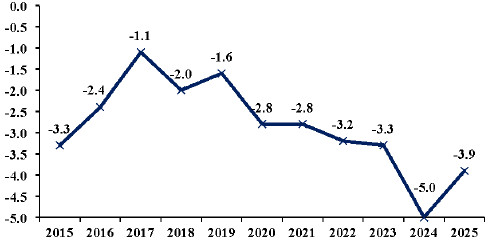
The Ministry of Finance and Public Credit carried out sustainability-linked bond offerings in the local market in the amount of Ps. 26.2 billion on December 5, 2025. The offering consisted of an issuance of BONDES G with two, four and six year maturities and an issuance of a Bono S with a 10 year maturity, each under the SDG Sovereign Bond Framework.
The IPAB carries out weekly issuances through primary auctions. BPAG28’s and BPAG 91’s issuances and allocations have been carried out through the Cetesdirecto platform in non-competitive allocation since December 9, 2021, and BPA182 was added to the platform on August 25, 2022. These bonds are issued by the IPAB, have a maturity of seven years and a variable interest rate determined semiannually by the 182-day Cetes interest rate at the beginning of the period and the maximum rate of accumulated inflation for the period.
Mexico’s former antitrust regulator, COFECE, launched an investigation on October 28, 2016 into possible collusion to manipulate prices, impose restrictions on the supply or demand, allocate the market or exchange information in the financial intermediation of debt securities issued by the Mexican government. In April 2017, COFECE announced that it had uncovered evidence of anticompetitive conduct in this market. In October 2019, COFECE summoned various economic agents who may have been responsible for the manipulative and monopolistic practices to present evidence related to the accusations against them. COFECE concluded its investigation on January 14, 2021, finding evidence that seven banking institutions and eleven traders had engaged in the alleged unlawful practices, and imposed a Ps. 35,075,000 fine on those parties. On February 2, 2021, COFECE published a resolution approving its findings from the investigation and the imposition of the fine, and on March 19, 2025, the Supreme Court affirmed the fine, finding that the seven banking institutions engaged in unlawful anticompetitive practices.
The following table summarizes the gross and net internal debt of the Government at each of the dates indicated:
Table No. 69 – Gross and Net Internal Debt of the Government(1)
| At December 31, | ||||||||||||||||||||||||||||||||||||||||
| 2021 | 2022 | 2023 | 2024(2) | 2025(2) | ||||||||||||||||||||||||||||||||||||
| (in billions of pesos, except percentages) | ||||||||||||||||||||||||||||||||||||||||
| Gross Debt |
||||||||||||||||||||||||||||||||||||||||
| Government Securities |
Ps. 7,878.5 | 94.5 | % | Ps. 8,925.4 | 95.0 | % | Ps. 10,227.1 | 95.7 | % | Ps. 12,350.0 | 95.9 | % | Ps. 14,164.4 | 96.8 | % | |||||||||||||||||||||||||
| Cetes |
1,072.3 | 12.9 | 813.0 | 8.7 | 1,174.8 | 11.0 | 1,794.7 | 13.9 | 2,249.3 | 15.4 | ||||||||||||||||||||||||||||||
| Floating Rate Bonds |
1,205.1 | (3) | 14.5 | % (3) | 1,721.5 | (3) | 18.8 | (3) | 1,830.0 | (3) | 17.1 | (3) | 2,156.3 | (3) | 16.7 | (3) | 2,176.8 | (3) | 14.9 | (3) | ||||||||||||||||||||
| Inflation-Linked Bonds |
2,235.5 | 26.8 | 2,623.9 | 27.9 | 3,040.5 | 28.5 | 3,725.2 | 28.9 | 4,270.2 | 29.2 | ||||||||||||||||||||||||||||||
| Fixed Rate Bonds |
3,356.9 | 40.3 | 3,712.6 | 39.5 | 4,172.3 | 39.0 | 4,663.8 | 36.2 | 5,458.1 | 37.3 | ||||||||||||||||||||||||||||||
| STRIPS of Udibonos |
8.7 | 0.1 | 9.3 | 0.1 | 9.6 | 0.1 | 10.0 | 0.1 | 10.3 | 0.1 | ||||||||||||||||||||||||||||||
| Other(4) |
456.0 | 5.5 | 469.8 | 5.0 | 459.2 | 4.3 | 526.1 | 4.1 | 470.7 | 3.2 | ||||||||||||||||||||||||||||||
|
|
|
|
|
|
|
|
|
|
|
|
|
|
|
|
|
|
|
|
|
|||||||||||||||||||||
| Total Gross Debt |
Ps. 8,334.5 | 100.0 | % | Ps. 9,395.2 | 100.0 | % | Ps. 10,686.3 | 100.0 | % | Ps. 12,876.2 | 100.0 | % | Ps. 14,635.4 | 100.0 | % | |||||||||||||||||||||||||
|
|
|
|
|
|
|
|
|
|
|
|
|
|
|
|
|
|
|
|
|
|||||||||||||||||||||
| Net Debt |
||||||||||||||||||||||||||||||||||||||||
| Financial Assets(5) |
260.1 | 133.4 | (13.2 | ) | 172.4 | 285.1 | ||||||||||||||||||||||||||||||||||
| Total Net Debt |
Ps. 8,074.4 | Ps. 9,261.8 | Ps. 10,699.5 | Ps. 12,703.8 | Ps. 14,350.3 | |||||||||||||||||||||||||||||||||||
|
|
|
|
|
|
|
|
|
|
|
|||||||||||||||||||||||||||||||
| Gross Debt/GDP |
31.2 | % | 31.8 | % | 33.5 | % | 38.4 | % | 41.5 | % | ||||||||||||||||||||||||||||||
| Net Debt/GDP |
30.3 | % | 31.4 | % | 33.6 | % | 37.9 | % | 40.7 | % | ||||||||||||||||||||||||||||||
Note: Numbers may not total due to rounding.
| (1) | Internal debt figures do not include securities sold by Banco de México in open-market operations to manage liquidity levels pursuant to Regulación Monetaria because those open-market operations do not increase the Government’s overall level of internal debt. Banco de México must reimburse the Government for any allocated debt that Banco de México sells into the secondary market and that is presented to the Government for payment. If Banco de México undertakes extensive sales of allocated debt in the secondary market, however, this can result in an elevated level of outstanding internal debt as compared to the Government’s figure for net internal debt. |
| (2) | Preliminary figures. |
| (3) | Includes figures in connection with BONDES F and BONDES G floating rate bonds, which are linked to the one-day TIIE funding rate, and figures in connection with BONDES D, which are linked to the overnight bank funding rate. |
| (4) | Includes Ps. 122.9 billion for December 31, 2021, Ps. 118.1 for December 31, 2022, Ps. 109.1 billion for December 31, 2023, Ps. 99.7 billion for December 31, 2024 and Ps. 88.3 billion for December 31, 2025, in liabilities associated with social security under the ISSSTE Law. |
| (5) | Includes the net balance (denominated in pesos) of the Treasury of the Federation’s General Account in Banco de México. |
Source: Ministry of Finance and Public Credit.
D-186
As of December 31, 2025, net internal Government debt was 13.0% higher in nominal terms as compared to the net internal Government debt at December 31, 2024. This includes the Ps. 88.3 billion liability associated with social security under the ISSSTE Law.
As of December 31, 2025, the gross internal Government debt represented a 13.7% increase in nominal terms as compared to December 31, 2024. Of the total gross internal Government debt at December 31, 2025, Ps. 659.0 billion represented short-term debt, as compared to Ps. 693.6 billion at the end of 2024, and Ps. 13,976.4 billion represented long-term debt, as compared to Ps. 12,182.6 billion at the end of 2024.
The Government’s financing costs on its internal debt during 2025 represented a 8.1% nominal increase, as compared to its financing costs during 2024.
The 2025 Budget contemplated a budget surplus of 0.6% of GDP, excluding investment projects with high social and economic impact. The 2025 Budget permitted the Government to issue additional net internal debt in an amount up to Ps. 1.6 trillion.
As of December 31, 2025, no debt issued by states and municipalities has been guaranteed by the Government.
External Debt
External Public Sector Debt
Since 1990, the majority of Mexico’s public sector external borrowings have consisted of debt securities placed into the securities market. However, during Mexico’s 1995 financial crisis, official creditors and creditors of multilateral institutions provided Mexico with significant amounts of financing.
The Government’s debt policy during the past several years, combined with the performance of exports, has led to stable interest payments on external public sector debt, representing 2.1% of total exports in 2021 and 2025. Public sector external debt financing costs totaled U.S.$13.7 billion in 2025, as compared to U.S.$13.2 billion in 2024, representing a 3.7% increase in nominal terms. Service payments of both principal and interest on public sector external debt constituted 3.4% of GDP in 2025, compared to 1.8% of GDP in 2024.
The balance of the net external debt of the public sector during 2025 was the result of (i) an increase in net external indebtedness of U.S.$14.2 billion, (ii) an increase of U.S.$2.9 billion in international assets of the public sector associated with external debt and (iii) a positive accounting adjustment of U.S.$5.1 billion reflecting debt management operations and the variation of the dollar as compared to other currencies in which the debt is denominated. According to preliminary figures, as of December 31, 2025, outstanding gross external public sector debt totaled U.S.$240.3 billion, an approximate U.S.$19.3 billion increase from the U.S.$221 billion outstanding on December 31, 2024. Of this amount, U.S.$237 billion represented long-term debt and U.S.$3.4 billion represented short-term debt. Net external indebtedness increased by U.S.$16.4 billion during 2025.
For 2025, Congress authorized PEMEX to incur net external indebtedness of up to U.S.$5,512.7 million, including through the issuance of securities and exchange or refinancing of its constituent sovereign debt obligations, compared to up to U.S.$3,726.5 million of net external indebtedness that PEMEX was authorized to incur in 2024. For 2025, Congress authorized the CFE to incur net external indebtedness of up to U.S.$ 991 million, compared to up to U.S.$1,188 million of net external indebtedness that the CFE was authorized to incur in 2024. See “Recent Developments—Public Debt—External Debt” for more information.
D-187
The following graphic represents the identities of Mexico’s external public sector debt creditors, including Government and public sector creditors at the date indicated:
Table No. 70 - Public Sector Debt Creditors at December 31, 2025
Source: Ministry of Finance and Public Credit.
D-188
The following tables set forth a summary of Mexico’s external public sector debt, including a breakdown of such debt by type, a breakdown of such debt by currency and net external public sector debt at the dates indicated:
Table No. 71 – Summary of External Public Sector Debt by Type(1)
| At December 31,(2) | ||||||||||||||||||||
| 2021 | 2022(3) | 2023(3) | 2024(3) | 2025(3) | ||||||||||||||||
| (in millions of U.S. dollars) | ||||||||||||||||||||
| Long-Term Direct Debt of the Government |
U.S.$ | 114,837.5 | U.S.$ | 115,062.5 | U.S.$ | 118,904.4 | U.S.$ | 125,121.8 | U.S.$ | 152,027.2 | ||||||||||
| Long-Term Debt of Budget Controlled Agencies |
91,121.5 | 87,367.3 | 82,768.2 | 83,722.8 | 80,629.7 | |||||||||||||||
| Other Long-Term Public Debt(4) |
7,339.1 | 6,580.3 | 5,428.0 | 5,025.9 | 4,306.6 | |||||||||||||||
|
|
|
|
|
|
|
|
|
|
|
|||||||||||
| Total Long-Term Debt |
213,298.1 | 209,010.1 | 207,100.6 | 213,870.5 | 236,963.5 | |||||||||||||||
|
|
|
|
|
|
|
|
|
|
|
|||||||||||
| Total Short-Term Debt |
8,336.9 | 8,776.0 | 8,007.2 | 7,177.5 | 3,355.4 | |||||||||||||||
|
|
|
|
|
|
|
|
|
|
|
|||||||||||
| Total Long- and Short-Term Debt |
221,635.0 | 217,786.1 | 215,107.8 | 221,048.0 | 240,318.9 | |||||||||||||||
|
|
|
|
|
|
|
|
|
|
|
|||||||||||
Table No. 72 – Summary of External Public Sector Debt by Currency
| At December 31,(2) | ||||||||||||||||||||||||||||||||||||||||
| 2021 | 2022(3) | 2023(3) | 2024(3) | 2025(3) | ||||||||||||||||||||||||||||||||||||
| (in millions of U.S. dollars, except for percentages) | ||||||||||||||||||||||||||||||||||||||||
| U.S. Dollars |
U.S.$ | 167,850.0 | 75.7 | % | U.S.$ | 165,251.1 | 76.1 | % | U.S.$ | 163,082.0 | 75.8 | % | U.S.$ | 168,703.0 | 76.3 | % | U.S.$ | 177,544 | 73.9 | % | ||||||||||||||||||||
| Japanese Yen |
8,278.7 | 3.7 | 7,872.3 | 3.6 | 6,327.0 | 2.9 | 6,481.5 | 2.9 | 6,671 | 2.8 | ||||||||||||||||||||||||||||||
| Swiss Francs |
2,470.6 | 1.1 | 2,432.3 | 1.1 | 2,241.3 | 1.0 | 2,934.3 | 1.3 | 4,889 | 2.0 | ||||||||||||||||||||||||||||||
| Pounds Sterling |
3,083.9 | 1.4 | 2,317.0 | 1.1 | 2,455.1 | 1.1 | 1,816.1 | 0.8 | 1,345 | 0.6 | ||||||||||||||||||||||||||||||
| Euros |
37,794.9 | 17.1 | 32,324.9 | 14.9 | 29,518.0 | 13.7 | 28,266.0 | 12.8 | 33,311 | 13.9 | ||||||||||||||||||||||||||||||
| Others |
2,157.0 | 1.0 | 7,588.5 | 3.5 | 11,484.0 | 5.3 | 12,847.0 | 5.8 | 16,559 | 6.9 | ||||||||||||||||||||||||||||||
|
|
|
|
|
|
|
|
|
|
|
|
|
|
|
|
|
|
|
|
|
|||||||||||||||||||||
| Total |
U.S.$ | 221,635.1 | 100.0 | % | U.S.$ | 217,786.1 | 100.0 | % | U.S.$ | 215,108.4 | 100.0 | % | U.S.$ | 221,048.0 | 100.0 | % | U.S. $ | 240,319 | 100.0 | % | ||||||||||||||||||||
|
|
|
|
|
|
|
|
|
|
|
|
|
|
|
|
|
|
|
|
|
|||||||||||||||||||||
Note: Numbers may not total due to rounding.
Table No. 73 – Net External Debt of the Public Sector
| At December 31,(2) | ||||||||||||||||||||
| 2021 | 2022(3) | 2023(3) | 2024(3) | 2025(3) | ||||||||||||||||
| (in millions of U.S. dollars, except for percentages) | ||||||||||||||||||||
| Total Net Debt |
U.S.$ | 218,421.0 | U.S.$ | 216,517.2 | U.S.$ | 213,076.5 | U.S.$ | 218,326.7 | U.S.$ | 234,679.1 | ||||||||||
| Gross External Debt/GDP |
17.1 | % | 14.3 | % | 11.4 | % | 13.2 | % | 12.0 | % | ||||||||||
| Net External Debt/GDP |
16.8 | % | 14.2 | % | 11.3 | % | 13.0 | % | 12.2 | % | ||||||||||
Note: Numbers may not total due to rounding.
| (1) | The calculation of external debt is discussed in footnote 3 to Table No. 77. |
| (2) | Adjusted to reflect the effect of currency swaps. |
| (3) | Preliminary figures. |
| (4) | Includes debt of development banks and other administratively-controlled agencies whose finances are consolidated with those of the Government. |
Source: Ministry of Finance and Public Credit.
D-189
Table No. 74 – Amortization Schedule of Total Public Sector External Debt(1)
| Outstanding as of December 31, 2025(2) |
2026 | 2027 | 2028 | 2029 | 2030 | 2031 | 2032 | 2033 | 2034 | 2035 | 2036 | 2037 | 2038 | 2039 | Other Years |
Total | ||||||||||||||||||||||||||||||||||||||||||||||||||||
| (in millions of U.S. dollars) | ||||||||||||||||||||||||||||||||||||||||||||||||||||||||||||||||||||
| Private Creditors(3) |
208,573 | 12,046 | 8,488 | 12,122 | 14,406 | 14,939 | 15,298 | 11,410 | 14,283 | 6,557 | 9,043 | 5,646 | 5,229 | 4,918 | 1,682 | 72,507 | 208,573 | |||||||||||||||||||||||||||||||||||||||||||||||||||
| Capital Markets (Bonds) |
187,924 | 4,188 | 6,671 | 6,890 | 12,671 | 11,887 | 15,217 | 11,380 | 13,516 | 6,527 | 9,013 | 5,628 | 5,229 | 4,918 | 1,682 | 72,507 | 187,924 | |||||||||||||||||||||||||||||||||||||||||||||||||||
| Commercial Banks |
20,649 | 7,858 | 1,816 | 5,231 | 1,736 | 3,052 | 81 | 30 | 767 | 30 | 30 | 17 | 0 | 0 | 0 | 0 | 20,649 | |||||||||||||||||||||||||||||||||||||||||||||||||||
| Direct |
18,252 | 6,239 | 1,690 | 5,096 | 1,592 | 2,898 | 0 | 0 | 738 | 0 | 0 | 0 | 0 | 0 | 0 | 0 | 18,252 | |||||||||||||||||||||||||||||||||||||||||||||||||||
| Syndicated |
2,396 | 1,619 | 127 | 135 | 144 | 154 | 81 | 30 | 30 | 30 | 30 | 17 | 0 | 0 | 0 | 0 | 2,396 | |||||||||||||||||||||||||||||||||||||||||||||||||||
| Multilateral Creditors |
26,855 | 2,771 | 3,824 | 3,862 | 3,449 | 2,862 | 1,299 | 2,303 | 1,206 | 994 | 753 | 684 | 629 | 613 | 482 | 1,053 | 26,855 | |||||||||||||||||||||||||||||||||||||||||||||||||||
| IADB |
12,520 | 814 | 1,133 | 1,530 | 2,056 | 1,697 | 695 | 846 | 640 | 526 | 397 | 328 | 274 | 274 | 274 | 1,036 | 12,520 | |||||||||||||||||||||||||||||||||||||||||||||||||||
| World Bank |
13,548 | 1,822 | 2,627 | 2,235 | 1,296 | 1,030 | 530 | 1,383 | 528 | 468 | 356 | 355 | 355 | 339 | 208 | 17 | 13,548 | |||||||||||||||||||||||||||||||||||||||||||||||||||
| CAF |
788 | 135 | 135 | 98 | 98 | 135 | 75 | 75 | 38 | 0 | 0 | 0 | 0 | 0 | 0 | 0 | 788 | |||||||||||||||||||||||||||||||||||||||||||||||||||
| External Trade |
4,586 | 616 | 913 | 551 | 491 | 421 | 371 | 335 | 225 | 205 | 166 | 128 | 49 | 32 | 32 | 54 | 4,586 | |||||||||||||||||||||||||||||||||||||||||||||||||||
| Eximbanks |
3,948 | 365 | 791 | 443 | 420 | 397 | 356 | 329 | 219 | 198 | 159 | 122 | 42 | 26 | 26 | 54 | 3,948 | |||||||||||||||||||||||||||||||||||||||||||||||||||
| Commercial Banks(4) |
639 | 251 | 121 | 109 | 71 | 24 | 15 | 6 | 6 | 6 | 6 | 6 | 6 | 6 | 6 | 0 | 639 | |||||||||||||||||||||||||||||||||||||||||||||||||||
| Suppliers |
0 | 0 | 0 | 0 | 0 | 0 | 0 | 0 | 0 | 0 | 0 | 0 | 0 | 0 | 0 | 0 | 0 | |||||||||||||||||||||||||||||||||||||||||||||||||||
| Other(5) |
305 | 305 | 0 | 0 | 0 | 0 | 0 | 0 | 0 | 0 | 0 | 0 | 0 | 0 | 0 | 0 | 305 | |||||||||||||||||||||||||||||||||||||||||||||||||||
|
|
|
|
|
|
|
|
|
|
|
|
|
|
|
|
|
|
|
|
|
|
|
|
|
|
|
|
|
|
|
|
|
|
|
|||||||||||||||||||||||||||||||||||
| Public Sector Total |
240,319 | 15,738 | 13,295 | 16,535 | 18,346 | 18,222 | 16,969 | 14,048 | 15,714 | 7,755 | 9,961 | 6,457 | 5,907 | 5,563 | 2,196 | 73,613 | 240,319 | |||||||||||||||||||||||||||||||||||||||||||||||||||
|
|
|
|
|
|
|
|
|
|
|
|
|
|
|
|
|
|
|
|
|
|
|
|
|
|
|
|
|
|
|
|
|
|
|
|||||||||||||||||||||||||||||||||||
Note: Numbers may not total due to rounding.
| (1) | The calculation of external debt is discussed in footnote 3 to Table No. 77. |
| (2) | Preliminary figures. |
| (3) | Excludes foreign trade and restructured debt. |
| (4) | Includes foreign trade lines, revolving credits and other short-term credits. |
| (5) | Refers to changes in direct debt related to certain PIDIREGAS. |
Source: Ministry of Finance and Public Credit.
D-190
External Government Debt
Mexico’s external public debt goals are intended to provide the Government with flexibility to finance its stated needs, while also accounting for market volatility and unforeseen developments. The policy also seeks to maintain costs and keep risks at stable levels. Mexico primarily seeks debt financing through local markets, supplemented by external financing from the U.S., Europe and Asia. Mexico’s principal objectives in connection with its external financing include improving the terms and conditions of Mexico’s external liabilities, as well as strengthening and diversifying Mexico’s investor base, with specific consideration to Mexico’s continued presence in the most influential international markets. Objectives also include strengthening Mexico’s benchmark bonds and maintaining a constant relationship with international investors in order to ensure transparency and to promote investment in Mexico.
The Ministry of Finance announced in January 2023 a prepayment of a loan with the World Bank, reducing the debt owed by 70%, to approximately Ps. 58 billion (approximately U.S.$3.2 billion).
On April 16, 2025, the credit rating agencies Fitch and R&I reaffirmed their respective ratings of BBB- and BBB+, each with a stable outlook, for Mexico’s long-term debt in foreign currency.
On July 18, 2025, the credit rating agency JCR reaffirmed its A- rating with a stable outlook for Mexico’s long-term foreign currency debt.
On September 8, 2025, the credit rating agency Standard & Poor’s reaffirmed its BBB credit rating with a stable outlook for Mexico’s long-term foreign currency debt.
On October 28, 2025, HR Ratings affirmed Mexico’s long-term foreign-currency debt rating of BBB+, changing the outlook from negative to stable.
On October 30, 2025, Kroll Bond Rating Agency affirmed Mexico’s long-term foreign-currency debt rating of BBB, maintaining a stable outlook.
For more information on Mexico’s credit ratings, see “Recent Developments—Public Debt— External Government Debt.”
The 2025 Budget authorized the Government to incur up to U.S.$15.5 billion in net external debt, which includes external borrowings incurred from international financial institutions and external debt issuances in international markets. For more information on the 2025 Budget and the 2026 Budget, see “Public Finance—The Budget.”
Net external indebtedness of the Government increased by U.S.$25.3 billion during 2025 primarily due to the net effect of: new borrowing of U.S.$33.6 billion, offset by amortizations of U.S.$10.9 billion; an increase in international assets related to external debt of U.S.$1.6 billion; and positive adjustments of U.S.$4.2 billion related to the variation of the dollar with respect to other currencies.
The following tables set forth a summary of Mexico’s external Government debt, including gross external Government debt, net external Government debt and net Government debt at the dates indicated:
Table No. 75 – Gross External Debt of the Government by Currency(1)
| At December 31,(2) | ||||||||||||||||||||||||||||||||||||||||
| 2021(3) | 2022(3) | 2023(3) | 2024(3) | 2025(3) | ||||||||||||||||||||||||||||||||||||
| (in millions of U.S. dollars, except for percentages) | ||||||||||||||||||||||||||||||||||||||||
| U.S. Dollars |
U.S.$ | 78,717.0 | 68.5 | % | U.S.$ | 76,907.6 | 66.8 | % | U.S.$ | $77,996.8 | 65.6 | % | U.S.$ | 81,729.9 | 65.3 | % | U.S.$ | 93,833 | 61.7 | % | ||||||||||||||||||||
| Japanese Yen |
6,784.1 | 5.9 | 6,646.0 | 5.8 | 5,498 | 4.6 | 5,737.4 | 4.6 | 5,925 | 3.9 | ||||||||||||||||||||||||||||||
| Swiss Francs |
2,070.0 | 1.8 | 2,037.9 | 1.8 | 2,241.3 | 1.9 | 2,934.0 | 2.3 | 4,889 | 3.2 | ||||||||||||||||||||||||||||||
| Pounds Sterling |
2,000.2 | 1.7 | 1,775.8 | 1.5 | 1,881.6 | 1.6 | 1,252.5 | 1.0 | 1,345 | 0.9 | ||||||||||||||||||||||||||||||
| Euros |
24,824.2 | 21.6 | 21,788.1 | 18.9 | 20,819.8 | 17.5 | 21,392.0 | 17.1 | 30,238 | 19.9 | ||||||||||||||||||||||||||||||
| Others |
442.0 | 0.4 | 5,907.1 | 5.1 | 10,466.5 | 8.8 | 12,075.8 | 9.7 | 15,797 | 10.4 | ||||||||||||||||||||||||||||||
|
|
|
|
|
|
|
|
|
|
|
|
|
|
|
|
|
|
|
|
|
|||||||||||||||||||||
| Total |
U.S.$ | 114,837.5 | 100.0 | % | U.S.$ | 115,062.5 | 100.0 | % | U.S.$ | 118,904.0 | 100.0 | % | U.S.$ | 125,121.6 | 100.0 | % | U.S.$ | 152,027 | 100.0 | % | ||||||||||||||||||||
|
|
|
|
|
|
|
|
|
|
|
|
|
|
|
|
|
|
|
|
|
|||||||||||||||||||||
D-191
Table No. 76 – Net External Debt of the Government
| At December 31, | ||||||||||||||||||||
| 2021(3) | 2022(3) | 2023(3) | 2024(3) | 2025(3) | ||||||||||||||||
| (in millions of U.S. dollars, except for percentages) | ||||||||||||||||||||
| Total Net Debt |
U.S.$ | 112,744.5 | U.S.$ | 114,938.0 | U.S.$ | 118,844.6 | U.S.$ | 123,879.0 | U.S.$ | 149,160.7 | ||||||||||
| Gross External Debt/GDP |
8.9 | % | 7.6 | % | 6.3 | % | 7.5 | % | 7.6 | % | ||||||||||
| Net External Debt/GDP |
8.7 | % | 7.6 | % | 6.3 | % | 7.4 | % | 7.7 | % | ||||||||||
Table No. 77 – Net Debt of the Government
| At December 31, | ||||||||||||||||||||
| 2021 | 2022(3) | 2023(3) | 2024(3) | 2025 (3) | ||||||||||||||||
| External Debt(4) |
22.3 | % | 19.4 | % | 15.8 | % | 16.5 | % | 15.7 | % | ||||||||||
| Internal Debt |
77.7 | % | 80.6 | % | 84.2 | % | 83.5 | % | 84.3 | % | ||||||||||
Note: Numbers may not total due to rounding.
| (1) | In connection with certain measures to support PEMEX in the management and improvement of its balance sheet, on August 14, 2025, the Mexican Government, as sponsor, agreed to, upon the occurrence of certain events, issue and sell to a special purpose vehicle, which on such date issued $12 billion in aggregate face amount of pre-capitalized securities redeemable on August 17, 2030, an aggregate principal amount of Mexico’s notes due 2030, in an amount equivalent to the aggregate face value of the outstanding P-Caps. The P-Caps are not consolidated with the liabilities of PEMEX or Mexico, and are not guaranteed by Mexico. The Notes, when and if issued by Mexico, will constitute public debt of the Mexican Government, according to the relevant regulatory provisions of the Mexican Government, but are not included in the table above as the Notes have not been issued. For more information, see “The Economy—Petroleum and Petrochemicals—PEMEX—Certain Support and Financing Transactions.” |
| (2) | Adjusted to reflect the effect of currency swaps. |
| (3) | Preliminary figures. |
| (4) | External debt denominated in foreign currencies other than U.S. dollars has been translated into U.S. dollars at exchange rates as of each of the dates indicated. External public debt does not include (a) repurchase obligations of Banco de México with the IMF (none of which was outstanding as of December 31, 2025) or (b) loans from the Commodity Credit Corporation to public sector Mexican banks. External debt is presented herein on a “gross” basis and includes external obligations of the public sector at their full outstanding face or principal amount. For certain informational and statistical purposes, Mexico sometimes reports its external public sector debt on a “net” basis, which is calculated as the gross debt net of certain financial assets held abroad. These financial assets include Mexican public sector external debt that is held by public sector entities but that has not been cancelled. |
Source: Ministry of Finance and Public Credit.
Debt Record
Following the 1946 rescheduling of debt incurred prior to the Revolution of 1910, Mexico has not defaulted on the payment of principal or interest on any of its external indebtedness.
IMF Credit Lines
The IMF has worked with Mexico to secure its economy since the 1980s debt crisis in Latin America. In 2009, Mexico was the first country to use the IMF’s contingent credit line program, the Flexible Credit Line (FCL), which allows countries with strong policy frameworks and economic track records to seek assistance and borrow from the IMF when faced with potential or actual balance of payments pressures. Mexico has maintained an FCL arrangement with the IMF since 2009. Since 2017, the amount of FCL access has, upon Mexico’s requests, gradually been reduced due to improved outlook with respect to some of the risks facing Mexico and other factors.
D-192
On November 19, 2021, the IMF Executive Board approved a successor two-year arrangement for Mexico under the FCL in the amount of U.S.$50 billion, a reduction from the approximately U.S.$61 billion FCL access granted in 2019 and from the approximately U.S.$74 billion FCL access granted in 2018, and noted Mexico’s cancellation of the previous arrangement. Mexican authorities stated their intention to treat the new arrangement as precautionary. On November 15, 2023, the IMF Executive Board approved a successor two-year arrangement for Mexico under the FCL in the amount of U.S.$35 billion, a reduction from the approximately U.S.$50 billion FCL access granted in 2021. The IMF affirmed Mexico’s continued qualifications to access the FCL, citing Mexico’s strong macroeconomic policies and institutional policy frameworks, including its flexible exchange rate regime, credible inflation targeting framework, fiscal responsibility law and well-regulated financial sector. The IMF further affirmed that the lower level of FCL access is consistent with the IMF’s approach of reducing access commensurate with reductions in external risks. On October 30, 2024, the IMF Executive Board concluded its mid-term review under the FCL granted to Mexico, confirming that Mexico continues to meet all the eligibility criteria necessary to access the resources available through this instrument. On November 13, 2025, the IMF Executive Board approved a two-year successor arrangement under the FCL in the amount of approximately U.S.$24 billion, a reduction from the approximately U.S.$35 billion FCL access granted in 2023, noting Mexico’s cancellation of the previous arrangement. Mexican authorities stated their intention to treat the new arrangement as a precautionary instrument to support external resilience. For more information on the FCL with the IMF, see “Recent Developments—Public Debt—IMF Credit Lines.”
Liability Management and Debt Reduction Transactions
In addition to Mexico’s strong commitment to working closely with its commercial bank and multilateral creditors to sustain economic growth, debt reduction has been, and continues to be, one of Mexico’s main goals. Mexico offers additional debt securities from time to time in the international capital markets and, in order to manage the composition of its outstanding liabilities, Mexico engages from time to time in a variety of transactions including tender offers, open market purchases and early redemptions.
For the past twenty years, Mexico has conducted periodic ordinary course liability management transactions for the reduction of its total outstanding debt. Mexico also engages in debt-for-debt exchanges in order to reduce its total outstanding debt. Under these debt-for-debt exchanges, Mexico is able to refinance its existing debt by replacing it with new debt.
On July 2, 2025, Mexico conducted a tender offer to purchase for cash its outstanding notes of the series set forth in the offer to purchase dated June 23, 2025, pursuant to which Mexico purchased the notes listed in the table below. A summary of the tender offer results follows:
| Old Notes | Aggregate Principal Amount of Tenders Accepted |
Outstanding Amount After Tender Offer |
||||||||||||||
| 4.150% Global Notes due 2027 |
U.S.$ | 483,684,000 | U.S.$ | 1,891,166,000 | ||||||||||||
| 3.750% Global Notes due 2028 |
U.S.$ | 268,564,000 | U.S.$ | 1,609,838,000 | ||||||||||||
| 5.400% Global Notes due 2028 |
U.S.$ | 82,390,000 | U.S.$ | 1,167,610,000 | ||||||||||||
| 4.500% Global Notes due 2029 |
U.S.$ | 401,311,000 | U.S.$ | 2,684,332,000 | ||||||||||||
| 5.000% Global Notes due 2029 |
U.S.$ | 220,212,000 | U.S.$ | 779,788,000 | ||||||||||||
| 3.250% Global Notes due 2030 |
U.S.$ | 248,745,000 | U.S.$ | 2,010,492,000 | ||||||||||||
| 6.000% Global Notes due 2030 |
U.S.$ | 294,156,000 | U.S.$ | 1,705,844,000 | ||||||||||||
| 2.659% Global Notes due 2031 |
U.S.$ | 398,704,000 | U.S.$ | 2,997,358,000 | ||||||||||||
| 8.300% Global Notes due 2031 |
U.S.$ | 103,488,000 | U.S.$ | 1,053,407,000 | ||||||||||||
External Securities Offerings
Below is a list of external debt offerings by Mexico in 2025. For securities offerings during 2026, see “Recent Developments—External Securities Offerings and Liability Management Transactions.”
On January 13, 2025, Mexico issued U.S.$2,000,000,000 of its 6.000% Global Notes due 2030, U.S.$4,000,000,000 of its 6.875% Global Notes due 2037 and U.S.$2,500,000,000 of its 7.375% Global Notes due 2055.
On February 4, 2025, Mexico issued 1,400,000,000 of its 4.625% Global Notes due 2033 and 1,000,000,000 of its 5.125% Global Notes due 2037.
In connection with the tender offer described under “—Liability Management and Debt Reduction Transactions,” on July 2, 2025, Mexico issued U.S.$3,949,715,000 of its 5.850% Global Notes due 2032 and U.S.$2,850,768,000 of its 6.625% Global Notes due 2038. Mexico used a portion of the proceeds from this offering to redeem in full all of its outstanding U.S. dollar-denominated 4.125% Global Notes due 2026.
D-193
On August 1, 2025, Mexico redeemed in full 1,327,437,000 of its outstanding 1.625% Global Notes due 2026.
On September 19, 2025, Mexico issued 2,500,000,000 of its 3.500% Global Notes due 2029, 1,500,000,000 of its 4.500% Global Notes due 2034 and 1,250,000,000 of its 5.125% Global Notes due 2038.
On September 22, 2025, Mexico issued U.S.$1,500,000,000 of its 4.750% Global Notes due 2031, U.S.$4,000,000,000 of its 5.375% Global Notes due 2033 and U.S.$2,500,000,000 of its 5.625% Global Notes due 2035.
D-194