Exhibit 99.1
Information contained herein is subject to completion or amendment. A Registration Statement on Form 10 relating to these securities has been filed with the U.S. Securities and Exchange Commission under the U.S. Securities Exchange Act of 1934, as amended.
Preliminary and Subject to Completion, Dated June 22, 2026
INFORMATION STATEMENT
BioKey (Cayman), Inc.
Ordinary Shares
(par value $0.0001 per share)
This information statement has been prepared in connection with the spin-off by ABVC BioPharma, Inc. (“ABVC”) of its wholly owned subsidiary, BioKey (Cayman), Inc. (the “Company,” “SpinCo,” or “BioKey Cayman”). To effect the spin-off, ABVC will distribute that number of the Company’s ordinary shares, par value $0.0001 (the “Ordinary Shares”) that it owns, which shall represent approximately 15% of the Company (the “Distribution”), on a pro rata basis to the holders of ABVC common stock, par value $0.0001 per share (the “ABVC Common Stock”). You should consult your own tax advisor as to the tax consequences of the Distribution to you, including potential tax consequences under state, local, and non-U.S. tax laws.
If you are a record holder of ABVC Common Stock as of the close of business on July 24, 2026, which is the record date for the Distribution (the “Record Date”), you will receive your pro rata portion of 15% of BioKey Cayman’s issued and outstanding Ordinary Shares, based on the number of shares of ABVC Common Stock you hold on the Record Date (the “Distribution Ratio”). ABVC will distribute the Ordinary Shares in book-entry form, which means that we will not issue physical stock certificates. The distribution agent will not distribute any fractional shares of Ordinary Shares.
The distribution will be effective as of 11:59 p.m., New York City time, on August 3, 2026. Immediately after the Distribution becomes effective, BioKey Cayman will be an independent, publicly traded company, with ABVC retaining a controlling equity interest.
ABVC shareholders are not required to vote on or take any other action to approve the spin-off. We are not asking you for a proxy, and request that you do not send us a proxy. ABVC shareholders will not be required to pay any consideration for Ordinary Shares they receive in the spin-off, and they will not be required to surrender or exchange ABVC Common Stock they have or take any other action in connection with the spin-off.
No trading market for the Ordinary Shares currently exists. Following the Spin-Off, we intend to apply to have our Ordinary Shares quoted on the OTC Markets. However, there can be no assurance as to the timing of such quotation or that an active trading market will develop. Because we are not currently listed on the OTC Market, we have not yet been assigned a trading symbol. A trading symbol will be assigned in connection with, and upon completion of, the OTC listing process.
In reviewing this information statement, you should carefully consider the matters described in the section entitled “Risk Factors” beginning on page 11 of this information statement.
Neither the U.S. Securities and Exchange Commission nor any state securities commission has approved or disapproved these securities or determined if this information statement is truthful or complete. Any representation to the contrary is a criminal offense.
This information statement is not an offer to sell, or a solicitation of an offer to buy, any securities.
The date of this information statement is June 22, 2026.
TABLE OF CONTENTS
i
This information statement includes estimates regarding market and industry data and forecasts, which are based on publicly available information, industry publications and surveys, reports from government agencies, reports by market research firms, and our own estimates based on our management’s knowledge of, and experience in, the markets in which we compete. This information cannot always be verified with complete certainty due to the limits on the availability and reliability of raw data, the voluntary nature of the data gathering process, and other limitations and uncertainties inherent in surveys of market size. Furthermore, all of this information involves a variety of assumptions, limitations, and methodologies and is inherently subject to uncertainties, and therefore you are cautioned not to give undue weight to these estimates.
In this information statement, unless the context otherwise requires:
| ● | “Company,” “BioKey Cayman,” “SpinCo,” “we,” “our,” “ourselves,” and “us” refer to BioKey (Cayman), Inc. and its consolidated subsidiaries after giving effect to the spin-off; | |
| ● | “EIT” refers to enterprise income tax; | |
| ● | “ABVC” or “Parent” refers to ABVC BioPharma, Inc., a Nevada corporation, and all of its subsidiaries as defined herein unless the context specifies; | |
| ● | “PCAOB” refers to Public Company Accounting Oversight Board; | |
| ● | “SEC” refers to the U.S. Securities and Exchange Commission; | |
| ● | “Share Distribution” refers to ABVC’s distribution to its shareholders of that number of BioKey Cayman’s Ordinary Shares that ABVC owns equal to 15% of BioKey Cayman’s issued and outstanding Ordinary Shares; | |
| ● | “Share Distribution Date” refers to the date on which the Share Distribution occurs; | |
| ● | “Spin-Off” refers to the Share Distribution and related transactions pursuant to which we will be separated from ABVC; | |
| ● | “U.S.” refers to United States of America; | |
| ● | “$,” “USD,” “US$,” or “U.S. dollars” are to the legal currency of the United States. |
Unless the context otherwise requires, or when otherwise specified, references in this information statement to our historical assets, liabilities, products, businesses, or activities of our businesses are generally intended to refer to the historical assets, liabilities, products, businesses, or activities of BioKey Cayman businesses as they were conducted as part of ABVC prior to completion of the Spin-Off.
Corporate Structure
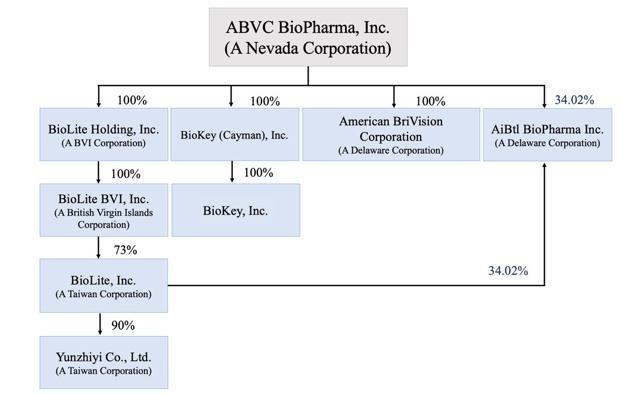
ABVC was incorporated under the laws of the State of Nevada on February 6, 2002, and has four wholly owned Subsidiaries: American BriVision Corporation, a Delaware corporation, BioLite Holding, Inc., a Nevada corporation, the Company and BioKey, Inc., a California corporation (“BK California”). ABVC is a clinical stage biopharmaceutical company focused on development of new drugs and medical devices, all of which are derived from plants.
BK California was incorporated in California on November 20, 2020, and is a wholly owned subsidiary of ABVC. BK California’s mission is to capitalize on the growth opportunities in the generic drug market. Currently, BK California is a pharmaceutical manufacturing and development company.
1
The Company is a holding company that was incorporated under the laws of the Cayman Islands on June 14, 2023, and is a wholly owned subsidiary of ABVC.
On February 8, 2019, ABVC acquired BK California through a stock-for-stock transaction, whereby ABVC issued 30,000,000 shares of its Common Stock, valued at $2 per share, to BK California’s shareholders. As a result, BK California became a wholly owned subsidiary of ABVC. The acquisition was disclosed in the Form S-4 registration statement (File Number 333-226285) filed with the SEC.
Prior to the 2025 Reorganization (as defined below), ABVC owned 7,418,134 shares of common stock, 7,000,000 shares of Series A preferred stock, 1,160,000 shares of Series B preferred stock, and 13,973,097 shares of Series C preferred stock, equating to 100% of the issued and outstanding stock of BK California, with a par value of US$0.001 per share (the “BK California Stock”). On May 10, 2025, the Company entered into a Share Transfer Agreement (“STA”) with ABVC and BK California, pursuant to which the Company acquired 100% of the equity interests of BK California from ABVC in exchange for $100 (the “2025 Reorganization”). The transaction documents contain customary representations, warranties, and covenants, and the notes include customary events of default including, but not limited to, organization and good standing, title to the subject shares, non-contravention, and no litigation. The Company is also obligated to register for resale the shares issuable upon conversion of the notes.
Following the 2025 Reorganization where BK California became a wholly owned subsidiary of BioKey Cayman, the Company was restructured into a fully integrated Contract Research Organization (“CRO”) and Contract Development and Marketing Organization (“CDMO”) platform, offering both research and manufacturing services under one roof.
BioKey Cayman has no operations, subsidiaries, or variable-interest entities in the People’s Republic of China or Hong Kong.
The Spin-Off
On June 22, 2026, BioKey Cayman announced plans for the partial legal and structural separation of our business from ABVC. In reaching the decision to pursue the Spin-Off, ABVC considered a range of potential structural alternatives for the business and concluded that the Spin-Off is the most attractive alternative for enhancing shareholder value.
To effect the Spin-Off, first, BioKey Cayman will establish an independent board of directors and name executive officers. ABVC will subsequently distribute the Ordinary Shares to ABVC shareholders via the Share Distribution, after which, BioKey Cayman, holding the business, will become an independent company.
Prior to the completion of the Spin-Off, we intend to enter into a Separation and Distribution Agreement with ABVC related to the Spin-Off. The Separation and Distribution Agreement will govern the relationship between ABVC and SpinCo up to and after completion of the Spin-Off and allocate between ABVC and SpinCo various assets, rights, liabilities, and obligations, including employee benefits, intellectual property, environmental and tax-related assets, and liabilities. See “Certain Relationships and Related Party Transactions” and “Selected Historical and Unaudited Pro Forma Condensed Consolidated Financial Data,” for more information.
Completion of the Spin-Off is subject to the satisfaction or waiver of specified conditions. In addition, ABVC has the right not to complete the Spin-Off if, at any time, ABVC’s board of directors (the “ABVC Board”) determines, in its sole and absolute discretion, that the Spin-Off is not in the best interests of ABVC or its shareholders or is otherwise not advisable. See “The Spin-Off—Conditions to the Spin-Off” for more information.
2
Following the Spin-Off, SpinCo, and ABVC will each have a more focused business and be better positioned to invest in growth opportunities through tailored capital allocation and will be better able to execute each company’s specific strategic plans. SpinCo, through its subsidiaries, operates as a fully integrated CRO/CDMO platform, offering both research and manufacturing services under one roof. SpinCo will work to maximize value for its investors, while being able to scale its operations to meet the growth of the markets it serves. Further, the Spin-Off will allow our management team to devote its time and attention to corporate strategies and policies that are based specifically on the needs of our business and its dynamic end markets. We plan to create incentives for our management and employees that are more closely tied to business performance and our shareholders’ expectations, which we believe will help us attract and retain highly qualified personnel. Additionally, we believe the Spin-Off will help align our shareholder base with the characteristics and risk profile of our business. See “The Spin-Off—Reasons for the Spin-Off” for more information.
Aspects of the Spin-Off may increase the risks associated with ownership of Ordinary Shares. In connection with the Spin-Off, we may enter into a revolving credit facility to be available for our working capital and other cash needs in the future as needed. See “Capitalization” and “Management’s Discussion and Analysis of Financial Condition and Results of Operations” for more information. Furthermore, as an independent entity we may lose some of the benefits of purchasing power, borrowing leverage, and available capital for investments associated with being a larger entity. See “Risk Factors” in this information statement. Because of the foregoing, there is no guarantee that any dividends will be declared on our Ordinary Shares by our board of directors (our “Board”), or if so declared, will be continued in the future. For more information, see “Dividend Policy.”
Following the Spin-Off, we expect our Ordinary Shares to be traded over-the-counter on the OTC Markets under the ticker symbol assigned to us in connection with, and upon completion of, the OTC listing process.
Business Overview
BioKey (Cayman), Inc. (“BioKey Cayman”) is a nutraceutical and functional-supplement research, development, and manufacturing company operating under a vertically integrated model. BioKey focuses on the development of proprietary botanical-based formulations that include Maitake extract, β-glucan, and Radix Polygala (PDC-1421) and provides contract research, pilot-scale formulation, GMP manufacturing, regulatory documentation support, and commercial supply services to partners across Asia and North America. BioKey’s activities span early-stage ingredient innovation, formulation optimization, analytical method establishment, stability testing, clinical batch manufacturing, and commercial-ready packaging. The Company also develops its own proprietary nutraceutical products for future market distribution. BioKey’s customers include dietary supplement companies, functional food brands, wellness distributors, and research institutions seeking specialized botanical formulations. The Company leverages its scientific team, manufacturing expertise, and growing network of strategic partners to expand into high-growth health categories, including sleep, mood, immune support, metabolic wellness, and clinical nutrition.
Over the years, in conjunction with our subsidiaries, we have successfully obtained four Abbreviated New Drug Application (“ANDA”) approvals from the U.S. Food and Drug Administration (“FDA”), including:
| ● | BK101 Benazepril Hydrochloride Tablets (5, 10, 20, and 40 mg), ANDA 076-820, approved on February 3, 2006; |
| ● | BK123 Levetiracetam 500 mg Tablets, ANDA 090-906, approved on November 5, 2010; |
| ● | BK119 Cilostazol 50 mg, ANDA 077-722, and 100 mg Tablets, ANDA 077-831, both approved on September 24, 2012. |
The Company’s capabilities include:
| ● | Contract Research Services (CRO) for preclinical and clinical trials, including protocol design, data management, statistical analysis, and regulatory strategy; |
| ● | Active Pharmaceutical Ingredient (API) analysis and characterization; |
| ● | Drug formulation and analytical method development; |
| ● | Clinical trial material production under cGMP conditions; and |
| ● | FDA-compliant documentation and regulatory filing support. |
The Company’s principal operations are conducted through its Fremont, California facility, which houses its cGMP-certified manufacturing site, formulation development labs, and newly added CRO capabilities.
3
In 2022, BK California began manufacturing a dietary supplement based on the maitake mushroom. The mushrooms, supplied by Shogun Maitake Canada, Co. Ltd., are grown in a controlled temperature and humid environment free of pesticides and chemicals. Initially, BK California will target sales of the new supplement to high-end grocery stores globally via online distribution, with a focus on the U.S. and Canada markets. While many mushroom-based supplements are currently available to customers, BK California believes that their new line has a significant competitive advantage since to their knowledge, the purity and consistency of the mushrooms themselves exceeds any maitake mushrooms currently available; additionally, the extraction process BK California employs delivers a particularly strong dose. The maitake mushroom is rich in bioactive polysaccharides, especially beta-glucans. These polysaccharides have well-documented immune-protecting and antitumor properties. 12 BK California has developed both a tablet and a liquid version of the supplement. GMP manufacturing of bulk quantities of Maitake mushroom tablets and Maitake mushroom drinks was completed in 2 and 1 batches, respectively, for commercial launches in Taiwan and Canada in 2022. The initial Maitake product launches were conducted on a limited, pilot-scale basis in select markets to validate manufacturing processes, regulatory readiness, and supply chain logistics. While these launches did not generate material revenue, they provided operational validation and informed subsequent product positioning and commercialization planning.
Beta-glucans in maitake mushrooms have been shown to reduce cholesterol, resulting in improved artery functionality and overall better cardiovascular health, lowering the risk of heart disease. Further, studies have shown that the beta-glucans in maitake mushrooms strengthen the immune system. 34 In a trial of postmenopausal breast cancer patients, oral administration of a maitake extract was shown to have immunomodulatory effects. 56 In a different Memorial Sloan Kettering Cancer Center trial, maitake extracts enhanced neutrophil and monocyte function in patients with myelodysplastic syndrome. It boosts the production of lymphokines (protein mediators) and interleukins (secreted proteins), improving immune response. Further, third party clinical trials have shown beta-glucans to lower blood glucose levels, helping to activate insulin receptors while reducing insulin resistance in diabetes management 7.
BK California has entered into a Supply and Distribution Agreement with Define Biotech Co. Ltd., a company organized and existing under the Laws of Taiwan (“Define Biotech” and the “Define Biotech Agreement”, respectively). Define Biotech is a Taiwan-based pharmaceutical marketing company focusing on selling pharmaceuticals, dietary supplements, and medical products in the Asia-Pacific region. The Define Biotech Agreement appoints Define Biotech as the exclusive distributor of certain BK California’s Maitake-based products in Taiwan and mainland China, with an exclusive trademark license for marketing and sales in the territory. Define Biotech must procure all product requirements solely from BK California, adhere to minimum purchase quantities, and provide rolling forecasts, while BK California must supply cGMP-compliant products accompanied by Certificates of Analysis and Compliance. Pricing is based on BK California’s manufacturing costs, with a 10% deposit and balance paid via promissory notes. Define Biotech is responsible for regulatory approvals and monthly sales reporting, with recall and indemnity responsibilities shared between the parties depending on fault. The Define Biotech Agreement has a five-year initial term with automatic two-year renewals and is governed by Singapore law. The Define Biotech Agreement may terminate automatically upon: (i) either party providing 180 days’ written notice with the written consent of the other party; (ii) unenforceability due to force majeure; (iii) termination pursuant to other termination provisions of the Agreement; or (iv) termination of the related Licensing Agreement dated December 6, 2021. Additionally, either party may terminate the Define Biotech Agreement immediately by written notice if the other party fails to pay amounts due for two months or more, commits a material breach that is not cured within the applicable notice and cure periods, becomes insolvent, has a receiver or administrator appointed, enters into a composition with creditors, or enters liquidation (other than for restructuring or amalgamation). Upon termination, the terminating party may elect to require that all purchase orders issued prior to termination be completed and paid in accordance with the Define Biotech Agreement. Except for accrued rights and obligations, all rights and liabilities under the Define Biotech Agreement terminate upon cancellation or termination unless otherwise expressly provided.
| 1 | https://pubmed.ncbi.nlm.nih.gov/29723488/ |
| 2 | https://pmc.ncbi.nlm.nih.gov/articles/PMC3751581/?utm_source=chatgpt.com |
| 3 | https://doi.org/10.3177/jnsv.43.13 |
| 4 | https://doi.org/10.1016/0271-5317(96)00014-3 |
| 5 | https://pubmed.ncbi.nlm.nih.gov/19253021/ |
| 6 | https://www.mskcc.org/cancer-care/integrative-medicine/herbs/maitake?utm_source=chatgpt.com |
| 7 | https://pmc.ncbi.nlm.nih.gov/articles/PMC4317517 |
4
Our Strengths
The following is a summary of our competitive strengths:
| ● | Favorable Market Trends in Nutraceuticals and Functional Supplements: the Company is positioned in a global nutraceuticals market projected to grow from ~$112B in 2022 to ~$167B by 2030, driven by consumer demand for immune health, metabolic wellness, and chronic disease prevention products. 89 | |
| ● | Integrated Research and Marketing Platform: the Company’s end-to-end CRDMO capabilities, from early-stage formulation and analytical testing to full-scale cGMP manufacturing, is set up to deliver higher efficiency & faster timelines than other similar companies, while ensuring regulatory compliance. | |
| ● | Proprietary Ingredient Technologies and Product Development: our expertise in botanical extracts such as Maitake and Polygala, enable us to produce differentiated products with potentially strong clinical validation and intellectual property protection opportunities. | |
| ● | Strategic Partnerships and Service Network: we have active, non-exclusive working relationships with regional distributors, manufacturing service providers, and scientific advisors in Asia, as well as preliminary business development activities in North America. These relationships support our ability to source raw materials, coordinate contract manufacturing, and explore market entry opportunities for select nutraceutical and functional supplement products. | |
| ● | Experienced Management Team with Cross-Border Track Records: our leadership team has been successful in the biotech, nutraceuticals, and pharmaceutical development industries, and we believe we can leverage their U.S. and Asia experience to accelerate commercialization and growth. |
Corporate Information
We are a Cayman Islands company formed on June 14, 2023. Our principal executive offices are located at 44370 Old Warm Springs Blvd., Fremont, CA 94538 USA. Our telephone number is (845) 291-1291. Our website address is https://biokeyinc.com/. Information contained on, or connected to, our website or ABVCs website does not and will not constitute part of this information statement or the registration statement on Form 10 of which this information statement is a part. We have included our website address only as an inactive textual reference and do not intend it to be an active link to our website.
Summary of Risk Factors
You should carefully consider all of the information in this information statement and each of the risks described in this information statement, which we believe are the principal risks that we face, including but not limited to:
Risks Related to Our Business and Industry
For more detailed discussions of the following risks, see “Risk Factors—Risks Related to our Business and Industry” on pages 11 through 25.
| ● | Our subsidiaries’ business operations are cash intensive, and our subsidiaries’ business could be adversely affected if we fail to maintain sufficient levels of liquidity and working capital; | |
| ● | We grant relatively long payment terms for accounts receivable which can adversely affect our cash flow; |
| 8 | https://www.grandviewresearch.com/industry-analysis/nutraceuticals-market | |
| 9 | https://www.alliedmarketresearch.com/nutraceuticals-market?utm_source=chatgpt.com |
5
| ● | Our subsidiaries face short lead-times for delivery of products to customers. Failure to meet delivery deadlines could result in the loss of customers and damage to our reputation and goodwill; | |
| ● | Our subsidiaries face intense competition, and if we are unable to compete effectively, we may not be able to maintain profitability; | |
| ● | Our revenues are highly dependent on a limited number of customers and the loss of any one of our subsidiaries’ major customers could materially and adversely affect our growth and revenues; | |
| ● | As our subsidiaries expand their operations, they may need to establish a more diverse supplier network for raw materials. The failure to secure a more diverse supplier network could have an adverse effect on our financial condition; | |
| ● | New lines of business may subject us and our subsidiaries to additional risks; | |
| ● | We are subject to various risks and uncertainties that may affect our subsidiaries’ ability to procure raw materials. |
Risks Related to Our Ordinary Shares and the Securities Market
For more detailed discussions of the following risks, see “Risk Factors—Risks Related to Our Ordinary Shares” on pages 25 through 27.
| ● | No market for our shares of Ordinary Shares currently exists, and an active trading market may not develop or be sustained after the Spin-Off. Following the Spin-Off, the price of our Ordinary Shares may fluctuate significantly; | |
| ● | Substantial sales of our Ordinary Shares may occur in connection with the Spin-Off, which could cause our stock price to decline; | |
| ● | Since we do not expect to pay dividends in the foreseeable future, you must rely on the price appreciation of our shares of Ordinary Shares for a return on your investment; | |
| ● | Your percentage ownership in the Company may be diluted in the future; | |
| ● | The rights associated with the Ordinary Shares may differ from the rights associated with ABVCs Common Stock; and | |
| ● | If we fail to maintain proper and effective internal controls, our ability to produce accurate and timely financial statements could be impaired and investors’ views of us could be harmed. |
Risks Related to the Spin-Off
For more detailed discussions of the following risks, see “Risk Factors—Risks Related to the Spin-Off” on pages 28 through 30.
| ● | If the Spin-Off does not qualify for its intended U.S. tax treatment, ABVC and its shareholders could incur significant costs; | |
| ● | Until the Spin-Off occurs, ABVC has sole discretion to change the terms of the Spin-Off in ways that may be unfavorable to us; |
6
| ● | We may be unable to achieve some or all of the benefits that we expect to achieve from the Spin-Off; | |
| ● | We may be unable to make, on a timely or cost-effective basis, the changes necessary to operate as an independent company, and we may experience increased costs after the Spin-Off; | |
| ● | We may incur new indebtedness post the Share Distribution, and the degree to which we will be leveraged following completion of the Share Distribution could adversely affect our business, financial condition, and results of operations; | |
| ● | Our customers, prospective customers, suppliers, or other companies with whom we conduct business may need assurances that our financial stability on a stand-alone basis is sufficient to satisfy their requirements for doing or continuing to do business with them; | |
| ● | We may have potential business conflicts of interest with ABVC with respect to our past and ongoing relationships; and | |
| ● | We may not be able to resolve any potential conflicts, and, even if we do so, the resolution may be less favorable to us than if we were dealing with an unaffiliated party. |
Reasons for Furnishing This Information Statement
We are furnishing this information statement solely to provide information to ABVC shareholders who will receive our Ordinary Shares in the Share Distribution. ABVC shareholders are not required to vote on the Share Distribution. Therefore, you are not being asked for a proxy, and you are not required to send a proxy to ABVC. You do not need to pay any consideration, exchange, or surrender your existing ABVC Common Stock or take any other action to receive your pro rata portion of the Ordinary Shares. You should not construe this information statement as an inducement or encouragement to buy, hold or sell any of our securities or any securities of BioKey Cayman. We believe that the information contained in this information statement is accurate as of the date set forth on the cover. Changes to the information contained in this information statement may occur after that date, and neither we nor ABVC undertakes any obligation to update the information except in the normal course of our and ABVCs respective public disclosure obligations and practices.
QUESTIONS AND ANSWERS ABOUT THE SPIN-OFF
The following provides only a summary of certain information regarding the Spin-Off. You should read this information statement in its entirety for a more detailed description of the matters described below.
Q: What is the Spin-Off?
A: The Spin-Off is the method by which we will separate from ABVC. In the Spin-Off, ABVC will distribute to its shareholders approximately 15% of our Ordinary Shares that ABVC currently owns. Following the Spin-Off, we will be an independent company, and it is anticipated that ABVC will retain an approximately 85% ownership interest in our Company. You do not have to pay any consideration or give up any portion of your ABVC Common Stock to receive our Ordinary Shares in the Spin-Off.
Q: What are the reasons for the Spin-Off?
A: The ABVC Board believes that the Spin-Off of the BioKey Cayman division from ABVC is in the best interests of ABVC shareholders and for the success of the business for a number of reasons. Primarily, ABVC and SpinCo will each have a more focused business, able to attract team members and be better able to dedicate financial, management, and other resources to leverage their respective areas of strength and differentiation once the Spin-Off occurs. Dr. T.S. Jiang, Eugene Jiang, and Uttam Patil, all of whom will be either an ABVC director or executive officer, will serve on the Company’s board or be an executive officer. Each will allocate their time and responsibilities using their best business judgement and in dialogue with the separate board of directors for each company. The boards of directors of ABVC and the Company will owe fiduciary duties to their respective shareholder bases, with the ABVC Board focusing on matters specific to ABVC, and the Board focusing on matters specific to the Company. See “The Spin-Off—Reasons for the Spin-Off” for more information.
7
Q: Is the completion of the Spin-Off subject to the satisfaction or waiver of any conditions?
A: Yes, the completion of the Spin-Off is subject to the satisfaction, or ABVC Board’s waiver, of certain conditions. Any of these conditions may be waived by ABVC’s Board to the extent such waiver is permitted by law. In addition, ABVC may at any time until the Share Distribution, decide to abandon the Share Distribution or modify or change the terms of the Share Distribution. See “The Spin-Off—Conditions to the Spin-Off” for more information.
Q: Will the number of ABVC shares I own change as a result of the Spin-Off?
A: No, the number of shares of ABVC Common Stock you own will not change as a result of the Spin-Off.
Q: Will the Spin-Off affect the trading price of my ABVC Common Stock?
A: We expect the trading price of ABVC Common Stock immediately following the Share Distribution to be lower than the trading price immediately prior to the Share Distribution because the trading price will no longer reflect the value of SpinCo. There can be no assurance that, following the Share Distribution, the combined trading prices of the ABVC Common Stock and our Ordinary Shares will equal or exceed what the trading price of ABVC Common Stock would have been in the absence of the Spin-Off.
It is possible that after the Spin-Off, the combined equity value of ABVC and SpinCo will be less than ABVC’s equity value before the Spin-Off. We cannot guarantee any change in the share prices of either entity following the Spin-Off.
Q: What will I receive in the Spin-Off in respect of my ABVC Common Stock?
A: As a holder of ABVC Common Stock, you will receive your pro rata portion of approximately 15% of the shares of BioKey Cayman’s issued and outstanding Ordinary Shares (which ABVC currently holds as the sole shareholder of BioKey Cayman), based on the number of shares of ABVC Common Stock you hold on the Record Date (as defined below). The distribution agent will distribute only whole shares of our Ordinary Shares in the Spin-Off. See “The Spin-Off—Treatment of Fractional Shares” for more information on the treatment of the fractional share you may be entitled to receive in the Share Distribution. Your proportionate interest in ABVC will not change as a result of the Spin-Off. For a more detailed description, see “The Spin-Off.”
Q: What is being distributed in the Spin-Off?
A: ABVC will distribute to its shareholders, as a pro rata dividend, approximately 4,500,000 Ordinary Shares, representing approximately 15% of BioKey’s issued and outstanding Ordinary Shares immediately prior to the Share Distribution, subject to the treatment of fractional shares as defined elsewhere in this information statement. Each holder of ABVC Common Stock on the Record Date will receive a pro rata portion of the approximately 4,500,000 Ordinary Shares being distributed, based on the number of shares of ABVC Common Stock such holder holds relative to the total number of shares of ABVC Common Stock outstanding as of July 24, 2026, the Record Date. Since ABVC owns all of our Ordinary Shares, ABVC and its current shareholders will be our only shareholders after the Share Distribution. For more information on the shares being distributed in the Spin-Off, see “Description of Our Capital Stock.”
Q: What is the record date for the Share Distribution?
A: ABVC will determine record ownership as of the close of business on July 24, 2026, which we refer to as the “Record Date.”
Q: When and how will the Share Distribution occur?
A: The Share Distribution will be effective as of 11:59 p.m., New York City time, on August 3, 2026, which we refer to as the “Share Distribution Date.” On the Share Distribution Date, ABVC will release the Ordinary Shares it owns to the distribution agent to distribute to ABVC shareholders via book entry.
Q: What do I have to do to participate in the Share Distribution?
A: You are not required to take any action to participate, but we urge you to read this information statement carefully. All holders of ABVC Common Stock as of the Record Date will be deemed to participate in the Share Distribution. Holders of ABVC Common Stock on the Record Date will not need to pay any cash or deliver any other consideration, including any ABVC Common Stock, to receive our Ordinary Shares in the Share Distribution. In addition, no shareholder approval of the Share Distribution is required. We are not asking you for a vote and request that you do not send us a proxy card.
8
Q: If I sell my ABVC Common Stock on or before the Share Distribution Date, will I still be entitled to receive SpinCo Ordinary Shares in the Share Distribution?
A: If you sell your shares of ABVC Common Stock before the Record Date, you will not be entitled to receive SpinCo Ordinary Shares in the Share Distribution. If you hold ABVC Common Stock on the Record Date and you decide to sell them on or before the Share Distribution Date, you may have the ability to choose to sell your shares of ABVC Common Stock with or without your entitlement to receive our Ordinary Shares in the Share Distribution. You should discuss the available options in this regard with your bank, broker, or other nominee.
Q: How will fractional shares be treated in the Share Distribution?
A: The distribution agent will not distribute any fractional shares of our Ordinary Shares in connection with the Spin-Off. Instead, the distribution agent will round up any fractional shares to the next whole number of shares at the time of the distribution of shares of the Spin-Off. See “The Spin-Off—Treatment of Fractional Shares” for a more detailed explanation of the treatment of fractional shares.
Q: What are the U.S. federal income tax consequences to me of the Share Distribution?
A: The Spin-Off will be a taxable distribution for U.S. federal income tax purposes. Accordingly, each holder of ABVC Common Stock that is a U.S. holder (as defined in “Material U.S. Federal Income Tax Consequences of the Spin-Off”) would generally be treated as receiving a taxable distribution equal to the fair market value of our Ordinary Shares (determined at the time of the Spin-Off). Such distribution would be treated as a taxable dividend to the extent of such holder of ABVC Common Stocks ratable share of ABVCs current or accumulated earnings and profits (as determined for U.S. federal income tax purposes). To the extent the value of the distribution exceeds the amount of such earnings and profits, such excess will be treated first, as reducing such holder of ABVC Common Stocks adjusted basis in each share of its ABVC Common Stock, in respect of which such distribution was made, and second, to the extent it exceeds such adjusted basis, as capital gain from the sale or exchange of such share of ABVC Common Stock, as the case may. For more information regarding the potential U.S. federal income tax consequences to you as a result of the distribution of shares of ABVC Common Stock in the Spin-Off, see the section entitled “Material U.S. Federal Income Tax Consequences of the Spin-Off”.
Q: Does SpinCo intend to pay cash dividends?
A: Subject to the sole discretion of our Board and the considerations discussed below, once the Spin-Off is effective, we do not anticipate paying cash dividends on our Ordinary Shares for the foreseeable future. Among the items we will consider when establishing a dividend policy will be the capital needs of our business and opportunities to retain future earnings for use in the operation of our business and to fund future growth. There is no guarantee that any dividends will be declared by our Board, or if so declared, will be continued in the future. See “Dividend Policy” for more information.
Q: Will SpinCo incur any debt prior to or at the time of the Share Distribution?
A: SpinCo will not incur any additional debt as a result of the Share Distribution. Post the Spin-Off, we may incur indebtedness from time to time in the ordinary course of our business. If needed, we may also enter into a revolving credit facility to be available for our working capital and other cash needs. The terms of such indebtedness are subject to change and will be finalized prior to the closing of the Spin-Off. See “Capitalization” and “Management’s Discussion and Analysis of Financial Condition and Results of Operations—Liquidity and Capital Resources” for more information.
9
Q: How will our Ordinary Shares trade?
A: Following the Spin-Off, we intend to apply to have our Ordinary Shares quoted on the OTC Markets under the symbol assigned to us in connection with, and upon completion of, the OTC listing process. Currently, there is no public market for our Ordinary Shares. We cannot guarantee that our Ordinary Shares will be quoted on the OTC Markets and cannot predict the trading prices for our Ordinary Shares before, on, or after the Share Distribution Date. No public trading market for our Ordinary Shares is expected to exist at the time of the Share Distribution, and trading will not commence until, and unless, our Ordinary Shares are quoted on the OTC Markets following the Spin-Off. There can be no assurance as to the timing of such quotation or that an active trading market will develop. See “The Spin-Off—Trading of our Ordinary Shares” for more information.
Q: Do I have appraisal rights in connection with the Spin-Off?
A: No. Holders of ABVC Common Stock are not entitled to appraisal rights in connection with the Spin-Off.
Q: Who is the transfer agent and registrar for SpinCo Ordinary Shares?
A: VStock Transfer, LLC is the transfer agent and registrar for SpinCo Ordinary Shares.
Q: Are there risks associated with owning SpinCo Ordinary Shares?
A: Yes, there are substantial risks associated with owning SpinCo Ordinary Shares. Accordingly, you should read carefully the information set forth under “Risk Factors” in this information statement.
Q: Where can I get more information?
A: If you have any questions relating to the mechanics of the Share Distribution, you should contact the distribution agent at VStock Transfer, LLC. Before the Spin-Off, if you have any questions relating to the Spin-Off, you should contact ABVC at info@abvcpharma.com, or the Company at info@biokeyinc.com.
After the Spin-Off, if you have any questions relating to SpinCo, you should contact us at info@biokeyinc.com.
10
You should carefully consider all of the information in this information statement and each of the risks described below, which we believe are the principal risks that we face. Some of the risks relate to our business, others to the Spin-Off. Some risks relate principally to the securities markets and ownership of our Ordinary Shares.
Any of the following risks, as well as other risks not currently known to us or that we currently consider immaterial, could materially and adversely affect our business, financial condition, results of operations, cash flows, and the actual outcome of matters as to which forward-looking statements are made in this information statement.
The following risk factors are not necessarily presented in order of relative importance and should not be considered to represent a complete set of all potential risks that could affect us.
Risks Related to Our Business and Industry
The Company is a development stage biopharmaceutical company and is thus subject to the risks associated with new businesses in that industry.
The Company is a clinical stage biopharmaceutical company with operations that generate unsubstantial revenues. The Company is establishing and implementing many important functions necessary to operate a business, including the clinical research and development of our products, further establishment of the Company’s managerial and administrative structure, accounting systems and internal financial controls.
11
BioKey Cayman is expected to continue to have limited revenue and remain unprofitable for an indefinite period of time.
Accordingly, you should consider the Company’s prospects in light of the risks and uncertainties that a pharmaceutical company with a limited operating history and revenue faces. In particular, potential investors should consider that there are significant risks that the Company will not be able to:
| ● | implement or execute its current business plan, or generate profits; | |
| ● | attract and maintain a skillful management team; | |
| ● | raise sufficient funds in the capital markets or otherwise to effectuate its business plan; | |
| ● | determine that the processes and technologies that it has developed are commercially viable; and/or | |
| ● | enter into contracts with commercial partners, such as licensors and suppliers. |
If any of the above risks occurs, the Company’s business may fail, in which case you may lose the entire amount of your investment in the Company. The Company cannot assure that any of its efforts in business operations will be successful or result in the timely development of new products, or ultimately produce any material revenue and profits.
As a pre-profit biopharmaceutical company, the Company needs to transition from a company with a research and development focus to a company capable of supporting commercial activities. The Company may not be able to reach such transition point or make such a transition, which would impact our business, financial condition, results of operations and prospects.
If the Company fails to raise additional capital, its ability to implement its business model and strategy could be compromised.
The Company has limited capital resources and operations. The CDMO services provided by BioKey Cayman generate a limited amount of revenue that can only partially support the operations of the Company. From time to time, we may seek additional financing to provide the capital required to expand research and development (“R&D”) initiatives and/or working capital, as well as to repay outstanding loans if cash flow from operations is insufficient to do so. We cannot predict with certainty the timing or amount of any such capital requirements.
If the Company does not raise sufficient capital to fund its ongoing development activities, it is likely that it will be unable to carry out its business plans, including R&D development and expansion of production facilities. Currently, the Company has had to put several projects on hold due to a lack of funding. Even if the Company obtains financing for near-term operations and product development, the Company may require additional capital beyond the near term. Furthermore, additional capital may not be available in sufficient amounts or on reasonable terms, if at all, and our ability to raise additional capital may be adversely impacted by potential worsening global economic conditions and the recent disruptions to and volatility in the credit and financial markets in the United States and worldwide. If the Company is unable to raise capital when needed, its business, financial condition and results of operations would be materially adversely affected, and it could be forced to reduce or discontinue our operations.
12
The Company has no history of obtaining regulatory approval for, or commercializing, any new drug candidate.
With limited operating history, the Company has never obtained regulatory approval for, or commercialized, any new drug candidate. It is possible that the FDA may refuse to accept any planned New Drug Applications (or “NDAs”) for any drug products for substantive review or may conclude after review of our data that our applications are insufficient to obtain regulatory approval of the new drug candidates. Although our CDMO strategic business department has experience in obtaining abbreviated new drug application (or “ANDA”) approvals, the processes, and timelines of obtaining an NDA approval and ANDA approval can differentiate substantially. If the FDA does not accept or approve an NDA for our product candidates, it may require that we conduct additional clinical, preclinical, or manufacturing validation studies, which may be costly. Depending on the FDA required studies, approval of any NDA or application that we submit may be significantly delayed, possibly for several years, or may require us to expend more resources than we have. Any delay in obtaining, or inability to obtain, regulatory approvals of any of our drug candidates will prevent us from sublicensing such product. It is also possible that additional studies, if performed and completed, may not be considered sufficient by the FDA. If any of these outcomes occur, we may be forced to abandon our planned NDA for such drug candidate, which materially adversely affects our business and could potentially cause us to cease operations. We face similar regulatory risks in a foreign jurisdiction.
Our growth is dependent on our ability to successfully develop, acquire or license new drugs.
Our growth is supported by continuous investment in time, resources, and capital to identify and develop new products or new formulations for the market and market penetration. If we are unable to either develop new products on our own or acquire licenses for new products from other parties, our ability to increase revenues and market share will be adversely affected. In addition, we may not be able to recover our investment in the development of new drugs and medical devices, given that projects may be interrupted, unsuccessful, not as profitable as initially contemplated or we may not be able to obtain necessary financing for such development. Similarly, there is no assurance that we can successfully secure such rights from third parties on an economically feasible basis.
The facilities where the samples of drug candidates are manufactured need to be maintained and monitored in compliance with the good manufacturing practice standards, the failure of such maintenance could contaminate the results of our clinical trials and adversely affect our operations.
BioKey Cayman operates a laboratory facility that is a certified good manufacturing practice facility (“cGMP”) and some of its contract clinical trial service providers use cGMP facilities to conduct clinical studies. We cannot be certain that our present or future contract manufacturers or suppliers will be able to comply with cGMPs regulations and other FDA regulatory requirements. Failure to comply with these requirements may result in, among other things, total or partial suspension of production activities, failure of the FDA to grant approval for marketing, and withdrawal, suspension, or revocation of marketing approvals.
Developments in patent law could have a negative impact on the Company’s Licensors’ patent positions and the Company’s business.
From time to time, the U.S. Supreme Court, other federal courts, the U.S. Congress or the USPTO may change the standards of patentability, and any such changes could have a negative impact on the Company’s business.
In addition, the Leahy-Smith America Invents Act, or the America Invents Act, which was signed into law in 2011, includes a number of significant changes to U.S. patent law. These changes include a transition from a “first-to-invent” system to a “first-to-file” system, changes the way issued patents are challenged, and changes the way patent applications are disputed during the examination process. These changes may favor larger and more established companies that have greater resources to devote to patent application filing and prosecution. The USPTO has developed regulations and procedures to govern the full implementation of the America Invents Act, and many of the substantive changes to patent law associated with the America Invents Act, and, in particular, the first-to-file provisions, became effective on March 16, 2013. Substantive changes to patent law associated with the America Invents Act may affect the Company’s ability to obtain patents, and if obtained, to enforce or defend them. Accordingly, it is not clear what, if any, impact the America Invents Act will ultimately have on the cost of prosecuting the Company’s patent applications, its ability to obtain patents based on its discoveries and its ability to enforce or defend its patents.
13
Our current products have certain side effects. If the side effects associated with our current or future products are not identified prior to their marketing and sales, we may be required to withdraw such products from the market, perform lengthy additional clinical trials or change the labeling of our products, any of which could adversely impact our growth.
We develop and commercialize nutraceutical and functional supplement products derived from botanical and mushroom-based ingredients, including Maitake (Grifola frondosa) extract and other bioactive compounds. Although these products are marketed as dietary supplements rather than prescription drugs, the ingredients used in such formulations may still cause adverse reactions in certain individuals. For example, Maitake mushroom extract and its β-glucan components have been associated in published literature with gastrointestinal discomfort (such as bloating or diarrhea), allergic reactions, changes in blood glucose levels, and interactions with antidiabetic or antihypertensive medications. Individuals who are pregnant, immunocompromised, or taking chronic medications may be at increased risk of adverse effects. As with many botanical supplements, long-term safety data in humans may be limited, and additional side effects or interactions could be identified as the Company expands distribution, and more consumers use its products. Any unexpected adverse events, negative consumer reports, or safety concerns could impact product acceptance, lead to regulatory scrutiny, or result in product reformulation or withdrawal.
The occurrence of any of those adverse events would harm our future sales of these products and substantially increase the costs and expenses of marketing these medicines, which in turn could cause our revenues and net income to decline. In addition, the reputation and sales of our future medicines could be adversely affected due to the severe side effects discovered.
We may be subject to product liability claims in the future, which could divert our resources, cause us to incur substantial liabilities and limit commercialization of any products that we may develop.
We face an inherent business risk of exposure to product liability claims in the event that the use of our products are alleged to have caused adverse side effects. Side effects or marketing or manufacturing problems pertaining to any of our products could result in product liability claims or adverse publicity. These risks will exist for those products in clinical development and with respect to those products that receive regulatory approval for commercial sale. Furthermore, although we have not historically experienced any problems associated with claims by users of our products, we do not currently maintain product liability insurance and there could be no assurance that we are able to acquire product liability insurance with terms that are commercially feasible.
We face an inherent risk of product liability claims as a result of the clinical testing of our products and potentially commercially selling any products that we may develop. For example, we may be sued if any product we develop allegedly causes injury or is found to be otherwise unsuitable during clinical testing, manufacturing, marketing, or sale. Any such product liability claim may include allegations of defects in manufacturing, defects in design, a failure to warn of dangers inherent in the product, negligence, strict liability, or a breach of warranties. Claims could also be asserted under state consumer protection acts. If we cannot successfully defend ourselves against product liability claims, we may incur substantial liabilities or be required to limit commercialization of our product candidate. Regardless of the merits or eventual outcome, liability claims may result in:
| ● | decreased demand for our product candidates or products that we may develop; | |
| ● | injury to our reputation and significant negative media attention; | |
| ● | withdrawal of clinical trial participants; |
14
| ● | significant costs to defend resulting litigation; | |
| ● | substantial monetary awards to trial participants or patients; | |
| ● | loss of revenue; | |
| ● | reduced resources of our management to pursue our business strategy; and | |
| ● | the inability to commercialize any products that we may develop. |
We currently have insurance policies to cover liabilities under the clinic trials but do not maintain general liability insurance; and even if we have a general liability insurance in the future, this insurance may not fully cover potential liabilities that we may incur. The cost of any product liability litigation or other proceeding, even if resolved in our favor, could be substantial. We would need to increase our insurance coverage if and when we begin selling any product candidate that receives marketing approval. In addition, insurance coverage is becoming increasingly expensive. If we are unable to obtain or maintain sufficient insurance coverage at an acceptable cost or to otherwise protect against potential product liability claims, it could prevent or inhibit the development and commercial production and sale of our product candidate, which could adversely affect our business, financial condition, results of operations and prospects.
We have conducted, and may in the future conduct, clinical trials for certain of our product candidates at sites outside the United States, and the FDA may not accept data from trials conducted in such locations.
We have conducted and may in the future choose to conduct one or more of our clinical trials outside the United States. Although the FDA may accept data from clinical trials conducted outside the United States, acceptance of this data is subject to certain conditions imposed by the FDA. For example, the clinical trial must be well designed and conducted and performed by qualified investigators in accordance with ethical principles. The trial population must also adequately represent the U.S. population, and the data must be applicable to the U.S. population and U.S. medical practice in ways that the FDA deems clinically meaningful. In addition, while these clinical trials are subject to the applicable local laws, FDA acceptance of the data will be dependent upon its determination that the trials also complied with all applicable U.S. laws and regulations. There can be no assurance that the FDA will accept data from trials conducted outside of the United States. If the FDA does not accept the data from any of our clinical trials that we determine to conduct outside the United States, it would likely result in the need for additional trials, which would be costly and time-consuming and delay or permanently halt our development of the product candidate.
In addition, the conduct of clinical trials outside the United States could have a significant impact on us. Risks inherent in conducting international clinical trials include:
| ● | foreign regulatory requirements that could restrict or limit our ability to conduct our clinical trials; | |
| ● | administrative burdens of conducting clinical trials under multiple foreign regulatory schema; | |
| ● | foreign exchange fluctuations; and | |
| ● | diminished protection of intellectual property in some countries. |
If clinical trials of our product candidates fail to demonstrate safety and efficacy to the satisfaction of the FDA and comparable non-U.S. regulators, we may incur additional costs or experience delays in completing, or ultimately be unable to complete the development and commercialization of our product candidates.
We are not permitted to commercialize, market, promote or sell any product candidate in the United States without obtaining marketing approval from the FDA. Comparable non-U.S. regulatory authorities impose similar restrictions. We may never receive such approvals. We must complete extensive preclinical development and clinical trials to demonstrate the safety and efficacy of our product candidate in humans before we will be able to obtain these approvals.
15
Clinical testing is expensive, difficult to design and implement, can take many years to complete and is inherently uncertain as to outcome. Any inability to successfully complete preclinical and clinical development could result in additional costs to us and impair our ability to generate revenues from product sales, regulatory and commercialization milestones, and royalties. In addition, if (1) we are required to conduct additional clinical trials or other testing of our product candidate beyond the trials and testing that we contemplate, (2) we are unable to successfully complete clinical trials of our product candidate or other testing, (3) the results of these trials or tests are unfavorable, uncertain or are only modestly favorable, or (4) there are unacceptable safety concerns associated with our product candidate, we, in addition to incurring additional costs, may:
| ● | be delayed in obtaining marketing approval for our product candidates; | |
| ● | not obtain marketing approval at all; | |
| ● | obtain approval for indications or patient populations that are not as broad as we intended or desired; | |
| ● | obtain approval with labeling that includes significant use or distribution restrictions or significant safety warnings, including boxed warnings; | |
| ● | be subject to additional post-marketing testing or other requirements; or | |
| ● | be required to remove the product from the market after obtaining marketing approval. |
Even if any of our product candidates receives marketing approval, it may fail to achieve the degree of market acceptance by physicians, patients, third party payors and others in the medical community necessary for commercial success and the market opportunity for the product candidate may be smaller than we estimate.
We have never completed a new drug or new medical device FDA application process from Phase I to FDA approval and commercialization. Even if our products are approved by the appropriate regulatory authorities for marketing and sale, they may nonetheless fail to gain sufficient market acceptance by physicians, patients, third party payors and others in the medical community. For example, physicians are often reluctant to switch their patients from existing therapies even when new and potentially more effective or convenient treatments enter the market. Further, patients often acclimate to the therapy that they are currently taking and do not want to switch unless their physicians recommend switching products or they are required to switch therapies due to lack of reimbursement for existing therapies.
The potential market opportunities for our products are difficult to estimate precisely. Our estimates of the potential market opportunities are predicated on many assumptions, including industry knowledge and publications, third party research reports and other surveys. While we believe that our internal assumptions are reasonable, these assumptions involve the exercise of significant judgment on the part of our management, are inherently uncertain and the reasonableness of these assumptions has not been assessed by an independent source. If any of the assumptions proves to be inaccurate, the actual markets for our products could be smaller than our estimates of the potential market opportunities.
We may seek to enter into collaborations with third parties for the development and commercialization of our product candidates. If we fail to enter into such collaborations, or such collaborations are not successful, we may not be able to capitalize on the market potential of our product candidates.
We may seek third-party collaborators for development and commercialization of our products. Our likely collaborators for any marketing, distribution, development, licensing, or broader collaboration arrangements include large and mid-size pharmaceutical companies, regional and national pharmaceutical companies, non-profit organizations, government agencies, and biotechnology companies. Our ability to generate revenues from these arrangements will depend on our collaborators’ abilities to successfully perform the functions assigned to them in these arrangements.
16
Collaborations involving our products will pose the following risks to us:
| ● | collaborators may have significant discretion in determining the efforts and resources that they will apply to these collaborations; | |
| ● | collaborators may not pursue development and commercialization of our product candidate or may elect not to continue or renew development or commercialization programs based on preclinical or clinical trial results, changes in the collaborators’ strategic focus or available funding, or external factors such as an acquisition that diverts resources or creates competing priorities; | |
| ● | collaborators may delay clinical trials, provide insufficient funding for a clinical trial program, stop a clinical trial, or abandon a product candidate, repeat, or conduct new clinical trials or require a new formulation of a product candidate for clinical testing; | |
| ● | collaborators could independently develop, or develop with third parties, products that compete directly or indirectly with our product candidate if the collaborators believe that competitive products are more likely to be successfully developed or can be commercialized under terms that are more economically attractive than ours; | |
| ● | collaborators with marketing and distribution rights to one or more products may not commit sufficient resources to the marketing and distribution of such product or products; | |
| ● | collaborators may not properly maintain or defend our intellectual property rights or may use our proprietary information in such a way as to invite litigation that could jeopardize or invalidate our intellectual property or proprietary information or expose us to potential litigation; | |
| ● | collaborators may infringe the intellectual property rights of third parties, which may expose us to litigation and potential liability; | |
| ● | disputes may arise between the collaborators and us that result in the delay or termination of the research, development, or commercialization of our product candidate or that result in costly litigation or arbitration that diverts management attention and resources; and | |
| ● | collaborations may be terminated and, if terminated, may result in a need for additional capital to pursue further development or commercialization of the applicable product candidates. |
Collaborative agreements may not lead to development or commercialization of our product candidate in the most efficient manner or at all. If a collaborator of ours were to be involved in a business combination, the continued pursuit and emphasis on our product development or commercialization program could be delayed, diminished, or terminated.
We may not be successful in establishing and maintaining additional strategic partnerships, which could adversely affect our ability to develop and commercialize products, negatively impacting its operating results.
A part of our strategy is to evaluate and as deemed appropriate, enter into additional partnerships in the future with major biotechnology or pharmaceutical companies. Our products may prove to be difficult to effectively license out as planned. Various regulatory, commercial, and manufacturing factors may impact our ability to seek co-developers of or grow revenues from licensing out any of our products in the pipeline, none of which has been fully licensed out. Specifically, we may encounter difficulty by virtue of:
| ● | its inability to effectively identify and align with commercial partners in the U.S. to collaborate the development of our products; | |
| ● | its inability to secure appropriate contract research organizations (“CROs”) to conduct data analysis, lab research and FDA communication; and | |
| ● | its inability to effectively continue clinical studies on and secure positive research results of all of our investigational new drugs to attract additional commercial collaborators outside the U.S. |
17
We face significant competition in seeking appropriate partners for our therapeutic candidates, and the negotiation process is time-consuming and complex. In order for us to successfully find partners for our products, potential partners must view these medicinal candidates as economically valuable in markets they determine to be attractive in light of the terms that we are seeking and compared to other available products for licensing by other companies. Even if we are successful in our efforts to establish new strategic partnerships, the terms that we agree upon may not be favorable, and it may not be able to maintain such strategic partnerships if development or approval is delayed or sales of an approved product are disappointing. Any delay in entering into new strategic partnership agreements related to any of our products could delay the development and commercialization of such candidates and reduce our competitiveness even if we reach the market.
If we fail to establish and maintain additional strategic partnerships or collaboration related to our products that have not been fully licensed, it will bear all of the risk and costs related to the development of any such drug candidate, and it may need to seek additional financing, hire additional employees and otherwise develop expertise for which it has not budgeted. This could negatively affect the development of any incompletely partnered new drug candidates.
We may use hazardous chemicals and biological materials in its business. Any claims relating to improper handling, storage or disposal of these materials could be time consuming and costly.
Our research and development may involve the controlled use of hazardous materials, including chemicals and biological materials. We cannot eliminate the risk of accidental contamination or discharge and any resulting injury from these materials. We may be sued for any injury or contamination that results from its use or the use by third parties of these materials, and its liability may exceed any insurance coverage and its total assets. Federal, state, and local laws and regulations govern the use, manufacture, storage, handling and disposal of these hazardous materials and specified waste products, as well as the discharge of pollutants into the environment and human health and safety matters. Although we make our best efforts to comply with environmental laws and regulations despite the associated high costs and inconvenience, we cannot guarantee that it will not mishandle any hazardous materials in the future. If we fail to comply with these requirements or any improper handling of hazardous materials occurs, we could incur substantial costs, including civil or criminal fines and penalties, clean-up costs or capital expenditures for control equipment or operational changes necessary to achieve and maintain compliance. In addition, we cannot predict the impact on our business of new or amended environmental laws or regulations or any changes in the way existing and future laws and regulations are interpreted and enforced.
Our operations are cash-intensive, and if we are unable to maintain adequate liquidity and working capital, our business and the operations of our subsidiaries could be materially adversely affected.
Our business requires significant working capital to fund operating expenses, including the procurement of raw materials, manufacturing activities, personnel costs, and general administrative expenses. Information regarding our historical cash balances and liquidity is included in the consolidated financial statements and related notes contained elsewhere in this filing.
We have historically relied on a combination of operating cash flows and short-term and long-term borrowings to fund our working capital needs. If our customers delay or fail to pay outstanding receivables, if our access to bank financing or other sources of capital becomes limited, or if our operating cash flows are insufficient to meet our obligations, our liquidity, financial condition, and results of operations could be materially adversely affected. In addition, adverse economic conditions, changes in credit markets, or increased borrowing costs could further restrict our ability to obtain necessary financing on acceptable terms, or at all.
We face short lead-times for delivery of products to customers. Failure to meet delivery deadlines could result in the loss of customers and damage to our reputation and goodwill.
Most of our customers are large manufacturers, who generally place large orders for our subsidiaries’ products and require prompt delivery. Our product sale agreements typically contain short lead-times for the delivery of products and tight production and manufacturer supply schedules that can reduce our profit margins on the products procured from our subsidiaries’ suppliers. Our suppliers may lack sufficient capacity at any given time to meet all of the demands from our customers if orders exceed their production capacity. We strive for rapid response to customer demands, which can lead to reduced purchasing efficiency, increased procurement costs and low profit margins. If we are unable to meet the customer demands, they may lose customers. Moreover, failure to meet customer demands may damage our reputation and goodwill.
18
We face intense competition, and, if we are unable to compete effectively, we may not be able to maintain profitability.
We compete with many other companies that manufacture similar products. Many of our competitors are larger companies with greater financial resources. Intense competition in a challenging economic environment has, in the past, put pressure on our margins and may adversely affect our future financial performance. Moreover, intense competition may result in potential or actual litigation with our competitors relating to such activities as competitive sales practices, relationships with key suppliers and customers or other matters.
It is likely that our competitors will seek to develop similar competing products in the near future. Some of our competitors may have more resources than we do, operate in greater scale, be more capitalized than we are, have access to cheaper raw materials than our subsidiaries do, or offer products at a more competitive price. There can be no assurance that our initial competitive advantage will be retained and that one or more competitors will not develop products that are equal or superior in quality and are better priced than our products. If we are unable to compete effectively, our results of operations and financial position may be materially and adversely affected.
Our revenues are dependent on a limited number of customers, and the loss of any significant customer could materially adversely affect our business.
A substantial portion of our historical revenues has been derived from a limited number of customers. The degree of customer concentration, including the contribution of our largest customers to total revenue for the relevant reporting periods, is disclosed in the consolidated financial statements and related notes included elsewhere in this filing.
Because of this concentration, the loss of any significant customer, a reduction in order volume, unfavorable pricing changes, delays in customer programs, or the termination or completion of customer projects could materially and adversely affect our revenues, profitability, and operating results. In addition, we are generally not the exclusive provider to our customers, and our customers may shift purchases to competitors or alternative suppliers at any time.
Customer concentration may also provide certain customers with greater negotiating leverage, which could result in pricing pressure, less favorable contractual terms, extended payment cycles, or reduced order volumes. If we are unable to diversify our customer base or expand relationships with existing customers, our future performance may remain significantly dependent on a small number of customers and their respective business and financial conditions.
As we expand our operations, we may need to establish a more diverse supplier network for raw materials. The failure to secure a more diverse supplier network could have an adverse effect on our financial condition.
In the event that we need to diversify our supplier network, we may not be able to procure a sufficient supply of raw materials at a competitive price, which could have an adverse effect on our results of operations, financial condition and cash flows. Furthermore, despite our efforts to control the supply of raw materials and maintain good relationships with our existing suppliers, we could lose one or more of our existing suppliers at any time. The loss of one or more key suppliers could increase our reliance on higher cost or lower quality supplies, which could negative affect our profitability. Any interruptions to, or decline in, the amount or quality of our raw materials supply could materially disrupt our production and adversely affect our business, our financial condition, and financial prospects.
19
New lines of business may subject us to additional risks.
From time to time, we may implement new lines of business or offer new products within our existing lines of business. As such, we face significant challenges, uncertainties, and risks, including, among others, with respect to our ability to:
| ● | build a well-recognized and respected brand; | |
| ● | establish and expand our customer base; | |
| ● | improve and maintain our operational efficiency for new lines of business; | |
| ● | maintain a reliable, secure, high-performance, and scalable technology infrastructure for our new lines of business; | |
| ● | anticipate and adapt to changing market conditions, including technological development and changes in competitive landscape; | |
| ● | navigate an evolving and complex regulatory environment, such as licensing and compliance requirements; and | |
| ● | manage the resources and attention of management between our current core business and new lines of business. |
Moreover, there can be no assurance that the introduction and development of new lines of business or new products and services would not encounter significant difficulties or delay or would achieve the profitability as we expect. Failure to successfully manage these risks in the development and implementation of new lines of business or new products or services could have a material adverse effect on our subsidiaries’ business and our results of operations and prospects.
As we enter into new business sectors, we are also subject to competition from such industries. There can be no assurance that we will be able to compete effectively with respect to their new businesses. If we fail to establish our strengths or maintain our competitiveness in those industries, our business prospects, results of operations, and financial condition may be materially and adversely affected.
We are subject to various risks and uncertainties that might affect our ability to procure raw materials.
Our performance depends upon our ability to procure low cost, high quality raw materials on a timely basis from their suppliers. Our suppliers are subject to certain risks, including the availability of raw materials, labor disputes, inclement weather, natural disasters, and general economic and political conditions, which might limit the ability of our suppliers to provide low-cost, high-quality merchandise on a timely basis. Furthermore, for these or other reasons, one or more of our suppliers might not adhere to our quality control standards, and we might not identify the deficiency. Any failure by our suppliers to supply quality materials at a reasonable cost on a timely basis could reduce our net sales or profits, damage our reputation, and have an adverse effect on our financial condition.
We may lose our competitive advantage, and our operations may suffer, if we fail to prevent the loss or misappropriation of, or disputes over, our intellectual property.
We rely on a combination of patents, trademarks, trade secrets, and confidentiality agreements to protect our intellectual property rights. While we are not currently aware of any infringement of our intellectual property rights, our ability to compete successfully and to achieve future revenue growth will depend, in significant part, on our ability to protect our proprietary technology. Our technology is protected through a combination of patents, trade secrets, confidentiality agreements, and other methods. However, our competitors may independently develop similar proprietary methodologies or duplicate our products, or develop alternatives, which could have a material adverse effect on our business and our results of operations and financial condition. The misappropriation or duplication of our intellectual property could disrupt their ongoing business, distract our management and employees, reduce our revenues, and increase our expenses. We may need to litigate to enforce our intellectual property rights. Any such litigation could be time consuming and costly and the outcome of any such litigation cannot be guaranteed.
20
We have limited insurance coverage for our operations and may incur losses resulting from product liability claims, business interruption, or natural disasters.
We have limited insurance coverage for our operations and are therefore exposed to risks associated with product liability claims against us or otherwise against our operations in the event that the use of our products results in property damage or personal injury. We are unable to predict whether product liability claims will be brought against us in the future or to predict the impact of any resulting adverse publicity on our business. The successful assertion of product liability claims against us could result in potentially significant monetary damages and require us to make significant payments. We do not carry product liability insurance and may not have adequate resources to satisfy a judgment in the event of a successful claim against us. In addition, we do not currently, and may not in the future, maintain business interruption insurance coverage. As such, we may suffer losses that result from interruptions in our operations as a result of inability to operate or failures of equipment and infrastructure at our facilities. We also do not currently maintain catastrophe insurance. As such, any natural disaster or man-made disaster could result in substantial losses and diversion of our resources to address the effects of such an occurrence, which could materially and adversely affect our business and our financial condition and results of operations.
If labor costs increase substantially, our business and our costs of operations may be adversely affected.
In recent years, the economy has experienced inflation and labor cost increases. Average wages are projected to continue to increase. We expect that our labor costs, including wages and employee benefits, will continue to increase based on the past trends. If we are unable to control our labor costs or pass such increased labor costs on to our customers, our financial condition and results of operations may be adversely affected.
We may not be able to effectively protect our intellectual property from unauthorized use by others.
We hold trademarks and other intellectual properties that are critical to our business. Any of our intellectual property rights could be challenged, invalidated, circumvented, or misappropriated, or such intellectual property may not be sufficient to provide us with competitive advantages. We cannot assure you that (i) all of the intellectual property rights we owned will be adequately protected, or (ii) our intellectual property rights will not be challenged by third parties or found by a judicial authority to be invalid or unenforceable. Moreover, there can be no assurance that we will obtain such trademarks and any other trademarks that are crucial to our business in the future. Thus, third parties may also take the position that we are infringing their rights, and we may not be successful in defending these claims. Additionally, we may not be able to enforce and defend its proprietary rights or prevent infringement or misappropriation, without incurring substantial expenses to us and a significant diversion of management time and attention from our business strategy.
To protect our patents, trademarks, and other proprietary rights, we rely on and expect to continue to rely on a combination of physical and electronic security measures, and trademark, patent, and trade secret protection laws. If the measures we have taken to protect our proprietary rights are inadequate to prevent the use or misappropriation by third parties or such rights are diminished due to successful challenges, the value of our brand and other intangible assets may be diminished and our ability to attract and retain customers may be adversely affected.
Competition for our employees is intense, and we may not be able to attract and retain the highly skilled employees needed to support our business.
As we continue to experience growth, our future success depends on our ability to attract, develop, motivate, and retain highly qualified and skilled employees, including engineers, financial personnel, and marketing professionals. Competition for highly skilled engineering, sales, technical, and financial personnel is extremely intense. We may not be able to hire and retain these personnel at compensation levels consistent with our existing compensation and salary structure. Many of the companies with which we compete for experienced employees have greater resources than we have and may be able to offer more attractive terms of employment.
21
In addition, we invest significant time and expense in training our employees, which increases their value to competitors who may seek to recruit them. If we fail to retain our employees, we could incur significant expenses in hiring and training their replacements, and the quality of our products could decrease, resulting in a material adverse effect on our business.
Our business depends on the continued efforts of our senior management. If one or more of our key executives were unable or unwilling to continue in their present positions, our business may be severely disrupted.
Our business operations depend on the continuing services of our senior management. While we have provided different incentives to our management, we cannot assure you that we can continue to retain their services. If one or more of our key executives were unable or unwilling to continue in their present positions, we may not be able to replace them easily or at all, our future growth may be constrained, business may be severely disrupted and our financial condition and results of operations may be materially and adversely affected, and we may incur additional expenses to recruit, train, and retain qualified personnel.
We do not maintain “key person” insurance, and as a result, we may incur losses if any of our directors, executive officers, senior manager, or other key employees chooses to terminate his or her services with us.
We do not maintain “key person” insurance for our directors, executive officers, senior management, or other key employees. If any of our key employees terminate his or her services or otherwise becomes unable to provide continuous services to us, our business, financial condition, and results of operations may be materially and adversely affected, and we may incur additional expenses to recruit, train, and retain qualified personnel. If any of our executive officers or key employees joins a competitor or forms a competing company, we may lose customers, operational know-how, and key professionals and staff members.
We are currently operating in a period of economic uncertainty and capital markets disruption, which has been significantly impacted by geopolitical instability due to the ongoing invasion of Ukraine by Russia.
U.S. and global markets are experiencing volatility and disruption following the escalation of geopolitical tensions and Russia’s launch of a full-scale military invasion of Ukraine in February 2022. Although the length and impact of the ongoing military conflict is highly unpredictable, the war in Ukraine has led to market disruptions, including significant volatility in commodity prices, credit, and capital markets. In addition, as a result of the ongoing conflict between Russia and Ukraine, we may experience other risks, difficulties and challenges in the way we conduct our business and operations generally. For example, the conflict could adversely affect supply chains and impact our ability to control raw material costs. A protracted conflict between Ukraine and Russia, any escalation of that conflict, and the wider global economy and market conditions could, in turn, have a material adverse impact on our business, financial condition, cash flows, and results of operations and could cause the market value of our Ordinary Shares to decline.
High inflation rates may adversely affect us by increasing costs beyond what we can recover through price increases and limit our ability to enter into future traditional debt financing.
Inflation can adversely affect us by increasing costs of critical materials, equipment, labor, and other services. In addition, inflation is often accompanied by higher interest rates. Continued inflationary pressures could impact our profitability. Inflation may also affect our ability to enter into future traditional debt financing, as high inflation may result in an increase in cost.
Because we are incorporated under the laws of the Cayman Islands, you may face difficulties in protecting your interests, and your ability to protect your rights through the U.S. Federal courts may be limited.
We are an exempted company incorporated under the laws of the Cayman Islands. As a result, it may be difficult for investors to effect service of process within the United States upon our directors or officers, or enforce judgments obtained in the United States courts against our directors or officers.
22
Our corporate affairs will be governed by our amended and restated memorandum and articles of association, the Companies Act of the Cayman Islands (As Revised) (as the same may be supplemented or amended from time to time) and the common law of the Cayman Islands. The rights of shareholders to take action against the directors, actions by minority shareholders and the fiduciary responsibilities of our directors to us under Cayman Islands law are to a large extent governed by the common law of the Cayman Islands. The common law of the Cayman Islands is derived in part from comparatively limited judicial precedent in the Cayman Islands as well as from English common law, the decisions of whose courts are of persuasive authority, but are not binding on a court in the Cayman Islands. The rights of our shareholders and the fiduciary responsibilities of our directors under Cayman Islands law are different from what they would be under statutes or judicial precedent in some jurisdictions in the United States. In particular, the Cayman Islands has a different body of securities laws as compared to the United States, and certain states, such as Delaware, may have more fully developed and judicially interpreted bodies of corporate law. In addition, Cayman Islands companies may not have standing to initiate a shareholders derivative action in a federal court of the United States.
We have been advised by Conyers, Dill and Pearman, LLP, our Cayman Islands legal counsel, that the courts of the Cayman Islands are unlikely (i) to recognize or enforce against us judgments of courts of the United States predicated upon the civil liability provisions of the federal securities laws of the United States or any state; and (ii) in original actions brought in the Cayman Islands, to impose liabilities against us predicated upon the civil liability provisions of the federal securities laws of the United States or any state, so far as the liabilities imposed by those provisions are penal in nature. The Cayman Islands court will not enforce criminal fines and tax judgments and judgments that are contrary to Cayman Islands public policy. However, although there is no statutory enforcement in the Cayman Islands of judgments obtained in the United States, the courts of the Cayman Islands will recognize and enforce a foreign money judgment of a foreign court of competent jurisdiction without retrial on the merits based on the principle that a judgment of a competent foreign court imposes upon the judgment debtor an obligation to pay the sum for which judgment has been given provided certain conditions are met. For a foreign judgment to be enforced in the Cayman Islands, such judgment must be final and conclusive and for a liquidated sum, and must not be in respect of taxes or a fine or penalty, inconsistent with a Cayman Islands judgment in respect of the same matter, impeachable on the grounds of fraud or obtained in a manner, or be of a kind the enforcement of which is, contrary to natural justice or the public policy of the Cayman Islands (awards of punitive or multiple damages may well be held to be contrary to public policy). A Cayman Islands Court may stay enforcement proceedings if concurrent proceedings are being brought elsewhere.
As a result of all of the above, public shareholders may have more difficulty in protecting their interests in the face of actions taken by management, members of the board of directors or controlling shareholders than they would as public shareholders of a United States company.
Economic substance legislation of the Cayman Islands may adversely impact us or our operations.
The Cayman Islands, together with several other non-European Union jurisdictions, have introduced legislation aimed at addressing concerns raised by the Organisation for Economic Co-operation and Development’s (OECD) Base Erosion and Profit Shifting (BEPS) initiative as to offshore structures engaged in certain activities which attract profits without real economic activity. The International Tax Co-operation (Economic Substance) Act, (As Revised) (the “Economic Substance Act”) contains economic substance requirements for in-scope Cayman Islands entities which are engaged in certain “relevant activities”. As we are a Cayman Islands company, our compliance obligations will include filing an annual notification, which need to state whether we are carrying out any relevant activities and if so, whether we have satisfied economic substance tests to the extent required under the Economic Substance Act. If the Cayman Islands Tax Information Authority determines that the Company or any of its Cayman Islands subsidiaries has failed to meet the requirements imposed by the Economic Substance Act the Company may face significant financial penalties, restriction on the regulation of its business activities and/or may be struck off as a registered entity in the Cayman Islands.
As it is still a relatively new regime, it is anticipated that the Economic Substance Act and associated guidance will evolve and may be subject to further clarification and amendments. We may need to allocate additional resources to keep updated with these developments and may have to make changes to our operations in order to comply with all requirements under the Economic Substance Act. Failure to satisfy these requirements may subject us to penalties under the Economic Substance Act.
23
We are dependent on our senior management team and other key employees, and the loss of any such personnel could materially and adversely affect our business, operating results, and financial conditions.
We believe that our performance and success are, to a certain extent, attributable to the extensive industry knowledge and experience of our key executives and personnel. Our continued success is dependent primarily on the ability to attract and retain the services of the key management team. However, competition for key personnel in our industry is intense. We may not be able to retain the services of our directors or other key personnel or attract and retain high-quality personnel in the future. If any of our key personnel departs from us, and we are not able to recruit a suitable replacement with comparable experience to join us on a timely basis, our business, operations, and financial conditions may be materially and adversely affected.
If we experience delays in clinical testing, we will be delayed in commercializing our product candidates, and our business may be substantially harmed.
We cannot predict whether any clinical trials will begin as planned, will need to be restructured, or will be completed on schedule, or at all. Our product development costs will increase if we experience delays in clinical testing. Significant clinical trial delays could shorten any periods during which we may have the exclusive right to commercialize our product candidates or allow our competitors to bring products to market before us, which would impair our ability to successfully commercialize our product candidates and may harm our financial condition, results of operations and prospects. The commencement and completion of clinical trials for our products may be delayed for a number of reasons, including delays related, but not limited, to:
| ● | failure by regulatory authorities to grant permission to proceed or placing the clinical trial on hold; |
| ● | import/export and research restrictions for cannabinoid-based pharmaceuticals may delay or prevent clinical trials in various geographical jurisdictions; |
| ● | patients failing to enroll or remain in our trials at the rate we expect; |
| ● | suspension or termination of clinical trials by regulators for many reasons, including concerns about patient safety or failure of our contract manufacturers to comply with cGMP requirements; |
| ● | any changes to our manufacturing process that may be necessary or desired; |
| ● | delays or failure to obtain clinical supply from contract manufacturers of our products necessary to conduct clinical trials; |
| ● | product candidates demonstrating a lack of safety or efficacy during clinical trials; |
| ● | patients choosing an alternative treatment for the indications for which we are developing any of our product candidates or participating in competing clinical trials and/or scheduling conflicts with participating clinicians; |
| ● | patients failing to complete clinical trials due to dissatisfaction with the treatment, side effects or other reasons; |
| ● | reports of clinical testing on similar technologies and products raising safety and/or efficacy concerns; |
| ● | clinical investigators not performing our clinical trials on their anticipated schedule, dropping out of a trial, or employing methods not consistent with the clinical trial protocol, regulatory requirements or other third parties not performing data collection and analysis in a timely or accurate manner; |
| ● | failure of our Contract Research Organization (“CROs”), to satisfy their contractual duties or meet expected deadlines; |
| ● | inspections of clinical trial sites by regulatory authorities or Institutional Review Boards (“IRBs”) or ethics committees finding regulatory violations that require us to undertake corrective action, resulting in suspension or termination of one or more sites or the imposition of a clinical hold on the entire study; |
| ● | one or more Institutional Review Boards (“IRBs”) or ethics committees rejecting, suspending, or terminating the study at an investigational site, precluding enrollment of additional subjects, or withdrawing its approval of the trial; or |
| ● | failure to reach agreement on acceptable terms with prospective clinical trial sites. |
Our product development costs will increase if we experience delays in testing or approval or if we need to perform more or larger clinical trials than planned. Additionally, changes in regulatory requirements and policies may occur, and we may need to amend study protocols to reflect these changes. Amendments may require us to resubmit our study protocols to regulatory authorities or ethics committees for re-examination, which may impact the cost, timing, or successful completion of that trial. Delays or increased product development costs may have a material adverse effect on our business, financial condition, and prospects.
24
We have limited insurance to cover our potential losses and claims.
We purchase and maintain insurance policies that we believe are customary with the standard commercial practice in our industry and as required under the relevant laws and regulations. However, we cannot guarantee that our insurance policies will provide adequate coverage for all the risks in connection with our business operations. Consistent with customary practice in the relevant industry, we do not carry any business interruption, product liability, or litigation insurance. If we were to incur substantial losses and liabilities that are not covered by our insurance policies, we could suffer significant costs and diversion of our resources, which could have a material and adverse effect on our financial conditions and results of operations. We may be required to bear our losses to the extent that our insurance coverage is insufficient.
Our current products have certain side effects. If the side effects associated with our current or future products are not identified prior to their marketing and sale, we may be required to withdraw such products from the market, perform lengthy additional clinical trials or change the labeling of our products, any of which could adversely impact our growth.
The Company researches and develops Maitake mushroom supplements. Side effects, or adverse events, associated with Maitake mushroom extract include blood bilirubin increase, lymphocyte count decrease, neutrophil count decrease, platelet count decrease, white blood cell decrease, headache, and hyperglycemia. Serious adverse events (collectively, the “SAE”) associated with this compound include leukocytosis, platelet count decrease, eye disorders, abdominal pain, gastrointestinal disorders, aphonia, lung infection, muscle weakness right-sided, confusion, edema cerebral, stroke, dyspnea, wheezing, and pruritus. The occurrence of any of those adverse events would harm our future sales of these medicines and substantially increase the costs and expenses of marketing these medicines, which in turn could cause our revenues and net income to decline. In addition, the reputation and sales of our future medicines could be adversely affected due to the severe side effects discovered.
Risks Related to Our Ordinary Shares and the Securities Market
No public trading market for our Ordinary Shares exists or is expected to exist at the time of the Share Distribution, and we do not intend to apply for quotation on the OTC Markets until after the completion of the Spin-Off. There can be no assurance that our Ordinary Shares will ever be quoted on the OTC Markets or that an active trading market will develop.
There is currently no public market for our Ordinary Shares, and no public trading market for our Ordinary Shares is expected to exist at the time of the Share Distribution. We do not intend to apply for quotation of our Ordinary Shares on the OTC Markets until after the completion of the Spin-Off. Following the completion of the Spin-Off, the OTC application and review process may take a significant period of time, and there can be no assurance as to the timing of such quotation or that our application will be approved. During the period between the Share Distribution Date and the date, if any, on which our Ordinary Shares are quoted on the OTC Markets, holders of our Ordinary Shares will have no ability to sell or transfer their shares in the public market. Even if our Ordinary Shares are ultimately quoted on the OTC Markets, there can be no assurance that an active or liquid trading market will develop or be sustained. The lack of an active market may make it more difficult for shareholders to sell our Ordinary Shares and could lead to the price of our Ordinary Shares being depressed or volatile.
We cannot predict the prices at which our Ordinary Shares may trade after the Spin-Off or whether the combined market value of our Ordinary Shares and ABVC Common Stock will be less than, equal to, or greater than the market value of ABVC Common Stock prior to the Spin-Off. The market price of our Ordinary Shares may fluctuate widely, depending on many factors, some of which may be beyond our control, including:
| ● | actual or anticipated fluctuations in our results of operations due to factors related to our business; | |
| ● | success or failure of our business strategies; | |
| ● | competition and industry capacity; | |
| ● | changes in interest rates and other factors that affect earnings and cash flow; | |
| ● | our ability to retain and recruit qualified personnel; | |
25
| ● | our quarterly or annual earnings, or those of other companies in our industry; | |
| ● | announcements by us or our competitors of significant acquisitions or dispositions; | |
| ● | changes in accounting standards, policies, guidance, interpretations, or principles | |
| ● | the failure of securities analysts to cover, or positively cover, our Ordinary Shares after the Spin-Off; | |
| ● | changes in earnings estimates by securities analysts or our ability to meet those estimates | |
| ● | the operating and stock price performance of other comparable companies; | |
| ● | investor perception of our Company and our industry; | |
| ● | overall market fluctuations unrelated to our operating performance; | |
| ● | results from any material litigation or government investigation; | |
| ● | changes in laws and regulations (including tax laws and regulations) affecting our business; | |
| ● | changes in capital gains taxes and taxes on dividends affecting shareholders; and | |
| ● | general economic conditions and other external factors. |
Furthermore, our business profile and market capitalization may not fit the investment objectives of some ABVC shareholders and, as a result, these ABVC shareholders may sell our Ordinary Shares that they have after the Share Distribution. See “Risk Factors—Risks Related to Our Ordinary Shares and the Securities Market—Substantial sales of our Ordinary Shares may occur in connection with the Spin-Off, which could cause our stock price to decline.” Low trading volume for our Ordinary Shares, which may occur if an active trading market does not develop, among other reasons, would amplify the effect of the above factors on our stock price volatility.
Should the market price of our Ordinary Shares drop significantly, shareholders may institute securities class action lawsuits against the Company. A lawsuit against us could cause us to incur substantial costs and could divert the time and attention of our management and other resources.
Substantial sales of our Ordinary Shares may occur in connection with the Spin-Off, which could cause our stock price to decline.
ABVC shareholders receiving our Ordinary Shares in the Share Distribution generally may sell those Ordinary Shares immediately in the public market. It is likely that some ABVC stockholders, which may include some of its larger stockholders, will sell our Ordinary Shares that they received in the Share Distribution if, for reasons such as our business profile or market capitalization as an independent company, we do not fit their investment objectives, or, in the case of index funds, we are not a participant in the index in which they are investing. The sales of significant amounts of our Ordinary Shares or the perception in the market that such sales might occur may decrease the market price of our Ordinary Shares.
Since we do not expect to pay dividends in the foreseeable future, you must rely on the price appreciation of our Ordinary Shares for a return on your investment.
We currently intend to retain most, if not all, of our available funds and any future earnings to fund the development and growth of our business. As a result, we do not expect to pay any cash dividends in the foreseeable future. Therefore, you should not rely on an investment in our Ordinary Shares as a source for any future dividend income.
26
Our Board has complete discretion as to whether to distribute dividends, subject to certain requirements of Cayman Islands law. Even if our Board decides to declare and pay dividends, the timing, amount, and form of future dividends, if any, will depend on, among other things, our future results of operations and cash flow, our capital requirements and surplus, the amount of distributions, if any, received by us, our financial condition, contractual restrictions, and other factors deemed relevant by our Board. Accordingly, the return on your investment in our Ordinary Shares will likely depend entirely upon any future price appreciation of our Ordinary Shares. There is no guarantee that our Ordinary Shares will appreciate in value or even maintain the price at which you received the Ordinary Shares. You may not realize a return on your investment in our Ordinary Shares and you may even lose your entire investment in our Ordinary Shares.
Your percentage ownership in the Company may be diluted in the future.
Your percentage ownership in the Company may be diluted in the future because of equity issuances for acquisitions, capital market transactions or otherwise, including equity awards that we may be granting to our directors, officers, and other employees. We expect to have one or more equity compensation plans that will provide for the grant of equity awards to our directors, officers, and other employees. Such awards will have a dilutive effect on our earnings per share, which could adversely affect the market price of our Ordinary Shares.
The rights associated with our Ordinary Shares may differ from the rights associated with shares of ABVC Common Stock.
Upon completion of the Share Distribution, the rights of ABVC stockholders who become Company shareholders will be governed by the Memorandum and Articles of Association of the Company and by Cayman Islands law. The rights associated with shares of ABVC Common Stock are different from the rights associated with our Ordinary Shares. Material differences between the rights of stockholders of ABVC and the rights of shareholders of the Company include differences with respect to, among other things, the removal of directors, the convening of general meetings of shareholders, shareholder approval of certain transactions, anti-takeover measures and provisions relating to the ability to amend the Memorandum and Articles of Association of the Company. See “Description of Our Shares —Certain Provisions of Cayman Islands Law, Our Memorandum and Articles of Association” for more information.
If we fail to maintain proper and effective internal controls, our ability to produce accurate and timely financial statements could be impaired and investors’ views of us could be harmed.
The Sarbanes-Oxley Act requires, among other things, that we maintain effective internal control over financial reporting and disclosure controls and procedures. In particular, we must perform system and process evaluation and testing of our internal control over financial reporting to allow management and our independent registered public accounting firm to report on the effectiveness of our internal control over financial reporting, as required by Section 404 of the Sarbanes-Oxley Act, with auditor attestation of the effectiveness of our internal controls, beginning with our required annual report on Form 10-K. If we are not able to comply with the requirements of Section 404 in a timely manner, or if we or our independent registered public accounting firm identify deficiencies in our internal control over financial reporting that are deemed to be material weaknesses, the market price of our Ordinary Shares could decline and we could be subject to sanctions or investigations by the SEC or other regulatory authorities, which would require additional financial and management resources.
Our ability to successfully implement our business plan and comply with Section 404 requires us to be able to prepare timely and accurate financial statements. Any delay in the implementation of, or disruption in the transition to, new or enhanced systems, procedures, or controls, may cause our operations to suffer, and we may be unable to conclude that our internal control over financial reporting is effective and to obtain an unqualified report on internal controls from our auditor as required under Section 404 of the Sarbanes-Oxley Act. Moreover, we cannot be certain that these measures would ensure that we implement and maintain adequate controls over our financial processes and reporting in the future. Even if we were to conclude, and our auditor were to concur, that our internal control over financial reporting provided reasonable assurance regarding the reliability of financial reporting and the preparation of financial statements for external purposes in accordance with accounting principles generally accepted in the United States of America (“U.S. GAAP”), because of its inherent limitations, internal control over financial reporting might not prevent or detect fraud or misstatements. This, in turn, could have an adverse impact on trading prices for our Ordinary Shares, and could adversely affect our ability to access the capital markets.
27
Risks Relating to the Spin-Off
Until the Spin-Off occurs, ABVC has sole discretion to change the terms of the Spin-Off in ways that may be unfavorable to us.
Until the Spin-Off occurs, the Company will be a wholly owned subsidiary of ABVC. Accordingly, ABVC will effectively have the absolute discretion to determine and change the terms of the Spin-Off, including the establishment of the record date for the Share Distribution and the Share Distribution Date. These changes could be unfavorable to us. In addition, the Spin-Off, Share Distribution, and the related transactions are subject to the satisfaction or waiver by ABVC in its sole discretion of a number of conditions. We cannot assure you that any or all of these conditions will be met. ABVC may also decide at any time not to proceed with the Spin-Off or the Share Distribution.
We may be unable to achieve some or all of the benefits that we expect to achieve from the Spin-Off.
We believe that, as an independent company, we will be able to, among other things, design and implement corporate strategies and policies that are better targeted to our business’s areas of strength and differentiation, better focus our financial and operational resources on those specific strategies, create effective incentives for our management and employees that are more closely tied to our business performance, provide investors more flexibility and enable us to achieve alignment with a more natural shareholder base and implement and maintain a capital structure designed to meet our specific needs. We may be unable to achieve some or all of the benefits that we expect to achieve as an independent company in the time we expect, if at all, for a variety of reasons, including: (i) the completion of the Spin-Off will require significant amounts of our management’s time and effort, which may divert management’s attention from operating and growing our business; (ii) following the Spin-Off, we may be more susceptible to market fluctuations and other adverse events than if it were still a part of ABVC; and (iii) following the Spin-Off, our business will be less diversified than ABVCs businesses prior to the Spin-Off. If we fail to achieve some or all of the benefits that we expect to achieve as an independent company, or do not achieve them in the time we expect, our business, financial condition, results of operations, and cash flows could be adversely affected.
Our executive officers and directors may have conflicts of interest because certain members of our management team also serve as executive officers or directors of ABVC, which could adversely affect our business, results of operations, and strategic decision-making.
Following the completion of the Spin-Off, Dr. Tsung-Shann (T.S.) Jiang, who currently serves as Chief Scientific Officer, Chief Strategy Officer, and a director of ABVC, will serve as our Chief Executive Officer. Eugene Jiang, who currently serves as the Chairman of the Board and Chief Business Officer of ABVC will serve as our Chief Financial Officer and will be on the Board. In addition, Uttam Patil, the current Chief Executive Officer of ABVC, will serve as our Chief Scientific Officer. As a result, certain members of our management team will have ongoing responsibilities to both BioKey Cayman and ABVC and will owe fiduciary duties to both companies.
These overlapping roles may create actual or potential conflicts of interest in allocating time, attention, and resources between BioKey Cayman and ABVC, and may arise in connection with strategic planning, operational priorities, capital allocation, research and development focus, and potential transactions or commercial arrangements between the two companies. Because ABVC will retain a significant equity interest in BioKey Cayman following the Spin-Off, ABVC will continue to have the ability to influence matters requiring shareholder approval and other corporate actions, and the interests of ABVC may not always align with the interests of BioKey Cayman’s public shareholders.
In addition, because of their current or former positions with ABVC, certain of our directors and executive officers own ABVC common stock and equity awards. These financial interests could create, or appear to create conflicts of interest if decisions are made that have different implications for BioKey Cayman and ABVC.
Although our Board of Directors is expected to consist of a majority of independent directors following the Spin-Off, we cannot assure you that the conflicts described above will be resolved in a manner favorable to BioKey Cayman or its public shareholders. Any failure to effectively manage these conflicts could adversely affect our business, financial condition, results of operations, and the market price of our Ordinary Shares.
28
We may be unable to make, on a timely or cost-effective basis, the changes necessary to operate as an independent company, and we may experience increased costs after the Spin-Off.
We have historically operated as part of ABVC corporate organization, and ABVC has provided us with various corporate functions. Following the Spin-Off, ABVC will have no obligation to provide us with assistance.
Following the Spin-Off, we will need to provide internally or obtain from unaffiliated third parties the services we will no longer receive from ABVC. These services may include legal, accounting, information technology, human resources, investor relations, and other infrastructure support, the effective and appropriate performance of which are critical to our operations.
We may be unable to replace these services in a timely manner or on terms and conditions as favorable as those we receive from ABVC. Since our business has historically operated as part of the wider ABVC organization, we may be unable to successfully establish the infrastructure or implement the changes necessary to operate independently or may incur additional costs that could adversely affect our business. If we fail to obtain the quality of services necessary to operate effectively or incur greater costs in obtaining these services, our business, financial condition, results of operations, and cash flows may be adversely affected.
We may incur new indebtedness post the Share Distribution, and the degree to which we will be leveraged following completion of the Share Distribution could adversely affect our business, financial condition, and results of operations.
Post the Spin-Off, from time to time in the ordinary course of our business, we may incur indebtedness to fund the growth of the business. If needed, we also may enter into a revolving credit facility to be available for our working capital and other cash needs.
After the Share Distribution, we will not be able to rely on the earnings, assets, or cash flow of ABVC, and ABVC will not provide funds to finance our working capital or other cash requirements. As a result, after the Share Distribution, we will be responsible for servicing our own debt and obtaining and maintaining sufficient working capital and other funds to satisfy our cash requirements. Any differences in access to and cost of debt financing may result in differences in the interest rate charged to us on financings, as well as the amount of indebtedness, types of financing structures and debt markets that may be available to us.
Our ability to make payments on and to refinance our future indebtedness will depend on our ability to generate cash in the future from operations, financings, or asset sales. Our ability to generate cash is subject to general economic, financial, competitive, legislative, regulatory, and other factors that are beyond our control, as well as the risk factors set forth herein.
Our customers, prospective customers, suppliers, or other companies with whom we conduct business may need assurances that our financial stability on a stand-alone basis is sufficient to satisfy their requirements for doing or continuing to do business with them.
Some of our customers, prospective customers, suppliers, or other companies with whom we conduct business may need assurances that the Company’s financial stability on a stand-alone basis is sufficient to satisfy their requirements for doing or continuing to do business with them. Any failure of parties to be satisfied with our financial stability could have an adverse effect on our business, financial condition, results of operations, and cash flows.
We may have potential business conflicts of interest with ABVC with respect to our past and ongoing relationships.
Conflicts of interest may arise with ABVC in a number of areas relating to our past and ongoing relationships, including employee recruiting and retention, and business combinations involving our Company.
29
We may not be able to resolve any potential conflicts, and, even if we do so, the resolution may be less favorable to us than if we were dealing with an unaffiliated party.
Following the Spin-Off, certain of our directors and employees may have actual or potential conflicts of interest because of their financial interests in ABVC and other companies for which our executive officers and directors may be affiliates of. Since their current or former positions with ABVC, certain of our expected executive officers and directors, own equity interests in ABVC. Continuing ownership of ABVC shares and equity awards could create or appear to create potential conflicts of interest if the Company and ABVC face decisions that could have implications for both the Company and ABVC.
Our prior association with ABVC may cause negative developments at ABVC to create reputational or operational risks for us.
Although we will operate as an independent entity following the Spin-Off, our prior association with ABVC may cause market participants, regulators, or other stakeholders to perceive a continuing connection between the two companies. As a result, any adverse developments at ABVC, such as negative publicity, regulatory inquiries, compliance failures, or financial difficulties, could create reputational or operational risks for us. This potential spillover effect may adversely affect our ability to attract new investors, establish partnerships, or obtain regulatory approvals, even if such developments are unrelated to our business or operations.
CAUTIONARY STATEMENT CONCERNING FORWARD-LOOKING STATEMENTS
This information statement contains “forward-looking statements” that involve risks and uncertainties. These statements can be identified by the fact that they do not relate strictly to historical or current facts, but rather are based on current expectations, estimates, assumptions and projections about our industry and our business and financial results. Forward-looking statements often include words such as “anticipates,” “estimates,” “expects,” “projects,” “forecasts,” “intends,” “plans,” “continues,” “believes,” “may,” “will,” “goals” and words and terms of similar substance in connection with discussions of future operating or financial performance. As with any projection or forecast, forward-looking statements are inherently susceptible to uncertainty and changes in circumstances. Our actual results may vary materially from those expressed or implied in our forward-looking statements. Accordingly, undue reliance should not be placed on any forward-looking statement made by us or on our behalf. Although we believe that the forward-looking statements contained in this information statement are based on reasonable assumptions, you should be aware that many factors could affect our actual financial results or results of operations and could cause actual results to differ materially from those in such forward-looking statements, including but not limited to:
| ● | lack of operating history as an independent company and unreliability of historical consolidated financial information as an indicator of our future results; | |
| ● | the level of competition from other companies; | |
| ● | inflationary pressures and availability and price of industrial supplies; | |
| ● | our ability to generate sufficient cash or obtain financing to fund our business operation; | |
| ● | changes in prevailing global and regional economic conditions; | |
| ● | natural disasters or inclement or hazardous weather conditions, including, but not limited to cold weather, flooding, tornadoes, and the physical impacts of climate change; | |
| ● | ability to operate as an independent company without certain benefits available to us as a part of ABVC; | |
| ● | attracting and retaining key personnel and other employee workforce factors, such as labor relations; | |
| ● | technical difficulties or failures; | |
| ● | work stoppages, other disruptions, or the need to relocate any of our facilities; | |
| ● | economic, political, regulatory, foreign exchange, and other risks of international operations; |
30
| ● | changes in legislation or government regulations or policies; | |
| ● | our production capabilities and costs; | |
| ● | our ability to obtain, maintain or renew any necessary permits or rights; | |
| ● | difficulty collecting receivables; | |
| ● | the failure to protect our intellectual property or allegations that we have infringed the intellectual property of others; | |
| ● | inability to grow successfully through future acquisitions; | |
| ● | inability to recruit and retain qualified personnel; | |
| ● | the operational constraints and financial distress of third parties; | |
| ● | labor disputes; | |
| ● | our ability to borrow funds and access capital markets; | |
| ● | potential material litigation matters; | |
| ● | unforeseen U.S. federal income tax and foreign tax liabilities; | |
| ● | U.S. federal income tax reform; and | |
| ● | certain factors discussed elsewhere in this information statement. |
These and other factors are more fully discussed in the “Risk Factors” and “Management’s Discussion and Analysis of Financial Condition and Results of Operations” sections and elsewhere in this information statement. These risks could cause actual results to differ materially from those implied by forward-looking statements in this information statement. Even if our results of operations, financial condition, and liquidity and the development of the industry in which we operate are consistent with the forward-looking statements contained in this information statement, those results or developments may not be indicative of results or developments in subsequent periods.
Any forward-looking statements made by us in this information statement speak only as of the date on which they are made. We are under no obligation to, and expressly disclaim any obligation to, update or alter our forward-looking statements, whether as a result of new information, subsequent events or otherwise.
Background
On June 22, 2026, ABVC announced plans for the partial legal and structural separation of the business from ABVC. To effect the Spin-Off, ABVC is undertaking the reorganization transactions (the “Reorganization Transactions”) described under “Certain Relationships and Related Party Transactions—Agreements with ABVC—Separation and Distribution Agreement.”
Following the Reorganization Transactions, ABVC will distribute approximately 4,500,000 of our Ordinary Shares that it owns, representing approximately 15% of BioKey Cayman’s issued and outstanding Ordinary Shares, to ABVC’s shareholders on a pro rata basis. Following the Spin-Off, it is anticipated that ABVC will retain an approximately 85% ownership interest in our Company, and we will operate independently from ABVC. No approval of ABVCs shareholders is required in connection with the Spin-Off, and ABVCs shareholders will not have any appraisal rights in connection with the Spin-Off.
31
Completion of the Spin-Off is subject to the satisfaction, or ABVC Board’s waiver, to the extent permitted by law, of a number of conditions. In addition, ABVC may at any time until the Share Distribution decide to abandon the Share Distribution or modify or change the terms of the Share Distribution. For a more detailed discussion, see “The Spin-Off—Conditions to the Spin-Off.”
Aspects of the Spin-Off may increase the risks associated with ownership of shares of SpinCo. In connection with the Spin-Off, from time to time in the ordinary course of our business, we may incur indebtedness in the future. If needed, we may also enter into a revolving credit facility to be available for our working capital and other cash needs. Furthermore, as an independent entity we may lose some of the benefits of purchasing power, borrowing leverage and available capital for investments associated with being part of a larger entity. See “Risk Factors” in this information statement.
Reasons for the Spin-Off
In 2025, the ABVC Board authorized a review of ABVCs business portfolio and capital allocation options, with the goal of enhancing shareholder value. As part of its review process, ABVC evaluated a range of potential structural alternatives in addition to the Spin-Off, including opportunities for dispositions, acquisitions, business combinations and separations. ABVC considered several factors, including the strategic clarity and flexibility for ABVC and SpinCo after the Spin-Off, the ability of SpinCo to compete and operate efficiently and effectively (including SpinCo’s ability to retain and attract management talent) after the Spin-Off, the financial profile of SpinCo and the potential reaction of investors. As a result of this review, ABVC identified differences in operations, strategic focus, and growth drivers of ABVCs business and the business, including that the business would not fully utilize synergies across the ABVC portfolio. In reaching the decision to separate the business, the ABVC Board concluded that the Spin-Off of the business from the remainder of ABVC as a stand-alone company is the most attractive alternative for enhancing shareholder value.
As a result of this evaluation, ABVC determined that proceeding with the Spin-Off would be in the best interests of ABVC and its shareholders. ABVC considered the following potential benefits of this approach:
Enhanced Strategic and Operational Focus. Following the Spin-Off, ABVC and SpinCo will each have a more focused business and be better able to dedicate financial, management, and other resources to leverage their respective areas of strength and differentiation. Each company will pursue appropriate growth opportunities and execute strategic plans best suited to address the distinct market trends and opportunities for its business. ABVC will continue its clinical-stage drug development in ophthalmology, CNS, and oncology, and the Company will continue pursuing its growth as a nutraceutical and functional supplement CRDMO platform.
Dr. T.S. Jiang, Eugene Jiang, and Uttam Patil, all of whom will be either an ABVC director or executive officer will serve on the Company’s board or be an executive officer. Each will allocate their time and responsibilities using their best business judgement and in dialogue with the separate board of directors for each company. The boards of directors of ABVC and the Company will owe fiduciary duties to their respective shareholder bases, with the ABVC Board focusing on matters specific to ABVC, and the Board focusing on matters specific to the Company. See “The Spin-Off—Reasons for the Spin-Off” for more information.
Value Creation Through Independence. As an independent, standalone entity, we will be positioned to highlight and capitalize on our differentiated capabilities in nutraceutical research, development, and manufacturing more effectively. Compared to being a part of ABVC’s consolidated structure, we will have greater flexibility to implement our strategic focus, allocate resources, and pursue growth initiatives that are specifically tailored to our core business. The Spin-Off can provide increased visibility to our specialized operations, which may have been overshadowed as part of a broader ABVC organization. By bringing these strengths to the forefront, we have the potential to better show our intrinsic value, enhance recognition among investors, customers, and strategic partners, and better articulate the value of our nutraceutical platform. The greater clarity and focus may drive stronger market positioning, and the creation of long-term, sustainable shareholder value.
32
Increased Capital Flexibility and Financing Opportunities. The Spin-Off will provide us with the ability to independently access capital markets and pursue financing activities that are specifically designed to support our unique business model and growth objectives. The Company will no longer be required to compete with ABVC’s pharmaceutical pipeline or other business segments for the allocation of financial resources, enabling it to prioritize capital deployment in areas that directly advance our nutraceutical research, development, and manufacturing initiatives. The Spin-Off is expected to create greater efficiency in capital raising efforts, as potential investors and financing partners will be able to evaluate and support us on the basis of our own performance, prospects, and strategic vision, rather than as a component of ABVC. By tailoring our financing approach to our operational needs and market opportunities, we will enhance our financial flexibility, strengthen our capacity to invest in BioKey specific innovation, and improve our ability to respond to evolving industry dynamics. Ultimately, this direct access to capital and more focused financial strategy may contribute to the acceleration of growth, increased competitiveness, and the generation of long-term value for shareholders.
Enhanced Management Alignment and Talent Retention. Following the Spin-Off, the Company will establish its own dedicated management team and board of directors, both of which will be accountable for overseeing the company’s operations, strategy, and long-term performance. Our leadership will be able to focus on advancing the company’s nutraceutical research, development, and manufacturing platform. This new governance structure will incorporate equity-based incentive programs that are directly tied to our financial and operational results, thereby aligning management’s interests and those of our shareholders. This alignment is expected to enhance decision-making, drive performance, and instill a stronger sense of ownership across the leadership team. The ability to offer performance-based equity incentives specific to our business is anticipated to serve as a tool for attracting and retaining skilled executives, scientists, and industry professionals who can be critical to our success. We believe that these structural changes position the Company to foster a culture of accountability, innovation, and long-term value creation.
Compelling Market Opportunity in a Rapidly Expanding Sector. The global nutraceuticals market represents a growing opportunity, with industry projections estimating expansion from approximately $112 billion in 2022 to more than $167 billion by 2030.1011 We believe we are positioned to capitalize on these favorable market trends because of our specialization in proprietary botanical extracts—such as Maitake and Polygala. Additionally, our cGMP-certified manufacturing platform provides the Company with a competitive advantage in ensuring that we capitalize on this projected growth. Together, these capabilities allow us not only to participate in the growth of the nutraceutical sector but also to carve out a distinct position within it by offering research and manufacturing solutions. As the market continues to expand and mature, the company’s unique abilities are expected to translate into enhanced competitiveness, deeper market penetration, and long-term value creation for shareholders.
In determining whether to effect the Spin-Off, ABVC considered the costs and risks associated with the transaction, including the costs associated with preparing SpinCo to become an independent company, the risk of volatility in our stock price immediately following the Spin-Off due to sales by ABVCs shareholders whose investment objectives may not be met by our Ordinary Shares, the time it may take for us to attract our optimal shareholder base, the possibility of disruptions in our business as a result of the Spin-Off, the risk that the combined trading prices of our ordinary shares and shares of ABVCs Common Stock after the Spin-Off may drop below the trading price of ABVC Common Stock before the Spin-Off, and the loss of synergies and scale from operating as one company.
ABVC also considered the operational and logistical implications of continuing to share facilities with the Company following the Spin-Off. ABVC and the Company currently operate from the same facility in Fremont, CA, and are expected to continue sharing this facility pursuant to mutually agreed arrangements after the Spin-Off. In evaluating this arrangement, ABVC recognized that the allocation of space, costs, and access to shared facilities could, in certain circumstances, limit its flexibility to fully utilize the headquarters for its own operations or require additional costs if ABVC were to relocate, expand, or obtain separate facilities in the future. ABVC also considered the potential for incremental administrative coordination associated with continued co-location. Notwithstanding these considerations, ABVC determined that the continued sharing of facilities is appropriate in light of its current operational needs and is expected to provide cost efficiencies and operational continuity during and following the transition period. ABVC believes that the shared-facility arrangement may reduce near-term overhead, avoid duplicative infrastructure costs, and allow ABVC to allocate resources more efficiently while maintaining the flexibility to pursue independent facilities as its business scales.
| 10 | https://www.grandviewresearch.com/industry-analysis/nutraceuticals-market |
| 11 | https://www.fortunebusinessinsights.com/nutraceuticals-market-104051 |
33
Notwithstanding these costs and risks, taking into account the factors discussed above, ABVC determined that the Spin-Off provided the best opportunity to achieve the above benefits and enhance shareholder value. ABVC will pay substantially all of the third-party fees, costs, and expenses associated with the Spin-Off incurred before and in connection with the consummation of the Spin-Off, and each of ABVC and the Company generally will bear its own third-party fees, costs, and expenses associated with the Spin-Off incurred after the consummation of the Spin-Off.
When and How You Will Receive SpinCo Shares
The Share Distribution will be effected in the following sequential steps. First, this information statement will be filed with, and declared effective by, the SEC as part of the Registration Statement on Form 10. Following the effectiveness of the Registration Statement, this information statement will be made available to holders of ABVC Common Stock. At the time of the filing, ABVC will establish the Record Date for the Share Distribution, which will be the date used to determine which holders of ABVC Common Stock are entitled to receive Ordinary Shares in the Share Distribution. On or prior to the Share Distribution Date, ABVC or SpinCo will instruct VStock Transfer, LLC, in its capacity as distribution agent, to effect the Share Distribution by crediting the applicable Ordinary Shares to the accounts of eligible ABVC shareholders as of the Record Date. The Share Distribution will then become effective as of 11:59 p.m., New York City time, on the Share Distribution Date, at which time the Ordinary Shares will be credited to registered shareholders by direct registration in book-entry form and to “street name” or beneficial shareholders through their respective banks, brokers, or other nominees, in each case as further described below.
ABVC will distribute to its shareholders, as a pro rata dividend, approximately 4,500,000 Ordinary Shares that it owns, which represents approximately 15% of BioKey’s issued and outstanding Ordinary Shares immediately prior to the Share Distribution. Each holder of ABVC Common Stock on the Record Date will receive a pro rata portion of the approximately 4,500,000 Ordinary Shares being distributed, based on the number of shares of ABVC Common Stock such holder holds relative to the total number of shares of ABVC Common Stock outstanding as of July 24, 2026, the Record Date of the Share Distribution. For illustrative purposes only: as of June 22, 2026, there are 26,219,949 shares of ABVC Common Stock issued and outstanding; if a shareholder of ABVC holds 100,000 shares of ABVC Common Stock, it shall receive 0.38% of the Ordinary Shares (100,000/26,219,949), which is equal to 17,100 Ordinary Shares (0.38% × 4,500,000).
Prior to the Share Distribution, ABVC will deliver approximately 4,500,000 Ordinary Shares, representing approximately 15% of BioKey Cayman’s issued and outstanding Ordinary Shares, to the distribution agent. VStock Transfer, LLC, will serve both as distribution agent in connection with the Share Distribution and the transfer agent and registrar for our Ordinary Shares.
If you own ABVC Common Stock as of the close of business on July 24, 2026, Ordinary Shares will be issued to your account as follows:
Registered shareholders. If you own your ABVC Common Stock directly through ABVCs transfer agent, you are a registered shareholder. In this case, the distribution agent will credit the shares, rounded up to the next whole share, of our Ordinary Shares you receive in the Share Distribution by way of direct registration in book-entry form to a new account with our transfer agent. Registration in book-entry form refers to a method of recording share ownership where no physical share certificates are issued to shareholders, as is the case in the Share Distribution. You will be able to access information regarding your book-entry account for SpinCo shares through VStock Transfer, LLC by calling 212-828-8436.
Commencing on or shortly after the Share Distribution Date, the distribution agent will mail to you an account statement that indicates the number of whole Ordinary Shares that have been registered in book-entry form in your name. We expect it will take the distribution agent up to two weeks after the Share Distribution Date to complete the distribution of our Ordinary Shares and mail statements of holding to all registered shareholders.
“Street name” or beneficial shareholders. If you own your ABVC Common Stock beneficially through a bank, broker, or other nominee, the bank, broker, or other nominee holds the shares in “street name” and records your ownership on its books. In this case, your bank, broker, or other nominee will credit your account with the whole Ordinary Shares that you receive in the Share Distribution on or shortly after the Share Distribution Date. We encourage you to contact your bank, broker, or other nominee if you have any questions concerning the mechanics of having shares held in “street name.”
If you sell any of your ABVC Common Stock on or before the Share Distribution Date, the buyer of those shares may in some circumstances be entitled to receive our Ordinary Shares of to be distributed in respect of the ABVC Common Stock you sold.
We are not asking ABVC shareholders to take any action in connection with the Spin-Off. We are not asking you for a proxy and request that you not send us a proxy. We are also not asking you to make any payment or surrender or exchange any of your ABVC Common Stock for our Ordinary Shares. The outstanding number of shares of ABVC Common Stock will not change as a result of the Spin-Off.
Treatment of Fractional Shares
The distribution agent will not distribute any fractional Ordinary Shares in connection with the Spin-Off. Instead, the distribution agent will round up any fractional shares to the next whole number of shares at the time of the distribution of shares of the Spin-Off.
34
Material U.S. Federal Income Tax Consequences of the Spin-Off
The following is a summary of certain material U.S. federal income tax consequences of the Spin-Off to the ABVC shareholders. This discussion is not a complete analysis of all potential U.S. federal income tax consequences relating thereto and does not address (i) the potential application of the Medicare contribution tax on net investment income, (ii) the alternative minimum tax, (iii) any estate or gift tax consequences, or (iv) any tax consequences arising under any state, local, or non-U.S. tax laws, or any other U.S. federal tax laws. This discussion is based on the Internal Revenue Code of 1986, as amended (which we refer to as the “Code”), applicable Treasury Regulations promulgated under the Code (which we refer to as “Treasury Regulations”), published rulings and administrative pronouncements of the Internal Revenue Service (which we refer to as the “IRS”), and judicial decisions, all as in effect as of the date of this Information Statement. These authorities are subject to differing interpretations and may change, possibly retroactively, resulting in U.S. federal income tax consequences different from those discussed below. We have not requested a ruling from the IRS with respect to the statements made and the conclusions reached in the following summary, and there can be no assurance that the IRS or a court will agree with such statements and conclusions.
This discussion is limited to ABVC shareholders who will be receiving Ordinary Shares in the Spin-Off, and will be holding shares of our Ordinary Shares as a “capital asset”, within the meaning of Section 1221 of the Code (generally, property held for investment). This discussion does not address all of the U.S. federal income tax consequences that may be relevant to a particular holder in light of such holder’s particular circumstances. This discussion also does not consider any specific facts or circumstances that may be relevant to holders subject to special rules under the U.S. federal income tax laws, including:
| ● | certain former citizens or long-term residents of the United States; | |
| ● | partnerships or other entities or arrangements treated as partnerships, pass-throughs, or disregarded entities for U.S. federal income tax purposes (and investors therein); | |
| ● | “controlled foreign corporations”; | |
| ● | “passive foreign investment companies”; | |
| ● | corporations that accumulate earnings to avoid U.S. federal income tax; | |
| ● | banks, financial institutions, investment funds, insurance companies, brokers, dealers, or traders in securities; | |
| ● | tax-exempt organizations or governmental organizations; | |
| ● | persons deemed to be selling shares of ABVC Common Stock, as the case may be, or our Ordinary Shares under the constructive sale provisions of the Code; | |
| ● | persons who hold or receive shares of ABVC Common Stock, as the case may be, or our Ordinary Shares pursuant to the exercise of an employee stock option or otherwise as compensation; | |
| ● | tax-qualified retirement plans; | |
| ● | persons that own, or have owned, actually or constructively, more than 5% of the outstanding shares of ABVC Common Stock, as the case may be, or our Ordinary Shares; | |
| ● | “qualified foreign pension funds” (as defined in Section 897(l)(2) of the Code) and entities all of the interests of which are held by qualified foreign pension funds; |
| ● | persons who have elected to mark securities to market; |
| ● | persons holding shares of ABVC Common Stock, as the case may be, or our Ordinary Shares as part of a hedging or conversion transaction or straddle, or a constructive sale, or other risk reduction strategy or other integrated investment; and | |
| ● | except to the extent explicitly discussed below, non-U.S. holders (as defined below). |
35
If an entity or arrangement that is classified as a partnership for U.S. federal income tax purposes receives our Ordinary Shares in the Spin-Off, the U.S. federal income tax treatment of a partner in the partnership generally will depend on the status of the partner and the activities of the partnership. Partnerships receiving Ordinary Shares and the partners in such partnerships are urged to consult with their tax advisors about the particular U.S. federal income tax consequences to them of receiving Ordinary Shares in the Spin-Off.
THIS DISCUSSION IS FOR INFORMATIONAL PURPOSES ONLY AND IS NOT TAX ADVICE. ABVC SHAREHOLDERS SHOULD CONSULT WITH THEIR TAX ADVISORS REGARDING THE PARTICULAR U.S. FEDERAL INCOME TAX CONSEQUENCES TO THEM OF THE SPIN-OFF AND ACQUIRING, OWNING, AND DISPOSING OF SHARES OF OUR ORDINARY SHARES, AS WELL AS ANY TAX CONSEQUENCES ARISING UNDER ANY OTHER U.S. FEDERAL TAX LAWS AND ANY STATE, LOCAL, OR NON-U.S. TAX LAWS.
Definitions of U.S. Holder and Non-U.S. Holder
For purposes of this discussion, a non-U.S. holder is any beneficial owner of shares of ABVC Common Stock receiving Ordinary Shares in the Spin-Off that is not a “U.S. holder” or a partnership (including any entity or arrangement treated as a partnership) for U.S. federal income tax purposes. A “U.S. holder” is any person that, for U.S. federal income tax purposes, is or is treated as any of the following:
| ● | an individual who is a citizen or resident of the United States; | |
| ● | a corporation (or entity treated as a corporation for U.S. federal income tax purposes) created or organized under the laws of the United States, any state thereof or the District of Columbia; | |
| ● | an estate, the income of which is subject to U.S. federal income tax regardless of its source; or | |
| ● | a trust (i) whose administration is subject to the primary supervision of a U.S. court and which has one or more U.S. persons (within the meaning of Section 7701(a)(30) of the Code) who have the authority to control all substantial decisions of the trust, or (ii) that has a valid election in effect under applicable Treasury Regulations to be treated as a U.S. person (within the meaning of Section 7701(a)(30) of the Code). |
Tax Classification of the Spin-Off in General
For U.S. federal income tax purposes, the Spin-Off will not be eligible for treatment as a tax-deferred distribution by ABVC with respect to ABVC Common Stock. Accordingly, the Spin-Off will generally be treated as a fully taxable transaction for U.S. federal income tax purposes. The discussion below describes the U.S. federal income tax consequences to a U.S. holder of ABVC Common Stock upon the receipt of Ordinary Shares in the Spin-Off.
Although ABVC will ascribe a value to our Ordinary Shares distributed in the Spin-Off, this valuation is not binding on the IRS or any other taxing authority. These taxing authorities could ascribe a higher valuation to the distributed Ordinary Shares, particularly if, following the Spin-Off, those Ordinary Shares trade at prices significantly above the value ascribed to those shares by ABVC. Such a higher valuation may affect the Spin-Off distribution amount and thus the U.S. federal income tax consequences of the Spin-Off to ABVC shareholders.
ABVC will be required to recognize any gain with respect to our Ordinary Shares that it distributes in the Spin-Off equal to the fair market value of our Ordinary Shares in excess of ABVCs adjusted tax basis in our Ordinary Shares.
36
Tax Treatment of the Spin-Off to U.S. Holders
The following discussion describes the U.S. federal income tax consequences to a ABVC shareholder who is a U.S. holder in connection with the receipt of Ordinary Shares in the Spin-Off.
The Spin-Off is expected to be a taxable distribution for U.S. federal income tax purposes. Accordingly, each ABVC shareholder would generally be treated as receiving a taxable distribution equal to the fair market value of our Ordinary Shares (determined at the time of the Spin-Off). Such distribution would be treated as a taxable dividend to the extent of such ABVC shareholders ratable share of ABVCs current or accumulated earnings and profits (as determined for U.S. federal income tax purposes). To the extent the value of the distribution exceeds the amount of such earnings and profits, such excess will be treated first, as reducing such ABVCs adjusted basis in each of its shares of ABVC Common Stock, as the case may be, in respect of which such distribution was made, and second, to the extent it exceeds such adjusted basis, as capital gain from the sale or exchange of such shares of ABVC Common Stock, as the case may be.
To the extent that any portion of the Spin-Off distribution is treated as a dividend, corporate U.S. holders could be eligible for dividend-received deductions, and non-corporate U.S. holders could qualify for reduced rates applicable to qualified dividend income, assuming in each case, that a minimum holding period and certain other generally applicable requirements are satisfied. Additionally, to the extent that the distribution of Ordinary Shares in the Spin-Off constitutes an “extraordinary dividend” within the meaning of Section 1059 of the Code, special rules may apply.
A U.S. holder’s tax basis in shares of our Ordinary Shares received in the Spin-Off generally will equal the fair market value of such Ordinary Shares on the date of the Spin-Off, and the holding period for such Ordinary Shares will begin on the day after the Distribution Date.
ABVC shareholders should consult with their tax advisors regarding the appropriate U.S. federal income tax treatment of the Spin-Off and possible applicability and effects of the extraordinary dividend provisions.
Information Reporting and Backup Withholding
In general, information reporting requirements may apply to dividends, sales proceeds, or other amounts paid to U.S. holders and non-U.S. holders, unless an exemption applies. These information reporting requirements may apply even if no withholding was required (because the distributions were effectively connected with a non-U.S. holder’s conduct of a U.S. trade or business, or withholding was eliminated by an applicable income tax treaty). Backup withholding tax may apply to amounts subject to reporting unless a U.S. holder provides proof of an applicable exemption or a correct taxpayer identification number, and otherwise complies with the requirements of the backup withholding rules. Backup withholding generally will not apply to amounts paid to a non-U.S. holder, provided that the non-U.S. holder furnishes the required certification for its non-U.S. status, such as by providing a valid IRS Form W-8BEN, IRS Form W-8BEN-E, or IRS Form W-8ECI, or certain other requirements are met.
Backup withholding is not an additional tax. If any amount is withheld under the backup withholding rules, a non-U.S. holder should consult with a U.S. tax advisor regarding the possibility of and procedure for obtaining a refund or a credit against such non-U.S. holder’s U.S. federal income tax liability, if any.
Certain U.S. Federal Income Tax Considerations for Non-U.S. Holders
Subject to the discussion above regarding backup withholding, and the discussions below regarding effectively connected income and Sections 1471 through 1474 of the Code and the Treasury Regulations promulgated thereunder (which we refer to as “FATCA”), dividends paid to a non-U.S. holder generally will be subject to U.S. federal withholding tax at a rate of 30% of the gross amount of the dividends, or such lower rate specified by an applicable income tax treaty. To receive the benefit of a reduced treaty rate, a non-U.S. holder must furnish to ABVC or the Distribution Agent a valid IRS Form W-8BEN or IRS Form W-8BEN-E (or applicable successor form) certifying such non-U.S. holder’s qualification for the reduced rate. This certification must be provided to ABVC or the Distribution Agent before the payment of dividends and must be updated periodically. If a non-U.S. holder holds shares of ABVC Common Stock through a financial institution or other agent acting on such non-U.S. holder’s behalf, such non-U.S. holder will be required to provide appropriate documentation to such agent, which will then be required to provide certification to ABVC or the Distribution Agent, either directly or through other intermediaries.
37
Non-U.S. holders that do not provide the required certification on a timely basis, but that qualify for a reduced treaty rate, may obtain a refund of any excess amounts withheld by timely filing an appropriate claim for refund with the IRS.
If a non-U.S. holder holds shares of ABVC Common Stock in connection with the conduct of a trade or business in the United States, and dividends paid on such shares of ABVC Common Stock are effectively connected with such non-U.S. holder’s U.S. trade or business (and if required by an applicable tax treaty, are attributable to such non-U.S. holder’s permanent establishment in the United States), such non-U.S. holder generally will be exempt from U.S. federal withholding tax. To claim the exemption, such non-U.S. holder generally must furnish a valid IRS Form W-8ECI (or applicable successor form) to the applicable withholding agent. However, any such effectively connected dividends paid on shares of ABVC Common Stock, as the case may be, generally will be subject to U.S. federal income tax on a net income basis at the regular U.S. federal income tax rates in the same manner as if such holder was a resident of the United States. A non-U.S. holder that is a foreign corporation also may be subject to an additional branch profits tax equal to 30% (or such lower rate specified by an applicable income tax treaty) of its effectively connected earnings and profits for the taxable year, as adjusted for certain items. Non-U.S. holders should consult with their tax advisors regarding any applicable income tax treaties that may provide for different rules.
Withholding on Foreign Entities
FATCA imposes a U.S. federal withholding tax of 30% on certain payments made to a “foreign financial institution” (as specially defined under FATCA), unless (i) such foreign financial institution enters into an agreement with the U.S. government to withhold on certain payments and to collect and provide to the U.S. tax authorities substantial information regarding certain U.S. account holders of such foreign financial institution (which includes certain equity and debt holders of such foreign financial institution, as well as certain account holders that are foreign entities with U.S. owners), (ii) if required under an intergovernmental agreement (which we refer to as an “IGA”) between the United States and another country, such foreign financial institution reports the information described in clause (i) above to its local tax authority, which will exchange such information with the U.S. authorities, or (iii) an exemption applies. FATCA also generally will impose a U.S. federal withholding tax of 30% on certain payments made to a non-financial foreign entity unless such entity provides the withholding agent with a certification identifying certain direct and indirect U.S. owners of such entity, or an exemption applies. Such withholding could apply to a non-U.S. person with respect to the Spin-Off distribution regardless of whether such non-U.S. person is the beneficial owner of ABVC Common Stock, as the case may be, or holds the ABVC Common Stock, as the case may be, for the account of others. FATCA obligations may vary depending on whether the non-U.S. person is a resident of a country with which the United States has signed an IGA. A country that has entered into an IGA with the United States may have incorporated FATCA provisions into its own local law. Such provisions, which can differ from FATCA, are applicable for purposes of determining the proper method for residents of such country to comply with FATCA. FATCA applies to dividends paid on shares of ABVC Common Stock, as the case may be, and, subject to the proposed Treasury Regulations described below, also applies to gross proceeds from sales or other dispositions of shares of ABVC Common Stock, as the case may be.
The U.S. Treasury Department released proposed Treasury Regulations which, if finalized in their present form, would eliminate the federal withholding tax of 30% applicable to the gross proceeds of a disposition of shares of ABVC Common Stock, as the case may be. In its preamble to such proposed Treasury Regulations, the U.S. Treasury Department stated that taxpayers generally may rely on the proposed Treasury Regulations until final regulations are issued. In order to determine if FATCA withholding is required in respect of any holder of shares of ABVC Common Stock, as the case may be, from time to time, we or ABVC may require further information and/or documentation from holders of shares of ABVC Common Stock, as the case may be, including, but not limited to, a valid IRS Form W-8 or any applicable successor form. Under certain circumstances, a non-U.S. holder might be eligible for refunds or credits of amounts withheld under FATCA (which may entail significant administrative burden). ABVC shareholders are encouraged to consult with their tax advisors regarding the possible implications of this legislation on the Spin-Off.
38
Results of the Spin-Off
After the Spin-Off, we will be an independent company. Immediately following the Spin-Off, we expect to have 30,000,000 Ordinary Shares outstanding. ABVC Common Stock held by ABVC as treasury shares will not be considered outstanding for purposes of the Share Distribution and will not be entitled to participate in the Share Distribution. The Spin-Off will not affect the outstanding number of ABVC Common Stock or any rights of ABVC shareholders. However, following the Share Distribution, the equity value of ABVC will no longer reflect the value of the business. There can be no assurance that the combined trading prices of the shares of ABVC Common Stock and our Ordinary Shares will equal or exceed what the trading price of ABVC Common Stock would have been in absence of the Spin-Off.
Before the Spin-Off, we intend to enter into a Separation and Distribution Agreement and potentially other agreements with ABVC related to the Spin-Off. These agreements will govern the relationship between us and ABVC up to and after completion of the Spin-Off and allocate between us and ABVC various assets, liabilities, rights, and obligations, including employee benefits, environmental, intellectual property, and tax-related assets and liabilities. We describe these arrangements in greater detail under “Certain Relationships and Related Party Transactions—Agreements with ABVC.”
Trading of our Ordinary Shares
We are currently a wholly owned subsidiary of ABVC. Accordingly, no public market for our Ordinary Shares currently exists. We will apply to list our Ordinary Shares to trade over-the-counter on the OTC Markets under the symbol assigned to us in connection with, and upon completion of, the OTC listing process. Following the Spin-Off, ABVC Common Stock will continue to trade on the Nasdaq Stock Market under the symbol “ABVC”.
Neither we nor ABVC can assure you as to the trading price of ABVC Common Stock or our Ordinary Shares after the Spin-Off, or as to whether the combined trading prices of our Ordinary Shares and the ABVC Common Stock after the Spin-Off will equal or exceed the trading prices of ABVC Common Stock prior to the Spin-Off. The trading price of our Ordinary Shares may fluctuate significantly following the Spin-Off.
Our Ordinary Shares distributed to ABVC shareholders will be freely transferable, except for shares received by individuals who are our affiliates. Individuals who may be considered our affiliates after the Spin-Off include individuals who control, are controlled by, or are under common control with us, as those terms generally are interpreted for federal securities law purposes. These individuals may include some or all of our directors and executive officers. Individuals who are our affiliates will be permitted to sell our Ordinary Shares they own only pursuant to an effective registration statement under the Securities Act of 1933, as amended (the “Securities Act”), or an exemption from the registration requirements of the Securities Act, such as those afforded by Section 4(a)(1) of the Securities Act or Rule 144 thereunder.
No public trading market for our Ordinary Shares is expected to exist at the time of the Share Distribution. Trading in our Ordinary Shares will not commence until, and unless, our Ordinary Shares are quoted on the OTC Markets following the Spin-Off. We intend to apply for quotation of our Ordinary Shares on the OTC Markets following the completion of the Spin-Off, but there can be no assurance as to the timing of such quotation or that an active trading market will develop. Until our Ordinary Shares are quoted on the OTC Markets, holders of our Ordinary Shares will not be able to sell or transfer their shares in the public market.
39
Following the Share Distribution, ABVC Common Stock will continue to trade on the Nasdaq Stock Market under the symbol “ABVC.” The Share Distribution will not affect the trading of ABVC Common Stock on Nasdaq.
Conditions to the Spin-Off
We expect that the Spin-Off will be effective on the Share Distribution Date, provided that the following conditions shall have been satisfied or waived by ABVC:
| ● | the ABVC Board shall have approved the Reorganization Transactions and Share Distribution and not withdrawn such approval, and shall have declared the dividend of our Ordinary Shares to ABVC shareholders; | |
| ● | any ancillary agreements contemplated by the Separation and Distribution Agreement shall have been executed by each party to those agreements; | |
| ● | the Registration Statement on Form 10, of which this information statement is a part, shall be effective and no stop order suspending the effectiveness of the Registration Statement shall be in effect and no proceedings for that purpose shall be pending before or threatened by the SEC; | |
| ● | the Reorganization Transactions shall have been completed (other than those steps that are expressly contemplated to occur at or after the Share Distribution); | |
| ● | no order, injunction, or decree issued by any governmental authority of competent jurisdiction or other legal restraint or prohibition preventing consummation of the Share Distribution shall be in effect, and no other event outside the control of ABVC shall have occurred or failed to occur that prevents the consummation of the Share Distribution; | |
| ● | no other events or developments shall have occurred prior to the Share Distribution that, in the judgment of the ABVC Board, would result in the Share Distribution having a material adverse effect on ABVC or its stockholders; | |
| ● | certain other conditions set forth in the Separation and Distribution Agreement. |
Any of the above conditions may be waived by the ABVC’s Board to the extent such waiver is permitted by law. If the ABVC Board waives any condition prior to the effectiveness of the Registration Statement on Form 10, of which this information statement forms a part, and the result of such waiver is material to ABVC shareholders, we will file an amendment to the Registration Statement on Form 10, of which this information statement forms a part, to revise the disclosure in the information statement accordingly. In the event that ABVC waives a condition after this Registration Statement becomes effective and such waiver is material, we would communicate such change to ABVC shareholders by filing a Form 8-K describing the change.
40
The fulfillment of the above conditions will not create any obligation on ABVCs part to complete the Spin-Off. We are not aware of any material federal, foreign, or state regulatory requirements with which we must comply, other than SEC rules and regulations, or any material approvals that we must obtain, other than the approval for listing our Ordinary Shares and the SEC’s declaration of the effectiveness of the Registration Statement, in connection with the Share Distribution. ABVC may at any time until the Share Distribution decide to abandon the Share Distribution or modify or change the terms of the Share Distribution and we cannot guarantee that any or all of the conditions will be satisfied or waived.
Reasons for Furnishing this Information Statement
We are furnishing this information statement solely to provide information to ABVCs shareholders who will receive our Ordinary Shares in the Share Distribution. You should not construe this information statement as an inducement or encouragement to buy, hold, or sell any of our securities or any securities of ABVC. We believe that the information contained in this information statement is accurate as of the date set forth on the cover. Changes to the information contained in this information statement may occur after that date, and neither we nor ABVC undertakes any obligation to update the information except in the normal course of our and ABVCs public disclosure obligations and practices.
Subject to the sole discretion of our Board and the considerations discussed below, once the Spin-Off is effective, we do not anticipate paying cash dividends on our Ordinary Shares for the foreseeable future.
The Board’s decisions regarding the payment of dividends will depend on consideration of many factors, such as our financial condition, earnings, sufficiency of distributable reserves, opportunities to retain future earnings for use in the operation of our business and to fund future growth, capital requirements, debt service obligations, legal requirements, regulatory constraints, and other factors that the Board deems relevant. See “Risk Factors—Risks Related to Our Ordinary Shares—Since we do not expect to pay dividends in the foreseeable future, you must rely on the price appreciation of our Ordinary Shares for a return on your investment.”
The following table sets forth our capitalization as March 31, 2026:
| ☐ | on a historical basis; and | |
| ☐ | on a pro forma basis to reflect the adjustments included in our Unaudited Pro Forma Condensed Consolidated Financial Statements |
The information below is not necessarily indicative of what our capitalization would have been had the Spin-Off, distribution, and related transactions been completed as of March 31, 2026. In addition, it is not indicative of our future capitalization.
41
This table should be read in conjunction with the “Unaudited Pro Forma Condensed Consolidated Financial Statements”, “Management’s Discussion and Analysis of Financial Condition and Results of Operations”, sections of this information statement and our unaudited condensed consolidated financial statements and notes thereto included in the “Index to Consolidated Financial Statements” of this information statement.
| As of March 31, 2026 (Unaudited) | ||||||||
| Historical | As Adjusted | |||||||
| Cash, cash equivalents and restricted cash: | $ | 1,614 | $ | 1,614 | ||||
| Capitalization: | ||||||||
| Debt | $ | 7,079,581 | $ | 7,079,581 | ||||
| Equity: | ||||||||
| Ordinary shares, $0.0001 par value, 500,000,000 shares authorized, and 30,000,000 shares issued and outstanding | $ | 3,000 | $ | 3,000 | ||||
| Additional paid-in capital | - | |||||||
| Accumulated deficit | (5,284,602 | ) | (5,284,602 | ) | ||||
| Total shareholders’ deficit | $ | (5,281,602 | ) | $ | (5,281,602 | ) | ||
| Total capitalization | $ | 1,797,979 | $ | 1,797,979 | ||||
We have not yet finalized our post-Spin-Off capitalization. Adjusted financial data reflecting our post-Spin-Off capitalization will be included in an amendment to this information statement.
SELECTED HISTORICAL AND UNAUDITED PRO FORMA CONDENSED CONSOLIDATED FINANCIAL DATA
The following tables present certain selected historical consolidated financial information as of and for each of the years in the two-year period ended December 31, 2025 and 2024 and for the three months ended March 31, 2026 and 2025. The selected historical consolidated financial data as of December 31, 2025 and 2024 is derived from our historical audited consolidated financial statements included elsewhere in this information statement. The unaudited consolidated financial statements have been prepared on the same basis as the audited consolidated financial statements and, in the opinion of our management, include all adjustments, consisting of only ordinary recurring adjustments, necessary for a fair statement of the information set forth in this information statement.
The selected historical consolidated financial data presented below should be read in conjunction with “Management’s Discussion and Analysis of Financial Condition and Results of Operations” and our historical consolidated financial statements and the accompanying notes thereto included elsewhere in this information statement. For each of the periods presented, our business was wholly owned by ABVC. The financial information included herein may not necessarily reflect our financial position, results of operations, and cash flows in the future or what our financial position, results of operations, and cash flows would have been had we been an independent company during the periods presented. In addition, our historical consolidated financial information does not reflect changes that we expect to experience in the future as a result of our separation from ABVC, including changes in the financing, operations, cost structure, and personnel needs of our business. Further, the historical consolidated financial information includes allocations of certain ABVC corporate expenses. We believe the assumptions and methodologies underlying the allocation of these expenses are reasonable. However, such expenses may not be indicative of the actual level of expense that we would have incurred if we had operated as an independent company or of the costs expected to be incurred in the future.
42
The following tables also present certain unaudited pro forma condensed consolidated financial information of SpinCo for the three months ended March 31 2026, and the year ended December 31, 2025, and an Unaudited Pro Forma Condensed Consolidated Financial Balance Sheet as of March 31, 2026. The Unaudited Pro Forma Condensed Consolidated Financial Statements are derived from our historical consolidated financial statements included elsewhere in this information statement and are not intended to be a complete presentation of our financial position or results of operations had the transactions contemplated by the Separation and Distribution Agreement and related agreements occurred as of the dates indicated. The Unaudited Pro Forma Condensed Consolidated Financial Statements should be read in conjunction with our “Management’s Discussion and Analysis of Financial Condition and Results of Operations” and our historical consolidated financial statements and the accompanying notes included elsewhere in this information statement.
The Unaudited Pro Forma Condensed Consolidated Financial Statements of Operations for the three months ended March 31, 2026, and the year ended December 31, 2025, reflect our results as if the Spin-Off and related transactions had occurred as of January 1, 2026. The Unaudited Pro Forma Condensed Consolidated Financial Balance Sheet as of March 31, 2026, reflects our results as if the Spin-Off and related transactions had occurred as of such date. Refer to the “Unaudited Pro Forma Condensed Consolidated Financial Statements” for further information about the Spin-Off transactions.
Selected Historical Statement of Operations Information
Selected Balance Sheet Information
| For the Year Ended December 31, 2025 | For the Year Ended December 31, 2024 | For the Three Months Ended March 31, 2026 | For the Three Months Ended March 31, 2025 | |||||||||||||
| (Unaudited) | (Unaudited) | |||||||||||||||
| Statement of Operations Data | ||||||||||||||||
| Total revenue | $ | - | $ | 13,589 | $ | - | $ | - | ||||||||
| Total operating expenses | $ | 712,319 | $ | 764,854 | $ | 184,230 | $ | 129,576 | ||||||||
| Income from operations | ||||||||||||||||
| Total other income (expense) | $ | (30,753 | ) | $ | (39,252 | ) | (23,496 | ) | (23,410 | ) | ||||||
| Net loss | $ | (743,072 | ) | $ | (791,280 | ) | $ | (207,726 | ) | $ | (152,986 | ) | ||||
| Balance Sheet Data (at period end) | ||||||||||||||||
| Cash, restricted cash and cash equivalents | $ | 2,883 | $ | 8,145 | $ | 1,614 | $ | 6,388 | ||||||||
| Working capital | $ | (5,433,889 | ) | $ | (4,760,967 | ) | $ | (5,641,470 | ) | $ | (4,955,099 | ) | ||||
| Total assets | $ | 1,880,078 | $ | 529,448 | $ | 1,797,979 | $ | 456,583 | ||||||||
| Total liabilities | $ | 6,953,954 | $ | 4,860,252 | $ | 7,079,581 | $ | 4,940,373 | ||||||||
| Total deficit | $ | (5,073,876 | ) | $ | (4,330,804 | ) | $ | (5,281,602 | ) | $ | (4,483,790 | ) | ||||
UNAUDITED PRO FORMA CONDENSED CONSOLIDATED FINANCIAL STATEMENTS
The Unaudited Pro Forma Condensed Consolidated Financial Statements of SpinCo consist of the Unaudited Pro Forma Condensed Consolidated Financial Statements of Operations for the three months ended March 31, 2026, and the year ended December 31, 2025, and an Unaudited Pro Forma Condensed Consolidated Financial Balance Sheet as of March 31, 2026. The Unaudited Pro Forma Condensed Consolidated Financial Statements are derived from our historical consolidated financial statements included elsewhere in this information statement and are not intended to be a complete presentation of our financial position or results of operations had the transactions contemplated by the Separation and Distribution Agreement and related agreements occurred as of the dates indicated. The Unaudited Pro Forma Condensed Consolidated Financial Statements should be read in conjunction with our “Management’s Discussion and Analysis of Financial Condition and Results of Operations” and our historical consolidated financial statements and the accompanying notes included elsewhere in this information statement.
43
The Unaudited Pro Forma Condensed Consolidated Financial Statements of Operations for the three months ended March 31, 2026, and the year ended December 31, 2025, reflect our results as if the Spin-Off and related transactions described below had occurred as of January 1, 2026. The Unaudited Pro Forma Condensed Consolidated Financial Balance Sheet as of March 31, 2026, reflects our results as if the Spin-Off and related transactions described below had occurred as of such date.
The Unaudited Pro Forma Condensed Consolidated Financial Statements will give effect to the following:
| ● | the contribution by to us of all the assets and liabilities that comprise our business pursuant to the Separation and Distribution Agreement; | |
| ● | the anticipated post-Share Distribution capital structure, including the issuance of our Ordinary Shares to holders of ABVC Common Stock; | |
| ● | the impact of, and transactions contemplated by, the Separation and Distribution Agreement, other agreements related to the Share Distribution between us and ABVC and the provisions contained therein; and | |
| ● | the incremental costs we expect to incur as an autonomous entity. |
The Unaudited Pro Forma Condensed Consolidated Financial Statements are subject to the assumptions and adjustments described in the accompanying notes that reflect the expected impacts of events directly attributable to the Spin-Off and that are factually supportable and, for purposes of statements of operations, are expected to have a continuing impact on us. However, these adjustments are subject to change as we and ABVC finalize the terms of the Separation and Distribution Agreement and the other agreements related to the Share Distribution. The Unaudited Pro Forma Condensed Consolidated Financial Statements are provided for illustrative and informational purposes only and are not necessarily indicative of our future results of operations or financial condition as an independent, publicly traded company.
The operating expenses reported in our historical consolidated statements of operations include allocations of certain ABVC costs. These costs include the allocation of all ABVCs corporate costs, shared services, and other related costs that benefit us.
We expect to incur additional recurring costs of being a stand-alone company. The significant assumptions involved in determining our estimates of recurring costs of being a stand-alone public company include:
| ● | costs to perform financial reporting, tax, regulatory compliance, corporate governance, treasury, legal, internal audit, and investor relations activities; | |
| ● | insurance premiums; | |
| ● | changes in our overall facility costs; and | |
| ● | the type and level of other costs expected to be incurred |
We currently estimate that we will incur substantial non-recurring costs associated with becoming a stand-alone company within 24 months of the Share Distribution. The accompanying Unaudited Pro Forma Condensed Consolidated Financial Statements of Operations are not adjusted for these estimated expenses as they are also projected amounts based on estimates and would not be factually supportable. These expenses primarily relate to the following:
| ● | recruiting costs associated with hiring key senior management personnel new to our Company; | |
| ● | costs related to establishing our new brand in the marketplace; and | |
| ● | costs of retention bonuses. |
Due to the scope and complexity of these activities, the amount of these costs could increase or decrease materially, and the timing of incurrence could change.
The accompanying Pro Forma Consolidated Statements of Operations are also not adjusted for any potential dividends SpinCo may pay in the future should the Board determine to declare any such dividends.
44
BIOKEY (CAYMAN), INC AND SUBSIDIARY
UNAUDITED PRO FORMA CONDENSED STATEMENTS OF OPERATIONS
THREE MONTHS ENDED MARCH 31, 2026
| Pro Forma | Pro Forma | |||||||||||||||
| Adjustments | Adjustments | |||||||||||||||
| Historical | Separation (a) | Stand Alone (b) | Pro Forma | |||||||||||||
| Revenues | $ | - | $ | - | $ | - | $ | - | ||||||||
| Cost of revenues | - | - | - | - | ||||||||||||
| Gross profit | - | - | - | - | ||||||||||||
| Operating expenses | ||||||||||||||||
| Selling, general and administrative expenses | 184,230 | 25,000 | - | 209,230 | ||||||||||||
| Total operating expenses | 184,230 | 25,000 | - | 209,230 | ||||||||||||
| Loss from operations | (184,230 | ) | (25,000 | ) | - | (209,230 | ) | |||||||||
| Other income (expense) | ||||||||||||||||
| Interest expense | (41,496 | ) | - | - | (41,496 | ) | ||||||||||
| Operating sublease income | 18,000 | - | - | 18,000 | ||||||||||||
| Other income, net | - | - | - | - | ||||||||||||
| Total other expense | (23,496 | ) | - | - | (23,496 | ) | ||||||||||
| Loss before provision for income tax | (207,726 | ) | (25,000 | ) | - | (232,726 | ) | |||||||||
| Provision for income tax expense (benefit) | - | - | - | - | ||||||||||||
| Net income (Loss) | $ | (207,726 | ) | $ | (25,000 | ) | - | $ | (232,726 | ) | ||||||
| Net loss per share attributable to common stockholders | ||||||||||||||||
| Basic and diluted (c) | $ | (0.01 | ) | $ | (0.00 | ) | $ | - | $ | (0.01 | ) | |||||
| Weighted average number of common shares outstanding | ||||||||||||||||
| Basic and diluted (c) | 30,000,000 | 30,000,000 | 30,000,000 | 30,000,000 | ||||||||||||
45
BIOKEY (CAYMAN), INC AND SUBSIDIARY
UNAUDITED PRO FORMA CONDENSED STATEMENTS OF OPERATIONS
YEAR ENDED DECEMBER 31, 2025
| Pro Forma | Pro Forma | |||||||||||||||
| Adjustments | Adjustments | |||||||||||||||
| Historical | Separation (a) | Stand Alone (b) | Pro Forma | |||||||||||||
| Revenues | $ | - | $ | - | $ | - | $ | - | ||||||||
| Cost of revenues | - | - | - | - | ||||||||||||
| Gross profit | - | - | - | - | ||||||||||||
| Operating expenses | ||||||||||||||||
| Selling, general and administrative expenses | 712,319 | 100,000 | - | 812,319 | ||||||||||||
| Stock based compensation | - | - | - | - | ||||||||||||
| Total operating expenses | 712,319 | 100,000 | - | 812,319 | ||||||||||||
| Loss from operations | (712,319 | ) | (100,000 | ) | - | (812,319 | ) | |||||||||
| Other income (expense) | ||||||||||||||||
| Interest income | - | - | - | - | ||||||||||||
| Interest expense | (153,891 | ) | - | - | (153,891 | ) | ||||||||||
| Operating sublease income | 155,796 | - | - | 155,796 | ||||||||||||
| Other income, net | (32,658 | ) | - | - | (32,658 | ) | ||||||||||
| Total other expense | (30,753 | ) | - | - | (30,753 | ) | ||||||||||
| Loss before provision for income tax | (743,072 | ) | (100,000 | ) | - | (843,072 | ) | |||||||||
| Provision for income tax expense (benefit) | - | - | - | - | ||||||||||||
| Net Loss | $ | (743,072 | ) | $ | (100,000 | ) | $ | - | $ | (843,072 | ) | |||||
| Net loss per share attributable to common stockholders | ||||||||||||||||
| Basic and diluted (c) | $ | (0.02 | ) | $ | (0.00 | ) | $ | - | $ | (0.03 | ) | |||||
| Weighted average number of common shares outstanding | ||||||||||||||||
| Basic and diluted (c) | 30,000,000 | 30,000,000 | 30,000,000 | 30,000,000 | ||||||||||||
46
BIOKEY (CAYMAN), INC AND SUBSIDIARY
UNAUDITED PRO FORMA CONDENSED CONSOLIDATED BALANCE SHEET
AS OF MARCH 31, 2026
| Pro Forma | Pro Forma | |||||||||||||||
| Adjustments | Adjustments | |||||||||||||||
| Historical | Separation | Stand Alone | Pro Forma | |||||||||||||
| ASSETS | ||||||||||||||||
| Current Assets | ||||||||||||||||
| Cash and cash equivalents | $ | 1,614 | $ | - | $ | - | $ | 1,614 | ||||||||
| Due from related parties | 12,558 | - | - | 12,558 | ||||||||||||
| Prepaid expense and other current assets | 41,987 | - | - | 41,987 | ||||||||||||
| Total Current Assets | 56,159 | - | - | 56,159 | ||||||||||||
| Property and equipment, net | 75,224 | - | - | 75,224 | ||||||||||||
| Operating lease right-of-use assets | 1,653,263 | - | - | 1,653,263 | ||||||||||||
| Security Deposits | 13,333 | - | - | 13,333 | ||||||||||||
| Total Assets | $ | 1,797,979 | $ | - | $ | - | $ | 1,797,979 | ||||||||
| LIABILITIES AND EQUITY | ||||||||||||||||
| Current Liabilities | ||||||||||||||||
| Accrued expenses and other current liabilities | $ | 327,030 | $ | - | $ | - | $ | 327,030 | ||||||||
| Contract Liabilities (Advance from customers) | 12,600 | - | - | 12,600 | ||||||||||||
| Operating lease liability – current portion | 287,601 | - | - | 287,601 | ||||||||||||
| Due to related parties | 4,445,056 | - | - | 4,445,056 | ||||||||||||
| Accrued interest payable - related parties | 625,342 | - | - | 625,342 | ||||||||||||
| Total Current Liabilities | 5,697,629 | - | - | 5,697,629 | ||||||||||||
| Noncurrent Liabilities | ||||||||||||||||
| Operating lease liability – noncurrent portion | 1,381,952 | - | - | 1,381,952 | ||||||||||||
| Total Liabilities | 7,079,581 | - | - | 7,079,581 | ||||||||||||
| Equity | ||||||||||||||||
| Common Stock (Par $0.001) | 3,000 | - | - | 3,000 | ||||||||||||
| Accumulated deficit | (5,284,602 | ) | - | - | (5,284,602 | ) | ||||||||||
| Total Stockholders’ deficit | (5,281,602 | ) | - | - | (5,281,602 | ) | ||||||||||
| Total Liabilities and Equity | $ | 1,797,979 | $ | - | $ | - | $ | 1,797,979 | ||||||||
47
Notes to Unaudited Pro Forma Consolidated Financial Statements
For further information regarding the historical consolidated financial statements, please refer to the audited consolidated financial statements included in this information statement. The Unaudited Pro Forma Consolidated Balance Sheet as of March 31, 2026, Unaudited Pro Forma Consolidated Statement of Operations for the three months ended March 31, 2026, and for the year ended December 31, 2025, include adjustments related to the following:
| (a) | As an independent public company following the Spin-Off from ABVC, the Company expects to incur additional costs associated with operating as a standalone reporting entity, including expenses related to financial reporting and regulatory compliance, board of directors’ compensation and expenses, accounting, auditing, tax, legal, insurance, information technology, human resources, investor relations, and other general and administrative functions. The Company’s historical and interim general and administrative expenses are reflected in the consolidated financial statements and related notes included elsewhere in this filing. The Company expects its general and administrative expenses to increase following the Spin-Off as it establishes independent public company infrastructure and governance functions. |
| (b) | The number of BioKey Cayman shares used to compute basic income per ordinary share for the three months ended March 31, 2026, and year ended December 31, 2025, is based on the number of Ordinary Shares which are expected to be outstanding upon completion of the distribution. We have assumed the number of outstanding Ordinary Shares based on the number of ABVC Common Stock outstanding as of March 31, 2026, and an assumed pro-rata distribution ratio of one-one Ordinary Share of BioKey Cayman for each share of ABVC Common Stock and the impact of the Share Purchase Agreement described in Note (d) below. The actual number of Ordinary Shares outstanding upon completion of the Distribution may be different from this estimated amount. |
| (c) | The number of shares used to compute diluted income per ordinary share is the same as the Ordinary Shares of BioKey Cayman as described in Note (b) above, due to a net loss reported in the unaudited pro forma consolidated statement of earnings for the three months ended March 31, 2026, and for the year ended December 31, 2025. |
| (d) | Reflect the assumption that there will be 30,000,000 Ordinary Shares of BioKey Cayman issued or outstanding effective upon spin off in connection with the Separation and Distribution Agreement to be entered into between BioKey Cayman and ABVC. |
48
BioKey (Cayman), Inc. is a nutraceutical and functional ingredient company focused on the research, development, and commercialization of clinically supported botanical extracts and dietary supplement formulations. The Company also operates as the core Contract Research, Development, and Manufacturing Organization (CRO/CDMO) within the ABVC BioPharma group (the “ABVC Group”), providing formulation support, pilot-scale production, analytical testing, and manufacturing coordination for plant-based wellness products.
BioKey Cayman was established through an internal restructuring in 2024–2025 to consolidate the nutraceutical assets and CRO/CDMO capabilities of BK California. The Company’s operations span R&D laboratories, pilot manufacturing facilities, and packaging and warehousing capabilities located in Fremont, California and in Taiwan through qualified contract manufacturers.
BioKey Cayman is an exempted company incorporated in the Cayman Islands. On May 10, 2025, the Company entered into the STA with ABVC and BK California, pursuant to which the Company acquired 100% of the equity interests of BioKey, Inc., a California-based pharmaceutical manufacturing and development company, for $100.
On February 8, 2019, ABVC BioPharma, Inc. acquired BioKey, Inc. through a stock-for-stock transaction, whereby ABVC issued 30,000,000 shares of ABVC Common Stock, valued at $2 per share, to the shareholders of BioKey, Inc. As a result, BioKey became a wholly owned subsidiary of ABVC. The acquisition was disclosed in the Form S-4 registration statement (File Number 333-226285) filed with the U.S. Securities and Exchange Commission.
49
Following the 2025 reorganization under BioKey Cayman, the Company has been restructured into a fully integrated CRO/CDMO platform, offering both research and manufacturing services under one roof. The Company’s expanded capabilities include:
| ● | Contract Research Services (CRO) |
| ● | Active Pharmaceutical Ingredient (API) Analysis and Characterization |
| ● | Drug Formulation and Analytical Method Development |
| ● | Clinical trial material production under cGMP Conditions |
| ● | FDA-compliant Documentation and Regulatory Filing Support |
The Company’s principal operations are conducted through its Fremont, California facility, which houses its cGMP-certified manufacturing site, formulation development labs, and newly added CRO capabilities.
Corporate Structure
The following diagram shows our organizational structure immediately before the completion of the Spin-Off:
50
After the Spin-Off, the Company will be a stand-alone entity with BioKey, Inc. (“BK California”) as its sole subsidiary. The following diagram shows our organizational structure immediately following the completion of the Spin-Off:
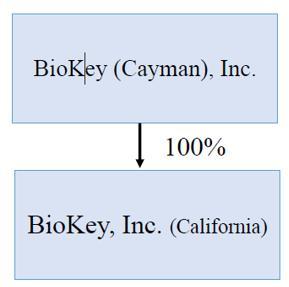
Products & Technologies
BioKey operates as a contract development and manufacturing organization (“CDMO”) focused on specialty pharmaceutical products, providing integrated services that support product development and clinical advancement. The Company’s offerings include pre-formulation and formulation development, analytical services including drug substance and drug product stability studies, pilot-scale manufacturing, clinical supply manufacturing and logistics support, and regulatory assistance related to investigational new drug (“IND”), new drug application (“NDA”), and abbreviated new drug application (“ANDA”) submissions, in each case in support of customer-sponsored development programs.
Oral Release Technologies
BioKey has developed and applied oral drug delivery and release technologies designed to support the formulation of solid dosage forms with enhanced water solubility and liquid dosage forms utilizing liquid-filled soft gel systems with multi-layer coatings. The Company’s controlled oral release capabilities include pH-modulated and swollen hydrogel systems, membrane-controlled and bioerodible release systems, microencapsulated and pulsatile release systems, osmotic-controlled release systems, solubility-modulating, and delayed-release hydrogel platforms, stabilized encapsulated drug release systems, granulated hydrogel matrix systems, microporous matrix systems, and dual-layer stabilized controlled release systems. These technologies are applied, as appropriate, to support customer-sponsored development programs by tailoring release profiles, stability characteristics, and performance attributes to specific formulation and therapeutic objectives.
Consumer Products
BioKey is developing plant-based consumer products intended for distribution in the United States, Canada, and certain Asian markets, and has implemented manufacturing processes designed to meet applicable regulatory requirements governing product safety, labeling, and quality. The Company has developed methods for manufacturing consumer products at its facilities that are intended to comply with U.S. Food and Drug Administration (“FDA”) requirements and other applicable regulatory standards, including the use of appropriate safeguards, instructions for use, and quality controls required for products marketed for consumer use in these jurisdictions.
51
Maitake Mushroom Supplements
BioKey is in advanced stages of developing Maitake mushroom–based tablet and beverage formulations for international customers, utilizing its proprietary formulation and manufacturing processes. Maitake mushrooms contain naturally occurring beta-glucans and other bioactive compounds that have been the subject of academic and preclinical research evaluating their potential nutritional and functional properties. While various studies conducted by third parties have explored the biological characteristics of Maitake-derived compounds, BioKey’s products are being developed as dietary supplements and are not intended to diagnose, treat, cure, or prevent any disease, and any commercialization is subject to applicable regulatory requirements in the jurisdictions in which such products may be marketed. Research literature suggests that Maitake β-glucans may support immune function and metabolic wellness. These observations are based on academic studies12, and BioKey does not make any therapeutic claims regarding disease treatment. All Maitake products currently are marketed solely as dietary supplements.
The Company’s activities are currently focused on two active programs: (1) a Maitake β-glucan dietary supplement (BLEX-404) and (2) PDC-1421, a botanical product under development for sleep and mood support.
BLEX-404
BLEX-404 (Maitake β-glucan extract) is a standardized bioactive polysaccharide extract derived from Grifola frondosa (Maitake mushroom). BLEX-404 is positioned as an immune-support functional ingredient and is used in dietary supplements currently being introduced in Asia and North America.
PDC-1421
PDC-1421 (Polygala tenuifolia extract) is a botanical extract derived from Radix Polygala, a plant traditionally used in East Asian herbal practices. The product is being developed as a dietary supplement ingredient intended for mood and sleep-support applications. Pre-clinical literature and third-party academic studies have evaluated Polygala-derived compounds for their neuroactive and adaptogenic properties. BioKey Cayman’s activities related to PDC-1421 are currently limited to formulation development, stability testing, and evaluation of potential functional food and dietary supplement formats. PDC-1421 has not been approved by the FDA for the treatment or prevention of any disease, and any future commercialization will be subject to applicable dietary supplement and food regulatory requirements.
Product Development Status
BioKey Cayman’s current development activities focus on (i) BLEX-404, a Maitake β-glucan dietary supplement, and (ii) PDC-1421, a botanical ingredient under evaluation for functional food and dietary supplement use. Both programs are in the formulation optimization and early commercialization support stage.
Regulatory Status
BLEX-404 and PDC-1421 are being developed as dietary supplements or functional food ingredients. They are not regulated as pharmaceutical drugs and are not subject to FDA approval requirements applicable to drugs. Any marketing is subject to dietary supplement, food safety, labeling, and registration requirements in applicable jurisdictions.
Scientific and Clinical Support
Scientific support for both programs is based on third-party academic literature, historical use, and internal formulation and stability data. BioKey Cayman does not conduct sponsor-initiated clinical trials for these products.
Manufacturing and Supply Chain
Pilot-scale manufacturing, formulation, and testing are conducted at the Company’s Fremont, California facility. Commercial-scale manufacturing is performed through qualified contract manufacturers in Asia and the United States.
| 12 | https://www.sciencedirect.com/science/article/abs/pii/S0141813025103036 |
52
Commercialization and Market Strategy
Commercialization efforts focus on business-to-business supply to supplement brands, ingredient distributors, and affiliated entities, primarily in Asia and North America.
Revenues
Revenues generated to date relate primarily to ingredient supply, formulation services, and CRO/CDMO services. Product revenues are not material at this stage.
Risks and Uncertainties
Key risks include regulatory changes affecting dietary supplements, raw material availability, and customer adoption of new botanical formulations.
Services
BioKey Cayman provides CRO/CDMO services supporting nutraceutical and botanical product development, including formulation optimization, extraction technology development, stability testing, analytical method development, pilot manufacturing, packaging, labeling, and regulatory documentation for dietary supplement registration.
In addition, the Company provides limited FDA-related support services by assisting clients with documentation for their own investigational new drug (“IND”) submissions. BioKey Cayman does not conduct pharmaceutical drug development itself but may support sponsor-led clinical programs by preparing manufacturing records, analytical data, and related regulatory materials.
The Company’s integrated service platform covers pre-formulation and formulation development for oral solid and liquid dosage forms, clinical-supply manufacturing under current Good Manufacturing Practice (“cGMP”) guidelines, and GMP analytical and quality-control testing to support product release and stability programs. BioKey Cayman also offers regulatory support services, including maintenance of sponsor-provided IND documentation and coordination of investigational product logistics for client clinical studies.
Product Development
BioKey operates as a contract development and manufacturing organization (“CDMO”) providing product development and clinical supply services for pharmaceutical, nutraceutical, botanical, and biologic development programs, with manufacturing conducted under current Good Manufacturing Practice (“cGMP”) guidelines. The Company’s product development services encompass pre-formulation, formulation, process development, analytical method development, stability studies conducted in accordance with International Council for Harmonisation (“ICH”) guidelines, and cGMP manufacturing of drug substance and drug product. BioKey’s operations are based in Fremont, California, a recognized biopharmaceutical hub in the United States, and since 2018 the Company has manufactured and delivered multiple development and clinical supply projects for third-party customers.
Formulation and Pre-Formulation
BioKey provides pre-formulation and formulation development services designed to support the development of stable and bioavailable pharmaceutical, nutraceutical, and botanical products in oral solid dosage forms, including tablets and capsules, as well as liquid formulations. Pre-formulation activities include physicochemical characterization of active ingredients, excipient compatibility assessments, and powder and granular characterization to inform formulation design and manufacturability. Building on these studies, the Company conducts formulation development to optimize dosage form performance, stability, and scalability, generating data to support downstream process development, manufacturing, and regulatory submissions.
53
The Company has formulation development capabilities for non-sterile solutions, semi-solid dosage forms, including gels, creams, and ointments, and solid dosage forms, including powders, tablets, and capsules, which are developed in its research and development laboratories and manufactured in its cGMP pilot plant. The Company’s equipment generally supports batch sizes of up to approximately 25 kilograms, with the ability to accommodate smaller batches for early-stage development studies and, in certain cases, larger batches depending on product requirements. BioKey has experience in the development of botanical and nutritional supplement products, including the capability to produce such products in a food-grade pilot plant, and offers packaging services for delivery systems such as metered-dose pumps, pouches, and bottles. The Company also maintains cGMP-compliant storage for bulk, unlabeled, and clinically labeled materials and, upon customer instruction, can prepare, package, label, and ship clinical supplies in accordance with customer-provided protocols and applicable regulatory requirements.
The Company provides additional development and manufacturing support services for early-stage clinical programs, including formulation and process development for investigational products intended for Phase 1 and Phase 2 studies, as well as the manufacture of such products in its cGMP pilot plant. Where a formulation or manufacturing process has been previously developed by a customer, the Company can support technology transfer and implementation of the process at its facilities. BioKey works collaboratively with customers to establish raw material, in-process, and finished product testing methods and specifications, and to prepare master batch records and master packaging records required for compliant manufacturing and filling operations. The Company also provides packaging and labeling services for bulk materials in accordance with clinical trial protocols and applicable regulatory requirements.
Analytical Services
BioKey operates a cGMP-compliant analytical laboratory that supports the development, manufacturing, release, and stability testing of clinical and research materials. The Company’s analytical services include analytical method development, validation, and method transfer in support of drug development programs from early-stage through later-stage clinical development. BioKey applies spectroscopic, chromatographic, and physicochemical techniques to analyze small-molecule active pharmaceutical ingredients, botanical products, and nutraceuticals, generating data to support product quality, consistency, and compliance with applicable regulatory and quality standards.
Manufacturing, Packaging, and Labeling
BioKey operates modular Class 100,000 cGMP cleanroom facilities for the manufacture, packaging, labeling, and release of clinical supplies for oral therapeutic and nutraceutical products in liquid, solid, and semi-solid dosage forms, supporting programs intended for the United States, Canada, and certain Asian markets. The Company’s cGMP pilot plant has the capacity to manufacture approximately 5,000 to 50,000 tablets or capsules per day, depending on the specific manufacturing process, and can produce batch sizes of up to approximately 25 kilograms for early-stage clinical development programs. BioKey supports formulation and process development for Phase I and Phase II studies, as well as technology transfer of existing customer processes, and works collaboratively with customers to establish raw material, in-process, and finished product testing methods and specifications, and to prepare master batch records and master packaging records. The Company also provides packaging and labeling services for bulk materials in accordance with clinical trial protocols and applicable regulatory requirements and has expanded its capabilities to include the manufacture of nutraceutical oral drink products using a 500-liter pasteurization system.
Clinical Trial & Regulatory Services
BioKey provides clinical trial and regulatory support services to assist customers in the planning and execution of development programs and in meeting applicable regulatory requirements. These services include clinical protocol design, statistical analysis planning, site identification and coordination, regulatory compliance monitoring at clinical sites, patient recruitment support, trial master file management, and tracking of clinical specimens and investigational product shipments. The Company also provides regulatory affairs support, including assistance with abbreviated new drug application (“ANDA”) and investigational new drug (“IND”) submissions, maintenance of IND and biologics license application (“BLA”) documentation, and support for U.S. Food and Drug Administration (“FDA”) interactions, such as acting as a U.S. agent for regulatory communications, GDUFA self-identification, establishment registration, and product listing, in each case in support of customer-sponsored programs.
54
In addition, BioKey, Inc. has entered into a service collaboration with Rgene Corporation pursuant to which Rgene provides manufacturing support for drug product used in clinical trials involving the Maitake formulation, as well as regulatory process support for related applications.
Our Strengths
The following is a summary of our competitive strengths:
1. Favorable Market Trends
The Company is positioned within the growing global nutraceutical and functional ingredients sector, a market supported by strong secular demand trends in immune health, metabolic wellness, and preventive nutrition. According to Grand View Research, the global nutraceuticals market was valued at approximately US$591.1 billion in 2024 and is projected to expand to approximately US$919.1 billion by 203013.
2. Well-Developed Manufacturing Capabilities Leading to Higher Efficiency
Over the years, we have developed an efficient and cost-effective manufacturing process. Specifically, a combination of modern operational and management systems, advanced manufacturing equipment, experienced manufacturing know-hows, skilled workforce, and flexible manufacturing system allows us to shorten the “time to market” for the manufacturing of our products. Moreover, the combination allows us to timely adjust our lines of products in anticipation of changes in market demands.
3. Robust Research and Product Development Capabilities
Research and product development capabilities have been an important component of the Company’s historical activities and strategic positioning. As of the date of this filing, research and development functions are performed primarily by technical and scientific personnel of the ABVC Group and its subsidiaries and affiliates. Following the completion of the Spin-Off, the Company expects to recruit and retain its own dedicated research and development personnel to support ongoing formulation, process development, and product innovation activities.
We operate as an early-stage commercial company in the nutraceutical ingredients, dietary supplement, and contract development, and manufacturing markets. Through our operating subsidiaries and affiliates, we have completed pilot-scale commercial manufacturing and initial product launches in select markets, including Taiwan and Canada, which validated our manufacturing processes, quality systems, and supply chain readiness. While these initial launches did not generate material revenue, they established the operational foundation for broader commercialization. We are currently focused on expanding our customer base, strengthening distribution partnerships, and scaling our manufacturing and product development capabilities to support future revenue growth.
4. Strategic Service Network
The ability to provide timely after-sales services is critical in building and maintaining a loyal and solid customer base. We have strategically established an after-sales service network in locations with developed economies through establishing in-house service centers and employing service providers that conduct businesses predominantly in these regions. Users of our products can reach us through a service line, through which we are able to provide prompt on-site technical services.
| 13 | https://www.grandviewresearch.com/industry-analysis/nutraceuticals-market |
55
5. Experienced Management Team with Successful Track Records
Our senior management team is comprised of individuals with operational experience, market knowledge, international management experience, and technical expertise across the biotechnology, nutraceutical, and functional ingredients sectors. Members of the senior management team have held senior leadership and management roles at public and private companies and have experience in company formation, product development, manufacturing, regulatory compliance, and commercialization.
| ● | Dr. T.S. Jiang will serve as our Chief Executive Officer of the Company following the Spin-Off. Dr. T.S. Jiang has served as the Chief Strategy Officer of ABVC BioPharma, Inc. since September 2019. Since March 13, 2025, Dr. Jiang was also appointed as AiBtl’s Chief Strategy Officer. Dr. Jiang serves as the CEO of Biokey, Inc. since December 2021, as a director of BioFirst Corp. since 2013, and has been the CEO and chairman of BioLite, Inc., a subsidiary of BioLite BVI, Inc., since January 2010. Prior to BioLite, Dr. Jiang served as the president and/or chairman of multiple biotech companies in Taiwan, including PhytoHealth Corporation from 1998 to 2009 and AmCad BioMed Corporation from 2008 to 2009. In addition, Dr. Jiang is a director on various biotech associations, such as the Taiwan Bio Industry Organization (Taiwan) from 2006 to 2008 and the Chinese Herbs and Biotech Development Association in Taiwan from 2003 to 2006. Dr. Jiang was an assistant professor at University of Illinois from 1981 to 1987 and an associate professor at Rutgers, the State University of New Jersey from 1987 to 1990 and served as a professor at a few Taiwanese universities during a period from 1990 to 1993, such as National Taiwan University, National Cheng Kung University and Tunghai University. Dr. Jiang obtained his bachelor degree in Engineering and Chemical Engineering from National Taiwan University in Taiwan in 1976, masters and Ph.D. from Northwestern University in the U.S. in 1981 and Executive Master of Business Administration (“EMBA”) from National Taiwan University in Taiwan in 2007. As a successful entrepreneur, Dr. Jiang has developed and commercialized PG2 Lyo Injection, a new drug to treat cancer related fatigue. From 1998 to 2009, Dr. T. S. Jiang served as President of Phyto Health Corporation where he led a project team to develop PG2 Injectable. This product was extracted, isolated, and purified from a type of Traditional Chinese Medicine. PG2 Injection was intended for cancer patients who had trouble recovering from severe fatigue. Dr. Jiang oversaw and managed the R&D department, daily corporate operations, and business of Phyto Health Corporation when he was the President. PG2 Lyo Injection received approval on its NDA from Taiwan Food and Drug Administration in 2010 and later was launched into the Taiwan market in 2012. We believe that Dr. Jiang provides leadership and technological guidance on our strategic development and operations. | |
| ● | Eugene Jiang will serve as our Chief Financial Officer and will be on the Board of Directors of our Company following the Spin-Off. Eugene Jiang served as CEO and President of ABVC BioPharma, Inc. from the ABVCs inception in July 2015 until he resigned on September 15, 2017. He remains the Chairman of the Board. He currently serves as ABVCs Chief Business Officer since September 2019 and serves as the Chief Business Officer of BioKey, Inc. Since March 13, 2025, Eugene Jiang was appointed as AiBtl’s Chief Financial Officer. Since 2019. Mr. Jiang also serves as Director for BioLite Incorporation since June 2015 and as Director for BioFirst Corp. since 2012. He also serves as CEO for Genepro Investment Company since March 2010. Mr. Jiang obtained a PMBA degree from National Taiwan University in 2017 and an EMBA degree from the University of Texas in Arrington in 2010. And in 2009, Mr. Jiang received a bachelor’s degree in Physical Education from Fu-Jen Catholic University. | |
| ● | Uttam Patil will serve as our Chief Scientific Officer. Mr. Patil was appointed as the Chief Executive Officer of ABVC BioPharma, Inc. on June 21, 2023; he now serves as interim Chief Financial Officer too. Since March 13, 2025, Dr. Patil was also appointed as AiBtl’s co-CEO. Dr. Patil has served as the Chief Operating and Scientific Officer of the Company’s subsidiary, BioKey, Inc. since May 2023; he also works for Rgene Corporation (a related party), as the R&D Manager since May 2023, after being promoted from Project Manager, to which he serves from August 2022 to May 2023. Prior to that, Dr. Patil was a Post-Doctoral Research Fellow at NTNU from March 2020 to July 2022. In 2019, Dr. Patil received the “Platinum Award” for an Oral Presentation on the topic, “Nucleobase Functionalized Single-Walled Carbon Nanotubes Hybridization with Single-Stranded DNA” at a Workshop on Organic Chemistry for Junior Chemists held in South Korea. Dr. Patil received his Ph.D. in Chemistry from National Tsing Hua University and a Masters in Analytical Chemistry from Pune University, as well as a Bachelors in industrial chemistry from Pune University. |
Customers
BioKey Cayman’s customers include supplement brands, ingredient distributors, ABVC Group affiliates, and wellness product manufacturers in Southeast Asia and the Northern America.
A substantial portion of our historical revenues has been derived from a limited number of customers. The degree of customer concentration, including the contribution of our largest customers to total revenue for the relevant reporting periods, is disclosed in the consolidated financial statements and related notes included elsewhere in this filing. Because of this concentration, the loss of any significant customer, a reduction in order volume, unfavorable pricing changes, delays in customer programs, or the termination or completion of customer projects could materially and adversely affect our revenues, profitability, and operating results.
56
Suppliers
The Company sources raw materials including Maitake biomass, botanical extracts, excipients, and packaging materials from qualified suppliers in Asia and the United States. Supplier qualification includes GMP verification, quality audits, and raw material testing.
The prices for raw materials have historically fluctuated, which in turn has affected the Company’s business and operation results. We closely monitor changes in raw material prices and seeks to adjust their inventory of raw materials during inflation periods. We also seek to price our products to reflect the expected fluctuations in raw material prices to the extent possible. However, there can be no assurance that we could precisely estimate any increase in raw material price or pass on such increase onto our customers.
Production, Inventory, and Warehousing
BioKey Cayman conducts pilot-scale extraction, blending, and testing at its Fremont, California facility. Commercial-scale manufacturing is performed through certified contract manufacturers in Asia and the United States. The Company maintains climate-controlled warehousing capacity in California and utilizes third-party logistics providers and contract storage facilities in Asia to support raw material storage and finished goods distribution.
Research and Development
Our research and development team select research or development projects or both and draws up preliminary project proposals based on various factors, such as industry and market trends, customer feedback, and input from other departments (i.e. finance and manufacturing departments).
The management, including the heads and lead managers of various internal departments, such as sales and marketing and finance departments, as well as the chief executive officer, reviews the preliminary project proposals and the research and development team formulates a final plan for each approved project after considering suggestions and comments by its management. The final plans will include detailed schedules and budgets for the projects. The finance department monitors budget overruns. Any increase in the original budget must be reviewed and approved by management before the relevant project can continue.
Intellectual Property
BioKey Cayman does not currently own any registered patents or trademarks. Its operations are conducted pursuant to licensed technology and know-how from ABVC affiliates, and it functions as a contract developer and manufacturer. In June 2024, BioKey Cayman entered into definitive agreements to acquire the business and technology assets of BioLite, BioFirst Corporation, and Rgene Corporation as part of a group reorganization. In June 2024, BioKey Cayman entered into definitive agreements to acquire the business and technology assets of BioLite, BioFirst, and Rgene as part of a group reorganization. As of this filing, certain integration and regulatory steps related to these transactions remain ongoing. Upon completion of the reorganization, BioKey Cayman is expected to hold proprietary formulations, extraction processes, and data packages previously held by these entities.
Sales and Marketing
BioKey Cayman sells its products and services primarily through direct business-to-business relationships with supplement brands, ingredient distributors, and affiliated companies. Sales activities are conducted by management and technical personnel, and the Company does not maintain a dedicated large-scale sales force. Marketing efforts include participation in industry trade shows, technical presentations, and direct customer engagement.
Competition
The contract research and contract development and manufacturing (CRO/CDMO) industry is fragmented and highly competitive. International brand manufacturers equipped with better technology and capital resources are also aiming to expand into our market. As a result, it is expected that our market will become more competitive.
The typical competitive criteria are quality, price, technology, after-sales service, product offering, and performance record. The CRO/CDMO market is capital intensive. In addition, the manufacturing process requires technical expertise and significant research and development budgets. As a result, companies entering the market must have significant financial and technical resources. Moreover, the time and cost required to establish a proven track record, necessary for general market acceptance, are substantial.
57
We believe that we are able to compete based on our market position, strong research and development capabilities, high quality products, integrated service systems, and strong relationships with our customers.
Our key competitors include Catalent Pharma Solutions, Thermo Fisher Scientific (Patheon), Cambrex Corporation, Curia Global, Alcami Corporation, and Piramal Pharma Solutions.
Properties and Facilities
BioKey operates an approximately 28,000 square foot facility in Fremont California, located within the San Francisco Bay Area, which houses its research and development laboratories and cGMP manufacturing operations. The facility includes laboratories supporting product development, formulation development, and analytical method development, as well as cGMP manufacturing suites equipped for blending, roller compaction, and tablet and capsule manufacturing of small-molecule oral therapeutic products. The facility’s flexible design and integrated infrastructure support the development, formulation, and manufacture of botanical and nutraceutical products, and additional space is available to accommodate potential future expansion of laboratory and manufacturing operations. The space consists of offices, research and production laboratories, and manufacturing facilities, which are GMP certified. At the end of the lease, the Company has an option to extend or five more years. The total rental expense was $421,894 and $353,466 for the years ended December 31, 2024, and 2023, respectively. The property serves the functions of product manufacturing, research and development, warehousing, marketing, and customer services and includes:
| ● | cGMP-certified production suites; |
| ● | Analytical and formulation laboratories; |
| ● | Warehouse and cleanroom environments; |
| ● | Office and support areas. |
The facility is equipped with a comprehensive range of pilot-scale manufacturing and laboratory equipment, including:
Analytical and Laboratory Equipment:
| ● | HPLC (Agilent 1260/1290 Infinity with ChemStation, Agilent 1100 with Corona ESA, Shimadzu Prominence UFLC with LabSolutions) |
| ● | FT-IR (Perkin Elmer Spectrum One) |
| ● | KF Titrator (Mettler Toledo C20SD) |
| ● | Environmental Chambers (25°C/60%RH, 30°C/65%RH, 40°C/75%RH) |
| ● | Disintegration Tester (VanKel VK 100) |
| ● | Dissolution Apparatus (Agilent 708-DS with Agilent 850-DS Sampling Station, Distek Premiere 5100 with Online Agilent UV) |
| ● | Analytical Balance (Mettler Toledo XS105) |
Manufacturing and Processing Equipment:
| ● | Tablet Press (Korsch XL100, Instrumented) |
| ● | Capsule Fillers (Bosch Automated, ProFiller 3600 [4,500–6,900/hr]) |
| ● | High Shear Granulator (Yen Chen SMG5, 100 [5L, 100L]) |
58
| ● | Tray Dryer/Oven (Gruenberg, Yen Chen) |
| ● | Coating Machine (O’Hara Coater II X Tab Coater – 12”, 19”, 30” pans) |
| ● | Conical Mill (Quadro Comil 197S) |
| ● | Twin Shell Dry Blenders (various sizes from 1-pint to 60 kg) |
| ● | Fluid Bed Dryer (Aromatic Strea1, Uni-Glatt) |
| ● | Weight Sorter (CI Electronics SADE) |
| ● | Pasteurization Tank (Bear Hangzhou 500L) |
We believe that our existing facilities are sufficient for their current needs and will obtain additional facilities to accommodate our future expansion plans.
Employees
As of this filing, the Company’s operations are supported by personnel of the ABVC Group, its subsidiaries, and affiliates. Following the completion of the Spin-Off, the Company expects that certain personnel of the ABVC Group will continue to provide transitional operational, administrative, and technical support for a limited period of time while BioKey (Cayman), Inc. recruits and hires its own dedicated employees. The Company intends to establish an independent workforce to support its ongoing business operations as a standalone public company following the Spin-Off.
We believe that our success and continued growth depend on the ability to attract, retain, and motivate qualified employees. We offer our employee’s competitive salaries, comprehensive training, and other fringe benefits and incentives. None of the employees are represented by labor unions, and no collective bargaining agreement has been put in place. We have not had any labor strikes or other labor disturbances that have materially interfaced with their operations, and we believe that we have maintained a good work relationship with our employees.
Seasonality
Our operating results are not affected by seasonality.
Legal Proceedings
We may from time to time be subject to various legal or administrative claims and proceedings arising in the ordinary course of our business. We are not currently a party to any other material legal or administrative proceedings than as described in this section. Litigation or any other legal or administrative proceeding, regardless of the outcome, is likely to result in substantial costs and diversion of our resources, including our management’s time and attention.
Regulations
BioKey Cayman is subject to regulatory requirements applicable to dietary supplements, functional foods, nutraceutical ingredients, and contract manufacturing activities in the jurisdictions in which it operates. In the United States, these requirements include regulations administered by the U.S. Food and Drug Administration (“FDA”) governing current Good Manufacturing Practices (“cGMP”) for dietary supplements, food safety, product labeling, facility registration, and recordkeeping.
BioKey Cayman’s manufacturing and development activities are subject to inspection by regulatory authorities to assess compliance with applicable cGMP requirements, quality control procedures, sanitation standards, and documentation practices. Compliance with these requirements affects many aspects of the Company’s operations, including raw material sourcing, manufacturing processes, packaging, labeling, storage, distribution, and import and export of botanical and nutraceutical products. Failure to comply with applicable regulatory requirements could result in regulatory enforcement actions, including warning letters, product recalls, import alerts, civil penalties, or restrictions on manufacturing or distribution activities.
In addition to U.S. federal requirements, BioKey Cayman is subject to applicable state, local, and international regulations in the jurisdictions where its products are manufactured or distributed, including regulations related to food safety, customs, import and export controls, and product registration or notification requirements. Changes in existing regulations or the adoption of new regulatory requirements could require the Company to modify its manufacturing practices, labeling, quality systems, or facilities, which could result in increased operating costs or capital expenditures.
BioKey Cayman does not manufacture FDA-approved pharmaceutical or biologic products for commercial sale and is not subject to regulatory regimes governing pharmaceutical drug approvals or clinical trial product manufacturing. However, the Company’s customers may be subject to additional regulatory requirements applicable to their finished products, and regulatory actions affecting customers or supply chains could indirectly impact BioKey Cayman’s operations.
59
MANAGEMENT’S DISCUSSION AND ANALYSIS OF FINANCIAL CONDITION AND RESULTS OF OPERATIONS
You should read the following discussion and analysis of our financial condition and results of operations in conjunction with our consolidated financial statements and the accompanying notes thereto included elsewhere in this information statement. Some of the information contained in this discussion and analysis or set forth elsewhere in this information statement, including information with respect to our plans and strategy for our business, includes forward-looking information statement that involve risks and uncertainties. You should read the sections titled “Risk Factors” and “Cautionary Statement Concerning Forward-Looking Statements” for a discussion of important factors that could cause actual results to differ materially from the results described in or implied by the forward-looking statements contained in the following discussion and analysis.
Management’s Discussion and Analysis of Financial Condition and Results of Operations is intended to help you understand the results of operations and financial condition of the business for the three months ended March 31, 2026 and 2025 and for the years ended December 31, 2024 and 2025.
Overview
BioKey (Cayman), Inc. (“BioKey Cayman,” the “Company,” “we,” “our,” or “us”) is a wholly-owned subsidiary of ABVC BioPharma, Inc (“ABVC”) formed to operate as an independent nutraceutical and functional supplement research, development, and manufacturing platform. On May 10, 2025, the Company entered into a share transfer agreement with ABVC and BK California, pursuant to which the Company acquired 100% of the equity interest of BK California from ABVC in exchange for $100 (the “2025 Reorganization”). BK California was incorporated in California on November 20, 2020, and was a wholly owned subsidiary of ABVC. BK California’s mission is to capitalize on the growth opportunities in the generic drug market. Currently, BK California is a pharmaceutical manufacturing and development company.
BioKey Cayman’s revenue was generated by BK California in 2024, and has been organized to receive, develop, and commercialize assets transferred from ABVC, including proprietary formulations based on botanical extracts such as Maitake mushroom and Polygala tenuifolia.
Following the planned spin-off, we intend to operate as a contract research, development, and manufacturing organization (CRDMO) dedicated to nutraceuticals and functional supplements, with a focus on cGMP-certified production, regulatory compliance, and commercialization in Asia and North America.
Results of Operations
As BioKey Cayman was recently formed, we have no operating revenues for the periods presented except for the revenue generated by BK California in 2024. Our historical expenses consist primarily of organizational costs and professional fees associated with incorporation, regulatory filings, and preparation for the planned spin-off.
Post spin-off, our expenses are expected to increase significantly as we:
| ● | Establish dedicated R&D and manufacturing operations for nutraceutical and functional supplement products. |
| ● | Incur regulatory compliance and quality control costs related to cGMP operations. |
| ● | Expand business development and commercialization activities in key geographies. |
60
Summary of Critical Accounting Policies
Basis of Presentation
The accompanying consolidated financial statements have been prepared in accordance with the U.S. GAAP and pursuant to the regulations of the Securities and Exchange Commission (the “SEC”). All significant intercompany transactions and account balances have been eliminated. The Company’s fiscal year is the calendar year.
Use of Estimates
The preparation of financial statements in conformity with the U.S. GAAP that requires management to make estimates and assumptions that affect the reported amounts of assets and liabilities and disclosure of contingent assets and liabilities at the date of the consolidated financial statements and the amount of revenues and expenses during the reporting periods. Actual results could differ materially from those results.
Fair Value Measurements
ASC 820 “Fair Value Measurements” defines fair value for certain financial and nonfinancial assets and liabilities that are recorded at fair value, establishes a framework for measuring fair value and expands disclosures about fair value measurements. It requires that an entity measures its financial instruments to base fair value on exit price, maximize the use of observable units and minimize the use of unobservable inputs to determine the exit price. It establishes a hierarchy which prioritizes the inputs to valuation techniques used to measure fair value. This hierarchy increases the consistency and comparability of fair value measurements and related disclosures by maximizing the use of observable inputs and minimizing the use of unobservable inputs by requiring that observable inputs be used when available. Observable inputs are inputs that reflect the assumptions market participants would use in pricing the assets or liabilities based on market data obtained from sources independent of the Company. Unobservable inputs are inputs that reflect the Company’s own assumptions about the assumptions market participants would use in pricing the asset or liability developed based on the best information available in circumstances. The hierarchy prioritizes the inputs into three broad levels based on the reliability of the inputs as follows:
Level 1 – Inputs are quoted prices in active markets for identical assets or liabilities that the Company can access at the measurement date. Valuation of these instruments does not require a high degree of judgment as the valuations are based on quoted prices in active markets that are readily and regularly available.
Level 2 – Inputs other than quoted prices in active markets that are either directly or indirectly observable as of the measurement date, such as quoted prices for similar assets or liabilities; quoted prices in markets that are not active; or other inputs that are observable or can be corroborated by observable market data for substantially the full term of the assets or liabilities.
Level 3 – Valuations based on inputs that are unobservable and not corroborated by market data. The fair value for such assets and liabilities is generally determined using pricing models, discounted cash flow methodologies, or similar techniques that incorporate the assumptions a market participant would use in pricing the asset or liability.
The carrying values of certain assets and liabilities of the Company, such as cash and cash equivalents, accounts receivable, due from related parties, prepaid expenses and other current assets, accrued expenses and other current liabilities, and due to related parties, approximate fair value due to their relatively short maturities. The carrying value of the Company’s short-term bank loans, convertible notes payable, and accrued interest approximates their fair value as the terms of the borrowing are consistent with current market rates and the duration to maturity is short.
61
Concentration of Credit Risk
The Company’s financial instruments that are exposed to concentrations of credit risk consist primarily of cash and cash equivalents. The Company deposits cash in reputable financial institutions covered by FDIC’s $250,000 insurance, though amounts may exceed the $250,000 FDIC insurance limit. However, the Company does not anticipate any losses on excess deposits. The Company does not enter financial instruments for hedging, trading, or speculative purposes.
The Company performs ongoing credit evaluation of its customers and requires no collateral. Credit losses and allowance for unbilled receivables are provided based on a review of the collectability of accounts receivable. The Company determines the amount of allowance for doubtful accounts by examining its historical collection experience, current economic conditions, reasonable and supportable forecasts of future economic conditions, as well as its internal credit policies. Actual credit losses may differ from our estimates.
Revenue Recognition
The Company recognizes revenue in accordance with ASC 606, Revenue from Contracts with Customers. Pursuant to ASC 606, the Company recognizes revenue when its customer obtains control of promised goods or services, in an amount that reflects the consideration that the Company expects to receive in exchange for those goods or services. To determine revenue recognition for arrangements that the Company determines is within the scope of ASC 606, the Company performs the following five steps: (i) identify the contract(s) with a customer; (ii) identify the performance obligations in the contract; (iii) determine the transaction price; (iv) allocate the transaction price to the performance obligations in the contract; and (v) recognize revenue when (or as) the Company satisfies a performance obligation. The Company only applies the five-step model to contracts when it is probable that the Company will collect the consideration the Company is entitled to in exchange for the goods or services the Company transfers to the customers. At inception of the contract, once the contract is determined to be within the scope of ASC 606, the Company assesses the goods or services promised within each contract, determines those that are performance obligations, and assesses whether each promised good or service is distinct. The Company then recognizes as revenue the amount of the transaction price that is allocated to the respective performance obligation when (or as) the performance obligation is satisfied.
CDMO Service Revenue
The Company’s revenues are mainly derived from Research and Development Activities Services (also known as the Contract Development & Manufacturing Organization Services (“CDMO”). Revenues related to research and development and regulatory activities are recognized when the related services or activities are performed, in accordance with the contract terms. The Company typically has only one performance obligation at the beginning of a contract, which is to perform research and development services. The Company may also provide its customers with an option to request that the Company provides additional goods or services in the future, such as active pharmaceutical ingredients, API, or IND/NDA/ANDA/510K submissions. The Company evaluates whether these options are material rights at the inception of the contract. If the Company determines an option is a material right, the Company will consider the option a separate performance obligation.
62
If the Company is entitled to reimbursement from its customers for specified research and development expenses, the Company accounts for the related services that it provides as separate performance obligations if it determines that these services represent a material right. The Company also determines whether the reimbursement of research and development expenses should be accounted for as revenues or an offset to research and development expenses in accordance with provisions of gross or net revenue presentation. The Company recognizes the corresponding revenues or records the corresponding offset to research and development expenses as it satisfies the related performance obligations.
The Company then determines the transaction price by reviewing the amount of consideration the Company is eligible to earn under the contracts, including any variable consideration. Under the outstanding contracts, consideration typically includes fixed consideration and variable consideration in the form of potential milestone payments. At the start of an agreement, the Company’s transaction price usually consists of the payments made to or by the Company based on the number of full-time equivalent researchers assigned to the project and the related research and development expenses incurred. The Company does not typically include any payments that the Company may receive in the future in its initial transaction price because the payments are not probable. The Company would reassess the total transaction price at each reporting period to determine if the Company should include additional payments in the transaction price.
The Company receives payments from its customers based on billing schedules established in each contract. Upfront payments and fees may be recorded as advances from customers upon receipt or when due, and may require deferral of revenue recognition for a future period until the Company performs its obligations under these arrangements. Amounts are recorded as accounts receivable when the right of the Company to consideration is unconditional. The Company does not assess whether a contract has a significant financing component if the expectation at contract inception is such that the period between payment by the customers and the transfer of the promised goods or services to the customers will be one year or less.
Property and Equipment, net
Property and equipment, net is carried at cost net of accumulated depreciation. Repairs and maintenance are expensed as incurred. Expenditures that improve the functionality of the related asset or extend the useful life are capitalized. When property and equipment are retired or otherwise disposed of, the related gain or loss is included in operating income. Leasehold improvements are depreciated on the straight-line method over the shorter of the remaining lease term or estimated useful life of the asset. Depreciation is calculated on the straight-line method generally based on the following useful lives:
| Estimated Life in Years | ||
| Leasehold improvements | 3 ~ 15 | |
| Machinery and equipment | 3 ~ 8 | |
| Office equipment | 3 |
Impairment of Long-Lived Assets
The Company has followed the guidance of ASC subtopic 360-10, Property, Plant and Equipment. ASC 360-10 requires that long-lived assets and certain identifiable intangibles held and used by the Company be reviewed for impairment whenever events or changes in circumstances indicate that the carrying amount of an asset may not be recoverable. The Company evaluates its long-lived assets for impairment annually or more often if events and circumstances warrant. Events relating to recoverability may include significant unfavorable changes in business conditions, recurring losses, or a forecasted inability to achieve break-even operating results over an extended period. Should impairment in value be indicated, the carrying value of intangible assets will be adjusted, based on estimates of future discounted cash flows resulting from the use and ultimate disposition of the asset. ASC 360-10 also requires assets to be disposed of to be reported at the lower of the carrying amount or the fair value less costs to sell.
63
Research and Development Expenses
The Company accounts for the cost of using licensing rights in research and development costs according to ASC 730-10-25-1. This guidance provides that absent alternative future uses the acquisition of product rights to be used in research and development activities must be charged to research and development expenses when incurred.
The Company accounts for R&D costs in accordance with ASC 730 “Research and Development”. Research and development expenses are charged to expense as incurred unless there is an alternative future use in other research and development projects or otherwise. Research and development expenses are comprised of costs incurred in performing research and development activities, including personnel-related costs, facilities-related overhead, and outside contracted services including clinical trial costs, manufacturing, and process development costs for both clinical and preclinical materials, research costs, and other consulting services. Non-refundable advance payment for goods and services that will be used in future research and development activities are expensed when the activity has been performed or when the goods have been received rather than when the payment is made. In instances where the Company enters into agreements with third parties to provide research and development services, costs are expensed as services are performed.
Income Taxes
The Company accounts for income taxes using the asset and liability approach which allows the recognition and measurement of deferred tax assets to be based upon the likelihood of realization of tax benefits in future years. Under the asset and liability approach, deferred taxes are provided for the net tax effects of temporary differences between the carrying amounts of assets and liabilities for financial reporting purposes and the amounts used for income tax purposes. A valuation allowance is provided for deferred tax assets if it is more likely than not these items will expire before the Company is able to realize their benefits, or future deductibility is uncertain.
Under ASC 740, a tax position is recognized as a benefit only if it is “more likely than not” that the tax position would be sustained in a tax examination, with a tax examination being presumed to occur. The evaluation of a tax position is a two-step process. The first step is to determine whether it is more-likely-than-not that a tax position will be sustained upon examination, including the resolution of any related appeals or litigations based on the technical merits of that position. The second step is to measure a tax position that meets the more-likely-than-not threshold to determine the amount of benefits recognized in the financial statements. A tax position is measured at the largest amount of benefit that is greater than 50 percent likely of being realized upon ultimate settlement. Tax positions that previously failed to meet the more-likely-than-not recognition threshold should be recognized in the first subsequent period in which the threshold is met. Previously recognized tax positions that no longer meet the more-likely-than-not criteria should be de-recognized in the first subsequent financial reporting period in which the threshold is no longer satisfied. Penalties and interest incurred related to underpayment of income tax are classified as income tax expense in the year incurred. No significant penalty or interest relating to income taxes has been incurred for the years ended December 31, 2025 and 2024. GAAP also provides guidance on de-recognition, classification, interest and penalties, accounting in interim periods, disclosures and transition.
Valuation of Deferred Tax Assets
A valuation allowance is recorded to reduce the Company’s deferred tax assets to the amount that is more likely than not to be realized. In assessing the need for the valuation allowance, management considers, among other things, projections of future taxable income and ongoing prudent and feasible tax planning strategies. If the Company determines that sufficient negative evidence exists, then it will consider recording a valuation allowance against a portion or all of the deferred tax assets in that jurisdiction. If, after recording a valuation allowance, the Company’s projections of future taxable income and other positive evidence considered in evaluating the need for a valuation allowance prove, with the benefit of hindsight, to be inaccurate, it could prove to be more difficult to support the realization of its deferred tax assets. As a result, an additional valuation allowance could be required, which would have an adverse impact on its effective income tax rate and results. Conversely, if, after recording a valuation allowance, the Company determines that sufficient positive evidence exists in the jurisdiction in which the valuation allowance was recorded, it may reverse a portion or all of the valuation allowance in that jurisdiction. In such situations, the adjustment made to the deferred tax asset would have a favorable impact on its effective income tax rate and results in the period such determination was made.
64
Commitments and Contingencies
The Company has adopted ASC 450 “Contingencies” subtopic 20, in determining its accruals and disclosures with respect to loss contingencies. Accordingly, estimated losses from loss contingencies are accrued by a charge to income when information available before financial statements are issued or are available to be issued indicates that it is probable that an asset had been impaired or a liability had been incurred on the date of the financial statements, and the amount of the loss can be reasonably estimated. Legal expenses associated with the contingency are expensed as incurred. If a loss contingency is not probable or reasonably estimable, disclosure of the loss contingency is made in financial statements when it is at least reasonably possible that a material loss could be incurred.
Recent Accounting Pronouncements
In November 2024, the FASB issued ASU No. 2024-03, Expense Disaggregation Disclosures (Subtopic 220-40). The ASU requires disclosure of specified information about certain costs and expenses. This includes purchases of inventory, employee compensation, depreciation, and intangible asset amortization. The ASU is effective on a prospective or retrospective basis for annual reporting period beginning after December 15, 2026, and interim reporting period beginning after December 15, 2027. Early adoption is permitted. This ASU will likely result in the required additional disclosures and the Company expects no material impact on consolidated financial statements of adopting.
The Company will continue to monitor other issued but not yet effective standards and will update its disclosures as more information becomes available.
Estimates and Assumptions
In preparing our consolidated financial statements, we use estimates and assumptions that affect the reported amounts and disclosures. Our estimates are often based on complex judgments, probabilities and assumptions that we believe to be reasonable, but that are inherently uncertain and unpredictable. We are also subject to other risks and uncertainties that may cause actual results to differ from estimated amounts.
Results of Operations — Ended December 31, 2024 Compared to Year Ended December 31, 2025
| Year Ended December 31, | Increase | |||||||||||||||
| 2025 | 2024 | (Decrease) | % | |||||||||||||
| Revenue | $ | - | $ | 13,589 | $ | (13,589 | ) | -100 | % | |||||||
| Gross Profits | $ | - | $ | 12,826 | $ | (12,826 | ) | -100 | % | |||||||
| Operating Expenses | $ | 712,319 | $ | 764,854 | $ | (52,535 | ) | -7 | % | |||||||
| Loss from Operations | $ | (712,319 | ) | $ | (752,028 | ) | $ | 39,709 | -5 | % | ||||||
| Other Expense, Net | $ | (30,753 | ) | $ | (39,252 | ) | $ | 8,499 | -22 | % | ||||||
| Interest Expense, Net | $ | (153,891 | ) | $ | (153,487 | ) | $ | (404 | ) | 0 | % | |||||
| Net Loss | $ | (743,072 | ) | $ | (791,280 | ) | $ | 48,208 | -6 | % | ||||||
Revenues. We didn’t generate any revenue in 2025, while we had $13,589 in revenue for the year ended December 31, 2024. During the year 2025, the Company was focusing on organization restructuring and operation strategies. Certain CDOM services were provided, and revenues were recognized in 2024.
Operating Expenses. Our operating expenses were $712,319 for the year ended December 31, 2025, compared to $764,854 for the year ended December 31, 2024. Such decrease in operating expenses was mainly attributable to the decrease in selling, general and administrative expenses, as we have been focusing on our cost control initiatives to reduce cash burns.
65
Other Expense, Net. Other expenses were $30,753 for the year ended December 31, 2025, compared to $39,252 for the year ended December 31, 2024. This category mainly includes sublease income and the net of interest income and expenses. Besides discussed below, other income remains consistent between two years.
Interest Expense, Net, was $153,891 for the year ended December 31, 2025, compared to $153,487 for the year ended December 31, 2024. Our loan balances from ABVC, our parent company, were consistent between two periods.
Net Loss. The net loss was $743,072 for the year ended December 31, 2025, compared to $791,280 for the year ended December 31, 2024. The Company reduced its net loss by $48,208 or approximately -6% during the year ended December 31, 2025, through more strict cost controls.
Results of Operations — Three Months Period Ended March 31, 2026 Compared to Three Months Ended March 31, 2025
| Three Months Ended March 31, | Increase | |||||||||||||||
| 2026 | 2025 | (Decrease) | % | |||||||||||||
| Revenue | $ | - | $ | - | $ | - | - | % | ||||||||
| Gross Profits | $ | - | $ | - | $ | - | - | % | ||||||||
| Operating Expenses | $ | 184,230 | $ | 129,576 | $ | 54,654 | 42 | % | ||||||||
| Loss from Operations | $ | (184,230 | ) | $ | (129,576 | ) | $ | (54,654 | ) | 42 | % | |||||
| Other Expense, Net | $ | (23,496 | ) | $ | (23,410 | ) | $ | (86 | ) | - | % | |||||
| Interest Expense, Net | $ | (41,496 | ) | $ | (41,128 | ) | $ | (368 | ) | 1 | % | |||||
| Net Loss | $ | (207,726 | ) | $ | (152,986 | ) | $ | (54,740 | ) | 36 | % | |||||
Revenues. We didn’t generate any revenue for both of the three months periods ended March 31, 2026 and 2025, respectively.
Operating Expenses. Our operating expenses were $184,230 for the three months period ended March 31, 2026, compared to $129,576 for the three months period ended March 31, 2025. Such increase in operating expenses was mainly attributable to the decrease in higher rent.
Other Expense, Net. Other income was $23,496 for the three months period ended March 31, 2026, compared to $23,410 for the three months period ended March 31, 2025. This category mainly includes sublease income and the net of interest income and expenses. It was consistent between two periods.
Interest Expense, Net, was $41,496 for the three months ended March 31, 2026, compared to $41,128 for the three months period ended March 31, 2025. It was consistent between two periods.
Net Loss. The net loss was $207,726 for the three months period ended March 31, 2026, compared to $152,986 for the three months period ended March 31, 2025. The increase is mainly due to certain higher operating expenses incurred during this period.
Liquidity and Capital Resources
Since inception, our activities have been funded by ABVC BioPharma, Inc. As of March 31, 2026, BioKey Cayman had $1,614 cash and cash equivalent in hand.
We expect to continue incurring operating losses until we are able to generate revenues from nutraceutical product sales and CRDMO service contracts. To finance our operations, we will rely on:
| ● | Initial capitalization and asset transfers from ABVC. |
| ● | Proceeds from potential equity or debt financings following the spin-off. |
| ● | Strategic partnerships and customer contracts in the nutraceutical sector. |
Our ability to continue as a going concern depends on raising sufficient capital and successfully executing our business plan.
66
Working Capital
| As of March 31, 2026 | As of December 31, 2025 | |||||||
| Current Assets | $ | 56,159 | $ | 61,822 | ||||
| Current Liabilities | $ | 5,697,629 | $ | 5,495,711 | ||||
| Working Deficit | $ | (5,641,470 | ) | $ | (5,433,889 | ) | ||
Cash flow analysis
| Year Ended December 31, | Increase | |||||||||||||||
| 2025 | 2024 | (Decrease) | % | |||||||||||||
| Cash Flow Used In Operating Activities | $ | (678,388 | ) | $ | (591,578 | ) | $ | (86,810 | ) | 15 | % | |||||
| Cash Flow Used in Investing Activities | $ | - | $ | - | $ | - | - | % | ||||||||
| Cash Flow Provided by Financing Activities | $ | 673,126 | $ | 587,457 | $ | 85,669 | 15 | % | ||||||||
Cash Flow from Operating Activities
During the years ended December 31, 2025 and 2024, the net cash used in operating activities were $678,388 and $591,578, respectively. The increase in the amount of outflow $86,810 was primarily due to decrease in operating losses, offsetting by refunding of tenant deposit.
Cash Flow from Financing Activities
During the years ended December 31, 2025 and 2024, the net cash provided by financing activities were $673,126 and $587,457, respectively. Our funding is relied on our related party, ABVC.
| Three Months Ended March 31 | Increase | |||||||||||||||
| 2026 | 2025 | (Decrease) | % | |||||||||||||
| Cash Flow Used In Operating Activities | $ | (41,269 | ) | $ | (1,757 | ) | $ | (39,512 | ) | 2,249 | % | |||||
| Cash Flow Used in Investing Activities | $ | - | $ | - | $ | - | - | % | ||||||||
| Cash Flow Provided by Financing Activities | $ | 40,000 | $ | - | $ | 40,000 | - | % | ||||||||
Cash Flow from Operating Activities
During the three months periods ended March 31, 2026 and 2025, the net cash used in operating activities were $41,269 and $1,757, respectively. The increase in the outflow $39,512 was primarily due to increase in operating expenses.
Cash Flow from Financing Activities
During the three months periods ended March 31, 2026 and 2025, the net cash provided by financing activities were $40,000 and $0, respectively. Our funding is relied on our related party, ABVC.
Known Trends and Uncertainties
We face a number of risks and uncertainties, including:
| ● | Regulatory requirements for nutraceuticals and functional supplements vary across jurisdictions and may increase. |
| ● | Market adoption of new formulations may be slower than anticipated. |
| ● | We are dependent on a limited number of suppliers for raw botanical materials. |
| ● | Competition from established nutraceutical companies may limit our ability to capture market share. |
| ● | As a newly spun-off company, we may face challenges in accessing capital on favorable terms. |
Outlook
We believe that the spin-off will provide BioKey Cayman with the independence and flexibility to pursue its growth strategy, focusing on the multi-billion-dollar global nutraceutical market projected to reach over $167 billion by 2030. With a dedicated management team, proprietary botanical technologies, and cGMP manufacturing capabilities, BioKey Cayman aims to establish itself as a differentiated CRDMO platform serving both ABVC affiliates and third-party clients.
67
MANAGEMENT AND BOARD OF DIRECTORS
Our Directors and Executive Officers
The following table presents information concerning our directors and executive officers as of the date of this information statement.
| Name | Age | Position | ||
| Dr. Tsung-Shann (T.S.) Jiang | 69 | Chief Executive Officer | ||
| Eugene Jiang | 38 | Chief Financial Officer and Director | ||
| Dr. Uttam Patil | 39 | Chief Scientific Officer | ||
| Shuling Jiang | 69 | Director | ||
| Yu-Min (Francis) Chung | 60 | Independent Director | ||
| Toru Seo | 60 | Independent Director |
Dr. T.S. Jiang, will serve as our Chief Executive Officer following the Spin-Off. Dr. T.S. Jiang has served as the Chief Strategy Officer of ABVC BioPharma, Inc. since September 2019. Since March 13, 2025, Dr. Jiang was also appointed as AiBtl’s Chief Strategy Officer. Dr. Jiang serves as the CEO of Biokey, Inc. since December 2021, as a director of BioFirst Corp. since 2013, and has been the CEO and chairman of BioLite, Inc., a subsidiary of BioLite BVI, Inc., since January 2010. Prior to BioLite, Dr. Jiang served as the president and/or chairman of multiple biotech companies in Taiwan, including PhytoHealth Corporation from 1998 to 2009 and AmCad BioMed Corporation from 2008 to 2009. In addition, Dr. Jiang is a director on various biotech associations, such as the Taiwan Bio Industry Organization (Taiwan) from 2006 to 2008 and the Chinese Herbs and Biotech Development Association in Taiwan from 2003 to 2006. Dr. Jiang was an assistant professor at University of Illinois from 1981 to 1987 and an associate professor at Rutgers, the State University of New Jersey from 1987 to 1990 and served as a professor at a few Taiwanese universities during a period from 1990 to 1993, such as National Taiwan University, National Cheng Kung University and Tunghai University. Dr. Jiang obtained his bachelor degree in Engineering and Chemical Engineering from National Taiwan University in Taiwan in 1976, masters and Ph.D. from Northwestern University in the U.S. in 1981 and Executive Master of Business Administration (“EMBA”) from National Taiwan University in Taiwan in 2007. As a successful entrepreneur, Dr. Jiang has developed and commercialized PG2 Lyo Injection, a new drug to treat cancer related fatigue. From 1998 to 2009, Dr. T. S. Jiang served as President of Phyto Health Corporation where he led a project team to develop PG2 Injectable. This product was extracted, isolated, and purified from a type of Traditional Chinese Medicine. PG2 Injection was intended for cancer patients who had trouble recovering from severe fatigue. Dr. Jiang oversaw and managed the R&D department, daily corporate operations, and business of Phyto Health Corporation when he was the President. PG2 Lyo Injection received approval on its NDA from Taiwan Food and Drug Administration in 2010 and later was launched into the Taiwan market in 2012. We believe that Dr. Jiang provides leadership and technological guidance on our strategic development and operations.
Eugene Jiang, will serve as our Chief Financial Officer and will be on the Board of Directors of our Company following the Spin-Off. Eugene Jiang served as CEO and President of ABVC BioPharma, Inc. from the ABVCs inception in July 2015 until he resigned on September 15, 2017. He remains the Chairman of the Board. He currently serves as ABVCs Chief Business Officer since September 2019 and serves as the Chief Business Officer of BioKey, Inc. Since March 13, 2025, Eugene Jiang was appointed as AiBtl’s Chief Financial Officer. Since 2019. Mr. Jiang also serves as Director for BioLite Incorporation since June 2015 and as Director for BioFirst Corp. since 2012. He also serves as CEO for Genepro Investment Company since March 2010. Mr. Jiang obtained a PMBA degree from National Taiwan University in 2017 and an EMBA degree from the University of Texas in Arrington in 2010. And in 2009, Mr. Jiang received a bachelor’s degree in Physical Education from Fu-Jen Catholic University.
68
Dr. Uttam Patil will serve as our Chief Scientific Officer. Mr. Patil was appointed as the Chief Executive Officer of ABVC BioPharma, Inc. on June 21, 2023; he now serves as interim Chief Financial Officer too. Since March 13, 2025, Dr. Patil was also appointed as AiBtl’s co-CEO. Dr. Patil has served as the Chief Operating and Scientific Officer of the Company’s subsidiary, BioKey, Inc. since May 2023; he also works for Rgene Corporation (a related party), as the R&D Manager since May 2023, after being promoted from Project Manager, to which he serves from August 2022 to May 2023. Prior to that, Dr. Patil was a Post-Doctoral Research Fellow at NTNU from March 2020 to July 2022. In 2019, Dr. Patil received the “Platinum Award” for an Oral Presentation on the topic, “Nucleobase Functionalized Single-Walled Carbon Nanotubes Hybridization with Single-Stranded DNA” at a Workshop on Organic Chemistry for Junior Chemists held in South Korea. Dr. Patil received his Ph.D. in Chemistry from National Tsing Hua University and a Masters in Analytical Chemistry from Pune University, as well as a Bachelors in industrial chemistry from Pune University.
Shuling Jiang, will serve on our Board of Directors following the Spin-Off. Shuling Jiang has served as a director for various companies, including ABVC BioPharma, Inc., BioLite, Inc. and BioFirst Corp, since 2017 and started to serve as Managing Director for Biokey, Inc. in 2022. Ms. Jiang received a Bachelor Degree from National Taiwan Normal University School of Music in 1978 and a Master Degree from Northwestern University School of Music in 1983.
Yu-Min (Francis) Chung, will serve on our Board of Directors following the Spin-Off. Yu-Min (Francis) Chung was a Partner at Maxpro Ventures, an investment firm in Taiwan focused on breakthrough biomedical technology companies, from July 2018 to May 2022. Prior to that, he served as Vice President at TaiAn Technology, which is a biotechnology service company and a management company for biotechnology venture capital funds in Taiwan, from June 2016 to June 2018. Mr. Chung received his Bachelor’s Degree of Science in Chemistry from National Taiwan University in 1987, Master’s Degree in Business Administration from National Taiwan University in 2006, and Ph.D. in Pharmacy from University of Iowa in 1995.
Toru Seo, will serve on our Board of Directors following the Spin-Off. Mr. Seo has served as Chief Executive Officer of K.K. Newsight Tech Angels, an angel investment and accelerator firm in Japan, since 2022, and as Chief Executive Officer of Lucidaim Co. Ltd., an investment and consulting company in Japan, since 2021. He has also served as a Corporate Officer of M&J Company Co. Ltd., an angel investment and accelerator company in Japan, since 2023, and as an Outside Director of Cellusion Inc., a biotechnology company focused on cell therapy, since 2021. Mr. Seo received his Bachelor of Science Degree in Chemistry/Biology from Charleston Southern University in 1990, and his Ph.D. in Pathology from Wake Forest University in 1996.
There will be no changes to our executive officers and directors immediately following the effective Spin-Off. We are in the process of identifying other individuals who will also be our directors and executive officers following the Spin-Off, and we expect to provide additional details regarding these individuals in an amendment to this information statement.
Our Board of Directors Following the Spin-Off and Director Independence
Immediately following the Spin-Off, we expect that our Board will comprise of four (4) directors, with Yu-Min (Francis) Chung and Toru Seo both being “independent directors” as defined in applicable SEC rules. Our independent directors will have regularly scheduled meetings at which only independent directors are present.
Committees of the Board
Effective upon the completion of the Spin-Off, our Board will have the following committees, each of which will operate under a written charter that will be posted on our website prior to the Spin-Off.
Audit Committee
The Audit Committee will be established in accordance with Section 3(a)(58)(A) and Rule 10A-3 under the Exchange Act. The responsibilities of our Audit Committee will be more fully described in our Audit Committee charter. We anticipate that our Audit Committee, among other duties, will oversee:
| ● | selecting our independent registered public accounting firm and pre-approving all auditing and non-auditing services performed by our independent registered public accounting firm; | |
| ● | reviewing with the independent registered public accounting firm any audit problems or difficulties and management’s response; |
69
| ● | reviewing and approving all proposed related-party transactions, as defined in Item 404 of Regulation S-K under the Securities Act; | |
| ● | discussing the annual audited financial statements with management and our independent registered public accounting firm; | |
| ● | annually reviewing and reassessing the adequacy of our audit committee charter; | |
| ● | meeting separately and periodically with management and our independent registered public accounting firms; | |
| ● | reporting regularly to the full board of directors; and | |
| ● | performing such other matters that are specifically delegated to our audit committee by our Board from time to time. |
The Audit Committee will have at least three members and will consist entirely of independent directors, each of whom will meet the independence requirements set forth in Rule 10A-3 under the Exchange Act and our Audit Committee charter. Each member of the Audit Committee will be financially literate, and at least one member of the Audit Committee will have accounting and related financial management expertise and satisfy the criteria to be an “audit committee financial expert” under the rules and regulations of the SEC, as those qualifications are interpreted by our Board in its business judgment.
Prior to the consummation of Spin-Off, we will establish an audit committee of the board of directors. Yu-Min (Francis) Chung and Toru Seo will serve as members of our audit committee, and Yu-Min (Francis) Chung will chair the Audit Committee. Under the applicable SEC rules, we are required to have at least two members of the audit committee, all of whom must be independent. Each of Yu-Min (Francis) Chung and Toru Seo meet the independent director standard under Rule 10A-3(b)(1) of the Exchange Act.
Each member of the audit committee is financially literate, and our board of directors has determined that qualifies as an “audit committee financial expert” as defined in applicable SEC rules.
Compensation Committee
The responsibilities of our Compensation Committee will be more fully described in our Compensation Committee charter, and we anticipate that they will include, among other duties:
| ● | reviewing and approving, or recommending to the board for its approval, the compensation for our chief executive officer and other executive officers; | |
| ● | reviewing and recommending to the Board for determination with respect to the compensation of our non-employee directors; | |
| ● | reviewing and making recommendations to the Board with respect to the compensation of our directors; | |
| ● | reviewing periodically and approving any long-term incentive compensation or equity plans, programs or similar arrangements, annual bonuses, employee pension and welfare benefit plans; and | |
| ● | selecting compensation consultant, legal counsel, or other adviser only after taking into consideration all factors relevant to that person’s independence from management. |
The Compensation Committee will have at least two members and will consist entirely of independent directors, each of whom will meet the independence requirements set forth in Rule 10C-1 under the Exchange Act and our Compensation Committee charter. The members of our Compensation Committee will be “non-employee directors” (within the meaning of Rule 16b-3 under the Exchange Act) and “outside directors” (within the meaning of Section 162(m) of the Internal Revenue Code). Prior to the consummation of this Spin-Off, we will establish a compensation committee of the board of directors. Yu-Min (Francis) Chung and Toru Seo will serve as members of our compensation committee and Toru Seo will chair the Compensation Committee. Under the applicable SEC rules, we are required to have at least two members of the compensation committee, all of whom must be independent. Each of Yu-Min (Francis) Chung, and Toru Seo meet the independent director standard under Rule 10A-3(b)(1) of the Exchange Act.
70
Compensation Committee Interlocks and Insider Participation
We are not a separate or independent company as of the date of this information statement and did not have a Compensation Committee or any other committee serving a similar function for the fiscal year ended December 31, 2025. Decisions as to the compensation for that fiscal year of those who will serve as our executive officers were made by ABVC, as described in the section of this information statement captioned “Executive Compensation.”
Nominating and Governance Committee
The responsibilities of our Nominating and Governance Committee will be more fully described in our Nominating and Governance Committee charter, and we anticipate that they will include, among other duties:
| ● | identifying and recommending nominees for election or re-election to our board of directors, or for appointment to fill any vacancy; | |
| ● | reviewing annually with our board of directors its composition in light of the characteristics of independence, age, skills, experience and availability of service to us; | |
| ● | identifying and recommending to our board the directors to serve as members of committees; | |
| ● | advising the board periodically with respect to developments in the law and practice of corporate governance as well as our compliance with applicable laws and regulations; | |
| ● | making recommendations to our board of directors on corporate governance matters and on any corrective action to be taken; and | |
| ● | monitoring compliance with our code of business conduct and ethics, including reviewing the adequacy and effectiveness of our procedures to ensure compliance. |
The Nominating and Governance Committee will consist entirely of independent directors, each of whom will meet the independence requirements set forth in our Nominating and Governance Committee charter. Prior to the consummation of this Spin-Off, we will establish a Nomination and Governance committee of the board of directors. Yu-Min (Francis) Chung and Toru Seo will serve as members of our Nomination and Governance Committee, and Toru Seo will chair the Nomination and Governance Committee. Each of Yu-Min (Francis) Chung and Toru Seo meet the independent director standard under Rule 10A-3(b)(1) of the Exchange Act.
Board’s Role in Risk Oversight
Our management is principally responsible for defining, identifying, and assessing the various risks we face, formulating enterprise risk management policies and procedures and managing our risk exposures on a day-to-day basis. Management will provide an annual risk assessment to the Board, with quarterly updates. The Board’s responsibility is to oversee our risk management processes by understanding and evaluating management’s identification, assessment, and management of our critical risks.
The Board as a whole has responsibility for this risk oversight, assisted by the Audit Committee, the Compensation Committee and the Nominating and Governance Committee. Areas of focus include strategic, operational, liquidity, market, financial, reporting, succession, compensation, compliance, privacy, information security, cybersecurity, business conduct, health, and safety, environmental, social, governance and other risks. The Audit Committee is tasked with oversight of financial, reporting and compliance risk management, along with our overall risk management program. The Compensation Committee is tasked with oversight of compensation risk management. The Nominating and Governance Committee manages risks associated with corporate governance, Board composition, and the performance of the Board, its committees, and directors. The Board as a whole oversees all other risk management.
71
Code of Business Ethics
Prior to the completion of the Spin-Off, we will adopt a written code of business ethics that is designed to deter wrongdoing and to promote, among other things:
| ● | honest and ethical conduct, including the ethical handling of actual or apparent conflicts of interest between personal and professional relationships; | |
| ● | the protection of the confidentiality of our non-public information; | |
| ● | the responsible use of and control over our assets and resources; | |
| ● | full, fair, accurate, timely, and understandable disclosure in reports and documents that we file with the SEC and other regulators and in our other public communications; | |
| ● | compliance with applicable laws, rules, and regulations; and | |
| ● | accountability for adherence to the code and prompt internal reporting of any possible violation of the code. |
Director Nomination Process
Our initial Board will be selected through a process involving both ABVC and us. The initial directors who will serve after the Spin-Off will begin their terms at the time of the Share Distribution, with the exception of one independent director who will begin his or her term prior to the Share Distribution Date and will serve on our Audit Committee, Compensation Committee, and Nominating and Governance Committee.
Communications with Non-Management Members of the Board of Directors
Generally, it is the responsibility of our management to speak for us in communications with outside parties, but we intend to set forth, in our corporate governance policies, certain processes by which shareholders and other interested third parties may communicate with non-management members of our Board.
Director Compensation
Following the Spin-Off, we expect that our Compensation Committee will periodically review and make recommendations to our Board regarding the form and amount of compensation for our directors. ABVC has approved an initial director compensation program for the Company that is designed to enable continued attraction and retention of highly qualified directors and to address the time, effort, expertise, and accountability required of active Board membership. This program is described in further detail below.
Annual Compensation
In general, we believe that annual compensation for our directors should consist of both a cash component, designed to compensate members for their service on the Board and its committees, and an equity component, designed to align the interests of directors and shareholders and, by vesting over time, to create an incentive for continued service on the Board.
72
The Company may, from time to time following the completion of the Spin-Off, grant equity-based compensation to members of its Board of Directors. Any such equity compensation would be performance-based, as determined by the Compensation Committee in its discretion, and subject to approval by the Board of Directors of the Company. The Company has not approved any director’s equity compensation arrangements prior to the completion of the Spin-Off.
Cash elements are expected to be paid in quarterly installments and prorated for partial years of service.
Other Benefits
Non-employee directors will also be provided with reimbursement of business travel expenses incurred as part of their work for the Board.
Compensation Discussion and Analysis
We have prepared this discussion in connection with our Spin-Off from ABVC. As discussed above, we are currently part of ABVC and are not an independent company, and our Compensation Committee has not yet been formed. Decisions about the compensation and benefits payable to the individuals who will become our executive officers will be made by our compensation committee, once formed; following the Spin-Off, we expect that our Compensation Committee will review the compensation ABVC currently pays to our executive officers and determine the appropriate compensation and benefits for them.
Since the information presented in this section relates to the fiscal year ended December 31, 2025, the analysis is based on the compensation and policies ABVC applied to the persons expected to serve as our executive officers following the Spin-Off.
This Compensation Discussion and Analysis presents historical compensation information for the following individuals expected to serve as our executive officers (the “NEOs”) following the Spin-Off:
| 1. | Dr. T.S. Jiang, our Chief Executive Officer, has served at ABVC since 2019. He will continue to serve in his role as Chief Scientific Officer, Chief Strategy Officer, and Director of ABVC and will divide his time and responsibilities between ABVC and SpinCo using best business judgement and in dialogue with the board of directors. |
| 2. | Eugene Jiang, our Chief Financial Officer, has served at ABVC since 2015. He will continue to serve in his role as Chairman of the Board and Chief Business Officer of ABVC and will divide his time and responsibilities between ABVC and SpinCo using best business judgement and in dialogue with the board of directors. |
| 3. | Dr. Uttam Patil, our Chief Scientific Officer, has served at ABVC since 2023. He will continue to serve in his role as CEO and interim CFO of ABVC and will divide his time and responsibilities between ABVC and SpinCo using best business judgement and in dialogue with the board of directors. |
The terms of employment for Dr. T.S. Jiang and Eugene Jiang, are summarized in the section entitled “Offer Letters and Employment Agreements of Our Executive Officers.”
We are currently in the process of identifying additional individuals who will serve as our executive officers following completion of the Spin-Off.
Compensation of NEOs in the Fiscal Year ended December 31, 2025
BioKey Cayman was formed in 2023 and, since inception, has not had any executive officers. During this period, BioKey Cayman has had a single director, Eugene Jiang, and no compensation has been paid by BioKey Cayman to any executive officer or director. To the extent any compensation was paid to any persons who were officers or directors of ABVC and is expected to be an officer or director of BioKey Cayman, such compensation was paid by ABVC and not by BioKey Cayman. Accordingly, BioKey Cayman has not paid, awarded, or accrued any executive or director compensation that would require disclosure under Item 402 of Regulation S-K.
73
Outstanding Equity Awards at Fiscal Year-End
As of December 31, 2025, there are no outstanding equity awards.
Option Exercise and Stock Vested Table
In the fiscal year ended December 31, 2025, there was no exercise of stock options, share appreciation rights or similar instruments, or vesting of shares, including restricted shares, restricted share units and similar instruments.
Pension Benefits
ABVC does not offer our executive officers or employees any pension plan or similar plan that provides for payments or other benefits at, following or in connection with retirement and we do not expect to do so either after the Spin-Off.
Potential Payments Upon Termination or Change in Control
None.
Anticipated Compensation Program Design of SpinCo Following the Spin-Off
Overview
As described above, our Compensation Committee will not be established until the Spin-Off and therefore has not established a specific set of objectives or principles for our compensation programs following the Spin-Off. The executive compensation programs in place at the time of the Spin-Off will be those established by ABVC on our behalf. Following the Spin-Off, our Compensation Committee will review each of the elements of our compensation programs. We believe that the Spin-Off will enable us to offer our key employees’ compensation directly linked to the performance of our business, which we expect will enhance our ability to attract, retain, and motivate qualified personnel and serve the interests of our shareholders.
Offer Letters and Employment Agreements of Our Executive Officers
Chief Financial Officer and Chairman of the Board of Directors Offer Letter
The Company intends to enter into an offer letter with Mr. Eugene Jiang appointing him as the Chairman of the Board of Directors of SpinCo upon the effectiveness of the Spin-Off. Under the proposed terms, Mr. Jiang will not receive any cash compensation. Instead, he will be eligible to receive equity-based compensation pursuant to a stock compensation arrangement that will become effective only after SpinCo begins trading on an OTC market. Mr. Jiang will also be eligible to participate in SpinCo’s 2026 Incentive Plan. SpinCo, in its best judgment, determined that this compensation structure is appropriate and consistent with arrangements adopted by comparable companies in the industry.
The Company also intends to enter into an employment agreement with Mr. Eugene Jiang, appointing him as the Chief Financial Officer of SpinCo. Under the proposed terms, Mr. Jiang will not receive any cash compensation, and he will be eligible to receive equity-based compensation pursuant to a stock compensation arrangement that will become effective only after the Company begins trading on an OTC market. Mr. Jiang will also be eligible to participate in the Company’s 2026 Incentive Plan. SpinCo has determined that the proposed compensation terms are appropriate and comparable to companies of similar size and stage in the industry.
74
Chief Executive Officer Employment Agreement
The Company intends to enter into an employment agreement with Mr. T.S. Jiang, appointing him as the Chief Executive Officer of SpinCo. Under the proposed terms, Mr. Jiang will not receive any cash compensation, and he will be eligible to receive equity-based compensation pursuant to a stock compensation arrangement that will become effective only after SpinCo beings trading on an OTC market. Mr. Jiang will also be eligible to participate in the Company’s 2026 Incentive Plan. SpinCo believes that the proposed compensation terms are reasonable and aligned with the practices of comparable companies in the industry.
2026 Incentive Plan
Prior to the Spin-Off, we expect our Board to adopt, and ABVC, as our sole shareholder, to approve, the 2026 Incentive Plan of SpinCo for the benefit of certain of our current and future employees and other service providers (“2026 Equity Incentive Plan”). The following summary describes what we anticipate being the material terms of the 2026 Equity Incentive Plan.
When approved by ABVC and our Board, the full text of the Equity Incentive Plan will be included as an exhibit to a Current Report on Form 8-K filed with the SEC, and the following discussion is qualified in its entirety by reference to such text.
Purpose of the Equity Incentive Plan. The purpose of the 2026 Equity Incentive Plan would be to aid SpinCo in recruiting and retaining highly qualified employees and other service providers who are capable of assuring the future success of SpinCo. We expect that awards of stock-based compensation and opportunities for stock ownership in SpinCo will provide incentives to our employees and other service providers to exert their best efforts for the success of our business and thereby align their interests with those of our shareholders.
Shares Available for Awards. If the 2026 Equity Incentive Plan is approved by ABVC and our Board, it is expected that the maximum aggregate number of our Ordinary Shares that may be issued under all stock-based awards granted under the 2026 Equity Incentive Plan would be 10% of outstanding shares. In addition, it is expected that the 2026 Equity Incentive Plan will contain a limit on the number of Ordinary Shares available for grant in the form of incentive stock options to.
Under the 2026 Equity Incentive Plan, it is expected that SpinCo will have the flexibility to grant different types of equity compensation awards, including stock options, stock appreciation rights, restricted stock, deferred share units, and other awards based, in whole or in part, on the value of SpinCo equity, as well as cash-based awards. The grant, vesting, exercise, and settlement of awards granted under the 2026 Equity Incentive Plan may be subject to the satisfaction of time- or performance-based conditions, as determined at or after the date of grant of an award under the 2026 Equity Incentive Plan.
In the event of any change in corporate structure that affects our outstanding Ordinary Shares (e.g., a cash or stock dividend, stock split, reverse stock split, spin-off, recapitalization, merger, reorganization, etc.), our Compensation Committee shall make adjustments that it deems equitable or appropriate, in its sole discretion, including adjustments to the share limits described above, the number and type of shares subject to outstanding awards, or the purchase or exercise price of outstanding awards. In the case of any unusual or nonrecurring event (including events described in the preceding sentence) affecting the Company or changes in applicable laws, regulations, or accounting principles, our Compensation Committee may make adjustments to outstanding awards in order to prevent dilution or enlargement of the benefits intended to be provided under the 2026 Equity Incentive Plan.
Shares that are subject to awards that are paid in cash, terminate, lapse, or are canceled or forfeited would be available again for grant under the 2026 Equity Incentive Plan and would not be counted for purposes of the limits above. Shares that are reacquired by SpinCo with cash tendered in payment of the exercise price of an award and shares that are tendered or withheld in payment of all or part of the exercise price or tax withholding amount relating to an award will not be added back to the number of shares authorized under the 2026 Equity Incentive Plan. In addition, if stock appreciation rights are settled in shares upon exercise, the total number of shares actually issued upon exercise rather than the number of shares subject to the award would be counted against the number of shares authorized under the 2026 Equity Incentive Plan.
Eligibility. It is expected that employees and other service providers of SpinCo or its affiliates would be eligible to receive awards under the 2026 Equity Incentive Plan. Our directors will be eligible to participate in the 2026 Equity Incentive Plan for SpinCo.
75
Administration. It is expected that our Compensation Committee would have the authority to administer the 2026 Equity Incentive Plan, including the authority to select the persons who receive awards, determine the number of shares subject to the awards, and establish the terms and conditions of the awards, consistent with the terms of the 2026 Equity Incentive Plan. Subject to the expected provisions of the 2026 Equity Incentive Plan, our Compensation Committee may specify the circumstances under which the exercisability or vesting of awards may be accelerated or whether awards or amounts payable under awards may be deferred. Our Compensation Committee may waive or amend the terms of an award, consistent with the terms of the 2026 Equity Incentive Plan, but may not reprice a stock option or stock appreciation right, whether through amendment, cancelation and replacement, or exchange for cash or any other awards. Our Compensation Committee would have the authority to interpret the 2026 Equity Incentive Plan and establish rules for the administration of the 2026 Equity Incentive Plan. It is expected that the 2026 Equity Incentive Plan will provide that our Compensation Committee may delegate its powers and duties under the 2026 Equity Incentive Plan to one or more directors or other individuals as the committee deems to be advisable, except that only our Compensation Committee or our Board would have authority to grant and administer awards to executive officers.
The Board may also exercise the powers of our Compensation Committee with respect to the 2026 Equity Incentive Plan and awards granted thereunder at any time.
Tax Consequences of Awards. The following is a brief summary of the principal United States federal income tax consequences of awards and transactions under the 2026 Equity Incentive Plan for the employees and other service providers selected to participate in the 2026 Equity Incentive Plan (the “Participants”) and the Company. This summary is not intended to be exhaustive and, among other things, does not describe local, state, or foreign tax consequences.
Options and Stock Appreciation Rights. A Participant will not recognize any income at the time a stock option or stock appreciation right is granted, nor will the Company be entitled to a deduction at that time. When a stock option is exercised, the Participant will recognize ordinary income in an amount equal to the excess of the fair market value of the shares received as of the date of exercise over the exercise price of the option. When a stock appreciation right is exercised, the Participant will recognize ordinary income in an amount equal to the cash received or, if the stock appreciation right is settled in shares, the shares received as of the date of exercise. The Company generally will be entitled to a corresponding tax deduction in the same time period and amount as the Participant recognizes income.
Restricted Stock and Deferred Share Units. A Participant will not recognize any income at the time of grant of a restricted stock unit or share of restricted stock (whether subject to time-based vesting or performance-based vesting), and the Company will not be entitled to a deduction at that time. The Participant will recognize ordinary income in an amount equal to the fair market value of the shares received or, if the restricted stock unit is paid in cash, the amount payable, upon settlement of a restricted stock unit. In the year in which shares of restricted stock are no longer subject to a substantial risk of forfeiture (i.e., in the year that the shares vest), the Participant will recognize ordinary income in an amount equal to the excess of the fair market value of the shares on the date of vesting over the amount, if any, the Participant paid for the shares. Under certain circumstances and if permitted by an individual award, a Participant may elect (within 30 days after being granted restricted stock) to recognize ordinary income in the year of receipt instead of the year of vesting. If such an election is made, the amount of income recognized by the Participant will be equal to the excess of the fair market value of the shares on the date of receipt over the amount, if any, the Participant paid for the shares. The Company generally will be entitled to a corresponding tax deduction in the same time period and amount as the Participant recognizes income.
Other Types of Awards. If other awards are granted under the 2026 Equity Incentive Plan, the tax consequences may differ from those described above for stock options, stock appreciation rights, restricted stock, and deferred share units. As a general matter, the Company typically would be entitled to a tax deduction in respect of any such compensatory awards in the same time period and amount as the Participant recognizes income in respect of such awards.
Withholding of Taxes. The Company has the right to require, prior to the issuance or delivery of shares in settlement of any award, the Participant to pay any taxes required by law.
76
SECURITY OWNERSHIP OF CERTAIN BENEFICIAL OWNERS AND MANAGEMENT
As of the date of this information statement, ABVC beneficially owns all of our outstanding Ordinary Shares. After the Spin-Off, our Ordinary Shares will be held by ABVC and the shareholders of ABVC receiving shares in the Share Distribution. The following table provides information regarding the anticipated beneficial ownership of our Ordinary Shares by:
| ● | each of our shareholders whom we believe (based on the assumptions described below) will beneficially own more than 5% of our outstanding shares; | |
| ● | each of our directors; | |
| ● | each of our named executive officers; and | |
| ● | all of our directors and executive officers as a group. |
Except as otherwise noted below, we assumed the following to determine the amount of shares beneficially owned by each listed person:
| ● | The Share Distribution has occurred; |
| ● | A total of approximately 4,500,000 shares were distributed pursuant to the Share Distribution; |
| ● | ABVC had 26,219,949 shares issued and outstanding; and |
| ● | We had 30,000,000 Ordinary Shares issued and outstanding. |
Except as otherwise noted in the footnotes below, each person or entity identified in the table has sole voting and investment power with respect to the securities beneficially owned.
Immediately following the Spin-Off, we estimate that 30,000,000 Ordinary Shares will be issued and outstanding. The number of our Ordinary Shares beneficially owned by each shareholder, director, or executive officer is determined according to the rules of the SEC and the information is not necessarily indicative of beneficial ownership for any other purpose. The mailing address for each of the directors and executive officers is 44370 Old Warm Springs Blvd., Fremont, CA 94538, unless specified otherwise.
| Name and Address of Beneficial Owners of SpinCo After the Spin-Off | Amount and Nature of Beneficial Ownership of Ordinary Shares | Percentage | ||||||
| Dr. T.S. Jiang (1) | 64,800 | * | ||||||
| Mr. Eugene Jiang (2) | 21,310 | * | ||||||
| Dr. Uttam Patil (3) | 13,500 | * | ||||||
| Ms. Shuling Jiang (4) | 670,500 | 2.24 | % | |||||
| Mr. Yu-Ming (Francis) Chung (5) | 7,104 | * | ||||||
| Mr. Toru Seo | 0 | * | ||||||
| Directors and Executive Officers as a Group (6 persons) | 777,214 | 2.59 | % | |||||
| 5% Beneficial Owner | ||||||||
| ABVC BioPharma, Inc.(6) | 25,500,000 | 85 | % | |||||
| * | less than 1%. |
| (1) | Dr. T.S. Jiang is the Chief Scientific Officer, Chief Strategy Officer, and a Director of ABVC. As of the date hereof, Dr. Jiang held 378,794 shares of ABVC Common Stock and therefore will be eligible to receive approximately 1.44% of the Ordinary Shares being distributed. |
| (2) | Eugene Jiang is the Chairman of the Board and Chief Business Officer of ABVC. As of the date hereof, Mr. Jiang held 124,162 shares of ABVC Common Stock and therefore will be eligible to receive approximately 0.47% of the Ordinary Shares being distributed. |
| (3) | Dr. Uttam Patil is the Chief Executive Officer and Interim CFO of ABVC. Dr. Patil held 78,542 shares of ABVC Common Stock and therefore will be eligible to receive approximately 0.30% of the Ordinary Shares being distributed. |
| (4) | Shuling Jiang is an Independent Director of ABVC. Shuling Jiang held 3,906,572 shares of ABVC Common Stock and therefore will be eligible to receive approximately 14.90% of the Ordinary Shares being distributed. |
| (5) | Yu-Ming (Francis) Chung is an Independent Director of ABVC. Mr. Chung held 41,387 shares of ABVC Common Stock and therefore will be eligible to receive approximately 0.16% of the Ordinary Shares being distributed. |
| (6) | Eugene Jiang maintains sole voting control over the shares held by ABVC, the principal office address of which is 44370 Old Warm Springs Blvd., Fremont, CA, United States. |
77
CERTAIN RELATIONSHIPS AND RELATED PARTY TRANSACTIONS
Relationship with ABVC
Prior to the completion of the Spin-Off, all of our issued Ordinary Shares are held by ABVC. Following the completion of the Spin-Off, it is expected that ABVC will own approximately 85% of our Ordinary Shares. See “Risk Factors—Risks Related to the Spin-Off” and “The Spin-Off.”
Following the Spin-Off and distribution, SpinCo and ABVC will operate separately, each as an independent public company. In connection with the Spin-Off, SpinCo and ABVC, or their respective subsidiaries, will enter into certain agreements that will effectuate the Spin-Off and govern the relationship between SpinCo and ABVC after the Spin-Off.
Additionally, all of the persons disclosed herein to be our officers and directors after the Spin-Off are current directors and executive officers of ABVC, our parent company.
The following is a summary of the terms of the material agreements that we intend to enter into with ABVC prior to or concurrently with the completion of the Spin-Off, forms of which are filed as exhibits to the registration statement on Form 10 of which this information statement is a part. These summaries set forth the terms of the agreements that we believe are material to SpinCo, are not complete and are qualified in their entirety by reference to the full text of such agreements. The terms of the agreements described below that will be in effect following the Spin-Off and distribution have not yet been finalized. Changes to these agreements, some of which may be material, may be made prior to the Spin-Off and distribution.
Agreements with ABVC
In order to govern the ongoing relationships between us and ABVC after the Spin-Off and to facilitate an orderly transition, we and ABVC intend to enter into agreements providing for various rights following the Spin-Off, and under which we and ABVC will agree to indemnify each other against certain liabilities arising from our respective businesses. The following summarizes the terms of the material agreements we expect to enter into with ABVC.
Separation and Distribution Agreement
We intend to enter into a Separation and Distribution Agreement with ABVC prior to the distribution of our Ordinary Shares to ABVC shareholders. The Separation and Distribution Agreement will set forth our agreements with ABVC regarding the principal actions to be taken in connection with the Spin-Off, including the distribution of approximately 15% of our outstanding Ordinary Shares to holders of ABVC Common Stock on a pro rata basis, with ABVC retaining approximately 85% of our outstanding Ordinary Shares following the distribution. The Separation and Distribution Agreement will identify assets to be transferred, liabilities to be assumed and contracts to be assigned to each of SpinCo and ABVC as part of the Spin-Off, and it will provide for when and how these transfers, assumptions and assignments will occur.
Transfer of Assets and Assumption of Liabilities. The Separation and Distribution Agreement will identify the Subsidiary Assets to be retained by or transferred to us and will describe when and how these transfers will occur, though certain transfers may have already occurred prior to the parties’ entering into the Separation and Distribution Agreement. The Separation and Distribution Agreement will provide for those transfers of assets that are necessary in connection with the Spin-Off so that we retain the assets necessary to operate our business. To the extent any Subsidiary Assets are held in the name of ABVC at the time of the Spin-Off, ABVC will transfer, contribute, assign, and convey to us all of ABVC’s right, title, and interest in and to such assets. If the transfer of any Subsidiary Assets cannot be consummated prior to the effective time of the distribution for any reason, ABVC will hold such assets for our use and benefit until the transfer can be effected.
Except as otherwise set forth in the Separation and Distribution Agreement or any ancillary agreement, each party to the Separation and Distribution Agreement will assume the liability for, and control of, all pending, threatened and future legal matters related to its own business or its assumed or retained liabilities. The allocation of liabilities with respect to taxes is solely covered by the tax matters agreement.
Further Assurances. Each party will agree to use its reasonable best efforts, prior to, on and after the distribution date, to take, or to cause to be taken, all actions, and to do, or to cause to be done, all things reasonably necessary under applicable law or contractual obligations to consummate and make effective the transactions contemplated by the Separation and Distribution Agreement and the ancillary agreements. For the avoidance of doubt, nothing in the Separation and Distribution Agreement will require ABVC to provide any ongoing operational, developmental, regulatory, scientific, or commercial services to us following the effective time of the distribution. ABVC’s obligations under the further assurances provision are solely ministerial and incidental to the consummation of the Spin-Off.
Conduct of Business. During the period from the date of the Separation and Distribution Agreement until the earlier of the effective time of the distribution or the termination of the Separation and Distribution Agreement (the “Interim Period”), we will be required to conduct and operate our business in the ordinary course of business in all material respects, except as expressly contemplated by the Separation and Distribution Agreement or as consented to in writing by ABVC. During the Interim Period, we will be required to, among other things: (i) preserve and protect our assets in the ordinary course of business; (ii) not sell, transfer, assign, license, pledge, encumber, or otherwise dispose of any of our assets without ABVC’s prior written consent; (iii) promptly notify ABVC of any event or circumstance that would reasonably be expected to have a material adverse effect on our business; and (iv) use commercially reasonable efforts to satisfy all conditions to the Spin-Off.
78
The Distribution. The Separation and Distribution Agreement will govern the rights and obligations of the parties with respect to the distribution and certain actions that must occur prior to the distribution. On the Share Distribution Date, ABVC will deliver to the distribution agent stock certificates representing approximately 15% of our outstanding Ordinary Shares, and the distribution agent will distribute such Ordinary Shares to each holder of ABVC Common Stock on the Record Date on a pro rata basis as of the close of business on July 24, 2026, the Record Date for the Share Distribution. No fractional shares will be issued; in the event a holder of ABVC Common Stock would otherwise be entitled to a fractional Ordinary Share, the number of Ordinary Shares such holder will receive will be rounded up to the nearest whole number of Ordinary Shares. ABVC will have the sole and absolute discretion to determine (and change) the terms of, and whether to proceed with, the distribution and, to the extent it determines to proceed, to determine the record date for the distribution, the Share Distribution Date, and the distribution ratio.
Conditions. The Separation and Distribution Agreement will provide that the distribution is subject to several conditions that must be satisfied (or waived by ABVC, in its sole discretion), including: (i) the Form 10 shall have been filed with the Commission with no stop order in effect and all Commission comments cleared; (ii) an information statement satisfying the requirements of the Commission shall have been filed with the Commission and delivered to all holders of ABVC Common Stock; (iii) all required Governmental Approvals and other consents necessary to consummate the Spin-Off shall have been obtained; (iv) no order, injunction, or decree preventing the consummation of the Spin-Off shall be in effect; (v) the Board of Directors of ABVC shall have authorized and approved the Spin-Off and not withdrawn such authorization; (vi) no events or developments shall have occurred that, in the sole discretion of the Board of Directors of ABVC, would result in the Spin-Off having a material adverse effect on ABVC, its shareholders, or its creditors; and (vii) the ancillary agreements shall have been executed by each party thereto. ABVC may, in its sole discretion, determine the Record Date, the Share Distribution Date and the distribution ratio or other terms of the distribution and may at any time prior to the completion of the distribution decide to abandon or modify the distribution. For further information regarding these conditions, see “The Spin-Off—Conditions to the Spin-Off.”
Indemnification. The Separation and Distribution Agreement will provide for cross-indemnities that, except as otherwise provided in the Separation and Distribution Agreement, are principally designed to place financial responsibility for the obligations and liabilities allocated to us under the Separation and Distribution Agreement with us and financial responsibility for the obligations and liabilities allocated to ABVC under the Separation and Distribution Agreement with ABVC. Specifically, following the distribution date and for a period of one (1) year thereafter, we will indemnify ABVC and its affiliates against liabilities arising from, among other things, our failure to discharge our liabilities after the distribution date, any untrue or misleading statement in the Form 10, any fraud or willful misconduct by us, and any breach by us of the Separation and Distribution Agreement or any ancillary agreement. ABVC will indemnify us and our affiliates against liabilities arising from, among other things, ABVC’s failure to discharge its liabilities arising from acts or omissions prior to the effective time, and any breach by ABVC of the Separation and Distribution Agreement or any ancillary agreement, as well as any liabilities incurred by us or our minority shareholders arising from ABVC’s exercise of its rights as our controlling shareholder in a manner that constitutes fraud, willful misconduct, gross negligence, or a breach of any fiduciary duty owed to us or our minority shareholders. The Separation and Distribution Agreement will also specify procedures with respect to claims subject to indemnification and related matters. Indemnification with respect to taxes will be governed by the tax matters agreement described below.
Term/Termination. Prior to the distribution, ABVC will have the unilateral right to terminate, modify or amend the terms of the Separation and Distribution Agreement and amend, modify, or abandon the distribution. After the effective time of the distribution, the term of the Separation and Distribution Agreement is indefinite, and it may only be terminated with the prior written consent of both ABVC and us.
Other Matters Governed by the Separation and Distribution Agreement. Other matters governed by the Separation and Distribution Agreement include, without limitation, access to financial and other information, confidentiality, and access to, and provision of, records. In addition, the Separation and Distribution Agreement includes provisions governing the post-distribution relationship between ABVC and us for so long as ABVC holds a majority of our outstanding Ordinary Shares, including requirements that any transactions between ABVC and us be on arm’s-length terms, that transactions involving consideration in excess of $100,000 require the prior approval of a majority of the independent members of our Board of Directors, that ABVC present to us any business opportunity relating primarily to our business before pursuing it for its own account, and that ABVC not take any action to cause us to issue additional equity securities at below fair market value or to effect any transaction designed to eliminate or materially reduce the ownership interest of our minority shareholders without the requisite approvals.
Transition Services Agreement
ABVC Transitional Services. We and ABVC will enter into a transitional services agreement in connection with the Spin-Off pursuant to which ABVC will provide, or coordinate the provision by others, on an interim, transitional basis, various services to us as set forth in Exhibit A to the Transition Services Agreement, including accounting, financial reporting and consolidation, and the services of a financial and operations principal. The Transition Services Agreement will become operative as of the completion of the Spin-Off and the Services will continue for an initial term of six (6) months from the date of the distribution, which may be extended thereafter for subsequent three (3) month terms by mutual agreement of the parties. We may terminate the Services at any time and for any reason on not less than ten (10) business days’ prior written notice to ABVC. We will pay ABVC a flat monthly fee for the Services as set forth in the Transition Services Agreement.
79
Tax Matters Agreement
We intend to enter into a Tax Matters Agreement with ABVC prior to or concurrently with the completion of the Spin-Off. The Tax Matters Agreement will govern ABVC’s and our respective rights, responsibilities, and obligations with respect to tax matters arising prior to, as a result of, and after the Distribution. The Parties acknowledge and agree that the Distribution is not intended to qualify as a tax-free transaction under Section 355(a) of the Internal Revenue Code of 1986, as amended (the “Code”), and shall be treated as a taxable transaction for U.S. federal income tax purposes.
The Tax Matters Agreement will allocate liability for taxes between the Parties as follows: we will be liable for any unpaid Subsidiary Federal Income Tax Liability and Subsidiary State Tax Liability, whether arising before, at, or after the Distribution; and ABVC will be liable for all other tax liabilities. Each Party will agree to indemnify, defend, and hold harmless the other Party, its subsidiaries, and their respective directors, officers, employees, agents, successors, and assigns from and against their respective tax liabilities. With respect to refunds, if either Party receives a refund, offset, or credit attributable to taxes for which the other Party is liable, the receiving Party will remit such amount to the other Party within thirty (30) days of receipt, net of any tax liability and expenses incurred in connection with such receipt. The Tax Matters Agreement will also govern the preparation and filing of tax returns, including Parent’s right to prepare and file consolidated Federal Income Tax Returns and Combined State Tax Returns, and will require each Party and their respective personnel to cooperate fully in connection with the preparation and review of tax returns and any examinations by tax authorities. The Tax Matters Agreement will specify procedures with respect to claims for indemnification, including notice requirements, the right of the indemnifying party to control relevant tax examinations, and the obligation to make indemnification payments on an after-tax basis. Any and all existing tax sharing agreements or arrangements between the Parent Companies and the Subsidiary Companies will be terminated as of the Distribution Date, and the Tax Matters Agreement will serve as the sole tax sharing agreement between the Parties following the Distribution. Each of ABVC and us will be required to preserve and keep all tax records relating to pre-distribution periods and straddle periods until the later of the expiration of any applicable statutes of limitations or seven (7) years after the Distribution Date, and will make such records available to the other Party for inspection and copying during normal business hours upon reasonable notice. In addition, each Party will agree not to take or fail to take any action that management knows, or should know, is reasonably likely to contravene any agreement with a tax authority entered into prior to the Distribution Date.
Employee Matters Agreement
We intend to enter into an Employee Matters Agreement with ABVC prior to or concurrently with the completion of the Spin-Off. As of the date of the Employee Matters Agreement, we will have no employees, and all employees whose services relate to our business are currently employed by ABVC. The Employee Matters Agreement will govern the transfer of certain employees from ABVC to us and will allocate between ABVC and us assets, liabilities, and responsibilities with respect to employee compensation, benefits, labor, and other employment matters. Among other things, the Employee Matters Agreement will address the following:
| ● | the transfer of employment of employees whose services relate primarily to our business (the “Subsidiary Employees”) from ABVC to us at or prior to the effective time of the Spin-Off, and the continued employment by ABVC of employees who will continue to serve ABVC following the distribution (the “Continuing Employees”), including the assumption by us of all employment-related liabilities with respect to Subsidiary Employees and former employees whose last employment with ABVC was primarily related to our business; | |
| ● | the allocation of assets and liabilities with respect to employee benefit plans, including: (i) the cessation of Subsidiary Employees’ participation in ABVC’s retirement plan and health and welfare benefit plans as of the effective time, and the establishment by us of a new 401(k) retirement plan and group health and welfare benefit plans for Subsidiary Employees; (ii) the transfer of Subsidiary Employees’ account balances under ABVC’s 401(k) plan to our new retirement plan; (iii) the assumption by us of COBRA obligations with respect to Subsidiary Employees and former employees; (iv) the acceleration of vesting of all outstanding equity awards granted under ABVC’s equity compensation plans as of the effective time, with ABVC remaining responsible for the associated compensation costs; and (v) the assumption by us of all equity compensation plan obligations following the distribution; and | |
| ● | workers’ compensation obligations (with us assuming responsibility for Workers’ Compensation Events occurring on or after the effective time and ABVC retaining responsibility for events occurring prior thereto), severance obligations with respect to Subsidiary Employees arising on or after the effective time, the transfer of accrued vacation and sick leave balances to us, compliance with WARN Act obligations, and payroll tax reporting and related matters. |
Policy and Procedures Governing Related Party Transactions
Prior to the completion of the Spin-Off, our Board plan to adopt a written policy regarding the review, approval, and ratification of transactions with related persons. We anticipate that this policy will provide that our Nominating and Governance Committee review each of SpinCo’s transactions in which any “related person” had, has, or will have a direct or indirect material interest. In general, “related persons” are our directors, director nominees, executive officers, and shareholders beneficially owning more than 5% of our outstanding Ordinary Shares and immediate family members or certain affiliated entities of any of the foregoing persons. We expect that our Nominating and Governance Committee will approve or ratify only those transactions that are fair and reasonable to SpinCo and in our and our shareholders’ best interests.
80
DESCRIPTION OF OUR ORDINARY SHARES
General
We are a Cayman Islands exempted company with limited liability and our affairs are governed by our Memorandum and Articles of Association, the Companies Act of the Cayman Islands (As Revised) (the “Cayman Companies Act”) and the rules and regulations of the stock exchange on which are shares are traded.
The following summarizes information concerning our Ordinary Shares, including material provisions of our Memorandum and Articles of Association, and certain provisions of Cayman Islands law. You are encouraged to read the forms of our Memorandum and Articles of Association, which are filed as exhibits to our Registration Statement on Form 10, of which this information statement is a part, for greater detail with respect to these provisions.
Distribution of Securities
During the past three years, we have not sold any securities, including sales of reacquired securities, new issues, securities issued in exchange for property, services or other securities, and new securities resulting from the modification of outstanding securities that were not registered under the Securities Act.
Authorized Share Capital
Immediately following the Spin-Off, our authorized share capital will be US$50,000 consisting of 500,000,000 shares of a nominal or par value of US$0.0001 per share (“Ordinary Shares”).
Ordinary Shares
Shares Outstanding
Immediately following the Spin-Off, we estimate that 30,000,000 Ordinary Shares will be issued and outstanding.
Dividends
The holders of our Ordinary Shares are entitled to such dividends as may be declared by our Board of Directors subject to the Cayman Companies Act and to our Memorandum and Articles of Association. The timing, declaration, amount, and payment of future dividends will depend on our financial condition, earnings, capital requirements, and debt service obligations, as well as legal requirements, regulatory constraints, industry practice and other factors that our Board deems relevant. Our Board will make all decisions regarding our payment of dividends from time to time in accordance with applicable law. See “Dividend Policy.”
Voting Rights
The holders of our Ordinary Shares will be entitled to one vote for each share held of record on all matters submitted to a vote of the shareholders and shall be entitled to notice of any shareholders’ meeting.
Voting at any shareholders’ meeting is by show of hands unless a poll is demanded by one or more shareholders present in person or by proxy holding not less than fifteen percent of the capital of the Company entitled to vote. Actions that may be taken at a general meeting also may be taken by a unanimous resolution of the shareholders in writing.
No business shall be transacted at any general meeting unless a quorum of members is present at the time when the meeting proceeds to business; one or more members holding in the aggregate not less than one-third of the total issued Ordinary Shares of the Company present in person or by proxy and entitled to vote shall be a quorum.
81
An ordinary resolution to be passed at a general meeting requires the affirmative vote of a majority of the members entitled to vote there-at.
A special resolution to be passed at a general meeting requires the affirmative vote of two-thirds majority of the members entitled to vote there-at. A special resolution of members is required to, amongst other things, change the name of the Company, approve a merger, wind up the Company and amend the Memorandum and Articles of Association.
Transfer of Ordinary Shares
Shareholders may transfer all or any of their Ordinary Shares by an instrument of transfer in the usual or common form or any other form approved by our Board or in a form prescribed by the stock exchange on which our Ordinary Shares are then listed.
Our Board may, in their absolute discretion, decline to register any transfer of Ordinary Shares. The Board may also decline to register any transfer of Ordinary Shares if the instrument of transfer is not accompanied by the certificate covering the shares to which it relates or any other evidence as the Board may reasonably require to prove the right of the transferor to transfer the shares.
If our directors refuse to register a transfer, they shall, within one month after the date on which the transfer was lodged, send to the transferee notice of such refusal.
The registration of transfers may also be suspended during the fourteen days immediately preceding the annual general meeting in each year.
Winding-Up/Liquidation
On a return of capital on winding up or otherwise (other than on conversion, redemption, or purchase of shares), a liquidator may be appointed to determine how to distribute the assets among the holders of the Ordinary Shares. If our assets available for distribution are insufficient to repay all of the paid-up capital, the assets will be distributed so that the losses are borne by our shareholders in proportion to the capital paid up; a similar basis will be employed if the assets are more than sufficient to repay the whole of the capital at the commencement of the winding up.
Calls on Ordinary Shares and Forfeiture of Ordinary Shares
The directors may from time to time make calls upon shareholders for any amounts unpaid on their Ordinary Shares in a notice served to such shareholders at least 14 days prior to the specified time of payment. The shares that have been called upon and remain unpaid on the specified time are subject to forfeiture.
Anti-Takeover Provisions
Some provisions of our Memorandum and Articles of Association may discourage, delay, or prevent a change of control of our Company or management that shareholders may consider favorable, including provisions that:
| ● | authorize our Board to issue preference shares in one or more series and to designate the price, rights, preferences, privileges, and restrictions of such preference shares subject to a re-classification of the authorized share capital of the Company to be approved by our shareholders; and | |
| ● | limit the ability of shareholders to requisition and convene general meetings of shareholders. |
However, under Cayman Islands law, our directors may only exercise the rights and powers granted to them under our currently effective memorandum and articles of association for a proper purpose and for what they believe in good faith to be in the best interests of our Company.
82
Exempted Company
We are an exempted company with limited liability under the Cayman Companies Act. The Cayman Companies Act distinguishes between ordinary resident companies and exempted companies. A Cayman Islands exempted company:
| ● | is a company that conducts its business mainly outside of the Cayman Islands; |
| ● | is exempted from certain requirements of the Cayman Companies Act, including the filing an annual return of its shareholders with the Registrar of Companies; |
| ● | does not have to make its register of members open for inspection; |
| ● | does not have to hold an annual general meeting; |
| ● | may issue negotiable or bearer shares or shares with no par value (subject to the provisions of the Cayman Companies Act); |
| ● | may obtain an undertaking against the imposition of any future taxation (such undertakings are usually given for 20 years in the first instance); and |
| ● | may register by way of continuation in another jurisdiction and be deregistered in the Cayman Islands. |
“Limited liability” means that the liability of each shareholder is limited to the amount unpaid by the shareholder on the shares of the company (except in exceptional circumstances, such as involving fraud, the establishment of an agency relationship or an illegal or improper purpose or other circumstances in which a court may be prepared to pierce or lift the corporate veil).
Register of Members
Under Cayman Islands law, we must keep a register of members and there should be entered therein:
| ● | the names and addresses of the members, a statement of the shares held by each member, and of the amount paid or agreed to be considered as paid, on the shares of each member; |
| ● | the date on which the name of any person was entered on the register as a member; and |
| ● | the date on which any person ceased to be a member. |
Under Cayman Islands law, the register of members of our Company is prima facie evidence of the matters set out therein (i.e. the register of members will raise a presumption of fact on the matters referred to above unless rebutted) and a member registered in the register of members is deemed as a matter of Cayman Islands law to have legal title to the shares as set against its name in the register of members. Once our register of members has been updated, the shareholders recorded in the register of members are deemed to have legal title to the shares set against their name.
If the name of any person is incorrectly entered in, or omitted from, our register of members, or if there is any default or unnecessary delay in entering on the register the fact of any person having ceased to be a member of our Company, the person or member aggrieved (or any member of our Company or our Company itself) may apply to the Cayman Islands Grand Court for an order that the register be rectified, and the Court may either refuse such application or it may, if satisfied of the justice of the case, make an order for the rectification of the register.
Material Differences between U.S. Corporate Law and Cayman Islands Corporate Law
Cayman Islands companies are governed by the Cayman Companies Act. The Cayman Companies Act is modeled on English law but does not follow recent English law statutory enactments, and differs from laws applicable to United States corporations and their shareholders. Set forth below is a summary of the material differences between the provisions of the Cayman Companies Act applicable to us and the laws applicable to companies incorporated in the United States and their shareholders.
Mergers and Similar Arrangements. In certain circumstances, the Cayman Companies Act allows for mergers or consolidations between two Cayman Islands companies, or between a Cayman Islands company and a company incorporated in another jurisdiction (provided that is facilitated by the laws of that other jurisdiction).
83
Where the merger or consolidation is between two Cayman Islands companies, the directors of each company must approve a written plan of merger or consolidation containing certain prescribed information. That plan or merger or consolidation must then be authorized by either (i) a special resolution of the shareholders of each company; and (ii) such other authorization, if any, as may be specified in such constituent company’s articles of association. No shareholder resolution is required for a merger between a parent company (i.e., a company that holds issued shares that together represent 90% of the votes at a general meeting of the subsidiary company) and its subsidiary company, provided the parent company is the surviving entity and a copy of the plan of merger is given to every member of each subsidiary company to be merged unless that member agrees otherwise. The consent of each holder of a fixed or floating security interest of a constituent company must be obtained, unless the court waives such requirement. If the Cayman Islands Registrar of Companies is satisfied that the requirements of the Cayman Companies Act (which includes certain other formalities) have been complied with, the Registrar of Companies will register the plan of merger or consolidation.
Where the merger or consolidation involves a foreign company, the procedure is similar, save that with respect to the foreign company, the directors of the Cayman Islands company are also required to make a declaration to the effect that, having made due enquiry, they are of the opinion that certain requirements have been met, including the following requirements: (i) that the merger or consolidation is permitted or not prohibited by the constitutional documents of the foreign company and by the laws of the jurisdiction in which the foreign company is incorporated, and that those laws and any requirements of those constitutional documents have been or will be complied with; (ii) that no petition or other similar proceeding has been filed and remains outstanding or order made or resolution adopted to wind up or liquidate the foreign company in any applicable jurisdictions; (iii) that no receiver, trustee, administrator or other similar person has been appointed in any jurisdiction and is acting in respect of the foreign company, its affairs or its property or any part thereof; (iv) that no scheme, order, compromise or other similar arrangement has been entered into or made in any jurisdiction whereby the rights of creditors of the foreign company are and continue to be suspended or restricted; and (v) there is no other reason why it would be against the public interest to permit the merger or consolidation.
Where the surviving company is the Cayman Islands exempted company, the directors of the Cayman Islands exempted company are further required to make a declaration to the effect that, having made due enquiry, they are of the opinion that the following requirements have been met: (i) that the foreign company is able to pay its debts as they fall due and that the merger or consolidation is bona fide and not intended to defraud unsecured creditors of the foreign company; (ii) that in respect of the transfer of any security interest granted by the foreign company to the surviving or consolidated company (A) consent or approval to the transfer has been obtained, released or waived; (B) the transfer is permitted by and has been approved in accordance with the constitutional documents of the foreign company; and (C) the laws of the jurisdiction of the foreign company with respect to the transfer have been or will be complied with; and (iii) that the foreign company will, upon the merger or consolidation becoming effective, cease to be incorporated, registered or exist under the laws of the relevant foreign jurisdiction.
The Cayman Companies Act provides for a right of dissenting shareholders to be paid the fair value of their shares upon their dissenting to the merger or consolidation in certain circumstances if they follow a prescribed procedure. In essence, where such rights apply, that procedure is as follows: (i) the shareholder must give his written objection to the merger or consolidation to the constituent company before the vote on the merger or consolidation, including a statement that the shareholder proposes to demand payment for their shares if the merger or consolidation is authorized by the vote; (ii) within 20 days following the date on which the merger or consolidation is authorized by the shareholders, the constituent company must give written notice to each shareholder who made a written objection; (iii) a shareholder must within 20 days following receipt of such notice from the constituent company, give the constituent company a written notice of his intention to dissent including, among other details, a demand for payment of the fair value of their shares; (iv) within seven days following the date of the expiration of the period set out in paragraph (ii) above or seven days following the date on which the plan of merger or consolidation is filed, whichever is later, the constituent company, the surviving company or the consolidated company must make a written offer to each dissenting shareholder to purchase their shares at a price that the company determines is the fair value and if the company and the shareholder agree the price within 30 days following the date on which the offer was made, the company must pay the shareholder such amount; and (v) if the company and the shareholder fail to agree on a price within such 30 day period, within 20 days following the date on which such 30 day period expires, the company must (and any dissenting shareholder may) file a petition with the Grand Court of the Cayman Islands to determine the fair value of all dissenting shares and such petition must be accompanied by a list of the names and addresses of the dissenting shareholders with whom agreements as to the fair value of their shares have not been reached by the company. At the hearing of that petition, the court has the power to determine the fair value of the shares together with a fair rate of interest, if any, to be paid by the company upon the amount determined to be the fair value. Any dissenting shareholder whose name appears on the list filed by the company may participate fully in all proceedings until the determination of fair value is reached. A shareholder who dissents must do so in respect of all shares that that person holds in the constituent company. Upon the giving of a notice of dissent under paragraph (iii) above, the shareholder to whom the notice relates shall cease to have any of the rights of a shareholder except the right to be paid the fair value of that person’s shares and certain rights specified in the Cayman Companies Act. These rights of a dissenting shareholder are not available in certain circumstances, for example, to dissenting shareholders holding shares of any class in respect of which an open market exists on a recognized stock exchange or recognized interdealer quotation system at the relevant date, where the consideration for such shares to be contributed are shares of any company listed on a national securities exchange or shares of the surviving or consolidated company.
84
Moreover, Cayman Islands law has separate statutory provisions that facilitate the reconstruction or amalgamation of companies in certain circumstances, commonly referred to in the Cayman Islands as a “scheme of arrangement,” which may be tantamount to a merger. Schemes of arrangement will generally be more suited for complex mergers or other transactions involving widely held companies. In the event that a merger was sought pursuant to a scheme of arrangement (the procedures for which are more rigorous and take longer to complete than the procedures typically required to consummate a merger in the United States), the arrangement in question must be approved (i) in relation to a compromise or arrangement between a company and its creditors or any class of them, a majority in number of such creditors or class of creditors with whom the arrangement is to be made and who must in addition represent 75% in value of such creditors or class of creditors, as the case may be, that are present and voting either in person or by proxy at a meeting summoned for that purpose; and (ii) in relation to a compromise or arrangement between a company and its shareholders or any class of them, shareholders who represent 75% in value of the company’s shareholders or class of shareholders, as the case may be, that are present and voting either in person or by proxy at a meeting summoned for that purpose. The convening of the meetings and subsequently the terms of the arrangement must be sanctioned by the Grand Court of the Cayman Islands. While a dissenting shareholder would have the right to express to the court the view that the transaction should not be approved, the court can be expected to approve the arrangement if it satisfies itself that:
| ● | we are not proposing to act illegally or beyond the scope of our corporate authority and the statutory provisions as to majority vote have been complied with; |
| ● | the shareholders have been fairly represented at the meeting in question; |
| ● | the arrangement is such as a businessman would reasonably approve; and |
| ● | the arrangement is not one that would more properly be sanctioned under some other provision of the Cayman Companies Act or that would amount to a “fraud on the minority.” |
If a scheme of arrangement or takeover offer (as described below) is approved, any dissenting shareholder would have no rights comparable to dissenters’ rights or appraisal rights (providing rights to receive payment in cash for the judicially determined value of the shares), which would otherwise ordinarily be available to dissenting shareholders of United States corporations.
Squeeze-out Provisions. When a takeover offer is made and accepted by holders of 90% in value of the shares to whom the offer relates within four months, the offeror may, within a two-month period after the expiration of the initial four-month period, require the holders of the remaining shares to transfer such shares on the terms of the offer. An objection can be made to the Grand Court of the Cayman Islands, but this is unlikely to succeed unless there is evidence of fraud, bad faith, collusion, or inequitable treatment of the shareholders.
Further, transactions similar to a merger, reconstruction and/or an amalgamation may in some circumstances be achieved through means other than these statutory provisions, such as a share capital exchange, asset acquisition or control, or through contractual arrangements of an operating business.
Shareholders’ Suits. Conyers, Dill& Pearman LLP, our Cayman Islands legal counsel, is not aware of any reported class action having been brought in a Cayman Islands court. Derivative actions have been brought in the Cayman Islands courts, and the Cayman Islands courts have confirmed the availability of such actions. In most cases, we will be the proper plaintiff in any claim based on a breach of duty owed to us, and a claim against (for example) our officers or directors usually may not be brought by a shareholder. However, based both on Cayman Islands authorities and on English authorities, which would in all likelihood be of persuasive authority and be applied by a court in the Cayman Islands, exceptions to the foregoing principle apply in circumstances in which:
| ● | a company is acting, or proposing to act, illegally or beyond the scope of its authority; |
85
| ● | the act complained of, although not beyond the scope of the authority, could be effected if duly authorized by more than the number of votes which have actually been obtained; or |
| ● | those who control the company are perpetrating a “fraud on the minority.” |
A shareholder may have a direct right of action against us where the individual rights of that shareholder have been infringed or are about to be infringed.
Enforcement of Civil Liabilities. We are registered under the laws of the Cayman Islands as an exempted company. We are registered in the Cayman Islands because of certain benefits associated with being a Cayman Islands company, such as political and economic stability, an effective judicial system, a favorable tax system, the absence of foreign exchange control or currency restrictions and the availability of professional and support services. However, the Cayman Islands have a less prescriptive body of securities laws as compared to the United States and some U.S. states, such as Delaware, have more fulsome and judicially interpreted bodies of corporate law than the Cayman Islands.
We have been advised by Conyers, Dill & Pearman LLP, our Cayman Islands legal counsel, that the courts of the Cayman Islands are unlikely (i) to recognize or enforce against us judgments of courts of the United States predicated upon the civil liability provisions of the federal securities laws of the United States or any state; and (ii) in original actions brought in the Cayman Islands, to impose liabilities against us predicated upon the civil liability provisions of the federal securities laws of the United States or any state, so far as the liabilities imposed by those provisions are penal in nature. The Cayman Islands court will not enforce criminal fines and tax judgments and judgments that are contrary to Cayman Islands public policy. However, although there is no statutory enforcement in the Cayman Islands of judgments obtained in the United States, the courts of the Cayman Islands will recognize and enforce a foreign money judgment of a foreign court of competent jurisdiction without retrial on the merits based on the principle that a judgment of a competent foreign court imposes upon the judgment debtor an obligation to pay the sum for which judgment has been given provided certain conditions are met. For a foreign judgment to be enforced in the Cayman Islands, such judgment must be final and conclusive and for a liquidated sum, and must not be in respect of taxes or a fine or penalty, inconsistent with a Cayman Islands judgment in respect of the same matter, impeachable on the grounds of fraud or obtained in a manner, and or be of a kind the enforcement of which is, contrary to natural justice or the public policy of the Cayman Islands (awards of punitive or multiple damages may well be held to be contrary to public policy). A Cayman Islands Court may stay enforcement proceedings if concurrent proceedings are being brought elsewhere.
Substantially all of our assets are located outside the United States. In addition, all or a substantial portion of the assets of the members of our board of directors and of our officers are located outside the United States. As a result, it may be difficult for investors to effect service of process within the United States upon us or these persons, or to enforce against us or them judgments obtained in United States courts, including judgments predicated upon the civil liability provisions of the securities laws of the United States or any state in the United States.
Notwithstanding the foregoing, we cannot assure you that confirmation of any judgment will be obtained, or that the process described above can be conducted in a timely manner.
Limitation on Liability and Indemnification of Officers and Directors
Cayman Islands law does not limit the extent to which a company’s memorandum and articles of association may provide for indemnification of officers and directors, except to the extent any such provision may be held by the Cayman Islands courts to be contrary to public policy, such as to provide indemnification against willful default, willful neglect, actual fraud, or the consequences of committing a crime. Our memorandum and articles of association provide that our officers and directors will be indemnified by us to the fullest extent permitted by law, as it now exists or may in the future be amended, including for any liability incurred in their capacities as such, except through their own actual fraud, willful default, or willful neglect.
86
We expect to purchase a policy of directors’ and officers’ liability insurance that insures our officers and directors against the cost of defense, settlement, or payment of a judgment in some circumstances and insures us against our obligations to indemnify our officers and directors. We also intend to enter into indemnity agreements with them.
Our indemnification obligations may discourage shareholders from bringing a lawsuit against our officers or directors for breach of their fiduciary duty. These provisions also may have the effect of reducing the likelihood of derivative litigation against our officers and directors, even though such an action, if successful, might otherwise benefit us and our shareholders. Furthermore, a shareholder’s investment may be adversely affected to the extent we pay the costs of settlement and damage awards against our officers and directors pursuant to these indemnification provisions. We believe that these provisions, the insurance, and the indemnity agreements are necessary to attract and retain talented and experienced officers and directors.
Insofar as indemnification for liabilities arising under the Securities Act may be permitted to directors, officers or persons controlling us pursuant to the foregoing provisions, we have been informed that in the opinion of the SEC such indemnification is against public policy as expressed in the Securities Act and is therefore unenforceable.
Cayman Islands Data Protection
We have certain duties under the Data Protection Act (as revised) of the Cayman Islands, or the DPA, based on internationally accepted principles of data privacy.
Privacy Notice
This privacy notice puts our shareholders on notice that through your investment into us you will provide us with certain personal information which constitutes personal data within the meaning of the DPA, or personal data.
Investor Data
We will collect, use, disclose, retain, and secure personal data to the extent reasonably required only and within the parameters that could be reasonably expected during the normal course of business. We will only process, disclose, transfer, or retain personal data to the extent legitimately required to conduct our activities of on an ongoing basis or to comply with legal and regulatory obligations to which we are subject. We will only transfer personal data in accordance with the requirements of the DPA and will apply appropriate technical and organizational information security measures designed to protect against unauthorized or unlawful processing of the personal data and against the accidental loss, destruction, or damage to the personal data.
In our use of this personal data, we will be characterized as a “data controller” for the purposes of the DPA, while our affiliates and service providers who may receive this personal data from us in the conduct of our activities may either act as our “data processors” for the purposes of the DPA or may process personal information for their own lawful purposes in connection with services provided to us.
We may also obtain personal data from other public sources. Personal data includes, without limitation, the following information relating to a shareholder and/or any individuals connected with a shareholder as an investor: name, residential address, email address, contact details, corporate contact information, signature, nationality, place of birth, date of birth, tax identification, credit history, correspondence records, passport number, bank account details, source of funds details and details relating to the shareholder’s investment activity.
Who this Affects
If you are a natural person, this will affect you directly. If you are a corporate investor (including, for these purposes, legal arrangements such as trusts or exempted limited partnerships) that provides us with personal data on individuals connected to you for any reason in relation your investment in us, this will be relevant for those individuals and you should transit the content of this Privacy Notice to such individuals or otherwise advise them of its content.
87
How We May Use a Shareholder’s Personal Data
We may, as the data controller, collect, store and use personal data for lawful purposes, including, in particular: (i) where this is necessary for the performance of our rights and obligations under any agreements; (ii) where this is necessary for compliance with a legal and regulatory obligation to which we are or may be subject (such as compliance with anti-money laundering and FATCA/CRS requirements); and/or (iii) where this is necessary for the purposes of our legitimate interests and such interests are not overridden by your interests, fundamental rights or freedoms.
Should we wish to use personal data for other specific purposes (including, if applicable, any purpose that requires your consent), we will contact you.
Why We May Transfer Your Personal Data
In certain circumstances we may be legally obliged to share personal data and other information with respect to your shareholding with the relevant regulatory authorities such as the Cayman Islands Monetary Authority or the Tax Information Authority. They, in turn, may exchange this information with foreign authorities, including tax authorities.
We anticipate disclosing personal data to persons who provide services to us and their respective affiliates (which may include certain entities located outside the US, the Cayman Islands, or the European Economic Area), who will process your personal data on our behalf.
The Data Protection Measures We Take
Any transfer of personal data by us or our duly authorized affiliates and/or delegates outside of the Cayman Islands shall be in accordance with the requirements of the DPA.
We and our duly authorized affiliates and/or delegates shall apply appropriate technical and organizational information security measures designed to protect against unauthorized or unlawful processing of personal data, and against accidental loss or destruction of, or damage to, personal data.
We shall notify you of any personal data breach that is reasonably likely to result in a risk to your interests, fundamental rights or freedoms or those data subjects to whom the relevant personal data relates.
Contacting the Company
For further information on the collection, use, disclosure, transfer or processing of your personal data or the exercise of any of the rights listed above, please contact us through our website at https://biokeyinc.com/ or through phone number at (845) 291-1291.
Transfer Agent and Registrar
The transfer agent and registrar for our Ordinary Shares will be VStock Transfer, LLC, located at 18 Lafayette Place, Woodmere, NY 11598. The telephone number of VStock Transfer, LLC is 212-828-8436.
Trading
We will apply to list our ordinary on the OTC Markets, under the ticker symbol assigned to us in connection with, and upon completion of, the OTC listing process.
88
WHERE YOU CAN FIND MORE INFORMATION
We have filed a Registration Statement on Form 10 with the SEC with respect to our Ordinary Shares that ABVC shareholders will receive in the Share Distribution as contemplated by this information statement. This information statement is a part of, and does not contain all the information set forth in, the Registration Statement and the other exhibits and schedules to the Registration Statement. For further information with respect to us and our Ordinary Shares, please refer to the Registration Statement, including its other exhibits and schedules. Statements we make in this information statement relating to any contract or other document are not necessarily complete, and you should refer to the exhibits attached to the Registration Statement for copies of the actual contract or document. You may review a copy of the Registration Statement, including its exhibits and schedules, at the SEC’s public reference room, located at 100 F Street, N.E., Washington, D.C. 20549, as well as on the Internet website maintained by the SEC at www.sec.gov. Please call the SEC at 1-800-SEC-0330 for more information on the public reference room. Information contained on any website we refer to in this information statement does not and will not constitute a part of this information statement or the Registration Statement on Form 10 of which this information statement is a part, and such references are intended to be inactive textual references only.
As a result of the Spin-Off, we will become subject to the information and reporting requirements of the Exchange Act and, in accordance with the Exchange Act, we will file periodic reports, proxy statements, and other information with the SEC.
You may request a copy of any of our filings with the SEC at no cost by emailing info@biokeyinc.com or calling at (845) 291-1291.
We also intend to maintain a website at https://biokeyinc.com/ at which you may access these materials free of charge as soon as reasonably practicable after they are electronically filed with, or furnished to, the SEC. Our investor relations website provides notifications of news or announcements regarding our financial performance, including SEC filings, investor events, press and earnings releases, and blogs.
We intend to furnish holders of our Ordinary Shares with annual reports containing financial statements prepared in accordance with U.S. GAAP and audited and reported on by an independent registered public accounting firm.
89
BIOKEY (CAYMAN), INC.
CONSOLIDATED FINANCIAL STATEMENTS
TABLE OF CONTENTS
F-1
 |
17506 Colima Road, Ste 101, Rowland Heights, CA 91748 Tel: +1 (626) 581-0818 Fax: +1 (626) 581-0809
|
REPORT OF INDEPENDENT REGISTERED PUBLIC ACCOUNTING FIRM (PCAOB ID 2485)
Opinion on the Consolidated Financial Statements
We have audited the accompanying consolidated balance sheets of Biokey (Cayman), Inc. and subsidiaries (the “Company”) as of December 31, 2025 and 2024, the related consolidated statements of operations, stockholders’ deficit, and cash flows for each of the years then ended, and the related notes (collectively referred to as the “consolidated financial statements”). In our opinion, the consolidated financial statements present fairly, in all material respects, the financial position of the Company as of December 31, 2025 and 2024, and the results of its operations and its cash flows for the years then ended, in conformity with accounting principles generally accepted in the United States of America.
Substantial Doubt About the Company’s Ability to Continue as a Going Concern
The accompanying consolidated financial statements have been prepared assuming that the Company will continue as a going concern. As described in Note 2 to the consolidated financial statements, the Company incurred substantial losses during the year ended December 31, 2025. As of December 31, 2025, the Company had a working capital deficit and net cash outflows from operating activities. These conditions raise substantial doubt about the Company’s ability to continue as a going concern. Management’s plans in regard to these matters are also described in Note 2. The consolidated financial statements do not include any adjustments that might result from the outcome of this uncertainty. Our opinion is not modified with respect to this matter.
Basis for Opinion
These consolidated financial statements are the responsibility of the Company’s management. Our responsibility is to express an opinion on the Company’s consolidated financial statements based on our audits. We are a public accounting firm registered with the Public Company Accounting Oversight Board (United States) (“PCAOB”) and are required to be independent with respect to the Company in accordance with the U.S. federal securities laws and the applicable rules and regulations of the Securities and Exchange Commission and the PCAOB.
We conducted our audits in accordance with the standards of the PCAOB. Those standards require that we plan and perform the audit to obtain reasonable assurance about whether the consolidated financial statements are free of material misstatement, whether due to error or fraud. The Company is not required to have, nor were we engaged to perform, an audit of its internal control over financial reporting. As part of our audits we are required to obtain an understanding of internal control over financial reporting but not for the purpose of expressing an opinion on the effectiveness of the Company’s internal control over financial reporting. Accordingly, we express no such opinion.
Our audits included performing procedures to assess the risks of material misstatement of the consolidated financial statements, whether due to error or fraud, and performing procedures that respond to those risks. Such procedures included examining, on a test basis, evidence regarding the amounts and disclosures in the consolidated financial statements. Our audits also included evaluating the accounting principles used and significant estimates made by management, as well as evaluating the overall presentation of the consolidated financial statements. We believe that our audits provide a reasonable basis for our opinion.
/s/ Simon & Edward, LLP
We have served as the Company’s auditor since 2024.
PCAOB ID: 2485
Rowland Heights, California
May 27, 2026
F-2
BIOKEY (CAYMAN), INC. AND SUBSIDIARY
CONSOLIDATED BALANCE SHEETS
| December 31, | ||||||||
| 2025 | 2024 | |||||||
| ASSETS | ||||||||
| Current Assets | ||||||||
| Cash and cash equivalents | $ | 2,883 | $ | 8,145 | ||||
| Due from related parties | 24,558 | 12,558 | ||||||
| Prepaid expense and other current assets | 34,381 | - | ||||||
| Total Current Assets | 61,822 | 20,703 | ||||||
| Property and equipment, net | 80,519 | 103,471 | ||||||
| Operating lease right-of-use assets | 1,724,404 | 394,834 | ||||||
| Security deposits | 13,333 | 10,440 | ||||||
| Total Assets | $ | 1,880,078 | $ | 529,448 | ||||
| LIABILITIES AND EQUITY | ||||||||
| Current Liabilities | ||||||||
| Accrued expenses and other current liabilities | $ | 329,308 | $ | 319,310 | ||||
| Contract liabilities | 12,600 | 81,115 | ||||||
| Operating lease liabilities | 271,187 | 337,932 | ||||||
| Due to related parties | 4,298,769 | 3,613,358 | ||||||
| Accrued interest payable – related parties | 583,847 | 429,955 | ||||||
| Total Current Liabilities | 5,495,711 | 4,781,670 | ||||||
| Tenant security deposit | - | 21,680 | ||||||
| Operating lease liability – non-current | 1,458,243 | 56,902 | ||||||
| Total Liabilities | 6,953,954 | 4,860,252 | ||||||
| COMMITMENTS AND CONTINGENCIES | ||||||||
| Stockholders’ Equity (Deficits) | ||||||||
| Common stock, $0.0001 par value, 500,000,000 shares authorized, 30,000,000 and 30,000,000 shares issued and outstanding as of December 31, 2025 and 2024, respectively* | 3,000 | 3,000 | ||||||
| Accumulated deficit | (5,076,876 | ) | (4,333,804 | ) | ||||
| Total Stockholders’ deficit | (5,073,876 | ) | (4,330,804 | ) | ||||
| Total Liabilities and Equity | $ | 1,880,078 | $ | 529,448 | ||||
| * | The number of shares and amounts are presented on a retrospective basis. See Note 1. |
The accompanying notes are an integral part of these consolidated financial statements.
F-3
BIOKEY (CAYMAN), INC. AND SUBSIDIARY
CONSOLIDATED STATEMENTS OF OPERATIONS
YEARS ENDED DECEMBER 31, 2025 AND 2024
| 2025 | 2024 | |||||||
| Revenue | $ | - | $ | 13,589 | ||||
| Cost of revenue | - | 763 | ||||||
| Gross profit | - | 12,826 | ||||||
| Operating expenses | ||||||||
| Selling, general and administrative expenses | 712,319 | 764,854 | ||||||
| Total operating expenses | 712,319 | 764,854 | ||||||
| Loss from operations | (712,319 | ) | (752,028 | ) | ||||
| Other income (expense) | ||||||||
| Interest income | - | 2 | ||||||
| Interest expense | (153,891 | ) | (153,489 | ) | ||||
| Operating sublease income | 155,796 | 70,078 | ||||||
| Other income (expense), net | (32,658 | ) | 44,157 | |||||
| Total other expenses | (30,753 | ) | (39,252 | ) | ||||
| Loss before provision for income tax | (743,072 | ) | (791,280 | ) | ||||
| Provision for income tax expense | - | - | ||||||
| Net loss | $ | (743,072 | ) | $ | (791,280 | ) | ||
| Net loss per share: | ||||||||
| Basic and diluted | $ | (0.02 | ) | $ | (0.03 | ) | ||
| Weighted average number of common shares outstanding: | ||||||||
| Basic and diluted | 30,000,000 | 30,000,000 | ||||||
The accompanying notes are an integral part of these consolidated financial statements.
F-4
BIOKEY (CAYMAN), INC. AND SUBSIDIARY
CONSOLIDATED STATEMENTS OF CASH FLOWS
YEARS ENDED DECEMBER 31, 2025 AND 2024
| 2025 | 2024 | |||||||
| Cash flows from operating activities | ||||||||
| Net loss | $ | (743,072 | ) | $ | (791,280 | ) | ||
| Adjustments to reconcile net loss to net cash used in operating activities: | ||||||||
| Depreciation | 22,952 | 25,229 | ||||||
| Provision for doubtful accounts | - | 11,993 | ||||||
| Amortization of right-of-use asset | 422,825 | 319,870 | ||||||
| Changes in operating assets and liabilities: | ||||||||
| Prepaid expenses and other current assets | (34,381 | ) | 3,585 | |||||
| Due from related parties | (12,000 | ) | (12,558 | ) | ||||
| Accrued expenses and other current liabilities | 9,998 | 16,349 | ||||||
| Accrued interest payable – related party | 166,177 | 153,489 | ||||||
| Security deposits | (2,893 | ) | - | |||||
| Contract liabilities | (68,515 | ) | 1,615 | |||||
| Tenant security deposit | (21,680 | ) | - | |||||
| Operating lease liabilities | (417,799 | ) | (319,870 | ) | ||||
| Net cash used in operating activities | (678,388 | ) | (591,578 | ) | ||||
| Cash flows from investing activities | ||||||||
| Purchase of equipment | - | - | ||||||
| Net cash used in investing activities | - | - | ||||||
| Cash flows from financing activities | ||||||||
| Due to related parties | 673,126 | 587,457 | ||||||
| Net cash provided by financing activities | 673,126 | 587,457 | ||||||
| Net decrease in cash and cash equivalents | (5,262 | ) | (4,121 | ) | ||||
| Cash and cash equivalents | ||||||||
| Beginning | 8,145 | 12,266 | ||||||
| Ending | $ | 2,883 | $ | 8,145 | ||||
| Supplemental disclosure of cash flows | ||||||||
| Cash paid during the year for: | ||||||||
| Interest paid | $ | - | $ | - | ||||
| Income taxes paid | $ | - | $ | - | ||||
| Non-cash financing and investing activities | ||||||||
| Amendment of lease agreement | $ | 1,752,395 | $ | - | ||||
The accompanying notes are an integral part of these consolidated financial statements.
F-5
BIOKEY (CAYMAN), INC. AND SUBSIDIARY
CONSOLIDATED STATEMENTS OF STOCKHOLDERS’ DEFICIT
YEARS ENDED DECEMBER 31, 2025 AND 2024
| Common Stock* | ||||||||||||||||
| Number of shares | Amounts | Accumulated Deficit | Stockholders’ Deficit | |||||||||||||
| Balance at December 31, 2023 | 30,000,000 | 3,000 | (3,542,524 | ) | (3,539,524 | ) | ||||||||||
| Net loss for the period | - | - | (791,280 | ) | (791,280 | ) | ||||||||||
| Balance at December 31, 2024 | 30,000,000 | $ | 3,000 | $ | (4,333,804 | ) | $ | (4,330,804 | ) | |||||||
| Net loss for the period | - | - | (743,072 | ) | (743,072 | ) | ||||||||||
| Balance at December 31, 2025 | 30,000,000 | $ | 3,000 | $ | (5,076,876 | ) | $ | (5,073,876 | ) | |||||||
| * | The number of shares and amounts are presented on a retrospective basis. See Note 1. |
The accompanying notes are an integral part of these consolidated financial statements.
F-6
BIOKEY (CAYMAN), INC. AND SUBSIDIARY
NOTES TO CONSOLIDATED FINANCIAL STATEMENTS
1. ORGANIZATION AND DESCRIPTION OF BUSINESS
BioKey (Cayman), INC. (“BioKey Cayman”), incorporated in the Cayman Islands in June 2023, operates through its California-based entity BioKey, Inc (“BK California”), to develop generic drugs for the growing pharmaceutical industry, and to provide integrated Contract Research Organization (“CRO”) and Contract Development and Marketing Organization (“CDMO”) platform, offering both research and manufacturing services
Reorganization with BK California
On May 10, 2025, ABVC BioPharma, Inc (“ABVC”), the sole shareholder of the BioKey Cayman and BioKey, which is also known as the common controlling shareholder, entered into a Share Transfer Agreement (“STA”) with BK California and BioKey Cayman, to transfer ABVC’s 100% ownership in BK California to BioKey Cayman. In accordance with Financial Accounting Standard Board (“FASB”) Accounting Standards Codification (“ASC”) No. 805-50, the assets and liabilities of BK California were transferred to BioKey Cayman at their historical carrying values, and no goodwill was recognized. The accompanying financial statements have been retrospectively adjusted to include the results of BK California as if the combination had occurred at the beginning of the earliest period presented. This presentation reflects the continuity of ownership and operations and is consistent with the accounting treatment for transactions among entities under common control. The combined entity is hereinafter referred to as the “Company”.
2. LIQUIDITY AND GOING CONCERN
Liquidity and Going Concern
The accompanying financial statements have been prepared in conformity with the generally accepted accounting principles in the United States of America (the “U.S. GAAP”) which contemplates continuation of the Company on a going concern basis. The going concern basis assumes that assets are realized, and liabilities are settled in the ordinary course of business at amounts disclosed in the financial statements. The Company’s ability to continue as a going concern depends upon its ability to market and sell its products to generate positive operating cash flow. For the year ended December 31, 2025, the Company reported net loss of $743,072. As of December 31, 2025, the Company’s working capital deficit was $5,433,889. In addition, the Company had net cash outflows of $678,388 from operating activities for the year ended December 31, 2025. These conditions give rise to substantial doubt as to whether the Company will be able to continue as a going concern.
To sustain its ability to support the Company’s operating activities, the Company may have to consider supplementing its available sources of funds through the following sources:
| ● | cash generated from operations; | |
| ● | other available sources of financing from banks and other financial institutions in the U.S. and in Taiwan; and; | |
| ● | financial support from the Company’s related parties and shareholders. |
Management’s plan is to continue to improve operations to generate positive cash flows and raise additional capital through private or public offerings, or financial support from related parties or shareholders. If the Company cannot generate positive operating cash flow, and raise additional capital, there is the risk that the Company may not be able to meet its short-term obligations. All these factors raise substantial doubt about the ability of the Company to continue as a going concern. The consolidated financial statements for the years ended December 31, 2025 and 2024 have been prepared on a going concern basis and do not include any adjustments to reflect the possible future effects on the recoverability and classifications of assets or the amounts and classifications of liabilities that may result from the inability of the Company to continue as a going concern.
F-7
3. SUMMARY OF SIGNIFICANT ACCOUNTING POLICIES
Basis of Presentation
The accompanying consolidated financial statements have been prepared in accordance with the U.S. GAAP and pursuant to the regulations of the Securities and Exchange Commission (the “SEC”). All significant intercompany transactions and account balances have been eliminated. The Company’s fiscal year is the calendar year.
Use of Estimates
The preparation of financial statements in conformity with the U.S. GAAP that requires management to make estimates and assumptions that affect the reported amounts of assets and liabilities and disclosure of contingent assets and liabilities at the date of the consolidated financial statements and the amount of revenues and expenses during the reporting periods. Actual results could differ materially from those results.
Fair Value Measurements
ASC 820 “Fair Value Measurements” defines fair value for certain financial and nonfinancial assets and liabilities that are recorded at fair value, establishes a framework for measuring fair value and expands disclosures about fair value measurements. It requires that an entity measures its financial instruments to base fair value on exit price, maximize the use of observable units and minimize the use of unobservable inputs to determine the exit price. It establishes a hierarchy which prioritizes the inputs to valuation techniques used to measure fair value. This hierarchy increases the consistency and comparability of fair value measurements and related disclosures by maximizing the use of observable inputs and minimizing the use of unobservable inputs by requiring that observable inputs be used when available. Observable inputs are inputs that reflect the assumptions market participants would use in pricing the assets or liabilities based on market data obtained from sources independent of the Company. Unobservable inputs are inputs that reflect the Company’s own assumptions about the assumptions market participants would use in pricing the asset or liability developed based on the best information available in circumstances. The hierarchy prioritizes the inputs into three broad levels based on the reliability of the inputs as follows:
| ● | Level 1– Inputs are quoted prices in active markets for identical assets or liabilities that the Company can access at the measurement date. Valuation of these instruments does not require a high degree of judgment as the valuations are based on quoted prices in active markets that are readily and regularly available. |
| ● | Level 2– Inputs other than quoted prices in active markets that are either directly or indirectly observable as of the measurement date, such as quoted prices for similar assets or liabilities; quoted prices in markets that are not active; or other inputs that are observable or can be corroborated by observable market data for substantially the full term of the assets or liabilities. |
| ● | Level 3– Valuations based on inputs that are unobservable and not corroborated by market data. The fair value for such assets and liabilities is generally determined using pricing models, discounted cash flow methodologies, or similar techniques that incorporate the assumptions a market participant would use in pricing the asset or liability. |
The carrying values of certain assets and liabilities of the Company, such as cash and cash equivalents, due from related parties, prepaid expenses and other current assets, accrued expenses and other current liabilities, and due to related parties, approximate fair value due to their relatively short maturities. The carrying value of the Company’s accrued interest approximates their fair value as the terms of the borrowing are consistent with current market rates and the duration to maturity is short.
F-8
Concentration of Credit Risk
The Company’s financial instruments that are exposed to concentrations of credit risk consist primarily of cash and cash equivalents. The Company deposits cash in reputable financial institutions covered by FDIC’s $250,000 insurance. However, the Company does not anticipate any losses on excess deposits. The Company does not enter financial instruments for hedging, trading or speculative purposes.
The Company performs ongoing credit evaluation of its customers and requires no collateral. Credit losses and allowance for unbilled receivables are provided based on a review of the collectability of accounts receivable. The Company determines the amount of allowance for doubtful accounts by examining its historical collection experience, current economic conditions, reasonable and supportable forecasts of future economic conditions, as well as its internal credit policies. Actual credit losses may differ from our estimates.
Concentration of Clients
For the year ended December 31, 2024, one customer accounted for 65.8% of the Company’s total revenue.
Cash and Cash Equivalents
The Company considers highly liquid investments with maturities of three months or less to be cash equivalents when purchased. As of December 31, 2025 and 2024, the Company’s cash and cash equivalents amounted to $2,883 and $8,145, respectively. The Company’s cash and cash equivalents are deposited with the financial institutions located in the U.S.
Accounts receivable and allowance for expected credit losses accounts
Accounts receivables are recorded and carried at the original invoiced amount less an allowance for any potential uncollectible amounts.
The Company make estimates of expected credit and collectability trends for the allowance for credit losses and allowance for unbilled receivables based upon our assessment of various factors, including historical experience, the age of the accounts receivable balances, credit quality of customers, current economic conditions reasonable and supportable forecasts of future economic conditions, and other factors that may affect our ability to collect from customers. The provision is recorded against accounts receivable balances, with a corresponding charge recorded in the consolidated statements of income. Actual amounts received may differ from management’s estimate of credit worthiness and the economic environment. Delinquent account balances are written off against the allowance for doubtful accounts after management has determined that the likelihood of collection is not probable.
Allowance for expected credit losses accounts were $0 and $11,993 as of December 31, 2025 and 2024, respectively.
Revenue Recognition
The Company recognizes revenue in accordance with ASC 606, Revenue from Contracts with Customers. Pursuant to ASC 606, the Company recognizes revenue when its customer obtains control of promised goods or services, in an amount that reflects the consideration that the Company expects to receive in exchange for those goods or services. To determine revenue recognition for arrangements that the Company determines is within the scope of ASC 606, the Company performs the following five steps: (i) identify the contract(s) with a customer; (ii) identify the performance obligations in the contract; (iii) determine the transaction price; (iv) allocate the transaction price to the performance obligations in the contract; and (v) recognize revenue when (or as) the Company satisfies a performance obligation. The Company only applies the five-step model to contracts when it is probable that the Company will collect the consideration the Company is entitled to in exchange for the goods or services the Company transfers to the customers. At inception of the contract, once the contract is determined to be within the scope of ASC 606, the Company assesses the goods or services promised within each contract, determines those that are performance obligations, and assesses whether each promised good or service is distinct. The Company then recognizes as revenue the amount of the transaction price that is allocated to the respective performance obligation when (or as) the performance obligation is satisfied.
F-9
CDMO Service Revenue
The Company’s revenues are mainly derived from Research and Development Activities Services (also known as the Contract Development & Manufacturing Organization Services (“CDMO”). Revenues related to research and development and regulatory activities are recognized when the related services or activities are performed, in accordance with the contract terms. The Company typically has only one performance obligation at the beginning of a contract, which is to perform research and development services. The Company may also provide its customers with an option to request that the Company provides additional goods or services in the future, such as active pharmaceutical ingredients, API, or IND/NDA/ANDA/510K submissions. The Company evaluates whether these options are material rights at the inception of the contract. If the Company determines an option is a material right, the Company will consider the option a separate performance obligation.
If the Company is entitled to reimbursement from its customers for specified research and development expenses, the Company accounts for the related services that it provides as separate performance obligations if it determines that these services represent a material right. The Company also determines whether the reimbursement of research and development expenses should be accounted for as revenues or an offset to research and development expenses in accordance with provisions of gross or net revenue presentation. The Company recognizes the corresponding revenues or records the corresponding offset to research and development expenses as it satisfies the related performance obligations.
The Company then determines the transaction price by reviewing the amount of consideration the Company is eligible to earn under the contracts, including any variable consideration. Under the outstanding contracts, consideration typically includes fixed consideration and variable consideration in the form of potential milestone payments. At the start of an agreement, the Company’s transaction price usually consists of the payments made to or by the Company based on the number of full-time equivalent researchers assigned to the project and the related research and development expenses incurred. The Company does not typically include any payments that the Company may receive in the future in its initial transaction price because the payments are not probable. The Company would reassess the total transaction price at each reporting period to determine if the Company should include additional payments in the transaction price.
The Company receives payments from its customers based on billing schedules established in each contract. Upfront payments and fees may be recorded as advances from customers upon receipt or when due, and may require deferral of revenue recognition for a future period until the Company performs its obligations under these arrangements. Amounts are recorded as accounts receivable when the right of the Company to consideration is unconditional. The Company does not assess whether a contract has a significant financing component if the expectation at contract inception is such that the period between payment by the customers and the transfer of the promised goods or services to the customers will be one year or less.
Property and Equipment, net
Property and equipment, net is carried at cost net of accumulated depreciation. Repairs and maintenance are expensed as incurred. Expenditures that improve the functionality of the related asset or extend the useful life are capitalized. When property and equipment are retired or otherwise disposed of, the related gain or loss is included in operating income. Leasehold improvements are depreciated on the straight-line method over the shorter of the remaining lease term or estimated useful life of the asset. Depreciation is calculated on the straight-line method generally based on the following useful lives:
| Estimated Life in Years | ||
| Leasehold improvements | 3 ~ 15 | |
| Machinery and equipment | 3 ~ 8 | |
| Office equipment | 3 |
F-10
Impairment of Long-Lived Assets
The Company has followed the guidance of ASC subtopic 360-10, Property, Plant and Equipment. ASC 360-10 requires that long-lived assets and certain identifiable intangibles held and used by the Company be reviewed for impairment whenever events or changes in circumstances indicate that the carrying amount of an asset may not be recoverable. The Company evaluates its long-lived assets for impairment annually or more often if events and circumstances warrant. Events relating to recoverability may include significant unfavorable changes in business conditions, recurring losses, or a forecasted inability to achieve break-even operating results over an extended period. Should impairment in value be indicated, the carrying value of intangible assets will be adjusted, based on estimates of future discounted cash flows resulting from the use and ultimate disposition of the asset. ASC 360-10 also requires assets to be disposed of to be reported at the lower of the carrying amount or the fair value less costs to sell.
Research and Development Expenses
The Company accounts for the cost of using licensing rights in research and development costs according to ASC 730-10-25-1. This guidance provides that absent alternative future uses the acquisition of product rights to be used in research and development activities must be charged to research and development expenses when incurred.
The Company accounts for R&D costs in accordance with ASC 730 “Research and Development”. Research and development expenses are charged to expense as incurred unless there is an alternative future use in other research and development projects or otherwise. Research and development expenses are comprised of costs incurred in performing research and development activities, including personnel-related costs, facilities-related overhead, and outside contracted services including clinical trial costs, manufacturing and process development costs for both clinical and preclinical materials, research costs, and other consulting services. Non-refundable advance payment for goods and services that will be used in future research and development activities are expensed when the activity has been performed or when the goods have been received rather than when the payment is made. In instances where the Company enters into agreements with third parties to provide research and development services, costs are expensed as services are performed.
Income Taxes
The Company accounts for income taxes using the asset and liability approach which allows the recognition and measurement of deferred tax assets to be based upon the likelihood of realization of tax benefits in future years. Under the asset and liability approach, deferred taxes are provided for the net tax effects of temporary differences between the carrying amounts of assets and liabilities for financial reporting purposes and the amounts used for income tax purposes. A valuation allowance is provided for deferred tax assets if it is more likely than not these items will expire before the Company is able to realize their benefits, or future deductibility is uncertain.
Under ASC 740, a tax position is recognized as a benefit only if it is “more likely than not” that the tax position would be sustained in a tax examination, with a tax examination being presumed to occur. The evaluation of a tax position is a two-step process. The first step is to determine whether it is more-likely-than-not that a tax position will be sustained upon examination, including the resolution of any related appeals or litigations based on the technical merits of that position. The second step is to measure a tax position that meets the more-likely-than-not threshold to determine the amount of benefits recognized in the financial statements. A tax position is measured at the largest amount of benefit that is greater than 50 percent likely of being realized upon ultimate settlement. Tax positions that previously failed to meet the more-likely-than-not recognition threshold should be recognized in the first subsequent period in which the threshold is met. Previously recognized tax positions that no longer meet the more-likely-than-not criteria should be de-recognized in the first subsequent financial reporting period in which the threshold is no longer satisfied. Penalties and interest incurred related to underpayment of income tax are classified as income tax expense in the year incurred. No significant penalty or interest relating to income taxes has been incurred for the years ended December 31, 2025 and 2024. GAAP also provides guidance on de-recognition, classification, interest and penalties, accounting in interim periods, disclosures and transition.
Valuation of Deferred Tax Assets
A valuation allowance is recorded to reduce the Company’s deferred tax assets to the amount that is more likely than not to be realized. In assessing the need for the valuation allowance, management considers, among other things, projections of future taxable income and ongoing prudent and feasible tax planning strategies. If the Company determines that sufficient negative evidence exists, then it will consider recording a valuation allowance against a portion or all of the deferred tax assets in that jurisdiction. If, after recording a valuation allowance, the Company’s projections of future taxable income and other positive evidence considered in evaluating the need for a valuation allowance prove, with the benefit of hindsight, to be inaccurate, it could prove to be more difficult to support the realization of its deferred tax assets. As a result, an additional valuation allowance could be required, which would have an adverse impact on its effective income tax rate and results. Conversely, if, after recording a valuation allowance, the Company determines that sufficient positive evidence exists in the jurisdiction in which the valuation allowance was recorded, it may reverse a portion or all of the valuation allowance in that jurisdiction. In such situations, the adjustment made to the deferred tax asset would have a favorable impact on its effective income tax rate and results in the period such determination was made.
F-11
Loss Per Share of Common Stock
The Company calculates net loss per share in accordance with ASC 260, “Earnings per Share”. Basic loss per share is computed by dividing the net loss by the weighted average number of common shares outstanding during the period. Diluted loss per share is computed similar to basic loss per share except that the denominator is increased to include the number of additional common shares that would have been outstanding if the potential common stock equivalents had been issued and if the additional common shares were dilutive. Diluted earnings per share excludes all dilutive potential shares if their effect is anti-dilutive.
| Year Ended December 31, | ||||||||
| 2025 | 2024 | |||||||
| Numerator: Net loss | $ | (743,072 | ) | $ | (791,280 | ) | ||
| Denominator: Weighted-average shares outstanding – Basic & Diluted | 30,000,000 | 30,000,000 | ||||||
| Loss per share: Basic & Diluted | $ | (0.02 | ) | $ | (0.03 | ) | ||
Commitments and Contingencies
The Company has adopted ASC 450 “Contingencies” subtopic 20, in determining its accruals and disclosures with respect to loss contingencies. Accordingly, estimated losses from loss contingencies are accrued by a charge to income when information available before financial statements are issued or are available to be issued indicates that it is probable that an asset had been impaired or a liability had been incurred on the date of the financial statements, and the amount of the loss can be reasonably estimated. Legal expenses associated with the contingency are expensed as incurred. If a loss contingency is not probable or reasonably estimable, disclosure of the loss contingency is made in financial statements when it is at least reasonably possible that a material loss could be incurred.
Segment Reporting
ASC 280 “Segment Reporting” requires public companies to report financial and descriptive information about their reportable operating segments. The Company identifies the operating segments based on how the chief operating decision maker internally evaluates separate financial information, business activities and management responsibility.
The Company currently has one reportable segment, and assets are reviewed on a consolidated basis. As such, segmental data is not provided.
The following tables present revenue and gross profit information for each of our only reportable segment:
| Year Ended December 31, | ||||||||
| 2025 | 2024 | |||||||
| Revenue | $ | - | $ | 13,589 | ||||
| Cost of revenue | - | 763 | ||||||
| Segment gross profit | $ | - | $ | 12,826 | ||||
| Depreciation expense | $ | 22,952 | $ | 25,229 | ||||
F-12
The following table provides a reconciliation of total segment gross profit to the Company’s loss before provision for income tax:
| Year Ended December 31, | ||||||||
| 2025 | 2024 | |||||||
| Segment gross profit | $ | - | $ | 12,826 | ||||
| Less: | ||||||||
| Selling, general and administrative expenses | 712,319 | 764,854 | ||||||
| Research and development expenses | - | - | ||||||
| Add (less): | ||||||||
| Interest income | - | 2 | ||||||
| Interest expense | (153,891 | ) | (153,489 | ) | ||||
| Operating sublease income | 155,796 | 70,078 | ||||||
| Other income (expenses), net | (32,658 | ) | 44,157 | |||||
| Loss before provision for income tax | $ | (743,072 | ) | $ | (791,280 | ) | ||
Recent Accounting Pronouncements
In November 2024, the FASB issued ASU No. 2024-03, Expense Disaggregation Disclosures (Subtopic 220-40). The ASU requires disclosure of specified information about certain costs and expenses. This includes purchases of inventory, employee compensation, depreciation, and intangible asset amortization. The ASU is effective on a prospective or retrospective basis for annual reporting period beginning after December 15, 2026, and interim reporting period beginning after December 15, 2027. Early adoption is permitted. This ASU will likely result in the required additional disclosures being included in our consolidated financial statements once adopted.
4. PROPERTY AND EQUIPMENT
The Company leases a GMP manufacturing facility in Fremont, CA. Property and equipment as of December 31, 2025 and 2024 are summarized as follows:
| December 31, | ||||||||
| 2025 | 2024 | |||||||
| Leasehold improvements | $ | 2,105,745 | $ | 2,105,745 | ||||
| Machinery and equipment | 1,027,131 | 1,027,131 | ||||||
| Office equipment | 6,081 | 6,081 | ||||||
| 3,138,957 | 3,138,957 | |||||||
| Less: accumulated depreciation | (3,058,438 | ) | (3,035,486 | ) | ||||
| Property and equipment, net | $ | 80,519 | $ | 103,471 | ||||
Depreciation expenses were $22,952 and $25,229 for the years ended December 31, 2025 and 2024, respectively.
5. ACCRUED EXPENSES AND OTHER CURRENT LIABILITIES
Accrued expenses and other current liabilities consisted of the following as of the periods indicated:
| December 31, | ||||||||
| 2025 | 2024 | |||||||
| Accrued directors and officers (owners) compensation | $ | 235,625 | $ | 235,625 | ||||
| Accrued rent payables | 30,665 | 46,702 | ||||||
| Accrued compensation and employee benefits | 3,850 | 3,850 | ||||||
| Others | 59,168 | 33,133 | ||||||
| Total | $ | 329,308 | $ | 319,310 | ||||
F-13
6. RELATED PARTIES TRANSACTIONS
The related parties of the company with whom transactions are reported in these financial statements are as follows:
| Name of entity or Individual | Relationship with the Company and its SUBSIDIARY | |
| ABVC BioPharma, Inc. (“ABVC”) | Sole shareholder of BioKey Cayman | |
| BioLite Inc. (“BioLite”) | A majorly owned subsidiary of ABVC | |
| AiBtl BioPharma Inc. (“AiBtl”) | A majorly owned subsidiary of ABVC | |
| Rgene Corporation (the “Rgene”) | The Chairman of Rgene is Mr. Tsung-Shann Jiang | |
| The Jiangs |
Mr. Tsung-Shann Jiang, the controlling beneficiary shareholder of Rgene, the Chief Scientific Officer (CSO) of ABVC, the Chairman and CEO of BioLite Holding Inc. and BioLite Inc. and the President and a member of board of directors of BioFirst
Ms. Shu-Ling Jiang, a member of board of directors of ABVC and BioLite Inc. |
Other operating expense – related parties
On June 10, 2022, BK California entered a clinical development service agreement with BioLite for $20,000 per month, to use BK California’s experience and capabilities to provide clinical development service of certain products to Rgene. During the years ended December 31, 2025 and 2024, the contract expenses charged by BioLite were $0 and $100,000, respectively. As of December 31, 2025 and 2024, $200,000 and $200,000 was payable to BioLite, respectively.
Operating sublease income – related parties
During the years ended December 31, 2025 and 2024, the Company sublease certain facility and office spaces to ABVC and AiBtl. The sublease income recognized is as follows:
| Year Ended December 31, | ||||||||
| 2025 | 2024 | |||||||
| ABVC | $ | 9,600 | $ | 9,600 | ||||
| AiBtl | 12,000 | 12,000 | ||||||
| Total | $ | 21,600 | $ | 21,600 | ||||
Interest expenses – related parties
The Company relied on related parties to fund its operations and has a recurring loan from ABVC. During the years ended December 31, 2025 and 2024, the accrued interest expenses were $153,892 and $153,489, respectively. The loan is due on demand, but ABVC is not intended to demand the loan in the near future.
F-14
Due from related parties
Amount due from related parties consisted of the following as of the periods indicated:
| December 31, | ||||||||
| 2025 | 2024 | |||||||
| AiBtl | $ | 24,558 | $ | 12,558 | ||||
Amount due from AiBtl includes sublease rent receivables and certain operating expenses paid on behalf of AiBtl.
Due to related parties
Amount due to related parties consisted of the following as of the periods indicated:
| December 31, | ||||||||
| 2025 | 2024 | |||||||
| ABVC (1) | $ | 4,673,818 | $ | 3,385,867 | ||||
| BioLite (2) | 208,798 | 197,491 | ||||||
| Jiangs (3) | - | 30,000 | ||||||
| Total | $ | 4,882,616 | $ | 3,613,358 | ||||
| (1) | Since 2020, the Company has been relying on ABVC’s recurring loans to support the Company’s operation. These loans bore an interest rate of 1.5% to 6.5% per annum. As of December 31, 2025 and 2024, the loan principal balances are amounted to $2,629,911 and $2,438,711, respectively. The remaining balances are accrued interests and certain operating expenses paid by ABVC on behalf of the Company. ABVC is not intended to demand the loan in the near future. |
| (2) | Mainly payables to clinical development services, offsetting by certain payments made by the Company on behalf of BioLite. Such advances bear no interest. |
| (3) | Since 2019, the Jiangs advanced funds to the Company for working capital purposes. As of December 31, 2025 and 2024, the outstanding balance due to the Jiangs amounted to $0 and $30,000, respectively. These loans bear no interest and are due on demand. |
7. INCOME TAXES
Since the Company has not generated operating profits during the reporting periods, there is no income tax expenses or benefits recognized for the years ended December 31, 2025 and 2024.
Deferred tax assets (liability) as of December 31, 2025 and 2024 consist approximately of:
| December 31, | ||||||||
| 2025 | 2024 | |||||||
| Net operating loss carryforwards | $ | 1,503,866 | $ | 1,293,207 | ||||
| Operating lease liabilities | 363,180 | 82,915 | ||||||
| Operating lease assets | (326,125 | ) | (82,915 | ) | ||||
| Deferred tax assets, Gross | 1,504,921 | 1,293,207 | ||||||
| Valuation allowance | (1,504,921 | ) | (1,293,207 | ) | ||||
| Deferred tax assets, net | $ | - | $ | - | ||||
F-15
8. EQUITY
The Company has Common stock, $0.0001 par value, 500,000,000 shares authorized, 30,000,000 and 30,000,000 shares issued and outstanding as of December 31, 2025 and 2024, respectively.
9. LEASE
The Company adopted ASC 842 on January 1, 2019 using the modified retrospective approach and elected the transition practical expedient not to restate comparative periods. In applying the standard, the Company elected several practical expedients, including not reassessing whether existing or expired contracts contained leases, not reassessing prior lease classifications or initial direct costs, using hindsight when evaluating lease terms and potential impairments, and not reevaluating pre-existing land easements accounted for under ASC 840. The Company also elected the short-term lease exemption and generally accounts for lease and non-lease components separately.
Under ASC 842, the Company recognizes right-of-use (“ROU”) assets and corresponding lease liabilities on the consolidated balance sheets. ROU assets represent the right to use the underlying leased assets over the lease term, and lease liabilities represent the present value of future minimum lease payments. Because most leases do not provide an implicit rate, the Company uses its incremental borrowing rate at lease commencement to measure lease liabilities. Future minimum lease payments primarily include fixed base rent obligations.
The Company recognized lease liabilities, with corresponding ROU assets, based on the present value of unpaid lease payments for existing operating leases longer than twelve months. The ROU assets were adjusted per ASC 842 transition guidance for existing lease-related balances of accrued and prepaid rent, unamortized lease incentives provided by lessors, and restructuring liabilities. Operating lease cost is recognized as a single lease cost on a straight-line basis over the lease term and is recorded in Selling, general and administrative expenses. Variable lease payments for common area maintenance, property taxes and other operating expenses are recognized as expense in the period when the changes in facts and circumstances on which the variable lease payments are based occur.
The Company has no finance leases. The Company’s leases primarily include various office and laboratory spaces, and vehicles under various operating lease arrangements. The Company’s operating leases have remaining lease terms of up to approximately five years.
| December 31, | ||||||||
| 2025 | 2024 | |||||||
| ASSETS | ||||||||
| Operating lease right-of-use assets | $ | 1,724,404 | $ | 394,834 | ||||
| LIABILITIES | ||||||||
| Operating lease liabilities (current) | 271,187 | 337,932 | ||||||
| Operating lease liabilities (non-current) | 1,458,243 | 56,902 | ||||||
Supplemental Information
The following provides details of the Company’s lease expenses:
| Year Ended December 31, | ||||||||
| 2025 | 2024 | |||||||
| Operating lease expenses | $ | 415,446 | $ | 421,894 | ||||
| Short-term lease expenses | 11,574 | - | ||||||
| Total lease expenses | $ | 427,020 | $ | 421,894 | ||||
F-16
Other information related to leases is presented below:
| Year Ended December 31, | ||||||||
| 2025 | 2024 | |||||||
| Cash paid for amounts included in the measurement of operating lease liabilities | $ | 38,878 | $ | 135,867 | ||||
| Rent paid with ABVC’s common stock included in the measurement of operating lease liabilities | $ | 388,142 | $ | 255,788 | ||||
| December 31, | ||||||||
| 2025 | 2024 | |||||||
| Weighted Average Remaining Lease Term: | ||||||||
| Operating leases | 5.13 years | 1.16 years | ||||||
| Weighted Average Discount Rate: | ||||||||
| Operating leases | 7.61 | % | 0.35 | % | ||||
The minimum future annual payments under non-cancellable leases during the next five years and thereafter, at rates now in force, are as follows:
| Operating leases | ||||
| 2026 | $ | 390,390 | ||
| 2027 | 393,554 | |||
| 2028 | 398,550 | |||
| 2029 | 410,506 | |||
| 2030 | 422,821 | |||
| Thereafter | 70,814 | |||
| Total future minimum lease payments, undiscounted | 2,086,635 | |||
| Less: Imputed interest | (357,205 | ) | ||
| Present value of future minimum lease payments | $ | 1,729,430 | ||
10. COMMITMENTS AND CONTINGENCIES
In the ordinary course of business, the Company may be subject to legal proceedings regarding contractual and employment relationships and a variety of other matters. The Company records contingent liabilities resulting from such claims, when a loss is assessed to be probable, and the amount of the loss is reasonably estimable. In the opinion of management, there were no pending or threatened claims and litigation as of December 31, 2025 and up through the date of the consolidated financial statements was available to the issued.
11. SUBSEQUENT EVENTS
The Company has assessed all events from December 31, 2025, up through the date that these consolidated financial statements are available to be issued, and concluded that no subsequent events have occurred that would require recognition or disclosure in the Company’s consolidated financial statements.
F-17
BIOKEY (CAYMAN), INC. AND SUBSIDIARY
UNAUDITED CONDENSED CONSOLIDATED BALANCE SHEETS
| March 31, | December 31 | |||||||
| 2026 | 2025 | |||||||
| ASSETS | ||||||||
| Current Assets | ||||||||
| Cash and cash equivalents | $ | 1,614 | $ | 2,883 | ||||
| Due from related parties | 12,558 | 24,558 | ||||||
| Prepaid expense and other current assets | 41,987 | 34,381 | ||||||
| Total Current Assets | 56,159 | 61,822 | ||||||
| Property and equipment, net | 75,224 | 80,519 | ||||||
| Operating lease right-of-use assets | 1,653,263 | 1,724,404 | ||||||
| Security deposits | 13,333 | 13,333 | ||||||
| Total Assets | $ | 1,797,979 | $ | 1,880,078 | ||||
| LIABILITIES AND EQUITY | ||||||||
| Current Liabilities | ||||||||
| Accrued expenses and other current liabilities | $ | 327,030 | $ | 329,308 | ||||
| Contract liabilities | 12,600 | 12,600 | ||||||
| Operating lease liabilities | 287,601 | 271,187 | ||||||
| Due to related parties | 4,445,056 | 4,298,769 | ||||||
| Accrued interest payable - related parties | 625,342 | 583,847 | ||||||
| Total Current Liabilities | 5,697,629 | 5,495,711 | ||||||
| Operating lease liability – non-current | 1,381,952 | 1,458,243 | ||||||
| Total Liabilities | 7,079,581 | 6,953,954 | ||||||
| COMMITMENTS AND CONTINGENCIES | ||||||||
| Stockholders’ Equity (Deficits) | ||||||||
| Common stock, $0.0001 par value, 50,000,000 shares authorized, 30,000,000 and 30,000,000 shares issued and outstanding as of March 31, 2026 and December 31, 2025, respectively* | 3,000 | 3,000 | ||||||
| Accumulated deficit | (5,284,602 | ) | (5,076,876 | ) | ||||
| Total Stockholders’ equity (deficit) | (5,281,602 | ) | (5,073,876 | ) | ||||
| Total Liabilities and Equity | $ | 1,797,979 | $ | 1,880,078 | ||||
| * | The number of shares and amounts are presented on a retrospective basis. See Note 1. |
The accompanying notes are an integral part of these unaudited condensed consolidated financial statements.
F-18
BIOKEY (CAYMAN), INC. AND SUBSIDIARY
UNAUDITED CONDENSED CONSOLIDATED STATEMENTS OF OPERATIONS
| Three Months Ended March 31, | ||||||||
| 2026 | 2025 | |||||||
| Revenue | $ | - | $ | - | ||||
| Cost of revenue | - | - | ||||||
| Gross profit | - | - | ||||||
| Operating expenses | ||||||||
| Selling, general and administrative expenses | 184,230 | 129,576 | ||||||
| Total operating expenses | 184,230 | 129,576 | ||||||
| Loss from operations | (184,230 | ) | (129,576 | ) | ||||
| Other income (expense) | ||||||||
| Interest expense | (41,496 | ) | (41,128 | ) | ||||
| Operating sublease income | 18,000 | 17,400 | ||||||
| Other income (expense), net | - | 318 | ||||||
| Total other expenses | (23,496 | ) | (23,410 | ) | ||||
| Loss before provision for income tax | (207,726 | ) | (152,986 | ) | ||||
| Provision for income tax expense | - | - | ||||||
| Net loss | $ | (207,726 | ) | (152,986 | ) | |||
| Net loss per share: | ||||||||
| Basic and diluted | $ | (0.01 | ) | $ | (0.01 | ) | ||
| Weighted average number of common shares outstanding: | ||||||||
| Basic and diluted | 30,000,000 | 30,000,000 | ||||||
The accompanying notes are an integral part of these unaudited condensed consolidated financial statements.
F-19
BIOKEY (CAYMAN), INC. AND SUBSIDIARY
UNAUDITED CONDENSED CONSOLIDATED STATEMENTS OF CASH FLOWS
| Three Months Ended March 31, | ||||||||
| 2026 | 2025 | |||||||
| Cash flows from operating activities | ||||||||
| Net loss | $ | (207,726 | ) | (152,986 | ) | |||
| Adjustments to reconcile net loss to net cash used in operating activities: | ||||||||
| Depreciation | 5,295 | 6,309 | ||||||
| Amortization of right-of-use asset | 71,141 | 82,259 | ||||||
| Changes in operating assets and liabilities: | ||||||||
| Inventories | - | (11,460 | ) | |||||
| Prepaid expenses and other current assets | (7,606 | ) | - | |||||
| Due from related parties | 12,000 | (6,000 | ) | |||||
| Accrued expenses and other current liabilities | (2,278 | ) | 29,364 | |||||
| Accrued interests – related parties | 41,495 | 41,128 | ||||||
| Due to related parties | 106,287 | 91,888 | ||||||
| Operating lease liabilities | (59,877 | ) | (82,259 | ) | ||||
| Net cash used in operating activities | (41,269 | ) | (1,757 | ) | ||||
| Cash flows from investing activities | ||||||||
| Net cash used in investing activities | - | - | ||||||
| Cash flows from financing activities | ||||||||
| Due to related parties | 40,000 | - | ||||||
| Net cash provided by financing activities | 40,000 | - | ||||||
| Net change in cash and cash equivalents and restricted cash | (1,269 | ) | (1,757 | ) | ||||
| Cash and cash equivalents | ||||||||
| Beginning | 2,883 | 8,145 | ||||||
| Ending | $ | 1,614 | 6,388 | |||||
| Supplemental disclosure of cash flows | ||||||||
| Cash paid during the year for: | ||||||||
| Interest expense paid | $ | - | - | |||||
| Income taxes paid | $ | - | - | |||||
The accompanying notes are an integral part of these unaudited condensed consolidated financial statements.
F-20
BIOKEY (CAYMAN), INC. AND SUBSIDIARY
UNAUDITED CONDENSED CONSOLIDATED STATEMENTS OF STOCKHOLDERS’ DEFICIT
| Common Stock* | ||||||||||||||||
| Number of shares | Amounts | Accumulated Deficit | Stockholders’ Deficit | |||||||||||||
| Balance at December 31, 2024 | 30,000,000 | $ | 3,000 | $ | (4,333,804 | ) | (4,330,804 | ) | ||||||||
| Net loss for the period | - | - | (152,986 | ) | (152,986 | ) | ||||||||||
| Balance at March 31, 2025 | 30,000,000 | $ | 3,000 | $ | (4,486,790 | ) | (4,483,790 | ) | ||||||||
| Number of shares | Amounts | Accumulated Deficit | Stockholders’ Deficit | |||||||||||||
| Balance at December 31, 2025 | 30,000,000 | $ | 3,000 | $ | (5,076,876 | ) | $ | (5,073,876 | ) | |||||||
| Net loss for the period | - | - | (207,726 | ) | (207,726 | ) | ||||||||||
| Balance at March 31, 2026 | 30,000,000 | $ | 3,000 | $ | (5,284,602 | ) | $ | (5,281,602 | ) | |||||||
| * | The number of shares and amounts are presented on a retrospective basis. See Note 1. |
The accompanying notes are an integral part of these unaudited condensed consolidated financial statements.
F-21
BIOKEY (CAYMAN), INC. AND SUBSIDIARY
NOTES TO CONSOLIDATED FINANCIAL STATEMENTS (UNAUDITED)
1. ORGANIZATION AND DESCRIPTION OF BUSINESS
BioKey (Cayman), INC. (“BioKey Cayman”), incorporated in the Cayman Islands in June 2023, operates through its California-based entity BioKey, Inc (“BK California”), to develop generic drugs for the growing pharmaceutical industry, and to provide integrated Contract Research Organization (“CRO”) and Contract Development and Marketing Organization (“CDMO”) platform, offering both research and manufacturing services.
Reorganization with BK California
On May 10, 2025, ABVC BioPharma, Inc (“ABVC”), the sole shareholder of the BioKey Cayman and BioKey, which is also known as the common controlling shareholder, entered into a Share Transfer Agreement (“STA”) with BK California and BioKey Cayman, to transfer ABVC’s 100% ownership in BK California to BioKey Cayman. In accordance with Financial Accounting Standard Board (“FASB”) Accounting Standards Codification (“ASC”) No. 805-50, the assets and liabilities of BK California were transferred to BioKey Cayman at their historical carrying values, and no goodwill was recognized. The accompanying financial statements have been retrospectively adjusted to include the results of BK California as if the combination had occurred at the beginning of the earliest period presented. This presentation reflects the continuity of ownership and operations and is consistent with the accounting treatment for transactions among entities under common control. The combined entity is hereinafter referred to as the “Company”.
2. LIQUIDITY AND GOING CONCERN
The accompanying interim condensed consolidated financial statements have been prepared in conformity with the generally accepted accounting principles in the United States of America (the “U.S. GAAP”) which contemplates continuation of the Company on a going concern basis. The going concern basis assumes that assets are realized, and liabilities are settled in the ordinary course of business at amounts disclosed in the financial statements. The Company’s ability to continue as a going concern depends upon its ability to market and sell its products to generate positive operating cash flow. For the three months ended March 31, 2026, the Company reported net loss of $207,726. As of March 31, 2026, the Company’s working capital deficit was $5,641,470. In addition, the Company had net cash outflows of $41,269 from operating activities for the three months ended March 31, 2026. These conditions give rise to substantial doubt as to whether the Company will be able to continue as a going concern.
To sustain its ability to support the Company’s operating activities, the Company may have to consider supplementing its available sources of funds through the following sources:
| ● | cash generated from operations; | |
| ● | other available sources of financing from banks and other financial institutions in the U.S., and in Taiwan; | |
| ● | financial support from the Company’s related parties and shareholders. |
Management’s plan is to continue to improve operations to generate positive cash flows and raise additional capital through private or public offerings, or financial support from related parties or shareholders. If the Company cannot generate positive operating cash flow, and raise additional capital, there is the risk that the Company may not be able to meet its short-term obligations. All these factors raise substantial doubt about the ability of the Company to continue as a going concern. The interim condensed consolidated financial statements for the periods ended March 31, 2026 and 2025 have been prepared on a going concern basis and do not include any adjustments to reflect the possible future effects on the recoverability and classifications of assets or the amounts and classifications of liabilities that may result from the inability of the Company to continue as a going concern.
F-22
3. SUMMARY OF SIGNIFICANT ACCOUNTING POLICIES
Basis of Presentation
The accompanying unaudited interim condensed consolidated financial statements have been prepared in accordance with the generally accepted accounting principles in the United States of America (the “U.S. GAAP”). All significant intercompany transactions and account balances have been eliminated. These financial statements do not include all the information and footnotes required by the U.S. GAAP for complete financial statements. Certain information and note disclosures normally included in the annual financial statements prepared in accordance with the U.S. GAAP have been condensed or omitted consistent with Article 8 of Regulation S-X. In the opinion of the Company’s management, the unaudited interim condensed consolidated financial statements have been prepared on the same basis as the audited financial statements and include all adjustments, in a normal recurring nature, as necessary for the fair statement of the Company’s financial position as of March 31, 2026, and results of operations and cash flows for the three months ended March 31, 2026 and 2025. The unaudited interim condensed consolidated balance sheet as of March 31, 2026 has been derived from the audited financial statements at December 31, 2025, and interim results of operations are not necessarily indicative of the results expected for the full fiscal year or for any future period. These financial statements should be read in conjunction with the audited consolidated financial statements as of and for the years ended December 31, 2025 and 2024, and related notes included in this registration statement.
This basis of accounting involves the application of accrual accounting and consequently, revenues and gains are recognized when earned, and expenses and losses are recognized when incurred. The Company’s unaudited financial statements are expressed in U.S. dollars.
Use of Estimates
The preparation of financial statements in conformity with the U.S. GAAP that requires management to make estimates and assumptions that affect the reported amounts of assets and liabilities and disclosure of contingent assets and liabilities at the date of the interim consolidated financial statements and the amount of revenues and expenses during the reporting periods. Actual results could differ materially from those results.
Fair Value Measurements
ASC 820 “Fair Value Measurements” defines fair value for certain financial and nonfinancial assets and liabilities that are recorded at fair value, establishes a framework for measuring fair value and expands disclosures about fair value measurements. It requires that an entity measures its financial instruments to base fair value on exit price, maximize the use of observable units and minimize the use of unobservable inputs to determine the exit price. It establishes a hierarchy which prioritizes the inputs to valuation techniques used to measure fair value. This hierarchy increases the consistency and comparability of fair value measurements and related disclosures by maximizing the use of observable inputs and minimizing the use of unobservable inputs by requiring that observable inputs be used when available. Observable inputs are inputs that reflect the assumptions market participants would use in pricing the assets or liabilities based on market data obtained from sources independent of the Company. Unobservable inputs are inputs that reflect the Company’s own assumptions about the assumptions market participants would use in pricing the asset or liability developed based on the best information available in circumstances. The hierarchy prioritizes the inputs into three broad levels based on the reliability of the inputs as follows:
| ● | Level 1 – Inputs are quoted prices in active markets for identical assets or liabilities that the Company can access at the measurement date. Valuation of these instruments does not require a high degree of judgment as the valuations are based on quoted prices in active markets that are readily and regularly available. |
| ● | Level 2 – Inputs other than quoted prices in active markets that are either directly or indirectly observable as of the measurement date, such as quoted prices for similar assets or liabilities; quoted prices in markets that are not active; or other inputs that are observable or can be corroborated by observable market data for substantially the full term of the assets or liabilities. |
F-23
| ● | Level 3 – Valuations based on inputs that are unobservable and not corroborated by market data. The fair value for such assets and liabilities is generally determined using pricing models, discounted cash flow methodologies, or similar techniques that incorporate the assumptions a market participant would use in pricing the asset or liability. |
The carrying values of certain assets and liabilities of the Company, such as cash and cash equivalents, accounts receivable, due from related parties, prepaid expenses and other current assets, accrued expenses and other current liabilities, and due to related parties, approximate fair value due to their relatively short maturities. The carrying value of the Company’s accrued interest approximates their fair value as the terms of the borrowing are consistent with current market rates and the duration to maturity is short.
Concentration of Credit Risk
The Company’s financial instruments that are exposed to concentrations of credit risk consist primarily of cash and cash equivalents. The Company deposits cash in reputable financial institutions covered by FDIC’s $250,000 insurance. However, the Company does not anticipate any losses on excess deposits. The Company does not enter financial instruments for hedging, trading or speculative purposes.
The Company performs ongoing credit evaluation of its customers and requires no collateral. Credit losses and allowance for unbilled receivables are provided based on a review of the collectability of accounts receivable. The Company determines the amount of allowance for doubtful accounts by examining its historical collection experience, current economic conditions, reasonable and supportable forecasts of future economic conditions, as well as its internal credit policies. Actual credit losses may differ from our estimates.
Concentration of Clients
No revenue was generated in the three months ended March 31, 2026 and 2025, respectively.
Revenue Recognition
The Company recognizes revenue in accordance with ASC 606, Revenue from Contracts with Customers. Pursuant to ASC 606, the Company recognizes revenue when its customer obtains control of promised goods or services, in an amount that reflects the consideration that the Company expects to receive in exchange for those goods or services. To determine revenue recognition for arrangements that the Company determines is within the scope of ASC 606, the Company performs the following five steps: (i) identify the contract(s) with a customer; (ii) identify the performance obligations in the contract; (iii) determine the transaction price; (iv) allocate the transaction price to the performance obligations in the contract; and (v) recognize revenue when (or as) the Company satisfies a performance obligation. The Company only applies the five-step model to contracts when it is probable that the Company will collect the consideration the Company is entitled to in exchange for the goods or services the Company transfers to the customers. At inception of the contract, once the contract is determined to be within the scope of ASC 606, the Company assesses the goods or services promised within each contract, determines those that are performance obligations, and assesses whether each promised good or service is distinct. The Company then recognizes as revenue the amount of the transaction price that is allocated to the respective performance obligation when (or as) the performance obligation is satisfied.
CDMO Service Revenue
The Company’s revenues are mainly derived from Research and Development Activities Services (also known as the Contract Development & Manufacturing Organization Services (“CDMO”). Revenues related to research and development and regulatory activities are recognized when the related services or activities are performed, in accordance with the contract terms. The Company typically has only one performance obligation at the beginning of a contract, which is to perform research and development services. The Company may also provide its customers with an option to request that the Company provides additional goods or services in the future, such as active pharmaceutical ingredients, API, or IND/NDA/ANDA/510K submissions. The Company evaluates whether these options are material rights at the inception of the contract. If the Company determines an option is a material right, the Company will consider the option a separate performance obligation.
If the Company is entitled to reimbursement from its customers for specified research and development expenses, the Company accounts for the related services that it provides as separate performance obligations if it determines that these services represent a material right. The Company also determines whether the reimbursement of research and development expenses should be accounted for as revenues or an offset to research and development expenses in accordance with provisions of gross or net revenue presentation. The Company recognizes the corresponding revenues or records the corresponding offset to research and development expenses as it satisfies the related performance obligations.
F-24
The Company then determines the transaction price by reviewing the amount of consideration the Company is eligible to earn under the contracts, including any variable consideration. Under the outstanding contracts, consideration typically includes fixed consideration and variable consideration in the form of potential milestone payments. At the start of an agreement, the Company’s transaction price usually consists of the payments made to or by the Company based on the number of full-time equivalent researchers assigned to the project and the related research and development expenses incurred. The Company does not typically include any payments that the Company may receive in the future in its initial transaction price because the payments are not probable. The Company would reassess the total transaction price at each reporting period to determine if the Company should include additional payments in the transaction price.
The Company receives payments from its customers based on billing schedules established in each contract. Upfront payments and fees may be recorded as advances from customers upon receipt or when due, and may require deferral of revenue recognition for a future period until the Company performs its obligations under these arrangements. Amounts are recorded as accounts receivable when the right of the Company to consideration is unconditional. The Company does not assess whether a contract has a significant financing component if the expectation at contract inception is such that the period between payment by the customers and the transfer of the promised goods or services to the customers will be one year or less.
Loss Per Share of Common Stock
The Company calculates net loss per share in accordance with ASC 260, “Earnings per Share”. Basic loss per share is computed by dividing the net loss by the weighted average number of common shares outstanding during the period. Diluted loss per share is computed similar to basic loss per share except that the denominator is increased to include the number of additional common shares that would have been outstanding if the potential common stock equivalents had been issued and if the additional common shares were dilutive. Diluted earnings per share excludes all dilutive potential shares if their effect is anti-dilutive.
Three
Months Ended | ||||||||
| 2026 | 2025 | |||||||
| Numerator: | ||||||||
| Net loss | $ | (207,726 | ) | $ | (152,986 | ) | ||
| Denominator: | ||||||||
| Weighted-average shares outstanding – Basic & Diluted | 30,000,000 | 30,000,000 | ||||||
| Loss per share | ||||||||
| -Basic & Diluted | $ | (0.01 | ) | $ | (0.01 | ) | ||
Commitments and Contingencies
The Company has adopted ASC 450 “Contingencies” subtopic 20, in determining its accruals and disclosures with respect to loss contingencies. Accordingly, estimated losses from loss contingencies are accrued by a charge to income when information available before financial statements are issued or are available to be issued indicates that it is probable that an asset has been impaired or a liability has been incurred on the date of the financial statements and the amount of the loss can be reasonably estimated. Legal expenses associated with the contingency are expensed as incurred. If a loss contingency is not probable or reasonably estimable, disclosure of the loss contingency is made in financial statements when it is at least reasonably possible that a material loss could be incurred.
F-25
Segment Reporting
ASC 280 “Segment Reporting” requires public companies to report financial and descriptive information about their reportable operating segments.
The Company uses the management approach to determine operating segments. The management approach considers the internal organization and reporting used by the Group’s chief operating decision maker (“CODM”) for making decisions, allocating resources and assessing performance. The Group’s CODM was identified as the Chief Executive Officer and Chairman of the Board, who reviews consolidated results at a consolidated level when making decisions about allocating resources and assessing performance of the Group. The Group believes it has only one operating segment and reportable segment, which is biotechnology to fulfill unmet medical needs and focuses on the development of new drugs and medical devices derived from plants.
The Company does not distinguish revenues, costs or expenses between markets in its internal reporting, and reports costs and expenses by nature as a whole. Hence, the Company has only one reportable segment. The following table shows revenues and long-lived assets by geographic areas.
Three Months Ended March 31, (Unaudited) | ||||||||
| 2026 | 2025 | |||||||
| Revenue | $ | - | $ | - | ||||
| Revenue from entities in the U.S. | ||||||||
| Total | $ | - | $ | - | ||||
| Property and equipment, net located in | March 31, 2026 | December 31, 2025 | ||||||
| In USA | $ | 75,224 | $ | 80,519 | ||||
| Total | $ | 75,224 | $ | 80,519 | ||||
The following table provides a reconciliation of total segment gross profit to the Company’s loss before provision for income tax:
| Three Months ended March 31, (Unaudited) | ||||||||
| 2026 | 2025 | |||||||
| Segment gross profit | $ | - | $ | - | ||||
| Less: | ||||||||
| Selling, general and administrative expenses | 184,230 | 129,576 | ||||||
| Add (less): | ||||||||
| Interest expense | (41,496 | ) | (41,128 | ) | ||||
| Operating sublease income | 18,000 | 17,400 | ||||||
| Other income (expenses), net | - | 318 | ||||||
| Loss before provision for income tax | $ | (207,726 | ) | $ | (152,986 | ) | ||
Recent Accounting Pronouncements
In accordance with Staff Accounting Bulletin No. 74 (SAB 74), the Company evaluates the impact of newly issued accounting standards on its financial statements. The following standards have been issued but are not yet effective:
In November 2024, the FASB issued ASU No. 2024-03, Expense Disaggregation Disclosures (Subtopic 220-40). The ASU requires disclosure of specified information about certain costs and expenses. This includes purchases of inventory, employee compensation, depreciation, and intangible asset amortization. The ASU is effective on a prospective or retrospective basis for annual reporting period beginning after December 15, 2026, and interim reporting period beginning after December 15, 2027. Early adoption is permitted. This ASU will likely result in the required additional disclosures and the Company expects no material impact on consolidated financial statements of adopting.
The Company will continue to monitor other issued but not yet effective standards and will update its disclosures as more information becomes available.
F-26
4. PROPERTY AND EQUIPMENT, AND PREPAMENT FOR ASSET ACQUISITION
Property and Equipment
The Company leases a GMP manufacturing facility in Fremont, CA. Property and equipment as of March 31, 2026 and December 31, 2025 are summarized as follows:
| March 31, 2026 (Unaudited) | December 31, 2025 | |||||||
| Leasehold improvements | $ | 2,105,745 | $ | 2,105,745 | ||||
| Machinery and equipment | 1,027,131 | 1,027,131 | ||||||
| Office equipment | 6,081 | 6,081 | ||||||
| 3,138,957 | 3,138,957 | |||||||
| Less: accumulated depreciation | (3,063,733 | ) | (3,058,438 | ) | ||||
| Property and equipment, net | $ | 75,224 | $ | 80,519 | ||||
Depreciation expenses were $5,295 and $6,309 for the three months ended March 31, 2026 and 2025, respectively.
5. ACCRUED EXPENSES AND OTHER CURRENT LIABILITIES
Accrued expenses and other current liabilities consisted of the following as of the periods indicated:
| March 31, 2026 (Unaudited) | December 31, 2025 | |||||||
| Accrued directors and officers (owners) compensation | $ | 235,625 | $ | 235,625 | ||||
| Accrued rent payables | 30,665 | 30,665 | ||||||
| Accrued compensation and employee benefits | 3,850 | 3,850 | ||||||
| Others | 56,890 | 59,168 | ||||||
| Total | $ | 327,030 | $ | 329,308 | ||||
6. RELATED PARTIES TRANSACTIONS
The related parties of the company with whom transactions are reported in these financial statements are as follows:
| Name of entity or Individual | Relationship with the Company and its subsidiaries | |
| ABVC BioPharma, Inc. (“ABVC”) | Sole shareholder of BioKey Cayman | |
| BioLite Inc. (“BioLite”) | A majorly owned subsidiary of ABVC | |
| AiBtl BioPharma Inc. (“AiBtl”) | A majorly owned subsidiary of ABVC | |
| Rgene Corporation (the “Rgene”) | The Chairman of Rgene is Mr. Tsung-Shann Jiang |
F-27
Operating sublease income – related parties
During the three months ended March 31, 2026 and 2025, the Company sublease certain facility and office spaces to ABVC and AiBtl. The sublease income recognized is as follows:
| Three Months Ended March 31, (Unaudited) | ||||||||
| 2026 | 2025 | |||||||
| ABVC | $ | 3,000 | $ | 2,400 | ||||
| AiBtl | 3,000 | 3,000 | ||||||
| Total | $ | 6,000 | $ | 5,400 | ||||
Due from related parties
| March 31, 2026 (Unaudited) | December 31, 2025 | |||||||
| AiBtl | $ | 12,558 | $ | 24,558 | ||||
Amount due from AiBtl includes unpaid sublease rent receivable and certain operating expenses paid on behalf of AiBtl.
Due to related parties
Amount due to related parties consisted of the following as of the periods indicated:
|
March 31, (Unaudited) |
December 31, 2025 |
|||||||
| ABVC (1) | $ | 4,236,258 | $ | 4,089,971 | ||||
| BioLite (2) | 208,798 | 208,798 | ||||||
| Total | $ | 4,445,056 | $ | 4,298,769 | ||||
| Accrued interest payable to ABVC (1) | $ | 625,342 | $ | 583,847 |
| (1) |
Since 2020, the Company has been relying on ABVC’s recurring loans to support the Company’s operation. These loans bore an interest rate of 1.5% to 6.5% per annum. As of March 31, 2026 and December 31, 2025, the loan principal are amounted to $2,669,911 and $2,629,911, respectively.
The remaining balances are accrued interest and operating expenses paid by ABVC on behalf of the Company. ABVC is not intended to demand the loan in the near future. |
| (2) | Mainly payables to clinical development services, offsetting by certain payments made by the Company on behalf of BioLite. The advances bear no interest. |
F-28
7. INCOME TAXES
Since the Company has not generated operating profits during the reporting periods, there is no income tax expenses or benefits recognized for the three months periods ended March 31, 2026 and 2025, respectively.
The income tax expense applicable to income before income taxes consists of the following
| Three Months Ended March 31, (Unaudited) | ||||||||
| 2026 | 2025 | |||||||
| Current income taxes: | ||||||||
| Federal | - | - | ||||||
| State | - | - | ||||||
| Foreign | - | - | ||||||
| Total Current | - | - | ||||||
| Deferred income taxes: | ||||||||
| Federal | - | - | ||||||
| State | - | - | ||||||
| Foreign | - | - | ||||||
| Total deferred | - | - | ||||||
| Income tax expenses | - | - | ||||||
Loss before income tax consists of the following
| Three Months Ended March 31, (Unaudited) | ||||||||
| 2026 | 2025 | |||||||
| U.S. | (207,726 | ) | (152,986 | ) | ||||
| Loss before income tax | $ | (207,726 | ) | $ | (152,986 | ) | ||
The income tax expense (benefit) differs from the amount computed by applying the US federal statutory rate of 21.0% to income before income taxes for three months ended March 31, 2026 and 2025, respectively, as follows:
Three months ended March 31, 2026 (Unaudited) | ||||||||
| US Federal Statutory Tax Rate | (43,623 | ) | 21.0 | % | ||||
| State and Local Income Taxes, net of Federal Income Tax Effect | (18,362 | ) | 8.8 | % | ||||
| Foreign tax effects | - | - | % | |||||
| Effect of Cross-boarder tax laws | - | - | % | |||||
| Tax credits | - | - | % | |||||
| Nontaxable or non-deductible items | - | - | % | |||||
| Change in valuation allowances | 61,985 | (29.8 | )% | |||||
| Others (1) | - | - | % | |||||
| Income tax expenses | - | - | % | |||||
Three months ended March 31, 2025 (Unaudited) | ||||||||
| US Federal Statutory Tax Rate | (32,127 | ) | 21.0 | % | ||||
| State and Local Income Taxes, net of Federal Income Tax Effect | (13,524 | ) | 8.8 | % | ||||
| Foreign tax effects | - | - | % | |||||
| Effect of Cross-boarder tax laws | - | - | % | |||||
| Tax credits | - | - | % | |||||
| Nontaxable or non-deductible items | - | - | % | |||||
| Change in valuation allowances | 45,651 | (29.8 | )% | |||||
| Others (1) | - | - | % | |||||
| Income tax expenses | - | - | % | |||||
| (1) | includes the tax effects of enactment of new tax laws and change in unrecognized tax benefits. |
F-29
The amount of cash paid for income taxes (net of refunds) for the three months ended March 31, 2026 and 2025 is as follows:
| Three Months Ended March 31, (Unaudited) | ||||||||
| 2026 | 2025 | |||||||
| Federal | - | - | ||||||
| State | - | - | ||||||
| Total Current | - | - | ||||||
Deferred tax assets (liability) as of March 31, 2026 and December 31, 2025 consist approximately of:
| March 31, 2026 | December 31, | |||||||
| (Unaudited) | 2025 | |||||||
| Net operating loss carryforwards | $ | 1,565,851 | $ | 1,503,866 | ||||
| Operating lease liabilities | 350,606 | 363,180 | ||||||
| Operating lease assets | (347,185 | ) | (362,125 | ) | ||||
| Deferred tax assets, Gross | 1,569,272 | 1,504,921 | ||||||
| Valuation allowance | (1,569,272 | ) | (1,504,921 | ) | ||||
| Deferred tax assets, net | $ | - | $ | - | ||||
A reconciliation of gross unrecognized tax benefits is as follows:
| March 31, 2026 | December 31, | |||||||
| (Unaudited) | 2025 | |||||||
| Balance at beginning of the period | $ | 1,503,866 | $ | 1,293,207 | ||||
| Increases in tax positions for current year-loss carryforward | 61,985 | 45,651 | ||||||
| Balance at ending of the period | $ | 1,565,851 | $ | 1,338,858 | ||||
8. EQUITY
The Company has Common stock, $0.0001 par value, 50,000,000 shares authorized, 30,000,000 and 30,000,000 shares issued and outstanding as of March 31,2026 and December 31, 2025, respectively.
9. LEASE
The Company adopted ASC 842 on January 1, 2019 using the modified retrospective approach and elected the transition practical expedient not to restate comparative periods. In applying the standard, the Company elected several practical expedients, including not reassessing whether existing or expired contracts contained leases, not reassessing prior lease classifications or initial direct costs, using hindsight when evaluating lease terms and potential impairments, and not reevaluating pre-existing land easements accounted for under ASC 840. The Company also elected the short-term lease exemption and generally accounts for lease and non-lease components separately.
Under ASC 842, the Company recognizes right-of-use (“ROU”) assets and corresponding lease liabilities on the consolidated balance sheets. ROU assets represent the right to use the underlying leased assets over the lease term, and lease liabilities represent the present value of future minimum lease payments. Because most leases do not provide an implicit rate, the Company uses its incremental borrowing rate at lease commencement to measure lease liabilities. Future minimum lease payments primarily include fixed base rent obligations.
F-30
The Company recognized lease liabilities, with corresponding ROU assets, based on the present value of unpaid lease payments for existing operating leases longer than twelve months. The ROU assets were adjusted per ASC 842 transition guidance for existing lease-related balances of accrued and prepaid rent, unamortized lease incentives provided by lessors, and restructuring liabilities. Operating lease cost is recognized as a single lease cost on a straight-line basis over the lease term and is recorded in Selling, general and administrative expenses. Variable lease payments for common area maintenance, property taxes and other operating expenses are recognized as expense in the period when the changes in facts and circumstances on which the variable lease payments are based occur.
The Company has no finance leases. The Company’s leases primarily include various office and laboratory spaces, copy machine, and vehicles under various operating lease arrangements. The Company’s operating leases have remaining lease terms of up to approximately five years.
| March 31, 2026 (Unaudited) | December 31, 2025 | |||||||
| ASSETS | ||||||||
| Operating lease right-of-use assets | $ | 1,653,263 | $ | 1,724,404 | ||||
| LIABILITIES | ||||||||
| Operating lease liabilities (current) | 287,601 | 271,187 | ||||||
| Operating lease liabilities (non-current) | 1,381,952 | 1,458,243 | ||||||
Supplemental Information
The following provides details of the Company’s lease expenses:
| Three Months Ended March 31, (Unaudited) | ||||||||
| 2026 | 2025 | |||||||
| Operating lease expenses | $ | 131,493 | $ | 97,546 | ||||
| Short-term lease expenses | - | - | ||||||
| Total lease expenses | $ | 131,493 | $ | 97,546 | ||||
Other information related to leases is presented below:
| Three Months Ended March 31, (Unaudited) | ||||||||
| 2026 | 2025 | |||||||
| Cash paid for amounts included in the measurement of operating lease liabilities | $ | 25,206 | $ | 48,773 | ||||
| Rent paid in ABVC’s common stock included in the measurement of operating lease liabilities | 106,287 | 48,773 | ||||||
| As of March 31, 2026 (Unaudited) | As of December 31, 2025 | |||||||
| Weighted Average Remaining Lease Term: | ||||||||
| Operating leases | 4.89 years | 5.13 years | ||||||
| Weighted Average Discount Rate: | ||||||||
| Operating leases | 7.57 | % | 7.61 | % | ||||
F-31
The minimum future annual payments under non-cancellable leases during the next five years and thereafter, at rates now in force, are as follows:
| Operating leases | ||||
| 2026(Excluding current period) | 296,347 | |||
| 2027 | 393,554 | |||
| 2028 | 398,550 | |||
| 2029 | 410,506 | |||
| 2030 | 422,821 | |||
| Thereafter | 70,813 | |||
| Total future minimum lease payments, undiscounted | 1,992,591 | |||
| Less: Imputed interest | (323,038 | ) | ||
| Present value of future minimum lease payments | $ | 1,669,553 | ||
10. COMMITMENTS AND CONTINGENCIES
In the ordinary course of business, the Company may be subject to legal proceedings regarding contractual and employment relationships and a variety of other matters. The Company records contingent liabilities resulting from such claims, when a loss is assessed to be probable, and the amount of the loss is reasonably estimable. In the opinion of management, there were no pending or threatened claims and litigation as of March 31, 2026, and up through the date of the consolidated financial statements was available to the issued.
11. SUBSEQUENT EVENTS
The Company has assessed all events from March 31, 2026, up through the date that these consolidated financial statements are available to be issued, and concluded that no subsequent events have occurred that would require recognition or disclosure in the Company’s consolidated financial statements.
F-32
BioKey (Cayman), Inc.
Ordinary Shares
(par value $0.0001 per share)
| INFORMATION STATEMENT | ||
The date of this Information Statement is June 22, 2026