
Exhibit 99.4
NI 43-101 Technical Report for the NONoperating Trona Royalty InterestS
Green River Basin, Sweetwater County, Wyoming
REPORT RSI-3802
| Prepared by |  | |
| Erik Hemstad, PE | ||
| Susan Patton, PhD, RM-SME | ||
| RESPEC | ||
| 660 Rood Avenue, Suite A | ||
| Grand Junction, Colorado 81501 | ||
| UNITED STATES | ||
| Prepared For | ||
| Uranium Royalty Corp. | ||
| Suite 1830, 1030 West Georgia Street | ||
| Vancouver, British Columbia, V6E 2Y3 | ||
| CANADA | ||
| EFFECTIVE DATE: December 31, 2025 | ||
| REPORT DATE: June 12, 2026 | ||
| Project Number C0120.25001 |
| respec.com |
 |
DATE AND SIGNATURE PAGE
| Effective Date of Report: | December 31, 2025 | |
| Completion Date of Report: | June 12, 2026 | |
| S/S Erik Hemstad | ||
| Erik Hemstad, PE | Date Signed: June 12, 2026 | |
I am responsible for Items 1.2, 1.4, and Items 7–12, 14, and coauthored Items 25 and 26.
| S/S Susan B. Patton | |
| Susan B. Patton, PhD, RM-SME | Date Signed: June12, 2026 |
I am responsible for Items 1.1, 1.3, and Items 2–6, 13, 15–24, and coauthored Items 25 and 26.
| i |
 |
|
certificate of author
I, Erik Hemstad, Professional Engineer, as a coauthor of the NI 43-101 Technical Report for the Nonoperating Trona Royalty Interests, Green River Basin, Sweetwater County, Wyoming, with an effective date of December 31, 2025 (the “Technical Report”), do hereby certify that:
| / | I am a Consulting Professional Engineer of RESPEC Company, LLC, with an office located at 660 Rood Avenue, Suite A, Grand Junction, Colorado, 81501. | |
| / | I am a graduate of Michigan Technological University and earned a Bachelor of Science degree in geological engineering in 2005 and a Master of Science degree in civil engineering in 2011. | |
| / | I am a Professional Engineer (PE) registered in Colorado, Utah, Montana, Nevada, New Mexico, and Wyoming. | |
| / | As a geological engineer, I have been involved with trona and other industrial minerals exploration and reporting since 2011. These tasks have included the following: |
| » | Geologic modeling and technical resource reporting for evaporite, critical mineral, and aggregate deposits for conventional surface and underground mining and solution-mined deposits across North America. | |
| » | Exploration program design and management across various industrial minerals, including lithium clays and brines, potash, trona, gypsum, limestone, and coal, where I provided geological interpretation, geophysical evaluation, quality assurance/quality control program development and execution, and mining engineering design. | |
| » | Performing due-diligence reviews on conventional and solution-mined evaporite properties in the United States, Canada, Europe, Africa, and Asia. |
| / | As a result of my experience and qualifications, I am a Qualified Person as defined in National Instrument (NI) 43-101. | |
| / | I am independent of Uranium Royalty Corp and Sweetwater Entities, as outlined in Section 1.5 of National Instrument 43-101 – Standards of Disclosure for Mineral Projects (“NI 43-101”). | |
| / | I am responsible for Items 1.2, 1.4, and Items 7–12, 14, and coauthored Items 25 and 26 of the Technical Report. | |
| / | I have not had previous involvement with the Property that is the subject of the Technical Report. | |
| / | I have not personally performed a site visit or inspection of the properties that are the subject of the Technical Report for the purpose of completing this Technical Report. | |
| / | I have read NI 43-101 and Form 43-101 and reviewed all relevant technical documentation subject to the mineral holdings for which I am responsible, and the document has been prepared in compliance with NI 43-101. | |
| / | As of the date of this certificate, to the best of my knowledge, information, and belief, the parts of this Technical Report for which I am responsible contain all scientific and technical information that is required to be disclosed to ensure the content is not misleading. |
Signed in Grand Junction, Colorado, June 12, 2026.
| S/S Erik Hemstad | |
| Erik Hemstad, PE, MBA | |
| RESPEC Company, LLC |
| ii |
|
|
certificate of author
I, Dr. Susan B. Patton, RM-SME, as a coauthor of the NI 43-101 Technical Report for the Nonoperating Trona Royalty Interests, Green River Basin, Sweetwater County, Wyoming, with an effective date of December 31, 2025 (the “Technical Report”), do hereby certify that:
| / | I am a Principal Consultant of RESPEC Company, LLC, with an office located at 660 Rood Avenue, Suite A, Grand Junction, Colorado, 81501. | |
| / | I am a mining engineer and have been practicing in this capacity since 1983. I hold a Bachelor of Science degree in mining engineering from the New Mexico Institute of Mining and Technology, a Master of Science degree in mineral engineering, and an interdisciplinary doctorate in mineral and environmental engineering from the University of Alabama. | |
| / | I am a registered member in good standing of the Society for Mining, Metallurgy, and Exploration (Member #248220). I am a Professional Engineer (PE) registered in Alabama, Colorado, Montana, New Mexico, Pennsylvania, South Dakota, Utah, Kentucky, and West Virginia. | |
| / | I have more than 35 years of mining engineering experience across the metal and nonmetal mining sectors. I have 16 years of experience working on various evaporite projects and operating mines in the United States and worldwide. These tasks have included the following: |
| » | Responsibility for mineral resource and reserve reporting for Intrepid Potash since 2012. | |
| » | Completing prefeasibility- and feasibility-level studies for mining projects of evaporite deposits in New Mexico, Utah, Wyoming, and Spain. |
| / | I have conducted site visits and operational reviews at multiple trona operations in Sweetwater County, including solution-mining sites. I have also conducted engineering studies at operating trona mines. | |
| / | I visited the Sweetwater Properties, specifically the Westvaco and Granger Mine for 1 day on February 11, 2026. | |
| / | I am responsible for Items 1.1, 1.3, and Items 2–6, 13, 15–24, and coauthored Items 25 and 26 of the Technical Report. | |
| / | As a result of my experience and qualifications, I am a Qualified Person as defined in National Instrument (NI) 43-101. | |
| / | I am independent of Uranium Royalty Corp and Sweetwater Entities, as outlined in Section 1.5 of National Instrument 43-101 – Standards of Disclosure for Mineral Projects (“NI 43-101”). | |
| / | I have not had previous involvement with the Property that is the subject of the NI 43-101 Technical Report. | |
| / | I have read NI 43-101 and the Technical Report for which I am responsible, and the document has been prepared in compliance with NI 43-101. | |
| / | I do not have any reason to believe that information derived from the NI 43-101 contains any misrepresentations or that the written disclosure contains any misrepresentations of the NI 43-101. | |
| / | As of the date of this certificate, to the best of my knowledge, information, and belief, the parts of this Technical Report for which I am responsible contain all scientific and technical information that is required to be disclosed to ensure the content is not misleading. |
Signed in Grand Junction, Colorado, June 12, 2026.
| S/S Susan B. Patton | |
| Susan B. Patton, PhD, RM-SME | |
| RESPEC Company, LLC |
| iii |
|
|
TABLE OF CONTENTS
| 1.0 | SUMMARY | 1 | ||
| 1.1 | PROPERTY DESCRIPTION AND OWNERSHIP | 2 | ||
| 1.2 | GEOLOGY | 2 | ||
| 1.3 | STATUS OF OPERATIONS | 3 | ||
| 1.4 | QUALIFIED PERSON’S CONCLUSIONS AND RECOMMENDATIONS | 4 | ||
| 2.0 | INTRODUCTION | 5 | ||
| 2.1 | ISSUER OF REPORT | 5 | ||
| 2.2 | SOURCE OF INFORMATION | 5 | ||
| 2.3 | TERMS OF REFERENCE | 6 | ||
| 2.4 | SITE VISIT | 8 | ||
| 3.0 | RELIANCE ON OTHER EXPERTS | 12 | ||
| 4.0 | PROPERTY DESCRIPTION AND LOCATION | 13 | ||
| 4.1 | MINERAL TENURE | 15 | ||
| 4.1.1 | Granger and Westvaco Royalty Interests | 17 | ||
| 4.1.2 | American Soda Royalty Interests | 18 | ||
| 4.1.3 | Big Island Royalty Interests | 18 | ||
| 4.1.4 | Alchem Royalty Interests | 18 | ||
| 4.2 | TERMS OF SUBSURFACE MINERAL PERMIT AND OBLIGATIONS OF A PERMITTEE/LESSEE | 20 | ||
| 4.3 | ROYALTIES, BACK-IN RIGHTS, AND OTHER AGREEMENTS AND ENCUMBRANCES | 21 | ||
| 4.4 | ENVIRONMENTAL LIABILITIES | 21 | ||
| 5.0 | ACCESSIBILITY, CLIMATE, LOCAL RESOURCES, INFRASTRUCTURE, AND PHYSIOGRAPHY | 22 | ||
| 5.1 | TOPOGRAPHY AND VEGETATION | 22 | ||
| 5.2 | ACCESSIBILITY AND LOCAL RESOURCES | 22 | ||
| 5.3 | CLIMATE | 23 | ||
| 5.4 | INFRASTRUCTURE | 23 | ||
| 6.0 | HISTORY | 24 | ||
| 6.1 | OWNERSHIP HISTORY | 24 | ||
| 6.2 | EXPLORATION BY PREVIOUS OWNERS OR OPERATORS | 24 | ||
| 6.3 | PRODUCTION HISTORY | 25 | ||
| 6.4 | HISTORICAL MINERAL RESOURCE AND MINERAL RESERVE ESTIMATES | 25 | ||
| 7.0 | GEOLOGICAL SETTING AND MINERALIZATION | 30 | ||
| 7.1 | REGIONAL GEOLOGY | 30 | ||
| 7.2 | THE GREEN RIVER BASIN | 30 | ||
| 7.3 | LOCAL STRATIGRAPHY | 33 | ||
| iv |
|
|
TABLE OF CONTENTS (CONTINUED)
| 7.3.1 | Tipton Shale Member | 33 | ||
| 7.3.2 | Wilkins Peak Member | 33 | ||
| 7.3.3 | Laney Member | 33 | ||
| 7.4 | TRONA BEDS OF THE WILKINS PEAK MEMBER | 33 | ||
| 8.0 | DEPOSIT TYPES | 39 | ||
| 9.0 | EXPLORATION | 39 | ||
| 10.0 | DRILLING | 40 | ||
| 11.0 | SAMPLE PREPARATION, ANALYSES, AND SECURITY | 41 | ||
| 12.0 | DATA VERIFICATION | 42 | ||
| 13.0 | MINERAL PROCESSING AND METALLURGICAL TESTING | 43 | ||
| 14.0 | MINERAL RESOURCE ESTIMATES | 44 | ||
| 15.0 | MINERAL RESERVE ESTIMATE | 45 | ||
| 16.0 | MINING METHODS | 46 | ||
| 16.1 | OVERVIEW | 46 | ||
| 16.2 | LONGWALL MINING | 46 | ||
| 16.3 | ROOM-AND-PILLAR MINING | 48 | ||
| 16.4 | SOLUTION MINING | 49 | ||
| 16.5 | MINE EQUIPMENT AND PERSONNEL | 49 | ||
| 16.6 | MINE PRODUCTION | 50 | ||
| 17.0 | RECOVERY METHODS | 52 | ||
| 18.0 | PROJECT INFRASTRUCTURE | 54 | ||
| 18.1 | RAIL | 54 | ||
| 18.2 | GAS | 54 | ||
| 18.3 | POWER | 54 | ||
| 18.4 | WATER | 54 | ||
| 18.5 | TAILINGS | 54 | ||
| 18.6 | POTABLE WATER | 54 | ||
| 18.7 | SEWAGE TREATMENT | 55 | ||
| 18.8 | LANDFILLS | 55 | ||
| 19.0 | MARKET STUDIES AND CONTRACTS | 56 | ||
| 19.1 | GLOBAL AND UNITED STATES SODA ASH PRODUCTION | 56 | ||
| 19.2 | SODA ASH DEMAND | 56 | ||
| 19.3 | UNITED STATES SODA ASH CONSUMPTION AND TRADE | 57 | ||
| 19.4 | SODA ASH PRICES AND MARKET TRENDS | 57 | ||
| 19.5 | MARKET OUTLOOK | 58 | ||
| v |
|
|
TABLE OF CONTENTS (CONTINUED)
| 19.6 | MATERIAL CONTRACTS | 58 | ||
| 19.7 | QUALIFIED PERSONS STATEMENT | 58 | ||
| 20.0 | ENVIRONMENTAL STUDIES, PERMITTING, AND SOCIAL OR COMMUNITY IMPACT | 59 | ||
| 20.1 | REGULATORY FRAMEWORK AND PERMITTING REQUIREMENTS | 59 | ||
| 20.2 | ENVIRONMENTAL MANAGEMENT | 61 | ||
| 20.2.1 | Physical Environment | 61 | ||
| 20.2.2 | Biological Environment | 61 | ||
| 20.2.3 | Socioeconomic Environment | 61 | ||
| 20.2.4 | Environmental Monitoring | 61 | ||
| 20.2.5 | Reclamation and Closure | 61 | ||
| 20.3 | SOCIAL AND COMMUNITY IMPACT | 62 | ||
| 20.4 | CONCLUSION AND SUMMARY | 62 | ||
| 21.0 | CAPITAL AND OPERATING COSTS | 63 | ||
| 22.0 | ECONOMIC ANALYSIS | 64 | ||
| 23.0 | ADJACENT PROPERTIES | 65 | ||
| 24.0 | OTHER RELEVANT DATA AND INFORMATION | 66 | ||
| 25.0 | INTERPRETATIONS AND CONCLUSIONS | 67 | ||
| 25.1 | INTERPRETATIONS AND RISKS | 67 | ||
| 25.2 | CONCLUSIONS | 67 | ||
| 26.0 | RECOMMENDATIONS | 68 | ||
| 27.0 | REFERENCES | 69 | ||
| vi |
|
|
LIST OF TABLES
| TABLE | PAGE | |
| 2-1 | Glossary of Terms | 9 |
| 4-1 | Trona Operators and Projects Summary | 13 |
| 4-2 | The Sweetwater Entities Land Ownership Within the Known Sodium-Leasing Area of the Green River Basin | 15 |
| 4-3 | The Sweetwater Entities Mineral Interests Within the Known Sodium-Leasing Area by Township and Range | 16 |
| 4-4 | Sodium Mineral Product Lease and License Summary by Operator | 19 |
| 6-1 | History of Leases | 24 |
| 6-2 | History of Operators | 25 |
| 6-3 | Historical Mineral Resource Estimates | 27 |
| 6-4 | Historical Mineral Reserve Estimates for the Operating Companies | 28 |
| 7-1 | Target Beds of the Wilkins Peak Member | 37 |
| 16-1 | Dry Mining Methods and Equipment | 46 |
| 16-2 | Trona Operator Employee Count | 50 |
| 18-1 | Water Rights by Operator | 55 |
| 19-1 | Soda Ash Production by Country and Production Type in 2025 | 56 |
| 20-1 | Major Permits by Mine | 60 |
| vii |
|
|
LIST OF FIGURES
| FIGURE | Page | |
| 4-1 | Area Lease Map | 14 |
| 4-1 | Detail of Leases Map | 20 |
| 5-1 | Property Climate Averages | 23 |
| 6-1 | Wyoming Trona Production | 26 |
| 7-1 | The Southwest Wyoming Province Boundary Illustrating the Tectonic Features Bounding Regional Subbasins During the Late-Cretaceous to Early-Paleogene Periods | 31 |
| 7-2 | Regional Map of the Distribution of Geologic Units Within and Near the Green River Basin | 32 |
| 7-3 | South-North Cross Section Illustrating the Lithostratigraphic Organization of Evaporite Beds Within the Wilkins Peak Member of the Green River Formation, Wyoming | 34 |
| 7-4 | Northwest-Southeast Cross Section Illustrates the Lithostratigraphic Organization of Evaporite Beds Within the Wilkins Peak Member of the Green River Formation, Wyoming | 35 |
| 7-5 | Evaporite Succession of the Wilkins Peak Member of the Green River Formation, Wyoming | 36 |
| 10-1 | Publicly Available Historical Drillholes | 41 |
| 16-1 | Conceptual Longwall Mining (A) Oblique View, (B) Close-Up of Shearer, (C) Profile View | 47 |
| 16-2 | Typical Room-and-Pillar Mine | 48 |
| 16-3 | Typical Solution-Mined Cavern Layout | 50 |
| 16-4 | Trona Production From 2016 to 2025 | 51 |
| 17-1 | Typical Process Flow | 53 |
| 17-2 | WE Soda Monohydrate Process Flow | 53 |
| 18-1 | Regional Infrastructure | 55 |
| 19-1 | Soda Ash Average Free-on-Board Mine/Plant Sales Price as per the U.S. Geological Survey | 57 |
| viii |
|
|
| 1.0 | SUMMARY |
The Sweetwater Entities (SWTRE) are one of the largest landowners in the United States (U.S.) with approximately 850,000 fee surface acres in Wyoming. SWTRE mineral lease holdings encompass the world’s largest trona deposit in the Green River Basin in addition to other extensive holdings. This Technical Report (TR) presents the trona mineral rights holdings prepared for Uranium Royalty Corp. (URC) listed on the Toronto Stock Exchange and the Nasdaq Capital Market. The purpose of this TR is to support scientific and technical information disclosed by URC in connection with a proposed transaction involving its acquisition and/or combination with entities owning SWTRE.
For the purposes of this TR, the “Property” is the collection of trona mineral lease holdings within the Known Sodium-Leasing Area (KSLA) relating to the lease holdings of SWTRE. Four major operators mine trona and process soda ash within SWTRE mineral holdings: (1) WE Soda Ltd. (WE Soda) operating Westvaco and Granger operations of the trona mine and solution-mining and production facilities (WE Soda – Westvaco, WE Soda – Granger), (2) Şişecam Wyoming LLC (Şişecam) operating the Big Island trona mine and soda ash refinery (Big Island Operations), (3) American Soda LLC (American Soda) operating the American Soda trona mine and soda ash refinery American Soda Operations, and (4) Tata Chemicals (Soda Ash) Partners, LLC (Tata) operating the Alchem trona mine and soda ash refinery (Alchem Operations). Two Greenfield (previously undeveloped site) projects—Project West held by WE Soda and the Dry Creek Trona project held by Pacific Soda—also fall under SWTRE lands.
SWTRE hold royalty and related payment interests under a portfolio of sodium/trona lease, license and similar agreements in Wyoming with the four principal trona operators in the Green River Basin, which portfolio accounts for the substantial majority of SWTRE’s revenue. The royalty arrangements generally entitle SWTRE to payments based on the production, sale or transfer of soda ash, sodium mineral products and related products derived from the applicable leased lands.
Across the portfolio, the principal economic entitlement is generally an 8 percent production royalty, although several agreements include alternative calculations, minimum royalties, advance royalties, escalation provisions or most-favored/highest-comparable-rate mechanisms that may affect the royalty ultimately payable. Where applicable, portfolio estimates and projections assume application of the 8 percent production royalty. The SWTRE private sodium leases and licenses represent only approximately 50 percent of the areal coverage of aggregate total mineral lease holdings applicable to the operations, with an attributable production rate average to SWTRE of 48 percent calculated between 2011 to 2025 from historical royalty revenue statements.
Royalty payments are made through a combination of advanced royalties and production royalties. Advanced royalties are generally calculated based on past and projected soda ash production using the formulas defined in the applicable lease agreements. Depending on the lease, advance royalties may be payable annually, quarterly, or monthly at the commencement of the relevant production period. Production royalties are calculated based on actual soda ash produced and sold, net of specified deductions (typically including packaging and freight). The 8 percent royalty is applied to such net sales, and the amount payable is offset against any advance royalty previously paid for the applicable period.
| 1 |
|
|
Certain leases provide for a minimum soda ash base price for purposes of calculating royalties; however, these provisions vary by agreement. Leases that require advance royalty payments also generally include caps on the amount of such advance payments. The mechanics and thresholds for minimum pricing and caps differ across the portfolio and are outlined in more detail in Item 4.1 of this report.
This TR was prepared for URC in accordance with section 9.2(2) of National Instrument (NI) 43-101 In authoring this TR, URC and the Qualified Persons (QPs) have relied on the exemption contained in NI 43-101, which exempt holders of royalty or similar interests from completing those items of NI 43-101F1 that require data verification, document inspection, or personal inspection of the Property beyond a guest visit to complete those items. This reliance is based on the fact that URC, through SWTRE, requested access to the necessary data from the applicable Sweetwater Operator and could not obtain the necessary information from the public domain. See Item 3.0 of this TR for further information.
| 1.1 | PROPERTY DESCRIPTION AND OWNERSHIP |
The Property is located in Sweetwater County in southwestern Wyoming, United States, within the greater Green River Basin. The operations on the Property are situated in a well-established mining district near the town of Green River with excellent access via U.S. Interstate 80 (I-80), regional rail infrastructure, and proximity to major export corridors.
Land tenure in the area comprises a combination of federal (Bureau of Land Management [BLM]), state, and privately held mineral leases, with operators holding long-term mining rights through lease agreements and patented claims. Surface ownership is similarly mixed, and operations are conducted under established permitting frameworks administered by federal and state regulatory agencies. SWTRE are one of the largest private landowners within the Green River Basin and own, in fee, approximately 250,386 acres (101,328 hectares) of mineral rights and 206,278 acres (83,478 hectares) of overlying surface rights.
Major producing assets in the Green River Basin are controlled by leading industry participants, including WE Soda, Tata, Şişecam, and American Soda. These operators maintain integrated mining and processing facilities supported by extensive infrastructure and a long-standing operational history. SWTRE hold royalty and related payment interests under a portfolio of sodium/trona lease, licence and similar agreements on these mining operations.
| 1.2 | GEOLOGY |
The Green River Basin of southwestern Wyoming hosts the world’s largest trona deposit within the Eocene Green River Formation that was deposited in an alkaline, closed-basin lake system known as Lake Gosiute. This basin developed during the Laramide Orogeny, where surrounding uplifts created a structurally confined foreland basin that facilitated prolonged evaporite accumulation. Trona, sodium sesquicarbonate, which consists of more than 70 percent sodium carbonate, is often referred to as natural soda ash—the product of refining trona.
| 2 |
|
Between approximately 53.5 and 48.5 million years before present (YBP), Lake Gosiute underwent cyclic climatic fluctuations coupled with prolonged subsidence, which resulted in repeated sequences of lacustrine sedimentation and evaporite formation. These processes produced laterally extensive bedded evaporites with interbeds of oil shale and marlstone rich in disseminated evaporite minerals.
The Green River Formation conformably overlies the fluvial Wasatch Formation and is overlain by the Bridger Formation, reflecting a transition from fluvial to lacustrine and back to fluvial conditions. The Green River Formation is subdivided into three members, in ascending order: Tipton Shale (early lacustrine), Wilkins Peak (hypersaline evaporitic), and Laney (waning lacustrine).
The Wilkins Peak Member is the principal economic unit and comprises interbedded carbonates, mudstones, and evaporites deposited under highly restricted conditions. This member reaches a thickness of up to approximately 1,350 feet (ft) and contains 42 identified trona beds, of which 25 are laterally continuous and economically significant. Deposition occurred within a migrating depocenter, resulting in predictable spatial variability in thickness and grade with beds exhibiting a shallow regional dip of approximately 1–3 degrees (°).
Thirteen trona beds (1–4, 12, 14–15, 17, 19–21, 24–25) are considered primary mining targets and support both conventional underground and solution-mining methods.
| 1.3 | STATUS OF OPERATIONS |
The Green River Basin in southwestern Wyoming hosts the world’s largest natural soda ash production complex, with multiple long-life operations extracting trona from the Wilkins Peak Member of the Green River Formation. Current production is dominated by a small number of established operators that employ conventional underground mining and solution-mining methods. The operations have the necessary mining permits and are expected to maintain their permits in good standing. A summary of operations are as follows:
| / | WE Soda is the largest operator in the basin, following the consolidation of legacy assets (including Genesis Alkali). The company operates multiple mines and processing facilities, including the Westvaco and Granger operations, and has expanded into solution mining to access deeper or previously sterilized resources. WE Soda represents approximately 38 percent of the U.S. natural soda ash production and exports. Westvaco operates a longwall mine and currently produces approximately 2.5–3 million short tons per annum (Mtpa) of soda ash, with a target to increase production by an additional 1.1–1.7 Mtpa in the near term by both the optimization of the existing facilities and the staged expansion using solution mining [WE Soda, 2025]. Operating as a passive solution mine, Granger’s capacity was expanded by approximately 680 thousand tons per annum (ktpa) as part of a broader target to increase production to approximately 1,350 ktpa [WE Soda, 2022]. | |
| / | American Soda operates a long-standing underground trona mine and refining facility near Green River, Wyoming, and uses conventional room-and-pillar mining combined with the longwall mining method. The operation is mature, stable, and focused on consistent production with incremental efficiency improvements. The current annual production is 2.6–2.8 Mtpa [State of Wyoming, 1949–2026]. American Soda completed an approximately 600-ktpa expansion of production capacity in the third quarter of 2025. American Soda is also developing a solution-mining expansion project as noted in the cumulative effects analysis in the draft environmental impact statement for the Dry Creek Trona Mine project by the BLM [2024a]. |
| 3 |
|
| / | Şişecam operates a large-scale underground mining and processing complex. The operation uses CMs and multiple production sections that support high-volume soda ash output primarily for export markets. The mine currently produces approximately 2.6 Mtpa [Hollberg Professional Group, 2025]. | |
| / | Tata operates one of the oldest trona mining operations in the Green River Basin. The facility uses a conventional underground room-and-pillar mining method with borer miners (BM) and currently produces approximately 2.8 Mtpa of soda ash [State of Wyoming, 1949–2026]. Tata is actively permitting a 400-ktpa production expansion [Wyoming Department of Environmental Quality, 2025]. | |
| / | Dry Creek Trona Greenfield – Pacific Soda’s Dry Creek Trona project is a 6.0-Mtpa Greenfield solution-mining project fully owned by Şişecam since Şişecam acquired WE Soda’s 40 percent stake in the project in December 2024. Construction is anticipated to commence in 2027 with commercial production targeted in 2030 [WE Soda, 2026]. | |
| / | Project West Greenfield – WE Soda’s Project West is a 3.3-Mtpa Greenfield solution-mining project wholly owned by WE Soda. The stand-alone, 3.3-Mtpa Greenfield project is expected to begin production in 2032 [BLM, 2024b]. |
| 1.4 | QUALIFIED PERSON’S CONCLUSIONS AND RECOMMENDATIONS |
The QPs reviewed the adequacy of the information presented in this TR, including all historical drillhole information and analytical data, in addition to the historical reporting of Mineral Resources and Mineral Reserves in S-K 1300 Technical Report Summaries (TRS) for the Big Island Operations [Hollberg Professional Group, PC, 2025], Granger and Westvaco Operations [Stantec, 2022] and the Dry Creek Trona project [Yu et al., 2023].
SWTRE are a royalty holder rather than a mining operator. As a royalty holder, SWTRE cannot ascertain the full site-specific risks. The following inherent risks, among others, are associated with mining this deposit:
| / | Product sales rely heavily on the export market pricing, and the worldwide product pricing is a risk in the continued production of soda ash. | |
| / | The operations have been mining the deposit for multiple decades and are beginning to reach the edges of the basin deposition zones; thus, more complex geologic challenges may impact the processing recovery. | |
| / | The planned Greenfield primary solution-mining projects are forecasting a combined production of 8.25 Mtpa of Total Alkalinity (TA). |
| » | Solution-mining production through lower cost methods could impact market pricing and production volume in the Green River Basin and potentially idle production at other operators. | |
| » | This increase is likely to impact the logistics of transporting the additional volume of soda ash on the established rail. |
| / | Abundant water is needed to mine and process the trona. Although all operators and projects have sufficient water rights from the Green River, access to water could be curtailed by the Colorado River Compact. | |
| / | Şişecam’s Big Island mine water inflow and subsequent subsidence from their west end is not well understood and could impact a broader area than the trona that is currently sterilized. | |
| / | Public statements by Natural Resource Partners L.P. (NRP) in its 2025 Annual Report [NRP, 2026] indicated that although being one of the world’s lowest cost producers, Şişecam is struggling to maintain profitability in the soda ash market over supply the last 24 months. NRP remains optimistic about Şişecam’s long-term outlook as one of the world’s lowest cost producers of soda ash. |
The trona operations have the necessary permits to mine and are expected to maintain their permits in good standing. Many of the operators are adding to, or replacing, production by using lower cost solution-mining methods, which are expected to extend their mine life.
The QPs recommend that URC gather supporting documentation as appropriate for the lease agreements in support of production and royalty payments.
| 4 |
|
| 2.0 | INTRODUCTION |
URC, a royalty company, anticipates that the material interests of SWTRE and the operations underlying those interests subject to this report will be material to its business upon completion of a proposed business combination transaction, pursuant to which URC agreed to acquire all of the vendors’ direct and indirect interests in SWTRE. Therefore, URC engaged RESPEC Company, LLC (RESPEC) to prepare this TR to satisfy its reporting obligations as a royalty company. SWTRE have a nonoperating ownership and royalty interest in the Property (as defined herein). Thus, SWTRE have limited access to information that an operator would normally have available to determine the detailed geological, operational, and financial aspects that would typically be outlined for a collection of operating mines and mills. See “3.0 Reliance on Other Experts” for additional information.
Trona mining and soda ash production in the Green River Basin began in the late-1940s, primarily by private companies over the past 70 years, with limited public disclosure. This TR depends on reliable public data sources, including regional geological datasets, permit and licensing submissions, state-disclosed mining information, and the limited public technical reports that are available, to provide the scoping level information enclosed.
| 2.1 | ISSUER OF REPORT |
URC engaged RESPEC to prepare this TR for the Property underlying the SWTRE’s portfolio of sodium/trona lease, license and similar agreements to be acquired. SWTRE operate a group of Wyoming-focused royalty and landholding private businesses headquartered in Lakewood, Colorado, United States.
| 2.2 | SOURCE OF INFORMATION |
The interpretations and conclusions presented in this TR are primarily based on information acquired from public record sources. Cited information is referenced in Item 27.0. Public data included the following:
| / | Annual production reports provided by the mine operators to the Wyoming State Mine Inspector for incorporation into the Annual Report of the State Inspector of Mines of Wyoming. Wyoming Statute WS 30-2-402 requires all operators of any mining operation to report all production, employment, and lost time injury data to The State Mine Inspector’s Office before January 31 of each year. Reports for the trona operations include run-of-mine (ROM) trona production, employment, and safety statistics in the form of lost time injury data. The reports are available to the public on April 1 yearly. | |
| / | Wyoming Department of Environmental Quality (WYDEQ) Land Quality Division (LQD) permitting documents. The LQD holds the authority to issue permits and manage reclamation bonds for both dry and solution mining. Each operating mine holds a large non-coal mine permit, which is updated regularly, and files annual reports. The annual reports prepared by the operations include compliance monitoring information, reclamation bonding estimates, and details of mine production with mine maps showing where production has occurred within the planned mining locations. |
| 5 |
|
| / | Public records held with the BLM predominantly in the form of documentation of the National Environmental Policy Act (NEPA) process to evaluate environmental impacts for proposed projects. | |
| / | Publicly available historical exploration records within the vicinity of the Property leases through the Wyoming Oil and Gas Conservation Commission (WOGCC). | |
| / | Publicly available operating records available from the Mine Safety and Health Administration (MSHA). Reports available from MSHA include operator history and information related to accidents, fatalities, work hours, violations, and incident rates. The underground trona mines are classified as Category III gassy mines for the noncombustible ore and the potential to liberate methane in explosive concentrations. |
Public Mineral Resource and Mineral Reserve statements for some portions of the Property include the following:
| / | The Big Island Operations S-K 1300 TRS by Hollberg Professional Group PC (Hollberg) [2025] prepared for NRP. The NRP is a publicly traded Delaware limited partnership formed in 2002 that owns a noncontrolling 49 percent interest in Şişecam. | |
| / | The S-K 1300 TRS prepared by Stantec [2022] for the Granger and Westvaco operations for the previous operator Genesis Alkali. The Granger and Westvaco operations were acquired by WE Soda on February 28, 2025. WE Soda is privately held and not required to disclose Mineral Resources and Mineral Reserves. | |
| / | The NI 43-101 TR on the Pacific Soda Dry Creek Trona project prepared for Kew Soda [Yu et al., 2023]. The Pacific Soda Dry Creek Trona project is managed by Pacific Soda LLC (Pacific Soda). Şişecam Chemicals USA Inc. owns 100 percent of Pacific Soda. |
Information provided by URC includes the following:
| / | SWTRE monthly production statements for years 2023–2025 that include the sales revenue and product tonnage. |
| 2.3 | TERMS OF REFERENCE |
This TR is prepared for a royalty company on mining operations located in the U.S., thus, the customary Imperial unit system is used throughout the report. Unit weight is expressed in short tons of 2,000 pounds-mass. Unless otherwise stated, all currency is expressed as U.S. dollars (USD). A glossary of terms is included in Table 2-1.
The authors prepared this TR in accordance with the following standards and guidelines:
| / | National Instrument 43-101 Standards of Disclosure for Mineral Projects [Canadian Securities Administrators, 2011] | |
| / | Unofficial Consolidation of all Amendments to NI 43-101 Standards of Disclosure for Mineral Projects, [British Columbia Securities Commission, 2023a] | |
| / | Companion Policy 43-101CP to the National Instrument 43-101 Standards of Disclosure for Mineral Projects [British Columbia Securities Commission, 2023b] |
| 6 |
|
| / | CIM Industrial Minerals Leading Practice Guidelines [Canadian Institute of Mining, Metallurgy, and Petroleum, 2023] | |
| / | CIM Estimation of Mineral Resources and Mineral Reserves Best Practice Guidelines [Canadian Institute of Mining, Metallurgy, and Petroleum, 2019] |
In this TR, the terms “Mineral Resource,” “Measured Mineral Resource,” “Indicated Mineral Resource,” “Inferred Mineral Resource,” and “Mineral Reserve” have the meanings ascribed to those terms by the CIM Definition Standards for Mineral Resources and Mineral Reserves adopted by the Canadian Institute of Mining, Metallurgy, and Petroleum (CIM) Council, as amended [CIM, 2014].
The applicable definitions of Mineral Resources are listed as:
A mineral resource is a concentration or occurrence of solid material of economic interest in or on the Earth’s crust in such form, grade or quality and quantity that there are reasonable prospects for eventual economic extraction.
The location, quantity, grade or quality, continuity and other geological characteristics of a mineral resource are known, estimated or interpreted from specific geological evidence and knowledge, including sampling.
Mineral Resources are categorized based on levels of confidence as:
An inferred mineral resource is that part of a mineral resource for which quantity and grade or quality are estimated on the basis of limited geological evidence and sampling. Geological evidence is sufficient to imply but not verify geological and grade or quality continuity. An inferred mineral resource has a lower level of confidence than that applying to an Indicated mineral resource and must not be converted to a mineral reserve. It is reasonably expected that the majority of inferred mineral resources could be upgraded to indicated mineral resources with continued exploration.
An indicated mineral resource is that part of a mineral resource for which quantity, grade or quality, densities, shape and physical characteristics are estimated with sufficient confidence to allow the application of modifying factors in sufficient detail to support mine planning and evaluation of the economic viability of the deposit. Geological evidence is derived from adequately detailed and reliable exploration, sampling and testing and is sufficient to assume geological and grade or quality continuity between points of observation. An indicated mineral resource has a lower level of confidence than that applying to a measured mineral resource and may only be converted to a probable mineral reserve.
A measured mineral resource is that part of a mineral resource for which quantity, grade or quality, densities, shape, and physical characteristics are estimated with confidence sufficient to allow the application of modifying factors to support detailed mine planning and final evaluation of the economic viability of the deposit. Geological evidence is derived from detailed and reliable exploration, sampling and testing and is sufficient to confirm geological and grade or quality continuity between points of observation. A measured mineral resource has a higher level of confidence than that applying to either an indicated mineral resource or an inferred mineral resource. It may be converted to a proven mineral reserve or to a probable mineral reserve.
Mineral reserves are those parts of mineral resources which, after the application of all mining factors, result in an estimated tonnage and grade which, in the opinion of the Qualified Person(s) making the estimates, is the basis of an economically viable project after taking account of all relevant modifying factors.
| 7 |
|
Throughout this TR, industry-specific terminology for geological, technical, and sodium mineral production is commonly used. The conversion of trona to soda ash chemically defined as 2(Na2CO3·NaHCO3·2H2O) plus heat to 3Na2CO3 + CO2 + 5H2O, can be described by the molecular weight ratio of 1.4218 tons of trona for every 1 ton of soda ash at 100 percent conversion efficiency. Accounting for refining efficiencies, the conversion ratio ranges from 1.55 to 1.83 tons of trona to tons of soda ash. Table 2-1 provides a list of definitions for the most common terms and phrases.
| 2.4 | SITE VISIT |
The QPs have relied on the exemption set forth in Section 9.2(2) of NI 43-101. However, the QPs have in-depth knowledge of the operations and mineral holdings from extensive work in the Green River Basin over the last 20 years, ranging from exploration, underground design, feasibility studies, instrumentation, analysis, and due diligence for sales.
QP Susan Patton, PE, performed a site visit as a royalty interest with SWTRE representatives on February 11, 2026. The visit was hosted by Aaron Reichl of WE Soda at the Westvaco Mine and the Granger solution mine. The following key aspects were observed:
| / | Westvaco site overview presentation | |
| / | The 8 Shaft/Hoist Facility | |
| / | Westvaco underground workings (e.g., longwall face, borer development section, pumping station) | |
| / | Driving tour of Westvaco surface facilities (Mono and Sesqui processing) | |
| / | Granger solution-mine overview presentation | |
| / | Walking tour through the Granger plant facility. |
| 8 |
|
Table 2-1. Glossary of Terms (Page 1 of 3)
| Term | Chemical Formula | Definition |
| ° | degrees | |
| AFC | Armored Face Conveyor | |
| American Soda Operations | the trona dry mining and solution mining production operations located near Green River, Wyoming, owned and operated by American Soda, a subsidiary of Solvay Chemicals, Inc. | |
| ASL | above sea level | |
| Assay | A test performed to determine a sample’s chemical content | |
| Bicarbonate | HCO3 | |
| BLM | Bureau of Land Management | |
| BM | borer miner | |
| Ca | Ca | calcium |
| CFR | Code of Federal Regulations | |
| cfs | cubic feet per second | |
| CIM | The Canadian Institute of Mining, Metallurgy, and Petroleum | |
| CM | continuous miner | |
| ELDM | Evaporation Lime Decahydrate Crystallization Monohydrate | |
| FCT | Flexible Conveyor Train | |
| FMC | Food Machinery Corporation | |
| FOB | Free on Board | |
| ft | feet | |
| °F | degrees Fahrenheit | |
| Halite | NaCl | Sodium chloride |
| Hollberg | Hollberg Professional Group PC | |
| I-80 | U.S. Interstate 80 | |
| insoluble | Water-insoluble impurities, generally clay or shales | |
| ISD | Industrial Siting Division | |
| KSLA | Known Sodium-Leasing Area | |
| ktpa | thousand tons per annum | |
| LQD | Land Quality Division | |
| MMTA | Mechanical Mining Trona Area | |
| Mg | Mg | magnesium |
| 9 |
|
Table 2-1. Glossary of Terms (Page 2 of 3)
| Term | Chemical Formula | Definition |
| Mono | Monohydrate | |
| Mt | million tons | |
| Mtpa | million tons per annum | |
| MSHA | Mine Safety and Health Administration | |
| Nahcolite | NaHCO3 | Sodium bicarbonate |
| Caustic | NaOH | Caustic/sodium hydroxide/caustic soda |
| Chloride | Cl- | Chlorine anion |
| NEPA | National Environmental Policy Act | |
| NI | National Instrument | |
| NRP | Natural Resource Partners L.P. | |
| OSHA | Occupational Safety and Health Administration | |
| pcf | pounds per cubic foot | |
| PE | Professional Engineer | |
| QP | Qualified Person | |
| RESPEC | RESPEC Company, LLC | |
| ROM | Run-of-Mine | |
| Sesqui | Sesquicarbonate | |
| Şişecam | Şişecam Wyoming LLC | |
| Seismic anomaly | A structural change in the natural, uniformly bedded geology | |
| Shortite | Na2Ca2(CO3)3 | Sodium-calcium carbonate |
| Short tons | tons | |
| Soda ash | 3Na2CO3 | |
| Sodium | Na | Highly reactive, soft, silvery-white alkali metal |
| Sodium bicarbonate | NaHCO3 | Sodium bicarbonate |
| Sodium carbonate | Na2CO3 | Sodium carbonate |
| Solvay | Solvay Chemicals Inc./Solvay Soda Ash Expansion Joint Venture | |
| Sulfate | SO4 | One sulfur atom bonded to four oxygen atoms |
| Sweetwater Entities | means, collectively, Sweetwater Trona Block LLC, Sweetwater Trona Fund LP, Sweetwater Management LLC, Sweetwater Surface LLC, Sweetwater Trona HoldCo LLC, Sweetwater Trona OpCo LLC, Sweetwater Royalties LLC, Uinta Development Company, Cougar Utah Block LLC, Cougar Utah Fund LP, and Cougar Utah LLC, Aggie Grazing Block LLC, Aggie Grazing Fund LP, and Aggie Grazing LLC, and Green River Management Holdings LLC | |
| SWTRE | The Sweetwater Entities | |
| TA | Total Alkalinity | |
| Tata | Tata Chemicals (Soda Ash) Partners, LLC |
| 10 |
|
Table 2-1. Glossary of Terms (Page 3 of 3)
| Term | Chemical Formula | Definition |
| TD | total depth | |
| TR | Technical Report | |
| Trona | Na3 (CO3)(HCO3)·2H2O | Sodium sesquicarbonate dihydrate |
| TRS | Technical Report Summary | |
| UIC | Underground Injection Control | |
| URC | Uranium Royalty Corp. | |
| U.S. | United States | |
| USD | U.S. Dollars | |
| USGS | U.S. Geological Survey | |
| WE Soda | WE Soda Ltd. | |
| WOGCC | Wyoming Oil and Gas Conservation Commission | |
| WOTUS | Waters of the United States | |
| WPDES | Wyoming Pollutant Discharge Elimination System | |
| WYDEQ | Wyoming Department of Environmental Quality | |
| YBP | years before present |
| 11 |
|
| 3.0 | RELIANCE ON OTHER EXPERTS |
The authors relied on information for the mineral tenure included in Item 4.1 provided by SWTRE to the URC. The QPs did not independently verify lease sections, agreements, or mineral tenure and terms, and relied upon SWTRE- and URC-provided land opinions for the material lease sections. An updated title opinion on the material lease agreements was provided by Wolcott Land Services, dated March 24, 2026.
The authors relied on the permitting status provided in the high-level environmental assessment by MWStaub Consulting LLC [2026] for information included in Item 20.0.
In authoring this TR, URC and the QPs relied upon the exemption contained in section 9.2(2) of NI 43-101, which exempt holders of royalty or similar interests from completing those items of NI 43-101F1 that require data verification, inspection of documents, or personal inspection of the Property to complete those items. This reliance is based on the fact that URC, through SWTRE, requested that the operators provide qualified persons designated by URC with site access and underlying technical data, reports, models, and other information sufficient for the qualified persons designated by URC to prepare a full TR under NI 43-101 and enable URC to prepare disclosure of all required information under NI 43-101 relating to the Property, which information is unavailable from the public domain, and the operator denied the request. The QPs have relied on such exemption in not completing: QP site visits to each operator or project, full data verification of reported drilling results, mineral resources, mineral reserves, individual mine recoveries, mine losses, dilution, process losses, process recoveries, equipment lists, capital costs, and operational cost data.
| 12 |
|
| 4.0 | PROPERTY DESCRIPTION AND LOCATION |
The operators and projects within the KSLA are listed in Table 4-1 and shown graphically in Figure 4-1. The leases are private mineral holdings that were originally granted by the U.S. government through the Pacific Railroad Act of 1864. To accelerate the construction of the Transcontinental Railroad, the Pacific Railroad Act granted every other section (nominal 640 acres) within 20 miles of the railroad to Union Pacific.
Table 4-1. Trona Operators and Projects Summary
| Operators | Mine / Operation / Project | Stage | Mine Type | Ownership | MSHA I.D. | Soda Ash Capacity (MT) |
| Şişecam | Big Island | Operating | Underground, Room-and-Pillar | 51% Şişecam and 49% NRP | 4800154 | 2.1 |
| Pacific Soda | Dry Creek Trona | Greenfield Project | Solution | 100% Şişecam Chemicals USA Inc. | OSHA oversight | 5.25 |
| American Soda | American Soda | Operating | Underground, Longwall | 100% American Soda | 4801295 | 2.7 |
| Tata | Alchem | Operating | Underground, Room-and-Pillar | 100% Tata | 4800155 | 2.8 |
| WE Soda | Westvaco | Operating | Underground, Longwall and Solution | 100% WE Soda | 4800152 | 3.2 |
| WE Soda | Granger | Operating | Underground Flooded Solution | 100% WE Soda | OSHA oversight | 1.3 |
| WE Soda | Project West | Greenfield Project | Solution | 100% WE Soda | OSHA oversight | 3.3 |
MT = million tons OSHA = Occupational Safety and Health Administration | ||||||
In the Property area, the BLM designated the KSLA to protect the underground trona mines from oil-and-gas drilling within the boundary. Further within the KSLA, the BLM defined a Mechanical Mining Trona Area (MMTA) where the thickness of the trona bed exceeds 8 ft, has an in-place trona grade greater than 80 percent, contains less than 2 percent halite (NaCl), and has a maximum depth of 2,000 ft. SWTRE own in fee, approximately 250,386 acres (101,328 hectares) of mineral rights and 206,278 acres (83,478 hectares) of overlying surface rights within the KSLA.
SWTRE own their interest in the sodium leases and licenses through a 100 percent interest in Sweetwater Trona OpCo LLC and Sweetwater Surface LLC, and as a majority shareholder (52 percent) in the Uinta Development Company. SWTRE originally obtained control over this land position via the purchase of assets from Occidental Petroleum Corporation in 2020. The ownership position by Sweetwater Entities is summarized in Tables 4-2 and 4-3.
| 13 |
|
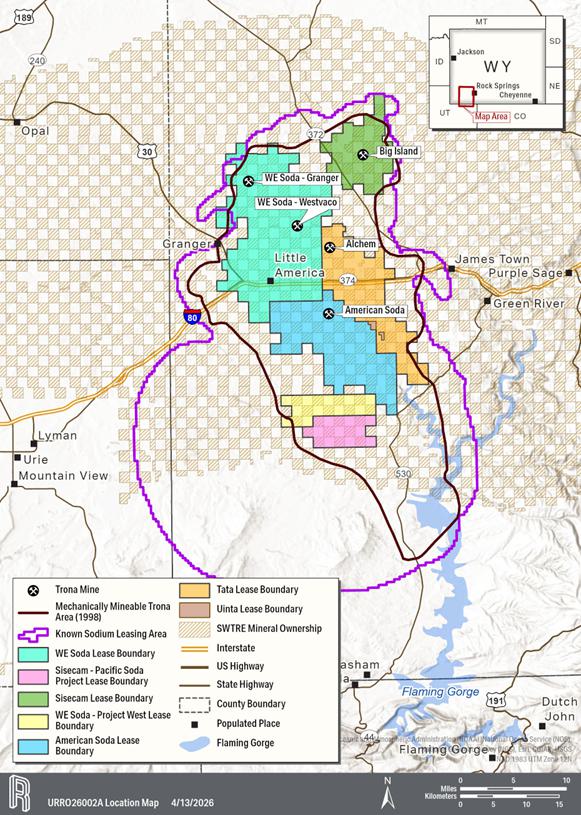
Figure 4-1. Area Lease Map.
| 14 |
|
Table 4-2. The Sweetwater Entities Land Ownership Within the Known Sodium-Leasing Area of the Green River Basin
| Control Type | Ownership Entity (Including SWTRE’s Respective Ownership Thereof) |
Acres (100% Basis) | |
| Mineral Ownership | Sweetwater Trona OpCo LLC (100%) | 249,771 | |
| Uinta Development Company (52%) | 456 | ||
| Aggie Grazing LLC | 160 | ||
| Total Mineral Ownership | 250,386 | ||
| Surface Ownership | Sweetwater Surface LLC (100%) | 100,466 | |
| Uinta Development Company (52%) | 105,694 | ||
| Aggie Grazing LLC (100%) | 118 | ||
| Total Surface Ownership | 206,278 | ||
| 4.1 | MINERAL TENURE |
A total of 250,386 acres of fee mineral interests are held by SWTRE within the KSLA of the Green River Basin, as summarized in Table -3. Within this total, SWTRE material interests are defined by 12 sodium lease and license agreements that cover approximately 108,934 acres. The lease and license agreements have been amended over time as new recovery methods are introduced and operators change.
SWTRE hold royalty and related payment interests under a portfolio of sodium lease agreements associated with five operating and two advanced Greenfield natural soda ash projects in the Green River Basin. These agreements vary in form, term, continuation provisions and payment mechanics. The royalty arrangements generally entitle SWTRE to payments based on the production, sale or transfer of soda ash, sodium mineral products and related products derived from the applicable leased lands, and certain agreements may include minimum, advance, rental, bonus, shortfall or similar payment provisions.
Across the portfolio, the principal economic entitlement is generally an 8 percent production royalty less permitted deductions (typically direct bagging and palletizing costs and freight allowances), although several agreements include alternative calculations, minimum royalties, advance royalties, escalation provisions or most-favored/highest-comparable-rate mechanisms that may affect the royalty ultimately payable. Unless otherwise noted herein, all royalties owned by SWTRE pay a royalty equal to 8 percent of the net sale price of soda ash. Royalty payments are made through a combination of advanced royalties and production royalties. Advanced royalties are generally calculated based on past and projected soda ash production, using the formulas defined in the applicable lease agreements. Depending on the lease, advanced royalties may be payable annually, quarterly, or monthly at the commencement of the relevant production period. Production royalties are calculated based on actual soda ash produced and sold, net of specified deductions (typically including packaging and freight). The 8 percent royalty fee is applied to such net sales, and the amount payable is offset against any advance royalty previously paid for the applicable period.
| 15 |
|
| Table 4-3. | The Sweetwater Entities Mineral Interests Within the Known Sodium-Leasing Area by Township and Range (Page 1 of 2) |
| Ownership Entity |
Township | Range | Acres (100% Basis) |
| Sweetwater Trona OpCo LLC (100%) | 015N | 107W | 2,562 |
| 015N | 108W | 8,282 | |
| 015N | 109W | 7,163 | |
| 015N | 110W | 4,236 | |
| 015N | 111W | 2,707 | |
| 015N | 112W | 4,076 | |
| 015N | 113W | 1,238 | |
| 016N | 107W | 1,424 | |
| 016N | 108W | 9,978 | |
| 016N | 109W | 11,146 | |
| 016N | 110W | 11,225 | |
| 016N | 111W | 11,279 | |
| 016N | 112W | 10,205 | |
| 016N | 113W | 2,477 | |
| 017N | 107W | 667 | |
| 017N | 108W | 9,749 | |
| 017N | 109W | 11,331 | |
| 017N | 110W | 11,574 | |
| 017N | 111W | 10,929 | |
| 017N | 112W | 4,403 | |
| 018N | 108W | 8,445 | |
| 018N | 109W | 10,782 | |
| 018N | 110W | 11,467 | |
| 018N | 111W | 10,882 | |
| 018N | 112W | 2,636 | |
| 019N | 108W | 2,704 | |
| 019N | 109W | 11,011 | |
| 019N | 110W | 11,260 | |
| 019N | 111W | 8,130 | |
| 020N | 108W | 2,418 | |
| 020N | 109W | 9,624 | |
| 020N | 110W | 11,090 | |
| 020N | 111W | 4,420 | |
| 021N | 108W | 4,356 | |
| 021N | 109W | 2,948 | |
| 021N | 110W | 949 | |
| Total | 249,771 | ||
| 16 |
|
| Table 4-3. | The Sweetwater Entities Mineral Interests Within the Known Sodium-Leasing Area by Township and Range (Page 2 of 2) |
| Ownership Entity |
Township | Range | Acres (100% Basis) |
| Aggie Grazing LLC | 017N | 112W | 4 |
| 018N | 107W | 113 | |
| 018N | 108W | 5 | |
| 019N | 111W | 2 | |
| 019N | 112W | 36 | |
| Total | 160 | ||
| Uinta Development Company (52%) | 017N | 109W | 456 |
| Total Mineral Ownership | 250,386 | ||
| (a) Total acres for each company may not add up due to rounding. | |||
Certain leases, as described in the following text, provide for a minimum base price for soda ash for purposes of calculating royalties; however, these provisions vary by agreement. Leases that require advance royalty payments also generally include caps on the amount of such advance payments. The mechanics and thresholds for minimum pricing and caps differ across the portfolio.
The underlying agreements contain confidentiality provisions restricting disclosure of detailed contractual, operational, geological, production and other information. Accordingly, the disclosure in this TR describes SWTRE’s royalty portfolio on an aggregated basis, except where more specific disclosure is necessary to provide full, true and plain disclosure of all material facts.
| 4.1.1 | Granger and Westvaco Royalty Interests |
SWTRE royalty interest on the Granger and Westvaco operations are represented by the following:
| / | Agreement between Anadarko Land Corp., successor in interest to Union Pacific Railroad Company, and Westvaco Chlorine Products Corporation dated November 1, 1947, licensing the production of sodium salts, as amended (“701 Lease”). | |
| / | Sodium Lease Agreement dated December 10, 1976, between Anadarko Land Corp., successor in interest to Rocky Mountain Energy Company, and Food Machinery Corporation (FMC), as amended (“705 Lease”). | |
| / | Sodium Lease Agreement dated March 17, 1976, between Anadarko Land Corp., successor in interest to Rocky Mountain Energy Company, and Texasgulf Inc., as amended (“704 Lease”). | |
| / | Sodium Lease Agreement dated effective May 30, 1991, between Anadarko Land Corp., successor in interest to Rock Springs Royalty Company and Tg Soda Ash, Inc. (“715 Lease”). |
In each case, the lease shall remain in full force and effect as long as the lessee continuously conducts operations to mine and remove sodium minerals in commercial quantities from any part or portion of the leased premises described therein. Each lease contains varying provisions for termination, generally allowing either party to terminate for uncured defaults after written notice and, in some cases, upon the lessee ceasing refining or production at its facilities.
| 17 |
|
West Soda LLC, a subsidiary of WE Soda, is also the operator developing Project West, a new Greenfield soda ash production project. SWTRE royalty interest on Project West is represented by the following:
| / | Sodium Lease Agreement between Sweetwater Trona OpCo, LLC and West Soda LLC, successor in interest to TC Soda Holdings Inc., dated July 8, 2022 (“TC Lease”). | |
| / | The Project West Lease has an initial term of 20 years, continuing thereafter so long as the lessee continuously conducts operations on the leased premises. |
| 4.1.2 | American Soda Royalty Interests |
SWTRE royalty interest on the American Soda Operations are represented by the following:
| / | Consolidated, Amended and Restated Sodium Lease Agreement dated July 9, 2004, but effective as of January 1, 2000, between Anadarko Land Corp. (formerly known as Union Pacific Land Resources Corporation), Solvay Chemicals, Inc., and Solvay Soda Ash Joint Venture, as amended (“710 Lease”). | |
| / | Consolidated, Amended and Restated Sodium Lease Agreement dated July 9, 2004, but effective as of January 1, 2000, between Anadarko Land Corp. (formerly known as Union Pacific Land Resources Corporation), Solvay Chemicals, Inc., and Solvay Soda Ash Expansion Joint Venture, as amended (“716 Lease”). |
| 4.1.3 | Big Island Royalty Interests |
SWTRE royalty interest on the Big Island Operations is represented by the following:
| / | License Agreement dated July 18, 1961, between Rock Springs Royalty Company LLC (successor in interest to Union Pacific Railroad Company) and Stauffer Chemical Company of Wyoming (“702 Lease”). |
On September 20, 2010, Şişecam exercised its right to renew the 702 Lease for an additional 50-year period. The current 702 Lease extends to July 18, 2061.
| 4.1.4 | Alchem Royalty Interests |
SWTRE royalty interest on the Alchem Operations are represented by the following:
| / | Sodium Lease Agreement dated effective April 1, 1996, between Anadarko Land Corp. (successor in interest to Rock Springs Royalty Company) and General Chemical (Soda Ash) Partners, as amended (“703 Lease”). | |
| / | Sodium Lease Agreement dated effective January 1, 2000, between Anadarko Land Corp. (successor in interest to Union Pacific Land Resources Corporation) and General Chemical (Soda Ash) Partners, as amended (“739 Lease”). | |
| / | Sodium Lease Agreement dated July 1, 2015, between Uinta Development Company and Tata, as amended (“UDC Lease”). |
Each of the 739 Lease, the 703 Lease and the UDC Lease continue so long as the lessee conducts continuous operations on the leased premises.
| 18 |
|
The operations underlying the leases are summarized in Table 4-4 and shown by lease/license number location in Figure 4-2.
Table 4-4. Sodium Mineral Product Lease and License Summary by Operator
| SWTRE
Lease |
Lessee/Licensee | Area
(Acres) |
Lease/
Agreement Date |
Expiration | Royalty
Rate (%) |
| 701 | Genesis Alkali Wyoming LP (WE Soda) | 12,680 | 11/1/1947 | Indefinite; expires at end of commercial production | 8 |
| 705 | Genesis Alkali Wyoming LP (WE Soda) | 7,688 | 12/10/1976 | Indefinite; expires at end of commercial production | 8 |
| 715 | Genesis Alkali Wyoming LP (WE Soda) | 7,037 | 5/30/1991 | Indefinite; expires at end of commercial production | 8 |
| 704 | Genesis Alkali Wyoming LP (WE Soda) | 13,390 | 3/17/1976 | Indefinite; expires at end of commercial production | 8 |
| TC | TC Soda Holdings Inc. (WE Soda) | 5,730 | 7/8/2022 | 2042 and so long as commercial production occurs | 8 |
| WE Soda Total | 46,524 | ||||
| 710 | Solvay Chemicals Inc./Solvay Soda Ash Expansion Joint Venture (Solvay) | 10,950 | 10/1/1981 | 2034 and so long as commercial production occurs | 8 |
| 716 | Solvay Chemicals Inc./Solvay Soda Ash Expansion Joint Venture (Solvay) | 13,807 | 1/1/2000 | 2034 and so long as commercial production occurs | 8 |
| Solvay Total | 24,757 | ||||
| 702 | Şişecam Wyoming LLC (Şişecam) | 12,440 | 7/16/1961 | 2061 and so long as commercial production occurs | 8 |
| L11 | Imperial Natural Resources Trona Mining (Şişecam) | 5,709 | 11/8/2018 | 2038 and so long as commercial production occurs | 8 |
| Şişecam Total | 18,150 | ||||
| 703 | Tata Chemicals (Soda Ash) Partners LLC (Tata) | 10,970 | 4/1/1996 | 2035 and so long as commercial production occurs | 8 |
| 739 | General Chemical (Soda Ash Partners) (Tata) | 8,078 | 1/1/2000 | 2030 and so long as commercial production occurs | 8 |
| UDC | Tata Chemicals (Soda Ash) Partners LLC (Tata) | 456 | 07/01/2015 | 2035 and so long as commercial production occurs | 8 |
| Tata Total | 19,503 | ||||
| Total Leased/Licensed Acres (100%) | 108,934 | ||||
| 19 |
|
| 4.2 | TERMS OF SUBSURFACE MINERAL PERMIT AND OBLIGATIONS OF A PERMITTEE/LESSEE |
The operators who hold SWTRE mineral leases are required to maintain all operating permits with the WYDEQ that cover air, industrial siting, land quality, solid and hazardous waste and water quality. The mine permit issued by the LQD requires annual reporting and bonding for surface disturbance. Permit obligations of the lessee’s are further described in Item 20.0.
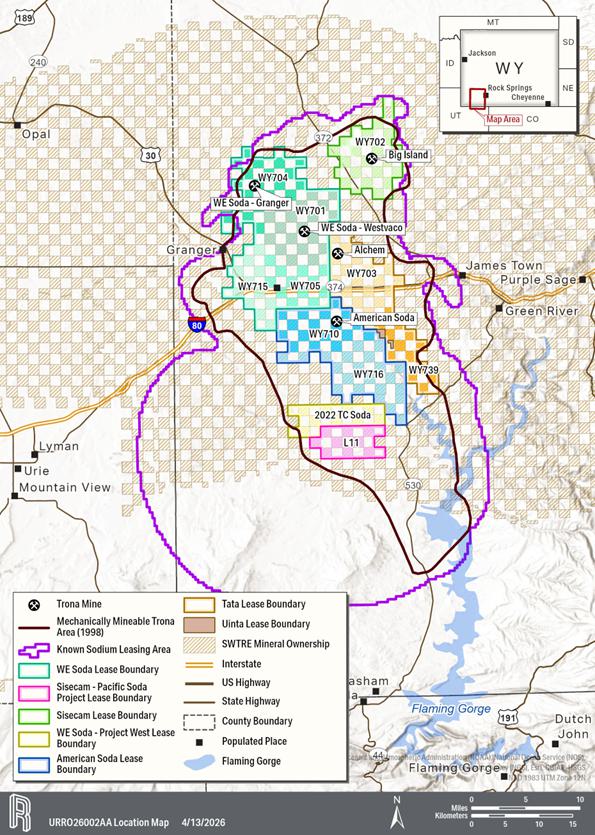
Figure 4-1. Detail of Leases Map.
| 20 |
|
| 4.3 | ROYALTIES, BACK-IN RIGHTS, AND OTHER AGREEMENTS AND ENCUMBRANCES |
SWTRE are the royalty holder and not subject to back-in rights or other agreements and encumbrances. To the extent known, the operators are subject to royalty agreements on the mineral leases with private entities in addition to SWTRE, State of Wyoming leases, and federal leases managed by the BLM within their respective permit boundaries. SWTRE, as the royalty holder, have no knowledge of the royalty agreements with other private mineral leases. Failure to pay rentals on or before the lease anniversary date terminates the leases. Termination of a lease does relieve the lessee of any obligation incurred under the lease other than the obligation to pay rental or penalty.
Solid mineral leasing on state land is guided by WS 36-6-101 as well as Chapters 19–25 of the Rules and Regulations of the Board of Land Commissioners. The Office of State Lands and Investments requires lease bonding for all producing solid mineral leases.
Trona is defined by the U.S. government as a “solid leasable mineral,” subject to the Mineral Leasing Act of 1920. Federally owned sodium resources are controlled by the Department of the Interior and managed by the BLM and limited by Title 30§184(b). The act stipulates 10-year renewable lease periods, subject to annual rental and royalty fees, and demonstrated diligence. The federal government limits sodium leases to 5,120 acres by any one operator in one state but an exception in 30§184(b)(2) allows the Secretary, at their discretion, sodium leases or permits on up to 30,720 acres in any one state. The federal trona lease royalty rate is nominally 6 percent. As of January 1, 2021, all BLM trona leases have a 2 percent royalty rate for a period of 10 years, based on Industry-Wide Royalty Reduction Soda Ash and Sodium Bicarbonate issued by the Secretary of the Interior, for all existing and future federal soda ash or sodium bicarbonate leases [43 CFR 3504.21].
| 4.4 | ENVIRONMENTAL LIABILITIES |
As a royalty holder, SWTRE are not subject to the environmental liabilities of the Operators. The QP is unaware of any environmental liabilities to which the Property is subject, other than the normal federal and state licensing and permitting requirements or restrictions as further detailed in Item 20.0. Each mine permit carries a reclamation bond appropriate for the anticipated closure costs.
| 21 |
|
| 5.0 | ACCESSIBILITY, CLIMATE, LOCAL RESOURCES, INFRASTRUCTURE, AND PHYSIOGRAPHY |
| 5.1 | TOPOGRAPHY AND VEGETATION |
The mineral lease holdings of SWTRE contained within the KSLA in Wyoming’s Green River Basin span an area approximately 19 miles east to west and 32 miles north to south. The Green River Basin itself is contained within the southwestern quarter of Wyoming, a vast landscape characteristic of a high desert environment. The basin is bounded by the Wind River Range to the north, the Sevier overthrust belt to the west, the Rawlins uplift to the east, and the Uinta Mountains to the south. The Rock Springs uplift is a central, elongated uplift that extends north to south, truncating the northeastern extent of trona mineralization. Several other prominent buttes, mesas, arroyos, and moderate canyons serve to break up the broader arid plains and hills. The basin generally slopes to the south, and surface elevations range from 6,000 to 9,500 ft above sea level (ASL). Higher elevations are found along most basin margins where foothills rise to meet bounding structural features.
The Green River is the primary drainage and originates in the Wind River Range. Many notable tributaries feed the Green River, including New Fork River, Big Sandy River, Fontenelle Creek, Blacks Fork River, and La Barge Creek. The basin’s lowest elevation occurs at Flaming Gorge Reservoir, where the Green River collects before spilling into Utah and flowing south. Sagebrush, greasewood, bunch grass, and other low desert plants dominate the broad, rolling plains. Cottonwood, willows, and scattered coniferous trees flank many of the perennial and intermittent drainages.
| 5.2 | ACCESSIBILITY AND LOCAL RESOURCES |
I-80 is a divided four-lane highway that generally bisects the area into northern and southern halves. I-80 provides access to Rawlins, Wyoming; Cheyenne, Wyoming; and Denver, Colorado (indirectly) to the east, and Salt Lake City, Utah, to the west. Several state highways maintained by the Wyoming Department of Transportation and paved two-lane roads maintained by Sweetwater County broadly provide general access across the area. Green River (population of 11,825 [Data USA, 2024a]) and Rock Springs (population of 23,526, [Data USA, 2024b]) are the two population centers in the Green River Basin. Green River lies just east of the KSLA, and Rock Springs is 15 miles further east. Salt Lake City (population of 204,000) is the nearest major metropolitan area and is 194 miles west of the Property. The broader Salt Lake City metro area has a population exceeding 1.2 million.
The Green River Basin is serviced by the Union Pacific Railroad. The east-west main rail line generally runs parallel to and north of I-80. Dedicated industrial spurs provide direct rail access to several trona operators. Air service primarily travels through the Southwest Wyoming Regional Airport, which is located approximately 10 miles east of Rock Springs, Wyoming.
| 22 |
|
| 5.3 | CLIMATE |
The high, intermontane Green River Basin has a cool, semiarid climate. Diurnal variation can be considerable, with temperatures often fluctuating 20–40 degrees Fahrenheit (°F) in a 24-hour period, especially during the dry summer months. Precipitation, and conversely aridity, vary largely on location across the Green River Basin with higher elevations around the margin typically receiving double the rainfall as the basin’s center. Figure 5-1 provides monthly high and low average temperatures, along with average monthly precipitation for the town of Green River, Wyoming. The operating season for trona producers is considered to be year-round. Extreme weather conditions, such as very high winds and occasional storms, may occur, but these events generally seldom impact mining operations.
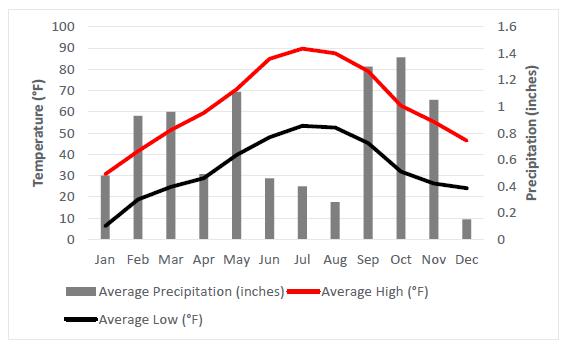
Figure 5-1. Property Climate Averages [National Weather Service, 2026].
| 5.4 | INFRASTRUCTURE |
The Green River Basin has seen consistent trona production for over 70 years and, therefore, the mine-specific infrastructure is generally well-developed. As a royalty interest, SWTRE did not inspect the processing and refining plants but as evidenced by product sales in royalty production reports, the soda ash processing plants and refining capabilities appear to be maintained and routinely upgraded. Regional electrical power generation and distribution is sufficient and reliable. The communities of Green River and Rock Springs are well-established and provide strong mining and industrial support capabilities and workforce. Other regional and mine-specific infrastructure includes the following:
| / | Natural gas pipelines and distribution facilities | |
| / | Water supply from the Green River | |
| / | Process waste tailings facilities | |
| / | Truck and rail loadouts | |
| / | Underground access shafts, ventilation, and production shafts. |
| 23 |
|
| 6.0 | HISTORY |
Mountain Fuel Supply Company is credited with discovering the trona deposits in Wyoming while core drilling the John Hay #1 well in October 1937 [Wyoming State Geologic Survey, 2026]. Westvaco Chemical Corporation sunk a shaft and produced the first trona from trona Bed 17 at a depth of 1,500 ft in 1949.
| 6.1 | OWNERSHIP HISTORY |
The Property leases are private mineral holdings originally granted by the U.S. government under the Pacific Railroad Act of 1864. The history of SWTRE mineral lease ownership is shown in Table 6-1, and the history of the counterparties to the trona leases is shown in Table 6-2.
Table 6-1. History of Leases
| Owner | Transfer Year |
| US Federal Government | 1862 |
| Union Pacific Railroad | 1903 |
| Uinta Development Company | 1917 |
| Rocky Mountain Energy | 2000 |
| Anadarko Land Corporation | 2002 |
| Sweetwater Entities | 2016 |
| 6.2 | EXPLORATION BY PREVIOUS OWNERS OR OPERATORS |
Following Mountain Fuel Supply’s first trona core well, Union Pacific Railroad cored four drillholes in the basin between 1940 and 1942, with mineable thicknesses of trona encountered in each drillhole [Burnside and Culbertson, 1979]. Between 1944 and 1946, Westvaco drilled an additional three exploration wells through bed 17 before sinking its shaft for mine development. Through 1956, a total of 20 wells were drilled for trona exploration [Fahey, 1962], in addition to the Westvaco shaft.
A cooperative study between the BLM and the U. S Geological Survey [Wiig et al., 1995] evaluated the Wyoming natural sodium carbonate deposit in the Green River Basin. The study evaluated 540 boreholes of subsurface well information from the Rock Springs District BLM office beginning in 1987. The exploratory wells included oil-and-gas wells with geophysical logs and cores and assay data provided by operators holding federal sodium leases. For cores without chemical analytical data, the halite and water-insoluble material were estimated from the detailed core descriptions.
Exploration activities performed by individual operators either within their active mine workings or conducted from the surface were not available or reported within the public domain for review.
| 24 |
|
Table 6-2. History of Operators
| Operator | Mine Name | Start Date | End Date |
| Westvaco | Westvaco | 1947 | 1948 |
| FMC | Westvaco | 1948 | 03/31/2015 |
| Tronox | Westvaco | 04/01/2015 | 08/02/2017 |
| Genesis Alkali | Westvaco | 08/02/2017 | 02/28/2025 |
| WE Soda Alkali, LLC | WE Soda – Westvaco | 02/28/2025 | Current Date |
| Stauffer Chemical Company of Wyoming | Big Island | 01/01/1962 | 11/30/1985 |
| Chesebrough Ponds | Big Island | 1985 | 1987 |
| Rhone-Poulenc of Wyoming LP | Big Island | 12/01/1987 | 02/29/1996 |
| OCI Company | Big Island | 03/01/1996 | 2015 |
| Ciner Resources Corp. | Big Island | 2015 | 2021 |
| Şişecam | Big Island | 2021 | Current Date |
| General Chemical Corp | 1966 | 06/30/1989 | |
| Tata | Alchem Mine | 07/01/1989 | Current Date |
| TG Soda Ash Inc | Granger Mine | 01/01/1950 | 06/30/1999 |
| FMC | Granger Mine | 07/01/1999 | 02/28/2025 |
| WE Soda | Granger Mine | 02/28/2025 | Current Date |
| Tenneco Minerals Company | Tenneco | 08/01/1979 | 05/26/1992 |
| Solvay Chemicals, Inc. | Solvay | 05/27/1992 | 10/31/2021 |
| American Soda | American Soda | 11/01/2021 | Current Date |
| 6.3 | PRODUCTION HISTORY |
Trona production began in 1949 at Westvaco using conventional room-and-pillar mining methods and subsequently in 1950 for its Granger Mine. The Big Island Mine opened in 1962 and American Soda Operations followed in 1979. The trona production sourced from the Wyoming State Mine Inspectors’ annual reports from 1949 to 2024 is shown in Figure 6-1. Production ramped up over the decades as the new mines commenced operations and has held steady since the mid-1990s.
| 6.4 | HISTORICAL MINERAL RESOURCE AND MINERAL RESERVE ESTIMATES |
Historical Mineral Resources, reported as in situ trona, are provided in Table 6-3 and historical Mineral Reserves by operator are listed in Table 6-4. Trona, sodium sesquicarbonate comprising more than 70 percent sodium carbonate, is often referred to as natural soda ash, which is the product of refining trona.
Other operators on the Property do not have publicly filed Mineral Resources and Mineral Reserves.
| 25 |
|
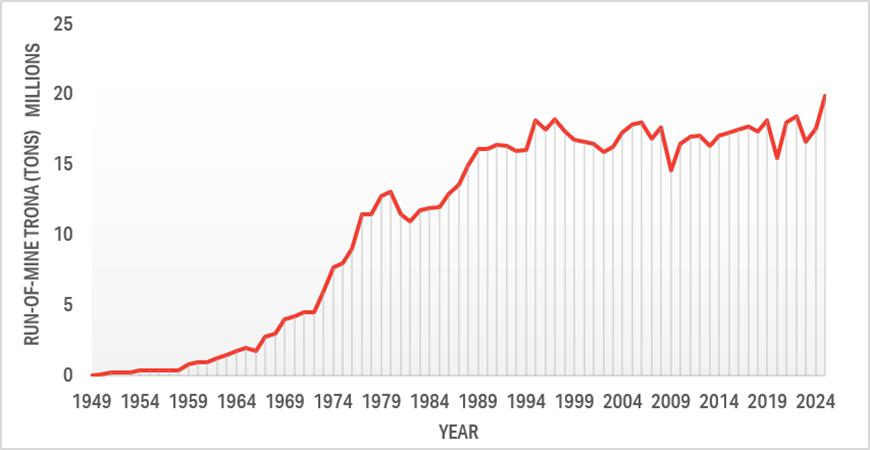
Figure 6-1. Wyoming Trona Production [State of Wyoming, 1949–2026]. Typical conversion trona to soda ash is at a ratio of 1.6:1.
Mineral Resources and Mineral Reserves for two operators are reported under Regulation S-K, Subpart 1300, which has a slightly different definition of Mineral Resources than NI 43-101. The QP concludes that for the purposes of this reporting, the CIM and Regulation S-K definitions are similar and equivalent. According to 17 Code of Federal Regulations (CFR) § 229.1301 (2021), the following definitions are included for reference:
An inferred mineral resource is that part of a mineral resource for which quantity and grade or quality are estimated on the basis of limited geological evidence and sampling. An inferred mineral resource has the lowest level of geological confidence of all mineral resources, which prevents the application of the modifying factors in a manner useful for evaluation of economic viability. An inferred mineral resource, therefore, may not be converted to a mineral reserve.
An indicated mineral resource is that part of a mineral resource for which quantity and grade or quality are estimated on the basis of adequate geological evidence and sampling. An indicated mineral resource has a lower level of confidence than the level of confidence of a measured mineral resource and may only be converted to a probable mineral reserve. As used in this subpart, the term adequate geological evidence means evidence that is sufficient to establish geological and grade or quality continuity with reasonable certainty.
A measured mineral resource is that part of a mineral resource for which quantity and grade or quality are estimated on the basis of conclusive geological evidence and sampling. As used in this subpart, the term conclusive geological evidence means evidence that is sufficient to test and confirm geological and grade or quality continuity.
A probable mineral reserve is the economically mineable part of an indicated and, in some cases, a measured mineral resource.
A proven mineral reserve is the economically mineable part of a measured mineral resource. For a proven mineral reserve, the qualified person has a high degree of confidence in the results obtained from the application of the modifying factors and in the estimates of tonnage and grade or quality. A proven mineral reserve can only result from conversion of a measured mineral resource.
| 26 |
|
Table 6-3. Historical Mineral Resource Estimates
| Operator
- Mine |
Trona Beds |
Trona Thickness (ft) |
Average
Trona Grade (%) |
In Situ Trona (MT) | |||
| Measured | Indicated | Total | Inferred | ||||
| WE
Soda – Contiguous Granger(a),(b),(c),(d),(e),(f),(g),(h) |
19 | 8.8 | 84.0 | 326.0 | 20.0 | 346.0 | — |
| 20 | 9.8 | 89.0 | 175.0 | 158.0 | 333.0 | — | |
| 21 | 6.7 | 79.0 | 148.0 | 7.0 | 155.0 | — | |
| Subtotal | 8.8 | 85.1 | 649.0 | 185.0 | 834.0 | — | |
| WE
Soda – Westvaco(a),(b),(d),(f),(g),(h),(i),(j) |
15 | 8.4 | 82.0 | 415.0 | 228.0 | 643.0 | 4.0 |
| 17 | 11.5 | 90.0 | 1,131.0 | 263.0 | 1,394.0 | — | |
| Subtotal | 10.5 | 87.5 | 1,546.0 | 491.0 | 2,037.0 | 4.0 | |
| WE
Soda – Noncontiguous Granger(a),(b),(d),(e),(f),(h),(k),(l) |
19 | 7.5 | 84.0 | 49.0 | 32.0 | 81.0 | 1.0 |
| 20 | 7.1 | 89.0 | 27.0 | 17.0 | 44.0 | 1.0 | |
| 21 | 6.3 | 78.0 | 11.0 | 11.0 | 21.0 | 1.0 | |
| Subtotal | 7.2 | 84.6 | 87.0 | 60.0 | 146.0 | 3.0 | |
| Şişecam
– Big Island(m),(n),(o),(p),(q),(r),(s),(t) |
24 | 8.6 | 87.5 | 45.4 | 53.6 | 99.1 | — |
| 25 | 7.9 | 85.5 | 29.3 | 25.0 | 54.5 | — | |
| Subtotal | 8.3 | 86.8 | 74.7 | 78.7 | 153.3 | — | |
| Pacific
Soda, LLC – Dry Creek Trona Project(u),(v),(w),(x),(y) |
1 | — | 86.1 | 102.3 | 160.3 | 262.6 | 217.8 |
| 2 | — | 84.5 | 69.8 | 111.4 | 181.2 | 153.0 | |
| 3 | — | 85.0 | 29.2 | 49.9 | 79.3 | 72.2 | |
| 4 | — | 83.6 | 40.0 | 59.4 | 99.4 | 73.2 | |
| Subtotal | — | 85.1 | 241.0 | 381.1 | 622.5 | 516.2 | |
Sums may not be exact because of rounding.
| (a) | Mineral Resources are stated Inclusive of Mineral Reserves, Effective December 31, 2021, by the previous operator, Genesis Alkali [Stantec, 2022]. |
| (b) | No economic cut-off has been applied to the Mineral Resource because of the long history of uninterrupted trona mining, spatial consistency of the trona content and overall low insoluble (less than 20 percent), and halite content less than 0.5 percent. |
| (c) | Mineral Resources are stated for the contiguous private, state, and federal leases for primary solution mining only. |
| (d) | A density of 133 pounds per cubic feet (pcf) was used to convert the volume of trona to tons of trona in situ. |
| (e) | Minimum bed thickness cut-off of 5 ft for solution- mining beds 19, 20, and 21. |
| (f) | Measured Mineral Resources are within 2,640 ft from points of observation in drillholes and mine workings. |
| (g) | Indicated Mineral Resources lie between 2,640 ft and 5,280 ft of observation in drillholes and mine workings with an exception for bed 20. Because bed 20 was flooded in 2006 and the areal location of dissolution and extraction cannot be determined, the Mineral Resources are categorized as Indicated Mineral Resources. |
| (h) | Inferred Mineral Resources lie between 5,280 ft and 10,560 ft of observation in drillholes and mine workings. |
| (i) | Mineral Resources are stated for the contiguous private, state, and federal leases for dry mechanical mining using longwall mining in bed 17 and continuous mining bed 15. |
| (j) | Minimum bed thickness cut-off of 9 ft for bed 17 and 7 ft for bed 15. |
| (k) | Mineral Resources are stated for the noncontiguous private, state, and federal leases for primary solution mining. |
| (l) | Indicated Mineral Resources lie between 2,640 ft and 5,280 ft of observation in drillholes and mine workings. |
| (m) | Mineral Resources are stated exclusive of Mineral Reserves, effective December 31, 2024, by Hollberg [2025]. |
| (n) | Point of reference is in-place (in situ) inclusive of impurities and insoluble content. |
| (o) | Based on a 6-ft minimum thickness and 75 percent minimum trona grade cut-off. |
| (p) | Measured Mineral Resources lie within a 1,320-ft radius from drilling and 1,320 ft from known workings. |
| (q) | Indicated Mineral Resources lie between a 1,320-ft and 3,960-ft radius from drilling from known mine workings. |
| (r) | Inferred Mineral Resources lie between a 3,960-ft and 7,920-ft radius from drilling known mine workings. |
| (s) | A soda ash price of $165 per ton was used to determine the stated trona resources. |
| (t) | Mineral Resources are reported on a 100 percent ownership basis. Şişecam Wyoming is owned by Şişecam Resources LP (51 percent) and NRP Trona LLC (49 percent). |
| (u) | Mineral Resources are stated Inclusive of Mineral Reserves, effective December 31, 2022, by the previous owner, Kew Soda Ltd. [Yuet et al., 2023]. Stated values have been converted from metric to Imperial units. |
| (v) | Measured Mineral Resources lie within a 2.625-ft radius from drillhole locations. |
| (w) | Indicated Mineral Resources lie between a 2,625-ft and 5,249-ft radius from drillhole locations. |
| (x) | Inferred Mineral Resources lie between a 5,249-ft and 10,499-ft radius from drillhole locations. |
| (y) | Halite content less than 2 percent. |
| 27 |
|
Table 6-4. Historical Mineral Reserve Estimates for the Operating Companies
| Operator
– Mine |
Trona Beds |
Average
Trona Grade (%) |
ROM
Trona Ore (MT) | ||
| Proven | Probable | Total | |||
| WE
Soda – Granger(a),(b),(c) |
15 | — | — | 90.5 | 90.5 |
| 17 | — | — | 234.7 | 234.7 | |
| 20 | — | — | 35.9 | 35.9 | |
| 21 | — | — | 25.0 | 25.0 | |
| Subtotal | — | — | 386.1 | 386.1 | |
| WE
Soda – Westvaco(a),(c),(d),(e),(f),(g) |
15 | 81.8 | 70.3 | 48.1 | 118.4 |
| 17 | 90.2 | 186.5 | 131.2 | 317.7 | |
| Subtotal | 87.9 | 256.8 | 179.3 | 436.1 | |
| Şişecam
– Big Island(h),(i),(j),(k),(l),(m),(n) |
24 | 85.8 | 69.7 | 75.2 | 145.0 |
| 25 | 85.3 | 39.5 | 33.3 | 72.8 | |
| Subtotal | 85.6 | 109.2 | 108.5 | 217.7 | |
Sums may not be exact because of rounding.
| (a) | Effective date of the WE Soda – Granger and Westvaco Mineral Reserves is December 31, 2021. |
| (b) | Solution-mined Reserves are based on the equivalent pure trona because solutions report to the surface as dissolved trona with impurities left underground. |
| (c) | The soda ash price of $132 per ton was used for determining Reserves, escalated 2.5 percent per year. |
| (d) | Dry-mined Mineral Reserves are reported as in situ with impurities. |
| (e) | Longwall minimum mining height is 9 ft; maximum longwall mining height is 11.5 ft. |
| (f) | Bore miner minimum mining height is 9 ft. |
| (g) | I-80 offset 400 ft, Highway 30 buffer is 100 ft, and shaft buffer is 1,500 ft. |
| (h) | Mineral Reserves are reported as ROM ore delivered to the processing facilities on a 100 percent ownership basis. Şişecam Wyoming is owned by SWTRE (51 percent) and NRP (49 percent), effective December 31, 2024. |
| (i) | The weighted average net sales per short ton free on board (FOB) plant is $165 per ton, based on U.S. Geological Survey (USGS) pricing and historical pricing provided by Şişecam. |
| (j) | Processing soda ash with a 90 percent rate of recovery, without accounting for the deca rehydration process. |
| (k) | The trona-to-ash ratio for the stated trona Reserves is 1.835:1.0. |
| (l) | Şişecam will continue to conduct only conventional mining using the room-and pillar method and a nonsubsidence mine design. |
| (m) | In approximately 10 years, Şişecam will make necessary modifications to the processing facilities to allow localized mining of 75 percent ore grade in areas where the floor seam or insoluble disruptions have moved up into the mining horizon, causing mining to be halted early because of processing facility limitations. |
| (n) | In approximately 20 years, Şişecam will make necessary equipment modifications to operate at a seam height of 7 ft; the current mining limit is 9 ft. |
The previous owner and operator of WE Soda’s Granger and Westvaco Operations, Genesis Alkali Wyoming LP, stated Mineral Resources and Mineral Reserves in a TRS prepared by Stantec [2022] with an effective date of December 31, 2021, and available under Genesis Alkali Wyoming LP’s profile (www.sec.gov).
Big Island Operations Mineral Resources (exclusive of Reserves) and Mineral Reserves have previously been reported for NRP through its S-K 1300 TRS [Hollberg, 2025] with an effective date of December 31, 2024, and is available under the profile of NRP (www.sec.gov).
| 28 |
|
A TR was filed under NI 43-101 by Kew Soda Ltd, a former owner of the Dry Creek Trona project, with an effective date of December 31, 2022 [Yu et al., 2023] and is available via the registration documents of Kew Soda Ltd. and its filings within the United Kingdom. At the time of the reporting, Pacific Soda, a Delaware limited liability company, was owned 60 percent by Şişecam Chemicals USA Inc. and 40 percent by Imperial Natural Resources Trona Mining Inc., which is an indirect wholly owned subsidiary of WE Soda. Kew Soda Ltd. acts as a holding company of WE Soda and its subsidiaries.
The historical Mineral Resource and Mineral Reserve estimates included herein are historical in nature and a QP has not completed sufficient work to classify the historical estimate as a current Mineral Resource or Mineral Reserve. Accordingly, the QP is not treating the historical estimate as current Mineral Resources or Mineral Reserves. The QP opines that the historical Mineral Resource and Mineral Reserve estimates included herein are reliable and relevant in nature with the exception that the QP is unaware of sufficient engineering to support including bed 15 as a conventional mining target for WE Soda – Westvaco.
The Mineral Reserves for the Dry Creek Trona project as stated for the combined beds 1–4 by Yu et al. [2023] are 121.2 million metric tonnes (133.6 Mt) of TA. The categories of Proven Mineral Reserves and Probable Mineral Reserves are not stated separately. The Mineral Reserves are subject to the following:
| / | An assumed plant recovery of 96 percent. | |
| / | Areal extraction within the Measured Mineral Resource and Indicated Mineral Resource boundary of approximately 49 percent. | |
| / | An average trona grade within the Measured Mineral Resource and Indicated Mineral Resource boundary of approximately 84 percent. | |
| / | One tonne of trona is equivalent to 0.70354 tonne of TA. | |
| / | Soda ash domestic and export price in 2026 assumed to be $235 per metric tonne ($259 per ton) and $247 per metric tonne ($272 per ton), respectively. |
| 29 |
|
| 7.0 | GEOLOGICAL SETTING AND MINERALIZATION |
| 7.1 | REGIONAL GEOLOGY |
The bedded trona deposits of the Green River Formation were precipitated from alkaline brines in an ancient lacustrine system referred to as Lake Gosiute. During the late-Cretaceous to early-Paleogene periods, compressional tectonism associated with the Laramide Orogeny uplifted several mountain ranges in the region. The interior space between these surrounding uplifts formed a foreland basin—an area of subsidence reflexively driven by the adjacent uplifts. This subsiding area, known as the Green River Basin, established a catchment for sedimentary deposition and became a closed drainage system with zero or very few outflows.
Lake Gosiute covered most of southwest Wyoming 53.5–48.5 million YBP. Lake fluctuations in response to tectonic activity and climatic changes resulted in a cyclic pattern of oil shale deposition, accumulation of bedded evaporites, and interbeds of marlstone and altered tuffs. The volcanic ash, which became altered tuff, was deposited by prevailing southeasterly winds from the Absaroka and Challis volcanic fields [Cupertino, 2023] in what is now northwest Wyoming and Idaho, respectively.
As illustrated in Figure 7-1, the greater Green River Basin is tectonically bounded on the west by an overthrust belt and on all other sides by Laramide uplifts, including the Wind River Range and Granite Mountains to the north; the Uinta Mountains and Axial Basin uplift to the south; and the Rawlins uplift, Sierra Madre Range, and Park Range to the east [Roehler, 1992]. Within the area, major intrabasinal anticlines and arches partition the greater Green River Basin into several structurally distinct subbasins: the Green River, Great Divide, Washakie, and Sand Wash subbasins. Other notable structures include the Rock Springs uplift, the Moxa arch and associated LaBarge platform, the Pinedale anticline, the Wamsutter arch, and the Cherokee Ridge arch [Roehler, 1992]. These features exerted strong controls on subsidence patterns, sediment thickness, and accommodation space that contributed to the development of a thick sedimentary succession, which influenced the spatial distribution of Lake Gosiute and the evaporite-bearing Green River Formation preserved within the Basin.
| 7.2 | THE GREEN RIVER BASIN |
In a regional context, the Green River Basin is the largest subbasin within the southwestern Wyoming province boundary. Stretching approximately 160 miles from north to south and 60 miles from east to west, the Green River Basin encompasses roughly 10,500 square miles of southwestern Wyoming.
The Green River Basin is structurally bounded by the Wyoming thrust belt to the west, the Rock Springs uplift to the east, the Wind River Mountains to the north, and the Uinta Mountains to the south. Basin margins are marked by prominent hogbacks, escarpments, and pediment surfaces, including Oyster Ridge and White Mountain along the west flank of the Rock Springs uplift. Elevations vary from under 6,000 ft in basin low points to nearly 9,500 ft near the surrounding uplifts. The basin features extensive exposures of Paleogene strata from the Wasatch, Green River, and Bridger Formations, as illustrated in Figure 7-2 [Roehler, 1992].
| 30 |
|
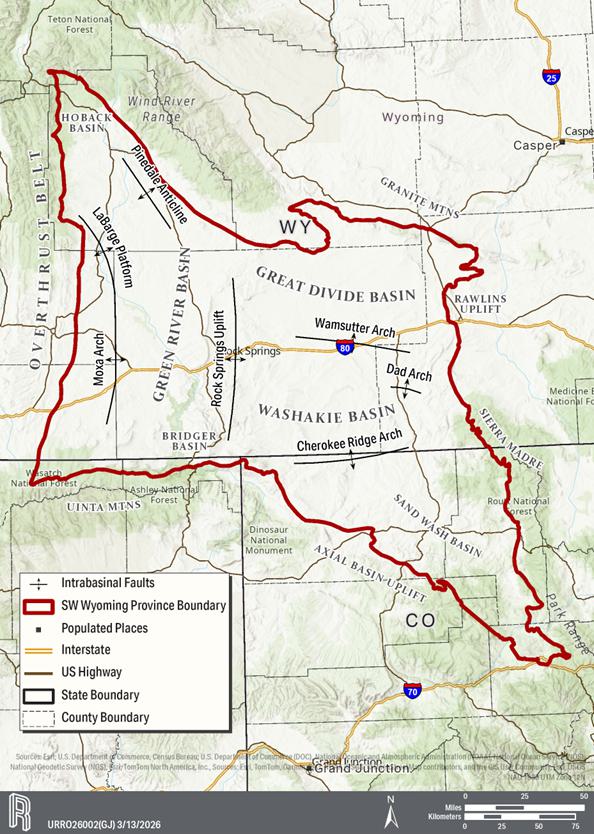
| Figure 7-1. | The Southwest Wyoming Province Boundary Illustrating the Tectonic Features Bounding Regional Subbasins During the Late-Cretaceous to Early-Paleogene Periods. |
| 31 |
|
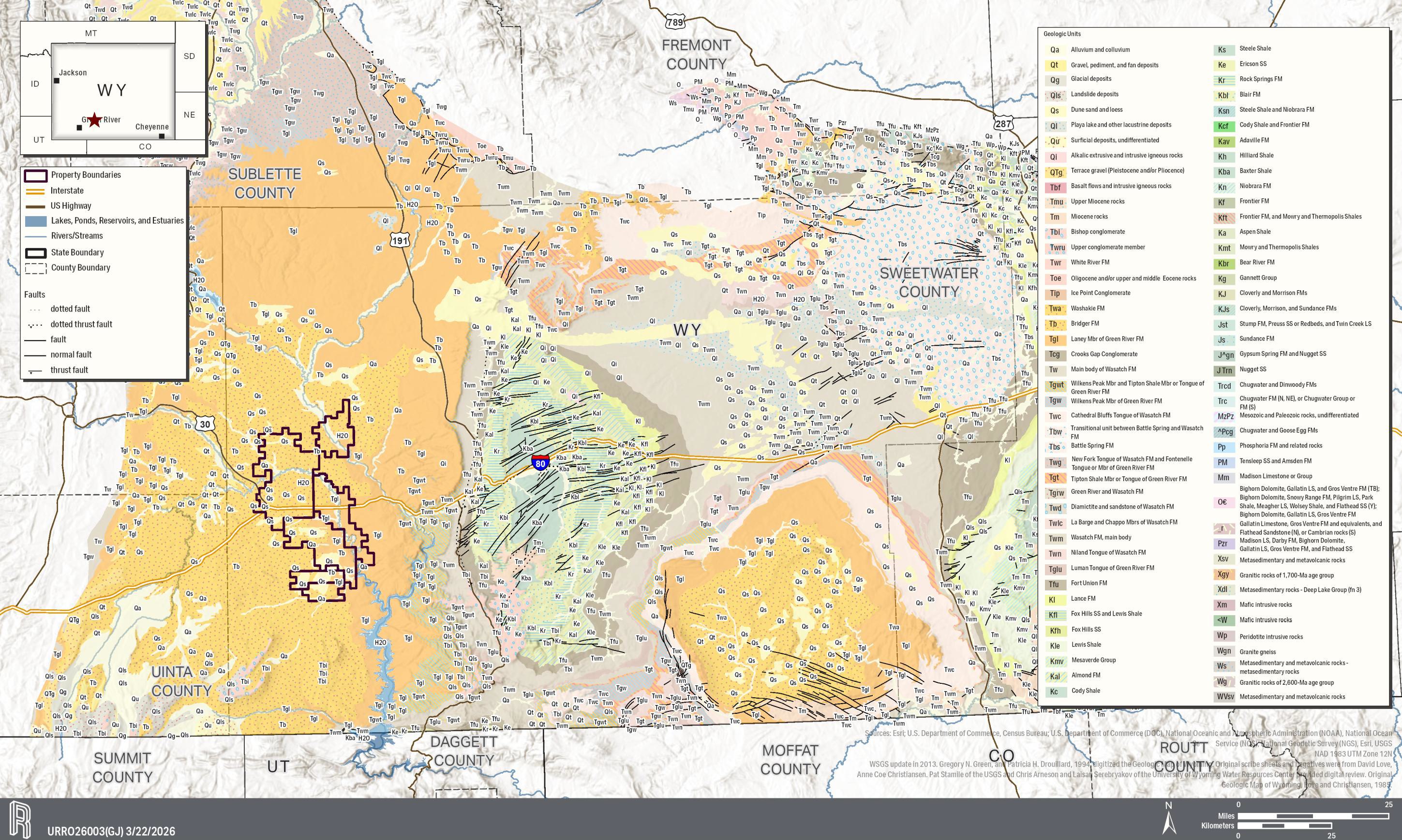
Figure 7-2. Regional Map of the Distribution of Geologic Units Within and Near the Green River Basin.
| 32 |
|
| 7.3 | LOCAL STRATIGRAPHY |
The Green River Formation records the deposition of extensive lacustrine sediments and evaporite minerals during the early Eocene epoch within a series of intermontane basins formed during the late stages of Laramide deformation [Smith et al., 2015]. Stratigraphically, the Green River Formation overlies the Wasatch Formation and is overlain by the Bridger Formation, reflecting a basin-scale transition from dominantly fluvial to lacustrine and back to fluvial depositional. The Wasatch Formation consists primarily of fluvial channel deposits, floodplain sediments, and paleosols that were deposited contemporaneously with Green River lacustrine strata and extensively interfinger with them along basin margins, recording sediment supply from adjacent Laramide uplifts. The overlying Bridger Formation marks the cessation of widespread lacustrine activity following the disappearance of Lake Gosiute and reflects reduced accommodation, increased erosion of surrounding uplifts, and the establishment of fluvial drainage systems across the basin [Smith et al., 2015].
The Green River Formation is subdivided into three principal members that reflect changing basin hydrology and lake chemistry: (1) the Tipton Shale Member, deposited during early lake expansion under relatively fresh to mildly saline conditions; (2) the Wilkins Peak Member, representing the most restricted, hypersaline phase of Lake Gosiute and containing cyclic evaporites, including trona; and (3) the overlying Laney Member, which records a return to more open-lake and mixed lacustrine-fluvial conditions as subsidence waned [Smith et al., 2015].
| 7.3.1 | Tipton Shale Member |
The Tipton Shale Member records early lacustrine activity in the Green River Formation and is lithologically diverse, consisting primarily of calcareous mudstone and marlstone with interbeds of fossiliferous siltstone, ostracode- and oolitic-grainstone, stromatolite, and deltaic to shoreline sandstones, including the Farson Sandstone [Graf et al., 2015]. Organic-rich, micro-laminated, kerogen-bearing mudstones alternate with less organic-rich laminated or massive mudstones that reflect repeated shifts in lake depth, water chemistry, and oxygenation [Graf et al., 2015]. Carbonate mineralogy oscillates between calcite and dolomite and corresponds to changes in hydrologic openness and stratification.
| 7.3.2 | Wilkins Peak Member |
The Wilkins Peak Member lies between the Tipton and the Laney Members and represents the most evaporative phase of Lake Gosiute [Smith et al., 2015]. The Wilkins Peak Member is lithologically complex and consists of interbedded lacustrine carbonates, calcareous mudstones, sandstones, and abundant evaporites, including trona and halite in basin-interior settings [Roehler, 1992]. Basin-interior strata are typically dolomitic and evaporite-rich, whereas basin-margin facies near the Uinta uplift are more calcitic and siliciclastic, reflecting strong lateral facies partitioning across the basin [Smith et al., 2015].
Deposition of the Wilkins Peak Member occurred in a structurally active, hydrologically closed basin strongly influenced by ongoing Laramide uplift [Smith et al., 2015]. The Wilkins Peak Member reaches as much as 1,350 ft in thickness in the southern basin [Wiig et al., 1995]. Temporal and spatial changes in subsidence resulted in the migration of the depositional center across the basin. Initially, the depocenter focused on the south and southeastern basin, recorded today by trona beds 1–14. Evaporite deposition then shifted to the northern areas (trona beds 14–22) before returning to the southern basin, where trona beds 22–25 are centered. Although many trona beds may occur in most locations relative to modern KSLA boundaries, understanding where the depocenter was focused during Wilkins Peak deposition aids in understanding the distribution of the thickest beds and the highest trona grades. The evaporite depocenter’s migrating behavior can be observed in the stratigraphic cross sections shown in Figures 7-3 and 7-4, with the depocenter most evident in the latter. Trona beds across the basin generally exhibit a shallow southwesterly dip of 1-3°.
| 7.3.3 | Laney Member |
The Laney Member represents the final phase of Lake Gosiute and is dominated by lacustrine mudstone and marlstone, including thick intervals of organic-rich oil shale interbedded with siltstone, stromatolite, and volcaniclastic to deltaic sandstone [Smith et al., 2015]. The lower facies of the Laney Member preserve repetitive successions of profundal oil shale and marginal carbonate rocks, whereas the upper facies record increasing siliciclastic input and delta progradation [Pietras and Carroll, 2006]. The Laney Member marks the waning stages of Eocene lacustrine deposition in the Green River Formation and the eventual replacement of Lake Gosiute by fluvial and alluvial environments [Smith et al., 2015].
| 7.4 | TRONA BEDS OF THE WILKINS PEAK MEMBER |
The Wilkins Peak Member of the Green River Formation has been documented to contain 42 distinct trona beds. Of these, 25 are shown to possess an average thickness of at least 3.3 ft and have at least 100 square miles of contiguous extent. These 25 trona beds are conventionally numbered in ascending order, coinciding with their age and order of deposition, as shown in Figure 7-5.
Of these 25 trona beds, 13 are considered targets for mechanical and/or solution mining. These beds, in ascending order, include trona beds 1, 2, 3, 4, 12, 14, 15, 17, 19, 20, 21, 24, and 25. Descriptions of these target beds are provided in Table 7-1.
| 33 |
|
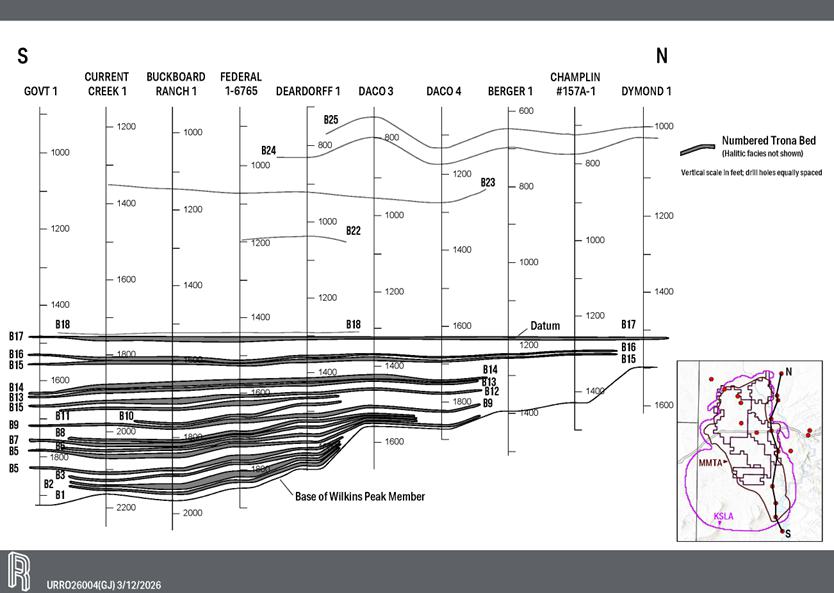
| Figure 7-3. | South-North Cross Section Illustrating the Lithostratigraphic Organization of Evaporite Beds Within the Wilkins Peak Member of the Green River Formation, Wyoming (After Leigh [1998]). |
| 34 |
|
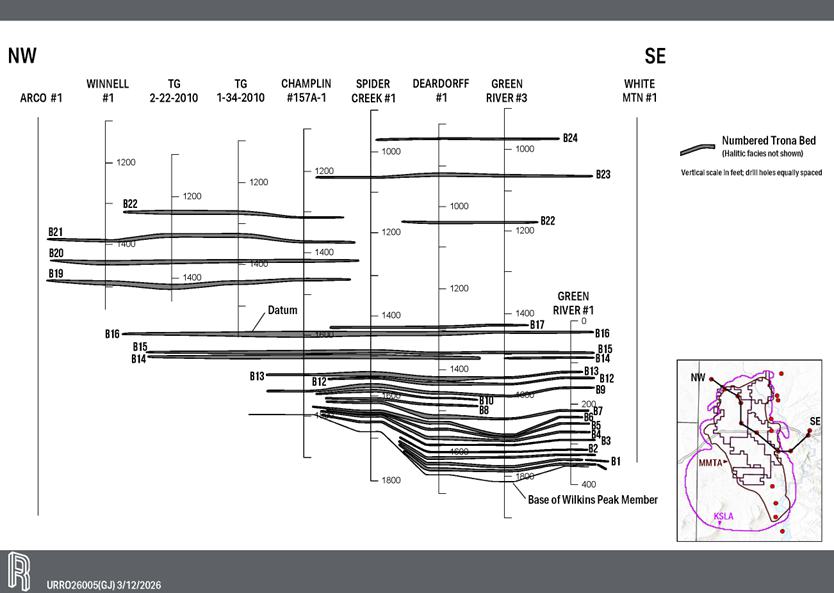
| Figure 7-4. | Northwest-Southeast Cross Section Illustrates the Lithostratigraphic Organization of Evaporite Beds Within the Wilkins Peak Member of the Green River Formation, Wyoming (After Leigh [1998]). |
| 35 |
|
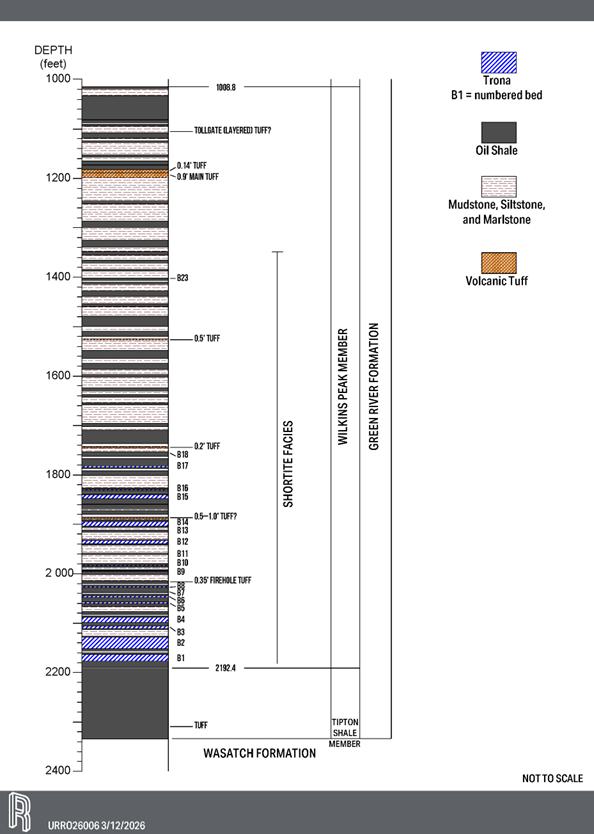
| Figure 7-5. | Evaporite Succession of the Wilkins Peak Member of the Green River Formation, Wyoming (After Leigh [1998]). |
| 36 |
|
Table 7-1. Target Beds of the Wilkins Peak Member
| Trona Bed |
Generalized Depth(a) | Extent
of Bed Having >6 ft Thickness (sq. miles) |
Maximum Known Thickness (ft) |
Comments | |
| From (ft) |
To (ft) | ||||
| 25 | 420 | 1368 | 87 | 23 | Mechanically mined. |
| 24 | 600 | 1285 | 52 | 19 | Mechanically mined. |
| 21 | 1070 | 1765 | 20 | 12 | Solution mined in tandem with bed 20. |
| 20 | 1,193 | 1,646 | 66 | 23 | Mechanically mined 1976–2001. Mine workings are now flooded to facilitate solution mining. |
| 19 | 1,257 | 1,711 | 63 | 22 | Not currently mined. Targeted for future solution-mining operations. |
| 17 | 771 | 2,487 | 438 | 16 | Continuously mined (mechanically) since 1947. Some flooded workings conduct solution mining. |
| 15 | 964 | 2,530 | 385 | 17 | Not currently mined. Targeted for future mechanical and solution-mining operations. |
| 14 | 991 | 2,172 | 598 | 27 | Not currently mined. Targeted for future solution-mining operations. |
| 12 | 1,032 | 2,208 | 531 | 16 | Not currently mined. Targeted for future solution-mining operations. |
| 4 | 1,258 | 2,296 | 213 | 13 | Not currently mined. Targeted for future solution-mining operations. |
| 3 | 1,322 | 2,310 | 86 | 12 | Not currently mined. Targeted for future solution-mining operations. |
| 2 | 1,207 | 2,331 | 287 | 28 | Not currently mined. Targeted for future solution-mining operations. |
| 1 | 1,235 | 2,355 | 225 | 36 | Not currently mined. Targeted for future solution-mining operations. |
| (a) Wiig et al. [1995] includes trona by weight percent of samples with <2% halite. | |||||
| 37 |
|
| 8.0 | DEPOSIT TYPES |
Trona (Na3 (CO3) (HCO3) 2H2O) is an evaporite mineral that precipitates in nonmarine, lacustrine, and highly saline environments. The Green River Basin of southwestern Wyoming hosts the world’s largest known occurrence of trona [Leigh, 1998]. In what is regarded as the official deposit model for trona, Orris and Bliss [1991] describe the characteristics for sodium carbonate in bedded lacustrine evaporites. The authors explicitly name the Wilkins Peak Member of the Green River Formation as hosting considerable trona resources in the forms of bedded trona and shortite (Na2Ca2(CO3)3) mineralization disseminated primarily in adjacent interbeds of marlstone and oil shale. The 25 thickest trona beds in the Wilkins Peak Member are estimated to contain 82 billion short tons of trona and an additional 53 billion short tons of mixed trona and halite.
During the middle Eocene epoch (53.5–48.5 million YPB), intermittent volcanic activity contributed abundant ash to the depositional environment of ancestral Lake Gosiute. After being aerially deposited into the large alkaline lake, the ash was altered and contributed dissolved ions to the local sediments and lake waters. Major ions in solution likely included calcium (Ca), Magnesium (Mg), sodium (Na), bicarbonate (HCO3), sulfate (SO4), and chloride (Cl-). In addition to climatic chemical processes—the most notable being evaporation—biogenic processes strongly influenced the solution chemistry and composition of the lake waters from which trona minerals precipitated. The trona deposit model requires local association with soluble, alkalic rocks or detrital material before mineral precipitation.
Typical gangue materials include oil shale, shale, and marlstone. A conventionally mined trona bed commonly exhibits greater than 85 percent trona grade. Dissolution surfaces and structures are common at and near contact with marlstone or shale interbeds.
| 9.0 | EXPLORATION |
As a holder of a royalty interest, SWTRE have not conducted any exploration activities at the Property.
| 39 |
|
| 10.0 | DRILLING |
SWTRE have not conducted any drilling on the Property.
Historical drilling data were obtained from SWTRE in the form of an Excel spreadsheet-formatted database. The database comprised 984 individual drillholes and separated tabs for the collar coordinates, trona bed intervals, assay data, and orientation data. The drillhole collars information provided identifiers labeling the drillhole I.D., Easting, Northing, Elevation, and Total Depth (TD). The trona bed intervals were identified with a “from” and “to” depth and a total thickness. Information was only provided for the numbered trona beds. Interburden data along with overlying strata were not included. Assay data were provided for 860 drillholes comprising 4,136 intervals, including percent trona and 3,133 intervals containing percent NaCl. The orientation data assumed that each drillhole was completely vertical without any deviation. If available, additional drillhole files in the form of geophysical logs, lithologic logs, core photographs, and drillhole completion records were provided by SWTRE. All original source drilling information provided by SWTRE is available in the public domain through the WYOGCC.
Although robust, a collection of 860 drillholes would likely represent only a fraction of the total count because many more holes have been drilled and are not publicly available. Because of the extensive drilling history across the applicable lease holdings and the wide range of objectives and methods, thoroughly summarizing the standard equipment used or the procedures followed is not feasible. The drilling method used ultimately depends on the program’s specific objectives and the type of data needed to accomplish those objectives. Generalizations can be made, however, based on the collection of publicly available drill data previously mentioned. Exploratory holes for trona in the Green River Basin are typically drilled to depths ranging from 800 to approximately 2,200 ft because this interval hosts the trona beds targeted for production.
Each of the trona operators of the Property in the Green River Basin has conducted extensive drilling, along with several completed wells by other entities, which was primarily for oil-and-gas exploration. Following the discovery of deep-bedded trona by Mountain Fuel Supply Company while drilling for oil in 1938, an increasing number of wells were completed with the explicit purpose of delineating the vast deposit of trona. These exploratory wells follow most standard core-drilling procedures and protocols with some key exceptions. The drilling method most often used for trona exploration employs diamond-core drilling (i.e., the cylindrical bit face is impregnated with industrial diamonds in a synthetic matrix). As the drill string penetrates into the earth, a cylinder of rock protrudes up into the core barrel, where it can then be recovered and brought to the surface. Geological, chemical, and/or geotechnical parameters of the rock core sample can then be analyzed. One notable difference when drilling to recover an evaporite sample (such as trona) is the need to use a drilling fluid saturated with sodium carbonate or an additive similarly derived from trona. Because evaporite minerals are soluble in most nonsaline liquids, using a water-based drilling fluid would quickly dissolve the trona core sample.
If a trona operator seeks to install an injection well for solution mining of trona, the methods employed would be mostly different than for an exploratory well. The program would initially use rotary drilling methods (i.e., the bit pulverizes the earth via the rotation of carbide buttons on the bit face). Rather than core recovery for examination, higher penetration rate and drilling efficiency are the goal. Upon nearing the targeted trona bed, rotary drilling may switch to core drilling, which allows for greater precision downhole (i.e., host formation and lithology) and more informed decision making. After drilling through the overburden layers, the targeted trona bed, and into the underlying strata, the borehole is cased with pipe, and the casing is cemented to the formation downhole. After the hole is sealed and the cement has cured, a smaller diameter bit is deployed down the hole to drill through the cement plug. Following this point, the operation is largely nondrilling related. The publicly available drilling is mapped in Figure 10-1 and shows completed drillholes that were used for defining the extents of the KSLA.
| 40 |
|
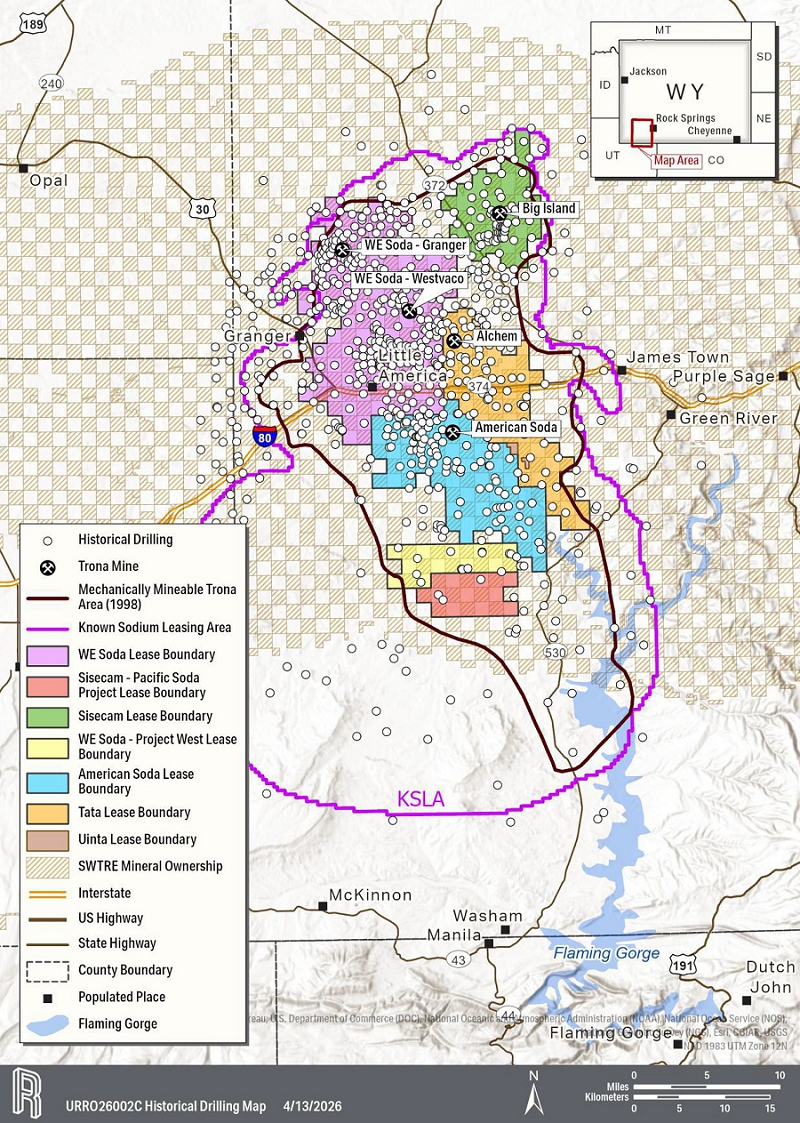
Figure 10-1. Publicly Available Historical Drillholes.
| 11.0 | SAMPLE PREPARATION, ANALYSES, AND SECURITY |
As set out in Item 3.0 of this TR, the QP has relied on Section 9.2(2) of NI 43-101 to omit information required by NI 43-101F1 relating to sample, preparation, analyses and security, to which the QP and URC do not have access.
| 41 |
|
| 12.0 | DATA VERIFICATION |
As a royalty holder, SWTRE do not have access to various forms of supporting technical, drilling, and assay data held by individual trona operators.
| 42 |
|
| 13.0 | MINERAL PROCESSING AND METALLURGICAL TESTING |
As a royalty holder, SWTRE do not have access to supporting technical mineral processing and metallurgical testing data for converting solution-mined brines and dry trona to soda ash products.
| 43 |
|
| 14.0 | MINERAL RESOURCE ESTIMATES |
As a royalty holder, SWTRE do not have access to supporting technical information necessary to complete the data verification to estimate Mineral Resources.
| 44 |
|
| 15.0 | MINERAL RESERVE ESTIMATE |
This TR does not include an estimate of Mineral Reserves.
| 45 |
|
| 16.0 | MINING METHODS |
| 16.1 | OVERVIEW |
The Green River Basin has thick and laterally continuous trona beds that are suited for large-scale underground mining operations using a combination of room-and-pillar mining, longwall mining, and solution-mining techniques. Conventional underground mining methods dominate production within the Green River Basin, although solution mining has been increasingly adopted to recover additional trona resources and extend the life of the operations. The mines currently recover trona from beds 17, 20, 21, 24, and 25. A summary of the mining methods employed by each operator is provided in Table 16-1.
Table 16-1. Dry Mining Methods and Equipment
| Operator | Primary
Mining Method |
Primary
Mining Equipment |
Secondary
Mining Equipment |
| WE Soda – Westvaco | Longwall | Longwall Shearer, AFC, Hydraulic Support | BM, Shuttle Car |
| WE Soda – Granger | Solution | N/A | N/A |
| Şişecam | Room-and- Pillar | CM, Shuttle Car | N/A |
| American Soda | Longwall | Longwall Shearer, AFC, Hydraulic Support | BM, Shuttle Car, FCT |
| Tata | Room-and-Pillar | BM, FCT | CM, Shuttle Car |
CM = continuous miner
AFC = Armored Face Conveyor
FCT = Flexible Conveyor Train
| 16.2 | LONGWALL MINING |
Longwall mining is employed at the Westvaco Mine and the American Soda Operations. Longwall mining involves extracting large panels of trona using a mechanized shearer operating along a longwall face, ranging from 650 to 750 ft in width and up to nearly 10,000 ft in length. The shearer advances through the developed longwall panels by cutting a uniform slice (approximately 36–42 inches in depth) of trona as it travels back and forth along the face. Hydraulic roof supports advance with the shearer as the trona is removed, which allows the roof to collapse in a controlled manner behind the supports, as illustrated in Figure 16-1.
Trona mined by the longwall shearer is conveyed along the longwall face by an AFC installed beneath the hydraulic shields. The AFC serves as the primary conveying system for the mined material and a guide track that maintains the shearer’s alignment and stability during cutting operations. As the shearer advances along the longwall face, the cut trona is continuously loaded onto the AFC and transported toward the headgate, where the longwall panel intersects with a perpendicular mine entry (gate road).
| 46 |
|
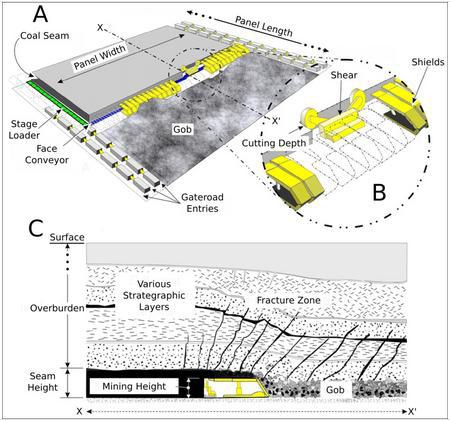
Figure 16-1. Conceptual Longwall Mining (A) Oblique View, (B) Close-Up of Shearer, (C) Profile View [Chambers and Boltz, 2023].
At the headgate, the trona is transferred to the conveyor belt through a stage loader. The stage loader feeds the material onto a conveyor belt located within the adjacent entry, positioned out by the headgate. The trona is then transported via a series of underground belt conveyors extending several miles through the existing underground mine workings to the shaft for hoisting to the surface for processing.
The Westvaco and American Soda underground mines operate multiple BM development sections responsible for constructing the underground network of main entries, gate roads, recovery, and setup rooms required to support longwall production panels. The BM extracts trona using a rotating cutting head assembly while roof support, in the form of roof bolts, is installed to stabilize the newly exposed ground.
The trona cut by the BM is loaded directly onto a shuttle car or FCT, which transports the material to the development section feeder breaker to transfer onto the mine-wide conveyor belt system for conveyance through the underground mine to the shaft skip loading station, where it is hoisted to the surface for processing.
The longwall method results in approximately 97 percent to 99 percent recovery in the panels, and recovery in the mains and gate roads varies from 25 percent to 50 percent for an overall areal recovery ranging from 55 percent to 70 percent, depending on the panel dimensions and geology of the trona bed.
| 47 |
|
| 16.3 | ROOM-AND-PILLAR MINING |
Room-and-pillar mining is the most widely used mining method in the Green River Basin and is employed by Şişecam and Tata. In this method, trona is extracted in a series of parallel entries, leaving pillars of trona in place to support the roof. The extraction ratio depends on the length of time the openings are required to be maintained and the subsidence profile. The mining layout typically consists of a grid of rooms separated by pillars to maintain ground stability. The openings (referred to as rooms) allow access for mining equipment, act as roadways, and provide utility distribution and ventilation airflow.
A typical room-and-pillar production section consists of a CM/BM, one or two roof bolting machines, two to three shuttle cars (or alternatively an FCT for haulage), and a feeder for the conveyor belt, as shown in Figure 16-2. The mining cycle begins when the CM/BM advances into the trona to create a cut (typically 14 to 30 ft wide). The mining height corresponds to the thickness of the trona bed (or the maximum height of the mining equipment) plus a small amount of underlying floor material that may be extracted during mining, which is referred to as out-of-seam dilution.
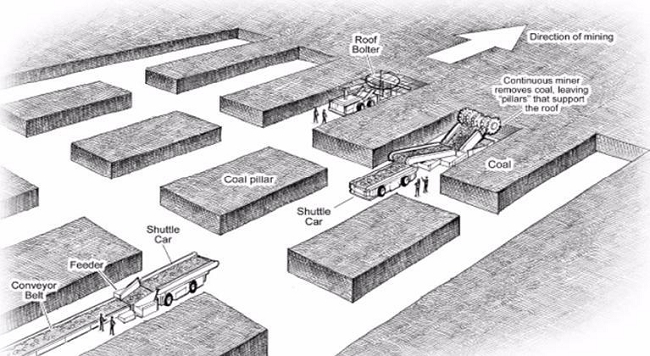
Figure 16-2. Typical Room-and-Pillar Mine [Arch Coal, Inc., 2010].
As the CM/BM cuts the trona, the broken material is loaded directly into a shuttle car or haulage unit. When filled, the shuttle car transports the material to a feeder breaker to meter the ROM trona onto the conveyor belt for transport out of the mine. The empty shuttle car then returns to the mining unit at the face while additional shuttle cars operate sequentially to maintain continuous production. This cycle continues until the trona within the cut has been completely extracted, after which the CM/BM withdraws and moves to the next mining location.
After the cut is complete, the exposed roof is stabilized with roof bolts. A roof bolting machine enters the mined area, drills holes into the roof strata, and installs roof bolts to provide ground support.
Room-and-pillar mining may be conducted using either advance or retreat methods. In advance mining, entries are developed, and pillars are left intact to support the roof; this approach is used by Şişecam. In retreat mining, when development advances to the limits of the planned mining area, mining proceeds in the reverse direction, and portions of the pillars are systematically recovered. Retreat mining includes partial pillar extraction and allows controlled roof collapse within the mined area, which can result in surface subsidence. Tata employs a partial pillar recovery retreat mining system as its production method in the panels. All operators leave the pillars in place in the development of the mains.
The room-and-pillar mining method has an approximate mining recovery of 35 percent to 65 percent in the mains and panels, respectively.
| 48 |
|
| 16.4 | SOLUTION MINING |
Solution mining has become an increasingly important method for recovering trona resources in the Green River Basin for beds that cannot be economically extracted by conventional underground mining techniques. Solution mining of trona is separated into two types: passive (or secondary), and primary. The passive approach is used in operations such as the Granger facility operated by WE Soda and at Westvaco in areas that were previously mined using room-and-pillar methods.
In passive solution mining, wells are drilled into the trona deposit, and processing brines (or tailings solutions) are injected into previously mined underground voids. Over time, the injected brines dissolve the remaining trona pillars that were left behind during earlier mechanical mining operations. The resulting bearing brine is then pumped to the surface and processed through evaporation and crystallization facilities to produce soda ash. This method avoids the need for extensive underground mining infrastructure and enables recovery of trona from deposits that are thinner, deeper, or otherwise less suitable for conventional mining methods.
Primary solution mining involves drilling and developing caverns within the bedded trona layers. Heated brine is injected into the horizontal cavern to dissolve the trona minerals, which are then recovered to the surface where the trona-saturated brine is sent for processing. Over time, the cavern grows laterally and is then mined upward through the trona layers, as illustrated in Figure 16-3.
| 16.5 | MINE EQUIPMENT AND PERSONNEL |
Underground trona mining operations use a range of specialized equipment designed to support continuous production in relatively soft evaporite deposits. Equipment commonly used in the Green River Basin includes longwall systems, CMs, BMs, shuttle cars, FCTs, roof bolting machines, and auxiliary ventilation fans of various makes and models. Operations such as Westvaco and American Soda operate a single longwall production panel supported by several development sections, whereas Şişecam and Tata primarily employ multiple BM or CM production sections to carry out their mining activities.
Personnel requirements vary depending on the mining method and production scale. Underground mining operations typically require hourly and salaried personnel, including operators, maintenance staff, engineering personnel, and administrative support. The Green River Basin trona mines are staffed with a workforce primarily from the surrounding southwestern Wyoming area. Table 16-2 provides end-of-year employment for the mines from 2021 to 2024 sourced from MSHA [2026]. Mine employment data for 2025 was sourced from the Wyoming State Mine Inspector’s Annual Report [State of Wyoming, 1949–2026]. Employment has been consistent from 2022 to 2024, with a slump in 2021 that was mostly caused by the COVID-19 pandemic.
| 49 |
|
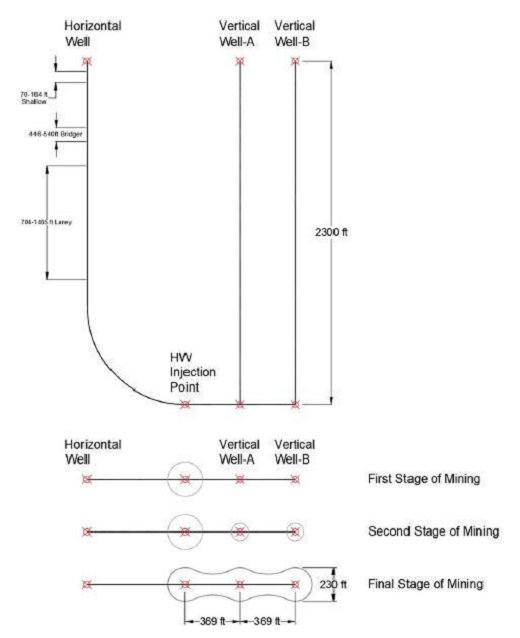
Figure 16-3. Typical Solution-Mined Cavern Layout [Yu et al., 2023].
Table 16-2. Trona Operator Employee Count
| Operator | 2021 | 2022 | 2023 | 2024 | 2025 |
| WE Soda – Westvaco | 849 | 931 | 945 | 893 | 815 |
| Şişecam | 447 | 450 | 453 | 463 | 449 |
| American Soda | 432 | 440 | 463 | 453 | 479 |
| Tata | 523 | 543 | 548 | 555 | 553 |
| Total | 2,251 | 2,364 | 2,409 | 2,364 | 2,296 |
| 16.6 | MINE PRODUCTION |
Historical trona production for 2016 to 2025, as reported by the operators in the annual reporting to the State of Wyoming State Mine Inspector’s Office [State of Wyoming,1949–2026], converted to soda ash equivalent is shown in Figure 16-4. Production has been relatively consistent over the last 9 years and ranged between 10.2 and 12.3 Mt. The lower production amount is largely attributed to the 2020 COVID-19 pandemic.
| 50 |
|
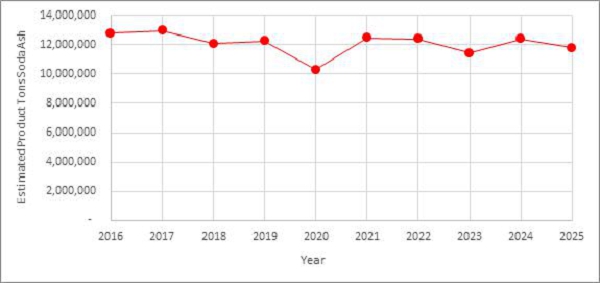
Figure 16-4. Trona Production From 2016 to 2025.
Based on the public disclosure of the operator companies, the following expansion projects are planned:
| / | WE Soda Westvaco expansion initiative – The Westvaco operation targets an additional 1.1–1.7 Mtpa production in the near term by both the optimization of the existing facilities and the staged expansion using solution mining [WE Soda, 2025]. | |
| / | WE Soda Granger – Granger operates as a passive solution mine. In December 2023, capacity was expanded by approximately 680 ktpa as part of a broader target of increasing production to approximately 1,350 ktpa [WE Soda, 2022]. | |
| / | American Soda expansion – American Soda completed an approximately 600-ktpa production capacity expansion in the third quarter of 2025 [Solvay, 2024]. American Soda is also developing a solution-mining expansion project as noted in the cumulative effects analysis by the BLM [2024a] in the draft environmental impact statement for the Dry Creek Trona Mine project. | |
| / | Tata expansion – Tata is currently permitting a 400-ktpa production expansion and expects to increase capacity in two 200-ktpa phases beginning in 2029 [WYDEQ, 2025]. | |
| / | Dry Creek Trona Greenfield project – Pacific Soda’s Dry Creek Trona project is a 6.0-Mtpa Greenfield solution-mining project fully owned by Şişecam since Şişecam acquired WE Soda’s 40 percent stake in the project in December 2024. Construction is anticipated to commence in 2026 with commercial production targeted in 2030 [WE Soda, 2026]. | |
| / | West Soda Greenfield – WE Soda’s Project West is a 3.3-Mtpa Greenfield solution-mining project wholly owned by WE Soda. WE Soda is amending Westvaco’s permit to incorporate feed from the West Soda solution-mining area, with additional production expected in 2027. The stand-alone, 3.3-Mtpa Greenfield project is expected to begin production in 2032 [BLM, 2024b]. |
| 51 |
|
| 17.0 | RECOVERY METHODS |
The operators convert trona ore, sodium sesquicarbonate dihydrate Na2CO3·NaHCO3·2H2O, into soda ash or anhydrous sodium carbonate (Na2CO3), and sodium bicarbonate (NaHCO3) using standard unit processes common to the soda ash industry—the Sesquicarbonate (Sesqui) or Monohydrate (Mono) process. Solution mining of trona results in soda ash processed by Evaporation Lime Decahydrate Crystallization Monohydrate (ELDM) crystallization.
In the Sesqui process, the trona ROM material is dissolved first, which separates the insoluble materials, and then is filtered and dried. Converting bicarbonate takes place by calcining the purified crystals. Calcining drives off the water and carbon dioxide. Shown chemically, the simplified Sesqui process is shown as:
| / | Na2CO3 (aq) + NaHCO3 (aq) + 2H2O(l) => Na2CO3 · NaHCO3 · 2H2O(s) | |
| / | Sodium sesquicarbonate is precipitated in vacuum crystallizers. | |
| / | Light grades of soda ash can be calcined to refine to dense soda ash. |
In the Mono process, the dry trona ROM material is calcined first and then dissolved for clarification followed by crystallization. The simplified Mono process is shown as:
| / | 2Na2CO3 · NaHCO3 · 2H2O + HEAT => 3Na2CO3 + CO2 + 5H2O | |
| / | Na2CO3 + H2O => Na2CO3 · H2O | |
| / | Sodium carbonate monohydrate produced through crystallization. | |
| / | Dense grades of soda ash product. |
The typical process flow steps are shown in Figure 17-1.
The WE Soda Mono and Sesqui plants at Westvaco convert dry-mined trona into soda ash. Crushing, dissolution in water, filtration, and crystallization techniques are used to produce the soda ash products. In the Mono process, shown in Figure 17-2, the ore is calcined with heat before dissolution, which converts the trona to soda ash by removing water and carbon dioxide. A final drying step using steam produces a dense soda ash product from the Mono process. In the Sesqui plant, the calcination is performed at the end of the process, producing light-density soda ash for end-use applications desiring increased absorptivity. The Sesqui process can also produce refined sodium sesquicarbonate.
Solution-mined trona is converted into dense soda ash at WE Soda’s ELDM operation at the Westvaco site and Granger facility. The steps to produce soda ash are similar to the dry-mined processes, except the crushing and dissolving steps take place when the trona is already in a water solution as it leaves the mine.
Secondary recovery of soda ash occurs from collecting and processing sodium carbonate decahydrate crystals that form in the tailings ponds. The decahydrate crystals are redissolved and processed through the monohydrate crystallizers.
| 52 |
|
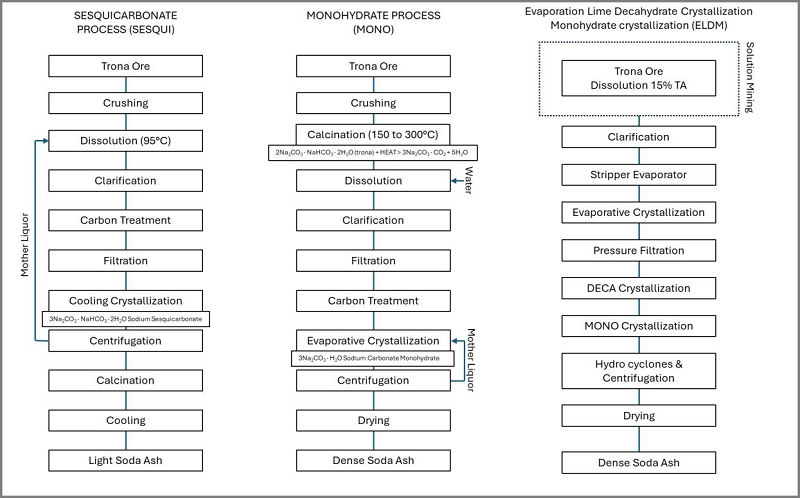
Figure 17-1. Typical Process Flow [Garrett, 1992].
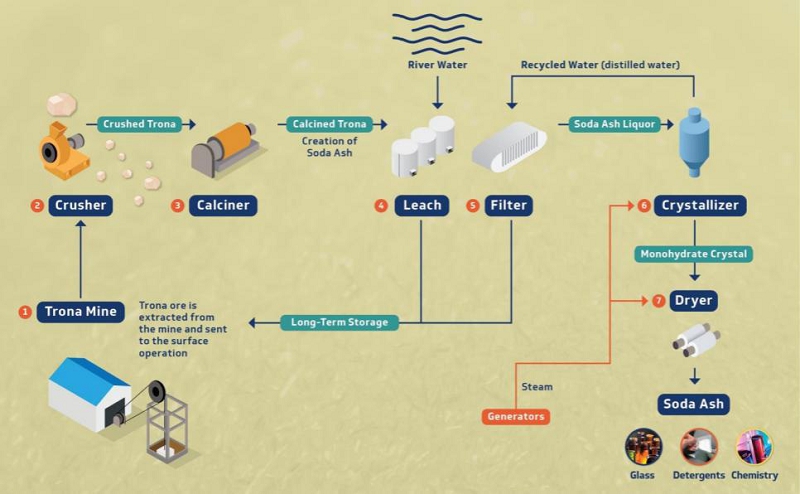
Figure 17-2. WE Soda Monohydrate Process Flow [Reichl, 2023].
If the conversion of trona to soda ash is 100 percent efficient, the ratio of the trona to soda ash, 2Na2CO3 / 3Na2CO3, can be described by the molecular weight ratio of 2(226.03)/3(105.98) or 1.4218 tons of trona for every 1 ton of soda ash. The typical ratio conversion of trona to soda ash ranges from 1.5 to 1.8, which indicates an efficiency range of 79 percent to 92 percent.
| 53 |
|
| 18.0 | PROJECT INFRASTRUCTURE |
| 18.1 | RAIL |
All plant facilities are accessible by spur rails, which connect to a nearby east-west main rail controlled by Union Pacific. A contract rail yard is available along La Barge Road (Highway 372) to allow for the assembly of unit trains.
| 18.2 | GAS |
Natural gas is used to produce process steam for soda ash production and at facilities with on-site power generation. During winter, natural gas is used by mines for heating the mine air intake. Figure 18-1 shows the available regional infrastructure.
| 18.3 | POWER |
With the exception of the American Soda plant, all operations have on-site power generation. American Soda’s power is purchased from Pacific Corp. (Rocky Mountain Power).
| / | WE Soda: Power for the Westvaco and Granger operations is produced from two natural gas plants with a combined output of 41.5 megawatts, with additional power purchased from a 65-megawatt plant owned by Rocky Mountain Power. | |
| / | Şişecam: Power for the Big Island operation is produced from a 25-megawatt natural gas plant. | |
| / | Tata: Power for the Tata operation is produced from a 30-megawatt natural gas plant. |
| 18.4 | WATER |
The operators use fresh surface water for power generation and solution mining. Water is provided by water rights accessed by pumping from the Green River, as described in Table 18-1. Water consumption is estimated based on the process to produce soda ash from mechanical mining, using 200 gallons per ton of soda ash, and the water requirement of the on-site power plant is 250 gallons per ton of soda ash.
| 18.5 | TAILINGS |
The operating mines all have tailings management systems in place for surface and underground disposal, with the exception of Tata, which does not have tailings disposal underground.
| 18.6 | POTABLE WATER |
To provide potable water to the mines, noncommunity public water systems are operated at the mine sites. Water withdrawn from the Green River is conveyed to the water treatment plant where it is treated and distributed throughout the facility.
| 54 |
|
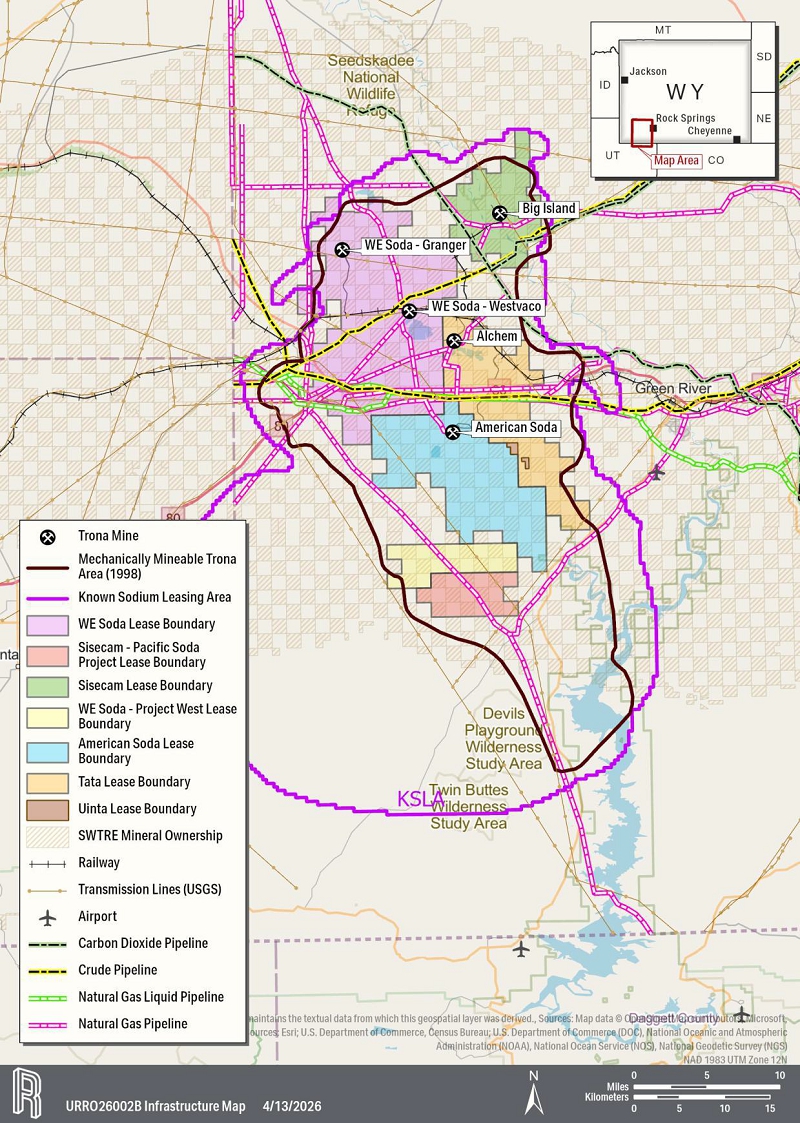
Figure 18-1. Regional Infrastructure.
Table 18-1. Water Rights by Operator [Purcell, 2000]
| Entity | Water Rights | Priority | Notes |
| WE Soda – Granger | 22808
– 5.0 cfs 7032 Enl. – 2.5 cfs |
7/7/1996
7/1/1992 |
Water is supplied by an 8-mile pipeline from the Green River. |
| WE Soda – Westvaco | 20077 – 17.0 cfs | 8/27/1946 | Project West plans to use these rights for the Greenfields project. |
| Tata - Alchem | 22748 – 6.5 cfs | 12/27/1963 | Water is diverted from the Green River and delivered to the plant via a 7-mile pipeline. |
| Şişecam – Big Island Mine | 22075 – 8.72cfs | 2/1/1960 | Water for the plant is pumped from the Green River through two 18-inch steel pipelines, which are both approximately 7,000 ft long. Pacific Soda plans to use these rights for the Dry Creek Trona Greenfields project. |
| American Soda | 26126 – 5.0 cfs | 12/4/1978 | Water is diverted from the Green River and delivered to the plant via a 15-mile pipeline with a 1-million-gallon surge pond. |
cfs – cubic feet per second
| 18.7 | SEWAGE TREATMENT |
Sewage is treated on site for the facilities.
| 18.8 | LANDFILLS |
Şişecam, Tata, and WE Soda – Granger use an on-site landfill for solid-waste disposal. The landfills are only used by the operations and are filled with general plant waste (e.g., paper, cans, plastics, and food waste).
| 55 |
|
| 19.0 | MARKET STUDIES AND CONTRACTS |
| 19.1 | GLOBAL AND UNITED STATES SODA ASH PRODUCTION |
Soda ash is a widely used industrial chemical with applications in glass manufacturing, including high-purity solar panels, chemicals production, detergents, and metallurgical processes. Emerging markets for soda ash include sodium-ion batteries and using soda ash to convert lithium-to-lithium carbonate. Global soda ash production was approximately 77 million short tons in 2025, with producers distributed as shown in Table 19-1 [USGS, 2026]. Production is derived from two main sources: natural soda ash from trona ore deposits and synthetic soda ash produced by the Solvay or Hou processes. Natural soda ash production offers significant cost advantages because of lower energy consumption and reduced processing requirements.
Table
19-1. Soda Ash Production by Country and
Production Type in 2025 [USGS, 2026]
| Country | 2025
Production (MT) |
| Natural Production From Trona | |
| United States | 12.0 |
| Turkey | 6.0 |
| Botswana | 0.3 |
| Kenya | 0.3 |
| Synthetic | |
| China | 38.0 |
| Other | 14.0 |
The United States is one of the world’s largest producers of natural soda ash because of extensive trona deposits located in the Green River Basin in southwestern Wyoming. These deposits represent the largest known natural trona resource globally and support several large-scale mining and processing operations. Total United States soda ash production has averaged approximately 11–12 Mt per year over the past few years [USGS, 2026]. Because production significantly exceeds domestic demand, the United States is a major exporter of soda ash to global markets.
| 19.2 | SODA ASH DEMAND |
Demand for soda ash is driven primarily by the glass manufacturing sector, which accounts for approximately 45 percent of total soda ash consumption [USGS, 2026]. Soda ash serves as a flux in glass production, lowering the melting temperature of silica and improving manufacturing efficiency. Other significant end uses include chemical production (approximately 20–25 percent), detergents and soaps, metallurgy, pulp and paper processing, and water treatment. Demand growth in recent years has been supported by increased global construction activity, expanding container glass production, and rapid growth in flat glass demand associated with solar photovoltaic panels and energy-efficient buildings [International Energy Agency, 2025].
| 56 |
|
| 19.3 | UNITED STATES SODA ASH CONSUMPTION AND TRADE |
Domestic soda ash consumption in the United States is estimated at approximately 4–5 Mt per year, with the glass industry accounting for the largest share of demand [USGS, 2025]. Because domestic production significantly exceeds domestic consumption, the United States exports a substantial share of its soda ash. Approximately 55 percent to 60 percent of soda ash produced in the United States is exported primarily to markets in Asia, Latin America, and the Middle East [USGS, 2025]. Producers in the United States benefit from a competitive transportation infrastructure that connects Wyoming mining operations to export terminals on the West Coast and Gulf Coast via rail networks. This infrastructure enables United States producers to competitively supply international markets, even with inland production facilities.
| 19.4 | SODA ASH PRICES AND MARKET TRENDS |
Soda ash prices vary depending on product grade, contract structure, and delivery location. According to data published by the USGS, the average realized selling price for United States soda ash has been approximately $140 per ton on a free-on-board (FOB) mine basis in 2025 [USGS, 2026]. Prices increased significantly during 2022 and 2023 because of strong demand growth, supply chain disruptions, and elevated energy costs affecting synthetic soda ash production in Europe and China. Figure 19-1 shows historical pricing from 2016 to 2025. Following this period of tight supply, prices moderated somewhat in 2024–2025 as production increased and demand growth stabilized. Historically, soda ash prices have shown moderate cyclicality but have generally remained stable compared with many other industrial commodities, largely because of a broad, diversified demand base.
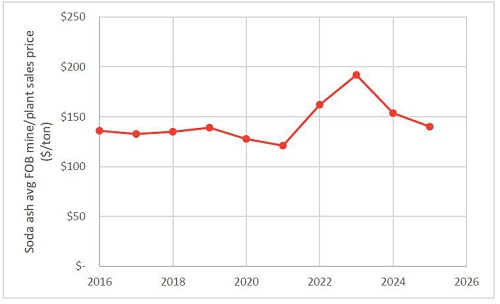
Figure 19-1. Soda Ash Average Free-on-Board Mine/Plant Sales Price as per the U.S. Geological Survey [2026].
| 57 |
|
| 19.5 | MARKET OUTLOOK |
The long-term outlook for the soda ash market is considered positive. Global soda ash demand is projected to grow at approximately 2 percent to 3 percent per year, driven primarily by expanding glass production and increasing demand for solar photovoltaic glass [International Energy Agency, 2025]. Industry forecasts suggest that the global soda ash market could reach 75 Mt by 2030. The United States is expected to remain a major global supplier because of the cost advantage associated with natural trona deposits in the Green River Basin and the large scale of existing mining operations. However, expanding solution-mined soda ash production in Turkey and capacity additions in China are influencing market dynamics and pricing trends. The soda ash market is experiencing difficulty in absorbing an approximately 10 percent increase in global supply from the synthetic manufacturing increase by China. Another Chinese project is expected to add 5 percent to the market base over the next 5 years [NRP, 2026]. Two Greenfield projects by Wyoming operators are expected to bring a 10 to 12 percent increase in production, which could further impact the global market sales price. Even with these developments, the relatively low cost of natural soda ash production in the United States is expected to support continued competitiveness in global markets.
| 19.6 | MATERIAL CONTRACTS |
As a royalty holder, SWTRE do not maintain contracts for the sale or offtake of soda ash.
| 19.7 | QUALIFIED PERSONS STATEMENT |
Most of the soda ash produced from the Property is sold under confidential contracts. The QP has reviewed market pricing that is considered accurate, based on their experience, the nature of trona and soda ash, and confidential production statements provided by SWTRE. In some instances, royalty agreements include specific language for pricing on arm’s length transactions.
| 58 |
|
| 20.0 | ENVIRONMENTAL STUDIES, PERMITTING, AND SOCIAL OR COMMUNITY IMPACT |
This section summarizes the environmental, permitting, and social considerations for the operating trona mines based on a high-level environmental assessment completed in March 2026 and is based on information available to the QP, including publicly available information.
| 20.1 | REGULATORY FRAMEWORK AND PERMITTING REQUIREMENTS |
The Property is subject to a combination of federal and state environmental regulations, including the following:
| / | Federal Requirements: |
| » | NEPA | |
| » | Clean Air Act (including Title V permitting) | |
| » | Clean Water Act, including Section 404 (Waters of the United States [WOTUS] permitting) | |
| » | Safe Drinking Water Act | |
| » | Resource Conservation and Recovery Act | |
| » | Comprehensive Environmental Response, Compensation, and Liability Act | |
| » | Migratory Bird Treaty Act | |
| » | Endangered Species Act |
| / | State of Wyoming Requirements: |
| » | WYDEQ Land Quality permits | |
| » | Wyoming Air Quality Standards and Regulations | |
| » | Wyoming Pollutant Discharge Elimination System (WPDES) | |
| » | Wyoming Industrial Siting Division (ISD) permitting. |
Key permits and approvals applicable to the Property include the following:
| / | WYDEQ Land Quality mining and reclamation permits | |
| / | Title V Air Quality permits | |
| / | Section 404 (WOTUS) permits from the U.S. Army Corps of Engineers | |
| / | Underground Injection Control (UIC) permits (Class III and Class V for solution mining and wastewater injection) | |
| / | ISD permits for major developments | |
| / | Stormwater and discharge permits (WPDES) | |
| / | Safe Drinking Water Act permits (where applicable). |
Existing trona operations associated with the Property have maintained the required regulatory approvals, including WYDEQ Land Quality permits, Title V air permits, and UIC permits. Section 404 permits under the Clean Water Act have also been secured where operations affect the WOTUS.
| 59 |
|
A list of major permits issued to the operating companies is provided in Table 20-1. When surface disturbance is necessary, the NEPA process is required for BLM ownership surface. The Greenfield projects are currently undergoing the permitting process.
Table 20-1. Major Permits by Mine
| Primary Permit | Issuer | Westvaco | Granger | Big Island | Tata | American Soda | |
| Air Permit Title V | WYDEQ | WY000000 5603700049 |
WY000000 5603700010 |
WY000000 5603700001 |
WY000000 5603700002 |
WY000000 5603700005 | |
| General Permit 5B1-98-1 UIC Injection Wells | WYDEQ | WYS037-043 | WYS000019 | ||||
| Mining Permit | WYDEQ | PT0335 | PT0454 | PT0257 | PT0464 | PT0495 | |
| Water Quality | WYDEQ | WYR001340 | WYR001339 | WYR320025 | WYS000019 | ||
| Water Rights | WY State Engineer | 20077 | 22808 | 22075 | 22748 | 26126 | |
| BOND (millions) | $61 | $39 | $50 | $43 | $44 | ||
The mines are nontransient, noncommunity public water suppliers under the Safe Drinking Water Act. The mine operators provide treated water to employees for bathing, washing, and consumption. The program requires a certified operator to oversee the operation of the treatment system and distribution lines. As part of the program, the results of drinking water systems to employees and the state are reported on a regular basis.
Most trona operations have general stormwater permits and not individual discharge permits. To manage the water that is impacted by disturbed areas, operations maintain a closed-loop system (zero-discharge) by reusing/recycling water or reinjecting it back into the mine workings and therefore do not have individual WPDES permits.
All sites manage migratory birds that land on open water in the tailings ponds, which is necessary because of the potential impact from sodium decahydrate. Federal and state permits allow for recovering, transporting, and washing waterfowl.
Certain operations have experienced compliance challenges, particularly in relation to air permitting and discharge requirements. Future permitting activities may trigger NEPA reviews, which could require additional studies addressing cultural resources, endangered species, and potential impacts to community stakeholders.
Based on the review for this TR, the permitting risk for the Property is considered low to moderate; however, this risk profile could increase in response to regulatory changes or expansion of project scope.
In December 2024, the BLM completed the Rock Springs Resource Management Plan, which covers 3.6 million acres of federal lands in the area [BLM, 2024c]. Controversy led to a scoping period in late 2025 to consider amendments.
| 60 |
|
| 20.2 | ENVIRONMENTAL MANAGEMENT |
| 20.2.1 | Physical Environment |
Water supply for the operations in the Green River area is primarily sourced from the Green River within the Upper Colorado River Basin. Water availability could represent an operational constraint, particularly for solution-mining activities that require significant volumes of water. Many of the trona operations have senior water rights and are not concerned with water supply.
Climate-related risks are primarily associated with potential impacts on water availability within the Green River Basin, while other natural hazards in the Property area are considered to present a low level of risk.
| 20.2.2 | Biological Environment |
The Property includes habitat suitable for the greater sage grouse—a species of regulatory and ecological importance. Migratory birds are also known to be affected by operational features such as tailings and evaporation ponds, where elevated salinity and chemical exposure can result in bird mortality. Mitigation for surface-disturbing activities is required across the Property’s big game winter ranges, which typically requires avoiding work in the range areas from November 15 through April 30.
| 20.2.3 | Socioeconomic Environment |
Socioeconomic and community impacts associated with the Property are evaluated by the Wyoming ISD as part of the permitting process for large-scale developments. Major projects are required to provide financial contributions to local communities, including impact assistance funds, to address infrastructure demands and other community-related effects arising from development.
| 20.2.4 | Environmental Monitoring |
Trona operators have standard environmental management systems to support compliance programs and tracking systems. Monitoring programs generally in place include the following:
| / | Air emissions monitoring under Title V permits | |
| / | Groundwater monitoring at Coal Combustion Residual landfills and tailings facilities | |
| / | Water discharge monitoring under WPDES permits | |
| / | Wildlife monitoring and mitigation (e.g., bird-handling programs). |
| 20.2.5 | Reclamation and Closure |
Reclamation is governed by WYDEQ Land Quality permits. WYDEQ Land Quality permitting is considered low risk to the Property. Land Quality permits require applicants to submit mine plans that detail the extent to which mining operations will disturb the land, proposed future use for the land following mining, and a detailed plan for reclamation. Individual operation bonding amounts are listed in Table 20-1. Land Quality permits require companies to provide financial guarantees to ensure that reclamation responsibilities will be fulfilled if an operation is abandoned. The cost of financial assurance bonds has increased substantially over the past several years as a result of tariffs and materials and fuel costs. Long-term monitoring may be required until regulatory agencies release bond obligations.
The trona operations have WYDEQ Land Quality permits to mine and are expected to maintain their permits in good standing.
| 61 |
|
| 20.3 | SOCIAL AND COMMUNITY IMPACT |
Stakeholders associated with the Property include local communities, state regulatory agencies, and federal agencies. Based on available information, Property operations are not located on or near reservation lands. However, Indigenous engagement may be required in relation to federally regulated activities where consultation obligations are triggered.
Stakeholder engagement is conducted in accordance with applicable regulatory processes. The Wyoming ISD permitting process incorporates opportunities for public and stakeholder input as part of project review and approval. The Property contributes to the local and regional economy through employment and direct financial payments, including impact assistance funds required under state permitting processes.
| 20.4 | CONCLUSION AND SUMMARY |
Environmental regulatory programs applicable to the Property are standard and generally manageable with established environmental management systems. The most significant constraints to future development relate to water availability, regulatory compliance (particularly air quality), and potential changes in environmental policy or species protection status. While permitting risk is generally considered low, timelines, costs, and conditions may be influenced by cumulative impact considerations and evolving regulatory requirements.
| 62 |
|
| 21.0 | CAPITAL AND OPERATING COSTS |
SWTRE only have a royalty interest in the mineral leases on the Property and are not an operator and, therefore, do not have access to capital and operating costs.
| 63 |
|
| 22.0 | ECONOMIC ANALYSIS |
SWTRE have only a royalty interest in the mineral leases on the Property and are not an operator and do not have access to planned production, planned capital expenditures or operating expense and, therefore, cannot complete an economic analysis.
| 64 |
|
| 23.0 | ADJACENT PROPERTIES |
No additional adjacent properties exist beyond those mentioned within this report.
| 65 |
|
| 24.0 | OTHER RELEVANT DATA AND INFORMATION |
The QPs are not aware of additional data or information that is necessary to make this TR understandable and not misleading.
| 66 |
|
| 25.0 | INTERPRETATIONS AND CONCLUSIONS |
| 25.1 | INTERPRETATIONS AND RISKS |
The QPs reviewed the adequacy of the information presented in this TR, including all historical drillhole information and analytical data, along with historical reporting of Resources and Reserves for the Property.
As a royalty holder, SWTRE cannot ascertain the full site-specific risks. However, the following inherent risks are associated with mining this deposit:
| / | Product sales rely heavily on the export market pricing, and the worldwide product pricing is a risk in the continued production of soda ash. | |
| / | The operations have been mining the deposit for multiple decades and are beginning to reach the edges of the basin deposition zones; thus, more complex geologic challenges may impact the processing recovery. | |
| / | The planned Greenfield primary solution-mining projects are forecasting a combined production of 8.25 Mtpa of TA. |
| » | Solution-mining production through lower cost methods could impact market pricing and production volume in the Green River Basin and potentially idle production at other operators. | |
| » | This increase is likely to impact the logistics of transporting the additional volume on the established rail. |
| / | Abundant water is needed to mine and process the trona. Although all operators and projects have sufficient water rights from the Green River, access to water could be curtailed by the Colorado River Compact. | |
| / | Şişecam’s Big Island Mine water inflow and subsequent subsidence from their west end is not well understood and could impact a broader area than the trona that is currently sterilized. | |
| / | Public statements by NRP in its 2025 Annual Report [NRP, 2026] indicated that although being one of the world’s lowest cost producers, Şişecam is struggling to maintain profitability in the soda ash market over supply the last 24 months. NRP remains optimistic about Şişecam’s long-term outlook as one of the world’s lowest cost producers of soda ash. |
The QPs recommend that data from the current operators for all lessees within the Property continue to be collected and analyzed. This TR should be updated if new information and evaluation prove to be material.
| 25.2 | CONCLUSIONS |
The trona operations have the necessary permits to mine and are expected to maintain their permits in good standing. Many of the operators are adding to, or replacing, production by using lower cost solution-mining methods, which is expected to extend their mine life.
| 67 |
|
| 26.0 | RECOMMENDATIONS |
The QPs recommend that URC gather supporting documentation as appropriate for the lease agreements in support of production and royalty payments.
| 68 |
|
| 27.0 | REFERENCES |
Arch Coal, Inc., 2010. Underground Mining Methods: Room and Pillar Mining, prepared by Arch Coal, Inc., St. Louis, MO.
British Columbia Securities Commission, 2023a. Unofficial Consolidation of all Amendments to NI 43-101 Standards of Disclosure for Mineral Projects, prepared by the British Columbia Securities Commission, Vancouver, BC.
British Columbia Securities Commission, 2023b. Companion Policy 43-101CP to the National Instrument 43-101 Standards of Disclosure for Mineral Projects, prepared by the British Columbia Securities Commission, Vancouver, BC.
Bureau of Land Management, 2024a. Draft Environmental Impact Statement, Dry Creek Trona Mine Project, DOI-BLM-WY-2022-0003-EIS, prepared by the Bureau of Land Management, High Desert District, Kemmerer Field Office, Kemmerer, WY and the Rock Springs Field Office, Rock Springs WY.
Bureau of Land Management, 2024b. Environmental Assessment West Soda Infrastructure Right-of-Way, DOI-BLM-WY-D090-2024-0026-EA, prepared by the Bureau of Land Management, High Desert District, Kemmerer Field Office, Kemmerer, WY.
Bureau of Land Management, 2024c. Rock Springs Resource Management Plan, prepared by the Department of the Interior Bureau of Land Management, Rock Springs, WY.
Burnside, M. J. and W. C. Culbertson, 1979. Trona Deposits in the Green River Basin, Sweetwater, Uinta, and Lincoln Counties, United States Geological Survey, Open-File Report 79-737.
Canadian Securities Administrators, 2011. National Instrument 43-101 Standards of Disclosure for Mineral Projects, 34 OSCB 7043, prepared by the Canadian Securities Administrators, Montreal, QC.
Canadian Institute of Mining, Metallurgy, and Petroleum, 2014. CIM Definition Standard for Mineral Resources and Mineral Reserves, prepared by the Canadian Institute of Mining, Metallurgy, and Petroleum, CIM Standing Committee on Reserve Definitions, Westmount, QC.
Canadian Institute of Mining, Metallurgy, and Petroleum, 2019. CIM Estimation of Mineral Resources and Mineral Reserves Best Practice Guidelines, prepared by the Canadian Institute of Mining, Metallurgy, and Petroleum, CIM Mineral Resource and Mineral Reserve Committee, Westmount, QC.
Canadian Institute of Mining, Metallurgy, and Petroleum, 2023. CIM Industrial Minerals Leading Practice Guidelines, prepared by the Canadian Institute of Mining, Metallurgy, and Petroleum, CIM Mineral Resource and Mineral Reserve Committee, Westmount, QC.
Chambers, D. and S. Boltz, 2023. “The Sound of Rockbursts: A New Monitoring Approach for Longwall Coal Mines,” NIOSH Science Bulletin, available online at https://www.cdc.gov/niosh/bulletin/2023/rockbursts.html
Cupertino, D. F., 2023. Saline-Alkaline Lakes of the Eocene Green River Formation and Their Microbialites, doctorate thesis, University of California, Santa Barbara, Santa Barbara, CA.
Data USA, 2024a. “Green River, WY – Population & Diversity,” accessed March 16, 2026, from http://datausa.io/profile/geo/green-river-wy/#demographics
| 69 |
|
Data USA, 2024b. “Rock Springs, WY – Population & Diversity,” accessed March 16, 2026, from https://datausa.io/profile/geo/rock-springs-wy
Fahey, J. J., 1962. “Saline Minerals of the Green River Formation,” Geological Survey Professional Paper 405, United States Government Printing Office.
Garrett, D. E., 1992. Natural Soda Ash: Occurrences, Processing, and Use,. Van Nostrand Reinhold, New York, NY, 636 p.
Graf, J. W., A. R. Carroll, and M. E. Smith, 2015. “Lacustrine Sedimentology, Stratigraphy, and Stable Isotope Geochemistry of the Tipton Member of the Green River Formation,” Stratigraphy and Paleolimnology of the Green River Formation, Western USA, Springer, Dordrecht, pp. 31–60, available online at https://doi.org/10.1007/978-94-017-9906-5_3
Hollberg Professional Group, PC, 2025. Technical Report Summary for the Big Island Mine, Sweetwater County, WY, prepared by Hollberg Professional Group, PC, Englewood, CO, for Natural Resource Partners, L.P., Houston, TX.
International Energy Agency, 2025. IEA PVPS Task 1 Strategic PV Analysis and Outreach: Snapshot of Global PV Markets 2025, prepared by the International Energy Agency, Paris.
Leigh, T. R., 1998. “Wyoming Trona: An Overview of the Geology,” Proceedings, First International Soda Ash Conference, Rock Springs, WY, June 10–12, 1997, J. R. Dyni and R. W. Jones (eds.), Wyoming State Geological Survey, Laramie, WY, Vol. 2.
Mine Safety and Health Administration, 2026. “Mine Data Retrieval System,” accessed March 22, 2026, from https://www.msha.gov/data-and-reports/mine-data-retrieval-system
MWStaub Consulting LLC, 2026. High-Level Environmental Assessment Report, Project Samba,” prepared by MWStaub Consulting, LLC, East Helena, MT, for Uranium Royalty Corp., Vancouver, BC.
National Weather Service, 2026. “NOWData – NOAA Online Weather Data,” accessed March 10, 2026, from https://www.weather.gov/wrh/Climate?wfo=riw
Natural Resource Partners L.P., 2026. “Annual Report Pursuant to Section 13 or 15(d) of the Securities Exchange Act of 1934 For the Fiscal Year Ended December 31, 2025,” available online at https://nrplp.com/wp-content/uploads/2025-NRP-Annual-Report-FINAL.pdf
Orris, G. J. and J. D. Bliss, 1991. Some Industrial Mineral Deposit Models: Descriptive Deposit Models, Open-File Report 91-11A, prepared by the U.S. Geological Survey, Tucson, AZ.
Pietras, J. T. and A. R. Carroll, 2006. “High-Resolution Stratigraphy of an Underfilled Lake Basin: Wilkins Peak Member, Eocene Green River Formation, Wyoming, USA,” Journal of Sedimentary Research, Vol. 76, No. 11, pp. 1197–1214.
Purcell, M., 2000. Green River Basin Plan: Basin Water Use Profile – Industrial, prepared by Purcell Consulting, P.C., for the Wyoming State Water Planning Team, Cheyenne, WY, available online at https://waterplan.state.wy.us/plan/green/techmemos/induse.html
Reichl, A., 2023. Industrial Water Use Wyoming’s Colorado River System, prepared by Genesis Alkali, Green River, WY, for the Council of State Governments West, Sacramento, CA, available online at https://csgwest.org/wp-content/uploads/2023/10/Industrial-Water-Challenges-Trona-CGS-West-2023-09-14-Final.pdf
| 70 |
|
Roehler, H. W., 1992. Introduction to Greater Green River Basin Geology, Physiography, and History of Investigations, Professional Paper 1506-A, prepared by the U.S. Geological Survey, Washington, D.C.
Smith, M. E., A. R. Carroll, and J. J. Scott, 2015. “Stratigraphic Expression of Climate, Tectonism, and Geomorphic Forcing in an Underfilled Lake Basin: Wilkins Peak Member of the Green River Formation,” Stratigraphy and Paleolimnology of the Green River Formation, Western USA, Springer, Dordrecht, pp. 61–102.
Solvay, 2024. “Solvay Completes Coal Phase-out at its U.S. Green River Soda Ash Plant,” accessed April 5, 2026, from https://www.solvay.com/en/press-release/solvay-completes-coal-phase-out-its-us-green-river-soda-ash-plant
Stantec, 2022. Technical Report Summary – Trona Property – Green River, Wyoming, prepared by Stantec, Salt Lake City, UT, for Genesis Alkali, Green River, WY.
State of Wyoming, 1949–2026. Annual Report of the State Inspector of Mines of Wyoming, prepared by the State of Wyoming, Department of Workforce Services, Office of the Mine Inspector, Rock Springs, WY, available online at https://dws.wyo.gov/dws-division/state-mine-inspectors-office/annual-reports/
U.S. Geological Survey, 2025. “Advance Data Release of the 2024 Annual Tables – Soda Ash Statistics,” prepared by the U.S. Geological Survey, Washington, D.C., available online at https://www.usgs.gov/centers/national-minerals-information-center/soda-ash-statistics-and-information
U.S. Geological Survey, 2026. USGS Mineral Commodity Summaries 2026, prepared by the U.S. Geological Survey, Washington, D.C.
WE Soda Ltd., 2022. “Ensuring Sustainable Soda Ash Supply,” prepared by WE Soda Ltd., available online at https://wesoda.com/documents/we-soda-ensuring-sustainable-soda-ash-supply-2022
WE Soda Ltd., 2025. “Acquisition of Genesis Alkali, Creating the World’s Leading Soda Ash Producer,” available online at https://wesoda.com/information/press-releases/acquisition-of-genesis-alkali
WE Soda Ltd, 2026. “Proudly Introducing a New Soda Ash Project in Wyoming,” accessed April 9, 2026, from https://projectwest.com/
Wiig, S. V., W. D. Grundy, and J. R. Dyni, 1995. Trona Resources in the Green River Basin, Southwest Wyoming, Open File Report 95-476, prepared by the U.S. Geological Survey, Washington, D.C.
Wyoming Department of Environmental Quality, 2025. “Public Notices: Tata Chemicals Soda Ash Partners LLC (F000361/A0016112),” published June 19, 2025, at https://www.publicnow.com/view/C1C30AAA0E5C2F5BE9309D9A6CA52EC25A43F2C3
Wyoming State Geologic Survey, 2026. “Wyoming Trona,” accessed April 7, 2026, from https://main.wsgs.wyo.gov/mineral-resources/industrial-minerals/trona
Yu, B., M. Guo, Q. Jin, and H. Zhao, 2023. Canadian National Instrument 43-101 Technical Report for Pacific Soda LLC- Big Dry Creek Trona Project at Green River Basin, Wyoming, USA, prepared by Richland Mining Consulting, Grand Junction, CO, USA, for Kew Soda Ltd., London.
| 71 |
|