| CAE INC. | 2026 | Management Proxy Circular
Table of Contents
Letter to Shareholders from the Executive Chairman i
Company Overview iv
Proxy Circular Summary vii
About CAE ix
Useful Information xiv
Notice of 2026 Annual Shareholders’ Meeting xv
Section 1 About Voting Your Shares 1
Section 2 Business of the Meeting 7
Section 3 About the Nominated Directors 12
Section 4 Corporate Governance 30
Section 5 Board Committee Reports 43
Section 6 Director Compensation 48
Section 7 Executive Compensation 53
Compensation Discussion and Analysis 56
Executive Summary 57
Compensation Decisions 60
Shareholder Engagement 62
Talent Development and Succession Planning 63
Compensation Philosophy 64
Executive Compensation Programs 66
FY2026 Compensation Outcomes 77
Determination of NEOs’ Individual Performance 84
Compensation Governance 89
Alignment of Compensation and Performance 94
Compensation of our Named Executive Officers 98
Summary Compensation Table 98
Outstanding Share-Based Awards and Option-Based Awards 101
Incentive Plan Awards – Value Vested or Earned During the Year 102
Pension Arrangements 103
Termination and Change of Control Benefits 105
Section 8 Other Important Information 109
Appendix A – Board of Directors’ Charter 111
Appendix B – Non-IFRS and Other Financial Measures 115
Appendix C – Summary of the Employee Stock Option Plan 124
Appendix D – Summary of the Omnibus Incentive Plan 128
| CAE INC. | 2026 | Management Proxy Circular
Letter to Shareholders from the Executive Chairman
June 11, 2026
Dear fellow Shareholders,
On behalf of the Board of Directors, it is my pleasure to invite you to CAE’s 2026 Annual Meeting of Shareholders (the “Meeting”).
Year in review
Fiscal 2026 was a year that demanded discipline, clarity of purpose, and steady governance. Our environment was and continues to be affected by evolving market realities, geopolitical uncertainties, and significant changes across the Company. In particular, the situation in the Middle East has created disruption for our business and for the broader aviation industry, including a significant impact on fuel prices and the resulting pressure on commercial aviation.
Against this backdrop, the Board remained firmly focused on its responsibility to oversee CAE with rigour, sound judgment, and a clear view to long-term value creation for Shareholders.
Fiscal 2026 also marked Matthew Bromberg’s first year as President and Chief Executive Officer. Matthew has brought focus, discipline and decisive action to the organization, together with a clear understanding of CAE’s business, operating context and opportunities ahead. He is supported by a strong leadership team and by an organization grounded in safety, readiness and trust, qualities that continue to shape how CAE serves its customers, supports its employees, and delivers value to Shareholders. The Board believes that Matthew’s experience and leadership is well aligned with what this moment requires: a clear strategic direction, disciplined execution, and a steadfast commitment to the core strengths that define CAE.
Performance during the year was solid, despite softer conditions in Civil Aviation and continued geopolitical volatility. With two strong businesses operating in attractive markets, CAE continues to benefit from a resilient and balanced portfolio. Our results underscore the importance of disciplined capital allocation and a relentless focus on execution.
Our Defense & Security (“D&S”) business delivered stronger performance and further underscored its strategic importance at a time of sustained defence investment across key geographies. This strength reinforces the value of CAE’s balanced portfolio and the advantages of operating in markets with compelling long-term fundamentals.
Transformation
During the year, CAE embarked on the initial phases of the transformation plan we announced shortly after Matthew’s appointment. This work is centered on sharpening our portfolio, strengthening capital discipline and performance improvement, with a clear objective: to strengthen resilience, improve execution and support sustainable long-term profitability and value creation.
The Board views this transformation as both timely and necessary. It is a deliberate response to the opportunities and challenges facing the Company, and early progress reinforces our conviction in that direction. This is not change for its own sake, but purposeful action to ensure CAE is better positioned to perform, compete and lead over the long term, especially given the speed of technological developments and market dynamics in both Civil and D&S.
This work also matters beyond CAE. With deep roots in Quebec and a significant role in the global aerospace ecosystem, CAE is well positioned to make an important contribution both domestically and internationally. We are proud to be a Canadian company that works closely with the government to help strengthen the country’s economic resilience and security. In turn, a stronger CAE helps reinforce Canada’s sovereign defence capabilities while enhancing our ability to serve global customers with the technology, expertise and training solutions they require.
i | CAE INC. | 2026 | Management Proxy Circular
This effort has been supported by several senior leadership changes and targeted additions designed to strengthen the organization, streamline decision-making and reinforce accountability. The Board believes these actions will help the Company operate with greater speed, discipline and focus. I look forward to continuing to support Matthew and the leadership team with this next phase of CAE’s evolution.
Sustainability
CAE continued to advance sustainability on an enterprise-wide basis, through the execution of a decarbonization strategy anchored in science-based targets and translated into business unit-level plans. This is increasingly integrated into our operating model, investment decision-making and governance, including through the use of an internal carbon shadow price.
Detailed information on our sustainability efforts can be found at www.cae.com/sustainability.
Stakeholder outreach
Constructive engagement with our stakeholders remains an important priority for the Board and for me as Chairman. During the year, we continued to engage with current and prospective investors, as well as with equity analysts, to hear their perspectives on CAE’s performance, strategy, governance, and long-term opportunities.
This dialogue is important. It helps inform the Board’s oversight and supports our shared objective of ensuring that CAE’s performance remains aligned with the interests of Shareholders. We will continue to listen carefully, communicate transparently, and focus on actions that support sustainable long-term value creation.
Governance
On behalf of the Board, I want to express sincere appreciation to Ayman Antoun for his valued service as a director and as Chair of our recently constituted Technology Committee. Ayman brought thoughtful judgment, relevant expertise and a strong commitment to CAE throughout his tenure, and we are grateful for his contribution to the Board’s work. We thank him warmly and wish him every success in the future. We look forward to welcoming Bruce Ross to the Board, subject to Shareholders’ approval, and his profile is included in this Circular.
After we completed the CEO succession process and Board renewal last year, I assumed the expanded role of Executive Chairman to assist with the transition of our new CEO, meet with investors, government and other stakeholders and help to evolve the transformation plan and long-term strategy for the next chapter of growth and value creation at CAE. As that process is now well underway, I will revert to the role of non-executive Chair of the Board effective January 1st, 2027.
Looking ahead
As we progress, the Board is confident in CAE’s direction and in the leadership team guiding the Company forward. D&S is a critical pillar of CAE and represents a meaningful long-term opportunity for growth. At this important moment, CAE is positioned to play a meaningful role alongside its partners in supporting defence investment, accelerating innovation and strengthening capabilities in support of Canada and its allies.
At the same time, we see a path to renewed growth in Civil Aviation, supported by CAE’s strong market position, deep customer relationships, and enduring role in aviation safety and training.
In fiscal 2027, we will be accelerating our transformation plan with a continued focus on execution, efficiency, discipline and returns. The Board is fully aligned with this direction.
Closing words
To our Shareholders, thank you for your continued support and confidence in CAE. We value your engagement and look forward to continuing our dialogue with you.
ii | CAE INC. | 2026 | Management Proxy Circular
To CAE employees, thank you for your dedication and commitment to our mission, values and strategy. Your work is central to CAE’s success and to the trust our customers place in you around the world.
We also encourage you to participate in this year’s Meeting and to exercise your right to vote.
We will hold the Meeting in a hybrid format, both virtually via live webcast at https://meetings.lumiconnect.com/400-470-759-284 and in person for Shareholders only at Lumi Experience Montréal, 1250 René-Lévesque Boulevard West, Suite 3610, Montréal, Québec, H3B 4X4, on August 12, 2026, at 3:00 p.m. (EDT). As a Shareholder, you have the right to vote your Shares on all items that come before the Meeting. Your vote is important to us, and we encourage you to exercise your right either in person or online at the Meeting, or by proxy.
As in prior years, important matters affecting our Company will be considered at the Meeting. We will, as always, review CAE’s financial position, including business operations and the value delivered to Shareholders. We will also respond to your comments and questions.
This Circular gives you details about all the items for consideration and how to vote. It also contains profiles of the nominated directors, information on the auditor, and sections on the Board committees and CAE corporate governance practices. Whether or not you plan to attend the Meeting, we encourage you to review the enclosed information, consider the resolutions put forth by the Board, and vote your Shares.
The Board remains committed to acting in the best interests of the Company and all its Shareholders.
We thank you for your continued confidence in and support of CAE and look forward to hearing from you at this year’s Meeting.
Sincerely,
| | | | | |
| |
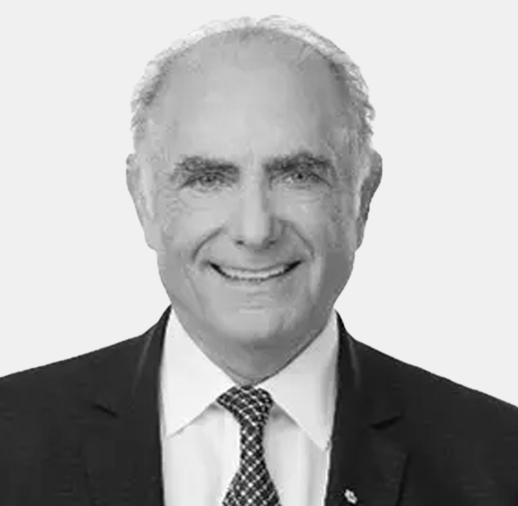
Calin Rovinescu Executive Chairman |
iii | CAE INC. | 2026 | Management Proxy Circular
iv | CAE INC. | 2026 | Management Proxy Circular
v | CAE INC. | 2026 | Management Proxy Circular
vi | CAE INC. | 2026 | Management Proxy Circular
Proxy Circular Summary
This summary highlights some of the important information you will find in this Management Proxy Circular (“Circular”). These highlights do not contain all the information that you should consider, and you should read this entire Circular before voting your Shares.
Shareholder Voting Matters
| | | | | | | | |
Voting Matter | Board Vote Recommendation | Page Reference for More Information |
Election of 13 Directors | FOR each nominee | 8 |
Appointing PricewaterhouseCoopers LLP (PwC)
as Auditor | FOR | 10 |
Advisory Vote on Executive Compensation | FOR | 11 |
vii | CAE INC. | 2026 | Management Proxy Circular
Review this Proxy Circular and Vote in One
of the Following Ways
Voting by Proxy is the Easiest Way
Below are the different ways in which you can give your voting instructions, details of which are found in the enclosed proxy form or your voting instruction form, as applicable. Please also refer to Section 1 – About Voting Your Shares for more information on the voting methods available to you:
 by mail: sign, date and return your proxy form in the envelope provided.
 by telephone: call the telephone number on your proxy form.
 on the Internet: visit the website listed on your proxy form.
 by appointing another person to attend and vote at the Meeting in person or online on your behalf.
Voting In Person at the Meeting
 Attend in person at Lumi Experience Montréal, 1250 René-Lévesque Blvd. W., Suite 3610, Montréal, Québec, H3B 4X4 and follow the steps listed in the Section “Attending and Participating.”
Voting Online at the Meeting
 Log in online at https://meetings.lumiconnect.com/400-470-759-284 and follow the steps listed in the Section “Attending and Participating.”
viii | CAE INC. | 2026 | Management Proxy Circular
About CAE
Who we are
At CAE, we exist to make the world safer. We deliver cutting-edge training, simulation, and critical operations solutions to prepare aviation professionals and defence forces for the moments that matter. Every day, we empower pilots, cabin crew, maintenance technicians, airlines, business aviation operators, and defence and security personnel to perform at their best and when the stakes are the highest. Around the globe, we’re everywhere customers need us to be with sites and training locations in over 40 countries. For nearly 80 years, CAE has been at the forefront of innovation, consistently seeking to set the standard by delivering excellence in high-fidelity flight simulators and training solutions, while embedding sustainability at the heart of everything we do. By harnessing technology and enhancing human performance, we strive to be the trusted partner in advancing safety and mission readiness—today and tomorrow.
Founded in 1947 and headquartered in Montreal, Canada, CAE has built an excellent reputation and long-standing customer relationships based on experience, strong technical capabilities, a highly trained workforce and global reach. CAE’s common shares are listed on the Toronto and New York stock exchanges (TSX / NYSE) under the symbol CAE.
Our purpose, mission and vision
Our purpose is to make the world safer.
Our mission is to deliver cutting-edge training, simulation and critical operations solutions to prepare aviation professionals and defence forces for the moments that matter.
Our vision is to be the trusted partner in advancing safety and mission readiness, defining the standard of excellence in training and critical operations by harnessing technology and enhancing human performance.
Our operations
Our operations are managed through two segments:
Civil Aviation: We provide comprehensive training solutions for flight, cabin, maintenance, ground personnel and air traffic controllers in commercial, business and helicopter aviation, a complete range of flight simulation training devices, ab initio pilot training and crew sourcing services, as well as airline operations digital solutions. The civil aviation market includes major commercial airlines, regional airlines, business aircraft operators, civil helicopter operators, aircraft manufacturers, third-party training centres, flight training organizations, air navigation service providers, maintenance, repair and overhaul organizations and aircraft finance leasing companies.
Defense & Security: We are a global training and simulation provider delivering scalable, platform-independent solutions that enable and enhance force readiness and security. The defence and security market includes defence forces, OEMs, government agencies and public safety organizations worldwide.
ix | CAE INC. | 2026 | Management Proxy Circular
Our strategy
CAE’s four strategic pillars
| | | | | |
| Market leadership We have established ourselves as a leader across our markets by being a trusted partner for our stakeholders and by embracing customer centricity. Looking forward, there remains significant headroom for continued growth in our large addressable markets. As a result, we are constantly seeking out ways to focus our portfolio around our core capabilities and enhance the performance of our customers. These actions will enable us to continue to win in our markets and extend our leadership positions. Furthermore, our products are deployed with a focus on integrated sustainability. |
| Revolutionizing training We have a history of nearly 80 years of applying innovation and technology to create novel, world-class solutions and generate long-term competitive differentiation. We are established as one of the global leaders in training, digital immersion, and modelling and simulation technologies. We use focused technology development to improve the performance of our businesses and generate value for our customers. |
| Efficient growth We aim to maximize the benefits of our strong competitive positions and our ongoing transformation efforts to deliver profitable growth, higher returns on invested capital and improved free cash flow conversion. As we work to transform the business by continuing to focus on improved performance and capital discipline, we will drive operational excellence, cost optimization and apply a more prudent approach to pursuing both organic and inorganic growth. |
| Skills and culture Our core values are innovation, integrity, empowerment, excellence and One CAE. We employ these values across a diverse global team to drive a unique social impact. We look to create a high-performing culture that values teamwork, professional growth, engagement and ownership. As a result, our employees across the globe share a passion to enhance safety and prepare our customers for the moments that matter. |
x | CAE INC. | 2026 | Management Proxy Circular
Executive Compensation Highlights
—Executive short-term incentive payout based on a corporate performance factor of 84%, reflective of CAE’s performance against its strategic plan and financial objectives in FY2026
—26% payout factor for Performance Share Units that vested in FY2026 (with a performance measurement period from FY2023 to FY2025), aligned with shareholder experience over the period
| | | | | |
Our Executive Compensation Best Practices |
|
Minimum threshold levels of corporate performance to be met to allow for payments under
the annual and long-term incentives | |
Caps on annual bonuses and Performance Share Units (“PSU”) payout factors | |
Balanced mix of short, medium and long-term compensation | |
Pensionable earnings based on actual years served | |
Change of control severance limited to two times salary and bonuses | |
Robust clawback policy, including a market-leading ability to clawback incentive-based compensation in circumstances of misconduct without the need for a financial restatement | |
Minimum share ownership and option profit retention guidelines | |
Anti-hedging policy | |
Post-employment Share ownership requirement for CEO | |
Double trigger vesting of equity in case of change of control | |
xi | CAE INC. | 2026 | Management Proxy Circular
Governance Highlights
The following table shows some of the ways CAE continues to adhere to the highest standards in corporate governance.
| | | | | |
Our Corporate Governance Best Practices |
|
Number of Director nominees | 13 |
Number of non-employee Independent Director nominees | 11/13 |
Board Committee members (including the Governance Committee, which is responsible for recommending new Directors to join the Board) are all independent. | |
Average age of Director nominees | 60 |
Annual election of Directors | |
Other Board commitments and interlocks policy | |
Separate Chair and CEO roles | |
Director tenure and age term limits | |
Share ownership requirements for Directors and executives | |
Board orientation/education program | |
Number of Board meetings held during FY2026 | 9 |
Number of financial experts on the Audit Committee | 2 |
Code of Business Conduct | |
Annual advisory vote on executive compensation | |
Formal Board and Committee evaluation processes | |
No dual-class shares | |
Enterprise risk management oversight including sustainability matters | |
xii | CAE INC. | 2026 | Management Proxy Circular
Our Director Nominees
| | | | | | | | | | | | | | | | | | | | | | | |
Name | Age | Director Since | Position | Independent | Committee Memberships | Board and Committee Attendance FY2026 | Other Public Boards |
Sophie Brochu1 | 63 | 2023 | Corporate Director | YES | GC (Chair) | 100% | 2 |
Matthew Bromberg | 56 | 2025 | President and CEO, CAE | NO | N/A | 100% | N/A |
Patrick Decostre | 53 | 2024 | President and CEO, Boralex Inc. | YES | Audit | 77% | 1 |
Elise Eberwein | 61 | 2022 | Corporate Director | YES | GC, HRC (Chair) | 94% | N/A |
Ian L. Edwards | 63 | 2024 | President and CEO, AtkinsRéalis | YES | Audit | 92% | 1 |
Marianne Harrison | 62 | 2019 | Corporate Director | YES | Audit (Chair), TC | 93% | 1 |
Peter Lee | 40 | 2025 | Co-Founder and Partner, Browning West, LP | YES | HRC | 93% | 1 |
Katherine A. Lehman | 51 | 2025 | Partner, Palladium Equity Partners, LLC | YES | GC | 100% | 1 |
Mary Lou Maher | 66 | 2021 | Corporate Director | YES | Audit, HRC | 100% | 2 |
Bruce Ross2 | 64 | N/A | Group Head, AI, Royal Bank of Canada | YES | N/A | N/A | N/A |
Calin Rovinescu3 | 70 | 2025 | Executive Chairman, CAE | NO | N/A | 100% | 1 |
Patrick M. Shanahan | 63 | 2022 | Corporate Director | YES | HRC | 100% | 1 |
Louis Têtu | 62 | 2025 | Executive Chairman, Coveo Solutions Inc. | YES | Audit, TC | 100% | 2 |
1.Ms. Brochu was appointed Lead Independent Director on August 13, 2025.
2.Mr. Ross does not currently serve as a Director on the Board of CAE and will become a Director following his election at the Meeting.
3.Mr. Rovinescu served as non-executive Chair of the Board from February 14, 2025 to August 13, 2025. He assumed the expanded role of Executive Chairman on August 13, 2025 to assist with the transition of the incoming CEO, meet with investors, government representatives and other stakeholders and help to develop the transformation plan and long term strategy for the next chapter of growth and value creation at CAE. As that process is now well underway, Mr. Rovinescu will revert to the role of non-executive Chair of the Board effective January 1, 2027.
xiii | CAE INC. | 2026 | Management Proxy Circular
Useful Information
Certain defined terms
| | |
In this document, referred to as this “Circular”, the terms “you” and “your” refer to the Shareholder, while “we”, “us”, “our”, “Company” and “CAE” refer to CAE Inc. and where applicable, its subsidiaries. |
Currency, exchange rates and share prices
| | |
All amounts referred to in this Circular are presented in Canadian dollars, unless otherwise stated. In a number of instances in this Circular, including with respect to calculation of the in-the-money value of stock options denominated in Canadian dollars, information based on our Share price has been calculated on the basis of the Canadian dollar. |
Non-IFRS and other financial measures
| | |
This document includes non-IFRS financial measures, non-IFRS ratios, capital management measures and supplementary financial measures. These measures are not standardized financial measures prescribed under IFRS and therefore should not be confused with, or used as an alternative for, performance measures calculated according to IFRS. Furthermore, these measures should not be compared with similarly titled measures provided or used by other issuers. Management believes that these measures provide additional insight into our operating performance and trends and facilitate comparisons across reporting periods. Definitions of all non-IFRS and other financial measures are provided in Appendix B of this document to give the reader a better understanding of the indicators used by management. In addition, when applicable, this document may include a quantitative reconciliation of the non-IFRS and other financial measures to the most directly comparable measure under IFRS. Refer to Appendix B of this document for references to where these reconciliations are provided. |
Information currency
| | |
The information in this Circular is current as of June 11, 2026 unless otherwise stated. |
xiv | CAE INC. | 2026 | Management Proxy Circular
Notice of 2026
Annual Shareholders’ Meeting
What the Meeting is About
1.Receive CAE Consolidated Financial Statements and the auditor’s report for the fiscal year ended March 31, 2026;
2.Elect Directors who will serve until the end of the next annual Shareholders' meeting;
3.Reappoint PricewaterhouseCoopers LLP as our auditor who will serve until the end of the next annual Shareholders' meeting and to authorize the Company’s Board to fix the auditor’s remuneration;
4.Vote, in an advisory, non-binding manner, on CAE’s approach to executive compensation described in this Circular; and
5.Transact any other business that may properly come before the Meeting.
You have the Right to Vote
As a holder of record of common shares of CAE (“Shares”) at the close of business on June 15, 2026, you are entitled to receive notice of and vote at the Meeting.
You are asked to consider and to vote your Shares on items 2 to 4 and any other items that may properly come before the Meeting or any adjournment or postponement thereof.
If you are unable to attend the Meeting in person or online and want to ensure that your Shares are voted, please submit your votes by proxy as described under “How to Vote Your Shares” in the accompanying Circular. To be valid, our transfer agent, Computershare Trust Company of Canada, must receive your proxy by 3:00 p.m. (Eastern Time) on August 10, 2026. If the Meeting is adjourned or postponed, Computershare must receive your proxy no later than 24 hours (excluding Saturdays, Sundays and holidays) prior to any such adjournment or postponement.
Accompanying this Notice of Annual Meeting is the Circular, which contains more information on the matters to be addressed at the Meeting.
xv | CAE INC. | 2026 | Management Proxy Circular
Attending and Participating
Our Meeting will be held in a hybrid format, which will be conducted simultaneously in person and by live webcast. Shareholders may attend either meeting format, as explained below. The hybrid format allows those people who cannot attend in person the opportunity to attend the meeting online, participate, vote and ask questions as if they were physically present at the meeting and regardless of their geographic location. Only registered Shareholders and duly appointed Proxyholders (including non-registered (beneficial) Shareholders who have appointed themselves as a Proxyholder) will be permitted to participate, vote and ask questions during the Meeting.
To attend the Meeting in person, follow the instructions below:
If you are a registered Shareholder or a duly appointed Proxyholder (including non-registered (beneficial) Shareholders who have appointed themselves as Proxyholder), you will be able to attend the meeting in person, vote and ask questions after registering at the registration desk. Only registered Shareholders and duly appointed Proxyholders will be granted access to the in-person meeting. However, non-registered (beneficial) Shareholders who have not appointed themselves Proxyholders, non-shareholders and other guests will be able to attend the meeting online.
If you attend the meeting in person, you will only need to check in at the registration desk with our transfer agent, Computershare, when you arrive at Lumi Experience Montréal, 1250 René-Lévesque Blvd. W., Suite 3610, Montréal, Québec, H3B 4X4.
To access the Meeting online, follow the instructions below, as applicable to you:
1.Log in online at https://meetings.lumiconnect.com/400-470-759-284. The platform is compatible with all major browsers except for Internet Explorer.
2.Click “I have a Login” and then enter your Control Number (see below) and Password “cae2026” (note the password is case sensitive); OR
3.Click “I am a guest” and then complete the online form.
In order to find the 15-digit Control Number to access the Meeting:
—Registered Shareholders: The control number located on the form of proxy or in the email notification you received is your Control Number.
—Proxyholders: Duly appointed Proxyholders, including non-registered (beneficial) Shareholders who have appointed themselves or another person as a Proxyholder, will receive the Control Number from Computershare by e-mail after the proxy voting deadline has passed.
If you attend the Meeting online, it is important that you are connected to the Internet at all times during the Meeting in order to vote when balloting commences. It is your responsibility to ensure connectivity for the duration of the Meeting. You should allow ample time to check into the Meeting online and complete the related procedure. For additional details on accessing and participating in the Meeting online from your tablet, smartphone or computer, please see the Virtual AGM User Guide provided by Computershare and accompanying this proxy circular.
Notice-and-Access
As part of an effort to reduce environmental impacts of excessive printing, and to save postage costs, CAE is opting to use the “Notice-and-Access” provisions of Canadian securities rules.
The “Notice-and-Access” provisions allow Canadian companies to post electronic versions of Shareholder meeting materials in lieu of mailing physical copies of such documents to Shareholder. Shareholders will instead only receive a paper notification with information on how they may obtain a copy of the meeting materials electronically or request a paper copy (Notification). Shareholders who have already signed up for electronic delivery of Shareholder materials will continue to receive them by email.
Non-registered Shareholders who have not objected to their intermediary disclosing certain ownership information about themselves to CAE are referred to as “NOBOs”. The non-registered Shareholders who have objected to their intermediary disclosing ownership information about themselves to CAE are referred to as “OBOs”. CAE has distributed the Notification in connection with the Meeting to intermediaries and clearing agencies for onward distribution to non-registered Shareholders. CAE will not be paying for intermediaries to deliver to OBOs (who have not otherwise waived their right to receive proxy-related materials) copies of proxy related materials and related documents (including the Notification). Accordingly, an OBO will not receive copies of proxy-related materials and related documents unless the OBO’s intermediary assumes the costs of delivery.
How to Access Meeting Materials
—On Computershare Investor Services Inc.’s (“Computershare”) website: www.envisionreports.com/CAE2026e
—On SEDAR+: www.sedarplus.ca
—On CAE’s website: www.cae.com/investors/financial-reports
Shareholders are reminded to read the Circular and other Meeting materials carefully before voting their Shares.
xvi | CAE INC. | 2026 | Management Proxy Circular
How to Request a Paper Copy of the Meeting Materials
Before the Meeting
If your name appears on a Share certificate, you are considered as a “registered Shareholder”. You may request paper copies of the Meeting materials at no cost to you by calling Computershare toll-free, within North America at 1-866-962-0498 or direct, from outside of North America, at 1-514-982-8716 and entering your control number as indicated on your form of proxy.
If your Shares are listed in an account statement provided to you by an intermediary, you are considered as a “non-registered Shareholder”. You may request paper copies of the Meeting materials from Broadridge at no cost to you up to one year from the date the Circular was filed on SEDAR through the Internet by going to www.proxyvote.com or by telephone at 1-877-907-7643 and entering the 16-digit control number provided on the voting instruction form and following the instructions provided.
Please note that you will not receive another form of proxy or voting instruction form; please retain your current one to vote your Shares.
In any case, requests should be received at least five (5) business days prior to the proxy deposit date and time set out in the accompanying proxy or voting instruction form in order to receive the Meeting materials in advance of such date and the Meeting date.
After the Meeting
By telephone at 1-866-964-0492 or online at investor.relations@cae.com. A copy of the Meeting materials will be sent to you within ten (10) calendar days of receiving your request.
By order of the Board of Directors,
June 11, 2026
Montréal, Québec
| | | | | |
| |
Mark Hounsell
Chief Legal Officer |
xvii | CAE INC. | 2026 | Management Proxy Circular
1 | CAE INC. | 2026 | Management Proxy Circular
Section 1 – About Voting Your Shares
Record Date
June 15, 2026 is the record date for the Meeting.
Who can vote
Only holders of our Shares at the close of business on the Record Date are entitled to receive notice of and to attend, including by proxy, and vote at the Meeting or any adjournment or postponement thereof. The list of Shareholders on the Record Date is available for inspection by appointment during usual business hours at Computershare Trust Company of Canada, 650 de Maisonneuve west 7th floor, Montreal, QC H3A 3T2, and at the Meeting. As of June 11, 2026, 321,579,686 Shares are issued and outstanding. Each Share is entitled to one vote.
Principal Shareholders
To the knowledge of the Directors and executive officers of CAE (from records and publicly filed reports), there is no person who beneficially owns or exercises control or direction over more than 10% of the Shares.
As at June 11, 2026, Directors and executive officers as a group (23 persons) beneficially owned or exercised control or direction over 177,706 Shares representing 0.06% of the class.
Your vote is important
Your vote is important. Please read the information below to ensure your Shares are properly voted.
How do I participate in the Meeting?
Our Meeting will be held in a hybrid format, which will be conducted simultaneously in person and by live webcast. Shareholders may attend either meeting format, as explained below. The hybrid format allows those people who cannot attend in person the opportunity to attend the meeting online, participate, vote and ask questions as if they were physically present at the meeting and regardless of their geographic location. Only registered Shareholders and duly appointed Proxyholders (including non-registered (beneficial) Shareholders who have appointed themselves as a Proxyholder) will be permitted to participate, vote and ask questions during the Meeting.
To attend the Meeting in person, follow the instructions below:
If you are a registered Shareholder or a duly appointed Proxyholder (including non-registered (beneficial) Shareholders who have appointed themselves as Proxyholder), you will be able to attend the meeting in person, vote and ask questions after registering at the registration desk. Only registered Shareholders and duly appointed Proxyholders will be granted access to the in-person meeting. However, non-registered (beneficial) Shareholders who have not appointed themselves Proxyholders, non-shareholders and other guests will be able to attend the meeting online.
If you attend the meeting in person, you will only need to check in at the registration desk with our transfer agent, Computershare, when you arrive at Lumi Experience Montréal, 1250 René-Lévesque Blvd. W., Montréal, Québec, H3B 4X4.
To access the Meeting online, follow the instructions below, as applicable to you:
1.Log in online at https://meetings.lumiconnect.com/400-470-759-284. The platform is compatible with all major browsers except for Internet Explorer.
2.Click “I have a Login” and then enter your Control Number (see below) and Password “cae2026” (note the password is case sensitive); OR
3.Click “I am a guest” and then complete the online form.
In order to find the 15-digit Control Number to access the Meeting online:
—Registered Shareholders: The control number located on the form of proxy or in the email notification you received is your Control Number.
—Proxyholders: Duly appointed Proxyholders, including non-registered (beneficial) Shareholders who have appointed themselves or another person as a Proxyholder, will receive the Control Number from Computershare by e-mail after the proxy voting deadline has passed.
If you attend the Meeting online, we recommend that you log in at least one hour before the start time of the Meeting. It is important to ensure you are connected to the Internet at all times if you participate in the Meeting online in order to vote when balloting commences. You are responsible for ensuring Internet connectivity for the duration of the Meeting. For additional details and instructions on accessing the Meeting online from your tablet, smartphone or computer, voting and asking questions during the Meeting, see the Hybrid AGM User Guide provided by Computershare and accompanying this Circular.
For additional information regarding voting by proxy before the meeting, voting online, attending the meeting in person or online, or other general proxy matters, please contact Computershare at 1-800-564-6253 (Canada/U.S.) or 1-514-982-7555 (international/direct dial).
2 | CAE INC. | 2026 | Management Proxy Circular
Section 1 – About Voting Your Shares
How to Vote your Shares
You may vote your Shares in one of the following ways:
1. By proxy using all the voting channels that have been available in the past; this has not changed.
by mail: sign, date and return your proxy form in the envelope provided. by telephone: call the telephone number on your proxy form. on the Internet: visit the website listed on your proxy form. by appointing another person to attend and vote at the Meeting online on your behalf. Refer to the enclosed proxy form for instructions.
2. In person or online by virtual ballot at the Meeting by following the instructions below. The voting process is different for registered or non-registered (beneficial) Shareholders:
(a) if you are a registered Shareholder, you may vote at the Meeting either in person or by completing a ballot online during the Meeting. Follow the instructions above to access the Meeting and cast your ballot online during the designated time.
(b) if you are a non-registered Shareholder (including a participant in the employee plan) AND you wish to vote in person or online at the Meeting, you must appoint yourself as Proxyholder in order to vote at the Meeting. You MUST complete and return a voting instruction form no later than 3:00 p.m. (Eastern Time) on August 10, 2026 appointing yourself as Proxyholder. Follow the instructions above to attend and vote in person or to access the Meeting and cast your ballot online during the designated time. You will receive the Control Number for the Meeting from Computershare by e-mail after the proxy voting deadline has passed.
United States Beneficial holders: To vote at the Meeting, you must first obtain a valid legal proxy from your broker, bank or other agent and then register in advance of the Meeting. Follow the instructions from your broker or bank included with this Circular, or contact your broker or bank to request a legal proxy form. To register to attend the Meeting in person or online, you must submit a copy of your legal proxy form to Computershare. Requests for registration should be directed to Computershare at 320 Bay Street, 14th Floor, Toronto, Ontario, M5H 4A6, or by e-mail at uslegalproxy@computershare.com. Requests for registration must be labelled as “Legal Proxy” and be received no later than 3:00 p.m. (EDT) on August 10, 2026. You will receive a confirmation of your registration after Computershare receives your registration materials. Please note that you are required to register your appointment as Proxyholder at www.computershare.com/CAE.
If you have any questions or need assistance voting, you may contact Sodali & Co, CAE’s strategic advisor and proxy solicitation agent, by telephone at 1-888-999-2602 (toll-free in North America) or 1-289-695-3075 (outside North America), or by email at assistance@investor.sodali.com.
3 | CAE INC. | 2026 | Management Proxy Circular
Section 1 – About Voting Your Shares
Voting by Proxy
If you choose to vote by proxy, you are giving the person or people named on your proxy form (referred to as a “Proxyholder”) the authority to vote your Shares on your behalf in person or online at the Meeting or any adjournment or postponement thereof.
Proxies are being solicited by management
Through this Circular, management is soliciting your proxy in connection with the matters to be addressed at the Meeting (or any adjournment(s) or postponements(s) thereof) to be held at the time and place and for the purposes set forth in the accompanying Notice of the Meeting.
The solicitation is being made primarily by mail, but you may also be contacted by telephone or other means. We have engaged Morrow Sodali (Canada) Ltd. (“Sodali & Co”) as strategic shareholder advisor and proxy solicitation agent to assist with the solicitation of votes from shareholders and to provide strategic services in the areas of capital markets intelligence, governance and shareholder engagement. The Company will pay fees of up to approximately $40,000 for the proxy solicitation service, in addition to certain out-of-pocket expenses. The Company may also reimburse brokers and other persons holding Shares in their name or in the name of nominees for their costs incurred in sending proxy material to their principals in order to obtain their proxies.
| | |
Proxyholders other than management Shareholders desiring to appoint some person other than Calin Rovinescu, Matthew Bromberg and Sophie Brochu as their representative at the Meeting may do so either by inserting such other person’s name in the blank space provided or by completing another proper proxy form and, in either case, delivering the completed proxy to CAE’s Chief Legal Officer at 8585 Côte-de-Liesse, Saint-Laurent, Québec, H4T 1G6 or to Computershare Trust Company of Canada, 320 Bay Street, 14th Floor, Toronto, Ontario, M5H 4A6 no later than 3:00 p.m. (Eastern Time) on August 10, 2026 (or, in the case of an adjournment or postponement, not less than 48 hours (excluding Saturdays, Sundays and holidays) prior to the time fixed for holding such adjournment or postponement). |
Unless you specify a different Proxyholder, the CAE officers and/or Directors whose names are pre-printed on the enclosed form of proxy (Calin Rovinescu, Matthew Bromberg and Sophie Brochu) will vote your Shares. The Company may utilize the Broadridge QuickVoteTM system, which involves NOBOs being contacted by Sodali & Co, which is soliciting proxies on behalf of management, to obtain voting instructions over the telephone and relaying them to Broadridge (on behalf of the NOBO’s intermediary). While representatives of Sodali & Co are soliciting proxies on behalf of management, Shareholders are not required to vote in the manner recommended by the Board. The QuickVoteTM system is intended to assist Shareholders in placing their votes, however, there is no obligation for any Shareholders to vote using the QuickVoteTM system, and Shareholders may vote (or change or revoke their votes) at any other time and in any other applicable manner described in this Circular. Any voting instructions provided by a Shareholder will be recorded and such Shareholder will receive a letter from Broadridge (on behalf of the Shareholder’s intermediary) as confirmation that their voting instructions have been accepted.
4 | CAE INC. | 2026 | Management Proxy Circular
Section 1 – About Voting Your Shares
Voting of Proxies
You may indicate on the proxy form how you want your Proxyholder to vote your Shares, in which case the Proxyholder will vote in accordance with your instructions. You can also let your Proxyholder decide for you. If you do not specify on the proxy form how you want your Shares to be voted, your Proxyholder will have the discretion to vote your Shares as they see fit.
The enclosed proxy form gives the Proxyholder discretion with respect to any amendments or variations to matters described in the Notice of Annual Meeting and with respect to any other matters which may properly come before the Meeting (including any adjournment or postponement thereof), in each instance, to the extent permitted by law, whether or not the amendment, variation, or other matter that comes before the Meeting is routine and whether or not the amendment, variation, or other matter that comes before the Meeting is contested.
At the time of printing this Circular, the management of CAE knows of no such amendments, variations or other matters to come before the Meeting. However, if you have not specified how to vote on a particular matter, or if any amendments or variations to matters identified in the Notice of Annual Meeting, or any other matters that are not now known to management of CAE, should properly come before the Meeting or any adjournment or postponement thereof, the Shares represented by properly submitted proxies given in favour of the persons designated by management of CAE in the form of proxy will be voted on such matters pursuant to such discretionary authority.
Unless you specify a different Proxyholder or specify how you want your Shares to be voted, Calin Rovinescu, Matthew Bromberg and Sophie Brochu will vote your Shares:
(a) FOR electing the nominated Directors who are listed in this Circular;
(b) FOR appointing PwC as auditor and for the authorization of the Directors to fix the auditor’s remuneration; and
(c) FOR approving the advisory resolution on executive compensation.
Registered Shareholders who wish to appoint a third-party Proxyholder to represent them at the Meeting must first use the form of proxy to appoint the Proxyholder and then must register their Proxyholder online. Failure to register the Proxyholder will result in the Proxyholder not receiving a Control Number and therefore being unable to participate in the Meeting. To register a third-party Proxyholder, Shareholders must visit www.computershare.com/CAE by August 10, 2026 at 3:00 p.m. (Eastern Time) and provide Computershare with the Proxyholder’s contact information required. Computershare needs this information so they can confirm their registration and send an email notification with a Control Number. Your Proxyholder needs the Control Number in order to participate in the meeting and vote your Shares. Your third-party Proxyholder should receive the email notification after 3:00 p.m. (Eastern Time) on August 10, 2026.
To be effective, your proxy must be received before 3:00 p.m. (Eastern Time) on August 10, 2026 or not less than 48 hours (excluding Saturdays, Sundays and holidays) prior to the time fixed for holding any adjournment or postponement of the Meeting.
If you have any questions or need assistance voting, please contact Sodali & Co at 1-888-999-2602 (toll-free in North America) or 1-289-695-3075 (outside North America) or by email at assistance@investor.sodali.com. Late proxies may be accepted or rejected by the Chair of the Meeting at his or her discretion and the Chair of the Meeting is under no obligation to accept or reject any particular late proxy. The time limit for deposit of proxies may be waived or extended by the Chair of the Meeting at his or her discretion, without notice.
Revocation of proxies
You have the right to revoke a proxy by any of the following methods:
(a) Vote again by phone or Internet no later than 3:00 p.m. (Eastern Time) on August 10, 2026 (or not less than 48 hours (excluding Saturdays, Sundays and holidays) prior to the date of any adjourned or postponed Meeting); or
(b) Deliver another completed and signed proxy form, dated later than the first proxy form, by mail or fax such that it is received by CAE’s Chief Legal Officer at 8585 Côte-de-Liesse, Saint-Laurent, Québec, H4T 1G6 or by Computershare Trust Company of Canada, 320 Bay Street,
5 | CAE INC. | 2026 | Management Proxy Circular
Section 1 – About Voting Your Shares
14th Floor, Toronto, Ontario, M5H 4A6 no later than 3:00 p.m. (Eastern Time) on August 10, 2026 (or not less than 48 hours (excluding Saturdays, Sundays and holidays) prior to the date of any adjourned or postponed Meeting.
Electronic access to proxy-related materials and annual and quarterly reports
We offer our Shareholders the opportunity to view management proxy circulars, annual reports and quarterly reports through the Internet instead of receiving paper copies in the mail. You will find more information on this matter in the Notice-and-Access section above.
Electronic delivery in future
Shareholders are asked to consider signing up for electronic delivery of meeting materials. Electronic delivery is a convenient way to make distribution of materials more efficient and is an environmentally responsible alternative by eliminating the use of printed paper and the carbon footprint of the associated mail delivery process. Signing up is quick and easy, and can be done by visiting www.proxyvote.com and signing in with your control number. After voting on the matters to be addressed at the Meeting and following your vote confirmation, you will be able to select the electronic delivery box and provide an email address. Having registered for electronic delivery, going forward you will receive your meeting materials by email and will be able to vote on your device by simply following a link in the email sent by your financial intermediary, provided your intermediary supports this service.
6 | CAE INC. | 2026 | Management Proxy Circular
7 | CAE INC. | 2026 | Management Proxy Circular
Section 2 – Business of the Meeting
1 Receive CAE’s Consolidated Financial Statements
CAE’s consolidated financial statements including the auditor’s report, for the year ended on March 31, 2026 will be presented to Shareholders at the Meeting. They can also be accessed on CAE’s website at www.cae.com, on SEDAR+ at www.sedarplus.ca, or on EDGAR at www.sec.gov. No Shareholder vote is required in connection with the consolidated financial statements.
2 Elect 13 Directors
| | | | | | | | | | | | | | |
13 Nominees | 84.6%1 Independent | 60 Average Age | 97.8% % Votes FOR
in 2025 | 95.7% Average Board Meeting Attendance |
| | | | |
1.The only non-Independent Director nominees are CAE’s Executive Chairman, Mr. Rovinescu, and its President and CEO, Mr. Bromberg. “Independent Directors” refers to the standards of independence established by CAE’s Corporate Governance Guidelines, applicable corporate governance rules of the New York Stock Exchange and SEC, and under the Canadian Securities Administrators’ National Instrument 58-101 – Disclosure of Corporate Governance Practices and National Policy 58-201.
You will be electing a board of directors (“Board”) of 13 members. Each Director is elected annually for a term which expires no later than the next annual meeting of Shareholders.
| | | | | | | | |
All of the following nominees, except Mr. Ross, are currently members of the Board of Directors, and all have been recommended by the GC and the Board for election at the Meeting. Mr. Ross will become a Director following his election at the Meeting. |
—Sophie Brochu —Matthew Bromberg —Patrick Decostre —Elise Eberwein —Ian L. Edwards | —Marianne Harrison —Peter Lee —Katherine A. Lehman —Mary Lou Maher —Bruce Ross | —Calin Rovinescu —Patrick M. Shanahan —Louis Têtu |
8 | CAE INC. | 2026 | Management Proxy Circular
Section 2 – Business of the Meeting
Twelve of the nominees were elected at our 2025 annual Shareholders’ meeting held on August 13, 2025, by a majority of the votes cast (average of 97.8% of votes cast in favour). Mr. Ross is a first-time nominee.
Please refer to Section 3 – About the Nominated Directors for further information regarding the experience, the selection process and other relevant information you should consider in casting your vote for each nominee.
Management has been informed that, if elected, each of such nominees would be willing to serve as a Director. However, in the event any proposed nominee advises that he or she is unable or unwilling to act for any reason prior to the Meeting, proxies held by the persons designated as proxyholders on the form of proxy will be voted in favour of the remaining nominees and for such other substitute nominee in their discretion unless the Shareholder has specified in the form of proxy that such Shareholder’s Shares are to be withheld from voting in the election of Directors.
Self-imposed term and age limits ensure CAE benefits from a combination of experience and fresh perspectives
The Board of Directors has passed a resolution establishing term limits comprising the following:
—up to twelve years maximum;
—no nominee may be proposed past their attaining 75 years of age; and
—the Chair of the Board may be in the role for a full five-year term regardless of his or her age or the number of years the individual has been a Director.
The Board of Directors believes these limits, subject to reasoned exceptions, are appropriate to ensure fresh skill sets and perspectives are periodically brought to the oversight of CAE’s business.
Majority voting requirement
Each Director of the Company must be elected by a majority (50% +1 vote) of the votes cast with respect to his or her election, other than at contested meetings.
In accordance with our Corporate Governance Guidelines, any nominee who receives a greater number of votes cast “against” him or her than votes “for” will not be elected as a Director. Notwithstanding the foregoing, if the nominee is an incumbent Director, such Director may continue in office until the earlier of (i) the 90th day after the election, or (ii) the day on which his or her successor is appointed or elected. In accordance with the provisions of the Canada Business Corporations Act and its regulations, the Board may reappoint an incumbent Director even if he or she does not receive majority support in the following circumstances:
—to satisfy Canadian residency requirements; or
—to satisfy the requirement that at least two Directors are not also officers or employees of the Company or its affiliates.
Detailed voting results will be disclosed after the Meeting
Promptly, after the Meeting, we will publicly disclose the number and percentage of votes cast for and withheld in respect of each nominee, as well as those cast for and against each other matter voted on by Shareholders at the Meeting.
| | |
The Board of Directors recommends that Shareholders vote FOR the election of the 13 nominated members of the Board. |
9 | CAE INC. | 2026 | Management Proxy Circular
Section 2 – Business of the Meeting
3 Appoint the Auditor
The Board, on recommendation by the Audit Committee, proposes that PricewaterhouseCoopers LLP (PwC), Chartered Accountants, Montréal, Québec be re-appointed as auditor of CAE to hold office until the close of the next annual meeting of Shareholders and that the Directors of CAE be authorized to fix the auditor’s remuneration.
PwC has served as auditor of CAE since 1991.
PwC provides three types of services to CAE and its subsidiaries
1.Audit Services: fees billed for professional services for the audit of CAE’s annual consolidated financial statements and services that are normally provided by PwC in connection with statutory and regulatory filings, including the audit of the internal controls and financial reporting as required by the Sarbanes-Oxley Act of 2002 (“SOX”).
2.Audit-related Services: fees relating to work performed in connection with CAE’s acquisitions/divestitures, financings/prospectuses, translation and other miscellaneous accounting and reporting-related services.
3.Tax Services: fees relating to tax compliance, tax planning and tax advice.
4.All Other Services: fees paid for advisory and consulting services. No such fees were paid in the last two fiscal years.
Auditor’s independence
The Audit Committee has discussed with PwC its independence from management and CAE, has considered and concluded that the provision of non-audit services is compatible with maintaining such independence.
The Audit Committee annually assesses the independence, qualifications, and performance of the external auditor, and performs a comprehensive review every five years, with the last comprehensive review performed in August 2023. The scope of the annual and comprehensive reviews covers audit quality, including independence, objectivity and professional skepticism, quality of service, candor of communications and PwC’s ability to meet CAE’s future needs. Assessments are based, among other things, on the audit plan submitted, the risk areas identified, the
nature of the audit findings, reports presented to the Audit Committee. The annual and comprehensive assessments also consider audit quality indicators (AQIs), which the external auditor reports on quarterly. The use of AQIs is recommended by Canadian regulatory and accounting member bodies, such as CPA Canada, the Canadian Public Accountability Board, the Institute of Corporate Directors and the Canadian Centre for Audit Quality, and provides the Audit Committee with additional useful quantitative and qualitative information for the purpose of evaluating the external auditor.
Furthermore, as per its policy, the Audit Committee reviews and pre-approves all non-audit services provided by the external auditor.
Fees Paid by CAE to PwC in FY2026
The following chart shows all fees paid to PwC by CAE and its subsidiaries in the most recent and prior fiscal year.
| | | | | | | | | | | |
Fee Type | 2026
($ millions) | 2025
($ millions) | |
1. Audit services | 7.3 | 7.5 | |
2. Audit-related services | 0.4 | 0.4 | |
3. Tax services | 0.3 | 0.4 | |
4. All other services | 0.0 | 0.0 | |
Total | 8.0 | 8.3 | |
In order to further support PwC’s independence, the Audit Committee has set a policy concerning CAE’s hiring of current and former partners and employees of PwC who were engaged on CAE’s account in recent years. Pursuant to this policy, CAE will not initiate nor pursue any discussion with any former partner or professional employee(s) of PwC regarding potential or future employment in a reporting oversight role with CAE if they are in a position to influence the audit firm’s operations or financial policies, has ownership or partnership interests or financial participation in the audit firm or was a member of the CAE external audit team during the one-year period preceding the date that audit procedures commenced.
| | |
The Board of Directors recommends that Shareholders vote FOR the appointment of PwC as CAE’s auditor. |
10 | CAE INC. | 2026 | Management Proxy Circular
Section 2 – Business of the Meeting
4 Advisory Vote on Executive Compensation
As detailed in Section 7 – Executive Compensation, CAE’s executive compensation philosophy and programs are based on the fundamental principle of pay-for-performance to align the interests of our executives with those of our Shareholders. This compensation approach allows CAE to attract and retain high-performing executives who are strongly incentivized to create value for CAE’s Shareholders on a sustainable basis.
Section 7 of the Circular describes our overall approach to executive compensation, the objectives of our executive compensation program, how compensation decisions are made and the compensation paid to our named executive officers in the last three years. Section 7 also describes the continued Shareholder outreach conducted in FY2026, seeking input on our compensation programs.
At the Meeting, Shareholders will be asked to consider and to cast an advisory, non-binding vote on CAE’s approach to executive compensation – this is often referred to as “say on pay”.
The text of the “say on pay” resolution reads as follows:
‘‘Resolved that the Shareholders accept the approach to executive compensation disclosed in this Management Proxy Circular.’’
Because your vote is advisory, it will not be binding upon the Board. However, the Human Resources Committee (“HRC”) will review and analyze the results of the vote and take into consideration such results when reviewing executive compensation philosophy and programs.
If a significant proportion of the Shares represented, including by proxy, at the Meeting are voted against the above non-binding advisory resolution, the Board Chair or the HRC Chair will oversee a process to engage with Shareholders to give Shareholders the opportunity to express their specific concerns. The Board of Directors and the HRC will consider the results of this process and, if appropriate, review the Company’s approach to executive compensation in the context of Shareholders’ specific concerns.
Our approach to executive compensation was approved by 95.2% of the votes cast on the resolution during our August 13, 2025 annual meeting of Shareholders. Please refer to Section 7 – Executive Compensation – Compensation Discussion and Analysis – Shareholder Engagement, which describes our significant engagement initiatives with investors in FY2026, including with respect to our executive compensation programs.
| | |
The Board of Directors recommends that Shareholders vote FOR the resolution set out above. |
5 Other Business
We will also transact any other business that may properly come before the Meeting. At the time of printing of this Circular, the management of CAE knows of no such amendments, variations or other matters to come before the Meeting.
11 | CAE INC. | 2026 | Management Proxy Circular
12 | CAE INC. | 2026 | Management Proxy Circular
Section 3 – About the Nominated Directors
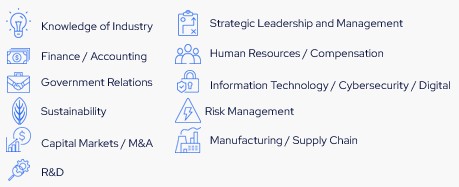
This Section presents a profile of each nominated Director, including an explanation of each nominated Director’s experience, languages, education, skills, qualifications and core competencies, attendance at Board and Committee meetings from April 1, 2025 to March 31, 2026, total value of compensation received in FY2026, Share ownership information, the extent of fulfillment of the Minimum Ownership requirements, previous voting results, as well as participation on the boards of other public companies. A description of the Director Selection and Nomination Process, Board Attributes and Demographics and a tabular summary of our Directors’ Skills and Experiences follows the individual tables. “Market Value” refers to the product of the sum of the Shares and DSUs held by a Director multiplied by the closing price on the TSX of a Share on March 31, 2025 and March 31, 2026.
Non-Canadian resident Directors are paid in U.S. dollars on the basis of a one-for-one exchange rate of Canadian dollars to U.S. dollars, and their share ownership requirements are in U.S. dollars. As such, for these Directors the “Total Value of Compensation Received in FY2026” reflects payments made in U.S. dollars for each quarter of FY2026, which were converted to Canadian dollars using the exchange rate on the last business day of the respective quarter, being, for each U.S. dollar, $1.36 in Q1, $1.39 in Q2, $1.37 in Q3 and 1.39 in Q4. In addition, the “Market Value” of their securities held on March 31, 2025 and March 31, 2026 has been converted to U.S. dollars using the Bank of Canada daily exchange rate on the last business day of FY2025 and FY2026, respectively being 0.70 and 0.72 U.S. dollars per Canadian dollar.
Management has been informed that, if elected, each of such nominees would be willing to serve as a Director. However, in the event any proposed nominee advises that he or she is unable or unwilling to act for any reason prior to the Meeting, proxies held by the persons designated as proxyholders on the form of proxy will be voted in favour of the remaining nominees and for such other substitute nominee in their discretion unless the Shareholder has specified in the form of proxy that such Shareholder’s Shares are to be withheld from voting in the election of directors.
Footnotes specific to each nominee are presented immediately below their biography.
| | | | | | | | | | | | | | |
97.8% | 84.6%1 | 60 | 2.46 | 95.7% |
Average 2025 Votes FOR | Independent Directors | Average Age | Average Tenure (years) | Average Board Attendance |
| | | | |
1.The only non-Independent Director nominees are CAE’s Executive Chairman, Mr. Rovinescu, and its President and CEO, Mr. Bromberg.
13 | CAE INC. | 2026 | Management Proxy Circular
Section 3 – About the Nominated Directors
| | | | | | | | | | | |
Sophie Brochu
Lead Independent Director1 |
Age: 63 Bromont, Québec, Canada Independent Director since: 2023 Committees: Governance (Chair) Total Value of Compensation Received in FY2026: $321,118 Languages: English, French |
Experience Hydro-Québec–President and Chief Executive Officer (2020 – 2023) Énergir (formerly Gaz-Métro)–President and Chief Executive Officer (2007 – 2019); Vice-President, Business Development and other executive roles (1997 – 2007) Began her career as a financial analyst at Société québécoise d’initiatives pétrolières (SOQUIP) in 1987 |
Skills, Qualifications and Core Competencies Strategic Leadership and Management experience gained while serving as CEO at Energir and Hydro Quebec Human Resources / Compensation expertise gained during her service in CEO roles where she had ultimate oversight for succession planning, talent management and retention, and alignment of HR compensation programs with strategic orientations, as well as during her service on HR/Compensation committees of various public boards Government Relations expertise gained from her over 35 years of deep experience with energy utilities and regulated entities, both in Canada and the US, which involve various and complex governmental relations, both at the political and administrative levels, which resulted in her extensive strategic understanding of public policies Sustainability expertise through her over 25 years of experience in the deployment of health and safety programs, establishment of environmental frameworks, fostering of deep relationships with various stakeholders, and advancing of workplace culture practices at the organizations that she oversaw |
|
Education BA, Economics, Université Laval
1.Ms. Brochu was appointed Lead Independent Director on August 13, 2025. |
| | | | | | | | |
|
|
2025 Voting Results |
Votes For | 96.96% | 248,776,836 |
Votes Against | 3.04% | 7,796,974 |
| | |
Other Public Company Boards |
Compagnie de Saint-Gobain S.A. (2024 – present) |
CGI Inc. (2019 – 2020; 2023 – present) |
Bank of Montreal (2011 – 2023) |
|
Board and Committee Attendance2 |
Board of Directors | 9 of 9 | 100% |
Governance Committee | 3 of 3 | 100% |
Human Resources Committee | 3 of 3 | 100% |
Total | 15 of 15 | 100% |
2.Ms. Brochu left the Human Resource Committee on August 13, 2025. |
|
Share Ownership |
| March 31, 2026 | March 31, 2025 |
Shares | — | — |
DSUs | 22,832 | 14,576 |
Total | 22,832 | 14,576 |
Market Value | $826,964 | $515,699 |
Minimum Ownership Requirement | $425,000 | $425,000 |
% of Achievement | 195% | 121% |
14 | CAE INC. | 2026 | Management Proxy Circular
Section 3 – About the Nominated Directors
| | | | | | | | | | | |
Matthew Bromberg
President and CEO |
Age: 56 Westmount, Québec, Canada Director since: 2025 Total Value of Compensation Received in FY2026: please refer to Section 7 – Executive Compensation – Compensation of our Named Executive Officers for details concerning Mr. Bromberg’s compensation Languages: English |
Experience CAE Inc.–President and CEO (2025) Northrop Grumman–Corporate Vice President, Global Operations (2022 – 2025) Raytheon Technologies–President, Pratt & Whitney Military Engines (2017 – 2022); President, Pratt & Whitney Commercial Aftermarket Operations (2013 – 2017); Vice President, United Technologies Corporate Strategy & Development (2011 – 2013); Vice President, Hamilton Sundstrand/Collins Customer Service (2009 – 2011); Vice President, Pratt & Whitney Program Management (2006 – 2009); Vice President, Strategy & Development Corporate/Pratt & Whitney (2002 – 2006) Goldman Sachs–Associate Banker, Investment Banking Division, Mergers and Strategic Advisory (2000 – 2002) U.S. Department of the Navy–Submarine Officer (1992 – 1997) |
Skills, Qualifications and Core Competencies Knowledge of Industry gained over a career spanning nearly 25 years in leadership roles at leading large multinational aerospace and defence companies Strategic Leadership and Management experience developed in executive roles leading large-scale international operations through periods of growth, restructuring, transformation and divestitures Capital Markets / M&A experience gained while working in investment banking, where he was directly responsible for corporate portfolio structure and inorganic growth strategy Manufacturing / Supply Chain expertise developed while leading global operations for a large defence company and overseeing the transformation of its $20 billion supply chain |
|
Education BA, Physics, University of California, Berkley MS, Mechanical Engineering, Massachusetts Institute of Technology MBA, Massachusetts Institute of Technology’s Sloan School of Management |
| | | | | | | | |
|
|
2025 Voting Results |
Votes For | 99.95% | 256,450,571 |
Votes Against | 0.05% | 122,644 |
| | |
Other Public Company Boards |
None |
|
Board and Committee Attendance1 |
Board of Directors | 4 of 4 | 100% |
Total | 4 of 4 | 100% |
1.Mr. Bromberg joined the Board on August 13, 2025. Upon invitation of the Board Committees, he attended all or part of their meetings. |
|
Share Ownership2 |
| March 31, 2026 | March 31, 2025 |
Shares | 2,508 | — |
Stock Options | 108,173 | — |
PSUs | 377,221 | — |
RSUs | 150,156 | — |
2. As President and CEO, Mr. Bromberg has a higher ownership target than an Independent Director. Please refer to Section 7 – Executive Compensation - Compensation Discussion and Analysis - Compensation Governance – Executive Share Ownership Requirements for details concerning Mr. Bromberg’s Share ownership requirements.
15 | CAE INC. | 2026 | Management Proxy Circular
Section 3 – About the Nominated Directors
| | | | | | | | | | | |
Patrick Decostre |
Age: 53 Montréal, Québec, Canada Independent Director since: 2024 Committees: Audit Total Value of Compensation Received in FY2026: $273,204 Languages: English, French |
Experience Boralex Inc.–President and Chief Executive Officer (2020 – present); Vice President and Chief Operating Officer (2019 – 2020); Vice President and General Manager of Boralex’s European subsidiaries (2001 – 2019) |
Skills, Qualifications and Core Competencies Strategic Leadership and Management experience gained in this role as CEO of Boralex since 2020, and during 20+ years in leadership positions in Europe for Boralex while building and growing the company Human Resources / Compensation expertise gained while serving as General Manager, COO and CEO of Boralex, dealing with human resources, organizational design, transformation and compensation Risk Management experience gained while serving as COO and CEO of Boralex, working with the board to set up new identification and risk management systems, including sustainability risks Capital Markets / M&A expertise gained through equity markets investor relations experience, as well as debt financing and refinancing, acquisitions and divestitures, and acquisitions integration throughout his time at Boralex |
|
Education BSc, Civil Engineering in Physics, Université Libre de Bruxelles – École Polytechnique de Bruxelles Masters in Technological & Industrial Management, Université Libre de Bruxelles – Solvey Brussels School of Economics and Management |
| | | | | | | | |
|
|
2025 Voting Results |
Votes For | 99.51% | 255,304,235 |
Votes Against | 0.49% | 1,269,577 |
| | |
Other Public Company Boards |
Boralex Inc. (2020 – present) |
|
Board and Committee Attendance |
Board of Directors | 7 of 9 | 78% |
Audit Committee | 3 of 4 | 75% |
Total | 10 of 13 | 77% |
|
Share Ownership |
| March 31, 2026 | March 31, 2025 |
Shares | 400 | 400 |
DSUs | 14,203 | 7,171 |
Total | 14,603 | 7,571 |
Market Value | $528,917 | $267,862 |
Minimum Ownership Requirement | $425,000 | $425,000 |
% of Achievement | 124% | 63% |
|
16 | CAE INC. | 2026 | Management Proxy Circular
Section 3 – About the Nominated Directors
| | | | | | | | | | | |
Elise Eberwein |
Age: 61 Scottsdale, Arizona, U.S. Independent Director since: 2022 Committees: Governance, Human Resources (Chair) Total Value of Compensation Received in FY2026: $404,523 Languages: English |
Experience American Airlines, Inc.–Executive Vice President, People and Communications (2013 – 2022) US Airways–Executive Vice President, People, Communications and Public Affairs (2005 – 2013) America West Airlines–Vice President, Corporate Communications (2003 – 2005) Served in key executive roles with Frontier Airlines and Western Pacific Airlines Began her aviation career as a flight attendant |
Skills, Qualifications and Core Competencies Knowledge of Industry gained over her 35 years in the commercial aviation sector while working for six airlines, including several start-up low-cost airlines and three major airlines: America West, US Airways, and American Airlines Strategic Leadership and Management experience gained while in leadership roles at US Airways and American Airlines which also included being a member of the executive management team leading two major airline mergers with responsibility for the subsequent integration work Human Resources / Compensation expertise gained through her roles leading all HR functions for more than 15 years, including serving as Chief Human Resources Officer for American Airlines, which resulted in her developing extensive executive compensation knowledge, talent development and succession planning experience Sustainability expertise obtained while developing and leading the diversity and inclusion initiatives as part of her responsibilities as CHRO of American Airlines |
|
Education BA, Mass Communications, Lindenwood University Executive MBA, Colorado State University |
| | | | | | | | |
|
|
2025 Voting Results |
Votes For | 99.14% | 254,365,361 |
Votes Against | 0.86% | 2,208,451 |
| | |
Other Public Company Boards |
None |
|
Board and Committee Attendance |
Board of Directors | 8 of 9 | 89% |
Governance Committee | 3 of 3 | 100% |
Human Resources Committee | 6 of 6 | 100% |
Total | 17 of 18 | 94% |
|
Share Ownership |
| March 31, 2026 | March 31, 2025 |
Shares | 14,500 | 14,500 |
DSUs | 22,329 | 16,483 |
Total | 36,829 | 30,983 |
Market Value | US$956,985 | US$762,502 |
Minimum Ownership Requirement | US$425,000 | US$425,000 |
% of Achievement | 225% | 179% |
17 | CAE INC. | 2026 | Management Proxy Circular
Section 3 – About the Nominated Directors
| | | | | | | | | | | |
Ian L. Edwards |
Age: 63 Montréal, Québec, Canada Independent Director since: 2024 Committees: Audit Total Value of Compensation Received in FY2026: $273,204 Languages: English |
Experience AtkinsRéalis–President and Chief Executive Officer (2019 – present); Chief Operating Officer (2019); President, Infrastructure (2015 – 2019); Executive Vice-President, Infrastructure Construction (2014 – 2015) Leighton Group–Managing Director of Leighton Asia, India and Offshore (2012 – 2014); Executive General Manager of Leighton Asia (2008 – 2012) Gammon Construction Limited–Divisional Director (2008); Director – Civil Division (2007 – 2008) |
Skills, Qualifications and Core Competencies Strategic Management and Leadership experience gained as President and CEO of AtkinsRéalis, overseeing a repositioning of the company, including simplifying its operations and geographic spread, exiting business lines and evolving the company into a premier engineering services and nuclear company Human Resources / Compensation expertise developed as President and CEO of AtkinsRéalis, which role entails oversight of the overall remuneration framework throughout the organization, as well as through his role as Chair of the HR Committee during his tenure on the board of Canada Steamship Lines Sustainability expertise gained throughout his tenure at AtkinsRéalis, where sustainable projects drive over 50% of revenues and key pillars of growth are centered around energy transition Risk Management experience obtained while President and CEO of AtkinsRéalis, where he oversaw a complete overhaul of the company’s risk management system, including implementing an ERM process, regular business and project reviews at the CEO level, and strong board oversight |
|
Education Higher and Ordinary Certificates, Civil Engineering, University of Central
Lancashire Fellow – Institution of Civil Engineers Fellow – Hong Kong Institution of Engineers |
| | | | | | | | | | | |
|
|
2025 Voting Results |
Votes For | 99.50% | 255,280,011 |
Votes Against | 0.50% | 1,293,203 |
| | |
Other Public Company Boards |
AtkinsRéalis Group Inc. (2019 – present) |
|
Board and Committee Attendance |
Board of Directors | 8 of 9 | 89% |
Audit Committee | 4 of 4 | 100% |
Total | 12 of 13 | 92% |
|
Share Ownership | |
| March 31, 2026 | March 31, 2025 | |
Shares | — | — | |
DSUs | 11,905 | 4,873 | |
Total | 11,905 | 4,873 | |
Market Value | $431,204 | $172,407 | |
Minimum Ownership Requirement | $425,000 | $425,000 | |
% of Achievement | 101% | 41% | |
18 | CAE INC. | 2026 | Management Proxy Circular
Section 3 – About the Nominated Directors
| | | | | | | | | | | |
Marianne Harrison |
Age: 62 Dover, New Hampshire, U.S. Independent Director since: 2019 Committees: Audit (Chair) (financial expert), Technology Total Value of Compensation Received in FY2026: $406,028 Languages: English |
Experience Manulife Financial Corporation–President and Chief Executive Officer of John Hancock Life Insurance Company, the U.S. division of Manulife Financial Corporation and a member of Manulife’s Executive Leadership Team (2017 – 2023); President and Chief Executive Officer of Manulife Canada, Manulife’s Canadian Division (2013 – 2017); held several leadership positions across the company, including President and General Manager for John Hancock Long-Term Care Insurance, and Executive Vice President and Controller for Manulife (2003-2013) TD Bank Group–Chief Financial Officer of Wealth Management after holding various other positions (1998 – 2003) PwC–Senior Manager after holding numerous other positions (1986 – 1998) |
Skills, Qualifications and Core Competencies Strategic Leadership and Management experience gained while running all aspects of the P&L and serving as President and CEO of both John Hancock and Manulife Canada Finance / Accounting expertise developed during over 35 years in the financial industry including roles as Auditor for PWC; Corporate Controller Manulife Financial; and CFO Wealth Management TD Bank and was recognized by her election as a Fellow of the Profession, the highest designation for professional achievement conferred by the Chartered Professional Accountants of Ontario Risk Management experience gained throughout her career in financial services and as an active member of the Segment Risk Committee while serving as President and CEO John Hancock and Manulife Canada Capital Markets / M&A experience gained at Manulife Financial, where she was an active participant during mergers with both John Hancock and Standard Life, and the divestiture of Signature Services by John Hancock, as well as through having responsibility for the use of capital to ensure risk adjusted returns and company hurdle rates are met in both Canada and the U.S. Segment |
|
Education BA, English, University of Western Ontario Diploma in Accounting, Wilfrid Laurier University |
| | | | | | | | |
|
|
2025 Voting Results |
Votes For | 99.00% | 254,018,393 |
Votes Against | 1.00% | 2,555,420 |
| | |
Other Public Company Boards |
Canadian Imperial Bank of Commerce (2025 – present) |
|
Board and Committee Attendance |
Board of Directors | 9 of 9 | 100% |
Audit Committee | 4 of 4 | 100% |
Technology Committee | 1 of 2 | 50% |
Total | 14 of 15 | 93% |
|
Share Ownership |
| March 31, 2026 | March 31, 2025 |
Shares | — | 20,000 |
DSUs | 61,295 | 52,200 |
Total | 61,295 | 72,200 |
Market Value | US$1,592,707 | US$1,776,866 |
Minimum Ownership Requirement | US$425,000 | US$425,000 |
% of Achievement | 375% | 418% |
19 | CAE INC. | 2026 | Management Proxy Circular
Section 3 – About the Nominated Directors
| | | | | | | | | | | |
Peter Lee |
Age: 40 Corte Madera, California, U.S. Independent Director1 since: 2025 Committees: Human Resources Total Value of Compensation Received in FY2026: None2 Languages: English |
Experience Browning West–Co-Founder and Partner (2019 – present) Criterion Capital Management–Investment Associate (2016 – 2019) Grey Mountain Partners – Senior Associate (2010 – 2014) Began his career as an Investment Banking Analyst at Lazard Frères. |
Skills, Qualifications and Core Competencies Finance / Accounting expertise developed while working in private equity and public equity investing for 13 years and investment banking for 2 years Human Resources / Compensation experience gained while serving as Chair of the Compensation and Human Resources Committee of Gildan Activewear, a NYSE and TSX listed company based in Montréal Capital Markets / M&A expertise acquired through various roles over the course of his career in private equity and public equity investing, and investment banking, including 6 years as Co-Founder and Partner of Browning West Risk Management experience developed while assessing risks associated with both private and public companies when conducting due diligence for potential investments over his 13-year investing career |
|
Education BA, Carleton College MBA, Harvard Business School |
1.Mr. Lee is a nominee of Browning West, LP, pursuant to a customary cooperation and standstill agreement. The Board has determined that Mr. Lee is independent based on a number of factors, including the fact that as of June 11, 2026, Browning West, LP held less than 5% of our total issued and outstanding Shares.
| | | | | | | | |
|
|
2025 Voting Results |
Votes For | 99.94% | 256,428,182 |
Votes Against | 0.06% | 145,630 |
| | |
Other Public Company Boards |
Gildan Activewear Inc. (2024 – present) |
|
Board and Committee Attendance |
Board of Directors | 9 of 9 | 100% |
Human Resources Committee | 5 of 6 | 83% |
Total | 14 of 15 | 93% |
|
Share Ownership2 |
| March 31, 2026 | March 31, 2025 |
Shares | — | — |
DSUs | — | — |
Total | — | — |
Market Value | — | — |
Minimum Ownership Requirement | N/A | N/A |
% of Achievement | N/A | N/A |
2.Mr. Lee has waived all compensation as a Director , in accordance with Browning West’s policy requiring its employees sitting on a board of a portfolio company to waive any board compensation. As such, and given Mr. Lee’s alignment with CAE Shareholder interests through Browning West’s participation in CAE, the Board has exempted him from CAE’s director share ownership requirement. |
20 | CAE INC. | 2026 | Management Proxy Circular
Section 3 – About the Nominated Directors
| | | | | | | | | | | |
Katherine A. Lehman |
Age: 51 New York, New York, U.S. Independent Director since: 2025 Committees: Governance Total Value of Compensation Received in FY2026: $377,053 Languages: English |
Experience Palladium Equity Partners, LLC–Partner, Palladium Heritage (2022 – present), leading a private equity fund focused on investing in lower middle market companies in the industrial and business services industries Hilltop Private Capital–Managing Partner and Co-Founder (2016 – 2022), a private equity firm focused on industrial and business services industries Lincolnshire Management–Managing Director and prior roles (2001 – 2016) |
Skills, Qualifications and Core Competencies Capital Markets / M&A experience gained through ~25 years in private equity investing at Palladium Equity, Hilltop Private Capital and Lincolnshire Management as well as public and private board roles with acquisitive companies, where she executed or had oversight for acquisitions, divestitures, capital raising and capital allocation activities Manufacturing / Supply Chain expertise acquired as a private equity investor and board member, where many of the companies she works with are multi-site and often multi-national manufacturing or distribution companies, where manufacturing processes, supply chain management, product development and logistics are crucial Finance / Accounting expertise developed while overseeing companies, including serving on numerous board audit committees as well as through detailed diligence and executing M&A transactions Human Resources / Compensation experience gained while overseeing succession planning and the implementation of compensation, leadership development and retention programs at the board level, through service on the HR/compensation committees at Navient, Stella-Jones and numerous private companies |
|
Education BS, Economics, The Wharton School at the University of Pennsylvania MBA, Columbia Business School |
| | | | | | | | |
|
|
2025 Voting Results |
Votes For | 99.87% | 256,250,677 |
Votes Against | 0.13% | 323,136 |
Other Public Company Boards |
Stella-Jones Inc. (2016 – present) |
Navient Corporation (2014 – 2022) |
Board and Committee Attendance |
Board of Directors | 9 of 9 | 100% |
Governance Committee | 3 of 3 | 100% |
Total | 12 of 12 | 100% |
|
Share Ownership1 |
| March 31, 2026 | March 31, 2025 |
Shares | — | — |
DSUs | 10,988 | 1,282 |
Total | 10,988 | 1,282 |
Market Value | US$285,507 | US$31,550 |
Minimum Ownership Requirement | US$425,000 | US$425,000 |
% of Achievement | 67% | 7% |
1.Ms. Lehman joined the Board on February 14, 2025 and must meet her required holdings over the five-year period from such date. |
21 | CAE INC. | 2026 | Management Proxy Circular
Section 3 – About the Nominated Directors
| | | | | | | | | | | |
Mary Lou Maher |
Age: 66 Toronto, Ontario, Canada Independent Director since: 2021 Committees: Audit (financial expert), Human Resources Total Value of Compensation Received in FY2026: $285,301 Languages: English |
Experience KPMG Canada–Canadian Managing Partner, Quality and Risk and Global Head of Inclusion and Diversity KPMG International (2017 – 2021); held various executive and governance roles, including Chief Financial Officer, Chief Inclusion and Diversity Officer and Chief Human Resources Officer (1983 – 2017) |
Skills, Qualifications and Core Competencies Finance / Accounting expertise developed during her many years at KPMG where she gained audit experience in retail, manufacturing, financial services (banking and brokerage), hospitality, healthcare and real estate and was recognized through her election as a Fellow of the Chartered Professional Accountants of Ontario Human Resources / Compensation expertise gained while serving as Chief Human Resource Officer, Chief Inclusion and Diversity Officer and Global Head of Inclusion and Diversity at KPMG, where she created KPMG Canada’s first ever National Diversity Council and was the executive sponsor of pride@kpmg Risk Management experience gained while serving as a member of the KPMG Canadian Executive and Global Risk Management leadership teams, which are responsible for managing risk and legal matters for KPMG Canada including Enterprise Risk Management Strategic Leadership and Management experience obtained while working in various positions on the KPMG leadership team and while serving on three public company boards |
|
Education BCom, McMaster University Fellow Chartered Professional Accountant |
| | | | | | | | |
|
|
2025 Voting Results |
Votes For | 99.67% | 255,736,237 |
Votes Against | 0.33% | 836,976 |
| | |
Other Public Company Boards |
Canadian Imperial Bank of Commerce (2021 – present) |
Magna International Inc. (2021 – present) |
|
Board and Committee Attendance1 |
Board of Directors | 9 of 9 | 100% |
Audit Committee | 2 of 2 | 100% |
Human Resources Committee | 6 of 6 | 100% |
Total | 17 of 17 | 100% |
1.Ms. Maher joined the Audit Committee on August 13, 2025. |
Share Ownership |
| March 31, 2026 | March 31, 2025 |
Shares | — | 6,500 |
DSUs | 27,158 | 22,923 |
Total | 27,158 | 29,423 |
Market Value | $983,673 | $1,040,986 |
Minimum Ownership Requirement | $425,000 | $425,000 |
% of Achievement | 231% | 245% |
22 | CAE INC. | 2026 | Management Proxy Circular
Section 3 – About the Nominated Directors
| | | | | | | | | | | |
Bruce Ross |
Age: 64 Toronto, Ontario, Canada Independent Director since: First time nominee (Independent1) Committees: N/A Total Value of Compensation Received in FY2026: N/A Languages: English |
Experience Royal Bank of Canada–Group Head, AI (2026); Group Head, Technology & Operations (2014 – 2026) IBM– General Manager, Technology Services, North America (2013 – 2014); General Manager, Technology Services, Europe (2012 – 2013); President, IBM Canada (2010 – 2012); General Manager, Technology Services, U.K., Ireland and South Africa and other executive roles (2000 – 2010) |
Skills, Qualifications and Core Competencies Information Technology / Cybersecurity / Digital expertise gained over 12 years as RBC’s Group Head, Technology and Operations, leading 18,000 professionals supporting 19 million clients across 5 global businesses in 29 countries, including co-leading RBC’s integration of HSBC Canada, achieving an industry-first close and convert in a single weekend Strategic Leadership and Management experience gained through global operational roles, including as an officer of RBC and a member of its Group Operating Committee which guides RBC’s strategic investments, and as a member of IBM’s Global Strategy team and Senior Executive leadership team for 7 years Research & Development experience leading RBC’s technology transformation over 13 years as Group Head of Technology and Operations and Group Head of RBC AI, including co-leading its evolution into a digitally enabled relationship bank and leading the RBC Borealis AI team, which has generated 300+ patents Risk Management experience gained managing RBC’s global cybersecurity function for 12 years, building IT and Operational Risk capabilities, and serving on the RBC Global Risk Committee, overseeing risk appetite in an evolving risk landscape |
|
Education BESc, Engineering, University of Western Ontario |
| | | | | | | | |
|
|
2025 Voting Results |
Votes For | N/A | N/A |
Votes Against | N/A | N/A |
| | |
Other Public Company Boards |
None |
|
Board and Committee Attendance1 |
Board of Directors | N/A | N/A |
Total | N/A | N/A |
|
Share Ownership1 |
|
| March 31, 2026 |
Shares |
| 293 |
DSUs |
| — |
Total |
| 293 |
Market Value |
| $10,612 |
Minimum Ownership Requirement |
| $425,000 |
% of Achievement |
| 2% |
1.Mr. Ross does not currently serve as a Director and will become a Director following his election at the Meeting. |
23 | CAE INC. | 2026 | Management Proxy Circular
Section 3 – About the Nominated Directors
| | | | | | | | | | | |
Calin Rovinescu, C.M. Executive Chairman1 |
Age: 70 Toronto, Ontario, Canada Director since: 2025 Total Value of Compensation Received in FY2026: $2,056,774 Languages: English, French |
Experience Air Canada–President and Chief Executive Officer (2009 – 2021); Chief Restructuring Officer (2003 – 2004); Executive Vice President, Corporate Development & Strategy (2000 – 2004) Star Alliance–Chair of the Chief Executive Board (2012 – 2016); Board Member (2009 – 2021) International Air Transport Association–Chair (2014 – 2015); Member of the Board of Governors (2010 – 2020) Genuity Capital Markets–Co-Founder and Principal (2005 – 2009) Stikeman Elliott–Managing Partner (1996 – 2000); Partner (1984 - 1996); Associate Lawyer (1979 – 1984) |
Skills, Qualifications and Core Competencies Knowledge of Industry gained throughout his multiple leadership roles at Air Canada, as well as in the course of his service on the boards, including as Chair, of Star Alliance and the International Air Transport Association Strategic Leadership and Management experience developed while serving in executive roles at Air Canada, where he led Air Canada’s transformation into one of the world’s leading airlines, expanding its network and producing record financial results and stock market performance Legal / Governance expertise gained during his time at Stikeman Elliott, a leading Canadian law firm, where he practiced corporate law for over 20 years, including 4 years as Managing Partner of the firm’s Montréal office Capital Markets / M&A experience developed in his role as Co-Founder and Principal of Genuity Capital Markets, an independent investment banking and securities brokerage firm |
|
Education LL.B, University of Ottawa LL.L, Université de Montréal 1.Mr. Rovinescu served as non-executive Chair of the Board from February 14, 2025 to August 13, 2025. He assumed the expanded role of Executive Chairman on August 13, 2025 to assist with the transition of the incoming CEO, meet with investors, government representatives and other stakeholders and help to develop the transformation plan and long term strategy for the next chapter of growth and value creation at CAE. As that process is now well underway, Mr. Rovinescu will revert to the role of non-executive Chair of the Board effective January 1, 2027. |
| | | | | | | | | |
| |
| |
2025 Voting Results | |
Votes For | 96.02% | 246,365,363 | |
Votes Against | 3.98% | 10,208,447 | |
| | | |
Other Public Company Boards | |
BCE Inc. / Bell Canada (2016 – present) | |
The Bank of Nova Scotia (2020 – 2025) |
| |
Board and Committee Attendance2 | |
Board of Directors | 9 of 9 | 100% | |
Total | 9 of 9 | 100% | |
2.As Executive Chairman, Mr. Rovinescu attends all Committee meetings. | |
Share Ownership3 | |
| March 31, 2026 | March 31, 2025 | |
Shares | 15,000 | 15,000 | |
DSUs | 53,861 | 1,492 | |
Total | 68,861 | 16,492 | |
Market Value | $2,494,151 | $583,487 | |
Minimum Ownership Requirement | $7,500,000 | $950,000 | |
% of Achievement | 33% | 61% | |
3.Mr. Rovinescu joined the Board on February 14, 2025 and must meet his required holdings over the five-year period from such date. His minimum ownership requirement as non-executive Chair of the Board was $950,000. It increased to $7,500,000 following his appointment as Executive Chairman on August 13, 2025. His holdings represent 263% of the required holdings for a non-executive Chair of the Board. | |
24 | CAE INC. | 2026 | Management Proxy Circular
Section 3 – About the Nominated Directors
| | | | | | | | | | | |
Patrick M. Shanahan |
Age: 63 Seattle, Washington, U.S. Independent Director since: 2022 Committees: Human Resources Total Value of Compensation Received in FY2026: $377,053 Languages: English |
Experience Spirit AeroSystems Inc.–President and Chief Executive Officer (2023 – 2025) U.S. Department of Defense–U.S. Acting Secretary of Defense (2019); 33rd U.S. Deputy Secretary of Defense, where he helped lead the development of several key Department of Defense policies and strategies (2017 – 2018) The Boeing Company–Senior Vice President, Supply Chain & Operations (2016 – 2017); Senior Vice President of Commercial Airplane Programs, managing profit and loss for the 737, 747, 767, 777 and 787 programs and the operations at Boeing’s principal manufacturing sites (2008 – 2016); Vice President and General Manager of the 787 Dreamliner, leading the program during a critical development period (2007 – 2008); Vice President and General Manager of Boeing Missile Defense Systems (2004 – 2007); Vice President and General Manager of Boeing Rotorcraft Systems (2002 – 2004); joined in 1986 |
Skills, Qualifications and Core Competencies Knowledge of Industry gained as CEO of Spirit AeroSystems and three decades employed by Boeing overseeing both their civil aviation and defence units and as the “customer” while serving in the U.S. Department of Defense Strategic Leadership and Management experience obtained through his service in the U.S. Department of Defense, including as the Acting Secretary of Defense and the 33rd Deputy Secretary of Defense, where he oversaw the management of coordinating and supervising all matters related to the U.S. Armed Forces, as well as during his time in leadership roles at Boeing and Spirit AeroSystems Risk Management expertise developed through his roles at Spirit AeroSystems and Boeing overseeing development and execution of numerous complex civil aviation and defence programs Manufacturing / Supply Chain expertise gained through his roles at Spirit AeroSystems and Boeing overseeing development and execution of civil aviation and defence programs that included responsibilities for manufacturing operations, and supplier management functions, including implementation of advanced manufacturing technologies and global supply chain strategies |
|
Education BS, Mechanical Engineering, University of Washington MS, Mechanical Engineering, Massachusetts Institute of Technology MBA, Massachusetts Institute of Technology’s Sloan School of Management |
| | | | | | | | |
|
|
2025 Voting Results |
Votes For | 91.82% | 235,573,867 |
Votes Against | 8.18% | 20,999,344 |
| | |
Other Public Company Boards |
Leidos Holdings, Inc. (2022 – present) |
Spirit AeroSystems Inc. (2021 – 2025) |
Eve Holdings, Inc. (2021 – 2022) |
|
Board and Committee Attendance |
Board of Directors | 9 of 9 | 100% |
Human Resources Committee | 6 of 6 | 100% |
Total | 15 of 15 | 100% |
|
Share Ownership |
| March 31, 2026 | March 31, 2025 |
Shares | — | — |
DSUs | 24,215 | 18,368 |
Total | 24,215 | 18,368 |
Market Value | US$629,199 | US$452,043 |
Minimum Ownership Requirement | US$425,000 | US$425,000 |
% of Achievement | 148% | 106% |
25 | CAE INC. | 2026 | Management Proxy Circular
Section 3 – About the Nominated Directors
| | | | | | | | | | | |
Louis Têtu |
Age: 62 Québec City, Québec, Canada Independent Director1 since: 2025 Committees: Audit, Technology Total Value of Compensation Received in FY2026: $280,183 Languages: English, French |
Experience Coveo Solutions Inc.–Executive Chairman (2025 – present); Chairman and Chief Executive Officer (2008 – 2025) Taleo Corporation–Chief Executive Officer and Chairman (1999 – 2007) Baan Corporation–President of Baan Supply-Chain Solutions (1996 – 1998) Berclain Group–President (1989 – 1996) |
Skills, Qualifications and Core Competencies Strategic Leadership and Management experience gained throughout his 30-year career as CEO, including 19 years as CEO and Chairman of publicly traded companies Research & Development experience gained through his active involvement in technology R&D and innovation as CEO of several international software companies, two of which he co-founded Information Technology / Cybersecurity / Digital expertise developed during his time at Coveo, a global provider of artificial intelligence powered software platforms for e-commerce, customer service and workplace applications, at Taleo, a leading international provider of cloud software for talent and human capital management, and at Baan, a global supplier of supply chain management software Manufacturing / Supply Chain knowledge acquired as President of Baan Supply-Chain Solutions and international software companies specialized in manufacturing, logistics and supply chain management software |
|
Education Bachelor of Engineering, Université Laval Commercially licensed helicopter pilot |
1.Mr. Têtu is a nominee of Caisse de dépôt et placement du Québec (“La Caisse”), pursuant to a customary nomination right agreement. The Board has determined that Mr. Têtu is independent based on a number of factors, including the fact that as of June 11, 2026, La Caisse held less than 10% of our total issued and outstanding Shares, and that Mr. Têtu is not an executive officer of La Caisse. |
| | | | | | | | |
|
|
2025 Voting Results |
Votes For | 91.65% | 235,158,380 |
Votes Against | 8.35% | 21,415,430 |
| | |
Other Public Company Boards |
Alimentation Couche-Tard Inc. (2019 – present) |
Coveo Solutions Inc. (2021 – present) |
Industrial Alliance Insurance and Financial Services Inc. (2016 – 2022) |
|
Board and Committee Attendance |
Board of Directors | 9 of 9 | 100% |
Audit Committee | 4of 4 | 100% |
Technology Committee | 2 of 2 | 100% |
Total | 15 of 15 | 100% |
|
Share Ownership |
| March 31, 2026 | March 31, 2025 |
Shares | 21,200 | 14,500 |
DSUs | 8,100 | 892 |
Total | 29,300 | 15,392 |
Market Value | $1,061,258 | $544,569 |
Minimum Ownership Requirement | $425,000 | $425,000 |
% of Achievement | 250% | 128% |
26 | CAE INC. | 2026 | Management Proxy Circular
Section 3 – About the Nominated Directors
Director Selection and Nomination Process
Part of the Governance Committee’s responsibility is to identify and recruit suitable potential Board members and recommend to the Board nominees for election at annual Shareholders’ meetings.
To fulfill this mandate, the Governance Committee:
—Identifies desirable skill sets, industry experience, diverse backgrounds, international experience, relationships and other attributes that would assist the Board in the conduct of its responsibilities and also further CAE’s interests (refer to “Board Attributes” below), taking into account criteria that promote diversity, including but not limited to gender, age, race, national or ethnic origin, sexual orientation and disability.
—Reviews with the Executive Chairman, President and CEO and other Directors possible candidates, including the existing members of the Board, which may meet some or all of such attributes.
—Considers potential conflicts of interest, independence issues and interlocking directorships of potential candidates.
—Approaches with the Executive Chairman and other Directors potential candidates not already serving as Directors to determine their availability and interest in serving on CAE’s Board, and interviews those interested to determine their suitability for nomination.
—Reviews with other members of the Board the potential nomination of any new Director before a final determination to nominate them is made and assess the effectiveness of the Director nomination process at achieving CAE’s diversity objectives.
Board members must:
—Demonstrate high ethical standards and integrity, including abiding by CAE’s Code of Conduct;
—Act honestly and in good faith regarding CAE’s best interests;
—Devote sufficient time to CAE’s affairs and exercise prudence and diligence in fulfilling all their Board-related responsibilities;
—Give independent judgment on issues facing CAE;
—Understand and challenge CAE’s business plans and strategy;
—Effectively participate in all Board-related deliberations;
—Make reasonable efforts to attend Board and committee meetings; and
—Review the management materials provided in advance of, and otherwise prepare for, all Board meetings.
Under the articles of CAE, the Board may consist of a minimum of three and a maximum of twenty-one Directors. As provided in CAE’s by-laws, the Directors are to be elected annually and a majority of the Directors shall be Canadians. Each Director will hold office until the next annual meeting or until his or her successor is duly elected unless his or her office is earlier vacated in accordance with the by-laws. In accordance with the by-laws, the Board has fixed the number of Directors to be elected at the Meeting at thirteen.
27 | CAE INC. | 2026 | Management Proxy Circular
Section 3 – About the Nominated Directors
Board Attributes
The following matrices identifying the gender, language skills, age, Canadian residency, tenure, professional skills, expertise and qualifications of nominated Directors is reviewed by the Governance Committee annually to ensure CAE benefits from an appropriate combination of skills, experience with CAE’s business matters and corporate governance standards, and fresh perspectives:
—Other than the Executive Chairman, all non-employee Director nominees (11 out of a total number of 13 nominees) are currently independent.
—All Board Committee members are independent.
| | | | | | | | | | | | | | | | | | | | | | | | | | | | | | | | | | | | | | | | | |
Board Demographics | Sophie Brochu | Matthew Bromberg | Patrick Decostre | Elise Eberwein | Ian L. Edwards | Marianne Harrison | Peter Lee | Katherine A. Lehman | Mary Lou Maher | Bruce Ross | Calin Rovinescu | Patrick M. Shanahan | Louis Têtu |
Gender | F | M | M | F | M | F | M | F | F | M | M | M | M |
French1 | ● |
| ● |
|
|
|
|
|
|
| ● |
| ● |
English1 | ● | ● | ● | ● | ● | ● | ● | ● | ● | ● | ● | ● | ● |
Other language(s)1 |
|
|
|
|
|
|
|
|
|
|
|
|
|
Under 60 |
| ● | ● |
|
|
| ● | ● |
|
|
|
|
|
60-69 | ● |
|
| ● | ● | ● |
|
| ● | ● |
| ● | ● |
70+ |
|
|
|
|
|
|
|
|
|
| ● |
|
|
Canadian citizen or permanent resident | ● |
| ● |
| ● | ● |
|
| ● | ● | ● |
| ● |
0-5 years tenure | ● | ● | ● | ● | ● |
| ● | ● | ● | ● | ● | ● | ● |
6-10 years tenure |
|
|
|
|
| ● |
|
|
|
|
|
|
|
More than 10 years tenure |
|
|
|
|
|
|
|
|
|
|
|
|
|
1.At a minimum, business proficiency, unless otherwise indicated.
28 | CAE INC. | 2026 | Management Proxy Circular
Section 3 – About the Nominated Directors
| | | | | | | | | | | | | | | | | | | | | | | | | | | | | | | | | | | | | | | | | | | | |
| Skills and Experiences | Sophie Brochu | Matthew Bromberg | Patrick Decostre | Elise Eberwein | Ian L. Edwards | Marianne Harrison | Pater Lee | Katherine A. Lehman | Mary Lou Maher | Bruce Ross | Calin Rovinescu | Patrick M. Shanahan | Louis Têtu |
| Knowledge of Industry Experience with, or understanding of, some or all of the markets or industries which are directly relevant to CAE, including civil aviation and defence. |
| ● |
| ● |
|
|
|
|
|
| ● | ● |
|
| Strategic Leadership and Management Experience as senior executive of a public company or other major organization, and executive or management experience developing, evaluating and implementing a strategic plan. | ● | ● | ● | ● | ● | ● |
| ● | ● | ● | ● | ● | ● |
| Finance / Accounting Experience with, or understanding of, financial accounting and reporting and corporate finance, and familiarity with internal financial and accounting controls and IFRS. | ● | ● | ● | ● |
| ● | ● | ● | ● | ● |
| ● | ● |
| Human Resources / Compensation Experience with, or understanding of, executive compensation and benefits, including benefits and incentive programs, talent management and retention, leadership development, and succession planning. | ● | ● | ● | ● | ● | ● | ● | ● | ● |
| ● | ● | ● |
| Government Relations Experience with, or understanding of, regulatory, political and public policy in Canada, the United States and/or international jurisdictions. | ● | ● | ● | ● |
|
|
|
|
| ● | ● | ● |
|
| R&D Experience with the oversight of large-scale R&D programs. |
| ● |
|
|
|
|
|
|
| ● |
| ● | ● |
| Legal / Governance Experience with, or understanding of, corporate governance issues and practices, including the legal, compliance and regulatory environment applicable to public companies or other major organizations. |
|
|
| ● |
|
|
|
|
|
| ● |
|
|
| Information Technology / Cybersecurity / Digital Experience with, or understanding of, the design and implementation, or oversight of the design and implementation, of enterprise-wide information technology systems, client-based digital infrastructures, data analytics, privacy and cybersecurity strategy and policies. |
|
|
|
|
|
|
|
| ● | ● |
| ● | ● |
| Sustainability Experience with, or understanding of, sustainability practices and programs, including climate change and decarbonization, health and safety, inclusion and equal opportunities and social responsibility. | ● |
| ● | ● | ● |
|
| ● | ● |
|
| ● |
|
| Risk Management Experience with, or understanding of, the identification and assessment of risks and risk management systems. | ● | ● | ● | ● | ● | ● | ● | ● | ● | ● | ● | ● | ● |
| International Markets Experience with, or understanding of, overseas markets where the Company has operations. |
| ● | ● |
| ● |
|
|
|
| ● | ● |
| ● |
| Capital Markets / M&A Experience overseeing the allocation of capital to ensure superior risk-adjusted financial returns and in capital structure strategy and corporate transactions, including mergers, acquisitions, or divestitures of major assets and/or private/public entities. | ● | ● | ● | ● | ● | ● | ● | ● |
| ● | ● | ● | ● |
| Manufacturing / Supply Chain Experience with, or understanding of, sourcing, manufacturing, supply chain, infrastructure, information management, logistics, and product development, distribution and marketing. |
| ● |
|
| ● |
| ● | ● |
|
|
| ● | ● |
29 | CAE INC. | 2026 | Management Proxy Circular
30 | CAE INC. | 2026 | Management Proxy Circular
Section 4 – Corporate Governance
Our Commitment to Sound Corporate Governance
The Board and management team take pride in knowing that CAE has maintained the highest standards in corporate governance. CAE’s corporate governance is rooted in the basic principle that proper and ethical practices lead to the creation and preservation of Shareholder value.
Our governance structure enables independent, experienced and accomplished Directors to provide advice, insight and oversight to advance the interests of the Company and our Shareholders.
Regulatory compliance
As a Canadian reporting issuer with Shares listed on the TSX and the New York Stock Exchange (“NYSE”), CAE’s corporate governance practices are required to meet and exceed applicable rules adopted by the Canadian Securities Administrators (“CSA”) and the United States Securities and Exchange Commission (“SEC”), as well as provisions of the rules of the NYSE and of SOX.
Most of the NYSE’s corporate governance listing standards are not mandatory for CAE as a non-U.S. company, but CAE is required to disclose the significant differences between its corporate governance practices and the requirements applicable to United States companies listed on the NYSE. Except as summarized on CAE’s website (www.cae.com/investors/governance), CAE is in compliance with the NYSE requirements in all significant respects. CAE also complies with those provisions of SOX and the rules adopted by the SEC pursuant to that Act that are currently applicable to CAE.
Best practices and continuous improvement
The Board and its Governance Committee continue to monitor governance practices in Canada and the United States, and to implement changes to CAE’s governance policies and practices as necessary to comply with any new rules issued by the CSA and other applicable regulatory authorities. We also monitor recommended best practices of Shareholder representatives and other organizations and will implement any such practice we believe to be in the best interest of the Company.
Communication and Shareholder engagement
CAE is committed to ensure open, ongoing dialogue with Shareholders, other investors and the public. Through CAE’s Disclosure Policy and procedures, the Board ensures that communication of material information to investors is timely and accurate, and broadly disseminated in accordance with all applicable securities laws and stock exchange rules. CAE recognizes the importance of engaging in constructive and meaningful communications with Shareholders and values their input and insights. To that effect, we have put in place various means to ensure consistent and effective communication with Shareholders and to encourage them to express their views and provide direct feedback to the Board and management.
—We regularly communicate with our stakeholders through various channels, including via our website (www.cae.com). Shareholders, prospective shareholders, customers and other stakeholders can access comprehensive information about the Company through the investor section of our webpage (www.cae.com/investors) where annual and quarterly reports, news releases, sustainability reports, corporate presentations and governance-related documents are available.
—We host quarterly earnings conference calls with sell-side analysts and institutional investors to review CAE’s most recently released financial and operating results. Our earnings calls are webcast live and are followed by a question and answer period. Replays are accessible on our website.
—Alongside regular engagement, we also host investor and analyst events intended for capital markets professionals, including sell-side analysts and institutional investors on an ad hoc basis. These events enable CAE to showcase our activities and communicate our strategy and vision for the Company in a comprehensive way to our Shareholders. These meetings also provide opportunities to engage with CAE’s executive team. These events can be attended in person or via live webcast. Replays of the event and supporting presentations are available on CAE’s website after the event.
The Board encourages Shareholders to attend the Company’s annual Shareholders’ meetings. These meetings provide valuable opportunities to discuss the Company, its corporate governance and other important matters.
31 | CAE INC. | 2026 | Management Proxy Circular
Section 4 – Corporate Governance
The Company is committed to effectively engaging with Shareholders and other stakeholders on the topic of executive compensation on an ongoing basis.
Each year, we ask Shareholders at the Meeting to consider and to cast an advisory, non-binding vote on CAE’s approach to executive compensation – this is often referred to as “say on pay”. Although this is an advisory vote and the results are not binding, the HRC reviews and analyzes the results of the vote and takes into consideration such results when reviewing executive compensation philosophy and programs.
We appreciate the importance of engaging with our Shareholders to better understand their views, concerns, and priorities related to our business operations, performance, and executive compensation programs. In FY2023, we initiated a proactive engagement process with our Shareholders. We have continued this process in FY2026 and have committed to regular annual shareholder engagement with our Shareholders. Please refer to Section 7 – Executive Compensation – Compensation Discussion and Analysis - Shareholder Engagement, which describes our significant engagement initiatives with investors in FY2026.
Shareholders are also always invited to submit proposals to be considered at an annual Shareholders’ meeting of the Company and included in our management proxy circular. More information is provided under Section 8 – Other Important Information of this Circular.
CAE’s Global Communications and Investor Relations departments actively engage with investors to address any specific questions or concerns they might have. Shareholders may send comments or questions via email to investor.relations@cae.com. In addition, CAE’s transfer agent, Computershare Trust Company of Canada, has a toll-free number (1-800-564-6253) and website (www.computershare.com) to assist Shareholders.
Shareholders may communicate with the Board or management in writing to express their views on matters that are important to them, by addressing their correspondence to the Executive Chairman, either (i) by mail in an envelope marked “confidential” to the attention of the Executive Chairman, CAE Inc., 8585 Côte-de-Liesse, Saint-Laurent, Québec, H4T 1G6 or (ii) by email at board@cae.com.
Shareholders may ask to meet with the Executive Chairman, the Lead Independent Director, the Chair of any Board Committee or an individual Director to discuss compensation and governance-related topics for which the Board is directly responsible. The Executive Chairman will consider such meeting requests in consultation with the Chair of the Governance Committee and the Chief Legal Officer. The Board reserves the right to decline requests for meetings for any reason it deems appropriate, including where the proposed topics for the meeting are not related to compensation and corporate governance matters and are better handled by management.
We are committed to maintaining and continuously enhancing our Shareholders’ engagement. We offer various opportunities for our institutional investors and proxy advisory groups to learn about CAE through:
—Investor and analyst events and non-deal roadshows;
—In person or videoconference meetings with our President and Chief Executive Officer, Chief Financial Officer, Chief Strategy Officer and senior leaders within our global operations;
—Webcasts of our quarterly earnings conference calls with sell-side analysts and institutional investors;
—Executive presentations at sell-side, institutional investor and industry conferences; and
—Quarterly earnings presentations available on our website.
We also receive feedback through:
—Our Shareholders’ Annual General Meeting;
—Regular discussions with investors and sell-side analysts;
—A dedicated address for email inquiries;
—Our advisory note on our approach to executive compensation; and
—Active, ongoing engagement with investors to provide them with the most up to date and comprehensive guidance on our growth perspectives and the future value of their investment.
Board and management roles
The purpose of the Board and its committees is to build long-term value for the Company’s Shareholders and to ensure the continuity and vitality of the Company’s businesses by setting policy for the Company, overseeing strategic planning, monitoring the Company’s performance, providing management with appropriate advice and performance feedback. Management is responsible for and the Board is committed to ensuring that CAE operates in a legal and ethically responsible manner. The Board’s stewardship role, specific responsibilities, composition requirements and various other matters are set out in Appendix A – Board of Directors’ Charter to this Circular.
32 | CAE INC. | 2026 | Management Proxy Circular
Section 4 – Corporate Governance
President and CEO’s role and responsibilities
The position description for the President and CEO is developed with input from the President and CEO, and is approved by the Governance Committee and the Board. The description (which is available on our website) provides that the President and CEO has the primary responsibility for the leadership, strategic and management direction and business results of CAE to ensure that CAE establishes appropriate goals, and manages its resources to meet these goals. It also provides that the President and CEO is accountable to the Board for, amongst other things, formulating and executing business strategies, overseeing CAE’s corporate governance structure and framework, overall responsibility for the management of CAE’s business, carrying out a comprehensive budgeting process and monitoring CAE’s performance against the budget, ensuring that CAE strategies are effectively implemented with timely progress towards strategic objectives, identifying and communicating risks and opportunities to the Board and dealing with them appropriately, keeping the Board fully informed of all important issues and aspects of the Company’s performance, opportunities and market developments, building and maintaining a network of strategic relationships with business leaders, governmental officials and investors, developing and implementing a human resource strategy which develops leadership capabilities, and creating an organizational structure and culture that optimize and sustain high levels of performance. The CEO is responsible for ensuring there is an effective risk management and business continuity framework in place, with appropriate systems to monitor, manage and mitigate such risks (including cybersecurity and artificial intelligence risks). In addition, the CEO is responsible for the implementation and communication of the Company’s sustainability and compliance policies, practices and strategy (including creating an inclusive culture and providing equal opportunities; data protection and privacy; artificial intelligence; health &, safety (including aviation safety); environment and climate change; ethics and anti-corruption; security; and human rights (including modern slavery)). The CEO fosters a culture of ethical behaviour for CAE, promotes compliance with CAE’s Code of Business Conduct and proactively ensures that CAE complies with all of its legal, accounting, ethical, moral and social responsibility obligations.
The Executive Chairman’s and Lead Independent Director’s roles and responsibilities
The Executive Chairman works closely with the President and CEO in the development and execution of the Company's strategic initiatives while also being responsible for the effective functioning of the Board. The primary functions of the Lead Independent Director are to provide independent leadership to the Board and to facilitate the functioning of the Board independently of management. The position descriptions for both roles are available on our website. The Executive Chairman position description sets out the Executive Chairman’s main responsibilities and duties:
—Represent the Board in discussions with management and third parties;
—Chair and encourage free and open discussions at the Board meetings;
—Together with the Governance Committee (“GC”), identify guidelines for the selection of, and evaluation of conduct of the Directors;
—Ensure the effective and transparent interaction of Board members and senior management;
—Provide guidance and support to the President and CEO in developing and executing strategy initiatives and meet with the President and CEO regularly to provide feedback and advice on behalf of the Board and other stakeholders;
—In collaboration with the President and CEO, lead the Company in its relations with shareholders, business partners, financial institutions, government actors, external stakeholders and employees and act as a principal spokesperson for the Company.
Correspondence to the Independent Directors may be sent to the attention of the Lead Independent Director of the Board, by email at board@cae.com or at CAE’s address listed in this Circular.
Processes in place to ensure the Board may function independently of management
The Independent Directors met separately from the President and CEO at each of the meetings of the Board during FY2026, and at each meeting of the HRC, GC, Technology Committee (“TC”) and Audit Committee. Following Mr. Rovinescu’s shift to the role of Executive Chairman, the Independent Directors also met separately from the Executive Chairman at each meeting of the Board. At the Board meetings, the Independent Directors’ meetings are chaired by the Lead Independent Director. At Committee meetings, such sessions are chaired by the independent Chair of that Committee. The Board, its Committees, the Lead Independent Director as well as individual Directors are also able to retain and meet with external advisors and consultants at the expense of CAE in appropriate circumstances. In fact, the Board has regular access to information independent of management through the external and internal auditors, as well as independent compensation consultants and independent legal counsel. The Board believes that sufficient processes are in place to enable it to function independently of management.
33 | CAE INC. | 2026 | Management Proxy Circular
Section 4 – Corporate Governance
Delegation to standing Board committees composed entirely of Independent Directors
In order to enable it to effectively fulfill its responsibilities, the Board has established four standing committees currently composed of the following Independent Directors as of the Record Date:
| | | | | | | | | | | | | | |
| Audit | Governance | Human Resources | Technology |
Ayman Antoun |
| X |
| Chair |
Sophie Brochu |
| Chair |
|
|
Patrick Decostre | X |
|
|
|
Elise Eberwein |
| X | Chair |
|
Ian L. Edwards | X |
|
|
|
Marianne Harrison | Chair |
|
| X |
Peter Lee |
|
| X |
|
Katherine A. Lehman |
| X |
|
|
Mary Lou Maher | X |
| X |
|
Patrick M. Shanahan |
|
| X |
|
Louis Têtu | X |
|
| X |
The nature and scope of authority and responsibility delegated to each standing committee is set forth in the Committee Charters presented in Section 5 – Board Committee Reports which can also be found on our website under “Corporate Governance” along with each Committee Chair’s position description.
The appointment of specific Directors to each of the standing Board Committees is generally intended to reflect the relevance of Independent Directors’ skills and experience to the applicable Committee’s Charter (refer to Section 3 – About the Nominated Directors for details about the selection process and criteria).
Other Board commitments and Interlocks Policy
Some of the Directors serve on the boards of other public companies in Canada or another country or jurisdiction. The following policy applies to all Directors to avoid overboarding:
(a) No more than two Directors should serve on the same outside public board or outside board committee, unless otherwise agreed by the Board.
(b) Directors who are employed as chief executive officers, or in other senior executive positions on a full-time basis with a public company, should not serve on the boards of more than two public companies in addition to CAE’s Board.
(c) Directors who: (i) have full time employment with non-public companies, (ii) have full-time employment with public companies but not as CEO, or (iii) do not have full time employment should not serve on the boards of more than four public companies in addition to CAE’s Board.
(d) The President and Chief Executive Officer of CAE should not serve on the board of more than one other public company and should not serve on the board of any other public company where the chief executive officer of that other company serves on the CAE Board.
(e) Prior to accepting any additional public company board of directors’ appointment, a Director must first disclose the proposed appointment for review by the Governance Committee and the Chair of the Board.
None of CAE’s Directors is considered overboarded.
34 | CAE INC. | 2026 | Management Proxy Circular
Section 4 – Corporate Governance
Orientation and continuing education
New Directors meet with CAE executive officers, including the President and CEO and the CFO, to discuss expectations and CAE’s business and strategic plans. They review the current business plan and past Board meeting materials. New Directors also receive a comprehensive reference manual containing all key corporate and Board policies, including the Code of Business Conduct and other relevant materials and executive briefing sessions. All Directors have regular access to senior management to discuss Board presentations and other matters of interest. CAE management and the Governance Committee update Directors on governance developments, trends and new legal requirements.
Directors are encouraged to attend conferences, seminars or courses, whether industry-specific or relevant to their role as a Director, at CAE’s expense. They have access to an evergreen supply of current research and analysis, news reports, and studies on governance and compensation practices through the Board’s website. Directors regularly attend education sessions organized by management, and participate in CAE site visits, industry events and trade shows. Given the rapidly changing technology and competitive environment, management provides regular in-depth reviews of business segment performance, issues relevant to CAE’s business and industry developments, as well as updates on governance, competition, fiduciary duties, changes in law, technology and other educational material. The Board also receives quarterly updates on health and safety (including aviation safety), sustainability matters (including climate change) and compliance matters like anti-corruption, corporate policies and procedures, foreign representatives, workplace ethics, export controls, sanctions screening, and data protection and privacy. The table below provides an overview of selected education sessions, presentations and reports attended or received in FY2026.
| | | | | | | | |
Period | Subject | Attendees |
Q1 FY 2026 | Strategic updates on industry, macroeconomic, technology, product, strategy, government relations, financial, people and sustainability developments | Entire Board |
Quarterly reports on business highlights, strategic priorities and enterprise risk management | Entire Board |
International corporate tax law reform | Audit Committee |
Sustainability trends and regulations, including climate change and decarbonization targets | Governance Committee |
Competitive market analysis of board of directors’ compensation | Governance Committee |
Updates on aviation safety trends and developments | Human Resources Committee |
Q2 FY2026 | Quarterly reports on business highlights, strategic priorities and enterprise risk management | Entire Board |
Cybersecurity update | Entire Board |
Enterprise risk management framework and policy review | Audit Committee |
Review of the control environment | Audit Committee |
Updates on human resources initiatives and workplace culture efforts | Human Resources Committee |
Q3 FY 2026 | Quarterly reports on business highlights, strategic priorities and enterprise risk management | Entire Board |
Portfolio review of non-core assets | Entire Board |
Presentation on sustainability reporting frameworks | Audit Committee |
Global insurance review | Audit Committee |
Annual review of foreign representatives | Governance Committee |
Global security review | Governance Committee |
Updates on labour relations and incentive plan design | Human Resources Committee |
Annual review of aviation safety and governance | Human Resources Committee |
Cybersecurity deep dive on data exposure risks | Technology Committee |
Q4 FY2026 | Quarterly reports on business highlights, strategic priorities and enterprise risk management | Entire Board |
Update on transformation initiatives | Entire Board |
Developments in capital structure, treasury and credit rating environment | Audit Committee |
Annual internal audit plan | Audit Committee |
Market and geopolitical trends relating to sustainability matters and decarbonization | Governance Committee |
Review of incentive plan and retirement plan designs | Human Resources Committee |
Compensation peer group review | Human Resources Committee |
Annual update on cybersecurity management, risks and trends, including artificial intelligence | Technology Committee |
35 | CAE INC. | 2026 | Management Proxy Circular
Section 4 – Corporate Governance
Strategic planning oversight
The Board maintains a strategic planning process and annually sets a strategic plan that considers, among other things, the opportunities and principal risks of the Company’s business. It also reviews the effectiveness of the Board’s strategic planning process on a regular basis. The Board supervises management in the implementation of appropriate risk management and other systems. Separately from the strategic plan, the Board also approves an annual budget for financial performance.
The Board holds in-depth strategy sessions every year. In April 2025, the Board reviewed and approved the FY2026 budget and FY2026-FY2030 strategic plan. As part of the review, the Board considered the strategic plans and priorities for each of the two business segments. The Board also focused on CAE’s transformation plan, the key risks and opportunities facing the business relating to strategic and operational execution, the changing economic and geopolitical environment, the competitive and regulatory environment, maintaining strong financial discipline and a strong capital position, operational resilience (including information security and data management), and stakeholder and regulatory expectations on climate and social actions. The Board also reviewed trends emerging in strategic and financial decision making with a focus on the future of technology, industry and competitive trends, macroeconomic and geopolitical shifts, climate change, sustainability, workplace culture, digital, health and safety, and strategic partnerships. The Executive Management Committee reviewed and discussed the feedback and perspectives provided by the Board and the Board then approved the updated strategic plan.
The Executive Management Committee updates the Board on the execution of the strategy and strategic considerations at every regular Board meeting. The Board must approve any transaction that will have a significant strategic impact on the Company.
Enterprise risk management oversight
Enterprise risk management is essential to CAE as the Company operates in several industry segments which present a variety of risks and uncertainties. CAE’s Enterprise Risk Management (ERM) Policy sets out its framework to ensure that risks are identified, assessed, managed, and reported proactively and in a manner that is consistent with the expectations of the Board and the interests of CAE’s internal and external stakeholders.
This framework relies on the Three Lines Model where the business segments and risk management functions work in a coordinated manner to manage critical risks and continuously improve the risk management process, while Internal Audit provides independent and objective assurance over the adequacy and effectiveness of the governance and ERM framework:
—The first line is CAE’s leaders who are accountable for the risks they assume and for the daily management of their risks and controls. They are responsible for implementing preventive and corrective actions and maintaining and executing effective internal controls on a day-to-day basis;
—The second line involves various risk management, compliance, business continuity and controllership functions. These functions facilitate and monitor the implementation of effective risk management practices and assist risk owners in defining the target risk exposure and reporting adequate risk-related information throughout CAE. The second line also provides risk oversight across the enterprise and advises senior management in connection with ERM. Led by the Chief Strategy Officer, the second line manages the ERM process and is supported as required by experts, risk champions, consultants and any other resources deemed appropriate to achieve the desired level of risk management; and
—At the third line, internal Audit provides to the Audit Committee and management an independent appraisal of CAE’s risk management framework, control environment and internal control systems. They advise and recommend to senior management opportunities for improvements in internal controls, risk management systems as well as bring to management’s attention organizational and operational benefits to be derived from engagements.
36 | CAE INC. | 2026 | Management Proxy Circular
Section 4 – Corporate Governance
Pursuant to our ERM policy:
—The Board is accountable for the oversight of enterprise risk management. As such, the Board will review with management the Company’s risk appetite and risk tolerance and assess whether the Company’s strategy is consistent with the agreed-upon risk appetite and tolerance for the Company. The Board will also review and discuss with management all key enterprise risk exposures on an aggregate, company-wide basis, and the steps management has taken to monitor and to manage those exposures. This includes the review with management of the Board’s expectations as to each committee’s respective responsibilities for risk oversight and management of specific risks to ensure a shared understanding as to accountabilities and roles. The Board will work with management to promote and actively cultivate a corporate culture that understands and implements enterprise-wide risk management. The Board delegates the oversight of various aspects of risk management to Board Committees to assist in the fulfillment of its responsibilities. Risk-related roles and responsibilities are defined in the Board Charter and Committee Mandates.
—Internal Audit provides to the Audit Committee and management an independent and objective appraisal of the adequacy and effectiveness of the Company’s governance and ERM framework, control environment and internal control systems.
—The Chairs of the Governance Committee, Audit Committee. Human Resources Committee and Technology Committee each report to the Board after their respective committee meetings.
Allocation of Enterprise Risks to the Board of Directors and Committees of the Board
The table below reflects principal oversight responsibilities for each of the FY2026 enterprise risks listed:
You can find a more comprehensive discussion of risk management in Section 9 – Business Risk and Uncertainty of our Management Discussion and Analysis for the fourth quarter and year ended March 31, 2026, filed with the Canadian securities commissions and provided to the U.S. Securities and Exchange Commission under Form 6-K, and available on our website (www.cae.com), on SEDAR+ (www.sedarplus.ca), and on EDGAR (www.sec.gov).
37 | CAE INC. | 2026 | Management Proxy Circular
Section 4 – Corporate Governance
Ethical business conduct
CAE has a written Code of Business Conduct that governs the conduct of CAE’s Directors, officers and employees. The Governance Committee is responsible for reviewing the design and ensuring compliance with CAE’s Code of Business Conduct. It also has oversight responsibilities with respect to the implementation of the Code throughout CAE, as well as the handling of issues raised thereunder and the annual attestation of compliance. CAE also has a Supplier and Business Partner Code of Conduct that expresses the minimum ethical standards that suppliers, contractors, consultants and business partners are expected to follow when conducting business with CAE. The Code of Business Conduct and the Supplier and Business Partner Code of Conduct are available on the Company’s website (www.cae.com). CAE uses EthicsPoint, a third-party whistleblower reporting service, to facilitate reporting of breaches of the Code of Business Conduct, the Supplier and Business Partner Code of Conduct and any other misconduct. In addition to any individual reports the Board or its Committees may receive from management or the whistleblower service, the Governance Committee receives regular reports on CAE’s ethics and compliance programs, including a summary of alleged violations of CAE’s Code of Business Conduct, Supplier and Business Partner Code of Conduct and related policies, and the results of the annual certification process for CAE employees under CAE’s Code of Business Conduct.
Our objectives, management approach and highlights are outlined in our Global Annual Activity and Sustainability Report, which is available at www.cae.com/sustainability.
Conflicts of interest and related party transactions
The Company has a number of policies and procedures that govern the disclosure of conflicts of interest, and the review and approval of transactions with Directors, officers and employees.
Under the Company’s Code of Business Conduct and Conflicts of Interest Policy, all potential conflicts of interests must be immediately disclosed as they arise. Conflicts of interests refer to a set of circumstances which creates an actual, perceived or potential risk that the professional judgment or actions in relation to a person’s responsibilities and duties towards the Company will be influenced by a secondary interest, which usually benefits the person financially, professionally and/or personally (including any interest they may have in an existing or proposed material contract or transaction involving the Company in which they have some influence or perceived interest).
Any disclosure by Directors, officers and members of the Company’s Executive Management Committee in relation to potential conflicts of interest must be made to the Chief Legal Officer. The Chief Legal Officer provides a quarterly report to the Governance Committee of all potential conflicts of interests disclosed by Directors, officers and members of the Company’s Executive Management Committee. Further, Directors, officers, employees and individual consultants are required on an annual basis to provide an acknowledgement and certification of compliance with the Code of Business Conduct, which includes a statement confirming that they have declared or disclosed any actual, perceived or potential conflicts of interest.
In accordance with the Company’s Audit Committee Charter, the Audit Committee must review and approve all related-party transactions and situations in which a related party has a material interest in a transaction involving the Company. The Audit Committee Charter defines a related party as: (i) Directors and officers of the Company, (ii) persons or organizations with whom a Director or officer of the Company has a potential conflict of interest, real or perceived, in accordance with CAE’s Conflicts of Interest Policy, and (iii) any person who beneficially owns more than 10% of the Company’s common shares. Any Director or officer who has a material interest in a related-party transaction does not participate in any discussions or votes on the matter. None of the Company’s Directors or officers had a material interest in any material transaction or proposed transaction involving the Company in the last year.
Assessment of Directors by the GC
The GC has the mandate and responsibility to review, on an annual basis, the performance and effectiveness of the Board as a whole and each individual Director. The Chair of the Governance Committee annually approves a comprehensive questionnaire which is distributed by a third-party supplier to each member of the Board regarding various aspects of Board and individual performance. The questionnaire covers a wide range of issues, including the operation and effectiveness of the Board and its committees, the level of knowledge of the Directors relating to the business of CAE and the risks it faces, and the contribution of individual Directors, and allows for comment and suggestions. A separate questionnaire is distributed to members of CAE’s Executive Management Committee. The third-party supplier compiles responses to the questionnaires and prepares a report to the Governance Committee which provides a report to the full Board. The Governance Committee may then recommend changes based upon such feedback to enhance Board performance or refer any areas requiring follow-up to the relevant committees. In addition to the foregoing, each Director individually
38 | CAE INC. | 2026 | Management Proxy Circular
Section 4 – Corporate Governance
meets with the Chair of the Board at least once annually to discuss his or her individual performance and the performance of the Board as a whole. As well, the Executive Chairman’s performance is evaluated and assessed through one-on-one meetings between each Director and the Chair of the Governance Committee. Both the Executive Chairman and the Chair of the Governance Committee then report back to the full Board. Given the recent changes to the Board, the appointment of a new Chair and a new CEO, CAE did not engage a third-party supplier for this assessment in FY2026. The Executive Chairman instead met separately with each Director to obtain their feedback on governance matters and reported back to the Board. The Board expects to reinstate the standard assessment process in FY2027.
Sustainability
At CAE, sustainability is integral to who we are as a company and an enabler of our enterprise-wide transformation. Sustainability is embedded in our culture and built into our business model, our decisions and actions, supporting disciplined execution, long term performance and resilience. CAE’s noble purpose, making the world safer, captures how we make a difference in the world and drives our decisions and actions as we transform our portfolio and operating model. Making civil aviation safer, and supporting sovereignty, security and safety with allied forces mission readiness, are both rooted in the principles of sustainability impact.
Over FY2026, many of our initiatives had significant sustainability and efficiency impacts. Amongst those initiatives:
—Our decarbonization strategy remains anchored in near-term (10 years) science-based emissions reduction targets. CAE is committed to reduce Scope 1 and 2 emissions by 85.7% against FY2019 baseline and Scope 3 emissions by 32.5% against FY2022 baseline by the end of FY2033. The Scope 3 target is applicable only to the following categories: purchased goods and services, capital goods and fuel- and energy-related activities (not included in scope 1 or 2). During the fiscal year, CAE continued to advance its decarbonization efforts through the execution of a comprehensive enterprise-wide decarbonization strategy, structured across multiple value streams and translated into targeted, business unit level tactical decarbonization plans. Progress was achieved primarily within the buildings and operations value stream through the use of long-term, market-based renewable electricity arrangements that support additional renewable generation, the deployment of on-site solar generation, energy efficient replacement of aging equipment, and the incorporation of recognized green building certifications across selected sites.
—In addition, CAE completed the first phase of its environmental life cycle assessment (LCA) as part of a broader effort to support product-related sustainability
progress and the evolving regulatory reporting requirements of our customers. Building on this foundation, we introduced a sustainable design approach across three core manufacturing activities—development, sourcing and production—designed to promote repairability, maintenance, reuse and upcycling, while reducing product weight, waste and energy consumption. These guidelines also incorporate strengthened controlled substances management and phase out processes, in alignment with applicable regulatory obligations. To support consistent application, LCA considerations are being progressively embedded into design processes, informing resource efficient design choices and the identification of circular economy solutions.
—These initiatives are further supported by the implementation of an internal shadow carbon price, which is now embedded in investment decision-making processes to support the identification of lower carbon solutions and potential climate mitigation measures at the outset.
—CAE has maintained a strong focus on collaboration with customers, suppliers, partners and industry peers to support the sustainability agenda of the aerospace sector. This includes continued engagement with strategic suppliers through the Resilient Together program and ongoing support, including through its role as a co-founder of the non-profit organization Décarbone+, to strengthen suppliers’ carbon measurement and decarbonization capabilities and contribute to longer term sector resilience and competitiveness
—Our sustainability strategy is also driven by our commitment to create social value and foster a culture where every employee can grow, contribute, and succeed based on skills and contributions. During the fiscal year, we also advanced our reconciliation journey in Canada by achieving PAIR Committed Level II, strengthening engagement with our Indigenous Advisory Board, reinforcing accountability across the organization, and pursuing collaborative opportunities with Indigenous partners and academic institutions, alongside targeted training for Canadian groups of employees.
—During the fiscal year, CAE launched its first global sustainability training program for all employees, establishing sustainability capability as a strategic enabler and equipping employees worldwide to consistently integrate sustainability considerations into operations and decision-making. In parallel, CAE adopted its first dedicated sustainability policy, reinforcing its commitments and providing a structured framework for accountability and governance across the organization.
39 | CAE INC. | 2026 | Management Proxy Circular
Section 4 – Corporate Governance
—During the fiscal year, we marked a significant step forward in the evolution of our sustainability reporting and oversight by obtaining external limited assurance, for the first time, over our Scope 1 and Scope 2 greenhouse gas emissions. This achievement reflects the robustness and increasing maturity of our sustainability data governance framework, internal controls and reporting discipline, and reinforces our commitment to transparency, reliability and decision-useful disclosure.
—In support of its regulatory readiness, CAE’s Internal Audit team completed a preliminary review of CAE’s sustainability data points, processes and controls in preparation for its first sustainability disclosures aligned with the Corporate Sustainability Reporting Directive (CSRD). Consistent with the same requirements, CAE completed its double materiality assessment during the year, establishing a structured foundation to guide sustainability strategy, risk management, priorities and accountability going forward. This year again, we expanded our transparency efforts on Scope 3 GHG emissions inventory with the disclosure of an additional category, Investments, for the first time.
—Taken together, these achievements demonstrate how sustainability is increasingly embedded into CAE’s enterprise-wide transformation, strengthening capital discipline, operating model effectiveness and long-term value creation through more rigorous, lifecycle-based and performance-driven decision-making.
Our performance and achievements related to sustainability factors are set out in our Global Annual Activity and Sustainability Report. Our objectives, management approach, initiatives and highlights across all material sustainability matters are also outlined in this report, which is available at www.cae.com/sustainability.
Reporting standards
Our reporting references the Sustainability Standards of the Global Reporting Initiative (GRI). An independent institution, the GRI provides a globally accepted framework for sustainability disclosures across companies and industries, and the GHG Protocol Corporate Standard, for all calculations related to greenhouse gas emissions. CAE is advancing toward alignment with the International Financial Reporting Standards (IFRS) Sustainability Disclosure Standards, including IFRS S1 and S2. Our disclosures follow Task Force on Climate-related Financial Disclosures recommendations and Sustainability Accounting Standards Board Standards for Aerospace & Defense and Professional & Commercial Services. We are also transitioning our reporting to align with the CSRD and European Sustainability Reporting Standards (ESRS). Detailed disclosures, including results from
CAE’s first double materiality assessment are available in our FY2026 Global Annual Activity and Sustainability Report and its appendices. Each material topic is tagged to the relevant ESRS topic for transparency and traceability.
CAE also reports to the CDP. CAE abides by the principles of United Nations Global Compact as a signatory. We report on the United Nations’ Sustainable Development Goals (SDGs), under six goals to which our corporate strategy and business model are most aligned and by mapping these goals to our material sustainability issues. We intend to continue the process of integrating the SDGs and to report on our progress for the main areas of focus we have identified. Refer to our Global Annual Activity and Sustainability Report for the reasons why CAE prioritizes and pursues the following six goals:
CAE’s commitments are translated in its policies and codes, including the following available on CAE’s website:
—Anti-Corruption Policy;
—Business Courtesies Policy;
—Charitable Donations and Sponsorships Policy;
—Code of Business Conduct;
—Conflict Minerals Policy;
—Global Environment, Health and Safety Policy;
—Human Rights Policy;
—Inclusion and Equal Opportunities Policy;
—Internal Reporting and Whistleblowing Policy;
—Lobbying and Political Contributions Policy;
—Supplier and Business Partner Code of Conduct; and
—Sustainability Policy.
We monitor the latest developments in sustainability reporting expectations, its future integration to financial disclosure, and continuously adjust our disclosure in line with regulatory requirements and best practices. Information about CAE’s sustainability strategy and initiatives can be found in our Global Annual Activity and Sustainability Report available online at www.cae.com/sustainability.
40 | CAE INC. | 2026 | Management Proxy Circular
Section 4 – Corporate Governance
Governance and oversight
The Board reviews, provides strategic guidance for and endorses major sustainability-related initiatives. Additionally, the Board approves our Global Annual Activity and Sustainability Report.
The Board’s Governance Committee receives updates three times a year on sustainability trends, market signals, pulses from all stakeholders and progress on CAE’s multi-year sustainability roadmap. These updates, which include progress on corporate disclosure of non-financial performance, are presented by the Chief People and Sustainability Officer (CPSO). The Governance Committee regularly evaluates continuous enhancement of the company’s ethical practices and policies that govern our business actions while also overseeing CAE’s sustainability strategy, risk management, reporting and operating performance, including climate-related targets and monitoring of progress towards such targets, as well as CAE’s Modern Slavery and Human Trafficking Statement prepared pursuant to Canada’s Fighting Against Forced Labour and Child Labour in Supply Chains Act and the United Kingdom’s Modern Slavery Act 2015.
The Board’s Audit Committee is informed on a quarterly basis of IT, artificial intelligence and cybersecurity matters impacting controls and the integrity of financial data and public disclosures. The Committee has specific oversight responsibility for CAE’s enterprise risk management policy framework, including sustainability-related risks and receives an annual update by the CFO on trends and regulatory obligations related to corporate sustainability disclosure.
The Board’s Human Resources Committee oversees safety policies and procedures covering both health and safety and aviation safety matters in a comprehensive system through a quarterly review to ensure effectiveness of the programs in place. The Human Resources Committee is also responsible for topics related to workplace culture and monitors management’s response to all related material issues.
From a management perspective, the Executive Management Committee (“EMC“) leads and oversees sustainability issues. The EMC guides the various teams and ensures that the appropriate resources and targets are in place and executed. Progress on sustainability risk management plan is also reported to the EMC and to the Board through the ERM governance and based on their framework.
Composition and representation
Under applicable Canadian securities laws and disclosure requirements under the Canada Business Corporations Act, reporting issuers like CAE are required to provide disclosures in their information circular relating to their policies on, and current levels of representation and objectives relating to representation of, under-represented groups on their boards of directors and in senior management positions. We provide the following disclosure in compliance therewith.
In May 2015, upon the GC’s recommendation, the Board adopted CAE’s first policy relating to board and executive composition, which in 2025 became the Board and Executive Management Composition Policy (the “Composition Policy”). The Composition Policy was amended in 2018, and in 2020 its scope was broadened by expressly enumerating women, Indigenous peoples, persons with disabilities and members of visible minorities, as defined in the Employment Equity Act (Canada) (collectively, “Designated Groups”), among the diverse groups which are the focus of the Composition Policy.
The Composition Policy confirms the guiding principle that the Board will nominate Directors and appoint executive officers based on merit and the needs of CAE at the relevant time, and, that CAE is strongly committed to finding the best people to serve in such roles.
The Composition Policy also recognizes that having a range of perspectives, experiences and expertise among Directors and executive officers helps to ensure effective stewardship and management of CAE. This variety of perspectives ensures that issues are addressed from multiple angles, increasing the likelihood that proposed solutions will be robust and comprehensive.
The Composition Policy provides that in identifying potential candidates to serve on the Board, the GC will (a) consider only candidates who are highly qualified based on their talents, experience, expertise, character and industry knowledge, (b) take into account criteria that promote diversity, including, but not limited to, gender, age, race, national or ethnic origin, sexual orientation and disability, (c) endeavour to use any available network of organizations and associations that may help identify diverse candidates, and (d) in order to support CAE’s commitment to all aspects of diversity, consider the level of representation of women and other Designated Groups on the Board. The Composition Policy further provides that in identifying potential candidates for appointment as President and CEO and for other executive officer positions, the HRC and the President and CEO, respectively, will (a) consider individuals from a variety of backgrounds and perspectives, and (b) consider the level of representation of women and members of other Designated Groups in executive officer positions.
In order to ensure that the Composition Policy is appropriately implemented and to measure its effectiveness, at least annually:
41 | CAE INC. | 2026 | Management Proxy Circular
Section 4 – Corporate Governance
—the GC will assess and report to the Board regarding the efficacy of the Director nomination process at achieving the Company’s diversity objectives; and
—the President and CEO will assess and report annually to the HRC regarding the efficacy of the executive officer appointment process at achieving the Company’s diversity objectives.
We have committed to and met various representation objectives over the years. For example, in August 2022, we met our objective, established in May 2018, that women represent at least 30% of Board Directors by 2022. Our Board seeks gender parity, and as of May 2026, we maintain, in alignment with expectations under Canadian securities laws and the Canada Business Corporations Act, established representation objectives that women represent at least 30% of Board Directors, and that at least 33% of executive officers and 40% of Board Directors form part of certain diversity groups (including women, persons with disabilities, Indigenous peoples, members of visible minorities and the LGBTQ2+
community). We do not have a separate representation objective specific to women in executive officer positions, as we have opted for a more fulsome objective encompassing numerous diversity groups. This approach was adopted following the achievement, in 2022, of the prior representation objective established in May 2020 that women represent at least 30% of executive officers by 2022.
While we exceeded all our representation objectives in FY2024, we did not meet the objective relating to executive officers in FY2025 or FY2026, following leadership changes and a reduction in the size of the Executive Management Committee. The representation objectives relating to our Board Directors were met, with 38% of Board Directors being women and 46% of directors forming part of one or more diversity groups.
These representation objectives align with CAE’s commitment to fostering a culture where every employee has the opportunity to grow, contribute and succeed, and to continuing to attract, develop and support top talent, based on skills and contributions.
For more information on other inclusion and equal opportunities initiatives, please refer to our Global Annual Activity and Sustainability Report available on our website.
| | | | | | | | | | | | | | |
Directors | Women | Women, Persons with disabilities, Indigenous Peoples, members of visible minorities and the LGBTQ2+ community |
Objective | Status | Objective | Status |
30% | Met in FY2026 | 40% | Met in FY2026 |
| | | | | | | | |
Executive Officers | Women, Persons with disabilities, Indigenous Peoples, members of visible minorities and the LGBTQ2+ community |
Objective | Status |
33% | Not met in FY2026 |
Representation as of June 11, 2026
| | | | | | | | | | | | | | | | | | | | | | | | | | | | | | | | | | | | | | | | | |
| Women | Persons with disabilities | Indigenous
peoples | Members of visible minorities | Members of LGBTQ2+ community | Total Number | Individuals who are members of more than one group |
| Number | % | Number | % | Number | % | Number | % | Number | % |
|
|
Board of Directors | 5 | 38 | 0 | 0 | 0 | 0 | 1 | 8 | 1 | 8 | 7 | 1 |
Executive Officers | 2 | 18 | 0 | 0 | 0 | 0 | 0 | 0 | 0 | 0 | 2 | 0 |
1.The information presented in this table is derived from information provided by our Directors and executive officers. In accordance with privacy legislation, such information was collected on a voluntary basis, and where a particular individual chose not to respond, CAE did not make any assumptions or otherwise assign data to that individual.
42 | CAE INC. | 2026 | Management Proxy Circular
43 | CAE INC. | 2026 | Management Proxy Circular
Section 5 - Board Committee Reports
The Governance Committee
| | | | | |
Highlights for FY2026 —With the assistance of the Board’s compensation consultants, the GC recommended for approval by the Board changes to Director compensation, effective August 13, 2025, based on peer group benchmarking. —The GC reviewed and recommended for approval by the Board CAE’s annual Modern Slavery and Human Trafficking Statement. —The GC reviewed and approved revised Committee Tenure and Membership, Human Rights, Lobbying and Political Contributions, Conflicts of Interest, Insider Trading and Anti-Hedging policies. |
—The GC reviewed CAE’s sustainability performance, including progress towards the business units’ science-based decarbonization action plans to align with CAE’s SBTi targets. —The GC reviewed the mission, scope of responsibility and duty of care of CAE’s global security function, including its crisis management and business continuity programs. —The GC agreed to recommend for approval by the Board changes to CAE’s Board and Executive Management Composition Policy and an updated version of CAE’s Corporate Governance Guidelines. —The GC reviewed and approved amendments to the Governance Committee Charter and Annual Workplan. |
The GC held three meetings in FY2026;
aggregate attendance: 100%.
| | | | | | | | | | | |
| | | |
S. Brochu
(Chair) | A. Antoun | E. Eberwein | K. Lehman |
The GC assists the Board in developing and implementing our corporate governance guidelines, monitoring assessments of CAE’s corporate governance by various stakeholders and recommending where necessary possible improvements in CAE’s governance, identifying individuals qualified to become members of the Board and determining the composition of the Board and its committees, monitoring the interests of Directors and executive officers, reviewing the role and conduct of the Board, evaluating the performance of the Board and its Committees, reviewing the independence of each member of the Board, preparing the Board’s succession plan, determining the Directors’ remuneration, developing and overseeing an assessment process for the Board, overseeing CAE’s principal compliance programs, and reviewing and recommending for Board approval our corporate policies concerning business conduct, insider trading and anti-hedging, high standards of corporate governance, ethics, sustainability matters, inclusion and
equal opportunities, and human rights. The GC is also responsible for reviewing CAE’s sustainability strategy, risk management, reporting and operating performance, including climate-related targets and monitoring of progress towards such targets.
The members of the GC are all Independent Directors and the GC’s charter is available in the governance section of our website at www.cae.com.
The members of the Governance Committee are selected for their experience and knowledge with respect to governance matters generally. Descriptions of the Governance Committee members’ credentials and past experience that positions them to be qualified and effective members of the Governance Committee can be found in Section 3 - About the Nominated Directors.
44 | CAE INC. | 2026 | Management Proxy Circular
Section 5 - Board Committee Reports
The Audit Committee
| | | | | |
Highlights for FY2026 —The Committee reviewed and recommended approval to the Board of the quarterly interim consolidated financial statements, Management Discussion and Analysis (“MD&A”) and the press releases for the quarterly results. —The Committee reviewed the MD&A section of CAE’s annual report for the fiscal year ended March 31, 2025 and audited consolidated financial statements of CAE prepared by management for the fiscal year ended March 31, 2025 with management and PwC, and thereafter recommended that they be approved and filed with the Autorité des marchés financiers and the SEC. —The Committee approved the CAE Internal Audit plan and budget for the FY2027 cycle and approved the Internal Audit Director Objectives. —The Committee reviewed PwC’s FY2026 work plan and approved PwC audit engagement letter and services fees. —The Committee reviewed audit service performance and any best practices to implement going forward. —The Committee oversaw the compliance process related to the certification and attestation requirements of SOX and related SEC rules, as well as of the rules relating to audit committees and certification of financial information adopted by the CSA. |
—The Committee also reviewed fraud review processes, litigation, securities and exchanges compliance, information technology, artificial intelligence and cybersecurity matters impacting controls and the integrity of financial data and public disclosures, sustainability reporting framework, insurance coverage, related-party fees, capital structure, M&A performance, S&P rating and outlook, financing activities, treasury, tax planning and compliance, and IFRS accounting standard changes. —The Committee assessed and recommended for approval by the Board the renewal of the normal course issuer bid program to repurchase for cancellation a portion of CAE’s outstanding Shares. —The Committee reviewed in detail operational risks relating to CAE’s commercial aviation training, business aviation training, U.S. Defense and Security and Flightscape businesses. —The Committee reviewed and approved a revised version of the Policy and Procedures for Audit and Non-Audit Services. —The Committee reviewed amendments to the Disclosure Policy, Enterprise Risk Management Policy, the Hiring Policy Regarding External Auditors, and the Audit Committee Charter and Annual Workplan and recommended these modifications for approval by the Board. |
The Audit Committee held four meetings in FY2026;
aggregate attendance: 95%.
| | | | | | | | | | | | | | |
| | | | |
M. Harrison
(Chair) | P. Decostre | I.L. Edwards | M. Maher | L. Têtu |
The Audit Committee assists the Board in its oversight of the integrity of our consolidated financial statements, review of public disclosure documents, compliance with applicable legal and regulatory requirements, the independence, qualifications and appointment of the external auditors, the performance of both the external and internal auditors, oversight of related-party transactions, management’s responsibility for assessing and reporting on the effectiveness of internal controls (including review of IT, artificial intelligence and cybersecurity matters impacting controls and the integrity of financial data and public disclosures) and our enterprise risk management processes.
All members of the Audit Committee are Independent Directors. Marianne Harrison and Mary Lou Maher have been determined by the Board to be the Audit Committee financial experts. In addition,
the Board, in its judgment, has determined that each other member of the Audit Committee is financially literate.
Also see our Annual Information Form for the year ended March 31, 2026 (which you can access on our website at www.cae.com, on SEDAR+ at www.sedarplus.ca and on EDGAR at www.sec.gov), for information about the Audit Committee, including its charter and Audit Committee policies and procedures for engaging the external auditors. The charter of the Audit Committee is also available in the governance section of our website at www.cae.com.
The members of the Audit Committee are selected for their experience and knowledge with respect to financial reporting, internal controls and risk management. Descriptions of the Audit Committee members’ credentials and past experience that make them qualified and effective financial decision-makers can be found in Section 3 – About the Nominated Directors.
45 | CAE INC. | 2026 | Management Proxy Circular
Section 5 - Board Committee Reports
The Human Resources Committee
| | | | | |
Highlights for FY2026 —The HRC oversaw the CEO transition process and the onboarding of CAE’s new President and CEO. —The HRC completed an annual review of the Company’s long-term (LTIP) and short-term (STIP) incentive plans to ensure market competitiveness, alignment with the Company’s strategic ambitions and Shareholders’ interests, and reviewed and approved the FY2027 STIP and LTIP design. —The HRC conducted a compensation risk assessment with the assistance of its independent compensation consultant to identify potential risks associated with the Company’s compensation programs, practices and policies. —The HRC reviewed and agreed to maintain the Company’s comparator group for executive compensation benchmarking. |
—The HRC reviewed and approved executive management compensation, including the FY2025 STIP payout and FY2026 LTIP awards, as well as the CEO’s FY2026 objectives and performance. —The HRC reviewed and approved the succession plan for the Company’s executives, conducted talent and leadership reviews as well as other HR and workplace culture initiatives. —The HRC agreed to recommend for approval by the Board changes to CAE’s Omnibus Incentive Plan. —The HRC reviewed the Company’s retirement savings plans and the Retirement Plans Investment Policy. —The HRC reviewed the quarterly health and safety reports as well as the aviation safety and labour relations annual reports. |
The HRC held six meetings in FY2026;
aggregate attendance: 96%.
| | | | | | | | | | | |
| | | |
E. Eberwein (Chair) | P. Lee | M. Maher | P.M. Shanahan |
The HRC assists the Board of Directors in its oversight responsibilities relating to compensation, benefits, incentives, nomination, evaluation and succession of the President and CEO, other officers and management personnel. It oversees the Company’s environment, global occupational health and safety and aviation safety policies and practices, pension plan administration and pension fund investments, and management development and succession planning.
All members of the HRC are Independent Directors. The charter of the HRC is available in the governance section of our website at www.cae.com.
The HRC is responsible to oversee the Company’s executive compensation programs and succession planning. We ensure that members of the HRC have the experience and knowledge to fulfill this role. Descriptions of the HRC members’ credentials and past experience that make them qualified and effective HR decision-makers can be found in Section 3 – About the Nominated Directors.
As past or current CEOs, executives, investment professionals and/or government or business leaders, all members of the HRC possess the financial knowledge required in order to assess and determine the applicability of measures and targets utilized in determining variable compensation and assessing executive performance against targets and overall Company performance.
46 | CAE INC. | 2026 | Management Proxy Circular
Section 5 - Board Committee Reports
| | | | | |
Highlights for FY2026 —The TC reviewed and recommended for approval by the Board the first Technology Committee Charter. —The TC reviewed and approved its first Annual Workplan. —The TC reviewed CAE’s FY2026 global technology and products strategy and its alignment with CAE’s strategic pillars. —The TC reviewed cybersecurity compliance, emerging risks, key drivers and trends, outlook, investigations and near misses. |
—The TC conducted a deep dive into CAE’s data exposure, including top enterprise cyber risks, industry benchmarking, and priorities and outcomes for CAE’s cyber project portfolio. —The TC reviewed the impact, strategic value, prioritization and progress tracking of technical debt at CAE. —The TC reviewed quarterly updates to CAE’s enterprise risk profile relating to cybersecurity, artificial intelligence and other technology risks. |
The TC was constituted during FY2026 and held two
meetings in FY2026; aggregate attendance: 83%.
| | | | | | | | |
| | |
A. Antoun
(Chair) | M. Harrison | L. Têtu |
The TC assists the Board of Directors in its oversight responsibilities relating to the Company’s overall technology and data strategy, its alignment with the Company’s strategic plan and its deployment across the Company and its subsidiaries, cybersecurity and artificial intelligence, risk management and incident reporting, and other risks arising from the Company’s technology strategy, information technology systems and related investments and operations.
All members of the TC are Independent Directors. The charter of the TC is available in the governance section of our website at CAE.com.
The members of the TC are selected for their experience and knowledge with respect to information technology, cybersecurity, data management, artificial intelligence and technology more broadly. Descriptions of the TC members’ credentials and past experience that make them qualified and effective technology decision-makers can be found in Section 3 – About the Nominated Directors.
47 | CAE INC. | 2026 | Management Proxy Circular
48 | CAE INC. | 2026 | Management Proxy Circular
Section 6 – Director Compensation
Director Compensation
This Section provides information pertaining to the compensation, actual Share ownership and Share ownership requirements of our non-employee Directors.
Our compensation program for non-employee Directors has the following objectives:
—Attract and retain highly qualified, committed and talented members of the Board with an extensive and relevant breadth of experience; and
—Align the interests of Directors with those of our Shareholders.
The Board sets the compensation of non-employee Directors based on recommendations from the Governance Committee.
The Governance Committee, with the support of its independent compensation consultants Meridian Compensation Partners (“Meridian”), reviews the compensation of non-employee Directors every second year, unless required sooner, and recommends to the Board such adjustments as it considers appropriate and necessary to recognize the workload, time commitment and responsibility of the Board and committee members and to remain competitive with market levels and structure of Director compensation.
| | |
Director compensation benchmarking and comparator group To benchmark Directors’ compensation, the Governance Committee uses the same comparator group of companies as that used to benchmark Named Executive Officers’ (“NEOs”) compensation. This comparator group comprises a mix of Canadian and U.S. publicly-listed companies that have relevance to CAE in terms of head office location, market segment or business activities, and revenue and market capitalization. —Same comparator group as for NEOs. —Director comparator group reviewed in FY2026, last updated in FY2025. —Directors are paid a flat all-inclusive fee to reflect responsibilities, time commitment and risks of being effective Directors.
|
Any Director who is also an employee of the Company or any of its subsidiaries does not receive any compensation as a Director. Effective August 13, 2025, Directors’ all-inclusive fees were set as follows:
| | | | | | | | |
Position | Annual Fee1 | Form of Payment |
Executive Chairman of the Board2 | $3,000,000 | $1,500,000 in DSUs
$1,500,000 in cash or DSUs at Director’s election |
Non-Executive Chair of the Board3 | $420,000 | $230,000 in DSUs
$190,000 in cash or DSUs at Director’s election |
| Board Member | $240,000 | $155,000 in DSUs
$85,000 in cash or DSUs at Director’s election |
| Lead Independent Director | $50,000 | $25,000 in DSUs
$25,000 in cash or DSUs at Director’s election |
Board Committee Chair4 | $25,000 | Cash or DSUs at Director’s election |
Board Committee Member | $11,000 | Cash or DSUs at Director’s election |
1.Fees for Canadian resident Directors are earned and paid in Canadian dollars. Fees for non-Canadian resident Directors are earned and paid in U.S. dollars on the basis of a one-for-one exchange rate of Canadian dollars to U.S. dollars.
2.The Executive Chairman does not receive additional compensation for Board membership or as non-executive Chair of the Board.
3.Mr. Rovinescu served as non-executive Chair of the Board from February 14, 2025 to August 13, 2025. He assumed the expanded role of Executive Chairman on August 13, 2025 to assist with the transition of the incoming CEO, meet with investors, government representatives and other stakeholders and help to develop the transformation plan and long term strategy for the next chapter of growth and value creation at CAE. As that process is now well underway, Mr. Rovinescu will revert to the role of non-executive Chair of the Board effective January 1, 2027.
4.Committee Chairs do not receive additional compensation for Committee membership.
49 | CAE INC. | 2026 | Management Proxy Circular
Section 6 – Director Compensation
Refer to Section 7 – Executive Compensation of this Circular for the companies included in CAE’s latest comparator group and detailed selection criteria.
Non-Employee Directors’ Deferred Share Unit Plan (Directors’ DSU Plan)
A DSU is equal in value to one Share of CAE and accrues additional units in an amount equal to each dividend paid on Shares. DSUs earned by non-employee Directors vest immediately but are only redeemable after termination of the Director’s service with CAE. Payment in cash is then made based on the market value of the equivalent number of Shares, net of tax and any other applicable withholdings.
Risk mitigation
As per the terms of the DSU Plan, the rights and interests of a Director in respect of the DSUs held in such participant’s account are not transferable or assignable other than for specific cases of legal succession.
CAE maintains directors’ and executive officers’ liability insurance for its Directors and executive officers, as well as those of its subsidiaries as a group.
Anti-Hedging Policy
The policy provides that no Director or CAE executive (defined to include senior officers and vice-presidents) may, at any time, purchase or otherwise enter into any financial instrument or arrangement that is designed to or could reasonably be expected to monetize, hedge, or offset a decrease in the market value of any CAE securities (including but not limited to DSUs), including prepaid variable forward contracts, short sales and synthetic short positions, instruments for the purchase or sale of call or put options not issued by CAE, equity swaps, collars, units of exchangeable funds, digital-asset-based or tokenized instruments (including tokenized derivatives or synthetic exposures referencing CAE securities) or any similar instrument or arrangement, whether executed on- or off-exchange.
| | |
Minimum shareholding requirements Directors are required to own the equivalent of five times the Board annual cash fee in the form of Shares and/or DSUs. The required holding must be achieved over a five-year period from the initial date of election of the Director to the Board. A non-employee Director is not, once the minimum Share and/or DSU ownership target is reached, obligated to acquire more Shares or DSUs if the value of his/her investment in CAE drops due to stock market fluctuations. —Minimum shareholding requirements align Directors’ and Shareholders’ interests. —Equal to five times the annual Board cash fee. —The required holding must be acquired over a five-year period from the initial date of election of the Director to the Board. |
50 | CAE INC. | 2026 | Management Proxy Circular
Section 6 – Director Compensation
Directors’ compensation table
The following table summarizes compensation earned by non-employee Directors of CAE during FY2026:
| | | | | | | | | | | | | | | | | | | | | | | |
| Name | Total Fees Earned | Paid in Cash | Paid in DSUs1 | |
Ayman Antoun | $289,065 | — | $289,065 | |
Sophie Brochu | $321,118 | — | $321,118 | |
Patrick Decostre | $273,204 | — | $273,204 | |
Elise Eberwein2 | $404,523 | $177,488 | $227,035 | |
Ian L. Edwards | $273,204 | — | $273,204 | |
Marianne Harrison2 | $406,028 | $49,135 | $356,893 | |
Peter Lee3 | — | — | — | |
Katherine A. Lehman2 | $377,053 | — | $377,053 | |
Mary Lou Maher | $285,301 | $120,785 | $164,516 | |
Calin Rovinescu4 | $2,056,774 | — | $2,056,774 | |
Patrick M. Shanahan2 | $377,053 | $150,018 | $227,035 | |
Louis Têtu | $280,183 | — | $280,183 | |
1.Represents the value of DSUs determined based on the grant date fair value of the award in accordance with accounting standards. The value of each unit is set to the volume weighted average price of the Shares on the TSX during the five trading days preceding the dates of each grant.
2.Non-Canadian resident Directors are paid in U.S. dollars on the basis of a one-for-one exchange rate of Canadian dollars to U.S. dollars. The amounts shown include payments made in U.S. dollars for each quarter of FY2026, which were converted to Canadian dollars using the exchange rate on the last business day of the respective quarter, being, for each U.S. dollar, $1.36 in Q1, $1.39 in Q2, $1.37 in Q3 and $1.39 in Q4.
3.Mr. Lee has waived all compensation as a Director, in accordance with Browning West’s policy requiring its employees sitting on a board of a portfolio company to waive any board compensation.
4.Mr. Rovinescu served as non-executive Chair of the Board from February 14, 2025 to August 13, 2025, and was appointed Executive Chairman on August 13, 2025. He elected to receive 100% of his compensation in DSUs, both during his time as non-executive Chair of the Board and after his appointment as Executive Chairman.
51 | CAE INC. | 2026 | Management Proxy Circular
Section 6 – Director Compensation
Directors’ share-based awards
The following table shows for each non-employee Director the number of DSUs outstanding at the beginning of the fiscal year ended March 31, 2026, the number and the value of the DSUs that vested during such year, and the number and the value of all outstanding DSUs as at March 31, 2026. The non-employee Directors are not eligible to receive stock options or other option-based awards.
| | | | | | | | | | | | | | | | | | | | |
| Share-based Awards | |
Name | Number of DSUs at the Beginning of FY2026 | Number of DSUs Vested During the Year1 | Value Vested During the Year2 | Number of DSUs at the End of FY2026 | Market Value of DSUs not Paid Out or Distributed3 | |
Ayman Antoun | 23,340 | 7,434 | $289,065 | 30,774 | $1,114,627 |
Sophie Brochu | 14,576 | 8,256 | $321,118 | 22,832 | $826,964 |
Patrick Decostre | 7,171 | 7,032 | $273,204 | 14,203 | $514,429 |
Elise Eberwein | 16,483 | 5,846 | $227,035 | 22,329 | $808,773 |
Ian L. Edwards | 4,873 | 7,032 | $273,204 | 11,905 | $431,204 |
Marianne Harrison | 52,200 | 9,095 | $356,893 | 61,295 | $2,220,111 |
Peter Lee4 | — | — | — | — | — |
Katherine A. Lehman | 1,282 | 9,706 | $377,053 | 10,988 | $397,975 |
Mary Lou Maher | 22,923 | 4,235 | $164,516 | 27,158 | $983,673 |
Calin Rovinescu5 | 1,492 | 52,369 | $2,056,774 | 53,861 | $1,950,851 |
Patrick M. Shanahan | 18,368 | 5,847 | $227,035 | 24,215 | $877,055 |
Louis Têtu | 892 | 7,208 | $280,183 | 8,100 | $293,394 |
1.Represents the number of DSUs each non-employee Director earned during FY2026. The DSUs vest immediately but are redeemable and paid out only after the non-employee Director ceases to be a Director of CAE in accordance with the terms of the Directors DSU Plan. Numbers containing fractions have been rounded for calculation purposes.
2.The value was determined by multiplying the number of DSUs, including additional DSUs equivalent in value to the dividends paid on the Shares credited in-year, by the volume weighted average price of the Shares on the TSX during the five trading days preceding the dates of each grant. The DSUs are granted at the end of each quarter.
3.The market value of the DSUs was determined by multiplying the number of all DSUs vested but not paid out or distributed, including additional DSUs equivalent in value to the dividends paid on the Shares credited in-year, as at March 31, 2026 by the closing price of the Shares on the TSX on March 31, 2026, which was $36.22. Numbers containing fractions have been rounded for calculation purposes.
4.Mr. Lee has waived all compensation as a Director, in accordance with Browning West’s policy requiring its employees sitting on a board of a portfolio company to waive any board compensation.
5.Mr. Rovinescu served as non-executive Chair of the Board from February 14, 2025 to August 13, 2025, and was appointed Executive Chairman on August 13, 2025. He elected to receive 100% of his compensation in DSUs, both during his time as non-executive Chair of the Board and after his appointment as Executive Chairman.
52 | CAE INC. | 2026 | Management Proxy Circular
53 | CAE INC. | 2026 | Management Proxy Circular
Section 7 – Executive Compensation
Letter from the Chair of the Human Resources Committee
Dear Shareholders,
On behalf of the board of directors, the Human Resources Committee (the “HRC”), as part of its mandate, oversees both CAE’s CEO succession planning process and the Company’s approach to executive compensation. We believe that our compensation framework directly links compensation to CAE’s long-term performance and value creation for our Shareholders.
We are committed to transparent disclosure of CAE’s performance, including key elements of our executive compensation program, the alignment between performance and pay outcomes, and feedback from our ongoing engagement with shareholders. In August 2025, the Company’s annual “Say on Pay” advisory vote received strong support, with 95.2% of shareholders’ votes in favor of CAE’s disciplined approach to executive compensation.
CEO Appointment
A new CEO joined CAE during FY2026 in August 2025 at the last AGM. Matthew Bromberg’s appointment was the result of a robust recruitment process that also reset much of the executive leadership team, including the appointment of a new CFO. Recruiting capable and highly successful executives from their previous employers required ensuring their compensation made them whole of what they were leaving behind, and we also sought to invest them completely in CAE’s success going forward. These make-whole amounts are detailed in section Long-Term Incentive Plan and they are again reflected in the Summary Compensation Table. Since joining CAE, Matthew has very quickly assessed CAE’s strengths and opportunities for improvement, resulting in a Transformation Plan that we have discussed in detail publicly and that we will continue to provide updates on. Importantly, our FY27 executive compensation program reflects expected outcomes tied directly to our long-term Transformation Plan.
Looking Back
The FY26 Short-Term Incentive Plan (“STIP”) paid out on achievement of adjusted earnings per share* (“EPS”) and revenue goals. For FY2026, the corporate performance was assessed at 84% of target, reflecting adjusted EPS* performance weighted 67% assessed at 89% of target and revenue performance weighted 33% assessed at 73% of target. While we assessed Mr. Bromberg’s performance for FY2026 we honored his employment agreement requiring an overall STIP payout that should not be less than the annual target, pro-rated from his start date in FY2026.
The FY2026 Long-Term Incentive Plan (“LTIP”) is weighted 60% to Performance Share Units (“PSU”s), 20% to Restricted Share Units (“RSU”s) and 20% to Stock. PSUs granted in FY2026 vest contingent on the achievement of adjusted segment operating income margin*, cash from operations and adjusted ROCE* targets. PSUs granted in FY2024 whose performance period concluded in FY2026 were tied to the same three financial measures, adjusted segment operating income margin*, cash from operations and adjusted ROCE, all three equally weighted at 33%, and paid out with a performance factor of 26%.
The majority of each executive’s compensation continues to be at risk, contingent on performance and a significant proportion of each executive’s compensation is in the form of equity-based compensation which aligns compensation outcomes with our performance and Shareholders’ experience over the longer term.
Looking Ahead
For FY2027 and beyond, our Transformation Plan consists of three priorities: focusing our portfolio where we excel, being pragmatic about our capital discipline, on both the current footprint and future investments, and finally creating and building a culture, operating cadence and toolset that support continuous improvement and performance. Key to achieving these lies in Matthew’s strategic leadership to evolve CAE’s culture to one with heightened discipline around pricing, portfolio building, partnerships, R&D investments and capital allocation. Matthew has built a talented team to lead this work while ensuring the changes CAE will undergo will be carried out while effectively communicating these changes to our team at large.
* Non-IFRSand Other Financial Measures (see Appendix B).
54 | CAE INC. | 2026 | Management Proxy Circular
Section 7 – Executive Compensation
With this backdrop, we have adjusted our executive compensation programs by building both our FY27 STIP and our FY27 LTIP to reflect prioritizing our core assets, improving our investment outcomes and driving operational excellence. Specifically, highlights are:
—FY27 STIP, will include two financial metrics—free cash flow, which comprises 45% of the total STIP and adjusted segment operating income margin*, which comprises 45% of the total STIP. The last ten percent of our FY27 STIP encompasses safety and employee engagement to reflect our core mission of safety and to reflect our belief that the only way to build a sustainable new way of operating at CAE is to do so with a motivated and engaged team
—Simplifying our FY27 LTIP by eliminating stock options and increasing the weighting on restricted share units from 20% to 40%, resulting in a construct for the FY27 LTIP of 60% Performance Share Units and 40% Restricted Share Units. We also updated nearly half of the performance share weighting in our FY27 LTIP to emphasize efficiency and profitability by incorporating a 3-year average adjusted return on invested capital* (ROIC) at 40% and a 3-year average adjusted earnings per share* at 60%
—Establishing a more consistent framework to actively review CAE’s total shareholder return relative to competitive companies as well as other large companies in North America as critical context for setting incentive plan targets and assessing CAE’s performance holistically. We know our Shareholders have many options to invest their capital and CAE must earn our share of those investment opportunities. While we analyzed several custom peer groups, none demonstrated a sufficiently strong correlation with CAE’s share price performance to support their explicit use for incentive plan design. Even so, our committee has developed several peer groups and indices, including the TSX 60 and an aerospace index, under which we will consistently review CAE’s relative total shareholder return as part of our holistic assessment of the STIP and LTIP outcomes versus the performance of the business.
These changes reflect our ongoing open dialogue with our shareholders. In FY26, we participated in over 75 direct engagements, and our directors and investor relations team actively listened to shareholder input and took actions to address their feedback. Please see Section 7- Executive Compensation – Compensation Discussion and Analysis – Shareholder Engagement for more specifics.
As we continue the work ahead, we will look forward to ongoing dialogue with our shareholders to ensure alignment with your expectations, fostering an exchange of ideas and ensuring our strategies and governance practices continue to align with CAE’s business objectives and our mission of ensuring a safer world.
Sincerely,
| | | | | |
|
|
Elise Eberwein
Chair of the Human Resources
Committee |
* Non-IFRS and Other Financial Measures (see Appendix B).
55 | CAE INC. | 2026 | Management Proxy Circular
Section 7 – Executive Compensation
Compensation Discussion and Analysis
This Section describes our compensation philosophy, policies and programs, and provides the details with respect to the compensation awarded to our Named Executive Officers (“NEO”) in FY2026.
| | |
For FY2026, our NEOs were: —Matthew Bromberg, President and Chief Executive Officer —Marc Parent, Former President and Chief Executive Officer —Ryan McLeod, Chief Financial Officer —Constantino Malatesta, Former Interim Chief Financial Officer —Carter Copeland, President – Flightscape —Juan Araujo, Senior Vice President – Operations —Pascal Grenier, President – Defense & Security |
Where to find it
| | | | | |
Compensation Discussion and Analysis | Page |
Executive Summary | 57 |
Compensation Decisions | 60 |
Shareholder Engagement | 62 |
Talent Development and Succession Planning | 63 |
Compensation Philosophy | 64 |
Executive Compensation Programs | 66 |
FY2026 Compensation Outcomes | 77 |
Long-Term Incentive Plan (Annual Award, One-Time for Forfeited Equity and Transition Awards) | 80 |
Determination of NEOs’ Individual Performance | 84 |
Compensation Governance | 89 |
Alignment of Compensation and Performance | 94 |
Compensation of Our Named Executive Officers | Page |
Summary Compensation Table | 98 |
Outstanding Share-Based Awards and Option-Based Awards | 101 |
Incentive Plan Awards – Value Vested or Earned During the Year | 102 |
Pension Arrangements | 103 |
Termination and Change of Control Benefits | 105 |
56 | CAE INC. | 2026 | Management Proxy Circular
Section 7 – Executive Compensation
Executive Summary
CAE Performance
In FY2026, CAE launched a transformation plan designed to sharpen our portfolio, strengthen capital discipline and elevate performance. So far, we have made good progress against our priorities to improve how we operate, invest and create long-term value for all our stakeholders. We have completed our portfolio review and identified several non-core assets for strategic review, begun optimizing our Civil training network, taken focused actions to structurally improve our cost base and investment processes, and streamlined our organizational structure to strengthen execution. These actions are aimed at improving our margins, returns, and free cash flow* and will improve CAE’s long-term financial, operational and competitive resilience.
While we have been executing the early stages of our transformation program, CAE has continued to deliver solid consolidated financial performance. In FY2026, we grew our revenues by 4%, generated a strong cash conversion rate* of 123% and exceeded our deleveraging target ahead of schedule.
In our Civil business, the combination of softer than expected market conditions (reflected in just 42 full-flight simulator sales) and negative impacts from the conflict in the Middle East resulted in FY2026 Civil results coming in below our original expectations. Nonetheless, Civil delivered approximately 1% revenue growth, adjusted segment operating income margin* of 19%, a full-year book-to-sales ratio* of 0.96x and responsibly lowered its capital expenditures to align with market demand and our increased focus on returns and capital objectives.
This year, our Defense & Security business delivered a meaningful step-up in performance, exceeding our expectations. Revenue growth was 9%, adjusted segment operating income margin* expanded approximately 170 basis points to approximately 9% and we delivered a quarterly adjusted segment operating income margin* in Q3 above 10% for the first time in over six years. Refreshed leadership and a new organizational structure have generated recurring cost savings, improved execution, and enhanced synergies across the enterprise. Looking forward, with a total adjusted backlog* of nearly $11 billion, our D&S business continues to have solid momentum.
The long-term growth prospects in our markets remain strong. Our Civil business continues to benefit from strong and durable fundamentals with aviation training solutions representing an essential component of a secular growth market. Boeing, Airbus and business jet OEMs have backlogs that extend beyond several years of deliveries, providing multi-year visibility for our key end-markets. CAE’s business is also underpinned by global regulatory requirements mandating recurrent training for pilots and crew to maintain certification on each aircraft type. This built-in regulatory cadence provides a stable, recurring demand base that makes Civil inherently less cyclical. Additional growth is driven by the ongoing need to train new pilots due to fleet expansion and retirements, as well as transition training for existing pilots moving between aircraft platforms across commercial and business aviation. Our D&S business is at the front-end of an up-cycle driven by rising defence budgets across NATO and allied nations, many of which are now targeting spending levels approaching 5% of GDP. In Canada, the government has articulated an ambition to reach that level by 2035, representing a generational investment opportunity. This environment creates a significant opening for CAE to continue evolving as an international defence leader based in Canada, leveraging its technology, domain expertise, and global network to deliver greater value for customers and shareholders. Heightened geopolitical tensions, modernization imperatives, and a global shortage of uniformed personnel are driving sustained demand for CAE’s training, simulation, and mission rehearsal solutions. Militaries increasingly rely on CAE to sustain readiness and operational effectiveness.
Overall, we see an opportunity to leverage our ongoing transformation to prioritize core assets and competencies, improve investment outcomes, and drive operational excellence to enable a growth strategy that leads our markets, generates better returns on capital, higher margins, improved free cash flow and value creation. Across the Civil and Defense ecosystems, CAE is well-positioned to capitalize on its position as the trusted partner for safety and mission readiness.
In FY2026, we continued to center our strategic and operational goals around our strategic pillars – Market Leadership, Revolutionizing Training, Efficient Growth and Skills and Culture. The key accomplishments for each are as follows:
* Non-IFRS and Other Financial Measures (see Appendix B).
57 | CAE INC. | 2026 | Management Proxy Circular
Section 7 – Executive Compensation
Market Leadership
We are continuing to position CAE as a clear leader in our markets by focusing our portfolio where we can win, establishing strategic partnerships, expanding our footprint to match customer demand and capturing once-in-a-generation defence opportunities. Key accomplishments include:
—Signed a worldwide cooperation agreement with Saab that positions CAE as the preferred supplier for select training and simulation requirements related to its Airborne Early Warning and Control aircraft and other platforms
—Signed a 15-year training agreement to launch a new cutting-edge training center in Calgary with WestJet
—Identified several non-core assets representing approximately 8% of our revenue; we will pursue divestitures where economics, structure and timing support value creation for CAE
—Generated a 1.1x book-to-sales ratio* in Defense & Security
—Experienced growth in our business aviation network and celebrated the opening of our new state-of-the-art training centre in Vienna.
—Announced the pursuit of strategic alternatives for Flightscape, our aviation software business, as part of our ongoing portfolio optimization and disciplined approach to capital allocation.
—Extended Training Service Agreements with Cebu Pacific on the Airbus A320 and the ATR 72-600 platforms until 2037, one of eight agreements worth more than $160M signed at the Singapore Airshow
—Selected to deliver Australia’s Future Air Mission Training System, a 10-year, $270M award
—Proudly hosted Prime Minister Mark Carney for the announcement of Canada’s first Defence Industrial Strategy
—Secured several long-term airline operations digital solutions deals, such as Republic Airways which selected Flightscape to transform its airline operations
Revolutionizing Training
Our investments in technology aim to create world-class product and training offerings, improve customer experience, generate long-term competitive differentiation and improve internal performance. We are committed to driving a focused innovation portfolio that generates attractive returns, improves safety and creates the future of our industry. Key accomplishments include:
—Started a comprehensive review of our R&D portfolio to ensure alignment with our strategy and return thresholds
—CAE’s training solutions were selected by two of the pioneering companies in advanced air mobility, Joby Aviation and Eve Air Mobility
—Continued to establish our Prodigy image generator as a key differentiator that allows us to deliver high-fidelity visualization
—Published the Airplane Standard Operating Procedures Manual for business and general aviation to enhance safety in training and day-to-day operations
—Implemented Competency-Based Training and Assessment principles in Business Aviation, representing a structural evolution in aviation training
—Expanded the use of CAE Ridge, our proven and advanced 3D visualization tool to our Air Traffic Services offering
—Qualified the world’s first Boeing 777-9 full-flight simulator with the FAA and EASA
—Began development of the Factory of the Future roadmap to modernize how we design, produce and deliver simulators
Efficient Growth
We initiated our transformation plan to establish a more consistent and resilient business that generates higher margins, returns and cash flow through a focus on performance and capital discipline. Key accomplishments include:
—Delivered continued improvement in D&S adjusted segment operating income margin*
—Generated a cash conversion rate* of 123%
—Began optimizing our Civil aviation training network by reducing capital expenditures, identifying 10% of deployed commercial airline simulators for removal and relocating additional devices to improve utilization and returns
—Identified opportunities to selectively integrate elements of our business aviation and commercial aviation training networks
—Revised our corporate policies and procedures to apply higher bars for returns and payback periods on all new capital projects
* Non-IFRS and Other Financial Measures (see Appendix B).
58 | CAE INC. | 2026 | Management Proxy Circular
Section 7 – Executive Compensation
—Improved our bidding and commercial decision-making, applying more rigorous standards and prioritizing returns, free cash flow*, pricing discipline, and alignment with our network strategy
—Initiated the transition of approximately 80 Finance and HR processes into a modernized global shared-service operations
Skills & Culture
FY2026 has been a pivotal year of leadership transition, with a new CEO, CFO and refreshed management team. While we simplify the organization, tighten accountability, and drive performance, leadership is focused on delivering the transformation, maintaining CAE’s strong culture and attracting, developing and retaining top talent with the right incentives. Key accomplishments include:
—Appointed Matthew Bromberg as President and CEO. Matthew is a proven leader who brings deep expertise in both aerospace and defence and is driving CAE’s transformation and continued evolution into the future
—Appointed Ryan McLeod as CFO, bringing deep experience in operational finance, capital discipline and transformation execution
—Appointed Juan Araujo as Senior Vice President of Operations, bringing more than 25 years of experience in international leadership and deep expertise in operations
—Established a transformation program office with dedicated executive leadership
—Other key appointments made in Civil, Defense & Security, Flightscape, Strategy, Technology and Communications to accelerate CAE’s momentum and strengthen our position as a global leader across our markets
—Raised $1.3M in the Centraide (United Way) campaign to support vulnerable communities across Greater Montreal and Canada
—Included on TIME Canada’s Best Companies 2025 list
* Non-IFRS and Other Financial Measures (see Appendix B).
59 | CAE INC. | 2026 | Management Proxy Circular
Section 7 – Executive Compensation
Compensation Decisions
In FY2026
Both the short-term incentive plan and the long-term incentive plan remain unchanged from FY2025. The following provides an overview of the key features of each plan.
Short-Term Incentive Plan (STIP)
—Our FY2026 STIP measured our financial performance using a combination of Business Unit and CAE-level results for our Business Unit Leaders. The President and Chief Executive Officer and his direct reports were measured 100% on CAE consolidated results.
—To assess CAE’s financial performance under the STIP, the plan focused on two financial measures, adjusted EPS* and revenue, respectively weighted 2/3rd and 1/3rd to promote strong and profitable growth.
Long-Term Incentive Plan (LTIP)
—Our FY2026 LTIP remained unchanged from FY2025 design and consisted of Performance Share Units (PSUs), Restricted Share Units (RSUs) and stock options.
—The PSUs under the LTIP were measured against three equally weighted performance metrics: adjusted cash from operations, adjusted segment operating income margin* and adjusted return on capital employed* (ROCE).
NEW in FY2027
Short-Term Incentive Plan (STIP)
Effective April 1, 2026 (FY2027), the following changes have been implemented in the STIP:
—The Company performance component is now evaluated as a single consolidated measure, eliminating the prior mix of Business Unit and CAE‑level financial performance. The Company performance component continues to represent 75% of the overall score, with the remaining 25% based on individual performance. Individual performance outcomes will then be adjusted by multiplying them to the Company performance component, ensuring that overall payouts and resulting budget distributions appropriately reflect CAE’s overall performance.
—To assess Company performance, the STIP now focuses on two financial measures, free cash flow* and adjusted segment operating income margin*, each weighted at 45% to promote efficient and profitable growth.
—The remaining 10% is based on four equally weighted non-financial measures assessing employee safety and engagement. Our safety objectives are assessed via two metrics: Injury Frequency Rate (IFR) and an Aviation Safety Index. Our employee engagement is measured via two metrics: Engagement Score and Transformation Score. The introduction of a transformation score reflects the importance of maintaining strong employee engagement during a period of significant organizational change. While management is focused on driving operational efficiencies, it is equally critical that employees understand the rationale behind these initiatives and remain aligned with CAE’s long-term strategic objectives. Management has therefore introduced a dedicated metric to measure employee engagement as a key enabler of the Company’s transformation, a decision endorsed by the Board.
Long-Term Incentive Plan (LTIP)
—Our FY2027 LTIP will consist of two instruments: Performance Share Units (PSUs) and Restricted Share Units (RSUs), representing 60% and 40% of the target award value, respectively. Stock Options are no longer part of our LTIP.
* Non-IFRS and Other Financial Measures (see Appendix B).
60 | CAE INC. | 2026 | Management Proxy Circular
Section 7 – Executive Compensation
—Our FY2027 LTIP emphasizes profitability and capital efficiency, with the PSU portion measured against two performance metrics: adjusted earnings per share* (EPS) and adjusted return on invested capital* (ROIC). These metrics represent 60% and 40% of the PSU target opportunity, respectively.
—We continue to actively review CAE’s total shareholder return (TSR) relative to both our compensation peers and other large companies in North America as critical context for setting incentive plan targets and assessing CAE’s performance holistically.
—Starting in FY2027, we elected to make that review more robust and consistent. While TSR is not a formal metric under the LTIP, this expanded framework enables the HRC and the Board to more rigorously monitor relative shareholder outcomes. These insights continue to inform the Board’s evaluation of executive compensation outcomes and reinforce alignment with the shareholder experience.
* Non-IFRS and Other Financial Measures (see Appendix B).
61 | CAE INC. | 2026 | Management Proxy Circular
Section 7 – Executive Compensation
Shareholder Engagement
At CAE, we recognize that regular, transparent and active engagement with our shareholders is crucial. We value the perspectives of our shareholders and actively engage in understanding their views, concerns, and priorities related to our strategy and performance. Over the past year, the Executive Chairman, CEO, CAE executives, and our investor relations team have engaged extensively with our top shareholders through numerous initiatives. Throughout FY2026, we participated in over 75 direct engagements with our top ten shareholders. Our Executive Chairman attended approximately 30 direct engagement sessions with current and prospective shareholders, ensuring a smooth transition and instilling investor confidence in our new CEO amid the launch of CAE’s transformation strategy.
Direct outreach to investors: Our investor relations team is highly proactive and dedicated to maintaining regular communication with shareholders, addressing their questions and concerns promptly. Throughout FY2026, we participated in over 500 meetings and over 700 direct engagements with individual shareholders, prospective shareholders and sell-side analysts. In total, our direct engagements with shareholders represented 47% of CAE’s shares outstanding. More specifically, CAE’s senior management and IR team attended 14 sell-side conferences and investor panels, participated in 4 non-deal roadshows with the CEO and CSO, and hosted 13 site visits and meetings with investors and analysts at various CAE sites around the world.
Annual meeting of Shareholders: This event, along with quarterly presentations, is webcast and accessible to a broad audience of investors. Presentations, audio recordings, and transcripts of both the presentation and the Q&A section are available on our website for at least 12 months following the events.
Earnings calls: CAE executives engage with the investment community on a quarterly basis to review CAE’s financial and operating results and outlook.
* Non-IFRS and Other Financial Measures (see Appendix B).
62 | CAE INC. | 2026 | Management Proxy Circular
Section 7 – Executive Compensation
Talent Development and Succession Planning
The Board, with the assistance of the Human Resources Committee, oversees succession planning and regularly reviews succession and talent development for CAE’s executive leadership team. Our new CEO, Matthew Bromberg, was appointed in August of FY2026 and has worked closely with the Board on our executive organization structure.
Throughout the year, under Matthew Bromberg's leadership as President and CEO, CAE implemented strategic changes to its Executive Management aimed at strengthening execution, accountability, and alignment with growth priorities. These adjustments focused on sharpening the company structure and responding effectively to shifts in Civil Aviation, Defense & Security, and global markets.
After a period of assessment, CAE renewed its Executive Management Committee, appointing leaders with both internal and external expertise.
Ryan McLeod was named Chief Financial Officer, effective February 23, 2026, following a thorough search process to enhance financial leadership and support long-term growth.
Pascal Grenier was appointed President of Defense & Security on March 9, 2026, overseeing the global defense portfolio and strategic oversight for the U.S. Defense & Security segment, enhancing alignment and cohesion across CAE’s global defence operations. Alexandre Prevost was appointed President of Civil Aviation Training on November 12, 2025, bringing nearly two decades of experience at CAE and a strong operational track record to lead an integrated global civil aviation organization. Juan Araujo was appointed Senior Vice President, Operations on January 5, 2026, consolidating operational responsibilities to ensure efficiency and performance. Other key appointments were made within our Executive Management Committee, aiming to accelerate CAE’s momentum and strengthen our position as a global leader across our markets.
As part of this effective succession planning and reorganization, and in order to retain and engage executives through this transition and the leadership transition and reorganization, we provided retention awards to several key executives. These are detailed in section Long-Term Incentive Plan. Altogether, these changes reflect CAE’s move toward an integrated, results-driven leadership model designed to advance its strategic objectives and sustain high performance.
63 | CAE INC. | 2026 | Management Proxy Circular
Section 7 – Executive Compensation
Compensation Philosophy
Compensation Objectives
Much of CAE’s success in developing and growing its worldwide business is attributable to our highly qualified and motivated employees. The executive compensation programs are based on a pay-for-performance philosophy. Executives receive salaries, annual short-term incentive awards contingent upon attaining consolidated business results and individual achievements, and long-term incentive awards that motivate executives to create increasing and sustainable value for Shareholders. In addition, executives receive perquisites and participate in pension and benefits programs.
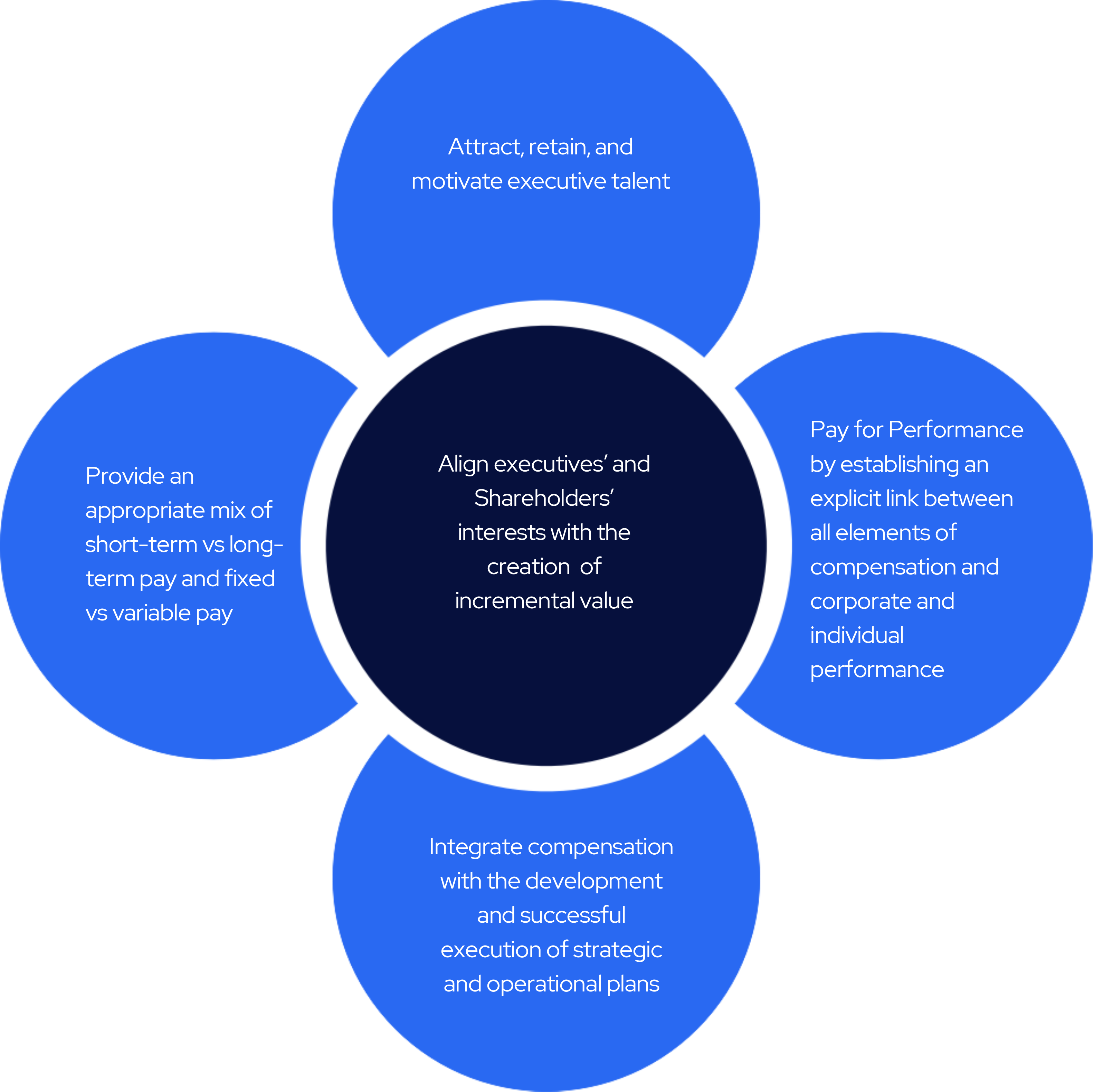
64 | CAE INC. | 2026 | Management Proxy Circular
Section 7 – Executive Compensation
Compensation principles
The principles underlying CAE’s executive compensation programs are as follows:
| | | | | |
Pay for performance | The majority of compensation is variable, contingent on and directly linked to financial and operational performance metrics and CAE’s Share price. |
Balance | The portion of total compensation that is performance-based increases with an executive’s level of responsibility and strategic scope of the role. |
Long-term focus | Long-term stock-based compensation opportunities have a greater weight than short-term cash-based opportunities for our executive leaders. |
Shareholder alignment | The financial interests of executives are directly aligned with the interests of our Shareholders through stock-based compensation, and annual and long-term performance metrics that correlate with sustainable Shareholder value growth. |
Competitiveness | Total compensation is market competitive to attract, retain, and motivate CAE’s executive team while fostering an entrepreneurial spirit. This is achieved by setting target compensation competitively relative to the median of our comparator group with compensation outcomes above the median when performance is strong and below median when it is not. |
Responsibility | Financial and operational performance must not compromise our ethical, environmental and health and safety objectives, outlined in our Code of Business Conduct. Commitment to ethical and corporate responsibilities fundamentally underlies all aspects of our behavior and compensation plans, which provide for compensation to be reduced if these objectives are not upheld. |
The following illustrates the relative weight of each compensation policy element, at target:
| | | | | |
President and CEO | Other NEOs |
| |
65 | CAE INC. | 2026 | Management Proxy Circular
Section 7 – Executive Compensation
Executive Compensation Programs
CAE’s executive compensation program has five main components: base salary, short-term incentive, long-term incentive, pension, and perquisites and benefits. The table below provides highlights of each component and describes the purpose and CAE’s policy for each component. Compensation for the President and CEO is determined and paid in USD, reflective of his recruitment to CAE from the United States. Summary Compensation Table information is presented in CAD, reflecting exchange rate volatility. To provide transparent disclosure of our President and CEO’s compensation, we have included a supplemental table which shows his Summary Compensation Table information on an annualized basis in USD, the currency of his compensation.
Overview
| | | | | | | | | | | | | | |
| Form | Plan Highlights | Plan Objectives | Philosopy |
Base Salary | Cash | Fixed pay annual review | Provide a base of regular income to attract and retain qualified leaders Recognize scope and responsibilities of the position as well as the experience and sustained performance of the individual | Set competitive with the median of the comparator group |
Short-term Incentive (STIP) | Cash | Annual award based on corporate (75%) and individual objectives (KPIs) (25%) Executives can elect to receive some or all STIP payment as Executive Deferred Share Units | Reward the achievement of the Company’s financial, operational and non-financial objectives Reward the achievement of individual objectives aligned with the executive’s area of responsibility and role in achieving operational results Drive superior individual and corporate performance | Set competitive with the median of the comparator group Designed to result in above median payouts for superior performance Performance metrics are aligned to the strategic plan and approved annually |
Long-term Incentive (LTIP) | Performance Share Units (60%), Restricted Share Units (20%), Stock Options (20%) | LTIP value is awarded in different medium to long-term compensation vehicles with both time and performance vesting based on achievement of longer-term financial objectives | Align management’s interests with Shareholders value growth Reward the achievement of sustained market performance Attract and retain key talent | Set competitive with the median of the comparator group Ability to award LTI within a range and impact of Share price and financial performance designed to provide pay outcomes closely aligned with performance |
Retirement Programs | Monthly pension or retirement account in cash at retirement | A supplementary pension plan is offered to provide additional retirement benefits beyond those available under standard registered plans, and is in the form of a supplemental Defined Benefit plan,
a supplemental Defined Contribution plan or a Non-Qualified Defined Contribution plan (NQDC). | Support retention of key executives | Set consistent with historical approach |
Perquisites and Other Benefits | Employee Stock Purchase Plan (“ESPP”) Perquisites | ESPP: Employees and executives may purchase CAE Shares up to 18% of their base salary; CAE matches 50% of the employee contributions, up to a maximum of 3% of the employee’s annual base salary Perquisites: Cash allowance to cover certain expenses to support health and well-being | Provide executives with a Share ownership building vehicle | Set to be market competitive |
66 | CAE INC. | 2026 | Management Proxy Circular
Section 7 – Executive Compensation
Base salaries
The base salaries of the President and CEO and other NEOs are determined in accordance with CAE’s compensation philosophy and policies. CAE executives’ salaries are positioned within a competitive range around the market median, based on the individual’s performance, level of experience and the scope and responsibilities of the role.
Base salaries are reviewed by the HRC annually, considering individual achievements, general performance, benchmark information and market conditions.
Annual Incentive Program Design
| | |
-The annual short-term incentive plan motivates the achievement of specific annual financial and operational results -To further strengthen alignment with Shareholders, the overall corporate performance factor is capped at 100% if the adjusted EPS* result does not meet the target. |
The Short-Term Incentive Plan (STIP) provides for an annual cash incentive for executives and management employees based on CAE’s consolidated performance and individual achievements. The STIP motivates the achievement of specific annual financial and operational results, aligned with the corporate goals and strategy.
The table below outlines FY2026 STIP target ranges by NEO, effective as of March 31, 2026.
| | | | | | | | | | | |
STIP Target as a % of Base Salary |
NEO | Minimum | Target | Maximum |
Matthew Bromberg | 0% | 125% | 250% |
Marc Parent | 0% | 125% | 250% |
Ryan McLeod | 0% | 85% | 170% |
Constantino Malatesta 1 | 0% | 75% | 150% |
Carter Copeland 2 | 0% | 75% | 150% |
Juan Araujo | 0% | 55% | 110% |
Pascal Grenier 3 | 0% | 75% | 150% |
1.This percentage of base salary represents Mr. Malatesta's annual STIP target for his interim role as Chief Financial Officer, effective between April 1, 2025 and February 22, 2026.
2.Mr. Copeland’s annual STIP target remained the same following his appointment as President – Flightscape, effective March 9, 2026.
3.STIP target percentage for Mr. Grenier has been changed following his appointment as President – Defense & Security, effective March 9, 2026.
* Non-IFRS and Other Financial Measures (see Appendix B).
67 | CAE INC. | 2026 | Management Proxy Circular
Section 7 – Executive Compensation
The STIP is based 75% on CAE performance and 25% on the executive’s individual performance. The Company performance factor consists of financial measures of varying weights that total 100%. The year-end result for each measure is assessed against predefined targets that are set and approved by the HRC at the beginning of the year. The individual performance factor is based on the executive’s performance against annual objectives and additional predefined quantitative and qualitative goals that reflect the strategic and operational priorities critical to each executive’s role.
The table below illustrates the annual STIP payout calculation for NEOs
In FY2026, the Company performance factor was based on two financial measures detailed in the table below:
| | | | | | | | |
STIP Measure |
Performance Measure | Why this Measure is important | Weighting |
Adjusted EPS* | Intended to keep management focused on EPS achievement as a critical metric reflecting the profitability of the Company and directly linked to Shareholders’ interests | 67% |
Revenue | Highlights the importance of revenue growth in the Company strategy | 33% |
To further strengthen alignment with Shareholders, the overall corporate performance factor is capped at 100% if the adjusted EPS* result does not meet the target approved by the Board of Directors.
In FY2026, for the President and CEO and his direct reports the Company performance component of our STIP (representing 75% of the payout) is measured based on CAE overall performance. For other Business Unit Leaders, the Company performance of the STIP is based on a mix of Business Unit and CAE performance (2/3rd weighting to BU performance and 1/3rd weighting to CAE performance).
Adjusted EPS* and revenue were the two financial performance measures used to calculate the Company Performance Factor, weighted 2/3rd and 1/3rd, respectively and payout was set at 50% of target for the achievement of threshold performance. As before, payout is 0% if performance is below the threshold level.
Compensation considers each executive’s responsibility to always act in accordance with our values and our ethical, environmental and health and safety objectives, outlined in CAE’s Code of Business Conduct. Following a review at year-end that considers overall business and individual performance as well as the performance of the business from a holistic and strategic perspective, the STIP payments for the President and CEO’s direct reports are approved by the HRC and, for the President and CEO, by the Board upon the HRC’s recommendation. Canadian and US-based executives can elect to defer all or a portion of the STIP payment as Executive Deferred Share Units. The amount deferred is converted into a number of DSUs, which enhance executive alignment with shareholder interests (see details under Section 7 – Executive Compensation – Compensation Discussion and Analysis – Executive Compensation Programs – Long-Term Incentive Program Design – Executive Deferred Share Units).
* Non-IFRS and Other Financial Measures (see Appendix B).
68 | CAE INC. | 2026 | Management Proxy Circular
Section 7 – Executive Compensation
Long-Term Incentive Program Design
| | |
CAE’s long-term incentive plan aligns management’s interests with Share price growth and related Shareholder value creation, and rewards sustained market performance. |
The LTIP is designed to reward executives for their contribution to the creation of Shareholder value. The value of LTIP grants varies by level of responsibility and scope and is based on each executive’s performance as assessed by the HRC and the Board.
The table below outlines FY2026 LTIP target ranges by NEO:
| | | | | | | | | | | |
LTIP Target as a % of Base Salary |
NEO | Minimum | Target | Maximum |
Matthew Bromberg | - | 500% | - |
Marc Parent | - | 585% | - |
Ryan McLeod | - | 400% | - |
Constantino Malatesta 1 | 100% | 175% | 250% |
Carter Copeland 2 | 70% | 135% | 200% |
Juan Araujo | 40% | 95% | 150% |
Pascal Grenier 3 | - | 165% | - |
1.LTIP target percentage of base salary represents Mr. Malatesta’s target for FY2026 as Interim Chief Financial Officer.
2.LTIP target percentage of base salary for Mr. Copeland remained the same following his appointment as President – Flightscape, effective March 9, 2026.
3.LTIP target percentage of base salary represents Mr. Grenier’s target for FY2026 as President – Defense & Security, effective March 9, 2026.
CAE’s FY2026 LTIP consists of PSUs, RSUs and Stock Options. All NEOs were eligible for an annual grant under each of these plans, with the exception of Mr. McLeod and Mr. Araujo, who were not employed at the time of grant. Awards were allocated as follows:
| | | | | | | | |
LTIP Mix |
|
|
Components | Weighting | Vesting |
PSUs | 60% | 3-year cliff vesting |
RSUs | 20% | 3-year cliff vesting |
Stock Options | 20% | 4-year ratable vesting (25% per year) |
69 | CAE INC. | 2026 | Management Proxy Circular
Section 7 – Executive Compensation
Performance Share Units
| | | | | |
| |
—PSUs directly tie CAE executives to the achievement of the CAE strategic plan. —One PSU is equal in value to one Share of CAE. —Vesting: 3-year cliff subject to the achievement of set performance criteria and the participant’s continued employment with CAE. | —Performance condition: Financial targets as set in the 3-year strategic plan approved by the Board. —Maximum payout multiplier set at 200%. |
PSUs are a long-term incentive vehicle that vest on a three-year cliff basis, with payout contingent on the achievement of pre-established financial performance objectives over the performance period, aligned with the execution of CAE’s strategic plan.
In FY2024, CAE adopted the Omnibus Incentive Plan, pursuant to which the Company may grant PSUs that may be settled in Shares issued from treasury, which was approved by our Shareholders at the annual and special Shareholders’ meeting held on August 9, 2023, further encouraging CAE ownership by employees. Please refer to Section 7 – Executive Compensation – Compensation Discussion and Analysis – Executive Compensation Programs – Long-Term Incentive Program Design – Omnibus Incentive Plan.
Since FY2024, the PSU performance measures used by the Company include three equally weighted financial measures: adjusted segment operating income margin*, net cash provided by operating activities and adjusted ROCE*. These measures were used for PSUs granted under the Omnibus Incentive Plan in FY2026 and are further described below:
| | | | | | | | | | | | | | |
PSU Performance Measures |
Driver | Performance Measure | Weighting | Why this Measure is Important | Performance Assessment |
Profitability | Adjusted Segment Operating margin* | 33% | Reflects the efficiency and profitability of the Company's core operations after deducting operating expenses (excluding interest and taxes) | Measured yearly and weighted: -1/6th year one -1/3rd year two -1/2 year three |
Growth | Cash from operations | 33% | Focuses on the cash inflows and outflows directly related to the Company's day-to-day business operations, providing a clear picture of the Company's ability to generate cash to meet its obligations | Measured as a cumulative amount over a 3-year period |
Return | Adjusted ROCE* | 33% | Measures the efficiency with which the Company utilizes its capital to generate profits | Measured at the end of year 3 |
* Non-IFRS and Other Financial Measures (see Appendix B).
70 | CAE INC. | 2026 | Management Proxy Circular
Section 7 – Executive Compensation
Restricted Share Units
| | | | | |
—RSU is equal in value to one Share of CAE. | —Vesting: 3-year cliff subject to the participant’s continued employment with CAE. |
RSUs are awarded to executives and senior management of CAE and its subsidiaries to enhance alignment with Shareholders and increase the resilience of the long-term incentive program.
In FY2024, CAE adopted the Omnibus Incentive Plan, pursuant to which the Company may grant RSUs that may be settled in Shares issued from treasury, which was approved by our Shareholders at the annual and special shareholders’ meeting held on August 9, 2023, further encouraging CAE ownership by employees. Please refer to Section 7 – Executive Compensation – Compensation Discussion and Analysis – Executive Compensation Programs – Long-Term Incentive Program Design – Omnibus Incentive Plan.
Stock Options
| | | | | |
—Exercise price equal to the volume-weighted average trading price of the Shares on the TSX for the five (5) trading days before the date of the grant | —Option term: 7 years. —Vesting: 25% per year, starting on the first anniversary date of the grant, subject to the participant’s continued active employment with CAE on each applicable vesting date. |
In FY2024, CAE adopted the Omnibus Incentive Plan, pursuant to which the Company may grant Stock Options settled in shares issued from treasury, which was approved by our Shareholders at the annual and special Shareholders’ meeting held on August 9, 2023. Awards granted under the ESOP remain outstanding and governed by the terms of the ESOP, but no new award will be granted under the ESOP. Please refer to Section 7 – Executive Compensation – Compensation Discussion and Analysis – Executive Compensation Programs – Long-Term Incentive Program Design – Omnibus Incentive Plan.
Omnibus Incentive Plan
| | | | | |
—Encourage greater Share ownership —Stock Options are settled in Shares issued from treasury —PSUs and RSUs are settled in Shares, in cash or in a combination thereof |
—Provides flexibility to the Company to grant both whole Share awards, such as PSUs and RSUs as well as Stock Options |
In an effort to streamline its equity-based incentive plans, to encourage greater Share ownership by employees and to foster a greater alignment between the long-term interests of the Shareholders and the interests of employees, the Board of CAE adopted on May 31, 2023 the Omnibus Incentive Plan (“Omnibus Incentive Plan”) which was approved by our Shareholders at the annual and special Shareholders’ meeting held on August 9, 2023. The Omnibus Incentive Plan is a single plan that allows for different types of equity awards to be granted and to be settled through the issuance of Shares from treasury. The Omnibus Incentive Plan provides flexibility to the Company to grant both whole Share awards, such as PSUs and RSUs as well as Stock Options. The Omnibus Incentive Plan provides that Stock Options will be settled in Shares issued from treasury, while PSUs and RSUs will be settled in Shares (either issued from treasury or purchased on the open market), in cash or in a combination thereof. The Omnibus Incentive Plan does not permit Option grants to non-employee directors. These features of the Omnibus Incentive Plan enhance the ability of the Company to attract, retain and reward key individuals to advance its business strategy, while promoting a greater alignment of interests with the Shareholders of the Company.
71 | CAE INC. | 2026 | Management Proxy Circular
Section 7 – Executive Compensation
The HRC is responsible for administering and interpreting the Omnibus Incentive Plan. Under the terms of the Omnibus Incentive Plan, the HRC will, in its sole discretion, from time to time designate the executive officers and employees to whom awards shall be granted and determine, if applicable, the number of Shares to be covered by such awards and the terms and conditions of such awards.
The Omnibus Incentive Plan provides that the maximum number of Shares that may be issued thereunder cannot exceed 10,000,000 (representing 3.11% of the issued and outstanding Shares as at March 31, 2026).
The terms and conditions relating to the grants of PSUs, RSUs and Stock Options under the Omnibus Incentive Plan include the following:
Share Units
The HRC is authorized to grant PSUs and RSUs evidencing the right to receive Shares (issued from treasury or purchased on the open market), cash based on the value of a Share or a combination thereof at some future time to eligible persons under the Omnibus Incentive Plan.
RSUs generally become vested, if at all, following a period of continuous employment. PSUs are similar to RSUs, but their vesting is based on the attainment of specified performance metrics as may be determined by the HRC. The terms and conditions of grants of RSUs and PSUs, including the quantity, type of award, grant date, vesting conditions, vesting periods, settlement date and other terms and conditions with respect to these awards will be set out in the participant’s grant agreement. Subject to the achievement of the applicable vesting conditions, the payout value of a PSU or RSU will generally be determined on the settlement date using the volume-weighted average price of the Shares on the TSX for the last five (5) trading days (as opposed to the market value of the Shares on the TSX for the past 20 trading days, as is the case under the legacy PSU Plan and RSU Plan).
Stock Options
All Stock Options granted under the Omnibus Incentive Plan have an exercise price equal to the volume-weighted average trading price of the Shares on the TSX for the five (5) trading days before the date of the grant. A Stock Option shall be exercisable during a period established by the HRC which shall not be more than ten (10) years from the grant of the Stock Option. The Omnibus Incentive Plan provides that the exercise period shall automatically be extended if the date on which it is scheduled to terminate shall fall during a black-out period or within nine (9) trading days following the end of a black-out period. In such cases, the extended exercise period shall terminate ten (10) trading days after the last day of the black-out period.
For detailed disclosure pertaining to the terms and conditions of the Omnibus Incentive Plan, see Appendix D titled “Summary of the Omnibus Incentive Plan”. A complete copy of the Omnibus Incentive Plan can be accessed on SEDAR+ at www.sedarplus.ca or on EDGAR at www.sec.gov.
Executive Deferred Share Unit Plan
| | | | | |
—Executive DSU Plan helps our executives build their Share ownership in CAE. —Allows for elective deferral of STIP to DSUs. —One DSU is equal in value to one Share of CAE. |
—DSUs are only payable when the executive leaves CAE. —Executive DSU Plan is non-dilutive as all DSUs are paid out in cash. |
In FY2017, CAE adopted an Executive Deferred Share Unit Plan (“Executive DSU Plan”). The purpose of the plan is to attract and retain talented individuals to serve as officers and executives of the Company and to help them build their Share ownership in CAE, and to promote a greater long-term alignment of interests between the executives and the Shareholders of the Company.
Canadian and U.S.-based executives can elect to defer a portion of their entire short-term incentive payment to Executive DSUs annually.
72 | CAE INC. | 2026 | Management Proxy Circular
Section 7 – Executive Compensation
Each DSU has the same value as a Share of CAE. The DSUs accrue dividend equivalents payable in additional DSUs in an amount equal to dividends paid on Shares. The DSUs are only redeemable when the executive leaves the Company, which provides strong and consistent alignment with Shareholders. Upon or within a defined period following the termination of their employment, DSU holders are entitled to receive a lump sum cash payment equal to the number of DSUs credited to their account as of that date multiplied by the Fair Market Value of one (1) Share on the settlement date.
Inactive Equity-Based Plans with Legacy Participants
Some NEOs have outstanding participation in the following long-term incentive plans, which are no longer active (no further awards are made under the plans) but have yet to be fully paid out.
Fiscal 2005 Deferred Share Unit Plan
In FY2005, CAE adopted a Long-Term Incentive Deferred Share Unit Plan (“LTUP”) for executives of CAE and its affiliates that, as amended from time to time, applies to all grants made thereafter. No FY2005 Long-Term Incentive Deferred Share Units (“LTUs”) have been granted by CAE since FY2014. All LTUs are fully vested for remaining plan participants, having vested in 20% increments over five (5) years, commencing one (1) year after the grant date. LTUs accrue dividend equivalents payable in additional units in amounts equal to dividends paid on Shares. LTUs are only redeemable in cash following the unit holder’s retirement or termination of employment at the market value of Shares on the TSX on the settlement date.
Fiscal 2004 Deferred Share Unit Plan
In FY2004, CAE adopted a Long-Term Incentive Deferred Share Unit Plan (“FY2004 LTUP”) for executives of CAE and its affiliates to partially replace the grant of options under CAE’s ESOP. No FY2004 Long-Term Incentive Deferred Share Units (“FY2004 LTUs”) have been granted by CAE since FY2004. All FY2004 LTUs are fully vested for remaining plan participants, having vested in 25% increments over four (4) years, commencing one (1) year after the grant date. FY2004 LTUs accrue dividend equivalents payable in additional units in amounts equal to dividends paid on Shares. FY2004 LTUs are only redeemable in cash following the unit holder’s retirement or termination of employment at the market value of Shares on the TSX on the settlement date.
Employee Stock Option Plan
CAE adopted the Amended and Restated Employee Stock Option Plan (“ESOP”), to provide key employees of CAE with an opportunity to purchase Shares and to benefit from the related Share price appreciation, closely aligning the interests of employees with those of Shareholders. Stock Options increase the ability of CAE to attract, retain and reward individuals with exceptional skills.
Stock Options have value only to the extent the Share price increases, so provide a transparent long-term incentive vehicle that directly aligns executives with Shareholder interests in Share price growth over the long-term. CAE’s Stock Options vest 25% per year and have a term of seven years, to reward long-term Share price growth.
The HRC establishes rules and guidelines for the administration of the ESOP, selects the employees to whom awards are granted and the number of Shares covered by such awards, sets the terms and conditions of awards and cancels, suspends and amends awards. The HRC has the sole discretion to make determinations under, and to interpret, the ESOP.
The ESOP permits, at the discretion of the HRC, the surrender and cancellation without re-issue of an in-the-money Stock Option for cash equal to the fair market value of the Share underlying the Stock Option less the Option exercise price, in lieu of the Share itself (the fair market value of a Share is the closing price of a Share on the TSX on the trading day on which the election is made).
For detailed disclosure of the terms and conditions of the ESOP, see Appendix C titled “Summary of the Employee Stock Option Plan”. A complete copy of the ESOP can be accessed on SEDAR+ at www.sedarplus.ca or on EDGAR at www.sec.gov.
73 | CAE INC. | 2026 | Management Proxy Circular
Section 7 – Executive Compensation
Securities Authorized for Issuance under the Equity Compensation Plans
The following table provides information as at March 31, 2026 on the Company’s compensation plans under which equity securities of the Company are authorized for issuance.
| | | | | | | | | | | |
| Number of securities to be issued upon exercise of outstanding options, warrants and rights (#) A | Weighted average exercise price of outstanding options, warrants and rights ($) B | Number of securities remaining available for future issuance under equity compensation plans (excluding securities reflected in column A) (#) C |
Equity compensation plans approved by securityholders |
Employee Stock Option Plan (“ESOP”) | 1,212,845 | | 30.77 | | 0 | |
Omnibus Incentive Plan1 | 5,071,515 | | 29.96 | | 4,728,935 | |
Equity compensation plans not approved by securityholders |
| - | | - | | - | |
Total | 6,284,360 | | - | | 4,728,935 | |
1.Under the terms of the Omnibus Incentive Plan, the Company has the option to settle Stock Options in Shares issued from treasury and PSUs and RSUs in Shares (either issued from treasury or purchased on the open market), in cash or in a combination thereof.
The following table details the annual burn rate (i.e., the ratio of securities granted compared to CAE’s issued and outstanding weighted average number of Shares) for each of the three most recently completed fiscal years.
| | | | | | | | | | | |
| 2026 | 2025 | 2024 |
Employee Stock Option Plan (“ESOP”) | 0.00% | 0.00% | 0.0% |
Omnibus Incentive Plan1 | 0.70% | 0.65% | 0.56% |
1.The burn rate assumes that PSUs will vest based on a performance multiplier of 100%. If we assume that the PSUs will vest based on our maximum performance multiplier of 200%, the burn rate would increase to 1.02%. The burn rate also assumes that all awards will be settled in Shares issued from treasury. However, under the terms of the Omnibus Incentive Plan, CAE has the option to settle PSUs and RSUs through purchases on the open market or in cash.
This burn rate indicates the number of Stock Options, PSUs and RSUs granted in each year as a percentage of the weighted average number of securities outstanding in the applicable fiscal year. CAE has monitored its long-term dilution by limiting the equity compensation to reasonable awards under its equity programs.
74 | CAE INC. | 2026 | Management Proxy Circular
Section 7 – Executive Compensation
As at March 31, 2026, the number of Shares issued under the Omnibus Incentive Plan since its adoption was 199,550 and the total number of outstanding share-settled securities awarded under the Omnibus Incentive Plan was 5,071,514 (representing 1.58% of the issued and outstanding Shares as at such date). This leaves 4,728,935 share-settled securities remaining available for grant (representing 1.47% of the issued and outstanding Shares as at March 31, 2026).
| | | | | | | | | | | |
Plan | Plan Maximum1 | Outstanding Securities Awarded2 | Remaining Securities Available for Grant3 |
Employee Stock Option Plan (“ESOP”)4 | 0 (0%) | 0 (0%) | 0 (0%) |
Omnibus Incentive Plan | 10,000,000 (3.11%) | 5,071,515 (1.58%) | 4,728,935 (1.47%) |
1.The maximum number of securities issuable under each equity compensation plan, expressed as a fixed number (percentage represents the ratio between the maximum number of securities issuable and the number of issued and outstanding Shares as of March 31, 2026).
2.The number of outstanding share-settled securities awarded under each equity compensation plan as of March 31, 2026 (percentage represents the ratio between the number of outstanding share-settled securities awarded and the number of issued and outstanding Shares as of the same date).
3.The number of securities under each equity compensation plan that are available for grant as of March 31, 2026 (percentage represents the ratio between the number of securities under each equity compensation plan and the number of issued and outstanding Shares as of the same date).
4.Following approval of the Omnibus Incentive Plan in 2023, no grants were made under the Employee Stock Option Plan.
75 | CAE INC. | 2026 | Management Proxy Circular
Section 7 – Executive Compensation
Pension, Benefits and Perquisites
| | |
—Promote long-term employment with the Company. —Pension benefits payable under the Supplementary Pension Plan are conditional upon compliance with non-competition and non-solicitation clauses. —No extra years of service are generally granted under the pension plans. |
Eligible employees participate in the Retirement Plan for Employees of CAE Inc. and associated companies. Eligible executives participate in the Pension Plan for Designated Executive Employees of CAE Inc. and associated companies (the “Designated Pension Plan”), and in the Supplementary Pension Plan of CAE Inc. and associated companies (the “Supplementary Pension Plan”). The Designated Pension Plan is a defined benefit plan to which CAE and participants contribute.
Pension benefits payable under the Supplementary Pension Plan are paid directly by CAE. See Section 7 – Executive Compensation – Compensation of our Named Executive Officers – Pension Arrangements for details about the value of the accrued benefit to each of the NEOs. Except as discussed in “Change in Control Contracts” below, CAE does not grant extra years of credited service under its pension plans. Receipt of pension benefits under the Supplementary Pension Plan is conditional upon compliance with non-competition and non-solicitation clauses.
During FY2026, the Human Resources Committee of the Board conducted a comprehensive review of the Supplementary Pension Plan. As a result of this review, it was determined that the plan will be closed to any new executives promoted or joining CAE in the future. This recent decision applies to both Mr. McLeod and Mr. Araujo. While new executives will continue to receive some form of supplemental pension benefit, the specific design and structure of these future arrangements have not yet been finalized.
Employee Stock Purchase Plan
| | |
Provide employees with a Share ownership building vehicle and a savings vehicle beyond the pension plan. |
Under the CAE Employee Stock Purchase Plan, employees may make contributions towards the purchase of Shares of up to 18% of their annual base salary. Under the plan, CAE contributes $1 for every $2 of employee contributions, to a maximum contribution of 3% of the participant’s annual base salary.
Change in Control Contracts
All NEOs are entitled to termination of employment benefits following a Change of Control of CAE if the executive’s employment is terminated without cause within two years following the Change of Control. This is to safeguard the Company’s normal course of business in case of Change of Control. See Section 7 – Executive Compensation - Compensation of our Named Executive Officers – Termination and Change of Control Benefits for a summary of the impact of various events on the different compensation programs for the NEOs and details about the approximate incremental value that could be realized by a NEO following termination or a Change of Control event.
Perquisites
Flexible perquisites provide executives with a cash allowance to cover certain expenses such as vehicle expenses, and health and well-being. Such allowance is typical for senior executive positions and is capped at predetermined levels by position.
76 | CAE INC. | 2026 | Management Proxy Circular
Section 7 – Executive Compensation
FY2026 Compensation Outcomes
FY2026 financial performance reflected a mixed operating environment, with adjusted EPS* and revenue outcomes below established incentive targets. As these metrics are key drivers of STIP funding, this underperformance resulted in a lower CAE performance multiplier for the year. Under the LTIP, adjusted segment operating income margin* and adjusted return on capital employed* (ROCE) also performed below pre-established targets over the three-year cycle. These outcomes are consistent with CAE’s overall financial results for the fiscal year, which were achieved against a backdrop of softer market conditions in certain segments and ongoing execution challenges, while also reflecting continued progress on strategic priorities and the advancement of the Company’s transformation plan. Overall, the results reinforce the direct link between Company performance and variable compensation outcomes, while underscoring the importance of disciplined execution and operational improvement as CAE continues to position the business for long-term performance.
Base salaries
The salaries of the President and CEO and his direct reports are determined in accordance with CAE’s compensation philosophy and policy, and are reviewed and approved annually by the Board of Directors. The HRC reviews benchmark data to ensure that the President and CEO’s and his direct reports’ total direct compensation (base salary, short-term and long-term incentives) are in line with CAE’s compensation philosophy. The changes to base salary are market-competitive, based on benchmarking relative to our compensation peer group and reflect individual performance, experience, scope and criticality of the role and internal equity considerations. The salary increases below were determined at the start of FY2026 and were based on benchmarking conducted by the Committee’s independent compensation advisor.
The table below outlines base salaries of all NEOs:
| | | | | | | | | | | | | | |
NEO | Currency | FY2025 Base Salary ($) | FY2026 Base Salary ($) in paid currency | Increase |
Matthew Bromberg 1 | USD | - | 1,100,000 | - |
Marc Parent 2 | CAD | 1,323,000 | 1,323,000 | 0% |
Ryan McLeod 3 | CAD | - | 700,000 | - |
Constantino Malatesta 4 | CAD | 500,000 | 571,600 | 14% |
Carter Copeland 5 | USD | 618,000 | 618,000 | 0% |
Juan Araujo 6 | USD | - | 560,000 | - |
Pascal Grenier 7 | CAD | 504,820 | 575,000 | 14% |
1.Mr. Bromberg's base salary is paid in USD and represents $1,518,000 when converted to Canadian dollars using the FY2026 average exchange rate of 1.38.
2.Mr. Parent left the Company August 13, 2025. The compensation disclosed above represents his annualized base salary.
3.Mr. McLeod was appointed on February 23, 2026. The compensation disclosed above represents his annualized base salary.
4.Mr. Malatesta’s compensation disclosed above reflects his annualized base salary as interim CFO.
5.Mr. Copeland's base salary is paid in USD and represents $852,840 for FY2026 when converted to Canadian dollars using the FY2026 average exchange rate of 1.38.
6.Mr. Araujo was appointed January 5, 2026. The compensation disclosed above represents his annualized base salary paid in USD, which represents $772,800 when converted to Canadian dollars using the FY2026 average exchange rate of 1.38.
7.Mr. Grenier was appointed President – Defense & Security on March 9, 2026. His FY2026 salary reflects an increase effective March 9, 2026 to recognize his additional responsibilities.
* Non-IFRS and Other Financial Measures (see Appendix B).
77 | CAE INC. | 2026 | Management Proxy Circular
Section 7 – Executive Compensation
Short-Term Incentive Plan
Corporate Performance
75% of short-term incentive awards for the President and CEO and other NEOs is based on the achievement of CAE performance measures, namely adjusted EPS* and revenue. Details on these measures are described under Section 7 – Executive Compensation – Compensation Discussion and Analysis – Executive Compensation Programs – Annual Incentive Program Design.
The table below illustrates the respective weights for each FY2026 CAE corporate performance measure, as well as the actual results and related payout levels.
| | | | | | | | | | | | | | | | | | | | |
Performance Measure1 | Threshold (50%) | Target (100%) | Maximum (200%) | Actual Performance2 | Weighting | Score |
Adjusted EPS* | $1.05 | $1.23 | $1.31 | $1.19 | 67% | 89% |
Revenue | $5,763M | $6,468M | $6,558M | $6,085M | 33% | 73% |
STIP Payout |
|
|
|
|
| 84% |
1.If the adjusted EPS* target is not met, the corporate performance multiplier is capped at 100%.
2.For incentive plan purposes, adjusted EPS* and revenue are normalized for foreign exchange. In addition, revenue includes revenues generated by Joint Ventures. The numbers presented in this column reflect such adjustments. Actual results before foreign exchange adjustments are as follows: $1.20 for adjusted EPS* and $6,158M for revenue.
The remaining 25% of the NEOs’ annual incentive is awarded based on predetermined operational and financial measures specific to each executive. As with other performance measures, individual performance is assessed between 0% and 200%. For FY2026, the individual performance factor for NEOs varied between 100% and 140%. While the Committee assessed Mr. Bromberg’s performance for FY2026 based on his key strategic achievements, under his employment agreement it was agreed that his overall STIP payout for FY2026, pro-rated from his hire date for FY2026 , would not fall below target (see Section 7 – Executive Compensation – Compensation Discussion and Analysis – Determination of NEOs Individual Performance).
In assessing the individual performance factor for the CEO, the HRC assesses the CEO’s performance relative to specific financial and operational CEO performance goals that are set at the start of the fiscal year. The specific targets for these goals are not disclosed as they include competitively sensitive information. However, the achievements relevant to the HRC’s consideration and assessment are listed below in Section 7. While the HRC engaged in this evaluation process for FY2026, in accordance with the terms of Mr. Bromberg’s employment agreement, which requires that he receive a pro-rated target bonus for his period of employment during FY2026, with the resulting payout not falling below this target, the Committee and the Board did not apply a specific performance factor to assess the CEO’s individual performance.
* Non-IFRS and Other Financial Measures (see Appendix B).
78 | CAE INC. | 2026 | Management Proxy Circular
Section 7 – Executive Compensation
Individual Payout
The table below shows the calculation of the FY2026 STIP payout to each NEO:
| | | | | | | | | | | | | | | | | | | | | | | | | | | | | | | | | | | | | | |
NEO | Currency | Year-end
Base Salary1 ($) | X | Target STIP
(% of base salary) | X |
| (Company Performance Factor (75%) | + | Individual Performance Factor (25%) | ) | = | FY2026 STIP
Payout ($) |
Matthew Bromberg 2, 3 | USD | 1,100,000 | X | 125% | X |
| 100% |
| = | 1,086,250 |
Marc Parent 4 | CAD | 1,323,000 | X | 125% | X | ( | 84% | + | 100% |
| = | 534,275 |
Ryan McLeod 5 | CAD | 700,000 | X | 85% | X |
| 100% |
| = | 595,000 |
Constantino Malatesta | CAD | 571,600 | X | 75% | X | ( | 84% | + | 140% | ) | = | 420,126 |
Carter Copeland 2 | USD | 618,000 | X | 75% | X | ( | 84% | + | 100% | ) | = | 407,880 |
Juan Araujo 2,6 | USD | 560,000 | X | 55% | X | ( | 84% | + | 100% | ) | = | 62,339 |
Pascal Grenier | CAD | 575,000 | X | 75% | X | ( | 84% | + | 140% | ) | = | 422,625 |
1.Annual base salary in nominal dollars as of March 31, 2026.
2.For Mr. Bromberg, Mr. Copeland and Mr. Araujo, the base salaries are paid in USD. When converted to Canadian dollars using the FY2026 average exchange rate of 1.38, their respective base salaries represent $1,518,000, $852,840 and $772,800.
3.Mr. Bromberg’s base salary reflects his annualized base salary in U.S. dollars. As per his employment agreement, FY2026 STIP payout reflects pro-rated target bonus for his period of employment during the fiscal year, with the resulting payout not falling below his target. While the Committee and the Board assessed his individual performance at year-end, no specific individual performance factor was applied.
4.Mr. Parent’s base salary represents his annualized rate. Pursuant to his departure agreement, the STIP payout covers the period from April 1, 2025, through the departure date of August 13, 2025, and is calculated using an individual multiplier of 100% along with the same Corporate Performance Factor applied to EMC members.
5.Mr. McLeod’s base salary reflects his annualized base salary. As per Mr. McLeod’s employment agreement, STIP payout for FY2026 reflects the annual amount at target to offset the annual incentive payment forfeited upon leaving his former employer.
6.Mr. Araujo’s STIP payout amount reflects the amount for the period between January 5, 2026 and March 31, 2026.
79 | CAE INC. | 2026 | Management Proxy Circular
Section 7 – Executive Compensation
Long-Term Incentive Plan
FY2026 Annual LTIP Award
The table below sets out the actual annual awards granted to the NEOs with reference to fiscal year 2026:
| | | | | | | | | | | | | | | | | | | | | | | | | | | | | | | | |
NEOs | FY2026
LTIP award (% of base salary) | Currency | Salary at time of grant ($)1 | FY2026
LTIP award Value ($)2 | Weighting |
PSUs (60%)3, 6 | RSUs (20%)4,6 | Stock Options (20%)5 |
($) | (#) | ($) | (#) | ($) | (#) |
Matthew Bromberg 7 | 500% | USD | 1,100,000 | 5,500,000 | 3,300,000 | 120,857 | 1,100,000 | 40,286 | 1,100,000 | 108,173 |
Marc Parent | 585% | CAD | 1,323,000 | 7,739,600 | 4,643,760 | 132,793 | 1,547,920 | 44,264 | 1,547,920 | 113,069 |
Ryan McLeod8 | - |
|
|
|
|
|
|
|
|
|
Constantino Malatesta | 250% | CAD | 521,600 | 1,304,000 | 782,400 | 22,373 | 260,800 | 7,458 | 260,800 | 19,050 |
Carter Copeland | 200% | USD | 618,000 | 1,236,000 | 741,600 | 29,119 | 247,200 | 9,706 | 247,200 | 24,794 |
Juan Araujo8 | - |
|
|
|
|
|
|
|
|
|
Pascal Grenier | 150% | CAD | 504,820 | 757,230 | 454,338 | 12,992 | 151,446 | 4,331 | 151,446 | 11,063 |
1.Annual base salary at time of grant (June 2025). For Mr. Bromberg and Mr. Copeland, the base salaries are paid in USD.
2.For Mr. Bromberg and Mr. Copeland, the award value was converted from USD to CAD using the exchange rate at time of grant of 1.37 for Mr. Copeland and 1.36 for Mr. Bromberg.
3.PSU awards under the Omnibus Plan (see Section 7 – Executive Compensation – Compensation Discussion and Analysis – Omnibus Incentive Plan for details). Under this plan, the granted units may vest in May 2028, subject to CAE’s performance compared to the payout grids approved by the HRC and the participant’s continued employment with CAE. Depending on the overall performance of each year during the performance period, the target rate of units granted will be multiplied by a factor ranging from 0% to 200%. Vested PSUs will be settled in Shares (either issued from treasury or purchased on the open market), in cash or in a combination thereof.
4.RSU awards under the Omnibus Plan (see Section 7 – Executive Compensation – Compensation Discussion and Analysis – Omnibus Incentive Plan for details). Under this plan, 100% of the granted units will vest in May 2028, subject to the participant’s continued employment with CAE. Vested RSUs will be settled in Shares (either issued from treasury or purchased on the open market), in cash or in combination thereof.
5.Stock option awards under the Omnibus Plan (see Section 7 – Executive Compensation – Compensation Discussion and Analysis – Omnibus Incentive Plan for details). Under this plan, options are granted with an exercise price equal to the volume-weighted average price per Share on the TSX for the five trading days immediately preceding the grant date. At each of the first four anniversaries of the grant, 25% of the award vests and becomes exercisable. Strike price for FY2026 Stock Options is $34.97.
6.The grant price on grant date is $34.97 for PSUs and RSUs, representing the volume-weighted average price of the Shares on the TSX on the five trading days immediately preceding the grant date.
7.LTIP target percentage of base salary represents Mr. Bromberg’s target for FY2026. Mr. Bromberg’s appointment was June 16, 2025. Therefore, his annual LTIP grant was made on June 16, 2025. The grant price on grant date for PSUs and RSUs is $37.02, representing the volume-weighted average price of the Shares on the TSX over the five trading days immediately preceding the grant date. The strike price for the Stock Options granted is $37.02.
8.Mr. McLeod and Mr. Araujo were not employed by CAE at the time of the annual grant and, as such, did not receive awards at that time. Both executives received grants in connection with their appointments to partially offset long-term incentives forfeited upon leaving their former employer (see further details provided in section FY2026 One-Time Executive Awards for Forfeited Equity).
80 | CAE INC. | 2026 | Management Proxy Circular
Section 7 – Executive Compensation
FY2026 One-Time Executive Awards for Forfeited Equity
In connection with their appointment, the Human Resources Committee approved one‑time PSU and RSU awards to the following NEOs to offset long‑term incentive awards forfeited upon leaving their former employers and induce them to join CAE. In connection with his appointment as President and Chief Executive Officer, Mr. Bromberg received one-time PSU awards respectively linked to CAE’s performance period FY2025 to FY2027 and FY2026 to FY2028, as well as a one-time RSU award that will cliff vest after one year. Mr. McLeod and Mr. Araujo also received one-time RSU awards that will cliff vest after three years.
To the extent that awards partially offset those forfeited, the award as well as its vesting period is generally aligned with the nature and vesting schedule of the awards forfeited by these executives at their former employers. Amounts described in this section are not reflected in the table above FY2026 Annual LTIP Award.
| | | | | | | | | | | | | | | | | | | | |
Incumbent | Award Type | Grant Date | Vesting Date | Award Value | # Units Granted1 | Share Price on Grant date 2 |
Matthew Bromberg | RSUs | June 16, 2025 | June 16, 2026 | USD3,000,000 | 109,870 | CAD37.02 |
PSUs | June 16, 2025 | June 16, 2027 | USD3,000,000 | 109,870 | CAD37.02 |
PSUs | June 16, 2025 | June 16, 2028 | USD4,000,000 | 146,494 | CAD37.02 |
Ryan McLeod | RSUs | February 25, 2026 | February 25, 2029 | CAD2,800,000 | 69,051 | CAD40.55 |
Juan Araujo | RSUs | February 25, 2026 | February 25, 2029 | USD2,000,000 | 67,499 | CAD40.55 |
1.For Mr. Bromberg, the award values was converted from USD to CAD at time of grant using the exchange rate of 1.36. The number of units granted was then determined by dividing the CAD award value by the volume-weighted average price of the Shares on the TSX on the five trading days immediately preceding the grant date.
2.For Mr. Bromberg , Mr. McLeod and Mr. Arujo, the share price on grant date represents the volume-weighted average price of the Shares on the TSX over the five trading days immediately preceding the grant date.
FY2026 One-Time Executive Transition Awards
In connection with the CEO recruitment process and the Company’s ongoing strategic transformation, which together materially increases executive retention risk, the Human Resources Committee approved special retention RSU awards to selected incumbents. These awards are intended to secure the continuity and engagement of critical, high-caliber CEO direct reports during this period of significant leadership change following Mr. Bromberg’s appointment. These grants will cliff vest three years from June 16, 2025. These amounts are not reflected in the table above FY2026 Annual LTIP Award.
| | | | | | | | | | | | | | | | | | | | |
Incumbent | Award Type | Grant Date | Vesting Date | Award Value1 | # Units Granted1 | Share Price on Grant date1 |
Carter Copeland | RSUs | June 16, 2025 | June 16, 2028 | USD 618,000 | 22,633 | CAD37.02 |
Pascal Grenier | RSUs | June 16, 2025 | June 16, 2028 | CAD505,000 | 13,641 | CAD37.02 |
1.For Mr. Copeland, the award value was converted from USD to CAD at time of grant using the exchange rate of 1.36. The number of units granted was then determined by dividing the converted award value by the share price on grant date, defined as the volume-weighted average trading price of the Shares on the TSX over the five trading days immediately preceding the grant date.
81 | CAE INC. | 2026 | Management Proxy Circular
Section 7 – Executive Compensation
FY2024 PSU (Performance Period Ending on March 31, 2026)
The table below presents the PSU performance and related payout details of the fiscal year covered in this disclosure. The vesting of the PSUs granted in FY2024 was tied to the performance of three equally weighted financial measures, adjusted segment operating income margin*, cash from operations and adjusted return on capital employed (ROCE)*. Three-year financial targets were determined on the basis of the strategic plan approved by the Board of Directors and payout grids were set for each measure and approved by the HRC. For each measure, the target rate of granted units is multiplied by a factor ranging from 0% to 200%. The overall payout multiplier continues to range from 0% to 200%. In accordance with the terms of the FY2024 PSU Plan, the HRC reviewed CAE’s adjusted segment operating income margin*, cash from operations and adjusted ROCE* performance for the fiscal year ended March 31, 2026, and approved the following results for PSUs granted in FY2024:
| | | | | | | | | | | | | | | | | | | | |
| Threshold
(0%) | Target
(100%) | Maximum (200%) | Actual Performance | Weighting | Score |
Adjusted Segment Operating Income Margin* - FY2024 | 13.7% | 14.7% | 16.2% | 12.68% | 1/6 | 0% |
Adjusted Segment Operating Income Margin* - FY2025 | 16.2% | 17.2% | 18.7% | 15.54% | 1/3 | 0% |
Adjusted Segment Operating Income Margin* - FY2026 | 16.6% | 17.6% | 19.1% | 14.40% | 1/2 | 0% |
FY2024 to FY2026 Adjusted Segment Operating Income Margin* Multiplier |
|
|
|
| 33% | 0% |
| | | | | | | | | | | | | | | | | | | | |
| Threshold
(0%) | Target
(100%) | Maximum (200%) | Actual Performance | Weighting | Payout Level |
Cash from Operations – Cumulative FY2024 to FY2026 | $2,076 | $2,326 | $2,701 | $2,273 | 33% | 79% |
| | | | | | | | | | | | | | | | | | | | |
| Threshold
(0%) | Target
(100%) | Maximum (200%) | Actual Performance | Weighting | Payout Level |
Adjusted ROCE* – At the end of FY2026 | 7.20% | 7.95% | 9.07% | 6.87% | 33% | 0% |
| | | | | | | | | | | |
| Weighting | Payout Level | Weighted Result |
Adjusted Segment Operating Income Margin* | 33% | 0% | 0% |
Cash from Operations | 33% | 79% | 26% |
Adjusted ROCE* | 33% | 0% | 0% |
FY2024 PSU Multiplier |
|
| 26% |
The Committee considered that the overall performance multiplier of 26% of target for FY2024 PSUs, with the resulting 3-year performance period ending on March 31, 2026 appropriately linked compensation outcomes with CAE’s performance.
* Non-IFRS and Other Financial Measures (see Appendix B).
82 | CAE INC. | 2026 | Management Proxy Circular
Section 7 – Executive Compensation
The below table shows for each eligible NEO the payout value of FY2024 PSU grants with the resulting 3-year performance period ending March 31, 2026. The actual amounts paid out to each eligible NEO in June 2026 for PSUs granted in FY2024 are as follows:
| | | | | | | | | | | | | | | | | | | | | | | |
NEO | FY2024
PSUs award
(# of units) | X | FY2024 PSUs
Performance Factor (%) | X | Market Share Price ($) | = | PSU Value2 ($) |
Matthew Bromberg | - | X | - | X | - | = | - |
Marc Parent | 134,378 | X | 26% | X | $35.20 | = | $1,229,827 |
Ryan McLeod | - | X | - | X | - | = | - |
Constantino Malatesta1 | 3,194 | X | 26% | X | $35.20 | = | $29,231 |
Carter Copeland | 22,002 | X | 26% | X | $35.20 | = | $201,362 |
Juan Araujo | - | X | - | X | - | = | - |
Pascal Grenier | 13,073 | X | 26% | X | $35.20 | = | $119,644 |
1.Mr. Malatesta was appointed interim CFO during FY2025, therefore his FY2024 award reflects his previous role as Chief Accounting Officer and Vice President, Controller Office.
2.PSUs were redeemed using the volume-weighted average price of the Shares on the TSX for the five trading days immediately preceding the final vesting date of the grant ($35.20).
83 | CAE INC. | 2026 | Management Proxy Circular
Section 7 – Executive Compensation
Determination of NEOs’ Individual Performance
As previously discussed, this section paints a portrait of the major achievements of each NEO for FY2026. These were the main key performance indicators (KPIs) in determining the individual performance multiplier applicable to their annual incentive awards.
| | | | | |
Matthew Bromberg
President and Chief Executive Officer | Mr. Bromberg is CAE’s President and Chief Executive Officer. He is a proven leader with deep experience in both aerospace and defence, involving large-scale international operations, and brings decades of leadership at major global public companies, with a strong track record in driving operational excellence, transformation, and growth. Prior to joining CAE, Mr. Bromberg was Corporate Vice President of Global Operations at Northrop Grumman, where he spearheaded substantial enterprise-wise cost efficiencies by driving program excellence, streamlining operations, and leading a major supply chain transformation. He led the corporate Operations Council and was a member of the company’s executive leadership team. Previously, Mr. Bromberg served as President of Military Engines at Pratt & Whitney, a division of Raytheon Technologies. Over his 20-year career at Raytheon, he held senior leadership positions in general management, corporate strategy, and business development. Notably, he led Pratt & Whitney Commercial Aftermarket Operations and served as Vice President of United Technologies Corporate Strategy & Development. Earlier in his career, Mr. Bromberg worked as an investment banker with Goldman Sachs and then led several key acquisitions and divestitures at United Technologies, developing an extensive M&A background. A proud military veteran, he served as a submarine officer in the U.S. Navy. Mr. Bromberg holds a bachelor’s degree in physics from the University of California, Berkeley, as well as a Master of Business Administration and a Master of Mechanical Engineering from the Massachusetts Institute of Technology. He serves on the Board of Governors of the United Services Organization and on the Board of the Massachusetts Institute of Technology Leaders for Global Operations program. |
FY2026 Goals Financial Performance: Drive sustainable growth and revenue, while maintaining a balanced performance across Civil and Defense segments. Expand profitability and earnings per share* (EPS) through disciplined execution and a continued focus on cost structure optimization. Cash Discipline: Enhance free cash flow* (FCF) conversion through improved cash generation and disciplined capital management, supporting ongoing deleveraging efforts. Leadership and Organizational Effectiveness: Successfully execute the CEO transition and integration, ensuring business continuity and reinforcing credibility with shareholders and key stakeholders. Strengthen organizational culture by reinforcing accountability, driving a high-performance mindset, and aligning leadership behaviors with strategic priorities. Capital Allocation, Governance and Risk Management: Advance a disciplined approach to capital allocation, including optimization of capital expenditures (capex) and active portfolio management. Maintain a strong focus on operational excellence and cost discipline, including workforce optimization and the continued integration of enterprise risk management (ERM) practices. Customer, Partnerships and Market Engagement: Strengthen strategic relationships with customers and original equipment manufacturers (OEMs), reinforcing the Company’s position as a trusted and value-added partner to key stakeholders. |
| |
FY2026 Achievements | |
Financial Performance and Cash Discipline: Delivered revenue of $4.9B in line with plan, with strong Defense growth offsetting softer Civil market conditions. Demonstrated disciplined capital management, including an approximate 10–19% reduction in capital expenditures and achieving a 123% cash conversion rate*. Executed workforce optimization initiatives and implemented targeted cost control measures to enhance efficiency. Transformation and Portfolio Optimization: Launched a multi-year Transformation Plan focused on portfolio optimization, capital discipline, and operational performance, supported by a robust governance framework and execution structure. Advanced portfolio actions, including positioning select non-core businesses for potential divestiture. Initiated a Global Shared Operations (HR and Finance) project and deployed AI-driven productivity programs to drive enterprise-wide efficiencies. Leadership and Organizational Effectiveness: Successfully executed the CEO transition, ensuring continuity while strengthening stakeholder confidence and engagement. Strengthened the leadership team through key executive appointments and organizational redesigns to enhance spans of control, reduce layers, and reinforce accountability. | Capital Allocation, Governance and Risk Management: Enhanced capital allocation discipline and governance frameworks, including improved bid discipline and oversight. Embedded enterprise risk management (ERM) practices into business processes and strategic decision-making. Operational Excellence: Strengthened operational rigour through enhanced program management and disciplined bid processes. Initiated ERP deployment and factory modernization initiatives to support long-term operational performance. Customer, Partnerships and Market Engagement: Secured strategic agreements and partnerships, strengthening relationships with key OEMs and customers, including Gulfstream, Leonardo, Saab and TKMS. Delivered strong investor engagement, contributing to improved market sentiment and reinforcing the Company’s strategic narrative. Strengthening Sustainability Governance and Carbon Discipline: Enhanced data governance through first-time limited assurance of Scope 1 and 2 emissions, supporting CAE’s transition to regulated reporting, while reducing total GHG emissions by 7% year over year. Integrated a shadow internal carbon price into capital allocation discipline as part of the Transformation agenda. |
* Non-IFRS and Other Financial Measures (see Appendix B).
84 | CAE INC. | 2026 | Management Proxy Circular
Section 7 – Executive Compensation
| | | | | | | | |
Ryan McLeod
Chief Financial Officer | Mr. McLeod is the Chief Financial Officer at CAE. In this role, he oversees the global finance organization and plays a pivotal role in advancing CAE’s growth and operational excellence. Mr. McLeod is an accomplished finance executive recognized for his strategic leadership and ability to drive organizational success. Prior to this appointment, Mr. McLeod served as the Chief Financial Officer (CFO) of ATS Corporation, since 2020. In this role, he led the global finance team, shaping financial strategy, and enabling sustainable growth. As CFO, Mr. McLeod oversaw revenue growth from $1.4 billion to $3.0 billion along with margin expansion. He successfully led ATS Corporation's U.S. Initial Public Offering and the execution of 18 strategic acquisitions across North America, Europe, and Southeast Asia. Mr. McLeod also strengthened the company's balance sheet through multiple debt issuances totaling over $1 billion. From 2010 to 2020, Mr. McLeod served as Vice President, Corporate Controller at ATS Corporation, where he led external reporting, global controllership, taxation, and developed the company's investor relations strategy. During his 18-year tenure at ATS Corporation, the company experienced exceptional growth. Earlier in his career, he held finance leadership roles at CIBC Mellon and spent four years with Ernst & Young LLP's Audit & Assurance practice. Mr. McLeod earned his Chartered Professional Accountant and Chartered Accountant designations from the Institute of Chartered Accountants of Ontario and holds an Honours Bachelor of Business Administration from Wilfrid Laurier University. |
FY2026 Goals Strategic goals are typically established at the beginning of the fiscal year. As Mr. McLeod joined CAE late in FY2026, specific strategic goals were not formally assigned to him for that fiscal year. |
| | | | | |
FY2026 Achievements | |
Participated in the preparation and consolidation of the FY27 Annual Operating Plan, ensuring alignment with the updated business reorganization, financial assumptions, and strategic priorities. Participated in shaping and validating the FY27–FY31 Strategic Plan, including scenario analysis, capital allocation considerations, and financial risk assessment. Worked with the EMC to finalize the transformation roadmap, including governance, sequencing, investment phasing, and value‑creation tracking. Established close working relationships with the CEO and EMC contributing to effective financial governance and decision support. Advanced onboarding priorities by gaining a rapid understanding of CAE’s financial structure, transformation agenda, and key operational drivers. Engaged with Finance leadership and key stakeholders globally to ensure continuity, alignment, and execution discipline during the transition period. Demonstrated collaborative leadership by engaging closely with EMC and functional leaders to drive alignment on financial priorities and transformation objectives. | Brought a structured and disciplined approach to complex decision‑making, balancing short‑term execution needs with longer‑term strategic considerations. Promoted a culture of rigour, transparency, and accountability in financial planning, governance, and performance discussions. Actively encouraged open communication and challenge, creating space for informed debate and data‑driven decision‑making. Demonstrated strong commitment to CAE values, including integrity, respect, and teamwork, particularly during periods of transformation and change. Invested time in listening and relationship‑building as part of onboarding, showing curiosity and respect for CAE’s culture, people, and operating model. Supported a change‑ready culture by reinforcing clarity, consistency, and purpose in messaging related to the transformation agenda. |
* Non-IFRS and Other Financial Measures (see Appendix B).
85 | CAE INC. | 2026 | Management Proxy Circular
Section 7 – Executive Compensation
| | | | | |
Carter Copeland
President – Flightscape | Mr. Copeland was named CAE’s President of Flightscape in March 2026. He leads the team that develops digital crew and flight management solutions for airlines and business aviation operators. Prior to joining CAE, Mr. Copeland served as the President and co-founder of Melius Research, an independent research, consulting, and data analytics firm. Before co-founding Melius, Mr. Copeland was Managing Director and Senior Analyst covering the Global Aerospace and Defense sector for Barclays PLC. Prior to Barclays, he held various roles of increasing responsibility in the aerospace and defense research practice at Lehman Brothers. Before beginning his career on Wall Street, Mr. Copeland served on the staff of the Federal Reserve Board of Governors in Washington, D.C., aiding in monetary policy work and conducting corporate finance research. Mr. Copeland graduated with honours from the University of Alabama, with a degree in Economics. He also holds an MBA from Washington University in St. Louis, where he was a recipient of the prestigious Wood Fellowship. He is a Chartered Financial Analyst and formerly served as a member of the Corporate Leaders program on the Council of Foreign Relations. Additionally, he currently serves on the CIMG advisory board at the University of Alabama. Mr. Copeland is a co-author of the book Lessons from the Titans. |
FY2026 Goals Establish and communicate CAE’s corporate strategic vision and associated plans, overseeing the rollout of strategic frameworks and governance processes across the organization through application of a One CAE approach. Continue leadership of CAE’s M&A and Structured Finance function as well as Global Procurement and Supply Management, with particular focus on capital efficiency, investment discipline, and returns on deployed capital. Lead a comprehensive review of CAE’s business portfolio with a focus on long-term value creation, culminating in a clearly defined strategy for portfolio shaping and capital reallocation across the enterprise. Oversee a rigorous assessment of CAE’s multi-year capital deployment performance, with emphasis on maturing investment prioritization processes and improving screening and tracking of organic and inorganic capital allocation. Assume leadership responsibilities as President of CAE’s Flightscape business unit, including oversight of the evaluation of strategic alternatives for the business unit. Partner with business units and functions across CAE to enhance operational and financial performance, and continue to execute on special projects as needed at the direction of the CEO and Board of Directors. |
| | | | | |
FY2026 Achievements | |
Leadership of CAE’s corporate strategic planning and associated governance processes, providing ongoing analytical and strategic support for the Company’s multi-year transformation efforts. During the year, successfully oversaw the ongoing evolution of CAE’s strategic framework and associated tracking tools across the organization. Additionally, conducted and led numerous reviews and detailed analyses on key issues, including macroeconomic and geopolitical risks, market-related demand dynamics, transformation benchmarking, and financial reporting in support of Board and executive decision-making. Led a comprehensive evaluation of CAE’s business portfolio with a focus on long-term value creation, resulting in a clearly defined portfolio shaping strategy covering a meaningful portion of CAE’s revenue. This effort centered on rigorous analysis of business unit performance, competitive positioning, and capital allocation across the enterprise, and culminated in actionable recommendations that are expected to drive significant shareholder value through disciplined portfolio optimization and reallocation of capital toward higher-return opportunities. | Led CAE’s M&A and Structured Finance function as well as Global Procurement and Supply Management. In these capacities, initiated a holistic assessment of CAE’s capital deployment strategy with the aim of maturing investment processes and enhancing returns on capital, and crafted updated corporate policies and procedures for organic capital investment aimed at better screening, prioritizing, and tracking performance. Additionally, explored several areas of operational efficiency including inventory management and strategic planning. Assumed leadership responsibilities as President of CAE’s Flightscape business unit, overseeing the business and leading the evaluation of strategic alternatives for the asset in partnership with the Board of Directors and external advisors. In this capacity, conducted comprehensive business immersion across all major operating locations and customer relationships, assembled and aligned the teams on key factors underpinning the strategic evaluation process. Co-led CAE’s technology incubation effort in partnership with the Chief Technology Officer, exploring training solutions leveraging Apple Vision Pro. |
86 | CAE INC. | 2026 | Management Proxy Circular
Section 7 – Executive Compensation
| | | | | |
Juan Araujo
Senior Vice President – Operations | Mr. Araujo was appointed Senior Vice President, Operations at CAE on January 5, 2026. In this role, he is responsible for enhancing consistency, efficiency, and performance across CAE’s global products organization and driving greater synergies between its Civil and Defense businesses. Mr. Araujo oversees teams responsible for Global Manufacturing, Hardware Engineering, Global Safety, Facilities and Global Procurement and Supply Management. Mr. Araujo brings more than 25 years of international leadership experience across the aerospace, defence, and industrial sectors, with deep expertise in operations, MRO (maintenance, repair, and overhaul), engineering, and digital transformation. He has managed large-scale, complex organizations with P&Ls ranging from $300 million to more than $2.3 billion. Mr. Araujo has successfully led major footprint rationalizations across more than a dozen global facilities and spearheaded strategies that significantly improved productivity, reduced costs, and enhanced customer satisfaction. Renowned for his expertise in operational transformation, lean manufacturing, and digital innovation, he has consistently delivered growth, expanded margins, and improved customer satisfaction through best-in-class processes and systems. Mr. Araujo’s professional journey began in academia as a research team leader at Clarkson University, where he led a Department of Energy–funded gas turbine project in collaboration with GE’s Gas Turbine Research Division. He went on to build a strong technical foundation as a research and design engineer and continuous improvement professional. As a turbine design engineer, he developed designs for the High-Speed Civil Transport (HSCT) program and the PW2000 engine. Before joining CAE, Mr. Araujo served as President of Davis-Standard, a global leader in extrusion and converting technologies. He previously held senior executive positions at global organizations including Chief Operating Officer (COO) at Paradigm Precision and Enjet Aero, and Vice President at Collins Aerospace (RTX), where he led operations, aftermarket and MRO businesses generating more than $6 billion in annual revenue. He also served as Group President of MRO at Wencor Group (Warburg Pincus), overseeing multiple business units and international operations. Mr. Araujo holds an MBA from Rensselaer Polytechnic Institute, an M.S. and B.S. in Mechanical Engineering from Clarkson University and has completed executive programs at INSEAD and the Darden School of Business. Multilingual and culturally adept, he possesses extensive international leadership experience and board-level governance exposure. A recognized innovator, Mr. Araujo holds a U.S. patent for a digital MRO tracking system and has authored industry research published by ASME. |
FY2026 Goals Strategic goals are typically established at the beginning of the fiscal year. As Mr. Araujo joined CAE late in FY2026, specific strategic goals were not formally assigned to him for that fiscal year. |
| | | | | |
FY2026 Achievements | |
Established the strategic, organizational, and governance foundations required to improve operational efficiency, cost predictability, quality, and safety outcomes over time. Built strong cross-division relationships across Civil and Defense executive and operational leadership, creating a foundation for improved collaboration, alignment, and enterprise-level decision-making. Built and reorganized a global leadership team, aligning roles and responsibilities with individual strengths, and clarifying accountability to support execution and decision-making. Unified Hardware & Software Engineering, Health & Safety, and Quality within Operations to streamline governance, improve execution, enhance accountability, and support cross-functional alignment. | Led deep-dive, fact-based reviews of manufacturing and supply chain processes (product and non-product), identifying structural and operational performance gaps and improvement opportunities. Defined clear manufacturing transformation strategies and high-level execution plans to address identified gaps and accelerate operational performance improvements. Built an accountable leadership culture grounded in collaboration, transparency, and execution discipline. |
87 | CAE INC. | 2026 | Management Proxy Circular
Section 7 – Executive Compensation
| | | | | |
Pascal Grenier
President – Defense & Security | Mr. Grenier is President – Defense & Security. In this role, he oversees CAE’s global defence portfolio and provides strategic oversight for the U.S. Defense & Security segment, strengthening alignment across CAE’s worldwide defence operations and reinforcing CAE’s position as a trusted defence partner delivering scalable mission readiness. Prior to his current role, Mr. Grenier served as President, Flightscape, where he led CAE’s aviation software business providing advanced digital crew and flight management solutions to airline and business aviation operators worldwide. Mr. Grenier has more than 25 years of experience at CAE. Previously, he was Senior Vice President, Global Operations, Technologies & Innovation, where he led CAE’s global operations and technology functions across the enterprise, including Engineering, Manufacturing, Sourcing and Procurement, Quality Assurance, Innovation, IT and Digital Solutions. Through these responsibilities and the management of a multibillion-dollar portfolio, Mr. Grenier developed deep expertise in programme performance, mission-critical technologies and the disciplined execution required to deliver complex defence programmes. His deep understanding of CAE’s capabilities, customer needs and market dynamics supports the company’s continued leadership in training and mission critical technology. Beyond CAE, Mr. Grenier serves on the board of the Council of Canadian Academies and co-chairs the Transport & Industry division of Centraide Montréal. Mr. Grenier holds a Bachelor of Mechanical Engineering (Honours) from Université de Montréal – École Polytechnique and is a member of the Ordre des ingénieurs du Québec. |
FY2026 Goals Deliver financial performance in line with plan for the Flightscape business through disciplined cost management, margin expansion, and commercial execution. Accelerate profitable growth by increasing customer win rates, expanding recurring revenue, including improving new customer win rates and increasing contracted annual recurring revenue. Scale implementation and service delivery to improve throughput, meet customer schedule and onboarding, and operational predictability. Increase customer value and loyalty through product excellence, high service reliability, and improved customer advocacy, including achieving a Net Promoter Score above 20 or higher and sustaining service level agreement performance at or above 99.99%. Advance the product and innovation roadmap to reinforce market leadership in unified airline operations platforms, including launching the Flightscape brand and value proposition. Strengthen organizational capability by developing leaders, improving engagement, and maintaining diversity and succession strength during transformation. As Mr. Grenier assumed his new role as President, Defense & Security on March 9, 2026, formal strategic goals related to the Defense business were not established for FY2026. |
| | | | | |
FY2026 Achievements | |
Delivered FY2026 adjusted segment operating income* (SOI) on plan for the Flightscape business. This outcome was driven by rigorous cost control, improved commercial quality and disciplined earnings management, demonstrating strong financial governance and consistent execution in a challenging operating environment. Delivered run rate savings through operational simplification and transformation initiatives, while establishing a clear roadmap for additional cost reduction and margin expansion. Significantly accelerated delivery throughput, with implementation volume increasing- despite ongoing customer dependencies. Strengthened Flightscape’s competitive position through the establishment of five strategic partnerships, strong customer advocacy and service, and a resilient talent base supported by high employee engagement, low voluntary turnover. | Launched a new brand and value proposition for Flightscape, aligning customers and stakeholders around a unified enterprise narrative while balancing near-term execution with long-term strategic priorities during a period of transition. Fostered a high-accountability, trust-based culture by empowering leaders, encouraging constructive challenge and investing in talent development. Enhanced transparency through all regular employee Q&A sessions, maintaining open communication and providing employees with a direct forum to raise questions and concerns. Sustained operational momentum and outcomes through the early stages of the Flightscape divestiture, leading with resilience and positive engagement across teams and external stakeholders. Restructured the management team to strengthen capability and reduce overhead and partnered closely with incoming Flightscape President Carter Copeland and the broader leadership team to support a smooth and effective leadership transition. |
Not all details of the NEO targets have been disclosed due to the potential competitive prejudice to CAE in doing so. The NEOs’ performance against their objectives was reviewed by the HRC, in addition to having been reviewed by the President and CEO during the fiscal year.
* Non-IFRS and Other Financial Measures (see Appendix B)
88 | CAE INC. | 2026 | Management Proxy Circular
Section 7 – Executive Compensation
Compensation Governance
Role of the HRC in setting executive compensation
The HRC acts as an advisory committee to the Board of Directors. The Board assigns responsibilities to the HRC to review, approve, and administer CAE’s compensation programs. The key components of the HRC’s compensation mandate as well as the decision-making process are outlined in the table:
| | | | | | | | | | | | | | | | | |
Performance Measure | Management | CEO | Independent Compensation Consultant | HRC | Board |
Executive compensation and benefits programs design | Develop | Review | Review | Recommend | Approve |
Annual NEO compensation | Develop | Recommend | Review | Approve | - |
Annual CEO compensation | - | - | Develop | Recommend | Approve |
Annual and long-term incentive plan measures, targets and performance results | Develop | Review | Review | Recommend | Approve |
Comparator group for executive compensation benchmarking purposes | Review | Review | Develop | Approve | - |
Role of the independent compensation consultants
The HRC retains executive compensation experts to prepare and review executive compensation materials and to provide advice on compensation programs. Meridian has been acting as the HRC’s independent compensation consulting firm since October 2020.
Meridian’s mandate during FY2026 was to prepare and review materials presented to the HRC including updates to CAE’s comparator group for benchmarking executive and Board of Directors compensation and on the design of the Company’s executive compensation programs. No CAE Director or officer has any affiliation with Meridian and Meridian meets the independence standards applied to executive compensation consultants.
CAE’s management also retains the services of experts in the field of executive compensation. In the past three years it has used the services of Gallagher to assist with several analyses related to executive compensation.
The following table shows the fees related to executive compensation work paid by CAE to Meridian and Gallagher in FY2025 and FY2026.
| | | | | | | | | | | | | | |
| Meridian | Gallagher |
FY2026 | FY2025 | FY2026 | FY2025 |
Executive Compensation | $345,655 | $296,399 | $36,356 | $16,081 |
All Other Fees1 | - | - | $17,100 | - |
Total | $345,655 | $296,399 | $53,456 | $16,081 |
1.Gallagher’s other fees related to work for Pay Equity maintenance.
89 | CAE INC. | 2026 | Management Proxy Circular
Section 7 – Executive Compensation
Risk Mitigation
The HRC and the Board of CAE believe that (i) executive compensation should be contingent on performance relative to pre-established targets and objectives and (ii) management must achieve targets and objectives in a manner consistent with CAE’s ethical standards, internal policies and key values. The HRC and the Board regularly review the Company’s compensation policies and practices to ensure that they do not encourage inappropriate risk-taking.
There are numerous risk management practices in place to ensure CAE compensation programs do not encourage inappropriate risk-taking behaviours but focus on long-term Shareholders’ value creation.
The following characteristics of our compensation program in FY2026 were identified as having risk-mitigating effects:
| | | | | |
| What we do |
ü | Provide a balanced pay mix of short, medium and longer-term compensation |
ü | Balance of fixed and at-risk compensation |
ü | No overlap of metrics between annual and long-term incentives |
ü | 60% of long-term incentives vest contingent on performance |
ü | Most performance metrics focused on a three-year period |
ü | Provide for overlapping performance periods and vesting of equity, to ensure executives are exposed to long-term risks of their decision-making |
ü | Caps on annual bonuses and PSU payout factors |
ü | Robust clawback policy, including a market-leading ability to clawback incentive-based compensation in circumstances of misconduct without the need for a financial restatement |
ü | Prohibit executives from hedging CAE securities |
ü | Robust and market-aligned Share ownership guidelines and requirement to retain 25% of the net proceeds of option exercises while employed by CAE |
ü | CEO required to maintain Share ownership requirement for one-year post-retirement |
ü | The HR Committee retains an independent compensation consultant |
ü | Annual Say on Pay vote and engagement with Shareholders on executive pay |
| | | | | |
| What we don’t do |
× | Offer excessive perquisites |
× | Guarantee annual base salary increases or bonus payments |
× | Guarantee a minimum level of vesting for performance-based awards |
× | Single-trigger vesting of equity upon a Change of Control |
× | Offer loans to executives or directors |
× | Re-price, backdate or exchange underwater stock options |
× | Count PSUs or options toward Share ownership guidelines |
× | Offer excessive severance arrangements to executives |
× | Overemphasize any single performance metric |
90 | CAE INC. | 2026 | Management Proxy Circular
Section 7 – Executive Compensation
The HRC conducts an annual compensation risk assessment with the assistance of its independent compensation consulting firm Meridian to identify potential risks associated with CAE’s compensation programs, practices and policies. In FY2026, the assessment concluded that the risks associated with the compensation programs are not reasonably likely to have a material adverse effect on the Company.
After considering the overall compensation program and taking into account both its knowledge of the past performance of the CAE management team and the nature of CAE’s various businesses, the HRC is not aware of any risks arising from CAE’s compensation policies and practices that would be reasonably likely to have a material adverse effect on CAE.
FY2026 Comparator Group
| | | | | |
The CAE comparator group was reviewed in FY2026 to ensure the companies in the group and underlying selection criteria are still relevant. No changes were made to the comparator group. | The comparator group includes size-appropriate companies operating in at least one of CAE’s market segments, with a similar financial and operational footprint, or with which CAE competes for talent. |
CAE’s comparator group comprises a mix of size-appropriate and business-relevant Canadian and US companies. The primary criteria for selecting the comparator group companies are:
—Principal place of business
—Company size based on revenue and market capitalization generally 1/3x to 3x CAE on revenue and market capitalization
—Companies with business operations outside of Canada (approximately 90% of CAE’s revenues are generated outside of Canada)
—Companies that compete with CAE for talent (CAE recruits executive talent from the U.S. and internationally)
When CAE benchmarks executive compensation relative to the comparator companies, compensation values in USD for peer U.S. resident executives are converted at par (1:1) to manage foreign exchange and avoid inflating compensation at U.S. companies for purposes of benchmarking compensation. CAE’s comparator group consists of the following 20 companies, nine of which are Canadian and the remaining 11 are American.
| | | | | | | | | | | |
Comparator Group |
Air Canada | Booz Allen Hamilton Holding Corporation | Hexcel Corporation | Open Text Corporation |
AMETEK, Inc. | BRP Inc. | Howmet Aerospace Inc. | Science Applications International Corporation |
AtkinsRéalis Group Inc. | CACI International Inc | IDEX Corporation | Teledyne Technologies Incorporated |
ATS Corporation | CGI Inc. | Leonardo DRS, Inc. | Woodward, Inc. |
Bombardier Inc. | Curtiss-Wright Corporation | NFI Group Inc. | WSP Global Inc. |
91 | CAE INC. | 2026 | Management Proxy Circular
Section 7 – Executive Compensation
Executive Share Ownership Requirements
| | | | | |
—Share ownership requirements must be achieved within 5 years from hire or promotion to an executive position. —Only Shares, DSUs and 50% of RSUs are included. |
—Majority of NEOs retain 25% of the net profit realized from option exercises in CAE Shares for the duration of their employment at CAE. |
Under CAE’s Share Ownership Guidelines Policy, each executive is expected to meet a minimum equity ownership in the Company. Shares, DSUs and 50% of RSUs are counted towards Share ownership:
| | | | | |
Share Ownership Targets (as a % of base salary) |
NEO | % of Base Salary |
Matthew Bromberg | 500% |
Ryan McLeod | 250% |
Carter Copeland | 200% |
Juan Araujo | 200% |
Pascal Grenier | 250% |
The Share ownership guidelines must be met within five years from the date of hire or promotion to an executive position. The Share ownership requirements are tested monthly until the requirement is met. Once the required Share ownership value is reached, the minimum number of Shares/units to be held by the executive is locked-in and the executive is required to hold at least this number of Shares/units until retirement or termination of employment.
In addition, for each option exercise, the CEO, CFO as well as the President Defense & Security and President Civil Aviation retain CAE Shares equivalent in value to 25% of the net profit realized on such option exercise for the duration of their employment with CAE. This policy further aligns executive interests with those of our Shareholders and ensures that executives do not take advantage of short-term Share price movement.
The CEO is required to retain his Share ownership requirement for one year after retirement.
As of March 31, 2026, one NEO met the ownership guidelines. The table below sets forth the minimum number of Shares/units to be held by the NEO who has already met the requirement, the required value in dollars to meet the ownership guidelines and the actual value held as a percent of the annual base salary.
92 | CAE INC. | 2026 | Management Proxy Circular
Section 7 – Executive Compensation
| | | | | | | | | | | | | | | | | | | | | | | | | | | | | |
NEO | Share Ownership Requirement as Percent of Salary (%) | Ownership Status | Target Date | Number of Shares/ Units to be Held Once Requirement Met (#) | Value Required to Meet Guidelines1 ($) | Completion to Meet Share Ownership Guidelines (%) | Value Held in Shares/ Units2 ($) | Value of Shares/Units Held as Percent of Salary3 (%) | |
Matthew Bromberg | 500 | Time to meet | June 2030 | 210,118 | 7,601,226 | 37 | 2,806,748 | 185 |
Ryan McLeod | 250 | Time to meet | February 2031 | 48,375 | 1,750,000 | 71 | 1,248,994 | 178 | |
Carter Copeland4 | 200 | Time to meet | August 2026 | 47,220 | 1,708,203 | 70 | 1,188,093 | 139 | |
Juan Araujo | 200 | Time to meet | January 2031 | 42,788 | 1,547,886 | 80 | 1,230,573 | 159 | |
Pascal Grenier | 250 | Already Met | March 2031 | 39,736 | N/A | 100 | 1,487,070 | 259 |
1.Not applicable if the Share ownership requirement is already met.
2.Calculated based on the number of Shares, DSUs, LTUs, and 50% of RSUs held as of March 31, 2026 and the average closing Share price on the TSX during the five trading days preceding March 31, 2026 ($36.18) in accordance with the Share Ownership Guidelines Policy.
3.Calculated based on the annual base salary as of March 31, 2026. For Mr. Bromberg, Mr. Araujo and Mr. Copeland, the base salary was converted to Canadian dollars using the FY2026 average exchange rate of 1.38.
4.Mr. Copeland is approaching the target date to meet his share ownership requirement and, consistent with prior years, elected to convert a portion of his STIP payout into Executive DSUs.
93 | CAE INC. | 2026 | Management Proxy Circular
Section 7 – Executive Compensation
Alignment of Compensation and Performance
Shareholders Return Performance Graph
The following graph compares the cumulative Shareholders return of the Shares with the cumulative returns of each of the S&P/TSX Composite Index and the S&P Aerospace & Defense Select Industry Index for a five-year period commencing March 31, 20211, along with a discussion of the trend in executive officer compensation over the same period (in the paragraph that follows the table).
Comparison of Five-year Cumulative Total Return of CAE Inc. vs. S&P/TSX Composite Index and S&P Aerospace & Defense Select Industry Index
| | | | | | | | | | | | | | | | | | | | |
| 2021 | 2022 | 2023 | 2024 | 2025 | 2026 |
CAE Inc. | $100 | $91 | $85 | $78 | $99 | $101 |
S&P/TSX Composite Index | $100 | $120 | $114 | $130 | $150 | $203 |
S&P Aerospace & Defense Index | $100 | $100 | $95 | $115 | $133 | $211 |
1.$100 invested in Shares traded on the TSX on March 31, 2021. Values are as at the last trading date during the month of March in the specified years and from the S&P/TSX Composite Total Return Index and S&P Aerospace & Defense Select Industry Total Return Index, which assume dividend reinvestment.
94 | CAE INC. | 2026 | Management Proxy Circular
Section 7 – Executive Compensation
Discussion of trend in executive officer compensation over the same period
The CEO realizable pay and performance table shown below in this section reflects annual incentive payouts, which are generally well aligned with Share price and financial performance. Additionally, all of our long-term incentive awards are in the form of CAE equity, the value of which aligns with our financial performance and directly tracks the value of our equity over the lifetime of the award; it is the realized and realizable value of these awards, rather than their grant date value, which is tied directly to our Share price. The components of our executive compensation that align with performance are:
—Annual incentive: Results on the annual scorecard have been directionally aligned with Share price performance over the five-year period. Payouts have ranged from 16% to 166% of target over the last five years.
—PSUs: Our PSUs, which are linked to key financial objectives, have paid out in relation to our financial, operating and Share price performance over the five-year timeframe, with PSUs paying out at 63% of target for those granted in FY2023 and 26% of target for those granted in FY2024. PSUs precisely track the underlying value of CAE’s Share price, so there is 100% alignment with Share price performance over the 5-year period.
—RSUs: RSUs precisely track the underlying value of CAE’s Share price, so upon redemption there is 100% alignment with Share price performance over the five-year period.
—Stock options: Stock options are only valuable to recipients to the extent that Share price appreciates. As of March 31, 2026, based on a closing stock price of $36.22, FY2021, FY2023, FY2024, FY2025 and FY2026 stock option grants are in-the-money for executives who were active on the grant date. Only FY2022 stock options for executives who were active on the grant date and those granted to Chief Executive Office, Mr. Bromberg during FY2026 are out-of-the-money and have no value.
CEO Realizable Pay and Performance
A significant portion (69%) of Mr. Bromberg’s compensation as President and CEO consists of fully at-risk long-term incentives (the FY2026 LTIP mix is 60% PSUs, 20% RSUs, 20% stock options), which are designed to focus the CEO on CAE’s long-term success. The LTIP is directly affected by the performance of CAE’s Share price:
—Stock options only have value to the extent the Share price increases;
—RSUs are directly impacted by Share price;
—PSUs are directly impacted by Share price and financial performance.
The table below is a look back comparing grant-date total target direct compensation for Messrs. Parent (FY2024 and FY2025) and Bromberg (FY2026) to the realizable value of this compensation during the last three years to Shareholder returns. The analysis is based on the return of a $100 investment by a Shareholder at the start of a period, compared to $100 of total direct compensation for the CEO for each year. In 2024, Shareholder returns are above the CEO’s realized compensation value; in 2025 and 2026, Shareholder returns are more closely aligned with the CEO realizable compensation value, which suggests our compensation programs are strongly aligned with Shareholder value creation.
95 | CAE INC. | 2026 | Management Proxy Circular
Section 7 – Executive Compensation
| | | | | | | | | | | | | | | | | | | | | | | | | | |
Total Target Direct Pay1 (CAD) | Realizable Pay2 (CAD) | % Change in CEO Pay | % Change in TSR | From | To | Change in CEO relative Pay to $100 of CEO Pay | Change in TSR Relative to $100 Invested in CAE Shares |
Fiscal 2024 | $9,393,319 | $5,429,042 | -42% | +19% | March 31, 2023 | March 31, 2026 | $58 | $119 |
Fiscal 2025 | $10,716,352 | $13,905,595 | +30% | +29% | March 31, 2024 | March 31, 2026 | $130 | $129 |
Fiscal 20263 | $10,906,804 | $8,562,022 | -16% | +2% | March 31, 2025 | March 31, 2026 | $84 | $102 |
Average | $10,335,325 | $10,737,449 | -9% | +17% |
|
| $91 | $117 |
1.Includes salary, target bonus, long-term incentive grant of PSUs, RSUs and stock options as reported in the Summary Compensation Table. Excludes pension and all other compensation value.
2.Includes salary, actual bonus paid (assuming tracking at 100%), value of stock options that are in-the-money and the market value of unvested PSUs and RSUs (assuming PSUs vest at target for FY 2025 and FY2026 grants, assumed tracking performance multiplier of 100% for FY2024 cycle). Equity valued as at March 31, 2026 closing stock price ($36.22). Excludes pension and all other compensation value.
3.Excludes Mr. Bromberg's special one-time RSU and PSU awards he received in June 2025. Mr. Bromberg is paid in US dollars, as such his base salary and bonus are converted to Canadian dollars using a conversion exchange rate of 1.39 on March 31, 2026. Mr. Bromberg’s 2026 salary and bonus have been prorated reflecting his service in the role.
The table below compares target and realizable CEO compensation values.
96 | CAE INC. | 2026 | Management Proxy Circular
Section 7 – Executive Compensation
Reconciliation of Mr. Bromberg’s LTI Grants in FY2026
The above graph comparing target and realizable pay includes the FY2026 annual equity grant awarded to Mr. Matthew Bromberg as part of his ongoing compensation framework. Consistent with a focus on recurring, performance-based compensation, the analysis excludes the one-time sign-on awards granted to offset long-term incentive awards forfeited upon leaving his former employer, as these awards are transitional in nature and not representative of his regular annual pay opportunity. The table below provides a detailed overview of the equity grants awarded during the year, together with the rationale supporting each grant.
| | | | | | | | | | | | | | | | | | | | | | | | | | | | | |
Grant | Rationale | LTIP award Value ($) (CAD) | PSUs | RSUs | Stock Options |
($) | (#) | ($) | (#) | ($) | (#) |
FY2026 | Standard FY2026 Grant at 60% PSUs, 20% RSUs and 20% Stock Options | $7,456,900 | 4,474,140 | 120,857 | 1,491,380 | 40,286 | 1,491,380 | 108,173 | |
One-Time Sign-On Awards | Match forfeited unvested equity at former employer | $13,558,000 | 9,490,600 | 256,364 | 4,067,400 | 109,870 | -- | -- | |
Summary Compensation table – Presented with annualized compensation
The following table is intended to provide a clearer view of the annual compensation of Mr. Bromberg by presenting all elements included in the Summary Compensation Table on an annualized basis, to better illustrate his annual compensation. To facilitate comparability of his ongoing compensation, the table excludes the make‑whole awards granted to Mr. Bromberg to offset long-term incentive awards forfeited upon leaving his former employer, as described above as well as any special compensation paid in relation to this special year of transition.
| | | | | | | | | | | | | | | | | | | | | | | | | | |
Name and Principal Position | Year | Salary | Share-Based Awards | Option-Based Awards | Non-Equity Incentive Plan Compensation - Annual Incentive Plan | Pension Value | All Other Compensation2 | Total
Compensation |
Matthew Bromberg1 | 2026 | | $ | 1,100,000 | | $ | 4,400,000 | | $ | 1,100,000 | | 1,375,000 | | $ | 581,895 | | $ | 36,050 | | $ | 8,592,945 | |
1.Mr. Bromberg compensation is paid in U.S. dollars.
2.Represents annual benefits paid in USD to Mr. Bromberg, namely CAE’s contribution to ESPP plan.
97 | CAE INC. | 2026 | Management Proxy Circular
Section 7 – Executive Compensation
Compensation of Our Named Executive Officers
Summary Compensation Table
The first of the following tables provides a summary of compensation earned during the last three fiscal years ended March 31 by the President and Chief Executive Officer, the former President and Chief Executive Officer, the Chief Financial Officer, the former Interim Chief Financial Officer, and by the three most highly compensated policy-making executives who served as executive officers of CAE or its subsidiaries as at March 31, 2026 (collectively, “Named Executive Officers” or “NEOs”).
| | | | | | | | | | | | | | | | | | | | | | | | | | |
Name and Principal Position | Year | Salary | Share-Based Awards1 | Option-Based Awards2 | Non-Equity Incentive Plan Compensation - Annual Incentive Plan3 | Pension Value4 | All Other Compensation5 | Total
Compensation |
Matthew Bromberg6,7
President and Chief Executive Officer | 2026 | $1,196,893 | $5,965,534 $13,558,0008 $19,523,534 | $1,491,706 | $2,189,025 | $803,000 | $208,378 | $11,854,535 $13,558,0008 $25,412,535 |
2025 |
|
|
|
|
|
|
|
2024 |
|
|
|
|
|
|
|
Ryan McLeod8
Chief Financial Officer | 2026 | $72,917 | $2,800,018 | $0 | $1,095,000 12 | $4,900 | $5,557 | $3,978,392 |
2025 |
|
|
|
|
|
|
|
2024 |
|
|
|
|
|
|
|
Carter Copeland6
President - Flightscape | 2026 | $851,582 | $1,357,700 $837,8849 $2,195,584 | $339,430 | $562,874 | $388,000 | $73,746 | $3,573,333 $837,8849 $4,411,216 |
2025 | $824,641 | $1,313,833 | $328,462 | $733,399 | $453,000 | $59,990 | $3,713,325 |
2024 | $706,145 | $840,476 | $210,120 | $281,729 | $307,000 | $50,786 | $2,396,256 |
Juan Araujo6,8,13
Senior Vice President, Operations | 2026 | $178,345 | $2,737,084 | $0 | $431,028 | $4,013 | $16,352 | $3,366,822 |
2025 |
|
|
|
|
|
|
|
2024 |
|
|
|
|
|
|
|
Pascal Grenier
President – Defense & Security | 2026 | $506,757 | $ 605,775 $505,0009 $1,110,775 | $151,452 | $422,625 | $873,000 | $65,724 | $2,625,334 $505,0009 $3,130,334 |
2025 | $485,499 | $588,143 | $147,033 | $316,066 | $230,000 | $62,983 | $1,829,724 |
2024 | $458,710 | $499,398 | $124,846 | $118,889 | $195,000 | $61,093 | $1,457,936 |
Marc Parent10
Former President and Chief Executive Officer | 2026 | $486,102 | $6,191,683 | $1,547,915 | $534,275 | $801,000 | $6,509,878 | $16,070,854 |
2025 | $1,323,000 | $6,191,677 | $1,547,919 | $2,013,441 | $2,916,000 | $153,124 | $14,145,161 |
2024 | $1,312,500 | $5,133,249 | $1,283,306 | $256,331 | $1,851,000 | $100,235 | $9,936,621 |
Constantino Malatesta11
Former Interim Chief Financial Officer | 2026 | $476,544 | $1,043,190 | $260,795 | $510,126 | $501,000 | $51,033 | $2,842,688 |
2025 | $440,455 | $144,004 | $36,002 | $619,688 | $921,000 | $51,648 | $2,212,797 |
2024 | $300,983 | $122,020 | $30,502 | $84,652 | $174,000 | $49,769 | $761,926 |
1.Represents the value of Share-based awards granted under the Omnibus Incentive Plan in FY2024, FY2025 and FY2026. The value disclosed for the RSUs and PSUs represents the award date value calculated by multiplying the number of RSUs and PSUs awarded at target (100%) by CAE’s volume-weighted average Share price on the TSX during the five trading days immediately preceding the grant date ($28.65 for units granted in June of FY2024, $25.42 for units granted in June of FY2025, $32.48 for units granted in November of FY2025, $34.97 for units granted in May of FY2026, $37.02 for units granted in June of FY2026 and $40.55 for units granted in February of FY2026). Such value differs from the accounting grant date fair value determined in accordance with IFRS2, Share-based Payments, as the accounting fair value is assessed with the Share price on the date of the award (rather than on a volume-weighted average price). The accounting grant date fair value would be as follows if using the Share closing price on the TSX on the respective grant date ($27.83 on June 9, 2023, $25.78 on June 6, 2024, $32.91 on November 29, 2024, $34.20 on May 26, 2025, $36.49 on June 16, 2025 and $40.20 on February 25, 2026): Mr. Bromberg: $19,244,023 in FY2026 (a negative difference of $279,510); Mr. McLeod: $2,775,850 in FY2026 (a negative difference of $24,168); Mr. Copeland: $816,421 in FY2024 (a negative difference of $24,056), $1,332,439 in FY2025 (a difference of $18,607) and $2,153,693 in FY2026 (a negative difference of $41,891); Mr. Araujo: $2,731,460 in FY2026 (a negative
98 | CAE INC. | 2026 | Management Proxy Circular
Section 7 – Executive Compensation
difference of $23,625); Mr. Grenier: $485,105 in FY2024 (a negative difference of $14,293), $596,472 in FY2025 (a difference of $8,329) and $1,090,207 (a negative difference of $20,568); Mr. Parent: $4,986,329 in FY2024 (a negative difference of $146,920), $6,279,364 in FY2025 (a difference of $87,687) and $6,055,349 in FY2026 (a negative difference of $136,334); and Mr. Malatesta: $118,528 in FY2024 (a negative difference of $3,492), $146,044 in FY2025 (a difference of $2,040) and $1,020,220 in FY2026 (a negative difference of $22,970). Note that the actual value paid, if any, will differ.
2.Represents the value of option-based awards granted under the Omnibus Incentive Plan in FY2024, FY2025 and FY2026 determined based on the grant-date fair value of the award in accordance with IFRS2. Note that actual value received, if any, will differ. The value of each option is determined by using the Black-Scholes model with the following assumptions:
| | | | | | | | | | | | | | |
| FY2026
June | FY2026
May | FY2025
June | FY2024
June |
Dividend yield | 0.00% | 0.00% | 0.58% | 0.72% |
Expected volatility | 37.96% | 39.55% | 39.32% | 41.86% |
Risk-free interest rate | 2.99% | 2.92% | 3.53% | 3.72% |
Expected option term | 4.82 | 5.03 | 5.01 | 4.52 |
Black-Scholes Value | 37.25% | 39.15% | 37.65% | 36.29% |
3.Represents the STIP payout earned in each fiscal year and paid in the first quarter of the following year (see Section 7 – Executive Compensation – Compensation Discussion and Analysis – FY2026 Compensation Decision - Short-Term Incentive Plan for details).
4.The pension value shown corresponds to the compensatory value reported in the Defined Benefit Plan Table and includes the service cost and the impact of the increase in earnings in excess of actuarial assumptions.
5.All other compensation in FY2026 comprises other benefit expenses and allowances paid by CAE as follows:
| | | | | | | | | | | | | | | | | | | | | | | |
| Automobile Expenses ($) | Health & Insurance Benefits ($) | Additional Perquisites ($) | Employer ESPP Contributions ($) | Relocation ($) | Other a
($) | Total ($) |
Matthew Bromberg | - | 3,051 | - | 35,031 | 170,296 | - | 208,378 |
Ryan McLeod | - | 625 | 4,932 | - | - | - | 5,557 |
Carter Copeland | - | 3,369 | 48,300 | 22,077 | - | - | 73,746 |
Juan Araujo | - | 747 | 11,146 | 4,459 | - | - | 16,352 |
Pascal Grenier | - | 16,213 | 34,308 | 15,203 | - | - | 65,724 |
Marc Parent | 37,725 | 5,993 | 39,536 | 14,583 | - | 6,412,041a | 6,509,878 |
Constantino Malatesta | - | 20,987 | 25,000 | 5,046 | - | - | 51,033 |
a. Represents the terms agreed with former CEO, Marc Parent as part of his Departure Agreement. Amount includes $3,104,541, equivalent to 24 months of base salary (including certain benefits and perquisites) paid in the form of salary continuance and $3,307,500 equivalent to 24 months of target bonus (see Section 7 – Executive Compensation – Compensation Discussion and Analysis – Termination and Change of Control Benefits).
6.Amounts paid in U.S. dollars have been converted to Canadian dollars in this table using an average exchange rate of $1.38 in FY2026, same rate as used in the MD&A and financial statements.
7.Mr. Bromberg was appointed President and Chief Executive Officer of CAE on June 16, 2025. In connection with his appointment, Mr. Bromberg received a signing bonus of $690,000 and a STIP payout pro-rated for the duration of his service during FY2026 at target per the terms of his employment agreement for FY2026 ($1,499,025). Mr. Bromberg received an annual FY2026 grant of $7,456,900 on June 16, 2025. In addition, Mr. Bromberg received one-time RSU and PSU awards of $13,558,000 to partially offset long-term incentive awards that were forfeited upon leaving his former employer, as further detailed in footnote 8.
8.In connection with their appointment, the Human Resources Committee approved one-time PSU and RSU awards to Mr. Bromberg, Mr. McLeod and Mr. Araujo offset long-term incentive awards forfeited upon leaving their former employers. In connection with his appointment as President and Chief Executive Officer, Mr. Bromberg received one-time PSU awards respectively linked to CAE’s performance periods FY2025 to FY2027 and FY2026 to FY2028, as well as a one-time RSU award that will cliff vest after one year. Mr. McLeod and Mr. Araujo also received one-time RSU awards that will cliff vest after three years. Each award, as well as its vesting period, is generally aligned with the nature and vesting timing of the awards forfeited by these executives at their former employers.
| | | | | | | | | | | | | | | | | | | | |
Incumbent | Award Type | Grant Date | Vesting Date | Award Value a. | # Units Granted | Share Price on Grant date b. |
Matthew Bromberg | RSUs | June 16, 2025 | June 16, 2026 | $4,067,400 | 109,870 | $37.02 |
PSUs | June 16, 2025 | June 16, 2027 | $4,067,400 | 109,870 | $37.02 |
PSUs | June 16, 2025 | June 16, 2028 | $5,423,200 | 146,494 | $37.02 |
Ryan McLeod | RSUs | February 25, 2026 | February 25, 2029 | $2,800,000 | 69,051 | $40.55 |
Juan Araujo | RSUs | February 25, 2026 | February 25, 2029 | $2,737,091 | 67,499 | $29.63c |
a.To align with the awards value granted during FY2026 as presented in the above Summary Compensation Table, award values are shown in CAD. For Mr. Bromberg and Mr. Araujo, the award values were converted to Canadian dollars using exchange rates of 1.36 and 1.37, respectively, on the grant date.
b.The share price on the grant date represents the volume-weighted average price of the Shares over the TSX on the five trading days immediately preceding the grant date.
c.The share price on grant date represents the volume-weighted average price of the Shares on the NYSE on the five trading days immediately preceding the grant date.
99 | CAE INC. | 2026 | Management Proxy Circular
Section 7 – Executive Compensation
9.In connection with the CEO succession process and the Company’s ongoing strategic transformation, which together materially increases executive retention risk, the Human Resources Committee approved special retention RSU awards to selected incumbents. These awards are intended to secure the continuity and engagement of critical, high-caliber CEO direct reports during this period of significant leadership change following Mr. Bromberg’s appointment.
| | | | | | | | | | | | | | | | | | | | |
Incumbent | Award Type | Grant Date | Vesting Date | Award Value a. | # Units Granted | Share Price on Grant date b. |
Carter Copeland | RSUs | June 16, 2025 | June 16, 2028 | $837,884 | 22,633 | $37.02 |
Pascal Grenier | RSUs | June 16, 2025 | June 16, 2028 | $505,000 | 13,641 | $37.02 |
a.For Mr. Copeland, the award value was converted to Canadian dollars using a conversion exchange rate of 1.36 on the grant date.
b.The share price on the grant date represents the weighted average price of the Shares on the TSX over the five trading days immediately preceding the grant date.
10.Mr. Parent ceased his role as President and Chief Executive Officer of CAE on August 13, 2025.
11.Mr. Malatesta was appointed Interim Chief Financial Officer of CAE on August 12, 2024 and stepped down from this role on February 20, 2026. In connection with his interim appointment, Mr. Malatesta received a temporary allowance of $140,000 and a retention cash bonus of $90,000 in FY2026.
12.Mr. McLeod was appointed Chief Financial Officer on February 23, 2026. In connection with his appointment, Mr. McLeod received a signing bonus of $500,000 and STIP payout at target as per the terms of his employment agreement for FY2026 ($595,000). In addition, Mr. McLeod received a one-time RSU award, as detailed in footnote 8.
13.Mr. Araujo was appointed Senior Vice President, Operations on January 5, 2026. In connection with his appointment, Mr. Araujo received a signing bonus of $345,000 and STIP payout at pro-rated for FY2026 ($86,028).
100 | CAE INC. | 2026 | Management Proxy Circular
Section 7 – Executive Compensation
Outstanding Share-Based Awards and Option-Based Awards
The following table details the outstanding awards under CAE’s Share and option-based plans for the NEOs.
| | | | | | | | | | | | | | | | | | | | | | | |
| Option-Based Awards | Share-Based Awards Market or Payout |
Name | Number of Securities Underlying Unexercised Options (#) | Option Exercise Price1 ($) | Option Expiration Date | Value of Unexercised In-the-Money Options2 ($) | Number of Shares or Units of Shares that have not Vested3 (#) | Market or Payout value of Share- based Awards that have not Vested4 ($) | Value of Vested Share-Based Awards not Paid Out or Distributed5 ($) |
Matthew Bromberg | 108,173 | 37.02 | 06/16/2032 | – |
|
|
|
|
|
|
|
|
|
|
|
Total |
|
|
| – | 527,378 | 19,101,631 | – |
Ryan McLeod |
|
|
|
|
|
|
|
|
|
|
|
|
|
|
|
Total |
|
|
|
| 69,051 | 2,501,027 | – |
Carter Copeland | 24,794 | 34.97 | 05/26/2032 | 30,993 |
|
|
|
| 34,322 | 25.42 | 06/06/2031 | 370,678 |
|
|
|
| 20,804 | 28.65 | 06/09/2030 | 157,486 |
|
|
|
| 2,200 | 26.83 | 08/22/2029 | 20,658 |
|
|
|
| 16,100 | 33.47 | 06/10/2029 | 44,275 |
|
|
|
| 13,000 | 35.71 | 09/01/2028 | 6,630 |
|
|
|
Total |
|
|
| 630,719 | 126,198 | 4,570,892 | 150,932 |
Juan Araujo |
|
|
|
|
|
|
|
|
|
|
|
|
|
|
|
Total |
|
|
|
| 67,499 | 2,444,814 | – |
Pascal Grenier | 11,063 | 34.97 | 05/26/2032 | 13,829 |
|
|
|
| 15,364 | 25.42 | 06/06/2031 | 165,931 |
|
|
|
| 12,361 | 28.65 | 06/09/2030 | 95,573 |
|
|
|
| 14,200 | 33.47 | 06/10/2029 | 39,050 |
|
|
|
| 15,700 | 36.82 | 06/01/2028 | – |
|
|
|
| 33,000 | 20.57 | 06/01/2027 | 516,450 |
|
|
|
Total |
|
|
| 828,833 | 61,858 | 2,240,497 | 315,904 |
Marc Parent | 113,069 | 34.97 | 05/26/2032 | 141,336 |
|
|
|
| 161,747 | 25.42 | 06/06/2031 | 1,746,868 |
|
|
|
| 127,060 | 28.65 | 06/09/2030 | 961,844 |
|
|
|
| 94,175 | 33.47 | 06/10/2029 | 258,981 |
|
|
|
| 125,200 | 36.82 | 06/01/2028 | – |
|
|
|
|
|
|
|
|
|
|
|
|
|
|
|
|
|
|
|
Total |
|
|
| 3,109,029 | 500,363 | 18,123,148 | – |
Constantino Malatesta | 19,050 | 34.97 | 05/26/2032 | 23,813 |
|
|
|
| 3,762 | 25.42 | 06/06/2031 | 40,630 |
|
|
|
| 3,020 | 28.65 | 06/09/2030 | 22,861 |
|
|
|
| 1,200 | 33.47 | 06/10/2029 | 3,300 |
|
|
|
| 3,200 | 36.82 | 06/01/2028 | – |
|
|
|
Total |
|
|
| 90,604 | 37,391 | 1,354,302 | 135,515 |
1.Pursuant to the terms of the plan, options under the ESOP and the Omnibus Incentive Plan were granted with an exercise price equal to the weighted average price of the Shares on the TSX for the five trading days immediately preceding the grant date (if the grant date falls within a black-out period or within five trading days following the end of a black-out period, the date of grant shall be presumed to be the sixth trading day following the end of such black-out period).
2.Options are in-the-money if the market value of the Shares covered by the options is greater than the option exercise price. The value shown is equal to the excess, if any, of the Share closing price on the TSX on March 31, 2026 ($36.22) over the option’s exercise price. The actual value
101 | CAE INC. | 2026 | Management Proxy Circular
Section 7 – Executive Compensation
realized will be based on the actual in-the-money value upon exercise of the options, if any. The options vest at 25% per year commencing one year after the grant date.
3.Represents the aggregate number of units that have not met all performance or employment conditions for payment as of March 31, 2026.
4.Payout value is established based on the expected payout as per the performance targets achieved as of March 31, 2026 for PSUs and based on the Share closing price on March 31, 2026 ($36.22) for LTUs, and for RSUs and PSUs payable in June 2026, June 2027, May 2028 and June 2028 and February 2029.
5.Represents the portion of units under the LTUP that are vested at the end of the fiscal year and the units under the Executive DSUP and for which payment is deferred to the termination of employment.
Incentive Plan Awards – Value Vested or Earned During the Year
The following table shows the value that was vested or earned, as well as the gain earned from options exercised, by the Named Executive Officers during FY2026 in respect of incentive plans.
| | | | | | | | | | | | | | | | | |
| Option-Based Awards-Value Vested During the Year1 ($) | Number of Options Exercised During the Year (#) | Gain on Exercise During the Year ($) | Share-based Awards-Value Vested During the Year2 ($) | Non-Equity Incentive Plan Compensation- Value Earned During the Year3 ($) |
Matthew Bromberg | - | - | - | - | 1,499,025 |
Ryan McLeod | - | - | - | - | 595,000 |
Carter Copeland | 164,811 | - | - | 617,530 | 562,874 |
Juan Araujo | - | - | - | - | 86,028 |
Pascal Grenier | 82,091 | 38,400 | 194,779 | 473,006 | 422,625 |
Marc Parent | 823,642 | 753,725 | 10,932,257 | 3,748,656 | 534,275 |
Constantino Malatesta | 19,109 | - | - | 81,319 | 420,126 |
1.This represents the value of potential gains from options that vested during FY2026. These generally include the portion of the options that were awarded in the last four fiscal years that vested in the year. The potential gains are calculated as the excess, if any, of the closing price of Shares on the TSX on each of the option vesting dates in FY2026 over the exercise price. The actual value realized, if any, will differ and will be based on the Share price on the actual exercise date.
2.The value of Share units that vested during FY2026 includes: (i) the PSUs that vested on June 10, 2025 based on the average closing price of Shares on the 20 trading days preceding June 10, 2025, specifically $350,433 for Mr. Copeland, $309,258 for Mr. Grenier, $2,451,466 for Mr. Parent and $53,259 for Mr. Malatesta and the PSUs that vested on October 6, 2025 based on the average closing price of Shares on the 20 trading days preceding October 6, 2025, specifically $53,249 for Mr. Copeland; (ii) the RSUs that vested on June 10, 2025 based on the average closing price of Shares on the 20 trading days preceding June 10, 2025, specifically $185,414 for Mr. Copeland, $163,747 for Mr. Grenier, $1,297,190 for Mr. Parent and $28,061 for Mr. Malatesta and the RSUs that vested on October 6, 2025 based on the average closing price of Shares on the 20 trading days preceding October 6, 2025, specifically $28,434 for Mr. Copeland. None of the other PSUs or RSUs have vested as of March 31, 2026.
3.This represents the value paid in CAD to the NEOs under the short-term incentive plan for FY2026 (see Section 7 – Executive Compensation – Compensation Discussion and Analysis – FY2026 Compensation Decision - Short-Term Incentive Plan for details).
102 | CAE INC. | 2026 | Management Proxy Circular
Section 7 – Executive Compensation
Pension Arrangements
| | | | | |
—Pensions payable under the Supplementary Pension Plan are conditional upon compliance with non-competition and non-solicitation clauses. | —No extra years of service are generally granted under the pension plans. |
Canadian-based NEOs and key executives are members of the contributory Designated Pension Plan registered in Canada, whereas the U.S.-based NEOs and key executives are members of the CAE 401(k) plan for U.S. employees.
Supplementary Pension Plan
All NEOs, with the exception of Mr. McLeod and Mr. Araujo, are eligible to participate in the non-contributory Supplementary Pension Plan. The Supplementary Pension Plan provides a pension benefit upon normal retirement at age 65 so that the pensions payable under CAE’s pension arrangements will result in an annual pension equal to 2% of average annual earnings (being the five-year top average salary and actual short-term incentive compensation for each year of pensionable service). Executives may retire from the Company from age 60 with full pension entitlement. An executive is considered as having retired for the purposes of the Supplementary Pension Plan if, at the time of termination of employment with CAE, he/she is at least age 55 with a minimum of 5 years of participation in the Supplementary Pension Plan. The annual pension benefit will be reduced by between 0.5% and 0.25% per month prior to NEO’s normal retirement age depending on the age of the NEO at the time of retirement.
Pensions payable under the Supplementary Pension Plan are paid directly by CAE. In Canada, CAE is obligated to fund or provide security to ensure payments under the Supplementary Pension Plan upon retirement of the executive. CAE has elected to provide security by obtaining letters of credit for a trust fund established for those executives who have retired. CAE has secured certain NEO’s and key executives’ pension benefits by a letter of credit for a trust fund established for the executives.
During FY2026, the Human Resources Committee of the Board conducted a comprehensive review of the Supplementary Pension Plan described above. Following this review, it was determined that the plan will be closed to any new executives promoted or joining CAE in the future. For U.S.-based participants, our existing Non-Qualified Defined-Contribution plan (NQDC) will serve as a supplementary plan going forward. Whereas for Canadian participants, the specific design and structure of future supplementary pension arrangements have not yet been finalized.
CAE does not generally grant extra years of credited service under its pension plans. Receipt of pension benefits under the Supplementary Pension Plan is conditional upon compliance with non-competition and non-solicitation clauses.
103 | CAE INC. | 2026 | Management Proxy Circular
Section 7 – Executive Compensation
| | | | | | | | | | | | | | | | | | | | | | | |
| Annual Benefits Payable |
| Number of years of credited service (#) | At March 31, 2026 ($) | At age 65 ($) | Accrued obligation at start of the year ($) | Compensatory change1 ($) | Non- compensatory change2 ($) | Accrued obligation at year-end3 ($) |
Matthew Bromberg4 | 0.82 | 25,100 | 676,000 | - | 803,000 | (25,000) | 778,000 |
Ryan McLeod | 0.10 | 400 | 400 | - | 4,900 | (100) | 4,800 |
Carter Copeland4 | 4.60 | 103,400 | 668,000 | 1,501,000 | 388,000 | (298,000) | 1,591,000 |
Pascal Grenier | 10.16 | 143,000 | 416,000 | 2,082,000 | 873,000 | (213,000) | 2,742,000 |
Marc Parent | 21.17 | 1,218,000 | 1,218,000 | 15,855,000 | 801,000 | (125,000) | 16,531,000(5) |
Constantino Malatesta | 12.17 | 112,000 | 514,000 | 2,364,000 | 501,000 | (360,000) | 2,505,000 |
1.The change in benefit obligation that is compensatory includes the service cost and the increase in earnings in excess or below what was assumed. The service cost is the estimated value of the benefits accrued during the calendar year.
2.The change in benefit obligation that is not compensatory includes interest cost, change in assumptions, and gains and losses other than for a difference in earnings and the decrease in the discount rate used to value the pension plans which increases the accrued obligation.
3.The present values of the accumulated benefits reported in the above table are calculated in accordance with the assumptions used for financial reporting purposes. See Note 21 to CAE’s consolidated financial statements for the fiscal year ended March 31, 2026. The total present value of accumulated benefits in our financial statements is calculated in accordance with IFRS.
4.Mr. Bromberg’s and Mr. Copeland’s pensions are payable in US dollars converted to Canadian dollars using the FY2026 average exchange rate of 1.38.
5.This includes the net present value of the increase in annual benefits payable for service rendered up to August 13, 2025. For more details, refer to the Chief Executive Officer Departure Arrangement below - Section 7 – Executive Compensation – Termination and Change of Control Benefits.
The following table sets forth information with respect to the amounts accumulated under 401(k). Contributions were made in U.S. dollars. Amounts in this table are converted to Canadian dollars using the FY2026 average exchange rate of 1.38.
| | | | | | | | | | | |
| Accrued obligation at start of the year ($) | Compensatory change ($) | Accrued obligation at year-end ($) |
Juan Araujo | - | 4,013 | 8,234 |
104 | CAE INC. | 2026 | Management Proxy Circular
Section 7 – Executive Compensation
Termination and Change of Control Benefits
Payment entitlements upon termination
The compensation plans applicable to the NEOs also contain provisions that apply upon termination of employment or Change of Control of CAE. CAE does not have a formal policy for providing severance payments in the case of termination of employment but may provide severance payments and benefits as required by law or pursuant to employment agreements with its NEOs.
In 2009, CAE signed an employment agreement with Mr. Parent that stipulates that his severance payments and benefits in the event of termination of employment without cause are two years’ salary plus target bonus and continuation of benefits. Pursuant to this agreement, Mr. Parent is also entitled to two years of service credit to the Designated Pension Plan and the Supplementary Pension Plan.
CAE‘s employment agreements with Mr. Bromberg, Mr. McLeod, Mr. Copeland, Mr. Grenier and Mr. Malatesta provide for the equivalent of two years’ salary plus target bonus payment in case of termination of employment without cause. CAE’s employment agreement with Mr. Araujo provides for the equivalent of one year salary payment in case of termination of employment without cause.
Moreover, CAE’s agreements with all NEOs, with the exception of Mr. Malatesta, entitle them to termination of employment benefits following a Change of Control of CAE where the executive’s employment is expressly or constructively terminated without cause within two years following a Change of Control. In such event, the executive is entitled to two years of annual compensation (salary, short-term incentive and employee benefits, payable as a lump sum), two years of credited service and the immediate vesting of supplementary credited service for the purposes of any pension or retirement income plans, payment of long-term incentive DSUs, and vesting of all unvested stock options, RSUs and PSUs, as per plan provisions.
| | | | | | | | | | | | | | |
Compensation Program | Resignation and Termination for Cause | Involuntary Termination | Retirement | Change of Control1 |
Annual Short-Term Incentive | Forfeit | Partial payment based on performance and time in position | Partial payment based on Company performance and time in position | Two times the greater of average three-year bonus or target bonus in case of termination2 |
Stock Options | Resignation: Vested options remain exercisable until the earlier of 30 days following the termination or the expiry date; unvested options are forfeited Termination for cause: All options, whether vested or unvested, are forfeited | Stock Options granted prior to FY2024: Vested options remain exercisable until the earlier of 30 days following the termination or the expiry date; unvested options are forfeited Stock Options granted as of FY2024: Vested options remain exercisable until the earlier of 90 days following the termination or the expiry date; unvested options are forfeited | Stock Options granted prior to FY2024: Vested options remain exercisable until the expiry date; unvested options continue to vest and must be exercised within 30 days following vesting date Stock Options granted as of FY2024: Vested options remain exercisable until the expiry date; unvested options continue to vest and must be exercised up to the earlier of 90 days following the vesting date or the expiry date | Stock Options granted prior to FY2024: All options become vested, as per plan provisions. Stock Options granted as of FY2024: Options will vest in full and become exercisable if they are not converted into or substituted by an alternative award; if converted, they will vest in full if a termination not for cause or a resignation for good reason occurs within two years of a Change of Control and will remain exercisable until the earlier of one year following the termination or resignation, or the expiry date |
Performance Share Units | Resignation: Vested PSUs granted as of FY2024 will be settled as soon as possible; unvested PSUs are forfeited Termination for cause: All PSUs are forfeited | PSUs granted as of FY2024: Vested PSUs will be settled as soon as possible; the Human Resources Committee may determine, in its sole discretion, that a pro-rated portion of the unvested PSUs (based on the number of fiscal years completed since the grant date) will immediately vest | Vested PSUs granted as of FY2024 will be settled as soon as possible; unvested PSUs will continue to vest and be paid out as scheduled, based on their vesting terms, including the achievement of performance criteria | PSUs granted as of FY2024: PSUs will vest in full if they are not converted into or substituted by an alternative award; if converted, they will vest in full and be settled as soon as possible after vesting if a termination not for cause or a resignation for good reason occurs within two years of a Change of Control |
105 | CAE INC. | 2026 | Management Proxy Circular
Section 7 – Executive Compensation
| | | | | | | | | | | | | | |
Restricted Share Units | Resignation: Vested RSUs granted as of FY2024 will be settled as soon as possible; unvested RSUs are forfeited Termination for cause: All RSUs are forfeited | RSUs granted as of FY2024: Vested RSUs will be settled as soon as possible; the Human Resources Committee may determine, in its sole discretion, that a pro-rated portion of the unvested RSUs (based on the number of fiscal years completed since the grant date) will immediately vest | Vested RSUs granted as of FY2024 will be settled as soon as possible; unvested RSUs will continue to vest and be paid out as scheduled, based on their vesting terms | RSUs granted as of FY2024: RSUs will vest in full if they are not converted into or substituted by an alternative award; if converted, they will vest in full and be settled as soon as possible after vesting if a termination not for cause or a resignation for good reason occurs within two years of a Change of Control |
Deferred Share Units Grants from 04/2004 | Vested units are paid out | Vested units are paid out | All units become vested | All units become vested |
Supplementary Pension Plan (SPP) | Resignation: If five or more years of participation in the SPP, accrued deferred pension at age 65 termination for cause: No benefits payable from the SPP | If five or more years of participation in the SPP, accrued deferred pension benefits at age 65 | If age 55 or older with a minimum of five years of participation in SPP, immediate monthly pension payable | Immediate vesting and two years of additional service in case of termination2 |
Severance payments | - | Severance amount3 in case of termination | - | Severance amount4 in case of termination2 |
1.Change of Control is defined in the Change of Control Agreements between CAE and each NEO, with the exception of Mr. Malatesta. A Change of Control may be triggered by a number of events, notably an acquisition by a person of 20% of CAE’s voting rights which is accompanied by a change in the composition of the Board, an acquisition by a person of 35% of CAE’s voting rights or an acquisition of Shares representing half the equity of CAE. Compensation programs have various definitions of Change of Control events with different impacts on compensation. The provisions illustrated in the above table are for specific events that would provide the maximum benefits to the executives.
2.Pursuant to the Change of Control Agreements between CAE and each NEO, with the exception of Mr. Malatesta, termination is defined as termination without cause that occurs within the first two years following the Change of Control.
3.In the event of termination without cause, severance payable will be determined at the time of termination, taking into consideration the appropriate factors and current state of legislation and jurisprudence.
4.The severance amount is equal to two times the sum of base salary, target bonus (or actual bonus averaged over the last three years, if greater) and the sum of the value of employee benefits and perquisites provided to the executive.
In the event of death during active employment with CAE, the executive is deemed to have retired the day before his/her death if he/she was at least age 55, otherwise, he/she is deemed to have terminated his/her employment the day before his/her death.
Incremental amounts payable to NEOs upon specified termination events
The following table sets forth estimates of the incremental amounts payable to each active NEO upon specified events, assuming that each such event took place on March 31, 2026.
| | | | | | | | | | | | | | | | | | | | |
| Matthew Bromberg | Ryan McLeod | Carter Copeland | Juan Araujo | Pascal Grenier | Constantino Malatesta |
Involuntary Termination |
Salary/Severance | 6,831,0001 | 2,590,000 | 2,984,9401 | 772,8001 | 2,012,500 | 1,750,000 |
LTUs | - | - | - | - | - | - |
Options2 | - | - | - | - | - | - |
RSUs3 | - | 2,487,908 | 331,344 | - | 174,145 | 42,587 |
PSUs3 | - | - | 227,749 | - | 117,246 | 28,675 |
Supplementary Plan | - | - | - | - | - | - |
Total | 6,831,000 | 5,077,908 | 3,544,033 | 772,800 | 2,303,891 | 1,821,263 |
106 | CAE INC. | 2026 | Management Proxy Circular
Section 7 – Executive Compensation
| | | | | | | | | | | | | | | | | | | | |
Retirement |
LTUs | – | – | - | - |
| - |
RSUs | – | – | - | - |
| - |
PSUs | – | – | - | - |
| - |
Options | – | – | - | - |
| - |
Supplementary Plan | - | – | - | - |
| - |
Total | - | - | - | - |
| - |
Termination Following Change in Control |
Salary/Severance4 | 6,837,101 | 2,601,114 | 3,081,540 | 2,419,467 | 2,112,500 | - |
LTUs5 | - | - | - | - | - | - |
Options6 | - | - | 403,977 | - | 194,826 | 67,635 |
RSUs7 | 5,438,650 | 2,501,027 | 1,904,955 | 2,444,814 | 5,057,218 | 359,991 |
PSUs7 | 13,662,981 | - | 2,852,123 | - | 1,348,958 | 1,025,269 |
Supplementary Plan8 | 1,213,000 | - | 863,000 | - | 241,000 | - |
Total | 27,151,732 | 5,102,141 | 9,105,595 | 4,864,281 | 8,954,502 | 1,452,625 |
1.Mr. Bromberg’s, Mr. Copeland’s and Mr. Araujo’s severance were converted into Canadian dollars using the FY2026 average exchange rate of 1.38.
2.For Mr. Bromberg, option value has been established by multiplying the number of options that would have vested upon termination without cause as of March 31, 2026 and using a closing price of Shares of $36.22 on March 31, 2026, less the applicable option exercise price. Note that actual value would differ.
3.The RSU and the PSU values have been established by multiplying the number of units that would have vested upon termination without cause as of March 31, 2026, based on performance during completed years, where applicable, and using the average fair market value of Shares on the TSX during the 5 trading days preceding the vesting date of March 31, 2026 which is $36.03. Note that actual value would differ.
4.Severance as per the Change of Control Agreements for each NEO.
5.The LTU value has been calculated by multiplying the number of units that would have vested upon a Change of Control as of March 31, 2026, and will be redeemable within the year following the year the executive’s employment is terminated. As of March 31, 2026, all LTUs had already vested.
6.Option value has been calculated by multiplying the number of options that would have vested upon a Change of Control as of March 31, 2026 using a closing price of Shares of $36.22 on March 31, 2026, less the applicable option exercise price. Note that actual value will differ.
7.RSU and PSU values have been established by multiplying the number of units that would have vested upon a Change of Control as of March 31, 2026 using a closing price of Shares on the TSX of $36.22 on March 31, 2026. Note that actual value would differ.
8.The Supplementary Pension Plan benefits set forth for each NEO reflect the incremental value of benefits for each termination event that exceeds the present value of benefits set forth in the “Pension Benefits” tables above.
Chief Executive Officer Departure Agreement
The Company’s former CEO, Marc Parent left the Company at the Annual General Meeting in August 2025. The terms of departure of the former CEO were finalized during the fourth quarter of fiscal 2025 pursuant to a Departure Agreement and are generally consistent with the former CEO’s existing employment agreement (including a determination by the Board of Directors that the former CEO’s departure technically qualified as a termination without cause under the terms of such employment agreement). As part of the Departure Agreement and in consideration of the payments and benefits outlined below, the former CEO agreed to comply with new non-solicitation and non-compete provisions for a period of 24 months following his departure. The receipt of payments and benefits under the Departure Agreement requires continued compliance by the former CEO with such new non-solicitation and non-compete provisions, as well as with the confidentiality provisions contained in his employment agreement. In addition, in consideration for these payments and benefits, he also agreed to assist the Company to ensure a smooth transition to his successor and remained in office until the Annual General Meeting held in August 2025.
107 | CAE INC. | 2026 | Management Proxy Circular
Section 7 – Executive Compensation
According to the Departure Agreement, the former CEO’s amounts and benefits include:
—24 months of base salary (including certain benefits and perquisites) in the form of salary continuance, representing $3,104,541;
—24 months of target bonus, which is 125% of his base salary, representing $3,307,500;
—24 months of additional service credited to the Designated Pension Plan and the Supplementary Pension Plan, representing an incremental value of $116,500 to his pension benefits on an annual basis; and
—an amendment to his Supplementary Pension Plan entitlements to bring him into line with the terms provided to other senior executives of the Company. This resulted in a prior pension benefits cap being removed and the actual (as opposed to target) STIP earned being used for future pension calculation purposes. This adjustment has been estimated to provide an additional annual pension value of $270,600. See also Section 7 – Executive Compensation – Compensation of our Named Executive Officers – Pension Arrangements.
108 | CAE INC. | 2026 | Management Proxy Circular
109 | CAE INC. | 2026 | Management Proxy Circular
Section 8 – Other Important Information
Other Important Information
The management of CAE is aware of no business to be presented for action by the Shareholders at the Meeting other than that mentioned herein or in the Notice of Meeting.
Interest of informed persons in material transactions
No informed person (including any Director or executive officer) of CAE, any proposed Director of CAE, or any associate or affiliate of any informed person or proposed Director, had any material interest, direct or indirect, in any transaction since the commencement of CAE’s most recently completed financial year or in any proposed transaction which has materially affected or would materially affect CAE or any of its subsidiaries.
Indebtedness of Directors and executive officers
CAE does not offer its Directors or executive officers loans. CAE and its subsidiaries have not given any guarantee, support agreement, letter of credit or similar arrangement or understanding to any other entity in connection with indebtedness of CAE’s Directors or executive officers.
Shareholders proposals
To propose any matter for a vote by the Shareholders at an annual meeting of CAE, a Shareholder must send a proposal to the Chief Legal and Compliance Officer, and Corporate Secretary at CAE’s office at 8585 Côte-de-Liesse, Saint-Laurent, Québec, H4T 1G6 ninety (90) to one hundred fifty (150) days before the anniversary of CAE’s previous annual meeting, or within such other timeframe as prescribed by the applicable legislation. Shareholders will be required to submit notice of matters that they wish to raise at CAE’s 2027 annual meeting between March 15, 2027 and May 14, 2027. CAE may omit any proposal from its Circular and annual meeting for a number of reasons under applicable Canadian corporate law, including receipt of the proposal by CAE subsequent to the timeline noted above.
Request additional information
CAE shall provide to any person or company, upon written request to the Chief Legal Officer of CAE at CAE Inc., 8585 Côte-de-Liesse, Saint-Laurent, Québec, H4T 1G6, telephone number 514-734-5779 and facsimile number 514-340-5530:
1. one copy of the latest Annual Information Form of CAE together with one copy of any document or the pertinent pages of any document incorporated by reference therein;
2. one copy of the 2026 Annual Financial Report containing comparative financial statements of CAE for FY2026, together with the Auditor’s Report thereon and Management’s Discussion and Analysis; and
3. one copy of this Circular.
All such documents may also be accessed on CAE’s website (www.cae.com). Additional financial information is provided in CAE’s comparative financial statements and Management’s Discussion and Analysis available on SEDAR+ at www.sedarplus.ca for the most recently completed financial year.
The contents of this Circular have been approved by the Board of Directors of CAE.
| | | | | |
| |
Mark Hounsell,
Chief Legal Officer |
June 11, 2026 Montréal, Québec |
110 | CAE INC. | 2026 | Management Proxy Circular
111 | CAE INC. | 2026 | Management Proxy Circular
Appendix A – Board of Directors’ Charter
Appendix A – Board of Directors’ Charter
CAE INC.
(“CAE” or the “Company”)
Responsibilities
CAE’s President and Chief Executive Officer and the Company’s other executive officers are responsible for the management of the Company. The Board of Directors (the “Board”) is responsible for the stewardship of the Company and for monitoring the actions of, and providing overall guidance and direction to management. The Board shall act in the best interest of the Company.
Committees
The Board may establish committees, as it deems necessary or desirable, to assist it in the fulfillment of its duties and responsibilities, with such terms of reference as the Board may determine and may delegate from time to time to such committees or other persons any of the Board’s responsibilities that may be lawfully delegated. As such, the Board currently maintains an Audit Committee, a Governance Committee, a Human Resources Committee and a Technology Committee. Each committee is comprised entirely of independent directors, as determined by the Board in light of securities laws and applicable exchange rules, and each member of a committee is appointed by the Board after thorough review of the requirements for membership on each such committee. The independent directors will periodically, as they see fit, hold meetings without management.
Strategy
The Board will maintain a strategic planning process and annually approve a strategic plan. Separately from the strategic plan, the Board also approves an annual budget for financial performance.
Enterprise Risk Management
The Board is accountable for the oversight of enterprise risk management. As such, the Board will review with management the Company’s risk appetite and risk tolerance and assess whether the Company’s strategy is consistent with the agreed-upon risk appetite and tolerance for the Company. The Board will also review and discuss with management all key enterprise risk exposures on an aggregate, company-wide basis, and the steps management has taken to monitor and to manage those exposures. This includes the review with management of the Board’s expectations as to each committee’s respective responsibilities for risk oversight and management of specific risks to ensure a shared understanding as to accountabilities and roles.
The Board will work with management to promote and actively cultivate a corporate culture that understands and implements enterprise-wide risk management.
Corporate Governance
Corporate governance issues are the responsibility of the full Board. This includes the disclosure thereof, including in the Company’s Annual Activity and Sustainability Report and Management Proxy Circular.
The Board periodically reviews a Disclosure Policy for the Company that, inter alia, addresses how the Company shall interact with shareholders, analysts and other stakeholders and covers the accurate and timely communication of all important information. The Company communicates with its stakeholders through a number of channels including its website, and they in turn can provide feedback to the Company in a number of ways, including e-mail.
The Board, through its Governance Committee, regularly reviews reports on compliance with the Company’s Code of Business Conduct and ethical practices. It periodically reviews Company policies with respect to decisions and other matters requiring Board approval.
112 | CAE INC. | 2026 | Management Proxy Circular
Appendix A – Board of Directors’ Charter
Audit, Finance and Risk Management
The Board, directly and through the Audit Committee, oversees:
(i) the integrity and quality of the Company’s financial reporting and the effectiveness of internal controls;
(ii) the risk management framework, including the identification of the principal risks of the Company’s business, and ensures that there are systems in place to effectively monitor, manage and mitigate these risks;
(iii) the Company’s compliance with legal and regulatory requirements;
(iv) the qualifications and independence of the Company’s external auditors;
(v) the performance of the Company’s internal accounting function and external auditors; and
(vi) the adequacy of the Company’s material public documents prior to their release.
Technology and Related Risk Management
The Board, directly and through the Technology Committee, oversees:
(i) the Company’s overall technology and data strategy, its alignment with the Company’s strategic plan and its deployment across the Company and its subsidiaries;
(ii) cybersecurity and artificial intelligence governance, risk management and incident reporting; and
(iii) other risks arising from the Company’s technology strategy, information technology systems and related investments and operations.
Succession Planning
The Board, with the help of the Human Resources Committee, ensures a succession plan is in place for the President and Chief Executive Officer and for other senior employees of the Company and monitors such plan.
Oversight and Compensation of Management
The Board considers recommendations of the Human Resources Committee with respect to:
(i) the appointment and compensation of senior officers of the Company at the level of Senior Vice President and above;
(ii) the implementation of processes for the recruitment, training, development and retention of senior employees who exhibit the highest standards of integrity and competence and any recommendation for improvement of the processes in place to develop high potential individuals, such as the Annual Leadership Development Process;
(iii) the compensation philosophy for the Company generally;
(iv) the adoption of any incentive compensation and equity-based plans, including stock option, stock purchase, deferred share unit, performance share unit, restricted share unit or other similar plans, in which employees are or may be eligible to participate; and
(v) the Company’s retirement policies and special cases.
The Board communicates to the President and Chief Executive Officer and periodically reviews the Board’s expectations regarding management’s performance and conduct of the affairs of the Company. The Board also periodically reviews the President and Chief Executive Officer’s position description and objectives and his performance against these objectives. Each year, after a performance evaluation, the Board approves, with the recommendation of the Human Resources Committee, the President and Chief Executive Officer’s compensation.
113 | CAE INC. | 2026 | Management Proxy Circular
Appendix A – Board of Directors’ Charter
Sustainability Matters
The Board, through the Governance and Human Resources committees, oversees and reviews the Company’s sustainability policies, practices, strategy and reporting (including Inclusion and Equal Opportunities; Data Protection and Privacy; Artificial Intelligence; Health & Safety (including Aviation Safety); Environment and Climate Change; Ethics and Anti-Corruption; Security; and Human Rights (including Modern Slavery)).
The Board, through the Audit Committee, reviews trends in corporate disclosure of non-financial performance (including sustainability related disclosure) and oversees the establishment and maintenance of a system of processes and controls to ensure the integrity, accuracy, and reliability of sustainability disclosures to be included in financial reporting.
Directors’ Qualifications, Compensation, Education and Orientation
The Board, through the Governance Committee, develops a process to determine, in light of the opportunities and risks facing the Company, what competencies, skills and personal qualities are required for new directors in order to add value to the Company while ensuring that the Board is constituted of a majority of individuals who are independent. With regards to Board composition, the Board ensures adherence to the term limits imposed on all directors and considers criteria that promote diversity, including but not limited to gender, international background, nationality, age and industry knowledge, in light of the Company’s Board and Executive Management Composition Policy.
The Board, through the Governance Committee, develops a program for the orientation and education of new directors, and ensures that prospective candidates for Board membership understand the role of the Board and its committees, the nature and operation of the Company’s business, and the contributions that individual directors are expected to make, and develops a program of continuing education if needed for directors.
The Board considers recommendations of the Governance Committee with respect to the level and forms of compensation for directors, which compensation shall reflect the responsibilities and risks involved in being a director of the Company.
Assessment of Board and Committee Effectiveness
The Board considers recommendations of the Governance Committee for the development and monitoring of processes for assessing the effectiveness of the Board, the committees of the Board, the committees’ chairs, the Chair of the Board and the contribution of individual directors, which assessments shall be made annually. These results are assessed by the Chair of the Board and/or the Chair of the Governance Committee and are reported to the full Board, which decides on actions deemed necessary, if any. The Board ensures that the number of directors and the composition of the Board permit the Board to operate in a prudent and efficient manner.
Retirement Plans
The Board is responsible for overseeing the management of the Company’s retirement plans and does this through its Human Resources Committee and Audit Committee.
Outside Advisors
Directors may hire outside advisors at the Company’s expense, subject to the approval of the Chair of the Board and have access to the advice and services of the Company’s Corporate Secretary, who is also the Chief Legal and Compliance Officer.
Last updated – August 13, 2025
114 | CAE INC. | 2026 | Management Proxy Circular
115 | CAE INC. | 2026 | Management Proxy Circular
Appendix B – Non-IFRS and Other Financial Measures
Appendix B – Non-IFRS and Other Financial Measures
This Circular includes non-IFRS financial measures, non-IFRS ratios, capital management measures and supplementary financial measures. These measures are not standardized financial measures prescribed under IFRS and therefore should not be confused with, or used as an alternative for, performance measures calculated according to IFRS. Furthermore, these measures should not be compared with similarly titled measures provided or used by other issuers. Management believes that these measures provide additional insight into our operating performance and trends and facilitate comparisons across reporting periods.
DEFINITIONS
A non-IFRS financial measure is a financial measure that depicts our financial performance, financial position, or cash flow and either excludes an amount that is included in or includes an amount that is excluded from the composition of the most directly comparable financial measures disclosed in our financial statements.
A non-IFRS ratio is a financial measure disclosed in the form of a ratio, fraction, percentage, or similar representation, that has a non‑IFRS financial measure as one or more of its components.
A total of segments measure is a financial measure that is a subtotal or total of two or more reportable segments and is disclosed within the notes to our consolidated financial statements, but not in our primary financial statements.
A capital management measure is a financial measure intended to enable an individual to evaluate our objectives, policies and processes for managing our capital and is disclosed within the notes to our consolidated financial statements, but not in our primary financial statements.
A supplementary financial measure is a financial measure that depicts our historical or expected future financial performance, financial position or cash flow and is not disclosed within our primary financial statements, nor does it meet the definition of any of the above measures.
Certain non-IFRS and other financial measures are provided on a consolidated basis and separately for each of our segments (Civil Aviation and Defense and Security) since we analyze their results and performance separately.
CHANGES TO NON-IFRS MEASURES
In the fourth quarter of fiscal 2026, we revised the composition and designation of certain non-IFRS measures to align with strategic priorities and enhance comparability with industry peers.
-Free cash flow was revised to include growth capital expenditures and capitalized development costs and exclude dividends paid;
-Adjusted return on invested capital (ROIC) replaced adjusted return on capital employed (ROCE); and
-Invested capital replaced capital employed, without changing the composition of this measure.
Comparative figures have been reclassified to conform to these changes.
PERFORMANCE MEASURES
Gross profit margin (or gross profit as a % of revenue)
Gross profit margin is a supplementary financial measure calculated by dividing our gross profit by revenue for a given period. We track it because we believe it provides an enhanced understanding of our operating performance and facilitates the comparison across reporting periods.
116 | CAE INC. | 2026 | Management Proxy Circular
Appendix B – Non-IFRS and Other Financial Measures
Operating income margin (or operating income as a % of revenue)
Operating income margin is a supplementary financial measure calculated by dividing our operating income by revenue for a given period. We track it because we believe it provides an enhanced understanding of our operating performance and facilitates the comparison across reporting periods.
Adjusted segment operating income or loss
Adjusted segment operating income or loss is a non-IFRS financial measure that gives us an indication of the profitability of each segment because it does not include the impact of any items not specifically related to the segment’s performance. We calculate adjusted segment operating income by taking operating income and adjusting for restructuring, integration and acquisition costs, and impairments and other gains and losses arising from significant strategic transactions or specific events. Impairments and other gains and losses arising from significant strategic transactions or specific events consist of the executive management transition costs (as described in Section 5.4 of the MD&A for the year ended March 31, 2026 and Section 5.6 of the MD&A for the year ended March 31, 2025), the gain on fair value remeasurement of SIMCOM (as described in Note 7 of our consolidated financial statements for the year ended March 31, 2025), the shareholder matters (as described in Section 5.5 of the MD&A for the year ended March 31, 2025), the impairment of goodwill (as described in Note 14 of our consolidated financial statements for the year ended March 31, 2024) and the impairment of technology and other non-financial assets (as described in Note 5 of our consolidated financial statements for the year ended March 31, 2024). We track adjusted segment operating income because we believe it provides an enhanced understanding of our operating performance and facilitates the comparison across reporting periods. Adjusted segment operating income on a consolidated basis is a total of segments measure since it is the profitability measure employed by management for making decisions about allocating resources to segments and assessing segment performance. Refer to Non-IFRS Measure Reconciliations below for a reconciliation of this measure to the most directly comparable measure under IFRS.
Adjusted segment operating income margin (or adjusted segment operating income as a % of revenue)
Adjusted segment operating income margin is a non-IFRS ratio calculated by dividing our adjusted segment operating income by revenue for a given period. We track it because we believe it provides an enhanced understanding of our operating performance and facilitates the comparison across reporting periods.
Adjusted effective tax rate
Adjusted effective tax rate is a supplementary financial measure that represents the effective tax rate on adjusted net income or loss. It is calculated by dividing our income tax expense by our earnings before income taxes, adjusting for the same items used to determine adjusted net income or loss. We track it because we believe it provides an enhanced understanding of the impact of changes in income tax rates and the mix of income on our operating performance and facilitates the comparison across reporting periods. Refer to Non-IFRS Measure Reconciliations below for a calculation of this measure.
Adjusted net income or loss
Adjusted net income or loss is a non-IFRS financial measure we use as an alternate view of our operating results. We calculate it by taking our net income attributable to equity holders of the Company from continuing operations and adjusting for restructuring, integration and acquisition costs, and impairments and other gains and losses arising from significant strategic transactions or specific events, after tax, as well as significant one-time tax items. Impairments and other gains and losses arising from significant strategic transactions or specific events consist of the executive management transition costs (as described in Section 5.4 of the MD&A for the year ended March 31, 2026 and Section 5.6 of the MD&A for the year ended March 31, 2025), the gain on fair value remeasurement of SIMCOM (as described in Note 7 of our consolidated financial statements for the year ended March 31, 2025), the shareholder matters (as described in Section 5.5 of the MD&A for the year ended March 31, 2025), the impairment of goodwill (as described in Note 14 of our consolidated financial statements for the year ended March 31, 2024) and the impairment of technology and other non-financial assets (as described in Note 5 of our consolidated financial statements for the year ended March 31, 2024). We track adjusted net income because we believe it provides an enhanced understanding of
117 | CAE INC. | 2026 | Management Proxy Circular
Appendix B – Non-IFRS and Other Financial Measures
our operating performance and facilitates the comparison across reporting periods. Refer to Non-IFRS Measure Reconciliations below for a reconciliation of this measure to the most directly comparable measure under IFRS.
Adjusted earnings or loss per share (EPS)
Adjusted earnings or loss per share is a non-IFRS ratio calculated by dividing adjusted net income or loss by the weighted average number of diluted shares. We track it because we believe it provides an enhanced understanding of our operating performance on a per share basis and facilitates the comparison across reporting periods. Refer to Non-IFRS Measure Reconciliations below for a calculation of this measure.
For incentive plans purposes, this measure is further adjusted for currency fluctuations.
EBITDA and Adjusted EBITDA
EBITDA is a non-IFRS financial measure which comprises net income or loss from continuing operations before income taxes, finance expense – net, depreciation and amortization. Adjusted EBITDA further adjusts for restructuring, integration and acquisition costs, and impairments and other gains and losses arising from significant strategic transactions or specific events. Impairments and other gains and losses arising from significant strategic transactions or specific events consist of the executive management transition costs (as described in Section 5.4 of the MD&A for the year ended March 31, 2026 and Section 5.6 of the MD&A for the year ended March 31, 2025), the gain on fair value remeasurement of SIMCOM (as described in Note 7 of our consolidated financial statements for the year ended March 31, 2025), the shareholder matters (as described in Section 5.5 of the MD&A for the year ended March 31, 2025), the impairment of goodwill (as described in Note 14 of our consolidated financial statements for the year ended March 31, 2024) and the impairment of technology and other non-financial assets (as described in Note 5 of our consolidated financial statements for the year ended March 31, 2024). We use EBITDA and adjusted EBITDA to evaluate our operating performance, by eliminating the impact of non-operational or non-cash items. Refer to Non-IFRS Measure Reconciliations below for a reconciliation of these measures to the most directly comparable measure under IFRS.
Free cash flow
Free cash flow is a non-IFRS financial measure that assesses our ability to generate cash from our ongoing operations after considering ongoing investments required for property, plant and equipment and intangible assets. It demonstrates our ability to generate cash to repay debt obligations, make strategic investments and return cash to shareholders through either dividends or share repurchases. We use it as an indicator of our financial strength and liquidity. We calculate it by taking the net cash generated by our continuing operating activities, subtracting property, plant and equipment expenditures, intangible assets expenditures and other investing activities and adding proceeds from the disposal of property, plant and equipment, dividends received from equity accounted investees and proceeds, net of payments, from equity accounted investees. Refer to Section 7.1 - Consolidated cash movements of the FY2026 MD&A for a reconciliation of this measure to the most directly comparable measure under IFRS, which reconciliation is incorporated by reference into this Circular.
Cash conversion rate
Cash conversion rate is a non-IFRS ratio calculated by dividing free cash flow by adjusted net income. We use it to assess our performance in cash flow generation and as a basis for evaluating our capitalization structure.
LIQUIDITY AND CAPITAL STRUCTURE MEASURES
Non-cash working capital
Non-cash working capital is a non-IFRS financial measure we use to monitor how much money we have committed in the day-to-day operation of our business. We calculate it by taking current assets (not including cash and cash equivalents and assets held for sale) and subtracting current liabilities (not including the current portion of long-term debt and liabilities held for sale). Refer to Section 8.1 - Consolidated invested capital of the FY2026 MD&A for a reconciliation of this measure to the most directly comparable measure under IFRS, which reconciliation is incorporated by reference into this Circular.
118 | CAE INC. | 2026 | Management Proxy Circular
Appendix B – Non-IFRS and Other Financial Measures
Invested capital
Invested capital is a non-IFRS financial measure we use to evaluate and monitor how much we are investing in our business:
•For the Company as a whole, we take total assets (not including cash and cash equivalents), and subtract total liabilities (not including long-term debt and the current portion of long-term debt);
•For each segment, we take the total assets (not including cash and cash equivalents, tax accounts, employee benefits assets and other non-operating assets), and subtract total liabilities (not including tax accounts, long-term debt and the current portion of long‑term debt, royalty obligations, employee benefit obligations and other non-operating liabilities).
Refer to Section 8.1 - Consolidated invested capital of the FY2026 MD&A for a reconciliation of this measure to the most directly comparable measure under IFRS, which reconciliation is incorporated by reference into this Circular.
Adjusted return on capital employed (ROCE)
Adjusted ROCE is a non-IFRS ratio calculated over a rolling four-quarter period by taking net income attributable to equity holders of the Company from continuing operations adjusting for net finance expense, after tax, restructuring, integration and acquisition costs, and impairments and other gains and losses arising from significant strategic transactions or specific events divided by the average capital employed from continuing operations. Impairments and other gains and losses arising from significant strategic transactions or specific events consist of the executive management transition costs (as described in Section 5.4 of the MD&A for the year ended March 31, 2026 and Section 5.6 of the MD&A for the year ended March 31, 2025), the gain on fair value remeasurement of SIMCOM (as described in Note 7 of our consolidated financial statements for the year ended March 31, 2025), the shareholder matters (as described in Section 5.5 of the MD&A for the year ended March 31, 2025), the impairment of goodwill (as described in Note 14 of our consolidated financial statements for the year ended March 31, 2024) and the impairment of technology and other non-financial assets (as described in Note 5 of our consolidated financial statements for the year ended March 31, 2024). We use adjusted ROCE to evaluate the profitability of our invested capital.
Adjusted return on invested capital (ROIC)
Adjusted ROIC is a non-IFRS ratio calculated over a rolling four-quarter period by taking adjusted net operating income after tax, divided by the average invested capital from continuing operations. Adjusted net operating income after tax is calculated by taking adjusted net income and further adjusting for finance expense – net, after tax, and amortization of acquired intangible assets, after tax. We use adjusted ROIC to evaluate the profitability of our invested capital. Refer to Non-IFRS Measure Reconciliations below for a calculation of this measure.
Net debt
Net debt is a capital management measure we use to monitor how much debt we have after taking into account cash and cash equivalents. We use it as an indicator of our overall financial position, and calculate it by taking our total long-term debt, including the current portion of long-term debt, and subtracting cash and cash equivalents. Refer to Section 8.1 - Consolidated invested capital of the FY2026 MD&A for a reconciliation of this measure to the most directly comparable measure under IFRS, which reconciliation is incorporated by reference into this Circular.
Net debt-to-capital
Net debt-to-capital is a capital management measure calculated as net debt divided by the sum of total equity plus net debt. We use this to manage our capital structure and monitor our capital allocation priorities.
Net debt-to-EBITDA and net debt-to-adjusted EBITDA
Net debt-to-EBITDA and net debt-to-adjusted EBITDA are non-IFRS ratios calculated as net debt divided by the last twelve months EBITDA (or adjusted EBITDA). We use net debt-to-EBITDA and net debt-to-adjusted EBITDA because they reflect our ability to service our debt obligations. Refer to Non-IFRS Measure Reconciliations below for a calculation of these measures.
119 | CAE INC. | 2026 | Management Proxy Circular
Appendix B – Non-IFRS and Other Financial Measures
Maintenance and growth capital expenditures
Maintenance capital expenditure is a supplementary financial measure we use to calculate the investment needed to sustain the current level of economic activity.
Growth capital expenditure is a supplementary financial measure we use to calculate the investment needed to increase the current level of economic activity.
The sum of maintenance capital expenditures and growth capital expenditures represents our total property, plant and equipment expenditures.
GROWTH MEASURES
Adjusted order intake
Adjusted order intake is a supplementary financial measure that represents the expected value of orders we have received:
—For the Civil Aviation segment, we consider an item part of our adjusted order intake when we have a legally binding commercial agreement with a client that includes enough detail about each party’s obligations to form the basis for a contract. Additionally, expected future revenues from customers under short-term and long-term training contracts are included when these customers commit to pay us training fees, or when we reasonably expect the revenue to be generated;
—For the Defense and Security segment, we consider an item part of our adjusted order intake when we have a legally binding commercial agreement with a client that includes enough detail about each party’s obligations to form the basis for a contract. Defense and Security contracts are usually executed over a long-term period but some of them must be renewed each year. For this segment, we only include a contract item in adjusted order intake when the customer has authorized the contract item and has received funding for it.
Adjusted backlog
•Adjusted backlog is a supplementary financial measure that represents expected future revenues and includes obligated backlog, joint venture backlog and unfunded backlog and options:
—Obligated backlog represents the value of our adjusted order intake not yet executed and is calculated by adding the adjusted order intake of the current period to the balance of the obligated backlog at the end of the previous fiscal year, subtracting the revenue recognized in the current period and adding or subtracting backlog adjustments. If the amount of an order already recognized in a previous fiscal year is modified, the backlog is revised through adjustments;
—Joint venture backlog is obligated backlog that represents the expected value of our share of orders that our joint ventures have received but have not yet executed. Joint venture backlog is determined on the same basis as obligated backlog described above, but excludes any portion of orders that have been directly subcontracted to a CAE subsidiary, which are already reflected in the determination of obligated backlog;
—Unfunded backlog represents legally binding Defense and Security orders with the U.S. government that we have received but have not yet executed and for which funding authorization has not yet been obtained. The uncertainty relates to the timing of the funding authorization, which is influenced by the government’s budget cycle, based on a September year-end. Options are included in adjusted backlog when there is a high probability of being exercised, which we define as at least 80% probable, but multi-award indefinite-delivery/indefinite-quantity (ID/IQ) contracts are excluded. When an option is exercised, it is considered adjusted order intake in that period, and it is removed from unfunded backlog and options.
Book-to-sales ratio
The book-to-sales ratio is a supplementary financial measure calculated by dividing adjusted order intake by revenue in a given period. We use it to monitor the level of future growth of the business over time.
120 | CAE INC. | 2026 | Management Proxy Circular
Appendix B – Non-IFRS and Other Financial Measures
SUPPLEMENTARY NON-FINANCIAL INFORMATION DEFINITIONS
Full-flight simulators (FFSs) in CAE’s network
A FFS is a full-size replica of a specific make, model and series of an aircraft cockpit, including a motion system. In our count of FFSs in the network, we generally only include FFSs that are of the highest fidelity and do not include any fixed based training devices, or other lower-level devices, as these are typically used in addition to FFSs in the same approved training programs.
Simulator equivalent unit (SEU)
SEU is a measure we use to show the total average number of FFSs available to generate earnings during the period. For example, in the case of a 50/50 flight training joint venture, we will report only 50% of the FFSs under this joint venture as a SEU. If a FFS is being powered down and relocated, it will not be included as a SEU until the FFS is re-installed and available to generate earnings.
Utilization rate
Utilization rate is a measure we use to assess the performance of our Civil simulator training network. While utilization rate does not perfectly correlate to revenue recognized, we track it, together with other measures, because we believe it is an indicator of our operating performance. We calculate it by taking the number of training hours sold on our simulators during the period divided by the practical training capacity available for the same period.
121 | CAE INC. | 2026 | Management Proxy Circular
Appendix B – Non-IFRS and Other Financial Measures
NON-IFRS MEASURE RECONCILIATIONS
Reconciliation of adjusted segment operating income
| | | | | | | | | | | | | | | | | | | | |
(amounts in millions) | Civil Aviation | Defense
and Security | Total |
Years ended March 31 | 2026 | | 2025 | | 2026 | | 2025 | | 2026 | | 2025 | |
Operating income | $ | 437.9 | | $ | 605.3 | | $ | 174.4 | | $ | 123.9 | | $ | 612.3 | | $ | 729.2 | |
Restructuring, integration and acquisition costs | 64.4 | | 37.8 | | 20.0 | | 18.7 | | 84.4 | | 56.5 | |
Impairments and other gains and losses arising from significant strategic transactions or specific events: |
|
|
|
|
|
|
Executive management transition costs | 8.2 | | 4.7 | | 5.8 | | 3.6 | | 14.0 | | 8.3 | |
Shareholder matters | — | | 6.3 | | — | | 4.3 | | — | | 10.6 | |
Gain on fair value remeasurement of SIMCOM | — | | (72.6) | | — | | — | | — | | (72.6) | |
Adjusted segment operating income | $ | 510.5 | | $ | 581.5 | | $ | 200.2 | | $ | 150.5 | | $ | 710.7 | | $ | 732.0 | |
Reconciliation of adjusted net income and adjusted EPS
| | | | | | | | | | | | | | |
(amounts in millions, except per share amounts) | | Years ended March 31 |
| 2026 | | | 2025 | |
Net income attributable to equity holders of the Company | $ | 313.1 | $ | 405.3 |
Restructuring, integration and acquisition costs, after tax | | 63.0 | | 43.2 |
Impairments and other gains and losses arising from significant strategic transactions or specific events: | |
| |
|
Executive management transition costs, after tax | | 10.3 | | 6.1 |
Shareholder matters, after tax | | — | | 7.6 |
Gain on fair value remeasurement of SIMCOM, after tax | | — | | (76.7) |
Adjusted net income | $ | 386.4 | $ | 385.5 |
Average number of shares outstanding (diluted) | | 322.2 | | 319.7 |
Adjusted EPS | $ | 1.20 | $ | 1.21 |
Calculation of adjusted ROIC
| | | | | | | | | | | | | | |
(amounts in millions) | | Last twelve months ended
March 31 |
| 2026 | | | 2025 | |
Adjusted net income | $ | 386.4 | $ | 385.5 |
Finance expense – net, after tax | | 166.7 | | 166.9 |
Amortization of acquired intangible assets, after tax | | 67.7 | | 62.5 |
Adjusted net operating income after tax | $ | 620.8 | $ | 614.9 |
Average invested capital | $ | 8,165.7 | $ | 7,705.3 |
Adjusted ROIC | % | 7.6 | % | 8.0 |
122 | CAE INC. | 2026 | Management Proxy Circular
Appendix B – Non-IFRS and Other Financial Measures
Calculation of adjusted effective tax rate
| | | | | | | | | | | | | | |
(amounts in millions, except effective tax rates) | | Years ended
March 31 |
| 2026 | | | 2025 | |
Earnings before income taxes | $ | 400.2 | $ | 513.7 |
Restructuring, integration and acquisition costs | | 84.4 | | 56.5 |
Impairments and other gains and losses arising from significant strategic transactions or specific events: | |
| |
|
Executive management transition costs | | 14.0 | | 8.3 |
Shareholder matters | | — | | 10.6 |
Gain on fair value remeasurement of SIMCOM | | — | | (72.6) |
Adjusted earnings before income taxes | $ | 498.6 | $ | 516.5 |
| |
| |
|
Income tax expense | $ | 77.5 | $ | 98.7 |
Tax impact on restructuring, integration and acquisition costs | | 21.4 | | 13.3 |
Tax impact on impairments and other gains and losses arising from significant strategic transactions or specific events: | |
| |
|
Tax impact on executive management transition costs | | 3.7 | | 2.2 |
Tax impact on shareholder matters | | — | | 3.0 |
Tax impact on gain on fair value remeasurement of SIMCOM | | — | | 4.1 |
Adjusted income tax expense | $ | 102.6 | $ | 121.3 |
| |
| |
|
Effective tax rate | % | 19 | % | 19 |
Adjusted effective tax rate | % | 21 | % | 23 |
Reconciliation of EBITDA, adjusted EBITDA, net debt-to-EBITDA and net debt-to-adjusted EBITDA
| | | | | | | | | | | | | | |
(amounts in millions, except net debt-to-EBITDA ratios) | | Last twelve months ended
March 31 |
| 2026 | | | 2025 | |
Operating income | $ | 612.3 | $ | 729.2 |
Depreciation and amortization | | 460.1 | | 414.7 |
EBITDA | $ | 1,072.4 | $ | 1,143.9 |
Restructuring, integration and acquisition costs | | 84.4 | | 56.5 |
Impairments and other gains and losses arising from significant strategic transactions or specific events: | |
| |
|
Executive management transition costs | | 14.0 | | 8.3 |
Shareholder matters | | — | | 10.6 |
Gain on fair value remeasurement of SIMCOM | | — | | (72.6) |
Adjusted EBITDA | $ | 1,170.8 | $ | 1,146.7 |
Net debt | $ | 2,681.8 | $ | 3,176.7 |
Net debt-to-EBITDA | | 2.50 | | 2.78 |
Net debt-to-adjusted EBITDA | | 2.29 | | 2.77 |
123 | CAE INC. | 2026 | Management Proxy Circular
124 | CAE INC. | 2026 | Management Proxy Circular
Appendix C – Summary of the Employee Stock Option Plan
Appendix C – Summary of the Employee Stock Option Plan
The ESOP includes the following provisions:
| | | | | |
Eligibility | Any salaried employee of CAE or its subsidiaries is eligible to participate in the ESOP. The ESOP does not permit grants to non-employee Directors. Subject to ESOP provisions related to employee death, retirement, or termination without cause, no option granted under ESOP may be exercised unless that employee wishing to exercise such option is currently employed by CAE or one of CAE’s subsidiaries and has served continuously in such capacity since the date of the grant of such option. |
Limitations on Grants | An ESOP participant (which may include an employee management insider of CAE) may not hold options on more than 5% (on an undiluted basis) of the issued and outstanding Shares. The number of Shares issuable to insiders of CAE at any time under all security-based compensation arrangements cannot exceed 10% of the issued and outstanding Shares. The number of Shares issued to insiders of the Company within any one-year period under all security-based compensation arrangements cannot exceed 10% of the Company’s issued and outstanding Shares. |
Exercise Price | The weighted average price of the Shares on the TSX on the five trading days immediately preceding the grant date (if the grant date falls within a blackout period or within five trading days following the end of a blackout period, the grant date shall be presumed to be the sixth trading day following the end of such blackout period). |
Termination of Employment | Death: options may be exercised to the extent that the optionee was entitled to do so at the time of death. The options can be exercised only during the period expiring on the day that is earlier of six months following the date of death and the option termination date. Retirement: all unvested options shall continue to vest following the retirement date. Such retired optionee shall be entitled, (a) to exercise any vested options held as of the retirement date until the termination date for each such option; and (b) to exercise any options vesting after the retirement date only during the 30-day period following the vesting date of the post retirement vesting options, after which any such options which remain unexercised shall expire. Involuntary termination for cause: each unvested option shall terminate and become null, void and of no effect on the date on which the optionee ceases to serve the Company. Involuntary termination without cause and resignation: the optionee has the right for a period of 30 days (or until the normal expiry date of the option if earlier) from the date of ceasing to be an employee to exercise his or her option to the extent that he/she was entitled to exercise it on the date of ceasing to be an employee. Upon the expiration of such 30-day period (subject to extension if the end of the period falls within a blackout period), each option shall terminate and become null, void and of no effect on the date on which such optionee ceases to serve the Company. |
Transferability/ Assignment of Options | Options are not transferable or assignable otherwise than by will or by operation of estate law. |
Financial Assistance | The ESOP does not contain any financial assistance provisions to facilitate employees’ participation in the program. |
Amendments | The ESOP provides that its terms, as well as those of any option, may be amended, terminated or waived in certain stated circumstances. The ESOP specifies in what situations Shareholders approval is required. |
125 | CAE INC. | 2026 | Management Proxy Circular
Appendix C – Summary of the Employee Stock Option Plan
| | | | | |
Amendments not Requiring Shareholders Approval | The HRC has the authority, in accordance with and subject to the terms of the ESOP, to amend, suspend or terminate the ESOP or any option granted under the ESOP without obtaining Shareholders approval to: (a) (i) amend any terms relating to the granting or exercise of options, including the terms relating to the eligibility for (other than for non-executive Directors) and limitations or conditions on participation in the ESOP, the amount and payment of the exercise price (other than a reduction thereof) or the vesting, exercise, expiry (other than an extension of the termination date except as contemplated in the ESOP), assignment (other than for financing or derivative-type transaction purposes) and adjustment of options, or (ii) add or amend any terms relating to any cashless exercise features; (b) amend the ESOP to permit the granting of Deferred or Restricted Share Units under the ESOP or to add or amend any other provisions which result in participants receiving securities of the Company while no cash consideration is received by the Company; (c) make changes that are necessary or desirable to comply with applicable laws, rules or regulations of any regulatory authorities having jurisdiction or any applicable stock exchange; (d) correct or rectify any ambiguity, defective provision, error or omission in the ESOP or in any option or make amendments of a “housekeeping” nature; (e) amend any terms relating to the administration of the ESOP; and (f) make any other amendment that does not require Shareholders approval by virtue of the ESOP, applicable laws or relevant stock exchange or regulatory requirements; provided such amendment, suspension or termination (i) does not adversely alter or impair any previously granted option without the optionee’s consent and (ii) is made in compliance with applicable laws, rules, regulations, by-laws and policies of, and receipt of any required approvals from, any applicable stock exchange or regulatory authorities having jurisdiction. |
Amendments Requiring Shareholders Approval | The ESOP provides that Shareholders approval is required to make the following amendments: (a) increase the maximum number of Shares issuable under the ESOP, except in the case of an adjustment pursuant to Article VIII thereof (subdivisions, consolidations or reclassifications of Shares or other such events); (b) increase the number of Shares that may be issued to insiders or to any one optionee under the ESOP, in both cases except in the case of an adjustment pursuant to Article VIII thereof (subdivisions, consolidations or reclassifications of Shares or other such events); (c) allow non-employee Directors to be eligible for awards of options; (d) permit any option granted under the ESOP to be transferable or assignable other than by will or pursuant to succession laws (estate settlements); (e) reduce the exercise price of an option after the option has been granted or cancel any option and substitute such option by a new option with a reduced exercise price granted to the same optionee, except in the case of an adjustment pursuant to Article VIII of the ESOP; (f) extend the term of an option beyond the original expiry date, except in case of an extension due to a blackout period; (g) add a cashless exercise feature payable in cash or Shares, which does not provide for a full deduction of the number of underlying Shares from the ESOP reserve; (h) add any form of or amendment to financial assistance provisions in the ESOP which is more favourable to optionees; and (i) amend any provisions to the amendment provisions of the ESOP. |
126 | CAE INC. | 2026 | Management Proxy Circular
Appendix C – Summary of the Employee Stock Option Plan
| | | | | |
Change of Control | In the circumstances of a change in the beneficial ownership or control over the majority of the Shares of CAE or the sale of all or substantially all of CAE’s assets, the vesting of all options issued would be accelerated. A change of control is defined as (i) any event or circumstance where any person, any joint actor thereof or any person acting jointly or in concert therewith, or any combination thereof, acquires beneficial ownership or exercises control or direction, directly or indirectly (whether through a purchase, issuance or exchange of Shares or other voting securities, reorganization, amalgamation, merger, business combination, consolidation or other transaction or series of transactions having similar effect (or a plan of arrangement in connection with any of the foregoing)), other than solely involving the Company and any one or more of its subsidiaries, of a majority of the Shares or other voting securities of the Company or of any successor or resulting corporation or other person; or (ii) the sale or other disposition to a person other than a subsidiary of the Company of all or substantially all of the Company’s assets. |
Adjustments | If certain corporate events affect the number or type of outstanding Shares, including, for example, a dividend in stock, stock split, stock consolidation or rights offering, adjustments will be made to the terms of the outstanding option grants as appropriate in such circumstances. |
127 | CAE INC. | 2026 | Management Proxy Circular
128 | CAE INC. | 2026 | Management Proxy Circular
Appendix D – Summary of the Omnibus Incentive Plan
Appendix D – Summary of the Omnibus Incentive Plan
On February 12, 2026, upon recommendation of the HRC, the Board approved amendments to the Omnibus Incentive Plan, in accordance with the amendment procedures stated therein which did not require shareholder approval. The TSX approved such amendments to the Omnibus Incentive Plan, which related to the treatment of grants made to participants in the six months immediately preceding their termination date after having reached the retirement eligibility date. The effect of the change is that such unvested grants will be forfeited on the termination date rather than continuing to vest in accordance with their vesting terms.
The Omnibus Incentive Plan includes the following provisions:
| | | | | |
Eligibility | The HRC, in its sole discretion, from time to time designates the executive officers, employees and consultants of the Company or any of its subsidiaries to whom awards of PSUs, RUSs and/or Stock Options shall be granted and determine, if applicable, the number of Shares to be covered by such awards and the terms and conditions of such awards. The Omnibus Incentive Plan does not permit Stock Option grants to non-employee directors. |
Limitations on Grants | The number of Shares issuable from treasury to any one participant shall not exceed more than 5% (on an undiluted basis) of the issued and outstanding Shares. The number of Shares issuable from treasury to insiders of CAE at any time under all security-based compensation arrangements cannot exceed 10% of the issued and outstanding Shares. The number of Shares issued from treasury to insiders of the Company within any one-year period under all security-based compensation arrangements cannot exceed 10% of the Company’s issued and outstanding Shares. The total number of Shares available for issuance under the Omnibus Incentive Plan shall be 10,000,000. |
Exercise Price of Stock Options | All Stock Options granted under the Omnibus Incentive Plan have an exercise price which shall not be less than the market price of the Shares on the date of the grant. For purposes of the Omnibus Incentive Plan, the “market price “of the Shares as at a given date shall be the volume weighted average trading price of the Shares on the TSX for the five (5) trading days before such date. The HRC may, in its discretion, provide for procedures whereby Shares are sold, at the request of the participant, to cover the exercise price and the applicable withholding taxes, otherwise known as a “cashless exercise”, or to provide cash payments representing the value of the remaining Shares underlying the Stock Options. In the event of a “cashless exercise”, as permitted by the HRC, a participant may authorize a third-party broker to (i) pay on his or her behalf the Exercise Price for the number of Shares in respect of which the Stock Option is exercised, (ii) sell such portion of the Shares received upon exercise of the Stock Option which is sufficient to cover such Exercise Price and the amount necessary to satisfy any withholding tax obligations of the Company or any subsidiary, and (iii) remit to the Company or such subsidiary, as applicable, the portion of the proceeds sufficient to cover such withholding tax obligations. |
Stock Option Term | The HRC shall determine, at the time of granting a Stock Option, the period during which the Stock Option is exercisable, which shall not be more than ten (10) years from the date of grant. Unless otherwise determined by the HRC, all unexercised Stock Options shall be cancelled at the expiry of such term. Should the expiration date for a Stock Option fall within a black-out period or within nine (9) trading days following the end of a black-out period, such expiration date shall be automatically extended to that date which is the tenth (10th) trading day after the end of the black-out period. |
Share Unit Grant Date | Unless otherwise determined by the HRC, the date of grant of PSUs and RSUs shall not be before the sixth (6th) trading day following the day on which the HRC approves the grant of PSUs and RSUs. |
129 | CAE INC. | 2026 | Management Proxy Circular
Appendix D – Summary of the Omnibus Incentive Plan
| | | | | |
| Should the date of grant fall within a black-out period or within five (5) trading days after the end of a black-out period, then the date of grant shall be deemed to be the later of the sixth (6th) trading day following the end of such black-out period or the sixth (6th) trading day following the day on which the HRC approved the grant. |
Vesting | Each PSU, RSU or Stock Option awarded to a participant shall be exercisable at such time or times and/or pursuant to the achievement of such performance criteria and/or other vesting conditions as the HRC may determine in its sole discretion at the time of granting the particular award. Unless otherwise determined by the HRC, PSUs credited to a participant’s account in respect of which the performance criteria have not been achieved, shall automatically be forfeited and be cancelled effective the last day of the applicable performance period. |
Settlement of Share Units | All vested PSUs and RSUs shall be settled as soon as practicable following the applicable “share unit vesting determination date” but in all cases prior to the last day of the restriction period. The applicable settlement date shall be determined by the HRC but shall not fall within a black-out period or within five (5) trading days after the end of a black-out period, unless the last day of the “restriction period” falls within this period.
For the purposes of the Omnibus Incentive Plan, the “share unit vesting determination date” shall be the date on which the HRC determines if the vesting conditions with respect to PSUs or RSUs (including any applicable performance criteria) have been met, and as a result, establishes the number of PSUs or RSUs, as applicable, that become vested, if any.
For the purposes of the Omnibus Incentive Plan, the “restriction period” shall be the applicable restriction period in respect of a particular PSU or RSU, which period, unless otherwise determined by the HRC at the time the PSU or RSU is granted, shall end on the trading day preceding December 31 of the calendar year which is three (3) years after the calendar year in which the PSU or RSU was granted.
The Company, in its sole discretion, may settle (or cause a subsidiary to settle), vested PSUs or RSUs, by providing a participant (or the liquidator, executor or administrator, as the case may be, of the estate of the participant) with: (i) in the case of settlement of PSUs or RSUs for their cash equivalent, delivery of cash to the participant representing the cash equivalent, through wire transfer, cheque or any other form of payment deemed acceptable by the HRC; (ii) in the case of settlement of PSUs or RSUs for Shares, delivery of Shares issued from treasury and/or purchased on the participant’s behalf on the open market; or (iii) in the case of settlement of the PSUs or RSUs for a combination of Shares and the cash equivalent, a combination of (i) and (ii) above. |
Determination of Amounts | For purposes of determining the cash equivalent of PSUs or RSUs to be paid, such calculation will be made as of the settlement date based on the market value on such date multiplied by the number of vested PSUs or RSUs in the participant’s account, net of any applicable taxes.
For the purposes of determining the number of Shares to be issued or delivered to a participant upon settlement of PSUs or RSUs, such calculation will be made as of the settlement date based on the whole number of Shares corresponding to the vested PSUs or RSUs recorded in the participant’s account, net of the whole number of Shares to be sold to satisfy any applicable taxes. |
Termination of Employment | Termination for Cause: all awards granted to such participant, whether vested or unvested on the termination date, shall be forfeited. For the purposes of the Omnibus Incentive Plan, the determination by the HRC that the participant was discharged for cause shall be binding on the participant. “Cause” shall include a breach of the Company’s Code of Business Conduct or other |
130 | CAE INC. | 2026 | Management Proxy Circular
Appendix D – Summary of the Omnibus Incentive Plan
| | | | | |
| CAE policy, failure to perform specified and required duties after a written warning, serious misconduct or negligence of, among other things, a professional, ethical or legal nature, or moral turpitude. Resignation: (i) all unvested PSUs, RSUs and/or Stock Options granted to such participant will be forfeited on the termination date; (ii) all PSUs and RSUs granted to such participant and vested pursuant to the Omnibus Incentive Plan on the termination date will be settled (based on the vesting terms, including, if applicable, achievement of performance criteria, as determined in the final and sole discretion of the HRC) as soon as possible; and (iii) all vested Stock Options granted to such participant will remain exercisable until the earlier of: (A) thirty (30) days after the termination date; and (B) the expiry date of the options, after which time all such Stock Options will expire. For greater certainty, if, following a participant’s resignation, the end of the thirty (30) day period during which Stock Options may be exercised should fall within a black-out period or within nine (9) trading days following the end of a black-out period, such period shall be extended to the tenth (10th) trading day following the end of such black-out period. Retirement: (i) all unvested PSUs, RSUs and/or Options granted to such participant in the six (6) months preceding the termination date will be forfeited on the termination date; (ii) all other unvested PSUs and/or RSUs granted to such participant will continue to vest as determined by the HRC and will be settled, as applicable, based on their vesting terms, including, if applicable, achievement of performance criteria, as determined in the final and sole discretion of the HRC; (iii) all other unvested Stock Options granted to such participant will continue to vest in accordance with the terms of the Omnibus Incentive Plan and the participant’s grant agreement. Once vested, such Stock Options may only be exercised until the earlier of: (A) ninety (90) days following their vesting and (B) the expiry date of the Stock Options, after which time all unvested Stock Options will automatically expire. For greater certainty, if, following a participant’s retirement, the end of the ninety (90) day period during which Stock Options may be exercised should fall within a black-out period or within nine (9) trading days following the end of a black-out period, such period shall be extended to the tenth (10th) trading day following the end of such black-out period; (iv) all PSUs and RSUs granted to such participant and vested pursuant to the Omnibus Incentive Plan on the termination date will be settled (based on the vesting terms, including, if applicable, achievement of performance criteria, as determined in the final and sole discretion of the HRC) as soon as possible; and (v) all vested Stock Options granted to such participant will remain exercisable until their expiry date after which time all such Stock Options will automatically expire. Death or Long-Term Disability: (i) all unvested PSUs and/or RSUs granted to such participant will fully vest at target on the termination date and be settled as soon as possible (regardless of vesting terms including, if applicable, achievement of performance criteria); (ii) all unvested Stock Options granted to such participant will vest on the termination date and may only be exercised until the earlier of: (A) six (6) months following the termination date; and (B) the expiry date of the Stock Options, after which time all unvested Stock Options will automatically expire; (iii) all PSUs and RSUs granted to such participant and vested pursuant to the Omnibus Incentive Plan on the termination date will be settled (based on the vesting terms, including, if applicable, achievement of performance criteria, as determined in the final and sole discretion of the HRC) as soon as possible; and |
131 | CAE INC. | 2026 | Management Proxy Circular
Appendix D – Summary of the Omnibus Incentive Plan
| | | | | |
| (iv) all vested Stock Options granted to such participant will remain exercisable until the earlier: of (A) six (6) months after the termination date; and (B) the expiry date of the Stock Options, after which time all such options will automatically expire. For greater certainty, if, following a participant’s death or long-term disability, the end of the six (6) month period during which Stock Options may be exercised should fall within a black-out period or within nine (9) trading days following the end of a black-out period, such period shall be extended to the tenth (10th) trading day following the end of such black-out period. Termination without cause: (i) the HRC may, in its sole discretion, determine that a portion of the PSUs and/or RSUs granted to such participant, pro-rated to the number of fiscal years completed since their grant, will immediately vest on the termination date and be settled (based on their vesting terms, including, if applicable, achievement of performance criteria, up to the termination date, as determined in the final and sole discretion of the HRC); (ii) all unvested Stock Options granted to such participant will be forfeited on the termination date; (iii) all PSUs and RSUs granted to such participant and vested pursuant to the Omnibus Incentive Plan on the termination date will be settled (based on the vesting terms, including, if applicable, achievement of performance criteria, as determined in the final and sole discretion of the HRC) as soon as possible; and (iv) all vested Stock Options granted to such participant will remain exercisable until the earlier of: (A) ninety (90) days after the termination date; and (B) the expiry date of the Stock Options, after which time all such Stock Options will automatically expire. For greater certainty, if, following a participant’s termination without cause, the end of the ninety (90) day period during which Stock Options may be exercised should fall within a black-out period or within nine (9) trading days following the end of a black-out period, such period shall be extended to the tenth (10th) trading day following the end of such black-out period. |
Transferability/ Assignment of Awards | Except as specifically provided in a grant agreement approved by the HRC, each award granted under the Omnibus Incentive Plan shall not be transferable or assignable otherwise than by will or by the laws of succession. |
Financial Assistance | Unless otherwise determined by the HRC, the Company shall not offer financial assistance to any participant in regards to the exercise, vesting or payment of any award granted under the Omnibus Incentive Plan. |
Amendments | The Omnibus Incentive Plan provides that its terms, as well as those of any grants, may be suspended, terminated, amended or revised in certain stated circumstances. The Omnibus Incentive Plan specifies in what situations Shareholders approval is required. |
Amendments not Requiring Shareholders Approval | The Board may suspend or terminate the Omnibus Incentive Plan at any time, or from time to time amend or revise the terms of the Omnibus Incentive Plan or any granted awards without the consent of the participants, provided that such suspension, termination, amendment or revision shall: (i) not materially adversely alter or impair the rights of any participant, without the consent of such participant, except as permitted by the provisions of the Omnibus Incentive Plan; (ii) be in compliance with applicable law and with the prior approval, if required, of the Shareholders, a stock exchange or any other regulatory body having authority over the Company; and
|
132 | CAE INC. | 2026 | Management Proxy Circular
Appendix D – Summary of the Omnibus Incentive Plan
| | | | | |
| (iii) be subject to Shareholders approval, where required by law or the requirements of a stock exchange, provided that the Board may, from time to time, in its absolute discretion and without approval of the Shareholders of the Company make the following amendments: a.amend any terms and conditions relating to the granting of awards, including the terms relating to the eligibility for and limitations or conditions on participation in the Omnibus Incentive Plan (other than to allow non-employee directors of the Company to be eligible for awards of Stock Options under the Omnibus Incentive Plan), the amount and payment of the exercise price (other than a reduction thereof) or the vesting, exercise, expiry (other than an extension of the expiry date except if due to a black-out period) and adjustment of awards as provided hereunder; b.make changes that are necessary or desirable to comply with applicable laws, rules or regulations of any regulatory authorities having jurisdiction or any relevant stock exchange; c.correct or rectify any ambiguity, defective provision, error or omission in the Omnibus Incentive Plan or make amendments of a "housekeeping" nature; d.amend any terms relating to the administration of the Omnibus Incentive Plan; and e.make any other amendment that does not require Shareholders approval by virtue of the Omnibus Incentive Plan, applicable laws, rules or regulations of any regulatory authorities having jurisdiction or any relevant stock exchange. The Board may also, by resolution, advance the date on which any award may be exercised or payable or, subject to applicable regulatory provisions, including any rules of a stock exchange, extend the expiration date of any award, in the manner to be set forth in such resolution, provided that the period during which a Stock Option is exercisable or a PSU or RSU remains outstanding does not exceed: (i) in the case of Stock Options, ten (10) years from the Stock Option grant date subject to an extension due to a black-out period; and (ii) in the case of PSUs and RSUs, the last day of the restriction period in respect of such PSUs and RSUs, and further provided that any such advancement or extension does not result in a violation of Section 409A of the United States Internal Revenue Code of 1986 (the “US Code”). The Board shall not, in the event of any such advancement or extension, be under any obligation to advance or extend the date on or by which any Stock Option may be exercised or any PSU or RSU may remain outstanding with respect to any other participant. |
Amendments Requiring Shareholders Approval | The Omnibus Incentive Plan provides that the Board shall be required to obtain Shareholders approval to make the following amendments: (i) increase the maximum number of Shares issuable under the Omnibus Incentive Plan, except in the case of an adjustment as provided under the Omnibus Incentive Plan; (ii) increase the number of Shares that are issuable or that may be issued to insiders or to any one participant under the Omnibus Incentive Plan, except in the case of an adjustment as provided under the Omnibus Incentive Plan; (iii) allow non-employee directors of the Company to be eligible for awards of Stock Options under the Omnibus Incentive Plan; (iv) permit any award granted under the Omnibus Incentive Plan to be transferable or assignable other than by will or pursuant to succession laws; (v) reduce the exercise price of a Stock Options after the Stock Option has been granted to a participant or cancel any Stock Option and substitute such Stock Option by a new Stock Option with a reduced exercise price granted to the same participant, except in the case of an adjustment provided under the Omnibus Incentive Plan; (vi) extend the term of a Stock Option beyond the original expiry date, except in case of an extension due to a black-out period;
|
133 | CAE INC. | 2026 | Management Proxy Circular
Appendix D – Summary of the Omnibus Incentive Plan
| | | | | |
| (vii) add any form of financial assistance and any amendment to a financial assistance provision in the Omnibus Incentive Plan which is more favourable to participants; and (viii) amend any provisions to the amendment provisions of the Omnibus Incentive Plan. |
Change of Control | In the context of a change of control, all awards granted to a participant will be converted into or substituted by alternative awards, to the extent possible, and Stock Options, PSUs and RSUs which are not converted into or substituted by an alternative award shall vest (but, with respect to a U.S. taxpayer, shall not be settled or paid at such time unless doing so would not result in a violation of Section 409A of the U.S. Code) and, in the case of Stock Options, become exercisable in full immediately prior to the consummation of the transaction constituting the change of control. If alternative awards are available and a participant is terminated without cause or submits a resignation for good reason within twenty-four (24) calendar months after a change of control, all outstanding alternative awards which are not then exercisable shall vest and alternative awards in which Stock Options were converted will become exercisable in full upon such termination or resignation. Alternative awards in which PSUs and RSUs were converted will be settled as soon as possible after vesting. Alternative awards in which Stock Options were converted will remain exercisable until the earlier of: (i) one (1) year after the termination or resignation; and (ii) the original expiry date of the Stock Options, after which time all such alternative awards will expire. The provisions relating to a change of control may be varied in grant agreements for U.S. taxpayers in order to comply with Section 409A of the U.S. Code and, to the extent that the provisions relating to a change of control would case an award to a U.S. taxpayer to violate Section 409A of the U.S. Code, such provision will not apply to such U.S. taxpayer. A change of control is defined as (i) any event or circumstance where any person, any joint actor thereof or any person acting jointly or in concert therewith, or any combination thereof, acquires beneficial ownership or exercises control or direction, directly or indirectly (whether through a purchase, issuance or exchange of Shares or other voting securities, reorganization, amalgamation, merger, business combination, consolidation or other transaction or series of transactions having similar effect (or a plan of arrangement in connection with any of the foregoing)), other than solely involving the Company and any one or more of its subsidiaries, of a majority of the Shares or other voting securities of the Company or of any successor or resulting Company or other person; (ii) the sale or other disposition to a person other than a subsidiary of the Company of all or substantially all of the Company’s assets; (iii) the Company undergoing a liquidation or dissolution; or (iv) as a result of or in connection with: (A) a contested election of directors; or (B) a reorganization, amalgamation, merger, business combination, consolidation or other transaction or series of transactions involving the Company or any of its subsidiaries and another corporation or other entity, the nominees named in the most recent management information circular of the Company for election to the Board of directors no longer constitute a majority of the members of the Board of Director. |
Adjustments | In the event of any subdivision, consolidation, reclassification, reorganization or any other change affecting the Shares, or any merger, amalgamation or consolidation of the Company with or into another corporation, or any distribution to all security holders of cash, evidences of indebtedness or other assets not in the ordinary course, or any transaction or change having a similar effect, the Board shall in its sole discretion, subject to the required approval of any stock exchange, determine the appropriate adjustments or substitutions to be made in such circumstances in order to maintain the economic rights of the participants in respect of awards under the Omnibus Incentive Plan, including, without limitation, adjustments to the exercise price, adjustments to the number of Shares to which a participant is entitled upon exercise or settlement, adjustments permitting the immediate exercise of any outstanding awards that are not otherwise exercisable or adjustments to the number or kind of Shares reserved for issuance. |
134 | CAE INC. | 2026 | Management Proxy Circular