
S-K 1300 TECHNICAL REPORT SUMMARY
OF PRE-FEASIBILITY STUDY
MESABI METALLICS PROJECT
Document # C10564-0000-PM-RPT-0010 – Rev. 0
Exhibit 96.1
| |
S-K 1300 TECHNICAL REPORT SUMMARY MESABI METALLICS PROJECT Document # C10564-0000-PM-RPT-0010 – Rev. 0 |
| / Page i |
S-K 1300 Technical Report
Summary of PRe-Feasibility
Study, Mesabi Metallics
Project, Nashwauk,
Minnesota, USA
Date: 05-22-2026
Prepared by DRA Americas Inc.
For The Metals Royalty Company Inc.
Effective Date: May 22, 2026
Document: C10564-0000-PM-RPT-0010 – Rev. 0
 | May 2026 |
| DRA Ref.: C10564-0000-PM-RPT-0010 |
| | S-K 1300 TECHNICAL REPORT SUMMARY MESABI METALLICS PROJECT Document # C10564-0000-PM-RPT-0010 – Rev. 0 |
| / Page i |
IMPORTANT NOTICE
The Technical Report Summary (TRS) has been prepared by the DRA Americas Inc. (DRA or Engineer) for the use of The Metals Royalty Company Inc. (TMCR or Client) regarding the Mesabi Metallics Project (the Project) and may only be publicly disclosed in accordance with applicable securities laws. This TRS is subject to a separate agreement entered into between Engineer and the Client (the “Agreement”).
This TRS contains “forward-looking statements” within the meaning of Section 27A of the Securities Act of 1933, as amended, and Section 21E of the Securities Exchange Act of 1934, as amended (and the equivalent under Canadian securities laws), which are intended to be covered by the safe harbor created by such sections. Words such as “may”, “will”, “should”, “expects”, “intends”, “projects”, “believes”, “estimates”, “targets”, “anticipates” and similar expressions are used to identify these forward-looking statements.
This TRS will be submitted to the United States Securities and Exchange Commission’s Electronic Data Gathering, Analysis, and Retrieval system (EDGAR).
Such forward-looking statements include, without limitation, statements regarding Mesabi’s expectation for its mines and any related development or expansions, including estimated cash flows, production, revenue, costs, taxes, capital, rates of return, mine plans, material mined and processed, recoveries and grade, future mineralization, future adjustments and sensitivities and other statements that are not historical facts. Engineer undertakes no obligation to update or revise any forward-looking statements contained herein. Other forward-looking statements in this Report may involve, without limitation, the following:
| · | Assumed commodity prices and exchange rates. |
| · | Proposed mining and process production plan. |
| · | Projected mining and process recovery rates. |
| · | Sustaining capital costs and proposed operating costs. |
| · | Assumptions about environmental, permitting, and social risks. |
In undertaking the TRS, the authors have been provided with and have relied upon records, documents and other data and information supplied by Mesabi and others. While the Engineer has, where considered appropriate, reviewed such information for reasonableness and consistency, the Engineer has not independently verified all such data. Save as expressly stated in the TRS, the Engineer has assumed such information which is outside the Engineer’s area of expertise to be accurate and complete in all material respects, including technical, legal, environmental, and other specialist matters. Notwithstanding the foregoing, the Engineer has independently verified all data and information in its relevant sections in this Technical Report concerning exploration results, mineral resources and mineral reserves
| May 2026 |
| DRA Ref.: C10564-0000-PM-RPT-0010 |
| | S-K 1300 TECHNICAL REPORT SUMMARY MESABI METALLICS PROJECT Document # C10564-0000-PM-RPT-0010 – Rev. 0 |
| / Page ii |
Certain financial measures referred to in this TRS are not measures recognized under International Financial Reporting Standards (IFRS) and are referred to as non-GAAP financial measures or ratios. These measures have no standardized meaning under IFRS and may not be comparable to similar measures presented by other companies. These measures are intended to provide additional information and should not be considered in isolation or as a substitute for measures prepared in accordance with IFRS. Nothing in this TRS constitutes investment, financial, legal or tax advice and should not be relied upon as a primary basis for investment decisions.
| May 2026 |
| DRA Ref.: C10564-0000-PM-RPT-0010 |
| | S-K 1300 TECHNICAL REPORT SUMMARY MESABI METALLICS PROJECT Document # C10564-0000-PM-RPT-0010 – Rev. 0 |
| / Page i |
Table of contents
| 1 | Executive Summary | 1 | ||
| 2 | Introduction | 2 | ||
| 2.1 | Qualified Persons | 2 | ||
| 2.2 | Site Visits | 3 | ||
| 2.2.1 | 2026 Site Visit for Project Completion Due Diligence | 3 | ||
| 2.2.2 | 2025 Visit to SGS Lakefield Lab | 3 | ||
| 2.2.3 | 2024 Site Visit for Geological Data Collection and QA/QC | 4 | ||
| 2.3 | Source of Information | 4 | ||
| 2.4 | Units and Currency | 4 | ||
| 3 | Property Description | 8 | ||
| 4 | Accessibility, Climate, Local Resources, Infrastructure, and Physiography | 9 | ||
| 5 | History | 10 | ||
| 6 | Geological Setting, Mineralization, and Deposit | 12 | ||
| 6.1 | Regional Geology | 12 | ||
| 6.2 | Deposit Geology and Mineralization – Deposit Type (Geological / Stratigraphic Unit Descriptions) | 12 | ||
| 7 | Exploration | 17 | ||
| 8 | Sample Preparation, Analyses, and Security | 19 | ||
| 8.1 | Sample Preparation and Analyses | 19 | ||
| 8.1.1 | Sample Preparation and Analysis – 1960-1967 Programs | 19 | ||
| 8.1.2 | Sample Preparation and Analysis – 2005, 2011, 2015, and 2024-2025 Programs | 19 | ||
| 8.1.3 | Analytical Procedure | 20 | ||
| 8.1.4 | Density Determinations | 20 | ||
| 8.2 | QA/QC Program and Check Sampling | 21 | ||
| 8.2.1 | Internal Laboratory Quality Control | 21 | ||
| 8.2.2 | Analytical QA/QC Program By Mesabi | 21 | ||
| 8.2.3 | 2011 Check Samples Selected by the QP | 23 | ||
| 8.3 | Security | 24 | ||
| 8.4 | 2024 QP Site Visit | 24 | ||
| 8.5 | Conclusion | 25 | ||
| 9 | Data Verification | 26 | ||
| 9.1 | Introduction | 26 | ||
| 9.2 | 2024 Site Visit | 26 | ||
| 9.2.1 | 2024 Field Trip, Core storage | 26 | ||
| 9.2.2 | 2024 Data Verification | 27 | ||
| 9.2.3 | 2011 Site Visit | 27 | ||
| 9.3 | Database Verification | 27 | ||
| 9.4 | Qualified Person’s Opinion | 28 | ||
| 10 | Mineral Processing and Metallurgical Testing | 29 | ||
| May 2026 |
| DRA Ref.: C10564-0000-PM-RPT-0010 |
| | S-K 1300 TECHNICAL REPORT SUMMARY MESABI METALLICS PROJECT Document # C10564-0000-PM-RPT-0010 – Rev. 0 |
| / Page ii |
| 11 | Mineral Resource Estimates | 31 | ||
| 12 | Mineral Reserve Estimates | 32 | ||
| 13 | Mining Methods | 33 | ||
| 13.1 | DRA Reliance on Stantec for Permitted Production Limit Assumption | 36 | ||
| 14 | Processing and Recovery Methods | 37 | ||
| 14.1 | Concentrator Plant | 37 | ||
| 14.1.1 | Crushing Plant Overview | 37 | ||
| 14.1.2 | Beneficiation Plant Overview | 38 | ||
| 14.1.3 | Pelletizing Plant | 39 | ||
| 15 | Infrastructure | 41 | ||
| 15.1 | General Infrastructure | 41 | ||
| 15.2 | Power Line and Distribution | 41 | ||
| 15.2.1 | Backup Generators | 42 | ||
| 15.3 | Tailings Storage Facilities | 44 | ||
| 15.3.1 | Facility Overview | 44 | ||
| 15.3.2 | Capacity and Life of Mine | 44 | ||
| 15.3.3 | Dam Designs and Construction | 45 | ||
| 15.3.4 | Path Forward | 46 | ||
| 15.3.5 | Tailings Basin Water Management | 47 | ||
| 15.4 | Water Management | 47 | ||
| 15.5 | Water Balance | 49 | ||
| 16 | Market Studies | 53 | ||
| 16.1 | FOB Pricing | 54 | ||
| 17 | Environmental Studies, Permitting, and Plans, Negotiations, or Agreements with Local Individuals or Groups | 55 | ||
| 18 | Capital and Operating Costs | 63 | ||
| 18.1 | Capital Cost Estimate | 63 | ||
| 18.2 | Operating Cost Estimate (Opex) | 64 | ||
| 19 | Economic Analysis | 66 | ||
| 19.1 | Discounted Cashflow Model | 69 | ||
| 20 | Adjacent Properties | 71 | ||
| 21 | Other Relevant Data and Information | 74 | ||
| 21.1 | Project Status as of January 1, 2026 | 74 | ||
| 22 | Interpretation and Conclusions | 76 | ||
| 22.1 | Mineral Resources and Reserves | 76 | ||
| 22.2 | Project Infrastructure | 76 | ||
| 22.3 | Market Studies | 76 | ||
| 22.4 | Impact on Community | 77 | ||
| 22.5 | Permits | 77 | ||
| 22.6 | Capex | 77 | ||
| 22.7 | Opex | 77 | ||
| May 2026 |
| DRA Ref.: C10564-0000-PM-RPT-0010 |
| | S-K 1300 TECHNICAL REPORT SUMMARY MESABI METALLICS PROJECT Document # C10564-0000-PM-RPT-0010 – Rev. 0 |
| / Page iii |
| 22.8 | Financials | 77 | ||
| 22.9 | Opportunities | 78 | ||
| 22.9.1 | Geology | 78 | ||
| 22.9.2 | Potential Resource – Stockpiles | 78 | ||
| 22.9.3 | Mining Methods | 79 | ||
| 22.9.4 | Recovery Methods | 79 | ||
| 22.9.5 | Capex and Opex | 80 | ||
| 22.9.6 | Market Studies and Contracts | 80 | ||
| 22.10 | Risk Evaluation | 80 | ||
| 22.10.1 | Project Infrastructure | 80 | ||
| 22.10.2 | Market Studies and Contracts | 81 | ||
| 22.10.3 | Environmental Studies, Permitting and Social or Community Impact | 81 | ||
| 23 | Recommendations | 82 | ||
| 23.1 | Geology/Resource Estimation | 82 | ||
| 23.2 | Mining / Mineral Reserves | 82 | ||
| 23.3 | Recovery Methods | 83 | ||
| 23.4 | Project Infrastructure | 83 | ||
| 23.5 | Environmental Studies, Permitting and Social or Community Impact | 83 | ||
| 23.6 | Further Site Investigations and Design Updates Considerations (TSF) | 83 | ||
| 23.7 | Tailings Sustaining Capital | 84 | ||
| 24 | References | 85 | ||
| 24.1 | Geology | 85 | ||
| 24.2 | Mineral Processing and Metallurgical Testing | 85 | ||
| 24.3 | Recovery Methods | 86 | ||
| 24.4 | Mining Methods | 86 | ||
| 24.5 | Project Infrastructure | 86 | ||
| 24.6 | Market Studies and Contracts | 86 | ||
| 24.7 | Environmental Studies, Permitting, and Social or Community Impact | 87 | ||
| 24.8 | Capital and Operating Costs | 87 | ||
| 24.9 | Economic Analysis | 87 | ||
| 24.10 | Adjacent Properties | 88 | ||
| 25 | Reliance on Information Provided by the Registrant | 89 | ||
| 26 | Date and Signature Page | 90 | ||
| 27 | Certificates of Qualified Persons | 91 | ||
| May 2026 |
| DRA Ref.: C10564-0000-PM-RPT-0010 |
| | S-K 1300 TECHNICAL REPORT SUMMARY MESABI METALLICS PROJECT Document # C10564-0000-PM-RPT-0010 – Rev. 0 |
| / Page iv |
LIST OF TABLES
| Table 2.1 – Qualified Persons and their Respective Sections of Responsibilities | 2 |
| Table 2.2 – Abbreviations | 5 |
| Table 7.1 – Drilling Completed on the Property | 17 |
| Table 11.1 – Mineral Resource Statement (Exclusive of Reserves) – January 14, 2026 | 31 |
| Table 12.1 – Mineral Reserves (May 22, 2026) | 32 |
| Table 13.1 – Mine Plan Summary | 34 |
| Table 13.2 – Estimated Annual Number of Shovel/Loaders and Haul Trucks Required for Mine Plan | 35 |
| Table 15.1 – Power Requirement Summary by Area | 42 |
| Table 15.2 – Projected Tailings Dam Elevations | 45 |
| Table 15.3 – Summary of Tailings Basin Capacity | 45 |
| Table 16.1 – FOB Pricing Assumptions | 54 |
| Table 17.1 – Mine Reclamation as Mitigation for Mining Impacts | 56 |
| Table 17.2 – Present Status of Government Approvals | 58 |
| Table 18.1 – Capex Cost to Complete (January 1, 2026) | 64 |
| Table 18.2 – Summary of LOM Operating Costs | 65 |
| Table 19.1 – Macro-Economic Assumptions | 67 |
| Table 19.2 – Technical Assumptions, over 23-Year LOM | 68 |
| Table 19.3 – Financial Analysis Results | 69 |
| Table 19.4 – Discounted Cashflow Model | 70 |
| Table 20.1 – Taconite Pellet Production Tonnage by Mine (2018-2025) | 71 |
| Table 21.1 – Project Completion Status Reported by Mesabi (January 1, 2026) | 74 |
| Table 21.2 – Overall Construction Completion Reported by Mesabi (as of January 1, 2026) | 74 |
| Table 22.1 – Upper Cherty Member Hematite Resources as historically defined in 2012* | 78 |
| Table 22.2 – Cone Rejected Stockpiles Tonnage Summary | 79 |
List of Figures
| Figure 6.1 – Mesabi Range – Stratigraphic Column | 14 |
| Figure 15.1 – Overall Project Site Plan | 43 |
| Figure 15.2 – General Flow of Water from Existing and Future Mine Pits | 51 |
| Figure 15.3 – Water Balance Diagram | 52 |
| Figure 20.1 – Mesabi Range – Location of the Mining Operations and Typical Geological Cross-Section | 73 |
| May 2026 |
| DRA Ref.: C10564-0000-PM-RPT-0010 |
| | S-K 1300 TECHNICAL REPORT SUMMARY MESABI METALLICS PROJECT Document # C10564-0000-PM-RPT-0010 – Rev. 0 |
| / Page 1 |
| 1 | Executive Summary |
DRA Americas Inc. (DRA) was mandated to prepare a S-K 1300 Technical Report Summary (TRS) for The Metals Royalty Company Inc. (TMCR or Registrant) on the Mesabi Metallics Project (Mesabi Project or the Project) which is owned by Mesabi Metallics Company LLC (Mesabi).
The purpose of this S-K 1300 TRS is to support the disclosure of the Mineral Resource Estimate with an effective date January 14, 2026, and Mineral Reserve Estimate with an effective date May 22, 2026.
This TRS reports a Mineral Resource Estimate (MRE) as of January 14, 2026. Exclusive of reserves, the MRE includes 214.5 million long tons (MLT) of Indicated Resource with 20.5% magnetic Fe (MagFe), 31.9% total iron (TotFe), 28.8% dry weight recovery (DRIWREC), and 1.8% concentrate silica (CSiO₂); and 29.5 MLT of Inferred Resource with 18.9% MagFe, 31.8% TotFe, 26.9% DRIWREC, and 1.7% CSiO₂.
This TRS reports an MRE as of January 14, 2026. Inclusive of reserves, the MRE includes 730.1 MLT of Indicated Resource with 20.9% magnetic Fe (MagFe), 31.8% total iron (TotFe), 29.5% dry weight recovery (DRIWREC), and 1.8% concentrate silica (CSiO₂); and 29.5 MLT of Inferred Resource with 18.9% MagFe, 31.8% TotFe, 26.9% DRIWREC, and 1.7% CSiO₂
The 23 year life of mine (LOM) plan based on the MRE supports the reporting of a Reserves Estimate which comprises 515.5 MLT of Probable Reserves with 21.1% MagFe, 31.7% TotFe, 29.8% DRIWREC, and 1.8% CSiO₂. The LOM average stripping ratio is 1.66 (Waste:Ore) and the percent iron in the concentrate (CONFE) is 69.97%.
The concentrator portion of the Project includes the addition of a vertical regrind mill (VRM) expansion to the concentrator. The system is capable of producing a nominal LOM production rate of Direct Reduction (DR) Pellets at an average of 7.17 million long tons per annum (MLTpa) equivalent to 7.28 million metric tonnes per annum (Mtpa) based on the LOM average weight recovery.
Under current permitting, DR Pellet production is limited to 7.00 MLTpa, which is equal to 7.11 Mtpa. After current permitting is amended by the end of Q3 2027 the permit will no longer be the limiting factor to pellet production.
The pellet plant on its own has a maximum pelletizing capability of up to 7.5 Mtpa of DR grade pellets, however, may be limited by the concentrator output feeding the pellet plant (when the weight recovery is low) and/or by current permitting.
An estimated 160.1 million tonnes (Mt) of DR Pellets will be produced by the Project over the LOM.
| May 2026 |
| DRA Ref.: C10564-0000-PM-RPT-0010 |
| | S-K 1300 TECHNICAL REPORT SUMMARY MESABI METALLICS PROJECT Document # C10564-0000-PM-RPT-0010 – Rev. 0 |
| / Page 2 |
| 2 | Introduction |
DRA Americas Inc. (DRA) was retained by The Metals Royalty Company Inc. (TMCR or Registrant) to prepare an independent Technical Report Summary (sometimes referred to herein as TRS or Report) on the Mesabi Metallics Project (sometimes referred to herein as Mesabi Project or the Project). This TRS conforms to the United States Securities and Exchange Commission’s (SEC’s) Modernized Property Disclosure Requirements for Mining Registrants as described in Subpart 229.1300 of Regulation S-K, Disclosure by Registrants Engaged in Mining Operations (S-K 1300) and Item 601 (b)(96) Technical Report Summary.
The purpose of this S-K 1300 TRS is to support the disclosure of the Mineral Resource Estimate with an effective date of January 14, 2026, and Mineral Reserve Estimate with an effective date May 22, 2026.
| 2.1 | Qualified Persons |
The responsibilities for the preparation of the different sections of this TRS are shown in Table 2.1.
Table 2.1 – Qualified Persons and their Respective Sections of Responsibilities
| Section | Title of Section | Qualified Persons (QPs) |
| 1 | Executive Summary | Nigel Fung, P. Eng., and related QPs |
| 2 | Introduction | Nigel Fung, P. Eng. – DRA |
| 3 | Property Description | Claude Bisaillon, P. Eng. – DRA |
| 4 | Accessibility, Climate, Local Resources, Infrastructure, and Physiography | Claude Bisaillon, P. Eng. – DRA |
| 5 | History | Claude Bisaillon, P. Eng. – DRA |
| 6 | Geological Settings, Mineralization, and Deposit | Claude Bisaillon, P. Eng. – DRA |
| 7 | Exploration | Claude Bisaillon, P. Eng. – DRA |
| 8 | Sample Preparation, Analysis, and Security | Claude Bisaillon, P. Eng. – DRA |
| 9 | Data Verification | Claude Bisaillon, P. Eng. – DRA |
| 10 | Mineral Processing and Metallurgical Testing | Masoud Gorjian, P. Eng. – DRA |
| 11 | Mineral Resource Estimates | Schadrac Ibrango, P.Geo. – DRA |
| 12 | Mineral Reserve Estimates | Nigel Fung, P. Eng. – DRA |
| 13 | Mining Methods | Nigel Fung, P. Eng. – DRA |
| 14 | Processing and Recovery Methods | Masoud Gorjian, P. Eng. – DRA |
| 15 | Infrastructure | |
| 15.1 | General Infrastructure | Nigel Fung, P. Eng. – DRA |
| 15.2 | Power Line and Distribution | Nigel Fung, P. Eng. – DRA |
| May 2026 |
| DRA Ref.: C10564-0000-PM-RPT-0010 |
| | S-K 1300 TECHNICAL REPORT SUMMARY MESABI METALLICS PROJECT Document # C10564-0000-PM-RPT-0010 – Rev. 0 |
| / Page 3 |
| Section | Title of Section | Qualified Persons (QPs) |
| 15.3 | Tailings Storage Facilities | Mohammad Shahsavari, P. Eng. – NewFields |
| 15.4 | Water Management | Luke Taylor, P. Eng. – Stantec |
| 15.5 | Water Balance | Luke Taylor, P. Eng. – Stantec |
| 16 | Market Studies | Nigel Fung, P. Eng. – DRA |
| 17 | Environmental Studies, Permitting, and Plans, Negotiations, or Agreements with Local Individuals or Groups | Luke Taylor, P. Eng. – Stantec |
| 18 | Capital and Operating Costs | |
| 18.1 | Capital Cost Estimate | Daniel M. Gagnon, P. Eng. – DRA |
| 18.2 | Operating Cost Estimate | Nigel Fung, P. Eng. – DRA |
| 19 | Economic analysis | Nigel Fung, P. Eng. – DRA |
| 20 | Adjacent Properties | Nigel Fung, P. Eng. – DRA |
| 21 | Other Relevant Data and Information | Nigel Fung, P. Eng. – DRA |
| 22 | Interpretation and Conclusions | Nigel Fung, P. Eng., and related QPs |
| 23 | Recommendations | Nigel Fung, P. Eng., and related QPs |
| 24 | References | Nigel Fung, P. Eng., and related QPs |
| 25 | Reliance on Information Provided by the Registrant | Nigel Fung, P. Eng. – DRA |
| 2.2 | Site Visits |
| 2.2.1 | 2026 Site Visit for Project Completion Due Diligence |
Qualified Person (QP) (for Sections on Mining Methods, Mineral Reserve, Infrastructure, Mining Opex, and Economics) Nigel Fung, P. Eng., and Senior Project Manager Simon Vezina, P. Eng., both of DRA, visited the site on April 6-9, 2026 to assess the advancement of the Project construction and to reconcile the estimated time to completion and the estimated cost to completion, which included aspects of data collection and data verification both during and after the site visit.
The 2025 visit did not focus on data verification for the data generated from the 2024-2025 drill campaign.
| 2.2.2 | 2025 Visit to SGS Lakefield Lab |
For Quality Assurance (QA) / Quality Control (QC) assessment of the 2024-2025 drilling campaign QP Claude Bisaillon, P. Eng., of DRA relied upon the SGS Lakefield Lab Visit of QP Masoud Gorjian, P. Eng., of DRA on July 21-23, 2025 as the basis for evaluating the representativeness of the samples used for analyses performed.
| May 2026 |
| DRA Ref.: C10564-0000-PM-RPT-0010 |
| | S-K 1300 TECHNICAL REPORT SUMMARY MESABI METALLICS PROJECT Document # C10564-0000-PM-RPT-0010 – Rev. 0 |
| / Page 4 |
This site visit’s primary purpose was for Mr. Gorjian to review the metallurgical testwork being performed by SGS for Mesabi which is used for defining aspects of the process flowsheet and weight recovery estimation work.
| 2.2.3 | 2024 Site Visit for Geological Data Collection and QA/QC |
In 2024, Claude Bisaillon, P. Eng. of DRA visited the site on December 10 to 11, 2024. During the site visit, Mr. Bisaillon engaged in discussions with Mesabi’s site geologists and engineers regarding past, current, and upcoming drilling campaigns, as well as sampling, assaying, QA/QC, and the laboratories to be utilized.
| 2.3 | Source of Information |
Information received by DRA from Mesabi included:
| · | Cost to Complete Estimates. |
| · | Project Construction Completion Estimates and Schedules. |
| · | Commissioning Details. |
| · | Risk Registers. |
| · | Contracts. |
| · | Monthly Reports. |
| · | Procurement Lists. |
| · | Freight Costs: Shipping and Rail. |
| · | Tax Calculations. |
| · | Third Party Royalties. |
| · | Depreciation Schedules. |
| · | Tailings Storage Facility Construction Capex. |
| · | Sustaining Capex for Concentrator, Pellet Plant, Pipelines, Rails, Conveyors and Tailings. |
| 2.4 | Units and Currency |
In this Report, all currency amounts are US Dollars (US$ or $) unless otherwise stated.
Quantities are generally stated in standard Imperial units of pounds, inches, feet, yards, short tons (st), long tons (LT), and density is reported in ft³/t. In many instances within this Report, in particular when referring to the 2012 Resource Estimate, the metric system is used.
Abbreviations are listed in Table 2.2.
| May 2026 |
| DRA Ref.: C10564-0000-PM-RPT-0010 |
| | S-K 1300 TECHNICAL REPORT SUMMARY MESABI METALLICS PROJECT Document # C10564-0000-PM-RPT-0010 – Rev. 0 |
| / Page 5 |
Table 2.2 – Abbreviations
| Abbreviation | Unit or Term | |
| < | Less than | |
| > | Greater than | |
| % | Percent | |
| % (w/w) | Percent by Weight | |
| $ | Dollar | |
| $/t | Dollar per Tonne | |
| ° | Degree (Degrees) | |
| °C | Degrees Celsius | |
| AERA | Air Emissions Risk Analysis | |
| AG | Autogenous Grinding | |
| Al | Aluminium | |
| ALARP | As Low as Reasonably Practicable | |
| BIF | Banded Iron Formation | |
| BNSF | Burlington Northern Santa Fe (Railroad Company) | |
| Butler Taconite | Butler Taconite Mining Company | |
| Ca | Calcium | |
| CAGR | Compound Annual Growth Rate | |
| Capex | Capital Expenditure | |
| CDA | Canadian Dam Association | |
| CIM | Canadian Institute of Mining, Metallurgy, and Petroleum | |
| CN | Canadian National (Railway Company) | |
| COG | Cut-off Grade | |
| CPT | Cone Penetration Testing | |
| CSiO2 | Concentrate Silica | |
| CTC | Cost to Complete | |
| CWA | Clean Water Act | |
| Abbreviation | Unit or Term | |
| cu.yd | Cubic Yard | |
| DCS | Distributed Control System | |
| DEM | Discrete Element Modeling | |
| DNR | Minnesota Department of Natural Resources | |
| DR | Direct Reduction | |
| DRA | DRA Americas Inc. | |
| DRI | Direct Reduced Iron | |
| DRIWREC% | Direct Reduced Iron Weight Recovery | |
| DSEIS | Draft Supplemental Environmental Impact Statement | |
| EAF | Electric Arc Furnace | |
| EIS | Environmental Impact Statement | |
| EPC | Engineering, Procurement, and Construction | |
| ERND | Environmental Review Needs Determination | |
| ESML | Essar Steel Minnesota LLC | |
| Fe | Iron | |
| Fe₂O₃ | Ferric Iron | |
| FEIS | Final EIS | |
| FeO | Ferrous Iron | |
| Feₜ | Total Iron | |
| FOB | Free on Board | |
| ft | Foot (Feet) | |
| ft2 | Square Foot (Feet) | |
| ft³ | Cubic Foot (Feet) | |
| ft³/LT | Cubic Foot (Feet) per Long Ton | |
| ft³/t | Cubic Foot (Feet) per Tonne | |
| May 2026 |
| DRA Ref.: C10564-0000-PM-RPT-0010 |
| | S-K 1300 TECHNICAL REPORT SUMMARY MESABI METALLICS PROJECT Document # C10564-0000-PM-RPT-0010 – Rev. 0 |
| / Page 6 |
| Abbreviation | Unit or Term | |
| g | Gram | |
| GISTM | Global Industry Standard on Tailings Management | |
| GPIOP | Glacier Park Iron Ore Properties | |
| GTK Mintec | Geological Survey of Finland | |
| H2 | Second Half of the Year | |
| ha. | Hectare (10,000 m2) | |
| Hatch | Hatch Management Consulting | |
| Hibtac | Hibbing Taconite Company | |
| HMPT | Hydrogen Mineral Phase Transformation | |
| HSE | Health, Safety, and Environment | |
| Hz | Hertz | |
| IRR | Internal Rate of Return | |
| IRS | Internal Revenue Service | |
| ISO | International Organization for Standardization | |
| kg | Kilogram | |
| km | Kilometer | |
| kV | Kilovolt | |
| kW | Kilowatt | |
| kWh | Kilowatt-Hour | |
| kWh/t | Kilowatt-Hour per Tonne | |
| lb | Pound | |
| LC | Lower Cherty | |
| Lerch | Lerch Brothers. Inc. | |
| LF | Length Feet | |
| LIMS | Low-Intensity Magnetic Separation | |
| LIS | Liberation Index Analysis | |
| LOI | loss on ignition | |
| Abbreviation | Unit or Term | |
| LOM | Life-of-Mine | |
| LS | Lower Slaty | |
| LT | Long Tons | |
| m | Meter | |
| m2 | Square Meter | |
| m3 | Cubic Meter | |
| m3/h | Cubic Meter per Hour | |
| MAGFE% | Magnetic Iron Percentage | |
| MDH | Minnesota Department of Health | |
| MENA | Middle East and North Africa | |
| MEPA | Minnesota Environmental Policy Act | |
| Mesabi | Mesabi Metallics Company LLC | |
| MIC | Mineral Industry Consultants | |
| Minntac | Minnesota Ore Operations | |
| MIS | Minnesota Iron & Steel | |
| MLT | Million Long Ton | |
| MLTpa | Million Long Tons per Annum | |
| MTpa | Million Metric Tonnes per Annum | |
| mm | Millimeter | |
| MMOS | Metso Minerals Optimization Services | |
| Mmt | Million Metric Tons | |
| Mmtpa | Million Metric Tons per Annum | |
| MOU | Memorandum of Understanding | |
| MPCA | Minnesota Pollution Control Agency | |
| MRC | Midland Research Center | |
| MRE | Mineral Resource Estimate | |
| MSI | Minnesota Steel Industries, LLC | |
| Mt | Million Tonnes | |
| Mtpa | Million Tons per Annum | |
| May 2026 |
| DRA Ref.: C10564-0000-PM-RPT-0010 |
| | S-K 1300 TECHNICAL REPORT SUMMARY MESABI METALLICS PROJECT Document # C10564-0000-PM-RPT-0010 – Rev. 0 |
| / Page 7 |
| Abbreviation | Unit or Term | |
| NEPA | National Environmental Policy Act | |
| NewFields | NewFields Canada Inc. | |
| NI 43-101 | National Instrument 43-101 | |
| NPDES | National Pollutant Discharge Elimination System | |
| NPV | Net Present Value | |
| OMS | Operation, Maintenance, and Surveillance | |
| PFMA | Probable Failure Mode Analysis | |
| PMF | Probable Maximum Flood | |
PMP |
Probable Maximum Precipitation | |
| Q3 | Third Quarter | |
| QA/QC | Quality Assurance/Quality Control | |
| QP | Qualified Person | |
| ROD | Record of Decision | |
| ROM | Run-of-Mine | |
| SAG | Semi-Autogenous Grinding | |
| SEC | Securities and Exchange Commission | |
| SG&A | Sales, General and Administration | |
| SGS | SGS Lakefield | |
| SOP | Standard Operating Procedures | |
| SQ.FT | Square Foot (Feet) | |
| SRM | Standard Reference Materials | |
| st | Short Tons | |
| t | Metric Tonne | |
| Abbreviation | Unit or Term | |
| t/d/m² | Tonne per Day per Cubic Meter | |
| TMCR | The Metals Royalty Company Inc. | |
| TOTFE% | Total Iron Percentage | |
| TOTFEC% | Total Iron in the Davis Tube Concentrate | |
| TRS | Technical Report Summary | |
| TSF | Tailings Storage Facility | |
| U.S. | United States of America | |
| UC | Upper Cherty | |
| US$ or USD | United States of America Dollar | |
| US$ B | Billion of United States of America Dollar | |
| US$ M | Million of United States of America Dollar | |
| USACE | U.S Army Corps of Engineers | |
| USEPA | U.S. Environmental Protection Agency | |
| V | Volt | |
| VRM | Vertical Regrind Mill | |
| VWP | Vibrating Wire Piezometer | |
| w/o | Without | |
| WCA | Wetland Conservation Act | |
| WGM | Watts, Griffis and McOuat Ltd. | |
| WHIMS | Wet High-Intensity Magnetic Separation | |
| XRD | X-Ray Diffraction | |
| XRF | X-Ray Fluorescence | |
| yd3 | Cubic Yard | |
| May 2026 |
| DRA Ref.: C10564-0000-PM-RPT-0010 |
| | S-K 1300 TECHNICAL REPORT SUMMARY MESABI METALLICS PROJECT Document # C10564-0000-PM-RPT-0010 – Rev. 0 |
| / Page 8 |
| 3 | PROPERTY DESCRIPTION |
The Mesabi Project property is adjacent to the City of Nashwauk in Itasca County, Minnesota, USA, in the western part of the Mesabi Iron Range. The Mesabi Project is located on the former site of the Butler Taconite Mining Company (Butler Taconite), which is approximately 15 miles (24 km) west of Hibbing and 20 miles (32 km) east of Grand Rapids, on U.S. Highway 169.
The Project’s mineral resource base comprises more than 4,496 acres (more than 1,800 hectares). Mineral rights in Minnesota are severed from the surface rights. Most mineral land leasing in the State is done by forty-acre (16.2 hectare) plots. Mesabi’s mineral leases are primarily distributed between three (3) principal mineral owners: Mesabi, the Langdon-Warren Group, and J.A.G.E Enterprise LLC, with a few minor mineral interests. Most of the mineral leases are for a 30 to 40-year term, and all are renewable. They include rental payments (Minimum Royalties), earned royalties based on crude taconite mined with escalator provisions, and other conditions that are very typical of the leases that exist across the Mesabi Range.
Mesabi and its subsidiaries own multiple land parcels which include those purchased from Glacier Park Iron Ore Properties (GPIOP) and Superior Mineral Resources LLC. The mineral rights of the land parcels purchased from GPIOP were already leased to Cliffs when these land parcels were bought from GPIOP. In October 2023, due to continued defaults by Cliffs, Mesabi terminated these leases. Cliffs had contested this termination and initiated an arbitration process to decide this matter. An arbitration panel consisting of three arbitrators had in June 2024 confirmed that Mesabi had rightfully terminated these leases and thereafter in January 2025, the Itasca County Court has confirmed the arbitration award thus validating Mesabi’s mineral control over the GPIOP land parcels.
| May 2026 |
| DRA Ref.: C10564-0000-PM-RPT-0010 |
| | S-K 1300 TECHNICAL REPORT SUMMARY MESABI METALLICS PROJECT Document # C10564-0000-PM-RPT-0010 – Rev. 0 |
| / Page 9 |
| 4 | Accessibility, Climate, Local Resources, Infrastructure, and Physiography |
The Mesabi Project is readily accessible via the local Mesabi Range road network and, from Virginia or Grand Rapids along US Highway 169, north along County Road 65 at Nashwauk, and westward at the intersection of County Roads 65 and 58, which leads directly into the plant site road and Project guard gate.
The port city of Duluth, with a population of about 86,000, is served by an International Airport with daily flights to Minneapolis and Chicago and is located 106 miles (170 km) from Hibbing, which is 15 miles (24 km) east of the Mesabi Project.
The Mesabi Project site has climatic conditions typical of its mid-continent location and latitude. Summers are warm and humid, while winters are cold with moderate snowfall.
Average total annual precipitation is about 25 inches (640 mm), including an average annual snowfall of about 60 inches (1,530 mm). The prevailing winds in the region blow from the north and northwest in the winter and from the south and southeast in the summer.
While a significant range exists between high and low temperatures, the mining operations can be conducted on a continuous basis, as demonstrated by the year-round operations at other mining facilities in the area or by forestry operations.
The natural land surface at the Mesabi Project site is gently rolling, with moderate topographic relief. The portion of the permit area that lies south of the iron formation slopes gently from northwest to southeast, whereas a more pronounced topographic relief, generally sloping northwest, prevails to the north of the iron formation.
The property is located between the towns of Grand Rapids (population 11,200), Hibbing (population 16,000), and 106 miles (170 km) to the northwest of Duluth (population 86,000). Basic amenities and supplies are available from these cities.
| May 2026 |
| DRA Ref.: C10564-0000-PM-RPT-0010 |
| | S-K 1300 TECHNICAL REPORT SUMMARY MESABI METALLICS PROJECT Document # C10564-0000-PM-RPT-0010 – Rev. 0 |
| / Page 10 |
| 5 | History |
The location of the Mesabi Project and the entire Mesabi Range has had a long history of exploration and mine developments, spanning over a century of mining from natural ore (hematite) to taconite (magnetite).
Butler Taconite Mining Company operated a taconite mine and pellet plant at the site from 1967 until May 1985. Production ceased following the bankruptcy of a key steelmaking partner during a severe downturn in the U.S. steel industry. The site was subsequently reclaimed, and processing infrastructure was dismantled.
Prior to 1967, all mine production from the Mesabi Project area was from the upper, oxidized and enriched hematitic portions (natural ore) of the iron formation that was of direct shipping quality or required some beneficiation. Extensive drilling was conducted aiming at locating and defining the oxidized portion of the deposits in virtually every 40-acre (16.19 ha.) parcel of the property. At that time, the underlying taconite-bearing portions of the formation had not been extensively studied or geologically defined.
Between 1996 to 2004, multiple entities pursued redevelopment of the site. Numerous studies were completed, but none advanced to construction, and activity paused until October 2007 when Essar Steel Holdings acquired the Mesabi Project assets from Minnesota Steel Industries and rebranded the initiative as the Essar Steel Minnesota (ESML) Project.
In 2010, ESML began construction on the Project site. The Project site is split between a Crusher/Concentrator facility to the south and a Pellet Plant/Loadout facility to the north. The two (2) construction sites are separated by approximately 2.5 miles and connected by a plant site causeway. The original Minnesota Steel Industries plant was designed to produce 4.1 Mtpa but was quickly upgraded to a 7.0 Mtpa facility by ESML. In 2016, ESML filed a voluntary Chapter 11 petition and emerged from bankruptcy in 2017 as Mesabi Metallics Company LLC.
Resource estimation work evolved alongside ownership changes:
| · | In 2000, Watts, Griffis and McOuat Ltd. (WGM) prepared historical resource estimate of the Mesabi Project (former Butler Taconite Iron Property) for Minnesota Iron Steel Company using historical data. The results from the calculations were used to propose additional definition drilling in order to delineate new resources. |
| · | In December 2009, Hatch Management Consulting (Hatch) conducted an Independent Engineer Project Review of the WGM 2000 estimate. |
| · | After completion of a drilling program in 2005, a new resource estimate was conducted by Mineral Industry Consultants (MIC), followed by a Mineral Reserves estimate in 2006. A Technical Report was prepared by Barr Engineering Company consultants using MIC as a sub-contractor. Hatch reviewed this estimate in 2009. Behre Dolbear was engaged by Minnesota Steel Industries, LLC (MSI) in 2005 to review the Project data and in 2009, to conduct a verification of Compliance of the Resource and Reserve Model. |
| May 2026 |
| DRA Ref.: C10564-0000-PM-RPT-0010 |
| | S-K 1300 TECHNICAL REPORT SUMMARY MESABI METALLICS PROJECT Document # C10564-0000-PM-RPT-0010 – Rev. 0 |
| / Page 11 |
| · | In 2012, Met-Chem Canada Inc., a division of US Steel Corporation (now DRA Americas Inc (DRA)), estimated a new mineral resource following the Canadian Institute of Mining and Metallurgy (CIM) best practices and National Instrument 43-101 guidelines. The new mineral resource was redefined after an extensive diamond drilling program was initiated in 2010-2011. The program included 63 diamond drill holes, moving the majority of the Mineral Resource Estimate into a measured or indicated category under NI 43-101 standards. Total measured and indicated resources were estimated at 1,768 million tonnes grading 20.7% MagFe, 31.8% TotFe, and 29.3% WtRec. Inferred resources were estimated at 201 million tonnes grading 21.7% MagFe, 32.0% TotFe and 30.1% WtRec. |
| · | Additional drilling was conducted at the site in 2015. Following the 2015 drilling campaign, the estimate of total Mesabi Project resources was revised to 1,388 million tonnes of measured and indicated resources and 290 million tonnes of inferred resources. The total Mesabi Project resources were lowered due to the use of the additional 2015 drill holes, some of which had lower grades, a more conservative geological interpretation of the different layers, reduced extrapolation in the periphery of the deposit, and an expanded oxidized zone based on new interpretation using historical and 2015 drill data. |
| · | In 2020, DRA provided Mesabi with an updated Mineral Resource and Mineral Reserve Estimate for the Mesabi Project based on the additional core drilling conducted in 2015. |
| · | In 2024 a revised Mineral Resource and Mineral Reserve Estimate for the Mesabi Project was prepared by DRA, reflecting changes in processing plans and updated modifying factors. |
DRA does not consider the historical estimates
as current mineral resources or reserves. These estimates are historical in nature and, with the exception of the Met-Chem 2012 estimate,
pre-date and do not comply with NI 43-101. The Met-Chem, now DRA, 2012 estimate was part of a
NI 43-101 compliant disclosure however never disclosed to the public. These historical estimates are included solely for record-keeping
purposes and are superseded by the estimates presented in this Report.
| May 2026 |
| DRA Ref.: C10564-0000-PM-RPT-0010 |
| | S-K 1300 TECHNICAL REPORT SUMMARY MESABI METALLICS PROJECT Document # C10564-0000-PM-RPT-0010 – Rev. 0 |
| / Page 12 |
| 6 | Geological Setting, Mineralization, and Deposit |
The iron formation previously mined at the Mesabi Project, operated as the former Butler Mine, which is the subject of this Report, is part of the Biwabik Iron Formation in the Mesabi Range, a belt that can be traced over 120 miles, between Grand Rapids and Babbitt, Minnesota.
The Biwabik Iron Formation is a Lake Superior-type Banded Iron Formation (BIF) of Proterozoic Age. The formation consists of cherty, iron oxide-rich layers intercalated with slaty, iron silicate-rich layers.
The Biwabik Iron Formation generally strikes E-NE with a shallow S-SE dip in the Mesabi Project area. Fault zones cut the mine area and are marked by some oxidation of the host rocks.
The primary minerals found in the magnetic taconite are mainly quartz (chert) and magnetite, with some occurrences of hematite, minnesotaite, stilpnomelane, greenalite, calcite, ankerite, and siderite.
| 6.1 | Regional Geology |
The Minnesota Iron Range lies in a linear belt along the southern margin of the Archean Superior Province, within the Southern Province of the Canadian Shield.
Three (3) iron ranges have historically been the source of commercial production:
| 1. | Vermilion Range, northeast of the Mesabi, in St. Louis and Lake Counties. |
| 2. | Mesabi Range, the largest iron range, largely within Itasca and St. Louis Counties. |
| 3. | Cuyuna Range, southwest of the Mesabi, largely within Crow Wing County. |
The Mesabi Project is located in the western portion of the Mesabi Range.
| 6.2 | Deposit Geology and Mineralization – Deposit Type (Geological / Stratigraphic Unit Descriptions) |
The stratigraphy in the Mesabi Project area was characterized in detail by the Butler Taconite Mine geologists and the units used by ESML are summarized in a stratigraphic column (Figure 6.1) and described as follows.
| a. | Upper Slaty Member US |
Slaty Taconite; non-magnetic; laminated, silicate-carbonate, slaty taconite with interbedded lenses and layers of cherty, silicate-magnetite-carbonate taconite. Oxidized to thin goethite layers and lean green silicate-goethite chert with thick to thin irregular goethite and minor hematite layers. Ferruginous argillite of upper 15-30 ft (4.6-9.1 m) grades into Virginia Slate.
Range 65-200 ft (20-61 m) in thickness.
| May 2026 |
| DRA Ref.: C10564-0000-PM-RPT-0010 |
| | S-K 1300 TECHNICAL REPORT SUMMARY MESABI METALLICS PROJECT Document # C10564-0000-PM-RPT-0010 – Rev. 0 |
| / Page 13 |
| b. | Upper Cherty Member UC |
Cherty Taconite; weakly magnetic; wavy to irregularly bedded, laminated to massive and mottled cherty granule taconite composed of cherty quartz, magnetite, stilpnomelane, minnesotaite, greenalite and carbonates. Oxidized to hematite-goethite iron rich layers in abundantly disseminated and mottled hematite-magnetite-goethite cherty layers. Gradational upper and lower contacts.
Range 25-125 ft (7.6-38.1 m) in thickness.
| c. | Lower Slaty Member |
LS-1: Taconite Unit; Slaty Taconite; non-magnetic; laminated with interbedded cherty-granule taconite as nodules, layers, beds, and zones. Oxidized to shaly red hematite layers interbedded with decomposed hematite rich chert. Painty hematite layers generally increase in quantity with depth, grading into Paint rock.
Range 28+ ft (8.5 m) in thickness.
LS-2: Lower Slaty: Paint Rock Unit: Slaty Taconite; non-magnetic; black to dark green, slaty thin bedded unit commonly called “Paint Rock” when oxidized, or the “Q” Layer on the east end of the Mesabi Range, also identified as the “intermediate slate”; distinctive geologic unit; lower contact is sharp; oxidized to clay rich beds with soft red hematite, green silicates, and bleached white clay laminations. Minor cherty and conglomerate layers.
Range 7+ ft (2.1 m) in thickness.
| d. | Lower Cherty Member |
LC-1: Lower Cherty 1: Cherty-Silicate Taconite; non-magnetic; massive thin bedded silicate-carbonate taconite; oxidized to relatively thick irregular goethite layers in lean decomposed nodular goethite chert. Lower contact placed at gradation to hematite bearing taconite of LC-2 or LC-3. (“Old Sand Ore Layer” – “Red Ore Days” in the local terminology).
Range 35 ft (10.7 m) in thickness.
LC-2: Lower Cherty 2: A local mapped unit of hard massive hematite-magnetite taconite occurs as a one two-foot (0.60 m) bed or as several thinner beds over 7 to 8 ft (23-26 m). Oxidizes to red sandy layers.
Range 2+ft (0.6 m) in thickness.
| May 2026 |
| DRA Ref.: C10564-0000-PM-RPT-0010 |
| | S-K 1300 TECHNICAL REPORT SUMMARY MESABI METALLICS PROJECT Document # C10564-0000-PM-RPT-0010 – Rev. 0 |
| / Page 14 |
Figure 6.1 – Mesabi Range – Stratigraphic Column
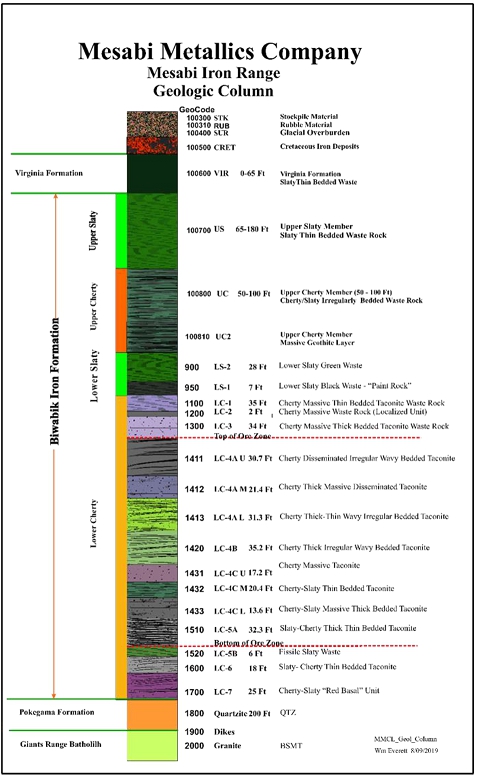
LC-3: Lower Cherty 3: Cherty-Silicate Taconite; slightly magnetic; massive thick bedded, disseminated silicate-carbonate-hematite-magnetite chert, magnetite content decreasing upward. Lower contact placed at gradation where hematite and magnetite of LC-4A Upper becomes more abundant than goethite. Abundant pitting throughout.
| May 2026 |
| DRA Ref.: C10564-0000-PM-RPT-0010 |
| | S-K 1300 TECHNICAL REPORT SUMMARY MESABI METALLICS PROJECT Document # C10564-0000-PM-RPT-0010 – Rev. 0 |
| / Page 15 |
Range 34 ft (10.4 m) in thickness.
LC-4A Upper: Cherty Taconite: Slightly to Moderately to Strong Magnetic; Disseminated and diffuse magnetite-silicate-carbonate chert layers with thick to very thin planar and irregular magnetite-carbonate-silicate layers. Upper contact is easily recognized by sharp magnetite-martite increase and virtual lack of nodular texture in contrast to LC-1. Oxidized to hard martite-goethite rich chert and iron-rich layers. The upper 5-15 ft are usually oxidized to sub-grade magnetic taconite fresh and strong magnetics with depth near surface.
Range 30-40 ft (9.1-12.2 m) in thickness.
LC-4A Middle: Cherty Taconite: moderately magnetic; massive, thick-bedded, disseminated magnetite-carbonate-silicate chert with scattered thick (5 cm) magnetite-silicate-carbonate layers. Oxidized to martite-goethite rich chert layers. Very slight oxidation accentuates 10 cm thick goethite carbonate-rich zones with chert layers. This common characteristic serves to place the upper and lower contacts. Magnetite mostly within thick bands, minor disseminations in between.
Range 20-40 ft (6.1-12.2 m) in thickness.
LC-4A Lower: Cherty Taconite: strongly to moderately magnetic; disseminated, diffuse, and nodular magnetite-silicate-carbonate chert with thick to very thin wavy, irregular bedded magnetite layers. Oxidized to martite-goethite chert and martite layers. Lower contact gradational. Magnetics disseminated between thick bands as well as in bands. Often magnetic rich spider webs in cherty zones.
Range 30-45ft (9.1-13.7 m) in thickness.
LC-4B: Cherty Taconite: strongly to moderately magnetic; disseminated, diffuse, and nodular magnetite-hematite-silicate-carbonate chert with abundant thick irregular wavy magnetite-hematite layers with distinct magnetite-hematite layers in Fe bands. Little disseminated magnetite outside of Fe rich bands. Oxidized to martite-hematite-goethite-rich chert and martite-hematite layers.
Range 35+ft (10.7 m) in thickness.
LC-4C: Cherty-Slaty Taconite: moderately magnetic; massive, diffuse, laminated, and nodular magnetite-silicate-carbonate chert. Occasional thin irregular magnetite-silicate layers in upper portion. When 4C “upper” is recognizable, it has a strongly nodular texture and is a marker horizon in magnetic section. Where 4C “middle” is recognized, it contains goethitic carbonate-rich zones in chert and gradational upper contact and sharp lower contact. Where the 4C “lower” subunit is recognizable, it consists of a distinctive pure magnetite layer 1-20 cm thick at its base, which is a very localized feature. Entire LC-4C can be oxidized to goethite-martite-chert layers.
Range 50+ft (15.2 m) in thickness.
| May 2026 |
| DRA Ref.: C10564-0000-PM-RPT-0010 |
| | S-K 1300 TECHNICAL REPORT SUMMARY MESABI METALLICS PROJECT Document # C10564-0000-PM-RPT-0010 – Rev. 0 |
| / Page 16 |
LC-5A: Slaty-Cherty Taconite: moderately magnetic, strongly laminated and disseminated silicate-carbonate-magnetite chert with scattered magnetite-silicate-carbonate layers and slaty layers. Oxidized to sequence of alternating goethite-martite chert and martite-goethite layers. May contain few scattered slaty layers. The slaty layers distinguish this unit from the LC-4C. This unit is at the bottom of the portion of the Biwabik Formation to be mined, as no magnetic iron can be recovered from the underlying units.
Range 30-35 ft (9.1-10.7 m) in thickness.
LC-5B: Fissile Slaty Taconite: “Wafer Slate”, slightly to non-magnetic, thin even bedded, interbedded argillite, finely laminated greenish silicates alternating with red iron rich layers, excellent distinctive geologic marker bed. Oxidized to painty goethite-martite layers with crude iron increasing markedly, becoming permeable aquifer. Occasional jasper.
Range 7 ft (2.1 m) in thickness.
LC-6: Slaty-Cherty Taconite; moderately to slightly magnetic; disseminated, diffuse, coarse granular magnetite-hematite-silicate-jasper chert with scattered thick planar magnetite-hematite-silicate layers. Uppermost 2 feet conglomeratic, magnetite increases, and hematite decreases upward. Oxidized to hematite-goethite chert and painty red hematite layers when LC-5B is oxidized. Inconsistent magnetite iron contact.
Range 18-25 ft (5.5-7.6 m) in thickness.
LC-7: “Red Basal”: Cherty-Slaty Taconite: weakly to non-magnetic; commonly known as “Red Basal” unit or “Basal Conglomerate”; alternating beds of hematitic jasper chert and slaty red hematite. Red slaty bands from 1 to 2 inches thick separated by 3 to 5 inch beds of massive cherty zones containing abundant hematite speckles and pitting. Upper contact placed where cherty bedding of LC-6 becomes dominant. Algal structures often present. Red jasper algal conglomerate and clastic pebble quartz commonly found near contact with Pokegama Quartzite.
Range 10-25 ft (3.0-7.6 m) in thickness.
| e. | QTZ |
“Pokegama Quartzite”: Coarse grains of quartz and quartz pebbles near the top, abruptly grading into a fine-grained, well-cemented, reddish-gray-green, non-magnetic, massive quartzite.
Range 200 ft (61 m) in thickness.
| May 2026 |
| DRA Ref.: C10564-0000-PM-RPT-0010 |
| | S-K 1300 TECHNICAL REPORT SUMMARY MESABI METALLICS PROJECT Document # C10564-0000-PM-RPT-0010 – Rev. 0 |
| / Page 17 |
| 7 | Exploration |
A wealth of geological, geophysical and geochemical data in the form of maps, reports, logs, assays and electronic files is available from public files of Minnesota Department of Natural Resources (DNR) and the Minnesota Geological Survey. A large amount of drill core collected from many areas and formations has been stored and catalogued for reference and analysis. The results from work completed on the Mesabi Project area from previous operators or government agencies include topographic maps based on an aerial photo survey flown in 1997 and a DEM model generated by the State of Minnesota and by the DNR. In 2012, the State of Minnesota completed a detailed LiDAR based data set of topographic maps for the region. No recent exploration has taken place on the Mesabi Project area.
Previous owners and operators of the Project site conducted extensive drilling during the past 100 years. Early investigations were often a combination of unspecified test pits, churn drilling and diamond drilling. The holes were drilled either to delineate the deposits or to serve in the mine planning. These two (2) types can be further broken down into the early holes drilled to investigate the oxidized portion of the deposit; the ones drilled into the taconite and the holes intersecting both the oxidized and fresh iron formation. Most data for historical drilling conducted at the site are available, especially those generated by M. A. Hanna and Butler Taconite.
There were numerous drilling campaigns at the Project site; however, not all drilling records were found. Excluding the drill holes with missing records, the balance of the drill hole data was used for preparation of this report.
Table 7.1 summarizes the 767 drill holes in the database. The resource estimate is based on data obtained from 664 drill holes completed by the previous operators between 1960 and 2005, as well as by 85 drill holes completed by Mesabi in 2011 and 2015, and finally with the 18 drillholes from the 2024-2025 campaign.
Table 7.1 – Drilling Completed on the Property
| Operator | Year of Drilling | Number of Holes | Footage Drilled | Meterage Drilled | ||||||||||||
| Butler Taconite | 1960-1969 | 289 | 71,170 | 21,693 | ||||||||||||
| Butler Taconite | 1970-1979 | 329 | 109,711 | 33,440 | ||||||||||||
| Butler Taconite | 1980-1981 | 40 | 12,138 | 3,700 | ||||||||||||
| Minnesota Steel & Iron (MSI) | 2005 | 6 | 2,587 | 789 | ||||||||||||
| Mesabi | 2011 | 63 | 41,740 | 12,723 | ||||||||||||
| Mesabi | 2015 | 22 | 3,913 | 1,193 | ||||||||||||
| Mesabi | 2024-2025 | 18 | 9,262 | 2,823 | ||||||||||||
| TOTAL | 767 | 250,521 | 76,361 | |||||||||||||
| May 2026 |
| DRA Ref.: C10564-0000-PM-RPT-0010 |
| | S-K 1300 TECHNICAL REPORT SUMMARY MESABI METALLICS PROJECT Document # C10564-0000-PM-RPT-0010 – Rev. 0 |
| / Page 18 |
Mesabi completed a metallurgical drilling program in 2024-2025. This report includes a resource update including the assay results and metallurgical testwork from the 18 holes from this program. There are plans for a further infill drilling program in the future. The Results from the 2024-2025 activities are included in this Report as part of the updated Weight Recovery values as well as inclusion in the updated block model that has increased the in-pit resource tonnage and has upgraded reclassification of some of the resource.
| May 2026 |
| DRA Ref.: C10564-0000-PM-RPT-0010 |
| | S-K 1300 TECHNICAL REPORT SUMMARY MESABI METALLICS PROJECT Document # C10564-0000-PM-RPT-0010 – Rev. 0 |
| / Page 19 |
| 8 | SAMPLE PREPARATION, ANALYSES, AND SECURITY |
| 8.1 | Sample Preparation and Analyses |
| 8.1.1 | Sample Preparation and Analysis – 1960-1967 Programs |
The Midland Research Laboratory did most of the previous core analyses on the Butler Taconite property. The laboratory is the successor to the Hanna Research Laboratory and was part of the M. A. Hanna Mining Company. The preparation and sampling procedures were essentially the same as those used at Lerch Brothers Inc. (Lerch), except that Midland used a ball mill to grind the samples for Davis Tube testing rather than the buckboard used by Lerch.
No details are available on the sample preparation and analysis of the samples for the drilling programs completed during this period.
| 8.1.2 | Sample Preparation and Analysis – 2005, 2011, 2015, and 2024-2025 Programs |
The entire core from the 2005, 2011, 2015, and 2024-2025 programs were routinely submitted to Lerch for preparation and analytical purposes. The 2024-2025 core was submitted to SGS Lakefield for preparation and analytical purposes.
The 2005 and 2011 samples were submitted to two stages of size reduction in a jaw crusher (1 inch, ½ inch, equivalent to 25.4, 12.7 mm) followed by a pass in a roll crusher with an opening of 3 mesh (0.26 inch, 6.73 mm). Sub-samples are extracted at that stage and are crushed in a gyratory crusher to 10 mesh (0.0787 inch, 2.0 mm) and pulverized to 100% passing 20 mesh (0.0331 inch, 0.841 mm). After initial crushing, a 50-g split is further reduced to 100% passing 325 mesh (0.0017 inch, 0.044 mm) using a hammer Muller on a bucking plate. According to the procedure we have, this is true for the waste samples in 2015, but not for the Liberation Index Analysis (LIS) samples
In the 2015 program, designated mineralized zones were submitted for LIS timed grind analysis, while the remainder of the core was analyzed using standard Davis Tube procedures described above.
Samples designated for LIS analysis underwent a timed grind analysis, using a certified ball mill and charge capable of measuring power consumed during the grinding process. The LIS process provides a prediction of the power consumption and liberation characteristics of the magnetic iron in a standard concentrator facility. The concentrate was ground at three (3) separate time intervals; 6, 10 and 14 minutes and analyzed after each period. This procedure allows the mathematical prediction of the ore’s liberating characteristics, grade estimation and energy consumption during the grinding process, in this case 80% passing a -325 mesh screen.
| May 2026 |
| DRA Ref.: C10564-0000-PM-RPT-0010 |
| | S-K 1300 TECHNICAL REPORT SUMMARY MESABI METALLICS PROJECT Document # C10564-0000-PM-RPT-0010 – Rev. 0 |
| / Page 20 |
In the 2024-2025 program, A total of 79 hematite and 364 taconite drill core samples, provided by Mesabi, were prepared and submitted for head assays. The samples were weighed and then stage-crushed to 100% passing ¼” (6.35 mm) and ~1.4 kg riffled. The remainder was weighed, split and stored. The 1.4 kg subsample was roll-crushed to 100% passing 20 mesh (0.84 mm). A further 100 g subsample was riffled from this material for pulverizing and head assays, while the remainder was weighed, further split, and stored. The taconite samples were also stage-pulverized to 100% passing 325 mesh and submitted for Davis tube testing. The taconite samples were also stage-pulverized to 100% passing 325 mesh and submitted for Davis tube testing.
| 8.1.3 | Analytical Procedure |
The rock sampling protocol included testing for Crude %Total Iron and % Satmagan Iron. Sampling for the iron formation intervals provided for the same crude analysis and Davis Tube Concentrate Analysis, with 100% of the sample passing a -325 mesh screen, conforming to the Butler Taconite sampling protocol. The Davis Tube Concentrate Analysis included: Weight Recovery Evaluation, Concentrate % Total Iron, % Satmagan Iron, % Silica, % Ferrous Iron, and a measure of oxidation using a comparison ratio calculation between the % of Concentrate Total Iron and the % of Magnetic Iron in the sample.
The samples from the 2005, 2011, and 2015 programs were analyzed at the Lerch Brothers analytical laboratory. The samples were analyzed for total and ferrous iron, silica, Ca, Mg, Al, Mg. Ferrous iron (FeO) was analyzed by acid digest followed by wet processing potassium dichromate titration and the content of ferric iron (Fe₂O₃) was determined by Satmagan and Davis Tube (15 g passing -325 mesh) testing. S was determined by LECO analysis. During 2015 drilling program, selected samples were sent to SGS Canada Inc. for XRF testing of trace elements.
As for the 2024-2025 program, each sample was prepared and submitted for head assays. A few selected samples were also submitted for XRD analysis. All the taconite samples were also submitted for Davis tube testing.
A single hematite composite, as well as five taconite composites were also prepared and submitted for the Liberation Index Procedure, Bond ball mill grindability testing, as well as XRD analysis and optical microscopy.
| 8.1.4 | Density Determinations |
In-situ density was determined by the Lerch laboratory on core samples from the 2011 program, using the weight in water, weight in air technique (Archimedes Method). No new density determinations were performed during the 2015 drilling program (personal communication with Bill Everett. Sept 2019). In 2011, a total of 208 determinations were implemented on iron formation and waste samples ranging from 3.2 to 12.9 ft. (0.98 to 3.93 m) in length.
| May 2026 |
| DRA Ref.: C10564-0000-PM-RPT-0010 |
| | S-K 1300 TECHNICAL REPORT SUMMARY MESABI METALLICS PROJECT Document # C10564-0000-PM-RPT-0010 – Rev. 0 |
| / Page 21 |
Although the QP did not see the details on the procedure and noticed that no duplicate samples appear to have been tested as a QA procedure, the weighing of the samples with a hydrostatic balance is a simple operation for chemical laboratory technicians. The tests were performed on long core samples, which is a good approach. The variations in the density between samples in the same unit are commonly large and probably reflect the variations in the iron content. The number of samples for each unit is not large enough to build a clear correlation curve between the Fe content and the density and ideally more samples should have been tested.
However, the average density for all the units is relatively close and is in line with factors determined at similar operations in the Mesabi Range. The QP believes the total number of determinations is sufficient to define the density of 11.0 cubic feet per long ton for use in the resource estimate.
| 8.2 | QA/QC Program and Check Sampling |
| 8.2.1 | Internal Laboratory Quality Control |
The Lerch laboratory received the ISO 9001-2008 certification in February 2010 and has held it since as per verification by the QP Claude Bisaillon, P. Eng., in a recent unrelated visit to the Lerch Brothers laboratory on September 11, 2019. The laboratory follows an internal QA protocol that includes insertion of silica and iron standards (4%) and duplicates (2%) to monitor the chemical analysis and Davis Tube results, as well as periodic calibration of the instruments: scales, oven, Davis Tube (flow and timer), Satmagan analyzer.
The QP examined the results from 90 analyses of each of Standard C (66.85% Fe, 3.71% SiO₂), Standard L (59.58%Fe), and Standard N (65.11% Fe) calculated basic statistics and found only a few results lightly exceeding the Mean plus Two (2) Standard Deviations limits calculated by the QP, which is excellent. The results from the internal QC samples inserted by the laboratory were available to Mesabi.
SGS Lakefield is an accredited laboratory and conforms to the requirements of the ISO/IEC 17025 standard for specific registered tests. This accreditation is the standard for analytical testing laboratories. As for any of the SGS laboratories, the SGS Lakefield facilities follows an internal QA protocol that includes insertion of silica and iron standards and duplicates to monitor the chemical analysis and Davis Tube results, as well as periodic calibration of the instruments: scales, oven, Davis Tube (flow and timer), Satmagan analyzer.
| 8.2.2 | Analytical QA/QC Program By Mesabi |
For the 2011 drilling program, Mesabi applied their own QA/QC program to monitor the laboratory performance consisting of the insertion of Blanks, Standard Reference Materials and Duplicates into the sample stream of the 2011 drill program. A total of 9.3% QC samples were inserted by Mesabi’s geologists, in addition to the laboratory QA/QC system, including re-run analyses (2.0%) and Standards (4.0%).
| May 2026 |
| DRA Ref.: C10564-0000-PM-RPT-0010 |
| | S-K 1300 TECHNICAL REPORT SUMMARY MESABI METALLICS PROJECT Document # C10564-0000-PM-RPT-0010 – Rev. 0 |
| / Page 22 |
The three (3) Standards used by Mesabi have iron content much higher than the average for the resources. Ideally, one of them should have been selected to represent the mode of all the core sample analyses and another one to be close to the expected cut-off grade for the deposit.
Mesabi monitored the results from the QC samples and requested re-runs for the result raising questions on the original data.
No evidence of analytical errors or systematic bias that may significantly affect the resources estimation has been noted by the QP in the samples from the 2011 drill program. This internal QA/QC program was not applied by Mesabi in the 2015 drilling campaign nor for the 2024-2025 campaign.
| 8.2.2.1 | Standard Reference Material |
The three (3) standards used by Mesabi to monitor the Fe and SiO₂ results are commercial Standard Reference Materials (SRM) purchased from the National Institute of Standards and Technology, an agency from the U.S. Department of Commerce.
In 2011, examination by the QP, of the analytical results for Fe (150) and SiO₂ (143) for each of the SRMs inserted by Mesabi’s geologists indicated generally good laboratory performance.
The standard deviation calculated on the analytical results from the three Standards is very close to the Estimated Uncertainty and the average from the 150 analyses is close to the Certified Values for the total iron and the silica contents.
The basic statistical calculations indicate that all the Standards yielded an average Fe% grade that is close to the Certified Value of the Standard and the individual samples do not show significant deviations from the expected values. If one applies the fail/pass threshold at two (2) standard deviations from the mean, which is not very stringent, about 4 to 9% of the samples fail the test, which is acceptable. No systematic bias is apparent in the analytical results, except for a slight high bias relative to the certified Total Fe values exhibited by standard SRM 690, associated with a low silica bias.
| 8.2.2.2 | Duplicate Samples |
In 2011, the head assay results from Total Fe for 109 duplicate samples examined by the QP show low heterogeneity and a correlation coefficient of 0.97 between the two (2) populations. This was not done with the 2015 drilling program.
| May 2026 |
| DRA Ref.: C10564-0000-PM-RPT-0010 |
| | S-K 1300 TECHNICAL REPORT SUMMARY MESABI METALLICS PROJECT Document # C10564-0000-PM-RPT-0010 – Rev. 0 |
| / Page 23 |
The relative difference between the two (2) analyses for the pair’s averages 1.3% and the maximum of 11% occurred in one pair. The analytical results from the duplicate samples show very good reproducibility.
| 8.2.3 | 2011 Check Samples Selected by the QP |
A suite of 34 original samples was selected by the QP for check assays, after the drilling program was completed and all the analytical results were available.
The samples were chosen from five drill holes on three (3) sections, and at different depths, in an attempt to represent a fair general geographic distribution of the mineralization within the deposit. In addition, the samples were selected to cover a wide range of TotFe% grades in all the Lower Cherty 4 and 5 Members.
The QP requested Mesabi to retrieve the rejects from these samples and to insert the control samples (standards and duplicates).
Both the original samples and the duplicates selected by the QP for check analysis were processed by the Lerch laboratory. Although the number of check samples is not very high to derive statistically valid conclusions, a definite trend can be seen between the pairs of samples.
The average of the original Crude TotFe results of 31.16%, as compared to the average for the check samples at 32.63%, represents a difference of 1.47%, which is significant, albeit not very large. However, the fact that systematic positive bias is present in most of the check samples, suggests a procedure at the laboratory affecting accuracy, potentially an instrumental error.
The basic statistics for the two (2) populations, the original samples and the check samples, show a systematic positive bias in all the parameters for the check samples and a low correlation coefficient.
The results from the Davis Tubes tests show a general higher weight recovery accompanied by lower iron and higher silica in the concentrate of the check samples. The differences are not large, and they may be explained by a somewhat coarser grind to which the check samples were submitted, as compared with the original samples. If so, one would expect a lower degree of liberation of the magnetite.
| 8.2.3.1 | QC Samples within Check Samples |
The two (2) duplicate samples within the check samples exhibit a very low variability,
The Standard FER-3 was analyzed once and yielded a value of 31.18 % TotFe, while the declared value stands at 31.13%, which indicates excellent accuracy.
| May 2026 |
| DRA Ref.: C10564-0000-PM-RPT-0010 |
| | S-K 1300 TECHNICAL REPORT SUMMARY MESABI METALLICS PROJECT Document # C10564-0000-PM-RPT-0010 – Rev. 0 |
| / Page 24 |
The five (5) Mesabi internal standards identified as concentrate returned almost identical values for all the analyses: TotFe% in head, as well as Weight Recovery % and %Fe in the concentrates.
| 8.2.3.2 | Conclusions on the Check Samples |
The QP believes that the differences in the laboratory results between the original and the check samples are not pronounced, and still within an acceptable range. The results from the QP’s check samples generally confirm the accuracy of the analytical results from the 2011 drilling program and are adequate for the purposes of resources calculations. No core or samples from the prior drilling programs were available; but the QP does not see any reason why the older analytical data may be inadequate, considering the reputation and experience of the former operators and the Midland laboratory.
| 8.3 | Security |
The core is transported from the drill to the Lerch laboratory under the supervision of Mesabi geologists and all the processing, from core logging to analysis and archiving the rejects, is done within the premises of the Lerch laboratory. This preserves the chain of custody.
Since the 2011 security protocol was also applied to the 2015 program and for the 2024-2025 program, the QP believes that, overall, the sample preparation, analytical procedures and security applied by Mesabi and the laboratories have generated data that is sufficiently reliable for the purpose of this Report.
| 8.4 | 2024 QP Site Visit |
The QP did not visit the assaying laboratories nor taken any check samples from the current (2024-2025) drilling program.
For this Report, Claude Bisaillon, P. Eng. of DRA visited the site on December 10 to 11, 2024. During the site visit, Mr. Bisaillon engaged in discussions with Mesabi’s site geologists and engineers regarding past, current, and upcoming drilling campaigns, as well as sampling, assaying, QA/QC, and the laboratories to be utilized.
This Report includes assay results and metallurgical test results conducted on drill core samples from drilling information in the database from the 2024-2025 drilling campaign.
For QA/QC assessment of the 2024-2025 drilling campaign Claude relied upon the SGS Lakefield Lab Visit of Masoud Gorjian, P. Eng. of DRA on July 21-23, 2025 as the basis for evaluating the representativeness of the samples used for analyses performed.
| May 2026 |
| DRA Ref.: C10564-0000-PM-RPT-0010 |
| | S-K 1300 TECHNICAL REPORT SUMMARY MESABI METALLICS PROJECT Document # C10564-0000-PM-RPT-0010 – Rev. 0 |
| / Page 25 |
| 8.5 | Conclusion |
In 2011, the QP was unable to verify the results, however the QP implemented a complete set of procedures aimed at verifying the validity and reliability of the dataset used for the resource estimation. These verification procedures included a review of the database, the results from the Mesabi and of the laboratory’s QC samples, and the independent checks of samples selected by the QP. As a result, the QP does not currently see any factor in the procedures applied in the core logging, sampling, sample preparation and analytical procedures that could significantly affect data integrity.
The 2024-2025 drilling was logged, sampled and assayed as per Mesabi’s Standard Operating Procedures (SOP).
The 2026 QP determines that sample preparation, security measures, and analytical procedures are appropriate and adequate for the purposes of this Report.
The 2026 QP believes the data collected is reliable and sufficient for resource calculations.
| May 2026 |
| DRA Ref.: C10564-0000-PM-RPT-0010 |
| | S-K 1300 TECHNICAL REPORT SUMMARY MESABI METALLICS PROJECT Document # C10564-0000-PM-RPT-0010 – Rev. 0 |
| / Page 26 |
| 9 | Data Verification |
This section reviews data verification related to geology and exploration. In particular it focusses on core logging, sampling and assaying procedures in addition to drillhole and assay database verification.
| 9.1 | Introduction |
The QP, Claude Bisaillon P. Eng of DRA, visited the site on December 10 and 11, 2024. The previous visit from a DRA QP took place in 2011 as discussed previously. No QP visited the site for the 2015 drilling campaign, and no other QP site visit had taken place between December 2024 and April 2026 except for random visits by DRA personnel for other purposes. In April 2026, Nigel Fung, P. Eng. and Simon Vezina, P. Eng. both of DRA visited the site for due diligence areas that did not include geological / exploration data verification.
Data from the 2015 program was incorporated into the existing database, with all new samples submitted to Lerch, utilizing the same sample preparation and analyses method. Some designated mineralized zones were submitted for LIS, with results detailed in Section 8.
The main purpose of the 2024 site visit was to gather the information required for DRA to prepare an independent Technical Report following NI 43-101 standards for disclosure.
New drilling and assay data has been added to the Project database from the 2024-2025 drilling campaign and used for the updated resource estimate in Section 11 of this Report.
| 9.2 | 2024 Site Visit |
For the 2024 Report, Claude Bisaillon, the QP from DRA, visited the site on December 10 to 11, 2024, and engaged in discussions with Mesabi site geologists and engineers regarding past, current, and upcoming drilling campaigns, as well as sampling, assaying, QA/QC, and the laboratories to be used.
The QP responsible for the resource estimate (Section 11) did not visit the property in 2024 but relied on Claude Bisaillon’s visit.
| 9.2.1 | 2024 Field Trip, Core storage |
The 2024 site visit was made to observe ongoing metallurgical drilling, have a look at the core being logged, speak with the geologists regarding logging, sampling and assaying procedures. Due to time constraints, snowpack and inaccessibility, the current drill site and past drill sites were not visited.
| May 2026 |
| DRA Ref.: C10564-0000-PM-RPT-0010 |
| | S-K 1300 TECHNICAL REPORT SUMMARY MESABI METALLICS PROJECT Document # C10564-0000-PM-RPT-0010 – Rev. 0 |
| / Page 27 |
During the 2024 site visit, ongoing drilling for metallurgical core was being logged by Mesabi geologist.
| 9.2.2 | 2024 Data Verification |
The Mesabi drillhole database was supplied in an excel file format containing different spreadsheets referring to collars, survey, lithology and assays information. Different steps were conducted to validate the received database prior to conducting the Mineral Resources Estimation. The required information was extracted from the master database received from Mesabi and the first validation step consisted in checking for inconsistencies, outliers, unexplained gaps, overlaps, etc. The data were then imported into MS TorqueTM a SQL based database manager integrated into HxGN the 3D modelling and estimation package used. About 100 assays entries originating from the 2011 drilling program were randomly selected and cross checked in comparison with the entries in the original Lab certificates. No discrepancies were found. However, the assays file of the drillhole database also contains a few amounts of calculated entries some of which are beyond the tolerance limit. Such entries refer to negative calculated values for silica or mag iron beyond the maximum value of 72.2% for a pure magnetite sample. DRA has removed these few entries from the MRE process and believes that this has any material impact on the outcomes of the estimated tons and grades.
| 9.2.3 | 2011 Site Visit |
This Report also references the visit by DRA former personnel Mr. Yves A. Buro P. Eng., who visited the Mesabi Project site between February 22 and 25, 2011.
During the 2011 site visit, the activities of Mr. Buro included:
| · | General discussions on the procedures, progress and results of the ongoing drill program with Mesabi personnel. |
| · | Field trip, visit several drill sites including the sites of the holes being drilled. |
| · | Examination of selected core from the 2011 drill program. |
| · | Spot check of all the database entries (Y-series, 2005 and 2011 diamond drill holes). |
| · | Visit to Lerch chemical laboratory facilities in Hibbing, Minnesota. |
| 9.3 | Database Verification |
The QP conducted a series of routine verifications to ensure the reliability of the electronic data, during the site visit and prior to generating the 3D block model.
| May 2026 |
| DRA Ref.: C10564-0000-PM-RPT-0010 |
| | S-K 1300 TECHNICAL REPORT SUMMARY MESABI METALLICS PROJECT Document # C10564-0000-PM-RPT-0010 – Rev. 0 |
| / Page 28 |
A few minor errors were identified and corrected by Mesabi geologists. Based on this verification, the QP believes the integrity of the database is sufficiently high and the data are adequate for the resources estimation purposes.
The 2024-2025 drilling data was added to the current functional database in accordance with Mesabi SOP.
| 9.4 | Qualified Person’s Opinion |
The QP is of the opinion that the data used is adequate and reasonable to support the mineral resource estimation presented in this Report.
| May 2026 |
| DRA Ref.: C10564-0000-PM-RPT-0010 |
| | S-K 1300 TECHNICAL REPORT SUMMARY MESABI METALLICS PROJECT Document # C10564-0000-PM-RPT-0010 – Rev. 0 |
| / Page 29 |
| 10 | Mineral Processing and Metallurgical Testing |
The historical Butler Taconite operation was very similar to Keewatin Taconite, formerly National Steel Pellet Company. Butler did not attempt to produce a low-silica Direct Reduction (DR) grade pellet.
Pilot plant testing on a bulk sample was conducted by Midland Research Center (MRC) for Minnesota Iron & Steel (MIS) in 1998. The bulk sample used in the testing program was sourced from Pit 5, a target area for Essar Steel Minnesota's early mining operations. The testing demonstrated that a concentrate with an iron grade as high as 70.1% and a silica grade as low as 1.6% could be produced using Low-Intensity Magnetic Separation (LIMS), followed by amine reverse flotation technology. The pilot plant circuit featured primary grinding using a Semi-Autogenous Grinding (SAG) mill and secondary grinding with a ball mill in a closed circuit with a cyclone. The performance was deemed acceptable, albeit at a very fine particle size. However, the process samples were not analyzed in sufficient detail to fully characterize the liberation and breakage behavior of the crude ore.
In March 2005, MRC was contracted by MIS to conduct another round of pilot plant testing on the same bulk sample. The pilot plant circuit set up in 2005 aimed to determine design operating parameters based on recent best practices in primary and secondary grinding circuits. The pilot plant was operated for one week using a SAG circuit, followed by a second week using an Autogenous Grinding (AG) circuit for primary grinding. Both weeks of operation utilized fine screening instead of a cyclone for the classification circuit around the ball mill. This pilot campaign also included LIMS, followed by amine reverse flotation technology for ore beneficiation. The concentrate produced during these tests had an iron content ranging from 70.04% to 70.45% and a silica content ranging from 1.52% to 1.70%.
Parallel to the pilot test in 2005, Metso Minerals Optimization Services (MMOS) was contracted by Minnesota Steel to conduct batch milling tests, discrete element modeling (DEM) simulations of the batch milling tests, and a DEM simulation of the commercial primary grinding mill. This testing was conducted on the same bulk sample obtained for the pilot plant testing at MRC. Barr Engineering Company was also retained by Minnesota Steel to coordinate with MMOS and integrate the test results and findings into the concentrator flowsheet.
Information from the 1998 and 2005 pilot plant testing, along with batch milling tests by MMOS, served as the basis for a computer simulation that generated complete circuit information used to design a commercial concentrator flowsheet by Barr Engineering.
The average weight recovery of Butler Taconite Company's 20 years of operation was 32.28%. According to the material balance completed by Barr Engineering Co. for the Mesabi Project, an overall weight recovery of 30.8%, based on primary crusher feed, is expected.
| May 2026 |
| DRA Ref.: C10564-0000-PM-RPT-0010 |
| | S-K 1300 TECHNICAL REPORT SUMMARY MESABI METALLICS PROJECT Document # C10564-0000-PM-RPT-0010 – Rev. 0 |
| / Page 30 |
During the preparation of the Technical Report dated August 22, 2025, DRA conducted a multiple linear regression analysis on the results of Davis Tube tests performed on historical drill core samples. The analysis indicated that weight recovery varies as a function of ore geological setting, magnetic iron content of the crude ore, and total iron grade of the concentrate. The results of this analysis, together with data from pilot-scale test programs conducted in 1998 and 2005, formed the basis for DRA’s estimate of weight recovery. The estimated life-of-mine (LOM) average weight recovery calculated by DRA was 27.15%.
Subsequent to the release of the initial Technical Report dated August 22, 2025, Mesabi Metallics Company LLC (Mesabi) completed a drilling campaign followed by additional bench scale and pilot reported by Geological Survey of Finland (GTK Mintec) April 22, 2026. A total of 443 samples from 18 PQ-size drill holes were collected for bench-scale metallurgical testing at SGS Lakefield, Canada, as well as for additional bench-scale and pilot-scale testing at GTK Mintec in Outokumpu under contract to Metso.
The drill cores were longitudinally cut into one half-core and two quarter-core sections. One quarter-core from each sample was shipped to SGS Lakefield, while the remaining three-quarters were shipped to Metso for metallurgical testing.
The results of these test programs indicate that an average LOM weight recovery of 29.79% for Mesabi ore is achievable at a 14% magnetic iron cut-off, resulting in run-of-mine (ROM) ore grading 21.12% magnetic iron and 31.70% total iron.
Based on this revised weight recovery estimate, and incorporating the process flowsheet modifications discussed in Section 17 of this TRS, Mesabi is capable of processing approximately 23.45 million long tons per annum (MLTpa) (23.82 Mtpa) of crude ore to produce an average of 6.99 MLTpa (7.10 Mtpa) of concentrate and 7.17 MLTpa (7.28 Mtpa) of DR grade pellets over the LOM. All tonnages are reported on a dry basis.
COREM, located in Quebec City, Quebec, Canada, received magnetite concentrate samples prepared from Mesabi ore in 2009 and 2011. Balling and pot grate tests were conducted on these concentrates. The results demonstrated that the Mesabi concentrate could achieve a grate productivity of 30.1 tonnes per day per square meter of grate area (t/d/m²) for the production of DR-grade pellets. Based on the pelletizing test results from COREM, DRA estimated a concentrate-to-pellet weight conversion factor of 1.026.
Using a selected traveling grate pelletizing machine with a grate surface area of 8,008 square feet (744 m²) and assuming 335 operating days per year, the pelletizing plant is potentially capable of producing approximately 7.38 MLTpa (7.50 Mtpa) of DR-grade pellets. However, due to capacity constraints in the concentrator, the estimated LOM average production rate of DR-grade pellets is limited to approximately 7.17 MLTpa (7.28 Mtpa).
| May 2026 |
| DRA Ref.: C10564-0000-PM-RPT-0010 |
| | S-K 1300 TECHNICAL REPORT SUMMARY MESABI METALLICS PROJECT Document # C10564-0000-PM-RPT-0010 – Rev. 0 |
| / Page 31 |
| 11 | Mineral Resource Estimates |
A summary of the in-situ mineral resource estimate exclusive of reserves is presented in Table 11.1
Table 11.1 – Mineral Resource Statement (Exclusive of Reserves) – January 14, 2026
| Weight | MAGFE | TOTFE | DRIWREC | CSiO₂ | CONFE | |||||||||||||||||||
| Resource Category | MLT | % | % | % | % | % | ||||||||||||||||||
| Indicated | 214.5 | 20.5 | 31.9 | 28.8 | 1.8 | 70.0 | ||||||||||||||||||
| Inferred | 29.5 | 18.9 | 31.8 | 26.9 | 1.7 | - | ||||||||||||||||||
Notes:
| · | Resources are prepared and reported in accordance with S-K 1300 (17 CFR § 229.1300) mineral property disclosure rules. |
| · | The MRE is in-situ resources. |
| · | The cut-off grade is 14% MAGFE. |
| · | The QP expects the resources have a reasonable prospect of economic extraction determination (RPEE) based on the parameters used for the resource pit shell optimisation exercise. |
| · | The effective date of this MRE is January 14, 2026. | |
| · | Mineral Resources, which are not Mineral Reserves, do not have demonstrated economic viability. |
| · | The QP (Dr. Schadrac Ibrango, P.Geo., MBA) is not aware of any metallurgical, environmental, permitting, legal, title, taxation, socio-economic, marketing, or political or other factors that could materially impact the MRE disclosed in this Report There is no certainty that Mineral Resources will be converted to Mineral Reserves |
| · | The Inferred Mineral Resource in this estimate has a lower level of confidence than that applied to an Indicated Mineral Resource and cannot be converted to a Mineral Reserve. It is reasonably expected that the majority of the Inferred Mineral Resource could be upgraded to an Indicated Mineral Resource with continued exploration. |
| · | Figures have been rounded to reflect that this is an estimate and totals may not match the sum of all components. |
| May 2026 |
| DRA Ref.: C10564-0000-PM-RPT-0010 |
| | S-K 1300 TECHNICAL REPORT SUMMARY MESABI METALLICS PROJECT Document # C10564-0000-PM-RPT-0010 – Rev. 0 |
| / Page 32 |
| 12 | Mineral Reserve Estimates |
A summary of the mineral reserve estimate is presented in Table 12.1.
Table 12.1 – Mineral Reserves (May 22, 2026)
| Reserve Category | Weight | MAGFE | TOTFE | DRIWREC | CSiO₂ | CONFE | ||||||||||||||||||
| MLT | % | % | % | % | % | |||||||||||||||||||
| Probable * | 515.5 | 21.1 | 31.7 | 29.8 | 1.8 | 70.0 | ||||||||||||||||||
* All Reserves in this report are classified as Probable at the discretion of the QP due to modifying factors. Modifying factors include but are not limited to the reliance upon future permits and permit amendments required to execute the mine plan underlying the reserves estimate, that are not currently in effect but are assumed to be acquired and/or amended as needed to facilitate the mine plan.
The Mineral Reserves shown in this table exclude the 50% Mesabi – 50% Cliffs shared properties under litigation, DRA does not opine or guarantee in any way that Mesabi has or will have access to the entirety of those reserves in the properties under litigation.
Notes:
| · | Reserves are prepared and reported in accordance with S-K 1300 (17 CFR § 229.1300) mineral property disclosure rules. |
| · | The independent and Qualified Person for the Mineral Reserve Estimate, as defined by S-K 1300 (17 CFR § 229.1300) mineral property disclosure rules/requirements, is Nigel Fung, P.Eng. of DRA Americas Inc. |
| · | The effective date of the Mineral Reserves Estimate is May 22, 2026. |
| · | The Mineral Reserve Estimate is based on commodity prices assumptions of US$130/t for DRI pellets FOB Louisiana. |
| · | The Mineral Reserve was derived from a pit limit analysis and detailed pit design using measured and indicated resources and a cut-off grade of 14% MagFe. |
| · | For the Mesabi deposit, the Mineral Reserve Estimate includes internal dilution and mining loss. A mining loss of 2.0% have been incorporated. |
| · | Mesabi Mineral Reserves are based on a pit design with a 1.66 stripping ratio. |
| · | Figures have been rounded to an appropriate level of precision for the reporting of Mineral Reserves. As a result, totals may not compute exactly as shown. |
| May 2026 |
| DRA Ref.: C10564-0000-PM-RPT-0010 |
| | S-K 1300 TECHNICAL REPORT SUMMARY MESABI METALLICS PROJECT Document # C10564-0000-PM-RPT-0010 – Rev. 0 |
| / Page 33 |
| 13 | Mining Methods |
The mining method considered is a conventional open pit truck and shovel operation as is used in the other mines in the area. Annual mine plans, equipment selection, labor requirements as well as all other relevant information has been compiled for preparing the economic evaluation of the Project.
DRA produced a detailed mine plan for the mining of the Mineral Reserves within the economic pit limits derived from pit optimization. Table 13.1 presents a summary of the mine plan, which is based on a maximum annual crude ore mill feed of 23.44 MLT, producing an average of 7.16 MLT (7.28 Mt) of DR grade pellets per year after ramping up. The total LOM is estimated at 23 years.
It is anticipated that mining operations will be conducted 24 hours per day, seven (7) days per week and 365 days per year, with two (2) shifts of 12 hours per day. The 365 days per year include the loss of two (2) days due to inclement weather conditions during the year.
The overburden will be loaded directly without blasting into 400 short ton (st) capacity haul trucks for haulage to the overburden dumps. Following the drilling and blasting of the ore and waste, the rock is also to be loaded into 400 st capacity haul trucks. The ROM ore is to be delivered to the primary crusher throughout the mine life. Lower grade waste rock (<14% MagFe) is to be transported to waste dumps outside the final projected ultimate pit limit. Beginning in 2027, in-pit disposal of the waste material could be considered to reduce costs as haulage distance will become a key factor in controlling fleet requirements.
The primary mining fleet consists of production drills, a wheel loader, hydraulic shovels, a cable shovel, and diesel-powered haul trucks with electric wheel motors. Secondary mining equipment is used for pit, road and dump maintenance and various other functions within the mine area.
The requirement for the primary mining equipment has been estimated and is based on haul distances, equipment availability, utilization and overall productivity data. Mechanical availability for the major equipment has been estimated using manufacturers’ benchmarks and operating experience.
The hydraulic shovels (47 yd3) and the cable shovel (43 yd3) will be used for waste and ore. A wheel loader equipped with a 34 yd³ bucket will be used for about 10-15% of the ore and waste tonnages and 100% of the reclaimed ore volume. The major loading and hauling equipment required for operations is shown in Table 13.2.
| May 2026 |
| DRA Ref.: C10564-0000-PM-RPT-0010 |
| | S-K 1300 TECHNICAL REPORT SUMMARY MESABI METALLICS PROJECT Document # C10564-0000-PM-RPT-0010 – Rev. 0 |
| / Page 34 |
Table 13.1 – Mine Plan Summary
| Ore Mined | Over Burden | Waste | S.R. | Mill Feed** | MagFe | CSiO₂ | WREC | DR Grade Pellets | DR Grade Pellets | |||||||||||||||||||||||||||||||
| Year | ‘000
LT (Dry) | ‘000
LT (Dry) | ’000
LT (Dry) | w/o | ‘000
LT (Dry) | (%) | (%) | (%) | ‘000
LT (Dry) | ‘000 t (Dry) | ||||||||||||||||||||||||||||||
| 2026 | 1,881 | 37,629 | 4,079 | 22.17 | 1,208 | * | 21.7 | 1.5 | 30.1 | 269 | * | 273 | * | |||||||||||||||||||||||||||
| 2027 | 17,994 | 6,570 | 41,665 | 2.68 | 18,522 | 22.1 | 1.6 | 31.3 | 5,956 | 6,052 | ||||||||||||||||||||||||||||||
| 2028 | 25,291 | 12 | 37,351 | 1.48 | 23,436 | 21.7 | 1.9 | 30.7 | 7,371 | 7,489 | ||||||||||||||||||||||||||||||
| 2029 | 21,811 | 21,434 | 20,243 | 1.91 | 23,377 | 22.0 | 1.9 | 30.7 | 7,357 | 7,475 | ||||||||||||||||||||||||||||||
| 2030 | 24,966 | 5,557 | 29,179 | 1.39 | 23,400 | 21.9 | 2.2 | 30.7 | 7,381 | 7,500 | ||||||||||||||||||||||||||||||
| 2031 | 23,400 | 9,109 | 38,063 | 2.02 | 23,400 | 21.8 | 2.0 | 30.7 | 7,381 | 7,500 | ||||||||||||||||||||||||||||||
| 2032 | 23,440 | 296 | 24,418 | 1.05 | 23,440 | 21.8 | 1.7 | 30.6 | 7,362 | 7,480 | ||||||||||||||||||||||||||||||
| 2033 | 23,400 | 38,015 | 8,231 | 1.98 | 23,400 | 22.2 | 1.8 | 30.7 | 7,381 | 7,500 | ||||||||||||||||||||||||||||||
| 2034 | 23,400 | 27,003 | 26,524 | 2.29 | 23,400 | 21.1 | 2.1 | 30.7 | 7,381 | 7,500 | ||||||||||||||||||||||||||||||
| 2035 | 23,440 | 10,286 | 35,969 | 1.97 | 23,440 | 21.2 | 1.8 | 30.6 | 7,362 | 7,480 | ||||||||||||||||||||||||||||||
| 2036 | 23,440 | 4,178 | 41,021 | 1.93 | 23,440 | 21.2 | 1.7 | 30.6 | 7,362 | 7,480 | ||||||||||||||||||||||||||||||
| 2037 | 23,440 | 837 | 36,124 | 1.58 | 23,440 | 21.7 | 1.7 | 30.6 | 7,362 | 7,480 | ||||||||||||||||||||||||||||||
| 2038 | 23,440 | 6,092 | 31,316 | 1.60 | 23,440 | 21.6 | 1.6 | 30.6 | 7,362 | 7,480 | ||||||||||||||||||||||||||||||
| 2039 | 23,440 | 26,260 | 25,798 | 2.22 | 23,440 | 21.7 | 1.7 | 30.6 | 7,362 | 7,480 | ||||||||||||||||||||||||||||||
| 2040 | 23,440 | 20,458 | 26,191 | 1.99 | 23,440 | 21.4 | 1.8 | 30.2 | 7,263 | 7,380 | ||||||||||||||||||||||||||||||
| 2041 | 23,440 | 9,451 | 43,294 | 2.25 | 23,440 | 20.5 | 1.9 | 28.7 | 6,914 | 7,025 | ||||||||||||||||||||||||||||||
| 2042 | 23,440 | 4,448 | 45,701 | 2.14 | 23,440 | 18.4 | 2.3 | 24.1 | 5,807 | 5,900 | ||||||||||||||||||||||||||||||
| 2043 | 23,440 | 4,717 | 40,559 | 1.93 | 23,440 | 20.7 | 1.8 | 30.6 | 7,362 | 7,480 | ||||||||||||||||||||||||||||||
| 2044 | 23,240 | 1,681 | 41,243 | 1.85 | 23,440 | 21.0 | 1.8 | 30.6 | 7,362 | 7,480 | ||||||||||||||||||||||||||||||
| May 2026 |
| DRA Ref.: C10564-0000-PM-RPT-0010 |
| | S-K 1300 TECHNICAL REPORT SUMMARY MESABI METALLICS PROJECT Document # C10564-0000-PM-RPT-0010 – Rev. 0 |
| / Page 35 |
| Ore Mined | Over Burden | Waste | S.R. | Mill Feed** | MagFe | CSiO₂ | WREC | DR Grade Pellets | DR Grade Pellets | |||||||||||||||||||||||||||||||
| Year | ‘000
LT (Dry) | ‘000
LT (Dry) | ’000
LT (Dry) | w/o | ‘000
LT (Dry) | (%) | (%) | (%) | ‘000
LT (Dry) | ‘000 t (Dry) | ||||||||||||||||||||||||||||||
| 2045 | 23,640 | 0 | 9,459 | 0.40 | 23,440 | 21.3 | 1.7 | 30.2 | 7,263 | 7,380 | ||||||||||||||||||||||||||||||
| 2046 | 23,440 | 0 | 8,188 | 0.35 | 23,440 | 20.5 | 1.7 | 30.2 | 7,263 | 7,380 | ||||||||||||||||||||||||||||||
| 2047 | 23,440 | 0 | 1,727 | 0.07 | 23,440 | 20.2 | 1.7 | 26.8 | 6,454 | 6,557 | ||||||||||||||||||||||||||||||
| 2048 | 23,440 | 0 | 5,286 | 0.23 | 23,440 | 19.6 | 2.0 | 26.2 | 6,257 | 6,357 | ||||||||||||||||||||||||||||||
| 2049 | 1,793 | 0 | 1,331 | 0.74 | 3,793 | 17.1 | 2.1 | 21.7 | 950 | 965 | ||||||||||||||||||||||||||||||
| TOTAL | 515,536 | 234,033 | 622,958 | 1.66 | 515,536 | 21.1 | 1.8 | 29.8 | 157,541 | 160,069 | ||||||||||||||||||||||||||||||
Note: *Some Initial mill feed in 2026 does not get converted to pellets until the end of the LOM.
** Mill feed is comprised of ore coming from the pit directly and also from stockpiled ore.
Table 13.2 – Estimated Annual Number of Shovel/Loaders and Haul Trucks Required for Mine Plan
| Equipment | 2026 | 2027 | 2028 | 2029 | 2030 | 2031 | 2032 | 2033 | 2034- 2037* | 2038- 2043* | 2044- 2049* | |||||||||||||||||||||||||||||||||
| Haul Truck | 7 | 9 | 10 | 10 | 10 | 11 | 11 | 15 | 15 | 18 | 9 | |||||||||||||||||||||||||||||||||
| Shovel | 2 | 2 | 2 | 2 | 2 | 2 | 2 | 3 | 3 | 3 | 2 | |||||||||||||||||||||||||||||||||
| Loader | 1 | 1 | 1 | 1 | 1 | 1 | 1 | 1 | 1 | 1 | 1 | |||||||||||||||||||||||||||||||||
*Maximum count per period.
| May 2026 |
| DRA Ref.: C10564-0000-PM-RPT-0010 |
| | S-K 1300 TECHNICAL REPORT SUMMARY MESABI METALLICS PROJECT Document # C10564-0000-PM-RPT-0010 – Rev. 0 |
| / Page 36 |
| 13.1 | DRA Reliance on Stantec for Permitted Production Limit Assumption |
DRA has relied upon Stantec for communications that support the assumption that:
| · | Obtaining a major air permit amendment from MPCA for an increase in the pellet production limit from 7.0 MLTpa currently to 7.5 Mtpa (7.38 MLTpa) is feasible within 9 to 15 months from submitting a complete permit application to MPCA (assumed submittal July 2026), based on the following assumptions: |
| § | Mesabi can continue to meet existing hourly and production-based PM10, PM2.5, NOx, SO2, and H2SO4 emission limits on all equipment including the indurating furnace. In addition, Mesabi has no increase in PM10 and PM2.5 allowable emissions for either the plant or mine equipment. |
| § | No changes in approach for the Class II dispersion modelling are required by MPCA. |
| § | No changes in the ambient air boundary are proposed. |
| § | MPCA agreement that a new Air Emissions Risk Analysis (AERA) is not required. |
| § | DNR agrees that environmental review (SEIS or EAW) is not required. |
| May 2026 |
| DRA Ref.: C10564-0000-PM-RPT-0010 |
| | S-K 1300 TECHNICAL REPORT SUMMARY MESABI METALLICS PROJECT Document # C10564-0000-PM-RPT-0010 – Rev. 0 |
| / Page 37 |
| 14 | Processing and Recovery Methods |
The Mesabi processing facilities is comprised of one (1) concentrator and one (1) pelletizing plant with a nominal capacity to process 23.44 MLTpa (23.82 Mtpa) of dry ROM ore. The concentrator is designed to produce 6.99 MLTpa (7.10 Mtpa) of DR grade concentrate on a dry basis which would be adequate to be converted to DR-grade pellets at an average LOM production rate of 7.17 MLTpa (7.28 Mtpa) based on the average LoM weight recovery.
However, due to the limitation of the existing permit, the actual initial production rate limit for the DR grade concentrate will be 6.82 MLTpa (6.93 Mtpa); and for DR grade pellet production, the actual production rate limit will be 7.00 MLTpa (7.11 Mtpa) until the end of Q3 2027 after which Mesabi expects to no longer be constrained by current permitting From Q4 2027 onward, either the throughput of the concentrator or the capacity of the pellet plant will be the limiting factor at any given time.
| 14.1 | Concentrator Plant |
The concentrator includes two (2) stages of crushing, dry cobbing, and beneficiation with three (3) identical parallel lines, capable of processing approximately 23.44 MLTpa (23.82 Mtpa) of ROM ore.
The key unit operations are as follows:
| · | Primary and secondary crushing. |
| · | Dry cobbing. |
| · | Primary grinding. |
| · | Secondary grinding. |
| · | Two (2) stages of LIMS. |
| · | Vertical Regrind mill |
| · | Reverse silica flotation. |
| · | Concentrate and tailings Thickening. |
| 14.1.1 | Crushing Plant Overview |
The crushing plant is divided into three (3) sections:
| · | Primary crushing. |
| · | Secondary crushing. |
| · | Dry cobbing magnetic separation. |
The crushing plant will operate 24 hours per day (two (2) 12-hours shifts), 350 days per year, for a total of 8,400 hours per year, representing 95.9% availability. With a utilization rate of 69.14%, the total operating hours for crushing amount to 5,808 hours per year. Fifteen (15) days per year are allocated for major repairs in the crusher system.
| May 2026 |
| DRA Ref.: C10564-0000-PM-RPT-0010 |
| | S-K 1300 TECHNICAL REPORT SUMMARY MESABI METALLICS PROJECT Document # C10564-0000-PM-RPT-0010 – Rev. 0 |
| / Page 38 |
The throughput of each section of the crushing plant is based on the capacity and requirements of the primary grinding process in the beneficiation section, which utilizes AG mills. The operational requirements for AG mills are as follows:
| · | Approximately 20% of the crude ore must remain coarse (d80 of 250mm / 9.84 inch) to serve as grinding media within the mill. |
| · | The remaining 80% of the AG mill feed should be secondary crushed down to the d80 of 19 mm (¾ inch). |
The ROM ore at 23.44 MLTpa (23.82 Mtpa) rate is fed to the primary crusher. The average magnetic Fe content in ROM for the life of the mine is estimated to be 21.05%. The primary crusher product is then fed to a grizzly screen to separate +/-8 inch. Approximately 30% of the primary crushed ore goes to the coarse ore stockpile before feeding the AG mill.
The remaining 70% of the primary crushed ore is sent to the secondary crushers, where it is crushed to 19 mm (¾ inch). The secondary crushed ore undergoes dry cobbing magnetic separation, where approximately 10% of its mass is rejected as dry cobbing tails. The remaining 90% is fed into the AG mill, along with the 30% coarse ore retained from the primary crushing stage.
The coarse ore and fine ore are conveyed to separate enclosed ore storage buildings that hold a total capacity capable of feeding the beneficiation plant for up to three (3) days at full production.
| 14.1.2 | Beneficiation Plant Overview |
The areas of the beneficiation plant consist of the following unit operations:
| · | Primary Grinding using an AG mill. |
| · | Secondary Grinding using a Ball Mill. |
| · | Rougher LIMS. |
| · | Regrind using a Vertical Mill. |
| · | Finisher LIMS. |
| · | Reverse Silica Flotation. |
| · | Concentrate and Tailings Thickening. |
The beneficiation plant operates through three (3) identical parallel lines and is designed to process 22.50 MLTpa (22.86 Mtpa) (dry) of pre-concentrated ore from dry cobbing. It produces 6.99 MLTpa (7.10 Mtpa) (dry) of DR grade concentrate with a final grind of 80% passing 45 µm (325 mesh). The resulting concentrate is expected to contain 70.31% total iron (Feₜ) and approximately 1.75% SiO₂, making it suitable for producing DR grade pellets. The beneficiation plant, after dry cobbing, achieves a weight recovery of 31.04% from the feed entering the AG mill. Including the effect of dry cobbing, the overall weight recovery from the ROM ore is 29.79%. The average magnetic Fe recovery over the life of mine is estimated to be 96.48%.
| May 2026 |
| DRA Ref.: C10564-0000-PM-RPT-0010 |
| | S-K 1300 TECHNICAL REPORT SUMMARY MESABI METALLICS PROJECT Document # C10564-0000-PM-RPT-0010 – Rev. 0 |
| / Page 39 |
The beneficiation plant will operate 350 days per year with two (2) 12-hour shifts per day, providing a total available time of 8,400 hours per year, representing 95.9% availability. With a utilization rate of 96.2%, the total operating hours for the beneficiation plant amount to 8,081 hours per year.
Fifteen (15) days per year are allocated for major repairs of common equipment in the beneficiation plant. These maintenance activities include inspections and repairs of ore storage feeders and chutes, tailings thickener launders, rougher concentrate storage tanks, and other miscellaneous equipment.
In the designed beneficiation plant, the flotation process is planned as the final stage to upgrade the LIMS concentrate to DR grade. This process removes ultrafine silica from the magnetic concentrate and is referred to as reverse silica flotation since silica reports to the froth while the concentrate becomes the non-float product.
The selected flotation technology is a high-intensity pneumatic flotation process, which offers superior recovery of fine and ultrafine particles compared to conventional flotation cell technology.
| 14.1.3 | Pelletizing Plant |
The Project’s final product will be DR grade pellets produced in a pelletizing plant utilizing straight grate technology. In addition to the concentrate filtration, mixing and balling sections, the plant features a traveling grate machine with a surface area of 8,008 ft2 (744 m²) and a maximum production capacity of 7.38 MLTpa (7.50 Mtpa) of DR grade pellets.
The concentrator feeding the Pelletizing Plant is designed to produce 6.99 MLTpa (7.10Mtpa) of DR grade concentrate on a dry basis (based on the LOM average weight recovery) which would be adequate to be converted to DR-grade pellets at an average LOM production rate of 7.17 MLTpa (7.28 Mtpa).
Initially, due to existing permit, the actual pellet production is limited to 7.00 MLTpa (7.11 Mtpa) but once the permit is amended at the end of Q3 2027, the pellet plant will produce an average of 7.17 MLT (7.28 mt) of DR grade pellets per year after ramp up during the reminder of the LOM.
The indurating machine is divided into 47 windboxes across five (5) processing zones:
| · | Updraft Drying. |
| · | Downdraft Drying. |
| May 2026 |
| DRA Ref.: C10564-0000-PM-RPT-0010 |
| | S-K 1300 TECHNICAL REPORT SUMMARY MESABI METALLICS PROJECT Document # C10564-0000-PM-RPT-0010 – Rev. 0 |
| / Page 40 |
| · | Preheating. |
| · | Firing and After Firing. |
| · | Cooling (Cooling Zones 1 and 2). |
To maximize thermal efficiency, process air from the pellet cooling zone will be recirculated in a multi-pass configuration through other process zones. Only relatively cool, moisture-laden gases will be discharged to the process gas cleaning equipment before being released into the atmosphere.
Several measures will be implemented in the pelletizing plant to control emissions and ensure compliance with applicable state and federal air quality regulations, such as using:
| · | Low NOx burners. |
| · | Semi-dry scrubber on the windbox exhaust to control sulfur dioxide and acid gas. |
| · | Fabric filter baghouses on the hood exhaust and windbox exhaust to control particulate emissions and the associated metallic Hazardous Air Pollutants. |
| · | Activated carbon injection system on the windbox exhaust to control mercury emissions from the pelletizing process. |
| May 2026 |
| DRA Ref.: C10564-0000-PM-RPT-0010 |
| | S-K 1300 TECHNICAL REPORT SUMMARY MESABI METALLICS PROJECT Document # C10564-0000-PM-RPT-0010 – Rev. 0 |
| / Page 41 |
| 15 | Infrastructure |
| 15.1 | General Infrastructure |
The Mesabi Project is located on the western edge of the Mesabi Iron Range and is readily accessible by a well-established highway system to Hibbing, Grand Rapids, and the surrounding region. Two (2) rail systems are available to the ports of Duluth and Superior by either the Canadian National (CN) Railway or the Burlington Northern Santa Fe (BNSF) Railroad. The electrical power grid in the region is robustly designed to provide large mining industrial customers and this grid will provide power to the Project through transmission lines provided by Minnesota Power and main sub-stations provided by the City of Nashwauk (Figure 15.1).
Mesabi site infrastructure includes:
| · | Road access to Highway 169. |
| · | Rail spur connecting the Mesabi Project to both CN and BNSF rail lines, and 4,300 ft marshalling yard. Access to two (2) rail carriers is unique to this operation and affords Mesabi the ability to negotiate rail charges. No other mining company on the Mesabi Range has this ability. |
| · | Power Line and site distribution for 1,011 MkWh with a maximum power demand of 152 MW. |
| · | Office and maintenance facilities. |
| · | Potable water distribution system with main source connected from the City of Nashwauk. |
| · | Sanitary wastewater system connected to the City of Nashwauk. |
| · | Tailings storage facility (TSF) with existing and planned expansion with a total of 288 Mt of storage capacity. |
| 15.2 | Power Line and Distribution |
The expected total facility annual consumption is 1,011 Million kWh with a maximum power demand of 152 MW. The Project receives power from the local utility transmission grid at two (2) main substations, one (1) on the west side of the concentrator and one (1) at the pellet plant site. These substations are owned by the City of Nashwauk and will convert the 230 kV transmission voltage to plant distribution voltage, which will be 13.8 kV. From there, secondary substations and electrical equipment room transformers will provide further step-down to 4160 V, 480 V, and 208/120 voltage for the needs of the operational facility. The substations, distribution equipment and lines, switchgear, motor control centers, adjustable speed drives, uninterruptible power supplies, lightning protection/grounding and distribution equipment are in compliance with current electrical codes and industry standards for a typical mining facility of this type.
The breakdown of the power draw estimated for each of the major areas of the mine are summarized in Table 15.1.
| May 2026 |
| DRA Ref.: C10564-0000-PM-RPT-0010 |
| | S-K 1300 TECHNICAL REPORT SUMMARY MESABI METALLICS PROJECT Document # C10564-0000-PM-RPT-0010 – Rev. 0 |
| / Page 42 |
Table 15.1 – Power Requirement Summary by Area
| Power Requirements Summary | kW | kVA | ||||||
| Concentrator: Crusher/MES | 39,577 | 44,347 | ||||||
| Concentrator: Tailings/Water Pumping | 27,712 | 30,507 | ||||||
| Concentrator: Other | 15,186 | 16,709 | ||||||
| Tailings Booster and Mining Operations | 4,910 | 5,440 | ||||||
| Reclaim Water/Tailings Basin | 2,943 | 3,234 | ||||||
| Pellet Plant | 56,759 | 61,868 | ||||||
| Stormwater Management | 3,898 | 4,258 | ||||||
| Sub-Total | 150,984 | 166,364 | ||||||
| 15.2.1 | Backup Generators |
3000 kVA, 480 V, 3 Phase, 60 Hz Diesel Generator set in both North and South Plant for backup power required for critical drives in the plant.
Two (2) additional backup power sources will supply the Tailing Booster Pump House and Reclaim water pump house area at 23 kV.
| May 2026 |
| DRA Ref.: C10564-0000-PM-RPT-0010 |
| | S-K 1300 TECHNICAL REPORT SUMMARY MESABI METALLICS PROJECT Document # C10564-0000-PM-RPT-0010 – Rev. 0 |
| / Page 43 |
Figure 15.1 – Overall Project Site Plan
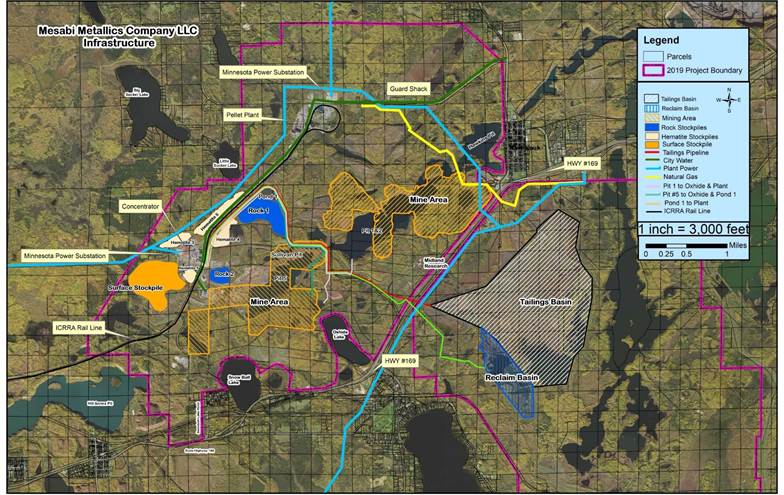
Source: Mesabi, 2025
| May 2026 |
| DRA Ref.: C10564-0000-PM-RPT-0010 |
| | S-K 1300 TECHNICAL REPORT SUMMARY MESABI METALLICS PROJECT Document # C10564-0000-PM-RPT-0010 – Rev. 0 |
| / Page 44 |
| 15.3 | Tailings Storage Facilities |
DRA Americas Inc. (DRA) has retained NewFields Canada Inc. (NewFields) to act as Qualified Professional and to prepare the relevant parts of Section 15 of the SK-1300 TRS for the Mesabi Metallics Project (Project), with specific focus on the design and operation of the Tailings Storage Facility (TSF). The technical summary is based on a review of the current status of TSF, the latest design of the facility, and independent evaluation by NewFields. This work involves the preparation and Qualified Professional (QP) sign-off to ensure compliance with SK-1300 technical reporting requirements. The scope also includes any necessary adjustments or additional evaluations required to achieve regulatory and/or safety requirements. This technical memorandum presents the summary of the findings and recommendations and serves as the write up for the SK-1300 Technical Report Summary.
| 15.3.1 | Facility Overview |
The Mesabi Project TSF is located within the Butler Stage 1 tailings basin, originally developed during Butler Taconite’s operations (1965–1985). The TSF encompasses approximately 1,370 acres (554 hectares), with an adjacent 230-acre (93- hectare) reclaim pond, forming the Mesabi tailings basin. The facility is designed to receive slurry tailings at approximately 38% solids content (w/w), pumped approximately 3.8 miles (6.2 km) from the concentrator via a 24-inch rubber-lined steel pipeline at a nominal rate of 4,000 m³/h. Tailings will be deposited via a perimeter pipeline at the dam crests using the upstream method of construction. Coarse tailings settle near the perimeter dams, while fines migrate to a central settling pond.
Clarified water flows through a decant structure into the reclaim pond, from which it is pumped back to the concentrator. The facility is designed as a zero-discharge system; seepage is collected via perimeter ditches and sumps and returned to the basin.
| 15.3.2 | Capacity and Life of Mine |
At the maximum proposed concentrate product 7 million metric tons per annum (Mmtpa), total slurry tailings production is approximately 16 Mmtpa, yielding 288 million metric tons (Mmt) over an 18-year operating life. Table 15.2 summarizes the projected dam elevations at key operational milestones.
| May 2026 |
| DRA Ref.: C10564-0000-PM-RPT-0010 |
| | S-K 1300 TECHNICAL REPORT SUMMARY MESABI METALLICS PROJECT Document # C10564-0000-PM-RPT-0010 – Rev. 0 |
| / Page 45 |
Table 15.2 – Projected Tailings Dam Elevations
| Estimated Dam Elevation | ||||||||
| Year | Tailing
Dam Elevation (feet) | Reclaim
Dam Elevation (feet) | ||||||
| 1 | 1,445-1,455 | 1,450 | ||||||
| 3 | 1,455-1,470 | 1,470 | ||||||
| 18 | 1,570 | 1,470 | ||||||
Beyond Year 18, additional capacity is available in the Butler Stage 2 basin (locally known as “O’Brien Lake”), located immediately east of the current TSF. Initial estimates indicate a storage capacity of approximately 1,200 Mmt using slurry deposition at a final dam elevation of 1,570 ft, equating to approximately 75 additional years of storage. Table 15.3 summarizes the combined capacity.
Table 15.3 – Summary of Tailings Basin Capacity
| Site | Dam
Elevation (feet) | Potential
Storage Volume (Mt) | ||||||
| Butler Stage 1 Basin (current TSF) | 1,570 | 288 | ||||||
| Butler Stage 2 Basin | 1,570 | 1,200 | ||||||
| Total | - | 1,488 | ||||||
| 15.3.3 | Dam Designs and Construction |
The TSF and reclaim pond designs meet the requirements of the Minnesota Department of Natural Resources (DNR). Mesabi has committed to conforming with the Global Industry Standard on Tailings Management (GISTM, ICMM 2020). The TSF dams will be raised using the upstream method of construction, with coarse tailings pushed by dozers to achieve outer slopes of approximately 4.5H:1V to 6H:1V.
Seepage and slope stability analyses were performed on representative cross sections and appropriate mitigation measures are planned to be implemented to meet the target factors of safety. The four (4) principal dam segments are:
| · | North Dam: Pervious embankment over legacy taconite and hematite tailings. A 2025 site characterization program using Cone Penetration Testing (CPT) and laboratory testing identified legacy fine tailings (slimes) susceptible to static and seismic liquefaction in the foundation. These studies led to a recommendation by Braun Intertec to construct buttresses at two sections of the North Dam. Optimization of buttress timing and sizing is ongoing. |
| May 2026 |
| DRA Ref.: C10564-0000-PM-RPT-0010 |
| | S-K 1300 TECHNICAL REPORT SUMMARY MESABI METALLICS PROJECT Document # C10564-0000-PM-RPT-0010 – Rev. 0 |
| / Page 46 |
| · | South Dam: Combines pervious coarse tailings with clay embankments and an upstream clay blanket where foundation conditions require enhanced seepage control. |
| · | West Dam: Pervious coarse tailings design connecting North and South Dams. Additional site investigation and foundation characterization are planned to confirm stability and refine the design. |
| · | Reclaim Dam: Downstream construction with inclined impervious zone, enabling future raises and effective seepage control. An emergency overflow spillway is incorporated per MN/DNR requirements to manage extreme storm events (6- to 72-hour probable maximum flood (PMF) events). |
To support the design, Mesabi completed a dam break assessment along six cross sections for both the ultimate and starter dam configurations, and a Potential Failure Mode Assessment (PFMA) to identify potential failure mechanisms and classify risks. These studies inform risk mitigation measures, emergency preparedness planning, and identified the preventative and mitigative controls required to meet the GISTM requirement and reduce risks to as low as reasonably practicable (ALARP). The current design is being updated to mitigate potential brittle failure modes in the foundation and embankment.
The design includes a downstream ditch and berm to intercept potential flood releases from a reclaim pond failure scenario and divert flows to the Butler Stage 2 basin, protecting downstream communities near Swan Lake. Instrumentation including vibrating wire piezometers (VWPs) and settlement plates are installed to monitor pore pressures and embankment performance, with Mesabi planning for near real-time monitoring within the TSF.
The dam design follows the Observational Approach: observed behaviour from planned instrumentation, future investigations, and construction records will be documented and applied to refine the design throughout the facility’s operating life.
| 15.3.4 | Path Forward |
Mesabi has established tailings governance procedures, defined roles and responsibilities, and updated the Operation, Maintenance, and Surveillance (OMS) manual to meet GISTM requirements. To achieve full conformance and reduce residual risks prior to commissioning, the following initiatives are planned:
| · | Optimization of tailings deposition plans to improve water management during early operations. |
| · | Optimization of the North Dam buttress designs to confirm timing requirements and refine sizing. |
| · | Additional site investigation along the West Dam to confirm foundation conditions and finalize the design. |
| May 2026 |
| DRA Ref.: C10564-0000-PM-RPT-0010 |
| | S-K 1300 TECHNICAL REPORT SUMMARY MESABI METALLICS PROJECT Document # C10564-0000-PM-RPT-0010 – Rev. 0 |
| / Page 47 |
| · | Personnel training and resource allocation to ensure the TSF has adequate staffing and management oversight. |
| · | Development of a robust knowledge base covering environmental and socio-economic conditions in potential dam breach assessment zones. |
| · | QA/QC protocols during and after construction to monitor performance and ensure compliance with safety and environmental standards. |
| 15.3.5 | Tailings Basin Water Management |
The tailings basin is a zero-discharge facility. Starter dams contain initial tailings discharge and runoff, directing flows toward the reclaim pond. All dams maintain adequate freeboard for the design storm event (6-hour PMP). An emergency spillway at the reclaim dam is designed to handle the difference between the 6-hour PMF storage and the 72-hour PMF event, routing overflow toward O’Brien Lake (Butler Stage 2 basin) with MN/DNR approval. Make-up water from pit dewatering supplements the reclaimed process water as needed to offset evaporation and tailings void losses.
| 15.4 | Water Management |
The Mesabi Project is a zero-discharge facility for surface water runoff and is permitted as such. Mesabi will capture stormwater runoff, tailings basin seepage, and pit infiltration water to service mining and processing water needs. Stormwater ditches and ponds constructed around stockpiles, buildings, and infrastructure collect and direct water to pumping locations that provide the needed water supply for operations.
A water balance has been prepared to evaluate the Project at 7.0 Mtpa pellets. The two (2) main production processes and water users at the facility include concentrating and pelletizing. Each of these processes play a role in the facility water balance, with the process water needs for each facility described in detail in the 2025 (Figure 15.3) Water Balance Update which builds upon previous water balance studies, notably from 2006, 2011, 2015, 2017, and 2024. Figure 15.2 also shows the general flow of water from existing and future mine pits to storage ponds to the process plants. Also shown on Figure 15.2 the water that is used to convey tailings to the tailings basin and the clarified water that is returned to concentrating.
The taconite concentrating and pelletizing process involves a large amount of water reuse and recycling, with water cycling from the concentrator to the pellet plant, to the tailings basin and reclaim pond, then back to the concentrator. The result is a relatively small net water demand to make concentrate and pellets since the primary losses from the system are largely due to process losses, evaporation, and trapping of water in settled tailings.
Water needs for the facility will be supplied through the storm water system and through water available in Pits 1 and 2 to maintain a zero-discharge facility over the life of the Project. Consistent with the 2007 FEIS, the Project will use storm water collected from impervious areas, surface water from Pit 1 and 2, recycled water from the reclaim basin, and storm water flowing into Pit 5 as the supply of water for operations. The water contained in Pits 1 and 2 will be used as a reservoir to supply water for facility processes when needed and to supply water to augment flows in Oxhide Creek after initial dewatering of Pit 5. With the commencement of mining activity, initial dewatering of Pit 5 will cease and any water that collects in Pit 5 will be pumped to the storm water system or to the plant for use in operations.
| May 2026 |
| DRA Ref.: C10564-0000-PM-RPT-0010 |
| | S-K 1300 TECHNICAL REPORT SUMMARY MESABI METALLICS PROJECT Document # C10564-0000-PM-RPT-0010 – Rev. 0 |
| / Page 48 |
Several strategies will be implemented to capture and distribute storm water to supply process needs and maintain a zero-discharge site. Site runoff from impervious surfaces around buildings will be collected in gravity ditches, conveyed to and stored in constructed ponds, and then pumped to the concentrator for re-use at a rate dictated by the expected industrial demand. Perimeter dikes and ditches will capture runoff from stockpiles and convey runoff to storm water ponds which were sized to provide live-storage exceeding the contributing 500-year runoff volume. Storm water will be temporarily stored in ponds before being pumped to industrial areas for use in operations. The zero-discharge condition was evaluated for the 500-year, 24-hour rainfall event which is larger than the event evaluated within the 2007 FEIS and 2007 NPDES application. All storm water infrastructure, including ponds, ditches, and culverts, were designed to safely capture, convey and store the runoff from a 8.34-inch rainfall over all Project areas impacted or disturbed by the proposed mining operation and stockpiles.
All storm water infrastructure, including ponds, ditches, and culverts, were designed to safely capture, convey, and store the runoff from all Project areas impacted or disturbed by the proposed mining operation and stockpiles.
Water supply from Pits 1 and 2 will supplement additional water demand needs when necessary. The Mesabi Project will partially disrupt the natural flows within the Oxhide Lake, Oxhide Creek and Swan Lake watersheds. Water must be removed from Pit 5 prior to commencement of mining. Water Appropriation Permits have been obtained for use of stormwater, initial dewatering of Pit 5, operational water use from Pit 5 and Pit 1, the transfer of water to Ann and Sullivan Pits for storage, and use of water from Ann and Sullivan Pits. Mesabi’s Water Appropriation Permit dictates that sufficient flow must be maintained in the downstream waters once mining is initiated in Pit 5, that water will come from Pit 1 and 2.
In years with average and below average precipitation, the annual water demand for the facility exceeds the annual water supplied by precipitation. When this occurs, the water demands will be met by appropriating water from the existing volume in Pits 1 and Ann Pit to supplement the water supplied by rainfall and runoff from the site.
Supplemental water demands from Pits 1 and 2 can be met by the water available in Pits 1 and 2 within the limits of the Water Appropriation Permit 2006-0433. This permit allows appropriations from Pits 1 and 2 not to exceed 5,000 gpm or 3,679 million gallons per year. Under normal climatic conditions, the maximum appropriation that would be required from Pits 1 and 2 from precipitation and existing storage would be below the permitted quantity.
| May 2026 |
| DRA Ref.: C10564-0000-PM-RPT-0010 |
| | S-K 1300 TECHNICAL REPORT SUMMARY MESABI METALLICS PROJECT Document # C10564-0000-PM-RPT-0010 – Rev. 0 |
| / Page 49 |
As part of the Water Appropriation Permit 2008-0067, a Stream Augmentation Plan must be submitted for Oxhide Creek at least one year prior to the completion of the dewatering of Pit 5. The augmentation plan was submitted May 8, 2024 and approved in June 2025. Based on the water balance analysis, adequate water sources are available to meet the requirements necessary for stream augmentation.
| 15.5 | Water Balance |
The facility consists of two (2) areas that process raw ore to finished pellets. These areas are the crushing and concentrating complex and the pellet plant processing complex. Each of these processes plays a role in the facility water balance. A water balance was prepared to evaluate the Project at 7.0 Mtpa pellets. The 2025 Water Balance Update () builds upon previous water balance studies, notably from 2006, 2011, 2015,2017, and 2024. Water supply and demands for the proposed mining operations will affect the overall water balance. As such, water supply and demand analyses were performed to identify changes in sources and fluxes of water.
The water balance considers baseline conditions discerned from existing data and measured site and local conditions, factoring an average determined from a reasonable range of observed conditions. The site relies on make up water from collected site runoff and accumulated storage in Pits 1 and 2 and will therefore be impacted by variations in rainfall. The analyses considered three (3) scenarios; average climatic conditions, wet year conditions, and dry year conditions based on recent climate data. The water balance analysis also considers a scenario that includes a mix of average, wet, and dry year conditions to convey a scenario reflecting natural variability over the proposed mine life.
The water balance calculations indicate a water supply deficit in the first five (5) years of plant operation under average conditions. The net water balance averages a deficit of 11 g/m over nine years of operation with a projected range of an average surplus of 1,151 g/m in wet years to an average deficit of 232 g/m in dry years. Water from Pit 5 and the storm water system will be fully utilized to supply the needed make-up water. Storm water system supply deficits will be overcome by withdrawing water from the storage in Pits 1 and 2.
The 2025 water balance results have not changed significantly from the 2006 water balance when the existing stored water volume in Pits 1 and 2 is used to balance water demand and supply as needed. Although the increase in production rate and the schedule for start-up of the facilities have increased average water demand, these water demands can be met by climatic water supply and the water available in Pits 1 and 2 within the limits of the Water Appropriation Permit 2006-0433.
| May 2026 |
| DRA Ref.: C10564-0000-PM-RPT-0010 |
| | S-K 1300 TECHNICAL REPORT SUMMARY MESABI METALLICS PROJECT Document # C10564-0000-PM-RPT-0010 – Rev. 0 |
| / Page 50 |
This permit allows appropriations from Pits 1 and 2 not to exceed 5,000 g/m or 3,679 million gallons per year. The appropriation for make up water from Pits 1 and 2 would be approximately 3,500 g/m when storm water supply is low. Appropriation to Oxhide Creek will average 1,340 g/m, as required in the DNR approved augmentation plan. The total expected appropriation from Pit 1 and 2 is less than 5,000 g/m allowed under the current permit. As part of the Water Appropriation Permit 2006-0433, a Stream Augmentation Plan submitted for Oxhide Creek was approved by the DNR in June 2025. This Stream Augmentation Plan complies with the recommended augmentation strategy described in the 2007 Final EIS. Based on this water balance analysis, adequate water sources will still be available to meet the requirements necessary for stream augmentation for Oxhide Creek.
| May 2026 |
| DRA Ref.: C10564-0000-PM-RPT-0010 |
| | S-K 1300 TECHNICAL REPORT SUMMARY MESABI METALLICS PROJECT Document # C10564-0000-PM-RPT-0010 – Rev. 0 |
| / Page 51 |
Figure 15.2 – General Flow of Water from Existing and Future Mine Pits
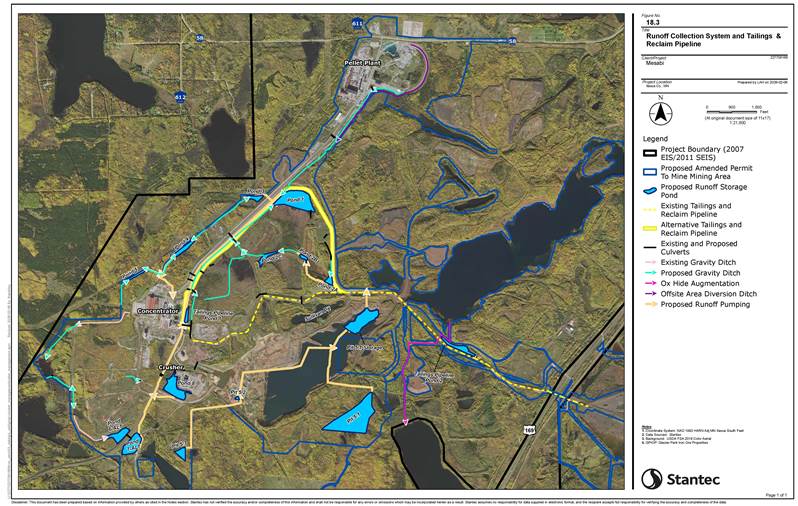
Source: Stantec, 2024
| May 2026 |
| DRA Ref.: C10564-0000-PM-RPT-0010 |
| | S-K 1300 TECHNICAL REPORT SUMMARY MESABI METALLICS PROJECT Document # C10564-0000-PM-RPT-0010 – Rev. 0 |
| / Page 52 |
Figure 15.3 – Water Balance Diagram
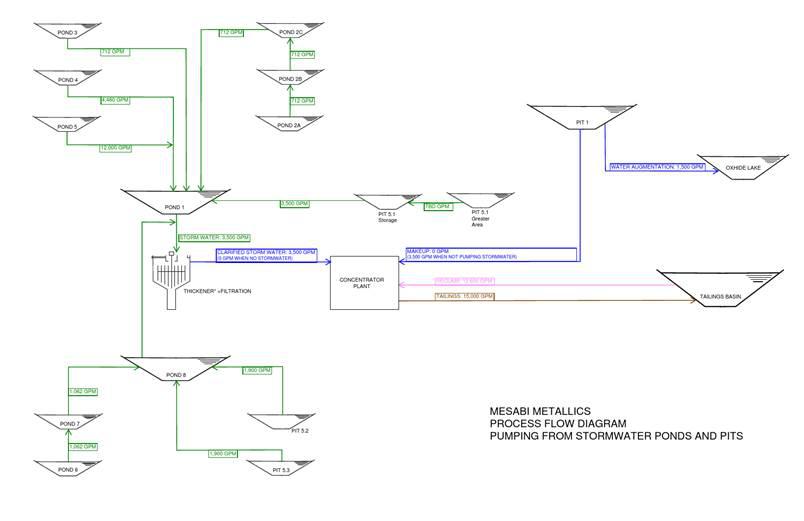
| May 2026 |
| DRA Ref.: C10564-0000-PM-RPT-0010 |
| | S-K 1300 TECHNICAL REPORT SUMMARY MESABI METALLICS PROJECT Document # C10564-0000-PM-RPT-0010 – Rev. 0 |
| / Page 53 |
| 16 | Market Studies |
DRA has relied upon industry studies provided to Mesabi by leading research and consultancy industry experts as well as bank consensus pricing (Bloomberg, April 2026) and the Baltic Exchange (Baltic Exchange, April 2026). This Section summarizes the key information regarding the Iron Ore industry overview and outlook. DRA has reviewed the content of the industry study presentation, bank consensus pricing and the Baltic Exchange pricing and believes that it provides a reasonable overview of the past and current iron ore industry as well as projections according to various recognized sources
Wood Mackenzie conducted a comprehensive iron ore market study along with an assessment of the Project specific competitiveness, in November 2024, to evaluate the global and regional iron ore markets, with a focus on pellet and DR pellet demand, supply, and pricing. The study indicates favorable market conditions for Mesabi’s planned DR grade pellet production, particularly in North America and the Middle East and North Africa (MENA) region.
Key findings included:
| · | EAF Steelmaking Shift: The global transition to Electric Arc Furnace (EAF) steelmaking will increase demand for scrap and Direct Reduced Iron (DRI). Green DRI, derived from high-quality iron ore, will become essential to meet future steelmaking standards. |
| · | Growing Demand for DRI: EAF steelmaking requires high-quality iron ore, with around 8% of current production ideal for DR-grade use. DRI demand is projected to grow at a Compound Annual Growth Rate (CAGR) of 1.6%, driven by the rise in EAF share, from 27% to 49% by 2050. |
| · | Mesabi’s Strategic Position: Mesabi offers competitive advantages in mining, processing, and transportation to port, positioning it as a key supplier of high-quality iron ore for DR grade pellet production. Mesabi’s production costs are the lowest in the US. |
| · | Iron Ore Pellet Demand: Global demand for DR grade pellets is expected to increase significantly, from 174 Mtpa to 420 Mtpa by 2050, driven by the shift towards DRI production, with North American DR grade pellet demand increasing by over 50%. |
| · | Pellet Production Growth: Pellet production will grow in line with demand, reaching 867 Mt by 2050. North America is expected to remain a key producer, with Mesabi playing a vital role in supplying DR-grade pellets. |
| · | Market Opportunity in North America: North America imports 20% of its pellet demand, offering Mesabi an opportunity to capture market share. Mesabi can meet the increasing DR grade pellet demand in the region. |
| · | Global Export Strategy: The MENA region will see the highest demand growth for DR grade pellets, while Europe’s demand will rise after 2040. Mesabi should prioritize domestic markets initially and focus on establishing a foothold in MENA and Europe to capitalize on export opportunities. |
| May 2026 |
| DRA Ref.: C10564-0000-PM-RPT-0010 |
| | S-K 1300 TECHNICAL REPORT SUMMARY MESABI METALLICS PROJECT Document # C10564-0000-PM-RPT-0010 – Rev. 0 |
| / Page 54 |
| 16.1 | FOB Pricing |
The long-term price for the DR grade pellets to be produced by Mesabi (FOB Louisiana) was forecast to be US$152.4 /t and is presented in Table 16.1. Based on a freight charge from site to Louisiana port estimated at US$32.0/t, results in the estimated US$ 120.4/t long-term price at site (FOB Mine) used as the assumption in the discounted cashflow model (DCF) in this report.
Table 16.1 – FOB Pricing Assumptions
| Price Component | Long
Term Pricing (US$/dry tonne* - Real) | |
| Benchmark | ||
| Sinter Fines 62% CFR China (Qingdao)* | 89.0 | |
| Sinter Fines 65%-62% Differential CFR China (Qingdao)** | 17.0 | |
| Pellet premium adjustment | ||
| Adjustment for DR Pellet Premium** | 62.0 | |
| Linear Fe adjustment | ||
| 65% to 68% Fe (Mesabi Expected Fe)*** | 4.9 | |
| VIU Quality adjustment | ||
| Adjustment for SIO2, Al2O3 and P** | 0.1 | |
| Freight adjustment - Real | ||
| China to Louisiana**** | 20.6 | |
| Mesabi Pellet FOB Louisiana | 152.4 | |
| Rail from Louisiana to FOB Mesabi Site | 32.0 | |
| Price FOB Mesabi Site | 120.4 | |
| * | Bank consensus Long Term pricing from April 15, 2026 (S&P April 2026) |
| ** | Wood Mackenzie Report 2024 |
| *** | Formula driven |
| **** | Baltic Exchange Route C3 adjusted for Index April 15, 2026); for year ended 2028, adjusted for moisture. |
| May 2026 |
| DRA Ref.: C10564-0000-PM-RPT-0010 |
| | S-K 1300 TECHNICAL REPORT SUMMARY MESABI METALLICS PROJECT Document # C10564-0000-PM-RPT-0010 – Rev. 0 |
| / Page 55 |
| 17 | Environmental Studies, Permitting, and Plans, Negotiations, or Agreements with Local Individuals or Groups |
When first proposed in 2007, an Environmental Impact Statement (EIS) was required before the issuing of permits to the Mesabi Project (Project). An EIS was required under both the Minnesota Environmental Policy Act (MEPA) and the National Environmental Policy Act (NEPA). In the case of a joint state/federal EIS in Minnesota, the Minnesota Department of Natural Resources (DNR) historically served as the co-lead agency in preparing the EIS and coordinates with other state agencies (e.g., Minnesota Pollution Control Agency [MPCA] and Minnesota Department of Health [MDH]) and participates with the U.S Army Corps of Engineers (USACE), as the lead federal agency, at any public meetings, public hearings, or other public involvement pursuant to NEPA and MEPA. The DNR is responsible for determining EIS adequacy pursuant to MEPA and prepares the state Record of Decision (ROD).
The USACE was the lead federal agency in preparing the joint state/federal EIS because the Project required a Clean Water Act (CWA) Section 404 permit. The USACE coordinates with other federal agencies including the U.S. Environmental Protection Agency (USEPA) and the U.S. Fish and Wildlife Service (USFWS), and consults with Native American Tribes, as appropriate and/or required by law. The USACE determines whether the EIS satisfies the NEPA and Section 404 requirements. The USACE is also responsible for preparing the federal ROD.
In August 2007, Minnesota Steel Industries (MSI) received a ROD from the DNR and the USACE for production of 4.1 Mtpa of pellets. The EIS identified topics of potential impact, such as physical impacts on air, water, wetlands, and wildlife resources, and the potential cumulative impacts with combined environmental effects of other projects. In October 2007, Essar Steel Minnesota LLC (ESML) bought MN Steel. Subsequently construction commenced on the 4.1 Mtpa plant facilities in October of 2008. In late 2009, ESML proposed modifications to State and Federal regulatory authorities to increase pellet production capacity to 7.0 Mtpa and improve environmental and processing efficiencies. In accordance with Minnesota Rules 4410.2300 through 4410.2800 and 4410.3000, the Project triggered the need for a MEPA Supplemental Environmental Impact Statement (SEIS) to the EIS. DNR published the SEIS and a Determination of Adequacy in December 2011.
In April 2024, Mesabi presented proposed Project modifications to state and federal regulatory agencies that were driven by a change in land and mineral control. Additionally, in October 2024, Mesabi proposed modifications to the Project description specific to water management including dewatering necessary to access the initial phase of mining. The DNR carried out an Environmental Review Needs Determination (ERND) to determine the need for a SEIS; concluding in March 2025 no need for a SEIS. Other key agency coordination underway in 2026 includes: amendments to the Section 404 and Wetland Conservation Act (WCA) Wetland Permits (joint permit application was submitted to USACE and DNR in December 2024, with follow up submittals in April and May 2025; DNR approval and USACE approval to be obtained in due course and does not impact the start of operations), and a Takings Permit to address amendments to the Project and updates to the DNR list of endangered and threatened species (permit application submitted to the DNR for review in December 2024; to be approved in due course prior to the taking of species which is proposed after one year of operation). Key environmental design features and mitigations of the Project include minimizing wetlands impact during Project planning and design, and energy efficiency improvements. The reclamation plan for the mined areas of the Project conforms to Minnesota Rule 6130 for taconite and iron ore mine land reclamations, and reclamation actions are summarized in Table 17.2. The permitting process will include creation of wetlands where feasible, to replace some of the wetland functions and values lost through mining activities.
| May 2026 |
| DRA Ref.: C10564-0000-PM-RPT-0010 |
| | S-K 1300 TECHNICAL REPORT SUMMARY MESABI METALLICS PROJECT Document # C10564-0000-PM-RPT-0010 – Rev. 0 |
| / Page 56 |
Table 17.1 – Mine Reclamation as Mitigation for Mining Impacts
| Mining Impact | Description | Reclamation Mitigation Practice | ||
| Erosion/sedimentation | Bare soil and sloped ground at stockpiles, tailings basin, etc. increase erosion and sedimentation potential | Temporary vegetation of inactive areas Regrading; Revegetation; Mulching. | ||
| Wetland impacts | Direct wetland losses resulting from the Project | Potential for creation of wetlands | ||
| Changes in vegetation cover types | Removal of existing vegetation during mining | Revegetation | ||
| Wildlife | Loss of wildlife habitat resulting from changes in cover types; Potential barriers to travel in steep-sloped areas created by mining. | Revegetation; Regrading. | ||
| Changes in surface water quality and quantity | Increase in runoff (and potential increase in pollutant transport in runoff) due to exposed, compacted soils and steep slopes at stockpiles | Regrading Revegetation Mulching | ||
| Air quality (dust) | Bare soil increases wind transport of soil particles | Watering or dust suppressant treatment of exposed soil to minimize dust in active mining areas, stockpiles and at the tailings basin; Temporary vegetation in inactive areas Revegetation of exposed soil. | ||
| Solid waste | Creation of waste rock stockpiles near mine pits and tailings storage at tailings basin | Regrading; Cover stockpiles with overburden prior to revegetation; Revegetation; Mulching. | ||
| Visual impacts | Mine features such as stockpiles and tailings basin are large, barren features in the landscape; Large industrial structures are visible in the landscape from relatively long distances. | Regrading; Revegetation; Razing structures after final closure of operations; Water-filled mine pits can be a visual amenity. |
| May 2026 |
| DRA Ref.: C10564-0000-PM-RPT-0010 |
| | S-K 1300 TECHNICAL REPORT SUMMARY MESABI METALLICS PROJECT Document # C10564-0000-PM-RPT-0010 – Rev. 0 |
| / Page 57 |
Forms and permits required by the USACE include the Section 404 permit, Section 7 of the Endangered Species Act, and Section 106 Determination for Cultural Resources. Forms and permits required by the DNR include Permit to Mine, Water Appropriation Permit, Dam Safety Permit, Wetland Conservation Act, Burning Permit, and Takings Permit. Forms and permits required by the MPCA include Air Emissions Facility Permit, Section 401 Water Quality Certification, State Disposal System Permit including Permits for Industrial Wastewater Discharge and Storm Water Discharge for Industrial Activity, General Storm Water Discharge Permit for Construction Activity, Storage Tank Permits, and Hazardous Waste Generator License. Forms and permits required by Itasca County and the City of Nashwauk include zoning permits, Building Permit, Shoreland Alteration Permit, and Zoning Variance. Status of statutory and regulatory approvals required for the Project are summarized in Table 17.2
Stantec reviewed the permits and permit amendments acquired by Mesabi. Based on Stantec review, these amendments are in compliance with the agency requirements, and these permits facilitate the operation of the Project at a nominal 7.00 MLTpa (7.11 Mtpa) DR grade pellet capacity. As applicable, Mesabi will maintain consultation with agencies to obtain future permit amendments or renewals.
| May 2026 |
| DRA Ref.: C10564-0000-PM-RPT-0010 |
| | S-K 1300 TECHNICAL REPORT SUMMARY MESABI METALLICS PROJECT Document # C10564-0000-PM-RPT-0010 – Rev. 0 |
| / Page 58 |
Table 17.2 – Present Status of Government Approvals
| Category | Permit | Regulatory Authority |
Expiration Date | Comments | ||||
| Air | 2026 - Major Modification Construction Air Permit and Air Emissions Operating Permit (06100067-005) | MPCA | March 3, 2031 | Issued March 2026 | ||||
| 2012 – Air Emission Permit (06100067-004) | MPCA | Superseded | ||||||
| 2009 – Air Emission Permit (06100067-003) | MPCA | Superseded | ||||||
| 2007 – Air Emission Permit (06100067-001) | MPCA | Superseded | ||||||
| Building | Zoning and Building Permits | Itasca County | Complete | |||||
| Zoning and Building (14-2008) Permits | City of Nashwauk | Complete | ||||||
| Domestic Sewer and Water Connection Approval | City of Nashwauk | Complete | ||||||
| Construction stormwater | 2007 – NPDES/SDS Construction Stormwater General Permit (MNR100001 – Facility C00023715) | MPCA | July 31, 2028 | |||||
| Endangered Species | 2024 – Takings Permit | DNR | Permit application submitted to DNR in December 2024. Approval is expected prior to the taking of plants which is planned for one year after operations begin. | |||||
| 2007 – Takings Permit (14484) | DNR | Work Completed | Previously issued Takings Permit completed. |
| May 2026 |
| DRA Ref.: C10564-0000-PM-RPT-0010 |
| | S-K 1300 TECHNICAL REPORT SUMMARY MESABI METALLICS PROJECT Document # C10564-0000-PM-RPT-0010 – Rev. 0 |
| / Page 59 |
| Category | Permit | Regulatory Authority |
Expiration Date | Comments | ||||
| National Pollutant Discharge | 2026 – NPDES/SDS Permit for Industrial Stormwater and Tailings Basin Operation (MN0068241) | MPCA | February 28, 2031 | Issued March 2026. |
| Elimination System (NPDES) | 2012 – NPDES/SDS Permit for Industrial Stormwater and Tailings Basin Operation (MN0068241) | MPCA | Superseded | Reissuance application submitted December 2024. | ||||
| 2008 – NPDES Permit (2007-12) (mod2008) | MPCA | Superseded | ||||||
| 2007 – NPDES/SDS Permit (2007-12) | MPCA | Superseded |
| Permit to Mine | 2026 – Amended PTM | DNR | Issued March 2026. | |||||
| 2016 – Amended PTM | DNR | Superseded | PTM amendment and assignment submitted in October 2025. | |||||
| 2015 – Essar non-substantial amended PTM for Pickerel Creek | DNR | Superseded | ||||||
| 2012 – Amended PTM for 7.0 MLtpa (7.11 Mtpa) | DNR | Superseded | ||||||
| 2007 – PTM | DNR | Superseded | ||||||
| Programmatic Agreement | Programmatic Agreement | USACE | ||||||
| Public Waters | 2015 – Public waters work Permit for Pickerel Creek (2015- 0367) | DNR | April 1, 2017 | Work requiring this permit is completed. If future work is planned in public waters a new permit would be required. | ||||
| Tailings Basin | Permit Extension Dam Safety Permit (2010-0360) | DNR | December 10, 2023 | Permit reauthorization submitted. Issued in July 2025. |
| May 2026 |
| DRA Ref.: C10564-0000-PM-RPT-0010 |
| | S-K 1300 TECHNICAL REPORT SUMMARY MESABI METALLICS PROJECT Document # C10564-0000-PM-RPT-0010 – Rev. 0 |
| / Page 60 |
| Category | Permit | Regulatory Authority |
Expiration Date | Comments | ||||
| Water Appropriations | 2025 – Water Appropriation Permit (2025-3260) | DNR | Issued January 2026. Use of stormwater from Alt Pond 7 for dust control and processing. | |||||
| 2025 - Water Appropriation Permits (2025-2007 and 2025-3008) | DNR | Issued January 2026. Use of stormwater for processing. | ||||||
| 2025 – Water Appropriation Permit (2025-0612) | DNR | Issued April 2025 and amended October 2025. Dewatering from Pit 5 to Pit1 and Ann Pit. | ||||||
| 2024 – Water Appropriation Permit Modification (2008-0067) | DNR | Amended December 2025. Use of water from Sullivan Pit. | ||||||
| 2011 – Water Appropriation Permit (2006-0433) | DNR | Amended in October 2025 to allow a combined withdrawal limit from Pits 1 and 2 for all use types. | ||||||
| 2011 – Water Appropriation Permit (2008-0065) | DNR | Amended in October 2025. Additional withdrawal from Pit 6 for dust control. | ||||||
| 2011 – Water Appropriation Permit (2008-0066) | DNR | Amended December 2025. Permit reactivation for withdrawal from Ann Pit for make-up water supply. | ||||||
| 2007 – MSI 4 Water Appropriation Permits (1977-2161) | Superseded | Permit 1977-2161 is still active and allows well withdrawal of 10 million gallons per year. |
| May 2026 |
| DRA Ref.: C10564-0000-PM-RPT-0010 |
| | S-K 1300 TECHNICAL REPORT SUMMARY MESABI METALLICS PROJECT Document # C10564-0000-PM-RPT-0010 – Rev. 0 |
| / Page 61 |
| Category | Permit | Regulatory Authority |
Expiration Date | Comments | ||||
| Wetlands | 2025 – Amendment to Section 404 Wetland Permit (2005-00546-JKA) | USACE | Submitted December 2024 with follow up submittal in May 2025. | |||||
| 2024 – Amendment to WCA Permit | DNR | Submitted December 2024 with follow up submittal in May 2025. Separate request for jurisdictional review of proposed incidental wetland impacts submitted in April 2025. | ||||||
| 2019 – Mesabi WCA Decision | DNR | Not Applicable (NA) | ||||||
| 2016 – Essar WCA Decision | DNR | NA | ||||||
| 2015 – Amended Section 404 Wetlands Permit (2005-00546-JKA) |
USACE | NA | ||||||
| 2015 – Pickerel Creek WCA Decision | DNR | NA | ||||||
| 2009 – Amended Section 404 Wetlands Permit (MVP-2005-546-JKA) |
USACE | NA | ||||||
| 2007 – Clean Water Act Section 404 Wetlands Permit (MVP 2005-546-JKA) | USACE | NA | ||||||
| 2007 – WCA Wetland Replacement Plan Approval | DNR | NA | ||||||
| 2026 – Clean Water Act Section 401 Water Quality Certification (MVP-2005-00546-SPK) | MPCA | NA | Certified in February 2026. | |||||
| 2007 – Clean Water Act Section 401 Water Quality Certification (CEMVP-OP-R, MVP-2005-546-JKA) | MPCA | Superseded | A new application was submitted in August 2025. | |||||
| Note: The permit list above does not reflect all wetland compliance activities | ||||||||
| Executed Utility License | License for Utility to Cross Public Waters | DNR | February 28, 2065 | term 50 years. | ||||
| May 2026 |
| DRA Ref.: C10564-0000-PM-RPT-0010 |
| | S-K 1300 TECHNICAL REPORT SUMMARY MESABI METALLICS PROJECT Document # C10564-0000-PM-RPT-0010 – Rev. 0 |
| / Page 62 |
| Category | Permit | Regulatory Authority |
Expiration Date | Comments | ||||
| FAA | 2015 – Notice of Proposed Construction or Alteration for Structures of Heights Greater than 200 feet(2015-AGL-13961-OE) | FAA | NA. “Determination of Not Hazard to Air Navigation” December 2015. Registration of building corners submitted August 2024. | |||||
| Hazardous waste license | Hazardous Waste Minimal Quantity Generator License (MNS000186106) | MPCA | Active. Hazardous waste generator reports to be submitted as needed based on hazardous waste generation estimates. | |||||
| Radioactive Materials | Radioactive Materials Registration | MDH | To be updated as necessary prior to operation. | |||||
| Burn Permit | Burning Permit (1030562331) | DNR | Inactive | NA. Mesabi has no plans to burn in the foreseeable future. | ||||
| Spill Prevention | Spill, Prevention, Control, and Countermeasure (SPCC) Plan | EPA | Active and up to date. | |||||
| Aboveground Storage Tanks | Aboveground Storage Tank Permit | MPCA | NA. To be applied for if needed. |
| May 2026 |
| DRA Ref.: C10564-0000-PM-RPT-0010 |
| | S-K 1300 TECHNICAL REPORT SUMMARY MESABI METALLICS PROJECT Document # C10564-0000-PM-RPT-0010 – Rev. 0 |
| / Page 63 |
| 18 | Capital and Operating Costs |
| 18.1 | Capital Cost Estimate |
The Project was relaunched by Mesabi in April 2023 with US$1.6 B invested historically as per audited financial statements and an additional US$ 260 M spent between 2023 and 2025.
Cost to Complete updates, Project Schedules and Project completion reports were provided to DRA directly by Mesabi.
The following information was provided directly by Mesabi and relied upon for the preparation of this Report:
| · | Capex spend to December 31, 2023 and the forecasted cost to complete (CTC) as of January 1, 2024. |
| · | Capex estimate for the vertical regrind mill (NRM) expansion |
| · | Capex spend updates on the base Project (all other work net of the VRM expansion) and CTC updates beyond December 31, 2023 have been provided to DRA by Mesabi. |
| · | Reconciliation of the Capex spent amounts for 2024 and 2025, and the subsequent calculation for the remaining CTC which was reported at US$516+ M as of January 1, 2026 by Mesabi, then reduced to US$482 by Mesabi after actual financing numbers were updated, and later amended up to US$571 M by DRA to account for integration of expansion costs into the base CTC as well as productivity rates of contractors and other work towards mechanical completion and commissioning). |
The Capex to finalize the construction of the Mesabi Project and bring it to commercial production as of January 1, 2026 is estimated by DRA at US$571 M based on detail completion costs provided by Mesabi construction team.
Details of the Capex Spent to December 31, 2025, as well as the remaining Cost to Complete as of January 1, 2026 is presented in Table 18.1.
| May 2026 |
| DRA Ref.: C10564-0000-PM-RPT-0010 |
| | S-K 1300 TECHNICAL REPORT SUMMARY MESABI METALLICS PROJECT Document # C10564-0000-PM-RPT-0010 – Rev. 0 |
| / Page 64 |
Table 18.1 – Capex Cost to Complete (January 1, 2026)
| Description | Total Capex Spent to Dec. 31, 2025 | Capex to Complete from Jan. 1, 2026 | Total Cost | |||||||||
| (US$ M) | (US$ M) | (US$ M) | ||||||||||
| EPC Costs | 1,481 | 461 | 1,942 | |||||||||
| Land Acquisition | 201 | 0 | 201 | |||||||||
| External Infrastructure/ Rail, etc. | 70 | 0 | 70 | |||||||||
| Mine Preparation Costs | 8 | 24 | 32 | |||||||||
| Other Costs (Inclusive of Owner’s Costs, IDC, Financing fee)* | 100 | 56 | 156 | |||||||||
| Contingency | - | 30 | 30 | |||||||||
| Total | 1,860 | 571 | 2,431 | |||||||||
| IDC = Interest during Construction * Project cost excludes Interest on shareholder loans | ||||||||||||
These estimates exclude any initial mobile equipment Capex as Mesabi plans to rent all mobile equipment, and these costs are included in Operating Costs (Opex).
The Owner’s costs and mining costs will be incurred by Mesabi throughout the construction period and up to the start of the operation of the pellet plant.
Owner’s costs will include the costs of Employee and Project Management, mine development in 2026 to prepare the mine for production (including haul road building, pit dewatering, test drilling, other preparatory works, and mine personnel training), as well as taxes and royalty payments, utilities, and payroll look forward from January 1, 2026.
| 18.2 | Operating Cost Estimate (Opex) |
The operating costs estimated by DRA as of January 1 2026 and shown in Table 18.2 include mining, concentrating, pelletizing, Sales, General and Administration (SG&A) costs, Health, Safety, and Environment (HSE) and other costs.
The sources of information used to develop the operating costs include in-house databases and external sources as well as costs provided by Mesabi related to Royalty, TSF, Taconite tax, employee salaries, mining equipment rental and operating costs as well as utilities costs (electricity, water and natural gas).
| May 2026 |
| DRA Ref.: C10564-0000-PM-RPT-0010 |
| | S-K 1300 TECHNICAL REPORT SUMMARY MESABI METALLICS PROJECT Document # C10564-0000-PM-RPT-0010 – Rev. 0 |
| / Page 65 |
Table 18.2 – Summary of LOM Operating Costs
| Description | Units*** | Value | ||||
| Mining* | US$/t Pellet | 13.45 | ||||
| Mining Equipment Rental | US$/t Pellet | 3.61 | ||||
| Crushing | US$/t Pellet | 1.50 | ||||
| Concentrating** | US$/t Pellet | 17.89 | ||||
| Pellet Plant | US$/t Pellet | 10.12 | ||||
| SG&A + HSE | US$/t Pellet | 3.56 | ||||
| Tailing Storage Facility | US$/t Pellet | 0.38 | ||||
| Royalty Third-Party | US$/t Pellet | 0.71 | ||||
| Royalty on Pellet Production | US$/t Pellet | 6.00 | ||||
| Total Operating Costs | US$/t Pellet | 57.22 | ||||
| Taconite Tax | US$/t Pellet | 3.43 | ||||
| Total Costs at Mine | US$/t Pellet | 60.64 | ||||
| * Can Differ from DCF model sum due to Capitalization of mine operations during pre-stripping ** Concentrating cost net of TSF Opex cost of 0.41 and 0.39 respectively. *** US$/t (= metric tons) Pellet | ||||||
| May 2026 |
| DRA Ref.: C10564-0000-PM-RPT-0010 |
| | S-K 1300 TECHNICAL REPORT SUMMARY MESABI METALLICS PROJECT Document # C10564-0000-PM-RPT-0010 – Rev. 0 |
| / Page 66 |
| 19 | Economic Analysis |
An economic analysis was completed for Mesabi using a discounted cashflow model (DCF) that is based on the LOM Plan which includes an average 6.85 MLTpa (6.96 Mtpa) of DR grade pellet production over a 23-year LOM plan. The average rate during 19 years at full production (excluding ramp up and ramp down years) is 7.25 MLTpa (7.36 Mtpa), which is limited by pellet plant capacity and concentrator throughput. The current permit limit of 7.00 MLTpa (7.11 Mtpa) of DR grade pellet production is expected to be amended by the end of Q3 2027 to 7.38 MLTpa (7.50 Mtpa), thus not being the limiting factor for annual pellet production thereafter.
A cash flow model was constructed on an annual basis in constant money terms (second quarter 2026). No provision is made for the effects of inflation. As required in the financial assessment of investment projects, the evaluation is carried out on a so-called “100% equity” basis, i.e., the debt and equity sources of capital funds are ignored. The model reflects the base case macro-economic and technical assumptions given in this Report.
The economic analysis takes into consideration mining of overburden stripping to begin in Q2 of 2026 and mechanical completion of the processing facilities is expected during the second half (H2) 2026.
The actual commencement date of commercial DR pellet production will depend on Mesabi’s ability to execute their Project’s mechanical completion plans and commissioning plans, which DRA believes will be aggressive.
DRA's professional assessment is estimating the mechanical completion of the Project during H2 2026, subject to continued construction productivity, construction activities meeting Mesabi’s guidance to DRA and construction closing per Mesabi’s guidance to DRA. Timely construction completion will allow for initial pellet production in Q4 2026.
It is also DRA's professional opinion that it will take this operation between 8 and 12 months from the start of commercial production to reach nameplate production and achieve production reflected in the economic models. The ramp-up time is subject to Mesabi's O&M team being hired, operationally ready, trained and resourced to achieve ramp-up within the time period estimated in DRA’s LOM Plan and DCF model.
For the purposes of the DCF, DRA’s economic model allocates pre-production mining and pre-production CTC Capex to the first three (3) quarters of 2026 (Period 0) with production ramp up assumed to start in Q4 2026 (Period 1). Periods from 2 to 29 in the DCF Model each represent a calendar year.
The main base case macro-economic assumptions used are given in Table 19.1.
| May 2026 |
| DRA Ref.: C10564-0000-PM-RPT-0010 |
| | S-K 1300 TECHNICAL REPORT SUMMARY MESABI METALLICS PROJECT Document # C10564-0000-PM-RPT-0010 – Rev. 0 |
| / Page 67 |
The long-term price for the DR grade pellets to be produced by Mesabi (FOB Louisiana) was forecast to be US$ 152.40 /t and is broken out in Table 16.1 Based on a freight charge from site to Louisiana port estimated at US $32.0/t, this results in the estimated US$ 120.40 /t long-term price at site (FOB Mine) used in the model.
Table 19.1 – Macro-Economic Assumptions
| Item | Unit | Base Case Value | ||||
| Iron Pellet Price (FOB mine) | US$/t | 120.4 | * | |||
| Discount Rate 1 | % per year | 8.0 | ||||
| Discount Rate 2 | % per year | 10.0 | ||||
| * Long-term price forecast | ||||||
There are three (3) levels of taxation for iron ore projects in the state of Minnesota. Results are presented both on a pre-tax and after-tax basis for corporate, occupational, and Taconite production taxes.
At the state level, there is the Taconite Production Tax, levied at the rate of US$ 3.427/t of taxable pellets (2026) which is applied in the model.
Occupation Tax is levied on mining business income (in lieu of the Corporation Franchise Tax applicable to regular businesses) at a rate of 2.45% of taxable income. At the federal level, there are Corporate Taxes (administered by the Internal Revenue Service (IRS)) levied at a flat rate of 21%.
The key technical assumptions used in the economic analysis are shown in Table 19.2. All financial results presented below are assessed pre-tax and after taxes including the Taconite Production Tax.
The discount rate variants used to determine the Net Present Value (NPV) are meant to represent typical weighted-average costs of capital.
The financial evaluation results (pre-tax and after tax) based on the technical evaluation is presented in Table 19.3.
The economic analysis results show a pre-tax NPV of US$3.21 B (at 8% discount rate) and US$2.55 B (at 10% discount rate) over a 23-year period, a pre-tax 49.8% IRR and a 2.03-year payback period, excluding prior investment into fixed assets from 2007-2025.
| May 2026 |
| DRA Ref.: C10564-0000-PM-RPT-0010 |
| | S-K 1300 TECHNICAL REPORT SUMMARY MESABI METALLICS PROJECT Document # C10564-0000-PM-RPT-0010 – Rev. 0 |
| / Page 68 |
The after-tax results indicate an NPV of US$2.63 B (at an 8% discount rate) and US$2.10 B at a 10% discount rate over a 23-year period, an after tax 47.3 % IRR and a 2.08 year payback period, excluding prior investment into fixed assets from 2007-2025.
Table 19.2 – Technical Assumptions, over 23-Year LOM
| Item | Unit | Value (01/01/2026) | ||||
| Operating Costs | ||||||
| Mining | ||||||
| Ore/Waste/Overburden Avg. | US$/Lt mined | 1.57 | ||||
| Mining Equipment Rental | US$/Lt mined | 0.42 | ||||
| Processing | ||||||
| Crushing | US$/t ore | 0.46 | ||||
| Concentrator (incl. Tailings Opex) | US$/t conc. | 18.36 | ||||
| Pellet Plant | US$/t pellets | 10.12 | ||||
| Other | ||||||
| Sales and G&A, with HSE | US$/t pellets | 3.56 | ||||
| Royalty Third-Party | US$/t pellets | 0.71 | ||||
| Royalty on Pellet Production | US$/t pellets | 6.00 | ||||
| Total Operating Cost, ex Taconite Tax | US$/t pellets | 57.22 | ||||
| Total Operating Cost, with Minnesota Taconite Production Tax (MTPT) | US$/t pellets | 60.64 | ||||
| Capex to Complete (January 1, 2026) | US$ M | 571 | ||||
| Mine Life | Years | 23 | ||||
| Ore (Mill Feed) | LT | 515.5 | ||||
| Ore (Mill Feed) | Mt | 523.8 | ||||
| Average Grade Mill Feed | % Mag Fe | 21.13 | ||||
| Average Pellet Weight Recovery | % | 29.79 | ||||
| Average Stripping Ratio | t/t | 1.66 | ||||
| Pellet Production | Mt | 160.1 | ||||
| Sustaining Capital Costs – Tailings Dam * | US$ M | 86.2 | ||||
| Sustaining Capital Costs – Processing / Civils / Other * | US$ M | 353.4 | ||||
*including 20% contingency
| May 2026 |
| DRA Ref.: C10564-0000-PM-RPT-0010 |
| | S-K 1300 TECHNICAL REPORT SUMMARY MESABI METALLICS PROJECT Document # C10564-0000-PM-RPT-0010 – Rev. 0 |
| / Page 69 |
Table 19.3 – Financial Analysis Results
| Value | ||||||
| Item | Unit | (US$M) | ||||
| Total Revenue | US$ M | 19,272 | ||||
| Total Operating Costs | US$ M | 9,159 | ||||
| Total Construction Capital Cost to Complete* | US$ M | 538 | ||||
| Total Mine Preparation Capex | US$ M | 33 | ||||
| Total Cost to Complete Capex (Pre-production 2026) | US$ M | 571 | ||||
| Total Sustaining Capital Costs – Process** | US$ M | 353 | ||||
| Total Sustaining Capital Costs – TSF** | US$ M | 86 | ||||
| Total Sustaining Capex Incl. Closure | US$ M | 480 | ||||
| Total Pre-tax Cash Flow | US$ M | 9,063 | ||||
| Total After-tax Cash Flow | US$ M | 7,264 | ||||
| Total Taxes Paid | US$ M | 1,799 | ||||
| Pre-tax Payback Period | Years | 2.03 | ||||
| Pre-tax Net Present Value 8% | US$ M | 3,206 | ||||
| Pre-tax Net Present Value 10% | US$ M | 2,553 | ||||
| Pre-tax Internal Rate of Return (IRR)*** | % | 49.8 | ||||
| After-Tax Payback Period | Years | 2.08 | ||||
| After-Tax Net Present Value 8% | US$ M | 2,631 | ||||
| After-Tax Net Present Value 10% | US$ M | 2,104 | ||||
| After-Tax Internal Rate of Return (IRR)*** | % | 47.3 | ||||
* Including mining Capex but excluding mobile equipment Capex.(Capex Applied at Dec. 31, 2026)
** Including 20% Contingency
*** Projected IRR does not take into account $1.86 B of prior investment from 2007-2025.
| 19.1 | Discounted Cashflow Model |
The DCF (Table 19.4) is based on the LOM Plan in Section 13 (Table 13.1). The economic analysis results in this section are based upon the DCF.
| May 2026 |
| DRA Ref.: C10564-0000-PM-RPT-0010 |
| | S-K 1300 TECHNICAL REPORT SUMMARY MESABI METALLICS PROJECT Document # C10564-0000-PM-RPT-0010 – Rev. 0 |
| / Page 70 |
Table 19.4 – Discounted Cashflow Model
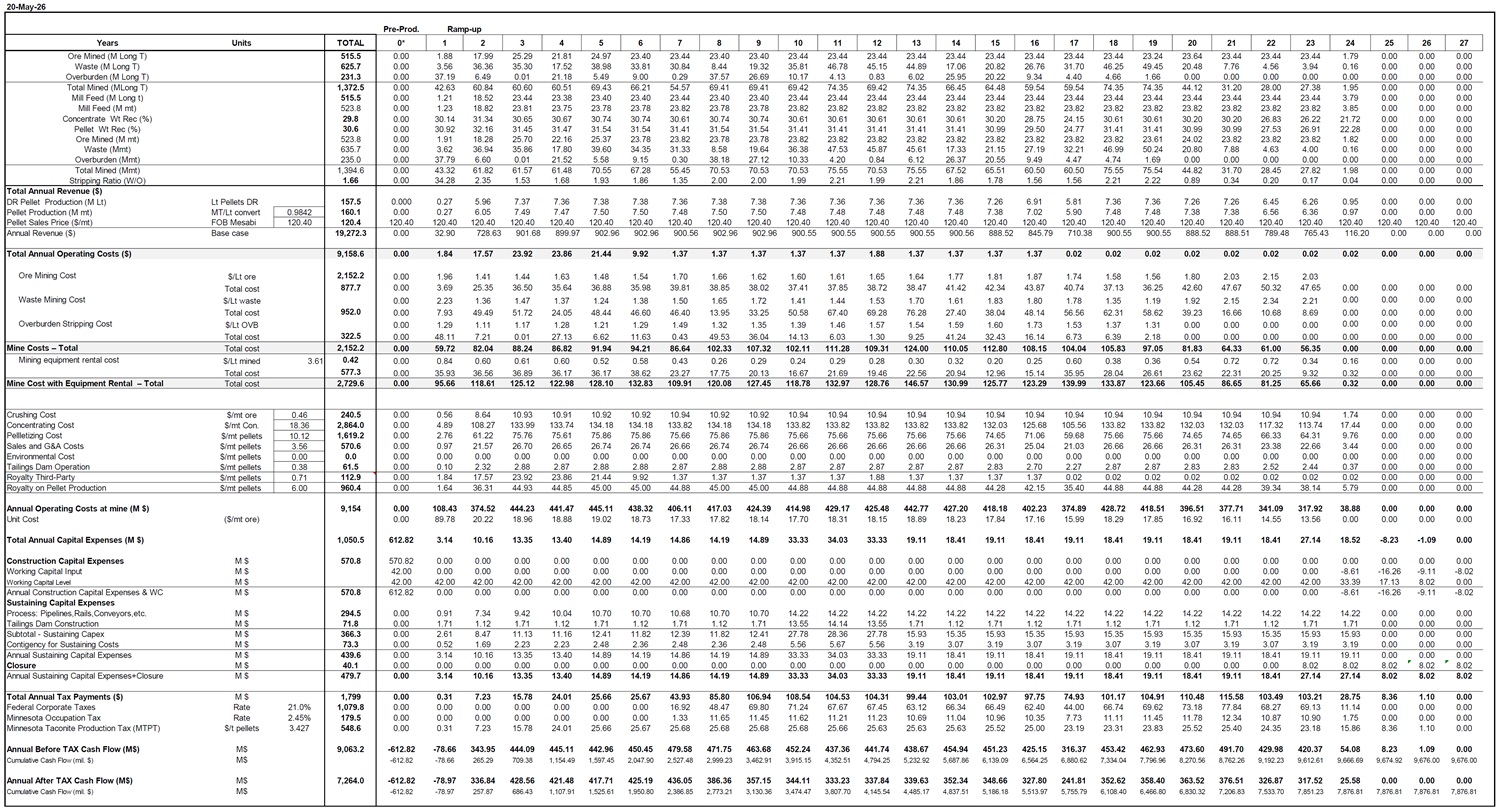
| May 2026 |
| DRA Ref.: C10564-0000-PM-RPT-0010 |
| | S-K 1300 TECHNICAL REPORT SUMMARY MESABI METALLICS PROJECT Document # C10564-0000-PM-RPT-0010 – Rev. 0 |
| / Page 71 |
| 20 | Adjacent Properties |
Currently, there are six (6) taconite processing facilities and open pit mines operating on the Mesabi Range in northern Minnesota. These taconite facilities are spread out along the strike of the iron formation, as illustrated in Figure 20.1.
Mesabi is expected to become the only major standalone merchant DR-grade pellet producer in the United States, although other U.S. iron ore companies such as U.S. Steel and Cleveland-Cliffs also produce or can produce DR-grade pellets, they are used primarily for integrated or strategic internal use.
Table 20.1 presents the approximate designed Pellet Capacity for each of the six (6) taconite mines near to the Project along with the actual tonnes of taconite pellets produced from each of the mines as reported by the Minnesota State Department of Revenue for 2018 to 2025. The numbers have not been independently verified by the QP, but are assumed to be accurate.
Table 20.1 – Taconite Pellet Production Tonnage by Mine (2018-2025)
| Mine | Hibbing Taconite | Keewatin Taconite | Minntac | Minorca | North-shore | United Taconite | Total | |||||||
| Owner | 15% US Steel /85% Cleveland Cliffs | Nippon Steel via US Steel | Nippon Steel via U.S. Steel | Cleveland-Cliffs | Cleveland-Cliffs | Cleveland-Cliffs | ||||||||
| Pellet Type | Mostly BF (very limited DR flexibility) | Mixed BF & DR | ~100%BF | ~100%BF | Primarily DR grade | Mostly BF (small DR flexibility) | ||||||||
| Year | MLT | MLT | MLT | MLT | MLT | MLT | MLT | |||||||
| Approx. Design Pellet Capacity | ~8.0-9.1 | ~6.0 | ~15.0-16.0 | ~2.8-3.0 | ~6.0-6.2 | ~5.0-5.4 | n/a | |||||||
| 2018 | 7.48 | 5.18 | 13.37 | 2.61 | 5.48 | 4.98 | 39.10 | |||||||
| 2019 | 7.18 | 5.12 | 12.13 | 2.56 | 5.02 | 5.08 | 37.09 | |||||||
| 2020 | 5.26 | 1.79 | 11.82 | 2.62 | 3.66 | 5.01 | 30.15 | |||||||
| 2021 | 7.33 | 5.30 | 13.46 | 2.67 | 4.84 | 5.09 | 38.69 | |||||||
| 2022 | 5.93 | 5.25 | 12.65 | 2.35 | 1.17 | 4.54 | 31.90 | |||||||
| 2023 | 6.53 | 4.88 | 13.01 | 2.69 | 3.07 | 4.98 | 35.16 | |||||||
| 2024 | 5.23 | 5.08 | 13.04 | 2.59 | 3.88 | 4.86 | 34.67 | |||||||
| 2025 | 2.67 | 4.99 | 12.44 | 0.54 | 3.19 | 4.70 | 28.53 |
| May 2026 |
| DRA Ref.: C10564-0000-PM-RPT-0010 |
| | S-K 1300 TECHNICAL REPORT SUMMARY MESABI METALLICS PROJECT Document # C10564-0000-PM-RPT-0010 – Rev. 0 |
| / Page 72 |
Mesabi is expected to become the only major standalone merchant DR-grade pellet producer in the United States, although other U.S. iron ore companies such as U.S. Steel and Cleveland-Cliffs also produce or can produce DR-grade pellets, they are used primarily for integrated or strategic internal use.
As a whole, Minnesota’s pellet production consists of 80-85% BF grade and 15-20% DR grade pellets (prior to Mesabi production which is projected to bring the DR grade fraction up to 30-40% over time).
The nearest adjacent mining property is Keewatin Taconite (Keetac), which was owned and operated by United States Steel Corp up until June 2025 when it was acquired by Nippon Steel Corporation. This operation is located at (47.4125°N, 93.0613°W). National Steel Company originally constructed the Keetac mining operation at a design capacity of 4.8 Mtpa, with the first pellet production in 1967. This operation is based off single stage crushing, a SAG mill grinding circuit, with secondary ball mill grinding, magnetic separation, balling line and grate kiln induration, producing 1% limestone flux pellets. Keetac’s plant is located 9.2 miles along the strike of the Biwabik Iron Formation, with their nearest mining operation roughly 7.0 miles from Mesabi’s proposed mine.
Hibbing Taconite Company (Hibtac) is the next closes operation along the strike of the formation, located between the cities of Hibbing and Chisholm at (47.4786°N, 92.9631°W). The operation is presently managed by Hibbing Taconite, which is a JV between Cleveland-Cliffs (85.3%) and US Steel Corp (14.7%). Hibbing Taconite was the last operation to be built on the Range during the construction boom of the 60s and 70s and shipped their first pellets in 1976. The operation is based off a single stage primary crushing, AG mill grinding, magnetic separation, balling circuit and straight grate pellet furnace. The Hibtac plant is located 14.8 miles from the Project site, with the mining operations ranging from 12.3 to 16.5 miles from the Mesabi mine site.
Minnesota Ore Operations (Minntac) is situated just north of Mountain Iron at (47.5640°N, 92.6318°W). Minntac is wholly owned and operated by United States Steel Corp. with the first shipment of pellets occurring in 1967. The plant is an early taconite processing design, with a considerable amount of redundancy in the system. The original operation was an open pit rail system, which later transitioned into open pit truck haulage. The facility is based on a primary crushing, supported by secondary crushing, rod mills, ball mills, magnetic separation, flotation cells, balling circuit, pellet induration, producing a flux pellet. The plant is approximately 32 miles from the Mesabi Project site, with mining ranging from 27.5 to 33.5 miles from the Mesabi mine.
| May 2026 |
| DRA Ref.: C10564-0000-PM-RPT-0010 |
| | S-K 1300 TECHNICAL REPORT SUMMARY MESABI METALLICS PROJECT Document # C10564-0000-PM-RPT-0010 – Rev. 0 |
| / Page 73 |
Figure 20.1 – Mesabi Range – Location of the Mining Operations and Typical Geological Cross-Section
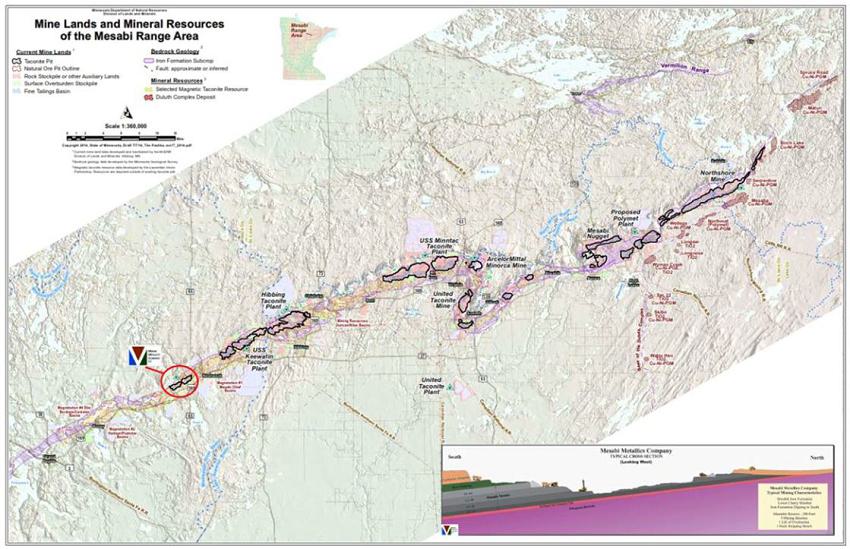
Source: Minnesota Department of natural Resources - Department of Lands and Minerals, 2023
| May 2026 |
| DRA Ref.: C10564-0000-PM-RPT-0010 |
| | S-K 1300 TECHNICAL REPORT SUMMARY MESABI METALLICS PROJECT Document # C10564-0000-PM-RPT-0010 – Rev. 0 |
| / Page 74 |
| 21 | Other Relevant Data and Information |
Project completion status updates and Project schedules beyond December 31, 2023 have been provided to DRA by Mesabi.
| 21.1 | Project Status as of January 1, 2026 |
As of the January 1, 2026, the Project is significantly advanced, and site construction is well under way. A substantial portion of the equipment has been procured and delivered. Detailed engineering is at or nearing completion.
Table 21.1 presents the advancement status of various Project areas as reported from Mesabi to DRA as of January 1, 2026.
These values have not been fully reconciled by DRA.
Table 21.1 – Project Completion Status Reported by Mesabi (January 1, 2026)
| Description | Status January 1, 2026 | |||
| Design | 97.3 | % | ||
| Procurement | 96.0 | % | ||
| Construction | 74.0 | % | ||
| Total | 85.5 | % | ||
The overall construction completion as reported by the Mesabi Construction Team to DRA for January 1, 2026 is presented in Table 21.2. These values are approximate and have not been fully reconciled by DRA.
Table 21.2 – Overall Construction Completion Reported by Mesabi (as of January 1, 2026)
| Particulars | Unit | Overall Scope | Completed Qty Jan 1 2026 | %
Completed Qty Jan 1 2026 | Balance Qty Jan 1 2026 | |||||||||||||
| Concrete | CYD | 121,838 | 119,930 | 98 | % | 1,908 | ||||||||||||
| Structure | MT | 35,312 | 29,329 | 83 | % | 5,982 | ||||||||||||
| Sheeting | SQ.FT | 2,242,503 | 1,371,994 | 61 | % | 870,509 | ||||||||||||
| EPDM | SQ.FT | 316,510 | 227,563 | 72 | % | 88,947 | ||||||||||||
| Piping | ||||||||||||||||||
| Piping Erection | IM | 848,461 | 339,221 | 40 | % | 509,240 | ||||||||||||
| HDPE Pipe works | LF | 99,198 | 74,510 | 75 | % | 24,688 | ||||||||||||
| May 2026 |
| DRA Ref.: C10564-0000-PM-RPT-0010 |
| | S-K 1300 TECHNICAL REPORT SUMMARY MESABI METALLICS PROJECT Document # C10564-0000-PM-RPT-0010 – Rev. 0 |
| / Page 75 |
| Particulars | Unit | Overall Scope | Completed Qty Jan 1 2026 | %
Completed Qty Jan 1 2026 | Balance Qty Jan 1 2026 | |||||||||||||
| RCC Pipe works | LF | 4,874 | 0 | % | 4,874 | |||||||||||||
| PVC Pipe works | LF | 10,108 | 0 | % | 10,108 | |||||||||||||
| Testing & Other works | LF | 264,843 | 0 | % | 264,843 | |||||||||||||
| Pumps, Compressors, etc. | MT | 1,538 | 850 | 55 | % | 688 | ||||||||||||
| Equipment | MT | 15,483 | 8,349 | 54 | % | 7,134 | ||||||||||||
| Tech Structure | MT | 7,649 | 3,366 | 44 | % | 4,283 | ||||||||||||
| De-Dusting | MT | 4,971 | 1,202 | 24 | % | 3,769 | ||||||||||||
| Electrical | Mhrs | 294,798 | 190,244 | 65 | % | 104,554 | ||||||||||||
| Instrumentation | Mhrs | 162,658 | 17,068 | 10 | % | 145,590 | ||||||||||||
| HVAC | SQ.FT | 115,350 | 1,650 | 1 | % | 113,700 | ||||||||||||
| Fire Fighting - Building | SQ.FT | 213,933 | 3,200 | 1 | % | 210,733 | ||||||||||||
| Fire Fighting - Conveyor | SQ.FT | 15,443 | 0 | % | 15,443 | |||||||||||||
| Refractory | MT | 5,196 | 0 | % | 5,196 | |||||||||||||
| CMU Walls | SQ.FT | 174,944 | 110,768 | 63 | % | 64,176 | ||||||||||||
| Finishing | Mhrs | |||||||||||||||||
| Tailing Dam | Mhrs | |||||||||||||||||
| Railwork | LF | 8,353 | 0 | % | 8,353 | |||||||||||||
| General Earth Works | CYD | 752,434 | 649,934 | 86 | % | 102,500 | ||||||||||||
| Miscellaneous | Mhrs | |||||||||||||||||
| May 2026 |
| DRA Ref.: C10564-0000-PM-RPT-0010 |
| | S-K 1300 TECHNICAL REPORT SUMMARY MESABI METALLICS PROJECT Document # C10564-0000-PM-RPT-0010 – Rev. 0 |
| / Page 76 |
| 22 | Interpretation and Conclusions |
| 22.1 | Mineral Resources and Reserves |
The Mesabi Project is a low-grade magnetite iron deposit of the Lake Superior type Banded Iron Formation. This type of iron formation consists principally of alternating bands of quartz (chert) and iron oxides (magnetite, hematite and martite, a hematite pseudomorph after magnetite). This type of iron formation has been the principal source of iron throughout the world.
Inclusive of Reserves, the Project has Mineral Resources including 50% Mesabi – 50% Cliffs parcels under litigation are estimated at 730.1 million long tons of Indicated category resources, and 29.5 million long tons in inferred category. Exclusive of Reserves, the Project’s mineral Resources including 50% Mesabi – 50% Cliffs parcels under litigation are estimated at 214.5 million long tons of Indicated category resources, and 29.5 million long tons in inferred category.
Mineral Reserves, excluding the 50% Mesabi – 50% Cliffs parcels and also excluding the three (3) properties owned 100% by Cliffs, are estimated at 515.5 million long tons in the probable category with an average grade of 21.1% MagFe, 29.79% Weight Recovery and 1.8% Concentrate SiO2.
The overall stripping ratio is 1.66 to 1. These mineral reserves form the basis for the 23 year mine plan.
The classification of the mineral resource and mineral reserves for the Mesabi Project is based on the geological and grade continuity of the iron deposit. The SEC Regulation S-K 1300 (Subpart 229.1300) requirements for disclosures is aligned with the S-K 1300. which have been used as the guide for the resource and reserves classification.
| 22.2 | Project Infrastructure |
It is the QP’s interpretation that the current on-site infrastructure in addition to planned infrastructure including infrastructure under construction will be adequate to support the start of mining as per the LOM plan in H1 2026, with first pellets produced in H2 2026 and commercial pellet production beginning ramp up in Q4 2026.
| 22.3 | Market Studies |
Based on the market study prepared by Wood Mackenzie, the Mesabi Project is positioned in a transitioning global steel industry that is shifting towards Electric Arc Furnace (EAF) steelmaking and increased demand for high-quality iron ore products. This transition is expected to drive substantial growth in demand for Direct Reduced Iron (DRI) and DR-grade pellets, particularly in North America.
| May 2026 |
| DRA Ref.: C10564-0000-PM-RPT-0010 |
| | S-K 1300 TECHNICAL REPORT SUMMARY MESABI METALLICS PROJECT Document # C10564-0000-PM-RPT-0010 – Rev. 0 |
| / Page 77 |
| 22.4 | Impact on Community |
The economic impact of resuming construction activity and further permanent facility operations personnel will be welcomed in the region, and the production of highly concentrated iron ore pellets will provide substantial, consistent, and profitable operations for the owner. Organized opposition to mining in Minnesota is acknowledged and will be monitored by Mesabi and means for addressing will be evaluated and facilitated where appropriate.
| 22.5 | Permits |
The Project is compliant with federal, state, and local requirements and Mesabi holds the necessary environmental permits to facilitate the operation of the Project. Refer to Section 17, Table 17.2 for status of permits and approvals.
As applicable, Mesabi will maintain consultation with agencies to obtain future permit amendments or renewals.
| 22.6 | Capex |
Costs to complete the Project as of January 1, 2026, is estimated by DRA to be US$571 M.
As of January 1, 2026 the Project has been funded with 100% equity.
| 22.7 | Opex |
Mesabi is expected to be a competitive producer of pellets not only on the iron range but globally with the cost of production estimated at US$57.22/t DR grade pellet (inclusive of US$6.71/t for royalties, exclusive of taconite tax); and US$60.64/t DR grade pellet once the US$3.427/t taconite tax has been applied.
| 22.8 | Financials |
The economic analysis results show a pre-tax NPV of US$3.21 B (at 8% discount rate) and US$2.55 B (at 10% discount rate) over a 23-year period, a pre-tax 49.8% IRR and a 2.03-year payback period, excluding prior investment into fixed assets from 2007-2025.
The after-tax results indicate an NPV of US$2.63 B at an 8% discount rate and US$2.10 B at a 10% discount rate over a 23-year period, a pre-tax 47.3% IRR and a 2.08-year payback period, excluding prior investment into fixed assets from 2007-2025.
| May 2026 |
| DRA Ref.: C10564-0000-PM-RPT-0010 |
| | S-K 1300 TECHNICAL REPORT SUMMARY MESABI METALLICS PROJECT Document # C10564-0000-PM-RPT-0010 – Rev. 0 |
| / Page 78 |
| 22.9 | Opportunities |
| 22.9.1 | Geology |
Potential Resource - Upper Cherty Member Hematite
A historical resource estimate performed in 2012 for Essar (owner of Mesabi) identified Mineral Resources of hematite in the Upper Cherty 2 (UC2) layer.
A review of the estimation procedures used in 2012 indicate that grade defined as hematite refers to total iron and is not based on an approach applied to quantify the actual hematite proportion among other iron-bearing minerals present in the UC2 unit. Consequently, these historical resources should be reclassified to an opportunity level pending further investigations to quantify the actual hematite proportion in the UC2 at Mesabi.
Table 22.1 presents the “Upper Cherty Member Hematite Resources” as defined historically in 2012, which represents non-resource potential tonnes of hematite that may in the future be converted to resource should the processing for its economic extraction prove feasible.
Table 22.1 – Upper Cherty Member Hematite Resources as historically defined in 2012*
| Resource Categories | Metric
Tonnes (x 1,000 mt) | TOTFE
(%) | ||||||
| Measured | 25,900 | 31.60 | ||||||
| Indicated | 264,408 | 30.65 | ||||||
| Measured + Indicated | 290,308 | 30.74 | ||||||
| Inferred | 62,523 | 30.20 | ||||||
| *This is presented as historic as it no longer satisfies current S-K 1300 requirements for resource classification. | ||||||||
| 22.9.2 | Potential Resource – Stockpiles |
The reported tonnage of hematite in five (5) stockpiles has historical origins from Cone Rejects from the "Natural Ore mining" period. Table 22.2 summarizes the tonnage and grade results for these stockpiles. Volumetrics calculations were performed using triangulation, with a density of 15 ft³/LT applied to convert volume into tonnages.
Sonic drilling reached a maximum depth of 15 m, with samples collected for analysis to determine the total iron. Composite samples were prepared by combining both materials obtained from the sonic drilling and material collected along the perimeter of the piles, which were subsequently sent to COREM for metallurgical testwork. The results from the testwork completed at COREM laboratory indicate successful recovery of hematite; however, DRA has not yet reviewed the COREM report. Further characterization work is recommended to evaluate the economic potential of the hematite contained in these stockpiles.
| May 2026 |
| DRA Ref.: C10564-0000-PM-RPT-0010 |
| | S-K 1300 TECHNICAL REPORT SUMMARY MESABI METALLICS PROJECT Document # C10564-0000-PM-RPT-0010 – Rev. 0 |
| / Page 79 |
Table 22.2 – Cone Rejected Stockpiles Tonnage Summary
| Crude Analysis Range | ||||||||||||
| Description | Tonnage (Million MT) | TotFe (%)* | TotFe (%) | |||||||||
| Harrison Stockpile #6 | 3.0 | 46.94 | - | |||||||||
| Harrison Stockpile 6A | 0.3 | - | - | |||||||||
| MacKillican Stockpile #14 | 0.9 | 37.21 | 32.96 | |||||||||
| Patrick-Olson Stockpile #8 | 0.2 | - | - | |||||||||
| Patrick Stockpile #10 | 4.9 | 42.26 | 36.60 | |||||||||
| Total | 9.3 | - | - | |||||||||
| * ESML’s grade samples | ||||||||||||
| 22.9.3 | Mining Methods |
DRA recommends that Mesabi study the implementation of the following cost reduction opportunities:
| · | Implementation of a trolley-assist system or a diesel-electric truck fleet. |
| · | Assess the feasibility of autonomous trucks, drills, and dozers. |
| · | Conduct additional characterization studies on the hematite mineralization. |
| · | Consider stockpiling and processing lower-grade ore with a MagFe content below the 14% cut-off grade. |
| 22.9.4 | Recovery Methods |
A significant portion of the iron mineralization at the Mesabi properties occurs within the oxidized zone, where iron is predominantly associated with goethite. This mineralogical characteristic may present an opportunity to evaluate some of the available processing methods aimed at recovering iron associated with goethite and improving the global iron recovery.
One potential approach is Hydrogen Mineral Phase Transformation (HMPT), a reduction process in which hydrogen gas is used to convert goethite (and/or hematite) to magnetite, thereby enabling recovery using LIMS. The HMPT reaction for the conversion of goethite to magnetite is presented below:
6FeO·OH + H₂ → 2Fe₃O₄ + 4H₂O
| May 2026 |
| DRA Ref.: C10564-0000-PM-RPT-0010 |
| | S-K 1300 TECHNICAL REPORT SUMMARY MESABI METALLICS PROJECT Document # C10564-0000-PM-RPT-0010 – Rev. 0 |
| / Page 80 |
The applicability of HMPT to Mesabi mineralization has not been demonstrated and would require metallurgical testwork to assess technical feasibility, recovery performance, and associated costs.
An alternative opportunity may involve oxidative calcination, whereby goethite is thermally converted to hematite. This transformation has the potential to enhance recovery through Wet High-Intensity Magnetic Separation (WHIMS), improve flotation performance, and reduce challenges associated with crystalline water and high loss on ignition (LOI) in goethite-rich material. The oxidative calcination reaction is presented below:
2FeO·OH → Fe₂O₃ + H₂O
The suitability of oxidative calcination for the Mesabi mineralization has not been established and would require confirmatory metallurgical testwork and evaluation of economic and operational considerations.
| 22.9.5 | Capex and Opex |
There are opportunities to further reduce the operating cost estimate by doing a detailed investigation of backfilling optimisation of pits with waste in order to minimize the haul distance for waste and to reduce vertical elevation change from load to dump location.
| 22.9.6 | Market Studies and Contracts |
Key market opportunities for Mesabi include:
| · | Capturing a share of the ~20% imported pellet demand in North America. |
| · | Targeting growing DR grade pellet demand in the Middle East and North Africa (MENA) region. |
| · | Positioning for potential future demand growth in Europe, where DR grade pellet demand is expected to increase from 2040 onwards. |
| 22.10 | Risk Evaluation |
| 22.10.1 | Project Infrastructure |
There is normal construction timeline risk associated with the completion of infrastructure projects.
There is also normal risk that some infrastructure delays will impair the ability to ramp up production at the planned rate.
| May 2026 |
| DRA Ref.: C10564-0000-PM-RPT-0010 |
| | S-K 1300 TECHNICAL REPORT SUMMARY MESABI METALLICS PROJECT Document # C10564-0000-PM-RPT-0010 – Rev. 0 |
| / Page 81 |
| 22.10.2 | Market Studies and Contracts |
Market Risks Include the following:
| · | There is inherent risk of price fluctuations for DR grade pellets. |
| · | The pellet market in the USA is primarily dominated by two (2) major companies who have most of the production captive to their own needs. (Cliffs/US Steel). |
| · | Mesabi will be the only large-scale independent merchant producer in the U.S. whose business is centered primarily on selling DR-grade pellets into the open market (rather than mainly supplying its own steel operations). |
| · | Brazilian competitors benefit from lower production costs and (some) more favorable freight economics/capabilities. |
Contract Risks include the following:
| · | Mesabi has signed a definitive take-or-pay agreement for 3 Mtpa of DR Grade Pellets with a MENA based iron ore trader and a take-or-pay Memorandum of Understanding (MOU) for an additional 3 to 4 Mtpa of DR grade pellets with a global iron ore trader, which represents the entire capacity of the operation. In addition, Mesabi has signed MOU’s outlining the terms and conditions for the sale of 1 Mtpa of DR grade pellets to a North African based steel conglomerate and 0.75 Mtpa of DR grade pellets to a U.S. based steel conglomerate. For the avoidance of doubt, the sale of 1.75 Mtpa of DR grade pellets to steel conglomerates described above will flow through the take-or-pay agreement or take-or-pay MOU with the iron ore traders. |
| 22.10.3 | Environmental Studies, Permitting and Social or Community Impact |
The Project is compliant with federal, state and local requirements and Mesabi holds necessary permits needed to facilitate operation of the Project. See Section 17, Table 17.2 for status of all permits and approvals. As applicable, Mesabi will maintain consultation with agencies to obtain future permit amendments or renewals.
| May 2026 |
| DRA Ref.: C10564-0000-PM-RPT-0010 |
| | S-K 1300 TECHNICAL REPORT SUMMARY MESABI METALLICS PROJECT Document # C10564-0000-PM-RPT-0010 – Rev. 0 |
| / Page 82 |
| 23 | Recommendations |
Specific recommendations for the Project are summarized below.
| 23.1 | Geology/Resource Estimation |
For future drill programs, DRA recommends the following items:
| · | Input core logging data directly into an Excel spreadsheet on a computer or PDA to reduce transcription errors. |
| · | Prepare a set of written procedures for positioning and surveying drill holes in the field as well as all core logging and sampling activities. |
| · | Acquire signed certificates of the analytical results from the laboratory to facilitate future audits. |
| · | Send approximately 5% of the samples to a secondary (umpire) laboratory for verification. |
| · | Perform deviational surveys on selected diamond drill holes |
| · | In addition to the use of an umpire laboratory, DRA recommends selecting 25 to 30 independent check samples to be sent to an independent laboratory to verify that the Mesabi QA/QC procedures are still being followed by their current assaying laboratories and umpire laboratories. |
| · | Due to large variations observed in the 32 samples for the UC Member (9.00 to 16.17 ft³/LT), performing additional density determinations for this unit is recommended. |
| 23.2 | Mining / Mineral Reserves |
For optimization purposes, DRA recommends the following continuous improvement initiatives:
| · | Evaluate the implementation of a trolley-assist system or a diesel-electric truck fleet to reduce emissions, lower maintenance costs, and decrease fuel consumption. |
| · | Assess the feasibility of autonomous trucks, drills, and dozers to enhance operational efficiency and safety. |
| · | Continue ongoing investigations into acquiring additional property closer to the pit to simplify waste management, increase ore recovery, reduce haul distances, and optimize fleet size. |
| · | Continue to refine dump and stockpile locations, including in-pit waste dumping, to improve overall efficiency and material handling logistics. |
| · | Continue ongoing characterization studies on the hematite mineralization with the intent of converting it into mineral resources and reserves. |
| · | Continue optimizing the mine plan by refining phase designs, evaluating alternative mining strategies, and enhancing overall operational efficiency. |
| May 2026 |
| DRA Ref.: C10564-0000-PM-RPT-0010 |
| | S-K 1300 TECHNICAL REPORT SUMMARY MESABI METALLICS PROJECT Document # C10564-0000-PM-RPT-0010 – Rev. 0 |
| / Page 83 |
| 23.3 | Recovery Methods |
The QP recommends investigation of the following de-risking initiatives:
| · | The current design requires a specific ratio of coarse to fine particles within the AG mill. Changes in run-of-mine ore may result in ratios that are inconsistent with the design. It is recommended that the Mesabi Project line these mills as SAG mills to support a ball charge, addressing fluctuations in ore size distribution during the early years of operations. |
| · | The short lifespan of the trommel screen panels in the AG mills can reduce the availability of the plant. It is recommended that the Mesabi concentrator team consult with the manufacturer to leverage their expertise in material selection to minimize screen panel wear. |
| · | At higher throughputs, the selected sizes for the AG mill discharge grate and trommel apertures may require adjustments due to increased production of ball scats. It is recommended to incorporate provisions for optimizing these apertures during operations. |
| · | The buffer tanks between the concentrator and pellet plant are known to experience high wear in other operations. It is recommended to evaluate the maintenance strategy for these tanks, including installing bypass piping to minimize downtime. |
The QP also recommends that Mesabi consider conducting additional pot grate and reducibility tests on fired pellets to further evaluate pellet clustering behavior and to improve pellet quality following reduction.
| 23.4 | Project Infrastructure |
DRA recommends performing a study in the future to optimize the currently operational tailings basin to minimize cost and maximize performance. Detailed tailings design and costing should be reviewed to ensure adequacy for the revised mine plan included in this Report. There is also the possibility of engineering/cost savings whereas there will be less tons milled in this mine plan relative to the previous study which was the basis for the existing TSF plans/design.
| 23.5 | Environmental Studies, Permitting and Social or Community Impact |
It is recommended that the permitting process be reviewed and updated as necessary to align with ongoing Project developments. Continuous monitoring of environmental and community relations activities should also be maintained.
| 23.6 | Further Site Investigations and Design Updates Considerations (TSF) |
To ensure long-term sustainability, Mesabi is undertaking several key initiatives. First, a review of the precipitation study will reassess the Probable Maximum Precipitation (PMP) and incorporate climate change projections. This will ensure the facility’s hydrological design remains resilient under evolving climatic conditions. Concurrently, Mesabi is conducting additional laboratory testing and geotechnical characterization of the dams’ foundations, leading to a better understanding of the fine tailings’ material properties and enhancing the accuracy of design parameters. One key assessment is the foundation materials and fine slimes static and seismic liquefaction potential susceptibility analyses and determination of the residual strength of potentially liquefiable materials using CPT and laboratory tests data, ensuring the dams’ future stability under both operational and extreme conditions.
| May 2026 |
| DRA Ref.: C10564-0000-PM-RPT-0010 |
| | S-K 1300 TECHNICAL REPORT SUMMARY MESABI METALLICS PROJECT Document # C10564-0000-PM-RPT-0010 – Rev. 0 |
| / Page 84 |
While the TSF and reclaim pond designs comply with the DNR requirements, Mesabi will study the applicability of industry best practices, guidelines, and standards such as Canadian Dam Association (CDA). Additionally, Mesabi will conform with GISTM to ensure the TSF risk is reduced to ALARP.
As part of the GIST’ conformance, a PFMA was conducted to identify potential failure mechanisms, classify risks, document existing preventative controls and recommend additional studies and controls to reduce the risks to ALARP.
The results of these additional studies will be considered and applied where required for future designs of the TSF dams and reclaim pond embankment. During and after construction, QA/QC protocols will be established to monitor construction and operational performance, ensuring compliance with safety and environmental standards.
| 23.7 | Tailings Sustaining Capital |
With regards to the estimate for the TSF Sustaining Capital, the amount estimated of 71.8 M (86.2 M including contingency) is dependent on earlier work carried out for the 2020 Technical study. Whereas the overall scope of work required for the TSF has since been reduced due to the reduction in tonnes processed, it is recommended that detailed review of the design and more precise material movement estimates be used as a basis for the estimate as this will likely produce a reduction in required capital requirements. DRA concludes that the estimate used in this Report is conservative as it pertained to the 2020 study that processed more ore tonnage and therefore produced greater quantities of tailings.
| May 2026 |
| DRA Ref.: C10564-0000-PM-RPT-0010 |
| | S-K 1300 TECHNICAL REPORT SUMMARY MESABI METALLICS PROJECT Document # C10564-0000-PM-RPT-0010 – Rev. 0 |
| / Page 85 |
| 24 | References |
All of the references cited in this section will appear as references in the text of the full study but may not appear cited in the text of this TRS.
| 24.1 | Geology |
Morey, G.B., 1972, Mesabi range, in Sims, P.K., and Morey, G.B., eds., Geology of Minnesota: A Centennial Volume: Minnesota Geological Survey, p. 204–217.
NI 43-101 Technical Report for the ESML Project 7 Mtpa Pellet Plant and Expansion to 14 Mtpa, Nashwauk, Minnesota, USA, December 7, 2012 prepared by MetChem Canada Inc.
| 24.2 | Mineral Processing and Metallurgical Testing |
COREM, March 04,2009. Essar-Aker Solutions Pot-grate Test work for Minnesota Steel Project Final Report Nos: T987 AND T1020.
COREM, May 12, 2011. Essar Engineering Services Limited Additional Pot-grate Test work for Essar Minnesota Steel Project: BF fluxed and DR pellets Final Report No: T1240.
Email from Ronald Moen – MMCL, quoting Metso Responses, dated December 18, 2025
Farnell-Thompson Applied Technologies, November 08th, 2006. Minnesota Steel- Mill Sizing Recommendation.
Geological Survey of Finland (GTK Mintec), Outokumpu, Pilot-Scale Beneficiation Test Work on Iron Ore Sample, dated April 22, 2026.
HYL Technologies, December 2005, HYL Metallurgical Lab Evaluation of Minnesota Iron Ore Pellets for MSI Project.
Mesabi Metallics Company LLC. Excel Database. May 2019. Master Model Drillhole Database Taconite.
Metso Minerals Process Technology, August 10,2005. An Evaluation of AG milling and SAG milling Comminution routes for a New Taconite Concentrator.
Midrex Technologies Inc., unknown report date, Raw Material Evaluation #848 C, #855 C and #856 C.
Minnesota Steel Industries LLC, Technical Report. September 2005. Internal Report. Volume III.
SGS Lakefield, An Investigation into the Bench-Scale Beneficiation Testing of a Single Composite Sample, dated November 21, 2025.
SGS Lakefield, An Investigation into the Characterization of 443 Drill Core Samples, dated September 9, 2025.
| May 2026 |
| DRA Ref.: C10564-0000-PM-RPT-0010 |
| | S-K 1300 TECHNICAL REPORT SUMMARY MESABI METALLICS PROJECT Document # C10564-0000-PM-RPT-0010 – Rev. 0 |
| / Page 86 |
| 24.3 | Recovery Methods |
Geological Survey of Finland (GTK Mintec), Outokumpu, Pilot-Scale Beneficiation Test Work on Iron Ore Sample, dated April 22, 2026.
Email from Joe Nielsen– MMCL, Mesabi Metallics Revised Flowsheet, dated December 24, 2025
Aker Solutions, 23 December 2010, Process Design basis#1016-A000-A04120-0002-0112-0001 Rev. E
Essar Steel Minnesota LLC, January 17, 2012, Techno- Economic Feasibility Report, Document#1016-H000-A00000-0020-2000-003
Mesabi Metallics Company LLC, January 15, 2025, Integrated Pellet Plant, Nashwauk, Minnesota, Process Design Basis Report for Crusher and Concentrator Plant (3 Lines)
Metso, Verti Mill Sizing Report, April 22, 2026.
| 24.4 | Mining Methods |
Global Mining Guidelines Group, 2020, A Standardized Time Classification Framework for Mobile Equipment in Surface Mining: Operational Definitions, Time Usage Model, and Key Performance Indicators
| 24.5 | Project Infrastructure |
Minnesota Department of Natural Resources, 2011. Modification Project Draft Supplemental Environmental Impact Statement (DSEIS): Appendix A. Solid and Hazardous Tabulation. (https://www.dnr.state.mn.us/input/environmentalreview/essar/index.html)
NewFields Canada Inc., May 2026, Mesabi Pellet Project, Tailings Storage Facility SK-1300 Summary Technical Report Write-Up, Reference # 685.250001.004
| 24.6 | Market Studies and Contracts |
Baltic Exchange, 2025, Baltic Exchange Capesize Index for Route C3 – June 19, 2025
Baltic Exchange, 2025, Baltic Exchange Capesize Index for Route C3 – April, 2026
Bloomberg 2025, Bank Consensus Report – Sinter Fines 62% CFR China- June 19, 2025
Bloomberg 2025, Bank Consensus Report – Sinter Fines 62% CFR China- April, 2026
Metal Strategies, 2019. October 15, 2019
Wood Mackenzie 2024, Mesabi Metallics Iron Ore Market Due Diligence – Full Report
| May 2026 |
| DRA Ref.: C10564-0000-PM-RPT-0010 |
| | S-K 1300 TECHNICAL REPORT SUMMARY MESABI METALLICS PROJECT Document # C10564-0000-PM-RPT-0010 – Rev. 0 |
| / Page 87 |
| 24.7 | Environmental Studies, Permitting, and Social or Community Impact |
DNR & USACE, June 2007. Minnesota Steel Final Environmental Impact Statement
DNR, December 2011. Essar Steel Minnesota Modifications Project Final Supplemental Environmental Impact Statement.
DNR, March 04, 2026. Permit to Mine Amendment and Assignment.
Mesabi Metallics Company LLC, December 15, 2025. Status of Mesabi Metallics Permits and Approvals.
Mesabi Metallics Company LLC, October 02, 2024. Mesabi Project Description Update.
Mesabi Metallics Company LLC, October 21, 2025. Permit Amendment Application.
| 24.8 | Capital and Operating Costs |
DRA/Met-Chem, January 14, 2020, Mesabi Metallics Project-Technical Report, DRA/Met-Chem Project # C2763.
Fluor, September 2019, Mesabi Metallics - Nashwauk Pellet Facility Cost to Complete Report.
Mesabi Metallics LLC, January 1, 2026, Cost to Complete excel and pdf spreadsheet “CTC_Jan-1 2026.pdf” and CTC_Jan-1 2026.xlsx”
Met-Chem Canada Inc., December 7, 2012, NI 43-101 Technical Report for the ESML Project 7 Mmt/Y Pellet Plant and Expansion to 14 Mmt/y, Nashwauk, Minnesota, USA., Met-Chem Project #: 2012-019.
| 24.9 | Economic Analysis |
Baltic Exchange, 2025, Baltic Exchange Capesize Index for Route C3 – June 19, 2025
Bloomberg 2025, Bank Consensus Report – Sinter Fines 62% CFR China- June 19, 2025
Bloomberg 2025, Bank Consensus Report – Sinter Fines 62% CFR China- April 2026
Mesabi Metallics Company LLC, January 2, 2026. Integrated Project Schedule “MMCL - Integrated L1 Schedule Incl. Vertimill Project (Dec'25) - DRA (R1)”
| May 2026 |
| DRA Ref.: C10564-0000-PM-RPT-0010 |
| | S-K 1300 TECHNICAL REPORT SUMMARY MESABI METALLICS PROJECT Document # C10564-0000-PM-RPT-0010 – Rev. 0 |
| / Page 88 |
| 24.10 | Adjacent Properties |
Cliffs and USS website as well as the SEC’s EDGAR website
DNR production records, Minnesota Department of Revenue, 2023
Minnesota Mining Directory, 2023
| May 2026 |
| DRA Ref.: C10564-0000-PM-RPT-0010 |
| | S-K 1300 TECHNICAL REPORT SUMMARY MESABI METALLICS PROJECT Document # C10564-0000-PM-RPT-0010 – Rev. 0 |
| / Page 89 |
| 25 | Reliance on Information Provided by the Registrant |
Whereas The Metals Royalty Company Inc. (the Registrant) is the owner of a royalty based on the production of DR grade pellets by Mesabi at the Project, other than the royalty details, the registrant has not provided information to DRA directly but rather were provided to DRA directly by Mesabi Metallics LLC.
| May 2026 |
| DRA Ref.: C10564-0000-PM-RPT-0010 |
| | S-K 1300 TECHNICAL REPORT SUMMARY MESABI METALLICS PROJECT Document # C10564-0000-PM-RPT-0010 – Rev. 0 |
| / Page 90 |
| 26 | Date and Signature Page |
This Report, entitled “S-K 1300 Technical Report Summary, Mesabi Metallics Project, Nashwauk, Minnesota, USA” dated May 22, 2026, was prepared and signed by:
| (Signed) DRA Americas Inc. | Dated at Toronto, Ontario | |
| DRA Americas Inc. | May 22, 2026 | |
| (Signed) NewFields Canada In.cc. | Dated at Saskatoon, Saskatchewan | |
| NewFields Canada Inc. | May 22, 2026 | |
| (Signed) Stantec Consulting Services Inc. | Dated at Plymouth, Minnesota | |
| Stantec Consulting Services Inc. | May 22, 2026 |
| May 2026 |
| DRA Ref.: C10564-0000-PM-RPT-0010 |
| | S-K 1300 TECHNICAL REPORT SUMMARY MESABI METALLICS PROJECT Document # C10564-0000-PM-RPT-0010 – Rev. 0 |
| / Page 91 |
| 27 | Certificates of Qualified Persons |
| May 2026 |
| DRA Ref.: C10564-0000-PM-RPT-0010 |