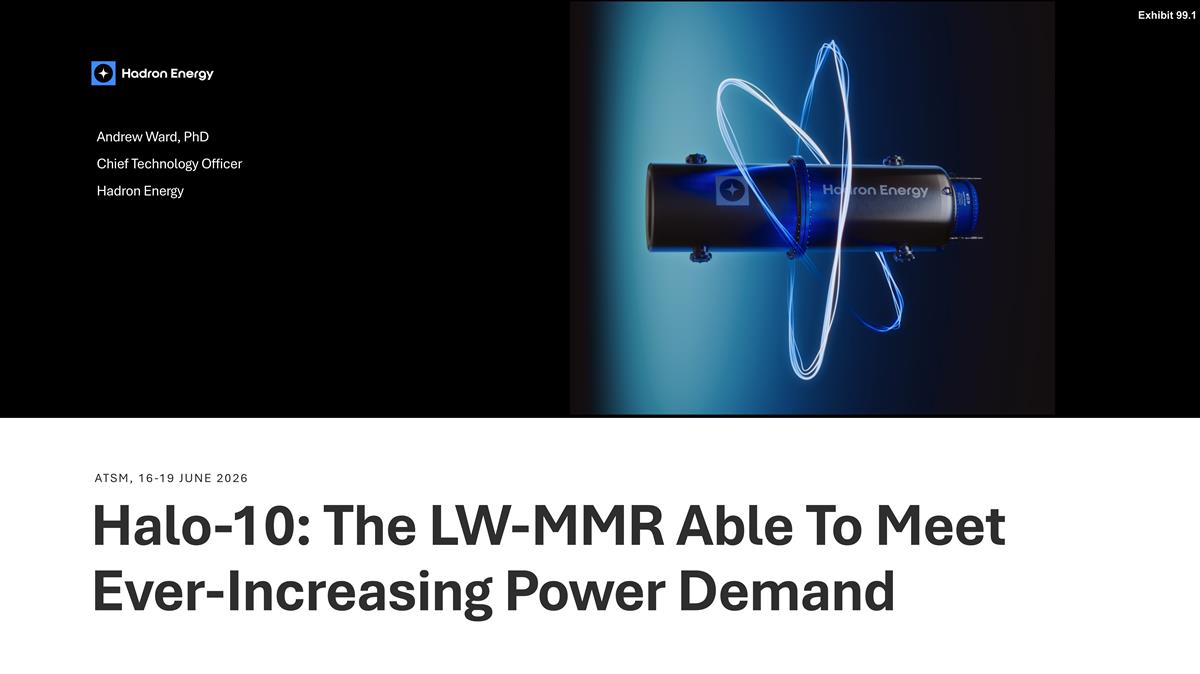
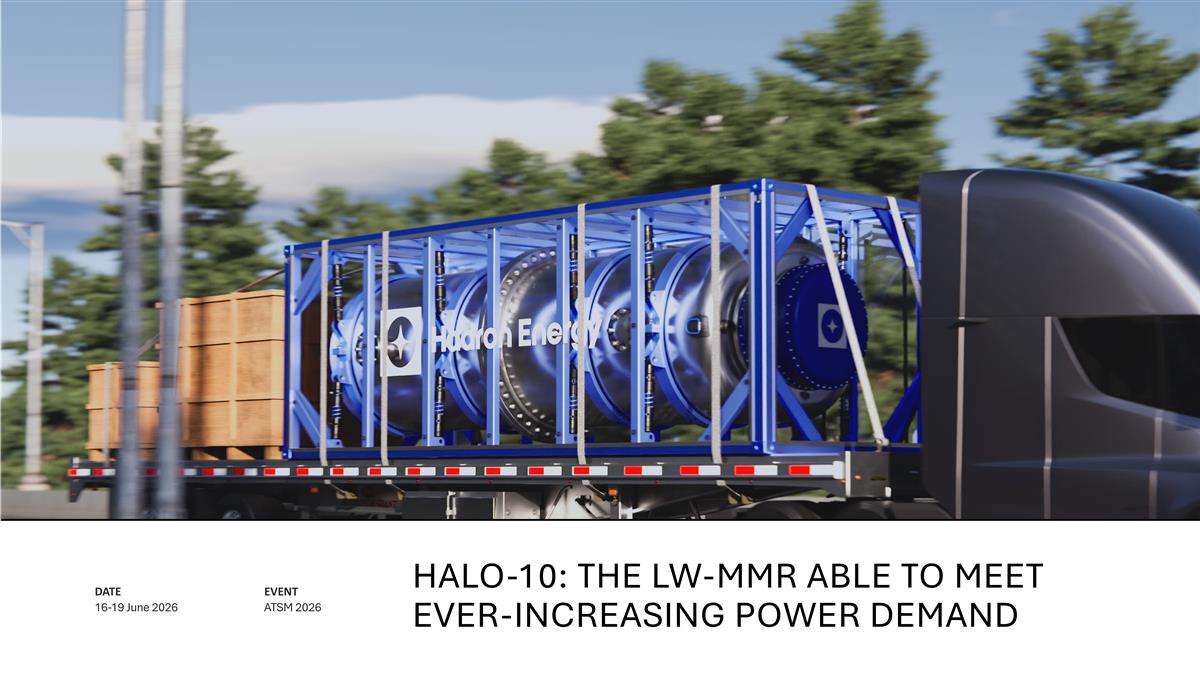
Halo-10: The LW-MMR Able To Meet Ever-Increasing Power Demand Andrew Ward, PhD Chief Technology Officer Hadron Energy ATSM, 16-19 June 2026 Exhibit 99.1
Disclaimer This presentation (this “Presentation”) is provided for informational purposes only. The information contained herein does not purport to be all-inclusive and neither Hadron Energy, Inc. (the “Company” or “Hadron Energy”), nor its respective directors, officers, employees, agents, advisors or affiliates, including Hadron Energy Operating Company, Inc., makes any representation or warranty, express or implied, as to the accuracy, completeness or reliability of the information contained in this Presentation, which has not been verified and is subject to change at any time. Viewers of this Presentation should each make their own evaluation of Hadron Energy and of the relevance and accuracy of the information and should make such other investigations as they deem necessary. To the fullest extent permitted by law, no responsibility or liability whatsoever is accepted by Hadron Energy, or its directors, officers, employees, agents, advisors or affiliates for any loss howsoever arising, directly or indirectly, and whether consequential or loss of profit, from any use of this Presentation, its contents, omissions, reliance on the information contained within it or on such information or opinions contained herein or otherwise arising or communicated in connection herewith. This Presentation and any accompanying oral statements do not constitute (i) a solicitation of a proxy, consent or authorization with respect to any securities or (ii) an offer to sell, a solicitation of an offer to buy, or a recommendation to purchase any security of Hadron Energy, or any of its affiliates, nor shall there be any sale, issuance or transfer of securities in any jurisdiction where, or to any person to whom, such offer, solicitation or sale would be unlawful. You should not construe the contents of this Presentation as legal, tax, accounting or investment advice or a recommendation. You should consult your own counsel and tax and financial advisors as to legal and related matters concerning the matters described herein, and, by accepting this Presentation, you confirm that you are not relying upon the information contained herein to make any decision. Forward Looking Statements This presentation contains certain “forward-looking statements” within the meaning of the “safe harbor” provisions of the United States Private Securities Litigation Reform Act of 1996. Hadron Energy’s actual results may differ from their expectations, estimates and projections, and consequently, you should not rely on these forward-looking statements as predictive of future events. Forward-looking statements can sometimes be identified by words such as “may,” “could,” “would,” “should,” “expect,” “possible,” “potential,” “goal,” “opportunity,” “project,” “believe,” “future”, “designed,” “forecast,” “target,” “will,” “anticipate” and, in each case, similar words and expressions, or their negative variations, and terminology that predict or indicate future events. These forward-looking statements include all matters that are not historical facts and include, without limitation, estimates, forecasts or projections regarding Hadron Energy’s future manufacturing capacity and plant performance; market opportunity and market share; estimates and projections of adjacent energy sector opportunities; Hadron Energy’s projected commercialization costs and timeline; Hadron Energy’s ability to demonstrate scientific and engineering feasibility of its technologies; Hadron Energy’s ability to attract, retain and expand its future customer base; Hadron Energy’s ability to timely and effectively meet construction and development timelines and scale its production and manufacturing processes; Hadron Energy’s ability to develop products and services and bring them to market in a timely manner; Hadron Energy’s ability to compete successfully with energy products and solutions offered by other companies; Hadron Energy’s expectations concerning relationships with strategic partners, suppliers, governments, regulatory bodies and other third parties; Hadron Energy’s ability to maintain, protect, and enhance its intellectual property; future ventures or investments in companies or products, services, or technologies; Hadron Energy’s expectations regarding regulatory framework development; the potential for and timing of receipt of licenses and permits for current and future operations, including licenses to operate nuclear facilities from the U.S. Nuclear Regulatory Commission; the success of proposed projects for which Hadron’s products would provide power, which is outside of Hadron Energy’s control; the safety profile of Hadron’s technology; the execution and success of any definitive agreements related to partnerships and collaborations between Hadron Energy and third parties; Hadron Energy’s expectations with respect to future performance; the consummation of the proposed business combination; and the potential benefits of the proposed business combination and expectations related to its terms and timing. These statements are based on management’s expectations, assumptions, estimates, projections and beliefs as of the date of this presentation, whether or not identified in this presentation, and are not predictions of actual performance. These forward-looking statements are provided for illustrative purposes only and are not intended to serve as and must not be relied on by any investor as a guarantee, an assurance, a prediction or a definitive statement of fact or probability. In addition, statements regarding Hadron Energy’s products, technology, and market opportunity reflect the beliefs and opinions of Hadron Energy’s management on the relevant subject as of this Presentation. These forward-looking statements are subject to a number of factors that involve known and unknown risks, delays, uncertainties and other factors not under the control of Hadron Energy that may cause actual results, performance or achievements of Hadron Energy to be materially different from the future results, performance or other expectations expressed or implied by these forward-looking statements. Such risks and uncertainties include risks related to the future performance of Hadron Energy; the risk that Hadron Energy is pursing an emerging market; regulatory uncertainties and possible changes to applicable laws or regulations; the potential need for financing for future operations; financial, political and legal conditions; the outcome of any government or regulatory proceedings, investigations or inquiries; market volatility and its potential to impact Hadron Energy’s ability to meet its financial obligations; increased competition in the energy industry; limited supply of materials and supply chain disruptions; and other risks and uncertainties set forth in the sections entitled “Risk Factors” and Cautionary Note Regarding Forward-looking Statements in Hadron Energy’s Registration Statement on Form S-1 filed on June 15, 2026 and subsequently filed Quarterly Reports on Form 10-Q, as such factors may be updated from time to time in Hadron Energy’s filings with the SEC. Other unknown or unpredictable factors or underlying assumptions subsequently proving to be incorrect could cause actual results to differ materially from those in the forward‑looking statements. Although Hadron Energy believes that the expectations reflected in the forward-looking statements are reasonable, Hadron Energy cannot guarantee future results, level of activity, performance, or achievements. You should not place undue reliance on these forward-looking statements, and these forward-looking statements should not be relied upon as representing Hadron Energy’s assessments as of any date subsequent to the date of this Presentation. All information provided in this presentation is as of today’s date, unless otherwise stated, and although Hadron Energy may elect to update these forward-looking statements at some point in the future, it specifically disclaims any obligation to do so and undertakes no duty to update such information, except as required under applicable law.
Trademarks and Intellectual Property This presentation contains trademarks, service marks, trade names, and copyrights of Hadron Energy and third parties, which are the property of their respective owners, and such use or display in this presentation is not intended to, and does not imply, a relationship with or an endorsement or sponsorship by or of Hadron Energy. Solely for convenience, the trademarks, service marks, trade names, and copyrights referred to in this presentation may appear without the TM, SM, *, or © symbols, but such references are not intended to indicate, in any way, that Hadron Energy will not assert, to the fullest extent under applicable law, their rights or the right of the applicable owners, if any, to such trademarks, service marks, trade names, and copyrights.
Problem For the first time in ~45 years, public support for nuclear power is producing growth. Demand for energy grows even faster. Can we rise to the challenge? https://www.pewresearch.org/short-reads/2025/10/16/support-for-expanding-nuclear-power-is-up-in-both-parties-since-2020/
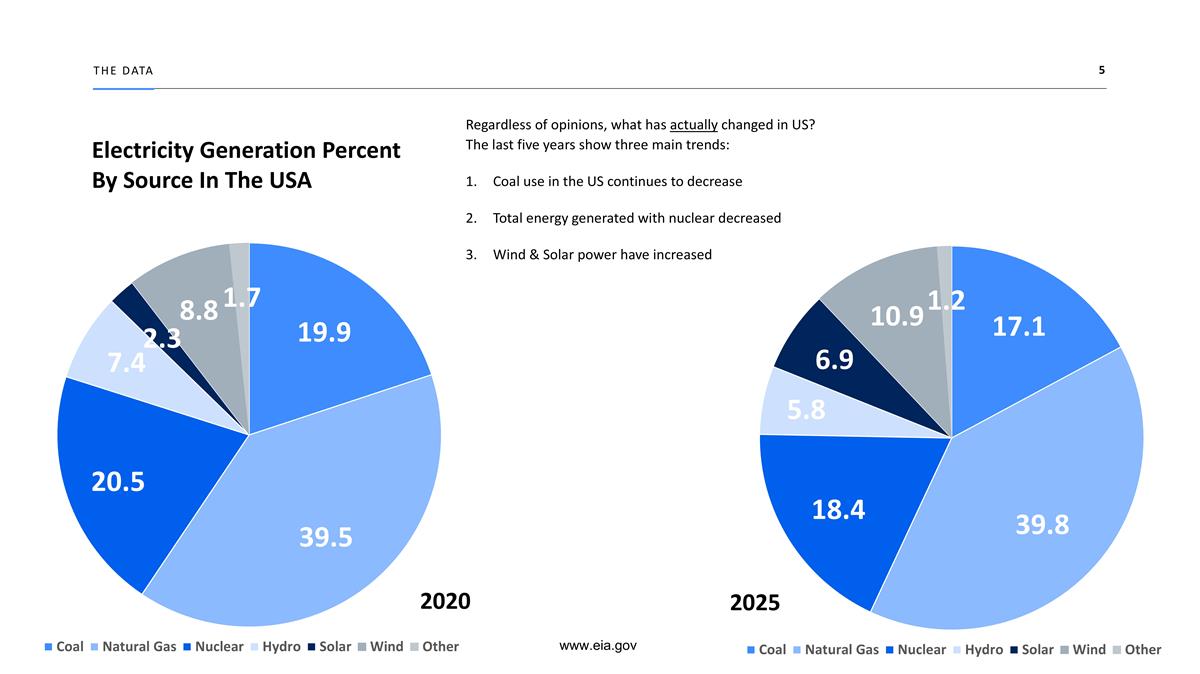
The DATA Electricity Generation Percent By Source In The USA Regardless of opinions, what has actually changed in US? The last five years show three main trends: Coal use in the US continues to decrease Total energy generated with nuclear decreased Wind & Solar power have increased 2020 2025 www.eia.gov
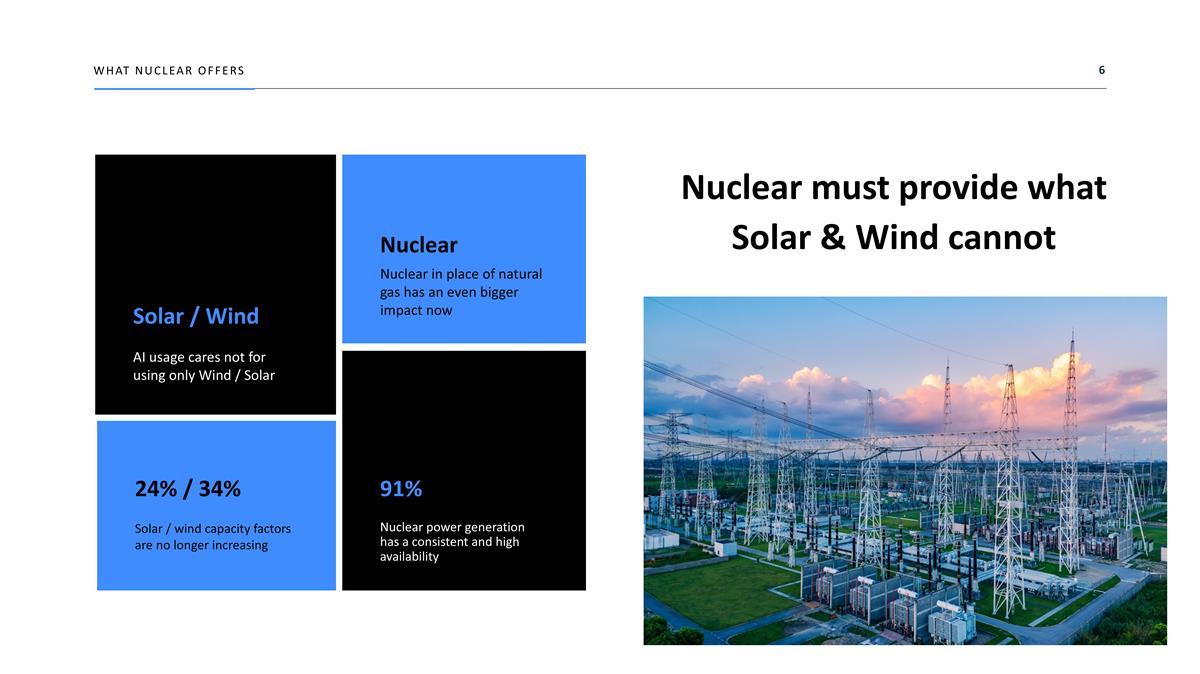
What nuclear offers Nuclear must provide what Solar & Wind cannot Solar / Wind AI usage cares not for using only Wind / Solar 91% Nuclear power generation has a consistent and high availability Nuclear Nuclear in place of natural gas has an even bigger impact now 24% / 34% Solar / wind capacity factors are no longer increasing
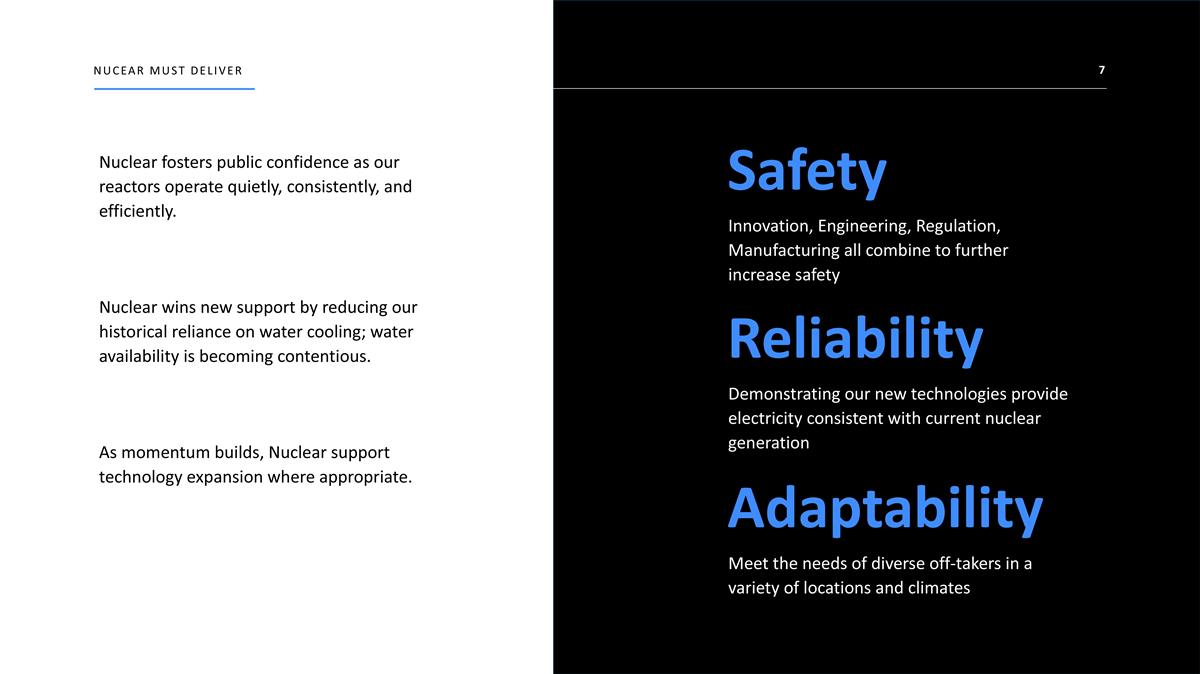
Nucear MUST DELIVER Nuclear fosters public confidence as our reactors operate quietly, consistently, and efficiently. Nuclear wins new support by reducing our historical reliance on water cooling; water availability is becoming contentious. As momentum builds, Nuclear support technology expansion where appropriate. Safety Innovation, Engineering, Regulation, Manufacturing all combine to further increase safety Reliability Demonstrating our new technologies provide electricity consistent with current nuclear generation Adaptability Meet the needs of diverse off-takers in a variety of locations and climates
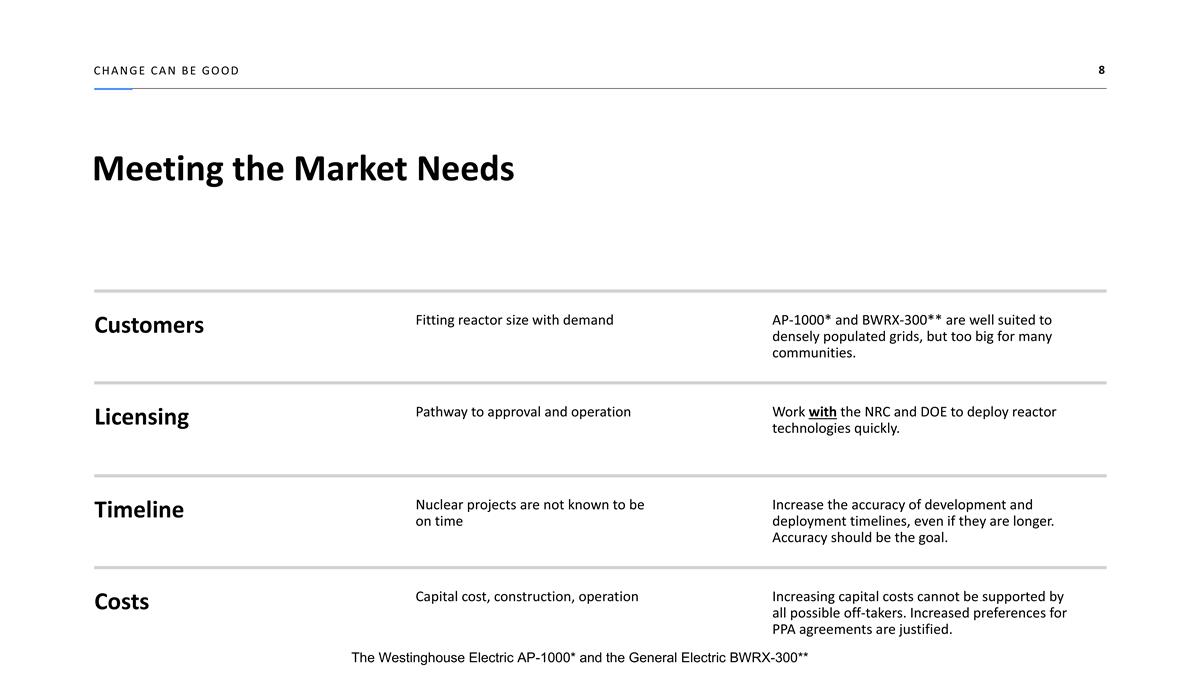
Change CAN BE good Meeting the Market Needs Customers Fitting reactor size with demand AP-1000* and BWRX-300** are well suited to densely populated grids, but too big for many communities. Licensing Pathway to approval and operation Work with the NRC and DOE to deploy reactor technologies quickly. Timeline Nuclear projects are not known to be on time Increase the accuracy of development and deployment timelines, even if they are longer. Accuracy should be the goal. Costs Capital cost, construction, operation Increasing capital costs cannot be supported by all possible off-takers. Increased preferences for PPA agreements are justified. The Westinghouse Electric AP-1000* and the General Electric BWRX-300**
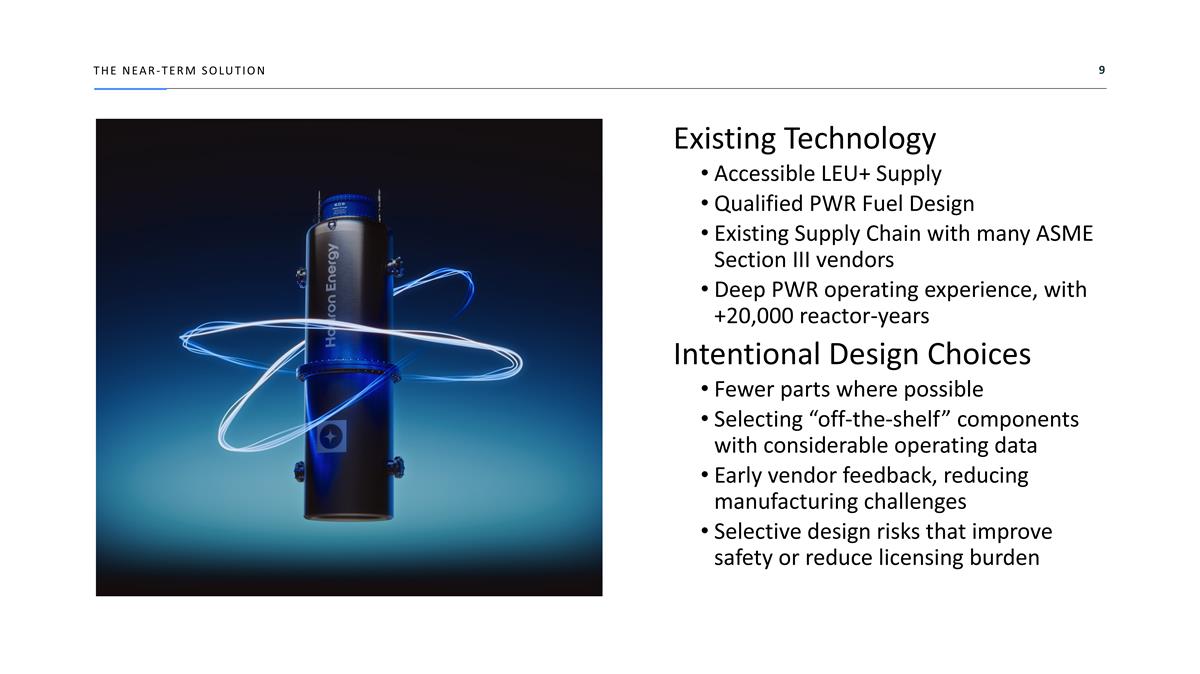
Existing Technology Accessible LEU+ Supply Qualified PWR Fuel Design Existing Supply Chain with many ASME Section III vendors Deep PWR operating experience, with +20,000 reactor-years Intentional Design Choices Fewer parts where possible Selecting “off-the-shelf” components with considerable operating data Early vendor feedback, reducing manufacturing challenges Selective design risks that improve safety or reduce licensing burden THE Near-Term Solution
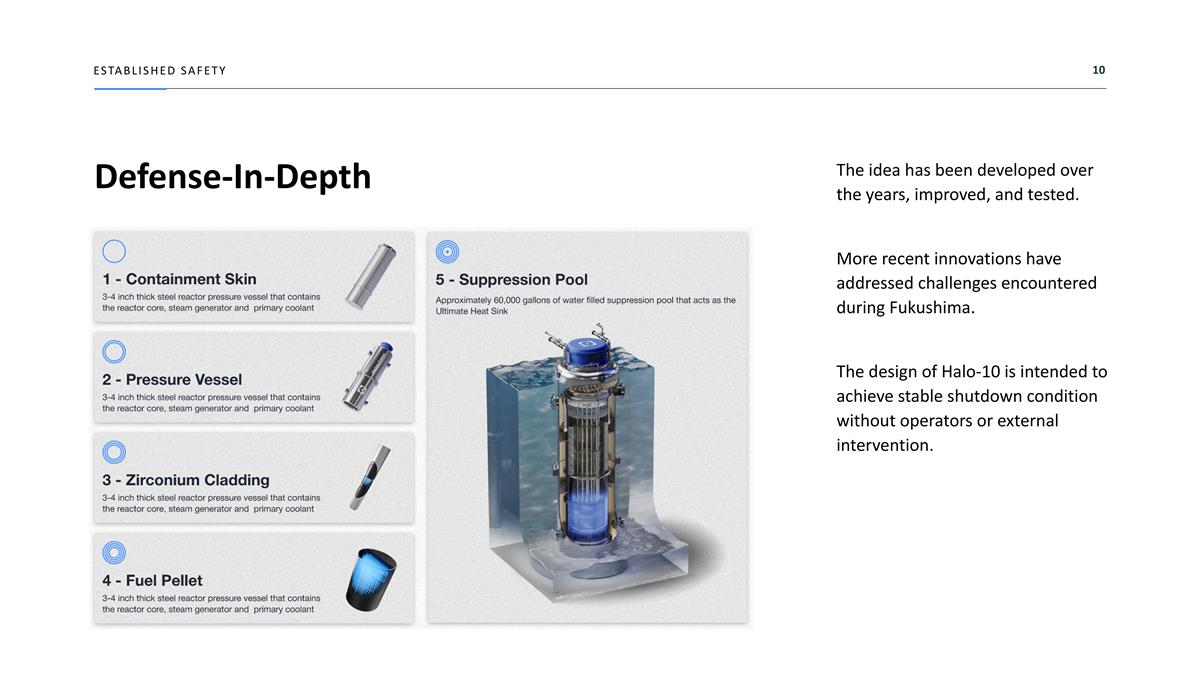
Established safety Defense-In-Depth The idea has been developed over the years, improved, and tested. More recent innovations have addressed challenges encountered during Fukushima. The design of Halo-10 is intended to achieve stable shutdown condition without operators or external intervention.
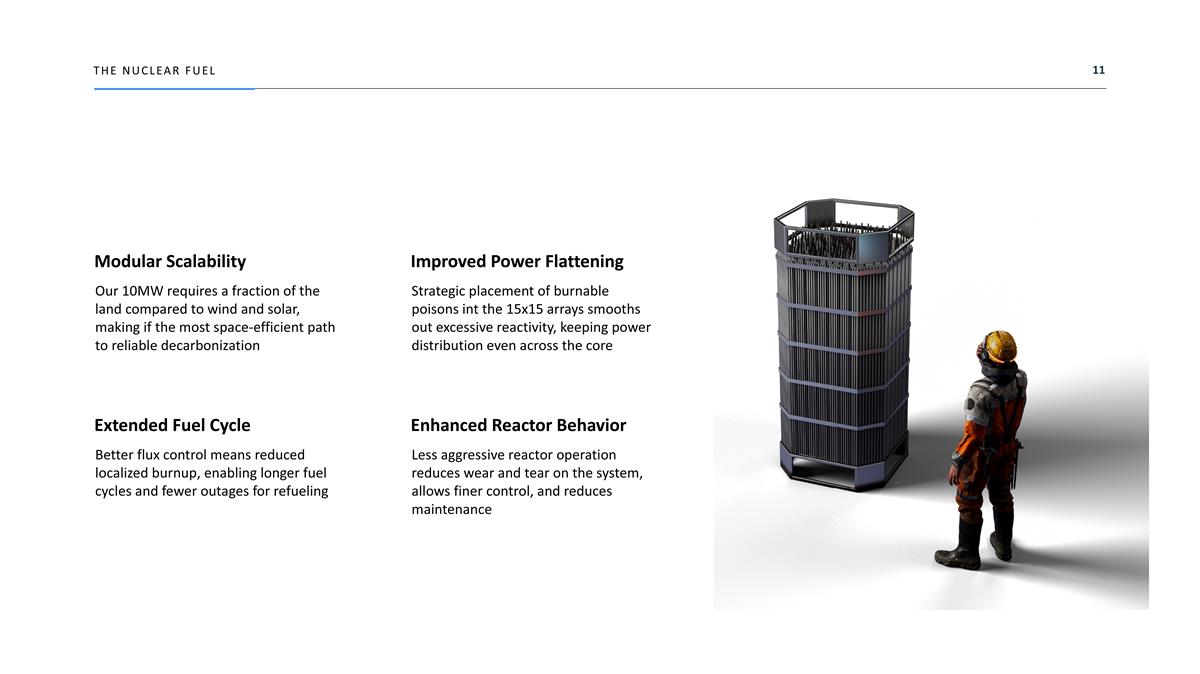
The nuclear Fuel Modular Scalability Our 10MW requires a fraction of the land compared to wind and solar, making if the most space-efficient path to reliable decarbonization Extended Fuel Cycle Better flux control means reduced localized burnup, enabling longer fuel cycles and fewer outages for refueling Improved Power Flattening Strategic placement of burnable poisons int the 15x15 arrays smooths out excessive reactivity, keeping power distribution even across the core Enhanced Reactor Behavior Less aggressive reactor operation reduces wear and tear on the system, allows finer control, and reduces maintenance
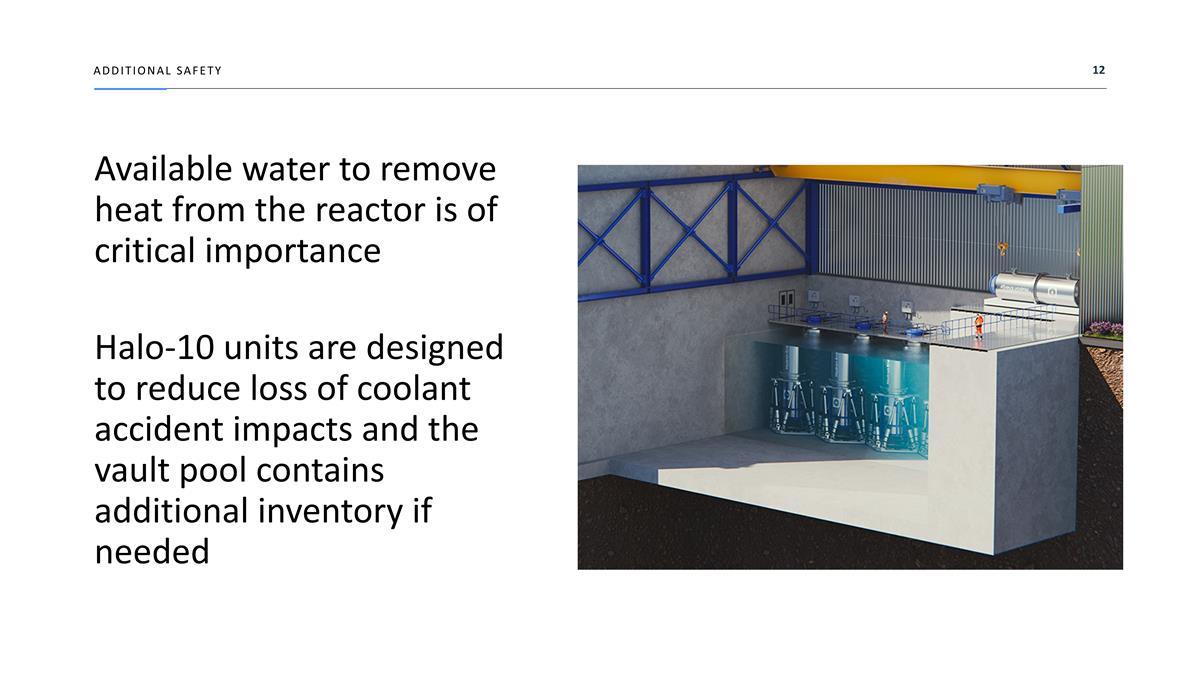
Available water to remove heat from the reactor is of critical importance Halo-10 units are designed to reduce loss of coolant accident impacts and the vault pool contains additional inventory if needed Additional Safety
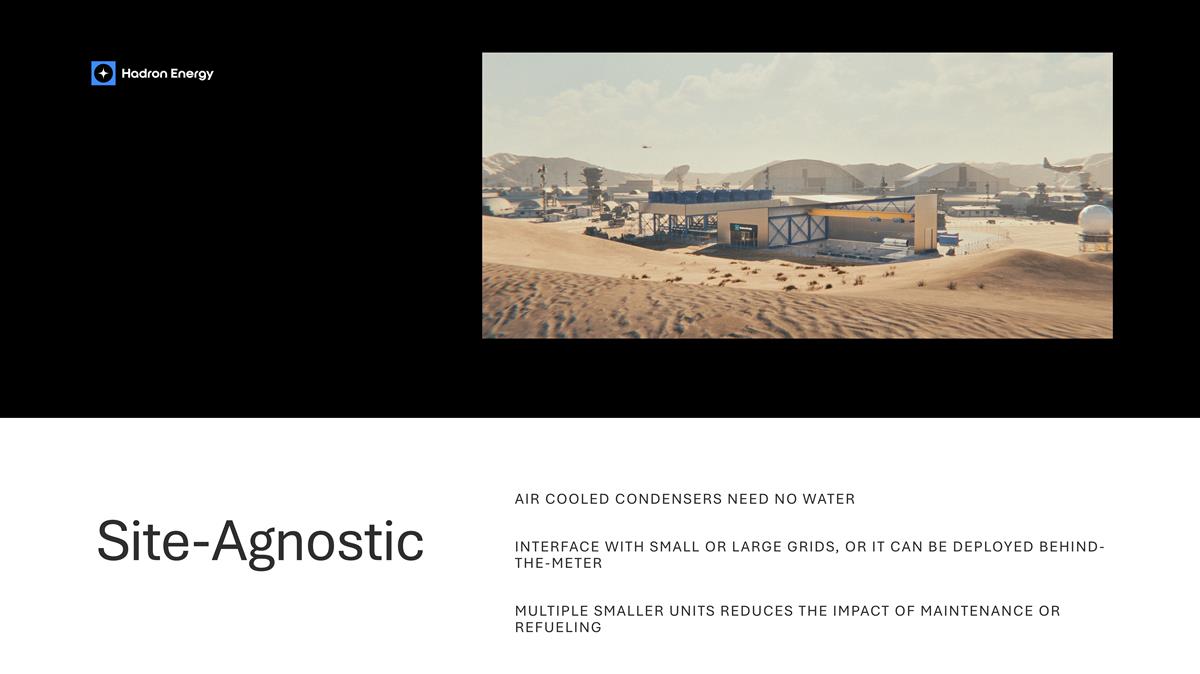
Site-Agnostic Air Cooled condensers need no water Interface with small or large grids, or it can be deployed behind-the-meter Multiple smaller units reduces the impact of maintenance or refueling
Industry Success A wide variety of nuclear technologies are needed to fulfill long-term energy needs The Halo-10 is designed to meet the near-term needs using existing technologies. As non-LWR technologies accumulate fleet-level operating experience, they can and will fill the long-term needs www.wordclouds.com
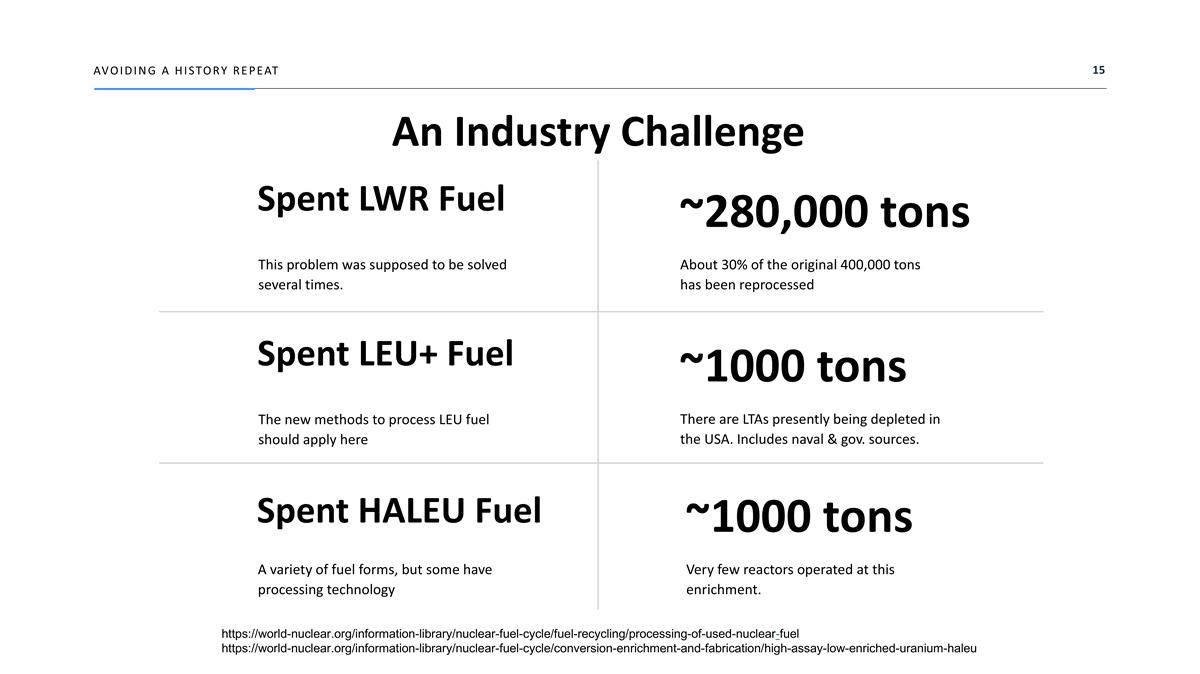
Avoiding a history repeat Spent LWR Fuel ~280,000 tons Spent LEU+ Fuel The new methods to process LEU fuel should apply here ~1000 tons There are LTAs presently being depleted in the USA. Includes naval & gov. sources. Spent HALEU Fuel A variety of fuel forms, but some have processing technology ~1000 tons Very few reactors operated at this enrichment. This problem was supposed to be solved several times. About 30% of the original 400,000 tons has been reprocessed An Industry Challenge https://world-nuclear.org/information-library/nuclear-fuel-cycle/fuel-recycling/processing-of-used-nuclear-fuel https://world-nuclear.org/information-library/nuclear-fuel-cycle/conversion-enrichment-and-fabrication/high-assay-low-enriched-uranium-haleu
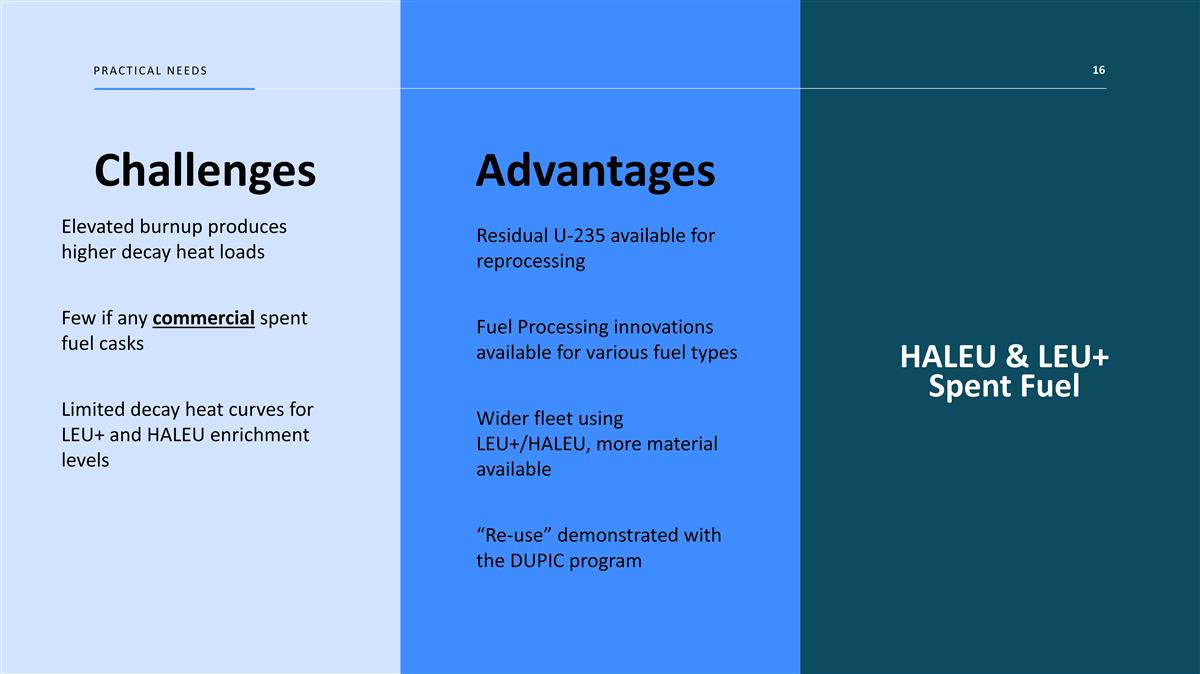
Challenges Advantages HALEU & LEU+ Spent Fuel Elevated burnup produces higher decay heat loads Few if any commercial spent fuel casks Limited decay heat curves for LEU+ and HALEU enrichment levels Residual U-235 available for reprocessing Fuel Processing innovations available for various fuel types Wider fleet using LEU+/HALEU, more material available “Re-use” demonstrated with the DUPIC program Practical needs
date 16-19 June 2026 Event ATSM 2026 Halo-10: The LW-MMR Able To Meet Ever-Increasing Power Demand