v3.26.1
N-4
12 Months Ended
Jun. 18, 2026
USD ($)
yr
Dec. 31, 2025
Dec. 31, 2024
Dec. 31, 2023
Dec. 31, 2022
Dec. 31, 2021
Dec. 31, 2020
Dec. 31, 2019
Dec. 31, 2018
Dec. 31, 2017
Dec. 31, 2016
Prospectus:                      
Document Type N-4                    
Entity Registrant Name Symetra Life Insurance Company                    
Entity Central Index Key 0001559495                    
Entity Investment Company Type N-4                    
Document Period End Date Jun. 18, 2026                    
Amendment Flag false                    
Item 2. Overview of the Contract [Line Items]                      
Index-Linked Option Overview, Credits are Based in Part on Index Performance [Text Block] At the end of an Interest Term, we will credit Indexed Interest, which may be positive, negative, or zero, to amounts allocated to an Indexed Account based, in part, on the performance of a particular Index. Depending upon market conditions, you can gain or lose Contract Value in any of the Indexed Accounts.                    
Index-Linked Option Overview, Investor Could Lose Money if Index Declines [Text Block] You could lose a significant amount of money if the Index declines in value.                    
Index-Linked Option Overview, Limits the Negative Return [Text Block] Each Crediting Method permits positive interest to be credited, subject to a limit (the upside potential feature), and provides limited protection against negative interest (the downside protection feature).                    
Index-Linked Option Overview, Guaranteed Minimum Limit on Index Losses [Text Block] Amounts allocated to the Fixed Account earn compounded interest at an annual fixed rate for the duration of an Interest Term, subject to a guaranteed minimum rate of 1%.                    
Index-Linked Option Overview, Limiting Index Losses is not Guaranteed to be Offered [Text Block]
We do not guarantee that the Contract will always offer Indexed Accounts that limit Index losses, which would mean risk of loss of the entire amount invested.
                   
Index-Linked Option Overview, Limits Positive Return [Text Block] Each Crediting Method permits positive interest to be credited, subject to a limit (the upside potential feature), and provides limited protection against negative interest (the downside protection feature).                    
Overview, Investor Could Lose Money Due to Contract Adjustments if Amounts are Removed [Text Block] You could lose a significant amount of money due to the Interim Value calculation if amounts are removed from an Indexed Account prior to the end of an Interest Term.                    
Overview, Transactions Subject to Contract Adjustments [Text Block] Market Value Adjustment. Any aggregate withdrawal beyond the Free Withdrawal Amount may be subject to a Market Value Adjustment (“MVA”) during the MVA Term, in addition to any surrender charges, taxes and tax penalties. The MVA reflects changes in interest rates from the Contract Date to the date of the withdrawal. An MVA can be a positive, negative or zero adjustment to the withdrawal amount and protects us from risks related to the value of the fixed investment instruments supporting the Contract guarantees if amounts are withdrawn prematurely. The MVA will increase or decrease the amount you receive as a withdrawal. Certain transactions are not subject to an MVA. For more information, see the section titled “Market Value Adjustment”.                    
Item 3. Key Information [Line Items]                      
Fees and Expenses [Text Block]
FEES, EXPENSES AND ADJUSTMENTS
Are there Charges or Adjustments for Early Withdrawals?
Yes. If you take a withdrawal during the first 6 Contract Years, you may be assessed a surrender charge of up to 8% of the amount withdrawn. For example, if you invest $100,000 in the Contract and make an early withdrawal, you could pay a surrender charge of up to $8,000. This loss will be greater if there is a negative Interim Value calculation, a negative MVA, taxes, or tax penalties.

If all or a portion of the Contract Value is removed from an Indexed Account or from the Contract prior to the end of an Interest Term, we will apply an Interim Value calculation to the Indexed Account Value which may be negative. Surrenders, partial withdrawals (including repetitive withdrawals), death benefit payments, and annuitization from the Indexed Accounts prior to the end of an Interest Term will be based on the Interim Values of the Indexed Accounts. In extreme situations, you could lose up to 100% of your investment due to the Interim Value calculation. For example, if you allocate $100,000 to an Indexed Account with a 2-year Interest Term, and later withdraw the entire amount before the 2-years have ended, you could lose up to $100,000 of your investment. This loss will be greater if the amount withdrawn is also subject to a surrender charge, a negative MVA, taxes, or tax penalties.

If you take a withdrawal during the MVA Term, we may apply an MVA to the amount withdrawn, which may be negative. Any aggregate withdrawals from the Contract in an Interest Term Year that exceed the Free Withdrawal Amount (including surrenders and partial withdrawals) may be subject to an MVA. which may be negative. In extreme situations, a negative MVA could result in a loss as high as 100% of the amount withdrawn in excess of the Free Withdrawal Amount. This loss will be greater if there is a surrender charge, a negative Interim Value calculation, taxes, or tax penalties.
For more information, see “Charges and Adjustments”.
Are there Transaction Charges?
No.
 
Are there Ongoing Fees and Expenses (annual charges)?
Yes. The table below describes the fees and expenses that you may pay each year, depending on the investment options and optional benefits you choose. Please refer to your Contract data page for information about the specific fees you will pay each year based on the options you have elected.

There is an implicit ongoing fee on Indexed Accounts to the extent that your participation in Index gains is limited by us through the use of the Cap, Participation Rate, Trigger Rate, or Dual Trigger Rate. This means that your returns may be lower than the Index’s returns. In return for accepting this limit on Index gains, you will receive some protection from Index losses. This implicit ongoing fee is not reflected in the tables below.
Annual FeeMinimumMaximum
Optional benefits available for an additional charge (for a single Indexed Account Interest Term, if elected)(1)
1%
6%
(1) Referred to as the “Indexed Account Charge” for certain Indexed Accounts. The Indexed Account Charge is 1% per year of the Interest Term and is deducted from the Indexed Account Value at the end of each Interest Term. The Indexed Account Charge is 1% for 1-year Interest Terms and 6% for 6-year Interest Terms. If you make a full withdrawal or exercise a full Return Lock, the amount of the charge for the full Interest Term is deducted at the time of the withdrawal or Return Lock. If you make a partial withdrawal or exercise a partial Return Lock, the amount of the Indexed Account Charge is adjusted proportionally by the percentage that the partial withdrawal or partial Return Lock reduced the Indexed Account Value. The partial Indexed Account Charge is then deducted from the partial withdrawal amount or deducted from the Indexed Account Value locked in for a partial Return Lock. The remaining Indexed Account Charge is deducted from the Indexed Account on the last day of the Interest Term after Indexed Interest, if any, is credited.

Because your Contract is customizable, the choices you make affect how much you will pay. To help you understand the cost of owning your Contract, the following table shows the lowest and highest cost you could pay each year, based on current charges. This estimate assumes that you do not take withdrawals from the Contract, which could add surrender charges, negative MVAs, and negative Interim Value calculations that substantially increase costs.
Lowest Annual Cost:
$0
Highest Annual Cost:
 $910.85
Assumes the following:

Investment of $100,000 in an Indexed Account
5% annual appreciation
No Indexed Account Charge
No optional benefits
No sales charges
No additional transfers or withdrawals
0% loss due to the Interim Value calculation
Assumes the following:

Investment of $100,000 in an Indexed Account
5% annual appreciation
Indexed Account Charge
No sales charges
No additional transfers or withdrawals
0% loss due to the Interim Value calculation
 
For more information, see “Charges and Adjustments,” “Investment Options,” and “Additional Information on the Indexed Accounts.”
                   
Charges for Early Withdrawals [Text Block]
Yes. If you take a withdrawal during the first 6 Contract Years, you may be assessed a surrender charge of up to 8% of the amount withdrawn. For example, if you invest $100,000 in the Contract and make an early withdrawal, you could pay a surrender charge of up to $8,000. This loss will be greater if there is a negative Interim Value calculation, a negative MVA, taxes, or tax penalties.

If all or a portion of the Contract Value is removed from an Indexed Account or from the Contract prior to the end of an Interest Term, we will apply an Interim Value calculation to the Indexed Account Value which may be negative. Surrenders, partial withdrawals (including repetitive withdrawals), death benefit payments, and annuitization from the Indexed Accounts prior to the end of an Interest Term will be based on the Interim Values of the Indexed Accounts. In extreme situations, you could lose up to 100% of your investment due to the Interim Value calculation. For example, if you allocate $100,000 to an Indexed Account with a 2-year Interest Term, and later withdraw the entire amount before the 2-years have ended, you could lose up to $100,000 of your investment. This loss will be greater if the amount withdrawn is also subject to a surrender charge, a negative MVA, taxes, or tax penalties.

If you take a withdrawal during the MVA Term, we may apply an MVA to the amount withdrawn, which may be negative. Any aggregate withdrawals from the Contract in an Interest Term Year that exceed the Free Withdrawal Amount (including surrenders and partial withdrawals) may be subject to an MVA. which may be negative. In extreme situations, a negative MVA could result in a loss as high as 100% of the amount withdrawn in excess of the Free Withdrawal Amount. This loss will be greater if there is a surrender charge, a negative Interim Value calculation, taxes, or tax penalties.
For more information, see “Charges and Adjustments”.
                   
Surrender Charge Phaseout Period, Years | yr 6                    
Surrender Charge (of Purchase Payments) Maximum [Percent] 8.00%                    
Surrender Charge Example Maximum [Dollars] $ 8,000                    
Key Information, Contract Adjustments if Amounts are Removed [Text Block] If all or a portion of the Contract Value is removed from an Indexed Account or from the Contract prior to the end of an Interest Term, we will apply an Interim Value calculation to the Indexed Account Value which may be negative.                    
Key Information, Maximum Loss Resulting from Negative Adjustment [Percent] 100.00%                    
Key Information, Example of Maximum Loss Resulting from Negative Adjustment [Text Block] For example, if you allocate $100,000 to an Indexed Account with a 2-year Interest Term, and later withdraw the entire amount before the 2-years have ended, you could lose up to $100,000 of your investment.                    
Key Information, Example of Maximum Loss on One Hundred Thousand Dollars Resulting from Negative Adjustment $ 100,000                    
Transaction Charges [Text Block] No.                    
Ongoing Fees and Expenses [Table Text Block]
Yes. The table below describes the fees and expenses that you may pay each year, depending on the investment options and optional benefits you choose. Please refer to your Contract data page for information about the specific fees you will pay each year based on the options you have elected.

There is an implicit ongoing fee on Indexed Accounts to the extent that your participation in Index gains is limited by us through the use of the Cap, Participation Rate, Trigger Rate, or Dual Trigger Rate. This means that your returns may be lower than the Index’s returns. In return for accepting this limit on Index gains, you will receive some protection from Index losses. This implicit ongoing fee is not reflected in the tables below.
Annual FeeMinimumMaximum
Optional benefits available for an additional charge (for a single Indexed Account Interest Term, if elected)(1)
1%
6%
(1) Referred to as the “Indexed Account Charge” for certain Indexed Accounts. The Indexed Account Charge is 1% per year of the Interest Term and is deducted from the Indexed Account Value at the end of each Interest Term. The Indexed Account Charge is 1% for 1-year Interest Terms and 6% for 6-year Interest Terms. If you make a full withdrawal or exercise a full Return Lock, the amount of the charge for the full Interest Term is deducted at the time of the withdrawal or Return Lock. If you make a partial withdrawal or exercise a partial Return Lock, the amount of the Indexed Account Charge is adjusted proportionally by the percentage that the partial withdrawal or partial Return Lock reduced the Indexed Account Value. The partial Indexed Account Charge is then deducted from the partial withdrawal amount or deducted from the Indexed Account Value locked in for a partial Return Lock. The remaining Indexed Account Charge is deducted from the Indexed Account on the last day of the Interest Term after Indexed Interest, if any, is credited.
Because your Contract is customizable, the choices you make affect how much you will pay. To help you understand the cost of owning your Contract, the following table shows the lowest and highest cost you could pay each year, based on current charges. This estimate assumes that you do not take withdrawals from the Contract, which could add surrender charges, negative MVAs, and negative Interim Value calculations that substantially increase costs.
                   
Optional Benefits Minimum [Percent] 1.00%                    
Optional Benefits Maximum [Percent] 6.00%                    
Optional Benefits Footnotes [Text Block] (1) Referred to as the “Indexed Account Charge” for certain Indexed Accounts. The Indexed Account Charge is 1% per year of the Interest Term and is deducted from the Indexed Account Value at the end of each Interest Term. The Indexed Account Charge is 1% for 1-year Interest Terms and 6% for 6-year Interest Terms. If you make a full withdrawal or exercise a full Return Lock, the amount of the charge for the full Interest Term is deducted at the time of the withdrawal or Return Lock. If you make a partial withdrawal or exercise a partial Return Lock, the amount of the Indexed Account Charge is adjusted proportionally by the percentage that the partial withdrawal or partial Return Lock reduced the Indexed Account Value. The partial Indexed Account Charge is then deducted from the partial withdrawal amount or deducted from the Indexed Account Value locked in for a partial Return Lock. The remaining Indexed Account Charge is deducted from the Indexed Account on the last day of the Interest Term after Indexed Interest, if any, is credited.                    
Index-Linked Option, Implicit Ongoing Fees [Text Block] There is an implicit ongoing fee on Indexed Accounts to the extent that your participation in Index gains is limited by us through the use of the Cap, Participation Rate, Trigger Rate, or Dual Trigger Rate.                    
Index-Linked Option, Implicit Ongoing Fees Return may be Lower than the Index Return [Text Block] This means that your returns may be lower than the Index’s returns.                    
Index-Linked Option, Implicit Ongoing Fees Provide Some Protection from Index Losses [Text Block] In return for accepting this limit on Index gains, you will receive some protection from Index losses.                    
Index-Linked Option, Implicit Ongoing Fees Not Reflected [Text Block] This implicit ongoing fee is not reflected in the tables below.                    
Investment Options Footnotes [Text Block] For more information, see “Charges and Adjustments,” “Investment Options,” and “Additional Information on the Indexed Accounts.”                    
Lowest and Highest Annual Cost [Table Text Block]
Lowest Annual Cost:
$0
Highest Annual Cost:
 $910.85
Assumes the following:

Investment of $100,000 in an Indexed Account
5% annual appreciation
No Indexed Account Charge
No optional benefits
No sales charges
No additional transfers or withdrawals
0% loss due to the Interim Value calculation
Assumes the following:

Investment of $100,000 in an Indexed Account
5% annual appreciation
Indexed Account Charge
No sales charges
No additional transfers or withdrawals
0% loss due to the Interim Value calculation
 
                   
Lowest Annual Cost [Dollars] $ 0                    
Highest Annual Cost [Dollars] $ 910.85                    
Lowest Annual Cost Footnotes [Text Block]
Assumes the following:

Investment of $100,000 in an Indexed Account
5% annual appreciation
No Indexed Account Charge
No optional benefits
No sales charges
No additional transfers or withdrawals
0% loss due to the Interim Value calculation
                   
Highest Annual Cost Footnotes [Text Block]
Assumes the following:

Investment of $100,000 in an Indexed Account
5% annual appreciation
Indexed Account Charge
No sales charges
No additional transfers or withdrawals
0% loss due to the Interim Value calculation
                   
Risks [Table Text Block]
RISKS
Is there a Risk of Loss from Poor Performance?
Yes. You can lose money by investing in the Contract.

The following chart shows the maximum percentage of your investment you could lose due to negative Index performance after taking into account the current limits on Index loss provided under the Contract.
Crediting MethodMaximum Potential Loss % for Negative Performance
1% Buffer
99%
10% Buffer90%
15% Buffer85%
20% Buffer80%
30% Buffer70%
100% Buffer0%
10% Buffer Plus Rate
90%
20% Buffer Plus Rate 80%
30% Buffer Plus Rate
70%

We do not guarantee that the Contract will always offer Indexed Accounts that limit Index losses, which would mean risk of loss of the entire amount invested.

In addition, withdrawals taken during the Surrender Charge Period may be subject to a negative MVA, which could result in loss.

For more information, see “Principal Risks of Investing in the Contract,” “Investment Options,” and “Additional Information on the Indexed Accounts.”

RISKS
Is this a Short-Term Investment?
No. The Contract is not a short-term investment and is not appropriate if you need ready access to cash. The benefits of tax deferral and living benefit protections also mean the Contract is more beneficial to investors with a long-time horizon. Tax penalties may apply to withdrawals taken before age 59 ½. Withdrawals from the Contract may be subject to a surrender charges, MVAs, taxes, and tax penalties. Amounts removed from an Indexed Account before the end of the Interest Term may also result in a negative Interim Value calculation and loss of positive performance. If you take a withdrawal prior to the end of an Interest Term, the withdrawal will cause a reduction (perhaps significant reduction) to your Base Value. Reductions to your Base Value will negatively impact your Indexed Account Value for the remainder of the Interest Term and may result in a lower amount of Indexed Interest being credited, if any, at the end of the Interest Term as well as reduce the amount of Death Benefit available to your Beneficiaries.


At the end of each Interest Term or if the Return Lock feature has been exercised, at the end of the current or any subsequent Interest Term Year, you may elect to transfer your Contract Value between the Fixed Account and any Indexed Account(s) and between Indexed Account(s) and begin a new Interest Term. If we do not receive a transfer request from you by the Transfer Notice Deadline, your allocations will remain the same and no transfers will occur. If an Indexed Account in which you are invested is no longer offered or available to you under your Contract and we do not receive a transfer request, any amount in that Indexed Account will be transferred to the 1-year 100% Buffer Indexed Account tied to the same Index as your previous allocation. If the 1-year 100% Buffer Indexed Account tied to the same Index as your previous allocation is not available, we will transfer your Indexed Account Value to the Fixed Account. For example, assume you are allocated to the S&P 500 6-year Point to Point with 30% Buffer Indexed Account and we do not receive a transfer request by the Transfer Notice Deadline. Because the 6-year Interest Term is only available at the time of purchase, this Indexed Account is no longer available for your Contract. We will transfer your Indexed Account Value to the S&P 500 1-year Point to Point with 100% Buffer. If the S&P 500 1-year Point to Point with 100% Buffer is not available, we will transfer your Indexed Account Value to the Fixed Account.
What are the Risks Associated with the Investment Options?
Investment in the Contract is subject to the risk of poor investment performance and can vary depending on the performance of the investment options available under the Contract (e.g., the Indexed Accounts). Each investment option (including the Fixed Account) has its own unique risks. You should review the available investment options before making an investment decision.

All of the Indices we currently offer are price return indices which do not reflect dividends or distributions paid on the components of the Indices. This reduces the Index Return and will cause the Index to underperform a direct investment in the securities composing the Index.

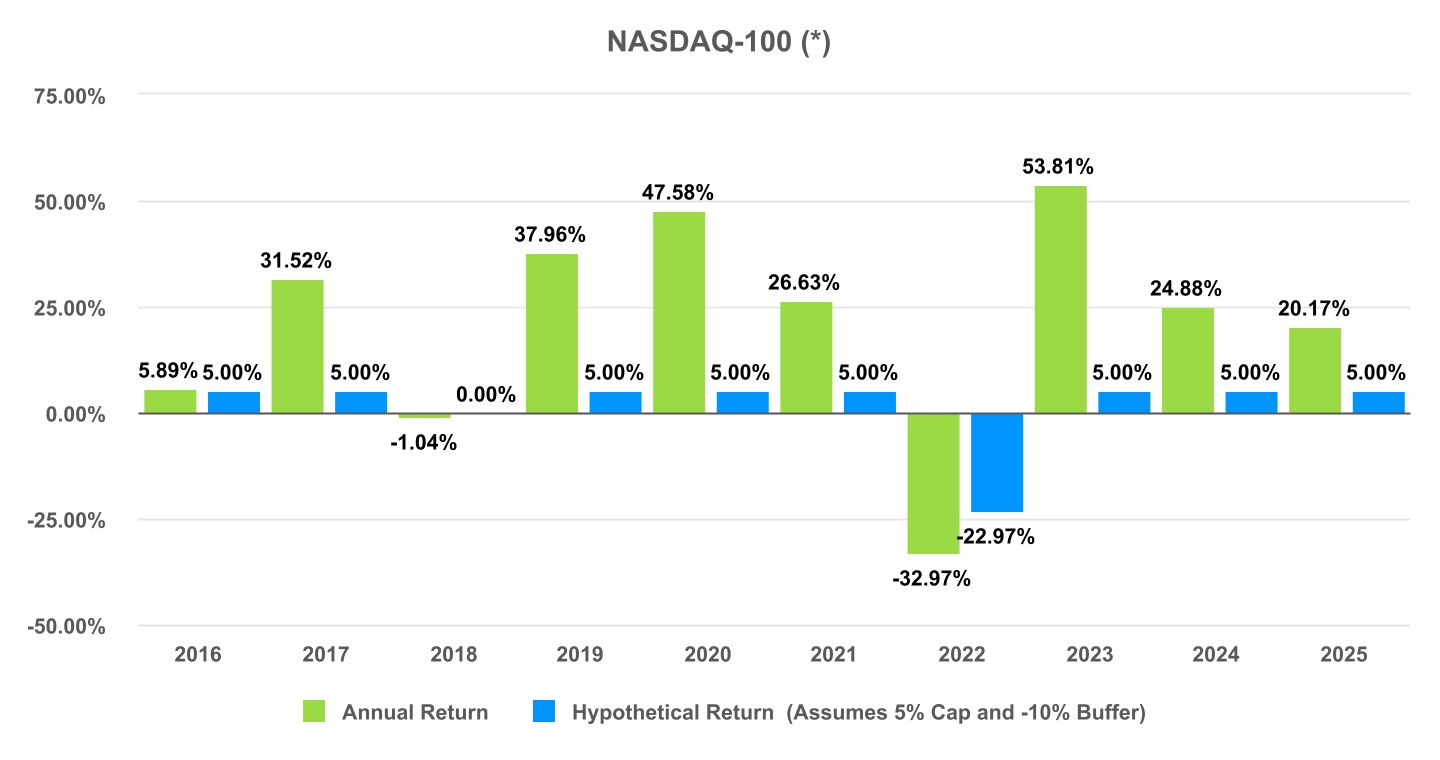
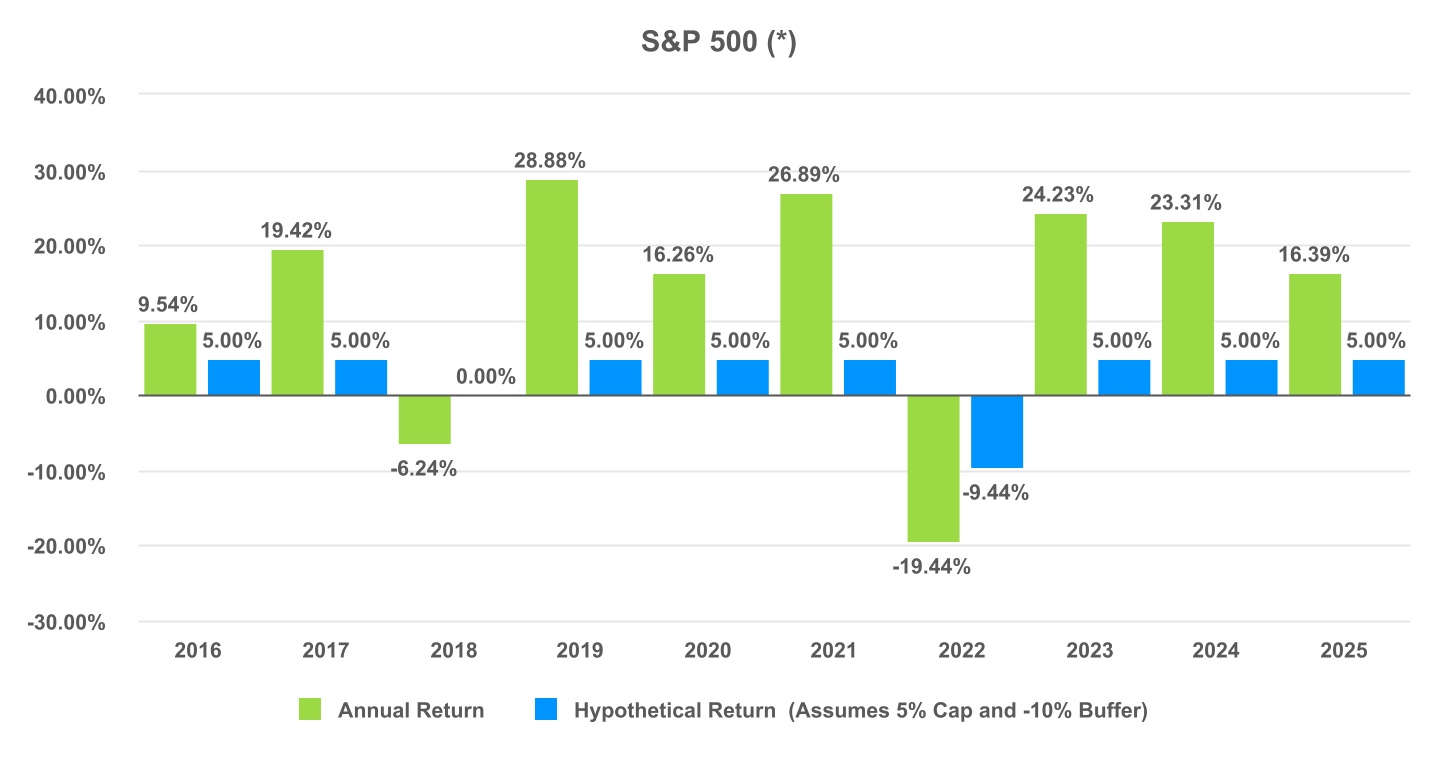
The upside potential feature of the applicable Crediting Methods will limit positive Index Returns (e.g., limited upside). This may result in you earning less than the Index Return. For example:

The Cap represents the maximum positive Adjusted Index Return for a given Interest Term and limits the amount of positive Indexed Interest that we may be obligated to credit for any Interest Term. If the Cap is 8%, the Participation Rate is 100% and the Index Return is 15%, we would credit Indexed Interest at the Adjusted Index Return of 8% (the Index Return up to the Cap) at the end of the Interest Term.

The Participation Rate represents a percentage that can be applied to the Index Return for an Interest Term. If the Participation Rate is 100% with no Cap and the Index Return is 5%, we would multiply the Index Return of 5% by 100%. As a result, we would credit Indexed Interest to your Base Value at the Adjusted Index Return of 5% (100% of the Index Return) at the end of the Interest Term.

If the Index Return is 0% or greater, the Adjusted Index Return equals the Trigger Rate. If the Trigger Rate is 5% and the Index Return is 10%, the Adjusted Index Return equals the 5% Trigger Rate.

If the Index Return is positive, zero, or negative within the Buffer, the Adjusted Index Return equals the Dual Trigger Rate. If the Dual Trigger Rate is 4% and the Index Return is 10% (a positive Index Return), the Adjusted Index Return equals the 4% Dual Trigger Rate. Similarly, if the Index Return is -3% (negative within the Buffer), the Adjusted Index Return would equal the Dual Trigger Rate of 4%.


The downside protection feature of the applicable Crediting Methods will limit negative Index Returns (e.g., limited protection in the case of market decline). For example:

The Buffer represents the amount of negative Index Return that you are protected from before you are credited with negative Indexed Interest. If the Buffer is 10% and the Index Return is -15% (negative Index Return that exceeds the Buffer), we would credit Indexed interest at the Adjusted Index Return of -5%.

The Buffer Plus Rate is added to any negative Index Return to determine the Adjusted Index Return. If the Buffer Plus Rate is 20% and the Index Return is -15% (negative within the Buffer Plus Rate), we would credit Indexed Interest at the Adjusted Index Return of 5%. The Buffer Plus Rate is also the Adjusted Index Return if the Index Return is zero or positive below the Buffer Plus Rate. When the positive Index Return is higher than the Buffer Plus Rate, any positive Index Return in excess of the Buffer Plus Rate is multiplied by the Participation Rate, and then that result is added to the Buffer Plus Rate (subject to the Cap, if applicable) to determine the Adjusted Index Return.
What are the Risks Related to the Insurance Company?
Investment in the Contract is subject to the risks related to Symetra Life Insurance Company. Any obligations (including obligations related to the Symetra Fixed Account and Indexed Accounts), guarantees, and benefits provided for under the Contract are subject to our financial strength and claims-paying ability. More information about us, including our financial strength ratings, is available upon request by calling 1-800-796-3872, or visiting us at investors.symetra.com.
RESTRICTIONS
Are there Restrictions on the Investment Options?
Yes. You may allocate amounts under the Contract to one or more of the Indexed Accounts available to you. Certain Indexed Accounts are only available at the time of purchase or at the end of certain Contract Years.

We reserve the right to add, combine, restrict or remove any Indexed Account available as an investment option under your Contract.

We may also add or remove an Index or Crediting Method during the time that you own the Contract. There is no guarantee that any particular Indexed Account, Index, or Crediting Method will be available during the entire time that you own your Contract. We may replace an Index at any time during an Interest Term.

Transfers may only be made at the end of each Interest Term or, if the Return Lock feature has been exercised, at the end of the current or any subsequent Interest Term Year.

The amount of Contract Value allocated to an Indexed Account at the beginning of an Interest Term must be at least $2,000.

If any transfer or Indexed Account Charge reduces an Indexed Account Value to less than $2,000, the entire amount remaining in that Indexed Account will be automatically transferred to the Fixed Account.

You may exercise either a full or partial Return Lock during an Interest Term for each Indexed Account. Return Locks for the full Indexed Account Value can only be made once per Interest Term per Indexed Account. Partial Return Locks may be exercised four times per Interest Term Year per Indexed Account until the full Index Account Value is subject to Return Lock. Once you exercise the Return Lock feature, it may not be revoked.

The Contract is a single premium annuity contract. Additional Purchase Payments will not be accepted.

We may change the Caps, Participation Rates, Trigger Rates, and Dual Triggers Rates from one Interest Term to the next, subject to the guaranteed minimum rates for each upside potential feature.

Not all Indexed Accounts may be currently available in all states. Also, your selling firm may not recommend the selection of certain Indexed Accounts or other features available under the Contract based on criteria established by the selling firm. You should speak with your financial professional for details about the Indexed Accounts and features available to you.
                   
Investment Restrictions [Text Block]
Yes. You may allocate amounts under the Contract to one or more of the Indexed Accounts available to you. Certain Indexed Accounts are only available at the time of purchase or at the end of certain Contract Years.

We reserve the right to add, combine, restrict or remove any Indexed Account available as an investment option under your Contract.

We may also add or remove an Index or Crediting Method during the time that you own the Contract. There is no guarantee that any particular Indexed Account, Index, or Crediting Method will be available during the entire time that you own your Contract. We may replace an Index at any time during an Interest Term.

Transfers may only be made at the end of each Interest Term or, if the Return Lock feature has been exercised, at the end of the current or any subsequent Interest Term Year.

The amount of Contract Value allocated to an Indexed Account at the beginning of an Interest Term must be at least $2,000.

If any transfer or Indexed Account Charge reduces an Indexed Account Value to less than $2,000, the entire amount remaining in that Indexed Account will be automatically transferred to the Fixed Account.

You may exercise either a full or partial Return Lock during an Interest Term for each Indexed Account. Return Locks for the full Indexed Account Value can only be made once per Interest Term per Indexed Account. Partial Return Locks may be exercised four times per Interest Term Year per Indexed Account until the full Index Account Value is subject to Return Lock. Once you exercise the Return Lock feature, it may not be revoked.

The Contract is a single premium annuity contract. Additional Purchase Payments will not be accepted.

We may change the Caps, Participation Rates, Trigger Rates, and Dual Triggers Rates from one Interest Term to the next, subject to the guaranteed minimum rates for each upside potential feature.

Not all Indexed Accounts may be currently available in all states. Also, your selling firm may not recommend the selection of certain Indexed Accounts or other features available under the Contract based on criteria established by the selling firm. You should speak with your financial professional for details about the Indexed Accounts and features available to you.
For more information, see “Principal Risks of Investing in the Contract,” “Purchase,” “Investment Options,”Additional Information on the Indexed Accounts,” “Transfers”, “State Variations”, and “Appendix D -Financial Intermediaries”.
                   
Key Information, Benefit Restrictions [Text Block]
Yes. Except as provided otherwise, Contract benefits may be modified or terminated by the Company.

All withdrawals will reduce the death benefit, perhaps significantly, and the reduction may be more than the amount of the withdrawal.

You may exercise either a full or partial Return Lock during an Interest Term for each Indexed Account. Return Locks for the full Indexed Account Value can only be made once per Interest Term per Indexed Account. Partial Return Locks may be exercised four times per Interest Term Year per Indexed Account until the full Indexed Account Value is subject to Return Lock. Once you exercise the Return Lock feature, whether for the entire Indexed Account Value or a portion of the Indexed Account Value, it may not be revoked.
For more information see “Principal Risks of Investing in the Contract, "Return Lock,” and “Access to Your Money During the Accumulation Phase.”
                   
Tax Implications [Text Block]
You should consult a competent tax professional about your individual circumstances to determine the tax implications of an investment in and Purchase Payment received under the Contract. There is no additional tax benefit if you purchased the Contract through a tax-qualified vehicle including but not limited to an individual retirement account (IRA). Access to amounts held in a qualified Contract may be restricted or prohibited.

All distributions other than death benefits, including surrenders and withdrawals will be subject to ordinary income tax, and may be subject to tax penalties.
For more information, see “Taxes”.
                   
Investment Professional Compensation [Text Block]
Some investment professionals may receive compensation for selling the Contract to investors. Investment professionals who solicited sales of the Contracts receive a portion of the commission payable to the broker-dealer firm, depending on the agreement between the broker-dealer and the investment professional. We pay commissions as a percentage of the Purchase Payment invested in the Contract.

These investment professionals may receive different compensation for selling different investment products and may have a financial incentive to offer or recommend the Contract over another investment.
For more information, see “Distribution”.
                   
Exchanges [Text Block]
An investment professional may have a financial incentive to offer you a new contract in the place of a contract you already own.

You should only exchange your contract for a new one if you determine, after comparing the features fees and risks of both contracts, and any fees or penalties to terminate the existing contract, that it is preferable for you to purchase the new contract rather than continue to own the existing contract.
For more information, see “Distribution”.
                   
Item 4. Fee Table [Line Items]                      
Item 4. Fee Table [Text Block]
FEE TABLE
The following tables describe the fees, expenses and adjustments you will pay when buying, owning and surrendering or making withdrawals from an investment option or from the Contract. Please refer to your Contract data page for information about the specific fees you will pay each year based on the options you have elected.

The first table describes the fees and expenses that you will pay at the time that you buy the Contract, or surrender or make withdrawals from an investment option or from the Contract. State premium taxes may also be deducted.

TRANSACTION EXPENSES
MAXIMUM AMOUNT
DEDUCTED
CURRENT AMOUNT
DEDUCTED
SURRENDER CHARGE (1)
(As a percentage of the amount withdrawn)
8%
Year 1 ...........................   8%
Year 2 ........................... 8%
Year 3 ...........................   7%
Year 4 ...........................   6%
Year 5 ...........................   5%
Year 6 ...........................   4%
Year 7+..........................   0%    
(1) Surrender charges apply to withdrawals and surrenders in excess of the Free Withdrawal Amount. Surrender charges may be waived if you are eligible to exercise the Nursing Home and Terminal Illness Waiver.

The next table describes the adjustments, in addition to any transaction expenses, that apply if all or a portion of the Contract Value is removed from an investment option or from the Contract before the expiration of a specified period.

ADJUSTMENTS
Maximum Potential Loss Due to the Interim Value calculation (as a percentage of Contract Value at the start of an Interest Term or amount withdrawn, as applicable) (1)
100%
Maximum Potential Loss Due to the Market Value Adjustment (as a percentage of Contract Value at the start of an Interest Term or amount withdrawn, as applicable) (2)
100%
(1) Account value adjusts daily, known as the Interim Value. The Interim Value represents the daily value of the underlying hypothetical investments associated with your selected Indexed Account(s). Except for the first and last Business Day of an Interest Term, your Indexed Account Value is largely based on your Interim Value and is the amount available for withdrawals, surrenders, annuitization and death benefits. The Interim Value will also be used if you exercise the Return Lock feature. The maximum loss would only occur if there is a total surrender of the Indexed Account Value during the Interest Term at a time when the Index Value has declined to zero.

(2) MVAs may apply to withdrawals that exceed the Free Withdrawal Amount in a given Interest Term Year during the MVA Term. The maximum loss of the withdrawal amount in excess of the Free Withdrawal Amount would only occur under extreme circumstances. Certain withdrawals are not subject to an MVA. See “Market Value Adjustment” for more information.

The next table described the fees and expenses that you will pay each year during the time that you own the Contract. If you choose to purchase an optional benefit, you will pay additional charges, as shown below.

OPTIONAL BENEFIT EXPENSES
MAXIMUM
GUARANTEED CHARGE
Indexed Account Charge (1)
(as a percentage of the Indexed Account Base Value)
1-Year Interest Term
1%
6-Year Interest Term (1% charge each year for the 6-year Interest Term)
6%
(1) The Indexed Account Charge is only applicable to certain Indexed Accounts. See “Investment Options” for a listing of Indexed Accounts with the Indexed Account Charge.

In addition to the fees described above, we limit the amount you can earn on certain of the Indexed Account options. This means your returns may be lower than the Index's returns. In return for accepting this limit on Index gains, you will receive some protection from Index losses.
                   
Transaction Expenses [Table Text Block]
TRANSACTION EXPENSES
MAXIMUM AMOUNT
DEDUCTED
CURRENT AMOUNT
DEDUCTED
SURRENDER CHARGE (1)
(As a percentage of the amount withdrawn)
8%
Year 1 ...........................   8%
Year 2 ........................... 8%
Year 3 ...........................   7%
Year 4 ...........................   6%
Year 5 ...........................   5%
Year 6 ...........................   4%
Year 7+..........................   0%    
(1) Surrender charges apply to withdrawals and surrenders in excess of the Free Withdrawal Amount. Surrender charges may be waived if you are eligible to exercise the Nursing Home and Terminal Illness Waiver.
                   
Deferred Sales Load (of Amount Surrendered), Maximum [Percent] 8.00%                    
Deferred Sales Load, Footnotes [Text Block]
(1) Surrender charges apply to withdrawals and surrenders in excess of the Free Withdrawal Amount. Surrender charges may be waived if you are eligible to exercise the Nursing Home and Terminal Illness Waiver.
                   
Transactions Subject to Contract Adjustment, Fee Table [Text Block]
(1) Account value adjusts daily, known as the Interim Value. The Interim Value represents the daily value of the underlying hypothetical investments associated with your selected Indexed Account(s). Except for the first and last Business Day of an Interest Term, your Indexed Account Value is largely based on your Interim Value and is the amount available for withdrawals, surrenders, annuitization and death benefits. The Interim Value will also be used if you exercise the Return Lock feature. The maximum loss would only occur if there is a total surrender of the Indexed Account Value during the Interest Term at a time when the Index Value has declined to zero.
(2) MVAs may apply to withdrawals that exceed the Free Withdrawal Amount in a given Interest Term Year during the MVA Term. The maximum loss of the withdrawal amount in excess of the Free Withdrawal Amount would only occur under extreme circumstances. Certain withdrawals are not subject to an MVA. See “Market Value Adjustment” for more information.
                   
Contract Adjustments, Fee Table [Table Text Block]
The next table describes the adjustments, in addition to any transaction expenses, that apply if all or a portion of the Contract Value is removed from an investment option or from the Contract before the expiration of a specified period.

ADJUSTMENTS
Maximum Potential Loss Due to the Interim Value calculation (as a percentage of Contract Value at the start of an Interest Term or amount withdrawn, as applicable) (1)
100%
Maximum Potential Loss Due to the Market Value Adjustment (as a percentage of Contract Value at the start of an Interest Term or amount withdrawn, as applicable) (2)
100%
(1) Account value adjusts daily, known as the Interim Value. The Interim Value represents the daily value of the underlying hypothetical investments associated with your selected Indexed Account(s). Except for the first and last Business Day of an Interest Term, your Indexed Account Value is largely based on your Interim Value and is the amount available for withdrawals, surrenders, annuitization and death benefits. The Interim Value will also be used if you exercise the Return Lock feature. The maximum loss would only occur if there is a total surrender of the Indexed Account Value during the Interest Term at a time when the Index Value has declined to zero.
(2) MVAs may apply to withdrawals that exceed the Free Withdrawal Amount in a given Interest Term Year during the MVA Term. The maximum loss of the withdrawal amount in excess of the Free Withdrawal Amount would only occur under extreme circumstances. Certain withdrawals are not subject to an MVA. See “Market Value Adjustment” for more information.
                   
Annual Contract Expenses [Table Text Block]
The next table described the fees and expenses that you will pay each year during the time that you own the Contract. If you choose to purchase an optional benefit, you will pay additional charges, as shown below.

OPTIONAL BENEFIT EXPENSES
MAXIMUM
GUARANTEED CHARGE
Indexed Account Charge (1)
(as a percentage of the Indexed Account Base Value)
1-Year Interest Term
1%
6-Year Interest Term (1% charge each year for the 6-year Interest Term)
6%
(1) The Indexed Account Charge is only applicable to certain Indexed Accounts. See “Investment Options” for a listing of Indexed Accounts with the Indexed Account Charge.
                   
Optional Benefit Expense, Footnotes [Text Block] (1) The Indexed Account Charge is only applicable to certain Indexed Accounts. See “Investment Options” for a listing of Indexed Accounts with the Indexed Account Charge.                    
Item 5. Principal Risks [Line Items]                      
Item 5. Principal Risks [Table Text Block]

PRINCIPAL RISKS OF INVESTING IN THE CONTRACT
The purchase of the Contract involves certain risks. You should carefully consider the following factors, in addition to the matters set forth elsewhere in this prospectus, prior to purchasing the Contract.
GENERAL LIQUIDITY RISK
We designed the Contract to be a long-term investment that you may use to help save for retirement. The Contract is not suitable as a short-term savings vehicle. If you take withdrawals from your Contract during the Surrender Charge Period, surrender charges and an MVA may apply as well as, taxes and a 10% additional federal tax if taken before age 59½. An MVA may apply to any aggregate withdrawal taken in an Interest Term Year that exceeds the Free Withdrawal Amount. See “Market Value Adjustment” below for additional information related to the MVA. In addition, withdrawals from the Indexed Accounts prior to the end of an Interest Term will be based on the Interim Value(s) of the Indexed Account(s) in which you are invested. In extreme circumstances, you could lose up to 100% of your Contract Value allocated to an Indexed Account due to a negative Interim Value calculation. See “Interim Value Risk” below for additional information about the risks related to Interim Values. If you plan on taking withdrawals that will be subject to surrender charges, MVAs, Interim Value calculations, or additional federal taxes, this Contract may not be appropriate for you.

You can transfer Contract Value among the Indexed Accounts and the Fixed Account generally only at the end of an Interest Term. This restricts your ability to react to changes in market conditions during Interest Terms. You should consider whether the inability to reallocate Contract Value during an Interest Term is consistent with your financial needs. We must receive your transfer request by the Transfer Notice Deadline. If we do not receive a transfer request, no transfers will occur and your current allocation will remain in place for the next Interest Term. This will occur even if the Index, Cap percentage, Participation Rate percentage, Trigger Rate or Dual Trigger Rate percentage associated with the Indexed Account has changed since you last selected the Indexed Account, in which case the Indexed Account may no longer be appropriate for your investment goals. If you fail to transfer your Indexed Account Value at the end of an Interest Term and do not wish to remain invested in a particular Indexed Account for another Interest Term, your only option, if you do not exercise the Return Lock feature, will be to surrender the related Indexed Account Value. Surrendering all or a portion of your Contract Value may cause you to incur surrender charges, an MVA, negative Interim Value calculations, and negative tax consequences, as discussed in this section. See “Return Lock Risk” below for more information about risks associated with the exercising the Return Lock feature.

We may defer payments made under this Contract for up to six months if the insurance regulatory authority of the state in which we issued the Contract approves such deferral.

The Contract is a single premium annuity contract. Additional Purchase Payments will not be accepted. You will not be able to increase your Contract Value through additional Purchase Payments.

Short-Term Investment Risk. The Contract is not suitable if you are looking for a short-term investment or if you cannot accept the risk of getting back less money than you put in. The Contract is designed to help you invest on a tax-deferred basis and meet long-term financial goals, such as retirement funding. The benefits of tax deferral and living benefit protections also mean the Contract is more beneficial to investors with a long time horizon. Tax penalties may apply to withdrawals taken before age 59 ½.
RISK OF LOSS RELATED TO SURRENDER CHARGES, MVA AND FEES
There is a risk of loss of principal and related earnings if you take a withdrawal from your Contract or surrender it during the first six Contract Years when we may deduct a surrender charge and an MVA. This risk exists even if you are invested in an Indexed Account with an Index that is performing positively as of the date of your withdrawal.

If, during the MVA Term, you take aggregate withdrawals in an Interest Term Year that exceed the Free Withdrawal Amount, you may be subject to an MVA. An MVA is a positive or negative adjustment to the withdrawal amount to reflect the change in market interest rates between the Contract Date and the date of your withdrawal. The MVA is in addition to any applicable surrender charges and taxes. In extreme situations, a negative MVA could result in a loss as high as 100% of the amount withdrawn in excess of the Free Withdrawal Amount. The maximum loss would only occur under extreme circumstances when interest rates have risen significantly between the Contract Date and the date of the withdrawal.

There is also a risk of loss of principal and earnings as a result of the Indexed Account Charge. If you invest in an Indexed Account option with an Indexed Account Charge and any negative Indexed Interest does not exceed the Buffer, you could still experience losses due to our deduction of the charge. In addition, any positive Indexed Interest will be reduced by the deduction of the Indexed Account Charge at the end of each Interest Term.
If funds are allocated to an Indexed Account with an Indexed Account Charge but Indexed Interest for a given Interest Term does not exceed the amount which would have been credited without the higher Cap or higher Participation Rate, the Indexed Account Charge is not refunded. The Indexed Account Charge is not refunded if the Indexed Interest is negative for the Indexed Account for a given Interest Term. This means: (i) You bear the risk that amounts you have allocated to Indexed Accounts with a charge will never be credited with a greater amount of positive Indexed Interest than a similar Indexed Account without a charge;
and (ii) You assume the risk that funds allocated to an Indexed Account with an Indexed Account Charge will not be refunded regardless of the amount of Indexed Interest, positive or negative, credited to the Indexed Account.
INDEX RISK
If you allocate money to an Indexed Account for an Interest Term, the value of your investment depends in part on the performance of the applicable Index. The performance of an Index is based on changes in the values of the securities or other instruments that comprise or define the Index. The securities and instruments comprising or defining the Indexes are subject to a variety of investment risks, many of which are complicated and interrelated. These risks may affect capital markets generally, specific market segments, or specific issuers. The performance of the Indexes may fluctuate, sometimes rapidly and unpredictably. Negative Index performance may cause you to realize investment losses. The historical performance of an Index or an Indexed Account does not guarantee future results. It is impossible to predict whether an Index will perform positively or negatively over the course of an Interest Term. Each Crediting Method provides limited protection against negative interest.

The following chart shows the percentage of your investment you could lose due to negative Index performance in connection with an Indexed Account (at the end of the Interest Term) with a Buffer or Buffer Plus Rate. We do not guarantee that the Contract will always offer Indexed Accounts that limit losses, which would mean risk of loss of the entire amount invested.

Crediting Method
Maximum Potential Loss % for Negative Performance
1% Buffer
99%
10% Buffer
90%
15% Buffer
85%
20% Buffer
80%
30% Buffer
70%
100% Buffer
0%
10% Buffer Plus Rate
90%
20% Buffer Plus Rate
80%
30% Buffer Plus Rate
70%

While it is not possible to invest directly in an Index, if you choose to allocate amounts to an Indexed Account, you are indirectly exposed to the investment risks associated with the applicable Index. Because each Index is comprised or defined by a collection of equity securities, each Index is largely exposed to market risk and issuer risk.

Market risk is the risk that market fluctuations may cause the value of a security to fluctuate, sometimes rapidly and unpredictably. Certain unanticipated events, such as wars, natural disasters and public health emergencies can negatively affect the global economy, economies of individual countries and the market in general. Any such impact could adversely affect the performance of the securities that comprise the Indexes and may lead to losses in your investment in the Indexed Accounts. The duration of these types of events cannot be determined with certainty. The full impact and duration of these events are difficult to determine. Any such impact could adversely affect the performance of the securities that comprise the Indexes and may lead to losses on your investment in the Indexed Accounts.

Issuer risk is the risk that the value of an issuer’s securities may decline for reasons directly related to the issuer, as opposed to the market generally.

Provided below is a summary of other important investment risks to which the Indexes are exposed. For more information on the Indexes, see the section titled “Indexes.”

S&P 500® Index. The S&P 500® Index is comprised of equity securities issued by large-capitalization U.S. companies. In general, large-capitalization companies may be unable to respond quickly to new competitive challenges and may not be able to attain the high growth rate of successful smaller companies.

Russell 2000® Index. The Russell 2000® Index is comprised of equity securities of small-capitalization U.S. companies. In general, the securities of small-capitalization companies may be more volatile and may involve more risk than the securities of larger companies. Small-capitalization companies are more likely to fail than larger companies.

Nasdaq-100® Index. The Nasdaq-100® Index is comprised of equity securities of the largest U.S. and non-U.S. companies listed on the Nasdaq Stock Market, including companies across all major industry groups except financial companies. In general, large-capitalization companies may be unable to respond quickly to new competitive challenges and may not be able to attain the high growth rate of successful smaller companies. To the extent that the Nasdaq-100® Index is comprised of securities issued by companies in a particular sector, those securities may not
perform as well as the securities of companies in other sectors or the market as a whole. Also, any securities issued by non-U.S. companies (including related depository receipts) are subject to the risks related to investments in foreign markets (e.g., increased volatility; changing currency exchange rates; and greater political, regulatory, and economic uncertainty).

The Indexes available under the Contract do not reflect any dividends or distributions paid by the component companies. If dividends or distributions were reflected in the value of an Index, the Index’s performance would be higher, particularly over long periods of time. The Indexes that include non-U.S. companies use exchange rate methodologies that may impact an Index’s performance. These considerations may negatively impact the performance of your Indexed Accounts.

An investment in the Contract is not an investment in any Index or in the securities of companies that comprise the Indexes. You should understand that you will have no voting rights, no rights to receive cash dividends or other distributions, and no other rights with respect to the companies that comprise the Indexes.
RISKS RELATED TO UPSIDE POTENTIAL FEATURES
Cap Risk. If you choose to allocate amounts to an Indexed Account with a Cap, the highest possible Adjusted Index Return that you may achieve is limited by the Cap. The Cap therefore limits the positive Indexed Interest, if any, that may be credited to your Contract for a given Interest Term. The Caps do not guarantee a certain amount of Indexed Interest. The Adjusted Index Return for an Indexed Account may be less than the positive return of the Index. This is because any positive return of the Index is subject to a maximum in the form of a Cap. For any Indexed Account with both a Cap and Participation Rate, the Adjusted Index Return will be limited by the Cap.

The Caps benefit us because they limit the amount of positive Indexed Interest that we may be obligated to credit for any Interest Term. We set the Caps in our discretion; however, they will never be less than 2% during the Surrender Charge Period or 1% thereafter. You bear the risk that we will not set the Caps higher than the Guaranteed Minimum Cap.

Participation Rate Risk. We declare the Participation Rate immediately prior to the beginning of each Interest Term, and can declare a Participation Rate as low as 100%. You bear the risk that we will not declare a Participation Rate that is greater than 100%. We set the Participation Rates in our discretion; subject to the Guaranteed Minimum Participation Rate. For any Indexed Account with both a Cap and Participation Rate, the Adjusted Index Return will be limited by the Cap.

Trigger Rate Risk. If you choose to allocate amounts to an Indexed Account with a Trigger Rate, the highest possible Adjusted Index Return that you may achieve is the Trigger Rate. If, at the end of the Interest Term, the Index Return is 0% or greater, the Adjusted Index Return is set to equal the Trigger Rate percentage. This would benefit you if a positive Index Return was less than the Trigger Rate percentage. However, if the Index Return exceeds the Trigger Rate percentage, your Adjusted Index Return is set to equal the lower Trigger Rate percentage. In that case, you would have lost the opportunity to realize the higher Index Return. The Trigger Rate does not guarantee a certain amount of Indexed Interest. We declare the Trigger Rate immediately prior to the beginning of each Interest Term and can declare a Trigger Rate as low as 1%.

The Trigger Rate benefits us where the Index Return exceeds the Trigger Rate percentage because that limits the amount of positive Indexed Interest that we may be obligated to credit for any Interest Term. We set the Trigger Rate in our discretion subject to the Guaranteed Minimum Trigger Rate.

Dual Trigger Rate Risk. If you choose to allocate amounts to an Indexed Account with a Dual Trigger Rate, the highest possible Adjusted Index Return that you may achieve is the Dual Trigger Rate. If, at the end of the Interest Term, the Index Return is positive, zero, or negative within the Buffer, the Adjusted Index Return is set to equal the Dual Trigger Rate percentage. This would benefit you if the Index Return was equal to or above the Buffer and less than the Dual Trigger Rate percentage. However, if the Index Return exceeds the Dual Trigger Rate percentage, your Adjusted Index Return is set to equal the lower Dual Trigger Rate percentage. In that case, you would have lost the opportunity to realize the higher Index Return. The Dual Trigger Rate does not guarantee a certain amount of Indexed Interest. We declare the Dual Trigger Rate immediately prior to the beginning of each Interest Term and can declare a Dual Trigger Rate as low as 1%.

The Dual Trigger Rate benefits us where the Index Return exceeds the Dual Trigger Rate percentage because that limits the amount of positive Indexed Interest that we may be obligated to credit for any Interest Term. We set the Dual Trigger Rate in our discretion subject to the Guaranteed Minimum Dual Trigger Rate.
RISKS RELATED TO DOWNSIDE PROTECTION FEATURES
Buffer or Buffer Plus Rate Risk. Index fluctuations may cause Indexed Interest to be negative even after the application of the Buffer or Buffer Plus Rate. This would reduce your Indexed Account Value. Any portion of your Contract Value allocated to an Indexed Account will benefit from the protection afforded under the Buffer or Buffer Plus
Rate only for that Interest Term. You assume the risk that you will incur a loss and that the amount of the loss will be significant. You also bear the risk that sustained negative Index Returns may result in zero or negative Indexed Interest being credited to your Indexed Account Value over multiple Interest Terms. If an Indexed Account is credited with negative Indexed Interest for multiple Interest Terms, the cumulative loss may exceed the stated limit of the Buffer or Buffer Plus Rate for any single Interest Term.

The Buffer and Buffer Plus Rate does not protect you from the Indexed Account Charge, even when your negative Adjusted Index Return is less than or equal to the Buffer or Buffer Plus Rate percentage.

The Buffer and Buffer Plus Rate percentage applicable to each Indexed Account will not change for the life of your Contract.
WITHDRAWAL RISK
If you withdraw Contract Value allocated to an Indexed Account prior to the end of an Interest Term (including through a repetitive withdrawal), the withdrawal will cause a reduction (perhaps significant reduction) to your Base Value. When you take such a withdrawal, your Base Value will be immediately reduced in a proportion equal to the reduction in your Indexed Account Value, which will be the Interim Value. A proportional reduction could be larger than the dollar amount of your withdrawal. Reductions to your Base Value will negatively impact your Indexed Account Value for the remainder of the Interest Term and may result in a lower amount of Indexed Interest being credited, if any, at the end of the Interest Term. Reductions will also impact the Death Benefit available for your Beneficiaries. If you plan on taking withdrawals, this Contract may not be appropriate for you. You should speak with a financial professional about how taking withdrawals, especially repetitive withdrawals, can negatively impact your investment in the Contract.

Once your Base Value is reduced due to a withdrawal, there is no way under the Contract to increase your Base Value during the remainder of the Interest Term. See “Impact of Withdrawals from Indexed Accounts” for additional information about how withdrawals affect your Indexed Account Values. See “Interim Value Risk” below for additional information about the risks related to Interim Values.
RETURN LOCK RISK
If you allocate Contract Value to an Indexed Account for an Interest Term, you may request to exercise the Return Lock feature at any time by notifying us prior to the end of the third to last Business Day of the Interest Term. You should consider the following risks related to the Return Lock feature:

The portion of your Indexed Account Value subject to a Return Lock will no longer participate in the Index’s performance, whether positive or negative, for the remainder of the Interest Term. However, the portion of your Indexed Account Value subject to the Return Lock will be credited with interest at the Return Lock Rate from the Business Day following your exercise of the Return Lock until the end of the Interest Term Year when it can be reallocated to a different Indexed Account. If you choose not to reallocate at the end of the Interest Term Year, your locked in portion will continue to earn interest at the Return Lock Rate for the following Interest Term Year until the end of the Interest Term.
You will not be credited with any Indexed Interest for the portion of your Indexed Account Value subject to the Return Lock at the end of the Interest Term.
We use the Interim Value calculated at the end of the Business Day after we receive your request. This means you will not be able to determine in advance your “locked in” Indexed Account Value, and it may be higher or lower than it was on the Business Day we received your Return Lock request or your Indexed Account Value reached its target return for an automatic Return Lock.
If you exercise the Return Lock feature at a time when your Interim Value has declined, you will lock in any loss. It is possible that you would have realized less of a loss or no loss if you exercised the Return Lock feature at a later time or not at all.
We will not provide advice or notify you regarding whether you should exercise the Return Lock feature or the optimal time for doing so. We will not warn you if you exercise the Return Lock feature at a sub-optimal time. We are not responsible for any losses related to your decision whether or not to exercise the Return Lock feature.
There may not be an optimal time to exercise the Return Lock feature during an Interest Term. It may be better for you if you do not exercise the Return Lock feature during an Interest Term. It is impossible to know with certainty whether or not the Return Lock feature should be exercised.
After you exercise the Return Lock feature, you will have the opportunity to transfer your locked-in Indexed Account Value at the end of each Interest Term Year remaining in the Interest Term. If you remain in your current Indexed Account for the remainder of the Interest Term, your locked-in Indexed Account Value will not participate in the Index’s performance for the remainder of that Interest Term, and you will forego any opportunity to invest in a new Indexed Account and earn Indexed Interest.
The earlier in an Interest Term that you exercise the Return Lock, the longer you may forego any opportunity to earn the potential for additional Indexed Interest. For example, if you are invested in an Indexed Account with a 6-year Interest Term, and you exercise the Return Lock feature on the first day of the second year of the Interest Term and choose not to transfer for the remainder of the Interest Term (i.e., you choose not to transfer your locked-in Indexed Account Value at the end of each Interest Term Year remaining in the Interest Term), your investment will not participate in the Index’s performance for five years.
See the section titled “Return Lock” for additional information regarding the Return Lock feature.
INTERIM VALUE RISK
On each Business Day of the Interest Term, other than the first and last day, we determine the Indexed Account Value for each Indexed Account by calculating its Interim Value and then subtracting any Indexed Account Charge. In order to calculate your Interim Value, we apply a formula which is not directly tied to the actual performance of the applicable Index. Instead, we calculate it by determining the value of hypothetical investments and derivatives that we may or may not actually hold. This means that even if the Index Return has increased, it is possible that the Interim Value may not have increased. For more information and to see how we calculate the Interim Value, see the section “Interim Value” under “Charges and Adjustments” and the Statement of Additional Information (“SAI”).

If you choose to allocate amounts to an Indexed Account, Indexed Interest will not be credited to your Contract Value until the end of the Interest Term. This means that amounts withdrawn prior to the end of an Interest Term will not be credited with Indexed Interest. This includes Contract Value applied to pay a death benefit or to an annuity payout option. Except for the first and last Business Day of an Interest Term, your Indexed Account Value is largely based on your Interim Value and is the amount available for withdrawals, surrenders, annuitization and death benefits. The Interim Value will also be used if you exercise the Return Lock feature. You should consider the risk that it could be less than your original investment even when the applicable Index is performing positively.
RISK THAT WE MAY ELIMINATE OR SUBSTITUTE AN INDEX, INDEXED ACCOUNT, OR CREDITING METHOD OR CHANGE CAPS AND RATES
There is no guarantee that any particular Index, Indexed Account, or Crediting Method will be available during the entire time that you own your Contract. We may replace an Index if it is discontinued or if there is a substantial change in the calculation of the Index, or if hedging instruments become difficult to acquire or the cost of hedging becomes excessive. If we substitute an Index, the performance of the new Index may differ from the original Index. This may negatively affect the Indexed Interest that you earn during that Interest Term or the Interim Values that you can lock-in under the Return Lock feature. We may replace an Index at any time during an Interest Term, however, we will notify you in writing at least 30 days prior to replacing an Index. If we replace an Index, this does not cause a change in the Cap, Participation Rate, Trigger Rate, Dual Trigger Rate, Buffer or Buffer Plus Rate for that Interest Term. You will have no right to reject the replacement of an Index, and you will not be permitted to transfer Indexed Account Values until the end of an Interest Term even if we replace the Index during such Interest Term. The new Index and the replaced Index (which you may have previously chosen) may not be similar with respect to their component securities or other instruments, although we will attempt to select a new Index that is similar to the old Index. At the end of the Interest Term, you may transfer your Indexed Account Value to another Indexed Account or to the Fixed Account without charge. If you do not want to remain invested in the relevant Indexed Account for the remainder of the Interest Term, your only option, if you do not exercise the Return Lock feature, will be to withdraw the related Indexed Account Value, which may cause you to incur surrender charges, an MVA, negative adjustments to certain values under your Contract, due to the Interim Value calculation, and negative tax consequences, as discussed in this section.

We reserve the right to add new Indexed Accounts or stop offering any of the Indexed Accounts to new and/or existing Contracts, and to close any of the Indexed Accounts to new transfers at the end of an Interest Term. There is no guarantee that a particular Indexed Account will be available during the entire time that you own your Contract. New Indexed Accounts may have different Indices, rates, upside potential features, and downside protection features than those currently offered, subject to any applicable guaranteed minimum rates for each upside potential feature.

Changes to the Caps, Trigger Rates, Dual Trigger Rates and Participation Rates (if any) occur at the beginning of the next Interest Term. We will provide written notice at least 30 days prior to each Interest Term instructing you how to obtain the available Caps, Trigger Rates, Dual Trigger Rates, and Participation Rates for the next Interest Term. You do not have the right to reject any new Caps, Trigger Rates, Dual Trigger Rates or Participation Rates (if any) for the next Interest Term. If you do not like any such new element for a particular Indexed Account, at the end of the current Interest Term, you may transfer your Indexed Account Value to another Indexed Account or to the Fixed Account without charge. If you do not want to invest in any investment option under the Contract, your only option will be to surrender your Contract. Surrendering your Contract may cause you to incur surrender charges, an MVA, negative adjustments to certain values under the Contract due to the Interim Value calculation, and may have negative tax consequences, as discussed in this section. The Buffer and Buffer Plus Rate percentage will not change for the life of your Contract. See the section titled “Indexes” for more information.

We may also add or remove an Index or Crediting Method during the time that you own the Contract. We will not substitute any Index or Crediting Method until the new Index or Crediting Method has received any necessary regulatory clearances. Any addition, substitution, or removal of an Indexed Account, Index, or Crediting Method will be communicated to you in writing. If we add or remove an Index (as opposed to replacing an Index), the changes will not be effective for your Contract until the start of the next Interest Term. Replacing an Index does not cause a change in the Buffer or Buffer Plus Rate of an existing Indexed Account. Any Indexed Accounts based on the performance of the newly added Index will have a new Cap, Participation Rate, Trigger Rate or Dual Trigger Rate, subject to the guaranteed minimum rate, at the start of the next Interest Term.
You should evaluate whether our ability to make the changes described above, and your ability to react to such changes, are appropriate based on your investment goals. When such changes occur, you should also evaluate whether those changes are appropriate based on your investment goals and, if not, you should evaluate your options under the Contract, which may be limited and may have negative consequences associated with them, as described in this section.
CYBER SECURITY RISKS
We rely heavily on interconnected computer systems and digital data to conduct our annuity business activities. Because our annuity business is highly dependent upon the effective operation of our computer systems and those of our business partners, our business is potentially vulnerable to disruptions from utility outages and other problems, and susceptible to operational and information security risks resulting from information systems failure (hardware and software malfunctions) and cyber-attacks. These risks include, among other things, the theft, misuse, corruption and destruction of data maintained online or digitally, and unauthorized release of confidential customer information. For instance, cyber-attacks may: interfere with our processing of Contract transactions, including the processing of orders from our website; cause the release and possible destruction of confidential customer or business information; impede order processing; subject us and/or our service providers and intermediaries to regulatory fines and financial losses; and/or cause reputational damage. Also, the risk of cyberattacks may be higher during periods of geopolitical turmoil (such as the Russian invasion of Ukraine) and the responses by the United States and other governments.

Cyber security risks may also affect the Indexes. Breaches in cyber security may cause an Index’s performance to be incorrectly calculated, which could affect the calculation of values under the Contract. We are not responsible for the calculation of any Index. Breaches in cyber security may also negatively affect the value of the securities or other instruments that comprise or define the Indexes.
FIXED ACCOUNT RISK
The effective annual interest rate for an Interest Term will never be lower than 1%. The effective annual interest rate represents the rate of daily compounded interest over a 12-month period. You bear the risk that we will never declare an interest rate for the Fixed Account higher than the guaranteed minimum interest rate.
RISK ASSOCIATED WITH SYMETRA LIFE
Investment in the Contract is subject to the risks related to Symetra Life. Any obligations, including obligations related to the Symetra Fixed Account, guarantees, and benefits provided for under the Contract are subject to our financial strength and claims paying ability. The assets of our General Account support our insurance and annuity obligations and are subject to our general liabilities from business operations and to claims by our creditors. Contract Value in the Fixed Account, plus any guarantees under the Contract that exceed Your Contract Value (such as those that may be associated with the Death Benefit), are paid from our General Account. We maintain a minimum amount of capital in excess of assets that offset reserves, which acts as a cushion in the event that we suffer financial impairment, based on certain risks in our operations. For the Company, such risks include those associated with losses that We may incur as the result of defaults on the payment of interest or principal on assets held in our General Account, which include bonds, loans secured by mortgages, and equity securities, as well as the loss in value of these investments resulting from a loss in their market value.
                   
Index-Linked Option Market Risk [Line Items]                      
Index-Linked Option Risk, Minimum Limit on Index Losses [Percent] 1.00%                    
Early Withdrawal Risk [Line Items]                      
Risk, Maximum Loss Resulting from Negative Contract Adjustment [Percent] 100.00%                    
Index-Linked Option Risk [Line Items]                      
Index-Linked Option Risk, Investor Could Lose Money Despite Limits on Negative Returns [Text Block] Yes. You can lose money by investing in the Contract.                    
Item 6. Description of Insurance Company, Registered Separate Account, and Investment Options [Line Items]                      
Exemption for Issuers of Securities Subject to Insurance Regulation [Flag] true                    
Index-Linked Option Details, Options Currently Offered [Line Items]                      
Index-Linked Option Details, Credits are Based in Part on Index Performance [Text Block] Each Indexed Account credits an amount of interest at the end of each Interest Term determined by the performance of a particular Index and the applicable Crediting Method.                    
Index-Linked Option Details, Investor Not Invested in Index or Securities [Text Block] An investment in an Indexed Account is not a direct investment in the securities composing the particular Index.                    
Index-Linked Option Details, Investor Could Lose Money if Index Declines [Text Block] You bear the risk that amounts you have allocated to Indexed Accounts with a charge will never be credited with a greater amount of positive Indexed Interest than a similar Indexed Account without a charge.                    
Index-Linked Option Details, Investor Could Lose Money Due to Contract Adjustments if Amounts are Removed [Text Block]
We do not refund any fees regardless of the amount of Indexed Interest, positive or negative, credited to the Indexed Account. In addition, the Buffer does not protect you from the Indexed Account Charge, even when your negative Adjusted Indexed Return is less than or equal to the Buffer. The Indexed Account Charge will decrease your Indexed Account earnings.
                   
Index-Linked Option Details, Changes Possible [Text Block] We may not offer all Indexed Accounts at all times and certain Indexed Accounts are only available at the time of purchase or at renewal in certain Contract Years. We may add or remove Indexed Accounts in the future.                    
Index-Linked Option Details, Features [Text Block] Information regarding the features of each Indexed Account available under the Contract, including each Indexed Account's name, type, Interest Term, its upside potential feature, current limit on Index loss, and its minimum limit on Index gain is available under Appendix A: Investment Options Available Under the Contract.                    
Index-Linked Option Details, Limits on Index Losses [Line Items]                      
Index-Linked Option Details, Limits the Negative Return [Text Block] Each Indexed Account credits Indexed Interest (either positive, negative, or equal to zero) at the end of an Interest Term based on the performance of a particular Index and the applicable Crediting Method. An investment in an Indexed Account is not an investment in the Index or any Index fund. Each Indexed Account also has the Return Lock feature. Depending upon market conditions, you can gain or lose Contract Value in any of these Indexed Accounts and your Contract Value will increase or decrease as a result of investment performance. You could lose a significant amount of money if the Index declines in value.                    
Index-Linked Option Details, Limits on Index Losses, Factors Considered [Text Block]
The Buffer and Buffer Plus Rate provide only limited protection from downside risk. You should understand that the Buffer and Buffer Plus Rate do not provide absolute protection against negative Indexed Interest. You may lose money. The Buffer and Buffer Plus Rate does not protect you from the Indexed Account Charge, even when your negative Adjusted Index Return is less than or equal to the Buffer and Buffer Plus Rate percentage.
                   
Index-Linked Option Details, Limits on Index Losses, Investor Considerations [Text Block]
Every Indexed Account has its own Indexed Account Value. Any portion of your Contract Value that is not allocated to an Indexed Account with a Crediting Method that includes the Buffer or Buffer Plus Rate will not benefit from the protection afforded by the Buffer or Buffer Plus Rate.
                   
Index-Linked Option Details, Crediting Period [Line Items]                      
Index-Linked Option Details, Transactions Subject to Contract Adjustments [Text Block] Additionally, amounts removed from an Indexed Account prior to the end of an Interest Term will be subject to an Interim Value calculation. You could lose a significant amount of money due to the Interim Value calculation if amounts are removed from an Indexed Account before the end of an Interest Term.                    
Index-Linked Option Details, Crediting Methodology [Line Items]                      
Index-Linked Option Details, Bar Chart Legend [Text Block]
INDEX ANNUAL RETURNS
The bar charts shown below provide each Index’s annual returns for the last 10 calendar years (or for the life of the Index if less than 10 years), as well as the Index returns after applying a hypothetical 5% cap and a hypothetical -10% buffer. The chart illustrates the variability of the returns from year to year and shows how hypothetical limits on Index gains and losses may affect these returns. Past performance is not necessarily an indication of future performance.

The performance below is NOT the performance of any Indexed Account. Your performance under the Contract will differ, perhaps significantly. The performance below may reflect a different return calculation, time period, and limit on Index gains and losses than the Indexed Account, and does not reflect Contract fees and charges, including surrender charges, MVAs, and the Interim Value Calculation, which reduce performance.
                   
Index-Linked Option Details, Crediting Methodology Example Legend [Text Block]
The following examples illustrate how we calculate and credit interest under each Crediting Method assuming hypothetical Index Returns and hypothetical limits on Index gains and losses. The examples assume no withdrawals.

On the last Business Day of the Interest Term, your Indexed Account Value will equal your Base Value plus the amount of Indexed Interest credited to the Indexed Account which may be positive, negative, or equal to zero. This may also be expressed through the following formula: Base Value x (1 + Adjusted Index Return) – any Indexed Account Charge. Examples for how the Adjusted Index Return is determine by various Crediting Methods is shown below.
                   
Index-Linked Option Details, Indexes [Line Items]                      
Index-Linked Option Details, Index Substitution [Text Block] Availability of Indexed Accounts. We reserve the right to add new Indexed Accounts or stop offering any of the Indexed Accounts to new and/or existing Contracts, and to close any of the Indexed Accounts to new transfers at the end of an Interest Term. There is no guarantee that a particular Indexed Account will be available during the entire time that you own your Contract. New Indexed Accounts may have different Indices, rates, upside potential features, and downside protection features than those currently offered, subject to any applicable guaranteed minimum rates for each upside potential feature.                    
Index-Linked Option Details, Index Substitution Circumstances [Text Block] Replacing an Index. We may replace an Index if it is discontinued or the Index is no longer available to us or if the Index’s calculation changes substantially. Additionally, we may replace an Index if hedging instruments become difficult to acquire or the cost of hedging becomes excessive. We may do so at the end of an Interest Term or during an Interest Term.                    
Index-Linked Option Details, Index Substitution Selection [Text Block] If we replace an Index, we will attempt to select a new Index that is similar to the old Index. In making this evaluation, we will look at factors such as asset class, Index composition, strategy or methodology inherent to the Index and Index liquidity.                    
Index-Linked Option Details, Index Substitution Notification [Text Block] We will notify you in writing at least 30 days before we replace an Index.                    
Index-Linked Option Details, Index Substitution Calculation [Text Block] If we replace an Index during an Interest Term, we will calculate the Index Return using the old Index up until the replacement date. After the replacement date, we will calculate the Index Return using the new Index, but with a modified start of Interest Term value for the new Index. The modified start of Interest Term value for the new Index will reflect the Index Return for the old Index from the start of the Interest Term to the replacement date.                    
Index-Linked Option Details, Index Substitution Without Replacement [Text Block] If we determine in our own discretion that no similar alternate Index exists for an Indexed Account, we will use a commonly known Index such as the S&P 500.                    
Fixed Option Details [Line Items]                      
Fixed Option Details, Name FIXED ACCOUNT                    
Fixed Option Details, Description [Text Block]
The Fixed Account credits compound interest based on rates that are set and guaranteed by us. Any portion of your Contract Value allocated to the Fixed Account for an Interest Term will be credited with the interest rate established for that Interest Term. This rate will apply for the entire Interest Term, which will be 1-year in length. Once an Interest Term is over, we will declare a new interest rate for the next Interest Term.
                   
Fixed Option Details, Additional Information [Text Block] Information regarding the features of the currently offered Fixed Account option, including its name, Interest Term, and guaranteed minimum interest rate, is provided in Appendix A: Investment Options Available Under the Contract.                    
Fixed Option Details, Interest Crediting [Line Items]                      
Fixed Option Details, Interest Crediting [Text Block] This rate is guaranteed to be a rate not less than the minimum interest rate allowed by state law. The effective annual interest rate represents the rate of daily compounded interest over a 12-month period.                    
Fixed Option Details, Term [Text Block] This rate will apply for the entire Interest Term, which will be 1-year in length.                    
Fixed Option Details, Minimum Guaranteed Interest Rate [Percent] 1.00%                    
Fixed Option Details, Investor Could Lose Money Due to Contract Adjustments if Amounts are Removed [Text Block] You bear the risk that we will never declare an interest rate for the Fixed Account higher than the guaranteed minimum interest rate.                    
Fixed Option Details, Transactions Subject to Contract Adjustments [Text Block]
Payments from the Fixed Account are also subject to minimum amounts required by state law. These minimum amounts only apply upon annuitization from the Fixed Account, payment of a death benefit upon death of the Owner, or a full withdrawal from the Fixed Account. We guarantee that if one of these events occurs, then the proceeds from the Fixed Account (the amount applied to annuity payments or paid for a full withdrawal or death benefit) will be at least equal to the minimums required by state law. If necessary to meet this minimum, charges will be waived or reduced.
                   
Fixed Option Details, Investor Reallocation [Text Block] At the end of each Interest Term, you may elect to transfer your Fixed Account Value to any Indexed Account(s) by submitting a written transfer request to our Home Office. At our discretion, we may accept transfer requests by telephone or, if available, by Internet.                    
Fixed Option Details, Default Reallocation [Text Block] If we do not receive a transfer request from you by the Transfer Notice Deadline, your Fixed Account Value will remain in the Fixed Account for another Interest Term.                    
Fixed Option Details, Notification of Availability [Text Block] Prior to the beginning of each subsequent Interest Term, we will mail to you, at least 30 days in advance, a written notice indicating how you may obtain the interest rate for the Fixed Account and the available Caps, Trigger Rates, Dual Trigger Rates, and Participation Rates for the next Interest Term.                    
Item 7. Charges and Adjustments [Line Items]                      
Contract Adjustment [Table Text Block]
SURRENDER CHARGE
You may take partial withdrawals or surrender your Contract (i.e., take a full withdrawal) at any time during the Accumulation Phase. A surrender charge may be imposed when you take a partial or full withdrawal during the Surrender Charge Period. After the sixth Contract Year, there are no surrender charges under the Contract.

If a surrender charge applies to a withdrawal, the charge will be a percentage of the amount withdrawn in excess of your Free Withdrawal Amount. See “Free Withdrawal Amount” for more information. We will deduct the surrender charge from the amount withdrawn. If you take a full withdrawal, the surrender charge is calculated as part of your Cash Surrender Value.

The applicable surrender charge percentage will depend on the Contract Year during which the withdrawal is taken. The schedule below sets forth the surrender charge percentages under the Contract. The surrender charge schedule starts at 8% and declines until the seventh Contract Year when it reaches 0%.

Contract Year1234567+
Surrender Charge
(as a percentage of the amount withdrawn in excess of the Free Withdrawal Amount)
8%
8%7%6%5%4%0%

All withdrawals during the Surrender Charge Period are subject to surrender charges, except:

withdrawals during a Contract Year that, in the aggregate, do not exceed the Free Withdrawal Amount;
repetitive withdrawals based on life expectancy;
eligible hospital and nursing home withdrawals; and
eligible terminal illness withdrawals.

If you request a withdrawal from an Indexed Account with an Indexed Account Charge during the Surrender Charge Period that qualifies for a waiver of surrender charges, this waiver does not extend to the Indexed Account Charge. The Indexed Account Charge is not waived. See the section titled, “Indexed Account Charge.”

Annuity payments and death benefits under the Contract are not subject to surrender charges.

Surrender charges are intended to compensate us for expenses incurred in connection with the promotion, sale, and distribution of the Contracts. We intend to use revenue generated from surrender charges for any legitimate corporate purpose.
MARKET VALUE ADJUSTMENT
An MVA is a positive, negative or zero adjustment to the withdrawal amount based on market conditions at the time of the withdrawal. Any aggregate withdrawal beyond the Free Withdrawal Amount may be subject to an MVA during the MVA Term. After the sixth Contract Year, there is no MVA under the Contract. In addition to any MVA, surrender charges, taxes and tax penalties may apply and any amounts withdrawn from the Indexed Accounts will also be subject to Interim Value calculations. The MVA is applied after the Interim Value calculation (which includes the deduction of any Indexed Account Charges) and
before the deduction of any surrender charges. The MVA reflects relative changes in interest rates from the Contract Date to the date of the withdrawal. An MVA can be a positive, negative or zero adjustment to the withdrawal amount and protects us from risks related to the fixed investments that support the Contract guarantee if amounts are withdrawn early. If there is no change in interest rates, no adjustment to your withdrawal will occur.

If not zero, the MVA will increase or decrease the amount you receive as a withdrawal. In general, if the MVA is negative, it will decrease the amount you receive as a withdrawal, and if the MVA is positive, it will increase the amount you receive as a withdrawal. In extreme situations, a negative MVA could result in a loss as high as 100% of the amount withdrawn in excess of the Free Withdrawal Amount. This would only occur if interest rates have risen significantly between the Contract Date and the date of the withdrawal. If you take a full withdrawal, the MVA is calculated as part of your Cash Surrender Value.

For withdrawals involving more than one Indexed Account, we calculate the applicable MVA for each Indexed Account and add those amounts together. For withdrawals involving the Indexed Account(s) and the Fixed Account, we calculate the MVA for each investment option and add those amounts together. Any applicable MVA on a full withdrawal from the Fixed Account will never result in a withdrawal amount less than the minimums required by state law. If necessary to meet this minimum, the MVA will be reduced or waived in order to meet any required minimum.

Certain transactions are not subject to an MVA, including:

withdrawals during a Contract Year that, in the aggregate, do not exceed the Free Withdrawal Amount;
annuity payments;
death benefits;
repetitive withdrawals based on life expectancy;
eligible hospital and nursing home withdrawals; and
eligible terminal illness withdrawals.

In addition, if a spouse continues a Contract during the MVA Term, no MVA will apply to withdrawals taken.

Market Value Adjustment Calculation: To determine if an MVA will apply to your withdrawal, we look at the change in interest rates from the Contract Date to the date of the withdrawal using the Bloomberg USD US Corporate A+ AA BVAL Yield Curve 6 Year index rate (“reference rate”). When we calculate the MVA, we use the reference rate published on the Contract Date and the withdrawal date. If the reference rate is not published on the Contract Date, we will use the reference rate for the Business Day prior to the Contract Date. In general, if the reference rate has increased since the Contract Date, the MVA will be negative, and if the reference rate has decreased since the Contract Date, the MVA will be positive.

To determine the dollar amount of the MVA that will apply to your withdrawal, we use a formula that takes into account the reference rate determined on the Contract Date, the reference rate determined on the date of the withdrawal, the calendar days remaining to the end of the sixth Contract Year, the amount of the withdrawal and any remaining Free Withdrawal Amount. Please see the Statement of Additional Information for examples on how we calculate the MVA in certain scenarios.

You may contact our Home Office to obtain a quote for the MVA based on the current reference rate. However, you will not know the MVA used in advance. This is because the reference rate fluctuates daily, and we use the reference rate calculated at the end of the withdrawal date. The quoted MVA may be higher or lower than the actual MVA on the withdrawal date.
FREE WITHDRAWAL AMOUNT
After the Allocation Date and before the end of the sixth Contract Year you may take withdrawals up to the Free Withdrawal Amount without the imposition of surrender charges or MVAs. Any aggregate withdrawals in excess of your Free Withdrawal Amount may be subject to surrender charges and MVAs. After the sixth Contract Year, no surrender charge or MVA applies under the Contract.

We determine your Free Withdrawal Amount at the beginning of each Interest Term Year. Your Free Withdrawal Amount at the beginning of an Interest Term Year will be equal (in dollars) to the greater of:

(a)The free withdrawal percentage of 15% of the Contract Value as of the beginning of the current Interest Term Year. If you take more than one withdrawal in an Interest Term Year, the previous withdrawals during the Interest Term Year are taken into account to determine whether more than the free withdrawal percentage has been withdrawn in that Interest Term Year; or
(b)The accumulated interest earned in the Contract (net of any Indexed Account Charges) less any accumulated interest withdrawn previously as of the beginning of the current Interest Term Year.
HOSPITAL AND NURSING HOME WAIVER
If approved in your state, there is no surrender charge or MVAs on withdrawals you make while you are confined in a nursing home or a hospital for a period of at least 30 consecutive days or within 90 days of your release thereafter. If you were confined to a nursing home or hospital on the Contract Date, you are not eligible to rely on this waiver of surrender charges and MVAs until after the first Contract Year. The 30-day requirement may be satisfied by confinement in a combination of eligible hospitals
or eligible nursing homes. Separate periods of confinement, for the same or a related condition, with start dates that are no more than 30 days apart will be considered the same confinement. A new 30 consecutive day period will be applied for a confinement due to a new or non-related cause or to a confinement occurring more than 30 days from the most recent confinement for the same or related condition.

For you to rely on this waiver while you are confined, we may require proof of your confinement in an eligible nursing home or hospital, that your confinement has continued for 30 or more consecutive days, and that your confinement began after your Contract Date. For you to rely on this waiver after your release, we may require proof that you were confined to an eligible nursing home or hospital for at least 30 consecutive days, that your confinement began after your Contract Date, and that you were released within 90 days of your withdrawal request. Proof of confinement and release may include a billing statement from the eligible nursing home or hospital showing the dates of confinement and services rendered or a certification of confinement by an eligible attending physician of the Owner.

An eligible hospital includes any lawfully operated institution that is licensed as a hospital by the Joint Commission on Accreditation of Healthcare Organizations, or any lawfully operated institution that provides in-patient treatment under the direction of a staff of physicians and has 24-hour per day nursing services. An eligible nursing home is any facility licensed by the state that provides convalescent or chronic care for in-patients who, by reason of illness or infirmity, are unable to properly care for themselves. An eligible attending physician is any health care practitioner licensed, board certified or board eligible, who is qualified to practice in the area of medicine or in a specialty appropriate to treat the Owner’s condition or disease. It does not include the Owner or a member of the Owner’s family.

If the Contract is owned by a non-natural person, the confinement of the Annuitant in an eligible healthcare facility will be treated as confinement of the Owner for purposes of relying on this waiver.
TERMINAL ILLNESS WAIVER
If approved in your state and after the first Contract Year, there is no surrender charge or MVAs on withdrawals that you make while you are terminally ill and not expected to live more than 12 months. For you to rely on this waiver, we must receive an eligible attending physician’s certification regarding your illness and life expectancy and stating that your illness was diagnosed after your Contract Date. Only an original Owner continuously listed since the Contract Date, or a spousal Beneficiary who continued the Contract, may rely on this waiver. If the Contract is owned by a non-natural person, the Annuitant will be treated as the Owner for purposes of determining eligibility.

An eligible attending physician is any health care practitioner licensed, board certified or board eligible, who is qualified to practice in the area of medicine or in a specialty appropriate to treat the Owner’s condition or disease. It does not include the Owner or a member of the Owner’s family.
DENIAL OF WAIVER CLAIMS
If we do not waive surrender charges or MVAs for a hospital or nursing home confinement, or a terminal illness, we will notify you of the denial, and will not process the withdrawal until we have received confirmation from you to proceed with the withdrawal.
INDEXED ACCOUNT CHARGE
Certain Indexed Accounts in your Contract have an Indexed Account Charge. If an Indexed Account has such a charge it is reflected in Appendix A under the Current Limit on Index Loss column. Not all Indexed Accounts have an Indexed Account Charge. Electing to allocate funds to an Indexed Account with an Indexed Account Charge offers the potential of increased Indexed Interest from a higher Cap or a higher Participation Rate for the Interest Term.

The Indexed Account Charge is an amount deducted from the Indexed Account for each Interest Term. The Indexed Account Charge rate will not change during the life of your Contract. The current Indexed Account Charge rate is 1% per Interest Term year. We calculate the amount of the Indexed Account Charge at the beginning of each Interest Term. The amount of the charge is equal to the Base Value of the Indexed Account multiplied by the Indexed Account Charge rate and further multiplied by the number of years in the Interest Term. For example, if the Indexed Account Base Value on the first day of the Interest Term is $10,000 and the length of the Interest Term is six years the Indexed Account Charge equals $600. This is arrived at by multiplying the Base Value of $10,000 by the charge rate of 6% and further multiplying by 6, the number of years in the Interest Term.

The Indexed Account Charge is calculated at the beginning of each Interest Term and deducted from the Indexed Account at the end of the Interest Term. During the Interest Term, other than on the first day, the amount of the Indexed Account Charge is subtracted from the Interim Value to arrive at the Indexed Account Value. It is important to understand that while the amount of the charge is subtracted from the Indexed Account’s Interim Value daily the amount of the Indexed Account Charge is not deducted from the Indexed Account until the last day of the Interest Term after Indexed Interest, if any, is credited. For example at the end of an Interest Term we determine the amount of Indexed Interest credited to the Indexed Account which may be positive, negative, or equal to zero and apply any credit or deduction. If you are allocated to an Indexed Account with an Indexed Account Charge, we then reduce the Indexed Account Value by the Indexed Account Charge. See “Crediting Method Examples” for more information.
If you make a full withdrawal from an Indexed Account with an Indexed Account Charge during the Interest Term, the amount of the charge is deducted at the time of the withdrawal. The amount of the charge deducted is the amount of the charge for the full Interest Term. The charge amount is not pro-rated for a portion of the Interest Term. You assume the risk that if you withdraw the full amount in an Indexed Account with an Indexed Account Charge during the Interest Term, you will not earn any Indexed Interest but will incur the charge for the full Interest Term.

If you make a partial withdrawal from an Indexed Account with an Indexed Account Charge during the Interest Term, the amount of the Indexed Account Charge is adjusted proportionally by the percentage that the partial withdrawal reduced the Indexed Account Value. This reduced Indexed Account Charge amount is deducted from the Indexed Account on the last day of the Interest Term after Indexed Interest, if any, is credited.

If you exercise a full Return Lock for an Indexed Account with an Indexed Account Charge, the Indexed Account Charge amount is included in the Indexed Account Value that is locked in and therefore no Indexed Account Charge will be deducted from the Indexed Account at the end of the current Interest Term. If you exercise a partial Return Lock for an Indexed Account with an Indexed Account Charge, the Indexed Account Charge is adjusted proportionally by the percentage that the partial Return Lock reduced the Indexed Account Value. This reduced Indexed Account Charge amount is included in the Indexed Account Value locked-in. The remaining Indexed Account Charge is deducted from the Indexed Account on the last day of the Interest Term after Indexed Interest, if any, is credited

You may request a withdrawal from an Indexed Account with an Indexed Account Charge during the Surrender Charge Period and MVA Term that qualifies for a waiver of surrender charges and MVAs. If this withdrawal will not be assessed a surrender charge or MVA, this waiver does not extend to the Indexed Account Charge. The Indexed Account Charge is assessed in the same way as explained above for either a full or partial withdrawal. See the sections titled, “Surrender Charge” and “Market Value Adjustment” for a detailed explanation on the waivers of these charges and adjustments.

If funds are allocated to an Indexed Account with an Indexed Account Charge but Indexed Interest for a given Interest Term does not exceed the amount which would have been credited without the higher Cap or higher Participation Rate, the Indexed Account Charge is not refunded. The Indexed Account Charge is not refunded if the Indexed Interest is negative for the Indexed Account for a given Interest Term. This means: (i) You bear the risk that amounts you have allocated to Indexed Accounts with a charge will never be credited with a greater amount of positive Indexed Interest than a similar Indexed Account without a charge; and (ii) You assume the risk that funds allocated to an Indexed Account with an Indexed Account Charge will not be refunded regardless of the amount of Indexed Interest, positive or negative, credited to the Indexed Account.

We do not refund any fees regardless of the amount of Indexed Interest, positive or negative, credited to the Indexed Account.

See the section titled, “Risk of Loss Related to Surrender Charges, MVA and Fees” under “Principal Risks of Investing in the Contract.”
INTERIM VALUE
If you choose to allocate amounts to an Indexed Account, Indexed Interest will not be credited to your Contract Value until the end of the Interest Term. On each Business Day of the Interest Term, other than the first and last day, we determine the Indexed Account Value for each Indexed Account by calculating its Interim Value. The Interim Value is the value of the Indexed Account, excluding any applicable Indexed Account Charges, between the first and last day of the Interest Term. The Interim Value may change each Business Day and this change may be either positive, negative or zero.

This means that amounts withdrawn prior to the end of an Interest Term will not be credited with Indexed Interest. This includes Contract Value applied to pay a death benefit or to an annuity payout option. Except for the first and last Business Day of an Interest Term, your Indexed Account Value is largely based on your Interim Value and is the amount available for withdrawals, surrenders, annuitization and death benefits. The Interim Value is also used if you exercise the Return Lock feature. Any of these transactions, if taken from the Indexed Accounts during an Interest Term, will be based on the Interim Values of the Indexed Accounts.

Even if the Index’s performance has been positive, it is possible that your Interim Value may have decreased at the time your Indexed Account Value gets locked in. Also, if the Index’s performance has been negative, it is possible that your Interim Value may have increased at the time your Indexed Account Value gets locked in.

You may contact our Home Office to obtain your current Indexed Account Value, you will not know the Indexed Account Interim Value used in advance. This is because the Interim Value fluctuates daily, and we use the Indexed Account Value calculated at the end of the Business Day that immediately follows the Business Day on which we receive your request. The Indexed Account Value on the immediately following Business Day may be higher or lower than the Indexed Account Value on the Business Day that we received your request or that you last obtained.
If you withdraw Contract Value allocated to an Indexed Account prior to the end of an Interest Term (including through a repetitive withdrawal), the withdrawal will reduce the Interim Value of the Indexed Account on a dollar-for-dollar basis. If you are invested in an Indexed Account with an Indexed Account Charge and make a full withdrawal from the Indexed Account, the full amount of the charge will be deducted from the Interim Value. A surrender charge, MVA, and taxes and tax penalties may also apply. A withdrawal will also cause a reduction (perhaps significant reduction) to your Base Value. When you take such a withdrawal, your Base Value will be immediately reduced in a proportion equal to the reduction in your Indexed Account Value, which will be the Interim Value. A proportional reduction could be larger than the dollar amount of your withdrawal. Reductions to your Base Value will negatively impact your Indexed Account Value for the remainder of the Interest Term and may result in a lower amount of Indexed Interest being credited, if any, at the end of the Interest Term. Reductions will also impact the death benefit available for your Beneficiaries. Once your Base Value is reduced due to a withdrawal, there is no way under the Contract to increase your Base Value during the remainder of the Interest Term. See “Impact of Withdrawals from Indexed Accounts” for additional information about how withdrawals affect your Indexed Account Values.

Interim Value Calculation. We calculate the Interim Value at the end of each Business Day. The calculation is based on a formula not directly tied to the value of the Index but rather by determining the value of hypothetical investments and derivatives that we may or may not actually hold. This means that even if the Index Return has increased, it is possible that the Interim Value may not have increased. The calculation includes the Index Return from the beginning of the Interest Term to the Interim Value date, is calculated separately for each Indexed Account, and is calculated differently depending on the Crediting Method chosen. For more information and to see how we calculate the Interim Value, see the SAI.

The Interim Value calculation is not a fee or charge that is provided in consideration for any specific Contract features. The Interim Value is related to the value of the hypothetical investments and derivative assets we may or may not hold to replicate the value of our financial obligations under the Contract. The Interim Value calculation shifts risk from us to you, protecting us from declines in value on those investments and derivative assets when amounts are withdrawn or otherwise removed from an Indexed Account prior to end of an Interest Term.

The Interim Value may be less than the Base Value even when the Index Return is positive. This is due to, among other factors, market inputs for volatilities, interest rates and dividends. The implied return for the Interim Value is expected to be less than the Index Return on any Business Day. You should consider the risk that the Interim Value could be less than your original investment even when the applicable Index is performing positively. In extreme circumstances, you could lose up to 100% of your Contract Value allocated to an Indexed Account due to a negative Interim Value calculation if you make a withdrawal from the Indexed Account prior to the end of the Interest Term. This maximum loss would only occur if there is a total surrender of the Indexed Account Value during the Interest Term at a time when the Index Value has declined to zero.
PREMIUM TAXES
States and other governmental entities (e.g., municipalities) may charge premium taxes. These taxes generally range from 0% to 3.5%, depending on the state, and are subject to change. Some states charge for these taxes at the time the Purchase Payment is made. In this case, Purchase Payment, as discussed in this prospectus, may reflect a deduction for the premium tax. Other states charge for these taxes when annuity payments begin. We may make a deduction from your Contract for the payment of the premium taxes assessed in connection with your Contract as stated in your Contract.
INCOME OR OTHER TAXES
Currently we do not pay income or other taxes on earnings attributable to your Contract. However, if we ever incur such taxes, we reserve the right to deduct them from your Contract. If we choose to deduct these income or other taxes, we will notify you in writing.
COMMISSIONS PAID TO BROKER DEALERS
Broker-dealers typically share a portion of the commissions they receive with their registered representatives who solicited sales of the Contracts, depending on the agreement between the broker-dealer and the registered representative. If you would like information about what your registered representative and such representative’s broker-dealer received in connection with your Contract, please ask your registered representative.

We generally pay the broker-dealers who sell our Contracts on a commission basis. The commissions are calculated as a percentage of the Purchase Payment invested in the Contract. A broker-dealer can elect to receive commissions at a lower rate on the Purchase Payment when paid but then receive a periodic asset-based commission (based on average Contract Value) beginning after the first Contract Year and continuing for so long as the Contract remains in effect. The amount and timing of the commission payments will differ depending on the agreement between us and the broker-dealer and the broker-dealer’s election, but the commission is not expected to be more than 6.5% of the Purchase Payment, and the periodic asset-based commission is not expected to be more than 1% annually of the average Contract Value. We also pay a commission to your broker-dealer if after you purchase your Contract you choose to receive your Contract Value in the form of an annuity option. We pay a commission of up to 1.25% of the Contract Value applied to purchase a fixed annuitization option. In addition, allowances, and bonuses may be paid to broker-dealers and/or other distributors of the Contracts, and we may also provide non-cash compensation, including conferences and seminars, and items of small value, such as promotional gifts, meals or tickets to sporting or entertainment events. A bonus dependent upon persistency is one type of bonus that may be paid.
                   
Item 10. Benefits Available [Line Items]                      
Benefits Available (N-4) [Text Block]

BENEFITS AVAILABLE UNDER THE CONTRACT
The following table summarizes the information about the benefits available under the Contract. Certain Contract features and benefits described in this Prospectus may vary or may not be available depending on the selling firm through which you purchase your Contract. See Appendix D: Financial Intermediary Variations for more information.

Name of BenefitPurposeStandard or OptionalMaximum FeeDescriptions of Restrictions or Limitations
Basic Death BenefitTo provide your Beneficiary with a payment upon your death.Standard
None
Only available during the Accumulation Phase

The Contract Value component may reflect Interim Value(s)

Withdrawals will reduce the death benefit, perhaps significantly

State variations may apply

Return LockPermits you to lock in the Interim Value of an Indexed Account prior to the end of an Interest TermStandard
None
Only available during the Accumulation Phase

For full Return Locks, may only be exercised once during an Interest Term

For partial Return Locks, may only be exercised four times per Interest Term Year or until entire Indexed Account Value is locked in

Exercise of the feature is irrevocable

Locked in amount will be the Interim Value calculated at the end of the Business Day after the Business Day your request is received

You will not know the Interim Value to be locked in prior to exercising the feature

Locked in amount will not be credited with Indexed Interest at the end of the Interest Term

Withdrawals (including applicable surrender charges, MVAs, taxes, and tax penalties) will reduce the locked in amount dollar-for-dollar

Name of BenefitPurposeStandard or OptionalMaximum FeeDescriptions of Restrictions or Limitations
Hospital and Nursing Home Waiver
Waives the surrender charge and MVA on withdrawals while you are confined in an eligible facility
Standard
None
Only available during the Accumulation Phase

Must be confined in an eligible facility

Period of confinement must be at least 30 consecutive days

Satisfactory proof of confinement must be provided

If confinement existed on the Contract Date, you may not rely on this waiver until after the first Contract Year

Withdrawals under the rider may be based on Interim Value(s), and may be subject to taxes, and tax penalties

Withdrawals will reduce the Contract Value and death benefit, perhaps significantly, and the reduction may be greater than the amount withdrawn

State variations may apply

Terminal Illness Waiver
Waives surrender charges and MVA on withdrawals while you are terminally ill
Standard
None
Only available during the Accumulation Phase and after the first Contract Year

Satisfactory proof of terminal illness must be received

Terminal illness must be diagnosed after Contract Date

Withdrawals under the rider may be based on Interim Value(s), and may be subject to taxes, and tax penalties

Withdrawals will reduce the Contract Value and death benefit, perhaps significantly, and the reduction may be greater than the amount withdrawn

State variations may apply
Repetitive WithdrawalsPermits automatic withdrawal of payments from the Contract Value on a monthly, quarterly, semi-annual, or annual basisStandard
None
Only available during the Accumulation Phase

Minimum withdrawal amount is $500

Withdrawals may be based on Interim Value(s), and may be subject to surrender charges, MVAs, taxes and tax penalties

Withdrawals will reduce the Contract Value and death benefit, perhaps significantly, and the reduction may be greater than the amount withdrawn

Name of BenefitPurposeStandard or OptionalMaximum FeeDescriptions of Restrictions or Limitations
Free Withdrawal Amount
Permits withdrawal of a specific amount of the Contract Value each Interest Term Year during the first 6 Contract Years without incurring a surrender charge or MVA
Standard
None
Only available during the Accumulation Phase

Withdrawals of the Free Withdrawal Amount may be based on Interim Value(s), and may be subject to taxes and tax penalties

Withdrawals of the Free Withdrawal Amounts will reduce the Contract Value and death benefit, perhaps significantly, and the reduction may be greater than the amount withdrawn

Indexed Accounts with Indexed Account ChargeIndexed Accounts with an Indexed Account Charge offer higher Caps or Participation Rates than similar Indexed Accounts without a chargeOptional
6% (as a percentage of the Indexed Account Base Value)
The Indexed Account Charge will decrease your Contract earnings

All or a portion of the charge is deducted if you make a full or partial withdrawal from an Indexed Account during an Interest Term, or exercise the Return Lock

Rebalancing
Permits automatic rebalancing of allocation percentages among the Indexed Accounts and Fixed Account at the end of each Interest Term
Optional
None
Only available during the Accumulation Phase

All investment allocations must have the same Interest Term length

Terminates (but may be re-elected) if an Indexed Account to which Contract Value would be allocated is no longer available

Terminates (but may be re-elected) if investment allocation options no longer have same Interest Term length

Terminates (and cannot be re-elected) if you instruct us to stop
 
Terminates (and cannot be re-elected) if you change allocations after the Contract Date and do not provide us with updated rebalancing instructions


DEATH DURING THE ACCUMULATION PHASE
If you die during the Accumulation Phase, the Contract provides for a death benefit equal to the greater of:

(a)Your Contract Value; or
(b)Your Purchase Payment reduced proportionately by the percentage reduction in the Indexed Account Values and the Fixed Account Value for each partial withdrawal.

If we permit the Contract to be assigned, or you designate someone else as Owner, the death benefit will be adjusted to equal the Contract Value as of the date of assignment or ownership change. If the death of the original Owner precedes the death of the new Owner and the Purchase Payment exceeds the Contract Value as of the date we receive proof of the original Owner’s death, the difference between the Purchase Payment and the Contract Value will be added to the Fixed Account on this date.

The death benefit will not be payable once the Income Phase begins under any circumstances. It will terminate on the Annuity Date without value. This means the death benefit will terminate without value when the Contract is annuitized. Also, even if you do not actively annuitize the Contract, when the Annuitant reaches the maximum annuitization age, the death benefit will terminate without value.

Death of Annuitant. If the Annuitant is not an Owner and the Annuitant dies before the Annuity Date, you must designate a new Annuitant. If no designation is made within 30 days after we are notified of the Annuitant’s death, the Owner (or oldest joint Owner) named in the application will become the Annuitant.
If this Contract is owned by a non-natural person (e.g., a corporation or a trust), the death of the Annuitant will be treated as the death of an Owner for purposes of the death benefit.
DUE PROOF OF DEATH
The amount of the death benefit is subject to fluctuation until we receive due proof of death. Most importantly, if the Contract is invested in at least one Indexed Account at the time that a death benefit becomes payable, the amount of the death benefit may decrease in value until we receive due proof of death. Thus, eligible recipients of the death benefit should notify us of an Owner’s death and provide us due proof of death as promptly as possible to limit the risk of a decline in the death benefit.

We will determine the amount of the death benefit upon receipt at our Home Office of due proof of death, which includes the following information:

Proof of death acceptable to us, such as a certified copy of a death certificate;
Written payment directions from at least one eligible recipient of the death benefit; and
Any other documents, forms or information we may require.

The amount of the death benefit will include any interest required by state law.
TO WHOM THE DEATH BENEFIT IS PAID
Upon the death of a natural Owner during the Accumulation Phase, the death benefit is payable to the following:

Surviving Owner; or if none, then
Surviving primary Beneficiaries; or if none, then
Surviving contingent Beneficiaries; or if none, then
Estate of the last Owner to die.

For a Contract owned by a non-natural Owner, upon the death of the Annuitant during the Accumulation Phase, the death benefit is payable to the following:

Surviving primary Beneficiaries; or if none, then
Surviving contingent Beneficiaries; or if none, then
The non-natural Owner.

If a person entitled to receive the death benefit dies before the death benefit is distributed, we will pay the death benefit to that person’s named beneficiary or, if none, to that person’s estate.
PAYMENT OPTIONS
Under a non-qualified Contract, the death benefit must be paid as:

a.A lump sum payment or series of withdrawals that are completed within five years from the date of death (ten years for qualified Contracts payable to certain beneficiaries, see below); or
b.Payments made over the Beneficiary’s life or life expectancy; or
c.Annuity Payments made over a person’s life or life expectancy. The life expectancy election must be made within 60 days from our receipt of proof of death. Annuity Payments must begin within one year from the date of death. Once Annuity Payments begin, they cannot be changed.

Under a qualified contract, the death benefit must generally be completed within ten years after the date of death unless payable to an “eligible designated beneficiary” as defined in the Code. Eligible designated beneficiaries include, spouses, minor children (until they reach the age of majority), beneficiaries who are disabled or chronically ill or individuals not more than 10 years younger than the original owner.

Life and life expectancy payouts of death benefits may not satisfy required minimum distribution rules under qualified Contracts. If the death benefit is payable to the Owner’s estate, we will make a lump sum payment. Different death benefit elections may be available to certain Beneficiaries.

We will determine the value of the death benefit as of the Business Day on which we receive the Beneficiary’s election and all information we need to process the claim. If your Beneficiary chooses to make a series of withdrawals over time as provided in option (a) above, then the allocation of Contract Value among the Indexed Accounts and the Fixed Account will not change (unless an Indexed Account becomes unavailable, in which case Contract Value allocated to that Indexed Account will be automatically transferred to the Fixed Account). To the extent the Contract Value is allocated to an Indexed Account, the Beneficiary will be subject to the risk that the Contract Value will decrease in value.
SPOUSAL CONTINUATION
In limited circumstances, when the Owner dies, if the spouse of the deceased Owner is entitled to receive a death benefit, the spouse may have the option to continue the Contract instead. Under federal tax law, the spouse’s option to continue the Contract is contingent upon whether the deceased Owner and the spouse were legally married under applicable state law. See the section titled "Effect of Civil unions and Domestic Partnerships” for more information.

If the spouse chooses to continue the Contract, any remaining Surrender Charge Period and MVA Term will be waived and a surrender charge and MVA will not apply to any future withdrawals. If the spouse chooses to continue the Contract and if the death benefit exceeds the Contract Value, we will adjust the Contract Value to equal the death benefit as of the date we receive proof of death. Only one spousal continuation is permitted per Contract.
DEATH DURING THE INCOME PHASE
If an Owner dies during the Income Phase, then any amounts paid after the Owner’s death will depend on which annuity option was selected. If an Owner dies while annuity payments are being paid, we will pay the remaining annuity payments, if any, in accordance with that option. Under a qualified contract, the death benefit must generally be completed within ten years after the date of death unless payable to an “eligible designated beneficiary” as defined in the Code.

If the Annuitant is not an Owner and dies after the Annuity Date, then we will continue paying any remaining annuity payments to the Payee designated by the Owner. The remaining annuity payments will be distributed at least as rapidly as under the annuity option then in effect. See the section titled “Annuity Payments” for more information.
                   
Benefits Available [Table Text Block] The following table summarizes the information about the benefits available under the Contract. Certain Contract features and benefits described in this Prospectus may vary or may not be available depending on the selling firm through which you purchase your Contract. See Appendix D: Financial Intermediary Variations for more information.
Name of BenefitPurposeStandard or OptionalMaximum FeeDescriptions of Restrictions or Limitations
Basic Death BenefitTo provide your Beneficiary with a payment upon your death.Standard
None
Only available during the Accumulation Phase

The Contract Value component may reflect Interim Value(s)

Withdrawals will reduce the death benefit, perhaps significantly

State variations may apply

Return LockPermits you to lock in the Interim Value of an Indexed Account prior to the end of an Interest TermStandard
None
Only available during the Accumulation Phase

For full Return Locks, may only be exercised once during an Interest Term

For partial Return Locks, may only be exercised four times per Interest Term Year or until entire Indexed Account Value is locked in

Exercise of the feature is irrevocable

Locked in amount will be the Interim Value calculated at the end of the Business Day after the Business Day your request is received

You will not know the Interim Value to be locked in prior to exercising the feature

Locked in amount will not be credited with Indexed Interest at the end of the Interest Term

Withdrawals (including applicable surrender charges, MVAs, taxes, and tax penalties) will reduce the locked in amount dollar-for-dollar

Name of BenefitPurposeStandard or OptionalMaximum FeeDescriptions of Restrictions or Limitations
Hospital and Nursing Home Waiver
Waives the surrender charge and MVA on withdrawals while you are confined in an eligible facility
Standard
None
Only available during the Accumulation Phase

Must be confined in an eligible facility

Period of confinement must be at least 30 consecutive days

Satisfactory proof of confinement must be provided

If confinement existed on the Contract Date, you may not rely on this waiver until after the first Contract Year

Withdrawals under the rider may be based on Interim Value(s), and may be subject to taxes, and tax penalties

Withdrawals will reduce the Contract Value and death benefit, perhaps significantly, and the reduction may be greater than the amount withdrawn

State variations may apply

Terminal Illness Waiver
Waives surrender charges and MVA on withdrawals while you are terminally ill
Standard
None
Only available during the Accumulation Phase and after the first Contract Year

Satisfactory proof of terminal illness must be received

Terminal illness must be diagnosed after Contract Date

Withdrawals under the rider may be based on Interim Value(s), and may be subject to taxes, and tax penalties

Withdrawals will reduce the Contract Value and death benefit, perhaps significantly, and the reduction may be greater than the amount withdrawn

State variations may apply
Repetitive WithdrawalsPermits automatic withdrawal of payments from the Contract Value on a monthly, quarterly, semi-annual, or annual basisStandard
None
Only available during the Accumulation Phase

Minimum withdrawal amount is $500

Withdrawals may be based on Interim Value(s), and may be subject to surrender charges, MVAs, taxes and tax penalties

Withdrawals will reduce the Contract Value and death benefit, perhaps significantly, and the reduction may be greater than the amount withdrawn

Name of BenefitPurposeStandard or OptionalMaximum FeeDescriptions of Restrictions or Limitations
Free Withdrawal Amount
Permits withdrawal of a specific amount of the Contract Value each Interest Term Year during the first 6 Contract Years without incurring a surrender charge or MVA
Standard
None
Only available during the Accumulation Phase

Withdrawals of the Free Withdrawal Amount may be based on Interim Value(s), and may be subject to taxes and tax penalties

Withdrawals of the Free Withdrawal Amounts will reduce the Contract Value and death benefit, perhaps significantly, and the reduction may be greater than the amount withdrawn

Indexed Accounts with Indexed Account ChargeIndexed Accounts with an Indexed Account Charge offer higher Caps or Participation Rates than similar Indexed Accounts without a chargeOptional
6% (as a percentage of the Indexed Account Base Value)
The Indexed Account Charge will decrease your Contract earnings

All or a portion of the charge is deducted if you make a full or partial withdrawal from an Indexed Account during an Interest Term, or exercise the Return Lock

Rebalancing
Permits automatic rebalancing of allocation percentages among the Indexed Accounts and Fixed Account at the end of each Interest Term
Optional
None
Only available during the Accumulation Phase

All investment allocations must have the same Interest Term length

Terminates (but may be re-elected) if an Indexed Account to which Contract Value would be allocated is no longer available

Terminates (but may be re-elected) if investment allocation options no longer have same Interest Term length

Terminates (and cannot be re-elected) if you instruct us to stop
 
Terminates (and cannot be re-elected) if you change allocations after the Contract Date and do not provide us with updated rebalancing instructions

                   
Optional Benefit Expense, Footnotes [Text Block] (1) The Indexed Account Charge is only applicable to certain Indexed Accounts. See “Investment Options” for a listing of Indexed Accounts with the Indexed Account Charge.                    
Benefits Description [Table Text Block]
DEATH DURING THE ACCUMULATION PHASE
If you die during the Accumulation Phase, the Contract provides for a death benefit equal to the greater of:

(a)Your Contract Value; or
(b)Your Purchase Payment reduced proportionately by the percentage reduction in the Indexed Account Values and the Fixed Account Value for each partial withdrawal.

If we permit the Contract to be assigned, or you designate someone else as Owner, the death benefit will be adjusted to equal the Contract Value as of the date of assignment or ownership change. If the death of the original Owner precedes the death of the new Owner and the Purchase Payment exceeds the Contract Value as of the date we receive proof of the original Owner’s death, the difference between the Purchase Payment and the Contract Value will be added to the Fixed Account on this date.

The death benefit will not be payable once the Income Phase begins under any circumstances. It will terminate on the Annuity Date without value. This means the death benefit will terminate without value when the Contract is annuitized. Also, even if you do not actively annuitize the Contract, when the Annuitant reaches the maximum annuitization age, the death benefit will terminate without value.

Death of Annuitant. If the Annuitant is not an Owner and the Annuitant dies before the Annuity Date, you must designate a new Annuitant. If no designation is made within 30 days after we are notified of the Annuitant’s death, the Owner (or oldest joint Owner) named in the application will become the Annuitant.
If this Contract is owned by a non-natural person (e.g., a corporation or a trust), the death of the Annuitant will be treated as the death of an Owner for purposes of the death benefit.
DUE PROOF OF DEATH
The amount of the death benefit is subject to fluctuation until we receive due proof of death. Most importantly, if the Contract is invested in at least one Indexed Account at the time that a death benefit becomes payable, the amount of the death benefit may decrease in value until we receive due proof of death. Thus, eligible recipients of the death benefit should notify us of an Owner’s death and provide us due proof of death as promptly as possible to limit the risk of a decline in the death benefit.

We will determine the amount of the death benefit upon receipt at our Home Office of due proof of death, which includes the following information:

Proof of death acceptable to us, such as a certified copy of a death certificate;
Written payment directions from at least one eligible recipient of the death benefit; and
Any other documents, forms or information we may require.

The amount of the death benefit will include any interest required by state law.
TO WHOM THE DEATH BENEFIT IS PAID
Upon the death of a natural Owner during the Accumulation Phase, the death benefit is payable to the following:

Surviving Owner; or if none, then
Surviving primary Beneficiaries; or if none, then
Surviving contingent Beneficiaries; or if none, then
Estate of the last Owner to die.

For a Contract owned by a non-natural Owner, upon the death of the Annuitant during the Accumulation Phase, the death benefit is payable to the following:

Surviving primary Beneficiaries; or if none, then
Surviving contingent Beneficiaries; or if none, then
The non-natural Owner.

If a person entitled to receive the death benefit dies before the death benefit is distributed, we will pay the death benefit to that person’s named beneficiary or, if none, to that person’s estate.
PAYMENT OPTIONS
Under a non-qualified Contract, the death benefit must be paid as:

a.A lump sum payment or series of withdrawals that are completed within five years from the date of death (ten years for qualified Contracts payable to certain beneficiaries, see below); or
b.Payments made over the Beneficiary’s life or life expectancy; or
c.Annuity Payments made over a person’s life or life expectancy. The life expectancy election must be made within 60 days from our receipt of proof of death. Annuity Payments must begin within one year from the date of death. Once Annuity Payments begin, they cannot be changed.

Under a qualified contract, the death benefit must generally be completed within ten years after the date of death unless payable to an “eligible designated beneficiary” as defined in the Code. Eligible designated beneficiaries include, spouses, minor children (until they reach the age of majority), beneficiaries who are disabled or chronically ill or individuals not more than 10 years younger than the original owner.

Life and life expectancy payouts of death benefits may not satisfy required minimum distribution rules under qualified Contracts. If the death benefit is payable to the Owner’s estate, we will make a lump sum payment. Different death benefit elections may be available to certain Beneficiaries.

We will determine the value of the death benefit as of the Business Day on which we receive the Beneficiary’s election and all information we need to process the claim. If your Beneficiary chooses to make a series of withdrawals over time as provided in option (a) above, then the allocation of Contract Value among the Indexed Accounts and the Fixed Account will not change (unless an Indexed Account becomes unavailable, in which case Contract Value allocated to that Indexed Account will be automatically transferred to the Fixed Account). To the extent the Contract Value is allocated to an Indexed Account, the Beneficiary will be subject to the risk that the Contract Value will decrease in value.
SPOUSAL CONTINUATION
In limited circumstances, when the Owner dies, if the spouse of the deceased Owner is entitled to receive a death benefit, the spouse may have the option to continue the Contract instead. Under federal tax law, the spouse’s option to continue the Contract is contingent upon whether the deceased Owner and the spouse were legally married under applicable state law. See the section titled "Effect of Civil unions and Domestic Partnerships” for more information.

If the spouse chooses to continue the Contract, any remaining Surrender Charge Period and MVA Term will be waived and a surrender charge and MVA will not apply to any future withdrawals. If the spouse chooses to continue the Contract and if the death benefit exceeds the Contract Value, we will adjust the Contract Value to equal the death benefit as of the date we receive proof of death. Only one spousal continuation is permitted per Contract.
DEATH DURING THE INCOME PHASE
If an Owner dies during the Income Phase, then any amounts paid after the Owner’s death will depend on which annuity option was selected. If an Owner dies while annuity payments are being paid, we will pay the remaining annuity payments, if any, in accordance with that option. Under a qualified contract, the death benefit must generally be completed within ten years after the date of death unless payable to an “eligible designated beneficiary” as defined in the Code.

If the Annuitant is not an Owner and dies after the Annuity Date, then we will continue paying any remaining annuity payments to the Payee designated by the Owner. The remaining annuity payments will be distributed at least as rapidly as under the annuity option then in effect. See the section titled “Annuity Payments” for more information.
                   
Item 17. Investment Options [Line Items]                      
Investment Options (N-4) [Text Block]

APPENDIX A: INVESTMENT OPTIONS AVAILABLE UNDER THE CONTRACT
The following is a list of Indexed Accounts currently available under the Contract. Certain Investment Options may vary or may not be available depending on the selling firm through which you purchase your Contract. See Appendix D: Financial Intermediary Variations for more information.

We may change the features of the Indexed Account listed below (including the Index and the current limits on the Index gains and losses), offer new Indexed Accounts, and terminate existing Indexed Accounts. We will provide you with written notice before making any changes other than changes to current limits on Index gains. More information about current limits on Index gains is available at www.symetra.com/ratescaps.

Note: If amounts are removed from an Indexed Account before the end of its Interest Term, we will apply an Interim Value calculation. This may result in a significant reduction in your Contract Value that could exceed any protection from Index loss that would be in place if you held the option until the end of the Interest Term. See “Crediting Methods” and “Interim Value” under “Charges and Adjustments” for more information.
1-YEAR INDEXED ACCOUNTS - AVAILABLE AT PURCHASE AND AT ALLOCATION DATE FOR ALL CONTRACT YEARS
Index (1)Type of IndexInterest TermCrediting MethodCurrent Limit on Index Loss (if held until the end of the Interest Term)Minimum Limit on Index Gain (for the life of the Indexed Account)
Nasdaq 100 Market Index 1-YearPoint to Point with Buffer and Trigger Rate
15% Buffer
1% Trigger Rate
Nasdaq 100 Market Index 1-YearPoint to Point with Buffer, Cap and Participation Rate
10% Buffer
2% Cap during Surrender Charge Period and 1% thereafter
100% Participation Rate
Nasdaq 100 Market Index1-YearPoint to Point with Buffer with Charge, Cap and Participation Rate
10% Buffer with Charge
2% Cap during Surrender Charge Period and 1% thereafter
100% Participation Rate
Nasdaq 100 Market Index1-YearPoint to Point with Buffer, Cap and Participation Rate
15% Buffer
2% Cap during Surrender Charge Period and 1% thereafter
100% Participation Rate
Nasdaq 100 Market Index1-YearPoint to Point with Buffer, Cap and Participation Rate
20% Buffer
2% Cap during Surrender Charge Period and 1% thereafter
100% Participation Rate
Nasdaq 100 Market Index1-YearPoint to Point with Buffer, Cap and Participation Rate
100% Buffer
2% Cap during Surrender Charge Period and 1% thereafter
100% Participation Rate
Russell 2000 Market Index 1-YearPoint to Point with Buffer, Cap and Participation Rate
20% Buffer
2% Cap during Surrender Charge Period and 1% thereafter
100% Participation Rate
Russell 2000 Market Index 1-YearPoint to Point with Buffer, Cap and Participation Rate
100% Buffer
2% Cap during Surrender Charge Period and 1% thereafter
100% Participation Rate
Russell 2000 Market Index 1-YearPoint to Point with Buffer, Cap and Participation Rate
10% Buffer
2% Cap during Surrender Charge Period and 1% thereafter
100% Participation Rate
Russell 2000 Market Index1-YearPoint to Point with Buffer with Charge, Cap and Participation Rate
10% Buffer with Charge
2% Cap during Surrender Charge Period and 1% thereafter
100% Participation Rate
S&P 500 Market Index 1-Year
Point to Point with Buffer with Charge, Cap and Participation Rate
30% Buffer with Charge
2% Cap during Surrender Charge Period and 1% thereafter
100% Participation Rate
S&P 500 Market Index 1-YearPoint to Point with Buffer, Cap and Participation Rate
30% Buffer
2% Cap during Surrender Charge Period and 1% thereafter
100% Participation Rate
1-YEAR INDEXED ACCOUNTS - AVAILABLE AT PURCHASE AND AT ALLOCATION DATE FOR ALL CONTRACT YEARS
Index (1)Type of IndexInterest TermCrediting MethodCurrent Limit on Index Loss (if held until the end of the Interest Term)Minimum Limit on Index Gain (for the life of the Indexed Account)
S&P 500 Market Index 1-YearPoint to Point with Buffer, Cap and Participation Rate
10% Buffer
2% Cap during Surrender Charge Period and 1% thereafter
100% Participation Rate
S&P 500 Market Index1-Year
Point to Point with Buffer with Charge, Cap and Participation Rate
10% Buffer with Charge
2% Cap during Surrender Charge Period and 1% thereafter
100% Participation Rate
S&P 500
Market Index1-YearPoint to Point with Buffer, Cap and Participation Rate
100% Buffer
2% Cap during Surrender Charge Period and 1% thereafter
100% Participation Rate
S&P 500 Market Index1-YearPoint to Point with Buffer, Cap and Participation Rate
15% Buffer
2% Cap during Surrender Charge Period and 1% thereafter
100% Participation Rate
S&P 500 Market Index1-YearPoint to Point with Buffer and Trigger Rate
10% Buffer
1% Trigger Rate
S&P 500 Market Index1-YearPoint to Point with Buffer and Trigger Rate
15% Buffer
1% Trigger Rate
S&P 500
Market Index 1-YearPoint to Point with Buffer and Dual Trigger Rate
10% Buffer
1% Dual Trigger Rate
S&P 500
Market Index 1-Year
Point to Point with Buffer, Cap and Participation Rate
20% Buffer
2% Cap during Surrender Charge Period and 1% thereafter
100% Participation Rate
S&P 500
Market Index 1-Year
Point to Point with Buffer with Charge, Cap and Participation Rate
20% Buffer with Charge
2% Cap during Surrender Charge Period and 1% thereafter
100% Participation Rate
6-YEAR INDEXED ACCOUNTS - ONLY AVAILABLE AT PURCHASE
Index (1)Type of IndexInterest TermCrediting MethodCurrent Limit on Index Loss (if held until the end of the Interest Term)Minimum Limit on Index Gain (for the life of the Indexed Account)
Nasdaq 100
Market Index
6-Year
Point to Point with Buffer, Cap and Participation Rate
10% Buffer
2% Cap during Surrender Charge Period and 1% thereafter
100% Participation Rate
Nasdaq 100
Market Index
6-Year
Point to Point with Buffer, Cap and Participation Rate
20% Buffer
2% Cap during Surrender Charge Period and 1% thereafter
100% Participation Rate
Nasdaq 100
Market Index
6-Year
Point to Point with Buffer with Charge, Cap and Participation Rate
100% Buffer
2% Cap during Surrender Charge Period and 1% thereafter
100% Participation Rate
Russell 2000
Market Index
6-Year
Point to Point with Buffer, Cap and Participation Rate
10% Buffer
2% Cap during Surrender Charge Period and 1% thereafter
100% Participation Rate
Russell 2000
Market Index
6-Year
Point to Point with Buffer with Charge, Cap and Participation Rate
10% Buffer with Charge
2% Cap during Surrender Charge Period and 1% thereafter
100% Participation Rate
Russell 2000
Market Index
6-Year
Point to Point with Buffer, Cap and Participation Rate
20% Buffer
2% Cap during Surrender Charge Period and 1% thereafter
100% Participation Rate
6-YEAR INDEXED ACCOUNTS - ONLY AVAILABLE AT PURCHASE
Index (1)Type of IndexInterest TermCrediting MethodCurrent Limit on Index Loss (if held until the end of the Interest Term)Minimum Limit on Index Gain (for the life of the Indexed Account)
Russell 2000
Market Index
6-Year
Point to Point with Buffer, Cap and Participation Rate
20% Buffer with Charge
2% Cap during Surrender Charge Period and 1% thereafter
100% Participation Rate
Russell 2000
Market Index
6-Year
Point to Point with Buffer with Charge, Cap and Participation Rate
100% Buffer with Charge
2% Cap during Surrender Charge Period and 1% thereafter
100% Participation Rate
S&P 500
Market Index
6-YearPoint to Point with Buffer, Cap and Participation Rate
1% Buffer
2% Cap during Surrender Charge Period and 1% thereafter
100% Participation Rate
S&P 500
Market Index
6-YearPoint to Point with Buffer with Charge, Cap and Participation Rate
1% Buffer with Charge
2% Cap during Surrender Charge Period and 1% thereafter
100% Participation Rate
S&P 500
Market Index
6-YearPoint to Point with Buffer, Cap and Participation Rate
10% Buffer
2% Cap during Surrender Charge Period and 1% thereafter
100% Participation Rate
S&P 500
Market Index
6-YearPoint to Point with Buffer with Charge, Cap and Participation Rate
10% Buffer with Charge
2% Cap during Surrender Charge Period and 1% thereafter
100% Participation Rate
S&P 500
Market Index
6-YearPoint to Point with Buffer, Cap and Participation Rate
20% Buffer
2% Cap during Surrender Charge Period and 1% thereafter
100% Participation Rate
S&P 500
Market Index
6-YearPoint to Point with Buffer with Charge, Cap and Participation Rate
20% Buffer with Charge
2% Cap during Surrender Charge Period and 1% thereafter
100% Participation Rate
S&P 500
Market Index6-YearPoint to Point with Buffer, Cap and Participation Rate
30% Buffer
2% Cap during Surrender Charge Period and 1% thereafter
100% Participation Rate
S&P 500
Market Index6-YearPoint to Point with Buffer with Charge, Cap and Participation Rate
30% Buffer with Charge
2% Cap during Surrender Charge Period and 1% thereafter
100% Participation Rate
S&P 500
Market Index6-YearPoint to Point with Buffer, Cap and Participation Rate
100% Buffer
2% Cap during Surrender Charge Period and 1% thereafter
100% Participation Rate
S&P 500
Market Index6-YearPoint to Point with Buffer Plus, Cap and Participation Rate
10% Buffer Plus
2% Cap during Surrender Charge Period and 1% thereafter
100% Participation Rate
S&P 500
Market Index6-YearPoint to Point with Buffer Plus, Cap and Participation Rate
20% Buffer Plus
2% Cap during Surrender Charge Period and 1% thereafter
100% Participation Rate
S&P 500
Market Index6-YearPoint to Point with Buffer Plus, Cap and Participation Rate
30% Buffer Plus
2% Cap during Surrender Charge Period and 1% thereafter
100% Participation Rate
5-YEAR INDEXED ACCOUNTS - ONLY AVAILABLE AT ALLOCATION DATE IN CONTRACT YEAR 2
Index (1)Type of IndexInterest TermCrediting MethodCurrent Limit on Index Loss (if held until the end of the Interest Term)Minimum Limit on Index Gain (for the life of the Indexed Account)
Nasdaq 100Market Index5-YearPoint to Point with Buffer, Cap and Participation Rate
10% Buffer
2% Cap during Surrender Charge Period and 1% thereafter
100% Participation Rate
Nasdaq 100Market Index5-YearPoint to Point with Buffer, Cap and Participation Rate
20% Buffer
2% Cap during Surrender Charge Period and 1% thereafter
100% Participation Rate
Nasdaq 100Market Index5-YearPoint to Point with Buffer, Cap and Participation Rate
100% Buffer
2% Cap during Surrender Charge Period and 1% thereafter
100% Participation Rate
Russell 2000Market Index5-YearPoint to Point with Buffer, Cap and Participation Rate
10% Buffer
2% Cap during Surrender Charge Period and 1% thereafter
100% Participation Rate
Russell 2000Market Index5-YearPoint to Point with Buffer, Cap and Participation Rate
20% Buffer
2% Cap during Surrender Charge Period and 1% thereafter
100% Participation Rate
Russell 2000Market Index5-YearPoint to Point with Buffer, Cap and Participation Rate
100% Buffer
2% Cap during Surrender Charge Period and 1% thereafter
100% Participation Rate
S&P 500Market Index5-YearPoint to Point with Buffer, Cap and Participation Rate
10% Buffer
2% Cap during Surrender Charge Period and 1% thereafter
100% Participation Rate
S&P 500Market Index5-YearPoint to Point with Buffer, Cap and Participation Rate
20% Buffer
2% Cap during Surrender Charge Period and 1% thereafter
100% Participation Rate
S&P 500Market Index5-YearPoint to Point with Buffer, Cap and Participation Rate
30% Buffer
2% Cap during Surrender Charge Period and 1% thereafter
100% Participation Rate
S&P 500Market Index5-YearPoint to Point with Buffer, Cap and Participation Rate
100% Buffer
2% Cap during Surrender Charge Period and 1% thereafter
100% Participation Rate
4-YEAR INDEXED ACCOUNTS - ONLY AVAILABLE AT ALLOCATION DATE IN CONTRACT YEAR 3
Index (1)Type of IndexInterest TermCrediting MethodCurrent Limit on Index Loss (if held until the end of the Interest Term)Minimum Limit on Index Gain (for the life of the Indexed Account)
Nasdaq 100Market Index4-YearPoint to Point with Buffer, Cap and Participation Rate
10% Buffer
2% Cap during Surrender Charge Period and 1% thereafter
100% Participation Rate
Nasdaq 100Market Index4-YearPoint to Point with Buffer, Cap and Participation Rate
20% Buffer
2% Cap during Surrender Charge Period and 1% thereafter
100% Participation Rate
Nasdaq 100Market Index4-YearPoint to Point with Buffer, Cap and Participation Rate
100% Buffer
2% Cap during Surrender Charge Period and 1% thereafter
100% Participation Rate
Russell 2000Market Index4-YearPoint to Point with Buffer, Cap and Participation Rate
10% Buffer
2% Cap during Surrender Charge Period and 1% thereafter
100% Participation Rate
Russell 2000Market Index4-YearPoint to Point with Buffer, Cap and Participation Rate
20% Buffer
2% Cap during Surrender Charge Period and 1% thereafter
100% Participation Rate
4-YEAR INDEXED ACCOUNTS - ONLY AVAILABLE AT ALLOCATION DATE IN CONTRACT YEAR 3
Russell 2000Market Index4-YearPoint to Point with Buffer, Cap and Participation Rate
100% Buffer
2% Cap during Surrender Charge Period and 1% thereafter
100% Participation Rate
S&P 500Market Index4-YearPoint to Point with Buffer, Cap and Participation Rate
10% Buffer
2% Cap during Surrender Charge Period and 1% thereafter
100% Participation Rate
S&P 500Market Index4-YearPoint to Point with Buffer, Cap and Participation Rate
20% Buffer
2% Cap during Surrender Charge Period and 1% thereafter
100% Participation Rate
S&P 500Market Index4-YearPoint to Point with Buffer, Cap and Participation Rate
30% Buffer
2% Cap during Surrender Charge Period and 1% thereafter
100% Participation Rate
S&P 500Market Index4-YearPoint to Point with Buffer, Cap and Participation Rate
100% Buffer
2% Cap during Surrender Charge Period and 1% thereafter
100% Participation Rate
3-YEAR INDEXED ACCOUNTS - ONLY AVAILABLE AT ALLOCATION DATE IN CONTRACT YEAR 4
Index (1)Type of IndexInterest TermCrediting MethodCurrent Limit on Index Loss (if held until the end of the Interest Term)Minimum Limit on Index Gain (for the life of the Indexed Account)
Nasdaq 100Market Index3-YearPoint to Point with Buffer, Cap and Participation Rate
10% Buffer
2% Cap during Surrender Charge Period and 1% thereafter
100% Participation Rate
Nasdaq 100Market Index3-YearPoint to Point with Buffer, Cap and Participation Rate
20% Buffer
2% Cap during Surrender Charge Period and 1% thereafter
100% Participation Rate
Nasdaq 100Market Index3-YearPoint to Point with Buffer, Cap and Participation Rate
100% Buffer
2% Cap during Surrender Charge Period and 1% thereafter
100% Participation Rate
Russell 2000Market Index3-YearPoint to Point with Buffer, Cap and Participation Rate
10% Buffer
2% Cap during Surrender Charge Period and 1% thereafter
100% Participation Rate
Russell 2000Market Index3-YearPoint to Point with Buffer, Cap and Participation Rate
20% Buffer
2% Cap during Surrender Charge Period and 1% thereafter
100% Participation Rate
Russell 2000Market Index3-YearPoint to Point with Buffer, Cap and Participation Rate
100% Buffer
2% Cap during Surrender Charge Period and 1% thereafter
100% Participation Rate
S&P 500Market Index3-YearPoint to Point with Buffer, Cap and Participation Rate
10% Buffer
2% Cap during Surrender Charge Period and 1% thereafter
100% Participation Rate
S&P 500Market Index3-YearPoint to Point with Buffer, Cap and Participation Rate
20% Buffer
2% Cap during Surrender Charge Period and 1% thereafter
100% Participation Rate
S&P 500Market Index3-YearPoint to Point with Buffer, Cap and Participation Rate
30% Buffer
2% Cap during Surrender Charge Period and 1% thereafter
100% Participation Rate
S&P 500Market Index3-YearPoint to Point with Buffer, Cap and Participation Rate
100% Buffer
2% Cap during Surrender Charge Period and 1% thereafter
100% Participation Rate
2-YEAR INDEXED ACCOUNTS - ONLY AVAILABLE AT ALLOCATION DATE IN CONTRACT YEAR 5
Index (1)Type of IndexInterest TermCrediting MethodCurrent Limit on Index Loss (if held until the end of the Interest Term)Minimum Limit on Index Gain (for the life of the Indexed Account)
Nasdaq 100Market Index2-YearPoint to Point with Buffer, Cap and Participation Rate
10% Buffer
2% Cap during Surrender Charge Period and 1% thereafter
100% Participation Rate
Nasdaq 100Market Index2-YearPoint to Point with Buffer, Cap and Participation Rate
20% Buffer
2% Cap during Surrender Charge Period and 1% thereafter
100% Participation Rate
Russell 2000Market Index2-YearPoint to Point with Buffer, Cap and Participation Rate
10% Buffer
2% Cap during Surrender Charge Period and 1% thereafter
100% Participation Rate
Russell 2000Market Index2-YearPoint to Point with Buffer, Cap and Participation Rate
20% Buffer
2% Cap during Surrender Charge Period and 1% thereafter
100% Participation Rate
S&P 500Market Index2-YearPoint to Point with Buffer, Cap and Participation Rate
10% Buffer
2% Cap during Surrender Charge Period and 1% thereafter
100% Participation Rate
Russell 2000Market Index2-YearPoint to Point with Buffer, Cap and Participation Rate
100% Buffer
2% Cap during Surrender Charge Period and 1% thereafter
100% Participation Rate
Nasdaq 100Market Index2-YearPoint to Point with Buffer, Cap and Participation Rate
100% Buffer
2% Cap during Surrender Charge Period and 1% thereafter
100% Participation Rate
S&P 500Market Index2-YearPoint to Point with Buffer, Cap and Participation Rate
20% Buffer
2% Cap during Surrender Charge Period and 1% thereafter
100% Participation Rate
S&P 500Market Index2-YearPoint to Point with Buffer, Cap and Participation Rate
30% Buffer
2% Cap during Surrender Charge Period and 1% thereafter
100% Participation Rate
S&P 500Market Index2-YearPoint to Point with Buffer, Cap and Participation Rate
100% Buffer
2% Cap during Surrender Charge Period and 1% thereafter
100% Participation Rate
(1)     All of the Indices we currently offer are price return indices which do not reflect dividends or distributions paid on the components of the Indices.


We do not guarantee that the Contract will always offer Indexed Accounts that limit Index losses, which would mean risk of loss of the entire amount invested.
We set the Caps, Participation Rate, Trigger Rate and Dual Trigger Rate at our discretion; however, they will never be less than the lowest limits on the Index gains. The Cap will never be less than 2% during the Surrender Charge Period or 1% thereafter. The Participation Rate will never be less than 100% and the Trigger and Dual Trigger Rate will never be less than 1%.
                   
Variable Option [Line Items]                      
Prospectuses Available [Text Block] The following is a list of Indexed Accounts currently available under the Contract. Certain Investment Options may vary or may not be available depending on the selling firm through which you purchase your Contract. See Appendix D: Financial Intermediary Variations for more information.
We may change the features of the Indexed Account listed below (including the Index and the current limits on the Index gains and losses), offer new Indexed Accounts, and terminate existing Indexed Accounts. We will provide you with written notice before making any changes other than changes to current limits on Index gains. More information about current limits on Index gains is available at www.symetra.com/ratescaps.
Note: If amounts are removed from an Indexed Account before the end of its Interest Term, we will apply an Interim Value calculation. This may result in a significant reduction in your Contract Value that could exceed any protection from Index loss that would be in place if you held the option until the end of the Interest Term. See “Crediting Methods” and “Interim Value” under “Charges and Adjustments” for more information.
                   
Index-Linked Option [Line Items]                      
Index-Linked Options Available, Legend [Text Block]
The following is a list of Indexed Accounts currently available under the Contract. Certain Investment Options may vary or may not be available depending on the selling firm through which you purchase your Contract. See Appendix D: Financial Intermediary Variations for more information.

We may change the features of the Indexed Account listed below (including the Index and the current limits on the Index gains and losses), offer new Indexed Accounts, and terminate existing Indexed Accounts. We will provide you with written notice before making any changes other than changes to current limits on Index gains. More information about current limits on Index gains is available at www.symetra.com/ratescaps.
Note: If amounts are removed from an Indexed Account before the end of its Interest Term, we will apply an Interim Value calculation. This may result in a significant reduction in your Contract Value that could exceed any protection from Index loss that would be in place if you held the option until the end of the Interest Term. See “Crediting Methods” and “Interim Value” under “Charges and Adjustments” for more information.
                   
Index-Linked Options Available [Table Text Block]
1-YEAR INDEXED ACCOUNTS - AVAILABLE AT PURCHASE AND AT ALLOCATION DATE FOR ALL CONTRACT YEARS
Index (1)Type of IndexInterest TermCrediting MethodCurrent Limit on Index Loss (if held until the end of the Interest Term)Minimum Limit on Index Gain (for the life of the Indexed Account)
Nasdaq 100 Market Index 1-YearPoint to Point with Buffer and Trigger Rate
15% Buffer
1% Trigger Rate
Nasdaq 100 Market Index 1-YearPoint to Point with Buffer, Cap and Participation Rate
10% Buffer
2% Cap during Surrender Charge Period and 1% thereafter
100% Participation Rate
Nasdaq 100 Market Index1-YearPoint to Point with Buffer with Charge, Cap and Participation Rate
10% Buffer with Charge
2% Cap during Surrender Charge Period and 1% thereafter
100% Participation Rate
Nasdaq 100 Market Index1-YearPoint to Point with Buffer, Cap and Participation Rate
15% Buffer
2% Cap during Surrender Charge Period and 1% thereafter
100% Participation Rate
Nasdaq 100 Market Index1-YearPoint to Point with Buffer, Cap and Participation Rate
20% Buffer
2% Cap during Surrender Charge Period and 1% thereafter
100% Participation Rate
Nasdaq 100 Market Index1-YearPoint to Point with Buffer, Cap and Participation Rate
100% Buffer
2% Cap during Surrender Charge Period and 1% thereafter
100% Participation Rate
Russell 2000 Market Index 1-YearPoint to Point with Buffer, Cap and Participation Rate
20% Buffer
2% Cap during Surrender Charge Period and 1% thereafter
100% Participation Rate
Russell 2000 Market Index 1-YearPoint to Point with Buffer, Cap and Participation Rate
100% Buffer
2% Cap during Surrender Charge Period and 1% thereafter
100% Participation Rate
Russell 2000 Market Index 1-YearPoint to Point with Buffer, Cap and Participation Rate
10% Buffer
2% Cap during Surrender Charge Period and 1% thereafter
100% Participation Rate
Russell 2000 Market Index1-YearPoint to Point with Buffer with Charge, Cap and Participation Rate
10% Buffer with Charge
2% Cap during Surrender Charge Period and 1% thereafter
100% Participation Rate
S&P 500 Market Index 1-Year
Point to Point with Buffer with Charge, Cap and Participation Rate
30% Buffer with Charge
2% Cap during Surrender Charge Period and 1% thereafter
100% Participation Rate
S&P 500 Market Index 1-YearPoint to Point with Buffer, Cap and Participation Rate
30% Buffer
2% Cap during Surrender Charge Period and 1% thereafter
100% Participation Rate
1-YEAR INDEXED ACCOUNTS - AVAILABLE AT PURCHASE AND AT ALLOCATION DATE FOR ALL CONTRACT YEARS
Index (1)Type of IndexInterest TermCrediting MethodCurrent Limit on Index Loss (if held until the end of the Interest Term)Minimum Limit on Index Gain (for the life of the Indexed Account)
S&P 500 Market Index 1-YearPoint to Point with Buffer, Cap and Participation Rate
10% Buffer
2% Cap during Surrender Charge Period and 1% thereafter
100% Participation Rate
S&P 500 Market Index1-Year
Point to Point with Buffer with Charge, Cap and Participation Rate
10% Buffer with Charge
2% Cap during Surrender Charge Period and 1% thereafter
100% Participation Rate
S&P 500
Market Index1-YearPoint to Point with Buffer, Cap and Participation Rate
100% Buffer
2% Cap during Surrender Charge Period and 1% thereafter
100% Participation Rate
S&P 500 Market Index1-YearPoint to Point with Buffer, Cap and Participation Rate
15% Buffer
2% Cap during Surrender Charge Period and 1% thereafter
100% Participation Rate
S&P 500 Market Index1-YearPoint to Point with Buffer and Trigger Rate
10% Buffer
1% Trigger Rate
S&P 500 Market Index1-YearPoint to Point with Buffer and Trigger Rate
15% Buffer
1% Trigger Rate
S&P 500
Market Index 1-YearPoint to Point with Buffer and Dual Trigger Rate
10% Buffer
1% Dual Trigger Rate
S&P 500
Market Index 1-Year
Point to Point with Buffer, Cap and Participation Rate
20% Buffer
2% Cap during Surrender Charge Period and 1% thereafter
100% Participation Rate
S&P 500
Market Index 1-Year
Point to Point with Buffer with Charge, Cap and Participation Rate
20% Buffer with Charge
2% Cap during Surrender Charge Period and 1% thereafter
100% Participation Rate
6-YEAR INDEXED ACCOUNTS - ONLY AVAILABLE AT PURCHASE
Index (1)Type of IndexInterest TermCrediting MethodCurrent Limit on Index Loss (if held until the end of the Interest Term)Minimum Limit on Index Gain (for the life of the Indexed Account)
Nasdaq 100
Market Index
6-Year
Point to Point with Buffer, Cap and Participation Rate
10% Buffer
2% Cap during Surrender Charge Period and 1% thereafter
100% Participation Rate
Nasdaq 100
Market Index
6-Year
Point to Point with Buffer, Cap and Participation Rate
20% Buffer
2% Cap during Surrender Charge Period and 1% thereafter
100% Participation Rate
Nasdaq 100
Market Index
6-Year
Point to Point with Buffer with Charge, Cap and Participation Rate
100% Buffer
2% Cap during Surrender Charge Period and 1% thereafter
100% Participation Rate
Russell 2000
Market Index
6-Year
Point to Point with Buffer, Cap and Participation Rate
10% Buffer
2% Cap during Surrender Charge Period and 1% thereafter
100% Participation Rate
Russell 2000
Market Index
6-Year
Point to Point with Buffer with Charge, Cap and Participation Rate
10% Buffer with Charge
2% Cap during Surrender Charge Period and 1% thereafter
100% Participation Rate
Russell 2000
Market Index
6-Year
Point to Point with Buffer, Cap and Participation Rate
20% Buffer
2% Cap during Surrender Charge Period and 1% thereafter
100% Participation Rate
6-YEAR INDEXED ACCOUNTS - ONLY AVAILABLE AT PURCHASE
Index (1)Type of IndexInterest TermCrediting MethodCurrent Limit on Index Loss (if held until the end of the Interest Term)Minimum Limit on Index Gain (for the life of the Indexed Account)
Russell 2000
Market Index
6-Year
Point to Point with Buffer, Cap and Participation Rate
20% Buffer with Charge
2% Cap during Surrender Charge Period and 1% thereafter
100% Participation Rate
Russell 2000
Market Index
6-Year
Point to Point with Buffer with Charge, Cap and Participation Rate
100% Buffer with Charge
2% Cap during Surrender Charge Period and 1% thereafter
100% Participation Rate
S&P 500
Market Index
6-YearPoint to Point with Buffer, Cap and Participation Rate
1% Buffer
2% Cap during Surrender Charge Period and 1% thereafter
100% Participation Rate
S&P 500
Market Index
6-YearPoint to Point with Buffer with Charge, Cap and Participation Rate
1% Buffer with Charge
2% Cap during Surrender Charge Period and 1% thereafter
100% Participation Rate
S&P 500
Market Index
6-YearPoint to Point with Buffer, Cap and Participation Rate
10% Buffer
2% Cap during Surrender Charge Period and 1% thereafter
100% Participation Rate
S&P 500
Market Index
6-YearPoint to Point with Buffer with Charge, Cap and Participation Rate
10% Buffer with Charge
2% Cap during Surrender Charge Period and 1% thereafter
100% Participation Rate
S&P 500
Market Index
6-YearPoint to Point with Buffer, Cap and Participation Rate
20% Buffer
2% Cap during Surrender Charge Period and 1% thereafter
100% Participation Rate
S&P 500
Market Index
6-YearPoint to Point with Buffer with Charge, Cap and Participation Rate
20% Buffer with Charge
2% Cap during Surrender Charge Period and 1% thereafter
100% Participation Rate
S&P 500
Market Index6-YearPoint to Point with Buffer, Cap and Participation Rate
30% Buffer
2% Cap during Surrender Charge Period and 1% thereafter
100% Participation Rate
S&P 500
Market Index6-YearPoint to Point with Buffer with Charge, Cap and Participation Rate
30% Buffer with Charge
2% Cap during Surrender Charge Period and 1% thereafter
100% Participation Rate
S&P 500
Market Index6-YearPoint to Point with Buffer, Cap and Participation Rate
100% Buffer
2% Cap during Surrender Charge Period and 1% thereafter
100% Participation Rate
S&P 500
Market Index6-YearPoint to Point with Buffer Plus, Cap and Participation Rate
10% Buffer Plus
2% Cap during Surrender Charge Period and 1% thereafter
100% Participation Rate
S&P 500
Market Index6-YearPoint to Point with Buffer Plus, Cap and Participation Rate
20% Buffer Plus
2% Cap during Surrender Charge Period and 1% thereafter
100% Participation Rate
S&P 500
Market Index6-YearPoint to Point with Buffer Plus, Cap and Participation Rate
30% Buffer Plus
2% Cap during Surrender Charge Period and 1% thereafter
100% Participation Rate
5-YEAR INDEXED ACCOUNTS - ONLY AVAILABLE AT ALLOCATION DATE IN CONTRACT YEAR 2
Index (1)Type of IndexInterest TermCrediting MethodCurrent Limit on Index Loss (if held until the end of the Interest Term)Minimum Limit on Index Gain (for the life of the Indexed Account)
Nasdaq 100Market Index5-YearPoint to Point with Buffer, Cap and Participation Rate
10% Buffer
2% Cap during Surrender Charge Period and 1% thereafter
100% Participation Rate
Nasdaq 100Market Index5-YearPoint to Point with Buffer, Cap and Participation Rate
20% Buffer
2% Cap during Surrender Charge Period and 1% thereafter
100% Participation Rate
Nasdaq 100Market Index5-YearPoint to Point with Buffer, Cap and Participation Rate
100% Buffer
2% Cap during Surrender Charge Period and 1% thereafter
100% Participation Rate
Russell 2000Market Index5-YearPoint to Point with Buffer, Cap and Participation Rate
10% Buffer
2% Cap during Surrender Charge Period and 1% thereafter
100% Participation Rate
Russell 2000Market Index5-YearPoint to Point with Buffer, Cap and Participation Rate
20% Buffer
2% Cap during Surrender Charge Period and 1% thereafter
100% Participation Rate
Russell 2000Market Index5-YearPoint to Point with Buffer, Cap and Participation Rate
100% Buffer
2% Cap during Surrender Charge Period and 1% thereafter
100% Participation Rate
S&P 500Market Index5-YearPoint to Point with Buffer, Cap and Participation Rate
10% Buffer
2% Cap during Surrender Charge Period and 1% thereafter
100% Participation Rate
S&P 500Market Index5-YearPoint to Point with Buffer, Cap and Participation Rate
20% Buffer
2% Cap during Surrender Charge Period and 1% thereafter
100% Participation Rate
S&P 500Market Index5-YearPoint to Point with Buffer, Cap and Participation Rate
30% Buffer
2% Cap during Surrender Charge Period and 1% thereafter
100% Participation Rate
S&P 500Market Index5-YearPoint to Point with Buffer, Cap and Participation Rate
100% Buffer
2% Cap during Surrender Charge Period and 1% thereafter
100% Participation Rate
4-YEAR INDEXED ACCOUNTS - ONLY AVAILABLE AT ALLOCATION DATE IN CONTRACT YEAR 3
Index (1)Type of IndexInterest TermCrediting MethodCurrent Limit on Index Loss (if held until the end of the Interest Term)Minimum Limit on Index Gain (for the life of the Indexed Account)
Nasdaq 100Market Index4-YearPoint to Point with Buffer, Cap and Participation Rate
10% Buffer
2% Cap during Surrender Charge Period and 1% thereafter
100% Participation Rate
Nasdaq 100Market Index4-YearPoint to Point with Buffer, Cap and Participation Rate
20% Buffer
2% Cap during Surrender Charge Period and 1% thereafter
100% Participation Rate
Nasdaq 100Market Index4-YearPoint to Point with Buffer, Cap and Participation Rate
100% Buffer
2% Cap during Surrender Charge Period and 1% thereafter
100% Participation Rate
Russell 2000Market Index4-YearPoint to Point with Buffer, Cap and Participation Rate
10% Buffer
2% Cap during Surrender Charge Period and 1% thereafter
100% Participation Rate
Russell 2000Market Index4-YearPoint to Point with Buffer, Cap and Participation Rate
20% Buffer
2% Cap during Surrender Charge Period and 1% thereafter
100% Participation Rate
4-YEAR INDEXED ACCOUNTS - ONLY AVAILABLE AT ALLOCATION DATE IN CONTRACT YEAR 3
Russell 2000Market Index4-YearPoint to Point with Buffer, Cap and Participation Rate
100% Buffer
2% Cap during Surrender Charge Period and 1% thereafter
100% Participation Rate
S&P 500Market Index4-YearPoint to Point with Buffer, Cap and Participation Rate
10% Buffer
2% Cap during Surrender Charge Period and 1% thereafter
100% Participation Rate
S&P 500Market Index4-YearPoint to Point with Buffer, Cap and Participation Rate
20% Buffer
2% Cap during Surrender Charge Period and 1% thereafter
100% Participation Rate
S&P 500Market Index4-YearPoint to Point with Buffer, Cap and Participation Rate
30% Buffer
2% Cap during Surrender Charge Period and 1% thereafter
100% Participation Rate
S&P 500Market Index4-YearPoint to Point with Buffer, Cap and Participation Rate
100% Buffer
2% Cap during Surrender Charge Period and 1% thereafter
100% Participation Rate
3-YEAR INDEXED ACCOUNTS - ONLY AVAILABLE AT ALLOCATION DATE IN CONTRACT YEAR 4
Index (1)Type of IndexInterest TermCrediting MethodCurrent Limit on Index Loss (if held until the end of the Interest Term)Minimum Limit on Index Gain (for the life of the Indexed Account)
Nasdaq 100Market Index3-YearPoint to Point with Buffer, Cap and Participation Rate
10% Buffer
2% Cap during Surrender Charge Period and 1% thereafter
100% Participation Rate
Nasdaq 100Market Index3-YearPoint to Point with Buffer, Cap and Participation Rate
20% Buffer
2% Cap during Surrender Charge Period and 1% thereafter
100% Participation Rate
Nasdaq 100Market Index3-YearPoint to Point with Buffer, Cap and Participation Rate
100% Buffer
2% Cap during Surrender Charge Period and 1% thereafter
100% Participation Rate
Russell 2000Market Index3-YearPoint to Point with Buffer, Cap and Participation Rate
10% Buffer
2% Cap during Surrender Charge Period and 1% thereafter
100% Participation Rate
Russell 2000Market Index3-YearPoint to Point with Buffer, Cap and Participation Rate
20% Buffer
2% Cap during Surrender Charge Period and 1% thereafter
100% Participation Rate
Russell 2000Market Index3-YearPoint to Point with Buffer, Cap and Participation Rate
100% Buffer
2% Cap during Surrender Charge Period and 1% thereafter
100% Participation Rate
S&P 500Market Index3-YearPoint to Point with Buffer, Cap and Participation Rate
10% Buffer
2% Cap during Surrender Charge Period and 1% thereafter
100% Participation Rate
S&P 500Market Index3-YearPoint to Point with Buffer, Cap and Participation Rate
20% Buffer
2% Cap during Surrender Charge Period and 1% thereafter
100% Participation Rate
S&P 500Market Index3-YearPoint to Point with Buffer, Cap and Participation Rate
30% Buffer
2% Cap during Surrender Charge Period and 1% thereafter
100% Participation Rate
S&P 500Market Index3-YearPoint to Point with Buffer, Cap and Participation Rate
100% Buffer
2% Cap during Surrender Charge Period and 1% thereafter
100% Participation Rate
2-YEAR INDEXED ACCOUNTS - ONLY AVAILABLE AT ALLOCATION DATE IN CONTRACT YEAR 5
Index (1)Type of IndexInterest TermCrediting MethodCurrent Limit on Index Loss (if held until the end of the Interest Term)Minimum Limit on Index Gain (for the life of the Indexed Account)
Nasdaq 100Market Index2-YearPoint to Point with Buffer, Cap and Participation Rate
10% Buffer
2% Cap during Surrender Charge Period and 1% thereafter
100% Participation Rate
Nasdaq 100Market Index2-YearPoint to Point with Buffer, Cap and Participation Rate
20% Buffer
2% Cap during Surrender Charge Period and 1% thereafter
100% Participation Rate
Russell 2000Market Index2-YearPoint to Point with Buffer, Cap and Participation Rate
10% Buffer
2% Cap during Surrender Charge Period and 1% thereafter
100% Participation Rate
Russell 2000Market Index2-YearPoint to Point with Buffer, Cap and Participation Rate
20% Buffer
2% Cap during Surrender Charge Period and 1% thereafter
100% Participation Rate
S&P 500Market Index2-YearPoint to Point with Buffer, Cap and Participation Rate
10% Buffer
2% Cap during Surrender Charge Period and 1% thereafter
100% Participation Rate
Russell 2000Market Index2-YearPoint to Point with Buffer, Cap and Participation Rate
100% Buffer
2% Cap during Surrender Charge Period and 1% thereafter
100% Participation Rate
Nasdaq 100Market Index2-YearPoint to Point with Buffer, Cap and Participation Rate
100% Buffer
2% Cap during Surrender Charge Period and 1% thereafter
100% Participation Rate
S&P 500Market Index2-YearPoint to Point with Buffer, Cap and Participation Rate
20% Buffer
2% Cap during Surrender Charge Period and 1% thereafter
100% Participation Rate
S&P 500Market Index2-YearPoint to Point with Buffer, Cap and Participation Rate
30% Buffer
2% Cap during Surrender Charge Period and 1% thereafter
100% Participation Rate
S&P 500Market Index2-YearPoint to Point with Buffer, Cap and Participation Rate
100% Buffer
2% Cap during Surrender Charge Period and 1% thereafter
100% Participation Rate
                   
Index-Linked Option Available, Price Return Index Underperforms [Text Block] If amounts are removed from an Indexed Account before the end of its Interest Term, we will apply an Interim Value calculation. This may result in a significant reduction in your Contract Value that could exceed any protection from Index loss that would be in place if you held the option until the end of the Interest Term.                    
Index-Linked Option Available, Price Return Index Deducts Costs [Text Block] (1)     All of the Indices we currently offer are price return indices which do not reflect dividends or distributions paid on the components of the Indices.                    
Fixed Option [Line Items]                      
Fixed Options Available Legend [Text Block] The following lists the fixed option currently available under the Contract. We may change the features of the fixed option listed below, offer new fixed options, and terminate existing fixed options. We will provide you with written notice before doing so. See the section titled “Fixed Account” for more information.                    
Fixed Options Available [Table Text Block]
NameInterest TermMinimum Guaranteed Interest Rate
Fixed Account1-year 1%
                   
Item 31A. Non-Variable Annuities [Line Items]                      
Non-variable Annuities [Table Text Block]
Name of Contract
Number of Contracts Outstanding
Total Value Attributable to the Indexed Accounts and/or Symetra Fixed Account subject to Contract Adjustment
Number of Contracts Sold during the prior Calendar Year
Gross Premiums received During the Prior Calendar Year
Combination Contract
Symetra Trek Destinations
0$0.000$0.00No
                   
Non-variable Annuities [Line Items]                      
Non-variable Annuities, Name Symetra Trek Destinations                    
Non-variable Annuities, Number Outstanding 0                    
Non-variable Annuities, Total Value $ 0.00                    
Non-variable Annuities, Number Sold 0                    
Non-variable Annuities, Gross Premiums $ 0.00                    
Non-variable Annuities, Combination [Flag] false                    
Standard Death Benefit [Member]                      
Item 10. Benefits Available [Line Items]                      
Name of Benefit [Text Block] Basic Death Benefit                    
Purpose of Benefit [Text Block] To provide your Beneficiary with a payment upon your death.                    
Standard Benefit [Flag] true                    
Standard Benefit Expense (of Other Amount), Maximum [Percent] 0.00%                    
Brief Restrictions / Limitations [Text Block]
Only available during the Accumulation Phase

The Contract Value component may reflect Interim Value(s)

Withdrawals will reduce the death benefit, perhaps significantly

State variations may apply
                   
Name of Benefit [Text Block] Basic Death Benefit                    
Calculation Method of Benefit [Text Block]
PAYMENT OPTIONS
Under a non-qualified Contract, the death benefit must be paid as:

a.A lump sum payment or series of withdrawals that are completed within five years from the date of death (ten years for qualified Contracts payable to certain beneficiaries, see below); or
b.Payments made over the Beneficiary’s life or life expectancy; or
c.Annuity Payments made over a person’s life or life expectancy. The life expectancy election must be made within 60 days from our receipt of proof of death. Annuity Payments must begin within one year from the date of death. Once Annuity Payments begin, they cannot be changed.

Under a qualified contract, the death benefit must generally be completed within ten years after the date of death unless payable to an “eligible designated beneficiary” as defined in the Code. Eligible designated beneficiaries include, spouses, minor children (until they reach the age of majority), beneficiaries who are disabled or chronically ill or individuals not more than 10 years younger than the original owner.

Life and life expectancy payouts of death benefits may not satisfy required minimum distribution rules under qualified Contracts. If the death benefit is payable to the Owner’s estate, we will make a lump sum payment. Different death benefit elections may be available to certain Beneficiaries.

We will determine the value of the death benefit as of the Business Day on which we receive the Beneficiary’s election and all information we need to process the claim. If your Beneficiary chooses to make a series of withdrawals over time as provided in option (a) above, then the allocation of Contract Value among the Indexed Accounts and the Fixed Account will not change (unless an Indexed Account becomes unavailable, in which case Contract Value allocated to that Indexed Account will be automatically transferred to the Fixed Account). To the extent the Contract Value is allocated to an Indexed Account, the Beneficiary will be subject to the risk that the Contract Value will decrease in value.
SPOUSAL CONTINUATION
In limited circumstances, when the Owner dies, if the spouse of the deceased Owner is entitled to receive a death benefit, the spouse may have the option to continue the Contract instead. Under federal tax law, the spouse’s option to continue the Contract is contingent upon whether the deceased Owner and the spouse were legally married under applicable state law. See the section titled "Effect of Civil unions and Domestic Partnerships” for more information.

If the spouse chooses to continue the Contract, any remaining Surrender Charge Period and MVA Term will be waived and a surrender charge and MVA will not apply to any future withdrawals. If the spouse chooses to continue the Contract and if the death benefit exceeds the Contract Value, we will adjust the Contract Value to equal the death benefit as of the date we receive proof of death. Only one spousal continuation is permitted per Contract.
DEATH DURING THE INCOME PHASE
If an Owner dies during the Income Phase, then any amounts paid after the Owner’s death will depend on which annuity option was selected. If an Owner dies while annuity payments are being paid, we will pay the remaining annuity payments, if any, in accordance with that option. Under a qualified contract, the death benefit must generally be completed within ten years after the date of death unless payable to an “eligible designated beneficiary” as defined in the Code.

If the Annuitant is not an Owner and dies after the Annuity Date, then we will continue paying any remaining annuity payments to the Payee designated by the Owner. The remaining annuity payments will be distributed at least as rapidly as under the annuity option then in effect. See the section titled “Annuity Payments” for more information.
                   
1 Year Interest Term [Member]                      
Item 4. Fee Table [Line Items]                      
Optional Benefit Expense (of Benefit Base), Maximum [Percent] 1.00%                    
Item 10. Benefits Available [Line Items]                      
Optional Benefit Expense (of Benefit Base), Maximum [Percent] 1.00%                    
6 Year Interest Term (1% Charge Each Year For The 6-Year Interest Term) [Member]                      
Item 4. Fee Table [Line Items]                      
Optional Benefit Expense (of Benefit Base), Maximum [Percent] 6.00%                    
Item 10. Benefits Available [Line Items]                      
Optional Benefit Expense (of Benefit Base), Maximum [Percent] 6.00%                    
Return Lock [Member]                      
Item 10. Benefits Available [Line Items]                      
Name of Benefit [Text Block] Return Lock                    
Purpose of Benefit [Text Block] Permits you to lock in the Interim Value of an Indexed Account prior to the end of an Interest Term                    
Standard Benefit [Flag] true                    
Standard Benefit Expense (of Other Amount), Maximum [Percent] 0.00%                    
Brief Restrictions / Limitations [Text Block]
Only available during the Accumulation Phase

For full Return Locks, may only be exercised once during an Interest Term

For partial Return Locks, may only be exercised four times per Interest Term Year or until entire Indexed Account Value is locked in

Exercise of the feature is irrevocable

Locked in amount will be the Interim Value calculated at the end of the Business Day after the Business Day your request is received

You will not know the Interim Value to be locked in prior to exercising the feature

Locked in amount will not be credited with Indexed Interest at the end of the Interest Term
Withdrawals (including applicable surrender charges, MVAs, taxes, and tax penalties) will reduce the locked in amount dollar-for-dollar
                   
Name of Benefit [Text Block] Return Lock                    
Hospital And Nursing Home Waiver [Member]                      
Item 10. Benefits Available [Line Items]                      
Name of Benefit [Text Block] Hospital and Nursing Home Waiver                    
Purpose of Benefit [Text Block]
Waives the surrender charge and MVA on withdrawals while you are confined in an eligible facility
                   
Standard Benefit [Flag] true                    
Standard Benefit Expense (of Other Amount), Maximum [Percent] 0.00%                    
Brief Restrictions / Limitations [Text Block]
Only available during the Accumulation Phase

Must be confined in an eligible facility

Period of confinement must be at least 30 consecutive days

Satisfactory proof of confinement must be provided

If confinement existed on the Contract Date, you may not rely on this waiver until after the first Contract Year

Withdrawals under the rider may be based on Interim Value(s), and may be subject to taxes, and tax penalties

Withdrawals will reduce the Contract Value and death benefit, perhaps significantly, and the reduction may be greater than the amount withdrawn

State variations may apply
                   
Name of Benefit [Text Block] Hospital and Nursing Home Waiver                    
Terminal Illness Waiver [Member]                      
Item 10. Benefits Available [Line Items]                      
Name of Benefit [Text Block] Terminal Illness Waiver                    
Purpose of Benefit [Text Block]
Waives surrender charges and MVA on withdrawals while you are terminally ill
                   
Standard Benefit [Flag] true                    
Standard Benefit Expense (of Other Amount), Maximum [Percent] 0.00%                    
Brief Restrictions / Limitations [Text Block]
Only available during the Accumulation Phase and after the first Contract Year

Satisfactory proof of terminal illness must be received

Terminal illness must be diagnosed after Contract Date

Withdrawals under the rider may be based on Interim Value(s), and may be subject to taxes, and tax penalties

Withdrawals will reduce the Contract Value and death benefit, perhaps significantly, and the reduction may be greater than the amount withdrawn

State variations may apply
                   
Name of Benefit [Text Block] Terminal Illness Waiver                    
Repetitive Withdrawals [Member]                      
Item 10. Benefits Available [Line Items]                      
Name of Benefit [Text Block] Repetitive Withdrawals                    
Purpose of Benefit [Text Block] Permits automatic withdrawal of payments from the Contract Value on a monthly, quarterly, semi-annual, or annual basis                    
Standard Benefit [Flag] true                    
Standard Benefit Expense (of Other Amount), Maximum [Percent] 0.00%                    
Brief Restrictions / Limitations [Text Block]
Only available during the Accumulation Phase

Minimum withdrawal amount is $500

Withdrawals may be based on Interim Value(s), and may be subject to surrender charges, MVAs, taxes and tax penalties

Withdrawals will reduce the Contract Value and death benefit, perhaps significantly, and the reduction may be greater than the amount withdrawn
                   
Name of Benefit [Text Block] Repetitive Withdrawals                    
Free Withdrawal Amount [Member]                      
Item 10. Benefits Available [Line Items]                      
Name of Benefit [Text Block] Free Withdrawal Amount                    
Purpose of Benefit [Text Block]
Permits withdrawal of a specific amount of the Contract Value each Interest Term Year during the first 6 Contract Years without incurring a surrender charge or MVA
                   
Standard Benefit [Flag] true                    
Standard Benefit Expense (of Other Amount), Maximum [Percent] 0.00%                    
Brief Restrictions / Limitations [Text Block]
Only available during the Accumulation Phase

Withdrawals of the Free Withdrawal Amount may be based on Interim Value(s), and may be subject to taxes and tax penalties

Withdrawals of the Free Withdrawal Amounts will reduce the Contract Value and death benefit, perhaps significantly, and the reduction may be greater than the amount withdrawn
                   
Name of Benefit [Text Block] Free Withdrawal Amount                    
Indexed Accounts With Indexed Account Charge [Member]                      
Item 4. Fee Table [Line Items]                      
Optional Benefit Expense (of Other Amount), Maximum [Percent] 6.00%                    
Item 10. Benefits Available [Line Items]                      
Name of Benefit [Text Block] Indexed Accounts with Indexed Account Charge                    
Purpose of Benefit [Text Block] Indexed Accounts with an Indexed Account Charge offer higher Caps or Participation Rates than similar Indexed Accounts without a charge                    
Optional Benefit [Flag] true                    
Optional Benefit Expense (of Other Amount), Maximum [Percent] 6.00%                    
Brief Restrictions / Limitations [Text Block]
The Indexed Account Charge will decrease your Contract earnings

All or a portion of the charge is deducted if you make a full or partial withdrawal from an Indexed Account during an Interest Term, or exercise the Return Lock
                   
Name of Benefit [Text Block] Indexed Accounts with Indexed Account Charge                    
Rebalancing [Member]                      
Item 4. Fee Table [Line Items]                      
Optional Benefit Expense (of Other Amount), Maximum [Percent] 0.00%                    
Item 10. Benefits Available [Line Items]                      
Name of Benefit [Text Block] Rebalancing                    
Purpose of Benefit [Text Block]
Permits automatic rebalancing of allocation percentages among the Indexed Accounts and Fixed Account at the end of each Interest Term
                   
Optional Benefit [Flag] true                    
Optional Benefit Expense (of Other Amount), Maximum [Percent] 0.00%                    
Brief Restrictions / Limitations [Text Block]
Only available during the Accumulation Phase

All investment allocations must have the same Interest Term length

Terminates (but may be re-elected) if an Indexed Account to which Contract Value would be allocated is no longer available

Terminates (but may be re-elected) if investment allocation options no longer have same Interest Term length

Terminates (and cannot be re-elected) if you instruct us to stop
 
Terminates (and cannot be re-elected) if you change allocations after the Contract Date and do not provide us with updated rebalancing instructions
                   
Name of Benefit [Text Block] Rebalancing                    
Death During The Accumulation Phase Member [Member]                      
Item 10. Benefits Available [Line Items]                      
Operation of Benefit [Text Block]
DEATH DURING THE ACCUMULATION PHASE
If you die during the Accumulation Phase, the Contract provides for a death benefit equal to the greater of:

(a)Your Contract Value; or
(b)Your Purchase Payment reduced proportionately by the percentage reduction in the Indexed Account Values and the Fixed Account Value for each partial withdrawal.

If we permit the Contract to be assigned, or you designate someone else as Owner, the death benefit will be adjusted to equal the Contract Value as of the date of assignment or ownership change. If the death of the original Owner precedes the death of the new Owner and the Purchase Payment exceeds the Contract Value as of the date we receive proof of the original Owner’s death, the difference between the Purchase Payment and the Contract Value will be added to the Fixed Account on this date.

The death benefit will not be payable once the Income Phase begins under any circumstances. It will terminate on the Annuity Date without value. This means the death benefit will terminate without value when the Contract is annuitized. Also, even if you do not actively annuitize the Contract, when the Annuitant reaches the maximum annuitization age, the death benefit will terminate without value.

Death of Annuitant. If the Annuitant is not an Owner and the Annuitant dies before the Annuity Date, you must designate a new Annuitant. If no designation is made within 30 days after we are notified of the Annuitant’s death, the Owner (or oldest joint Owner) named in the application will become the Annuitant.
If this Contract is owned by a non-natural person (e.g., a corporation or a trust), the death of the Annuitant will be treated as the death of an Owner for purposes of the death benefit.
                   
Due Proof Of Death Member [Member]                      
Item 10. Benefits Available [Line Items]                      
Operation of Benefit [Text Block]
DUE PROOF OF DEATH
The amount of the death benefit is subject to fluctuation until we receive due proof of death. Most importantly, if the Contract is invested in at least one Indexed Account at the time that a death benefit becomes payable, the amount of the death benefit may decrease in value until we receive due proof of death. Thus, eligible recipients of the death benefit should notify us of an Owner’s death and provide us due proof of death as promptly as possible to limit the risk of a decline in the death benefit.

We will determine the amount of the death benefit upon receipt at our Home Office of due proof of death, which includes the following information:

Proof of death acceptable to us, such as a certified copy of a death certificate;
Written payment directions from at least one eligible recipient of the death benefit; and
Any other documents, forms or information we may require.
The amount of the death benefit will include any interest required by state law.
                   
To Whom The Death Benefit Is Paid Member [Member]                      
Item 10. Benefits Available [Line Items]                      
Operation of Benefit [Text Block]
TO WHOM THE DEATH BENEFIT IS PAID
Upon the death of a natural Owner during the Accumulation Phase, the death benefit is payable to the following:

Surviving Owner; or if none, then
Surviving primary Beneficiaries; or if none, then
Surviving contingent Beneficiaries; or if none, then
Estate of the last Owner to die.

For a Contract owned by a non-natural Owner, upon the death of the Annuitant during the Accumulation Phase, the death benefit is payable to the following:

Surviving primary Beneficiaries; or if none, then
Surviving contingent Beneficiaries; or if none, then
The non-natural Owner.

If a person entitled to receive the death benefit dies before the death benefit is distributed, we will pay the death benefit to that person’s named beneficiary or, if none, to that person’s estate.
                   
Payment Options Member [Member]                      
Item 10. Benefits Available [Line Items]                      
Operation of Benefit [Text Block]
PAYMENT OPTIONS
Under a non-qualified Contract, the death benefit must be paid as:

a.A lump sum payment or series of withdrawals that are completed within five years from the date of death (ten years for qualified Contracts payable to certain beneficiaries, see below); or
b.Payments made over the Beneficiary’s life or life expectancy; or
c.Annuity Payments made over a person’s life or life expectancy. The life expectancy election must be made within 60 days from our receipt of proof of death. Annuity Payments must begin within one year from the date of death. Once Annuity Payments begin, they cannot be changed.

Under a qualified contract, the death benefit must generally be completed within ten years after the date of death unless payable to an “eligible designated beneficiary” as defined in the Code. Eligible designated beneficiaries include, spouses, minor children (until they reach the age of majority), beneficiaries who are disabled or chronically ill or individuals not more than 10 years younger than the original owner.

Life and life expectancy payouts of death benefits may not satisfy required minimum distribution rules under qualified Contracts. If the death benefit is payable to the Owner’s estate, we will make a lump sum payment. Different death benefit elections may be available to certain Beneficiaries.

We will determine the value of the death benefit as of the Business Day on which we receive the Beneficiary’s election and all information we need to process the claim. If your Beneficiary chooses to make a series of withdrawals over time as provided in option (a) above, then the allocation of Contract Value among the Indexed Accounts and the Fixed Account will not change (unless an Indexed Account becomes unavailable, in which case Contract Value allocated to that Indexed Account will be automatically transferred to the Fixed Account). To the extent the Contract Value is allocated to an Indexed Account, the Beneficiary will be subject to the risk that the Contract Value will decrease in value.
                   
Spousal Continuation Member [Member]                      
Item 10. Benefits Available [Line Items]                      
Operation of Benefit [Text Block]
SPOUSAL CONTINUATION
In limited circumstances, when the Owner dies, if the spouse of the deceased Owner is entitled to receive a death benefit, the spouse may have the option to continue the Contract instead. Under federal tax law, the spouse’s option to continue the Contract is contingent upon whether the deceased Owner and the spouse were legally married under applicable state law. See the section titled "Effect of Civil unions and Domestic Partnerships” for more information.

If the spouse chooses to continue the Contract, any remaining Surrender Charge Period and MVA Term will be waived and a surrender charge and MVA will not apply to any future withdrawals. If the spouse chooses to continue the Contract and if the death benefit exceeds the Contract Value, we will adjust the Contract Value to equal the death benefit as of the date we receive proof of death. Only one spousal continuation is permitted per Contract.
                   
Death During The Income Phase Member [Member]                      
Item 10. Benefits Available [Line Items]                      
Operation of Benefit [Text Block]
DEATH DURING THE INCOME PHASE
If an Owner dies during the Income Phase, then any amounts paid after the Owner’s death will depend on which annuity option was selected. If an Owner dies while annuity payments are being paid, we will pay the remaining annuity payments, if any, in accordance with that option. Under a qualified contract, the death benefit must generally be completed within ten years after the date of death unless payable to an “eligible designated beneficiary” as defined in the Code.

If the Annuitant is not an Owner and dies after the Annuity Date, then we will continue paying any remaining annuity payments to the Payee designated by the Owner. The remaining annuity payments will be distributed at least as rapidly as under the annuity option then in effect. See the section titled “Annuity Payments” for more information.
                   
Surrender Charge Period Year 1 [Member]                      
Item 4. Fee Table [Line Items]                      
Deferred Sales Load (of Amount Surrendered), Current [Percent] 8.00%                    
Surrender Charge Period Year 2 [Member]                      
Item 4. Fee Table [Line Items]                      
Deferred Sales Load (of Amount Surrendered), Current [Percent] 8.00%                    
Surrender Charge Period Year 3 [Member]                      
Item 4. Fee Table [Line Items]                      
Deferred Sales Load (of Amount Surrendered), Current [Percent] 7.00%                    
Surrender Charge Period Year 4 [Member]                      
Item 4. Fee Table [Line Items]                      
Deferred Sales Load (of Amount Surrendered), Current [Percent] 6.00%                    
Surrender Charge Period Year 5 [Member]                      
Item 4. Fee Table [Line Items]                      
Deferred Sales Load (of Amount Surrendered), Current [Percent] 5.00%                    
Surrender Charge Period Year 6 [Member]                      
Item 4. Fee Table [Line Items]                      
Deferred Sales Load (of Amount Surrendered), Current [Percent] 4.00%                    
Surrender Charge Period Year 7 Plus [Member]                      
Item 4. Fee Table [Line Items]                      
Deferred Sales Load (of Amount Surrendered), Current [Percent] 0.00%                    
Interim Value Calculation [Member]                      
Item 4. Fee Table [Line Items]                      
Contract Adjustment, Maximum Potential Loss Over Value at Start of Crediting Period [Percent] 100.00%                    
Market Value Adjustment [Member]                      
Item 4. Fee Table [Line Items]                      
Contract Adjustment, Maximum Potential Loss Over Value at Start of Crediting Period [Percent] 100.00%                    
Item 7. Charges and Adjustments [Line Items]                      
Contract Adjustment, Maximum Potential Loss [Percent] 100.00%                    
Contract Adjustment, Applicable Period [Text Block] Any aggregate withdrawal beyond the Free Withdrawal Amount may be subject to an MVA during the MVA Term. After the sixth Contract Year, there is no MVA under the Contract.                    
Contract Adjustment, Applicable Transaction [Text Block] Any aggregate withdrawal beyond the Free Withdrawal Amount may be subject to an MVA during the MVA Term. After the sixth Contract Year, there is no MVA under the Contract. In addition to any MVA, surrender charges, taxes and tax penalties may apply and any amounts withdrawn from the Indexed Accounts will also be subject to Interim Value calculations. The MVA is applied after the Interim Value calculation (which includes the deduction of any Indexed Account Charges) and
before the deduction of any surrender charges. The MVA reflects relative changes in interest rates from the Contract Date to the date of the withdrawal. An MVA can be a positive, negative or zero adjustment to the withdrawal amount and protects us from risks related to the fixed investments that support the Contract guarantee if amounts are withdrawn early. If there is no change in interest rates, no adjustment to your withdrawal will occur.
If not zero, the MVA will increase or decrease the amount you receive as a withdrawal. In general, if the MVA is negative, it will decrease the amount you receive as a withdrawal, and if the MVA is positive, it will increase the amount you receive as a withdrawal. In extreme situations, a negative MVA could result in a loss as high as 100% of the amount withdrawn in excess of the Free Withdrawal Amount. This would only occur if interest rates have risen significantly between the Contract Date and the date of the withdrawal. If you take a full withdrawal, the MVA is calculated as part of your Cash Surrender Value.
                   
Contract Adjustment, Manner Determined [Text Block]
Certain transactions are not subject to an MVA, including:

withdrawals during a Contract Year that, in the aggregate, do not exceed the Free Withdrawal Amount;
annuity payments;
death benefits;
repetitive withdrawals based on life expectancy;
eligible hospital and nursing home withdrawals; and
eligible terminal illness withdrawals.
In addition, if a spouse continues a Contract during the MVA Term, no MVA will apply to withdrawals taken.
                   
Contract Adjustment, Effect on Value and Benefits [Text Block] If not zero, the MVA will increase or decrease the amount you receive as a withdrawal. In general, if the MVA is negative, it will decrease the amount you receive as a withdrawal, and if the MVA is positive, it will increase the amount you receive as a withdrawal. In extreme situations, a negative MVA could result in a loss as high as 100% of the amount withdrawn in excess of the Free Withdrawal Amount. This would only occur if interest rates have risen significantly between the Contract Date and the date of the withdrawal.                    
Contract Adjustment, Negative Effect Could be Greater than Value Withdrawn [Text Block] In extreme situations, a negative MVA could result in a loss as high as 100% of the amount withdrawn in excess of the Free Withdrawal Amount. This would only occur if interest rates have risen significantly between the Contract Date and the date of the withdrawal.                    
Contract Adjustment, Relationship to Other Charges [Text Block] In addition to any MVA, surrender charges, taxes and tax penalties may apply and any amounts withdrawn from the Indexed Accounts will also be subject to Interim Value calculations. The MVA is applied after the Interim Value calculation (which includes the deduction of any Indexed Account Charges) and before the deduction of any surrender charges.                    
Contract Adjustment, Purpose [Text Block]
An MVA is a positive, negative or zero adjustment to the withdrawal amount based on market conditions at the time of the withdrawal. Any aggregate withdrawal beyond the Free Withdrawal Amount may be subject to an MVA during the MVA Term. After the sixth Contract Year, there is no MVA under the Contract. In addition to any MVA, surrender charges, taxes and tax penalties may apply and any amounts withdrawn from the Indexed Accounts will also be subject to Interim Value calculations. The MVA is applied after the Interim Value calculation (which includes the deduction of any Indexed Account Charges) and
before the deduction of any surrender charges. The MVA reflects relative changes in interest rates from the Contract Date to the date of the withdrawal. An MVA can be a positive, negative or zero adjustment to the withdrawal amount and protects us from risks related to the fixed investments that support the Contract guarantee if amounts are withdrawn early.
                   
Contract Adjustment, Obtaining Current Value of an Adjustment [Text Block] You may contact our Home Office to obtain a quote for the MVA based on the current reference rate.                    
Contract Adjustment, Current Value of an Adjustment Fluctuates [Text Block] However, you will not know the MVA used in advance. This is because the reference rate fluctuates daily, and we use the reference rate calculated at the end of the withdrawal date. The quoted MVA may be higher or lower than the actual MVA on the withdrawal date.                    
Surrender Charge [Member]                      
Item 7. Charges and Adjustments [Line Items]                      
Contract Adjustment, Applicable Period [Text Block] A surrender charge may be imposed when you take a partial or full withdrawal during the Surrender Charge Period. After the sixth Contract Year, there are no surrender charges under the Contract.                    
Contract Adjustment, Applicable Transaction [Text Block] You may take partial withdrawals or surrender your Contract (i.e., take a full withdrawal) at any time during the Accumulation Phase.                    
Contract Adjustment, Waiver Circumstances [Text Block]
All withdrawals during the Surrender Charge Period are subject to surrender charges, except:

withdrawals during a Contract Year that, in the aggregate, do not exceed the Free Withdrawal Amount;
repetitive withdrawals based on life expectancy;
eligible hospital and nursing home withdrawals; and
eligible terminal illness withdrawals.

If you request a withdrawal from an Indexed Account with an Indexed Account Charge during the Surrender Charge Period that qualifies for a waiver of surrender charges, this waiver does not extend to the Indexed Account Charge. The Indexed Account Charge is not waived. See the section titled, “Indexed Account Charge.”

Annuity payments and death benefits under the Contract are not subject to surrender charges.
                   
Contract Adjustment, Manner Determined [Text Block]
The applicable surrender charge percentage will depend on the Contract Year during which the withdrawal is taken. The schedule below sets forth the surrender charge percentages under the Contract. The surrender charge schedule starts at 8% and declines until the seventh Contract Year when it reaches 0%.

Contract Year1234567+
Surrender Charge
(as a percentage of the amount withdrawn in excess of the Free Withdrawal Amount)
8%
8%7%6%5%4%0%
                   
Contract Adjustment, Relationship to Other Charges [Text Block] If you request a withdrawal from an Indexed Account with an Indexed Account Charge during the Surrender Charge Period that qualifies for a waiver of surrender charges, this waiver does not extend to the Indexed Account Charge. The Indexed Account Charge is not waived. See the section titled, “Indexed Account Charge.”                    
Contract Adjustment, Purpose [Text Block]
Surrender charges are intended to compensate us for expenses incurred in connection with the promotion, sale, and distribution of the Contracts. We intend to use revenue generated from surrender charges for any legitimate corporate purpose.
                   
Free Withdrawal Amount [Member]                      
Item 7. Charges and Adjustments [Line Items]                      
Contract Adjustment, Maximum Potential Loss [Percent] 15.00%                    
Contract Adjustment, Applicable Period [Text Block]
After the Allocation Date and before the end of the sixth Contract Year you may take withdrawals up to the Free Withdrawal Amount without the imposition of surrender charges or MVAs. Any aggregate withdrawals in excess of your Free Withdrawal Amount may be subject to surrender charges and MVAs. After the sixth Contract Year, no surrender charge or MVA applies under the Contract.
                   
Contract Adjustment, Applicable Transaction [Text Block] Any aggregate withdrawals in excess of your Free Withdrawal Amount may be subject to surrender charges and MVAs.                    
Contract Adjustment, Manner Determined [Text Block]
We determine your Free Withdrawal Amount at the beginning of each Interest Term Year. Your Free Withdrawal Amount at the beginning of an Interest Term Year will be equal (in dollars) to the greater of:

(a)The free withdrawal percentage of 15% of the Contract Value as of the beginning of the current Interest Term Year. If you take more than one withdrawal in an Interest Term Year, the previous withdrawals during the Interest Term Year are taken into account to determine whether more than the free withdrawal percentage has been withdrawn in that Interest Term Year; or
(b)The accumulated interest earned in the Contract (net of any Indexed Account Charges) less any accumulated interest withdrawn previously as of the beginning of the current Interest Term Year.
                   
Contract Adjustment, Purpose [Text Block] After the Allocation Date and before the end of the sixth Contract Year you may take withdrawals up to the Free Withdrawal Amount without the imposition of surrender charges or MVAs. Any aggregate withdrawals in excess of your Free Withdrawal Amount may be subject to surrender charges and MVAs.                    
Nursing Home Waiver [Member]                      
Item 7. Charges and Adjustments [Line Items]                      
Contract Adjustment, Waiver Circumstances [Text Block] If approved in your state, there is no surrender charge or MVAs on withdrawals you make while you are confined in a nursing home or a hospital for a period of at least 30 consecutive days or within 90 days of your release thereafter. If you were confined to a nursing home or hospital on the Contract Date, you are not eligible to rely on this waiver of surrender charges and MVAs until after the first Contract Year.                    
Contract Adjustment, Manner Determined [Text Block]
An eligible hospital includes any lawfully operated institution that is licensed as a hospital by the Joint Commission on Accreditation of Healthcare Organizations, or any lawfully operated institution that provides in-patient treatment under the direction of a staff of physicians and has 24-hour per day nursing services. An eligible nursing home is any facility licensed by the state that provides convalescent or chronic care for in-patients who, by reason of illness or infirmity, are unable to properly care for themselves. An eligible attending physician is any health care practitioner licensed, board certified or board eligible, who is qualified to practice in the area of medicine or in a specialty appropriate to treat the Owner’s condition or disease. It does not include the Owner or a member of the Owner’s family.
                   
Contract Adjustment, Effect on Value and Benefits [Text Block]
If the Contract is owned by a non-natural person, the confinement of the Annuitant in an eligible healthcare facility will be treated as confinement of the Owner for purposes of relying on this waiver.
                   
Contract Adjustment, Purpose [Text Block]
For you to rely on this waiver while you are confined, we may require proof of your confinement in an eligible nursing home or hospital, that your confinement has continued for 30 or more consecutive days, and that your confinement began after your Contract Date. For you to rely on this waiver after your release, we may require proof that you were confined to an eligible nursing home or hospital for at least 30 consecutive days, that your confinement began after your Contract Date, and that you were released within 90 days of your withdrawal request. Proof of confinement and release may include a billing statement from the eligible nursing home or hospital showing the dates of confinement and services rendered or a certification of confinement by an eligible attending physician of the Owner.
                   
Terminal Illness Waiver [Member]                      
Item 7. Charges and Adjustments [Line Items]                      
Contract Adjustment, Waiver Circumstances [Text Block] If approved in your state and after the first Contract Year, there is no surrender charge or MVAs on withdrawals that you make while you are terminally ill and not expected to live more than 12 months.                    
Contract Adjustment, Manner Determined [Text Block]
An eligible attending physician is any health care practitioner licensed, board certified or board eligible, who is qualified to practice in the area of medicine or in a specialty appropriate to treat the Owner’s condition or disease. It does not include the Owner or a member of the Owner’s family.
                   
Contract Adjustment, Effect on Value and Benefits [Text Block] If the Contract is owned by a non-natural person, the Annuitant will be treated as the Owner for purposes of determining eligibility.                    
Contract Adjustment, Purpose [Text Block] For you to rely on this waiver, we must receive an eligible attending physician’s certification regarding your illness and life expectancy and stating that your illness was diagnosed after your Contract Date. Only an original Owner continuously listed since the Contract Date, or a spousal Beneficiary who continued the Contract, may rely on this waiver.                    
Denial Of Waiver Claims [Member]                      
Item 7. Charges and Adjustments [Line Items]                      
Contract Adjustment, Waiver Circumstances [Text Block]
If we do not waive surrender charges or MVAs for a hospital or nursing home confinement, or a terminal illness, we will notify you of the denial, and will not process the withdrawal until we have received confirmation from you to proceed with the withdrawal.
                   
Index Account Charge [Member]                      
Item 7. Charges and Adjustments [Line Items]                      
Contract Adjustment, Maximum Potential Loss [Percent] 1.00%                    
Contract Adjustment, Applicable Period [Text Block] The Indexed Account Charge is an amount deducted from the Indexed Account for each Interest Term. The Indexed Account Charge rate will not change during the life of your Contract. The current Indexed Account Charge rate is 1% per Interest Term year. We calculate the amount of the Indexed Account Charge at the beginning of each Interest Term. The amount of the charge is equal to the Base Value of the Indexed Account multiplied by the Indexed Account Charge rate and further multiplied by the number of years in the Interest Term.                    
Contract Adjustment, Waiver Circumstances [Text Block] You may request a withdrawal from an Indexed Account with an Indexed Account Charge during the Surrender Charge Period and MVA Term that qualifies for a waiver of surrender charges and MVAs. If this withdrawal will not be assessed a surrender charge or MVA, this waiver does not extend to the Indexed Account Charge. The Indexed Account Charge is assessed in the same way as explained above for either a full or partial withdrawal.                    
Contract Adjustment, Manner Determined [Text Block] The amount of the charge is equal to the Base Value of the Indexed Account multiplied by the Indexed Account Charge rate and further multiplied by the number of years in the Interest Term.                    
Contract Adjustment, Effect on Value and Benefits [Text Block]
If you make a partial withdrawal from an Indexed Account with an Indexed Account Charge during the Interest Term, the amount of the Indexed Account Charge is adjusted proportionally by the percentage that the partial withdrawal reduced the Indexed Account Value. This reduced Indexed Account Charge amount is deducted from the Indexed Account on the last day of the Interest Term after Indexed Interest, if any, is credited.
                   
Contract Adjustment, Negative Effect Could be Greater than Value Withdrawn [Text Block] If you make a full withdrawal from an Indexed Account with an Indexed Account Charge during the Interest Term, the amount of the charge is deducted at the time of the withdrawal. The amount of the charge deducted is the amount of the charge for the full Interest Term. The charge amount is not pro-rated for a portion of the Interest Term. You assume the risk that if you withdraw the full amount in an Indexed Account with an Indexed Account Charge during the Interest Term, you will not earn any Indexed Interest but will incur the charge for the full Interest Term.                    
Contract Adjustment, Impact of Adjustment on Interest Credited [Text Block] For example, if the Indexed Account Base Value on the first day of the Interest Term is $10,000 and the length of the Interest Term is six years the Indexed Account Charge equals $600. This is arrived at by multiplying the Base Value of $10,000 by the charge rate of 6% and further multiplying by 6, the number of years in the Interest Term.                    
Contract Adjustment, Relationship to Other Charges [Text Block] You may request a withdrawal from an Indexed Account with an Indexed Account Charge during the Surrender Charge Period and MVA Term that qualifies for a waiver of surrender charges and MVAs. If this withdrawal will not be assessed a surrender charge or MVA, this waiver does not extend to the Indexed Account Charge. The Indexed Account Charge is assessed in the same way as explained above for either a full or partial withdrawal.                    
Contract Adjustment, Purpose [Text Block]
Certain Indexed Accounts in your Contract have an Indexed Account Charge. If an Indexed Account has such a charge it is reflected in Appendix A under the Current Limit on Index Loss column. Not all Indexed Accounts have an Indexed Account Charge. Electing to allocate funds to an Indexed Account with an Indexed Account Charge offers the potential of increased Indexed Interest from a higher Cap or a higher Participation Rate for the Interest Term.
                   
Interim Value Adjustment [Member]                      
Item 7. Charges and Adjustments [Line Items]                      
Contract Adjustment, Maximum Potential Loss [Percent] 100.00%                    
Contract Adjustment, Applicable Period [Text Block] On each Business Day of the Interest Term, other than the first and last day, we determine the Indexed Account Value for each Indexed Account by calculating its Interim Value. The Interim Value is the value of the Indexed Account, excluding any applicable Indexed Account Charges, between the first and last day of the Interest Term. The Interim Value may change each Business Day and this change may be either positive, negative or zero.                    
Contract Adjustment, Applicable Transaction [Text Block] This means that amounts withdrawn prior to the end of an Interest Term will not be credited with Indexed Interest. This includes Contract Value applied to pay a death benefit or to an annuity payout option. Except for the first and last Business Day of an Interest Term, your Indexed Account Value is largely based on your Interim Value and is the amount available for withdrawals, surrenders, annuitization and death benefits. The Interim Value is also used if you exercise the Return Lock feature.                    
Contract Adjustment, Manner Determined [Text Block] We calculate the Interim Value at the end of each Business Day. The calculation is based on a formula not directly tied to the value of the Index but rather by determining the value of hypothetical investments and derivatives that we may or may not actually hold. This means that even if the Index Return has increased, it is possible that the Interim Value may not have increased. The calculation includes the Index Return from the beginning of the Interest Term to the Interim Value date, is calculated separately for each Indexed Account, and is calculated differently depending on the Crediting Method chosen.                    
Contract Adjustment, Negative Effect Could be Greater than Value Withdrawn [Text Block] When you take such a withdrawal, your Base Value will be immediately reduced in a proportion equal to the reduction in your Indexed Account Value, which will be the Interim Value. A proportional reduction could be larger than the dollar amount of your withdrawal. Reductions to your Base Value will negatively impact your Indexed Account Value for the remainder of the Interest Term and may result in a lower amount of Indexed Interest being credited, if any, at the end of the Interest Term. Reductions will also impact the death benefit available for your Beneficiaries. Once your Base Value is reduced due to a withdrawal, there is no way under the Contract to increase your Base Value during the remainder of the Interest Term.                    
Contract Adjustment, Relationship to Other Charges [Text Block] A surrender charge, MVA, and taxes and tax penalties may also apply.                    
Contract Adjustment, Purpose [Text Block] If you choose to allocate amounts to an Indexed Account, Indexed Interest will not be credited to your Contract Value until the end of the Interest Term. On each Business Day of the Interest Term, other than the first and last day, we determine the Indexed Account Value for each Indexed Account by calculating its Interim Value. The Interim Value is the value of the Indexed Account, excluding any applicable Indexed Account Charges, between the first and last day of the Interest Term.                    
Contract Adjustment, Obtaining Current Value of an Adjustment [Text Block] You may contact our Home Office to obtain your current Indexed Account Value, you will not know the Indexed Account Interim Value used in advance.                    
Contract Adjustment, Current Value of an Adjustment Fluctuates [Text Block] This is because the Interim Value fluctuates daily, and we use the Indexed Account Value calculated at the end of the Business Day that immediately follows the Business Day on which we receive your request.                    
Premium Taxes [Member]                      
Item 7. Charges and Adjustments [Line Items]                      
Contract Adjustment, Maximum Potential Loss [Percent] 3.50%                    
Contract Adjustment, Applicable Period [Text Block] Some states charge for these taxes at the time the Purchase Payment is made. In this case, Purchase Payment, as discussed in this prospectus, may reflect a deduction for the premium tax. Other states charge for these taxes when annuity payments begin.                    
Contract Adjustment, Manner Determined [Text Block] These taxes generally range from 0% to 3.5%, depending on the state, and are subject to change                    
Contract Adjustment, Purpose [Text Block]
States and other governmental entities (e.g., municipalities) may charge premium taxes. These taxes generally range from 0% to 3.5%, depending on the state, and are subject to change. Some states charge for these taxes at the time the Purchase Payment is made. In this case, Purchase Payment, as discussed in this prospectus, may reflect a deduction for the premium tax. Other states charge for these taxes when annuity payments begin. We may make a deduction from your Contract for the payment of the premium taxes assessed in connection with your Contract as stated in your Contract.
                   
Income Or Other Taxes [Member]                      
Item 7. Charges and Adjustments [Line Items]                      
Contract Adjustment, Purpose [Text Block]
Currently we do not pay income or other taxes on earnings attributable to your Contract. However, if we ever incur such taxes, we reserve the right to deduct them from your Contract. If we choose to deduct these income or other taxes, we will notify you in writing.
                   
Commissions Paid To BD [Member]                      
Item 7. Charges and Adjustments [Line Items]                      
Contract Adjustment, Maximum Potential Loss [Percent] 6.50%                    
Contract Adjustment, Applicable Transaction [Text Block] We also pay a commission to your broker-dealer if after you purchase your Contract you choose to receive your Contract Value in the form of an annuity option.                    
Contract Adjustment, Manner Determined [Text Block] The commissions are calculated as a percentage of the Purchase Payment invested in the Contract. A broker-dealer can elect to receive commissions at a lower rate on the Purchase Payment when paid but then receive a periodic asset-based commission (based on average Contract Value) beginning after the first Contract Year and continuing for so long as the Contract remains in effect. The amount and timing of the commission payments will differ depending on the agreement between us and the broker-dealer and the broker-dealer’s election, but the commission is not expected to be more than 6.5% of the Purchase Payment, and the periodic asset-based commission is not expected to be more than 1% annually of the average Contract Value. We also pay a commission to your broker-dealer if after you purchase your Contract you choose to receive your Contract Value in the form of an annuity option. We pay a commission of up to 1.25% of the Contract Value applied to purchase a fixed annuitization option. In addition, allowances, and bonuses may be paid to broker-dealers and/or other distributors of the Contracts, and we may also provide non-cash compensation, including conferences and seminars, and items of small value, such as promotional gifts, meals or tickets to sporting or entertainment events. A bonus dependent upon persistency is one type of bonus that may be paid.                    
Contract Adjustment, Purpose [Text Block]
Broker-dealers typically share a portion of the commissions they receive with their registered representatives who solicited sales of the Contracts, depending on the agreement between the broker-dealer and the registered representative. If you would like information about what your registered representative and such representative’s broker-dealer received in connection with your Contract, please ask your registered representative.
                   
Buffer Plus Rate Return Limit [Member]                      
Item 2. Overview of the Contract [Line Items]                      
Index-Linked Option Overview, Example of Limiting the Negative Return [Text Block] For example, if the Index Return is -5% (negative Index Return), the Buffer Plus Rate is 20%, and the Cap is 35%, the Adjusted Index Return would equal the Index Return of -5% plus the Buffer Plus Rate of 20% resulting in an Adjusted Index Return of 15% at the end of the Interest Term, meaning your Indexed Account Value will increase by 15%. As a result, the 20% Buffer Plus Rate provided complete downside protection by preventing you from receiving negative Indexed Interest and instead resulted in you receiving positive Indexed Interest. If the Index Return is 10% (positive below the Buffer Plus Rate), the Adjusted Index Return would equal the Buffer Plus Rate of 20% at the end of the Interest Term, meaning your Indexed Account Value will increase by 20%. If the Index Return is 50% (positive above the Buffer Plus Rate), the Participation Rate is 100%, and the Cap is 30%, the Adjusted Index Return would equal the Cap of 30% at the end of the Interest Term, meaning your Indexed Account Value will increase by 30%. See “Participation Rate” above for an example demonstrating a scenario where the Index Return is positive and exceeds the Buffer Plus Rate, and no Cap applies. The Buffer Plus Rate will apply to each respective Point to Point Indexed Account with Buffer Plus Rate and will not change for the life of your Contract. It is possible that we will change the Buffer Plus Rate for Contracts issued in the future, and that future Contracts may have different Buffer Plus Rates for different Indexed Accounts.                    
Index-Linked Option Details, Crediting Methodology [Line Items]                      
Index-Linked Option Details, Crediting Methodology [Text Block]
Buffer Plus Rate. The Buffer Plus Rate represents the percentage added to the Index Return to offset any negative Index Return including potentially providing a positive Adjusted Index Return when the Index Return is negative for a given Interest Term. It also represents the minimum Adjusted Index Return if the Index Return is positive or zero, and the point above which the Participation Rate applies to the Index Return in excess of the Buffer Plus Rate. It provides limited protection against negative Indexed Interest. In other words, the Buffer Plus Rate represents the amount of negative Index Return that may occur before you are credited with negative Indexed Interest and the minimum positive Indexed Interest credit you can expect if the Index Return is positive or zero.
                   
Index Return (“Point to Point”) [Member]                      
Index-Linked Option Details, Crediting Methodology [Line Items]                      
Index-Linked Option Details, Crediting Methodology [Text Block] Index Return (“Point to Point”). To determine the Index Return, we determine the net change in Index Value between two dates, the Beginning Index Value and the Ending Index Value, and express it as a percentage. After the Index Return is calculated, we next calculate the Adjusted Index Return. The Adjusted Index Return reflects the Index Return after any applicable adjustments for the Cap, Participation Rate, Trigger Rate, Dual Trigger Rate, Buffer and/or Buffer Plus Rate. At the end of the Interest Term, Indexed Interest will be credited to the Base Value at a rate equal to the Adjusted Index Return. For example, if the net change in Index Value from the Beginning Index Value to the Ending Index Value is 5%, the Index Return for that Indexed Account would be 5%. If instead it decreased by 5%, the Index Return for that Indexed Account would be -5%. To determine the Adjusted Index Return, we would apply the Cap, Participation Rate, Trigger Rate, Dual Trigger Rate, Buffer and/or Buffer Plus Rate to the Index Return.                    
Point-to-Point Crediting Method [Member]                      
Index-Linked Option Details, Crediting Period [Line Items]                      
Index-Linked Option Details, Crediting Periods [Text Block] To determine the Index Return, we determine the net change in Index Value between two dates, the Beginning Index Value and the Ending Index Value, and express it as a percentage.                    
Cap Rate Return Limit After Surrender Charge Period [Member]                      
Index-Linked Option Details, Limits on Index Losses [Line Items]                      
Index-Linked Option Details, Guaranteed Minimum Limit on Index Losses [Text Block] In no event will a Cap be lower than the guaranteed minimum of 2% during the Surrender Charge Period or lower than 1% thereafter.                    
Index-Linked Option Details, Crediting Period [Line Items]                      
Index-Linked Option Details, Crediting Periods [Text Block] The Cap represents the maximum positive Adjusted Index Return for a given Interest Term.                    
Index-Linked Option Details, Crediting Methodology [Line Items]                      
Index-Linked Option Details, Crediting Methodology [Text Block]
Cap. The Cap represents the maximum positive Adjusted Index Return for a given Interest Term. For example, if you are allocated to an Indexed Account with a Cap of 8% and, at the end of an Interest Term, the Index Return is 15%, we would credit Indexed Interest at the Adjusted Index Return of 8% (the Index Return up to the Cap) at the end of the Interest Term, meaning your Indexed Account Value will increase by 8%. Each Indexed Account with this upside potential feature has its own Cap. We will declare whether an Indexed Account will have a Cap and if it does, we will set the Cap prior to the beginning of an Interest Term. A Cap for a particular Interest Term may be higher or lower than the Caps for previous or future Interest Terms. In no event will a Cap be lower than the guaranteed minimum of 2% during the Surrender Charge Period or lower than 1% thereafter. For Indexed Accounts with a Buffer Plus Rate, the Cap will never be lower than the Buffer Plus Rate. The Caps for your initial Interest Term will be set forth in your Contract.

The Caps do not guarantee a certain amount of Indexed Interest. The Caps benefit us because they limit the amount of positive Indexed Interest that we may be obligated to credit for any Interest Term. We set the Caps at our discretion; however, they will never be less than 2% during the Surrender Charge Period or 1% thereafter. You bear the risk that we will not set the Caps higher than the Guaranteed Minimum Cap. For any Indexed Account with both a Cap and Participation Rate, the Adjusted Index Return will be limited by the Cap. Any Indexed Interest will be reduced by the Indexed Account Charge.
                   
Cap Rate Return Limit During Surrender Charge Period [Member]                      
Index-Linked Option Details, Limits on Index Losses [Line Items]                      
Index-Linked Option Details, Guaranteed Minimum Limit on Index Losses [Text Block] In no event will a Cap be lower than the guaranteed minimum of 2% during the Surrender Charge Period or lower than 1% thereafter.                    
Index-Linked Option Details, Crediting Period [Line Items]                      
Index-Linked Option Details, Crediting Periods [Text Block] The Cap represents the maximum positive Adjusted Index Return for a given Interest Term.                    
Index-Linked Option Details, Crediting Methodology [Line Items]                      
Index-Linked Option Details, Crediting Methodology [Text Block]
Cap. The Cap represents the maximum positive Adjusted Index Return for a given Interest Term. For example, if you are allocated to an Indexed Account with a Cap of 8% and, at the end of an Interest Term, the Index Return is 15%, we would credit Indexed Interest at the Adjusted Index Return of 8% (the Index Return up to the Cap) at the end of the Interest Term, meaning your Indexed Account Value will increase by 8%. Each Indexed Account with this upside potential feature has its own Cap. We will declare whether an Indexed Account will have a Cap and if it does, we will set the Cap prior to the beginning of an Interest Term. A Cap for a particular Interest Term may be higher or lower than the Caps for previous or future Interest Terms. In no event will a Cap be lower than the guaranteed minimum of 2% during the Surrender Charge Period or lower than 1% thereafter. For Indexed Accounts with a Buffer Plus Rate, the Cap will never be lower than the Buffer Plus Rate. The Caps for your initial Interest Term will be set forth in your Contract.

The Caps do not guarantee a certain amount of Indexed Interest. The Caps benefit us because they limit the amount of positive Indexed Interest that we may be obligated to credit for any Interest Term. We set the Caps at our discretion; however, they will never be less than 2% during the Surrender Charge Period or 1% thereafter. You bear the risk that we will not set the Caps higher than the Guaranteed Minimum Cap. For any Indexed Account with both a Cap and Participation Rate, the Adjusted Index Return will be limited by the Cap. Any Indexed Interest will be reduced by the Indexed Account Charge.
                   
Participation Rate Return Limit [Member]                      
Index-Linked Option Details, Crediting Period [Line Items]                      
Index-Linked Option Details, Crediting Periods [Text Block] We set the Participation Rate for each applicable Indexed Account prior to the beginning of an Interest Term.                    
Index-Linked Option Details, Crediting Methodology [Line Items]                      
Index-Linked Option Details, Crediting Methodology [Text Block]
Participation Rate. The Participation Rate represents a percentage that can be applied to the Index Return for an Interest Term. How the Participation Rate is applied will depend on the Crediting Method used. When the Crediting Method has a Buffer Plus Rate, the Participation Rate is applied to the Index Return in excess of the Buffer Plus Rate, and then that result is added to the Buffer Plus Rate to determine the Adjusted Index Return. For example, if you are allocated to an Indexed Account with no Cap, a Buffer Plus Rate of 20%, and a Participation Rate of 110% and, at the end of the Interest Term, the Index Return is 30%, we would calculate your Adjusted Index Return as follows: we would determine the amount of Index Return in excess of the Buffer Plus Rate (30% - 20%) to get 10%. We then multiply the result by the Participation Rate of 110% to get 11% (1.10% x 10%) and then add this result to the Buffer Plus Rate (11% + 20%). As a result, we would credit Indexed Interest at the Adjusted Index Return of 31%, meaning your Indexed Account Value will increase by 31%.

For other Crediting Methods, the Participation Rate is applied to any positive Index Return. For example, if you are allocated to an Indexed Account with no Cap, a Participation Rate of 100% and, at the end of an Interest Term, the Index Return is 15%, we would multiply the Index Return of 15% by 100% for an Adjusted Index Return of 15%, meaning your Indexed Account Value will increase by 15%. If the Indexed Account has a Cap and a Participation Rate, the Adjusted Index Return will equal the Index Return multiplied by the Participation Rate, up to the Cap. In the previous example, with a Cap of 10%, we would credit Indexed Interest at the Adjusted Index Return of 10% at the end of the Interest Term, meaning your Indexed Account Value will increase by 10%.

We set the Participation Rate for each applicable Indexed Account prior to the beginning of an Interest Term. A Participation Rate for a particular Interest Term may be higher or lower than the Participation Rates for previous or future Interest Terms. The minimum Participation Rate is 100%. The Participation Rates for your initial Interest Term will be set forth in your Contract.

The Participation Rates do not guarantee a certain amount of Indexed Interest. We set the Participation Rates at our discretion; however, it will never be less than 100%. You bear the risk that we will not set the Participation Rates higher than the 100% minimum rate. For any Indexed Account with both a Cap and Participation Rate, the Adjusted Index Return will be limited by the Cap. Any Indexed Interest will be reduced by the Indexed Account Charge.
                   
Trigger Rate Return Limit [Member]                      
Index-Linked Option Details, Crediting Period [Line Items]                      
Index-Linked Option Details, Crediting Periods [Text Block] We set the Trigger Rate for each applicable Indexed Account prior to the beginning of an Interest Term.                    
Index-Linked Option Details, Crediting Methodology [Line Items]                      
Index-Linked Option Details, Crediting Methodology [Text Block]
Trigger Rate. We set the Trigger Rate for each applicable Indexed Account prior to the beginning of an Interest Term. A Trigger Rate for a particular Interest Term may be higher or lower than the Trigger Rate for previous or future Interest Terms. In no event will a Trigger Rate be lower than the guaranteed minimum of 1%. If at the end of the Interest Term the Index Return is 0% or greater, the Adjusted Index Return equals the Trigger Rate. This means that if the Index Return is positive and less than the Trigger Rate percentage, we will credit you the higher Trigger Rate. However, if the Index Return exceeds the Trigger Rate percentage, your Adjusted Index Return will equal the lower Trigger Rate percentage. For example, if you are allocated to an Indexed Account with a Trigger Rate of 5% and, at the end of an Interest Term, the Index Return is 10%, we would credit Indexed Interest at the Adjusted Index Return equal to the Trigger Rate of 5% at the end of the Interest Term, meaning your Indexed Account Value will increase by 5%. The Trigger Rate for your initial Interest Term will be set forth in your Contract.
The Trigger Rates do not guarantee a certain amount of Indexed Interest. The Trigger Rate determines the Adjusted Index Return whenever the Index Return is 0% or greater, and applies regardless of how positive the Index Return turns out to be. The Trigger Rates benefit us where the Index Return exceeds the Trigger Rate because they limit the amount of positive Indexed Interest that we are obligated to credit during such an Interest Term. We set the Trigger Rates at our discretion; however, it will never be lower than 1%. You bear the risk that we will not set the Trigger Rates higher than the 1% minimum rate.
                   
Dual Trigger Rate Return Limit [Member]                      
Index-Linked Option Details, Crediting Period [Line Items]                      
Index-Linked Option Details, Crediting Periods [Text Block] We set the Dual Trigger Rate for each applicable Indexed Account prior to the beginning of an Interest Term.                    
Index-Linked Option Details, Crediting Methodology [Line Items]                      
Index-Linked Option Details, Crediting Methodology [Text Block]
Dual Trigger Rate. We set the Dual Trigger Rate for each applicable Indexed Account prior to the beginning of an Interest Term. A Dual Trigger Rate for a particular Interest Term may be higher or lower than the Dual Trigger Rate for previous or future Interest Terms. In no event will a Dual Trigger Rate be lower than the guaranteed minimum of 1%. If, at the end of the Interest Term the Index Return is positive, zero, or negative within the Buffer, the Adjusted Index Return equals the Dual Trigger Rate. For example, if you are allocated to an Indexed Account with a Dual Trigger Rate of 5% and a 10% Buffer and, at the end of an Interest Term, the Index Return is 10%, the Adjusted Index Return would equal the Dual Trigger Rate of 5% at the end of the Interest Term, meaning your Indexed Account Value will increase by 5%. Similarly, if the Index Return is -10% (negative within the 10% Buffer), we will credit you with an Adjusted Index Return equal to the higher Dual Trigger Rate of 5%. However, if the Index Return is negative by more than the Buffer percentage, you will be subject to any loss that exceeds the Buffer percentage and your Adjusted Index Return will equal this amount. For example, in the same scenario, if the Index Return is -15%, we would credit Indexed Interest at the Adjusted Index Return of -5% at the end of the Interest Term (the negative Index Return in excess of the 10% Buffer), meaning your Indexed Account Value will decrease by 5%. The Dual Trigger Rate for your initial Interest Term will be set forth in your Contract.

The Dual Trigger Rates do not guarantee a certain amount of Indexed Interest. The Dual Trigger Rate determines the Adjusted Index Return whenever the Index Return is positive, zero or negative within the Buffer, and applies regardless of how positive the Index Return turns out to be. The Dual Trigger Rates benefit us where the Index Return exceeds the Dual Trigger Rate because they limit the amount of positive Indexed Interest that we are obligated to credit during such an Interest Term. In addition, the Dual Trigger Rates benefit you where the Index Return is negative and exceeds the Buffer of -10% because they limit the amount of negative Indexed Interest or loss that you will incur during such an Interest Term. We set the Dual Trigger Rate at our discretion; however, it will never be lower than 1%. You bear the risk that we will not set the Dual Trigger Rates higher than the 1% minimum rate.
                   
Buffer Rate Return Limit [Member]                      
Index-Linked Option Details, Crediting Methodology [Line Items]                      
Index-Linked Option Details, Crediting Methodology [Text Block]
Buffer. The Buffer represents the maximum negative Index Return that will not result in a negative Adjusted Index Return for a given Indexed Account. In other words, the Buffer represents the amount of negative Index Return that may occur before you are credited with negative Indexed Interest. If the negative Index Return exceeds the Buffer, you are credited with the portion of the negative Index Return that exceeds the Buffer. The Buffer provides protection from a negative Index Return of up to 1%, 10%, 15%, 20%, 30% or 100% depending on the Indexed Account selected. For example, if you are allocated to an Indexed Account with a 10% Buffer and, at the end of an Interest Term, the Index Return is -15%, we would credit Indexed Interest at the Adjusted Index Return of -5% (the portion of negative Index Return that exceeds the Buffer) at the end of the Interest Term. This means that your Indexed Account Value will decrease by 5%. Please note that not all Indexed Accounts have a Crediting Method that includes the Buffer. Please also note that the Buffer does not protect you from the Indexed Account Charge.
                   
Buffer With CAP And 100% Participation Rate [Member]                      
Index-Linked Option Details, Crediting Methodology [Line Items]                      
Index-Linked Option Details, Crediting Methodology Example [Text Block]
BUFFER WITH CAP AND 100%
PARTICIPATION RATE
BUFFER WITH NO CAP AND 110% PARTICIPATION RATE
Example 1Example 2Example 3Example 4Example 5
Base Value
$10,000
$10,000
$10,000
$10,000
$10,000
Beginning Index Value (1)
1,0001,0001,0001,0001,000
Ending Index Value (1)
1,2001,050
950
8501,200
Index Return (2)
20%5%-5%-15%20%
Cap Rate
10%10%NANANA
Participation Rate100%100%100%100%110%
Buffer
10%10%10%10%10%
Adjusted Index Return
10%5%0%-5%22%
Amount Credited or Deducted
$1,000$500$0-$500$2,200
Indexed Account Value
$11,000$10,500$10,000$9,500$12,200
Assuming Investment in an Indexed Account with Indexed Account Charge (3)
Interest Term
1-Year
1-Year
1-Year
1-Year
1-Year
Indexed Account Charge
$100$100$100$100$100
Amount Credited or Deducted
$900$400-$100-$600$2,100
Indexed Account Value
$10,900$10,400$9,900$9,400$12,100

(1)The Crediting Methods use Index Values on two dates to determine the amount of Indexed Interest to be credited: the beginning of an Interest Term and the end of an Interest Term. These are the Beginning Index Value and Ending Index Value.
(2)To determine the Index Return, we determine the net change in Index Value between the Beginning Index Value and the Ending Index Value and express it as a percentage.
(3)Certain Indexed Accounts have an Indexed Account Charge. It is calculated at the beginning of the Interest Term and deducted from the Indexed Account at the end of the Interest Term. It is equal to 1% and is calculated by taking the Base Value multiplying it by the Indexed Account Charge of 1% and further multiplying it by the years in the Interest Term.

Example 1: In Example 1, the Index Return is positive so the Buffer does not apply but the Cap does. Since the Index Return exceeds the Cap, the Adjusted Index Return is equal to the Cap of 10%. $1,000 in Indexed Interest is credited ($10,000 x 10%) for an Indexed Account Value of $11,000 at the end of the Interest Term. If you are allocated to an Indexed Account with an Indexed Account Charge and 1-year Interest Term, the Indexed Account Value would be reduced by the $100 Indexed Account Charge ($10,000 x 1%) for an Indexed Account Value of $10,900.
Example 2: In Example 2, the Index Return is positive so the Buffer does not apply but the Cap does. Since the Index Return does not exceed the Cap, the Adjusted Index Return is equal to the Index Return of 5%. $500 in Indexed Interest is credited ($10,000 x 5%) for an Indexed Account Value of $10,500 at the end of the Interest Term. If you are allocated to an Indexed Account with an Indexed Account Charge and 1-year Interest Term, the Indexed Account Value would be reduced by the $100 Indexed Account Charge ($10,000 x 1%) for an Indexed Account Value of $10,400.

Example 3: In Example 3, the Index Return is negative so the Cap does not apply but the Buffer does. Since the Index Return of -5% is within the Buffer of 10%, the Adjusted Index Return is 0%. The Buffer provided protection against the entire negative Index Return. No Indexed Interest is credited ($10,000 x 0%) and the Indexed Account Value remains at $10,000 at the end of the Interest Term. If you are allocated to an Indexed Account with an Indexed Account Charge and 1-year Interest Term, the Indexed Account Value would be reduced by the $100 Indexed Account Charge ($10,000 x 1%) for an Indexed Account Value of $9,900.

Example 4: In Example 4, the Index Return is negative so the Cap does not apply but the Buffer does. Since the Index Return of -15% exceeds the protection of the 10% Buffer, the Buffer absorbs up to 10% of the negative Index Return resulting in a -5% Adjusted Index Return. $500 in Indexed Interest is deducted ($10,000 x -5%) for an Indexed Account Value of $9,500 at the end of the Interest Term. If you are allocated to an Indexed Account with an Indexed Account Charge and 1-year Interest Term, the Indexed Account Value would be further reduced by the $100 Indexed Account Charge ($10,000 x 1%) for an Indexed Account Value of $9,400.
Example 5: In Example 5, the Index Return is positive so the Buffer does not apply, there is no Cap, and the Participation Rate is 110%. The Adjusted Index Return equals the Index Return multiplied by the Participation Rate. Therefore, the Adjusted Index Return is equal to 22% (20% x 110% = 22%). $2,200 in Indexed Interest is credited ($10,000 x 22%) for an Indexed Account Value of $12,200 at the end of the Interest Term. If you are allocated to an Indexed Account with an Indexed Account Charge and 1-year Interest Term, the Indexed Account Value would be reduced by the $100 Indexed Account Charge ($10,000 x 1%) for an Indexed Account Value of $12,100.
                   
Buffer With Trigger Rate [Member]                      
Index-Linked Option Details, Crediting Methodology [Line Items]                      
Index-Linked Option Details, Crediting Methodology Example [Text Block]
BUFFER WITH TRIGGER RATE (1)
Example 1Example 2
Base Value
$10,000
$10,000
Beginning Index Value (2)
1,0001,000
Ending Index Value (2)
1,2001,050
Index Return (3)
20%5%
Trigger Rate
15%15%
Buffer
10%10%
Adjusted Index Return
15%15%
Amount Credited or Deducted
$1,500$1,500
Indexed Account Value
$11,500$11,500
Assuming Investment in an Indexed Account with Indexed Account Charge (4)
Interest Term
1-Year
1-Year
Indexed Account Charge
$100$100
Amount Credited or Deducted
$1,400$1,400
Indexed Account Value
$11,400$11,400

(1)The Trigger Rate only applies if, at the end of the Interest Term, the Index Return is 0% or greater. See Example 4 above on how the Buffer would work for this Crediting Method if the Index Return was negative.
(2)The Crediting Methods use Index Values on two dates to determine the amount of Indexed Interest to be credited: the beginning of an Interest Term and the end of an Interest Term. These are the Beginning Index Value and Ending Index Value.
(3)To determine the Index Return, we determine the net change in Index Value between the Beginning Index Value and the Ending Index Value and express it as a percentage.
(4)Certain Indexed Accounts have an Indexed Account Charge. It is calculated at the beginning of the Interest Term and deducted from the Indexed Account at the end of the Interest Term. It is equal to 1% and is calculated by taking the Base Value multiplying it by the Indexed Account Charge of 1% and further multiplying it by the years in the Interest Term.

Example 1: In Example 1, since the Index Return is 0% or greater, the Adjusted Index Return equals the Trigger Rate of 15%. In this example, you lost the opportunity to realize the higher Index Return of 20%. $1,500 in Indexed Interest is credited ($10,000 x 15%) for an Indexed Account Value of $11,500 at the end of the Interest Term. If you are allocated to an Indexed Account with an Indexed Account Charge and 1-year Interest Term, the Indexed Account Value would be reduced by the $100 Indexed Account Charge ($10,000 x 1%) for an Indexed Account Value of $11,400.
Example 2: In Example 2, since the Index Return is 0% or greater, the Adjusted Index Return equals the Trigger Rate of 15%. In this example, you benefited from the Trigger Rate of 15% since it exceeded the Index Return of 5%. $1,500 in Indexed Interest is credited ($10,000 x 15%) for an Indexed Account Value of $11,500 at the end of the Interest Term. If you are allocated to an Indexed Account with an Indexed Account Charge and 1-year Interest Term, the Indexed Account Value would be reduced by the $100 Indexed Account Charge ($10,000 x 1%) for an Indexed Account Value of $11,400.
                   
Buffer With Dual Trigger Rate [Member]                      
Index-Linked Option Details, Crediting Methodology [Line Items]                      
Index-Linked Option Details, Crediting Methodology Example [Text Block]
BUFFER WITH DUAL TRIGGER RATE
Example 1Example 2Example 3Example 4
Base Value
$10,000
$10,000
$10,000
$10,000
Beginning Index Value (1)
1,0001,0001,0001,000
Ending Index Value (1)
1,2001,050
950
850
Index Return (2)
20%5%-5%-15%
Dual Trigger Rate
9%9%9%9%
Buffer
10%10%10%10%
Adjusted Index Return
9%9%9%-5%
Amount Credited or Deducted
$900$900$900-$500
Indexed Account Value
$10,900$10,900$10,900$9,500
Assuming Investment in an Indexed Account with Indexed Account Charge (3) (4)
Interest Term
1-Year
1-Year
1-Year
1-Year
Indexed Account Charge
$100$100$100$100
Amount Credited or Deducted
$800$800$800-$600
Indexed Account Value
$10,800$10,800$10,800$9,400

(1)The Crediting Methods use Index Values on two dates to determine the amount of Indexed Interest to be credited: the beginning of an Interest Term and the end of an Interest Term. These are the Beginning Index Value and Ending Index Value.
(2)To determine the Index Return, we determine the net change in Index Value between the Beginning Index Value and the Ending Index Value and express it as a percentage.
(3)Certain Indexed Accounts have an Indexed Account Charge. It is calculated at the beginning of the Interest Term and deducted from the Indexed Account at the end of the Interest Term. It is equal to 1% and is calculated by taking the Base Value multiplying it by the Indexed Account Charge of 1% and further multiplying it by the years in the Interest Term.
(4)Currently, the Contract does not offer an Indexed Account with Indexed Account Charge using the Buffer with Dual Trigger Rate Crediting Method.

Example 1 and Example 2: If the Index Return is positive, 0% or negative within the Buffer, the Adjusted Index Return equals the Dual Trigger Rate. In Example 1 and Example 2, since the Index Return is positive, the Adjusted Index Return equals the Dual Trigger Rate of 9%. In Example 1, you lost the opportunity to realize the higher Index Return of 20%. In Example 2, you benefited from the Dual Trigger Rate of 9% since it exceeded the Index Return of 5%. In both Examples, $900 in Indexed Interest is credited ($10,000 x 9%) for an Indexed Account Value of $10,900 at the end of the Interest Term. If you are allocated to an Indexed Account with an Indexed Account Charge and 1-year Interest Term, the Indexed Account Value would be reduced by the $100 Indexed Account Charge ($10,000 x 1%) for a Indexed Account Value of $10,800.

Example 3: If the Index Return is positive, 0% or negative within the Buffer, the Adjusted Index Return equals the Dual Trigger Rate. In Example 3, since the Index Return is negative but with the Buffer of 10%, the Adjusted Index Return equals the Dual Trigger Rate of 9%. In this Example, the Dual Trigger Rate provided protection against the entire negative Index Return. $900 in Indexed Interest is credited ($10,000 x 9%) for an Indexed Account Value of $10,900 at the end of the Interest Term. If you are allocated to an Indexed Account with an Indexed Account Charge and 1-year Interest Term, the Indexed Account Value would be reduced by the $100 Indexed Account Charge ($10,000 x 1%) for an Indexed Account Value of $10,800.
Example 4: In Example 4, since the Index Return of -15% exceeds the protection of the 10% Buffer, the Buffer protects up to 10% of the negative Index Return resulting in a -5% Adjusted Index Return. $500 in Indexed Interest is deducted ($10,000 x -5%) for an Indexed Account Value of $9,500 at the end of the Interest Term. If you are allocated to an Indexed Account with an Indexed Account Charge and 1-year Interest Term, the Indexed Account Value would be further reduced by the $100 Indexed Account Charge ($10,000 x 1%) for an Indexed Account Value of $9,400.
                   
Buffer Plus Rate With CAP And 100% Participation Rate [Member]                      
Index-Linked Option Details, Crediting Methodology [Line Items]                      
Index-Linked Option Details, Crediting Methodology Example [Text Block]
BUFFER PLUS RATE WITH CAP AND 100%
PARTICIPATION RATE
BUFFER PLUS RATE WITH CAP AND 100% PARTICIPATION RATE
BUFFER PLUS RATE WITH NO CAP AND 110% PARTICIPATION RATE
Example 1
Example 2
Example 3
Example 4
Example 5
Base Value
$10,000
$10,000
$10,000
$10,000
$10,000
Beginning Index Value (1)
1,0001,0001,0001,0001,000
Ending Index Value (1)
1,100
950
750
1,3001,250
Index Return (2)
10%-15%-25%
30%
25%
Cap Rate
25%25%25%25%25%
Participation Rate100%100%100%100%110%
Buffer Plus Rate
20%20%20%20%20%
Adjusted Index Return
20%5%
-5%
25%
25.5%
Amount Credited or Deducted
$2,000$500-$500$2,500$2,550
Indexed Account Value
$12,000$10,500$9,500$12,500$12,550
Assuming Investment in an Indexed Account with Indexed Account Charge (3) (4)
Interest Term
1-Year
1-Year
1-Year
1-Year
1-Year
Indexed Account Charge
$100$100$100$100$100
Amount Credited or Deducted
$1,900400-$600$2,400$2,450
Indexed Account Value
$11,900$10,400$9,400$12,400$12,450


(1)The Crediting Methods use Index Values on two dates to determine the amount of Indexed Interest to be credited: the beginning of an Interest Term and the end of an Interest Term. These are the Beginning Index Value and Ending Index Value.
(2)To determine the Index Return, we determine the net change in Index Value between the Beginning Index Value and the Ending Index Value and express it as a percentage.
(3)Certain Indexed Accounts have an Indexed Account Charge. It is calculated at the beginning of the Interest Term and deducted from the Indexed Account at the end of the Interest Term. It is equal to 1% and is calculated by taking the Base Value multiplying it by the Indexed Account Charge of 1% and further multiplying it by the years in the Interest Term.
(4)Currently, the Contract does not offer an Indexed Account with Indexed Account Charge using the Buffer Plus Rate Crediting Method.

Example 1: In Example 1, since the Index Return is greater than or equal to 0 but less than the Buffer Plus Rate and Cap, the Adjusted Index Return is equal to the Buffer Plus Rate of 20%. $2,000 in Indexed Interest is credited ($10,000 x 20%) for an Indexed Account Value of $12,000 at the end of the Interest Term. If you are allocated to an Indexed Account with an Indexed Account Charge and 1-year Interest Term, the Indexed Account Value would be reduced by the $100 Indexed Account Charge ($10,000 x 1%) for an Indexed Account Value of $11,900.

Example 2: In Example 2, the Index Return is negative so the Cap does not apply but the Buffer Plus Rate does. The Adjusted Index Return would equal the Index Return plus the Buffer Plus Rate (-15% + 20%) and result in an Adjusted Index Return of 5%. The Buffer Plus Rate provided protection against the entire negative Index Return. $500 in Indexed Interest is credited ($10,000 x 5%) and the Indexed Account Value equals $10,500 at the end of the Interest Term. If you are allocated to an Indexed Account with an Indexed Account Charge and 1-year Interest Term, the Indexed Account Value would be reduced by the $100 Indexed Account Charge ($10,000 x 1%) for an Indexed Account Value of $10,400.

Example 3: In Example 3, the Index Return is negative so the Cap does not apply. Since the Index Return exceeds the protection of the Buffer Plus Rate, the Buffer Plus Rate absorbs 20% of the negative Index Return resulting in a -5% Adjusted Index Return (-25% + 20%). The Buffer Plus Rate provided partial protection against the negative Index Return. $500 in Indexed Interest is deducted ($10,000 x -5%) for an Indexed Account Value of $9,500 at the end of the Interest Term. If you are allocated to an Indexed Account with an Indexed Account Charge and 1-year Interest Term, the Indexed Account Value would be further reduced by the $100 Indexed Account Charge ($10,000 x 1%) for an Indexed Account Value of $9,400.

Example 4: In Example 4, there is a Cap of 25%, the Participation Rate is 100% and the Index Return of 30% is positive and exceeds the Buffer Plus Rate. To calculate the Adjusted Index Return, we would subtract the Buffer Plus Rate from the Index Return to get 10% (30%-20%). We then multiply that by the Participation Rate to get 10% (10% x 100%) and add the Buffer Plus Rate (20% + 10%). Since the result of 30% exceeds the Cap, the Adjusted Index Return equals the Cap of 25%. In this Example, the Cap limited the Adjusted Index Return. $2,500 in Indexed Interest is credited ($10,000 x 25%) for an Indexed Account Value of $12,500 at the end of the Interest Term. If you are allocated to an Indexed Account with an Indexed Account Charge and 1-year Interest Term, the Indexed Account Value would be reduced by the $100 Indexed Account Charge ($10,000 x 1%) for an Indexed Account Value of $12,400.

Example 5: In Example 5, there is no Cap, the Participation Rate is 110% and the Index Return is positive and exceeds the Buffer Plus Rate. To calculate the Adjusted Index Return, we would subtract the Buffer Plus Rate from the Index Return to get 5% (25% - 20%). We then multiply that by the Participation Rate to get 5.5% (5% x 110%) and add the Buffer Plus Rate (20% + 5.5%). The Adjusted Index Return equals 25.5%. $2,550 in Indexed Interest is credited ($10,000 x 25.5%) for an
Indexed Account Value of $12,550 at the end of the Interest Term. If you are allocated to an Indexed Account with an Indexed Account Charge and 1-year Interest Term, the Indexed Account Value would be reduced by the $100 Indexed Account Charge ($10,000 x 1%) for an Indexed Account Value of $12,450.
                   
Interest Term [Member]                      
Index-Linked Option Details, Limits on Index Losses [Line Items]                      
Index-Linked Option Details, Limits on Index Losses, Factors Considered [Text Block]
Before selecting an Indexed Account for investment, consider which Interest Term lengths may be appropriate for you based on your liquidity needs, investment horizon and financial goals. Indexed Accounts with shorter Interest Terms will provide more opportunities to be credited with Indexed Interest and to transfer your Contract Value in response to market conditions or other
factors. Additionally, there will be more opportunities to withdraw Contract Value without an Interim Value calculation.
                   
Index-Linked Option Details, Limits on Index Gains [Line Items]                      
Index-Linked Option Details, Limits on Index Gains, Investor Considerations [Text Block] However, Indexed Accounts with shorter Interest Terms may have less potential for Index gains because Index performance is measured over a shorter period of time. Conversely, Indexed Accounts with longer Interest Terms will provide fewer opportunities for Indexed Interest to be credited and to transfer your Contract Value, as well as fewer opportunities to access your Contract Value without an Interim Value calculation. However, Indexed Accounts with longer Interest Terms may provide higher potential for Index gains because Index performance will be measured over a longer time period.                    
Nasdaq 100, Market Index, 1-Year, Point to Point with Buffer and Trigger Rate, 15% Buffer, 1% Trigger Rate [Member]                      
Index-Linked Option [Line Items]                      
Index-Linked Option Available, Name Nasdaq 100                    
Index-Linked Option Available, Type of Index Market Index                    
Index-Linked Option Available, Crediting Period 1 year                    
Index-Linked Option Available, Crediting Methodology Point to Point with Buffer and Trigger Rate                    
Index-Linked Option Available, Current Limit on Index Losses [Percent] 15.00%                    
Index-Linked Option Available, Index Loss Limit Type 15% Buffer                    
Index-Linked Option Available, Minimum Limit on Index Gain [Percent] 1.00%                    
Index-Linked Option Available, Index Gain Limit Type •1% Trigger Rate                    
Nasdaq 100, Market Index, 1-Year, Point to Point with Buffer, Cap and Participation Rate, 10% Buffer, 2% Cap during Surrender Charge Period and 1% thereafter 100% Participation Rate [Member]                      
Index-Linked Option [Line Items]                      
Index-Linked Option Available, Name Nasdaq 100                    
Index-Linked Option Available, Type of Index Market Index                    
Index-Linked Option Available, Crediting Period 1 year                    
Index-Linked Option Available, Crediting Methodology Point to Point with Buffer, Cap and Participation Rate                    
Index-Linked Option Available, Current Limit on Index Losses [Percent] 10.00%                    
Index-Linked Option Available, Index Loss Limit Type 10% Buffer                    
Index-Linked Option Available, Index Gain Limit Type •2% Cap during Surrender Charge Period and 1% thereafter •100% Participation Rate                    
Nasdaq 100, Market Index, 1-Year, Point to Point with Buffer with Charge, Cap and Participation Rate, 10% Buffer with Charge, 2% Cap during Surrender Charge Period and 1% thereafter 100% Participation Rate [Member]                      
Index-Linked Option [Line Items]                      
Index-Linked Option Available, Name Nasdaq 100                    
Index-Linked Option Available, Type of Index Market Index                    
Index-Linked Option Available, Crediting Period 1 year                    
Index-Linked Option Available, Crediting Methodology Point to Point with Buffer with Charge, Cap and Participation Rate                    
Index-Linked Option Available, Current Limit on Index Losses [Percent] 10.00%                    
Index-Linked Option Available, Index Loss Limit Type 10% Buffer with Charge                    
Index-Linked Option Available, Index Gain Limit Type •2% Cap during Surrender Charge Period and 1% thereafter •100% Participation Rate                    
Nasdaq 100, Market Index, 1-Year, Point to Point with Buffer, Cap and Participation Rate, 15% Buffer, 2% Cap during Surrender Charge Period and 1% thereafter 100% Participation Rate [Member]                      
Index-Linked Option [Line Items]                      
Index-Linked Option Available, Name Nasdaq 100                    
Index-Linked Option Available, Type of Index Market Index                    
Index-Linked Option Available, Crediting Period 1 year                    
Index-Linked Option Available, Crediting Methodology Point to Point with Buffer, Cap and Participation Rate                    
Index-Linked Option Available, Current Limit on Index Losses [Percent] 15.00%                    
Index-Linked Option Available, Index Loss Limit Type 15% Buffer                    
Index-Linked Option Available, Index Gain Limit Type •2% Cap during Surrender Charge Period and 1% thereafter •100% Participation Rate                    
Nasdaq 100, Market Index, 1-Year, Point to Point with Buffer, Cap and Participation Rate, 20% Buffer, 2% Cap during Surrender Charge Period and 1% thereafter 100% Participation Rate [Member]                      
Index-Linked Option [Line Items]                      
Index-Linked Option Available, Name Nasdaq 100                    
Index-Linked Option Available, Type of Index Market Index                    
Index-Linked Option Available, Crediting Period 1 year                    
Index-Linked Option Available, Crediting Methodology Point to Point with Buffer, Cap and Participation Rate                    
Index-Linked Option Available, Current Limit on Index Losses [Percent] 20.00%                    
Index-Linked Option Available, Index Loss Limit Type 20% Buffer                    
Index-Linked Option Available, Index Gain Limit Type •2% Cap during Surrender Charge Period and 1% thereafter •100% Participation Rate                    
Nasdaq 100, Market Index, 1-Year, Point to Point with Buffer, Cap and Participation Rate, 100% Buffer, 2% Cap during Surrender Charge Period and 1% thereafter 100% Participation Rate [Member]                      
Index-Linked Option [Line Items]                      
Index-Linked Option Available, Name Nasdaq 100                    
Index-Linked Option Available, Type of Index Market Index                    
Index-Linked Option Available, Crediting Period 1 year                    
Index-Linked Option Available, Crediting Methodology Point to Point with Buffer, Cap and Participation Rate                    
Index-Linked Option Available, Current Limit on Index Losses [Percent] 100.00%                    
Index-Linked Option Available, Index Loss Limit Type 100% Buffer                    
Index-Linked Option Available, Index Gain Limit Type •2% Cap during Surrender Charge Period and 1% thereafter •100% Participation Rate                    
Russell 2000, Market Index, 1-Year, Point to Point with Buffer, Cap and Participation Rate, 20% Buffer, 2% Cap during Surrender Charge Period and 1% thereafter 100% Participation Rate [Member]                      
Index-Linked Option [Line Items]                      
Index-Linked Option Available, Name Russell 2000                    
Index-Linked Option Available, Type of Index Market Index                    
Index-Linked Option Available, Crediting Period 1 year                    
Index-Linked Option Available, Crediting Methodology Point to Point with Buffer, Cap and Participation Rate                    
Index-Linked Option Available, Current Limit on Index Losses [Percent] 20.00%                    
Index-Linked Option Available, Index Loss Limit Type 20% Buffer                    
Index-Linked Option Available, Index Gain Limit Type •2% Cap during Surrender Charge Period and 1% thereafter •100% Participation Rate                    
Russell 2000, Market Index, 1-Year, Point to Point with Buffer, Cap and Participation Rate, 100% Buffer, 2% Cap during Surrender Charge Period and 1% thereafter 100% Participation Rate [Member]                      
Index-Linked Option [Line Items]                      
Index-Linked Option Available, Name Russell 2000                    
Index-Linked Option Available, Type of Index Market Index                    
Index-Linked Option Available, Crediting Period 1 year                    
Index-Linked Option Available, Crediting Methodology Point to Point with Buffer, Cap and Participation Rate                    
Index-Linked Option Available, Current Limit on Index Losses [Percent] 100.00%                    
Index-Linked Option Available, Index Loss Limit Type 100% Buffer                    
Index-Linked Option Available, Index Gain Limit Type •2% Cap during Surrender Charge Period and 1% thereafter •100% Participation Rate                    
Russell 2000, Market Index, 1-Year, Point to Point with Buffer, Cap and Participation Rate, 10% Buffer, 2% Cap during Surrender Charge Period and 1% thereafter 100% Participation Rate [Member]                      
Index-Linked Option [Line Items]                      
Index-Linked Option Available, Name Russell 2000                    
Index-Linked Option Available, Type of Index Market Index                    
Index-Linked Option Available, Crediting Period 1 year                    
Index-Linked Option Available, Crediting Methodology Point to Point with Buffer, Cap and Participation Rate                    
Index-Linked Option Available, Current Limit on Index Losses [Percent] 10.00%                    
Index-Linked Option Available, Index Loss Limit Type 10% Buffer                    
Index-Linked Option Available, Index Gain Limit Type •2% Cap during Surrender Charge Period and 1% thereafter •100% Participation Rate                    
Russell 2000, Market Index, 1-Year, Point to Point with Buffer with Charge, Cap and Participation Rate, 10% Buffer with Charge, 2% Cap during Surrender Charge Period and 1% thereafter 100% Participation Rate [Member]                      
Index-Linked Option [Line Items]                      
Index-Linked Option Available, Name Russell 2000                    
Index-Linked Option Available, Type of Index Market Index                    
Index-Linked Option Available, Crediting Period 1 year                    
Index-Linked Option Available, Crediting Methodology Point to Point with Buffer with Charge, Cap and Participation Rate                    
Index-Linked Option Available, Current Limit on Index Losses [Percent] 10.00%                    
Index-Linked Option Available, Index Loss Limit Type 10% Buffer with Charge                    
Index-Linked Option Available, Index Gain Limit Type •2% Cap during Surrender Charge Period and 1% thereafter •100% Participation Rate                    
S&P 500, Market Index, 1-Year, Point to Point with Buffer with Charge, Cap and Participation Rate, 30% Buffer with Charge, 2% Cap during Surrender Charge Period and 1% thereafter 100% Participation Rate [Member]                      
Index-Linked Option [Line Items]                      
Index-Linked Option Available, Name S&P 500                    
Index-Linked Option Available, Type of Index Market Index                    
Index-Linked Option Available, Crediting Period 1 year                    
Index-Linked Option Available, Crediting Methodology Point to Point with Buffer with Charge, Cap and Participation Rate                    
Index-Linked Option Available, Current Limit on Index Losses [Percent] 30.00%                    
Index-Linked Option Available, Index Loss Limit Type 30% Buffer with Charge                    
Index-Linked Option Available, Index Gain Limit Type •2% Cap during Surrender Charge Period and 1% thereafter •100% Participation Rate                    
S&P 500, Market Index, 1-Year, Point to Point with Buffer, Cap and Participation Rate, 30% Buffer, 2% Cap during Surrender Charge Period and 1% thereafter 100% Participation Rate [Member]                      
Index-Linked Option [Line Items]                      
Index-Linked Option Available, Name S&P 500                    
Index-Linked Option Available, Type of Index Market Index                    
Index-Linked Option Available, Crediting Period 1 year                    
Index-Linked Option Available, Crediting Methodology Point to Point with Buffer, Cap and Participation Rate                    
Index-Linked Option Available, Current Limit on Index Losses [Percent] 30.00%                    
Index-Linked Option Available, Index Loss Limit Type 30% Buffer                    
Index-Linked Option Available, Index Gain Limit Type •2% Cap during Surrender Charge Period and 1% thereafter •100% Participation Rate                    
S&P 500, Market Index, 1-Year, Point to Point with Buffer, Cap and Participation Rate, 10% Buffer, 2% Cap during Surrender Charge Period and 1% thereafter 100% Participation Rate [Member]                      
Index-Linked Option [Line Items]                      
Index-Linked Option Available, Name S&P 500                    
Index-Linked Option Available, Type of Index Market Index                    
Index-Linked Option Available, Crediting Period 1 year                    
Index-Linked Option Available, Crediting Methodology Point to Point with Buffer, Cap and Participation Rate                    
Index-Linked Option Available, Current Limit on Index Losses [Percent] 10.00%                    
Index-Linked Option Available, Index Loss Limit Type 10% Buffer                    
Index-Linked Option Available, Index Gain Limit Type •2% Cap during Surrender Charge Period and 1% thereafter •100% Participation Rate                    
S&P 500, Market Index, 1-Year, Point to Point with Buffer with Charge, Cap and Participation Rate, 10% Buffer with Charge, 2% Cap during Surrender Charge Period and 1% thereafter 100% Participation Rate [Member]                      
Index-Linked Option [Line Items]                      
Index-Linked Option Available, Name S&P 500                    
Index-Linked Option Available, Type of Index Market Index                    
Index-Linked Option Available, Crediting Period 1 year                    
Index-Linked Option Available, Crediting Methodology Point to Point with Buffer with Charge, Cap and Participation Rate                    
Index-Linked Option Available, Current Limit on Index Losses [Percent] 10.00%                    
Index-Linked Option Available, Index Loss Limit Type 10% Buffer with Charge                    
Index-Linked Option Available, Index Gain Limit Type •2% Cap during Surrender Charge Period and 1% thereafter •100% Participation Rate                    
S&P 500, Market Index, 1-Year, Point to Point with Buffer, Cap and Participation Rate, 100% Buffer, 2% Cap during Surrender Charge Period and 1% thereafter 100% Participation Rate [Member]                      
Index-Linked Option [Line Items]                      
Index-Linked Option Available, Name S&P 500                    
Index-Linked Option Available, Type of Index Market Index                    
Index-Linked Option Available, Crediting Period 1 year                    
Index-Linked Option Available, Crediting Methodology Point to Point with Buffer, Cap and Participation Rate                    
Index-Linked Option Available, Current Limit on Index Losses [Percent] 100.00%                    
Index-Linked Option Available, Index Loss Limit Type 100% Buffer                    
Index-Linked Option Available, Index Gain Limit Type •2% Cap during Surrender Charge Period and 1% thereafter •100% Participation Rate                    
S&P 500, Market Index, 1-Year, Point to Point with Buffer, Cap and Participation Rate, 15% Buffer, 2% Cap during Surrender Charge Period and 1% thereafter 100% Participation Rate [Member]                      
Index-Linked Option [Line Items]                      
Index-Linked Option Available, Name S&P 500                    
Index-Linked Option Available, Type of Index Market Index                    
Index-Linked Option Available, Crediting Period 1 year                    
Index-Linked Option Available, Crediting Methodology Point to Point with Buffer, Cap and Participation Rate                    
Index-Linked Option Available, Current Limit on Index Losses [Percent] 15.00%                    
Index-Linked Option Available, Index Loss Limit Type 15% Buffer                    
Index-Linked Option Available, Index Gain Limit Type •2% Cap during Surrender Charge Period and 1% thereafter •100% Participation Rate                    
S&P 500, Market Index, 1-Year, Point to Point with Buffer and Trigger Rate, 10% Buffer, 1% Trigger Rate [Member]                      
Index-Linked Option [Line Items]                      
Index-Linked Option Available, Name S&P 500                    
Index-Linked Option Available, Type of Index Market Index                    
Index-Linked Option Available, Crediting Period 1 year                    
Index-Linked Option Available, Crediting Methodology Point to Point with Buffer and Trigger Rate                    
Index-Linked Option Available, Current Limit on Index Losses [Percent] 10.00%                    
Index-Linked Option Available, Index Loss Limit Type 10% Buffer                    
Index-Linked Option Available, Minimum Limit on Index Gain [Percent] 1.00%                    
Index-Linked Option Available, Index Gain Limit Type •1% Trigger Rate                    
S&P 500, Market Index, 1-Year, Point to Point with Buffer and Trigger Rate, 15% Buffer, 1% Trigger Rate [Member]                      
Index-Linked Option [Line Items]                      
Index-Linked Option Available, Name S&P 500                    
Index-Linked Option Available, Type of Index Market Index                    
Index-Linked Option Available, Crediting Period 1 year                    
Index-Linked Option Available, Crediting Methodology Point to Point with Buffer and Trigger Rate                    
Index-Linked Option Available, Current Limit on Index Losses [Percent] 15.00%                    
Index-Linked Option Available, Index Loss Limit Type 15% Buffer                    
Index-Linked Option Available, Minimum Limit on Index Gain [Percent] 1.00%                    
Index-Linked Option Available, Index Gain Limit Type •1% Trigger Rate                    
S&P 500, Market Index, 1-Year, Point to Point with Buffer and Dual Trigger Rate, 10% Buffer, 1% Dual Trigger Rate [Member]                      
Index-Linked Option [Line Items]                      
Index-Linked Option Available, Name S&P 500                    
Index-Linked Option Available, Type of Index Market Index                    
Index-Linked Option Available, Crediting Period 1 year                    
Index-Linked Option Available, Crediting Methodology Point to Point with Buffer and Dual Trigger Rate                    
Index-Linked Option Available, Current Limit on Index Losses [Percent] 10.00%                    
Index-Linked Option Available, Index Loss Limit Type 10% Buffer                    
Index-Linked Option Available, Minimum Limit on Index Gain [Percent] 1.00%                    
Index-Linked Option Available, Index Gain Limit Type •1% Dual Trigger Rate                    
S&P 500, Market Index, 1-Year, Point to Point with Buffer, Cap and Participation Rate, 20% Buffer, 2% Cap during Surrender Charge Period and 1% thereafter 100% Participation Rate [Member]                      
Index-Linked Option [Line Items]                      
Index-Linked Option Available, Name S&P 500                    
Index-Linked Option Available, Type of Index Market Index                    
Index-Linked Option Available, Crediting Period 1 year                    
Index-Linked Option Available, Crediting Methodology Point to Point with Buffer, Cap and Participation Rate                    
Index-Linked Option Available, Current Limit on Index Losses [Percent] 20.00%                    
Index-Linked Option Available, Index Loss Limit Type 20% Buffer                    
Index-Linked Option Available, Index Gain Limit Type •2% Cap during Surrender Charge Period and 1% thereafter •100% Participation Rate                    
S&P 500, Market Index, 1-Year, Point to Point with Buffer with Charge, Cap and Participation Rate, 20% Buffer with Charge, 2% Cap during Surrender Charge Period and 1% thereafter 100% Participation Rate [Member]                      
Index-Linked Option [Line Items]                      
Index-Linked Option Available, Name S&P 500                    
Index-Linked Option Available, Type of Index Market Index                    
Index-Linked Option Available, Crediting Period 1 year                    
Index-Linked Option Available, Crediting Methodology Point to Point with Buffer with Charge, Cap and Participation Rate                    
Index-Linked Option Available, Current Limit on Index Losses [Percent] 20.00%                    
Index-Linked Option Available, Index Loss Limit Type 20% Buffer with Charge                    
Index-Linked Option Available, Index Gain Limit Type •2% Cap during Surrender Charge Period and 1% thereafter •100% Participation Rate                    
Nasdaq 100, Market Index, 6-Year, Point to Point with Buffer, Cap and Participation Rate, 10% Buffer, 2% Cap during Surrender Charge Period and 1% thereafter 100% Participation Rate [Member]                      
Index-Linked Option [Line Items]                      
Index-Linked Option Available, Name Nasdaq 100                    
Index-Linked Option Available, Type of Index Market Index                    
Index-Linked Option Available, Crediting Period 6 years                    
Index-Linked Option Available, Crediting Methodology Point to Point with Buffer, Cap and Participation Rate                    
Index-Linked Option Available, Current Limit on Index Losses [Percent] 10.00%                    
Index-Linked Option Available, Index Loss Limit Type 10% Buffer                    
Index-Linked Option Available, Index Gain Limit Type •2% Cap during Surrender Charge Period and 1% thereafter •100% Participation Rate                    
Nasdaq 100, Market Index, 6-Year, Point to Point with Buffer, Cap and Participation Rate, 20% Buffer, 2% Cap during Surrender Charge Period and 1% thereafter 100% Participation Rate [Member]                      
Index-Linked Option [Line Items]                      
Index-Linked Option Available, Name Nasdaq 100                    
Index-Linked Option Available, Type of Index Market Index                    
Index-Linked Option Available, Crediting Period 6 years                    
Index-Linked Option Available, Crediting Methodology Point to Point with Buffer, Cap and Participation Rate                    
Index-Linked Option Available, Current Limit on Index Losses [Percent] 20.00%                    
Index-Linked Option Available, Index Loss Limit Type 20% Buffer                    
Index-Linked Option Available, Index Gain Limit Type •2% Cap during Surrender Charge Period and 1% thereafter •100% Participation Rate                    
Nasdaq 100, Market Index, 6-Year, Point to Point with Buffer with Charge, Cap and Participation Rate, 100% Buffer, 2% Cap during Surrender Charge Period and 1% thereafter 100% Participation Rate [Member]                      
Index-Linked Option [Line Items]                      
Index-Linked Option Available, Name Nasdaq 100                    
Index-Linked Option Available, Type of Index Market Index                    
Index-Linked Option Available, Crediting Period 6 years                    
Index-Linked Option Available, Crediting Methodology Point to Point with Buffer with Charge, Cap and Participation Rate                    
Index-Linked Option Available, Current Limit on Index Losses [Percent] 100.00%                    
Index-Linked Option Available, Index Loss Limit Type 100% Buffer                    
Index-Linked Option Available, Index Gain Limit Type •2% Cap during Surrender Charge Period and 1% thereafter •100% Participation Rate                    
Russell 2000, Market Index, 6-Year, Point to Point with Buffer, Cap and Participation Rate, 10% Buffer, 2% Cap during Surrender Charge Period and 1% thereafter 100% Participation Rate [Member]                      
Index-Linked Option [Line Items]                      
Index-Linked Option Available, Name Russell 2000                    
Index-Linked Option Available, Type of Index Market Index                    
Index-Linked Option Available, Crediting Period 6 years                    
Index-Linked Option Available, Crediting Methodology Point to Point with Buffer, Cap and Participation Rate                    
Index-Linked Option Available, Current Limit on Index Losses [Percent] 10.00%                    
Index-Linked Option Available, Index Loss Limit Type 10% Buffer                    
Index-Linked Option Available, Index Gain Limit Type •2% Cap during Surrender Charge Period and 1% thereafter •100% Participation Rate                    
Russell 2000, Market Index, 6-Year, Point to Point with Buffer with Charge, Cap and Participation Rate, 10% Buffer with Charge, 2% Cap during Surrender Charge Period and 1% thereafter 100% Participation Rate [Member]                      
Index-Linked Option [Line Items]                      
Index-Linked Option Available, Name Russell 2000                    
Index-Linked Option Available, Type of Index Market Index                    
Index-Linked Option Available, Crediting Period 6 years                    
Index-Linked Option Available, Crediting Methodology Point to Point with Buffer with Charge, Cap and Participation Rate                    
Index-Linked Option Available, Current Limit on Index Losses [Percent] 10.00%                    
Index-Linked Option Available, Index Loss Limit Type 10% Buffer with Charge                    
Index-Linked Option Available, Index Gain Limit Type •2% Cap during Surrender Charge Period and 1% thereafter •100% Participation Rate                    
Russell 2000, Market Index, 6-Year, Point to Point with Buffer, Cap and Participation Rate, 20% Buffer, 2% Cap during Surrender Charge Period and 1% thereafter 100% Participation Rate [Member]                      
Index-Linked Option [Line Items]                      
Index-Linked Option Available, Name Russell 2000                    
Index-Linked Option Available, Type of Index Market Index                    
Index-Linked Option Available, Crediting Period 6 years                    
Index-Linked Option Available, Crediting Methodology Point to Point with Buffer, Cap and Participation Rate                    
Index-Linked Option Available, Current Limit on Index Losses [Percent] 20.00%                    
Index-Linked Option Available, Index Loss Limit Type 20% Buffer                    
Index-Linked Option Available, Index Gain Limit Type •2% Cap during Surrender Charge Period and 1% thereafter •100% Participation Rate                    
Russell 2000, Market Index, 6-Year, Point to Point with Buffer, Cap and Participation Rate, 20% Buffer with Charge, 2% Cap during Surrender Charge Period and 1% thereafter 100% Participation Rate [Member]                      
Index-Linked Option [Line Items]                      
Index-Linked Option Available, Name Russell 2000                    
Index-Linked Option Available, Type of Index Market Index                    
Index-Linked Option Available, Crediting Period 6 years                    
Index-Linked Option Available, Crediting Methodology Point to Point with Buffer, Cap and Participation Rate                    
Index-Linked Option Available, Current Limit on Index Losses [Percent] 20.00%                    
Index-Linked Option Available, Index Loss Limit Type 20% Buffer with Charge                    
Index-Linked Option Available, Index Gain Limit Type •2% Cap during Surrender Charge Period and 1% thereafter •100% Participation Rate                    
Russell 2000, Market Index, 6-Year, Point to Point with Buffer with Charge, Cap and Participation Rate, 100% Buffer with Charge, 2% Cap during Surrender Charge Period and 1% thereafter 100% Participation Rate [Member]                      
Index-Linked Option [Line Items]                      
Index-Linked Option Available, Name Russell 2000                    
Index-Linked Option Available, Type of Index Market Index                    
Index-Linked Option Available, Crediting Period 6 years                    
Index-Linked Option Available, Crediting Methodology Point to Point with Buffer with Charge, Cap and Participation Rate                    
Index-Linked Option Available, Current Limit on Index Losses [Percent] 100.00%                    
Index-Linked Option Available, Index Loss Limit Type 100% Buffer with Charge                    
Index-Linked Option Available, Index Gain Limit Type •2% Cap during Surrender Charge Period and 1% thereafter •100% Participation Rate                    
S&P 500, Market Index, 6-Year, Point to Point with Buffer, Cap and Participation Rate, 1% Buffer, 2% Cap during Surrender Charge Period and 1% thereafter 100% Participation Rate [Member]                      
Index-Linked Option [Line Items]                      
Index-Linked Option Available, Name S&P 500                    
Index-Linked Option Available, Type of Index Market Index                    
Index-Linked Option Available, Crediting Period 6 years                    
Index-Linked Option Available, Crediting Methodology Point to Point with Buffer, Cap and Participation Rate                    
Index-Linked Option Available, Current Limit on Index Losses [Percent] 1.00%                    
Index-Linked Option Available, Index Loss Limit Type 1% Buffer                    
Index-Linked Option Available, Index Gain Limit Type •2% Cap during Surrender Charge Period and 1% thereafter •100% Participation Rate                    
S&P 500, Market Index, 6-Year, Point to Point with Buffer with Charge, Cap and Participation Rate, 1% Buffer with Charge, 2% Cap during Surrender Charge Period and 1% thereafter 100% Participation Rate [Member]                      
Index-Linked Option [Line Items]                      
Index-Linked Option Available, Name S&P 500                    
Index-Linked Option Available, Type of Index Market Index                    
Index-Linked Option Available, Crediting Period 6 years                    
Index-Linked Option Available, Crediting Methodology Point to Point with Buffer with Charge, Cap and Participation Rate                    
Index-Linked Option Available, Current Limit on Index Losses [Percent] 1.00%                    
Index-Linked Option Available, Index Loss Limit Type 1% Buffer with Charge                    
Index-Linked Option Available, Index Gain Limit Type •2% Cap during Surrender Charge Period and 1% thereafter •100% Participation Rate                    
S&P 500, Market Index, 6-Year, Point to Point with Buffer, Cap and Participation Rate, 10% Buffer, 2% Cap during Surrender Charge Period and 1% thereafter 100% Participation Rate [Member]                      
Index-Linked Option [Line Items]                      
Index-Linked Option Available, Name S&P 500                    
Index-Linked Option Available, Type of Index Market Index                    
Index-Linked Option Available, Crediting Period 6 years                    
Index-Linked Option Available, Crediting Methodology Point to Point with Buffer, Cap and Participation Rate                    
Index-Linked Option Available, Current Limit on Index Losses [Percent] 10.00%                    
Index-Linked Option Available, Index Loss Limit Type 10% Buffer                    
Index-Linked Option Available, Index Gain Limit Type •2% Cap during Surrender Charge Period and 1% thereafter •100% Participation Rate                    
S&P 500, Market Index, 6-Year, Point to Point with Buffer with Charge, Cap and Participation Rate, 10% Buffer with Charge, 2% Cap during Surrender Charge Period and 1% thereafter 100% Participation Rate [Member]                      
Index-Linked Option [Line Items]                      
Index-Linked Option Available, Name S&P 500                    
Index-Linked Option Available, Type of Index Market Index                    
Index-Linked Option Available, Crediting Period 6 years                    
Index-Linked Option Available, Crediting Methodology Point to Point with Buffer with Charge, Cap and Participation Rate                    
Index-Linked Option Available, Current Limit on Index Losses [Percent] 10.00%                    
Index-Linked Option Available, Index Loss Limit Type 10% Buffer with Charge                    
Index-Linked Option Available, Index Gain Limit Type •2% Cap during Surrender Charge Period and 1% thereafter •100% Participation Rate                    
S&P 500, Market Index, 6-Year, Point to Point with Buffer, Cap and Participation Rate, 20% Buffer, 2% Cap during Surrender Charge Period and 1% thereafter 100% Participation Rate [Member]                      
Index-Linked Option [Line Items]                      
Index-Linked Option Available, Name S&P 500                    
Index-Linked Option Available, Type of Index Market Index                    
Index-Linked Option Available, Crediting Period 6 years                    
Index-Linked Option Available, Crediting Methodology Point to Point with Buffer, Cap and Participation Rate                    
Index-Linked Option Available, Current Limit on Index Losses [Percent] 20.00%                    
Index-Linked Option Available, Index Loss Limit Type 20% Buffer                    
Index-Linked Option Available, Index Gain Limit Type •2% Cap during Surrender Charge Period and 1% thereafter •100% Participation Rate                    
S&P 500, Market Index, 6-Year, Point to Point with Buffer with Charge, Cap and Participation Rate, 20% Buffer with Charge, 2% Cap during Surrender Charge Period and 1% thereafter 100% Participation Rate [Member]                      
Index-Linked Option [Line Items]                      
Index-Linked Option Available, Name S&P 500                    
Index-Linked Option Available, Type of Index Market Index                    
Index-Linked Option Available, Crediting Period 6 years                    
Index-Linked Option Available, Crediting Methodology Point to Point with Buffer with Charge, Cap and Participation Rate                    
Index-Linked Option Available, Current Limit on Index Losses [Percent] 20.00%                    
Index-Linked Option Available, Index Loss Limit Type 20% Buffer with Charge                    
Index-Linked Option Available, Index Gain Limit Type •2% Cap during Surrender Charge Period and 1% thereafter •100% Participation Rate                    
S&P 500, Market Index, 6-Year, Point to Point with Buffer, Cap and Participation Rate, 30% Buffer, 2% Cap during Surrender Charge Period and 1% thereafter 100% Participation Rate [Member]                      
Index-Linked Option [Line Items]                      
Index-Linked Option Available, Name S&P 500                    
Index-Linked Option Available, Type of Index Market Index                    
Index-Linked Option Available, Crediting Period 6 years                    
Index-Linked Option Available, Crediting Methodology Point to Point with Buffer, Cap and Participation Rate                    
Index-Linked Option Available, Current Limit on Index Losses [Percent] 30.00%                    
Index-Linked Option Available, Index Loss Limit Type 30% Buffer                    
Index-Linked Option Available, Index Gain Limit Type •2% Cap during Surrender Charge Period and 1% thereafter •100% Participation Rate                    
S&P 500, Market Index, 6-Year, Point to Point with Buffer with Charge, Cap and Participation Rate, 30% Buffer with Charge, 2% Cap during Surrender Charge Period and 1% thereafter 100% Participation Rate [Member]                      
Index-Linked Option [Line Items]                      
Index-Linked Option Available, Name S&P 500                    
Index-Linked Option Available, Type of Index Market Index                    
Index-Linked Option Available, Crediting Period 6 years                    
Index-Linked Option Available, Crediting Methodology Point to Point with Buffer with Charge, Cap and Participation Rate                    
Index-Linked Option Available, Current Limit on Index Losses [Percent] 30.00%                    
Index-Linked Option Available, Index Loss Limit Type 30% Buffer with Charge                    
Index-Linked Option Available, Index Gain Limit Type •2% Cap during Surrender Charge Period and 1% thereafter •100% Participation Rate                    
S&P 500, Market Index, 6-Year, Point to Point with Buffer, Cap and Participation Rate, 100% Buffer, 2% Cap during Surrender Charge Period and 1% thereafter 100% Participation Rate [Member]                      
Index-Linked Option [Line Items]                      
Index-Linked Option Available, Name S&P 500                    
Index-Linked Option Available, Type of Index Market Index                    
Index-Linked Option Available, Crediting Period 6 years                    
Index-Linked Option Available, Crediting Methodology Point to Point with Buffer, Cap and Participation Rate                    
Index-Linked Option Available, Current Limit on Index Losses [Percent] 100.00%                    
Index-Linked Option Available, Index Loss Limit Type 100% Buffer                    
Index-Linked Option Available, Index Gain Limit Type •2% Cap during Surrender Charge Period and 1% thereafter •100% Participation Rate                    
S&P 500, Market Index, 6-Year, Point to Point with Buffer Plus, Cap and Participation Rate, 10% Buffer Plus, 2% Cap during Surrender Charge Period and 1% thereafter 100% Participation Rate [Member]                      
Index-Linked Option [Line Items]                      
Index-Linked Option Available, Name S&P 500                    
Index-Linked Option Available, Type of Index Market Index                    
Index-Linked Option Available, Crediting Period 6 years                    
Index-Linked Option Available, Crediting Methodology Point to Point with Buffer Plus, Cap and Participation Rate                    
Index-Linked Option Available, Current Limit on Index Losses [Percent] 10.00%                    
Index-Linked Option Available, Index Loss Limit Type 10% Buffer Plus                    
Index-Linked Option Available, Index Gain Limit Type •2% Cap during Surrender Charge Period and 1% thereafter •100% Participation Rate                    
S&P 500, Market Index, 6-Year, Point to Point with Buffer Plus, Cap and Participation Rate, 20% Buffer Plus, 2% Cap during Surrender Charge Period and 1% thereafter 100% Participation Rate [Member]                      
Index-Linked Option [Line Items]                      
Index-Linked Option Available, Name S&P 500                    
Index-Linked Option Available, Type of Index Market Index                    
Index-Linked Option Available, Crediting Period 6 years                    
Index-Linked Option Available, Crediting Methodology Point to Point with Buffer Plus, Cap and Participation Rate                    
Index-Linked Option Available, Current Limit on Index Losses [Percent] 20.00%                    
Index-Linked Option Available, Index Loss Limit Type 20% Buffer Plus                    
Index-Linked Option Available, Index Gain Limit Type •2% Cap during Surrender Charge Period and 1% thereafter •100% Participation Rate                    
S&P 500, Market Index, 6-Year, Point to Point with Buffer Plus, Cap and Participation Rate, 30% Buffer Plus, 2% Cap during Surrender Charge Period and 1% thereafter 100% Participation Rate [Member]                      
Index-Linked Option [Line Items]                      
Index-Linked Option Available, Name S&P 500                    
Index-Linked Option Available, Type of Index Market Index                    
Index-Linked Option Available, Crediting Period 6 years                    
Index-Linked Option Available, Crediting Methodology Point to Point with Buffer Plus, Cap and Participation Rate                    
Index-Linked Option Available, Current Limit on Index Losses [Percent] 30.00%                    
Index-Linked Option Available, Index Loss Limit Type 30% Buffer Plus                    
Index-Linked Option Available, Index Gain Limit Type •2% Cap during Surrender Charge Period and 1% thereafter •100% Participation Rate                    
Nasdaq 100, Market Index, 5-Year, Point to Point with Buffer, Cap and Participation Rate, 10% Buffer, 2% Cap during Surrender Charge Period and 1% thereafter 100% Participation Rate [Member]                      
Index-Linked Option [Line Items]                      
Index-Linked Option Available, Name Nasdaq 100                    
Index-Linked Option Available, Type of Index Market Index                    
Index-Linked Option Available, Crediting Period 5 years                    
Index-Linked Option Available, Crediting Methodology Point to Point with Buffer, Cap and Participation Rate                    
Index-Linked Option Available, Current Limit on Index Losses [Percent] 10.00%                    
Index-Linked Option Available, Index Loss Limit Type 10% Buffer                    
Index-Linked Option Available, Index Gain Limit Type •2% Cap during Surrender Charge Period and 1% thereafter •100% Participation Rate                    
Nasdaq 100, Market Index, 5-Year, Point to Point with Buffer, Cap and Participation Rate, 20% Buffer, 2% Cap during Surrender Charge Period and 1% thereafter 100% Participation Rate [Member]                      
Index-Linked Option [Line Items]                      
Index-Linked Option Available, Name Nasdaq 100                    
Index-Linked Option Available, Type of Index Market Index                    
Index-Linked Option Available, Crediting Period 5 years                    
Index-Linked Option Available, Crediting Methodology Point to Point with Buffer, Cap and Participation Rate                    
Index-Linked Option Available, Current Limit on Index Losses [Percent] 20.00%                    
Index-Linked Option Available, Index Loss Limit Type 20% Buffer                    
Index-Linked Option Available, Index Gain Limit Type •2% Cap during Surrender Charge Period and 1% thereafter •100% Participation Rate                    
Nasdaq 100, Market Index, 5-Year, Point to Point with Buffer, Cap and Participation Rate, 100% Buffer, 2% Cap during Surrender Charge Period and 1% thereafter 100% Participation Rate [Member]                      
Index-Linked Option [Line Items]                      
Index-Linked Option Available, Name Nasdaq 100                    
Index-Linked Option Available, Type of Index Market Index                    
Index-Linked Option Available, Crediting Period 5 years                    
Index-Linked Option Available, Crediting Methodology Point to Point with Buffer, Cap and Participation Rate                    
Index-Linked Option Available, Current Limit on Index Losses [Percent] 100.00%                    
Index-Linked Option Available, Index Loss Limit Type 100% Buffer                    
Index-Linked Option Available, Index Gain Limit Type •2% Cap during Surrender Charge Period and 1% thereafter •100% Participation Rate                    
Russell 2000, Market Index, 5-Year, Point to Point with Buffer, Cap and Participation Rate, 10% Buffer, 2% Cap during Surrender Charge Period and 1% thereafter 100% Participation Rate [Member]                      
Index-Linked Option [Line Items]                      
Index-Linked Option Available, Name Russell 2000                    
Index-Linked Option Available, Type of Index Market Index                    
Index-Linked Option Available, Crediting Period 5 years                    
Index-Linked Option Available, Crediting Methodology Point to Point with Buffer, Cap and Participation Rate                    
Index-Linked Option Available, Current Limit on Index Losses [Percent] 10.00%                    
Index-Linked Option Available, Index Loss Limit Type 10% Buffer                    
Index-Linked Option Available, Index Gain Limit Type •2% Cap during Surrender Charge Period and 1% thereafter •100% Participation Rate                    
Russell 2000, Market Index, 5-Year, Point to Point with Buffer, Cap and Participation Rate, 20% Buffer, 2% Cap during Surrender Charge Period and 1% thereafter 100% Participation Rate [Member]                      
Index-Linked Option [Line Items]                      
Index-Linked Option Available, Name Russell 2000                    
Index-Linked Option Available, Type of Index Market Index                    
Index-Linked Option Available, Crediting Period 5 years                    
Index-Linked Option Available, Crediting Methodology Point to Point with Buffer, Cap and Participation Rate                    
Index-Linked Option Available, Current Limit on Index Losses [Percent] 20.00%                    
Index-Linked Option Available, Index Loss Limit Type 20% Buffer                    
Index-Linked Option Available, Index Gain Limit Type •2% Cap during Surrender Charge Period and 1% thereafter •100% Participation Rate                    
Russell 2000, Market Index, 5-Year, Point to Point with Buffer, Cap and Participation Rate, 100% Buffer, 2% Cap during Surrender Charge Period and 1% thereafter 100% Participation Rate [Member]                      
Index-Linked Option [Line Items]                      
Index-Linked Option Available, Name Russell 2000                    
Index-Linked Option Available, Type of Index Market Index                    
Index-Linked Option Available, Crediting Period 5 years                    
Index-Linked Option Available, Crediting Methodology Point to Point with Buffer, Cap and Participation Rate                    
Index-Linked Option Available, Current Limit on Index Losses [Percent] 100.00%                    
Index-Linked Option Available, Index Loss Limit Type 100% Buffer                    
Index-Linked Option Available, Index Gain Limit Type •2% Cap during Surrender Charge Period and 1% thereafter •100% Participation Rate                    
S&P 500, Market Index, 5-Year, Point to Point with Buffer, Cap and Participation Rate, 10% Buffer, 2% Cap during Surrender Charge Period and 1% thereafter 100% Participation Rate [Member]                      
Index-Linked Option [Line Items]                      
Index-Linked Option Available, Name S&P 500                    
Index-Linked Option Available, Type of Index Market Index                    
Index-Linked Option Available, Crediting Period 5 years                    
Index-Linked Option Available, Crediting Methodology Point to Point with Buffer, Cap and Participation Rate                    
Index-Linked Option Available, Current Limit on Index Losses [Percent] 10.00%                    
Index-Linked Option Available, Index Loss Limit Type 10% Buffer                    
Index-Linked Option Available, Index Gain Limit Type •2% Cap during Surrender Charge Period and 1% thereafter •100% Participation Rate                    
S&P 500, Market Index, 5-Year, Point to Point with Buffer, Cap and Participation Rate, 20% Buffer, 2% Cap during Surrender Charge Period and 1% thereafter 100% Participation Rate [Member]                      
Index-Linked Option [Line Items]                      
Index-Linked Option Available, Name S&P 500                    
Index-Linked Option Available, Type of Index Market Index                    
Index-Linked Option Available, Crediting Period 5 years                    
Index-Linked Option Available, Crediting Methodology Point to Point with Buffer, Cap and Participation Rate                    
Index-Linked Option Available, Current Limit on Index Losses [Percent] 20.00%                    
Index-Linked Option Available, Index Loss Limit Type 20% Buffer                    
Index-Linked Option Available, Index Gain Limit Type •2% Cap during Surrender Charge Period and 1% thereafter •100% Participation Rate                    
S&P 500, Market Index, 5-Year, Point to Point with Buffer, Cap and Participation Rate, 30% Buffer, 2% Cap during Surrender Charge Period and 1% thereafter 100% Participation Rate [Member]                      
Index-Linked Option [Line Items]                      
Index-Linked Option Available, Name S&P 500                    
Index-Linked Option Available, Type of Index Market Index                    
Index-Linked Option Available, Crediting Period 5 years                    
Index-Linked Option Available, Crediting Methodology Point to Point with Buffer, Cap and Participation Rate                    
Index-Linked Option Available, Current Limit on Index Losses [Percent] 30.00%                    
Index-Linked Option Available, Index Loss Limit Type 30% Buffer                    
Index-Linked Option Available, Index Gain Limit Type •2% Cap during Surrender Charge Period and 1% thereafter •100% Participation Rate                    
S&P 500, Market Index, 5-Year, Point to Point with Buffer, Cap and Participation Rate, 100% Buffer, 2% Cap during Surrender Charge Period and 1% thereafter 100% Participation Rate [Member]                      
Index-Linked Option [Line Items]                      
Index-Linked Option Available, Name S&P 500                    
Index-Linked Option Available, Type of Index Market Index                    
Index-Linked Option Available, Crediting Period 5 years                    
Index-Linked Option Available, Crediting Methodology Point to Point with Buffer, Cap and Participation Rate                    
Index-Linked Option Available, Current Limit on Index Losses [Percent] 100.00%                    
Index-Linked Option Available, Index Loss Limit Type 100% Buffer                    
Index-Linked Option Available, Index Gain Limit Type •2% Cap during Surrender Charge Period and 1% thereafter •100% Participation Rate                    
Nasdaq 100, Market Index, 4-Year, Point to Point with Buffer, Cap and Participation Rate, 10% Buffer, 2% Cap during Surrender Charge Period and 1% thereafter 100% Participation Rate [Member]                      
Index-Linked Option [Line Items]                      
Index-Linked Option Available, Name Nasdaq 100                    
Index-Linked Option Available, Type of Index Market Index                    
Index-Linked Option Available, Crediting Period 4 years                    
Index-Linked Option Available, Crediting Methodology Point to Point with Buffer, Cap and Participation Rate                    
Index-Linked Option Available, Current Limit on Index Losses [Percent] 10.00%                    
Index-Linked Option Available, Index Loss Limit Type 10% Buffer                    
Index-Linked Option Available, Index Gain Limit Type •2% Cap during Surrender Charge Period and 1% thereafter •100% Participation Rate                    
Nasdaq 100, Market Index, 4-Year, Point to Point with Buffer, Cap and Participation Rate, 20% Buffer, 2% Cap during Surrender Charge Period and 1% thereafter 100% Participation Rate [Member]                      
Index-Linked Option [Line Items]                      
Index-Linked Option Available, Name Nasdaq 100                    
Index-Linked Option Available, Type of Index Market Index                    
Index-Linked Option Available, Crediting Period 4 years                    
Index-Linked Option Available, Crediting Methodology Point to Point with Buffer, Cap and Participation Rate                    
Index-Linked Option Available, Current Limit on Index Losses [Percent] 20.00%                    
Index-Linked Option Available, Index Loss Limit Type 20% Buffer                    
Index-Linked Option Available, Index Gain Limit Type •2% Cap during Surrender Charge Period and 1% thereafter •100% Participation Rate                    
Nasdaq 100, Market Index, 4-Year, Point to Point with Buffer, Cap and Participation Rate, 100% Buffer, 2% Cap during Surrender Charge Period and 1%thereafter 100% Participation Rate [Member]                      
Index-Linked Option [Line Items]                      
Index-Linked Option Available, Name Nasdaq 100                    
Index-Linked Option Available, Type of Index Market Index                    
Index-Linked Option Available, Crediting Period 4 years                    
Index-Linked Option Available, Crediting Methodology Point to Point with Buffer, Cap and Participation Rate                    
Index-Linked Option Available, Current Limit on Index Losses [Percent] 100.00%                    
Index-Linked Option Available, Index Loss Limit Type 100% Buffer                    
Index-Linked Option Available, Index Gain Limit Type •2% Cap during Surrender Charge Period and 1% thereafter •100% Participation Rate                    
Russell 2000, Market Index, 4-Year, Point to Point with Buffer, Cap and Participation Rate, 10% Buffer, 2% Cap during Surrender Charge Period and 1% thereafter 100% Participation Rate [Member]                      
Index-Linked Option [Line Items]                      
Index-Linked Option Available, Name Russell 2000                    
Index-Linked Option Available, Type of Index Market Index                    
Index-Linked Option Available, Crediting Period 4 years                    
Index-Linked Option Available, Crediting Methodology Point to Point with Buffer, Cap and Participation Rate                    
Index-Linked Option Available, Current Limit on Index Losses [Percent] 10.00%                    
Index-Linked Option Available, Index Loss Limit Type 10% Buffer                    
Index-Linked Option Available, Index Gain Limit Type •2% Cap during Surrender Charge Period and 1% thereafter •100% Participation Rate                    
Russell 2000, Market Index, 4-Year, Point to Point with Buffer, Cap and Participation Rate, 20% Buffer, 2% Cap during Surrender Charge Period and 1% thereafter 100% Participation Rate [Member]                      
Index-Linked Option [Line Items]                      
Index-Linked Option Available, Name Russell 2000                    
Index-Linked Option Available, Type of Index Market Index                    
Index-Linked Option Available, Crediting Period 4 years                    
Index-Linked Option Available, Crediting Methodology Point to Point with Buffer, Cap and Participation Rate                    
Index-Linked Option Available, Current Limit on Index Losses [Percent] 20.00%                    
Index-Linked Option Available, Index Loss Limit Type 20% Buffer                    
Index-Linked Option Available, Index Gain Limit Type •2% Cap during Surrender Charge Period and 1% thereafter •100% Participation Rate                    
Russell 2000, Market Index, 4-Year, Point to Point with Buffer, Cap and Participation Rate, 100% Buffer, 2% Cap during Surrender Charge Period and 1% thereafter 100% Participation Rate [Member]                      
Index-Linked Option [Line Items]                      
Index-Linked Option Available, Name Russell 2000                    
Index-Linked Option Available, Type of Index Market Index                    
Index-Linked Option Available, Crediting Period 4 years                    
Index-Linked Option Available, Crediting Methodology Point to Point with Buffer, Cap and Participation Rate                    
Index-Linked Option Available, Current Limit on Index Losses [Percent] 100.00%                    
Index-Linked Option Available, Index Loss Limit Type 100% Buffer                    
Index-Linked Option Available, Index Gain Limit Type •2% Cap during Surrender Charge Period and 1% thereafter •100% Participation Rate                    
S&P 500, Market Index, 4-Year, Point to Point with Buffer, Cap and Participation Rate, 10% Buffer, 2% Cap during Surrender Charge Period and 1% thereafter 100% Participation Rate [Member]                      
Index-Linked Option [Line Items]                      
Index-Linked Option Available, Name S&P 500                    
Index-Linked Option Available, Type of Index Market Index                    
Index-Linked Option Available, Crediting Period 4 years                    
Index-Linked Option Available, Crediting Methodology Point to Point with Buffer, Cap and Participation Rate                    
Index-Linked Option Available, Current Limit on Index Losses [Percent] 10.00%                    
Index-Linked Option Available, Index Loss Limit Type 10% Buffer                    
Index-Linked Option Available, Index Gain Limit Type •2% Cap during Surrender Charge Period and 1% thereafter •100% Participation Rate                    
S&P 500, Market Index, 4-Year, Point to Point with Buffer, Cap and Participation Rate, 20% Buffer, 2% Cap during Surrender Charge Period and 1% thereafter 100% Participation Rate [Member]                      
Index-Linked Option [Line Items]                      
Index-Linked Option Available, Name S&P 500                    
Index-Linked Option Available, Type of Index Market Index                    
Index-Linked Option Available, Crediting Period 4 years                    
Index-Linked Option Available, Crediting Methodology Point to Point with Buffer, Cap and Participation Rate                    
Index-Linked Option Available, Current Limit on Index Losses [Percent] 20.00%                    
Index-Linked Option Available, Index Loss Limit Type 20% Buffer                    
Index-Linked Option Available, Index Gain Limit Type •2% Cap during Surrender Charge Period and 1% thereafter •100% Participation Rate                    
S&P 500, Market Index, 4-Year, Point to Point with Buffer, Cap and Participation Rate, 30% Buffer, 2% Cap during Surrender Charge Period and 1% thereafter 100% Participation Rate [Member]                      
Index-Linked Option [Line Items]                      
Index-Linked Option Available, Name S&P 500                    
Index-Linked Option Available, Type of Index Market Index                    
Index-Linked Option Available, Crediting Period 4 years                    
Index-Linked Option Available, Crediting Methodology Point to Point with Buffer, Cap and Participation Rate                    
Index-Linked Option Available, Current Limit on Index Losses [Percent] 30.00%                    
Index-Linked Option Available, Index Loss Limit Type 30% Buffer                    
Index-Linked Option Available, Index Gain Limit Type •2% Cap during Surrender Charge Period and 1% thereafter •100% Participation Rate                    
S&P 500, Market Index, 4-Year, Point to Point with Buffer, Cap and Participation Rate, 100% Buffer, 2% Cap during Surrender Charge Period and 1% thereafter 100% Participation Rate [Member]                      
Index-Linked Option [Line Items]                      
Index-Linked Option Available, Name S&P 500                    
Index-Linked Option Available, Type of Index Market Index                    
Index-Linked Option Available, Crediting Period 4 years                    
Index-Linked Option Available, Crediting Methodology Point to Point with Buffer, Cap and Participation Rate                    
Index-Linked Option Available, Current Limit on Index Losses [Percent] 100.00%                    
Index-Linked Option Available, Index Loss Limit Type 100% Buffer                    
Index-Linked Option Available, Index Gain Limit Type •2% Cap during Surrender Charge Period and 1% thereafter •100% Participation Rate                    
Nasdaq 100, Market Index, 3-Year, Point to Point with Buffer, Cap and Participation Rate, 10% Buffer, 2% Cap during Surrender Charge Period and 1% thereafter 100% Participation Rate [Member]                      
Index-Linked Option [Line Items]                      
Index-Linked Option Available, Name Nasdaq 100                    
Index-Linked Option Available, Type of Index Market Index                    
Index-Linked Option Available, Crediting Period 3 years                    
Index-Linked Option Available, Crediting Methodology Point to Point with Buffer, Cap and Participation Rate                    
Index-Linked Option Available, Current Limit on Index Losses [Percent] 10.00%                    
Index-Linked Option Available, Index Loss Limit Type 10% Buffer                    
Index-Linked Option Available, Index Gain Limit Type •2% Cap during Surrender Charge Period and 1% thereafter •100% Participation Rate                    
Nasdaq 100, Market Index, 3-Year, Point to Point with Buffer, Cap and Participation Rate, 20% Buffer, 2% Cap during Surrender Charge Period and 1% thereafter 100% Participation Rate [Member]                      
Index-Linked Option [Line Items]                      
Index-Linked Option Available, Name Nasdaq 100                    
Index-Linked Option Available, Type of Index Market Index                    
Index-Linked Option Available, Crediting Period 3 years                    
Index-Linked Option Available, Crediting Methodology Point to Point with Buffer, Cap and Participation Rate                    
Index-Linked Option Available, Current Limit on Index Losses [Percent] 20.00%                    
Index-Linked Option Available, Index Loss Limit Type 20% Buffer                    
Index-Linked Option Available, Index Gain Limit Type •2% Cap during Surrender Charge Period and 1% thereafter •100% Participation Rate                    
Nasdaq 100, Market Index, 3-Year, Point to Point with Buffer, Cap and Participation Rate, 100% Buffer, 2% Cap during Surrender Charge Period and 1% thereafter 100% Participation Rate [Member]                      
Index-Linked Option [Line Items]                      
Index-Linked Option Available, Name Nasdaq 100                    
Index-Linked Option Available, Type of Index Market Index                    
Index-Linked Option Available, Crediting Period 3 years                    
Index-Linked Option Available, Crediting Methodology Point to Point with Buffer, Cap and Participation Rate                    
Index-Linked Option Available, Current Limit on Index Losses [Percent] 100.00%                    
Index-Linked Option Available, Index Loss Limit Type 100% Buffer                    
Index-Linked Option Available, Index Gain Limit Type •2% Cap during Surrender Charge Period and 1% thereafter •100% Participation Rate                    
Russell 2000, Market Index, 3-Year, Point to Point with Buffer, Cap and Participation Rate, 10% Buffer, 2% Cap during Surrender Charge Period and 1% thereafter 100% Participation Rate [Member]                      
Index-Linked Option [Line Items]                      
Index-Linked Option Available, Name Russell 2000                    
Index-Linked Option Available, Type of Index Market Index                    
Index-Linked Option Available, Crediting Period 3 years                    
Index-Linked Option Available, Crediting Methodology Point to Point with Buffer, Cap and Participation Rate                    
Index-Linked Option Available, Current Limit on Index Losses [Percent] 10.00%                    
Index-Linked Option Available, Index Loss Limit Type 10% Buffer                    
Index-Linked Option Available, Index Gain Limit Type •2% Cap during Surrender Charge Period and 1% thereafter •100% Participation Rate                    
Russell 2000, Market Index, 3-Year, Point to Point with Buffer, Cap and Participation Rate, 20% Buffer, 2% Cap during Surrender Charge Period and 1% thereafter 100% Participation Rate [Member]                      
Index-Linked Option [Line Items]                      
Index-Linked Option Available, Name Russell 2000                    
Index-Linked Option Available, Type of Index Market Index                    
Index-Linked Option Available, Crediting Period 3 years                    
Index-Linked Option Available, Crediting Methodology Point to Point with Buffer, Cap and Participation Rate                    
Index-Linked Option Available, Current Limit on Index Losses [Percent] 20.00%                    
Index-Linked Option Available, Index Loss Limit Type 20% Buffer                    
Index-Linked Option Available, Index Gain Limit Type •2% Cap during Surrender Charge Period and 1% thereafter •100% Participation Rate                    
Russell 2000, Market Index, 3-Year, Point to Point with Buffer, Cap and Participation Rate, 100% Buffer, 2% Cap during Surrender Charge Period and 1% thereafter 100% Participation Rate [Member]                      
Index-Linked Option [Line Items]                      
Index-Linked Option Available, Name Russell 2000                    
Index-Linked Option Available, Type of Index Market Index                    
Index-Linked Option Available, Crediting Period 3 years                    
Index-Linked Option Available, Crediting Methodology Point to Point with Buffer, Cap and Participation Rate                    
Index-Linked Option Available, Current Limit on Index Losses [Percent] 100.00%                    
Index-Linked Option Available, Index Loss Limit Type 100% Buffer                    
Index-Linked Option Available, Index Gain Limit Type •2% Cap during Surrender Charge Period and 1% thereafter •100% Participation Rate                    
S&P 500, Market Index, 3-Year, Point to Point with Buffer, Cap and Participation Rate, 10% Buffer, 2% Cap during Surrender Charge Period and 1% thereafter 100% Participation Rate [Member]                      
Index-Linked Option [Line Items]                      
Index-Linked Option Available, Name S&P 500                    
Index-Linked Option Available, Type of Index Market Index                    
Index-Linked Option Available, Crediting Period 3 years                    
Index-Linked Option Available, Crediting Methodology Point to Point with Buffer, Cap and Participation Rate                    
Index-Linked Option Available, Current Limit on Index Losses [Percent] 10.00%                    
Index-Linked Option Available, Index Loss Limit Type 10% Buffer                    
Index-Linked Option Available, Index Gain Limit Type •2% Cap during Surrender Charge Period and 1% thereafter •100% Participation Rate                    
S&P 500, Market Index, 3-Year, Point to Point with Buffer, Cap and Participation Rate, 20% Buffer, 2% Cap during Surrender Charge Period and 1% thereafter 100% Participation Rate [Member]                      
Index-Linked Option [Line Items]                      
Index-Linked Option Available, Name S&P 500                    
Index-Linked Option Available, Type of Index Market Index                    
Index-Linked Option Available, Crediting Period 3 years                    
Index-Linked Option Available, Crediting Methodology Point to Point with Buffer, Cap and Participation Rate                    
Index-Linked Option Available, Current Limit on Index Losses [Percent] 20.00%                    
Index-Linked Option Available, Index Loss Limit Type 20% Buffer                    
Index-Linked Option Available, Index Gain Limit Type •2% Cap during Surrender Charge Period and 1% thereafter •100% Participation Rate                    
S&P 500, Market Index, 3-Year, Point to Point with Buffer, Cap and Participation Rate, 30% Buffer, 2% Cap during Surrender Charge Period and 1% thereafter 100% Participation Rate [Member]                      
Index-Linked Option [Line Items]                      
Index-Linked Option Available, Name S&P 500                    
Index-Linked Option Available, Type of Index Market Index                    
Index-Linked Option Available, Crediting Period 3 years                    
Index-Linked Option Available, Crediting Methodology Point to Point with Buffer, Cap and Participation Rate                    
Index-Linked Option Available, Current Limit on Index Losses [Percent] 30.00%                    
Index-Linked Option Available, Index Loss Limit Type 30% Buffer                    
Index-Linked Option Available, Index Gain Limit Type •2% Cap during Surrender Charge Period and 1% thereafter •100% Participation Rate                    
S&P 500, Market Index, 3-Year, Point to Point with Buffer, Cap and Participation Rate, 100% Buffer, 2% Cap during Surrender Charge Period and 1% thereafter 100% Participation Rate [Member]                      
Index-Linked Option [Line Items]                      
Index-Linked Option Available, Name S&P 500                    
Index-Linked Option Available, Type of Index Market Index                    
Index-Linked Option Available, Crediting Period 3 years                    
Index-Linked Option Available, Crediting Methodology Point to Point with Buffer, Cap and Participation Rate                    
Index-Linked Option Available, Current Limit on Index Losses [Percent] 100.00%                    
Index-Linked Option Available, Index Loss Limit Type 100% Buffer                    
Index-Linked Option Available, Index Gain Limit Type •2% Cap during Surrender Charge Period and 1% thereafter •100% Participation Rate                    
Nasdaq 100, Market Index, 2-Year, Point to Point with Buffer, Cap and Participation Rate, 10% Buffer, 2% Cap during Surrender Charge Period and 1% thereafter 100% Participation Rate [Member]                      
Index-Linked Option [Line Items]                      
Index-Linked Option Available, Name Nasdaq 100                    
Index-Linked Option Available, Type of Index Market Index                    
Index-Linked Option Available, Crediting Period 2 years                    
Index-Linked Option Available, Crediting Methodology Point to Point with Buffer, Cap and Participation Rate                    
Index-Linked Option Available, Current Limit on Index Losses [Percent] 10.00%                    
Index-Linked Option Available, Index Loss Limit Type 10% Buffer                    
Index-Linked Option Available, Index Gain Limit Type •2% Cap during Surrender Charge Period and 1% thereafter •100% Participation Rate                    
Nasdaq 100, Market Index, 2-Year, Point to Point with Buffer, Cap and Participation Rate, 20% Buffer, 2% Cap during Surrender Charge Period and 1% thereafter 100% Participation Rate [Member]                      
Index-Linked Option [Line Items]                      
Index-Linked Option Available, Name Nasdaq 100                    
Index-Linked Option Available, Type of Index Market Index                    
Index-Linked Option Available, Crediting Period 2 years                    
Index-Linked Option Available, Crediting Methodology Point to Point with Buffer, Cap and Participation Rate                    
Index-Linked Option Available, Current Limit on Index Losses [Percent] 20.00%                    
Index-Linked Option Available, Index Loss Limit Type 20% Buffer                    
Index-Linked Option Available, Index Gain Limit Type •2% Cap during Surrender Charge Period and 1% thereafter •100% Participation Rate                    
Russell 2000, Market Index, 2-Year, Point to Point with Buffer, Cap and Participation Rate, 10% Buffer, 2% Cap during Surrender Charge Period and 1% thereafter 100% Participation Rate [Member]                      
Index-Linked Option [Line Items]                      
Index-Linked Option Available, Name Russell 2000                    
Index-Linked Option Available, Type of Index Market Index                    
Index-Linked Option Available, Crediting Period 2 years                    
Index-Linked Option Available, Crediting Methodology Point to Point with Buffer, Cap and Participation Rate                    
Index-Linked Option Available, Current Limit on Index Losses [Percent] 10.00%                    
Index-Linked Option Available, Index Loss Limit Type 10% Buffer                    
Index-Linked Option Available, Index Gain Limit Type •2% Cap during Surrender Charge Period and 1% thereafter •100% Participation Rate                    
Russell 2000, Market Index, 2-Year, Point to Point with Buffer, Cap and Participation Rate, 20% Buffer, 2% Cap during Surrender Charge Period and 1% thereafter 100% Participation Rate [Member]                      
Index-Linked Option [Line Items]                      
Index-Linked Option Available, Name Russell 2000                    
Index-Linked Option Available, Type of Index Market Index                    
Index-Linked Option Available, Crediting Period 2 years                    
Index-Linked Option Available, Crediting Methodology Point to Point with Buffer, Cap and Participation Rate                    
Index-Linked Option Available, Current Limit on Index Losses [Percent] 20.00%                    
Index-Linked Option Available, Index Loss Limit Type 20% Buffer                    
Index-Linked Option Available, Index Gain Limit Type •2% Cap during Surrender Charge Period and 1% thereafter •100% Participation Rate                    
S&P 500, Market Index, 2-Year, Point to Point with Buffer, Cap and Participation Rate, 10% Buffer, 2% Cap during Surrender Charge Period and 1% thereafter 100% Participation Rate [Member]                      
Index-Linked Option [Line Items]                      
Index-Linked Option Available, Name S&P 500                    
Index-Linked Option Available, Type of Index Market Index                    
Index-Linked Option Available, Crediting Period 2 years                    
Index-Linked Option Available, Crediting Methodology Point to Point with Buffer, Cap and Participation Rate                    
Index-Linked Option Available, Current Limit on Index Losses [Percent] 10.00%                    
Index-Linked Option Available, Index Loss Limit Type 10% Buffer                    
Index-Linked Option Available, Index Gain Limit Type •2% Cap during Surrender Charge Period and 1% thereafter •100% Participation Rate                    
Russell 2000, Market Index, 2-Year, Point to Point with Buffer, Cap and Participation Rate, 100% Buffer, 2% Cap during Surrender Charge Period and 1% thereafter 100% Participation Rate [Member]                      
Index-Linked Option [Line Items]                      
Index-Linked Option Available, Name Russell 2000                    
Index-Linked Option Available, Type of Index Market Index                    
Index-Linked Option Available, Crediting Period 2 years                    
Index-Linked Option Available, Crediting Methodology Point to Point with Buffer, Cap and Participation Rate                    
Index-Linked Option Available, Current Limit on Index Losses [Percent] 100.00%                    
Index-Linked Option Available, Index Loss Limit Type 100% Buffer                    
Index-Linked Option Available, Index Gain Limit Type •2% Cap during Surrender Charge Period and 1% thereafter •100% Participation Rate                    
Nasdaq 100, Market Index, 2-Year, Point to Point with Buffer, Cap and Participation Rate, 100% Buffer, 2% Cap during Surrender Charge Period and 1% thereafter 100% Participation Rate [Member]                      
Index-Linked Option [Line Items]                      
Index-Linked Option Available, Name Nasdaq 100                    
Index-Linked Option Available, Type of Index Market Index                    
Index-Linked Option Available, Crediting Period 2 years                    
Index-Linked Option Available, Crediting Methodology Point to Point with Buffer, Cap and Participation Rate                    
Index-Linked Option Available, Current Limit on Index Losses [Percent] 100.00%                    
Index-Linked Option Available, Index Loss Limit Type 100% Buffer                    
Index-Linked Option Available, Index Gain Limit Type •2% Cap during Surrender Charge Period and 1% thereafter •100% Participation Rate                    
S&P 500, Market Index, 2-Year, Point to Point with Buffer, Cap and Participation Rate, 20% Buffer, 2% Cap during Surrender Charge Period and 1% thereafter 100% Participation Rate [Member]                      
Index-Linked Option [Line Items]                      
Index-Linked Option Available, Name S&P 500                    
Index-Linked Option Available, Type of Index Market Index                    
Index-Linked Option Available, Crediting Period 2 years                    
Index-Linked Option Available, Crediting Methodology Point to Point with Buffer, Cap and Participation Rate                    
Index-Linked Option Available, Current Limit on Index Losses [Percent] 20.00%                    
Index-Linked Option Available, Index Loss Limit Type 20% Buffer                    
Index-Linked Option Available, Index Gain Limit Type •2% Cap during Surrender Charge Period and 1% thereafter •100% Participation Rate                    
S&P 500, Market Index, 2-Year, Point to Point with Buffer, Cap and Participation Rate, 30% Buffer, 2% Cap during Surrender Charge Period and 1% thereafter 100% Participation Rate [Member]                      
Index-Linked Option [Line Items]                      
Index-Linked Option Available, Name S&P 500                    
Index-Linked Option Available, Type of Index Market Index                    
Index-Linked Option Available, Crediting Period 2 years                    
Index-Linked Option Available, Crediting Methodology Point to Point with Buffer, Cap and Participation Rate                    
Index-Linked Option Available, Current Limit on Index Losses [Percent] 30.00%                    
Index-Linked Option Available, Index Loss Limit Type 30% Buffer                    
Index-Linked Option Available, Index Gain Limit Type •2% Cap during Surrender Charge Period and 1% thereafter •100% Participation Rate                    
S&P 500, Market Index, 2-Year, Point to Point with Buffer, Cap and Participation Rate, 100% Buffer, 2% Cap during Surrender Charge Period and 1% thereafter 100% Participation Rate [Member]                      
Index-Linked Option [Line Items]                      
Index-Linked Option Available, Name S&P 500                    
Index-Linked Option Available, Type of Index Market Index                    
Index-Linked Option Available, Crediting Period 2 years                    
Index-Linked Option Available, Crediting Methodology Point to Point with Buffer, Cap and Participation Rate                    
Index-Linked Option Available, Current Limit on Index Losses [Percent] 100.00%                    
Index-Linked Option Available, Index Loss Limit Type 100% Buffer                    
Index-Linked Option Available, Index Gain Limit Type •2% Cap during Surrender Charge Period and 1% thereafter •100% Participation Rate                    
Fixed Account Option [Member]                      
Fixed Option [Line Items]                      
Fixed Option Available, Name Fixed Account                    
Fixed Option Available, Term 1 year                    
Fixed Option Available, Minimum Guaranteed Interest Rate [Percent] 1.00%                    
Risk of Loss [Member]                      
Item 3. Key Information [Line Items]                      
Risk [Text Block]
Yes. You can lose money by investing in the Contract.

The following chart shows the maximum percentage of your investment you could lose due to negative Index performance after taking into account the current limits on Index loss provided under the Contract.
Crediting MethodMaximum Potential Loss % for Negative Performance
1% Buffer
99%
10% Buffer90%
15% Buffer85%
20% Buffer80%
30% Buffer70%
100% Buffer0%
10% Buffer Plus Rate
90%
20% Buffer Plus Rate 80%
30% Buffer Plus Rate
70%

We do not guarantee that the Contract will always offer Indexed Accounts that limit Index losses, which would mean risk of loss of the entire amount invested.

In addition, withdrawals taken during the Surrender Charge Period may be subject to a negative MVA, which could result in loss.

For more information, see “Principal Risks of Investing in the Contract,” “Investment Options,” and “Additional Information on the Indexed Accounts.”
                   
Not Short Term Investment Risk [Member]                      
Item 3. Key Information [Line Items]                      
Risk [Text Block]
No. The Contract is not a short-term investment and is not appropriate if you need ready access to cash. The benefits of tax deferral and living benefit protections also mean the Contract is more beneficial to investors with a long-time horizon. Tax penalties may apply to withdrawals taken before age 59 ½. Withdrawals from the Contract may be subject to a surrender charges, MVAs, taxes, and tax penalties. Amounts removed from an Indexed Account before the end of the Interest Term may also result in a negative Interim Value calculation and loss of positive performance. If you take a withdrawal prior to the end of an Interest Term, the withdrawal will cause a reduction (perhaps significant reduction) to your Base Value. Reductions to your Base Value will negatively impact your Indexed Account Value for the remainder of the Interest Term and may result in a lower amount of Indexed Interest being credited, if any, at the end of the Interest Term as well as reduce the amount of Death Benefit available to your Beneficiaries.
At the end of each Interest Term or if the Return Lock feature has been exercised, at the end of the current or any subsequent Interest Term Year, you may elect to transfer your Contract Value between the Fixed Account and any Indexed Account(s) and between Indexed Account(s) and begin a new Interest Term. If we do not receive a transfer request from you by the Transfer Notice Deadline, your allocations will remain the same and no transfers will occur. If an Indexed Account in which you are invested is no longer offered or available to you under your Contract and we do not receive a transfer request, any amount in that Indexed Account will be transferred to the 1-year 100% Buffer Indexed Account tied to the same Index as your previous allocation. If the 1-year 100% Buffer Indexed Account tied to the same Index as your previous allocation is not available, we will transfer your Indexed Account Value to the Fixed Account. For example, assume you are allocated to the S&P 500 6-year Point to Point with 30% Buffer Indexed Account and we do not receive a transfer request by the Transfer Notice Deadline. Because the 6-year Interest Term is only available at the time of purchase, this Indexed Account is no longer available for your Contract. We will transfer your Indexed Account Value to the S&P 500 1-year Point to Point with 100% Buffer. If the S&P 500 1-year Point to Point with 100% Buffer is not available, we will transfer your Indexed Account Value to the Fixed Account.
For more information, see “Principal Risks of Investment in the Contract and “Transfers”.
                   
Key Information, Contract Adjustment Risk [Text Block] Amounts removed from an Indexed Account before the end of the Interest Term may also result in a negative Interim Value calculation and loss of positive performance.                    
Key Information, Reallocation Risk [Text Block] At the end of each Interest Term or if the Return Lock feature has been exercised, at the end of the current or any subsequent Interest Term Year, you may elect to transfer your Contract Value between the Fixed Account and any Indexed Account(s) and between Indexed Account(s) and begin a new Interest Term.                    
Key Information, Default Reallocation Risk [Text Block] If we do not receive a transfer request from you by the Transfer Notice Deadline, your allocations will remain the same and no transfers will occur. If an Indexed Account in which you are invested is no longer offered or available to you under your Contract and we do not receive a transfer request, any amount in that Indexed Account will be transferred to the 1-year 100% Buffer Indexed Account tied to the same Index as your previous allocation. If the 1-year 100% Buffer Indexed Account tied to the same Index as your previous allocation is not available, we will transfer your Indexed Account Value to the Fixed Account.                    
Investment Options Risk [Member]                      
Item 3. Key Information [Line Items]                      
Risk [Text Block]
Investment in the Contract is subject to the risk of poor investment performance and can vary depending on the performance of the investment options available under the Contract (e.g., the Indexed Accounts). Each investment option (including the Fixed Account) has its own unique risks. You should review the available investment options before making an investment decision.

All of the Indices we currently offer are price return indices which do not reflect dividends or distributions paid on the components of the Indices. This reduces the Index Return and will cause the Index to underperform a direct investment in the securities composing the Index.

The upside potential feature of the applicable Crediting Methods will limit positive Index Returns (e.g., limited upside). This may result in you earning less than the Index Return. For example:

The Cap represents the maximum positive Adjusted Index Return for a given Interest Term and limits the amount of positive Indexed Interest that we may be obligated to credit for any Interest Term. If the Cap is 8%, the Participation Rate is 100% and the Index Return is 15%, we would credit Indexed Interest at the Adjusted Index Return of 8% (the Index Return up to the Cap) at the end of the Interest Term.

The Participation Rate represents a percentage that can be applied to the Index Return for an Interest Term. If the Participation Rate is 100% with no Cap and the Index Return is 5%, we would multiply the Index Return of 5% by 100%. As a result, we would credit Indexed Interest to your Base Value at the Adjusted Index Return of 5% (100% of the Index Return) at the end of the Interest Term.

If the Index Return is 0% or greater, the Adjusted Index Return equals the Trigger Rate. If the Trigger Rate is 5% and the Index Return is 10%, the Adjusted Index Return equals the 5% Trigger Rate.

If the Index Return is positive, zero, or negative within the Buffer, the Adjusted Index Return equals the Dual Trigger Rate. If the Dual Trigger Rate is 4% and the Index Return is 10% (a positive Index Return), the Adjusted Index Return equals the 4% Dual Trigger Rate. Similarly, if the Index Return is -3% (negative within the Buffer), the Adjusted Index Return would equal the Dual Trigger Rate of 4%.
The downside protection feature of the applicable Crediting Methods will limit negative Index Returns (e.g., limited protection in the case of market decline). For example:

The Buffer represents the amount of negative Index Return that you are protected from before you are credited with negative Indexed Interest. If the Buffer is 10% and the Index Return is -15% (negative Index Return that exceeds the Buffer), we would credit Indexed interest at the Adjusted Index Return of -5%.

The Buffer Plus Rate is added to any negative Index Return to determine the Adjusted Index Return. If the Buffer Plus Rate is 20% and the Index Return is -15% (negative within the Buffer Plus Rate), we would credit Indexed Interest at the Adjusted Index Return of 5%. The Buffer Plus Rate is also the Adjusted Index Return if the Index Return is zero or positive below the Buffer Plus Rate. When the positive Index Return is higher than the Buffer Plus Rate, any positive Index Return in excess of the Buffer Plus Rate is multiplied by the Participation Rate, and then that result is added to the Buffer Plus Rate (subject to the Cap, if applicable) to determine the Adjusted Index Return.
For more information, see “Principal Risks of Investing in the Contract,” “Investment Options,” “Additional Information on the Indexed Accounts”, andAppendix A: Investment Options Available Under the Contract”.
                   
Index-Linked Option Key Information, Limits Positive Index Returns, Risk [Text Block] The upside potential feature of the applicable Crediting Methods will limit positive Index Returns (e.g., limited upside).                    
Index-Linked Option Key Information, Limits Investor Earnings, Risk [Text Block] This may result in you earning less than the Index Return.                    
Index-Linked Option Key Information, Limits the Negative Return Risk [Text Block] The downside protection feature of the applicable Crediting Methods will limit negative Index Returns (e.g., limited protection in the case of market decline)                    
Index-Linked Option Key Information, Price Return Index, Risk [Text Block] All of the Indices we currently offer are price return indices which do not reflect dividends or distributions paid on the components of the Indices.                    
Index-Linked Option Key Information, Price Return Index Underperforms Direct Investments, Risk [Text Block] This reduces the Index Return and will cause the Index to underperform a direct investment in the securities composing the Index.                    
Index-Linked Option Index Risk [Member]                      
Index-Linked Option Risk [Line Items]                      
Index-Linked Option Risk, Index Risk [Text Block]
The Indexes available under the Contract do not reflect any dividends or distributions paid by the component companies. If dividends or distributions were reflected in the value of an Index, the Index’s performance would be higher, particularly over long periods of time. The Indexes that include non-U.S. companies use exchange rate methodologies that may impact an Index’s performance. These considerations may negatively impact the performance of your Indexed Accounts.

An investment in the Contract is not an investment in any Index or in the securities of companies that comprise the Indexes. You should understand that you will have no voting rights, no rights to receive cash dividends or other distributions, and no other rights with respect to the companies that comprise the Indexes.
                   
Index Exclusion of Dividends Risk [Member]                      
Index-Linked Option Risk [Line Items]                      
Index-Linked Option Risk, Index Risk [Text Block] The Indexes available under the Contract do not reflect any dividends or distributions paid by the component companies.                    
Index Market Volatility Risk [Member]                      
Index-Linked Option Risk [Line Items]                      
Index-Linked Option Risk, Index Risk [Text Block] If dividends or distributions were reflected in the value of an Index, the Index’s performance would be higher, particularly over long periods of time.                    
Index Substitution Risk [Member]                      
Index-Linked Option Risk [Line Items]                      
Index-Linked Option Risk, Index Risk [Text Block] Any addition, substitution, or removal of an Indexed Account, Index, or Crediting Method will be communicated to you in writing                    
Insurance Company Risk [Member]                      
Item 3. Key Information [Line Items]                      
Risk [Text Block]
Investment in the Contract is subject to the risks related to Symetra Life Insurance Company. Any obligations (including obligations related to the Symetra Fixed Account and Indexed Accounts), guarantees, and benefits provided for under the Contract are subject to our financial strength and claims-paying ability. More information about us, including our financial strength ratings, is available upon request by calling 1-800-796-3872, or visiting us at investors.symetra.com.
For more information, see “Principal Risks of Investing in the Contract”.
                   
General Liquidity Risk [Member]                      
Item 5. Principal Risks [Line Items]                      
Principal Risk [Text Block]
GENERAL LIQUIDITY RISK
We designed the Contract to be a long-term investment that you may use to help save for retirement. The Contract is not suitable as a short-term savings vehicle. If you take withdrawals from your Contract during the Surrender Charge Period, surrender charges and an MVA may apply as well as, taxes and a 10% additional federal tax if taken before age 59½. An MVA may apply to any aggregate withdrawal taken in an Interest Term Year that exceeds the Free Withdrawal Amount. See “Market Value Adjustment” below for additional information related to the MVA. In addition, withdrawals from the Indexed Accounts prior to the end of an Interest Term will be based on the Interim Value(s) of the Indexed Account(s) in which you are invested. In extreme circumstances, you could lose up to 100% of your Contract Value allocated to an Indexed Account due to a negative Interim Value calculation. See “Interim Value Risk” below for additional information about the risks related to Interim Values. If you plan on taking withdrawals that will be subject to surrender charges, MVAs, Interim Value calculations, or additional federal taxes, this Contract may not be appropriate for you.

You can transfer Contract Value among the Indexed Accounts and the Fixed Account generally only at the end of an Interest Term. This restricts your ability to react to changes in market conditions during Interest Terms. You should consider whether the inability to reallocate Contract Value during an Interest Term is consistent with your financial needs. We must receive your transfer request by the Transfer Notice Deadline. If we do not receive a transfer request, no transfers will occur and your current allocation will remain in place for the next Interest Term. This will occur even if the Index, Cap percentage, Participation Rate percentage, Trigger Rate or Dual Trigger Rate percentage associated with the Indexed Account has changed since you last selected the Indexed Account, in which case the Indexed Account may no longer be appropriate for your investment goals. If you fail to transfer your Indexed Account Value at the end of an Interest Term and do not wish to remain invested in a particular Indexed Account for another Interest Term, your only option, if you do not exercise the Return Lock feature, will be to surrender the related Indexed Account Value. Surrendering all or a portion of your Contract Value may cause you to incur surrender charges, an MVA, negative Interim Value calculations, and negative tax consequences, as discussed in this section. See “Return Lock Risk” below for more information about risks associated with the exercising the Return Lock feature.

We may defer payments made under this Contract for up to six months if the insurance regulatory authority of the state in which we issued the Contract approves such deferral.

The Contract is a single premium annuity contract. Additional Purchase Payments will not be accepted. You will not be able to increase your Contract Value through additional Purchase Payments.
Short-Term Investment Risk. The Contract is not suitable if you are looking for a short-term investment or if you cannot accept the risk of getting back less money than you put in. The Contract is designed to help you invest on a tax-deferred basis and meet long-term financial goals, such as retirement funding. The benefits of tax deferral and living benefit protections also mean the Contract is more beneficial to investors with a long time horizon. Tax penalties may apply to withdrawals taken before age 59 ½.
                   
Index-Linked Option Risk [Line Items]                      
Index-Linked Option Reallocation Risk [Text Block] You should consider whether the inability to reallocate Contract Value during an Interest Term is consistent with your financial needs.                    
Contract Changes Risk [Line Items]                      
Stops Accepting Payments Risk [Text Block] Additional Purchase Payments will not be accepted. You will not be able to increase your Contract Value through additional Purchase Payments.                    
General Liquidity Risk, Short-Term Investment Risk [Member]                      
Item 5. Principal Risks [Line Items]                      
Principal Risk [Text Block] Short-Term Investment Risk. The Contract is not suitable if you are looking for a short-term investment or if you cannot accept the risk of getting back less money than you put in. The Contract is designed to help you invest on a tax-deferred basis and meet long-term financial goals, such as retirement funding. The benefits of tax deferral and living benefit protections also mean the Contract is more beneficial to investors with a long time horizon. Tax penalties may apply to withdrawals taken before age 59 ½.                    
Risk Of Loss Related To Fees And Surrender Charges Risk [Member]                      
Item 5. Principal Risks [Line Items]                      
Principal Risk [Text Block]
RISK OF LOSS RELATED TO SURRENDER CHARGES, MVA AND FEES
There is a risk of loss of principal and related earnings if you take a withdrawal from your Contract or surrender it during the first six Contract Years when we may deduct a surrender charge and an MVA. This risk exists even if you are invested in an Indexed Account with an Index that is performing positively as of the date of your withdrawal.

If, during the MVA Term, you take aggregate withdrawals in an Interest Term Year that exceed the Free Withdrawal Amount, you may be subject to an MVA. An MVA is a positive or negative adjustment to the withdrawal amount to reflect the change in market interest rates between the Contract Date and the date of your withdrawal. The MVA is in addition to any applicable surrender charges and taxes. In extreme situations, a negative MVA could result in a loss as high as 100% of the amount withdrawn in excess of the Free Withdrawal Amount. The maximum loss would only occur under extreme circumstances when interest rates have risen significantly between the Contract Date and the date of the withdrawal.

There is also a risk of loss of principal and earnings as a result of the Indexed Account Charge. If you invest in an Indexed Account option with an Indexed Account Charge and any negative Indexed Interest does not exceed the Buffer, you could still experience losses due to our deduction of the charge. In addition, any positive Indexed Interest will be reduced by the deduction of the Indexed Account Charge at the end of each Interest Term.
If funds are allocated to an Indexed Account with an Indexed Account Charge but Indexed Interest for a given Interest Term does not exceed the amount which would have been credited without the higher Cap or higher Participation Rate, the Indexed Account Charge is not refunded. The Indexed Account Charge is not refunded if the Indexed Interest is negative for the Indexed Account for a given Interest Term. This means: (i) You bear the risk that amounts you have allocated to Indexed Accounts with a charge will never be credited with a greater amount of positive Indexed Interest than a similar Indexed Account without a charge;
and (ii) You assume the risk that funds allocated to an Indexed Account with an Indexed Account Charge will not be refunded regardless of the amount of Indexed Interest, positive or negative, credited to the Indexed Account.
                   
Index Risk [Member]                      
Item 5. Principal Risks [Line Items]                      
Principal Risk [Text Block]
INDEX RISK
If you allocate money to an Indexed Account for an Interest Term, the value of your investment depends in part on the performance of the applicable Index. The performance of an Index is based on changes in the values of the securities or other instruments that comprise or define the Index. The securities and instruments comprising or defining the Indexes are subject to a variety of investment risks, many of which are complicated and interrelated. These risks may affect capital markets generally, specific market segments, or specific issuers. The performance of the Indexes may fluctuate, sometimes rapidly and unpredictably. Negative Index performance may cause you to realize investment losses. The historical performance of an Index or an Indexed Account does not guarantee future results. It is impossible to predict whether an Index will perform positively or negatively over the course of an Interest Term. Each Crediting Method provides limited protection against negative interest.

The following chart shows the percentage of your investment you could lose due to negative Index performance in connection with an Indexed Account (at the end of the Interest Term) with a Buffer or Buffer Plus Rate. We do not guarantee that the Contract will always offer Indexed Accounts that limit losses, which would mean risk of loss of the entire amount invested.

Crediting Method
Maximum Potential Loss % for Negative Performance
1% Buffer
99%
10% Buffer
90%
15% Buffer
85%
20% Buffer
80%
30% Buffer
70%
100% Buffer
0%
10% Buffer Plus Rate
90%
20% Buffer Plus Rate
80%
30% Buffer Plus Rate
70%

While it is not possible to invest directly in an Index, if you choose to allocate amounts to an Indexed Account, you are indirectly exposed to the investment risks associated with the applicable Index. Because each Index is comprised or defined by a collection of equity securities, each Index is largely exposed to market risk and issuer risk.

Market risk is the risk that market fluctuations may cause the value of a security to fluctuate, sometimes rapidly and unpredictably. Certain unanticipated events, such as wars, natural disasters and public health emergencies can negatively affect the global economy, economies of individual countries and the market in general. Any such impact could adversely affect the performance of the securities that comprise the Indexes and may lead to losses in your investment in the Indexed Accounts. The duration of these types of events cannot be determined with certainty. The full impact and duration of these events are difficult to determine. Any such impact could adversely affect the performance of the securities that comprise the Indexes and may lead to losses on your investment in the Indexed Accounts.

Issuer risk is the risk that the value of an issuer’s securities may decline for reasons directly related to the issuer, as opposed to the market generally.

Provided below is a summary of other important investment risks to which the Indexes are exposed. For more information on the Indexes, see the section titled “Indexes.”

S&P 500® Index. The S&P 500® Index is comprised of equity securities issued by large-capitalization U.S. companies. In general, large-capitalization companies may be unable to respond quickly to new competitive challenges and may not be able to attain the high growth rate of successful smaller companies.

Russell 2000® Index. The Russell 2000® Index is comprised of equity securities of small-capitalization U.S. companies. In general, the securities of small-capitalization companies may be more volatile and may involve more risk than the securities of larger companies. Small-capitalization companies are more likely to fail than larger companies.

Nasdaq-100® Index. The Nasdaq-100® Index is comprised of equity securities of the largest U.S. and non-U.S. companies listed on the Nasdaq Stock Market, including companies across all major industry groups except financial companies. In general, large-capitalization companies may be unable to respond quickly to new competitive challenges and may not be able to attain the high growth rate of successful smaller companies. To the extent that the Nasdaq-100® Index is comprised of securities issued by companies in a particular sector, those securities may not
perform as well as the securities of companies in other sectors or the market as a whole. Also, any securities issued by non-U.S. companies (including related depository receipts) are subject to the risks related to investments in foreign markets (e.g., increased volatility; changing currency exchange rates; and greater political, regulatory, and economic uncertainty).

The Indexes available under the Contract do not reflect any dividends or distributions paid by the component companies. If dividends or distributions were reflected in the value of an Index, the Index’s performance would be higher, particularly over long periods of time. The Indexes that include non-U.S. companies use exchange rate methodologies that may impact an Index’s performance. These considerations may negatively impact the performance of your Indexed Accounts.

An investment in the Contract is not an investment in any Index or in the securities of companies that comprise the Indexes. You should understand that you will have no voting rights, no rights to receive cash dividends or other distributions, and no other rights with respect to the companies that comprise the Indexes.
                   
Index-Linked Option Risk [Line Items]                      
Index-Linked Option Risk, Investor Not Invested in Index or Tracked Securities [Text Block]
An investment in the Contract is not an investment in any Index or in the securities of companies that comprise the Indexes. You should understand that you will have no voting rights, no rights to receive cash dividends or other distributions, and no other rights with respect to the companies that comprise the Indexes.
                   
Index-Linked Option Risk, Limits Positive Returns [Text Block]
The Indexes available under the Contract do not reflect any dividends or distributions paid by the component companies. If dividends or distributions were reflected in the value of an Index, the Index’s performance would be higher, particularly over long periods of time. The Indexes that include non-U.S. companies use exchange rate methodologies that may impact an Index’s performance. These considerations may negatively impact the performance of your Indexed Accounts.
                   
Risks Related To Upside Potential Features Risk [Member]                      
Item 5. Principal Risks [Line Items]                      
Principal Risk [Text Block]
RISKS RELATED TO UPSIDE POTENTIAL FEATURES
Cap Risk. If you choose to allocate amounts to an Indexed Account with a Cap, the highest possible Adjusted Index Return that you may achieve is limited by the Cap. The Cap therefore limits the positive Indexed Interest, if any, that may be credited to your Contract for a given Interest Term. The Caps do not guarantee a certain amount of Indexed Interest. The Adjusted Index Return for an Indexed Account may be less than the positive return of the Index. This is because any positive return of the Index is subject to a maximum in the form of a Cap. For any Indexed Account with both a Cap and Participation Rate, the Adjusted Index Return will be limited by the Cap.

The Caps benefit us because they limit the amount of positive Indexed Interest that we may be obligated to credit for any Interest Term. We set the Caps in our discretion; however, they will never be less than 2% during the Surrender Charge Period or 1% thereafter. You bear the risk that we will not set the Caps higher than the Guaranteed Minimum Cap.

Participation Rate Risk. We declare the Participation Rate immediately prior to the beginning of each Interest Term, and can declare a Participation Rate as low as 100%. You bear the risk that we will not declare a Participation Rate that is greater than 100%. We set the Participation Rates in our discretion; subject to the Guaranteed Minimum Participation Rate. For any Indexed Account with both a Cap and Participation Rate, the Adjusted Index Return will be limited by the Cap.

Trigger Rate Risk. If you choose to allocate amounts to an Indexed Account with a Trigger Rate, the highest possible Adjusted Index Return that you may achieve is the Trigger Rate. If, at the end of the Interest Term, the Index Return is 0% or greater, the Adjusted Index Return is set to equal the Trigger Rate percentage. This would benefit you if a positive Index Return was less than the Trigger Rate percentage. However, if the Index Return exceeds the Trigger Rate percentage, your Adjusted Index Return is set to equal the lower Trigger Rate percentage. In that case, you would have lost the opportunity to realize the higher Index Return. The Trigger Rate does not guarantee a certain amount of Indexed Interest. We declare the Trigger Rate immediately prior to the beginning of each Interest Term and can declare a Trigger Rate as low as 1%.

The Trigger Rate benefits us where the Index Return exceeds the Trigger Rate percentage because that limits the amount of positive Indexed Interest that we may be obligated to credit for any Interest Term. We set the Trigger Rate in our discretion subject to the Guaranteed Minimum Trigger Rate.

Dual Trigger Rate Risk. If you choose to allocate amounts to an Indexed Account with a Dual Trigger Rate, the highest possible Adjusted Index Return that you may achieve is the Dual Trigger Rate. If, at the end of the Interest Term, the Index Return is positive, zero, or negative within the Buffer, the Adjusted Index Return is set to equal the Dual Trigger Rate percentage. This would benefit you if the Index Return was equal to or above the Buffer and less than the Dual Trigger Rate percentage. However, if the Index Return exceeds the Dual Trigger Rate percentage, your Adjusted Index Return is set to equal the lower Dual Trigger Rate percentage. In that case, you would have lost the opportunity to realize the higher Index Return. The Dual Trigger Rate does not guarantee a certain amount of Indexed Interest. We declare the Dual Trigger Rate immediately prior to the beginning of each Interest Term and can declare a Dual Trigger Rate as low as 1%.
The Dual Trigger Rate benefits us where the Index Return exceeds the Dual Trigger Rate percentage because that limits the amount of positive Indexed Interest that we may be obligated to credit for any Interest Term. We set the Dual Trigger Rate in our discretion subject to the Guaranteed Minimum Dual Trigger Rate.
                   
Risks Related To Upside Potential Features, Cap Risk [Member]                      
Item 5. Principal Risks [Line Items]                      
Principal Risk [Text Block] Cap Risk. If you choose to allocate amounts to an Indexed Account with a Cap, the highest possible Adjusted Index Return that you may achieve is limited by the Cap. The Cap therefore limits the positive Indexed Interest, if any, that may be credited to your Contract for a given Interest Term. The Caps do not guarantee a certain amount of Indexed Interest. The Adjusted Index Return for an Indexed Account may be less than the positive return of the Index. This is because any positive return of the Index is subject to a maximum in the form of a Cap. For any Indexed Account with both a Cap and Participation Rate, the Adjusted Index Return will be limited by the Cap.
The Caps benefit us because they limit the amount of positive Indexed Interest that we may be obligated to credit for any Interest Term. We set the Caps in our discretion; however, they will never be less than 2% during the Surrender Charge Period or 1% thereafter. You bear the risk that we will not set the Caps higher than the Guaranteed Minimum Cap.
                   
Risks Related To Upside Potential Features, Participation Rate Risk [Member]                      
Item 5. Principal Risks [Line Items]                      
Principal Risk [Text Block] Participation Rate Risk. We declare the Participation Rate immediately prior to the beginning of each Interest Term, and can declare a Participation Rate as low as 100%. You bear the risk that we will not declare a Participation Rate that is greater than 100%. We set the Participation Rates in our discretion; subject to the Guaranteed Minimum Participation Rate. For any Indexed Account with both a Cap and Participation Rate, the Adjusted Index Return will be limited by the Cap.                    
Risks Related To Upside Potential Features, Trigger Rate Risk [Member]                      
Item 5. Principal Risks [Line Items]                      
Principal Risk [Text Block] Trigger Rate Risk. If you choose to allocate amounts to an Indexed Account with a Trigger Rate, the highest possible Adjusted Index Return that you may achieve is the Trigger Rate. If, at the end of the Interest Term, the Index Return is 0% or greater, the Adjusted Index Return is set to equal the Trigger Rate percentage. This would benefit you if a positive Index Return was less than the Trigger Rate percentage. However, if the Index Return exceeds the Trigger Rate percentage, your Adjusted Index Return is set to equal the lower Trigger Rate percentage. In that case, you would have lost the opportunity to realize the higher Index Return. The Trigger Rate does not guarantee a certain amount of Indexed Interest. We declare the Trigger Rate immediately prior to the beginning of each Interest Term and can declare a Trigger Rate as low as 1%.The Trigger Rate benefits us where the Index Return exceeds the Trigger Rate percentage because that limits the amount of positive Indexed Interest that we may be obligated to credit for any Interest Term. We set the Trigger Rate in our discretion subject to the Guaranteed Minimum Trigger Rate.                    
Risks Related To Upside Potential Features, Dual Trigger Rate Risk [Member]                      
Item 5. Principal Risks [Line Items]                      
Principal Risk [Text Block] Dual Trigger Rate Risk. If you choose to allocate amounts to an Indexed Account with a Dual Trigger Rate, the highest possible Adjusted Index Return that you may achieve is the Dual Trigger Rate. If, at the end of the Interest Term, the Index Return is positive, zero, or negative within the Buffer, the Adjusted Index Return is set to equal the Dual Trigger Rate percentage. This would benefit you if the Index Return was equal to or above the Buffer and less than the Dual Trigger Rate percentage. However, if the Index Return exceeds the Dual Trigger Rate percentage, your Adjusted Index Return is set to equal the lower Dual Trigger Rate percentage. In that case, you would have lost the opportunity to realize the higher Index Return. The Dual Trigger Rate does not guarantee a certain amount of Indexed Interest. We declare the Dual Trigger Rate immediately prior to the beginning of each Interest Term and can declare a Dual Trigger Rate as low as 1%.The Dual Trigger Rate benefits us where the Index Return exceeds the Dual Trigger Rate percentage because that limits the amount of positive Indexed Interest that we may be obligated to credit for any Interest Term. We set the Dual Trigger Rate in our discretion subject to the Guaranteed Minimum Dual Trigger Rate.                    
Risks Related To Downside Potential Features Risk [Member]                      
Item 5. Principal Risks [Line Items]                      
Principal Risk [Text Block]
RISKS RELATED TO DOWNSIDE PROTECTION FEATURES
Buffer or Buffer Plus Rate Risk. Index fluctuations may cause Indexed Interest to be negative even after the application of the Buffer or Buffer Plus Rate. This would reduce your Indexed Account Value. Any portion of your Contract Value allocated to an Indexed Account will benefit from the protection afforded under the Buffer or Buffer Plus
Rate only for that Interest Term. You assume the risk that you will incur a loss and that the amount of the loss will be significant. You also bear the risk that sustained negative Index Returns may result in zero or negative Indexed Interest being credited to your Indexed Account Value over multiple Interest Terms. If an Indexed Account is credited with negative Indexed Interest for multiple Interest Terms, the cumulative loss may exceed the stated limit of the Buffer or Buffer Plus Rate for any single Interest Term.

The Buffer and Buffer Plus Rate does not protect you from the Indexed Account Charge, even when your negative Adjusted Index Return is less than or equal to the Buffer or Buffer Plus Rate percentage.

The Buffer and Buffer Plus Rate percentage applicable to each Indexed Account will not change for the life of your Contract.
                   
Risks Related To Downside Potential Features, Buffer Or Buffer Plus Rate Risk [Member]                      
Item 5. Principal Risks [Line Items]                      
Principal Risk [Text Block] Buffer or Buffer Plus Rate Risk. Index fluctuations may cause Indexed Interest to be negative even after the application of the Buffer or Buffer Plus Rate. This would reduce your Indexed Account Value. Any portion of your Contract Value allocated to an Indexed Account will benefit from the protection afforded under the Buffer or Buffer Plus
Rate only for that Interest Term. You assume the risk that you will incur a loss and that the amount of the loss will be significant. You also bear the risk that sustained negative Index Returns may result in zero or negative Indexed Interest being credited to your Indexed Account Value over multiple Interest Terms. If an Indexed Account is credited with negative Indexed Interest for multiple Interest Terms, the cumulative loss may exceed the stated limit of the Buffer or Buffer Plus Rate for any single Interest Term.
The Buffer and Buffer Plus Rate does not protect you from the Indexed Account Charge, even when your negative Adjusted Index Return is less than or equal to the Buffer or Buffer Plus Rate percentage.
                   
Base Value Risk [Member]                      
Item 5. Principal Risks [Line Items]                      
Principal Risk [Text Block]
WITHDRAWAL RISK
If you withdraw Contract Value allocated to an Indexed Account prior to the end of an Interest Term (including through a repetitive withdrawal), the withdrawal will cause a reduction (perhaps significant reduction) to your Base Value. When you take such a withdrawal, your Base Value will be immediately reduced in a proportion equal to the reduction in your Indexed Account Value, which will be the Interim Value. A proportional reduction could be larger than the dollar amount of your withdrawal. Reductions to your Base Value will negatively impact your Indexed Account Value for the remainder of the Interest Term and may result in a lower amount of Indexed Interest being credited, if any, at the end of the Interest Term. Reductions will also impact the Death Benefit available for your Beneficiaries. If you plan on taking withdrawals, this Contract may not be appropriate for you. You should speak with a financial professional about how taking withdrawals, especially repetitive withdrawals, can negatively impact your investment in the Contract.

Once your Base Value is reduced due to a withdrawal, there is no way under the Contract to increase your Base Value during the remainder of the Interest Term. See “Impact of Withdrawals from Indexed Accounts” for additional information about how withdrawals affect your Indexed Account Values. See “Interim Value Risk” below for additional information about the risks related to Interim Values.
                   
Return Lock Risk [Member]                      
Item 5. Principal Risks [Line Items]                      
Principal Risk [Text Block]
RETURN LOCK RISK
If you allocate Contract Value to an Indexed Account for an Interest Term, you may request to exercise the Return Lock feature at any time by notifying us prior to the end of the third to last Business Day of the Interest Term. You should consider the following risks related to the Return Lock feature:

The portion of your Indexed Account Value subject to a Return Lock will no longer participate in the Index’s performance, whether positive or negative, for the remainder of the Interest Term. However, the portion of your Indexed Account Value subject to the Return Lock will be credited with interest at the Return Lock Rate from the Business Day following your exercise of the Return Lock until the end of the Interest Term Year when it can be reallocated to a different Indexed Account. If you choose not to reallocate at the end of the Interest Term Year, your locked in portion will continue to earn interest at the Return Lock Rate for the following Interest Term Year until the end of the Interest Term.
You will not be credited with any Indexed Interest for the portion of your Indexed Account Value subject to the Return Lock at the end of the Interest Term.
We use the Interim Value calculated at the end of the Business Day after we receive your request. This means you will not be able to determine in advance your “locked in” Indexed Account Value, and it may be higher or lower than it was on the Business Day we received your Return Lock request or your Indexed Account Value reached its target return for an automatic Return Lock.
If you exercise the Return Lock feature at a time when your Interim Value has declined, you will lock in any loss. It is possible that you would have realized less of a loss or no loss if you exercised the Return Lock feature at a later time or not at all.
We will not provide advice or notify you regarding whether you should exercise the Return Lock feature or the optimal time for doing so. We will not warn you if you exercise the Return Lock feature at a sub-optimal time. We are not responsible for any losses related to your decision whether or not to exercise the Return Lock feature.
There may not be an optimal time to exercise the Return Lock feature during an Interest Term. It may be better for you if you do not exercise the Return Lock feature during an Interest Term. It is impossible to know with certainty whether or not the Return Lock feature should be exercised.
After you exercise the Return Lock feature, you will have the opportunity to transfer your locked-in Indexed Account Value at the end of each Interest Term Year remaining in the Interest Term. If you remain in your current Indexed Account for the remainder of the Interest Term, your locked-in Indexed Account Value will not participate in the Index’s performance for the remainder of that Interest Term, and you will forego any opportunity to invest in a new Indexed Account and earn Indexed Interest.
The earlier in an Interest Term that you exercise the Return Lock, the longer you may forego any opportunity to earn the potential for additional Indexed Interest. For example, if you are invested in an Indexed Account with a 6-year Interest Term, and you exercise the Return Lock feature on the first day of the second year of the Interest Term and choose not to transfer for the remainder of the Interest Term (i.e., you choose not to transfer your locked-in Indexed Account Value at the end of each Interest Term Year remaining in the Interest Term), your investment will not participate in the Index’s performance for five years.
See the section titled “Return Lock” for additional information regarding the Return Lock feature.
                   
Interim Value Risk [Member]                      
Item 5. Principal Risks [Line Items]                      
Principal Risk [Text Block]
INTERIM VALUE RISK
On each Business Day of the Interest Term, other than the first and last day, we determine the Indexed Account Value for each Indexed Account by calculating its Interim Value and then subtracting any Indexed Account Charge. In order to calculate your Interim Value, we apply a formula which is not directly tied to the actual performance of the applicable Index. Instead, we calculate it by determining the value of hypothetical investments and derivatives that we may or may not actually hold. This means that even if the Index Return has increased, it is possible that the Interim Value may not have increased. For more information and to see how we calculate the Interim Value, see the section “Interim Value” under “Charges and Adjustments” and the Statement of Additional Information (“SAI”).

If you choose to allocate amounts to an Indexed Account, Indexed Interest will not be credited to your Contract Value until the end of the Interest Term. This means that amounts withdrawn prior to the end of an Interest Term will not be credited with Indexed Interest. This includes Contract Value applied to pay a death benefit or to an annuity payout option. Except for the first and last Business Day of an Interest Term, your Indexed Account Value is largely based on your Interim Value and is the amount available for withdrawals, surrenders, annuitization and death benefits. The Interim Value will also be used if you exercise the Return Lock feature. You should consider the risk that it could be less than your original investment even when the applicable Index is performing positively.
                   
Risk That We May Eliminate Or Substitute An Index Or Crediting Method Or Change Indexed Interest Caps Risk [Member]                      
Item 5. Principal Risks [Line Items]                      
Principal Risk [Text Block]
RISK THAT WE MAY ELIMINATE OR SUBSTITUTE AN INDEX, INDEXED ACCOUNT, OR CREDITING METHOD OR CHANGE CAPS AND RATES
There is no guarantee that any particular Index, Indexed Account, or Crediting Method will be available during the entire time that you own your Contract. We may replace an Index if it is discontinued or if there is a substantial change in the calculation of the Index, or if hedging instruments become difficult to acquire or the cost of hedging becomes excessive. If we substitute an Index, the performance of the new Index may differ from the original Index. This may negatively affect the Indexed Interest that you earn during that Interest Term or the Interim Values that you can lock-in under the Return Lock feature. We may replace an Index at any time during an Interest Term, however, we will notify you in writing at least 30 days prior to replacing an Index. If we replace an Index, this does not cause a change in the Cap, Participation Rate, Trigger Rate, Dual Trigger Rate, Buffer or Buffer Plus Rate for that Interest Term. You will have no right to reject the replacement of an Index, and you will not be permitted to transfer Indexed Account Values until the end of an Interest Term even if we replace the Index during such Interest Term. The new Index and the replaced Index (which you may have previously chosen) may not be similar with respect to their component securities or other instruments, although we will attempt to select a new Index that is similar to the old Index. At the end of the Interest Term, you may transfer your Indexed Account Value to another Indexed Account or to the Fixed Account without charge. If you do not want to remain invested in the relevant Indexed Account for the remainder of the Interest Term, your only option, if you do not exercise the Return Lock feature, will be to withdraw the related Indexed Account Value, which may cause you to incur surrender charges, an MVA, negative adjustments to certain values under your Contract, due to the Interim Value calculation, and negative tax consequences, as discussed in this section.

We reserve the right to add new Indexed Accounts or stop offering any of the Indexed Accounts to new and/or existing Contracts, and to close any of the Indexed Accounts to new transfers at the end of an Interest Term. There is no guarantee that a particular Indexed Account will be available during the entire time that you own your Contract. New Indexed Accounts may have different Indices, rates, upside potential features, and downside protection features than those currently offered, subject to any applicable guaranteed minimum rates for each upside potential feature.

Changes to the Caps, Trigger Rates, Dual Trigger Rates and Participation Rates (if any) occur at the beginning of the next Interest Term. We will provide written notice at least 30 days prior to each Interest Term instructing you how to obtain the available Caps, Trigger Rates, Dual Trigger Rates, and Participation Rates for the next Interest Term. You do not have the right to reject any new Caps, Trigger Rates, Dual Trigger Rates or Participation Rates (if any) for the next Interest Term. If you do not like any such new element for a particular Indexed Account, at the end of the current Interest Term, you may transfer your Indexed Account Value to another Indexed Account or to the Fixed Account without charge. If you do not want to invest in any investment option under the Contract, your only option will be to surrender your Contract. Surrendering your Contract may cause you to incur surrender charges, an MVA, negative adjustments to certain values under the Contract due to the Interim Value calculation, and may have negative tax consequences, as discussed in this section. The Buffer and Buffer Plus Rate percentage will not change for the life of your Contract. See the section titled “Indexes” for more information.

We may also add or remove an Index or Crediting Method during the time that you own the Contract. We will not substitute any Index or Crediting Method until the new Index or Crediting Method has received any necessary regulatory clearances. Any addition, substitution, or removal of an Indexed Account, Index, or Crediting Method will be communicated to you in writing. If we add or remove an Index (as opposed to replacing an Index), the changes will not be effective for your Contract until the start of the next Interest Term. Replacing an Index does not cause a change in the Buffer or Buffer Plus Rate of an existing Indexed Account. Any Indexed Accounts based on the performance of the newly added Index will have a new Cap, Participation Rate, Trigger Rate or Dual Trigger Rate, subject to the guaranteed minimum rate, at the start of the next Interest Term.
You should evaluate whether our ability to make the changes described above, and your ability to react to such changes, are appropriate based on your investment goals. When such changes occur, you should also evaluate whether those changes are appropriate based on your investment goals and, if not, you should evaluate your options under the Contract, which may be limited and may have negative consequences associated with them, as described in this section.
                   
Contract Changes Risk [Line Items]                      
Index-Linked Option Changes Index Risk [Text Block] We reserve the right to add new Indexed Accounts or stop offering any of the Indexed Accounts to new and/or existing Contracts, and to close any of the Indexed Accounts to new transfers at the end of an Interest Term. There is no guarantee that a particular Indexed Account will be available during the entire time that you own your Contract. New Indexed Accounts may have different Indices, rates, upside potential features, and downside protection features than those currently offered, subject to any applicable guaranteed minimum rates for each upside potential feature.                    
Index-Linked Option Changes Features Risk [Text Block]
We may also add or remove an Index or Crediting Method during the time that you own the Contract. We will not substitute any Index or Crediting Method until the new Index or Crediting Method has received any necessary regulatory clearances. Any addition, substitution, or removal of an Indexed Account, Index, or Crediting Method will be communicated to you in writing. If we add or remove an Index (as opposed to replacing an Index), the changes will not be effective for your Contract until the start of the next Interest Term. Replacing an Index does not cause a change in the Buffer or Buffer Plus Rate of an existing Indexed Account. Any Indexed Accounts based on the performance of the newly added Index will have a new Cap, Participation Rate, Trigger Rate or Dual Trigger Rate, subject to the guaranteed minimum rate, at the start of the next Interest Term.
                   
Restrictions on Transfers Risk [Text Block] If you do not like any such new element for a particular Indexed Account, at the end of the current Interest Term, you may transfer your Indexed Account Value to another Indexed Account or to the Fixed Account without charge.                    
Cyber Security Risks [Member]                      
Item 5. Principal Risks [Line Items]                      
Principal Risk [Text Block]
CYBER SECURITY RISKS
We rely heavily on interconnected computer systems and digital data to conduct our annuity business activities. Because our annuity business is highly dependent upon the effective operation of our computer systems and those of our business partners, our business is potentially vulnerable to disruptions from utility outages and other problems, and susceptible to operational and information security risks resulting from information systems failure (hardware and software malfunctions) and cyber-attacks. These risks include, among other things, the theft, misuse, corruption and destruction of data maintained online or digitally, and unauthorized release of confidential customer information. For instance, cyber-attacks may: interfere with our processing of Contract transactions, including the processing of orders from our website; cause the release and possible destruction of confidential customer or business information; impede order processing; subject us and/or our service providers and intermediaries to regulatory fines and financial losses; and/or cause reputational damage. Also, the risk of cyberattacks may be higher during periods of geopolitical turmoil (such as the Russian invasion of Ukraine) and the responses by the United States and other governments.

Cyber security risks may also affect the Indexes. Breaches in cyber security may cause an Index’s performance to be incorrectly calculated, which could affect the calculation of values under the Contract. We are not responsible for the calculation of any Index. Breaches in cyber security may also negatively affect the value of the securities or other instruments that comprise or define the Indexes.
                   
Fixed Account Risk [Member]                      
Item 5. Principal Risks [Line Items]                      
Principal Risk [Text Block]
FIXED ACCOUNT RISK
The effective annual interest rate for an Interest Term will never be lower than 1%. The effective annual interest rate represents the rate of daily compounded interest over a 12-month period. You bear the risk that we will never declare an interest rate for the Fixed Account higher than the guaranteed minimum interest rate.
                   
Risk Associated With Symetra Life Risk [Member]                      
Item 5. Principal Risks [Line Items]                      
Principal Risk [Text Block]
RISK ASSOCIATED WITH SYMETRA LIFE
Investment in the Contract is subject to the risks related to Symetra Life. Any obligations, including obligations related to the Symetra Fixed Account, guarantees, and benefits provided for under the Contract are subject to our financial strength and claims paying ability. The assets of our General Account support our insurance and annuity obligations and are subject to our general liabilities from business operations and to claims by our creditors. Contract Value in the Fixed Account, plus any guarantees under the Contract that exceed Your Contract Value (such as those that may be associated with the Death Benefit), are paid from our General Account. We maintain a minimum amount of capital in excess of assets that offset reserves, which acts as a cushion in the event that we suffer financial impairment, based on certain risks in our operations. For the Company, such risks include those associated with losses that We may incur as the result of defaults on the payment of interest or principal on assets held in our General Account, which include bonds, loans secured by mortgages, and equity securities, as well as the loss in value of these investments resulting from a loss in their market value.
                   
Buffer Rate Return Limit [Member]                      
Item 2. Overview of the Contract [Line Items]                      
Index-Linked Option Overview, Manner of Limiting the Negative Return [Text Block] The Buffer represents the amount of negative Index Return that you are protected from before you are credited with negative Indexed Interest. In other words, the Buffer is the maximum negative Index Return that will not result in a negative Adjusted Index Return for a given Indexed Account. If the negative Index Return exceeds the Buffer, you are credited with the portion of the negative Index Return that exceeds the Buffer. The Buffer provides protection from a negative Index Return of up to 1%, 10%, 15%, 20%, 30% or 100% depending on the Indexed Account selected.                    
Index-Linked Option Overview, Example of Limiting the Negative Return [Text Block] For example, if the Index Return is -15% and the Buffer is 10%, the negative Index Return exceeds the Buffer and we would credit Indexed Interest at an Adjusted Index Return of -5% (the portion of negative Index Return that exceeds the Buffer) at the end of the Interest Term. This means that your Indexed Account Value will decrease by 5%. In this example, the Buffer provided downside protection because it limited your loss from -15% to -5%, but it did not provide complete downside protection. Using the same example but with a Buffer of 20%, the negative Index Return does not exceed the Buffer and we would credit Indexed Interest at an Adjusted Index Return of 0%, meaning that your Indexed Account Value would not change due to negative Index performance. In this example, the Buffer provided complete downside protection by preventing you from receiving negative Indexed Interest. The Buffer for each applicable Indexed Account will not change for the life of your Contract. It is possible that we will change the Buffer for Contracts issued in the future, and that future Contracts may have different Buffers for different Indexed Accounts.                    
Index-Linked Option Details, Limits on Index Losses [Line Items]                      
Index-Linked Option Details, Limit on Index Losses Will Not Change During Crediting Period [Text Block] The Buffer or Buffer Plus Rate applicable to each respective Indexed Account with Buffer or Buffer Plus Rate will not change as long as we offer these Indexed Accounts.                    
Index-Linked Option Details, Guaranteed Minimum Limit on Index Losses [Text Block] The Buffer Plus Rate is either 10%, 20%, or 30% depending on the Indexed Account selected.                    
Buffer Rate Return Limit [Member] | Investment Options Risk [Member]                      
Item 3. Key Information [Line Items]                      
Index-Linked Option Key Information, Example of Limiting the Negative Return Risk [Text Block] The Buffer represents the amount of negative Index Return that you are protected from before you are credited with negative Indexed Interest. If the Buffer is 10% and the Index Return is -15% (negative Index Return that exceeds the Buffer), we would credit Indexed interest at the Adjusted Index Return of -5%.                    
Cap Rate Return Limit [Member]                      
Item 2. Overview of the Contract [Line Items]                      
Index-Linked Option Overview, Manner of Limiting the Positive Return [Text Block] Cap. The Cap represents the maximum positive Adjusted Index Return for a given Interest Term.                    
Index-Linked Option Overview, Example of Limiting the Positive Return [Text Block] For example, if you are allocated to an Indexed Account with a Cap of 8% and, at the end of an Interest Term, the Index Return is 15%, we would credit Indexed Interest at the Adjusted Index Return of 8% (the Index Return up to the Cap) at the end of the Interest Term, meaning your Indexed Account Value will increase by 8%. In this example, the Cap limited your potential gain. We set the Caps at our discretion; however, they will never be less than 2% during the Surrender Charge Period or 1% thereafter.                    
Cap Rate Return Limit [Member] | Investment Options Risk [Member]                      
Item 3. Key Information [Line Items]                      
Index-Linked Option Key Information, Limits Positive Index Returns Example, Risk [Text Block] The Cap represents the maximum positive Adjusted Index Return for a given Interest Term and limits the amount of positive Indexed Interest that we may be obligated to credit for any Interest Term. If the Cap is 8%, the Participation Rate is 100% and the Index Return is 15%, we would credit Indexed Interest at the Adjusted Index Return of 8% (the Index Return up to the Cap) at the end of the Interest Term.                    
Participation Rate Return Limit [Member]                      
Item 2. Overview of the Contract [Line Items]                      
Index-Linked Option Overview, Manner of Limiting the Positive Return [Text Block] The Participation Rate represents a percentage of the Index Return for an Interest Term. How the Participation Rate is applied will depend on the Crediting Method used. For Crediting Methods except the Buffer Plus Rate, the Participation Rate is applied to any positive Index Return.                    
Index-Linked Option Overview, Example of Limiting the Positive Return [Text Block] For example, if you are allocated to an Indexed Account with no Cap, a Participation Rate of 100% and, at the end of an Interest Term, the Index Return is 15%, we would multiply the Index Return of 15% by 100%. As a result, we would credit Indexed Interest to your Base Value at
the Adjusted Index Return of 15% (100% of the Index Return) at the end of the Interest Term, meaning your Indexed Account Value will increase by 15%.

When the Crediting Method has a Cap and a Participation Rate, the Adjusted Index Return will equal the Index Return multiplied by the Participation Rate, limited by the Cap. In the above example, with a Cap of 10%, we would credit Indexed Interest at the Adjusted Index Return of 10% (the Index Return (15%) multiplied by the Participation Rate (100%), up to the Cap) at the end of the Interest Term, meaning your Indexed Account Value will increase by 10%.

When the Crediting Method has a Buffer Plus Rate, the Participation Rate is multiplied by the positive Index Return in excess of the Buffer Plus Rate, and then that result is added to the Buffer Plus Rate to determine the Adjusted Index Return. For example, if you are allocated to an Indexed Account with no Cap, a Crediting Method that uses a Buffer Plus Rate of 20%, and a Participation Rate of 110% and, at the end of the Interest Term, the Index Return is 30%, we would calculate your Adjusted Index Return as follows: we would determine the amount of Index Return in excess of the Buffer Plus Rate (30% - 20%) to get 10%. We then multiply the result by the Participation Rate of 110% to get 11% (110% x 10%) and then add this result to the Buffer Plus Rate (11% + 20%). As a result, we would credit Indexed Interest to your Base Value at the Adjusted Index Return equal to 31%, meaning your Indexed Account Value will increase by 31%. We set the Participation Rates at our discretion; however, they will never be less than 100%.
                   
Index-Linked Option [Line Items]                      
Index-Linked Option Available, Guaranteed Minimum Limit on Index Losses [Percent] 1.00%                    
Participation Rate Return Limit [Member] | Nasdaq 100, Market Index, 1-Year, Point to Point with Buffer, Cap and Participation Rate, 10% Buffer, 2% Cap during Surrender Charge Period and 1% thereafter 100% Participation Rate [Member]                      
Index-Linked Option [Line Items]                      
Index-Linked Option Available, Minimum Limit on Index Gain [Percent] 100.00%                    
Participation Rate Return Limit [Member] | Nasdaq 100, Market Index, 1-Year, Point to Point with Buffer with Charge, Cap and Participation Rate, 10% Buffer with Charge, 2% Cap during Surrender Charge Period and 1% thereafter 100% Participation Rate [Member]                      
Index-Linked Option [Line Items]                      
Index-Linked Option Available, Minimum Limit on Index Gain [Percent] 100.00%                    
Participation Rate Return Limit [Member] | Nasdaq 100, Market Index, 1-Year, Point to Point with Buffer, Cap and Participation Rate, 15% Buffer, 2% Cap during Surrender Charge Period and 1% thereafter 100% Participation Rate [Member]                      
Index-Linked Option [Line Items]                      
Index-Linked Option Available, Minimum Limit on Index Gain [Percent] 100.00%                    
Participation Rate Return Limit [Member] | Nasdaq 100, Market Index, 1-Year, Point to Point with Buffer, Cap and Participation Rate, 20% Buffer, 2% Cap during Surrender Charge Period and 1% thereafter 100% Participation Rate [Member]                      
Index-Linked Option [Line Items]                      
Index-Linked Option Available, Minimum Limit on Index Gain [Percent] 100.00%                    
Participation Rate Return Limit [Member] | Nasdaq 100, Market Index, 1-Year, Point to Point with Buffer, Cap and Participation Rate, 100% Buffer, 2% Cap during Surrender Charge Period and 1% thereafter 100% Participation Rate [Member]                      
Index-Linked Option [Line Items]                      
Index-Linked Option Available, Minimum Limit on Index Gain [Percent] 100.00%                    
Participation Rate Return Limit [Member] | Russell 2000, Market Index, 1-Year, Point to Point with Buffer, Cap and Participation Rate, 20% Buffer, 2% Cap during Surrender Charge Period and 1% thereafter 100% Participation Rate [Member]                      
Index-Linked Option [Line Items]                      
Index-Linked Option Available, Minimum Limit on Index Gain [Percent] 100.00%                    
Participation Rate Return Limit [Member] | Russell 2000, Market Index, 1-Year, Point to Point with Buffer, Cap and Participation Rate, 100% Buffer, 2% Cap during Surrender Charge Period and 1% thereafter 100% Participation Rate [Member]                      
Index-Linked Option [Line Items]                      
Index-Linked Option Available, Minimum Limit on Index Gain [Percent] 100.00%                    
Participation Rate Return Limit [Member] | Russell 2000, Market Index, 1-Year, Point to Point with Buffer, Cap and Participation Rate, 10% Buffer, 2% Cap during Surrender Charge Period and 1% thereafter 100% Participation Rate [Member]                      
Index-Linked Option [Line Items]                      
Index-Linked Option Available, Minimum Limit on Index Gain [Percent] 100.00%                    
Participation Rate Return Limit [Member] | Russell 2000, Market Index, 1-Year, Point to Point with Buffer with Charge, Cap and Participation Rate, 10% Buffer with Charge, 2% Cap during Surrender Charge Period and 1% thereafter 100% Participation Rate [Member]                      
Index-Linked Option [Line Items]                      
Index-Linked Option Available, Minimum Limit on Index Gain [Percent] 100.00%                    
Participation Rate Return Limit [Member] | S&P 500, Market Index, 1-Year, Point to Point with Buffer with Charge, Cap and Participation Rate, 30% Buffer with Charge, 2% Cap during Surrender Charge Period and 1% thereafter 100% Participation Rate [Member]                      
Index-Linked Option [Line Items]                      
Index-Linked Option Available, Minimum Limit on Index Gain [Percent] 100.00%                    
Participation Rate Return Limit [Member] | S&P 500, Market Index, 1-Year, Point to Point with Buffer, Cap and Participation Rate, 30% Buffer, 2% Cap during Surrender Charge Period and 1% thereafter 100% Participation Rate [Member]                      
Index-Linked Option [Line Items]                      
Index-Linked Option Available, Minimum Limit on Index Gain [Percent] 100.00%                    
Participation Rate Return Limit [Member] | S&P 500, Market Index, 1-Year, Point to Point with Buffer, Cap and Participation Rate, 10% Buffer, 2% Cap during Surrender Charge Period and 1% thereafter 100% Participation Rate [Member]                      
Index-Linked Option [Line Items]                      
Index-Linked Option Available, Minimum Limit on Index Gain [Percent] 100.00%                    
Participation Rate Return Limit [Member] | S&P 500, Market Index, 1-Year, Point to Point with Buffer with Charge, Cap and Participation Rate, 10% Buffer with Charge, 2% Cap during Surrender Charge Period and 1% thereafter 100% Participation Rate [Member]                      
Index-Linked Option [Line Items]                      
Index-Linked Option Available, Minimum Limit on Index Gain [Percent] 100.00%                    
Participation Rate Return Limit [Member] | S&P 500, Market Index, 1-Year, Point to Point with Buffer, Cap and Participation Rate, 100% Buffer, 2% Cap during Surrender Charge Period and 1% thereafter 100% Participation Rate [Member]                      
Index-Linked Option [Line Items]                      
Index-Linked Option Available, Minimum Limit on Index Gain [Percent] 100.00%                    
Participation Rate Return Limit [Member] | S&P 500, Market Index, 1-Year, Point to Point with Buffer, Cap and Participation Rate, 15% Buffer, 2% Cap during Surrender Charge Period and 1% thereafter 100% Participation Rate [Member]                      
Index-Linked Option [Line Items]                      
Index-Linked Option Available, Minimum Limit on Index Gain [Percent] 100.00%                    
Participation Rate Return Limit [Member] | S&P 500, Market Index, 1-Year, Point to Point with Buffer, Cap and Participation Rate, 20% Buffer, 2% Cap during Surrender Charge Period and 1% thereafter 100% Participation Rate [Member]                      
Index-Linked Option [Line Items]                      
Index-Linked Option Available, Minimum Limit on Index Gain [Percent] 100.00%                    
Participation Rate Return Limit [Member] | S&P 500, Market Index, 1-Year, Point to Point with Buffer with Charge, Cap and Participation Rate, 20% Buffer with Charge, 2% Cap during Surrender Charge Period and 1% thereafter 100% Participation Rate [Member]                      
Index-Linked Option [Line Items]                      
Index-Linked Option Available, Minimum Limit on Index Gain [Percent] 100.00%                    
Participation Rate Return Limit [Member] | Nasdaq 100, Market Index, 6-Year, Point to Point with Buffer, Cap and Participation Rate, 10% Buffer, 2% Cap during Surrender Charge Period and 1% thereafter 100% Participation Rate [Member]                      
Index-Linked Option [Line Items]                      
Index-Linked Option Available, Minimum Limit on Index Gain [Percent] 100.00%                    
Participation Rate Return Limit [Member] | Nasdaq 100, Market Index, 6-Year, Point to Point with Buffer, Cap and Participation Rate, 20% Buffer, 2% Cap during Surrender Charge Period and 1% thereafter 100% Participation Rate [Member]                      
Index-Linked Option [Line Items]                      
Index-Linked Option Available, Minimum Limit on Index Gain [Percent] 100.00%                    
Participation Rate Return Limit [Member] | Nasdaq 100, Market Index, 6-Year, Point to Point with Buffer with Charge, Cap and Participation Rate, 100% Buffer, 2% Cap during Surrender Charge Period and 1% thereafter 100% Participation Rate [Member]                      
Index-Linked Option [Line Items]                      
Index-Linked Option Available, Minimum Limit on Index Gain [Percent] 100.00%                    
Participation Rate Return Limit [Member] | Russell 2000, Market Index, 6-Year, Point to Point with Buffer, Cap and Participation Rate, 10% Buffer, 2% Cap during Surrender Charge Period and 1% thereafter 100% Participation Rate [Member]                      
Index-Linked Option [Line Items]                      
Index-Linked Option Available, Minimum Limit on Index Gain [Percent] 100.00%                    
Participation Rate Return Limit [Member] | Russell 2000, Market Index, 6-Year, Point to Point with Buffer with Charge, Cap and Participation Rate, 10% Buffer with Charge, 2% Cap during Surrender Charge Period and 1% thereafter 100% Participation Rate [Member]                      
Index-Linked Option [Line Items]                      
Index-Linked Option Available, Minimum Limit on Index Gain [Percent] 100.00%                    
Participation Rate Return Limit [Member] | Russell 2000, Market Index, 6-Year, Point to Point with Buffer, Cap and Participation Rate, 20% Buffer, 2% Cap during Surrender Charge Period and 1% thereafter 100% Participation Rate [Member]                      
Index-Linked Option [Line Items]                      
Index-Linked Option Available, Minimum Limit on Index Gain [Percent] 100.00%                    
Participation Rate Return Limit [Member] | Russell 2000, Market Index, 6-Year, Point to Point with Buffer, Cap and Participation Rate, 20% Buffer with Charge, 2% Cap during Surrender Charge Period and 1% thereafter 100% Participation Rate [Member]                      
Index-Linked Option [Line Items]                      
Index-Linked Option Available, Minimum Limit on Index Gain [Percent] 100.00%                    
Participation Rate Return Limit [Member] | Russell 2000, Market Index, 6-Year, Point to Point with Buffer with Charge, Cap and Participation Rate, 100% Buffer with Charge, 2% Cap during Surrender Charge Period and 1% thereafter 100% Participation Rate [Member]                      
Index-Linked Option [Line Items]                      
Index-Linked Option Available, Minimum Limit on Index Gain [Percent] 100.00%                    
Participation Rate Return Limit [Member] | S&P 500, Market Index, 6-Year, Point to Point with Buffer, Cap and Participation Rate, 1% Buffer, 2% Cap during Surrender Charge Period and 1% thereafter 100% Participation Rate [Member]                      
Index-Linked Option [Line Items]                      
Index-Linked Option Available, Minimum Limit on Index Gain [Percent] 100.00%                    
Participation Rate Return Limit [Member] | S&P 500, Market Index, 6-Year, Point to Point with Buffer with Charge, Cap and Participation Rate, 1% Buffer with Charge, 2% Cap during Surrender Charge Period and 1% thereafter 100% Participation Rate [Member]                      
Index-Linked Option [Line Items]                      
Index-Linked Option Available, Minimum Limit on Index Gain [Percent] 100.00%                    
Participation Rate Return Limit [Member] | S&P 500, Market Index, 6-Year, Point to Point with Buffer, Cap and Participation Rate, 10% Buffer, 2% Cap during Surrender Charge Period and 1% thereafter 100% Participation Rate [Member]                      
Index-Linked Option [Line Items]                      
Index-Linked Option Available, Minimum Limit on Index Gain [Percent] 100.00%                    
Participation Rate Return Limit [Member] | S&P 500, Market Index, 6-Year, Point to Point with Buffer with Charge, Cap and Participation Rate, 10% Buffer with Charge, 2% Cap during Surrender Charge Period and 1% thereafter 100% Participation Rate [Member]                      
Index-Linked Option [Line Items]                      
Index-Linked Option Available, Minimum Limit on Index Gain [Percent] 100.00%                    
Participation Rate Return Limit [Member] | S&P 500, Market Index, 6-Year, Point to Point with Buffer, Cap and Participation Rate, 20% Buffer, 2% Cap during Surrender Charge Period and 1% thereafter 100% Participation Rate [Member]                      
Index-Linked Option [Line Items]                      
Index-Linked Option Available, Minimum Limit on Index Gain [Percent] 100.00%                    
Participation Rate Return Limit [Member] | S&P 500, Market Index, 6-Year, Point to Point with Buffer with Charge, Cap and Participation Rate, 20% Buffer with Charge, 2% Cap during Surrender Charge Period and 1% thereafter 100% Participation Rate [Member]                      
Index-Linked Option [Line Items]                      
Index-Linked Option Available, Minimum Limit on Index Gain [Percent] 100.00%                    
Participation Rate Return Limit [Member] | S&P 500, Market Index, 6-Year, Point to Point with Buffer, Cap and Participation Rate, 30% Buffer, 2% Cap during Surrender Charge Period and 1% thereafter 100% Participation Rate [Member]                      
Index-Linked Option [Line Items]                      
Index-Linked Option Available, Minimum Limit on Index Gain [Percent] 100.00%                    
Participation Rate Return Limit [Member] | S&P 500, Market Index, 6-Year, Point to Point with Buffer with Charge, Cap and Participation Rate, 30% Buffer with Charge, 2% Cap during Surrender Charge Period and 1% thereafter 100% Participation Rate [Member]                      
Index-Linked Option [Line Items]                      
Index-Linked Option Available, Minimum Limit on Index Gain [Percent] 100.00%                    
Participation Rate Return Limit [Member] | S&P 500, Market Index, 6-Year, Point to Point with Buffer, Cap and Participation Rate, 100% Buffer, 2% Cap during Surrender Charge Period and 1% thereafter 100% Participation Rate [Member]                      
Index-Linked Option [Line Items]                      
Index-Linked Option Available, Minimum Limit on Index Gain [Percent] 100.00%                    
Participation Rate Return Limit [Member] | S&P 500, Market Index, 6-Year, Point to Point with Buffer Plus, Cap and Participation Rate, 10% Buffer Plus, 2% Cap during Surrender Charge Period and 1% thereafter 100% Participation Rate [Member]                      
Index-Linked Option [Line Items]                      
Index-Linked Option Available, Minimum Limit on Index Gain [Percent] 100.00%                    
Participation Rate Return Limit [Member] | S&P 500, Market Index, 6-Year, Point to Point with Buffer Plus, Cap and Participation Rate, 20% Buffer Plus, 2% Cap during Surrender Charge Period and 1% thereafter 100% Participation Rate [Member]                      
Index-Linked Option [Line Items]                      
Index-Linked Option Available, Minimum Limit on Index Gain [Percent] 100.00%                    
Participation Rate Return Limit [Member] | S&P 500, Market Index, 6-Year, Point to Point with Buffer Plus, Cap and Participation Rate, 30% Buffer Plus, 2% Cap during Surrender Charge Period and 1% thereafter 100% Participation Rate [Member]                      
Index-Linked Option [Line Items]                      
Index-Linked Option Available, Minimum Limit on Index Gain [Percent] 100.00%                    
Participation Rate Return Limit [Member] | Nasdaq 100, Market Index, 5-Year, Point to Point with Buffer, Cap and Participation Rate, 10% Buffer, 2% Cap during Surrender Charge Period and 1% thereafter 100% Participation Rate [Member]                      
Index-Linked Option [Line Items]                      
Index-Linked Option Available, Minimum Limit on Index Gain [Percent] 100.00%                    
Participation Rate Return Limit [Member] | Nasdaq 100, Market Index, 5-Year, Point to Point with Buffer, Cap and Participation Rate, 20% Buffer, 2% Cap during Surrender Charge Period and 1% thereafter 100% Participation Rate [Member]                      
Index-Linked Option [Line Items]                      
Index-Linked Option Available, Minimum Limit on Index Gain [Percent] 100.00%                    
Participation Rate Return Limit [Member] | Nasdaq 100, Market Index, 5-Year, Point to Point with Buffer, Cap and Participation Rate, 100% Buffer, 2% Cap during Surrender Charge Period and 1% thereafter 100% Participation Rate [Member]                      
Index-Linked Option [Line Items]                      
Index-Linked Option Available, Minimum Limit on Index Gain [Percent] 100.00%                    
Participation Rate Return Limit [Member] | Russell 2000, Market Index, 5-Year, Point to Point with Buffer, Cap and Participation Rate, 10% Buffer, 2% Cap during Surrender Charge Period and 1% thereafter 100% Participation Rate [Member]                      
Index-Linked Option [Line Items]                      
Index-Linked Option Available, Minimum Limit on Index Gain [Percent] 100.00%                    
Participation Rate Return Limit [Member] | Russell 2000, Market Index, 5-Year, Point to Point with Buffer, Cap and Participation Rate, 20% Buffer, 2% Cap during Surrender Charge Period and 1% thereafter 100% Participation Rate [Member]                      
Index-Linked Option [Line Items]                      
Index-Linked Option Available, Minimum Limit on Index Gain [Percent] 100.00%                    
Participation Rate Return Limit [Member] | Russell 2000, Market Index, 5-Year, Point to Point with Buffer, Cap and Participation Rate, 100% Buffer, 2% Cap during Surrender Charge Period and 1% thereafter 100% Participation Rate [Member]                      
Index-Linked Option [Line Items]                      
Index-Linked Option Available, Minimum Limit on Index Gain [Percent] 100.00%                    
Participation Rate Return Limit [Member] | S&P 500, Market Index, 5-Year, Point to Point with Buffer, Cap and Participation Rate, 10% Buffer, 2% Cap during Surrender Charge Period and 1% thereafter 100% Participation Rate [Member]                      
Index-Linked Option [Line Items]                      
Index-Linked Option Available, Minimum Limit on Index Gain [Percent] 100.00%                    
Participation Rate Return Limit [Member] | S&P 500, Market Index, 5-Year, Point to Point with Buffer, Cap and Participation Rate, 20% Buffer, 2% Cap during Surrender Charge Period and 1% thereafter 100% Participation Rate [Member]                      
Index-Linked Option [Line Items]                      
Index-Linked Option Available, Minimum Limit on Index Gain [Percent] 100.00%                    
Participation Rate Return Limit [Member] | S&P 500, Market Index, 5-Year, Point to Point with Buffer, Cap and Participation Rate, 30% Buffer, 2% Cap during Surrender Charge Period and 1% thereafter 100% Participation Rate [Member]                      
Index-Linked Option [Line Items]                      
Index-Linked Option Available, Minimum Limit on Index Gain [Percent] 100.00%                    
Participation Rate Return Limit [Member] | S&P 500, Market Index, 5-Year, Point to Point with Buffer, Cap and Participation Rate, 100% Buffer, 2% Cap during Surrender Charge Period and 1% thereafter 100% Participation Rate [Member]                      
Index-Linked Option [Line Items]                      
Index-Linked Option Available, Minimum Limit on Index Gain [Percent] 100.00%                    
Participation Rate Return Limit [Member] | Nasdaq 100, Market Index, 4-Year, Point to Point with Buffer, Cap and Participation Rate, 10% Buffer, 2% Cap during Surrender Charge Period and 1% thereafter 100% Participation Rate [Member]                      
Index-Linked Option [Line Items]                      
Index-Linked Option Available, Minimum Limit on Index Gain [Percent] 100.00%                    
Participation Rate Return Limit [Member] | Nasdaq 100, Market Index, 4-Year, Point to Point with Buffer, Cap and Participation Rate, 20% Buffer, 2% Cap during Surrender Charge Period and 1% thereafter 100% Participation Rate [Member]                      
Index-Linked Option [Line Items]                      
Index-Linked Option Available, Minimum Limit on Index Gain [Percent] 100.00%                    
Participation Rate Return Limit [Member] | Nasdaq 100, Market Index, 4-Year, Point to Point with Buffer, Cap and Participation Rate, 100% Buffer, 2% Cap during Surrender Charge Period and 1%thereafter 100% Participation Rate [Member]                      
Index-Linked Option [Line Items]                      
Index-Linked Option Available, Minimum Limit on Index Gain [Percent] 100.00%                    
Participation Rate Return Limit [Member] | Russell 2000, Market Index, 4-Year, Point to Point with Buffer, Cap and Participation Rate, 10% Buffer, 2% Cap during Surrender Charge Period and 1% thereafter 100% Participation Rate [Member]                      
Index-Linked Option [Line Items]                      
Index-Linked Option Available, Minimum Limit on Index Gain [Percent] 100.00%                    
Participation Rate Return Limit [Member] | Russell 2000, Market Index, 4-Year, Point to Point with Buffer, Cap and Participation Rate, 20% Buffer, 2% Cap during Surrender Charge Period and 1% thereafter 100% Participation Rate [Member]                      
Index-Linked Option [Line Items]                      
Index-Linked Option Available, Minimum Limit on Index Gain [Percent] 100.00%                    
Participation Rate Return Limit [Member] | Russell 2000, Market Index, 4-Year, Point to Point with Buffer, Cap and Participation Rate, 100% Buffer, 2% Cap during Surrender Charge Period and 1% thereafter 100% Participation Rate [Member]                      
Index-Linked Option [Line Items]                      
Index-Linked Option Available, Minimum Limit on Index Gain [Percent] 100.00%                    
Participation Rate Return Limit [Member] | S&P 500, Market Index, 4-Year, Point to Point with Buffer, Cap and Participation Rate, 10% Buffer, 2% Cap during Surrender Charge Period and 1% thereafter 100% Participation Rate [Member]                      
Index-Linked Option [Line Items]                      
Index-Linked Option Available, Minimum Limit on Index Gain [Percent] 100.00%                    
Participation Rate Return Limit [Member] | S&P 500, Market Index, 4-Year, Point to Point with Buffer, Cap and Participation Rate, 20% Buffer, 2% Cap during Surrender Charge Period and 1% thereafter 100% Participation Rate [Member]                      
Index-Linked Option [Line Items]                      
Index-Linked Option Available, Minimum Limit on Index Gain [Percent] 100.00%                    
Participation Rate Return Limit [Member] | S&P 500, Market Index, 4-Year, Point to Point with Buffer, Cap and Participation Rate, 30% Buffer, 2% Cap during Surrender Charge Period and 1% thereafter 100% Participation Rate [Member]                      
Index-Linked Option [Line Items]                      
Index-Linked Option Available, Minimum Limit on Index Gain [Percent] 100.00%                    
Participation Rate Return Limit [Member] | S&P 500, Market Index, 4-Year, Point to Point with Buffer, Cap and Participation Rate, 100% Buffer, 2% Cap during Surrender Charge Period and 1% thereafter 100% Participation Rate [Member]                      
Index-Linked Option [Line Items]                      
Index-Linked Option Available, Minimum Limit on Index Gain [Percent] 100.00%                    
Participation Rate Return Limit [Member] | Nasdaq 100, Market Index, 3-Year, Point to Point with Buffer, Cap and Participation Rate, 10% Buffer, 2% Cap during Surrender Charge Period and 1% thereafter 100% Participation Rate [Member]                      
Index-Linked Option [Line Items]                      
Index-Linked Option Available, Minimum Limit on Index Gain [Percent] 100.00%                    
Participation Rate Return Limit [Member] | Nasdaq 100, Market Index, 3-Year, Point to Point with Buffer, Cap and Participation Rate, 20% Buffer, 2% Cap during Surrender Charge Period and 1% thereafter 100% Participation Rate [Member]                      
Index-Linked Option [Line Items]                      
Index-Linked Option Available, Minimum Limit on Index Gain [Percent] 100.00%                    
Participation Rate Return Limit [Member] | Nasdaq 100, Market Index, 3-Year, Point to Point with Buffer, Cap and Participation Rate, 100% Buffer, 2% Cap during Surrender Charge Period and 1% thereafter 100% Participation Rate [Member]                      
Index-Linked Option [Line Items]                      
Index-Linked Option Available, Minimum Limit on Index Gain [Percent] 100.00%                    
Participation Rate Return Limit [Member] | Russell 2000, Market Index, 3-Year, Point to Point with Buffer, Cap and Participation Rate, 10% Buffer, 2% Cap during Surrender Charge Period and 1% thereafter 100% Participation Rate [Member]                      
Index-Linked Option [Line Items]                      
Index-Linked Option Available, Minimum Limit on Index Gain [Percent] 100.00%                    
Participation Rate Return Limit [Member] | Russell 2000, Market Index, 3-Year, Point to Point with Buffer, Cap and Participation Rate, 20% Buffer, 2% Cap during Surrender Charge Period and 1% thereafter 100% Participation Rate [Member]                      
Index-Linked Option [Line Items]                      
Index-Linked Option Available, Minimum Limit on Index Gain [Percent] 100.00%                    
Participation Rate Return Limit [Member] | Russell 2000, Market Index, 3-Year, Point to Point with Buffer, Cap and Participation Rate, 100% Buffer, 2% Cap during Surrender Charge Period and 1% thereafter 100% Participation Rate [Member]                      
Index-Linked Option [Line Items]                      
Index-Linked Option Available, Minimum Limit on Index Gain [Percent] 100.00%                    
Participation Rate Return Limit [Member] | S&P 500, Market Index, 3-Year, Point to Point with Buffer, Cap and Participation Rate, 10% Buffer, 2% Cap during Surrender Charge Period and 1% thereafter 100% Participation Rate [Member]                      
Index-Linked Option [Line Items]                      
Index-Linked Option Available, Minimum Limit on Index Gain [Percent] 100.00%                    
Participation Rate Return Limit [Member] | S&P 500, Market Index, 3-Year, Point to Point with Buffer, Cap and Participation Rate, 20% Buffer, 2% Cap during Surrender Charge Period and 1% thereafter 100% Participation Rate [Member]                      
Index-Linked Option [Line Items]                      
Index-Linked Option Available, Minimum Limit on Index Gain [Percent] 100.00%                    
Participation Rate Return Limit [Member] | S&P 500, Market Index, 3-Year, Point to Point with Buffer, Cap and Participation Rate, 30% Buffer, 2% Cap during Surrender Charge Period and 1% thereafter 100% Participation Rate [Member]                      
Index-Linked Option [Line Items]                      
Index-Linked Option Available, Minimum Limit on Index Gain [Percent] 100.00%                    
Participation Rate Return Limit [Member] | S&P 500, Market Index, 3-Year, Point to Point with Buffer, Cap and Participation Rate, 100% Buffer, 2% Cap during Surrender Charge Period and 1% thereafter 100% Participation Rate [Member]                      
Index-Linked Option [Line Items]                      
Index-Linked Option Available, Minimum Limit on Index Gain [Percent] 100.00%                    
Participation Rate Return Limit [Member] | Nasdaq 100, Market Index, 2-Year, Point to Point with Buffer, Cap and Participation Rate, 10% Buffer, 2% Cap during Surrender Charge Period and 1% thereafter 100% Participation Rate [Member]                      
Index-Linked Option [Line Items]                      
Index-Linked Option Available, Minimum Limit on Index Gain [Percent] 100.00%                    
Participation Rate Return Limit [Member] | Nasdaq 100, Market Index, 2-Year, Point to Point with Buffer, Cap and Participation Rate, 20% Buffer, 2% Cap during Surrender Charge Period and 1% thereafter 100% Participation Rate [Member]                      
Index-Linked Option [Line Items]                      
Index-Linked Option Available, Minimum Limit on Index Gain [Percent] 100.00%                    
Participation Rate Return Limit [Member] | Russell 2000, Market Index, 2-Year, Point to Point with Buffer, Cap and Participation Rate, 10% Buffer, 2% Cap during Surrender Charge Period and 1% thereafter 100% Participation Rate [Member]                      
Index-Linked Option [Line Items]                      
Index-Linked Option Available, Minimum Limit on Index Gain [Percent] 100.00%                    
Participation Rate Return Limit [Member] | Russell 2000, Market Index, 2-Year, Point to Point with Buffer, Cap and Participation Rate, 20% Buffer, 2% Cap during Surrender Charge Period and 1% thereafter 100% Participation Rate [Member]                      
Index-Linked Option [Line Items]                      
Index-Linked Option Available, Minimum Limit on Index Gain [Percent] 100.00%                    
Participation Rate Return Limit [Member] | S&P 500, Market Index, 2-Year, Point to Point with Buffer, Cap and Participation Rate, 10% Buffer, 2% Cap during Surrender Charge Period and 1% thereafter 100% Participation Rate [Member]                      
Index-Linked Option [Line Items]                      
Index-Linked Option Available, Minimum Limit on Index Gain [Percent] 100.00%                    
Participation Rate Return Limit [Member] | Russell 2000, Market Index, 2-Year, Point to Point with Buffer, Cap and Participation Rate, 100% Buffer, 2% Cap during Surrender Charge Period and 1% thereafter 100% Participation Rate [Member]                      
Index-Linked Option [Line Items]                      
Index-Linked Option Available, Minimum Limit on Index Gain [Percent] 100.00%                    
Participation Rate Return Limit [Member] | Nasdaq 100, Market Index, 2-Year, Point to Point with Buffer, Cap and Participation Rate, 100% Buffer, 2% Cap during Surrender Charge Period and 1% thereafter 100% Participation Rate [Member]                      
Index-Linked Option [Line Items]                      
Index-Linked Option Available, Minimum Limit on Index Gain [Percent] 100.00%                    
Participation Rate Return Limit [Member] | S&P 500, Market Index, 2-Year, Point to Point with Buffer, Cap and Participation Rate, 20% Buffer, 2% Cap during Surrender Charge Period and 1% thereafter 100% Participation Rate [Member]                      
Index-Linked Option [Line Items]                      
Index-Linked Option Available, Minimum Limit on Index Gain [Percent] 100.00%                    
Participation Rate Return Limit [Member] | S&P 500, Market Index, 2-Year, Point to Point with Buffer, Cap and Participation Rate, 30% Buffer, 2% Cap during Surrender Charge Period and 1% thereafter 100% Participation Rate [Member]                      
Index-Linked Option [Line Items]                      
Index-Linked Option Available, Minimum Limit on Index Gain [Percent] 100.00%                    
Participation Rate Return Limit [Member] | S&P 500, Market Index, 2-Year, Point to Point with Buffer, Cap and Participation Rate, 100% Buffer, 2% Cap during Surrender Charge Period and 1% thereafter 100% Participation Rate [Member]                      
Index-Linked Option [Line Items]                      
Index-Linked Option Available, Minimum Limit on Index Gain [Percent] 100.00%                    
Participation Rate Return Limit [Member] | Investment Options Risk [Member]                      
Item 3. Key Information [Line Items]                      
Index-Linked Option Key Information, Limits Positive Index Returns Example, Risk [Text Block] The Participation Rate represents a percentage that can be applied to the Index Return for an Interest Term. If the Participation Rate is 100% with no Cap and the Index Return is 5%, we would multiply the Index Return of 5% by 100%. As a result, we would credit Indexed Interest to your Base Value at the Adjusted Index Return of 5% (100% of the Index Return) at the end of the Interest Term.                    
Trigger Rate Return Limit [Member]                      
Item 2. Overview of the Contract [Line Items]                      
Index-Linked Option Overview, Manner of Limiting the Positive Return [Text Block] The Trigger Rate determines the Adjusted Index Return whenever the Index Return is 0% or greater, and applies regardless of how high the Index Return may be for the Interest Term.                    
Index-Linked Option Overview, Example of Limiting the Positive Return [Text Block] For example, if you are allocated to an Indexed Account with a Trigger Rate of 5% and, at the end of an Interest Term, the Index Return is 10%, the Adjusted Index Return would equal the Trigger Rate of 5% at the end of the Interest Term, meaning your Indexed Account Value will increase by 5%. In this example, the Trigger Rate resulted in an Adjusted Index Return lower than the Index Return. However, if the Index Return is less than the Trigger Rate percentage, your Adjusted Index Return will equal the higher Trigger Rate percentage. For example, if you are allocated to an Indexed Account with a Trigger Rate of 5% and, at the end of an Interest Term, the Index Return is 2%, the Adjusted Index Return would equal the Trigger Rate of 5%. In this example, the Trigger Rate resulted in an Adjusted Index Return higher than the Index Return. We set the Trigger Rates at our discretion; however, they will never be less than 1%.                    
Index-Linked Option [Line Items]                      
Index-Linked Option Available, Guaranteed Minimum Limit on Index Losses [Percent] 100.00%                    
Trigger Rate Return Limit [Member] | Investment Options Risk [Member]                      
Item 3. Key Information [Line Items]                      
Index-Linked Option Key Information, Limits Positive Index Returns Example, Risk [Text Block]
If the Index Return is 0% or greater, the Adjusted Index Return equals the Trigger Rate. If the Trigger Rate is 5% and the Index Return is 10%, the Adjusted Index Return equals the 5% Trigger Rate.
                   
Dual Trigger Rate Return Limit [Member]                      
Item 2. Overview of the Contract [Line Items]                      
Index-Linked Option Overview, Manner of Limiting the Positive Return [Text Block] The Dual Trigger Rate determines the Adjusted Index Return whenever the Index Return is positive, zero or negative within the Buffer, and applies regardless of how high the positive Index Return may be.                    
Index-Linked Option Overview, Example of Limiting the Positive Return [Text Block] For example, if you are allocated to an Indexed Account with a Dual Trigger Rate of 5% and, at the end of an Interest Term, the Index Return is 10%, the Adjusted Index Return would equal the Dual Trigger Rate of 5% at the end of the Interest Term, meaning your Indexed Account Value will increase by 5%. In this example, the Dual Trigger Rate resulted in an Adjusted Index Return lower than the Index Return. However, if the Index Return is less than the Dual Trigger Rate percentage or negative within the Buffer, your Adjusted Index Return will equal the higher Dual Trigger Rate percentage. For example, assume you are allocated to an Indexed Account with a Dual Trigger Rate of 5% and a 10% Buffer, and, at the end of an Interest Term, the Index Return is -5% (negative within the 10% Buffer), the Adjusted Index Return would equal the Dual Trigger Rate of 5%, at the end of the Interest Term. In this example, the Dual Trigger Rate resulted in an Adjusted Index Return higher than the Index Return. As a result, you would be protected from the negative Index Return. We set the Dual Trigger Rates at our discretion; however, they will never be less than 1%.                    
Index-Linked Option [Line Items]                      
Index-Linked Option Available, Guaranteed Minimum Limit on Index Losses [Percent] 1.00%                    
Dual Trigger Rate Return Limit [Member] | Investment Options Risk [Member]                      
Item 3. Key Information [Line Items]                      
Index-Linked Option Key Information, Limits Positive Index Returns Example, Risk [Text Block]
If the Index Return is positive, zero, or negative within the Buffer, the Adjusted Index Return equals the Dual Trigger Rate. If the Dual Trigger Rate is 4% and the Index Return is 10% (a positive Index Return), the Adjusted Index Return equals the 4% Dual Trigger Rate. Similarly, if the Index Return is -3% (negative within the Buffer), the Adjusted Index Return would equal the Dual Trigger Rate of 4%.
                   
Buffer Plus Rate Return Limit [Member]                      
Item 2. Overview of the Contract [Line Items]                      
Index-Linked Option Overview, Manner of Limiting the Negative Return [Text Block] How the Buffer Plus Rate is applied will depend on the Crediting Method and the Index Return.
When the Index Return is negative, the Buffer Plus Rate represents the percentage added to the Index Return to offset any negative Index Return, and determines the Adjusted Index Return.
When the Index Return is zero or positive and below the Buffer Plus Rate, the Adjusted Index Return is equal to the Buffer Plus Rate.
When the positive Index Return is higher than the Buffer Plus Rate, any positive Index Return in excess of the Buffer Plus Rate is multiplied by the Participation Rate, and then that result is added to the Buffer Plus Rate (subject to the Cap, if applicable) to determine the Adjusted Index Return.
The Buffer Plus Rate may potentially provide a positive Adjusted Index Return when the Index Return is negative for a given Interest Term. It also represents the amount of negative Index Return that you are protected from before you are credited with negative Indexed Interest, and the minimum positive Indexed Interest credit you can expect if the Index Return is positive or zero. The Buffer Plus Rate is either 10%, 20%, or 30% depending on the Indexed Account selected.
                   
Buffer Plus Rate Return Limit [Member] | Investment Options Risk [Member]                      
Item 3. Key Information [Line Items]                      
Index-Linked Option Key Information, Example of Limiting the Negative Return Risk [Text Block]
The Buffer Plus Rate is added to any negative Index Return to determine the Adjusted Index Return. If the Buffer Plus Rate is 20% and the Index Return is -15% (negative within the Buffer Plus Rate), we would credit Indexed Interest at the Adjusted Index Return of 5%. The Buffer Plus Rate is also the Adjusted Index Return if the Index Return is zero or positive below the Buffer Plus Rate. When the positive Index Return is higher than the Buffer Plus Rate, any positive Index Return in excess of the Buffer Plus Rate is multiplied by the Participation Rate, and then that result is added to the Buffer Plus Rate (subject to the Cap, if applicable) to determine the Adjusted Index Return.
                   
1% Buffer [Member]                      
Index-Linked Option Market Risk [Line Items]                      
Index-Linked Option Risk, Maximum Loss Resulting from Negative Index Performance [Percent] 99.00%                    
1% Buffer [Member] | Risk of Loss [Member]                      
Item 3. Key Information [Line Items]                      
Index-Linked Option Key Information, Maximum Loss Resulting from Negative Index Performance, Risk [Percent] 99.00%                    
10% Buffer [Member]                      
Index-Linked Option Market Risk [Line Items]                      
Index-Linked Option Risk, Maximum Loss Resulting from Negative Index Performance [Percent] 90.00%                    
10% Buffer [Member] | Risk of Loss [Member]                      
Item 3. Key Information [Line Items]                      
Index-Linked Option Key Information, Maximum Loss Resulting from Negative Index Performance, Risk [Percent] 90.00%                    
15% Buffer [Member]                      
Index-Linked Option Market Risk [Line Items]                      
Index-Linked Option Risk, Maximum Loss Resulting from Negative Index Performance [Percent] 85.00%                    
15% Buffer [Member] | Risk of Loss [Member]                      
Item 3. Key Information [Line Items]                      
Index-Linked Option Key Information, Maximum Loss Resulting from Negative Index Performance, Risk [Percent] 85.00%                    
20% Buffer [Member]                      
Index-Linked Option Market Risk [Line Items]                      
Index-Linked Option Risk, Maximum Loss Resulting from Negative Index Performance [Percent] 80.00%                    
20% Buffer [Member] | Risk of Loss [Member]                      
Item 3. Key Information [Line Items]                      
Index-Linked Option Key Information, Maximum Loss Resulting from Negative Index Performance, Risk [Percent] 80.00%                    
30% Buffer [Member]                      
Index-Linked Option Market Risk [Line Items]                      
Index-Linked Option Risk, Maximum Loss Resulting from Negative Index Performance [Percent] 70.00%                    
30% Buffer [Member] | Risk of Loss [Member]                      
Item 3. Key Information [Line Items]                      
Index-Linked Option Key Information, Maximum Loss Resulting from Negative Index Performance, Risk [Percent] 70.00%                    
100% Buffer [Member]                      
Index-Linked Option Market Risk [Line Items]                      
Index-Linked Option Risk, Maximum Loss Resulting from Negative Index Performance [Percent] 0.00%                    
100% Buffer [Member] | Risk of Loss [Member]                      
Item 3. Key Information [Line Items]                      
Index-Linked Option Key Information, Maximum Loss Resulting from Negative Index Performance, Risk [Percent] 0.00%                    
10% Buffer Plus Rate [Member]                      
Index-Linked Option Market Risk [Line Items]                      
Index-Linked Option Risk, Maximum Loss Resulting from Negative Index Performance [Percent] 90.00%                    
10% Buffer Plus Rate [Member] | Risk of Loss [Member]                      
Item 3. Key Information [Line Items]                      
Index-Linked Option Key Information, Maximum Loss Resulting from Negative Index Performance, Risk [Percent] 90.00%                    
20% Buffer Plus Rate [Member]                      
Index-Linked Option Market Risk [Line Items]                      
Index-Linked Option Risk, Maximum Loss Resulting from Negative Index Performance [Percent] 80.00%                    
20% Buffer Plus Rate [Member] | Risk of Loss [Member]                      
Item 3. Key Information [Line Items]                      
Index-Linked Option Key Information, Maximum Loss Resulting from Negative Index Performance, Risk [Percent] 80.00%                    
30% Buffer Plus Rate [Member]                      
Index-Linked Option Market Risk [Line Items]                      
Index-Linked Option Risk, Maximum Loss Resulting from Negative Index Performance [Percent] 70.00%                    
30% Buffer Plus Rate [Member] | Risk of Loss [Member]                      
Item 3. Key Information [Line Items]                      
Index-Linked Option Key Information, Maximum Loss Resulting from Negative Index Performance, Risk [Percent] 70.00%                    
Cap Rate Return Limit After Surrender Charge Period [Member]                      
Index-Linked Option [Line Items]                      
Index-Linked Option Available, Guaranteed Minimum Limit on Index Losses [Percent] 2.00%                    
Cap Rate Return Limit After Surrender Charge Period [Member] | Nasdaq 100, Market Index, 1-Year, Point to Point with Buffer, Cap and Participation Rate, 10% Buffer, 2% Cap during Surrender Charge Period and 1% thereafter 100% Participation Rate [Member]                      
Index-Linked Option [Line Items]                      
Index-Linked Option Available, Minimum Limit on Index Gain [Percent] 1.00%                    
Cap Rate Return Limit After Surrender Charge Period [Member] | Nasdaq 100, Market Index, 1-Year, Point to Point with Buffer with Charge, Cap and Participation Rate, 10% Buffer with Charge, 2% Cap during Surrender Charge Period and 1% thereafter 100% Participation Rate [Member]                      
Index-Linked Option [Line Items]                      
Index-Linked Option Available, Minimum Limit on Index Gain [Percent] 1.00%                    
Cap Rate Return Limit After Surrender Charge Period [Member] | Nasdaq 100, Market Index, 1-Year, Point to Point with Buffer, Cap and Participation Rate, 15% Buffer, 2% Cap during Surrender Charge Period and 1% thereafter 100% Participation Rate [Member]                      
Index-Linked Option [Line Items]                      
Index-Linked Option Available, Minimum Limit on Index Gain [Percent] 1.00%                    
Cap Rate Return Limit After Surrender Charge Period [Member] | Nasdaq 100, Market Index, 1-Year, Point to Point with Buffer, Cap and Participation Rate, 20% Buffer, 2% Cap during Surrender Charge Period and 1% thereafter 100% Participation Rate [Member]                      
Index-Linked Option [Line Items]                      
Index-Linked Option Available, Minimum Limit on Index Gain [Percent] 1.00%                    
Cap Rate Return Limit After Surrender Charge Period [Member] | Nasdaq 100, Market Index, 1-Year, Point to Point with Buffer, Cap and Participation Rate, 100% Buffer, 2% Cap during Surrender Charge Period and 1% thereafter 100% Participation Rate [Member]                      
Index-Linked Option [Line Items]                      
Index-Linked Option Available, Minimum Limit on Index Gain [Percent] 1.00%                    
Cap Rate Return Limit After Surrender Charge Period [Member] | Russell 2000, Market Index, 1-Year, Point to Point with Buffer, Cap and Participation Rate, 20% Buffer, 2% Cap during Surrender Charge Period and 1% thereafter 100% Participation Rate [Member]                      
Index-Linked Option [Line Items]                      
Index-Linked Option Available, Minimum Limit on Index Gain [Percent] 1.00%                    
Cap Rate Return Limit After Surrender Charge Period [Member] | Russell 2000, Market Index, 1-Year, Point to Point with Buffer, Cap and Participation Rate, 100% Buffer, 2% Cap during Surrender Charge Period and 1% thereafter 100% Participation Rate [Member]                      
Index-Linked Option [Line Items]                      
Index-Linked Option Available, Minimum Limit on Index Gain [Percent] 1.00%                    
Cap Rate Return Limit After Surrender Charge Period [Member] | Russell 2000, Market Index, 1-Year, Point to Point with Buffer, Cap and Participation Rate, 10% Buffer, 2% Cap during Surrender Charge Period and 1% thereafter 100% Participation Rate [Member]                      
Index-Linked Option [Line Items]                      
Index-Linked Option Available, Minimum Limit on Index Gain [Percent] 1.00%                    
Cap Rate Return Limit After Surrender Charge Period [Member] | Russell 2000, Market Index, 1-Year, Point to Point with Buffer with Charge, Cap and Participation Rate, 10% Buffer with Charge, 2% Cap during Surrender Charge Period and 1% thereafter 100% Participation Rate [Member]                      
Index-Linked Option [Line Items]                      
Index-Linked Option Available, Minimum Limit on Index Gain [Percent] 1.00%                    
Cap Rate Return Limit After Surrender Charge Period [Member] | S&P 500, Market Index, 1-Year, Point to Point with Buffer with Charge, Cap and Participation Rate, 30% Buffer with Charge, 2% Cap during Surrender Charge Period and 1% thereafter 100% Participation Rate [Member]                      
Index-Linked Option [Line Items]                      
Index-Linked Option Available, Minimum Limit on Index Gain [Percent] 1.00%                    
Cap Rate Return Limit After Surrender Charge Period [Member] | S&P 500, Market Index, 1-Year, Point to Point with Buffer, Cap and Participation Rate, 30% Buffer, 2% Cap during Surrender Charge Period and 1% thereafter 100% Participation Rate [Member]                      
Index-Linked Option [Line Items]                      
Index-Linked Option Available, Minimum Limit on Index Gain [Percent] 1.00%                    
Cap Rate Return Limit After Surrender Charge Period [Member] | S&P 500, Market Index, 1-Year, Point to Point with Buffer, Cap and Participation Rate, 10% Buffer, 2% Cap during Surrender Charge Period and 1% thereafter 100% Participation Rate [Member]                      
Index-Linked Option [Line Items]                      
Index-Linked Option Available, Minimum Limit on Index Gain [Percent] 1.00%                    
Cap Rate Return Limit After Surrender Charge Period [Member] | S&P 500, Market Index, 1-Year, Point to Point with Buffer with Charge, Cap and Participation Rate, 10% Buffer with Charge, 2% Cap during Surrender Charge Period and 1% thereafter 100% Participation Rate [Member]                      
Index-Linked Option [Line Items]                      
Index-Linked Option Available, Minimum Limit on Index Gain [Percent] 1.00%                    
Cap Rate Return Limit After Surrender Charge Period [Member] | S&P 500, Market Index, 1-Year, Point to Point with Buffer, Cap and Participation Rate, 100% Buffer, 2% Cap during Surrender Charge Period and 1% thereafter 100% Participation Rate [Member]                      
Index-Linked Option [Line Items]                      
Index-Linked Option Available, Minimum Limit on Index Gain [Percent] 1.00%                    
Cap Rate Return Limit After Surrender Charge Period [Member] | S&P 500, Market Index, 1-Year, Point to Point with Buffer, Cap and Participation Rate, 15% Buffer, 2% Cap during Surrender Charge Period and 1% thereafter 100% Participation Rate [Member]                      
Index-Linked Option [Line Items]                      
Index-Linked Option Available, Minimum Limit on Index Gain [Percent] 1.00%                    
Cap Rate Return Limit After Surrender Charge Period [Member] | S&P 500, Market Index, 1-Year, Point to Point with Buffer, Cap and Participation Rate, 20% Buffer, 2% Cap during Surrender Charge Period and 1% thereafter 100% Participation Rate [Member]                      
Index-Linked Option [Line Items]                      
Index-Linked Option Available, Minimum Limit on Index Gain [Percent] 1.00%                    
Cap Rate Return Limit After Surrender Charge Period [Member] | S&P 500, Market Index, 1-Year, Point to Point with Buffer with Charge, Cap and Participation Rate, 20% Buffer with Charge, 2% Cap during Surrender Charge Period and 1% thereafter 100% Participation Rate [Member]                      
Index-Linked Option [Line Items]                      
Index-Linked Option Available, Minimum Limit on Index Gain [Percent] 1.00%                    
Cap Rate Return Limit After Surrender Charge Period [Member] | Nasdaq 100, Market Index, 6-Year, Point to Point with Buffer, Cap and Participation Rate, 10% Buffer, 2% Cap during Surrender Charge Period and 1% thereafter 100% Participation Rate [Member]                      
Index-Linked Option [Line Items]                      
Index-Linked Option Available, Minimum Limit on Index Gain [Percent] 1.00%                    
Cap Rate Return Limit After Surrender Charge Period [Member] | Nasdaq 100, Market Index, 6-Year, Point to Point with Buffer, Cap and Participation Rate, 20% Buffer, 2% Cap during Surrender Charge Period and 1% thereafter 100% Participation Rate [Member]                      
Index-Linked Option [Line Items]                      
Index-Linked Option Available, Minimum Limit on Index Gain [Percent] 1.00%                    
Cap Rate Return Limit After Surrender Charge Period [Member] | Nasdaq 100, Market Index, 6-Year, Point to Point with Buffer with Charge, Cap and Participation Rate, 100% Buffer, 2% Cap during Surrender Charge Period and 1% thereafter 100% Participation Rate [Member]                      
Index-Linked Option [Line Items]                      
Index-Linked Option Available, Minimum Limit on Index Gain [Percent] 1.00%                    
Cap Rate Return Limit After Surrender Charge Period [Member] | Russell 2000, Market Index, 6-Year, Point to Point with Buffer, Cap and Participation Rate, 10% Buffer, 2% Cap during Surrender Charge Period and 1% thereafter 100% Participation Rate [Member]                      
Index-Linked Option [Line Items]                      
Index-Linked Option Available, Minimum Limit on Index Gain [Percent] 1.00%                    
Cap Rate Return Limit After Surrender Charge Period [Member] | Russell 2000, Market Index, 6-Year, Point to Point with Buffer with Charge, Cap and Participation Rate, 10% Buffer with Charge, 2% Cap during Surrender Charge Period and 1% thereafter 100% Participation Rate [Member]                      
Index-Linked Option [Line Items]                      
Index-Linked Option Available, Minimum Limit on Index Gain [Percent] 1.00%                    
Cap Rate Return Limit After Surrender Charge Period [Member] | Russell 2000, Market Index, 6-Year, Point to Point with Buffer, Cap and Participation Rate, 20% Buffer, 2% Cap during Surrender Charge Period and 1% thereafter 100% Participation Rate [Member]                      
Index-Linked Option [Line Items]                      
Index-Linked Option Available, Minimum Limit on Index Gain [Percent] 1.00%                    
Cap Rate Return Limit After Surrender Charge Period [Member] | Russell 2000, Market Index, 6-Year, Point to Point with Buffer, Cap and Participation Rate, 20% Buffer with Charge, 2% Cap during Surrender Charge Period and 1% thereafter 100% Participation Rate [Member]                      
Index-Linked Option [Line Items]                      
Index-Linked Option Available, Minimum Limit on Index Gain [Percent] 1.00%                    
Cap Rate Return Limit After Surrender Charge Period [Member] | Russell 2000, Market Index, 6-Year, Point to Point with Buffer with Charge, Cap and Participation Rate, 100% Buffer with Charge, 2% Cap during Surrender Charge Period and 1% thereafter 100% Participation Rate [Member]                      
Index-Linked Option [Line Items]                      
Index-Linked Option Available, Minimum Limit on Index Gain [Percent] 1.00%                    
Cap Rate Return Limit After Surrender Charge Period [Member] | S&P 500, Market Index, 6-Year, Point to Point with Buffer, Cap and Participation Rate, 1% Buffer, 2% Cap during Surrender Charge Period and 1% thereafter 100% Participation Rate [Member]                      
Index-Linked Option [Line Items]                      
Index-Linked Option Available, Minimum Limit on Index Gain [Percent] 1.00%                    
Cap Rate Return Limit After Surrender Charge Period [Member] | S&P 500, Market Index, 6-Year, Point to Point with Buffer with Charge, Cap and Participation Rate, 1% Buffer with Charge, 2% Cap during Surrender Charge Period and 1% thereafter 100% Participation Rate [Member]                      
Index-Linked Option [Line Items]                      
Index-Linked Option Available, Minimum Limit on Index Gain [Percent] 1.00%                    
Cap Rate Return Limit After Surrender Charge Period [Member] | S&P 500, Market Index, 6-Year, Point to Point with Buffer, Cap and Participation Rate, 10% Buffer, 2% Cap during Surrender Charge Period and 1% thereafter 100% Participation Rate [Member]                      
Index-Linked Option [Line Items]                      
Index-Linked Option Available, Minimum Limit on Index Gain [Percent] 1.00%                    
Cap Rate Return Limit After Surrender Charge Period [Member] | S&P 500, Market Index, 6-Year, Point to Point with Buffer with Charge, Cap and Participation Rate, 10% Buffer with Charge, 2% Cap during Surrender Charge Period and 1% thereafter 100% Participation Rate [Member]                      
Index-Linked Option [Line Items]                      
Index-Linked Option Available, Minimum Limit on Index Gain [Percent] 1.00%                    
Cap Rate Return Limit After Surrender Charge Period [Member] | S&P 500, Market Index, 6-Year, Point to Point with Buffer, Cap and Participation Rate, 20% Buffer, 2% Cap during Surrender Charge Period and 1% thereafter 100% Participation Rate [Member]                      
Index-Linked Option [Line Items]                      
Index-Linked Option Available, Minimum Limit on Index Gain [Percent] 1.00%                    
Cap Rate Return Limit After Surrender Charge Period [Member] | S&P 500, Market Index, 6-Year, Point to Point with Buffer with Charge, Cap and Participation Rate, 20% Buffer with Charge, 2% Cap during Surrender Charge Period and 1% thereafter 100% Participation Rate [Member]                      
Index-Linked Option [Line Items]                      
Index-Linked Option Available, Minimum Limit on Index Gain [Percent] 1.00%                    
Cap Rate Return Limit After Surrender Charge Period [Member] | S&P 500, Market Index, 6-Year, Point to Point with Buffer, Cap and Participation Rate, 30% Buffer, 2% Cap during Surrender Charge Period and 1% thereafter 100% Participation Rate [Member]                      
Index-Linked Option [Line Items]                      
Index-Linked Option Available, Minimum Limit on Index Gain [Percent] 1.00%                    
Cap Rate Return Limit After Surrender Charge Period [Member] | S&P 500, Market Index, 6-Year, Point to Point with Buffer with Charge, Cap and Participation Rate, 30% Buffer with Charge, 2% Cap during Surrender Charge Period and 1% thereafter 100% Participation Rate [Member]                      
Index-Linked Option [Line Items]                      
Index-Linked Option Available, Minimum Limit on Index Gain [Percent] 1.00%                    
Cap Rate Return Limit After Surrender Charge Period [Member] | S&P 500, Market Index, 6-Year, Point to Point with Buffer, Cap and Participation Rate, 100% Buffer, 2% Cap during Surrender Charge Period and 1% thereafter 100% Participation Rate [Member]                      
Index-Linked Option [Line Items]                      
Index-Linked Option Available, Minimum Limit on Index Gain [Percent] 1.00%                    
Cap Rate Return Limit After Surrender Charge Period [Member] | S&P 500, Market Index, 6-Year, Point to Point with Buffer Plus, Cap and Participation Rate, 10% Buffer Plus, 2% Cap during Surrender Charge Period and 1% thereafter 100% Participation Rate [Member]                      
Index-Linked Option [Line Items]                      
Index-Linked Option Available, Minimum Limit on Index Gain [Percent] 1.00%                    
Cap Rate Return Limit After Surrender Charge Period [Member] | S&P 500, Market Index, 6-Year, Point to Point with Buffer Plus, Cap and Participation Rate, 20% Buffer Plus, 2% Cap during Surrender Charge Period and 1% thereafter 100% Participation Rate [Member]                      
Index-Linked Option [Line Items]                      
Index-Linked Option Available, Minimum Limit on Index Gain [Percent] 1.00%                    
Cap Rate Return Limit After Surrender Charge Period [Member] | S&P 500, Market Index, 6-Year, Point to Point with Buffer Plus, Cap and Participation Rate, 30% Buffer Plus, 2% Cap during Surrender Charge Period and 1% thereafter 100% Participation Rate [Member]                      
Index-Linked Option [Line Items]                      
Index-Linked Option Available, Minimum Limit on Index Gain [Percent] 1.00%                    
Cap Rate Return Limit After Surrender Charge Period [Member] | Nasdaq 100, Market Index, 5-Year, Point to Point with Buffer, Cap and Participation Rate, 10% Buffer, 2% Cap during Surrender Charge Period and 1% thereafter 100% Participation Rate [Member]                      
Index-Linked Option [Line Items]                      
Index-Linked Option Available, Minimum Limit on Index Gain [Percent] 1.00%                    
Cap Rate Return Limit After Surrender Charge Period [Member] | Nasdaq 100, Market Index, 5-Year, Point to Point with Buffer, Cap and Participation Rate, 20% Buffer, 2% Cap during Surrender Charge Period and 1% thereafter 100% Participation Rate [Member]                      
Index-Linked Option [Line Items]                      
Index-Linked Option Available, Minimum Limit on Index Gain [Percent] 1.00%                    
Cap Rate Return Limit After Surrender Charge Period [Member] | Nasdaq 100, Market Index, 5-Year, Point to Point with Buffer, Cap and Participation Rate, 100% Buffer, 2% Cap during Surrender Charge Period and 1% thereafter 100% Participation Rate [Member]                      
Index-Linked Option [Line Items]                      
Index-Linked Option Available, Minimum Limit on Index Gain [Percent] 1.00%                    
Cap Rate Return Limit After Surrender Charge Period [Member] | Russell 2000, Market Index, 5-Year, Point to Point with Buffer, Cap and Participation Rate, 10% Buffer, 2% Cap during Surrender Charge Period and 1% thereafter 100% Participation Rate [Member]                      
Index-Linked Option [Line Items]                      
Index-Linked Option Available, Minimum Limit on Index Gain [Percent] 1.00%                    
Cap Rate Return Limit After Surrender Charge Period [Member] | Russell 2000, Market Index, 5-Year, Point to Point with Buffer, Cap and Participation Rate, 20% Buffer, 2% Cap during Surrender Charge Period and 1% thereafter 100% Participation Rate [Member]                      
Index-Linked Option [Line Items]                      
Index-Linked Option Available, Minimum Limit on Index Gain [Percent] 1.00%                    
Cap Rate Return Limit After Surrender Charge Period [Member] | Russell 2000, Market Index, 5-Year, Point to Point with Buffer, Cap and Participation Rate, 100% Buffer, 2% Cap during Surrender Charge Period and 1% thereafter 100% Participation Rate [Member]                      
Index-Linked Option [Line Items]                      
Index-Linked Option Available, Minimum Limit on Index Gain [Percent] 1.00%                    
Cap Rate Return Limit After Surrender Charge Period [Member] | S&P 500, Market Index, 5-Year, Point to Point with Buffer, Cap and Participation Rate, 10% Buffer, 2% Cap during Surrender Charge Period and 1% thereafter 100% Participation Rate [Member]                      
Index-Linked Option [Line Items]                      
Index-Linked Option Available, Minimum Limit on Index Gain [Percent] 1.00%                    
Cap Rate Return Limit After Surrender Charge Period [Member] | S&P 500, Market Index, 5-Year, Point to Point with Buffer, Cap and Participation Rate, 20% Buffer, 2% Cap during Surrender Charge Period and 1% thereafter 100% Participation Rate [Member]                      
Index-Linked Option [Line Items]                      
Index-Linked Option Available, Minimum Limit on Index Gain [Percent] 1.00%                    
Cap Rate Return Limit After Surrender Charge Period [Member] | S&P 500, Market Index, 5-Year, Point to Point with Buffer, Cap and Participation Rate, 30% Buffer, 2% Cap during Surrender Charge Period and 1% thereafter 100% Participation Rate [Member]                      
Index-Linked Option [Line Items]                      
Index-Linked Option Available, Minimum Limit on Index Gain [Percent] 1.00%                    
Cap Rate Return Limit After Surrender Charge Period [Member] | S&P 500, Market Index, 5-Year, Point to Point with Buffer, Cap and Participation Rate, 100% Buffer, 2% Cap during Surrender Charge Period and 1% thereafter 100% Participation Rate [Member]                      
Index-Linked Option [Line Items]                      
Index-Linked Option Available, Minimum Limit on Index Gain [Percent] 1.00%                    
Cap Rate Return Limit After Surrender Charge Period [Member] | Nasdaq 100, Market Index, 4-Year, Point to Point with Buffer, Cap and Participation Rate, 10% Buffer, 2% Cap during Surrender Charge Period and 1% thereafter 100% Participation Rate [Member]                      
Index-Linked Option [Line Items]                      
Index-Linked Option Available, Minimum Limit on Index Gain [Percent] 1.00%                    
Cap Rate Return Limit After Surrender Charge Period [Member] | Nasdaq 100, Market Index, 4-Year, Point to Point with Buffer, Cap and Participation Rate, 20% Buffer, 2% Cap during Surrender Charge Period and 1% thereafter 100% Participation Rate [Member]                      
Index-Linked Option [Line Items]                      
Index-Linked Option Available, Minimum Limit on Index Gain [Percent] 1.00%                    
Cap Rate Return Limit After Surrender Charge Period [Member] | Nasdaq 100, Market Index, 4-Year, Point to Point with Buffer, Cap and Participation Rate, 100% Buffer, 2% Cap during Surrender Charge Period and 1%thereafter 100% Participation Rate [Member]                      
Index-Linked Option [Line Items]                      
Index-Linked Option Available, Minimum Limit on Index Gain [Percent] 1.00%                    
Cap Rate Return Limit After Surrender Charge Period [Member] | Russell 2000, Market Index, 4-Year, Point to Point with Buffer, Cap and Participation Rate, 10% Buffer, 2% Cap during Surrender Charge Period and 1% thereafter 100% Participation Rate [Member]                      
Index-Linked Option [Line Items]                      
Index-Linked Option Available, Minimum Limit on Index Gain [Percent] 1.00%                    
Cap Rate Return Limit After Surrender Charge Period [Member] | Russell 2000, Market Index, 4-Year, Point to Point with Buffer, Cap and Participation Rate, 20% Buffer, 2% Cap during Surrender Charge Period and 1% thereafter 100% Participation Rate [Member]                      
Index-Linked Option [Line Items]                      
Index-Linked Option Available, Minimum Limit on Index Gain [Percent] 1.00%                    
Cap Rate Return Limit After Surrender Charge Period [Member] | Russell 2000, Market Index, 4-Year, Point to Point with Buffer, Cap and Participation Rate, 100% Buffer, 2% Cap during Surrender Charge Period and 1% thereafter 100% Participation Rate [Member]                      
Index-Linked Option [Line Items]                      
Index-Linked Option Available, Minimum Limit on Index Gain [Percent] 1.00%                    
Cap Rate Return Limit After Surrender Charge Period [Member] | S&P 500, Market Index, 4-Year, Point to Point with Buffer, Cap and Participation Rate, 10% Buffer, 2% Cap during Surrender Charge Period and 1% thereafter 100% Participation Rate [Member]                      
Index-Linked Option [Line Items]                      
Index-Linked Option Available, Minimum Limit on Index Gain [Percent] 1.00%                    
Cap Rate Return Limit After Surrender Charge Period [Member] | S&P 500, Market Index, 4-Year, Point to Point with Buffer, Cap and Participation Rate, 20% Buffer, 2% Cap during Surrender Charge Period and 1% thereafter 100% Participation Rate [Member]                      
Index-Linked Option [Line Items]                      
Index-Linked Option Available, Minimum Limit on Index Gain [Percent] 1.00%                    
Cap Rate Return Limit After Surrender Charge Period [Member] | S&P 500, Market Index, 4-Year, Point to Point with Buffer, Cap and Participation Rate, 30% Buffer, 2% Cap during Surrender Charge Period and 1% thereafter 100% Participation Rate [Member]                      
Index-Linked Option [Line Items]                      
Index-Linked Option Available, Minimum Limit on Index Gain [Percent] 1.00%                    
Cap Rate Return Limit After Surrender Charge Period [Member] | S&P 500, Market Index, 4-Year, Point to Point with Buffer, Cap and Participation Rate, 100% Buffer, 2% Cap during Surrender Charge Period and 1% thereafter 100% Participation Rate [Member]                      
Index-Linked Option [Line Items]                      
Index-Linked Option Available, Minimum Limit on Index Gain [Percent] 1.00%                    
Cap Rate Return Limit After Surrender Charge Period [Member] | Nasdaq 100, Market Index, 3-Year, Point to Point with Buffer, Cap and Participation Rate, 10% Buffer, 2% Cap during Surrender Charge Period and 1% thereafter 100% Participation Rate [Member]                      
Index-Linked Option [Line Items]                      
Index-Linked Option Available, Minimum Limit on Index Gain [Percent] 1.00%                    
Cap Rate Return Limit After Surrender Charge Period [Member] | Nasdaq 100, Market Index, 3-Year, Point to Point with Buffer, Cap and Participation Rate, 20% Buffer, 2% Cap during Surrender Charge Period and 1% thereafter 100% Participation Rate [Member]                      
Index-Linked Option [Line Items]                      
Index-Linked Option Available, Minimum Limit on Index Gain [Percent] 1.00%                    
Cap Rate Return Limit After Surrender Charge Period [Member] | Nasdaq 100, Market Index, 3-Year, Point to Point with Buffer, Cap and Participation Rate, 100% Buffer, 2% Cap during Surrender Charge Period and 1% thereafter 100% Participation Rate [Member]                      
Index-Linked Option [Line Items]                      
Index-Linked Option Available, Minimum Limit on Index Gain [Percent] 1.00%                    
Cap Rate Return Limit After Surrender Charge Period [Member] | Russell 2000, Market Index, 3-Year, Point to Point with Buffer, Cap and Participation Rate, 10% Buffer, 2% Cap during Surrender Charge Period and 1% thereafter 100% Participation Rate [Member]                      
Index-Linked Option [Line Items]                      
Index-Linked Option Available, Minimum Limit on Index Gain [Percent] 1.00%                    
Cap Rate Return Limit After Surrender Charge Period [Member] | Russell 2000, Market Index, 3-Year, Point to Point with Buffer, Cap and Participation Rate, 20% Buffer, 2% Cap during Surrender Charge Period and 1% thereafter 100% Participation Rate [Member]                      
Index-Linked Option [Line Items]                      
Index-Linked Option Available, Minimum Limit on Index Gain [Percent] 1.00%                    
Cap Rate Return Limit After Surrender Charge Period [Member] | Russell 2000, Market Index, 3-Year, Point to Point with Buffer, Cap and Participation Rate, 100% Buffer, 2% Cap during Surrender Charge Period and 1% thereafter 100% Participation Rate [Member]                      
Index-Linked Option [Line Items]                      
Index-Linked Option Available, Minimum Limit on Index Gain [Percent] 1.00%                    
Cap Rate Return Limit After Surrender Charge Period [Member] | S&P 500, Market Index, 3-Year, Point to Point with Buffer, Cap and Participation Rate, 10% Buffer, 2% Cap during Surrender Charge Period and 1% thereafter 100% Participation Rate [Member]                      
Index-Linked Option [Line Items]                      
Index-Linked Option Available, Minimum Limit on Index Gain [Percent] 1.00%                    
Cap Rate Return Limit After Surrender Charge Period [Member] | S&P 500, Market Index, 3-Year, Point to Point with Buffer, Cap and Participation Rate, 20% Buffer, 2% Cap during Surrender Charge Period and 1% thereafter 100% Participation Rate [Member]                      
Index-Linked Option [Line Items]                      
Index-Linked Option Available, Minimum Limit on Index Gain [Percent] 1.00%                    
Cap Rate Return Limit After Surrender Charge Period [Member] | S&P 500, Market Index, 3-Year, Point to Point with Buffer, Cap and Participation Rate, 30% Buffer, 2% Cap during Surrender Charge Period and 1% thereafter 100% Participation Rate [Member]                      
Index-Linked Option [Line Items]                      
Index-Linked Option Available, Minimum Limit on Index Gain [Percent] 1.00%                    
Cap Rate Return Limit After Surrender Charge Period [Member] | S&P 500, Market Index, 3-Year, Point to Point with Buffer, Cap and Participation Rate, 100% Buffer, 2% Cap during Surrender Charge Period and 1% thereafter 100% Participation Rate [Member]                      
Index-Linked Option [Line Items]                      
Index-Linked Option Available, Minimum Limit on Index Gain [Percent] 1.00%                    
Cap Rate Return Limit After Surrender Charge Period [Member] | Nasdaq 100, Market Index, 2-Year, Point to Point with Buffer, Cap and Participation Rate, 10% Buffer, 2% Cap during Surrender Charge Period and 1% thereafter 100% Participation Rate [Member]                      
Index-Linked Option [Line Items]                      
Index-Linked Option Available, Minimum Limit on Index Gain [Percent] 1.00%                    
Cap Rate Return Limit After Surrender Charge Period [Member] | Nasdaq 100, Market Index, 2-Year, Point to Point with Buffer, Cap and Participation Rate, 20% Buffer, 2% Cap during Surrender Charge Period and 1% thereafter 100% Participation Rate [Member]                      
Index-Linked Option [Line Items]                      
Index-Linked Option Available, Minimum Limit on Index Gain [Percent] 1.00%                    
Cap Rate Return Limit After Surrender Charge Period [Member] | Russell 2000, Market Index, 2-Year, Point to Point with Buffer, Cap and Participation Rate, 10% Buffer, 2% Cap during Surrender Charge Period and 1% thereafter 100% Participation Rate [Member]                      
Index-Linked Option [Line Items]                      
Index-Linked Option Available, Minimum Limit on Index Gain [Percent] 1.00%                    
Cap Rate Return Limit After Surrender Charge Period [Member] | Russell 2000, Market Index, 2-Year, Point to Point with Buffer, Cap and Participation Rate, 20% Buffer, 2% Cap during Surrender Charge Period and 1% thereafter 100% Participation Rate [Member]                      
Index-Linked Option [Line Items]                      
Index-Linked Option Available, Minimum Limit on Index Gain [Percent] 1.00%                    
Cap Rate Return Limit After Surrender Charge Period [Member] | S&P 500, Market Index, 2-Year, Point to Point with Buffer, Cap and Participation Rate, 10% Buffer, 2% Cap during Surrender Charge Period and 1% thereafter 100% Participation Rate [Member]                      
Index-Linked Option [Line Items]                      
Index-Linked Option Available, Minimum Limit on Index Gain [Percent] 1.00%                    
Cap Rate Return Limit After Surrender Charge Period [Member] | Russell 2000, Market Index, 2-Year, Point to Point with Buffer, Cap and Participation Rate, 100% Buffer, 2% Cap during Surrender Charge Period and 1% thereafter 100% Participation Rate [Member]                      
Index-Linked Option [Line Items]                      
Index-Linked Option Available, Minimum Limit on Index Gain [Percent] 1.00%                    
Cap Rate Return Limit After Surrender Charge Period [Member] | Nasdaq 100, Market Index, 2-Year, Point to Point with Buffer, Cap and Participation Rate, 100% Buffer, 2% Cap during Surrender Charge Period and 1% thereafter 100% Participation Rate [Member]                      
Index-Linked Option [Line Items]                      
Index-Linked Option Available, Minimum Limit on Index Gain [Percent] 1.00%                    
Cap Rate Return Limit After Surrender Charge Period [Member] | S&P 500, Market Index, 2-Year, Point to Point with Buffer, Cap and Participation Rate, 20% Buffer, 2% Cap during Surrender Charge Period and 1% thereafter 100% Participation Rate [Member]                      
Index-Linked Option [Line Items]                      
Index-Linked Option Available, Minimum Limit on Index Gain [Percent] 1.00%                    
Cap Rate Return Limit After Surrender Charge Period [Member] | S&P 500, Market Index, 2-Year, Point to Point with Buffer, Cap and Participation Rate, 30% Buffer, 2% Cap during Surrender Charge Period and 1% thereafter 100% Participation Rate [Member]                      
Index-Linked Option [Line Items]                      
Index-Linked Option Available, Minimum Limit on Index Gain [Percent] 1.00%                    
Cap Rate Return Limit After Surrender Charge Period [Member] | S&P 500, Market Index, 2-Year, Point to Point with Buffer, Cap and Participation Rate, 100% Buffer, 2% Cap during Surrender Charge Period and 1% thereafter 100% Participation Rate [Member]                      
Index-Linked Option [Line Items]                      
Index-Linked Option Available, Minimum Limit on Index Gain [Percent] 1.00%                    
Cap Rate Return Limit During Surrender Charge Period [Member]                      
Index-Linked Option [Line Items]                      
Index-Linked Option Available, Guaranteed Minimum Limit on Index Losses [Percent] 2.00%                    
Cap Rate Return Limit During Surrender Charge Period [Member] | Nasdaq 100, Market Index, 1-Year, Point to Point with Buffer, Cap and Participation Rate, 10% Buffer, 2% Cap during Surrender Charge Period and 1% thereafter 100% Participation Rate [Member]                      
Index-Linked Option [Line Items]                      
Index-Linked Option Available, Minimum Limit on Index Gain [Percent] 2.00%                    
Cap Rate Return Limit During Surrender Charge Period [Member] | Nasdaq 100, Market Index, 1-Year, Point to Point with Buffer with Charge, Cap and Participation Rate, 10% Buffer with Charge, 2% Cap during Surrender Charge Period and 1% thereafter 100% Participation Rate [Member]                      
Index-Linked Option [Line Items]                      
Index-Linked Option Available, Minimum Limit on Index Gain [Percent] 2.00%                    
Cap Rate Return Limit During Surrender Charge Period [Member] | Nasdaq 100, Market Index, 1-Year, Point to Point with Buffer, Cap and Participation Rate, 15% Buffer, 2% Cap during Surrender Charge Period and 1% thereafter 100% Participation Rate [Member]                      
Index-Linked Option [Line Items]                      
Index-Linked Option Available, Minimum Limit on Index Gain [Percent] 2.00%                    
Cap Rate Return Limit During Surrender Charge Period [Member] | Nasdaq 100, Market Index, 1-Year, Point to Point with Buffer, Cap and Participation Rate, 20% Buffer, 2% Cap during Surrender Charge Period and 1% thereafter 100% Participation Rate [Member]                      
Index-Linked Option [Line Items]                      
Index-Linked Option Available, Minimum Limit on Index Gain [Percent] 2.00%                    
Cap Rate Return Limit During Surrender Charge Period [Member] | Nasdaq 100, Market Index, 1-Year, Point to Point with Buffer, Cap and Participation Rate, 100% Buffer, 2% Cap during Surrender Charge Period and 1% thereafter 100% Participation Rate [Member]                      
Index-Linked Option [Line Items]                      
Index-Linked Option Available, Minimum Limit on Index Gain [Percent] 2.00%                    
Cap Rate Return Limit During Surrender Charge Period [Member] | Russell 2000, Market Index, 1-Year, Point to Point with Buffer, Cap and Participation Rate, 20% Buffer, 2% Cap during Surrender Charge Period and 1% thereafter 100% Participation Rate [Member]                      
Index-Linked Option [Line Items]                      
Index-Linked Option Available, Minimum Limit on Index Gain [Percent] 2.00%                    
Cap Rate Return Limit During Surrender Charge Period [Member] | Russell 2000, Market Index, 1-Year, Point to Point with Buffer, Cap and Participation Rate, 100% Buffer, 2% Cap during Surrender Charge Period and 1% thereafter 100% Participation Rate [Member]                      
Index-Linked Option [Line Items]                      
Index-Linked Option Available, Minimum Limit on Index Gain [Percent] 2.00%                    
Cap Rate Return Limit During Surrender Charge Period [Member] | Russell 2000, Market Index, 1-Year, Point to Point with Buffer, Cap and Participation Rate, 10% Buffer, 2% Cap during Surrender Charge Period and 1% thereafter 100% Participation Rate [Member]                      
Index-Linked Option [Line Items]                      
Index-Linked Option Available, Minimum Limit on Index Gain [Percent] 2.00%                    
Cap Rate Return Limit During Surrender Charge Period [Member] | Russell 2000, Market Index, 1-Year, Point to Point with Buffer with Charge, Cap and Participation Rate, 10% Buffer with Charge, 2% Cap during Surrender Charge Period and 1% thereafter 100% Participation Rate [Member]                      
Index-Linked Option [Line Items]                      
Index-Linked Option Available, Minimum Limit on Index Gain [Percent] 2.00%                    
Cap Rate Return Limit During Surrender Charge Period [Member] | S&P 500, Market Index, 1-Year, Point to Point with Buffer with Charge, Cap and Participation Rate, 30% Buffer with Charge, 2% Cap during Surrender Charge Period and 1% thereafter 100% Participation Rate [Member]                      
Index-Linked Option [Line Items]                      
Index-Linked Option Available, Minimum Limit on Index Gain [Percent] 2.00%                    
Cap Rate Return Limit During Surrender Charge Period [Member] | S&P 500, Market Index, 1-Year, Point to Point with Buffer, Cap and Participation Rate, 30% Buffer, 2% Cap during Surrender Charge Period and 1% thereafter 100% Participation Rate [Member]                      
Index-Linked Option [Line Items]                      
Index-Linked Option Available, Minimum Limit on Index Gain [Percent] 2.00%                    
Cap Rate Return Limit During Surrender Charge Period [Member] | S&P 500, Market Index, 1-Year, Point to Point with Buffer, Cap and Participation Rate, 10% Buffer, 2% Cap during Surrender Charge Period and 1% thereafter 100% Participation Rate [Member]                      
Index-Linked Option [Line Items]                      
Index-Linked Option Available, Minimum Limit on Index Gain [Percent] 2.00%                    
Cap Rate Return Limit During Surrender Charge Period [Member] | S&P 500, Market Index, 1-Year, Point to Point with Buffer with Charge, Cap and Participation Rate, 10% Buffer with Charge, 2% Cap during Surrender Charge Period and 1% thereafter 100% Participation Rate [Member]                      
Index-Linked Option [Line Items]                      
Index-Linked Option Available, Minimum Limit on Index Gain [Percent] 2.00%                    
Cap Rate Return Limit During Surrender Charge Period [Member] | S&P 500, Market Index, 1-Year, Point to Point with Buffer, Cap and Participation Rate, 100% Buffer, 2% Cap during Surrender Charge Period and 1% thereafter 100% Participation Rate [Member]                      
Index-Linked Option [Line Items]                      
Index-Linked Option Available, Minimum Limit on Index Gain [Percent] 2.00%                    
Cap Rate Return Limit During Surrender Charge Period [Member] | S&P 500, Market Index, 1-Year, Point to Point with Buffer, Cap and Participation Rate, 15% Buffer, 2% Cap during Surrender Charge Period and 1% thereafter 100% Participation Rate [Member]                      
Index-Linked Option [Line Items]                      
Index-Linked Option Available, Minimum Limit on Index Gain [Percent] 2.00%                    
Cap Rate Return Limit During Surrender Charge Period [Member] | S&P 500, Market Index, 1-Year, Point to Point with Buffer, Cap and Participation Rate, 20% Buffer, 2% Cap during Surrender Charge Period and 1% thereafter 100% Participation Rate [Member]                      
Index-Linked Option [Line Items]                      
Index-Linked Option Available, Minimum Limit on Index Gain [Percent] 2.00%                    
Cap Rate Return Limit During Surrender Charge Period [Member] | S&P 500, Market Index, 1-Year, Point to Point with Buffer with Charge, Cap and Participation Rate, 20% Buffer with Charge, 2% Cap during Surrender Charge Period and 1% thereafter 100% Participation Rate [Member]                      
Index-Linked Option [Line Items]                      
Index-Linked Option Available, Minimum Limit on Index Gain [Percent] 2.00%                    
Cap Rate Return Limit During Surrender Charge Period [Member] | Nasdaq 100, Market Index, 6-Year, Point to Point with Buffer, Cap and Participation Rate, 10% Buffer, 2% Cap during Surrender Charge Period and 1% thereafter 100% Participation Rate [Member]                      
Index-Linked Option [Line Items]                      
Index-Linked Option Available, Minimum Limit on Index Gain [Percent] 2.00%                    
Cap Rate Return Limit During Surrender Charge Period [Member] | Nasdaq 100, Market Index, 6-Year, Point to Point with Buffer, Cap and Participation Rate, 20% Buffer, 2% Cap during Surrender Charge Period and 1% thereafter 100% Participation Rate [Member]                      
Index-Linked Option [Line Items]                      
Index-Linked Option Available, Minimum Limit on Index Gain [Percent] 2.00%                    
Cap Rate Return Limit During Surrender Charge Period [Member] | Nasdaq 100, Market Index, 6-Year, Point to Point with Buffer with Charge, Cap and Participation Rate, 100% Buffer, 2% Cap during Surrender Charge Period and 1% thereafter 100% Participation Rate [Member]                      
Index-Linked Option [Line Items]                      
Index-Linked Option Available, Minimum Limit on Index Gain [Percent] 2.00%                    
Cap Rate Return Limit During Surrender Charge Period [Member] | Russell 2000, Market Index, 6-Year, Point to Point with Buffer, Cap and Participation Rate, 10% Buffer, 2% Cap during Surrender Charge Period and 1% thereafter 100% Participation Rate [Member]                      
Index-Linked Option [Line Items]                      
Index-Linked Option Available, Minimum Limit on Index Gain [Percent] 2.00%                    
Cap Rate Return Limit During Surrender Charge Period [Member] | Russell 2000, Market Index, 6-Year, Point to Point with Buffer with Charge, Cap and Participation Rate, 10% Buffer with Charge, 2% Cap during Surrender Charge Period and 1% thereafter 100% Participation Rate [Member]                      
Index-Linked Option [Line Items]                      
Index-Linked Option Available, Minimum Limit on Index Gain [Percent] 2.00%                    
Cap Rate Return Limit During Surrender Charge Period [Member] | Russell 2000, Market Index, 6-Year, Point to Point with Buffer, Cap and Participation Rate, 20% Buffer, 2% Cap during Surrender Charge Period and 1% thereafter 100% Participation Rate [Member]                      
Index-Linked Option [Line Items]                      
Index-Linked Option Available, Minimum Limit on Index Gain [Percent] 2.00%                    
Cap Rate Return Limit During Surrender Charge Period [Member] | Russell 2000, Market Index, 6-Year, Point to Point with Buffer, Cap and Participation Rate, 20% Buffer with Charge, 2% Cap during Surrender Charge Period and 1% thereafter 100% Participation Rate [Member]                      
Index-Linked Option [Line Items]                      
Index-Linked Option Available, Minimum Limit on Index Gain [Percent] 2.00%                    
Cap Rate Return Limit During Surrender Charge Period [Member] | Russell 2000, Market Index, 6-Year, Point to Point with Buffer with Charge, Cap and Participation Rate, 100% Buffer with Charge, 2% Cap during Surrender Charge Period and 1% thereafter 100% Participation Rate [Member]                      
Index-Linked Option [Line Items]                      
Index-Linked Option Available, Minimum Limit on Index Gain [Percent] 2.00%                    
Cap Rate Return Limit During Surrender Charge Period [Member] | S&P 500, Market Index, 6-Year, Point to Point with Buffer, Cap and Participation Rate, 1% Buffer, 2% Cap during Surrender Charge Period and 1% thereafter 100% Participation Rate [Member]                      
Index-Linked Option [Line Items]                      
Index-Linked Option Available, Minimum Limit on Index Gain [Percent] 2.00%                    
Cap Rate Return Limit During Surrender Charge Period [Member] | S&P 500, Market Index, 6-Year, Point to Point with Buffer with Charge, Cap and Participation Rate, 1% Buffer with Charge, 2% Cap during Surrender Charge Period and 1% thereafter 100% Participation Rate [Member]                      
Index-Linked Option [Line Items]                      
Index-Linked Option Available, Minimum Limit on Index Gain [Percent] 2.00%                    
Cap Rate Return Limit During Surrender Charge Period [Member] | S&P 500, Market Index, 6-Year, Point to Point with Buffer, Cap and Participation Rate, 10% Buffer, 2% Cap during Surrender Charge Period and 1% thereafter 100% Participation Rate [Member]                      
Index-Linked Option [Line Items]                      
Index-Linked Option Available, Minimum Limit on Index Gain [Percent] 2.00%                    
Cap Rate Return Limit During Surrender Charge Period [Member] | S&P 500, Market Index, 6-Year, Point to Point with Buffer with Charge, Cap and Participation Rate, 10% Buffer with Charge, 2% Cap during Surrender Charge Period and 1% thereafter 100% Participation Rate [Member]                      
Index-Linked Option [Line Items]                      
Index-Linked Option Available, Minimum Limit on Index Gain [Percent] 2.00%                    
Cap Rate Return Limit During Surrender Charge Period [Member] | S&P 500, Market Index, 6-Year, Point to Point with Buffer, Cap and Participation Rate, 20% Buffer, 2% Cap during Surrender Charge Period and 1% thereafter 100% Participation Rate [Member]                      
Index-Linked Option [Line Items]                      
Index-Linked Option Available, Minimum Limit on Index Gain [Percent] 2.00%                    
Cap Rate Return Limit During Surrender Charge Period [Member] | S&P 500, Market Index, 6-Year, Point to Point with Buffer with Charge, Cap and Participation Rate, 20% Buffer with Charge, 2% Cap during Surrender Charge Period and 1% thereafter 100% Participation Rate [Member]                      
Index-Linked Option [Line Items]                      
Index-Linked Option Available, Minimum Limit on Index Gain [Percent] 2.00%                    
Cap Rate Return Limit During Surrender Charge Period [Member] | S&P 500, Market Index, 6-Year, Point to Point with Buffer, Cap and Participation Rate, 30% Buffer, 2% Cap during Surrender Charge Period and 1% thereafter 100% Participation Rate [Member]                      
Index-Linked Option [Line Items]                      
Index-Linked Option Available, Minimum Limit on Index Gain [Percent] 2.00%                    
Cap Rate Return Limit During Surrender Charge Period [Member] | S&P 500, Market Index, 6-Year, Point to Point with Buffer with Charge, Cap and Participation Rate, 30% Buffer with Charge, 2% Cap during Surrender Charge Period and 1% thereafter 100% Participation Rate [Member]                      
Index-Linked Option [Line Items]                      
Index-Linked Option Available, Minimum Limit on Index Gain [Percent] 2.00%                    
Cap Rate Return Limit During Surrender Charge Period [Member] | S&P 500, Market Index, 6-Year, Point to Point with Buffer, Cap and Participation Rate, 100% Buffer, 2% Cap during Surrender Charge Period and 1% thereafter 100% Participation Rate [Member]                      
Index-Linked Option [Line Items]                      
Index-Linked Option Available, Minimum Limit on Index Gain [Percent] 2.00%                    
Cap Rate Return Limit During Surrender Charge Period [Member] | S&P 500, Market Index, 6-Year, Point to Point with Buffer Plus, Cap and Participation Rate, 10% Buffer Plus, 2% Cap during Surrender Charge Period and 1% thereafter 100% Participation Rate [Member]                      
Index-Linked Option [Line Items]                      
Index-Linked Option Available, Minimum Limit on Index Gain [Percent] 2.00%                    
Cap Rate Return Limit During Surrender Charge Period [Member] | S&P 500, Market Index, 6-Year, Point to Point with Buffer Plus, Cap and Participation Rate, 20% Buffer Plus, 2% Cap during Surrender Charge Period and 1% thereafter 100% Participation Rate [Member]                      
Index-Linked Option [Line Items]                      
Index-Linked Option Available, Minimum Limit on Index Gain [Percent] 2.00%                    
Cap Rate Return Limit During Surrender Charge Period [Member] | S&P 500, Market Index, 6-Year, Point to Point with Buffer Plus, Cap and Participation Rate, 30% Buffer Plus, 2% Cap during Surrender Charge Period and 1% thereafter 100% Participation Rate [Member]                      
Index-Linked Option [Line Items]                      
Index-Linked Option Available, Minimum Limit on Index Gain [Percent] 2.00%                    
Cap Rate Return Limit During Surrender Charge Period [Member] | Nasdaq 100, Market Index, 5-Year, Point to Point with Buffer, Cap and Participation Rate, 10% Buffer, 2% Cap during Surrender Charge Period and 1% thereafter 100% Participation Rate [Member]                      
Index-Linked Option [Line Items]                      
Index-Linked Option Available, Minimum Limit on Index Gain [Percent] 2.00%                    
Cap Rate Return Limit During Surrender Charge Period [Member] | Nasdaq 100, Market Index, 5-Year, Point to Point with Buffer, Cap and Participation Rate, 20% Buffer, 2% Cap during Surrender Charge Period and 1% thereafter 100% Participation Rate [Member]                      
Index-Linked Option [Line Items]                      
Index-Linked Option Available, Minimum Limit on Index Gain [Percent] 2.00%                    
Cap Rate Return Limit During Surrender Charge Period [Member] | Nasdaq 100, Market Index, 5-Year, Point to Point with Buffer, Cap and Participation Rate, 100% Buffer, 2% Cap during Surrender Charge Period and 1% thereafter 100% Participation Rate [Member]                      
Index-Linked Option [Line Items]                      
Index-Linked Option Available, Minimum Limit on Index Gain [Percent] 2.00%                    
Cap Rate Return Limit During Surrender Charge Period [Member] | Russell 2000, Market Index, 5-Year, Point to Point with Buffer, Cap and Participation Rate, 10% Buffer, 2% Cap during Surrender Charge Period and 1% thereafter 100% Participation Rate [Member]                      
Index-Linked Option [Line Items]                      
Index-Linked Option Available, Minimum Limit on Index Gain [Percent] 2.00%                    
Cap Rate Return Limit During Surrender Charge Period [Member] | Russell 2000, Market Index, 5-Year, Point to Point with Buffer, Cap and Participation Rate, 20% Buffer, 2% Cap during Surrender Charge Period and 1% thereafter 100% Participation Rate [Member]                      
Index-Linked Option [Line Items]                      
Index-Linked Option Available, Minimum Limit on Index Gain [Percent] 2.00%                    
Cap Rate Return Limit During Surrender Charge Period [Member] | Russell 2000, Market Index, 5-Year, Point to Point with Buffer, Cap and Participation Rate, 100% Buffer, 2% Cap during Surrender Charge Period and 1% thereafter 100% Participation Rate [Member]                      
Index-Linked Option [Line Items]                      
Index-Linked Option Available, Minimum Limit on Index Gain [Percent] 2.00%                    
Cap Rate Return Limit During Surrender Charge Period [Member] | S&P 500, Market Index, 5-Year, Point to Point with Buffer, Cap and Participation Rate, 10% Buffer, 2% Cap during Surrender Charge Period and 1% thereafter 100% Participation Rate [Member]                      
Index-Linked Option [Line Items]                      
Index-Linked Option Available, Minimum Limit on Index Gain [Percent] 2.00%                    
Cap Rate Return Limit During Surrender Charge Period [Member] | S&P 500, Market Index, 5-Year, Point to Point with Buffer, Cap and Participation Rate, 20% Buffer, 2% Cap during Surrender Charge Period and 1% thereafter 100% Participation Rate [Member]                      
Index-Linked Option [Line Items]                      
Index-Linked Option Available, Minimum Limit on Index Gain [Percent] 2.00%                    
Cap Rate Return Limit During Surrender Charge Period [Member] | S&P 500, Market Index, 5-Year, Point to Point with Buffer, Cap and Participation Rate, 30% Buffer, 2% Cap during Surrender Charge Period and 1% thereafter 100% Participation Rate [Member]                      
Index-Linked Option [Line Items]                      
Index-Linked Option Available, Minimum Limit on Index Gain [Percent] 2.00%                    
Cap Rate Return Limit During Surrender Charge Period [Member] | S&P 500, Market Index, 5-Year, Point to Point with Buffer, Cap and Participation Rate, 100% Buffer, 2% Cap during Surrender Charge Period and 1% thereafter 100% Participation Rate [Member]                      
Index-Linked Option [Line Items]                      
Index-Linked Option Available, Minimum Limit on Index Gain [Percent] 2.00%                    
Cap Rate Return Limit During Surrender Charge Period [Member] | Nasdaq 100, Market Index, 4-Year, Point to Point with Buffer, Cap and Participation Rate, 10% Buffer, 2% Cap during Surrender Charge Period and 1% thereafter 100% Participation Rate [Member]                      
Index-Linked Option [Line Items]                      
Index-Linked Option Available, Minimum Limit on Index Gain [Percent] 2.00%                    
Cap Rate Return Limit During Surrender Charge Period [Member] | Nasdaq 100, Market Index, 4-Year, Point to Point with Buffer, Cap and Participation Rate, 20% Buffer, 2% Cap during Surrender Charge Period and 1% thereafter 100% Participation Rate [Member]                      
Index-Linked Option [Line Items]                      
Index-Linked Option Available, Minimum Limit on Index Gain [Percent] 2.00%                    
Cap Rate Return Limit During Surrender Charge Period [Member] | Nasdaq 100, Market Index, 4-Year, Point to Point with Buffer, Cap and Participation Rate, 100% Buffer, 2% Cap during Surrender Charge Period and 1%thereafter 100% Participation Rate [Member]                      
Index-Linked Option [Line Items]                      
Index-Linked Option Available, Minimum Limit on Index Gain [Percent] 2.00%                    
Cap Rate Return Limit During Surrender Charge Period [Member] | Russell 2000, Market Index, 4-Year, Point to Point with Buffer, Cap and Participation Rate, 10% Buffer, 2% Cap during Surrender Charge Period and 1% thereafter 100% Participation Rate [Member]                      
Index-Linked Option [Line Items]                      
Index-Linked Option Available, Minimum Limit on Index Gain [Percent] 2.00%                    
Cap Rate Return Limit During Surrender Charge Period [Member] | Russell 2000, Market Index, 4-Year, Point to Point with Buffer, Cap and Participation Rate, 20% Buffer, 2% Cap during Surrender Charge Period and 1% thereafter 100% Participation Rate [Member]                      
Index-Linked Option [Line Items]                      
Index-Linked Option Available, Minimum Limit on Index Gain [Percent] 2.00%                    
Cap Rate Return Limit During Surrender Charge Period [Member] | Russell 2000, Market Index, 4-Year, Point to Point with Buffer, Cap and Participation Rate, 100% Buffer, 2% Cap during Surrender Charge Period and 1% thereafter 100% Participation Rate [Member]                      
Index-Linked Option [Line Items]                      
Index-Linked Option Available, Minimum Limit on Index Gain [Percent] 2.00%                    
Cap Rate Return Limit During Surrender Charge Period [Member] | S&P 500, Market Index, 4-Year, Point to Point with Buffer, Cap and Participation Rate, 10% Buffer, 2% Cap during Surrender Charge Period and 1% thereafter 100% Participation Rate [Member]                      
Index-Linked Option [Line Items]                      
Index-Linked Option Available, Minimum Limit on Index Gain [Percent] 2.00%                    
Cap Rate Return Limit During Surrender Charge Period [Member] | S&P 500, Market Index, 4-Year, Point to Point with Buffer, Cap and Participation Rate, 20% Buffer, 2% Cap during Surrender Charge Period and 1% thereafter 100% Participation Rate [Member]                      
Index-Linked Option [Line Items]                      
Index-Linked Option Available, Minimum Limit on Index Gain [Percent] 2.00%                    
Cap Rate Return Limit During Surrender Charge Period [Member] | S&P 500, Market Index, 4-Year, Point to Point with Buffer, Cap and Participation Rate, 30% Buffer, 2% Cap during Surrender Charge Period and 1% thereafter 100% Participation Rate [Member]                      
Index-Linked Option [Line Items]                      
Index-Linked Option Available, Minimum Limit on Index Gain [Percent] 2.00%                    
Cap Rate Return Limit During Surrender Charge Period [Member] | S&P 500, Market Index, 4-Year, Point to Point with Buffer, Cap and Participation Rate, 100% Buffer, 2% Cap during Surrender Charge Period and 1% thereafter 100% Participation Rate [Member]                      
Index-Linked Option [Line Items]                      
Index-Linked Option Available, Minimum Limit on Index Gain [Percent] 2.00%                    
Cap Rate Return Limit During Surrender Charge Period [Member] | Nasdaq 100, Market Index, 3-Year, Point to Point with Buffer, Cap and Participation Rate, 10% Buffer, 2% Cap during Surrender Charge Period and 1% thereafter 100% Participation Rate [Member]                      
Index-Linked Option [Line Items]                      
Index-Linked Option Available, Minimum Limit on Index Gain [Percent] 2.00%                    
Cap Rate Return Limit During Surrender Charge Period [Member] | Nasdaq 100, Market Index, 3-Year, Point to Point with Buffer, Cap and Participation Rate, 20% Buffer, 2% Cap during Surrender Charge Period and 1% thereafter 100% Participation Rate [Member]                      
Index-Linked Option [Line Items]                      
Index-Linked Option Available, Minimum Limit on Index Gain [Percent] 2.00%                    
Cap Rate Return Limit During Surrender Charge Period [Member] | Nasdaq 100, Market Index, 3-Year, Point to Point with Buffer, Cap and Participation Rate, 100% Buffer, 2% Cap during Surrender Charge Period and 1% thereafter 100% Participation Rate [Member]                      
Index-Linked Option [Line Items]                      
Index-Linked Option Available, Minimum Limit on Index Gain [Percent] 2.00%                    
Cap Rate Return Limit During Surrender Charge Period [Member] | Russell 2000, Market Index, 3-Year, Point to Point with Buffer, Cap and Participation Rate, 10% Buffer, 2% Cap during Surrender Charge Period and 1% thereafter 100% Participation Rate [Member]                      
Index-Linked Option [Line Items]                      
Index-Linked Option Available, Minimum Limit on Index Gain [Percent] 2.00%                    
Cap Rate Return Limit During Surrender Charge Period [Member] | Russell 2000, Market Index, 3-Year, Point to Point with Buffer, Cap and Participation Rate, 20% Buffer, 2% Cap during Surrender Charge Period and 1% thereafter 100% Participation Rate [Member]                      
Index-Linked Option [Line Items]                      
Index-Linked Option Available, Minimum Limit on Index Gain [Percent] 2.00%                    
Cap Rate Return Limit During Surrender Charge Period [Member] | Russell 2000, Market Index, 3-Year, Point to Point with Buffer, Cap and Participation Rate, 100% Buffer, 2% Cap during Surrender Charge Period and 1% thereafter 100% Participation Rate [Member]                      
Index-Linked Option [Line Items]                      
Index-Linked Option Available, Minimum Limit on Index Gain [Percent] 2.00%                    
Cap Rate Return Limit During Surrender Charge Period [Member] | S&P 500, Market Index, 3-Year, Point to Point with Buffer, Cap and Participation Rate, 10% Buffer, 2% Cap during Surrender Charge Period and 1% thereafter 100% Participation Rate [Member]                      
Index-Linked Option [Line Items]                      
Index-Linked Option Available, Minimum Limit on Index Gain [Percent] 2.00%                    
Cap Rate Return Limit During Surrender Charge Period [Member] | S&P 500, Market Index, 3-Year, Point to Point with Buffer, Cap and Participation Rate, 20% Buffer, 2% Cap during Surrender Charge Period and 1% thereafter 100% Participation Rate [Member]                      
Index-Linked Option [Line Items]                      
Index-Linked Option Available, Minimum Limit on Index Gain [Percent] 2.00%                    
Cap Rate Return Limit During Surrender Charge Period [Member] | S&P 500, Market Index, 3-Year, Point to Point with Buffer, Cap and Participation Rate, 30% Buffer, 2% Cap during Surrender Charge Period and 1% thereafter 100% Participation Rate [Member]                      
Index-Linked Option [Line Items]                      
Index-Linked Option Available, Minimum Limit on Index Gain [Percent] 2.00%                    
Cap Rate Return Limit During Surrender Charge Period [Member] | S&P 500, Market Index, 3-Year, Point to Point with Buffer, Cap and Participation Rate, 100% Buffer, 2% Cap during Surrender Charge Period and 1% thereafter 100% Participation Rate [Member]                      
Index-Linked Option [Line Items]                      
Index-Linked Option Available, Minimum Limit on Index Gain [Percent] 2.00%                    
Cap Rate Return Limit During Surrender Charge Period [Member] | Nasdaq 100, Market Index, 2-Year, Point to Point with Buffer, Cap and Participation Rate, 10% Buffer, 2% Cap during Surrender Charge Period and 1% thereafter 100% Participation Rate [Member]                      
Index-Linked Option [Line Items]                      
Index-Linked Option Available, Minimum Limit on Index Gain [Percent] 2.00%                    
Cap Rate Return Limit During Surrender Charge Period [Member] | Nasdaq 100, Market Index, 2-Year, Point to Point with Buffer, Cap and Participation Rate, 20% Buffer, 2% Cap during Surrender Charge Period and 1% thereafter 100% Participation Rate [Member]                      
Index-Linked Option [Line Items]                      
Index-Linked Option Available, Minimum Limit on Index Gain [Percent] 2.00%                    
Cap Rate Return Limit During Surrender Charge Period [Member] | Russell 2000, Market Index, 2-Year, Point to Point with Buffer, Cap and Participation Rate, 10% Buffer, 2% Cap during Surrender Charge Period and 1% thereafter 100% Participation Rate [Member]                      
Index-Linked Option [Line Items]                      
Index-Linked Option Available, Minimum Limit on Index Gain [Percent] 2.00%                    
Cap Rate Return Limit During Surrender Charge Period [Member] | Russell 2000, Market Index, 2-Year, Point to Point with Buffer, Cap and Participation Rate, 20% Buffer, 2% Cap during Surrender Charge Period and 1% thereafter 100% Participation Rate [Member]                      
Index-Linked Option [Line Items]                      
Index-Linked Option Available, Minimum Limit on Index Gain [Percent] 2.00%                    
Cap Rate Return Limit During Surrender Charge Period [Member] | S&P 500, Market Index, 2-Year, Point to Point with Buffer, Cap and Participation Rate, 10% Buffer, 2% Cap during Surrender Charge Period and 1% thereafter 100% Participation Rate [Member]                      
Index-Linked Option [Line Items]                      
Index-Linked Option Available, Minimum Limit on Index Gain [Percent] 2.00%                    
Cap Rate Return Limit During Surrender Charge Period [Member] | Russell 2000, Market Index, 2-Year, Point to Point with Buffer, Cap and Participation Rate, 100% Buffer, 2% Cap during Surrender Charge Period and 1% thereafter 100% Participation Rate [Member]                      
Index-Linked Option [Line Items]                      
Index-Linked Option Available, Minimum Limit on Index Gain [Percent] 2.00%                    
Cap Rate Return Limit During Surrender Charge Period [Member] | Nasdaq 100, Market Index, 2-Year, Point to Point with Buffer, Cap and Participation Rate, 100% Buffer, 2% Cap during Surrender Charge Period and 1% thereafter 100% Participation Rate [Member]                      
Index-Linked Option [Line Items]                      
Index-Linked Option Available, Minimum Limit on Index Gain [Percent] 2.00%                    
Cap Rate Return Limit During Surrender Charge Period [Member] | S&P 500, Market Index, 2-Year, Point to Point with Buffer, Cap and Participation Rate, 20% Buffer, 2% Cap during Surrender Charge Period and 1% thereafter 100% Participation Rate [Member]                      
Index-Linked Option [Line Items]                      
Index-Linked Option Available, Minimum Limit on Index Gain [Percent] 2.00%                    
Cap Rate Return Limit During Surrender Charge Period [Member] | S&P 500, Market Index, 2-Year, Point to Point with Buffer, Cap and Participation Rate, 30% Buffer, 2% Cap during Surrender Charge Period and 1% thereafter 100% Participation Rate [Member]                      
Index-Linked Option [Line Items]                      
Index-Linked Option Available, Minimum Limit on Index Gain [Percent] 2.00%                    
Cap Rate Return Limit During Surrender Charge Period [Member] | S&P 500, Market Index, 2-Year, Point to Point with Buffer, Cap and Participation Rate, 100% Buffer, 2% Cap during Surrender Charge Period and 1% thereafter 100% Participation Rate [Member]                      
Index-Linked Option [Line Items]                      
Index-Linked Option Available, Minimum Limit on Index Gain [Percent] 2.00%                    
S&P 500 Price Return Index [Member]                      
Index-Linked Option Details, Crediting Methodology [Line Items]                      
Index-Linked Option Details, Index Return [Table Text Block]
928
                   
Annual Return, Caption S&P 500® Index                    
Annual Return [Percent]   16.39% 23.31% 24.23% (19.44%) 26.89% 16.26% 28.88% (6.24%) 19.42% 9.54%
Annual Return, Example Capped and Buffered [Percent]   5.00% 5.00% 5.00% (9.44%) 5.00% 5.00% 5.00% 0.00% 5.00% 5.00%
Index-Linked Option Details, Price Return Index Underperforms [Text Block] The S&P 500 Index is a price return index, not a “total return index” and therefore does not reflect dividends or distributions paid on the assets composing the Index.                    
Index-Linked Option Details, Price Return Index Deducts Costs [Text Block] This will reduce the Index return and cause the Index to underperform a direct investment in the securities composing the Index.                    
Index-Linked Option Details, Indexes [Line Items]                      
Index-Linked Option Details, Index Investment Types [Text Block]
S&P 500® Index. Widely regarded as the best gauge of the U.S. stock market, this world-renowned index tracks the performance of 500 large companies in leading industries of the U.S. economy.
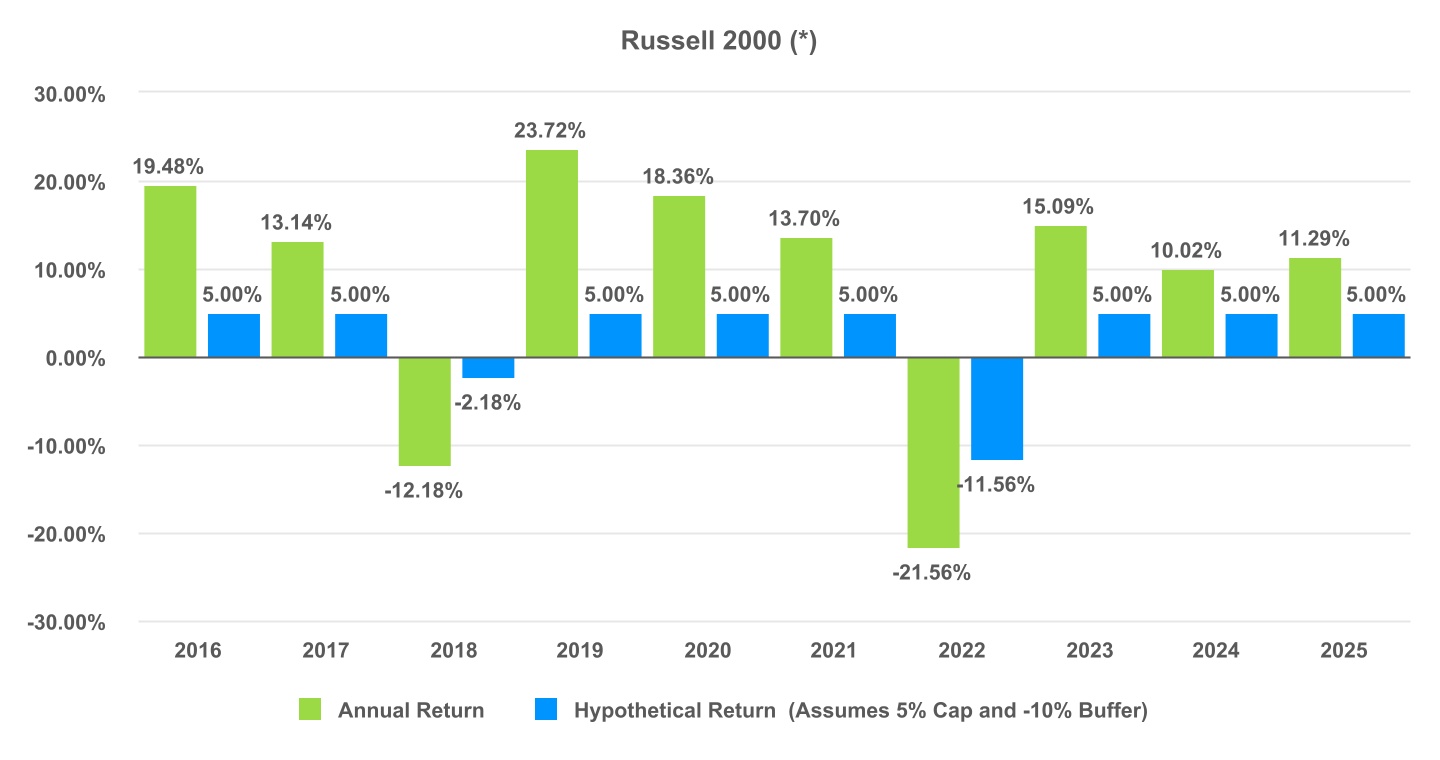
                   
Index-Linked Option Details, Price Return Index Does not Reflect Dividends [Text Block] All of the Indexes we currently offer are price return indices, not “total return” indices, and do not reflect dividends or distributions paid on the securities composing the Indices.                    
Index-Linked Option Details, Price Return Index Underperforms Direct Investments [Text Block] This will reduce the Index return and cause the Index to underperform a direct investment in the securities composing the Index.                    
Russell 2000 Price Return Index [Member]                      
Index-Linked Option Details, Crediting Methodology [Line Items]                      
Index-Linked Option Details, Index Return [Table Text Block]
1237
                   
Annual Return, Caption Russell 2000® Index                    
Annual Return [Percent]   11.29% 10.02% 15.09% (21.56%) 13.70% 18.36% 23.72% (12.18%) 13.14% 19.48%
Annual Return, Example Capped and Buffered [Percent]   5.00% 5.00% 5.00% (11.56%) 5.00% 5.00% 5.00% (2.18%) 5.00% 5.00%
Index-Linked Option Details, Price Return Index Underperforms [Text Block] The Russell 2000 Index is a price return index not a “total return index” and therefore does not reflect dividends or distributions paid on the assets composing the Index.                    
Index-Linked Option Details, Price Return Index Deducts Costs [Text Block] This will reduce the Index return and cause the Index to underperform a direct investment in the securities composing the Index.                    
Index-Linked Option Details, Indexes [Line Items]                      
Index-Linked Option Details, Index Investment Types [Text Block] The Russell 2000® Index measures the performance of the small-cap segment of the U.S. equity universe. It is a subset of the Russell 3000® Index and includes approximately 2,000 of the smallest securities based on a combination of their market cap and current index membership.                    
Index-Linked Option Details, Price Return Index Does not Reflect Dividends [Text Block] All of the Indexes we currently offer are price return indices, not “total return” indices, and do not reflect dividends or distributions paid on the securities composing the Indices.                    
Index-Linked Option Details, Price Return Index Underperforms Direct Investments [Text Block] This will reduce the Index return and cause the Index to underperform a direct investment in the securities composing the Index.                    
NASDAQ 100 Price Return Index [Member]                      
Index-Linked Option Details, Crediting Methodology [Line Items]                      
Index-Linked Option Details, Index Return [Table Text Block]
1550
                   
Annual Return, Caption Nasdaq-100 Index®                    
Annual Return [Percent]   20.17% 24.88% 53.81% (32.97%) 26.63% 47.58% 37.96% (1.04%) 31.52% 5.89%
Annual Return, Example Capped and Buffered [Percent]   5.00% 5.00% 5.00% (22.97%) 5.00% 5.00% 5.00% 0.00% 5.00% 5.00%
Index-Linked Option Details, Price Return Index Underperforms [Text Block] The NASDAQ 100 Index is a price return index not a “total return index” and therefore does not reflect dividends or distributions paid on the assets composing the Index.                    
Index-Linked Option Details, Price Return Index Deducts Costs [Text Block] This will reduce the Index return and cause the Index to underperform a direct investment in the securities composing the Index.                    
Index-Linked Option Details, Indexes [Line Items]                      
Index-Linked Option Details, Index Investment Types [Text Block] The Nasdaq-100 Index includes 100 of the largest domestic and international non-financial companies listed on the Nasdaq Stock Market based on market capitalization. The index reflects companies across major industry groups including computer hardware and software, telecommunications, retail/wholesale trade and biotechnology.                    
Index-Linked Option Details, Price Return Index Does not Reflect Dividends [Text Block] All of the Indexes we currently offer are price return indices, not “total return” indices, and do not reflect dividends or distributions paid on the securities composing the Indices.                    
Index-Linked Option Details, Price Return Index Underperforms Direct Investments [Text Block] This will reduce the Index return and cause the Index to underperform a direct investment in the securities composing the Index.                    
Interim Value Calculation [Member]                      
Item 4. Fee Table [Line Items]                      
Transactions Subject to Contract Adjustment, Fee Table [Text Block] Account value adjusts daily, known as the Interim Value. The Interim Value represents the daily value of the underlying hypothetical investments associated with your selected Indexed Account(s). Except for the first and last Business Day of an Interest Term, your Indexed Account Value is largely based on your Interim Value and is the amount available for withdrawals, surrenders, annuitization and death benefits. The Interim Value will also be used if you exercise the Return Lock feature. The maximum loss would only occur if there is a total surrender of the Indexed Account Value during the Interest Term at a time when the Index Value has declined to zero.                    
Market Value Adjustment [Member]                      
Item 4. Fee Table [Line Items]                      
Transactions Subject to Contract Adjustment, Fee Table [Text Block] MVAs may apply to withdrawals that exceed the Free Withdrawal Amount in a given Interest Term Year during the MVA Term. The maximum loss of the withdrawal amount in excess of the Free Withdrawal Amount would only occur under extreme circumstances. Certain withdrawals are not subject to an MVA. See “Market Value Adjustment” for more information.