Exhibit 99.86
NURAN WIRELESS INC.
(the “Company”)
ANNUAL INFORMATION FORM FOR THE YEAR ENDED DECEMBER 31, 2025
June 4, 2026
- ii -
TABLE OF CONTENTS
| INTRODUCTORY NOTED AND CAUTION REGARDING FORWARD-LOOKING STATEMENTS | 4 |
| General | 4 |
| Currency Presentation and Exchange Rate Information | 4 |
| Cautionary Note Regarding Forward-Looking Statements | 4 |
| GLOSSARY | 7 |
| CORPORATE STRUCTURE | 9 |
| Name and Incorporation | 9 |
| Intercorporate Relationships | 9 |
| GENERAL DEVELOPMENTS OF THE BUSINESS OVER THE LAST THREE YEARS | 10 |
| 2023 Developments | 10 |
| 2024 Developments | 12 |
| 2025 Developments | 14 |
| Current Financial Year Developments | 15 |
| Anticipated Changes in the Company’s Business | 16 |
| Significant Acquisitions | 16 |
| DESCRIPTION OF THE BUSINESS | 16 |
| Business of the Issuer | 16 |
| Products and Services | 17 |
| Specialized Skill and Knowledge | 23 |
| Competitive Conditions | 23 |
| Components | 24 |
| Intangible Properties | 24 |
| Cycles | 24 |
| Changes to Contracts | 24 |
| Economic Dependence | 24 |
| Employees and Consultants | 24 |
| Regulatory Framework | 25 |
| Lending | 27 |
| Business Objectives | 27 |
| Bankruptcy and Similar Procedures | 28 |
| Social and Environmental Policies | 28 |
| Operations in an Emerging Market Jurisdiction | 28 |
| RISK FACTORS | 30 |
ii
- iii -
| Risk Related to the Issuer, its Business and Securities | 30 |
| Risks Related To The Trading And Telecommunications Sector | 34 |
| DIVIDEND POLICY | 38 |
| DESCRIPTION OF THE CAPITAL STRUCTURE | 39 |
| MARKET FOR SECURITIES | 39 |
| ESCROWED SECURITIES AND SECURITIES SUBJECT TO CONTRACTUAL RESTRICTIONS ON TRANSFER | 41 |
| DIRECTORS AND EXECUTIVE OFFICERS | 42 |
| AUDIT COMMITTEE INFORMATION | 46 |
| Audit Committee | 46 |
| Audit Committee Charter | 46 |
| Composition of Audit Committee | 46 |
| Pre-Approval Policies and Procedures | 47 |
| PROMOTERS | 48 |
| LEGAL PROCEEDINGS AND REGULATORY ACTIONS | 48 |
| INTEREST OF MANAGEMENT AND OTHERS IN MATERIAL TRANSACTIONS | 48 |
| REGISTRAR AND TRANSFER AGENT | 48 |
| MATERIAL CONTRACTS | 48 |
| INTEREST OF EXPERTS | 49 |
| ADDITIONAL INFORMATION | 49 |
| Schedule “A” – AUDIT COMMITTEE CHARTER | A-1 |
iii
INTRODUCTORY NOTED AND CAUTION REGARDING FORWARD-LOOKING STATEMENTS
General
In this Annual Information Form (“AIF”), NuRAN Wireless Inc., together with its subsidiaries, as the context requires, is referred as the “Issuer”, the Group or “NuRAN”. Unless otherwise stated, all information contained in this AIF is as at December 31, 2025, being the last day of the Issuer’s most recently completed financial year.
This AIF should be read in conjunction with the Issuer’s audited consolidated financial statements and management’s discussion and analysis for the financial year ended December 31, 2025, which are available under the Company’s profile on the System for Electronic Document Analysis and Retrieval (“SEDAR+”) at www.sedarplus.ca.
Currency Presentation and Exchange Rate Information
Certain terms used herein are defined in the “Glossary of Terms”. Unless otherwise indicated references to “C$” or “CDN” or “CAD” are to Canadian dollars and , references to “$” or “USD$” or “US” are to American dollars. All financial information with respect to the Issuer have been presented in Canadian dollars in accordance with International Financial Reporting Standards as issued by the International Accounting Standards Board and interpretations of the International Financial Reporting Interpretation Committee.
Cautionary Note Regarding Forward-Looking Statements
Certain statements in this AIF are forward-looking statements or information (collectively “forward-looking statements”). The Issuer is hereby providing cautionary statements identifying important factors that could cause the actual results of the Issuer to differ materially from those projected in the forward-looking statements. Any statements that express, or involve discussions as to, expectations, beliefs, plans, objectives, assumptions or future events or performance (often, but not always, through the use of words or phrases such as “may”, “is expected to”, “anticipates”, “estimates”, “intends”, “plans”, “projection”, “could”, “vision”, “goals”, “objective” and “outlook”) are not historical facts and may be forward-looking and may involve estimates, assumptions and uncertainties which could cause actual results or outcomes to differ materially from those expressed in the forward-looking statements.
By their nature, forward-looking statements involve numerous assumptions, inherent risks and uncertainties, both general and specific, which contribute to the possibility that the predicted outcomes may not occur or may be delayed. The risks, uncertainties and other factors, many of which are beyond the control of the Issuer that could influence actual results include, but are not limited to:
| 1. | The Issuer is a Holding Company |
| 2. | Investors May Lose Their Entire Investment |
| 3. | Evolving Business Strategy |
| 4. | Liquidity, Going-Concern and Additional Financing Risk |
| 5. | Customer Concentration and Dependence Risk |
| 6. | International Operations and Emerging Market Risk |
| 7. | Foreign Exchange Risk |
| 8. | Sales Cycle, Revenue Timing and Contract Execution Risk |
4
| 9. | Gross Margin, Cost Structure and Profitability Risk |
| 10. | Dependence on Key Personnel and Skilled Workforce |
| 11. | Outsourcing, Manufacturing and Supply Chain Risk |
| 12. | Technology Development and Obsolescence Risk |
| 13. | Intellectual Property Risk |
| 14. | Regulatory and Compliance Risk |
| 15. | Credit Risk and Collection Risk |
| 16. | Business Interruption and Force Majeure Risk |
| 17. | Volatile Market Price for the Issuer’s Common Shares |
| 18. | The Company’s activities are subject to community relations and license to operate |
| 19. | Reputational Risk |
| 20. | Competitive Conditions |
| 21. | Industry Cyclicality and Market Demand Risk |
| 22. | Component Supply and Availability |
| 23. | Standardization and Interoperability Risk |
| 24. | Sector-Specific Regulatory and Licensing Risk |
| 25. | Reliance on Intellectual Property and Regulatory Authorizations |
| 26. | Operations in Foreign Jurisdictions |
| 27. | Volatility of Prices |
| 28. | Fluctuations in currency exchange rates |
| 29. | Government or Regulatory Policy |
| 30. | Climate Change and Emissions |
| 31. | Access to Capital and Liquidity |
| 32. | Credit Risk |
| 33. | Margin Risk |
| 34. | Errors in IT |
| 35. | Tax Law Environment |
| 36. | Legal |
| 37. | Discretion in the Available Funds |
| 38. | Future Acquisitions or Dispositions |
| 39. | Dilution from Equity Financing could Negatively Impact Holders of Common Shares |
5
| 40. | Management of Debt Dependent on Cash Flow |
| 41. | Management and Directors |
| 42. | Litigation |
| 43. | Conflicts of Interest, and |
| 44. | Dividends |
Such forward-looking information is necessarily based upon a number of factors and assumptions that, while considered reasonable by the Issuer as of the date of such statements, are inherently subject to significant business, economic and competitive uncertainties and contingencies. Although the Issuer believes that the assumptions underlying these statements are reasonable, they may prove to be incorrect, and the Issuer cannot assure that actual results will be consistent with these forward-looking statements. Given these risks, uncertainties and assumptions, you should not place undue reliance on these forward-looking statements. Whether actual results, performance or achievements will conform to the Issuer’s expectations and predictions is subject to a number of known and unknown risks, uncertainties, assumptions and other factors, including those listed under “Risk Factors”.
If any of these risks or uncertainties materialize, or if assumptions underlying the forward-looking statements prove incorrect, actual results might vary materially from those anticipated in those forward-looking statements, which could have a material adverse effect on the business, financial condition and results of operations of the Issuer.
Information contained in forward-looking statements in this AIF is provided as of the date of this AIF, and the Issuer disclaims any obligation to update any forward-looking statements, whether as a result of new information or future events or results, except to the extent required by applicable securities laws. Accordingly, potential investors should not place undue reliance on forward-looking statements or the information contained in those statements.
Any graphs, tables or other information demonstrating the historical performance or current or historical attributes of the Issuer or any other entity contained in this AIF are intended only to illustrate historical performance or current or historical attributes of the Issuer or such entities and are not necessarily indicative of future performance of the Issuer or such entities.
This AIF includes summary descriptions of certain material agreements of the Issuer. See section entitled “Material Contracts” in this AIF. The summary descriptions disclose provisions that the Issuer considers to be material, but are not complete and are qualified by reference to the terms of the material agreements, which will be filed with the Canadian securities regulatory authorities and will be available under the Issuer’s profile on SEDAR+ at www.sedarplus.ca.
6
GLOSSARY
The following is a glossary of certain defined terms used throughout this AIF. This is not an exhaustive list of defined terms used in this AIF and additional terms are defined throughout. Terms and abbreviations used in the financial statements of the Issuer are defined separately and the terms and abbreviations defined below are not used therein, except where otherwise indicated. Words importing the singular, where the context requires, include the plural and vice versa, and words importing any gender include all genders.
“Affiliate” means a company that is affiliated with another company as described below:
A company is an “Affiliate” of another company if:
| 1. | one of them is the subsidiary of the other; or |
| 2. | each of them is controlled by the same Person; |
A company is “controlled” by a Person if:
| 1. | voting securities of the company are held, other than by way of security only, by or for the benefit of that Person; and |
| 2. | the voting securities, if voted, entitle the Person to elect a majority of the directors of the company; |
A Person beneficially owns securities that are beneficially owned by:
| 1. | a Company controlled by that Person, or |
| 2. | an Affiliate of that Person, or |
| 3. | an Affiliate of any Company controlled by that Person; |
“Applicable Securities Laws” means applicable securities legislation, securities regulation and securities rules, as amended, and the policies, notices, instruments and blanket orders having the force of law, in force from time to time;
“Audit Committee” means the Audit Committee of the Issuer;
“Board of Directors” or “Board” means the Issuer’s board of directors;
“Bylaws” means the bylaws of the Issuer;
“CEO” means Chief Executive Officer;
“CFO” means Chief Financial Officer;
“Common Shares” means the unlimited number common shares of the Issuer without par value;
“Corporations Act” means the Business Corporations Act (British Columbia);
“Closing Date” means December 22, 2025;
“Group” means the Issuer and all of its subsidiaries.
“Initial Public Offering” or “IPO” means a transaction that involves an issuer issuing securities from its treasury pursuant to its first prospectus that has received a Final Receipt from the applicable regulatory authorities;
“Issuer” or “Company” or “NuRAN” means NuRAN Wireless Inc., a company incorporated under the Business Corporations Act (British Columbia));
“MNOs” means mobile network operators;
“NI 51-102” means National Instrument 51-102 – Continuous Disclosure Obligations of the Canadian Securities Administrators;
“NI 52-110” means National Instrument 52-110 – Audit Committees of the Canadian Securities Administrators;
“Person” unless specifically indicated otherwise, means a corporation, incorporated association or organization, body corporate, partnership, trust, association or other entity other than an individual;
7
“Principal Regulator” means the British Columbia Securities Commission;
“SEDAR+” means the Canadian Securities Administrators’ national system that all market participants will use for filings, disclosure, payments and information searching in Canada’s capital markets, accessible through the internet at www.sedarplus.ca;
“Shareholders” means the holders of Common Shares;
“Stock Option Plan” means the stock option plan approved by the shareholders on October 29, 2025, providing for the granting of incentive stock options to the Issuer’s directors, officers, employees and consultants;
“Stock Options” means the stock options issued pursuant to the Stock Option Plan;
“Transfer Agent” means the transfer agent and registrar of the Issuer, being Odyssey Trust Company;
“Units” means units of the Issuer, with each Unit comprised of one Common Share and one Warrant, of which the Warrants comprise a part;
“Warrant” means the Common Share purchase warrants of the Issuer; and
“Warrant Share” means each of the Common Shares issuable on the exercise of the Warrants.
8
CORPORATE STRUCTURE
Name and Incorporation
The Issuer was incorporated pursuant to the Business Corporations Act (British Columbia) on September 23, 2014, under the name “NuRAN Wireless Inc.”
The Issuer’s head office and registered and records office is located at 2150 Cyrille-Duquet Quebec, QC, G1N 2G3 Canada. The Issuer’s registered and records office is located at 1000-595 Burrard Street, Vancouver, BC V7X 1S8.
The Issuer is the overall parent company of the Group, which consists of companies listed under “Intercorporate Relationships”. The Issuer’s assets currently consist solely of interests in its wholly owned subsidiaries, and the only business of the Issuer is the business of its subsidiaries.
Intercorporate Relationships
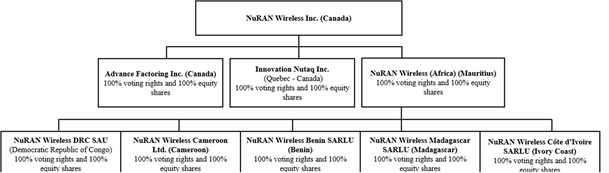
NuRAN Wireless Inc. (Canada) is the parent company of a group of wholly owned subsidiaries operating in Canada and Africa. The Corporation directly owns 100% of the issued and outstanding voting rights and equity securities of Advance Factoring Inc. (Canada), Innovation Nutaq Inc. (Québec, Canada), and NuRAN Wireless (Africa) (Mauritius).
NuRAN Wireless (Africa) (Mauritius) acts as the holding company for the Corporation’s African operations. Through NuRAN Wireless (Africa) (Mauritius), the Corporation indirectly owns 100% of the issued and outstanding voting rights and equity securities of NuRAN Wireless DRC SAU (Democratic Republic of Congo), NuRAN Wireless Cameroon Ltd. (Cameroon), NuRAN Wireless Benin SARLU (Benin), NuRAN Wireless Madagascar SARLU (Madagascar), and NuRAN Wireless Côte d’Ivoire SARLU (Côte d’Ivoire).
All of the Corporation’s subsidiaries are wholly owned, and the Corporation exercises full control over their operations and governance.
The corporate structure is as follows:
9
GENERAL DEVELOPMENTS OF THE BUSINESS OVER THE LAST THREE YEARS
2023 Developments
Orange Madagascar NaaS Agreement (Madagascar)
On January 17, 2023, NuRAN announced the entry into a Network-as-a-Service (“NaaS”) agreement with Orange Madagascar for the deployment of up to 500 rural sites on the east coast of Madagascar, with contracted revenue potential of approximately US$90 million. The 10-year agreement is the Company’s third contract with Orange and is expected to support 2G and 3G networks through a variety of site categories designed to address differing population densities and coverage areas. NuRAN expects to retain ownership of the infrastructure upon completion of the contract term, increasing the overall value of the agreement.
Marshall Islands 4G Network Expansion (MINTA)
On February 21, 2023, the Company announced a US$1.41 million purchase order from the Marshall Islands National Telecommunications Authority (“MINTA”) to extend and add 4G coverage to its existing network. MINTA is the end customer under a prior contract with Intelsat, pursuant to which NuRAN has deployed network infrastructure since 2021, validating the Company’s technology and deployment capabilities.
Restructuring of Secured Convertible Debentures
On February 21, 2023, the Company finalized amendments with holders of its August 2022 secured debentures, including a six-month maturity extension to August 2023 and waivers of certain default rights. In consideration, the existing debentures were cancelled and replaced with $2,975,914 in secured convertible debentures at $0.42 per share, together with 750,000 bonus shares. The new debentures bear no interest until maturity, and there were no changes to the existing warrants. The existing warrants are exercisable at a price of $1.10 per common share until August 19, 2025.
On August 29, 2023, the Company announced that it has restructured its secured convertible debentures originally issued in February 2023. The debenture holders agreed to extend the maturity by 12 months to August 2024 and to waive certain rights under the debentures, including rights related to events of default. In consideration, the Company entered into debt settlement agreements and paid a 5% extension fee, pursuant to which the existing debentures and related security agreements were cancelled and replaced with secured convertible debentures having an aggregate principal amount of $2,792,810, inclusive of accrued interest and fees. The new debentures are convertible at $0.35 per unit, with each unit comprising one common share and three-quarters of one common share purchase warrant, each whole warrant exercisable at $0.40 per share until August 28, 2026. The new debentures bear interest at a rate of 15% per annum.
On December 4, 2023, the Company announced that certain events of default were waived and the deadlines are extended to February 28, 2024. In consideration, the conversion price of the debentures was amended to $0.225 per unit, with each unit consisting of one common share and three-quarters of one common share purchase warrant, each whole warrant exercisable at $0.25 per share until August 28, 2026. The Company also agreed to issue an aggregate of 120,000 Common Shares to the debenture holders,
Stock Options Issuance
On April 4, 2023, The Company announced that it has granted 1,250,000 stock options to a consultant pursuant to its stock option plan. The options vest immediately and are exercisable at $0.425 per common share for a five-year term.
Non-Convertible Bridge Loan for US$1.5 Million
On April 25, 2023, The Company announced that it has entered into a six-month senior secured loan with a principal repayment amount of US$1,653,947, inclusive of a 5% original issue discount and a 5% lending fee, bearing interest at 10% per annum payable at maturity. The loan is senior to all existing and future indebtedness and is secured by substantially all assets of the Company and its subsidiaries, excluding shares in its African subsidiaries and certain assets expected to be pledged to development finance institutions (“DFI”) lenders. The loan is prepayable at any time without penalty and includes customary information rights, default provisions, and participation rights in future debt financings. Loan proceeds are intended to repay short-term indebtedness, fund site rollouts, and provide working capital. In connection with the loan, the Company agreed to issue 2,000,000 share purchase warrants exercisable at $0.40 per share for a two-year term.
10
On December 3, 2024, the Company announced that it obtained an extension of its bridge loan from a U.S.-based institutional lender, extending the maturity to October 21, 2024, to allow additional time to complete financing for its NaaS infrastructure. In consideration, the principal amount of the loan was increased by 10% as an extension fee, and the Company agreed to issue 5,000,000 replacement share purchase warrants exercisable at $0.25 per share for a two-year term. The loan was also amended to include a conversion feature at $0.225 per common share.
Change of Auditor
On April 28, 2023, the Company announced that it changed its auditors from Mallette S.E.N.C.R.L. to Jeremy Levi, CPA.
OTCQB Listing
On June 13, 2023, the Company announced its listing on the OTCQB Venture Market under the ticker symbol “NRRWF”.
Factoring Agreement with Advance Factoring
On August 29, 2023, the Company announced that it entered into a factoring agreement with Advance Factoring Inc. (the “Factor”) providing for the sale of up to $15 million of receivables owing from its African operating subsidiaries. To that date, the Company has sold receivables with a face value of $8.65 million for gross proceeds of $5.44 million, consisting of cash used to repay short-term debt owing to affiliates of the Factor and to fund working capital. The Company does not expect to sell the remaining receivables under the facility. The Factor has limited recourse against the Company in certain circumstances, which may be satisfied in cash or through the issuance of units at a price of $0.35 per unit. Each unit will be comprised of (i) one share in the capital of the Company; and (ii) three quarters (3/4) of one warrant exercisable into one additional share of the Company at $0.40 for a period of 3 years from entering into of the factoring facility. Sold receivables bear interest at 15% per annum until paid. In connection with the factoring facility, the Company agreed to pay an arrangement fee of 3.8 million Common Shares at a deemed price of $0.23 per share issued in stages.
On December 4, 2023, the Company amended its factoring agreement and sold additional receivables with a face value of $1.425 million for proceeds of $865,000, consisting of cash received and deferred funding for working capital. Under the amendment, certain deadlines were extended to January 31, 2024. The amendment also revised the terms applicable to any satisfaction of a recourse obligation through the issuance of units, setting a deemed issue price of $0.225 per unit with warrants exercisable at $0.25 per share. In addition, the amendment increased the remaining arrangement fee payable in Common Shares from 1.3 million to 1.9 million shares, to be issued in tranches by March 15, 2024.
Cameroon Category 1 Infrastructure License
On October 17, 2023, NuRAN announced that its wholly owned subsidiary, NuRAN Wireless Cameroon SARLU, had received a Category 1 license authorizing the delivery and operation of shared passive infrastructure to support digital communications networks. This license enables the Company to deliver its NaaS business model for Orange Cameroon and to host multiple mobile network operators on individual sites.
11
DRC Network Infrastructure License Application
On November 16, 2023, the Company announced that its wholly owned subsidiary, NuRAN Wireless DRC SARLU, had completed its application for a network infrastructure license in the Democratic Republic of the Congo. The license permits expansion of the Company’s business model beyond NaaS, including the provision of VSAT services, following regulatory changes implemented by Ministerial Decree dated October 10, 2023. As a condition of the application, the subsidiary was converted into a société anonyme (SA), which conversion was completed in September 2024.
2024 Developments
Senior Secured Bridge Facility and FEI Loan Facility
On January 3, 2024 NuRAN announced the execution of a non-binding mandate letter for a US$5 million senior secured bridge facility and, subsequently, the signing of a loan facility agreement with the Facility for Energy Inclusion (“FEI”), a fund managed by Cygnum Capital, to finance renewable energy assets supporting existing and new NaaS agreements, primarily in Cameroon and the DRC. On February 29, 2024, the secured bridge facility was approved.
On April 26, 2024, NuRAN announced the signing of the Facility with FEI, a fund managed by Cygnum Capital, for the purpose of (re)financing the construction of renewable energy assets for mobile network infrastructure in respect of existing and new NaaS agreements with the intention of accelerating the build of NaaS sites primarily in Cameroon and DRC. This Facility would allow NuRAN to deploy more than 500 new sites and combined with cash generated from operating sites, the Company will use the proceeds to cover all material and construction costs of new sites. The loan drawdowns were subject to customary drawdown conditions for a loan of this nature including evidence of new sites being funded and operational from the proceeds of drawdowns and the amounts are secured against the assets of the Company’s subsidiaries.
Convertible Debenture Maturity Extension
On January 3, 2024, NuRAN announced amendments to its convertible debentures issued in July 2022, including an extension of the maturity date to July 12, 2024 and revisions to the original issuance discount and conversion terms. The original issuance discount was increased from 10% to 16%, resulting in a revised maturity value of approximately $2,645,502. The principal amount of the debentures remains convertible, at the option of the holder, into Common Shares of the Company at a fixed conversion price of $0.40 per share during the term of the debentures. The debentures do not bear interest until maturity or the occurrence of an event of default. All other terms, including the number and terms of warrants issued in conjunction with the original debentures, remain unchanged. In addition, the investor continues to act as the Company’s exclusive transmission equipment provider for the earlier of a seven-year term or until the Company completes the purchase of a committed volume of equipment for its African operations.
On December 23, 2024, the Company announced that the debenture holders have agreed to extend the maturity for a further 28 months to December 31, 2026 and reduce the interest rate to 10% to December 2026. As consideration to these debenture holders, the Company agreed to increase the principal amount owing to include interest accrued to date, a one-time extension fee of 15% and a prepayment of interest for 2025 as an increase in the principal amount. In addition, the Company agreed to reduce the price per unit to $0.20 and to extend the expiry of the warrants that have been issued or are to be issued upon conversion to August 28, 2028.
Appointment of Navindran Naidoo to the Board
On February 1, 2024, the Company announced the appointment of Navindran Naidoo to the Board and chair of the Strategic Committee. The Company also announced the resignation of Kenneth Campbell.
12
Proposed Long-Term Debt Financing Initiatives
On February 6, 2024, the Company announced that it had received a non-binding Letter of Intent for up to US$ 15M of debt financing and on March 11, 2024, the Company announced that it received three additional expressions of interest from lenders to support the Company’s network infrastructure roll-out at the NuRAN Africa level.
Cameroon Local Bank Credit Facility
On April 4, 2024, NuRAN announced confirmation of an US$800,000 credit facility from a local Cameroonian commercial bank to support further site deployments in Cameroon. The credit facility has a 2-year tenor and bears a 9% interest rate per annum.
Proposed Syndicated Senior Secured Credit Facility
On May 15, 2024, the Company announced that NuRAN Wireless Africa Holding had signed a non-binding term sheet and mandate letter with a global asset management firm for a senior secured credit facility, including an initial US$15 million commitment with the potential to increase to up to US$70 million through syndication. The loan facility is for a term of seven (7) years including two (2) years’ grace period on repayment of principle and disbursements may be requested up to 24 months following execution of definitive agreements for the loan facility. Interest under the loan facility is due on all disbursed sums and is to be paid quarterly in arrears on predetermined payments dates. The interest rate will be a fixed rate as specified by the borrower for each tranche at up to 10%.
MTN Africa NaaS Expansion under Global Framework Agreement
On June 5, 2024, NuRAN announced a five-year NaaS agreement with MTN Group (“MTN”) (JSE: MTN) for the deployment of 250 sites in Africa pursuant to the existing Global Framework Agreement, increasing total contracted MTN sites to 2,150 across five countries.
MTN Benin NaaS Agreement
On July 16, 2024, the Company announced a NaaS agreement with MTN Benin for the deployment of up to 200 rural 2G, 3G and 4G sites in Benin, with an initial five-year term and a renewal option for an additional five years.
Initial FEI Facility Drawdown
On July 16, 2024 NuRAN announced receipt of the initial US$2.5 million drawdown under the FEI facility, enabling the resumption of site rollout activities across Cameroon and other African markets.
Non-Brokered Convertible Debenture Financing
On August 19, 2024, NuRAN announced the closing of a non-brokered private placement of an unsecured convertible debenture for aggregate gross proceeds of approximately US$1.6 million. The debenture will mature on August 16, 2026 and will accrue interest at a rate of 15% per annum until the maturity date. The debenture may be converted, in whole or in part, at any time before the maturity date, into units of the Company at the election of the debenture holder at a conversion price of $0.225 per unit. Each unit consists of one common share in the capital of the Company and one common share purchase warrant. Each warrant is exercisable for one common share at an exercise price of $0.25 per share for a 24-month term from closing. In addition, while the debenture holder maintains a greater than 5.0% equity interest in the Company on a partially diluted basis, the holder is entitled to participate, on a pro rata basis, in certain equity financings to maintain up to a 9.9% partially diluted equity interest.
Change of Auditor
On December 9, 2024, the Company announced that it changed its auditors from Jeremy Levi, CPA to Zeifmans LLP.
13
Factoring Agreement with Advance Factoring
On December 23, 2024, the Company announced the amendment to its August 28, 2023 factoring agreement with the Factor to increase the maximum facility size to $25.5 million and reduce the applicable interest rate for 2024 to 5%. The amendment also capped the maximum number of units issuable under the facility at 30,000,000, reduced from 80,000,000 units. As consideration, the Company agreed to reduce the unit issue price to $0.20 and extend the expiry of the warrants issued or issuable under the facility to August 28, 2028.
2025 Developments
Second Drawdown under FEI Facility for Cameroon NaaS Expansion
On February 28, 2025, the Company announced approval of a second drawdown of US$1.05 million under the FEI facility to support further expansion of its NaaS operations in Cameroon.
Non-Brokered Common Share Private Placement and Debt Repayment
On August 26, 2025, the Company announced the closing of a non-brokered private placement financing for gross proceeds of $1,500,000 through the issuance of 30,000,000 Common Shares at a price of $0.05 per share. The proceeds were used for working capital purposes and to repay all outstanding short-term promissory notes issued between April and August 2025, totaling $1,274,492.
CAPEX Contract for Rural Mobile Network Extension Project in Africa
On September 4, 2025, the Company announced that it was awarded a contract valued at approximately $7.2 million by a state-owned mobile network operator for a rural network expansion project in West Africa. The contract is structured as a capital expenditure arrangement for the deployment of up to 200 mobile sites over an expected three-year term, with payments tied to agreed project milestones. The Company will act as lead contractor and is responsible for end-to-end project delivery, including the provision of radio access network equipment, site sourcing, logistics, installation, and overall project management.
Third Drawdown under Facility for Energy Inclusion
On September 29, 2025, the Company announced the receipt of the approval for a third drawdown of US$1.0 million under its loan facility with the Facility for Energy Inclusion (“FEI”), managed by Cygnum Capital. This followed the first drawdown of US$2.5 million received on July 16, 2024, and the second drawdown of US$1.05 million received on February 28, 2025. The third drawdown followed an amendment with Orange in respect of the Company’s operations in the DRC and the approval of its infrastructure license. An additional US$450,000 remained available under the facility, subject to the delivery of additional sites. The proceeds were intended to support mobile site expansion and operational activities in Africa.
Non-Brokered Unit Private Placement Financing
On November 26, 2025, the Company announced the closing of a non-brokered private placement financing for gross proceeds of $300,000, completed through the issuance of 13,636,362 units at a price of $0.022 per unit. Each unit consists of one common share and one-half of one common share purchase warrant. Each whole warrant entitles the holder, following the proposed consolidation, to acquire one pre-consolidation common share at a pre-consolidation exercise price of $0.033 per share, exercisable on the date that is three (3) years from the date of issuance.
Board Approval of Share Consolidation
On December 5, 2025, the board of directors approved a consolidation of the Company’s issued and outstanding Common Shares on the basis of one (1) post-consolidation common share for every 300 pre-consolidation Common Shares, effective December 9, 2025. The consolidation was undertaken to permit the Company to satisfy applicable listing and regulatory requirements in connection with a potential listing on a U.S. national securities exchange.
14
Operational Update: Ghana, Cameroon and Democratic Republic of the Congo
On December 22, 2025, the Company provided an operational update regarding its network activities in Ghana, Cameroon and the Democratic Republic of the Congo (“DRC”). In Ghana, the Company restored all seven previously deployed sites, bringing them back into service. In the DRC, site relocation activities resumed, with additional relocations underway. Network deployment activities in Cameroon continued during the period. In connection with the Company’s financing arrangements, the Company was working toward the deployment of an additional 50 sites, which, together with ongoing deployment and relocation activities, were expected to support the release of remaining funds under its existing loan facility.
Restructuring Transaction
On December 22, 2025, NuRAN completed a restructuring transaction (the “Restructuring Transaction”) pursuant to which it issued an aggregate of 10,380,618 units (each, a “Unit”) at a price of $2.89 per Unit, for aggregate gross proceeds of approximately $30 million.
Each Unit consisted of one common share of the Issuer and one-half of one common share purchase warrant, with each whole warrant entitling the holder to acquire one additional common share at an exercise price of $4.335 per share until December 22, 2030.
The Restructuring Transaction comprised:
| 1. | the settlement of an aggregate of $9,685,256 of indebtedness through the issuance of Units to creditors; |
| 2. | a private placement resulting in aggregate gross proceeds of $5,625,000, representing the issuance of 1,946,365 Units; and |
| 3. | the acquisition of the Factor for total consideration of $20,802,303.09, satisfied by way of debt settlement through the issuance of 7,198,026 Units pursuant to a share purchase agreement (the “SPA”). |
Also on the Closing Date, the Company completed an initial tranche of additional subscriptions, issuing an aggregate of 2,115,064 Units at a price of $2.89 per Unit, for aggregate gross proceeds of approximately $6.11 million, comprised of cash subscriptions and additional debt settlements.
Debt Settlement
On December 30, 2025, the Company announced that it has closed a second tranche of its debt settlement issuances, by issuing an aggregate of 147,668 Units, at $2.89 per Unit, which included cash subscriptions of $190,116 and debt settlements of $236,648.
Current Financial Year Developments
Change of Auditor
On January 28, 2026, Company announced that it changed its auditors from Zeifmans LLP to SRCO Professional Corporation, effective January 13, 2026.
Debt Settlement
On February 3, 2026, the Company announced that it has closed a third tranche of its debt settlement issuances, by issuing an aggregate of 26,297 Units, at $2.89 per Unit, representing debt settlements of $76,000.
15
Anticipated Changes in the Company’s Business
Over the next 12 months, the Company intends to continue executing on its business objectives – see “Business of the Issuer”.
Significant Acquisitions
Advance Factoring Inc. Acquisition (Restructuring Transaction)
On December 22, 2025, NuRAN completed the acquisition of the Factor as part of a broader restructuring transaction. All of the issued and outstanding the Factor common shares and preferred shares were acquired for total consideration of $20,802,303.09, satisfied by way of debt settlement through the issuance of 7,198,026 units of the Issuer.
The principal assets of the Factor consisted of factored receivables representing claims against the Issuer. Although structured as an acquisition, the transaction operated economically as a debt settlement, pursuant to which liabilities arising from prior factoring arrangements were extinguished through the issuance of securities.
As consideration for the acquisition, the Issuer issued Common Shares representing 55.78% of its outstanding voting securities, resulting in the vendors of the Factor being able to materially affect control of the Issuer. Accordingly, the transaction constituted a “restructuring transaction” within the meaning of NI 52-102. The Company expects to dissolve the Factor at a later date.
The Issuer did not file because it was not required to file Form 51-102F4 – Business Acquisition Report in respect of this acquisition.
DESCRIPTION OF THE BUSINESS
Business of the Issuer
General
NuRAN Wireless Inc. is a supplier of mobile and broadband wireless infrastructure solutions, focused primarily on providing connectivity solutions in remote, rural and low-population-density regions. The Company designs, manufactures and deploys wireless infrastructure equipment and provides network deployment and operational services to mobile network operators (“MNOs”) and other customers.
The Company’s conducts its business primarily through its Network-as-a-Service (“NaaS”) operating model that integrates its proprietary wireless infrastructure technology with construction, operation and maintenance services. During the financial year ended December 31, 2025, the Company generated revenue of approximately $4 million of sales, of which $3.5 million of was derived from the NaaS operations. The remaining revenue was generated by sales of its Radio Access Network (“RAN”) equipment to mobile network operators and system integrators providing installation services to mobile operators. As the Company is still in the early stages of deploying its NaaS infrastructure having completed approximately 5% of its contracted rollout, it has incurred losses. On a consolidated basis, the Company is not currently generating positive EBITDA and additional financing has been required to supplement the operating cashflow, primarily from its NaaS operations in Africa. During 2025 and early 2026, the Company drew the remaining US$2.5 million available under its Cygnum Capital facility, with additional funding provide through advances under its factoring facility.
16
NuRAN’s principal products and services include:
| ● | Wireless Infrastructure Systems (“WIS”), consisting primarily of radio access network (RAN) equipment, core network components and backhaul solutions designed for deployment in rural and underserved regions; and |
| ● | Network-as-a-Service (“NaaS”), pursuant to which the Company finances, builds, operates and maintains telecommunications sites on behalf of MNOs, generating revenue through fixed monthly payments or revenue-sharing arrangements, typically under long-term contracts ranging from five to ten years or longer. |
The Company’s wireless infrastructure solutions are designed to reduce the total cost of ownership for network operators and enable economically viable deployment in locations that are not feasible using traditional infrastructure.
NuRAN’s principal markets include Africa, particularly Cameroon, the Democratic Republic of the Congo, Benin, Madagascar, Côte d’Ivoire and Ghana, as well as other international markets where the Issuer has deployed or contracted infrastructure.
Distribution of the Issuer’s products and services is conducted primarily through direct contractual arrangements with MNOs and other network operators.
All of the Company’s products and services are at the commercial production stage, and the Company is not currently engaged in material research and development activities outside of incremental product and network optimization.
Products and Services
The Company provides services through a combination of equipment deployment, site construction, network integration, operation and maintenance. Under the NaaS model, NuRAN retains ownership of deployed infrastructure in many cases and provides ongoing network management services throughout the contract term.
Network-as-a-Service (NaaS) Model
The Company offers a NaaS model targeted primarily at rural, low-density and underserved markets. Under this model, the Company designs, deploys, owns and operates mobile network infrastructure, and provides network services to MNOs pursuant to long-term commercial arrangements. The NaaS model is intended to allow MNOs to extend network coverage without deploying capital directly into network infrastructure in certain geographic areas.
The Company’s NaaS arrangements are structured to support deployment across a range of project sizes and geographic environments, including locations where traditional network rollouts may be constrained by population density, infrastructure availability or economic considerations.
Business Model and Partnerships
Under the NaaS model, the Company typically retains ownership of the deployed infrastructure while providing network services to MNO partners. This model is intended to allow MNOs to allocate capital toward their core network operations while relying on the Company for site development, deployment and operation in designated coverage areas.
The Company may enter into strategic partnerships with infrastructure providers and other third parties to support site construction, tower deployment and ongoing network operations. These arrangements are designed to facilitate deployment timelines and operational scalability in rural and remote environments.
Engineering, Network Monitoring and Upgrade Planning
The Company maintains internal engineering and research and development capabilities focused on network design, deployment optimization and lifecycle management. The Company monitors deployed network sites and infrastructure to support maintenance activities and to assess potential technology upgrades over time, subject to commercial, technical and regulatory considerations.
17
Network Infrastructure Offerings within the NaaS Model
The Company’s NaaS deployments may incorporate a range of network infrastructure products, depending on site requirements, coverage objectives and power availability. These may include:
| 1. | GSM LiteCell: a 2G base station solution designed for extended coverage in rural environments with lower power consumption characteristics; |
| 2. | OC-2G: a 2G GSM base station designed for smaller-radius coverage and lower power consumption deployments; and |
| 3. | LiteCell-xG: a multi-standard base station platform designed to support 2G, 3G and 4G (LTE) technologies within a single unit. |
The selection and configuration of equipment for a given deployment depend on site-specific factors, including population density, coverage requirements, backhaul availability and energy constraints.
Infrastructure Design and Power Solutions
The Company deploys infrastructure using a range of tower configurations designed to accommodate different geographic and demographic environments. Network sites may incorporate alternative power solutions, including solar-based systems, where grid power is unavailable or impractical. Infrastructure designs are intended to support long-term operation in rural and remote locations.
Intended Impact and Use Cases
The Company’s NaaS model is intended to support the extension of mobile network coverage into underserved areas, including rural communities and emerging markets. By enabling network deployment in locations with limited existing infrastructure, the Company’s services may support access to basic telecommunications services for individuals, enterprises and public institutions operating in those regions.
INSIGHT Geo-Intelligence and Site Survey Service
The Company offers a geo-intelligence and site survey service, marketed as INSIGHT, intended to support MNOs and infrastructure partners in planning, evaluating and deploying mobile network infrastructure, particularly in rural and low-density environments.
INSIGHT combines desktop-based geo-analysis tools with on-site data collection to assist customers in identifying suitable deployment locations, assessing coverage potential and evaluating site configurations prior to infrastructure deployment. The service is designed to support decision-making related to network expansion, site prioritization and capacity planning.
Population and Location Analysis
INSIGHT includes population and geographic analysis intended to assist customers in identifying underserved or uncovered localities. The service evaluates population distribution within defined coverage radii and estimates addressable population using conservative assumptions. Geographic analysis may include identification of points of interest and high-level radio planning to determine theoretical site locations for further evaluation.
18
Coverage Simulation and Radio Planning
INSIGHT performs coverage simulations for identified localities using standard site typologies and configurations. These simulations are intended to support evaluation of coverage potential and assist in comparing alternative site configurations based on expected demand and quality-of-service considerations. The simulations are theoretical in nature and are subject to site-specific and environmental constraints.
As part of the INSIGHT service, the Company may perform a preliminary revenue and feasibility assessment to assist customers in evaluating potential deployment opportunities. This assessment may consider factors such as estimated average revenue per user (ARPU), subscriber penetration assumptions, call duration, average data usage and indoor versus outdoor coverage thresholds. These analyses are intended to support high-level planning and do not constitute financial forecasts.
INSIGHT evaluates proposed site capacity requirements in relation to estimated demand and potential revenues to assist in selecting appropriate site configurations. The service considers whether proposed configurations are feasible given the expected traffic and commercial parameters for a given locality.
The INSIGHT service includes evaluation of potential site candidates based on factors such as terrain, vegetation, population density and coverage objectives. Line-of-sight (LOS) analysis may be conducted to assess visibility between candidate sites and existing network infrastructure, taking into account elevation, distance and terrain profile.
In certain deployments, the Company conducts on-site surveys in rural and ultra-rural areas to collect field data relevant to network planning. These surveys may include collection of information regarding population centers, public facilities, terrain characteristics, vegetation and physical obstacles that may affect signal propagation. Data collected through on-site surveys is integrated with desktop analyses to inform site selection and deployment planning.
INSIGHT services may be offered through different service packages, with scope varying depending on project requirements, geographic factors and deployment scale. Packages may range from preliminary geo-analysis and coverage simulation to more detailed capacity, revenue and site configuration assessments.
The INSIGHT geo-intelligence and site survey service is intended to support:
| 4. | rural and remote network expansion planning; |
| 5. | prioritization of deployment locations; |
| 6. | evaluation of site feasibility prior to infrastructure investment; and |
| 7. | optimization of network design in environments with limited existing infrastructure. |
The service may be used by mobile network operators, infrastructure providers or other customers seeking analytical support for network planning and deployment decisions.
Sentinel Comprehensive Network Monitoring
The Company has developed Sentinel, a network management and monitoring program intended to support the operation of telecommunications networks through centralized network operations centre (“NOC”) services. Sentinel is designed to provide continuous monitoring and operational oversight of network deployments, including site availability, performance indicators, and incident management.
Services under the Sentinel program include real-time network monitoring, alarm detection, incident registration and escalation, troubleshooting, and resolution support. The program also provides performance reporting and analysis, including key operational metrics, to assist network operators in assessing network performance and reliability. Post-incident review and root-cause analysis may be conducted where applicable.
19
Sentinel is supported by a NOC team with experience in telecommunications network operations, systems administration, and network support functions. The program is designed to operate across multiple network environments and technologies and to support both Company-operated networks and customer deployments, as applicable.
The Company intends to utilize the Sentinel program to support its ongoing network operations, including its Network-as-a-Service activities, and to offer operational support services in connection with customer-owned or managed network infrastructure. The program is expected to contribute to service continuity and operational oversight of deployed networks.
Solstice Solar Phone Charging Solutions
The Company offers solar-powered phone charging solutions, marketed under the Solstice brand, designed for deployment in rural, remote and underserved communities where access to reliable electricity infrastructure may be limited. Solstice solutions are intended to provide basic mobile device charging services using stand-alone solar-powered installations.
Solstice products are designed to operate independently of grid power and are intended for deployment in locations with limited or no access to conventional electrical infrastructure. These solutions may be deployed in connection with the Company’s broader network infrastructure activities or as stand-alone community services, depending on customer and partner requirements.
Product Configurations
The Solstice product line includes multiple charging system configurations designed to accommodate different community sizes and usage volumes. These configurations are intended to support varying levels of daily device charging capacity, subject to environmental conditions and usage patterns.
The Company may customize Solstice deployments based on site-specific factors, including population size, expected usage levels, and available solar exposure.
Software and Monitoring Capabilities
Solstice solutions may include software-based features intended to support monitoring and management of deployed charging stations. These features may allow customers or partners to track usage levels and manage payment or access mechanisms associated with the charging services. Software capabilities may vary depending on deployment configuration and customer requirements.
Deployment Environments and Use Cases
Solstice solar phone charging solutions are intended for deployment in a range of environments, including:
| 1. | rural and remote villages; |
| 2. | underserved or off-grid communities; |
| 3. | locations with limited or unreliable access to electricity; and |
| 4. | community hubs or shared facilities. |
These solutions are intended to support access to basic mobile device charging in environments where alternative charging infrastructure may be unavailable or impractical.
20
Community-Oriented Deployment Approach
In certain deployments, the Company may allocate a portion of revenues generated from Solstice installations toward community-oriented initiatives or infrastructure support, subject to commercial arrangements and project-specific terms. Such initiatives may include additional solar equipment or other local infrastructure projects. The scope and availability of such initiatives depend on the specific deployment and contractual arrangements.
Intended Use
The Solstice solar phone charging solutions are intended to complement the Company’s broader connectivity and infrastructure offerings by supporting access to basic mobile device charging services in rural and underserved environments. Deployment of Solstice solutions may be undertaken directly by the Company or in collaboration with mobile network operators, infrastructure partners or community organizations.
GSM LiteCell 1.5 Base Station
The Company designs and supplies compact GSM base station equipment intended to support mobile network deployments in low-density, rural and remote environments. One of the Company’s principal hardware offerings is the GSM LiteCell 1.5, a low-power GSM base station designed for use in locations where conventional telecommunications infrastructure may be impractical or uneconomical.
The GSM LiteCell 1.5 is engineered to support simplified deployment and operation in environments with limited physical infrastructure and constrained power availability. The product is designed to be transportable by hand and installed directly on towers or similar structures, without the need for protective shelters or extensive external radio-frequency components.
The GSM LiteCell 1.5 is designed to operate with reduced power consumption relative to conventional base stations, which may allow deployment in locations relying on solar, battery or diesel power solutions. The equipment is intended to support cost-efficient operation in remote or off-grid locations, including sites that rely on satellite-based backhaul connectivity.
The GSM LiteCell 1.5 is compatible with the Company’s network management and backhaul optimization solutions, including its base station controller and satellite optimization technologies. These systems are designed to support bandwidth management and operational efficiency in environments where terrestrial backhaul is limited or unavailable.
The Company has deployed multiple generations of GSM base station equipment in various geographic regions, and the GSM LiteCell 1.5 reflects continued development of this product line based on prior deployments and operating experience.
The GSM LiteCell 1.5 is intended for use in a range of deployment scenarios, including:
| 1. | rural and remote mobile network coverage; |
| 2. | low-density villages and communities; |
| 3. | roadside and highway coverage in sparsely populated areas; |
| 4. | isolated industrial or infrastructure sites; |
| 5. | mobile network expansion projects in developing and emerging markets; and |
| 6. | private or dedicated GSM networks for enterprises and organizations. |
21
Deployment of the GSM LiteCell 1.5 is typically undertaken by mobile network operators, infrastructure providers or enterprise customers seeking to extend basic mobile connectivity into areas where traditional network solutions may not be economically viable.
OC-2G GSM Base Station
The Company offers a 2G GSM base station solution (OC-2G) designed to support flexible deployment models and interoperability with mobile network operator infrastructure. The OC-2G GSM base station may be deployed as part of different solution architectures depending on customer requirements and network design.
Under NuRAN Carrier Solutions (NCS), the OC-2G GSM base station is deployed in combination with the Company’s proprietary Base Station Controller (BSC) to form a complete radio access network (RAN). In this configuration, the RAN is designed to integrate with a mobile network operator’s existing core network infrastructure.
The OC-2G GSM base station is also available as part of NuRAN OpenAccess (NOA), an open-architecture solution that incorporates open-source software components and open interfaces at various layers of the mobile network protocol stack. The NOA configuration is intended to support greater flexibility in network design and integration and may include higher-level network functionalities such as integrated network-in-a-box deployments and community-based network management tools.
The OC-2G GSM base station is designed to support deployment scenarios where operators, infrastructure providers or enterprises seek modular, scalable GSM solutions that can be adapted to a range of operational environments.
The OC-2G GSM base station is intended for use in a variety of applications, including:
| 1. | rural mobile network coverage; |
| 2. | roadside and transportation corridor coverage; |
| 3. | low-density villages and communities; |
| 4. | remote and isolated sites; |
| 5. | deployments in developing countries and emerging markets; and |
| 6. | private or dedicated GSM networks for enterprises or organizations. |
Deployment of the OC-2G GSM base station may be undertaken by mobile network operators, infrastructure providers or other customers seeking to extend or supplement GSM network coverage using flexible deployment models.
LiteCell-xG Multi-Standard Base Station
The Company offers the LiteCell-xG, a compact, multi-standard base station designed to support 2G, 3G and 4G (LTE) technologies within a single hardware platform. The LiteCell-xG is based on a software-defined architecture intended to allow network operators to deploy multiple radio access technologies using a common unit, subject to applicable configuration and licensing requirements.
The LiteCell-xG is designed to support flexible deployment and network evolution by enabling operators to adapt the supported radio access technologies over time through software configuration, rather than hardware replacement. The platform is intended for use in environments where operators seek to optimize capital efficiency while maintaining the ability to introduce additional services as network requirements evolve.
22
The LiteCell-xG is designed to operate with a range of backhaul technologies and does not require a specific backhaul medium. The platform incorporates proprietary software features intended to support bandwidth efficiency for both voice and packet-switched traffic, which may be relevant in environments where backhaul capacity is constrained.
The LiteCell-xG is built on a modular hardware architecture incorporating industry-standard processing components. The platform is designed to support remote software upgrades and configuration, enabling operational changes without the need for on-site hardware intervention. The operating system and system architecture are designed to support continuous operation in environments where physical access may be limited.
The LiteCell-xG is designed with energy-efficient components and software-based energy-saving features intended to reduce power consumption relative to conventional base station deployments. These characteristics are relevant for deployments relying on alternative power sources, including solar, battery or hybrid energy solutions.
The LiteCell-xG supports multiple radio access technologies within a single platform and is designed to allow remote configuration of operating modes. The architecture is intended to support future network evolution, including potential upgrades to additional radio access technologies, subject to technical feasibility and regulatory requirements.
The LiteCell-xG is designed to support simplified deployment and management through the use of readily available, commoditized hardware components. The platform is intended to reduce logistical complexity and support efficient installation and maintenance across a range of deployment environments.
The LiteCell-xG is intended for use in a variety of deployment scenarios, including:
| 1. | rural and remote mobile network coverage; |
| 2. | roadside and transportation corridor coverage; |
| 3. | low-density villages and communities; |
| 4. | isolated or off-grid sites; |
| 5. | deployments in developing countries and emerging markets; and |
| 6. | private or dedicated mobile networks for enterprises or organizations. |
Deployment of the LiteCell-xG may be undertaken by mobile network operators, infrastructure providers or enterprise customers seeking a flexible, multi-standard radio access solution.
Specialized Skill and Knowledge
NuRAN’s operations require specialized expertise in telecommunications engineering, radio frequency planning, satellite and backhaul optimization, rural network deployment, and site operations. The Company maintains in-house technical expertise and operational capabilities to support deployment and ongoing management of wireless networks in developing and remote regions.
Competitive Conditions
The Company operates in competitive markets characterized by traditional telecom equipment vendors, infrastructure providers and tower companies. NuRAN competes primarily on the basis of cost efficiency, deployment flexibility, power efficiency and its integrated NaaS business model, particularly in rural and low-density markets, offering one ofthe lowest total cost of ownership (TCO) on the market, supported by key technology features like equipment energy consumption and optimized backhaul bandwidth usage.
23
Components
The Company sources components including radios, power systems, transmission equipment and related infrastructure from a diversified international supplier base. The availability of components is subject to global supply conditions, including potential tariff impacts; however, the Company seeks to mitigate supply risks through supplier diversification.
Intangible Properties
The Company relies on proprietary technology, software and know-how related to its wireless infrastructure systems. Licences and regulatory authorizations in various jurisdictions are also important to the Company’s operations.
Cycles
The Company’s business is not considered seasonal; however, deployment schedules may be influenced by financing availability, regulatory approvals and customer rollout timelines.
Changes to Contracts
The Company does not expect to be affected in the current financial year by the renegotiation or termination of contracts or sub-contracts.
Economic Dependence
The Company is not substantially dependent on any individual contract but is substantially dependent on long-term contracts with MNOs under its NaaS model.
Employees and Consultants
The Issuer and its subsidiaries employ 9 persons in management, 2 persons in sales, 2 persons in logistics, and 7 persons in administration.
As of the date of this AIF, the Company has 54 employees and consultants, of which 33 reports directly to Canada, 19 are based in Cameroon, Democratic Republic of the Congo and Ivory Coast. In addition, the Company retains individuals on a temporary contract basis, with the appropriate skills and background as required for particular projects under development or in production. Consultants may also be engaged on a long-term basis with the Company materials. The Company believes its relationship with its employees is excellent. None of the employees are represented by a union or are subject to a collective bargaining agreement. NuRAN ensures the full safety and wellbeing of its staff. In case of any unforeseen circumstances, calamities, war, pandemic etc., it has contingencies in place to relocate staff members to a safer jurisdiction
Their office locations are in:
| ● | Quebec, QC, Canada |
| ● | Douala, Cameroon |
| ● | Kinshasa, DRC |
| ● | Abidjan, Ivory Coast |
| ● | Port-Louis, Mauritius |
24
Regulatory Framework
Due to the nature of its business, the Company must comply with telecommunications regulatory frameworks that vary by country. Telecommunications equipment and components that use radio frequency spectrum, including base stations, modems, VSAT terminals and antennas, generally require type approval (homologation). The Network-as-a- Service business model is novel and may not fit neatly within existing regulatory frameworks. Although regulatory adjustments may be required over time, the Company has established compliance in each country where it operates insuring appropriate governance. The Company have also implanted an Environmental and Social Governance system to comply with local environmental regulatory frameworks.
Regulatory Framework in the DRC
Telecommunications and Internet policy in the DRC is overseen by the Ministry of Posts, Telecommunications and Digital Technologies, together with the Regulatory Authority for Posts and Telecommunications of Congo (Autorité de Régulation de la Poste et des Télécommunications du Congo, “ARPTC”). The sector is primarily governed by Framework Law No. 013/2002 and Law No. 014/2002, each dated October 16, 2002, alongside applicable international conventions to which the DRC is a party. Operators are required to obtain appropriate licences, including frequency authorizations where applicable, and must establish a local legal entity to conduct business. Licence terms and conditions are prepared by the ARPTC and approved by the Ministry. The Company obtained the following licences, authorizations and/or approvals:
| ● | Shared passive infrastructure license in rural areas (Licence d’infrastructure passive partagé en zone rurale) |
| ● | Authorization as a telecommunications equipment vendor (Agréement de vendeur d’équipements de télécommunications) |
| ● | Authorizations for the installation and maintenance of a telecommunications equipement (Agréements d’installateurs et de maintenance d’équipements de télécommunications) |
| ● | Product approval : |
| ○ | LiteCell 1.5 |
| ○ | OC-2G |
Regulatory Framework in Cameroon
Telecommunications regulation in Cameroon is overseen by the Ministry of Posts and Telecommunications (“MINPOSTEL”), which is responsible for sector policy, together with an independent regulatory authority tasked with supervising operators and enforcing compliance with applicable laws and regulations. The sector is principally governed by Law No. 98/014 of July 14, 1998 (as amended). Telecommunications services are subject to licensing or authorization requirements, and operators must comply with conditions relating to service quality, network interconnection, consumer protection and competition. The regulatory framework emphasizes principles such as transparency, non-discrimination, fair competition and equal access to networks and services, and prohibits anti-competitive practices. The Company obtained the following licences, authorizations and/or approvals:
| ● | Passive infrastructure (Infrastructure passive) – License Category 1 (Licence Catégorie 1) |
| ● | Authorization as a telecommunications equipment vendor (Agréement de vendeur d’équipements de télécommunications) |
| ● | Authorizations for the installation and maintenance of a telecommunications equipement (Agréements d’installateurs et de maintenance d’équipements de télécommunications) |
| ● | Product approval : |
| ○ | LiteCell 1.5 |
| ○ | OC-2G |
| ○ | LiteCell xG |
25
Regulatory Framework in Benin
Telecommunications regulation in Benin is overseen by the government ministry responsible for electronic communications, together with the Autorité de Régulation des Communications Électroniques et de la Poste (“ARCEP”), an independent regulatory authority responsible for supervising the sector and ensuring compliance with applicable laws and regulations. The sector is principally governed by the Digital Code (Law No. 2017-20 of April 20, 2018, as amended) and related implementing decrees. Telecommunications networks and services are subject to licensing, authorization or declaration regimes depending on their nature. Licences are typically required for the establishment and operation of public networks using spectrum and are granted by the government following a competitive process, while other services may be subject to authorization or notification to ARCEP. The Company obtained the following licences, authorizations and/or approvals:
| ● | Authorization as a telecommunications equipment vendor (Agréement de vendeur d’équipements de télécommunications) |
| ● | Authorizations for the installation and maintenance of a telecommunications equipement (Agréements d’installateurs et de maintenance d’équipements de télécommunications) |
| ● | Products Approval : |
| ○ | LiteCell 1.5 |
| ○ | LiteCell xG |
Regulatory Framework in Madagascar
Telecommunications regulation in Madagascar is overseen by the Ministry responsible for telecommunications and digital development, together with the Autorité de Régulation des Technologies de Communication (“ARTEC”), an independent public authority responsible for supervising the sector and ensuring compliance with applicable laws and regulations. The sector is principally governed by telecommunications legislation, including Law No. 2005-023 (as implemented by subsequent decrees), which establishes the legal and institutional framework and supports a liberalized market structure. Telecommunications networks and services are subject to licensing, authorization and declaration regimes. ARTEC is responsible for granting licences, issuing approvals, managing spectrum and numbering resources, and monitoring operator compliance with applicable requirements. The application of any licences or authorizations has not been submitted yet.
Regulatory Framework in Ivory Coast
Telecommunications regulation in Côte d’Ivoire is overseen by the Ministry of Digital Transition and Innovation, together with the Autorité de Régulation des Télécommunications/TIC de Côte d’Ivoire (“ARTCI”), an independent administrative authority responsible for regulating the sector and enforcing compliance with applicable laws. The sector is governed by a modern legal framework, including Law No. 2024-352 of June 6, 2024 relating to electronic communications, which establishes the current regulatory regime and aims to enhance transparency, competition and sector governance. Telecommunications services and networks are subject to licensing and authorization requirements. ARTCI is responsible for granting authorizations, managing spectrum resources, regulating tariffs, overseeing interconnection and competition, and ensuring compliance with licence conditions and consumer protection rules. The Company obtained the following licences, authorizations and/or approvals:
| ● | Authorization as a telecommunications equipment vendor (Agréement de vendeur d’équipements de télécommunications) |
| ● | Authorizations for the installation and maintenance of a telecommunications equipement (Agréements d’installateurs et de maintenance d’équipements de télécommunications) |
| ● | Products Approval : |
| ○ | LiteCell 1.5 |
| ○ | LiteCell xG |
26
Regulatory Framework in Canada
The Company has no intention or future plans to undertake operations in Canada. In the event that the Company determines to undertake operations in Canada or undertake operations that otherwise require regulation in Canada, it would have to comply with the regulatory framework in Canada. Specifically, the Company may need to register with the Canadian Radio-television and Telecommunications Commission and obtain the requisite licenses from Innovation, Science and Economic Development Canada. Compliance with these regulatory requirements may involve ongoing obligations and, where applicable, approvals or licences, and there can be no assurance that the Company would be able to obtain or maintain such registrations, licences or approvals on acceptable terms or within required timeframes.
Lending
The Company does not engage in lending activities.
Business Objectives
The Company’s business objectives are focused on the development, deployment and operation of mobile telecommunications infrastructure and related services in rural, remote and underserved markets, primarily through its subsidiaries operating in multiple jurisdictions. The Company seeks to pursue these objectives in a capital-efficient manner while managing the operational, regulatory and financial risks associated with international operations. Specifically, the Company’s principal business objectives include:
| 1. | Expansion of NaaS Operations |
To expand the deployment of network infrastructure and the provision of Network-as-a-Service solutions to mobile network operators, with a focus on rural and low-density markets where traditional network deployment may be constrained by economic or logistical factors.
| 2. | Optimization and Utilization of Existing Infrastructure |
To optimize the performance, utilization and lifecycle of deployed network assets through ongoing monitoring, maintenance and selective technology upgrades, subject to commercial, technical and regulatory considerations.
| 3. | Selective Geographic Growth |
To pursue disciplined expansion in jurisdictions where the Company has existing operational presence or where regulatory frameworks, market demand and partner relationships support sustainable deployment and operation of telecommunications infrastructure.
| 4. | Development and Commercialization of Proprietary Technology |
To continue the development and commercialization of proprietary and modular telecommunications equipment, software and network management solutions designed for deployment in rural and remote environments.
| 5. | Strengthening Relationships with Mobile Network Operators and Partners |
To maintain and expand long-term commercial relationships with mobile network operators, infrastructure partners and other counterparties to support network deployment, service delivery and operational scalability.
| 6. | Prudent Capital and Liquidity Management |
To manage liquidity and capital resources in a manner that supports ongoing operations, infrastructure deployment and strategic initiatives, while balancing the need for external financing with the interests of securityholders.
27
| 7. | Operational and Regulatory Compliance |
To conduct operations in compliance with applicable telecommunications, environmental, tax and securities regulations in each jurisdiction in which the Company operates, and to manage the risks inherent in operating across multiple legal and regulatory regimes
Bankruptcy and Similar Procedures
There are no bankruptcy, receivership or similar proceedings against the Company, nor is the Company aware of any such pending or threatened proceedings. There have not been any voluntary bankruptcy, receivership or similar proceedings by the Company within the three most recently completed financial years or proposed for the current financial year.
Social and Environmental Policies
The Company respects its employees, the environment and the communities in which its operates. The Company acknowledges that its activities can impact the environment. The Company believes that environmental stewardship is a sound business practice that will create value for its shareholders.
NuRAN commits to the following principles to ensure environmental stewardship:
| 1. | comply with applicable legal requirements; |
| 2. | work to reduce or avoid potential environmental impacts through effective management, the wise use of resources, pollution prevention and other appropriate mitigative measures, including reducing the Company’s carbon footprint; and |
| 3. | ensure that employees and contractors are aware of environmental policies, understand the policies, are aware of their roles and responsibilities, and have the appropriate training to do their work. |
Operations in an Emerging Market Jurisdiction
Guidance from Canadian securities regulators provides that issuers operating in markets deemed “emerging markets” include additional disclosure with respect to operations in such markets. The Company has material operating subsidiaries located in the DRC, Cameroon, Benin, Madagascar and Ivory Coast. It is likely that operating in the DRC, Cameroon, Benin, Madagascar and Ivory Coast, may expose the Company to a certain degree of political, economic and other risks and uncertainties. For these reasons, the following disclosure is in included in contemplation of the guidance in Staff Notice 51-720 – Issuer Guide for Companies Operating in Emerging Markets of the Ontario Securities Commission.
The establishment and development of the subsidiaries in the DRC, Cameroon, Benin, Madagascar and Ivory Coast adds an additional regulatory framework to which the Company operates and is supplementary to the existing regulatory framework existing in Canada. The Company’s operations are regulated at a significantly higher level than non-market regulatory businesses and this creates potential risk in the form of significantly higher costs associated with compliance and operations as well as standards or requirements that other businesses do not have to meet.
The dual regulatory framework that the Company will have to operate under when operations in the DRC, Cameroon, Benin, Madagascar and Ivory Coast are active, creates layers of structure that are governed by local regulatory environments that differ and will create additional risks and costs to monitor for the management of the Company. Each jurisdiction will require greater internal controls and adherence to a regulatory framework that creates challenges in relation to decisions making, communication, and compliance. The Company has enlisted internal risk managers and policies as well as experienced management to help facilitate adherence to regulatory requirements in order to meet this challenge.
28
The Company and its subsidiaries also employ numerous senior members of staff such as directors, employees and consultants that have significant experience in those markets. These include:
| ● | Navindran Naidoo, a director on the Board of the Company, who has over 30 years telecommunications experience and was a former network executive of MTN Group, a position he held for 8 years and went on assignments in Nigeria, Uganda, Cameroon, and Swaziland, where he was instrumental in the initial planning, deployment, and operation of MTN’s mobile networks in these countries. |
| ● | Gerard Lokossou, a strategic commercial advisor senior executive and strategic advisor, who has nearly 30 years of leadership experience across Africa in telecommunications and other sectors, including FMCG, renewable energy, and capital markets. He has held regional, group-level, and executive positions like MTN, Airtel Africa, and Orange, among other companies. He has led business turnarounds, growth acceleration strategies, and commercial transformations across West, Central, and East Africa. He brings a strong pan- African network of relationships with operators, regulators, investors, and strategic partners. |
Language and Cultural Differences
French is an official language in the DRC, Cameroon, Benin, Madagascar, and Ivory Coast, while Cameroon also recognizes English as an official language. The Company’s executive officers and all members of the Board are fluent in English and, in each case, English is their primary language. Francis Létourneau, the Company’s CEO has French as his primary language. In addition, the Company operates in English and all Board materials are prepared in English. The Company works with advisors capable of professionally conversing in English and in French.
The financial records of the Company and its subsidiaries existing under the laws of the DRC, Cameroon, Benin, Madagascar, and Ivory Coast are maintained in French. The Company does not believe that any material language or cultural barriers exist.
Should a translation from a jurisdiction’s official language to English be required, the Company intends to engage a professional translator to execute the required translation. In particular, the Company can rely on translators, bilingual local lawyers and/or bilingual local auditors.
The Company’s executive officers and members of the Board are familiar with local management and take a strong interest in the direction and operational aspects of ongoing managerial decisions. The Company engages with all subsidiaries and staff on a global basis as a team and interacts through cross company telecommunications and internal media to update and communicate corporate advancement with great frequency.
Risk Management and Disclosure
The Company has implemented a system of corporate governance, internal controls over financial and disclosure controls and procedures that apply to the Company and its subsidiaries, which are overseen by the Board and implemented by senior management of the Company. Executive management and the Board prepare and review the financial reporting of its subsidiaries as part of preparing its consolidated financial reporting, and the Company’s independent auditors review the consolidated financial statements under the oversight of the Company’s Audit Committee. As required under NI 52-110, the Company’s Audit Committee has the authority to engage independent counsel and other advisors as it deems necessary, to set the compensation for any such advisors, and to communicate directly with internal and external auditors. For additional details related to the Audit Committee and its role of oversight of the external auditor, see the heading “Audit Committee Information” in this AIF.
The board of the Company are responsible for maintaining good corporate governance practices and risk controls. The Company has a disclosure and confidentiality policy that establishes the protocol for the preparation, review and dissemination of information about the Company. This policy provides for multiple points of contact in the review of important disclosure matters.
29
Internal Controls
The Company prepares its consolidated financial statements on a quarterly and annual basis, using IFRS. The Company implements internal controls over the preparation of its financial statements and other financial disclosures, including its MD&A, to provide reasonable assurance that its financial reporting is reliable, the quarterly and annual financial statements are being prepared in accordance with IFRS and other financial disclosures, including its MD&A, are being prepared in accordance with relevant securities legislation. These systems are designed to ensure that, among other things, the Company has access to material information about its subsidiaries.
The Company’s operations and adherence to risk management in the DRC, Cameroon, Benin, Madagascar, and Ivory Coast are regulated and actively monitored. The Company when operational in the DRC, Cameroon, Benin, Madagascar, and Ivory Coast, will have monthly risk adherence standards to meet and communicate to the regulator. The Company provides internal monitoring through management and deploys corporate risk officers in the DRC, Cameroon, Benin, Madagascar, and Ivory Coast to facilitate this ongoing requirement. Risk officers in the DRC, Cameroon, Benin, Madagascar, and Ivory Coast, in addition to internal compliance standards, are both pre-approved and their activities monitored by the regulatory authority.
Related Parties
The Company is subject to Canadian securities laws and accounting rules with respect to approval and disclosure of related party transactions and has policies in place which it follows to mitigate risk associated with potential related party transactions. The Company may transact with related parties from time to time, in which case such related party transaction may require disclosure in its consolidated financial statements and in accordance with relevant securities laws.
Local Counsel and Advice
The Company has retained legal counsel in various international jurisdictions in which it operates regarding various corporate and regulatory legal issues, including the Company’s right to conduct business in the DRC, Cameroon, Benin, Madagascar, and Ivory Coast and other applicable jurisdictions, and has relied on advice from that counsel with respect to such matters. The Company ensures that any such counsel or provider retained has their credentials vetted, referenced, with considerable diligence and adherence to local licenses, professional associations, and regulators.
RISK FACTORS
AN INVESTMENT IN THE COMMON SHARES OF THE COMPANY IS SPECULATIVE IN NATURE AND INVOLVES A HIGH DEGREE OF RISK. Due to the nature of the Company’s business and its present stage of development, prospective investors in the Company’s securities should carefully consider the specific and general risks described below and elsewhere in this AIF. Additional risks and uncertainties not presently known to the Company or that the Company does not currently anticipate will be material, may impair the Company’s business operations and its operating results and as a result could materially impact its business, results of operations, prospects and financial condition.
Risk Related to the Issuer, its Business and Securities
The Issuer is a Holding Company
The Issuer is a holding company and essentially all of its assets are the capital stock of its subsidiaries in each of the markets the Issuer operates in. As a result, investors in the Issuer are subject to the risks attributable to its subsidiaries. As a holding company, the Issuer conducts substantially all of its business through its subsidiaries, which generate substantially all of its revenues. Consequently, the Issuer’s cash flows and ability to complete current or desirable future enhancement opportunities are dependent on the earnings of its subsidiaries and the distribution of those earnings to the Issuer. The ability of these entities to pay dividends and other distributions will depend on its operating results and will be subject to applicable laws and regulations which require that solvency and capital standards be maintained by such companies and contractual restrictions contained in the instruments governing its debt. In the event of a bankruptcy, liquidation or reorganization of any of the Issuer’s material subsidiaries, holders of indebtedness and trade creditors may be entitled to payment of its claims from the assets of those subsidiaries before the Issuer.
30
Investors May Lose Their Entire Investment
An investment in the Common Shares is speculative and may result in the loss of an investor’s entire investment. Only potential investors who are experienced in high-risk investments and who can afford to lose their entire investment should consider an investment in the Issuer.
Evolving Business Strategy
While the Issuer and the Group have existing operations and are generating revenues, they plan to expand their operations and staff to meet the requirements of their business initiatives. The commercial response to the product offerings is still uncertain, and although the Issuer and the Group believe that their strategy incorporates advantages compared to other suppliers of mobile and broadband wireless infrastructure solutions, if consumers do not respond favorably to the Issuer and the Group’s products or if it takes longer to develop their products or establish their customer base or it proves to be more costly than currently anticipated to develop their businesses, revenues may be adversely affected.
Liquidity, Going-Concern and Additional Financing Risk
The Company’s ability to continue operations, realize its assets and discharge its liabilities depends on its ability to generate sufficient cash flows from operations and obtain additional financing when required. The Company has historically relied on debt financings, equity financings and a restructuring transaction to fund its activities. There can be no assurance that additional financing will be available on acceptable terms, or at all. Failure to secure adequate financing could require the Company to delay, scale back or cease operations, restructure its obligations, or result in significant dilution to existing securityholders.
Customer Concentration and Dependence Risk
The Company is dependent on a limited number of customers for a significant portion of its revenues. The loss of one or more significant customers, a reduction or delay in customer purchases, contract terminations, disputes, or failure to renew existing arrangements could materially adversely affect the Company’s business, results of operations, liquidity and financial condition.
International Operations and Emerging Market Risk
A substantial portion of the Company’s operations and revenues are derived from jurisdictions outside Canada, including emerging markets. International operations expose the Company to economic, political, legal and regulatory risks, including political instability, civil unrest, changes in laws or regulations, expropriation or nationalization, restrictions on foreign ownership, limitations on the repatriation of funds, adverse tax consequences, customs and trade restrictions, and inconsistent enforcement of legal rights. These risks may be more pronounced in emerging markets where legal and regulatory systems are less developed or less predictable.
Foreign Exchange Risk
The Company generates a significant portion of its revenues in currencies other than the Canadian dollar, while a substantial portion of its operating costs are denominated in Canadian dollars and other currencies. Fluctuations in foreign exchange rates may materially adversely affect the Company’s revenues, margins, cash flows and financial results.
31
Sales Cycle, Revenue Timing and Contract Execution Risk
The Company’s sales cycles may be lengthy and involve complex technical, commercial and regulatory considerations. Revenue recognition may depend on customer acceptance, deployment milestones or other conditions. Delays in contract execution, customer approvals or project deployment may result in significant fluctuations in revenues, operating results and cash flows from period to period.
Gross Margin, Cost Structure and Profitability Risk
The Company’s gross margins and profitability may be adversely affected by changes in customer, geographic or product mix, pricing pressure, higher input and manufacturing costs, inventory obsolescence, warranty claims, shipment volumes, timing of revenue recognition and execution of its service-based business model. There can be no assurance that historical margins will be sustained.
Dependence on Key Personnel and Skilled Workforce
The Company’s success depends on its ability to attract, retain and motivate qualified technical, operational and management personnel. Competition for skilled professionals is intense, particularly in specialized telecommunications and technology roles. The loss of key personnel or the inability to recruit and retain qualified employees could materially adversely affect the Company’s operations and strategic execution.
Outsourcing, Manufacturing and Supply Chain Risk
The Company relies on third-party manufacturers and suppliers for the production of certain products and components. The Company has limited control over third-party manufacturing capacity, quality, delivery schedules and cost structures. Supply disruptions, manufacturing defects, cost increases or delays could impair the Company’s ability to meet customer obligations and negatively affect revenues and margins.
Technology Development and Obsolescence Risk
The Company operates in markets characterized by rapid technological change. Failure to anticipate or respond effectively to evolving customer requirements, technological advances or competing solutions could result in reduced demand for the Company’s products and services, loss of market share and adverse impacts on growth prospects.
Intellectual Property Risk
The Company relies on patents, trademarks, trade secrets and contractual protections to safeguard its intellectual property. These protections may be insufficient to prevent unauthorized use, misappropriation or infringement by third parties. The Company may also be exposed to claims alleging infringement of third-party intellectual property rights, which could result in costly litigation, licensing obligations, operational restrictions or reputational harm.
Regulatory and Compliance Risk
The Company is subject to laws and regulations in multiple jurisdictions, including telecommunications, environmental, tax, labour and securities regulations. Changes in regulatory requirements, failure to obtain or maintain required approvals, or non-compliance with applicable laws could result in fines, penalties, operational restrictions, litigation or reputational damage.
Credit Risk and Collection Risk
The Company may experience longer payment cycles and increased difficulty collecting accounts receivable, particularly in certain jurisdictions. Customer defaults, disputes or payment delays could adversely affect liquidity and financial performance.
32
Business Interruption and Force Majeure Risk
The Company’s operations may be disrupted by events beyond its control, including natural disasters, pandemics, transportation disruptions, political unrest, cyber incidents or other force majeure events. Such disruptions could materially adversely affect operations, customer relationships and financial results.
Volatile Market Price for the Issuer’s Common Shares
In recent years, the securities markets in Canada have experienced a high level of price and volume volatility, and the market prices of securities of many companies have experienced wide fluctuations in price which have not necessarily been related to the operating performance, underlying asset values or prospects of such companies. There can be no assurance that continual fluctuations in price will not occur. It may be anticipated that any quoted market for the Common Shares will be subject to market trends generally, notwithstanding any potential success of the Issuer in creating revenues, cash flows or earnings. The value of Common Shares distributed hereunder will be affected by such volatility.
The wide fluctuations are in response of numerous factors, many of which will be beyond the Issuer’s control, including, but not limited to the following:
| 1. | actual or anticipated fluctuations in the Issuer’s quarterly results of operations; |
| 2. | recommendations by securities research analysts; |
| 3. | changes in the economic performance or market valuations of companies in the telecommunications industry; |
| 4. | addition or departure of the Issuer’s executive officers and other key personnel; |
| 5. | sales or perceived sales of additional Common Shares, or other classes of shares of the Issuer; |
| 6. | operating and financial performance that vary from the expectations of management, securities analysts and investors; |
| 7. | regulatory changes affecting the telecommunications sector generally and the Issuer’s business and operations ; |
| 8. | regulatory changes affecting businesses generally within jurisdictions in which the Issuer operates or does business; |
| 9. | announcements of developments and other material events by the Issuer’s or its competitors; |
| 10. | fluctuations to the costs of vital production materials and services; |
| 11. | significant acquisitions or business combinations, strategic partnerships, joint ventures or capital commitments by or involving the Issuer or its competitors; |
| 12. | operating and share price performance of other companies that investors deem comparable to the Issuer or from a lack of market comparable companies; and |
| 13. | news reports relating to trends, concerns, technological or competitive developments, regulatory changes and other related issues in the Issuer’s industry or target markets. |
The Company’s activities are subject to community relations and license to operate
The Company’s relationship with the local communities and local authorities where it operates is critical to ensure the future success of its existing activities and the potential development and operation of its business. Failure by the Company to maintain good relations with local stakeholders can result in adverse claims and difficulties for the Company. Adverse publicity could have a material adverse impact on the Company and its reputation. Reputation loss may result in decreased investor confidence, increased challenges in developing and maintaining community relations and an impediment to the Company’s overall ability to advance its operations, which could have a material adverse impact on the Company’s business, results of operations and financial condition.
33
Reputational Risk
As a result of the increased usage and the speed and global reach of social media and other web-based tools used to generate, publish and discuss user-generated content and to connect with other users, companies today are at much greater risk of losing control over how they are perceived in the marketplace. Damage to the Company’s reputation can be the result of the actual or perceived occurrence of any number of events, and could include any negative publicity, whether true or not. The Company places a great emphasis on protecting its image and reputation, but the Company does not ultimately have direct control over how it is perceived by others. Reputation loss may lead to increased challenges in developing and maintaining community relations, decreased investor confidence and an impediment to the Company’s overall ability to advance its business, thereby having a material adverse impact on financial performance, cash flows and growth prospects.
Risks Related To The Trading And Telecommunications Sector
Competitive Conditions
The Company operates in highly competitive markets that include traditional telecommunications equipment vendors, network infrastructure providers, and tower companies, many of which have greater financial, technical, and operational resources than the Company. These markets are characterized by rapid innovation, evolving technologies, and significant price competition. Competition is based on a number of factors, including pricing, cost efficiency, deployment speed and flexibility, power efficiency, service reliability, and business model. The Company’s competitiveness, particularly in rural and low-density markets, depends in part on its ability to deliver cost-effective and flexible wireless infrastructure solutions through its integrated Network-as-a-Service (NaaS) model. Increased competition could result in pricing pressure, reduced margins, loss of customers, or reduced growth opportunities. There can be no assurance that the Company will be able to maintain its competitive position or that competitive pressures will not materially and adversely affect its market share, operating results, or financial condition.
Industry Cyclicality and Market Demand Risk
Demand for telecommunications infrastructure, network services and related technologies may be affected by macroeconomic conditions, capital spending cycles, customer budget constraints and shifts in industry priorities. Economic downturns or reduced infrastructure investment could materially adversely affect demand for the Company’s products and services.
Component Supply and Availability
The telecommunications and infrastructure sector relies on complex global supply chains and logistics networks. The Company relies on third-party suppliers for key components, including radio equipment, power systems, transmission equipment, and related infrastructure, which are sourced from an international supplier base. The availability, pricing, and delivery timelines of these components are subject to global supply chain conditions, including manufacturing capacity constraints, transportation disruptions, shipping delays, customs restrictions, geopolitical events, trade restrictions, tariffs, and other disruptions beyond the Company’s control. Although the Company seeks to mitigate supply chain risks through supplier diversification, there can be no assurance that alternative suppliers will be available on commercially reasonable terms or at all. Any disruption or delay in the supply or delivery of critical components could adversely affect the Company’s deployment schedules, operating performance, and financial results.
34
Standardization and Interoperability Risk
Many telecommunications technologies are subject to industry standards that are accessible to competitors. The Company’s products and services must interoperate with third-party systems and networks. Failure to comply with evolving standards or maintain interoperability could limit market acceptance and competitiveness.
Sector-Specific Regulatory and Licensing Risk
The telecommunications sector is subject to extensive regulation, including licensing requirements and operational approvals that vary by jurisdiction. Regulatory changes, delays in licensing or revocation of permits could materially adversely affect the Company’s ability to operate or expand in certain markets.
Reliance on Intellectual Property and Regulatory Authorizations
The Company’s operations depend on proprietary technology, software, and technical know-how related to its wireless infrastructure solutions. The Company may not be able to adequately protect its intellectual property rights, and unauthorized use, infringement, or misappropriation by third parties could occur. In addition, the Company relies on licences, permits, and regulatory authorizations in multiple jurisdictions to conduct its business. The loss, suspension, non-renewal, or material modification of any such intellectual property rights or regulatory approvals, or the inability to obtain new or amended approvals on acceptable terms, could materially and adversely affect the Company’s operations, business prospects, and financial condition.
Operations in Foreign Jurisdictions
The Company’s investments and interests may be exposed to various degrees of political, economic and other risks and uncertainties in a foreign jurisdiction. In particular, the Company’s business objectives may be affected by the local and governing political and economic developments including and not limited to: expropriation of property including intellectual property rights, invalidation of government orders, permits or agreements to operate, political unrest, labour disputes, limitations on repatriation of earnings, limitation on foreign ownership, inability to obtain or delays in obtaining necessary approvals, licenses, permits, or authorizations, government participation, royalties, rates of exchange, high rates of inflation, price controls, exchange controls, currency fluctuations, taxation and changes in laws, regulations or policies. The Company’s investments may also be adversely affected by the laws and policies of Canada affecting foreign trade, taxation and investment. In the event of a dispute arising in connection with a business interest of the Company in an international jurisdiction, the Company may be subject to the exclusive jurisdiction of foreign courts and may not be successful in subjecting foreign persons to the jurisdiction of courts of Canada or enforcing Canadian judgments in other jurisdictions. The Company may also be hindered or prevented from enforcing its rights with respect to a governmental instrumentality because of the doctrine of sovereign immunity. Accordingly, regulated exchange activities in international jurisdictions involving the Company or a subsidiary could be substantially affected by factors beyond the Company’s control, and which could have a material adverse effect on the Company.
Volatility of Prices
Changes in global macro-economic conditions, including trade tariffs, volatility in global markets, supply chain constraints, and increased price competition can influence equipments prices. Crude oil prices and metals can remain under pressure for a prolonged period. This could subsequently result in market access constraints, regional and international supply shortages, reduced utilization and demand imbalances. The uncertainty and increased risk caused by volatile markets could be mitigated using financial derivatives to hedge the positions the Issuer takes.
Fluctuations in currency exchanges rates
The Issuer and Group find their suppliers and customers across the globe, while operations and operating costs are spread across several different countries and currencies. Fluctuation in exchange rates, in particular, movements in Canadian Dollars and African currencies, may have a material impact on the Issuer and the Group’s financial results. Note that the business is mainly executed on a dollar basis on the purchasing, selling as well as the financing side. If currency is not naturally hedged through back-to-back deals, the exposure is hedged through adequate instruments.
35
Government or Regulatory Policy
The industry is also subject to regulation and intervention by governments including changes in government policy, regulation, and involvement of other laws, potentially materially impacting the Issuer and the Group’s ability to transact. Management follows these developments in order to ensure that the Issuer and the Group can flex its strategy as needed.
Climate Change and Emissions
Climate change may cause more frequent and severe weather events, diminished biodiversity, and changing weather factors such as fluctuating temperatures, precipitation, wind, and water levels. Physical risks from climate change may also result in operational or supply chain delays, depending on the nature of the event.
Access to Capital and Liquidity
With the market volatility, access to sufficient capital and liquidity is critical in enabling the Issuer and the Group to operate. The Issuer and the Group’s growth plans are also highly dependent upon having access to adequate capital and liquidity. It is important that the Issuer and the Group has access to different lines of financing and use of available headroom with their financiers helps to mitigate the liquidity risk.
Credit Risk
The Issuer and the Group are exposed to the credit risk of their customers in the ordinary course of the business. Generally, the customers are otherwise considered creditworthy or provide the Issuer and the Group security to satisfy credit concerns. However, the Issuer and the Group cannot predict to what extent their business would be impacted by deteriorating conditions in the economy, including possible declines in their customers’ creditworthiness. It is possible that customer payment defaults, if significant, could adversely affect their earnings and cash flows. The Issuer and the Group currently have credit insurance to cover credit receivables which is used to mitigate this risk.
Margin Risk
Difficulty arises if the Issuer and the Group make losses on the utilisation of options to manage the risks in the portfolio, which results in reduced levels of liquidity. The daily management of cash flows and liquidity is essential to the operation of the business so they can meet repayment obligations.
Errors in IT
The Issuer and the Group are using information and communication technology to run their business. Although their infrastructure is carefully designed and a team is involved to monitor and maintain it, unforeseen changes or events could adversely affect their business.
Tax Law Environment
The Issuer and the Group operate in Canada and various countries in Africa. Adjustments in tax regimes could adversely affect the business.
36
Legal
In trading, the Issuer and the Group enter into a multitude of contracts with suppliers, customers and service providers. Although the Issuer and the Group intend to carry out any contractual commitment and are selective in choosing its counterparts, the risk remains that a situation arises that will lead to legal arbitration and subsequent adverse effects.
Discretion in the Available Funds
Management has discretion concerning the use of the Issuer’s available funds, as well as the timing of its expenditure. As a result, investors will be relying on the judgment of management for the application of the Issuer’s available funds. The results and the effectiveness of the application of the proceeds are uncertain. If the proceeds are not applied effectively, the results of the Issuer’s operations may suffer.. However, management may elect to allocate the proceeds differently from that described under” if it believes it would be in the Issuer and the Group’s best interest to do so. Shareholders may not agree with the manner in which Management chooses to allocate and spend the Issuer’s available funds and proceeds.
Future Acquisitions or Dispositions
Material acquisitions, dispositions and other strategic transactions involve a number of risks, including: (i) potential disruption of the Issuer and the Group’s ongoing business; (ii) distraction of management; (iii) the Issuer and the Group may become more financially leveraged; (iv) the anticipated benefits and cost savings of those transactions may not be realized fully or at all or may take longer to realize than expected; (v) increasing the scope and complexity of the Issuer and the Group’s operations; (vi) loss or reduction of control over certain of the Issuer and the Group’s assets; and (vii) litigation or other disputes concerning either the Issuer and the Group’s obligations to counterparties under relevant transaction documents or liabilities of an acquisition target or its previous owners (whether disclosed or undisclosed at the time of the relevant transaction).
Additionally, the Issuer may issue additional Common Shares or other securities of the Issuer in connection with such transactions, which would dilute a shareholder’s holdings in the Issuer.
The presence of one or more material liabilities of an acquired company that are unknown to the Issuer and the Group at the time of acquisition could have a material adverse effect on the business, results of operations, prospects and financial condition of the Issuer and the Group. While the Issuer and the Group attempt to obtain appropriate indemnification provisions in connection with their acquisitions and dispositions, the Issuer and the Group may still be exposed to significant financial or reputational risk as a result of entering into such transactions.
Dilution from Equity Financing could Negatively Impact Holders of Common Shares
The Issuer may from time to time raise funds through the issuance of Common Shares or the issuance of debt instruments or other securities convertible into Common Shares. The Issuer cannot predict the size or price of future issuances of Common Shares or the size or terms of future issuances of debt instruments or other securities convertible into Common Shares, or the effect, if any, that future issuances and sales of the Issuer’s securities will have on the market price of the Common Shares. Sales or issuances of substantial numbers of Common Shares, or the perception that such sales or issuances could occur, may adversely affect prevailing market prices of the Common Shares. With any additional sale or issuance of Common Shares, or securities convertible into Common Shares, investors will suffer dilution to their voting power and the Issuer may experience dilution in its earnings per share.
Management of Debt Dependent on Cash Flow
An economic downturn may negatively impact the Issuer and the Group’s cash flows. Credit and capital markets can be volatile, which could make it more difficult for the Issuer and the Group to obtain additional debt or equity financings in the future. Such constraints could increase the Issuer and the Group’s costs of borrowing and could restrict their access to other potential sources of future liquidity.
37
The Issuer and the Group’s failure to have sufficient liquidity to make interest and other payments required by its debt could result in a default of such debt and acceleration of the Issuer and the Group’s borrowings, which would have a material adverse effect on the Issuer and the Group’s business and financial condition. To the extent the Issuer and the Group incur indebtedness, principal and interest payments on such indebtedness will have to be made when due, regardless of whether sufficient cash flow or income is available. If payments on any debts and obligations are not made when due, it may result in substantial adverse consequences to the Issuer and the Group, including adverse income tax consequences.
Management and Directors
The success of the Issuer is currently largely dependent on the performance of its officers. The loss of the services of these persons will have a materially adverse effect on the Issuer’s business and prospects. There is no assurance the Issuer can maintain the services of its officers or other qualified personnel required to operate its business. Failure to do so could have a material adverse effect on the Issuer and its prospects.
The Issuer has made certain forward-looking statements in this AIF regarding the future plans and intentions of the Issuer. Investors are cautioned that while the Issuer presently believes such statements to be accurate, the current Board of Directors and management of the Issuer do not have the power to irrevocably bind future Boards of Directors, management or shareholders of the Issuer and, accordingly, cannot guarantee that such plans and intentions will be fulfilled by the Issuer, if any.
Litigation
The Issuer may from time to time be involved in various claims, legal proceedings and disputes arising from disputes in the ordinary course of business. If such disputes arise and the Issuer is unable to resolve these disputes favourably, it may have a material and adverse effect on the Issuer’s profitability or results of operations and financial condition.
Conflicts of Interest
Certain of the directors of the Issuer serve as directors of other companies or have significant shareholdings in other companies and, to the extent that such other companies may participate in ventures in which the Issuer may participate, the directors of the Issuer may have a conflict of interest in negotiating and concluding terms respecting the extent of such participation. In the event that such a conflict of interest arises at a meeting of the board of directors of the Issuer, a director who has such a conflict will abstain from voting for or against the approval of such a participation or such terms. It may occur that a particular company will assign all or a portion of its interest in a particular program to another of these companies due to the financial position of the company making the assignment. The directors of the Issuer are required to act honestly, in good faith and in the best interests of the Issuer. In determining whether or not the Issuer will participate in a particular program and the interest therein to be acquired by it, the directors will primarily consider the degree of risk to which the Issuer may be exposed and its financial position at that time.
Dividends
The Issuer does not anticipate paying any dividends on its Common Shares in the foreseeable future.
DIVIDEND POLICY
The Issuer has not declared dividends on any of its shares in the past and does not intend to pay any in the foreseeable future. Any future determination to pay dividends will be at the discretion of the Board and will depend on the financial condition, business environment, operating results, capital requirements, any contractual restrictions on the payment of dividends and any other factors that the Board deems relevant.
38
DESCRIPTION OF THE CAPITAL STRUCTURE
Authorized and Issued and to be Issued Share Capital
The authorized share capital of the Issuer consists of an unlimited number of Common Shares without par value. As of the date of this AIF, 13,084,716 Common Shares were issued and outstanding as fully paid and non-assessable shares.
Common Shares
The holders of the Common Shares are entitled to receive notice of and to attend and vote at all meetings of the shareholders of the Issuer and each Common Share confers the right to one vote in person or by proxy at all meetings of the shareholders of the Issuer. The holders of the Common Shares, subject to the prior rights, if any, of any other class of shares of the Issuer, are entitled to receive such dividends in any financial year as the Board may by resolution determine. Holders of the Common Shares have the right, as respect to capital, to participate in distributions (including winding-ups) are entitled to receive, subject to the prior rights, if any, of the holders of any other class of shares of the Issuer, the remaining property and assets of the Issuer. The Common Shares are not redeemable.
Warrants
As of the day of the AIF, there are 6,363,824 Warrants issued and outstanding. The Warrants are exercisable at prices from $4.34 to $120 to acquire one Common Share until August 28, 2026, November 26, 2028, December 22, 2030,
December 29, 2030, and January 30, 2031.
3,599,010 Warrants are currently subject to an undertaking of the BCSC, whereby the Warrants cannot be exercised into Common Shares until (i) two business days following the removal of the Company from the BCSC’s Issuers in Default List, and (ii) the date on which the BCSC provides its written consent to revise, replace, or revoke the undertaking.
Stock Options
As of the date of this AIF, there are 8,267 stock options outstanding, issued to the directors, officers and consultants of the Issuer. The stock options are exercisable at prices from $127.50 to $705 to acquire one Common Share per stock option until October 20, 2026, October 26, 2026, and January 27, 2027.
Restricted Share Units
As of the date of this AIF, there are no restricted share units issued and outstanding.
MARKET FOR SECURITIES
Trading Price and Volume
The Common Shares are listed for trading on the Canadian Securities Exchange under the trading symbol “NUR” and on the OTCQB under the symbol “NRRWF” and on the Frankfurt Stock Exchange under the symbol “1RN”.
39
The following table sets out the intraday high and low prices and the trading volume for the Common Shares traded on the CSE during the 12-month period ended December 31, 2025:
| Month | Low (CAD) | High (CAD) | Volume |
| January 2025 | 0.07 | 0.085 | 2,854,500 |
| February 2025 | 0.065 | 0.10 | 4,481,400 |
| March 2025 | 0.065 | 0.085 | 1,915,500 |
| April 2025 | 0.07 | 0.095 | 3,943,200 |
| May 2025 | 0.08 | 0.1150 | 4,591,800 |
| June 2025 | 0.0750 | 0.1050 | 4,778,400 |
| July 2025 | 0.0500 | 0.0850 | 3,111,600 |
| August 2025 | 0.0350 | 0.055 | 4,482,900 |
| September 2025 | 0.025 | 0.045 | 14,411,400 |
| October 2025 | 0.02 | 0.03 | 5,269,200 |
| November 2025 | 0.015 | 0.02 | 951,600 |
| December 2025(1) | 7.50 | 7.50 | 27,797 |
Note:
| (1) | On December 9, 2025, the Company completed a 300-for-1 share consolidation. |
Prior Sales
The following table sets forth the securities issued or granted by the Company during the fiscal year ended December 31, 2025:
| Date of Issue | Type of Security | Number of Securities(1) | Exercise Price per Security(1) |
| August 26, 2025 | Common shares | 100,000 | $15 |
| November 26, 2025 | Common Shares (underlying the units) |
45,454 | $6.60 |
| November 26, 2025 | Warrants (underlying the units) |
22,727 | $9.90 |
| December 22, 2025 | Common Shares (underlying the units) |
10,380,618 | $2.89 |
| December 22, 2025 | Warrants (underlying the units) |
5,190,309 | $4.335 |
| December 22, 2025 | Common Shares (underlying the units) |
2,115,064 | $2.89 |
| December 22, 2025 | Warrants (underlying the units) |
1,057,532 | $4.335 |
| December 29, 2025 | Common Shares (underlying the units) |
147,668 | $2.89 |
| December 29, 2025 | Warrants (underlying the units) | 73,834 | $4.335 |
Note:
| (1) | On December 9, 2025, the Company completed a 300-for-1 share consolidation. Figures are calculated on a post- consolidation basis. |
40
ESCROWED SECURITIES AND SECURITIES SUBJECT TO CONTRACTUAL RESTRICTIONS ON TRANSFER
Escrowed Securities
On April 17, 2026, the former shareholders of the Factor entered into an undertaking pursuant to which they agreed not to, directly or indirectly, offer, sell, contract to sell, pledge, transfer, or otherwise dispose of any securities of the Company held by them and issued pursuant to the SPA, notwithstanding the expiry or removal of any legend required under applicable securities laws. The Undertaking remains in effect until the earlier of (i) two business days following the removal of the Company from the BCSC’s Issuers in Default List, and (ii) the date on which the BCSC provides its written consent to revise, replace, or revoke the Undertaking.
As of the date of this AIF, the following table sets forth details of the Escrowed Securities that are subject to a contractual restriction on transfer as of the date of this AIF:
| Name | No.
of Common Shares held per the Undertaking |
Percentage
of Class as at the date of the AIF |
No.
of Warrants held in the Undertaking |
| Shimshon Posen | 1,159,966 | 8.87% | 579,983 |
| AK Holdings Group Inc. | 1,288,927 | 9.85% | 644,463 |
| Joseph and Marla Posen Family Trust | 1,288,927 |
9.85% |
644,463 |
| Xorax Family Trust | 1,124,567 | 8.59% | 562,283 |
| Donal Carroll | 1,124,567 | 8.59% | 562,283 |
| Pacific Investment Holdings Limited | 1,124,567 |
8.59% |
562,283 |
| Roxanne Letourneau | 86,505 | 0.66% | 43,252 |
| TOTAL: | 7,198,026 | 8.87% | 3,599,010 |
Note:
| (1) | Based on 13,084,716 Common Shares issued and outstanding as of the date of the AIF. |
41
DIRECTORS AND EXECUTIVE OFFICERS
The following table provides the names, provinces of residence, positions, principal occupations and the number of voting securities of the Issuer that each of the directors and executive officers beneficially owns, directly or indirectly, or exercises control over, as of the date hereof:
| Name,
Province or State and Country of Residence and Position(s) with the Company |
Principal
Occupation, Business or Employment for Last Five Years |
Periods
during which Nominee has Served as a Director or Officer |
Number
of Common Shares Owned(2) |
Francis Letourneau Quebec City, QC President, CEO and Director |
CEO and President of NuRAN Wireless since August 28, 2020 and October 16, 2020, respectively; VP, Sales & Marketing of NuRAN Wireless 2015 to 2020 | Since March 16, 2016 | 7,967 |
Jim Bailey Newbury, United Kingdom CFO |
CFO of NuRAN Wireless; financial consultant to SMEs and enterprise clients providing corporate finance advice in M&A, business planning and financing | Since October 16, 2020 | 3,042 |
Binyomin Posen(1) Toronto, ON Director |
Senior Analyst at Plaza Capital Ltd. since 2017 | Since October 16, 2020 | Nil |
Brendan Purdy(1) Toronto, ON Director |
Principal lawyer at Purdy Law since January 2014 | Since October 16, 2020 | Nil |
Vitor Fonseca(1) Toronto, ON Director |
Treasurer and Vice President of Romspen Investment Corp. from February 2007 to February 2022; Director of Canntab Therapeutics Ltd. from April 11, 2018 to May 1, 2023 | Since March 11, 2021 | 27,761 |
Navindran Naidoo Johannesburg, South Africa Director |
Various Senior Management positions in Group Technology as well as being the Network Executive from 2013 to 2021. He has had previous assignments in Nigeria, Uganda, Cameroon, and Swaziland | Since February 1st, 2024 | Nil |
Avi Minkowitz Toronto, ON Director |
Entrepreneur and finance professional with various private hedge funds | Since September 30, 2025 | Nil |
Joseph Labkowski Cape Coral, Florida, USA Director |
Executive Director of the Chabad Jewish Center of Cape Coral | Since December 22, 2025 | Nil |
Note:
| (1) | Member of the Audit Committee. |
| (2) | The information as to the number of Shares (being the only voting securities of the Company) beneficially owned, or controlled or directed, directly or indirectly, is as of the date of this AIF, and has been furnished to the Company by the respective nominees individually. These figures do not include any securities that are convertible into or exercisable for Common Shares of the Company. The number of shares has been updated as a result of the 300:1 consolidation that took place on December 9, 2025. |
42
The term of office of the directors expires annually at the time of the Issuer’s annual general meeting. The term of office of the officers expires at the discretion of the Issuer’s directors.
The Issuer has two committees, the Audit Committee, comprised of Binyomin Posen, Brendan Purdy, and Vitor Fonseca.
Directors and executive officers, as a group, beneficially own, control or direct, directly or indirectly, 38,770 Common Shares, representing approximately 0.30% of the issued and outstanding Common Shares.
Corporate Cease Trade Orders or Bankruptcies
Other than as set out below, to the Issuer’s knowledge:
| 1. | no existing or proposed director, chief executive officer, chief financial officer or promoter of the Issuer is as of the date hereof, or within the ten years prior to the date hereof has been, a director or executive officer of any other company that, while that person was acting in the capacity of director or executive officer of that company, was the subject of a cease trade order or similar order or an order that denied the company access to any statutory exemptions for a period of more than 30 consecutive days; and |
| 2. | no existing or proposed director, chief executive officer, chief financial officer or promoter of the Issuer is as of the date hereof, or within the ten years prior to the date hereof ceased to be a director or executive officer of any other company that, was the subject of a cease trade order or similar order or an order that denied the company access to any statutory exemptions for a period of more than 30 consecutive days that was issued after the director, executive officer or promoter ceased to be a director or executive officer and which resulted from an event that occurred while that person was acting in the capacity as director or executive officer. |
43
On May 19, 2022, the Company was subject to a cease trade order due to the Company’s prior auditor, Mallette LLP, including an auditor’s report that expressed a modified audit opinion with the Company’s audited annual financial statements for the year ended December 31, 2021. Brendan Purdy, Binyomin Posen, Vitor Fonseca and Francis Letourneau were directors, and Francis Letourneau was an officer, of the Company at that time. Once the Company re-filed its audited annual financial statements for the year ended December 31, 2021 including an auditor’s report that expressed an unmodified audit opinion, the British Columbia Securities Commission issued a revocation order on June 29, 2022.
On May 2, 2023, the Company was subject to a management cease trade order due to the Company failing to file its annual audited financial statements for the year ended December 31, 2022, and its management’s discussion and analysis relating thereto before the prescribed deadline of May 1, 2023. Brendan Purdy, Binyomin Posen, Vitor Fonseca and Francis Letourneau were directors, and Francis Letourneau was an officer, of the Company at that time. Once the Company filed its audited annual financial statements for the year ended December 31, 2022 and its management’s discussion and analysis relating thereto, the British Columbia Securities Commission issued a revocation order on May 15, 2023.
Brendan Purdy was director of Boomerang Oil, Inc. (“Boomerang”) when on February 3, 2015, which was subject to a cease trade order issued by the BCSC due to Boomerang failing to file its annual audited financial statements for the period ended September 30, 2014, and its management’s discussion and analysis relating thereto within the prescribed time period under applicable securities laws. Mr. Purdy is no longer a director of Boomerang.
Brendan Purdy is currently a director of Rotonda Ventures Corp. (“Rotonda”). Rotonda was subject to a cease trade order issued by the BCSC on September 3, 2020 for failure to file its annual financial statements and accompanying management’s discussion and analysis for the period ended April 30, 2020, within the prescribed time period under applicable securities laws. As of the date hereof, this cease trade order has not been revoked.
Brendan Purdy is currently a director of Wellbeing Digital Sciences Inc. (“Wellbeing Digital”). Wellbeing Digital was subject to a cease trade order issued by the BCSC on April 5, 2023 for failure to file its annual financial statements and accompanying management’s discussion and analysis for the period ended October 31, 2022 and interim financial statements and accompanying management’s discussion and analysis for the period ended January 31, 2023, within the prescribed time period under applicable securities laws. As of the date hereof, this cease trade order has not been revoked. Mr. Purdy is no longer a director of Wellbeing Digital.
Binyomin Posen and Brendan Purdy were directors of i3 Interactive Inc. (“i3”) when on June 29, 2022, the BCSC issued a management cease trade order (the “i3 MCTO”) against i3 and insiders of i3, for failure to file its audited annual financial statements and related management’s discussion and analysis for the year ended February 28, 2022 and corresponding certifications of the foregoing within the time prescribed under NI 51-102. Binyomin Posen was a director of i3 at the time of the i3 MCTO, and remains a director as of the date hereof. The i3 MCTO remains in effect as of the date hereof.
Binyomin Posen was a director of Ryah Group Inc. (“Ryah”) when on July 5, 2022, the Ontario Securities Commission (the “OSC”) issued a cease trade order (the “Ryah CTO”) against Ryah, to replace the management cease trade order issued by the OSC on May 5, 2022 (the “Ryah MCTO”), for failure to file its (i) audited annual financial statements and related management’s discussion and analysis for the year ended December 31, 2021 and corresponding certifications of the foregoing (the “2021 Annual Records”); and (ii) interim financial statements and related management’s discussion and analysis for the interim period ended March 31, 2022 and corresponding certifications of the foregoing (the “2022 Interim Records”) within the time prescribed under NI 51-102. Binyomin Posen was a director of Ryah at the time of the Ryah CTO and Ryah MCTO, and remains a director as of the date hereof. The Ryah CTO remains in effect as of the date hereof.
44
Vitor Fonseca was a director of Canntab Therapeutics Limited (“Canntab”) when on October 4, 2023, the BCSC issued a cease trade order against Canntab, for failure to file its audited annual financial statements and related management’s discussion and analysis for the year ended May 31, 2023 and corresponding certifications of the foregoing within the prescribed time period under applicable securities laws. As of the date hereof, this cease trade order has not been revoked. Mr. Fonseca is no longer a director of Canntab.
Penalties or Sanctions
To the Issuer’s knowledge, no director or executive officer of the Issuer, or any shareholder holding a sufficient number of securities of the Issuer to affect materially the control of the Issuer has been subject to any penalties or sanctions imposed by a court relating to securities legislation or by a securities regulatory authority or has entered into a settlement agreement with a securities regulatory authority; or been subject to any other penalties or sanctions imposed by a court or regulatory body that would be likely to be considered important to a reasonable investor making an investment decision.
On May 3, 2019, pursuant to a disciplinary hearing of the Law Society of Ontario, Mr. Purdy admitted fault for failing to cooperate with an investigation of the Law Society of Ontario by failing to provide a prompt and complete response to written and oral requests from the Law Society. Mr. Purdy was issued a reprimand and ordered to pay costs to the Law Society. Mr. Purdy remains a member of the Law Society of Ontario.
Personal Bankruptcies
To the Issuer’s knowledge, no existing or proposed director, executive officer or a shareholder holding a sufficient number of securities of the Issuer to affect materially the control of the issuer is as of the date hereof, or within the ten years prior to the date hereof, been declared bankrupt or made a voluntary assignment into bankruptcy, made a proposal under any legislation relating to bankruptcy or insolvency or has been subject to or instituted any proceedings, arrangement, or compromise with creditors or had a receiver, receiver manager or trustee appointed to hold his or her assets.
On August 28, 2020, the board of directors of Nutaq Innovation Inc. (“Nutaq”), a wholly owned subsidiary of the Company, ceased operations and all directors except for Mr. Letourneau resigned their respective positions. On September 2, 2020, Nutaq filed for bankruptcy with the Office of the Superintendent of Bankruptcy under the Bankruptcy and Insolvency Act (Canada). Mr. Letourneau has been director of Nutaq Innovation Inc since December 8, 2017. On September 22, 2020, the assigned trustee and Nutaq’s first ranking secured creditors reached an agreement pursuant to which all of the assets of Nutaq, including all of Nutaq’s inventory, equipment and R&D equipment, trademarks, patents, accounts receivable, bank account and SR&ED credits would be sold by the Trustee with the consent of the first ranking secured creditors. Subsequent to the year ended October 31, 2020, the only operations of the Company is through the parent company and the Company intends to continue the former business of its subsidiary going forward.
Conflicts of Interest
The directors of the Issuer are required by law to act honestly and in good faith with a view to the best interests of the Issuer and to disclose any interests, which they may have in any project or opportunity of the Issuer. If a conflict of interest arises at a meeting of the Board of Directors, any director in a conflict will disclose his interest and abstain from voting on such matter.
To the Issuer’s knowledge and other than disclosed herein, there are no known existing or potential conflicts of interest among the Issuer, its promoters, directors and officers or other members of management of the Issuer or of any proposed promoter, director, officer or other member of management as a result of their outside business interests except that certain of the directors and officers serve as directors and officers of other companies and therefore it is possible that a conflict may arise between their duties to the Issuer and their duties as a director or officer of such other companies.
45
AUDIT COMMITTEE INFORMATION
Audit Committee
National Instrument 52-110 – Audit Committees (“NI 52-110”), NI 41-101 and Form 52-110F1 require the Issuer to disclose certain information relating to the Issuer’s Audit Committee and its relationship with the Issuer’s independent auditors.
Audit Committee Charter
The text of the Audit Committee’s charter is attached hereto as Schedule “A”.
Composition of Audit Committee
As of the date hereof, Binyomin Posen, Brendan Purdy, and Vitor Fonseca have been members of the Audit Committee. Pursuant to National Instrument 52-110, the majority of the members of the Audit Committee are directors that are independent and free from any interest and any business or other relationship which could or could reasonably be perceived to, materially interfere with the director’s ability to act with the best interests of the Company, other than the interests and relationships arising from shareholders. All members of the Audit Committee are independent.
All of the Audit Committee members are “financially literate” as defined in National Instrument 52-110, as all have the industry experience necessary to understand and analyze financial statements of the Company, as well as the understanding of internal controls and procedures necessary for financial reporting. The Audit Committee is responsible for review of both interim and annual financial statements for the Company. For the purposes of performing their duties, the members of the Audit Committee have the right at all times, to inspect all the books and financial records of the Company and any subsidiaries and to discuss with management and the external auditors of the Company any accounts, records and matters relating to the financial statements of the Company. The audit committee members meet periodically with management and annually with the external auditors.
Relevant Education and Experience
Each of Binyomin Posen, Vitor Fonseca, and Brendan Purdy meet the requirements set out in Section 3 – Relevant Education and Experience of Form 52-110F2 – Audit Committee Disclosure by Venture Issuers.
Vitor Fonseca
Mr. Fonseca was the Vice President and Treasurer of Romspen Investment Corporation, one of the largest private commercial real estate lenders in Canada with a $3 billion north American portfolio. Immediately prior to joining Romspen he was COO of a retirement home developer and operator. He was also a director and Chair of the Audit Committee of Canntab Therapeutics Inc. and is a director of Magellan Communities Care a not for profit organization developing a senior care complex in downtown Toronto. He was a former director and Chair of the Audit Committee of Mission Ready Services Inc. and Enwave Energy Corporation. Mr. Fonseca holds an MBA from the Rotman School of Management , a CPA-CGA and is also a graduate of the Institute of Corporate Directors.
46
Brendan Purdy
Mr. Purdy is a practicing securities lawyer focused on the resource, life sciences, and technology sectors. In his private practice, he has developed extensive experience with respect to public companies, capital markets, mergers and acquisitions, and other transactions fundamental to the Canadian junior equity markets. Prior to receiving his J.D. from the University of Ottawa, Mr. Purdy completed a Bachelor of Management and Organizational Studies degree from the University of Western Ontario, majoring in finance and administration. Mr. Purdy was previously CEO of Enforcer Gold Corp. and High Hampton Holdings Corp., and has served as director of several private and public companies. Mr. Purdy is currently serving on the board of DGTL Holdings Inc., a digital media technology incubator.
Binyomin Posen
Mr. Binyomin Y. Posen is a CEO, Chief Financial Officer & Director at Rio Verde Industries, Inc., a Director, Chief Executive & Financial Officer at TransGlobe Internet & Telecom Co. Ltd., a Director, Chief Executive & Financial Officer at Shane Resources Ltd., an Independent Director at Pacific Iron Ore Corp., a Director, Chief Executive & Financial Officer at Prominex Resource Corp., an Independent Director at Red Light Holland Corp., a Director, Chief Executive & Financial Officer at Jiminex, Inc., a Director, Chief Executive & Financial Officer at Sniper Resources Ltd., a Chief Executive Officer, CFO & Director at Academy Explorations Ltd., an Independent Director at Senternet Phi Gamma, Inc., a President, CEO, CFO, Secretary & Director at Agau Resources, Inc. and a President at 2778533 Ontario, Inc.
Audit Committee Oversight
Since the commencement of the Company’s most recently completed financial year, the Company Board has not failed to adopt a recommendation of the Audit Committee to nominate or compensate an external auditor.
Reliance on Certain Exemptions
Since the commencement of the Company’s most recently completed financial year, the Company has not relied on the exemptions contained in sections 2.4 or 8 of National Instrument 52-110. Section 2.4 (De Minimis Non-audit Services) provides an exemption from the requirement that the Audit Committee must pre-approve all non-audit services to be provided by the auditor, where the total amount of fees related to the non-audit services are not expected to exceed 5% of the total fees payable to the auditor in the fiscal year in which the non-audit services were provided. Section 8 (Exemptions) permits a company to apply to a securities regulatory authority for an exemption from the requirements of National Instrument 52-110 in whole or in part.
Pre-Approval Policies and Procedures
The Audit Committee has adopted specific policies and procedures for the engagement of non-audit services as set out in the Audit Committee Charter of the Company.
External Auditor Service Fees
In the following table, “audit fees” are fees billed by the Company’s external auditor for services provided in auditing the Company’s annual financial statements for the subject year. “Audit-related fees” are fees not included in audit fees that are billed by the auditor for assurance and related services that are reasonably related to the performance of the audit review of the Company’s financial statements. “Tax fees” are fees billed by the auditor for professional services rendered for tax compliance, tax advice and tax planning. “All other fees” are fees billed by the auditor for products and services not included in the foregoing categories. The aggregate fees billed by the Company’s external auditor in the last two fiscal years, by category, are as follows:
| Auditor | Financial
Year Ended |
Audit Fees ($) | Audit
Related Fees ($) |
Tax Fees ($) | All Other Fees |
| SRCO Professional Corporation | December 31, 2025 | $552,352 | $135,000 | $20,000 | Nil |
| Zeifmans LLP | December 31, 2024 | $127,500 | Nil | Nil | $3,555 |
47
Exemption
The Company is relying on the exemption provided by section 6.1 of National Instrument 52-110 which provides that the Company, as a venture issuer, is not required to comply with Part 3 (Composition of the Audit Committee) and Part 5 (Reporting Obligations) of National Instrument 52-110.
PROMOTERS
The Company did not retain the services of any promoters within the two most recently completed financial years.
LEGAL PROCEEDINGS AND REGULATORY ACTIONS
The Company has not been the subject of any legal proceedings, regulatory actions, penalties or sanctions imposed by a court or regulatory authority, or settlement agreements before a court or regulatory, and no such legal proceedings, penalties or sanctions are known by the Issuer or their subsidiaries to be contemplated.
INTEREST OF MANAGEMENT AND OTHERS IN MATERIAL TRANSACTIONS
The directors, senior officers and principal shareholders of the Issuer, a person or company that beneficially owns or controls or directs, directly or indirectly more than 10% of the Common Shares of the Issuer, or any associate or affiliate of the foregoing have had no material interest, direct or indirect, in any transactions in which the Issuer or its subsidiaries have participated within the three year period prior to the date of this AIF, or will have any material interest in any proposed transaction, which has materially affected or will materially affect the Issuer. See “Description of the Business”.
REGISTRAR AND TRANSFER AGENT
The registrar and transfer agent of the Issuer is Odyssey Trust Company, of 350 – 409 Granville Street, Vancouver BC V6C 1T2.
MATERIAL CONTRACTS
Except for contracts made in the ordinary course of business, the following are the only material contracts entered into by the Issuer to the date hereof which are currently in effect and considered to be material:
| 1. | Share Purchase Agreement dated December 22, 2025 between: NuRAN Wireless Inc., Advance Factoring Inc., and the shareholders of Advance Factoring Inc. with respect to the acquisition by NuRAN Wireless Inc. of all of the issued and outstanding shares of Advance Factoring Inc. |
The above agreements are available on the Issuer’s SEDAR+ profile at www.sedarplus.ca.
48
INTEREST OF EXPERTS
Except as disclosed below, no person or company whose profession or business gives authority to a report, valuation, statement or opinion and who is named as having prepared or certified a part of this AIF or as having prepared or certified a report or valuation described or included in this AIF holds or is to hold any beneficial or registered interest, direct or indirect, in any securities or property of the Issuer or any associate or affiliate of the Issuer:
| 1. | SRCO Professional Corporation audited NuRAN’s financial statements for the year ended December 31, 2025. It has confirmed that it is independent of the Issuer within the meaning of the relevant rules and related interpretations prescribed by the Code of Professional Conduct of the Chartered Professional Accountants of Ontario. |
ADDITIONAL INFORMATION
Additional information on the Company may be found on the Company’s website at www.nuranwireless.com or under the Company’s profile on SEDAR+ at www.sedarplus.ca . Additional financial information, including directors’ and officers’ remuneration and indebtedness, principal holders of the Company’s securities and securities authorized for issuance under equity compensation plans, if applicable, is contained in the Company’s information circular for its most recent annual meeting of security holders that involved the election of directors. Additional financial information is provided in the Company’s most recent financial statements and the management discussion and analysis for its most recently completed financial year.
49
SCHEDULE “A”
AUDIT COMMITTEE CHARTER
The following Audit Committee Charter was adopted by the Audit Committee of the Board of Directors and the Board of Directors of NuRAN Wireless Inc. (the “Company”):
Mandate
The primary function of the audit committee (the “Committee”) is to assist the Company’s Board of Directors in fulfilling its financial oversight responsibilities by reviewing the financial reports and other financial information provided by the Company to regulatory authorities and shareholders, the Company’s systems of internal controls regarding finance and accounting and the Company’s auditing, accounting and financial reporting processes. Consistent with this function, the Committee will encourage continuous improvement of, and should foster adherence to, the Company’s policies, procedures and practices at all levels. The Committee’s primary duties and responsibilities are to:
| 1. | serve as an independent and objective party to monitor the Company’s financial reporting and internal control system and review the Company’s financial statements; |
| 2. | review and appraise the performance of the Company’s external auditors; and |
| 3. | provide an open avenue of communication among the Company’s auditors, financial and senior management and the Board of Directors. |
Composition
The Committee shall be comprised of a minimum of three directors as determined by the Board of Directors. If the Company ceases to be a “venture issuer” (as that term is defined in NI 52-110), then all of the members of the Committee shall be free from any relationship that, in the opinion of the Board of Directors, would interfere with the exercise of his or her independent judgment as a member of the Committee.
If the Company ceases to be a “venture issuer” (as that term is defined in NI 52-110), then all members of the Committee shall have accounting or related financial management expertise. All members of the Committee that are not financially literate will work towards becoming financially literate to obtain a working familiarity with basic finance and accounting practices. For the purposes of the Company’s Audit Committee Charter, the definition of “financially literate” is the ability to read and understand a set of financial statements that present a breadth and level of complexity of accounting issues that are generally comparable to the breadth and complexity of the issues that can presumably be expected to be raised by the Company’s financial statements.
The members of the Committee shall be elected by the Board of Directors at its first meeting following the annual shareholders’ meeting. Unless a Chair is elected by the full Board of Directors, the members of the Committee may designate a Chair by a majority vote of the full Committee membership.
Meetings
The Committee shall meet at least twice annually, or more frequently as circumstances dictate. As part of its job to foster open communication, the Committee will meet at least annually with the Chief Financial Officer and the external auditors in separate sessions.
50
Responsibilities and Duties
To fulfill its responsibilities and duties, the Committee shall:
| 1. | Documents/Reports Review |
| (a) | review and update this Audit Committee Charter annually; and |
| (b) | review the Company’s financial statements, MD&A and any annual and interim earnings press releases before the Company publicly discloses this information and any reports or other financial information (including quarterly financial statements), which are submitted to any governmental body, or to the public, including any certification, report, opinion, or review rendered by the external auditors. |
| 2. | External Auditors |
| (a) | review annually, the performance of the external auditors who shall be ultimately accountable to the Company’s Board of Directors and the Committee as representatives of the shareholders of the Company; |
| (b) | obtain annually, a formal written statement of external auditors setting forth all relationships between the external auditors and the Company, consistent with Independence Standards Board Standard 1; |
| (c) | review and discuss with the external auditors any disclosed relationships or services that may impact the objectivity and independence of the external auditors; |
| (d) | take, or recommend that the Company’s full Board of Directors take appropriate action to oversee the independence of the external auditors, including the resolution of disagreements between management and the external auditor regarding financial reporting; |
| (e) | recommend to the Company’s Board of Directors the selection and, where applicable, the replacement of the external auditors nominated annually for shareholder approval; |
| (f) | recommend to the Company’s Board of Directors the compensation to be paid to the external auditors; |
| (g) | at each meeting, consult with the external auditors, without the presence of management, about the quality of the Company’s accounting principles, internal controls and the completeness and accuracy of the Company’s financial statements; |
| (h) | review and approve the Company’s hiring policies regarding partners, employees and former partners and employees of the present and former external auditors of the Company; |
| (i) | review with management and the external auditors the audit plan for the year-end financial statements and intended template for such statements; and |
| (j) | review and pre-approve all audit and audit-related services and the fees and other compensation related thereto, and any non-audit services, provided by the Company’s external auditors. The preapproval requirement is waived with respect to the provision of non-audit services if: |
| (i) | the aggregate amount of all such non-audit services provided to the Company constitutes not more than five percent of the total amount of revenues paid by the Company to its external auditors during the fiscal year in which the non-audit services are provided, |
| (ii) | such services were not recognized by the Company at the time of the engagement to be non- audit services, and |
51
| (iii) | such services are promptly brought to the attention of the Committee by the Company and approved prior to the completion of the audit by the Committee or by one or more members of the Committee who are members of the Board of Directors to whom authority to grant such approvals has been delegated by the Committee. |
Provided the pre-approval of the non-audit services is presented to the Committee’s first scheduled meeting following such approval such authority may be delegated by the Committee to one or more independent members of the Committee.
| 3. | Financial Reporting Processes |
| (a) | in consultation with the external auditors, review with management the integrity of the Company’s financial reporting process, both internal and external; |
| (b) | consider the external auditors’ judgments about the quality and appropriateness of the Company’s accounting principles as applied in its financial reporting; |
| (c) | consider and approve, if appropriate, changes to the Company’s auditing and accounting principles and practices as suggested by the external auditors and management; |
| (d) | review significant judgments made by management in the preparation of the financial statements and the view of the external auditors as to appropriateness of such judgments; |
| (e) | following completion of the annual audit, review separately with management and the external auditors any significant difficulties encountered during the course of the audit, including any restrictions on the scope of work or access to required information; |
| (f) | review any significant disagreement among management and the external auditors in connection with the preparation of the financial statements; |
| (g) | review with the external auditors and management the extent to which changes and improvements in financial or accounting practices have been implemented; |
| (h) | review any complaints or concerns about any questionable accounting, internal accounting controls or auditing matters; |
| (i) | review the certification process; |
| (j) | establish a procedure for the receipt, retention and treatment of complaints received by the Company regarding accounting, internal accounting controls or auditing matters; and |
| (k) | establish a procedure for the confidential, anonymous submission by employees of the Company of concerns regarding questionable accounting or auditing matters. |
| 4. | Other |
| (a) | review any related-party transactions; |
| (b) | engage independent counsel and other advisors as it determines necessary to carry out its duties; and |
| (c) | to set and pay compensation for any independent counsel and other advisors employed by the Committee. |
52