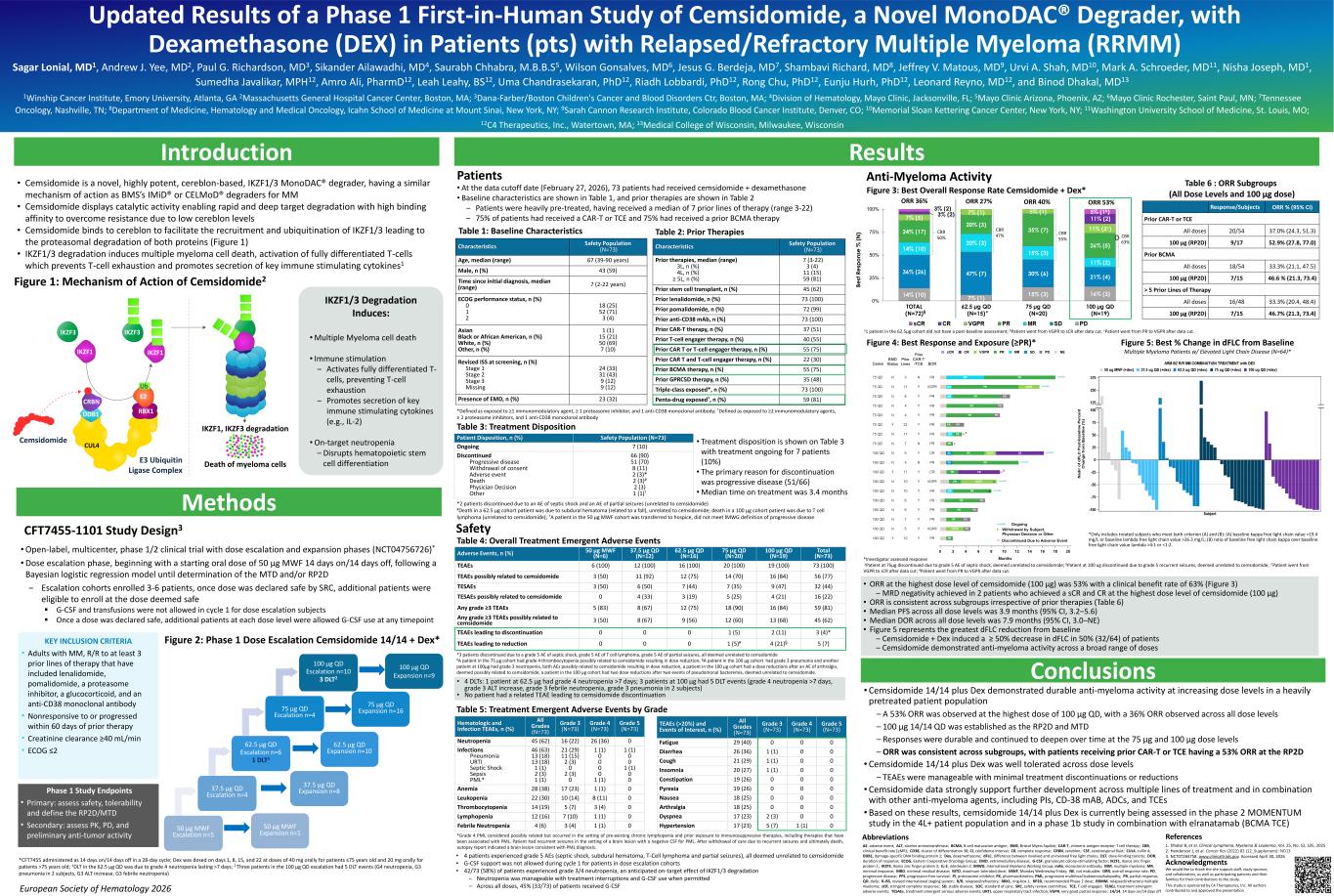
• Cemsidomide is a novel, highly potent, cereblon-based, IKZF1/3 MonoDAC® degrader, having a similar mechanism of action as BMS’s IMiD® or CELMoD® degraders for MM • Cemsidomide displays catalytic activity enabling rapid and deep target degradation with high binding affinity to overcome resistance due to low cereblon levels • Cemsidomide binds to cereblon to facilitate the recruitment and ubiquitination of IKZF1/3 leading to the proteasomal degradation of both proteins (Figure 1) • IKZF1/3 degradation induces multiple myeloma cell death, activation of fully differentiated T-cells which prevents T-cell exhaustion and promotes secretion of key immune stimulating cytokines1 Sagar Lonial, MD1, Andrew J. Yee, MD2, Paul G. Richardson, MD3, Sikander Ailawadhi, MD4, Saurabh Chhabra, M.B.B.S5, Wilson Gonsalves, MD6, Jesus G. Berdeja, MD7, Shambavi Richard, MD8, Jeffrey V. Matous, MD9, Urvi A. Shah, MD10, Mark A. Schroeder, MD11, Nisha Joseph, MD1, Sumedha Javalikar, MPH12, Amro Ali, PharmD12, Leah Leahy, BS12, Uma Chandrasekaran, PhD12, Riadh Lobbardi, PhD12, Rong Chu, PhD12, Eunju Hurh, PhD12, Leonard Reyno, MD12, and Binod Dhakal, MD13 1Winship Cancer Institute, Emory University, Atlanta, GA 2Massachusetts General Hospital Cancer Center, Boston, MA; 3Dana-Farber/Boston Children's Cancer and Blood Disorders Ctr, Boston, MA; 4Division of Hematology, Mayo Clinic, Jacksonville, FL; 5Mayo Clinic Arizona, Phoenix, AZ; 6Mayo Clinic Rochester, Saint Paul, MN; 7Tennessee Oncology, Nashville, TN; 8Department of Medicine, Hematology and Medical Oncology, Icahn School of Medicine at Mount Sinai, New York, NY; 9Sarah Cannon Research Institute, Colorado Blood Cancer Institute, Denver, CO; 10Memorial Sloan Kettering Cancer Center, New York, NY; 11Washington University School of Medicine, St. Louis, MO; 12C4 Therapeutics, Inc., Watertown, MA; 13Medical College of Wisconsin, Milwaukee, Wisconsin Methods Conclusions ResultsIntroduction Updated Results of a Phase 1 First-in-Human Study of Cemsidomide, a Novel MonoDAC® Degrader, with Dexamethasone (DEX) in Patients (pts) with Relapsed/Refractory Multiple Myeloma (RRMM) IKZF1/3 Degradation Induces: •Multiple Myeloma cell death • Immune stimulation ‒ Activates fully differentiated T- cells, preventing T-cell exhaustion ‒ Promotes secretion of key immune stimulating cytokines (e.g., IL-2) •On-target neutropenia – Disrupts hematopoietic stem cell differentiation CFT7455-1101 Study Design3 •Open-label, multicenter, phase 1/2 clinical trial with dose escalation and expansion phases (NCT04756726)* •Dose escalation phase, beginning with a starting oral dose of 50 µg MWF 14 days on/14 days off, following a Bayesian logistic regression model until determination of the MTD and/or RP2D ‒ Escalation cohorts enrolled 3-6 patients, once dose was declared safe by SRC, additional patients were eligible to enroll at the dose deemed safe ▪ G-CSF and transfusions were not allowed in cycle 1 for dose escalation subjects ▪ Once a dose was declared safe, additional patients at each dose level were allowed G-CSF use at any timepoint *CFT7455 administered as 14 days on/14 days off in a 28-day cycle; Dex was dosed on days 1, 8, 15, and 22 at doses of 40 mg orally for patients ≤75 years old and 20 mg orally for patients >75 years old; 1DLT in the 62.5 µg QD was due to grade 4 neutropenia lasting >7 days; 2 Three patients in the 100 µg QD escalation had 5 DLT events (G4 neutropenia, G3 pneumonia in 2 subjects, G3 ALT increase, G3 febrile neutropenia) Patients Table 2: Prior TherapiesTable 1: Baseline Characteristics • At the data cutoff date (February 27, 2026), 73 patients had received cemsidomide + dexamethasone • Baseline characteristics are shown in Table 1, and prior therapies are shown in Table 2 ‒ Patients were heavily pre-treated, having received a median of 7 prior lines of therapy (range 3-22) ‒ 75% of patients had received a CAR-T or TCE and 75% had received a prior BCMA therapy *Defined as exposed to ≥1 immunomodulatory agent, ≥ 1 proteasome inhibitor, and 1 anti-CD38 monoclonal antibody; †Defined as exposed to ≥2 immunomodulatory agents, ≥ 2 proteasome inhibitors, and 1 anti-CD38 monoclonal antibody Table 3: Treatment Disposition *2 patients discontinued due to an AE of septic shock and an AE of partial seizures (unrelated to cemsidomide) #Death in a 62.5 µg cohort patient was due to subdural hematoma (related to a fall), unrelated to cemsidomide; death in a 100 µg cohort patient was due to T cell lymphoma (unrelated to cemsidomide); †A patient in the 50 µg MWF cohort was transferred to hospice, did not meet IMWG definition of progressive disease • Treatment disposition is shown on Table 3 with treatment ongoing for 7 patients (10%) • The primary reason for discontinuation was progressive disease (51/66) •Median time on treatment was 3.4 months Safety Table 4: Overall Treatment Emergent Adverse Events *3 patients discontinued due to a grade 5 AE of septic shock, grade 5 AE of T cell lymphoma, grade 5 AE of partial seizures, all deemed unrelated to cemsidomide #A patient in the 75 µg cohort had grade 4 thrombocytopenia possibly related to cemsidomide resulting in dose reduction; §A patient in the 100 µg cohort had grade 3 pneumonia and another patient at 100µg had grade 3 neutropenia, both AEs possibly related to cemsidomide resulting in dose reduction, a patient in the 100 µg cohort had a dose reductions after an AE of arthralgia, deemed possibly related to cemsidomide, a patient in the 100 µg cohort had two dose reductions after two events of pseudomonal bacteremia, deemed unrelated to cemsidomide. Table 5: Treatment Emergent Adverse Events by Grade Anti-Myeloma Activity Figure 3: Best Overall Response Rate Cemsidomide + Dex* Figure 5: Best % Change in dFLC from Baseline Multiple Myeloma Patients w/ Elevated Light Chain Disease (N=64)* • ORR at the highest dose level of cemsidomide (100 µg) was 53% with a clinical benefit rate of 63% (Figure 3) ‒ MRD negativity achieved in 2 patients who achieved a sCR and CR at the highest dose level of cemsidomide (100 µg) • ORR is consistent across subgroups irrespective of prior therapies (Table 6) • Median PFS across all dose levels was 3.9 months (95% CI, 3.2‒5.6) • Median DOR across all dose levels was 7.9 months (95% CI, 3.0‒NE) • Figure 5 represents the greatest dFLC reduction from baseline ‒ Cemsidomide + Dex induced a ≥ 50% decrease in dFLC in 50% (32/64) of patients ‒ Cemsidomide demonstrated anti-myeloma activity across a broad range of doses •Cemsidomide 14/14 plus Dex demonstrated durable anti-myeloma activity at increasing dose levels in a heavily pretreated patient population – A 53% ORR was observed at the highest dose of 100 µg QD, with a 36% ORR observed across all dose levels – 100 µg 14/14 QD was established as the RP2D and MTD – Responses were durable and continued to deepen over time at the 75 µg and 100 µg dose levels –ORR was consistent across subgroups, with patients receiving prior CAR-T or TCE having a 53% ORR at the RP2D •Cemsidomide 14/14 plus Dex was well tolerated across dose levels ‒ TEAEs were manageable with minimal treatment discontinuations or reductions •Cemsidomide data strongly support further development across multiple lines of treatment and in combination with other anti-myeloma agents, including PIs, CD-38 mAB, ADCs, and TCEs •Based on these results, cemsidomide 14/14 plus Dex is currently being assessed in the phase 2 MOMENTUM study in the 4L+ patient population and in a phase 1b study in combination with elranatamab (BCMA TCE) • 4 DLTs: 1 patient at 62.5 µg had grade 4 neutropenia >7 days; 3 patients at 100 µg had 5 DLT events (grade 4 neutropenia >7 days, grade 3 ALT increase, grade 3 febrile neutropenia, grade 3 pneumonia in 2 subjects) • No patient had a related TEAE leading to cemsidomide discontinuation • 4 patients experienced grade 5 AEs (septic shock, subdural hematoma, T-Cell lymphoma and partial seizures), all deemed unrelated to cemsidomide • G-CSF support was not allowed during cycle 1 for patients in dose escalation cohorts • 42/73 (58%) of patients experienced grade 3/4 neutropenia, an anticipated on-target effect of IKZF1/3 degradation ‒ Neutropenia was manageable with treatment interruptions and G-CSF use when permitted ‒ Across all doses, 45% (33/73) of patients received G-CSF *Only includes treated subjects who meet both criterion (A) and (B): (A) baseline kappa free light chain value >19.4 mg/L or baseline lambda free light chain value >26.3 mg/L; (B) ratio of baseline free light chain kappa over baseline free light chain value lambda >4:1 or <1:2. Abbreviations AE, adverse event; ALT, alanine aminotransferase; BCMA, B-cell maturation antigen; BMS, Bristol Myers Squibb; CAR-T, chimeric antigen receptor-T cell therapy; CBR, clinical benefit rate (≥MR); CD38, cluster of differentiation 38; CI, confidence interval; CR, complete response; CRBN, cereblon; CSF, cerebrospinal fluid; CUL4, cullin 4; DDB1, damage-specific DNA binding protein 1; Dex, dexamethasone; dFLC, difference between involved and uninvolved free light chains; DLT, dose-limiting toxicity; DOR, duration of response; ECOG, Eastern Cooperative Oncology Group; EMD, extramedullary disease; G-CSF, granulocyte colony-stimulating factor; IKZF1, Ikaros zinc finger protein 1; IKZF3, Ikaros zinc finger protein 3; IL-2, interleukin 2; IMWG, International Myeloma Working Group; mAb, monoclonal antibody; MM, multiple myeloma; MR, minimal response; MRD, minimal residual disease; MTD, maximum tolerated dose; MWF, Monday Wednesday Friday; NE, not evaluable; ORR, overall response rate; PD, progressive disease; PFS, progression-free survival; PI, proteasome inhibitor; PK, pharmacokinetics; PML, progressive multifocal leukoencephalopathy; PR, partial response; QD, daily; R-ISS, revised international staging system; R/R, relapsed/refractory; RBX1, ring-box 1; RP2D, recommended Phase 2 dose; RRMM, relapsed/refractory multiple myeloma; sCR, stringent complete response; SD, stable disease; SOC, standard of care; SRC, safety review committee; TCE, T-cell engager; TEAEs, treatment emergent adverse events; TESAEs, treatment emergent serious adverse events; URTI, upper respiratory tract infection; VGPR, very good partial response; 14/14, 14 days on/14 days off References 1. Dhakal B, et al. Clinical Lymphoma, Myeloma & Leukemia, Vol. 25, No. S2, S35, 2025 2. Henderson J, et al. Cancer Res (2022) 82 (12_Supplement): ND13 3. NCT07284758. www.clinicaltrials.gov. Accessed April 30, 2026 Acknowledgments We would like to thank the site support staff, study sponsor, and collaborators, as well as participating patients and their families for their contributions to the study. This study is sponsored by C4 Therapeutics, Inc. All authors contributed to and approved the presentation Cemsidomide DDB1 E3 Ubiquitin Ligase Complex CRBN RBX1 E2 IKZF1, IKZF3 degradation Death of myeloma cells IKZF1IKZF1 IKZF3IKZF3 Ub CUL4 KEY INCLUSION CRITERIA • Adults with MM, R/R to at least 3 prior lines of therapy that have included lenalidomide, pomalidomide, a proteasome inhibitor, a glucocorticoid, and an anti-CD38 monoclonal antibody • Nonresponsive to or progressed within 60 days of prior therapy • Creatinine clearance ≥40 mL/min • ECOG ≤2 Phase 1 Study Endpoints • Primary: assess safety, tolerability and define the RP2D/MTD • Secondary: assess PK, PD, and preliminary anti-tumor activity 100 µg QD Escalation n=10 3 DLT2 75 µg QD Escalation n=4 62.5 µg QD Escalation n=6 1 DLT1 37.5 µg QD Escalation n=4 50 µg MWF Escalation n=5 Figure 2: Phase 1 Dose Escalation Cemsidomide 14/14 + Dex* 50 µg MWF Expansion n=1 37.5 µg QD Expansion n=8 62.5 µg QD Expansion n=10 75 µg QD Expansion n=16 100 µg QD Expansion n=9 Figure 1: Mechanism of Action of Cemsidomide2 Characteristics Safety Population (N=73) Age, median (range) 67 (39-90 years) Male, n (%) 43 (59) Time since initial diagnosis, median (range) 7 (2-22 years) ECOG performance status, n (%) 0 1 2 18 (25) 52 (71) 3 (4) Asian Black or African American, n (%) White, n (%) Other, n (%) 1 (1) 15 (21) 50 (69) 7 (10) Revised ISS at screening, n (%) Stage 1 Stage 2 Stage 3 Missing 24 (33) 31 (43) 9 (12) 9 (12) Presence of EMD, n (%) 23 (32) Characteristics Safety Population (N=73) Prior therapies, median (range) 3L, n (%) 4L, n (%) ≥ 5L, n (%) 7 (3-22) 3 (4) 11 (15) 59 (81) Prior stem cell transplant, n (%) 45 (62) Prior lenalidomide, n (%) 73 (100) Prior pomalidomide, n (%) 72 (99) Prior anti-CD38 mAb, n (%) 73 (100) Prior CAR-T therapy, n (%) 37 (51) Prior T-cell engager therapy, n (%) 40 (55) Prior CAR T or T-cell engager therapy, n (%) 55 (75) Prior CAR T and T-cell engager therapy, n (%) 22 (30) Prior BCMA therapy, n (%) 55 (75) Prior GPRC5D therapy, n (%) 35 (48) Triple-class exposed*, n (%) 73 (100) Penta-drug exposed†, n (%) 59 (81) Patient Disposition, n (%) Safety Population (N=73) Ongoing 7 (10) Discontinued Progressive disease Withdrawal of consent Adverse event Death Physician Decision Other 66 (90) 51 (70) 8 (11) 2 (3)* 2 (3)# 2 (3) 1 (1)† Adverse Events, n (%) 50 µg MWF (N=6) 37.5 µg QD (N=12) 62.5 µg QD (N=16) 75 µg QD (N=20) 100 µg QD (N=19) Total (N=73) TEAEs 6 (100) 12 (100) 16 (100) 20 (100) 19 (100) 73 (100) TEAEs possibly related to cemsidomide 3 (50) 11 (92) 12 (75) 14 (70) 16 (84) 56 (77) TESAEs 3 (50) 6 (50) 7 (44) 7 (35) 9 (47) 32 (44) TESAEs possibly related to cemsidomide 0 4 (33) 3 (19) 5 (25) 4 (21) 16 (22) Any grade ≥3 TEAEs 5 (83) 8 (67) 12 (75) 18 (90) 16 (84) 59 (81) Any grade ≥3 TEAEs possibly related to cemsidomide 3 (50) 8 (67) 9 (56) 12 (60) 13 (68) 45 (62) TEAEs leading to discontinuation 0 0 0 1 (5) 2 (11) 3 (4)* TEAEs leading to reduction 0 0 0 1 (5)# 4 (21)§ 5 (7) 0 Hematologic and Infection TEAEs, n (%) All Grades (N=73) Grade 3 (N=73) Grade 4 (N=73) Grade 5 (N=73) Neutropenia 45 (62) 16 (22) 26 (36) 0 Infections Pneumonia URTI Septic Shock Sepsis PML* 46 (63) 13 (18) 13 (18) 1 (1) 2 (3) 1 (1) 21 (29) 11 (15) 2 (3) 0 2 (3) 0 1 (1) 0 0 0 0 1 (1) 1 (1) 0 0 1 (1) 0 0 Anemia 28 (38) 17 (23) 1 (1) 0 Leukopenia 22 (30) 10 (14) 8 (11) 0 Thrombocytopenia 14 (19) 5 (7) 3 (4) 0 Lymphopenia 12 (16) 7 (10) 1 (1) 0 Febrile Neutropenia 4 (6) 3 (4) 1 (1) 0 *Grade 4 PML considered possibly related but occurred in the setting of pre-existing chronic lymphopenia and prior exposure to immunosuppressive therapies, including therapies that have been associated with PML. Patient had recurrent seizures in the setting of a brain lesion with a negative CSF for PML. After withdrawal of care due to recurrent seizures and ultimately death, autopsy report indicated a brain lesion consistent with PML diagnosis. TEAEs (>20%) and Events of Interest, n (%) All Grades (N=73) Grade 3 (N=73) Grade 4 (N=73) Grade 5 (N=73) Fatigue 29 (40) 0 0 0 Diarrhea 26 (36) 1 (1) 0 0 Cough 21 (29) 1 (1) 0 0 Insomnia 20 (27) 1 (1) 0 0 Constipation 19 (26) 0 0 0 Pyrexia 19 (26) 0 0 0 Nausea 18 (25) 0 0 0 Arthralgia 18 (25) 0 0 0 Dyspnea 17 (23) 2 (3) 0 0 Hypertension 17 (23) 5 (7) 1 (1) 0 14% (10) 7% (1) 15% (3) 16% (3) 36% (26) 47% (7) 30% (6) 21% (4) 14% (10) 20% (3) 15% (3) 11% (2) 24% (17) 20% (3) 35% (7) 26% (5) 7% (5) 7% (1) 5% (1) 11% (2c) 3% (2) 11% (2) 3% (2) 5% (1b) 0% 25% 50% 75% 100% TOTAL (N=72) 62.5 µg QD (N=15) 75 µg QD (N=20) 100 µg QD (N=19) B e st R e sp o n se % ( N ) CBR 47% ORR 27% ORR 40%ORR 36% CBR 50% a CBR 55% ORR 53% 0 CBR 63% § a a1 patient in the 62.5µg cohort did not have a post-baseline assessment; bPatient went from VGPR to sCR after data cut. cPatient went from PR to VGPR after data cut. Response/Subjects ORR % (95% CI) Prior CAR-T or TCE All doses 20/54 37.0% (24.3, 51.3) 100 µg (RP2D) 9/17 52.9% (27.8, 77.0) Prior BCMA All doses 18/54 33.3% (21.1, 47.5) 100 µg (RP2D) 7/15 46.6 % (21.3, 73.4) > 5 Prior Lines of Therapy All doses 16/48 33.3% (20.4, 48.4) 100 µg (RP2D) 7/15 46.7% (21.3, 73.4) Table 6 : ORR Subgroups (All Dose Levels and 100 µg dose) a b c d *Investigator assessed response aPatient at 75µg discontinued due to grade 5 AE of septic shock, deemed unrelated to cemsidomide; bPatient at 100 ug discontinued due to grade 5 recurrent seizures, deemed unrelated to cemsidomide; CPatient went from VGPR to sCR after data cut; dPatient went from PR to VGPR after data cut. European Society of Hematology 2026 Figure 4: Best Response and Exposure (≥PR)*