
Exhibit 99.1
INFORMATION
CIRCULAR
as at June 3, 2026
(except as otherwise indicated)
This Information Circular is furnished in connection with the solicitation of proxies by the management of ANFIELD ENERGY INC. (the “Company”) for use at the Annual General and Special Meeting (the “Meeting”) of its shareholders to be held on July 10, 2026 at the time and place and for the purposes set forth in the accompanying notice of the Meeting.
In this Information Circular, references to “the Company”, “we” and “our” refer to ANFIELD ENERGY INC. “Common Shares” means common shares without par value in the capital of the Company. “Beneficial Shareholders” means shareholders who do not hold Common Shares in their own name and “intermediaries” refers to brokers, investment firms, clearing houses and similar entities that own securities on behalf of Beneficial Shareholders.
GENERAL PROXY INFORMATION
Solicitation of Proxies
The solicitation of proxies will be primarily by mail, but proxies may be solicited personally or by telephone by directors, officers and regular employees of the Company. The Company will bear all costs of this solicitation. We have arranged for intermediaries to forward the meeting materials to Beneficial Shareholders of the Common Shares held of record by those intermediaries and we may reimburse the intermediaries for their reasonable fees and disbursements in that regard.
Appointment of Proxyholders
The individuals named in the accompanying form of proxy (the “Proxy”) are officers and/or directors of the Company. If you are a shareholder entitled to vote at the Meeting, you have the right to appoint a person or company other than either of the persons designated in the Proxy, who need not be a shareholder, to attend and act for you and on your behalf at the Meeting. You may do so either by inserting the name of that other person in the blank space provided in the Proxy or by completing and delivering another suitable form of proxy.
Voting by Proxyholder
The persons named in the Proxy will vote or withhold from voting the Common Shares represented thereby in accordance with your instructions on any ballot that may be called for. If you specify a choice with respect to any matter to be acted upon, your Common Shares will be voted accordingly. The Proxy confers discretionary authority on the persons named therein with respect to:
| (a) | each matter or group of matters identified therein for which a choice is not specified, other than the appointment of an auditor and the election of directors, | |
| (b) | any amendment to or variation of any matter identified therein, and | |
| (c) | any other matter that properly comes before the Meeting. |
In respect of a matter for which a choice is not specified in the Proxy, the management appointee acting as a proxyholder will vote in favour of each matter identified on the Proxy and, if applicable, for the nominees of management for directors and auditors as identified in the Proxy.
| 1 |
Registered Shareholders
Registered shareholders (“Registered Shareholders”) may wish to vote by proxy whether or not they are able to attend the Meeting in person. Registered Shareholders electing to submit a proxy may do so by:
| (a) | completing, dating and signing the enclosed form of proxy and returning it to the Company’s transfer agent, Computershare Trust Company of Canada, by fax within North America at 1-866-249-7775, outside North America at (416) 263-9524, or by mail to the 14th Floor, 320 Bay Street, Toronto, Ontario, M5H 4A6; or | |
| (b) | using the internet through the website of the Company’s transfer agent at www.investorvote.com. Registered Shareholders must follow the instructions that appear on the screen and refer to the enclosed proxy form for the holder’s account number and the proxy access number; |
in all cases ensuring that the proxy is received at least 48 hours (excluding Saturdays, Sundays and holidays) before the Meeting or the adjournment thereof at which the proxy is to be used.
Beneficial Shareholders
The following information is of significant importance to shareholders who do not hold Common Shares in their own name. Beneficial Shareholders should note that the only proxies that can be recognized and acted upon at the Meeting are those deposited by Registered Shareholders (those whose names appear on the records of the Company as the registered holders of Common Shares) or as set out in the following disclosure.
If Common Shares are listed in an account statement provided to a shareholder by a broker, then in almost all cases those Common Shares will not be registered in the shareholder’s name on the records of the Company. Such Common Shares will more likely be registered under the names of the shareholder’s broker or an agent of that broker (an “intermediary”). In the United States, the vast majority of such Common Shares are registered under the name of Cede & Co. as nominee for The Depository Trust Company (which acts as depositary for many U.S. brokerage firms and custodian banks), and in Canada, under the name of CDS & Co. (the registration name for The Canadian Depository for Securities Limited, which acts as nominee for many Canadian brokerage firms).
Intermediaries are required to seek voting instructions from Beneficial Shareholders in advance of meetings of shareholders. Every intermediary has its own mailing procedures and provides its own return instructions to clients.
There are two kinds of Beneficial Shareholders - those who object to their name being made known to the issuers of securities which they own (called “OBOs” for Objecting Beneficial Owners) and those who do not object to the issuers of the securities they own knowing who they are (called “NOBOs” for Non-Objecting Beneficial Owners).
The Company is taking advantage of the provisions of National Instrument 54-101 Communication with Beneficial Owners of Securities of a Reporting Issuer (“NI 54-101”) that permit it to directly deliver proxy-related materials to its NOBOs. As a result, NOBOs can expect to receive a scannable voting instruction form (“VIF”) from our transfer agent, Computershare. These VIFs are to be completed and returned to Computershare in the envelope provided or by facsimile. In addition, Computershare provides internet voting as described on the VIF itself which contain complete instructions. Computershare will tabulate the results of the VIFs received from NOBOs and will provide appropriate instructions at the Meeting with respect to the shares represented by the VIFs they receive.
These securityholder materials are being sent to both Registered Shareholders and Beneficial Shareholders of the securities of the Company. If you are a Beneficial Shareholder, and the Company or its agent has sent these materials directly to you, your name and address and information about your holdings of securities, have been obtained in accordance with applicable securities regulatory requirements from the intermediary holding on your behalf.
| 2 |
By choosing to send these materials to you directly, the Company (and not the intermediary holding on your behalf) has assumed responsibility for (i) delivering these materials to you, and (ii) executing your proper voting instructions. Please return your voting instructions as specified in your request for voting instructions.
The Company has not adopted the notice and access procedure described in NI 54-101 and National Instrument 51-102 – Continuous Disclosure Obligations to distribute its proxy-related materials to the Registered Shareholders and the Beneficial Shareholders. In addition, the Company has not agreed to pay to distribute the proxy-related materials to the OBOs and, unless the intermediaries acting for such OBOs agree to assume the cost of such delivery, OBOs will not receive the proxy-related materials for the Meeting.
Beneficial Shareholders who are OBOs should follow the instructions of their intermediary carefully to ensure that their Common Shares are voted at the Meeting.
The form of proxy supplied to you by your broker will be similar to the proxy provided to Registered Shareholders by the Company. However, its purpose is limited to instructing the intermediary on how to vote your Common Shares on your behalf. Most brokers now delegate responsibility for obtaining instructions from clients to Broadridge Financial Solutions, Inc. (“Broadridge”) in the United States and in Canada. Broadridge mails a VIF in lieu of a proxy provided by the Company. The VIF will name the same persons as the Company’s Proxy to represent your Common Shares at the Meeting. You have the right to appoint a person (who need not be a Beneficial Shareholder of the Company), other than any of the persons designated in the VIF, to represent your Common Shares at the Meeting and that person may be you. To exercise this right, you should insert the name of the desired representative (which may be yourself) in the blank space provided in the VIF. The completed VIF must then be returned to Broadridge by mail or facsimile or given to Broadridge by phone or over the Internet, in accordance with Broadridge’s instructions. Broadridge then tabulates the results of all instructions received and provides appropriate instructions respecting the voting of Common Shares to be represented at the Meeting and the appointment of any shareholder’s representative. If you receive a VIF from Broadridge, the VIF must be completed and returned to Broadridge, in accordance with its instructions, well in advance of the Meeting in order to have your Common Shares voted or to have an alternate representative duly appointed to attend and to vote your Common Shares at the Meeting.
Notice to Shareholders in the United States
The solicitation of proxies involves securities of an issuer located in Canada and is being effected in accordance with the corporate laws of the Province of British Columbia, Canada and securities laws of the provinces of Canada. The proxy solicitation rules under the United States Securities Exchange Act of 1934, as amended, are not applicable to the Company or this solicitation, and this solicitation has been prepared in accordance with the disclosure requirements of the securities laws of the provinces of Canada. Shareholders should be aware that disclosure requirements under the securities laws of the provinces of Canada differ from the disclosure requirements under United States securities laws.
The enforcement by shareholders of civil liabilities under United States federal securities laws may be affected adversely by the fact that the Company is incorporated under the Business Corporations Act (British Columbia), as amended, certain of its directors and its executive officers are residents of Canada and a substantial portion of its assets and the assets of such persons are located outside the United States. Shareholders may not be able to sue a foreign company or its officers or directors in a foreign court for violations of United States federal securities laws. It may be difficult to compel a foreign company and its officers and directors to subject themselves to a judgment by a United States court.
Revocation of Proxies
In addition to revocation in any other manner permitted by law, a Registered Shareholder who has given a proxy may revoke it by:
| (a) | executing a proxy bearing a later date or by executing a valid notice of revocation, either of the foregoing to be executed by the Registered Shareholder or the Registered Shareholder’s authorized attorney in writing, or, if the shareholder is a corporation, under its corporate seal by an officer or attorney duly authorized, and by delivering the proxy bearing a later date to Computershare Trust Company of Canada, or |
| 3 |
| (b) | executing an instrument in writing that is received at the registered office of the Company (at 2200 – 885 West Georgia Street, Vancouver, B.C. V6C 3E8), at any time up to and including the last business day before the day set for the holding of the Meeting or if adjourned meeting, at any reconvening thereof, or to the chairman of the Meeting on the day of the Meeting or any reconvening thereof, or in any other manner provided by law, or | |
| (c) | personally attending the Meeting and voting the Registered Shareholder’s Common Shares. |
A revocation of a proxy will not affect a matter on which a vote is taken before the revocation.
INTEREST OF CERTAIN PERSONS OR COMPANIES IN MATTERS TO BE ACTED UPON
No director or executive officer of the Company, or any person who has held such a position since the beginning of the last completed financial year end of the Company, nor any nominee for election as a director of the Company, nor any associate or affiliate of the foregoing persons, has any substantial or material interest, direct or indirect, by way of beneficial ownership of securities or otherwise, in any matter to be acted on at the Meeting other than the election of directors and as may be set out herein. Directors and Named Executive Officers may, however, be interested in the re-approval of the Company’s Compensation Plan as detailed herein.
VOTING SECURITIES AND PRINCIPAL HOLDERS OF VOTING SECURITIES
The board of directors (the “Board”) of the Company has fixed June 3, 2026 as the record date (the “Record Date”) for determination of persons entitled to receive notice of the Meeting. Only shareholders of record at the close of business on the Record Date who either attend the Meeting personally or complete, sign and deliver a form of proxy in the manner and subject to the provisions described above will be entitled to vote or to have their Common Shares voted at the Meeting.
The Common Shares of the Company are listed for trading on the TSX Venture Exchange (the “TSXV”). The authorized capital of the Company consists of an unlimited number of Common Shares. As of June 3, 2026, there are 18,234,976 Common Shares issued and outstanding, each carrying the right to one vote. No group of shareholders has the right to elect a specified number of directors, nor are there cumulative or similar voting rights attached to the Common Shares.
To the knowledge of the directors and executive officers of the Company, the following individual or corporation beneficially owned, directly or indirectly, or exercised control or direction over, Common Shares carrying more than 10% of the voting rights attached to all outstanding Common Shares of the Company as at June 3, 2026, as follows:
| Shareholder Name | Number of Common Shares Held | Percentage of Issued Common Shares | ||||||
| Uranium Energy Corp. | 5,875,737 | 32.22 | % | |||||
The audited financial statements of the Company for its fiscal year ended December 31, 2025, the report of the auditor and related management discussion and analysis and the Annual Information Form were filed on the System for Electronic Data Analysis and Retrieval+ (“SEDAR+”) at www.sedarplus.ca on March 31, 2026, and with the securities commissions or similar regulatory authority in all Canadian jurisdictions and on the Electronic Data Gathering, Analysis, and Retrieval system (“EDGAR”) at www.sec.gov.
| 4 |
VOTES NECESSARY TO PASS RESOLUTIONS
A simple majority of affirmative votes cast at the Meeting is required to pass the resolutions described herein. If there are more nominees for election as directors or appointment of the Company’s auditor than there are vacancies to fill, those nominees receiving the greatest number of votes will be elected or appointed, as the case may be, until all such vacancies have been filled. If the number of nominees for election or appointment is equal to the number of vacancies to be filled, all such nominees will be declared elected or appointed by acclamation.
Advance Notice Policy
On August 7, 2013, the Board adopted, and on September 11, 2013, the shareholders approved, an advance notice policy for the purpose of providing shareholders, directors and management of the Company with a clear framework for nominating directors of the Company in connection with any annual or special meeting of shareholders.
The purpose of the advance notice policy is to (i) ensure that all shareholders receive adequate notice of director nominations and sufficient time and information with respect to all nominees to make appropriate deliberations and register an informed vote; and (ii) facilitate an orderly and efficient process for annual or, where the need arises, special meetings of shareholders of the Company. The advance notice policy fixes the deadlines by which shareholders of the Company must submit director nominations to the Company prior to any annual or special meeting of shareholders and sets forth the information that a shareholder must include in a written notice to the Company for any director nominee to be eligible for election at such annual or special meeting of shareholders.
The following is a brief summary of certain provisions of the advance notice policy, and the full text of the policy is available for review on SEDAR+ at www.sedarplus.ca.
| 1. | Other than pursuant to (i) a proposal made in accordance with the Business Corporations Act (British Columbia) (the “Act”), or (ii) a requisition of the shareholders made in accordance with the provisions of the Act, shareholders of the Company must give advance written notice to the Company of any nominees for election to the Board. |
| 2. | The advance notice policy fixes a deadline by which shareholders of the Company must submit, in writing, nominations for directors to the Corporate Secretary of the Company prior to any annual or special meeting of shareholders, and sets forth the specific information that such shareholders must include with their nominations in order to be effective. Only persons who are nominated in accordance with the advance notice policy are eligible for election as directors of the Company. |
| 3. | For an annual meeting of shareholders, notice to the Company must be not less than 30 days and not more than 65 days prior to the date of the annual meeting; provided, however, that in the event that the annual meeting is to be held on a date less than 40 days after the date on which the first public announcement of the date of such annual meeting was made, notice may be given not later than the close of business on the 10th day following such public announcement. |
| 4. | For a special meeting of shareholders (that is not also annual meeting), notice to the Company must be given not later than the close of business on the 15th day following the day on which the first public announcement of the date of such special meeting was made. |
| 5. | The time periods for giving notice set forth above shall in all cases be determined based on the original date of the applicable annual meeting and/or special meeting of shareholders, and in no event shall any adjournment or postponement of a meeting of shareholders, or the reconvening of any adjourned or postponed meeting of shareholders, or the announcement thereof, commence a new time period for the giving of notice as described above. |
| 5 |
For the purposes of the advance notice policy, “public announcement” means disclosure in a press release reported by a national news service in Canada, or in a document publicly filed by the Company under its profile on SEDAR+ at www.sedarplus.ca.
The Board may, in its sole discretion, waive any provision or requirement of the advance notice policy.
ELECTION OF DIRECTORS
The size of the Board of the Company is currently determined at nine. Shareholders will therefore be asked to approve an ordinary resolution that the number of directors elected be determined at nine.
The term of office of each of the current directors will end at the conclusion of the Meeting. Unless the director’s office is earlier vacated in accordance with the provisions of the Act, each director elected will hold office until the conclusion of the next annual general meeting of the Company, or if no director is then elected, until a successor is elected.
The following table sets out the names of management’s nominees for election as directors, all major offices and positions with the Company and any of its significant affiliates each now holds, the period of time during which each has been a director of the Company and the number of Common Shares of the Company beneficially owned by each, directly or indirectly, or over which each exercised control or direction, as at June 3, 2026.
| Name of Nominee; Current Position with the Company; and Province or State and Country of Residence | Principal occupation and, if not an elected director, principal occupation during the past five years(1) | Period as a Director of the Company | Common Shares Beneficially Owned or Controlled (1) | |||||||
| Ken Mushinski Chairman, Director Texas, USA | President, Chief Executive Officer and director of Rare Element Resources Ltd. | September 9, 2022 | 31,733 | |||||||
| Corey Dias (2) Chief Executive Officer and Director Ontario, Canada | Chief Executive Officer and a director of the Company. | November 5, 2012 | 314,272 | |||||||
Laara Shaffer, Director (3) | Director of the Company and corporate management specialist. | May 15, 2023 | 5,500 | |||||||
| Joshua D. Bleak (2) Director Arizona, USA | President of the Company’s U.S. subsidiaries, President of North American Environmental Corp., director of Canadian junior mining exploration companies. | December 15, 2010 | 319,006 | |||||||
| Donald Falconer (2) (3) Director Ontario, Canada | Director of the Company. | June 11, 2014 | 333 | |||||||
| John Eckersley Director Utah, USA | Director of the Company and corporate lawyer. | July 2, 2019 | 34,562 | |||||||
| Stephen Lunsford (2) (3) Director Wyoming, USA | Director of the Company. | May 23, 2018 | 1,333 | |||||||
| Ross McElroy Director British Columbia, Canada | Professional geologist, director of the Company and other mining issuers. | March 27, 2025 | 6,667 | |||||||
| Jeffrey Duncan Director Virginia, USA | US Congressman and Consultant/Lobbyist | September 22, 2025 | Nil | |||||||
| 6 |
| Notes: | |
| (1) | The information as to position and principal business and Common Shares beneficially owned or controlled is not within the knowledge of the management of the Company and has been furnished by the respective nominees. |
| (2) | Member of the Audit Committee (as defined below). |
| (3) | Member of the compensation committee. |
Occupation, Business or Employment of Director Nominees
The disclosure sets out each nominee’s principal occupation, business or employment within the five preceding years. The information as to principal occupation, business or employment is not within the knowledge of management of the Company and has been furnished by the respective nominees.
Ken Mushinski is the Chairman and director of the Company and is currently President and Chief Executive Officer of Rare Element Resources Ltd. Previously, Mr. Mushinski served as President for Cotter Corporation, Chairman of both technology developer Diazyme Shanghai and chemical manufacturer Miltec Inc. and as a management committee member for the Honeywell/General Atomics ConverDyn partnership. Mr. Mushinski’s responsibilities at the above entities included identifying, negotiating and executing with regard to mergers and acquisitions; operational and financial planning of uranium operations, including sales, marketing and contracting, budgeting, scheduling; and regulatory affairs, including governmental interactions, licensing, permitting, reclamation and decommissioning. Mr. Mushinski holds both a Master of Business Administration and Bachelor of Science, Mechanical Engineering, Summa Cum Laude, from San Diego State University.
Corey Dias is Chief Executive Officer and a director of the Company. Mr. Dias has over twenty years of experience in capital markets and has many years of experience in strategic consulting with a major U.S. management consulting firm. Mr. Dias began his capital markets career in institutional equity research at CIBC in the Canadian Telecommunications sector and has gained further equity research and equity sales experience in other sectors including mining and at other boutique investment firms. Mr. Dias was Vice President at Fortress Investment Group, a major U.S. based hedge fund, where he was involved in the management of a $400 million investment portfolio. Mr. Dias was also a management consultant in the Stockholm office of The Monitor Group., a U.S. based strategy-consulting firm. Mr. Dias holds a Master of Business Administration from the Richard Ivey School of Business at the University of Western Ontario.
Joshua D. Bleak is a director of the Company and was President of the Company from December 15, 2010 to August 30, 2012 and was Chief Executive Officer of the Company from August 30, 2012 to February 21, 2013. Mr. Bleak is a fourth-generation miner from an Arizona mining family that has developed gold, silver, copper and uranium properties throughout the southwestern U.S. He was the Chief Executive Officer of Passport Potash Inc. (“Passport Potash”), a reporting issuer on the TSXV. Mr. Bleak was previously President of American Energy Fields, Inc., a U.S. publicly-traded uranium company. Currently he serves as a director for a number of Canadian junior mining exploration companies and is President of North American Environmental Corp., a consulting company specializing in mining project management, permitting, lobbying and land tenure.
Donald Falconer is a director of the Company and has over 35 years of experience in the uranium and nuclear utility sectors. He holds a Master in Environmental Studies from York University. His experience in the private sector includes positions with a number of prominent uranium companies, including Southern Cross Resources (the predecessor of Uranium One), Uranium One and Aurora Energy Resources, where he focused primarily on uranium marketing and sales. In addition, Mr. Falconer has over 16 years of Board experience with publicly traded companies in various roles, including Energy Fuels (Director), Southern Cross Resources (Director and Corporate Secretary) and AusAmerican Mining (Chairman and Director). Finally, Mr. Falconer spent 7 of his 20 years with Ontario Hydro in its Nuclear Division.
John Eckersley is a director of the Company and an attorney who was been practicing since 1999. His legal practice focuses on securities compliance, corporate governance and estate planning. Mr. Eckersley served as Executive Vice President and Corporate Counsel of Passport Potash Inc. from 2010 to 2015 and as a director from 2011 to 2015. Mr. Eckersley served as a director of Silver Horn Mining Ltd. From 2011 to 2013. Mr. Eckersley was CEO, CFO, President, Corporate Secretary and a director of Scorpion Resources Inc., a capital pool company, from 2014 to 2016. Mr. Eckersley received his B.S. and his Juris Doctorate from the University of Utah.
| 7 |
Stephen Lunsford is a director of the Company and has 40+ years working as a geologist in the uranium industry. His experience includes working as field geologist, senior geologist, chief geologist, and evaluation geologist in both exploration and production settings. His specialties have included database design and maintenance, sandstone uranium deposit mapping, reserve and resource estimation, ISR wellfield design, production modeling and reporting of actual production. His labors as a registered professional geologist (PG-1344 WY) have mostly involved Wyoming projects (ex: the Charlie Project) however, projects were also located in neighboring states as well as Kazakhstan and Turkey. While performing as chief geologist at the Smith Ranch-Highland uranium mine located in Converse County Wyoming, and later as evaluation geologist, he was the NI 43-101/JORC Qualified Person for Cameco Resources.
Laara Shaffer is a director of the Company and has been a corporate management specialist with regulatory and public company reporting experience with several publicly-traded companies during the last 35 years. She was previously the Chief Financial Officer of the Company.
Ross McElroy is a professional geologist bringing more than 38 years of mining industry experience both in operation and corporate capacities, involved with major, mid-tier and junior mining and exploration companies. As a very successful exploration geologist, he has been a key member in the discoveries of numerous world-class uranium and gold orebodies, several of which have been advanced to development and mining operations. Mr. McElroy specializes in the exploration and development phases of projects. For the past 15 years, he has served on the boards of several publicly listed and private companies, as both an independent and executive director. His most recent executive role was as President and CEO of Fission Uranium Corp., a company of which he was a co-founder, and where under his leadership as CEO the company eliminated its debt and raised ~$200M in equity finance and where he ultimately navigated the $1.14B sale of Fission Uranium Corp to Paladin Energy in December 2024. Mr. McElroy holds a Bachelor’s Degree in Science, with a Specialization in Geology from the University of Alberta and is a registered professional geologist in Saskatchewan, British Columbia, Nunavut and the Northwest Territories.
Jeffrey Duncan is a Founding Partner of Covenant Government Affairs LLC, a full-service consulting and lobbying firm which has clients in the Defense, Energy, Financial and Infrastructure space. He was a Member of the United States Congress as a Representative of South Carolina’s 3rd District for 14 years from 2010 to 2024. Before being elected to the US House of Representatives, Jeff served in the South Carolina General Assembly for 8 years. Mr. Duncan most recently served on the House Energy and Commerce Committee, where he was Chairman of the Subcommittee on Energy, Climate and Grid Security. During his tenure in the South Carolina General Assembly, Duncan served as the Chairman of the House Agriculture, Natural Resources and Environmental Affairs Committee. Additionally, Mr. Duncan served on the U.S. Department of the Interior’s Outer Continental Shelf five-year Planning Sub-Committee. He also Co-Chaired the state’s Natural Gas Offshore Drilling Study Committee and was appointed to represent the state of South Carolina on the Southern States Energy Board. He is currently a Consultant/Lobbyist.
Cease Trade Orders and Bankruptcy
No proposed director is, as at the date of this Information Circular, or has been, within ten (10) years before the date of this Information Circular, a director, chief executive officer or chief financial officer of any company (including the Company) that:
| (a) | was subject to a cease trade or similar order that was issued while the proposed director was acting in the capacity as director, chief executive officer or chief financial officer; or | |
| (b) | was subject to a cease trade or similar order that was issued after the proposed director ceased to be a director, chief executive officer or chief financial officer and which resulted from an event that occurred while that person was acting in the capacity as director, chief executive officer or chief financial officer. |
| 8 |
No proposed director is, as at the date of this Information Circular, or has been within ten (10) years before the date of this Information Circular, a director or executive officer of any company (including the Company) that, while that person was acting in that capacity, or within a year of that person ceasing to act in that capacity, became bankrupt, made a proposal under any legislation relating to bankruptcy or insolvency or was subject to or instituted any proceedings, arrangement or compromise with creditors or had a receiver, receiver manager of trustee appointed to hold its assets.
No proposed director has, within the past ten (10) years, become bankrupt, made a proposal under any legislation relating to bankruptcy or insolvency or become subject to or instituted any proceedings, arrangement, or compromise with creditors or had a receiver, receiver manager, or trustee appointed to hold the assets of the proposed director.
Penalties and Sanctions
No proposed director of the Company has been subject to any penalties or sanctions imposed by a court relating to securities legislation or by a securities regulatory authority or has entered into a settlement agreement with a securities regulatory authority, or has been subject to any other penalties or sanctions imposed by a court or regulatory body that would likely be considered important to a reasonable securityholder in deciding whether to vote for a proposed director.
APPOINTMENT OF AUDITOR
Dale Matheson Carr-Hilton LaBonte LLP, Chartered Professional Accountants, Suite 1500 – 1140 West Pender Street, Vancouver, British Columbia V6E 4G1 will be nominated at the Meeting for reappointment as auditor of the Company at a remuneration to be fixed by the directors.
AUDIT COMMITTEE AND RELATIONSHIP WITH AUDITOR
National Instrument 52-110 – Audit Committees (“NI 52-110”) requires the Company to disclose annually in its Information Circular certain information concerning the constitution of its audit committee (the “Audit Committee”) and its relationship with its independent auditor, as set forth in the following:
The Audit Committee’s Charter
The Audit Committee has a charter. A copy of the Audit Committee Charter is attached as Schedule “A” to this Information Circular.
Composition of the Audit Committee
The members of the Audit Committee are Joshua Bleak (Chairman), Corey Dias, Donald Falconer and Stephen Lunsford. Messrs. Lunsford and Falconer are the independent members of the Audit Committee. Messrs. Dias and Bleak are not independent members of the Audit Committee as Mr. Dias is an officer of the Company and Mr. Bleak is President of Anfield’s U.S. subsidiaries. Relevant Education and Experience of the Audit Committee
NI 52-110 provides that an individual is “financially literate” if he or she has the ability to read and understand a set of financial statements that present a breadth and level of complexity of accounting issues that are generally comparable to the breadth and complexity of the issues that can reasonably be expected to be raised by the Company’s financial statements. The Company has determined that all of the members of the Audit Committee are “financially literate”.
The current members of the Audit Committee either have university, college level education or extensive business and financial experience. See disclosure under “Occupation, Business or Employment of Nominees”.
| 9 |
Each of the members of the Audit Committee has:
| ● | an understanding of the accounting principles used by the Company to prepare its financial statements, and the ability to assess the general application of those principles in connection with estimates, accruals and reserves; |
| ● | experience preparing, auditing, analyzing or evaluating financial statements that present a breadth and level of complexity of accounting issues that are generally comparable to the breadth and complexity of issues that can reasonably be expected to be raised by the Company’s financial statements, or experience actively supervising individuals engaged in such activities; and |
| ● | an understanding of internal controls and procedures for financial reporting. |
Audit Committee Oversight
The Audit Committee has not made any recommendations to the Board to nominate or compensate any auditor other than Dale Matheson Carr-Hilton LaBonte LLP.
At no time since the commencement of the Company’s most recently completed financial year was a recommendation of the Audit Committee to nominate or compensate an external auditor not adopted by the Board.
Reliance on Certain Exemptions
The Company’s auditor, Dale Matheson Carr-Hilton LaBonte LLP has not provided any material non-audit services. Since the commencement of the Company’s most recently completed financial year, the Company has not relied on the exemptions in section 2.4 (De Minimis Non-audit Services), section 3.2 (Initial Public Offerings), section 3.4 (Events Outside Control of Member) or section 3.5 (Death, Disability or Resignation of Audit Committee Member) of NI 52-110, or an exemption from NI 52-110, in whole or in part, granted under Part 8 (Exemptions).
Since the commencement of the Company’s most recently completed financial year, the Company has not relied on the exemption in subsection 3.3(2) (Controlled Companies), section 3.6 (Temporary Exemption for Limited and Exceptional Circumstances) or the exemption in section 3.8 (Acquisition of Financial Literacy) of NI 52-110.
Pre-Approval Policies and Procedures
The chair of the Audit Committee is authorized to pre-approve all non-audit services to be provided to the Company or its subsidiary entities by the Company’s external auditor, subject to the chair of the Audit Committee reporting the pre-approval(s) to the Audit Committee at the Audit Committee’s meeting subsequent to the said approval(s).
External Auditor Service Fees
The Audit Committee has reviewed the nature and amount of the non-audited services provided by Dale Matheson Carr-Hilton LaBonte LLP to the Company to ensure auditor independence. Fees incurred with Dale Matheson Carr-Hilton LaBonte LLP for audit and non-audit services in the last two fiscal years for audit fees are outlined in the following table:
| Nature of Services | Estimated Fees Paid to Auditor in Year Ended December 31, 2025 | Fees Paid to Auditor in Year Ended December 31, 2024 | ||||||
| Audit Fees (1) | $ | 310,000 | $ | 140,000 | ||||
| Audit-Related Fees (2) | Nil | Nil | ||||||
| Tax Fees (3) | $ | 19,000 | $ | 19,000 | ||||
| All Other Fees (4) | Nil | Nil | ||||||
| Total | $ | 329,000 | $ | 159,000 | ||||
| 10 |
| Notes: | |
| (1) | “Audit Fees” include fees necessary to perform the annual audit and quarterly reviews of the Company’s consolidated financial statements. Audit Fees include fees for review of tax provisions and for accounting consultations on matters reflected in the financial statements. Audit Fees also include audit or other attest services required by legislation or regulation, such as comfort letters, consents, reviews of securities filings and statutory audits. |
| (2) | “Audit-Related Fees” include services that are traditionally performed by the auditor. These audit-related services include employee benefit audits, due diligence assistance, accounting consultations on proposed transactions, internal control reviews and audit or attest services not required by legislation or regulation. |
| (3) | “Tax Fees” include fees for all tax services other than those included in “Audit Fees” and “Audit-Related Fees”. This category includes fees for tax compliance, tax planning and tax advice. Tax planning and tax advice includes assistance with tax audits and appeals, tax advice related to mergers and acquisitions, and requests for rulings or technical advice from tax authorities. |
| (4) | “All Other Fees” include all other non-audit services. |
Exemption
The Company is relying upon the exemption in section 7.1 of NI 52-110 in respect of the composition of its Audit Committee and in respect of its reporting obligations under NI 52-110 for the year ended December 31, 2025. This exemption exempts an issuer that has securities listed or quoted on a U.S. marketplace from the requirement to have 100% of the members of its Audit Committee independent, as would otherwise be required by NI 52-110.
Stock Option Plans and Other Compensation Plans
At this years’ meeting, shareholders will be asked to re-approve the Company’s compensation plan (the “Compensation Plan”). The Compensation Plan allows for the Company to issue stock options (“Options”), deferred share units (“DSUs”) and restricted share units (“RSUs”) to purchase Common Shares to NEOs, directors, officers and employees of the Company or affiliated corporations and to consultants retained by the Company.
For details of the Compensation Plan, see “Particulars of Matters to be Acted Upon – Approval of Compensation Plan” below.
The purpose of the Compensation Plan is to attract, retain, and motivate NEOs, directors, employees and other service providers by providing them with the opportunity, through Options, to acquire an interest in the Company and benefit from the Company’s growth. Under the Option Plan, the maximum number of Common Shares reserved for issuance, including Options currently outstanding, is equal to 10% of the Common Shares outstanding from time to time (the “10% Maximum”) when combined with any other share-based compensation arrangements in place. The 10% Maximum is an “evergreen” provision, meaning that, following the exercise, termination, cancellation or expiration of any Options, a number of Common Shares equivalent to the number of stock options so exercised, terminated, cancelled or expired would automatically become reserved and available for issuance in respect of future Option grants.
The number of Common Shares which may be the subject of Options on a yearly basis to any one person cannot exceed 5% of the number of issued and outstanding Common Shares at the time of the grant. Options may be granted to any employee, officer, director, consultant, affiliate or subsidiary of the Company exercisable at a price which is not less than the market price of Common Shares on the date of the grant. The directors of the Company may, by resolution, determine the time period during which any stock option may be exercised (the “Exercise Period”), provided that the Exercise Period does not contravene any rule or regulation of such exchange on which the Common Shares may be listed. All Options will terminate on the earliest to occur of (a) the expiry of their term; (b) the date of termination of an optionee’s employment, office or position as director, if terminated for just cause; (c) 90 days (or such other period of time as permitted by any rule or regulation of such exchange on which the Common Shares may be listed) following the date of termination of an optionee’s position as a director or NEO, if terminated for any reason other than the optionee’s disability or death; (d) 30 days following the date of termination of an optionee’s position as a consultant engaged in investor relations activities, if terminated for any reason other than the optionee’s disability, death, or just cause; and (e) the date of any sale, transfer or assignment of the Option.
| 11 |
Options are non-assignable and are subject to early termination in the event of the death of a participant or in the event a participant ceases to be a NEO, director, employee, consultant, affiliate, or subsidiary of the Company, as the case may be. Subject to the foregoing restrictions, and certain other restrictions set out in the Option Plan, the Board is authorized to provide for the granting of Options and the exercise and method of exercise of stock options granted under the Compensation Plan.
There are presently 2,361,544 Options and RSUs outstanding under the current Compensation Plan, 69.73% of which are held by NEOs or directors of the Company.
SECURITIES AUTHORIZED FOR ISSUANCE UNDER EQUITY COMPENSATION PLANS
The only equity compensation plan which the Company has in place at this time is the Compensation Plan.
Equity Compensation Plan Information
The following table sets forth details of the Company’s compensation plans under which equity securities of the Company are authorized at the end of the Company’s most recently completed financial year:
| Plan Category | Number of securities to be issued upon exercise of outstanding options | Weighted-average exercise price of outstanding options | Number of securities remaining available for future issuance under equity compensation plans (excluding securities reflected in column (a)) | |||||||
| Equity compensation plans approved by security holders – the Compensation Plan | 1,592,143 Options 769,401 RSUs | $ | 7.47 N/A | 2,139 27,740 | ||||||
| Equity compensation plans not approved by security holders | N/A | N/A | N/A | |||||||
| Total | 2,361,544 | 29,879 | ||||||||
A copy of the Compensation Plan is available for review under the profile for the Company on SEDAR+ and EDGAR. For more information regarding the Compensation Plan, see “Particular of Matters to be Acted Upon – Approval of Compensation Plan”.
STATEMENT OF EXECUTIVE COMPENSATION
See Form 51-102F6 – Statement of Executive Compensation attached to this Information Circular at Schedule “B”.
CORPORATE GOVERNANCE
The information required to be disclosed by National Instrument 58-101 – Disclosure of Corporate Governance Practices is attached to this Information Circular as Schedule “C”.
INDEBTEDNESS OF DIRECTORS AND EXECUTIVE OFFICERS
No director, executive officer, or employee of the Company or any of its subsidiaries, former director, executive officer, or employee of the Company or any of its subsidiaries, proposed nominee for election as director of the Company, or any associate of any of the foregoing, (i) has been or is indebted to the Company or any of its subsidiaries, at any time during its last completed fiscal year, or (ii) has had any indebtedness to another entity at any time during its last completed fiscal year which has been the subject of a guarantee, support agreement, letter of credit, or other similar arrangement provided by the Company or any of its subsidiaries.
| 12 |
INTEREST OF INFORMED PERSONS IN MATERIAL TRANSACTIONS
For purposes of the following discussion, “Informed Person” means (a) a Director or executive officer of the Company; (b) a director or executive officer of a person or company that is itself an Informed Person or a subsidiary of the Company; (c) any person or company who beneficially owns, or controls or directs, directly or indirectly, voting securities of the Company or a combination of both carrying more than 10 percent of the voting rights attached to all outstanding voting securities of the Company, other than the voting securities held by the person or company as underwriter in the course of a distribution; and (d) the Company itself if it has purchased, redeemed or otherwise acquired any of its securities, for so long as it holds any of its securities.
Except as disclosed in the notes to the Company’s financial statements for the financial years ended December 31, 2025 and 2024 none of:
| (a) | the Informed Persons of the Company; | |
| (b) | the proposed nominees for election as a Director; or | |
| (c) | any associate or affiliate of the foregoing persons, |
has any material interest, direct or indirect, in any transaction since the commencement of the Company’s most recently completed financial year or in a proposed transaction which has materially affected or would materially affect the Company or any subsidiary of the Company.
MANAGEMENT CONTRACTS
There are no management functions of the Company which are, to any substantial degree, performed by a person or company other than the directors or executive officers of the Company.
PARTICULARS OF MATTERS TO BE ACTED UPON
| A. | APPROVAL OF COMPENSATION PLAN |
At this year’s meeting, the shareholders will be asked to re-approve the Compensation Plan for directors, officers, employees, management company employees and consultants. The Compensation Plan allows for the Company to issue Options, RSUs and DSUs to purchase Common Shares.
The following is a summary of certain provisions of the Compensation Plan and is subject to, and qualified in its entirety by, the full text of the Compensation Plan, which is available for review on the corporate website for the Company (www.anfieldenergy.com) or under the profile for the Company on SEDAR+ (www.sedarplus.ca) or on EDGAR (www.sec.gov). Capitalized terms used herein which are not otherwise defined shall have the meaning ascribed to them under the Compensation Plan.
| (a) | The maximum number of Common Shares reserved for issuance pursuant to the grant of Options is equal to 10% of the Common Shares issued and outstanding at any point in time. The 10% maximum is an “evergreen” provision, meaning that, following the exercise, termination or expiration of any Options, a number of Common Shares equivalent to the number of Options so exercised, terminated, cancelled or expired would automatically become reserved and available for issuance in respect of future Option grants. |
| (b) | The maximum number of Common Shares reserved for issuance pursuant to all other share-based compensation arrangements is limited to five percent (5%) of the Common Shares issued and outstanding as of the Record Date, or 911,748 Common Shares. |
| (c) | the maximum aggregate number of Common Shares that are issuable pursuant to all Security Based Compensation granted or issued to Insiders (as a group) must not exceed 10% of the issued Common Shares at any point in time. |
| 13 |
| (d) | The maximum aggregate number of Common Shares issuable pursuant to all Security Based Compensation granted or issued in any 12-month period to Insiders (as a group) must not exceed 10% of the issued Common Shares, calculated as at the date any Security Based Compensation is granted or issued to any Insider. |
| (e) | The maximum aggregate number of Common Shares issuable pursuant to all Security Based Compensation granted or issued in any 12 month period to any one Person (and where permitted under applicable securities exchange policies, any Companies that are wholly owned by that Person) must not exceed 5% of the issued Common Shares, calculated as at the date an any Security Based Compensation is granted or issued to the Person. |
| (f) | The maximum aggregate number of Common Shares that are issuable pursuant to all Security Based Compensation granted or issued in any 12-month period to any one Consultant must not exceed 2% of the issued Common Shares, calculated as at the date any Security Based Compensation is granted or issued to the Consultant. |
| (g) | Investor Relations Service Providers may not receive any Security Based Compensation, other than Options. |
| (h) | Upon expiry of an Option, or in the event an Option is otherwise terminated for any reason, the number of Common Shares in respect of the expired or terminated Option shall again be available for the purposes of the Compensation Plan. All Options granted under the Compensation Plan may not have an expiry date exceeding ten (10) years from the date on which the Board grants and announces the granting of the Option. |
| (i) | If a provision is included that the Participant’s heirs or administrators are entitled to any portion of the outstanding Security Based Compensation, the period in which they can make such claim must not exceed one year from the Participant’s death. |
| (j) | Any Security Based Compensation granted or issued to any Participant who is a Director, Officer, Employee, Consultant or Management Company Employee must expire within a reasonable period, not exceeding 12 months, following the date the Participant ceases to be an eligible Participant under the Compensation Plan. |
| (k) | The exercise price of each Option shall not be less than the market value of the Common Shares at the time of grant, determined by the volume weighted average trading price for the five trading days immediately preceding the grant date. The Board determines the vesting provisions and term of each Option at the time of grant, provided that no Option shall have a term exceeding 10 years. If an Option’s expiration date falls within a black-out period, the expiration date is automatically extended to the 10th business day after the end of the black-out period. Options are non-transferable and non-assignable, except by will or the laws of succession. |
| (l) | Upon termination for cause, all vested and unvested Options terminate immediately. Upon termination without cause or resignation, unvested Options terminate immediately and vested Options remain exercisable for 90 days following the termination date or until the original expiry date, whichever is earlier. Upon death, vested Options may be exercised by the estate within 12 months following death or prior to the original expiry date, whichever is earlier. |
| (m) | RSUs entitle the participant to receive Common Shares, the cash equivalent, or a combination thereof upon vesting. The Board determines the vesting conditions at the time of grant, which may include performance criteria. RSUs must be settled no later than December 31 of the third calendar year following the year in which the services for which the RSUs were granted were performed. No RSU may vest before the date that is one year following the grant date, except in the event of death or a change of control. |
| (n) | Upon termination for cause or resignation, all unvested RSUs are immediately forfeited and cancelled. Upon death, retirement, or termination without cause, unvested RSUs are terminated unless otherwise determined by the Board. |
| 14 |
| (o) | DSUs are available to directors and executive officers and entitle the participant to receive Common Shares, the cash equivalent, or a combination thereof upon termination of service. Participants may elect to receive any portion of their annual base compensation in DSUs. The Board may also grant additional DSUs at its discretion. DSUs are settled following the participant’s termination of service and no later than 12 months thereafter. |
| (p) | A change of control includes, among other things, the acquisition by any person of 50% or more of the voting securities of the Company, an amalgamation or merger where existing shareholders hold less than 50% of the resulting entity, the sale of assets representing more than 50% of the book value of the Company, or a change in the majority composition of the Board. Upon a change of control, the Board has the power to modify the terms of the Compensation Plan and awards to assist participants in tendering into a take-over bid or participating in any other transaction leading to a change of control. RSU and DSU vesting may be accelerated for participants who cease to be participants in connection with a change of control. |
| (q) | The Board may amend the Compensation Plan without shareholder approval for housekeeping amendments or amendments necessary to comply with applicable law or stock exchange requirements. Disinterested shareholder approval and TSXV acceptance is required for amendments that increase the maximum number of shares issuable, extend the term of awards benefiting Insiders, reduce the exercise price of Options, increase insider participation limits, amend the definition of participant, or amend the amendment provisions of the Compensation Plan. |
| (r) | Upon the resignation of a director or executive officer, each unvested Option granted to such individual shall terminate and become void upon resignation and each unvested Option will cease to be exercisable on the earlier of 90 days following the date of resignation and the expiry date of the Option as set forth in the grant agreement. Such Option shall only be exercisable within 12 months after the individual ceases to be a participant in the Compensation Plan. |
| (s) | Upon the retirement of a director or executive officer, each unvested Option shall terminate and become void immediately and any vested Option will cease to be exercisable on the earlier of 90 days following the date of retirement and the expiry date of the Option as set for in the grant agreement. |
The Compensation Plan remains subject to the ratification by the shareholders of the Company and approval of the Exchange.
The Compensation Plan Resolution
At the Meeting, shareholders will be asked to consider and, if thought advisable, to pass, with or without variation, an Ordinary Resolution re-approving the Compensation Plan (the “Compensation Plan Resolution”), substantially in the following form:
“BE IT RESOLVED THAT
| 1. | the Compensation Plan be and is hereby ratified, confirmed and approved with such additional provisions and amendments, provided that such are not inconsistent with the policies of the Exchange, as the directors of the Company may deem necessary or advisable; and | |
| 2. | the directors of the Company be authorized to perform all such other acts and things as may be necessary or desirable to effect the adoption of the Compensation Plan; and that the directors of the Company be authorized to implement or abandon these resolutions in whole or in part, at any time and from time to time in their sole discretion, all without further approval, ratification or confirmation by shareholders.” |
| 15 |
Management recommends that shareholders re-approve the Compensation Plan Resolution. If the Compensation Plan Resolution is re-approved by shareholders, the directors will have the authority, in their sole discretion, to implement or revoke the Compensation Plan Resolution and otherwise implement or abandon the Compensation Plan.
In the absence of instructions to the contrary, the proxyholders intend to vote the Common Shares represented by each Proxy, properly executed, FOR the Compensation Plan Resolution.
ADDITIONAL INFORMATION
Additional information relating to the Company is filed on SEDAR+ at www.sedarplus.ca, EDGAR at www.sec.gov, and upon request from the Company at phone number (604) 669-5762 or fax number (604) 608-4804. Copies of documents will be provided free of charge to security holders of the Company. The Company may require the payment of a reasonable charge from any person or company who is not a security holder of the Company, who requests a copy of any such document. The Company’s financial information is provided in the Company’s audited consolidated financial statements and related management discussion and analysis for its most recently completed financial year and may be viewed on the SEDAR+ website and the EDGAR website at the locations noted above.
OTHER MATTERS
The Board is not aware of any other matters which it anticipates will come before the Meeting as of the date of mailing of this Information Circular. If any other matter properly comes before the Meeting, it is the intention of the persons named in the proxy to vote the Common Shares represented thereby in accordance with their best judgment on such matter.
The contents of this Information Circular and its distribution to shareholders have been approved by the Board of the Company.
DATED at Vancouver, British Columbia, effective June 3, 2026.
BY ORDER OF THE BOARD
“Corey Dias”
Chief Executive Officer
| 16 |
SCHEDULE “A”
AUDIT COMMITTEE CHARTER
The audit committee will assist the board of directors (the “Board”) in fulfilling its financial oversight responsibilities. The audit committee will review and consider in consultation with the auditors the financial reporting process, the system of internal control and the audit process. In performing its duties, the audit committee will maintain effective working relationships with the Board, management, and the external auditors. To effectively perform his or her role, each audit committee member must obtain an understanding of the principal responsibilities of audit committee membership as well and the Company’s business, operations and risks.
Composition
The Board will appoint from among their membership an audit committee after each annual general meeting of the shareholders of the Company. The audit committee will consist of a minimum of three directors.
Independence
A majority of the members of the audit committee must not be officers, employees or control persons of the Company.
Expertise of Committee Members
Each member of the audit committee must be financially literate or must become financially literate within a reasonable period of time after his or her appointment to the committee. At least one member of the audit committee must have accounting or related financial management expertise. The Board shall interpret the qualifications of financial literacy and financial management expertise in its business judgment and shall conclude whether a director meets these qualifications.
Meetings
The audit committee shall meet in accordance with a schedule established each year by the Board, and at other times that the audit committee may determine. The audit committee shall meet at least annually with the Company’s Chief Financial Officer and external auditors in separate executive sessions.
Roles and Responsibilities
The audit committee shall fulfill the following roles and discharge the following responsibilities:
External Audit
The audit committee shall be directly responsible for overseeing the work of the external auditors in preparing or issuing the auditor’s report, including the resolution of disagreements between management and the external auditors regarding financial reporting and audit scope or procedures. In carrying out this duty, the audit committee shall:
| ● | recommend to the Board the external auditor to be nominated by the shareholders for the purpose of preparing or issuing an auditor’s report or performing other audit, review or attest services for the Company; | |
| ● | review (by discussion and enquiry) the external auditors’ proposed audit scope and approach; | |
| ● | review the performance of the external auditors and recommend to the Board the appointment or discharge of the external auditors; | |
| ● | review and recommend to the Board the compensation to be paid to the external auditors; and | |
| ● | review and confirm the independence of the external auditors by reviewing the non-audit services provided and the external auditors’ assertion of their independence in accordance with professional standards. |
Internal Control
The audit committee shall consider whether adequate controls are in place over annual and interim financial reporting as well as controls over assets, transactions and the creation of obligations, commitments and liabilities of the Company. In carrying out this duty, the audit committee shall:
| ● | evaluate the adequacy and effectiveness of management’s system of internal controls over the accounting and financial reporting system within the Company; and | |
| ● | ensure that the external auditors discuss with the audit committee any event or matter which suggests the possibility of fraud, illegal acts or deficiencies in internal controls. |
| 17 |
Financial Reporting
The audit committee shall review the financial statements and financial information prior to its release to the public. In carrying out this duty, the audit committee shall:
| ● | General |
| ○ | review significant accounting and financial reporting issues, especially complex, unusual and related party transactions; and | |
| ○ | review and ensure that the accounting principles selected by management in preparing financial statements are appropriate. |
| ● | Annual Financial Statements |
| ○ | review the draft annual financial statements and provide a recommendation to the Board with respect to the approval of the financial statements; | |
| ○ | meet with management and the external auditors to review the financial statements and the results of the audit, including any difficulties encountered; and | |
| ○ | review management’s discussion & analysis respecting the annual reporting period prior to its release to the public. |
| ● | Interim Financial Statements |
| ○ | review and approve the interim financial statements prior to their release to the public; and | |
| ○ | review management’s discussion & analysis respecting the interim reporting period prior to its release to the public. |
| ● | Release of Financial Information |
| ○ | where reasonably possible, review and approve all public disclosure, including news releases, containing financial information, prior to its release to the public. |
Non-Audit Services
All non-audit services (being services other than services rendered for the audit and review of the financial statements or services that are normally provided by the external auditor in connection with statutory and regulatory filings or engagements) which are proposed to be provided by the external auditors to the Company or any subsidiary of the Company shall be subject to the prior approval of the audit committee.
Delegation of Authority
The audit committee may delegate to one or more independent members of the audit committee the authority to approve non-audit services, provided any non-audit services approved in this manner must be presented to the audit committee at its next scheduled meeting.
De-Minimis Non-Audit Services
The audit committee may satisfy the requirement for the pre-approval of non-audit services if:
| ● | the aggregate amount of all non-audit services that were not pre-approved is reasonably expected to constitute no more than five per cent of the total amount of fees paid by the Company and its subsidiaries to the external auditor during the fiscal year in which the services are provided; or | |
| ● | the services are brought to the attention of the audit committee and approved, prior to the completion of the audit, by the audit committee or by one or more of its members to whom authority to grant such approvals has been delegated. |
Pre-Approval Policies and Procedures
The audit committee may also satisfy the requirement for the pre-approval of non-audit services by adopting specific policies and procedures for the engagement of non-audit services, if:
| ● | the pre-approval policies and procedures are detailed as to the particular service; | |
| ● | the audit committee is informed of each non-audit service; and | |
| ● | the procedures do not include delegation of the audit committee’s responsibilities to management. |
| 18 |
Other Responsibilities
The audit committee shall:
| ● | establish procedures for the receipt, retention and treatment of complaints received by the company regarding accounting, internal accounting controls, or auditing matters; | |
| ● | establish procedures for the confidential, anonymous submission by employees of the company of concerns regarding questionable accounting or auditing matters; | |
| ● | ensure that significant findings and recommendations made by management and external auditor are received and discussed on a timely basis; | |
| ● | review the policies and procedures in effect for considering officers’ expenses and perquisites; | |
| ● | perform other oversight functions as requested by the Board; and | |
| ● | review and update this Charter and receive approval of changes to this Charter from the Board. |
Reporting Responsibilities
The audit committee shall regularly update the Board about audit committee activities and make appropriate recommendations.
Resources and Authority of the Audit Committee
The audit committee shall have the resources and the authority appropriate to discharge its responsibilities, including the authority to:
| ● | engage independent counsel and other advisors as it determines necessary to carry out its duties; | |
| ● | set and pay the compensation for any advisors employed by the audit committee; and | |
| ● | communicate directly with the internal and external auditors. |
Guidance – Roles & Responsibilities
The following guidance is intended to provide the audit committee members with additional guidance on fulfilment of their roles and responsibilities on the committee:
Internal Control
| ● | evaluate whether management is setting the goal of high standards by communicating the importance of internal control and ensuring that all individuals possess an understanding of their roles and responsibilities; | |
| ● | focus on the extent to which external auditors review computer systems and applications, the security of such systems and applications, and the contingency plan for processing financial information in the event of an IT systems breakdown; and | |
| ● | gain an understanding of whether internal control recommendations made by external auditors have been implemented by management. |
Financial Reporting
| ● | General |
| ○ | review significant accounting and reporting issues, including recent professional and regulatory pronouncements, and understand their impact on the financial statements; | |
| ○ | ask management and the external auditors about significant risks and exposures and the plans to minimize such risks; and | |
| ○ | understand industry best practices and the Company’s adoption of them. |
| ● | Annual Financial Statements |
| ○ | review the annual financial statements and determine whether they are complete and consistent with the information known to committee members, and assess whether the financial statements reflect appropriate accounting principles in light of the jurisdictions in which the Company reports or trades its shares; | |
| ○ | pay attention to complex and/or unusual transactions such as restructuring charges and derivative disclosures; |
| 19 |
| ○ | focus on judgmental areas such as those involving valuation of assets and liabilities, including, for example, the accounting for and disclosure of loan losses; warranty, professional liability; litigation reserves; and other commitments and contingencies; | |
| ○ | consider management’s handling of proposed audit adjustments identified by the external auditors; and | |
| ○ | ensure that the external auditors communicate all required matters to the committee. |
| ● | Interim Financial Statements |
| ○ | be briefed on how management develops and summarizes interim financial information, the extent to which the external auditors review interim financial information; | |
| ○ | meet with management and the auditors, either telephonically or in person, to review the interim financial statements; and | |
| ○ | to gain insight into the fairness of the interim statements and disclosures, obtain explanations from management on whether: |
| ■ | actual financial results for the quarter or interim period varied significantly from budgeted or projected results; | |
| ■ | changes in financial ratios and relationships of various balance sheet and operating statement figures in the interim financial statements are consistent with changes in the company’s operations and financing practices; | |
| ■ | generally accepted accounting principles have been consistently applied; | |
| ■ | there are any actual or proposed changes in accounting or financial reporting practices; | |
| ■ | there are any significant or unusual events or transactions; | |
| ■ | the Company’s financial and operating controls are functioning effectively; | |
| ■ | the Company has complied with the terms of loan agreements, security indentures or other financial position or results dependent agreement; and | |
| ■ | the interim financial statements contain adequate and appropriate disclosures. |
| ● | Compliance with Laws and Regulations |
| ○ | periodically obtain updates from management regarding compliance with this policy and industry “best practices”; | |
| ○ | be satisfied that all regulatory compliance matters have been considered in the preparation of the financial statements; and | |
| ○ | review the findings of any examinations by securities regulatory authorities and stock exchanges. |
| ● | Other Responsibilities |
| ○ | Review, with the Company’s counsel, any legal matters that could have a significant impact on the Company’s financial statements. |
| 20 |
SCHEDULE “B”
STATEMENT OF EXECUTIVE COMPENSATION
GENERAL
This statement of executive compensation of Anfield Energy Inc. (“Anfield” or the “Company”) contains the disclosure required by Canadian Securities Administrators in Form 51-102F6 – Statement of Executive Compensation.
All direct and indirect compensation provided to certain executive officers and directors for, or in connection with, services they have provided to the Company or a subsidiary of the Company is disclosed herein. The objective of this disclosure is to communicate the compensation the Company paid, made payable, awarded, granted, gave or otherwise provided to each Named Executive Officer (as defined below) and director for the financial year, and the decision-making process relating to compensation.
On August 1, 2025, the Company completed a consolidation of its common shares on the basis of one post-consolidation common share for every 75 pre-consolidation common shares. All share numbers, exercise prices and per share amounts in this Statement of Executive Compensation have been adjusted to reflect the share consolidation on a post-consolidation basis, unless otherwise noted.
NAMED EXECUTIVE OFFICERS
For the purpose of this Statement of Executive Compensation:
“CEO” of the Company means an individual who acted as Chief Executive Officer of the Company, or acted in a similar capacity, for any part of the most recently completed financial year;
“CFO” of the Company means an individual who acted as Chief Financial Officer of the Company, or acted in a similar capacity, for any part of the most recently completed financial year;
“executive officer” of an entity means an individual who is:
(a) the chair of the Company, if any;
(b) the vice-chair of the Company, if any;
(c) the president of the Company;
(d) a vice-president of the Company in charge of a principal business unit, division or function including sales, finance or production;
(e) an officer of the Company (or subsidiary, if any) who performs a policy-making function in respect of the Company; or
(f) any other individual who performs a policy-making function in respect of the Company;
“Named Executive Officers” or “NEOs” means:
(a) the CEO of the Company;
(b) the CFO of the Company;
(c) each of the Company three most highly compensated executive officers, or the three most highly compensated individuals acting in a similar capacity, other than the CEO and CFO, at the end of the most recently completed financial year whose total compensation was, individually, more than $150,000, for the most recently completed financial year end;
(d) any additional individuals for whom disclosure would have been provided under paragraph (c) above except that the individual was not serving as an executive officer of the Company, nor in a similar capacity, as at the end of the most recently completed financial year end.
The Company’s NEOs for the year ended December 31, 2025 were:
| ● | Corey Dias – Chief Executive Officer/Director | |
| ● | Laara Shaffer – former Chief Financial Officer/Director | |
| ● | Douglas Beahm – Chief Operating Officer (“COO”) | |
| ● | Kenneth Mushinski – Chairman/Director | |
| ● | Joshua Bleak – President of each of Anfield’s U.S. subsidiaries/Director |
| 21 |
COMPENSATION DISCUSSION AND ANALYSIS
This Compensation Discussion and Analysis describes and explains the Company’s policies, programs and practices with respect to compensation paid or that will be paid to each of its NEOs and directors. The following discussion should be read together with the compensation tables and related narrative disclosure set out below.
Compensation Philosophy and Objectives
The overall objective of the Company’s compensation strategy is to offer medium-term and long-term compensation components to ensure that the Company has in place programs to attract, retain and develop management of the highest caliber and has in place a process to provide for the orderly succession of management, including receipt on an annual basis of any recommendations of the CEO, if any, in this regard. The Company currently has medium-term and long-term compensation components in place, and intends to further develop these compensation components. The objectives of the Company’s compensation policies and procedures are to align the interests of the Company’s employees with the interests of the Company’s shareholders. Therefore, a significant portion of the total compensation is based upon overall corporate performance.
The Company does have in place a compensation committee (the “Compensation Committee”) but not a nominating committee. All tasks related to developing and monitoring the Company’s approach to the compensation of officers of the Company is conducted by the Compensation Committee, while the developing and monitoring the Company’s approach to the nomination of directors to the Company’s board of directors (the “Board”) is performed by the members of the Board.
The Company chooses to grant stock options (the “Options”) to NEOs to satisfy the long-term compensation component. The Board may consider, on an annual basis, an award of bonuses to key executives and senior management. The amount and award of such bonuses is discretionary, depending on, among other factors, the financial performance of the Company and the position of a participant. The Board considers that the payment of such discretionary annual cash bonuses satisfies the medium-term compensation component. In the future, the Board may also consider the grant of Options to purchase common shares of the Company with longer future vesting dates to satisfy the long-term compensation component.
The Compensation Committee has provided recommendations to the Board, and the Board has assessed the Company’s compensation plans and programs for its executive officers to ensure alignment with the Company’s business plan and to evaluate the potential risks associated with those plans and programs. The Board has concluded that the compensation policies and practices do not create any risks that are reasonably likely to have a material adverse effect on the Company. The Board considers the risks associated with executive compensation and corporate incentive plans when designing and reviewing such plans and programs.
The Board of the Company believes that it is in the best interests of the Company and its shareholders to create and maintain a culture that emphasizes integrity and accountability and that reinforces the Company’s compensation philosophy. The Company’s omnibus incentive plan (the “Compensation Plan”) is intended to align the interests of the Company’s executive officers and shareholders through compensation plans. The Board has therefore adopted the incentive compensation recovery policy (“Incentive Compensation Recovery Policy”) which provides for the recovery of erroneously awarded incentive compensation in the event that the Company is required to prepare an accounting restatement due to material noncompliance of the Company with any financial reporting requirements under the federal securities laws.
The Company has not adopted a policy restricting its executive officers or directors from purchasing financial instruments that are designated to hedge or offset a decrease in market value of equity securities granted as compensation or held, directly or indirectly, by its executive officers or directors. To the knowledge of the Company, none of the executive officers or directors has purchased such financial instruments.
| 22 |
Elements of Compensation
The Company’s executive compensation consists of the following elements:
Base Salary / Consulting Fees: Base compensation is determined by the Compensation Committee and approved by the Board based on the skill, qualifications, experience level, level of responsibility involved in the position, the existing stage of development of the Company, the Company’s resources, industry practice and regulatory guidelines regarding executive compensation levels. Base compensation fits into the Company’s overall compensation objectives by providing stable and competitive compensation to attract, retain and motivate key executives.
Annual Incentive Compensation (Bonus): The Company does not currently have a formal bonus program. The Board may award discretionary bonuses from time to time based on individual performance and the Company’s financial position. Awarding discretionary bonuses fits into the Company’s overall compensation objectives by aligning individual incentives to overall corporate performance.
Stock Options: The Options under the Compensation Plan are used to provide equity-based incentive compensation. Options are granted in consideration of the level of responsibility of the executive as well as his or her impact on the longer-term operating performance of the Company. In determining the number of Options to be granted, the Board takes into account the number of Options previously granted to each executive officer and the exercise price of any outstanding Options. Options are granted to align the interests of executives and directors with those of shareholders by linking a portion of compensation directly to the value of the Company’s common shares.
Deferred Share units (“DSUs”): The Company may grant DSUs to executive officers and directors as part of its equity-based compensation program. DSUs represent the right to receive common shares of the Company (or the cash equivalent) upon termination of service. The awarding of DSUs and any conditions attached to DSU grants are determined by the Board at the time of grant. In determining the number of DSUs to be granted, the Board will consider previous grants of Options and DSUs and the overall number of awards that are outstanding relative to the number of outstanding common shares in determining whether to make any new grants and the size and terms of any such grants, as well as the level of effort, time, responsibility, ability, experience and level of commitment of the NEO. DSUs are granted to align the interests of executives and directors with those of shareholders by linking a portion of compensation directly to the value of the Company’s common shares.
Restricted Share Units (“RSUs”): The Company may grant RSUs to executive officers and directors as part of its equity-based compensation program. RSUs represent the right to receive common shares of the Company (or the cash equivalent) upon vesting. The vesting schedule and any performance conditions attached to RSU grants are determined by the Board at the time of grant. In determining the number of RSUs to be granted, the Board will consider previous grants of Options and RSUs and the overall number of awards that are outstanding relative to the number of outstanding common shares in determining whether to make any new grants and the size and terms of any such grants, as well as the level of effort, time, responsibility, ability, experience and level of commitment of the NEO. RSUs are granted to align the interests of executives and directors with those of shareholders by linking a portion of compensation directly to the value of the Company’s common shares.
Audit Committee Fees: NEOs who are also members of the audit committee (the “Audit Committee”) receive additional fees for their participation on the committee, in recognition of the additional time commitment and responsibilities associated with the oversight of the Company’s financial reporting, internal controls and audit processes. Audit Committee fees are paid in addition to the annual director retainer and are reviewed periodically by the Board to ensure they reflect the scope of the committee’s mandate and the level of effort required of its members.
| 23 |
At this time, the Company does not have a formal compensation program with specific performance goals or similar conditions. The Company did not identify specific performance goals or benchmarks related to executive compensation for the year ended December 31, 2025, but does, from time to time, review compensation practices of companies of similar size and stage of development to ensure the compensation paid is competitive within the Company’s industry.
Risk Considerations
The Board has considered the implications of the risks associated with the Company’s compensation policies and practices. The Company maintains governance practices designed to mitigate compensation-related risk, including the Incentive Compensation Recovery Policy that permits the Company to recover certain incentive compensation in specified circumstances. Given the Company’s current stage of development and the nature and extent of the compensation currently paid to the NEOs, the Board has concluded that there are no risks arising from the Company’s compensation policies and practices that are reasonably likely to have a material adverse effect on the Company. The Compensation Committee will continue to review the Company’s compensation strategy, policies and practices on an annual basis.
Financial Instruments as Compensation
The Company has not adopted a policy restricting NEOs or directors from purchasing financial instruments, including prepaid variable forward contracts, equity swaps, collars, or units of exchange funds, designed to hedge or offset a decrease in market value of equity securities of the Company granted as compensation or held, directly or indirectly, by the NEO or director.
Performance Graph
The following graph compares the cumulative total shareholder return on the Company’s common shares with the cumulative total return of the S&P/TSX Venture Composite Index for the five most recently completed financial years ended December 31, 2025, assuming $100 was invested on January 1, 2021.
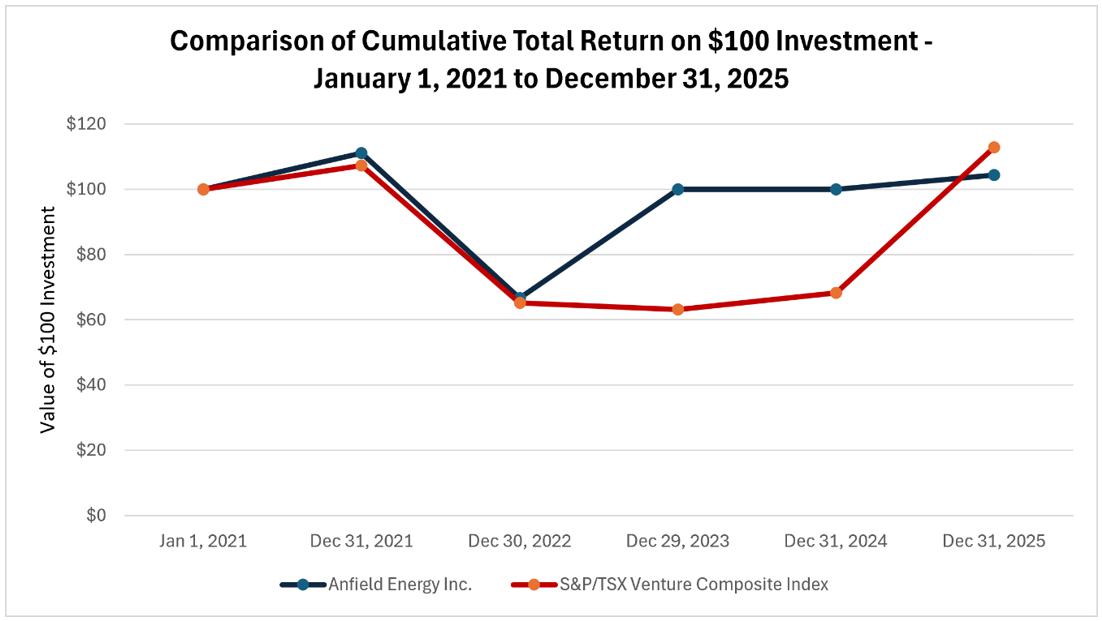
Certain NEOs are eligible for annual performance bonuses based on milestones established by the Board, which may include share price appreciation among other factors. However, the Company does not use total shareholder return as a standalone metric in determining executive compensation. The Company’s base compensation is determined with reference to the Company’s fiscal resources, the scope of each NEO’s responsibilities, and compensation levels at companies of a similar size and stage of development. As a result, there may not be a direct correlation between the trends shown in the performance graph and the Company’s executive compensation levels over the same period.
| 24 |
Compensation Committee
The Compensation Committee is responsible for approving compensation objectives and the specific compensation programs, policies and practices of the Company on matters of remuneration, succession planning, compensation recruitment, development, retention and performance evaluations, which policies are developed and implemented in conformity with the Company’s objectives with the view to attracting and retaining the best qualified members of management and employees The Compensation Committee is responsible for recommending, monitoring and reviewing compensation programs for senior executives, including the approval of grants of compensation securities to the Company’s NEOs under the Compensation Plan.
The Compensation Committee is comprised of Donald Falconer (Chair), Stephen S. Lunsford and Laara Shaffer. Mr. Falconer and Mr. Lunsford are independent members of the Compensation Committee within the meaning of NI 52-110 and Ms. Shaffer is not independent within the meaning of NI 52-110 as she has served as the CFO of the Company within the last three financial years. Each member of the Compensation Committee has experience and skills relevant to executive compensation, enabling them to make informed decisions regarding the suitability of the Company’s compensation policies and practices.
SUMMARY COMPENSATION TABLE
The following table sets out the compensation paid or awarded to the NEOs for each of the Company’s three most recently completed financial years ended December 31, 2025, 2024 and 2023.
| Name and principal position | Year | Salary ($) | Share-based awards ($)(1) | Option-based awards ($)(2) | Non-equity incentive plan compensation ($) | Pension value ($) | All other compensation ($) | Total compensation ($) | ||||||||||||||||||||
| Corey Dias, CEO/Director | 2025 | 405,000 | (3) | 545,600 | 322,034 | Nil | Nil | 277,460 | (5) | 1,550,094 | ||||||||||||||||||
| 2024 | 375,000 | Nil | Nil | Nil | Nil | Nil | 375,000 | |||||||||||||||||||||
| 2023 | 300,000 | Nil | 422,861 | Nil | Nil | 305,000 | (6) | 1,027,861 | ||||||||||||||||||||
| Laara Shaffer, former CFO/Director | 2025 | 81,600 | (3)(7) | 228,800 | 146,379 | Nil | Nil | 43,000 | (8) | 499,779 | ||||||||||||||||||
| 2024 | 51,600 | (7) | Nil | Nil | Nil | Nil | Nil | 51,600 | ||||||||||||||||||||
| 2023 | 51,600 | (7) | Nil | 113,847 | Nil | Nil | 84,300 | (9) | 249,747 | |||||||||||||||||||
| Douglas Beahm, COO | 2025 | 559,885 | (10) | 5,808 | 234,207 | Nil | Nil | 1,514,868 | (12) | 2,314,768 | ||||||||||||||||||
| 2024 | 411,028 | (11) | Nil | Nil | Nil | Nil | 1,156,303 | (12) | 1,567,337 | |||||||||||||||||||
| 2023 | Nil | Nil | Nil | N/A | Nil | Nil | Nil | |||||||||||||||||||||
| Kenneth Mushinski, Chairman/Director | 2025 | 349,186 | (13) | 38,199 | 234,207 | Nil | Nil | Nil | 621,592 | |||||||||||||||||||
| 2024 | 342,601 | (14) | Nil | Nil | Nil | Nil | Nil | 342,601 | ||||||||||||||||||||
| 2023 | 258,956 | (15) | Nil | 422,861 | Nil | Nil | Nil | 681,817 | ||||||||||||||||||||
| Joshua Bleak, (16) President/Director | 2025 | 377,500 | (3) (4) | 545,600 | 322,034 | Nil | Nil | 410,333 | (17) | 1,655,467 | ||||||||||||||||||
| 2024 | 377,500 | Nil | Nil | Nil | Nil | 57,561 | (18) | 395,061 | ||||||||||||||||||||
| 2023 | 270,000 | Nil | 422,861 | Nil | Nil | 342,537 | (19) | 1,035,441 | ||||||||||||||||||||
Notes:
(1) The Company uses Anfield’s closing stock price on the grant date to estimate the fair value for RSUs. The RSUs vest on specific dates, as determined by the Board. The RSUs are settled in common shares.
(2) The fair value of the Option-based awards for fiscal year 2025 was determined using the Black–Scholes pricing model with the following inputs: Risk free rate of 2.96%; Expected life of 5 years; Expected volatility of 119.02% and Dividend yield of $nil. The fair value of the Option-based awards for fiscal year 2023 was determined using the Black–Scholes pricing model with the following inputs: Risk free rate of 4.31%; Expected life of 5 years; Expected volatility of 118% and Dividend yield of $nil.
(3) Includes $30,000 for director’s fees.
(4) Includes $10,000 for Audit Committee fees.
(5) Represents bonuses paid.
(6) Includes a cash bonus of $100,000 and a bonus of $195,000 paid in common shares in lieu of cash to Corey Dias, CEO and director of the Company.
(7) Includes $51,600 paid to Timeline Filing Services Ltd., a company 100% beneficially owned and controlled by Laara Shaffer, director and former CFO of the Company.
(8) Includes a cash bonus of $25,000 paid to Laara Shaffer and $18,000 for office rent paid to Timeline Filing Services Ltd.
(9) Includes a cash bonus of $49,500, a bonus of $32,500 paid in common shares in lieu of cash, and share issue costs of $2,300, paid to Timeline Filing Services Ltd.
| 25 |
(10) Includes share-based compensation earned in 2025 of $279,949 paid to Douglas Beahm, COO of the Company, through issuance of 38,957 RSUs with value of $274,257 as at December 31, 2025.
(11) Includes deferred share-based compensation earned in 2024 of $204,514, which was settled through issuance of RSUs as at December 31, 2025. The RSUs issued in settlement of this deferred balance were granted to Douglas Beahm, COO of the Company, and to such nominees of Mr. Beahm at the direction of Mr. Beahm. Of the total settlement of $205,695 as at December 31, 2025, RSUs with a value of $89,535 were granted directly to Mr. Beahm and RSUs with a value of $116,160 were granted to certain nominees of Mr. Beahm at the direction of Mr. Beahm.
(12) Paid to BRS Inc., a company that was 100% beneficially owned and controlled by Douglas Beahm, COO of the Company, during the financial year end December 31, 2025, for engineering consulting services provided to the Company, separate from duties as COO.
(13) Includes top-up fee earned in 2025 of $139,974 paid in RSUs to Kenneth Mushinski, Chairman and director of the Company, in lieu of cash as at December 31, 2025 with value of $137,130.
(14) Includes deferred top-up fee earned in 2024 of $137,040 paid in RSUs to Kenneth Mushinski, Chairman and director of the Company, in lieu of cash as at December 31, 2025 with value of $137,130.
(15) Includes deferred top-up fee earned in 2023 of $56,298 paid in RSUs to Kenneth Mushinski in lieu of cash as at December 31, 2025 with value of $57,142.
(16) Joshua Bleak is the President of each of Anfield’s U.S. subsidiaries.
(17) Includes $277,218 for bonus, $75,807 for office rent, $48,921 for auto expenses and $8,387 for phone expenses paid to Joshua Bleak, director of the Company and President of each of Anfield’s U.S. subsidiaries.
(18) Includes $49,338 for office rent and $8,223 for auto expenses paid to Joshua Bleak, director of the Company and President of each of Anfield’s U.S. subsidiaries.
(19) Includes a cash bonus of $112,103, a bonus of $195,094 paid in common shares in lieu of cash to Joshua Bleak, director of the Company and President of each of Anfield’s U.S. subsidiaries, auto expenses of $29,338 and office rent of $6,001.
Narrative Discussion
The material terms of each agreement with NEOs are as follows:
| ● | On February 21, 2025, the Company entered into an amended and restated consulting agreement with Corey Dias, pursuant to which Mr. Dias provides services to the Company in the capacity of Chief Executive Officer. The agreement provides for a monthly consulting fee of $31,250. Mr. Dias is eligible to receive an annual performance bonus with a target of 150% of his annualized monthly fee, based on performance milestones established by the Board, including share price appreciation, completion of financings, asset development, business development activities, budget management and health and safety record. Mr. Dias is also eligible to receive further discretionary bonuses based on the successful completion of specific projects or transactions. Mr. Dias is eligible to participate in any equity incentive plans of the Company. | |
| ● | On March 1, 2025, the Company entered into a director fee agreement with Kenneth Mushinski, pursuant to which Mr. Mushinski serves as Chairman of the Board. The agreement provides for a monthly base fee of US$12,500. In addition, Mr. Mushinski receives a monthly top-up fee of US$8,334 which accrues and is payable upon the termination date, unless otherwise agreed. Mr. Mushinski is eligible to participate in any equity incentive plans of the Company. | |
| ● | On February 21, 2025, the Company entered into an amended and restated consulting agreement with Josh Bleak, pursuant to which Mr. Bleak provides services to the Company in the capacity of President of all of Anfield’s subsidiaries. The agreement provides for a monthly consulting fee of $28,125. Mr. Bleak is eligible to receive an annual performance bonus with a target of 150% of his annualized monthly fee, based on performance milestones established by the Board, including share price appreciation, completion of financings, asset development, business development activities, budget management and health and safety record. Mr. Bleak is also eligible to receive further discretionary bonuses based on the successful completion of specific projects or transactions. | |
| ● | On March 31, 2024, the Company entered into a professional services agreement with Douglas Beahm, pursuant to which Mr. Beahm serves as Chief Operating Officer. The original agreement provided for an initial term of 36 months with two one-year extensions. Compensation under the original agreement was $400,000 per year for years 1–3, paid in a combination of US$200,000 cash and US$200,000 in common shares; US$500,000 for year 4 (50% cash, 50% shares); and US$600,000 for year 5 (50% cash, 50% shares). On December 12, 2025, the Company entered into a new consulting agreement with Mr. Beahm, effective January 1, 2026, for a term of two years with an option to extend for an additional two-year period. The new agreement provides for annual compensation of US$250,000, paid in a combination of US$100,000 cash and US$150,000 per year in RSUs pursuant to Anfield’s Compensation Plan. | |
| ● | Ms. Shaffer served as Chief Financial Officer of the Company until her resignation effective January 1, 2026. Ms. Shaffer continues to serve as a director of the Company. Ms. Shaffer did not have a formal employment, consulting or management agreement with the Company. Ms. Shaffer receives a monthly consulting fee of $4,300 and was eligible to participate in any equity incentive plans of the Company at the discretion of the Board. |
| 26 |
INCENTIVE PLAN AWARDS
Outstanding Share-Based Awards and Option-Based Awards
The following table sets out all Option-based and share-based awards outstanding for each NEO as at December 31, 2025.
| Option-Based Awards | Share-Based Awards | |||||||||||||||||||
| Name | Number of securities underlying unexercised options (#) | Option exercise price ($) | Option expiration date | Value of unexercised in-the-money options ($)(1) | Number of shares or units that have not vested (#) | Market or payout value of share-based awards not vested ($) | Market or payout value of vested share-based awards not paid out ($) | |||||||||||||
| Corey Dias, CEO/Director | 35,000 81,667 86,667 55,000 | 9.00 7.50 7.50 6.90 | Aug. 26, 2026 Sep. 20, 2027 Oct. 6, 2028 Dec. 31, 2030 | Nil Nil Nil 7,700 | 77,500 | 545,600 | Nil | |||||||||||||
| Laara Shaffer, former CFO/Director | 13,333 23,333 23,333 25,000- | 9.00 7.50 7.50 6.90 | Aug. 26, 2026 Sep. 20, 2027 Oct. 6, 2028 Dec. 31, 2030 | Nil Nil Nil 3,500 | 32,500(2) | 228,800 | Nil | |||||||||||||
| Douglas Beahm, COO | 40,000 | 6.90 | Dec. 31, 2030 | 5,600 | 52,500 | 369,600 | Nil | |||||||||||||
| Kenneth Mushinski, Chairman/Director | 93,333 86,667 40,000 | 7.50 7.50 6.90 | Sep. 20, 2027 Oct. 6, 2028 Dec. 31, 2030 | Nil Nil 5,600 | 52,500 | 369,600 | Nil | |||||||||||||
| Joshua Bleak President/Director | 35,000 81,667 86,667 55,000 | 9.00 7.50 7.50 6.90 | Aug. 26, 2026 Sep. 20, 2027 Oct. 6, 2028 Dec. 31, 2030 | Nil Nil Nil 7,700 | 77,500 | 545,600 | Nil | |||||||||||||
Notes:
(1) The value of unexercised “in-the-money options” at the financial year-end is the difference between the Option exercise price and the market value of the underlying common shares on the TSX Venture Exchange on December 31, 2025. The closing price of the common shares on December 31, 2025 year end was $7.04.
(2) These RSUs are registered in the name of Timeline Filing Services Ltd., a company controlled by Laara Shaffer.
Incentive Plan Awards – Value Vested or Earned During the Year
The following table sets out, for each NEO, the value of Option-based awards and share-based awards which vested during the financial year ended December 31, 2025, and the value of non-equity incentive plan compensation earned during the financial year ended December 31, 2025.
| Name | Option-based awards – Value vested during the year ($)(1) | Share-based awards – Value vested during the year ($) | Non-equity incentive plan compensation – Value earned during the year ($) | ||||||||
| Corey Dias, CEO/Director | 7,700 | Nil | N/A | ||||||||
| Laara Shaffer, former CFO/Director | 3,500 | Nil | N/A | ||||||||
| Douglas Beahm, COO | 5,600 | Nil | N/A | ||||||||
| Kenneth Mushinski, Chairman/Director | 5,600 | Nil | N/A | ||||||||
| Joshua Bleak, President/Director | 7,700 | Nil | N/A | ||||||||
Notes:
(1) The value of Option-based awards “value vested during the period” at the financial year-end is the difference between the Option exercise price and the closing price of the common shares on the date of vesting. Options granted on December 31, 2025 vested immediately on the date of grant.
| 27 |
Narrative Discussion
No compensation securities were exercised by a NEO during the financial year ended December 31, 2025.
Compensation Plan
On April 21, 2025, the Board adopted the Compensation Plan, which was approved by shareholders on June 13, 2025. The Compensation Plan provides for the grant of Options, RSUs and DSUs to directors, executive officers, employees and consultants of the Company or any of its subsidiaries.
The following is a summary of the key terms of the Compensation Plan:
Securities Reserved for Issuance
The maximum number of common shares issuable pursuant to outstanding Options under the Compensation Plan is equal to 10% of the outstanding issue at the time of any grant, on an “evergreen” basis. The maximum number of common shares issuable pursuant to all other awards (RSUs and DSUs) under the Compensation Plan is 57,705,098 common shares. Common shares covered by awards that have been exercised, settled, expired, forfeited, surrendered, cancelled or otherwise terminated will be available for subsequent grants under the Compensation Plan.
Insider Participation Limits
Unless disinterested shareholder approval has been obtained, the maximum number of common shares issuable to insiders at any time, and the maximum number of common shares issued to insiders within any one-year period, under the Compensation Plan and any other share compensation arrangement, shall not exceed 10% of the outstanding issue. The maximum number of common shares issuable to any one participant in a 12-month period shall not exceed 5% of the outstanding issue, and the maximum number issuable to any one consultant shall not exceed 2% of the outstanding issue.
Options
The exercise price of each Option shall not be less than the market value of the common shares at the time of grant, determined by the volume weighted average trading price for the five trading days immediately preceding the grant date. The Board determines the vesting provisions and term of each Option at the time of grant, provided that no Option shall have a term exceeding 10 years. If an Option’s expiration date falls within a black-out period, the expiration date is automatically extended to the 10th business day after the end of the black-out period. Options are non-transferable and non-assignable, except by will or the laws of succession.
Upon termination for cause, all vested and unvested Options terminate immediately. Upon termination without cause or resignation, unvested Options terminate immediately and vested Options remain exercisable for 90 days following the termination date or until the original expiry date, whichever is earlier. Upon death, vested Options may be exercised by the estate within 12 months following death or prior to the original expiry date, whichever is earlier.
Restricted Share Units
RSUs entitle the participant to receive common shares, the cash equivalent, or a combination thereof upon vesting. The Board determines the vesting conditions at the time of grant, which may include performance criteria. RSUs must be settled no later than December 31 of the third calendar year following the year in which the services for which the RSUs were granted were performed. No RSU may vest before the date that is one year following the grant date, except in the event of death or a change of control.
Upon termination for cause or resignation, all unvested RSUs are immediately forfeited and cancelled. Upon death, retirement, or termination without cause, unvested RSUs are terminated unless otherwise determined by the Board.
| 28 |
Deferred Share Units
DSUs are available to directors and executive officers and entitle the participant to receive common shares, the cash equivalent, or a combination thereof upon termination of service. Participants may elect to receive any portion of their annual base compensation in DSUs. The Board may also grant additional DSUs at its discretion. DSUs are settled following the participant’s termination of service and no later than 12 months thereafter.
Change of Control
A change of control includes, among other things, the acquisition by any person of 50% or more of the voting securities of the Company, an amalgamation or merger where existing shareholders hold less than 50% of the resulting entity, the sale of assets representing more than 50% of the book value of the Company, or a change in the majority composition of the Board. Upon a change of control, the Board has the power to modify the terms of the Compensation Plan and awards to assist participants in tendering into a take-over bid or participating in any other transaction leading to a change of control. RSU and DSU vesting may be accelerated for participants who cease to be participants in connection with a change of control.
Amendments
The Board may amend the Compensation Plan without shareholder approval for housekeeping amendments or amendments necessary to comply with applicable law or stock exchange requirements. Disinterested shareholder approval and TSX Venture Exchange acceptance is required for amendments that increase the maximum number of shares issuable, extend the term of awards benefiting insiders, reduce the exercise price of Options, increase insider participation limits, amend the definition of participant, or amend the amendment provisions of the Compensation Plan.
Resignation
Upon the resignation of a director or executive officer, each unvested Option granted to such individual shall terminate and become void upon resignation and each unvested Option will cease to be exercisable on the earlier of 90 days following the date of resignation and the expiry date of the Option as set forth in the grant agreement. Such Option shall only be exercisable within 12 months after the individual ceases to be a participant in the Compensation Plan.
Retirement
Upon the retirement of a director or executive officer, each unvested Option shall terminate and become void immediately and any vested Option will cease to be exercisable on the earlier of 90 days following the date of retirement and the expiry date of the Option as set for in the grant agreement.
PENSION PLAN BENEFITS
The Company does not have any pension or retirement plan which is applicable to the NEOs or directors. The Company has not provided compensation, monetary or otherwise, to any person who now or previously has acted as an NEO of the Company, in connection with or related to the retirement, termination or resignation of such person, and the Company has provided no compensation to any such person as a result of a change of control of the Company.
TERMINATION AND CHANGE OF CONTROL BENEFITS
The compensation plans or arrangements with respect to the Named Executive Officers resulting from the resignation, retirement or any other termination of the Named Executive Officer’s employment with the Company, or from a change of control of the Company or a change in the Named Executive Officer’s responsibilities following a change in control, are set out below. These agreements also include provisions relating to termination of employment, change of control and customary confidentiality, conflict of interest, non-competition and non-solicitation covenants, as applicable.
| 29 |
Corey Dias, CEO and Director
In the event of termination without just cause, Mr. Dias is entitled to 36 months of annual compensation, of which no more than three months may be provided as working notice. In the event of a change of control, if the agreement is terminated by the Company without just cause, or by Mr. Dias, within 12 months following such event, Mr. Dias is entitled to 36 months of annual compensation. Upon termination without just cause or on a change of control, all outstanding Options and equity bonuses vest immediately and remain exercisable for 12 months following the termination date.
Mr. Dias is subject to confidentiality obligations pursuant to his consulting agreement with the Company. During the term of his agreement and thereafter, Mr. Dias is required to maintain in strict confidence all trade secrets and proprietary information of the Company and to take all necessary precautions against unauthorized disclosure.
Mr. Dias is required to immediately advise the Company if he becomes involved in any capacity with any person, business, or business opportunity that is, or could reasonably be expected to be, in conflict or competition with the business or business prospects of the Company.
Kenneth Mushinski, Chairman and Director
In the event of termination without just cause, Mr. Mushinski is entitled to three months of the base fee, and all outstanding Options and equity bonuses vest immediately and remain exercisable for 90 days following the termination date. In addition, Mr. Mushinski receives a monthly top-up fee of US$8,334 which accrues and is payable upon the termination date, unless otherwise agreed. Mr. Mushinski’s agreement does not contain any change of control provisions. Pursuant to the Compensation Plan, the vesting of the Options, RSUs and DSUs under the Compensation Plan may be accelerated at the discretion of the Board upon a change of control.
Mr. Mushinski is subject to confidentiality obligations pursuant to his consulting agreement with the Company. During the term of his agreement and thereafter, Mr. Mushinski is required to maintain in strict confidence all trade secrets and proprietary information of the Company and to take all necessary precautions against unauthorized disclosure.
Mr. Mushinski is required to immediately advise the Company if he becomes involved in any capacity with any person, business, or business opportunity that is, or could reasonably be expected to be, in conflict or competition with the business or business prospects of the Company.
Joshua Bleak, President and Director
In the event of termination without just cause, Mr. Bleak is entitled to 36 months of annual compensation, of which no more than three months may be provided as working notice. In the event of a change of control, if the agreement is terminated by the Company without just cause, or by Mr. Bleak, within 12 months following such event, Mr. Bleak is entitled to 36 months of annual compensation. Upon termination without just cause or on a change of control, all outstanding Options and equity bonuses vest immediately and remain exercisable for 12 months following the termination date.
Mr. Bleak is subject to confidentiality obligations pursuant to his consulting agreement with the Company. During the term of his agreement and thereafter, Mr. Bleak is required to maintain in strict confidence all trade secrets and proprietary information of the Company and to take all necessary precautions against unauthorized disclosure.
Mr. Bleak is required to immediately advise the Company if he becomes involved in any capacity with any person, business, or business opportunity that is, or could reasonably be expected to be, in conflict or competition with the business or business prospects of the Company.
| 30 |
Douglas Beahm, Chief Operating Officer
Under the original professional services agreement dated March 31, 2024, either party could terminate the agreement by giving 30 calendar days’ written notice. The Company could also terminate without notice for any serious breach, misconduct, incompetence or behaviour prejudicial to the Company’s interests. The original agreement did not provide for any specific severance or change of control payments.
Effective January 1, 2026, the Company entered into a new consulting agreement with Mr. Beahm. Under the new agreement, Mr. Beahm may terminate upon written notice if unforeseen or unanticipated circumstances beyond his reasonable control render continued performance impracticable. Upon termination for any reason, all unvested RSUs are forfeited immediately. The new agreement does not provide for any specific severance or change of control payments. Pursuant to the Compensation Plan, the vesting of Options, RSUs and DSUs under the Compensation Plan may be accelerated at the discretion of the Board upon a change of control.
Mr. Beahm is subject to confidentiality obligations pursuant to his consulting agreements with the Company. Proprietary information disclosed to Mr. Beahm must be held in confidence and used only in connection with services under the agreement.
Laara Shaffer, Director and former CFO
Ms. Shaffer did not have any contract, agreement, plan or arrangement that provided for payments at, following or in connection with any termination (whether voluntary, involuntary or constructive), resignation, retirement, a change of control of the Company, or a change in her responsibilities following a change of control. No payments were made to Ms. Shaffer in connection with her resignation effective January 1, 2026. Pursuant to the Compensation Plan, the vesting of the Options, RSUs and DSUs under the Compensation Plan may be accelerated at the discretion of the Board upon a change of control.
Estimated Incremental Payments on Termination
The following table provides estimated incremental payments that would be triggered on termination without cause or upon a change of control, assuming termination occurred on December 31, 2025.
| Name and event | Severance ($) | Option-based awards ($)(1) | Share-based awards ($) | Total incremental payment ($) | ||||||||||||
| Corey Dias, CEO/Director | 4,650,282 | 7,700 | 545,600 | 5,203,582 | ||||||||||||
| Laara Shaffer, former CFO/Director | Nil | Nil | Nil | Nil | ||||||||||||
| Douglas Beahm, COO | Nil | Nil | Nil | Nil | ||||||||||||
| Kenneth Mushinski, Chairman/Director | 51,397 | 5,600 | 369,600 | 426,597 | ||||||||||||
| Joshua Bleak, Director/President | 4,447,056 | 7,700 | 545,600 | 5,000,356 | ||||||||||||
Notes:
| (1) | The value of accelerated Option-based awards is calculated as the difference between the closing price of the Company’s common shares on December 31, 2025 ($7.04) and the exercise price of unvested “in-the-money” Options, multiplied by the number of unvested Options that would accelerate upon the applicable triggering event. Options with an exercise price greater than $7.04 are out of the money and have been assigned a nil value. |
DIRECTOR COMPENSATION
The following table sets out the compensation provided to each director of the Company who is not also a NEO for the financial year ended December 31, 2025.
| Name | Fees earned ($) | Share-based awards ($)(1) | Option-based awards ($)(2) | Non-equity incentive plan compensation ($) | Pension value ($) | All other compensation ($) | Total ($) | |||||||||||||||||
| John Eckersley | 281,596 | (5) | 228,800 | 691,718 | Nil | N/A | 34,944 | (8) | 691,718 | |||||||||||||||
| Donald Falconer | 40,000 | (6) | 228,800 | 146,379 | Nil | N/A | Nil | 415,179 | ||||||||||||||||
| Stephen S. Lunsford | 30,000 | 228,800 | 146,379 | Nil | N/A | Nil | 405,179 | |||||||||||||||||
| Ross McElroy(3) | 22,500 | 228,800 | 146,379 | Nil | N/A | Nil | 397,679 | |||||||||||||||||
| Jeffrey Duncan(4) | 91,365 | (7) | 228,800 | 146,379 | Nil | N/A | Nil | 466,544 | ||||||||||||||||
| 31 |
Notes:
(1) The Company uses Anfield’s closing stock price on the grant date to estimate the fair value for RSUs. The RSUs vest on specific dates, as determined by the Board. The RSUs are settled in common shares.
(2) The fair value of the Option-based awards for fiscal year 2025 was determined using the Black–Scholes pricing model with the following inputs: Risk free rate of 2.96%; Expected life of 5 years; Expected volatility of 119.02% and Dividend yield of $nil.
(3) Ross McElroy was appointed as director on March 27, 2025.
(4) Jeff Duncan was appointed as director on September 22, 2025.
(5) Includes director fees of $30,000, legal fees of $125,798 paid to John Eckersley, director of the Company and legal fees of $125,798 paid to JHE Consulting, a company 100% beneficially owned and controlled by Mr. Eckersley.
(6) Includes $30,000 for director’s fees and $10,000 for Audit Committee fees.
(7) Includes $7,500 in director fees paid to Mr. Duncan and $83,865 paid to Covenant Government Affairs, LLC, a company of which Mr. Duncan is a founding partner, for government relations services provided to the Company.
(8) Represents bonus paid.
Outstanding Share-Based Awards and Option-Based Awards – Directors
The following table sets out all Option-based and share-based awards outstanding for each director who is not also a NEO as at December 31, 2025.
| Name | Number of securities underlying unexercised options (#) | Option exercise price ($) | Option expiration date | Value of unexercised in-the-money options ($)(1) | Number of shares or units that have not vested (#) | Market or payout value of share-based awards not vested ($) | Market or payout value of vested share-based awards not paid out ($) | |||||||||||||||
| John Eckersley | 13,333 23,333 23,333 25,000 | 9.00 7.50 7.50 6.90 | Aug. 26, 2026 Sep. 20, 2027 Oct. 6, 2028 Dec. 31, 2030 | Nil Nil Nil 3,500 | 32,500 | 228,800 | Nil | |||||||||||||||
| Donald Falconer | 13,333 23,333 23,333 25,000 | 9.00 7.50 7.50 6.90 | Aug. 26, 2026 Sep. 20, 2027 Oct. 6, 2028 Dec. 31, 2030 | Nil Nil Nil 3,500 | 32,500 | 228,800 | Nil | |||||||||||||||
| Stephen S. Lunsford | 13,333 23,333 23,333 25,000 | 9.00 7.50 7.50 6.90 | Aug. 26, 2026 Sep. 20, 2027 Oct. 6, 2028 Dec. 31, 2030 | Nil Nil Nil 3,500 | 32,500 | 228,800 | Nil | |||||||||||||||
| Ross McElroy | 25,000 | 6.90 | Dec. 31, 2030 | 3,500 | 32,500 | 228,800(2) | Nil | |||||||||||||||
| Jeffrey Duncan | 25,000 | 6.90 | Dec. 31, 2030 | 3,500 | 32,500 | 228,800 | Nil | |||||||||||||||
Notes:
(1) The value of unexercised “in-the-money options” at the financial year-end is the difference between the Option exercise price and the market value of the underlying common shares on the TSX Venture Exchange on December 31, 2025. The closing price of the common shares on December 31, 2025 year end was $7.04.
(2) These RSUs are registered in the name of Edge Geological Consulting Inc., a company controlled by Ross McElroy.
Incentive Plan Awards – Value Vested or Earned During the Year – Directors
No compensation securities were exercised by a director who is not also a NEO during the financial year ended December 31, 2025.
Narrative Discussion – Director Compensation
The Compensation Committee is responsible for annually reviewing and recommending to the Board a compensation package for its members. In considering the directors’ compensation packages, the Board takes into consideration the relative responsibilities of directors in serving on the Board and the types of compensation and the amounts paid to directors of comparable companies. The director compensation program is designed to attract and retain members of the Board of a quality and nature that will enhance the performance and growth of the Company.
The Company compensates its non-NEO directors through a combination of retainer fees and Options. There are no standard arrangements for meeting attendance fees. Members of the Compensation Committee do not receive additional compensation for their committee service beyond their standard director fees. Two members of the Audit Committee receive an annual fee of $10,000 for their service on the Audit Committee. The Board reviews director compensation periodically.
In addition to standard director compensation, certain directors provide specialized services to the Company. The Company has retained Covenant Government Affairs, LLC, a company of which Jeff Duncan is a founding partner, to provide government relations services, including facilitating access to U.S. government officials. John Eckersley provides legal advisory services to the Company through JHE Consulting, a company 100% beneficially owned and controlled by Mr. Eckersley. The fees paid to Mr. Duncan and Mr. Eckersley for these services are in addition to their respective director fees and are reflected in their total compensation as disclosed in the Director Compensation table above. The Board believes these arrangements are on terms consistent with those that would be negotiated between arm’s length parties and are in the best interests of the Company.
| 32 |
SCHEDULE “C”
CORPORATE GOVERNANCE
General
Corporate governance refers to the policies and structure of the board of directors of a company, whose members are elected by and are accountable to the shareholders of the company. Corporate governance encourages establishing a reasonable degree of independence of the board of directors from executive management and the adoption of policies to ensure the board of directors recognizes the principles of good management. The Board of the Company is committed to sound corporate governance practices, as such practices are both in the interests of shareholders and help to contribute to effective and efficient decision-making.
Pursuant to National Instrument 58-101 – Disclosure of Corporate Governance Practices (“NI 58-101”), the Company is required to disclose its corporate governance practices, as summarized below. The Board will continue to monitor such practices on an ongoing basis and, when necessary, implement such additional practices as it deems appropriate.
Capitalized terms used herein are defined in the Information Circular.
Board of Directors
Directors are considered to be independent if they have no direct or indirect material relationship with the Company. A “material relationship” is a relationship which could, in the view of the Company’s Board, be reasonably expected to interfere with the exercise of a director’s independent judgment.
The independent members of the Board are Don Falconer, Ken Mushinski, Ross McElroy, Jeff Duncan and Stephen Lunsford. Over 55% percent of the Board is independent.
Corey Dias is not independent as he is the current CEO of the Company. Joshua Bleak is not independent as he is President of Anfield’s U.S. subsidiaries. John Eckersley is not independent as he has received over $75,000 in direct compensation from the Company during a 12 month period within the last three years. Laara Shaffer is not independent as she was the CFO of the Company within the last three years.
The independent directors do not hold regularly scheduled meetings without the non-independent directors and management as given the size of the Company, the current composition of the Board and the nature of activities to date, the independent members of the Board are not expected to hold regularly scheduled meetings at which non-independent directors and members of management are not in attendance. This practice will be reassessed as the Company grows. In order to facilitate open and candid discussion among independent directors, from time to time as circumstances dictate, the independent directors can request a meeting or a portion thereof to be restricted to independent directors for the purpose of discussing matters independently of management. In addition, independent directors are encouraged to remain in communication with one another between meetings as and when they deem it appropriate. Each independent director has the contact information for all other Board members, and thus has the ability to facilitate discussions amongst other Board members should he or she choose to do so. Board meetings also allow for new business discussions and the ability to bring up new items which any one of the Board members may wish to discuss.
For the financial year ended December 31, 2025, the Board did not hold any formal meetings and matters requiring Board approval were able to be approved by directors’ consent resolutions. The Company offers each Board member an opportunity to ask management questions regarding the subject matter of any consent resolutions before executing such resolutions.
| 33 |
Generally, as a matter of practice, directors who have disclosed a material interest in any contract or transaction that the Board is considering will not take part in any Board discussion respecting that contract or transaction. If, on occasion, such directors do participate in the discussions, they will refrain from voting on any matters relating to matters in which they have disclosed a material interest. In appropriate cases, the Company will establish a special committee of independent directors to review a matter in which directors or officers may have a conflict.
The Chairman of the Board is Ken Mushinski and he is an independent director. Mr. Mushinski is responsible for coordinating Board meetings, including both the timing and meeting agenda describing what is to be discussed or addressed, and facilitating discussions regarding the advancement of the Company alongside budgeted spending requirements for its projects. Mr. Mushinski is also available to independent Board members to hold discussions and provide feedback and/or solutions regarding any concerns they may have. Mr. Mushinski also regularly requests information from management to facilitate discussion among the Board. Finally, Mr. Mushinski assists in the determination of whether any financial or operational targets or milestones have been met by management by the end of the year.
The Board facilitates its independent supervision over management in several ways, including retaining independent consultants where it deems necessary, and by reviewing corporate developments with larger shareholders, analysts and potential industry partners.
In the event of a conflict of interest, the conflicted director will in accordance with corporate law and in accordance with his or her fiduciary obligations as a director of the Company, disclose the nature and extent of his or her interest to the Board and abstain from voting on or against the approval of such participation in the conflicted matter.
Directorships
| Name of Director | Name of Reporting Issuer | Exchange Listed | ||
| Kenneth Mushinski | Rare Element Resources Ltd | OTCQB | ||
| Laara Shaffer | Boreal Gold Inc. | CSE | ||
| Ross McElroy | Trident Resources Corp. Apollo Silver Corp. U92 Energy Corp. | TSXV TSXV TSXV |
Board Mandate
The Board does not have a written mandate. The Board delineates its role and responsibilities based on the statutory and common law applicable to the Company. The Board believes its mandate is to manage the business and affairs of the Company. While day-to-day management of the Company has been delegated by the Board to executive management, the Board fulfills its responsibility for the broader stewardship of the Company’s business and affairs through discussions or meetings at which members of management provide reports to the Board with respect to the Company’s business and operations, make proposals to the Board and receive the Board’s decisions for implementation. Any responsibility that has not been delegated to executive management or a Board committee remains with the full Board.
The Board believes that its approach to corporate governance is appropriate and works effectively for the Company and its shareholders and is consistent with the overall business of the Company and its stage of development.
Position Descriptions
The Board has not adopted formal written position descriptions for the chair of the Board, the chair of each committee of the Board or the Chief Executive Officer.
| 34 |
Notwithstanding the absence of formal written position descriptions, the Board has delineated the roles and responsibilities of these positions through a combination of the committee charters and established governance practices.
| ● | Chair of the Board: The chair is responsible for providing leadership to the Board, including overseeing the functioning of the Board, ensuring that the Board operates independently of management, determines whether financial or operational targets have been met by management, setting meeting agendas in consultation with management, and facilitating open and effective communication among directors. | |
| ● | Committee chairs: The responsibilities of each committee chair are defined by the relevant committee charter. Committee chairs are responsible for overseeing the mandate of their respective committees, including setting agendas, presiding over meetings, and reporting to the Board on committee activities and recommendations. | |
| ● | Chief Executive Officer: The role and responsibilities of the CEO are delineated by the Board through ongoing oversight and approval of corporate objectives, strategic plans, and performance expectations. The Board monitors and evaluates the CEO’s performance against these objectives and provides direction as appropriate. |
The Board believes that these practices provide an appropriate framework for delineating roles and responsibilities and ensuring effective governance. The Board periodically reviews its governance practices and may formalize written position descriptions as the Company continues to evolve.
Orientation and Continuing Education
While the Company does not have formal standardized orientation and training programs, when new directors are appointed, they receive an orientation commensurate with their previous experience, on the Company’s properties and business and on the responsibilities of directors.
New directors have introductory meetings with the CEO and the rest of the Board to orient themselves. Board orientation may also include presentations by the Company’s management and employees, the provision of the Company’s annual information form and the Company’s website address to give the directors additional insight into the Company’s business.
Board members are encouraged to communicate with management, auditors and technical consultants; to keep themselves current with industry trends and developments and changes in legislation with management’s assistance; and to attend related industry seminars and visit the Company’s properties. Board members have full access to the Company’s records.
Directors are also encouraged to pursue continuing education to maintain the skill and knowledge necessary to meet their obligations as directors.
Ethical Business Conduct
The Board has adopted a formal code of ethics (the “Code”). In the Board’s view, the fiduciary duties placed on individual directors by corporate legislation and the common law, and the restrictions placed by corporate legislation on an individual director’s participation in decisions of the Board in which the director has an interest, along with the Company’s Code, have been sufficient to ensure that the Board operates independently of management and in the best interests of the Company.
The Company promotes an ethical business culture. Directors and officers of the Company are encouraged to conduct themselves and the business of the Company with the utmost honesty and integrity, including disclosing any material interest in considered transactions and agreements. Directors are also encouraged to consult with the Company’s professional advisors with respect to any issues related to ethical business conduct.
The Board requires that directors and executive officers who have an interest in a transaction or agreement with the Company promptly disclose that interest to the Board and abstain from discussions and voting in respect to same if the interest is material or if required to do so by corporate or securities law.
A copy of the Code can be found on SEDAR+ at www.sedarplus.ca and on the Company’s website at www.anfieldenergy.com.
| 35 |
Nomination of Directors
The Board considers its size each year when it considers the number of directors to recommend to the shareholders for election at the annual meeting of shareholders, taking into account the number required to carry out the Board’s duties effectively and to maintain a diversity of views and experience.
The Board does not have a nominating committee composed entirely of independent directors, but instead the entire Board and management, takes responsibility for nominating new directors and assessing current directors to ensure an objective nomination process. However, if there is a change in the number of directors required by the Company, this policy will be reviewed.
The Company does have an Advance Notice Policy for the nomination of directors which policy can be viewed at www.sedarplus.ca.
Compensation
To determine the compensation for directors and officers, the Company identifies other parties in similar positions at similar-sized companies in Canada and the U.S., both within the same industry and other mining-related industries, which are at a similar development stage as the Company. Compensation packages are then compared to these similar parties. The Company has also established a compensation committee (the “Compensation Committee”).
The Compensation Committee consists of Don Falconer (Chair), Stephen Lunsford and Laara Shaffer. Don Falconer and Stephen Lunsford are independent, but Laara Shaffer is not independent as she was the CFO of the Company within the past three years. To ensure an objective process for determining such compensation, Ms. Shaffer does not discuss or decide on compensation matters relating to her own compensation.
The Compensation Committee is responsible for gathering relevant information for compensation, comparing its research to management’s goals and targets for the year, and determining the compensation of the directors and the CEO to be recommended to the Board for approval and for reviewing the CEO’s recommendations regarding compensation of the other members of senior management and other executive officers of the Company. The Compensation Committee generally reviews compensation paid to directors and officers of companies of similar size and stage of development in the industry in which the Company operates and determines appropriate compensation reflecting the need to provide incentive and compensation for the time and effort expended by the directors and senior management while taking into account the financial and other resources of the Company. No formal compensation program of benchmarking has been established given the size and stage of the Company. In setting the compensation of the CEO, the Compensation Committee will annually review the performance of the CEO and consider other factors which may have impacted the success of the Company in achieving its objectives.
Other Board Committees
The Board has no other committees other than the Audit Committee and the Compensation Committee.
Assessments
The Board monitors the adequacy of information given to directors, communication between the Board and management and the strategic direction and processes of the Board and committees.
The Board and its individual directors are assessed on an informal basis continually as to their effectiveness and contribution. The Board encourages discussion among members as to evaluation of its effectiveness as a whole, of each individual director and each of its committees. The Board does not consider that formal assessments would be useful at this stage of the Company’s development. To assist in its review, the Board may conduct informal surveys of its directors. In addition, the Board works closely with management and, accordingly, are in a position to assess individual director’s performance on an ongoing basis. Each Board member is a professional with a proficiency in a particular area of the market.
| 36 |
Director Term Limits and Other Mechanisms of Board Renewal
The Company has not adopted director term limits. Given the current stage and development of the Company, continuity of Board members is considered a high priority at this stage of the Company’s existence and development.
Policies Regarding the Representation of Women on the Board
The Company has not adopted a written policy relating to the identification and nomination of women directors. Though the Board recognizes the importance of a reasonable degree of gender balance over the long term, at the present stage of the Company’s existence and development, it is imperative that the directors of the Company be the best available individuals, irrespective of gender.
Consideration of the Representation of Women in the Director Identification and Selection Process
The Board will consider and evaluate the representation of women on the Board when identifying and nominating candidates for election and re-election to the Board. The Company will focus its search for new directors purely based on the qualification of potential candidates, regardless of their gender.
Consideration Given to the Representation of Women in Executive Officer Appointments
The Board encourages the consideration of women who have the necessary skills, knowledge, experience and character when considering new potential candidates for executive officer positions. The Company has had a woman in the role of CFO since 2010.
Targets Regarding the Representation of Women on the Board and in Executive Officer Positions
The Company has not adopted such targets to date, as the Company’s priority at the present stage of the Company’s existence and development is to seek out the best available candidates, irrespective of gender. The Company believes it has adequate access to candidates through its general nominating process.
Number of Women on the Board and in Executive Officer Positions
The Board currently has one woman as director, representing 11.1% of the Board. The Company also has one woman as an executive officer, the CFO, representing 33.3% of the Company’s executive officers.
| 37 |