
Exhibit 99.3
INTERMAP TECHNOLOGIES CORPORATION
Annual General Meeting of Shareholders
NOTICE OF MEETING AND
MANAGEMENT INFORMATION CIRCULAR
to be held on June 24, 2026 at 8:30 a.m. Mountain Time / 10:30 a.m. Eastern Time
at the TMX Market Centre, Bourse Room
120 Adelaide St W, Toronto, ON M5H 1S3
The attached Management Information Circular is furnished in connection with the solicitation of proxies by and on behalf of the management of Intermap Technologies Corporation for use at the annual general meeting of holders of common shares of Intermap Technologies Corporation to be held on June 24, 2026, at the time and place and for the purposes set out in the accompanying Notice of Annual General Meeting and any adjournment or postponement thereof.
No person has been authorized to give any information or make any representation in connection with any matters to be considered at the meeting, other than as contained in the Management Information Circular and, if given or made, any such information or representation must not be relied upon as having been authorized.
Dated: May 13, 2026
INTERMAP TECHNOLOGIES CORPORATION
NOTICE OF ANNUAL GENERAL MEETING OF SHAREHOLDERS
TO: THE HOLDERS OF COMMON SHARES OF INTERMAP TECHNOLOGIES CORPORATION
NOTICE IS HEREBY GIVEN that the Annual General Meeting (the “Meeting”) of holders of Class A common shares (“Common Shares”) of Intermap Technologies Corporation (the “Corporation”) will be held at the TMX Market Centre, Bourse Room, located at 120 Adelaide St W, Toronto, ON M5H 1S3 on June 24, 2026, commencing at 10:30 a.m. (Toronto time).
The Meeting is being held for the following purposes:
| 1. | to receive the financial statements for the year ended December 31, 2025 and the auditors’ report thereon; |
| 2. | to elect the directors of the Corporation for the ensuing year; |
| 3. | to approve the appointment of MNP LLP, Chartered Accountants, as auditors of the Corporation for the ensuing year and authorize the board of directors of the Corporation (the “Board of Directors” or the “Board”) to fix their remuneration; |
| 4. | to transact such other business as may be properly brought before the Meeting or any adjournment or postponement thereof, each as described in the Information Circular. |
The Board of Directors has fixed the close of business on May 7, 2026 as the record date for the determination of shareholders entitled to receive notice of and to vote at the Meeting and at any adjournment or postponement thereof.
INFORMATION RELATING TO THE MATTERS TO BE BROUGHT BEFORE THE MEETING IS SET FORTH IN THE MANAGEMENT INFORMATION CIRCULAR WHICH ACCOMPANIES THIS NOTICE AND WHICH IS EXPRESSLY MADE A PART OF THIS NOTICE.
Shareholders who are unable or do not wish to attend the Meeting are requested to date, sign and return the enclosed form of proxy duly completed to Odyssey Trust Company, Trader’s Bank Building, 1100, 67 Yonge Street, Toronto, Ontario, M5E 1J8, so that it is received not less than 48 hours (excluding Saturdays, Sundays and holidays) before the time set for the Meeting or any adjournment or postponement thereof to ensure representation whether or not such shareholder is able to attend the Meeting virtually. If the shareholder receives more than one instrument of proxy because such shareholder owns Common Shares of the Corporation registered in different names or addresses, each instrument of proxy should be completed and returned. The Chairman of the Meeting may waive or extend the proxy deadline without notice, and late proxies may be accepted or rejected by the Chairman in his discretion; however, the Chairman is under no obligation to accept or reject any particular late proxy.
DATED at Calgary, Alberta on May 13, 2026.
BY ORDER OF THE BOARD OF DIRECTORS
(Signed) “Patrick A. Blott” | |
Patrick A. Blott Chairman & Chief Executive Officer |
| i |
INTERMAP TECHNOLOGIES CORPORATION
MANAGEMENT INFORMATION CIRCULAR
Solicitation of Proxies
This management information circular (the “Information Circular”) is furnished by the management of Intermap Technologies Corporation (the “Corporation”) in connection with the solicitation of proxies for use at the Annual General Meeting (the “Meeting”) of holders (“Shareholders”) of Class A common shares (“Common Shares”) of the Corporation to be held at the TMX Market Centre, Bourse Room, located at 120 Adelaide St W, Toronto, ON M5H 1S3 on June 24, 2026, commencing at 10:30 a.m. (Toronto time) and at any adjournment or postponement thereof, for the purposes set forth in the accompanying Notice of Meeting and this Information Circular. To be valid, proxies must be delivered to Odyssey Trust Company at the address shown on the enclosed envelope not less than 48 hours (excluding Saturdays, Sundays and holidays) before the time for holding the Meeting. Only a Shareholder of record at the close of business on May 7, 2026, unless that Shareholder has transferred its Common Shares subsequent to that date and the transferee Shareholder establishes ownership of those Common Shares and demands at least ten days before the Meeting that its name be included on the list of Shareholders, will be entitled to vote at the Meeting.
The instrument appointing a proxy shall be in writing and shall be executed by the Shareholder or its attorney authorized in writing or, if the Shareholder is a corporation, under its corporate seal or by an officer or attorney thereof duly authorized.
The persons named in the enclosed Form of Proxy are directors and executive officers of the Corporation. A Shareholder submitting the proxy has the right to appoint a person (who need not be a Shareholder) other than the persons named in the enclosed Form of Proxy to represent it at the Meeting. To exercise this right, the Shareholder should insert the name of the desired representative in the blank space provided in the Form of Proxy and strike out the other names, or submit another appropriate proxy.
REVOCABILITY OF PROXY
A Shareholder who has submitted a proxy may revoke it as to any matter upon which a vote has not already been cast pursuant to the authority conferred by the proxy. In addition to revocation in any other manner permitted by law, a proxy may be revoked by an instrument in writing executed by the Shareholder or its attorney authorized in writing or, if the Shareholder is a corporation, under its corporate seal or by an officer or attorney thereof duly authorized, and deposited either at the head office of the Corporation at any time up to 4:30 p.m. (Calgary time) on the last business day before the day of the Meeting, or with the Chairman of the Meeting on the day of the Meeting, and upon either of such deposits, the proxy is revoked.
PERSONS MAKING THE SOLICITATION
This solicitation is made by and on behalf of the management of the Corporation. The costs incurred in the preparation and mailing of the Form of Proxy, Notice of Meeting and this Information Circular will be borne by the Corporation. In addition to the use of mail, proxies may be solicited in person, by telephone or by electronic communications by the directors, officers and employees of the Corporation, who will not be remunerated therefor. In accordance with National Instrument 54-101 – Communication with Beneficial Owners of Securities of a Reporting Issuer, arrangements have been made with brokerage houses and other intermediaries, clearing agencies, custodians, nominees and fiduciaries to forward solicitation materials to the Beneficial Shareholders (as defined below) of record and the Corporation may reimburse such persons for reasonable fees and disbursements incurred by them in doing so.
| 1 |
APPOINTMENT OF PROXY
The securities represented by proxies in favor of management nominees will be voted on any poll at the Meeting, and where the Shareholder specifies a choice with respect to any matter to be acted upon; the securities will be voted or withheld from voting on any poll in accordance with the specification so made.
In the absence of such specification, such securities will be voted in favor of the matters to be acted upon as set out herein. The persons appointed under the Form of Proxy furnished by the Corporation are conferred with discretionary authority with respect to amendments or variations of those matters specified in the Form of Proxy and Notice of Meeting and with respect to any other matters which may properly be brought before the Meeting. In the event that amendments or variations to any matter identified in the Notice of Meeting are properly brought before the Meeting, it is the intention of the persons designated in the enclosed Form of Proxy to vote in accordance with their best judgment on such matter or business. At the time of printing this Information Circular, the management of the Corporation knows of no such amendment, variation, or other matter.
ADVICE TO BENEFICIAL SHAREHOLDERS
The information set forth in this section is of significant importance to many Shareholders, as a substantial number of Shareholders do not hold Common Shares in their own name. Shareholders who hold their Common Shares through their brokers, intermediaries, trustees or other persons, or who otherwise do not hold their Common Shares in their own name (referred to in this Information Circular as “Beneficial Shareholders”) should note that only proxies deposited by Shareholders who appear on the records maintained by the Corporation’s registrar and transfer agent as registered holders of Common Shares will be recognized and acted upon at the Meeting. If Common Shares are listed in an account statement provided to a Beneficial Shareholder by a broker, those Common Shares will, in all likelihood, not be registered in the Beneficial Shareholder’s name. Such Common Shares will more likely be registered under the name of the Beneficial Shareholder’s broker or an agent of that broker. In Canada, the vast majority of such shares are registered under the name of CDS & Co. (the registration name for The Canadian Depositary for Securities Limited, which acts as depository for many Canadian brokerage firms). Common Shares held by brokers (or their agents or nominees) on behalf of a broker’s client can only be voted (for or against resolutions) at the direction of the Beneficial Shareholder. Without specific instructions, brokers and their agents and nominees are prohibited from voting shares for the broker’s clients. Therefore, each Beneficial Shareholder should ensure that voting instructions are communicated to the appropriate person well in advance of the Meeting.
Applicable regulatory rules require intermediaries/brokers to seek voting instructions from Beneficial Shareholders in advance of shareholders’ meetings. Every intermediary/broker has its own mailing procedures and provides its own return instructions to clients, which should be carefully followed by Beneficial Shareholders in order to ensure that their Common Shares are voted at the Meeting. Often, the form of proxy supplied to a Beneficial Shareholder by its broker (or the agent of the broker), called a voting instruction form, is identical to the form of proxy provided to registered shareholders. However, its purpose is limited to instructing the registered shareholder (the broker or agent of the broker) how to vote on behalf of the Beneficial Shareholder. The majority of brokers now delegate responsibility for obtaining instructions from clients to Broadridge Investor Communication Solutions (“Broadridge”). Broadridge typically mails its voting instruction form to the Beneficial Shareholders and asks Beneficial Shareholders to return their voting instruction form to Broadridge by mail or facsimile. Alternatively, Beneficial Shareholders can call a toll-free telephone number or access the internet to vote their Common Shares. The toll-free telephone number and website www.proxy-vote.com are also included by Broadridge in its voting instruction form. Broadridge then tabulates the results of all instructions received and provides appropriate instructions respecting the voting of shares to be represented at a meeting. A Beneficial Shareholder receiving a voting instruction form cannot use that form to vote Common Shares directly at the Meeting. The voting instruction form must be returned to Broadridge well in advance of the Meeting in order to have the Common Shares voted at the Meeting.
| 2 |
Although a Beneficial Shareholder may not be recognized directly at the Meeting for the purposes of voting Common Shares registered in the name of its broker, a Beneficial Shareholder may attend the Meeting as proxyholder for the registered Shareholder and vote the Common Shares in that capacity. Beneficial Shareholders who wish to attend the Meeting and indirectly vote their Common Shares as proxyholder for the registered Shareholder, should enter their own names in the blank space on the voting instruction form provided to them and return the same to their broker (or the broker’s agent) in accordance with the instructions provided by such broker.
RECORD DATE
The board of directors of the Corporation (the “Board of Directors” or the “Board”) has fixed May 7, 2026 as the record date (the “Record Date”) for the determination of Shareholders entitled to receive notice of and to vote at the Meeting and at any adjournment or postponement thereof. Shareholders of record at the close of business on the Record Date are entitled to such notice and to vote at the Meeting.
INTERESTS OF CERTAIN PERSONS IN MATTERS TO BE ACTED UPON
Other than as set forth herein, management of the Corporation is not aware of any material interest, direct or indirect, by way of beneficial ownership of securities or otherwise, of any person who has been a director or executive officer of the Corporation at any time since the beginning of the Corporation’s last financial year, or of any nominee for election as a director, or of any associate or affiliate of any such persons, in any matter to be acted upon at the Meeting other than the election of directors or the appointment of auditors.
ADVANCE NOTICE BY-LAW
In 2018, Shareholders approved the Amended and Restated By-Law No. 1 of the Corporation, which includes a provision that establishes a framework for advance notice of nominations of persons for election to the Board (the “Advance Notice By-Law”). The Advance Notice By-Law sets deadlines of a prescribed number of days before a shareholders’ meeting for a Shareholder to notify the Chief Executive Officer of the Corporation of its intention to nominate one or more directors and explains the information that must be included with the notice for it to be valid. The Advance Notice By-Law applies at an annual meeting of shareholders or a special meeting of shareholders that was called to elect directors (whether or not also called for other purposes) and may be waived by the Board.
In the case of an annual meeting of shareholders (including an annual and special meeting), notice to the Chief Executive Officer of the Corporation pursuant to the Advance Notice By-Law must be given not less than 30 nor more than 65 days prior to the date of the annual meeting. In the event that the annual meeting is to be held on a date that is less than 50 days after the date on which the first public announcement of the date of the annual meeting was made, notice must be given not later than the close of business on the 10th day following the notice date. As at the date of this Information Circular, the Corporation has not received any additional director nominations for the Meeting.
| 3 |
REPORTING CURRENCY
All of the financial information in this Information Circular has been presented, unless otherwise noted, in United States dollars. The presentation currency for the audited financial statements of the Corporation for the year ended December 31, 2025 is in United States dollars.
MATTERS TO BE ACTED UPON AT THE MEETING
| 1. | Annual Report, Financial Statements and Auditors’ Report |
Pursuant to the Business Corporations Act (Alberta) (the “Act”), the directors will place before the Shareholders at the Meeting the audited financial statements of the Corporation for the year ended December 31, 2025 and the auditors’ report thereon. Copies of the audited annual financial statements for the year ended December 31, 2025 are available on the System for Electronic Document Analysis and Retrieval + (“SEDAR”) (www.sedarplus.ca) under the Corporation’s profile. Shareholder approval is not required in relation to the statements.
| 2. | Election of Directors |
Action is to be taken at the Meeting with respect to the election of directors. The Board of Directors presently consists of three members. The current directors are Patrick A. Blott, Philippe Frappier and Jordan Tongalson. All of the current directors have indicated an intention stand for re-election as directors of the Corporation at the Meeting. Each director elected will hold office until the next annual meeting of the Shareholders or until his successor is duly elected or appointed, unless his office is earlier vacated under any of the relevant provisions of the articles of the Corporation or the Act.
The Board has adopted a policy stipulating that if the votes in favor of the election of a director nominee at a shareholders’ meeting represent less than a majority of the Common Shares voted at the shareholders’ meeting, the nominee will submit his or her resignation promptly after the meeting for the Nominating and Governance Committee’s consideration. The Nominating and Governance Committee will make a recommendation to the Board after reviewing the matter, and the Board’s decision to accept or reject the resignation offer will be disclosed to the public. The nominee will not participate in any committee or Board deliberations on the resignation offer. The policy does not apply in circumstances involving contested director elections.
Three directors will be elected at the Meeting and the three nominated directors receiving the highest number of FOR votes duly cast at the Meeting will be elected to the Board.
Unless otherwise directed, it is the intention of the management designees, if named as proxy, to vote FOR the election to the Board of Directors of those persons hereinafter designated as nominees for election as directors.
The following table sets out the name of each of the persons proposed to be nominated for election as a director; the director’s residence; all positions and offices in the Corporation presently held by him; his principal occupation; the period during which he has served as a director; and the number of voting shares of the Corporation that he has advised are beneficially owned, or controlled or directed by him, directly or indirectly.
| 4 |
Name, Present Office Held and Residence |
Director Since | Principal Occupation | Common Shares (5) | |||
Patrick A. Blott(1)(3)(4) Chairman and Chief Executive Officer New York, U.S.A. |
July 13, 2016 | Chairman and Chief Executive Officer of the Corporation(6) Co-Founder and Managing Partner of Blott Asset Management LLC(7) and previously Director and Special Committee Chairman of OSI Geospatial Inc.(8) | 6,496,863 | |||
Philippe Frappier(2)(3)(4) Director Toronto, Canada |
January 30, 2017 | Senior Partner, BoldHouse Executive Search(9), and previously Account Executive at Eclipse Technology Solutions(10), Human Capital and Technology Consultant, Vice President Wireless DNA(11), Vice President Client Services at IQ Partners(12) and Senior Partner of Searchlight Recruitment Inc.(13) | 234,708 | |||
Jordan Tongalson(2)(3)(4) Director New York, U.S.A. |
September 10, 2020 | Managing Director of Littlejohn & Co(14), and previously Executive Director of Morgan Stanley(15) and Vice President of The Blackstone Group L.P.(16) | 75,076 |
Notes:
| (1) | Chairman of the Board | |
| (2) | Member of Audit Committee | |
| (3) | Member of Compensation Committee | |
| (4) | Member of Nominating and Governance Committee | |
| (5) | Beneficially Owned, Controlled or Directed, Directly or Indirectly, as at the Record Date |
| (6) | (October 2016 – Present) | |
| (7) | A private equity and venture capital firm (May 2006 – Present) | |
| (8) | A world-leading naval fleet supplier of integrated navigation and tactical solutions, and a leading-edge research, development, and systems integration supplier of technology solutions for defense, aerospace, health, and bioscience markets (August 2011 – September 2013) | |
| (9) | An executive search partner for leaders making important hiring decisions in moments of growth and change. (March 2026 – Present) | |
| (10) | An end-to-end technology solutions business (February 2023 – June 2025) | |
| (11) | A wireless telecommunications technology company (April 2022 – November 2022) | |
| (12) | An executive search firm, specializing in digital media and technology (October 2017 – April 2022) | |
| (13) | An executive search firm, specializing in digital media and technology (September 2005 – October 2017) | |
| (14) | A private equity and special situations investment firm (October 2015 – Present) | |
| (15) | A multinational investment bank and financial services company (June 2011 – October 2015) | |
| (16) | A private equity alternative investment management and advisory firm (July 2006 – June 2011) |
The current directors beneficially own, directly or indirectly or exercise control and direction over an aggregate of 9.2% of the issued and outstanding Common Shares of the Corporation.
The information as to Common Shares beneficially owned, not being within the knowledge of the Corporation, has been furnished by the respective individuals.
Orders
To the knowledge of management of the Corporation, no proposed director is, as at the date hereof, or has been within 10 years before the date hereof, a director, chief executive officer or chief financial officer of any company (including the Corporation) that (i) was subject to an order that was issued while the proposed director was acting in the capacity as director, chief executive officer or chief financial officer, or (ii) was subject to an order that was issued after the proposed director ceased to be a director, chief executive officer or chief financial officer and which resulted from an event that occurred while that person was acting in the capacity as director, chief executive officer or chief financial officer. For the purposes of the hereof, “order” means (i) a cease trade order, (ii) an order similar to a cease trade order, or (iii) an order that denied the relevant company access to any exemption under securities legislation, that was in effect for a period of more than 30 consecutive days.
| 5 |
Bankruptcies
To the knowledge of management of the Corporation, no proposed director of the Corporation (i) is, as at the date hereof, or has been within the 10 years before the date hereof, a director or executive officer of any company (including the Corporation) that, while that person was acting in that capacity, or within a year of that person ceasing to act in that capacity, became bankrupt, made a proposal under any legislation relating to bankruptcy or insolvency or was subject to or instituted any proceedings, arrangement or compromise with creditors or had a receiver, receiver manager or trustee appointed to hold its assets, or (ii) has, within the 10 years before the date hereof, become bankrupt, made a proposal under any legislation relating to bankruptcy or insolvency, or become subject to or instituted any proceedings, arrangement or compromise with creditors, or had a receiver, receiver manager or trustee appointed to hold the assets of the proposed director.
Penalties and Sanctions
To the knowledge of management of the Corporation, no proposed director has been subject to (i) any penalties or sanctions imposed by a court relating to securities legislation or by a securities regulatory authority or has entered into a settlement agreement with a securities regulatory authority, or (ii) any other penalties or sanctions imposed by a court or regulatory body that would likely be considered important to a reasonable securityholder in deciding whether to vote for a proposed director.
| 3. | Appointment of Auditors |
At the Meeting, Shareholders will be asked to appoint MNP LLP as auditors of the Corporation to hold office until the next annual meeting of Shareholders or until a successor is appointed, and to authorize the directors to fix their remuneration. MNP LLP has been the auditor of the Corporation since June 2025.
Information relating to the Corporation’s Audit Committee as prescribed by National Instrument 52-110 – Audit Committees is contained in the Corporation’s Annual Information Form for the year ended December 31, 2025 filed on SEDAR at www.sedarplus.ca, commencing on page 34.
Unless otherwise directed, it is the intention of the management designees, if named as proxy, to vote FOR the appointment of the Replacement Auditors as auditors of the Corporation at a remuneration to be fixed by the Board of Directors.
| 4. | Other Matters |
Management of the Corporation is not aware of any other matters to come before the Meeting other than as set forth in the Notice of Meeting. If any other matter properly comes before the Meeting, it is the intention of the persons named in the enclosed instrument of proxy to vote the shares represented thereby in accordance with their best judgment on such matter(s).
| 6 |
INFORMATION CONCERNING THE CORPORATION
Voting Shares and Principal Holders Thereof
The authorized share capital of the Corporation consists of an unlimited number of Common Shares and an unlimited number of preferred shares (the “Preferred Shares”).
As of the Record Date, May 7, 2026, there were 73,781,696 Common Shares issued and outstanding and no Preferred Shares issued and outstanding. Each Common Share carries the right to one (1) vote on a ballot at the Meeting.
A quorum for the transaction of business at the Meeting will be present if two persons are present and holding or representing by proxy 5% of the securities entitled to vote at the Meeting. Pursuant to the Act and the bylaws of the Corporation, if a quorum is present at the opening of the Meeting, the Shareholders present may proceed with the business of the Meeting notwithstanding that a quorum is not present throughout the Meeting. If a quorum is not present at the opening of the Meeting, the Shareholders present may adjourn or postpone the Meeting to a fixed time and place but may not transact any other business.
The holders of Common Shares are entitled to notice of and to vote at all annual and special meetings of shareholders (except meetings at which only holders of a specified class or series of shares are entitled to vote) and are entitled to one vote per Common Share.
Principal Shareholders
To the knowledge of the directors and executive officers of the Corporation, as at the date hereof, no persons beneficially owned, directly or indirectly, or exercised control or direction over, voting securities carrying more than 10% of the voting rights attached to any class of voting securities of the Corporation.
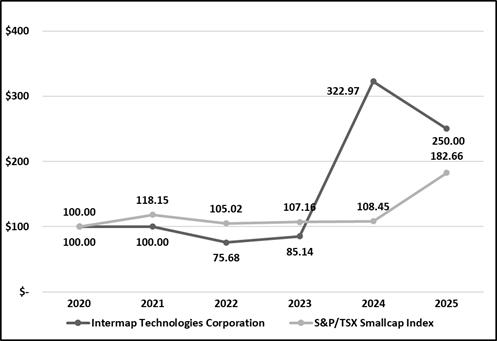
PERFORMANCE GRAPH
The following graph compares the cumulative total shareholder return for the Common Shares of the Corporation (assuming a $100 investment was made on December 31, 2019) with the cumulative total return of the S&P/TSX Smallcap Index, assuming reinvestment of dividends (see “Base Salary” and “Directors’ Fees” below for trends in executive and director compensation).

| 7 |
In determining compensation, the Board considered a range of factors, including the Corporation’s financial position, market conditions, and the level of contribution by directors and executives to the Corporation’s strategic objectives.
The Board recognizes that, due to the Corporation’s size and operating model, directors and executive officers are required to devote significant time and expertise to matters that extend beyond the scope of traditional board oversight, including capital markets activities, strategic transactions, and operational support. Director and executive time commitments during 2025 and 2026 have exceeded those typically associated with public company roles.
The Board also considered historical compensation practices, including prior periods during which compensation levels were below market or subject to deferral, reflecting the Corporation’s focus on liquidity preservation during periods of constrained access to capital. Current compensation levels reflect a rebalancing toward more competitive and sustainable levels, taking into account both past practices and current expectations.
The Board recognizes that total compensation for 2025 is elevated relative to prior periods, reflecting the achievement of significant corporate milestones and a rebalancing from historically below-market compensation levels.
The Board reviewed compensation data from a peer group of publicly traded small-cap technology and services companies with broadly comparable market capitalizations, business models and capital requirements. This benchmarking analysis was used as a reference point, and the Board applied judgment in determining appropriate compensation levels in light of the Corporation’s specific circumstances. The Board did not apply benchmarking data mechanically but instead used it together with its assessment of the Corporation’s circumstances, historical compensation practices, and the level of direct involvement required of directors and executive officers.
Equity-based compensation forms an important component of the Corporation’s compensation framework and is intended to align executives and directors with long-term shareholder value creation. The value of such awards is based on accounting measurements and may differ from the value ultimately realized.
The Board will continue to monitor compensation levels and structure to ensure ongoing alignment with shareholder interests and market practices.
| 8 |
STATEMENT OF EXECUTIVE COMPENSATION
The following sections set forth the remuneration for the “Named Executive Officers” (or “NEOs”), being the Chief Executive Officer and the Chief Financial Officer, who served as executive officers during the most recently completed financial year.
Compensation Discussion and Analysis
General
The Corporation operates in a dynamic and capital-constrained environment, with a business model characterized by long sales cycles, reliance on government contracts, and ongoing requirements for strategic capital planning. As a result, both management and the Board of Directors are required to be actively engaged in strategic, operational and financing activities.
During 2025 and continuing into 2026, the Board of Directors has played an active role in supporting key corporate initiatives, including capital markets activities, strategic planning, and oversight of growth initiatives. The Corporation maintains a lean organizational structure, and directors and executive officers are expected to contribute beyond traditional governance functions typically observed in larger, more mature issuers.
Accordingly, compensation practices reflect the level of engagement, time commitment and expertise required to support the Corporation’s strategy and operations.
Compensation Objective
The objective of the Corporation’s compensation program is to attract, retain and motivate highly qualified executives and directors while aligning compensation with the long-term interests of shareholders.
In establishing compensation levels, the Board considers the Corporation’s stage of development, the complexity of its business, and the level of active involvement required from directors and executive officers. Given the Corporation’s lean structure and the nature of its operations, directors and executives are expected to provide meaningful strategic, financial and operational support in addition to traditional oversight responsibilities.
Compensation is structured to: (i) reflect the scope and intensity of responsibilities undertaken by directors and executives; (ii) incorporate both fixed and variable elements tied to performance and contributions to strategic objectives; and (iii) remain competitive with relevant peer groups, taking into account the Corporation’s unique operating profile.
The mix of cash and equity compensation may vary from year to year based on performance outcomes, market conditions and the Corporation’s strategic priorities. The Board reviews compensation on a regular basis to ensure it remains appropriate in light of the Corporation’s evolving circumstances.
| 9 |
Role of Executive Officers
The Chief Executive Officer provided the Compensation Committee of the Corporation (the “Compensation Committee” or the “Committee”) with compensation recommendations for all executives, other than himself. In making compensation recommendations, the Chief Executive Officer considered each executive’s performance and other relevant factors, including the scope of each executive’s position and responsibilities, the achievement of corporate goals, the current business environment and anticipated changes, and executive retention and recruitment. The Chief Executive Officer regularly attended meetings of the Compensation Committee. The Chief Executive Officer was not present for certain portions of the Compensation Committee meetings, such as when the Compensation Committee discussed the performance or individual compensation of the Chief Executive Officer.
Role of the Compensation Committee
Pursuant to its charter, the Compensation Committee is responsible for reviewing and making recommendations to the Board in respect of human resource policies, practices and structures, compensation policies and guidelines, management incentives, senior management compensation and Board of Directors compensation.
The Compensation Committee convened on six occasions during the fiscal year to fulfill its oversight responsibilities with respect to executive and director compensation, incentive structures, and alignment with Company performance, shareholder interests, and market practices. Each meeting included review of relevant materials, discussion among Committee members, and, where appropriate, management presentations and benchmarking analyses.
The Committee’s activities included:
| ● | review of executive performance, including strategic execution, operational management and financial stewardship; |
| ● | evaluation of incentive compensation structures and alignment with corporate objectives; |
| ● | review of third-party and publicly available benchmarking data and peer group comparisons; and |
| ● | determination and approval of total compensation for executive leadership and directors. |
The Committee conducted its review and made its determinations independently, with input from management as appropriate, and without the participation of the Chief Executive Officer in decisions relating to his own compensation. Until July 7, 2025, the Compensation Committee was comprised of Philippe Frappier (Chairman), Patrick Blott, Jack Hild and Jordan Tongalson. Following the resignation of John Hild on July 7, 2025, the Compensation Committee is comprised of Messrs. Frappier (Chairman), Blott and Tongalson. Messrs. Frappier and Tongalson, two of the three current directors, are independent, non-employee directors, and are not eligible to participate in any of the Corporation’s benefit programs, other than the Corporation’s Omnibus Incentive Plan. Mr. Frappier has over 18 years of executive search experience and has advised and negotiated executive compensation and has led compensation reviews for his clients.
Elements of Executive Officer Compensation
During 2025 the Corporation’s Compensation Program had three principal components: base salary, incentive bonus plan and restricted stock units.
| 10 |
Base Salary
The base salary element was designed to establish a target compensation level of fixed income based on the comparative market value of each position. Base salaries were determined based on the scope of the executive’s responsibilities and the compensation levels for their positions relative to the market, so that salary levels remain competitive in an effort to build and retain an effective executive team.
In evaluating Chief Executive Officer compensation, the Committee conducted a comprehensive assessment of individual and corporate performance. The Committee noted that the Chief Executive Officer provided sustained leadership and strategic direction during periods of constrained liquidity and market uncertainty. During these periods, the Chief Executive Officer and other members of senior management voluntarily deferred compensation to support liquidity preservation and operational continuity.
The Committee further considered the Chief Executive Officer’s role in identifying, pursuing, and securing significant commercial contracts that strengthened the Corporation’s revenue profile and long-term growth outlook. These outcomes were the result of strategic positioning, customer engagement, and execution oversight by senior leadership.
In addition, the Committee considered leadership in capital-raising initiatives, including efforts to secure external financing and strengthen the Corporation’s capital structure. These efforts materially improved the Corporation’s financial position and contributed to a significantly strengthened balance sheet, including successful capital raising activities of approximately $30 million, which materially strengthened the Corporation’s capital structure and resulted in a cash and cash equivalents balance of approximately $23 million at year end, providing enhanced liquidity and financial flexibility. In addition, the Corporation continued to expand its revenue base through the execution of new commercial contracts, supporting growth in both subscription-based and project-based revenues. The Committee considered these measurable outcomes in determining that compensation outcomes were aligned with the Corporation’s performance and strategic progress.
The Committee determined that compensation outcomes reflected the achievement of these strategic and financial objectives.
The Committee also considered the Chief Executive Officer’s personal financial investment in the Corporation, reflecting alignment with long-term shareholder interests.
The Committee recognizes that the Corporation continues to operate in a challenging and evolving environment, including variability in revenue and dependence on large contracts. Compensation decisions were therefore made using a balanced assessment of both achievements and ongoing business risks.
In light of the achievement of key strategic and financing milestones during the year, a greater proportion of compensation was delivered in cash-based incentives. A significant portion of compensation is variable and contingent on the achievement of strategic and financial objectives.
In determining executive compensation, the Committee considered:
| ● | peer group benchmarking, which served as a reference point for compensation levels; |
| ● | broader market conditions and the competitive landscape for executive talent; |
| ● | individual performance and corporate results over both the current year and longer-term periods; and |
| ● | the importance of retaining experienced leadership and ensuring continuity of execution. |
| 11 |
Based on its independent review and analysis of these factors, and the application of informed judgment, the Committee determined that executive compensation was appropriate, competitive with market practice, and aligned with the Corporation’s pay-for-performance philosophy.
Base salaries for the NEOs were as follows at December 31, 2025:
| Name | Annual Base Salary | |||
| Patrick A. Blott | $ | 800,000 | ||
| Jennifer S. Bakken | $ | 300,000 | ||
Incentive Bonus Plan
As in prior years, the Compensation Committee approved an annual incentive bonus plan to provide cash or Common Share bonus payments to the NEOs and other employees who are considered to have a significant role in the long-term success of the Corporation. The bonus payments were based upon corporate and individual objectives approved by the Board of Directors. The bonus plan was designed to be at-risk and to provide an incentive to the participants to achieve and exceed goals set by the Corporation and approved by the Board of Directors. For 2025, the annual incentive bonus payout targets (as a percentage of annual base salary) were 100% for Mr. Blott and 50% for Mrs. Bakken. For 2025, the individual objectives on which incentive bonus payments were to be measured included: customer acquisition, government and commercial revenue growth; recurring software related revenue; strategic initiative development; cost management and adjusted EBITDA. Adjusted EBITDA is a non-GAAP measure and may not be comparable to similar financial measures disclosed by other issuers. Adjusted EBITDA is defined as earnings before interest, taxes, depreciation and amortization, adjusted further for non-recurring events, as detailed in the Corporation’s periodic Management’s Discussion and Analysis (“MD&A”). Further information on how adjusted EBITDA is calculated and used by the Corporation can be found in the Corporation’s MD&A for the year ended December 31, 2025, which is available under the Corporation’s profile on SEDAR at www.sedarplus.ca. As the objectives are evaluated on an individual basis, no standard weight is applied to each metric. For the year ended December 31, 2025, the Corporation recognized bonus expense of $450,000 for Mr. Blott and $150,000 for Mrs. Bakken. These amounts are reflected in the Summary Compensation Table as non-equity incentive compensation.
Compensation Risk
In connection with the 2025 executive compensation review, the Compensation Committee sought to identify risks associated with compensation and the practices in place to mitigate such risk. The review considered pay philosophy and governance, compensation components, long-term incentives, performance measurements, share ownership, and other policies and procedures. The resulting compensation mix aligns the NEOs with shareholder interests and supports a longer-term vision for growth.
Omnibus Incentive Plan
The Shareholders approved the Omnibus Incentive Plan at the Corporation’s Annual General and Special Meeting on March 15, 2018.
The Corporation’s Omnibus Incentive Plan contemplates the granting of Options, stock appreciation rights (“SARs”), restricted share units (“RSUs”) and other share-based awards (“Other Awards” and together with Options, SARs and RSUs, “Awards”) under a single plan. The purpose of the Omnibus Incentive Plan is to advance the interests of the Corporation by enabling grants of Awards to be made to selected participants so as to provide an additional incentive to such participants, encourage share ownership by them and thereby increase their proprietary interest in the Corporation’s success and their desire to remain with the Corporation. The Omnibus Incentive Plan also assists the Corporation in attracting and retaining key employees and directors. Equity in the form of Awards forms a key element of the total compensation for each executive and is considered each year as part of the annual performance review process.
See Schedule “A” for a detailed summary of the Omnibus Incentive Plan.
| 12 |
Option Plan and Option–based Awards
Prior to the establishment of the Omnibus Incentive Plan, the Corporation granted Options to certain employees (including executive officers) who were considered to have a significant role in the long-term success of the Corporation. The Option Plan was discontinued effective as of March 15, 2018, but Options granted pursuant to the Option Plan remain outstanding until they are exercised or they expire or are terminated, cancelled or extinguished.
Benefit Plans
The Corporation provides benefits to the executive officers on the same terms as are available to all other employees in the jurisdictions where they reside, and typically includes health care, dental care, vision care, disability and life insurance.
The Corporation does not provide any pension or retirement benefits to its employees (including its executive officers) other than a Corporation sponsored 401(k) plan in the United States and a Registered Retirement Savings Plan (“RRSP”) in Canada. All 401(k) and RRSP matching contributions, if any, are subject to annual review and the approval of the Board of Directors and are conditional principally on the financial performance and condition of the Corporation. The matching contributions were suspended for all employees on August 16, 2016.
Employment Contracts
On April 12, 2017, upon the recommendation of the Compensation Committee Chairman, supported by a benchmarking analysis conducted by PWC Canada, the Corporation entered into an employment agreement with Patrick Blott, pursuant to which Mr. Blott served as Chairman & Chief Executive Officer of the Corporation from March 1, 2017 through to September 1, 2020. The Compensation Committee approved the renewal of Mr. Blott’s employment agreement on the same terms through September 1, 2028 and the Compensation Committee approved an amendment to Mr. Blott’s employment agreement to increase the base salary by 10%. On November 14, 2025, the Compensation Committed approved an amendment to Mr. Blott’s employment agreement to increase the base salary to $800,000. The contract is intended to directly correlate to Mr. Blott’s specialized experience with special situations and turnaround financing, in addition to unique skills and knowledge of the industry.
Mr. Blott’s amended employment agreement provides for an annual base salary of $800,000 to be paid in cash. Mr. Blott is eligible to receive a performance bonus with no cap, payable in cash, Options or Common Shares, in each fiscal year based on the achievement of goals approved by the Board of Directors on an annual basis. The employment agreement also contains non-competition provisions that prevent Mr. Blott from providing services following termination of employment for a period of one year in the markets being pursued by the Corporation, subject to certain exceptions. Mr. Blott is entitled to additional payments upon a Change of Control (as defined below), including a cash payment of $600,000. Further, if Mr. Blott is terminated pursuant to a Change of Control, he is entitled to additional amounts under the employment agreement equal to $2,400,000 annual base salary and $1,200,000 maximum bonus. A “Change in Control”, pursuant to Mr. Blott’s employment agreement, means: (i) any individual or related group (as that term is defined in the Income Tax Act (Canada)) of shareholders or the Corporation acquires or retires 50% of the voting securities of the Corporation in one or a series of transactions; (ii) a reduction in Vertex’s (as defined below) investment (other than by debt repayment or conversion) of 15% or more or an acquisition by any third party of Common Shares such that such third party will own 10% of more of the outstanding Common Shares or the involuntary termination of the Executive Chairman’s service as a director; (iii) the sale, lease exchange or other disposition of more than 50% of the Corporation’s property or assets; or (iv) the removal of the Chief Executive Officer as Executive Chairman without the affirmative vote of the Chief Executive Officer.
| 13 |
On November 14, 2019, Mr. Blott acquired 5,651,005 Common Shares (the “Vertex Acquisition”) from Vertex One Asset Management Inc. (on behalf of Vertex Fund) (“Vertex”), which represented approximately 33% of the issued and outstanding Common Shares at the time. However, the Board determined, with the concurrence of Mr. Blott, that the Vertex Acquisition did not trigger a payment under the Change of Control provisions of Mr. Blott’s employment agreement.
On October 1, 2025, the Corporation entered into an employment agreement with Jennifer Bakken, pursuant to which Ms. Bakken served as Chief Financial Officer of the Corporation from October 1, 2025 through to October 1, 2027. The contract is intended to directly correlate to Ms. Bakken’s experience and specialized knowledge of the Corporation and it’s complex financial reporting and compliance requirements.
Ms. Bakken’s employment agreement provides for an annual base salary of $300,000 to be paid in cash. Ms. Bakken is eligible to receive a performance bonus up to $300,000, payable in cash, Options or Common Shares, in each fiscal year based on the achievement of goals approved by the CEO on an annual basis. The employment agreement also contains non-competition provisions that prevent Ms. Bakken from providing services following termination of employment for a period of one year in the markets being pursued by the Corporation, subject to certain exceptions. Ms. Bakken is entitled to additional payments upon a Change of Control (as defined below), including a cash payment of $300,000. Further, if Ms. Bakken is terminated pursuant to a Change of Control, she is entitled to additional amounts under the employment agreement equal to $300,000 annual base salary and $300,000 maximum bonus. A “Change in Control”, pursuant to Ms. Bakken’s employment agreement, means: (i) the direct or indirect sale, transfer, conveyance or other disposition (other than by way of merger, amalgamation, arrangement or consolidation), in one or a series of related transactions, of all or substantially all of the properties or assets of the Corporation, taken as a whole, to any person or group, other than in connection with an internal reorganization; or (ii) the Parent removes the CEO as Executive Chairman without the CEO’s affirmative vote; or (iii) the consummation of any transaction including, without limitation, any merger, amalgamation, arrangement or consolidation the result of which is that any person or group of persons, together with their Affiliates and Associates, beneficially own, directly or indirectly, of more than 50% of the Corporation’s Voting Securities, measured by voting power rather than number of shares.
Director Retention Plan
In January 2017, the Board approved a director retention plan (the “Director Retention Plan”) which includes the following payments in respect of the current directors and directors serving as executive officers in the event of a Change in Control (defined below):
| ● | Chairman and Chief Executive Officer; a cash payment equal to the greater of (i) the value of all outstanding Options (that remain unexercised) after giving effect to the Change of Control and (ii) $600,000 in cash (subject to reduction on a ratable basis in the event any prior granted Options are exercised). All outstanding Options will be cancelled upon the making of such payment. |
| ● | Directors (other than the Chairman and Chief Executive Officer and Chief Financial Officer); a cash payment equal to the greater of (i) the value of all outstanding Options (that remain unexercised) after giving effect to the Change of Control and (ii) $300,000 in cash (subject to reduction on a ratable basis in the event any prior granted Options are exercised). All outstanding Options will be void upon the making of such payment. |
| 14 |
A “Change of Control”, pursuant to the Director Retention Plan, is defined as (i) a reduction in Vertex’s investment (other than by debt repayment) of 15% or more, (ii) an acquisition by any third party of Common Shares such that such third party will own 15% or more of the outstanding Common Shares or (iii) the involuntary termination of the Executive Chairman’s service as a director. The Board similarly determined with the concurrence of Mr. Blott, that the Vertex Acquisition did not trigger a payment under the Change of Control provisions of the Director Retention Plan.
Summary Compensation Table
The following table sets forth the total compensation paid to or earned by the NEOs for the Corporation’s fiscal years ended December 31, 2025, 2024 and 2023.
| Name and Principal Position | Year Ended Dec. 31 | Salary ($) | Share-Based Awards ($) | Option/RSU-Based Awards ($)(1) | Non-Equity Incentive Plan Compensation ($) | All Other Compensation ($) | Total Compensation ($) | |||||||||||||||||||||||
| Annual Incentive Plans | Long-Term Incentive Plans | |||||||||||||||||||||||||||||
| Patrick A. Blott | 2025 | 646,215 | (2) | - | 292,612 | 650,000 | (4) | - | 167,500 | (5) | 1,756,327 | |||||||||||||||||||
| Chairman & CEO | 2024 | 625,000 | (3) | - | - | - | - | 40,000 | (5) | 665,000 | ||||||||||||||||||||
| 2023 | 354,115 | - | 78,897 | - | - | 40,000 | (5) | 473,012 | ||||||||||||||||||||||
| Jennifer S. Bakken | 2025 | 259,362 | - | - | 250,000 | (4) | - | - | 509,362 | |||||||||||||||||||||
Executive Vice President and CFO
|
2024 | 326,922 | (3) | - | - | - | - | - | 326,922 | |||||||||||||||||||||
| 2023 | 165,528 | - | 49,792 | - | - | - | 215,320 | |||||||||||||||||||||||
Notes:
| (1) | Amount expensed for financial reporting purposes over the full term of the security with respect to the fair value of Options and RSUs granted using the Black-Scholes option pricing model as of the date of grant. The amount reflects the accounting expense for these awards and does not correspond to the actual value that may or may not be recognized by the NEO. The Corporation has historically used this calculation for determining fair value and believes it is the most reasonable and supportable methodology available to estimate fair value. |
| (2) | Of this amount, $83,865 was earned in 2023 and deferred and paid in 2025. |
| (3) | Of this amount, $130,000 for Mr. Blott and $95,263 for Ms. Bakken was earned in 2023 and deferred and paid in 2024. |
| (4) | Of this amount, $200,000 for Mr. Blott and $100,000 for Ms. Bakken was earned in 2018 and deferred and paid in 2025. |
| (5) | Amount earned for services as a Director. |
Incentive Plan Awards
Outstanding Option-based Awards and Share-based Awards
The following table sets forth the Options and share-based awards granted to the NEOs to purchase or acquire Common Shares of the Corporation which remain outstanding as of December 31, 2025.
| Option-based Awards | Share-based Awards | |||||||||||||||||||||||||||
| Name | Number of securities underlying unexercised options (#) | Option exercise price (C$) | Option expiration date | Value of unexercised in-the-money options (C$) | Number of shares or units of shares (RSUs) that have not vested (#) | Market or payout value of share-based awards (RSUs) that have not vested ($) | Market or payout value of vested share-based awards (RSUs) not paid out or distributed ($) | |||||||||||||||||||||
| Patrick A. Blott | - | - | - | - | 160,886 | 217,282 | 615,775 | |||||||||||||||||||||
| Jennifer S. Bakken | - | - | - | - | - | - | 427,781 | |||||||||||||||||||||
| 15 |
Incentive Plan Awards – Value Vested or Earned During the Year
The following table sets forth the value vested or earned during 2025 of share-based awards and non-equity incentive plan compensation paid to NEOs during the most recently completed financial year.
| Name | Share-based awards - value vested during the year ($) | Non-equity incentive plan compensation - value earned during the year ($) | ||||||
| Patrick A. Blott | 82,915 | 450,000 | ||||||
| Jennifer S. Bakken | 52,333 | 150,000 | ||||||
Retirement Benefits
The Corporation does not have a defined benefit plan or defined contribution plan, but does provide retirement benefits to its employees, including NEOs.
The Corporation sponsors a 401(k) retirement savings plan for all regular full-time employees (including executive officers) employed in the United States and an RRSP in Canada. Employees participating in the 401(k) plan during 2025 could contribute up to 100% of their annual base earnings into the plan up to a limit of $23,500. Contribution amounts may be indexed for inflation in subsequent years. Participants in the 401(k) plan turning age 50 in 2025 or prior had the option to contribute an additional $7,500 into the plan. This additional contribution amount for age 50+ participants may also be indexed for inflation in subsequent years. Annual contributions into the 401(k) retirement savings plan are subject to an actual percentage deferral test. Participants in the RRSP could contribute the lesser of (i) 18% of prior year’s earned income, (ii) the maximum annual contribution limit of C$32,490, or (iii) the remaining limit after any Corporation sponsored pension plan contributions minus any pension adjustment, plus any unused RRSP contribution room. Participants in the RRSP who did not utilize their full contribution limit could carry forward unused RRSP contributions. During each of the periods presented for 2023-2025, the Corporation did not match employee contributions.
Termination and Change in Control Benefits
Mr. Blott has made and is expected to continue to make major contributions to the short- and long-term profitability, growth and financial strength of the Corporation. Additionally, the Corporation recognizes that the possibility of a change in control exists and that such possibility, and the uncertainty it may create could result in the distraction or departure of the Chairman and Chief Executive Officer, to the detriment of the Corporation and its Shareholders. The Corporation wants to ensure Mr. Blott is not unduly distracted by the circumstances arising from the possibility of a change in control and believes it is important to be encouraged to continue his attention and dedication to the operations within the Corporation.
“Change in Control” is defined in Mr. Blott’s employment agreement as described above. Assuming a Change in Control took place at December 31, 2025, the estimated incremental payments to Mr. Blott would have been $4,800,000; representing $1,200,000 that would be payable under the Director Retention Plan and Mr. Blott’s employment agreement, $2,400,000 annual base salary, and $1,200,000 maximum bonus that would be payable under his employment agreement.
On October 1, 2025, the Corporation entered into an employment agreement with Ms. Bakken which includes a provision for a Change in Control as described above. Assuming a Change in Control took place at December 31, 2025, the estimated incremental payments to Ms. Bakken would have been $300,000.
| 16 |
Director Compensation
Director Compensation Table
The following table sets forth the value of all compensation awarded, earned, paid or payable to directors, not including those directors who are also NEOs, for the Corporation’s most recently completed financial year. See “Summary Compensation Table” for compensation paid to directors who are also NEOs.
| Name | Fees earned ($) (1) | Share-based compensation ($)(2) | Restricted share awards ($)(2) | Non-equity incentive plan compensation ($) | All other Compensation ($) | Total ($) | ||||||||||||||||||
| Philippe Frappier | 47,200 | 20,000 | 213,070 | 65,000 | - | 345,270 | ||||||||||||||||||
| Jordan Tongalson | 50,200 | 20,000 | 212,891 | 65,000 | - | 348,091 | ||||||||||||||||||
| John (Jack) Hild(3) | 14,800 | - | - | - | - | 14,800 | ||||||||||||||||||
Notes:
| (1) | Amounts represent fees earned during 2025. Unpaid fees that remain in accounts payable at December 31, 2025 are included in the table below. |
| (2) | Amount expensed for financial reporting purposes over the full term of the security with respect to the fair value of RSUs granted using the Black-Scholes option pricing model as of the date of grant. The amount reflects the accounting expense for these awards and does not correspond to the actual value that may or may not be recognized by the Director. The Corporation has historically used this calculation for determining fair value and believes it is the most reasonable and supportable methodology available to estimate fair value. |
| (3) | Mr. Hild resigned from the Board of directors, effective July 7, 2025. Compensation shown reflects fees earned during his period of service. |
Directors’ Fees
The compensation of non-employee directors consists of a cash component and a stock component. This structure is intended to provide competitive compensation while aligning directors’ interests with those of shareholders and is not intended to align directors with short-term performance outcomes in the same manner as executive incentive compensation. Each director is entitled to reimbursement for reasonable out-of-pocket expenses in connection with attending Board and committee meetings. The directors are not permitted to purchase financial instruments (hedges, etc.) to offset decreases in market value of equity securities held by such director.
The Committee reviewed historical practices and noted that board compensation levels had remained unchanged for more than 20 years and were materially below prevailing market norms. Based on benchmarking data and the current responsibilities and time commitments required of directors, the Committee determined that an adjustment to director compensation was necessary to achieve a more competitive and sustainable structure.
The Committee considered both market data and the evolving role of the Board in determining that revised compensation levels were appropriate.
The Board has established compensation levels that reflect the responsibilities, time commitment and expertise required of directors in the context of the Corporation’s business and stage of development. Directors are expected to be actively engaged in strategic, financial and operational matters, including capital markets activities, strategic transactions and growth initiatives.
| 17 |
The Board considers a peer group that includes publicly traded small-cap technology and services companies with similar operational complexity and capital requirements in assessing the appropriateness of director compensation.
Equity-based compensation, including restricted share units, represents a meaningful component of total compensation and is intended to align directors with long-term shareholder value.
Each non-employee director receives an annual retainer of $100,000 and the Chairman of the Board receives an annual retainer of $150,000 (the “Annual Retainer”). Subject to the availability of Common Shares under the Omnibus Incentive Plan, the director’s annual retainer also includes the issuance of RSUs of approximately $20,000. The cash portion of the Annual Retainer is payable quarterly in arrears.
During 2025, the Corporation paid a portion of the prior year accrued directors fees, as well as the deferral of the payment of incentive compensation that was earned during 2018. The following table sets forth the accrual of directors’ fees as of December 31, 2025:
| Name | Director Fees ($) | Incentive Compensation ($) | Balance
due at ($) | |||||||||
| Patrick A. Blott | 37,500 | - | 37,500 | |||||||||
| Philippe Frappier | 25,000 | - | 25,000 | |||||||||
| Jordan Tongalson | 25,000 | - | 25,000 | |||||||||
Outstanding Option-Based Awards and Share-Based Awards
The following table sets forth the Options and share-based awards granted and outstanding to the directors of the Corporation to purchase or acquire securities of the Corporation as of December 31, 2025.
| Option-based Awards | Share-based Awards | |||||||||||||||||||||||||||
Name | Number of securities underlying unexercised options (#) | Option exercise price (C$) | Option expiration date | Value of unexercised in-the-money options (C$) | Number of shares or units of shares that have not vested (#) | Market or payout value of share-based awards that have not vested ($) | Market or payout value of vested share-based awards not paid out or distributed ($) | |||||||||||||||||||||
| Philippe Frappier | - | - | - | - | 130,886 | 176,776 | 318,522 | |||||||||||||||||||||
| Jordan Tongalson | - | - | - | - | 130,886 | 176,776 | 289,696 | |||||||||||||||||||||
| John (Jack) Hild | - | - | - | - | - | - | 423,441 | |||||||||||||||||||||
| 18 |
EQUITY COMPENSATION PLAN INFORMATION
The following table sets forth certain information regarding the Corporation’s equity compensation plans as of December 31, 2025:
| Plan Category | Number of securities to be issued upon exercise of outstanding options, warrants and rights (a) | Weighted-average exercise price of outstanding options, warrants and rights (b) | Number of securities remaining available for future issuance under equity compensation plans (excluding securities reflected in column(a)) (c) | |||||||||
Equity compensation plans approved by the security holders(1) | 3,672,415 | (2) | - | 941,216 | (3) | |||||||
| Equity compensation plans not approved by the security holders | - | - | - | |||||||||
| Total | 3,672,415 | - | 941,216 | |||||||||
Notes:
| (1) | The Shareholders replaced the Option Plan, the Directors’ Share Plan and the Employee Compensation Plan with the Omnibus Incentive Plan at the March 15, 2018 Annual General and Special Meeting of the Corporation. Securities under the old Option Plan will remain outstanding until they are exercised, forfeited or expired, but no new securities will be issued under the former Option Plan. |
| (2) | The amount represents the total number of RSUs issued and outstanding at December 31, 2025 under the Corporation’s Omnibus Incentive Plan and Option Plan. |
| (3) | The amount represents the total number of Options, SARs, RSUs, and Common Shares available for future issuance at December 31, 2025, under the Corporation’s Omnibus Incentive Plan. |
INDEBTEDNESS OF DIRECTORS, EXECUTIVE OFFICERS AND OTHERS
None of the directors or officers of the Corporation, nominees for election as a director of the Corporation, or associates of such persons have been indebted to the Corporation or any of its subsidiaries at any time since the beginning of the most recently completed fiscal year. No such person has been indebted to any other entity where such indebtedness is the subject of a guarantee, support agreement, letter of credit or similar arrangement or understanding provided by the Corporation or any of its subsidiaries in respect of the purchase of securities or otherwise.
INTEREST OF INFORMED PERSONS IN MATERIAL TRANSACTIONS
The management of the Corporation is not aware of any material interest, direct or indirect, of any informed person or proposed director of the Corporation or any associate or affiliate of any such persons in any transaction since the commencement of the financial year ended December 31, 2025 or in any proposed transaction, which has materially affected or would materially affect the Corporation or any of its subsidiaries.
For the purposes of this Information Circular, an “informed person” means (i) a director or officer of the Corporation, (ii) a director or officer of a person or company that is itself an informed person, or (iii) any person or company who beneficially owns, directly or indirectly, and/or exercises control or direction over voting securities of the Corporation carrying more than 10% of the voting rights attaching to all outstanding voting securities of the Corporation.
| 19 |
CORPORATE GOVERNANCE
General
The Corporation and its Board of Directors are committed to maintaining a high standard of corporate governance. The Corporation continually assesses and updates its practices and believes it employs a leading system of corporate governance to ensure the interests of Shareholders are well-protected. The Corporation fully complies with all applicable regulatory requirements concerning corporate governance. In Canada, the Canadian securities regulatory authorities in all of the provinces and territories of Canada have adopted National Policy 58-201 – Corporate Governance Guidelines and National Instrument 58-101 – Disclosure of Corporate Governance Practices (“NI 58-101”) effective June 30, 2005.
The Board of Directors and its committees evaluate and enhance the Corporation’s corporate governance practices by monitoring Canadian regulatory developments affecting corporate governance, accountability and transparency of public company disclosure.
The following statement of the Corporation’s existing corporate governance practices is made in accordance with Form 58-101F1 of NI 58-101.
Board of Directors
General
During 2025, the Corporation continued to grow its high-margin subscription-based revenue by expanding its commercial market customer base. The Corporation announced the expansion of several insurance market subscription renewals for its U.S. and European software solutions. In the government sector, the Corporation continued the execution of a large mapping program in Southeast Asia. The Corporation completed a private placement, a base shelf prospectus offering and completed the exercise of 3.7 million share purchase warrants to raise capital, significantly improving its balance sheet and capital structure.
Independence
During 2025, the Board was composed of four directors, three of whom are independent directors. The Board is responsible for determining whether or not each director is independent within the meaning of such term set forth in NI 58-101. In applying this definition, the Board considers all relationships of the directors with the Corporation, including business, family and other relationships. As the Chairman and Chief Executive Officer of the Corporation, Patrick A. Blott is a member of management and not considered to be independent. Mr. Blott is considered an “insider” and a “related” director. As Mr. Blott is the Chairman, the Corporation does not have an independent Chairman.
Independent directors meet at every regularly scheduled meeting of the Board without the attendance of management to discuss the affairs of the Corporation. The independent directors met at least four times without management present at formal Board meetings during the Corporation’s most recently completed financial year.
The Board has also determined that Messrs. Frappier, Hild and Tongalson are independent directors on the basis that none of such directors have a direct or indirect material relationship with the Corporation which could, in the view of the Board of Directors, be reasonably expected to interfere with the exercise of their independent judgment. The independent directors constitute a majority of the Board.
| 20 |
Board Meetings
During 2025, the Corporation’s Board held 11 Board meetings either in person or via telephone conference. The overall combined attendance by the Corporation’s directors at Board meetings was 100 %. The Corporation’s directors hold in-camera sessions, without non-independent directors and management members in attendance, at all formal Board meetings.
The attendance record of each of the directors of the Corporation for formal Board meetings held during 2025 is as follows:
Name of Director |
Attendance Record | |
| Patrick A. Blott | Attended 11 of 11 meetings | |
| Philippe Frappier | Attended 11 of 11 meetings | |
| Jordan Tongalson | Attended 11 of 11 meetings | |
| John (Jack) Hild | Attended 7 of 7 meetings prior to his resignation on July 7, 2025 |
Outside Directorships
The Board has not adopted a formal policy limiting the number of outside directorships of the Corporation’s directors. As of December 31, 2025, there are no other public company board memberships held by director nominees of the Corporation.
Board Mandate
The Corporation’s Board has not adopted a formal written mandate. The fundamental responsibility of the Board is to appoint a competent executive team, approve a strategic and compensation plan, and to oversee the management of the business in accordance with the Act and with a view to maximizing Shareholder value and ensuring corporate conduct in an ethical and legal manner via an appropriate system of corporate governance and internal controls. The Board is also charged with approving guidelines, policies and goals for the Corporation. The Corporation has three committees to assist the Board of Directors in effectively carrying out its responsibilities. Each of these committees has the responsibilities described below. The Corporation has no written description for its committee chair positions; however, the Corporation has a mandate for each committee and the roles and responsibilities of each committee chair position are implied therein.
Compensation Committee - Charter and Composition
The charter of the Compensation Committee provides that the committee make recommendations regarding the compensation of officers, directors and employees. The Compensation Committee reviews all proposed agreements between executives and the Corporation and provides recommendations to the Board of Directors. The Compensation Committee is also responsible for administration of the Omnibus Incentive Plan and performance assessment. Until July 7, 2025 the Compensation Committee was comprised of Philippe Frappier (Chairman), Patrick Blott, John Hild and Jordan Tongalson. Following the resignation of John Hild on July 7, 2025, the Compensation Committee is comprised of Messrs. Frappier (Chairman), Blott and Tongalson. A majority of the Compensation Committee’s members are independent. The independent members of the Compensation Committee meet at each regular Board meeting, without the presence of management, to address any topics related to compensation of the non-independent member.
| 21 |
Audit Committee - Charter and Composition
The charter of the Audit Committee is to assist the Board of Directors in fulfilling its responsibilities in respect of the Corporation’s financial reporting process, financial statements, management controls and systems, and the audit process. The Audit Committee also has oversight responsibility for certain aspects of risk management of the Corporation. Until July 7, 2025 the Audit Committee was comprised of Messrs. Tongalson (Chairman), Frappier and Hild. Following the resignation of John Hild on July 7, 2025, the Audit Committee is comprised of Messrs. Tongalson (Chairman), Frappier and Blott. A majority of the Audit Committee’s members are independent.
Additional information regarding the Audit Committee may be found in the Corporation’s Annual Information Form for the year ended December 31, 2025 filed on SEDAR at www.sedarplus.ca.
Nominating and Governance Committee - Charter and Composition
The charter of the Nominating and Governance Committee (“NGC”) is to review and advance the governance of the Corporation and ensure that the Corporation maintains a culture of good governance practice. The NGC is responsible for constitution of the Board of Directors; nominations to the Board of Directors; Board member and chairman evaluation; Board education; Board committee charters; disclosure; conflicts of interest and insider trading; and officer appointments. Until July 7, 2025 the NGC was comprised of John Hild (Chairman), Patrick Blott, Philippe Frappier and Jordan Tongalson. Following the resignation of John Hild on July 7, 2025, the NGC is comprised of Messrs. Blott (Chairman), Frappier and Tongalson. A majority of the NGC’s members are independent. The independent members of the NGC meet at each regular Board meeting, without the presence of management. In addition, each independent member meets throughout the year with potential Board of Director candidates.
Position Descriptions
The Corporation does not have written position descriptions for the Chairman and Chief Executive Officer, or any committee Chairman. The Board is responsible for monitoring the Chief Executive Officer’s performance to ensure that it is consistent with defined strategic, operational, and financial initiatives and goals, as well as the policies, guidelines and governance goals approved by the Board. As part of this process, the Board reviews and approves corporate goals and objectives relevant to the Chairman and Chief Executive Officer’s compensation and evaluates the Chairman and Chief Executive Officer’s and other senior management’s performance in light of these corporate goals and objectives.
Orientation and Continuing Education of Directors
While the Corporation does not currently have a formal orientation and education program for new recruits to the Board of Directors, the Corporation has historically provided such orientation and education on an ad hoc and informal basis, including the use of internal published guideline material, personal education through the periodic use of a subject matter expert, and regular briefings that provide the Board with pertinent information on current corporate governance issues. All incoming directors are provided with materials summarizing the nature and operation of the Corporation’s business.
Certain of the directors have visited various locations where the business of the Corporation is conducted.
Finally, in addition to these specific events and other ongoing internal continuing education programs, directors are encouraged to attend external educational programs to assist in their development as a director of the Corporation.
| 22 |
Ethical Business Conduct
The Corporation has adopted a Corporate Code of Business Conduct and Ethics (the “Code”) which sets out the basis on which the Corporation will operate as a principled corporation. The Code establishes the Corporation’s commitment to conducting business ethically and legally. The Code applies to all officers, employees, contractors, consultants, (collectively, “staff”) and directors. The Code makes specific reference to the maintenance of an ethical corporate climate and a compliance with legal and regulatory obligations. All staff and the directors of the Corporation are asked to review the Code confirming that they understand their individual responsibilities and will conform to the requirements of the Code. The Audit Committee monitors any reports pursuant to the Code at each of its quarterly meetings and if necessary, a special meeting of the Audit Committee, the Board and/or executive management can be held to manage or resolve any matters brought forth under the Code.
The Chairman and Chief Executive Officer and other executive officers of the Corporation are required to foster a corporate culture that promotes ethical practices and encourages individual integrity and social responsibility, all of which is monitored by the Board. The Code outlines that any “reportable activity” of an unethical nature may be reported through one or more of the following channels:
| (i) | the employee’s immediate supervisor or manager; |
| (ii) | any member of senior management; |
| (iii) | the Chairman of the Audit Committee; and/or |
| (iv) | External Corporate Secretary (legal counsel) for “sensitive” activities or issues that the individual is uncomfortable reporting internally. |
The Code ensures that any employee, who in good faith reports what it believes to be unethical activity, will be protected from threats of retaliation, discharge or other adverse actions or discrimination as a result of such a report.
The Board exercises independent judgment in considering transactions and agreements in respect of which a director or executive officer has a material interest and any such director does not vote on any issue in which he has a material interest and is usually excused from the Board meeting while the matter is discussed.
There have been no material change reports filed since the beginning of the Corporation’s most recently completed financial year that pertain to any conduct of a director or executive officer that constitutes a departure from the Code.
A copy of the Code may be obtained from the Corporation website at www.intermap.com, and is also available on SEDAR at www.sedarplus.ca.
Nomination of Directors
The Board has established the NGC which is comprised of all of the directors. The NGC’s mandate includes assessing and recommending new nominees to the Board, although all Board members are encouraged to recommend new candidates. In assessing new nominees, the Board seeks to ensure that there is a sufficient range of skills, expertise and experience to ensure that the Board can carry out its mandate and functions effectively. The NGC receives and evaluates suggestions for candidates from individual directors, the Chairman and Chief Executive Officer and, if needed or deemed advisable, from professional search organizations. The NGC gives consideration to the appropriate size of the Board for the ensuing year and, on a periodic basis, oversees the evaluation of, and assesses and considers the effectiveness of, the Board as a whole, the committees of the Board and the contribution of individual members.
| 23 |
The NGC is also responsible for reviewing, reporting and providing recommendations for improvement to the Board with respect to all aspects of corporate governance. The NGC monitors best practices among major Canadian and U.S. companies to help ensure the Corporation continues to adhere to high standards of corporate governance.
Compensation
The Board has appointed the Compensation Committee which is comprised of all the directors. The Compensation Committee has a written mandate which establishes the responsibilities of the Compensation Committee. The Compensation Committee may engage outside resources if deemed advisable and has the authority to retain and terminate any consultant used in the evaluation of senior officer compensation. The primary function of the Compensation Committee is to assist the Board in carrying out its responsibilities by reviewing compensation and human resources issues in support of the achievement of the Corporation’s business strategy and making recommendations to the Board as appropriate. In particular, the Compensation Committee is responsible for reviewing and approving corporate goals and objectives relevant to Chief Executive Officer compensation, evaluating the Chief Executive Officer’s performance against those goals and objectives and making recommendations to the Board with respect to the Chairman and Chief Executive Officer’s compensation. The Compensation Committee also approves and reports to the Board on compensation for the Corporation’s other senior officers.
The Compensation Committee also reviews, comments on, and approves the Statement of Executive Compensation contained in this Information Circular.
Assessments of the Board
The Board is required to establish appropriate practices for the regular evaluation of the effectiveness of the Board, its committees and its members. The NGC is responsible for assessing the effectiveness of the Board and committees of the Board. The assessments include a review of an individual directors’ knowledge, skills, experience and meaningful contributions and are returned to the NGC for review. The NGC assesses the adequacy of information given to directors, communication between the Board and management and the processes of the Board and committees. The NGC recommends to the Board any changes that would enhance the performance of the Board based on all of the NGC’s assessments.
The Corporation has not adopted term limits for the directors on its Board. When considering the composition of the Board, the Chairman and the other members of the Board take into consideration the skill matrix of all Board members, as prepared and approved by the NGC, to ensure that the Board possesses the requisite experience, expertise, and business and operational insight to effectively guide the Corporation.
The Corporation has not adopted a written policy relating to the identification and nomination of women directors. The Corporation is committed to a merit-based system for Board composition, while recognizing the benefits of providing diversity on its Board, be it in the form of gender, age, cultural heritage, or geographic representation. The NGC, when considering and recommending qualified director nominees, takes the background and diversity of all directors and nominees into consideration.
| 24 |
The NGC includes the gender of a potential candidate as one component in the overall list of factors it considers when evaluating director nominations for election and re-election. As in the director selection process, the gender of a potential senior executive candidate is one component in the overall factors that the NGC, the Chairman and Chief Executive Officer considers when selecting candidates. The Board has not adopted a target regarding women on the Board or in senior executive positions. Given the size of the Corporation, the number of senior executives, and the state of the Corporation’s development, the Board is committed to selecting candidates for executive officer positions that the Board considers is best suited to the Corporation’s strategy, risk and operations. As of the date of this this Information Circular, there are currently no women on the Board and one female executive officer in the Corporation, which represents 50% of the executive officers of the Corporation.
ADDITIONAL INFORMATION
Additional information relating to the Corporation is available under the Corporation’s profile on SEDAR at www.sedarplus.ca. Financial information is provided in the Corporation’s comparative financial statements and MD&A for the year ended December 31, 2025. Copies of the audited annual financial statements and MD&A for the year ended December 31, 2025 are available on SEDAR (www.sedarplus.ca) under the Corporation’s profile. Specifically, additional information regarding the Corporation’s Audit Committee may be found in the Corporation’s Annual Information Form for the year ended December 31, 2025 filed on SEDAR at www.sedarplus.ca.
A Shareholder who wishes to receive annual and/or interim financial statements is encouraged to send the enclosed mail card, together with the completed form of proxy, in the addressed envelope provided, to the Corporation’s transfer agent, Odyssey Trust Company, Trader’s Bank Building, 702, 67 Yonge Street, Toronto, Ontario, M5E 1J8. The Corporation will maintain a supplemental mailing list of persons or companies wishing to receive annual and/or interim financial statements.
OTHER MATTERS
As of the date of this Information Circular, the Board of Directors and management know of no amendment, variation or other matter to come before the Meeting other than the matters referred to in the Notice of Meeting. However, if any other matter properly comes before the Meeting, proxies in favor of management nominees will be voted on such matter in accordance with the best judgment of the person or persons voting the proxy.
The delivery of this Information Circular has been approved by the directors of the Corporation. Unless otherwise stated, the information contained herein is given as of May 13, 2026.
| 25 |
Schedule “A”
SUMMARY OF OMNIBUS INCENTIVE PLAN
Capitalized terms used in this Schedule “A” but not otherwise defined shall have the meaning ascribed thereto in the accompanying Management Information Circular (the “Information Circular”). The Omnibus Incentive Plan contemplates the granting of Options, SARs, RSUs and Other Awards under a single plan. Non-U.S. participants may be granted Tandem SARs and/or Stand-alone SARs. U.S. participants may only be granted Stand-alone SARs. A “Tandem SAR” means a SAR granted in connection with an Option whereas a “Stand-alone SAR” means a SAR not granted in tandem with an Option.
Purpose
The purpose of the Omnibus Incentive Plan is to advance the interests of the Corporation by enabling grants of Awards to be made to selected participants so as to provide an additional incentive to such participants, encourage share ownership by them and thereby increase their proprietary interest in the Corporation’s success and their desire to remain with the Corporation. The Omnibus Incentive Plan will also assist the Corporation in attracting and retaining key employees and directors.
Eligible Participants
Participation in the Omnibus Incentive Plan is determined by the compensation committee (the “Committee”) and is both discretionary and voluntary. The Committee may grant Awards under the Omnibus Incentive Plan to employees, officers, non-employee directors of the Corporation and its subsidiaries (provided that the director does not, directly or indirectly, own or control 10% or more of the Common Shares of the Corporation or would not otherwise be an “insider” under the TSX rules) and consultants to the Corporation and its subsidiaries (each a “Participant”).
In selecting Participants and in granting Awards, the Committee may give consideration to:
| (i) | the functions and responsibilities of the Participant; |
| (ii) | his or her past, present and potential contributions to the profitability and growth of the Corporation and its subsidiaries; |
| (iii) | the value of his or her services to the Corporation and its subsidiaries; and |
| (iv) | other factors deemed relevant by the Committee. |
However, neither the Omnibus Incentive Plan nor any Award thereunder shall give any Participant any right with respect to continuance of employment or appointment by the Corporation or its subsidiaries, nor shall the Plan or any Award thereunder impose a limitation in any way on the right of the Corporation or its subsidiaries to terminate any Participant’s employment or appointment at any time.
Maximum Number of Shares Reserved; Restrictions
The maximum number of Common Shares that can be issued under the Omnibus Incentive Plan is 4,613,631, or approximately 7.8% of the current issued and outstanding Common Shares, subject to certain customary adjustments for consolidations, stock dividends, subdivisions, rights offerings and other corporate events and the addition of Common Shares as described below. As of the date of the Information Circular, 1,047,253 Common Shares have been issued under the Omnibus Incentive Plan. There are no restrictions on the maximum number or percentage of Common Shares that can be awarded to (i) any one Participant or (ii) insiders under the Omnibus Incentive Plan.
| 26 |
Any Common Share issuable pursuant to an outstanding Award under the Omnibus Incentive Plan or an outstanding award under any of the Predecessor Plans that is, for any reason, cancelled, expired, forfeited or terminated without having been exercised in full shall be available for future grants under the Omnibus Incentive Plan. As described in the Information Circular, the maximum number of Common Shares issuable under the Omnibus Incentive Plan includes 696,637 Common Shares underlying Options that previously expired or were cancelled, forfeited or terminated. There are a further 699,442 Common Shares reserved for Options granted pursuant to the Option Plan, and no outstanding grants under the Employee Share Plan or Director Share Plan. Accordingly, there is a total of 4,613,631 Common Shares that could be issued under the Omnibus Incentive Plan, if all 699,442 outstanding Options expire or are cancelled, forfeited or terminated without being exercised. See “Matters to be acted upon at the Meeting – Amendment to the Omnibus Incentive Plan” in the Information Circular for more information about the current number of Common Shares issuable under the Omnibus Incentive Plan.
Award of Options
The Committee may, from time to time, grant Options to any Participant. The Committee shall establish the exercise price at the time that each Option is granted pursuant to the Omnibus Incentive Plan. The exercise price shall in all cases not be less than 100% of the Fair Market Value of the Common Shares as of the date of the Award. The exercise price may be established in Canadian dollars, U.S. dollars, British pounds sterling or other currency that is determined by the Committee. Upon exercise of an Option and payment of the aggregate exercise price, the Participant shall receive the number of underlying Common Shares to which such Option has been exercised.
“Fair Market Value” on any day means the most recent closing price in Canadian dollars of a Common Share on the TSX on the last trading day prior thereto, or if there is no closing trading price on such date, the average of the closing bid and ask prices on such exchange for that date; provided, however, that if the Common Shares are not traded on the TSX then “Fair Market Value” shall mean the closing price in the applicable trading currency of a Common Share on another stock exchange where the majority of the trading volume and value of the Common Shares occurs, such closing price to be converted into Canadian dollars (based on the daily average exchange rate quoted by the Bank of Canada on such day) and if the Common Shares are not traded on the TSX or on any other trading market, the Committee shall determine in its sole discretion in good faith a method for determining “Fair Market Value” as of a particular date.
The Omnibus Incentive Plan does not provide any specific vesting provisions for Options granted thereunder. At the time of grant, the Committee may determine the terms, conditions and restrictions applicable to the Option, including any terms of vesting or early termination (including in connection with a termination of employment), which shall be set out in the agreements evidencing such Options. The term of any Option shall not exceed 10 years.
In connection with the exercise of an Option, the exercise price may be paid:
| (i) | in cash or by certified cheque, bank draft or money order; |
| (ii) | with the consent of the Committee, through the delivery of freely tradeable Common Shares having an aggregate Fair Market Value on the date of payment equal to the aggregate exercise price; provided that any Common Shares delivered by a Participant must have been held for a period of not less than six (6) months if received by the Participant through the exercise of an Option; |
| (iii) | through any “cashless exercise” procedure acceptable to the Committee; or |
| (iv) | by any other method of payment approved by the Committee. |
No financial assistance is provided in connection with the exercise of Options.
| 27 |
Award of SARs
The Committee may, from time to time, grant Stand-alone or Tandem SARs to any Participant. The value of a SAR is the Fair Market Value as of the date of the Award. Upon the exercise of a Stand-alone SAR, the Participant shall receive such number of Common Shares that in the aggregate have a Fair Market Value equal to the excess, if any, of (i) the Fair Market Value of the Common Shares underlying the SAR as of the date of exercise over (ii) the Fair Market Value of the Common Shares as of the date of the Award, net of applicable taxes.
A Participant may only exercise a Tandem SAR at the same time, and to the same extent, that the Option related thereto is exercisable. Upon the exercise by a Participant of any Tandem SAR, the corresponding portion of the related Option shall be surrendered to the Corporation. On the exercise of a Tandem SAR, the Participant shall be entitled to receive an amount in cash (net of applicable taxes) equal to the excess, if any, of (i) the Fair Market Value of the Common Shares underlying such Tandem SAR as of the date of exercise over (ii) the exercise price of such Tandem SAR.
The Omnibus Incentive Plan does not provide any specific vesting provisions for SARS granted thereunder. At the time of grant, the Committee may determine the terms, conditions and restrictions applicable to the SARs, including any terms of vesting, the term of Stand-alone SARs and any early termination provisions for Stand-alone or Tandem SARs (including in connection with a termination of employment), which shall be set out in the agreements evidencing such SARs. Tandem SARs shall terminate and cease to be exercisable upon the termination of the related Option.
Award of RSUs
The Committee may, from time to time, grant RSUs to any Participant. Each RSU is a right granted to a Participant to receive one Common Share upon specified vesting dates and subject to any additional terms and conditions as set forth in the agreements evidencing the RSUs. RSUs may include time-based conditions and/or performance conditions. The Omnibus Incentive Plan does not provide any specific vesting provisions for RSUs granted thereunder. At the time of grant, the Committee may determine the terms, conditions and restrictions applicable to the RSUs, including any terms of vesting and early termination (including in connection with a termination of employment).
The Corporation will issue Common Shares to the Participant in settlement of the vested RSUs as soon as practicable following the date of vesting of such RSUs, but in no event later than March 15 of the calendar year following the calendar year in which such RSUs become vested.
| 28 |
Other Awards
The Committee may also grant Awards of Common Shares, cash-denominated awards, and awards that are valued in whole or in part by reference to, or are otherwise based on the Fair Market Value at the day of the grant of, Common Shares. Such Awards shall be in such form, and dependent on such conditions, as the Committee shall determine, including, without limitation, the right to receive one or more Common Shares, cash or the equivalent cash value of such Common Shares, upon the completion of a specified period of service, the occurrence of an event or the attainment of specified performance objectives. Such Awards may be granted alone or in addition to any other Awards granted under the Omnibus Incentive Plan.
The Committee shall determine to whom and when such Awards will be made, the number of Common Shares or cash value to be awarded under (or otherwise related to) such Awards, whether share-denominated Awards shall be settled in cash, Common Shares (issued from treasury or purchased on the open market) or a combination of cash and Common Shares, the currency in which any payments shall be made or any Awards shall be denominated and all other terms and conditions of such Awards. All Awards of Common Shares as “Other Awards” shall reduce the number of Common Shares that may otherwise be issued under the Omnibus Incentive Plan.
The Committee may grant certain Other Awards in terms of, or based on, one or more pre-established objective the Corporation, segment, business unit, divisional, or operational criteria. Performance goals may be based on the performance of the Corporation or a segment, business unit or division generally, in the absolute or in relation to peers, or the performance of a particular Participant. In establishing performance goals, the Committee may establish different performance goals for individual Participants or groups of Participants. Performance goals may be weighted to reflect relative significance for the performance period. Such criteria or measures may be, but are not required to be, calculated in accordance with generally accepted accounting principles applicable to the Corporation.
Assignment and Transferability
No Award (including Tandem SARs) may be sold, assigned, transferred, pledged or otherwise encumbered by a Participant otherwise than by will or the laws of descent and distribution, a transfer by a Participant to an entity which is controlled by a Participant or, subject to the receipt of applicable regulatory approval, a transfer to a former spouse or domestic partner of a Participant in connection with a legal obligation or settlement.
Participant Ceasing to be an Employee
Subject to the provision set out under “Extension of Term due to Blackout Period” below, in the event that a Participant ceases to be an employee of the Corporation, any Options, Stand-alone SARs and RSUs shall expire based upon the terms set forth in the agreement setting out the terms and conditions applicable to the Award, or as may be determined by the Committee.
Extension of Term due to Blackout Period
The Omnibus Incentive Plan also includes a provision that should an Option or SAR expiration date fall within a period when the Participant is prohibited from exercising the Option or SAR under applicable laws (a “Blackout Period”), the expiration date will automatically be extended for a period up to ten (10) business days immediately following the end of the Blackout Period, subject to certain limitations applicable to U.S. Participants.
| 29 |
Amendment and Termination
The Board or the Committee may amend, suspend or terminate the Omnibus Incentive Plan or any portion thereof, at any time, subject to those provisions of applicable law (including the rules, regulations and policies of the TSX), if any, that require the approval of shareholders or any governmental or regulatory body.
The Board or the Committee may make amendments to the Omnibus Incentive Plan or to any Award outstanding hereunder without seeking Shareholder approval except for amendments which:
| (i) | increase the number of Common Shares reserved for issuance under the Omnibus Incentive Plan, including an increase to a fixed number of Common Shares or a change from a fixed number of Common Shares to a fixed maximum percentage; |
| (ii) | increase the maximum number of Common Shares which may be issued under Awards held by a Participant; |
| (iii) | reduce the exercise price of an Award (including the cancellation and re-grant of an Award, constituting a reduction of the exercise price of the Award), except pursuant to the antidilution provisions of the Omnibus Incentive Plan; |
| (iv) | extend the term of an Award beyond its original expiry date, except as relates to a Blackout Period; |
| (v) | change the provisions relating to the transferability of an Award, other than for a transfer by will or the laws of descent and distribution, to an entity which is controlled by a Participant or to a former spouse or domestic partner of a Participant in connection with a legal obligation or settlement; |
| (vi) | amend the “adjustment” provisions of the Omnibus Incentive Plan which apply to prevent dilution in connection with any stock dividend or split, spinoff, recapitalization, merger, amalgamation, consolidation, combination or exchange of Common Shares or other corporate change affecting the Common Shares; |
| (vii) | change the rights attaching to the Common Shares; |
| (viii) | amend the “amendment” provisions of the Omnibus Incentive Plan; or |
| (ix) | are required to be approved by shareholders under applicable laws, regulations or stock exchange rules. |
Subject to the foregoing, the Board of Directors shall have the power and authority to approve amendments relating to the Omnibus Incentive Plan or to Awards, without further approval of the shareholders, including, without limitation, to the extent that such amendment:
| (i) | is for the purpose of curing any ambiguity, error or omission in the Omnibus Incentive Plan or to correct or supplement any provision of the Omnibus Incentive Plan that is inconsistent with any other provision of the Omnibus Incentive Plan; |
| (ii) | is necessary to comply with applicable law or the requirements of any stock exchange on which the Common Shares are listed; |
| (iii) | is an amendment to the Omnibus Incentive Plan respecting administration and eligibility for participation under the Omnibus Incentive Plan; |
| (iv) | alters, extends or accelerates the terms of vesting or other installment provisions applicable to any Award; |
| (v) | changes the termination provisions of an Award or the Omnibus Incentive Plan which does not entail an extension beyond the original expiry date; or |
| (vi) | is an amendment to the Omnibus Incentive Plan of a “housekeeping nature”. |
| 30 |