Exhibit 4.1
ARES STRATEGIC MINING INC.
ANNUAL INFORMATION FORM
FOR THE YEAR ENDED SEPTEMBER 30, 2025
June 5, 2026
1001, 409 Granville St.
Vancouver, British Columbia V6C 1T2
www.aresmining.com
TABLE OF CONTENTS
| Cautionary Statement | 1 |
| Glossary of Terms and Units | 2 |
| Currency Presentation | 3 |
| Technical Information | 4 |
| Corporate Structure | 5 |
| General Development of the Business | 6 |
| Description of the Business | 11 |
| Risk Factors | 15 |
| Material Properties | 29 |
| Dividends | 36 |
| Description of Capital Structure | 36 |
| Market for Securities | 37 |
| Prior Sales | 38 |
| Escrowed Securities & Securities Subject to Contractual Restrictions on Transfer | 39 |
| Directors and Officers | 39 |
| Audit Committee | 41 |
| Legal Proceedings and Regulatory Actions | 42 |
| Interest of Management and Others in Material Transactions | 43 |
| Registrar and Transfer Agent | 43 |
| Material Contracts | 43 |
| Interests of Experts | 43 |
| Additional Information | 43 |
i
Cautionary Statement
Forward-Looking Information
This annual information form (“AIF”) contains or incorporates by reference forward-looking statements and forward-looking information within the meaning of applicable Canadian securities laws, which are based on expectations, estimates and projections as of the date hereof. This forward-looking information includes, or may be based upon, without limitation, estimates, forecasts and statements as to management’s expectations with respect to, among other things, the Company’s historical trends, current conditions, future operations, proposed exploration activities or other development plans at the Company’s properties; the anticipated exploration, drilling, development and other activities of the Company and the result of such activities; the timing and amount of funding required to execute the Company’s exploration and business plans; anticipated capital and exploration expenditures; the ability of exploration work (including drilling and drilling results) to accurately predict mineralization; the type of drilling included in the Company’s drill program; the ability to generate additional drill targets; the discovery of new mineralized zones; the timing and ability (if at all) for the Company to develop mineral resource estimates at any of its properties; category conversion; the Company’s ability to sustain and enhance shareholder value; potential mineralization; the ability to realize upon any mineralization in a manner that is economic; the capital resources available to the Company; the ability for further work to define, expand or upgrade mineral resources at the Company’s properties; the expectation that the Company’s contractual partners will continue to exercise their contractual rights and fund exploration on such projects; the effect on the Company of any changes to existing legislation or policy; government regulation of exploration, development and mining operations; the length of time required to obtain permits, certifications and approvals; the ability for the Company to obtain consent or third-party approvals in order to enter into or complete agreements or transactions; the potential impact of the Company’s projects in local communities and the social acceptability of the projects; the success of exploration, development and mining activities; the geology of the Company’s properties; sustainability and environmental impacts of operations at the Company’s properties; environmental risks; the availability of labour; the focus of the Company in the future; the future payment by the Company of dividends; progress in development of mineral properties; the ability of the Company to complete its exploration and development objectives for the Company’s properties, including potential discoveries and the Company’s ability to bring the Spor Mountain Property (as defined herein) into production due to attributes of the deposits; costs and dates of construction completion, including construction of the Delta Processing Site (as defined herein); costs of capital projects and commencement of operations; future mining activities; the Company’s ability to raise funding privately or on a public market in the future; the Company’s future growth; results of operations and performance; and business prospects and opportunities.
Wherever possible, words such as “anticipate”, “believe”, “expect”, “intend”, “may”, “plan” and similar expressions have been used to identify such forward-looking information. Forward-looking information is based on the opinions and estimates of management at the date the information is given, and on information available to management at such time. Forward-looking information involves significant risks, uncertainties, assumptions and other factors that could cause actual results, performance or achievements to differ materially from the results discussed or implied in the forward-looking information. These factors, including, but not limited to, those factors discussed herein under “Risk Factors”, include: the Company having no history of commercial mineral production; the Company having negative operating cash flow and its dependence on third-party financing for operations; fluctuations in the price of fluorspar which may affect the Company’s profitability and long-term viability; risks associated with the nature of mineral exploration and development, including that there can be no certainty that mineral deposits containing mineral reserves will be discovered or that, when discovered, such reserves will be economically viable; regulatory and international trade risks; risks associated with title to mineral properties; risks associated with acquisitions; risks associated with mining operations, including permitting risks, availability of infrastructure and personnel; economic risks associated with mineral exploration and development; risks associated with uncertainty relating to the estimation of mineral resources; risks associated with uncertainty relating to future production, development plans, and costs of the Spor Mountain Project; risks associated with the construction and development of the Spor Mountain Project and the Delta Processing Site; risks associated with uncertainty relating to estimate of future production; risks associated with uncertainty relating to production costs and its estimation; the fact that mineral reserves have not been established for the Spor Mountain Project; the Company entering into production at the Spor Mountain Project without a feasibility study or pre-feasibility study; surface rights risks; risks associated with uncertainty relating to pre-existing environmental liabilities; risks associated with community relations and relationships with non-governmental organizations and other third parties, including the ability of the Company to obtain their approvals, as necessary; health, safety, and environmental hazards; risks associated with the Company being a publicly listed entity on the CSE, including with the risk for future dilution and price volatility; risks associated with the limited number of customers for fluorspar; risks associated with conflicts, including wars; conflicts of interest; insurance risks; competition; tax; litigation; information technology and cyber security; global financial conditions; dependence on key personnel; dependence on outside parties; infectious diseases; internal controls; and the other risks and uncertainties discussed in the Company’s management’s discussion and analysis for the fiscal year ended September 30, 2025, a copy of which is available under the Company’s profile on SEDAR+ at www.sedarplus.ca and should be considered carefully. Many of these uncertainties and contingencies can affect the Company’s actual results and could cause actual results to differ materially from those expressed or implied in any forward-looking statements made by, or on behalf of, the Company. Prospective investors should not place undue reliance on any forward-looking information. Although the forward-looking information contained in this AIF is based upon what management believes, or believed at the time, to be reasonable assumptions, there can be no assurance that actual results will be consistent with such forward-looking information, as there may be other factors that cause results not to be as anticipated, estimated or intended. Neither the Company nor any other person assumes responsibility for the accuracy and completeness of any such forward-looking information. The Company does not undertake, and assumes no obligation, to update or revise any such forward-looking statements or forward-looking information contained herein to reflect new events or circumstances, except as may be required by securities laws.
1
Glossary of Terms and Units
Unless the context otherwise requires, technical terms or abbreviations not otherwise defined in this AIF shall have the following meanings:
|
Term |
Definition |
| Be | Beryllium. |
| F | Fluorine. |
| “feasibility study”, “preliminary feasibility study”, and “pre-feasibility study” | have the meanings ascribed to those terms by the Canadian Institute of Mining, Metallurgy and Petroleum, as the CIM Definition Standards on Mineral Resources and Mineral Reserves adopted by CIM Council, as amended. |
| geotechnical | Using geology and geological engineering. |
| ha | Hectare. |
| Km | Kilometre. |
| Li | Lithium. |
| lb | Pound. |
| m | Metre. |
| mineralization | The concentration of metals and their chemical compounds within a body of rock. |
| Reserve or Mineral Reserve | The Canadian Institute of Mining, Metallurgy and Petroleum defines a “mineral reserve” as the economically mineable part of a measured or indicated mineral resource demonstrated by at least a comprehensive study of the viability of a mineral project that has advanced to a stage where the mining method, in the case of underground mining, or the pit configuration, in the case of an open pit, has been established, and where an effective method of mineral processing has been determined. This study must include a financial analysis based on reasonable assumptions of technical, engineering, operating, and economic factors and evaluation of other relevant factors which are sufficient for a person qualified under such instrument, acting reasonably, to determine if all or part of the mineral resource may be classified as a mineral reserve. This study must include adequate information on mining, processing, metallurgical, economic and other relevant factors that demonstrate, at the time of reporting, that economic extraction can be justified. A mineral reserve includes diluting materials and allowances for losses that may occur when the material is mined. |
| Resource or Mineral Resource |
The Canadian Institute of Mining, Metallurgy and Petroleum defines a “mineral resource” as a concentration or occurrence of natural, solid, inorganic or fossilized organic material in or on the Earth’s crust in such form and quantity and of such a grade or quality that it has reasonable prospects for eventual economic extraction. The location, quantity, grade, geological characteristics and continuity of a mineral resource are known, estimated or interpreted from specific geological evidence and knowledge.
Mineral resources are sub-divided, in order of increasing geological confidence, into inferred, indicated and measured categories. An inferred mineral resource has a lower level of confidence than that applied to an indicated mineral resource. An indicated mineral resource has a higher level of confidence than an inferred mineral resource but has a lower level of confidence than a measured mineral resource.
(1) Inferred Mineral Resource. An “inferred mineral resource” is that part of a mineral resource for which quantity and grade or quality can be estimated on the basis of geological evidence and limited sampling and reasonably assumed, but not verified, geological and grade continuity. The estimate is based on limited information and sampling gathered through appropriate techniques from locations such as outcrops, trenches, pits, workings and drill holes.
(2) Indicated Mineral Resource. An “indicated mineral resource” is that part of a mineral resource for which quantity, grade or quality, densities, shape and physical characteristics can be estimated with a level of confidence sufficient to allow the appropriate application of technical and economic parameters, to support mine planning and evaluation of the economic viability of the deposit. The estimate is based on detailed and reliable exploration and testing information gathered through appropriate techniques from locations such as outcrops, trenches, pits, workings and drill holes that are spaced closely enough for geological and grade continuity to be reasonably assumed.
(3) Measured Mineral Resource. A “measured mineral resource” is that part of a mineral resource for which quantity, grade or quality, densities, shape, physical characteristics are so well established that they can be estimated with confidence sufficient to allow the appropriate application of technical and economic parameters, to support production planning and evaluation of the economic viability of the deposit. The estimate is based on detailed and reliable exploration, sampling and testing information gathered through appropriate techniques from locations such as outcrops, trenches, pits, workings and drill holes that are spaced closely enough to confirm both geological and grade continuity.
As used herein, “Resources” or “Mineral Resources” do not include reserves. |
| CaF2 | Fluorite or Fluorspar. |
2
Currency Presentation
In this AIF, unless otherwise indicated, all references to “$”, “C$”, “dollars” or “CAD” refer to Canadian dollars, all references to “US$” or “USD” refer to United States dollars.
The following table sets forth: (i) the rates of exchange for United States dollars expressed in Canadian dollars in effect at the end of the periods indicated; (ii) the average exchange rates in effect during such periods; (iii) the high rate of exchange in effect during such periods; and (iv) the low rate of exchange in effect during such periods, such rates, in each case, based on the daily average exchange rate for conversion of one United States dollar to Canadian dollars as reported by the Bank of Canada.
| Year Ended September 30 | ||||||||||||
| 2025 (C$)(1) | 2024 (C$)(1) | 2023 (C$)(1) | ||||||||||
| Closing | 1.3921 | 1.3499 | 1.3520 | |||||||||
| Average | 1.3986 | 1.3609 | 1.3486 | |||||||||
| High | 1.4603 | 1.3875 | 1.3856 | |||||||||
| Low | 1.3491 | 1.3205 | 1.3128 | |||||||||
Note:
(1) Exchange rate based on the daily average rate of exchange as reported by the Bank of Canada.
On June 4, 2026, the daily average rate of exchange as reported by the Bank of Canada was US$1.00 = C$1.3896.
3
Technical Information
Certain scientific and technical information relating to the Spor Mountain Property contained in this AIF and the documents incorporated by reference herein, is derived from, and in some instances is an extract from the Technical Report (as defined herein) co-authored by Eugene Puritch, P.Eng., FEC, CET, Richard H. Sutcliffe, Ph.D, P.Geo., and Fred H. Brown, P.Geo., of P&E Mining Consultants Inc., David J. Salari, P.Eng., of D.E.N.M. Engineering Ltd., and Alan Czarnowksy, Independent Consultant, each of whom is a “qualified person” for the purposes of NI 43-101 (as defined herein). The Technical Report has been filed with the Canadian securities regulatory authorities in the provinces of Alberta, British Columbia, Manitoba, New Brunswick, Newfoundland and Labrador, Nova Scotia, Ontario, Prince Edward Island and Saskatchewan and is available electronically on the SEDAR+ website located at www.sedarplus.ca under the Company’s SEDAR+ profile. Reference should be made to the full text of the Technical Report for a complete description of the assumptions, qualifications, references, reliances and procedures associated with the information in the Technical Report.
Certain scientific and technical disclosure contained in this AIF, and the documents incorporated by reference, has been reviewed and approved by James Walker, P. Eng., President, Chief Executive Officer and a director of the Company, and a “qualified person” (as defined in NI 43-101).
4
Corporate Structure
The Company
Ares Strategic Mining Inc. (the “Company” or “Ares”) was incorporated under the Business Corporations Act (Ontario) (“OBCA”) on November 20, 2009 as “Northern Iron Corp.”. On December 6, 2016, “Northern Iron Corp.” changed its name to “Lithium Energy Products Inc.”. On February 13, 2020, “Lithium Energy Products Inc.” changed its name to “Ares Strategic Mining Inc.”. On December 6, 2023, the Company continued out of the OBCA and into the Business Corporations Act (British Columbia) (“BCBCA”).
The common shares of the Company (the “Common Shares”) are listed and posted for trading on the Canadian Securities Exchange (“CSE”) under the trading symbol “ARS”, on the OTCQX Venture Market (“OTCQX”) under the trading symbol “ARSMF” and on the Frankfurt Stock Exchange (“FSE”) under the trading symbol “N8I1”. The Company is a reporting issuer in the provinces of Alberta, British Columbia, Manitoba, New Brunswick, Newfoundland and Labrador, Nova Scotia, Ontario, Prince Edward Island and Saskatchewan.
The Company’s head office is located at 409 Granville St. Suite 1001, Vancouver, British Columbia V6C 1T2 and its registered and records office is located at 800 – 885 West Georgia Street, Vancouver, British Columbia V6C 3H1.
Intercorporate Relationships
The corporate chart that follows sets forth the Company’s subsidiaries (collectively, the “Subsidiaries”) as of the date of this AIF, together with the governing law of each of the Subsidiaries. All Subsidiaries are 100% owned, directly or indirectly, except as otherwise noted
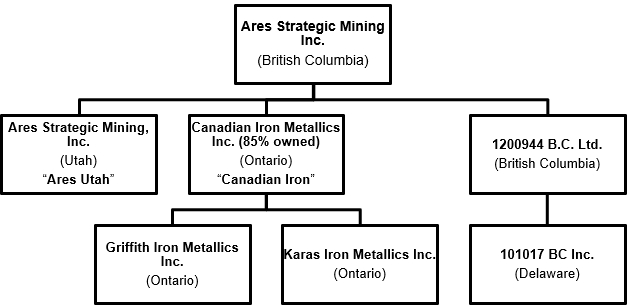
As used in this AIF, unless the context otherwise requires, reference to “Ares” or the “Company” means Ares Strategic Mining Inc. and the Subsidiaries.
5
General Development of the Business
The Company is a Utah based fluorspar mining and processing company. The Company is transitioning from mine development into initial mining/stockpiling and processing plant commissioning and has not yet commenced sustained commercial processing or sales of product. The Company’s sole material mineral property is its “Spor Mountain” property (the “Spor Mountain Property”, the “Spor Mountain Project”, or the “Property”) located approximately 72 kilometres northwest of Delta, Utah.
In nearby Delta, Utah, the Company is building its 48-acre processing site (the “Delta Processing Site”), which will host two plants: (1) the flotation recovery plant (the “Flotation Plant”), which will produce acidspar, a high-purity fluorspar product of 97%+ CaF2, and (2) the lumps plant (the “Lumps Plant”), which will produce industry-ready fluorspar metspar “lumps” or briquettes for use in steel manufacturing and other industries.
The Lumps Plant has been constructed and assembled on site and is currently undergoing commissioning. The Flotation Plant uses a flotation process that uses water and reagents to separate fluorspar from gangue minerals, creating a froth layer that can be collected, leaving the unwanted gangue behind. This results in a higher-grade product with improved recoveries. The critical mineral gallium was identified in prior analytical work, and subsequent laboratory work has also identified germanium.
Fluorspar is the commercial name for the naturally occurring mineral fluorite, composed of calcium and fluorine. Fluorspar is the predominant commercial source for the chemical element fluorine - a non-metallic element and the lightest of the halogens, therefore largely irreplaceable in its use. It has many applications, including steel production, refrigeration, cement, glass, and lithium-ion battery production. There are two principal commercial grades of fluorspar: metallurgical grade (60-96% CaF2) and acid grade (+97% CaF2). Ares is currently setting up operations to produce both grades of fluorspar using its two already purchased plants.
The following is a summary of the Company’s development over the three most recently completed financial years.
Three Year History
Events Subsequent to September 30, 2025
On May 13, 2026, the Company announced the completion of major infrastructure milestones at the Delta Processing Site, including installation of the plant’s conveyor belt system and the completion of the facility’s electrical and motor control center systems.
On February 18, 2026, the Company announced the commencement of mining operations at its Spor Mountain Property, with several thousands of tons of fluorspar mined and stockpiled at surface in preparation for processing at the Delta Processing Site.
On February 5, 2026, the Company announced an expedited roadmap to the production of acidspar to meet its U.S. Department of Defense Indefinite Deliver / Indefinite Quantity contract obligations (the “DoD Contract”), including accelerated expansion of mining activities at the Spor Mountain Property and fast tracking the construction of the Flotation Plant at the Delta Processing Site.
On February 5, 2026, the Company also closed a non-brokered private placement offering (the “2026 LIFE Offering”) of units of the Company (each, a “2026 LIFE Offering Unit”) by issuing 16,666,666 2026 LIFE Offering Units at a price of $0.60 per 2026 LIFE Offering Unit, for aggregate gross proceeds of $9,999,999.60 pursuant to the listed issuer financing exemption under Part 5A of National Instrument 45-106 – Prospectus Exemptions (the “LIFE Exemption”). Each 2026 LIFE Offering Unit consisted of one Common Share and one-half (1/2) of one Common Share purchase warrant (each whole warrant, a “2026 LIFE Offering Warrant”). Each 2026 LIFE Offering Warrant is exercisable into one Common Share (each, a “2026 LIFE Offering Warrant Share”) at a price of $0.75 per 2026 LIFE Offering Warrant Share for a period of two years following the date of issuance.
In connection with the closing of the 2026 LIFE Offering, an aggregate of $699,999.97 was paid in cash and a total of 1,166,667 finder’s warrants of the Company (each, a “2026 LIFE Offering Finder’s Warrant”) were issued to Ventum Financial Corp. as finder’s fees. Each 2026 LIFE Offering Finder’s Warrant entitles the holder thereof to acquire one Common Share (each, a “2026 LIFE Offering Finder’s Warrant Share”) at a price of $0.75 per 2026 LIFE Offering Finder’s Warrant Share for a period of two years following the closing date of the 2026 LIFE Offering.
On January 26, 2026, the Company announced that it had issued an aggregate of 6,400,000 Options (as defined herein) to directors and officers of the Company, each exercisable at a price of $0.63 per Common Share and expiring on January 23, 2028.
On January 20, 2026, the Company announced that it had been awarded the five-year DoD Contract with an initial award value of approximately US$168.9 million and potential task orders of up to US$250 million, establishing the Company as a domestic supplier of acid-grade fluorspar to the U.S. government.
6
On December 5, 2025, the Company announced significant infrastructure and construction advancements at its Spor Mountain Project, including the completion of critical underground mine infrastructure at the Lost Sheep Mine (as defined herein) and substantial progress on processing plant construction at the Delta Processing Site, positioning the project for industrial-scale production.
On November 3, 2025, the Company announced the completion and activation of its secondary underground ventilation system at the Spor Mountain Property, satisfying Mine Safety and Health Administration (“MSHA”) standards.
On October 21, 2025, the Company announced that it had closed the second and final tranche of the 2025 October LIFE Offering (as defined herein) by issuing 12,221,889 2025 October LIFE Offering Units (as defined herein) for aggregate gross proceeds of $5,499,850, bringing total gross proceeds of $10,499,850.45 under the 2025 October LIFE Offering.
An aggregate of $267,965.98 was paid in cash and a total of 595,480 finder’s warrants of the Company (each, a “2025 October LIFE Offering Finder’s Warrant”) were issued as finder’s fees to arm’s length parties. Each 2025 October LIFE Offering Finder’s Warrant entitles the holder thereof to acquire one Common Share (each, a “2025 October LIFE Offering Finder’s Warrant Share”) at a price of $0.55 per 2025 October LIFE Offering Finder’s Warrant Share for a period of two years following the closing date of the second tranche.
Concurrently with closing the second tranche, the Company entered into certain hedging arrangements with Sorbie Bornholm LP (“Sorbie”) governed by an ISDA Master Agreement dated August 23, 2024 and a sharing agreement dated October 20, 2025 (the “Sharing Agreement 3”). Pursuant to the terms of the Sharing Agreement 3, the gross proceeds payable by Sorbie for Units pursuant to the 2025 Amended LIFE Offering (being $1 million) (the “Posted Support”) were used to acquire UK government bonds as credit support to secure the Company’s maximum potential exposure under the Sharing Agreement 3, with Sorbie retaining control and direction of such proceeds (including both the economic benefit and the risk resulting from fluctuations in the bond pricing and foreign exchange) until they are released back to the Company in accordance with the terms of the Sharing Agreement 3.
The hedging transactions governed by the Sharing Agreement 3 will be determined and payable in 24 monthly settlement tranches based on the volume weighted average price of the Common Shares for the 20 trading days prior to each monthly settlement date measured against a benchmark price of $0.63 (the “Benchmark Price”). On each such settlement date, Sorbie will release a portion of the Posted Support determined in reference to such volume weighted average ($41,667 per month). If the measured Common Share price is equal to the Benchmark Price for each of the 24 monthly settlement tranches, the Company will receive cash payments totaling $1 million. If the measured Common Share price exceeds the Benchmark Price, the Company will receive more than 100% of the settlement payable that month on a pro rata basis. Similarly, if the measured Common Share price is below the Benchmark Price, the Company will receive less than 100% of the settlement payable that month on a pro rata basis, with the result that if the measured Common Share price is below the Benchmark Price for a period of time, the Company will receive less than $1 million. To date, Ares has received approximately 12% extra cash under the Sharing Agreement 1 and the Sharing Agreement 2 (as defined herein) (and together with the Sharing Agreement 3, the “Sharing Agreements”) with Sorbie, without issuing any additional shares.
On October 17, 2025, in connection with the 2025 October LIFE Offering, the Company filed an amended and restated offering document to amend the terms of the 2025 October LIFE Offering to increase the offering size and offer up to an aggregate of 23,333,332 2025 October LIFE Offering Units for total gross proceeds of up to $10,499,999.40 (including the 11,111,112 2025 October LIFE Offering Units issued in the first tranche of the 2025 October LIFE Offering).
On October 17, 2025 the Company announced that it had closed the first tranche of the 2025 October LIFE Offering by issuing 11,111,112 2025 October LIFE Offering Units for aggregate gross proceeds of $5,000,000.40.
On October 10, 2025, the Company announced a proposed non-brokered private placement offering pursuant to the LIFE Exemption (the “2025 October LIFE Offering”) consisting of up to 22,222,222 units of the Company (each, a “2025 October LIFE Offering Unit”) at a price of $0.45 per 2025 October LIFE Offering Unit, for gross proceeds of up to $9,999,999.90. Each 2025 October LIFE Offering Unit consisted of one Common Share and one-half (1/2) of one Common Share purchase warrant (each whole warrant, a “2025 October LIFE Offering Warrant”). Each 2025 October LIFE Offering Warrant is exercisable into one Common Share (each, a “2025 October LIFE Offering Warrant Share”) at a price of $0.55 per 2025 October LIFE Offering Warrant Share for a period of two (2) years following the date of issuance.
2025
On September 16, 2025, the Company reported results from its ongoing materials analysis program in partnership with Iowa State University (“ISU”) and Ames National Laboratory. Initial laboratory results confirmed the presence of germanium (Ge), in addition to the previously discovered gallium (Ga) within Ares’ fluorspar samples from its Spor Mountain Project.
On September 11, 2025, the Company provided a major construction update on the Lumps Plant being built at the Delta Processing Site. Following months of mobilization and site preparation, construction of the Lumps Plant reached an advanced stage with all concrete foundations and pads poured and completed, steel frame structures being erected, major vessels fabricated and welded into place, conveyor systems being assembled and mounted, and additional structural supports being bolted.
On July 31, 2025, the Company announced the initiation of a collaborative research program with ISU and the Ames National Laboratory, aimed at unlocking the potential of gallium extraction from the Company’s fluorspar sourced from its Spor Mountain Project. Under this agreement, ISU’s Microelectronics Research Center in association with the Materials Analysis Research Lab will lead a two-phase research program to evaluate and extract trace gallium from Ares’ mineral samples using an alkaline process inspired by the Bayer method, traditionally used for aluminum production.
7
On July 8, 2025, the Company announced that it had received increased non-dilutive cash injection through its Sharing Agreement 1 and Sharing Agreement 2 with Sorbie. In the latest monthly settlement, the Company received a +12% cash gain from Sharing Agreement 1 and a +31% cash gain from Sharing Agreement 2.
On June 16, 2025, the Company announced the active ramp-up of operations at the Lost Sheep Mine and the Delta Processing Site, with development partner Provo Mining & Construction, Inc. (“Provo Mining”) and their expert team on site and working to prepare the Lost Sheep Mine and Delta Processing Site for full-scale operations.
On June 2, 2025, the Company announced the successful acquisition of an $11 million loan from the Utah State Legislature and the Utah Community Impact Board. This significant financial backing will accelerate the mining and processing of fluorspar and gallium at the Spor Mountain Project and the Delta Processing Site.
On April 9, 2025, the Company announced the issuance of 7,229,730 units of the Company (each, an “April 2025 Unit”) at a price of $0.1998 per April 2025 Unit. Each April 2025 Unit consisted of one Common Share and one Common Share purchase warrant (each, a “2025 April Warrant”). Each April 2025 Warrant is exercisable into one Common Share (each, a “2025 April Warrant Share”) at a price of $0.2405 per 2025 April Warrant Share for a period of three (3) years following the closing date.
On April 2, 2025, the Company announced an increase in institutional investment from Sorbie.
On March 19, 2025, the Company announced the acquisition of key underground mining equipment, including the Cat R1300G Underground Loader.
On January 15, 2025, the Company and Sorbie entered into a second sharing agreement (the “Sharing Agreement 2”).
On December 19, 2024, the Company announced the acquisition of the heavy mining equipment critical to the advancement of the Spor Mountain Property. As part of its ongoing efforts to manage the development of the Company, the Company entered several arrangements to further the business interests.
On December 16, 2024, the Company announced its inclusion as a key subcontractor in one of six winning bids awarded by the U.S. Department of Energy. The $3.4 billion initiative is part of a national strategy to significantly expand the production capacity of Low Enriched Uranium. Under the contract, the Company will supply and develop its high-grade acidspar, a vital mineral used in manufacturing hydrofluoric acid and fluorine, critical for uranium enrichment.
On December 12, 2024, the Company announced the arrival of its Flotation Plant at the Delta Processing Site, which had been fabricated off-site.
On October 7, 2024, the Company closed the second and final tranche of the 2024 August LIFE Offering (as defined herein) by issuing 765,170 2024 August LIFE Offering Units (as defined herein) for aggregate gross proceeds of $137,730.60.
2024
On September 26, 2024, the Company announced the completion of the fabrication of its Flotation Plant.
On September 13, 2024, the Company announced that it had closed the first tranche of the 2024 August LIFE Offering by issuing 9,017,772 2024 August LIFE Offering Units. Of these, 101,106 2024 August LIFE Offering Units were issued for aggregate gross proceeds of $18,199, while 8,916,666 2024 August LIFE Offering Units were issued in connection with the hedging arrangements with Sorbie, as described below’
On September 13, 2024, the Company also entered into certain hedging arrangements with Sorbie governed by an ISDA Master Agreement dated August 23, 2024 and a sharing agreement dated August 23, 2024 (the “Sharing Agreement 1”).
On August 22, 2024, the Company announced a proposed non-brokered private placement offering pursuant to the LIFE Exemption (the “2024 August LIFE Offering”) consisting of a minimum of 2,777,778 units of the Company (each, a “2024 August LIFE Offering Unit”) and a maximum of 11,666,667 2024 August LIFE Offering Units at a price of $0.18 per 2024 August LIFE Offering Unit, for gross proceeds of a minimum of $500,000 and a maximum of $2,100,000. Each 2024 August LIFE Offering Unit consists of one Common Share and one Common Share purchase warrant (each, a “2024 August LIFE Offering Warrant”). Each 2024 August LIFE Offering Warrant is exercisable into one Common Share (each, a “2024 August LIFE Offering Warrant Share”) at a price of $0.26 per 2024 August LIFE Offering Warrant Share for a period of two years following the date of issuance. The Company intended to use the net proceeds to pay for the ongoing construction and installation of a secondary ventilation system at the Spor Mountain Property to meet MSHA requirements and for general and corporate working capital purposes.
On August 13, 2024, the Company announced that mineworks installations had reached the depths required from the mine plan to begin extracting the fluorspar mineralization.
On August 1, 2024, the Company announced that it had closed the fifth and final tranche of the 2024 May LIFE Offering by issuing 1,361,854 2024 May LIFE Offering Units for aggregate gross proceeds of $245,133.72.
8
On July 18, 2024, the Company announced that it had closed the fourth tranche of the 2024 May LIFE Offering by issuing 943,722 2024 May LIFE Offering Units for aggregate gross proceeds of $169,869.96.
On July 2, 2024, the Company announced that it had closed the third tranche of the 2024 May LIFE Offering by issuing 2,009,651 2024 May LIFE Offering Units for aggregate gross proceeds of $361,737.18.
On June 18, 2024, the Company announced that it had filed an amended and restated offering document in connection with the 2024 May LIFE Offering. The 2024 May LIFE Offering, as amended by the amended and restated offering document, removed the minimum offering amount and revised the 2024 May LIFE Offering to up to 16,111,111 2024 May LIFE Offering Units for gross proceeds of up to $2,900,000.
On June 10, 2024, the Company announced the acceleration of its mine building activities at the Lost Sheep Mine and its ramp installation to intersect fluorspar mineralization.
On June 7, 2024, the Company announced that it had closed the second tranche of the 2024 May LIFE Offering by issuing 5,537,277 2024 May LIFE Offering Units for aggregate gross proceeds of $996,709.86.
On May 31, 2024, the Company announced that it had closed the first tranche of the 2024 May LIFE Offering by issuing 5,984,986 2024 May LIFE Offering Units for aggregate gross proceeds of $1,077,297.28.
On May 10, 2024, the Company announced a proposed non-brokered private placement offering (the “2024 May LIFE Offering”) consisting of a minimum of 5,555,555 units of the Company (each, a “2024 May LIFE Offering Unit”) and a maximum of 22,222,222 2024 May LIFE Offering Units at a price of $0.18 per 2024 May Life Offering Unit, for gross proceeds of a minimum of $1,000,000 and a maximum of $4,000,000. Each 2024 May LIFE Offering Unit consisted of one Common Share and one Common Share purchase warrant (each, a “ 2024 May LIFE Offering Warrant”). Each 2024 May LIFE Offering Warrant entitles the holder to acquire one Common Share (each, a “2024 May LIFE Offering Warrant Share”) at a price of $0.26 per 2024 May LIFE Offering Warrant Share for a period of two years following the date of issuance.
On March 27, 2024, the Company announced the signing of a memorandum of understanding with Cremer Erzkontor Inc. (“Cremer”) for Cremer to act as Sales Agent for metspar production for the Spor Mountain Property.
On March 25, 2024, the Company announced the completion of the mine planning phase and commencement of mine construction. The Company began ramp installation work to intersect fluorspar mineralization and provide feed for the plant currently under construction at the Spor Mountain Property.
On February 22, 2024, the Company announced the discovery of new and additional fluorspar mineralization at the Spor Mountain Property. The Company undertook core diamond drilling to delineate the placement and design of installations to facilitate mining operations scheduled for later in 2024. As drilling progressed, drill holes reached depths not previously investigated, and new high-grade fluorspar mineralization were discovered connected to the initial mining targets selected for preliminary production plans, expanding the potential of those targets.
On February 14, 2024, the Company announced that it had commenced mine preparation, construction and installation work at the Spor Mountain Property, including delineation drilling to inform ramp installation work.
On February 8, 2024, the Company announced that it had successfully completed its steel infrastructure purchase and commenced fabrication of the steel in anticipation of construction in 2024.
On February 1, 2024, the Company announced that it had completed all payments to purchase, fabricate, and assemble its Flotation Plant.
On January 9, 2024, the Company announced that it had entered into an agreement with Provo Mining to prepare the Company’s Spor Mountain Property for producing fluorspar feed for its anticipated fluorspar production operations.
On December 22, 2023, the Company announced that it closed a State of Utah backed financing of over $14,000,000 CAD for the purposes of purchasing, constructing, and commissioning the Flotation Plant at the Delta Processing Site, a new, advanced, and the only facility of its kind in the country, acidspar manufacturing facility.
On December 15, 2023, the Company’s Subsidiary, Ares Utah, entered into a loan agreement with Millard County, Utah (“Millard County”) pursuant to a US$10,000,000 tax-exempt Manufacturing Facility Revenue Bond and a US$500,000 taxable Manufacturing Facility Revenue Bond (collectively, the “Millard Bond”).
On December 7, 2023, the Company announced that it was continued from the laws of the province of Ontario to the laws of the province of British Columbia pursuant to the Business Corporations Act (British Columbia) as of December 6, 2023.
On October 10, 2023, the Company completed the planning permission approval process, authorizing the Company to fully construct and commission its Lumps Plant at its Delta Processing Site.
9
2023
On September 15, 2023, the Company announced that it had completed its previously announced plan of arrangement, including the spin-off of its wholly owned subsidiary, Enyo Strategic Mining Inc. (“Enyo”) Under the arrangement, shareholders of the Company received one new Common Share of Ares and 0.1 of an Enyo common share for each existing Common Share of Ares held, following which Enyo became a separate unlisted reporting issuer and assumed ownership of the Liard and Vanadium Ridge properties in British Columbia.
On September 14, 2023, the Company announced that it had contracted SFC Tec, Inc. (“SFC Tec”) to complete the construction and commissioning of its processing plant at the Delta Processing Site. SFC Tec commenced site preparation, equipment assembly and permitting work in connection with construction at the Delta Processing Site.
On August 3, 2023, the Company announced that it has detected germanium and gallium in its fluorspar, following assaying conducted by SGS Canada Inc. (“SGS”).
On July 26, 2023, the Company announced the completion of the fabrication of the new conveyor belt system for its metallurgical Lumps Plant and planned fluorspar manufacturing operation at the Delta Processing Site.
On July 11, 2023, the Company announced the completion of the tailings storage facility design work for its upcoming manufacturing and processing fluorspar operation at the Delta Processing Site.
On May 2, 2023, the Company announced that it was identified in the 2023 Utah Economic Report to the Governor as being “poised to become the nation’s only fluorspar producer” through the revival of the Lost Sheep Mine. The Company also announced that it had recently secured financing supported by the U.S. Department of Agriculture and had been re-awarded a US$10 million bond by the State of Utah to support the development of a larger manufacturing facility, the Delta Processing Site.
On April 25, 2023, the Company announced that it had completed construction of its Millard County rail spur in Utah and had entered into a lease agreement with Union Pacific Railroad. Completion of the rail spur enables bulk shipment of future products across North America and provides nationwide delivery access for its industrial customers.
On April 18, 2023, the Company announced that it had purchased, and received title of the Spor Mountain Property.
On April 11, 2023, the Company announced that it had closed a US$4,420,000 (approximately C$6.0 million) non-dilutive loan financing from the U.S. Department of Agriculture under its Business and Industry Guaranteed Loan Program. The Company arranged this non-dilutive financing to exclusively develop the Company’s manufacturing operation at the Spor Mountain Property.
On February 10, 2023, the Company announced that it had issued an aggregate of 22,238,053 Options to its directors and officers, each exercisable at a price of $0.13 per Common Share and expiring on February 10, 2025. The Company also announced that it had issued 301,694 Common Shares at a deemed price of $0.15 per Common Share to settle $45,254 of outstanding indebtedness for past consulting services.
On December 16, 2022, Ares announced that it had closed the second tranche of the 2022 Debenture Offering of 2022 Debentures for aggregate proceeds of $45,980.00.
On December 8, 2022, the Company announced that it had closed the first tranche of a non-brokered private placement offering (the “2022 Debenture Offering”) of secured convertible debentures (“2022 Debentures”) for aggregate gross proceeds of $643,005. The 2022 Debentures bear interest at a rate of 12% per annum, mature two years from issuance, and are convertible into Common Shares at a price of $0.26 per Common Share, with the proceeds intended to fund potential acquisitions in the mineral resource sector and for general working capital purposes.
On October 11, 2022, the Company announced that it had entered into an arrangement agreement with its wholly owned subsidiary, Enyo, pursuant to which the Company intended to spin out its Liard and Vanadium Ridge properties in British Columbia to Enyo by way of a statutory plan of arrangement. Under the arrangement, the Company’s shareholders would receive 0.1 of an Enyo common share for each Common Share held on a pro rata basis, following which Enyo was expected to become a separate reporting issuer and the Company would focus on the development of its U.S. fluorspar properties.
10
Description of the Business
Overview of the Business
The Company is a Utah based fluorspar mining and processing company. The Company is transitioning from mine development into initial mining/stockpiling and processing plant commissioning and has not yet commenced sustained commercial processing or sales of product. The Company’s sole material mineral property is its Spor Mountain Property located approximately 72 kilometres northwest of Delta, Utah. In nearby Delta, Utah, the Company is building its Delta Processing Site, which will host two plants: (1) the Flotation Plant, which will produce acidspar, a high-purity fluorspar product of 97%+ CaF2, and (2) the Lumps Plant, which will produce industry-ready fluorspar metspar “lumps” or briquettes for use in steel manufacturing and other industries.
The Lumps Plant has been constructed and assembled on site and is currently undergoing commissioning. The Flotation Plant uses a flotation process that uses water and reagents to separate fluorspar from gangue minerals, creating a froth layer that can be collected, leaving the unwanted gangue behind. This results in a higher-grade product with improved recoveries. The critical mineral gallium was identified in prior analytical work, and subsequent laboratory work has also identified germanium.
As of the date of this AIF, the Company considers the Spor Mountain Project to be its sole material mineral property for the purposes of National Instrument 43-101 – Standards for Disclosure for Mineral Projects (“NI 43-101”), which is the subject of a NI 43-101 technical report with an effective date of September 17, 2021, entitled “Technical Report on the Lost Sheep Fluorspar Property, Juab County, Utah, U.S.A.” co-authored by Eugene Puritch, P.Eng., FEC, CET, Richard H. Sutcliffe, Ph.D, P.Geo., and Fred H. Brown, P.Geo., of P&E Mining Consultants Inc., David J. Salari, P.Eng., of D.E.N.M. Engineering Ltd., and Alan Czarnowksy, Independent Consultant and filed on the Company’s profile on SEDAR+ at www.sedarplus.ca on September 28, 2021 (the “Technical Report”).
The Company acquired the Spor Mountain Property in 2020 pursuant to a three-cornered amalgamation with American Strategic Minerals Inc. The Spor Mountain Property is owned by the Company’s wholly-owned Utah subsidiary, Ares Strategic Mining Inc. (previously defined as “Ares Utah”), and is currently comprised of 302 mining claims prospective for fluorite covering an area of approximately 5,765 acres. The Technical Report is in respect of 111 claims covering approximately 2,283 acres. The Company has acquired additional claims since the date of the Technical Report, and as of the date of this AIF, the Spor Mountain Property is comprised of 302 claims covering 5,765 acres.
The Spor Mountain Property includes the Lost Sheep mine (the “Lost Sheep Mine”), a fully permitted, past-producing fluorspar mine. The Company is focused on developing the Lost Sheep Mine towards the production and supply of high-purity metspar and acidspar fluorite grades.
Ares has not completed a feasibility study on, nor has Ares completed a mineral reserve or mineral resource estimate at the Lost Sheep Mine and as such the financial and technical viability of the Spor Mountain Property is at higher risk than if this work had been completed. Based on historical engineering work, geological reports, historical production data and current engineering work completed or in progress by Ares, Ares intends to move forward with the development of the Spor Mountain Property. Ares further cautions that it is not basing any production decision on a feasibility study of mineral reserves demonstrating economic and technical viability, and therefore there is a much greater risk of failure associated with its production decision.
Companies typically rely on comprehensive feasibility reports on mineral reserve estimates to reduce the risks and uncertainties associated with a production decision. Historically, situations where the issuer decides to put a mineral project into production without first establishing mineral reserves supported by a technical report and completing a feasibility study have a higher risk of economic or technical failure, though some industrial mineral ventures are relatively simple operations with low levels of investment and risk, where the operating entity has determined that a formal prefeasibility or feasibility study in conformance with NI 43-101 and Companion Policy 43-101CP to NI 43-101 is not required for a production decision.
Ares has decided to proceed without established mineral resources or mineral reserves, based on historical engineering work, geological reports, historical production data and current engineering work completed or in the process by Ares, the Company intends to move forward with the development of the Spor Mountain Property and initial mining/stockpiling at the Spor Mountain Property and plant commissioning at the Delta Processing Site.
For further information about the Company, refer to its filings with the Canadian Securities Authorities which may be obtained through the Company’s SEDAR+ profile at www.sedarplus.ca.
11
Principal Markets, Distribution Methods and Products
The Company is transitioning from mine development into initial mining/stockpiling and processing plant commissioning and has not yet commenced sustained commercial processing or sales of product. The Company’s ability to reach commercial production is dependent on several factors. See “Risk Factors” generally and in particular the risk factors under the headings “No History of Commercial Mineral Production”, “Nature of Mineral Exploration and Development”, “Economics of Developing Mineral Properties”, “The Technical Report does not contain production, development plans or costs estimates associated with the Lost Sheep Mine”, “Construction and Development of the Spor Mountain Project and the Delta Processing Site”, “Production Estimates”, “Cost Estimates”, “Mineral Reserves Have Not Been Established for the Spor Mountain Project”, and “The Company is Entering into Production at the Spor Mountain Project and Delta Processing Site without a Feasibility Study or Pre-Feasibility Study”.
The Company’s Lost Sheep Mine is currently the only permitted fluorspar mine in the United States. Fluorspar is an industrial and critical mineral. According to the United States Geological Survey, excluding sales from the National Defense Stockpile, U.S. apparent consumption of fluorspar was 100% net import reliant in 2025. It is a vital component of United States industry, used in the production of steel, aluminium, refrigeration units, cement, hydrofluoric acid, fluorine, electronics and touch screens, Teflon, and electric batteries.
Under the DoD Contract, the Company has agreed to deliver acidspar to the U.S. government within 36 months after the issuance of each delivery order. On January 20, 2026, the Company announced a five-year DLA IDIQ contract with an estimated initial award value of approximately US$168.9 million and potential task orders up to US$250 million. Delivery timing will depend on issued delivery orders and contract terms.
Ares is installing a professional staff able to manage the mining operations at the Lost Sheep Mine.
Production
The Company has recently commenced mining operations at its Spor Mountain Property, with several thousand tons of fluorspar mined and stockpiled at surface at its Spor Mountain Property, in preparation for processing at the Delta Processing Site. The Company is focused on finalizing the Delta Processing Site, including the Flotation Plant and the Lumps Plant.
Specialized Skill and Knowledge
The Company’s business requires specialized skill and knowledge in the areas of geology, mineral exploration, business negotiations, including with certain third-party stakeholders including government entities, accounting, law, environmental compliance and management. In order to attract and retain personnel with such skills and knowledge, the Company maintains competitive remuneration and compensation packages.
In the exploration stage, geoscientists are employed to analyze geophysical, pre-existing technical data (if any) and other information to identify potential areas to explore for minerals. Once targets are identified and captured, third party firms are hired to provide the equipment and expertise required to safely explore for minerals. If and when minerals are discovered, third party engineering, procurement and construction firms will be engaged to design and construct the gathering system and processing facility. Field operators will be hired to operate the facility.
To date, the Company has been able to locate and retain such employees and consultants and believes it will continue to be able to do so. The management team and directors of the Company have extensive experience in all areas as well as established relationships to engage third parties where needed.
Ares is soliciting and contracting the services of construction and processing specialists to construct industrial scale plant installation to commission two high-capacity facilities (the Lumps Plant and the Flotation Plant at the Delta Processing Site) able to process all excavated fluorspar mineralization removed from the Spor Mountain Property.
See “Risk Factors” generally and in particular the risk factors under the heading “Availability and Costs of Infrastructure, Energy and Other Commodities” and “Dependence on Outside Parties”.
12
Competitive Conditions
The fluorite exploration and mining business is competitive in all phases of exploration, development and production and competition in the mineral exploration and production industry can be significant at times; however, the fluorite industry is small compared to other commodity industries. Fluorite demand is international in scope, but supply is characterized by a relatively small number of companies operating in only a few countries. Fluorite production is concentrated amongst a limited number of producers and is also geographically concentrated in certain specific areas.
The Company competes with a number of other companies that have resources significantly in excess of those of the Company, in the exploration, development and production of its properties and in the search for and the acquisition of qualified service providers, labour, equipment and suppliers. There can be no assurance that additional capital or other types of financing will be available if needed or that, if available, the terms of such financing will be favourable to the Company. Factors beyond the control of the Company may affect the marketability of fluorspar ultimately mined or discovered by the Company. See “Risk Factors” generally and in particular the risk factors under the heading “Competition”.
New Products
The Company is building its Delta Processing Site, which will host two plants: (1) the Flotation Plant, which will produce acidspar, a high-purity fluorspar product of 97%+ CaF2, and (2) the Lumps Plant, which will produce industry-ready fluorspar metspar “lumps” or briquettes for use in steel manufacturing and other industries. The production of both acidspar and fluorspar metspar “lumps” or briquettes are new products. The status of these new products is described in more detail elsewhere in this AIF. The Company is focused on finalizing the Delta Processing Site, including the Flotation Plant and the Lumps Plant to move towards production and distribution of these new products.
Components
The Company uses, or may use, critical components such as water, electrical power, explosives, diesel and propane in its business, all of which are readily available, although pricing may fluctuate in the ordinary course.
Business Cycle & Seasonality
The mining business is subject to commodity price cycles. The marketability of minerals and mineral concentrates is also affected by worldwide economic cycles, which could have a significant impact on the operations of the Company, including resulting in the Company determining to cease work on, or dropping its interest in, some or all of its properties, or shifting its focus to other properties or projects. In addition to commodity price cycles and recessionary periods, exploration activity may also be affected by seasonal and irregular weather conditions in the areas where the Company operates or expects to operate.
However, the Company’s business is not highly seasonal from an operational and access standpoint. In Utah, where the Company’s Spor Mountain Property and Delta Processing Site are located, established infrastructure and a comparatively mild climate (hot dry summers and cool, relatively arid winters with average temperatures ranging from a summer maximum of 30°C (July) to minimum of -8°C (January)) allow exploration and construction work to occur year round.
Occasionally, significant weather events may delay or alter planned exploration programs, which may lead to material increases in exploration and development costs incurred by the Company. Additionally, prospecting, mapping and surface bedrock sampling activities may be limited by snow cover during winter periods with minor delays due to periodic snowstorms.
Economic Dependence
The Company’s business is not substantially dependent on any single commercial contract or group of contracts either from suppliers or contractors.
Changes to Contracts
It is not expected that the Company’s business will be materially affected in the current financial year by the renegotiation or termination of any contracts or sub-contracts.
13
Environmental Protection
The Company’s exploration activities are subject to various levels of federal and state laws and regulations relating to the protection of the environment. Environmental legislation provides for restrictions and prohibitions of spills, releases or emissions of various substances related to the mining industry operations, which could result in environmental pollution. A breach of such legislation may result in imposition of fines and penalties. In addition, certain types of operations require submissions to and approval of environmental impact assessments. Environmental assessment of proposed projects carries a heightened degree of responsibility for companies and directors, officers and employees/consultants.
To the best of management’s knowledge, the Company’s activities in 2025 were, and continue to be, in compliance in all material respects with such environmental regulations applicable to its development and exploration activities. The Company is also committed to complying with all relevant industry standards, legislation and regulations in the countries where it carries on business. The Company’s current mining and exploration activities are subject to BLM, UDOGM (as defined herein) and MSHA requirements, including approved plans of operations and reclamation bonding, and the Company believes it is in material compliance as of the date of this AIF.
Due to the stage of the Company’s activities, environmental protection requirements have had a minimal impact on the Company’s capital expenditures and competitive position. If needed, the Company will make and will continue to make expenditures to ensure compliance with applicable laws and regulations. New environmental laws and regulations, amendments to existing laws and regulations, or more stringent implementations of existing laws and regulations could have a material adverse effect on the Company by potentially increasing capital and/or operating costs. See “Risk Factors” generally and in particular the risk factors under the headings “Pre-existing Environmental Liabilities”, “Health, Safety and Environmental Risks and Hazards”, “Insurance and Uninsured Risks”, “Nature and Climatic Conditions”, and “Climate Change”.
Employees
As at September 30, 2025, the Company had no employees and 24 contractors. As of the date of this AIF, the Company has no employees and 33 contractors.
The Company believes its success is dependent on the performance of its management team and key individuals, many of whom have specialized skills in exploration, development and production in the mining industry. The Company believes it has adequate personnel with the specialized skills required to carry out its operations and anticipates making ongoing efforts to match its workforce capabilities with its business strategy for its operations as it evolves.
Foreign Operations
The Company is incorporated pursuant to the laws of the Province of British Columbia and is a reporting issuer in the provinces of Alberta, British Columbia, Manitoba, New Brunswick, Newfoundland and Labrador, Nova Scotia, Ontario, Prince Edward Island and Saskatchewan. The Company’s assets are principally located outside of Canada, in Utah, United States.
The Company’s operations and investments may be affected by local political and economic developments, including expropriation, invalidation of government orders, permits or agreements pertaining to property rights, political unrest, labour disputes, limitations on repatriation of earnings, limitations on mineral exports, limitations on foreign ownership, inability to obtain or delays in obtaining necessary mining permits, opposition to mining from local, environmental or other non-governmental organizations, government participation, royalties, duties, rates of exchange, high rates of inflation, price controls, exchange controls, currency fluctuations, taxation and changes in laws, regulations or policies as well as by laws and policies of Canada affecting foreign trade, investment and taxation. For more information, please see “Risk Factors – Foreign Operations Risks”.
Social and Environmental Policies
The Company is committed to carrying out all of its activities in an ethical manner that prioritizes health and safety, recognizes the concerns of Native American tribes, communities, local stakeholders, and preserves the natural environment. The Company ensures that all employees are trained and instructed in their assigned tasks and that safety procedures are followed at all times. The importance of ethical behavior and preservation of the natural environment is stressed to all employees and/or contractors, and all are charged with monitoring operations to ensure they are being carried out in an environmentally friendly manner. The Company ensures that it will work with and consult local communities, Native American tribes and stakeholders, recognizing this practice as a benefit to all.
14
Risk Factors
The operations of the Company are speculative due to the high-risk nature of its business which is the exploration and development of mineral properties. The following risk factors could materially affect the Company’s financial condition and/or future operating results and could cause actual events to differ materially from those described in forward-looking information relating to the Company. The risks and uncertainties described below are not the only risks and uncertainties that the Company faces. Additional risks and uncertainties, including those that the Company does not know about now or that it currently deems immaterial, may also adversely affect the Company’s business.
No History of Commercial Mineral Production
While the Company has recently commenced mining operations at its Lost Sheep Mine, with several thousand tons of fluorspar mined and stockpiled at surface at its Spor Mountain Property, in preparation for processing at the Delta Processing Site, there is no assurance that commercial quantities of fluorspar will be discovered at any of the Company’s properties nor is there any assurance that the Company’s exploration programs will yield positive results. Even if commercial quantities of fluorspar are discovered, there can be no assurance that any property of the Company will ever be brought to a stage where fluorspar resources can be profitably produced. Factors which may limit the ability of the Company to produce fluorspar resources from its properties include, but are not limited to, the market price of fluorspar, availability of additional capital and financing and the nature of any mineral deposits.
Negative Operating Cash Flow and Dependence on Third-Party Financing
The Company has no history of earnings or of a return on investment, and there is no assurance that any of its properties or any business that the Company may acquire or undertake will generate earnings, operate profitably or provide a return on investment in the future. As a result, the Company is dependent on third- party financing to continue exploration activities on the Company’s properties, maintain capacity and satisfy contractual obligations. Accordingly, the amount and timing of capital expenditures and the Company’s ability to conduct further exploration activities at its properties depends on the Company’s cash reserves and access to third-party financing. Failure to obtain such additional financing could result in delay or indefinite postponement of further exploration and development of the Company’s properties, including the Lost Sheep Mine, or require the Company to sell one or more of its properties (or an interest therein).
Although the Company has been successful in raising funds to date, additional financing may not be available when needed, or if available, the terms of such financing might not be favourable to the Company and might involve substantial dilution to existing Company shareholders. The Company’s access to third- party financing depends on a number of factors including the price of fluorspar, the results of ongoing exploration and development, any economic or other analysis performed with respect the Company’s properties, a significant event disrupting the Company’s business or the fluorspar industry generally, or other factors may make it difficult or impossible to obtain financing through debt, equity, or other means on favourable terms, or at all. Failure to raise capital when needed would have a material adverse effect on the Company’s business, financial condition, prospects and outlook.
Price of Fluorspar
The Company’s profitability and long-term viability depend, in large part, upon the market price of fluorspar. The price of fluorspar has historically experienced, and may experience in the future, volatility and significant price movements over short periods of time. Market price fluctuations of fluorspar could adversely affect the profitability of the Company’s operations and lead to impairments and write downs of mineral properties. Historically, the fluctuations in these prices have been, and are expected to continue to be, affected by numerous factors beyond the Company’s control, including but not limited to, demand for fluorspar; political and economic conditions in fluorspar producing and consuming countries; sales of excess inventories by governments and industry participants; and production levels and production costs in key fluorspar producing countries.
A decrease in the market price of fluorspar could adversely affect the price of the Common Shares and the Company’s ability to finance the exploration and development of its properties, which would have a material adverse effect on the Company’s future results of operations, cash flows and financial position. In addition, declining fluorspar prices can impact operations by requiring a reassessment of the feasibility of a particular project. Even if a project is ultimately determined to be economically viable, the need to conduct such a reassessment may cause substantial delays and/or may interrupt operations until the reassessment can be completed, which may have a material adverse effect on the Company’s exploration and development prospects, cash flows and financial position. Depending on the price of fluorspar and other minerals, any cash flow from future mining operations may not be sufficient and the Company could be forced to discontinue production, if any, and may lose its interest in, or may be forced to sell, some of its properties (or an interest therein). Future production, if any, from the mining properties of the Company is dependent upon the prices of fluorspar and other minerals being adequate to make these properties economic.
15
Nature of Mineral Exploration and Development
The Company’s future is dependent on its exploration and development programs. The exploration and development of mineral deposits involve significant financial risks over a prolonged period of time, which may not be eliminated even through a combination of careful evaluation, experience and knowledge. Few properties that are explored are ultimately developed into economically viable operating mines. Major expenditures on the Company’s exploration properties may be required to construct mining and processing facilities at a site, and it is possible that even preliminary due diligence will show adverse results, leading to the abandonment of projects. It is impossible to ensure that preliminary or full feasibility studies on the Company’s projects, or the current or proposed exploration programs on any of the properties in which the Company has exploration rights, will result in any profitable commercial mining operations. The Company cannot give any assurance that its current and future exploration activities will result in a discovery of mineral deposits containing mineral reserves.
Estimates of mineral resources and any potential determination as to whether a mineral deposit will be commercially viable can also be affected by such factors as: the particular attributes of the deposit, such as its size and grade; unusual or unexpected geological formations and metallurgy; proximity to infrastructure; financing costs; metal prices, which are highly volatile; and governmental regulations, including those relating to prices, taxes, royalties, infrastructure, land use, importing and exporting of metal concentrates, exchange controls and environmental protection. The effect of these factors cannot be accurately predicted, but the combination of any or all of these factors may result in the Company not receiving an adequate return on its invested capital or suffering material adverse effects to its business and financial condition. Exploration and development projects also face significant operational risks including but not limited to an inability to obtain access rights to properties, accidents, equipment breakdowns, labour disputes (including work stoppages and strikes), and other unanticipated interruptions.
Regulatory Factors and International Trade Restrictions
The international fluorspar industry is relatively small, highly competitive and heavily regulated. The development of mines and related facilities is contingent upon governmental approvals that are complex and time consuming to obtain and which, depending upon the location of the project, involve multiple governmental agencies. The duration and success of such approvals are subject to many variables outside of the Company’s control. Any significant delays in obtaining or renewing such permits or licences in the future could have a material adverse effect on the Company.
In addition, the international marketing and trade of fluorspar is subject to potential changes in governmental policies, regulatory requirements and international trade restrictions (including trade agreements, customs, duties and taxes), which are beyond the control of the Company. Changes in regulatory requirements, customs, duties or taxes may affect the supply of fluorspar to China, North America, and Europe, which are currently the largest consumption markets for fluorspar in the world, as well as the future of supply to developing markets.
The supply of fluorspar is, to some extent, impeded by a number of international trade agreements and policies. These and any similar future agreements, governmental legislation, policies or trade restrictions are beyond the Company’s control and may affect the supply of fluorspar available in China, North America, and Europe, the world’s largest markets for fluorspar. If the Company achieves commercial production, but is unable to supply fluorspar to important markets in China, North America, and Europe, its business, financial condition and results of operations may be materially adversely affected. In addition, there can be no assurance that governments will not enact legislation or take other actions that restricts who can buy or supply fluorspar, which may have a material adverse effect on the price of fluorspar and the Company’s financial condition and results of operations.
Mineral Tenure
The acquisition and maintenance of title to mineral properties is a very detailed and time-consuming process. While the Company has diligently reviewed and is satisfied with the title to the Company’s projects, and, to the best of its knowledge, such title is in good standing, there is no guarantee that title to the projects will not be challenged or impugned. Title insurance is generally not available for mineral properties and the Company’s ability to ensure that it has obtained secure mine tenure may be severely constrained. Third parties may have valid claims underlying portions of the Company’s interests, including prior unregistered liens, agreements, royalty transfers or claims or other encumbrances and title may be affected by, among other things, undetected defects. Other parties may dispute the title to a property, or the property may be subject to prior unregistered agreements and transfers or land claims by Native American tribes. The title may also be affected by undetected encumbrances or defects or governmental actions.
The Company may not be able to register rights and interests it acquires against title to applicable mineral properties. An inability to register such rights and interests may limit or severely restrict the Company’s ability to enforce such acquired rights and interests against third parties or may render certain agreements entered into by the Company invalid, unenforceable, uneconomic, unsatisfied or ambiguous, the effect of which may cause financial results yielded to differ materially from those anticipated. Although the Company believes it has taken reasonable measures to ensure proper title to the properties in which it has an interest, there is no guarantee that such title will not be challenged or impaired.
Additionally in certain cases in United States or other jurisdictions the Company may operate in the future, the mineral rights, or certain portions of them, are owned by the relevant governments. In such countries, the Company must enter into contracts with the applicable governments, or obtain permits or concessions from them, that allow the Company to hold rights over mineral rights and rights (including ownership) over parcels of land and conduct its operations thereon. The availability of such rights and the scope of operations the Company may undertake are subject to the discretion of the applicable governments and may be subject to conditions. New laws and regulations, or amendments to laws and regulations relating to mineral tenure and land title and usage thereof, including expropriations and deprivations of contractual rights, if proposed and enacted, may affect the Company’s rights to its properties.
16
In some instances, the Company can initially only obtain rights to conduct exploration activities on certain prescribed areas, but obtaining the rights to proceed with development, mining and production on such areas or to use them for other related purposes, such as waste storage or water management, is subject to further application, conditions or licences, the granting of which are often at the discretion of the governments. In many instances, the Company’s rights are restricted to fixed periods of time with limited renewal rights. Delays in the process for applying for such rights or renewals or expansions, or the nature of conditions imposed by government, could have a material adverse effect on the Company’s business, including its existing developments and mines, and the Company’s financial condition and results of operations.
Acquisitions and Integration
As part of the Company’s business strategy, the Company examines opportunities to acquire additional mining assets and businesses. Any acquisition that the Company may choose to complete may be of a significant size, may change the scale of the Company’s business and operations, and may expose the Company to new geographic, political, operating, financial and geological risks. The Company’s success in its acquisition activities depends on its ability to identify suitable acquisition candidates, negotiate acceptable terms for any such acquisition, and integrate the acquired operations successfully with those of the Company. Any acquisitions would be accompanied by risks. For example, there may be a significant change in commodity prices after the Company has committed to complete the transaction and established the purchase price or exchange ratio; a material ore body may prove to be below expectations; the Company may have difficulty integrating and assimilating the operations and personnel of any acquired companies, realizing anticipated synergies and maximizing the financial and strategic position of the combined enterprise, and maintaining uniform standards, policies and controls across the organization; the integration of the acquired business or assets may disrupt the Company’s ongoing business and its relationships with employees, customers, suppliers and contractors; and the acquired business or assets may have unknown liabilities which may be significant. In the event that the Company chooses to raise debt capital to finance any such acquisition, the Company’s leverage will be increased. If the Company chooses to use equity as consideration for such acquisition, existing Company shareholders may suffer dilution. Alternatively, the Company may choose to finance any such acquisition with its existing resources. There can be no assurance that the Company would be successful in overcoming these risks or any other problems encountered in connection with such acquisitions.
Exploration, Development and Operating Risks
Mining operations are inherently dangerous and generally involve a high degree of risk. The Company’s operations are subject to all of the hazards and risks normally encountered in the exploration and development of minerals, including, without limitation, unusual and unexpected geologic formations, seismic activity, rock bursts, cave-ins, flooding and other conditions involved in the drilling and removal of material any of which could result in damage to, or destruction of, mines, personal injury or loss of life and damage to property, and environmental damage, all of which may result in possible legal liability.
Mining operations are also subject to hazards such as fire, rock falls, geomechanical issues, equipment failure, and other hazards which may cause environmental pollution and consequent liability. The occurrence of any of these events could result in a prolonged interruption of the Company’s exploration and development activities that would have a material adverse effect on its business and prospects. Further, the Company may be subject to liability or sustain losses in relation to certain risks and hazards against which it cannot insure or for which it may elect not to insure. The occurrence of operational risks and/or a shortfall or lack of insurance coverage could have a material adverse impact on the Company’s future cash flows, earnings, results of operations and financial condition.
Infrastructure
Mining, processing, development, and exploration activities depend, to one degree or another, on adequate infrastructure. Reliable roads, bridges, power sources, and water supplies, as well as the location of population centres and pools of labour, are important determinants, which affect capital and operating costs. Unusual or infrequent weather phenomena, sabotage, government or other interference in the maintenance or provision of such infrastructure could impact the Company’s ability to explore its properties, thereby adversely affecting its business and financial condition.
Permitting
The Company’s operations are subject to receiving and maintaining permits from appropriate governmental authorities. There is no assurance that delays will not occur in connection with obtaining and renewing all necessary permits for the Company’s existing operations, additional permits for any possible future changes to operations, or additional permits associated with new legislation. There can be no assurance that the Company will continue to hold all permits necessary to develop any particular property. Failure to comply with applicable laws, regulations and permitting requirements may result in enforcement actions thereunder, including orders issued by regulatory or judicial authorities causing activities to cease or be curtailed, and may include corrective measures requiring capital expenditures or remedial actions. Amendments to current laws, regulations and permitting requirements, or more stringent application of existing laws, may have a material adverse impact on the Company, resulting in increased capital expenditures and other costs or abandonment or delays in development of properties. Any of these factors could have a material adverse effect on the Company’s results of operations and financial position.
17
Economics of Developing Mineral Properties
Mineral exploration and development is speculative and involves a high degree of risk. While the discovery of a mineral deposit may result in substantial rewards, few properties which are explored are commercially mineable and ultimately developed into producing mines.
The Company has not defined current mineral resources or reserves at the Lost Sheep Mine and there can be no assurance that any properties under exploration contain any quantities (commercial or otherwise) of any minerals. Even if quantities of minerals are identified, there can be no assurance that the Company will be able to exploit the resources or, if the Company is able to exploit them, that it will do so on a profitable basis.
Should any mineral resources or reserves exist, substantial expenditures will be required to upgrade mineral resources to reserves, confirm mineral reserves which are sufficient to commercially mine and to obtain the required environmental approvals and permitting required to commence commercial operations. The decision as to whether a property contains a commercial mineral deposit and should be brought into production will depend upon the results of exploration programs and/or feasibility studies, and the recommendations of duly qualified engineers and/or geologists, all of which involves significant expense and time. This decision will involve consideration and evaluation of several significant factors including, but not limited to: (i) costs of bringing a property into production, including exploration and development work, preparation of production feasibility studies and construction of production facilities; (ii) availability and costs of financing; (iii) ongoing costs of production; (iv) fluorspar prices, which are historically cyclical; (v) environmental compliance regulations and restraints (including potential environmental liabilities associated with historical exploration activities); and (vi) political climate and/or governmental regulation and control. Development projects are also subject to the successful completion of engineering studies, issuance of necessary governmental permits, and availability of adequate financing. Development projects have no operating history upon which to base estimates of future cash flow.
The ability to sell and profit from the sale of any eventual mineral production from the Lost Sheep Mine or any other project of the Company will be subject to the prevailing conditions in the minerals marketplace at the time of sale. The global minerals marketplace is subject to global economic activity and changing attitudes of consumers and other end-users’ demand for mineral products. Many of these factors are beyond the control of a mining company and therefore represent a market risk which could impact the long-term viability of the Company and its operations.
Exploration, Development and Operations
The long-term profitability of the Company’s operations will be in part directly related to the cost and success of its exploration programs, which may be affected by a number of factors, including the Company’s ability to extend the permitted term of exploration granted to it. Substantial expenditures are required to establish resources through drilling, to develop processes to extract the resources, and in the case of new properties, to develop the extraction and processing facilities and infrastructure at any site chosen for extraction. Although substantial benefits may be derived from the discovery of a major deposit, no assurance can be given that any such deposit will be commercially viable or that the funds required for development can be obtained on a timely basis.
Third-Party Approvals
The Company may require the consent or approval of third parties in order to enter into or complete certain agreements or transactions necessary in the course of its operations. There can be no assurance that such third parties, which may include shareholders, regulatory bodies or entities with an interest in the applicable property or others, will provide the required approval or consent or enter into such agreement in a timely manner, or at all. Failure to obtain such third party approval may result in a material adverse effect on the Company’s operations and financial condition.
The Technical Report does not contain production, development plans or costs estimates associated with the Lost Sheep Mine
The Technical Report is prepared pursuant to NI 43-101 and does not contain a mine plan for the Lost Sheep Mine nor does it contain estimates of future production, development plans, operating and capital costs, financial returns or other economic and technical estimates relating to the Lost Sheep Mine. There is no assurance that any production, plans, costs or other estimates will be achieved or continue to be achieved. Actual costs and financial returns may vary significantly from any estimates depending on a variety of factors, many of which are not within our control. These factors include, but are not limited to: actual ore mined varying from estimates of grade, tonnage, dilution and metallurgical and other characteristics; the price of fluorspar; short-term operating revisions to mine plans; equipment failures; industrial accidents; natural phenomena; encountering unusual or unexpected geological conditions; changes in power costs and potential power shortages; changes in fuel costs; commodity price fluctuations; shortages of principal supplies needed for development and operations; labor shortages or strikes; high rates of inflation; civil disobedience, protests and acts of civil unrest or terrorism, applicable taxes and restrictions or regulations imposed by governmental or regulatory authorities or other changes in the regulatory environments. Failure to achieve estimates or material increases in costs could have a material adverse impact on our future cash flows, profitability, results of operations and financial condition.
18
Sustaining capital expenditures required to continue operating the Lost Sheep Mine are based on assumptions and analyses made by the Company’s management and advisors in light of its experience and perception of historical trends, current conditions and expected future developments, as well as other factors management believes are appropriate in the circumstances. These estimates, however, and the assumptions upon which they are based, are subject to a variety of risks and uncertainties and other factors that could cause actual expenditures to differ from those estimates. If these estimates prove incorrect, additional capital expenditures for the Lost Sheep Mine may increase. The Company cannot be assured that it will have access to sufficient financing or generate sufficient cash flows to fund any increase in required capital spending for additional construction or development of the Lost Sheep Mine. There can be no assurances that ongoing operating costs associated with the Lost Sheep Mine will be as anticipated and any increase in costs could materially adversely affect our business, results of operations, financial condition and cash flow.
The Company notes that the Technical Report is completed to the level of a conceptual exploration assessment which is preliminary in nature and based on historical and current geological observations that are considered too speculative geologically to have economic considerations applied that would enable them to be categorized as mineral resources or mineral reserves.
Construction and Development of the Spor Mountain Project and the Delta Processing Site
The success of construction and development of the Spor Mountain Project and the Delta Processing Site is subject to a number of factors including the availability and performance of engineering and construction contractors, mining contractors, suppliers and consultants, the receipt of required governmental approvals and permits in connection with the construction of mining facilities, the conduct of mining operations (including environmental permits), and the successful completion and operation of ore passes, among other operational elements. Any delay in the performance of any one or more of the contractors, suppliers, consultants or other persons on which the Company is dependent in connection with its activities, a delay in or failure to receive the required governmental approvals and permits in a timely manner or on reasonable terms, or a delay in or failure in connection with the completion and successful operation of the operational elements of the Lost Sheep Mine and Delta Processing Site could delay or prevent the construction and development of the Lost Sheep Mine and Delta Processing Site as planned. There can be no assurance that current or future plans implemented by the Company will be successful, that the Company will be able to obtain sufficient funds to finance such activities, that personnel and equipment will be available in a timely manner or on reasonable terms to successfully complete the projects required by the Company to develop, expand and/or maintain its operations at the Lost Sheep Mine and Delta Processing Site, that the Company will be able to obtain all necessary governmental approvals and permits or that the construction, development or ongoing operating costs associated with the Lost Sheep Mine and Delta Processing Site will not be significantly higher than anticipated by the Company. Any of the foregoing factors could adversely impact the operations and financial condition of the Company.
Commercial viability of the Spor Mountain Project is predicated on many factors. The capital expenditures and time required to develop the Spor Mountain Project and Delta Processing Site are considerable and changes in costs or construction schedules can affect project economics. Thus, it is possible that actual costs may change significantly, and economic returns may differ materially from the Company’s estimates. In addition, any future mineral resources and any future mineral reserves projected by studies, reports and technical assessments performed on the Spor Mountain Project may not be realized, and the level of future fluorspar prices needed to ensure commercial viability may not materialize. Consequently, there is a risk that the Spor Mountain Project may be subject to write-down and/or closure as it may not be commercially viable.
Production Estimates
Any forecasts of future production are estimates based on interpretation and assumptions, and actual production may be less than estimated. The Company’s ability to achieve and maintain full production rates at the Spor Mountain Project is subject to a number of risks and uncertainties, the occurrence of any of which could result in delays, slowdowns or suspensions and, ultimately, failure to achieve and maintain full production rates. The Company’s production estimates at the Spor Mountain Project are dependent on, among other things, the accuracy of mineral resource estimates, the accuracy of its life of mine plans, the accuracy of assumptions regarding mineralized material grades and recovery rates, weather conditions, ground conditions, physical characteristics of mineralized material, such as hardness and the presence or absence of particular metallurgical characteristics, the accuracy of estimated rates and costs of mining and processing, including, without limitation, operating expenses, cash costs and all-in sustaining costs, reliability of equipment and machinery, the performance of the processing circuit or other processes, water supply and/or quality, the receipt and maintenance of permits and the availability of a sufficient amount of people to perform the work necessary to maintain production as estimated. The Company’s actual production and other projected economic and operating parameters may not be realized. The failure of the Company to achieve its production estimates could have a material adverse effect on its prospects, results of operations and financial condition.
Mineral resources are reported as general indicators of mine life, however, this should not be interpreted as assurances of mine life or of the profitability of current or future operations.
19
The Company is currently, and expects to continue to be, dependent on the Spor Mountain Project for all of its commercial production. In particular, the Spor Mountain Project has accounted for all of the Company’s production up to the present and is expected to continue to account for all of its commercial production in the near term. Any adverse conditions affecting mining, processing conditions, expansion plans or ongoing permitting at the Spor Mountain Project could have a material adverse effect on the Company’s financial performance and results of operations.
The Company notes that the Technical Report is completed to the level of a conceptual exploration assessment which is preliminary in nature and based on historical and current geological observations that are considered too speculative geologically to have economic considerations applied that would enable them to be categorized as mineral resources or mineral reserves.
Cost Estimates
The Company’s actual costs are dependent on a number of factors, including contractor mining, ground support, ventilation, haulage to Delta, crushing/screening, flotation reagents, filtration/drying, briquetting or bagging, power, water, fuel, tailings/reclamation, product specification compliance, customer qualification, and permitting/compliance costs.. The Company’s actual costs may vary from estimates for a variety of reasons, including changing waste-to-mineralized material ratios, mineralized material grade metallurgy, weather conditions, ground conditions, labour and other input costs, commodity prices, general inflationary pressures and currency exchange rates. Failure to achieve cost estimates or material increases in costs could have an adverse impact on the Company’s future cash flows, profitability, results of operations and financial condition.
Changes in the Company’s production costs could have a major impact on its profitability. Its main production expenses are personnel and contractor costs, materials, and energy. Changes in costs of the Company’s mining and processing operations could occur as a result of unforeseen events, including international and local economic and political events, a change in commodity prices, increased costs and scarcity of labour, and could result in changes in profitability or mineral resource estimates. Many of these factors may be beyond the Company’s control.
The Company prepares estimates of future cash costs, operating costs and/or capital costs for each operation and project. There can be no assurance that such estimates will be achieved and that actual costs will not exceed such estimates. Failure to achieve cost estimates and/or any material increases in costs not anticipated by the Company could have an adverse impact on future cash flows, profitability, results of operations and the financial condition of the Company.
The Company notes that the Technical Report is completed to the level of a conceptual exploration assessment which is preliminary in nature and based on historical and current geological observations that are considered too speculative geologically to have economic considerations applied that would enable them to be categorized as mineral resources or mineral reserves.
Uncertainty Relating to Mineral Resources
Mineral resources that are not mineral reserves do not have demonstrated economic viability. Due to the uncertainty which may be attached to inferred mineral resources, there is no assurance that inferred mineral resources will be upgraded to measured or indicated mineral resources as a result of continued exploration.
20
Mineral Reserves Have Not Been Established for the Spor Mountain Project
The Spor Mountain Project does not currently have proven or probable mineral reserves. Only those mineral deposits that the Company can economically and legally extract or produce, based on a comprehensive evaluation of cost, grade, recovery and other factors, are considered mineral reserves. The Spor Mountain Project does not have mineral resource estimates, and no assurance can be given that any particular level of recovery of fluorspar or other minerals from mineralized material will in fact be realized or that an identified mineralized deposit will ever qualify as a commercially mineable (or viable) reserve. Substantial additional work, including mine design and mining schedules, metallurgical flow sheets and process plant designs, would be required in order to determine if any economic deposits exist at the Spor Mountain Project. Substantial expenditures would be required to establish mineral reserves through drilling and metallurgical and other testing techniques which the Company does not expect to complete before entering into production, if at all. No assurance can be given that any level of recovery of any mineral resources will be realized or that any identified mineral deposit will ever qualify as a commercially mineable ore body that can be legally and economically exploited.
Even if such proven or probable mineral reserves were to be identified in respect of the Spor Mountain Project, given that mines have limited lives based on proven and probable mineral reserves, the Company must continually replace and expand its mineral resources and mineral reserves, if and when available and discover, develop, or acquire mineral reserves for production. The Company’s ability to maintain or increase its annual production of fluorspar will depend in significant part on its ability to bring new mines into production and/or to expand mineral reserves or extend the life of the Spor Mountain Project. Notwithstanding the foregoing, the Company has elected to commence mining operations on the Spor Mountain Project, and may choose to commence mining operations on future projects, without basing its production decision on a feasibility or pre-feasibility study, which carries significant additional risks which include, but are not limited to, the inclusion of inferred mineral resources that are considered too speculative geologically to have the economic considerations applied to them that would enable them to be categorized as mineral reserves. See also “Risk Factors – Risks Related to the Company – The Company is Entering into Production at the Spor Mountain Project without a Feasibility Study or Pre-Feasibility Study.”
The Company is Entering into Production at the Spor Mountain Project and Delta Processing Site without a Feasibility Study or Pre-Feasibility Study
The Company based its production decision at the Spor Mountain Project on a conceptual exploration assessment based on historical and current geological observations and not on a feasibility study or pre-feasibility study of mineral reserves demonstrating economic and technical viability. As a result, there is increased uncertainty and there are multiple technical and economic risks of failure which are associated with this production decision. These risks, among others, include the inclusion of inferred mineral resources that are considered too speculative geologically to have the economic considerations applied to them that would enable them to be categorized as mineral reserves. Furthermore, there are risks associated with areas that are analyzed in more detail in a pre-feasibility and feasibility study, such as applying economic analysis to mineral resources and mineral reserves, more detailed metallurgy and a number of specialized studies in areas such as mining and recovery methods, market analysis, and environmental and community impacts. There is no assurance given all of the known and potentially unknown risks associated with the Spor Mountain Project that the Company will be able to profitably carry on mining operations. In addition, there is no assurance that production will continue to be profitable or that continued exploration of the Spor Mountain Project will demonstrate adequate additional mineralization which can be mined economically, such that mining operations on the Spor Mountain Project may not be sustainable.
Surface Rights
The Company does not own all of the surface rights at its properties and there is no assurance that surface rights owned by the government or third parties will be granted, nor that they will be on reasonable terms if granted. Failure to acquire surface rights may impact the Company’s ability to access its properties, as well as its ability to commence and/or complete construction or production, any of which would have a material adverse effect on the profitability of the Company’s future operations.
21
Pre-existing Environmental Liabilities
Pre-existing environmental liabilities may exist on the properties in which the Company hold an interest or on properties that may be subsequently acquired by the Company which are unknown, and which have been caused by previous or existing owners or operators of the properties. In such event, the Company may be required to remediate these properties and the costs of remediation could be substantial. Further, in such circumstances, the Company may not be able to claim indemnification or contribution from other parties. In the event the Company were required to undertake and fund significant remediation work, such event could have a material adverse effect upon the Company and the value of its securities.
Non-Governmental Organizations
Certain non-governmental organizations (“NGOs”) that oppose globalization and resource development are often vocal critics of the mining industry and its practices, including the use of hazardous substances in mining activities. Adverse publicity generated by such NGOs or other parties generally related to extractive industries or specifically to the Company’s operations, could have an adverse effect on the Company’s reputation, impact the Company’s relationship with the communities in which it operates and ultimately have a material adverse effect on the Company’s business, financial condition and results of operations.
Community Relations
The Company’s relationships with the communities in which it operates, and other stakeholders are critical to ensure the future success of its exploration and development of its projects. There is an increasing level of public concern relating to the perceived effect of mining activities on the environment and on communities impacted by such activities. Publicity adverse to the Company, its operations or extractive industries generally, could have an adverse effect on the Company and may impact relationships with the communities in which the Company operates and other stakeholders. While the Company is committed to operating in a socially responsible manner, there can be no assurance that its efforts in this respect will mitigate this potential risk. Further, damage to the Company’s reputation can be the result of the perceived or actual occurrence of any number of events, and could include any negative publicity, whether true or not.
Health, Safety and Environmental Risks and Hazards
Mining, like many other extractive natural resource industries, is subject to potential risks and liabilities due to accidents that could result in serious injury or death and/or material damage to the environment and Company assets. The impact of such accidents could cause an interruption to operations, lead to a loss of licences, affect the reputation of the Company and its ability to obtain further licences, damage community relations and reduce the perceived appeal of the Company as an employer. The Company strives to manage all such risks in compliance with local and international standards and has or will implement various health and safety measures designed to mitigate such risks. Any such occupational health and personal safety issues may adversely affect the business of the Company and its future operations.
All phases of the Company’s operations are also subject to environmental and safety regulations in the jurisdictions in which it operates. Environmental legislation is evolving in a manner that will require stricter standards and enforcement, increased fines and penalties for non-compliance, more stringent environmental assessments of proposed projects and a heightened degree of responsibility for companies and their officers, directors and employees. There is no assurance that the Company has been or will at all times be in full compliance with all environmental laws and regulations or hold, and be in full compliance with, all required environmental, health and safety permits. In addition, no assurances can be given that new rules and regulations will not be enacted or that existing rules and regulations will not be applied in a manner which could have an adverse effect on the Company’s financial position and operations. The potential costs and delays associated with compliance with such laws, regulations and permits could prevent the Company from proceeding with the development of a project and any non-compliance therewith may adversely affect the Company’s business and prospects. Environmental hazards may also exist on the properties on which the Company holds interests that are unknown to the Company at present and that have been caused by previous or existing owners or operators of the properties.
22
Government environmental approvals and permits are currently, or may in the future be, required in connection with the Company’s operations. To the extent such approvals are required and not obtained, the Company may be curtailed or prohibited from proceeding with planned exploration or development of mineral properties. Failure to comply with applicable laws, regulations and permitting requirements may result in enforcement actions, including orders issued by regulatory or judicial authorities causing operations to cease or be curtailed, and may include corrective measures requiring capital expenditures, installation of additional equipment, or remedial actions. The costs associated with such instances and liabilities could be significant. Amendments to current laws, regulations and permits governing operations and activities of mining companies, or more stringent implementation thereof, could have a material adverse impact on the Company and cause increases in capital expenditures or require abandonment or delays in the development and exploration of its mining properties. The Company may be required to compensate those suffering loss or damage by reason of the mining activities and may have civil or criminal fines or penalties imposed for violations of applicable laws or regulations. The Company may also be held financially responsible for remediation of contamination at current or former sites, or at third party sites. The Company could also be held responsible for exposure to hazardous substances.
In the context of environmental permits, the Company must comply with standards, laws and regulations that may entail costs and delays depending on the nature of the activity to be permitted and how stringently the regulations are implemented by the regulatory authority. The Company may incur costs associated with reclamation activities, which may materially exceed the provisions established by the Company for the activities. In addition, possible additional future regulatory requirements may require additional reclamation requirements creating uncertainties related to future reclamation costs. Should the Company be unable to post required financial assurance related to an environmental remediation obligation, the Company might be prohibited from starting planned operations or required to suspend existing operations or enter into interim compliance measures pending completion of the required remedy, which could have a material adverse effect. Furthermore, changes to the amount of financial assurance that the Company is required to post, as well as the nature of the collateral to be provided, could significantly increase the Company’s costs, making the development of new mines less economically feasible.
U.S. investors may find it difficult to enforce U.S. judgments against the Company
The Company is incorporated under the laws of British Columbia, Canada and the majority of the Company’s directors and officers are not residents of the United States. Because a portion of the Company’s assets and the assets of these persons are located outside of the United States, it may be difficult for U.S. investors to effect service of process within the United States upon the Company or upon such persons who are not residents of the United States, or to realize in the United States upon judgments of U.S. courts predicated upon civil liabilities under U.S. securities laws. A judgment of a U.S. court predicated solely upon such civil liabilities may be enforceable in Canada by a Canadian court if the U.S. court in which the judgment was obtained had jurisdiction, as determined by the Canadian court, in the matter. There is substantial doubt whether an original action could be brought successfully in Canada against any of such persons or the Company predicated solely upon such civil liabilities.
Foreign Operations Risks
The Company’s material property is located in the United States. Such property and operations are subject to various levels of political, economic and other risks and uncertainties that are different from those encountered in Canada. These risks may include: political unrest, labour disputes, invalidation of governmental orders and permits, corruption, war, civil disturbances and terrorist actions, arbitrary changes in law or policies of particular countries, foreign taxation, price controls, delays in obtaining or the inability to obtain necessary governmental permits, opposition to mining from environmental or other NGOs, limitations on foreign ownership, limitations on the repatriation of earnings, import and export controls and increased financing costs. These risks may limit, delay or disrupt the Company’s projects, restrict the movement of funds or result in the deprivation of contract rights or the taking of property by nationalization or expropriation without fair compensation.
There can be no assurance that there will be no changes in the laws of the jurisdiction or changes in the regulatory environment for mining companies in the local jurisdiction that would adversely affect the Company. It is difficult for the Company to predict the effect of any constitutional or political changes on the Company’s business and operations, and it is also possible that future social unrest in the United States will adversely affect the Company’s operations.
23
Global Conflict
Ongoing global conflict, including in Ukraine and the Middle East, can and has led to sanctions being levied against certain countries by the international community and may result in additional sanctions or other international action, any of which may have a destabilizing effect on commodity prices, supply chain and global economies more broadly. Volatility in commodity prices and supply chain disruptions may adversely affect the Company’s business and financial condition. The extent and duration of such conflicts and related international actions cannot be accurately predicted and the effects of such conflict may magnify the impact of other risks identified in this AIF, including those relating to commodity price volatility and global financial conditions. Because of the highly uncertain and dynamic nature of these events, it is not currently possible to accurately estimate the impact of such conflicts on the Company’s business.
Conflicts of Interest
Certain of the directors and officers of the Company also serve as directors and/or officers of other companies involved in natural resource exploration and development and, consequently, there exists the possibility for such directors and officers to be in a position of conflict. The Company expects that any decision made by any of such directors and officers involving the Company will be made in accordance with their duties and obligations to deal fairly and in good faith with a view to the best interests of the Company and its shareholders, but there can be no assurance in this regard. In addition, each of the Company’s directors is required to declare and refrain from voting on any matter in which such directors may have a conflict of interest or which are governed by the procedures set forth in the BCBCA and any other applicable law. In the event that the Company’s directors and officers are subject to conflicts of interest, there may be a material adverse effect on its business.
Availability and Costs of Infrastructure, Energy and Other Commodities
Mining, processing, development and exploration activities depend, to one degree or another, on adequate infrastructure. Reliable roads, bridges, power sources and water supply are important determinants that affect capital and operating costs. Unusual or infrequent weather phenomena, sabotage, government or other interference in the maintenance or provision of such infrastructure could adversely affect the Company’s operations, financial condition and results of operations.
The profitability of the Company’s operations will be dependent upon the cost and availability of commodities which are consumed or otherwise used in connection with the Company’s operations and projects, including, but not limited to, diesel, fuel, natural gas, electricity, steel and concrete. Commodity prices fluctuate widely and are affected by numerous factors beyond the control of the Company. If there is a significant and sustained increase in the cost of certain commodities, the Company may decide that it is not economically feasible to continue all of the Company’s development activities.
Further, the Company relies on certain key third-party suppliers and/or contractors for services, equipment, raw materials used in, and the provision of services necessary for, the development and construction of its assets. There can be no guarantee that services, equipment or raw materials will be available to the Company on commercially reasonable terms or at all.
24
Insurance and Uninsured Risks
Exploration, development and production operations on mineral properties involve numerous risks, including unexpected or unusual geological operating conditions, rock bursts, cave-ins, fires, floods, earthquakes and other environmental occurrences, as well as political and social instability. It is not always possible to obtain insurance against all such risks and the Company may decide not to insure against certain risks because of high premiums or other reasons. Should such liabilities arise, they could reduce or eliminate any future profitability and result in increasing costs and a decline in the value of the Common Shares. The lack of, or insufficiency of, insurance coverage could adversely affect the Company’s future cash flow and overall profitability.
Competition
The mining industry is intensely competitive in all of its phases and the Company competes with many companies possessing greater financial and technical resources than itself. Competition in the fluorspar mining industry is primarily for mineral rich properties that can be developed and produced economically; the technical expertise to find, develop, and operate such properties; the labour to operate the properties; and the capital for the purpose of funding such properties. The Company expects to selectively seek strategic acquisitions in the future, however, there can be no assurance that suitable acquisition opportunities will be identified on acceptable terms. As a result, there can be no assurance that the Company will acquire any interest in additional fluorspar properties. If the Company is not able to acquire these interests, it could have a material and adverse effect on its future earnings, cash flows, financial condition or results of operations. Even if the Company does acquire these interests or rights, the resulting business arrangements may ultimately prove not to be beneficial.
Tax Matters
The Company’s taxes are affected by several factors, some of which are outside of its control, including the application and interpretation of the relevant tax laws and treaties. If the Company’s filing position, application of tax incentives or similar “holidays” or benefits were to be challenged for any reason, this could have a material adverse effect on the Company’s business, results of operations and financial condition.
The Company is subject to routine tax audits by various tax authorities. Tax audits may result in additional tax, interest payments and penalties which would negatively affect the Company’s financial condition and operating results. New laws and regulations or changes in tax rules and regulations or the interpretation of tax laws by the courts or the tax authorities may also have a substantial negative impact on the Company’s business. There is no assurance that the Company’s current financial condition will not be materially adversely affected in the future due to such changes.
Litigation
All industries, including the mining industry, are subject to legal claims, with and without merit. The Company may become involved in legal disputes in the future. Defence and settlement costs of legal claims can be substantial, even with respect to claims that have no merit. As of the date hereof, no material claims have been brought against the Company, nor has the Company received an indication that any material claims are forthcoming. However, due to the inherent uncertainty of the litigation process, should a material claim be brought against the Company, there can be no assurance that the resolution of any particular legal proceeding will not a material adverse effect on the Company’s financial position and results of operations.
Nature and Climatic Conditions
The Company and the mining industry are facing continued geotechnical challenges, which could adversely impact the Company. Unanticipated adverse geotechnical and hydrological conditions, such as landslides, droughts, pit wall failures and rock fragility may occur in the future and such events may not be detected in advance. Geotechnical instabilities and adverse climatic conditions can be difficult to predict and are often affected by risks and hazards outside of the Company’s control, such as severe weather and considerable rainfall, which may lead to periodic floods, mudslides, wall instability and seismic activity, which may result in slippage of material. Such conditions could result in limited access to mine sites, suspensions or reductions in operations, government investigations, increased monitoring costs, remediation costs, loss of ore and other impacts which could cause the Company’s projects to be less profitable than currently anticipated and could result in a material adverse effect on the Company’s results of operations and financial position.
25
Climate Change
The Company’s activities are subject to risks related to climate change. While it is widely recognized that continued emission of greenhouse gases will cause further warming of the planet and this warming could lead to damaging economic and social consequences for the Company, the exact timing and severity of physical effects are difficult to estimate. There exists a common misperception regarding the long-term nature of climate change implications, leading some to believe they may not be immediately relevant to present decision-making. Natural catastrophes are more and more present, and the Company must continue to assess its vulnerabilities and implement corrective measures to secure its infrastructure.
Yet, the potential repercussions of climate change on the Company extend beyond physical impacts and are not exclusively relegated to the distant future. Mitigating the effects of climate change necessitates a reduction in greenhouse gas emissions and an expedited transition to a lower-carbon economy. This reduction involves a shift away from fossil fuel energy and related physical assets. While the changes associated with transitioning to a lower-carbon economy pose substantial risks, they also present significant opportunities for the Company to market its fluorspar products in the future and focus more on climate change mitigation and adaptative solutions.
Information Systems and Cyber Security
The Company’s information systems are vulnerable to an increasing threat of continually evolving cybersecurity risks. Unauthorized parties may attempt to gain access to these systems or the Company’s information through fraud or other means of deception. The Company’s operations depend, in part, on how well the Company and those entities with which it does business, protect networks, equipment, information technology systems and software against damage from a number of threats. The failure of information systems or a component of information systems could, depending on the nature of any such failure, adversely impact the Company’s reputation and results of operations.
Although to date, the Company has not experienced any material losses relating to cyber attacks or other information security breaches, there can be no assurance that it will not incur such losses in the future. The Company’s risk and exposure to these matters cannot be fully mitigated because of, among other things, the evolving nature of these threats. As a result, cyber security and the continued development and enhancement of controls, processes and practices designed to protect systems, computers, software, data and networks from attack, damage or unauthorized access remain a priority. As cyber threats continue to evolve, the Company may be required to expend additional resources to continue to modify or enhance protective measures or to investigate and remediate any security vulnerabilities.
Global Financial Conditions
Global financial conditions continue to be characterized as volatile. In recent years, global markets have been adversely impacted by the tariffs introduced by the current US administration and counter-tariffs imposed by various other countries, various credit crises and significant fluctuations in fuel and energy costs and metals prices, ongoing hostilities in Ukraine and the Middle East and related sanctions. Many industries, including the mining industry, have been impacted by these market conditions. Global financial conditions remain subject to sudden and rapid destabilizations in response to future events, as government authorities may have limited resources to respond to future crises. A continued or worsened slowdown in the financial markets or other economic conditions, including but not limited to consumer spending, employment rates, business conditions, inflation, fuel and energy costs, consumer debt levels, lack of available credit, the state of the financial markets, interest rates and tax rates, may adversely affect the Company’s growth and prospects. Future crises may be precipitated by any number of causes, including natural disasters, geopolitical instability, changes to energy prices or sovereign defaults. If increased levels of volatility continue or in the event of a rapid destabilization of global economic conditions, it may result in a material adverse effect on commodity prices, demand for minerals, including fluorspar, availability of credit, investor confidence, and general financial market liquidity, all of which may adversely affect the Company’s business and the market price of the Common Shares.
26
Dependence on Key Management Personnel
The Company’s future growth and its ability to develop depend, to a significant extent, on its ability to attract and retain highly qualified personnel. The Company relies on a limited number of key employees, consultants, and members of senior management and competes with mining and other companies to attract and retain key executives and other employees and third-party contractors with appropriate technical skills and managerial experience necessary to operate its business. While the Company maintains policies, procedures and frameworks in place to mitigate this risk, there can be no assurance that the Company will be able to attract and retain skilled and experienced personnel. Although the Company believes it will be able to replace key employees, consultants or members of senior management within reasonable time should the need arise, the loss of such key personnel, if not replaced in a timely manner, could have a material adverse effect on the Company’s business, financial condition, and prospects.
To operate successfully and manage its potential future growth, the Company must attract and retain highly qualified engineering, managerial and financial personnel. The Company faces intense competition for qualified personnel in these areas, and there can be no certainty that the Company will be able to attract and retain qualified personnel. If the Company is unable to hire and retain additional qualified personnel in the future to develop its properties, its business, financial condition, and operating results could be adversely affected.
Dependence on Outside Parties
The Company has relied upon consultants, engineers, contractors and other parties and intends to rely on these parties for exploration, development, construction and operating expertise and any future production. Substantial expenditures are required to construct mines, to establish mineral resources and mineral reserves through drilling, to carry out environmental and social impact assessments, to develop metallurgical processes to extract metal and, in the case of new properties, to develop the exploration and plant infrastructure at any particular site. Deficient or negligent work or work not completed in a timely manner could have a material adverse effect on the Company.
Infectious Diseases
Global markets and various industries have been adversely impacted by emerging infectious diseases and/or the threat of outbreaks of viruses, other contagions or epidemic diseases. The outbreak of such diseases and the resultant response to combat could result in the implementation by numerous governments of non-routine measures such as quarantines, travel restrictions and business closures designed to contain the spread of the outbreak. These measures could negatively impact the global economy and lead to volatile market conditions and commodity prices. The economic viability of the Company’s long-term business plan is impacted by its ability to obtain financing, and global economic conditions impact the general availability of financing through public and private debt and equity markers, as well as through other avenues.
Sustained infectious disease outbreaks could result in operational and supply chain delays and disruption as a result of governmental regulation and preventative measures being implemented worldwide. The Company could also be required to close, curtail or otherwise limit its operating activities as a result of the implementation of any such governmental regulation or preventative measures in the jurisdictions in which the Company operates, or as a result of sustained outbreaks at its project site or facilities. Any such closures or curtailments could have an adverse impact on the business of the Company.
27
Disclosure and Internal Controls
Internal control over financial reporting is a process designed to provide reasonable assurance regarding the reliability of financial reporting and the preparation of financial statements for external purposes in accordance with IFRS. Disclosure controls and procedures are designed to ensure that the information required to be disclosed by the Company in reports filed with securities regulatory agencies is recorded, processed, summarized and reported on a timely basis and is accumulated and communicated. A control system, no matter how well designed and operated, can provide only reasonable, not absolute, assurance with respect to the reliability of financial reporting and financial statement preparation. The Company’s failure to satisfy the requirements of applicable Canadian securities laws on an ongoing, timely basis could result in the loss of investor confidence in the reliability of its financial statements, which in turn could harm its business and negatively impact the trading price of the Common Shares. In addition, any failure to implement required new or improved controls, or difficulties encountered in their implementation, could harm the Company’s operating results or cause it to fail to meet its reporting obligations.
Market Price of Securities
The Common Shares are listed on the CSE. Securities markets have had a high level of price and volume volatility, and the market price of securities of many resource companies, particularly those considered exploration or development stage companies, have experienced wide fluctuations in price that have not necessarily been related to the operating performance, underlying asset values or prospects of such companies.
The trading price of the Common Shares may increase or decrease in response to a number of events and factors, not related to the Company’s performance, and are, therefore, not within the Company’s control, including but not limited to, the market in which the Common Shares are traded, the strength of the economy generally, the price of fluorspar, the availability and attractiveness of alternative investments and the breadth of the public market for the Common Shares. The effect of these factors and others on the market price of the Common Shares in the future cannot be predicted.
Dilution
The Company may have further capital requirements and exploration expenditures as it proceeds to expand exploration activities at its mineral projects, develop any such projects or take advantage of opportunities for acquisitions, joint ventures or other business opportunities that may be presented to it. The Company may sell additional Common Shares or other securities in the future to finance its operations or may issue additional Common Shares or other securities as consideration for future acquisitions. The Company cannot predict the size or nature of future sales or issuances of securities or the effect, if any, that such future sales and issuances may have on the market price of the Common Shares. Sales or issuances of substantial numbers of Common Shares, or the perception that such sales or issuances could occur, may adversely affect the future market price of the Common Shares and dilute each Company shareholder’s equity position in the Company.
The exercise of Options, PSUs, DSUs and RSUs (as defined herein) already issued by the Company and the issuance of additional equity securities in the future could result in dilution in the equity interests of holders of Common Shares.
No Dividends Policy
The Company has not declared a dividend since incorporation and does not anticipate doing so in the foreseeable future. Any future determination as to the payment of dividends will be at the discretion of the board of directions of the Company (the “Ares Board”) and will depend on the availability of profit, operating results, the financial position of the Company, future capital requirements and general business and other factors considered relevant by the directors of the Company. No assurances in relation to the payment of dividends can be given.
28
Material Properties
The Spor Mountain Project
The Company’s sole material property is the Spor Mountain Project which is the subject of a technical report prepared in accordance with NI 43-101. Please see “Description of the Business - Overview of the Business” above for more information regarding the title, authors and date of the Technical Report. The following technical disclosure relating to the Spor Mountain Project has been extracted or summarized from the Technical Report, and is subject to all the assumptions, qualifications and procedures set out in the Technical Report. Readers should consult the Technical Report to obtain further particulars regarding the Spor Mountain Project. The Technical Report is incorporated by reference in its entirety herein and is available for review electronically on SEDAR+ at www.sedarplus.ca under the Company’s corporate profile. Capitalized terms used in this summary but otherwise not defined, shall have the meanings given to them in the Technical Report.
Project Description, Location and Access
The Spor Mountain Property is located 70 km northwest of the City of Delta, in Millard County, and 150 km southwest of Salt Lake City. The past-producing Lost Sheep Mine in the northern part of the Spor Mountain Property is located at 39° 45‟ 40” N latitude and 113° 11‟ 46” W longitude and at UTM coordinates 311,880 m E and 4,403550 m N (WGS84 Zone 12S).
The Property is accessible by paved highways and gravel roads. The Union Pacific railroad from Salt Lake City to Los Angeles runs through Delta, and the Company has a warehouse and processing facility located on the railroad siding in Delta. Salt Lake City has the closest international airport with local airports in Delta and Nephi. The Lost Sheep Mine is about 280 km by road southwest of Salt Lake City International Airport.
The Spor Mountain Property includes a total of 111 unpatented lode mining claims on Federal Bureau of Land Management (“BLM”) lands. Each claim is nominally 8.37 ha (20.66 acres) and the Property covers approximately 924.6 ha (2,283 acres). The Company owns 76.67% of 10 claims known as the “Willden Claims” and 100.00% of 101 claims known as the New Claims. A review by Dorsey & Whitney LLP did not identify any royalties, production payments, deeds of trust, financing statements, or other security instruments burdening the Willden Claims.
The Technical Report is in respect of these 111 unpatented claims on BLM lands covering approximately 2,283 acres. The Company has acquired additional claims since the date of the Technical Report. As of the date of this AIF, the Spor Mountain Property is comprised of 302 claims covering 5,765 acres.
All claims are unpatented and do not include surface rights. To maintain the validity of these claims, an annual rental or holding fee, currently US$165/claim/year must be paid to the BLM prior to the end of each assessment year on September 1st.
The region lies within the Koppen climate type BSk characterized by a cold semi-arid (steppe) climate, with hot dry summers and cool, relatively arid winters. Average temperatures range from a summer maximum of 30°C (July) to minimum of -8°C (January). Exploration can be carried out year-round, with minor delays due to periodic snowstorms.
The Property benefits from proximity to Delta and Salt Lake City. Delta with a population of 3,436 can supply workers, water, fuel, lodging, food, vehicle maintenance and some construction services. Major services and mining equipment can be sourced from Salt Lake City and other nearby centres. Delta is well serviced by paved highways and the Union Pacific Railroad. A 1.9 Gw coal-burning power plant supplying the states of Utah and California with electricity is located 10 km northwest of Delta. The active Materion Natural Resources Inc. beryllium mine, is 5 km to the southwest of the Lost Sheep Mine, and is adjacent to the Spor Mountain Property.
29
The Property is located in the Basin and Range Province that is defined by a series of north-south trending fault-bounded mountains and ranges, separated by basins. Spor Mountain has less pronounced topographic variation and gentler ridge topography than the Thomas Range to the east. The highest point on Spor Mountains is 2,004 m and elevations on the Property range from 1,200 to 1,740 metres. Wide, flat valley floors at elevations of 1,200 metres are generally moderately incised. Above the valley floors, the land is generally not accessible by vehicles unless roads are constructed. Drainage and active run-off are seasonal, with the drainage to the east and north into the Dell, a flat lying area between Spor Mountain and the Thomas Range and ultimately to the Great Salt Lake Desert some 20 km to the north. Natural vegetation is comprised of scattered low brush, scrub or grass, and at moderate to higher elevations, there are stands and expanses of juniper.
History
The mineral deposits at the Spor Mountain, western Utah, are well-known examples of the association of fluorine with lithophile metal mineralization in a volcanic environment. In addition to fluorspar, the Spor Mountain district contains large deposits of beryllium and is a past-producer of uranium. The Spor Mountain mining district was a major fluorite producer dating back to the 1940s, with the Lost Sheep Mine being the largest fluorite producer in the State of Utah.
Cumulative production at the Lost Sheep Mine from 1948 - 2014 is estimated to be approximately 170,000 tons of fluorite. The most active production years were from the 1940s to 1950s. The Lost Sheep Mine produced from three breccia pipes during the period from 1948 to 2007 with the Purple Pit being the source of approximately 160,000 tons. From 2008 to 2017, there were periodic attempts to re-start production with small scale mining in preparation for larger scale production.
Geological Setting
Spor Mountain is a faulted block of west-dipping, north to north-easterly striking, Paleozoic sedimentary rocks overlain by Tertiary volcanic flows, tuffs and related pyroclastic rocks. The volcanic and older sedimentary rocks are locally intruded by rhyodacitic to rhyolitic dykes and breccias related to the Oligocene Thomas Caldera that is one of several volcanic centres in western Utah. The volcanic events were coincident with Mid- to Late Cenozoic extensional tectonics with extensive normal faulting, and the creation of the north-south trending parallel mountain ranges of the Basin and Range Province.
The underlying geology of the Spor Mountain Property is a series of dolomite formations including the Bell Hill, Harrisite and Lost Sheep formations. Striking at approximately 040-045°, dipping 37-42° northwest, they are intruded by breccias and cut by at several faults that effectively control the distribution of fluoride mineralization.
The Spor Mountain fluorspar deposits, though occurring dominantly in Palæozoic sedimentary rocks, are associated with Tertiary age volcanic rocks and are spatially and genetically related to topaz-bearing and Be-bearing rhyolite and rhyolite tuffs.
Mineralization
Significant fluorine, beryllium, uranium mineralization and associated lithium and rare earths are associated with volcanic-hydrothermal fluids within or adjacent to the structural features related to faulting. In the Spor Mountain district, the largest fluorite deposits are steeply plunging mineralized breccia pipes, typically emplaced between the Ordovician Swan Peak Quartzite and Silurian Lost Sheep Dolomite. Tertiary volcanic rocks to the south and west of Spor Mountain host extensive beryllium mineralization that is typically associated with the Beryllium Tuff member of the Spor Mountain Formation. These volcano-sedimentary tuffs form a shallow west dipping blanket over the older sediments.
30
On the Spor Mountain Property, fluorite mineralization is usually hosted within discordant breccia pipes, minor dyke-like breccias and concordant replacement features oriented sub-parallel to stratigraphy. Mineralized pipes are funnel shaped becoming smaller at depth and generally plunge steeply east, in part due to block rotation. Low-grade uranium occurs in the fluorite pipes, with a gradual increase in uranium concentrations toward the south part of the district.
The Purple Pit Pipe is the largest deposit with surface dimensions of 56 m by 25 m and becomes smaller at depth. The pipe occurs on the western edge of a rhyolite breccia plug and is structurally controlled by a normal fault that truncates the mineralization below the 120 m level.
The Little Giant Pit is a more recent working on the Spor Mountain Property. At Little Giant, the main pipe extends approximately 22 m north-south and 16 m east-west and has been mined down to 20 m. The pit faces show extensive multi-stage epithermal mineralization, within and adjacent to semi-brittle or brittle faults. Host dolomites are west dipping and display localised brecciation, with argillic alteration, de-dolomitisation, and banded fluorite-calcite-chalcedony/silica. Overprinting this is more intense fluorite mineralization, seen as a sub-vertical “plume”, with internal, almost concentric replacement and layering, characteristic of multiple mineralizing events within a permeable, low pressure and temperature setting.
At Bell Hill, breccia pipes and veins were exploited, with the despite being described as H-shaped in outline with a maximum length of 40 m, and a width of 15 m at the H-junction. Mineralization at lower depths was more silicic.
Spor Mountain Property fluorspar mineralization consists of 65-95% fluorite, with montmorillonite, dolomite, quartz, chert, calcite, chalcedony and opal as impurities. The fluorspar closely resembles brown, white, or purple clay and forms either pulverulent masses or box works. With depth, the grade of the mineralization commonly decreases, and masses of montmorillonite, chert, or quartz and dolomite have been found in increasing abundance.
Deposit Types
The Spor Mountain fluorite deposits belong to the class of volcanic-epithermal deposits associated with sub-alkaline magmatism. The deposits occur as siliceous vein fillings, breccia pipes, disseminated and replacement deposits along faults, fractures in intermediate to felsic volcanic and volcaniclastic rocks.
The Spor Mountain fluorspar breccia pipes and fluorite-rich replacement deposits are related to the adjacent beryllium deposits. The associated high silica topaz rhyolites have high concentrations of Be, F, Li and other lithophile elements. In most cases, these deposits are related to rift or extensional geological settings. Brecciation and textural evidence within the fluorite deposits and tuff-hosted beryllium indicate formation at low pressure, typically, <1-1.5 kbar, and shallow emplacement.
Exploration and Drilling
Surface exploration by Ares was conducted in 2019 and 2020 with Lidar DEM and orthophoto analysis delineating areas of disturbed stratigraphy and recessive topography possibly related to dissolution features or intrusive breccia pipes. Potential locations for fluorite bearing breccia pipes were identified as topographic lows at the intersections of faults. Ares conducted IP surveys in 2021 with lines over known fluorspar locations to identify and define their geophysical signatures, which could then be used to identify new potential targets by response comparison. The IP surveys were successful in showing lower resistivity anomalies correlated with surface exposures of fluorspar breccias pipes breaking through the carbonate host rock.
31
Ares conducted a 12 hole, 1,160 m first phase RC drilling program in early 2020 to delineate mineralization at the Little Giant Pit and adjacent targets. A further 11 RC drill holes totaling approximately 890 metres were drilled in late 2020 and primarily targeted the Purple Pit area.
The reader is cautioned that there has been insufficient exploration to define a mineral resource estimate on the Spor Mountain Property. The Technical Report discloses conceptual exploration targets based on historical and current geological observations. Exploration targets indicate ranges of tonnages and grades that may potentially be achieved through additional exploration.
The Spor Mountain Property is host to approximately 39 occurrences of visible fluorite in surface outcrops. Of those occurrences, five more prominent areas (Purple Pit, Little Giant Pit (LGP), Dell No. 5, Fluorine Queen No. 3 and No. 4, and Bell Hill) are located on Ares claims exhibiting loosely quantifiable tonnages and fluorite grades that qualify as Exploration Targets. The Estimated Exploration Target is 200,000 to 350,000 tonnes at a fluorite grade of 40 to 60%. The potential quantity and grade are conceptual in nature; there has been insufficient exploration to define a mineral resource; and it is uncertain whether further exploration will result in a mineral resource.
The reader is cautioned that there is uncertainty that further exploration will result in the definition of mineral resources on these exploration targets.
The reader is further cautioned that exploration targets on the claims known as the Willden Claims are not 100% owned by Ares. The Willden Claims include the Purple Pit and Little Giant Pit exploration targets.
Sampling, Analysis and Data Verification
The reverse-circulation drill samples were collected with an airstream cyclone and then passed into a splitter that quarters the large sample. The resulting quartered sample was bagged, sealed with identification, and cuttings were photographed and logged at the drill site. Each sample group had blanks, standards and duplicates inserted into the sample stream. Samples were analyzed by SGS in Lakefield (ON), with approximately three control samples inserted (one blank, one standard and one field duplicate for each twenty samples). The samples were analyzed for fluorine element using GC XRF76V (included F 0.1-50%) package, that also includes SiO2%, Al2O3%, Fe2O3%, MgO%, CaO%, Na2O%, K2O%, TiO2%, P2O5%, MnO%, Cr2O3% and V2O5%. Comparison to control samples and their standard deviations indicates acceptable accuracy of the assays.
Drill samples from Phase 2 (Purple Pit drilling) followed the same field procedures for chain of custody and expedition, but for this phase Ares chose AGAT Laboratories in Mississauga, Ontario for final assays. Assay method for CaF2 consisted of 201-676 Lithium Borate Fusion, Summation of Oxides and XRF Finish.
Mr. Fred Brown, P.Geo., of P&E, a Qualified Person under the terms of NI 43-101, completed a site visit to the Spor Mountain Project on August 16, 2021 that included drill sites, surface workings, discussions with the site geologist and examination of local mineralization. A data verification sampling program was conducted as part of the on-site review. Mr. Brown collected five samples on site from available RC coarse rejects. The results of the CaF2 analysis by Activation Laboratories of Ancaster, Ontario, Canada compared favourably with the original client results.
Mineral Processing and Metallurgical Testing
In 2020, Ares undertook scoping metallurgical testwork on material from the Lost Sheep Mine. The scoping testwork was performed with the purpose of developing operating parameters and flowsheet to produce both an acid-spar product (CaF2 > 97% purity) and also a metspar product (CaF2 > 92% purity). QEMSCAN conducted on the run of mine (“ROM”) sample indicated that Fluorite was the dominant F-bearing mineral with quartz as the dominant gangue mineral. The main carbonate minerals are dolomite and calcite. Bond work index (“BWI”) testing on the ROM sample showed a ball mill work index of 13.4 kWh/t indicating the material as moderately soft. Flotation tests conducted on the ROM sample (38.2% CaF2) with six stages of cleaning achieving a final concentrate grade in excess of 97% albeit at reduced recoveries. Flotation tests conducted on a high-grade (HG) sample with 53% CaF2 resulted in grades in excess of 97% CaF2 with higher recoveries.
32
Mineral Resource and Mineral Reserve Estimates
There are no current mineral resource and mineral reserve estimates for the Spor Mountain Project. Although the Project is not an advanced property under NI 43-101, the following information is included to summarize the Technical Report and provide the current operational context.
Mining Methods
Historical operations at the Lost Sheep Mine were partially conducted by open pit mining. The mines consisted of relatively shallow open pits with steep wall angles from surface down into the breccia-fluorspar pipes. This type of mining is no longer considered safe or practical. The deposit geometry and steep topographical relief results in high strip ratios that reduce the economic opportunities to mine the deposits by open pit methods.
The following description of mining methods (derived from the Technical Report) are based on known techniques, however, they are applied to the Lost Sheep Mine on a conceptual basis only. There has been insufficient exploration to define a mineral resource, and it is uncertain if further exploration will result in the delineation of a mineral resource given the nature of the deposit type. There are no current mineral resources or mineral reserves on the Spor Mountain Property.
For potential future operations, underground mine development and a sublevel longhole mining method would be undertaken by a mining contractor. This choice of a mining method is primarily aimed at achieving the lowest cost to finished product with manageable risk while maintaining a safe mining environment and achieving the desired production rate. The mining contractor would use conventional electric hydraulic jumbos, load-haul-dump (LHD), mechanized rock bolters, ANFO/emulsion blasthole loaders and mine haulage trucks to execute the mine development. Main ramp or adit accesses (depending on topography) and sublevel accesses would be either 4 m x 4 m for most pipes, or 3 m x 3 m for pipes requiring more selective mining.
The adit portal would be collared at a location that is at or near elevation of the fluorspar pipe bottom. Adit development and sumps would be developed at gradients of -15%. Lateral development will be developed at a gradient of +2% to facilitate water drainage off of the level and directed to a sump. Up-hole drilling may be used to mine certain areas of the pipes, however, most drilling would be down-hole. Underground mine production could average approximately 500 tpd of fluorspar material.
Trucks would haul material from the underground via the decline to the surface ROM pad. Mineralized material would be either stockpiled near the crusher or dumped directly into the primary crusher.
Recovery Methods
The following description of recovery methods in the Technical Report are based on known techniques, however, they are applied to the Lost Sheep Mine on a conceptual basis only. There has been insufficient exploration to define a mineral resource and it is uncertain if further exploration will result in the delineation of a mineral resource. There are no current mineral resources or mineral reserves on the Spor Mountain Property.
The process plant design was based on a nominal 500 tons per day (“tpd”) of mineralized material with an average feed grade of 40% CaF2 mineralized material into a high-purity 97% grade fluorite (CaF2) at a minimum 80% total fluorite recovery. Of note, the recovery methods and design in summary only apply to the process and upgrading via flotation.
Process plant mineralized material from the mine would be trucked to the facility and deposited on the ROM pad (Pad). From the Pad, mineralized material would be loaded into the ROM bin and fed by a vibrating grizzly to a jaw crusher and conveyor. Material with a P80 < 9 mm passes to a third conveyor and reports to a day-use fine mineralized material bin. Material with a P80 > 9 mm would report to a cone crusher for further size reduction.
33
Crushing would operate 7 days per week, 12 hours per day to maintain stockpile capacity. Mineralized material feeds from the fines bin to the primary ball mill. Water would be added to create slurry and the mill would reduce the particle size to 75 microns. After primary milling, the mineralized material may pass through a de-sliming cyclone for removal of fine and clay particles. De-slimed mineralized material slurry reports to the high-intensity conditioning tanks where reagents are added to improve flotation efficiency. Soda ash, OMC-1234, Tan-XS, and Sep-X50 are blended with the milled solids, and the slurry is pumped to the rougher cells for bulk flotation. The rougher tails report to the scavenger module, and scavenger tailings are pumped to the tailings thickener and vacuum filter for solid-liquid separation. The filter cake would be dried in a rotary dryer to achieve <8% moisture such that the material may be trucked back to the mine for backfilling open pits. Scavenger concentrate returns to the rougher inlet for re-processing. Rougher concentrate would be pumped to the first cleaner cell, then to the regrind mill for further comminution. After secondary conditioning, the slurry would pass through a series of up to eight cleaner flotation modules to increase the fluorite grade to over 97% (acid-spar grade) while maintaining total fluorite recovery of 80%. The acid-spar concentrate product would be pumped from the cleaner cells to the product thickener, then to a vacuum disc filter for solid-liquid separation. The filter cake would be dried in a rotary dryer to achieve <0.5% moisture prior to packaging. If the flotation process does not meet acid-spar grade, a second thickener would be installed to collect metspar grade concentrate. Metspar would pass through the same vacuum filter, dryer and bagging machine for offloading in order to maintain a revenue stream.
The Spor Mountain Project operating concept would comprise of a satellite mine site located 70 km northwest of the process plant feeding mineralized material to a process plant site located in Delta. Currently there is limited on-site infrastructure in place at both the mine site and plant site, however, both localities will have access to the substantial required infrastructure, services and skilled labour from localities located in Nevada and Utah within a day’s drive. The satellite mine site would be operated by an underground mining contractor while the Delta plant site operation (now, the Delta Processing Site) would be operated by Ares. There is a very experienced community of mining equipment and concentrator operators, mine workers, technical personnel and consumable and equipment suppliers all located within a day’s drive of Delta, Utah.
The Company presently owns land in Delta, Utah and the proposed plan outlined in the Technical Report would be to utilize this area to construct and install the flotation recovery facility.
As of the date of this AIF, the Company is now building the Delta Processing Site which will host the Flotation Plant and the Lumps Plant.
Environment and Permitting
The Lost Sheep Mine would involve both surface and underground mining, however, it is expected that only a small amount of surface disturbance would occur. Most of the surface facilities would be contained in areas previously disturbed by past mining activities, and the mining would not affect any BLM Areas of Critical Environmental Concern or similar sensitive environmental areas. There are no threatened or endangered wildlife or vegetation species, no wetlands, and minimal soils and vegetation would be affected by future mining. The mine’s remote location and configuration also mean that there would be a general lack of cumulative impacts.
In 2017, the BLM prepared and released an environmental assessment (“EA”) – DOI-BLM-UT-W020-2017-0024-EA - for the Lost Sheep Mine based on a Plan of Operations (“POO”) that had been submitted for the site to both the BLM and the Utah Division of Oil, Gas and Mining (“UDOGM”). For the EA, the BLM used information from existing sources and their experience in this region of Utah to assess the environmental effects of mining and found that no significant environmental impacts would result from the proposed POO. With future exploration and expanded mining at the Lost Sheep Mine and surrounding areas, coupled with approved environmental mitigation measures and reclamation, it is expected that the BLM conclusions about no significant environmental impacts reached would remain.
34
The BLM tribal consultation as part of the 2017 Lost Sheep Mine EA did not identify any environmental effect on Tribes or Traditional Cultural Properties.
Ares has obtained or would require a number of other federal, Utah, and local permits and approvals for the Lost Sheep Mine and the associated processing facility.
Ares understands that reclamation is an integral and important component of exploration and mining operations and has BLM and UDOGM approved mine closure and reclamation plans for the Lost Sheep Mine. The emphasis of Ares‟ reclamation plan would be to seal mine portals, adits and shafts for any underground operations, to remove any surface facilities and infrastructure used for operations, and to backfill or otherwise stabilize, where practical, pit areas or glory holes generated by past surface and underground mining. Ares will work to establish a self-sustaining vegetative community on the surface areas disturbed by exploration and mining activities.
Ares currently maintains closure and reclamation bonds with the BLM and UDOGM in the amount of $74,330 for existing and approved exploration activities and mining operations. Ares would continue to maintain such bonding funds for its project work as additional exploration and mining operations are implemented.
The statutory and regulatory authority of the BLM and UDOGM require that Ares execute closure and reclamation financial assurance agreements for site activities. These agreements will ensure that sufficient monies are available to reclaim disturbed areas and conduct monitoring and other measures to prevent or control any long-term environmental impacts in the event that Ares was unable to meet its closure and reclamation obligations.
No construction, exploration or mining operations can commence without the approval of plans of operations, appropriate approvals and permits from BLM and UDOGM, and the execution of financial assurance agreements for reclamation funds to these agencies responsible for the oversight of project closure and reclamation.
Capital and Operating Costs
This section is not applicable to the Technical Report.
Exploration, Development, and Production
As described elsewhere in this AIF, Ares has decided to proceed without established mineral resources or mineral reserves, based on historical engineering work, geological reports, historical production data and current engineering work completed or in the process by Ares, the Company intends to move forward with the development of the Spor Mountain Property and initial mining/stockpiling at the Spor Mountain Property and plant commissioning at the Delta Processing Site.
Please see “Description of the Business - Overview of the Business” above for more information regarding Ares’ current and contemplated exploration, development and production activities.
For further information about the Company, refer to its filings with the Canadian Securities Authorities which may be obtained through the Company’s SEDAR+ profile at www.sedarplus.ca.
Other Projects
The following summarizes the Company’s other non-material projects.
35
Ontario, Canada Properties
The Company holds a 100% interest in five properties located in Ontario, Canada, but does not consider any of these properties to be material.
Dividends
There are no restrictions in the Company’s articles or notice of articles or pursuant to any agreement or understanding which could prevent the Company from paying dividends. The Company has never declared or paid any dividends on any class of securities. The Company currently intends to retain future earnings, if any, to fund the development and growth of its business, and does not intend to pay any cash dividends on the Common Shares for the foreseeable future. Any decision to pay dividends on the Common Shares in the future will be made by the Ares Board on the basis of earnings, financial requirements and other conditions existing at the time.
Description of Capital Structure
Authorized Capital
The Company is authorized to issue an unlimited number of Common Shares of which there were 267,801,411 Common Shares issued and outstanding as of June 5, 2026.
Shares
There are no special rights or restrictions attached to the Common Shares.
The holders of Common Shares are entitled to receive notice of any meetings of shareholders of the Company, to attend and to cast one vote per Common Shares at all such meetings, except meetings at which only holders of another class or series of shares are entitled to vote separately as such class or series. Holders of Common Shares are entitled to receive on a pro rata basis such dividends, if any, as and when declared by the Ares Board at its discretion from funds legally available therefor. In the event of any liquidation, dissolution or winding up of the Company or other distribution of the assets of the Company among holders of Common Shares for the purposes of winding-up its affairs, the holders of Common Shares will be entitled, subject to the rights of the holders of any other class or series of shares ranking senior to the Common Shares, to receive on a pro rata basis the remaining property or assets of the Company available for distribution, after the payment of debts and other liabilities. The Common Shares do not carry any cumulative voting, pre-emptive, subscription, redemption, retraction or conversion rights, nor do they contain any sinking or purchase fund provisions.
Other Ares Securities
The Company’s equity incentive plan (the “Ares Equity Incentive Plan”) permits the Ares Board to grant to directors, officers, employees and consultants of Ares, incentive stock options (“Options”), restricted share units (“RSUs”), performance share units (“PSUs”) and deferred share units (“DSUs”, and together with the Options, RSUs and PSUs, the “Awards”) to convertible/exercisable to acquire a designated number of authorized but unissued Common Shares from the Company.
The purpose of the Ares Equity Incentive Plan is to promote the long-term success of the Company and the creation of shareholder value by: (i) encouraging the attraction and retention of eligible persons; (ii) encouraging such eligible persons to focus on critical long-term objectives; and (iii) promoting greater alignment of the interests of such eligible persons with the interests of the Company. The Ares Equity Incentive Plan provides flexibility to the Company to grant equity-based incentive awards in the form of Awards to eligible persons.
36
The Ares Equity Incentive Plan is a “rolling” plan and the maximum number of Common Shares that may be reserved for issuance under the Ares Equity Incentive Plan is 20% of the issued and outstanding Common Shares from time to time.
As of the date hereof, there were 6,100,000 Options issued and outstanding to purchase 6,100,000 Common Shares at a weighted exercise price of $0.63. Other than the Options, Ares does not have any other securities issued and outstanding pursuant to the Ares Equity Incentive Plan.
As of the date hereof, there were 42,183,984 Warrants issued and outstanding, entitling the holders thereof to purchase 42,183,984 Common Shares at a weighted exercise price of $0.43.
Other than the Options and Warrants, Ares does not have any other convertible securities issued and outstanding.
Market for Securities
Trading Price and Volume
The Common Shares are listed and posted for trading on the CSE under the trading symbol “ARS”, on the OTCQX under the trading symbol “ARSMF” and on the FSE under the trading symbol “N8I1”. The following table sets forth information relating to the monthly trading of the Common Shares on the CSE for the year ended September 30, 2025.
| CSE: | ||||||||||||
| Period | High ($) | Low ($) | Volume | |||||||||
| October 2024 | 0.17 | 0.135 | 666,884 | |||||||||
| November 2024 | 0.17 | 0.1250 | 1,448,501 | |||||||||
| December 2024 | 0.21 | 0.16 | 3,260,770 | |||||||||
| January 2025 | 0.21 | 0.145 | 2,811,042 | |||||||||
| February 2025 | 0.165 | 0.14 | 1,694,753 | |||||||||
| March 2025 | 0.21 | 0.15 | 1,504,502 | |||||||||
| April 2025 | 0.21 | 0.185 | 813,640 | |||||||||
| May 2025 | 0.33 | 0.165 | 1,881,009 | |||||||||
| June 2025 | 0.345 | 0.255 | 3,039,147 | |||||||||
| July 2025 | 0.315 | 0.225 | 2,021,743 | |||||||||
| August 2025 | 0.295 | 0.25 | 1,753,094 | |||||||||
| September 2025 | 0.33 | 0.22 | 2,504,724 | |||||||||
37
Prior Sales
The following table sets forth information in respect of issuances of securities that are convertible or exchangeable into Common Shares during the financial year ended September 30, 2025.
| Date of Issuance (MM/DD/YYYY) | Issue/Exercise Price (C$) | Number and Type of Securities | Reason for Issuance | |||||
| 10/01/2024 | 0.13 | 132,500 Common Shares | Exercise of Options | |||||
| 10/07/2024 | 0.18 | 765,170 Common Shares | Private Placement | |||||
| 11/25/2024 | 0.13 | 97,000 Common Shares | Exercise of Options | |||||
| 12/02/2024 | 0.13 | 95,000 Common Shares | Exercise of Options | |||||
| 12/06/2024 | 0.13 | 200,000 Common Shares | Exercise of Options | |||||
| 12/07/2024 | 0.13 | 100,000 Common Shares | Exercise of Options | |||||
| 12/19/2024 | 0.13 | 104,000 Common Shares | Exercise of Options | |||||
| 12/19/2024 | 0.26 | 741,234 Common Shares | Conversion of Debentures | |||||
| 12/18/2024 | 0.19 | 845,300 Common Shares | Debt Settlement | |||||
| 12/02/2024 | 0.205 | 318,604 Common Shares | Debt Settlement | |||||
| 12/30/2024 | 0.13 | 160,000 Common Shares | Exercise of Options | |||||
| 01/03/2025 | 0.13 | 100,000 Common Shares | Exercise of Options | |||||
| 01/10/2025 | 0.13 | 500,000 Common Shares | Exercise of Options | |||||
| 01/13/2025 | 0.13 | 697,000 Common Shares | Exercise of Options | |||||
| 01/14/2025 | 0.13 | 315,000 Common Shares | Exercise of Options | |||||
| 01/16/2025 | 0.13 | 500,000 Common Shares | Exercise of Options | |||||
| 01/22/2025 | 0.13 | 102,500 Common Shares | Exercise of Options | |||||
| 01/23/2025 | 0.13 | 32,000 Common Shares | Exercise of Options | |||||
| 01/23/2025 | 0.26 | 405,950 Common Shares | Conversion of Debentures | |||||
| 01/27/2025 | 0.13 | 300,000 Common Shares | Exercise of Options | |||||
| 01/29/2025 | 0.13 | 310,000 Common Shares | Exercise of Options | |||||
| 02/03/2025 | 0.13 | 840,000 Common Shares | Exercise of Options | |||||
| 02/06/2025 | 0.13 | 1,044,231 Common Shares | Exercise of Options | |||||
| 02/06/2025 | 0.16 | 646,100 Common Shares | Debt Settlement | |||||
| 02/07/2025 | 0.13 | 1,162,900 Common Shares | Exercise of Options | |||||
| 03/11/2025 | 0.18 | 295,887 Common Shares | Debt Settlement | |||||
| 03/24/2025 | 0.185 | 1,932,432 Common Shares | Debt Settlement | |||||
| 04/08/2025 | 0.1998 0.24 | 7,229,730 Common Shares 7,229,730 Warrants | Private Placement of Units | |||||
| 04/24/2025 | 0.19 | 4,809,413 Common Shares | Debt Settlement | |||||
| 06/09/2025 | 0.26 | 384,615 Common Shares | Conversion of Debentures | |||||
| 06/18/2025 | 0.32 | 387,299 Common Shares | Debt Settlement | |||||
| 06/18/2025 | 0.26 | 118,974 Common Shares | Conversion of Debentures | |||||
| 06/20/2025 | 0.26 | 2,090,486 Common Shares | Conversion of Debentures | |||||
| 06/23/2025 | 0.26 | 595,648 Common Shares | Conversion of Debentures | |||||
| 06/25/2025 | 0.26 | 1,009,735 Common Shares | Conversion of Debentures | |||||
| 08/05/2025 | 0.26 | 8,769,162 Common Shares | Debt Settlement | |||||
38
Escrowed
Securities & Securities Subject to
Contractual Restrictions on Transfer
To the Company’s knowledge, as at September 30, 2025, no securities of the Company were held in escrow or are subject to contractual restrictions on transfer.
Directors and Officers
The following table sets forth the name, province or state and country of residence, the position held with the Company and period during which each director and the executive officer of the Company has served as a director and/or executive officer, the principal occupation, and the number and percentage of Common Shares beneficially owned by each director and executive officer of the Company as of the date hereof. The statement as to the Common Shares beneficially owned, controlled or directed, directly or indirectly, by the directors and executive officers hereinafter named is in each instance based upon information furnished by the person concerned and is as at the date hereof. All directors of the Company hold office until the next annual meeting of shareholders of the Company or until their successors are elected or appointed.
| Name and Residence | Position with the Company and Period Served as a Director |
Principal Occupation During the Preceding Five Years |
Number and Percentage of Common Shares Beneficially Owned (1) | |||
| James Walker(2)(3) British Columbia, Canada |
President and Chief Executive Officer since December 1, 2019 Director since December 1, 2019 | President and Chief Executive Officer of the Company since December 1, 2019. | 6,999,408(4) (2.614%) | |||
| Viktoriya Griffin British Columbia, Canada |
Chief Financial Officer since January 21, 2019 | Chief Financial Officer of the Company since January 21, 2019. | 48,657(5) (0.018%) | |||
| Tom Klaimanee British Columbia, Canada |
Corporate Secretary since December 1, 2019 |
Corporate Secretary of the Company since December 1, 2019 and business consultant. | 500(6) (0.00018%) | |||
| Changxian Li(2) Georgia, United States |
Director since October 19, 2016 | Co-founder of OMC Investments Limited. | 1,164,900(7) (0.435%) | |||
| Bob Li Chiang Mai, Thailand |
Director since June 9, 2020 | Managing Director of the Mujim Group. | 12,377,237(8) (4.622%) |
Notes:
| (1) | Percentages calculated on a non-diluted basis, based on 267,801,411 Common Shares outstanding as at June 5, 2026. |
| (2) | Member of the Audit Committee. |
| (3) | Member of the Corporate Governance and Compensation Committee. |
| (4) | Mr. Walker also holds 3,200,000 Options. |
| (5) | Ms. Griffin also holds 1,695,563 Options. |
| (6) | Mr. Klaimanee also holds 350,000 Options. |
| (7) | Of the 1,164,900 Common Shares, 212,500 Common Shares are held directly by Mr. Changxian Li and 952,400 Common Shares are held by OMC Investments Limited, a company owned or controlled by Mr. Changxian Li. Mr. Changxian Li also holds 250,000 Options. |
| (8) | Of the 12,377,237 Common Shares, 9,722,841 Common Shares are held directly by Mr. Bob Li, 2,654,395 are held by Everbright Fluorchemical Limited, a company owned or controlled by Mr. Bob Li, and 1 Common Share is held by L & S International Trading Limited, a company owned or controlled by Mr. Bob Li. Mr. Bob Li also holds 250,000 Options. |
As at the date hereof, the directors and executive officers of the Company, as a group, beneficially owned, directly or indirectly, or exercised control over, a total of 20,590,702 Common Shares representing approximately 7.688% of the issued and outstanding Common Shares on a non-diluted basis.
The principal occupations, businesses or employments of each of the Company’s directors and the senior executive officers within the past five years are disclosed in the brief biographies set out below.
39
James Walker – President, Chief Executive Officer and Director. Mr. Walker has been President, Chief Executive Officer, and a director of the Company since December 1, 2019. Mr. Walker has extensive experience in engineering and project management; particularly within mining engineering, mechanical engineering, construction, manufacturing, engineering design, infrastructure, safety management, and nuclear engineering. Mr. Walker also has accounting experience and is a qualified Accounting Technician under The Association of Accounting Technicians (AAT). Mr. Walker holds degrees in Mechanical Engineering, Mining Engineering, and Nuclear Engineering, as well as qualifications in Project Management and Accountancy. Mr. Walker is a Chartered Engineer with the IMechE, a Professional Engineer (PEng) with Engineers and Geoscientists BC, a Chartered Physicist with the IoP, and a qualified project manager with APM.
Viktoriya Griffin – Chief Financial Officer. Ms. Griffin has served as Chief Financial Officer of the Company since January 21, 2019. She is a professional accountant with experience in corporate accounting, financial reporting and financial administration. During the past five years, her principal occupation has been serving as Chief Financial Officer of the Company.
Tom Klaimanee – Corporate Secretary. Mr. Klaimanee is the Corporate Secretary of the Company and a business consultant. During the past five years, his principal occupations have been acting as a business consultant and serving as Corporate Secretary of the Company.
Changxian Li – Director. Mr. Li has served as a director of the Company since October 19, 2016. He brings more than 30 years of global experience in the iron and steel industry, mineral trading and resource investment. He began his career at Mitsubishi Corporation in 1989 and played a role in developing iron ore trade between India, Canada, Chile and China. His commodity-trading experience has spanned markets including Australia, Brazil and the United States. Mr. Li is a co-founder of OMC Investments Limited, and during the past five years his principal occupation has been as a co-founder of OMC Investments Limited.
Bob Li – Director. Mr. Li has served as a director of the Company since June 9, 2020. He is the Managing Director of the Mujim Group, one of Asia’s major fluorspar producers. Through that role, he has been involved in fluorspar mining and trading operations, including mines in Thailand and Laos and fluorspar trading activities in India, China and the United Arab Emirates. During the past five years, his principal occupation has been serving as Managing Director of the Mujim Group.
Corporate Cease Trade Orders, Bankruptcies, Penalties or Sanctions
No director or executive officer of the Company, is, as at the date hereof, or has been, within the 10 years before the date hereof, a director, chief executive officer or chief financial officer of any company that:
| (a) | was subject to a cease trade or similar order, or an order that denied the relevant company access to any exemption under securities legislation, that was in effect for a period of more than 30 consecutive days and that was issued while the director or executive officer was acting in the capacity as director, chief executive officer or chief financial officer; or |
| (b) | was subject to a cease trade or similar order, or an order that denied the relevant company access to any exemption under securities legislation, that was in effect for a period of more than 30 consecutive days, that was issued after the director or executive officer ceased to be a director, chief executive officer or chief financial officer and which resulted from an event that occurred while that person was acting in the capacity as a director, chief executive officer or chief financial officer. |
No director or executive officer of the Company, or a shareholder holding a sufficient number of securities of the Company to affect materially the control of the Company:
| (a) | is, as at the date hereof, or has been within the 10 years before the date hereof, a director or executive officer of any company that, while that person was acting in that capacity, or within a year of that person ceasing to act in that capacity, became bankrupt, made a proposal under any legislation relating to bankruptcy or insolvency or was subject to or instituted any proceedings, arrangement or compromise with creditors or had a receiver, receiver manager or trustee appointed to hold its assets; or |
| (b) | has, within the 10 years before the date hereof, become bankrupt, made a proposal under any legislation relating to bankruptcy or insolvency, or become subject to or instituted any proceedings, arrangement or compromise with creditors, or had a receiver, receiver manager or trustee appointed to hold the assets of the director, executive officer or shareholder. |
40
No director or executive officer of the Company, or a shareholder holding a sufficient number of securities of the Company to affect materially the control of the Company has been subject to:
| (a) | any penalties or sanctions imposed by a court relating to securities legislation or by a securities regulatory authority or has entered into a settlement agreement with a securities regulatory authority; or |
| (b) | any other penalties or sanctions imposed by a court or regulatory body that would likely be considered important to a reasonable investor in making an investment decision. |
Conflicts of Interest
To the best of the Company’s knowledge, and other than as disclosed herein, there are no known existing or potential conflicts of interest between the Company and any directors or officers of the Company, except that certain of the directors and officers serve as directors and officers of other public or private companies and therefore it is possible that a conflict may arise between their duties as a director or officer of the Company and their duties as a director or officer of such other companies. See “Risk Factors – Conflicts of Interest” above.
The directors and officers of the Company are required by law to act honestly and in good faith with a view to the best interests of the Company and to disclose any interests that they may have in any project or opportunity of the Company. If a conflict of interest arises at a meeting of the Ares Board, any director in a conflict is required to disclose his interest and abstain from voting on such matter in accordance with the BCBCA.
Audit Committee
In accordance with applicable Canadian securities legislation and, in particular, National Instrument 52-110 – Audit Committees (“NI 52-110”), information with respect to the Company’s Audit Committee is contained below.
Audit Committee Charter
The Audit Committee has adopted a written charter setting out its purpose, which is to assist the Ares Board fulfill its oversight responsibilities relating to accounting and financial reporting process and internal controls. The Audit Committee has the responsibility of, among other things: recommending the Company’s independent auditor to the Ares Board, determining the extent of involvement of the independent auditor in reviewing unaudited quarterly financial results, evaluating the qualifications, performance and independence of the independent auditor; and reviewing and recommending approval of the Ares Board’s annual and quarterly financial results and management’s discussion and analysis. A copy of the Audit Committee Charter is attached hereto as Schedule A.
Composition of the Audit Committee
The current members of the Audit Committee are: Messrs. James Walker (Chair) and Changxian Li, each of whom is considered “financially literate” in accordance with NI 52-110. Mr. James Walker is not considered “independent” in accordance with NI 52-110 and Mr. Changxian Li is considered “independent” in accordance with NI 52-110.
Relevant Education and Experience
See “Directors and Officers” above for a general description of the education and experience of each Audit Committee member that is relevant to the performance of his responsibilities as an Audit Committee member.
41
Audit Committee Oversight
At no time since the commencement of the Company’s most recently completed financial year have any recommendations by the Audit Committee respecting the appointment and/or compensation of the Company’s external auditors not been adopted by the Ares Board.
Reliance on Certain Exemptions
At no time since the commencement of the Company’s most recently completed financial year has the Company relied on the exemption in section 2.4 of NI 52-110 (De Minimis Non-audit Services), subsection 6.1.1(4) of NI 52-110 (Circumstance Affecting the Business or Operations of the Venture Issuer), subsection 6.1.1(5) of NI 52-110 (Events Outside Control of Member), subsection 6.1.1(6) of NI 52-110 (Death, Incapacity or Resignation), or an exemption from NI 52-110, in whole or in part, granted under Part 8 (Exemption) of NI 52-110 by a securities regulatory authority or regulator.
As a venture issuer, the Company is relying on the exemption in section 6.1 of NI 52-110 regarding the requirements of Part 3 (Composition of the Audit Committee) and Part 5 (Reporting Obligations) of NI 52- 110.
Pre-Approval Policies and Procedures
Pursuant to the terms of the Audit Committee Charter, the Audit Committee shall pre-approve all non-audit services to be provided to the Company by the external auditor.
External Auditor Service Fees
The following table sets out, by category, the fees billed by the Company’s external auditor for the financial years ended September 30, 2025 and 2024.
| Year Ended | Audit Fees(1) | Audit Related Fees(2) | Tax Fees(3) | All Other Fees(4) | ||||||||||||
| September 30, 2025 | $ | 125,500 | $ | Nil | $ | 13,500 | $ | 1,224 | ||||||||
| September 30, 2024 | $ | 93,000 | $ | Nil | $ | 5,500 | $ | 1,116 | ||||||||
Notes:
| (1) | “Audit Fees” include fees necessary to perform the annual audit of the Company’s financial statements. Audit Fees include fees for review of tax provisions and for accounting consultations on matters reflected in the financial statements. Audit Fees also include audit or other attest services required by legislation or regulation, such as comfort letters, consents, reviews of securities filings and statutory audits. |
| (2) | “Audit-Related Fees” include the fees for assurance and related services by the Company’s external auditor that are reasonably related to the performance of the audit or review of the Company’s financial statements and are not reported under “Audit Fees” above These audit-related services provided including due diligence assistance and accounting consultations on proposed transactions |
| (3) | “Tax Fees” include the fees for professional services rendered to the Company’s external auditor for tax compliance, tax advice and tax planning. Tax planning and tax advice includes assistance with tax advice related to mergers, acquisitions and dispositions. | |
| (4) | “All Other Fees” include the fees billed for products and services provided by the Company’s external auditor, other than “Audit Fees”, “Audit-Related Fees” and “Tax Fees” above. |
Legal Proceedings and Regulatory Actions
To the best of the Company’s knowledge, the Company is not and was not, during the financial year ended September 30, 2025, a party to any legal proceedings, nor is any of its property, nor was any of its property during the financial year ended September 30, 2025, the subject of any legal proceedings. As at the date hereof, no such legal proceedings are known to be contemplated.
There have been no penalties or sanctions imposed against the Company by a court relating to securities legislation or by any securities regulatory authority during the financial year ended September 30, 2025, or any other penalties or sanctions imposed by a court or regulatory body against the Company that would likely be considered important to a reasonable investor making an investment decision, and the Company has not entered into any settlement agreements with a court relating to securities legislation or with a securities regulatory authority during the financial year ended September 30, 2025.
42
Interest of Management and Others in Material Transactions
None of the directors or executive officers of the Company, nor any person or company that beneficially owns, controls, or directs, directly or indirectly, more than 10% of any class or series of outstanding voting securities of the Company, nor any associate or affiliate of the foregoing persons, has or has had any material interest, direct or indirect, in any transaction within the three most recently completed financial years or during the current financial year that has materially affected or is reasonably expected to materially affect the Company.
Registrar and Transfer Agent
The transfer agent and registrar for the Common Shares is TSX Trust Company, at its principal offices in Toronto, Ontario.
Material Contracts
Except for contracts entered into by the Company in the ordinary course of business, the only contracts entered into by the Company during the year ended September 30, 2025 or prior thereto which remain in effect, and can reasonably be regarded as presently material to the Company are:
| 1. | the DoD Contract. See “Three Year History – Events Subsequent to September 30, 2025”; |
| 2. | the Millard Bond. See “Three Year History – 2024” ; and |
| 3. | the Sharing Agreements. See “Three Year History – Events Subsequent to September 30, 2025, 2025, and 2024”. |
Interests of Experts
There is no person or company whose profession or business gives authority to a statement made by such person or company and who is named as having prepared or certified a statement, report or valuation described or included in a filing, or referred to in a filing, made under National Instrument 51-102 Continuous Disclosure Obligations by the Company during, or related to, the Company’s most recently completed financial year other than Manning Elliott LLP, the Company’s auditors.
Manning Elliott LLP, Chartered Professional Accountants, provided: (i) an auditors report dated January 28, 2026 in respect of the Company’s financial statements for the financial year ended September 30, 2025; and (ii) an auditors report dated January 29, 2025 in respect of the Company’s financial statements for the financial year ended September 30, 2024. Manning Elliott LLP has advised that it is independent with respect to the Company within the meaning of the Code of Professional Conduct of the Chartered Professional Accountants of British Columbia and the Public Company Accounting Oversight Board.
Additional Information
Additional information relating to the Company may be found under the Company’s SEDAR+ profile at www.sedarplus.ca, or on the Company’s website at www.aresmining.com.
Additional information, including directors’ and officers’ remuneration and indebtedness, principal holders of the Company’s securities and securities authorized for issuance under equity compensation plans is contained in the management information circular dated August 18, 2025 filed in connection with the annual meeting of shareholders held on October 1, 2025.
Additional financial information is provided in the Company’s annual financial statements and MD&A for the financial year ended September 30, 2025, each of which is available under the Company’s SEDAR+ profile at www.sedarplus.ca.
43
Schedule A
AUDIT COMMITTEE CHARTER
See attached.
SCHEDULE A-1