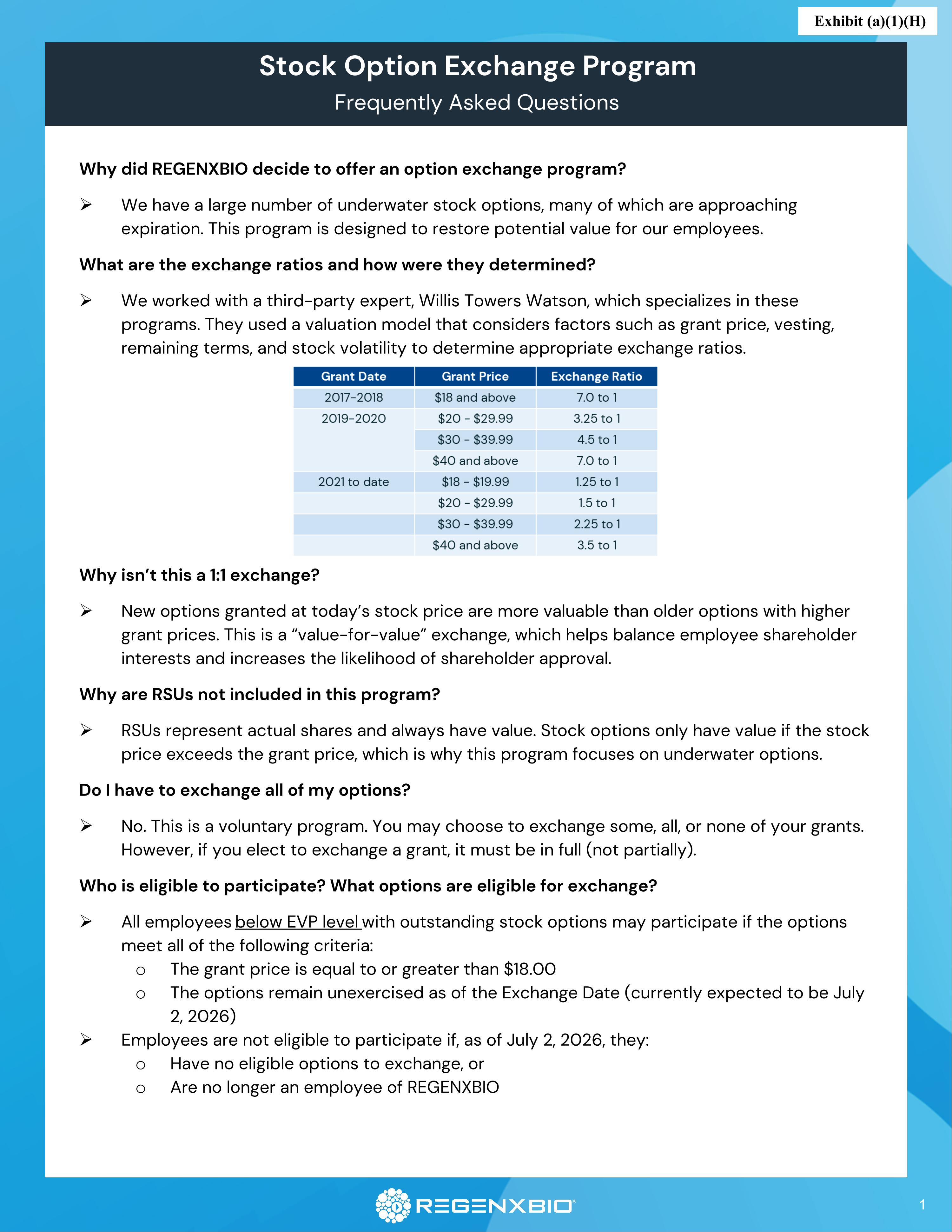
Why did REGENXBIO decide to offer an option exchange program? We have a large number of underwater stock options, many of which are approaching expiration. This program is designed to restore potential value for our employees. What are the exchange ratios and how were they determined? We worked with a third-party expert, Willis Towers Watson, which specializes in these programs. They used a valuation model that considers factors such as grant price, vesting, remaining terms, and stock volatility to determine appropriate exchange ratios. Why isn’t this a 1:1 exchange? New options granted at today’s stock price are more valuable than older options with higher grant prices. This is a “value-for-value” exchange, which helps balance employee shareholder interests and increases the likelihood of shareholder approval. Why are RSUs not included in this program? RSUs represent actual shares and always have value. Stock options only have value if the stock price exceeds the grant price, which is why this program focuses on underwater options. Do I have to exchange all of my options? No. This is a voluntary program. You may choose to exchange some, all, or none of your grants. However, if you elect to exchange a grant, it must be in full (not partially). Who is eligible to participate? What options are eligible for exchange? All employees below EVP level with outstanding stock options may participate if the options meet all of the following criteria: The grant price is equal to or greater than $18.00 The options remain unexercised as of the Exchange Date (currently expected to be July 2, 2026) Employees are not eligible to participate if, as of July 2, 2026, they: Have no eligible options to exchange, or Are no longer an employee of REGENXBIO Stock Option Exchange Program Frequently Asked Questions 1 Exhibit (a)(1)(H)
How do I make my elections? You will log into the exchange website, www.myoptionexchange.com, where you can use the modeling tool to evaluate your options and make your exchange elections. Why were there two proposals in the proxy? There was one proposal for the Executive Team and one for employees below the EVP level. This approach gave the employee program the best chance of being approved, as shareholders might be less supportive of an executive exchange. What happens if I do nothing? If you take no action, none of your options will be exchanged. We would encourage you to use the modeling tool to make an informed decision. Will there be another opportunity to exchange my options? It’s possible, but it is unlikely that this program will be offered again. Can I change my election after I submit it? Yes. You may change or withdraw your election at any time during the offer period (June 3 through July 1, 2026). The most recent election submitted before the deadline will be the one that is counted. After the offer period closes, your election becomes final and cannot be changed. What happens to the options that are exchanged? The stock options you surrender in the exchange will be canceled and returned to the company’s equity incentive plan, where they may be used for future equity grants, including stock options or restricted stock awards. In return, you will receive new non-qualified stock options (NQs), which will be subject to new vesting requirements. The new options will vest over two years: 50% after year one and the remaining 50% after year two. Why was the $18 grant price selected as the eligibility threshold? We selected a conservative threshold based on market practices, balancing employee benefit with shareholder considerations. Options with grant prices at or above $18 are currently significantly underwater and may no longer provide the intended motivational and retention value. This threshold helps focus the program on grants that are most impacted by the difference between the original grant price and the current market price. Stock Option Exchange Program Frequently Asked Questions 2
What is the difference between an incentive stock option (ISO) and a non-qualified stock option (NQ)? If you exercise and hold an ISO, you may be eligible for favorable tax treatment. Favorable tax treatment requires exercising and holding your shares for a period of at least one year. Since exercising and holding options requires a cash outlay, a cashless exercise is more common. If you choose a cashless exercise, there is no favorable tax treatment. Please consult your tax advisor if you have questions on this. All options you will receive through the exchange will be non-qualified stock options, regardless of whether you are exchanging ISOs or NQs. What are the tax implications if I exchange my options? Stock options are generally taxed upon exercise, not grant. The new options will follow standard tax rules when exercised. You should consult your personal tax advisor for guidance specific to your situation. What happens if I leave the company after participating? As with all stock options, if your employment terminates, any unvested options will be forfeited in accordance with the terms of the equity plans. This applies to the new option grant received in the exchange. Do I need to re-accept the exchanged options in Solium? Yes, you must accept your new stock option grant, agreeing to the terms and conditions of the exchanged award within 90 days of the new grant date. Still have questions? If you can’t find the answer you need, please email: optionexchange@regenxbio.com Stock Option Exchange Program Frequently Asked Questions 3