Business Report
for the 120th Term
From April 1, 2025 to March 31, 2026
Exhibit 99.2
The share transfer described in this document involves securities of a Japanese company. The share transfer is subject to disclosure requirements of Japan that are different from those of the United States. Financial information included in this document, if any, was excerpted from financial statements prepared in accordance with foreign accounting standards that may not be comparable to the financial statements of United States companies.
It may be difficult for you to enforce your rights and any claim you may have arising under the U.S. federal securities laws, since the issuer is located in Japan and some or all of its officers and directors reside outside of the United States. You may not be able to sue a Japanese company or its officers or directors in a Japanese court for violations of the U.S. securities laws. It may be difficult to compel a Japanese company and its affiliates to subject themselves to a U.S. court’s judgment. You should be aware that the issuer may purchase securities otherwise than under the share transfer, such as in the open market or through privately negotiated purchases.
This document has been translated from the Japanese-language original for reference purposes only. In the event of any conflict or discrepancy between this document and the Japanese-language original, the Japanese-language original shall prevail in all respects. |
| |
|
Business Report From April 1, 2025 to March 31, 2026
| |
| NOK CORPORATION (Securities Code No. 7240) |
To Our Shareholders
 |
We would like to express our deep gratitude for your loyal patronage. We hereby report an overview of the business activities of the NOK Group for the 120th term (April 1, 2025 to March 31, 2026). The NOK Group has carried out product development based on our accumulated basic research, and also “Essential Core Manufacturing — The manufacture of pivotal products that shape society,” where our high quality and large-scale stable production is a strength. In addition to supporting the safety and comfort that are the foundation of an affluent society and delivering economic benefits to our stakeholders, we are also moving forward every day so that we can be a company that is trusted by society and that everyone takes pride in.
This term is the final fiscal year of the three-year Medium-Term Management Plan, which ended in fiscal 2025. In this Medium-Term Management Plan, we presented a basic policy of constructing a foundation for transformation, and through this plan, we carried out four transformations: “Create new growth drivers,” “Optimize operational structure for global expansion,” “Construct diverse human capital foundation,” and “Optimize management resources.” As a major initiative, we focused on expansion of products for new domains and expanding sales to non-Japanese automobile manufacturers in order to create new growth drivers. In terms of the operational structure, we worked to accelerate the pace of decision-making and strengthen supervisory functions by formulating a unified new corporate identity for the NOK Group, introducing a global matrix system, and transitioning to a company with an Audit & Supervisory Committee. Together with optimizing our business portfolio, including strengthening business development activities and transferring the OA equipment-related products business, we carried out strategic personnel assignments that shifted human resources to key areas such as digital transformation and new businesses. We also steadily carried out measures for the construction of a foundation for transformation, such as improving the profit structure based on elimination of unprofitable products and fair transfer of costs to prices, improving capital efficiency, and reinforcing returns to shareholders.
In July 2026, the Company will celebrate the milestone of 85 years since our founding. Working from the foundation that we have constructed in the past, the Group will work together to strengthen the path to future global growth. We sincerely ask for attention to be given to our initiatives aimed at pioneering a new future beyond our transformation, and for everyone’s continued support. June 2026 | |||
| Representative
Director, Group Chief Executive Officer |
Masao Tsuru | |||
| <Table of Contents> | ||||
| To Our Shareholders | 1 | |||
| Financial Highlights (Consolidated) | 2 | |||
| (Physical
copies of electronically provided information sent to shareholders who request them along with the Notice of the 120th Annual Shareholders’ Meeting) |
||||
| Business Report | ||||
| 1. Current Status of the NOK Group | 3 | |||
| 2. Outline of the Company | 13 | |||
| Consolidated Financial Statements | ||||
| Consolidated Balance Sheet | 23 | |||
| Consolidated Statement of Income | 24 | |||
| Financial Statements | ||||
| Balance Sheet | 25 | |||
| Statement of Income | 26 | |||
| Independent
Auditor’s Audit Report Concerning Consolidated Financial Statements |
27 | |||
| Independent
Auditor’s Audit Report Concerning Financial Statements |
29 | |||
| Audit Report by the Audit & Supervisory Committee | 31 | |||
| Information for Shareholders | ||||
The following are not included in the physical copies of electronically provided information sent to shareholders who request them, under laws and regulations and the Articles of Incorporation of the Company. (i) “System for Ensuring Properness of Operations” in Business Report (ii) “Consolidated Statement of Changes in Net Assets” and “Notes to Consolidated Financial Statements” in the Consolidated Financial Statements (iii) “Statement of Changes in Net Assets” and “Notes to Financial Statements” in the Financial Statements (iv) “(1) Content of the financial statements for the most recent fiscal year (fiscal year ended March 31, 2026)” under “4. Information on Eagle Industry” of the First Item, “Approval of a Share Transfer Plan,” of the Reference Materials for the Annual Shareholders’ Meeting |
||||
| 1 |
Financial Highlights (Consolidated)
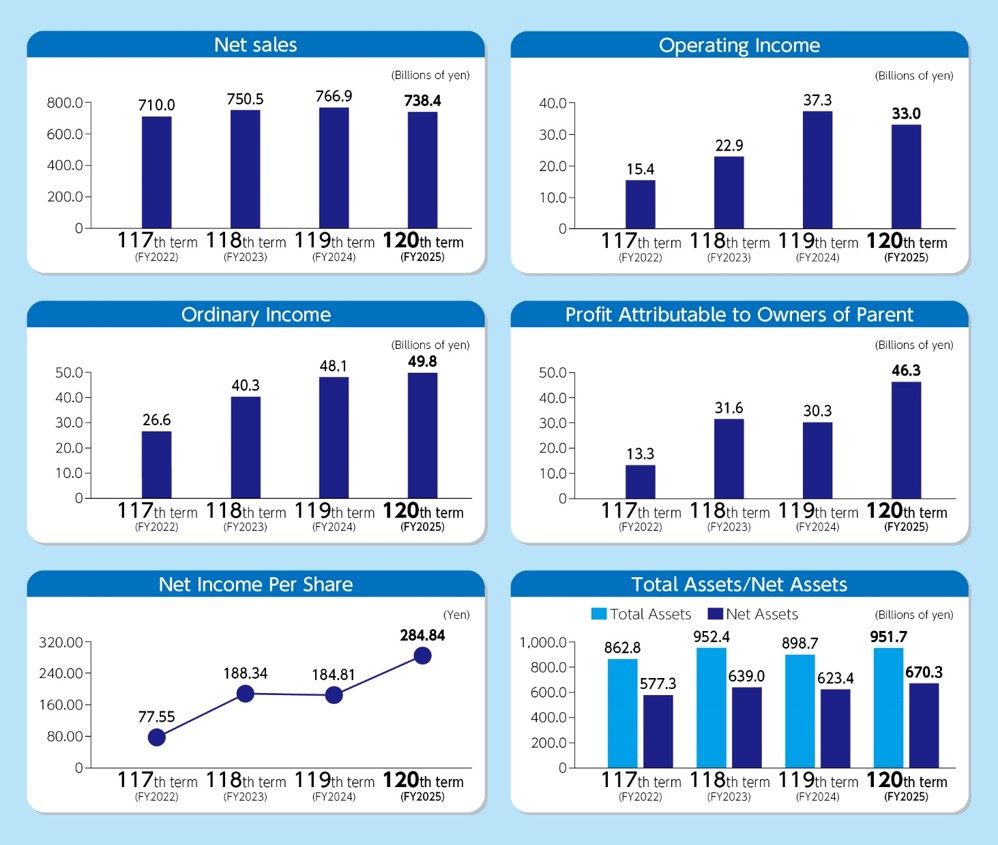
Note: Amounts described in Financial Highlights (Consolidated) are rounded off to the nearest described point.
| 2 |
BUSINESS REPORT for the 120th Term
| April 1, 2025 to March 31, 2026 |
1. Current Status of the NOK Group
(1) Business Overview
(i) Business conditions and results
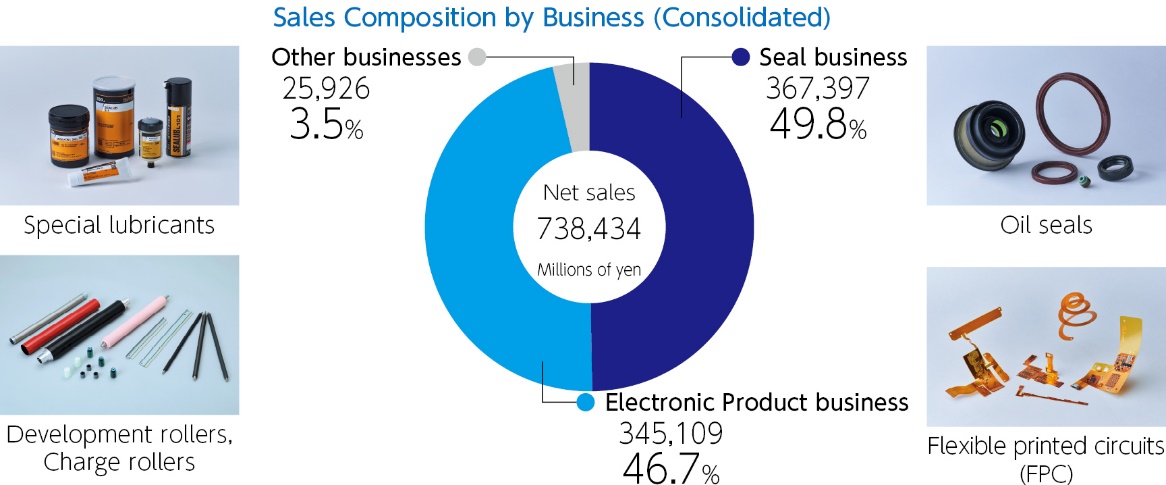
For the current fiscal year, the NOK Group posted the following operating results: Net sales totaled 738,434 million yen (down 3.7% year on year); operating income was 32,990 million yen (down 11.5% year on year); ordinary income ended at 49,835 million yen (up 3.7% year on year), resulting in 46,338 million yen in profit attributable to owners of parent (up 52.8% year on year).
Operating income decreased due to a decline in net sales. Meanwhile, ordinary income increased, mainly owing to higher foreign exchange gains. Despite recording a loss on sale of shares of subsidiaries and associates related to the divestiture of the roll products business, profit attributable to owners of the parent increased as well due to an increase of gains on the sale of investment securities.
The business conditions of the NOK Group by business segment were as follows:
■ Results of the Business Activities by Business Segment
Seal business
Net sales amounted to 367,397 million yen (up 1.3% year on year) and operating income was 27,860 million yen (up 6.3% year on year).
For the automotive applications, although the number of Japanese automobiles produced domestically in Japan declined, sales increased due to expanded sales to non-Japanese customers in China and the recovery of the automotive market in Thailand. For general industrial machinery applications, sales also increased, driven by higher demand—particularly for construction machinery in China. As a result, net sales for the segment rose overall, supported additionally by the positive effect of foreign exchange rates.
Although fixed costs such as personnel expenses increased, operating income increased thanks to price revision activities such as passing on selling prices, as well as improvements in variable costs due to lower raw material prices and cost-reduction measures.
| 3 |
Electronic Product business
Net sales amounted to 345,109 million yen (down 7.0% year on year) and operating income was 3,967 million yen (down 55.6% year on year).
In addition to the negative impact of foreign exchange rates, net sales decreased due to a decline of component costs included in sales, as well as a decline in net sales. In terms of sales excluding the component costs by application, sales for automobile decreased, mainly because growth in sales for automotive battery applications slowed.
Along with the decline in net sales, operating income also decreased due to higher fixed costs, including depreciation and personnel expenses.
Other businesses
Net sales amounted to 25,926 million yen (down 21.8% year on year) and operating income was 1,137 million yen (down 46.6% year on year).
With respect to the roll products business, all shares of SYNZTEC Co., Ltd. and seven other companies were transferred as of January 30, 2026. However, the transfer is deemed to have been completed at the beginning of the fourth quarter of the consolidated accounting period, and the above net sales and operating income include the results up to the cumulative total for the third quarter of the consolidated accounting period.
(ii) Capital investment and fund procurement
The NOK Group made capital investments of 48,405 million yen in total (down 7.6% from the previous fiscal year) mainly for increasing production capacities in Japan, China, and Southeast Asian countries.
These investments were financed by our own funds.
| 4 |
(2) Issues to be Addressed by the NOK Group
Uncertainties remain in regards to the future business environment of the NOK Group due to factors including heightened geopolitical risks in the Middle East and the resulting soaring energy prices and supply chain disruptions, foreign policy trends in the U.S., and financial policy trends in Japan and the U.S. In Japan, labor costs are continuing to rise due to the effects of rising wages in response to rising prices. The following are the forecasts for each business area based on this situation.
In the seal business, large increases in vehicle production by Japanese automobile manufacturers are not expected, and we expect increasing impacts from factors such as the increasing sales share of electric vehicles in China, and in the ASEAN region, the full-scale market entry of Chinese automobile manufacturers in the key market of Thailand. For general industrial machinery applications, while demand trends vary depending on the region and application, demand is expected to grow mainly for construction machinery applications; however, it is anticipated that significant growth will be difficult to achieve if limited to traditional business areas. While the environment surrounding our business as a whole is expected to remain difficult, we will strive to improve profitability by means such as developing products for new areas like electric vehicles, expanding sales to non-Japanese automobile manufacturers, expanding sales beyond traditional business areas such as for construction machinery and agricultural machinery applications to general industrial machinery applications, and strategic pricing activities.
In the electronic product business, in terms of automobile applications, while the long-term growth trajectory for the electric vehicle market has been weaker than expected, it is expected that the shift to electric vehicles will continue unchanged. Under these conditions, it is our view that the adoption of FPC for vehicle batteries that has been a particular focus of the Company is steadily expanding. Furthermore, based on the record of adoption by customers in Japan and overseas, the quality and stable supply of the Company’s products have been rated highly. We expect adoption to grow further in the future, resulting in growing volume and improved profitability. Overall market growth for smartphones has stagnated due to factors including the prolonged replacement cycle by end-users. We will make effective use of current production capacity and work to improve productivity and profitability. Although we achieved profitability during the period of the Medium-Term Management Plan (April 1, 2023 to March 31, 2026), as we aim for a business structure that can produce stable profits, we will level out production by expanding into business areas such as the vehicle battery field, where seasonal demand fluctuations are relatively low.
In all businesses, in part due to the lack of expected significant future growth in their markets, it is important that we carry out initiatives for improving profitability such as those described above, and at the same time, that we also create new growth drivers by searching for external growth opportunities.
We will also make efforts related to environmental issues including decarbonization, invest in human resources as a foundation for continual growth, and make investments that ensure sustainable business.
In order to address these issues, the Company aims to construct a business infrastructure that can achieve continual growth and improvement in corporate value. In the Medium-Term Management Plan covering the three years from fiscal 2023 to fiscal 2025, we engaged in a basic policy of constructing a foundation for transformation, consisting of four key items: “Create new growth drivers,” “Optimize operational structure for global expansion,” “Construct diverse human capital foundation,” and “Optimize management resources.”
Based on the continually changing business environment and the results of the Medium-Term Management Plan, the Company has formulated a new Medium-Term Management Plan (April 1, 2026 to March 31, 2029), with fiscal 2028 as the final year, to serve as a path to achieving our objectives in fiscal 2031. The basic policies and strategic goals are as follows.
| 5 |
■ Basic policies
Implementation
- Execute thoroughly without hesitation
- Continue to challenge ambitious targets
■ Strategic goals and key initiatives
● Optimization and Sophistication of Global Operating Model
- Establishment of the optimal management system for the Group and each business
- Improvement of efficiency in group indirect operations
- ERP implementation with an appropriate investment scale
● Completion of Profitability Improvement Measures
- Establishment and execution of pricing strategy in the Seal business
- Cultivation of new domains for growth
- Execution and completion of cost reduction measures
- Review of unprofitable and non-core businesses
- Reduction of indirect material costs across the Group
● Business Creation and Acquisition for Inorganic Growth
- Identification, acquisition, and launch of new business domains
In order to fully carry out the above strategic targets, we aim to construct and acquire the capabilities necessary for the organization and for individual employees.
At a Board of Directors meeting on November 10, 2025, it was decided to integrate management by establishing a joint holding company with Eagle Industry Co., Ltd. on October 1, 2026. At the 120th Annual Shareholders’ Meeting to be held on June 25, 2026, we will submit a resolution for the establishment of a wholly-owning parent company through a share transfer.
Through this integration, we will combine the technologies and strengths of both companies, and aim to be a company that is chosen by greater numbers of stakeholders as a company that can provide composite sealing solutions that meet customer needs with a complete range of materials covering everything from organic materials to inorganic materials.
| 6 |
(3) Financial and Operational Results
(i) Trends in consolidated assets and business results of the NOK Group
(Millions of yen, except for per share figures)
| Classification |
117th term (FY2022) |
118th term (FY2023) |
119th term (FY2024) |
120th term (FY2025) | |
| Net Sales | 709,956 | 750,502 | 766,859 | 738,434 | |
| Operating Income | 15,378 | 22,912 | 37,264 | 32,990 | |
| Ordinary Income | 26,557 | 40,285 | 48,057 | 49,835 | |
| Profit Attributable to Owners of Parent | 13,320 | 31,602 | 30,320 | 46,338 | |
| Net Income Per Share | (Yen) | 77.55 | 188.34 | 184.81 | 284.84 |
| Total Assets | 862,750 | 952,379 | 898,667 | 951,650 | |
| Net Assets | 577,346 | 639,001 | 623,421 | 670,270 | |
| ● | In the 117th term (FY2022), net sales increased as a result of transferring costs to prices, despite the negative impacts of the lockdown in China and the supply shortage of semiconductors and other components. Operating income was down due to factors including surging prices of raw materials and energy. |
| ● | In the 118th term (FY2023), despite the impact of a global economic slowdown such as the real estate recession in China, sales to the automotive field increased, resulting in increased revenue and profits. |
| ● | In the 119th term (FY2024), despite the effect of factors including the decline in vehicle production by Japanese automobile manufacturers in Japan and slow sales in China, we achieved higher revenue and profits by transferring costs to prices, improving variable costs, and other measures. |
| ● | As for the business performance in the 120th term (FY2025), please refer to the aforementioned (1) Business Overview. |
Information for reference: About cross-shareholdings
The amount of the Company’s cross-shareholdings (investment securities) listed on the balance sheet at the end of this fiscal year was 82.742 billion yen, which represents 12.3% of the aforementioned consolidated net asset value of the NOK Group.
In fiscal 2025, we completed the sale of 40.8% of our cross-shareholdings as of March 31, 2026, relative to the cross-shareholdings reduction target of 25% on a market value basis as of March 31, 2023.
| 7 |
(ii) Trends in assets and business results of the Company
(Millions of yen, except for per share figures)
| Classification |
117th term (FY2022) |
118th term (FY2023) |
119th term (FY2024) |
120th term (FY2025) | |
| Net Sales | 218,710 | 230,826 | 226,264 | 227,309 | |
| Operating Income (loss) | (380) | 3,216 | 4,626 | 6,293 | |
| Ordinary Income | 9,010 | 26,532 | 42,584 | 28,418 | |
| Net Income | 9,052 | 39,679 | 41,629 | 43,973 | |
| Net Income Per Share | (Yen) | 52.68 | 236.35 | 253.60 | 270.15 |
| Total Assets | 408,551 | 461,165 | 447,294 | 443,292 | |
| Net Assets | 258,093 | 285,887 | 290,205 | 291,709 | |
| ● | In the 117th term (FY2022), revenue decreased as sales slowed to both the automobile industry and manufacturers of general industrial machinery. Profits also decreased in light of sluggish sales, surging raw material and energy prices, and other factors. |
| ● | In the 118th term (FY2023), revenue increased due to a recovery in sales for the automobile industry. Profits increased due to the impact of the increase in sales, an increase in dividend income from subsidiaries, recognition of gain on sales of investment securities, etc. |
| ● | In the 119th term (FY2024), revenue decreased as sales to the automobile industry slowed. Profits increased due to the decrease in fixed costs such as personnel and depreciation costs, and an increase in dividend income from subsidiaries, etc. |
| ● | In the 120th term (FY2025), revenue increased due to a recovery in sales for general industrial machinery applications. Profits increased due to recording of gain on sales of investment securities and other factors, despite a decline in ordinary income mainly resulting from a decrease in dividend income from subsidiaries. |
| 8 |
(4) Status of Corporate Affiliations
(i) Condition of major subsidiaries and affiliates
| Company | Capital stock | Investment ratio | Main business | |
| Seal business |
Thai NOK Co., Ltd. (Thailand) |
THB1,200 million | 100.0% | Manufacture and sale of seal products |
| Wuxi NOK-Freudenberg Oilseal Co., Ltd. (China) | RMB350,622,000 |
– % (50.0) |
Manufacture and sale of seal products | |
| NOK Inc. (U.S.A.) | US$7,200,000 | 100.0% | Equity investment in Freudenberg-NOK General Partnership which produces and sells seal products, etc. | |
| Unimatec Co., Ltd. | ¥400 million | 100.0% | Manufacture and sale of synthetic chemical products | |
| Eagle Industry Co., Ltd. | ¥10,490 million |
32.1% (0.2) |
Manufacture and sale of mechanical seals, etc. | |
| Electronic Product business | MEKTEC CORPORATION | ¥5,000 million | 100.0% | Manufacture and sale of electronic parts |
|
Mektec Manufacturing Corporation (Taiwan) Ltd. (Taiwan) |
NT$416,085,000 |
– % (86.8) |
Manufacture and sale of electronic parts | |
|
Mektec Manufacturing Corporation (Thailand) Ltd. (Thailand) |
THB200 million |
– % (75.0) |
Manufacture and sale of electronic parts | |
|
Mektec Manufacturing Corporation (Zhuhai) Ltd. (China) |
RMB431,678,000 |
– % (97.4) |
Manufacture and sale of electronic parts | |
|
Mektec Manufacturing Corporation (Suzhou) (China) |
RMB791,236,000 |
– % (96.7) |
Manufacture and sale of electronic parts | |
| Other businesses | NOK Klüber Co., Ltd. | ¥100 million | 51.0% | Manufacture and sale of special lubricants |
| Notes: |
| 1. | The numbers in parentheses in the column “Investment ratio” show the capital ratio which the Company’s subsidiaries hold. |
| 2. | There are 80 consolidated subsidiaries and 18 equity method affiliates (including the aforementioned 11 major subsidiaries and affiliates). |
| 3. | A transfer of all shares in SYNZTEC Co., Ltd. was carried out on January 30, 2026, and SYNZTEC Co., Ltd. has been removed because it is no longer a subsidiary of the Company. |
(ii) Important partners
The Company maintains a partnership with Freudenberg & Co. of the Federal Republic of Germany that encompasses all business aspects including capital and technology.
| 9 |
(5) Main Businesses (as of March 31, 2026)
The major businesses of the NOK Group consist of production and sales of the following products.
| Segment | Major products |
| Seal business | Oil seals, O-rings, vibration-control rubber, plastic products, gaskets, synthetic chemical products, mechanical seals |
| Electronic Product business | Flexible printed circuits and precision components |
| Other businesses | Special lubricants, others |
(6) Major Business Offices and Factories (as of March 31, 2026)
(i) The Company
| Name | Location | Name | Location | |
| Head Office | Minato Ward, Tokyo | Osaka Branch | Osaka City, Osaka | |
| Mito Branch | Mito City, Ibaraki Pref. | Hiroshima Branch | Hiroshima City, Hiroshima Pref. | |
| Utsunomiya Branch | Utsunomiya City, Tochigi Pref. | Fukuoka Branch | Fukuoka City, Fukuoka Pref. | |
| Kumagaya Branch | Kumagaya City, Saitama Pref. | Fukushima Plant | Fukushima City, Fukushima Pref. | |
| Tokyo Branch | Minato Ward, Tokyo | Nihonmatsu Plant | Nihonmatsu City, Fukushima Pref. | |
| Electric Components Branch | Minato Ward, Tokyo | Kita Ibaraki Plant | Kita Ibaraki City, Ibaraki Pref. | |
| Kanagawa Branch | Ebina City, Kanagawa Pref. | Shizuoka Plant | Makinohara City, Shizuoka Pref. | |
| Fuji Branch | Fuji City, Shizuoka Pref. | Tokai Plant | Kikugawa City, Shizuoka Pref. | |
| Hamamatsu Branch | Hamamatsu City, Shizuoka Pref. | Tottori Plant | Saihaku-gun, Tottori Pref. | |
| Anjo Branch | Anjo City, Aichi Pref. | Kumamoto Plant | Aso City, Kumamoto Pref. | |
| Nagoya Branch | Nagoya City, Aichi Pref. | Shonan R&D Center | Fujisawa City, Kanagawa Pref. |
| Note: | From April 1, 2026, the Nagoya Branch was merged with the Anjo Branch. |
| 10 |
(ii) Subsidiaries
| Company | Business place | Location | |
| Seal business | Unimatec Co., Ltd. | Kita Ibaraki Plant | Kita Ibaraki City, Ibaraki Pref. |
| NOK Elastomers Processing Co., Ltd. | Head office and factory | Kama City, Fukuoka Pref. | |
| NOK FUGAKU ENGINEERING Co., Ltd. | Head office and factory | Kikugawa City, Shizuoka Pref. | |
| Saga NOK Corporation | Head office and factory | Ureshino City, Saga Pref. | |
| Thai NOK Co., Ltd. | Head office and factory | Chonburi, Thailand | |
| Wuxi NOK-Freudenberg Oilseal Co., Ltd. | Head office and factory | Wuxi City, Jiangsu, China | |
| NOK Asia Co., Pte. Ltd. | Head office | Singapore | |
| NOK Industrial Sales Corporation | Head office and sales office | Shinjuku Ward, Tokyo | |
| NOK-Freudenberg Group Sales (China) Co., Ltd. | Head office and sales office | Shanghai City, China | |
| Electronic Product business | MEKTEC CORPORATION |
Head office Ushiku Plant |
Minato Ward, Tokyo Ushiku City, Ibaraki Pref. |
| Mektec Manufacturing Corporation (Taiwan) Ltd. | Head office and factory | Kaohsiung City, Taiwan | |
| Mektec Manufacturing Corporation (Thailand) Ltd. | Head office and factory | Ayutthaya, Thailand | |
| Mektec Manufacturing Corporation (Zhuhai) Ltd. | Head office and factory | Zhuhai City, Guangdong, China | |
| Mektec Manufacturing Corporation (Suzhou) | Head office and factory | Suzhou City, Jiangsu, China | |
| Mektec Manufacturing Corporation (Vietnam) Ltd. | Head office and factory | Hung Yen Province, Vietnam | |
| Mektec Precision Component (Thailand) Ltd. | Head office and factory | Ayutthaya, Thailand | |
| Mektec Corporation (Hong Kong) Ltd. | Head office and sales office | Hong Kong, China | |
| Other businesses | NOK Klüber Co., Ltd. | Kita Ibaraki Plant | Kita Ibaraki City, Ibaraki Pref. |
| Notes: |
| 1. | A transfer of all shares in SYNZTEC Co., Ltd. was carried out on January 30, 2026, and SYNZTEC Co., Ltd. has been removed because it is no longer a subsidiary of the Company. |
| 2. | On July 1, 2025, Kansai NOK Hanbai Co., Ltd. carried out an absorption-type merger with Kanto NOK Hanbai Co., Ltd. as the surviving company, and on the same date changed its trade name to NOK Industrial Sales Corporation. |
| 3. | On April 1, 2026, Saga NOK Corporation changed its trade name to NOK Kyushu Corporation and relocated its head office to Aso City, Kumamoto Prefecture. Additionally, Mektec Precision Component (Thailand) Ltd. changed its trade name to NOK Precision Component (Thailand) Ltd. |
| 11 |
(7) Employee Status (as of March 31, 2026)
(i) Employment of the NOK Group
| Business segment | Number of employees | Change from the end of previous term |
| Seal business | 20,093 (1,553) | -111 (-77) |
| Electronic Product business | 16,260 (622) | +549 (+154) |
| Other businesses | 302 (164) | -1,741 (-149) |
| Total | 36,655 (2,339) | -1,303 (-72) |
| Notes: |
| 1. | The number of employees refers to the number of people employed by the NOK Group, excluding part-time workers and temporary workers. Figures in parentheses are the average number of part-time workers and temporary workers on an annual basis. |
| 2. | On January 30, 2026, all shares in SYNZTEC Co., Ltd. were transferred, and because it is no longer a subsidiary of the Company, the number of employees in “Other businesses” decreased largely. |
(ii) Employment of the Company
| Business segment | Number of employees | Change from the end of previous term |
| Seal business | 3,076 (407) | -70 (+4) |
| Electronic Product business | 59 (7) | -1 (±0) |
| Other businesses | 18 (4) | -27 (-3) |
| Total | 3,153 (418) | -98 (+1) |
| Average age | Average length of service |
| 42.3 years old | 19.3 years |
| Note: | The number of employees refers to the number of people employed by the Company, excluding part-time workers and temporary workers. Figures in parentheses are the average number of part-time workers and temporary workers on an annual basis. |
(8) Major Lenders to the Company (as of March 31, 2026)
| Lenders |
Borrowings (Millions of yen) |
|
| Sumitomo Mitsui Banking Corp. | 33,095 | |
| Mizuho Bank, Ltd. | 18,945 | |
| MUFG, Bank, Ltd. | 7,891 | |
| The Dai-ichi Life Insurance Company, Ltd. | 553 | |
| Sumitomo Mitsui Trust Bank, Ltd. | 524 |
| 12 |
2. Outline of the Company
(1) Status of Stock (as of March 31, 2026)
| (i) Total number of shares authorized to be issued: | 600,000,000 shares |
| (ii) Total number of shares issued: | 160,903,090 shares |
| (iii) Number of shareholders: |
16,984 (an increase of 2,561 year on year) |
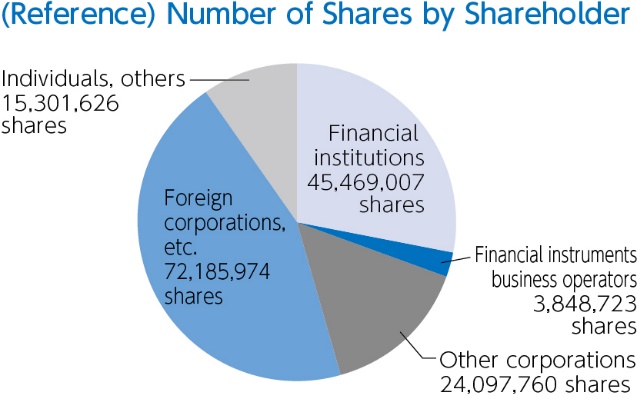
(iv) Major shareholders
| Shareholder |
Number of shares held (thousands) |
Ratio of shares held (%) |
| Freudenberg SE | 43,457 | 27.01 |
| The Master Trust Bank of Japan, Ltd. (Trust account) | 13,274 | 8.25 |
| Seiwa Jisho Co., Ltd. | 8,773 | 5.45 |
| The Dai-ichi Life Insurance Company, Ltd. | 8,000 | 4.97 |
| Custody Bank of Japan, Ltd. (Trust account) | 7,184 | 4.47 |
| NOK Stock Ownership Association | 3,880 | 2.41 |
| Sumitomo Mitsui Banking Corp. | 3,203 | 1.99 |
| SMBC Trust Bank Ltd. (Sumitomo Mitsui Banking Corporation retirement benefit trust account) | 3,000 | 1.86 |
| STATE STREET BANK AND TRUST COMPANY 505001 | 2,880 | 1.79 |
| Sompo Japan Insurance Inc. | 2,125 | 1.32 |
| Note: | For the basis of the calculation of “ratio of shares held” above, the Company’s treasury stock (233 shares) is excluded from the total number of shares issued. The Company’s treasury stock does not include 1,583,307 of the Company’s shares held in the Board Incentive Plan (BIP) Trust or 383,100 of the Company’s shares held in the Employee Stock Ownership Plan (ESOP). |
| 13 |
(v) State of shares granted to Board Members of the Company as compensation for performance of duties during this fiscal year
No shares were granted to Board Members of the Company as compensation for performance of duties during this fiscal year. Details about remuneration based on the Company’s shares are provided in (2) Board Members of the Company below.
(vi) Other important matters related to stock
(a) Retirement of treasury stock
Based on a resolution of a Board of Directors meeting held on November 10, 2025, treasury stock was retired as shown below.
| Type of shares retired | Common shares of the Company |
| Number of shares retired |
7,435,847 shares (Percentage of all issued shares prior to retirement: 4.29%) |
| Number of issued shares following retirement |
165,702,690 shares (including treasury stock) |
| Retirement date | November 28, 2025 |
(b) Retirement of treasury stock
Based on a resolution of a Board of Directors meeting held on February 5, 2026, treasury stock was retired as shown below.
| Type of shares retired | Common shares of the Company |
| Number of shares retired |
4,799,600 shares (Percentage of all issued shares prior to retirement: 2.90%) |
| Number of issued shares following retirement |
160,903,090 shares (including treasury stock) |
| Retirement date | February 27, 2026 |
| 14 |
(2) Board Members of the Company
(i) Directors (as of March 31, 2026)
| Position | Name | Positions, responsibilities or significant concurrent positions |
| Director, Chief Executive Officer | Masao Tsuru | Group Chief Executive Officer |
| Director, Senior Executive Officer | Chikashi Takeda | Group Chief Financial Officer |
| Director, Senior Executive Officer | Akira Watanabe | Special Projects |
| Director, Senior Executive Officer | Junichi Orita | Sealing Solution Chief Executive Officer |
| Director, Senior Executive Officer | Yuki Sato | Group Chief Technology Officer, Head, NOK Group R&D |
| Director (Full-time Audit & Supervisory Committee Member) | Hideki Watanabe | Chairperson of the Audit & Supervisory Committee |
| Director (Audit & Supervisory Committee Member) | Makoto Fujioka | Chairperson of the Nomination and Remuneration Advisory Committee |
| Director (Audit & Supervisory Committee Member) | Naoki Shimada | CEO, P&E Directions, Inc. |
| Director (Audit & Supervisory Committee Member) | Motoko Imada | CEO, Mediagene Inc. |
| Director (Audit & Supervisory Committee Member) | Atsushi Kajitani | Lawyer |
| Notes: |
| 1. | Mr. Masao Tsuru is the Representative Director. |
| 2. | Mr. Chikashi Takeda was newly elected and assumed the position of Director who is not an Audit & Supervisory Committee Member at the 119th Annual Shareholders’ Meeting held on June 26, 2025. |
| 3. | Director positions and responsibilities changed as follows on June 26, 2025. |
| Name | New Position | Former Position |
| Chikashi Takeda | Director, Senior Executive Officer, Group Chief Financial Officer |
Senior Executive Officer, Financial Strategy |
| Akira Watanabe | Director, Senior Executive Officer Special Projects |
Director, Senior Executive Officer, Group Chief Financial Officer |
| 4. | Directors (Audit & Supervisory Committee Members) Mr. Makoto Fujioka, Mr. Naoki Shimada, Ms. Motoko Imada, and Mr. Atsushi Kajitani serve as External Directors. |
| 5. | The Company has submitted notification to the Tokyo Stock Exchange that each External Director has been designated as an independent director as stipulated in the regulations of the aforementioned exchange. |
| 6. | To improve the effectiveness of audits while strengthening audit and supervisory functions through enhanced information gathering and full coordination with the internal audit department and other divisions, we have appointed Mr. Hideki Watanabe as full-time Audit & Supervisory Committee Member. |
| 7. | Director (Audit & Supervisory Committee Member) Mr. Hideki Watanabe has work experience in finance & accounting division and has considerable expertise in finance and accounting. |
| 8. | The Company has entered into a directors and officers liability insurance (D&O insurance) policy as provided for in Article 430-3, paragraph 1 of the Companies Act, in which the insured persons are the Directors, Corporate Auditors and Operating Officers of the Company and its subsidiaries (for overseas subsidiaries, the insured persons are limited to those seconded from Japan). The entire amount of insurance premiums, including those for special clauses, are borne by the Company, and there are no insurance premiums actually borne by the insureds. The insurance policy covers losses that may arise from the insured’s assumption of liability incurred in the course of the performance of duties as Directors, Corporate Auditors, etc., or receipt of claims pertaining to the pursuit of such liability. Provided, however, that there are certain reasons for coverage exclusion that, for example, exclude losses arising from any act that the person carried out while being aware that it violated laws and regulations. Also, the deductible clause is set in the policy, whereby losses within such deductible are not covered by the policy. |
| 9. | In addition to the above, significant concurrent positions held by Directors are as follows. |
| 15 |
| Name | Significant concurrent positions |
| Masao Tsuru |
Representative Director, Chairman, MEKTEC CORPORATION Representative Director, Chairman, NOK Klüber Co., Ltd. Representative Director, Chairman, Unimatec Co., Ltd. Vice Chairman & Director, NOK-Freudenberg Singapore Pte. Ltd. Representative Director, Seiwa Jisho Co., Ltd. |
| Junichi Orita |
Chairman & Director, Wuxi NOK-Freudenberg Oilseal Co., Ltd. Chairman & Director, Changchun NOK-Freudenberg Oilseal Co., Ltd. Chairman & Director, Taicang NOK-Freudenberg Sealing Products Co., Ltd. |
| Makoto Fujioka | Outside Director, Nippon Paper Industries Co., Ltd. |
| Naoki Shimada |
Outside Director, Japan Business Systems, Inc. External Director, RENOVA, Inc. |
| Motoko Imada | Director, TNL Mediagene |
| Atsushi Kajitani | Outside Director, DMS Inc. |
| 16 |
(ii) Matters concerning remuneration, etc. to Directors
(a) Policies on remuneration to Directors
As described below, the Company has established a policy for deciding the contents of remuneration, etc. for Directors, and based on this policy, within the range of the total amount decided by the Annual Shareholders’ Meeting, remuneration for Directors who are not Audit & Supervisory Committee Members is decided by the Board of Directors, while remuneration for Directors who are Audit & Supervisory Committee Members is decided by a meeting of the Directors who are Audit & Supervisory Committee Members.
The Company has established the Nomination and Remuneration Advisory Committee as an advisory body to the Board of Directors for the purpose of addressing important management issues, including enhancement of objectivity and transparency in matters related to nomination and remuneration of corporate officers. It provides periodical confirmation on particularly important matters such as nomination of corporate officers and remuneration, etc. of Directors in addition to providing the Board of Directors with appropriate advice. The Nomination and Remuneration Advisory Committee is a committee body whose chairperson and primary constituent members are External Directors. It provides confirmation and advice relating to important management issues such as nomination and remuneration.
The Company’s policies on remuneration to Directors are as follows:
| ● | Methods for determining policies |
The policies on remuneration to Directors who are not Audit & Supervisory Committee Members are determined at a meeting of the Board of Directors based on the advice of the Nomination and Remuneration Advisory Committee. The policies on remuneration to Directors who are Audit & Supervisory Committee Members are decided by a meeting of the Directors who are Audit & Supervisory Committee Members.
| ● | Basic policies |
In order to improve the medium- and long-term corporate value of the NOK Group and increase stakeholder satisfaction, we believe it is necessary to promote the motivation to achieve targets among management, including the Directors of core companies in the NOK Group, through their remuneration. For this purpose, for the management of core companies in the NOK Group, we have introduced share-based remuneration that varies according to the level of KPI achievement, which is a priority implementation measure in the Medium-Term Management Plan of the NOK Group. Together with monetary remuneration that varies depending on the level of achievement of performance targets in a single fiscal year, this is intended to improve medium- and long-term corporate value and increase stakeholder satisfaction.
| ● | Policies for determining amounts or calculation methods for individual remuneration, etc. |
Remuneration to Directors who are not Audit & Supervisory Committee Members consists of a fixed remuneration portion, a remuneration portion for short-term expected achievements and a remuneration portion for long-term expected achievements, with consideration given to Directors’ responsibilities to improve business results each fiscal year and to increase the corporate value from a medium- to long-term perspective. The Company classifies the remuneration in three types: (1) basic remuneration (monetary), (2) short-term performance-linked remuneration (monetary), and (3) medium- to long-term performance-linked remuneration (shares). When the remunerations for short-term and long-term expected individual achievements are the standard amounts, levels are established in the total amount of remuneration using ratios within the range of approximately 1 to 1.9 according to the individual’s official responsibilities.
On the other hand, because Directors who are Audit & Supervisory Committee Members are responsible for audits and supervision of the conduct of official duties throughout the NOK Group, based on their positions, they receive only basic remuneration (monetary) according to their roles.
In addition, with respect to the payment of remuneration, the remuneration may be temporarily reduced or not paid in case of a sudden deterioration in business performance or a situation that damages corporate value.
| 17 |
| ● | Policies for determining the components of performance-linked remuneration, etc.-related performance indicators, etc., and calculation methods of amounts and/or numbers therein |
In accordance with the bonus provisions and share delivery provisions approved by the Board of Directors, performance-linked remuneration is paid within a range from 0% to 200% according to the level of achievement of the evaluation items.
The evaluation indicators related to short-term performance-linked remuneration utilize financial indicators aimed at achieving both expansion of business scale and ensuring profit levels (net sales and operating income) and individual evaluations which appropriately apply individual results. The amount to be paid is decided with consideration for other matters that may have an impact on business performance (natural disasters, extraordinary income and loss, etc.). The evaluation weighting of each indicator is [sales: operating income: individual evaluation] = [15%:35%:50%] ([30%:70%:0%] for the President and Representative Director). In order to ensure objectivity and transparency, target settings and evaluations for individual evaluations are decided by the Board of Directors based on a report from the Nomination and Remuneration Advisory Committee.
For indicators related to medium- to long-term performance-linked remuneration, for reasons of increasing the overall profitability of the NOK Group and also carrying out management with consideration for ESG, ROA is used as the financial indicator and the FTSE Russell’s ESG Ratings are used as the non-financial indicator. The evaluation weighting of these indicators is [90%:10%].
| ● | Policies for determining the details of non-monetary remuneration, etc., and calculation methods of amounts and/or numbers therein |
Regarding the medium- to long-term performance-linked remuneration, the Company utilizes a Board Incentive Plan (BIP) trust scheme in order to increase the motivation of Directors to contribute to improving business results and increasing corporate value of the NOK Group over the medium to long term. For the eligible Directors (excluding Directors who are Audit & Supervisory Committee Members, External Directors, and those who are non-residents of Japan), and Operating Officers (excluding those who are non-residents of Japan), this plan delivers or grants the number of the Company’s shares and the amount of money equivalent to the converted value of the Company’s shares (the “Company’s Shares, etc.”) corresponding to the number of points calculated according to the position and time in office, the level of achievement of medium-term targets, etc.
| ● | Policies for determining the proportion (ratio) of amounts for individual remuneration, etc. for each type |
In consideration for the fact that the Company manufactures and sells components for automobiles, electronic equipment, and other products, and performance is highly susceptible to trends in the industry, short-term performance-linked remuneration and medium- to long-term performance-linked remuneration of Directors have been set at 20% and 20% of total remuneration, respectively.
| ● | Policies for determining the timing and conditions for providing remuneration, etc. |
For the basic remuneration, the monthly amount for one year starting in the month following the annual shareholders’ meeting is determined at a meeting of the Board of Directors that is held after the annual shareholders’ meeting, and a fixed amount is paid on a certain date every month. For the short-term performance-linked remuneration, the amount is determined at a meeting of the Board of Directors in line with “Policies for determining the components of performance-linked remuneration, etc.-related performance indicators, etc., and calculation methods of amounts and/or numbers therein” above according to the year-end financial results, and is paid prior to the annual shareholders’ meeting for the settlement of accounts.
| 18 |
For the medium- to long-term performance-linked remuneration, fixed points calculated according to the position and time in office and performance-linked points for the purpose of increasing the incentives for achieving the targets in the Medium-Term Management Plan, etc. are granted at a certain time each year. In principle, when the Medium-Term Management Plan ends, the Company’s Shares, etc. corresponding to the accumulated number of fixed points and the Company’s Shares, etc. corresponding to the number calculated by multiplying the accumulated number of performance-linked points by the performance-linked coefficient according to the level of achievement of the medium-term targets are delivered or provided.
| ● | Methods for determining the details of individual remuneration, etc. |
The amounts of remuneration, etc. for individual Directors who are not Audit & Supervisory Committee Members or the calculation methods for those amounts are determined at a meeting of the Board of Directors when the proposal regarding corporate officer remuneration is presented to the Board of Directors by the Director and Chief Executive Officer, who serves as chairperson of the Board of Directors, based on advice from the Nomination and Remuneration Advisory Committee.
The amounts of remuneration, etc. for Directors who are Audit & Supervisory Committee Members are decided by a meeting of the Directors who are Audit & Supervisory Committee Members.
For the Directors’ individual remuneration, etc., for the current fiscal year, the Board of Directors has confirmed that the method for determining the details of remuneration, etc., and the details of determined remuneration, etc., are consistent with the determination policies resolved by the Board of Directors and the advice given by the Nomination and Remuneration Advisory Committee is respected, determining such remuneration, etc., are in accordance with the said determination policies.
(b) Matters concerning resolution of the Annual Shareholders’ Meeting related to remuneration, etc., to Directors
For remuneration to the Company’s Directors, it was resolved that the maximum amount of remuneration, etc., to the Directors who are not Audit & Supervisory Committee Members was 450 million yen per year (including a maximum of 20 million yen per year for External Directors and excluding employee salaries) and the maximum amount of remuneration, etc. to the Directors who are Audit & Supervisory Committee Members was 90 million yen per year at the 118th Annual Shareholders’ Meeting held on June 26, 2024. The number of Directors who are not Audit & Supervisory Committee Members at the end of such shareholders’ meeting was four (4) (including zero (0) External Directors) and that of Directors who are Audit & Supervisory Committee Members was five (5) (including four (4) External Directors).
Additionally, the 118th Annual Shareholders’ Meeting held on June 26, 2024 passed a resolution to provide additional performance-linked remuneration based on the Company’s shares to Directors, etc. (excluding Directors who are Audit & Supervisory Committee Members, External Directors, and those who are non-residents of Japan), with upper limits of 345 million yen per fiscal year contributed by the Company to a trust and 320,000 shares granted by the Company per fiscal year. The number of eligible Directors at the conclusion of that annual shareholders’ meeting was four (4).
| 19 |
(c) Total sum of remuneration, etc. paid during the current fiscal year
| Classification | Total sum of remuneration, etc. (Millions of yen) | Total sum of remuneration, etc. by type (Millions of yen) |
Number of Directors and Corporate Auditors who receive remuneration (persons) | ||
| Basic remuneration (monetary) | Performance-linked remuneration | ||||
| Short-term (monetary) | Medium- and long-term (shares, etc.) | ||||
|
Directors (excluding Audit & Supervisory Committee Members) (External Directors among the above) |
370 (–) |
217 (–) |
80 (–) |
72 (–) |
5 (–) |
|
Directors (Audit & Supervisory Committee Members) (External Directors among the above) |
65 (40) |
65 (40) |
– (–) |
– (–) |
5 (4) |
|
Total (External officers among the above) |
435 (40) |
282 (40) |
80 (–) |
72 (–) |
10 (4) |
| Note: | Details about the provision of shares and other medium- to long-term performance-linked remuneration during this fiscal year are provided in (1) Status of Stock above. The total amount of medium- to long-term performance-linked remuneration includes the amount of recorded expenses pertaining to the number of shares and other points granted during the fiscal year to the BIP trust; it is non-monetary remuneration. |
(iii) Summary of limited liability contract
Under the provisions of Article 427, Paragraph 1 of the Companies Act, the Company entered into a contract with each External Director so as to limit their liability for damage as provided for in Article 423, Paragraph 1 of the Companies Act. The limit of liability for damage under this contract is the amount set forth by the laws and regulations.
(iv) Matters concerning external officers
| (a) | Relationships between the Company and firms at which directors hold significant concurrent positions |
Mediagene Inc., where Director (Audit & Supervisory Committee Member) Ms. Motoko Imada holds a concurrent position, is a business partner of the Company, including for outsourcing advertising production. However, the annual transaction amounts account for less than 1% of the consolidated net sales of the Company and of Mediagene Inc. and its group companies, and there is no special relationship that would affect the independence of the External Director.
There is no relationship requiring disclosure between the Company and any other companies in which the other External Directors hold concurrent positions.
| 20 |
(b) Major activities during the term
| Position | Name | Major activities |
| Director (Audit & Supervisory Committee Member) | Makoto Fujioka | Has attended 17 out of 17 Board of Directors meetings and 12 out of 12 Audit & Supervisory Committee meetings held during the term, where he made necessary remarks on Items for Resolution. |
| Director (Audit & Supervisory Committee Member) | Naoki Shimada | Has attended 17 out of 17 Board of Directors meetings and 12 out of 12 Audit & Supervisory Committee meetings held during the term, where he made necessary remarks on Items for Resolution. |
| Director (Audit & Supervisory Committee Member) | Motoko Imada | Has attended 17 out of 17 Board of Directors meetings and 12 out of 12 Audit & Supervisory Committee meetings held during the term, where she made necessary remarks on Items for Resolution. |
| Director (Audit & Supervisory Committee Member) | Atsushi Kajitani | Has attended 17 out of 17 Board of Directors meetings and 12 out of 12 Audit & Supervisory Committee meetings held during the term, where she made necessary remarks on Items for Resolution. |
| Note: | In addition to the number of Board of Directors meetings in the table above, there was one (1) written resolution considered to have passed at a Board of Directors meeting under Article 370 of the Companies Act and the Articles of Incorporation of the Company. |
(c) Overview of the job duties performed in connection with the roles expected for External Directors
At the Board of Directors meetings, Mr. Makoto Fujioka, a Director (Audit & Supervisory Committee Member), actively expresses his opinions focusing on matters related to judgment for management strategies, corporate compliance, etc., Mr. Naoki Shimada, a Director (Audit & Supervisory Committee Member), does so on the overall management of the Company from his extensive experience in corporate management, Ms. Motoko Imada, a Director (Audit & Supervisory Committee Member), does so from the perspective that includes strategic external policies and DE&I initiatives based on her experience in global corporate management, and Mr. Atsushi Kajitani, a Director (Audit & Supervisory Committee Member), does so based on his extensive experience and wide-ranging knowledge in corporate legal affairs as a lawyer. Thus, they have performed their roles in a proper manner to ensure validity and appropriateness of decision making.
Furthermore, as members of the Nomination and Remuneration Advisory Committee, which is an advisory body to the Board of Directors handling matters related to nomination of and remuneration to the corporate officers, all of the above persons attended five (5) out of five (5) meetings held during the current fiscal year, and have carried out their supervisory functions in the course of selection of candidates for the Company’s corporate officers, as well as determination of remuneration, etc. to the corporate officers, from an objective and neutral standpoint. The committee chairperson is Mr. Makoto Fujioka.
| 21 |
(3) Independent Auditor
| (i) | Name: Nihombashi Corporation Certified Public Accountants |
| (ii) | Amount of remuneration |
(Millions of yen)
| Amount of payment | |
| Amount to be paid by the Company as remuneration for duties stipulated in Article 2, Paragraph 1 of the Certified Public Accountants Act | 46 |
| Amount to be paid by the Company and its subsidiaries to the Independent Auditor as financial benefit, such as monetary reward, etc. | 79 |
| Notes: |
| 1. | In the audit contracts between the Company and its Independent Auditor, the fees for audits conducted under the Companies Act and under the Financial Instruments and Exchange Act are not clearly differentiated. As they cannot be effectively separated, the accounting audit fees for duties stipulated in Article 2, Paragraph 1 of the Certified Public Accountants Act for the year under review show the total. |
| 2. | Among the Company’s major subsidiaries, those located outside Japan are audited by either certified public accountants not employed by Nihombashi Corporation Certified Public Accountants or audit firms other than said corporation. |
| 3. | In accordance with the Practical Guidelines for Cooperation with Independent Auditors published by the Japan Audit & Supervisory Board Members Association, the Audit & Supervisory Committee checked on and examined the audit plans of the Independent Auditor, the status of implementation of audits and the basis for calculation of the remuneration estimate, etc. and consented to the remuneration, etc. of the Independent Auditor. |
| (iii) | Policy concerning decision regarding dismissal and non-reappointment on Independent Auditor |
Where there is anything that obstructs the fulfillment of Independent Auditor’s duties, or where the Audit & Supervisory Committee considers it necessary, the Audit & Supervisory Committee will decide details of a proposal on the dismissal or non-reappointment of the Independent Auditor to be presented to a shareholders’ meeting.
The Audit & Supervisory Committee will dismiss the Independent Auditor with the unanimous consent of all Audit & Supervisory Committee Members in cases where the Independent Auditor is deemed as having fallen under the provisions of each item of Article 340, Paragraph 1 of the Companies Act. In such cases, one Audit & Supervisory Committee Member appointed by the Audit & Supervisory Committee will report the execution of dismissal and the reasons at the first shareholders’ meeting following the dismissal.
“System for Ensuring Properness of Operations” is not included in the physical copies of electronically provided information sent to shareholders who request them, under laws and regulations and the Articles of Incorporation of the Company.
All amounts are rounded down to the nearest million yen, and the number of shares is rounded down to the nearest 1,000 shares. Percentages are rounded to the nearest whole unit.
| 22 |
CONSOLIDATED BALANCE SHEET
(As of March 31, 2026)
(Millions of yen)
| Item | FY2025 |
FY2024 (Reference) |
Item | FY2025 |
FY2024 (Reference) |
| ASSETS | 951,650 | 898,667 | LIABILITIES | 281,379 | 275,245 |
| CURRENT ASSETS | 450,514 | 420,723 | CURRENT LIABILITIES | 200,248 | 186,251 |
| Cash and deposits | 156,798 | 136,762 | Accounts payable - trade | 64,955 | 61,028 |
| Notes and accounts receivable - trade | 143,658 | 142,193 | Short-term loans payable | 48,169 | 44,067 |
| Electronically recorded monetary claims | 19,954 | 20,719 | Income taxes payable | 13,242 | 3,750 |
| Merchandise and finished goods | 45,206 | 41,316 | Provision for bonuses | 11,653 | 11,805 |
| Work in process | 43,635 | 38,523 | Deposits received from employees | 15,445 | 15,857 |
| Raw materials and supplies | 28,345 | 26,235 | Provision for share awards for directors (and other officers) | 822 | – |
| Other | 13,161 | 15,236 | Other | 45,958 | 49,742 |
| Allowance for doubtful accounts | (246) | (263) | |||
| NONCURRENT LIABILITIES | 81,131 | 88,994 | |||
| NONCURRENT ASSETS | 501,136 | 477,943 | Long-term loans payable | 14,364 | 17,623 |
| Property, plant and equipment | 249,009 | 245,320 | Deferred tax liabilities | 25,071 | 20,975 |
| Buildings and structures | 90,135 | 91,897 | Net defined benefit liabilities | 34,028 | 41,140 |
| Machinery, equipment and vehicles | 100,183 | 97,007 | Provision for share awards for directors (and other officers) | – | 506 |
| Tools, furniture and fixtures | 20,125 | 18,616 | Other | 7,666 | 8,748 |
| Land | 19,932 | 19,933 | |||
| Lease assets | 1,968 | 2,299 | NET ASSETS | 670,270 | 623,421 |
| Construction in progress | 16,663 | 15,565 | SHAREHOLDERS’ EQUITY | 444,269 | 431,846 |
| Intangible assets | 15,193 | 14,719 | CAPITAL STOCK | 23,335 | 23,335 |
| Goodwill | 9,257 | 9,885 | CAPITAL SURPLUS | 27,717 | 27,343 |
| Other | 5,936 | 4,834 | RETAINED EARNINGS | 395,769 | 398,858 |
| Investments and other assets | 236,933 | 217,903 | TREASURY STOCK | (2,553) | (17,691) |
| Investment securities | 152,928 | 162,144 | ACCUMULATED OTHER COMPREHENSIVE INCOME | 180,587 | 147,159 |
| Long-term loans receivable from employees | 1,080 | 1,288 | VALUATION DIFFERENCE ON AVAILABLE-FOR-SALE SECURITIES | 46,993 | 55,041 |
| Deferred tax assets | 6,037 | 6,794 | FOREIGN CURRENCY TRANSLATION ADJUSTMENT | 87,726 | 66,295 |
| Net defined benefit asset | 37,738 | 14,927 | REMEASUREMENTS OF DEFINED BENEFIT PLANS | 45,867 | 25,822 |
| Other | 39,268 | 32,888 | |||
| Allowance for doubtful accounts | (121) | (139) | NON-CONTROLLING INTERESTS | 45,413 | 44,415 |
| TOTAL | 951,650 | 898,667 | TOTAL | 951,650 | 898,667 |
Note: Figures are rounded down to the nearest million yen.
| 23 |
CONSOLIDATED STATEMENT OF INCOME
(From April 1, 2025 to March 31, 2026)
(Millions of yen)
| Item | FY2025 |
FY2024 (Reference) | ||
| Net Sales | 738,434 | 766,859 | ||
| Cost of Sales | 607,087 | 630,808 | ||
| Gross Profit | 131,346 | 136,051 | ||
| Selling, General and Administrative Expenses | 98,356 | 98,786 | ||
| Operating Income | 32,990 | 37,264 | ||
| Non-operating Income | ||||
| Interest income | 1,132 | 1,443 | ||
| Dividend income | 3,609 | 3,387 | ||
| Foreign exchange gains | 4,072 | – | ||
| Share of profit of entities accounted for using equity method | 9,482 | 8,790 | ||
| Rent income | 866 | 880 | ||
| Other | 3,481 | 22,645 | 3,486 | 17,988 |
| Non-operating Expenses | ||||
| Interest expenses | 2,589 | 3,165 | ||
| Foreign exchange losses | – | 2,027 | ||
| Loss on valuation of derivatives | 1,530 | 1,123 | ||
| Other | 1,680 | 5,799 | 878 | 7,194 |
| Ordinary Income | 49,835 | 48,057 | ||
| Extraordinary Income | ||||
| Gain on sales of noncurrent assets | 997 | 463 | ||
| Gain on sales of investment securities | 36,169 | 3,100 | ||
| Gain on revision of retirement benefit plan | – | 4,123 | ||
| Other extraordinary income | – | 37,167 | 8 | 7,696 |
| Extraordinary Loss | ||||
| Loss on sales and retirement of noncurrent assets | 1,652 | 1,663 | ||
| Impairment loss | 1,477 | 2,092 | ||
| Loss on sale of shares of subsidiaries and associates | 9,376 | – | ||
| Loss on disposal of inventories | 1,557 | – | ||
| Amortization of prior service cost | – | 1,308 | ||
| Other | 189 | 14,252 | 585 | 5,649 |
| Income before Income Taxes | 72,750 | 50,104 | ||
| Income taxes - current | 21,099 | 13,246 | ||
| Income taxes - deferred | 661 | 21,761 | 1,694 | 14,941 |
| Net Income | 50,988 | 35,163 | ||
| Profit attributable to non-controlling interests | 4,649 | 4,843 | ||
| Profit (Loss) Attributable to Owners of Parent | 46,338 | 30,320 | ||
Note: Figures are rounded down to the nearest million yen.
--------------------------------------------------------------------------------------------------------------------------------------------
“Consolidated Statement of Changes in Net Assets” and “Notes to Consolidated Financial Statements” are not included in the physical copies of electronically provided information sent to shareholders who request them, under laws and regulations and the Articles of Incorporation of the Company.
| 24 |
BALANCE SHEET
(As of March 31, 2026)
(Millions of yen)
| Item | FY2025 |
FY2024 (Ref) |
Item | FY2025 |
FY2024 (Ref) |
| ASSETS | 443,292 | 447,294 | LIABILITIES | 151,583 | 157,089 |
| CURRENT ASSETS | 242,310 | 213,001 | CURRENT LIABILITIES | 112,999 | 105,564 |
| Cash and deposits | 84,322 | 54,621 | Accounts payable - trade | 27,785 | 28,141 |
| Notes receivable - trade | 55 | 529 | Short-term loans payable | 6,052 | 6,924 |
| Electronically recorded monetary claims | 18,354 | 18,194 | Accounts payable - other | 5,319 | 5,275 |
| Accounts receivable - trade | 47,928 | 50,532 | Income taxes payable | 9,652 | 255 |
| Finished goods | 12,453 | 13,068 | Accrued expenses | 1,907 | 2,080 |
| Work in process | 704 | 926 | CMS deposits received | 35,275 | 35,551 |
| Raw materials and supplies | 7,995 | 6,105 | Provision for bonuses | 3,999 | 4,497 |
| Short-term loans receivable | 60,225 | 55,285 | Provision for share awards for directors (and other officers) | 474 | – |
| Accounts receivables - other | 8,384 | 8,238 | Deposits received from employees | 13,081 | 13,440 |
| Other | 1,958 | 5,572 | Other | 9,450 | 9,397 |
| Allowance for doubtful accounts | (73) | (71) | |||
| NONCURRENT LIABILITIES | 38,584 | 51,525 | |||
| NONCURRENT ASSETS | 200,982 | 234,292 | Long-term loans payable | 2,107 | 3,159 |
| Property, plant and equipment | 53,642 | 55,104 | Provision for retirement benefits | 31,504 | 38,112 |
| Buildings | 20,020 | 20,783 | Provision for share awards for directors (and other officers) | – | 303 |
| Structures | 1,401 | 1,575 | Long-term income taxes payable | 113 | 293 |
| Machinery and equipment | 18,560 | 19,643 | Deferred tax liabilities | 3,313 | 8,134 |
| Vehicles | 204 | 161 | Other | 1,544 | 1,522 |
| Tools, furniture and fixtures | 4,194 | 4,119 | |||
| Land | 5,201 | 5,557 | NET ASSETS | 291,709 | 290,205 |
| Lease assets | 74 | 61 | SHAREHOLDERS’ EQUITY | 245,192 | 235,513 |
| Construction in progress | 3,983 | 3,202 | CAPITAL STOCK | 23,335 | 23,335 |
| Intangible assets | 18 | 23 | CAPITAL SURPLUS | 20,397 | 20,397 |
| Investments and other assets | 147,322 | 179,164 | Legal capital surplus | 20,397 | 20,397 |
| Investment securities | 82,742 | 98,422 | RETAINED EARNINGS | 203,919 | 209,384 |
| Stocks of subsidiaries and affiliates | 46,680 | 57,517 | Legal retained earnings | 2,983 | 2,983 |
| Investment in capital of subsidiaries and affiliates | 11,396 | 11,396 | Other retained earnings | 200,936 | 206,400 |
| Long-term loans receivable | 4,554 | 5,362 | Reserve for special depreciation | – | 2 |
| Prepaid pension cost | – | 4,478 | Reserve for advanced depreciation of noncurrent assets | 2,450 | 2,465 |
| Guarantee deposits | 1,090 | 1,113 | Retained earnings brought forward | 198,485 | 203,932 |
| Other | 934 | 968 | TREASURY STOCK | (2,460) | (17,604) |
| Allowance for doubtful accounts | (76) | (94) | VALUATION AND TRANSLATION ADJUSTMENTS | 46,516 | 54,691 |
| VALUATION DIFFERENCE ON AVAILABLE-FOR-SALE SECURITIES | 46,516 | 54,691 | |||
| TOTAL | 443,292 | 447,294 | TOTAL | 443,292 | 447,294 |
Note: Figures are rounded down to the nearest million yen.
| 25 |
STATEMENT OF INCOME
(From April 1, 2025 to March 31, 2026)
(Millions of yen)
| Item | FY2025 |
FY2024 (Reference) | |||
| Net Sales | 227,309 | 226,264 | |||
| Cost of Sales | 179,928 | 180,838 | |||
| Gross Profit | 47,380 | 45,426 | |||
| Selling, General and Administrative Expenses | 41,087 | 40,799 | |||
| Operating Income | 6,293 | 4,626 | |||
| Non-operating Income | |||||
| Interest and dividend income | 20,844 | 39,364 | |||
| Rent income | 824 | 839 | |||
| Foreign exchange gains | 3,202 | – | |||
| Other | 464 | 25,336 | 639 | 40,844 | |
| Non-operating Expenses | |||||
| Interest expenses | 1,057 | 941 | |||
| Loss on valuation of derivatives | 516 | – | |||
| Loss on valuation of derivatives | 1,530 | 1,123 | |||
| Other | 106 | 3,210 | 821 | 2,886 | |
| Ordinary Income | 28,418 | 42,584 | |||
| Extraordinary Income | |||||
| Gain on sales of noncurrent assets | 107 | 420 | |||
| Gain on sales of investment securities | 35,839 | 3,100 | |||
| Gain on sale of shares of subsidiaries and associates | – | 54 | |||
| Gain on revision of retirement benefit plan | – | 35,946 | 2,879 | 6,454 | |
| Extraordinary Loss | |||||
| Loss on sales and retirement of noncurrent assets | 658 | 215 | |||
| Loss on sale of shares of subsidiaries and associates | 5,803 | – | |||
| Loss on sales of investment securities | – | 2 | |||
| Loss on valuation of investment securities | – | 12 | |||
| Impairment loss | – | 717 | |||
| Amortization of prior service cost | – | 955 | |||
| Loss on disposal of inventories | 1,557 | 8,019 | – | 1,902 | |
| Income before Income Taxes | 56,346 | 47,136 | |||
| Income taxes - current | 12,710 | 3,929 | |||
| Income taxes - deferred | (338) | 12,372 | 1,578 | 5,507 | |
| Net Income | 43,973 | 41,629 | |||
| Note: Figures are rounded down to the nearest million yen. | |||||
--------------------------------------------------------------------------------------------------------------------------------------------
“Statement of Changes in Net Assets” and “Notes to Financial Statements” are not included in the physical copies of electronically provided information sent to shareholders who request them, under laws and regulations and the Articles of Incorporation of the Company.
| 26 |
| Note: This document has been translated from the Japanese original for reference purposes only. In the event of any discrepancy between this translation and the Japanese original, the Japanese original shall prevail. The Company assumes no responsibility for this translation or for direct, indirect or any other forms of damages arising from the translation. |
Independent Auditor’s Audit Report
Concerning Consolidated Financial Statements
INDEPENDENT AUDITOR’S REPORT
May 15, 2026
To: The Board of Directors of
NOK CORPORATION
Nihombashi Corporation Chuo Ward, Tokyo |
|
| Hidekazu Takahashi | Designated
and Engagement Partner, Certified Public Accountant |
| Shigehiro Chiba | Designated
and Engagement Partner, Certified Public Accountant |
Opinion
Pursuant to Article 444, Paragraph 4 of the Companies Act, we have audited the consolidated financial statements of NOK CORPORATION and its subsidiaries (the “NOK Group”), which comprise the consolidated balance sheet as of March 31, 2026, the consolidated statement of income, the consolidated statement of changes in net assets and the notes to the consolidated financial statements applicable to the fiscal year from April 1, 2025 through March 31, 2026.
In our opinion, the accompanying consolidated financial statements present fairly, in all material respects, the consolidated financial position of the NOK Group, applicable to the fiscal year ended March 31, 2026, and its consolidated financial performance for the year then ended in accordance with accounting principles generally accepted in Japan.
Basis for Opinion
We conducted our audit in accordance with auditing standards generally accepted in Japan. Our responsibilities under those standards are further described in the Auditor’s Responsibilities for the Audit of the Consolidated Financial Statements section of our report. We are independent of the NOK Group in accordance with the professional ethical standards in Japan (including standards applicable to audits of financial statements of public interest entities), and we have fulfilled our other ethical responsibilities in accordance with those standards. We believe that the audit evidence we have obtained is sufficient and appropriate to provide a basis for our audit opinion.
Other content
Other content refers to the business report and its supplementary schedules. The responsibility of management is to produce and disclose this other content. The responsibility of the Audit & Supervisory Committee is to monitor the directors’ performance of duties in the preparation and operation of reporting processes for this other content.
The other content is not subject to our audit opinion regarding the consolidated financial statements, and we do not express an opinion regarding the other content.
Our responsibility in the audit of the consolidated financial statements, etc. is to read through the other content, and in the process of reading through, examine whether there are any material discrepancies between the other content and the consolidated financial statements, and compared with the knowledge gained by us in the process of auditing, also to pay attention to the presence of any signs of other material misstatements in the other content aside from such material discrepancies.
We are required to report the fact in the case that we judge there are material misstatements in the other content based on the work we have performed.
There are no facts that we should report with regard to the other content.
Responsibilities of Management and the Audit & Supervisory Committee for the Consolidated Financial Statements
Management is responsible for the preparation and fair presentation of the consolidated financial statements in accordance with accounting principles generally accepted in Japan, and for designing and operating such internal control as management determines is necessary to enable the preparation and fair presentation of the consolidated financial statements that are free from material misstatement, whether due to fraud or error.
In preparing the consolidated financial statements, management is responsible for assessing whether it is appropriate to prepare the consolidated financial statements with the assumption of a going concern, and in accordance with accounting principles generally accepted in Japan, for disclosing, as necessary, matters related to going concern.
The Audit & Supervisory Committee is responsible for overseeing the Directors’ performance of duties within the maintenance and operation of the financial reporting process.
| 27 |
The Audit & Supervisory Committee is responsible for overseeing the Directors’ performance of duties within the maintenance and operation of the financial reporting process.
Auditors’ Responsibilities for the Audit of the Consolidated Financial Statements
Our objectives are to obtain reasonable assurance about whether the consolidated financial statements as a whole are free from material misstatement, whether due to fraud or error, and to issue an auditor’s report that includes our opinion on the consolidated financial statements based on our audit from an independent point of view. Misstatements can arise from fraud or error and are considered material if, individually or in the aggregate, they could reasonably be expected to influence the economic decisions of users taken on the basis of these consolidated financial statements.
As part of an audit in accordance with auditing standards generally accepted in Japan, we exercise professional judgment and maintain professional skepticism throughout the audit process. We also:
| • | Identify and assess the risks of material misstatement of the consolidated financial statements, whether due to fraud or error, design and perform audit procedures responsive to those risks. Selecting audit procedures to be applied is at the discretion of the auditor. Obtain audit evidence that is sufficient and appropriate to provide a basis for our opinion. |
| • | When auditing the consolidated financial statements, consider internal control relevant to the audit in order to design audit procedures that are appropriate in the circumstances in making those risk assessments, but not for the purpose of expressing an opinion on the effectiveness of the NOK Group’s internal control. |
| • | Evaluate the appropriateness of accounting policies used by management and their method of application, as well as the reasonableness of accounting estimates made by management and related notes thereto. |
| • | Conclude on the appropriateness of preparing the consolidated financial statements with the assumption of a going concern by management, and based on the audit evidence obtained, whether a material uncertainty exists related to events or conditions that may cast significant doubt on the NOK Group’s ability to continue as a going concern. If we conclude that a material uncertainty regarding the assumption of a going concern exists, we are required to draw attention in our auditor’s report to the notes to the consolidated financial statements or, if the notes to the consolidated financial statements on material uncertainty are inadequate, to express a qualified opinion with exceptions on the consolidated financial statements. Our conclusions are based on the audit evidence obtained up to the date of our auditor’s report. However, future events or conditions may cause the NOK Group to cease to continue as a going concern. |
| • | Evaluate whether the presentation of the consolidated financial statements and notes thereto are in accordance with accounting standards generally accepted in Japan, as well as evaluate the overall presentation, structure and content of the consolidated financial statements, including the related notes thereto, and whether the consolidated financial statements represent the underlying transactions and accounting events in a manner that achieves fair presentation. |
| • | We plan and conduct audits of consolidated financial statements in order to obtain sufficient and appropriate audit evidence regarding the financial information of NOK CORPORATION and its consolidated subsidiaries that forms a foundation for expressing our opinions on the consolidated financial statements. We are responsible for the direction, supervision, and examination of audits of the consolidated financial statements. We remain solely responsible for our audit opinion. |
We communicate with the Audit & Supervisory Committee regarding the planned scope and timing of the audit and significant audit findings, including any significant deficiencies in internal control that we identify during our audit process, and other matters required by auditing standards.
We also provide the Audit & Supervisory Committee with a statement that we have complied with relevant ethical requirements in Japan regarding independence, and other matters that may reasonably be thought to bear on our independence, and the details in cases when measures have been enacted to eliminate obstruction factors, or cases when safeguards have been applied to reduce obstruction factors to an acceptable level.
Interest Required to Be Disclosed by the Certified Public Accountants Act of Japan
Our firm and its designated and engagement partners do not have any interest in the NOK Group which is required to be disclosed pursuant to the provisions of the Certified Public Accountants Act of Japan.
| 28 |
Independent Auditor’s Audit Report Concerning Financial Statements
INDEPENDENT AUDITOR’S REPORT
May 15, 2026
To: The Board of Directors of
NOK CORPORATION
Nihombashi Corporation Chuo Ward, Tokyo |
|
| Hidekazu Takahashi | Designated
and Engagement Partner, Certified Public Accountant |
| Shigehiro Chiba | Designated
and Engagement Partner, Certified Public Accountant |
Opinion
Pursuant to Article 436, Paragraph 2, Item 1 of the Companies Act, we have audited the financial statements of NOK CORPORATION (the “Company”), which comprise the balance sheet, the statement of income, the statement of changes in net assets and the notes to the financial statements, and the supplementary statements (collectively, the “Financial Statements, etc.”) applicable to the 120th term from April 1, 2025 through March 31, 2026.
In our opinion, the Financial Statements, etc. referred to above present fairly, in all material respects, the financial position of the Company applicable to the 120th term ended March 31, 2026, and its financial performance for the year then ended in accordance with accounting principles generally accepted in Japan.
Basis for Opinion
We conducted our audit in accordance with auditing standards generally accepted in Japan. Our responsibilities under those standards are further described in the Auditor’s Responsibilities for the Audit of the Financial Statements, etc. section of our report. We are independent of the Company in accordance with the professional ethical standards in Japan (including standards applicable to audits of financial statements of public interest entities), and we have fulfilled our other ethical responsibilities in accordance with those standards. We believe that the audit evidence we have obtained is sufficient and appropriate to provide a basis for our audit opinion.
Other content
Other content refers to the business report and its supplementary schedules. The responsibility of management is to produce and disclose this other content. The responsibility of the Audit & Supervisory Committee is to monitor the directors’ performance of duties in the preparation and operation of reporting processes for this other content.
The other content is not subject to our audit opinion regarding the Financial Statements, etc., and we do not express an opinion regarding the other content.
Our responsibility in the audit of the Financial Statements, etc. is to read through the other content, and in the process of reading through, examine whether there are any material discrepancies between the other content and the Financial Statements, etc., and compared with the knowledge gained by us in the process of auditing, also to pay attention to the presence of any signs of other material misstatements in the other content aside from such material discrepancies.
We are required to report the fact in the case that we judge there are material misstatements in the other content based on the work we have performed.
There are no facts that we should report with regard to the other content.
Responsibilities of Management and the Audit & Supervisory Committee for the Financial Statements, etc.
Management is responsible for the preparation and fair presentation of the Financial Statements, etc. in accordance with accounting principles generally accepted in Japan, and for designing and operating such internal control as management determines is necessary to enable the preparation and fair presentation of the Financial Statements, etc. that are free from material misstatement, whether due to fraud or error.
In preparing the Financial Statements, etc., management is responsible for assessing whether it is appropriate to prepare the Financial Statements, etc. with the assumption of a going concern, and in accordance with accounting principles generally accepted in Japan, for disclosing, as necessary, matters related to going concern.
The Audit & Supervisory Committee is responsible for overseeing the Directors’ performance of duties within the maintenance and operation of the financial reporting process.
| 29 |
Auditors’ Responsibilities for the Audit of the Financial Statements, etc.
Our objectives are to obtain reasonable assurance about whether the Financial Statements, etc. as a whole are free from material misstatement, whether due to fraud or error, and to issue an auditor’s report that includes our opinion on the Financial Statements, etc. based on our audit from an independent point of view. Misstatements can arise from fraud or error and are considered material if, individually or in the aggregate, they could reasonably be expected to influence the economic decisions of users taken on the basis of these Financial Statements, etc.
As part of an audit in accordance with auditing standards generally accepted in Japan, we exercise professional judgment and maintain professional skepticism throughout the audit process. We also:
| • | Identify and assess the risks of material misstatement of the Financial Statements, etc., whether due to fraud or error, design and perform audit procedures responsive to those risks. Selecting audit procedures to be applied is at the discretion of the auditor. Obtain audit evidence that is sufficient and appropriate to provide a basis for our opinion. |
| • | When auditing the Financial Statements, etc., consider internal control relevant to the audit in order to design audit procedures that are appropriate in the circumstances in making those risk assessments, but not for the purpose of expressing an opinion on the effectiveness of the entity’s internal control. |
| • | Evaluate the appropriateness of accounting policies used by management and their method of application, as well as the reasonableness of accounting estimates made by management and related notes thereto. |
| • | Conclude on the appropriateness of preparing the Financial Statements, etc. with the assumption of a going concern by management, and based on the audit evidence obtained, whether a material uncertainty exists related to events or conditions that may cast significant doubt on the Company’s ability to continue as a going concern. If we conclude that a material uncertainty regarding the assumption of a going concern exists, we are required to draw attention in our auditor’s report to the notes to the Financial Statements, etc. or, if the notes to the Financial Statements, etc. on material uncertainty are inadequate, to express a qualified opinion with exceptions on the Financial Statements, etc. Our conclusions are based on the audit evidence obtained up to the date of our auditor’s report. However, future events or conditions may cause the Company to cease to continue as a going concern. |
| • | Evaluate whether the presentation of the Financial Statements, etc. and notes thereto are in accordance with accounting standards generally accepted in Japan, as well as evaluate the overall presentation, structure and content of the Financial Statements, etc., including the notes to the Financial Statements, etc., and whether the Financial Statements, etc. represent the underlying transactions and accounting events in a manner that achieves fair presentation. |
We communicate with the Audit & Supervisory Committee regarding the planned scope and timing of the audit and significant audit findings, including any significant deficiencies in internal control that we identify during our audit process, and other matters required by auditing standards.
We also provide the Audit & Supervisory Committee with a statement that we have complied with relevant ethical requirements in Japan regarding independence, and other matters that may reasonably be thought to bear on our independence, and the details in cases when measures have been enacted to eliminate obstruction factors, or cases when safeguards have been applied to reduce obstruction factors to an acceptable level.
Interest Required to Be Disclosed by the Certified Public Accountants Act of Japan
Our firm and its designated and engagement partners do not have any interest in the Company which is required to be disclosed pursuant to the provisions of the Certified Public Accountants Act of Japan.
| 30 |
Audit Report by the Audit & Supervisory Committee
| |||
Audit Report
| |||
This Audit & Supervisory Committee audited the execution of duties by Directors during the 120th term from April 1, 2025 to March 31, 2026. The method and results are reported as follows:
1. Method and Details of Auditing With regard to the resolutions of the Board of Directors concerning the matters set forth in Article 399-13, Paragraph 1, Item 1 (b) and (c) of the Companies Act, as well as the internal control system established pursuant to those resolutions, the Audit & Supervisory Committee receives regular reports from the Directors and employees on the status of the system’s establishment and operation, seeks explanations where necessary, states its opinions, and conducts audits using the following method. (i) In accordance with the Audit & Supervisory Committee Audit Standards established by the Audit & Supervisory Committee, the audit policy and division of duties, and in cooperation with the Company’s internal audit department and other internal control department, the Audit & Supervisory Committee Members have also been attending important meetings, obtaining reports, and where necessary, seeking explanations from the Directors and employees on matters related to the execution of their duties, examining important authorization papers and related documents, and inspecting the state of business affairs and assets at the Company’s head office and other major business locations. As for subsidiaries, Audit & Supervisory Committee Members have been promoting communication and information exchange among Directors and Corporate Auditors within the Company’s subsidiaries, and have been receiving periodic reports on the state of their business activities as necessary. (ii) The Audit & Supervisory Committee has been inspecting and verifying whether independent auditors are maintaining their independence and implementing proper auditing procedures. The Audit & Supervisory Committee has also been receiving reports and, where necessary, seeking explanations from them concerning their audits. The Audit & Supervisory Committee has also been receiving notices from independent auditors to the effect that they have established “systems to ensure proper execution of duties” (those listed in each item of Article 131 of the Corporate Calculation Regulations), in accordance with “Quality Control Standards concerning Audit (Financial Accounting Standards Board)” and, where necessary, has been obtaining explanations from them. | |||
| Based on the above method, the Audit & Supervisory Committee has reviewed the business report and accompanying statements, financial statements for the term under review (balance sheet, statement of income, statement of changes in net assets, and notes to financial statements), supplementary statements, and consolidated financial statements (consolidated balance sheet, consolidated statement of income, and consolidated statement of changes in net assets, and notes to consolidated financial statements). | |||
2. Results of Audit (1) Results of audit of business report The Audit & Supervisory Committee finds: (i) That the business report and the accompanying statements present in a fair manner the conditions of the Company in compliance with the laws and regulations and the Articles of Incorporation of the Company. (ii) That there are no unfair practices in the Directors’ execution of their duties or any serious conditions that conflict with the laws and regulations or the Articles of Incorporation of the Company. (iii) That the Board of Director’s decisions in regards to the internal control system are appropriate and that nothing in the details described in the Business Report, or the Directors’ execution of their duties related thereto needs to be addressed herein. (2) Results of audit of the financial statements and the supplementary statements The Audit & Supervisory Committee finds that the auditing methods of the independent auditors, Nihombashi Corporation, an incorporated accounting firm, and the results of their audit are appropriate. (3) Results of audit of the consolidated financial statements The Audit & Supervisory Committee finds that the auditing methods of the independent auditors, Nihombashi Corporation, an incorporated accounting firm, and the results of their audit are appropriate.
| |||
| May 19, 2026 | Audit & Supervisory Committee, NOK CORPORATION | ||
| Hideki Watanabe | Full-time Audit & Supervisory Committee Member | ||
| Makoto Fujioka | Audit & Supervisory Committee Member | ||
| Naoki Shimada | Audit & Supervisory Committee Member | ||
| Motoko Imada | Audit & Supervisory Committee Member | ||
| Atsushi Kajitani | Audit & Supervisory Committee Member | ||
| Note: | Audit & Supervisory Committee Members Mr. Makoto Fujioka, Mr. Naoki Shimada, Ms. Motoko Imada, and Mr. Atsushi Kajitani serve as External Directors as defined in Article 2, Paragraph 15 and Article 331, Paragraph 6 of the Companies Act. | ||
| 31 |
Information for Shareholders
| Fiscal year | From April 1 to March 31 of the following year |
| Annual shareholders’ meeting | June |
| Dividend payment record date | Year-end dividend March 31 |
| Interim dividend September 30 | |
| Transfer agent | Mitsubishi UFJ Trust and Banking Corporation |
| Contact information |
1-1 Nikko-cho, Fuchu City, Tokyo, Japan Stock Transfer Agency Department, Mitsubishi UFJ Trust and Banking Corporation Tel: 0120-232-711 (toll-free number available in Japan only) Mailing address: P.O. Box No. 29, Shin-Tokyo Post Office, Japan, 137-8081 Stock Transfer Agency Department, Mitsubishi UFJ Trust and Banking Corporation |
| Method of public notice |
An electronic public notice is applied. URL for public notice https://www.nok.co.jp/ (If it becomes impossible for us to make an electronic public notice due to an accident or any other unavoidable reason, we will post it in the Nikkei.) |
| Share unit | 100 shares |
| Public listing |
Tokyo Stock Exchange Listed Name on the Prime Market: NOK (Securities Code: 7240) |
|
NOK CORPORATION 12-15, Shiba-Daimon 1-chome, Minato Ward, Tokyo, Japan 105-8585 Telephone: +81-3- 3432-4211 (main) https://www.nokgrp.com | |