Exhibit 99.1

NOTICE OF THE 165TH ORDINARY GENERAL MEETING OF SHAREHOLDERS


1.

Date and time: Thursday, June 25, 2026, at 10:00 a.m. (Reception will open at 9:00 a.m.)


2.

Venue: Large Conference Room, 4th Floor General Office Building, Chiba Site 25 Kitasode, Sodegaura-shi, Chiba


3.

Agenda

Matters to be reported:

Report on the contents of the Business Report and Financial Statements for the 165th fiscal year (from April 1, 2025 to March 31, 2026)

Matters to be resolved:

Proposal 1: Approval of the Share Exchange Agreement between the Company and Sumitomo Chemical Co., Ltd.

Proposal 2: Election of four (4) Directors (excluding Directors who are Audit & Supervisory Committee Members)

Proposal 3: Election of four (4) Directors who are Audit & Supervisory Committee Members


Koei Chemical Company, Limited


The share exchange described in this document involves securities of a Japanese company. The share exchange is subject to disclosure requirements of Japan that are different from those of the United States. Financial information included in this document, if any, was excerpted from financial statements prepared in accordance with foreign accounting standards that may not be comparable to the financial statements of United States companies.

It may be difficult for you to enforce your rights and any claim you may have arising under the U.S. federal securities laws, since the issuer is located in Japan and some or all of its officers and directors reside outside of the United States. You may not be able to sue a Japanese company or its officers or directors in a Japanese court for violations of the U.S. securities laws. It may be difficult to compel a Japanese company and its affiliates to subject themselves to a U.S. court’s judgment. You should be aware that the issuer may purchase securities otherwise than under the share exchange, such as in the open market or through privately negotiated purchases.

This document has been translated from the Japanese-language original for reference purposes only. In the event of any conflict or discrepancy between this document and the Japanese-language original, the Japanese-language original shall prevail in all respects.


Securities Code: 4367

June 8, 2026

(Date of commencement of electronic provision measures: June 1, 2026)

25 Kitasode, Sodegaura-shi, Chiba

Koei Chemical Company, Limited

Yasuaki Sasaki

Representative Director & President

To Our Shareholders:

NOTICE OF THE 165TH ORDINARY GENERAL MEETING OF SHAREHOLDERS

We would like to take this opportunity to thank you for your continued support. Please take notice that the 165th Ordinary General Meeting of Shareholders of the Company will be held as described below.

To convene this General Meeting of Shareholders, the Company has adopted electronic provision measures and posted the items subject to electronic provision measures on the website listed below.

Company website:

https://www.koeichem.com/en/ir/annual_meeting.html

In addition to the above, the information is also posted on the website listed below.

Tokyo Stock Exchange website:

https://www2.jpx.co.jp/tseHpFront/JJK020010Action.do?Show=Show

Please access the above website, enter and search for the Company’s name (“Koei Chemical”) or securities code (“4367”), and then select “Basic Information” and “Documents for public inspection/PR information” in that order to view the information.

If you do not attend the meeting in person, you may exercise your voting rights either in writing or by electronic means (via the Internet). Please review the Reference Documents for the General Meeting of Shareholders below and exercise your voting rights by 5:00 p.m. on Wednesday, June 24, 2026.


Details

Date and Time: Thursday, June 25, 2026, at 10:00 a.m.

Venue: Large Conference Room, 4th Floor General Office Building, Chiba Site 25 Kitasode, Sodegaura-shi, Chiba

Agenda


Matters to be reported:    Report on the contents of the Business Report and Financial Statements for the 165th fiscal year (from April 1, 2025 to March 31, 2026)
Matters to be resolved:   

Proposal 1: Approval of the Share Exchange Agreement between the Company and Sumitomo Chemical Co., Ltd.

Proposal 2: Election of four (4) Directors (excluding Directors who are Audit & Supervisory Committee Members)

Proposal 3: Election of four (4) Directors who are Audit & Supervisory Committee Members


If you attend the meeting in person, please submit the enclosed voting form to the reception desk at the venue.


If a voting form does not indicate either approval or disapproval of a proposal, the Company will treat it as an indication of approval.


In case where the items subject to electronic provision measures are amended, the Company will post the amended matters on each of the websites on which they are posted.


The documents sent to shareholders also serve as the documents stating the items subject to electronic provision measures based on requests for delivery of documents. However, in accordance with applicable laws and regulations and Article 14 of the Articles of Incorporation of the Company, the matters listed below are excluded. Accordingly, the documents constitute part of the documents audited by the Audit & Supervisory Committee and the Accounting Auditor in preparing their audit reports.


Among the matters under “Proposal 1: Approval of the Share Exchange Agreement between the Company and Sumitomo Chemical Co., Ltd.,” the “Provisions of the Articles of Incorporation of Sumitomo Chemical Co., Ltd.” and the “Contents of financial statements for the most recent fiscal year of Sumitomo Chemical Co., Ltd.”


“Statement of Changes in Shareholders’ Equity” and “Notes to Non-consolidated Financial Statements” in the Financial Statements


Proposal 1: Approval of the Share Exchange Agreement between the Company and Sumitomo Chemical Co., Ltd.

Koei Chemical Company, Limited (the “Company”) and Sumitomo Chemical Co., Ltd. (“Sumitomo Chemical”; the Company and Sumitomo Chemical are hereinafter collectively referred to as the “Two Companies”) decided, by resolutions of their respective Boards of Directors at meetings held on May 13, 2026, to implement a share exchange through which the following will occur (the “Share Exchange”) and executed a share exchange agreement (the “Share Exchange Agreement”) on the same day: (a) Sumitomo Chemical will become a wholly owning parent company resulting from a share exchange; and (b) the Company will become a wholly owned subsidiary resulting from a share exchange.

Accordingly, under this proposal, the Company hereby requests your approval of the Share Exchange Agreement. The Share Exchange is expected to be implemented, in the case of Sumitomo Chemical, by way of a simplified share exchange that does not require approval by a resolution of a general meeting of shareholders as prescribed in Article 796, paragraph (2) of the Companies Act (Act No. 86 of 2005, as amended; the same applies hereinafter), and in the case of the Company, with the Share Exchange Agreement being approved by a resolution of this ordinary general meeting of shareholders. The effective date of the Share Exchange is scheduled to be August 1, 2026.

Prior to the effective date of the Share Exchange (August 1, 2026 (scheduled)), common stock of the Company (“Company Shares”) will be delisted from the Standard Market of the Tokyo Stock Exchange, Inc. (“TSE”) on July 30, 2026 (with a final trading date of July 29, 2026).

The reasons for conducting the Share Exchange, the outline of the contents of the Share Exchange Agreement, and other matters regarding this proposal are as follows.


1

Reasons for conducting the Share Exchange

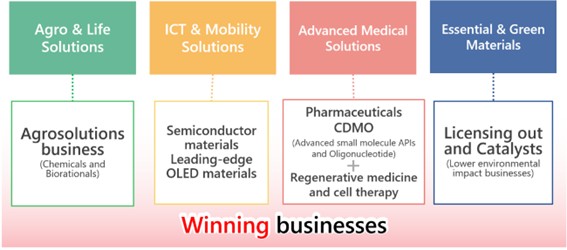
As of March 31, 2026, Sumitomo Chemical operates businesses in the agro & life solutions sector, the ICT & mobility solutions sector, the advanced medical solutions sector, and the essential & green materials sector, among others.

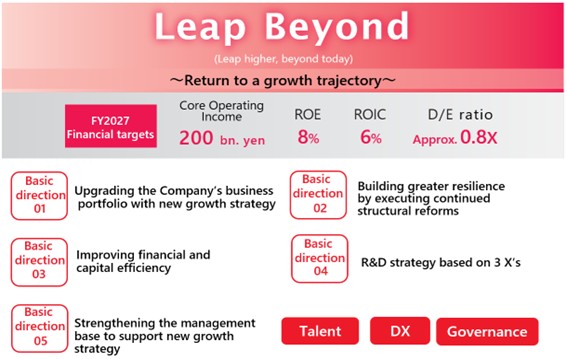
Sumitomo Chemical was established in June 1925 and has, in accordance with its corporate philosophy, including the Sumitomo spirit of “jiri rita koshi ichinyo” (“harmony between the individual, the nation and society”), put forth the following as its basic policies in the Corporate Business Plan for FY 2025 to FY 2027, “Leap Beyond: Return to a Growth Trajectory,” with the long-term vision to become an “Innovative Solution Provider”: (i) upgrading Sumitomo Chemical’s business portfolio through a new growth strategy; (ii) increasing resilience through the continuous implementation of structural reforms; (iii) improving financial and capital efficiency; (iv) an R&D strategy centered on Sumitomo Chemical’s three X’s (BX (biotechnological transformation), DX (digital transformation), and GX (green transformation)); and (v) enhancing its management foundation to support Sumitomo Chemical’s new growth strategy.

On the other hand, the Company was established in June 1917 and, as a pioneer of nitrogen-containing compounds, has engaged in the manufacture and sale of gas-phase products and amine products among other core products, as well as agrochemical-related chemical products and functional chemical products. By further advancing the core technologies it has cultivated over many years, the Company has been providing high-value-added, high-performance products.

The capital relationship between Sumitomo Chemical and the Company began in 1951, when Sumitomo Chemical (then named Sumitomo Kagaku Kogyou KK in Japanese) made a capital investment as a shareholder in the Company (then named Koei Kagaku Kogyou KK in Japanese) for the purpose of supporting management, followed by an additional investment by Sumitomo Chemical in 1954, as a result of which the Company became a consolidated subsidiary of Sumitomo Chemical. The Company was listed on the Second Section of the Osaka Securities Exchange in October 1997, and, as of the end of March 1998, the number of Company Shares held by Sumitomo Chemical was 13,647,093 shares (shareholding ratio (Note 1): 55.70%). Thereafter, the Company conducted a share consolidation at a ratio of one share for every five shares of common stock in October 2017, and, as of the end of March 2018, Sumitomo Chemical came to hold 2,731,400 Company Shares (shareholding ratio: 55.74%), and there has been no change in the number of Company Shares held by Sumitomo Chemical or in the shareholding ratio as of May 13, 2026.


(Note 1)

“Shareholding ratio” means the ratio to the number of issued shares of the Company at each point in time, rounded to the nearest second decimal place (however, as it is difficult to ascertain the number of treasury shares at each point in time, treasury shares have not been deducted from the number of issued shares).


Since Sumitomo Chemical’s capital participation in the Company in 1951, the Two Companies have collaborated in the business domain of agrochemical-related chemical products and functional chemical products. In recent years, collaboration has progressed especially in optical materials and pharmaceutical-related fields. To date, Sumitomo Chemical has respected the independence of the Company as a listed company, while promoting integrated group management and the realization of synergies. At the same time, in addition to the challenging industry environment, exemplified by rising resource and energy prices and supply shortages, the business environment facing the Two Companies has gone through significant change, including expanding needs for sustainability-related responses, as well as technological innovation in advanced medical fields, such as gene therapy using therapeutic oligonucleotides and regenerative and cell-based medicines.

In light of such environmental changes, the Company recognizes that its key challenges are to continue growth initiatives across each product field aimed at improving utilization of existing facilities, while accurately ascertaining business opportunities and further refining its proprietary technologies to expand its functional products and new business areas. In addition, while Sumitomo Chemical’s advanced small-molecule APIs CDMO business has thus far grown primarily in the domestic market, Sumitomo Chemical understands that strengthening its ability to respond to overseas projects will be important for further business expansion in the future.

Under these circumstances, as it becomes increasingly important for the Two Companies to accurately capture global business opportunities and execute their management strategies swiftly and flexibly, Sumitomo Chemical believes that collaboration involving the Company’s technologies, know-how, human resources, and multi-purpose facilities to establish a production system that meets the needs of major overseas pharmaceutical companies and other global clientele will enable the fulfillment of diverse domestic and international needs and enable expansion in the scale of business.

Sumitomo Chemical has come to recognize that the current parent-subsidiary relationship on a consolidated basis that is premised on maintaining the Company’s listing is, on its own, inadequate for the further acceleration of the aforementioned initiatives and promotion of integrated business operations while achieving sustainable growth by the Two Companies, and that a more integrated group management framework is necessary. Accordingly, by making the Company a wholly owned subsidiary of Sumitomo Chemical, Sumitomo Chemical aims to further strengthen the collaborative relationship, while enabling prompt and flexible decision-making and thorough implementation of policies within the Sumitomo Chemical group, and thereby contributing to the enhancement of the Two Companies’ corporate value, so Sumitomo Chemical made, on November 4, 2025, a proposal to the Company regarding the Share Exchange (the “Proposal”).

The Company, in response to the Proposal from its parent company Sumitomo Chemical, decided to begin detailed consideration of the Share Exchange. Upon commencing that detailed consideration of the Share Exchange, and prior to deliberation by the Company’s Board of Directors of the pros and cons of the Share Exchange and adoption of any resolution in that regard, on November 17, 2025 the Company established, as one of its measures to ensure the fairness of the Share Exchange, a framework for conducting that detailed consideration, including the creation of a special committee composed of members who are independent from Sumitomo Chemical and independent from whether the Share Exchange is consummated (the “Special Committee”; for details, please see “3(4) Matters considered to avoid harming the interest of the Company’s shareholders” below) (a) because structural conflicts of interest could arise in the Share Exchange, (b) for the purpose of protecting the general shareholders of the Company, and (c) from the perspectives of ensuring the fairness of the exchange ratio in the Share Exchange, eliminating arbitrariness in the decision-making process, and avoiding conflicts of interest.

The following are envisaged as specific measures and synergies realized based on those measures after the Share Exchange.


  (i)

Technological advancement through the combination of the Company’s and Sumitomo Chemical’s technological capabilities

Leveraging a diverse product range, accumulated technological capabilities, and custom synthesis capabilities, the Company, in addition to its foundational products, has developed functional products and new businesses and has built an established position as a leading company in the field of nitrogen-containing compounds. The Two Companies believe that combining the technological capabilities that are the source of the Company’s competitive advantage with Sumitomo Chemical’s technological capabilities will enable the pursuit of further technological advancement, including through collaborative exploration of new market needs. In particular, the Two Companies believe that combining the distinctive technologies of low-temperature curing catalysts and ionic liquids held by the Company with Sumitomo Chemical’s technologies will enable expansion into new markets and new product development.


  (ii)

Expansion of Sumitomo Chemical’s advanced small-molecule APIs CDMO business in Japan and abroad by leveraging the Company’s multi-purpose facilities

Partly due to a decrease in the demand for organometallic catalysts and the like, the Company’s group of multi-purpose facilities continues to be underutilized. In contrast, Sumitomo Chemical believes that, following the Share Exchange, it will be able to leverage the Company’s multi-purpose facilities into an expansion of the advanced small-molecule APIs CDMO business that Sumitomo Chemical is pursuing. Specifically, by leveraging Sumitomo Chemical’s management resources to convert the Company’s multi-purpose facilities into facilities that are GMP compliant both in Japan and abroad and by establishing a production system aligned with the needs of major overseas pharmaceutical companies and other global clientele in its advanced small-molecule APIs CDMO business, Sumitomo Chemical aims to handle diverse demand in Japan and abroad and expand the scale of its business.


  (iii)

Acceleration and optimization of business activities through integrated operation of the Two Companies

In addition to the synergies illustrated in (i) and (ii) above, the Two Companies believe that making the Company a wholly owned subsidiary of Sumitomo Chemical in the Share Exchange and thus enabling the Two Companies to operate in an integrated manner will result in swifter decision-making and enable even more extensive and flexible mutual leveraging of both parties’ information, human resources, and other management resources, leading to increased profitability across the Sumitomo Chemical group.

Further, the Two Companies believe that, after the Share Exchange, the general shareholders of the Company will, as shareholders of Sumitomo Chemical, be able to enjoy the economic benefits of increased corporate value resulting from the synergy between the Two Companies. In addition, the Two Companies believe that, in circumstances where the burden of responding to the development of systems required for listed companies and the costs of doing so are increasing, the Share Exchange will also contribute to a reduction in the operational burden and costs associated with maintaining a listing for the Company.

Since the Company will be delisted as a result of the Share Exchange, it is possible that the Company will no longer obtain certain advantages that listed companies are generally able to enjoy, such as the securing of diverse funding methods through equity financing, the positive impact on recruitment activities associated with the improvement in social creditworthiness and name recognition, and the improvement in financial data reliability through accounting audits. However, the Two Companies believe that the impact associated with delisting will be kept to a minimum taking into account the following, among other factors: with respect to funding needs, alternative means to conduct financing in the equity markets exist, such as financial support from the parent company to its subsidiaries; the Company’s name recognition is already ample due to its long history, and even if the Company were to become a non-listed company, it will continue being able to benefit from the name recognition of the Sumitomo Chemical group as a wholly owned subsidiary of Sumitomo Chemical by further strengthening its connections within the Sumitomo Chemical group, so it is believed that any negative impact on new staff recruitment and the like will be minor; and, further, it will be possible to maintain the financial reliability of the company because it will still be subject to Sumitomo Chemical’s consolidated accounting audit even after becoming a wholly owned subsidiary of Sumitomo Chemical.


In addition, the Two Companies have determined that selecting the Share Exchange as the method for making the Company a wholly owned subsidiary would be preferable. This determination has been reached because, by delivering shares of common stock of Sumitomo Chemical (“Sumitomo Chemical Shares”) to the general shareholders of the Company as consideration for the Share Exchange, the general shareholders of the Company will be provided with an opportunity to benefit from business expansion and increased earnings within the Sumitomo Chemical group and other similar advantages through the creation of anticipated synergies, and, in turn, an increase in the share price of Sumitomo Chemical. In addition, because Sumitomo Chemical Shares possess high liquidity and can be converted into cash at any time through market transactions, the Two Companies believe the Share Exchange to be appropriate.

As a result of comprehensive examination of these points by the Two Companies, the Two Companies reached the conclusion that making the Company a wholly owned subsidiary of Sumitomo Chemical would contribute to the improvement of the corporate value of the Two Companies. Upon reaching that conclusion, and after discussing various terms and conditions, including the allotment ratio, for the Share Exchange, the Two Companies have reached an agreement, and on May 13, 2026, at their Board of Directors meetings, the Two Companies resolved to implement the Share Exchange with the purpose of making the Company a wholly owned subsidiary of Sumitomo Chemical and also executed the Share Exchange Agreement.


2

Outline of the contents of the Share Exchange Agreement

The contents of the Share Exchange Agreement executed on May 13, 2026 by and between the Company and Sumitomo Chemical are as follows.

Share Exchange Agreement

Sumitomo Chemical Co., Ltd. (“Sumitomo Chemical”) and Koei Chemical Company, Limited (“Koei Chemical”) hereby enter into this Share Exchange Agreement (the “Agreement”) as follows.

Article 1 (Share Exchange)

Subject to the terms and conditions contained herein, Sumitomo Chemical and Koei Chemical will implement a share exchange as a result of which Sumitomo Chemical will be the wholly-owning parent company resulting from the share exchange and Koei Chemical will be the wholly-owned subsidiary resulting from the share exchange (the “Share Exchange”). As a result of the Share Exchange, Sumitomo Chemical will obtain all issued shares of Koei Chemical (excluding the shares of Koei Chemical held by Sumitomo Chemical).

Article 2 (Trade Name and Address)

The trade names and addresses of Sumitomo Chemical and Koei Chemical are as follows.


  (1)

Sumitomo Chemical (wholly-owning parent company resulting from the share exchange)

Trade name: Sumitomo Chemical Co., Ltd.

Address: 2-7-1, Nihonbashi, Chuo-ku, Tokyo


  (2)

Koei Chemical (wholly-owned subsidiary resulting from the share exchange)

Trade name: Koei Chemical Company, Limited

Address: 25 Kitasode, Sodegaura-shi, Chiba

Article 3 (Shares to Be Delivered in the Share Exchange and Their Allotment)


  1.

In the Share Exchange, Sumitomo Chemical will deliver to Koei Chemical’s shareholders as at the time immediately preceding the time at which the Share Exchange becomes effective (the “Record Time”) (excluding Sumitomo Chemical; the “Allottee Shareholders”) such number of shares of common stock of Sumitomo Chemical as is calculated by multiplying the total number of shares of Koei Chemical held by the Allottee Shareholders by 4.91.


  2.

In the Share Exchange, Sumitomo Chemical will allot shares of common stock of Sumitomo Chemical to each Allottee Shareholder at the rate of 4.91 shares of Sumitomo Chemical per share of common stock of Koei Chemical held by such Allottee Shareholder.


  3.

Any fraction of less than one share of Sumitomo Chemical that should otherwise be delivered to an Allottee Shareholder pursuant to the provisions of the preceding paragraphs shall be disposed of by Sumitomo Chemical in accordance with Article 234 of the Companies Act and other applicable laws and regulations.


Article 4 (Amount of Capital and Reserves of Sumitomo Chemical)

The amounts by which the capital and reserves of Sumitomo Chemical will increase in connection with the Share Exchange shall be the amounts separately and appropriately determined by Sumitomo Chemical pursuant to the provisions of Article 39 of the Rules of Corporate Accounting.

Article 5 (Effective Date)

The Share Exchange shall become effective as of August 1, 2026 (the “Effective Date”); provided, however, that Sumitomo Chemical and Koei Chemical may change the Effective Date upon consultation and agreement if necessary to accommodate the procedures for the Share Exchange or for any other reason.

Article 6 (General Meeting of Shareholders)


  1.

Pursuant to the provisions of Article 796, paragraph (2) of the Companies Act, Sumitomo Chemical will implement the Share Exchange without obtaining approval of this Agreement at a general meeting of shareholders as set forth in Article 795, paragraph (1) of the Companies Act; provided, however, that if Sumitomo Chemical is required, pursuant to the provisions of Article 796, paragraph (3) of the Companies Act, to obtain approval of this Agreement by a resolution of its general meeting of shareholders, Sumitomo Chemical shall convene a general meeting of shareholders no later than the day before the Effective Date and seek resolutions for approval of this Agreement and other matters necessary for the Share Exchange.


  2.

Koei Chemical shall, no later than the day before the Effective Date, seek resolutions for approval of this Agreement and other matters necessary for the Share Exchange at a general meeting of shareholders as set forth in Article 783, paragraph (1) of the Companies Act.

Article 7 (Management of Corporate Assets, Etc.)


  1.

After the execution of this Agreement and until the Effective Date, Sumitomo Chemical and Koei Chemical shall conduct their business and manage and operate their assets with the due care of a prudent manager. If either Sumitomo Chemical or Koei Chemical intends to conduct any act that may have a material effect on its assets or rights and obligations, or any act that may have a material effect on the implementation of the Share Exchange or the terms and conditions of the Share Exchange, including, but not limited to, distribution of dividends of surplus with a record date prior to the Effective Date, acquisition of treasury shares with an acquisition date prior to the Effective Date, and share splits or share consolidations, Sumitomo Chemical and Koei Chemical shall conduct such act only after prior consultation and agreement between them.


  2.

Notwithstanding the preceding paragraph, Sumitomo Chemical may distribute dividends of surplus up to 7.5 yen per share to shareholders entered or recorded in the final shareholder registry as of March 31, 2026, and Koei Chemical may distribute dividends of surplus up to 50 yen per share to shareholders entered or recorded in the final shareholder registry as of March 31, 2026.

Article 8 (Cancellation of Treasury Shares of Koei Chemical)

Koei Chemical shall, by a resolution of its Board of Directors adopted no later than the day before the Effective Date, cancel at the Record Time all treasury shares held by Koei Chemical at the Record Time (including treasury shares acquired by Koei Chemical through the purchase of shares subject to a share purchase demand by dissenting shareholders as prescribed in Article 785, paragraph (1) of the Companies Act that is exercised in relation to the Share Exchange).


Article 9 (Amendment of the Conditions of the Share Exchange and Termination of this Agreement)

If, during the period from the execution date of this Agreement until the Effective Date, there is any material change in the assets or business condition of Sumitomo Chemical or Koei Chemical due to a natural disaster or any other reason, any event arises that materially hinders the implementation of the Share Exchange, or it otherwise becomes difficult to achieve the purpose of this Agreement, Sumitomo Chemical and Koei Chemical may, upon consultation and agreement, amend the conditions of the Share Exchange or terminate this Agreement.

Article 10 (Validity of this Agreement)

This Agreement shall cease to be effective if any of the following applies:


  (1)

approval by a resolution of the general meeting of shareholders of Koei Chemical as set forth in Article 6, paragraph (2) is not obtained by the day before the Effective Date;


  (2)

in the case set forth in the proviso to Article 6, paragraph (1), approval by a resolution of the general meeting of shareholders of Sumitomo Chemical as set forth in that proviso is not obtained by the day before the Effective Date;


  (3)

any approval, etc. of the relevant authorities legally required for the Share Exchange, if any, is not obtained by the day before the Effective Date; or


  (4)

this Agreement is terminated in accordance with the provisions of the preceding Article.

Article 11 (Governing Law and Jurisdiction)


  1.

This Agreement shall be governed by, and construed in accordance with, the laws of Japan.


  2.

The parties agree that the Tokyo District Court shall have exclusive jurisdiction as the court of first instance over any dispute arising in connection with this Agreement.

Article 12 (Matters for Consultation)

In addition to the matters set forth in this Agreement, any matters necessary for the Share Exchange shall be determined upon good-faith consultation and agreement between Sumitomo Chemical and Koei Chemical in accordance with the spirit of this Agreement.

In witness whereof, this Agreement has been executed in duplicate, with Sumitomo Chemical and Koei Chemical to retain one copy each after both have affixed their respective names and seals.

May 13, 2026

Sumitomo Chemical:

2-7-1 Nihonbashi, Chuo-ku, Tokyo

Sumitomo Chemical Co., Ltd.

Nobuaki Mito,

Representative Director & President

Koei Chemical:

25 Kitasode, Sodegaura-shi, Chiba

Koei Chemical Company, Limited

Yasuaki Sasaki,

Representative Director & President


3

Matters relating to the appropriateness of the consideration for the exchange


(1)

Matters relating to the appropriateness of the total amount, and allotment, of the consideration for the exchange


(A)

Allotments in connection with the Share Exchange


     Sumitomo Chemical
(wholly owning parent
company resulting from a
share exchange)
     The Company
(wholly owned subsidiary
resulting from a share
exchange)
 

Allotment ratio in connection with the Share Exchange

     1        4.91  

Number of shares to be delivered in the Share Exchange

    
Sumitomo Chemical Shares:
10,603,734 shares (scheduled)


     (Note 1)   

Allotment ratio of shares


Sumitomo Chemical will allot and deliver 4.91 Sumitomo Chemical Shares per one Company Share. However, no shares will be allotted in the Share Exchange for Company Shares held by Sumitomo Chemical as of the Record Time (as defined below). The above allotment ratio for the Share Exchange (the “Share Exchange Ratio”) might be changed upon discussions and agreement between the Two Companies if a significant change occurs in various terms and conditions that constitute the bases for the relevant calculations.

  (Note 2)   

Numberof Sumitomo Chemical Shares to be delivered in a share exchange, etc.


Upon the Share Exchange, Sumitomo Chemical plans to allot and deliver to the shareholders of the Company (excluding Sumitomo Chemical) as of the time immediately prior to Sumitomo Chemical’s acquisition through the Share Exchange of all the issued shares of the Company (excluding Company Shares held by Sumitomo Chemical; that time immediately prior to the time of acquisition, the “Record Time”) the number of Sumitomo Chemical Shares calculated by multiplying the total number of Company Shares held by each shareholder by the Share Exchange Ratio. Sumitomo Chemical plans to use a portion of the treasury shares it holds (6,000,000 shares) and the shares to be newly issued by Sumitomo Chemical as the shares to be delivered by Sumitomo Chemical. The Company plans to cancel, at the Record Time, all of the treasury shares that it holds as of the Record Time (including treasury shares acquired by the Company through a share purchase in response to a share purchase demand made by dissenting shareholders in relation to the Share Exchange under the provisions of Article 785, paragraph 1 of the Companies Act) by a resolution at its Board of Directors meeting held on or before the day preceding the effective date of the Share Exchange.

  (Note 3)   

Handlingof shares less than one unit


Shareholders of the Company who come to hold shares less than one unit (stock of less than 100 shares) of Sumitomo Chemical as a consequence of the Share Exchange may participate in either of the following programs concerning Sumitomo Chemical Shares in accordance with the provisions of the Articles of Incorporation and the Share Handling Regulations of Sumitomo Chemical. Shares less than one unit may not be sold on a financial instruments exchange market.


(A)  Additional purchase program for shares less than one unit (additional purchase to enable holding of 100 shares)


Under this program, any shareholder who holds shares less than one unit of Sumitomo Chemical may, in accordance with the provisions of Article 194, paragraph 1 of the Companies Act and the Articles of Incorporation of Sumitomo Chemical, purchase from Sumitomo Chemical shares that, when combined with the shares less than one unit held by that shareholder, will constitute one unit.


(B)  Demand for purchase from holders of shares less than one unit (sale of shares less than one unit)


Under this program, any shareholder who holds shares less than one unit of Sumitomo Chemical may, in accordance with the provisions of Article 192, paragraph 1 of the Companies Act, demand Sumitomo Chemical to purchase shares less than one unit held by that shareholder.


     (Note 4)   

Handling of fractions of less than a single share


In relation to shareholders of the Company who will be delivered Sumitomo Chemical Shares that are fractional shares less than a single share as a consequence of the Share Exchange, Sumitomo Chemical will, in accordance with the provisions of Article 234 of the Companies Act and other relevant laws and ordinances, sell Sumitomo Chemical Shares equal to the total number of those fractions of less than a single share (any fractions of less than a single share in such total number being rounded down to the nearest whole number) and pay the sales proceeds to each of those shareholders in proportion to the value of such fractions of less than a single share.


(B)

Basis for allotments in connection with the Share Exchange


i.

Basis and reason for allotments

In order to ensure that the calculation of the Share Exchange Ratio described in “(A) Allotments in connection with the Share Exchange” above is fair and appropriate, the Company and Sumitomo Chemical have each separately decided (a) to request third-party valuation firms that are independent of the Two Companies to conduct share exchange ratio calculations and (b) to receive legal advice from legal advisors that are independent of the Two Companies. Sumitomo Chemical commenced its examination of matters concerning the Share Exchange Ratio upon Sumitomo Chemical appointing Nomura Securities Co., Ltd. (“Nomura Securities”) as its financial advisor and third-party valuation firm and Mori Hamada & Matsumoto (“Mori Hamada”) as its legal advisor, and the Company appointing Daiwa Securities Co., Ltd. (“Daiwa Securities”) as its financial advisor and third-party valuation firm and Shimada Hamba & Osajima as its legal advisor.

As a result of careful deliberation and examination taking into consideration the share exchange ratio calculation report dated May 12, 2026 obtained from Sumitomo Chemical’s financial advisor and third-party valuation firm Nomura Securities, advice from Sumitomo Chemical’s legal advisor Mori Hamada, results of due diligence conducted by Sumitomo Chemical on the Company, and the like as described in “(4) Matters considered to avoid harming the interest of the Company’s shareholders” below, Sumitomo Chemical reached the determination that the Share Exchange Ratio is appropriate and will contribute to the interests of the shareholders of Sumitomo Chemical. Accordingly, Sumitomo Chemical determined that the implementation of the Share Exchange at the Share Exchange Ratio is appropriate.

At the same time, the Company conducted careful deliberation and examination taking into consideration the share exchange ratio calculation report dated May 12, 2026 obtained from the Company’s financial advisor and third-party valuation firm Daiwa Securities, advice from the Company’s legal advisor Shimada Hamba & Osajima, results of due diligence conducted by the Company on Sumitomo Chemical, instructions and advice from the Special Committee composed of members who are independent from the controlling shareholder Sumitomo Chemical and independent from whether the Share Exchange is consummated, and the contents of the written report received on May 12, 2026 from the Special Committee (the “Written Report”; for contents of the Written Report, please refer to the “Report” dated May 12, 2026, which is a material attached to the “Notice Regarding Execution of Share Exchange Agreement (Simplified Share Exchange) to Make Koei Chemical Company, Limited a Wholly Owned Subsidiary of Sumitomo Chemical Co., Ltd.” (the “Share Exchange Press Release”) published by the Company and Sumitomo Chemical on May 13, 2026) as described in “(4) Matters considered to avoid harming the interest of the Company’s shareholders” below. As a result, the Company reached the determination that the Share Exchange Ratio is appropriate and will contribute to the interests of the general shareholders of the Company. As announced in the “Notice Regarding the Recording of Impairment Losses and the Revision of Earnings Forecast for the Fiscal Year Ending March 31, 2026” dated March 31, 2026 and the “Notice Regarding the Revision of Earnings Forecast for the Fiscal Year Ending March 31, 2026” dated April 21, 2026, the Company has revised its full-year earnings forecast for the fiscal year ending March 31, 2026 (the “Forecast Revision”); however, as stated in “(C) Establishing at the Company an independent special committee and obtaining a written report from that special committee” of “(4) Matters considered to avoid harming the interest of the Company’s shareholders,” the Special Committee has confirmed the following, among other matters: (a) that the Forecast Revision was made based on appropriate accounting judgments by the Company, was conducted independently of the examination of the Share Exchange, and was not influenced by Sumitomo Chemical; and (b) whether or not any revision to the business plan was necessary.


As described above, the Company and Sumitomo Chemical repeatedly held negotiations and consultations after a careful examination based on the results of due diligence conducted by the Company and Sumitomo Chemical on each other while referring to the share exchange ratio calculation results submitted by their respective third-party valuation firms and comprehensively taking into account various elements related to the Two Companies, including financial conditions, asset statuses, future outlooks, and synergistic effects expected to be realized through the implementation of the Share Exchange. As a result, the Company and Sumitomo Chemical have reached the determination that the Share Exchange Ratio is appropriate and will contribute to the interests of their respective shareholders. Accordingly, the Two Companies determined that the implementation of the Share Exchange at the Share Exchange Ratio is appropriate. The Share Exchange Ratio may, in accordance with the Share Exchange Agreement, be changed upon consultation and agreement between the Two Companies if there are any material changes to the various terms and conditions constituting the basis of the calculations.


ii.

Matters relating to calculations


  (A)

Names of the valuation firms and relationships with the Two Companies

Sumitomo Chemical’s third-party valuation firm Nomura Securities is a valuation firm independent of the Two Companies, is not a related party of either the Company or Sumitomo Chemical, and does not have a material interest that must be stated in relation to the Share Exchange. Compensation for Nomura Securities includes a success fee that will be paid subject to the successful completion of the Share Exchange and the like; however, Sumitomo Chemical believes that the independence of Nomura Securities is not negated by the fact that the success fee to be paid subject to the successful completion of the Share Exchange and the like is included, taking into account the general practices of similar transactions and other such factors.

The Company’s third-party valuation firm Daiwa Securities is a valuation firm independent of the Two Companies, is not a related party of either the Company or Sumitomo Chemical, and does not have a material interest that must be stated in relation to the Share Exchange. Compensation for Daiwa Securities includes a success fee that will be paid subject to the successful completion of the Share Exchange and the like; however, the Company believes that the independence of Daiwa Securities is not negated by the fact that the success fee to be paid subject to the successful completion of the Share Exchange and the like is included, taking into account the general practices of similar transactions and the appropriateness of a compensation structure that would result in the Company incurring a significant financial burden if the Share Exchange were not to be completed, and other such factors.


  (B)

Outline of calculations


  a)

Calculations by Nomura Securities

With respect to Sumitomo Chemical, because the shares of Sumitomo Chemical are listed on the Prime Market of the TSE and have a market price, Nomura Securities performed its calculations using the average market price method (the valuation reference date was set as May 12, 2026, and each of the following closing prices were used for the calculations: the closing price on the TSE on the valuation reference date, and the simple average closing prices for the last five business days, one-month, three-month, and six-month periods to the valuation reference date).

With respect to the Company, Nomura Securities performed its calculations using the following methods: (i) average market price method because the shares of the Company are listed on the Standard Market of the TSE and have a market price (the valuation reference date was set as May 12, 2026, and each of the following closing prices were used for the calculations: the closing price on the TSE on the valuation reference date, and the simple average closing prices for the last five business days, one-month, three-month, and six-month periods to the valuation reference date); (ii) the comparable company comparison method because there are multiple listed companies comparable to the Company, and it is possible to estimate the Company’s share value by the comparable company comparison method; and (iii) the discounted cash flow method (the “DCF Method”) in order to reflect the status of future business activities in the valuation.


The share exchange ratio calculation results are as follows, based on the assumption that, under each valuation method, the share value per share of Sumitomo Chemical is one.


     Share exchange ratio calculation results  

Average market price method

     4.15–4.43  

Comparable company comparison method

     1.15–4.63  

DCF Method

     3.17–5.89  

In conducting its share exchange ratio calculations, Nomura Securities has assumed that publicly available information and any information provided to Nomura Securities is accurate and complete, and Nomura Securities has not made any independent study of the accuracy or completeness thereof. Nomura Securities has not made any independent valuation, appraisal, or assessment and has not requested any third-party institution to conduct any appraisal or assessment, in connection with any relevant assets or liabilities (including financial derivatives, off-balance-sheet assets and liabilities, and other contingent liabilities) of Sumitomo Chemical, the Company, or any of their affiliates, including any analysis or valuation of their respective assets or liabilities. Nomura Securities has also proceeded on the assumption that the financial projections of the Company and other forward-looking information have been reasonably examined or prepared by the management of the Company based on the best forecasts and judgments available at that time. Nomura Securities’ calculations are based on the information obtained by Nomura Securities and the economic conditions as of May 12, 2026. The sole purpose of Nomura Securities’ calculations is to serve as a reference for the Board of Directors of Sumitomo Chemical to deliberate the Share Exchange Ratio.

The financial projections of the Company that Nomura Securities used as a basis for the calculation by the DCF Method include a fiscal year in which a significant increase or decrease in profit and free cash flow compared to the previous year is expected. Specifically, details are as follows.


  (a)

Primarily due to, among other factors, a decrease in depreciation expenses in future periods resulting from the recording of impairment losses announced by the Company on March 31, 2026, operating income for the fiscal year ending March 2027 is expected to increase significantly compared to the previous year. Further, primarily due to, among other factors, growth in sales of optical materials, recovery from the recent deterioration in market conditions in the contracted business for organometallic catalysts, and expansion in the products provided by the Company, a significant increase in operating income is expected in the fiscal years ending March 2028 and March 2029 compared to the respective previous years.


  (b)

While, in the fiscal year ending March 2027, a significant decrease in free cash flow is expected primarily due to an increase in working capital for the expansion of sales scale and an increase in capital investments in existing businesses, a significant increase in free cash flow is expected in the fiscal years ending March 2028 and March 2029 compared to the respective previous years primarily due to an increase in operating income stated in (a) above.

These financial projections do not reflect the implementation of the Share Exchange.


  b)

Calculations by Daiwa Securities

With respect to Sumitomo Chemical, because the shares of Sumitomo Chemical are listed on the Prime Market of the TSE and have a market price, Daiwa Securities performed its calculation using market price analysis.

With respect to the Company, Daiwa Securities performed its calculation using market price analysis because the shares of the Company are listed on the Standard Market of the TSE and have a market price, and the DCF Method was also used in order to reflect the status of future business activities in the valuation.

The share exchange ratio calculation results are as follows, based on the assumption that, under each valuation method, the share value per share of Sumitomo Chemical is one.


     Share exchange ratio calculation results  

Market price method

     4.18–4.43  

DCF Method

     3.55–5.27  


In the market price analysis, Daiwa Securities set the valuation reference date as May 12, 2026, and each of the following closing prices were used for the calculation: the simple average closing prices for the last one-month, three-month, and six-month periods to the reference date.

In calculating the share exchange ratios above, Daiwa Securities has, in principle, used materials and information provided to it by the Company and Sumitomo Chemical and publicly available information as presented and assumed that all of the materials and information under analysis and consideration are accurate and complete, and Daiwa Securities has not made any independent study of the accuracy or completeness of those materials and information and is not obligated to do so. Daiwa Securities has assumed that there is no information left undisclosed to Daiwa Securities that would have a significant impact on the calculation of the share exchange ratio. Daiwa Securities has not made any independent valuation, appraisal, or assessment and has not requested any third-party institution to conduct any valuation, appraisal or assessment, in connection with any relevant assets or liabilities (including, but not limited to, financial derivatives, off-balance-sheet assets and liabilities, and other contingent liabilities) of the Company, Sumitomo Chemical, or any of their affiliates, including any analysis or valuation of their respective assets or liabilities. Daiwa Securities has assumed that the business plan for the period from the fiscal year ending March 2026 to the fiscal year ending March 2030 prepared by the Company (including any amendments to that business plan; the “Business Plan”) and other forward-looking information have been reasonably confirmed and examined by the management of the Company based on the best forecasts and judgments available at that time. The sole purpose of the calculation results of the share exchange ratios submitted by Daiwa Securities are to serve as a reference for the Board of Directors of the Company to deliberate the Share Exchange Ratio, and those calculation results do not constitute an expression of any opinion on the fairness of the Share Exchange Ratio.

In the DCF Method, Daiwa Securities calculated the Company’s corporate value and share value by discounting free cash flow expected to be generated by the Company from the fiscal year ending March 2026 and onwards, which is based on financial projections in the Business Plan, financial information as of the end of the third quarter of the fiscal year ending March 2026, publicly available information, and various other factors, at a certain discount rate to the present value. The weighted average cost of capital was used for the discount rates in the range of 9.7% to 10.7%, and the discount rate was calculated with the inclusion of a size premium, taking into account the size of the Company. In evaluating the going-concern value, the constant growth rate model was used and the perpetual growth rate of 0.5% to 1.5% was used, taking into account domestic and international inflation rates as well as the growth rate of the industry to which the Company belongs, and the going-concern value was calculated to be from 20,280 million yen to 25,226 million yen.

The Special Committee has approved the Business Plan prepared by the Company after confirming the contents and the preparation process thereof (including any amendments to the Business Plan and the process of such amendments; the same applies hereinafter), as described in “(C) Establishing at the Company an independent special committee and obtaining a written report from that special committee” in “(4) Matters considered to avoid harming the interest of the Company’s shareholders” below.

The financial projections of the Company that are based on the Business Plan and that Daiwa Securities used as a basis for the calculation by the DCF Method are as presented in the table below, and these financial projections include a fiscal year in which a significant increase or decrease in profit and free cash flow compared to the previous year is expected. Specifically, details are as follows:


  (a)

due to, among other factors, a decrease in depreciation expenses in future periods resulting from the recording of impairment losses announced by the Company on March 31, 2026, operating income has increased, and operating income for the fiscal year ending March 2027 is expected to increase significantly compared to the previous year;


  (b)

growth in sales of optical materials, recovery from the recent deterioration in market conditions in the contracted business for organometallic catalysts, and expansion in the products provided by the Company, are expected to contribute to significant ongoing increases in sales and operating income from the fiscal year ending March 2028 through the fiscal year ending March 2030;


  (c)

while sales growth is expected in the fiscal year ending March 2030 in connection with the launch of the business for products related to carbon neutrality positioned as a medium- to long-term growth driver, capital investments in new facilities for that business are planned for the fiscal years ending March 2028 and March 2029, and depreciation expenses associated with those investments are expected to arise thereafter, which are expected to affect operating income and free cash flow; and


  (d)

while, in the fiscal years ending March 2027 and March 2028, in addition to the factors stated in (a) through (c) above, a significant decrease in free cash flow is expected due to an increase in working capital for the expansion of sales scale and an increase in capital investments in existing businesses, a significant increase in free cash flow is expected (i) in the fiscal year ending March 2029 (compared to the previous year), due to an increase in operating income, and (ii) in the fiscal year ending March 2030 (compared to the previous year), due to the completion of capital investments for products related to carbon neutrality.

These financial projections do not reflect the implementation of the Share Exchange.

(Unit: million yen)

     Fiscal year
ending
March 2026
(three
months)
     Fiscal year
ending
March 2027
    Fiscal year
ending
March 2028
    Fiscal year
ending
March 2029
     Fiscal year
ending
March 2030
 

Sales revenue

     6,180        18,724       20,310       22,770        25,918  

Operating income

     372        970       1,236       2,548        3,566  

EBITDA

     1,091        2,971       3,568       4,835        5,721  

Free cash flow

     2,764        (101     (321     760        1,445  


  (2)

Matters relating to the appropriateness of the amounts of stated capital and reserves of Sumitomo Chemical

The amounts of stated capital and reserves of Sumitomo Chemical to be increased upon the Share Exchange will be amounts to be separately and properly determined by Sumitomo Chemical in accordance with the provisions of Article 39 of the Regulation on Corporate Accounting. The Company has judged that such treatment is appropriate, because the aforementioned determination will be made within the scope permitted by laws and ordinances after comprehensive consideration and examination of Sumitomo Chemical’s financial condition, capital policy, and other circumstances.


  (3)

Reasons for selecting Sumitomo Chemical Shares as the consideration for the exchange

The Company and Sumitomo Chemical have selected shares of Sumitomo Chemical, which will become a wholly owning parent company resulting from a share exchange, as consideration for the Share Exchange.

The Company believes that the above selection is appropriate, taking into consideration that (i) Sumitomo Chemical Shares are listed on the Prime Market of the TSE, and trading opportunities in that market will continue to be secured even after the effective date of the Share Exchange, and (ii) the Company’s shareholders are also expected to be able to enjoy the synergies from the Share Exchange described in “1 Reasons for conducting the Share Exchange” above.

As a result of the Share Exchange, the Company will become a wholly owned subsidiary of Sumitomo Chemical on August 1, 2026 (scheduled), which is the effective date of the Share Exchange, and Company Shares are scheduled to be delisted as of July 30, 2026 (with a final trading date of July 29, 2026) in accordance with the delisting criteria of the TSE. If the current effective date of the Share Exchange is changed, the delisting date will also be changed.

Even after Company Shares are delisted, given that Sumitomo Chemical Shares that are allotted to the shareholders of the Company in the Share Exchange will continue to be listed on the TSE Prime Market and that it will be possible to trade those Sumitomo Chemical Shares on a financial instruments exchange market even on or after the effective date of the Share Exchange, it is believed that shareholders of the Company who are allotted not less than 100 shares of Sumitomo Chemical Shares, which is the number of shares constituting one unit of Sumitomo Chemical Shares, will continue to be provided with share liquidity.


On the other hand, the shareholders of the Company who are allotted less than 100 Sumitomo Chemical Shares in the Share Exchange, which is the number of shares constituting one unit of Sumitomo Chemical Shares, may not sell those shares less than one unit on a financial instruments exchange market, but may demand that Sumitomo Chemical purchase the shares less than one unit that the shareholder in question holds. Each of those shareholders may purchase from Sumitomo Chemical shares that, when combined with the shares less than one unit held by that shareholder, will constitute one unit. For details, please refer to (Note 3) “Handling of shares less than one unit” in “(A) Allotments in connection with the Share Exchange” in “(1)” above. With respect to details regarding the handling of fractional shares less than a single Sumitomo Chemical Share that arise as a consequence of the Share Exchange, please refer to (Note 4) “Handling of fractions of less than a single share” in “(A) Allotments in connection with the Share Exchange” in “(1)” above.

Shareholders of the Company may continue to trade Company Shares they hold until July 29, 2026 (scheduled), which is the last trading date, on the TSE Standard Market and may also exercise their legal rights provided for in the Companies Act and other related laws and ordinances until the Record Time.


  (4)

Matters considered to avoid harming the interest of the Company’s shareholders Since Sumitomo Chemical already holds 2,731,400 Company Shares (55.85% of the number of shares resulting (4,891,020 shares) when the number of the Company’s treasury shares (8,980 shares) is deducted from the number of issued shares of the Company as of March 31, 2026 (4,900,000 shares)) and the Company constitutes a consolidated subsidiary of Sumitomo Chemical, the Two Companies determined that it is necessary to avoid conflicts of interest and ensure fairness in the Share Exchange, and they have taken the following measures to ensure fairness (including measures to avoid conflicts of interest).


  (A)

Obtaining calculations reports from third-party valuation firms independent from the Two Companies

Sumitomo Chemical appointed Nomura Securities, which is a third-party valuation firm that is independent from the Two Companies, and the Company appointed Daiwa Securities, which is a third-party valuation firm that is independent from the Two Companies, as their respective third-party valuation firms, and the Two Companies each obtained share exchange ratio calculation reports.

Please refer to “ii. Matters relating to calculations” in “(B)” in “(1)” above for an outline of each calculation report. Neither the Company nor Sumitomo Chemical has obtained from either of those third-party valuation firms an opinion stating that the Share Exchange Ratio is appropriate or fair from a financial perspective (a fairness opinion).


  (B)

Advice from independent law firms

Sumitomo Chemical appointed Mori Hamada as its legal advisor for the Share Exchange and obtained advice from a legal perspective concerning various procedures for the Share Exchange, the decision-making method and processes, and the like. Mori Hamada is independent from, and has no material interests in, the Two Companies.

At the same time, the Company appointed Shimada Hamba & Osajima as its legal advisor for the Share Exchange and obtained advice from a legal perspective concerning various procedures for the Share Exchange, the decision-making method and processes, and the like. Shimada Hamba & Osajima is independent from, and has no material interests, in the Two Companies.


  (C)

Establishing at the Company an independent special committee and obtaining a written report from that special committee


  i.

Process of establishment, etc.


The Company, upon commencing detailed consideration of the Share Exchange in response to the Proposal from Sumitomo Chemical, and prior to deliberation by the Company’s Board of Directors of the pros and cons of the Share Exchange and adoption of any resolution in that regard, established on November 17, 2025 a special committee composed of three members, namely Mr. Ken Takiguchi (Outside Director (Audit & Supervisory Committee Member) and independent director of the Company), Ms. Yoko Hatta (Outside Director (Audit & Supervisory Committee Member) and independent director of the Company), and Ms. Ryoko Ueda (Outside Director and independent director of the Company), for the purposes of ensuring careful decision-making by the Company’s Board of Directors in relation to the Share Exchange, eliminating arbitrariness and avoiding conflicts of interest in the decision-making process by the Company’s Board of Directors, and ensuring the fairness of the Share Exchange, as well as to obtain an opinion on whether or not it would be fair for the Company’s general shareholders if a decision were made by the Company’s Board of Directors to conduct the Share Exchange. Mr. Ken Takiguchi was selected as chairperson of the Special Committee of the Company by a mutual vote of the committee members.

The compensation for the members of the Special Committee is composed solely of a fixed amount of compensation in consideration of their duties, regardless of the successful completion of the Share Exchange and the matters stated in the contents of the report and does not include any success fees payable subject to the successful completion of the Share Exchange.

The Company’s Board of Directors inquired with the Special Committee in relation to the following (collectively, the “Inquiries”): (1) the legitimacy and reasonableness of the purposes of the Share Exchange (including whether the Share Exchange will contribute to the enhancement of the corporate value of the Company); (2) the legitimacy and appropriateness of the procedures for the Share Exchange; (3) the legitimacy and appropriateness of the terms and conditions of the Share Exchange (including the share exchange ratio); (4) taking into account the foregoing, whether or not it would be fair for the Company’s general shareholders if a decision were made by the Company’s Board of Directors to conduct the Share Exchange; and (5) other matters related to the Share Exchange that are deemed necessary and were the subject of inquiry by the Company’s Board of Directors, in consideration of the purpose of the establishment of the Special Committee. In addition, the Company’s Board of Directors resolved to position the Special Committee as a meeting body independent from the Board of Directors, to ensure that its decision-making regarding the Share Exchange would respect the determinations of the Special Committee to the maximum extent, and, in particular, to refuse approval of the implementation of the Share Exchange if the Special Committee determines that the implementation of the Share Exchange or its terms and conditions would not be appropriate.

The Company’s Board of Directors also resolved to grant to the Special Committee the authority to do the following: (a) be substantively involved in the process of negotiations conducted by the Company in connection with the Share Exchange (including, as necessary, issuing instructions or requests regarding negotiation policies and conducting negotiations by itself); (b) when conducting examination or making decisions regarding the Inquiries, appoint, as necessary, advisors with respect to financial, legal, or other matters pertaining to the Special Committee (in which case, the fees will be borne by the Company) or nominate or approve (including ex post facto approval of) any advisor with respect to financial, legal, or other matters pertaining to the Company; and (c) receive, as necessary, from employees or officers of the Company or any other person deemed necessary by the Special Committee any information necessary for examining, and making determinations regarding, the Inquiries.


  ii.

Process of examination

The Special Committee carefully examined the Inquiries by holding meetings of the Special Committee 14 times in total during the period from November 17, 2025 to May 12, 2026, in addition to collecting information, and having discussions from time to time and taking other actions as necessary.


Specifically, the Special Committee confirmed that there were no issues regarding the independence and expertise of each of Daiwa Securities, which is the financial advisor and third-party appraiser appointed by the Company, and Shimada Hamba & Osajima, which is the legal advisor appointed by the Company, and approved those appointments. Subsequently, the Special Committee received from the Company and Sumitomo Chemical explanations regarding, and held question-and-answer sessions with each of the Company and Sumitomo Chemical in relation to, the following, among other matters: the purposes of the Share Exchange; the background of, and course of events that led to, the Share Exchange; the details of the synergies to be created by the Share Exchange; and the management policy and treatment of employees after the Share Exchange. The Special Committee also received from the Company explanations regarding, and held question-and-answer sessions with the Company in relation to, the contents of, and the preparation process for, the Business Plan that was used as the basis for the calculation of the Share Exchange Ratio. After confirming, among other matters, that there were no circumstances that would cast doubt on the reasonableness of the contents of, or the fairness of the preparation process for, the Business Plan, the Special Committee approved the Business Plan at the third meeting of the Special Committee. Although the Business Plan differs in certain respects from the Company’s “Corporate Business Plan for FY 2025 to FY 2027 ‘Striving for Transformation’ KX2027” (the “Corporate Business Plan”) published on March 7, 2025, the Special Committee determined that the differences between the Business Plan and the Corporate Business Plan are reasonable in light of changes in the business environment and customer circumstances that have arisen since the announcement of the Corporate Business Plan, and actual results to date for the fiscal year 2025, among other factors, based on explanations from, and question-and-answer sessions with, the Company. Subsequently, the Company revised the Business Plan to incorporate (i) revenue generated from products related to large-scale carbon neutrality, because the increased likelihood of such revenue generation made it necessary and reasonable to reflect such revenue in the Business Plan, as well as (ii) the downward revision of the full-year earnings forecast for the fiscal year ending March 31, 2026 that was announced in the “Notice Regarding the Recording of Impairment Losses and the Revision of Earnings Forecast for the Fiscal Year Ending March 31, 2026” dated March 31, 2026 (the “Downward Forecast Revision”). The eighth Special Committee approved the revision of the Business Plan after confirming that the Downward Forecast Revision was made based on appropriate accounting judgments by the Company, was conducted independently of the examination of the Share Exchange, and was not influenced by Sumitomo Chemical, and in light of (i) the fact that it was deemed necessary and reasonable to revise the business plan, including in relation to the impact of the increased likelihood of revenue generated from the aforementioned products related to large-scale carbon neutrality and (ii) the fact that there was no involvement by or influence from Sumitomo Chemical, or any other similar circumstance, in the process of such revision. Furthermore, as announced in the “Notice Regarding the Revision of Earnings Forecast for the Fiscal Year Ending March 31, 2026” dated April 21, 2026, the Company made an upward revision to the full-year earnings forecast for the fiscal year ending March 31, 2026 that was announced on March 31, 2026 (such revision, the “Upward Forecast Revision”); however, the Special Committee confirmed that there was no need to further revise the Business Plan after the revision that had been approved at the eighth Special Committee, because the Upward Forecast Revision was made based on appropriate accounting judgments by the Company, was conducted independently of the Share Exchange, and was not influenced by Sumitomo Chemical, and the impact of the Upward Forecast Revision on the Business Plan for the fiscal year ending March 31, 2027 and onwards is extremely limited. Furthermore, the Special Committee received explanations from Daiwa Securities, which is the financial advisor and third-party appraiser for the Company, in relation to the methods and results of the calculation of the share exchange ratio and held question-and-answer sessions with Daiwa Securities regarding these matters. Moreover, the Special Committee received advice from Shimada Hamba & Osajima, which is the legal advisor for the Company, on the method, process, and the like of decision-making by the Company’s Board of Directors with respect to the Share Exchange, and other measures to ensure the fairness of the operation of the Special Committee and other procedural aspects related to the Share Exchange, and measures to avoid conflicts of interest.


The Special Committee received, in a timely manner, reports on the process and details of discussions and negotiations between the Two Companies in relation to the Share Exchange; based on these reports, the Special Committee discussed with the Company the policy for negotiation and the like multiple times until the receipt of a final proposal regarding the share exchange ratio from Sumitomo Chemical, and, by providing its opinions to the Company, was substantially involved in the process of negotiation with Sumitomo Chemical.

After careful discussions and examination of the Inquiries through the processes stated above, on May 12, 2026, the Special Committee, with the unanimous approval of the committee members, submitted to the Company’s Board of Directors a written report to the effect that the decision to implement the Share Exchange would be fair for the general shareholders of the Company. For contents of the Written Report, please refer to the attached “Report” dated May 12, 2026, which is a material attached to the Share Exchange Press Release.


  (D)

Approval of all disinterested directors (including directors who are Audit & Supervisory Committee Members) at the Company

As a result of careful deliberation and examination of whether the Share Exchange by Sumitomo Chemical would contribute to the enhancement of the Company’s corporate value and whether the terms and conditions of the Share Exchange, including the share exchange ratio, are fair, based on the legal advice obtained from Shimada Hamba & Osajima, financial advice obtained from Daiwa Securities, the contents of the share exchange ratio calculation report obtained from Daiwa Securities, the Written Report received from the Special Committee, and other relevant materials, the Company resolved, at its Board of Directors meeting held on May 13, 2026, to enter into the Share Exchange Agreement.

In light of the fact that the Company is a subsidiary of Sumitomo Chemical and the fact that the Share Exchange is a type of transaction in which there are typically problems with structural conflicts of interests and problems with information asymmetry, and from the perspective of eliminating the possibility that deliberation and decisions by the Company’s Board of Directors would be affected by these problems, the Company’s Board of Directors unanimously adopted the above resolution at the aforementioned meeting after deliberation by seven of the nine directors of the Company, excluding Mr. Yasuaki Sasaki, who had served as Representative Director of Taoka Chemical Co., Ltd., a subsidiary of Sumitomo Chemical, until June 2025, and Mr. Masao Shimizu, who concurrently serves as a Managing Executive Officer of Sumitomo Chemical.

In addition, of the directors of the Company, Mr. Yasuaki Sasaki and Mr. Masao Shimizu did not participate in the deliberation or resolution of the Board of Directors relating to the Share Exchange, including the aforementioned Board of Directors meeting, nor did they participate in the discussions or negotiations regarding the Share Exchange from the standpoint of the Company.


  (E)

Establishment of an independent examination framework within the Company

The Company established an internal framework to conduct examination and negotiations and make determinations with respect to the Share Exchange from a standpoint independent of Sumitomo Chemical. Specifically, after receiving the Proposal from Sumitomo Chemical on November 4, 2025, the Company established a framework to conduct examination of the Share Exchange (including the preparation of the business plan used as the basis for calculation of the Share Exchange Ratio) and to conduct discussions and negotiations with Sumitomo Chemical.


At the first meeting of the Special Committee held on November 17, 2025, the Special Committee confirmed, based on the advice of Shimada Hamba & Osajima, that in conducting internal examination and negotiations and making determinations with respect to the Share Exchange, the following persons do not currently, and would not in the future, participate in any examination of, or discussions or negotiations with Sumitomo Chemical regarding, the Share Exchange because they are considered to have interests in Sumitomo Chemical and the Share Exchange: Mr. Yasuaki Sasaki, who had served as Representative Director of Taoka Chemical Co., Ltd., a subsidiary of Sumitomo Chemical, until June 2025; Mr. Masao Shimizu, who concurrently serves as a Managing Executive Officer of Sumitomo Chemical; and employees seconded from Sumitomo Chemical to the Company. The Special Committee has approved that there are no issues from the perspective of the independence and fairness of the Company’s examination framework, including this manner of handling the relevant circumstances.


  (F)

Ensuring opportunities for other potential acquirers to make proposals (market checks)

The Company and Sumitomo Chemical have not entered into any agreement containing transaction protection provisions that would prohibit the Company from contacting any potential acquirer other than Sumitomo Chemical (each such potential acquirer, a “Competing Offeror”) or any other agreement that would otherwise restrict a Competing Offeror from contacting the Company.

In addition, the ordinary general meeting of shareholders of the Company to approve the Share Exchange Agreement is scheduled to be held on June 25, 2026, which is just over one month later than the announcement of the execution of the Share Exchange Agreement, and it has been ensured that sufficient opportunity has been provided for the offers of competing acquisition proposals even when compared to other similar cases of acquisition.

Although the Company has not conducted an active market check, an indirect market check is considered to have been conducted for the Share Exchange as described above. Furthermore, in light of the fact that other sufficient measures to ensure fairness have been taken as stated in (A) through (E) above, it is believed that the absence of an active market check itself would not impair the fairness of the procedures for the Share Exchange.


4

Matters of reference concerning the Share Exchange


(1)

Provisions of the Articles of Incorporation of Sumitomo Chemical

Pursuant to laws and regulations and Article 14 of the Articles of Incorporation of the Company, the Articles of Incorporation of Sumitomo Chemical are not included in the documents that are delivered to shareholders who request paper copies of reference materials (i.e., they are not included in the documents setting out electronically available information); please access each website on which the electronically available information is posted and review the articles of incorporation there.


(2)

Matters concerning the means of realizing the shares delivered as consideration for the exchange


  (A)

Market on which the shares delivered as consideration for the exchange are traded Sumitomo Chemical Shares are traded on the Prime Market of the Tokyo Stock Exchange.


  (B)

Persons acting as intermediary, broker, or agent in the trading of shares delivered as consideration for the exchange Financial instruments business operators (securities firms and others) throughout Japan provide intermediation, brokerage, etc. for the trading of Sumitomo Chemical Shares.


  (C)

Details of any restrictions on transfer or other disposal of shares delivered as consideration for the exchange

Not applicable


(3)

Matters concerning the market price of the shares delivered as consideration for the exchange

Using the business day preceding the date on which the execution of the Share Exchange Agreement was announced (May 13, 2026) as the record date, the average closing prices of Sumitomo Chemical Shares on the Prime Market of the Tokyo Stock Exchange over the previous one month, three months, and six months were 516 yen, 521 yen, and 496 yen, respectively.

The market price of Sumitomo Chemical Shares and other such information can be viewed on the Tokyo Stock Exchange’s website (https://www.jpx.co.jp/) and elsewhere.


(4)

Details of Sumitomo Chemical’s balance sheets for each business year whose end date fell during the past five years

Since Sumitomo Chemical has submitted securities reports in all of the business years in question pursuant to Article 24, paragraph (1) of the Financial Instruments and Exchange Act, they are not included here.


5

Matters concerning the appropriateness of provisions on stock options in connection with the Share Exchange

Not applicable


6

Matters concerning financial statements and other documents


(1)

Details of Sumitomo Chemical’s financial statements and other documents for its most recent business year

Pursuant to laws and regulations and Article 14 of the Articles of Incorporation of the Company, the details of Sumitomo Chemical’s financial statements and other documents for its most recent business year (April 1, 2025 through March 31, 2026) are not included in the documents that are delivered to shareholders who request paper copies of reference materials (i.e., they are not included in the documents setting out electronically available information); please access each website on which the electronically available information is posted and review the relevant information there.


(2)

Matters concerning the disposal of material assets, the bearing of significant obligations, and any other event materially affecting the status of the Company’s and Sumitomo Chemical’s assets that has occurred after the end of each company’s most recent business year


  (A)

The Company

(i) At its Board of Directors meeting held May 13, 2026, the Company resolved to implement the Share Exchange with Sumitomo Chemical, through which the following will occur, and executed the Share Exchange Agreement on that day: (a) Sumitomo Chemical will become a wholly owning parent company resulting from a share exchange; and (b) the Company will become a wholly owned subsidiary resulting from a share exchange. The details of the Share Exchange Agreement are given above, in “2 Overview of the terms of the Share Exchange Agreement.”

(ii) At the Record Time, the Company plans to cancel all of the treasury shares it holds as of the Record Time (including shares it acquires in response to dissenting shareholders’ exercise of appraisal rights in connection with the Share Exchange pursuant to Article 785, paragraph (1) of the Companies Act) through a resolution at a Board of Directors meeting that will be held no later than the day before the effective date of the Share Exchange.


  (B)

Sumitomo Chemical

Not applicable


Financial Statements

Balance Sheet


Item    Current Fiscal Year
As of March 31, 2026
     Previous Fiscal Year
As of March 31, 2025
 

Assets


Current assets

     14,307,955        13,039,523  

Cash and deposits

     433,043        324,825  

Accounts receivable - trade

     4,277,229        4,617,256  

Merchandise and finished goods

     5,013,162        4,244,944  

Work in process

     2,023,928        1,662,263  

Raw materials and supplies

     2,320,618        2,052,341  

Prepaid expenses

     32,876        33,225  

Other

     207,096        104,665  

Non-current assets

     15,561,068        22,179,099  

Property, plant and equipment

     13,903,519        21,531,932  

Buildings

     4,501,287        8,314,382  

Structures

     2,010,922        2,729,398  

Machinery and equipment

     4,663,435        8,671,612  

Vehicles

     775        3,159  

Tools, furniture and fixtures

     487,727        490,446  

Land

     9,337        29,219  

Lease assets

     932,878        971,878  

Construction in progress

     1,297,155        321,835  

Intangible assets

     101,966        105,924  

Software

     97,635        101,593  

Facility utilization rights

     4,330        4,330  

Investments and other assets

     1,555,581        541,241  

Investment securities

     96        96  

Shares of subsidiaries and associates

     10,000        10,000  

Long-term prepaid expenses

     73,564        79,485  

Guarantee deposits

     327,744        372,865  

Deferred tax assets

     1,113,041        47,648  

Other

     35,706        35,716  

Allowance for doubtful accounts

     -4,571        -4,571  


Total assets

     29,869,023        35,218,622  


(Unit: Thousands of yen)

Item    Current Fiscal Year
As of March 31, 2026
     Previous Fiscal Year
As of March 31, 2025
 

Liabilities


Current liabilities

     8,737,152        7,265,787  

Accounts payable - trade

     1,733,003        2,097,897  

Short-term borrowings

     4,118,000        3,316,000  

Lease liabilities

     27,999        27,325  

Accounts payable - other

     1,134,763        897,413  

Accrued expenses

     3,054        2,669  

Income taxes payable

     71,705        114,532  

Contract liabilities

     2,629        328  

Provision for bonuses

     159,000        164,000  

Provision for loss on orders received

     —         20,904  

Deposits received

     23,606        22,416  

Accounts payable - facilities

     1,463,390        602,299  

Non-current liabilities

     5,042,056        6,336,690  

Long-term borrowings

     1,900,000        3,168,000  

Provision for retirement benefits

     2,016,158        2,016,277  

Lease liabilities

     933,804        961,804  

Long-term deposits received

     189,196        187,603  

Other

     2,898        3,006  


Total liabilities

     13,779,209        13,602,477  


Net assets


Shareholders’ equity

     16,089,813        21,616,144  

Share capital

     2,343,000        2,343,000  

Capital surplus

     1,551,049        1,551,049  

Capital reserve

     1,551,049        1,551,049  

Retained earnings

     12,210,138        17,736,469  

Legal retained earnings

     341,210        341,210  

Other retained earnings

     11,868,928        17,395,259  

Reserve for advanced depreciation of non-current assets

     1,608,186        1,715,937  

General reserve

     10,402,000        10,402,000  

Retained earnings brought forward

     -141,258        5,277,321  

Treasury shares

     -14,374        -14,374  


Total net assets

     16,089,813        21,616,144  


Total liabilities and net assets

     29,869,023        35,218,622  


Statement of Income       (Unit: Thousands of yen)
Item    Current Fiscal Year
From April 1, 2025 to
March 31, 2026
     Previous Fiscal Year
From April 1, 2024 to
March 31, 2025
 

Net sales

     17,009,185        20,018,256  

Cost of sales

     12,019,462        15,319,637  

Gross profit

     4,989,723        4,698,619  

Selling, general and administrative expenses

     4,625,245        4,132,360  

Operating profit

     364,477        566,258  

Non-operating income

     30,819        7,468  

Interest and dividend income

     541        498  

Foreign exchange gains

     19,334        —   

Insurance claim income

     5,004        —   

Other income

     5,939        6,970  

Non-operating expenses

     139,793        217,482  

Interest expenses

     114,447        88,601  

Expenses related to idle assets

     15,322        25,910  

Foreign exchange losses

     —         94,848  

Other expenses

     10,023        8,122  

Ordinary profit

     255,504        356,244  

Extraordinary income

     6,762        5,801  

Gain on sale of non-current assets

     6,762        —   

Gain on sale of investment securities

     —         5,801  

Extraordinary losses

     6,431,708        28,066  

Impairment losses

     6,395,208        —   

Expenses related to share exchange

     24,682        —   

Loss on disposal of non-current assets

     11,818        23,726  

Loss on sale of investment securities

     —         4,340  

Profit before income taxes or net loss before


income taxes

     -6,169,442        333,979  

Income taxes - current

     31,000        120,000  

Income taxes - deferred

     -1,065,393        -74,403  

Net profit or net loss

     -5,135,049        288,382  


Audit Reports

Accounting Auditor’s Audit Report

Independent Auditor’s Report

May 12, 2026

To the Board of Directors of Koei Chemical Company, Limited:


   KPMG AZSA LLC   
   Tokyo Office   
   Designated Limited Liability Partner   
   Engagement Partner   
   Certified Public Accountant   
   Kentaro Yamamoto   
   Designated Limited Liability Partner   
   Engagement Partner   
   Certified Public Accountant   
   Hirotaka Matsuo   

Audit Opinion

Pursuant to Article 436, paragraph (2), item 1 of the Companies Act, our audit corporation has audited the Financial Statements of Koei Chemical Company, Limited for the 165th fiscal year, from April 1, 2025 to March 31, 2026, namely the Balance Sheet, Statement of Income, Statement of Changes in Shareholders’ Equity, and Notes to Non-consolidated Financial Statements, as well as the supplementary schedules thereto (the “Financial Statements, etc.”).

In our opinion, the Financial Statements, etc. referred to above present fairly, in all material respects, the financial position and results of operations for the period covered by the Financial Statements, etc., in accordance with accounting principles generally accepted in Japan.

Basis for Audit Opinion

Our audit corporation conducted its audit in accordance with auditing standards generally accepted in Japan. Our responsibilities under those auditing standards are described in “Auditor’s Responsibilities in the Audit of the Financial Statements, etc.” Our audit corporation is independent of the Company in accordance with the provisions on professional ethics in Japan, including those applicable to audits of financial statements of public interest entities, and has fulfilled its other ethical responsibilities as an auditor. Our audit corporation believes that it has obtained sufficient and appropriate audit evidence to provide a basis for its opinion.

Other Information

The other information comprises the Business Report and its supplementary schedules. Management is responsible for preparing and disclosing the other information. The responsibility of the Audit & Supervisory Committee is to monitor the execution of duties by Directors in the development and operation of the reporting process for the other information.

The other information is not included in the scope of our audit opinion on the Financial Statements, etc., and we do not express an opinion on the other information.

In the audit of the Financial Statements, etc., our responsibility is to read through the other information and, in the course of such reading, consider whether there are material inconsistencies between the other information and the Financial Statements, etc. or knowledge obtained by us in the course of the audit, and to pay attention to whether there are indications of material misstatements in the other information other than such material inconsistencies.

If, based on the work performed, we determine that there is a material misstatement in the other information, we are required to report that fact.

We have nothing to report regarding the other information.


Responsibilities of Management and the Audit & Supervisory Committee for the Financial Statements, etc.

Management is responsible for preparing and fairly presenting the Financial Statements, etc. in accordance with accounting principles generally accepted in Japan. This includes developing and operating such internal control as management determines is necessary to prepare and fairly present Financial Statements, etc. that are free from material misstatement, whether due to fraud or error.

In preparing the Financial Statements, etc., management is responsible for assessing whether it is appropriate to prepare the Financial Statements, etc. on a going concern basis and, when disclosure of matters related to going concern is required under accounting principles generally accepted in Japan, for disclosing such matters.

The responsibility of the Audit & Supervisory Committee is to monitor the execution of duties by Directors in the development and operation of the financial reporting process.

Auditor’s Responsibilities in the Audit of the Financial Statements, etc.

The auditor’s responsibility is to obtain reasonable assurance about whether the Financial Statements, etc. as a whole are free from material misstatement, whether due to fraud or error, based on the audit conducted by the auditor, and to express an opinion on the Financial Statements, etc. from an independent standpoint in the audit report. Misstatements may arise from fraud or error and are considered material if, individually or in the aggregate, they could reasonably be expected to influence the decisions of users of the Financial Statements, etc.

In accordance with auditing standards generally accepted in Japan, the auditor exercises professional judgment and maintains professional skepticism throughout the audit process and performs the following:


Identifies and assesses the risks of material misstatement due to fraud or error. The auditor also designs and performs audit procedures responsive to the risks of material misstatement. The selection and application of audit procedures are at the auditor’s judgment. Furthermore, the auditor obtains sufficient and appropriate audit evidence to provide a basis for the opinion.


Although the purpose of the audit of the Financial Statements, etc. is not to express an opinion on the effectiveness of internal control, the auditor considers internal control relevant to the audit in performing risk assessments in order to design audit procedures that are appropriate in the circumstances.


Evaluates the appropriateness of accounting policies adopted by management and their method of application, as well as the reasonableness of accounting estimates made by management and the adequacy of related notes.


Concludes whether it is appropriate for management to prepare the Financial Statements, etc. on a going concern basis and, based on the audit evidence obtained, whether a material uncertainty exists regarding events or conditions that may cast significant doubt on the going concern assumption. If a material uncertainty regarding the going concern assumption exists, the auditor is required to draw attention in the audit report to the notes to the Financial Statements, etc., or, if the notes to the Financial Statements, etc. regarding the material uncertainty are inadequate, to express a qualified opinion on the Financial Statements, etc. The auditor’s conclusions are based on the audit evidence obtained up to the date of the audit report. However, future events or conditions may cause the Company to cease to continue as a going concern.


Evaluates whether the presentation and notes to the Financial Statements, etc. comply with accounting principles generally accepted in Japan, and also evaluates the presentation, structure, and content of the Financial Statements, etc., including the related notes, and whether the Financial Statements, etc. fairly present the underlying transactions and accounting events.

The auditor reports to the Audit & Supervisory Committee on the planned scope and timing of the audit, significant audit findings, including significant deficiencies in internal control identified during the audit process, and other matters required under auditing standards.

The auditor reports to the Audit & Supervisory Committee that the auditor has complied with the provisions on professional ethics in Japan regarding independence, and reports matters that may reasonably be considered to affect the auditor’s independence and, where measures have been taken to eliminate impediments or safeguards have been applied to reduce impediments to an acceptable level, the details thereof.


Interest

There are no interests between the Company and our audit corporation or its engagement partners that are required to be disclosed under the provisions of the Certified Public Accountants Act.


Audit & Supervisory Committee’s Audit Report

Audit Report

The Audit & Supervisory Committee has audited the execution of duties by Directors during the 165th fiscal year, from April 1, 2025 to March 31, 2026. The methods and results of the audit are reported below.

1. Audit methods and details

The Audit & Supervisory Committee received regular reports from Directors, employees, and others on the status of the development and operation of the systems established based on the content of the Board of Directors’ resolutions concerning the matters set forth in Article 399-13, paragraph (1), item 1 (b) and (c) of the Companies Act and those resolutions (internal control systems), requested explanations as necessary, expressed opinions, and conducted audits by the following methods.


  (1)

In accordance with the audit policy, allocation of duties, and other matters established by the Audit & Supervisory Committee, and in coordination with the Company’s internal control divisions, the Audit & Supervisory Committee attended important meetings, received reports from Directors, employees, and others on matters concerning the execution of their duties, requested explanations as necessary, inspected important approval documents and other materials, and investigated the status of operations and assets at the Head Office and business sites.


  (2)

With respect to internal control over financial reporting, the Audit & Supervisory Committee received reports from Directors and others, and from the Accounting Auditor, KPMG AZSA LLC, on the status of the evaluation and audit of such internal control, and requested explanations as necessary.


  (3)

With respect to transactions with the parent company, etc. stated in the Business Report, the Audit & Supervisory Committee examined the matters taken into consideration so as not to harm the interests of the Company in conducting such transactions, as provided in Article 118, item 5 (a) of the Ordinance for Enforcement of the Companies Act, and the Board of Directors’ judgment as to whether such transactions harm the interests of the Company and the reasons for that judgment, as provided in item 5 (b) of the same Article, taking into account the status of deliberations at meetings of the Board of Directors and elsewhere.


  (4)

The Audit & Supervisory Committee monitored and verified whether the Accounting Auditor maintained an independent position and conducted appropriate audits, received reports from the Accounting Auditor on the status of execution of its duties, and requested explanations as necessary. In addition, the Audit & Supervisory Committee received notice from the Accounting Auditor that it had developed “systems to ensure the proper execution of duties” (matters set forth in each item of Article 131 of the Ordinance on Company Accounting) in accordance with the “Quality Control Standard for Auditing” (Business Accounting Council), etc., and requested explanations as necessary.

Based on the above methods, the Audit & Supervisory Committee examined the Business Report and its supplementary schedules, the Financial Statements (Balance Sheet, Statement of Income, Statement of Changes in Shareholders’ Equity, and Notes to Non-consolidated Financial Statements), and the supplementary schedules thereto for the fiscal year under review.

2. Audit results


  (1)

Audit results for the Business Report, etc.


  (i)

The Business Report and its supplementary schedules are deemed to properly present the status of the Company in accordance with laws and regulations and the Articles of Incorporation.


  (ii)

No misconduct or material facts in violation of laws and regulations or the Articles of Incorporation were found in relation to the execution of duties by Directors.


  (iii)

The content of the Board of Directors’ resolutions concerning the internal control systems is deemed appropriate. In addition, no matters requiring comment were found with respect to the content of the Business Report concerning the internal control systems or the execution of duties by Directors. With respect to internal control over financial reporting, as of the date of preparation of this Audit Report, the Audit & Supervisory Committee has received reports from Directors and others that such internal control is effective, and from the Accounting Auditor, KPMG AZSA LLC, that it is not aware of any deficiencies that it considers to correspond to material weaknesses requiring disclosure.


  (iv)

With respect to transactions with the parent company, etc. stated in the Business Report, no matters requiring comment were found regarding the matters taken into consideration so as not to harm the interests of the Company in conducting such transactions, or regarding the Board of Directors’ judgment as to whether such transactions harm the interests of the Company and the reasons for that judgment.


  (2)

Audit results for the Financial Statements and their supplementary schedules

The methods and results of the audit by the Accounting Auditor, KPMG AZSA LLC, are deemed appropriate.


May 12, 2026  
  Audit & Supervisory Committee
  Koei Chemical Company, Limited
  Audit & Supervisory Committee Member (Full-time)
  Akihiko Hamabe
  Outside Audit & Supervisory Committee Member
  Ken Takiguchi
  Outside Audit & Supervisory Committee Member
  Shingo Yoro
  Outside Audit & Supervisory Committee Member
  Yoko Hatta

Note: Outside Audit & Supervisory Committee Members Ken Takiguchi, Shingo Yoro, and Yoko Hatta are Outside Directors as provided in Article 2, item 15 and Article 331, paragraph (6) of the Companies Act.

End of Document


Materials for the 165th Ordinary General Meeting of Shareholders

(Matters not provided in paper form) I


Provisions of Articles of Incorporation of Sumitomo Chemical Co., Ltd.


Contents of financial statements for the most recent fiscal year of Sumitomo Chemical Co., Ltd. (from April 1, 2025 to March 31, 2026)


Koei Chemical Company, Limited


This document has been translated from the Japanese-language original for reference purposes only. In the event of any conflict or discrepancy between this document and the Japanese-language original, the Japanese-language original shall prevail in all respects.


Articles of Incorporation

(June, 2025)

SUMITOMO CHEMICAL COMPANY,LIMITED

English translation (for reference only)


ARTICLES OF INCORPORATION

OF

SUMITOMO CHEMICAL COMPANY, LIMITED

CHAPTER I - GENERAL PROVISIONS

Article 1 (Trade Name)

The Company shall be called “Sumitomo Kagaku Kabushiki Kaisha” and in English, “SUMITOMO CHEMICAL COMPANY, LIMITED.”

Article 2 (Location of Head Office)

The Company shall have its head office in Chuou-ku, Tokyo.

Article 3 (Purposes)

The purposes of the Company shall be to engage in the following activities:


1.

Manufacture, process, sale and purchase of the following products;


  (1)

inorganic and organic industrial chemicals, fertilizers, and gases for industrial use;


  (2)

synthetic resins, synthetic rubbers, and other petrochemical products and polymers;


  (3)

dyes and other various fine chemicals ;


  (4)

insecticides, fungicides, herbicides and other pesticides;


  (5)

drugs, quasi-drugs, veterinary drugs, diagnostic products, medical equipment and appliances, medical materials, animal feeds, animal feed additives, enzymes and food additives;


  (6)

light metals, rare metals, and other various metals and rare earthes, and compounds thereof;


  (7)

carbon fibers and other various fibers, composites and ceramics, and ingredients thereof;


  (8)

electronic devices and components, and materials thereof;


  (9)

materials for civil engineering and construction, materials for housing, and materials for agriculture and horticulture;


  (10)

any materials relating to any of the foregoing products; and


  (11)

any processed goods of any of the foregoing products;


2.

Export and import of the products listed in the preceding item;


3.

Production, processing, sale, purchase, export and import of foods, seeds, seedlings and agricultural and marine products;


4.

Research, investigation, design, manufacture, construction, sale and purchase of machinery, equipment, systems and devices for the chemical industry, food industry, nuclear industry, electronic industry, environmental protection, agriculture and horticulture and other various purposes, and undertaking of the operation, maintenance and others, and provision of the technical guidance in respect thereof;


5.

Provision of the technical guidance and development, manufacture, sale and purchase of the equipment and devices in respect of medical care, healthcare and gymnastics, and management of the systems and facilities in respect thereof;


6.

Chemical analysis and other various analyses, tests and examinations, and undertaking of the investigation and provision of the technical guidance in respect thereof;


7.

Undertaking of the collection and processing of information, and development of the systems relating thereto, provision of the technical guidance and provision of various information;


8.

Design, construction and supervision of various construction works, and provision of the technical guidance in respect thereof;


9.

Sale, purchase, lease and management of land and buildings;


10.

Worker dispatch businesses and job placement businesses;


11.

Non-life insurance agency and life insurance solicitation;


12.

Cargo transportation by truck, cargo forwarding, domestic marine transportation, harbor transportation and warehousing;


13.

Collection, transportation, disposal and re-use or recycling of industrial wastes and non-industrial wastes;


14.

Supply of electricity;


15.

Refinement, processing, purchase and sale, and export and import of petroleum and other mineral resources and by-products thereof; and


16.

Any and all businesses incidental to any of the foregoing items.

Article 4 (Governing Bodies of the Company)

In addition to the General Meeting of Shareholders and Directors, the Company shall have the following:


1.

Board of Directors,

2.

Audit & Supervisory Committee, and

3.

Accounting Auditors.

Article 5 (Method of Public Notice)

Public notices by the Company shall be given electronically; provided, however, that if public notice cannot be given electronically due to an accident or for other unavoidable causes, it shall be given by publication in the Japanese newspaper, the Nihon Keizai Shinbun.

CHAPTER II - SHARES

Article 6 (Total Number of Shares Authorized to Be Issued and Number of Voting Unit (tangen) Shares)


(i)

The total number of shares authorized to be issued by the Company shall be five-billion (5,000,000,000) shares.


(ii)

Number of the Company’s voting unit (tangen) shares shall be 100 shares.

Article 7 (Record Date)


(i)

The shareholders whose names are recorded on the list of shareholders (including the list of substantial shareholders hereinafter) as of the last day of each fiscal year (jigyounendo) shall be deemed by the Company to be the shareholders who are entitled to exercise their rights at the Ordinary General Meeting of Shareholders in respect of such fiscal year (jigyounendo).


(ii)

In addition to the preceding paragraph, if it is necessary, the Company may temporarily establish a record date with the prior public notice by a resolution of the Board of Directors.


Article 8 (Claim for Additional Purchase by Shareholders Having Shares Less than One Voting Unit)

The shareholder of the Company may make a claim to the Company for selling such number of shares that shall, together with the shares constituting less than one voting unit (tangen), constitute a voting unit (tangen) in accordance with the share handling regulation.

Article 9 (Administrator of Shareholders’ Register)


(i)

The Company shall have an administrator of the shareholders’ register .


(ii)

The administrator of the shareholders register and its place of business shall be designated by a resolution of the Board of Directors and shall be announced by public notice.


(iii)

The preparation and keeping of the list of shareholders and the register of share purchase warrants, and other affairs related thereto shall be entrusted to the administrator of shareholders register , and the Company shall not handle such affairs.

Article 10 (Handling of Shares)

The handling of the shares of the Company and commission fee thereof shall be prescribed by the share handling regulation set by the Board of Directors

CHAPTER III - GENERAL MEETINGS OF SHAREHOLDERS

Article 11 (Time of Meeting)


(i)

The Ordinary General Meeting of Shareholders of the Company shall be held in June of each year.


(ii)

In addition to the preceding paragraph, if it is necessary, an Extraordinary General Meeting of Shareholders shall be held.

Article 12 (Place of Meeting)

The General Meeting of Shareholders shall be held at the location of the head office, at a location adjacent thereto, at Osaka-shi, or at a location adjacent thereto.

Article 13 (Chairperson)

The President shall preside over the General Meeting of Shareholders. In the case of an inability of the President to so preside, any one of the other Directors shall act in his/her place in accordance with an order previously determined by resolution of the Board of Directors.

Article 14 (Measures etc., for Electronic Provision of Materials for General Meetings of Shareholders)


(i)

The Company shall, when convening a General Meeting of Shareholders, provide information contained in the reference materials for the General Meeting of Shareholders, etc. electronically.


(ii)

Among the matters to be provided electronically, the Company may choose not to include all or part of the matters stipulated in the Ordinance of the Ministry of Justice in the paper copy to be sent to shareholders who have requested it by the record date for voting rights.


Article 15 (Requirements of Resolution)


(i)

Resolutions of General Meetings of Shareholders shall be made by a majority of the votes of the shareholders present, unless otherwise provided in laws or these Articles of Incorporation.


(ii)

Resolutions of General Meetings of Shareholders as provided for in paragraph 2, Article 309 of the Corporate Law shall be made by the majority of two-thirds (2/3) or more of the votes of the shareholders present, which shareholders shall collectively have not less than one-third (1/3) of the voting rights held by the shareholders having the right to vote.

Article 16 (Exercise by Proxy of a Voting Right)

Any shareholder of the Company may exercise his/her voting right by appointing one proxy who is another shareholder of the Company having the right to vote. However, such shareholder or proxy shall submit to the Company a document certifying his/her authority.

CHAPTER IV - DIRECTORS AND BOARD OF DIRECTORS

Article 17 (Number of Directors)


(i)

The Company shall have not more than ten (10) Directors (excluding Directors who are Audit & Supervisory Committee Members).


(ii)

The Company shall have not more than five (5) Directors who are Audit & Supervisory Committee Members.

Article 18 (Election of Directors)


(i)

Directors shall be elected by a resolution of a General Meeting of Shareholders, and such election shall be implemented by distinguishing between Director who are Audit & Supervisory Committee Members and other Directors.


(ii)

A resolution for the election of Directors shall be made by a majority of the votes of the shareholders present at a General Meeting of Shareholders at which the shareholders having not less than one-third (1/3) of the voting rights held by the shareholders having the right to vote shall be present.


(iii)

A resolution for the election of Directors shall not be made by cumulative voting.

Article 19 (Term of Office of Directors)


(i)

The term of office of a Director (excluding Directors who are Audit & Supervisory Committee Members) shall expire at the time of termination of an Ordinary General Meeting of Shareholders with respect to the last fiscal year ending within one (1) year from his or her election.


(ii)

The term of office of a Director who is an Audit & Supervisory Committee Member shall expire at the time of termination of an Ordinary General Meeting of Shareholders with respect to the last fiscal year ending within two (2) years from his or her election.


(iii)

The term of office of a Director who is an Audit & Supervisory Committee Member elected to fill a vacancy caused by retirement of a Director who was an Audit & Supervisory Committee Member prior to the expiration of his or her term of office shall expire at the expiry of the term of office of such retiring Director who was an Audit & Supervisory Committee Member.


(iv)

A resolution for the election of a substitute Director who is an Audit & Supervisory Committee Member pursuant to Article 329, Paragraph 3 of the Companies Act shall remain in effect until the time of commencement of an Ordinary General Meeting of Shareholders with respect to the last fiscal year ending within two (2) years from his or her election..

Article 20 (Notice to Convene Board of Directors’ Meeting)

A convocation notice for each Board of Directors’ Meeting shall be dispatched to each Director at least three (3) days before the scheduled date of such meeting; provided, however, that such period may be shortened in case of urgency.

Article 21 (Omission of Resolution of a Board of Directors)

In the event a Director submits a proposal with respect to a matter which is the purpose of a resolution of a Board of Directors’ Meeting, if all of the Directors (limited to those who are entitled to participate in votes with respect to such matter) indicate their consent to such proposal, either in writing or by electromagnetic record, it shall be deemed by the Company that the resolution of the Board of Directors to approve such proposal has been passed.

Article 22 (Representative Directors, etc.)


(i)

The Board of Directors shall designate one (1) or more Representative Director(s) from among the Directors (excluding Directors who are Audit & Supervisory Committee Members) by its resolution.


(ii)

The Board of Directors shall designate one (1) President from among the Directors (excluding Directors who are Audit & Supervisory Committee Members) or Executive Officers by its resolution.


(iii)

The Board of Directors may appoint a Chairman and a Vice Chairman from among the Directors (excluding Directors who are Audit & Supervisory Committee Members) by its resolution.

Article 23 (Delegation of Decisions on Execution of Important Operations)

Pursuant to Article 399-13, Paragraph 6 of the Companies Act, the Company may delegate all or part of the decisions on execution of important operations (excluding matters set out in items of Article 399-13, Paragraph 5 of the Companies Act) to Directors by a resolution of the Board of Directors.

Article 24 (Remuneration, etc. of Directors)

The remuneration, etc. of the Directors shall be determined by the resolution of a General Meeting of Shareholders, and such determination shall be made by distinguishing between Directors who are Audit & Supervisory Committee Members and other Directors.

Article 25 (Outside Directors’ Liability for Damages)

The Company may, pursuant to paragraph 1, Article 427 of the Corporate Law, enter into an agreement with an Outside Director to limit such Outside Director’s liability for damages to the Company. However, the limit on the amount of liability under such agreement shall be the amount stipulated in applicable laws.


Article 26 (Executive Officers)

The Board of Directors may elect Executive Officers by its resolution and have them execute the business of the Company assigned to them.

CHAPTER V – AUDIT & SUPERVISORY COMMITTEE

Article 27 (Notice to Convene Audit & Supervisory Committee Meeting)

A convocation notice for each Audit & Supervisory Committee Meeting shall be dispatched to each Audit & Supervisory Committee Member at least three (3) days before the scheduled date of such meeting; provided, however, that such period may be shortened in case of urgency.

Article 28 (Standing Audit & Supervisory Committee Members)

The Audit & Supervisory Committee may appoint by its resolution one or more Standing Audit & Supervisory Committee Member(s).

CHAPTER VI - CALCULATION

Article 29 (Fiscal Year)

The fiscal year (jigyounendo) of the Company shall commence on the 1st day of April each year and end on the 31st day of March of the next year.

Article 30 (Decision Making Body for Distribution of Surplus Funds, etc.)

Unless otherwise provided in laws, the Company shall determine the matters provided in each item of paragraph 1, Article 459 of the Corporate Law, such as the distribution of surplus funds, by a resolution of the Board of Directors and not by a resolution of the General Meeting of Shareholders.

Article 31 (Record Date for Dividend Payment from Retained Earnings)


(i)

The record date for the year-end dividend payment by the Company shall be the 31st day of March of each year.


(ii)

The record date for the interim dividend payment by the Company shall be the 30th day of September of each year.


(iii)

In addition to the preceding two paragraphs, record dates may be set for dividend payment from retained earnings.

Article 32 (Exclusion Period of Dividends)

In the event that dividends have not been received yet when three (3) full years have passed from the date of commencement of payment, the Company shall be relieved of the obligation to make such payment.

(Supplementary Provision)

With respect to the agreements to limit the liability for damages to the Company regarding the acts of Outside Audit & Supervisory Board Members (including those who were Outside Audit & Supervisory Board Members) prior to the termination of the 144th Ordinary General Meeting of Shareholders, Article 31 of the Articles of Incorporation before the amendment thereof by the resolution of the said ordinary general meeting of shareholders shall apply.


ATTACHMENTS

Business Report

(April 1, 2025 - March 31, 2026)

1. Overview of the Company Group


(1)

Business Progress and Results

In FY2025, the global economy maintained steady overall growth despite heightened geopolitical risks and uncertainty regarding trade policies, supported by fiscal and monetary policies implemented in various countries and strong AI-related investments. In Japan as well, the economy continued its moderate recovery despite the inflationary pressure from factors such as higher crude oil prices. This recovery was supported by stronger consumer spending amid improving income conditions, and by domestic demand underpinned by steady corporate capital investment in labor-saving initiatives and digitalization.

As a result, the Group’s sales revenue declined by ¥277.8 billion compared to FY2024, to ¥2,328.5 billion. In terms of profits and losses, core operating income* was ¥208.4 billion, higher than in FY2024, but operating income was ¥151.7 billion, lower than in FY2024. Net income attributable to owners of the parent was ¥60.9 billion, higher than in FY2024. The Company’s non-consolidated sales amounted to ¥758.2 billion, and net income was ¥32.1 billion.


       NOTE:    “Core operating income” is a gain and loss concept that reflects recurring earning capacity by deducting gains and losses incurred by non-recurring factors from operating profit and loss, which includes the share of profits or losses from investments accounted for using the equity method.

The Company has decided to pay a year-end dividend of ¥7.5 per share. As a result, the Company’s annual dividend for FY2025 is ¥13.5 per share, including an interim dividend of ¥6 per share.

Financial Results by Business Segment

Agro & Life Solutions

Shipments of crop protection chemicals remained steady domestically and overseas. Methionine (feed additive) faced a decline in shipments compared to FY2024. As a result, sales revenue declined by ¥21.0 billion compared to FY2024, to ¥519.3 billion. Despite the decline in sales revenue, core operating income increased by ¥1.4 billion compared to FY2024, to ¥56.3 billion, supported also by the shipments of crop protection chemicals mentioned above.

ICT & Mobility Solutions

In addition to the decline in the selling price of display-related materials due to severe price competition, there was also an impact from fundamental structural reforms implemented for the polarizing film business for large-size liquid crystal displays. Market conditions for semiconductor processing materials continue to slowly recover, and shipments have increased, but the business also faced higher fixed costs. In addition, the stronger yen decreased export income and negatively impacted sales from subsidiaries outside of Japan when converted into yen. As a result, sales revenue declined by ¥32.8 billion compared to FY2024, to ¥574.2 billion, and core operating income declined by ¥17.5 billion compared to FY2024, to ¥53.0 billion.


Advanced Medical Solutions

Oligonucleotide production and shipments increased, but due to differences in the product mix, sales revenue for active pharmaceutical ingredients and intermediates declined by ¥3.5 billion compared to FY2024, to ¥58.6 billion, and core operating income declined by ¥1.1 billion compared to FY2024, to ¥2.8 billion.

Essential & Green Materials

Shipments of the sales subsidiary declined because of the periodic shutdown maintenance at Rabigh Refining and Petrochemical Company (hereinafter, “Petro Rabigh”), an affiliated company accounted for using the equity method. In addition, shipments of aluminum and other products declined due to the Group’s exit from the business in FY2024, while shipments of synthetic resins declined following the business transfer in FY2025. As a result, sales revenue declined by ¥220.2 billion compared to FY2024, to ¥678.8 billion. Core operating income increased by ¥72.9 billion compared to FY2024, to ¥14.4 billion, due to a gain on the sale of a portion of the Company’s shares in Petro Rabigh, as well as improved trade terms for Petro Rabigh and for synthetic resins and other products.

Sumitomo Pharma

Sales revenue declined in Japan and Asia, but in North America there was an increase in sales of ORGOVYX® (therapeutic agent for advanced prostate cancer) and GEMTESA® (therapeutic agent for overactive bladder). Sales revenue was further increased by the recording of an ORGOVYX® sales milestone. As a result, sales revenue increased by ¥53.9 billion compared to FY2024, to ¥451.9 billion. Core operating income increased by ¥73.1 billion compared to FY2024, to ¥108.4 billion. In addition to the benefit of higher sales revenue, there was a reduction in selling, general and administrative expenses, including research and development expenses, resulting from the effects of business structure improvements, and there was also a gain posted on the partial divestiture of the Asian business.

Sales revenue and core operating income differ between this segment and the results reported by Sumitomo Pharma, Co., Ltd., a consolidated subsidiary of Sumitomo Chemical Co., Ltd., due to the Group’s contract development and manufacturing organization business for regenerative medicine and cell therapy products not being included in this segment and because of the Group’s consolidated account reporting.

Others

In addition to the above five segments, the Group supplies electric power and steam, and also provides transportation and warehousing. Sales revenue declined by ¥54.1 billion compared to FY2024, to ¥45.8 billion, due to the sale of the radiopharmaceutical business and other businesses in FY2024. Core operating income declined by ¥62.5 billion compared to FY2024, to ¥4.4 billion, due to the deconsolidation of the radiopharmaceutical business and other businesses, and the absence of non-recurring gains associated with the sale of those businesses.

Capital Expenditures

In the fiscal year under review, the Companies’ capital expenditures totaled ¥121.6 billion, which includes investments for new installations and the expansion of manufacturing facilities as well as maintenance and rationalization of existing facilities.

There were no major facilities completed in the fiscal year under review.

Major facilities under construction in the fiscal year under review include the following: the new construction of an overseas subsidiary’s semiconductor process chemical plant, the introduction of the Company’s evaluation equipment for photoresists for use in advanced semiconductors, and the new establishment of the Company’s materials production line for OLED displays and polarizing film in the ICT & Mobility Solutions Sector.


Financing

To respond to financing needs during the fiscal year under review, the Company raised funds, primarily via borrowings from banks. The balance of borrowings (including corporate bonds) decreased by ¥134.7 billion from the previous fiscal year, to ¥1,151.5 billion.

Status of the Acquisition or Disposition of Shares, Equity Interests, Share Acquisition Rights, etc., in Other Companies

The Company sold Class A ordinary shares of Petro Rabigh, representing an equity interest of approximately 22.5%, to Saudi Arabian Oil Company on October 8, 2025, and subscribed to Class B ordinary shares issued by Petro Rabigh on October 21, 2025.


(2)

Issues to be Addressed

Long-term vision

Throughout its history, the Company has upheld Sumitomo’s business spirit of “Harmony between the individual, the nation and society” (Sumitomo manifests this concept by seeking to benefit not only its own business, but also both the nation and society). Through this spirit, we have achieved growth while contributing to society. Based on this approach, we have established our long-term vision for the Company as an “Innovative Solution Provider” – a company that leverages innovative technologies to solve society’s challenges.

To achieve this vision, we have identified food, ICT, healthcare, and the environment as societal issues we should tackle, on the basis of the technology and business assets that give the Company its distinct competitive advantages.

By leveraging the six unique core technologies that we have developed so far in each of the Company’s business sectors, organized to address these issues, together with important assets focused on the three domains – GX, DX, and BX – driven by these technologies, we will generate solutions from innovative products and technologies in each of these areas and provide them broadly throughout society.

We will strive to continue to be a company with a global presence and aim for the sustainable improvement of corporate value.


LOGO

FY2025–27 Corporate Business Plan: companywide policies

We launched the Group’s Three-Year Corporate Business Plan in FY2025. Under the plan, we have set forth a five-part basic policy, including “Upgrading the Company’s business portfolio through a new growth strategy,” “Increasing resilience through the continuous implementation of structural reforms,” and “Improving financial and capital efficiency.”


We have established the following financial performance targets for FY2027: core operating income of ¥200 billion, ROE of 8%, ROIC of 6%, and a D/E ratio of approximately 0.8.


LOGO

Progress on the Corporate Business Plan

Basic Policy (1): Upgrading business portfolio with new growth strategy

We strengthened our competitiveness across all segments and upgraded the business portfolio, centered on “winning businesses” based on our strength in organic synthesis technology. We also undertook various initiatives based on our policy of fostering the regenerative medicine and cell therapy business, in which we have a competitive advantage thanks to many years of accumulated technology, as a new growth business.


LOGO


Basic Policy (2): Building greater resilience by executing continued structural reforms

We steadily promoted structural reforms in the petrochemical business, including reducing our equity stake in Petro Rabigh to 15%, agreeing on the operational optimization of existing ethylene plants in Japan and the integration of the polyolefins business. Sumitomo Pharma Co., Ltd. also improved its performance through structural reforms and increased its capital to secure the funds needed for future growth and strengthen its financial base. Although our equity stake in Sumitomo Pharma Co., Ltd. will decline as a result, it will remain a consolidated subsidiary.


LOGO

Basic Policy (3): Improving financial and capital efficiency

We strengthened the investment management process, further embedding our commitment to ROIC-oriented management. By quantifying risks based on data and utilizing external insights, we enhanced the objectivity of investment decisions, and implemented these decisions under thorough risk management. In addition, we reinforced the post-investment monitoring system and promoted initiatives to maximize investment efficiency and improve ROIC by responding flexibly to changes in the environment.


LOGO

Basic Policy (4): R&D strategy based on 3 X’s

We reorganized our research structure to enhance research and development efficiency from a companywide perspective and enable strategic investments. We aim to facilitate decisions on strategic allocation to key areas and strengthen overall company monitoring through the establishment of a companywide research strategic committee, drive cross-company structural reform through the establishment of the Research Planning Dept., and achieve agile research and development through the formulation of a technology roadmap.

Basic Policy (5): Strengthening the management base to support new growth strategy

As part of our efforts to strengthen the management foundation, we promoted the utilization and advancement of generative AI. By monitoring its usage and providing training, we aimed to establish its routine utilization, while also implementing functions that allow the use of internal data to be customized according to specialized tasks, thereby deepening the use of internal knowledge. We worked to foster an environment where all employees use AI on a daily basis to enhance our business competitiveness.


FY2025: initiatives in each sector

Agro & Life Solutions Sector

In the crop protection and enhancement business, we pushed ahead with our efforts for potential next-generation blockbuster products in key markets. For example, we launched sales of the fungicide INDIFLINTM to treat rice in India, in addition to its use for soybeans in South America. To further strengthen and grow the biorational business, we integrated the Group companies responsible for this business in North America and established a new structure to carry out functions such as research, manufacturing, and sales as an integrated global core base. Meanwhile, in South America, given the current challenging business environment, under a marketing policy rooted in the genuine added value of our main products, we aim to regain sales and maintain premium prices through measures such as strengthening our sales strategy for each distribution channel and expanding usage scenarios through a broader range of applications.

ICT & Mobility Solutions Sector

In the semiconductor-related business, we secured semiconductor chemical bases in Taiwan and the U.S. through the acquisition of Taiwan AUECC. We will proceed to deploy management resources to the maximum and most efficient extent, advancing the development and sales expansion of advanced materials and strengthening stable supply systems to capture the growth of the advanced semiconductor market driven by the rapid expansion of AI demand. In the display-related business, we implemented structural reforms of our operations concerning polarizing films for large LCDs and promoted a shift toward high-performance fields such as OLEDs and automotive applications. Additionally, in the mobility-related business, we consolidated our manufacturing bases for heat-resistant separators. Through these structural reforms, we aim to maximize profits and further expand the display-related and mobility-related businesses.

Advanced Medical Solutions Sector

We are pursuing business expansion by leveraging our comprehensive capabilities, from development to manufacturing and quality, with the CDMO business positioned as the core of our growth. In the field of medical oligonucleic acids, in particular, we are strengthening our customer support system using SC-AMSA, our base in the U.S., and working to expand new orders. In the regenerative medicine and cell therapy business, AMCHEPRY®, our world’s first-ever iPS cell-derived product for the treatment of Parkinson’s disease, received conditional and time-limited approval. Moving forward, we will strengthen our development, manufacturing, quality, and regulatory systems toward formal approval, as well as approval in the U.S. In addition, we will advance clinical trials and development for two subsequent ophthalmology products and a spinal cord injury treatment product, working to deliver innovative therapies to patients.

Essential & Green Materials Sector

In the petrochemical business, we reduced our equity stake in Petro Rabigh to 15% in October 2025. In Japan, we accelerated structural reforms, including reaching agreements with relevant parties regarding the operational optimization of existing ethylene plants and the integration of the polyolefins business. Additionally, through collaboration with other companies, we reinforced the foundations of our licensing and catalyst business, aiming to develop it into a key business. In terms of providing solutions for reducing environmental impact, we are promoting the development of environmental impact reduction technologies, aiming for commercialization in the 2030s. This includes completing the construction of pilot facilities for chemical recycling.


Results for FY2025

In FY2025, we reaped the fruit of Sumitomo Pharma’s profit contribution, centered on the expanded sales of ORGOVYX®, along with the results of structural reforms such as the partial transfer of our equity stake in Petro Rabigh and the sale of non-core businesses, achieving core operating income of ¥208.4 billion. Consequently, we have determined an annual dividend of ¥13.5 per share for FY2025, an increase of ¥4.5 over the annual dividend of ¥9 per share for FY2024. Additionally, by advancing the repayment of interest-bearing liabilities, we improved the D/E ratio from 1.20 at the end of FY2024 to 0.93 at the end of FY2025, improving the Company’s financial position.

Outlook for FY2026 onward

In FY2026, improvements in earnings at Sumitomo Pharma, as well as financial improvements and the change in our equity stake in Petro Rabigh, are expected to contribute to the Company’s overall performance, and we forecast core operating income of ¥215 billion. We anticipate a steady improvement in earnings capacity and significant growth on a practical capability basis. Looking toward FY2027 and beyond, we aim to drive performance companywide through the Agro & Life Solutions Sector and the ICT & Mobility Solutions Sector, our growth drivers, by maximizing the results of our existing investments. At the same time, we will steadily advance efforts to improve the profitability of the Essential & Green Materials Sector and to foster the swift development of the Advanced Medical Solutions Sector.

In the medium to long term, we aim to stably achieve our financial performance targets, including ROE of 10% or more, ROIC of 7% or more, and a D/E ratio of approximately 0.7.


LOGO


(3)

Assets and Income

1) Trends in assets and income of the Group.


Item

   The 142nd term
(April 1, 2022 to
March 31, 2023)
    The 143rd term
(April 1, 2023 to
March 31, 2024)
    The 144th term
(April 1, 2024 to
March 31, 2025)
    The 145th term
(April 1, 2025 to
March 31, 2026)
 

IFRS


Sales revenue (Billions of yen)

     2,895.3       2,446.9       2,606.3       2,328.5  

Core operating income (Billions of yen)

     92.8       (149.0     140.5       208.4  

Net income attributable to owners of the parent (Billions of yen)

     7.0       (311.8     38.6       60.9  

Basic earnings per share

     4.27 yen       (190.69) yen       23.59 yen       37.16 yen  

ROE

     0.6     (29.2 )%      4.1     6.4

Equity attributable to owners of the parent (Billions of yen)

     1,171.2       965.8       900.8       1,008.6  


Total equity (Billions of yen)

     1,489.2       1,164.4       1,074.4       1,236.7  


Total assets (Billions of yen)

     4,165.5       3,934.8       3,439.8       3,405.0  


2) Trends in assets and income of the Company


Item

   The 142nd term
(April 1, 2022 to
March 31, 2023)
     The 143rd term
(April 1, 2023 to
March 31, 2024)
     The 144th term
(April 1, 2024 to
March 31, 2025)
     The 145th term
(April 1, 2025 to
March 31, 2026)
 

Japanese GAAP


Net sales (Billions of yen)

     894.4        809.6        856.6        758.2  

Ordinary income (Billions of yen)

     69.5        53.4        84.9        60.0  

Net income (Billions of yen)

     50.4        8.7        24.2        32.1  

Net income per share

     30.85 yen        5.32 yen        14.77 yen        19.57 yen  

Net assets (Billions of yen)

     378.0        370.4        393.9        421.6  


Total assets (Billions of yen)

     1,772.9        1,899.6        1,816.9        1,701.9  


(4)

Principal Businesses (as of March 31, 2026)


Business sector


Major products and businesses

Agro & Life Solutions    Crop protection chemicals, fertilizers, agricultural materials, household insecticides, products for control of infectious diseases, feed additives, etc.
ICT & Mobility Solutions    Optical products, semiconductor processing materials, compound semiconductor materials, touch screen sensor panels, high-purity aluminum and alumina, specialty chemicals, additives, engineering plastics, battery materials, etc.
Advanced Medical Solutions    Contract development and manufacturing organization business for polymer and small-molecule active ingredients and intermediates, medical oligonucleic acid substances, and regenerative medicine and cell therapy products, etc.
Essential & Green Materials    Synthetic resins, raw materials for synthetic fibers, various industrial chemicals, methyl methacrylate products, synthetic resin processed products, industrial alumina, synthetic rubber, etc.
Sumitomo Pharma    Small-molecule pharmaceuticals


NOTE:    Aside from the above, as “Others”, the Group supplies electric power and steam, provides transportation and warehousing, etc.


(5)

Principal Business Locations (as of March 31, 2026)

1) The Company


Head offices    Tokyo, Osaka
Branch offices    Tokyo, Osaka, Nagoya Branch Office, Fukuoka Branch Office
Plants    Oita Works, Misawa Works (Aomori), Osaka Works, Ohe Works (Ehime), Ibaraki Works, Okayama Works, Gifu Works, Ehime Works, Chiba Works
Research laboratories    Industrial Technology & Research Laboratory (Osaka), Environmental Health Science Laboratory (Osaka), Advanced Materials Development Laboratory (Ibaraki), Bioscience Research Laboratory (Osaka)


NOTES:    1    Research laboratories are shown as Corporate R&D Laboratories. There also exist business sector research laboratories, such as the Agro & Life Solutions Research Laboratory (Hyogo).
   2    On April 1, 2026, Corporate R&D Laboratories were renamed the Corporate Research Laboratories, and the Environmental Health Science Laboratory, Advanced Materials Development Laboratory, and Bioscience Research Laboratory were integrated into the newly established Advanced Research Laboratory for Fundamental Technologies.

2) Material subsidiaries


Domestic    Sumitomo Pharma Co., Ltd. (Osaka, Tokyo, Mie, Oita)
   Tanaka Chemical Corporation (Fukui, Osaka)
   Koei Chemical Co., Ltd. (Chiba, Tokyo)
   Taoka Chemical Co., Ltd. (Osaka, Hyogo, Ehime)


Overseas    United States    Sumitomo Chemical America, Inc.
   Sumitomo Biorational Company LLC
  

Valent BioSciences LLC

Valent U.S.A. LLC

   Sumika Semiconductor Materials Texas Inc.
   Sumitomo Pharma America, Inc.


Brazil


Sumitomo Chemical Brasil Indústria Química S.A.


Chile


Sumitomo Chemical Chile S.A.


United Kingdom


Cambridge Display Technology Limited


Switzerland


Urovant Sciences GmbH

Sumitomo Pharma Switzerland GmbH


India


Sumitomo Chemical India Limited


Singapore


Sumitomo Chemical Asia Pte Ltd

   The Polyolefin Company (Singapore) Pte. Ltd.


South Korea


Dongwoo Fine-Chem Co., Ltd.

   SSLM Co., Ltd.


Taiwan


Sumika Technology Co., Ltd.


China


Sumika Electronic Materials (Wuxi) Co., Ltd.


(6)

Status of material subsidiaries (as of March 31, 2026)


Company name


Capital


Ratio of
voting
rights (%)


Principal business

Sumitomo Chemical Brasil Indústria Química S.A.    BRL 3,125,762 thousand    100.00    Development, promotion and sales of crop protection chemicals and household insecticides and manufacture of crop protection chemicals
Sumitomo Chemical America, Inc.    USD 690,092 thousand    100.00    Investment in related companies in the United States and sale of chemical products
Sumitomo Biorational Company LLC    USD 409,574 thousand   

100.00

(100.00)

   Provision of back-office services to related companies in North America
Valent BioSciences LLC    USD 268,972 thousand   

100.00

(100.00)

   Research, development, manufacture and sale of biorational
Valent U.S.A. LLC    USD 81,691 thousand   

100.00

(100.00)

   Development and sale of crop protection chemicals, etc.
Sumika Polymers America Corp.    USD 222,544 thousand   

100.00

(100.00)

  
CDT Holdings Limited    GBP 187,511 thousand    100.00    Investment in Cambridge Display Technology Limited
Cambridge Display Technology Limited    GBP 183,716 thousand   

100.00

(100.00)

   R&D and licenses in polymer organic light emitting diodes and devices
Dongwoo Fine-Chem Co., Ltd.    KRW 293,227 million    100.00    Manufacture and sale of process chemicals for semiconductors and displays, photoresists, optical functional films, touch screen sensor panels, etc.
Sumika Semiconductor Materials Texas Inc.    USD 130,000 thousand   

100.00

(80.00)

   Manufacture and sale of process chemicals for semiconductors
SSLM Co., Ltd.    KRW 280,000 million    100.00    Manufacture and sale of heat-resistant separators
Japan-Singapore Petrochemicals Co., Ltd.    JPY 23,877 million    79.67    Investment in PCS (Pte.) Ltd.
Sumitomo Pharma Co., Ltd.    JPY 22,400 million    51.81    Manufacture and sale of pharmaceuticals
Sumitomo Pharma America, Inc.    USD 2,829,359 thousand   

100.00

(100.00)

   Manufacture and sale of pharmaceuticals
Sumitomo Pharma Switzerland GmbH    USD 1,015,332 thousand   

100.00

(100.00)

   Manufacture and sale of pharmaceuticals
Urovant Sciences GmbH    USD 1,198,609 thousand   

100.00

(100.00)

   Research and development of pharmaceuticals
Sumika Electronic Materials (Wuxi) Co., Ltd.    RMB 1,276,517 thousand   

100.00

(10.00)

   Processing and sale of optical functional films
Sumika Technology Co., Ltd.    TWD 4,417 million    84.96    Manufacture and sale of optical functional films and sputtering targets, research and development, and sale of color resists, and sale of photoresists and other products


Company name


Capital


Ratio of
voting
rights (%)


Principal business

Sumitomo Chemical Asia Pte Ltd    USD 150,565 thousand    100.00    Manufacture and sale of petrochemical products, etc. and supervision of the Sumitomo Chemical Group in the Southeast Asia, India, and Oceania area
The Polyolefin Company (Singapore) Pte. Ltd.    USD 51,690 thousand   

70.00

(70.00)

   Manufacture and sale of low- density polyethylene and polypropylene
Sumitomo Chemical Chile S.A.    USD 80,388 thousand    100.00    Sale, etc. of crop protection chemicals
Tanaka Chemical Corporation    JPY 9,155 million    100.00    Manufacturing and sale of positive electrode materials for rechargeable batteries
Sumitomo Chemical India Limited    INR 2,745,881 thousand    75.00    Development, promotion and sales of crop protection products and household insecticides and manufacture of crop protection chemicals
Koei Chemical Co., Ltd.    JPY 2,343 million   

55.95

(0.04)

   Manufacture and sale of pharmaceutical and crop protection related chemicals and functional chemicals, etc.
Taoka Chemical Co., Ltd.    JPY 1,572 million   

50.90

(0.29)

   Manufacture and sale of fine chemicals, functional materials, resin additives, etc.

Sumitomo Pharma UK Holdings, Ltd., which was presented as a material subsidiary in the previous fiscal year, has been removed from material subsidiaries due to liquidation.

XUYOU Electronic Materials (Wuxi) Co., Ltd., which was presented as a material subsidiary in the previous fiscal year, has been removed from material subsidiaries due to the transfer of all equity interest in April 2025.

Valent North America LLC was renamed Sumitomo Biorational Company LLC.


NOTES:    1    Figures contained in parentheses ( ) for ratio of voting rights are the ratio of voting rights held by subsidiaries of the Company.
   2    Capital for Sumitomo Chemical America, Inc., Sumitomo Biorational Company LLC, Valent BioSciences LLC, Valent U.S.A. LLC, CDT Holdings Limited, Cambridge Display Technology Limited, Sumika Semiconductor Materials Texas Inc., Sumitomo Pharma America, Inc., Sumitomo Pharma Switzerland GmbH, and Urovant Sciences GmbH are shown as paid-in capital.


(7)

Employees (as of March 31, 2026)

1) Employees of the Group


Business category


Number of employees
(Persons)


Notes

Agro & Life Solutions    7,016   
ICT & Mobility Solutions    9,563   
Advanced Medical Solutions    2,161   
Essential & Green Materials    3,030   
Sumitomo Pharma    3,112   
Others    1,305   
Companywide shared    1,304   
Total    27,491    The number of employees decreased by 1,788 persons year-on-year.


NOTE:    The number of employees does not include employees who are temporary, part-time, contracted, or seconded outside of consolidated subsidiaries.

2) Employees of the Company


Number of employees


Average age


Average years of
employment


Notes

persons

6,465

   42.4   

Years

16.7

   The number of employees decreased by 204 persons year-on-year.


NOTE:    The number of employees does not include employees who are temporary, part-time, contracted, or seconded to other companies.


(8)

Primary sources of borrowings and amounts (as of March 31, 2026)


Source of borrowing

   Amount of borrowing (Balance)
(Billions of yen)
 

Development Bank of Japan Inc.

     71.0  

Sumitomo Mitsui Banking Corporation

     67.5  

The Norinchukin Bank

     51.1  

Sumitomo Mitsui Trust Bank, Limited

     46.8  

Mizuho Bank, Ltd.

     32.1  


NOTES:    1    The amount of borrowing listed above includes loans from overseas subsidiaries of the sources.
   2    Aside from the above, there are 119.6 billion yen in borrowings as syndicated loans, managed by financial institutions such as the Sumitomo Mitsui Banking Corporation.


2.

Status of Shares (as of March 31, 2026)


(1)     Total number of shares authorized to be issued    5,000,000,000 shares
   Total number of shares outstanding    1,657,914,399 shares
      (including 6,500,914 shares of the Company’s treasury shares)
(2)    Number of shareholders    278,888 persons
(3)    Major shareholders   


Shareholder name

   Number
of shares
     Shareholding
ratio
 
     thousand
shares
     %  

The Master Trust Bank of Japan, Ltd. (Trust account)

     236,121        14.29  

Custody Bank of Japan, Ltd. (Trust account)

     91,814        5.55  

Sumitomo Life Insurance Company

     71,182        4.31  

Nippon Life Insurance Company

     41,031        2.48  

STATE STREET BANK AND TRUST COMPANY 505103

     34,089        2.06  

Sumitomo Chemical Employee Stock Ownership Plan

     31,233        1.89  

JPMorgan Securities Japan Co., Ltd.

     30,374        1.83  

Custody Bank of Japan, Ltd. (Master trust for the Sumitomo Mitsui Trust Bank and trust account for retirement benefits for Sumitomo Life Insurance Company)

     29,000        1.75  

STATE STREET BANK AND TRUST COMPANY 505001

     25,999        1.57  

JP MORGAN CHASE BANK 385781

     21,893        1.32  


NOTE:

 The Company’s treasury shares (6,500,914 shares) were excluded in the calculation of the percentage of shares held.


(4)

Shares granted to Company officers and Executive Officers during the fiscal year under review as consideration for performance of duties


     Number
of shares
     Number of officers
granted with shares
 

Directors (excluding Directors who are Audit & Supervisory Committee Members and Outside Directors)

     292,161 shares        5  

Executive Officers (excluding non-residents of Japan)

     404,630 shares        27  


3.

Company Officers

(1)  Directors (as of March 31, 2026)


Position


Name


Areas of responsibility and significant
concurrent positions

Representative Director, Chairman    Keiichi Iwata   
Representative Director, President (Concurrently serving as Executive President)    Nobuaki Mito    Supervision of Advanced Medical Solutions Sector

Representative Director

(Concurrently Serving as Senior Managing Executive Officer)

   Keigo Sasaki   

Supervision of Corporate Communications, Corporate Planning, Accounting, Finance

General Manager of Corporate Planning Office

Director (Concurrently serving as Executive Vice President)    Hiroshi Niinuma   

Supervision of General Affairs, Legal, Sustainability, Human Resources, Osaka Office Administration, Procurement, Logistics

Director of Sumitomo Pharma Co., Ltd.

Director

(Concurrently serving as Senior Managing Executive Officer)

   Takanari Yamaguchi    Supervision of Research Planning and Coordination, DX Acceleration, Intellectual Property, Industrial Technology & Research Laboratory, Environmental Health Science Laboratory, Advanced Materials Development Laboratory, Bioscience Research Laboratory

Director

(Outside Director, Independent Officer)

   Motoshige Itoh   

Outside Director of Shizuoka Financial Group, Inc.

Outside Director of JX Nippon Mining & Metals Corporation

Outside Director of Hagoromo Foods Corporation

Director

(Outside Director, Independent Officer)

   Atsuko Muraki    Outside Director of Oji Holdings Corporation

Director

(Outside Director, Independent Officer)

   Akira Ichikawa   

Representative Director, Chairman of the Board of Sumitomo Forestry Co., Ltd.

Outside Director of Daiwa Securities Group Inc.

Director

(Outside Director, Independent Officer)

   Yumiko Noda   

Chairman and Director of Veolia Japan GK

Outside Director of Mizuho Financial Group, Inc.

Outside Director of East Japan Railway Company

Director

Standing Audit & Supervisory Committee Member

   Kunio Nozaki   


Position


Name


Areas of responsibility and significant
concurrent positions

Director

Standing Audit & Supervisory Committee Member

   Kenji Ohno   

Director

Audit & Supervisory Committee Member

(Outside Director, Independent Officer)

   Yoshitaka Kato   

Certified Public Accountant

Outside Audit & Supervisory Board Member of Japan Petroleum Exploration Co., Ltd.

Director

Audit & Supervisory Committee Member

(Outside Director, Independent Officer)

   Michio Yoneda    Outside Director of Toyo Tire Corporation

Director

Audit & Supervisory Committee Member

(Outside Director, Independent Officer)

   Masamichi Kamimura    Attorney


NOTES:    1    The Company transitioned to a company with an Audit & Supervisory Committee on June 20, 2025. As a result, the term of office of Corporate Auditors Mr. Kunio Nozaki, Mr. Yoshitaka Kato, and Mr. Michio Yoneda expired, and they were appointed as Directors who are Audit & Supervisory Committee Members.
   2    Of the Directors, Mr. Motoshige Itoh, Ms. Atsuko Muraki, Mr. Akira Ichikawa, Ms. Yumiko Noda, Mr. Yoshitaka Kato, Mr. Michio Yoneda, and Mr. Masamichi Kamimura are Outside Directors.
   3    The Company has designated Mr. Motoshige Itoh, Ms. Atsuko Muraki, Mr. Akira Ichikawa, Ms. Yumiko Noda, Mr. Yoshitaka Kato, Mr. Michio Yoneda, and Mr. Masamichi Kamimura as Independent Directors pursuant to the regulations of the Tokyo Stock Exchange, Inc. and has made notification to said Exchange.
   4    Director who is an Audit & Supervisory Committee Member Mr. Yoshitaka Kato is qualified as a certified public accountant, and has a significant amount of knowledge regarding finance and accounting.
   5    The Company believes that to enhance the effectiveness of the Audit & Supervisory Committee, it is vital to share information at important internal meetings, receive regular business reports from the executive team, and maintain daily collaboration with the internal auditing and compliance departments. Therefore, the Company has appointed Mr. Kunio Nozaki and Mr. Kenji Ohno as Standing Audit & Supervisory Committee Members.
   6    There are no special interests between the Company and the companies where Outside Directors hold significant concurrent positions.


   7    Directors and Corporate Auditors who retired in the fiscal year under review are as follows.
   

Position at time of retirement


Name


Areas of responsibility and
significant concurrent positions at
time of retirement

  Representative Director, Chairman    Masakazu Tokura   
  Representative Director    Hiroshi Ueda   
  Director    Noriaki Takeshita   
  Director    Hiroshi Tomono   

Outside Director of Japan Nuclear Fuel Limited

Outside Director of The Kansai Electric Power Company, Incorporated

  Corporate Auditor    Kunio Nozaki   
  Corporate Auditor    Hironobu Nishi   
  Corporate Auditor    Mitsuhiro Aso    Attorney
  Corporate Auditor    Yoshitaka Kato   

Certified Public Accountant

Outside Audit & Supervisory Board Member of Japan Petroleum Exploration Co., Ltd.

  Corporate Auditor    Michio Yoneda    Outside Director of Toyo Tire Corporation

(Retired on June 20, 2025 because of the expiration of the term of office.)


   8    Positions, areas of responsibility and significant concurrent positions for Directors as of April 1, 2026 are as follows.


Position


Name


Areas of responsibility and
significant concurrent positions

  Representative Director, Chairman    Keiichi Iwata   
  Representative Director, President (Concurrently serving as Executive President)    Nobuaki Mito    Supervision of Advanced Medical Solutions Sector
 

Representative Director

(Concurrently Serving as Senior Managing Executive Officer

   Keigo Sasaki   

Supervision of Corporate Communications, Corporate Planning, Accounting, Finance

General Manager of Corporate Planning Office

  Director    Hiroshi Niinuma    Director of Sumitomo Pharma Co., Ltd.


Position


Name


Areas of responsibility and
significant concurrent positions


Director

(Concurrently serving as Senior Managing Executive Officer)

   Takanari Yamaguchi    Supervision of Research Planning, Corporate Research Planning and Coordination, DX Acceleration, Intellectual Property, Industrial Technology & Research Laboratory, Advanced Research Laboratory for Fundamental Technologies, Assistant Supervision of Advanced Medical Solutions Sector Representative Director of S-RACMO Co., Ltd. Representative Director of RACTHERA Co., Ltd.
 

Director

(Outside Director, Independent Officer)

   Motoshige Itoh   

Outside Director of Shizuoka Financial Group, Inc.

Outside Director of JX Nippon Mining & Metals Corporation

Outside Director of Hagoromo Foods Corporation


Director

(Outside Director, Independent Officer)

   Atsuko Muraki    Outside Director of Oji Holdings Corporation
 

Director

(Outside Director, Independent Officer)

   Akira Ichikawa   

Representative Director, Chairman of the Board of Sumitomo Forestry Co., Ltd.

Outside Director of Daiwa Securities Group Inc.


Director

(Outside Director, Independent Officer)

   Yumiko Noda   

Chairman and Director of Veolia Japan GK

Outside Director of Mizuho Financial Group, Inc.

Outside Director of East Japan Railway Company


Director

Standing Audit & Supervisory Committee Member

   Kunio Nozaki   
 

Director

Standing Audit & Supervisory Committee Member

   Kenji Ohno   
 

Director

Audit & Supervisory Committee Member

(Outside Director, Independent Officer)

   Yoshitaka Kato   

Certified Public Accountant

Outside Audit & Supervisory Board Member of Japan Petroleum Exploration Co., Ltd.


Director

Audit & Supervisory Committee Member

(Outside Director, Independent Officer)

   Michio Yoneda    Outside Director of Toyo Tire Corporation


Position


Name


Areas of responsibility and
significant concurrent positions

Director

Audit & Supervisory Committee Member

(Outside Director, Independent Officer)

   Masamichi Kamimura    Attorney


(2)

Compensation to Directors and Corporate Auditors


  1)

Policies and procedures for determining compensation of senior management and Directors


  (A)

Basic policy


  i.

The remuneration of senior management* and Directors (excluding Directors who are Audit & Supervisory Committee Members and Outside Directors) shall consist of Basic Compensation as fixed compensation and Bonuses and Stock Compensation as variable compensation. The remuneration of Executive Officers who are not senior management shall be similarly composed. In addition, the remuneration of Directors who are Audit & Supervisory Committee Members and Outside Directors shall consist of Basic Compensation only.


  ii.

Basic Compensation is designed according to roles and responsibilities as basic remuneration for the performance of duties so that the actions of senior management and Directors are not aimed at short-term or sub-optimal effects.


  iii.

The amount of Bonuses is designed to largely reflect the Company’s consolidated financial results for a fiscal year in order to heighten short-term incentives to achieve the annual target of the business plans, as well as incorporate capital efficiency.


  iv.

Stock Compensation is designed to promote further value sharing with shareholders and serve as a medium- to long-term incentive for the continuous growth of the Company.


  v.

The remuneration shall be set at levels which are designed to be objectively competitive to attract and retain outstanding talent while comprehensively taking into consideration such factors as the scale and content of the Company’s business and external evaluations of ESG and other non-financial factors. Based on surveys by a third-party organization and other materials, such levels shall be checked annually whether or not to be objectively appropriate.


  vi.

The remuneration of Directors (excluding Directors who are Audit & Supervisory Committee Members and Outside Directors) shall be designed so that, if the Company achieves annual consolidated core operating income target of 200 billion yen, the ratio of fixed compensation to variable compensation is approximately 2 to 3 and the ratio of short-term incentives (Bonuses) to medium- to long-term incentives (Stock Compensation) in variable compensation is approximately 2 to 1.


  *

Senior management refers to Executive Officers at the level of Senior Managing Executive Officer and above, together with Executive Officers with specific titles who supervise certain functions directly under the Executive President.


  (B)

Mechanisms of each remuneration element


  i.

Basic Compensation

The level of Basic Compensation shall be determined based on the policy described in section (A) v. to vi. above.

While Basic Compensation for each year shall be fixed, the Company will adopt a mechanism where the Basic Compensation level would be changed in the event where the Company’s position has changed in terms of “growth,” “earnings capacity,” and “outside evaluations” from a comprehensive and medium- to long-term perspective.

As main indicators for determining the change in the Company position, the Company will apply the following: (i) in terms of “growth,” sales revenue, total assets and market capitalization; (ii) in terms of “earnings capacity,” net income (attributable to the parent company), ROE, ROI and D/E ratio; and (iii) in terms of “outside evaluations,” credit ratings and ESG index selected by GPIF (Government Pension Investment Fund).


The amounts to be paid to each person will be determined in accordance with the base amount set by each position.


  ii.

Bonuses (short-term incentive)

Bonuses shall be paid on the condition that performance for that fiscal year exceeds a particular level and shall be determined based on the bonus calculation formula.(Note)

In order to reflect the current earnings capacity of the relevant business year (including financial activities) to the amount of bonuses, the Company will apply the combined value of consolidated core operating income and financial profit and loss (dividends received, net interest, etc.) to the performance indicator concerning the bonus calculation formula. The Company will set the coefficient of the calculation formula so that it will get larger as the position of a person gets higher. In addition, the Company will link the amount of bonuses to the achievement of ROIC targets.


{

   Consolidated performance
indicator (core operating
income + financial profit and
loss (dividends received, net
interest, etc.))
   ×    Coefficient    } ×    Coefficient based on the
achievement of the ROIC
target


  (Note)

Bonuses may be specially increased for members of senior management (excluding the Executive President) who have achieved extremely outstanding results.


  iii.

Stock Compensation (medium- to long-term incentive)

Stock Compensation shall be restricted stock compensation. Restricted stocks shall be allocated at a certain time after the ordinary general meeting of shareholders each year according to the amount determined for each position and level of results, and it shall be obligatory to hold the stocks during the term of office. In addition, the Company shall set the ratio of Stock Compensation to total remuneration so that it will get larger as the position of a person gets higher.


<Overview of restricted stock compensation plan>


Transfer restriction period


Until the retirement from the position of Director and Executive Officer not concurrently serving as a Director at the Company


Removal of transfer restrictions


On the condition that the eligible person continuously served as a Director or Executive Officer not concurrently serving as a Director at the Company during his or her terms of office, the Company shall remove transfer restrictions on all allotted shares when the transfer restriction period ends.


However, if the eligible person resigns from his or her position as a Director and Executive Officer not concurrently serving as a Director at the Company before the end of his or her term of office owing to a justifiable reason, the Company shall reasonably adjust the number of allotted shares from which to remove transfer restrictions and the timing of the removal of transfer restrictions, as necessary.


Conditions of forfeiture of shares


If the eligible person is found to be in material violation of any law, regulation or internal rule, all allotted shares, including those whose transfer restrictions have been removed, shall be forfeited (the Company shall acquire them without consideration).


  (C)

Procedures for determining remuneration

The Company shall establish a Remuneration Advisory Committee as an advisory body to the Board of Directors on a remuneration system for senior management and Directors, levels of remuneration, and other matters incidental thereto. Composed of Directors (a majority are Outside Directors), the Committee shall advise the Board of Directors, when determining the remuneration system, levels of remuneration, etc., so that greater transparency and fairness can be ensured regarding the remuneration.


The Remuneration Advisory Committee consists of Representative Directors and Outside Directors, and the majority of the members are Outside Directors. The structure of the Remuneration Advisory Committee as of the end of the fiscal year under review is as follows:


            Chairperson:    Atsuko Muraki    (Outside Director)
  Member:    Motoshige Itoh    (Outside Director)
  Member:    Akira Ichikawa    (Outside Director)
  Member:    Yumiko Noda    (Outside Director)
  Member:    Yoshitaka Kato    (Outside Director)
  Member:    Keiichi Iwata    (Representative Director, Chairman)
  Member:    Nobuaki Mito    (Representative Director, President)

The remuneration amount of Directors (excluding Directors who are Audit & Supervisory Committee Members) shall be set at a level not higher than 1,000 million yen per annum (including up to 150 million yen per annum for Outside Directors), which is the upper limit of a total remuneration prescribed by the resolution of the 144th Ordinary General Meeting of Shareholders held on June 20, 2025. Furthermore, the amount of remuneration to be paid to Directors (excluding Directors who are Audit & Supervisory Committee Members and Outside Directors) for granting restricted stock shall be determined within the upper limit of 400 million yen or less per annum set by resolution of the 144th Ordinary General Meeting of Shareholders held on June 20, 2025.

The Board of Directors shall deliberate on and decide the method of determining the remuneration of Directors (excluding Directors who are Audit & Supervisory Committee Members) based on the advice from the Remuneration Advisory Committee. Furthermore, the individual remuneration of senior management and Directors (excluding Directors who are Audit & Supervisory Committee Members) shall be determined by the Remuneration Advisory Committee, which is authorized by the Board of Directors, in accordance with the policies for determining compensation of senior management and Directors. The Board of Directors, therefore, has concluded that the content of individual remuneration is in line with the determination policies. The individual remuneration of Directors who are Audit & Supervisory Committee Members shall be determined within the total remuneration limit set by resolution of the 144th Ordinary General Meeting of Shareholders held on June 20, 2025 (up to 200 million yen per annum) through discussion between the Directors who are Audit & Supervisory Committee Members.


  2)

Total amount of compensation to Directors and Corporate Auditors for the fiscal year under review


Category of Directors

   Number of
persons
    Total amount of
compensation
    Total amount of compensation by type  
  Basic
Compensation
(fixed
remuneration)
    Bonuses
(performance-
linked
remuneration)
    Stock
Compensation
(non-monetary
remuneration)
 

Directors (excluding Audit & Supervisory Committee Members)

(Of which, Outside Directors)


13 persons

(5 persons


661 million yen

(76 million yen


389 million yen

(76 million yen


171 million yen

(—


101 million yen

(—


Directors who are Audit & Supervisory Committee Members

(Of which, Outside Directors)


5 persons

(3 persons


113 million yen

(46 million yen


113 million yen

(46 million yen


    —        —   

Corporate Auditors

(Of which, Outside Corporate Auditors)


5 persons

(3 persons


30 million yen

(11 million yen


30 million yen

(11 million yen


    —        —   


Total

     23 persons       805 million yen       533 million yen       171 million yen       101 million yen  


NOTES:   

1.  Payments to Corporate Auditors relate to the period before the transition to a company with an Audit & Supervisory Committee, while payments to Directors who are Audit & Supervisory Committee Members relate to the period after the transition to a company with an Audit & Supervisory Committee.


2.  The above number of persons and amount of compensation includes four Directors and five Corporate Auditors who retired during the fiscal year under review.


3.  Based on a resolution adopted by the 144th Ordinary General Meeting of Shareholders held on June 20, 2025, the total amount of monetary compensation for Directors (excluding Directors who are Audit & Supervisory Committee Members) shall not exceed 1,000 million yen per annum (including up to 150 million yen per annum for Outside Directors). The number of Directors (excluding Directors who are Audit & Supervisory Committee Members) as of the close of the 144th Ordinary General Meeting of Shareholders was nine (including four Outside Directors). The total amount of monetary compensation for Directors before the transition to a company with an Audit & Supervisory Committee was 1,000 million yen or less per annum, as resolved at the 125th Ordinary General Meeting of Shareholders held on June 23, 2006. The number of Directors as of the close of the 125th Ordinary General Meeting of Shareholders was ten. In addition, the total amount of compensation paid to grant restricted stock to Directors (excluding Directors who are Audit & Supervisory Committee Members and Outside Directors), separately from the above monetary compensation, is 400 million yen or less per annum, as resolved at the 144th Ordinary General Meeting of Shareholders held on June 20, 2025. The number of Directors (excluding Directors who are Audit & Supervisory Committee Members and Outside Directors) as of the close of the 144th Ordinary General Meeting of Shareholders was five. The total amount of compensation paid to grant restricted stock to Directors (excluding Outside Directors) before the transition to a company with an Audit & Supervisory Committee was 400 million yen or less per annum, as resolved at the 141st Ordinary General Meeting of Shareholders held on June 23, 2022. The number of Directors (excluding Outside Directors) as of the close of the 141st Ordinary General Meeting of Shareholders was eight.


The total amount of compensation paid to Directors who are Audit & Supervisory Committee Members is 200 million yen or less per annum, as resolved at the 144th Ordinary General Meeting of Shareholders held on June 20, 2025. The number of Directors who are Audit & Supervisory Committee Members as of the close of the 144th Ordinary General Meeting of Shareholders was five. The total amount of monetary compensation for Corporate Auditors before the transition to a company with an Audit & Supervisory Committee was 150 million yen or less per annum as resolved at the 125th Ordinary General Meeting of Shareholders held on June 23, 2006. The number of Corporate Auditors as of the close of the 125th Ordinary General Meeting of Shareholders was five.


4.  Regarding performance-linked remuneration, the consolidated performance indicator results for the fiscal year under review was 148 billion yen and ROIC was 5.6%. (The Company does not determine bonuses based on the degree of achievement of performance targets.)


5.  Stock Compensation (non-monetary remuneration) shows the amount charged in the fiscal year under review as restricted stock compensation.


(3)

Outline of the directors and officers liability insurance

The Company entered into a directors and officers liability insurance contract with an insurance company, as stipulated in Article 430-3(1) of the Companies Act, to cover damages and dispute costs such as litigation costs, lawyer fees, and arbitration/settlement costs (including those arising in connection with lost shareholder derivative suits and claims for damages from the Company) that should be legally borne by the insured. The insured covered by the insurance contract includes Directors and Executive Officers. In addition, as a measure to prevent the insured’s proper execution of duties from being hindered, the insurance contract includes a provision regarding deductibles and provides that damages that do not reach a certain amount shall not be covered. There are also certain exclusions, such as no coverage for any damage caused by criminal acts and acts performed by the insured with the knowledge that they are in violation of laws and regulations.

(Reference)

Executive Officers (excluding persons concurrently serving as Directors) are as follows.

(As of April 1, 2026)


Position


Name


Areas of responsibility

Executive Vice President    Masaki Matsui    Supervision of ICT & Mobility Solutions Sector
Senior Managing Executive Officer    Seiji Takeuchi    Supervision of Essential & Green Materials Sector, Business Development for Circular Carbon Economy
Senior Managing Executive Officer    Koichi Ogino    Supervision of Process & Production Technology & Safety Planning, Production & Safety Fundamental Technology Center, Engineering, Responsible Care, Procurement, Logistics
Managing Executive Officer    Juan Ferreira    In charge of AgroSolutions Div. – International


Position


Name


Areas of responsibility

Managing Executive Officer    Akira Nakanishi    Engaged in Sumitomo Chemical Advanced Technologies LLC, Sumika Semiconductor Materials Texas Inc.
Managing Executive Officer    Masao Shimizu    Supervision of General Affairs, Legal, Sustainability, Internal Control and Audit, Human Resources, Osaka Office Administration
Managing Executive Officer    Hiroyoshi Mukai    In charge of Planning & Coordination Office, Advanced Medical Solutions Sector, Pharma Solutions Div.
Managing Executive Officer    Satoshi Honda    In charge of Semiconductor Materials Div., Advanced Inorganic Products Div., Ibaraki Works
Managing Executive Officer    Yoshihiro Ino    In charge of Planning & Coordination Office, Essential & Green Materials Sector
Managing Executive Officer    Tetsuo Takahashi    In charge of Planning & Coordination Office, Rabigh Business, Essential Materials Div.
Managing Executive Officer    Takeo Kitayama    In charge of Resin - related Business Development Dept., Polyolefins Div., Automotive Materials Div., MMA Div., General Manager of MMA Div.
Managing Executive Officer    Noriaki Oku    In charge of Chiba Works, General Manager of Chiba Works
Managing Executive Officer    Junpei Tsuji    In charge of Research Planning Dept., Corporate Research Planning and Coordination Dept., Business Development Office for Circular Carbon Economy
Managing Executive Officer    Tadashi Katayama    Supervision of Agro & Life Solutions Sector
Managing Executive Officer    Toshihiro Yamauchi    In charge of Corporate Communications Dept., Accounting Dept., General Manager of Corporate Communications Dept.
Managing Executive Officer    Kyoko Odawara    Engaged in Japan Chemical Industry Association
Managing Executive Officer    Shinichi Takemura    In charge of Display Materials Div., General Manager of Display Materials Div.
Managing Executive Officer    Masao Inoue    In charge of AgroSolutions Div. - Japan, Environmental Health Div.


Position


Name


Areas of responsibility

Executive Officer    Sawa Matsubara    In charge of Finance Dept.
Executive Officer    Jongchan Lee    Engaged in Dongwoo Fine-Chem
Executive Officer    Kazunori Itabashi    Engaged in Sumitomo Chemical Brasil
Executive Officer    Yuji Kato    In charge of Corporate Planning Office (Business Development), Planning & Coordination Office, Advanced Medical Solutions Sector, General Manager of Corporate Planning Office (Business Development)
Executive Officer    Shigenori Saito    In charge of Corporate Planning Office (Strategic Planning), General Manager of Corporate Planning Office (Strategic Planning)
Executive Officer    Kunishige Edamatsu    In charge of Planning & Coordination Office, ICT & Mobility Solutions Sector, ICT & Mobility Solutions Research Laboratory
Executive Officer    Koji Yano    In charge of Ehime Works, General Manager of Ehime Works
Executive Officer    Toshiaki Taki    In charge of Oita Works, Okayama Works, Gifu Works, General Manager of Oita Works
Executive Officer    Atsushi Iwata    In charge of Planning & Coordination Office, Agro & Life Solutions Sector, Agro & Life Solutions Research Laboratory, Research Director of Agro & Life Solutions Research Laboratory
Executive Officer    Akihiko Hiraoka    In charge of General Affairs Dept., Procurement Dept., Logistics Dept., General Manager of General Affairs Dept.
Executive Officer    Shigeto Minami    In charge of Human Resources Dept., General Manager of Human Resources Dept.


4. Outside Officers

(1) Main activities during the fiscal year under review


Title


Name


Main activities

Outside Directors    Motoshige Itoh    Mr. Motoshige Itoh is expected to oversee management and provide advice by making use of his expert knowledge of economics, etc. and his wealth of experience from his track record as a member of various government deliberative committees. He attended all 14 Board of Directors meetings held during the fiscal year under review and actively made statements based on such knowledge and experience. Specifically, he provided management oversight and advice based on an extensive view on overall management by making use of his expertise, regarding agenda items such as global management, business structure reforms, digital transformation, and sustainability. He also served as a member of the non-mandatory Nomination Advisory Committee and the Remuneration Advisory Committee, and made appropriate statements in deliberations at the committees, contributing to the improvement of transparency and fairness regarding the nomination and compensation of executives.


Atsuko Muraki


Ms. Atsuko Muraki is expected to oversee management and provide advice by making use of her wealth of experience and extensive knowledge mainly in legal, social and other issues, especially her expertise in human resources, deriving from her employment at administrative bodies as a civil servant. She attended all 14 Board of Directors meetings held during the fiscal year under review and actively made statements based on such experience, knowledge, and expertise. Specifically, she provided management oversight and advice based on an extensive view on overall management by making use of her expertise, regarding agenda items such as utilization of human resources and organizational revitalization, corporate governance, sustainability, and business structure reforms. She also served as a member of the non-mandatory Nomination Advisory Committee and the Chairperson of the Remuneration Advisory Committee, and made appropriate statements in deliberations at the committees, contributing to the improvement of transparency and fairness regarding the nomination and compensation of executives.


Title


Name


Main activities

   Akira Ichikawa    Mr. Akira Ichikawa is expected to mainly oversee management and provide advice from an experienced management perspective. He attended all 14 Board of Directors meetings held during the fiscal year under review and actively made statements from such perspective. Specifically, he provided management oversight and advice based on an extensive view on overall management, regarding agenda items such global management, business structure reforms, important investments, sustainability, and risk management. He also served as a member of the non-mandatory Nomination Advisory Committee and the Remuneration Advisory Committee, and made appropriate statements in deliberations at the committees, contributing to the improvement of transparency and fairness regarding the nomination and compensation of executives.
   Yumiko Noda    Ms. Yumiko Noda is expected to mainly oversee management and provide advice from an experienced management perspective. She attended all 14 Board of Directors meetings held during the fiscal year under review and actively made statements from such perspective. Specifically, she provided oversight and advice based on an extensive view on overall management, regarding agenda items such as global management, business structure reforms, important investments, finance, sustainability, and risk management. She also served as a member of the non-mandatory Nomination Advisory Committee and the Remuneration Advisory Committee, and made appropriate statements in deliberations at the committees, contributing to the improvement of transparency and fairness regarding the nomination and compensation of executives.
Outside Directors (Audit & Supervisory Committee Members)    Yoshitaka Kato    Mr. Yoshitaka Kato is expected to conduct audits by making use of his advanced expertise, wealth of experience and advanced knowledge in corporate accounting, finance, and corporate auditing operations as a certified public accountant, and to express opinions regarding corporate management and corporate governance considerations. He attended all 14 Board of Directors meetings held during the fiscal year under review, all 4 Board of Corporate Auditors meetings held before the transition to a company with an Audit & Supervisory Committee, and all 11 Audit & Supervisory Committee meetings held after the transition to a company with an Audit & Supervisory Committee, and actively expressed opinions from such perspective. Furthermore, in coordination with other Audit & Supervisory Committee Members, he conducted audits mainly over the development and operation of the Group’s internal control system, risk management operations, measures taken to ensure thorough compliance, steps taken for appropriate operations regarding financial reporting, and actions for management plans. He also served as a member of the non-mandatory Remuneration Advisory Committee and made appropriate statements in deliberations at the committee, contributing to the improvement of transparency and fairness regarding the compensation of executives.


Title


Name


Main activities

   Michio Yoneda    Mr. Michio Yoneda is expected to conduct audits by making use of his abundant experience and advanced knowledge in capital markets and business management that he has accumulated in financial and securities market management and stock exchange management, and to express opinions regarding corporate management and corporate governance considerations. He attended all 14 Board of Directors meetings held during the fiscal year under review, all 4 Board of Corporate Auditors meetings held before the transition to a company with an Audit & Supervisory Committee, and all 11 Audit & Supervisory Committee meetings held after the transition to a company with an Audit & Supervisory Committee, and actively expressed opinions from such perspective. Furthermore, in coordination with other Audit & Supervisory Committee Members, he conducted audits mainly over the development and operation of the Group’s internal control system, risk management operations, measures taken to ensure thorough compliance, steps taken for appropriate operations regarding financial reporting, and actions for management plans. He also served as a member of the non-mandatory Nomination Advisory Committee and made appropriate statements in deliberations at the committee, contributing to the improvement of transparency and fairness regarding the nomination of executives.
   Masamichi Kamimura    Mr. Masamichi Kamimura is expected to conduct audits by making use of his expertise and experience as a lawyer and his wealth of insight and advanced knowledge regarding corporate risk management and crisis management, and to express opinions regarding corporate management and corporate governance considerations. He attended all 11 Board of Directors meetings and all 11 Audit & Supervisory Committee meetings held since his appointment, and actively expressed opinions from such perspective. Furthermore, in coordination with other Audit & Supervisory Committee Members, he conducted audits mainly over the development and operation of the Group’s internal control system, risk management operations, measures taken to ensure thorough compliance, steps taken for appropriate operations regarding financial reporting, and actions for management plans. He also served as a member of the non-mandatory Nomination Advisory Committee and made appropriate statements in deliberations at the committee, contributing to the improvement of transparency and fairness regarding the nomination of executives.


(2)

Summary of the limitation of liability contracts

The Company has concluded limitation of liability contracts with each Outside Director that limit their liabilities for damages to the Company pursuant to Article 423(1) of the Companies Act, up to the total of the amounts listed in the items of Article 425(1) of the Companies Act, provided that the execution of duties by the Outside Director was in good faith and without gross negligence.


5.

Policy for Decisions on the Distribution of Surplus

In decision on the distribution of surplus, the Company views shareholder return as one of the most important management issues, and in comprehensive consideration of factors such as business results for each term, the dividend payout ratio, and standards for internal reserves required for future business expansion, the Company’s basic policy is to continue providing stable dividends. Furthermore, over the mid- to long-term, the Company aims to achieve a stable dividend payout ratio of approximately 30%.

The Company plans to utilize internal reserves for capital investment and other loans and investments with the intent of improving competitiveness in significant businesses and enriching overseas business, utilizing these in an effort to improve profitability.

Dividends are generally provided twice per year at the interim and year-end, and to flexibly implement dividends such as profit distribution to shareholders, the Company’s Articles of Incorporation state that the body to determine dividends, etc., shall be the Board of Directors.


Consolidated Financial Statements

Consolidated Statement of Financial Position


Assets    145th term
(As of
March 31,
2026)
     (Reference)
144th term
(As of
March 31,
2025)
 

Current assets:

     1,507,710        1,583,134  

Cash and cash equivalents

     208,589        209,838  

Trade and other receivables

     608,670        593,836  

Other financial assets

     47,551        45,015  

Inventories

     595,471        625,243  

Other current assets

     47,429        49,993  

Subtotal

     1,507,710        1,523,925  

Assets held for sale

     —         59,209  

Non-current assets:

     1,897,331        1,856,650  

Property, plant and equipment

     770,688        759,266  

Goodwill

     275,711        257,811  

Intangible assets

     225,334        239,319  

Investments accounted for using equity method

     203,862        287,977  

Other financial assets

     301,222        177,405  

Retirement benefit asset

     52,222        72,618  

Deferred tax assets

     39,227        34,608  

Other non-current assets

     29,065        27,646  


Total assets

     3,405,041        3,439,784  


(Millions of Yen)

Liabilities    145th term
(As of
March 31,
2026)
    (Reference)
144th term
(As of
March 31,
2025)
 

Current liabilities:

     1,001,346       1,038,747  

Bonds and borrowings

     241,422       252,892  

Trade and other payables

     464,422       488,132  

Other financial liabilities

     63,737       81,364  

Income taxes payable

     7,022       10,627  

Provisions

     110,408       89,711  

Other current liabilities

     114,335       109,360  

Subtotal

     1,001,346       1,032,086  

Liabilities directly associated with assets held for sale

     —        6,661  

Non-current Liabilities:

     1,167,022       1,326,622  

Bonds and borrowings

     910,033       1,033,236  

Other financial liabilities

     87,885       91,157  

Retirement benefit liabilities

     22,084       24,841  

Provisions

     26,383       25,974  

Deferred tax liabilities

     78,321       111,048  

Other non-current liabilities

     42,316       40,366  


Total liabilities

     2,168,368       2,365,369  


Equity


Equity attributable to owners of the parent:

     1,008,644       900,790  

Share capital

     90,179       90,059  

Capital surplus

     1,966       —   

Retained earnings

     655,384       640,611  

Treasury shares

     (2,650     (8,361

Other components of equity

     263,765       174,871  

Other comprehensive income associated with assets held for sale

     —        3,610  

Non-controlling interests

     228,029       173,625  


Total equity

     1,236,673       1,074,415  


Total liabilities and equity

     3,405,041       3,439,784  


Consolidated Statement of Profit or Loss


     (Millions of Yen)  
     145th term
(April 1, 2025 to
March 31, 2026)
    (Reference)
144th term
(April 1, 2024 to
March 31, 2025)
 

Sales revenue

     2,328,515       2,606,281  

Cost of sales

     (1,660,247     (1,880,805

Gross profit

     668,268       725,476  

Selling, general and administrative expenses

     (565,505     (601,074

Other operating income

     127,776       97,341  

Other operating expenses

     (35,524     (49,349

Share of profit (loss) of investments accounted for using the equity method

     (43,271     20,639  

Operating income

     151,744       193,033  

Finance income

     28,100       17,650  

Finance expenses

     (63,776     (152,590

Income before taxes

     116,068       58,093  

Income tax expenses

     (666     (15,405

Net income (loss)

     115,402       42,688  

Net income attributable to:


Owners of the parent

     60,947       38,591  

Non-controlling interests

     54,455       4,097  

Net income

     115,402       42,688  


Consolidated Statement of Changes in Equity

(From April 1, 2025 to March 31, 2026)


     (Millions of Yen)  
     Equity attributable to owners of the parent  
   Share capital      Capital surplus     Retained earnings     Treasury shares  

Balance at April 1, 2025

     90,059        —        640,611       (8,361

Net income

     —         —        60,947       —   

Other comprehensive income

     —         —        —        —   

Total comprehensive income

     —         —        60,947       —   

Issuance of new shares

     120        120       —        —   

Purchase of treasury shares

     —         —        —        (6

Disposal of treasury shares

     —         (1     —        0  

Dividends

     —         —        (19,645     —   

Changes resulting from loss of control of subsidiaries

     —         —        1,789       —   

Change in interest due to transactions with non-controlling interests

     —         1,915       —        5,717  

Transfer from other components of equity to retained earnings

     —         —        (28,318     —   

Other changes

     —         (68     —        —   

Transfer to other comprehensive income associated with assets held for sale

     —         —        —        —   

Total transactions with owners

     120        1,966       (46,174     5,711  

Balance at March 31, 2026

     90,179        1,966       655,384       (2,650


     Equity attributable to owners of the parent  
     Other components of equity     Other
comprehensive
income
associated with
assets held for
sale
    Equity
attributable
to owners of
the parent
 
   Remeasurements
of financial assets
measured at fair
value through
other
comprehensive
income
    Remeasurements
of defined
benefit plans
    Cash
flow
hedges
    Exchange
differences on
translation of
foreign
operations
    Total  

Balance at April 1, 2025

     1,186       —        87       173,598       174,871       3,610       900,790  

Net income

     —        —        —        —        —        —        60,947  

Other comprehensive income

     31,356       (15,635     (301     61,917       77,337       (18,582     58,755  

Total comprehensive income

     31,356       (15,635     (301     61,917       77,337       (18,582     119,702  

Issuance of new shares

     —        —        —        —        —        —        240  

Purchase of treasury shares

     —        —        —        —        —        —        (6

Disposal of treasury shares

     —        —        —        —        —        —        (0

Dividends

     —        —        —        —        —        —        (19,645

Changes resulting from loss of control of subsidiaries

     (1,611     (221     —        —        (1,832     43       —   

Change in interest due to transactions with non-controlling interests

     —        —        —        —        —        —        7,631  

Transfer from other components of equity to retained earnings

     12,462       15,856       —        —        28,318       —        —   

Other changes

     —        —        —        —        —        —        (68

Transfer to other comprehensive income associated with assets held for sale

     —        —        —        (14,929     (14,929     14,929       —   

Total transactions with owners

     10,851       15,635       —        (14,929     11,557       14,972       (11,848

Balance at March 31, 2026

     43,393       —        (214     220,586       263,765       —        1,008,644  


     Non-controlling
interests
    Total equity  

Balance at April 1, 2025

     173,625       1,074,415  

Net income

     54,455       115,402  

Other comprehensive income

     13,724       72,479  

Total comprehensive income

     68,179       187,881  

Issuance of new shares

     —        240  

Purchase of treasury shares

     —        (6

Disposal of treasury shares

     —        (0

Dividends

     (1,660     (21,305

Changes resulting from loss of control of subsidiaries

     (3,176     (3,176

Change in interest due to transactions with non-controlling interests

     (8,939     (1,308

Transfer from other components of equity to retained earnings

     —        —   

Other changes

     —        (68

Transfer to other comprehensive income associated with assets held for sale

     —        —   

Total transactions with owners

     (13,775     (25,623

Balance at March 31, 2026

     228,029       1,236,673  


Non-consolidated Financial Statements

Non-consolidated Balance Sheet


Assets    145th term
(As of March
31, 2026)
    (Reference)
144th term
(As of March
31, 2025)
 

Current assets:

     608,110       723,191  

Cash on hand and in banks

     23,827       85,714  

Trade notes receivable

     168       349  

Trade accounts receivable

     223,383       233,583  

Merchandise and finished goods

     176,347       188,939  

Work in process

     2,344       1,133  

Raw materials and supplies

     64,902       63,039  

Non-trade accounts receivable

     59,365       91,640  

Other

     70,773       64,042  

Allowance for doubtful receivables

     (13,000     (5,248

Non-current assets:

     1,093,752       1,093,741  

Property, plant and equipment:

     240,776       239,846  

Buildings

     57,109       60,189  

Structures

     22,103       23,331  

Machinery and equipment

     72,809       74,444  

Vehicles

     315       319  

Tools and furniture

     13,431       13,593  

Land

     45,438       45,428  

Leased assets

     118       132  

Construction in progress

     29,453       22,410  

Intangible assets:

     18,868       21,779  

Patent

     865       1,017  

Software

     13,678       15,834  

Goodwill

     1,128       1,226  

Other

     3,197       3,703  

Investments and other non-current assets:

     834,108       832,116  

Investment securities

     87,003       76,403  

Investments in subsidiaries and affiliates

     584,385       601,213  

Investments in capital

     587       587  

Investments in subsidiaries and affiliates’ capital

     29,650       38,596  

Long-term loans receivable

     20       34  

Long-term prepaid expenses

     5,565       6,120  

Prepaid pension expense

     121,705       104,137  

Other

     5,768       5,606  

Allowance for doubtful receivables

     (575     (579


Total assets

     1,701,862       1,816,932  


     (Millions of Yen)  
Liabilities    145th term
(As of March
31, 2026)
    (Reference)
144th term
(As of March
31, 2025)
 

Current liabilities:

     472,249       585,601  

Trade notes payable

     980       1,419  

Trade accounts payable

     89,387       140,273  

Short-term borrowing

     121,611       174,341  

Bonds due within one year

     40,000       —   

Commercial paper

     —        37,000  

Non-trade accounts payable

     93,395       86,244  

Accrued expenses

     13,734       12,296  

Deposits received

     74,811       73,559  

Advances received

     9,046       8,820  

Reserve for loss on sale of shares of subsidiaries and associates

     —        22,815  

Reserve for repairs

     14,371       11,975  

Reserve for bonuses

     12,100       10,950  

Reserve for business restructuring

     1,400       —   

Reserve for removal cost of property, plant and equipment

     580       2,511  

Reserve for loss on business

of subsidiaries and affiliates

     —        1,794  

Other

     834       1,605  

Non-current Liabilities:

     808,033       837,417  

Bonds

     440,000       480,000  

Long-term borrowing due after one year

     287,080       281,580  

Deferred tax liabilities

     42,965       42,423  

Long-term deposits received

     6,843       6,945  

Long-term advances received

     9,048       6,424  

Reserve for removal cost of property, plant and equipment

     13,894       11,890  

Reserve for business restructuring

     3,000       4,360  

Reserve for repairs

     2,082       697  

Reserve for environmental measures

     1,003       1,004  

Reserve for loss on business of subsidiaries and affiliates

     32       32  

Other

     2,086       2,063  


Total liabilities

     1,280,282       1,423,017  


Net assets


Shareholders’ equity:

     372,878       353,586  

Common stock

     90,179       90,059  

Capital surplus:

     25,053       24,057  

Additional paid-in capital

     24,175       24,055  

Other capital surplus

     878       2  

Retained earnings:

     260,296       247,831  

Legal reserve

     21,361       21,361  

Other retained earnings

     238,936       226,470  

General reserve

     130,000       130,000  

Retained earnings brought forward

     108,936       96,470  

Treasury stock

     (2,650     (8,361

Valuation and translation adjustments:

     48,702       40,328  

Valuation difference on available-for-sale securities

     48,702       40,328  


Total net assets

     421,580       393,915  


Total liabilities and net assets

     1,701,862       1,816,932  


Non-consolidated Statement of Income


     (Millions of Yen)  
     145th term
(April 1, 2025 to
March 31, 2026)
    (Reference)
144th term
(April 1, 2024 to
March 31, 2025)
 

Net sales

     758,245       856,554  

Cost of sales

     575,181       655,552  

Gross profit

     183,064       201,002  

Selling, general and administrative expenses

     147,857       141,349  

Operating income

     35,206       59,653  

Non-operating income

     50,894       64,117  

Interest and dividend income

     36,502       57,095  

Foreign exchange gain

     6,980       —   

Other income

     7,413       7,022  

Non-operating expenses

     26,056       38,885  

Interest expense

     12,835       13,786  

Derivative losses

     4,963       3,296  

Cost of inactive facilities

     3,728       6,867  

Foreign exchange losses

     —        623  

Other expenses

     4,530       14,313  

Ordinary income

     60,044       84,885  

Special gains

     23,896       118,708  

Gain on sale of shares and investments in

     13,814       66,728  

capital of subsidiaries and associates


Gain on sale of investment securities

     7,929       40,203  

Reversal of reserve for loss on sale of shares of

     2,153       —   

subsidiaries and associates


Gain on sale of non-current assets

     —        11,777  

Special losses

     54,612       160,694  

Impairment loss

     18,014       8,015  

Loss on valuation of shares of subsidiaries and

     15,982       —   

associates


Loss on related business

     10,006       25,700  

Business restructuring expenses

     4,822       —   

Loss on disposal of non-current assets

     4,009       5,168  

Loss on sale of shares and investments in

     1,778       5,598  

capital of subsidiaries and associates


Loss on waiver for a loan to subsidiaries and

     —        111,853  

associates


Provision for business restructuring

     —        4,360  

Income before income taxes

     29,329       42,899  

Income taxes – current

     527       981  

Income taxes – deferred

     (3,308     17,743  

Net income

     32,110       24,174  
 

NOTES:


1.

Business report is listed as follows:


  (1)

Fractions less than 0.1 billion yen or 1 million yen have been rounded to the nearest 0.1 billion yen or million yen.


  (2)

Stock prices listed in units of 1,000 are shown rounded down to the nearest 1,000 shares.


2.

Fractions less than 1 million yen have been rounded to the nearest million yen with respect to the Consolidated Financial Statements, the Consolidated Statement of Profit or Loss, the Consolidated Statement of Changes in Equity, the Non-consolidated Financial Statements, and the Non-consolidated Statement of Income.


[Translation]

Independent Auditor’s Report on Consolidated Financial Statements

Independent Auditor’s Report Pertaining to Consolidated Financial Statements

May 12, 2026

To the Board of Directors of SUMITOMO CHEMICAL COMPANY, LIMITED

KPMG AZSA LLC

Tokyo Office

Designated Partners with Limited Liability

Managing Partner

Certified Public Accountant

Ayumu Nakajima

Designated Partners with Limited Liability

Managing Partner

Certified Public Accountant

Ryohei Tomita

Designated Partners with Limited Liability

Managing Partner

Certified Public Accountant

Naoto Watanabe

Audit Opinion

We audited the consolidated financial statements, i.e., the consolidated statement of financial position, consolidated statement of profit or loss, consolidated statement of changes in equity, and notes to the consolidated financial statements of SUMITOMO CHEMICAL COMPANY, LIMITED for the fiscal year from April 1, 2025 to March 31, 2026, in accordance with Article 444, Paragraph 4 of the Companies Act.

Our audit firm determined that the consolidated financial statements referred to above were prepared in accordance with the accounting standards that omit certain disclosures required by the International Accounting Standards as prescribed in the latter part of Article 120, Paragraph 1 of the Regulations on Corporate Accounting, and present fairly, in all material respects, the financial position and operational results of the corporate group consisting of SUMITOMO CHEMICAL COMPANY, LIMITED and its consolidated subsidiaries for the period covered by these consolidated financial statements.


[Translation]


Grounds for Auditor’s Opinion

We conducted our audit in accordance with the auditing standards generally accepted in Japan. Our responsibilities under those standards are described in “Auditor’s responsibility for the consolidated financial statements.” We are independent of the Company and its consolidated subsidiaries in accordance with professional ethics requirements in Japan (including requirements applicable to audits of the financial statements of public interest entities) and fulfilled our other ethical responsibilities as auditors. We believe that the audit evidence that we obtained is sufficient and appropriate to provide a basis for our opinion.

Other Information

The “Other Information” comprises the business report and its annexed detailed statements. The management is responsible for preparing and disclosing the Other Information. Furthermore, the responsibility of the Audit and Supervisory Committee is to monitor the directors’ execution of their duties in establishing and carrying out the reporting process for the Other Information.

Our audit opinion on the consolidated financial statements does not cover the Other Information, and we do not express any opinion on such Other Information.

Our responsibility in auditing the consolidated financial statements is to read the Other Information and in doing so, consider whether there are any material inconsistencies between the Other Information and the consolidated financial statements or our knowledge obtained during the audit and is to pay attention to whether there are, other than such material inconsistencies, any indications of material misstatements in the Other Information.

Based on the audit work performed, our audit firm is required to report any material misstatements in the Other Information if we determine that such misstatements exist.

We have no matters to report regarding the Other Information.

Responsibilities of management and the Audit and Supervisory Committee for the consolidated financial statements

The management’s responsibility is to prepare and fairly present the consolidated financial statements in accordance with the accounting standards that omit certain disclosures required by the International Accounting Standards as prescribed in the latter part of Article 120, Paragraph 1 of the Regulations on Corporate Accounting. This includes establishing and carrying out the internal controls that the management deems necessary to prepare the consolidated financial statements free from material misstatements due to fraud or error and to present them fairly.


[Translation]


In preparing the consolidated financial statements, the management is responsible for evaluating whether it is appropriate to prepare them based on the going concern assumption. If it is necessary to disclose matters concerning the going concern based on the accounting standards that omit certain disclosures required by the International Accounting Standards as prescribed in the latter part of Article 120, Paragraph 1 of the Regulations on Corporate Accounting, the management must disclose such matters.

The responsibility of the Audit and Supervisory Committee is to monitor the directors’ execution of their duties in establishing and carrying out the financial reporting process.

Auditor’s responsibility for the consolidated financial statements

The auditor’s responsibility is to reasonably determine, based on the audit performed, whether the consolidated financial statements as a whole are free from material misstatements due to fraud or error and to express an opinion on the consolidated financial statements in the auditor’s report in an independent capacity. Misstatements may arise from fraud or error and are considered material when, individually or in the aggregate, they could reasonably be expected to influence the decisions of the users of the consolidated financial statements.

The auditor shall, in accordance with the auditing standards generally accepted in Japan, exercise professional judgment and maintain professional skepticism throughout the audit process to perform the following:


The auditor shall identify and evaluate the risks of material misstatements due to fraud or error and plan and perform audit procedures corresponding to those risks of material misstatements. The selection and application of the audit procedures shall be based on the auditor’s judgment. Furthermore, the auditor shall obtain sufficient and appropriate audit evidence on which the auditor is to base its opinion.


The purpose of the audit of the consolidated financial statements is not to express an opinion on the effectiveness of the internal controls; however, the auditor shall consider the internal controls relevant to the audit in order to design the audit procedures so that they are appropriate in the circumstances when assessing risks.


The auditor shall evaluate the appropriateness of the accounting policies adopted by the management and their application methods as well as the reasonableness of the accounting estimates made by the management and the adequacy of the related notes.


[Translation]


The auditor shall conclude whether it would be appropriate for the management to prepare the consolidated financial statements on a going concern basis and, based on the audit evidence obtained, whether significant uncertainty exists regarding any events or conditions that may cast significant doubt on the going concern assumption. If significant uncertainty regarding the going concern assumption is identified, the auditor shall be required to draw attention to this in the notes to the consolidated financial statements within the audit report. In addition, if the notes to the consolidated financial statements regarding the significant uncertainty are inadequate, the auditor shall be required to express a qualified opinion on the consolidated financial statements. The auditor’s conclusion shall be based on the audit evidence obtained up to the date of the audit report; however, future events or circumstances may prevent the entity from continuing as a going concern.


The auditor shall evaluate whether the presentation and notes to the consolidated financial statements comply with the accounting standards that omit certain disclosures required by the International Accounting Standards as prescribed in the latter part of Article 120, Paragraph 1 of the Regulations on Corporate Accounting. In addition, the auditor shall assess the presentation, structure and content of the consolidated financial statements, including the related notes, and whether the consolidated financial statements fairly present the underlying transactions and accounting events.


Regarding the financial information of the Company and its consolidated subsidiaries, on which the auditor is to form the basis for expressing its opinion on the consolidated financial statements, the auditor shall plan and perform the audit of the consolidated financial statements in order for the audit evidence to be obtained by the auditor to be sufficient and appropriate. The auditor shall be responsible for the direction, supervision and review of the audit of the consolidated financial statements. The auditor shall be solely responsible for the audit opinion.

The auditor shall report to the Audit and Supervisory Committee on the scope of the planned audit and its implementation period and significant audit findings, including material weaknesses in the internal controls identified during the audit process, and other matters required by the auditing standards.

The auditor shall report to the Audit and Supervisory Committee on compliance with the provisions of Japan’s professional ethics regarding independence and on matters reasonably considered to affect the auditor’s independence. If the auditor implemented measures to eliminate impediments or applied safeguards to reduce impediments to an acceptable level, the auditor shall report on the content of those measures or safeguards.


[Translation]


Interests in the Company

Neither our firm nor any of the engagement partners have any interest in the Company and its consolidated subsidiaries that must be disclosed herein under the provisions of the Certified Public Accountants Act.

End


[Translation]


Independent Auditor’s Report on Financial Statements

Independent Auditor’s Report Pertaining to Financial Statements

May 12, 2026

To the Board of Directors of SUMITOMO CHEMICAL COMPANY, LIMITED

KPMG AZSA LLC

Tokyo Office

Designated Partners with Limited Liability

Managing Partner

Certified Public Accountant

Ayumu Nakajima

Designated Partners with Limited Liability

Managing Partner

Certified Public Accountant

Ryohei Tomita

Designated Partners with Limited Liability

Managing Partner

Certified Public Accountant

Naoto Watanabe

Audit Opinion

We audited the financial statements, i.e., the balance sheet, income statement, statement of changes in shareholders’ equity and notes to the non-consolidated financial statements and its annexed detailed statements (the “Financial Statements, Etc.”) of SUMITOMO CHEMICAL COMPANY, LIMITED for the 145th fiscal year from April 1, 2025 to March 31, 2026, in accordance with Article 436, Paragraph 2, item (i) of the Companies Act.

Our audit firm determined that the Financial Statements, etc. referred to above were prepared in accordance with the generally accepted corporate accounting principles in Japan, and present fairly, in all material respects, the financial position and operational results for the period covered by the Financial Statements, Etc.


[Translation]


Grounds for Auditor’s Opinion

We conducted our audit in accordance with the auditing standards generally accepted in Japan. Our responsibilities under those standards are described in “Auditor’s responsibility for the Financial Statements, Etc.” We are independent of the Company in accordance with professional ethics requirements in Japan (including requirements applicable to audits of the financial statements of public interest entities) and fulfilled our other ethical responsibilities as auditors. We believe that the audit evidence that we obtained is sufficient and appropriate to provide a basis for our opinion.

Other Information

The “Other Information” comprises the business report and its annexed detailed statements. The management is responsible for preparing and disclosing the Other Information. Furthermore, the responsibility of the Audit and Supervisory Committee is to monitor the directors’ execution of their duties in establishing and carrying out the reporting process for the Other Information.

Our audit opinion on the Financial Statements, Etc. does not cover the Other Information, and we do not express any opinion on such Other Information.

Our responsibility in auditing the Financial Statements, Etc. is to read the Other Information and in doing so, consider whether there are any material inconsistencies between the Other Information and the Financial Statements, Etc. or our knowledge obtained during the audit and is to pay attention to whether there are, other than such material inconsistencies, any indications of material misstatements in the Other Information.

Based on the audit work performed, our audit firm is required to report any material misstatements in the Other Information if we determine that such misstatements exist.

We have no matters to report regarding the Other Information.

Responsibilities of management and the Audit and Supervisory Committee for the Financial Statements, Etc.

The management’s responsibility is to prepare and fairly present the Financial Statements, Etc. in accordance with the generally accepted corporate accounting principles in Japan. This includes establishing and carrying out the internal controls that the management deems necessary to prepare the Financial Statements, Etc. free from material misstatements due to fraud or error and to present them fairly.

In preparing the Financial Statements, Etc., the management is responsible for evaluating whether it is appropriate to prepare them based on the going concern assumption. If it is necessary to disclose matters concerning the going concern based on the generally accepted corporate accounting principles in Japan, the management must disclose such matters.


[Translation]


The responsibility of the Audit and Supervisory Committee is to monitor the directors’ execution of their duties in establishing and carrying out the financial reporting process.

Auditor’s responsibility for the Financial Statements, Etc.

The auditor’s responsibility is to reasonably determine, based on the audit performed, whether the Financial Statements, Etc. as a whole are free from material misstatements due to fraud or error and to express an opinion on the Financial Statements, Etc. in the auditor’s report in an independent capacity. Misstatements may arise from fraud or error and are considered material when, individually or in the aggregate, they could reasonably be expected to influence the decisions of the users of the Financial Statements, Etc.

The auditor shall, in accordance with the auditing standards generally accepted in Japan, exercise professional judgment and maintain professional skepticism throughout the audit process to perform the following:


The auditor shall identify and evaluate the risks of material misstatements due to fraud or error and plan and perform audit procedures corresponding to those risks of material misstatements. The selection and application of the audit procedures shall be based on the auditor’s judgment. Furthermore, the auditor shall obtain sufficient and appropriate audit evidence on which the auditor is to base its opinion.


The purpose of the audit of the Financial Statements, Etc. is not to express an opinion on the effectiveness of the internal controls; however, the auditor shall consider the internal controls relevant to the audit in order to design the audit procedures so that they are appropriate in the circumstances when assessing risks.


The auditor shall evaluate the appropriateness of the accounting policies adopted by the management and their application methods as well as the reasonableness of the accounting estimates made by the management and the adequacy of the related notes.


The auditor shall conclude whether it would be appropriate for the management to prepare the Financial Statements, Etc. on a going concern basis and, based on the audit evidence obtained, whether significant uncertainty exists regarding any events or conditions that may cast significant doubt on the going concern assumption. If significant uncertainty regarding the going concern assumption is identified, the auditor shall be required to draw attention to this in the notes to the Financial Statements, Etc. within the audit report. In addition, if the notes to the Financial Statements, Etc. regarding the significant uncertainty are inadequate, the auditor shall be required to express a qualified opinion on the Financial Statements, Etc. The auditor’s conclusion shall be based on the audit evidence obtained up to the date of the audit report; however, future events or circumstances may prevent the entity from continuing as a going concern.


[Translation]


The auditor shall evaluate whether the presentation and notes to the Financial Statements, Etc. comply with the generally accepted corporate accounting principles in Japan. In addition, the auditor shall assess the presentation, structure and content of the Financial Statements, Etc., including the related notes, and whether the Financial Statements, Etc. fairly present the underlying transactions and accounting events.

The auditor shall report to the Audit and Supervisory Committee on the scope of the planned audit and its implementation period and significant audit findings, including material weaknesses in the internal controls identified during the audit process, and other matters required by the auditing standards.

The auditor shall report to the Audit and Supervisory Committee on compliance with the provisions of Japan’s professional ethics regarding independence and on matters reasonably considered to affect the auditor’s independence. If the auditor implemented measures to eliminate impediments or applied safeguards to reduce impediments to an acceptable level, the auditor shall report on the content of those measures or safeguards.

Interests in the Company

Neither our firm nor any of the engagement partners have any interest in the Company that must be disclosed herein under the provisions of the Certified Public Accountants Act.

End


[Translation]


Audit Report by the Audit and Supervisory Committee

Audit Report

The Audit and Supervisory Committee audited the performance of the duties of the directors of SUMITOMO CHEMICAL COMPANY, LIMITED during the 145th fiscal year from April 1, 2025 to March 31, 2026 and hereby reports the method and results of such audit as follows.

1. Auditing Method and the Details Thereof

Regarding the details of the resolutions made by the Board of Directors regarding the matters listed in (b) and (c) of Article 399-13, Paragraph 1, item (i) of the Companies Act and the systems established in accordance with those resolutions (internal control systems), the Audit and Supervisory Committee periodically received reports from directors and employees, etc. on the status of the development and operating situation of such systems, including the internal control to secure the appropriateness of financial reporting, requested explanations regarding such reports as necessary, and expressed their opinions. The Audit and Supervisory Committee conducted audits via the following methods.

Regarding the internal controls over financial reporting, we received reports from the directors and KPMG AZSA LLC on the status of their evaluation and audit of such internal controls and requested explanations as necessary.


  (i)

In accordance with the auditing standards established by the Audit and Supervisory Committee for the Audit and Supervisory Committee and based on the auditing policy and the assigned duties, etc., the Audit and Supervisory Committee, in collaboration with the internal control department of the Company, investigated the processes and details of decision-making at meetings of the Board of Directors and other important meetings, the details of major decision-making documents and other important documents regarding business execution, the status of the execution of duties by directors and key employees, and the status of the Company’s business and assets. With respect to the subsidiaries of the Company, the Audit and Supervisory Committee took steps to facilitate communication with the directors and members of the Board of Corporate Auditors and other related people of the subsidiaries and to share information with such individuals, and also received reports from the subsidiaries regarding their businesses as necessary.


[Translation]


  (ii)

The Audit and Supervisory Committee monitored and verified whether the Accounting Auditors maintained their independence and performed audits in an appropriate manner. The Audit and Supervisory Committee received reports on the performance of their duties from the Accounting Auditors and requested explanations regarding those reports as necessary. The members of the Audit and Supervisory Committee also received a notification from the Accounting Auditors indicating that they had properly developed the “system to ensure the appropriate execution of their duties” (the matters listed in the items of Article 131 of Corporate Accounting Rules) in compliance with the “quality control standards relating to auditing” (Business Accounting Council ) and other rules, and requested explanations on such notifications as necessary.

Based on the aforementioned method, the Audit and Supervisory Committee reviewed the business report and its annexed detailed statements, the financial statements (the balance sheet, statement of income, statements of changes in shareholders’ equity and notes to the non-consolidated financial statements) and its annexed detailed statements and the consolidated financial statements (the consolidated balance sheet, consolidated statement of profit and loss, consolidated statements of changes in equity and notes to the consolidated financial statements) for this fiscal year.


[Translation]


2. Results of the Audit


(1)

Audit Results on the Business Report, etc.


  (i)

The Audit and Supervisory Committee believes that the business report and its annexed detailed statements fairly represent the Company’s condition in compliance with the applicable laws and regulations as well as the Articles of Incorporation of the Company.


  (ii)

With respect to the directors’ execution of their duties, we found no evidence of misconduct or material facts in violation of the applicable laws and regulations or the Articles of Incorporation of the Company.


  (iii)

The Audit and Supervisory Committee believes that the content of the resolutions made by the Board of Directors regarding the internal control systems is appropriate, and furthermore, establishment and operation of the internal control systems based on the resolutions are continuously conducted in response to changes in the business environment. Furthermore, with respect to the contents of the business report concerning these internal control systems and the directors’ execution of their duties, including internal controls over financial reporting, we found no matters to be pointed out.


(2)

Results of the Audit of the Non-consolidated Financial Statements and Supplementary Schedules

The Audit and Supervisory Committee believes that the method employed by KPMG AZSA LLC for the audit and the results thereof are fair and reasonable.


(3)

Results of the Audit of the Consolidated Financial Statements

The Audit and Supervisory Committee believes that the method employed by KPMG AZSA LLC for the audit and the results thereof are fair and reasonable.

May 13, 2026


Audit and Supervisory Committee


SUMITOMO CHEMICAL COMPANY, LIMITED


Full-time member of the Audit and Supervisory Committee
Kenji Ohno             [Seal]


[Translation]


Full-time member of the Audit and Supervisory Committee
Kunio Nozaki            [Seal]


Outside member of the Audit and Supervisory Committee
Yoshitaka Kato            [Seal]


Outside member of the Audit and Supervisory Committee
Michio Yoneda            [Seal]


Outside member of the Audit and Supervisory Committee
Masamichi Kamimura          [Seal]


(Note 1)

Members of the Audit and Supervisory Committee Yoshitaka Kato, Michio Yoneda, and Masamichi Kamimura are Outside Directors as defined in Article 2, item (xv) and Article 331, Paragraph 6 of the Companies Act.


(Note 2)

The Company transitioned from a company with a Board of Corporate Auditors to a company with an Audit and Supervisory Committee, effective June 20, 2025, pursuant to a resolution at the 144th Ordinary General Meeting of Shareholders held on the same date. The status during the period from April 1, 2025 until the date of such transition are based on the matters succeeded from the former Board of Corporate Auditors.

End


[Translation]


Matters Concerning the Accounting Auditor


1.

Name of the Accounting Auditor      KPMG AZSA LLC


2.

Amount of remunerations for the Accounting Auditor for the fiscal year under review


Details

   Amount Paid  

Amount of remunerations

     227 million yen  

Total amount of money and other property payable by the Company and its subsidiaries

     583 million yen  


Note:    1.    The audit contract between the Company and the Accounting Auditor does not distinguish between the remunerations for audits under the Companies Act and those under the Financial Instruments and Exchange Act. Furthermore, it is practically not possible to distinguish between them. Thus, the amount of remunerations paid includes remunerations for audits under the Financial Instruments and Exchange Act.
   2.    The Audit and Supervisory Committee verified and confirmed the content of the Accounting Auditor’s audit plan, the status of performance of their duties, and the basis for calculating the remuneration estimate. After comprehensively reviewing the appropriateness of the remuneration for the audit, the Audit and Supervisory Committee consented to the Accounting Auditor’s remunerations, pursuant to Article 399, Paragraph 1 of the Companies Act.
   3.    In addition to the above, 19 million yen was paid as remuneration for the audit for the previous fiscal year.
   4.    Among the Company’s material subsidiaries, the following entities have received statutory audits by an audit firm other than the Company’s Accounting Auditor: Sumitomo Chemical Brasil Indústria Química S.A., CDT Holdings Ltd., Cambridge Display Technology Ltd., Dongwoo Fine-Chem Co., Ltd., SSLM Co., Ltd., Sumika Electronic Materials (Wuxi) Co., Ltd., Sumika Technology Co., Ltd., Sumitomo Chemical Asia Pte. Ltd., The Polyolefin Company (Singapore) Pte. Ltd., and Sumitomo Chemical India Ltd.


3.

Details of non-audit services

The Company did not entrust the Accounting Auditor with any service other than the audit and attestation services under Article 2, Paragraph 1 of the Certified Public Accountants Act for the fiscal year under review.


[Translation]


4.

Policy for dismissal or non-reappointment of the Accounting Auditor

In addition to dismissing the Accounting Auditor as provided in Article 340 of the Companies Act, the Company’s Audit and Supervisory Committee has established a policy of proposing the dismissal or non-reappointment of the Accounting Auditor to the General Meeting of Shareholders if significant doubts arise regarding the Accounting Auditor’s ability to continue performing their duties, taking into account the Accounting Auditor’s independence and the status of performance of their duties.


[Translation]


Overview of the System and Operational Status for Ensuring Proper Business Operations


1.

Details of resolutions regarding the system for ensuring proper business operations


  (1)

Fundamental principles


  (i)

Based on the Sumitomo business spirit and business philosophy, the Company will conduct business activities in accordance with the “Basic Principles for Promoting Sustainability” and “Sumitomo Chemical Charter for Business Conduct” so that the business group composed of the Company and the Company Group will promote sustainability, namely, contributing to the realization of a sustainable society through our business and achieving our own sustainable growth.


  (ii)

The Company recognizes that establishing the necessary system to ensure that business is conducted properly (the “Internal Control System”) is a process required for the sound maintenance of the organization and should be undertaken proactively in order to accomplish the Company’s business objectives. Recognizing this, the Company shall establish its Internal Control System as outlined below and alter it as necessary in response to changes in the Company’s business environment, thereby conducting business operations that fulfill the interest of its shareholders and all other stakeholders. In addition, the Company shall establish a dedicated committee or committees to ensure that the above objectives are attained.


  (2)

System for ensuring that the Company’s Directors execute their duties in compliance with the law and the Company’s Articles of Incorporation


  (i)

The Company shall establish, as its corporate bodies, General Meeting of Shareholders, Directors, the Board of Directors, the Audit and Supervisory Committee, and Accounting Auditors in accordance with the law and the Articles of Incorporation. In addition, with respect to Directors, several independent Outside Directors shall be elected. In order to increase transparency and fairness in the nomination of Directors and in their remuneration, the Nomination Advisory Committee and the Remuneration Advisory Committee, of which Outside Directors constitute a majority, shall be established.


  (ii)

The Company’s Directors shall observe all applicable laws, the Articles of Incorporation and resolutions of the General Meeting of Shareholders. They shall also have an obligation to act with the due care of a prudent manager and to carry out their duties faithfully. The Board of Directors shall assume supervisory responsibility to ensure that Directors observe all applicable laws and the Company’s Articles of Incorporation, and that Directors establish and operate an adequate Internal Control System pursuant to the basic policies contained herein.


  (iii)

The Company’s Directors shall establish the necessary systems for ensuring the reliability of financial reporting and the proper and timely disclosure of information concerning the Company.


[Translation]


  (3)

Systems for storing and managing information regarding the execution of duties by the Company’s Directors

The Company shall establish rules prescribing the method of storing, disposing of and managing business-related information handled through various media, as well as the manner of operating information systems in connection with that information, the means of ensuring its security, and the like. The Company shall store and manage information properly by establishing a management system pursuant to such rules.


  (4)

System for ensuring the efficient execution of duties by Directors, etc. of the Company and its group companies


  (i)

The Company’s Board of Directors shall properly determine the targets for important issues concerning business policies, planned business undertakings, accounting & finance, research & development, etc. of the corporate group consisting of the Company and its group companies (the “corporate group,” hereinafter referred to as the “Group”) and shall monitor the progress of work toward the targets.


  (ii)

The Company’s Board of Directors shall appoint Executive Officers to promote the expeditious execution of business and more clearly define their responsibilities, and shall cause the Executive Officers to perform businesses specifically entrusted to them in their respective fields determined by the Board.


  (iii)

Through the use of information technology, the Company’s Directors shall work to get information about management activities of the Group in a prompt and appropriate manner and shall aim to improve efficiency in the execution of their duties.


  (5)

System for ensuring that the Company’s employees and its group companies’ Directors, etc. and employees carry out their business assignments in compliance with the law and the Articles of Incorporation


  (i)

The Company shall strive to ensure that all employees are fully aware of their obligation to abide by the law and to develop a sound corporate culture by educating employees about compliance with social norms and continually raising the level of business ethics, based on the principles in the “Sumitomo Chemical Charter for Business Conduct.”


  (ii)

The Company, through an internal committee governing “compliance,” shall investigate and oversee the status of compliance and, if necessary, recommend improvements.


  (iii)

The Company shall strive to promptly identify and rectify any violations or suspected violations of compliance through its internally established “Speak-Up Hotline,” which provides employees with an avenue for reporting such violations or suspected violations.


[Translation]


  (iv)

The Company shall establish a department in charge of internal auditing to verify that employees carry out their duties in a proper and effective manner. They shall also take pertinent measures to carry out special controls or auditing with regard to businesses, departments, systems, etc. that are exposed to risks that may result in significant losses (hereinafter, “Risk”). Furthermore, when certain issues have been pointed out as a result of auditing by the Audit and Supervisory Committee, Accounting Auditors, the Company’s department in charge of internal auditing, etc., the relevant departments, etc. of the Company that have been thus audited shall take appropriate remedial measures within a specified period of time.


  (v)

The Company shall clearly define the roles and functions of each department, section, etc. by designing and establishing an organization that will be most capable of conducting business activities in compliance with the law and the Articles of Incorporation.


  (vi)

In order to achieve its overall targets, the Company shall strive to ensure the fair operation of its personnel management system, whereby employees are encouraged to set their own targets to be achieved, and their performance is assessed and compensation and incentives determined on the basis of the degree to which such targets have been achieved.


  (vii)

The Company shall request its major group companies both in Japan and abroad to adopt and properly operate a compliance system equivalent to that of the Company. It shall also work to establish, maintain, and enhance the effective internal control of the Company and its group companies in their entirety by conducting internal audits.


  (6)

System of the Company and its group companies for risk management rules, procedures, etc.


  (i)

The Company shall establish rules for the Group to promote the development of Risk awareness, ensure early detection of Risks, prevent Risks from manifesting themselves, prepare plans to handle instances of emergency, etc.


  (ii)

The Company shall, through its internally established committee overseeing risk management of the Group, determine the Group’s policies on risk management, evaluate Risks involved, monitor and supervise the status of work on preparation and implementation of plans for the risk management and, where necessary, make recommendations on improvements to be made.


  (iii)

In the event that there occurs any incident of crisis which requires company-wide all-out efforts for resolution, the Company shall promptly work to look into the situation affected by the crisis and resolve it by setting up a task force headquarters.


[Translation]


  (7)

System regarding reporting to the Company about business operations of the Group and matters concerning the execution of duties by Directors, etc. of the Company’s group companies


  (i)

The Company shall establish rules concerning operations of the Group, request its group companies both in Japan and abroad to report on their business policies, planned business undertakings, and other important matters relating to their business operations in accordance with the rules, and shall strive to deepen mutual understanding and share management strategies with those group companies.


  (ii)

The Company shall work to develop a system whereby the Company’s Audit and Supervisory Committee can exchange information with Corporate Auditors and other auditing staff at its major group companies, and thereby jointly ensure the effectiveness of audits throughout the Group.


  (8)

System for ensuring the effective implementation of audits by the Company’s Audit and Supervisory Committee


  (i)

Matters concerning employees assigned to assist the Audit and Supervisory Committee in performing their duties

The Company shall assign an employee or employees to work full-time assisting the Company’s Audit and Supervisory Committee in performing its duties under its direction in accordance with the Company rules. Personnel management matters concerning such an employee shall be settled with the prior approval of the Company’s Audit and Supervisory Committee.


  (ii)

Matters concerning reporting to the Audit and Supervisory Committee


  a)

The Company’s Directors (excluding Directors who are Audit and Supervisory Committee members) and employees shall establish a system to ensure that Audit and Supervisory Committee members selected by the Company’s Audit and Supervisory Committee are able to attend conferences on important issues of the Company or its group companies and, in addition, shall report as appropriate to the Company’s Audit and Supervisory Committee on matters based on the law or on matters called for by the Company’s Audit and Supervisory Committee about the Company or its group companies.


  b)

The Company’s internal audit department shall obtain the approval of the Company’s Audit and Supervisory Committee for the internal audit policies and plans that it will implement. Furthermore, the internal audit department shall report to the Company’s Audit and Supervisory Committee on the progress of the internal audit and its results. The Company’s internal committee governing “compliance” shall report to the Company’s Audit and Supervisory Committee on matters related to whistleblowing in the Company or its group companies and matters related to any violations or suspected violations of compliance.


[Translation]


  c)

The Company shall establish a system capable of ensuring that none of the Company’s Directors (excluding Directors who are Audit and Supervisory Committee members) and employees or its group companies’ Directors, Corporate Auditors and employees are treated disadvantageously on the grounds of having made a whistleblowing report to the Company’s Audit and Supervisory Committee.


  (iii)

Matters concerning expenses arising from Audit and Supervisory Committee members’ performance of their duties (limited to expenses that are related to their performance of the duties of the Audit and Supervisory Committee)

The Company shall establish a system capable of securing those of the expenses arising from the Audit and Supervisory Committee Members’ performance of their duties that are required for its Audit and Supervisory Committee Members’ performance of their duties.


  (iv)

Other matters for ensuring the effective implementation of audits by the Audit and Supervisory Committee


  a)

The Company’s senior management, such as Representative Directors, shall hold regular meetings with the Company’s Audit and Supervisory Committee, to exchange views and deepen mutual understanding about tasks to be undertaken by the Company, risks confronting the Company, and the status of environmental arrangements for auditing by the Audit and Supervisory Committee.


  b)

To ensure the effectiveness of the Audit and Supervisory Committee’s audits, the Company shall establish a system that enables the Company’s Audit and Supervisory Committee to instruct the Company’s internal audit department and the Compliance Committee regarding investigations, reports, and the like, as necessary.


  (9)

System for eliminating the influence of antisocial factions and groups

The Company shall never enter into any relationship, including transactional relations, with antisocial factions and groups that threaten to disrupt the public order and safety of society, and shall take action against them across the Company in a firmly determined and uncompromising manner, working closely with outside specialized institutions.


Note:

The above basic policy was established at the Board of Directors meeting held on May 15, 2006, and subsequently revised in part at the Board of Directors meetings held on March 25, 2011, March 23, 2012, March 31, 2015, March 29, 2019, and June 20, 2025.


[Translation]


2.

Overview of the operational status of the system for ensuring proper business operations

The Company strives to inspect, maintain, and appropriately operate its internal control system in accordance with the above policy. The operational status of the system is as follows:


  (1)

Initiatives to ensure the proper and efficient execution of duties


  (i)

The inspection and development of the internal control system within the Group are deliberated upon by the Internal Control Committee.


  (ii)

We have strengthened the audit and supervisory functions with respect to Directors’ execution of their duties by having Audit and Supervisory Committee members who are responsible for auditing, etc. Directors’ execution of their duties serve as members of the Board of Directors and by enhancing reporting to Outside Directors at the Board of Directors meetings.


  (iii)

We have strengthened guidance and support from the Compliance Committee and its Regional Legal & Compliance Office (RLCO) to establish and operate a system ensuring thorough compliance across the Group.


  (iv)

We have intensified efforts to encourage all employees of the Group to utilize the whistleblowing system. Regarding investigations based on received reports, we exercise utmost care to protect the privacy and confidentiality of whistleblowers. We conduct investigations with the utmost diligence and care, ensuring that whistleblowers who report in good faith do not suffer any disadvantage, such as dismissal, transfer, or discrimination, as a result of their report. The status of response to reports is regularly reported to the Compliance Committee and the Audit and Supervisory Committee. The status of response to any significant cases is promptly reported.


  (v)

We aim to tangibly reduce compliance risks and enhance employee compliance awareness by identifying compliance risks within each department during the compliance promotion month, formulating and implementing preventive measures for such risks, conducting employee compliance awareness surveys, and implementing various compliance training programs.


  (vi)

The Company has established a dedicated organization to conduct internal audits and evaluate internal controls related to financial reporting of the Company and its major group companies. The results are reported to the Internal Control Committee, as well as to the Board of Directors, Audit and Supervisory Committee, and other relevant bodies.


  (vii)

To expedite important decision-making and clarify business execution responsibilities, we have adopted an executive officer system. Furthermore, to enable faster and more accurate identification of management information for appropriate decision-making, we are working to dramatically improve operational efficiency and quality through the use of digital technology.


[Translation]


  (viii)

Information related to the execution of duties by Directors is properly stored and managed in accordance with regulations governing information management. Furthermore, as a critical infrastructure operator, we consider cybersecurity a management issue. To address the increasing cyber threats, we are further strengthening measures for risks across the entire organization, including domestic/international group companies, such as by formulating security policies regarding the information systems and the control systems and establishing risk management and incident management systems.


  (2)

Risk management initiatives


  (i)

The Internal Control Committee deliberates on various measures, including formulating group-wide risk management policies, collecting risk information related to the foundation of business continuity, and ensuring thorough internal awareness.


  (ii)

Risks requiring consideration from both opportunity and risk perspectives, including important management matters such as the Company’s and Group companies’ management strategies, capital investment, and investment and financing, are deliberated on, on a case-by-case basis at Management Meetings. Regarding sustainability, the Sustainability Promotion Committee makes necessary recommendations to organizations in the Group concerning medium- to long-term environmental and social issues so that the Group’s management activities can contribute to achieving sustainability for both society and the Company.


  (iii)

The Risk and Crisis Management Committee deliberates on policies for preventing major risks, including natural disasters, infectious diseases, and geopolitical risks, and for responding when they materialize. It implements initiatives aimed at reducing risks, accelerating crisis response when risk events occur, and minimizing damage and impact.


  (3)

Initiatives concerning management control of the Group


  (i)

Pursuant to internal rules regarding management of the execution of duties at the Group, important matters concerning the business operations of each company of the Group are appropriately reported to the Company. Furthermore, we promote information sharing across the Group, striving to foster mutual understanding and information sharing regarding management strategies.


  (ii)

The Company establishes minimum requirements that each Group company must satisfy for critical operations such as accounting, information systems and responsible care (safety, health, environment and quality) as Group Business Standards. We provide support and guidance for Group companies to establish and operate systems compliant with these standards.


[Translation]


  (iii)

The Company has established regional headquarters in four areas (China, Asia/Oceania, the Americas, and Europe) and through them, it promotes communication of Company policies and the collection and sharing of information. Furthermore, the Company has established a corporate branch function in each region, and it supports the resolution of issues at Group companies within each region by providing professional knowledge and offering shared services. Through these initiatives, the Company strives to further strengthen internal controls, compliance, responsible care and information security.


  (4)

Initiatives to ensure the effectiveness of auditing by the Audit and Supervisory Committee


  (i)

The Company’s Audit and Supervisory Committee members attend the Board of Directors meetings, Management Meetings, Internal Control Committee meetings, Responsible Care Committee meetings, Compliance Committee meetings, and other important meetings. The Audit and Supervisory Committee members also exchange opinions with the Representative Directors, conduct inspections at factories and research institutes, hold hearings with headquarters and business segments, conduct hearings related to the nomination and remuneration of Directors (excluding Directors who are Audit and Supervisory Committee members), investigate domestic and overseas Group companies, and exchange opinions with Group companies’ Corporate Auditors and Audit and Supervisory Committee members. Furthermore, the Audit and Supervisory Committee members consult with the Accounting Auditor on audit plans, including confirmation of the Accounting Auditor’s quality management system, receive reports on audit results, exchange opinions, and receive appropriate information required by the Audit and Supervisory Committee.


  (ii)

The Company’s Audit and Supervisory Committee pre-approves the internal audit policies and plans to be implemented by the internal audit departments (the Internal Control & Audit Department and the Responsible Care Department). Furthermore, the Audit and Supervisory Committee receives reports on the progress of the internal audits and their results from the internal audit departments regularly and whenever important matters arise, and gives opinions as necessary. In addition, the Audit and Supervisory Committee receives informational reports on compliance by the Company and its group companies from the compliance departments regularly and whenever important matters arise, and gives opinions as necessary.


  (iii)

To assist the Audit and Supervisory Committee in performing its duties, the Company has established the Audit and Supervisory Committee’s Office as a dedicated department independent from the operational divisions, assigned full-time staff to the Audit and Supervisory Committee’s Office, and has established a system where the staff who are in charge of internal audits and investigations in the internal audit departments and compliance departments are also engaged in the operations of the Audit and Supervisory Committee’s Office. The assignment and dismissal of those staff members is subject to approval by the Audit and Supervisory Committee. We have clearly stipulated in our internal rules that no employee shall be treated disadvantageously for making whistleblowing reports to the Audit and Supervisory Committee and that the necessary funds for the Audit and Supervisory Committee members’ duties shall be secured, and we ensure that these rules are thoroughly implemented.


[Translation]


  Note:

The Company transitioned to the Audit and Supervisory Committee structure as of June 20, 2025, and the above are details regarding the Company’s structure after the transition. However, the Company had established and operated a similar system as a company with Corporate Auditors prior to the transition.

Notes to Consolidated Financial Statements

(Notes regarding important matters to be the basis for the preparation of consolidated financial statements)


1.

Basis of preparation

The consolidated financial statements of the Company and its subsidiaries (hereinafter referred to as the “Group”) are prepared in accordance with International Financial Reporting Standards (hereinafter referred to as “IFRS”) pursuant to Article 120, Paragraph 1 of the Regulation on Corporate Accounting.

Pursuant to the latter part of the same paragraph, certain items to be disclosed as required by IFRS have been omitted.


2.

Scope of consolidation


  (1)

Number of consolidated subsidiaries, etc.:    153 companies

The above includes one joint operation.


  (2)

Names of major consolidated subsidiaries

Sumitomo Pharma Co., Ltd., CDT Holdings Ltd., Sumitomo Chemical Asia Pte. Ltd., Dongwoo Fine-Chem Co., Ltd., Sumitomo Biorational Company LLC, The Polyolefin Company (Singapore) Pte. Ltd., etc.


  (3)

Changes in consolidated subsidiaries, etc.

Increase: 8 companies (due to acquisition, establishment, etc.)

Decrease: 24 companies (due to sale, liquidation, etc.)


[Translation]


3.

Application of the equity method


  (1)

Number of equity method companies: 22 companies


  (2)

Names of major companies

Rabigh Refining and Petrochemical Company, PCS (Private) Ltd., etc.


  (3)

Changes in the number of equity method companies

Increase: 3 companies (due to changes in the consolidation scope or establishment)

Decrease: 7 companies (due to sale, etc.)


4.

Fiscal year of consolidated subsidiaries

If a subsidiary’s fiscal year-end differs from the Group’s fiscal year-end, the subsidiary’s financial statements are prepared based on provisional closing as of the Group’s fiscal year-end and used for consolidation.


5.

Accounting policies


  (1)

Financial instruments


  (i)

Non-derivative financial assets


  (A)

Initial recognition and measurement

The Group initially recognizes trade receivables and other receivables at the date of occurrence. All other financial assets are recognized initially on the transaction date on which the Group becomes a party to the contractual provisions of the instrument.

The Group classifies its financial assets as follows upon initial recognition:


  (a)

Financial assets measured at amortized cost

A financial asset is classified as a financial asset measured at amortized cost if both of the following conditions are met:


The financial asset is held within a business model whose objective is to hold assets in order to collect contractual cash flows; and


Contractual terms of the financial asset give rise on specified dates to cash flows that are solely payments of principal and interest on the principal amount outstanding.


  (b)

Financial assets measured at fair value through other comprehensive income


Debt instruments measured at fair value through other comprehensive income

A debt instrument meeting both of the following conditions is classified as a financial asset measured at fair value through other comprehensive income.


  a.

The financial asset is held within a business model whose objective is achieved by both collecting contractual cash flows and selling financial assets


  b.

The contractual terms of the financial asset give rise on specified dates to cash flows that are solely payments of principal and interest on the principal amount outstanding.


[Translation]


Equity instruments measured at fair value through other comprehensive income

For certain equity instruments held primarily for the purpose of maintaining or strengthening the business relationships with investees, the Group elects these instruments as fair value through other comprehensive income at initial recognition.


  (c)

Financial assets measured at fair value through profit or loss

Financial assets designated as measured at fair value through profit or loss and other than financial assets mentioned in (a) and (b), are classified as financial assets measured at fair value through profit or loss.

Except for financial assets measured at fair value through profit or loss, financial assets are initially measured at fair value plus transaction costs.


  (B)

Subsequent measurement

After initial recognition, financial assets are measured based on the following classifications:


  (a)

Financial assets measured at amortized cost

These financial assets are measured at amortized cost using the effective interest method. Interest income from these financial assets measured at amortized cost is included in finance income in the consolidated statement of income.

  (b)

Financial assets measured at fair value through other comprehensive income

Financial assets measured at fair value through other comprehensive income are measured at fair value, and subsequent changes in fair value are recognized in other comprehensive income.

However, dividends from the equity instruments that are designated as measured at fair value through other comprehensive income are recognized in finance income when the Group’s right to receive payment of the dividends is established. Also, accumulated other comprehensive income in “Other components of equity” is transferred to retained earnings when the fair value of financial assets declines significantly or when financial assets are derecognized.

Interests accrued on debt instruments are recognized in finance income in the consolidated statement of income. Also, accumulated other comprehensive income in “Other components of equity” is transferred to profit or loss as reclassification adjustments when such instruments are derecognized.


  (c)

Financial assets measured at fair value through profit or loss

Financial assets measured at fair value through profit or loss are measured at fair value, and subsequent changes in fair value are recognized in profit or loss.


  (C)

Derecognition

The Group derecognizes a financial asset when the contractual rights to the cash flows from the financial asset expire, or when the Group transfers the financial asset in a transaction in which substantially all the risks and rewards of ownership of the financial asset are transferred.


[Translation]


  (D)

Impairment

At each reporting date, the Group assesses whether the credit risk on a financial asset measured at amortized cost, a debt instrument measured at fair value through other comprehensive income or a financial guarantee contract has increased significantly since the initial recognition.

The Group measures an allowance for doubtful accounts for financial assets at an amount equal to the lifetime expected credit losses if the credit risk on those financial assets has increased significantly since initial recognition. If the credit risk on the financial assets has not significantly increased since the initial recognition, the Group measures an allowance for doubtful accounts for financial assets at an amount equal to 12-month expected credit losses. However, the Group always measures an allowance for doubtful accounts at an amount equal to lifetime expected credit losses for trade and other receivables without a significant financial component. When determining whether the credit risk of the financial asset has significantly increased since initial recognition, the Group evaluates by comparing the risk of a default occurring on the financial assets at each reporting date with the risk of a default occurring on the financial assets at the date of initial recognition. The Group considers reasonable and supportable information about past events, current conditions and forecasts of future economic conditions as far as it is available without excessive cost or effort. The following is this information


  (a)

Internal credit rating


  (b)

External credit rating (if available)


  (c)

Actual or expected significant changes in the results of the borrower’s performance


  (d)

Actual or expected significant adverse change in the regulatory environment, economic environment or technological environment that causes a significant change in the borrower’s ability to fulfill its obligation


  (e)

Significant increase in credit risk of the other financial instruments of the same borrower


  (f)

Significant change in the value of collateral underlying debt, third-party guarantee or credit enhancement

The Group measures a credit loss using the difference between the discounted present value of the contractual amount receivable and the estimated amount receivable, and recognizes it in profit or loss.


[Translation]


  (ii)

Derivative financial instruments and hedge accounting

The Group uses derivatives such as foreign exchange forward contracts to hedge foreign exchange fluctuation risk, etc. Derivatives are initially measured at fair value when contracts are entered into and are subsequently remeasured at fair value. Changes in fair value of derivatives are recognized in profit or loss. However, gains or losses on cash flow hedges to the extent that the hedges are effective are recognized in other comprehensive income. At the inception of the hedge, the Group formally designates and documents hedging relationships to which hedge accounting applies and the risk management objectives and strategies for undertaking the hedges. The documentation includes identifying hedging instruments, the hedged items or transaction, the nature of the risk being hedged, and how the effectiveness of hedging instruments is assessed in offsetting the exposures to the changes in fair value or cash flows of hedged items attributable to hedged risks. The Group evaluates whether a derivative used to hedge a transaction is effective to offset the change in fair value or cash flows of a hedged item at the inception of the hedge and on an ongoing basis.


  (A)

Fair value hedges

Changes in fair value of hedging instruments are recognized in profit or loss. Changes in fair value of hedged items attributable to the hedged risks adjust carrying amounts of hedged items and are recognized in profit or loss.


  (B)

Cash flow hedges

The effective portion of gains or losses on hedging instruments is recognized in other comprehensive income as cash flow hedges and the ineffective portion is recognized in profit or loss.

After that, accumulated gains and losses recognized in other comprehensive income are reclassified to profit or loss as reclassification adjustments in the same period when cash flows arising from the hedged items affect profit or loss. When the hedged items result in recognition of a non-financial asset, the accumulated gains and losses through other comprehensive income are reclassified and included directly in the initial cost of the non-financial asset.

Hedge accounting is discontinued when a forecast transaction is not highly probable to occur. Furthermore, if a forecast transaction is no longer expected to occur, the accumulated amount recognized in other comprehensive income is transferred immediately to profit or loss.


  (2)

Inventories

Inventories are measured at the lower of the acquisition cost and net realizable value. Net realizable value is the estimated selling price in the ordinary course of business, less the estimated costs of completion and the estimated cost necessary to make a sale. Acquisition cost is mainly calculated by the periodic average method and comprises purchase costs, processing costs, and all other costs incurred in bringing the inventories to their present location and condition.


[Translation]


  (3)

Depreciation method for material depreciable assets


  (i)

Property, plant and equipment (except for right-of-use assets)

Property, plant and equipment are measured at acquisition cost less accumulated depreciation and accumulated impairment losses.

The acquisition cost includes direct costs of acquisition, estimated costs of dismantlement, land removal and restoration, and borrowing costs to be capitalized.

Depreciation of assets other than land and construction in progress is calculated on a straight-line basis over the estimated useful lives of the assets.

The estimated useful lives of major categories of assets are as follows:


Buildings and structures: 5–60 years


Machinery, equipment and vehicles: 4–12 years

Estimated useful lives, residual values and depreciation methods are reviewed at each fiscal year-end, and any revisions are applied prospectively as changes in accounting estimate.


  (ii)

Intangible assets

Intangible assets are measured at acquisition cost less accumulated amortization and accumulated impairment losses.

Individually acquired intangible assets are initially recognized at acquisition cost. Intangible assets acquired in a business combination are measured at fair value at the acquisition date. Research expenses for an internal project are recognized as cost when they are incurred. Development expenses of an internal project are recognized as intangible assets only when they satisfy all the recognition criteria.

Intangible assets are amortized on a straight-line basis over their useful lives. Intangible assets recorded as in-process research and development that are not yet available for use are not amortized, and are tested for impairment at every reporting period or whenever there is an indication of impairment. They are reclassified to patent, marketing rights, or other related accounts when marketing approval from regulatory authorities is obtained and are amortized when they become available for use. Estimated useful lives of major categories of assets are as follows:


Patent rights: 3–20 years


Software: 3–10 years

Estimated useful lives, residual values and amortization methods are reviewed at each fiscal year-end, and any revisions are applied prospectively as changes in accounting estimate.


[Translation]


  (iii)

Right-of-use assets

The Group recognizes right-of-use assets and lease liabilities at the commencement date of the lease when it determines that a contract is a lease or contains a lease.

Right-of-use assets are measured at acquisition cost, less accumulated depreciation and accumulated impairment losses. The acquisition cost comprises the amount of the initial measurement of the lease liabilities adjusted for initial direct costs, etc., plus any costs including restoration obligations of the underlying assets. Right-of-use assets are depreciated using the straight-line method over the shorter of their useful lives and lease terms.

For short-term leases and leases of low-value assets, lease payments are recognized as an expense on a straight-line basis over the lease term.


  (4)

Goodwill

Goodwill is recorded at acquisition cost, less accumulated impairment losses.

Goodwill is not amortized and is tested for impairment at every reporting period and whenever there is an indication that it may be impaired.

An impairment loss on goodwill is recognized in the consolidated statement of profit or loss and is not reversed in subsequent periods.


  (5)

Impairment of non-financial assets

The Group assesses whether there is any indication that a non-financial asset may be impaired at the end of each reporting date. If there is an indication of impairment, the recoverable amount of the asset is estimated. For goodwill, intangible assets with indefinite useful lives, and intangible assets not yet available for use, the recoverable amount is estimated annually at a consistent time in each year, irrespective of whether there is any indication of impairment.

The recoverable amount of an asset or its cash-generating unit (hereinafter, “CGU”) is the higher of its value in use or its fair value less disposal costs. In determining value in use, the estimated future cash flows are discounted to their present value using a pre-tax discount rate that reflects the time value of money and the risks specific to the asset. If it is not possible to estimate the recoverable amount of each asset individually for the impairment test, such assets are integrated into the smallest CGU that generates cash inflows from continuing use that are largely independent of cash inflows from other assets or groups of assets. For the purposes of goodwill impairment testing, CGUs to which goodwill would be allocated are aggregated when necessary so that the level at which impairment is tested reflects the lowest level at which goodwill is monitored. Goodwill acquired in a business combination is allocated to the (group of) CGU(s) that is expected to benefit from the synergies of the business combination.


[Translation]


Group corporate assets do not generate separate cash inflows. If there is an indication that a corporate asset may be impaired, the recoverable amount of the (group of) CGU(s) to which the corporate assets belong is measured.

If the carrying amount of assets or the (group of) CGU(s) exceeds the estimated recoverable amount, an impairment loss is recognized in profit or loss for the period. The impairment loss recognized for the (group of) CGU(s) is first allocated to reduce the carrying amount of any goodwill allocated to the unit, and subsequently to other assets of the unit pro rata on the basis of the carrying amount of each asset in the unit.

An impairment loss recognized for goodwill cannot be reversed. In respect of assets other than goodwill, impairment losses recognized in prior periods are assessed at the end of each reporting date as to whether there is any indication that the losses may no longer exist or may have decreased. If any such indication exists, the recoverable amount of the asset or the (group of) CGU(s) is estimated. In cases in which the recoverable amount exceeds the carrying amount of the asset or the (group of) CGU(s), the impairment loss is reversed up to the carrying amount less depreciation or amortization that would have been determined if no impairment losses had been recognized in prior periods.


  (6)

Criteria for recognizing material provisions

Provisions are recognized when the Group has a present legal obligation or constructive obligation arising as a result of a past event; it is probable that an outflow of economic resources will be required to settle the obligation, and a reliable estimate can be made. Provisions are stated at the present value of the estimated future cash flows that are discounted using a pre-tax discount rate reflecting the time value of money and the specific risks of the liability. Where discounting is used, the increase in the provision to reflect the passage of time is recognized as finance expenses.


  (i)

Provisions for sales rebates

Provisions for sales rebates mainly related to public programs and contracts with wholesalers are provided based on the amounts expected to be paid subsequent to the fiscal year-end date.


  (ii)

Provisions for asset retirement obligations

Provisions for asset retirement obligations are provided based on estimated future expenditures when the Group has a legal, contractual or similar obligation associated with the retirement of property, plant and equipment.


[Translation]


  (iii)

Provisions for sales returns

Provisions for sales returns are provided based on estimated amounts of sales returns of merchandise and finished goods.


  (iv)

Provisions for removal cost of property, plant and equipment

Provisions for removal cost of property, plant and equipment for which removal policy has been determined are provided based on the estimated amount of removal expenditures.


  (7)

Accounting method for Post-retirement benefits

The Group sponsors defined benefit plans and defined contribution plans as post-retirement benefits.

The Group uses the projected unit credit method to determine the present value of its defined benefit obligation and the related current and past service costs.

The discount rates are determined by referring to the market yield of high-quality corporate bonds at the end of the period corresponding to the discount period, which is set based on the period until the estimated payment date of future benefits for each fiscal year.

The amount of the net defined benefit liability/asset is calculated by deducting the fair value of plan assets from the present value of defined benefit obligation.

However, if the defined benefit plans are overfunded, net defined benefit assets are capped at the present value of economic benefits available in the form of refunds from the plan or reductions in future contributions to the plan.

Remeasurements of defined benefit plans are recognized in other comprehensive income and immediately reclassified to retained earnings in the periods in which they occur.

Past service costs are recognized in profit or loss for the periods in which they are incurred.

Payments to defined contribution plans are recognized as expenses in the periods that employees render services.


  (8)

Revenue


  (i)

Revenue from contracts with customers

The Group recognizes revenue when the Group transfers promised goods or services to a customer and the customer obtains control of those goods or services based on the following five-step model:

Step 1: Identify the contract with a customer

Step 2: Identify the performance obligations in the contract

Step 3: Determine the transaction price

Step 4: Allocate the transaction price to the performance obligations in the contract

Step 5: Recognize revenue when the entity satisfies a performance obligation


[Translation]


The Group mainly engages in the manufacture and sale of products in such segments as “Agro & Life Solutions,” “ICT & Mobility Solutions,” “Advanced Medical Solutions,” “Essential & Green Materials,” and “Sumitomo Pharma.” For sales of products, the performance obligation is judged to have been satisfied and revenue is recognized upon delivery of the products, because the customer obtains control over the products upon delivery. Revenue is measured at the consideration promised in a contract with a customer, less product returns, discounts, rebates and other items to the extent that it is highly probable that a significant reversal will not occur.


  (ii)

Interest income

Interest income is recognized using the effective interest method.


  (iii)

Dividend income

Dividends are recognized when a right to receive dividend payments is established.


  (9)

Application of the group totalization system.

The Company and some of its consolidated subsidiaries apply the group totalization system.


[Translation]


(Notes on Accounting Estimates)

Accounting items recorded in the consolidated financial statements for the current fiscal year based on accounting estimates that may have a significant impact on the consolidated financial statements for the following fiscal year are as follows:


1.

Impairment of Non-Financial Assets

At impairment tests for property, plant and equipment, goodwill, and intangible assets, upon identifying cash-generating units, the recoverable amount is measured as the higher of the value in use for the cash-generating unit and its fair value less costs of disposal. The assumptions used to calculate the fair value less costs of disposal, or the assumptions, discount rates, etc. used to estimate future cash flows expected during the period in use and upon disposal after use of the cash-generating unit that serve as a basis for measuring the value in use, are subject to change due to uncertain future economic conditions and may have a significant impact on the amounts of property, plant and equipment, goodwill and intangible assets.

The consolidated statement of financial position at the end of the current period includes property, plant, and equipment totaling 770,688 million yen, goodwill totaling 275,711 million yen, and intangible assets totaling 225,334 million yen.

With respect to the above, the fair value less costs of disposal for the goodwill of 211,098 million yen and the intangible assets of 160,474 million yen of Sumitomo Pharma Co., Ltd., a consolidated subsidiary of the Sumitomo Pharma segment, was calculated in the impairment test by discounting estimated future cash flows to present value using a weighted average cost of capital, etc. as the discount rate, established for each cash-generating unit. Estimates of future cash flows for intangible assets after market launches include numerous assumptions, such as product revenue forecasts based on the drug price of applicable products, the number of patients in the relevant disease area, and the products’ market share, as well as forecasts of fixed costs. Furthermore, estimates of future cash flows for cash-generating units, including goodwill, incorporate assumptions such as revenue forecasts for developed products taking into account the probability of success of research and development activities related to the products, in addition to the aforementioned assumptions. These assumptions and discount rates may be affected by future events and may have a significant impact on the amounts of goodwill and intangible assets.


2.

Recoverability of Deferred Tax Assets

Deferred tax assets are recognized to the extent that it is probable that future taxable income against which deductible temporary differences are expected to be utilized will be generated. This assessment of recoverability is performed based on estimates of future taxable income for each period on the basis of the Group’s business plans. These estimates of future taxable income are subject to change due to uncertain future economic conditions and may have a significant impact on the amount of deferred tax assets.

The consolidated statement of financial position at the end of the current period includes deferred tax assets totaling 39,227 million yen and deferred tax liabilities totaling 78,321 million yen.


3.

Measurement of Provisions

Provisions are measured based on the best estimate at the end of the period for the cash flows expected to be required to settle obligations in the future. The cash flows expected to be required to settle obligations in the future are calculated by comprehensively considering all possible future outcomes. The assumptions used in measuring these provisions are subject to change due to uncertain future economic conditions and may have a significant impact on the amount of the provisions.

The consolidated statement of financial position at the end of the current period includes provisions totaling 136,791 million yen.


4.

Fair Value of Financial Instruments

Upon measuring the fair value of certain financial instruments, valuation techniques using inputs unobservable in the market are employed. These unobservable inputs are subject to change due to uncertain future economic conditions and, if a reassessment becomes necessary, may have a significant impact on the amount of the financial instrument.

The shares of Class B common stock issued by Rabigh Refining & Petrochemical Company (“Petro Rabigh”) carry no voting rights and are subject to a dividend deferment period for several years from the time of issuance as well as dividend rates that vary from year to year from 2028 onward. In addition, there are provisions regarding certain cumulative dividends and redemption with respect to shares of Class B common stock. The shares of Class B common stock are classified as financial assets measured at fair value through other comprehensive income (FVTOCI financial assets), categorized within fair value hierarchy level 3, and their fair value is calculated in accordance with the discounted cash flow method. In calculating the fair value, the total amount of future cash flows and the discount rate are used as significant unobservable inputs. The Company prepares funding forecasts based on Petro Rabigh’s business plan and, within the scope of cash on hand based on such forecasts, forecasts future cash flows, including dividends, attributable to the shares of Class B common stock. In preparing these forecasts, assumptions are adopted regarding future sales prices, margins, and other factors relating to major products. These assumptions, as well as the discount rate, are subject to change due to results from uncertain future economic conditions. The consolidated statement of financial position at the end of the current period includes the shares of Class B common stock as other financial assets totaling 99,192 million yen.
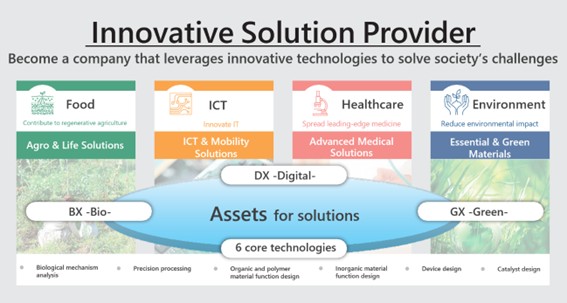

[Translation]


In the consolidated statement of financial position at the end of the current period, these valuation techniques are employed to measure fair value of other financial assets (including shares of Class B common stock of Petro Rabigh) totaling 173,254 million yen and other financial liabilities totaling 18,701 million yen.


5.

Valuation of Investments in Affiliates

The Company assesses whether there are any indications of impairment as to its investment in Petro Rabigh (Class A common stock), an investee company accounted for by using the equity method. If such indications exist, an impairment test is performed. The recoverable amount is calculated based on fair value, which is determined using market prices. The recoverable amount is subject to change due to uncertain future economic conditions and may have a significant impact on the amount of the investment accounted for by using the equity method.

In the consolidated statement of financial position at the end of the current period, an investment in Petro Rabigh accounted for by using the equity method is included totaling 49,722 million yen.

In addition, although there is significant uncertainty regarding the outlook on the surge in raw material prices and the impact on supply chains due to heightened geopolitical risks in the Middle East region, the Company makes accounting estimates based on currently available information and certain assumptions it deems reasonable.


[Translation]


(Notes to the Consolidated Statement of Financial Position)


1.

Assets Pledged as Collateral and Related Liabilities


Assets pledged as collateral   

Investment in affiliates (Note)

     49,722 million yen  

Property, plant and equipment

     3,698 million yen  

Notes and accounts receivable

     5,091 million yen  

Others

     108 million yen  

Liabilities related to collateral Borrowings

     11,640 million yen  

(Note) Collateral is provided to secure borrowings of 34,543 million yen for affiliates.


2.

Allowance for Doubtful Accounts Deducted Directly from Assets


Trade receivables and other receivables

     9,463 million yen  

Other financial assets (non-current)

     416 million yen  


3.

Accumulated Depreciation of Property, Plant and Equipment  2,534,860 million yen

Note: The above accumulated depreciation includes accumulated impairment losses.


4.

Contingent Liabilities


Guarantee obligations

     170,193 million yen  

(Notes to the Consolidated Statement of Changes in Equity)


1.

Types and the Number of Issued Shares at the End of the Current Period


Ordinary shares

     1,657,914,399 shares  


2.

Matters concerning Dividends

(1) Amount of dividend payment


Date of
Resolution

   Type of
Shares
     Total
Dividends
     Dividends
Per Share
     Record
Date
     Effective
Date
 

May 14, 2025

Board of Directors

    
Ordinary
shares


9,820 million
yen


6.00
yen


March 31,
2025


June 2,
2025


November 4, 2025

Board of Directors

    
Ordinary
shares


9,824 million
yen


6.00
yen


September 30,
2025


December
2, 2025


(2) Dividends with a record date in the current period but an effective date in the following period


Resolution
Date

   Type of
Shares
     Total
Dividends
     Dividends
Per Share
     Record
Date
     Effective
Date
 

May 14, 2026 Board of Directors

    
Ordinary
shares


12,386 million
yen


7.50
yen


March 31,
2026


June 3,
2026


[Translation]


(Notes on Revenue Recognition)


1.

Disaggregation of Revenue

The Group’s main businesses are “Agro & Life Solutions,” “ICT & Mobility Solutions,” “Advanced Medical Solutions,” “Essential & Green Materials,” and “Sumitomo Pharma.” The Company’s Board of Directors regularly reviews these businesses to determine allocation of management resources and evaluate business performance. Therefore, the revenue recorded in these businesses is presented as sales revenue. Revenue is also geographically disaggregated based on the location of customers. The relationship between disaggregated sales revenue and sales revenue by reportable segment is as follows.


                                   (Millions of yen)  
     Agro &
Life
Solutions
    ICT &
Mobility
Solutions
    Advanced
Medical
Solutions
    Essential &
Green
Materials
    Sumitomo
Pharma
    Others
(Note 1)
    Total  

Japan

     99,693       98,389       43,666       305,118       83,412       45,621       675,899  

China

     10,336       178,336       1,334       95,540       19,341       36       304,923  

North America

     111,998       32,315       2,811       20,708       322,536       31       490,399  

(Of which: U.S.)

     (102,468     (31,893     (2,806     (16,942     (320,655     (31     (474,795

Southeast Asia

     19,927       76,820       2,119       118,633       3,264       52       220,815  

Others

     277,302       188,302       8,671       138,801       23,380       23       636,479  

Total

     519,256       574,162       58,601       678,800       451,933       45,763       2,328,515  

Revenue from contracts with customers

     519,256       574,162       58,601       678,800       423,750       45,763       2,300,332  

Revenue from other sources

(Note 2)

     —        —        —        —        28,183       —        28,183  


Note:  

1.  “Others” represents businesses such as supplying electric power and steam, and providing transport and warehousing, etc.


2.  Revenue from other sources is revenue from contracts with joint partners when the counterparty is not considered customers.


2.

Performance Obligations

The normal timing for the Group to satisfy its performance obligations, as well as obligations for returns and refunds, are as described in “(Notes regarding important matters to be the basis for the preparation of consolidated financial statements) 5. Accounting policies (8) Revenue.” The consideration for products or services promised under contracts with customers is collected primarily within one year from the timing of satisfaction of the performance obligation and does not contain significant financing components.


3.

Contract Balances

The breakdown of contract balances arising from contracts with customers is as follows:


            (Millions of yen)  
     Beginning of Current
Period
(April 1, 2025)
     End of Current Period
(March 31, 2026)
 

Receivables from contracts with customers

     513,070        548,038  

Contract assets

     281        185  

Contract liabilities

     25,210        31,241  


[Translation]


Receivables and contract assets arising from contracts with customers are included in “Trade receivables and other receivables,” while contract liabilities are included in “Other current liabilities” and “Other non-current liabilities.”

Contract liabilities are primarily recognized for advance payments received from customers.

The amount included in contract liabilities (current) at the beginning of the current period was 14,460 million yen, of which, the portion not recognized as revenue in the current period is immaterial.

Furthermore, the amount of revenue recognized in the current period from performance obligations satisfied (or partially satisfied) in previous periods is immaterial.


4.

Transaction prices allocated to unfulfilled performance obligations

The transaction prices allocated to the remaining performance obligation and the timing of expected revenue recognition are as follows: 18,259 million yen within one year and 15,281 million yen over one year. Transactions with an expected individual contract period of one year or less are omitted due to the use of a practical expedient. Furthermore, there are no significant amounts included in the consideration arising from contracts with customers that are not included in transaction prices.


5.

Assets recognized from the costs incurred to obtain or fulfill contracts with customers

In the current period, the total amount of costs incurred to obtain or fulfill contracts with customers is immaterial.


[Translation]


(Notes on Financial Instruments)


1.

Matters Concerning the Status of Financial Instruments

The Group is exposed to financial risks (credit risk, liquidity risk, foreign exchange risk, interest rate risk, and market price fluctuation risk) in the course of doing business. The Group performs risk management to reduce these financial risks


  (1)

Credit Risk

The Company regularly reassesses the dealing policies about trade receivables through monitoring the business condition, the sales turnover, and the balance of receivables of all business counterparties by sales sections of each business segment, and aims to grasp changes in customers’ credit risks due to deterioration of the financial condition, etc. at an early stage and the reduction of credit risks in accordance with the Company regulation for credit management.

In the case of the consolidated subsidiaries, their sales divisions or accounting departments also manage the financial and credit conditions of their customers pursuant to their internal rules and regulations.

The Group conducts derivative transactions only with creditworthy financial institutions and trading companies to minimize the counterparty risk, and accordingly the impact on credit risk is limited.

The Group does not have significant exposure of credit risk relating to particular counterparties nor excessive concentration of credit risk that requires special attention.


  (2)

Liquidity Risk

Liquidity risk is the risk that the Group is unable to perform its repayment obligations of financial liabilities on the settlement date.

The Company’s finance department prepares and updates funding plans timely based on each department’s cash flow schedule.

While liquidity on hand is normally kept to about one day’s worth of sales revenue in view of asset efficiency, the Company manages liquidity risk by signing overdraft contracts and entering into commitment line agreements totaling 150,000 million yen with financial institutions.

The balance of borrowings related to those commitment lines is zero as of the end of the current period.

In addition, the Company and its major consolidated subsidiaries are striving to minimize liquidity risk by improving the efficiency of funds within the Group through the cash management system and group financing.


  (3)

Foreign Exchange Risk

The Company and certain of its consolidated subsidiaries use forward foreign exchange contracts for hedging purposes against exchange rate fluctuation risks identified by currency and on a monthly basis for trade receivables, payables, and borrowings denominated in foreign currencies. The Group does not use transactions that have larger market price fluctuation ratio than the price fluctuation of the underlying transaction, such as leveraged derivatives transactions.


  (4)

Interest Rate Risk

The Group considers the details of funding demands, financial condition and financial environment and determines amounts, periods and methods for funding. The Group raises funds with combinations of fixed and variable interest rates to be prepared for future interest rate fluctuations, however, there is a possibility that interest expenses will increase in case of interest rate increase and adversely affect the Group’s financial performance and condition.


  (5)

Market Price Fluctuation Risk

The Group is exposed to stock price fluctuation risk because the Group holds the stocks of business partner companies to maintain and strengthen business relationships with them. With regard to those stocks, the Group regularly monitors market price and financial conditions of the issuers (business partner companies) and reassesses the Group’s stockholding status in light of relationships with business partner companies.


2.

Matters Related to the Fair Value of Financial Instruments


  (1)

Carrying Amount and Fair Value of Financial Instruments

The fair value hierarchy of financial instruments is categorized into the following levels based on the level of the input used for the fair value measurements.

Level 1: Quoted prices in active markets for identical assets or liabilities

Level 2: Inputs other than Level 1, either directly or indirectly observable

Level 3: Inputs that are not based on observable market data


[Translation]


The carrying amount and fair value of financial instruments measured at amortized cost are as follows:


     (Millions of yen)  
     Carrying Amount      Fair Value  

Financial Liabilities:


Bonds

     597,993        535,766  

Long-term Borrowings

     388,549        370,263  

The above table does not include the following financial instruments for which carrying amounts are reasonable approximations of fair value.

The fair value of bonds is determined based on market prices.

The fair value of long-term borrowings is calculated based on the present value that is calculated by discounting future cash flow using a deemed interest rate assumed on new borrowings with equivalent conditions.

As for fair value hierarchy of financial instruments measured at amortized cost, bonds are classified as Level 2 and others are classified as Level 3.


[Translation]


Financial assets and liabilities measured at fair value as of the end of the current period are as follows.

Transfers between levels of financial instruments are recognized at the end of the reporting period in which the transfer occurs.


     (Millions of yen)  
     Level 1      Level 2      Level 3      Total  

Assets: Financial Assets Measured at Fair Value Through Profit or Loss


Derivative Assets Designated as Hedging Instruments

     —         54        —         54  

Derivative Assets Not Designated as Hedging Instruments

     —         526        —         526  

Other Financial Assets

     22,164        3,615        695        26,474  

Subtotal

     22,164        4,195        695        27,054  

Financial Assets Measured at Fair Value Through Other Comprehensive Income


Shares and investments

     121,179        —         172,559        293,738  

Trade and Other Receivables

     —         9,906        —         9,906  


Subtotal

     121,179        9,906        172,559        303,644  


Total

     143,343        14,101        173,254        330,698  


Liabilities: Financial Liabilities Measured at Fair Value Through Profit or Loss


Derivative Liabilities Designated as Hedging Instruments

     —         4,478        —         4,478  

Derivative Liabilities Not Designated as Hedging Instruments

     —         4,221        2,277        6,498  

Contingent Consideration

     —         —         1,484        1,484  

Other Financial Liabilities

     —         —         14,940        14,940  


Total

     —         8,699        18,701        27,400  


  (2)

Adjustment Schedule for Level 3 Financial Instruments

Changes in financial instruments classified as Level 3 from the beginning of the current period to the end of the period are as follows.

Financial assets measured at fair value through profit or loss are referred to as “FVTPL financial assets”, financial assets measured at fair value through other comprehensive income are referred to as “FVTOCI financial assets”, and financial liabilities measured at fair value through profit or loss are referred to as “FVTPL financial liabilities”.


     (Millions of yen)  
     FVTPL financial assets      FVTOCI financial assets      FVTPL financial
liabilities
 

Beginning Balance

     950        72,425        17,267  

Total Gains and Losses

     (281      11,034        2,807  

Profit or Loss (Note 1)

     (281      —         2,807  

Other Comprehensive Income

     —         11,034        —   

Increases (Note 2)

     —         92,109        —   

Decreases

     —         (3,395      (1,950

Others (Note 3)

     26        386        577  


Ending Balance

     695        172,559        18,701  


Note:    1.    Gains and losses from financial assets measured at FVTPL, which are included in net income, are recorded in “Finance income” and “Finance expenses” in the consolidated statement of income. Among gains and losses related to financial liabilities measured at FVTPL, changes in fair value of contingent consideration are recorded in “Selling, general and administrative expenses” and “Other operating income,” while those related to other financial liabilities are recorded in “Finance income” and “Finance expenses” in the consolidated statement of income.


[Translation]


   2.    The increase in FVTOCI Financial assets is mainly due to the subscription for the shares of Class B common stock issued by Petro Rabigh. The shares of Class B common stock issued are subject to a dividend deferment period for several years from the time of issuance and dividend rates that vary from year to year from 2028 onward. In addition, there are provisions on certain cumulative dividends and redemption with respect to shares of Class B common stock. Among the difference of 15,982 million yen between the consideration paid of 106,642 million yen and the fair value at initial recognition of 90,660 million yen, 2,397 million yen, which represents the Company’s equity interest (15%) in Petro Rabigh, is recorded in “Investments accounted for using equity method” in the consolidated statement of financial position, and 13,585 million yen is recorded in “Finance costs” in the consolidated statement of profit or loss. The amount of the increase in the adjustment schedule represents the fair value at initial recognition. Changes in fair value arising from subsequent measurement are recognized through other comprehensive income.
   3.    “Others” mainly includes exchange differences of financial instruments denominated in foreign currencies. These gains and losses are recorded in “Finance income” or “Finance expenses” in the consolidated statement of income or “Exchange differences on conversion of foreign operations” in the consolidated statement of comprehensive income.
   4.    Fair value measurements of financial instruments classified as level 3 are determined in accordance with valuation policies and procedures approved by appropriate authorized personnel. Valuation models are determined so that they reflect each financial instrument’s nature, characteristics and risks most appropriately. The valuator examines whether it is possible to provide reasonable explanations by comparing changes in important inputs that could affect the fair value and changes in fair value, on an ongoing basis.


Material unobservable inputs related to fair value measurements of financial instruments classified as Level 3 are as follows:


The financial assets measured at FVTOCI are mainly comprised of unlisted equity securities. Among these financial assets, fair value of the Class B common stock issued by Petro Rabigh is calculated via the discounted cash flow method, and the Company prepares funding forecasts based on Petro Rabigh’s business plan and, within the scope of cash on hand based on such forecasts, forecasts future cash flows, including dividends, in relation to the shares of Class B common stock. In preparing these forecasts, assumptions regarding future sales prices and margins of major products have been made. The material unobservable inputs in relation to the calculation of fair value are the total amount of future cash flow estimated independently by the Company (153,582 million yen as of the end of this consolidated fiscal year) and the discount rate (5.74% as of the end of this consolidated fiscal year). With respect to other unlisted equity securities, fair value is calculated by the discounted cash flow method in principle. However, for unlisted equity securities for which fair value approximates their net asset value, the fair value is mainly calculated by valuation technique based on the net asset value.


As for financial liabilities measured at FVTPL, fair value of contingent consideration is calculated by the discounted cash flow method, and material unobservable inputs are sales revenue arising from relevant business and the discount rate. Certain consolidated subsidiaries recognize the interest of preference shares issued as financial liabilities because it is redeemable at the amount based on its net asset value at any time based on the request of holders of preference shares. Fair value of preference shares is calculated by valuation technique based on the net asset value.


The unobservable inputs may be affected by changes in uncertain future economic conditions.

(Notes on Per Share Information)


Equity attributable to owners of the parent per share

     610.78 yen  

Basic earnings per share

     37.16 yen  

(Notes on Significant Subsequent Events)

(Issuance of New Shares and Share Offering by a Subsidiary of the Company)


On April 8, 2026, the board of directors of Sumitomo Pharma Co., Ltd. (“Sumitomo Pharma”), a consolidated subsidiary of the Company, made resolutions regarding the issuance of new shares and the offering of shares. The board of directors also determined the issue price, offering price, and other details as follows on April 20, 2026. The payment for the issuance of new shares through a public offering was completed on April 24, 2026, whereby the amount of share capital and capital reserve (capital surplus) of Sumitomo Pharma increased. Sumitomo Pharma will issue a maximum of 59,000,000 new shares by a capital increase through a public offering or other methods; however, the fact that Sumitomo Pharma is a consolidated subsidiary of the Company will not change.


  1.

Issuance of new shares through a public offering (domestic public offering and international offering)


  (1)

Type and number of issued shares: common shares 51,304,400 shares


  (2)

Issue price: 1,990 yen per share


  (3)

Total issue amount: 102,096 million yen


  (4)

Paid-in amount: 1,907.08 yen per share


  (5)

Total paid-in amount: 97,842 million yen


  (6)

Increased share capital and amount of increased share capital: 48,921 million yen Amount of capital reserve (capital surplus) and amount of increased capital reserve (capital surplus): 48,921 million yen


  (7)

Payment date: April 24, 2026


  2.

Offering of shares of the Company’s subsidiary (offering through over-allotment)


  (1)

Type and number of shares to be offered: common shares 7,695,600 shares


  (2)

Offering price: 1,990 yen per share


  (3)

Total offering amount: 15,314 million yen


  (4)

Delivery date: April 27, 2026


  3.

Issuance of new shares through third-party allotment (a capital increase through a third-party allotment conducted in relation to the offering through over-allotment)


  (1)

Type and number of shares to be issued (maximum): common shares 7,695,600 shares


  (2)

Amount to be paid: 1,907.08 yen per share


  (3)

Total amount to be paid (maximum): 14,676 million yen


  (4)

Share capital to be increased and amount of share capital to be increased: 7,338 million yen Amount of capital reserve (capital surplus) (maximum) and amount of capital reserve (capital surplus) to be increased: 7,338 million yen


  (5)

Payment date: May 26, 2026


  (6)

Allottee: SMBC Nikko Securities Inc.


  4.

Use of proceeds

With respect to the maximum total estimated net proceeds of 111,566 million yen resulting from the domestic public offering, international offering, and capital increase through a third-party allotment, by the end of March 2029, 30,000 million yen will be allocated to research and development in oncology, 10,000 million yen to research and development in neurodegenerative diseases and infectious diseases, 10,000 million yen to investments and loans for the growth of the regenerative medicine and cell therapy business, 10,000 million yen to capital expenditures for production, research and development, IT system investments, and strategic investments relating to alliances and license agreements, and the remaining amount to the repayment of interest-bearing liabilities.


Materials for the 165th Ordinary General Meeting of Shareholders

(Matters not provided in paper form) II


Statement of Changes in Shareholders’ Equity (From April 1, 2025 to March 31, 2026)


Notes to Non-consolidated Financial Statements


Koei Chemical Company, Limited


This document has been translated from the Japanese-language original for reference purposes only. In the event of any conflict or discrepancy between this document and the Japanese-language original, the Japanese-language original shall prevail in all respects.


Statement of Changes in Shareholders’ Equity (From April 1, 2025 to March 31, 2026)

(Unit: Thousands of yen)

     Shareholders’ equity  
   Share
capital
     Capital surplus      Retained earnings  
   Capital
reserve
     Total capital
surplus
     Legal
retained
earnings
     Other retained earnings  
   Reserve for
advanced
depreciation of non-
current assets
 

Balance at beginning of current fiscal year Changes during the fiscal year

     2,343,000        1,551,049        1,551,049        341,210        1,715,937  

Dividends of surplus


Reversal of reserve for advanced depreciation of non-current assets

                 -107,751  

Net loss


Purchase of treasury shares


Net changes in items other than shareholders’ equity


Total changes during the fiscal year

     —         —         —         —         -107,751  

Balance at end of current fiscal year

     2,343,000        1,551,049        1,551,049        341,210        1,608,186  


(Unit: Thousands of yen)

     Shareholders’ equity      Total net assets  
     Retained earnings      Treasury
shares
     Total
shareholders’
equity
 
     Other retained earnings      Total retained
earnings
 
     General
reserve
     Retained earnings
brought forward
 

Balance at beginning of current fiscal year Changes during the fiscal year

     10,402,000        5,277,321        17,736,469        -14,374        21,616,144        21,616,144  

Dividends of surplus

        -391,281        -391,281           -391,281        -391,281  

Reversal of reserve for advanced depreciation of non-current assets

        107,751        —            —         —   

Net loss

        -5,135,049        -5,135,049           -5,135,049        -5,135,049  

Purchase of treasury shares


Net changes in items other than shareholder s’ equity


Total changes during the fiscal year

     —         -5,418,579        -5,526,330        —         -5,526,330        -5,526,330  

Balance at end of current fiscal year

     10,402,000        -141,258        12,210,138        -14,374        16,089,813        16,089,813  


Notes to Non-consolidated Financial Statements

Notes on significant accounting policies


1.

Valuation standards and methods for assets

(1) Securities

Other securities

Securities other than shares, etc. without a market price: Market value method based on market prices, etc. as of the fiscal year-end (valuation differences are recognized directly in net assets in their entirety, and cost of sales is calculated by the moving-average method)

Shares, etc. without a market price: Cost method by the moving-average method

(2) Derivatives: Market value method

(3) Inventories: Cost method by the gross average method (method of reducing book value due to a decline in profitability)


2.

Depreciation and amortization methods for non-current assets

(1) Property, plant and equipment other than lease assets: Straight-line method For property, plant and equipment acquired on or before March 31, 2007, the Company uses the method of evenly depreciating the assets over five years from the year following the year in which depreciation to the allowable limit has been completed.

(2) Intangible assets other than lease assets: Straight-line method Software for internal use is amortized by the straight-line method based on the period of internal use (five years).

(3) Lease assets: For assets related to finance lease transactions that do not transfer ownership, the Company uses the straight-line method with the lease term as the useful life and a residual value of zero.


3.

Basis for recording allowances and provisions


  (1)

Allowance for doubtful accounts The Company records an allowance for doubtful accounts to provide for losses from bad debts on trade receivables, loans, and other similar receivables. For general receivables, the allowance is recorded based on a reasonably estimated doubtful account ratio, and for specific receivables, such as doubtful receivables, the allowance is recorded based on an individual assessment of collectability.


  (2)

Provision for bonuses The Company records a provision for bonuses to provide for payment of bonuses to employees. The basis for its calculation is the estimated amount of bonuses to be borne in the current fiscal year.


  (3)

Provision for retirement benefits To provide for retirement benefits to employees, the Company records the amount deemed to have accrued as of the end of the current fiscal year based on the estimated amount of retirement benefit obligations at the end of the current fiscal year. In calculating retirement benefit obligations, the benefit formula basis is used as the method for attributing the estimated amount of retirement benefits to the period up to the end of the current fiscal year. Past service cost is expensed by the straight-line method over a certain number of years (five years) within the average remaining service period of employees at the time of its occurrence. Actuarial differences are expensed from the fiscal year following their occurrence, with each amount proportionately allocated by the straight-line method over a certain number of years (five years) within the average remaining service period of employees at the time of occurrence in each fiscal year.


4.

Basis for recognizing revenue and expenses

Revenue from the sale of merchandise or finished goods mainly comprises sales through wholesale or manufacturing, etc., and the Company has a performance obligation to deliver merchandise or finished goods based on sales contracts with customers. The Company determines that this performance obligation is satisfied at the point in time when merchandise or finished goods are delivered and the customer obtains control of such merchandise or finished goods, and recognizes revenue at the time of delivery. Consideration received from customers is generally paid within three months from the time the performance obligation is satisfied, and the amount of consideration does not include any significant financing component.

If consideration under a contract with a customer includes variable consideration, the Company includes it in the transaction price only to the extent that it is highly probable that no significant reversal of the cumulative amount of revenue recognized will occur when the uncertainty associated with the variable consideration is subsequently resolved. The amount of revenue including variable consideration, etc. in the transaction price is not material.

For transactions involving materials supplied for consideration, the Company recognizes only the amount equivalent to processing fees as revenue on a net basis.


5.

Hedge accounting method


  (1)

Hedge accounting method

The Company applies deferred hedge accounting. The Company also applies appropriation treatment to foreign currency-denominated monetary receivables and payables, etc. that are covered by forward exchange contracts.


  (2)

Hedging instruments and hedged items

Hedging instruments: Forward exchange contracts

Hedged items: Foreign currency-denominated receivables


  (3)

Hedging policy

The Company hedges foreign exchange fluctuation risk in accordance with its management standards.


  (4)

Method for assessing hedge effectiveness

For forward exchange contracts, the Company omits assessment of effectiveness because it confirms the identity of material terms at the time of the transaction.

Notes on Balance Sheet


1. Accumulated depreciation of property, plant and equipment:

   ¥ 32,338,015,000  

2. Monetary claims and obligations to subsidiaries and associates


Short-term monetary claims:

   ¥ 1,022,849,000  

Long-term monetary claims:

   ¥ 297,927,000  

Short-term monetary obligations:

   ¥ 910,638,000  

Notes on Statement of Income


1. Transactions with subsidiaries and associates   

Net sales:

   ¥ 1,005,044,000  

Cost of sales and general and administrative expenses:

   ¥ 2,904,587,000  


2.

Matters related to impairment losses


  (1)

Main details of impairment losses

In the Financial Statements for the current fiscal year, the Company recorded impairment losses as follows for non-current assets related to liquid-phase multipurpose plants (mainly used to manufacture custom synthesis products and functional products; the same applies hereinafter) with a balance sheet carrying amount of ¥3,925,705,000.


Location


Use


Type

   Amount
Chiba Site (Sodegaura-shi, Chiba)   

Liquid-phase

multipurpose plants


Buildings, structures,

machinery and equipment,

construction in progress, etc.

   ¥6,395,208,000


  (2)

Background leading to the recognition of impairment losses

For the business related to liquid-phase multipurpose plants, demand for catalysts in the contract business for organometallic catalysts for the petrochemical industry, which was initially expected to grow steadily, has declined due to the oversupply of petrochemicals resulting from substantial increases in production capacity in China, and has yet to recover at this stage. Demand for products related to pharmaceuticals and agrochemicals for Europe has also decreased. In addition, increased uncertainty was identified with respect to the future demand that had been expected for some other contract products, including optical materials. Furthermore, in light of uncertainty in the future business environment, including prolonged geopolitical risks, particularly the possibility of unstable procurement and sharp price increases for raw materials and fuel caused by heightened tensions in the Middle East, the Company determined that there were indications of impairment for the asset group at the end of the current fiscal year and considered whether it was necessary to recognize impairment losses. As a result, because the total undiscounted future cash flows of the asset group were less than its carrying amount, the Company reduced the carrying amount to the recoverable amount and recorded the amount of the decrease as impairment losses under extraordinary losses.


  (3)

Method of grouping assets

As a general rule, the Company groups assets based on management accounting classifications for which income and expenses are continuously monitored.


  (4)

Method for calculating recoverable amount

The recoverable amount is measured based on value in use, calculated by discounting future cash flows at a discount rate of 8.8%, incorporating key assumptions such as increases in net sales of organometallic catalyst products and products related to pharmaceuticals and agrochemicals.

Notes on revenue recognition

1. Disaggregated information on revenue from contracts with customers


Pharmaceutical- and agrochemical-related chemicals:

   ¥ 6,290,267,000  

Functional chemicals:

   ¥ 7,424,776,000  

Other fine products:

   ¥ 3,294,141,000  


Revenue from contracts with customers:

   ¥ 17,009,185,000  


Net sales to external customers:

   ¥ 17,009,185,000  

Pharmaceutical- and agrochemical-related chemicals: Pharmaceutical-related products, agrochemical-related products, etc.

Functional chemicals: IL products, electronic materials products, catalysts, optical materials products, etc.


Other fine products: Industrial chemicals products, resin-related products, etc.


Japan:

   ¥ 8,004,589,000  

Asia:

   ¥ 6,850,404,000  

North America:

   ¥ 744,006,000  

Europe:

   ¥ 1,408,442,000  

Other:

   ¥ 1,742,000  


Revenue from contracts with customers:

   ¥ 17,009,185,000  


Net sales to external customers:

   ¥ 17,009,185,000  

2. Basic information for understanding revenue

As stated in “Basis for recognizing revenue and expenses” under “Notes on significant accounting policies.”

3. Information for understanding the amount of revenue for the current fiscal year and subsequent fiscal years

(1) Balance of contract liabilities, etc.

Contract liabilities mainly relate to advances received from customers based on payment terms.

Contract liabilities are reversed as revenue is recognized.

The amount of revenue recognized in the current fiscal year that was included in the balance of contract liabilities at the beginning of the fiscal year was ¥328,000.

Revenue recognized in the current fiscal year from performance obligations satisfied, or partially satisfied, in prior periods, mainly due to changes in transaction prices, is not material.

(2) Transaction price allocated to remaining performance obligations

In disclosing the transaction price allocated to remaining performance obligations, the Company applies the practical expedient and does not include contracts with an initially expected contract period of one year or less in the scope of disclosure.

Notes on Statement of Changes in Shareholders’ Equity

1. Type and total number of issued shares at the end of the current fiscal year


Common shares:

     4,900,000 shares  

Type and number of treasury shares at the end of the current fiscal year


Common shares:

     8,980 shares  


2. Matters related to dividends of surplus paid during the current fiscal year


Resolution

   Type of shares    Total amount of
dividends
(Thousands of yen)
     Dividend
per share
(Yen)
     Record date      Effective date  

Board of Directors meeting held on May 13, 2025

   Common shares      244,551        50.0       
March 31,
2025
 
 
     June 3, 2025  

Board of Directors meeting held on October 29, 2025

   Common shares      146,730        30.0       
September 30,
2025
 
 
     December 2, 2025  

3. Matters related to dividends of surplus to be paid after the end of the current fiscal year


Resolution

   Type of shares      Source of
dividends
     Total amount
of dividends
(Thousands of
yen)
     Dividend per
share (Yen)
     Record date      Effective date  

Board of Directors meeting held on May 13, 2026

     Common shares       
Retained
earnings
 
 
     244,551        50.0       
March 31,
2026
 
 
     June 9, 2026  

Notes on financial instruments

1. Matters related to the status of financial instruments

The Company raises the long-term and short-term funds necessary to conduct its business through borrowings from banks and other financial institutions. Temporary surplus funds are managed only through financial instruments with fixed yields and an extremely low possibility of principal loss.

With regard to customer credit risk related to accounts receivable - trade, in accordance with internal rules on sales management, the sales department regularly checks the status of all customers, sales transaction volume, and receivable balances, reviews transaction policies, and seeks to identify and mitigate customer credit risk at an early stage due to deterioration in financial position or other factors. Foreign currency-denominated trade receivables arising from export transactions and other transactions are exposed to foreign exchange fluctuation risk. However, as a general rule, the Company hedges the net position after offsetting foreign currency-denominated trade payables by using forward exchange contracts within a certain range, in accordance with internal rules on forward exchange contracts.


Investment securities consist of unlisted shares and shares of subsidiaries and associates, and have no market price. However, the Company regularly monitors the financial position of the issuers.

Guarantee deposits mainly consist of deposits based on continuous transaction agreements, and credit risk related to counterparties is managed in the same manner as accounts receivable - trade.

Accounts payable - trade, accounts payable - other, and deposits received are operating obligations with payment due within one year.

Short-term borrowings are mainly for raising short-term working capital, and long-term borrowings are mainly for raising funds for capital investment.

Forward exchange contracts are used only for the purpose of hedging foreign exchange fluctuation risk, and their limits are kept within the scope of actual demand. For the execution and management of forward exchange contracts, the Company has established internal rules on transaction authority and procedures, and manages risk by ensuring compliance with these rules and confirming the hedging effect of transactions. In using forward exchange contracts, the Company conducts transactions only with highly creditworthy domestic banks in order to reduce credit risk.

2. Matters related to fair value, etc. of financial instruments

The carrying amounts on the balance sheet, fair values, and differences between them as of March 31, 2026 are as follows. Investment securities consist of unlisted shares (carrying amount on the balance sheet: ¥96,000) and shares of subsidiaries and associates (carrying amount on the balance sheet: ¥10,000,000), and are not included in “2. Matters related to fair value, etc. of financial instruments” because they have no market price. Notes on cash are omitted. Notes on deposits, deposits paid, accounts receivable - trade, accounts payable - trade, short-term borrowings (excluding the current portion of long-term borrowings), accounts payable - other, deposits received, and accounts payable - facilities are also omitted because they are settled in a short period of time and their fair values approximate their book values.


            (Unit: Thousands of yen)  

Category

   Carrying amount on
balance sheet
     Fair value      Difference  

Guarantee deposits

     297,927        279,346        -18,580  


Total assets

     297,927        279,346        -18,580  


Long-term borrowings*

     3,568,000        3,556,713        -11,286  

Lease liabilities*

     961,804        917,354        -44,449  


Total liabilities

     4,529,804        4,474,068        -55,736  


*

Long-term borrowings and lease liabilities include amounts due within one year.


3. Matters related to the breakdown of fair value of financial instruments by level

The fair value of financial instruments is classified into the following three levels according to the observability and significance of the inputs used in fair value measurement.

Level 1 fair value: Fair value measured using quoted prices (unadjusted) in active markets for identical assets or liabilities

Level 2 fair value: Fair value measured using directly or indirectly observable inputs other than Level 1 inputs

Level 3 fair value: Fair value measured using significant unobservable inputs

When multiple inputs that have a significant effect on the fair value measurement are used, the fair value is classified in the level with the lowest priority in fair value measurement among the levels to which those inputs belong.

(1) Financial assets and financial liabilities whose carrying amounts on the balance sheet are not stated at fair value


                   (Unit: Thousands of yen)  

Category

   Fair value  
   Level 1      Level 2      Level 3      Total  

Guarantee deposits

     —         279,346        —         279,346  


Total assets

     —         279,346        —         279,346  


Lease liabilities

     —         917,354        —         —   

Long-term borrowings

     —         —         3,556,713        3,556,713  


Total liabilities

     —         917,354        3,556,713        4,474,068  


Note: Explanation of valuation techniques and inputs used in fair value measurement

Guarantee deposits

The fair value of guarantee deposits is calculated based on present value, obtained by discounting future cash flows using the interest rate of highly secure bonds corresponding to the period until repayment, and is classified as Level 2 fair value.

Lease liabilities

The fair value of lease liabilities is calculated based on present value, obtained by discounting the total amount of principal and interest using the interest rate of highly secure bonds adjusted for credit risk, and is classified as Level 2 fair value.


Long-term borrowings

The fair value of long-term borrowings is calculated by discounting the total amount of principal and interest using the interest rate assumed to apply if similar new borrowings were made, and is classified as Level 3 fair value.

Notes on tax effect accounting

Breakdown of the main causes of deferred tax assets and deferred tax liabilities


Deferred tax assets


Impairment losses on liquid-phase multipurpose plants:

   ¥ 2,008,095,000  

Excess provision for retirement benefits:

   ¥ 633,074,000  

Other:

   ¥ 143,527,000  


Subtotal:

   ¥ 2,784,696,000  


Valuation allowance:

   ¥ -935,544,000  


Total deferred tax assets:

   ¥ 1,849,152,000  


Deferred tax liabilities


Tax-purpose reduction entry for non-current assets:

   ¥ 736,111,000  


Total deferred tax liabilities:

   ¥ 736,111,000  


Net deferred tax assets:

   ¥ 1,113,041,000  

Notes on transactions with related parties

1. Parent company and major corporate shareholders, etc.


                               (Unit: Thousands of yen)  

Attribute

   Name of
company, etc.
   Percentage
of voting
rights, etc.
held in the
Company
  Relationship
with related
party
   Transaction
details
   Transaction
amount
     Account    Balance at fiscal
year-end
 

Parent company

   Sumitomo
Chemical
Co., Ltd.
   Direct:
55.91%
Indirect:
0.04%
  Sale of the
Company’s
products,
purchase of
raw materials,
etc., and lease
of factory
land
   Purchase of
raw materials,
etc.
     2,808,233      Accounts
payable -
trade
     878,070  
   Sale of the
Company’s
products
     1,005,044      Accounts
receivable -
trade
     1,006,533  
   Collection of
guarantee
deposits
     45,834      Guarantee
deposits
     297,927  


Transaction terms and policy for determining transaction terms, etc.


  1.

For the purchase of raw materials, etc. and sale of products, transaction terms are determined through individual negotiations after considering market prices, etc.


  2.

Guarantee deposits are non-interest bearing.

2. Companies, etc. with the same parent company

(Unit: Thousands of yen)

Attribute

   Name of
company, etc.
   Percentage
of voting
rights, etc.
held in the
Company
     Relationship
with related
party
   Transaction
details
   Transaction
amount
     Account    Balance at
fiscal year-end
 

Company with the same parent company

   Sumika
Finance Co.,
Ltd.
     —       Borrowing of
funds
   Borrowing of
funds
     800,000      Short-term
borrowings
     800,000  

Transaction terms and policy for determining transaction terms, etc.

Interest rates on borrowings or deposits of funds are determined after considering market interest rates.

Notes on per share information


Net assets per share:

   ¥ 3,289.66  

Net loss per share:

   ¥ 1,049.89