Exhibit 99.2
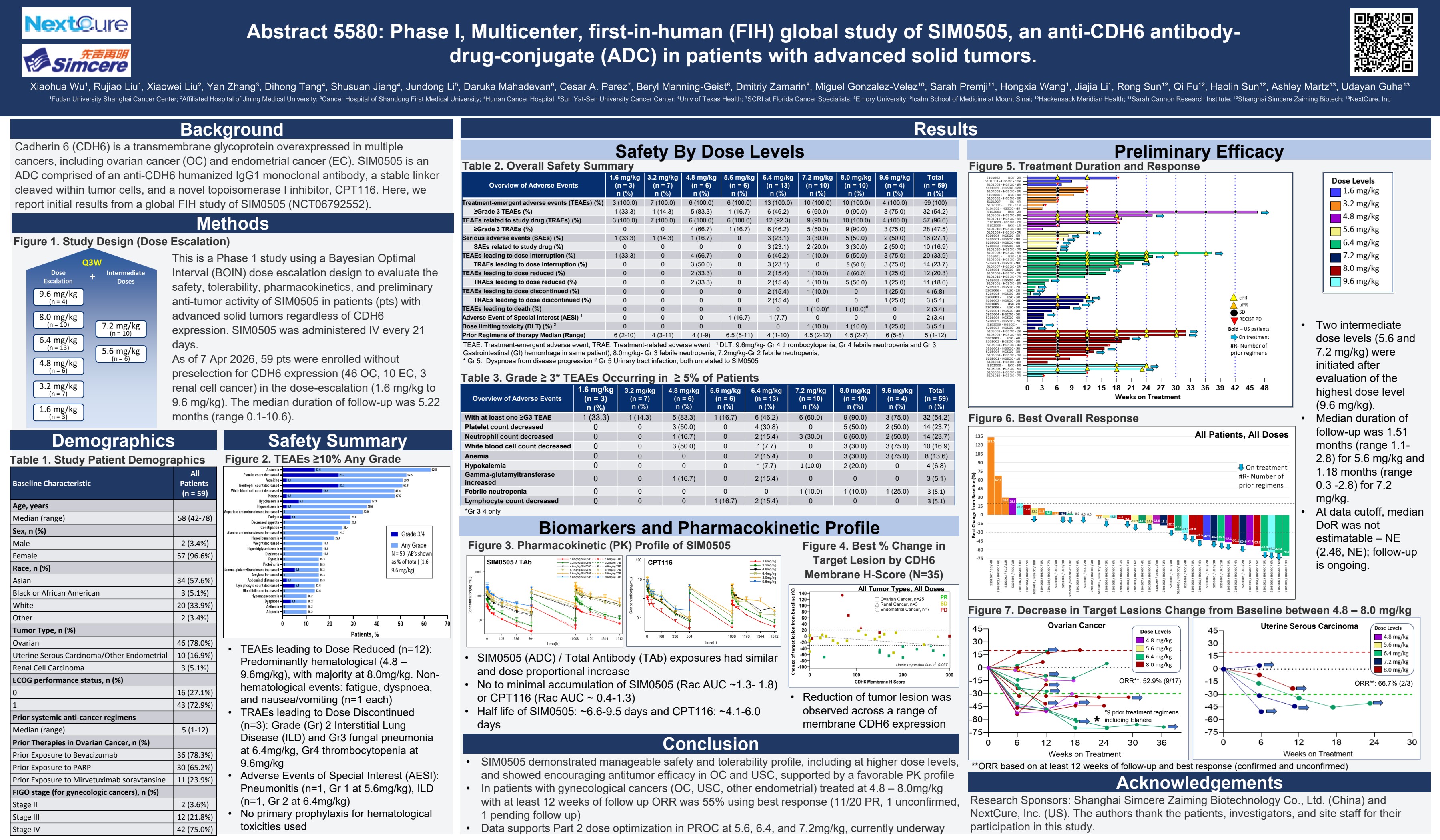
| Cadherin 6 (CDH6) is a transmembrane glycoprotein overexpressed in multiple cancers, including ovarian cancer (OC) and endometrial cancer (EC). SIM0505 is an ADC comprised of an anti-CDH6 humanized IgG1 monoclonal antibody, a stable linker cleaved within tumor cells, and a novel topoisomerase I inhibitor, CPT116. Here, we report initial results from a global FIH study of SIM0505 (NCT06792552). This is a Phase 1 study using a Bayesian Optimal Interval (BOIN) dose escalation design to evaluate the safety, tolerability, pharmacokinetics, and preliminary anti-tumor activity of SIM0505 in patients (pts) with advanced solid tumors regardless of CDH6 expression. SIM0505 was administered IV every 21 days. As of 7 Apr 2026, 59 pts were enrolled without preselection for CDH6 expression (46 OC, 10 EC, 3 renal cell cancer) in the dose-escalation (1.6 mg/kg to 9.6 mg/kg). The median duration of follow-up was 5.22 months (range 0.1-10.6). .. *9 Figure 1. Study Design (Dose Escalation) Table 1. Study Patient Demographics Figure 2. TEAEs ≥10% Any Grade Safety By Dose Levels Abstract 5580: Phase I, Multicenter, first-in-human (FIH) global study of SIM0505, an anti-CDH6 antibody-drug-conjugate (ADC) in patients with advanced solid tumors. • TEAEs leading to Dose Reduced (n=12): Predominantly hematological (4.8 – 9.6mg/kg), with majority at 8.0mg/kg. Non-hematological events: fatigue, dyspnoea, and nausea/vomiting (n=1 each) • TRAEs leading to Dose Discontinued (n=3): Grade (Gr) 2 Interstitial Lung Disease (ILD) and Gr3 fungal pneumonia at 6.4mg/kg, Gr4 thrombocytopenia at 9.6mg/kg • Adverse Events of Special Interest (AESI): Pneumonitis (n=1, Gr 1 at 5.6mg/kg), ILD (n=1, Gr 2 at 6.4mg/kg) • No primary prophylaxis for hematological toxicities used Methods Demographics Safety Summary Results • SIM0505 demonstrated manageable safety and tolerability profile, including at higher dose levels, and showed encouraging antitumor efficacy in OC and USC, supported by a favorable PK profile • In patients with gynecological cancers (OC, USC, other endometrial) treated at 4.8 – 8.0mg/kg with at least 12 weeks of follow up ORR was 55% using best response (11/20 PR, 1 unconfirmed, 1 pending follow up) • Data supports Part 2 dose optimization in PROC at 5.6, 6.4, and 7.2mg/kg, currently underway Research Sponsors: Shanghai Simcere Zaiming Biotechnology Co., Ltd. (China) and NextCure, Inc. (US). The authors thank the patients, investigators, and site staff for their participation in this study. Conclusion Acknowledgements TEAE: Treatment-emergent adverse event, TRAE: Treatment-related adverse event 1 DLT: 9.6mg/kg- Gr 4 thrombocytopenia, Gr 4 febrile neutropenia and Gr 3 Gastrointestinal (GI) hemorrhage in same patient), 8.0mg/kg- Gr 3 febrile neutropenia, 7.2mg/kg-Gr 2 febrile neutropenia; * Gr 5: Dyspnoea from disease progression # Gr 5 Urinary tract infection; both unrelated to SIM0505 • SIM0505 (ADC) / Total Antibody (TAb) exposures had similar and dose proportional increase • No to minimal accumulation of SIM0505 (Rac AUC ~1.3- 1.8) or CPT116 (Rac AUC ~ 0.4-1.3) • Half life of SIM0505: ~6.6-9.5 days and CPT116: ~4.1-6.0 days Figure 3. Pharmacokinetic (PK) Profile of SIM0505 SIM0505 / TAb CPT116 Table 3. Grade ≥ 3* TEAEs Occurring in ≥ 5% of Patients Table 2. Overall Safety Summary Biomarkers and Pharmacokinetic Profile Background Preliminary Efficacy Figure 7. Decrease in Target Lesions Change from Baseline between 4.8 – 8.0 mg/kg Ovarian Cancer Uterine Serous Carcinoma *9 prior treatment regimens including Elahere * Figure 4. Best % Change in Target Lesion by CDH6 Membrane H-Score (N=35) All Tumor Types, All Doses • Reduction of tumor lesion was observed across a range of membrane CDH6 expression *Gr 3-4 only Overview of Adverse Events 1.6 mg/kg (n = 3) n (%) 3.2 mg/kg (n = 7) n (%) 4.8 mg/kg (n = 6) n (%) 5.6 mg/kg (n = 6) n (%) 6.4 mg/kg (n = 13) n (%) 7.2 mg/kg (n = 10) n (%) 8.0 mg/kg (n = 10) n (%) 9.6 mg/kg (n = 4) n (%) Total (n = 59) n (%) Treatment-emergent adverse events (TEAEs) (%) 3 (100.0) 7 (100.0) 6 (100.0) 6 (100.0) 13 (100.0) 10 (100.0) 10 (100.0) 4 (100.0) 59 (100) ≥Grade 3 TEAEs (%) 1 (33.3) 1 (14.3) 5 (83.3) 1 (16.7) 6 (46.2) 6 (60.0) 9 (90.0) 3 (75.0) 32 (54.2) TEAEs related to study drug (TRAEs) (%) 3 (100.0) 7 (100.0) 6 (100.0) 6 (100.0) 12 (92.3) 9 (90.0) 10 (100.0) 4 (100.0) 57 (96.6) ≥Grade 3 TRAEs (%) 0 0 4 (66.7) 1 (16.7) 6 (46.2) 5 (50.0) 9 (90.0) 3 (75.0) 28 (47.5) Serious adverse events (SAEs) (%) 1 (33.3) 1 (14.3) 1 (16.7) 0 3 (23.1) 3 (30.0) 5 (50.0) 2 (50.0) 16 (27.1) SAEs related to study drug (%) 0 0 0 0 3 (23.1) 2 (20.0) 3 (30.0) 2 (50.0) 10 (16.9) TEAEs leading to dose interruption (%) 1 (33.3) 0 4 (66.7) 0 6 (46.2) 1 (10.0) 5 (50.0) 3 (75.0) 20 (33.9) TRAEs leading to dose interruption (%) 0 0 3 (50.0) 0 3 (23.1) 0 5 (50.0) 3 (75.0) 14 (23.7) TEAEs leading to dose reduced (%) 0 0 2 (33.3) 0 2 (15.4) 1 (10.0) 6 (60.0) 1 (25.0) 12 (20.3) TRAEs leading to dose reduced (%) 0 0 2 (33.3) 0 2 (15.4) 1 (10.0) 5 (50.0) 1 (25.0) 11 (18.6) TEAEs leading to dose discontinued (%) 0 0 0 0 2 (15.4) 1 (10.0) 0 1 (25.0) 4 (6.8) TRAEs leading to dose discontinued (%) 0 0 0 0 2 (15.4) 0 0 1 (25.0) 3 (5.1) TEAEs leading to death (%) 0 0 0 0 0 1 (10.0)* 1 (10.0) # 0 2 (3.4) Adverse Event of Special Interest (AESI) 1 0 0 0 1 (16.7) 1 (7.7) 0 0 0 2 (3.4) Dose limiting toxicity (DLT) (%) 2 0 0 0 0 0 1 (10.0) 1 (10.0) 1 (25.0) 3 (5.1) Prior Regimens of therapy Median (Range) 6 (2-10) 4 (3-11) 4 (1-9) 6.5 (5-11) 4 (1-10) 4.5 (2-12) 4.5 (2-7) 6 (5-8) 5 (1-12) Baseline Characteristic All Patients (n = 59) Age, years Median (range) 58 (42-78) Sex, n (%) Male 2 (3.4%) Female 57 (96.6%) Race, n (%) Asian 34 (57.6%) Black or African American 3 (5.1%) White 20 (33.9%) Other 2 (3.4%) Tumor Type, n (%) Ovarian 46 (78.0%) Uterine Serous Carcinoma/Other Endometrial 10 (16.9%) Renal Cell Carcinoma 3 (5.1%) ECOG performance status, n (%) 0 16 (27.1%) 1 43 (72.9%) Prior systemic anti-cancer regimens Median (range) 5 (1-12) Prior Therapies in Ovarian Cancer, n (%) Prior Exposure to Bevacizumab 36 (78.3%) Prior Exposure to PARP 30 (65.2%) Prior Exposure to Mirvetuximab soravtansine 11 (23.9%) FIGO stage (for gynecologic cancers), n (%) Stage II 2 (3.6%) Stage III 12 (21.8%) Stage IV 42 (75.0%) Overview of Adverse Events 1.6 mg/kg (n = 3) n (%) 3.2 mg/kg (n = 7) n (%) 4.8 mg/kg (n = 6) n (%) 5.6 mg/kg (n = 6) n (%) 6.4 mg/kg (n = 13) n (%) 7.2 mg/kg (n = 10) n (%) 8.0 mg/kg (n = 10) n (%) 9.6 mg/kg (n = 4) n (%) Total (n = 59) n (%) With at least one ≥G3 TEAE 1 (33.3) 1 (14.3) 5 (83.3) 1 (16.7) 6 (46.2) 6 (60.0) 9 (90.0) 3 (75.0) 32 (54.2) Platelet count decreased 0 0 3 (50.0) 0 4 (30.8) 0 5 (50.0) 2 (50.0) 14 (23.7) Neutrophil count decreased 0 0 1 (16.7) 0 2 (15.4) 3 (30.0) 6 (60.0) 2 (50.0) 14 (23.7) White blood cell count decreased 0 0 3 (50.0) 0 1 (7.7) 0 3 (30.0) 3 (75.0) 10 (16.9) Anemia 0 0 0 0 2 (15.4) 0 3 (30.0) 3 (75.0) 8 (13.6) Hypokalemia 0 0 0 0 1 (7.7) 1 (10.0) 2 (20.0) 0 4 (6.8) Gamma-glutamyltransferase increased 0 0 1 (16.7) 0 2 (15.4) 0 0 0 3 (5.1) Febrile neutropenia 0 0 0 0 0 1 (10.0) 1 (10.0) 1 (25.0) 3 (5.1) Lymphocyte count decreased 0 0 0 1 (16.7) 2 (15.4) 0 0 0 3 (5.1) Figure 6. Best Overall Response • Two intermediate dose levels (5.6 and 7.2 mg/kg) were initiated after evaluation of the highest dose level (9.6 mg/kg). • Median duration of follow-up was 1.51 months (range 1.1- 2.8) for 5.6 mg/kg and 1.18 months (range 0.3 -2.8) for 7.2 mg/kg. • At data cutoff, median DoR was not estimatable – NE (2.46, NE); follow-up is ongoing. All Patients, All Doses Figure 5. Treatment Duration and Response All Patients, All Doses #R- Number of prior regimens ORR**: 52.9% (9/17) ORR**: 66.7% (2/3) **ORR based on at least 12 weeks of follow-up and best response (confirmed and unconfirmed) |