Exhibit 14.1


LOGO

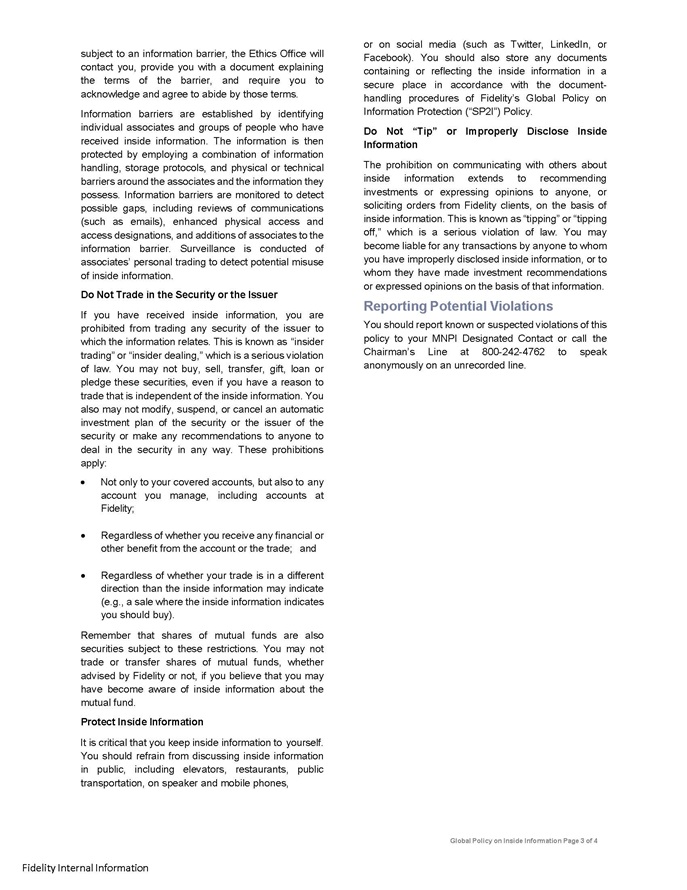
MNPI Designated Contacts Business Unit, Regional or Supplemental Policies on Inside Asset Management associates: Information Asset Management MNPI Hotline 617-563-3630 Personal Investing – Corporate Issues: Insider Trading India associates: Fidelity Capital Markets – Equity Origination FBS India Ethics Office Information Barriers 8-691-7373 Fidelity Institutional Online Reference – Inside +91-80-6691-7373 Information All other associates: Ethics Office 617-563-5566 800-580-8780 Contacts and Web Resources Other Related Policies General Policy Issues or Violations Ethics Office Global Anti-Corruption Policy 800-580-8780 617-563-5566 Corporate Gifts & Entertainment Policy ethics.office@fmr.com politicallaw@fmr.com Personal Conflicts of Interest Policy Chairman’s Line Outside Business Activities Policy 800-242-4762 Compliance and Regulatory Issues Information Protection Policy Your MNPI Designated Contact (See above) Global Policy on Inside Information Page 4 of 4 Fidelity Internal Information Ethics Office MyCompliance.fmr.com Rules for 2026 Employee Investing CODE OF ETHICS FOR PERSONAL INVESTING Fund Access Version GLOBAL POLICY ON INSIDE INFORMATION Fidelity Internal Information


LOGO

These Rules for Employee Investing contain the Code of Ethics for Personal Investing and the Global The Rules for Employee Investing are fairly Policy on Inside Information. comprehensive. They cover The Fund Access Version of the Code of Ethics for Personal Investing contains rules about owning and most of the personal investing situations a Fidelity trading securities for personal benefit. This version applies to officers, directors, and employees of employee is likely to Fidelity companies that are involved in the management and operations of Fidelity’s funds, or have access experience. Yet it’s always to non-public information about the funds, including investment advisors to the funds, the principal possible you will encounter a underwriter of the funds, and anyone designated by the Ethics Office. Keep in mind that if you change situation that isn’t fully addressed by the rules. If jobs within Fidelity, a different version of the Code of Ethics may apply to you. that happens, you need to know what to do. The The Global Policy on Inside Information, which applies to every Fidelity employee, contains rules on easiest way to make sure inside information and how to prevent its unauthorized use or dissemination. you are making the right decision is to follow these three principles: 1. Know the policy. 1 | Code of Ethics for Personal Investing 4 If you think your situation isn’t covered, check again. It never hurts to take a second look at the rules. 2. Seek guidance. Rules for All Employees Subject to 4 Additional Rules for Traders, Research 12 Asking questions is always This Code of Ethics Analysts, and Portfolio Managers appropriate. Talk with your What’s Required All rules listed above plus the rules in this section manager or the Ethics Office if you’re not sure Acknowledging that you understand the rules What’s Required about the policy Complying with securities laws Notification a research note of your ownership of covered securities in requirements or how they Reporting violations to the Ethics Office apply to your situation. Disclosing covered securities securities accounts and holdings in personally Disclosing trading trading opportunities to the funds before Additionally, resources are available at MyCompliance Moving covered accounts to Fidelity What’s Prohibited to assist you with your Moving holdings in Fidelity funds to Fidelity Trading within seven days of a fund you manage questions. Disclosing transactions of covered securities 3. Use sound judgment. of Disclosing covered securities gifts and transfers of ownership Key Concepts 14 Analyze the situation and weigh the options. Think Getting approval before engaging in private about how your decision securities transactions would look to an outsider. Clearing Surrendering trades 60 in—day advance gains (pre (60--clearance) Day Rule) Understanding and following the Rules for Employee What’s Prohibited Investing is one of the most Trading restricted securities important ways we can ensure our customers’ Selling short interests always come first. Participating Participating in in an an investment IPO club Investing in a hedge fund Buying Excessive securities trading of certain broker-dealers CONTACT INFORMATION Trading after a research note Ethics Office (including Pre-Clearance) Profiting Influencing from a fund knowledge to benefit of yourself fund transactions or others Phone: +1 (800) 580-8780 Attempting Using a derivative to defraud to get a client around or a fund rule Email: ethics.office@fmr.com Web: MyCompliance.fmr.com Pre-clearance: preclear.fmr.com (internal) or preclear.fidelity.com (external) Fidelity Internal Information CODE OF ETHICS — FUND ACCESS VERSION 2


LOGO

Other policies you should be aware of (available at 2 | Global Policy on Inside Information MyCompliance.fmr.com) There are other policies that Scope you need to be familiar with, Policy Requirements including: Call your MNPI Designated Contact if you think you may have become aware of inside information Professional Conduct Policy, Refrain from sharing inside information with anyone else Reporting of Criminal Refrain from trading or transferring any security of the issuer to which the inside information relates Matters Policy, Personal Conflicts of Interest Policy, Comply with any information barriers to which you are made subject and other Fidelity-wide policies Inclusive & Respectful Workplace (prohibiting discrimination and harassment) Policy Electronic Communications Policy, Social Media Policy, and Systems Usage Policy Information Protection Policy Anti-Money Laundering Policy Corporate Gifts & Entertainment Policy Outside Business Activities Policy Global Anti-Corruption Policy and applicable Supplements to the Global Anti-Corruption Policy Fidelity Internal Information CODE OF ETHICS — FUND ACCESS VERSION 3


LOGO

Fund Access Version Following the rules — in letter and in spirit This Fund Access Version of the Code of Ethics contains rules about owning and trading securities for personal benefit. Certain rules, which are noted, apply both to you and to anyone else who is a covered person (see Key Concepts on page 14). You have a fiduciary duty to never place your personal interests ahead of the interests of Fidelity’s clients, including shareholders of the Fidelity funds. This means never taking unfair advantage of your relationship to the funds or Fidelity in attempting to benefit yourself or another party. It also means avoiding any actual or potential conflicts of interest with the funds or Fidelity when managing your personal investments. Because no set of rules can anticipate every possible situation, it is essential that you follow these rules not just in letter, but in spirit as well. Any activity that compromises Fidelity’s integrity, even if it does not expressly violate a rule, has the potential to harm Fidelity’s reputation and may result in scrutiny or further action from the Ethics Office. WHAT’S REQUIRED To Do Promptly take action on any emails or alerts that you receive from the Ethics Office requiring you Acknowledging that you understand to acknowledge the Code of Ethics. All employees When the rules you begin working for Fidelity, and again each need to acknowledge within 10 days of receipt. year, you are required to: acknowledge that you understand and will comply with all rules that apply to you authorize Fidelity to have access to all your covered accounts (see Key Concepts on page 14) and to obtain and review account and transaction data (including duplicate copies of non-Fidelity account statements) for compliance or employment-related purposes acknowledge that you will comply with any new or existing rules that become applicable to you in the future Fidelity Internal Information CODE OF ETHICS — FUND ACCESS VERSION 4


LOGO

To Do Complying In addition to complying with securities with these rules laws and other Employees newly subject to this rule company-wide policies, you need to comply with U.S. Within 10 days of hire or of being notified by the securities laws and any other securities laws to which Ethics Office that this version of the Code of Ethics you are subject. applies to you, you will be asked to certify as to your understanding of the applicable Code of Ethics and, in conjunction with your certification, Reporting violations to the you will be required to disclose all your securities Ethics Office accounts and holdings in covered securities not If you become aware that you or someone else has held in an account. Submit the most recent violated any of these rules, you need to promptly statement for each securities account listed to the report the violation. Ethics Office if not held at Fidelity. Current employees To Do Each year, you will be asked to complete an Call the Ethics Office Service Line at Annual Code of Ethics Certification. You will be 617-563-5566 or 800-580-8780. required to confirm that all information Call the Chairman’s Line at 800-242-4762 if you previously disclosed is accurate and complete. would prefer to speak on a non-recorded line. As soon as any new securities account is opened, or a preexisting securities account becomes associated with you (such as through marriage Disclosing securities accounts and or inheritance), complete an Account holdings in covered securities Disclosure Form (available at You must disclose all securities accounts — those MyCompliance.fmr.com) with the new that hold covered securities (see Key Concepts on information and submit it promptly to the Ethics Office. page 14) and those that do not. You must also On your next Quarterly Trade Verification, disclose all covered securities held in your covered confirm that the list of disclosed securities accounts and those not held in an account. This accounts in the appropriate section of the report is those rule holdings covers under under not the only your name securities own or control name accounts or (including control, and but trading also accurate and complete. discretion persons (see or Key investment Concepts control) on page of 14) your . It covered includes securities held at other accounts financial held institutions at Fidelity. Information as well as those days regarding old when these you holdings submit must it. not be more than 45 Fidelity Internal Information CODE OF ETHICS — FUND ACCESS VERSION 5


LOGO

Automatic Moving covered accounts to Fidelity For permission to maintain an external covered investment plan You and your covered persons need to maintain account, submit a completed Account Exception A program in which all covered accounts (see Key Concepts on page 14) Request form (available at MyCompliance.fmr.com) regular periodic purchases at Fidelity Brokerage Services LLC (FBS). to the Ethics Office. Follow the specific instructions (or withdrawals) are made for each type of account and provide a current automatically in (or from) statement for each account. Exceptions — Approval Required covered accounts Comply with any Ethics Office request for duplicate according to a With prior written approval from the Ethics Office, you reporting, such as account statements and predetermined schedule and your covered persons can maintain a covered transaction reports. and allocation. account exceptions at a below broker apply -dealer . Note other that than approval FBS if any must of the be An “automatic investment Moving holdings in Fidelity funds to plan” includes a direct obtained prior to opening any new covered account Fidelity purchase plan, a dividend outside FBS: You and your covered persons need to maintain holdings reinvestment plan, an employee compensation securities that cannot be transferred in shares of Fidelity funds in a Fidelity account. it contains only plan, an automatic investment plan with a it exists solely for investment products or investment Exceptions — No Approval Required public company, or similar services that FBS does not provide — Note: Approval You and your covered persons can continue to program. The term does will not be granted for requests based on ancillary maintain a preexisting interest in either of the not include a schedule of account features or promotional offers following: automated transactions in it exists solely because your covered person’s covered securities in a employer also prohibits external covered accounts a Fidelity money market fund covered account which is it is a discretionary managed account (see Key a variable annuity or life insurance product established and controlled Concepts on page 14) whose underlying assets are held in by you or your covered it is associated an ESOP (employee stock Fidelity-advised funds with option person. plan) in which a covered person is a participant through their current employer, or was from a With Exceptions prior — written Approval approval Required from the Ethics Office, previous employer, and for which the employee has options that have not yet vested. you or your covered persons can maintain holdings it is associated with an ESPP (employee stock in Fidelity funds in an account outside Fidelity if any purchase plan) in which a covered person is a of the following apply: participant through their current employer it is required by a direct purchase plan, a dividend the holdings are in a defined benefit or reinvestment plan, an employee compensation plan, contribution plan, such as a 401(k), that is or an automatic investment plan with a public company (each an “automatic investment plan”) in administered by a company at which a covered which regularly scheduled purchases are made or person is currently employed planned on a predetermined basis the holdings are in a retirement plan and it is required by a trust agreement transferring them would result in a tax penalty it is associated with an estate of which you or any of the holdings are in a discretionary managed account your covered persons are the executor and (see Key Concepts on page 14) involvement with the account is temporary maintaining the holdings in the external account is transferring the account would be inconsistent with required by a trust agreement other applicable rules the holdings are associated with an estate of which you or any of your covered persons is the executor, To Do and involvement with the account is temporary Transfer assets to an FBS account. you can show that transferring the holdings Close all external covered accounts except for those would create a significant hardship that you have received written permission to To Do maintain. Note that you must disclose all covered accounts which were still open as of your date of hire, Transfer shares of Fidelity funds to a Fidelity even if those accounts are in the process of being account except for those that you have received closed or transferred to an FBS account. written permission to maintain. For permission to maintain shares of Fidelity funds in an account at another financial institution, submit a completed Account Exception Request form (available at MyCompliance.fmr.com). Attach a current statement for each account you list on the form. Forward the form and statement(s) to the Ethics Office. Fidelity Internal Information CODE OF ETHICS — FUND ACCESS VERSION 6


LOGO

Getting approval before engaging in Disclosing transactions private securities transactions You of covered need to disclose securities transactions of covered securities You approval and your from covered the Ethics pers Office ons n for eed each prior and written every made held at by FBS you that and you your have covered disclosed, persons the Ethics . For accounts Office intended investment in a private placement or other will receive transaction reports automatically. For including private securities non-public transaction limited entities in covered (e.g., limited securities, with approved any Ethics covered Office accounts requests held for outside duplicate FBS, comply partnerships, LLCs, S Corporations, or other legal reporting. For any other transactions in covered investment, entities). This or includes any investment any add whose -on, any terms subsequent materially securities persons purchases (for example, interests if you in or a Fidelity any of your -advised covered differ from any previous approval you may have investment product in a non-brokerage account outside received. information Fidelity), you to need the Ethics to disclose Office this . transaction To Do Before engaging in any private securities Exception transaction, submit a Private Securities Request You do not have to report transactions in a covered form (available at MyCompliance.fmr.com). account if the transactions are being made through Report the final transaction within 30 days an approved discretionary managed account or following the end of the quarter in which it was under an automatic investment plan (see the side completed using a Security Transactions report bar on page 6) and the details of the account or (available at MyCompliance.fmr.com). plan have been provided to the Ethics Office. When requested each quarter, promptly confirm or update your transaction history in private To Do securities transactions on the Quarterly Trade For transactions in covered securities not made Verification. through a covered account, submit a completed Confirm your holdings in completing your Security Transactions report (available at Annual Code of Ethics Certification. MyCompliance.fmr.com) to the Ethics Office For private securities transactions offered by a Fidelity within 30 days following the end of the quarter in company, the Ethics Office will typically preapprove such which the transaction was completed. investments for employees who are offered an opportunity When requested each quarter, promptly confirm to invest. In such cases, you will receive notification that or update your transaction history in covered the offering has been preapproved by the Ethics Office. securities on the Quarterly Trade Verification. Provide the details of any automatic investment Prohibited transaction plan to the Ethics Office. You and your covered persons are prohibited from Disclosing gifts and transfers selling and/or offering your privately held shares into You of ownership need to notify the of Ethics covered Office of securities any covered an IPO. securities donate, or that transfer you or to your another covered party, persons or that give, you or your includes, covered among persons other receive things, from inheritances another of party covered . This charities securities . and donations of covered securities to To Do Complete a Security Transactions report (available at MyCompliance.fmr.com) within 30 days following the end of the quarter during which the gift or transfer was made. When requested each quarter, promptly confirm or update your history of giving, donating, transferring, or receiving covered securities on the Quarterly Trade Verification. Exception You do not have to submit a Security Transactions report for any gifts, donations, or transfers of covered securities if being made to a Fidelity Charitable Giving Account. The Ethics Office will arrange to get reporting from Fidelity Charitable and will update the Quarterly Trade Verification. Fidelity Internal Information CODE OF ETHICS — FUND ACCESS VERSION 7


LOGO

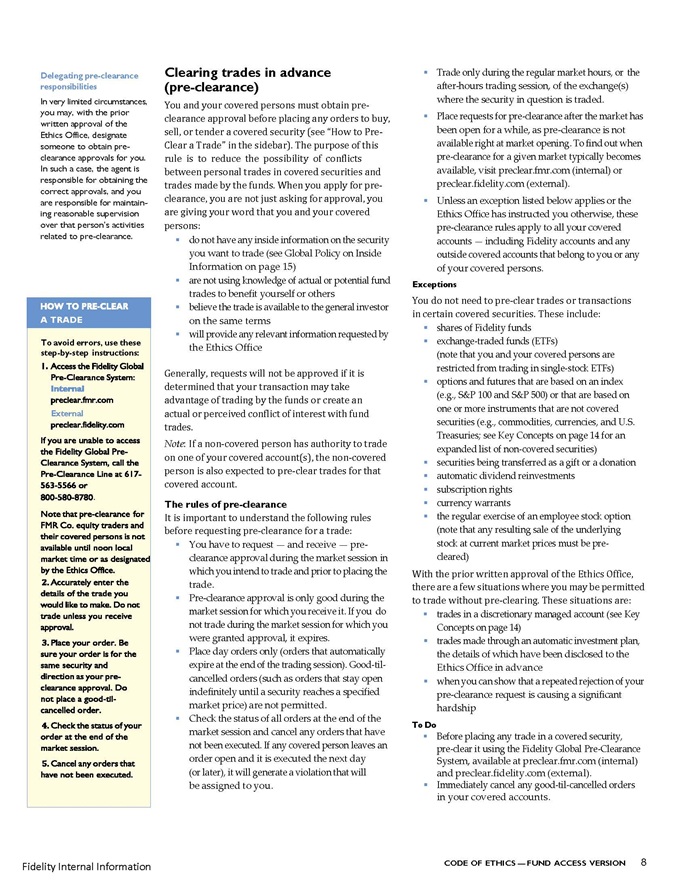
Delegating pre-clearance Clearing trades in advance Trade only during the regular market hours, or the responsibilities (pre-clearance) after-hours trading session, of the exchange(s) In very limited circumstances, You and your covered persons must obtain pre- where the security in question is traded. you may, with the prior clearance approval before placing any orders to buy, Place requests for pre-clearance after the market has written approval of the sell, or tender a covered security (see “How to Pre- been open for a while, as pre-clearance is not Ethics Office, designate someone to obtain pre- Clear a Trade” in the sidebar). The purpose of this available right at market opening. To find out when clearance approvals for you. rule is to reduce the possibility of conflicts pre-clearance for a given market typically becomes In such a case, the agent is between personal trades in covered securities and available, visit preclear.fmr.com (internal) or responsible for obtaining the trades made by the funds. When you apply for pre- preclear.fidelity.com (external). correct approvals, and you clearance, you are not just asking for approval, you are responsible for maintain- are giving your word that you and your covered Unless an exception listed below applies or the ing reasonable supervision Ethics Office has instructed you otherwise, these over that person’s activities persons: pre-clearance rules apply to all your covered related to pre-clearance. do not have any inside information on the security accounts — including Fidelity accounts and any you want to trade (see Global Policy on Inside outside covered accounts that belong to you or any Information on page 15) of your covered persons. are not using knowledge of actual or potential fund Exceptions trades to benefit yourself or others You do not need to pre-clear trades or transactions believe the trade is available to the general investor in certain covered securities. These include: A TRADE on the same terms shares of Fidelity funds will provide any relevant information requested by To avoid errors, use these exchange-traded funds (ETFs) the Ethics Office step-by-step instructions: (note that you and your covered persons are Generally, requests will not be approved if it is restricted from trading in single-stock ETFs) determined that your transaction may take options and futures that are based on an index advantage of trading by the funds or create an (e.g., S&P 100 and S&P 500) or that are based on one or more instruments that are not covered External actual or perceived conflict of interest with fund trades. securities (e.g., commodities, currencies, and U.S. Treasuries; see Key Concepts on page 14 for an on Note: one If of a non your -covered covered person account(s), has authority the non- covered to trade expanded list of non-covered securities) person is also expected to pre-clear trades for that securities being transferred as a gift or a donation covered account. automatic dividend reinvestments subscription rights . The rules of pre-clearance currency warrants It is important to understand the following rules the regular exercise of an employee stock option before requesting pre-clearance for a trade: (note that any resulting sale of the underlying You have to request — and receive — pre- stock at current market prices must be pre- clearance approval during the market session in cleared) which you intend to trade and prior to placing the With the prior written approval of the Ethics Office, trade. there are a few situations where you may be permitted Pre-clearance approval is only good during the to trade without pre-clearing. These situations are: market session for which you receive it. If you do trades in a discretionary managed account (see Key not trade during the market session for which you Concepts on page 14) were granted approval, it expires. trades made through an automatic investment plan, Place day orders only (orders that automatically the details of which have been disclosed to the expire at the end of the trading session). Good-til- Ethics Office in advance cancelled orders (such as orders that stay open when you can show that a repeated rejection of your indefinitely until a security reaches a specified pre-clearance request is causing a significant market price) are not permitted. hardship Check the status of all orders at the end of the To Do market session and cancel any orders that have Before placing any trade in a covered security, not been executed. If any covered person leaves an pre-clear it using the Fidelity Global Pre-Clearance order open and it is executed the next day System, available at preclear.fmr.com (internal) (or later), it will generate a violation that will and preclear.fidelity.com (external). be assigned to you. Immediately cancel any good-til-cancelled orders in your covered accounts. Fidelity Internal Information CODE OF ETHICS — FUND ACCESS VERSION 8


LOGO

Surrendering 60-day gains to transactions made in a discretionary managed Option transactions under the 60-Day Rule (60-Day Rule) account (see Key Concepts on page 14) that has been approved by the Ethics Office Option transactions can Any sale of covered securities in a covered account will be matched either to a be matched against any purchases of that security, to transactions under an automatic investment plan, and prior purchase of the under- or its equivalent, in the same account during the the details of the plan have been provided to the Ethics lying security or to prior previous 60 days (starting with the earliest purchase Office option transactions in the in the 60-day period). Any gain resulting from any transactions, opposite direction. matched transactions must be surrendered. For to tax-planning provided that there is a When matching an option specific information about how certain option demonstration of how the proposed transaction relates transaction to prior purchases to the covered person’s tax strategy; this exception is not of the underlying security, transactions are treated under this rule, see the automatic, is granted on a case-by-case basis, and opening an option position sidebar and the examples below. requires advanced review and written approval of the by selling a call or buying a In addition, the premium received from the opening Ethics Office put is treated as a sale and of an option position in which the expiration of that will be matched to any when the rule would impose a substantial unforeseen purchases of the underlying contract will occur within the next 60 days must be personal financial hardship on the employee; this security made during the surrendered (e.g., selling a call to open or selling a exception is not automatic, is granted on a case-by-case preceding 60 days. put to open that expires within 60 days). basis, and requires advanced review and written When matching an option Gains are calculated differently under this rule than approval of the Ethics Office (note that an employee transaction to prior option they would be for tax purposes. The tax lot of a seeking relief must establish a bona fide financial transactions, a closing position is matched to any position is not a factor in the calculation. Neither hardship, such as unforeseen medical expenses, and like opening positions taken losses nor potential tax liabilities will be offset should be prepared to demonstrate, among other during the preceding 60 days. against the amount that must be surrendered under things, that he or she possesses no other assets to When exercising an option, this rule. meet the financial need) the initial purchase or sale To Do of an option, not the exercise Exceptions Before trading a covered security in a covered account or assignment of the option, This rule does not apply: that might trigger the 60-Day Rule, make sure you is matched to any opposite to transactions in shares of Fidelity funds understand how much may have to be surrendered. transactions made during the to transactions in options and futures on, or ETFs The calculation may be complicated, especially if preceding 60 days. The sale of the underlying securities that track, the following indexes: Dow Jones options or multiple prior purchases are involved. If you received from the exercise Industrial Average, FTSE 100, FTSE 250, Hang have any questions about this provision, call the Ethics of an option will also be Seng, MSCI China, MSCI EAFE, MSCI EM, Office at 617-563-5566 or 800-580-8780. matched to any opposite NASDAQ 100, Nikkei 225, NSE S&P CNX Nifty To request permission for a tax-planning or hardship transactions made during (Nifty 50), Russell 1000, Russell 2000, Russell 3000, exception, you must contact the Ethics Office before the period. S&P 100, S&P 500, S&P Europe 350, S&P MidCap trading. Allow at least two business days for your There is no exception to the 400, and S&P/TSX 60 request to be considered. Approvals will be based on 60-Day Rule for the selling of to transactions in options, futures, and ETFs based fund trading and other pre-clearance tests. You are securities upon the automatic on one or more instruments that are not covered limited to a total of five exceptions per calendar year exercise of an option that is securities (e.g., commodities, currencies, and U.S. across all your covered accounts. in the money at its expiration Treasuries; see Key Concepts on page 14 for an date. To avoid surrendering expanded list of non-covered securities) 60-day gains that would result from an automatic 60 DAYS liquidation, you need to E X A M P L E S cancel the automatic liquidation before it happens. Additional examples are available on MyCompliance in the 60-Day Rule Job Aid. Example 1 The March 25 sale is JAN 20 FEB 2 MAR 1 MAR 25 matched to the February 2 purchase Buy Buy Buy Sell (not the January 20 purchase, which 100 shares 200 shares 200 shares 100 shares was more than 60 days prior). at $16 each at $10 each at $17 each at $15 each Surrendered: $500 ($5 x 100 shares) Example 2 The March 25 call option sale is matched to the February 2 purchase of the underlying security (the call’s FEB 2 MAR 25 execution price and expiration date are Buy 100 shares Sell call option to open immaterial). Surrendered: $500 (the at $10 each for 100 shares at $5; premium for selling the option) receive $500 premium Example 3 The March 25 call option purchase is a closing transaction and is matched to the February 2 sale (since that opening transaction was made FEB 2 MAR 25 within 60 days). Surrendered: Sell one call option to Buy an identical call Fidelity Internal Information $200 (difference between premium open at $5; receive option to close at $3; received and premium paid) $500 premium pay $300 premium


LOGO

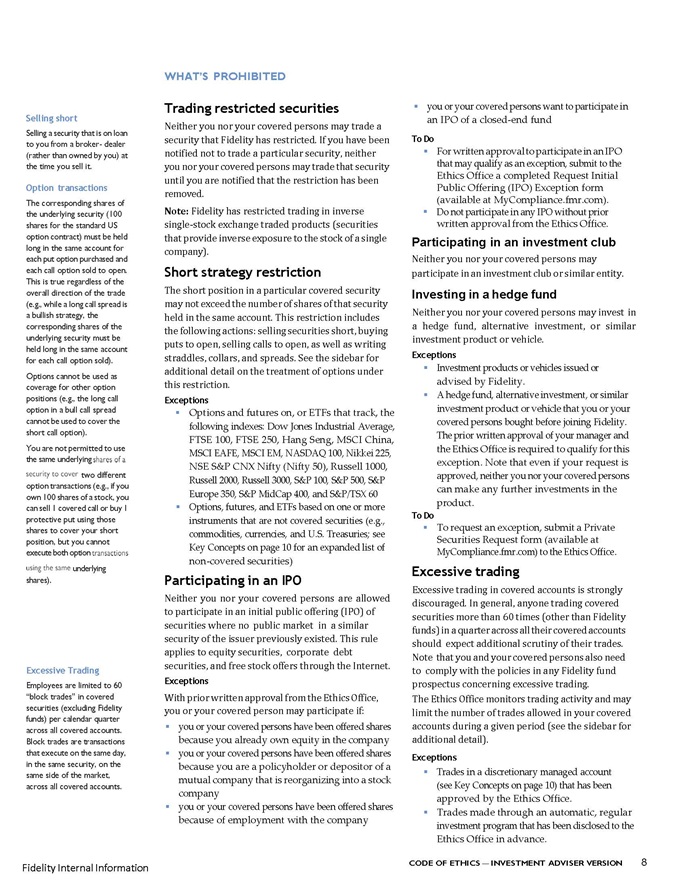
WHAT’S PROHIBITED To Do For written approval to participate in an IPO that may qualify as an exception, submit to the Ethics Selling short Trading restricted securities Office a completed Request Initial Public Offering Selling a security that is on Neither you nor your covered persons may trade a (IPO) Exception form (available at loan to you from a broker- security that Fidelity has restricted. If you have been MyCompliance.fmr.com). dealer (rather than owned by notified not to trade a particular security, neither you Do not participate in any IPO without prior you) at the time you sell it. nor you your are notified covered that persons the restriction may trade has that been security removed until . written approval from the Ethics Office. Option transactions The corresponding shares of has restricted—Participating in an investment club the underlying security (100 exchange Note: Fidelity traded products. trading in all single stock Neither you nor your covered persons may participate shares for the standard US in an investment club or similar entity. option contract) must be held long in the same Short strategy restriction account for each put option The short position in a particular covered security Investing in a hedge fund purchased and each call Neither you nor your covered persons may invest in a option sold to open. This is may not exceed the number of shares of that security hedge fund, alternative investment, or similar true regardless of the overall held in the same account. This restriction includes investment product or vehicle. direction of the trade (e.g., the following actions: selling securities short, buying while a long call spread is a puts to open, selling calls to open, as well as writing Exceptions bullish strategy, the straddles, collars, and spreads. See the sidebar for Investment products corresponding shares of the or vehicles issued or advised underlying security must be additional detail on the treatment of options under by Fidelity. held long in the same this restriction. A hedge fund, alternative investment, or similar account for each call option investment product or vehicle that you or your sold). Exceptions covered persons bought before joining Fidelity. Options cannot be used as Options and futures on, or ETFs that track, the The prior written approval of your manager coverage for other option following indexes: Dow Jones Industrial Average, positions (e.g., the long call and the Ethics Office is required to qualify for FTSE 100, FTSE 250, Hang Seng, MSCI China, option in a bull call spread this exception. Note that even if your request is MSCI EAFE, MSCI EM, NASDAQ 100, Nikkei 225, cannot be used to cover the approved, neither you nor your covered persons NSE S&P CNX Nifty (Nifty 50), Russell 1000, short call option). can make any further investments in the product. Russell 2000, Russell 3000, S&P 100, S&P 500, S&P You are not permitted to use Europe 350, S&P MidCap 400, and S&P/TSX 60 the same underlying shares To Do of a security to cover two Options, futures, and ETFs based on one or more To request an exception, submit a Private different option transactions instruments that are not covered securities (e.g., Securities Request form (available at (e.g., if you own 100 shares commodities, currencies, and U.S. Treasuries; see MyCompliance.fmr.com) to the Ethics Office. of a stock, you can sell 1 covered call or buy 1 Key Concepts on page 14 for an expanded list of protective put using those non-covered securities) shares to cover your short Excessive trading position, but you cannot Participating in an IPO Excessive trading in covered accounts is strongly execute both option discouraged. In general, anyone trading covered transactions using the same Neither you nor your covered persons are allowed to securities more than 60 times (other than Fidelity underlying shares). participate securities where in an initial no public public market offering in (IPO) a similar of funds) should in expect a quarter additional across scrutiny all their of covered their trades accounts . Note security applies to of equity the issuer securities, previously corporate existed debt . This securities, rule that you and your covered persons also need to and free stock offers through the Internet. comply prospectus with concerning the policies excessive in any Fidelity trading fund . Exceptions The Ethics Office monitors trading activity and Excessive Trading With prior written approval from the Ethics Office, covered may limit accounts the number during of trades a given allowed period (see in your the Employees are limited to 60 you or your covered persons may participate if: sidebar for additional detail). “block trades” in covered covered persons have you or your been securities (excluding Fidelity funds) per calendar quarter offered shares because you already own equity in Exceptions across all covered accounts. the company Trades in a discretionary managed account (see Block trades are you or your covered persons have been offered Key Concepts on page 14) that has been approved transactions that execute on shares because you are a policyholder or depositor by the Ethics Office. the same day, in the same of a mutual company that is reorganizing into a Trades made through an automatic investment plan security, on the same side of that has been disclosed to the Ethics Office in the market, across all stock company advance. covered accounts. you or your covered persons have been offered shares because of employment with the company you or your covered persons want to participate in an IPO of a closed-end fund Fidelity Internal Information CODE OF ETHICS — FUND ACCESS VERSION 10


LOGO

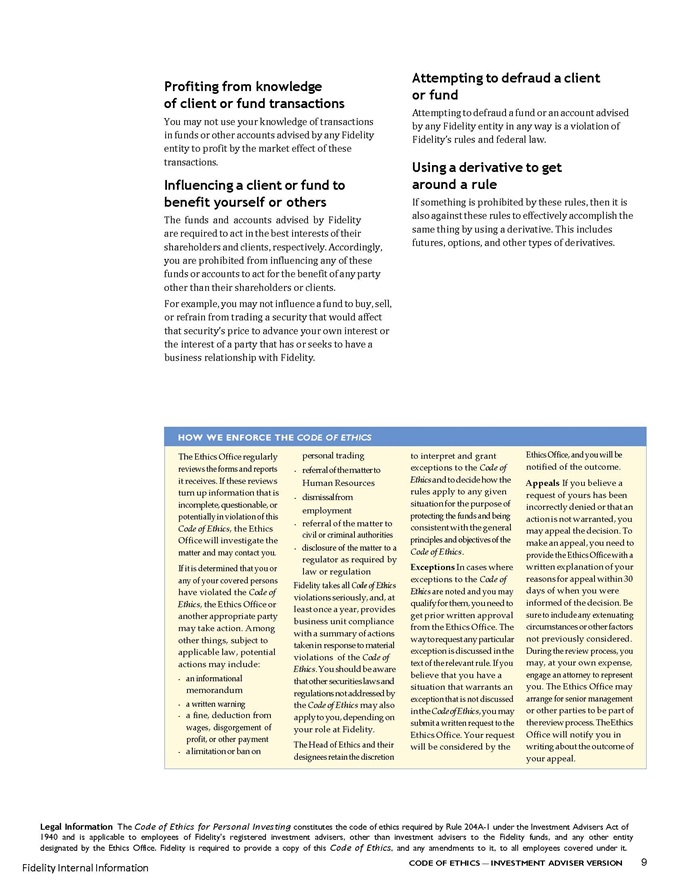
For example, you may not influence a fund to buy, Buying securities of certain sell, or refrain from trading a security that would broker Neither you -dealers nor your covered persons are allowed to interests affect that or security’s the interests price of to a party advance that your has own or seeks to buy company the securities if the Ethics of a Office broker has -dealer restricted or its parent those have a business relationship with Fidelity. securities. Attempting to defraud a client Neither Trading you nor after your a covered research persons note are allowed to or Attempting fund to defraud a fund or an account advised trade business a covered days have security elapsed of an following issuer until the date two full of the Fidelity’s by any Fidelity rules and entity securities in any way law is . a violation of publication Fidelity entity of .a For research purposes note of on clarity, that issuer the by any prohibited period begins with the publication of the Using a derivative to get business note and days continues . for an additional two full around If something a is rule prohibited by these rules, then it is the also same against thing these by using rules a to derivative effectively . This accomplish includes Profiting from knowledge of futures, options, and other types of derivatives. fund You may transactions not use your knowledge of transactions in to funds profit or by other the accounts market effect advised of these by any transactions Fidelity entity . Influencing a fund to benefit The yourself funds and or a cco others unts advised by Fidelity are required shareholders to act and in the clients, best respectively interests of .their Accordingly, you funds are or prohibited accounts to from act for influencing the benefit any of of any these party other than their shareholders or clients. HOW WE ENFORCE THE CODE OF ETHICS reviews the forms and dismissal from of Ethics and to decide how you will be notified of the reports it receives. If these employment the rules apply to any outcome. reviews turn up information referral of the matter to given situation for the Appeals If you believe a that is incomplete, civil or criminal purpose of protecting the request of yours has been questionable, or potentially in authorities funds and being consistent incorrectly denied or that an violation of the Code of disclosure of the matter with the general principles action is not warranted, you Ethics, investigate the Ethics the matter Office and will to a regulator as and objectives of the Code may appeal the decision. To may contact you. required by law or of Ethics. make an appeal, you need to If it is determined that you or regulation Exceptions In cases where provide the Ethics Office with any of your covered persons Fidelity takes all Code of exceptions to the Code of a written explanation of your has violated the Code of Ethics violations seriously, Ethics are noted and you reasons for appeal within 30 Ethics, the Ethics Office or and, at least once a year, may qualify for them, you days of when you were may another take appropriate action. Among party other provides the funds’ trustees need to get prior written informed of the decision. Be things, subject to applicable with a summary of actions approval from the Ethics sure to include any law, potential actions may taken in response to material Office. The way to request extenuating circumstances or include: violations of the Code of any particular exception is other factors not previously an informational Ethics. You should be aware discussed in the text of the considered. During the review memorandum that other securities laws and relevant rule. If you believe process, you may, at your own a written warning regulations not addressed by that you have a situation expense, engage an attorney a wages, fine, a disgorgement deduction from of the Code of Ethics may also that warrants an exception to represent you. The Ethics profit, or other payment apply to you, depending on that is not discussed in the Office may arrange for senior a limitation or ban on your role at Fidelity. Code of Ethics, you may management or other parties personal trading The Head of Ethics and their submit a written request to to be part of the review designees retain the the Ethics Office. Your process. The Ethics Office will referral of the matter to discretion to interpret and request will be considered notify you in writing about Human Resources grant exceptions to the Code by the Ethics Office, and the outcome of your appeal. Fidelity Internal Information CODE OF ETHICS — FUND ACCESS VERSION 11


LOGO

Research Additional Analysts, Rules for and Traders, Portfolio Managers Employees trading for the funds (traders), employees making investment recommendations for the funds (research analysts), and employees who manage a fund or a portion of a fund’s assets (portfolio managers) WHAT’S REQUIRED Disclosing information about an issuer that is assigned to If y you ou are a research analyst, you must disclose in a Notification covered securities of your in ownership a research of note an research issuer note that is material assigned information to you before you you have or about any are You publishing must check to indicate the box any on ownership, a research either note you by of of your that issuer covered . persons personally trade a security of you an or issuer your (see covered Key persons, Concepts of on any page covered 14) that security is the Exception subject of the research note. You or any of your covered persons may be permitted to trade the assigned security in a covered account without publishing a research Disclosing trading opportunities to note if you have obtained the prior approval of the funds before personally trading both the relevant head of research and the Ethics There are three aspects to this rule: Office. Disclosing information received from an issuer To Do Any time you receive, directly from an issuer, material Publish a research note with the relevant information about that issuer (that is not considered information, and indicate any ownership interest inside information), you must check to see if that in the issuer that you or your covered persons information research note has . If been not, you disclosed must communicate to the funds in that a may have before personally trading a security you information to the funds before you or any of your are assigned to cover. covered persons personally trade any securities of Note: You will not be able to obtain pre- that issuer. clearance approval for your personal trade until two full business days have elapsed To Do (not including the day the note was Confirm whether a Fidelity research note has been published) following the publication of published with the relevant information. your research note. If not, publish a research note or provide the To request an exception to this rule, first contact the information to the relevant head of research. relevant head of research and seek approval. Then If you are a trader, disclose the information to the contact the Ethics Office for approval. Do not analyst covering the issuer. personally trade the security until you have If you think you may have received inside received full approval. information, follow the rules in the Global Policy on Inside Information (see page 15). Recommending In and, add if ition, you are you trading a must portf opportunities olio reco mm manager, end for trade the for funds, the funds, that security a suitable . security before personally trading Fidelity Internal Information CODE OF ETHICS — FUND ACCESS VERSION 12


LOGO

When the conflicting fund trade is the result of a WHAT’S PROHIBITED proportional slice A personal trade may precede a fund trade in a Trading within seven days of a fund covered security of the same issuer when the fund’s you manage trade was conducted as part of the execution of a Neither you nor your covered persons are allowed to proportional slice across the fund for cash trade within seven calendar days (not including the management or rebalancing purposes. day of the trade) before or after a trade is executed in When the covered account is independently any covered security of the same issuer (see Key managed Concepts on page 14) by any of the funds you manage. This exception applies only to discretionary managed accounts (See Key Concepts on page 14) that have received Ethics Office approval. Exceptions When the conflicting personal trade or fund trade When the rule would work to the disadvantage of a is in options or futures on, or ETFs that track, the fund following indexes: Dow Jones Industrial Average, You must never let a personal trade prevent a fund FTSE 100, FTSE 250, Hang Seng, MSCI China, MSCI you manage from subsequently trading a covered EAFE, MSCI EM, NASDAQ 100, Nikkei 225, NSE S&P security of the same issuer, if not making the trade CNX Nifty (Nifty 50), Russell 1000, Russell 2000, would disadvantage the fund. However, you need Russell 3000, S&P 100, S&P 500, S&P Europe 350, S&P MidCap 400, and S&P/TSX 60 approval from the Ethics Office before making any trades under this exception. The Ethics Office will When the conflicting personal trade or fund trade is in options, futures, or ETFs based on one or need to know, among other things, what new more instruments that are not covered securities information arose since the date of the trade in your (e.g., commodities, currencies, and U.S. Treasuries; see covered account. Key Concepts on page 14 for an expanded list of When the conflicting fund trade results from non-covered securities). standing orders A personal trade may precede a fund trade in a To Do covered security of the same issuer when the fund’s Before trading personally, consider whether there trade was generated independently by the trading is any likelihood that you may be interested in desk because of a standing instruction to trade trading a covered security of the same issuer in proportionally across the fund’s holdings in response your assigned funds within seven calendar days to fund cash flows. from If following a fund personally you the manage day trading of the has fund in recently a covered trade traded . If account so, refrain a . security, trades in you any must covered delay security any covered of the same account issuer for most seven recent calendar fund trade days. following the day of the Contact any situation the Ethics where Office these immediately rules would to work discuss to the disadvantage of the funds. Legal Information The Code of Ethics for Personal Investing constitutes the code of ethics required by Rule 17j-1 under the Investment Company Act of 1940 and by Rule 204A-1 under the Investment Advisers Act of 1940 for the Fidelity funds, investment advisers or principal underwriters, and any other entity designated by the Ethics Office. Fidelity Internal Information CODE OF ETHICS — FUND ACCESS VERSION 13


LOGO

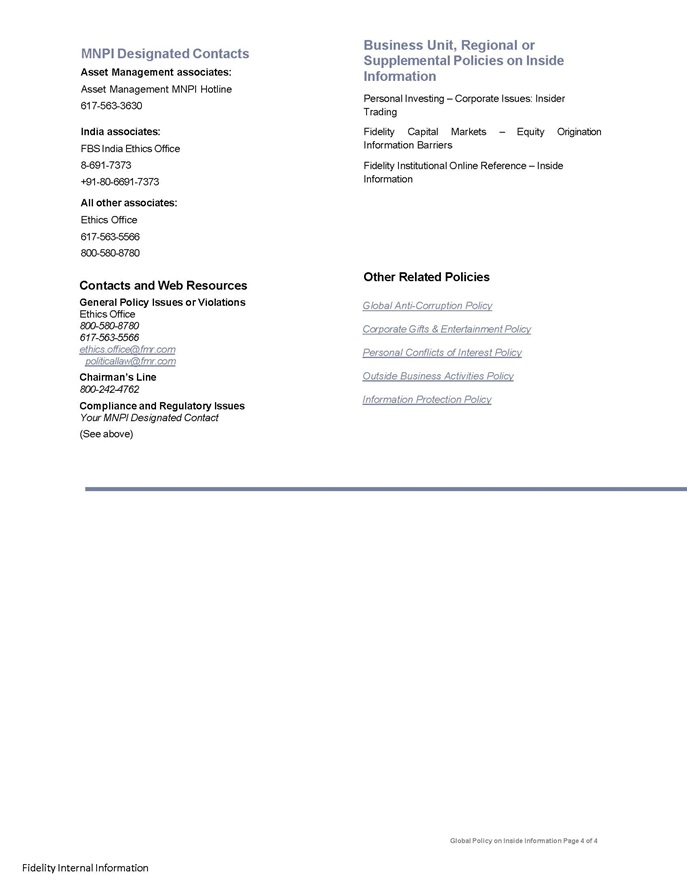
These KEY of these CONCEPTS definitions rules to a encompass person, security, broad categories, or account and that the is examples not addressed given in are this not section, all inclusive you . can If you contact have any the questions Ethics Office regarding for additional these definitions guidance .or application Covered person Covered account Issuer shares companies) of stock (of both public and private Fidelity is concerned not only of the that you The encompasses term “covered a fairly account” wide range of An bank entity, branch, including foreign its office, wholly or owned term ownership units in a private company or observe the butrequirements also that those in whos Code e accounts. Important factors to note program that offers securities partnership af of fairs Ethics, you are actively involved consider are: or investors other financial . instruments to corporate and municipal bonds observe means that the the Code of Ethics. This your actual or potential investment bonds convertible into stock apply to persons Code owning of Ethics asse can ts over control whether over you an have account, trading including authority, A Discretionary covered account Managed may be Account eligible for on options stocks on and securities stock indexes) (including options which or in which you you have have control an opportunity or influence control power of over attorney, an account or investment certain Code of exceptions, Ethics, with as prior specified written in the security futures (futures on covered to directly or indirectly profit or share approval of the Ethics Office shares securities) of exchange -traded in any profit derived from a securities Specifically, a covered account is a validating that the covered account is (ETFs) funds transaction. This includes: brokerage account or any other type of managed advisor who by a has third discretionary -party investment trading shares of closed-end funds you account that holds, or is capable of authority over that covered account. who your shares spouse your or domestic household partner belongs holding, to, a covered or is controlled security, and that To third qualify -party for investment this exception, advisor the must Exceptions The following are not considered any other immediate family member by investment (including control), trading any discretion of the or exercise all trading discretion over covered securities (please note who shares your household and following: the covered account and will not non that- covered securities securities accounts still holding require (a) financially is under by 18 you or (b) or who is supported financially a covered person securities accept any from order the to employee buy or sell or specific any disclosure): supports you any where corporation a covered or person similar is a entity other covered person. An approved shares of money market funds anyone else the Ethics Office has controlling shareholder or discretionary managed account will funds) (including Fidelity money market designated as a covered person participates in investment decisions by and still be subject to the Code of Ethics This is not an exclusive list, and the entity all unless provisions otherwise in the stated Code of shares of non-Fidelity open-end example, a covered immediate person may family include, members for any your trust covered of which persons: you or any of a Ethics specific exception. in mutual funds in funds non- Fidelity (including 529 shares plans) of who not financially live with you support, but whom or whom you do you – decisions participates for in the making trust investment This Covered definition security applies to all persons shares, issued by debentures, FMR LLC or to other you as securities support financially you support but who or do who not financially live – is a trustee of the trust subject to this version of the Code compensation or a benefit associated with you. If you have any doubt as to – is a settlor who can independently of Ethics. with your employment whether a person would be considered revoke the trust and participate in Covered in which securities a covered include person has securities the U.S. Treasury securities a “covered person” under the Code making investment decisions for the opportunity, directly or indirectly, to obligations of U.S. government of Ethics, contact the Ethics Office. trust profit or share in any profit derived agencies of one year with or remaining less maturities Your Immediate spouse family or domes member tic partner who With Exception prior written approval from the from and encompasses a transaction most in such types securities, of money market instruments, such who shares is related your household, to you in and any anyone of the Ethics Office, a covered account may securities, including, but not acceptances, as certificates and of deposit, commercial banker’s paper following ways, whether by blood, where: qualify for an exception from these rules limited to: adoption, or marriage: it is nonprofit shares of Fidelity mutual funds currencies stepchildren, and the account of a (except money market funds), commodities (such as agricultural children, grandchildren is organization a member of and a board a covered or person including a 529 plan shares of Fidelity funds in products or metals), and options parents, stepparents, and committee responsible for the shares of another company’s and traded futures on a commodities on commodities exchange that are grandparents provided investments that of the the covered organization, person mutual fund if it is advised by siblings does not participate in investment see Fidelity if this (check is the case) the prospectus to parents-, children-, and decisions with respect to covered interests in a variable annuity or siblings-in-law securities life insurance product in which any A Domestic person in partner a marriage -like it account is an educational that is used institution’s in connection of funds the advised underlying by Fidelity, assets are such held as in relationship your relative, with has you reached who the is not age part with of an an investment MBA or other course educational that is Fidelity VIP Funds (check the of majority, and is not married to program, and a covered person prospectus to see if this is the case) any other person. You and your participates in investment decisions interests compensation in Fidelity’s plan reflecting deferred domestic together for partner at least must one have year, lived with respect to the account hypothetical investments in with and generally the intent must to be be life partners, The Fidelity terms fund “fund” and “Fidelity fund” interests Fidelity funds in Fidelity’s deferred economically interdependent. of mean assets any that investment is advised company or sub advised or pool hypothetical bonus plan (ECI) investments reflecting in by any Fidelity entity. Fidelity funds Fidelity Internal Information CODE OF ETHICS — FUND ACCESS VERSION 14


LOGO

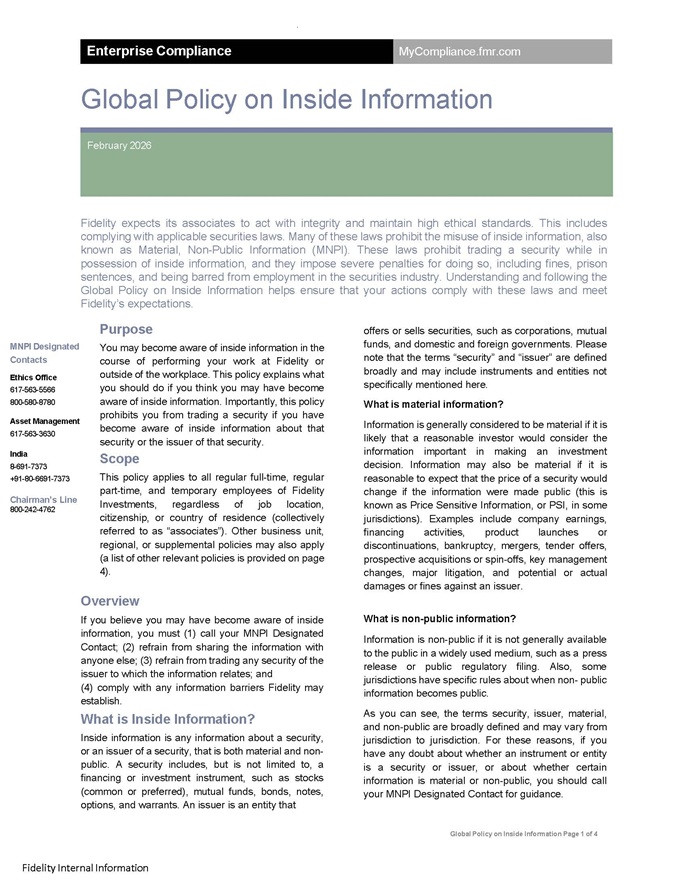
Enterprise Compliance MyCompliance.fmr.com Global Policy on Inside Information February 2026 Fidelity expects its associates to act with integrity and maintain high ethical standards. This includes complying with applicable securities laws. Many of these laws prohibit the misuse of inside information, also known as Material, Non-Public Information (MNPI). These laws prohibit trading a security while in possession of inside information, and they impose severe penalties for doing so, including fines, prison sentences, and being barred from employment in the securities industry. Understanding and following the Global Policy on Inside Information helps ensure that your actions comply with these laws and meet Fidelity’s expectations. MNPI Designated Purpose offers or sells securities, such as corporations, mutual Contacts You may become aware of inside information in funds, and domestic and foreign governments. Please Ethics Office note that the terms “security” and “issuer” are defined the course of performing your work at Fidelity or 617-563-5566 broadly and may include instruments and entities not outside of the workplace. This policy explains what 800-580-8780 specifically mentioned here. you should do if you think you may have become Asset Management aware of inside information. Importantly, this policy What is material information? 617-563-3630 prohibits you from trading a security if you have become aware of inside information about that Information is generally considered to be material if it is India security or the issuer of that security. likely that a reasonable investor would consider the 8-691-7373 +91-80-6691-7373 Scope information important in making an investment decision. Information may also be material if it is Chairman’s Line This policy applies to all regular full-time, regular reasonable to expect that the price of a security would 1-800-242-4762 part-time, and temporary employees of Fidelity change if the information were made public (this is Investments, regardless of job location, known as Price Sensitive Information, or PSI, in some citizenship, or country of residence (collectively jurisdictions). Examples include company earnings, referred to as “associates”). Other business unit, financing activities, product launches or regional, or supplemental policies may also apply discontinuations, bankruptcy, mergers, tender offers, (a list of other relevant policies is provided on page prospective acquisitions or spin-offs, key management 4). changes, major litigation, and potential or actual damages or fines against an issuer. Overview If you believe you may have become aware of inside What is non-public information? information, you must (1) call your MNPI Designated Information is non-public if it is not generally available Contact; (2) refrain from sharing the information with to the public in a widely used medium, such as a press anyone else; (3) refrain from trading any security of the release or public regulatory filing. Also, some issuer to which the information relates; and jurisdictions have specific rules about when non- public (4) comply with any information barriers Fidelity may information becomes public. establish. What is Inside Information? As you can see, the terms security, issuer, material, Inside information is any information about a security, and non-public are broadly defined and may vary from or an issuer of a security, that is both material and non- jurisdiction to jurisdiction. For these reasons, if you public. A security includes, but is not limited to, a have any doubt about whether an instrument or entity financing or investment instrument, such as stocks is a security or issuer, or about whether certain (common or preferred), mutual funds, bonds, notes, information is material or non-public, you should call options, and warrants. An issuer is an entity that your MNPI Designated Contact for guidance. Global Policy on Inside Information Page 1 of 4 Fidelity Internal Information


LOGO

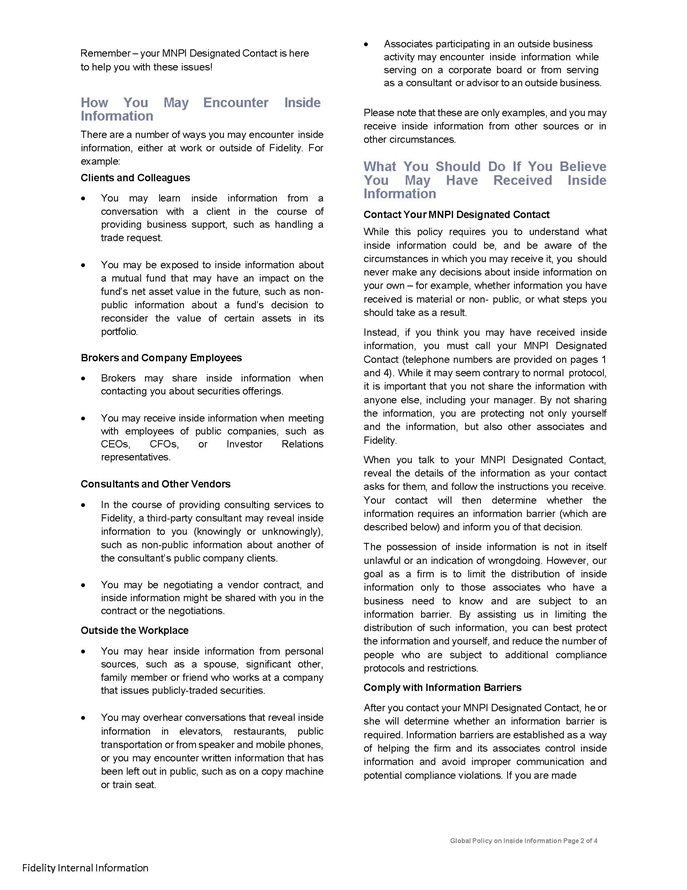
Remember – your MNPI Designated Contact is here Associates participating in an outside business activity may encounter inside information while to help you with these issues! serving on a corporate board or from serving as a consultant or advisor to an outside business. How You May Encounter Inside Information Please note that these are only examples, and you may There are a number of ways you may encounter inside receive inside information from other sources or in information, either at work or outside of Fidelity. For other circumstances. example: Clients and Colleagues What You Should Do If You Believe You May Have Received Inside You may learn inside information from a Information conversation with a client in the course of providing business support, such as handling a Contact Your MNPI Designated Contact trade request. While this policy requires you to understand what inside information could be, and be aware of the You may be exposed to inside information about circumstances in which you may receive it, you should a mutual fund that may have an impact on the never make any decisions about inside information on fund’s net asset value in the future, such as non- your own – for example, whether information you have public information about a fund’s decision to received is material or non- public, or what steps you reconsider the value of certain assets in its should take as a result. portfolio. Instead, if you think you may have received inside information, you must call your MNPI Designated Brokers and Company Employees Contact (telephone numbers are provided on pages 1 Brokers may share inside information when and 4). While it may seem contrary to normal protocol, contacting you about securities offerings. it is important that you not share the information with anyone else, including your manager. By not sharing You may receive inside information when meeting the information, you are protecting not only yourself with employees of public companies, such as and the information, but also other associates and CEOs, CFOs, or Investor Relations Fidelity. representatives. When you talk to your MNPI Designated Contact, reveal the details of the information as your contact Consultants and Other Vendors asks for them, and follow the instructions you receive. In the course of providing consulting services to Your contact will then determine whether the Fidelity, a third-party consultant may reveal inside information requires an information barrier (which are information to you (knowingly or unknowingly), described below) and inform you of that decision. such as non-public information about another of The possession of inside information is not in itself the consultant’s public company clients. unlawful or an indication of wrongdoing. However, our goal as a firm is to limit the distribution of inside You may be negotiating a vendor contract, and information only to those associates who have a inside information might be shared with you in the business need to know and are subject to an contract or the negotiations. information barrier. By assisting us in limiting the Outside the Workplace distribution of such information, you can best protect the information and yourself, and reduce the number of You may hear inside information from personal people who are subject to additional compliance sources, such as a spouse, significant other, protocols and restrictions. family member or friend who works at a company that issues publicly-traded securities. Comply with Information Barriers After you contact your MNPI Designated Contact, he or You may overhear conversations that reveal she will determine whether an information barrier is inside information in elevators, restaurants, public required. Information barriers are established as a way transportation or from speaker and mobile phones, of helping the firm and its associates control inside or you may encounter written information that has information and avoid improper communication and been left out in public, such as on a copy machine potential compliance violations. If you are made or train seat. Global Policy on Inside Information Page 2 of 4 Fidelity Internal Information


LOGO

subject to an information barrier, the Ethics Office will or on social media (such as Twitter, LinkedIn, or contact you, provide you with a document explaining Facebook). You should also store any documents the terms of the barrier, and require you to containing or reflecting the inside information in a acknowledge and agree to abide by those terms. secure place in accordance with the document- handling procedures of Fidelity’s Global Policy on Information barriers are established by identifying Information Protection (“SP2I”) Policy. individual associates and groups of people who have received inside information. The information is then Do Not “Tip” or Improperly Disclose Inside protected by employing a combination of information Information handling, storage protocols, and physical or technical The prohibition on communicating with others about barriers around the associates and the information they inside information extends to recommending possess. Information barriers are monitored to detect investments or expressing opinions to anyone, or possible gaps, including reviews of communications soliciting orders from Fidelity clients, on the basis of (such as emails), enhanced physical access and inside information. This is known as “tipping” or “tipping access designations, and additions of associates to the off,” which is a serious violation of law. You may information barrier. Surveillance is conducted of become liable for any transactions by anyone to whom associates’ personal trading to detect potential misuse you have improperly disclosed inside information, or to of inside information. whom they have made investment recommendations Do Not Trade in the Security or the Issuer or expressed opinions on the basis of that information. If you have received inside information, you are Reporting Potential Violations prohibited from trading any security of the issuer to You should report known or suspected violations of this which the information relates. This is known as “insider policy to your MNPI Designated Contact or call the trading” or “insider dealing,” which is a serious violation Chairman’s Line at 800-242-4762 to speak of law. You may not buy, sell, transfer, gift, loan or anonymously on an unrecorded line. pledge these securities, even if you have a reason to trade that is independent of the inside information. You also may not modify, suspend, or cancel an automatic investment plan of the security or the issuer of the security or make any recommendations to anyone to deal in the security in any way. These prohibitions apply: Not only to your covered accounts, but also to any account you manage, including accounts at Fidelity; Regardless of whether you receive any financial or other benefit from the account or the trade; and Regardless of whether your trade is in a different direction than the inside information may indicate (e.g., a sale where the inside information indicates you should buy). Remember that shares of mutual funds are also securities subject to these restrictions. You may not trade or transfer shares of mutual funds, whether advised by Fidelity or not, if you believe that you may have become aware of inside information about the mutual fund. Protect Inside Information It is critical that you keep inside information to yourself. You should refrain from discussing inside information in public, including elevators, restaurants, public transportation, on speaker and mobile phones, Global Policy on Inside Information Page 3 of 4 Fidelity Internal Information


LOGO

MNPI Designated Contacts Business Unit, Regional or Supplemental Policies on Inside Asset Management associates: Information Asset Management MNPI Hotline 617-563-3630 Personal Investing – Corporate Issues: Insider Trading India associates: Fidelity Capital Markets – Equity Origination FBS India Ethics Office Information Barriers 8-691-7373 Fidelity Institutional Online Reference – Inside +91-80-6691-7373 Information All other associates: Ethics Office 617-563-5566 800-580-8780 Contacts and Web Resources Other Related Policies General Policy Issues or Violations Ethics Office Global Anti-Corruption Policy 800-580-8780 617-563-5566 Corporate Gifts & Entertainment Policy ethics.office@fmr.com politicallaw@fmr.com Personal Conflicts of Interest Policy Chairman’s Line Outside Business Activities Policy 800-242-4762 Compliance and Regulatory Issues Information Protection Policy Your MNPI Designated Contact (See above) Global Policy on Inside Information Page 4 of 4 Fidelity Internal Information


LOGO

Ethics Office Rules for 2026 Employee Investing CODE OF ETHICS FOR PERSONAL INVESTING Investment Adviser Version GLOBAL POLICY ON INSIDE INFORMATION Fidelity Internal Information


LOGO

The Rules for Employee Investing are fairly comprehensive. They cover most of the personal investing situations a Fidelity employee is likely to experience. Yet it’s always possible you will encounter a situation that isn’t fully addressed by the rules. If that happens, you need to know what to do. The easiest way to make sure you are making the right decision is to follow these three principles: 1. Know the policy. If you think your situation isn’t covered, check again. It never hurts to take a second look at the rules. 2. Seek guidance. Asking questions is always appropriate. Talk with your manager or the Ethics Office if you’re not sure about the policy requirements or how they apply to your situation. Additionally, resources are available at MyCompliance to assist you with your questions. 3. Use sound judgment. Analyze the situation and weigh the options. Think about how your decision would look to an outsider. Understanding and following the Rules for Employee Investing is one of the most important ways we can ensure our customers’ interests always come first. Rules for Employee Investing These Rules for Employee Investing contain the Code of Ethics for Personal Investing and the Global Policy on Inside Information. The Investment Adviser Version of the Code of Ethics for Personal Investing contains rules about owning and trading securities for personal benefit. This version applies to officers, directors, employees, and supervised persons of Fidelity’s registered investment advisers, other than the investment advisers to the Fidelity funds (or those associates who are deemed Fund Access for other reasons), including: Fidelity Institutional Wealth Adviser LLC (FIWA) Strategic Advisers LLC (SAI) Impresa Management LLC Ballyrock Investment Advisors LLC Keep in mind that if you change jobs within Fidelity, a different version of the Code of Ethics may apply to you. The Global Policy on Inside Information, which applies to every Fidelity employee, contains rules on inside information and how to prevent its unauthorized use or dissemination. Ethics Office Phone: +1 (800) 580-8780 ethics.office@fmr.com INFORMATION 2 Fidelity Internal Information


LOGO

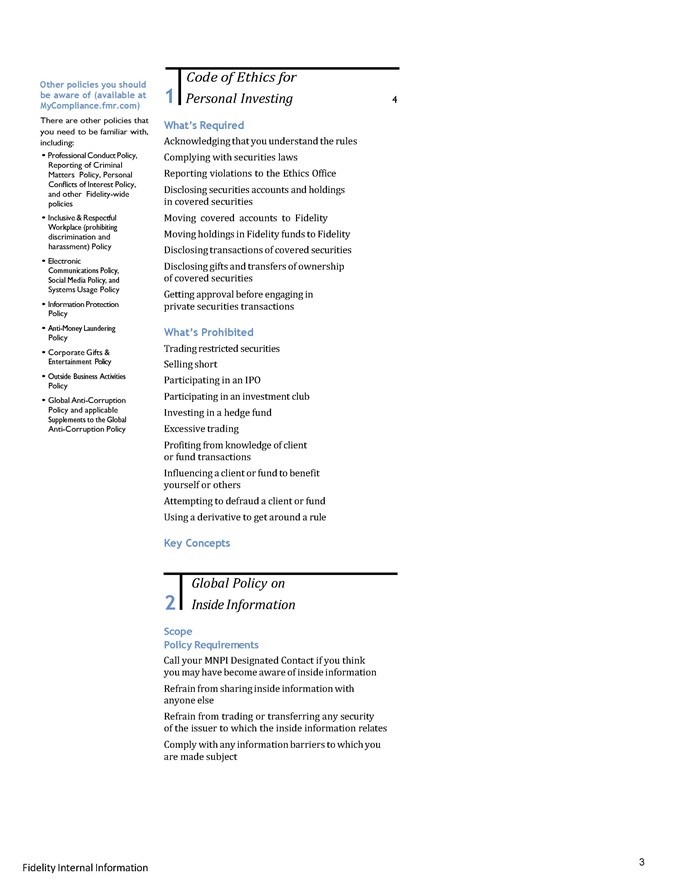
Other policies you should be aware of (available at MyCompliance.fmr.com) There are other policies that you need to be familiar with, including: Professional Conduct Policy, Reporting of Criminal Matters Policy, Personal Conflicts of Interest Policy, and other Fidelity-wide policies Inclusive & Respectful Workplace (prohibiting discrimination and harassment) Policy Electronic Communications Policy, Social Media Policy, and Systems Usage Policy Information Protection Policy Anti-Money Laundering Policy Corporate Gifts & Entertainment Policy Outside Business Activities Policy Global Anti-Corruption Policy and applicable Supplements to the Global Anti-Corruption Policy Code of Ethics for 1 Personal Investing 4 What’s Required Acknowledging that you understand the rules Complying with securities laws Reporting violations to the Ethics Office Disclosing securities accounts and holdings in covered securities Moving covered accounts to Fidelity Moving holdings in Fidelity funds to Fidelity Disclosing transactions of covered securities Disclosing gifts and transfers of ownership of covered securities Getting approval before engaging in private securities transactions What’s Prohibited Trading restricted securities Selling short Participating in an IPO Participating in an investment club Investing in a hedge fund Excessive trading Profiting from knowledge of client or fund transactions Influencing a client or fund to benefit yourself or others Attempting to defraud a client or fund Using a derivative to get around a rule Key Concepts Scope Policy Requirements Call your MNPI Designated Contact if you think you may have become aware of inside information Global Policy on 2 Inside Information Refrain from sharing inside information with anyone else Refrain from trading or transferring any security of the issuer to which the inside information relates Comply with any information barriers to which you are made subject 3 Fidelity Internal Information


LOGO

CODE OF ETHICS — INVESTMENT ADVISER VERSION 4 Fidelity Internal Information Investment Adviser Version Following the rules — in letter and in spirit This Investment Adviser Version of the Code of Ethics contains rules about owning and trading securities for personal benefit. Certain rules, which are noted, apply both to you and to anyone else who is a covered person (see Key Concepts on page 10). You have a fiduciary duty to never place your personal interests ahead of the interests of Fidelity’s clients, including shareholders of the Fidelity funds. This means never taking unfair advantage of your relationship to the funds or Fidelity in attempting to benefit yourself or another party. It also means avoiding any actual or potential conflicts of interest with the funds or Fidelity when managing your personal investments. Because no set of rules can anticipate every possible situation, it is essential that you follow these rules not just in letter, but in spirit as well. Any activity that compromises Fidelity’s integrity, even if it does not expressly violate a rule, has the potential to harm Fidelity’s reputation and may result in scrutiny or further action from the Ethics Office. WHAT’S REQUIRED Acknowledging that you understand the rules When you begin working for Fidelity, and again each year, you are required to: acknowledge that you understand and will comply with all rules that apply to you authorize Fidelity to have access to all your covered accounts (see Key Concepts on page 10) and to obtain and review account and transaction data (including duplicate copies of non-Fidelity account statements) for compliance or employment-related purposes acknowledge that you will comply with any new or existing rules that become applicable to you in the future To Do Promptly take action on any emails or alerts that you receive from the Ethics Office requiring you to acknowledge the Code of Ethics. All employees need to acknowledge within 10 days of receipt.


LOGO

Complying with securities laws In addition to complying with these rules and other company-wide policies, you need to comply with U.S. securities laws and any other securities laws to which you are subject. Reporting violations to the Ethics Office If you become aware that you or someone else has violated any of these rules, you need to promptly report the violation. To Do Call the Ethics Office Service Line at 617-563-5566 or 800-580-8780. Call the Chairman’s Line at 800-242-4762 if you would prefer to speak on a non-recorded line. Disclosing securities accounts and holdings in covered securities You must disclose all securities accounts — those that hold covered securities (see Key Concepts on page 10) and those that do not. You must also disclose all covered securities held in your covered accounts and those not held in an account. This rule covers not only securities accounts and holdings under your own name or control, but also those under the name or control (including trading discretion or investment control) of your covered persons (see Key Concepts on page 10). It includes accounts held at Fidelity as well as those held at other financial institutions. Information regarding these holdings must not be more than 45 days old when you submit it. To Do Employees newly subject to this rule Within 10 days of hire or of being notified by the Ethics Office that this version of the Code of Ethics applies to you, you will be asked to certify as to your understanding of the applicable Code of Ethics and, in conjunction with your certification, you will be required to disclose all your securities accounts and holdings in covered securities not held in an account. Submit the most recent statement for each securities account listed to the Ethics Office if not held at Fidelity. Current employees Each year, you will be asked to complete an Annual Code of Ethics Certification. You will be required to confirm that all information previously disclosed is accurate and complete. As soon as any new securities account is opened, or a preexisting securities account becomes associated with you (such as through marriage or inheritance), complete an Account Disclosure Form (available at MyCompliance.fmr.com) with the new information and submit it promptly to the Ethics Office. On your next Quarterly Trade Verification, confirm that the list of disclosed securities accounts in the appropriate section of the report is accurate and complete. CODE OF ETHICS — INVESTMENT ADVISER VERSION 5 Fidelity Internal Information


LOGO

Automatic investment plan A program in which regular periodic purchases (or withdrawals) are made automatically in (or from) covered accounts according to a predetermined schedule and allocation. An “automatic investment plan” includes a direct purchase plan, a dividend reinvestment plan, an employee compensation plan, an automatic investment plan with a public company, or similar program. The term does not include a schedule of automated transactions in covered securities in a covered account which is established and controlled by you or your covered person. . Moving covered accounts to Fidelity You and your covered persons need to maintain all covered accounts (see Key Concepts on page 10) at Fidelity Brokerage Services LLC (FBS). Exceptions — Approval Required With prior written approval from the Ethics Office, you and your covered persons can maintain a covered account at a broker-dealer other than FBS if any of the exceptions below apply. Note that approval must be obtained prior to opening any new covered account outside FBS: The account contains only securities that cannot be transferred It exists solely for investment products or investment services that FBS does not provide — Note: Approval will not be granted for requests based on ancillary account features or promotional offers It exists solely because your covered person’s employer also prohibits external covered accounts It is a discretionary managed account (see Key Concepts on page 10) It is associated with an ESOP (employee stock option plan) in which a covered person is a participant through their current employer, or was from a previous employer, and for which the employee has options that have not yet vested It is associated with an ESPP (employee stock purchase plan) in which a covered person is a participant through their current employer It is required by a direct purchase plan, a dividend reinvestment plan, an employee compensation plan, or an automatic investment plan with a public company (each an “automatic investment plan”) in which regularly scheduled purchases are made or planned on a predetermined basis It is required by a trust agreement It is associated with an estate of which you or any of your covered persons are the executor, and involvement with the account is temporary Transferring the account would be inconsistent with other applicable rules To Do Transfer assets to an FBS account. Close all external covered accounts except for those that you have received written permission to maintain. Note that you must disclose all covered accounts which were still open as of your date of hire, even if those accounts are in the process of being closed or transferred to an FBS account. For permission to maintain an external covered account, submit a completed Account Exception Request form (available at MyCompliance.fmr.com) to the Ethics Office. Follow the specific instructions for each type of account and provide a current statement for each account. Comply with any Ethics Office request for duplicate reporting, such as account statements and transaction reports. Moving holdings in Fidelity funds to Fidelity You and your covered persons need to maintain holdings in shares of Fidelity funds in a Fidelity account. Exceptions — No Approval Required You or your covered persons can continue to maintain a preexisting interest in either of the following: A Fidelity money market fund A variable annuity or life insurance product whose underlying assets are held in Fidelity-advised funds Exceptions — Approval Required With prior written approval from the Ethics Office, you or your covered persons can maintain holdings in Fidelity funds in an account outside Fidelity if any of the following apply: The holdings are in a defined benefit or contribution plan, such as a 401(k), that is administered by a company at which a covered person is currently employed The holdings are in a retirement plan and transferring them would result in a tax penalty The holdings are in a discretionary managed account (see Key Concepts on page 10) Maintaining the holdings in the external account is required by a trust agreement The holdings are associated with an estate of which you or any of your covered persons are the executor, and involvement with the account is temporary You can show that transferring the holdings would create a significant hardship To Do Transfer shares of Fidelity funds to a Fidelity account except for those that you have received written permission to maintain. For permission to maintain shares of Fidelity funds in an account at another financial institution, submit a completed Account Exception Request form (available at MyCompliance.fmr.com). Attach a current statement for each account you list on the form. Forward the form and statement(s) to the Ethics Office. Request form (available at CODE OF ETHICS — INVESTMENT ADVISER VERSION 6 Fidelity Internal Information


LOGO

Disclosing transactions of covered securities You need to disclose transactions of covered securities made by you and your covered persons. For accounts held at FBS that you have disclosed, the Ethics Office will receive transaction reports automatically. For approved covered accounts held outside FBS, comply with any Ethics Office requests for duplicate reporting. For any other transactions in covered securities (for example, if you or any of your covered persons purchase interests in a Fidelity-advised investment product in a non-brokerage account outside Fidelity), you need to disclose this transaction information to the Ethics Office. Exception You do not have to report transactions in a covered account if the transactions are being made through an approved discretionary managed account or under an automatic investment plan (see the side bar on page 6 for reference) and the details of the account or plan have been provided to the Ethics Office. To Do For transactions in covered securities not made through a covered account, submit a completed Security Transactions report (available at MyCompliance.fmr.com) to the Ethics Office within 30 days following the end of the quarter in which the transaction was completed. When requested each quarter, promptly confirm or update your transaction history in covered securities on the Quarterly Trade Verification. Provide the details of any automatic investment plan to the Ethics Office. Disclosing gifts and transfers of ownership of covered securities You need to notify the Ethics Office of any covered securities that you and your covered persons give, donate, or transfer to another party, or that you and your covered persons receive from another party. This includes, among other things, inheritances of covered securities and donations of covered securities to charities. To Do Complete a Security Transactions report (available at MyCompliance.fmr.com) within 30 days following the end of the quarter during which the gift or transfer was made. When requested each quarter, promptly confirm or update your history of giving, donating, transferring, or receiving covered securities on the Quarterly Trade Verification. Exception You do not have to submit a Security Transactions Report for any gifts, donations, or transfers of covered securities if being made to a Fidelity Charitable® Giving Account®. The Ethics Office will arrange to get reporting from Fidelity Charitable and will update the Quarterly Trade Verification. Getting approval before engaging in private securities transactions You and your covered persons need prior written approval from the Ethics Office for each and every intended investment in a private placement or other private securities transaction in covered securities, including non-public limited entities (e.g., limited partnerships, LLCs, S Corporations, or other legal entities). This includes any add-on, any subsequent investment, or any investment whose terms materially differ from any previous approval you may have received. To Do Before engaging in any private securities transaction, submit a Private Securities Request form (available at MyCompliance.fmr.com). Report the final transaction within 30 days following the end of the quarter in which it was completed using a Security Transactions report (available at MyCompliance.fmr.com). When requested each quarter, promptly confirm or update your transaction history in private securities transactions on the Quarterly Trade Verification. Confirm your holdings in completing your Annual Code of Ethics Certification. For private securities transactions offered by a Fidelity company, the Ethics Office will typically preapprove such investments for employees who are offered an opportunity to invest. In such cases, you will receive notification that the offering has been preapproved by the Ethics Office. Prohibited transaction You and your covered persons are prohibited from selling and/or offering your privately held shares into an IPO. CODE OF ETHICS — INVESTMENT ADVISER VERSION 7 Fidelity Internal Information


LOGO

Selling short Selling a security that is on loan to you from a broker- dealer (rather than owned by you) at the time you sell it. Option transactions The corresponding shares of the underlying security (100 shares for the standard US option contract) must be held long in the same account for each put option purchased and each call option sold to open. This is true regardless of the overall direction of the trade (e.g., while a long call spread is a bullish strategy, the corresponding shares of the underlying security must be held long in the same account for each call option sold). Options cannot be used as coverage for other option positions (e.g., the long call option in a bull call spread cannot be used to cover the short call option). You are not permitted to use the same underlying two different option transactions (e.g., if you own 100 shares of a stock, you can sell 1 covered call or buy 1 protective put using those shares to cover your short position, but you cannot execute both option underlying shares). Excessive Trading Employees are limited to 60 “block trades” in covered securities (excluding Fidelity funds) per calendar quarter across all covered accounts. Block trades are transactions that execute on the same day, in the same security, on the same side of the market, across all covered accounts. Trading restricted securities Neither you nor your covered persons may trade a security that Fidelity has restricted. If you have been notified not to trade a particular security, neither you nor your covered persons may trade that security until you are notified that the restriction has been removed. Note: Fidelity has restricted trading in inverse single-stock exchange traded products (securities that provide inverse exposure to the stock of a single company). Short strategy restriction The short position in a particular covered security may not exceed the number of shares of that security held in the same account. This restriction includes the following actions: selling securities short, buying puts to open, selling calls to open, as well as writing straddles, collars, and spreads. See the sidebar for additional detail on the treatment of options under this restriction. Exceptions Options and futures on, or ETFs that track, the following indexes: Dow Jones Industrial Average, FTSE 100, FTSE 250, Hang Seng, MSCI China, MSCI EAFE, MSCI EM, NASDAQ 100, Nikkei 225, NSE S&P CNX Nifty (Nifty 50), Russell 1000, Russell 2000, Russell 3000, S&P 100, S&P 500, S&P Europe 350, S&P MidCap 400, and S&P/TSX 60 Options, futures, and ETFs based on one or more instruments that are not covered securities (e.g., commodities, currencies, and U.S. Treasuries; see Key Concepts on page 10 for an expanded list of non-covered securities) Participating in an IPO Neither you nor your covered persons are allowed to participate in an initial public offering (IPO) of securities where no public market in a similar security of the issuer previously existed. This rule applies to equity securities, corporate debt securities, and free stock offers through the Internet. Exceptions With prior written approval from the Ethics Office, you or your covered person may participate if: you or your covered persons have been offered shares because you already own equity in the company you or your covered persons have been offered shares because you are a policyholder or depositor of a mutual company that is reorganizing into a stock company you or your covered persons have been offered shares because of employment with the company you or your covered persons want to participate in an IPO of a closed-end fund To Do For written approval to participate in an IPO that may qualify as an exception, submit to the Ethics Office a completed Request Initial Public Offering (IPO) Exception form (available at MyCompliance.fmr.com). Do not participate in any IPO without prior written approval from the Ethics Office. Participating in an investment club Neither you nor your covered persons may participate in an investment club or similar entity. Investing in a hedge fund Neither you nor your covered persons may invest in a hedge fund, alternative investment, or similar investment product or vehicle. Exceptions Investment products or vehicles issued or advised by Fidelity. A hedge fund, alternative investment, or similar investment product or vehicle that you or your covered persons bought before joining Fidelity. The prior written approval of your manager and the Ethics Office is required to qualify for this exception. Note that even if your request is approved, neither you nor your covered persons can make any further investments in the product. To Do To request an exception, submit a Private Securities Request form (available at MyCompliance.fmr.com) to the Ethics Office. Excessive trading Excessive trading in covered accounts is strongly discouraged. In general, anyone trading covered securities more than 60 times (other than Fidelity funds) in a quarter across all their covered accounts should expect additional scrutiny of their trades. Note that you and your covered persons also need to comply with the policies in any Fidelity fund prospectus concerning excessive trading. The Ethics Office monitors trading activity and may limit the number of trades allowed in your covered accounts during a given period (see the sidebar for additional detail). Exceptions Trades in a discretionary managed account (see Key Concepts on page 10) that has been approved by the Ethics Office. Trades made through an automatic, regular investment program that has been disclosed to the Ethics Office in advance. CODE OF ETHICS — INVESTMENT ADVISER VERSION 8 Fidelity Internal Information WHAT’S PROHIBITED


LOGO

Profiting from knowledge of client or fund transactions You may not use your knowledge of transactions in funds or other accounts advised by any Fidelity entity to profit by the market effect of these transactions. Influencing a client or fund to benefit yourself or others The funds and accounts advised by Fidelity are required to act in the best interests of their shareholders and clients, respectively. Accordingly, you are prohibited from influencing any of these funds or accounts to act for the benefit of any party other than their shareholders or clients. For example, you may not influence a fund to buy, sell, or refrain from trading a security that would affect that security’s price to advance your own interest or the interest of a party that has or seeks to have a business relationship with Fidelity. Attempting to defraud a client or fund Attempting to defraud a fund or an account advised by any Fidelity entity in any way is a violation of Fidelity’s rules and federal law. Using a derivative to get around a rule If something is prohibited by these rules, then it is also against these rules to effectively accomplish the same thing by using a derivative. This includes futures, options, and other types of derivatives. The Ethics Office regularly reviews the forms and reports it receives. If these reviews turn up information that is incomplete, questionable, or potentially in violation of this Code of Ethics, the Ethics Office will investigate the matter and may contact you. If it is determined that you or any of your covered persons have violated the Code of Ethics, the Ethics Office or another appropriate party may take action. Among other things, subject to applicable law, potential actions may include: an informational memorandum a written warning a fine, deduction from wages, disgorgement of profit, or other payment a limitation or ban on personal trading referral of the matter to Human Resources dismissal from employment referral of the matter to civil or criminal authorities disclosure of the matter to a regulator as required by law or regulation Fidelity takes all Code of Ethics violations seriously, and, at least once a year, provides business unit compliance with a summary of actions taken in response to material violations of the Code of Ethics. You should be aware that other securities laws and regulations not addressed by the Code of Ethics may also apply to you, depending on your role at Fidelity. The Head of Ethics and their designees retain the discretion to interpret and grant exceptions to the Code of Ethics and to decide how the rules apply to any given situation for the purpose of protecting the funds and being consistent with the general principles and objectives of the Code of Ethics. HOW WE ENFORCE THE CODE OF ETHICS Exceptions In cases where exceptions to the Code of Ethics are noted and you may qualify for them, you need to get prior written approval from the Ethics Office. The way to request any particular exception is discussed in the text of the relevant rule. If you believe that you have a situation that warrants an exception that is not discussed in the Code of Ethics, you may submit a written request to the Ethics Office. Your request will be considered by the Ethics Office, and you will be notified of the outcome. Appeals If you believe a request of yours has been incorrectly denied or that an action is not warranted, you may appeal the decision. To make an appeal, you need to provide the Ethics Office with a written explanation of your reasons for appeal within 30 days of when you were informed of the decision. Be sure to include any extenuating circumstances or other factors not previously considered. During the review process, you may, at your own expense, engage an attorney to represent you. The Ethics Office may arrange for senior management or other parties to be part of the review process. The Ethics Office will notify you in writing about the outcome of your appeal. Legal Information The Code of Ethics for Personal Investing constitutes the code of ethics required by Rule 204A-1 under the Investment Advisers Act of 1940 and is applicable to employees of Fidelity’s registered investment advisers, other than investment advisers to the Fidelity funds, and any other entity designated by the Ethics Office. Fidelity is required to provide a copy of this Code of Ethics, and any amendments to it, to all employees covered under it. CODE OF ETHICS — INVESTMENT ADVISER VERSION 9 Fidelity Internal Information


LOGO

KEY CONCEPTS These definitions encompass broad categories, and the examples given are not all-inclusive. If you have any questions regarding these definitions or application of these rules to a person, security, or account that is not addressed in this section, you can contact the Ethics Office for additional guidance. Covered person Fidelity is concerned not only that you observe the requirements of the Code of Ethics, but also that those in whose affairs you are actively involved observe the Code of Ethics. This means that the Code of Ethics can apply to persons owning assets over which you have control or influence or in which you have an opportunity to directly or indirectly profit or share in any profit derived from a securities transaction. This includes: you your spouse or domestic partner who shares your household any other immediate family member who shares your house-hold and (a) is under 18, or (b) is supported financially by you or who financially supports you anyone else the Ethics Office has designated as a covered person This is not an exclusive list, and a covered person may include, for example, immediate family members who live with you but whom you do not financially support, or whom you financially support or who financially support you but who do not live with you. If you have any doubt as to whether a person would be considered a covered person under the Code of Ethics, contact the Ethics Office. Immediate family member Your spouse or domestic partner who shares your household, and anyone who is related to you in any of the following ways, whether by blood, adoption, or marriage: children, stepchildren, and grandchildren parents, stepparents, and grandparents siblings parents-, children-, and siblings-in-law Domestic Partner A person in a marriage-like relationship with you who is not your relative, has reached the age of majority, and is not married to any other person. You are your domestic partner must have lived together for at least one year, with the intent to be life partners, and generally must be economically interdependent. Fidelity fund The terms “fund” and “Fidelity fund” mean any investment company or pool of assets that is advised or subadvised by any Fidelity entity. Discretionary managed account A covered account may be eligible for certain exceptions, as specified in the Code of Ethics, with prior written approval of the Ethics Office validating that the covered account is managed by a third-party investment adviser who has discretionary trading authority over that covered account. To qualify for this exception, the third-party investment adviser must exercise all trading discretion over the covered account and will not accept any order to buy or sell specific securities from the employee or any other covered person. An approved discretionary managed account will still be subject to the Code of Ethics and all provisions in the Code of Ethics unless otherwise stated in a specific exception. Issuer An entity, including its wholly owned bank branch, foreign office, or term note program that offers securities or other financial instruments to investors. Covered security This definition applies to all persons subject to this version of the Code of Ethics. Covered securities include securities in which a covered person has the opportunity, directly or indirectly, to profit or share in any profit derived from a transaction in such securities, and encompasses most types of securities, including, but not limited to: shares of Fidelity mutual funds (except money market funds), including shares of Fidelity funds in a 529 plan shares of another company’s mutual fund if it is advised by Fidelity (check the prospectus to see if this is the case) interests in a variable annuity or life insurance product in which any of the underlying assets are held in funds advised by Fidelity, such as Fidelity VIP Funds (check the prospectus to see if this is the case) interests in Fidelity’s deferred compensation plan reflecting hypothetical investments in Fidelity funds interests in Fidelity’s deferred bonus plan (ECI) reflecting hypothetical investments in Fidelity funds shares of stock (of both public and private companies) ownership units in a private company or partnership corporate and municipal bonds bonds convertible into stock options on securities (including options on stocks and stock indexes) security futures (futures on covered securities) shares of exchange-traded funds (ETFs) shares of closed-end funds Exceptions The following are not considered covered securities (please note that securities accounts holding non-covered securities still require disclosure): shares of money market funds (including Fidelity money market funds) shares of non-Fidelity open-end mutual funds (including shares of funds in non-Fidelity 529 plans) shares, debentures, or other securities issued by FMR LLC to you as compensation or a benefit associated with your employment U.S. Treasury securities obligations of U.S. government agencies with remaining maturities of one year or less money market instruments, such as certificates of deposit, banker’s acceptances, and commercial paper currencies commodities (such as agricultural products or metals), and options and futures on commodities that are traded on a commodities exchange Covered account The term “covered account” encompasses a fairly wide range of accounts. Important factors to consider are: your actual or potential investment control over an account, including whether you have trading authority, power of attorney, or investment control over an account Specifically, a covered account is a brokerage account, or any other type of account that holds, or is capable of holding, a covered security, and that belongs to, or is controlled by (including trading discretion or investment control), any of the following: a covered person any corporation or similar entity where a covered person is a controlling shareholder or participates in investment decisions by the entity any trust of which you or any of your covered persons: – participate in making investment decisions for the trust – is a trustee of the trust – is a settlor who can independently revoke the trust and participate in making investment decisions for the trust Exceptions With prior written approval from the Ethics Office, a covered account may qualify for an exception to these rules where: it is the account of a nonprofit organization and a covered person is a member of a board or committee responsible for the investments of the organization, provided that the covered person does not participate in investment decisions with respect to covered securities it is an educational institution’s account that is used in connection with an investment course that is part of an MBA or other educational program, and a covered person participates in investment decisions with respect to the account Fidelity Internal Information CODE OF ETHICS — INVESTMENT ADVISER VERSION 10
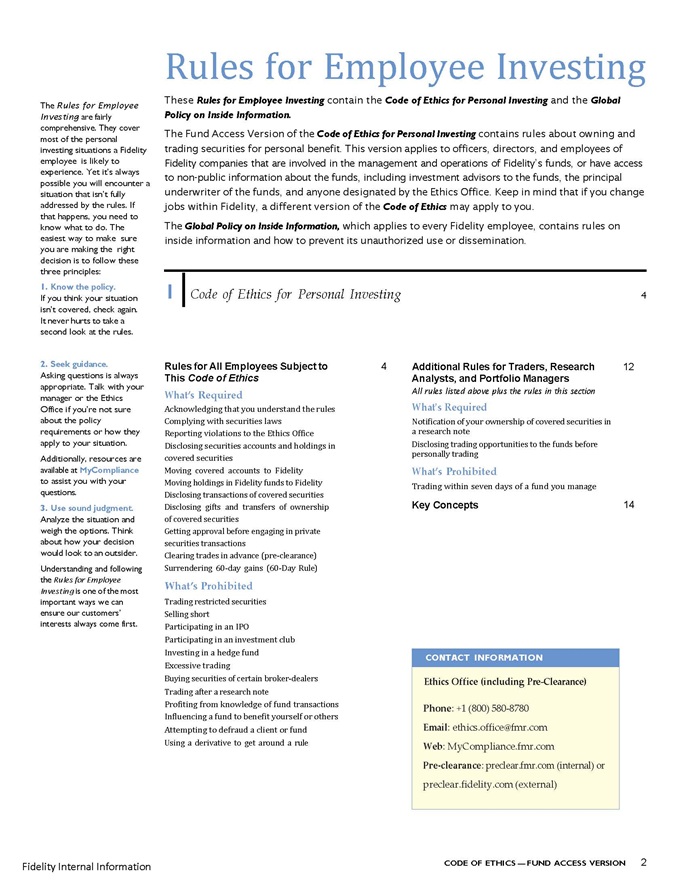
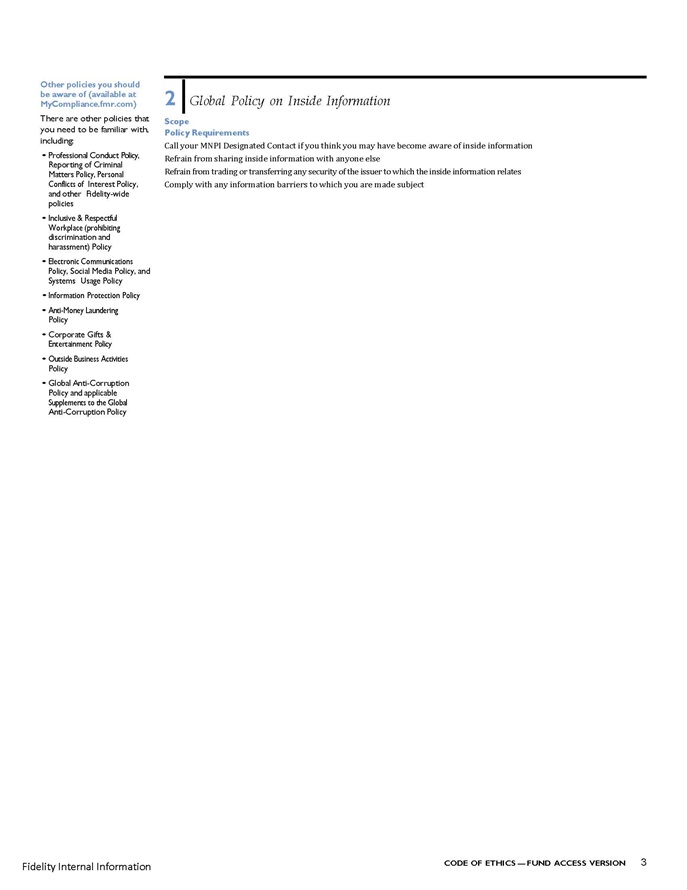
LOGO

Fidelity Internal Information Global Policy on Inside Information Fidelity expects its associates to act with integrity and maintain high ethical standards. This includes complying with applicable securities laws. Many of these laws prohibit the misuse of inside information, also known as Material, Non-Public Information (MNPI). These laws prohibit trading a security while in possession of inside information, and they impose severe penalties for doing so, including fines, prison sentences, and being barred from employment in the securities industry. Understanding and following the Global Policy on Inside Information helps ensure that your actions comply with these laws and meet Fidelity’s expectations. MNPI Designated Contacts Ethics Office 617-563-5566 800-580-8780 Asset Management 617-563-3630 India 8-691-7373 +91-80-6691-7373 Chairman’s Line 800-242-4762 MyCompliance.fmr.com Enterprise Compliance Purpose February 2026 You may become aware of inside information in the course of performing your work at Fidelity or outside of the workplace. This policy explains what you should do if you think you may have become aware of inside information. Importantly, this policy prohibits you from trading a security if you have become aware of inside information about that security or the issuer of that security. Scope This policy applies to all regular full-time, regular part-time, and temporary employees of Fidelity Investments, regardless of job location, citizenship, or country of residence (collectively referred to as “associates”). Other business unit, regional, or supplemental policies may also apply (a list of other relevant policies is provided on page 4). offers or sells securities, such as corporations, mutual funds, and domestic and foreign governments. Please note that the terms “security” and “issuer” are defined broadly and may include instruments and entities not specifically mentioned here. What is material information? Information is generally considered to be material if it is likely that a reasonable investor would consider the information important in making an investment decision. Information may also be material if it is reasonable to expect that the price of a security would change if the information were made public (this is known as Price Sensitive Information, or PSI, in some jurisdictions). Examples include company earnings, financing activities, product launches or discontinuations, bankruptcy, mergers, tender offers, prospective acquisitions or spin-offs, key management changes, major litigation, and potential or actual damages or fines against an issuer. Overview If you believe you may have become aware of inside information, you must (1) call your MNPI Designated Contact; (2) refrain from sharing the information with anyone else; (3) refrain from trading any security of the issuer to which the information relates; and (4) comply with any information barriers Fidelity may establish. What is Inside Information? Inside information is any information about a security, or an issuer of a security, that is both material and non-public. A security includes, but is not limited to, a financing or investment instrument, such as stocks (common or preferred), mutual funds, bonds, notes, options, and warrants. An issuer is an entity that What is non-public information? Information is non-public if it is not generally available to the public in a widely used medium, such as a press release or public regulatory filing. Also, some jurisdictions have specific rules about when non- public information becomes public. As you can see, the terms security, issuer, material, and non-public are broadly defined and may vary from jurisdiction to jurisdiction. For these reasons, if you have any doubt about whether an instrument or entity is a security or issuer, or about whether certain information is material or non-public, you should call your MNPI Designated Contact for guidance. Global Policy on Inside Information Page 1 of 4


LOGO

Global Policy on Inside Information Page 2 of 4 Fidelity Internal Information Remember – your MNPI Designated Contact is here to help you with these issues! How You May Encounter Inside Information There are a number of ways you may encounter inside information, either at work or outside of Fidelity. For example: Clients and Colleagues You may learn inside information from a conversation with a client in the course of providing business support, such as handling a trade request. You may be exposed to inside information about a mutual fund that may have an impact on the fund’s net asset value in the future, such as non-public information about a fund’s decision to reconsider the value of certain assets in its portfolio. Brokers and Company Employees Brokers may share inside information when contacting you about securities offerings. You may receive inside information when meeting with employees of public companies, such as CEOs, CFOs, or Investor Relations representatives. Consultants and Other Vendors In the course of providing consulting services to Fidelity, a third-party consultant may reveal inside information to you (knowingly or unknowingly), such as non-public information about another of the consultant’s public company clients. You may be negotiating a vendor contract, and inside information might be shared with you in the contract or the negotiations. Outside the Workplace You may hear inside information from personal sources, such as a spouse, significant other, family member or friend who works at a company that issues publicly-traded securities. You may overhear conversations that reveal inside information in elevators, restaurants, public transportation or from speaker and mobile phones, or you may encounter written information that has been left out in public, such as on a copy machine or train seat. Associates participating in an outside business activity may encounter inside information while serving on a corporate board or from serving as a consultant or advisor to an outside business. Please note that these are only examples, and you may receive inside information from other sources or in other circumstances. What You Should Do If You Believe You May Have Received Inside Information Contact Your MNPI Designated Contact While this policy requires you to understand what inside information could be, and be aware of the circumstances in which you may receive it, you should never make any decisions about inside information on your own – for example, whether information you have received is material or non- public, or what steps you should take as a result. Instead, if you think you may have received inside information, you must call your MNPI Designated Contact (telephone numbers are provided on pages 1 and 4). While it may seem contrary to normal protocol, it is important that you not share the information with anyone else, including your manager. By not sharing the information, you are protecting not only yourself and the information, but also other associates and Fidelity. When you talk to your MNPI Designated Contact, reveal the details of the information as your contact asks for them, and follow the instructions you receive. Your contact will then determine whether the information requires an information barrier (which are described below) and inform you of that decision. The possession of inside information is not in itself unlawful or an indication of wrongdoing. However, our goal as a firm is to limit the distribution of inside information only to those associates who have a business need to know and are subject to an information barrier. By assisting us in limiting the distribution of such information, you can best protect the information and yourself, and reduce the number of people who are subject to additional compliance protocols and restrictions. Comply with Information Barriers After you contact your MNPI Designated Contact, he or she will determine whether an information barrier is required. Information barriers are established as a way of helping the firm and its associates control inside information and avoid improper communication and potential compliance violations. If you are made


LOGO

subject to an information barrier, the Ethics Office will contact you, provide you with a document explaining the terms of the barrier, and require you to acknowledge and agree to abide by those terms. Information barriers are established by identifying individual associates and groups of people who have received inside information. The information is then protected by employing a combination of information handling, storage protocols, and physical or technical barriers around the associates and the information they possess. Information barriers are monitored to detect possible gaps, including reviews of communications (such as emails), enhanced physical access and access designations, and additions of associates to the information barrier. Surveillance is conducted of associates’ personal trading to detect potential misuse of inside information. Do Not Trade in the Security or the Issuer If you have received inside information, you are prohibited from trading any security of the issuer to which the information relates. This is known as “insider trading” or “insider dealing,” which is a serious violation of law. You may not buy, sell, transfer, gift, loan or pledge these securities, even if you have a reason to trade that is independent of the inside information. You also may not modify, suspend, or cancel an automatic investment plan of the security or the issuer of the security or make any recommendations to anyone to deal in the security in any way. These prohibitions apply: Not only to your covered accounts, but also to any account you manage, including accounts at Fidelity; Regardless of whether you receive any financial or other benefit from the account or the trade; and Regardless of whether your trade is in a different direction than the inside information may indicate (e.g., a sale where the inside information indicates you should buy). Remember that shares of mutual funds are also securities subject to these restrictions. You may not trade or transfer shares of mutual funds, whether advised by Fidelity or not, if you believe that you may have become aware of inside information about the mutual fund. Protect Inside Information It is critical that you keep inside information to yourself. You should refrain from discussing inside information in public, including elevators, restaurants, public transportation, on speaker and mobile phones, or on social media (such as Twitter, LinkedIn, or Facebook). You should also store any documents containing or reflecting the inside information in a secure place in accordance with the document-handling procedures of Fidelity’s Global Policy on Information Protection (“SP2I”) Policy. Do Not “Tip” or Improperly Disclose Inside Information The prohibition on communicating with others about inside information extends to recommending investments or expressing opinions to anyone, or soliciting orders from Fidelity clients, on the basis of inside information. This is known as “tipping” or “tipping off,” which is a serious violation of law. You may become liable for any transactions by anyone to whom you have improperly disclosed inside information, or to whom they have made investment recommendations or expressed opinions on the basis of that information. Reporting Potential Violations You should report known or suspected violations of this policy to your MNPI Designated Contact or call the Chairman’s Line at 800-242-4762 to speak anonymously on an unrecorded line. Global Policy on Inside Information Page 3 of 4 Fidelity Internal Information


LOGO

MNPI Designated Contacts Asset Management associates: Asset Management MNPI Hotline 617-563-3630 India associates: FBS India Ethics Office 8-691-7373 +91-80-6691-7373 All other associates: Ethics Office 617-563-5566 800-580-8780 Contacts and Web Resources General Policy Issues or Violations Ethics Office 800-580-8780 617-563-5566 ethics.office@fmr.com politicallaw@fmr.com Chairman’s Line 800-242-4762 Compliance and Regulatory Issues Your MNPI Designated Contact (See above) Business Unit, Regional or Supplemental Policies on Inside Information Personal Investing – Corporate Issues: Insider Trading Fidelity Capital Markets – Equity Origination Information Barriers Fidelity Institutional Online Reference – Inside Information Other Related Policies Global Anti-Corruption Policy Corporate Gifts & Entertainment Policy Personal Conflicts of Interest Policy Outside Business Activities Policy Information Protection Policy Global Policy on Inside Information Page 4 of 4 Fidelity Internal Information