
Exhibit 99.1
EUPRAXIA PHARMACEUTICALS INC.
NOTICE OF
ANNUAL GENERAL MEETING
OF SHAREHOLDERS OF
EUPRAXIA PHARMACEUTICALS INC.
TO BE HELD ON JUNE 18, 2026
MANAGEMENT INFORMATION CIRCULAR
DATED: MAY 11, 2026
EUPRAXIA PHARMACEUTICALS INC.
2198 Yukon Street
Vancouver, British Columbia
Canada V5Y 3P1
NOTICE OF ANNUAL GENERAL MEETING OF SHAREHOLDERS
NOTICE IS HEREBY GIVEN that the annual general meeting (the “Meeting”) of the shareholders of Eupraxia Pharmaceuticals Inc. (the “Company” or “Eupraxia”) will be held at 10:00 a.m. (Vancouver time) on Thursday, June 18, 2026 via live webcast at https://virtual-meetings.tsxtrust.com/1935 (control number provided from TSX Trust Company, case sensitive password: EPRX2026).
The following items of business will be covered at the Meeting:
| 1. | to receive and consider the audited financial statements of the Company for the years ended December 31, 2025 and 2024, together with the auditor’s report thereon; |
| 2. | to set the number of directors for the ensuing year at seven; |
| 3. | to elect the directors for the ensuing year; |
| 4. | to appoint an auditor for the ensuing year and authorize the directors to approve the remuneration to be paid to the auditor; |
| 5. | to transact such other business as may properly come before the Meeting. |
Virtual only format
The Company will hold the Meeting in a virtual-only format, which will be conducted via live audio and slideshow webcast at https://virtual-meetings.tsxtrust.com/1935. Eligible shareholders attending the Meeting may ask questions during the Meeting, as described in more detail in the Management Information Circular (the “Circular”). Shareholders will not be able to attend the Meeting in person. You can find more information about voting and asking questions during the Meeting in the guide by TSX Trust Company attached as Schedule B to the Circular.
Registered shareholders and duly appointed proxyholders will be able to attend, submit questions and vote at the Meeting online at https://virtual-meetings.tsxtrust.com/1935. Non-registered (beneficial) shareholders who have not duly appointed themselves as proxyholder will be able to attend the Meeting as guests, but guests will not be able to vote or ask questions at the Meeting.
You have the right to vote
You are entitled to receive notice of and vote at the Meeting, or any adjournment, if you are a registered holder of common shares in the capital of the Company (each, a “Common Share”) at the close of business on May 8, 2026.
Your vote is important
If you are a registered shareholder or duly appointed proxyholder, you are entitled to vote at the Meeting online at https://virtual-meetings.tsxtrust.com/1935 (control number provided from TSX Trust Company, case sensitive password: EPRX2026). If you are unable to attend the Meeting, you are requested to vote
| 1 |
your Common Shares using the form of proxy or voting instruction form, as applicable, enclosed with the Circular.
Registered shareholders should complete and sign the form of proxy and return it in the envelope provided. Alternative methods of voting by proxy are outlined in the Circular. If you are a non-registered shareholder, you should review the voting instruction form provided by your intermediary, which sets out the procedures to be followed for voting Common Shares held through intermediaries.
Shareholders who wish to appoint a proxyholder other than the persons designated by us (including a non-registered shareholder who wishes to appoint themselves as proxyholder) must carefully follow the instructions on their form of proxy or voting instruction form, as applicable. These instructions include the additional step of registering such proxyholder with our transfer agent, TSX Trust Company, after submitting their form of proxy or voting instruction form, as applicable. Failure to register the proxyholder will result in the proxyholder not receiving a control number that is required for them to vote at the Meeting online and, consequently, only being able to attend the Meeting online as a guest. To register as a proxyholder, the shareholder or the proxyholder MUST contact TSX Trust Company by emailing tsxtrustproxyvoting@tmx.com, and complete the Request for Control Number form at https://tsxtrust.com/resource/en/75, so that TSX Trust Company may provide the proxyholder with a control number via email. Non-registered shareholders located in the United States must also provide TSX Trust Company with a duly completed legal proxy if they wish to vote at the Meeting or appoint a third-party as their proxyholder.
Proxies must be received by our transfer agent, TSX Trust Company, by mail at 100 Adelaide Street West, Suite 301, Toronto, Ontario, Canada, M5H 4H1, Attention: Proxy Department; by facsimile to 1416-595-9593; or online with your 12-digit control number at www.voteproxyonline.com, by no later than 10:00 a.m. (Vancouver time) on June 16, 2026 or two business days before the commencement of any adjournment(s) or postponement(s) of the Meeting.
Shareholders can contact our transfer agent, TSX Trust Company, toll free at 1-866-600-5869 or by email at tsxtis@tmx.com, with questions regarding how to vote their Common Shares.
DATED at Vancouver, British Columbia this 11th day of May 2026.
| ON BEHALF OF THE BOARD OF DIRECTORS | |
| Signed: James A. Helliwell | |
| James A. Helliwell | |
| Chief Executive Officer and Director |
| 2 |
EUPRAXIA PHARMACEUTICALS INC.
2198 Yukon Street
Vancouver, British Columbia
Canada V5Y 3P1
MANAGEMENT INFORMATION CIRCULAR
as at May 11, 2026
GENERAL PROXY INFORMATION
This Management Information Circular (the “Circular”) is furnished in connection with the solicitation of proxies by the management of Eupraxia Pharmaceuticals Inc. for use at the annual general meeting (the “Meeting”) of its shareholders to be held on Thursday, June 18, 2026 at the time and place and for the purposes set forth in the accompanying notice of the Meeting.
In this Circular, references to the “Company”, “Eupraxia”, “we” and “our” refer to Eupraxia Pharmaceuticals Inc. “Common Shares” means common shares without par value in the capital of the Company. “Non-Registered Holders” or “Beneficial Shareholders” means shareholders who do not hold Common Shares in their own name and “intermediaries” refers to brokers, investment firms, clearing houses and similar entities that own securities on behalf of Beneficial Shareholders.
All amounts are in U.S. dollars (“$” or “US$”), unless otherwise stated
The Company will hold the Meeting in a virtual-only format, which will be conducted via live audio and slideshow webcast at https://virtual-meetings.tsxtrust.com/1935 (control number provided from TSX Trust Company, case sensitive password: EPRX2026). Eligible shareholders attending the Meeting may ask questions during the Meeting, as described in more detail in this Circular. Shareholders will not be able to attend the Meeting in person. You can find more information about voting and asking questions during the Meeting in the guide by TSX Trust Company attached as Schedule B to this Circular.
Solicitation of Proxies
The solicitation of proxies will be primarily by mail, but proxies may be solicited personally or by telephone by directors, executive officers and regular employees of the Company. The Company will bear all costs of this solicitation. We have arranged for intermediaries to forward the meeting materials to beneficial owners of Common Shares held as of the Record Date (as defined herein) by those intermediaries and we may reimburse the intermediaries for their reasonable fees and disbursements in that regard.
VOTING INFORMATION
Shareholders who wish to appoint a proxyholder other than the person designated by the Company on the proxy form or voting instruction form (including a Non-Registered Holder who wishes to appoint themselves as proxyholder in order to attend and vote at the Meeting online) must carefully follow the instructions in this Circular and on their proxy form or voting instruction form. These instructions include the additional step of registering such proxyholder with our transfer agent, TSX Trust Company, after submitting their proxy form or voting instruction form. Failure to register the proxyholder will result in the proxyholder not receiving a control number that is required for them to vote at the Meeting and, consequently, only being able to attend the Meeting online as a guest.
| 3 |
The following information provides guidance on how to vote your Common Shares.
Your vote is important
As a shareholder of Eupraxia, it is very important that you read this information carefully and then vote your Common Shares, either by proxy or by attending the online Meeting.
Voting by proxy means that you are giving the person or people named on your proxy form (each a “proxyholder”) the authority to vote your Common Shares for you at the Meeting or any adjournment or postponement thereof. A proxy form is included in this package.
If you vote by proxy, the individuals who are named on the proxy form will vote your Common Shares for you, unless you appoint someone else to be your proxyholder. You have the right to appoint a person or company of your choice who need not be a shareholder to represent you at the Meeting other than the individuals designated in the enclosed proxy form. If you appoint someone else, he or she must attend the Meeting to vote your Common Shares. See “Attending and voting at the virtual meeting” or “Voting by Proxy” for additional information.
If you are voting your Common Shares by proxy, our transfer agent, TSX Trust Company, or other agents we appoint must receive your signed proxy form by 10:00 a.m. (Vancouver time) on June 16, 2026 or if the Meeting is adjourned or postponed, prior to 10:00 a.m. (Vancouver time) on the second business day preceding the day of the Meeting.
Attending and voting at the virtual meeting
The Company will hold the Meeting in a virtual-only format, which will be conducted via live audio and slideshow webcast at https://virtual-meetings.tsxtrust.com/1935. Eligible shareholders attending the Meeting may ask questions during the Meeting, as described in more detail in this Circular. Shareholders will not be able to attend the Meeting in person.
Registered shareholders and duly appointed proxyholders will be able to attend, participate and vote at the Meeting online at https://virtual-meetings.tsxtrust.com/1935. Such persons may enter the Meeting by clicking “I have a control number” and entering a valid control number and the Password: EPRX2026 before the start of the Meeting.
Registered shareholders: The control number located on the proxy form or in the email notification you received is your control number. If you are a registered shareholder and choose to vote online at the Meeting, you do not need to complete or return your proxy form. You can login to the Meeting and complete a ballot online during the Meeting.
Duly appointed proxyholders: TSX Trust Company will provide the proxyholder with a control number by e-mail after the proxy voting deadline has passed and the proxyholder has been duly appointed AND registered as described in “How can I appoint a third party as my proxyholder?” below.
Guests, including Non-Registered Holders who have not duly appointed themselves as proxyholder can login to the Meeting by clicking “I am a guest” and completing the online registration form. Guests will be able to listen to the Meeting but will not be able to vote or ask questions at the Meeting.
If you attend the Meeting, it is important that you are connected to the internet at all times during the Meeting in order to vote when balloting commences. You should ensure you have a strong, preferably high-speed internet connection wherever you intend to participate in the Meeting. You will need the latest versions of Chrome, Safari, Edge or Firefox. Please do not use Internet Explorer. Online check-in will begin
| 4 |
30 minutes prior to the Meeting on June 18, 2026 at 9:30 a.m. (Vancouver time). The Meeting will begin promptly at 10:00 a.m. (Vancouver time) on June 18, 2026, unless otherwise adjourned or postponed. You should allow ample time to ensure your web browser and internet connection are working properly and for online check-in procedures. For any technical difficulties experienced during the check-in process or during the Meeting, please refer to the TSX Trust Virtual Meeting Guide mailed to shareholders as well as the notice of the Meeting, this Circular and the form of proxy or voting instruction form, as applicable (collectively, the “Meeting Materials”).
Voting by Proxy Registered shareholders
You are a registered shareholder if your name appears on your share certificate or on the register maintained by our transfer agent, TSX Trust Company. If you are a registered shareholder, you will receive a proxy form.
Registered shareholders have three options to vote by proxy:
| · | On the Internet |
Go to www.voteproxyonline.com and follow the instructions on screen. You will need the 12-digit control number listed on your proxy. You do not need to return your proxy form if you vote on the internet.
| · | By mail |
Complete, sign and date the accompanying proxy form and return it in the envelope we have provided. Please see “Completing the Proxy Form” on the enclosed form for more information.
| · | By fax |
Complete, sign and date the accompanying proxy form and send it by fax to 416-595-9593. Please see “Completing the Proxy Form” on the enclosed form for more information.
If you vote by proxy, the individuals named on the enclosed proxy form will vote your Common Shares for you unless you appoint someone else to be your proxyholder. You have the right to appoint a person or company of your choice who need not be a shareholder to represent you at the Meeting online other than the persons designated in the enclosed proxy form. See below under “How can I appoint a third party as my proxyholder?” for instructions.
Changing your vote
You may change a vote you made by proxy by:
· voting again online at www.voteproxyonline.com before 10:00 a.m. (Vancouver time) on June 16, 2026; or
· completing a proxy form that is dated later than the proxy form you are changing and mailing it to TSX Trust Company so that it is received at the address indicated before 10:00 a.m. (Vancouver time) on June 16, 2026.
| 5 |
You may revoke a vote you made by proxy by:
· making a request in writing to the Chair of the Meeting by email at info@eupraxiapharma.com during the Meeting or any adjournment or postponement thereof, or before any vote in respect of which the proxy has been given or taken. The written request can be from you or your authorized attorney.
If as a registered shareholder you login to the Meeting online using your control number and you accept the terms and conditions, you will be provided the opportunity to vote by online ballot on the matters put forth at the Meeting. If you vote by online ballot at the Meeting, you will be revoking any and all previously submitted proxies. If you do not vote by online ballot at the Meeting, your previously submitted proxies will not be revoked and will continue to be counted by TSX Trust Company in tabulating the vote with respect to the matters put forth at the Meeting.
Non-Registered Holders
You are a Non-Registered Holder if your Common Shares are registered either in the name of an intermediary (an “Intermediary”) that represents the Non-Registered Holder in respect of its shares or in the name of a depository (a “Depository”, such as CDS Clearing and Depository Services Inc.) of which the Intermediary is a participant.
We have distributed copies of the Meeting Materials to Intermediaries for onward distribution to non-objecting Non-Registered Holders and to Non-Registered Holders that are objecting beneficial owners. The Company does not intend to pay for intermediaries to forward the Meeting Materials to objecting Non-Registered Holders. Accordingly, objecting Non-Registered Holders will not receive the Meeting Materials unless their respective intermediaries assume the cost of forwarding such documents to them. Intermediaries are required to forward the Meeting Materials to non-objecting Non-Registered Holders unless a non-objecting Non-Registered Holder has waived the right to receive such materials. Intermediaries often use service companies to forward the Meeting Materials to Non-Registered Holders. Generally, Non-Registered Holders who have not waived the right to receive the Meeting Materials will receive a package from their Intermediary containing either:
| (a) | a voting instruction form that must be properly completed and signed by the Non-Registered Holder and returned to the Intermediary in accordance with the instructions on the voting instruction form; |
or, less typically,
| (b) | a proxy form that has already been stamped or signed by the Intermediary that is restricted as to the number of shares beneficially owned by the Non-Registered Holder but which otherwise has not been completed. In this case, the Non-Registered Holder who wishes to submit a proxy should properly complete the proxy form and deposit it with TSX Trust Company at the address set forth in the notice of Meeting. |
The purpose of these procedures is to permit Non-Registered Holders to direct the voting of Common Shares that they beneficially own.
We do not have access to the names or holdings of all of our Non-Registered Holders. Should a Non-Registered Holder, who receives either a voting instruction form or a proxy form, wish to attend and vote at the Meeting online (or have another person attend and vote on behalf of the Non-Registered Holder), the Non-Registered Holder should follow the instructions contained on the voting instruction form or proxy form within the time periods specified and appoint themselves (or another person to vote on their behalf). In either case, Non-Registered Holders should carefully follow the instructions of their Intermediaries and service companies. If you are a Non-Registered Holder and have not received a package containing a voting instruction form or proxy form, please contact your Intermediary. See above
| 6 |
for additional information on how to log in to the Meeting online and see “How can I appoint a third party as my proxyholder?” below for additional information on how Non-Registered Holders can appoint themselves as proxyholder.
Changing your vote
A Non-Registered Holder may revoke a voting instruction form or proxy which has been given to an Intermediary by written notice to the Intermediary or by submitting a voting instruction form or proxy bearing a later date in accordance with the applicable instructions. In order to ensure that an Intermediary acts upon a revocation of a proxy or voting instruction form, the written notice should be received by the Intermediary well in advance of the Meeting.
Completing the proxy form or voting instruction form
You can choose to vote “For”, “Against” or “Withhold”, depending on the items listed on the proxy form.
When you sign the proxy form, you authorize the directors and officers of the Company who are named in the proxy form to vote your Common Shares for you at the Meeting according to your instructions, unless you have appointed someone else to act as your proxy. If you return your proxy form and do not tell us how you want to vote your Common Shares, your vote will be counted:
| · | FOR the election of each of the directors nominated for election as listed in this Circular; |
| · | FOR setting the number of directors for the ensuing year at seven; |
| · | FOR the appointment of KPMG LLP, Chartered Professional Accountants as auditor of the Company and the authorization of the directors to fix the auditor’s remuneration; |
If you are appointing someone else to vote your Common Shares for you at the Meeting, write the name of the person voting for you in the space provided AND register such proxyholder with our transfer agent, TSX Trust Company, after submitting your proxy form. If you do not specify how you want your Common Shares voted, your proxyholder will vote your Common Shares as he or she sees fit on each item and on any other matter that may properly come before the Meeting.
If you are an individual shareholder, you or your authorized attorney must sign the form. If you are a corporation or other legal entity, an authorized officer or attorney must sign the form.
If you have questions on how to complete your proxy form, please contact TSX Trust Company – Investor Services at 1-866-600-5869.
How can I appoint a third party as my proxyholder?
The following applies to shareholders who wish to appoint another person of their choice to represent them at the Meeting (a “third party proxyholder”), other than the management proxyholders designated in the enclosed proxy form or voting instruction form accompanying this Circular. This includes Non-Registered Holders who wish to appoint themselves as proxyholder to attend, ask questions and vote online at the Meeting.
Shareholders who wish to appoint a third party proxyholder to represent them and vote their Common Shares at the Meeting MUST submit their proxy form or voting instruction form, as applicable, appointing that third party proxyholder, AND register that third party proxyholder online, as described below. Registering your third party proxyholder is an additional step that must be completed AFTER you have submitted your proxy form or voting instruction form. Failure to register your third
| 7 |
party proxyholder will result in the third party proxyholder not receiving a Control Number, which is used as their online sign-in credentials and is required for them to vote at the Meeting.
Step 1 – Submit your proxy form or voting instruction form: To appoint a third party proxyholder, insert that person’s name in the blank space provided in the proxy form or voting instruction form (if permitted) and follow the instructions for submitting such proxy form or voting instruction form prior to the proxy cut-off time. This must be completed before registering the proxyholder, which is an additional step to be completed once you have submitted your proxy form or voting instruction form.
Step 2 – Register your proxyholder: To register as a third party proxyholder, the proxyholder must contact TSX Trust Company at tsxtrustproxyvoting@tmx.com to request a control number to be represented and voted at the Meeting by 10:00 a.m. (Vancouver time) on June 16, 2026 and provide TSX Trust Company with the required proxyholder contact information so that TSX Trust Company may verify the appointment and provide the proxyholder with a Control Number via email. Without a Control Number, proxyholders will not be able to vote or ask questions at the Meeting. They will only be able to attend the Meeting online as a guest. It is the responsibility of shareholders to advise their proxyholder to contact TSX Trust Company to request a control number. Third party proxyholders can also download a form to request a control number at https://www.tsxtrust.com/resource/en/75.
Make sure that the person you appoint as your third party proxyholder is aware that he or she has been appointed and attends the Meeting online.
If you are a Non-Registered Holder and wish to vote online at the Meeting, you have to insert your own name in the blank space provided on the proxy form or voting instruction form sent to you by your Intermediary, follow the applicable instructions provided by your Intermediary, AND register yourself as your proxyholder, as described below. By doing so, you are instructing your Intermediary to appoint you as proxyholder. It is important that you comply with the signature and return instructions provided by your Intermediary.
If you are a Non-Registered Holder located in the United States and wish to vote at the Meeting, or, if you are permitted to appoint a third party as your proxyholder, in addition to the steps described above under “Attending and voting at the virtual meeting”, you must obtain a valid legal proxy from your Intermediary. You must follow the instructions from your Intermediary which are included with the legal proxy form and the voting information form sent to you. If you have not received one, you must contact your Intermediary to request a legal proxy form or a legal proxy. After obtaining a valid legal proxy from your Intermediary, you must then submit such legal proxy to TSX Trust Company. Requests for registration from Non-Registered Holders located in the United States that wish to vote online at the Meeting or, if permitted to appoint a third party as their proxyholder, must be deposited with TSX Trust Company by email at tsxtrustproxyvoting@tmx.com; registered holders may also deposit their proxies by e-mail to tsxtrustproxyvoting@tmx.com and in both cases, must be labeled “Legal Proxy” and received no later than the voting deadline of 10:00 a.m. (Vancouver time) on June 16, 2026 or, if the Meeting is adjourned or postponed, by 10:00 a.m. (Vancouver time) on the last business day preceding the preceding the day of the reconvened Meeting. The Chair of the Meeting has the discretion to accept proxies received after such deadline only at the Meeting. Notwithstanding the foregoing, the Chair of the Meeting will not be able to accept such proxies at the Meeting for shareholders wishing to appoint another person (who need not be a shareholder) to represent them at the Meeting virtually, including in respect of Non-Registered holders who wish to appoint themselves as proxyholder.
| 8 |
Notice to Shareholders in the United States
The solicitation of proxies and the matters to be voted on, as contemplated in this Circular, involve securities of an issuer located in Canada and are being effected in accordance with the corporate laws of the Province of British Columbia, Canada and securities laws of the provinces of Canada. As a “foreign private issuer” as defined under Rule 3b-4 under the United States Securities Exchange Act of 1934, as amended (the “1934 Act”), the proxy solicitation rules under the 1934 Act, including Regulation 14A thereunder, are not applicable to the Company or this solicitation, and this solicitation has been prepared in accordance with the disclosure requirements of the securities laws of the provinces of Canada. Shareholders should be aware that disclosure requirements under the securities laws of the provinces of Canada differ from the disclosure requirements under United States securities laws.
The enforcement by shareholders of civil liabilities under United States federal securities laws may be affected adversely by the fact that the Company is incorporated under the Business Corporations Act (British Columbia), as amended, certain of its directors and its executive officers are residents of Canada and a substantial portion of its assets and the assets of such persons are located outside the United States. Shareholders may not be able to sue a foreign company or its executive officers or directors in a foreign court for violations of United States federal securities laws. It may be difficult to compel a foreign company and its executive officers and directors to subject themselves to a judgment by a United States court.
The Company is listed on the Toronto Stock Exchange (the “TSX”) and on the Nasdaq Capital Market (the “Nasdaq”). The Company does not follow Rule 5620(c) of the rules of the Nasdaq Stock Market LLC (the “Nasdaq Listing Rules”) regarding minimum quorum for meetings of shareholders and instead follows its home country practice. The Nasdaq minimum quorum requirement under Rule 5620(c) for a shareholder meeting is 33-1/3% of the outstanding shares of a company’s common voting stock. In addition, a company listed on Nasdaq is required to state its quorum requirement in its by-laws. Under the Company’s articles, quorum for a meeting of the Company’s shareholders is at least one person who is, or who represents by proxy, one or more shareholders who, in the aggregate, hold at least 5% of the issued shares of the Company entitled to be voted at the meeting. The Business Corporations Act (British Columbia) defers to the quorum requirements in a corporation’s articles. The primary market for the Company’s common shares in Canada is the TSX. The rules of the TSX do not contain quorum requirements. As a result, the Company’s quorum requirements in respect of shareholder meetings are not prohibited by the Business Corporations Act (British Columbia) or the rules of the TSX.
VOTING SECURITIES AND PRINCIPAL HOLDERS OF VOTING SECURITIES
The board of directors of the Company (the “Board”) has fixed May 8, 2026 as the record date (the “Record Date”) for determination of persons entitled to receive notice of and to vote at the Meeting. Only shareholders of record at the close of business on the Record Date who either attend the virtual Meeting or complete, sign and deliver a form of proxy in the manner and subject to the provisions described above will be entitled to vote or to have their Common Shares voted at the Meeting.
The Common Shares of the Company are listed for trading on the TSX and the Nasdaq. As of the Record Date, there were 65,313,147 Common Shares issued and outstanding, each carrying the right to one vote.
No group of shareholders has the right to elect a specified number of directors, nor are there cumulative or similar voting rights attached to the Common Shares.
To the knowledge of the directors and executive officers of the Company, no persons or corporations beneficially owned (as determined under applicable Canadian securities laws), directly or indirectly, or
| 9 |
exercised control or direction over, Common Shares carrying 10% or more of the voting rights attached to all outstanding Common Shares of the Company as at the Record Date.
FINANCIAL STATEMENTS
The audited financial statements of the Company for the years ended December 31, 2025 and 2024, report of the auditor and related management discussion and analysis, all of which may be obtained from SEDAR+ at www.sedarplus.ca, or from EDGAR at www.sec.gov, that will be placed before the Meeting have been filed with the securities commissions or similar regulatory authority in all provinces of Canada, other than Québec.
VOTES NECESSARY TO PASS RESOLUTIONS
Other than as described below, a simple majority of affirmative votes cast at the Meeting is required to pass the resolutions described herein.
If there are more nominees for election as directors or appointment of the Company’s auditor than there are vacancies to fill, the nominees receiving the greatest number of votes will be elected or appointed, as the case may be, until all such vacancies have been filled. If the number of nominees for election or appointment is equal to the number of vacancies to be filled, all such nominees will be declared elected or appointed as directors by ballot in accordance with the Company’s Majority Voting Policy (as defined below).
PARTICULARS OF MATTERS TO BE ACTED UPON
| 1. | Setting the Number of Directors – See heading “Number of Directors”. |
| 2. | Election of Directors – See heading “Election of Directors”. |
| 3. | Appointment of Auditor – See heading “Appointment of Auditor”. |
NUMBER OF DIRECTORS
The Articles of the Company set out that the number of directors of the Company will be a minimum of three and a maximum of the most recently set of (i) the number of directors set by ordinary resolution (whether or not previous notice of the resolution was given) and (ii) the number of directors set in the event that the places of any retiring directors are not filled by an election at a meeting of shareholders. At the Meeting, the shareholders will be asked to pass an ordinary resolution setting the number of directors of the Company at seven.
To be approved, the resolution must be passed by a majority of the votes cast by the holders of Common Shares at the Meeting. Management recommends a vote “for” in respect of the resolution setting the number of directors of the Company at seven.
ELECTION OF DIRECTORS
The term of office of each of the seven current directors will end at the conclusion of the Meeting. Unless a director’s office is vacated earlier in accordance with provisions of the Business Corporations Act (British Columbia), each of the seven directors elected at this Meeting will hold office until the conclusion of the next annual meeting of the Company, or if no director is then elected, until a successor is elected.
| 10 |
Advance Notice Policy
The Company has adopted an advance notice policy (the “Advance Notice Policy”). Pursuant to the Advance Notice Policy, any additional director nominations for an annual general meeting must be received by the Company, not less than 30 days prior to the date of the annual meeting; provided, however, that in the event that the annual meeting of shareholders is to be held on a date that is less than 50 days after the date on which the first public announcement of the date of the annual meeting was made, notice by the nomination shareholder may be made not later than the close of business on the tenth day following the notice date. If no nominations are received by May 19, 2026, being the date which is 30 days prior to the Meeting, management’s nominees for election as directors set forth below shall be the only nominees eligible to stand for election at the Meeting.
The full text of the Advance Notice Policy is available on the Company’s website at https://eupraxiapharma.com/investors/governance.
Majority Voting Policy
The Company has adopted a majority voting policy (the “Majority Voting Policy”). Pursuant to the Majority Voting Policy, shareholders vote, or withhold from voting, for the election of each individual director rather than for a fixed slate of directors. Further, in an uncontested election of directors, the number of shares “withheld” for any nominee exceeds the number of shares voted “for” the nominee, then, notwithstanding that such director was duly elected as a matter of corporate law, he or she shall, immediately upon receipt of the final scrutineer’s report on the ballot, tender his or her written resignation to the Chair of the Board. The Nominating and Corporate Governance Committee of the Company (the “Nominating and Corporate Governance Committee”) will consider such offer of resignation and will make a recommendation to the Board concerning the acceptance or rejection of the resignation. In its deliberations, the Nominating and Corporate Governance Committee will consider all factors deemed relevant. The Board will take formal action on the Nominating and Corporate Governance Committee’s recommendation no later than 90 days of the date of the applicable shareholders’ meeting and announce its decision by press release to the TSX. Absent exceptional circumstances, the Board will be expected to accept the resignation which will be effective on such date. If the Board declines to accept the resignation, it will include in the press release the reason or reasons for its decision. Management recommends a vote “for” the appointment of each of the following nominees as directors of the Company.
The full text of the Majority Voting Policy is available on the Company’s website at https://eupraxiapharma.com/investors/governance.
Nominees
The following table sets out, among other things, the names of management’s seven nominees for election as directors, all major offices and positions with the Company each now holds, each nominee’s principal occupation, business or employment, the period of time during which each has been a director of the Company and the number of Common Shares of the Company beneficially owned by each, directly or indirectly, or over which each exercised control or direction, as at May 8, 2026:
| 11 |
| Name, Province/State of Residence and Position with Eupraxia |
Principal Occupation or Business or Employment in the Past Five Years | Date Appointed as a Director of the Company |
Common Shares Beneficially Owned, Controlled or Directed(1) |
|
James A. Helliwell British Columbia, Canada Chief Executive Officer and Director |
Chief Executive Officer, Eupraxia Pharmaceuticals Inc. (July 2012 – Present) | July 23, 2012 | 1,055,012(5) |
|
Simon Pimstone(2)(3)(4) British Columbia, Canada Chairman of the Board and Director |
Chair of the Board, Founder and Chief Executive Officer, XYON Health Inc. (Jan 2019 – Present) Director, Alpha-9 Theranostics Inc. (May 2020 – 2024) Non-Executive Chair of the Board, Xenon Pharmaceuticals, Inc. (June 2022 – 2024) Executive Chair of the Board, Xenon Pharmaceuticals, Inc. (June 2021 – June 2022) Chief Executive Officer, Xenon Pharmaceuticals, Inc. (January 2003 – June 2021) |
January 14, 2013 (as Director) and January 24, 2013 (as Chairman) |
48,678(6) |
|
Richard M. Glickman(2)(4) British Columbia, Canada Director |
Chairman of the Board, enGene Inc. (October 2011 – Present) Chairman of the Board, ESSA Pharma Inc. (October 2010 – 2025) Co-founder and Executive Chairman (September 2013 - February 2014) and Chairman of the Board (February 2014 - April 2019) and Chief Executive Officer (February 2017 – April 2019), Aurinia Pharmaceuticals Inc. Venture Partner, Lumira Ventures (March 2016 - Present) |
March 9, 2021 | 18,860(7) |
|
John Montalbano(3)(4) British Columbia, Canada Director |
Director, AbCellera Biologics Inc. (November 2020 – Present) Director, XYON Health Inc. (June 2021 – Present) Director, Canada Pension Plan Investment Board (February 2017 – Present) Director, Aritzia Inc. (July 2019 – February 2025) Director, Manulife. (February 2025 – Present) |
January 14, 2013 |
1,536,139(8) |
|
Joseph Freedman(2) Toronto, Canada Director |
Chairman of the Board, Centre for Aging and Brain Health Innovation (2021 – Present) Director, Bridgemarq Real Estate Services (2020 – Present) Director, Total Containment Inc. (March 2022 – Present) |
October 31, 2024 |
2,542,933(9) |
| 12 |
Name, Province/State of Residence and Position with Eupraxia |
Principal Occupation or Business or Employment in the Past Five Years | Date Appointed as a Director of the Company |
Common Shares Beneficially Owned, Controlled or Directed(1) |
|
Amy Pott Massachusetts, United States Director (Nominee) |
Global Chief Commercialization Officer, enGene (May 2025 – Present) Senior Vice President, Strategic Brand Marketing, Opthalmics and Rare Diseases, Astellas Pharma (April 2024- May 2025) Head of Commercial, Gene Therapies, Astellas Pharma (January 2021 - April 2024) |
N/A | - |
|
Robert Bazemore South Carolina, United States Director (Nominee) |
Lead Independent Director, Nuvation Bio, Inc. (2021 – Present Director, Ardelyx, Inc. (2016 - Present) Director, Akari Therapeutics, Inc. (2024 - Present) Chief Executive Officer and Director, Epizyme, Inc. (2016 - 2021) |
N/A | - |
Notes:
| (1) | The information as to principal occupation, business or employment (for the preceding five years for any new director) and Common Shares beneficially owned, controlled or directed is not within the knowledge of the management of the Company and has been furnished by the respective nominees themselves. Beneficial ownership is determined in accordance with applicable Canadian securities laws. |
| (2) | Members of the Compensation Committee of the Company (the “Compensation Committee”), with Richard Glickman as chair. |
| (3) | Members of the Audit Committee of the Company (the “Audit Committee”), with John Montalbano as chair. |
| (4) | Members of the Nominating and Corporate Governance Committee, with Simon Pimstone as chair. |
| (5) | James Helliwell holds stock options (the “Options”) to acquire 1,817,000 Common Shares and Restricted Stock Units to acquire 162,500 Common Shares. |
| (6) | Simon Pimstone holds Options to acquire 302,500 Common Shares, Founders Warrants to acquire 125,000 Underlying Founder Warrants and 125,000 Common Shares, and Restricted Stock Units to 10,000 Common Shares. |
| (7) | Richard Glickman holds Options to acquire 260,000 Common Shares and Restricted Stock Units to acquire 10,000 Common Shares. |
| (8) | John Montalbano holds Options to acquire 246,250 Common Shares, Founders Warrants to acquire 25,000 Underlying Founder Warrants and 25,000 Common Shares, and Restricted Stock Units to acquire 10,000 Common Shares. |
| (9) | Joseph Freedman holds Options to acquire 155,000 Common Shares, 3,153,985 Series 1 Preferred Shares, convertible on a one-to-one basis into Common Shares for no additional consideration, and Restricted Stock Units to acquire 10,000 Common Shares. |
None of the proposed nominees for election as a director of the Company are proposed for election pursuant to any arrangement or understanding between the nominee and any other person, except the directors and senior officers of the Company acting solely in such capacity. Further, the Board has reviewed the above proposed nominees for election as a director of the Company and has recommended that each proposed nominee be up for election as a director of the Company at the Meeting.
Director Biographies
James A. Helliwell, MD, FRCPC, Chief Executive Officer and Director
Dr. James Helliwell is the Co-Founder, Chief Executive Officer, and a Director of Eupraxia Pharmaceuticals (NASDAQ: EPRX). A board-certified cardiac anesthesiologist, he previously maintained a quaternary clinical practice in cardiac transplantation and perioperative echocardiography and served as an Assistant Clinical Professor at the University of British Columbia. He served in multiple leadership roles in academic medicine and business operations, including multiple terms as President of the BC Anesthesiologists’ Society.
| 13 |
Dr. Helliwell founded Eupraxia based on his conviction that precision drug delivery, delivering the right drug on target, on dose and on time, can greatly improve patient outcomes. His scientific work has been published in leading journals such as The Lancet Rheumatology, Gastroenterology, and Osteoarthritis & Cartilage.
A serial innovator, he also founded Accuro Technology—developer of the FDA-approved Arthrotap® device—which was later acquired by Elcam Medical. He is Co-Founder of Thrive Health and serves on the boards of Guidestar Medical Devices and NonInvasix Inc. His work includes 8 granted and 35 pending patents in drug and device delivery.
Dr. Helliwell earned his B.A. (Hons.), MD, and completed residency in Anesthesiology at the University of British Columbia, with undergraduate academic studies at Harvard University. He is certified by the National Board of Echocardiography and a Fellow of the Royal College of Physicians and Surgeons (FRCPC).
Dr. Helliwell brings founder-operator leadership grounded in frontline clinical practice, combining scientific depth in precision drug and device delivery with public-company execution and governance experience—enabling meaningful contributions to strategy, risk oversight, clinical development, and capital markets.
Simon Pimstone, MD, PhD, FRCPC (Chair), Chairman of the Board
Dr. Simon Pimstone is a physician-scientist-and experienced board chair whose leadership spans biotechnology, healthcare policy, clinical research, and national innovation initiatives. Dr. Simon Pimstone is the founder and Chief Executive Officer of XYON Health Inc., a privately held Canadian company delivering innovative healthcare solutions for men and women with hair loss.
Dr. Pimstone has held management, board, and advisory roles with organizations including Xenon Pharmaceuticals (Nasdaq: XENE), Alpha9 Oncology, Borealis Biosciences and Kokua Pharmaceuticals. He has also served on the boards of several industry and healthcare associations, including as former Chair of LifeSciences BC and the Providence Healthcare Research Trust, and as former Vice-Chair-of BIOTECanada. He has additionally chaired the Canadian federal government's State of the Nation Report.
Dr. Pimstone has won several awards, namely Globe and Mail top 40 under 40, Don Rix Lifetime Achievement Award and Business in Vancouver top 40 under 40.
At Eupraxia Pharmaceuticals, Dr. Pimstone serves as Chairman of the Board and is a member of the Compensation, Audit and Nomination & Governance Committees. He has served on the Board since 2013.
Dr. Pimstone received his MD from the University of Cape Town (MBChB, 1991) and is an internal medicine specialist (FRCPC, UBC, 2001). Prior to his specialization, he trained as a clinical research fellow with the Department of Medical Genetics at the University of British Columbia and earned a PhD in cardiovascular genetics through the University of Amsterdam (1998). He also serves as a consultant physician at the UBC Medical and Cardiology Clinic at UBC Hospital in Vancouver.
Dr. Pimstone brings a rare combination of physician-scientist depth and executive leadership, with demonstrated governance experience across biotech and healthcare organizations, industry associations, and -health-system research institutions.
| 14 |
Richard Glickman, L.L.D., Director
Dr. Richard Glickman is an experienced biotechnology entrepreneur and corporate director with a long record of founding and growing successful life sciences companies. He was the Co-founder, Chairman, and Chief Executive Officer of Aurinia Pharmaceuticals and Aspreva Pharmaceuticals Inc., which were acquired by the Galenica Group and StressGen Biotechnologies Corporation.
Dr. Glickman currently serves as Chairman of the Board of Engene Corporation and as a Director of Specific Biologics. He has also served as a Venture Partner at Lumira Ventures since 2016.
At Eupraxia Pharmaceuticals, Dr. Glickman serves as a director, Chairman of the Compensation Committee and is a member of the Nominating & Governance Committee. He has served on the Board since 2021.
Dr. Glickman has contributed significantly to Canada’s biotechnology sector, serving on national and provincial organizations, including the National Biotechnology Advisory Committee, the Canadian Genetic Disease Network, and Life Sciences B.C. (Chair), and the B.C. Innovation Council. His achievements have been recognized with major honours, including Ernst & Young Entrepreneur of the Year, Canada’s Top 40 Under 40 and BC’s Top 40 Under 40. In addition, he has won numerous leadership awards from both patient and industry organizations
Dr. Glickman brings deep founder-CEO leadership and strategic transaction experience, with a strong track record in scaling biotechnology companies, leading major acquisitions, and providing governance oversight in complex, innovation-driven companies.
John Montalbano, CFA, Director
John Montalbano is a global investment executive and the former Chief Executive Officer of RBC Global Asset Management, retiring in 2015 after leading the firm’s growth to $370 billion in assets under management, placing it among the 50 largest asset managers worldwide at the time.
Mr. Montalbano currently serves as a Director and Audit Chair of the Canada Pension Plan Investment Board, a Director of AbCellera Inc. (NASDAQ), a Director of Manulife, and as Chairman of White Crane Capital, a Vancouver-based hedge fund. He has also served as a Director of Aritzia Inc.
At Eupraxia Pharmaceuticals, Mr. Montalbano serves as a director and contributes to governance oversight through his roles as Chair of the Audit Committee and as a member of the Nominating & Governance Committee. He has served on the Board since 2013.
Mr. Montalbano has held several prominent civic and philanthropic leadership roles, including serving as Chair of the UBC Board of Governors, St. Paul’s Foundation, and the Vancouver Police Foundation. He also co-founded the Take a Hike Youth at Risk Foundation and has held leadership positions with the Asia Pacific Foundation of Canada, the Rideau Hall Foundation, and Windmill Microlending.
Mr. Montalbano holds the Chartered Financial Analyst (CFA) designation, a Bachelor of Commerce (Honours) from the University of British Columbia, and an Honorary Doctor of Letters from Emily Carr University of Art and Design.
Mr. Montalbano brings global institutional investment leadership and deep audit oversight experience, with a proven track record in governance, capital allocation, and risk management across complex organizations.
| 15 |
Joseph Freedman, MBA, LLB, Director
Joseph Freedman is a private equity governance leader and legal-risk strategist with more than 25 years of experience overseeing complex transactions, fund structures, and multi-asset investment platforms. During his 18 years at Brookfield Asset Management, one of the world’s leading private equity and alternative asset management firms, Mr. Freedman held several senior leadership roles, including Vice Chair of Private Equity, General Counsel, and Partner responsible for M&A execution, fund formation, and fund operations.
Prior to joining Brookfield, Mr. Freedman practiced corporate finance law in Toronto, specializing in private equity transactions and public company mergers and acquisitions.
Following his retirement from Brookfield, Mr. Freedman has continued to serve as a board director across public, private, and non-profit organizations. His current directorships include serving as Chair of the Centre for Aging and Brain Health Innovation, and as a Director for Bridgemarq Real Estate Services (TSX: BRE), Total Containment Inc., and Baycrest Seniors Care.
At Eupraxia Pharmaceuticals, Mr. Freedman serves as a Director and contributes to governance oversight through his membership on the Compensation Committee and the Nominating & Governance Committee. He has served on the Board since 2024.
Mr. Freedman holds a joint MBA/LLB from the Schulich School of Business at York University and Osgoode Hall Law School.
Mr. Freeman brings deep expertise in private equity governance, legal risk management, and capital allocation, with extensive experience overseeing complex transactions, fund structures, and strategic decision-making across multi-asset investment platforms.
Amy Pott, Director
Amy Pott has served as enGene’s Global Chief Commercialization Officer since May 2025. Ms. Pott joined enGene from Astellas Pharma, where she served as Senior Vice President (SVP), Strategic Brand Marketing, Ophthalmics and Rare Diseases from April 2024 to May 2025 and as Head of Commercial, Gene Therapies from January 2021 to April 2024.
Prior to Astellas, she was President, North America from April 2019 to October 2020 at Swedish Orphan Biovitrum. At Shire, she was Global Vice President (GVP) US Franchise Head for Internal Medicine and Oncology from October 2017 to March 2019 and she was GVP, US Commercial Operations, from July 2016 to October 2017. Before joining Shire, Amy was Vice President, Strategy, Planning and Analytics at Baxalta, Inc.
Ms Pott holds a Masters of Science in European Studies from the London School of Economics and a Bachelor of Arts in History from the University of Bristol.
Robert Bazemore, Director
Mr. Bazemore has spent his career of 30+ years on the development and commercialization of novel medicines. From 2015 to 2021, he served as President, Chief Executive Officer and Director of Epizyme,
| 16 |
Inc., developing and launching TAZVERIK® for patients with Follicular Lymphoma and Sarcoma while building on the company’s pipeline of promising epigenetic candidates in oncology.
Prior to joining Epizyme, Mr. Bazemore served as Chief Operating Officer of Synageva BioPharma Corp., where he established the company’s global commercial and medical organization to support the first product launch, helping lead the broader transition to a sustainable commercial enterprise through the company’s acquisition by Alexion Pharmaceuticals, Inc. in July 2015.
Prior to Synageva, he held several senior leadership positions at Johnson & Johnson, including President of Janssen Biotech, where he led the successful launches of numerous products and indications, including the US launches of the oncology therapies ZYTIGA® and IBRUVICA®, and guided the company’s worldwide Immunology portfolio strategy. Prior to Johnson & Johnson, he served for over 11 years at Merck & Co. Inc., where he held numerous roles including supporting the launch of SINGULAIR® in the U.S.
Mr. Bazemore is currently a Lead Independent Director for Nuvation Bio, Inc., Director for Ardelyx, Inc., Director for Akari Therapeutics, Inc. and was previously a Director for Neon Therapeutics prior to its acquisition by BioNTech and Board Chairman for Pennsylvania BIO. He earned his B.S. in Biochemistry from the University of Georgia.
Cease Trade Orders and Bankruptcies
No proposed director of the Company is, as of the date of this Circular, or has been, within the ten years prior to the date hereof, a director or chief executive officer or chief financial officer of any company (including the Company) that: (i) was subject to a cease trade order, an order similar to a cease trade order or an order that denied the relevant issuer access to any exemption under securities legislation, that was in effect for a period or more than 30 consecutive days (an “Order”) that was issued while the director or executive officer was acting in the capacity as director, chief executive officer or chief financial officer of such issuer, or (ii) was subject to an Order that was issued after the proposed director ceased to be a director, chief executive officer or chief financial officer and which resulted from an event that occurred while that person was acting in the capacity as director, chief executive officer or chief financial officer.
No proposed director of the Company is, at the date of this Circular, or has been within ten years before the date of this Circular, a director or executive officer of any company (including the Company) that, while that person was acting in that capacity, or within a year of that person ceasing to act in that capacity, became bankrupt, made a proposal under any legislation relating to bankruptcy or insolvency or was subject to or instituted any proceedings, arrangement or compromise with creditors or had a receiver, receiver manager or trustee appointed to hold its assets.
Penalties and Sanctions
No proposed director of the Company has been subject to any penalties or sanctions imposed by a court relating to securities legislation or by a securities regulatory authority or has entered into a settlement agreement with a securities regulatory authority, or has been subject to any other penalties or sanctions imposed by a court or regulatory body that would likely be considered important to a reasonable securityholder in deciding whether to vote for a proposed director.
| 17 |
Individual Bankruptcies
No proposed director of the Company has, within the ten years before the date of this Circular, become bankrupt, made a proposal under any legislation relating to bankruptcy or insolvency, or become subject to or instituted any proceedings, arrangement or compromise with creditors, or had a receiver, receiver manager or trustee appointed to hold the assets of the proposed director.
APPOINTMENT OF AUDITOR
KPMG LLP, at its offices located at 777 Dunsmuir Street, Vancouver, BC V7Y 1K3, will be nominated at the Meeting for reappointment as auditor of the Company at remuneration to be fixed by the directors. KPMG LLP was originally appointed as auditor of the Company on August 30, 2023.
To be approved, the resolution must be passed by a majority of the votes cast by the holders of Common Shares at the Meeting. Management recommends a vote “for” in respect of the resolution approving the appointment of the auditor and authorizing the directors to fix the auditor’s remuneration.
CORPORATE GOVERNANCE
General
The Company and the Board recognize the importance of corporate governance to the effective management of the Company and to the protection of its employees and shareholders. The Company’s approach to significant issues of corporate governance is designed with a view to ensuring that the business and affairs of the Company are effectively managed so as to enhance shareholder value. The Board fulfills its mandate directly and through its committees at regularly scheduled meetings or at meetings held as required. Frequency of meetings may be increased and the nature of the agenda items may be changed depending upon the state of the Company’s affairs and in light of opportunities or risks which the Company faces. The directors are kept informed of the Company’s business and affairs at these meetings as well as through reports and discussions with management on matters within their particular areas of expertise.
Board of Directors
If all director nominees included under the heading “Election of Directors”, as set out in this Circular, are appointed to the Board, the Board is composed of six independent directors, being a majority of the members of the Board, including Simon Pimstone (Chair of the Board), John Montalbano, Richard Glickman, Joseph Freedman, Amy Pott and Robert Bazemore. For this purpose, a director is independent if he or she has no direct or indirect “material relationship” with Eupraxia. A “material relationship” is defined in National Instrument 58-101 – Disclosure of Corporate Governance Practices. A “material relationship” is a relationship which could, in the view of the Board, be reasonably expected to interfere with the exercise of the director’s independent judgment. An individual who has been an employee or executive officer of the Company within the last three years is considered to have a material relationship with the Company. The six directors referenced above are also independent under Rule 5605(a)(2) of the Nasdaq Listing Rules. James A. Helliwell, as Chief Executive Officer, is not considered independent by the Company.
Currently, the following directors serve on the following boards of directors of other public companies:
| Name of Director | Reporting Issuers | |
| Paul Geyer | Montfort Capital Corp. | |
| John Montalbano |
Manulife Financial Corporation AbCellera Biologics Inc. | |
| Richard Glickman | enGene Inc. |
| 18 |
| Joseph Freedman | Bridgemarq Real Estate Services Inc. |
| Robert Bazemore |
Nuvation Bio, Inc Ardelyx, Inc. Akari Therapeutics, Inc. |
Board Mandate
The Board assumes responsibility for the stewardship of the Company and the enhancement of shareholder value.
The Board is responsible for:
| (a) | adopting a strategic plan for the Company and reviewing the plan in light of management’s assessment of emerging trends, the competitive environment, the opportunities for the business of the Company, risk issues, and significant business practices and products; |
| (b) | ensuring that the risk management of the Company is prudently addressed; |
| (c) | reviewing the Company’s approach to human resource management and overseeing succession planning for management; |
| (d) | reviewing the Company’s approach to corporate governance, including an evaluation of the adequacy of the mandate of the Board and director independence standards; and |
| (e) | upholding a comprehensive policy for communications with shareholders and the public at large. |
The frequency of meetings of the Board and the nature of agenda items may change from year to year depending upon the activities of the Company. The Board meets at least once per fiscal quarter and at each meeting there is a review of the business of the Company.
The Board facilitates its exercise of independent supervision over the Company’s management through frequent meetings of the Board being held to obtain an update on significant corporate activities and plans, both with and without members of the Company’s management being in attendance.
Position Descriptions
The Board has not developed a written position description for the CEO, the Chairman of the Board and the chairs of each of the committees of the Board. Given the size of the Company, the Board does not feel that it is necessary at this time to formalize such position descriptions. Guidance is generally provided through reference to industry norms, past practice and relying upon the provisions of the constating documents of the Company and the statutory and common law. The CEO is principally responsible for overseeing the operations and affairs of the Company, including strategic organizational and financial management, business development, regulatory compliance, and clinical development. The Chairman of the Board is principally responsible for overseeing the operations and affairs of the Board. With respect to the chairs of each of the committees of the Board, it is currently the Board’s view that the general mandates of committees on which such directors may sit are sufficient to delineate the role and responsibilities of the chair of each committee. The chair of each Board committee is required to ensure the committee meets regularly and performs the duties as set forth in the committee mandate, and reports to the Board on the activities of the committee.
| 19 |
Orientation and Education
Eupraxia provides new directors with an orientation program upon joining the Company that includes copies of relevant financial, technical, scientific and other information regarding its drug candidates and meetings with management.
Board members are encouraged to communicate with management and auditors, to keep themselves current with industry trends and developments, and to attend related industry seminars. Board members have full access to the Company’s records.
Nomination of Directors
It is the view of the Board that all directors, individually and collectively, should assume responsibility for nominating directors. The Board is responsible for identifying and recommending potential nominees for directorship and senior management. Additionally, the Nominating and Corporate Governance Committee, in consultation with the CEO, identifies and recommend new directors with appropriate skills for the Board. In making its recommendations, the Nominating and Corporate Governance Committee considers the competencies and skills of the existing directors, the competencies and skills of each new nominee, and the competencies and skills considered necessary for the Board as a whole.
Evaluation of the Effectiveness of the Board and its Committees
The Board, its committees and its individual directors are assessed regularly, and on at least an annual basis, as to their effectiveness and contribution. The process by which such assessments are made is governed by the Nominating and Corporate Governance Committee Charter, which is administered by the Corporate Governance and Nominating Committee. Neither the Company nor the Corporate Governance and Nominating Committee has determined formal means or methods to regularly assess the Board, its committees or the individual directors with respect to their effectiveness and contributions. Effectiveness is subjectively measured by comparing actual corporate results with stated objectives. The contributions of an individual director are informally monitored by the other Board members, having in mind the business strengths of the individual and the purpose of originally nominating the individual to the Board.
The Nominating and Corporate Governance Committee and the Board are of the view that the Company’s corporate governance practices are appropriate and effective for the Company, given its relatively small size and limited operations. The Company’s method of corporate governance allows for the Company to operate efficiently, with simple checks and balances that control and monitor management and corporate functions without excessive administrative burden.
In addition, the Chair of the Board and the respective Chairs of each committee encourage discussion amongst the Board or the committee, as the case may be, as to their evaluation of their own effectiveness over the course of the year. All directors and/or committee members are free to make suggestions for improvement of the practice of the Board and/or its committees at any time and are encouraged to do so.
Director Term Limits
The Company has not adopted term limits for the directors on its Board or other formal mechanisms for Board renewal. The Company believes that the Board has the appropriate level of continuity and renewal without imposing formal mechanisms, particularly term limits or director retirement requirements. In addition, the Company believes that the imposition of director term limits or director retirement requirements may discount the value of experience and continuity amongst Board members and runs the risk of excluding experienced and valuable candidates for Board membership.
| 20 |
The Nominating and Corporate Governance Committee is responsible for developing and updating the long-term plan for the composition of the Board that takes into consideration the current strengths, competencies, skills and experience of the Board members, retirement dates and the strategic direction of the Company. In addition, the Nominating and Corporate Governance Committee, annually or as required, identifies and recruits individuals qualified to become new Board members and makes recommendations to the Board regarding new director nominees. In making such recommendations, the Nominating and Corporate Governance Committee considers the competencies and skills that the Board considers to be necessary for the Board as a whole to possess, for each existing director to possess, and for a new nominee to bring to the boardroom. In this respect, through the Nominating and Corporate Governance Committee and the annual Board assessment process, the Board considers the contribution of current Board members and the skills and experience necessary for an effective and efficient Board and recommends changes to best meet those needs.
Director Attendance at Board Meetings
The directors’ attendance at Board, Audit Committee, Compensation Committee and Nominating and Corporate Governance Committee meetings during Eupraxia’s most recently completed financial year is set forth in the table below. During the year, the Board met four times, the Audit Committee met four times, the Compensation Committee met two times, and the Nominating and Corporate Governance Committee met once.
| Director | Attendance at Board Meetings |
Attendance at Audit Committee Meetings |
Attendance at Compensation Committee Meetings |
Attendance at Nominating and Corporate Governance Committee Meetings |
| James A. Helliwell(1) | 4 | 3 | 2 | 2 |
| Simon Pimstone | 4 | 3 | 2 | 2 |
| Richard M. Glickman | 4 | N/A | 2 | 2 |
| Paul Geyer | 4 | 4 | N/A | N/A |
| John Montalbano | 4 | 4 | N/A | N/A |
| Michael Wilmink | 4 | N/A | 1 | N/A |
| Joseph Freedman | 4 | N/A | 1 | 2 |
Notes:
(1) James A. Helliwell attends all meetings in his capacity as Chief Executive Officer.
Diversity
The Board has a written policy relating to the gender diversity of its directors and executive officers. The Company values diversity of view, experience, skillset, gender and ethnicity as it believes this results in better leadership and decision making for its business. Pursuant to such policy, gender diversity is one factor that is taken into account in identifying and selecting Board members and in considering the hiring, promotion and appointment of executive officers. The Company does not have specific targets respecting
| 21 |
representation on its Board or in executive officer positions based on any particular personal experience or characteristic, including gender. Instead, the Company focuses on choosing the most appropriate candidate for the position, having regard to the experience, skillset, gender, ethnicity and other personal characteristics of both the candidate and, as applicable, the Board and executive team as a whole. In conducting its search processes for Board and executive officer appointments, the Company reviews the extent to which its current appointees reflect gender diversity, and in assessing the appropriateness of candidates for those appointments, considers the desirability of an increased level of representation of women relative to the level attained as at the date of the gender diversity policy. The Board considers the Company’s progress towards achieving the objectives of the gender diversity policy, as well as the effectiveness of the policy, in connection with its continuing mandate to consider the composition of the Board. As at the date of this Circular, there are no female members (0%) of the Board and Amanda Malone is the only female executive officer, representing one-fifth (20%) of the Company’s executive officers.
Ethical Business Conduct
The Board has adopted a written code of business conduct and ethics (the “Code”) which emphasizes the importance of matters relating to honest and ethical conduct, conflicts of interest, protection and proper use of corporate assets and opportunities, confidentiality of corporate information, compliance with laws and the reporting of any illegal or unethical behaviour. All individuals representing the Company are expected to abide by all applicable provisions of the Code and adhere to its principles and values when representing the Company to the public or performing services for, or on behalf of, the Company. The Board will review the effectiveness of the Code on an ongoing basis to ensure that the Company’s business activities are conducted in accordance with the principles and rules set out therein. A copy of the Code can be accessed on the Company’s website at www.eupraxia.com/investors or obtained upon request via email at info@eupraxiapharma.com.
In considering transactions and agreements in respect of which a director or executive officer has a material interest, the Board ensures that such individual director or executive officer abstains from the discussion and conclusion with respect to the transaction or agreement, as the case may be.
The Company is committed to maintaining the highest standards of corporate governance and this philosophy is continually communicated by the Board to management which in turn is emphasized to the employees of the Company on a continuous basis.
Audit Committee
See “Audit Committee” below for further details.
Nominating and Corporate Governance Committee
The Board established a Nominating and Corporate Governance Committee, which is comprised of Simon Pimstone (Chair), John Montalbano, and Richard Glickman, all of whom are independent directors of the Company within the meaning of National Instrument 52-110 – Audit Committees (“NI 52-110”) and Rule 5605(a)(2) of the Nasdaq Listing Rules.
The Nominating and Corporate Governance Committee, in consultation with the Chief Executive Officer, is responsible for recruiting and identifying individuals qualified to become new Board members and making recommendations to the Board regarding new director nominees, annually or as required. Further, the Nominating and Corporate Governance Committee is responsible for recommending to the Board the individual director appointments to each Board committee, annually or as required. In making such recommendations, the Nominating and Corporate Governance Committee considers the competencies and
| 22 |
skills that the Board considers to be necessary for the Board as a whole to possess, for each existing director to possess, and for a new nominee to bring to the boardroom. The Nominating and Corporate Governance Committee may also recommend for approval by the Board the removal of a director from the Board or a committee thereof if he or she is no longer qualified to serve as a director under applicable requirement or any other appropriate reason.
In addition, the Nominating and Corporate Governance Committee has been delegated the responsibility of, among other things: (i) making recommendations to the Board regarding director remuneration;
(ii) establishing an appropriate system to evaluate the effectiveness of the Board as a whole as well as its committees; (iii) monitoring conflicts of interest of both the Board and management; (iv) conducting periodic reviews of the Company’s corporate governance policies and making policy recommendations aimed at enhancing Board and committee effectiveness; (v) annually reviewing the Board and committee mandates and position descriptions of the Chief Executive Officer, and each committee Chair, and recommending to the Board that necessary changes be made; (vi) reviewing and recommending to the Board the appropriate structure, size, composition, mandate and members for Board committees, and the procedures to ensure that the Board and its committees function independently of management;
(vii) providing the Board with updates on developments in corporate governance; (viii) conducting periodic reviews of the relationship between management and the Board; (ix) reviewing monitoring and making recommendations regarding new director orientation and ongoing development of existing directors; and
(x) reviewing reports from the Chief Executive Officer regarding unethical behaviour. See “Evaluation of the Effectiveness of the Board and its Committees” above.
Compensation Committee
Compensation matters are currently determined by the Board upon the recommendation of the Compensation Committee, which is comprised of Richard Glickman (Chair), Simon Pimstone, Michael Wilmink, and Joseph Freedman, all of whom are independent directors of the Company within the meaning of NI 52-110 and pursuant to Rule 5605(d)(2) of the Nasdaq Listing Rules. The Board is responsible for reviewing the compensation plans and severance arrangements for management, to ensure they are commensurate with comparable companies. The Board ensures that Eupraxia has a plan for continuity of its officers and an executive compensation plan that is motivational and competitive. See “Executive Compensation – Compensation Governance” for further details.
AUDIT COMMITTEE
Audit Committee
The Audit Committee is comprised of John Montalbano (Chair), Simon Pimstone and Paul Geyer, each of whom is “independent” and “financially literate” pursuant to NI 52-110. Each member of the Audit Committee is also “independent” pursuant to Rule 10A-3 of the 1934 Act and Rule 5605(a)(2) of the Nasdaq Listing Rules, and each of Mr. Montalbano and Dr. Pimstone are “audit committee financial experts” (as that term is defined in paragraph 8(b) of General Instruction B to Form 40-F).
The Audit Committee assists the Board in fulfilling its obligations relating to the integrity of the internal financial controls and financial reporting of the Company. The external auditors of the Company report directly to the Audit Committee. The Audit Committee’s principal responsibilities include (i) recommending the external auditor to be nominated for the purpose of providing audit, review or attest services for the Company, (ii) recommending the compensation of the external auditor, (iii) overseeing the work of the external auditor in performing audit, review or attest services for the Company, (iv) reviewing the Company’s financial statements, management’s discussion and analysis and annual and interim earnings
| 23 |
press releases before the Company publicly discloses this information, and (v) establishing procedures for addressing complaints or concerns regarding accounting, internal control or auditing matters.
See also “Audit Committee Information” in the Company’s annual information form dated March 11, 2026, available on the Company’s SEDAR+ profile. A copy of the Audit Committee’s charter is attached hereto as Schedule A.
Relevant Education and Experience
Each member of the Audit Committee has adequate education and experience that is relevant to their performance as an Audit Committee member and, in particular, the requisite education and experience that have provided the member with:
| (a) | an understanding of the accounting principles used by the Company to prepare its financial statements and the ability to assess the general application of those principles in connection with estimates, accruals and reserves; |
| (b) | experience preparing, auditing, analyzing or evaluating financial statements that present a breadth and level of complexity of accounting issues that are generally comparable to the breadth and complexity of issues that can reasonably be expected to be raised by the Company’s financial statements or experience actively supervising individuals engaged in such activities; and |
| (c) | an understanding of internal controls and procedures for financial reporting. |
See “Election of Directors – Director Biographies” for a description of each Audit Committee members’ experience and education.
Pre-Approval Policies and Procedures
The Audit Committee has the authority and responsibility for pre-approval of all non-audit services to be provided to the Company or its subsidiary entities by the external auditors or the external auditors of the Company’s subsidiary entities, unless such pre-approval is otherwise appropriately delegated or if appropriate specific policies and procedures for the engagement of non-audit services have been adopted by the Audit Committee.
External Auditor Service Fees by Category
The aggregate fees billed by the Company’s external auditors in the last two fiscal years for audit fees are set out in the table below. In the table, “Audit Fees” are fees billed by the Company’s external auditor for services provided in auditing the Company’s annual financial statements and include the fees for interim review of the financial statements each quarter and fees associated with the preparation of consent letters. “Audit-Related Fees” are fees not included in audit fees that are billed by the external auditor for assurance and related services that are reasonably related to the performance of the audit and review of the Company’s financial statements. “Tax Fees” are fees billed by the external auditor for professional services rendered for tax compliance, tax advice and tax planning. “All Other Fees” are fees billed by the external auditor for products and services not included in the foregoing categories. All fees are “as billed” on a cash basis by the Company. All amounts in the table are expressed in Canadian dollars.
| 24 |
| Financial Year Ending | Audit Fees | Audit Related Fees | Tax Fees(1) | All Other Fees | ||||
| December 31, 2025 | $568,669 | $- | $53,045 | $- | ||||
| December 31, 2024 | $280,280 | $- | $103,316 | $- |
Notes:
| (1) | Tax Fees related to the preparation of income tax returns for the Company and its subsidiaries, and fees related to the preparation of the Company’s Scientific Research and Experimental Development claims. |
STATEMENT OF EXECUTIVE COMPENSATION
Canadian securities legislation requires the disclosure of the compensation received by each Named Executive Officer of the Company. “Named Executive Officer” is defined by securities legislation to mean: (i) the Chief Executive Officer; (ii) the Chief Financial Officer; (iii) each of the three most highly compensated executive officers of the Company, including any of its subsidiaries, or the three most highly compensated individuals acting in a similar capacity, other than the Chief Executive Officer and Chief Financial Officer, at the end of the most recently completed financial year whose total compensation was, individually more than US$150,000 for that financial year; and (iv) each individual who would be a “Named Executive Officer” under paragraph (iii) but for the fact that the individual was neither an executive officer of the Company or its subsidiaries, nor acting in similar capacity, at the end of the most recently completed financial year (each, a “NEO” and collective, the “NEOs”).
The following discussion describes the significant elements of the compensation expected to be earned in fiscal 2026 by our NEOs, namely:
| · | James A. Helliwell, Chief Executive Officer of the Company; |
| · | Alex Rothwell, Chief Financial Officer of the Company; |
| · | Amanda Malone, Chief Scientific Officer and Chief Operating Officer of the Company |
| · | Paul Brennan, Chief Business Officer of the Company; and |
| · | Mark Kowalski, Chief Medical Officer of the Company. |
Compensation Discussion and Analysis
The Company’s executive compensation program is designed to attract, retain and motivate a highly qualified leadership team in a competitive, clinical-stage biotechnology environment. The Compensation Committee is responsible for establishing executive compensation and making recommendations to the Board of Directors for approval.
The Company’s compensation philosophy is grounded in the following principles:
| · | Alignment with shareholders interests – compensation is structured to support long-term value creation. |
| · | Pay for performance – a meaningful portion of compensation is variable and linked to individual, corporate, and market performance. |
| · | Market competitiveness – compensation is benchmarked against comparable peer companies to attract and retain talent. |
| 25 |
As a clinical-stage biotechnology company operating in a dynamic and capital intensive environment, the Company places significant emphasis on long-term, equity-based incentives to align executive interests with those of shareholders.
Elements of Compensation
Executive compensation consists of three primary components:
| · | Base Salary – fixed cash compensation reflecting role, experience, and market positioning |
| · | Annual Bonus – short term incentive tied to achievement of corporate and individual performance objectives. |
| · | Equity Compensation – long term incentives in the form of stock options and restricted stock units, designed to align executives with long-term shareholder value creation |
Annual bonuses are determined based on the achievement of corporate objectives established by the Board, as well as individual performance. Equity compensation provides executives with participation in the growth of the Company’s share value, over time.
Peer Group and Benchmarking
The company benchmarks executive compensation against a peer group of publicly traded, clinical-stage biotechnology companies of comparable size, stage, and complexity. This group includes companies such as Achieve Life Sciences, Abcellera, Kyverna Therapeutics, etc.
The Board has determined that targeting the compensation at approximately the market median (50th percentile) is appropriately given the Company’s current stage of development.
Compensation Governance
The Compensation Committee reviews executive compensation annually, including performance against established objectives, and market recommendations to the Board. The Committee also reviews compensation policies to ensure alignment with the Company’s risk management framework and to confirm that such policies do not encourage excessive risk-taking.
The Company has not identified any risks arising from its compensation programs that are reasonably likely to have a material adverse effect.
Alignment with Shareholder Value
The Company believes that clearly defined corporate objectives, combined with individual performance goals are critical to an effective compensation strategy. Compensation is structured such that a meaningful portion is “at risk”, contingent on:
| · | Achievement of corporate and operational milestones |
| · | Individual performance against objectives |
| · | Market performance relative to peers |
The structure supports alignment between executive decision-making and long-term shareholder value creation.
Base Salary comprises a portion of the total annual cash-based compensation that an NEO is paid; however, Annual Bonuses and Equity Compensation represent compensation that is “at risk” and thus may or may not be paid to the respective NEO depending on: (i) whether the NEO is able to meet or exceed his or her
| 26 |
applicable individual performance objectives; (ii) whether the Company has met its operational and corporate performance objectives; and (iii) market performance of the Common Shares relative to the market and peer common share performance.
The Compensation Committee meets at least annually (or more often as required) to consider performance objectives and actual performance relative to such objectives, and then makes compensation recommendations to the Board for consideration.
Performance Graph
The following graph compares the total cumulative shareholder return for C$100 invested in the Common Shares since the Company was listed and initiated trading on the TSX with the cumulative total return of the Toronto Stock Exchange’s S&P/TSX Composite Index (TSX), S&P Biotech Subindex (XBI) and Virtu Clinical Stage Biotech Subindex (BBC). The Company’s Common Shares commenced trading on the TSX on March 9, 2021.
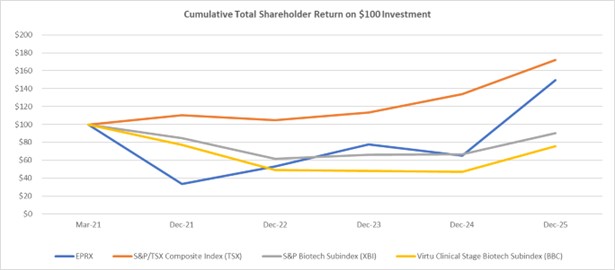
Executive officers’ compensation is not based primarily on the performance of the Common Shares and, as such, the NEO’s compensation is not directly correlated to the performance of the Common Shares. Although one of the main focuses of the Company is to create shareholder value, the share price for the Common Shares, as well as other TSX biotechnology companies, is very volatile and does not always reflect the performance of the Company. As it is the Company’s goal to attract and retain experienced executives who are focussed on the long-term success of the Company and creating shareholder value, the compensation of the NEOs is based on the overall performance by the Company and individual contributions rather than tied specifically to the short-term performance of the Common Shares in the market.
Principal Elements of Compensation
Given the evolving nature of the Company’s business, the Board continues to review and redesign the overall compensation plan for senior management so as to continue to address the objectives identified above.
| 27 |
The Company has added restricted share units alongside our stock options as part of our long-term equity incentive for our directors, officers and employees. In the future additional incentive mechanisms may be adopted to provide the Company with further flexibility in the design of our long-term incentive compensation arrangement for our officers and employees or eligible directors.
Base Salaries
Base Salary is provided as a fixed source of compensation for the NEOs. Adjustments to Base Salaries are determined annually and may be increased based on the NEO’s success in meeting or exceeding individual objectives, as well as to maintain market competitiveness. Additionally, Base Salary can be adjusted as warranted throughout the year to reflect promotions or other changes in the scope or breadth of an NEO’s role or responsibilities.
The Base Salaries for each NEO that are expected to be earned in fiscal 2026 are as follows:
| Name of Executive Officer | Base Salary(1) |
| James Helliwell, Chief Executive Officer and Director of the Company | C$645,000 |
| Alex Rothwell, Chief Financial Officer | C$475,000 |
| Amanda Malone, Chief Scientific Officer and Chief Operating Officer | C$480,000 |
| Paul Brennan, Chief Business Officer | C$369,000 |
| Jeymi Tambiah, Chief Medical Officer(2) | US$465,000 |
Notes:
| (1) | The figures in this table represent annualized figures based on the current Base Salaries of each NEO. |
| (2) | Mark Kowalski retired from the Company as Chief Medical Officer on May 1, 2026. Mark Kowalski’s annualized Base Salary for the fiscal year 2026 was US$435,000. Mark Kowalski will continue to receive his Base Salary until August 1, 2026. Jeymi Tambiah assumed the role of Chief Medical Officer of the Company on May 1, 2026. |
Annual Bonuses
Annual Bonuses are designed to motivate the NEOs to meet our business and financial objectives generally and our annual financial performance targets in particular. Annual Bonus targets are set as a percentage of the relevant executive officers’ Base Salary, which varies based on his or her position level. Annual Bonuses paid to each NEO are based in part on the Company’s success in reaching its objectives, and in part on individual performance.
The Annual Bonuses that are in effect in fiscal 2026 for each NEO are as follows:
| Name of Executive Officer | Bonus |
| James Helliwell, Chief Executive Officer and Director of the Company | Up to 60% of Base Salary |
| Alex Rothwell, Chief Financial Officer | Up to 45% of Base Salary |
| Amanda Malone, Chief Scientific Officer and Chief Operating Officer | Up to 45% of Base Salary |
| Paul Brennan, Chief Business Officer | Up to 45% of Base Salary |
| Jeymi Tambiah, Chief Medical Officer | Up to 45% of Base Salary |
Equity Compensation
The grant of Options, stock appreciation rights, restricted stock, restricted stock units (“RSUs”), deferred stock units, performance awards, other stock-based awards and cash-based awards (each an “Award” and collectively, the “Awards”) has been an integral component of the compensation arrangements of the NEOs, and the Company expects this to continue. The Board believes that the grant of Awards to the NEOs
| 28 |
and Common Share ownership by the NEOs motivates such NEOs to strive towards achievement of the Company’s long-term strategic objectives, which will benefit all shareholders. In 2025, RSUs were awarded in addition to Options to align with other life science companies.
Awards are awarded by the Board based on recommendations of the Compensation Committee. Decisions with respect to Awards are based upon the individual’s level of responsibility and their contribution towards the Company’s goals and objectives and may be awarded in recognition of the achievement of a particular goal or extraordinary service. Consideration is also given to the number and value of previous grants. The Board considers the overall number of Awards that are outstanding relative to the number of outstanding Common Shares in determining whether to make any new grants and the size of such grants.
The Company’s current equity compensation plans in place is the 2025 Omnibus Incentive Plan (the “Omnibus Plan”). The Omnibus Plan replaced the Company’s prior amended and restated stock option plan, adopted by the Board on March 9, 2021, and amended on May 3, 2021 and October 27, 2021 (the “Historic Option Plan”) in June 2025. Since the adoption of the Omnibus Plan, no new Options can be awarded under the Historic Option Plan. However, Options granted under the Historic Option Plan remain outstanding and are governed by the terms of the Historic Option Plan.
Particulars of the Omnibus Plan
The following is a summary of the principal terms of the Omnibus Plan.
Types of Awards
The Omnibus Plan provides for the grant of options, stock appreciation rights, restricted stock, restricted stock units, deferred stock units, performance awards, other stock-based awards and cash-based awards (each an “Award” and collectively, the “Awards”).
Plan Administration
The Omnibus Plan is administered by the Compensation Committee. Subject to the terms of the Omnibus Plan and applicable law, and the rules of the TSX and the Nasdaq, as applicable, the Compensation Committee (or its delegate) has the power and authority to, among other things, designate participants and determine the types of Awards to be granted, number of shares to be covered and the terms and conditions of those Awards. It also has the authority to interpret and administer the Omnibus Plan and any instrument or agreement relating to the Omnibus Plan and to make any other determination and take any other action that the Compensation Committee deems necessary or desirable for the administration of the Omnibus Plan.
Shares available for Awards
The number of Common Shares available for issuance under the Omnibus Plan is a rolling maximum number equal to 18.5% of the issued and outstanding Common Shares from time to time, provided that the number of Common Shares available for issuance under Incentive Stock Options (within the meaning of Section 422 of the Internal Revenue Code of 1986) may not exceed 6,594,575. The Omnibus Plan is considered to be an “evergreen” plan as Common Shares covered by Awards which have been exercised or settled, as applicable, will be available for subsequent grant under the Omnibus Plan and the number of Awards that may be granted under the Omnibus Plan increases if the total number of issued and outstanding Common Shares increases. As at December 31, 2025, the Company has 51,939,206 Common Shares issued and outstanding, and 8,672,205 Common Shares issuable pursuant to Awards granted under the Omnibus Plan and Historic Option Plan (equal to approximately 16.70% of the issued and outstanding Common Shares of the Company). Currently, there are unallocated entitlements under the Historic Option Plan to
| 29 |
purchase 936,548 Common Shares (equal to approximately 1.80% of the issued and outstanding Common Shares of the Company).
The Omnibus Plan does not impose a limitation on the number of Awards that can be granted to any one person.
Insider Participation
The Omnibus Plan does not include limitations on insider participation.
Eligible Participants
Any director, employee or consultant of the Company, its subsidiaries or any of its affiliates will be eligible to participate in the Omnibus Plan, on approval by the Compensation Committee.
Description of Awards
| A. | Options |
The Compensation Committee is permitted to grant stock options under the Omnibus Plan. The exercise price per share and terms of each option will be determined by the Compensation Committee; provided, however, that the exercise price will not be less than the fair market value of a Common Share on the date that the option is granted. An option will be exercisable only in accordance with the terms and conditions established by the Compensation Committee in the Award agreement between the Company and the participant (the “Award Agreement”). The Compensation Committee may, in its discretion, provide that an option may become vested and exercisable in whole or in part, in installments, cumulative or otherwise, for any period of time specified by the Compensation Committee and reflected in an Award Agreement. The Compensation Committee will fix the term of each option, not to exceed ten years.
Other than for U.S. participants, if the term of an option would otherwise expire during a period of time during which an optionee cannot exercise or sell securities of the Company due to applicable policies of the Company in respect of insider trading (a “Blackout Period”), or within ten business days of the expiration thereof, then the term of such option will be extended to the tenth business day following the expiration of the Blackout Period.
| B. | Stock Appreciation Rights (“SARs”) |
The Compensation Committee is permitted to grant SARs under the Omnibus Plan. SARs may be granted to participants either alone (“freestanding”) or in addition to other Awards granted under the Omnibus Plan (“tandem”). A freestanding SAR will not have a term of greater than ten years. In the case of any tandem SAR related to an option, the SAR will not be exercisable until the related option is exercisable and will terminate, and no longer be exercisable, upon the termination or exercise of the related option. A freestanding SAR will not have a grant price less than the fair market value of the share on the date of grant.
Other than for U.S. participants, if the term of a SAR would otherwise expire during a Blackout Period, or within ten business days of the expiration thereof, then the term of such SAR will be extended to the tenth business day following the expiration of the Blackout Period.
| 30 |
| C. | Restricted Stock and Restricted Stock Units |
The Compensation Committee is permitted to grant awards of restricted stock and restricted stock units under the Omnibus Plan. Shares of restricted stock and restricted stock units will be subject to any restrictions that the Compensation Committee may impose, including any limitation on the right to receive any dividend or dividend equivalent. If deemed necessary, the Compensation Committee may require that, as a condition of any grant of restricted stock, the participant will deliver a signed stock power or other instruments of assignment, which would permit transfer to the Company of all or a portion of the shares subject to the award of restricted stock or restricted stock units in the event that the Award is forfeited.
| D. | Deferred Stock Units |
The Compensation Committee is permitted to grant deferred stock units under the Omnibus Plan. Deferred stock units will be settled upon expiration of the deferral period by the Compensation Committee in the applicable Award Agreement (which, in the case of a Canadian participant, must be on the earlier of the cessation of service or death). The Compensation Committee, in its discretion, may award dividend equivalents with respect to awards of deferred stock units.
| E. | Performance Awards |
The Compensation Committee may grant a performance award to a participant payable upon the attainment of specific performance goals during the applicable performance period, as set forth in the Award Agreement for the performance award.
| F. | Other Stock-Based and Cash-Based Awards |
The Compensation Committee is authorized to grant to participants other awards that may be denominated or payable in, valued in whole or in part by reference to, or otherwise based on, or related to, Common Shares or factors that may influence the value of Common Shares. The Compensation Committee will determine the terms and conditions of such stock-based awards. The Compensation Committee is also permitted to grant cash-based awards to participants.
In its discretion, the Compensation Committee will determine the number of cash-based awards to grant to a participant, the duration of the period during which, and any conditions under which, the cash incentive awards will be eligible to vest or will be forfeited, and any other terms and conditions applicable.
Financial Assistance
Solely to the extent permitted by applicable law and the applicable rules of the TSX and Nasdaq, the Compensation Committee has discretion to determine whether, to what extent and under what circumstances to provide loans (which may be on a recourse basis and will bear interest at the rate the Compensation Committee provides) to participants to exercise options or acquire Common Shares under the Omnibus Plan.
Cashless Exercise
If agreed to by the Compensation Committee, Options may be exercised in whole or in part at any time during the Option term, by giving written notice of exercise to the Company specifying the number of Common Shares to be purchased, and having the Company withhold Common Shares issuable upon exercise of such Option as payment in full or in part, for the exercise price of such Options. The number of
| 31 |
Common Shares to be withheld as payment will be determined based on the fair market value of the Common Shares on the payment date, as determined by the Compensation Committee.
Effect of Termination of Service on Awards
The Compensation Committee may provide, by rule or regulation or in any Award Agreement, or may determine in any individual case, the circumstances in which Awards shall be exercised, vested, paid or forfeited in the event a participant ceases to provide service to the Company or any affiliate prior to the end of a performance period or exercise or settlement of such Award.
Change in Control
Unless otherwise provided in an Award Agreement, in the event of a change in control (as defined in the Omnibus Plan) a participant’s unvested Awards will be treated in accordance with one of the following methods as determined by the Compensation Committee: (a) Awards, whether or not vested, will be continued, assumed or have new rights substituted as determined by the Compensation Committee; (b) the Compensation Committee, in its sole discretion, may provide for the purchase of any Awards by the Company or an affiliate for an amount of cash equal to the excess of the change in control price of the shares covered by such Awards, over the aggregate exercise price of such Awards; or (c) if and to the extent that the approach chosen by the Compensation Committee results in an acceleration or potential acceleration of the exercise, vesting or settlement of an Award, the Compensation Committee may impose such conditions upon the exercise, vesting or settlement of such Award as it determines.
Assignability/Transferability
Awards granted under the Omnibus Plan may not be sold, pledged or otherwise transferred, other than following the death of a participant by will or the laws of descent. A participant’s beneficiary or estate may exercise vested stock options during the applicable exercise period following the death of the participant, subject to the same conditions that would have applied to exercise by the participant.
Clawback Provisions
The Compensation Committee may impose restrictions on any Award with respect to non-competition, confidentiality and other restrictive covenants, and may provide for the clawing back of any rights or benefits under any Awards as a result of any breaches of the foregoing covenants, for reasons specified in the Award Agreement or any other agreement between the Company and a participant, or to the extent provided under any Company policies.
Any Award granted pursuant to the Omnibus Plan will be subject to mandatory repayment or forfeiture, as applicable, by a participant to the extent such participant is or becomes subject to (i) any Company “clawback” or recoupment policy adopted by the Board or the Compensation Committee, or (ii) any applicable law, rule or regulation which imposes mandatory recoupment.
Amendment
The Board may amend, suspend or terminate the Omnibus Plan and any outstanding Awards granted under the Omnibus Plan, in whole or in part, at any time, provided that all material amendments to the Omnibus Plan require the prior approval of the shareholders and must comply with the rules of the TSX and the Nasdaq. No amendment to the Omnibus Plan requiring the approval of the shareholders of the Company under any applicable securities laws or requirements will become effective until such approval is obtained. Examples of amendments that are not material that the Board can make without shareholder approval include, without limitation:
| 32 |
| (i) | ensuring compliance with applicable law, the applicable rules of the TSX and Nasdaq or other applicable rules and regulations; |
| (ii) | amendments of a “housekeeping” nature, including amendments to correct any defect, omission, or inconsistency in the Omnibus Plan or any Award Agreement; |
| (iii) | changing the vesting provision of the Omnibus Plan or any Award; |
| (iv) | waiving any conditions or rights under any Award; |
| (v) | changing the termination provisions of any Award that does not entail an extension beyond the original expiration date; |
| (vi) | adding a cashless exercise feature payable in securities and any amendment to a cashless exercise provision; |
| (vii) | adding a form of financial assistance and any amendment to a financial assistance provision; |
| (viii) | changing the process by which a Participant can exercise their Award, including the form of payment, the form of written notice of exercise, and the place where payments and notices must be delivered; and |
| (ix) | delegating powers of the Compensation Committee to administer the Omnibus Plan to officers of the Company. |
No change to an outstanding Award that will adversely impair the rights of a participant may be made without the consent of the participant except to the extent that such change is required to comply with applicable law, stock exchange rules and regulations or accounting or tax rules and regulations.
Approval of Unallocated Entitlements
Pursuant to the rules and policies of the TSX, unallocated awards under a TSX-listed issuer’s security-based compensation arrangement that does not have a fixed maximum of securities (which will include the Omnibus Plan, if approved) must be approved by a majority of the issuer’s directors and by the issuer’s security holders every three years.
The Company will be required to seek approval from the shareholders of all unallocated entitlements under the Omnibus Plan by no later than June 2, 2028.
Particulars of the Historic Option Plan
Administration
The Historic Option Plan is administered by the Board, subject to the Board’s power to delegate such administrative duties and powers as it may seem fit to a director or senior officer or employee of the Company, from time to time. In connection with its administrative role, the Board may make, amend and repeal at any time and from time to time such policies not inconsistent with the Historic Option Plan as it may deem necessary or advisable for the proper administration of the plan. Eupraxia’s administration of the Historic Option Plan is applied in a manner that is consistent with the policies and rules of the TSX and with such other stock exchanges on which the Common Shares may be listed from time to time.
The purpose of the Historic Option Plan is to provide an incentive to the officers, employees, Consultants (as defined in the Historic Option Plan) and other personnel of the Company or any of its subsidiaries to
| 33 |
achieve the longer-term objectives of the Company; to give suitable recognition to the ability and industry of such persons who contribute materially to the success of the Company; and to attract to and retain in the employ of the Company or any of its subsidiaries, persons of experience and ability, by providing them with the opportunity to acquire an increased proprietary interest in the Company.
Eligibility
Options may be granted only to any director, officer, employee, Consultant (as defined in the Historic Option Plan) or other personnel of the Company (including any subsidiary of the Company), as the Board may determine. For U.S. optionees, Options may not be granted to employees, directors, officers or Consultants who are providing services only to a “parent” of the Company, as such term is defined in Rule 405 of the U.S. Securities Act of 1933, unless (i) the Common Shares underlying the Option are treated as “service recipient stock” under Section 409A of the U.S. Internal Revenue Code of 1986, as amended, and the rules and regulations thereunder (the “U.S. Code”) or (ii) the Company has determined that such Options are exempt from or otherwise comply with Section 409A of the U.S. Code.
Securities
Each Option entitles the holder thereof (an “Optionee”) to purchase one Common Share at an exercise price set at the time of the grant.
Exercise Price
The exercise price of an Option is determined by the Board at the time of the grant, but will be no lower than the volume weighted average trading price of the Common Shares on the TSX for the five trading days immediately preceding the relevant date (or on any such other stock exchange, inter-dealer quotation network or other organized trading facility on which the Common Shares trade or are quoted from time to time) (the “Fair Market Value”). If the Common Shares are suspended from trading or have not traded on the TSX or another stock exchange, inter-dealer quotation network or other organized trading facility for an extended period, the exercise price will be no lower than the Fair Market Value of the Common Shares at the time of the grant as determined by the Board in its sole discretion acting in good faith, and, with respect to U.S. Optionee, in accordance with Section 409A of the U.S. Code.
Vesting and Exercise Period
The vesting and exercise period of an Option is determined by the Board at the time of grant; however, the expiry date of an Option shall be no later than ten years from the date of grant, or, other than for U.S. Optionee, in the case where the expiry date of an Option occurs during a Blackout Period or within 10 business days after the expiry of the Blackout Period, then the expiry date for the Option will be the date that is the tenth business day after the expiry of the Blackout Period.
Cessation of Employment
Subject to certain limitations, in the event that an Optionee’s employment is terminated for any reason other than death, retirement, long-term disability or for cause, the Option held by such Optionee may be exercised within 60 days of termination, provided such Options have vested and not expired.
Subject to certain limitations, in the event that an Optionee’s employment is terminated due to retirement or as a result of long-term disability, unless the Board determines otherwise, the Options held by such Optionee may be exercised within one year of retirement or termination as a result of long-term disability, provided such Options have vested and not expired. In addition, such Optionee’s unvested Options shall
| 34 |
continue to vest in accordance with their terms until the earlier of the date which is one year following the date of retirement or termination as a result of long-term disability and the expiry date.
Subject to certain limitations, in the event that an Optionee’s employment is terminated by reason of death, unless the Board determines otherwise, the Options held by such Optionee shall become fully vested and may be exercised by the legal personal representative(s) of such Optionee’s estate within one year following the death of the Optionee or prior to the expiry date, whichever is earlier.
In the event a Optionee’s employment is terminated for cause, the Options held by such Optionee shall expire and terminate immediately upon such Optionee ceasing to actively provide services to the Company in his or her capacity as a director, officer, employee or consultant, as the case may be.
Change of Control
Subject to the Board’s ability to accelerate the vesting of Options at any time in its sole discretion, if the Company completes a transaction which results in a “Change of Control” (as defined in the Historic Option Plan), all unvested Options will vest immediately prior to such completion and, if under such transaction the outstanding Options are assumed, substituted or continued by the Company’s successor, if within 90 days (or such other period as the Board determines) following the completion of such transaction an event(s) that would constitute “constructive dismissal” (as defined pursuant to common law) occurs, and if within 90 days (or such other period as the Board determines) following the date of such “constructive dismissal” an Optionee’s employment is terminated (whether at the Optionee’s discretion or otherwise) then all Options held by such Optionee will remain exercisable until the earlier of 90 days (or such other period as the Board determines) from the date of termination and the expiry date thereof.
Notwithstanding the foregoing, with respect to any performance-based Options granted under the Historic Option Plan, vesting of an Option will be dependent on achievement of the applicable performance criteria as of the date of the completion of the above-mentioned transaction and/or be prorated to the date of the completion of such transaction, as applicable.
Assignment
Subject to certain limitations, no assignment, sale, transfer, pledge or charge of an Option, whether voluntary or involuntary, by operation of law or otherwise, vests any interest or right in such Option whatsoever in any assignee or transferee and, immediately upon any assignment, sale, transfer, pledge or charge or attempt to assign, sell, transfer, pledge or charge, such Option shall terminate and be of no further force or effect.
Limitations
The total number of Common Shares issuable pursuant to the Historic Option Plan, subject to adjustments under the Historic Option Plan, and in combination with the aggregate number of Common Shares which may be issuable under any other security based compensation arrangement adopted by the Company, shall not exceed 18.5% of the Company’s issued and outstanding Common Shares, on a non-diluted basis, at the relevant time. Provided that such maximum number of Common Shares is not exceeded, following the exercise, expiration, cancellation or other termination of any Options under the Historic Option Plan, a number of Common Shares equal to the number of Options or rights so exercised, expired, cancelled or terminated shall automatically become available for issuance in respect of Options that may subsequently be granted under the Historic Option Plan. No fractional Common Shares may be purchased or issued under the Historic Option Plan. In the event the number of Common Shares to be issued upon the exercise of an
| 35 |
Option is a fraction, the Options will receive the next lowest whole number of Common Shares and will not receive any other form of compensation (cash or otherwise) for the fractional interest.
The Historic Option Plan does not impose a limitation on the number of Options that can be granted to any one person.
Insider Participation
The Historic Option Plan does not include limitations on insider participation. Net Settlement of Options
In lieu of exercising an Option , with the prior written approval of the Board, which may be granted or withheld in its sole discretion, an Optionee or the legal personal representative(s) of such Optionee may elect to transfer, surrender and dispose of a specified number of Options, other than ISOs, to the Company in exchange for a number of Common Shares having a Fair Market Value equal to the intrinsic value of such Options disposed of and transferred to the Company (the “Net Settlement”). The decision of whether or not to permit Net Settlement for any Options is in the sole discretion of the Board and is made on a case by case basis. Upon the Net Settlement of Options (the “Disposed Options”), the Company shall, subject to any withholding taxes, deliver to the Optionee, that number of fully paid and non-assessable Common Shares (“X”) equal to the number of Disposed Options (“Y”) multiplied by the quotient obtained by dividing the result of the Fair Market Value of one Common Share, as at the date of exercise (“B”) less the exercise price per Common Share (“A”) by the Fair Market Value of one Common Share as determined as at the date of exercise (“B”). Expressed as a formula, such number of Common Shares shall be computed as follows:
X = (Y) x (B - A)
(B)
No fractional Common Shares shall be issuable upon the Net Settlement of Options, such Common Shares to be rounded down to the nearest whole number. Upon the occurrence of the foregoing, the number of Common Shares underlying the Options disposed of shall be deducted from the number of Common Shares reserved for issuance under the Historic Option Plan.
Amendments without Shareholder Approval
Subject to certain exceptions, the Board has the right to suspend, discontinue or amend the Historic Option Plan without the approval of the holders of Common Shares or any other voting securities of the Company. The Board may, without limitation: (i) make any amendment of a typographical, grammatical, clerical or administrative nature or clarification correcting or rectifying any ambiguity, immaterial inconsistency, defective provision, mistake, or error or omission in the Historic Option Plan or any Option; (ii) make any addition to, deletion from or alteration of the provisions of the Historic Option Plan or any Option that are necessary to comply with applicable law or the requirements of any regulatory or governmental agency or applicable stock exchange and to avoid unanticipated consequences deemed by the Board to be inconsistent with the purpose of the Historic Option Plan; or (iii) make any amendments to clarify existing provisions of the Historic Option Plan or any Option provided that such changes do not have the effect of altering the scope, nature and intent of the Historic Option Plan or any Option.
| 36 |
Amendments with Shareholder Approval
Subject to certain exceptions, approval from a majority of holders of Common Shares (and other voting securities of the Company) is required to effect the following amendments to the Historic Option Plan: (i) increasing the maximum number of Common Shares issuable pursuant to the Historic Option Plan; (ii) amendments that would reduce the exercise price of an outstanding Option; (iii) extending the expiry date of any Options beyond its expiry date determined at the date of grant, except with respect to an expiry date that occurs during a Blackout Period; provided, that for U.S. Optionee, the Board may not, with or without shareholder approval, extend the expiry date of any Option granted under the Historic Option Plan beyond the expiry date of the Option determined at the date of grant; (iv) expanding the categories of individuals who are eligible to participate in the Historic Option Plan; (v) amendments to permit the transfer or assignment of Options, except to permit a transfer to a family member, to an entity controlled by the Optionee or a family member, to a charity or for estate planning or estate settlement purposes; and (vi) amendments to the amendment provisions of the Historic Option Plan. In addition, for U.S. Optionee, to the extent determined by the plan administrator to be required by the U.S. Code to ensure that ISOs granted under the Historic Option Plan are qualified under Section 422 of the U.S. Code, Historic Option Plan amendments shall be subject to shareholder approval.
Burn Rate
The Company’s annual burn rate, as described in Section 613(d) of the TSX Company Manual (the “Burn Rate”) under the Historic Option Plan was as follows:
| Year | 2025 | 2024 | 2023 |
| Burn Rate | 3.7% | 6.0% | 1.1% |
The Burn Rate is calculated by dividing the number of Options granted under the Historic Option Plan during the relevant fiscal year by the weighted average number of securities outstanding for the applicable year, as described in Section 613(p) of the TSX Company Manual.
Compensation Governance
The Company’s Compensation Committee comprised of Richard Glickman (Chair), Simon Pimstone, Michael Wilmink, and Joseph Freedman, each of whom are considered “independent” pursuant to NI 52-110 and pursuant to Rule 5605(d)(2) of the Nasdaq Listing Rules.
The Compensation Committee is responsible for administering Eupraxia’s compensation philosophy considering all risks associated with the Company’s compensation policies and practices. The Compensation Committee ensures that its compensation strategy is balanced in that it will motivate employees, while at the same time ensuring its compensation strategy is competitive to attract and retain high quality employees.
Each member of the Compensation Committee has business and other experience which is relevant to their position as a member of the Compensation Committee. By virtue of their differing professional backgrounds, business experience, knowledge of the Company’s industry, knowledge of corporate governance practices and, where appropriate, service on compensation committees of other reporting issuers and experience interacting with external consultants and advisors, the members of the Compensation Committee are able to make decisions on the suitability of the Company’s compensation policies and practices. See “Election of Directors – Director Biographies” for a description of each Compensation Committee members’ experience and education.
| 37 |
The charter of the Compensation Committee sets forth the purpose, composition, authority and responsibility of the Company’s Compensation Committee. The charter of the Compensation Committee provides that it is responsible for, among other things, the following matters:
| · | recommending to the Board compensation policies and guidelines for the Company, as well as recommending any necessary changes to current compensation policies and procedures; |
| · | ensuring that the Company has in place programs to attract and develop management of the highest caliber; |
| · | reviewing and approving corporate goals and objectives relevant to the compensation of the CEO and other executive officers, evaluating the performance of the CEO and the other executive officers in light of those goals and objectives and approving their annual compensation levels, including salaries, bonuses, and Option grants based on such evaluation; |
| · | reviewing the compensation of directors for service on the Board and its committees and recommending to the Board the annual Board member compensation package, including retainer, committee member and chair retainers, Board and committee meeting attendance fees and any other form of compensation, such as Option grants or stock awards; |
| · | annually receiving from the Chief Executive Officer recommendations concerning annual compensation policies and budgets for all employees; |
| · | regularly reporting to the Board on all of the Compensation Committee’s activities and findings during the year; |
| · | reviewing executive compensation disclosure before the Company publicly discloses such information; |
| · | periodically review and make recommendations to the Board with respect to succession planning matters concerning the Chief Executive Officer and other executive officers, as well as general executive development programs, after consideration of the objectives of the Diversity Policy of the Company; and |
| · | review and recommend for Board approval the adoption or amendment of equity-based compensation plans of the Company and make recommendations to the Board with respect to any grants under equity-based compensation plans of the Company. |
Executive Compensation-Related Fees
The fees disclosed next to the caption “Executive Compensation-Related Fees” are the aggregate fees billed by each consultant or advisor, or any of its affiliates, for services related to determining compensation for any of the Company’s directors and executive officers. The fees disclosed next to the caption “All Other Fees” are the aggregate fees billed for all other services provided by each consultant or advisor, or any of its affiliates, that are not reported next to the caption “Executive Compensation-Related Fees”.
| Nature of Fee | 2025(1) | 2024(1) |
| Executive Compensation-Related Fees | $8,660 | $5,625 |
| All Other Fees | $70,031 | $50,297 |
Notes:
| (1) | Represents the amounts paid in fiscal years 2025 and 2024. The amounts paid to the consultants were paid in Canadian dollars and were converted to U.S. dollars using the Bank of Canada’s average Canadian to U.S. dollar exchange rates as follows: |
2025 $0.7157
2024 $0.7300
| 38 |
Compensation Risks
The Board and, as applicable, the Compensation Committee, considers and assesses the implications of risks associated with the Company’s compensation policies and practices and devotes such time and resources as it believes to be necessary in the circumstances. The Company’s practice of compensating its officers primarily through a mix of Base Salary, Annual Bonus and Equity Compensation is designed to mitigate risk by: (i) ensuring that the Company retains such officers; and (ii) aligning the interests of its officers with the short-term and long-term objectives of the Company and the shareholders of the Company.
The Board, together with the Compensation Committee, use a number of strategies to reduce the risk associated with compensation, including:
| · | discussing the principal risks associated with the Company’s compensation policies and practices and providing oversight of appropriate systems to manage such risks; |
| · | ensuring that any compensation policies and practices that could encourage individuals within the Company to take inappropriate or excessive risks are identified, reported and mitigated; |
| · | reviewing and approving annual corporate objectives and then assessing performance against these objectives when awarding the individual performance component of the executive officers’ Annual Bonus; |
| · | considering the Company’s performance relative to its peers when reviewing the corporate performance component of the executive officers’ Annual Bonus; and |
| · | setting standard vesting terms on Award grants which align Holders’ interests with longer-term growth of the Company. |
As at the date of this Circular, the Board had not identified risks arising from the Company’s proposed compensation policies and practices that are reasonably likely to have a material adverse effect on the Company.
Hedging by Named Executive Officers or Directors
Under the Company’s Insider Trading Policy, directors, officers (including NEOs) and employees of the Company are prohibited from purchasing financial instruments, including prepaid variable forward contracts, equity swaps, collars, or units of exchange funds that are designed to hedge or offset a decrease in market value of equity securities granted as compensation or held, directly or indirectly, by the director, officer or employee.
External Management Companies
The Company has not entered into any agreement with any external management company that employs or retains one or more of the NEOs or Directors and the Company has not entered into any understanding, arrangement or agreement with any external management company to provide executive management services to the Company, directly or indirectly, in respect of which any compensation was paid by the Company.
Summary Compensation
The following table sets out information concerning the fiscal 2025, 2024 and 2023 compensation earned by, paid to, or awarded to the NEOs.
| 39 |
| Name and Principal Position |
Year | Salary
or Retainer ($)(1) |
Share-Based
Awards |
Option Based Award |
Non-Equity
Incentive Plan Compensation |
All other Compensation ($) |
Total Compensation ($) | |
| Annual | Long-Term | |||||||
| James. A Helliwell | 2025 | 429,246 | 1,003,273 | 2,858,433 | 244,670 | Nil | Nil | 4,535,622 |
| CEO & Director | 2024 | 394,218 | (4) | (6)(7)((8) | 189,225 | Nil | Nil | 1,383,501 |
| 2023 | 363,017 | Nil | 800,059(9) | 154,282 | Nil | Nil | 517,299 | |
| Nil | Nil | |||||||
Alex Rothwell(2) Chief Financial Officer |
2025 | 287,952 | 4,133,485 (4)(5) | 892,559(8) | 122,570 | Nil | Nil | 5,436,566 |
| Amanda Malone | 2025 | 329,089 | 529,419(4) | 1,438,122 | 140,6 | Nil | Nil | 2,437,315 |
| Chief Scientific | 2024 | 313,914 | Nil | (6)(7)((8) | 113,009 | Nil | Nil | 776,949 |
| Officer and Chief | 2023 | 266,706 | Nil | 350,026(9) | 102,015 | Nil | Nil | 368,721 |
| Operating Officer | Nil | |||||||
| Paul Brennan | 2025 | 253,971 | 148,176(4) | 474,297(6) | 108,572 | Nil | Nil | 985,016 |
| Chief Business | 2024 | 259,162 | Nil | (8) | 46,649 | Nil | Nil | 445,821 |
| Officer | 2023 | 248,185 | Nil | 140,010(9) | 94,933 | Nil | Nil | 343,118 |
| Nil | ||||||||
| Mark Kowalski(3) | 2025 | 435,000 | 160,524(4) | 469,950(6) | 185,963 | Nil | Nil | 1,251,437 |
| Chief Medical | 2024 | 425,000 | Nil | (8) | 153,000 | Nil | Nil | 718,010 |
| Officer | 2023 | 257,803 | Nil | 140,010(9) | 98,719 | Nil | Nil | 988,793 |
| 632,271 | ||||||||
| (10) | ||||||||
Notes:
| (1) | Represents the Base Salary paid in fiscal years 2025, 2024 and 2023. The amounts paid to Dr. James Helliwell, Mr. Alex Rothwell, Dr. Amanda Malone, and Mr. Paul Brennan were paid in Canadian dollars and were converted to U.S. dollars using the Bank of Canada’s average Canadian to U.S. dollar exchange rates as follows: |
2025 $0.7154
2024 $0.7300
2023 $0.7409
| (2) | Alex Rothwell assumed the role of Chief Financial Officer of the Company on February 17, 2025. |
| (3) | Mark Kowalski was appointed Chief Medical Officer of the Company on May 18, 2023. |
| (4) | Represents RSUs granted on December 15, 2025 at a price of C$8.63. |
| (5) | Represents 600,000 RSU granted to Mr. Rothwell in exchange for 487,500 options forfeited on February 17, 2025 when he assumed the role of Chief Financial Officer. |
| (6) | Represents Options granted March 25, 2025. The Black-Scholes model is used as the methodology to calculate the grant date weighted average fair value (C$3.31) and relied on the following weighted average assumptions and estimates for 2025 calculations: grant date of March 25, 2025, share price and exercise price of C$5.14, expected stock price volatility of 72.33%, risk free interest rate of 2.76%, assumption of annual rate of dividends of 0%, and expected life of options of 5.75 years. |
| (7) | Represents Options granted May 13, 2025. The Black-Scholes model is used as the methodology to calculate the grant date weighted average fair value (C$3.22) and relied on the following weighted average assumptions and estimates for 2025 calculations: grant date of May 13, 2025, share price and exercise price of C$5.42, expected stock price volatility of 71.84%, risk free interest rate of 2.81%, assumption of annual rate of dividends of 0%, and expected life of options of 5.00 years |
| (8) | Represents Options granted December 15, 2025. The Black-Scholes model is used as the methodology to calculate the grant date weighted average fair value (C$5.40) and relied on the following weighted average assumptions and estimates for 2025 calculations: grant date of December 15, 2025, share price and exercise price of C$8.63, expected stock price volatility of 68.95%, risk free interest rate of 3.02%, assumption of annual rate of dividends of 0%, and expected life of options of 5.75 years. |
| (9) | Represents Options granted May 13, 2024. The Black-Scholes model is used as the methodology to calculate the grant date weighted average fair value (C$2.74) and relied on the following weighted average assumptions and estimates for 2024 calculations: grant date of May 13, 2024, share price and exercise price of C$3.96, expected stock price volatility of 79.17%, risk free interest rate of 3.74%, assumption of annual rate of dividends of 0%, and expected life of options of 5.75 years |
| (10) | Represents a one-time Options granted May 18, 2023 when Mark Kowalski joined the Company as Chief Medical Officer. The Black-Scholes model is used as the methodology to calculate the grant date fair value (C$4.74) and relied on the following weighted average assumptions and estimates for 2023 calculations: grant date of May 18, 2023, share price and exercise price of C$6.84, expected stock price volatility of 80.12%, risk free interest rate of 3.32%, assumption of annual rate of dividends of 0%, and expected life of options of 5.75 years. |
Termination and Change of Control Benefits
The termination provisions contained in James Helliwell, Alex Rothwell, Amanda Malone, Paul Brennan, and Mark Kowalski’s employment contracts, which specify that if any of these five individuals are
| 40 |
terminated by the Company without cause, the Company must provide each of them with written notice of termination or pay in lieu of such notice (or any combination thereof) in accordance with the following provisions:
James Helliwell
Under Dr. Helliwell’s employment agreement, termination of employment without cause entitles Dr. Helliwell to receive any unpaid salary, any approved but unpaid bonus, any incurred expenses upon termination for any reason, a lump sum amount equal to twenty-four months of Dr. Helliwell’s Base Salary at that time and the equivalent of one-year’s bonus payment based on the average bonus paid to Dr. Helliwell in the preceding two years or an average of target bonus for that year if bonuses for those years have not yet been determined.
Upon termination of Dr. Helliwell’s employment without cause, Dr. Helliwell will also be entitled to exercise any outstanding vested Options at the earlier of sixty days from the effective date of termination and the expiry date of such Options.
Termination with cause entitles Dr. Helliwell to receive only any unpaid salary to the date of termination.
In the event that Dr. Helliwell, in the twelve-month period following a change of control, is terminated without cause or for good reason, then he will be entitled to receive a payment equal to the sum of: (a) any unpaid salary; and (b) an amount equal to two times Dr. Helliwell’s Base Salary at that time. In the circumstances where Dr. Helliwell is terminated without cause or for good reason within twelve months of a change of control, he will also continue to participate in the applicable benefit plans in which he participated on the date immediately preceding the date of termination of employment until the second anniversary of such date of termination of employment, and will receive comparable replacement coverage for twenty-four months from the effective date of termination in the event that any such benefits cannot be continued by the Company. Further, unvested outstanding equity grants will automatically vest in such circumstances and he will be permitted to exercise any such equity grants until expiry thereof, subject to the terms of the underlying compensation plans for such outstanding equity grants, as the case may be.
Alex Rothwell
Under Mr. Rothwell’s employment agreement, termination of employment without cause entitles Mr. Rothwell to receive any unpaid salary, any accrued but unused vacation pay, any approved but unpaid bonus, any incurred expenses upon termination for any reason, a lump sum amount equal to nine months of Mr. Rothwell’s Base Salary at that time, with an additional one month’s Base Salary for each completed year of service, to a maximum of twelve months’ Base Salary. An additional lump sum payment equal to the average bonus payment paid to Mr. Rothwell in the preceding two years or an average of target bonus for that year if bonuses for those years have not yet been determined, pro rated for the number of months of notice. Upon termination of Mr. Rothwell’s employment without cause, unvested Options scheduled to vest in the year of termination, will vest, pro rated for the number of months of notice.
Termination with cause entitles Mr. Rothwell to receive only any unpaid salary, any accrued but unused vacation pay, and any properly-incurred business expenses prior to the date of termination.
In the event that Mr. Rothwell, in the twelve-month period following a change of control, is terminated without cause or for good reason, then he will be entitled to receive a payment equal to the sum of: (a) any unpaid salary, accrued but unused vacation pay, approved but unpaid bonus, and properly incurred expenses; and (b) an amount equal to two times Mr. Rothwell’s Base Salary at that time. In the circumstances where Mr. Rothwell is terminated without cause or for good reason within twelve months of a change of control, he will also continue to participate in the applicable benefit plans in which he participated on the date immediately preceding the date of termination of employment until the second
| 41 |
anniversary of such date of termination of employment, and will receive comparable replacement coverage for twenty-four months from the effective date of termination in the event that any such benefits cannot be continued by the Company. Further, unvested outstanding equity grants will automatically vest in such circumstances and he will be permitted to exercise any such equity grants until expiry thereof, subject to the terms of the underlying compensation plans for such outstanding equity grants, as the case may be.
Amanda Malone
Under Dr. Malone’s employment agreement, termination of employment without cause entitles Dr. Malone to receive nine months’ written notice or notice in lieu plus one additional month’s written notice for each completed year of service with the Company to a maximum of twenty-four months written notice, or twelve months’ base salary in lieu of notice or any combination thereof, and a bonus amount based on the average annual bonus paid in the previous two years based on target bonus, pro-rated for the number of notice months.
Upon termination of Dr. Malone’s employment without cause, the vesting of unvested options based on the options schedule to vest in that year pro-rated by the number of notice months agreed to. Dr. Malone will be entitled to exercise any outstanding vested Options at the earlier of sixty days from the effective date of termination and the expiry date of such Options.
Termination with cause entitles Dr. Malone to receive only any unpaid salary to the date of termination.
In the event that Dr. Malone, in the twelve-month period following a change of control, is terminated without cause or for good reason, then she will be entitled to receive a payment equal to the sum of: (a) any unpaid salary; and (b) an amount equal to two times Dr. Malone’s Base Salary at that time. In the circumstances where Dr. Malone is terminated without cause or for good reason within twelve months of a change of control, she will also continue to participate in the applicable benefit plans in which she participated on the date immediately preceding the date of termination of employment for a period of twenty-four months after such date of termination of employment, and will receive comparable replacement coverage for twenty-four months from the effective date of termination in the event that any such benefits cannot be continued by the Company. Further, unvested outstanding equity grants will automatically vest in such circumstances and she will be permitted to exercise any such equity grants until expiry thereof, subject to the terms of the underlying compensation plans for such outstanding equity grants, as the case may be.
Paul Brennan
Under Mr. Brennan’s employment agreement, termination of employment without cause entitles Mr. Brennan to receive any unpaid salary, any approved but unpaid bonus, any incurred expenses upon termination for any reason, a lump sum amount equal to nine months of Mr. Brennan’s Base Salary at that time, with an additional one month’s Base Salary for each completed year of service, to a maximum of twelve months’ Base Salary. An additional lump sum payment equal to the average bonus payment paid to Mr. Brennan in the preceding two years or an average of target bonus for that year if bonuses for those years have not yet been determined, pro rated for the number of months of notice.
Upon termination of Mr. Brennan’s employment without cause, Mr. Brennan will also be entitled to exercise any outstanding vested Options at the earlier of sixty days from the effective date of termination and the expiry date of such Options.
Termination with cause entitles Mr. Brennan to receive only any unpaid salary to the date of termination.
In the event that Mr. Brennan, in the twelve-month period following a change of control, is terminated without cause or for good reason, then he will be entitled to receive a payment equal to the sum of: (a) any
| 42 |
unpaid salary; and (b) an amount equal to two times Mr. Brennan’s Base Salary at that time. In the circumstances where Mr. Brennan is terminated without cause or for good reason within twelve months of a change of control, he will also continue to participate in the applicable benefit plans in which he participated on the date immediately preceding the date of termination of employment until the second anniversary of such date of termination of employment, and will receive comparable replacement coverage for twenty-four months from the effective date of termination in the event that any such benefits cannot be continued by the Company. Further, unvested outstanding equity grants will automatically vest in such circumstances and he will be permitted to exercise any such equity grants until expiry thereof, subject to the terms of the underlying compensation plans for such outstanding equity grants, as the case may be.
Mark Kowalski
Termination with cause entitles Mr. Kowalski to receive: (i) Base Salary through the effective date of the termination or resignation, as applicable; (ii) reimbursement of all business expenses for which Mr. Kowalski is entitled to be reimbursed, but for which Mr. Kowalski has not yet been reimbursed; (iii) the right to continue health care benefits under COBRA, at Mr. Kowalski’s cost, to the extent required and available by law; and (iv) no other severance or benefits of any kind, unless required by law or pursuant to any other written Company plans or policies, as then in effect (together, the “Accrued Severance Benefits”).
Under Mr. Kowalski’s employment agreement, termination of employment without cause entitles Mr. Kowalski to receive (A) the Accrued Severance Benefits (B) continuing severance pay at a rate equal to one hundred percent (100%) of Executive’s Base Salary, as then in effect (less applicable withholding), for a period of nine (9) months from the date of such termination and an additional one (1) month thereafter for each full year that Executive has been employed with the Company, up to a maximum period (in the aggregate) of twelve (12) months, (such aggregate number of months, the “Severance Period”) to be paid periodically in accordance with the Company’s normal payroll practices; (C) An additional lump sum payment equal to the average bonus payment paid to the Executive in the preceding two (2) years or an average of target bonus for that year if bonuses for those years have not yet been determined, pro-rated for the number of months of notice, (D) accelerated vesting of the number of Common Shares subject to the Option that would have vested had Executive’s employment continued through the Severance Period; (E) no other severance or benefits of any kind, unless required by law or pursuant to any written Company plans or policies, as then in effect.
In the event that Mr. Kowalski, in the twelve-month period following a change of control, is terminated without cause or for good reason, then he will be entitled to receive: (A) the Accrued Severance Benefits; (B) a lump sum payment equivalent to twenty-four (24) months of Executive’s Base Salary, as then in effect (less applicable withholding); (C) accelerated vesting of the unvested portion of the Option; and (D) no other severance or benefits of any kind, unless required by law or pursuant to any written Company plans or policies, as then in effect.
The following table discloses the estimated amounts payable to those NEOs under a termination without cause or upon the occurrence of a change of control. Amounts disclosed in the table below assume that the NEOs termination of employment and/or a change of control (or, as applicable, termination following the change of control) occurred on December 31, 2025.
|
Name and Principal Position |
Termination
without Cause(1) |
Change of Control |
|
James Helliwell, Chief Executive Officer and Director of the Company |
C$1,500,600 | C$1,200,000 |
|
Alex Rothwell, Chief Financial Officer(2) |
C$552,000 | C$920,000 |
| 43 |
|
Name and Principal Position |
Termination
without Cause(1) |
Change of Control |
|
Amanda Malone, Chief Scientific Officer and Chief Operating Officer |
C$635,725 | C$920,000 |
|
Paul Brennan, Chief Business Officer |
C$462,831 | C$710,000 |
|
Mark Kowalski Chief Medical Officer |
US$568,231 | US$870,000 |
Notes:
| (1) | Each of James Helliwell, Alex Rothwell, Amanda Malone, Paul Brennan and Mark Kowalski will receive a lump sum amount equal to twenty-four months, nine months, twelve months, twelve months and eleven months of their respective Base Salaries, and a lump sum bonus payment in the event of termination without cause pursuant to the terms of their respective employment agreement. The lump sum payable in respect of past bonus payments has been provided based on the current target bonus amounts under each respective employment agreement. |
| (2) | Alex Rothwell was appointed Chief Financial Officer of the Company on February 17, 2025. |
Pension Plan Benefits
Eupraxia does not anticipate having any deferred compensation plan or pension plan that provide for payments or benefits at, following or in connection with retirement.
Stock Options and Other Compensation Securities
Outstanding Share-Based Awards and Option-Based Awards
The following table sets out the option-based and share-based awards for each NEO that were outstanding as of December 31, 2025.
| Option-Based Awards | Share-Based Awards | ||||||
| Name | Number of Securities Underlying Unexercised Options | Exercise Price (C$) | Option Expiration Date | Value of Unexercised In-The-Money Options(1) (C$) | Number of Common Shares or Units of Common Shares That Have Not Vested | Market or Payout Value of Share-based Awards That Have Not Vested(3) (C$) | Market or Payout Value of Vested Share-Based Awards not paid out or distributed(3) (C$) |
| James A. Helliwell | 64,750 | 8.00 | Mar 5, 2028 | 150,220 | 121,875 | 1,257,750 | 419,250 |
| Chief Executive Officer | 168,750 | 8.00 | Mar 9, 2031 | 391,500 | |||
| 142,000 | 1.90 | Mar. 31, 2032 | 1,195,640 | ||||
| 190,000 | 3.85 | Dec. 9, 2032 | 1,229,300 | ||||
| 400,000 | 3.96 | May 13, 2034 | 2,544,000 | ||||
| 260,000 | 5.14 | Mar 25, 2035 | 1,346,800 | ||||
| 50,000 | 5.42 | May 13, 2035 | 245,000 | ||||
| 541,500 | 8.63 | Dec 15, 2035 | 915,135 | ||||
| Alex Rothwell (2) | 20,000 | 3.85 | Dec 9, 2032 | 129,400 | 52,125 | 537,930 | 6,371,310 |
| Chief Financial Officer | 175,000 | 3.96 | May 13, 2034 | 1,113,000 | |||
| 20,000 | 3.48 | Aug 9, 2034 | 136,800 | ||||
| 231,250 | 8.63 | Dec 15, 2035 | 390,813 | ||||
| Amanda Malone | 30,000 | 8.00 | Mar 5, 2028 | 69,600 | 79,250 | 817,860 | 67,080 |
| 75,000 | 8.00 | Mar 9, 2031 | 174,000 | ||||
| 44 |
| Option-Based Awards | Share-Based Awards | ||||||
| Name | Number of Securities Underlying Unexercised Options | Exercise Price (C$) | Option Expiration Date | Value of Unexercised In-The-Money Options(1) (C$) | Number of Common Shares or Units of Common Shares That Have Not Vested | Market or Payout Value of Share-based Awards That Have Not Vested(3) (C$) | Market or Payout Value of Vested Share-Based Awards not paid out or distributed(3) (C$) |
| Chief Scientific Officer and Chief Operating Officer | 63,000 | 1.90 | Mar 31, 2032 | 530,460 | |||
| 90,000 | 3.85 | Dec. 9, 2032 | 582,300 | ||||
| 175,000 | 3.96 | May 13, 2034 | 1,113,000 | ||||
| 130,000 | 5.14 | Mar 25, 2035 | 673,400 | ||||
| 12,500 | 5.42 | May 13, 2035 | 61,250 | ||||
| 285,500 | 8.63 | Dec 15, 2035 | 482,495 | ||||
| Paul
Brennan Chief Business Officer |
120,000 | 3.85 | Dec. 9, 2032 | 776,400 | 18,000 | 185,760 | 61,920 |
| 70,000 | 3.96 | May 13, 2034 | 445,200 | ||||
| 70,000 | 5.14 | Mar 25, 2035 | 362,600 | ||||
| 80,000 | 8.63 | Dec 15, 2035 | 135,200 | ||||
| Mark
Kowalski Chief Medical Officer |
180,000 | 6.84 | May 18, 2033 | 626,400 | 19,500 | 817,860 | 67,080 |
| 70,000 | 3.96 | May 13, 2034 | 445,200 | ||||
| 60,000 | 5.14 | Mar 25, 2035 | 310,800 | ||||
| 85,000 | 8.63 | Dec 15, 2035 | 143,650 | ||||
Notes:
| (1) | Calculated using the closing price of the Company’s Common Shares on the TSX on December 31, 2025 of C$10.32 and subtracting the exercise price of the in-the-money Options. These Options have not been, and may never be, exercised and actual gains, if any, on exercise will depend on the value of the Company’s Common Shares on the date of exercise. |
| (2) | Alex Rothwell assumed the role of Chief Financial Officer of the Company on February 17, 2025. |
| (3) | The market value of share-based awards were calculated using the closing price of the Company’s Common Shares on the TSX on December 31, 2025 of C$10.32. |
Incentive Plan Awards – Value Vested or Earned During the Year
|
Name |
Option-based
awards – Value vested during the year(1) (US$) |
Share-based
awards – Value vested during the year(2) (US$) |
Non-equity
incentive plan compensation – Value earned during the year (US$) |
|
James A. Helliwell Chief Executive Officer |
317,517 | 246,459 | Nil |
|
Alex Rothwell Chief Financial Officer |
26,685 | 3,745,414 | Nil |
|
Amanda Malone Chief Scientific Officer and Chief Operating Officer |
144,799 | 130,051 | Nil |
|
Paul Brennan Chief Business Officer |
95,078 | 36,400 | Nil |
|
Mark Kowalski Chief Medical Officer |
16,776 | 39,433 | Nil |
Notes:
| (1) | The aggregate value of the option-based awards vested during the financial year is based on the difference between the closing market price of the Common Shares on the TSX on the vesting date of the options and the exercise price of the options. The total value is converted to U.S. dollars at the Bank of Canada’s average exchange rate for 2025 of $0.7154. |
| (2) | RSUs were granted on December 15, 2025 with 25% of the units vesting immediately. On the date of grant, the closing price of the Company’s common shares on the Toronto Stock exchange was CAD$8.48. |
| 45 |
DIRECTOR COMPENSATION
The Company’s director compensation program is designed to attract and retain individuals with the relevant skills and knowledge to serve on the Board. The Company’s director compensation also serves to align the interests of the directors of the Company with those of the shareholders of the Company. Eupraxia’s director compensation program reflects the Company’s relative size and reinforces the importance of shareholder value. The compensation program takes into account the time commitment, duties, and responsibilities of the directors of the Company, and director compensation practices at comparable companies. While director compensation amounts are not based on corporate performance, the Board has a formal performance assessment process to ensure director effectiveness and engagement.
Each director is entitled to participate in any security-based compensation arrangement or other plan adopted by Eupraxia with the approval of the Board and/or Eupraxia’s shareholders, as may be required by applicable law or TSX policies.
Eupraxia reimburses directors for expenses incurred on Eupraxia’s behalf. No additional fees, including meeting fees are paid to directors.
The following chart outlines the Company’s director compensation program for non-employee directors. All amounts below are expressed in US dollars.
| Type of Fee | Cash Compensation | Equity Compensation(1)(2) | |
| Board Retainer | Board Chair | $77,500/year | 20,000 Options/year |
| Board Member(1) | $45,000/year |
10,000 RSU/year | |
| Audit Committee Retainer | Committee Chair | $20,000/year | |
| Committee Member | $10,000/year | ||
| Compensation Committee Retainer | Committee Chair | $15,000/year | |
| Committee Member | $7,500/year | ||
| Nominating and Governance Committee | Committee Chair | $10,000/year | |
| Committee Member | $5,000/year |
Notes:
| (1) | Annual equity grants will vest over a period of 1 year. |
| (2) | New members of the Board will receive a one-time grant of 40,000 Options and 20,000 RSU, which will vest over a period of 3 years. |
| 46 |
The following table sets out information concerning the fiscal 2025 compensation earned by, paid to, or awarded to the directors of the Company.
| Director | Fees
Earned(1) |
Share-Based Awards |
Option- Based Awards |
Non-Equity Incentive Plan Compensation |
All Other Compensation |
Total |
| Simon Pimstone | $68,322 | $61,740 | $274,579 | Nil | Nil | $404,641 |
| Paul Geyer | $35,055 | $61,740 | 231,411 | Nil | Nil | $328,206 |
| Richard Glickman | $42,925 | $61,740 | $173,853 | Nil | Nil | $278,518 |
| John Montalbano | $46,502 | $61,740 | $231,411 | Nil | Nil | $339,653 |
| Michael Wilmink | $33,267 | $61,740 | $231,411 | Nil | Nil | $326,418 |
| Joseph Freedman | $28,616 | $61,740 | $173,853 | Nil | Nil | $264,209 |
Notes:
| (1) | Represents retainer fees for 2025. The amounts paid to Mr. Simon Pimstone, Mr. Paul Geyer, Mr. Richard Glickman, Mr. Joseph Freedman and Mr. John Montalbano were paid in Canadian dollars and were converted to U.S. dollars using the Bank of Canada’s average Canadian to U.S. dollar exchange rate of $0.7154 for 2025. |
Other than as discussed above, the Company has no arrangements, standard or otherwise, pursuant to which independent directors are compensated by the Company or its subsidiaries for their services in their capacity as directors, or for committee participation, involvement in special assignments or for services as a consultant or expert during the most recently completed financial year or subsequently, up to and including the date of this Circular. The Company does, however, reimburse the independent directors for all reasonable out-of-pocket costs incurred by them in connection with their services to the Company.
Incentive Plan Awards – Outstanding Share-Based Awards and Option-Based Awards
The following table sets out the option-based and share-based awards for each director of the Company that are outstanding as at December 31, 2025.
| Option-Based Awards | Share-Based Awards | ||||||
| Name | Number
of Securities Underlying Unexercised Options |
Exercise
Price (C$) |
Option
Expiration Date |
Value
of Unexercised In-The-Money Options (C$)(1) |
Number
of Common Shares or Units of Common Shares That Have Not Vested |
Market
or Payout Value of Share-based Awards That Have Not Vested |
Market
or Payout Value of Vested Share-Based Awards not paid out or distributed (C$) |
| Simon Pimstone | 68,750 | 8.00 | Mar 5, 2028 | 159,500 | Nil | Nil | 103,200 |
| 55,000 | 8.00 | Mar 9, 2031 | 127,600 | ||||
| 10,000 | 2.02 | Dec 9, 2031 | 83,000 | ||||
| 15,000 | 3.85 | Dec. 9, 2032 | 97,050 | ||||
| 45,000 | 3.96 | May 13. 2034 | 286,200 | ||||
| 45,000 | 5.14 | Mar 25, 2035 | 233,100 | ||||
| 43,750 | 5.42 | May 13, 2035 | 214,375 | ||||
| 20,000 | 8.63 | Dec 15, 2035 | 33,800 | ||||
| Paul Geyer | 48,750 | 8.00 | Mar 5, 2028 | 113,100 | Nil | Nil | 103,200 |
| 30,000 | 8.00 | Mar 9, 2031 | 69,600 | ||||
| 10,000 | 2.02 | Dec 9, 2031 | 83,000 | ||||
| 15,000 | 3.85 | Dec. 9, 2032 | 97,050 | ||||
| 45,000 | 3.96 | May 13. 2034 | 286,200 | ||||
| 45,000 | 5.14 | Mar 25, 2035 | 233,100 | ||||
| 25,000 | 5.42 | May 13, 2035 | 122,500 | ||||
| 20,000 | 8.63 | Dec 15, 2035 | 33,800 | ||||
| 125,000 | 8.00 | Mar 9, 2031 | 290,000 | Nil | Nil | 103,200 | |
| 47 |
| Option-Based Awards | Share-Based Awards | ||||||
| Name | Number of Securities Underlying Unexercised Options |
Exercise Price (C$) |
Option Expiration Date |
Value
of Unexercised In-The-Money Options (C$)(1) |
Number of Common Shares or Units of Common Shares That Have Not Vested |
Market or Payout Value of Share-based Awards That Have Not Vested |
Market or Payout Value of Vested Share-Based Awards not paid out or distributed (C$) |
| Richard Glickman | 10,000 | 2.02 | Dec 9, 2031 | 83,000 | |||
| 15,000 | 3.85 | Dec. 9, 2032 | 97,050 | ||||
| 45,000 | 3.96 | May 13. 2034 | 286,200 | ||||
| 45,000 | 5.14 | Mar 25, 2035 | 233,100 | ||||
| 20,000 | 8.63 | Dec 15, 2035 | 33,800 | ||||
| John Montalbano | 48,750 | 8.00 | Mar 5, 2028 | 113,100 | Nil | Nil | 103,200 |
| 37,500 | 8.00 | Mar 9, 2031 | 87,000 | ||||
| 10,000 | 2.02 | Dec 9, 2031 | 83,000 | ||||
| 15,000 | 3.85 | Dec. 9, 2032 | 97,050 | ||||
| 45,000 | 3.96 | May 13. 2034 | 286,200 | ||||
| 45,000 | 5.14 | Mar 25, 2035 | 233,100 | ||||
| 25,000 | 5.42 | May 13, 2035 | 122,500 | ||||
| 20,000 | 8.63 | Dec 15, 2035 | 33,800 | ||||
| Michael Wilmink | 32,500 | 8.00 | Mar 5, 2028 | 75,400 | Nil | Nil | 103,200 |
| 30,000 | 8.00 | Mar 9, 2031 | 69,600 | ||||
| 10,000 | 2.02 | Dec 9, 2031 | 83,000 | ||||
| 15,000 | 3.85 | Dec. 9, 2032 | 97,050 | ||||
| 45,000 | 3.96 | May 13. 2034 | 286,200 | ||||
| 45,000 | 5.14 | Mar 25, 2035 | 233,100 | ||||
| 25,000 | 5.42 | May 13, 2035 | 122,500 | ||||
| 20,000 | 8.63 | Dec 15, 2035 | 33,800 | ||||
| Joseph Freedman | 90,000 | 4.66 | Dec. 10, 2034 | 509,400 | Nil | Nil | 103,200 |
| 45,000 | 5.14 | Mar 25, 2035 | 233,100 | ||||
| 20,000 | 8.63 | Dec 15, 2035 | 33,800 | ||||
Notes:
| (1) | Calculated using the closing price of the Company’s Common Shares on the TSX on December 31, 2025, of C$10.32 and subtracting the exercise price of the in-the-money Options. These Options have not been, and may never be, exercised and actual gains, if any, on exercise will depend on the value of the Company’s Common Shares on the date of exercise. |
| (2) | The market value of share-based awards were calculated using the closing price of the Company’s Common Shares on the TSX on December 31, 2025 of C$10.32. |
Incentive Plan Awards – Value Vested or Earned During the Year
| Name | Option-based
awards – Value vested during the year(1) (US$) |
Share-based
awards – Value vested during the year(2) (US$) |
Non-equity
incentive plan compensation – Value earned during the year (US$) |
| Simon Pimstone | Nil | 60,667 | Nil |
| Paul Geyer | Nil | 60,667 | Nil |
| Richard Glickman | Nil | 60,667 | Nil |
| 48 |
| Name | Option-based
awards – Value vested during the year(1) (US$) |
Share-based
awards – Value vested during the year(2) (US$) |
Non-equity
incentive plan compensation – Value earned during the year (US$) |
| John Montalbano | Nil | 60,667 | Nil |
| Michael Wilmink | Nil | 60,667 | Nil |
| Joseph Freedman | Nil | 60,667 | Nil |
| (1) | The aggregate value of the option-based awards vested during the financial year is based on the difference between the closing market price of the Common Shares on the TSX on the vesting date of the options and the exercise price of the options. The total value is converted to U.S. dollars at the Bank of Canada’s average exchange rate for 2025 of $0.7154. |
| (2) | RSUs were granted on December 15, 2025 100% of the units were vested. On the date of grant, the closing price of the Company’s common shares on the Toronto Stock exchange was CAD$8.48. |
SECURITIES AUTHORIZED FOR ISSUANCE UNDER EQUITY COMPENSATION PLANS
In connection with the listing of Common Shares on the TSX following the Company’s initial public offering, the Company amended and restated the Historic Option Plan in order to comply with the requirements of the TSX and to be competitive with the benefit programs of other companies in the life sciences industry. On February 17, 2025, the Board approved the adoption of the Omnibus Plan.
The Board intends to use the Options issued under the Historic Option Plan and Omnibus Plan as part of the Company’s overall executive compensation plan.
Equity Compensation Plan Information
The following table sets forth the number and price of Common Shares issuable under the prior Historic Option Plan and Omnibus Plan, being the only compensation plan under which Common Shares are authorized for issuance, as of December 31, 2025, the Company’s most recently completed financial year end.
| Plan Category | Number of securities
to be issued upon exercise of outstanding options, warrants and rights |
Weighted-average
exercise price of outstanding options, warrants and rights(1) |
Number of securities
remaining available for future issuance under equity compensation plans (excluding securities reflected in column (a)) |
| Equity compensation plans approved by securityholders | 8,672,205 | C$5.94 | 936,548 |
| Equity compensation plans not approved by securityholders | N/A | N/A | N/A |
| (1) | Weighted-average exercise price excludes 1,209,600 RSUs which are convertible into Common Shares for no additional consideration. |
| 49 |
INDEBTEDNESS OF DIRECTORS AND EXECUTIVE OFFICERS
Aggregate Indebtedness
Other than as set out below, none of the directors, executive officers or employees of the Company or former directors, executive officers or employees of the Company or its subsidiaries have any indebtedness outstanding to the Company or any of the subsidiaries as at the date hereof and no indebtedness of these individuals to another entity is the subject of a guarantee, support agreement, letter of credit or other similar arrangement or understanding provided by the Company or any of the subsidiaries as at the date hereof. Additionally, no individual who is, or at any time during the Company’s last financial year was, a director or executive officer of the Company, proposed management nominee for director of the Company or associate of any such director, executive officer or proposed nominee is as at the date hereof, or at any time since the beginning of the Company’s last financial year has been, indebted to the Company or any of its subsidiaries or to another entity where the indebtedness to such other entity is the subject of a guarantee, support agreement, letter of credit or other similar arrangement or understanding provided by the Company or any of its subsidiaries, including indebtedness for security purchase or any other programs.
Indebtedness of Directors and Executive Officers under Securities Purchase and Other Programs
Amanda Malone, the Chief Scientific Officer and Chief Operating Officer of the Company, holds 225 Class B Common Shares of Eupraxia Pharma Inc., a subsidiary of the Company. On January 31, 2021, the Company, certain subsidiaries of the Company and Dr. Malone entered into a Contribution Agreement (the “Contribution Agreement”) providing that, in the event of a non-voluntary exchange of the Class B Common Shares into Common Shares of the Company, the Company would loan Dr. Malone an amount equal to any resulting tax liability. The Contribution Agreement further provides that, in the event the Company is prohibited from making the loan under applicable law or any stock exchange requirements, the parties will negotiate in good faith to modify the agreement so as to reflect the original intent of the parties as closely as possible in a mutually acceptable manner. In the first quarter of 2024, the Company became a reporting issuer pursuant to the rules of the United States Securities and Exchange Commission (“SEC”) and, in April 2024, the Company’s Common Shares were listed for trading on the Nasdaq Capital Market. As a result, the Company is prohibited from making a loan under the Contribution Agreement.
INTEREST OF CERTAIN PERSONS OR COMPANIES IN MATTERS TO BE ACTED UPON
Except as disclosed herein, no director or executive officer of the Company, nor any person who has held such a position since the beginning of the last completed financial year end of the Company, nor any proposed nominee for election as a director of the Company, nor any associate or affiliate of the foregoing persons, has any material interest, direct or indirect, by way of beneficial ownership of securities or otherwise, in any matter to be acted on at the Meeting.
INTEREST OF INFORMED PERSONS IN MATERIAL TRANSACTIONS
Except as disclosed herein, no director or executive officer of the Company, nor any person who has held such a position since the beginning of the last completed financial year end of the Company, nor any proposed nominee for election as a director of the Company, nor any associate or affiliate of the foregoing persons, has had any material interest, direct or indirect, in any transaction since the commencement of the Company’s most recently completed financial year or any proposed transaction which has materially affected or would materially effect the Company or any of its subsidiaries.
MANAGEMENT CONTRACTS
Except as set out herein, there are no management functions of the Company which are to any substantial degree performed by a person or company other than the directors or executive officers of the Company.
| 50 |
ADDITIONAL INFORMATION
Additional information relating to the Company is available on the Company’s SEDAR+ profile at www.sedarplus.ca and on the Company’s website at www.eupraxiapharma.com. The Company’s filings with the U.S. Securities and Exchange Commission are available at www.sec.gov. Shareholders may obtain without charge additional copies of the Company’s latest consolidated financial statements, together with the auditor’s report and management’s discussion and analysis for the Company’s most recently completed financial year by contacting the Company at telephone (250) 509-3968, by mail: 2198 Yukon Street, Vancouver, BC, V5Y 3P1, via email at info@eupraxiapharma.com or via the Company’s website. Financial information regarding the Company is provided in its consolidated financial statements and management’s discussion and analysis for the financial years ended December 31, 2025 and 2024.
The Company is a “foreign private issuer” as such term is defined in Rule 3b-4 under the 1934 Act, as amended, and is therefore not subject to the same requirements that are imposed upon U.S. domestic issuers by the U.S. securities laws. Under the 1934 Act, we are subject to reporting obligations that, in certain respects, are less detailed and less frequent than those of U.S. domestic reporting companies. As a result, we do not file the same reports that a U.S. domestic issuer would file with the SEC, although we are required to file or furnish to the SEC the continuous disclosure documents that we are required to file in Canada under Canadian securities laws.
OTHER MATTERS
The Board is not aware of any other matters which it anticipates will come before the Meeting as of the date of mailing of this Circular.
DIRECTORS’ APPROVAL
The contents of this Circular and its distribution to shareholders have been approved by the Board of the Company.
DATED at Victoria, British Columbia, May 11, 2026.
BY ORDER OF THE BOARD
(signed) James A. Helliwell
James A. Helliwell
Chief Executive Officer and Director
| 51 |
SCHEDULE A
Audit Committee Charter
(See attached)
AUDIT COMMITTEE CHARTER
PURPOSE
The primary function of the Audit Committee is to assist the board of directors (the “ Board ”) of Eupraxia Pharmaceuticals Inc. (the “ Company ”) in fulfilling its oversight responsibilities by reviewing the financial information to be provided to the shareholders and others, the accounting and financial reporting processes of the Company, the systems of internal controls and management information systems established by the senior officers of the Company (“Management”) including cybersecurity, and information security and disaster recovery plans, and the Company’s internal and external audit process and monitoring compliance with the Company’s legal and regulatory requirements with respect to its financial statements. The Audit Committee is a standing committee of the Board of the Company appointed as required by (i) National Instrument 52-110 - Audit Committees (“NI 52-110”) (ii) Rule 5605 of the NASDAQ Stock Market Rules (“Rule 5605”) and (iii) Rule 10A-3 under the United States Securities Exchange Act of 1934, as amended (“Rule 10A-3”).
The Audit Committee is accountable to the Board. In the course of fulfilling its specific responsibilities hereunder, the Audit Committee is expected to maintain an open communication between the Company’s external auditors and the Board.
The Audit Committee does not plan or perform audits or warrant the accuracy or completeness of the Company’s financial statements or financial disclosure or compliance with generally accepted accounting procedures as these are the responsibility of Management.
RESPONSIBILITIES
Subject to the powers and duties of the Board, the Board hereby delegates to the Audit Committee the following powers and duties to be performed by the Audit Committee on behalf of and for the Board. Nothing in this Charter is intended to or does confer on any member a higher standard of care or diligence than that which applies to the directors as a whole.
External Auditors
The Audit Committee shall be directly responsible for the appointment, compensation, retention and oversight of the work of any external auditors engaged for the purpose of preparing or issuing an audit report or performing other audit, review or attest services for the Company. For this purpose, the Audit Committee may consult with Management.
The external auditors shall report directly to the Audit Committee. In addition, the Audit Committee:
| a. | shall determine (i) whether the current external auditors should be nominated for reappointment for the ensuing year and if applicable, select a suitable alternative for nomination; and (ii) the amount of compensation payable to the external auditors; |
| b. | resolves disagreements, if any, between Management and the external auditors regarding financial reporting; |
| c. | provides the Board with such recommendations and reports with respect to the financial statements of the Company as it deems advisable; |
| d. | evaluates and ensures the independence of the external auditors, including by (i) pre-approving any non-audit related services provided by the external auditors to the Company or the Company’s subsidiaries, if any, (ii) obtaining from the external auditor a formal written statement delineating all relationships between the external auditor and the Company, (iii) actively engaging in a dialogue with the external auditor with respect to the written statement, including any disclosed relationships or services that may impact the objectivity and independence of the external auditor, any other matters required by regulatory bodies and any relationships or services that may impact the objectivity and independence of the external auditors and (iv) taking appropriate action to oversee the independence of the external auditor; |
| e. | confirms that the external auditors are a “participating audit” firm for the purpose of National Instrument 52-108 – Auditor Oversight and are in compliance with governing regulations; |
| f. | reviews and (i) approves in advance the scope and plans for the audits and the audit fees and (ii) approves in advance (or, where permitted by law and regulations, subsequently) all non-audit and tax services to be performed by the independent auditor that are not otherwise prohibited by law or regulations and any associated fees; |
| g. | reviews and evaluates the performance of the external auditors; |
| h. | assures the regular rotation of the lead audit partner of Company’s external auditor and considers regular rotation of the accounting firm serving as the Company’s external auditor; |
| i. | in accordance with applicable law, adopts policies and procedures for the Audit Committee’s pre-approval, including delegation to one or more members of the Audit Committee, of the engagement of the Company’s external auditors to perform permitted services on an ongoing basis; and |
| j. | reviews and approves the Company’s hiring policy regarding partners, employees and former partners and employees of the Company’s present and former external auditors. |
Audit and Review Process and Results
The Audit Committee has a duty to receive, review and make any inquiry regarding the completeness, accuracy and presentation of the Company’s financial statements to ensure that the financial statements fairly present the financial position and risks of the organization and that they are prepared in accordance with generally accepted accounting principles. To accomplish this, the Audit Committee:
| a. | considers the scope and general extent of the external auditors’ review, including their engagement letter and major changes to the Company’s auditing and accounting principles and practices; |
| b. | reviews the results of the independent audit and the quarterly reviews, and the independent auditor’s opinion on the audited financial statements; |
| c. | consults with management and the external auditors regarding the sufficiency of the Company’s internal system of audit and financial controls, internal audit procedures and results of such audits; |
| d. | ensures the external auditors have full, unrestricted access to required information and have the cooperation of management; |
| e. | reviews with the external auditors the audit process and standards, as well as regulatory or Company-initiated changes in accounting practices and policies and the financial impact thereof, and selection or application of appropriate accounting principles; |
| f. | reviews with the external auditors and, if necessary, legal counsel, any litigation, claim or contingency, including tax assessments, that could have a material effect upon the financial position of the Company and the manner in which these matters are being disclosed in the financial statements; |
| g. | reviews the appropriateness and disclosure of any off-balance sheet matters; |
| h. | reviews disclosure of related-party transactions; |
| i. | receives and reviews with the external auditors, the external auditors’ audit report and the audited financial statements; |
| j. | makes recommendations to the Board respecting approval of the audited financial statements; |
| k. | meets with the external auditors separately from management to review the integrity of the Company’s financial reporting, including the clarity of financial disclosure and the degree of conservatism or aggressiveness of the accounting policies and estimates, any significant disagreements or difficulties in obtaining information, adequacy of internal controls over financial reporting, adequacy of disclosure controls and procedures, and the degree of compliance by the Company with prior recommendations of the external auditors; |
| l. | directs management to implement such changes as the Audit Committee considers appropriate, subject to any required approvals of the Board arising out of the review; and |
| m. | meets at least annually with the external auditors, independent of management, and reports to the Board on such meetings. |
Interim Financial Statements
The Audit Committee:
| a. | reviews and determines the Company’s practice with respect to review of interim financial statements by the external auditors; |
| b. | conducts all such reviews and discussions with the external auditors and Management as it deems appropriate; and |
| c. | makes recommendations to the Board respecting approval of the interim financial statements. |
Involvement with Management
The Audit Committee has primary responsibility for overseeing the actions of management in all aspects of financial management and reporting.
The Audit Committee:
| a. | reviews the Company’s annual and interim financial statements, Management’s Discussion and Analysis and earnings press releases, if any, before the Company publicly discloses this information; |
| b. | reviews all of the Company’s public disclosure of financial information extracted from the Company’s financial statements, if such financial statements have not previously been reviewed by the Committee, prior to such information being made public by the Company and for such purpose, the CFO assumes responsibility for providing the information to the Audit Committee for its review; reviews material financial risks with Management, the plan that Management has implemented to monitor and deal with such risks and the success of Management in following the plan; |
| c. | consults annually and otherwise as required with the Company’s CEO and CFO respecting the adequacy of the internal controls over financial reporting and disclosure controls and procedures and reviews any breaches or deficiencies; |
| d. | obtains such certifications of annual and interim filings by the CEO and CFO attesting to internal controls over financial reporting and disclosure controls and procedures as deemed advisable; |
| e. | reviews Management’s response to significant written reports and recommendations issued by the external auditors and the extent to which such recommendations have been implemented by Management; |
| f. | reviews with Management the Company’s compliance with applicable laws and regulations respecting financial reporting matters, and any proposed regulatory changes and their impact on the Company; and |
| g. | reviews as required with Management and approves disclosure of the Audit Committee Charter, and Audit Committee disclosure required in the Company’s Annual Information Form, Information Circular and on the Company’s website. |
Complaint Procedures
The Audit Committee shall adopt and oversee procedures to address complaints received by the Company regarding accounting, internal accounting controls or auditing matters. The procedures shall allow for the confidential, anonymous submission by employees of the Company of concerns regarding questionable accounting or auditing matters.
Conflicts of Interest
The Audit Committee shall review the Company’s policies relating to the avoidance of conflicts of interest and review and approve all payments to be made pursuant to any related party transactions involving executive officers and members of the Board or any significant shareholders of the Company, as may be necessary or desirable under the requirements of any exchange upon which the securities of the Company are listed, or any governmental or regulatory body exercising authority over the Company, as are in effect from time to time. The Audit Committee shall consider the results of any review of these policies and procedures by the Company’s external auditors.
PROCEDURAL MATTERS
The Audit Committee:
| a. | invites the Company’s external auditors, the CFO, and such other persons as deemed appropriate by the Audit Committee to attend meetings of the Audit Committee; |
| b. | reports material decisions and actions of the Audit Committee to the Board, together with such recommendations as the Audit Committee may deem appropriate; |
| c. | has the power to conduct or authorize investigations into any matter within the scope of its responsibilities; |
| d. | has the right to engage independent counsel and other advisors as it determines necessary to carry out its duties and the right to set the compensation for any advisors employed by the Audit Committee; |
| e. | has the right to communicate directly with the CFO and other members of Management who have responsibility for the internal and external audit process, as well as to communicate directly with the internal and external auditors; and |
| f. | pre-approves non-audit services to be performed by the external auditors in accordance with the provisions of NI 52-110 and Rule 2-01(7) of Regulation S-X, taking into consideration whether the delivery of non-audit services will interfere with the independence of the auditors. |
COMPOSITION
The Audit Committee is composed of a minimum of three directors, all of whom are independent pursuant to the requirements of NI 52-110, Rule 10A-3 and Rule 5605, subject to any exemptions or relief that may be granted from such requirements under NI 52-110, Rule 10A-3 and Rule 5605, and have relevant skills and/or experience in the Audit Committee’s areas of responsibility as may be required by the securities laws applicable to the Company, including those of any stock exchange on which the Company’s securities are traded. No member shall have served as the CEO of the Company, or an affiliate, within the past five years, as the CFO of the Company, or an affiliate, within the past three years, or shall have participated in the preparation of the financial statements of the Company or any of the Company’s current subsidiaries within the past three years.
The members of the Audit Committee shall not be members of more than three public company audit committees (including the Company), except for a member with demonstrable financial expertise, such as a former CFO, who shall not be a member of more than four audit committees (including the Company).
Appointment of Committee Members and Vacancies
Members of the Audit Committee are appointed or confirmed by the Board annually and hold office at the pleasure of the Board. The Board fills any vacancy on, and may appoint any additional members to, the Audit Committee.
Committee Chair
The Board appoints a Chair for the Audit Committee.
STRUCTURE AND OPERATIONS
Meetings
The Chair of the Audit Committee or the Chair of the Board or any two of its members may call a meeting of the Audit Committee. The Audit Committee must meet at least four times each fiscal year, and at such other times during each year as it deems appropriate.
Quorum
A majority of the members appointed to the Audit Committee constitutes a quorum.
Notice of Meetings
The Chair of the Audit Committee arranges to provide notice of the time and place of every meeting in writing (including by electronic means) to each member of the Audit Committee at least two (2) business days prior to the time fixed for such meeting, provided, however, that a member may in any manner waive a notice of a meeting. Attendance of a member at a meeting constitutes a waiver of notice of the meeting, except where a member attends a meeting for the express purpose of objecting to the transaction of any business on the grounds that the meeting is not lawfully called. The Chair also ensures that an agenda for the meeting and all required materials for review by the members of the Audit Committee are delivered to the members with sufficient time for their review, or that such requirement is waived.
Absence of Committee Chair
If the Chair of the Audit Committee is not present at any meeting of the Audit Committee, the other members of the Audit Committee will choose a Chair to preside at the meeting.
Secretary of Committee
At each meeting the Audit Committee appoints a secretary who need not be a director of the Company.
Attendance of the Company’s Officers at Meetings
The Chair of the Audit Committee or any two members of the Audit Committee may invite one or more officers of the Company to attend any meeting of the Audit Committee.
Delegation
The Audit Committee may, in its discretion and where permitted by NI 52-110, delegate all or a portion of its duties and responsibilities to a subcommittee, management or, to the extent otherwise permitted by applicable plans, laws or regulations, to any other body or individual.
Procedure and Records
Subject to any statute or constating documents of the Company, the Audit Committee determines its own procedures at meetings and may conduct meetings by telephone and keeps records of its proceedings.
Funding
The Company must provide appropriate funding, as determined by the Audit Committee, for the payment of:
| a. | compensation to any external auditor engaged for the purpose of preparing or issuing an audit report or performing other audit, review or attest services for the Company; |
| b. | compensation to any advisers engaged by the Audit Committee; and |
| c. | ordinary administrative expenses of the Audit Committee that are necessary or appropriate in carrying out its duties. |
REPORTING AND ASSESSMENT
The Audit Committee reports to the Board of Directors, and on an annual basis, presents to the Board a Committee Annual Report consisting of the Audit Committee’s review of its charter, the Committee’s and its Chair’s performance over the past year, and any recommendations the Audit Committee makes in respect thereto.
EFFECTIVE DATE
This Charter was approved by the Board on April 5, 2024.
SCHEDULE B
Virtual Meeting Guide
(See attached)
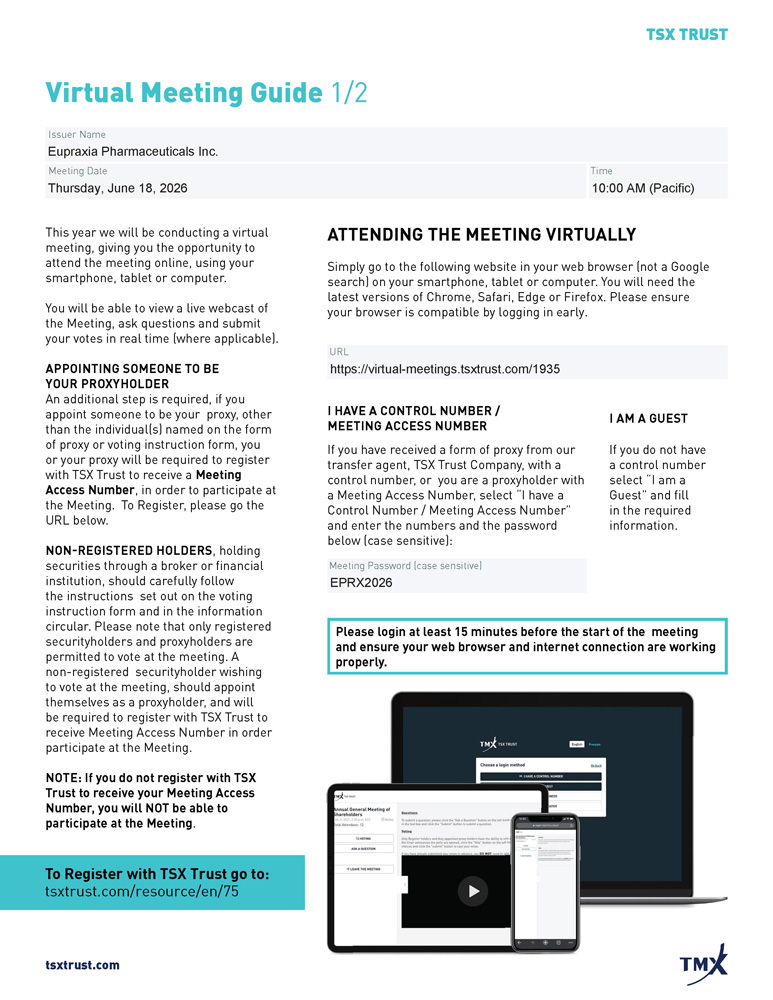
Virtual Meeting Guide 1/2 Time 10:00 AM (Pacific) Meeting Date Thursday, June 18, 2026 URL https://virtual - meetings.tsxtrust.com/1935 Meeting Password (case sensitive) EPRX2026 Issuer Name Eupraxia Pharmaceuticals Inc. properly. in order h TSX ccess ATTENDING THE MEETING VIRTUALLY Simply go to the following website in your web browser (not a Google search) on your smartphone, tablet or computer. You will need the latest versions of Chrome, Safari, Edge or Firefox. Please ensure your browser is compatible by logging in early. I HAVE A CONTROL NUMBER / MEETING ACCESS NUMBER If you have received a form of proxy from our transfer agent, TSX Trust Company, with a control number, or you are a proxyholder with a Meeting Access Number, select “I have a Control Number / Meeting Access Number” and enter the numbers and the password below (case sensitive): I AM A GUEST If you do not have a control number select “I am a Guest” and fill in the required information. Please login at least 15 minutes before the start of the meeting and ensure your web browser and internet connection are working r perly This year we will be conducting a virtual meeting, giving you the opportunity to attend the meeting online, using your smartphone, tablet or computer. You will be able to view a live webcast of the Meeting, ask questions and submit your votes in real time (where applicable). APPOINTING SOMEONE TO BE YOUR PROXYHOLDER An additional step is required, if you appoint someone to be your proxy, other than the individual(s) named on the form of proxy or voting instruction form, you or your proxy will be required to register with TSX Trust to receive a Meeting Access Number , in order to participate at the Meeting. To Register, please go the URL below. NON - REGISTERED HOLDERS , holding securities through a broker or financial institution, should carefully follow the instructions set out on the voting instruction form and in the information circular. Please note that only registered securityholders and proxyholders are permitted to vote at the meeting. A non - registered securityholder wishing to vote at the meeting, should appoint themselves as a proxyholder, and will be required to register with TSX Trust to receive Meeting Access Number in order participate at the Meeting. NOTE: If you do not register wit TSX Trust to receive your Meeting A cess Number, you will NOT be able to participate at the Meeting . To Register with TSX Trust go to: tsxtrust.com/resource/en/75 tsxtrust.com
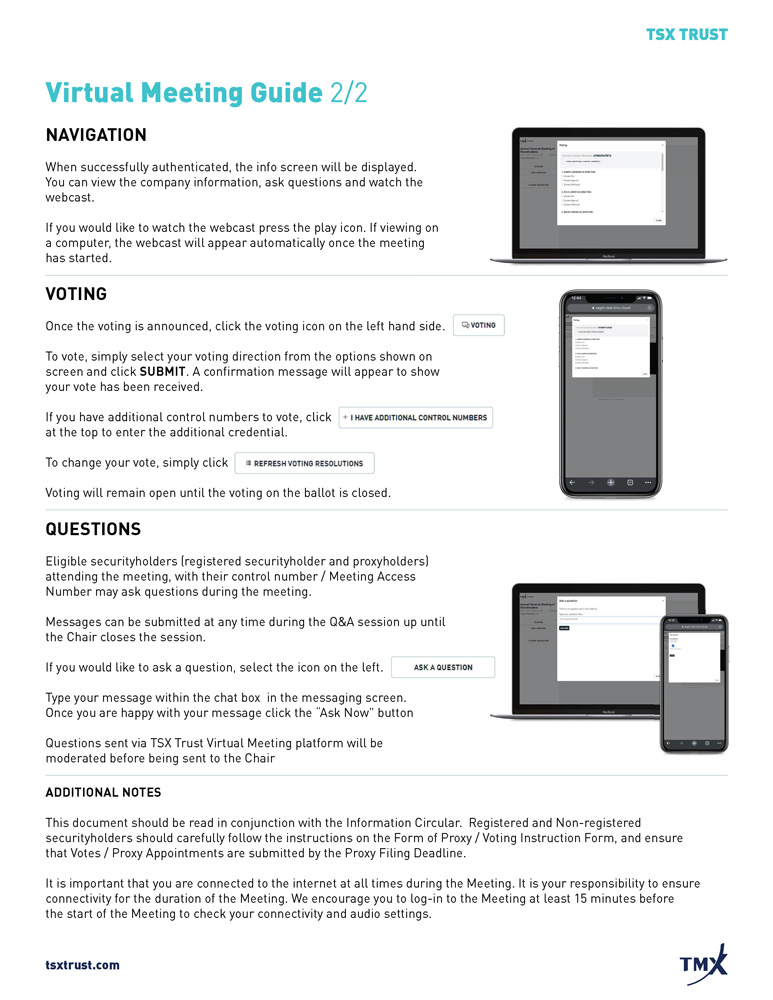
Virtual Meeting Guide 2/2 he g on ng s) until NAVIGATION When successfully authenticated, the info screen will be displayed. You can view the company information, ask questions and watch t e webcast. If you would like to watch the webcast press the play icon. If viewin on a computer, the webcast will appear automatically once the meeti g has started. VOTING Once the voting is announced, click the voting icon on the left hand side. To vote, simply select your voting direction from the options shown on screen and click SUBMIT . A confirmation message will appear to show your vote has been received. If you have additional control numbers to vote, click at the top to enter the additional credential. To change your vote, simply click Voting will remain open until the voting on the ballot is closed. QUESTIONS Eligible securityholders (registered securityholder and proxyholder s) attending the meeting, with their control number / Meeting Access Number may ask questions during the meeting. Messages can be submitted at any time during the Q&A session up until the Chair closes the session. If you would like to ask a question, select the icon on the left. Type your message within the chat box in the messaging screen. Once you are happy with your message click the “Ask Now” button Questions sent via TSX Trust Virtual Meeting platform will be moderated before being sent to the Chair ADDITIONAL NOTES This document should be read in conjunction with the Information Circular. Registered and Non - registered securityholders should carefully follow the instructions on the Form of Proxy / Voting Instruction Form, and ensure that Votes / Proxy Appointments are submitted by the Proxy Filing Deadline. It is important that you are connected to the internet at all times during the Meeting. It is your responsibility to ensure connectivity for the duration of the Meeting. We encourage you to log - in to the Meeting at least 15 minutes before the start of the Meeting to check your connectivity and audio settings. tsxtrust.com