Exhibit 3.2 PROGYNY, INC. RESTATED CERTIFICATE OF INCORPORATION PROGYNY, INC., a corporation organized and existing under the laws of the State of Delaware (the “Company”), does hereby certify as follows: FIRST: The name of the Company is Progyny, Inc. SECOND: The Company was originally formed as a corporation organized under the jurisdiction of the State of Delaware on April 3, 2008 under the name Auxogen Bioscience, Inc. THIRD: This Restated Certificate of Incorporation restates the provisions of the Corporation’s Certificate of Incorporation as heretofore amended and supplemented. FOURTH: This Restated Certificate of Incorporation has been duly adopted in accordance with the provisions of Sections 242 and 245 of the Delaware General Corporate Law (“DGCL”). This Restated Certificate of Incorporation only restates and integrates (except as permitted under Section 245(c) of the DGCL) the provisions of the Corporation’s Restated Certificate of Incorporation as heretofore amended, and there is no discrepancy between those provisions and the provisions of this Restated Certificate (except as permitted under Section 245(c) of the DGCL). FIFTH: The Restated Certificate of Incorporation so restated reads in full as set forth in Exhibit A attached hereto and is incorporated herein by reference in its entirety. * * * * IN WITNESS WHEREOF, the Company has caused this Restated Certificate of Incorporation to be signed by its Chief Executive Officer on this 21st day of May, 2026. PROGYNY, INC. By: /s/ Peter Anevski Peter Anevski Chief Executive Officer
Exhibit A PROGYNY, INC. RESTATED CERTIFICATE OF INCORPORATION I. The name of this corporation is Progyny, Inc. (the “Company”). II. The address of the registered office of the Company in the State of Delaware is 251 Little Falls Drive, City of Wilmington, County of New Castle, Delaware 19808. The name of its registered agent at such address is Corporation Service Company. III. The purpose of the Company is to engage in any lawful act or activity for which a corporation may be organized under the Delaware General Corporation Law (“DGCL”). IV. A. The Company is authorized to issue two classes of stock to be designated, respectively, “Common Stock” and “Preferred Stock.” The total number of shares of all classes of capital stock which the Company shall have authority to issue is one billion one hundred million (1,100,000,000) shares. One billion (1,000,000,000) shares shall be Common Stock (the “Common Stock”), each share having a par value of one-hundredth of one cent ($0.0001), and one hundred million (100,000,000) shares shall be Preferred Stock (the “Preferred Stock”), each share having a par value of one-hundredth of one cent ($0.0001). B. The Preferred Stock may be issued from time to time in one or more series. The Board of Directors of the Company (the “Board”) is hereby expressly authorized to provide for the issue of the shares of the Preferred Stock in one or more series, and to fix the number of shares and to determine or alter for each such series, such voting powers, full or limited, or no voting powers, and such designation, preferences, and relative, participating, optional, or other rights and such qualifications, limitations, or restrictions thereof, as shall be stated and expressed in the resolution or resolutions adopted by the Board providing for the issuance of such shares and as may be permitted by the DGCL. The Board is also expressly authorized to increase or decrease the number of shares of any series subsequent to the issuance of shares of that series, but not below the number of shares of such series then outstanding. In case the number of shares of any series shall be decreased in accordance with the foregoing sentence, the shares constituting such decrease shall resume the status that they had prior to the adoption of the resolution originally fixing the number of shares of such series. The number of authorized shares of Preferred Stock may be increased or decreased (but not below the number of shares thereof then outstanding) by the affirmative vote of the holders of a majority of the voting power of the stock of the Company entitled to vote thereon, without a separate vote of the holders of the Preferred Stock, or of any series thereof, unless a vote of any such holders is required pursuant to the terms of any certificate of designation filed with respect to any series of Preferred Stock.
3 C. Each outstanding share of Common Stock shall entitle the holder thereof to one vote on each matter properly submitted to the stockholders of the Company for their vote; provided, however, that, except as otherwise required by law, holders of Common Stock shall not be entitled to vote on any amendment to this Restated Certificate of Incorporation (including any certificate of designation filed with respect to any series of Preferred Stock) that relates solely to the terms of one or more outstanding series of Preferred Stock if the holders of such affected series are entitled, either separately or together as a class with the holders of one or more other such series, to vote thereon by law or pursuant to this Restated Certificate of Incorporation (including any certificate of designation filed with respect to any series of Preferred Stock). V. For the management of the business and for the conduct of the affairs of the Company, and in further definition, limitation and regulation of the powers of the Company, of its directors and of its stockholders or any class thereof, as the case may be, it is further provided that: A. MANAGEMENT OF BUSINESS. The management of the business and the conduct of the affairs of the Company shall be vested in its Board. B. BOARD OF DIRECTORS. 1. Number. The number of directors that shall constitute the Board shall be fixed exclusively by resolutions adopted by a majority of the authorized number of directors constituting the Board. 2. Term. Subject to the rights of the holders of any series of Preferred Stock to elect additional directors under specified circumstances, upon the filing of this Restated Certificate of Incorporation, the directors shall be divided into three classes designated as Class I, Class II and Class III, respectively. The Board is authorized to assign members of the Board already in office to such classes at the time the classification becomes effective. At the first annual meeting of stockholders following the initial classification of the Board, the term of office of the Class I directors shall expire and Class I directors shall be elected for a full term of three years. At the second annual meeting of stockholders following such initial classification, the term of office of the Class II directors shall expire and Class II directors shall be elected for a full term of three years. At the third annual meeting of stockholders following such initial classification, the term of office of the Class III directors shall expire and Class III directors shall be elected for a full term of three years. At each succeeding annual meeting of stockholders, directors shall be elected for a full term of three years to succeed the directors of the class whose terms expire at such annual meeting. Notwithstanding the foregoing provisions of this paragraph, each director shall serve until his or her successor is duly elected and qualified or until his or her earlier death, resignation or removal. No decrease in the number of directors constituting the Board shall shorten the term of any incumbent director. 3. Removal. a. Subject to the rights of any series of Preferred Stock to elect additional directors under specified circumstances, neither the Board nor any individual director may be removed without cause.
4 b. Subject to any limitation imposed by applicable law, any individual director or directors may be removed with cause by the affirmative vote of the holders of at least a majority of the voting power of all then-outstanding shares of capital stock of the Company entitled to vote generally at an election of directors. 4. Vacancies. Subject to any limitations imposed by applicable law and subject to the rights of the holders of any series of Preferred Stock, any vacancies on the Board resulting from death, resignation, disqualification, removal or other causes, and any newly created directorships resulting from any increase in the number of directors, shall, unless the Board determines by resolution that any such vacancies or newly created directorships shall be filled by the stockholders and except as otherwise provided by applicable law, be filled only by the affirmative vote of a majority of the directors then in office, even though less than a quorum of the Board, and not by the stockholders. Any director elected in accordance with the preceding sentence shall hold office for the remainder of the full term of the director for which the vacancy was created or occurred and until such director’s successor shall have been elected and qualified. C. BYLAW AMENDMENTS. The Board is expressly empowered to adopt, amend or repeal the Bylaws of the Company. Any adoption, amendment or repeal of the Bylaws of the Company by the Board shall require the approval of a majority of the authorized number of directors. The stockholders shall also have power to adopt, amend or repeal the Bylaws of the Company; provided, however, that, in addition to any vote of the holders of any class or series of stock of the Company required by law or by this Restated Certificate of Incorporation, such action by stockholders shall require the affirmative vote of the holders of at least a majority of the voting power of all of the then-outstanding shares of the capital stock of the Company entitled to vote generally in the election of directors, voting together as a single class. D. WRITTEN BALLOTS. The directors of the Company need not be elected by written ballot unless the Bylaws so provide. E. ACTION BY STOCKHOLDERS. No action shall be taken by the stockholders of the Company except at an annual or special meeting of stockholders called in accordance with the Bylaws and no action shall be taken by the stockholders by written consent or electronic transmission. F. ADVANCE NOTICE. Advance notice of stockholder nominations for the election of directors and of business to be brought by stockholders before any meeting of the stockholders of the Company shall be given in the manner provided in the Bylaws of the Company. VI. A. The liability of the directors for monetary damages shall be eliminated to the fullest extent under applicable law. B. To the fullest extent permitted by applicable law, the Company is authorized to provide indemnification of (and advancement of expenses to) directors, officers and agents of the Company (and any other persons to which applicable law permits the Company to provide indemnification) through Bylaw provisions, agreements with such agents or other persons, vote of stockholders or disinterested directors or otherwise in excess of the indemnification and
5 advancement otherwise permitted by such applicable law. If applicable law is amended after approval by the stockholders of this Article VI to authorize corporate action further eliminating or limiting the personal liability of directors, then the liability of a director to the Company shall be eliminated or limited to the fullest extent permitted by applicable law, as so amended. C. If the DGCL is amended to authorize corporate action further eliminating or limiting the personal liability of directors, then the liability of a director of the Company shall be eliminated to the fullest extent permitted by the DGCL, as so amended. D. Any repeal or modification of this Article VI shall be prospective and shall not affect the rights or protections or increase the liability of any director under this Article VI in effect at the time of the alleged occurrence of any act or omission to act giving rise to liability or indemnification. VII. A. Unless the Company consents in writing to the selection of an alternative forum, the Court of Chancery of the State of Delaware (or, if and only if the Court of Chancery of the State of Delaware lacks subject matter jurisdiction, any state court located within the State of Delaware or, if and only if all such state courts lack subject matter jurisdiction, the federal district court for the District of Delaware) shall be the sole and exclusive forum for the following types of actions or proceedings under Delaware statutory or common law: (A) any derivative action or proceeding brought on behalf of the Company; (B) any action or proceeding asserting a claim of breach of a fiduciary duty owed by any current or former director, officer or other employee of the Company, to the Company or the Company’s stockholders; (C) any action or proceeding asserting a claim against the Company or any current or former director, officer or other employee of the Company, arising out of or pursuant to any provision of the DGCL, this Restated Certificate of Incorporation or the Bylaws of the Company (as each may be amended from time to time); (D) any action or proceeding to interpret, apply, enforce or determine the validity of this Restated Certificate of Incorporation or the Bylaws of the Company (including any right, obligation, or remedy thereunder); (E) any action or proceeding as to which the DGCL confers jurisdiction to the Court of Chancery of the State of Delaware; (F) any action asserting a claim against the Company or any director, officer or other employee of the Company, governed by the internal affairs doctrine, in all cases to the fullest extent permitted by law and subject to the court’s having personal jurisdiction over the indispensable parties named as defendants. This paragraph A of Article VII shall not apply to suits brought to enforce a duty or liability created by the Securities Exchange Act of 1934, as amended, or any other claim for which the federal courts have exclusive jurisdiction. B. Any person or entity holding, owning or otherwise acquiring any interest in any security of the Company shall be deemed to have notice of and consented to the provisions of this Restated Certificate of Incorporation. VIII. A. The Company reserves the right to amend, alter, change or repeal any provision contained in this Restated Certificate of Incorporation, in the manner now or hereafter prescribed
6 by statute, except as provided in paragraph B. of this Article VIII, and all rights conferred upon the stockholders herein are granted subject to this reservation. B. Notwithstanding any other provisions of this Restated Certificate of Incorporation or any provision of law which might otherwise permit a lesser vote or no vote, but in addition to any affirmative vote of the holders of any particular class or series of the Company required by law or by this Restated Certificate of Incorporation or any certificate of designation filed with respect to a series of Preferred Stock that may be designated from time to time, the affirmative vote of the holders of at least a majority of the voting power of all of the then-outstanding shares of capital stock of the Company entitled to vote generally in the election of directors, voting together as a single class, shall be required to alter, amend or repeal Articles V, VI, VII and VIII. IX. A. Election Not to Be Governed by Section 203. The Company hereby expressly elects not to be subject to Section 203 of the DGCL. B. Business Combinations. 1. Notwithstanding any other provision in this Restated Certificate of Incorporation to the contrary, the Company shall not engage in any Business Combination (as defined hereinafter) with any Interested Stockholder (as defined hereinafter) for a period of three years following the time that such stockholder became an Interested Stockholder, unless: a. prior to such time the Board approved either the Business Combination or the transaction which resulted in such stockholder becoming an Interested Stockholder; b. upon consummation of the transaction which resulted in such stockholder becoming an Interested Stockholder, such stockholder owned at least eighty-five percent (85%) of the Voting Stock (as defined hereinafter) of the Company outstanding at the time the transaction commenced, excluding for purposes of determining the Voting Stock outstanding (but not the outstanding Voting Stock owned by such stockholder) those shares owned (a) by Persons (as defined hereinafter) who are directors and also officers of the Company and (b) employee stock plans of the Company in which employee participants do not have the right to determine confidentially whether shares held subject to the plan will be tendered in a tender or exchange offer; or c. at or subsequent to such time the Business Combination is approved by the Board and authorized at an annual or special meeting of stockholders by the affirmative vote of at least a majority of the outstanding Voting Stock which is not owned by such stockholder. 2. The restrictions contained in this Section (B) shall not apply if: a. a stockholder becomes an Interested Stockholder inadvertently and (a) as soon as practicable divests itself of ownership of sufficient shares so that the stockholder ceases to be an Interested Stockholder; and (b) would not, at any time within the three-year period immediately prior to a Business Combination between the Company and such stockholder, have been an Interested Stockholder but for the inadvertent acquisition of ownership; or
7 b. the Business Combination is proposed prior to the consummation or abandonment of and subsequent to the earlier of the public announcement or the notice required hereunder of a proposed transaction which (a) constitutes one of the transactions described in the second sentence of this paragraph; (b) is with or by a Person who either was not an Interested Stockholder during the previous three years or who became an Interested Stockholder with the approval of the Board; and (c) is approved or not opposed by a majority of the directors then in office (but not less than one) who were directors prior to any Person becoming an Interested Stockholder during the previous three years or were recommended for election or elected to succeed such directors by a majority of such directors. The proposed transactions referred to in the preceding sentence are limited to (x) a merger or consolidation of the Company (except for a merger in respect of which, pursuant to Section 251(f) of the DGCL, no vote of the stockholders of the Company is required); (y) a sale, lease, exchange, mortgage, pledge, transfer or other disposition (in one transaction or a series of transactions), whether as part of a dissolution or otherwise, of assets of the Company or of any direct or indirect majority-owned subsidiary of the Company (other than to any direct or indirect wholly-owned subsidiary or to the Company) having an aggregate market value equal to fifty percent (50%) or more of either that aggregate market value of all of the assets of the Company determined on a consolidated basis or the aggregate market value of all the outstanding Stock (as defined hereinafter) of the Company; or (z) a proposed tender or exchange offer for fifty percent (50%) or more of the outstanding Voting Stock of the Company. The Company shall give not less than 20 days’ notice to all Interested Stockholders prior to the consummation of any of the transactions described in clause (x) or (y) of this paragraph. 3. As used in this Section (B) only, and unless otherwise provided by the express terms of this Section (B), the following terms shall have the meanings ascribed to them as set forth in this paragraph (3): a. “Affiliate” means a Person that directly, or indirectly through one or more intermediaries, controls, or is controlled by, or is under common control with, another Person; b. “Associate”, when used to indicate a relationship with any Person, means: (a) any corporation, partnership, unincorporated association or other entity of which such Person is a director, officer or partner or is, directly or indirectly, the owner of twenty percent (20%) or more of any class of Voting Stock; (b) any trust or other estate in which such Person has at least a twenty percent (20%) beneficial interest or as to which such Person serves as trustee or in a similar fiduciary capacity; and (c) any relative or spouse of such Person, or any relative of such spouse, who has the same residence as such Person; c. “Business Combination” means: (a) any merger, consolidation, statutory conversion or domestication of the Company (other than a merger effected pursuant to Section 253 or Section 267 of the DGCL) or any direct or indirect majority-owned subsidiary of the Company with (aa) the Interested Stockholder, or (bb) with any Person if the merger, consolidation, statutory conversion or domestication is caused by the Interested Stockholder and as a result of such act or transaction paragraph (1) of this Section (B) is not applicable to the surviving entity; (b) any sale, lease, exchange, mortgage, pledge, transfer or other disposition (in one transaction or a series of transactions), except proportionately as a stockholder of the Company, to or with the Interested Stockholder, whether as part of a dissolution or otherwise, of
8 assets of the Company or of any direct or indirect majority-owned subsidiary of the Company which assets have an aggregate market value equal to ten percent (10%) or more of either the aggregate market value of all the assets of the Company determined on a consolidated basis or the aggregate market value of all the outstanding Stock of the Company; (c) any transaction which results in the issuance or transfer by the Company or by any direct or indirect majority- owned subsidiary of the Company of any Stock of the Company or of such subsidiary to the Interested Stockholder, except: (aa) pursuant to the exercise, exchange or conversion of securities exercisable for, exchangeable for or convertible into Stock of the Company or any such subsidiary which securities were outstanding prior to the time that the Interested Stockholder became such; (bb) pursuant to a merger under Section 251(g), 253 or 267 of the DGCL; (cc) pursuant to a dividend or distribution paid or made, or the exercise, exchange or conversion of securities exercisable for, exchangeable for or convertible into Stock of the Company or any such subsidiary which security is distributed, pro rata to all holders of a class or series of Stock of the Company subsequent to the time the Interested Stockholder became such; (dd) pursuant to an exchange offer by the Company to purchase Stock made on the same terms to all holders of such Stock; or (ee) any issuance or transfer of Stock by the Company; provided however, that in no case under items (cc) through (ee) of this subparagraph shall there be an increase in the Interested Stockholder’s proportionate share of the Stock of any class or series of the Company or of the Voting Stock of the Company (except as a result of immaterial changes due to fractional share adjustments); (d) any transaction involving the Company or any direct or indirect majority-owned subsidiary of the Company which has the effect, directly or indirectly, of increasing the proportionate share of the Stock of any class or series, or securities convertible into the Stock of any class or series, of the Company or of any such subsidiary which is owned by the Interested Stockholder, except as a result of immaterial changes due to fractional share adjustments or as a result of any purchase or redemption of any shares of Stock not caused, directly or indirectly, by the Interested Stockholder; or (e) any receipt by the Interested Stockholder of the benefit, directly or indirectly (except proportionately as a stockholder of the Company), of any loans, advances, guarantees, pledges or other financial benefits (other than those expressly permitted in the immediately preceding subparagraphs (a) through (d)) provided by or through the Company or any direct or indirect majority-owned subsidiary of the Company. d. “Control”, including the terms “controlling”, “controlled by” and “under common control with”, means the possession, directly or indirectly, of the power to direct or cause the direction of the management and policies of a Person, whether through the ownership of stock or other equity interests, by contract or otherwise. A Person who is the owner of twenty percent (20%) or more of the outstanding Voting Stock of any corporation, partnership, unincorporated association or other entity shall be presumed to have control of such entity, in the absence of proof by a preponderance of the evidence to the contrary; notwithstanding the foregoing, a presumption of control shall not apply where such Person holds Voting Stock, in good faith and not for the purpose of circumventing this Section (B), as an agent, bank, broker, nominee, custodian or trustee for one or more owners who do not individually or as a group have control of such entity; e. “Interested Stockholder” means any Person (other than the Company and any direct or indirect majority-owned subsidiary of the Company) that (a) is the owner of fifteen percent (15%) or more of the outstanding Voting Stock of the Company, or (b) is an Affiliate or Associate of the Company and was the owner of fifteen percent (15%) or more of the
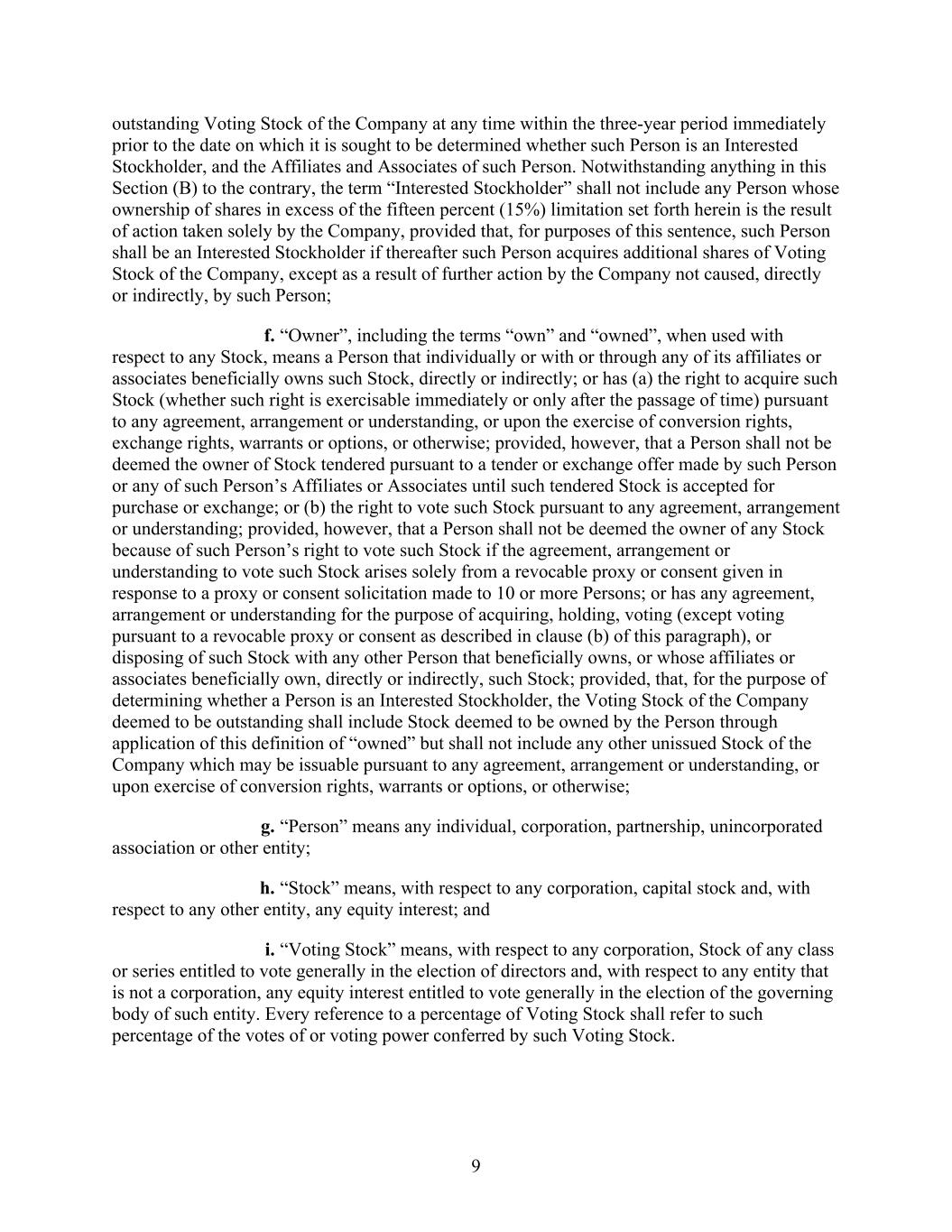
9 outstanding Voting Stock of the Company at any time within the three-year period immediately prior to the date on which it is sought to be determined whether such Person is an Interested Stockholder, and the Affiliates and Associates of such Person. Notwithstanding anything in this Section (B) to the contrary, the term “Interested Stockholder” shall not include any Person whose ownership of shares in excess of the fifteen percent (15%) limitation set forth herein is the result of action taken solely by the Company, provided that, for purposes of this sentence, such Person shall be an Interested Stockholder if thereafter such Person acquires additional shares of Voting Stock of the Company, except as a result of further action by the Company not caused, directly or indirectly, by such Person; f. “Owner”, including the terms “own” and “owned”, when used with respect to any Stock, means a Person that individually or with or through any of its affiliates or associates beneficially owns such Stock, directly or indirectly; or has (a) the right to acquire such Stock (whether such right is exercisable immediately or only after the passage of time) pursuant to any agreement, arrangement or understanding, or upon the exercise of conversion rights, exchange rights, warrants or options, or otherwise; provided, however, that a Person shall not be deemed the owner of Stock tendered pursuant to a tender or exchange offer made by such Person or any of such Person’s Affiliates or Associates until such tendered Stock is accepted for purchase or exchange; or (b) the right to vote such Stock pursuant to any agreement, arrangement or understanding; provided, however, that a Person shall not be deemed the owner of any Stock because of such Person’s right to vote such Stock if the agreement, arrangement or understanding to vote such Stock arises solely from a revocable proxy or consent given in response to a proxy or consent solicitation made to 10 or more Persons; or has any agreement, arrangement or understanding for the purpose of acquiring, holding, voting (except voting pursuant to a revocable proxy or consent as described in clause (b) of this paragraph), or disposing of such Stock with any other Person that beneficially owns, or whose affiliates or associates beneficially own, directly or indirectly, such Stock; provided, that, for the purpose of determining whether a Person is an Interested Stockholder, the Voting Stock of the Company deemed to be outstanding shall include Stock deemed to be owned by the Person through application of this definition of “owned” but shall not include any other unissued Stock of the Company which may be issuable pursuant to any agreement, arrangement or understanding, or upon exercise of conversion rights, warrants or options, or otherwise; g. “Person” means any individual, corporation, partnership, unincorporated association or other entity; h. “Stock” means, with respect to any corporation, capital stock and, with respect to any other entity, any equity interest; and i. “Voting Stock” means, with respect to any corporation, Stock of any class or series entitled to vote generally in the election of directors and, with respect to any entity that is not a corporation, any equity interest entitled to vote generally in the election of the governing body of such entity. Every reference to a percentage of Voting Stock shall refer to such percentage of the votes of or voting power conferred by such Voting Stock.