Exhibit 99.1


Live audio Web
broadcast of the
Bank’s analysts’
conference call.
See page 92
for details.
 
 
Quarterly Report
to Shareholders


Scotiabank reports second quarter results
 
 
TORONTO, May
 27, 2026 –
The Bank of Nova Scotia (“Scotiabank”) (TSX: BNS; NYSE: BNS) reported second quarter net income of $2,632 million compared to $2,032 million in the same period last year. Diluted earnings per share (EPS) were $2.00, compared to $1.48 in the same period a year ago.
 
Adjusted net income
(1)
for the second quarter was $2,652 million and adjusted diluted EPS
(1)
was $2.02, up from $1.52 last year. Adjusted return on equity (ROE)
(1)
was 13.2% compared to 10.4% a year ago.
 
“The Bank delivered another strong quarter as we continue to execute on our strategy, with strong revenue growth coupled with expanding margins and another quarter of positive operating leverage,” said Scott Thomson, President and CEO of Scotiabank. “The Bank remains on track to achieve its financial objectives for fiscal 2026 and its 14%+ ROE objective in fiscal 2027. Our focus on evolving our business mix drove strong fee income and wealth management revenues, along with sequential Canadian commercial and small business loan growth.”
 
Canadian Banking generated earnings of $935 million, up 53% compared to the prior year, driven by double-digit pre-tax, pre-provision earnings
(2)
growth and lower performing provision for credit losses. The business grew day-to-day and savings deposits and delivered another quarter of solid positive operating leverage, in line with its strategic objectives.
 
International Banking generated earnings of $736 million, up 3% year-over-year, driven by continued margin expansion and positive operating leverage as the business maintains its focus on expense discipline. ROE remained stable at 16%.
 
Global Wealth Management delivered earnings of $476 million, up 19% year-over year driven by strong revenue growth from higher mutual fund fees, brokerage revenues, and net interest income. The business continued to deliver strong retail mutual fund sales through our branches, while assets under management
(3)
grew 18% year-over-year to $450 billion.
 
Global Banking and Markets reported earnings of $457 million, up 11% year-over-year. Results were driven by strong performance in our capital markets business, partly offset by higher expenses to support future business growth.
 
The Bank reported a Common Equity Tier 1 (CET1) capital ratio
(4)
of 13.3% and declared a dividend of $1.14, representing a 4% increase.


(1)
    Refer to
Non-GAAP
Measures section starting on page 5.
(2)
    Pre-tax, pre-provision (PTPP) earnings are calculated as revenue net of non-interest expenses. This is a non-GAAP measure. PTPP earnings do not have a standardized meaning under GAAP and may not be comparable to similar measures disclosed by other financial institutions. The Bank uses PTPP earnings to assess its ability to generate earnings growth excluding the impact of credit losses and income taxes. The Bank believes that certain non-GAAP measures provide readers with a better understanding of how management assesses performance.
(3)
    Refer to Glossary on page 57 for the description of the measure.
(4)
    The regulatory capital ratios are based on Basel III requirements as determined in accordance with OSFI Guideline – Capital Adequacy Requirements.


Table of Contents
Enhanced Disclosure Task Force (EDTF) Recommendations
Below is the index of EDTF recommendations to facilitate easy reference in the Bank’s public disclosure documents available on www.scotiabank.com/investorrelations.
 
Reference Table for EDTF
 
    Q2 2026           2025 Annual Report  
Type of risk   Number      Disclosure   Quarterly
Report
   
Supplementary
Regulatory Capital
Disclosures
           MD&A    
Financial
Statements
 
General
    1      The index of risks to which the business is exposed.             16    
    2      The Bank’s risk terminology, measures and key parameters.            
76-83
   
    3      Top and emerging risks, and the changes during the reporting period.     38          
85-87, 91-96
   
    4      Discussion on the regulatory developments and plans to meet new regulatory ratios.     52-54                      
60-63, 120-121
         
Risk governance, risk management and business model     5      The Bank’s Risk Governance structure.            
78-80
   
    6      Description of risk culture and procedures applied to support the culture.            
80-83
   
    7      Description of key risks from the Bank’s business model.             84    
    8      Stress testing use within the Bank’s risk governance and capital management.                            
80-82
         
Capital Adequacy and risk-weighted assets     9      Pillar 1 capital requirements, and the impact for global systemically important banks.     52-53      
4-5
       
60-63
      208  
    10      a) Regulatory capital components.     52-53, 81      
21-23
        64    
     b) Reconciliation of the accounting balance sheet to the regulatory balance sheet.        
18-19
         
    11      Flow statement of the movements in regulatory capital since the previous reporting period, including changes in common equity tier 1, additional tier 1 and tier 2 capital.     52-53       94        
65-66
   
    12      Discussion of targeted level of capital, and the plans on how to establish this.            
60-63
   
    13      Analysis of risk-weighted assets (RWA) by risk type, business, and market risk RWAs.        
6, 36-39, 43-60,
68-73,
77, 91, 97


68-73,
84, 127
      178  
    14      Analysis of the capital requirements for each Basel asset class.        
16-17, 36-61,

66-73, 77, 84-87


68-73
     
178,
224-228
 
 
    15      Tabulate credit risk in the Banking Book.     38-39      
16-17, 36-61, 77, 84-87
       
68-73
      225  
    16      Flow statements reconciling the movements in risk-weighted assets for each risk-weighted asset type.         62, 76, 96        
68-73
   
      17      Discussion of Basel III back-testing requirement including credit risk model performance and validation.             101              
69-71
         
Liquidity Funding     18      Analysis of the Bank’s liquid assets.    
45-47
         
103-108
   
    19      Encumbered and unencumbered assets analyzed by balance sheet category.    
45-47
          105    
    20      Consolidated total assets, liabilities and
off-balance
sheet commitments analyzed by remaining contractual maturity at the balance sheet date.
           
109-111
   
    21      Analysis of the Bank’s sources of funding and a description of the Bank’s funding strategy.     50-51                      
108-109
         
Market Risk     22      Linkage of market risk measures for trading and
non-trading
portfolios and the balance sheet.
    44-45           102    
    23      Discussion of significant trading and
non-trading
market risk factors.
    43-44          
97-103
   
    24      Discussion of changes in period on period VaR results as well as VaR assumptions, limitations, backtesting and validation.     43          
97-103
   
    25      Other risk management techniques e.g. stress tests, tail risk and market liquidity horizon.                            
97-103
         
Credit Risk     26      Analysis of the aggregate credit risk exposures, including details of both personal and wholesale lending.        
6, 36-39, 43-60, 68-73
       
91-96,
123-127
     
188-189,

225-228
 
 
    27      Discussion of the policies for identifying impaired loans, defining impairments and renegotiated loans, and explaining loan forbearance policies.                
158-160
 
    28      Reconciliations of the opening and closing balances of impaired loans and impairment allowances during the year.     40-41, 70      
33-34
        93,
122-125
      189  
    29      Analysis of counterparty credit risk that arises from derivative transactions.     53-54       102        
88-90
     
176-179
 
      30      Discussion of credit risk mitigation, including collateral held for all sources of credit risk.                            
89-91,
94
         
Other risks
    31      Quantified measures of the management of operational risk.             72,
112-113
   
    32      Discussion of publicly known risk items.            
85-87
     
205-206
 
 
2
   Scotiabank Second Quarter Report 2026 

Table of Contents
MANAGEMENT’S DISCUSSION & ANALYSIS
 
MANAGEMENT’S DISCUSSION & ANALYSIS
The Management’s Discussion and Analysis (MD&A) is provided to enable readers to assess the Bank’s financial condition and results of operations as at and for the period ended April 30, 2026. The MD&A should be read in conjunction with the Bank’s unaudited Condensed Interim Consolidated Financial Statements included in this Report to Shareholders, and the Bank’s 2025 Annual Report. This MD&A is dated May 27, 2026.
Additional information relating to the Bank, including the Bank’s 2025 Annual Report, is available on the Bank’s website at www.scotiabank.com. As well, the Bank’s 2025 Annual Report and Annual Information Form are available on SEDAR+ at www.sedarplus.ca and on the EDGAR section of the SEC’s website at www.sec.gov.
 
Contents


Management’s Discussion and Analysis
4
  Financial Highlights
5
  Non-GAAP Measures
16
  Overview of Performance
18
  Group Financial Performance
22
  Business Segment Review
35
  Geographic Highlights
36
  Quarterly Financial Highlights
37
  Financial Position
38
  Risk Management
52
  Capital Management
53
  Financial Instruments
54
  Off-Balance Sheet Arrangements
54
  Regulatory Developments
55
  Accounting Policies and Controls
56
  Share Data
57
  Glossary
Forward-looking Statements
From time to time, our public communications include oral or written forward-looking statements. Statements of this type are included in this document, and may be included in other filings with Canadian securities regulators or the U.S. Securities and Exchange Commission (SEC), or in other communications. In addition, representatives of the Bank may include forward-looking statements orally to analysts, investors, the media and others. All such statements are made pursuant to the “safe harbor” provisions of the U.S. Private Securities Litigation Reform Act of 1995 and any applicable Canadian securities legislation. Forward-looking statements may include, but are not limited to, statements made in this document, the Management’s Discussion and Analysis in the Bank’s 2025 Annual Report under the headings “Outlook” and in other statements regarding the Bank’s objectives, strategies to achieve those objectives, the regulatory environment in which the Bank operates, anticipated financial results, and the outlook for the Bank’s businesses and for the Canadian, U.S. and global economies. Such statements are typically identified by words or phrases such as “believe,” “expect,” “aim,” “achieve,” “foresee,” “forecast,” “anticipate,” “intend,” “estimate,” “outlook,” “seek,” “schedule,” “plan,” “goal,” “strive,” “target,” “project,” “commit,” “objective,” and similar expressions of future or conditional verbs, such as “will,” “may,” “should,” “would,” “might,” “can” and “could” and positive and negative variations thereof.
By their very nature, forward-looking statements require us to make assumptions and are subject to inherent risks and uncertainties, which give rise to the possibility that our predictions, forecasts, projections, expectations or conclusions will not prove to be accurate, that our assumptions may not be correct and that our financial performance objectives, vision and strategic goals will not be achieved.
We caution readers not to place undue reliance on these statements as a number of risk factors, many of which are beyond our control and effects of which can be difficult to predict, could cause our actual results to differ materially from the expectations, targets, estimates or intentions expressed in such forward-looking statements.
The future outcomes that relate to forward-looking statements may be influenced by many factors, including but not limited to: general economic and market conditions in the countries in which we operate and globally; changes in currency and interest rates; increased funding costs and market volatility due to market illiquidity and competition for funding; the failure of third parties to comply with their obligations to the Bank and its affiliates, including relating to the care and control of information, and other risks arising from the Bank’s use of third parties; changes in monetary, fiscal, or economic policy and tax legislation and interpretation; changes in laws and regulations or in supervisory expectations or requirements, including capital, interest rate and liquidity requirements and guidance, and the effect of such changes on funding costs; geopolitical risk (including policies and other changes related to, or affecting, economic or trade matters, including tariffs, countermeasures, tariff mitigation policies and
tax-related
risks); changes to our credit ratings; the possible effects on our business and the global economy of war, conflicts or terrorist actions and unforeseen consequences arising from such actions; technological changes, including open banking and the use of data and artificial intelligence in our business, and technology resiliency; operational and infrastructure risks; reputational risks; the accuracy and completeness of information the Bank receives on customers and counterparties; the timely development and introduction of new products and services, and the extent to which products or services previously sold by the Bank require the Bank to incur liabilities or absorb losses not contemplated at their origination; our ability to execute our strategic plans, including the successful completion of acquisitions and dispositions, including obtaining regulatory approvals; critical accounting estimates and the effect of changes to accounting standards, rules and interpretations on these estimates; global capital markets activity; the Bank’s ability to attract, develop and retain key executives; the evolution of various types of fraud or other criminal behaviour to which the Bank is exposed; anti-money laundering; disruptions or attacks (including cyberattacks) on the Bank’s information technology, internet connectivity, network accessibility, or other voice or data communications systems or services, which may result in data breaches, unauthorized access to sensitive information, denial of service and potential incidents of identity theft; increased competition in the geographic and business areas in which we operate, including through internet and mobile banking and
non-traditional
competitors; exposure related to significant litigation and regulatory matters; environmental, social and governance risks, including climate-related risk, our ability to implement various sustainability-related initiatives (both internally and with our clients and other stakeholders) under expected time frames, and our ability to scale our sustainable-finance products and services; the occurrence of natural and unnatural catastrophic events and claims resulting from such events, including disruptions to public infrastructure, such as transportation, communications, power or water supply; inflationary pressures; global supply-chain disruptions; Canadian housing and household indebtedness; the emergence or continuation of widespread health emergencies or pandemics, including their impact on the local, national or global economies, financial market conditions and the Bank’s business, results of operations, financial condition and prospects; and the Bank’s anticipation of and success in managing the risks implied by the foregoing. A substantial amount of the Bank’s business involves making loans or otherwise committing resources to specific companies, industries or countries. Unforeseen events affecting such borrowers, industries or countries could have a material adverse effect on the Bank’s financial results, businesses, financial condition or liquidity. These and other factors may cause the Bank’s actual performance to differ materially from that contemplated by forward-looking statements. The Bank cautions that the preceding list is not exhaustive of all possible risk factors and other factors could also adversely affect the Bank’s results, for more information, please see the “Risk Management” section of the Bank’s 2025 Annual Report, as may be updated by quarterly reports.
Material economic assumptions underlying the forward-looking statements contained in this document are set out in the 2025 Annual Report under the headings “Outlook”, as updated by quarterly reports. The “Outlook” and “2026 Priorities” sections are based on the Bank’s views and the actual outcome is uncertain. Readers should consider the above-noted factors when reviewing these sections. When relying on forward-looking statements to make decisions with respect to the Bank and its securities, investors and others should carefully consider the preceding factors, other uncertainties and potential events.
Any forward-looking statements contained in this document represent the views of management only as of the date hereof and are presented for the purpose of assisting the Bank’s shareholders and analysts in understanding the Bank’s financial position, objectives and priorities, and anticipated financial performance as at and for the periods ended on the dates presented, and may not be appropriate for other purposes. Except as required by law, the Bank does not undertake to update any forward-looking statements, whether written or oral, that may be made from time to time by or on its behalf.
Additional information relating to the Bank, including the Bank’s Annual Information Form, can be located on the SEDAR+ website at www.sedarplus.ca and on the EDGAR section of the SEC’s website at www.sec.gov.
 
 Scotiabank Second Quarter Report 2026   
 
3
 

Table of Contents
MANAGEMENT’S DISCUSSION & ANALYSIS
 
Financial Highlights
T1 Financial highlights
      As at and for the three months ended      As at and for the
six months ended
 
(Unaudited)
  
April 30
2026
    January 31
2026
    April 30
2025
    
April 30
2026
    April 30
2025
 
Operating results
($ millions)
           
Net interest income
  
 
5,521
 
    5,582       5,270     
 
11,103
 
    10,443  
Non-interest
income
  
 
4,316
 
    4,064       3,810     
 
8,380
 
    8,009  
Total revenue
  
 
9,837
 
    9,646       9,080     
 
19,483
 
    18,452  
Provision for credit losses
  
 
1,217
 
    1,176       1,398     
 
2,393
 
    2,560  
Non-interest
expenses
  
 
5,189
 
    5,299       5,110     
 
10,488
 
    11,601  
Income tax expense
  
 
799
 
    872       540     
 
1,671
 
    1,266  
Net income
  
 
2,632
 
    2,299       2,032     
 
4,931
 
    3,025  
Net income attributable to common shareholders
  
 
2,468
 
    2,155       1,841     
 
4,623
 
    2,866  
Operating performance
           
Basic earnings per share
($)
  
 
2.01
 
    1.75       1.48     
 
3.75
 
    2.30  
Diluted earnings per share
 ($)
  
 
2.00
 
    1.73       1.48     
 
3.73
 
    2.15  
Return on equity
(%)
(1)
  
 
13.1
 
    11.1       10.1     
 
12.1
 
    7.8  
Return on tangible common equity
(%)
(2)
  
 
16.0
 
    13.5       12.5     
 
14.7
 
    9.6  
Productivity ratio
(%)
(1)
  
 
52.8
 
    54.9       56.3     
 
53.8
 
    62.9  
Net interest margin
(%)
(2)
  
 
2.49
 
    2.45       2.31     
 
2.47
 
    2.27  
Financial position information
($ millions)
           
Cash and deposits with financial institutions
  
 
79,301
 
    73,838       63,577       
Trading assets
  
 
157,689
 
    161,043       128,987       
Loans
  
 
757,434
 
    755,475       756,372       
Total assets
  
 
1,521,521
 
    1,475,979       1,415,465       
Deposits
  
 
981,489
 
    971,682       945,843       
Common equity
  
 
77,222
 
    77,649       74,686       
Preferred shares and other equity instruments
  
 
9,939
 
    9,939       10,232       
Assets under administration
(1)
  
 
892,418
 
    874,305       779,054       
Assets under management
(1)
  
 
450,006
 
    435,814       379,889                   
Capital and liquidity measures
(3)
           
Common Equity Tier 1 (CET1) capital ratio
(%)
  
 
13.3
 
    13.3       13.2       
Tier 1 capital ratio
(%)
  
 
15.4
 
    15.4       15.4       
Total capital ratio
(%)
  
 
17.0
 
    17.0       17.1       
Total loss absorbing capacity (TLAC) ratio
(%)
  
 
28.6
 
    28.6       30.3       
Leverage ratio
(%)
  
 
4.3
 
    4.4       4.5       
TLAC Leverage ratio
(%)
  
 
8.0
 
    8.3       8.9       
Risk-weighted assets
($ millions)
  
 
474,440
 
    474,253       458,989       
Liquidity coverage ratio (LCR)
(%)
  
 
124
 
    122       131       
Net stable funding ratio (NSFR)
(%)
  
 
116
 
    115       120                   
Credit quality
           
Net impaired loans
($ millions)
  
 
5,200
 
    4,961       4,648       
Allowance for credit losses
($ millions)
(4)
  
 
7,344
 
    7,185       7,276       
Gross impaired loans as a % of loans and acceptances
(1)
  
 
0.99
 
    0.95       0.90       
Net impaired loans as a % of loans and acceptances
(1)
  
 
0.68
 
    0.65       0.61       
Provision for credit losses as a % of average net loans and acceptances (annualized)
(1)(5)
  
 
0.66
 
    0.61       0.75     
 
0.63
 
    0.68  
Provision for credit losses on impaired loans as a % of average net loans and acceptances (annualized)
(1)(5)
  
 
0.61
 
    0.58       0.57     
 
0.59
 
    0.56  
Net write-offs as a % of average net loans and acceptances (annualized)
(1)
  
 
0.52
 
    0.49       0.50     
 
0.51
 
    0.50  
Adjusted results
(2)
           
Adjusted total revenue
($ millions)
  
 
9,845
 
    10,077       9,098     
 
19,922
 
    18,470  
Adjusted
non-interest
expenses
($ millions)
  
 
5,171
 
    5,273       5,067     
 
10,444
 
    10,178  
Adjusted net income
($ millions)
  
 
2,652
 
    2,695       2,072     
 
5,347
 
    4,434  
Adjusted diluted earnings per share
($)
  
 
2.02
 
    2.05       1.52     
 
4.07
 
    3.28  
Adjusted return on equity
(%)
  
 
13.2
 
    13.0       10.4     
 
13.1
 
    11.1  
Adjusted return on tangible common equity
(%)
  
 
16.0
 
    15.8       12.7     
 
15.9
 
    13.5  
Adjusted productivity ratio
(%)
  
 
52.5
 
    52.3       55.7     
 
52.4
 
    55.1  
Common share information
           
Closing share price
($)
(TSX)
  
 
105.68
 
    101.80       68.98       
Shares outstanding
(millions)
           
Average – Basic
  
 
1,230
 
    1,235       1,246     
 
1,233
 
    1,245  
Average – Diluted
  
 
1,232
 
    1,238       1,246     
 
1,236
 
    1,250  
End of period
  
 
1,227
 
    1,233       1,246       
Dividends paid per share
($)
  
 
1.10
 
    1.10       1.06     
 
2.20
 
    2.12  
Dividend yield
(%)
(1)
  
 
4.4
 
    4.5       6.2     
 
4.5
 
    5.9  
Market capitalization
($ millions)
(TSX)
  
 
129,647
 
    125,498       85,918       
Book value per common share
($)
(1)
  
 
62.95
 
    62.99       59.96       
Market value to book value multiple
(1)
  
 
1.7
 
    1.6       1.2       
Price to earnings multiple (trailing 4 quarters)
(1)
  
 
14.5
 
    15.0       13.9                   
Other information
           
Employees (full-time equivalent)
  
 
80,415
 
    79,740       86,746       
Branches and offices
  
 
1,988
 
    1,991       2,139                   
(1)
Refer to Glossary on page 57 for the description of the measure.
(2)
Refer to
Non-GAAP
Measures section starting on page 5.
(3)
The regulatory ratios and measures are calculated in accordance with the Office of the Superintendent of Financial Institutions (OSFI) Guidelines on Capital Adequacy Requirements, Total Loss Absorbing Capacity, Leverage Requirements and Liquidity Adequacy Requirements (LAR).
(4)
Includes allowance for credit losses on all financial assets – loans, acceptances,
off-balance
sheet exposures, debt securities and deposits with financial institutions.
(5)
Includes provision for credit losses on certain financial assets – loans, acceptances and
off-balance
sheet exposures.
 
4
   Scotiabank Second Quarter Report 2026 

Table of Contents
MANAGEMENT’S DISCUSSION & ANALYSIS
 
Non-GAAP
Measures
The Bank uses a number of financial measures and ratios to assess its performance, as well as the performance of its operating segments. Some of these financial measures and ratios are presented on a
non-GAAP
basis and are not calculated in accordance with Generally Accepted Accounting Principles (GAAP), which are based on International Financial Reporting Standards (IFRS) as issued by the International Accounting Standards Board (IASB), are not defined by GAAP, do not have standardized meanings and therefore might not be comparable to similar financial measures and ratios disclosed by other issuers. The Bank believes that
non-GAAP
measures and ratios are useful as they provide readers with a better understanding of how management assesses performance. These
non-GAAP
measures and ratios are used throughout this report and defined below.
Adjusted results and diluted earnings per share
The following tables present a reconciliation of GAAP reported financial results to
non-GAAP
adjusted financial results. Management considers both reported and adjusted results and measures useful in assessing underlying ongoing business performance. Adjusted results and measures remove certain specified items from revenue,
non-interest
expenses, income taxes and
non-controlling
interests. Presenting results on both a reported basis and adjusted basis allows readers to assess the impact of certain items on results for the periods presented, and to better assess results and trends excluding those items that may not be reflective of ongoing business performance.
 
 Scotiabank Second Quarter Report 2026   
 
5
 

Table of Contents
MANAGEMENT’S DISCUSSION & ANALYSIS
 
T2 Reconciliation of reported and adjusted results
      For the three months ended      For the six months ended  
($ millions)
  
April 30
2026
     January 31
2026
     April 30
2025
    
April 30
2026
     April 30
2025
 
Reported Results
              
Net interest income
  
$
5,521
 
   $ 5,582      $ 5,270     
$
11,103
 
   $ 10,443  
Non-interest
income
  
 
4,316
 
     4,064        3,810     
 
8,380
 
     8,009  
Total revenue
  
 
9,837
 
     9,646        9,080     
 
19,483
 
     18,452  
Provision for credit losses
  
 
1,217
 
     1,176        1,398     
 
2,393
 
     2,560  
Non-interest
expenses
  
 
5,189
 
     5,299        5,110     
 
10,488
 
     11,601  
Income before taxes
  
 
3,431
 
     3,171        2,572     
 
6,602
 
     4,291  
Income tax expense
  
 
799
 
     872        540     
 
1,671
 
     1,266  
Net income
  
$
2,632
 
   $ 2,299      $ 2,032     
$
4,931
 
   $ 3,025  
Net income attributable to
non-controlling
interests in subsidiaries (NCI)
  
 
37
 
     12        56     
 
49
 
     (98
Net income attributable to equity holders
  
 
2,595
 
     2,287        1,976     
 
4,882
 
     3,123  
Net income attributable to preferred shareholders and other equity instrument holders
  
 
127
 
     132        135     
 
259
 
     257  
Net income attributable to common shareholders
  
$
2,468
 
   $ 2,155      $ 1,841     
$
4,623
 
   $ 2,866  
Adjustments
              
Adjusting items impacting
non-interest
income and total revenue
(Pre-tax)
              
(a) Divestitures and wind-down of operations
  
$
 
   $ 423      $ 9     
$
423
 
   $ 9  
(b) Amortization of acquisition-related intangible assets
  
 
8
 
     8        9     
 
16
 
     9  
Total
non-interest
income and total revenue adjusting items
(Pre-tax)
  
 
8
 
     431        18     
 
439
 
     18  
Adjusting items impacting
non-interest
expenses
(Pre-tax)
              
(a) Divestitures and wind-down of operations


     11        26     
 
11
 
     1,388  
(b) Amortization of acquisition-related intangible assets
  
 
18
 
     15        17     
 
33
 
     35  
Total
non-interest
expense adjusting items
(Pre-tax)
  
 
18
 
     26        43     
 
44
 
     1,423  
Total impact of adjusting items on net income before taxes
  
 
26
 
     457        61     
 
483
 
     1,441  
Impact of adjusting items on income tax expense
              
(a) Divestitures and wind-down of operations


     (57      (15   
 
(57
     (22
(b) Amortization of acquisition-related intangible assets
  
 
(6
     (4      (6   
 
(10
     (10
Total impact of adjusting items on income tax expense
  
 
(6
     (61      (21   
 
(67
     (32
Total impact of adjusting items on net income
  
$
20
 
   $ 396      $ 40     
$
416
 
   $ 1,409  
Impact of adjusting items on NCI


     (10      16     
 
(10
     (175
Total impact of adjusting items on net income attributable to equity holders
  
$
20
 
   $ 386      $ 56     
$
406
 
   $ 1,234  
Adjusted Results
              
Net interest income
  
$
5,521
 
   $ 5,582      $ 5,270     
$
11,103
 
   $ 10,443  
Non-interest
income
  
 
4,324
 
     4,495        3,828     
 
8,819
 
     8,027  
Total revenue
  
 
9,845
 
     10,077        9,098     
 
19,922
 
     18,470  
Provision for credit losses
  
 
1,217
 
     1,176        1,398     
 
2,393
 
     2,560  
Non-interest
expenses
  
 
5,171
 
     5,273        5,067     
 
10,444
 
     10,178  
Income before taxes
  
 
3,457
 
     3,628        2,633     
 
7,085
 
     5,732  
Income tax expense
  
 
805
 
     933        561     
 
1,738
 
     1,298  
Net income
  
$
2,652
 
   $ 2,695      $ 2,072     
$
5,347
 
   $ 4,434  
Net income attributable to NCI
  
 
37
 
     22        40     
 
59
 
     77  
Net income attributable to equity holders
  
 
2,615
 
     2,673        2,032     
 
5,288
 
     4,357  
Net income attributable to preferred shareholders and other equity instrument holders
  
 
127
 
     132        135     
 
259
 
     257  
Net income attributable to common shareholders
  
$
2,488
 
   $ 2,541      $ 1,897     
$
5,029
 
   $ 4,100  
 
6
   Scotiabank Second Quarter Report 2026 

Table of Contents
MANAGEMENT’S DISCUSSION & ANALYSIS
 
The Bank’s quarterly financial results were adjusted for the following items. These amounts were recorded in the Other operating segment, unless otherwise noted.
a) Divestitures and wind-down of operations
In Q1 2026, the Bank recognized a loss of $434 million ($377 million
after-tax)
upon the completion of the sale of its banking operations in Colombia, Costa Rica and Panama. The loss primarily represents the release of cumulative foreign currency translation losses, inclusive of hedges. In the prior fiscal year, the Bank recognized a total impairment loss of $1,422 million in
non-interest
expense and a credit of $45 million in
non-interest
income (collectively $1,342 million
after-tax),
of which $1,362 million ($1,355 million
after-tax)
was recognized in Q1 2025, as the operations that were a part of this transaction were designated as held for sale. The changes subsequent to Q1 2025 represented changes in the carrying value of net assets being sold and fair value of shares received less costs to sell, as well as changes in foreign currency. For further details, please refer to Note 19 of the condensed interim consolidated financial statements.
In Q2 2025, the Bank completed the sale of CrediScotia Financiera S.A. (CrediScotia), a wholly-owned consumer finance subsidiary in Peru, to Banco Santander S.A. (Espana). The Bank recognized an additional loss of $9 million in
non-interest
income – other upon closing. In Q3 2024, the Bank had recognized an impairment loss of $143 million in
non-interest
income and a recovery of expenses of $7 million in
non-interest
expenses – salaries and employee benefits (collectively $90 million
after-tax),
the majority of which relates to goodwill.
b) Amortization of acquisition-related intangible assets
These costs relate to the amortization of intangible assets recognized upon the acquisition of businesses, excluding software. The costs are recorded in
non-interest
expenses – depreciation and amortization for the Canadian Banking, International Banking and Global Wealth Management operating segments, and
non-interest
income – net income from investments in associated corporations for the Other operating segment.
c) Restructuring charge and severance provisions
In Q4 2025, the Bank recorded a restructuring charge and severance provision as well as other related charges of $373 million ($270 million
after-tax)
primarily related to workforce reductions. These amounts reflect actions taken by the Bank to simplify its organizational structure in Canadian Banking, restructure and
right-size
Asia operations in Global Banking and Markets and regionalize activities across its international footprint, in line with the Bank’s enterprise strategy. For further details, please refer to Note 22 of the audited consolidated financial statements in the 2025 Annual Report. In Q4 2024, the Bank recorded severance provisions of $53 million ($38 million
after-tax)
related to the Bank’s continued efforts to streamline its organizational structure and support execution of the Bank’s strategy.
d) Legal provision
In Q4 2025, the Bank recognized a legal provision of $74 million ($54 million
after-tax)
related to several civil and other litigation matters.
In Q3 2024, the Bank recognized a $176 million expense for legal actions in Peru relating to certain value-added tax assessed amounts and associated interest. The legal actions arose from certain client transactions that occurred prior to the Bank’s acquisition of its Peruvian subsidiary. For further details, please refer to Note 22 of the audited consolidated financial statements in the 2025 Annual Report.
 
In addition to the above, the following adjustment also impacted the earnings per share calculation in Q3 2025
e) Foreign currency loss on redemption of Subordinated Additional Tier 1 Capital Note
In Q3 2025, the Bank redeemed all outstanding U.S. $1,250 million 4.900% Fixed Rate Resetting Perpetual Subordinated Additional Tier 1 Capital Notes (AT1 Note). The redemption resulted in a foreign currency loss of $22 million, which was recognized in retained earnings. The loss was deducted from net income attributable to common shareholders for the purposes of calculating basic and diluted earnings per share (EPS).
 
 Scotiabank Second Quarter Report 2026   
 
7
 

Table of Contents
MANAGEMENT’S DISCUSSION & ANALYSIS
 
T2A Reconciliation of reported and adjusted diluted earnings per common share
 
      For the three months ended      For the six months ended  
($ millions)
  
April 30
2026
     January 31
2026
     April 30
2025
    
April 30
2026
     April 30
2025
 
Reported Results
              
Net income attributable to common shareholders
  
$
2,468
 
   $ 2,155      $ 1,841     
$
4,623
 
   $ 2,866  
Dilutive impact of share-based payment options and others


     (9          
 
(9
     (180
Net income attributable to common shareholders (diluted)
  
$
2,468
 
   $ 2,146      $ 1,841     
$
4,614
 
   $ 2,686  
Weighted average number of diluted common shares outstanding
(millions)
  
 
1,232
 
     1,238        1,246     
 
1,236
 
     1,250  
Diluted earnings per common share
(in dollars)
  
$
2.00
 
   $ 1.73      $ 1.48     
$
3.73
 
   $ 2.15  
Adjusted Results
              
Net income attributable to common shareholders
  
$
2,468
 
   $ 2,155      $ 1,841     
$
4,623
 
   $ 2,866  
Impact of adjusting items on net income attributable to common shareholders
(1)
  
 
20
 
     386        56     
 
406
 
     1,234  
Adjusted net income attributable to common shareholders
  
$
2,488
 
   $ 2,541      $ 1,897     
$
5,029
 
   $ 4,100  
Dilutive impact of share-based payment options and others


     1        1     
 
1
 
     (6
Adjusted net income attributable to common shareholders (diluted)
  
$
2,488
 
   $ 2,542      $ 1,898     
$
5,030
 
   $ 4,094  
Weighted average number of diluted common shares outstanding
(millions)
  
 
1,232
 
     1,238        1,250     
 
1,236
 
     1,250  
Adjusted diluted earnings per common share
(in dollars)
  
$
2.02
 
   $ 2.05      $ 1.52     
$
4.07
 
   $ 3.28  
Impact of adjustments on diluted earnings per share
(in dollars)
  
$
0.02
 
   $ 0.32      $ 0.04     
$
0.34
 
   $ 1.13  
(1)
Refer to Table T2 for details of adjusting items.
T2B Reconciliation of reported and adjusted results by business line
 
   
For the three months ended April 30, 2026
(1)
 
($ millions)
 
Canadian
Banking
   
International
Banking
   
Global
Wealth
Management
   
Global
Banking
and Markets
   
Other
   
Total
 
Reported net income (loss)
 
$
935
 
 
$
736
 
 
$
476
 
 
$
457
 
 
$
28
 
 
$
2,632
 
Net income attributable to
non-controlling
interests in subsidiaries (NCI)


35


2


37
 
Reported net income attributable to equity holders
 
 
935


701


474


457


28


2,595
 
Reported net income attributable to preferred shareholders and other equity instrument holders


127


127
 
Reported net income attributable to common shareholders
 
$
935
 
 
$
701
 
 
$
474
 
 
$
457
 
 
$
(99
 
$
2,468
 
Adjustments:
           
Adjusting items impacting
non-interest
income and total revenue
(Pre-tax)
           
Amortization of acquisition-related intangible assets


8


8
 
Total
non-interest
income adjustments
(Pre-tax)


8


8
 
Adjusting items impacting
non-interest
expenses
(Pre-tax)
           
Amortization of acquisition-related intangible assets


9


9


18
 
Total
non-interest
expenses adjustments
(Pre-tax)


9


9


18
 
Total impact of adjusting items on net income before taxes


9


9


8


26
 
Total impact of adjusting items on income tax expense


(2
 
 
(3


(1
 
 
(6
Total impact of adjusting items on net income


7


6


7


20
 
Impact of adjusting items on NCI


Total impact of adjusting items on net income attributable to equity holders


7


6


7


20
 
Adjusted net income (loss)
 
$
935
 
 
$
743
 
 
$
482
 
 
$
457
 
 
$
35
 
 
$
2,652
 
Adjusted net income attributable to equity holders
 
$
935
 
 
$
708
 
 
$
480
 
 
$
457
 
 
$
35
 
 
$
2,615
 
Adjusted net income attributable to common shareholders
 
$
935
 
 
$
708
 
 
$
480
 
 
$
457
 
 
$
(92
 
$
2,488
 
(1)  Refer to Business Segment Review on page 22.


8
   Scotiabank Second Quarter Report 2026 

Table of Contents
MANAGEMENT’S DISCUSSION & ANALYSIS
 
    For the three months ended January 31, 2026
(1)
 
($ millions)
  Canadian
Banking
    International
Banking
    Global
Wealth
Management
    Global
Banking
and Markets
    Other     Total  
Reported net income (loss)
  $ 960     $ 737     $ 484     $ 544     $ (426   $ 2,299  
Net income attributable to
non-controlling
interests in subsidiaries (NCI)
          20       3       (1     (10     12  
Reported net income attributable to equity holders
    960       717       481       545       (416     2,287  
Reported net income attributable to preferred shareholders and other equity instrument holders
                            132       132  
Reported net income attributable to common shareholders
  $ 960     $ 717     $ 481     $ 545     $ (548   $ 2,155  
Adjustments:
           
Adjusting items impacting
non-interest
income and total revenue
(Pre-tax)
           
Divestitures and wind-down of operations
                            423       423  
Amortization of acquisition-related intangible assets
                            8       8  
Total
non-interest
income adjustments
(Pre-tax)
                            431       431  
Adjusting items impacting
non-interest
expenses
(Pre-tax)
           
Divestitures and wind-down of operations
                            11       11  
Amortization of acquisition-related intangible assets
          6       9                   15  
Total
non-interest
expenses adjustments
(Pre-tax)
          6       9             11       26  
Total impact of adjusting items on net income before taxes
          6       9             442       457  
Total impact of adjusting items on income tax expense
          (2     (2           (57     (61
Total impact of adjusting items on net income
          4       7             385       396  
Impact of adjusting items on NCI
                            (10     (10
Total impact of adjusting items on net income attributable to equity holders
          4       7             375       386  
Adjusted net income (loss)
  $ 960     $ 741     $ 491     $ 544     $ (41   $ 2,695  
Adjusted net income attributable to equity holders
  $ 960     $ 721     $ 488     $ 545     $ (41   $ 2,673  
Adjusted net income attributable to common shareholders
  $ 960     $ 721     $ 488     $ 545     $ (173   $ 2,541  
(1)  Refer to Business Segment Review on page 22.
   
 
    For the three months ended April 30, 2025
(1)
 
($ millions)
  Canadian
Banking
    International
Banking
    Global
Wealth
Management
    Global
Banking
and Markets
    Other     Total  
Reported net income (loss)
  $ 613     $ 714     $ 401     $ 412     $ (108   $ 2,032  
Net income attributable to
non-controlling
interests in subsidiaries (NCI)
          38       2       (1     17       56  
Reported net income attributable to equity holders
    613       676       399       413       (125     1,976  
Reported net income attributable to preferred shareholders and other equity instrument holders
                            135       135  
Reported net income attributable to common shareholders
  $ 613     $ 676     $ 399     $ 413     $ (260   $ 1,841  
Adjustments:
           
Adjusting items impacting
non-interest
income and total revenue
(Pre-tax)
           
Divestitures and wind-down of operations
                            9       9  
Amortization of acquisition-related intangible assets
                            9       9  
Total
non-interest
income adjustments
(Pre-tax)
                            18       18  
Adjusting items impacting
non-interest
expenses
(Pre-tax)
           
Divestitures and wind-down of operations
                            26       26  
Amortization of acquisition-related intangible assets
    1       7       9                   17  
Total
non-interest
expenses adjustments
(Pre-tax)
    1       7       9             26       43  
Total impact of adjusting items on net income before taxes
    1       7       9             44       61  
Impact of adjusting items on income tax expense
    (1     (2     (3           (15     (21
Total impact of adjusting items on net income
          5       6             29       40  
Impact of adjusting items on NCI
                            16       16  
Total impact of adjusting items on net income attributable to equity holders
          5       6             45       56  
Adjusted net income (loss)
  $ 613     $ 719     $ 407     $ 412     $ (79   $ 2,072  
Adjusted net income attributable to equity holders
  $ 613     $ 681     $ 405     $ 413     $ (80   $ 2,032  
Adjusted net income attributable to common shareholders
  $ 613     $ 681     $ 405     $ 413     $ (215   $ 1,897  
(1)
Refer to Business Segment Review on page 22.
 
 Scotiabank Second Quarter Report 2026   
 
9
 

Table of Contents
MANAGEMENT’S DISCUSSION & ANALYSIS
 
   
For the six months ended April 30, 2026
(1)
 
($ millions)
 
Canadian
Banking
   
International
Banking
   
Global
Wealth
Management
   
Global
Banking
and Markets
   
Other
   
Total
 
Reported net income (loss)
 
$
1,895
 
 
$
1,473
 
 
$
960
 
 
$
1,001
 
 
$
(398
 
$
4,931
 
Net income attributable to
non-controlling
interests in subsidiaries (NCI)


55


5


(1
 
 
(10
 
 
49
 
Reported net income attributable to equity holders
 
 
1,895


1,418


955


1,002


(388
 
 
4,882
 
Reported net income attributable to preferred shareholders and other equity instrument holders


259


259
 
Reported net income attributable to common shareholders
 
$
1,895
 
 
$
1,418
 
 
$
955
 
 
$
1,002
 
 
$
(647
 
$
4,623
 
Adjustments:
           
Adjusting items impacting
non-interest
income and total revenue
(Pre-tax)
           
Divestitures and wind-down of operations


423


423
 
Amortization of acquisition-related intangible assets


16


16
 
Total
non-interest
income adjustments
(Pre-tax)


439


439
 
Adjusting items impacting
non-interest
expenses
(Pre-tax)
           
Divestitures and wind-down of operations


11


11
 
Amortization of acquisition-related intangible assets


15


18


33
 
Total
non-interest
expenses adjustments
(Pre-tax)


15


18


11


44
 
Total impact of adjusting items on net income before taxes


15


18


450


483
 
Impact of adjusting items on income tax expense


(4
 
 
(5


(58
 
 
(67
Total impact of adjusting items on net income


11


13


392


416
 
Impact of adjusting items on NCI


(10
 
 
(10
Total impact of adjusting items on net income attributable to equity holders


11


13


382


406
 
Adjusted net income (loss)
 
$
1,895
 
 
$
1,484
 
 
$
973
 
 
$
1,001
 
 
$
(6
 
$
5,347
 
Adjusted net income attributable to equity holders
 
$
1,895
 
 
$
1,429
 
 
$
968
 
 
$
1,002
 
 
$
(6
 
$
5,288
 
Adjusted net income attributable to common shareholders
 
$
1,895
 
 
$
1,429
 
 
$
968
 
 
$
1,002
 
 
$
(265
 
$
5,029
 
(1)
Refer to Business Segment Review on page 22.
 
    For the six months ended April 30, 2025
(1)
 
($ millions)
  Canadian
Banking
    International
Banking
    Global
Wealth
Management
    Global
Banking
and Markets
    Other     Total  
Reported net income (loss)
  $ 1,526     $ 1,400     $ 810     $ 929     $ (1,640   $ 3,025  
Net income attributable to
non-controlling
interests in subsidiaries (NCI)
          73       4       (1     (174     (98
Reported net income attributable to equity holders
    1,526       1,327       806       930       (1,466     3,123  
Reported net income attributable to preferred shareholders and other equity instrument holders
                            257       257  
Reported net income attributable to common shareholders
  $ 1,526     $ 1,327     $ 806     $ 930     $ (1,723   $ 2,866  
Adjustments:
           
Adjusting items impacting
non-interest
income and total revenue
(Pre-tax)
           
Divestitures and wind-down of operations
                            9       9  
Amortization of acquisition-related intangible assets
                            9       9  
Total
non-interest
income adjustments
(Pre-tax)
                            18       18  
Adjusting items impacting
non-interest
expenses
(Pre-tax)
           
Divestitures and wind-down of operations
                            1,388       1,388  
Amortization of acquisition-related intangible assets
    2       15       18                   35  
Total
non-interest
expenses adjustments
(Pre-tax)
    2       15       18             1,388       1,423  
Total impact of adjusting items on net income before taxes
    2       15       18             1,406       1,441  
Impact of adjusting items on income tax expense
    (1     (4     (5           (22     (32
Total impact of adjusting items on net income
    1       11       13             1,384       1,409  
Impact of adjusting items on NCI
                            (175     (175
Total impact of adjusting items on net income attributable to equity holders
    1       11       13             1,209       1,234  
Adjusted net income (loss)
  $ 1,527     $ 1,411     $ 823     $ 929     $ (256   $ 4,434  
Adjusted net income attributable to equity holders
  $ 1,527     $ 1,338     $ 819     $ 930     $ (257   $ 4,357  
Adjusted net income attributable to common shareholders
  $ 1,527     $ 1,338     $ 819     $ 930     $ (514   $ 4,100  
(1)
Refer to Business Segment Review on page 22.
 
10
   Scotiabank Second Quarter Report 2026 

Table of Contents
MANAGEMENT’S DISCUSSION & ANALYSIS
 
Constant Dollar
International Banking business segment results are analyzed on a constant dollar basis which is a
non-GAAP
measure. Under the constant dollar basis, prior period amounts are recalculated using current period average foreign currency rates. The following table presents the reconciliation between reported and constant dollar results for International Banking for prior periods. The Bank believes that constant dollar is useful for readers to understand business performance without the impact of foreign currency translation and is used by management to assess the performance of the business segment. The tables below are computed on a basis that is different than the table “Impact of foreign currency translation” in Overview of Performance on page 17.
T3 Reconciliation of International Banking’s reported results and constant dollar results
 
     For the three months ended     For the six months ended  
($ millions)
  January 31, 2026     April 30, 2025     April 30, 2025  
     Reported     Foreign
exchange
    Constant
dollar
    Reported     Foreign
exchange
    Constant
dollar
    Reported     Foreign
exchange
    Constant
dollar
 
Net interest income
  $ 2,146     $ (7   $ 2,153     $ 2,179     $ (83   $ 2,262     $ 4,348     $ (193   $ 4,541  
Non-interest
income
    815             815       780       (27     807       1,641       (76     1,717  
Total revenue
    2,961       (7     2,968       2,959       (110     3,069       5,989       (269     6,258  
Provision for credit losses
    536       (3     539       550       (29     579       1,152       (74     1,226  
Non-interest
expenses
    1,460       (4     1,464       1,523       (61     1,584       3,076       (140     3,216  
Income before taxes
    965             965       886       (20     906       1,761       (55     1,816  
Income tax expense
    228       1       227       172       (5     177       361       (12     373  
Net income
  $ 737     $ (1   $ 738     $ 714     $ (15   $ 729     $ 1,400     $ (43   $ 1,443  
Net income attributable to
non-controlling
interests in subsidiaries (NCI)
  $ 20     $     $ 20     $ 38     $     $ 38     $ 73     $ 3     $ 70  
Net income attributable to equity holders of the Bank
  $ 717     $ (1   $ 718     $ 676     $ (15   $ 691     $ 1,327     $ (46   $ 1,373  
Other measures
                   
Average assets
($ billions)
  $ 219     $     $ 219     $ 229     $ (6   $ 235     $ 229     $ (7   $ 236  
Average liabilities
($ billions)
  $ 172     $     $ 172     $ 177     $ (7   $ 184     $ 176     $ (7   $ 183  
Earning and
non-earning
assets, core earning assets, core net interest income and net interest margin
Net interest margin
Net interest margin is a
non-GAAP
ratio that is used to measure the return generated by the Bank’s core earning assets, net of the cost of funding. Net interest margin is calculated as core net interest income divided by average core earning assets. Management uses net interest margin to measure profitability and how efficiently the Bank earns income from its core earning assets relative to the cost of funding those assets.
Components of net interest margin are defined below:
Earning assets
Earning assets are defined as income generating assets which include deposits with financial institutions, trading assets, investment securities, investments in associates, securities borrowed or purchased under resale agreements, loans net of allowances, and customers’ liability under acceptances. This is a
non-GAAP
measure.
Non-earning
assets
Non-earning
assets are defined as cash, precious metals, derivative financial instruments, property and equipment, goodwill and intangible assets, deferred tax assets and other assets. This is a
non-GAAP
measure.
Core earning assets
Core earning assets are defined as interest-bearing deposits with financial institutions, investment securities and loans, net of allowances. This is a
non-GAAP
measure. The Bank believes that this measure is useful for readers as it presents the main interest-generating assets and eliminates the impact of trading businesses.
Core net interest income
Core net interest income is defined as net interest income earned from core earning assets. This is a
non-GAAP
measure.
 
 Scotiabank Second Quarter Report 2026   
 
11
 

Table of Contents
MANAGEMENT’S DISCUSSION & ANALYSIS
 
T4 Calculation of net interest margin
Consolidated Bank
 
      For the three months ended      For the six months ended  
($ millions)
  
April 30
2026
     January 31
2026
     April 30
2025
    
April 30
2026
     April 30
2025
 
Average total assets – Reported
(1)
  
$
1,517,380
 
   $ 1,497,957      $ 1,468,310     
$
1,507,297
 
   $ 1,464,194  
Less:
Non-earning
assets
  
 
123,695
 
     120,352        118,403     
 
121,785
 
     116,547  
Average total earning assets
(1)
  
$
1,393,685
 
   $ 1,377,605      $ 1,349,907     
$
1,385,512
 
   $ 1,347,647  
Less:
              
Trading assets
  
 
172,563
 
     175,004        150,997     
 
173,804
 
     153,814  
Securities purchased under resale agreements and securities borrowed
  
 
243,408
 
     225,084        206,266     
 
234,094
 
     203,554  
Other deductions
  
 
38,453
 
     37,590        35,003     
 
38,014
 
     34,235  
Average core earning assets
(1)
  
$
939,261
 
   $ 939,927      $ 957,641     
$
939,600
 
   $ 956,044  
Net interest income – Reported
  
$
5,521
 
   $ 5,582      $ 5,270     
$
11,103
 
   $ 10,443  
Less:
Non-core
net interest income
  
 
(173
     (215      (135   
 
(388
     (335
Core net interest income
  
$
5,694
 
   $ 5,797      $ 5,405     
$
11,491
 
   $ 10,778  
Net interest margin
  
 
2.49
     2.45      2.31   
 
2.47
     2.27
(1)
Average balances represent the average of daily balances for the period.
Canadian Banking
 
      For the three months ended      For the six months ended  
($ millions)
  
April 30
2026
     January 31
2026
     April 30
2025
    
April 30
2026
     April 30
2025
 
Average total assets – Reported
(1)
  
$
475,068
 
   $ 471,727      $ 461,444     
$
473,370
 
   $ 460,657  
Less:
Non-earning
assets
  
 
4,256
 
     4,392        4,607     
 
4,326
 
     4,682  
Average total earning assets
(1)
  
$
470,812
 
   $ 467,335      $ 456,837     
$
469,044
 
   $ 455,975  
Less:
              
Other deductions
  
 
181
 
     183        179     
 
181
 
     182  
Average core earning assets
(1)
  
$
470,631
 
   $ 467,152      $ 456,658     
$
468,863
 
   $ 455,793  
Net interest income – Reported
  
$
2,703
 
   $ 2,734      $ 2,524     
$
5,437
 
   $ 5,171  
Less:
Non-core
net interest income


Core net interest income
  
$
2,703
 
   $ 2,734      $ 2,524     
$
5,437
 
   $ 5,171  
Net interest margin
  
 
2.36
     2.32      2.27   
 
2.34
     2.29
(1)
Average balances represent the average of daily balances for the period.
International Banking
 
      For the three months ended      For the six months ended  
($ millions)
  
April 30
2026
     January 31
2026
     April 30
2025
    
April 30
2026
     April 30
2025
 
Average total assets – Reported
(1)
  
$
210,553
 
   $ 219,139      $ 229,118     
$
214,917
 
   $ 228,995  
Less:
Non-earning
assets
  
 
13,746
 
     13,644        13,917     
 
13,694
 
     14,407  
Average total earning assets
(1)
  
$
196,807
 
   $ 205,495      $ 215,201     
$
201,223
 
   $ 214,588  
Less:
              
Trading assets
  
 
7,200
 
     7,490        6,438     
 
7,347
 
     6,423  
Securities purchased under resale agreements and securities borrowed
  
 
2,125
 
     2,617        4,243     
 
2,375
 
     4,219  
Other deductions
  
 
7,750
 
     7,378        7,413     
 
7,561
 
     7,006  
Average core earning assets
(1)
  
$
179,732
 
   $ 188,010      $ 197,107     
$
183,940
 
   $ 196,940  
Net interest income – Reported
  
$
2,094
 
   $ 2,146      $ 2,179     
$
4,240
 
   $ 4,348  
Less:
Non-core
net interest income
  
 
7
 
     (7      17     
 
 
     5  
Core net interest income
  
$
2,087
 
   $ 2,153      $ 2,162     
$
4,240
 
   $ 4,343  
Net interest margin
  
 
4.76
     4.54      4.50   
 
4.65
     4.45
(1)
Average balances represent the average of daily balances for the period.
 
12
   Scotiabank Second Quarter Report 2026 

Table of Contents
MANAGEMENT’S DISCUSSION & ANALYSIS
 
Global Banking and Markets
 
      For the three months ended      For the six months ended  
($ millions)
  
April 30
2026
     January 31
2026
     April 30
2025
    
April 30
2026
     April 30
2025
 
Average total assets – Reported
(1)
  
$
568,285
 
   $ 546,412      $ 501,639     
$
557,167
 
   $ 506,347  
Less:
Non-earning
assets
  
 
52,970
 
     49,194        47,883     
 
51,051
 
     47,346  
Average total earning assets
(1)
  
$
515,315
 
   $ 497,218      $ 453,756     
$
506,116
 
   $ 459,001  
Less:
              
Trading assets
  
 
161,255
 
     163,555        134,690     
 
162,424
 
     138,224  
Securities purchased under resale agreements and securities borrowed
  
 
241,283
 
     222,468        202,023     
 
231,719
 
     199,335  
Other deductions
  
 
25,071
 
     24,064        22,410     
 
24,559
 
     22,898  
Average core earning assets
(1)
  
$
87,706
 
   $ 87,131      $ 94,633     
$
87,414
 
   $ 98,544  
Net interest income – Reported
  
$
389
 
   $ 398      $ 368     
$
787
 
   $ 687  
Less:
Non-core
net interest income
  
 
(44
     (72      (37   
 
(116
     (143
Core net interest income
  
$
433
 
   $ 470      $ 405     
$
903
 
   $ 830  
Net interest margin
  
 
2.03
     2.14      1.76   
 
2.08
     1.70
(1)
Average balances represent the average of daily balances for the period.
Return on equity
Return on equity is a profitability measure that presents the net income attributable to common shareholders (annualized) as a percentage of average common shareholders’ equity.
Adjusted return on equity is a
non-GAAP
ratio which represents adjusted net income attributable to common shareholders (annualized) as a percentage of average common shareholders’ equity.
Attributed capital and operating segment return on equity
The amount of common equity allocated to each operating segment is referred to as attributed capital. The attribution of capital within each operating segment is intended to approximate a percentage of the Basel III common equity capital requirements based on credit, market and operational risks and leverage inherent within each operating segment. The Bank attributes capital to its business lines to approximate 11.5% of the Basel III common equity capital requirements.
Return on equity for the operating segments is calculated as a ratio of net income attributable to common shareholders of the operating segment and the capital attributed. Management uses operating segment return on equity to evaluate the performance of its operating segments.
Adjusted return on equity for the operating segments is calculated as a ratio of adjusted net income attributable to common shareholders of the operating segment and the capital attributed. This is a
non-GAAP
ratio.
T5 Return on equity by operating segment
 
     
For the three months ended April 30, 2026
 
($ millions)
  
Canadian
Banking
   
International
Banking
    
Global
Wealth
Management
    
Global
Banking
and Markets
   
Other
    
Total
 
Reported
               
Net income attributable to common shareholders
  
$
935
 
 
$
701
 
  
$
474
 
  
$
457
 
 
$
(99
  
$
2,468
 
Total average common equity
(1)
  
 
21,515


17,987


10,840


15,179


11,915


77,436
 
Return on equity
  
 
17.8
 
 
16.0
  
 
17.9
  
 
12.4
 
 
nm
(2)


13.1
Adjusted
(3)
               
Net income attributable to common shareholders
  
$
935
 
 
$
708
 
  
$
480
 
  
$
457
 
 
$
(92
  
$
2,488
 
Return on equity
  
 
17.8
 
 
16.1
  
 
18.2
  
 
12.4
 
 
nm
(2)


13.2
(1)
Average amounts calculated using methods intended to approximate the daily average balances for the period.
(2)
Not meaningful.
(3)
Refer to Table on page 6.
 
 Scotiabank Second Quarter Report 2026   
 
13
 

Table of Contents
MANAGEMENT’S DISCUSSION & ANALYSIS
 
     For the three months ended January 31, 2026     For the three months ended April 30, 2025  
($ millions)
  Canadian
Banking
    International
Banking
    Global
Wealth
Management
    Global
Banking and
Markets
    Other     Total     Canadian
Banking
    International
Banking
    Global
Wealth
Management
    Global
Banking and
Markets
    Other     Total  
Reported
                         
Net income attributable to common shareholders
 
$
960
 
 
$
717
 
 
$
481
 
 
$
545
 
 
$
(548
 
$
2,155
 
 
$
613
 
 
$
676
 
 
$
399
 
 
$
413
 
 
$
(260
 
$
1,841
 
Total average common equity
(1)
 
 
21,090


17,836


10,810


15,121


12,431


77,288


20,893


18,087


10,332


14,970


10,343


74,625
 
Return on equity
 
 
18.1
 
 
16.0
 
 
17.7
 
 
14.3
 
 
nm
(2)


11.1
 
 
12.0
 
 
15.3
 
 
15.8
 
 
11.3
 
 
nm
(2)


10.1
Adjusted
(3)
                         
Net income attributable to common shareholders
 
$
960
 
 
$
721
 
 
$
488
 
 
$
545
 
 
$
(173
 
$
2,541
 
 
$
613
 
 
$
681
 
 
$
405
 
 
$
413
 
 
$
(215
 
$
1,897
 
Return on equity
 
 
18.1
 
 
16.1
 
 
17.9
 
 
14.3
 
 
nm
(2)


13.0
 
 
12.0
 
 
15.5
 
 
16.1
 
 
11.3
 
 
nm
(2)


10.4
(1)
Average amounts calculated using methods intended to approximate the daily average balances for the period.
(2)
Not meaningful.
(3)
Refer to Table on page 6.
 
    
For the six months ended April 30, 2026
    For the six months ended April 30, 2025  
($ millions)
 
Canadian
Banking
   
International
Banking
   
Global
Wealth
Management
   
Global
Banking and
Markets
   
Other
   
Total
    Canadian
Banking
    International
Banking
    Global
Wealth
Management
    Global
Banking and
Markets
    Other     Total  
Reported
                         
Net income attributable to common shareholders
 
$
1,895
 
 
$
1,418
 
 
$
955
 
 
$
1,002
 
 
$
(647
 
$
4,623
 
 
$
1,526
 
 
$
1,327
 
 
$
806
 
 
$
930
 
 
$
(1,723
 
$
2,866
 
Total average common equity
(1)
 
 
21,299


17,910


10,824


15,150


12,083


77,266


21,271


18,140


10,257


15,169


9,443


74,280
 
Return on equity
 
 
17.9
 
 
16.0
 
 
17.8
 
 
13.3
 
 
nm
(2)


12.1
 
 
14.5
 
 
14.8
 
 
15.8
 
 
12.4
 
 
nm
(2)


7.8
Adjusted
(3)
                         
Net income attributable to common shareholders
 
$
1,895
 
 
$
1,429
 
 
$
968
 
 
$
1,002
 
 
$
(265
 
$
5,029
 
 
$
1,527
 
 
$
1,338
 
 
$
819
 
 
$
930
 
 
$
(514
 
$
4,100
 
Return on equity
 
 
17.9
 
 
16.1
 
 
18.0
 
 
13.3
 
 
nm
(2)


13.1
 
 
14.5
 
 
14.9
 
 
16.1
 
 
12.4
 
 
nm
(2)


11.1
(1)
Average amounts calculated using methods intended to approximate the daily average balances for the period.
(2)
Not meaningful.
(3)
Refer to Table on page 6.
Return on tangible common equity
Return on tangible common equity (ROTCE) is a profitability measure that is calculated by dividing the net income attributable to common shareholders (annualized), adjusted for the amortization of intangibles (excluding software), by average tangible common equity. Tangible common equity is defined as common shareholders’ equity adjusted for goodwill and intangible assets (excluding software), net of deferred taxes. This is a
non-GAAP
ratio. Management uses ROTCE to assess the Bank’s performance and ability to use its tangible common equity to generate returns.
Adjusted return on tangible common equity represents adjusted net income attributable to common shareholders as a percentage of average tangible common equity. This is a
non-GAAP
ratio.
 
14
   Scotiabank Second Quarter Report 2026 

Table of Contents
MANAGEMENT’S DISCUSSION & ANALYSIS
 
T6 Return on tangible common equity
 
     For the three months ended     For the six months ended  
($ millions)
 
April 30
2026
     January 31
2026
     April 30
2025
   
April 30
2026
     April 30
2025
 
Reported
            
Average common equity – reported
(1)
 
$
77,436
 
   $ 77,288      $ 74,625    
$
77,266
 
   $ 74,280  
Average goodwill
(1)(2)
 
 
(9,959
     (9,984      (9,962  
 
(9,968
     (9,628
Average acquisition-related intangibles (net of deferred tax)
(1)
 
 
(3,532
     (3,545      (3,586  
 
(3,539
     (3,592
Average tangible common equity
(1)
 
$
63,945
 
   $ 63,759      $ 61,077    
$
63,759
 
   $ 61,060  
Net income attributable to common shareholders – reported
 
$
2,468
 
   $ 2,155      $ 1,841    
$
4,623
 
   $ 2,866  
Amortization of acquisition-related intangible assets
(after-tax)
(3)
 
 
20
 
     19        20    
 
39
 
     34  
Net income attributable to common shareholders adjusted for amortization of acquisition-related intangible assets
(after-tax)
 
$
2,488
 
   $ 2,174      $ 1,861    
$
4,662
 
   $ 2,900  
Return on tangible common equity – reported
 
 
16.0
     13.5      12.5  
 
14.7
     9.6
Adjusted
(3)
            
Adjusted net income attributable to common shareholders
 
$
2,488
 
   $ 2,541      $ 1,897    
$
5,029
 
   $ 4,100  
Return on tangible common equity – adjusted
 
 
16.0
     15.8      12.7  
 
15.9
     13.5
(1)
Average amounts calculated using methods intended to approximate the daily average balances for the period.
(2)
Includes imputed goodwill from investments in associates.
(3)
Refer to Table on page 6.
Adjusted productivity ratio
Adjusted productivity ratio represents adjusted
non-interest
expenses as a percentage of adjusted total revenue. This is a
non-GAAP
ratio.
Management uses the productivity ratio as a measure of the Bank’s efficiency. A lower ratio indicates improved productivity.
Adjusted operating leverage
This financial metric measures the rate of growth in adjusted total revenue less the rate of growth in adjusted
non-interest
expenses. This is a
non-GAAP
ratio.
Management uses operating leverage as a way to assess the degree to which the Bank can increase operating income by increasing revenue.
Adjusted effective tax rate
The adjusted effective tax rate is calculated by dividing adjusted income tax expense by adjusted income before taxes. This is a
non-GAAP
ratio.
 
 Scotiabank Second Quarter Report 2026   
 
15
 

Table of Contents
MANAGEMENT’S DISCUSSION & ANALYSIS
 
Overview of Performance
Financial performance summary
The Bank’s reported net income this quarter was $2,632 million, compared to $2,032 million in the same period last year and $2,299 million in the prior quarter. Diluted earnings per share were $2.00 compared to $1.48 in the same period last year and $1.73 in the prior quarter. Return on equity was 13.1%, compared to 10.1% in the same period last year and 11.1% in the prior quarter.
Adjusted net income was $2,652 million compared to $2,072 million in the same period last year, an increase of $580 million or 28%. The increase was due mainly to higher revenues and lower provision for credit losses, partly offset by higher
non-interest
expenses.
Compared to last quarter, adjusted net income decreased 2% from $2,695 million. The decrease was due mainly to lower revenues and higher provision for credit losses, partly offset by lower
non-interest
expenses. The decrease was also due to the impact of three fewer days in the quarter.
Adjusted diluted earnings per share were $2.02 compared to $1.52 last year and $2.05 last quarter. Adjusted return on equity was 13.2% compared to 10.4% a year ago and 13% last quarter.
Refer to
Non-GAAP
Measures starting on page 5 for details of adjustments.
Significant developments
Sale of banking operations in Colombia, Costa Rica and Panama
In Q1 2026, the Bank completed the sale of its banking operations in Colombia, Costa Rica and Panama to Davivienda Group S.A. in exchange for a 20.3% ownership stake in the combined Davivienda Group S.A.
Upon closing, the Bank recognized an additional loss of $434 million ($377 million
after-tax)
recorded in the Other segment for this transaction. This loss primarily represents the release of cumulative foreign currency translation losses inclusive of hedges. As of October 31, 2025, the Bank recognized an impairment loss of $1,422 million in
non-interest
expense and a credit of $45 million in
non-interest
income (collectively $1,342 million
after-tax).
For further details, please refer to Note 19 of the condensed interim consolidated financial statements.
Economic summary and outlook
The global economy remains resilient in the face of trade and geopolitical uncertainty, though activity is expected to grow at a slower and more uneven pace in 2026 before improving modestly in 2027. The outlook is increasingly shaped by differing regional trade and commodity exposures, alongside the challenges facing fiscal and monetary policymakers as economies contend with persistent inflation pressures and growth headwinds. Key to the outlook are developments in the Middle East given their implications for global commodity markets and supply chains. While not the baseline forecast, an extended conflict would imply a weaker global outlook.
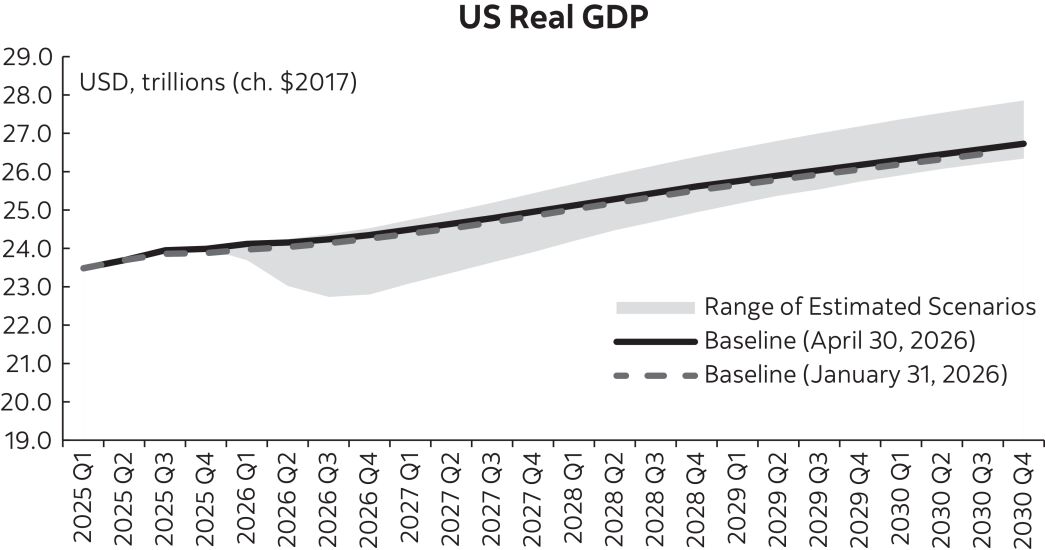
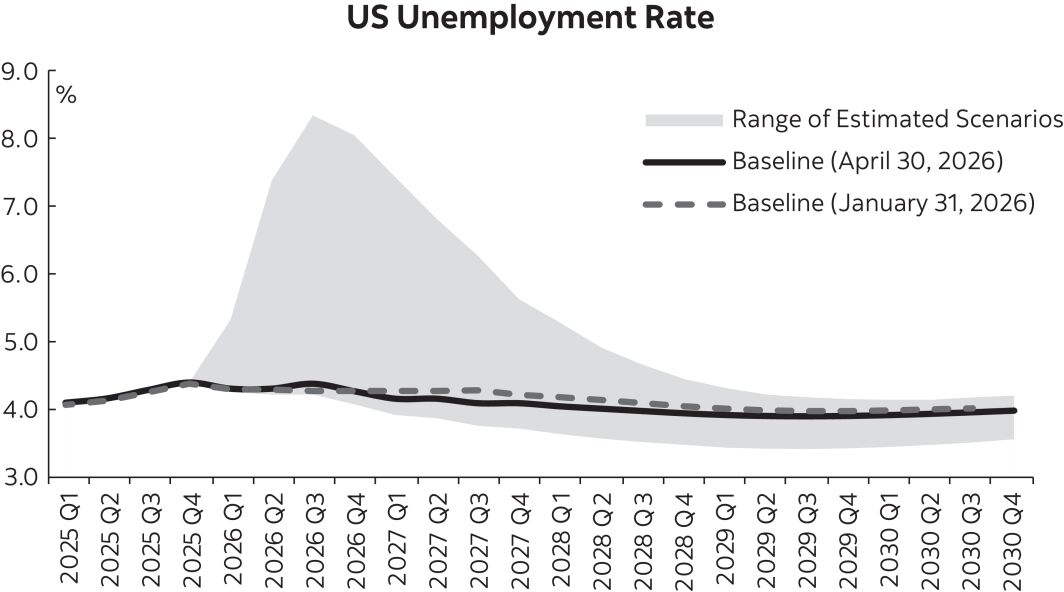
In the United States, economic growth is expected to slow modestly in 2026 as household spending cools amid a softening labour market and increased uncertainty. Growth is forecast to ease to 1.9% in 2026, before edging up to 2.1% in 2027, supported by robust business investment, particularly in the technology sector, and resilient equity markets. Recent trade developments are expected to have only a limited net impact on the outlook, as slightly lower effective tariff rates are offset by increased uncertainty. Inflation is expected to remain above target in the near term, reflecting persistent underlying pressures, impact of tariffs, and higher oil prices. This limits the scope for monetary easing, with the Federal Reserve expected to ease policy even more cautiously, to 3.5% by the end of 2026 and 3.25% by the end of 2027.
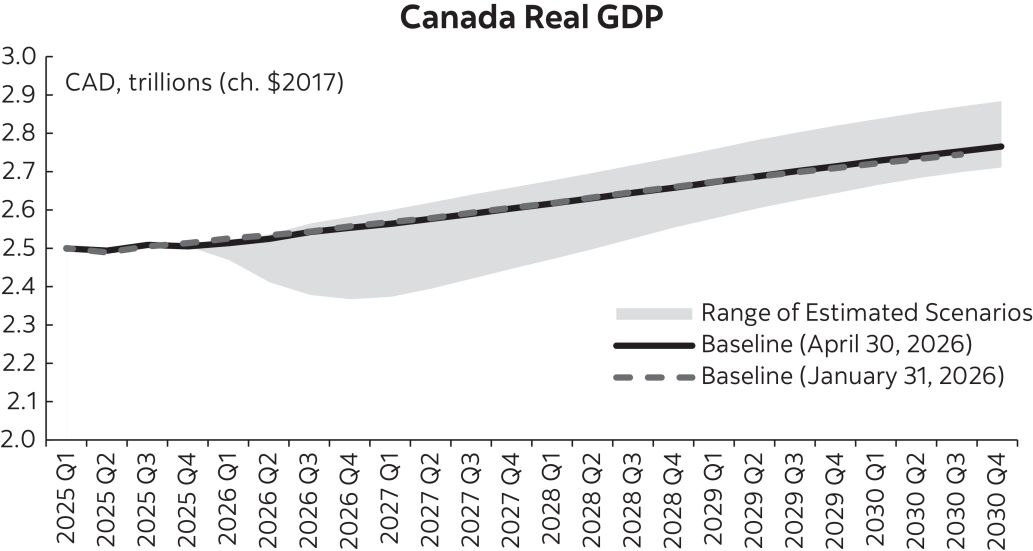
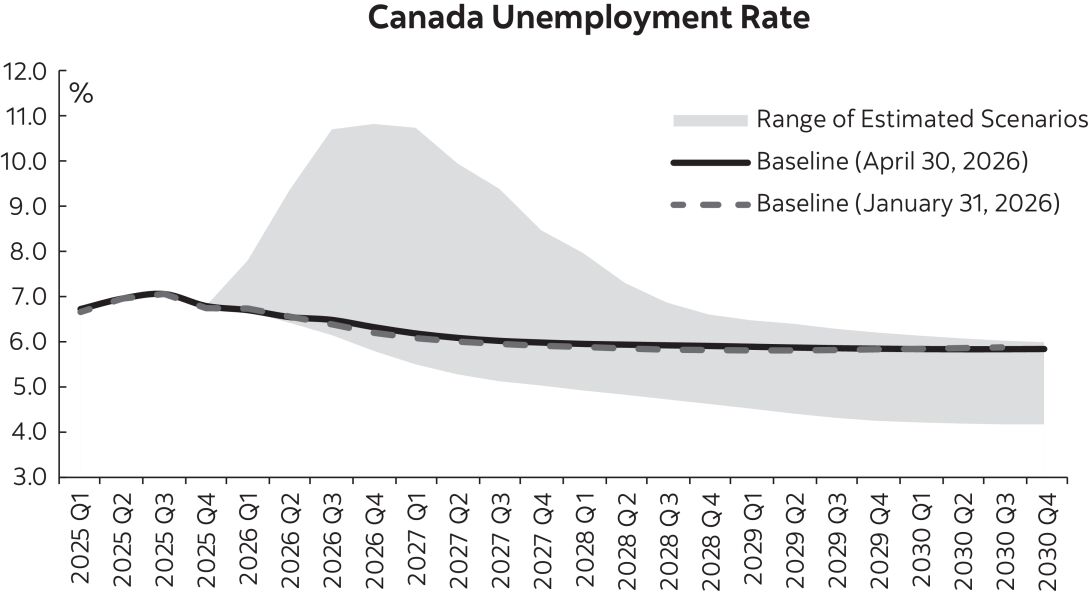
Canada’s overall negative GDP growth reported in late 2025 masked firm underlying domestic demand, though the weak overall figure leaves a softer starting point for 2026 growth. Weak labour and trade data early in the year suggest some short-term softness, but momentum is expected to build as the year advances, supporting a recovery through 2027. Real GDP growth is expected to ease to 1.3% in 2026 before recovering to 2.0% in 2027. Canada remains relatively less exposed to U.S. tariffs than many economies due to CUSMA exemptions, though sector-specific measures continue to weigh on the automotive, steel, aluminum, forestry, and related industries. Higher oil prices support national income but also raise household costs, raise inflation, and negatively impact household and business sentiment. The Bank of Canada is expected to remove monetary stimulus more decisively to limit upside inflation risks, raising the policy rate to 3.0% by
year-end.
However, the outlook remains highly sensitive to CUSMA negotiations and geopolitical developments.
Across Latin America, domestic policy and external shocks continue to drive diverging economic performances, with developments in the Middle East a key factor impacting the outlook in the region. While Mexico’s economy exceeded expectations at the end of 2025, activity softened entering 2026 amid cautious investment trends, fiscal consolidation efforts, and elevated uncertainty, including surrounding CUSMA negotiations and domestic reforms. Labour market indicators and declining remittance transactions point to softer supports for consumption ahead. Despite persistent inflation and upside risks, the recent easing by Banxico underscores growing concerns over slowing growth prospects. Peru remains better positioned, supported by strong mining activity and still-resilient business confidence despite rising inflation expectations. A temporary disruption to domestic energy supply following a key gas pipeline leak, combined with higher global energy prices, added to near-term inflation pressures and posed risks to domestic momentum, though Peru’s export sector is expected to benefit from firmer commodity prices. Chile has seen a loss of momentum amid softer domestic demand, weak labour market conditions, and elevated inflation pressures, which continue to weigh on activity and consumption. More broadly, regional central banks are expected to remain cautious as global financial markets, energy prices, and geopolitical risks continue to complicate the policy environment.
 
16
   Scotiabank Second Quarter Report 2026 

Table of Contents
MANAGEMENT’S DISCUSSION & ANALYSIS
 
Impact of foreign currency translation
The table below reflects the estimated impact of foreign currency translation on key income statement items and is computed on a basis that is different than the “Constant dollar” table in
Non-GAAP
Measures on page 11.
T7 Impact of foreign currency translation
 
      Average exchange rate      % Change  
For the three months ended   
April 30
2026
     January 31
2026
     April 30
2025
     April 30, 2026
vs. January 31, 2026
     April 30, 2026
vs. April 30, 2025
 
U.S. dollar/Canadian dollar
  
 
0.729
 
     0.721        0.704        1.1      3.6
Mexican Peso/Canadian dollar
  
 
12.769
 
     13.010        14.240        (1.9 )%       (10.3 )% 
Peruvian Sol/Canadian dollar
  
 
2.494
 
     2.427        2.594        2.8      (3.9 )% 
Colombian Peso/Canadian dollar
  
 
2,676.373
 
     2,708.926        2,944.467        (1.2 )%       (9.1 )% 
Chilean Peso/Canadian dollar
  
 
650.724
 
     656.612        669.254        (0.9 )%       (2.8 )% 
                      Average exchange rate      % Change  
For the six months ended                   
April 30
2026
     April 30
2025
     April 30, 2026
vs. April 30, 2025
 
U.S. dollar/Canadian dollar
        
 
0.725
 
     0.704        3.0
Mexican Peso/Canadian dollar
        
 
12.891
 
     14.293        (9.8 )% 
Peruvian Sol/Canadian dollar
        
 
2.460
 
     2.618        (6.0 )% 
Colombian Peso/Canadian dollar
        
 
2,692.950
 
     3,008.152        (10.5 )% 
Chilean Peso/Canadian dollar
                    
 
653.714
 
     681.682        (4.1 )% 
                      For the three months ended      For the six months ended  
 
Impact on net income
(1)
($ millions except EPS)
                   April 30, 2026
vs. April 30, 2025
     April 30, 2026
vs. January 31, 2026
     April 30, 2026
vs. April 30, 2025
 
Net interest income
         $ 71      $ 4      $ 174  
Non-interest
income
(2)
           50        50        125  
Total revenue
           121        54        299  
Non-interest
expenses
           (36      2        (33
Other items (net of tax)
(2)
                       (28      (15      (101
Net income
                     $ 57      $ 41      $ 165  
Earnings per share (diluted)
                     $ 0.05      $ 0.03      $ 0.13  
Impact by business line
($ millions)
                
Canadian Banking
         $      $      $ (3
International Banking
(2)
           76        37        101  
Global Wealth Management
           3        1        7  
Global Banking and Markets
           (10      (3      (15
Other
(2)
                       (12      6        75  
Net income
                     $ 57      $ 41      $ 165  
(1)
Includes the impact of all currencies.
(2)
Includes the impact of foreign currency hedges.
 
 Scotiabank Second Quarter Report 2026   
 
17
 

Table of Contents
MANAGEMENT’S DISCUSSION & ANALYSIS
 
Group Financial Performance
T8 Group Financial Performance
 
      For the three months ended      For the six months ended  
(Unaudited) ($ millions)
  
April 30
2026
     January 31
2026
     April 30
2025
    
April 30
2026
     April 30
2025
 
Reported Results
              
Net interest income
  
$
5,521
 
   $ 5,582      $ 5,270     
$
11,103
 
   $ 10,443  
Non-interest
income
  
 
4,316
 
     4,064        3,810     
 
8,380
 
     8,009  
Total revenue
  
 
9,837
 
     9,646        9,080     
 
19,483
 
     18,452  
Provision for credit losses
  
 
1,217
 
     1,176        1,398     
 
2,393
 
     2,560  
Non-interest
expenses
  
 
5,189
 
     5,299        5,110     
 
10,488
 
     11,601  
Income before taxes
  
 
3,431
 
     3,171        2,572     
 
6,602
 
     4,291  
Income tax expense
  
 
799
 
     872        540     
 
1,671
 
     1,266  
Net income
  
$
2,632
 
   $ 2,299      $ 2,032     
$
4,931
 
   $ 3,025  
Net income attributable to
non-controlling
interests in subsidiaries
  
$
37
 
   $ 12      $ 56     
$
49
 
   $ (98
Net income attributable to equity holders of the Bank
  
$
2,595
 
   $ 2,287      $ 1,976     
$
4,882
 
   $ 3,123  
Other financial data and measures
              
Return on equity
(1)
  
 
13.1
     11.1      10.1   
 
12.1
     7.8
Net interest margin
(2)
  
 
2.49
     2.45      2.31   
 
2.47
     2.27
Effective tax rate
(1)
  
 
23.3
     27.5      21.0   
 
25.3
     29.5
Provision for credit losses – performing (Stage 1 and 2)
  
$
88
 
   $ 73      $ 346     
$
161
 
   $ 444  
Provision for credit losses – impaired (Stage 3)
  
$
1,129
 
   $ 1,103      $ 1,052     
$
2,232
 
   $ 2,116  
Provision for credit losses as a percentage of average net loans and acceptances (annualized)
(1)
  
 
0.66
     0.61      0.75   
 
0.63
     0.68
Provision for credit losses on impaired loans as a percentage of average net loans and acceptances (annualized)
(1)
  
 
0.61
     0.58      0.57   
 
0.59
     0.56
Net write-offs as a percentage of average net loans and acceptances (annualized)
(1)
  
 
0.52
     0.49      0.50   
 
0.51
     0.50
(1)
Refer to Glossary on page 57 for the description of the measure.
(2)
Refer to
Non-GAAP
Measures starting on page 5.
T8A Adjusted Group Financial Performance
 
      For the three months ended      For the six months ended  
(Unaudited) ($ millions)
  
April 30
2026
     January 31
2026
     April 30
2025
    
April 30
2026
     April 30
2025
 
Adjusted Results
(1)
              
Net interest income
  
$
5,521
 
   $ 5,582      $ 5,270     
$
11,103
 
   $ 10,443  
Non-interest
income
  
 
4,324
 
     4,495        3,828     
 
8,819
 
     8,027  
Total revenue
  
 
9,845
 
     10,077        9,098     
 
19,922
 
     18,470  
Provision for credit losses
  
 
1,217
 
     1,176        1,398     
 
2,393
 
     2,560  
Non-interest
expenses
  
 
5,171
 
     5,273        5,067     
 
10,444
 
     10,178  
Income before taxes
  
 
3,457
 
     3,628        2,633     
 
7,085
 
     5,732  
Income tax expense
  
 
805
 
     933        561     
 
1,738
 
     1,298  
Net income
  
$
2,652
 
   $ 2,695      $ 2,072     
$
5,347
 
   $ 4,434  
Net income attributable to
non-controlling
interests in subsidiaries
  
$
37
 
   $ 22      $ 40     
$
59
 
   $ 77  
Net income attributable to equity holders of the Bank
  
$
2,615
 
   $ 2,673      $ 2,032     
$
5,288
 
   $ 4,357  
(1)
Refer to
Non-GAAP
Measures starting on page 5 for adjusted results.
 
18
   Scotiabank Second Quarter Report 2026 

Table of Contents
MANAGEMENT’S DISCUSSION & ANALYSIS
 
T8B Impact of Divested Operations
On December 1, 2025, the Bank completed the previously announced sale of its banking operations in Colombia, Costa Rica and Panama to Davivienda Group S.A. In addition, on February 28, 2025, the Bank completed the sale of CrediScotia Financiera S.A. (Peru), which was announced in fiscal 2024. The table below reflects the earnings impact of these operations in the current and prior fiscal periods. For further details on divestitures, refer to Note 19 of the condensed interim consolidated financial statements.
 
      For the three months ended      For the six months ended  
(Unaudited) ($ millions)
  
April 30
2026
     January 31
2026
     April 30
2025
    
April 30
2026
     April 30
2025
 
Net interest income
  
$
 
   $ 85      $ 259     
$
85
 
   $ 550  
Non-interest
income


     45        132     
 
45
 
     276  
Total Revenue


     130        391     
 
130
 
     826  
Provision for credit losses


     39        118     
 
39
 
     261  
Non-interest
expenses


     88        246     
 
88
 
     520  
Income before taxes


     3        27     
 
3
 
     45  
Income tax expenses


     2        12     
 
2
 
     15  
Net Income
  
$
 
   $ 1      $ 15     
$
1
 
   $ 30  
Net income attributable to
non-controlling
interest in subsidiaries
  
$
 
   $ 1      $ 1     
$
1
 
   $ (4
Net income attributable to equity holders of the Bank
  
$
 
   $      $ 14     
$
 
   $ 34  
 
      For the three months ended      For the
six months ended
 
(Unaudited)
($ millions)
   April 30, 2026
vs. January 31, 2026
     April 30, 2026
vs. April 30, 2025
     April 30, 2026
vs. April 30, 2025
 
Net interest income
   $ (85    $ (259    $ (465
Non-interest
income
     (45      (132      (231
Total revenue
     (130      (391      (696
Provision for credit losses
     39        118        222  
Non-interest
expenses
     88        246        432  
Income before taxes
     (3      (27      (42
Income tax expenses
     2        12        13  
Net income
   $ (1    $ (15    $ (29
Net income attributable to
non-controlling
interest in subsidiaries
   $ 1      $ 1      $ (5
Net income attributable to equity holders of the Bank
   $      $ (14    $ (34
Impact on diluted EPS
(in dollars)
   $      $ (0.01    $ (0.03
Net income
Q2 2026 vs Q2 2025
Net income was $2,632 million compared to $2,032 million, an increase of $600 million or 30%. The increase was driven primarily by higher revenues and lower provision for credit losses, partly offset by higher
non-interest
expenses and income taxes.
Q2 2026 vs Q1 2026
Net income was $2,632 million compared to $2,299 million, an increase of $333 million or 14%. Included in prior quarter non-interest income is a loss of $423 million recognized upon the completion of the sale of the banking operations in Colombia, Costa Rica and Panama. The increase was driven primarily by higher
non-interest
income, and lower
non-interest
expenses and income taxes.
Adjusted net income was $2,652 million compared to $2,695 million, a decrease of $43 million or 2%. The decrease was driven primarily by lower revenues, partly offset by lower
non-interest
expenses and lower income taxes. The decrease was also due to the impact of three fewer days in the quarter.
Year-to-date
Q2 2026 vs
Year-to-date
Q2 2025
Net income was $4,931 million compared to $3,025 million, an increase of $1,906 million or 63%. Included in current year non-interest income is a loss of $423 million recognized upon the completion of the sale of the banking operations in Colombia, Costa Rica and Panama. Included in prior year non-interest expenses is an impairment loss of $1,388 million related to the announced sale of these operations. The increase was driven primarily by higher revenues, and lower provision for credit losses and lower
non-interest
expenses. This was partly offset by higher income taxes.
Adjusted net income was $5,347 million compared to $4,434 million, an increase of $913 million or 21%. The increase was driven primarily by higher revenues and lower provision for credit losses. This was partly offset by higher
non-interest
expenses and income taxes.
Total revenue
Q2 2026 vs Q2 2025
Revenues were $9,837 million compared to $9,080 million, an increase of $757 million or 8%.
Net interest income was $5,521 million compared to $5,270 million, an increase of $251 million or 5%. The impact of divested operations was a decrease of $259 million or 5%. The remaining increase of 10% was driven primarily by a higher net interest margin and the positive impact of foreign currency translation.
The net interest margin was 2.49%, an increase of 18 basis points. The impact of divested operations was a decrease of six basis points. The remaining increase of 24 basis points was due primarily to higher margins across all business segments and lower funding costs.
Non-interest
income was $4,316 million compared to $3,810 million, an increase of $506 million or 13%. Adjusted
non-interest
income was $4,324 million compared to $3,828 million, an increase of $496 million or 13%. The impact of divested operations was a decrease of $132 million or 3%. The remaining increase of 16% was due primarily to higher wealth management revenues, investment gains, income from associated corporations and
non-trading
foreign exchange fees.
 
 Scotiabank Second Quarter Report 2026   
 
19
 

Table of Contents
MANAGEMENT’S DISCUSSION & ANALYSIS
 
Q2 2026 vs Q1 2026
Revenues were $9,837 million compared to $9,646 million, an increase of $191 million or 2%.
Net interest income was $5,521 million compared to $5,582 million, a decrease of $61 million or 1%, of which the impact of divested operations was a decrease of $85 million or 2%. The remaining increase of 1% was due to higher net interest margin, higher net interest from capital markets activities, as well as loan growth, partly offset by the impact of three fewer days in the quarter.
The net interest margin was 2.49%, an increase of four basis points. The impact of divested operations was a decrease of two basis points. The remaining increase of six basis points was driven by higher margins in International Banking and Canadian Banking, as well as lower funding costs, partly offset by lower margins in Global Banking and Markets.
Non-interest
income was $4,316 million compared to $4,064 million, an increase of $252 million or 6%. Included in last quarter’s
non-interest
income was a loss of $423 million upon the completion of the sale of the banking operations in Colombia, Costa Rica and Panama. Adjusted
non-interest
income was $4,324 million compared to $4,495 million, a decrease of $171 million or 4%, of which the impact of divested operations was a decrease of $45 million or 1%. The remaining decrease of 3% was due primarily to lower trading revenues and banking revenues, partly offset by higher investment gains.
Year-to-date
Q2 2026 vs
Year-to-date
Q2 2025
Revenues were $19,483 million compared to $18,452 million, an increase of $1,031 million or 6%.
Net interest income was $11,103 million compared to $10,443 million, an increase of $660 million or 6%. The impact of divested operations was a decrease of $465 million or 4%. The remaining increase of 10% was due primarily to higher net interest margin and the positive impact of foreign currency translation.
The net interest margin was 2.47%, an increase of 20 basis points. The impact of divested operations was a decrease of five basis points. The remaining increase of 25 basis points was due primarily to higher margins across all business segments and lower funding costs.
Non-interest
income was $8,380 million compared to $8,009 million, an increase of $371 million or 5%. Adjusted
non-interest
income was $8,819 million compared to $8,027 million, an increase of $792 million or 10%. The impact of divested operations was a decrease of $231 million or 3%. The remaining increase of 13% was due primarily to higher wealth management revenues, investment gains, income from associated corporations and trading revenues.
Provision for credit losses
Q2 2026 vs Q2 2025
The provision for credit losses was $1,217 million compared to $1,398 million, a decrease of $181 million. The provision for credit losses ratio decreased by nine basis point to 66 basis points.
The provision for credit losses on performing loans was $88 million compared to $346 million, a decrease of $258 million. The provision this quarter was due primarily to the impact of the unfavourable macroeconomic outlook impacting the Canadian Banking portfolios, as well as credit migration in the International commercial portfolio. Last year, the Bank substantially increased its provision for credit losses on performing loans to reflect the uncertainty related to U.S. tariffs due to the deterioration in macroeconomic indicators, mainly impacting the Canadian retail and commercial portfolios.
The provision for credit losses on impaired loans was $1,129 million compared to $1,052 million, an increase of $77 million. The provision for credit losses ratio on impaired loans was 61 basis points, an increase of four basis points. The increase was due primarily to higher formations in Canadian Banking and in the International corporate portfolios, mainly related to one account.
Q2 2026 vs Q1 2026
The provision for credit losses was $1,217 million compared to $1,176 million, an increase of $41 million. The provision for credit losses ratio increased by five basis points to 66 basis points.
The provision for credit losses on performing loans was $88 million compared to $73 million, an increase of $15 million. The provision this quarter was due primarily to the unfavourable macroeconomic outlook impacting the Canadian Banking portfolios, as well as credit migration in the International commercial portfolio.
The provision for credit losses on impaired loans was $1,129 million compared to $1,103 million, an increase of $26 million. The provision for credit losses ratio on impaired loans was 61 basis points, an increase of three basis points. The increase was due primarily to higher formations in the International corporate portfolio.
Year-to-date
Q2 2026 vs
Year-to-date
Q2 2025
The provision for credit losses was $2,393 million compared to $2,560 million. The provision for credit losses ratio decreased by five basis points to 63 basis points.
Provision for credit losses on performing loans was $161 million, compared to $444 million. The provision this period was driven by credit migration in the Canadian and International portfolios, as well as retail portfolio growth mainly in Chile and Mexico. This was partly offset by a more favourable macroeconomic outlook impacting the International commercial portfolio. The prior period reflected the impact of the uncertainty related to U.S. tariffs, mainly impacting Canadian Banking.
The provision for credit losses on impaired loans was $2,232 million compared to $2,116 million, an increase of $116 million. The provision for credit losses ratio on impaired loans was 59 basis points, an increase of three basis points. The increase in provision this year was due to higher formations in Canadian Banking and corporate portfolios.
Non-interest expenses
Q2 2026 vs Q2 2025
Non-interest
expenses were $5,189 million compared to $5,110 million, an increase of $79 million or 2%. Adjusted
non-interest
expenses were $5,171 million compared to $5,067 million, an increase of $104 million or 2%. The impact of divested operations was a decrease of $246 million or 5%. The remaining increase of 7% was due primarily to higher performance-based compensation and personnel costs, higher technology and advertising and business development costs to support strategic growth initiatives, and the negative impact of foreign currency translation. This was partly offset by lower professional fees.
The productivity ratio was 52.8% compared to 56.3%. The adjusted productivity ratio was 52.5% compared to 55.7%.
 
20
   Scotiabank Second Quarter Report 2026 

Table of Contents
MANAGEMENT’S DISCUSSION & ANALYSIS
 
Q2 2026 vs Q1 2026
Non-interest
expenses were $5,189 million compared to $5,299 million, a decrease of $110 million or 2%. Adjusted
non-interest
expenses were $5,171 million compared to $5,273 million, a decrease of $102 million or 2%, of which the impact of divested operations was a decrease of $88 million or 2%. The remaining decrease was due primarily to seasonally lower share-based compensation and the impact of three fewer days in the quarter, partly offset by higher technology expenses to support strategic growth initiatives.
The productivity ratio was 52.8% compared to 54.9%. The adjusted productivity ratio was 52.5% compared to 52.3%.
Year-to-date
Q2 2026 vs
Year-to-date
Q2 2025
Non-interest
expenses were $10,488 million compared to $11,601 million, a decrease of $1,113 million or 10%. Adjusted
non-interest
expenses were $10,444 million compared to $10,178 million, an increase of $266 million or 3%. The impact of divested operations was a decrease of $432 million or 4%. The remaining increase of 7% was due primarily to higher performance and stock-based compensation and personnel costs, higher technology and advertising and business development costs to support strategic growth initiatives and the negative impact of foreign currency translation. This was partly offset by lower professional fees.
The productivity ratio was 53.8% compared to 62.9%. The adjusted productivity ratio was 52.4% compared to 55.1%. Operative leverage was positive 15.2% on a reported basis and positive 5.2% on an adjusted basis.
Taxes
Q2 2026 vs Q2 2025
The effective tax rate was 23.3% compared to 21.0%, due primarily to a favourable adjustment in the prior year and higher withholding taxes in the current year.
Q2 2026 vs Q1 2026
The effective tax rate was 23.3% compared to 27.5%, due primarily to the loss related to the sale of the banking operations in Colombia, Costa Rica and Panama in the previous quarter, higher inflationary adjustments in Mexico and Chile and higher income in lower tax jurisdictions. On an adjusted basis the effective tax rate was 23.3% compared to 25.7%, due primarily to higher inflationary adjustments in Mexico and Chile and higher income in lower tax jurisdictions.
Year-to-date
Q2 2026 vs
Year-to-date
Q2 2025
The effective tax rate was 25.3% compared to 29.5%, due primarily to the higher loss related to the announced sale of the banking operations in Colombia, Costa Rica and Panama in the prior year, partly offset by a favourable adjustment in the prior year, lower income in lower tax jurisdictions and higher withholding taxes. On an adjusted basis the effective rate was 24.5% compared to 22.7%, due primarily to a favourable adjustment in the prior year, lower income in lower tax jurisdictions, and higher withholding taxes.
 
 Scotiabank Second Quarter Report 2026   
 
21
 

Table of Contents
MANAGEMENT’S DISCUSSION & ANALYSIS
 
Business Segment Review
The Bank’s businesses are grouped into four business lines: Canadian Banking, International Banking, Global Wealth Management and Global Banking and Markets. The Bank’s other smaller operating segments and corporate adjustments are included in the Other segment.
Segment measurement methodologies
Constant Dollar Basis
International Banking business segment results are analyzed on a constant dollar basis. Under the constant dollar basis, prior period amounts are recalculated using current period average foreign currency rates thereby eliminating the impact of foreign currency translation. The Bank believes that reporting in constant dollar is useful for readers in assessing ongoing business performance.
Taxable Equivalent Basis
Effective Q1 2026, the Bank no longer analyzes business segment revenues on a taxable equivalent basis (TEB). Under the TEB methodology,
tax-exempt
income earned on certain securities reported in either net interest income or
non-interest
income was grossed up to an equivalent before tax basis. It also grossed up net income from associated corporations to normalize the effective tax rate in the business lines.Corresponding increases were made to the provision for income taxes; hence, there was no impact on the segment’s net income. The elimination of the TEB
gross-up
was recorded in the Other segment, resulting in no impact on the consolidated results. The TEB
gross-up
recorded in the business segments has significantly decreased in recent quarters as the Bank no longer claims the dividend received deduction on Canadian shares, following the enactment of Bill
C-59
in January 2024. The changes have been applied on a prospective basis, prior period results included a TEB
gross-up
as follows:
 
T9 TEB
gross-up
                                                       
     
For the three months ended
 
($ millions)
   October 31
2025
     July 31
2025
     April 30
2025
     January 31
2025
     October 31
2024
     July 31
2024
     April 30
2024
     January 31
2024
 
Net interest income
   $      $      $      $      $      $ 1      $      $ 2  
Non-interest
income
     9        8        9        8        10        13        8        48  
Total revenue and provision for taxes
   $ 9      $ 8      $ 9      $ 8      $ 10      $ 14      $ 8      $ 50  
Other segment
The Other segment includes Group Treasury, investments in certain associated corporations, and smaller operating segments and corporate items which are not allocated to a business line. Group Treasury is primarily responsible for balance sheet, liquidity and interest rate risk management, which includes the Bank’s wholesale funding activities.
Funds transfer pricing
Funds transfer pricing (FTP) is the process by which the Bank prices intra-company borrowing or lending between the business segments and the Other segment. Through consideration of interest rate and liquidity risk characteristics of assets, liabilities and
off-balance
sheet exposures, this process aims to manage these risks through Group Treasury and enable risk-adjusted management reporting of business segment results. Periodically, the methodology and assumptions used in the FTP process are adjusted to reflect customer behaviours, market dynamics and other factors, which may impact the financial results of the business segments.
 
22
   Scotiabank Second Quarter Report 2026 

Table of Contents
MANAGEMENT’S DISCUSSION & ANALYSIS
 
Canadian Banking
                                  
T10 Canadian Banking financial performance
                                  
      For the three months ended      For the six months ended  
(Unaudited) ($ millions)
  
April 30
2026
     January 31
2026
     April 30
2025
    
April 30
2026
     April 30
2025
 
Reported Results
              
Net interest income
  
$
2,703
 
   $ 2,734      $ 2,524     
$
5,437
 
   $ 5,171  
Non-interest
income
  
 
780
 
     780        711     
 
1,560
 
     1,476  
Total revenue
  
 
3,483
 
     3,514        3,235     
 
6,997
 
     6,647  
Provision for credit losses
  
 
575
 
     576        805     
 
1,151
 
     1,343  
Non-interest
expenses
  
 
1,620
 
     1,615        1,581     
 
3,235
 
     3,192  
Income before taxes
  
 
1,288
 
     1,323        849     
 
2,611
 
     2,112  
Income tax expense
  
 
353
 
     363        236     
 
716
 
     586  
Net income
  
$
935
 
   $ 960      $ 613     
$
1,895
 
   $ 1,526  
Net income attributable to
non-controlling
interests in subsidiaries
  
$
 
   $      $     
$
 
   $  
Net income attributable to equity holders of the Bank
  
$
935
 
   $ 960      $ 613     
$
1,895
 
   $ 1,526  
Other financial data and measures
              
Return on equity
(1)
  
 
17.8
     18.1      12.0   
 
17.9
     14.5
Net interest margin
(2)
  
 
2.36
     2.32      2.27   
 
2.34
     2.29
Effective tax rate
(1)
  
 
27.4
     27.4      27.8   
 
27.4
     27.8
Provision for credit losses – performing (Stage 1 and 2)
  
$
59
 
   $ 23      $ 317     
$
82
 
   $ 368  
Provision for credit losses – impaired (Stage 3)
  
$
516
 
   $ 553      $ 488     
$
1,069
 
   $ 975  
Provision for credit losses as a percentage of average net loans and acceptances (annualized)
(1)
  
 
0.50
     0.49      0.72   
 
0.50
     0.60
Provision for credit losses on impaired loans as a percentage of average net loans and acceptances (annualized)
(1)
  
 
0.45
     0.47      0.44   
 
0.46
     0.43
Net write-offs as a percentage of average net loans and acceptances (annualized)
(1)
  
 
0.44
     0.40      0.38   
 
0.42
     0.38
Average assets
($ billions)
  
$
475
 
   $ 472      $ 461     
$
473
 
   $ 461  
Average liabilities
($ billions)
  
$
374
 
   $ 378      $ 384     
$
376
 
   $ 385  
(1)
Refer to Glossary on page 57 for the description of the measure.
(2)
Refer to
Non-GAAP
Measures starting on page 5.
Net income
Q2 2026 vs Q2 2025
Net income attributable to equity holders was $935 million compared to $613 million, an increase of 53%. The increase was driven primarily by higher revenues and lower provision for credit losses on performing loans, partly offset by higher
non-interest
expenses.
Q2 2026 vs Q1 2026
Net income attributable to equity holders was $935 million compared to $960 million, a decrease of 3%. The decrease was driven primarily by lower net interest income impacted by three fewer days in the quarter.
Year-to-date
Q2 2026 vs
Year-to-date
Q2 2025
Net income attributable to equity holders was $1,895 million compared to $1,526 million, an increase of 24%. The increase was driven primarily by higher revenues and lower provision for credit losses on performing loans, partly offset by higher
non-interest
expenses.
Average assets
Q2 2026 vs Q2 2025
Average assets were $475 billion compared to $461 billion. The growth included $12 billion or 4% in residential mortgages and $2 billion or 1% in commercial and small business loans.
Q2 2026 vs Q1 2026
Average assets were $475 billion compared to $472 billion. The growth included $2 billion or 1% in residential mortgages and $2 billion or 2% in commercial and small business loans.
Year-to-date
Q2 2026 vs
Year-to-date
Q2 2025
Average assets were $473 billion compared to $461 billion. The growth included $13 billion or 5% in residential mortgages.
Average liabilities
Q2 2026 vs Q2 2025
Average liabilities were $374 billion compared to $384 billion. The decrease included a 10% reduction in personal and
non-personal
term deposits as clients shifted toward higher yielding savings and mutual funds products, partly offset by an increase of 3% in personal
day-to-day
and savings accounts.
 
 Scotiabank Second Quarter Report 2026   
 
23
 

Table of Contents
MANAGEMENT’S DISCUSSION & ANALYSIS
 
Q2 2026 vs Q1 2026
Average liabilities were $374 billion compared to $378 billion. The decrease was driven primarily by a $3 billion or 2% reduction in
non-personal
deposits, both term and demand accounts.
Year-to-date
Q2 2026 vs
Year-to-date
Q2 2025
Average liabilities were $376 billion compared to $385 billion. The decrease included a 10% reduction in personal and
non-personal
term deposits, partly offset by an increase of 4% in personal
day-to-day
and savings accounts.
Total revenue
Q2 2026 vs Q2 2025
Revenues were $3,483 million compared to $3,235 million, an increase of 8%.
Net interest income was $2,703 million compared to $2,524 million, an increase of 7% or $179 million. The increase was due primarily to loan growth and higher net interest margin. The net interest margin increased nine basis points to 2.36%, driven by an increase in both loan and deposit margins with favourable changes in deposit mix.
Non-interest
income was $780 million compared to $711 million, an increase of 10% or $69 million. The increase was driven primarily by higher mutual fund distribution fees and credit card revenues.
Q2 2026 vs Q1 2026
Revenues were $3,483 million compared to $3,514 million, a decrease of 1%.
Net interest income was $2,703 million compared to $2,734 million, a decrease of 1% or $31 million. The decrease was due primarily to three fewer days in the quarter, partly offset by loan growth and higher net interest margin. The net interest margin increased four basis points to 2.36%, driven by an increase in both loan and deposit margins.
Non-interest
income was $780 million, in line with the prior period. Higher insurance income was offset by lower banking and mutual fund distribution fees.
Year-to-date
Q2 2026 vs
Year-to-date
Q2 2025
Revenues were $6,997 million compared to $6,647 million, an increase of 5%.
Net interest income was $5,437 million compared to $5,171 million, an increase of 5% or $266 million. The increase was due primarily to loan growth and higher net interest margin. The net interest margin increased five basis points to 2.34%, driven by an increase in deposit margin, including favourable changes in deposit mix.
Non-interest
income was $1,560 million compared to $1,476 million, an increase of 6% or $84 million. The increase was driven primarily by higher mutual fund distribution fees and credit card revenues, partly offset by lower private equity gains.
Provision for credit losses
Q2 2026 vs Q2 2025
The provision for credit losses was $575 million compared to $805 million, a decrease of $230 million. The provision for credit losses ratio decreased 22 basis points to 50 basis points.
The provision for credit losses on performing loans was $59 million compared to $317 million, a decrease of $258 million. The provision this period was due primarily to the unfavourable macroeconomic outlook impacting the retail and commercial portfolios. The prior period reflected the estimated impact of macroeconomic uncertainty related to U.S. tariffs.
Provision for credit losses on impaired loans was $516 million compared to $488 million, an increase of $28 million. The provision for credit losses ratio on impaired loans was 45 basis points, an increase of one basis point. The increase was due primarily to higher formations in retail and commercial.
Q2 2026 vs Q1 2026
The provision for credit losses was $575 million compared to $576 million, a decrease of $1 million. The provision for credit losses ratio was 50 basis points.
The provision for credit losses on performing loans was $59 million compared to $23 million, an increase of $36 million. The provision this period was due primarily to the unfavourable macroeconomic outlook impacting the retail and commercial portfolios.
Provision for credit losses on impaired loans was $516 million compared to $553 million, a decrease of $37 million. The provision for credit losses ratio on impaired loans was 45 basis points, a decrease of two basis points. The decrease was driven primarily by lower retail provisions benefitting from collections actions, and lower commercial provisions.
Year-to-date
Q2 2026 vs
Year-to-date
Q2 2025
The provision for credit losses was $1,151 million, compared to $1,343 million, a decrease of $192 million. The provision for credit losses ratio was 50 basis points, a decrease of 10 basis points.
Provision for credit losses on performing loans was $82 million, compared to $368 million, a decrease of $286 million. The provision this period was driven by credit migration in the retail and commercial portfolios, as well as the unfavourable macroeconomic outlook impacting the commercial portfolio. The prior period reflected the estimated impact of macroeconomic uncertainty related to U.S. tariffs.
Provision for credit losses on impaired loans was $1,069 million compared to $975 million, an increase of $94 million, due primarily to higher provisions in the retail and commercial portfolios. The provision for credit losses ratio on impaired loans was 46 basis points, an increase of three basis points.
 
24
   Scotiabank Second Quarter Report 2026 

Table of Contents
MANAGEMENT’S DISCUSSION & ANALYSIS
 
Non-interest expenses
Q2 2026 vs Q2 2025
Non-interest
expenses were $1,620 million compared to $1,581 million, an increase of $39 million or 3%. Higher technology costs were partly offset by lower professional fees and lower personnel costs from the benefit of efficiency initiatives. The productivity ratio was 46.5% compared to 48.8%.
Q2 2026 vs Q1 2026
Non-interest
expenses were $1,620 million compared to $1,615 million, in line with the prior period. Higher technology costs were offset by the benefit of three fewer days in the quarter. The productivity ratio was 46.5% compared to 46.0%.
Year-to-date
Q2 2026 vs
Year-to-date
Q2 2025
Non-interest
expenses were $3,235 million compared to $3,192 million, an increase of $43 million or 1%. Higher marketing and technology costs were partly offset by lower personnel costs from the benefit of efficiency initiatives. The productivity ratio was 46.2% compared to 48.0%.
Taxes
The effective tax rate was 27.4%, compared to 27.8% in the prior year and unchanged from the prior quarter. On a
year-to-date
basis, the effective tax rate was 27.4%, compared to 27.8%.
 
International Banking
                                  
T11 International Banking financial performance
                                  
      For the three months ended      For the six months ended  
(Unaudited) ($ millions)
  
April 30
2026
     January 31
2026
     April 30
2025
    
April 30
2026
     April 30
2025
 
Reported Results
              
Net interest income
  
$
2,094
 
   $ 2,146      $ 2,179     
$
4,240
 
   $ 4,348  
Non-interest
income
(1)
  
 
765
 
     815        780
(2)


1,580
 
     1,641
(2)
 
Total revenue
  
 
2,859
 
     2,961        2,959     
 
5,820
 
     5,989  
Provision for credit losses
  
 
599
 
     536        550     
 
1,135
 
     1,152  
Non-interest
expenses
  
 
1,370
 
     1,460        1,523
(2)


2,830
 
     3,076
(2)
 
Income before taxes
  
 
890
 
     965        886     
 
1,855
 
     1,761  
Income tax expense
  
 
154
 
     228        172     
 
382
 
     361  
Net income
  
$
736
 
   $ 737      $ 714     
$
1,473
 
   $ 1,400  
Net income attributable to
non-controlling
interests in subsidiaries
  
$
35
 
   $ 20      $ 38     
$
55
 
   $ 73  
Net income attributable to equity holders of the Bank
  
$
701
 
   $ 717      $ 676     
$
1,418
 
   $ 1,327  
Other financial data and measures
              
Return on equity
(3)
  
 
16.0
     16.0      15.3   
 
16.0
     14.8
Net interest margin
(4)
  
 
4.76
     4.54      4.50   
 
4.65
     4.45
Effective tax rate
(3)
  
 
17.30
     23.60      19.40   
 
20.60
     20.50
Provision for credit losses – performing (Stage 1 and 2)
  
$
21
 
   $ 53      $ 27     
$
74
 
   $ 54  
Provision for credit losses – impaired (Stage 3)
  
$
578
 
   $ 483      $ 523     
$
1,061
 
   $ 1,098  
Provision for credit losses as a percentage of average net loans and acceptances (annualized)
(3)
  
 
1.66
     1.37      1.37   
 
1.51
     1.42
Provision for credit losses on impaired loans as a percentage of average net loans and acceptances (annualized)
(3)
  
 
1.61
     1.23      1.31   
 
1.41
     1.35
Net write-offs as a percentage of average net loans and acceptances (annualized)
(3)
  
 
1.17
     1.16      1.19   
 
1.16
     1.23
Average assets
($ billions)
  
$
211
 
   $ 219      $ 229     
$
215
 
   $ 229  
Average liabilities
($ billions)
  
$
170
 
   $ 172      $ 177     
$
171
 
   $ 176  
(1)
Includes income from associated corporations for the three months ended April 30, 2026 – $65 (January 31, 2026 – $48; April 30, 2025 – $38) and for the six months ended April 30, 2026 – $113 (April 30, 2025 – $73).
(2)
Effective Q1 2026, the Bank no longer records the TEB
gross-up
on
tax-exempt
income. The prior periods results presented include a TEB
gross-up
for the three months ended April 30, 2025 – $9 and for the six months ended April 30, 2025 – $17. Refer to page 22 for further details.
(3)
Refer to Glossary on page 57 for the description of the measure.
(4)
Refer to
Non-GAAP
Measures starting on page 5.
 
 Scotiabank Second Quarter Report 2026   
 
25
 

Table of Contents
MANAGEMENT’S DISCUSSION & ANALYSIS
 
T11A Impact of Divested Operations
On December 1, 2025, the Bank completed the previously announced sale of its banking operations in Colombia, Costa Rica and Panama to Davivienda Group S.A. In addition, on February 28, 2025, the Bank completed the sale of CrediScotia Financiera S.A. (Peru), which was announced in fiscal 2024. The table below reflects the earnings impact of these operations in the current and prior fiscal periods. For further details on divestitures, refer to Note 19 of the condensed interim consolidated financial statements.
 
      For the three months ended      For the six months ended  
(Unaudited) ($ millions)
  
April 30
2026
     January 31
2026
     April 30
2025
    
April 30
2026
     April 30
2025
 
Net interest income
  
$
 
   $ 84      $ 255     
$
84
 
   $ 542  
Non-interest
income


     43        126     
 
43
 
     265  
Total revenue


     127        381     
 
127
 
     807  
Provision for credit losses


     39        118     
 
39
 
     261  
Non-interest
expenses


     85        238     
 
85
 
     504  
Income before taxes


     3        25     
 
3
 
     42  
Income tax expense


     2        11     
 
2
 
     13  
Net income
  
$
 
   $ 1      $ 14     
$
1
 
   $ 29  
Net income attributable to
non-controlling
interests in subsidiaries
  
$
 
   $ 1      $ 1     
$
1
 
   $ (4
Net income attributable to equity holders of the Bank
  
$
 
   $      $ 13     
$
 
   $ 33  
Net income
Q2 2026 vs Q2 2025
Net income attributable to equity holders was $701 million compared to $676 million, an increase of $25 million or 4%. The increase was driven primarily by lower
non-interest
expenses, lower income taxes and the positive impact of foreign currency translation. This was partly offset by lower net interest income, lower
non-interest
income and higher provision for credit losses.
Q2 2026 vs Q1 2026
Net income attributable to equity holders was $701 million compared to $717 million, a decrease of $16 million or 2%. The decrease was driven primarily by higher provision for credit losses, lower net interest income and lower
non-interest
income. This was partly offset by lower
non-interest
expenses and lower income taxes.
Year-to-date
Q2 2026 vs
Year-to-date
Q2 2025
Net income attributable to equity holders was $1,418 million compared to $1,327 million, an increase of $91 million or 7%. The increase was driven primarily by lower
non-interest
expenses, lower provision for credit losses and the positive impact of foreign currency translation. This was partly offset by lower net interest income and lower
non-interest
income.
Financial Performance on a Constant Dollar Basis
The discussion below on the results of operations is on a constant dollar basis. Under the constant dollar basis, prior period amounts are recalculated using current period average foreign currency rates, which is a
non-GAAP
financial measure (refer to
Non-GAAP
Measures starting on page 5). The Bank believes that constant dollar is useful for readers in assessing ongoing business performance without the impact of foreign currency translation and is used by management to assess the performance of the business segment. Ratios are on a reported basis.
T12 International Banking financial performance on a constant dollar basis
 
      For the three months ended      For the six months ended  
(Unaudited) ($ millions)
  
April 30
2026
     January 31
2026
     April 30
2025
    
April 30
2026
     April 30
2025
 
Constant dollars
(1)
              
Net interest income
  
$
2,094
 
   $ 2,153      $ 2,262     
$
4,240
 
   $ 4,541  
Non-interest
income
(2)
  
 
765
 
     815        807     
 
1,580
 
     1,717  
Total revenue
  
 
2,859
 
     2,968        3,069     
 
5,820
 
     6,258  
Provision for credit losses
  
 
599
 
     539        579     
 
1,135
 
     1,226  
Non-interest
expenses
  
 
1,370
 
     1,464        1,584     
 
2,830
 
     3,216  
Income before taxes
  
 
890
 
     965        906     
 
1,855
 
     1,816  
Income tax expense
  
 
154
 
     227        177     
 
382
 
     373  
Net income
  
$
736
 
   $ 738      $ 729     
$
1,473
 
   $ 1,443  
Net income attributable to
non-controlling
interests in subsidiaries
  
$
35
 
   $ 20      $ 38     
$
55
 
   $ 70  
Net income attributable to equity holders of the Bank
  
$
701
 
   $ 718      $ 691     
$
1,418
 
   $ 1,373  
Other financial data and measures
              
Average assets
($ billions)
  
$
211
 
   $ 219      $ 235     
$
215
 
   $ 236  
Average liabilities
($ billions)
  
$
170
 
   $ 172      $ 184     
$
171
 
   $ 183  
(1)
Refer to Constant Dollar reconciliation on page 11.
(2)
Includes income from associated corporations for the three months ended April 30, 2026 – $65 (January 31, 2026 – $48; April 30, 2025 – $37) and for the six months ended April 30, 2026 – $113 (April 30, 2025 – $72).
 
26
   Scotiabank Second Quarter Report 2026 

Table of Contents
MANAGEMENT’S DISCUSSION & ANALYSIS
 
Net income
Q2 2026 vs Q2 2025
Net income attributable to equity holders was $701 million compared to $691 million, an increase of $10 million or 1%. The increase was driven primarily by lower
non-interest
expenses and lower income taxes. This was partly offset by lower net interest income, lower
non-interest
income and higher provision for credit losses.
Q2 2026 vs Q1 2026
Net income attributable to equity holders was $701 million compared to $718 million, a decrease of $17 million or 2%. The decrease was driven primarily by lower
net-interest
income, lower
non-interest
income and higher provision for credit losses. This was partly offset by lower
non-interest
expenses and lower income taxes.
Year-to-date
Q2 2026 vs
Year-to-date
Q2 2025
Net income attributable to equity holders was $1,418 million compared to $1,373 million, an increase of $45 million or 3%. The increase was driven primarily by lower
non-interest
expenses and lower provision for credit losses, partly offset by lower net interest income and lower
non-interest
income.
Average assets
Q2 2026 vs Q2 2025
Average assets were $211 billion compared to $235 billion. Total loans decreased $21 billion or 12%, driven mainly by the impact of divested operations, as well as a decrease in corporate loans, primarily in Brazil and Mexico. This was partly offset by higher retail loans primarily in Mexico and Chile, as well as an increase in investments in associated corporations.
Q2 2026 vs Q1 2026
Average assets were $211 billion compared to $219 billion. Total loans decreased $9 billion or 5%, driven primarily by the impact of divested operations, as well as a decrease in corporate loans in Brazil, Mexico and Chile.
Year-to-date
Q2 2026 vs
Year-to-date
Q2 2025
Average assets were $215 billion compared to $236 billion. Total loans decreased $18 billion or 10%, due mainly to the impact of divested operations, as well as a decrease in corporate loans in Brazil, Mexico and Chile. This was partly offset by higher retail loans primarily in Mexico and Chile, as well as an increase in investments in associated corporations.
Average liabilities
Q2 2026 vs Q2 2025
Average liabilities were $170 billion compared to $184 billion. Total deposits decreased by $10 billion or 7%, due mainly to the impact of divested operations. Other liabilities decreased by $4 billion. This was partly offset by an increase in personal and
non-personal
deposits in Peru and Caribbean.
Q2 2026 vs Q1 2026
Average liabilities were $170 billion compared to $172 billion. Total deposits decreased by $1 billion or 1%, due mainly to the impact of divested operations. This was partly offset by an increase in
non-personal
deposits in Peru, Chile and Caribbean.
Year-to-date
Q2 2026 vs
Year-to-date
Q2 2025
Average liabilities were $171 billion compared to $183 billion. Total deposits decreased by $8 billion or 6%, due mainly to the impact of divested operations. Other liabilities decreased by $4 billion. This was partly offset by an increase in
non-personal
deposits in Peru and Caribbean.
Total revenue
Q2 2026 vs Q2 2025
Revenues were $2,859 million compared to $3,069 million, a decrease of $210 million or 7%.
Net interest income was $2,094 million compared to $2,262 million, a decrease of $168 million or 7%, driven mainly by the impact of divested operations. This was partly offset by growth across geographies. Net interest margin increased by 26 basis points to 4.76%, driven mainly by lower funding costs due to declines in central bank rates.
Non-interest
income was $765 million compared to $807 million, a decrease of $42 million or 5%, driven mainly by the impact of divested operations. This was partly offset by higher income from investments in associated corporations and higher insurance income across geographies.
Q2 2026 vs Q1 2026
Revenues were $2,859 million compared to $2,968 million, a decrease of $109 million or 4%.
Net interest income was $2,094 million compared to $2,153 million, a decrease of $59 million or 3%, driven by impact of divested operations and three fewer days in the quarter. This was partly offset by growth in Chile. Net interest margin increased by 22 basis points to 4.76%, driven mainly by lower funding costs.
Non-interest
income was $765 million compared to $815 million, a decrease of $50 million or 6%, driven mainly by the impact of divested operations and lower capital markets revenues in Brazil and Peru. This was partly offset by higher income from investments in associated corporations.
 
 Scotiabank Second Quarter Report 2026   
 
27
 

Table of Contents
MANAGEMENT’S DISCUSSION & ANALYSIS
 
Year-to-date
Q2 2026 vs
Year-to-date
Q2 2025
Revenues were $5,820 million compared to $6,258 million, a decrease of $438 million or 7%.
Net interest income was $4,240 million compared to $4,541 million, a decrease of $301 million or 7%, driven mainly by the impact of divested operations. Net interest margin increased by 20 basis points to 4.65%, driven mainly by lower funding costs.
Non-interest
income was $1,580 million compared to $1,717 million, a decrease of $137 million or 8%, driven mainly by the impact of divested operations and lower capital markets revenues in Brazil. This was partly offset by higher income from investments in associated corporations.
Provision for credit losses
Q2 2026 vs Q2 2025
The provision for credit losses was $599 million compared to $579 million, an increase of $20 million or 3%. The provision for credit losses ratio increased 29 basis points to 166 basis points.
Provision for credit losses on performing loans was $21 million compared to $26 million, a decrease of $5 million. The provision this period was driven by credit migration in the commercial portfolio, as well as the impact of the unfavourable macroeconomic outlook on the retail portfolio.
Provision for credit losses on impaired loans was $578 million, compared to $553 million, an increase of $25 million. The provision for credit losses ratio on impaired loans was 161 basis points, an increase of 30 basis points. The increase was mainly driven by formations in International corporate, due primarily to one account, partly offset by the impact of divested operations.
Q2 2026 vs Q1 2026
The provision for credit losses was $599 million compared to $539 million, an increase of $60 million or 11%. The provision for credit losses ratio was 166 basis points, an increase of 29 basis points.
Provision for credit losses on performing loans was $21 million compared to $54 million, a decrease of $33 million. The provision this period was driven by credit migration in the commercial portfolio, as well as the impact of the unfavourable macroeconomic outlook on the retail portfolio.
Provision for credit losses on impaired loans was $578 million compared to $485 million, an increase of $93 million. The provision for credit losses ratio on impaired loans increased 38 basis points to 161 basis points. The increase was mainly driven by formations in International corporate, due primarily to one account, while retail remains in line with the prior quarter.
Year-to-date
Q2 2026 vs
Year-to-date
Q2 2025
The provision for credit losses was $1,135 million compared to $1,226 million, a decrease of $91 million or 7%. The provision for credit losses ratio was 151 basis points, an increase of nine basis points.
Provision for credit losses on performing loans was $74 million compared to $56 million, an increase of $18 million. The provision this period was driven by credit migration in the commercial portfolio, as well as retail portfolio growth in Chile and Mexico. This was partly offset by the impact of more favourable macroeconomic outlook in the commercial portfolio.
Provision for credit losses on impaired loans was $1,061 million compared to $1,170 million, a decrease of $109 million. The decrease was due mainly to divested operations, partly offset by formations, due mainly to one account. The provision for credit losses ratio on impaired loans was 141 basis points, an increase of six basis points.
Non-interest expenses
Q2 2026 vs Q2 2025
Non-interest
expenses were $1,370 million compared to $1,584 million, a decrease of $214 million or 14%. The decrease was driven by the impact of divested operations. This was partly offset by higher personnel costs, mainly in Mexico and Chile. The productivity ratio was 47.9% compared to 51.4%.
Q2 2026 vs Q1 2026
Non-interest
expenses were $1,370 million compared to $1,464 million, a decrease of $94 million or 6%. The decrease was driven by the impact of divested operations and lower business taxes, mainly in the Caribbean. This was partly offset by higher technology costs in Mexico and Peru. The productivity ratio was 47.9% compared to 49.3%.
Year-to-date
Q2 2026 vs
Year-to-date
Q2 2025
Non-interest
expenses were $2,830 million compared to $3,216 million, a decrease of $386 million or 12%. The decrease was driven by the impact of divested operations. This was partly offset by higher personnel costs in Mexico and Chile. The productivity ratio was 48.6% compared to 51.4%.
Taxes
Q2 2026 vs Q2 2025
The effective tax rate was 17.3% compared to 19.4%. The decrease was due primarily to changes in earnings mix across jurisdictions, including higher income from investments in associated corporations.
Q2 2026 vs Q1 2026
The effective tax rate was 17.3% compared to 23.6%. The decrease was due primarily to higher inflationary adjustments in Mexico and Chile and changes in earnings mix across jurisdictions.
Year-to-date
Q2 2026 vs
Year-to-date
Q2 2025
The effective tax rate was 20.6% compared to 20.5%.
 
28
   Scotiabank Second Quarter Report 2026 

Table of Contents
MANAGEMENT’S DISCUSSION & ANALYSIS
 
Global Wealth Management
                                  
T13 Global Wealth Management financial performance
                                  
      For the three months ended      For the six months ended  
(Unaudited) ($ millions)
  
April 30
2026
     January 31
2026
     April 30
2025
    
April 30
2026
     April 30
2025
 
Reported Results
              
Net interest income
  
$
306
 
   $ 304      $ 246     
$
610
 
   $ 478  
Non-interest
income
  
 
1,454
 
     1,497        1,295     
 
2,951
 
     2,642  
Total revenue
  
 
1,760
 
     1,801        1,541     
 
3,561
 
     3,120  
Provision for credit losses
  
 
4
 
     4        2     
 
8
 
     6  
Non-interest
expenses
  
 
1,116
 
     1,146        997     
 
2,262
 
     2,019  
Income before taxes
  
 
640
 
     651        542     
 
1,291
 
     1,095  
Income tax expense
  
 
164
 
     167        141     
 
331
 
     285  
Net income
  
$
476
 
   $ 484      $ 401     
$
960
 
   $ 810  
Net income attributable to
non-controlling
interests in subsidiaries
  
$
2
 
   $ 3      $ 2     
$
5
 
   $ 4  
Net income attributable to equity holders of the Bank
  
$
474
 
   $ 481      $ 399     
$
955
 
   $ 806  
Other financial data and measures
              
Return on equity
(1)
  
 
17.9
     17.7      15.8   
 
17.8
     15.8
Effective tax rate
(1)
  
 
25.7
     25.6      26.0   
 
25.6
     26.0
Assets under administration
($ billions)
(1)
  
$
820
 
   $ 801      $ 710     
$
820
 
   $ 710  
Assets under management
($ billions)
(1)
  
$
450
 
   $ 436      $ 380     
$
450
 
   $ 380  
Average assets
($ billions)
  
$
41
 
   $ 40      $ 38     
$
41
 
   $ 38  
Average liabilities
($ billions)
  
$
55
 
   $ 55      $ 47     
$
55
 
   $ 45  
(1)
Refer to Glossary on page 57 for the description of the measure.
Net income
Q2 2026 vs Q2 2025
Net income attributable to equity holders was $474 million compared to $399 million, an increase of 19%. The increase was driven primarily by higher mutual fund fees, brokerage revenues and net interest income across the Canadian wealth business. This was partly offset by higher volume-related
non-interest
expenses.
Q2 2026 vs Q1 2026
Net income attributable to equity holders was $474 million compared to $481 million, a decrease of 2%. The decrease was driven primarily by lower mutual fund fees and brokerage revenues due to the impact of three fewer days in the quarter, partly offset by lower
non-interest
expenses.
Year-to-date
Q2 2026 vs
Year-to-date
Q2 2025
Net income attributable to equity holders was $955 million compared to $806 million, an increase of 18%. The increase was driven primarily by higher mutual fund fees, brokerage revenues, and net interest income reflecting strong volume growth in deposits and loans as well as improved margins, partly offset by higher volume-related
non-interest
expenses.
Assets under management (AUM) and assets under administration (AUA)
Q2 2026 vs Q2 2025
Assets under management were $450 billion compared to $380 billion, an increase of 18%, driven primarily by market appreciation and higher net sales with strong contribution from retail distribution.
Assets under administration were $820 billion compared to $710 billion, an increase of 15%, driven primarily by market appreciation and higher net sales.
Q2 2026 vs Q1 2026
Assets under management were $450 billion compared to $436 billion, an increase of 3%, driven primarily by market appreciation and higher net sales.
Assets under administration were $820 billion compared to $801 billion, an increase of 2%, driven primarily by market appreciation and higher net sales.
Total revenue
Q2 2026 vs Q2 2025
Revenues were $1,760 million compared to $1,541 million, an increase of 14%.
Net interest income was $306 million compared to $246 million, an increase of 24% or $60 million, reflecting strong volume growth in deposits and loans as well as improved margins primarily in Private Banking.
 
 Scotiabank Second Quarter Report 2026   
 
29
 

Table of Contents
MANAGEMENT’S DISCUSSION & ANALYSIS
 
Non-interest
income was $1,454 million compared to $1,295 million, an increase of 12% or $159 million. The increase was driven primarily by higher mutual fund fees and brokerage revenues across the Canadian wealth business.
Q2 2026 vs Q1 2026
Revenues were $1,760 million compared to $1,801 million, a decrease of 2%.
Net interest income was $306 million compared to $304 million, an increase of 1% or $2 million, reflecting volume growth in loans and deposits.
Non-interest
income was $1,454 million compared to $1,497 million, a decrease of 3% or $43 million. The decrease was driven primarily by lower mutual fund fees and brokerage revenues due to the impact of three fewer days in the quarter.
Year-to-date
Q2 2026 vs
Year-to-date
Q2 2025
Revenues were $3,561 million compared to $3,120 million, an increase of 14%.
Net interest income was $610 million compared to $478 million, an increase of 28% or $132 million, reflecting strong volume growth in deposits and loans, as well as improved margins.
Non-interest
income was $2,951 million compared to $2,642 million, an increase of 12% or $309 million. The increase was driven primarily by higher mutual fund fees and brokerage fee revenues.
Provision for credit losses
The provision for credit losses was $4 million, an increase of $2 million from the prior year and unchanged from the prior quarter. On a
year-to-date
basis, the provision for credit losses was $8 million, an increase of $2 million.
Non-interest expenses
Q2 2026 vs Q2 2025
Non-interest
expenses were $1,116 million compared to $997 million, an increase of 12%. The increase was driven primarily by higher volume-related expenses, technology costs, and sales force expansion to support business growth. The productivity ratio was 63.4% compared to 64.7%.
Q2 2026 vs Q1 2026
Non-interest
expenses were $1,116 million compared to $1,146 million, a decrease of 3%. The decrease was driven primarily by lower volume-related expenses due to the impact of three fewer days in the quarter. The productivity ratio was 63.4% compared to 63.6%.
Year-to-date
Q2 2026 vs
Year-to-date
Q2 2025
Non-interest
expenses were $2,262 million compared to $2,019 million, an increase of 12%. The increase was driven primarily by higher volume-related expenses, technology costs and sales force expansion to support business growth. The productivity ratio was 63.5% compared to 64.7%.
Taxes
The effective tax rate was 25.7%, compared to 26.0% in the prior year and 25.6% in the prior quarter. On a
year-to-date
basis, the effective tax rate was 25.6%, compared to 26.0%.
 
30
   Scotiabank Second Quarter Report 2026 

Table of Contents
MANAGEMENT’S DISCUSSION & ANALYSIS
 
Global Banking and Markets
T14 Global Banking and Markets financial performance
 
      For the three months ended      For the six months ended  
(Unaudited) ($ millions)
  
April 30
2026
     January 31
2026
     April 30
2025
    
April 30
2026
     April 30
2025
 
Reported Results
              
Net interest income
  
$
389
 
   $ 398      $ 368     
$
787
 
   $ 687  
Non-interest
income
  
 
1,203
 
     1,370        1,090     
 
2,573
 
     2,365  
Total revenue
  
 
1,592
 
     1,768        1,458     
 
3,360
 
     3,052  
Provision for credit losses
  
 
38
 
     60        40     
 
98
 
     58  
Non-interest
expenses
  
 
965
 
     1,012        878     
 
1,977
 
     1,769  
Income before taxes
  
 
589
 
     696        540     
 
1,285
 
     1,225  
Income tax expense
  
 
132
 
     152        128     
 
284
 
     296  
Net income
  
$
457
 
   $ 544      $ 412     
$
1,001
 
   $ 929  
Net income attributable to
non-controlling
interest in subsidiaries
  
$
 
   $ (1    $ (1   
$
(1)
 
   $ (1
Net income attributable to equity holders of the Bank
  
$
457
 
   $ 545      $ 413     
$
1,002
 
   $ 930  
Other financial data and measures
              
Return on equity
(1)
  
 
12.4
     14.3      11.3   
 
13.3
     12.4
Net interest margin
(2)
  
 
2.03
     2.14      1.76   
 
2.08
     1.70
Effective tax rate
(1)
  
 
22.5
     21.8      23.6   
 
22.1
     24.1
Provision for credit losses – performing (Stage 1 and 2)
  
$
5
 
   $ (4    $ (1   
$
1
 
   $ 17  
Provision for credit losses – impaired (Stage 3)
  
$
33
 
   $ 64      $ 41     
$
97
 
   $ 41  
Provision for credit losses as a percentage of average net loans (annualized)
(1)
  
 
0.14
     0.22      0.14   
 
0.18
     0.10
Provision for credit losses on impaired loans as a percentage of average net loans (annualized)
(1)
  
 
0.12
     0.24      0.15   
 
0.18
     0.07
Net write-offs as a percentage of average net loans (annualized)
(1)
  
 
0.13
     0.10      0.13   
 
0.12
     0.06
Average assets
($ billions)
  
$
568
 
   $ 546      $ 502     
$
557
 
   $ 506  
Average liabilities
($ billions)
  
$
556
 
   $ 551      $ 516     
$
553
 
   $ 513  
(1)
Refer to Glossary on page 57 for the description of the measure.
(2)
Refer to
Non-GAAP
Measures starting on page 5.
Net income
Q2 2026 vs Q2 2025
Net income attributable to equity holders was $457 million compared to $413 million, an increase of $44 million or 11%. The increase was driven primarily by higher
non-interest
income and higher net interest income. This was partly offset by higher
non-interest
expenses and the negative impact of foreign currency translation.
Q2 2026 vs Q1 2026
Net income attributable to equity holders was $457 million compared to $545 million, a decrease of $88 million or 16%. The decrease was driven primarily by lower non-interest income and lower net interest income, partly offset by lower
non-interest
expenses and lower provision for credit losses.
Year-to-date
Q2 2026 vs
Year-to-date
Q2 2025
Net income attributable to equity holders was $1,002 million compared to $930 million, an increase of $72 million or 8%. The increase was driven primarily by higher non-interest income, higher net interest income and lower income tax expense. This was partly offset by higher
non-interest
expenses, higher provision for credit losses, and the negative impact of foreign currency translation.
Average assets
Q2 2026 vs Q2 2025
Average assets were $568 billion compared to $502 billion, an increase of $66 billion or 13%. The increase was driven primarily by higher securities purchased under resale agreements and higher trading securities. This was partly offset by the impact of foreign currency translation and lower loans of $4 billion or 4%.
Q2 2026 vs Q1 2026
Average assets were $568 billion compared to $546 billion, an increase of $22 billion or 4%. The increase was driven primarily by higher securities purchased under resale agreements. Loans increased by $1 billion or 1%.
Year-to-date
Q2 2026 vs
Year-to-date
Q2 2025
Average assets were $557 billion compared to $506 billion, an increase of $51 billion or 10%. The increase was driven primarily by higher securities purchased under resale agreements and higher trading securities. This was partly offset by the impact of foreign currency translation and lower loans of $8 billion or 8%.
 
 Scotiabank Second Quarter Report 2026   
 
31
 

Table of Contents
MANAGEMENT’S DISCUSSION & ANALYSIS
 
Average liabilities
Q2 2026 vs Q2 2025
Average liabilities were $556 billion compared to $516 billion, an increase of $40 billion or 8%. The increase was driven primarily by higher securities sold under repurchase agreements and higher financial instruments designated at fair value through profit or loss. This was partly offset by the impact of foreign currency translation and lower deposit volumes of $2 billion or 1%.
Q2 2026 vs Q1 2026
Average liabilities were $556 billion compared to $551 billion, an increase of $5 billion or 1%. The increase was driven primarily by higher securities sold under repurchase agreements and higher derivative-related liabilities, partly offset by lower deposit volumes of $6 billion or 3%.
Year-to-date
Q2 2026 vs
Year-to-date
Q2 2025
Average liabilities were $553 billion compared to $513 billion, an increase of $40 billion or 8%. The increase was driven primarily by higher securities sold under repurchase agreements, higher financial instruments designated at fair value through profit and loss, higher derivative-related liabilities, and higher obligations related to securities sold short. This was partly offset by the impact of foreign currency translation. Deposit volumes were in line with the prior period.
Total revenue
Q2 2026 vs Q2 2025
Revenues were $1,592 million compared to $1,458 million, an increase of $134 million or 9%.
Net interest income was $389 million compared to $368 million, an increase of $21 million or 5%. The increase was driven primarily by higher net interest margin, partly offset by the negative impact of foreign currency translation. The net interest margin increased 27 basis points to 2.03%, driven mainly by higher deposit margins.
Non-interest
income was $1,203 million compared to $1,090 million, an increase of $113 million or 10%. The increase was driven primarily by higher trading-related revenue from equities, commodities and fixed income. This was partly offset by lower trading-related revenue from foreign exchange, lower underwriting and advisory fees, as well as the negative impact of foreign currency translation.
Q2 2026 vs Q1 2026
Revenues were $1,592 million compared to $1,768 million, a decrease of $176 million or 10%.
Net interest income was $389 million compared to $398 million, a decrease of $9 million or 2%. The decrease was driven primarily by lower net interest margin and the impact of three fewer days in the quarter, partly offset by higher net interest income from capital markets activities. The net interest margin decreased 11 basis points, driven mainly by lower corporate lending margin and deposit volume and margin.
Non-interest
income was $1,203 million compared to $1,370 million, a decrease of $167 million or 12%. The decrease was driven primarily by lower trading-related revenue from fixed income, equities and commodities, as well as lower underwriting and advisory fees.
Year-to-date
Q2 2026 vs
Year-to-date
Q2 2025
Revenues were $3,360 million compared to $3,052 million, an increase of $308 million or 10%.
Net interest income was $787 million compared to $687 million, an increase of $100 million or 14%. The increase was driven primarily by higher net interest margin and higher net interest income from capital market activities, partly offset by the negative impact of foreign currency translation. The net interest margin increased 38 basis points to 2.08%, driven mainly by higher corporate lending and deposit margins.
Non-interest
income was $2,573 million compared to $2,365 million, an increase of $208 million or 9%. The increase was driven primarily by higher trading-related revenue from commodities, equities and fixed income. This was partly offset by lower trading-related revenue from foreign exchange, lower underwriting and advisory fees, as well as the negative impact of foreign currency translation.
Provision for credit losses
Q2 2026 vs Q2 2025
The provision for credit losses was $38 million compared to a provision of $40 million. The provision for credit losses ratio was 14 basis points, unchanged from prior period.
Provision for credit losses on performing loans was $5 million, compared to a net reversal of $1 million. The provision this period was driven by the unfavourable macroeconomic outlook.
Provision for credit losses on impaired loans was $33 million this quarter, compared to a provision of $41 million in the prior period. The provision for credit losses ratio on impaired loans was 12 basis points, a decrease of three basis points. The provision for this quarter was mainly driven by one account.
Q2 2026 vs Q1 2026
The provision for credit losses was $38 million, compared to a provision of $60 million. The provision for credit losses ratio was 14 basis points, a decrease of eight basis points.
Provision for credit losses on performing loans was $5 million, compared to a net reversal of $4 million. The provision this period was driven by the unfavourable macroeconomic outlook.
Provision for credit losses on impaired loans was $33 million this quarter, a decrease of $31 million. The provision for credit losses ratio on impaired loans was 12 basis points, a decrease of 12 basis points. The provision for this quarter was mainly driven by an additional provision on one account.
 
32
   Scotiabank Second Quarter Report 2026 

Table of Contents
MANAGEMENT’S DISCUSSION & ANALYSIS
 
Year-to-date
Q2 2026 vs
Year-to-date
Q2 2025
The provision for credit losses was $98 million, an increase of $40 million. The provision for credit losses ratio was 18 basis points, an increase of eight basis points.
Provision for credit losses on performing loans was $1 million, compared to a provision of $17 million. The provision this period was due mainly to the unfavourable macroeconomic outlook, partly offset by migration of accounts to impaired.
Provision for credit losses on impaired loans was $97 million, compared to a provision of $41 million. The increase was due to three accounts in Canada and the U.S. The provision for credit losses ratio on impaired loans was 18 basis points, an increase of 11 basis points.
Non-interest expenses
Q2 2026 vs Q2 2025
Non-interest
expenses were $965 million compared to $878 million, an increase of $87 million or 10%. The increase was driven primarily by higher technology costs and higher personnel costs to support business growth, partly offset by the positive impact of foreign currency translation.
Q2 2026 vs Q1 2026
Non-interest
expenses were $965 million compared to $1,012 million, a decrease of $47 million or 5%. The decrease was due mainly to seasonally lower share-based compensation and the impact of three fewer days in the quarter, partly offset by higher technology costs to support business growth.
Year-to-date
Q2 2026 vs
Year-to-date
Q2 2025
Non-interest
expenses were $1,977 million compared to $1,769 million, an increase of $208 million or 12%. The increase was driven primarily by higher personnel costs including performance and share-based compensation and higher technology costs to support business growth, partly offset by the positive impact of foreign currency translation.
Taxes
The effective tax rate for the quarter decreased to 22.5% from 23.6% in the prior year, and increased from 21.8% in the prior quarter, driven primarily by changes in earnings mix across jurisdictions. On a
year-to-date
basis, the effective tax rate was 22.1% compared to 24.1%, due mainly to the change in earrings mix across jurisdictions.
Other
T15 Other financial performance
 
      For the three months ended      For the six months ended  
(Unaudited) ($ millions)
  
April 30
2026
     January 31
2026
     April 30
2025
    
April 30
2026
     April 30
2025
 
Reported Results
              
Net interest income
  
$
29
 
   $      $ (47   
$
29
 
   $ (241
Non-interest
income
(1)(2)
  
 
114
 
     (398      (66   
 
(284
     (115
Total revenue
  
 
143
 
     (398      (113   
 
(255
     (356
Provision for credit losses
  
 
1
 
            1     
 
1
 
     1  
Non-interest
expenses
(2)
  
 
118
 
     66        131     
 
184
 
     1,545  
Income before taxes
  
 
24
 
     (464      (245   
 
(440
     (1,902
Income tax expense/(benefit)
  
 
(4
     (38      (137   
 
(42
     (262
Net income (loss)
  
$
28
 
   $ (426    $ (108   
$
(398
   $ (1,640
Net income (loss) attributable to
non-controlling
interests in subsidiaries
  
$
 
   $ (10    $ 17     
$
(10)
 
   $ (174
Net income (loss) attributable to equity holders
  
$
28
 
   $ (416    $ (125   
$
(388
   $ (1,466
Other measures
              
Average assets
($ billions)
  
$
222
 
   $ 221      $ 238     
$
221
 
   $ 230  
Average liabilities
($ billions)
  
$
274
 
   $ 253      $ 258     
$
264
 
   $ 260  
(1)
Includes income from associated corporations for the three months ended April 30, 2026 – $159 (January 31, 2026 – $150; April 30, 2025 – $123) and for the six months ended April 30, 2026 – $309 (April 30, 2025 – $177).
(2)
Includes elimination of fees paid to Canadian Banking by Canadian Wealth Management for administrative support and other services provided by Canadian Banking to the Global Wealth Management businesses. These are reported as revenues in Canadian Banking and operating expenses in Global Wealth Management.
 
 Scotiabank Second Quarter Report 2026   
 
33
 

Table of Contents
MANAGEMENT’S DISCUSSION & ANALYSIS
 
T15A Adjusted Other financial performance
 
      For the three months ended      For the six months ended  
(Unaudited) ($ millions)
  
April 30
2026
     January 31
2026
     April 30
2025
    
April 30
2026
     April 30
2025
 
Adjusted Results
(1)
              
Net interest income
  
$
29
 
   $      $ (47   
$
29
 
   $ (241
Non-interest
income
(2)
  
 
122
 
     33        (48   
 
155
 
     (97
Total revenue
  
 
151
 
     33        (95   
 
184
 
     (338
Provision for credit losses
  
 
1
 
            1     
 
1
 
     1  
Non-interest
expenses
(3)
  
 
118
 
     55        105     
 
173
 
     157  
Income before taxes
  
 
32
 
     (22      (201   
 
10
 
     (496
Income tax expense/(benefit)
  
 
(3
     19        (122   
 
16
 
     (240
Net income (loss)
  
$
35
 
   $ (41    $ (79   
$
(6
   $ (256
Net income (loss) attributable to
non-controlling
interests in subsidiaries
  
$
 
   $      $ 1     
$
 
   $ 1  
Net income (loss) attributable to equity holders
  
$
35
 
   $ (41    $ (80   
$
(6
   $ (257
(1)
Refer to
Non-GAAP
Measures starting on page 5 for adjusted results.
(2)
Adjusted for divestitures and wind-down of operations for the three months ended April 30, 2026 – nil (January 31, 2026 – $423; April 30, 2025 – $9) and for the six months ended April 30, 2026 – $423 (April 30, 2025 – $9); and amortization of acquisition-related intangible assets for the three months ended April 30, 2026 – $8 (January 31, 2026 – $8; April 30, 2025 – $9) and for the six months ended April 30, 2026 – $16 (April 30, 2025 – $9).
(3)
Adjusted for divestitures and wind-down of operations for the three months ended April 30, 2026 – nil (January 31, 2026 – $11; April 30, 2025 – $26) and for the six months ended April 30, 2026 – $11 (April 30, 2025 – $1,388).
The Other segment includes Group Treasury, investments in certain associated corporations, and smaller operating segments and corporate items which are not allocated to a business line. Group Treasury is primarily responsible for Balance Sheet, Liquidity and Interest Rate Risk management, which includes the Bank’s wholesale funding activities.
Q2 2026 vs Q2 2025
Net income attributable to equity holders was $28 million compared to a loss of $125 million, an increase of $153 million. Included in prior year non-interest expenses is an impairment loss of $26 million related to the announced sale of the banking operations in Colombia, Costa Rica and Panama. Adjusted net income attributable to equity holders was $35 million compared to a loss of $80 million, an increase of $115 million. The increase was due primarily to higher
non-interest
income from investment gains and higher revenue from associated corporations primarily related to the KeyCorp investment, as well as higher net interest income due to lower funding costs.
Q2 2026 vs Q1 2026
Net income attributable to equity holders was $28 million compared to a loss of $416 million, an increase of $444 million. Included in prior quarter non-interest income is a loss of $423 million recognized upon the completion of the sale of the banking operations in Colombia, Costa Rica and Panama. Adjusted net income attributable to equity holders was $35 million compared to a loss of $41 million, an increase of $76 million. The increase was due primarily to higher
non-interest
income from investment gains and higher net interest income due to lower funding costs, partly offset by higher
non-interest
expenses.
Year-to-date
Q2 2026 vs
Year-to-date
Q2 2025
Net loss attributable to equity holders was $388 million compared to a loss of $1,466 million. Included in current year non-interest income is a loss of $423 million recognized upon the completion of the sale of the banking operations in Colombia, Costa Rica and Panama. Included in prior year non-interest expenses is an impairment loss of $1,388 million related to the announced sale of these operations. Adjusted net loss attributable to equity holders was $6 million compared to a loss of $257 million last year. The lower loss was driven primarily by higher net interest income due to lower funding costs, higher
non-interest
income from investment gains and higher revenue from associated corporations, primarily related to the KeyCorp investment. This was partly offset by higher
non-interest
expenses.
 
34
   Scotiabank Second Quarter Report 2026 

Table of Contents
MANAGEMENT’S DISCUSSION & ANALYSIS
 
Geographic Highlights
T16 Geographic highlights
 
    
For the three months ended April 30, 2026
 
(Unaudited) ($ millions)
 
Canada
   
U.S.
   
Mexico
   
Peru
   
Chile
   
Caribbean
   
Other
(2)
   
Total
 
Reported results
               
Net interest income
 
$
3,126
 
 
$
255
 
 
$
693
 
 
$
328
 
 
$
533
 
 
$
384
 
 
$
202
 
 
$
5,521
 
Non-interest
income
 
 
2,630


523


296


143


171


307


246


4,316
 
Total revenue
 
 
5,756


778


989


471


704


691


448


9,837
 
Provision for credit losses
 
 
578


39


147


68


210


31


144


1,217
 
Non-interest
expenses
 
 
3,071


449


515


240


307


300


307


5,189
 
Income tax expense
 
 
594


34


89


22


28


81


(49
 
 
799
 
Net income
 
$
1,513
 
 
$
256
 
 
$
238
 
 
$
141
 
 
$
159
 
 
$
279
 
 
$
46
 
 
$
2,632
 
Net income attributable to
non-controlling
interests in subsidiaries
 
 
1


6


2


28


37
 
Net income attributable to equity holders of the Bank
 
$
1,512
 
 
$
256
 
 
$
232
 
 
$
139
 
 
$
159
 
 
$
251
 
 
$
46
 
 
$
2,595
 
Adjusted results
(1)
               
Adjustments
 
 
6


7


6


1


20
 
Adjusted net income attributable to equity holders of the Bank
 
$
1,518
 
 
$
263
 
 
$
232
 
 
$
139
 
 
$
165
 
 
$
252
 
 
$
46
 
 
$
2,615
 
Average Assets
($ billions)
 
$
933
 
 
$
272
 
 
$
63
 
 
$
30
 
 
$
58
 
 
$
26
 
 
$
135
 
 
$
1,517
 
Average Liabilities
($ billions)
 
$
921
 
 
$
219
 
 
$
59
 
 
$
25
 
 
$
52
 
 
$
27
 
 
$
126
 
 
$
1,429
 
 
     For the three months ended January 31, 2026     For the three months ended April 30, 2025  
(Unaudited) ($ millions)
  Canada     U.S.     Mexico     Peru     Chile     Caribbean     Other
(2)
    Total     Canada     U.S.     Mexico     Peru     Chile     Caribbean     Other
(2)
    Total  
Reported results
                                 
Net interest income
  $ 3,100     $ 229     $ 678     $ 330     $ 501     $ 398     $ 346     $ 5,582     $ 2,847     $ 122     $ 592     $ 332     $ 515     $ 379     $ 483     $ 5,270  
Non-interest
income
    2,215       622       297       179       171       309       271       4,064       2,127       549       242       139       150       297       306       3,810  
Total revenue
    5,315       851       975       509       672       707       617       9,646       4,974       671       834       471       665       676       789       9,080  
Provision for credit losses
    623       16       153       80       226       30       48       1,176       813       33       145       81       168       32       126       1,398  
Non-interest
expenses
    3,061       483       498       227       302       319       409       5,299       2,908       409       446       215       295       297       540       5,110  
Income tax expense
    562       44       88       54       26       85       13       872       288       25       62       10       25       101       29       540  
Net income
  $ 1,069     $ 308     $ 236     $ 148     $ 118     $ 273     $ 147     $ 2,299     $ 965     $ 204     $ 181     $ 165     $ 177     $ 246     $ 94       2,032  
Net income attributable to
non-controlling
interests in subsidiaries
    (12           7       2       (13     27       1       12       15             5       2       3       31             56  
Net income attributable to equity holders of the Bank
  $ 1,081     $ 308     $ 229     $ 146     $ 131     $ 246     $ 146     $ 2,287     $ 950     $ 204     $ 176     $ 163     $ 174     $ 215     $ 94     $ 1,976  
Adjusted results
(1)
                                 
Adjustments
    373       8             1       4                   386       41       9                   5             1       56  
Adjusted net income (loss) attributable
to equity holders of the Bank
  $ 1,454     $ 316     $ 229     $ 147     $ 135     $ 246     $ 146     $ 2,673     $ 991     $ 213     $ 176     $ 163     $ 179     $ 215     $ 95     $ 2,032  
Average Assets
($ billions)
  $ 912     $ 267     $ 64     $ 30     $ 57     $ 26     $ 142     $ 1,498     $ 899     $ 241     $ 59     $ 29     $ 57     $ 26     $ 157     $ 1,468  
Average Liabilities
($ billions)
  $ 911     $ 193     $ 60     $ 24     $ 50     $ 27     $ 144     $ 1,409     $ 889     $ 187     $ 54     $ 22     $ 52     $ 26     $ 152     $ 1,382  
                               
    
For the six months ended April 30, 2026
    For the six months ended April 30, 2025  
(Unaudited) ($ millions)
 
Canada
   
U.S.
   
Mexico
   
Peru
   
Chile
   
Caribbean
   
Other
(2)
   
Total
    Canada     U.S.     Mexico     Peru     Chile     Caribbean     Other
(2)
    Total  
Reported results
                                 
Net interest income
 
$
6,226
 
 
$
484
 
 
$
1,371
 
 
$
658
 
 
$
1,034
 
 
$
782
 
 
$
548
 
 
$
11,103
 
  $ 5,568     $ 275     $ 1,149     $ 707     $ 1,002     $ 783     $ 959     $ 10,443  
Non-interest
income
 
 
4,845


1,145


593


322


342


616


517


8,380
 
    4,438       1,187       511       311       283       600       679       8,009  
Total revenue
 
 
11,071


1,629


1,964


980


1,376


1,398


1,065


19,483
 
    10,006       1,462       1,660       1,018       1,285       1,383       1,638       18,452  
Provision for credit losses
 
 
1,201


55


300


148


436


61


192


2,393
 
    1,360       45       273       193       360       66       263       2,560  
Non-interest
expenses
 
 
6,132


932


1,013


467


609


619


716


10,488
 
    7,187       791       888       443       586       609       1,097       11,601  
Income tax expense
 
 
1,156


78


177


76


54


166


(36
 
 
1,671
 
    680       106       130       51       45       212       42       1,266  
Net income
 
$
2,582
 
 
$
564
 
 
$
474
 
 
$
289
 
 
$
277
 
 
$
552
 
 
$
193
 
 
$
4,931
 
  $ 779     $ 520     $ 369     $ 331     $ 294     $ 496     $ 236     $ 3,025  
Net income attributable to
non-controlling
interests in subsidiaries
 
 
(11


13


4


(13
 
 
55


1


49
 
    (176           11       4       9       59       (5     (98
Net income attributable to equity holders of the Bank
 
$
2,593
 
 
$
564
 
 
$
461
 
 
$
285
 
 
$
290
 
 
$
497
 
 
$
192
 
 
$
4,882
 
  $ 955     $ 520     $ 358     $ 327     $ 285     $ 437     $ 241     $ 3,123  
Adjusted results
(1)
                                 
Adjustments
 
 
379


15


1


10


1


406
 
    1,212       9                   10       1       2       1,234  
Adjusted net income (loss) attributable
to equity holders of the Bank
 
$
2,972
 
 
$
579
 
 
$
461
 
 
$
286
 
 
$
300
 
 
$
498
 
 
$
192
 
 
$
5,288
 
  $ 2,167     $ 529     $ 358     $ 327     $ 295     $ 438     $ 243     $ 4,357  
Average Assets
($ billions)
 
$
922
 
 
$
269
 
 
$
63
 
 
$
30
 
 
$
57
 
 
$
26
 
 
$
140
 
 
$
1,507
 
  $ 898     $ 236     $ 60     $ 29     $ 56     $ 26     $ 159     $ 1,464  
Average Liabilities
($ billions)
 
$
915
 
 
$
203
 
 
$
59
 
 
$
25
 
 
$
51
 
 
$
27
 
 
$
139
 
 
$
1,419
 
  $ 886     $ 190     $ 55     $ 22     $ 51     $ 25     $ 150     $ 1,379  
(1)
Refer to
Non-GAAP
Measures section starting on page 5.
(2)
Colombia and Central America are now included in Other.
 
 Scotiabank Second Quarter Report 2026   
 
35
 

Table of Contents
MANAGEMENT’S DISCUSSION & ANALYSIS
 
Quarterly Financial Highlights
T17 Quarterly financial highlights
 
        For the three months ended  
(Unaudited) ($ millions)
    
April 30
2026
    January 31
2026
    October 31
2025
    July 31
2025
    April 30
2025
    January 31
2025
    October 31
2024
    July 31
2024
 
Reported results
                      
Net interest income
    
$
5,521
 
  $ 5,582     $ 5,586     $ 5,493     $ 5,270     $ 5,173     $ 4,923     $ 4,862  
Non-interest
income
    
 
4,316
 
    4,064       4,217       3,993       3,810       4,199       3,603       3,502  
Total revenue
    
$
9,837
 
  $ 9,646     $ 9,803     $ 9,486     $ 9,080     $ 9,372     $ 8,526     $ 8,364  
Canadian Banking
    
 
3,483
 
    3,514       3,407       3,371       3,235       3,412       3,319       3,305  
International Banking
    
 
2,859
 
    2,961       3,051       3,003       2,959       3,030       2,859       2,973  
Global Wealth Management
    
 
1,760
 
    1,801       1,704       1,604       1,541       1,579       1,466       1,428  
Global Banking and Markets
    
 
1,592
 
    1,768       1,584       1,530       1,458       1,594       1,272       1,264  
Other
    
 
143
 
    (398     57       (22     (113     (243     (390     (606
Provision for credit losses
    
$
1,217
 
  $ 1,176     $ 1,113     $ 1,041     $ 1,398     $ 1,162     $ 1,030     $ 1,052  
Non-interest
expenses
    
 
5,189
 
    5,299       5,828       5,089       5,110       6,491       5,296       4,949  
Income tax expense
    
 
799
 
    872       656       829       540       726       511       451  
Net income
    
$
2,632
 
  $ 2,299     $ 2,206     $ 2,527     $ 2,032     $ 993     $ 1,689     $ 1,912  
Basic earnings per share
($)
    
 
2.01
 
    1.75       1.70       1.84       1.48       0.82       1.23       1.43  
Diluted earnings per share
($)
    
 
2.00
 
    1.73       1.65       1.84       1.48       0.66       1.22       1.41  
Net interest margin
(%)
(1)
    
 
2.49
 
    2.45       2.40       2.36       2.31       2.23       2.15       2.14  
Effective tax rate
(%)
(2)
    
 
23.3
 
    27.5       22.9       24.7       21.0       42.2       23.2       19.1  
Adjusted results
(1)
                      
Adjusting items impacting
non-interest
income and total revenue
(Pre-tax)
                      
Divestitures and wind-down of operations
    
$
 
  $ 423     $ (45   $     $ 9     $     $     $ 143  
Amortization of acquisition-related intangible assets
    
 
8
 
    8       9       8       9                    
Total
non-interest
income and total revenue adjusting items
(Pre-tax)
    
 
8
 
    431       (36     8       18                   143  
Adjusting items impacting
non-interest
expenses
(Pre-tax)
                      
Divestitures and wind-down of operations


    11       57       (23     26       1,362             (7
Restructuring charge and severance provisions


          373                         53        
Impairment of
non-financial
assets


                                  440        
Amortization of acquisition-related intangible assets
    
 
18
 
    15       16       17       17       18       19       17  
Legal provision


          74                               176  
Total
non-interest
expenses adjusting items
(Pre-tax)
    
 
18
 
    26       520       (6     43       1,380       512       186  
Total impact of adjusting items on net income before taxes
    
 
26
 
    457       484       2       61       1,380       512       329  
Impact of adjusting items on income tax expense
    
 
(6
    (61     (132     (11     (21     (11     (82     (50
Total impact of adjusting items on net income
    
 
20
 
    396       352       (9     40       1,369       430       279  
Adjusted net income
    
$
2,652
 
  $ 2,695     $ 2,558     $ 2,518     $ 2,072     $ 2,362     $ 2,119     $ 2,191  
Adjusted diluted earnings per share
($)
    
 
2.02
 
    2.05       1.93       1.88       1.52       1.76       1.57       1.63  
(1)
Refer to
Non-GAAP
Measures section starting on page 5.
(2)
Refer to Glossary on page 57 for the description of the measure.
Trending analysis
Earnings over the
two-year
period were generally driven by higher net interest income and
non-interest
income. These earnings were partially offset by higher provisions for credit losses, non-interest expenses and income taxes. Earnings over this period were impacted by adjusting items.
Total revenue
Canadian Banking revenue increased over the period, mainly due to loan growth, net interest margin expansion, and improved business mix. International Banking’s revenue growth was driven by improvements in lending mix, fee growth and the positive impact from central bank rate decreases, partially offset by the impact of divested operations during the period. Global Wealth Management
fee-based
revenues increased during the period reflecting strong growth in assets driven by market appreciation and higher net sales. Global Banking and Markets revenues are affected by shifting market conditions that impact client activity in the capital markets and business banking businesses, including underwriting and advisory fees. Revenues in the Other segment were mainly impacted by divestitures and lower term funding costs and income from associated corporations improving over the period.
 
36
   Scotiabank Second Quarter Report 2026 

Table of Contents
MANAGEMENT’S DISCUSSION & ANALYSIS
 
Provision for credit losses
Provision for credit losses have trended upward during the period driven by higher impaired loans, due primarily to higher formations in Canadian Banking, International corporate and GBM, partly offset by the impact of divested operations. The provision for credit losses for performing loans is stabilizing after the period of deterioration in the macroeconomic outlook, due to the continued uncertainty related to U.S. tariffs, primarily impacting the Canadian Banking portfolio.
Non-interest
expenses
Non-interest
expenses over the period reflect the Bank’s continued investment in personnel and technology to support strategy and business growth, as well as the impact of inflation. This was partly offset by expense management and efficiency initiatives. The impact of impairment losses, restructuring charges and foreign currency translation also contributed to fluctuations over the period.
Provision for income taxes
The effective tax rate was 23.3% this quarter. The average effective tax rate was 25.5% over the period and was impacted by net income earned in foreign jurisdictions and the implementation of the Global Minimum Tax in fiscal 2025. Divestitures and restructuring charges contributed to variability over the period.
Financial Position
T18 Condensed statement of financial position
 
      As at                            
(Unaudited) ($ billions)
  
April 30
2026
     October 31
2025
     Change      Volume
Change
     FX
Change
 
Assets
              
Cash, deposits with financial institutions and precious metals
  
$
89.5
 
   $ 71.1        25.8      28.3      (2.5 )% 
Trading assets
  
 
157.7
 
     152.2        3.6        5.1        (1.5
Securities purchased under resale agreements and securities borrowed
  
 
253.2
 
     203.0        24.7        26.9        (2.2
Derivative financial instruments
  
 
46.7
 
     46.5        0.4        3.7        (3.3
Investment securities
  
 
149.8
 
     150.0        (0.1      1.7        (1.8
Loans
  
 
757.4
 
     771.0        (1.8      (1.3      (0.5
Other
  
 
67.2
 
     66.2        1.6        2.6        (1.0
Total assets
  
$
1,521.5
 
   $ 1,460.0        4.2      5.4      (1.2 )% 
Liabilities
              
Deposits
  
$
981.5
 
   $ 966.3        1.6      2.6      (1.0 )% 
Derivative financial instruments
  
 
56.8
 
     56.0        1.5        3.7        (2.2
Obligations related to securities sold under repurchase agreements and securities lent
  
 
238.6
 
     189.1        26.2        28.5        (2.3
Other liabilities
  
 
150.2
 
     152.3        (1.4      (1.1      (0.3
Subordinated debentures
  
 
5.8
 
     7.7        (25.0      (23.8      (1.2
Total liabilities
  
$
1,432.9
 
   $ 1,371.4        4.5      5.7      (1.2 )% 
Equity
              
Common equity
(1)
  
$
77.2
 
   $ 76.9        0.4      0.9      (0.5 )% 
Preferred shares and other equity instruments
  
 
10.0
 
     10.0                       
Non-controlling
interests in subsidiaries
  
 
1.4
 
     1.7        (17.4      (18.6      1.2  
Total equity
  
$
88.6
 
   $ 88.6             0.4      (0.4 )% 
Total liabilities and equity
  
$
1,521.5
 
   $ 1,460.0        4.2      5.4      (1.2 )% 
(1)
Includes net impact of foreign currency translation, primarily change in spot rates on the translation of assets and liabilities from functional currency to Canadian dollar equivalent.
The Bank’s total assets were $1,522 billion as at April 30, 2026, an increase of $61 billion from October 31, 2025. This increase was driven largely by higher cash, deposits with financial institutions and precious metals, trading assets, securities purchased under resale agreements and securities borrowed, and other assets. This was partly offset by decreases in loans, including derecognition of $24 billion in total assets, mostly loans, due to the impact of the divestitures of the banking operations in Colombia, Costa Rica, and Panama. Cash, deposits with financial institutions and precious metals increased $18 billion due mainly to higher amounts at central banks and increases in gold positions held as a hedge on derivatives. Trading assets increased $5 billion due mainly to higher trading securities held as a hedge. Securities purchased under resale agreements and securities borrowed increased $50 billion due mainly to higher client activity. Loans decreased $14 billion. Residential mortgages were down $2 billion due mainly to the divestitures, partly offset by growth in Canada, Mexico, and Chile. Personal loans and credit cards decreased $4 billion, and business and government loans were lower by $8 billion due mainly to the divestitures. Other assets increased $1 billion due mainly to the Bank’s investment in Davivienda Group S.A.
Total liabilities were $1,433 billion as at April 30, 2026, an increase of $61 billion from October 31, 2025. This increase was driven largely by higher deposits and obligations related to securities sold under repurchase agreements and securities lent. This was partly offset by decreases in other liabilities and subordinated debt, including derecognition of $22 billion in total liabilities, mostly deposits, from the divestitures. Total deposits increased $15 billion. Business and government deposits were higher by $17 billion, with growth in Canada, the U.S., and Europe, partly offset by the divestures, and deposits by financial institutions increased $5 billion with growth in Asia and Europe. This was partly offset by lower personal deposits, which decreased $6 billion due mainly to the divestitures. Obligations related to securities sold under repurchase agreements and securities lent increased $50 billion due mainly to client activity and funding requirements. Other liabilities decreased $2 billion. Subordinated debentures decreased $2 billion due to a maturity.
 
 Scotiabank Second Quarter Report 2026   
 
37
 

Table of Contents
MANAGEMENT’S DISCUSSION & ANALYSIS
 
Total equity was $89 billion consistent with October 31, 2025. Changes within equity reflected current year earnings of $4,931 million, less dividends of $2,969 million, other reserves of $178 million, and common shares issued of $140 million. These increases were offset by other comprehensive loss of $762 million, mainly derivative instruments designated as cash flow hedges and foreign currency translation, share buybacks of $1,150 million, and lower
non-controlling
interests in subsidiaries of $300 million, due mainly to the divestitures.
Risk Management
The Bank’s risk management policies and practices have not substantially changed from those outlined in the Bank’s 2025 Annual Report. For a complete discussion of the risk management policies and practices and additional information on risk factors, refer to the “Risk Management” section in the 2025 Annual Report.
Top and emerging risks
The Bank is exposed to a variety of top and emerging risks as disclosed in the Bank’s 2025 Annual Report on page 85. These risks can potentially adversely affect the Bank’s business strategies, financial performance, and reputation. As part of our risk management approach, we monitor our operating environment to identify, assess, review, and manage a broad range of top and emerging risks to undertake appropriate risk mitigation strategies. This quarter, the intensifying geopolitical tensions and evolving cyber threats were key risk drivers impacting our top and emerging risks.
Geopolitical Tensions
Escalating conflict in the Middle East remains a key concern. Geopolitical tensions are intensifying in complexity and speed, with risks increasingly manifesting through interconnected channels that could disrupt global trade, supply chains, and contribute to market volatility. Recent escalation, particularly involving Iran, has disrupted global energy markets and key shipping routes, pushing energy prices higher, reigniting inflation pressures, and tightening global financial conditions. These developments have heightened second-order macroeconomic and financial-stability risks, including for advanced economies such as Canada, where inflation and affordability pressures may partially offset the benefits of higher energy exports.
The Bank maintains ongoing monitoring of geopolitical developments through established governance forums, regional risk oversight, and coordinated threat-intelligence processes, with monitoring applied to regions affected by active conflict. Severe but plausible geopolitical and macroeconomic scenarios, including energy-price shocks and heightened market volatility, are incorporated into stress-testing and scenario-analysis programs to assess potential impacts on credit quality, liquidity, funding, and market conditions. Drawing on its experience across multiple jurisdictions, the Bank continues to assess risk concentration and adjust exposures to manage volatility and remain aligned with risk appetite.
Evolving Cyber Threats
As technology advances, cyber threats continue to evolve in sophistication and scope, which could impact the Bank directly and/or its third-party service providers. These threats manifest as attacks on critical functions or infrastructure, including but not limited to client-facing systems, and may result in financial loss, data theft, regulatory consequences, reputational damage or operational disruption to the Bank. The inherent risk of cyber threats continues to increase as attack surfaces grow with the adoption of new technologies and cloud services. Geopolitical conflicts have increased the severity and frequency of cyber threats and state-sanctioned cyber attacks on critical infrastructure, public facing services and emerging technologies. Advancements in Generative and Agentic AI and Large Language Models (LLM) create additional attack vectors that enable new forms of cyber attacks to commit fraud or exfiltrate sensitive data and personally identifiable information. Recent advancements in frontier AI (e.g., Anthropic’s Claude Mythos Preview) enable rapid identification of complex and previously unknown vulnerabilities, materially increasing exposure across industry technology landscape.
The Bank’s overall cyber security and IT program continues to adapt to the evolving and complex cyber threat landscape. The Bank has made investments in cyber defences, including proactive and adaptive security measures, and IT infrastructure to strengthen its operational resilience. As threat actors look to exploit the weakest link in a system, frequent monitoring of critical suppliers and effective contingency planning helps mitigate the vulnerability to cyber attacks on third parties and safeguards critical assets to ensure business continuity. In response to frontier AI risks, the Bank is transitioning to a
real-time,
automated security model, with enhanced focus on
AI-enabled
detection, automated response and prevention, and scalable remediation. The Bank also maintains cyber insurance coverage to help mitigate potential losses linked to cyber incidents. The insurance coverage limit is regularly reviewed and evaluated to ensure it meets the Bank’s needs.
Credit risk
Credit risk is the risk of loss resulting from the failure of a borrower or counterparty to honour its financial or contractual obligations to the Bank.
Credit risk exposures disclosed below are presented based on the Basel framework utilized by the Bank. The Bank uses the Internal Ratings-Based approach (IRB) for all material Canadian, U.S. and European portfolios, and for a significant portion of the international corporate and commercial portfolios. The remaining portfolios, including other international portfolios, are treated under the standardized approach. Under the IRB approach, the Bank uses internal risk parameter estimates, based on historical experience.
Under the standardized approach, credit risk is estimated using the risk weights as prescribed by the Basel framework, either based on credit assessments by external rating agencies and/or based on the counterparty type for
non-retail
exposures and product type for retail exposures.
 
38
   Scotiabank Second Quarter Report 2026 

Table of Contents
MANAGEMENT’S DISCUSSION & ANALYSIS
 
T19 Exposure at Default
(1)
 
      As at                  
     
April 30, 2026
     January 31 2026      October 31, 2025  
($ millions)
  
IRB
    
Standardized
    
Total
     Total      Total  
By exposure
sub-type
              
Non-retail
              
Drawn
(2)
  
$
442,344
 
  
$
73,489
 
  
$
515,833
 
   $ 501,761      $ 518,634  
Undrawn commitments
  
 
88,101


5,328


93,429
 
     96,212        92,574  
Other exposures
(3)
  
 
156,561


30,446


187,007
 
     178,451        171,958  
Total
non-retail
  
$
687,006
 
  
$
109,263
 
  
$
796,269
 
   $ 776,424      $ 783,166  
Retail
(4)
              
Drawn
  
$
322,801
 
  
$
107,719
 
  
$
430,520
 
   $ 432,494      $ 433,967  
Undrawn commitments
  
 
132,416


9,245


141,661
 
     139,447        139,119  
Other exposures


77


77
 
     80        76  
Total retail
  
$
455,217
 
  
$
117,041
 
  
$
572,258
 
   $ 572,021      $ 573,162  
Total
  
$
1,142,223
 
  
$
226,304
 
  
$
1,368,527
 
   $ 1,348,445      $ 1,356,328  
(1)
After credit risk mitigation and excludes equity securities, centralized counterparties, and other assets.
(2)
Non-retail
drawn exposures include loans, deposits with financial institutions, and FVOCI debt securities. Exposures also include guaranteed retail exposures, such as government-guaranteed mortgages and retail loans, as well as privately insured mortgages.
(3)
Includes
off-balance
sheet lending instruments such as letters of credit, letters of guarantee, securitizations,
over-the-counter
derivatives and repo-style transactions net of related collateral.
(4)
Retail includes residential mortgages, credit cards, lines of credit, other personal loans and small business treated as other regulatory retail.
Allowance for credit losses
IFRS 9
Financial Instruments
, requires the consideration of past events, current conditions and reasonable and supportable forward-looking information over the life of the exposure to measure expected credit losses. Furthermore, to assess significant increases in credit risk, IFRS 9 requires that entities assess changes in the risk of a default occurring over the expected life of a financial instrument when determining staging. Consistent with the requirements of IFRS 9, the Bank considers both quantitative and qualitative information in the assessment of a significant increase in credit risk.
The Bank’s models are calibrated to consider past performance and macroeconomic forward-looking variables as inputs, as further described in Note 7 of the condensed interim consolidated financial statements. In the prior year, the Bank enhanced certain of its IFRS 9 models, with the enhanced models exhibiting higher sensitivity to changes in the macroeconomic outlook. Expert credit judgement may be applied in circumstances where, in the Bank’s view, the inputs, assumptions, and/or modelling techniques do not capture all relevant risk factors, including the emergence of economic or political events of the market up to the date of the financial statements. Expert credit judgement is also applied in the assessment of underlying credit deterioration and migration of balances to progressive stages.
The following section provides additional detail on certain key macroeconomic variables used to calculate the modelled estimate for the allowance for credit losses (see page 72 for all key variables). Further changes in these variables up to the date of the financial statements are incorporated through expert credit judgement.
 
Gross Domestic Product (GDP):
Our base case scenario forecasts U.S. real GDP growth slowing from 2.1% in 2025 to 1.9% in 2026. This deceleration in 2026 comes from reduced support to household and business expenditures from equity markets and weaker consumption growth from a softening labour market. However, a stronger than expected performance in the second half of 2025 and a better-than-expected start to 2026 contribute to raise the profile of U.S. real GDP above previous quarter’s profile over the forecast horizon. In Canada, our base case forecasts real GDP growth to slow from 1.7% in 2025 to 1.3% in 2026 as the economy is adjusting to higher tariffs and a soft labour market performance so far this year. Growth strengthens in 2027 as these headwinds fade and the economy benefits from building fiscal support and past reductions in the monetary policy rate. However, compared to the previous quarter’s base case, Canada’s real GDP profile is weaker through most of the forecast horizon because of a weaker than expected performance at the end of 2025 and in early 2026.


 Scotiabank Second Quarter Report 2026   
 
39
 

Table of Contents
MANAGEMENT’S DISCUSSION & ANALYSIS
 
Unemployment Rate:
Our base case forecasts the U.S. unemployment rate to trend down over most of the forecast horizon as economic growth and labour demand both strengthen from 2027 onwards. However, the current soft labour market conditions are keeping the U.S. unemployment near its recent 4.5% peak reached at the end of 2025. Despite being initially higher due to softer than expected labour market conditions, the U.S. unemployment rate profile is below that of previous quarter’s base case from 2027 onwards due to higher level for U.S. economic activity over the forecast horizon. Canada’s unemployment rate is forecast to decline in the coming years from its recent peak of 7% in the third quarter of 2025 and stabilize at 5.8% in
mid-2029.
From the second half of 2026 and onwards, this profile for Canada’s unemployment rate is modestly higher than in previous quarter’s base case, consistent with the lower level of real GDP for most of the forecast horizon.


T20 Allowance for credit losses by business line
 
      As at  
($ millions)
  
April 30
2026
     January 31
2026
     October 31
2025
 
Canadian Banking
  
$
3,269
 
   $ 3,207      $ 3,104  
International Banking
  
 
3,569
 
     3,493        4,083  
Global Wealth Management
  
 
59
 
     57        52  
Global Banking and Markets
  
 
251
 
     242        223  
Other
  
 
2
 
     3        1  
Allowance for credit losses on loans
  
$
7,150
 
   $ 7,002      $ 7,463  
Allowance for credit losses on:
        
Acceptances
  
 
1
 
            1  
Off-balance
sheet exposures
  
 
175
 
     170        175  
Debt securities and deposits with financial institutions
  
 
18
 
     13        15  
Total Allowance for credit losses
  
$
7,344
 
   $ 7,185      $ 7,654  
The total allowance for credit losses as at April 30, 2026 was $7,344 million compared to $7,185 million in the prior quarter. The allowance for credit losses ratio was 96 basis points, an increase of two basis points. The allowance for credit losses for loans was $7,150 million compared to $7,002 million in the prior quarter, an increase of $148 million. The increase in allowance for impaired loans was due primarily to higher provisions in the International corporate portfolio, due mainly to one account. This was partly offset by the impact of foreign currency translation of $65 million.
The allowance for credit losses on performing loans was higher at $4,742 million compared to $4,715 million last quarter. The allowance for performing loans ratio was 64 basis points, unchanged from last quarter. The increase was due primarily to the unfavourable macroeconomic outlook in Canadian Banking portfolios, as well as credit migration in the International commercial portfolio. This was partly offset by the impact of foreign currency translation of $38 million.
The allowance for credit losses on impaired loans was higher at $2,408 million compared to $2,287 million last quarter. The allowance for impaired loans ratio was 32 basis points, an increase of two basis points. The increase was due primarily to higher provisions in the International corporate portfolio, due mainly to one account. This was partly offset by the impact of foreign currency translation of $27 million.
T21 Impaired loans by business line
 
       As at                       
    
April 30, 2026
    January 31, 2026     October 31, 2025  
($ millions)
 
Gross
impaired
loans
   
Allowance
for credit
loans
   
Net
impaired
loans
    Gross
impaired
loans
    Allowance
for credit
losses
    Net
impaired
loans
    Gross
impaired
loans
    Allowance
for credit
losses
    Net
impaired
loans
 
Canadian Banking
 
$
2,618
 
 
$
758
 
 
$
1,860
 
  $ 2,509     $ 749     $ 1,760     $ 2,279     $ 667     $ 1,612  
International Banking
 
 
4,673


1,594


3,079
 
    4,401       1,479       2,922       4,815       1,653       3,162  
Global Wealth Management
 
 
96


22


74
 
    79       21       58       92       18       74  
Global Banking and Markets
 
 
221


34


187
 
    259       38       221       58       3       55  
Totals
 
$
7,608
 
 
$
2,408
 
 
$
5,200
 
  $ 7,248     $ 2,287     $ 4,961     $ 7,244     $ 2,341     $ 4,903  
Impaired loan metrics
 
      Net impaired loans as at          
     
April 30, 2026
     January 31, 2026      October 31, 2025  
Net impaired loans as a % of loans and acceptances
(1)
  
 
0.68
     0.65      0.63
Allowance against impaired loans as a % of gross impaired loans
(1)
  
 
32
     32      32
(1)
Refer to Glossary on page 57 for the description of the measure.
 
40
   Scotiabank Second Quarter Report 2026 

Table of Contents
MANAGEMENT’S DISCUSSION & ANALYSIS
 
Impaired loans
Gross impaired loans as at April 30, 2026 were $7,608 million compared to $7,248 million last quarter. The increase was due primarily to new formations in the International corporate portfolio, due mainly to one account, partly offset by the impact of foreign currency translation. The gross impaired loan ratio increased four basis points to 99 basis points.
Net impaired loans in Canadian Banking were $1,860 million, an increase of $100 million from last quarter, due primarily to higher commercial formations. Net impaired loans in International Banking were $3,079 million, an increase of $157 million from last quarter, due mainly to one account. Net impaired loans in Global Banking and Markets were $187 million, a decrease of $34 million from last quarter due to write-offs. Net impaired loans in Global Wealth Management were $74 million, an increase of $16 million from last quarter. Net impaired loans as a percentage of loans and acceptances increased three basis points to 0.68%.
Overview of loan portfolio
The Bank has a well-diversified portfolio by product, business, and geography. Details of certain portfolios of current focus are highlighted below.
Real estate secured lending
A large portion of the Bank’s lending portfolio is comprised of residential mortgages and consumer loans, which are well diversified by borrower. As at April 30, 2026, these loans amounted to $493 billion or 64% of the Bank’s total loans and acceptances outstanding (January 31, 2026 – $492 billion or 65%). Of these, $392 billion or 80% are real estate secured loans (January 31, 2026 – $392 billion or 80%). The tables below provide more details by portfolio.
Insured and uninsured mortgages and home equity lines of credit
(1)
The following table presents amounts of insured and uninsured residential mortgages and home equity lines of credit (HELOCs), by geographic areas.
T22 Insured and uninsured residential mortgages and HELOCs, by geographic areas
 
    
As at April 30, 2026
 
    
Residential mortgages
   
Home equity lines of credit
 
    
Insured 
(2)
   
Uninsured
   
Total
   
Insured 
(2)
   
Uninsured
   
Total
 
($ millions)
 
Amount
   
%
   
Amount
   
%
   
Amount
   
%
   
Amount
   
%
   
Amount
   
%
   
Amount
   
%
 
Canada:
(3)
                       
Atlantic provinces
 
$
4,812


1.5
 
$
7,472


2.4
 
$
12,284


3.9
 
$
  –


$
1,106


4.7
 
$
1,106


4.7
Quebec
 
 
7,659


2.4


14,531


4.6


22,190


7.0


1,330


5.6


1,330


5.6
 
Ontario
 
 
30,857


9.8


143,470


45.5


174,327


55.3


13,888


58.4


13,888


58.4
 
Manitoba &
Saskatchewan
 
 
4,712


1.5


4,601


1.5


9,313


3.0


578


2.4


578


2.4
 
Alberta
 
 
14,041


4.5


18,216


5.8


32,257


10.3


2,345


9.9


2,345


9.9
 
British Columbia & Territories
 
 
10,705


3.4


53,987


17.1


64,692


20.5


4,523


19.0


4,523


19.0
 
Canada
(4)(5)
 
$
72,786


23.1
 
$
242,277


76.9
 
$
315,063


100
 
$


$
23,770


100
 
$
23,770


100
International


53,432


100


53,432


Total
 
$
72,786


19.8
 
$
295,709


80.2
 
$
368,495


100
 
$


$
23,770


100
 
$
23,770


100
     As at January 31, 2026  
Canada
(4)(5)
  $ 70,934       22.5   $ 243,742       77.5   $ 314,676       100   $         $ 23,363       100   $ 23,363       100
International
                53,943       100       53,943       100                                      
Total
  $ 70,934       19.2   $ 297,685       80.8   $ 368,619       100   $         $ 23,363       100   $ 23,363       100
     As at October 31, 2025  
Canada
(4)(5)
  $ 70,949       22.7   $ 241,182       77.3   $ 312,131       100   $         $ 23,493       100   $ 23,493       100
International
                58,060       100       58,060       100                                      
Total
  $ 70,949       19.2   $ 299,242       80.8   $ 370,191       100   $         $ 23,493       100   $ 23,493       100
(1)
The measures in this section have been disclosed in this document as required by OSFI Guideline – B20 – Residential Mortgage Underwriting Practices and Procedures (January 2018).
(2)
Default insurance is contractual coverage for the life of eligible facilities whereby the Bank’s exposure to real estate secured lending is protected against potential shortfalls caused by borrower default. This insurance is provided by either government-backed entities or private mortgage insurers.
(3)
The province represents the location of the property in Canada.
(4)
Includes multi-residential dwellings (4+ units) of $4,941 (January 31, 2026 – $4,519; October 31, 2025 – $4,392) of which $4,322 are insured (January 31, 2026 – $3,898; October 31, 2025 – $3,767).
(5)
Variable rate mortgages account for 36% (January 31, 2026 – 35%; October 31, 2025 – 34%) of the Bank’s total Canadian residential mortgage portfolio.
 
 Scotiabank Second Quarter Report 2026   
 
41
 

Table of Contents
MANAGEMENT’S DISCUSSION & ANALYSIS
 
Amortization period ranges for residential mortgages
(1)
The following table presents the distribution of residential mortgages by remaining amortization periods, and by geographic areas.
T23 Distribution of residential mortgages by amortization periods, and by geographic areas
 
     
As at April 30, 2026
 
     
Residential mortgages by amortization period
 
     
Less than
20 years
   
20-24

years
    
25-29

years
    
30-34

years
   
35 years
and
greater
    
Total
residential
mortgages
 
Canada
  
 
34.0
 
 
33.7
  
 
30.6
  
 
0.8
 
 
0.9
  
 
100
International
  
 
66.1
 
 
17.5
  
 
15.3
  
 
1.0
 
 
0.1
  
 
100
      As at January 31, 2026  
Canada
     33.9     33.5      31.0      0.8     0.8      100
International
     64.0     17.0      16.5      2.4     0.1      100
      As at October 31, 2025  
Canada
     33.7     34.0      30.5      1.1     0.7      100
International
     66.1     17.3      14.8      1.8     0.0      100
(1)
The measures in this section have been disclosed in this document as required by OSFI Guideline – B20 – Residential Mortgage Underwriting Practices and Procedures (January 2018).
Loan to value ratios
(1)
The Canadian residential mortgage portfolio is 77% uninsured (January 31, 2026 – 77%; October 31, 2025 – 77%). The average
loan-to-value
(LTV) ratio of the uninsured portfolio is 56% (January 31, 2026 – 55%; October 31, 2025 – 54%).
The following table presents the weighted average LTV ratio for total newly-originated uninsured residential mortgages and home equity lines of credit, which include mortgages for purchases, refinances with a request for additional funds and transfers from other financial institutions, by geographic areas in the current quarter.
T24 Loan to value ratios
 
     
Uninsured LTV ratios
 
     
For the three months ended April 30, 2026
 
     
Residential
mortgages
    
Home equity lines of
credit 
(2)
 
     
LTV%
    
LTV%
 
Canada:
(3)
     
Atlantic provinces
  
 
59.8
  
 
64.7
Quebec
  
 
61.0


67.8
 
Ontario
  
 
60.8


67.5
 
Manitoba & Saskatchewan
  
 
64.4


67.0
 
Alberta
  
 
62.8


67.5
 
British Columbia & Territories
  
 
61.1


65.0
 
Canada
  
 
61.1
  
 
66.9
International
  
 
72.4
  
 
n/a
 
      For the three months ended January 31, 2026  
Canada
     61.0      66.4
International
     72.3      n/a  
      For the three months ended October 31, 2025  
Canada
     61.7      65.2
International
     71.3      n/a  
(1)
The measures in this section have been disclosed in this document as required by OSFI Guideline – B20 – Residential Mortgage Underwriting Practices and Procedures (January 2018).
(2)
Includes all home equity lines of credit (HELOC). For Scotia Total Equity Plan HELOCs, LTV is calculated based on the sum of residential mortgages and the authorized limit for related HELOCs, divided by the value of the related residential property, and presented on a weighted average basis for newly originated mortgages and HELOCs.
(3)
The province represents the location of the property in Canada.
Potential impact on residential mortgages and real estate home equity lines of credit in the event of an economic downturn
As part of its stress testing program, the Bank analyzes the impact of various combinations of home price declines and unemployment increases on the Bank’s residential mortgage portfolios. Those results continue to show that credit losses and impacts on capital ratios are within a level the Bank considers manageable. In addition, the Bank has undertaken extensive enterprise-wide scenario analyses to assess the impact to the enterprise under different scenarios and is confident that it has the financial resources to withstand even a very negative outlook.
 
42
   Scotiabank Second Quarter Report 2026 

Table of Contents
MANAGEMENT’S DISCUSSION & ANALYSIS
 
Regional
non-retail
exposures
The Bank’s exposures outside Canada and the U.S. are diversified by region and product and are sized appropriately relative to the creditworthiness of the counterparties (60% of the exposures are to investment grade counterparties based on a combination of internal and external ratings (January 31, 2026 – 59%; October 31, 2025 – 61%)). The Bank’s exposures are carried at amortized cost or fair value using observable inputs, with negligible amounts valued using models with unobservable inputs (Level 3). There were no significant events during the quarter that materially impacted the Bank’s exposures.
The Bank’s exposure to sovereigns was $59.6 billion as at April 30, 2026 (January 31, 2026 – $56.4 billion; October 31, 2025 – $52.6 billion), $15.2 billion to banks (January 31, 2026 – $16.1 billion; October 31, 2025 – $13.1 billion) and $91.3 billion to corporates (January 31, 2026 – $93.4 billion; October 31, 2025 – $103.8 billion).
In addition to exposures detailed in the table below, the Bank had indirect exposures consisting of securities exposures to
non-European
entities whose parent company is domiciled in Europe of $0.28 billion as at April 30, 2026 (January 31, 2026 – $0.14 billion; October 31, 2025 – $0.01 billion).
The Bank’s regional credit exposures are distributed as follows:
T25 Bank’s regional credit exposures distribution
 
     As at                
    
April 30, 2026
    January 31
2026
    October 31
2025
 
($ millions)
  Loans and
loan
equivalents
(1)
    Deposits
with
financial
institutions
    Securities
(2)
    SFT and
derivatives
(3)
    Funded
total
    Undrawn
commitments
(4)
   
Total
    Total     Total  
Latin America
(5)
  $ 69,782     $ 11,732     $ 21,302     $ 2,245     $ 105,061     $ 10,126    
$
115,187
 
  $ 117,240     $ 119,600  
Caribbean
    8,549       2,785       4,252       47       15,633       2,646    
 
18,279
 
    17,748       17,481  
Europe, excluding U.K.
    7,180       4,016       7,258       2,652       21,106       12,299    
 
33,405
 
    30,559       27,788  
U.K.
    5,417       4,063       1,753       2,416       13,649       5,404    
 
19,053
 
    18,314       16,251  
Asia
    3,133       405       4,409       205       8,152       5,723    
 
13,875
 
    16,641       19,146  
Other
(6)
    2,173       4       281       47       2,505       283    
 
2,788
 
    2,812       7,701  
Total
  $ 96,234     $ 23,005     $ 39,255     $ 7,612     $ 166,106     $ 36,481    
$
202,587
 
  $ 203,314     $ 207,967  
(1)
Allowances for credit losses are $689 million (January 31, 2026 – $569 million; October 31, 2025 – $637 million). Letters of credit and guarantees are included as funded exposure as they have been issued. Included in loans and loans equivalent are letters of credit and guarantees which total $14,111 million as at April 30, 2026 (January 31, 2026 – $14,337 million; October 31, 2025 – $14,576 million).
(2)
Exposures for securities are calculated taking into account derivative positions where the security is the underlying reference asset and short trading positions, with net short positions in brackets.
(3)
SFT comprise of securities purchased under resale agreements, obligations related to securities sold under repurchase agreements and securities lending and borrowing transactions. Gross and net funded exposures represent all net positive positions after taking into account collateral. Collateral held against derivatives was $11,609 million (January 31, 2026 – $10,040 million; October 31, 2025 – $8,978 million) and collateral held against SFT was $143,206 million (January 31, 2026 – $181,281 million; October 31, 2025 – $127,966 million) .
(4)
Undrawn commitments represent an estimate of the contractual amount that may be drawn upon by the obligor and include commitments to issue letters of credit on behalf of other banks in a syndicated bank lending arrangement.
(5)
Includes Mexico, Chile, Peru, Colombia, Brazil, Uruguay, Venezuela, Ecuador and Argentina.
(6)
Includes Central America, Middle East and Africa.
Market risk
Value at Risk (VaR) is a key measure of market risk in the Bank’s trading activities. The table below shows the Bank’s VaR by risk factor:
T26 Market Risk Measures
 
      Average for the three months ended  
     
April 30, 2026
     January 31, 2026      April 30, 2025  
Risk factor ($ millions)   
As at
    
Average
    
High
   
Low
     As at      Average      As At      Average  
Credit spread
  
$
5.5
 
  
$
10.1
 
  
$
14.0
 
 
$
5.5
 
   $ 9.0      $ 10.3      $ 12.0      $ 12.4  
Interest rate
  
 
8.5


7.6


12.1


4.6
 
     5.7        10.1        8.6        12.8  
Equities
  
 
6.4


5.5


7.8


3.4
 
     5.8        4.9        8.2        6.1  
Foreign exchange
  
 
2.9


1.9


3.7


0.6
 
     3.4        2.1        1.4        2.0  
Commodities
  
 
4.2


4.8


7.3


3.6
 
     6.8        5.4        2.5        2.8  
Diversification effect
(1)
  
 
(16.9
  
 
(20.6
  
 
nm
(2)


nm
(2)
 
     (19.8      (21.6      (20.6      (22.0
Total VaR
  
$
10.6
 
  
$
9.3
 
  
$
13.7
 
 
$
6.8
 
   $ 10.9      $ 11.2      $ 12.1      $ 14.1  
(1)
Effective Q2 2026, the combined “Credit spread plus interest rate” risk factor VaR is no longer disclosed. Prior period amounts for “Diversification effect” have been revised to conform with the current period presentation.
(2)
Not meaningful
In the second quarter of 2026, the average
one-day
Total VaR decreased primarily due to lower interest rate risk.
There were no trading loss days this quarter. The quality and accuracy of the VaR models is validated by back-testing, which compares daily profit and loss with the daily output of the VaR model.
Interest rate risk
Interest rate risk is the risk of loss due to the following: changes in the level, slope and curvature of the yield curve; the volatility of interest rates and changes in customer preferences (e.g. mortgage prepayment rates).
 
 Scotiabank Second Quarter Report 2026   
 
43
 

Table of Contents
MANAGEMENT’S DISCUSSION & ANALYSIS
 
Non-trading
interest rate sensitivity
The following table shows the
pro-forma
pre-tax
impact on the Bank’s net interest income over the next twelve months and economic value of equity of an immediate and sustained 100 basis points increase and decrease in interest rate across major currencies as defined by the Bank. These calculations are based on models that consider a number of inputs, are on a constant balance sheet and make no assumptions for management actions to mitigate the risk.
T27 Structural interest sensitivity
 
     As at  
    
April 30, 2026
    January 31, 2026     April 30, 2025  
    
Net interest income
   
Economic value of equity
                             
($ millions)
 
Canadian
dollar
   
Other
currencies
   
Total
   
Canadian
dollar
   
Other
currencies
   
Total
    Net
interest
income
    Economic
value of
equity
    Net
interest
income
    Economic
value of
equity
 
+100 bps
 
$
89
 
 
$
108
 
 
$
197
 
 
$
(897
 
$
(974
 
$
(1,871
  $ 215     $ (1,603   $ 174     $ (1,299
-100 bps
 
 
(49
 
 
(140
 
 
(189
 
 
866


749


1,615
 
    (203     1,307       (225     820  
During the second quarter of 2026, both interest rate sensitivities remained within the Bank’s approved consolidated limits. 
The Board approves the risk appetite for structural interest rate risk, and the Asset Liability Committee (ALCO) and Global Risk Management (GRM) provide ongoing governance through structural interest rate risk policies, limits and operating frameworks. Structural interest rate risk reports are reviewed regularly by GRM, ALCO, and the Board.
The Bank supplements the immediate rate change impact analysis described above with more sophisticated analyses and tools for actual risk management purposes.
Non-trading
foreign currency risk
Foreign currency risk is the risk of loss due to changes in spot and forward rates.
As at April 30, 2026, a one per cent increase (decrease) in the Canadian dollar against all currencies in which the Bank operates decreases (increases) the Bank’s
before-tax
annual earnings by approximately $38 million (January 31, 2026 – $44 million; April 30, 2025 – $40 million) in the absence of hedging activity, due primarily from exposure to U.S. dollars from the Bank’s operations in the U.S. and activities conducted internationally in this currency and from exposures to Latin American currencies.
A similar change in the Canadian dollar as at April 30, 2026, would increase (decrease) the unrealized foreign currency translation losses in the accumulated other comprehensive income section of shareholders’ equity by approximately $411 million (January 31, 2026 – $406 million; April 30, 2025 – $357 million), net of hedging.
Market risk linkage to Consolidated Statement of Financial Position
Trading assets and liabilities are marked to market daily and included in trading risk measures such as VaR. Derivatives captured under trading risk measures are related to the activities of Global Banking and Markets, while derivatives captured under
non-trading
risk measures comprise those used in asset/liability management and designated in a hedge relationship. A comparison of Consolidated Statement of Financial Position items which are covered under the trading and
non-trading
risk measures is provided in the table below.
T28 Market risk linkage to Consolidated Statement of Financial Position of the Bank
 
As at April 30, 2026
 
Market risk measure
 
($ millions)
 
Consolidated
Statement of
Financial Position
   
Trading
risk
   
Non-trading

risk
   
Not subject to
market risk
   
Primary risk sensitivity of
non-trading
risk
 
Precious metals
 
$
10,200
 
 
$
10,200
 
 
$
 
 
$


n/a
 
Trading assets
 
 
157,689


156,161


1,528


Interest rate, FX
 
Derivative financial instruments
 
 
46,709


42,862


3,847


Interest rate, FX, equity
 
Investment securities
 
 
149,806


149,806


Interest rate, FX, equity
 
Loans
 
 
757,434


757,434


Interest rate, FX
 
Assets – other
(1)
 
 
399,683


699


186,179
(2)


212,805


Interest rate
 
Total assets
 
$
1,521,521
 
 
$
209,922
 
 
$
1,098,794
 
 
$
212,805
 
       
Deposits
 
$
981,489
 
 
$
 
 
$
910,881
 
 
$
70,608


Interest rate, FX, equity
 
Financial instruments designated at fair value through profit or loss
 
 
48,629


48,629


n/a
 
Obligations related to securities sold short
 
 
38,064


38,064


n/a
 
Derivative financial instruments
 
 
56,854


51,696


5,158


Interest rate, FX, equity
 
Trading liabilities
(3)
 
 
891


891


n/a
 
Pension and other benefit liabilities
 
 
1,628


1,628


Interest rate, credit spread, equity
 
Liabilities – other
(4)
 
 
305,384


344


219,865
(2)


85,175


Interest rate
 
Total liabilities
 
$
1,432,939
 
 
$
139,624
 
 
$
1,137,532
 
 
$
155,783
 
       
(1)
Includes goodwill, intangibles, other assets and securities purchased under resale agreements and securities borrowed.
(2)
Effective Q2 2026, securities purchased under resale agreement and securities sold under repurchase agreements are now classified as non-trading risk.
(3)
Gold and silver certificates and bullion are included in other liabilities.
(4)
Includes obligations related to securities sold under repurchase agreements and securities lent and other liabilities.
 
44
   Scotiabank Second Quarter Report 2026 

Table of Contents
MANAGEMENT’S DISCUSSION & ANALYSIS
 
As at October 31, 2025   Market risk measure  
($ millions)
  Consolidated
Statement of
Financial Position
    Trading
risk
   
Non-trading

risk
    Not subject to
market risk
   
Primary risk sensitivity of
non-trading
risk
 
Precious metals
  $ 5,156     $ 5,156     $     $       n/a  
Trading assets
    152,223       151,223       1,000             Interest rate, FX  
Derivative financial instruments
    46,531       42,120       4,411             Interest rate, FX, equity  
Investment securities
    149,948             149,948             Interest rate, FX, equity  
Loans
    771,045             771,045             Interest rate, FX  
Assets – other
(1)
    335,139       403             334,736       n/a  
Total assets
  $ 1,460,042     $ 198,902     $ 926,404     $ 334,736          
Deposits
  $ 966,279     $     $ 898,495     $ 67,784       Interest rate, FX, equity  
Financial instruments designated at fair value through profit or loss
    47,165       47,165                   n/a  
Obligations related to securities sold short
    38,104       38,104                   n/a  
Derivative financial instruments
    56,031       51,586       4,445             Interest rate, FX, equity  
Trading liabilities
(2)
    757       757                   n/a  
Pension and other benefit liabilities
    1,627             1,627             Interest rate, credit spread, equity  
Liabilities – other
(3)
    261,492       310             261,182       n/a  
Total liabilities
  $ 1,371,455     $ 137,922     $ 904,567     $ 328,966          
(1)
Includes goodwill, intangibles, other assets and securities purchased under resale agreements and securities borrowed.
(2)
Gold and silver certificates and bullion are included in other liabilities.
(3)
Includes obligations related to securities sold under repurchase agreements and securities lent and other liabilities.
Liquidity risk
Effective liquidity risk management is essential to maintain the confidence of depositors and counterparties, manage the Bank’s cost of funds and to support core business activities, even under adverse circumstances.
Liquidity risk is managed within a framework of policies and limits that are approved by the Board of Directors, as outlined on page 103 of the Bank’s 2025 Annual Report.
Liquid assets are a key component of this framework. The determination of the appropriate levels for liquid asset portfolios is based on the amount of liquidity the Bank might need to fund expected cash flows in the normal course of business, as well as what might be required in periods of stress to meet cash outflows. Stress events include periods when there are disruptions in the capital markets or events which may impair the Bank’s access to funding markets or liquidity. The Bank uses stress testing to assess the impact of stress events and to assess the amount of liquid assets that would be required in various stress scenarios.
Liquid assets
Liquid assets are a key component of liquidity management and the Bank holds these types of assets in sufficient quantity to meet potential needs.
Liquid assets can be used to generate cash either through sale, repurchase transactions or other transactions where these assets can be used as collateral to generate cash, or by allowing the asset to mature. Liquid assets include unrestricted deposits with central banks, deposits with financial institutions, marketable securities, precious metals and securities received as collateral from securities financing and derivative transactions.
Marketable securities are securities traded in active markets, which can be converted to cash within a timeframe that is in accordance with the Bank’s liquidity management framework. Assets are assessed considering a number of factors, including the expected time it would take to convert them to cash.
Marketable securities included in liquid assets are comprised of securities specifically held as a liquidity buffer or for asset/liability management purposes, trading securities primarily held by Global Banking and Markets, and collateral received from securities financing and derivative transactions.
The Bank maintains large holdings of unencumbered liquid assets to support its operations. These assets generally can be sold or pledged to meet the Bank’s obligations. As at April 30, 2026 unencumbered liquid assets were $355 billion (October 31, 2025 – $327 billion). Securities, including National Housing Act (NHA) mortgage-backed securities, comprised 76% of liquid assets (October 31, 2025 – 80%). Other unencumbered liquid assets, comprising cash and deposits with central banks, deposits with financial institutions and precious metals, were 24% (October 31, 2025 – 20%). The increase in total unencumbered liquid assets was mainly attributable to an increase in Canada government obligations, cash and deposits with central banks, foreign government obligations and precious metals, partly offset by a decrease in other liquid securities, NHA mortgage-backed securities and deposits with financial institutions.
The carrying values outlined in the liquid asset table are consistent with the carrying values in the Bank’s Consolidated Statement of Financial Position as at April 30, 2026. The liquidity value of the portfolio will vary under different stress events as different assumptions are used for the stress scenarios.
 
 Scotiabank Second Quarter Report 2026   
 
45
 

Table of Contents
MANAGEMENT’S DISCUSSION & ANALYSIS
 
The Bank’s liquid asset pool is summarized in the following table:
T29 Liquid asset pool
 
    
As at April 30, 2026
 
   
Bank-owned
liquid assets
   
Securities received as
collateral from
securities financing
and derivative
transactions
         
Encumbered
liquid assets
   
Unencumbered
liquid assets
 
($ millions)
 
Total liquid
assets
   
Pledged as
collateral
   
Other
(1)
   
Available as
collateral
    
Other
 
Cash and deposits with central banks
 
$
72,690
 
 
$
 
 
$
72,690
 
 
$
 
 
$
5,137
 
 
$
67,553
 
  
$
  –
 
Deposits with financial institutions
 
 
6,611


6,611


62


6,549


Precious metals
 
 
10,200


10,200


10,200


Securities:
              
Canadian government obligations
 
 
85,919


27,004


112,923


39,570


73,353


Foreign government obligations
 
 
113,786


161,989


275,775


140,963


134,812


Other securities
 
 
93,546


188,607


282,153


247,924


34,229


NHA mortgage-backed securities
 
 
34,780


34,780


6,600


28,180


Total
 
$
417,532
 
 
$
377,600
 
 
$
795,132
 
 
$
435,057
 
 
$
5,199
 
 
$
354,876
 
  
$
 
     As at October 31, 2025  
    Bank-owned
liquid assets
    Securities received as
collateral from
securities financing
and derivative
transactions
          Encumbered
liquid assets
   
Unencumbered
liquid assets
 
($ millions)
  Total liquid
assets
    Pledged as
collateral
    Other
(1)
    Available as
collateral
     Other  
Cash and deposits with central banks
  $ 58,825     $     $ 58,825     $     $ 5,940     $ 52,885      $  
Deposits with financial institutions
    7,142             7,142             56       7,086         
Precious metals
    5,156             5,156                   5,156         
Securities:
              
Canadian government obligations
    76,593       21,968       98,561       40,032             58,529         
Foreign government obligations
    114,232       123,998       238,230       110,822             127,408         
Other securities
    93,963       151,055       245,018       201,717             43,301         
NHA mortgage-backed securities
    38,813             38,813       6,670             32,143         
Total
  $ 394,724     $ 297,021     $ 691,745     $ 359,241     $ 5,996     $ 326,508      $  
(1)
Assets which are restricted from being used to secure funding for legal or other reasons.
A summary of total unencumbered liquid assets held by the parent bank and its branches, and domestic and foreign subsidiaries, is presented below:
T30 Total unencumbered liquid assets held by the parent bank and its branches, and domestic and foreign subsidiaries
 
      As at    
($ millions)
  
April 30
2026
     October 31
2025
 
The Bank of Nova Scotia (Parent)
  
$
282,291
 
   $ 254,103  
Bank domestic subsidiaries
  
 
29,566
 
     25,017  
Bank foreign subsidiaries
  
 
43,019
 
     47,388  
Total
  
$
354,876
 
   $ 326,508  
The Bank’s liquidity pool is held across major currencies, mostly comprised of Canadian and U.S. dollar holdings. As shown above, the vast majority (88% (October 31, 2025 – 85%)) of liquid assets are held by the Bank’s corporate office, branches of the Bank, and Canadian subsidiaries of the Bank. The Bank monitors and ensures compliance in relation to minimum levels of liquidity required and assets held within each entity, and/or jurisdiction. Potential regulatory restrictions on the transferability of liquid assets held in Bank foreign subsidiaries are taken into consideration in the Bank’s liquidity management framework.
 
46
   Scotiabank Second Quarter Report 2026 

Table of Contents
MANAGEMENT’S DISCUSSION & ANALYSIS
 
Encumbered assets
In the course of the Bank’s
day-to-day
activities, securities and other assets are pledged to secure an obligation, participate in clearing or settlement systems, or operate in a foreign jurisdiction. Securities are also pledged under repurchase agreements. A summary of encumbered and unencumbered assets is presented below:
T31 Asset encumbrance
 
    
As at April 30, 2026
 
   
Bank-owned
assets
   
Securities received as
collateral from
securities financing and
derivative transactions
         
Encumbered assets
   
Unencumbered assets
 
($ millions)
 
Total assets
   
Pledged as
collateral
   
Other
(1)
   
Available as
collateral
(2)
    
Other
(3)
 
Cash and deposits with central banks
 
$
72,690
 
 
$
 
 
$
72,690
 
 
$
 
 
$
5,137
 
 
$
67,553
 
  
$
 
Deposits with financial institutions
 
 
6,611


6,611


62


6,549


Precious metals
 
 
10,200


10,200


10,200


Liquid securities:
              
Canadian government obligations
 
 
85,919


27,004


112,923


39,570


73,353


Foreign government obligations
 
 
113,786


161,989


275,775


140,963


134,812


Other liquid securities
 
 
93,546


188,607


282,153


247,924


34,229


Other securities
 
 
6,260


18,715


24,975


13,328


11,647
 
Loans classified as liquid assets:
              
NHA mortgage-backed securities
 
 
34,780


34,780


6,600


28,180


Other loans
 
 
729,191


729,191


11,113


81,960


20,253


615,865
 
Other financial assets
(4)
 
 
309,148


(228,413
 
 
80,735


18,509


62,226
 
Non-financial
assets
 
 
59,390


59,390


59,390
 
Total
 
$
1,521,521
 
 
$
167,902
 
 
$
1,689,423
 
 
$
478,007
 
 
$
87,159
 
 
$
375,129
 
  
$
749,128
 
     As at October 31, 2025  
          Securities received as
collateral from
securities financing and
derivative transactions
          Encumbered assets     Unencumbered assets  
($ millions)
  Bank-owned
assets
    Total assets     Pledged as
collateral
    Other
(1)
    Available as
collateral
(2)
     Other
(3)
 
Cash and deposits with central banks
  $ 58,825     $     $ 58,825     $     $ 5,940     $ 52,885      $  
Deposits with financial institutions
    7,142             7,142             56       7,086         
Precious metals
    5,156             5,156                   5,156         
Liquid securities:
              
Canadian government obligations
    76,593       21,968       98,561       40,032             58,529         
Foreign government obligations
    114,232       123,998       238,230       110,822             127,408         
Other liquid securities
    93,963       151,055       245,018       201,717             43,301         
Other securities
    6,004       18,613       24,617       8,971                    15,646  
Loans classified as liquid assets:
              
NHA mortgage-backed securities
    38,813             38,813       6,670             32,143         
Other loans
    740,719             740,719       10,016       79,113       20,157        631,433  
Other financial assets
(4)
    258,925       (182,597     76,328       16,847                    59,481  
Non-financial
assets
    59,670             59,670                          59,670  
Total
  $ 1,460,042     $ 133,037     $ 1,593,079     $ 395,075     $ 85,109     $ 346,665      $ 766,230  
(1)
Assets which are restricted from being used to secure funding for legal or other reasons.
(2)
Assets that are readily available in the normal course of business to secure funding or meet collateral needs including central bank borrowing immediately available.
(3)
Other unencumbered assets are not subject to any restrictions on their use to secure funding or as collateral but the Bank would not consider them to be readily available. These include loans, a portion of which may be used to access central bank facilities outside of the normal course or to raise secured funding through the Bank’s secured funding programs.
(4)
Securities received as collateral against other financial assets are included within liquid securities and other securities.
As at April 30, 2026 total encumbered assets of the Bank were $565 billion (October 31, 2025 – $480 billion). Of the remaining $1,124 billion (October 31, 2025 – $1,113 billion) of unencumbered assets, $375 billion (October 31, 2025 – $347 billion) are considered readily available in the normal course of business to secure funding or meet collateral needs as detailed above.
In some
over-the-counter
derivative contracts, the Bank would be required to post additional collateral or receive less collateral in the event its credit rating was downgraded. The Bank maintains access to sufficient collateral to meet these obligations in the event of a downgrade of its ratings by one or more of the rating agencies. As at April 30, 2026 the potential adverse impact on derivatives collateral that would result from a one, two or three-notch downgrade of the Bank’s rating below its lowest current rating was $34 million, $929 million or $1,808 million, respectively (October 31, 2025 – $21 million, $1,061 million or $2,013 million).
Encumbered liquid assets are not considered to be available for liquidity management purposes. Liquid assets which are used to hedge derivative positions in trading books or for hedging purposes are considered to be available for liquidity management provided they meet the criteria discussed in liquid assets above.
Credit ratings
Credit ratings are one of the factors that impact the Bank’s access to capital markets and the terms on which it can conduct derivatives, hedging transactions and borrow funds. The credit ratings and outlook that the rating agencies assign to the Bank are based on their own views and methodologies.
The Bank continues to have strong credit ratings
and its deposits and issuer ratings
(1)
are rated AA+ by Fitch Ratings, Aa2 by Moody’s, AA by Morningstar DBRS and A+ by Standard and Poor’s (S&P). On May 12, 2026, Fitch upgraded the Bank’s deposits and long-term non-bail-inable senior debt rating by one notch to AA+ from AA following their updates to the global ratings criteria. The Bank’s bail-inable senior debt is rated
AA-
by Fitch Ratings, A2 by Moody’s, AA (low) by Morningstar DBRS and
A-
by S&P. As of April 30, 2026, all rating agencies have a Stable outlook on the Bank and there were no changes made to the Bank’s outlook during the quarter.
 
(1)
Applicable to long-term non-bail-inable senior unsecured debt. Rating classes may differ from rating categories used by rating agencies (e.g., Fitch Issuer Default Rating is AA-).
 
 Scotiabank Second Quarter Report 2026   
 
47
 

Table of Contents
MANAGEMENT’S DISCUSSION & ANALYSIS
 
Liquidity coverage ratio
The Liquidity Coverage Ratio (LCR) measure is based on a
30-day
liquidity stress scenario, with assumptions defined in the Liquidity Adequacy Requirements (LAR) Guideline issued by the Office of the Superintendent of Financial Institutions (OSFI). The LCR is calculated as the ratio of high quality liquid assets (HQLA) to net cash outflows. The Bank is subject to a regulatory minimum LCR of 100%.
HQLA are defined in the LAR Guideline and are grouped into three main categories with varying haircuts applied to arrive at the amount included in the total weighted value in the table that follows.
The total weighted values for net cash outflows for the next 30 days are derived by applying the assumptions specified in the LAR Guideline to specific items, including loans, deposits, maturing debt, derivative transactions and commitments to extend credit.
The following table presents the Bank’s LCR for the quarter ended April 30, 2026, based on the average daily positions in the quarter:
T32 Bank’s average LCR
(1)
 
For the quarter ended April
 30, 2026
($ millions
)
(2)
   Total
unweighted
Value
(Average)
(3)
     Total
weighted
Value
(Average)
(4)
 
High-quality liquid assets
     
Total high-quality liquid assets (HQLA)
  
 
*
 
  
$
290,089
 
Cash outflows
     
Retail deposits and deposits from small business customers, of which:
   $ 267,250      $ 28,565  
Stable deposits
     105,699        3,409  
Less stable deposits
     161,551        25,156  
Unsecured wholesale funding, of which:
     291,063        119,765  
Operational deposits (all counterparties) and deposits in networks of cooperative banks
     118,568        28,495  
Non-operational
deposits (all counterparties)
     161,721        80,496  
Unsecured debt
     10,774        10,774  
Secured wholesale funding
  
 
*
 
     120,873  
Additional requirements, of which:
     301,393        79,536  
Outflows related to derivative exposures and other collateral requirements
     62,017        40,117  
Outflows related to loss of funding on debt products
     6,706        6,706  
Credit and liquidity facilities
     232,670        32,713  
Other contractual funding obligations
     4,057        3,885  
Other contingent funding obligations
(5)
     647,710        9,110  
Total cash outflows
  
 
*
 
  
$
361,734
 
Cash inflows
     
Secured lending (e.g. reverse repos)
   $ 389,193      $ 57,339  
Inflows from fully performing exposures
     34,775        20,076  
Other cash inflows
     50,937        50,937  
Total cash inflows
  
$
474,905
 
  
$
128,352
 
              Total
adjusted
value
(6)
 
Total HQLA
  
 
*
 
  
$
290,089
 
Total net cash outflows
  
 
*
 
  
$
233,382
 
Liquidity coverage ratio (%)
  
 
*


124
For the quarter ended January 31, 2026
($ millions)
           Total
adjusted
value
(6)
 
Total HQLA
     *      $ 275,292  
Total net cash outflows
     *      $ 224,937  
Liquidity coverage ratio (%)
     *        122
*
Disclosure is not required under regulatory guideline.
(1)
The LCR is calculated in accordance with OSFI’s LAR Guideline (April 2025).
(2)
Based on the average of daily positions of the 62 business days in the quarter.
(3)
Unweighted values represent outstanding balances maturing or callable within the next 30 days.
(4)
Weighted values represent balances calculated after the application of HQLA haircuts or inflow and outflow rates, as prescribed by the OSFI LAR Guideline.
(5)
Total unweighted value includes uncommitted credit and liquidity facilities, guarantees and letters of credit, outstanding debt securities with remaining maturity greater than 30 days, and other contractual cash outflows.
(6)
Total adjusted value represents balances calculated after the application of both haircuts and inflow and outflow rates and any applicable caps.
HQLA is substantially comprised of Level 1 assets (as defined in the LAR Guideline), such as cash, deposits with central banks available to the Bank in times of stress, and highly rated securities issued or guaranteed by governments, central banks and supranational entities.
The Bank’s LCR increased by 2% as at April 30, 2026 versus the previous quarter. This was mainly attributable to higher HQLA and lower net cash outflows from unsecured wholesale funding, partly offset by higher cash outflows from securities borrowing and lending activities, and higher outflows related to derivative exposures and other collateral requirements. The Bank monitors its significant currency exposures, Canadian and U.S. dollars, in accordance with its liquidity risk management framework and risk appetite.
 
48
   Scotiabank Second Quarter Report 2026 

Table of Contents
MANAGEMENT’S DISCUSSION & ANALYSIS
 
Net stable funding ratio
The Net Stable Funding Ratio (NSFR) requires institutions to maintain a stable funding profile in relation to the composition of their assets and
off-balance
sheet exposures. It is calculated as the ratio of available stable funding (ASF) to required stable funding (RSF), with assumptions defined in the OSFI LAR Guideline. The Bank is subject to a regulatory minimum NSFR of 100%.
ASF is defined as the portion of capital and liabilities expected to be reliable over the time horizons considered by the NSFR. RSF is a function of the liquidity characteristics and residual maturities of the various assets held by the Bank as well as those of its
off-balance
sheet exposures.
The total weighted values for ASF and RSF included in the table that follows are derived by applying the assumptions specified in the LAR Guideline to balance sheet items, including capital instruments, wholesale funding, deposits, loans and mortgages, securities, derivatives and commitments to extend credit.
The following table presents the Bank’s NSFR as at April 30, 2026:
T33 Bank’s NSFR
(1)
 
     Unweighted Value by Residual Maturity     Weighted
Value
(3)
 
As at April 30, 2026
($ millions)
  No maturity
(2)
    < 6 months    
6-12 months
   
 1 year
 
Available Stable Funding (ASF) Item
 
Capital:   $ 95,929     $    –     $    –     $    –     $ 95,929  
Regulatory capital
    95,929                         95,929  
Other capital instruments
                             
Retail deposits and deposits from small business customers:     236,217       74,331       36,983       48,281       358,899  
Stable deposits
    96,266       26,218       13,000       15,772       144,482  
Less stable deposits
    139,951       48,113       23,983       32,509       214,417  
Wholesale funding:     213,408       402,798       86,678       127,882       334,298  
Operational deposits
    122,360                         61,181  
Other wholesale funding
    91,048       402,798       86,678       127,882       273,117  
Liabilities with matching interdependent assets
(4)
          1,296       530       14,521        
Other liabilities:     29,429       151,528       23,665  
NSFR derivative liabilities
      12,859    
All other liabilities and equity not included in the above categories
    29,429       113,946       2,115       22,608       23,665  
Total ASF
                                 
$
812,791
 
Required Stable Funding (RSF) Item
 
Total NSFR high-quality liquid assets (HQLA)           $ 29,610  
Deposits held at other financial institutions for operational purposes   $ 2,024     $     $     $     $ 1,012  
Performing loans and securities:     129,310       347,633       96,851       416,089       569,280  
Performing loans to financial institutions secured by Level 1 HQLA
    77       83,160       1,906             5,601  
Performing loans to financial institutions secured by
non-Level
1 HQLA and unsecured performing loans to financial institutions
    1,811       126,531       12,827       23,959       46,129  
Performing loans to
non-financial
corporate clients, loans to retail and small business customers, and loans to sovereigns, central banks and PSEs, of which:
    77,560       100,880       44,546       137,279       254,758  
With a risk weight of less than or equal to 35% under the Basel II standardized
approach for credit risk
          559       950       4,934       3,962  
Performing residential mortgages, of which:
    21,172       36,337       37,441       248,214       232,336  
With a risk weight of less than or equal to 35% under the Basel II standardized approach for credit risk
    21,172       30,173       31,198       203,850       188,422  
Securities that are not in default and do not qualify as HQLA, including exchange-traded equities
    28,690       725       131       6,637       30,456  
Assets with matching interdependent liabilities
(4)
          1,296       530       14,521        
Other assets:     11,647       192,980       79,713  
Physical traded commodities, including gold
    11,647             9,900  
Assets posted as initial margin for derivative contracts and contributions to default funds of CCPs
      21,235       18,049  
NSFR derivative assets
      8,678        
NSFR derivative liabilities before deduction of variation margin posted
      31,923       1,596  
All other assets not included in the above categories
          80,977             50,167       50,168  
Off-balance
sheet items
            560,779       21,379  
Total RSF
                                 
$
700,994
 
Net Stable Funding Ratio (%)
                                 
 
116
(1)
This measure has been disclosed in this document in accordance with the LAR Guideline – Net Stable Funding Ratio Disclosure Requirements (January 2021).
(2)
Items in the “no maturity” time bucket do not have a stated maturity. These may include, but are not limited to, items such as capital with perpetual maturity,
non-maturity
deposits, short positions, open maturity positions,
non-HQLA
equities, and physical traded commodities.
(3)
Weighted values represent balances calculated after the application of ASF and RSF rates, as prescribed by the LAR Guideline.
(4)
Interdependent assets and liabilities are primarily comprised of transactions related to the Canada Mortgage Bond program.
 
As at January 31, 2026
($ millions)
  Weighted
Value
(3)
 
Total ASF
  $ 800,090  
Total RSF
    692,951  
Net stable funding ratio (%)
    115
 
 Scotiabank Second Quarter Report 2026   
 
49
 

Table of Contents
MANAGEMENT’S DISCUSSION & ANALYSIS
 
Available stable funding is primarily provided by the Bank’s large pool of retail, small business and corporate customer deposits; secured and unsecured wholesale funding and capital. Required stable funding primarily originates from the Bank’s loan and mortgage portfolio, securities holdings,
off-balance
sheet items and other assets.
The Bank’s NSFR increased by 1% as at April 30, 2026 versus the previous quarter. This was mainly attributable to higher ASF from wholesale funding, partly offset by higher RSF for mortgages and loans.
Funding
The Bank ensures that its funding sources are well diversified. Funding concentrations are regularly monitored and analyzed by type. The sources of funding are capital, deposits from retail and commercial clients sourced through the Canadian and international branch network, deposits from financial institutions as well as wholesale debt issuances.
Capital and personal deposits are key components of the Bank’s core funding and these amounted to $395 billion as at April 30, 2026 (October 31, 2025 – $403 billion). The decrease since October 31, 2025 is due primarily to lower personal deposits. A portion of commercial deposits, particularly those of an operating or relationship nature, are also considered part of the Bank’s core funding. Furthermore, core funding is augmented by longer-term wholesale debt issuances (original maturity of 1 year or more) of $212 billion (October 31, 2025 – $199 billion). Longer-term wholesale debt issuances include senior notes, mortgage securitizations, asset-backed securities and covered bonds.
The Bank operates in many different currencies and countries. From a funding perspective, the most significant currencies are Canadian and U.S. dollars. With respect to the Bank’s operations outside Canada, there are different funding strategies depending on the nature of the activities in each country. For those countries where the Bank operates a branch banking subsidiary, the strategy is for the subsidiary to be substantially self-funding in its local market. For other subsidiaries or branches outside Canada where local deposit gathering capability is not sufficient, funding is provided through the wholesale funding activities of the Bank.
From an overall funding perspective, the Bank’s objective is to achieve an appropriate balance between the cost and the stability of funding. Diversification of funding sources is a key element of the funding strategy.
The Bank’s wholesale debt diversification strategy is primarily executed via the Bank’s main wholesale funding centres, located in Toronto, New York, London and Singapore. The majority of these funds are sourced in Canadian and U.S. dollars. Where required, these funds are swapped to fund assets in different currencies. The funding strategy deployed by wholesale funding centres and the management of associated risks, such as geographic and currency risk, are managed centrally within the framework of policies and limits that are approved by the Board of Directors.
In the normal course, the Bank uses a mix of unsecured and secured wholesale funding instruments across a variety of markets. The choice of instruments and markets is based on a number of factors, including relative cost, market capacity and diversification of funding. Market conditions can change over time, impacting cost and capacity in particular markets or instruments. Changing market conditions can include periods of stress where the availability of funding in particular markets or instruments is constrained. In these circumstances, the Bank would increase its focus on sources of funding in functioning markets and secured funding instruments. Should a period of extreme stress exist such that all wholesale funding sources are constrained, the Bank maintains a pool of liquid assets to mitigate its liquidity risk. This pool includes cash, deposits with central banks and securities.
In Canada, the Bank raises short and longer-term wholesale debt through the issuance of senior unsecured notes. Additional longer-term wholesale debt may be generated through the Bank’s Canadian Debt and Equity Shelf, the securitization of Canadian insured residential mortgages through Canada Mortgage and Housing Corporation (CMHC) programs (such as Canada Mortgage Bonds), uninsured residential mortgages through the Bank’s Covered Bond Program, retail credit card receivables through the Trillium Credit Card Trust II program and retail indirect auto loan receivables through the Securitized Term Auto Receivables Trust program. CMHC securitization programs, while included in the Bank’s view of wholesale debt issuance, do not historically entail the
run-off
risk that can be experienced in funding raised from capital markets.
Outside of Canada, short-term wholesale debt may be raised through the issuance of negotiable certificates of deposit in the United States, the United Kingdom and the issuance of commercial paper in the United States. The Bank operates longer-term wholesale debt issuance registered programs in the United States, such as its SEC Registered Debt and Equity Shelf, and
non-registered
programs, such as the securitization of retail indirect auto loan receivables through the Securitized Term Auto Receivables Trust program and retail credit card receivables through the Trillium Credit Card Trust II program. The Bank may issue offerings via its Covered Bond Program (listed with the U.K. Listing Authority and the Swiss Stock Exchange), in Europe, the United Kingdom, the United States, Australia, Switzerland, Canada and Norway. The Bank also issues longer-term notes across a variety of currencies through its Australian Medium Term Note Programme, European Medium Term Note Programme (listed with the U.K. Listing Authority and the Swiss Stock Exchange) and Singapore Medium Term Note Programme (listed with the Singapore Exchange).
The Department of Finance’s
bail-in
regulations under the Canada Deposit Insurance Corporation (CDIC) Act and the Bank Act, became effective September 23, 2018. Senior unsecured debt issued by the Bank on or after September 23, 2018, that has an original term greater than 400 days and is marketable, subject to certain exceptions, is subject to the Canadian Bank Recapitalization
(Bail-in)
regime. Under the
Bail-in
regime, in circumstances when the Superintendent of Financial Institutions has determined that a bank may no longer be viable, the Governor in Council may, upon a recommendation of the Minister of Finance that they are of the opinion that it is in the public interest to do so, grant an order directing the CDIC to convert all or a portion of certain shares and liabilities of that bank into common shares.
 
50
   Scotiabank Second Quarter Report 2026 

Table of Contents
MANAGEMENT’S DISCUSSION & ANALYSIS
 
The table below provides the remaining contractual maturities of funding raised through wholesale funding sources. In the Consolidated Statement of Financial Position, these liabilities are primarily included in Business and Government Deposits.
Wholesale funding sources
T34 Wholesale funding
(1)
 
    
As at April 30, 2026
 
($ millions)
 
Less than
1 month
   
1-3

months
   
3-6

months
   
6-9

months
   
9-12

months
   
Sub-total

1 year
   
1-2

years
   
2-5

years
   
>5
years
   
Total
 
Deposit by banks
(2)
 
$
2,711
 
 
$
1,047
 
 
$
181
 
 
$
129
 
 
$
64
 
 
$
4,132
 
 
$
315
 
 
$
 
 
$
 
 
$
4,447
 
Bearer deposit notes, commercial paper and certificate of deposits
 
 
5,308


18,840


20,034


22,535


22,167


88,884


2,709


345


114


92,052
 
Asset-backed commercial paper
(3)
 
 
3,407


5,459


5,068


13,934


13,934
 
Senior notes
(4)


2,253


678


1,695


4,111


8,737


3,246


6,956


13,392


32,331
 
Bail-inable notes
(5)
 
 
1,500


2,239


5,012


4,408


5,596


18,755


6,520


27,390


27,105


79,770
 
Asset-backed securities
 
 
23


44


652


58


52


829


2,705


888


65


4,487
 
Covered bonds
 
 
626


2,402


5,654


2,391


5,801


16,874


9,065


16,945


4,913


47,797
 
Mortgage securitization
(6)


421


782


397


133


1,733


3,056


6,367


4,202


15,358
 
Subordinated debentures
(7)


54


43


7,941


8,038
 
Total wholesale funding sources
 
$
13,575
 
 
$
32,705
 
 
$
38,061
 
 
$
31,613
 
 
$
37,924
 
 
$
153,878
 
 
$
27,670
 
 
$
58,934
 
 
$
57,732
 
 
$
298,214
 
Of Which:
                   
Unsecured funding
 
$
9,520
 
 
$
24,379
 
 
$
25,905
 
 
$
28,766
 
 
$
31,938
 
 
$
120,508
 
 
$
12,843
 
 
$
34,734
 
 
$
48,552
 
 
$
216,637
 
Secured funding
 
 
4,055


8,326


12,156


2,847


5,986


33,370


14,827


24,200


9,180


81,577
 
     As at October 31, 2025  
($ millions)
  Less than
1 month
   
1-3

months
   
3-6

months
   
6-9

months
   
9-12

months
   
Sub-total

1 year
   
1-2
years
   
2-5

years
   
>5
years
    Total  
Deposit by banks
(2)
  $ 1,358     $ 1,362     $ 402     $ 226     $ 28     $ 3,376     $     $ 281     $     $ 3,657  
Bearer deposit notes, commercial paper and certificate of deposits
    9,364       16,089       23,389       13,655       3,623       66,120       1,278       440       151       67,989  
Asset-backed commercial paper
(3)
    3,299       5,806       4,347       70             13,522                         13,522  
Senior notes
(4)
    138       77       2,793       2,278       672       5,958       3,796       7,111       13,203       30,068  
Bail-inable notes
(5)
    199       3,835       4,458       3,788       4,877       17,157       14,467       24,033       24,317       79,974  
Asset-backed securities
    17       644       47       45       651       1,404       816       1,649       79       3,948  
Covered bonds
    1,447       2,746       3,556       3,023       5,809       16,581       8,320       19,451       2,335       46,687  
Mortgage securitization
(6)
          1,343       360       432       782       2,917       2,114       6,676       3,173       14,880  
Subordinated debentures
(7)
          1,753             55             1,808       2       197       8,039       10,046  
Total wholesale funding sources
  $ 15,822     $ 33,655     $ 39,352     $ 23,572     $ 16,442     $ 128,843     $ 30,793     $ 59,838     $ 51,297     $ 270,771  
Of Which:
                   
Unsecured funding
  $ 11,059     $ 23,115     $ 31,042     $ 20,003     $ 9,201     $ 94,420     $ 19,544     $ 32,062     $ 45,709     $ 191,735  
Secured funding
    4,763       10,540       8,310       3,569       7,241       34,423       11,249       27,776       5,588       79,036  
(1)
Wholesale funding sources exclude obligations related to securities sold under repurchase agreements and bankers’ acceptances.
(2)
Only includes commercial bank deposits.
(3)
Wholesale funding sources also exclude asset-backed commercial paper (ABCP) issued by certain ABCP conduits that are not consolidated for financial reporting purposes.
(4)
Not subject to
bail-in.
Includes legacy senior debt, debt issued by international subsidiaries, and structured notes issued to institutional investors.
(5)
Includes structured notes issued to institutional investors.
(6)
Represents residential mortgages funded through Canadian Federal Government agency sponsored programs. Funding accessed through such programs does not impact the funding capacity of the Bank in its own name.
(7)
Although subordinated debentures are a component of regulatory capital, they are included in this table in accordance with EDTF recommended disclosures.
Wholesale funding generally bears a higher risk of
run-off
in a stressed environment than other sources of funding. The Bank mitigates this risk through funding diversification, ongoing engagement with investors and by maintaining a large holding of unencumbered liquid assets. Unencumbered liquid assets of $355 billion as at April 30, 2026 (October 31, 2025 – $327 billion) were well in excess of wholesale funding sources which mature in the next twelve months.
 
 Scotiabank Second Quarter Report 2026   
 
51
 

Table of Contents
MANAGEMENT’S DISCUSSION & ANALYSIS
 
Capital Management
The Bank continues to manage its capital in accordance with the capital management framework and OSFI’s regulatory capital requirements as described on pages 60 to 73 of the Bank’s 2025 Annual Report.
Effective November 1, 2023 the Domestic Stability Buffer (DSB) was increased to 3.5% of total risk-weighted assets. This DSB requirement of 3.5% was maintained by OSFI in their December 2025 announcement. OSFI’s minimum regulatory capital ratio requirements, including the
D-SIB
1.0% surcharge and its DSB, are: 11.5%, 13.0% and 15.0% for Common Equity Tier 1 (CET1), Tier 1 and Total capital ratios, respectively. In addition, the Bank is presently subject to a Basel Committee on Banking Supervision (BCBS) countercyclical buffer requirement of approximately eight basis points.
OSFI guideline for the capital and liquidity treatment of crypto-asset exposures
In February 2025, OSFI published its guideline for the capital and liquidity treatment of crypto-asset exposures, effective for the Bank in the first quarter of 2026. The guideline incorporates the BCBS standards for crypto-asset exposures, as updated in November 2024, and it replaces OSFI’s interim advisory on the regulatory treatment of crypto-asset exposures. In addition, OSFI published final amendments to its Pillar 3 Disclosure Guidelines, incorporating new crypto-asset disclosure requirements also effective the first quarter of fiscal 2026.
Within the guideline, crypto-asset exposures are defined and categorized by type. Regulatory capital treatments for their credit risk, counterparty credit risk and market risk are prescribed. Overall, the regulatory capital impacts from the new crypto-asset exposure requirements are not considered material to the Bank as of the second quarter of 2026.
Regulatory capital and total loss absorbing capacity (TLAC) ratios
OSFI’s current regulatory capital, leverage and TLAC requirements are as follows:
T35 Regulatory capital, leverage and TLAC requirements
 
     
As at April 30, 2026
 
     
Minimum
   
Capital
conservation
buffer
    
D-SIB

surcharge
    
Pillar 1
targets
   
Domestic
Stability
Buffer
    
Target
including all
buffers and
surcharges
 
CET1 ratio
  
 
4.5
 
 
2.5
  
 
1.0
  
 
8.0
 
 
3.5
  
 
11.5
Tier 1 capital ratio
  
 
6.0
 
 
2.5
  
 
1.0
  
 
9.5
 
 
3.5
  
 
13.0
Total capital ratio
  
 
8.0
 
 
2.5
  
 
1.0
  
 
11.5
 
 
3.5
  
 
15.0
Leverage ratio
  
 
3.0
 
 
n/a


0.5
  
 
3.5
 
 
n/a


3.5
TLAC ratio
  
 
18.0
 
 
2.5
  
 
1.0
  
 
21.5
 
 
3.5
  
 
25.0
TLAC leverage ratio
  
 
6.75
 
 
n/a


0.5
  
 
7.25
 
 
n/a


7.25
T36 Regulatory capital and total loss absorbing capacity ratios
 
      As at  
($ millions)
  
April 30
2026
     January 31
2026
     October 31
2025
 
Common Equity Tier 1 capital
(1)
  
$
62,972
 
   $ 62,972      $ 62,752  
Tier 1 capital
(1)
  
 
72,961
 
     72,956        72,790  
Total regulatory capital
(1)
  
 
80,724
 
     80,797        80,908  
Total loss absorbing capacity (TLAC)
(2)
  
 
135,476
 
     135,635        138,049  
Risk-weighted assets
(1)(3)
  
$
474,440
 
   $ 474,253      $ 474,453  
Capital ratios (%)
(1)
:
        
Common Equity Tier 1 capital ratio
  
 
13.3
 
     13.3        13.2  
Tier 1 capital ratio
  
 
15.4
 
     15.4        15.3  
Total capital ratio
  
 
17.0
 
     17.0        17.1  
Total loss absorbing capacity ratio
(2)
  
 
28.6
 
     28.6        29.1  
Leverage
(4)
:
        
Leverage exposures
  
$
1,689,877
 
   $ 1,642,918      $ 1,622,415  
Leverage ratio (%)
  
 
4.3
 
     4.4        4.5  
Total loss absorbing capacity leverage ratio (%)
(2)
  
 
8.0
 
     8.3        8.5  
(1)
The regulatory capital ratios as at Q1 2026 and Q2 2026 are based on Basel III requirements as determined in accordance with OSFI Guideline – Capital Adequacy Requirements (November 2025), whereas, the regulatory capital ratios for Q4 2025 were based on the OSFI Guideline – Capital Adequacy Requirements (November 2023).
(2)
This measure has been disclosed in this document in accordance with OSFI Guideline – Total Loss Absorbing Capacity (September 2018).
(3)
As at April 30, 2026, January 31, 2026 and October 31, 2025, the Bank did not have a regulatory capital floor
add-on
to risk-weighted assets (RWA) for CET1, Tier 1, Total Capital and TLAC RWA.
(4)
The leverage ratios are based on Basel III requirements as determined in accordance with OSFI Guideline – Leverage Requirements (February 2023).
The Bank’s CET1 capital ratio was 13.3% as at April 30, 2026, unchanged from the prior quarter. The favourable impact of earnings less dividends and organic reduction in RWA were largely offset by RWA increases from model and methodology updates, unfavourable changes in accumulated other comprehensive income, and share repurchases.
The Bank’s Tier 1 capital and Total capital ratios were 15.4% and 17.0% respectively, as at April 30, 2026, unchanged from the prior quarter, as both Tier 1 and Tier 2 capital, and RWA were in line with the prior quarter.
The Leverage ratio was 4.3% as at April 30, 2026, a decrease of 10 basis points from prior quarter, primarily from higher leverage exposures.
As at April 30, 2026, the CET1, Tier 1, Total capital, and Leverage ratios were well above OSFI’s minimum capital ratios. The TLAC and TLAC Leverage ratios were 28.6% and 8.0% respectively, well above OSFI’s minimum requirements.
 
52
   Scotiabank Second Quarter Report 2026 

Table of Contents
MANAGEMENT’S DISCUSSION & ANALYSIS
 
Continuity of Common Equity Tier 1 ratio
(1)


(1)
This measure has been disclosed in this document in accordance with OSFI Guideline – Capital Adequacy Requirements.
Changes in regulatory capital
The Bank’s Common Equity Tier 1 capital was $63 billion, as at April 30, 2026, and remains unchanged from the prior quarter. The favourable impact of earnings less dividends of $1.1 billion, lower regulatory capital deductions of $0.1 billion and other minor variances of $0.1 billion were offset by unfavourable changes in accumulated other comprehensive income of $0.7 billion and share buybacks net of issuances of $0.6 billion.
Risk-weighted assets
CET1 risk-weighted assets (RWA) remained largely unchanged compared to the prior quarter at $474.4 billion, as organic growth and favourable foreign exchange impact on RWA was offset by the impact of model and methodology changes.
Normal Course Issuer Bid
On April 2, 2026, the Bank announced that OSFI and the Toronto Stock Exchange (TSX) approved the Bank’s new normal course issuer bid (the “2026 NCIB”) to repurchase for cancellation up to 15 million of the Bank’s common shares. Purchases under the 2026 NCIB commenced on April 7, 2026. The 2026 NCIB will terminate upon the earlier of: (i) the Bank purchasing 15 million common shares under the 2026 NCIB, (ii) the Bank providing notice of termination, or (iii) April 6, 2027. From the commencement of the 2026 NCIB on April 7, 2026 to April 30, 2026, the Bank repurchased and cancelled 2.1 million common shares at an average price of $101.66 per share for a total amount of $218 million, including tax.
On May 28, 2025, the Bank announced that OSFI and the Toronto Stock Exchange (TSX) approved a normal course issuer bid (the “2025 NCIB”) pursuant to which it may repurchase for cancellation up to 20 million of the Bank’s common shares. The 2025 NCIB commenced on May 30, 2025, and terminated on April 6, 2026. From commencement of the 2025 NCIB until April 1, 2026, the Bank repurchased and cancelled all of the 20 million common shares at an average price of $90.47 per share for a total amount of $1,846 million, including tax.
During the quarter ended April 30, 2026, the Bank repurchased and cancelled approximately 6.4 million common shares, including 2.1 million common shares under the 2026 NCIB, at an average price of $100.65 per share for a total of $655 million, including tax.
Common dividend
The Board of Directors, at its meeting on May 26, 2026, approved a dividend of $1.14 per share, an increase of 4 cents from last quarter. This quarterly dividend is payable to shareholders of record as of July 7, 2026, on July 29, 2026.
Financial Instruments
Given the nature of the Bank’s main business activities, financial instruments make up a substantial portion of the balance sheet and are integral to the Bank’s business. There are various measures that reflect the level of risk associated with the Bank’s portfolio of financial instruments. Further discussion of some of these risk measures is included in the Risk Management section. The methods of determining the fair value of financial instruments are detailed on page 168 of the Bank’s 2025 Annual Report.
Management’s judgement on valuation inputs is necessary when observable market data is not available, and in the selection of appropriate valuation models. Uncertainty in these estimates and judgements can affect fair value and financial results recorded. During the quarter, changes in the fair value of financial instruments reflect the current economic environment, industry and market conditions.
Many financial instruments are traded products such as derivatives, and are generally transacted under industry standard International Swaps and Derivatives Association (ISDA) master netting agreements with counterparties, which allow for a single net settlement of all transactions covered by that agreement in the event of a default or early termination of the transactions. ISDA agreements are frequently accompanied by an ISDA Credit Support Annex (CSA), the terms of which may vary according to each party’s view of the other party’s creditworthiness. CSAs can require one party to post initial margin at the onset of each transaction. CSAs also allow for variation margin to be called if total uncollateralized
mark-to-market
exposure exceeds an agreed upon threshold. Such variation margin provisions can be
one-way
(only one party will ever post collateral) or
bi-lateral
(either party may post depending upon which party is
in-the-money).
The CSA will also detail the types of collateral that are acceptable to each party, and the haircuts that will be applied against each collateral type. The terms of the ISDA master netting agreements and CSAs are taken into consideration in the calculation of counterparty credit risk exposure (see also page 90 of the Bank’s 2025 Annual Report).
Total derivative notional amounts were $12,350 billion as at April 30, 2026, compared to $12,100 billion as at January 31, 2026 (October 31, 2025 – $12,671 billion). The quarterly increase was due to higher volume of interest rate contracts partly offset by lower volume of foreign currency contracts. The total notional amount of
over-the-counter
derivatives was $11,428 billion compared to $11,230 billion as at January 31, 2026 (October 31, 2025 – $11,716 billion), of which $8,702 billion was settled through central counterparties as at April 30, 2026 (January 31, 2026 – $8,516 billion; October 31, 2025 – $9,175 billion). The credit equivalent amount, which takes into account offsetting liabilities and collateral from master netting
 
 Scotiabank Second Quarter Report 2026   
 
53
 

Table of Contents
MANAGEMENT’S DISCUSSION & ANALYSIS
 
arrangements, was $38.5 billion, compared to $38.7 billion at January 31, 2026. The decrease was primarily attributable to the impact of lower exposure to the foreign exchange contracts offset by an increase in commodity contracts.
Off-Balance
Sheet Arrangements
In the normal course of business, the Bank enters into contractual arrangements that are either consolidated or not required to be consolidated in its financial statements, but could have a current or future impact on the Bank’s financial performance or financial condition. These arrangements can be classified into the following categories: structured entities, securitizations, guarantees and other commitments.
No material contractual obligations were entered into this quarter by the Bank with the structured entities that are not in the ordinary course of business. Processes for review and approval of these contractual arrangements are unchanged from last year. For a complete discussion of these types of arrangements, please refer to pages 73 to 75 of the Bank’s 2025 Annual Report and Note 13 and Note 14 in the audited consolidated financial statements.
Structured entities
The Bank sponsors a total of three Canadian multi-seller conduits that are not consolidated. These multi-seller conduits purchase high-quality financial assets and finance these assets through the issuance of highly rated commercial paper. Although the Bank has power over the relevant activities of the conduits, it has limited exposure to variability in returns, which results in the Bank not consolidating the three Canadian conduits.
A significant portion of the conduits’ assets have been structured to receive credit enhancements from the sellers, including overcollateralization protection and cash reserve accounts. Each asset purchased by the conduits is supported by a backstop liquidity facility provided by the Bank in the form of a liquidity asset purchase agreement (LAPA) or a liquidity agreement (LA). The primary purpose of the backstop liquidity facility is to provide an alternative source of financing in the event the conduits are unable to access the commercial paper market. Under the terms of the LAPA or LA, in most cases, the Bank is not obliged to purchase defaulted assets.
The Bank’s primary exposure to the Canadian-based conduits is the liquidity support provided, with total liquidity facilities of $9.4 billion as of April 30, 2026 (October 31, 2025 – $8.6 billion). As of April 30, 2026, total commercial paper outstanding for these conduits was $7.4 billion (October 31, 2025 – $7.0 billion). Funded assets purchased and held by these conduits as of April 30, 2026, as reflected at amortized cost, were $7.3 billion (October 31, 2025 – $7.0 billion). Other than the changes noted above, there has been no significant change in the composition or risk profile of these conduits since October 31, 2025.
Securitization
The Bank securitizes a portion of its Canadian personal and small business credit card receivables (receivables) through Trillium Credit Card Trust II (Trillium), a consolidated Bank-sponsored structured entity. Trillium issues senior and subordinated notes to investors. The proceeds of such issuances are used to purchase
co-ownership
interests in the receivables originated by the Bank. The sale of such
co-ownership
interests does not qualify for derecognition and therefore the receivables continue to be recognized on the Bank’s Consolidated Statement of Financial Position. Recourse of the noteholders is limited to the purchased
co-ownership
interests. During the quarter, $1.1 billion receivables were securitized through Trillium. As at April 30, 2026, U.S.$2.6 billion ($3.5 billion Canadian dollar equivalent) (October 31, 2025 – U.S.$2.3 billion, $3.2 billion Canadian dollar equivalent) Class A notes; and U.S.$226 million ($307 million Canadian dollar equivalent) (October 31, 2025 – U.S.$196 million, $274 million Canadian dollar equivalent) subordinated Class B and Class C notes were outstanding and included in Deposits – Business and government on the Consolidated Statement of Financial Position. As at April 30, 2026, assets pledged in relation to the offered and retained notes were credit card receivables, denominated in Canadian dollars, of $4.1 billion (October 31, 2025 – $3.6 billion).
Regulatory Developments
The Bank continues to monitor global regulatory developments relating to a broad spectrum of topics, in order to ensure that control functions and business lines are responsive on a timely basis and business impacts, if any, are minimized. A high-level summary of some of the key regulatory developments that have the potential of impacting the Bank’s operations is included in the Regulatory Developments section in the Bank’s 2025 Annual Report. Updates during the quarter are as follows:
Liquidity Adequacy Requirement
OSFI’s Liquidity Adequacy Requirement (LAR) Guideline sets expectations for federally regulated financial institutions to maintain sufficient liquidity to support deposit withdrawal, and meet payment and settlement obligations, including during periods of financial stress. The 2025 LAR Guideline, published on November 21, 2024 and effective April 1, 2025, introduced an Intraday Liquidity Regulatory Return Metric to assess whether institutions that act as direct clearers in Canada’s High-Value Payment System can meet intraday payment and settlement obligations under stress scenarios, and enhanced OSFI’s intraday liquidity risk monitoring tools. The 2026 LAR Guideline, published on January 29, 2026 and effective May 1, 2026, further clarified the classification and regulatory treatment of structured notes and certain deposit products. The Bank has implemented changes in response to the updated rules.
New Anti-Money Laundering Legislation
On March 26, 2026, the
Strengthening Canada’s Immigration System and Borders Act
(Bill
C-12)
received royal assent, amending Canada’s anti-money laundering legislation, the
Proceeds of Crime (Money Laundering) and Terrorist Financing Act
(PCMLTFA). The amendments aim to strengthen the administrative monetary penalty (AMP) framework by significantly increasing the maximum monetary penalties for
non-compliance.
The Bank maintains an AML/ATF and Sanctions Program reasonably designed to support compliance with the PCMLTFA, including implementing any necessary changes to comply with any new requirements.
 
54
   Scotiabank Second Quarter Report 2026 

Table of Contents
MANAGEMENT’S DISCUSSION & ANALYSIS
 
Accounting Policies and Controls
Accounting policies and estimates
These condensed interim consolidated financial statements have been prepared in accordance with International Accounting Standard (IAS) 34
Interim Financial Reporting
, using the same accounting policies as described in Note 3 of the audited consolidated financial statements in the 2025 Annual Report.
The preparation of financial statements requires management to make estimates, assumptions and apply judgements that affect the reported amount of assets and liabilities at the date of the condensed interim consolidated financial statements, and income and expenses during the reporting period. For more information on the Bank’s significant accounting estimates, assumptions and judgements, refer to Note 2 of the condensed interim consolidated financial statements and Note 2 of the audited consolidated financial statements in the 2025 Annual Report.
Future accounting developments
There are no significant updates to the future accounting developments disclosed in Note 4 of the audited consolidated financial statements in the 2025 Annual Report.
Changes in internal control over financial reporting
There have been no changes in the Bank’s internal control over financial reporting during the three months ended April 30, 2026, that have materially affected, or are reasonably likely to materially affect, the Bank’s internal control over financial reporting.
Related party transactions
There were no changes to the Bank’s procedures and policies for related party transactions from those outlined in the Bank’s 2025 Annual Report. All transactions with related parties continued to be at market terms and conditions.
 
 Scotiabank Second Quarter Report 2026   
 
55
 

Table of Contents
MANAGEMENT’S DISCUSSION & ANALYSIS
 
Share Data
T37 Shares and other instruments
 
April 30, 2026   
Amount
($ millions)
    
Dividends
declared per
share
(1)
    
Number
outstanding
(000s)
    
Conversion
feature
 
Common Shares
(2)
   $ 22,002      $ 1.14        1,226,787        n/a  
NVCC Additional Tier 1 Securities
(3)(5)
  
Amount
($ millions)
    
Distribution
(4)
    
Yield (%)
    
Number
outstanding
(000s)
 
Subordinated Additional Tier 1 Capital Notes
   U.S.$ 1,250      U.S.$ 16.6285        6.578        1,250  
Limited Recourse Capital Notes Series 1
   $ 1,250      $ 9.2500        3.700        1,250  
Limited Recourse Capital Notes Series 2
   U.S.$ 600      U.S.$ 9.0625        3.625        600  
Limited Recourse Capital Notes Series 3
   $  1,500      $ 17.5575        7.023        1,500  
Limited Recourse Capital Notes Series 4
   U.S.$ 750      U.S.$  21.5625        8.625        750  
Limited Recourse Capital Notes Series 5
   U.S.$ 750      U.S.$ 20.0000        8.000        750  
Limited Recourse Capital Notes Series 6
   U.S.$ 1,000      U.S.$ 18.3750        7.350        1,000  
Limited Recourse Capital Notes Series 7
   U.S.$ 1,000      U.S.$ 17.1875        6.875        1,000  
NVCC Subordinated Debentures
(3)
                  
Amount
($ millions)
    
Interest rate
(%)
 
Subordinated debentures due December 2025
(6)
         U.S.$        4.500  
Subordinated debentures due May 2032
         $ 1,750        3.934  
Subordinated debentures due December 2032
         JPY 33,000        1.800  
Subordinated debentures due August 2033
         $ 1,000        5.679  
Subordinated debentures due December 2033
         JPY 12,000        1.830  
Subordinated debentures due August 2034
         $ 1,000        4.959  
Subordinated debentures due May 2037
         U.S.$ 1,250        4.588  
Other
  
Amount
($ millions)
    
Distribution
(4)
    
Yield (%)
    
Number
outstanding
(000s)
 
Scotiabank Trust Securities
Series 2006-1 issued by Scotiabank Capital Trust
(7)
   $ 750      $ 28.25        5.650        750  
Options
                          
Number
outstanding
(000s)
 
Outstanding options granted under the Stock Option Plans to purchase common shares
(2)
                                9,599  
(1)
Dividends are paid quarterly, if and when declared. Represents dividends announced on May 27, 2026. The Board of Directors, at its meeting on May 26, 2026, approved a dividend payable on July 29, 2026 to shareholders of record as of July 7, 2026.
(2)
As at May 15, 2026, the number of outstanding common shares and options were 1,226,076 thousand and 9,583 thousand, respectively.
(3)
These securities contain
Non-Viability
Contingent Capital (NVCC) provisions necessary to qualify as regulatory capital under Basel III. Refer to Notes 20 and 23 of the audited consolidated financial statements in the 2025 Annual Report for further details. The maximum number of common shares issuable on conversion of NVCC subordinated debentures and NVCC Subordinated additional Tier 1 capital notes, including those issued to Scotiabank LRCN Trust as recourse assets in respect of NVCC Limited Recourse Capital Notes as at April 30, 2026 would be 4,256 million common shares based on the floor price and excluding the impact of any accrued and unpaid interest and any declared but unpaid dividends.
(4)
Distributions per face amount of $1,000 or U.S. $1,000 semi-annually or quarterly, as applicable.
(5)
Quarterly distributions are recorded in each fiscal quarter, if and when paid.
(6)
On December 16, 2025, all U.S. $1,250 million of outstanding 4.500% subordinated debentures matured. The principal plus accrued interest were paid to noteholders on the maturity date.
(7)
These securities have exchange features. Refer to Table 33 in the Bank’s 2025 Annual Report for further details.
For further details on outstanding securities of the Bank, including convertibility features, refer to Notes 20, 23 and 25 of the audited consolidated financial statements in the 2025 Annual Report.
 
56
   Scotiabank Second Quarter Report 2026 

Table of Contents
MANAGEMENT’S DISCUSSION & ANALYSIS
 
Glossary
Allowance for Credit Losses:
An allowance set aside which, in management’s opinion, is adequate to absorb credit-related losses on all financial assets and
off-balance
sheet exposures subject to impairment assessment. It includes allowances for performing financial assets and impaired financial assets.
Allowance for Credit Losses Ratio:
The ratio of period end total allowance for credit losses (excluding debt securities and deposits with financial institutions) divided by gross loans and acceptances.
Allowance for Impaired Loans Ratio
:
The ratio of period end impaired allowance for credit losses (excluding debt securities and deposits with financial institutions) divided by gross loans and acceptances.
Allowance for Performing Loans Ratio
:
The ratio of period end performing allowance for credit losses (excluding debt securities and deposits with financial institutions) divided by gross loans and acceptances.
Allowance against Impaired Loans as a % of Gross Impaired Loans
:
The ratio of allowance against impaired loans to gross impaired loans.
Assets Under Administration (AUA
):
Assets administered by the Bank which are beneficially owned by clients and therefore not reported on the Bank’s Consolidated Statement of Financial Position. Services provided for AUA are of an administrative nature, such as trusteeship, custodial, safekeeping, income collection and distribution, securities trade settlements, customer reporting, and other similar services.
Assets Under Management (AUM
):
Assets managed by the Bank on a discretionary basis and in respect of which the Bank earns investment management fees. AUM are beneficially owned by clients and are therefore not reported on the Bank’s Consolidated Statement of Financial Position. Some AUM are also administered assets and are therefore included in assets under administration.
Attributed Capital:
The amount of common equity allocated to each operating segment is referred to as attributed capital. The attribution of capital within each operating segment is intended to approximate a percentage of the Basel III common equity capital requirements based on credit, market and operational risks and leverage inherent within each operating segment.
Bankers’ Acceptances (BAs
):
Negotiable, short-term debt securities, guaranteed for a fee by the issuer’s bank.
Basis Point (bps):
A unit of measure defined as
one-hundredth
of one percent.
Book Value per Common Share:
Common shareholders’ equity divided by the number of outstanding common shares at the end of the period.
Canadian Overnight Repo Rate Average (CORRA):
CORRA measures the cost of overnight general collateral funding in Canadian dollars using Government of Canada treasury bills and bonds as collateral for repurchase transactions.
Common Equity Tier 1 (CET1), Tier 1 and Total Capital Ratios:
Under Basel III, there are three primary regulatory capital ratios used to assess capital adequacy, CET1, Tier 1 and Total capital ratios, which are determined by dividing those capital components by their respective risk-weighted assets.
CET1 consists primarily of common shareholders’ equity net of regulatory adjustments. These regulatory adjustments include goodwill, intangible assets net of deferred tax liabilities, deferred tax assets that rely on future profitability, defined-benefit pension fund net assets, shortfall of credit provision to expected losses and significant investments in common equity of other financial institutions.
Tier 1 includes CET1 and additional Tier 1 capital which consists primarily of qualifying
non-cumulative
preferred shares,
non-cumulative
subordinated additional Tier 1 capital notes and limited recourse capital notes. Tier 2 capital consists mainly of qualifying subordinated debentures and the eligible allowances for credit losses.
Total capital is comprised of CET1 capital, Tier 1 capital and Tier 2 capital.
Covered Bonds:
Debt obligations of the Bank for which the payment of all amounts of interest and principal are unconditionally and irrevocably guaranteed by a limited partnership and secured by a pledge of the covered bond portfolio. The assets in the covered bond portfolio held by the limited partnership consist of first lien Canadian uninsured residential mortgages or first lien Canadian residential mortgages insured under CMHC Mortgage Insurance, respectively, and their related security interest.
Derivative Products:
Financial contracts whose value is derived from an underlying price, interest rate, exchange rate or price index. Forwards, options and swaps are all derivative instruments.
Dividend Yield:
Dividends per common share divided by the average of the high and low share price in the relevant period.
Effective Tax Rate:
The effective tax rate is the overall tax rate paid by the Bank on its earned income. The effective tax rate is calculated by dividing the Bank’s income tax expenses by the income before taxes.
Fair Value:
The price that would be received to sell an asset or paid to transfer a liability in an orderly transaction between market participants in the principal, or in its absence, the most advantageous market to which the Bank has access at the measurement date.
Foreign Exchange Contracts:
Commitments to buy or sell a specified amount of foreign currency on a set date and at a predetermined rate of exchange.
Forward Rate Agreement (FRA):
A contract between two parties, whereby a designated interest rate, applied to a notional principal amount, is locked in for a specified period of time. The difference between the contracted rate and prevailing market rate is paid in cash on the settlement date. These agreements are used to protect against, or take advantage of, future interest rate movements.
Futures:
Commitments to buy or sell designated amounts of commodities, securities or currencies on a specified date at a predetermined price. Futures are traded on recognized exchanges. Gains and losses on these contracts are settled daily, based on closing market prices.
Gross Impaired Loans as a % of Loans and Acceptances:
The ratio of gross impaired loans, debt investments and
off-balance
sheet exposures expressed as a percentage of loans and acceptances.
Hedging:
Protecting against price, interest rate or foreign exchange exposures by taking positions that are expected to react to market conditions in an offsetting manner.
Impaired Loans:
Loans on which the Bank no longer has reasonable assurance as to the timely collection of interest and principal, or where a contractual payment is past due for a prescribed period or the customer is declared to be bankrupt.
 
 Scotiabank Second Quarter Report 2026   
 
57
 

Table of Contents
MANAGEMENT’S DISCUSSION & ANALYSIS
 
Leverage Ratio:
The ratio of Basel III Tier 1 capital to a leverage exposure measure which includes
on-balance
sheet assets and
off-balance
sheet commitments, derivatives and securities financing transactions, as defined within the OSFI Leverage Requirements Guideline.
Liquidity Coverage Ratio (LCR):
The ratio of high quality liquid assets to stressed net cash outflows over a 30 calendar day time horizon, as defined within the OSFI Liquidity Adequacy Requirements Guideline.
Marked-To-Market:
The valuation of certain financial instruments at fair value as of the Consolidated Statement of Financial Position date.
Market Value to Book Value Multiple:
This financial valuation metric is calculated by dividing the current closing share price of the period by the book value per common share.
Net Impaired Loans as a % of Loans and Acceptances:
The ratio of net impaired loans, debt investments and
off-balance
sheet exposures expressed as a percentage of loans and acceptances.
Net Interest Margin:
Net interest margin is used to measure the return generated by the Bank’s core earning assets, net of the cost of funding. Net interest margin is calculated as core net interest income divided by average core earning assets.
Net Stable Funding Ratio (NSFR):
The ratio of available stable funding to required stable funding, as defined within the OSFI Liquidity Adequacy Requirements Guideline.
Net Write-offs as a % of Average Net Loans and Acceptances:
The ratio of net write-offs expressed as a percentage of average net loans and acceptances.
Non-Viability
Contingent Capital (NVCC):
In order to qualify for inclusion in regulatory capital, all
non-common
Tier 1 and Tier 2 capital instruments must be capable of absorbing losses at the point of
non-viability
of a financial institution. This will ensure that investors in such instruments bear losses before taxpayers where the government determines that it is in the public interest to rescue a
non-viable
bank.
Notional Principal Amounts:
The contract or principal amounts used to determine payments for certain
off-balance
sheet instruments and derivatives, such as FRAs, interest rate swaps and cross-currency swaps. The amounts are termed “notional” because they are not usually exchanged themselves, serving only as the basis for calculating amounts that do change hands.
Off-Balance
Sheet Instruments:
These are indirect credit commitments, including undrawn commitments to extend credit and derivative instruments, which are not recorded on the Bank’s balance sheet under IFRS.
Operating Leverage:
This financial metric measures the rate of growth in total revenue less the rate of growth in
non-interest
expenses.
Operating Segment Return on Equity:
Ratio of net income attributable to common shareholders of the operating segment and the capital attributed.
Options:
Contracts between buyer and seller giving the buyer of the option the right, but not the obligation, to buy (call) or sell (put) a specified commodity, financial instrument or currency at a set price or rate on or before a specified future date.
OSFI:
The Office of the Superintendent of Financial Institutions Canada, the regulator of Canadian banks.
Price to Earnings Multiple (Trailing 4 Quarters):
Closing share price at period end divided by cumulative basic earnings per common share (EPS) of the past 4 quarters.
Productivity Ratio:
This ratio represents
non-interest
expenses as a percentage of total revenue. Management uses the productivity ratio as a measure of the Bank’s efficiency.
Provision for Credit Losses (PCL) as a % of Average Net Loans and Acceptances:
The ratio of PCL on loans, acceptances and
off-balance
sheet exposures expressed as a percentage of average net loans and acceptances.
Provision for Credit Losses (PCL) on Impaired Loans as a % of Average Net Loans and Acceptances:
PCL on impaired loans ratio is calculated using PCL on impaired loans, acceptances and
off-balance
sheet exposures as a percentage of average net loans and acceptances.
Repos:
Repos is short for “obligations related to securities sold under repurchase agreements” – a short-term transaction where the Bank sells assets, normally government bonds, to a client and simultaneously agrees to repurchase them on a specified date and at a specified price. It is a form of short-term funding.
Return on Assets (ROA):
Net income expressed as a percentage of total average assets.
Return on Equity (ROE):
Net income attributable to common shareholders, expressed as a percentage of average common shareholders’ equity. The Bank attributes capital to its business lines on a basis that approximates 11.5% of Basel III common equity capital requirements which includes credit, market and operational risks and leverage inherent in each operating segment. Return on equity for the operating segments is calculated as a ratio of net income attributable to common shareholders of the operating segment and the capital attributed.
Return on Tangible Common Equity (ROTCE):
Return on Tangible Common Equity is calculated by dividing the net income attributable to common shareholders, adjusted for the amortization of intangibles (excluding software), by average tangible common equity. Tangible common equity is defined as common shareholders’ equity adjusted for goodwill and acquisition-related intangible assets (excluding software), net of deferred taxes.
Reverse Repos:
Reverse repos is short for “securities purchased under resale agreements” – a short-term transaction where the Bank purchases assets, normally government bonds, from a client and simultaneously agrees to resell them on a specified date and at a specified price. It is a form of short-term collateralized lending.
Risk-Weighted Assets:
Comprised of three broad categories including credit risk, market risk and operational risk, which are computed under the Basel III Framework in accordance with OSFI Guideline – Capital Adequacy Requirements (November 2025). Risk-weighted assets for credit risk are calculated using modelled parameters, formulas and risk-weight requirements as specified by the Basel III Framework. In addition, the Bank uses the standardized approach to calculate market risk capital and operational risk capital which are converted to risk-weighted assets.
Securitization:
The process by which financial assets (typically loans) are transferred to a trust, which normally issues a series of different classes of asset-backed securities to investors to fund the purchase of loans.
Structured Entities:
A structured entity is defined as an entity created to accomplish a narrow and well-defined objective. A structured entity may take the form of a corporation, trust, partnership or unincorporated entity. Structured entities are often created with legal arrangements that impose strict and sometimes permanent limits on the decision-making powers of their governing board, trustee or management over the operations of the entity.
Standby Letters of Credit and Letters of Guarantee:
Written undertakings by the Bank, at the request of the customer, to provide assurance of payment to a third-party regarding the customer’s obligations and liabilities to that third-party.
 
58
   Scotiabank Second Quarter Report 2026 

Table of Contents
MANAGEMENT’S DISCUSSION & ANALYSIS
 
Structured Credit Instruments:
A wide range of financial products which includes Collateralized Debt Obligations, Collateralized Loan Obligations, Structured Investment Vehicles, and Asset-Backed Securities. These instruments represent investments in pools of credit-related assets, whose values are primarily dependent on the performance of the underlying pools.
Swaps:
Interest rate swaps are agreements to exchange streams of interest payments, typically one at a floating rate, the other at a fixed rate, over a specified period of time, based on notional principal amounts. Cross-currency swaps are agreements to exchange payments in different currencies over predetermined periods of time.
Taxable Equivalent Basis (TEB):
Under the TEB methodology,
tax-exempt
income earned on certain securities and associated corporations was
grossed-up
to an equivalent before tax basis. Corresponding increases were made to the provision for income taxes; hence, there was no impact on the segment’s net income. The elimination of the TEB
gross-up
was recorded in the Other segment, resulting in no impact on the consolidated results.
Total Annual Shareholder Return (TSR):
Total annual shareholder return is calculated as the overall change in share price, plus any dividends paid during the year; this sum is then divided by the share price at the beginning of the year to arrive at the TSR. Total annual shareholder return assumes reinvestment of quarterly dividends.
Total Loss Absorbing Capacity (TLAC):
The aggregate of NVCC Tier 1 capital, NVCC Tier 2 capital, and other TLAC instruments that are subject to conversion in whole or in part into common shares under the CDIC Act and meet all of the eligibility criteria under the OSFI guideline – Total Loss Absorbing Capacity (September 2018).
Other TLAC Instruments include prescribed shares and liabilities that are subject to conversion into common shares pursuant to the CDIC Act and which meet all of the eligibility criteria set out in the Total Loss Absorbing Capacity (TLAC) Guidelines.
Trading-Related Revenue:
This measure consists of net interest income and
non-interest
income. Included are unrealized gains and losses on trading security positions held, realized gains and losses from the purchase and sale of securities, fees and commissions from trading securities borrowing and lending activities, and gains and losses on trading derivatives. Underwriting and other advisory fees, which are shown separately in the Consolidated Statement of Income, are excluded.
Value At Risk (VaR):
An estimate of the potential loss that might result from holding a position for a specified period of time, with a given level of statistical confidence.
Yield Curve:
A graph showing the term structure of interest rates, plotting the yields of similar quality bonds by term to maturity.
 
 Scotiabank Second Quarter Report 2026   
 
59
 

Table of Contents
MANAGEMENT’S DISCUSSION & ANALYSIS
 
Basel III Glossary
Credit Risk Parameters
Exposure at Default (EAD):
Generally represents the expected gross exposure – outstanding amount for
on-balance
sheet exposure and loan equivalent amount for
off-balance
sheet exposure at default.
Probability of Default (PD):
Measures the likelihood that a borrower will default within a
one-year
time horizon, expressed as a percentage.
Loss Given Default (LGD):
Measures the severity of loss on a facility in the event of a borrower’s default, expressed as a percentage of exposure at default.
Exposure Types
Non-retail
Corporate:
Defined as a debt obligation of a corporation, partnership, or proprietorship.
Bank:
Defined as a debt obligation of a bank or bank equivalent.
Sovereign:
Defined as a debt obligation of a sovereign, central bank, multi development banks and public sector entities (PSEs) as defined in the OSFI Guideline – Capital Adequacy Requirements (November 2025).
Securitization:
On-balance
sheet investments in asset-backed securities, mortgage-backed securities, collateralized loan obligations and collateralized debt obligations,
off-balance
sheet liquidity lines to the Bank’s own sponsored and third-party conduits and credit enhancements.
Retail
Residential Mortgage:
Loans to individuals against residential property (four units or less).
Secured Lines of Credit:
Revolving personal lines of credit secured by residential real estate.
Qualifying Revolving Retail Exposures:
Credit cards and unsecured lines of credit for individuals.
Other Retail:
All other personal loans.
Exposure
Sub-types
Drawn:
Outstanding amounts for loans, leases, acceptances, deposits with banks and FVOCI debt securities.
Undrawn:
Unutilized portion of authorized committed credit lines.
Other Exposures
Repo-Style Transactions:
Reverse repurchase agreements (reverse repos) and repurchase agreements (repos), securities lending and borrowing.
OTC Derivatives:
Over-the-counter
derivatives contracts refers to financial instruments which are traded through a dealer network rather than through an exchange.
Other
Off-balance
Sheet:
Direct credit substitutes, such as standby letters of credit and guarantees, trade letters of credit, and performance letters of credit and guarantees.
Exchange-Traded Derivative Contracts:
Exchange-traded derivative contracts are derivative contracts (e.g., futures contracts and options) that are transacted on an organized futures exchange. These include futures contracts (both long and short positions), purchased options and written options.
Qualifying Central Counterparty (QCCP):
A licensed central counterparty is considered “qualifying” when it is compliant with the International Organization of Securities Commissions (IOSCO) standards and is able to assist clearing member banks in properly capitalizing for CCP exposures.
Asset Value Correlation Multiplier (AVC):
Basel III has higher risk-weights on exposures to certain Financial Institutions (FIs) relative to the
non-financial
corporate sector by introducing an AVC. The correlation factor in the risk-weight formula is multiplied by this AVC factor of 1.25 for all exposures to regulated FIs whose total assets are greater than or equal to U.S. $150 billion and all exposures to unregulated FIs.
Specific
Wrong-Way
Risk (WWR):
Specific
Wrong-Way
Risk arises when the exposure to a particular counterparty is positively correlated with the probability of default of the counterparty due to the nature of the transactions with the counterparty.
Basel III Regulatory Capital Floor:
Since the introduction of Basel II in 2008, OSFI has prescribed a minimum regulatory capital floor for institutions that use the advanced internal ratings-based approach for credit risk. Effective Q2 2023, the capital floor
add-on
is determined under the Basel III Framework by comparing RWA generated for internally modelled and standardized portfolios to RWA calculated under a fully standardized approach at the required capital floor calibration. A shortfall to the capital floor RWA requirement is added to the Bank’s RWA.
 
60
   Scotiabank Second Quarter Report 2026 

Table of Contents
CONDENSED INTERIM CONSOLIDATED FINANCIAL STATEMENTS
 
Condensed Interim Consolidated Financial Statements (unaudited)
TABLE OF CONTENTS
62
 
67
 
 
67
  
 
67
  
 
67
  
 
67
  
 
67
  
 
68
  
 
69
  
 
80
  
 
80
  
 
81
  
 
81
  
 
81
  
 
82
  
 
82
  
 
84
  
 
85
  
 
85
  
 
91
  
 
91
  
 
 Scotiabank Second Quarter Report 2026   
 
61
 

Table of Contents
CONDENSED INTERIM CONSOLIDATED FINANCIAL STATEMENTS
 
Consolidated Statement of Financial Position
 
            As at  
(Unaudited) ($ millions)
   Note   
April 30
2026
     January 31
2026
     October 31
2025
 
Assets
           
Cash and deposits with financial institutions
   5   
$
79,301
 
   $ 73,838      $ 65,967  
Precious metals
     
 
10,200
 
     11,543        5,156  
Trading assets
           
Securities
     
 
149,705
 
     151,821        140,844  
Loans
     
 
6,537
 
     8,052        8,487  
Other
       
 
1,447
 
     1,170        2,892  
     
 
157,689
 
     161,043        152,223  
Securities purchased under resale agreements and securities borrowed
     
 
253,177
 
     215,379        203,008  
Derivative financial instruments
     
 
46,709
 
     47,788        46,531  
Investment securities
   6   
 
149,806
 
     142,399        149,948  
Loans
           
Residential mortgages
   7   
 
368,495
 
     368,619        370,191  
Personal loans
   7   
 
108,355
 
     107,579        110,567  
Credit cards
   7   
 
16,040
 
     16,112        18,045  
Business and government
   7   
 
271,694
 
     270,167        279,705  
     
 
764,584
 
     762,477        778,508  
Allowance for credit losses
   7(c)   
 
7,150
 
     7,002        7,463  
     
 
757,434
 
     755,475        771,045  
Other
           
Customers’ liability under acceptances, net of allowance
     
 
155
 
     173        177  
Property and equipment
     
 
5,314
 
     5,275        4,881  
Investments in associates
   8   
 
7,660
 
     7,579        6,317  
Goodwill and other intangible assets
     
 
15,970
 
     16,122        16,169  
Deferred tax assets
     
 
3,136
 
     3,284        3,253  
Other assets
       
 
34,970
 
     36,081        35,367  
         
 
67,205
 
     68,514        66,164  
Total assets
       
$
1,521,521
 
   $ 1,475,979      $ 1,460,042  
Liabilities
           
Deposits
           
Personal
   9   
$
295,240
 
   $ 295,199      $ 301,718  
Business and government
   9   
 
644,305
 
     631,375        627,667  
Financial institutions
   9   
 
41,944
 
     45,108        36,894  
     
 
981,489
 
     971,682        966,279  
Financial instruments designated at fair value through profit or loss
   17(
a
)
  
 
48,629
 
     47,740        47,165  
Other
           
Acceptances
     
 
157
 
     174        178  
Obligations related to securities sold short
     
 
38,064
 
     33,147        38,104  
Derivative financial instruments
     
 
56,854
 
     58,165        56,031  
Obligations related to securities sold under repurchase agreements and securities lent
     
 
238,663
 
     204,760        189,144  
Subordinated debentures
     
 
5,766
 
     5,807        7,692  
Other liabilities
       
 
63,317
 
     65,482        66,862  
         
 
402,821
 
     367,535        358,011  
Total liabilities
       
 
1,432,939
 
     1,386,957        1,371,455  
Equity
           
Common equity
           
Common shares
   10   
 
22,002
 
     22,089        22,067  
Retained earnings
     
 
59,876
 
     59,299        58,916  
Accumulated other comprehensive income (loss)
     
 
(4,604
)
     (3,688      (3,826
Other reserves
       
 
(52
)
     (51      (230
Total common equity
     
 
77,222
 
     77,649        76,927  
Preferred shares and other equity instruments
       
 
9,939
 
     9,939        9,939  
Total equity attributable to equity holders of the Bank
     
 
87,161
 
     87,588        86,866  
Non-controlling
interests in subsidiaries
       
 
1,421
 
     1,434        1,721  
Total equity
       
 
88,582
 
     89,022        88,587  
Total liabilities and equity
       
$
1,521,521
 
   $ 1,475,979      $ 1,460,042  
The accompanying notes are an integral part of these condensed interim consolidated financial statements.
 
62
   Scotiabank Second Quarter Report 2026 

Table of Contents
CONDENSED INTERIM CONSOLIDATED FINANCIAL STATEMENTS
 
Consolidated Statement of Income


For the three months ended
 
  
For the six months ended
 
(Unaudited) ($ millions)
  
Note
  
April 30
2026
 
  
January 31
2026
 
  
April 30
2025
 
  
April 30
2026
 
  
April 30
2025
 
Revenue
                 
Interest income
(1)
                 
Loans
     
$
10,131
 
   $ 10,410      $ 10,922     
$
20,541
 
   $ 22,459  
Securities
     
 
1,652
 
     1,661        1,993     
 
3,313
 
     4,157  
Securities purchased under resale agreements and securities borrowed
     
 
829
 
     802        661     
 
1,631
 
     1,277  
Deposits with financial institutions
       
 
483
 
     458        711     
 
941
 
     1,374  
     15   
 
13,095
 
     13,331        14,287     
 
26,426
 
     29,267  
Interest expense
                 
Deposits
     
 
6,989
 
     7,207        8,267     
 
14,196
 
     17,355  
Subordinated debentures
     
 
67
 
     76        103     
 
143
 
     202  
Other
       
 
518
 
     466        647     
 
984
 
     1,267  
     15   
 
7,574
 
     7,749        9,017     
 
15,323
 
     18,824  
Net interest income
       
 
5,521
 
     5,582        5,270     
 
11,103
 
     10,443  
Non-interest
income
                 
Card revenues
     
 
205
 
     252        223     
 
457
 
     441  
Banking services fees
     
 
455
 
     482        496     
 
937
 
     998  
Credit fees
     
 
315
 
     327        291     
 
642
 
     617  
Mutual funds
     
 
696
 
     720        607     
 
1,416
 
     1,242  
Brokerage fees
     
 
405
 
     413        349     
 
818
 
     702  
Investment management and trust
     
 
304
 
     302        288     
 
606
 
     574  
Underwriting and advisory fees
     
 
229
 
     250        246     
 
479
 
     469  
Non-trading
foreign exchange
     
 
267
 
     251        216     
 
518
 
     480  
Trading revenues
     
 
439
 
     703        405     
 
1,142
 
     1,060  
Net gain on sale of investment securities
     
 
14
 
     19        7     
 
33
 
     38  
Net income from investments in associated corporations
     
 
222
 
     189        159     
 
411
 
     272  
Insurance service results
     
 
135
 
     122        121     
 
257
 
     246  
Other fees and commissions
     
 
415
 
     418        391     
 
833
 
     813  
Other
       
 
215
 
     (384      11     
 
(169
     57  
         
 
4,316
 
     4,064        3,810     
 
8,380
 
     8,009  
Total revenue
     
 
9,837
 
     9,646        9,080     
 
19,483
 
     18,452  
Provision for credit losses
       
 
1,217
 
     1,176        1,398     
 
2,393
 
     2,560  
         
 
8,620
 
     8,470        7,682     
 
17,090
 
     15,892  
Non-interest
expenses
                 
Salaries and employee benefits
     
 
2,779
 
     2,941        2,641     
 
5,720
 
     5,350  
Premises and technology
     
 
835
 
     799        814     
 
1,634
 
     1,614  
Depreciation and amortization
     
 
410
 
     385        393     
 
795
 
     796  
Communications
     
 
91
 
     92        103     
 
183
 
     200  
Advertising and business development
     
 
179
 
     185        159     
 
364
 
     315  
Professional
     
 
177
 
     159        229     
 
336
 
     434  
Business and capital taxes
     
 
165
 
     179        171     
 
344
 
     355  
Other
       
 
553
 
     559        600     
 
1,112
 
     2,537  
         
 
5,189
 
     5,299        5,110     
 
10,488
 
     11,601  
Income before taxes
     
 
3,431
 
     3,171        2,572     
 
6,602
 
     4,291  
Income tax expense
   18   
 
799
 
     872        540     
 
1,671
 
     1,266  
Net income
     
$
2,632
 
   $ 2,299      $ 2,032     
$
4,931
 
   $ 3,025  
Net income attributable to
non-controlling
interests in subsidiaries
       
 
37
 
     12        56     
 
49
 
     (98
Net income attributable to equity holders of the Bank
     
$
2,595
 
   $ 2,287      $ 1,976     
$
4,882
 
   $ 3,123  
Preferred shareholders and other equity instrument holders
     
 
127
 
     132        135     
 
259
 
     257  
Common shareholders
       
$
2,468
 
   $ 2,155      $ 1,841     
$
4,623
 
   $ 2,866  
Earnings per common share
(in dollars)
                 
Basic
   16   
$
2.01
 
   $ 1.75      $ 1.48     
$
3.75
 
   $ 2.30  
Diluted
   16   
 
2.00
 
     1.73        1.48     
 
3.73
 
     2.15  
Dividends paid per common share (in dollars)
       
 
1.10
 
     1.10        1.06     
 
2.20
 
     2.12  
(1)
Includes interest income on financial assets measured at amortized cost and FVOCI, calculated using the effective interest method, of $12,848 for the three months ended April 30, 2026 (January 31, 2026 – $13,125; April 30, 2025 – $13,943) and for the six months ended April 30, 2026 – $25,973 (April 30, 2025 – $28,520).
The accompanying notes are an integral part of these condensed interim consolidated financial statements.
 
 Scotiabank Second Quarter Report 2026   
 
63


Table of Contents
CONDENSED INTERIM CONSOLIDATED FINANCIAL STATEMENTS
 
Consolidated Statement of Comprehensive Income
 
      For the three months ended      For the six months ended  
(Unaudited) ($ millions)
  
April 30
2026
     January 31
2026
     April 30
2025
    
April 30
2026
     April 30
2025
 
Net income
  
$
2,632
 
   $ 2,299      $ 2,032     
$
4,931
 
   $ 3,025  
Other comprehensive income (loss)
              
Items that will be reclassified subsequently to net income
              
Net change in unrealized foreign currency translation gains (losses):
              
Net unrealized foreign currency translation gains (losses)
  
 
(586
)
     (35 )      (1,847 )   
 
(621
)
     (202
Net gains (losses) on hedges of net investments in foreign operations
  
 
86
 
     162        539     
 
248
 
     (144
Income tax expense (benefit):
              
Net unrealized foreign currency translation gains (losses)
  
 
(5
)
     (17 )      (21 )   
 
(22
)
     (17
Net gains (losses) on hedges of net investments in foreign operations
  
 
23
 
     43        149     
 
66
 
     (41
  
 
(518
)
     101        (1,436 )   
 
(417
)
     (288
Net change in fair value due to change in debt instruments measured at fair value through other comprehensive income:
              
Net gains (losses) in fair value
  
 
(776
)
     (178      1,164     
 
(954
)
     1,304  
Reclassification of net (gains) losses to net income
  
 
531
 
     460        (1,056   
 
991
 
     (1,163
Income tax expense (benefit):
              
Net gains (losses) in fair value
  
 
(211
)
     (52      311     
 
(263
)
     343  
Reclassification of net (gains) losses to net income
  
 
147
 
     146        (286   
 
293
 
     (310
  
 
(181
)
     188        83     
 
7
 
     108  
Net change in gains (losses) on derivative instruments designated as cash flow hedges:
              
Net gains (losses) on derivative instruments designated as cash flow hedges
  
 
(1,083
)
     87        2,522     
 
(996
)
     2,318  
Reclassification of net (gains) losses to net income
  
 
322
 
     (249      (1,759   
 
73
 
     (1,096
Income tax expense (benefit):
              
Net gains (losses) on derivative instruments designated as cash flow hedges
  
 
(366
)
     74        758     
 
(292
)
     726  
Reclassification of net (gains) losses to net income
  
 
158
 
     (117      (561   
 
41
 
     (406
  
 
(553
)
     (119      566     
 
(672
)
     902  
Net changes in finance income/(expense) from insurance contracts:
              
Net finance income/(expense) from insurance contracts


     4        (2   
 
4
 
     3  
Income tax expense (benefit)


     1        (1   
 
1


     3        (1   
 
3
 
     3  
Other comprehensive income (loss) from investments in associates
  
 
(63
)
     13        110     
 
(50
)
     48  
Items that will not be reclassified subsequently to net income
              
Net change in remeasurement of employee benefit plan asset and liability:
              
Actuarial gains (losses) on employee benefit plans
  
 
64
 
     268        (255   
 
332
 
     5  
Income tax expense (benefit)
  
 
15
 
     85        (69   
 
100
 
     9  
  
 
49
 
     183        (186   
 
232
 
     (4
Net change in fair value due to change in equity instruments designated at fair value
through other comprehensive income:
              
Net gains (losses) in fair value
  
 
23
     3        49     
 
26
     53  
Income tax expense (benefit)
  
 
2
 
     (3 )      34     
 
(1
)
     26  
  
 
21
     6        15     
 
27
     27  
Net change in fair value due to change in own credit risk on financial liabilities designated under the fair value option:
              
Change in fair value due to change in own credit risk on financial liabilities designated under the fair value option
  
 
413
 
     (246      512     
 
167
 
     248  
Income tax expense (benefit)
  
 
115
 
     (68      142     
 
47
 
     69  
    
 
298
 
     (178      370     
 
120
 
     179  
Other comprehensive income (loss) from investments in associates
  
 
1
 
     (13      14     
 
(12
)
     7  
Other comprehensive income (loss)
  
 
(946
)
     184        (465   
 
(762
)
     982  
Comprehensive income (loss)
  
$
1,686
 
   $ 2,483      $ 1,567     
$
4,169
 
   $ 4,007  
Comprehensive income (loss) attributable to
non-controlling
interests
  
 
7
 
     58        (7   
 
65
 
     (72
Comprehensive income (loss) attributable to equity holders of the Bank
  
 
1,679
 
     2,425        1,574     
 
4,104
 
     4,079  
Preferred shareholders and other equity instrument holders
  
 
127
 
     132        135     
 
259
 
     257  
Common shareholders
  
$
1,552
 
   $ 2,293      $ 1,439     
$
3,845
 
   $ 3,822  
The accompanying notes are an integral part of these condensed interim consolidated financial statements.
 
6
4
   Scotiabank Second Quarter Report 2026 

Table of Contents
CONDENSED INTERIM CONSOLIDATED FINANCIAL STATEMENTS
 
Consolidated Statement of Changes in Equity
 
    For the six months ended April 30, 2026  
                Accumulated other comprehensive income (loss)                                      
(Unaudited) ($ millions)
  Common
shares
    Retained
earnings
(1)
    Foreign
currency
translation
    Debt
instruments
FVOCI
    Equity
instruments
FVOCI
    Cash
flow
hedges
    Other
(2)
    Other
reserves
    Total
common
equity
    Preferred
shares and
other
equity
instruments
    Total
attributable
to equity
holders
    Non-
controlling
interests in
subsidiaries
    Total  
Balance as at October 31, 2025
 
$
22,067
 
 
$
58,916
 
 
$
(2,851
 
$
42
 
 
$
398
 
 
$
(1,140
 
$
(275)
 
 
$
(230
 
$
76,927
 
 
$
9,939
 
 
$
86,866
 
 
$
1,721
 
 
$
88,587
 
Net income


4,623


4,623


259


4,882


49


4,931
 
Other comprehensive income (loss)


(410
)
 
 
8


37
 
 
(673
)
 
 
260


(778
)


(778
)
 
 
16


(762
)
Total comprehensive income
 
$
 
 
$
4,623
 
 
$
(410
)
 
$
8
 
 
$
37
 
$
(673
)
 
$
260
 
 
$
 
 
3,845
 
 
$
259
 
 
$
4,104
 
 
$
65
 
 
$
4,169
 
Shares/instruments issued
 
 
140


(11
)
 
 
129


129


129
 
Shares repurchased/redeemed
 
 
(205
)
 
 
(945
)


(1,150
)


(1,150
)


(1,150
)
Dividends and distributions paid to equity holders


(2,710
)


(2,710
)
 
 
(259
)
 
 
(2,969
)
 
 
(52
)
 
 
(3,021
)
Share-based payments
(3)


10


10


10


10
 
Other


(8
)


179


171


171


(313
)
 
 
(142
)
Balance as at April 30, 2026
 
$
22,002
 
 
$
59,876
 
 
$
(3,261)
 
 
$
50
 
 
$
435
 
 
$
(1,813)
 
 
$
(15)
 
 
$
(52)
 
 
$
77,222
 
 
$
9,939
 
 
$
87,161
 
 
$
1,421
 
 
$
88,582
 
    For the six months ended April 30, 2025  
                Accumulated other comprehensive income (loss)                                      
(Unaudited) ($ millions)
  Common
shares
    Retained
earnings
(1)
    Foreign
currency
translation
    Debt
instruments
FVOCI
    Equity
instruments
FVOCI
    Cash
flow
hedges
    Other
(2)
    Other
reserves
    Total
common
equity
    Preferred
shares and
other
equity
instruments
    Total
attributable
to equity
holders
    Non-
controlling
interests in
subsidiaries
    Total  
Balance as at October 31, 2024
  $ 22,054     $ 57,751     $  (3,559)     $  (491)     $ 339     $  (2,197)     $  (239)     $  (68)     $ 73,590     $ 8,779     $ 82,369     $ 1,707     $ 84,076  
Net income
          2,866                                           2,866       257       3,123       (98     3,025  
Other comprehensive income (loss)
                (292     108       29       906       205             956             956       26       982  
Total comprehensive income
  $     $ 2,866     $ (292   $ 108     $ 29     $ 906     $ 205     $     $ 3,822     $ 257     $ 4,079     $ (72   $ 4,007  
Shares/instruments issued
    84                                           (5     79       1,453       1,532             1,532  
Shares repurchased/redeemed
                                                                             
Dividends and distributions paid to equity holders
          (2,641                                         (2,641     (257     (2,898     (47     (2,945
Share-based payments
(3)
                                              11       11             11             11  
Other
          (11                                   (164     (175           (175           (175
Balance as at April 30, 2025
  $ 22,138     $ 57,965     $ (3,851   $ (383   $ 368     $ (1,291   $ (34   $ (226   $ 74,686     $ 10,232     $ 84,918     $ 1,588     $ 86,506  
(1)
Includes undistributed retained earnings of $77 (April 30, 2025 – $74) related to a foreign associated corporation, which is subject to local regulatory restriction.
(2)
Includes Share from associates, Employee benefits, Own credit risk, and Insurance contracts.
(3)
Represents amounts on account of share-based payments (refer to Note 12).
The accompanying notes are an integral part of these condensed interim consolidated financial statements.
 
 Scotiabank Second Quarter Report 2026   
 
6
5
 

Table of Contents
CONDENSED INTERIM CONSOLIDATED FINANCIAL STATEMENTS
 
Consolidated Statement of Cash Flows
 
(Unaudited) ($ millions)
   For the three months ended      For the six months ended  
Sources (uses) of cash flows
  
April 30
2026
     April 30
2025
    
April 30
2026
     April 30
2025
 
Cash flows from operating activities
           
Net income
  
$
2,632
 
   $ 2,032     
$
4,931
 
   $ 3,025  
Adjustment for:
           
Net interest income
  
 
(5,521
)
     (5,270   
 
(11,103
)
     (10,443
Depreciation and amortization
  
 
410
 
     393     
 
795
 
     796  
Provision for credit losses
  
 
1,217
 
     1,398     
 
2,393
 
     2,560  
Equity-settled share-based payment expense
  
 
2
 
     3     
 
10
 
     11  
Net gain on sale of investment securities
  
 
(14
)
     (7   
 
(33
)
     (38
Net (gain)/loss on divestitures


     35     
 
434
 
     1,397  
Net income from investments in associated corporations
  
 
(222
)
     (159   
 
(411
)
     (272
Income tax expense
  
 
799
 
     540     
 
1,671
 
     1,266  
Changes in operating assets and liabilities:
           
Trading assets
  
 
2,954
 
     5,211     
 
(8,223
)
     934  
Securities purchased under resale agreements and securities borrowed
  
 
(38,571
)
     (2,684   
 
(54,729
)
     7,604  
Loans
  
 
(5,998
)
     (1,239   
 
(10,498
)
     1,633  
Deposits
  
 
14,390
 
     (2,863   
 
47,242
 
     5,187  
Obligations related to securities sold short
  
 
4,990
 
     2,147     
 
345
 
     1,420  
Obligations related to securities sold under repurchase agreements and securities lent
  
 
34,756
 
     1,520     
 
54,775
 
     (12,208
Net derivative financial instruments
  
 
(1,525
)
     4,962     
 
(631
)
     9,529  
Other, net
  
 
2,213
 
     (8,165 )   
 
(5,835
)
     (13,513
Interest and dividends received
  
 
12,960
 
     14,374     
 
26,537
 
     29,829  
Interest paid
  
 
(7,422
)
     (9,074 )   
 
(15,838
)
     (19,585
Income tax paid
  
 
(974
)
     (675 )   
 
(1,881
)
     (1,919
Net cash from/(used in) operating activities
  
 
17,076
 
     2,479     
 
29,951
 
     7,213  
Cash flows from investing activities
           
Interest-bearing deposits with financial institutions
  
 
(5,507
)
     5,548     
 
(16,892
)
     1,483  
Purchase of investment securities
  
 
(30,786
)
     (25,564 )   
 
(45,696
)
     (42,679
Proceeds from sale and maturity of investment securities
  
 
22,364
 
     20,833     
 
39,606
 
     40,900  
Acquisition/divestiture of subsidiaries, associated corporations or business units, net of cash acquired


     211     
 
(1,239
)
     (2,637
Property and equipment, net of disposals
  
 
(125
)
     (120 )   
 
(356
)
     (128
Other, net
  
 
2
     (56 )   
 
59
 
     (199
Net cash from/(used in) investing activities
  
 
(14,052
)
     852     
 
(24,518
)
     (3,260
Cash flows from financing activities
           
Redemption of subordinated debentures


(1,786
)
      
Proceeds from preferred shares and other equity instruments issued


     1,453  
Proceeds from common shares issued
  
 
29
 
     2     
 
140
 
     84  
Common shares purchased for cancellation
 
 
(642
)


(1,127
)


Cash dividends and distributions paid
  
 
(1,479
)
     (1,456 )   
 
(2,969
)
     (2,898
Distributions to
non-controlling
interests
  
 
(26
)
     (31 )   
 
(52
)
     (47
Payment of lease liabilities
  
 
(78
)
     (73 )   
 
(148
)
     (149
Other, net
  
 
(400
)
     (550 )   
 
(520
)
     (957
Net cash from/(used in) financing activities
  
 
(2,596
)
     (2,108   
 
(6,462
)
     (2,514
Effect of exchange rate changes on cash and cash equivalents
  
 
(57
)
     (312   
 
(124
)
     (37
Net change in cash and cash equivalents
  
 
371
 
     911     
 
(1,153
)
     1,402  
Cash and cash equivalents at beginning of period
(1)
  
 
8,732
 
     9,897     
 
10,256
 
     9,406  
Cash and cash equivalents at end of period
(1)
  
$
9,103
 
   $ 10,808     
$
9,103
 
   $ 10,808  
(1)
Represents cash and
non-interest-bearing
deposits with financial institutions (refer to Note 5).
The accompanying notes are an integral part of these condensed interim consolidated financial statements.
 
6
6
   Scotiabank Second Quarter Report 2026 

Table of Contents
CONDENSED INTERIM CONSOLIDATED FINANCIAL STATEMENTS
 
Notes to the Condensed Interim Consolidated Financial Statements (Unaudited)
 
1.
Reporting entity
The Bank of Nova Scotia (the Bank) is a chartered bank under the Bank Act (Canada) (the Bank Act). The Bank is a Schedule I bank under the Bank Act and is regulated by the Office of the Superintendent of Financial Institutions (OSFI). The Bank is a global financial services provider offering a diverse range of products and services, including personal, commercial, corporate and investment banking. The head office of the Bank is located at 1709 Hollis Street, Halifax, Nova Scotia, Canada and its executive offices are at 40 Temperance Street, Toronto, Canada. The common shares of the Bank are listed on the Toronto Stock Exchange and the New York Stock Exchange.
 
2.
Basis of preparation
Statement of compliance
These condensed interim consolidated financial statements were prepared in accordance with IAS 34, Interim Financial Reporting, using the same accounting policies as described in Note 3 of the audited consolidated financial statements in the 2025 Annual Report.
These condensed interim consolidated financial statements do not include all of the information required for a complete set of financial statements prepared in accordance with International Financial Reporting Standards (IFRS) as issued by the International Accounting Standards Board (IASB). These condensed interim consolidated financial statements should be read in conjunction with the audited consolidated financial statements in the 2025 Annual Report.
The condensed interim consolidated financial statements for the quarter ended April 30, 2026 have been approved by the Board of Directors for issue on May 27, 2026.
Functional and presentation currency
These condensed interim consolidated financial statements are presented in Canadian dollars, which is the Bank’s functional currency. All financial information presented in Canadian dollars has been rounded to the nearest million unless otherwise stated.
Use of estimates and judgements
The preparation of financial statements requires management to make estimates, assumptions and apply judgements that affect the reported amount of assets and liabilities at the date of the condensed interim consolidated financial statements, and income and expenses during the reporting period. Estimates made by management are based on historical experience and other assumptions that are believed to be reasonable. The areas requiring estimates, assumptions and judgements are consistent with those disclosed in Note 2 of the audited consolidated financial statements in the 2025 Annual Report. While management makes its best estimates and assumptions, actual results could differ from these estimates and assumptions.
Currently, there continues to be uncertainty surrounding U.S. trade policies and the impact of tariffs as well as geopolitical developments, including the conflict in the Middle East and its impact on global commodity markets. This results in increased measurement uncertainty for estimates used in financial reporting. In particular, the allowance for credit losses, using an expected credit loss approach as required under IFRS 9, is estimated using complex models and incorporates inputs, assumptions, and techniques that require a high degree of judgement and is heavily dependent on the forecast of macroeconomic variables. Due to the ongoing uncertainty surrounding the macroeconomic environment, estimates and valuation models applied based on conditions and information existing as at April 30, 2026 may be significantly different from the actual outcome.
 
3.
Material accounting policies
These condensed interim consolidated financial statements should be read in conjunction with the Bank’s audited consolidated financial statements for the year ended October 31, 2025 included in the 2025 Annual Report.
The material accounting policies used in the preparation of the condensed interim consolidated financial statements are consistent with those as described in Note 3 of the audited consolidated financial statements in the 2025 Annual Report.
 
4.
Future accounting developments
There are no significant updates to the future accounting developments disclosed in Note 4 of the Bank’s audited consolidated financial statements in the 2025 Annual Report.
 
5.
Cash and deposits with financial institutions
 
      As at  
($ millions)
  
April 30
2026
     January 31
2026
     October 31
2025
 
Cash and
non-interest-bearing
deposits with financial institutions
  
$
9,103
 
   $ 8,732      $ 10,256  
Interest-bearing deposits with financial institutions
  
 
70,198
 
     65,106        55,711  
Total
  
$
79,301
(1)
 
   $ 73,838
(1)
 
   $ 65,967
(1)
 
  (1)
Net of allowances of $3 (January 31, 2026 – $3; October 31, 2025 – $4).
The Bank is required to maintain balances with central banks, other regulatory authorities and certain counterparties and these amounted to $5,720 million (January 31, 2026 – $5,216 million; October 31, 2025 – $6,759 million) and are included above.
 
 Scotiabank Second Quarter Report 2026   
 
6
7
 

Table of Contents
CONDENSED INTERIM CONSOLIDATED FINANCIAL STATEMENTS
 
6.
Investment securities
The following table presents the carrying amounts of the Bank’s investment securities per measurement category.
 
      As at  
($ millions)
  
April 30
2026
     January 31
2026
     October 31
2025
 
Debt investment securities measured at FVOCI
  
$
125,491
 
   $ 117,567      $ 123,732  
Debt investment securities measured at amortized cost
  
 
21,988
 
     22,452        23,722  
Equity investment securities designated at FVOCI
  
 
313
 
     377        398  
Equity investment securities measured at FVTPL
  
 
2,012
 
     1,980        2,073  
Debt investment securities measured at FVTPL
  
 
2
 
     23        23  
Total investment securities
  
$
149,806
 
   $ 142,399      $ 149,948  
(a) Debt investment securities measured at fair value through other comprehensive income (FVOCI)
 
As at April 30, 2026 ($ millions)
  
Cost
    
Gross
unrealized
gains
    
Gross
unrealized
losses
    
Fair value
 
Canadian federal government issued or guaranteed debt
  
$
23,492
 
  
$
107
 
  
$
156
 
  
$
23,443
 
Canadian provincial and municipal debt
  
 
24,000


144


151


23,993
 
U.S. treasury and other U.S. agency debt
  
 
47,400


242


552


47,090
 
Other foreign government debt
  
 
27,698


230


215


27,713
 
Other debt
  
 
3,261


15


24


3,252
 
Total
  
$
125,851
 
  
$
738
 
  
$
1,098
 
  
$
125,491
 
As at January 31, 2026 ($ millions)
   Cost      Gross
unrealized
gains
     Gross
unrealized
losses
     Fair value  
Canadian federal government issued or guaranteed debt
   $ 22,078      $ 218      $ 87      $ 22,209  
Canadian provincial and municipal debt
     21,037        281        78        21,240  
U.S. treasury and other U.S. agency debt
     45,372        418        485        45,305  
Other foreign government debt
     25,766        397        231        25,932  
Other debt
     2,873        28        20        2,881  
Total
   $ 117,126      $ 1,342      $ 901      $ 117,567  
As at October 31, 2025 ($ millions)
   Cost      Gross
unrealized
gains
     Gross
unrealized
losses
     Fair value  
Canadian federal government issued or guaranteed debt
   $ 22,815      $ 359      $ 64      $ 23,110  
Canadian provincial and municipal debt
     20,490        430        77        20,843  
U.S. treasury and other U.S. agency debt
     49,111        483        558        49,036  
Other foreign government debt
     27,570        358        202        27,726  
Other debt
     3,007        31        21        3,017  
Total
   $ 122,993      $ 1,661      $ 922      $ 123,732  
(b) Debt investment securities measured at amortized cost
 
      As at  
     
April 30, 2026
     January 31, 2026      October 31, 2025  
($ millions)
  
Fair value
    
Carrying
value
(1)
     Fair value      Carrying
value
(1)
     Fair value      Carrying
value
(1)
 
Canadian federal and provincial government issued or guaranteed debt
  
$
5,733
 
  
$
5,698
 
   $ 5,663      $ 5,594      $ 5,553      $ 5,467  
U.S. treasury and other U.S. agency debt
  
 
13,596


14,114
 
     14,229        14,689        15,178        15,758  
Other foreign government debt
  
 
1,907


1,906
 
     1,935        1,932        2,285        2,281  
Corporate debt
  
 
274


270
 
     242        237        223        216  
Total
  
$
21,510
 
  
$
21,988
 
   $ 22,069      $ 22,452      $ 23,239      $ 23,722  
 
  (1)
Balances are net of allowances, which are $2 (January 31, 2026 – $1; October 31, 2025 – $1).
 
6
8
   Scotiabank Second Quarter Report 2026 

Table of Contents
CONDENSED INTERIM CONSOLIDATED FINANCIAL STATEMENTS
 
(c) Equity investment securities designated at fair value through other comprehensive income (FVOCI)
 
As at April 30, 2026 ($ millions)
  
Cost
    
Gross
unrealized
gains
    
Gross
unrealized
losses
    
Fair value
 
Common shares
  
$
154
 
  
$
160
 
  
$
1
 
  
$
313
 
Total
  
$
154
 
  
$
160
 
  
$
1
 
  
$
313
 
As at January 31, 2026 ($ millions)
   Cost      Gross
unrealized
gains
     Gross
unrealized
losses
     Fair value  
Common shares
   $ 154      $ 224      $ 1      $ 377  
Total
   $ 154      $ 224      $ 1      $ 377  
As at October 31, 2025 ($ millions)
   Cost      Gross
unrealized
gains
     Gross
unrealized
losses
     Fair value  
Common shares
   $ 178      $ 221      $ 1      $ 398  
Total
   $ 178      $ 221      $ 1      $ 398  
Dividend income earned on equity securities designated at FVOCI of $8 million for the three months ended April 30, 2026 (January 31, 2026 – $0.1 million; April 30, 2025 – $9 million) and for the six months ended April 30, 2026 – $8 million (April 30, 2025 – $45 million) has been recognized in interest income.
During the three months ended April 30, 2026, the Bank has disposed of certain equity securities designated at FVOCI with a fair value of $87 million (January 31, 2026 – $nil; April 30, 2025 – $2 million) and for the six months ended April 30, 2026 – $87 million (April 30, 2025 – $1,814 million) for economic reasons and according to its investment strategy. This has resulted in a realized gain of $87 million in the three months ended April 30, 2026 (January 31, 2026 – $nil; April 30, 2025 – $0.02 million) and for the six months ended April 30, 2026 – realized gain of $87 million (April 30, 2025 – $539 million).
 
7.
Loans, impaired loans and allowance for credit losses
(a) Loans at amortized cost
 
      As at  
     
April 30, 2026
 
($ millions)
  
Gross
carrying
amount
    
Allowance
for credit
losses
    
Net
carrying
amount
 
Residential mortgages
  
$
368,495
 
  
$
1,450
 
  
$
367,045
 
Personal loans
  
 
108,355


2,254


106,101
 
Credit cards
  
 
16,040


1,166


14,874
 
Business and government
  
 
271,694


2,280


269,414
 
Total
  
$
764,584
 
  
$
7,150
 
  
$
757,434
 
 
      As at  
      January 31, 2026      October 31, 2025  
($ millions)
   Gross
carrying
amount
     Allowance
for credit
losses
     Net
carrying
amount
     Gross
carrying
amount
     Allowance
for credit
losses
     Net
carrying
amount
 
Residential mortgages
   $ 368,619      $ 1,439      $ 367,180      $ 370,191      $ 1,460      $ 368,731  
Personal loans
     107,579        2,216        105,363        110,567        2,432        108,135  
Credit cards
     16,112        1,215        14,897        18,045        1,355        16,690  
Business and government
     270,167        2,132        268,035        279,705        2,216        277,489  
Total
   $ 762,477      $ 7,002      $ 755,475      $ 778,508      $ 7,463      $ 771,045  
 
 Scotiabank Second Quarter Report 2026   
 
6
9
 

Table of Contents
CONDENSED INTERIM CONSOLIDATED FINANCIAL STATEMENTS
 
(b) Impaired loans
(1)
 
      As at  
     
April 30, 2026
 
($ millions)
  
Gross
impaired
loans
    
Allowance
for credit
losses
    
Net
carrying
amount
 
Residential mortgages
  
$
2,904
 
  
$
841
 
  
$
2,063
 
Personal loans
  
 
975


566


409
 
Credit cards


Business and government
  
 
3,729


1,001


2,728
 
Total
  
$
7,608
 
  
$
2,408
 
  
$
5,200
 
By geography:
        
Canada
  
$
2,798
 
  
$
796
 
  
$
2,002
 
United States
  
 
124


13


111
 
Mexico
  
 
1,515


570


945
 
Peru
  
 
739


367


372
 
Chile
  
 
1,452


344


1,108
 
Other international
  
 
980


318


662
 
Total
  
$
7,608
 
  
$
2,408
 
  
$
5,200
 
 
      As at  
      January 31, 2026      October 31, 2025  
($ millions)
   Gross
impaired
loans
     Allowance
for credit
losses
     Net
carrying
amount
     Gross
impaired
loans
     Allowance
for credit
losses
     Net
carrying
amount
 
Residential mortgages
   $ 2,955      $ 834      $ 2,121      $ 2,903      $ 840      $ 2,063  
Personal loans
     1,063        570        493        1,071        604        467  
Credit cards
                                         
Business and government
     3,230        883        2,347        3,270        897        2,373  
Total
   $ 7,248      $ 2,287      $ 4,961      $ 7,244      $ 2,341      $ 4,903  
By geography:
                 
Canada
   $ 2,674      $ 786      $ 1,888      $ 2,416      $ 683      $ 1,733  
United States
     158        17        141                       
Mexico
     1,533        554        979        1,494        535        959  
Peru
     778        383        395        823        400        423  
Chile
     1,516        351        1,165        1,420        332        1,088  
Other international
     589        196        393        1,091        391        700  
Total
   $ 7,248      $ 2,287      $ 4,961      $ 7,244      $ 2,341      $ 4,903  
 
  (1)
Interest income recognized on impaired loans during the three months ended April 30, 2026 was $29 (January 31, 2026 – $28; October 31, 2025 – $23).
(c) Allowance for credit losses
 
  (i)
Key inputs and assumptions
The Bank’s allowance for credit losses is measured using a three-stage approach based on the extent of credit deterioration since origination. The calculation of the Bank’s allowance for credit losses is an output of a set of complex models with a number of underlying assumptions regarding the choice of variable inputs and their interdependencies. Some of the key drivers include the following:
 
   
Changes in risk ratings of the borrower or instrument reflecting changes in their credit quality;
 
   
Changes in the volumes of transactions;
 
   
Changes in the forward-looking macroeconomic environment reflected in the variables used in the models such as GDP growth, unemployment rates, commodity prices, interest rates, and house price indices, which are closely related with credit losses in the relevant portfolio;
 
   
Changes in macroeconomic scenarios and the probability weights assigned to each scenario; and
 
   
Borrower migration between the three stages.
The Bank determines its allowance for credit losses using four probability-weighted forward-looking scenarios (base case, optimistic, pessimistic and very pessimistic).
The Bank considers both internal and external sources of information and data to achieve unbiased projections and forecasts in determining the allowance for credit losses. The Bank prepares the scenarios using forecasts generated by Scotiabank Economics (SE). The forecasts are generated using models whose outputs are modified by SE as necessary to formulate a ‘base case’ view of the most probable future direction of economic developments. The development of the base case and alternative scenarios is overseen by a governance committee that consists of internal stakeholders from across the Bank. The final base case and alternative scenarios reflect significant review and oversight, and incorporate judgement both in the determination of the scenarios’ forecasts and the probability weights that are assigned to them.
 
70
   Scotiabank Second Quarter Report 2026 

Table of Contents
CONDENSED INTERIM CONSOLIDATED FINANCIAL STATEMENTS
 
  (ii)
Key macroeconomic variables
The inputs and models used for calculating expected credit losses may not always capture all characteristics of the market at the date of the financial statements. Qualitative adjustments or overlays may be made for certain portfolios or geographies as temporary adjustments in circumstances where, in the Bank’s view, the inputs, assumptions, and/or modelling techniques do not capture all relevant risk factors, including the emergence of economic or geopolitical events, up to the date of the financial statements. As required under IFRS 9, the allowance for credit losses at each reporting period must be based on inputs, assumptions and information available up to that date.
The Bank has generated a forward-looking base case scenario and three alternative forward-looking scenarios (one optimistic and two pessimistic) as key inputs into the expected loss provisioning models. Given the uncertainty surrounding U.S. trade policies and the direction of tariffs, the scenarios as of April 30, 2026 have varying assumptions of imposed tariffs. The base case scenario assumes tariffs announced and implemented, avoiding speculation on future announcements, including potential trade deals and tariff pauses. Differing assumptions are reflected in the alternative scenarios described below. As new information comes to light in the future, the scenarios and assumptions will be updated accordingly.
The war in Iran since the end of February contributed to lift oil prices and uncertainty significantly, adding economic headwinds to those already generated by increased trade frictions imposed by the U.S. since early 2025. Our base case working assumptions are that the situation in the Middle East will start improving around mid-2026, and oil prices will start declining gradually thereafter, although expected to stay above previous baseline levels over the forecast period. The impact from this war on Canada’s economic activity is largely neutral as positive wealth inflows from its net oil exporter status, are offset by increased uncertainty and tighter financial conditions. In our current base case, Canada’s economic growth is expected to slow from 2025 to 2026 as the economy continues to adjust to the higher tariff landscape and softer economic and labour market conditions early in the year. Canada’s economy strengthens in 2027, supported by fading negative trade effects and fiscal policy initiatives, notably on defense and infrastructure. U.S. economic growth is also expected to slow modestly from 2025 to 2026 with reduced support to household and business expenditures from equity markets and weaker consumption from a soft labour market. Stronger inflation pressures in both economies, including from higher oil prices, are forecast to lead to a higher expected profile for their monetary policy rate in 2026, and also 2027 in the case of the U.S.
The optimistic scenario features somewhat stronger economic activity relative to the base case. The pessimistic scenario features a negative demand-type shock with globally tighter financial conditions, weaker growth and inflation, and lower monetary policy rates than in the base case scenario. It also assumes a combination of U.S. imposed tariffs on world economies, including an effective tariff
 of
 
7.5
%
 
on imports from Canada and Mexico, while facing no retaliation from these countries. The very pessimistic scenario features a strong stagflationary impulse that leads to a protracted period of financial market uncertainty. Ongoing geopolitical events in Iran also contribute to this stagflation impulse through higher prices for oil and other commodities. This scenario also assumes U.S. imposed tariffs with a magnitude about three times that of the pessimistic scenario. Under this scenario, all countries retaliate. This results in higher inflation, requiring central banks to raise their policy rates to higher levels than in the base case in order to bring inflation under control, which will dampen economic activity.
 
 Scotiabank Second Quarter Report 2026   
 
7
1
 

Table of Contents
CONDENSED INTERIM CONSOLIDATED FINANCIAL STATEMENTS
 
The following tables show certain key macroeconomic variables used to calculate the modelled estimate for the allowance for credit losses. Further changes in these variables up to the date of the financial statements are incorporated through expert credit judgement. For the base case, optimistic and pessimistic scenarios, the projections are provided for the next 12 months and for the remaining forecast period, which represents a medium-term view.
 
      Base Case Scenario      Alternative Scenario
Optimistic
     Alternative Scenario
Pessimistic
     Alternative Scenario
Very Pessimistic
 
As at April 30, 2026
   Next 12
Months
    Remaining
Forecast
Period
     Next 12
Months
    Remaining
Forecast
Period
     Next 12
Months
    Remaining
Forecast
Period
     Next 12
Months
    Remaining
Forecast
Period
 
Canada
                   
Real GDP growth, y/y % change
  
 
1.6


2.0


2.6


2.9


-1.0


2.6


-4.4


3.3
 
Consumer price index, y/y %
  
 
3.1


1.9


3.3


2.4


2.6


1.7


6.5


2.1
 
Unemployment rate, average %
  
 
6.4


5.9


5.9


4.5


7.6


6.5


10.4


7.1
 
Bank of Canada overnight rate target, average %
  
 
2.8


2.9


3.1


3.7


2.1


2.4


3.5


3.5
 
HPI - Housing Price Index, y/y % change
  
 
-1.6


4.7


-0.9


6.2


-5.6


5.3


-8.9


4.8
 
USD/CAD exchange rate, average
  
 
1.34


1.30


1.33


1.28


1.40


1.28


1.48


1.30
 
U.S.
                   
Real GDP growth, y/y % change
  
 
1.6


2.4


2.2


3.3


-1.1


3.1


-3.9


3.6
 
Consumer price index, y/y %
  
 
3.0


2.4


3.2


2.8


3.2


2.3


6.8


2.6
 
Target federal funds rate, upper limit, average %
  
 
3.6


3.4


3.8


4.0


3.5


3.0


4.4


4.1
 
Unemployment rate, average %
  
 
4.3


4.0


4.1


3.6


5.7


4.5


8.1


4.8
 
Mexico
                   
Real GDP growth, y/y % change
  
 
0.9


1.9


1.3


2.6


-1.6


2.4


-4.8


3.1
 
Unemployment rate, average %
  
 
3.5


3.8


3.3


3.3


4.2


3.9


6.5


4.8
 
Chile
                   
Real GDP growth, y/y % change
  
 
2.5


2.1


3.3


3.0


0.1


2.7


-4.0


3.7
 
Unemployment rate, average %
  
 
8.1


7.3


7.9


6.8


9.3


7.5


11.6


8.0
 
Peru
                   
Real GDP growth, y/y % change
  
 
3.3


2.7


4.4


3.5


0.7


3.2


-0.8


3.8
 
Unemployment rate, average %
  
 
5.8


6.0


5.4


5.1


6.9


6.4


10.9


7.5
 
Caribbean
                   
Real GDP growth, y/y % change
  
 
3.7


4.0


4.1


4.7


1.8


4.4


-0.6


4.9
 
Global
                   
WTI oil price, average USD/bbl
  
 
85


69


89


83


74


63


130


74
 
Copper price, average USD/lb
  
 
5.39


5.86


5.51


6.38


4.99


5.74


5.41


5.72
 
Global GDP, y/y % change
  
 
2.4


2.8


3.2


3.7


0.3


3.4


-2.3


3.9
 
 
      Base Case Scenario      Alternative Scenario
Optimistic
     Alternative Scenario
Pessimistic
     Alternative Scenario
Very Pessimistic
 
As at January 31, 2026
   Next 12
Months
    Remaining
Forecast
Period
     Next 12
Months
    Remaining
Forecast
Period
     Next 12
Months
    Remaining
Forecast
Period
     Next 12
Months
    Remaining
Forecast
Period
 
Canada
                   
Real GDP growth, y/y % change
     1.5       1.9        2.2       2.8        -1.0       2.4        -4.3       3.1  
Consumer price index, y/y %
     2.2       2.2        2.4       2.6        1.7       2.0        5.4       2.4  
Unemployment rate, average %
     6.4       5.8        6.1       4.6        7.6       6.4        10.4       7.0  
Bank of Canada overnight rate target, average %
     2.4       3.0        2.8       3.7        2.1       2.5        3.3       3.5  
HPI - Housing Price Index, y/y % change
     3.5       5.4        4.3       6.9        -0.5       5.9        -3.9       5.5  
USD/CAD exchange rate, average
     1.35       1.31        1.34       1.30        1.41       1.30        1.50       1.31  
U.S.
                   
Real GDP growth, y/y % change
     1.6       2.3        2.0       3.3        -0.9       3.0        -3.7       3.5  
Consumer price index, y/y %
     2.4       2.6        2.6       2.9        2.6       2.5        6.0       2.8  
Target federal funds rate, upper limit, average %
     3.1       3.3        3.2       3.7        3.0       2.9        3.8       3.9  
Unemployment rate, average %
     4.3       4.1        4.3       3.8        5.7       4.6        7.9       5.0  
Mexico
                   
Real GDP growth, y/y % change
     0.6       2.0        1.1       2.8        -1.7       2.4        -4.8       3.1  
Unemployment rate, average %
     3.3       3.8        3.2       3.2        4.0       3.9        6.1       4.7  
Chile
                   
Real GDP growth, y/y % change
     2.5       2.1        3.6       2.9        0.3       2.6        -3.7       3.5  
Unemployment rate, average %
     7.9       7.4        7.6       6.9        9.0       7.5        11.2       8.0  
Peru
                   
Real GDP growth, y/y % change
     3.2       2.7        4.6       3.6        0.8       3.2        -0.8       3.8  
Unemployment rate, average %
     5.8       5.9        5.1       5.0        6.8       6.3        10.6       7.4  
Caribbean
                   
Real GDP growth, y/y % change
     3.6       4.0        4.2       4.8        1.4       4.4        -1.8       5.1  
Global
                   
WTI oil price, average USD/bbl
     60       61        63       72        52       56        45       51  
Copper price, average USD/lb
     4.75       5.09        4.85       5.49        4.42       5.00        4.08       4.85  
Global GDP, y/y % change
     2.5       2.8        3.2       3.6        0.5       3.3        -2.1       3.8  
 
72
   Scotiabank Second Quarter Report 2026 

Table of Contents
CONDENSED INTERIM CONSOLIDATED FINANCIAL STATEMENTS
 
      Base Case Scenario      Alternative Scenario
Optimistic
     Alternative Scenario
Pessimistic
     Alternative Scenario
Very Pessimistic
 
As at October 31, 2025
   Next 12
Months
    Remaining
Forecast
Period
     Next 12
Months
    Remaining
Forecast
Period
     Next 12
Months
    Remaining
Forecast
Period
     Next 12
Months
    Remaining
Forecast
Period
 
Canada
                   
Real GDP growth, y/y % change
     1.2       2.2        2.4       3.1        -1.1       2.7        -4.4       3.4  
Consumer price index, y/y %
     1.9       2.2        2.1       2.7        1.4       2.0        5.0       2.4  
Unemployment rate, average %
     7.0       5.8        6.6       4.7        8.2       6.4        11.2       7.0  
Bank of Canada overnight rate target, average %
     2.3       2.8        2.8       3.7        2.1       2.4        3.1       3.3  
HPI - Housing Price Index, y/y % change
     1.9       6.2        2.6       7.7        -2.0       6.7        -5.1       6.2  
USD/CAD exchange rate, average
     1.32       1.30        1.31       1.29        1.37       1.29        1.45       1.30  
U.S.
                   
Real GDP growth, y/y % change
     1.4       2.3        1.9       3.2        -1.0       3.0        -3.7       3.5  
Consumer price index, y/y %
     2.6       2.5        2.7       2.8        2.7       2.4        6.0       2.7  
Target federal funds rate, upper limit, average %
     3.3       3.0        3.5       3.5        3.2       2.7        3.9       3.6  
Unemployment rate, average %
     4.5       4.3        4.4       4.0        5.8       4.8        8.1       5.2  
Mexico
                   
Real GDP growth, y/y % change
     -0.2       2.2        0.6       2.9        -2.4       2.6        -5.5       3.3  
Unemployment rate, average %
     3.3       3.7        3.2       3.1        3.9       3.8        6.1       4.6  
Chile
                   
Real GDP growth, y/y % change
     2.4       2.0        3.5       2.8        0.3       2.6        -3.7       3.5  
Unemployment rate, average %
     7.9       6.7        7.7       6.4        9.0       6.9        11.2       7.3  
Peru
                   
Real GDP growth, y/y % change
     2.9       3.1        4.1       4.0        0.6       3.6        -1.0       4.1  
Unemployment rate, average %
     5.7       6.1        5.3       5.2        6.7       6.5        10.5       7.6  
Colombia
                   
Real GDP growth, y/y % change
     2.9       2.5        4.0       3.4        0.7       3.0        -1.0       3.5  
Unemployment rate, average %
     10.3       9.9        10.0       9.1        12.0       10.5        18.9       12.5  
Caribbean
                   
Real GDP growth, y/y % change
     3.7       4.0        4.4       4.7        1.6       4.4        -0.6       4.9  
Global
                   
WTI oil price, average USD/bbl
     60       66        64       78        53       61        45       56  
Copper price, average USD/lb
     4.19       4.68        4.29       5.03        3.92       4.60        3.61       4.47  
Global GDP, y/y % change
     2.2       2.7        3.0       3.5        0.3       3.2        -2.2       3.7  
 
  (iii)
Sensitivity
Relative to the base case scenario, the weighting of these multiple scenarios increased the reported allowance for credit losses for financial assets in Stage 1 and Stage 2 to $
4,936
million (January 31, 2026 – $4,898 million; October 31, 2025 – $5,313 million) from $
4,644
million (January 31, 2026 – $4,598 million; October 31, 2025 – $5,018 million).
The Bank enhanced certain of its IFRS 9 models in the prior year, with the enhanced models exhibiting higher sensitivity to changes in the macroeconomic outlook. If the Bank was to apply a probability weighted average of its two pessimistic scenarios for the measurement of allowance for credit losses for such assets, the allowance for credit losses on performing financial instruments would be $591 million higher than the reported allowance for credit losses as at April 30, 2026 (January 31, 2026 – $607 million; October 31, 2025 – $786 million), excluding the consideration of changes in qualitative overlays or expert credit judgement. Actual results will differ as this does not consider the migration of exposures or incorporate changes that would occur in the portfolio due to risk mitigation actions and other factors.
Under our current probability-weighted scenarios, if all performing financial assets were in Stage 1, reflecting a 12 month expected loss period, the allowance for credit losses would be $807 million (January 31, 2026 – $753 million; October 31, 2025 – $801 million) lower than the reported allowance for credit losses on performing financial assets.
 
  (iv)
Allowance for credit losses

Allowance for credit losses
 
($ millions)
  
Balance as at
November 1,
2025
 
  
Provision
for
credit losses
(1)
 
  
Net write-
offs
 
  
Other, including
foreign currency
adjustment
 
  
Balance as at
April 30,
2026
 
Residential mortgages
   $ 1,460      $
133
     $
(61
   $
(82
  
$
1,450
 
Personal loans
     2,432       
954
      
(841
    
(291
  
 
2,254
 
Credit cards
     1,355       
625
      
(625
    
(189
  
 
1,166
 
Business and government
     2,392       
686
      
(380
    
(242
  
 
2,456
 
     $ 7,639      $ 2,398      $  (1,907
   $  (804
  
$
7,326
 
Presented as:
              
Allowance for credit losses on loans
   $ 7,463              
$
7,150
 
Allowance for credit losses on acceptances
(2)
     1              
 
1
 
Allowance for credit losses on
off-balance
sheet exposures
(3)
        
175
                               
 
175
 
  (1)
Excludes amounts associated with other assets of $(5). The provision for credit losses, net of these amounts, is $
2,393
.
  (2)
Allowance for credit losses on acceptances is recorded against the financial asset in the Consolidated Statement of Financial Position.
  (3)
Allowance for credit losses on
off-balance
sheet exposures is recorded in other liabilities in the Consolidated Statement of Financial Position.
 
 Scotiabank Second Quarter Report 2026   
 
73
 

Table of Contents
CONDENSED INTERIM CONSOLIDATED FINANCIAL STATEMENTS
 
($ millions)
  
Balance as at
November 1,
2024
    
Provision
for
credit losses
(1)
    
Net write-
offs
    
Other, including
foreign currency
adjustment
    
Balance as at
April 30,
2025
 
Residential mortgages
   $ 1,208      $ 205      $ (40    $ 5      $ 1,378  
Personal loans
     2,319        1,080        (930      (90      2,379  
Credit cards
     1,160        722        (647             1,235  
Business and government
     2,036        571        (268      (71      2,268  
     $ 6,723      $ 2,578      $  (1,885    $  (156    $ 7,260  
Presented as:
              
Allowance for credit losses on loans
   $ 6,536               $ 7,084  
Allowance for credit losses on acceptances
(2)
     1                 1  
Allowance for credit losses on
off-balance
sheet exposures
(3)
        186                                   175  
  (1)
Excludes amounts associated with other assets and reversal of impairment losses of $(18). The provision for credit losses, net of these amounts, is $2,560.
  (2)
Allowance for credit losses on acceptances is recorded against the financial asset in the Consolidated Statement of Financial Position.
  (3)
Allowance for credit losses on
off-balance
sheet exposures is recorded in other liabilities in the Consolidated Statement of Financial Position.
 
Allowance for credit losses on loans
  
As at April 30, 2026
 
($ millions)
  
Stage 1
    
Stage 2
    
Stage 3
    
Total
 
Residential mortgages
  
$
190
 
  
$
419
 
  
$
841
 
  
$
1,450
 
Personal loans
  
 
558


1,130


566


2,254
 
Credit cards
  
 
250


916


1,166
 
Business and government
  
 
704


575


1,001


2,280
 
Total
(1)
  
$
1,702
 
  
$
3,040
 
  
$
2,408
 
  
$
7,150
 
  (1)
Excludes allowance for credit losses of $194 for other financial assets including acceptances, investment securities, deposits with banks,
off-balance
sheet credit risks and reverse repos.
 
      As at October 31, 2025  
($ millions)
   Stage 1      Stage 2      Stage 3      Total  
Residential mortgages
   $ 196      $ 424      $ 840      $ 1,460  
Personal loans
     613        1,215        604        2,432  
Credit cards
     338        1,017               1,355  
Business and government
     713        606        897        2,216  
Total
(1)
   $ 1,860      $ 3,262      $ 2,341      $ 7,463  
  (1)
Excludes allowance for credit losses of $191 for other financial assets including acceptances, investment securities, deposits with banks,
off-balance
sheet credit risks and reverse repos.
 
      As at April 30, 2025  
($ millions)
   Stage 1      Stage 2      Stage 3      Total  
Residential mortgages
   $ 178      $ 452      $ 748      $ 1,378  
Personal loans
     534        1,228        617        2,379  
Credit cards
     292        943               1,235  
Business and government
     667        589        836        2,092  
Total
(1)
   $ 1,671      $ 3,212      $ 2,201      $ 7,084  
  (1)
Excludes allowance for credit losses of $192 for other financial assets including acceptances, investment securities, deposits with banks,
off-balance
sheet credit risks and reverse repos.
 
7
4
   Scotiabank Second Quarter Report 2026 

Table of Contents
CONDENSED INTERIM CONSOLIDATED FINANCIAL STATEMENTS
 
The following table presents the changes to the allowance for credit losses on loans.
 
    As at and for the three months ended  
    
April 30, 2026
    April 30, 2025  
($ millions)
 
Stage 1
   
Stage 2
   
Stage 3
   
Total
    Stage 1     Stage 2     Stage 3     Total  
Retail loans:
               
Residential mortgages
               
Balance at beginning of period
 
$
194
 
 
$
411
 
 
$
834
 
 
$
1,439
 
  $ 160     $ 409     $ 711     $ 1,280  
Provision for credit losses
               
Remeasurement
(1)
 
 
(65
)
 
 
45


84


64
 
    (41     66       112       137  
Newly originated or purchased financial assets
 
 
10


10
 
    13                   13  
Derecognition of financial assets and maturities
 
 
(2
)
 
 
(8
)


(10
)
    (2     (7           (9
Changes in models and methodologies


Transfer to (from):
               
Stage 1
 
 
66


(59
)
 
 
(7
)


    63       (49     (14      
Stage 2
 
 
(10
)
 
 
64


(54
)


    (13     65       (52      
Stage 3


(24
)
 
 
24


          (24     24        
Gross write-offs


(38
)
 
 
(38
)
                (28     (28
Recoveries


4


4
 
                4       4  
Foreign exchange and other movements
 
 
(3
)
 
 
(10
)
 
 
(6
)
 
 
(19
)
    (2     (8     (9     (19
Balance at end of period
 
$
190
 
 
$
419
 
 
$
841
 
 
$
1,450
 
  $ 178     $ 452     $ 748     $ 1,378  
Personal loans
               
Balance at beginning of period
 
$
535
 
 
$
1,111
 
 
$
570
 
 
$
2,216
 
  $ 554     $ 1,225     $ 647     $ 2,426  
Provision for credit losses
               
Remeasurement
(1)
 
 
(144
)
 
 
234


351


441
 
    (166     317       371       522  
Newly originated or purchased financial assets
 
 
93


93
 
    93                   93  
Derecognition of financial assets and maturities
 
 
(22
)
 
 
(26
)


(48
)
    (20     (35           (55
Changes in models and methodologies


    7       (32     (3     (28
Transfer to (from):
               
Stage 1
 
 
141


(138
)
 
 
(3
)


    161       (157     (4      
Stage 2
 
 
(40
)
 
 
70


(30
)


    (48     77       (29      
Stage 3
 
 
(1
)
 
 
(107
)
 
 
108


    (2     (122     124        
Gross write-offs


(495
)
 
 
(495
)
                (517     (517
Recoveries


73


73
 
                72       72  
Foreign exchange and other movements
 
 
(4
)
 
 
(14
)
 
 
(8
)
 
 
(26
)
    (45     (45     (44     (134
Balance at end of period
 
$
558
 
 
$
1,130
 
 
$
566
 
 
$
2,254
 
  $ 534     $ 1,228     $ 617     $ 2,379  
Credit cards
               
Balance at beginning of period
 
$
257
 
 
$
958
 
 
$
 
 
$
1,215
 
  $ 295     $ 890     $     $ 1,185  
Provision for credit losses
               
Remeasurement
(1)
 
 
(67
)
 
 
146


195


274
 
    (70     235       225       390  
Newly originated or purchased financial assets
 
 
19


19
 
    26                   26  
Derecognition of financial assets and maturities
 
 
(9
)
 
 
(10
)


(19
)
    (10     (9           (19
Changes in models and methodologies


Transfer to (from):
               
Stage 1
 
 
74


(74
)


    95       (95            
Stage 2
 
 
(20
)
 
 
20


    (30     30              
Stage 3


(113
)
 
 
113


          (94     94        
Gross write-offs


(358
)
 
 
(358
)
                (365     (365
Recoveries


49


49
 
                49       49  
Foreign exchange and other movements
 
 
(4
)
 
 
(11
)
 
 
1
 
 
(14
)
    (14     (14     (3     (31
Balance at end of period
 
$
250
 
 
$
916
 
 
$
 
 
$
1,166
 
  $ 292     $ 943     $     $ 1,235  
Total retail loans
               
Balance at beginning of period
 
$
986
 
 
$
2,480
 
 
$
1,404
 
 
$
4,870
 
  $ 1,009     $ 2,524     $ 1,358     $ 4,891  
Provision for credit losses
               
Remeasurement
(1)
 
 
(276
)
 
 
425


630


779
 
    (277     618       708       1,049  
Newly originated or purchased financial assets
 
 
122


122
 
    132                   132  
Derecognition of financial assets and maturities
 
 
(33
)
 
 
(44
)


(77
)
    (32     (51           (83
Changes in models and methodologies


    7       (32     (3     (28
Transfer to (from):
               
Stage 1
 
 
281


(271
)
 
 
(10
)


    319       (301     (18      
Stage 2
 
 
(70
)
 
 
154


(84
)


    (91     172       (81      
Stage 3
 
 
(1
)
 
 
(244
)
 
 
245


    (2     (240     242        
Gross write-offs


(891
)
 
 
(891
)
                (910     (910
Recoveries


126


126
 
                125       125  
Foreign exchange and other movements
 
 
(11
)
 
 
(35
)
 
 
(13
)
 
 
(59
)
    (61     (67     (56     (184
Balance at end of period
 
$
998
 
 
$
2,465
 
 
$
1,407
 
 
$
4,870
 
  $ 1,004     $ 2,623     $ 1,365     $ 4,992  
Non-retail
loans:
               
Business and government
               
Balance at beginning of period
 
$
784
 
 
$
635
 
 
$
883
 
 
$
2,302
 
  $ 790     $ 551     $ 832     $ 2,173  
Provision for credit losses
               
Remeasurement
(1)
 
 
(24
)
 
 
112


343


431
 
    9       123       211       343  
Newly originated or purchased financial assets
 
 
348


348
 
    317                   317  
Derecognition of financial assets and maturities
 
 
(292
)
 
 
(90
)
 
 
(5
)
 
 
(387
)
    (296     (26     (11     (333
Changes in models and methodologies


Transfer to (from):
               
Stage 1
 
 
28
 
 
(28
)


    38       (38            
Stage 2
 
 
(11
)
 
 
11


    (16     18       (2      
Stage 3


(10
)
 
 
10


    (1     (5     6        
Gross write-offs  


(208
)
 
 
(208
)
                (163     (163
Recoveries


15


15
 
                17       17  
Foreign exchange and other movements
 
 
(4
)
 
 
(5
)
 
 
(37
)
 
 
(46
)
    (21     (12     (54     (87
Balance at end of period including
off-balance
sheet exposures
 
$
829
 
 
$
625
 
 
$
1,001
 
 
$
2,455
 
  $ 820     $ 611     $ 836     $ 2,267  
Less: Allowance for credit losses on
off-balance
sheet exposures
(2)
 
 
(125
)
 
 
(50
)


(175
)
    (153     (22           (175
Balance at end of period
(2)
 
$
704
 
 
$
575
 
 
$
1,001
 
 
$
2,280
 
  $ 667     $ 589     $ 836     $ 2,092  
(1)
Includes credit risk changes as a result of significant increases in credit risk, changes in credit risk that did not result in a transfer between stages, changes in model inputs and assumptions and changes due to drawdowns of undrawn commitments.
 
(2)
Allowance for credit losses on
off-balance
sheet exposures is recorded in other liabilities in the Consolidated Statement of Financial Position.
 
 Scotiabank Second Quarter Report 2026   
 
7
5
 

Table of Contents
CONDENSED INTERIM CONSOLIDATED FINANCIAL STATEMENTS
 
    As at and for the six months ended  
    
April 30, 2026
    April 30, 2025  
($ millions)
 
Stage 1
   
Stage 2
   
Stage 3
   
Total
    Stage 1     Stage 2     Stage 3     Total  
Retail loans:
               
Residential mortgages
               
Balance at beginning of period
 
$
196
 
 
$
424
 
 
$
840
 
 
$
1,460
 
  $ 165     $ 398     $ 645     $ 1,208  
Provision for credit losses
               
Remeasurement
(1)
 
 
(127
)
 
 
88


174


135
 
    (99     102       201       204  
Newly originated or purchased financial assets
 
 
21


21
 
    25                   25  
Derecognition of financial assets and maturities
 
 
(4
)
 
 
(19
)


(23
)
    (4     (13           (17
Changes in models and methodologies


    (2     (14     9       (7
Transfer to (from):
               
Stage 1
 
 
134


(117
)
 
 
(17
)


    116       (92     (24      
Stage 2
 
 
(20
)
 
 
128


(108
)


    (23     120       (97      
Stage 3


(50
)
 
 
50


          (49     49        
Gross write-offs


(72
)
 
 
(72
)
                (52     (52
Recoveries


11


11
 
                12       12  
Foreign exchange and other movements
(2)
 
 
(10
)
 
 
(35
)
 
 
(37
)
 
 
(82
)
                5       5  
Balance at end of period
 
$
190
 
 
$
419
 
 
$
841
 
 
$
1,450
 
  $ 178     $ 452     $ 748     $ 1,378  
Personal loans
               
Balance at beginning of period
 
$
613
 
 
$
1,215
 
 
$
604
 
 
$
2,432
 
  $ 544     $ 1,154     $ 621     $ 2,319  
Provision for credit losses
               
Remeasurement
(1)
 
 
(307
)
 
 
462


725


880
 
    (328     596       761       1,029  
Newly originated or purchased financial assets
 
 
175


175
 
    194                   194  
Derecognition of financial assets and maturities
 
 
(43
)
 
 
(58
)


(101
)
    (43     (76           (119
Changes in models and methodologies


          (29     5       (24
Transfer to (from):
               
Stage 1
 
 
293


(287
)
 
 
(6
)


    311       (303     (8      
Stage 2
 
 
(80
)
 
 
136


(56
)


    (106     162       (56      
Stage 3
 
 
(2
)
 
 
(224
)
 
 
226


    (4     (246     250        
Gross write-offs


(984
)
 
 
(984
)
                (1,075     (1,075
Recoveries


143


143
 
                145       145  
Foreign exchange and other movements
(2)
 
 
(91
)
 
 
(114
)
 
 
(86
)
 
 
(291
)
    (34     (30     (26     (90
Balance at end of period
 
$
558
 
 
$
1,130
 
 
$
566
 
 
$
2,254
 
  $ 534     $ 1,228     $ 617     $ 2,379  
Credit cards
               
Balance at beginning of period
 
$
338
 
 
$
1,017
 
 
$
 
 
$
1,355
 
  $ 288     $ 872     $     $ 1,160  
Provision for credit losses
               
Remeasurement
(1)
 
 
(139
)
 
 
343


413


617
 
    (151     403       464       716  
Newly originated or purchased financial assets
 
 
40


40
 
    58                   58  
Derecognition of financial assets and maturities
 
 
(17
)
 
 
(15
)


(32
)
    (23     (20           (43
Changes in models and methodologies


    (2     (7           (9
Transfer to (from):
               
Stage 1
 
 
154


(154
)


    183       (183            
Stage 2
 
 
(47
)
 
 
47


    (57     57              
Stage 3


(211
)
 
 
211


          (182     182        
Gross write-offs


(733
)
 
 
(733
)
                (738     (738
Recoveries


108


108
 
                91       91  
Foreign exchange and other movements
(2)
 
 
(79
)
 
 
(111
)
 
 
1


(189
)
    (4     3       1        
Balance at end of period
 
$
250
 
 
$
916
 
 
$
 
 
$
1,166
 
  $ 292     $ 943     $     $ 1,235  
Total retail loans
               
Balance at beginning of period
 
$
1,147
 
 
$
2,656
 
 
$
1,444
 
 
$
5,247
 
  $ 997     $ 2,424     $ 1,266     $ 4,687  
Provision for credit losses
               
Remeasurement
(1)
 
 
(573
)
 
 
893


1,312


1,632
 
    (578     1,101       1,426       1,949  
Newly originated or purchased financial assets
 
 
236


236
 
    277                   277  
Derecognition of financial assets and maturities
 
 
(64
)
 
 
(92
)


(156
)
    (70     (109           (179
Changes in models and methodologies


    (4     (50     14       (40
Transfer to (from):
               
Stage 1
 
 
581


(558
)
 
 
(23
)


    610       (578     (32      
Stage 2
 
 
(147
)
 
 
311


(164
)


    (186     339       (153      
Stage 3
 
 
(2
)
 
 
(485
)
 
 
487


    (4     (477     481        
Gross write-offs


(1,789
)
 
 
(1,789
)
                (1,865     (1,865
Recoveries


262


262
 
                248       248  
Foreign exchange and other movements
(2)
 
 
(180
)
 
 
(260
)
 
 
(122
)
 
 
(562
)
    (38     (27     (20     (85
Balance at end of period
 
$
998
 
 
$
2,465
 
 
$
1,407
 
 
$
4,870
 
  $ 1,004     $ 2,623     $   1,365     $   4,992  
Non-retail
loans:
               
Business and government
               
Balance at beginning of period
 
$
854
 
 
$
640
 
 
$
897
 
 
$
2,391
 
  $ 739     $ 508     $ 788     $ 2,035  
Provision for credit losses
               
Remeasurement
(1)
 
 
(79
)
 
 
226


603


750
 
    (2     190       390       578  
Newly originated or purchased financial assets
 
 
681


681
 
    675                   675  
Derecognition of financial assets and maturities
 
 
(590
)
 
 
(151
)
 
 
(8
)
 
 
(749
)
    (611     (53     (19     (683
Changes in models and methodologies


Transfer to (from):
               
Stage 1
 
 
54


(54
)


    63       (63            
Stage 2
 
 
(30
)
 
 
30


    (38     41       (3      
Stage 3


(25
)
 
 
25


    (2     (10     12        
Gross write-offs  


(406
)
 
 
(406
)
                (303     (303
Recoveries


26
 
 
26
 
                35       35  
Foreign exchange and other movements
(2)
 
 
(61
)
 
 
(41
)
 
 
(136
)
 
 
(238
)
    (4     (2     (64     (70
Balance at end of period including
off-balance
sheet exposures
 
$
829
 
 
$
625
 
 
$
1,001
 
 
$
2,455
 
  $ 820     $ 611     $ 836     $ 2,267  
Less: Allowance for credit losses on
off-balance
sheet exposures
(3)
 
 
(125
)
 
 
(50
)


(175
)
    (153     (22           (175
Balance at end of period
(3)
 
$
704
 
 
$
575
 
 
$
1,001
 
 
$
2,280
 
  $ 667     $ 589     $ 836     $ 2,092  
  (1)
Includes credit risk changes as a result of significant increases in credit risk, changes in credit risk that did not result in a transfer between stages, changes in model inputs and assumptions and changes due to drawdowns of undrawn commitments.
  (2)
Includes impact of divested operations.
  (3)
Allowance for credit losses on
off-balance
sheet exposures is recorded in other liabilities in the Consolidated Statement of Financial Position.
 
7
6
   Scotiabank Second Quarter Report 2026 

Table of Contents
CONDENSED INTERIM CONSOLIDATED FINANCIAL STATEMENTS
 
  (d)
Carrying value of exposures by risk rating
 
Residential
mortgages
 
As at April 30, 2026
    As at October 31, 2025  
Category of PD grades

($ millions)
 
Stage 1
   
Stage 2
   
Stage 3
(1)
   
Total
    Stage 1     Stage 2     Stage 3
(1)
    Total  
Very low
 
$
221,008
 
 
$
3,591
 
 
$
 
 
$
224,599
 
  $ 219,905     $ 3,983     $     $ 223,888  
Low
 
 
84,108


4,138


88,246
 
    83,755       4,820             88,575  
Medium
 
 
15,854


9,185


25,039
 
    15,870       8,618             24,488  
High
 
 
2,307


5,913


8,220
 
    3,002       6,007             9,009  
Very high
 
 
8


2,959


2,967
 
    48       3,170             3,218  
Loans not graded
(2)
 
 
15,840


680


16,520
 
    16,937       1,173             18,110  
Default


2,904


2,904
 
                2,903       2,903  
Total
 
$
339,125
 
 
$
26,466
 
 
$
2,904
 
 
$
368,495
 
  $ 339,517     $ 27,771     $ 2,903     $ 370,191  
Allowance for credit losses
 
 
190


419


841


1,450
 
    196       424       840       1,460  
Carrying value
 
$
338,935
 
 
$
26,047
 
 
$
2,063
 
 
$
367,045
 
  $ 339,321     $ 27,347     $ 2,063     $ 368,731  
  (1)
Stage 3 includes purchased or originated credit-impaired loans.
  (2)
Portfolios where the customer account level ‘Probability of Default’ has not been determined have been included in the ‘Loans not graded’ category.
 
Personal loans
 
As at April 30, 2026
    As at October 31, 2025  
Category of PD grades

($ millions)
 
Stage 1
   
Stage 2
   
Stage 3
(1)
   
Total
    Stage 1     Stage 2     Stage 3
(1)
    Total  
Very low
 
$
30,851
 
 
$
180
 
 
$
 
 
$
31,031
 
  $ 31,009     $ 202     $     $ 31,211  
Low
 
 
20,954


700


21,654
 
    21,075       751             21,826  
Medium
 
 
12,818


44


12,862
 
    12,886       78             12,964  
High
 
 
8,569


5,453


14,022
 
    10,331       5,659             15,990  
Very high
 
 
41


2,274


2,315
 
    35       2,651             2,686  
Loans not graded
(2)
 
 
23,101


2,395


25,496
 
    22,465       2,354             24,819  
Default


975


975
 
                1,071       1,071  
Total
 
$
96,334
 
 
$
11,046
 
 
$
975
 
 
$
108,355
 
  $ 97,801     $ 11,695     $ 1,071     $ 110,567  
Allowance for credit losses
 
 
558


1,130


566


2,254
 
    613       1,215       604       2,432  
Carrying value
 
$
95,776
 
 
$
9,916
 
 
$
409
 
 
$
106,101
 
  $   97,188     $ 10,480     $ 467     $ 108,135  
  (1)
Stage 3 includes purchased or originated credit-impaired loans.
  (2)
Portfolios where the customer account level ‘Probability of Default’ has not been determined have been included in the ‘Loans not graded’ category.
 
Credit cards
 
As at April 30, 2026
    As at October 31, 2025  
Category of PD grades

($ millions)
 
Stage 1
   
Stage 2
   
Stage 3
   
Total
    Stage 1     Stage 2     Stage 3     Total  
Very low
 
$
2,517
 
 
$
1
 
 
$
 
 
$
2,518
 
  $ 2,646     $ 2     $     $ 2,648  
Low
 
 
3,022


8


3,030
 
    3,171       11             3,182  
Medium
 
 
4,295


12


4,307
 
    4,792       26             4,818  
High
 
 
1,992


1,723


3,715
 
    3,210       1,942             5,152  
Very high
 
 
7


1,098


1,105
 
    20       1,204             1,224  
Loans not graded
(1)
 
 
912


453


1,365
 
    582       439             1,021  
Default


Total
 
$
12,745
 
 
$
3,295
 
 
$
 
 
$
16,040
 
  $ 14,421     $ 3,624     $     $ 18,045  
Allowance for credit losses
 
 
250


916


1,166
 
    338       1,017             1,355  
Carrying value
 
$
12,495
 
 
$
2,379
 
 
$
 –
 
 
$
14,874
 
  $   14,083     $   2,607     $  –     $   16,690  
  (1)
Portfolios where the customer account level ‘Probability of Default’ has not been determined have been included in the ‘Loans not graded’ category.
 

Undrawn loan
commitments –
Retail
 
As at April 30, 2026
 
 
As at October 31, 2025
 
Category of PD grades
($ millions)
 
Stage 1
 
 
Stage 2
 
 
Stage 3
 
 
Total
 
 
Stage 1
 
 
Stage 2
 
 
Stage 3
 
 
Total
 
Very low
 
$
133,523
 
 
$
236
 
 
$
 
 
$
133,759
 
  $ 126,681     $ 255     $     $ 126,936  
Low
 
 
20,726


56


20,782
 
    22,102       71             22,173  
Medium
 
 
7,388


5


7,393
 
    9,569       13             9,582  
High
 
 
2,094


423


2,517
 
    4,047       631             4,678  
Very high
 
 
4


287


291
 
    14       351             365  
Loans not graded
(1)
 
 
8,663


2,085


10,748
 
    9,039       2,049             11,088  
Default


Carrying value
 
$
172,398
 
 
$
3,092
 
 
$
 –
 
 
$
175,490
 
  $ 171,452     $   3,370     $  –     $ 174,822  
  (1)
Portfolios where the customer account level ‘Probability of Default’ has not been determined have been included in the ‘Loans not graded’ category.
 
 Scotiabank Second Quarter Report 2026   
 
7
7
 

Table of Contents
CONDENSED INTERIM CONSOLIDATED FINANCIAL STATEMENTS
 
Total retail loans
 
As at April 30, 2026
    As at October 31, 2025  
Category of PD grades

($ millions)
 
Stage 1
   
Stage 2
   
Stage 3
(1)
   
Total
    Stage 1     Stage 2     Stage 3
(1)
    Total  
Very low
 
$
387,899
 
 
$
4,008
 
 
$
 
 
$
391,907
 
  $ 380,241     $ 4,442     $     $ 384,683  
Low
 
 
128,810


4,902


133,712
 
    130,103       5,653             135,756  
Medium
 
 
40,355


9,246


49,601
 
    43,117       8,735             51,852  
High
 
 
14,962


13,512


28,474
 
    20,590       14,239             34,829  
Very high
 
 
60


6,618


6,678
 
    117       7,376             7,493  
Loans not graded
(2)
 
 
48,516


5,613


54,129
 
    49,023       6,015             55,038  
Default


3,879


3,879
 
                3,974       3,974  
Total
 
$
620,602
 
 
$
43,899
 
 
$
3,879
 
 
$
668,380
 
  $ 623,191     $ 46,460     $ 3,974     $ 673,625  
Allowance for credit losses
 
 
998


2,465


1,407


4,870
 
    1,147       2,656       1,444       5,247  
Carrying value
 
$
619,604
 
 
$
41,434
 
 
$
2,472
 
 
$
663,510
 
  $ 622,044     $ 43,804     $ 2,530     $ 668,378  
  (1)
Stage 3 includes purchased or originated credit-impaired loans.
  (2)
Portfolios where the customer account level ‘Probability of Default’ has not been determined have been included in the ‘Loans not graded’ category.
 
Business and
government loans
 
As at April 30, 2026
    As at October 31, 2025  
Grade
($ millions)
 
Stage 1
   
Stage 2
   
Stage 3
(1)
   
Total
    Stage 1     Stage 2     Stage 3
(1)
    Total  
Investment grade
 
$
137,139
 
 
$
523
 
 
$
 
 
$
137,662
 
  $ 138,789     $ 1,482     $     $ 140,271  
Non-investment
grade
 
 
117,758


5,761


123,519
 
    121,999       7,169             129,168  
Watch list
 
 
6


4,107


4,113
 
    7       4,468             4,475  
Loans not graded
(2)
 
 
2,647


24


2,671
 
    2,485       36             2,521  
Default


3,729


3,729
 
                3,270       3,270  
Total
 
$
257,550
 
 
$
10,415
 
 
$
3,729
 
 
$
271,694
 
  $ 263,280     $ 13,155     $ 3,270     $ 279,705  
Allowance for credit losses
 
 
704


575


1,001


2,280
 
    713       606       897       2,216  
Carrying value
 
$
256,846
 
 
$
9,840
 
 
$
2,728
 
 
$
269,414
 
  $ 262,567     $ 12,549     $ 2,373     $ 277,489  
  (1)
Stage 3 includes purchased or originated credit-impaired loans.
  (2)
Portfolios where the customer account level ‘Probability of Default’ has not been determined have been included in the ‘Loans not graded’ category.
 
Undrawn loan
commitments –
Business and
government
 
As at April 30, 2026
    As at October 31, 2025  
Grade
($ millions)
 
Stage 1
   
Stage 2
   
Stage 3
(1)
   
Total
    Stage 1     Stage 2     Stage 3
(1)
    Total  
Investment grade
 
$
248,402
 
 
$
1,191
 
 
$
 
 
$
249,593
 
  $ 242,637     $ 1,101     $     $ 243,738  
Non-investment
grade
 
 
57,904


1,826


59,730
 
    60,136       1,841             61,977  
Watch list


1,018


1,018
 
          1,007             1,007  
Loans not graded
(2)
 
 
4,699


1


4,700
 
    4,593       1             4,594  
Default


49


49
 
                31       31  
Total
 
$
311,005
 
 
$
4,036
 
 
$
49
 
 
$
315,090
 
  $ 307,366     $ 3,950     $ 31     $ 311,347  
Allowance for credit losses
 
 
125


50


175
 
    141       34             175  
Carrying value
 
$
310,880
 
 
$
3,986
 
 
$
49
 
 
$
314,915
 
  $ 307,225     $   3,916     $ 31     $ 311,172  
  (1)
Stage 3 includes purchased or originated credit-impaired loans.
  (2)
Portfolios where the customer account level ‘Probability of Default’ has not been determined have been included in the ‘Loans not graded’ category.
 
Total
non-retail

loans
 
As at April 30, 2026
    As at October 31, 2025  
Grade
($ millions)
 
Stage 1
   
Stage 2
   
Stage 3
(1)
   
Total
    Stage 1     Stage 2     Stage 3
(1)
    Total  
Investment grade
 
$
385,541
 
 
$
1,714
 
 
$
 
 
$
387,255
 
  $ 381,426     $ 2,583     $     $ 384,009  
Non-investment
grade
 
 
175,662


7,587


183,249
 
    182,135       9,010             191,145  
Watch list
 
 
6


5,125


5,131
 
    7       5,475             5,482  
Loans not graded
(2)
 
 
7,346


25


7,371
 
    7,078       37             7,115  
Default


3,778


3,778
 
                3,301       3,301  
Total
 
$
568,555
 
 
$
14,451
 
 
$
3,778
 
 
$
586,784
 
  $ 570,646     $ 17,105     $ 3,301     $ 591,052  
Allowance for credit losses
 
 
829


625


1,001


2,455
 
    854       640       897       2,391  
Carrying value
 
$
567,726
 
 
$
13,826
 
 
$
2,777
 
 
$
584,329
 
  $ 569,792     $ 16,465     $ 2,404     $ 588,661  
  (1)
Stage 3 includes purchased or originated credit-impaired loans.
  (2)
Portfolios where the customer account level ‘Probability of Default’ has not been determined have been included in the ‘Loans not graded’ category.
 
7
8
   Scotiabank Second Quarter Report 2026 

Table of Contents
CONDENSED INTERIM CONSOLIDATED FINANCIAL STATEMENTS
 
  (e)
Loans past due but not impaired
(1)
A loan is considered past due when a counterparty has not made a payment by the contractual due date. The following table presents the carrying value of loans that are contractually past due but not classified as impaired. In cases where borrowers have opted to participate in payment deferral programs, deferral of payments is not considered past due and such loans are not aged further during the deferral period.
 
    
As at April 30, 2026
 
($ millions)
 
31-60

days
   
61-90

days
   
91 days
and greater
(2)
   
Total
 
Residential mortgages
 
$
1,352
 
 
$
642
 
 
$
 
 
$
1,994
 
Personal loans
 
 
580


283


863
 
Credit cards
 
 
232


162


361


755
 
Business and government
 
 
163


126


289
 
Total
 
$
2,327
 
 
$
1,213
 
 
$
  361
 
 
$
3,901
 
     As at January 31, 2026  
($ millions)
 
31-60

days
   
61-90

days
    91 days
and greater
(2)
    Total  
Residential mortgages
  $ 1,489     $ 694     $     $ 2,183  
Personal loans
    581       309             890  
Credit cards
    219       178       412       809  
Business and government
    205       72             277  
Total
  $ 2,494     $ 1,253     $ 412     $ 4,159  
     As at October 31, 2025  
($ millions)
 
31-60

days
   
61-90

days
    91 days
and greater
(2)
    Total  
Residential mortgages
  $ 1,603     $ 767     $     $ 2,370  
Personal loans
    691       353             1,044  
Credit cards
    289       189       430       908  
Business and government
    238       104             342  
Total
  $ 2,821     $ 1,413     $ 430     $ 4,664  
  (1)
Loans up to 30 days past due are not presented in this analysis as they are not administratively considered past due.
  (2)
All loans that are over 90 days past due are considered impaired with the exception of credit card receivables which are considered impaired when 180 days past due.
 
  (f)
Purchased credit-impaired loans
Certain financial assets including loans are credit-impaired on initial recognition. The following table provides details of such assets:


As at
 
($ millions)
  
April 30
2026
 
  
January 31
2026
 
  
October 31
2025
 
Unpaid principal balance
(1)
  
$
204
 
   $ 210      $ 224  
Credit related fair value adjustments
  
 
(19
)
     (20      (24
Carrying value
  
 
185
 
     190        200  
Stage 3 allowance


     (1      (1
Carrying value net of related allowance
  
$
185
 
   $ 189      $ 199  
  (1)
Represents principal amount owed net of write-offs.
 
 Scotiabank Second Quarter Report 2026   
 
7
9
 

Table of Contents
CONDENSED INTERIM CONSOLIDATED FINANCIAL STATEMENTS
 
8.
Investments in associates
The Bank had significant investments in the following associates:
 
                           As at  
                                 
April 30
2026
    January 31
2026
    October 31
2025
 
($ millions)
  Country of
incorporation
    Nature of
business
    Ownership
percentage
    Date of financial
statements
(1)
    
Carrying
value
    Carrying
value
    Carrying
value
 
KeyCorp
(2)
    United States       Banking       14.9     March 31, 2026     
$
4,277
 
  $   4,338     $ 4,379  
Davivienda Group S.A.
(3)
    Colombia       Banking       20.3     December 31, 2025     
 
1,425
 
    1,374        
Bank of Xi’an Co. Ltd.
(4)
    China       Banking       18.1     March 31, 2026     
 
786
 
    727       729  
Maduro & Curiel’s Bank N.V.
(5)
    Curacao       Banking       48.1     March 31, 2026     
 
575
 
    562       570  
  (1)
Represents the date of the most recent financial statements.
  (2)
Based on the quoted price on the New York Stock Exchange, the market value of the Bank’s Investment in KeyCorp was $4,793 (January 31, 2026 – $4,742; October 31, 2025 – $4,018). The Bank has significant influence over KeyCorp through a combination of its ownership interest and board representation. During the period, dividends received from KeyCorp of $46 were recognized as a reduction in the carrying value of the investment in associate.
  (3)
On December 1, 2025, the Bank completed the sale of its banking operations in Colombia, Costa Rica and Panama to Davivienda Group S.A. in exchange for 20.3% ownership interest in the combined Davivienda Group S.A. The Bank’s ownership consists of 14.99% voting common shares and the remainder in
non-voting
preferred shares. There is no quoted market price for the common shares. Following the closing, the investment was recognized at a fair value of $1,370 million as the Bank has significant influence over Davivienda Group S.A. given its board representation and ownership interest. Refer to Note 19 for further details.
  (4)
Based on the quoted price on the Shanghai Stock Exchange, the Bank’s Investment in Bank of Xi’an Co. Ltd. was $591 (January 31, 2026 – $591; October 31, 2025 – $617). The Bank has significant influence over the Bank of Xi’an Co. Ltd. through a combination of its ownership interest and board representation.
  (5)
The local regulator requires financial institutions to set aside reserves for general banking risks. These reserves are not required under IFRS, and represent undistributed retained earnings related to a foreign associated corporation, which are subject to local regulatory restrictions. As of April 30, 2026, these reserves amounted to $77 (January 31, 2026 - $76; October 31, 2025 – $76).
 
9.
Deposits
 
     As at  
    
April 30, 2026
    January 31
2026
    October 31
2025
 
   
Payable on demand
(1)
   
Payable
after
notice
(2)
                         
($ millions)
 
Interest-
bearing
   
Non-interest-

bearing
   
Payable on a
fixed date
(3)
   
Total
    Total     Total  
Personal
 
$
37,307
 
 
$
11,328
 
 
$
123,046
 
 
$
123,559
 
 
$
295,240
 
  $ 295,199     $ 301,718  
Business and government
 
 
190,437


35,239


67,697


350,932


644,305
 
    631,375       627,667  
Financial institutions
 
 
8,339


834


2,993


29,778


41,944
 
    45,108       36,894  
   
$
236,083
 
 
$
47,401
 
 
$
193,736
 
 
$
504,269
 
 
$
981,489
 
  $ 971,682     $ 966,279  
Recorded in:
             
Canada
 
$
164,896
 
 
$
25,089
 
 
$
179,557
 
 
$
332,456
 
 
$
701,998
 
  $ 700,024     $ 692,600  
United States
 
 
37,711


219


4,031


71,568


113,529
 
    105,006       101,495  
United Kingdom


300


40,884


41,184
 
    41,907       34,046  
Mexico
 
 
14,294


8,040


17,186


39,520
 
    38,686       39,091  
Peru
 
 
11,913


8


1,099


7,925


20,945
 
    20,194       19,917  
Chile
 
 
1,434


6,088


142


16,390


24,054
 
    24,307       23,135  
Colombia


          10,408  
Other International
 
 
5,835


7,957


8,607


17,860


40,259
 
    41,558       45,587  
Total
(4)
 
$
236,083
 
 
$
47,401
 
 
$
193,736
 
 
$
504,269
 
 
$
981,489
 
  $ 971,682     $ 966,279  
  (1)
Deposits payable on demand include all deposits for which the Bank may not have the right to notice of withdrawal, generally chequing accounts.
  (2)
Deposits payable after notice include all deposits for which the Bank may require notice of withdrawal, generally savings accounts.
  (3)
All deposits that mature on a specified date, generally term deposits, guaranteed investments certificates and similar instruments.
  (4)
Deposits denominated in U.S. dollars amount to $317,453 (January 31, 2026 – $310,021 ; October 31, 2025 – $297,065), deposits denominated in Chilean pesos amount to $20,300 (January 31, 2026 – $20,881; October 31, 2025 – $20,053), deposits denominated in Mexican pesos amount to $36,731 (January 31, 2026 – $35,542; October 31, 2025 – $35,941) and deposits denominated in other foreign currencies amount to $109,608 (January 31, 2026 – $110,665; October 31, 2025 – $117,530).
The following table presents the maturity schedule for term deposits in Canada greater than $100,000
(1)
.
 
($ millions)
   Within
three months
     Three to
six months
     Six to
twelve months
     One to five
years
     Over
five years
     Total  
As at April 30, 2026
  
$
50,686
 
  
$
35,285
 
  
$
68,997
 
  
$
105,503
 
  
$
20,322
 
  
$
280,793
 
As at January 31, 2026
   $ 59,932      $ 32,509      $ 59,105      $ 107,238      $ 18,267      $ 277,051  
As at October 31, 2025
   $ 54,287      $ 37,607      $ 57,519      $ 109,573      $ 15,165      $ 274,151  
  (1)
The majority of foreign term deposits are in excess of $100,000.
 
80
   Scotiabank Second Quarter Report 2026 

Table of Contents
CONDENSED INTERIM CONSOLIDATED FINANCIAL STATEMENTS
 
10.
Capital and financing transactions
Common shares


For the three months ended


April 30, 2026
 
 
April 30, 2025
 
($ millions)
 
Number of shares
 
 
Amount
 
 
Number of shares
 
 
Amount
 
Outstanding at beginning of period
 
 
1,232,792,128
 
 
$
22,089
 
    1,245,527,961     $ 22,136  
Issued in relation to share-based payments, net
 
 
378,695


29
 
    21,402       2  
Repurchased for cancellation under the Normal Course Issuer Bid
 
 
(6,383,463
)
 
 
(116
)
           
Outstanding at end of period
 
 
1,226,787,360
 
 
$
22,002
 
    1,245,549,363     $ 22,138  


For the six months ended


April 30, 2026
 
 
April 30, 2025
 
($ millions)
 
Number of shares
 
 
Amount
 
 
Number of shares
 
 
Amount
 
Outstanding at beginning of period
 
 
1,236,305,738
 
 
$
22,067
 
    1,244,435,686     $ 22,054  
Issued in relation to share-based payments, net
 
 
1,741,732


140
 
    1,113,677       84  
Repurchased for cancellation under the Normal Course Issuer Bid
 
 
(11,260,110
)
 
 
(205
)
           
Outstanding at end of period
 
 
1,226,787,360
 
 
$
22,002
 
    1,245,549,363     $ 22,138  
Normal Course Issuer Bid
On April 2, 2026, the Bank announced that OSFI and the Toronto Stock Exchange (TSX) approved the Bank’s new normal course issuer bid (the “2026 NCIB”) to repurchase for cancellation up to 15 million of the Bank’s common shares. Purchases under the 2026 NCIB commenced on April 7, 2026. The 2026 NCIB will terminate upon the earlier of: (i) the Bank purchasing 15 million common shares under the 2026 NCIB, (ii) the Bank providing notice of termination, or (iii) April 6, 2027. From the commencement o
f
 the 2026 NCIB on April 7, 2026 to April 30, 2026, the Bank repurchased and cancelled 2.1 million common shares at an average price of $101.66 per share for a total amount of $218 million, including tax.
On May 28, 2025, the Bank announced that OSFI and the Toronto Stock Exchange (TSX) approved a normal course issuer bid (the “2025 NCIB”) pursuant to which it may repurchase for cancellation up to 20 million of the Bank’s common shares. Th
e
2025 NCIB commenced on May 30, 2025, and terminated on April 6, 2026. From commencement of the 2025 NCIB until April 1,2026, the Bank repurchased and cancelled all of the 20 million common shares at an average price of $90.47 per share for a total amount of $1,846 million, including tax.
During the quarter ended April 30, 2026, the Bank repurchased and cancelled approximately 6.4 
million common shares, including 2.1
million common shares under the 2026 NCIB, at an average price of
 $100.65 per share for a total of $655 million, including tax.
 
11.
Capital management
The Bank’s regulatory capital, total loss absorbing capacity and leverage measures were as follows:


As at
 
($ millions)
  
April 30
2026
 
  
January 31
2026
 
  
October 31
2025
 
Capital
(1)
        
Common Equity Tier 1 capital
  
$
62,972
 
   $ 62,972      $ 62,752  
Net Tier 1 capital
  
 
72,961
 
     72,956        72,790  
Total regulatory capital
  
 
80,724
 
     80,797        80,908  
Total loss absorbing capacity (TLAC)
(2)
  
 
135,476
 
     135,635        138,049  
Risk-weighted assets/exposures used in calculation of capital ratios
        
Risk-weighted assets
(1)
  
$
474,440
 
   $ 474,253      $ 474,453  
Leverage exposures
(3)
  
 
1,689,877
 
     1,642,918        1,622,415  
Regulatory ratios
(1)
        
Common Equity Tier 1 capital ratio
  
 
13.3
     13.3      13.2
Tier 1 capital ratio
  
 
15.4
     15.4      15.3
Total capital ratio
  
 
17.0
     17.0      17.1
Total loss absorbing capacity ratio
(2)
  
 
28.6
     28.6      29.1
Leverage ratio
(3)
  
 
4.3
     4.4      4.5
Total loss absorbing capacity leverage ratio
(2)
  
 
8.0
     8.3      8.5
  (1)
The Q1 2026 and Q2 2026 regulatory capital ratios are based on Basel III requirements as determined in accordance with OSFI Guideline – Capital Adequacy Requirements (November 2025). The prior period regulatory capital ratios were based on Basel III requirements as determined in accordance with OSFI Guideline – Capital Adequacy Requirements (November 2023).
  (2)
This measure has been disclosed in this document in accordance with OSFI Guideline – Total Loss Absorbing Capacity (September 2018).
  (3)
The leverage ratios are based on Basel III requirements as determined in accordance with OSFI Guideline – Leverage Requirements (February 2023).
The Bank substantially exceeded the OSFI minimum regulatory capital and TLAC ratios as at April 30, 2026, including the Domestic Stability Buffer requirement. In addition, the Bank substantially exceeded the OSFI minimum leverage and TLAC leverage ratios as at April 30, 2026.
 
12.
Share-based payments
In Q1 2026, the Bank granted 1,428,056 options with an exercise price of $100.35 per option and a weighted average fair value of $10.68 to select employees, under the terms of the Employee Stock Option Plan. These stock options vest 50% at the end of the third year and 50% at the end of the fourth year.
The Bank recorded an increase to equity – other reserves of $2 million for the three months ended April 30, 2026 and $10 million for the six months ended April 30, 2026 (April 30, 2025 – $3 million and $11 million), as a result of equity-classified share-based payment expense.
 
 Scotiabank Second Quarter Report 2026   
 
81
 

Table of Contents
CONDENSED INTERIM CONSOLIDATED FINANCIAL STATEMENTS
 
13.
Employee benefits
Employee benefits include pensions, other post-retirement benefits, and post-employment benefits. The following table summarizes the expenses for the Bank’s principal plans
(1)
.
 

      For the three months ended  
      Pension plans      Other benefit plans  
($ millions)
  
April 30
2026
     January 31
2026
     April 30
2025
    
April 30
2026
     January 31
2026
     April 30
2025
 
Defined benefit service cost
  
$
60
 
   $ 60      $ 61     
$
5
 
   $ 5      $ 6  
Interest on net defined benefit (asset) liability
  
 
(6
)
     (6 )      (3 )   
 
16
 
     16        16  
Other
  
 
3
 
     3        3     
 
(1
)
            (1
Defined benefit expense
  
$
57
 
   $ 57      $ 61     
$
20
 
   $ 21      $ 21  
Defined contribution expense
  
$
58
 
   $ 56      $ 53     
$
 
   $      $  
Actuarial gains (losses) on employee benefit plans in other comprehensive income
(2)
  
$
   65
 
   $ 275      $  (246   
$
   (1
   $  (7    $  (9


For the six months ended


Pension plans
 
  
Other benefit plans
 
($ millions)
  
April 30
2026
 
  
April 30
2025
 
  
April 30
2026
 
  
April 30
2025
 
Defined benefit service cost
  
$
120
 
   $ 145     
$
10
 
   $ 11  
Interest on net defined benefit (asset) liability
  
 
(12
)
     (7 )   
 
32
 
     31  
Other
  
 
6
 
     6     
 
(1
)
      
Defined benefit expense
  
$
114
 
   $ 144     
$
41
 
   $ 42  
Defined contribution expense
  
$
114
 
   $ 102     
$
 
   $ 1  
Actuarial gains (losses) on employee benefit plans in other comprehensive income
(2)
  
$
  340
 
   $ 27     
$
   (8
   $  (22
  (1)
Other plans operated by certain subsidiaries of the Bank are not considered material and are not included in this note.
  (2)
Changes in discount rates and return on plan assets are reviewed and updated on a quarterly basis. In the absence of legislated changes, all other assumptions are updated annually.
 
14.
Operating segments
The Bank’s businesses are grouped into four business lines: Canadian Banking, International Banking, Global Wealth Management and Global Banking and Markets. The Bank’s other smaller business segments and corporate adjustments are included in the Other segment.
The accounting policies used in these segments are generally consistent with those followed in the preparation of the consolidated financial statements as disclosed in Note 3.
Effective Q1 2026, the Bank no longer analyzes business segment revenues on a taxable equivalent basis (TEB). Under the TEB methodology,
tax-exempt
income earned on certain securities reported in either net interest income or
non-interest
income was grossed up to an equivalent before tax basis. It also grossed up net income from associated corporations to normalize the effective tax rate in the business lines. Corresponding increases were made to the provision for income taxes; hence, there was no impact on the segment’s net income. The elimination of the TEB
gross-up
was recorded in the Other segment, resulting in no impact on the consolidated results. The TEB
gross-up
recorded in the business segments has significantly decreased in recent quarters as the Bank no longer claims the dividend received deduction on Canadian shares, following the enactment of Bill
C-59
in January 2024. Prior period results have not been restated and include a TEB
gross-up
of $9 for the three months ended April 30, 2025 and $17 for the six months ended April 30, 2025, impacting the International Banking business segment.


For the three months ended April 30, 2026
 
($ millions)
 
Canadian
Banking
 
  
International
Banking
 
  
Global
Wealth
Management
 
  
Global
Banking and
Markets
 
  
Other
 
 
Total
 
Net interest income
(1)
 
$
2,703
 
  
$
2,094
 
  
$
306
 
  
$
389
 
  
$
29
 
 
$
5,521
 
Non-interest
income
(2)(3)
 
 
780


765


1,454


1,203


114


4,316
 
Total revenues
 
 
3,483


2,859


1,760


1,592


143


9,837
 
Provision for credit losses
 
 
575


599


4


38


1


1,217
 
Depreciation and amortization
 
 
142


124


47


59


38


410
 
Other
non-interest
expenses
 
 
1,478


1,246


1,069


906


80


4,779
 
Provision for income taxes
 
 
353


154


164


132


(4
)
 
 
799
 
Net income
 
$
935
 
  
$
736
 
  
$
476
 
  
$
457
 
  
$
28
 
$
2,632
 
Net income attributable to
non-controlling
interests in subsidiaries
 
$
 
  
$
35
 
  
$
2
 
  
$
 
  
$
 
 
$
37
 
Net income attributable to equity holders of the Bank
 
$
935
 
  
$
701
 
  
$
474
 
  
$
457
 
  
$
28
 
 
$
2,595
 
Average assets
($ billions)
 
$
475
 
  
$
211
 
  
$
41
 
  
$
568
 
  
$
222
 
 
$
1,517
 
Average liabilities
($ billions)
 
$
374
 
  
$
170
 
  
$
55
 
  
$
556
 
  
$
274
 
 
$
1,429
 
(1)
Interest income is reported net of interest expense as management relies primarily on net interest income as a performance measure.
 
(2)
Card revenues and Banking services fees are mainly earned in Canadian and International Banking. Mutual fund, Brokerage fees and Investment management and trust fees are primarily earned in Global Wealth Management. Underwriting and other advisory fees are predominantly earned in Global Banking and Markets.
  (
3
)
Includes income from associated corporations for Canadian Banking – $(2), International Banking – $65, and Other – $159.
 
82

   Scotiabank Second Quarter Report 2026 

Table of Contents
CONDENSED INTERIM CONSOLIDATED FINANCIAL STATEMENTS
 
     For the three months ended January 31, 2026  
($ millions)
  Canadian
Banking
     International
Banking
     Global Wealth
Management
     Global
Banking and
Markets
     Other     Total  
Net interest income
(1)
  $ 2,734      $   2,146      $ 304      $ 398      $     $ 5,582  
Non-interest
income
(2)(3)
    780        815        1,497        1,370          (398 )
(
4
)
 
    4,064  
Total revenues
    3,514        2,961        1,801        1,768        (398     9,646  
Provision for credit losses
    576        536        4        60              1,176  
Depreciation and amortization
    137        118        45        53        32       385  
Other
non-interest
expenses
    1,478        1,342        1,101        959        34
(
4
)
 
    4,914  
Provision for income taxes
    363        228        167        152        (38     872  
Net income
  $ 960      $ 737      $ 484      $ 544      $ (426   $ 2,299  
Net income attributable to
non-controlling
interests in subsidiaries
  $      $ 20      $ 3      $ (1    $ (10   $ 12  
Net income attributable to equity holders of the Bank
  $ 960      $ 717      $ 481      $ 545      $ (416   $ 2,287  
Average assets
($ billions)
  $ 472      $ 219      $ 40      $ 546      $ 221     $ 1,498  
Average liabilities
($ billions)
  $ 378      $ 172      $ 55      $ 551      $ 253     $ 1,409  
(1)
Interest income is reported net of interest expense as management relies primarily on net interest income as a performance measure.
 
(2)
Card revenues and Banking services fees are mainly earned in Canadian and International Banking. Mutual fund, Brokerage fees and Investment management and trust fees are primarily earned in Global Wealth Management. Underwriting and other advisory fees are predominantly earned in Global Banking and Markets.
  (
3
)
Includes income from associated corporations for Canadian Banking – $(9), International Banking – $48, and Other – $150.
  (4)
Includes the loss related to the sale of the banking operations in Colombia, Costa Rica and Panama. Refer to Note 19 for further details.
 
     For the three months ended April 30, 2025  
($ millions)
  Canadian
Banking
     International
Banking
     Global Wealth
Management
     Global
Banking and
Markets
     Other     Total  
Net interest income
(1)
  $ 2,524      $ 2,179      $ 246      $ 368      $ (47   $ 5,270  
Non-interest
income
(2)(3)
    711        780          1,295        1,090        (66     3,810  
Total revenues
    3,235        2,959        1,541        1,458        (113     9,080  
Provision for credit losses
    805        550        2        40        1       1,398  
Depreciation and amortization
    139        115        48        65        26       393  
Other
non-interest
expenses
    1,442        1,408        949        813        105       4,717  
Provision for income taxes
    236        172        141        128        (137     540  
Net income
  $ 613      $ 714      $ 401      $ 412      $  (108   $ 2,032  
Net income attributable to
non-controlling
interests in subsidiaries
  $      $ 38      $ 2      $ (1    $ 17     $ 56  
Net income attributable to equity holders of the Bank
  $ 613      $ 676      $ 399      $ 413      $ (125   $ 1,976  
Average assets
($ billions)
  $ 461      $ 229      $ 38      $ 502      $ 238     $ 1,468  
Average liabilities
($ billions)
  $ 384      $ 177      $ 47      $ 516      $ 258     $ 1,382  
(1)
Interest income is reported net of interest expense as management relies primarily on net interest income as a performance measure.
 
(2)
Card revenues and Banking services fees are mainly earned in Canadian and International Banking. Mutual fund, Brokerage fees and Investment management and trust fees are primarily earned in Global Wealth Management. Underwriting and other advisory fees are predominantly earned in Global Banking and Markets.
  (
3
)
Includes income (on a taxable equivalent basis) from associated corporations for Canadian Banking – $(2), International Banking – $38, and Other – $123.
 
 Scotiabank Second Quarter Report 2026   
 
83
 

Table of Contents
CONDENSED INTERIM CONSOLIDATED FINANCIAL STATEMENTS


For the six months ended April 30, 2026
 
($ millions)
 
Canadian
Banking
 
  
International
Banking
 
  
Global Wealth
Management
 
  
Global
Banking and
Markets
 
  
Other
 
 
Total
 
Net interest income
(1)
 
$
5,437
 
  
$
4,240
 
  
$
610
 
  
$
787
 
  
$
29
 
 
$
11,103
 
Non-interest
income
(2)(3)
 
 
1,560


1,580


2,951


2,573


(284
)
(
4
)


8,380
 
Total revenues
 
 
6,997


5,820


3,561


3,360


(255
)
 
 
19,483
 
Provision for credit losses
 
 
1,151


1,135


8


98


     1


2,393
 
Depreciation and amortization
 
 
279


242


92


112


70


795
 
Other
non-interest
expenses
 
 
2,956


2,588


2,170


1,865


114
(
4
)


9,693
 
Provision for income taxes
 
 
716


382


331


284


(42
)
 
 
1,671
 
Net income
 
$
1,895
 
  
$
1,473
 
  
$
960
 
  
$
1,001
 
  
$
(398
)
 
$
4,931
 
Net income attributable to
non-controlling
interests in subsidiaries
 
$
 
  
$
55
 
  
$
5
 
  
$
(1
)
  
$
(10
)
 
$
49
 
Net income attributable to equity holders of the Bank
 
$
1,895
 
  
$
1,418
 
  
$
955
 
  
$
1,002
 
  
$
(388
)
 
$
4,882
 
Average assets
($ billions)
 
$
473
 
  
$
215
 
  
$
41
 
  
$
557
 
  
$
221
 
 
$
1,507
 
Average liabilities
($ billions)
 
$
376
 
  
$
171
 
  
$
55
 
  
$
553
 
  
$
264
 
 
$
1,419
 
(1)
Interest income is reported net of interest expense as management relies primarily on net interest income as a performance measure.
 
(2)
Card revenues and Banking services fees are mainly earned in Canadian and International Banking. Mutual fund, Brokerage fees and Investment management and trust fees are primarily earned in Global Wealth Management. Underwriting and other advisory fees are predominantly earned in Global Banking and Markets.
  (
3
)
Includes income from associated corporations for Canadian Banking – $(11), International Banking – $113, and Other – $309.
  (4)
Includes the loss related to the sale of the banking operations in Colombia, Costa Rica and Panama. Refer to Note 19 for further details.
 
     For the six months ended April 30, 2025  
($ millions)
  Canadian
Banking
     International
Banking
     Global Wealth
Management
     Global
Banking and
Markets
     Other     Total  
Net interest income
(1)
 
$
5,171      $ 4,348      $ 478      $ 687      $ (241   $ 10,443  
Non-interest
income
(2)(3)
    1,476        1,641        2,642        2,365        (115     8,009  
Total revenues
    6,647        5,989        3,120        3,052        (356     18,452  
Provision for credit losses
    1,343        1,152        6        58        1       2,560  
Depreciation and amortization
    275        245        95        129        52       796  
Other
non-interest
expenses
    2,917        2,831        1,924        1,640        1,493
(
4
)
 
    10,805  
Provision for income taxes
    586        361        285        296        (262     1,266  
Net income
  $ 1,526      $ 1,400      $ 810      $ 929      $ (1,640   $ 3,025  
Net income attributable to
non-controlling
interests in subsidiaries
  $      $ 73      $ 4      $ (1    $ (174   $ (98
Net income attributable to equity holders of the Bank
  $ 1,526      $ 1,327      $ 806      $ 930      $ (1,466   $ 3,123  
Average assets
($ billions)
  $ 461      $ 229      $ 38      $ 506      $ 230     $ 1,464  
Average liabilities
($ billions)
  $ 385      $ 176      $ 45      $ 513      $ 260     $ 1,379  
(1)
Interest income is reported net of interest expense as management relies primarily on net interest income as a performance measure.
 
(2)
Card revenues and Banking services fees are mainly earned in Canadian Banking and International Banking. Mutual fund, Brokerage fees and Investment management and trust fees are primarily earned in Global Wealth Management. Underwriting and other advisory fees are predominantly earned in Global Banking and Markets.
  (
3
)
Includes income (on a taxable equivalent basis) from associated corporations for Canadian Banking – $22, International Banking – $73, and Other – $177.
  (4)
Includes the impairment loss related to the announced sale of the banking operations in Colombia, Costa Rica and Panama. Refer to Note 19 for further details.
 
15.
Interest income and expense


For the three months ended
 
 
For the six months ended


April 30, 2026
 
 
January 31, 2026
 
 
April 30, 2025
 
 
April 30, 2026
 
 
April 30, 2025
 
($ millions)
 
Interest
income
 
 
Interest
expense
 
 
Interest
income
 
 
Interest
expense
 
 
Interest
income
 
 
Interest
expense
 
 
Interest
income
 
 
Interest
expense
 
 
Interest
income
 
 
Interest
expense
 
Measured at amortized cost
(1)
 
$
11,676
 
 
$
7,519
 
  $ 11,931     $ 7,693     $ 12,588     $ 8,955    
$
23,607
 
 
$
15,212
 
  $ 25,723     $ 18,701  
Measured at FVOCI
(1)
 
 
1,172


    1,194             1,355          
 
2,366


    2,797        
 
 
12,848


7,519
 
    13,125       7,693       13,943       8,955    
 
25,973


15,212
 
    28,520       18,701  
Other
 
 
247
(2)


55
(3)
 
    206
(2)
 
    56
(3)
 
    344
(2)
 
    62
(3)


453
(2)


111
(3)
 
    747
(2)
 
    123
(3)
 
Total
 
$
13,095
 
 
$
7,574
 
  $ 13,331     $ 7,749     $ 14,287     $ 9,017    
$
26,426
 
 
$
15,323
 
  $ 29,267     $ 18,824  
  (1)
The interest income/expense on financial assets/liabilities are calculated using the effective interest method.
  (2)
Includes dividend income on equity securities.
  (3)
Includes interest on lease liabilities for the three months ended April 30, 2026 – $39
 
(January 31, 2026 – $31; April 30, 2025 – $31) and for the six months ended April 30, 2026 – $70
 
(April 30, 2025 – $63) and insurance finance expense for the three months ended April 30, 2026 – $8 (January 31, 2026 – $8; April 30, 2025 – $9) and for the six months ended April 30, 2026 – $16
 
(April 30, 2025 – $17).
 
8
4
   Scotiabank Second Quarter Report 2026 

Table of Contents
CONDENSED INTERIM CONSOLIDATED FINANCIAL STATEMENTS
 
16.
Earnings per share


For the three months ended
 
  
For the six months
ended
 
($ millions)
  
April 30
2026
 
  
January 31
2026
 
  
April 30
2025
 
  
April 30
2026
 
  
April 30
2025
 
Basic earnings per common share
              
Net income attributable to common shareholders
  
$
2,468
 
   $ 2,155      $ 1,841     
$
4,623
 
   $ 2,866  
Weighted average number of common shares outstanding
(millions)
  
 
1,230
 
     1,235        1,246     
 
1,233
 
     1,245  
Basic earnings per common share
(1)
(in dollars)
  
$
2.01
 
   $ 1.75      $ 1.48     
$
3.75
 
   $ 2.30  
Diluted earnings per common share
              
Net income attributable to common shareholders
  
$
2,468
 
   $ 2,155      $ 1,841     
$
4,623
 
   $ 2,866  
Dilutive impact of share-based payment options and others
(2)


     (9          
 
(9
)
     (180
Net income attributable to common shareholders (diluted)
  
$
2,468
 
   $ 2,146      $ 1,841     
$
4,614
 
   $ 2,686  
Weighted average number of common shares outstanding
(millions)
  
 
1,230
 
     1,235        1,246     
 
1,233
 
     1,245  
Dilutive impact of share-based payment options and others
(2)
(millions)
  
 
2
 
     3            
 
3
 
     5  
Weighted average number of diluted common shares outstanding 
(millions)
  
 
1,232
 
     1,238        1,246     
 
1,236
 
     1,250  
Diluted earnings per common share
(1)
(in dollars)
  
$
2.00
 
   $ 1.73      $ 1.48     
$
3.73
 
   $ 2.15  
  (1)
Earnings per share calculations are based on full dollar and share amounts.
  (2)
Certain options were not included in the calculation of diluted earnings per share as they were anti-dilutive.
 
17.
Fair value of financial instruments
(a) Financial instruments designated at fair value through profit or loss
In accordance with its risk management strategy, the Bank has elected to designate certain senior note liabilities at fair value through profit or loss to reduce an accounting mismatch between fair value changes in these instruments and fair value changes in related derivatives, and where a hybrid financial liability contains one or more embedded derivatives that are not closely related to the host contract. Changes in fair value of financial liabilities arising from the Bank’s own credit risk are recognized in other comprehensive income, without subsequent reclassification to net income.
The cumulative fair value adjustment due to own credit risk is determined at a point in time by comparing the present value of expected future cash flows over the term of these liabilities discounted at the Bank’s effective funding rate, and the present value of expected future cash flows discounted at a benchmark rate.
The following table presents the fair value of liabilities designated at fair value through profit or loss and their changes in fair value.


Fair value
 
 
Change in fair value
(1)
Gains/(Losses)
 
 
Cumulative change in fair value
(2)
Gains/(Losses)


As at
 
 
For the three months ended
 
 
As at
 
($ millions)
 
April 30
2026
 
 
January 31
2026
 
 
April 30
2025
 
 
April 30
2026
 
 
January 31
2026
 
 
April 30
2025
 
 
April 30
2026
 
 
January 31
2026
 
 
April 30
2025
 
Liabilities
                 
Senior note liabilities
(3)
 
$
48,629
 
  $ 47,740     $ 39,127    
$
507
 
  $ (105   $ 1,611    
$
3,672
 
  $ 3,165     $ 6,237  
  (1)
Change in the difference between the contractual maturity amount and the carrying value.
  (2)
The cumulative change in fair value is measured from the instrument’s date of initial recognition.
  (3)
Changes in fair value attributable to changes in the Bank’s own credit risk are recorded in other comprehensive income. Other changes in fair value are recorded in
non-interest
income – trading revenues. The offsetting fair value changes from associated derivatives is also recorded in
non-interest
income – trading revenues.
The following table presents the changes in fair value attributable to changes in the Bank’s own credit risk for financial liabilities designated at fair value through profit or loss as well as their contractual maturity and carrying amounts.
 
      Senior note liabilities  
($ millions)
    
 
Contractual
maturity
amount


     Carrying value       


Difference
between
contractual
maturity
amount and
carrying
value


Changes in fair value
for the three
months period
attributable to
changes in own
credit risk
recorded in other
comprehensive
income
Gains/(Losses)


Cumulative changes
in fair value
attributable to
changes in own
credit risk
(1)

Gains/(Losses)


As at April 30, 2026
  
$
52,301
 
  
$
48,629
 
  
$
3,672
 
  
$
413
 
  
$
(1,439
)
As at January 31, 2026
   $ 50,905      $ 47,740      $ 3,165      $ (246    $ (1,852
As at April 30, 2025
   $ 45,364      $ 39,127      $ 6,237      $   512      $  (665
  (1)
The cumulative change in fair value is measured from the instruments’ date of initial recognition.
 
 Scotiabank Second Quarter Report 2026   
 
8
5
 

Table of Contents
CONDENSED INTERIM CONSOLIDATED FINANCIAL STATEMENTS
 
(b) Financial instruments – fair value
Fair value of financial instruments
The calculation of fair value is based on market conditions at a specific point in time and therefore may not be reflective of future fair values. The Bank has controls and processes in place to ensure that the valuation of financial instruments is appropriately determined.
Refer to Note 6 of the audited consolidated financial statements in the 2025 Annual Report for the valuation techniques used to fair value its significant financial assets and liabilities.
The following table sets out the fair values of financial instruments of the Bank and excludes
non-financial
assets, such as property and equipment, investments in associates, precious metals, goodwill and other intangible assets.  


As at


April 30, 2026
 
  
January 31, 2026
 
  
October 31, 2025
 
($ millions)
  
Total fair
value
 
  
Total
carrying
value
 
  
Total fair
value
 
  
Total
carrying
value
 
  
Total fair
value
 
  
Total
carrying
value
 
Assets:
                 
Cash and deposits with financial institutions
  
$


79,301
 
  
$


79,301
 
   $ 73,838      $ 73,838      $ 65,967      $ 65,967  
Trading assets
  
 
157,689


157,689
 
     161,043        161,043        152,223        152,223  
Securities purchased under resale agreements and securities borrowed
  
 
253,177


253,177
 
     215,379        215,379        203,008        203,008  
Derivative financial instruments
  
 
46,709


46,709
 
     47,788        47,788        46,531        46,531  
Investment securities – FVOCI and FVTPL
  
 
127,818


127,818
 
     119,947        119,947        126,226        126,226  
Investment securities – amortized cost
  
 
21,510


21,988
 
     22,069        22,452        23,239        23,722  
Loans
  
 
754,267


757,434
 
     754,887        755,475        769,900        771,045  
Customers’ liability under acceptances
  
 
155


155
 
     173        173        177        177  
Other financial assets
  
 
27,239


27,239
 
     28,419        28,419        28,128        28,128  
Liabilities:
                 
Deposits
  
 
979,387


981,489
 
     971,043        971,682        965,925        966,279  
Financial instruments designated at fair value through profit or loss
  
 
48,629


48,629
 
     47,740        47,740        47,165        47,165  
Acceptances
  
 
157


157
 
     174        174        178        178  
Obligations related to securities sold short
  
 
38,064


38,064
 
     33,147        33,147        38,104        38,104  
Derivative financial instruments
  
 
56,854


56,854
 
     58,165        58,165        56,031        56,031  
Obligations related to securities sold under repurchase agreements and securities lent
  
 
238,663


238,663
 
     204,760        204,760        189,144        189,144  
Subordinated debentures
  
 
5,801


5,766
 
     5,882        5,807        7,749        7,692  
Other financial liabilities
  
 
53,031


52,913
 
     55,508        55,490        56,500        56,529  
(c) Fair value hierarchy
The best evidence of fair value for a financial instrument is the quoted price in an active market. Unadjusted quoted market prices for identical instruments represent a Level 1 valuation. Where possible, valuations are based on quoted prices or observable inputs obtained from active markets.
Quoted prices are not always available for
over-the-counter
transactions, as well as transactions in inactive or illiquid markets. In these instances, internal models that maximize the use of observable inputs are used to estimate fair value. The chosen valuation technique incorporates all the factors that market participants would take into account in pricing a transaction. When all significant inputs to models are observable, the valuation is classified as Level 2. Financial instruments traded in a less active market are valued using indicative market prices or other valuation techniques. Fair value estimates do not consider forced or liquidation sales.
Where financial instruments trade in inactive markets, illiquid markets or when using models where observable parameters do not exist, greater management judgement is required for valuation purposes. Valuations that require the significant use of unobservable inputs are classified as Level 3.
 
8
6
   Scotiabank Second Quarter Report 2026 

Table of Contents
CONDENSED INTERIM CONSOLIDATED FINANCIAL STATEMENTS
 
The following table outlines the fair value hierarchy and instruments carried at fair value on a recurring basis.
 
     As at  
    
April 30, 2026
    January 31, 2026  
($ millions)
 
Level 1
   
Level 2
   
Level 3
   
Total
    Level 1     Level 2     Level 3     Total  
Instruments carried at fair value on a recurring basis:
               
Assets:
               
Precious metals
(1)
 
$
 
 
$
10,200
 
 
$
 
 
$
10,200
 
  $     $ 11,543     $     $ 11,543  
Trading assets
               
Loans


6,391


146


6,537
 
          7,891       161       8,052  
Canadian federal government and government guaranteed debt
 
 
15,886


4,901


20,787
 
    14,997       3,603             18,600  
Canadian provincial and municipal debt
 
 
9,498


3,308


12,806
 
    7,071       4,497             11,568  
U.S. treasury and other U.S. agencies’ debt
 
 
10,107


10,107
 
    9,337                   9,337  
Other foreign governments’ debt
 
 
713


11,219


11,932
 
    982       11,128             12,110  
Corporate and other debt
 
 
3,352


8,216


11,568
 
    3,922       7,224             11,146  
Equity securities
 
 
82,338


150


17


82,505
 
    88,921       128       11       89,060  
Other


1,447


1,447
 
          1,170             1,170  
   
$
121,894
 
 
$
35,632
 
 
$
163
 
 
$
157,689
 
  $ 125,230     $ 35,641     $ 172     $ 161,043  
Investment securities
(2)
               
Canadian federal government and government guaranteed debt
 
$
14,170
 
 
$
9,273
 
 
$
 
 
$
23,443
 
  $ 12,483     $ 9,726     $     $ 22,209  
Canadian provincial and municipal debt
 
 
17,815


6,178


23,993
 
    11,925       9,315             21,240  
U.S. treasury and other U.S. agencies’ debt
 
 
41,153


5,937


47,090
 
    39,174       6,131             45,305  
Other foreign governments’ debt
 
 
6,445


21,268


27,713
 
    4,336       21,596             25,932  
Corporate and other debt
 
 
192


3,053


9


3,254
 
    194       2,679       31       2,904  
Equity securities
 
 
80


335


1,910


2,325
 
    122       297       1,938       2,357  
   
$
79,855
 
 
$
46,044
 
 
$
1,919
 
 
$
127,818
 
  $ 68,234     $ 49,744     $ 1,969     $ 119,947  
Derivative financial instruments
               
Interest rate contracts
 
$
 
 
$
9,456
 
 
$
 
 
$
9,456
 
  $     $ 9,383     $     $ 9,383  
Foreign exchange and gold contracts


21,996


1


21,997
 
          27,543       1       27,544  
Equity contracts
 
 
596


6,181


29


6,806
 
    513       6,263       93       6,869  
Credit contracts


169


9


178
 
          320       6       326  
Commodity contracts


8,265


7


8,272
 
          3,656       10       3,666  
   
$
596
 
 
$
46,067
 
 
$
46
 
 
$
46,709
 
  $ 513     $ 47,165     $ 110     $ 47,788  
Liabilities:
               
Deposits
(3)
 
$
 
 
$
448
 
 
$
 
 
$
448
 
  $     $ 335     $     $ 335  
Financial liabilities designated at fair value through profit or loss


48,629


48,629
 
          47,740             47,740  
Obligations related to securities sold short
 
 
33,715


4,349


38,064
 
   
29,441
     
3,706
           
33,147
 
Derivative financial instruments
               
Interest rate contracts


17,414


1


17,415
 
          17,149       3       17,152  
Foreign exchange and gold contracts


21,489


21,489
 
          27,353             27,353  
Equity contracts
 
 
848


10,074


28


10,950
 
    800       7,052       28       7,880  
Credit contracts


19


2


21
 
          21       2       23  
Commodity contracts


6,970


9


6,979
 
          5,747       10       5,757  
   
$
848
 
 
$
55,966
 
 
$
40
 
 
$
56,854
 
  $ 800     $ 57,322     $ 43     $ 58,165  
  (1)
The fair value of precious metals is determined based on quoted market prices and forward spot prices, where applicable, less the cost to sell.
  (2)
Excludes debt investment securities measured at amortized cost of $
21,988
(January 31, 2026 – $22,452).
  (3)
These amounts represent embedded derivatives bifurcated from structured note liabilities measured at amortized cost.
 
 Scotiabank Second Quarter Report 2026   
 
8
7
 

Table of Contents
CONDENSED INTERIM CONSOLIDATED FINANCIAL STATEMENTS
 
     As at October 31, 2025  
($ millions)
  Level 1     Level 2     Level 3     Total  
Instruments carried at fair value on a recurring basis:
       
Assets:
       
Precious metals
(1)
  $     $ 5,156     $     $ 5,156  
Trading assets
       
Loans
          8,486       1       8,487  
Canadian federal government and government guaranteed debt
    13,838       1,963             15,801  
Canadian provincial and municipal debt
    8,374       3,336             11,710  
U.S. treasury and other U.S. agencies’ debt
    9,132                   9,132  
Other foreign governments’ debt
    1,837       8,451             10,288  
Corporate and other debt
    3,523       6,593             10,116  
Equity securities
    83,412       373       12       83,797  
Other
          2,892             2,892  
    $ 120,116     $ 32,094     $ 13     $ 152,223  
Investment securities
(2)
       
Canadian federal government and government guaranteed debt
  $ 15,143     $ 7,967     $     $ 23,110  
Canadian provincial and municipal debt
    16,293       4,550             20,843  
U.S. treasury and other U.S. agencies’ debt
    42,300       6,736             49,036  
Other foreign governments’ debt
    7,099       20,627             27,726  
Corporate and other debt
    116       2,892       32       3,040  
Equity securities
    96       329       2,046       2,471  
    $ 81,047     $ 43,101     $ 2,078     $ 126,226  
Derivative financial instruments
       
Interest rate contracts
  $     $ 9,804     $ 3     $ 9,807  
Foreign exchange and gold contracts
          26,411       1       26,412  
Equity contracts
    816       6,452       161       7,429  
Credit contracts
          269       4       273  
Commodity contracts
          2,594       16       2,610  
    $ 816     $ 45,530     $ 185     $ 46,531  
Liabilities:
       
Deposits
(3)
  $     $ 335     $     $ 335  
Financial liabilities designated at fair value through profit or loss
          47,165             47,165  
Obligations related to securities sold short
    34,864       3,240             38,104  
Derivative financial instruments
       
Interest rate contracts
          17,181       8       17,189  
Foreign exchange and gold contracts
          25,793             25,793  
Equity contracts
    783       9,288       43       10,114  
Credit contracts
          24       2       26  
Commodity contracts
          2,897       12       2,909  
    $ 783     $ 55,183     $ 65     $ 56,031  
  (1)
The fair value of precious metals is determined based on quoted market prices and forward spot prices, where applicable, less the cost to sell.
  (2)
Excludes debt investment securities measured at amortized cost of $23,722.
  (3)
These amounts represent embedded derivatives bifurcated from structured note liabilities measured at amortized cost.
 
8
8
   Scotiabank Second Quarter Report 2026 

Table of Contents
CONDENSED INTERIM CONSOLIDATED FINANCIAL STATEMENTS
 
Level 3 instrument fair value changes
Financial instruments categorized as Level 3 as at April 30, 2026, in the fair value hierarchy comprised of loans, corporate bonds, equity securities and derivatives.
The following table summarizes the changes in Level 3 instruments carried at fair value for the three and six months ended April 30, 2026.
All positive balances represent assets and negative balances represent liabilities. Consequently, positive amounts indicate purchases of assets or settlements of liabilities and negative amounts indicate sales of assets or issuances of liabilities.
 
    
For the three months ended April 30, 2026
 
($ millions)
   

Fair value,
beginning of
the quarter


Gains/
(losses)
recorded
in income
(1)


Gains/
(losses)
recorded
in OCI


Purchases/
Issuances


Sales/
Settlements


Transfers
into
Level 3


Transfers
out of
Level 3


Fair value,
end of the
quarter


Changes in
unrealized
gains/(losses)
recorded in
income for
instruments
still held
(2)


Trading assets
                   
Loans
  $ 161     $ (17   $     $ 1     $     $ 1     $    
$
146
 
  $ (17
Equity securities
    11                         (3     9          
 
17
 
     
    172       (17           1       (3     10          
 
163
 
    (17
Investment securities
                   
Corporate and other debt
    31             (1     1       (22              
 
9
 
     
Equity securities
    1,938       73       27       78       (206              
 
1,910
 
    73  
    1,969       73       26       79       (228              
 
1,919
 
    73  
Derivative financial instruments – assets
                   
Foreign exchange and gold contracts
    1       (1                       1          
 
1
 
    (1
Equity contracts
    93       (1           2                   (65  
 
29
 
    (1 )
(3)
 
Credit contracts
    6                   3                      
 
9
 
     
Commodity contracts
    10       (3                                
 
7
 
    (3
     
Derivative financial instruments – liabilities
                   
Interest rate contracts
    (3                             (1     3    
 
(1
     
Equity contracts
    (28     2             (3                 1    
 
(28
    2
(3)
 
Credit contracts
    (2                                      
 
(2
     
Commodity contracts
    (10                       1                
 
(9
     
      67       (3           2       1             (61  
 
6
 
    (3
Total
  $   2,208     $   53     $   26     $   82     $   (230   $   10     $   (61  
$
  2,088
 
  $   53  
  (1)
Gains or losses for items in Level 3 may be offset with losses or gains on related hedges in Level 1 or Level 2.
  (2)
These amounts represent the gains and losses from fair value changes of Level 3 instruments still held at the end of the period that are recorded in the Consolidated Statement of Income.
  (3)
Certain unrealized gains and losses on derivative assets and liabilities are largely offset by
mark-to-market
changes on other instruments included in trading revenues in the Consolidated Statement of Income, since these instruments act as an economic hedge to certain derivative assets and liabilities.
The following table summarizes the changes in Level 3 instruments carried at fair value for the three months ended April 30, 2025.


For the three months ended April 30, 2025
 
($ millions)
  
Fair value,
beginning
of the
quarter
 
  
Gains/
(losses)
recorded
in income
(1)
 
  
Gains/
(losses)
recorded
in OCI
 
  
Purchases/
Issuances
 
  
Sales/
Settlements
 
  
Transfers
into
Level 3
 
  
Transfers
out of
Level 3
 
  
Fair value,
end of the
quarter
 
Trading assets
   $ 10      $      $      $ 3      $ (2    $ 6      $  (8 )    $ 9  
Investment securities
     2,012        13        54        29        (111       –        (9      1,988  
Derivative financial instruments
     20        (15                    8       
(15
)
     (6 )      (8
  (1)
Gains or losses for items in Level 3 may be offset with losses or gains on related hedges in Level 1 or Level 2.
 
 Scotiabank Second Quarter Report 2026   
 
8
9
 

Table of Contents
CONDENSED INTERIM CONSOLIDATED FINANCIAL STATEMENTS
 
    
For the six months ended April 30, 2026
 
($ millions)
   

Fair value,
beginning of
the period


Gains/
(losses)
recorded
in income
(1)


Gains/
(losses)
recorded
in OCI


Purchases/
Issuances


Sales/
Settlements


Transfers
into
Level 3


Transfers
out of
Level 3


Fair value,
end of the
period


Changes in
unrealized
gains/(losses)
recorded in
income for
instruments
still held
(2)


Trading assets
                   
Loans
  $ 1     $ (17   $ (3   $ 165     $     $ 1     $ (1  
$
146
 
  $ (17
Equity securities
    12       (1           4       (3     11       (6  
 
17
 
     
    13       (18     (3     169       (3     12       (7  
 
163
 
    (17
Investment securities
                   
Corporate and other debt
    32             (2     1       (22              
 
9
 
     
Equity securities
    2,046       95       29       146       (406              
 
1,910
 
    95  
    2,078       95       27       147       (428              
 
1,919
 
    95  
Derivative financial instruments – assets
                   
Interest rate contracts
    3       (1                 (2              
 
 
    (1 )
(3)
 
Foreign exchange and gold contracts
    1                               1       (1  
 
1
 
     
Equity contracts
    161       (10           7       (70     31       (90  
 
29
 
    10
(4)
 
Credit contracts
    4       2             3                      
 
9
 
    2  
Commodity contracts
    16       (9                                
 
7
 
    (9
     
Derivative financial instruments – liabilities
                   
Interest rate contracts
    (8     4             (1     1       (1     4    
 
(1
    (2 )
(3)
 
Equity contracts
    (43     9             (12                 18    
 
(28
    9
(4)
 
Credit contracts
    (2                                      
 
(2
     
Commodity contracts
    (12     2                   1                
 
(9
    2  
      120       (3           (3     (70     31       (69  
 
6
 
    11  
Total
  $   2,211     $   74     $   24     $   313     $   (501   $   43     $   (76  
$
  2,088
 
  $   89  
  (1)
Gains or losses for items in Level 3 may be offset with losses or gains on related hedges in Level 1 or Level 2.
  (2)
These amounts represent the gains and losses from fair value changes of Level 3 instruments still held at the end of the period that are recorded in the Consolidated Statement of Income.
  (3)
Certain unrealized gains and losses on interest rate derivative contracts are largely offset by
mark-to-market
changes on embedded derivatives on certain deposit liabilities in the Consolidated Statement of Income.
  (4)
Certain unrealized gains and losses on derivative assets and liabilities are largely offset by
mark-to-market
changes on other instruments included in trading revenues in the Consolidated Statement of Income, since these instruments act as an economic hedge to certain derivative assets and liabilities.
The following table summarizes the changes in Level 3 instruments carried at fair value for the six months ended April 30, 2025.
 
      For the six months ended April 30, 2025  
($ millions)
   Fair value,
beginning
of the
period
     Gains/
(losses)
recorded
in income
(1)
     Gains/
(losses)
recorded
in OCI
     Purchases/
Issuances
     Sales/
Settlements
     Transfers
into
Level 3
     Transfers
out of
Level 3
     Fair value,
end of the
period
 
Trading assets
   $ 25      $ 1      $      $ 4      $ (15    $ 13      $  (19 )    $ 9  
Investment securities
     1,901        64        59        100        (119       –        (17      1,988  
Derivative financial instruments
     10        (12             4        8        (15)        (3 )      (8
Obligations related to securities sold short
     (2                                         2         
  (1)
Gains or losses for items in Level 3 may be offset with losses or gains on related hedges in Level 1 or Level 2.
Significant transfers
Significant transfers can occur between the fair value hierarchy levels when additional or new information regarding valuation inputs and their refinement and observability become available. The Bank recognizes transfers between levels of the fair value hierarchy at the end of the reporting period during which the change has occurred.
The following significant transfers made between Level 1 and 2, were based on whether the fair value was determined using quoted market prices from an active market.
During the three months ended April 30, 2026:
 
   
Trading assets of $
953
million, investment securities of $
6,562
million and obligations related to securities sold short of $
943
million were transferred out of Level 2 into Level 1.
 
   
Trading assets of $
1,637
million, investment securities of $
550
million and obligations related to securities sold short of $
213
million were transferred out of Level 1 into Level 2.
 
90
   Scotiabank Second Quarter Report 2026 

Table of Contents
CONDENSED INTERIM CONSOLIDATED FINANCIAL STATEMENTS
 
During the three months ended April 30, 2025:
 
   
Trading assets of $2,003 million, investment securities of $6,624 million and obligations related to securities sold short of $1,038 million were transferred out of Level 2 into Level 1.
 
   
Trading assets of $913 million, investment securities of $463 million and obligations related to securities sold short of $832 million were transferred out of Level 1 into Level 2.
During the three months ended April 30, 2026, equity contracts of $65 million were transferred out of Level 3 into Level 2. Transfers were a result of the change in the observability of the inputs used for valuing the derivatives. There were
 no
significant transfers into and out of Level 3 during the three months ended April 30, 2025. 
During the six months ended April 30, 2026:
 
   
Trading assets of $
648
million, investment securities of $
595
million and obligations related to securities sold short of $
111
million were transferred out of Level 2 into Level 1.
 
   
Trading assets of $
1,651
million, investment securities of $
2,823
million and obligations related to securities sold short of $
183
million were transferred out of Level 1 into Level 2.
During the six months ended April 30, 2025:
 
   
Trading assets of $842 million, investment securities of $1,330 million and obligations related to securities sold short of $165 million were transferred out of Level 2 into Level 1.
 
   
Trading assets of $706 million, investment securities of $1,547 million and obligations related to securities sold short of $305 million were transferred out of Level 1 into Level 2.
During the six months ended April 30, 2026, equity contracts of $90 million were transferred out of Level 3 into Level 2. Transfers were a result of the change in the observability of the inputs used for valuing the derivatives. There were
no
significant transfers into and out of Level 3 during the six months ended April 30, 2025.
Level 3 sensitivity
The Bank applies judgement in determining unobservable inputs used to calculate the fair value of Level 3 instruments.
Refer to Note 6 of the Bank’s audited consolidated financial statements in the 2025 Annual Report for a description of the significant unobservable inputs for Level 3 instruments and the potential effect that a change in each unobservable input may have on the fair value measurement. There have been no significant changes to the Level 3 sensitivities during the quarter.
 
18.
Corporate income taxes
Tax assessments
The Bank received reassessments totaling $
1,808
million (January 31, 2026 – $1,808
million) of tax and interest as a result of the Canada Revenue Agency (CRA) denying the tax deductibility of certain Canadian dividends received during the 2011-2020 taxation years. The dividends subject to these reassessments are similar to those prospectively addressed by tax rules introduced in 2015 and 2018. The Bank has filed Notices of Appeal with the Tax Court of Canada against the federal reassessment in respect of its 2011 and 2012 taxation years. In addition, a subsidiary of the Bank received reassessments on the same matter in respect of its 2018-2020 taxation years totaling
 $4 million of tax and interest.
A subsidiary of the Bank received withholding tax assessments from the CRA in respect of certain of its securities lending transactions for its
2014-2019
taxation years totaling $
637
million (January 31, 2026 – $637
million) of tax, penalties and interest. The subsidiary has filed a Notice of Appeal with the Tax Court of Canada against the federal assessment in respect of its 2014-2019 taxation years.
In respect of both matters, the Bank is confident that its tax filing position was appropriate and in accordance with the relevant provisions of the Income Tax Act (Canada) and intends to vigorously defend its position.
 
19.
Divestitures
Closed divestitures impacting the current fiscal year
Sale of banking operations in Colombia, Costa Rica and Panama
On December 1, 2025, the Bank completed the sale of its banking operations in Colombia, Costa Rica and Panama to Davivienda Group S.A. in exchange for a 20.3% ownership stake in the combined Davivienda Group S.A. The Bank’s ownership consists of 14.99% voting common shares and the remainder in
non-voting
preferred shares. Following this date, the Bank designated two individuals to serve on Davivienda Group S.A.’s Board of Directors.
Upon closing, the Bank derecognized total assets of $24 billion and total liabilities of $22 billion consisting primarily of loans and deposits. The Bank recognized an additional loss of $11 million in
non-interest
expense and $423 million in
non-interest
income (collectively $377 million after
-
tax). The loss primarily represents the release of cumulative foreign currency translation losses, inclusive of
hedges,
and was recorded in the Other segment. As of October 31, 2025, the Bank recognized an impairment loss of $1,342 million
after-tax.
Following the closing, the Bank recognized the investment in Davivienda Group S.A. as an investment in associate at a fair value of $1,370 million as the Bank has significant influence, given its board representation and ownership interest and it is accounted for under the equity method.
The closing of the transaction increased the Bank’s CET1 capital ratio by approximately 15 basis points.

 Scotiabank Second Quarter Report 2026 
 
 
91
 

Table of Contents

SHAREHOLDER INFORMATION
 
Direct Deposit Service
Shareholders may have dividends deposited directly into accounts held at financial institutions which are members of the Canadian Payments Association. To arrange direct deposit service, please write to the transfer agent.
Dividend and Share Purchase Plan
Scotiabank’s Shareholder Dividend and Share Purchase Plan allows common and preferred shareholders to purchase additional common shares by reinvesting their cash dividend without incurring brokerage or administrative fees.
As well, eligible shareholders may invest up to $20,000 each fiscal year to purchase additional common shares of the Bank. All administrative costs of the plan are paid by the Bank.
For more information on participation in the plan, please contact the transfer agent.
Normal Course Issuer Bid
A copy of the Notice of Intention to commence the Normal Course Issuer Bid is available without charge by contacting the Investor Relations Department at (416) 775-0798 or investor.relations@scotiabank.com.
Dividend Dates for 2026
Record and payment dates for common and preferred shares, subject to approval by the Board of Directors.
 
Record Date    Payment Date
January 6, 2026    January 28, 2026
April 7, 2026    April 28, 2026
July 7, 2026    July 29, 2026
October 6, 2026    October 28, 2026
Website
For information relating to Scotiabank and its services, visit us at our website: www.scotiabank.com.
Conference Call and Web Broadcast
The quarterly results conference call will take place on May 27, 2026, at 7:15 am ET and is expected to last approximately one hour. Interested parties are invited to access the call live, in listen-only mode, by telephone at
647-557-5524,
or toll-free at
1-888-440-4083
using ID 1863444# (please call shortly before 7:15 am ET). In addition, an audio webcast, with accompanying slide presentation, may be accessed via the Investor Relations page at www.scotiabank.com/investorrelations.
Following discussion of the results by Scotiabank executives, there will be a question and answer session. A telephone replay of the conference call will be available from May 27, 2026, to June 3, 2026, by calling
647-362-9199
or toll-free at
1-800-770-2030
and entering the access code 1863444#.
 
 
Contact Information
Investors:
Financial Analysts, Portfolio Managers and other Institutional Investors requiring financial information, please contact Investor Relations:
Scotiabank
40 Temperance Street, Toronto, Ontario
Canada M5H 0B4
Telephone:
416-775-0798
E-mail:
investor.relations@scotiabank.com
Global Communications:
Scotiabank
40 Temperance Street, Toronto, Ontario
Canada M5H 0B4
E-mail:
corporate.communications@scotiabank.com
Shareholders:
For enquiries related to changes in share registration or address, dividend information, lost share certificates, estate transfers, or to advise of duplicate mailings, please contact the Bank’s transfer agent:
Computershare Trust Company of Canada
320 Bay Street, 14th Floor
Toronto, Ontario, Canada M5H 4A6
Telephone:
1-877-982-8767
E-mail:
service@computershare.com
 
92
   Scotiabank Second Quarter Report 2026 

Table of Contents
SHAREHOLDER INFORMATION
 
Co-Transfer
Agent (USA)
Computershare Trust Company, N.A.
Telephone:
1-781-575-2000
E-mail:
service@computershare.com
Street Courier/Address:
C/O: Shareholder Services
150 Royall Street, Suite 101
Canton, MA, USA 02021
Mailing Address:
PO Box 43078
Providence, RI, USA 02940-3006
For other shareholder enquiries, please contact the Corporate Secretary’s Department:
Scotiabank
40 Temperance Street
Toronto, Ontario, Canada M5H 0B4
Telephone:
(416) 866-3672
E-mail:
corporate.secretary@scotiabank.com
Rapport trimestriel disponible en français
Le rapport trimestriel et les états financiers de la Banque sont publiés en français et en anglais et distribués aux actionnaires dans la version de leur choix. Si vous préférez que la documentation vous concernant vous soit adressée en français, veuillez en informer Relations avec les investisseurs, La Banque de Nouvelle-Écosse, 40, rue Temperance, Toronto (Ontario), Canada M5H 0B4, en joignant, si possible, l’étiquette d’adresse, afin que nous puissions prendre note du changement.
 
 Scotiabank Second Quarter Report 2026   
 
93
 

Table of Contents


The Bank of Nova Scotia is a chartered bank under the Bank Act
(Canada) and is a public company incorporated in Canada.