
Exhibit 99.1
Allied Gold Corporation
Statement of Executive Compensation
for the Year Ended December 31, 2025
Note: This Statement of Executive Compensation contains references to both United States dollars and Canadian dollars. All dollar amounts referenced, unless otherwise indicated, are expressed in United States dollars. Canadian dollars are referred to as “Cdn$”.
2
BOARD OF DIRECTOR COMPENSATION
Our board of director compensation is designed to attract and retain qualified and experienced board members. The compensation committee is responsible for determining fair and reasonable board compensation. To establish the board compensation framework, the compensation committee looked at companies reflecting the same industry and similar size and scope of operations, consistent with the approach taken to develop the executive compensation framework.
Annual board fees
Annual board compensation for 2025 had two components: the annual retainer (paid in cash and DSUs) and meeting fees. The annual retainer included attendance at 8 board and 4 committee meetings, with per meeting fees paid for each board and committee meeting. Each director elected the percentage of their annual retainer to be paid in cash or DSUs.
| Board compensation component | ||||
| Annual board retainer | $ | 185,000 | ||
| Annual board retainer (for directors who sit on one committee) | $ | 192,500 | ||
| Annual board retainer (for directors who sit on two committees) | $ | 200,000 | ||
| Annual board retainer (for directors who sit on more than two committees) | $ | 207,500 | ||
| Meeting fees (for each meeting attended beyond 8 board meetings and 4 committee meetings) | $ | 2,000 | ||
| Mine visitation fees (per day) | $ | 2,000 | ||
Grant of stock options and DSUs
The Company’s size and scope of operations have expanded rapidly and the Company increasingly operates in a sensitive geopolitical environment. To recognize the board’s role in these circumstances, the directors received a one-time grant of stock options and DSUs in 2025, intended to support continuity and stability on the board, to recognize past performance and to further reinforce future value creation for shareholders. Grant values are included in the table below.
Board of director compensation table
The table below shows the compensation paid to directors for the year ended December 31, 2025.
| Director(1) | Fees earned ($) | Share-based ($) (2)(5) | Option-based awards ($) | Non-equity
incentive ($) | All
other compensation ($)(3) | Total compensation ($) | ||||||||||||||||||
| John Beardsworth | 212,000 | 225,900 | 825,000 | - | 1,262,900 | |||||||||||||||||||
| John Begeman(4) | 81,250 | 410,900 | 825,000 | - | 22,000 | 1,339,150 | ||||||||||||||||||
| Pierre Chenard | 199,000 | 225,900 | 825,000 | - | 1,249,900 | |||||||||||||||||||
| Justin Dibb(6) | 10,410,000 | 6,298,470 | 825,000 | - | 17,533,470 | |||||||||||||||||||
| Richard Graff | 218,000 | 225,900 | 825,000 | - | 1,268,900 | |||||||||||||||||||
| Jane Sadowsky(4) | 90,750 | 364,650 | 825,000 | - | 1,280,400 | |||||||||||||||||||
| Dino Titaro(4) | 130,750 | 336,900 | 825,000 | - | 22,000 | 1,314,650 | ||||||||||||||||||
| Oumar Toguyeni(4) | 103,750 | 392,400 | 825,000 | - | 22,000 | 1,343,150 | ||||||||||||||||||
| (1) | All non-executive directors are compensated as directors. Executive directors are compensated through their executive roles. |
| (2) | Share-based awards are DSUs granted. Grant amounts are made in US dollars. Justin Dibb also includes RSUs granted. |
| (3) | All other compensation consists of 11 days of mine-site visits. |
| (4) | John Begeman, Jane Sadowsky, Oumar Toguyeni, and Dino Titaro receive all or some of their retainer fee in DSUs. |
| (5) | The market value of the share-based awards is the total DSUs or RSUs multiplied by the closing price of the Common Shares on the TSX on the day before each grant. |
| (6) | Mr. Dibb was compensated under the terms of his Transition Services and Consulting Agreements with the Company. Mr. Dibb also received option-based awards and $225,900 of DSUs (under the Share-based awards), consistent with other directors of the Company. The consulting fees were granted in the context of engagements relating to third party support and geopolitical matters. |
3
Outstanding share-based and option-based awards
The table below shows the value of the Options, RSUs and DSUs held by each director as at December 31, 2025.
| Option-based awards | Share-based awards(2) | |||||||||||||||||||||||||
| Number
of securities underlying unexercised options (#) | Option exercise price ($) | Option expiration date | Value of unexercised in-the-money options ($) | Number
of shares or units of shares that have not vested (#) | Market
or payout value of share-based awards that have not vested ($) | Market
or payout value of share-based awards not paid out or distributed ($) | ||||||||||||||||||||
| John Beardsworth | 33,333 | 12.85 | 9-Dec-30 | 336,663.30 | - | - | 229,500 | |||||||||||||||||||
| 60,000 | 22.70 | 16-Dec-32 | 15,000.00 | |||||||||||||||||||||||
| John Begeman | 33,333 | 12.85 | 9-Dec-30 | 336,663.30 | - | - | 1,205,862 | |||||||||||||||||||
| 60,000 | 22.70 | 16-Dec-32 | 15,000.00 | |||||||||||||||||||||||
| Pierre Chenard | 33,333 | 12.85 | 9-Dec-30 | 336,663.30 | - | - | 229,500 | |||||||||||||||||||
| 60,000 | 22.70 | 16-Dec-32 | 15,000.00 | |||||||||||||||||||||||
| Justin Dibb | 60,000 | 22.70 | 16-Dec-32 | 15,000.00 | 1,344,286 | (1) | 30,851,364 | (2) | 229,500 | |||||||||||||||||
| Richard Graff | 33,333 | 12.85 | 9-Dec-30 | 336,663.30 | - | - | 229,500 | |||||||||||||||||||
| 60,000 | 22.70 | 16-Dec-32 | 15,000.00 | |||||||||||||||||||||||
| Jane Sadowsky | 33,333 | 12.85 | 9-Dec-30 | 336,663.30 | - | - | 474,147 | |||||||||||||||||||
| 60,000 | 22.70 | 16-Dec-32 | 15,000.00 | |||||||||||||||||||||||
| Dino Titaro | 33,333 | 12.85 | 9-Dec-30 | 336,663.30 | - | - | 722,099 | |||||||||||||||||||
| 60,000 | 22.70 | 16-Dec-32 | 15,000.00 | |||||||||||||||||||||||
| Oumar Toguyeni | 60,000 | 22.70 | 16-Dec-32 | 15,000.00 | - | - | 535,561 | |||||||||||||||||||
| (1) | In September 2023 Mr. Dibb was issued 1,123,763 RSUs which will vest in 2026 and in February 2025 he was granted 661,500 RSUs pursuant to a consultancy arrangement with the Company. Subsequent to the share consolidation and vestings during 2025, Mr. Dibb currently has 1,344,286 RSUs. |
| (2) | The market value of holdings is the total holdings multiplied by Cdn$31.45, the closing price of the Common Shares on the TSX on December 31, 2025. The values have been converted to US dollars using the Bank of Canada closing exchange rate of Cdn$1.00 = $0.7296 on that date. |
Incentive plan awards – value vested or earned in 2025
The table below shows the book value of DSUs vested or earned in 2025. DSUs are paid out in cash only when the director leaves the board.
| Option
awards – value vested during the year ($) | Share awards
– value earned during the year ($) | Non-equity
incentive plan compensation – value earned during the year ($) | ||||||||||
| John Beardsworth | - | 225,900.00 | - | |||||||||
| John Begeman | - | 410,900.00 | - | |||||||||
| Pierre Chenard | - | 225,900.00 | - | |||||||||
| Justin Dibb | - | 225,900.00 | - | |||||||||
| Richard Graff | - | 225,900.00 | - | |||||||||
| Jane Sadowsky | - | 364,650.00 | - | |||||||||
| Dino Titaro | - | 336,900.00 | - | |||||||||
| Oumar Toguyeni | - | 392,400.00 | - | |||||||||
4
COMPENSATION DISCUSSION AND ANALYSIS
Allied operates in a competitive and rapidly evolving market. To succeed in this environment and to achieve its business and financial objectives, Allied needs to attract, retain and motivate a highly talented team of executives. Allied’s management team possesses and demonstrates strong leadership capabilities, that fosters Allied’s company culture, which is at the foundation of its success and remains a pivotal part of its everyday operations.
Allied’s executive compensation program in 2025 was designed to achieve the following objectives:
| · | provide market-competitive compensation opportunities in order to attract and retain talented, high-performing and experienced executive officers, whose knowledge, skills and performance are critical to Allied’s success; |
| · | motivate these executive officers to achieve Allied’s business objectives; |
| · | align the interests of Allied’s executive officers with those of its shareholders by tying a meaningful portion of compensation directly to the long-term value and growth of Allied’s business; and |
| · | provide incentives that encourage appropriate levels of risk-taking by the executive team. |
During the previously completed financial year, the Company had five Named Executive Officers (“NEOs”), being:
Peter Marrone, Chairman and Chief Executive Officer
Daniel Racine, President (until December 31, 2025)
Jason LeBlanc, Chief Financial Officer
Gerardo Fernandez, Chief Development Officer
Sofia Tsakos, Chief Legal Officer and Corporate Secretary
COMPENSATION GOVERNANCE
Our compensation committee is responsible for assisting our board in fulfilling its governance and supervisory responsibilities, and overseeing our human resources, succession planning, and compensation policies, processes and practices. Our compensation committee is also responsible for ensuring that our compensation policies and practices provide an appropriate balance of risk and reward consistent with our risk profile. Our board has adopted a written charter for our compensation committee setting out its responsibilities for administering our compensation programs and reviewing and making recommendations to our board concerning the level and nature of the compensation payable to our executive officers. Our compensation committee’s oversight includes reviewing objectives, evaluating performance and ensuring that total compensation paid to our executive officers, personnel who report directly to our Chairman and Chief Executive Officer and various other executive officers and managers is fair, reasonable and consistent with the objectives of our philosophy and compensation program.
Details about our compensation committee are set out below.
Qualified and independent committee members
The committee is made up of three independent directors with experience in five key areas:
| Compensation | Governance | Finance | Operations / mining |
Senior business executive | |
| Dino Titaro (chair) | ü | ü | ü | ü | ü |
| John Beardsworth | ü | ü | ü | ü | |
| Jane Sadowsky | ü | ü | ü | ü | ü |
All of the committee members are experienced business professionals who have the skills and experience necessary to make decisions about our executive compensation policies and practices. All have compensation experience as members of the compensation committees of other corporations.
5
Independent and objective advice
The compensation committee retains an independent advisor to attend committee meetings from time to time, to provide support, including research and analysis, insights into human resources and compensation market trends, and advice related to executive and board of director compensation. The committee takes the advisor’s reports and recommendations into consideration when assessing the compensation structure and determining compensation awards, but the committee makes its own decisions and recommendations to the board. In September 2023, the committee retained Southlea Group LP (“Southlea Group”) as its independent advisor. Southlea Group is independent of management, and well qualified in human resources and compensation matters.
The below sets out the fees paid to Southlea Group in 2024 and 2025 (in Canadian dollars, including applicable taxes).
Compensation advisory services (2025)
Executive compensation-related fees: Cdn$101,432
All other fees – Cdn$0
Compensation advisory services (2024)
Executive compensation-related fees: Cdn$81,341
All other fees – Cdn$0
A continuing focus on compensation governance
| What we do | |
| ü | Benchmark to industry peers. We benchmark compensation to a group of peer companies in the mining industry to ensure compensation is fair and competitive with the market. |
| ü | Deliver the majority of total compensation in ‘at-risk’ elements. Most of what we pay our executives is variable (at risk) and not guaranteed (all but base salary). |
| ü | Align executive and shareholder interests. We require NEOs to own Allied equity to align their interests with those of our other stakeholders. All NEOs currently hold a meaningful percentage of the issued and outstanding Common Shares. |
| ü | Pay for performance. We link compensation to corporate, individual and share price performance over multiple time horizons. |
| ü | Use a disciplined approach to assess performance. We use specific measures and a pre-defined range of performance to calculate short-term awards and determine long-term incentive grants. |
| ü | Cap the value of incentive compensation. We have caps in place to limit payouts of incentive awards. |
| ü | Retain an independent compensation advisor. The compensation committee is made up of independent directors and retains an independent advisor for external, third-party advice. |
| ü | Use informed judgment. The committee and board can use reasonable judgment to adjust the performance factors for the short-term and long-term incentive awards, including downward to ensure alignment with shareholder interests. |
| ü | Engage directly with shareholders. We engage directly with shareholders on executive compensation and other matters. |
|
What we don’t do |
|
| x | No hedging. We do not allow hedging of Allied securities by any director, officer or employee. |
| x | No re-pricing. We do not re-price stock options or other equity incentives. |
Compensation risk management
As part of its role in overseeing the risk associated with executive compensation, the committee reviews our compensation program to make sure it reflects good business practices, is in line with regulatory expectations, and is structured so executives are not encouraged to take excessive risks.
| · | We benchmark compensation for our senior executives against a group of industry peers that are similar in structure, size and type of business to make sure our compensation levels are appropriate. |
| · | Our short-term incentive is based on corporate and individual performance. We use a balanced scorecard to assess corporate performance with predetermined performance measures and weightings, and threshold, target, stretch and maximum levels, to cap the calculated scores and not encourage excessive risk-taking. |
6
| · | Long-term incentive compensation is used primarily to align management's long-term interests with those of shareholders and to retain key management of the Company. Grant values are based on a number of factors including the NEO's level of responsibility within the Company and ability to create future value for shareholders, target levels that are benchmarked to peer companies in the mining industry that ensure compensation is fair and market competitive, the Company's performance and past practices, and the NEO's performance. |
| · | The board can use informed judgment to adjust the grant values up or down as it deems appropriate based on its review and assessment. |
| · | All decisions about executive pay must be approved by the board. The Chairman and Chief Executive Officer recuses himself from any board discussions about his pay. |
| · | We do not allow any Allied directors, officers or employees to hedge Allied securities. We do not re-price stock options or other equity incentive awards. |
Decision-making process
The Company follows a robust compensation decision making process:
Beginning of the year
Our compensation decision-making process starts at the beginning of each year, when we assess and confirm our compensation philosophy, program guidelines and structure. We also choose performance measures and set targets for the short-term incentive plan that align with our strategy.
| |
| 1. Review compensation structure | Review our overall compensation philosophy and structure for the NEOs.
The compensation committee recommends any changes to the board for approval.
|
| 2. Confirm the peer group | Review and confirm the selection criteria used to determine peer companies.
Review and confirm the composition of the compensation peer group, applying the selection criteria.
|
| 3. Establish performance measures | Choose performance measures and set targets used to assess corporate performance for the short-term incentive plan and to determine the grant value of long-term incentive awards.
Monitor corporate performance against these measures throughout the year.
Individual objectives are also established for each NEO to assess their annual performance.
|
| 4. Assess risk and confirm approach | Review the design of incentive plans and the selected performance measures to:
· Consider potential payouts under different performance scenarios.
· Make sure our decision-making process, incentive plans and compensation levels do not give executives an incentive to take excessive risks or make inappropriate decisions. |
End of the year
At the end of each year, we apply a rigorous process to assess performance and award compensation, which includes reviewing corporate, mine site and individual performance. The compensation committee completes the review and presents its recommendations to the board for review and approval.
| |
| 5. Review performance | Review corporate performance mid-year and at the end of the year. The compensation committee assesses the performance of the NEOs throughout the year during specific business reviews and committee meetings.
The Chairman and Chief Executive Officer completes a review of each NEO’s individual performance against their objectives.
|
| 6. Review past pay levels | Review historical pay for performance for the NEOs for the previous year.
|
| 7. Award compensation | The board reviews the Chairman and Chief Executive Officer’s performance.
The compensation committee reviews the Chairman and Chief Executive Officer’s performance, competitive positioning and past pay levels, consults with its independent advisor, and makes recommendations to the board for approval.
The Chairman and Chief Executive Officer reviews the performance and compensation of the other NEOs, and recommends short-term incentive awards, long-term incentive grants, and the following year's salary for review and approval by the chair of the compensation committee (as delegated by the board).
|
7
COMPENSATION PHILOSOPHY
Our compensation philosophy supports our goal to be a recognized leader in precious metals mining by maintaining a strong entrepreneurial management team. Allied motivates executives to focus on the long-term performance of the Company by establishing a strong link between performance and compensation while encouraging equity ownership.
Our compensation philosophy for executives is based on the principle of pay for performance. We are guided by six compensation principles (listed below), which form the foundation for all decisions on executive pay and motivate the achievement of our corporate strategy. The compensation committee and the board always use reasonable judgement to adjust the performance factors for the short-term and long-term incentive awards, including downward to ensure alignment with shareholder interests. Attracting and retaining the right talent is a critical element for our long-term success. When designing competitive plans, the compensation committee works to ensure strong pay-for-performance alignment and the alignment of executive and shareholder interests.
Compensation principles
| · | Motivate and retain. Total compensation is designed to attract, motivate and retain top talent. |
| · | Pay for performance. We position target compensation at the market median of relevant comparators where the Company competes for talent. Actual compensation may be above or below the market median depending on actual performance. |
| · | Pay varies based on results. Incentive awards vary and depend on both corporate and individual performance. |
| · | Align with business strategy. Performance measures for the incentive plans support our strategy. |
| · | Ensure internal equity. The program ensures internal equity, external compliance and market competitiveness. |
| · | Use informed judgement. Formalizes the committee and board’s ability to use informed judgement to adjust outcomes based on market and operational realities that may not have been previously contemplated. |
Pay for performance
The majority of what we pay our executives is variable (at risk), and contingent on Allied’s performance to promote the achievement of our annual and longer-term strategies. The proportion of pay at risk increases with each executive level, and a significant portion of variable pay is equity-based to focus executives on creating long-term value and to align the interests of our executives and our shareholders.
COMPENSATION BENCHMARKING
Target and actual compensation for the Chairman and CEO and other NEOs are reviewed annually against a group of mining industry companies and benchmarked based on position, organizational role and overall scope of responsibility.
Our philosophy is to position target total direct compensation (base salary + target short-term incentive + target long-term incentives) around the median of our mining industry peers for expected levels of performance. Actual total direct compensation may be above or below the market median based on actual levels of performance.
Each year, the committee reviews and approves the peer group to ensure the market sample remains relevant for compensation benchmarking. Selection criteria used to define the universe of potential peers includes:
| Criteria | Screening | Rationale |
| Corporate structure | Publicly traded companies, primarily those headquartered in Canada | Our market for talent includes, but is not limited to, peer companies in Canada |
| Industry | ‘Gold’ or ‘Diversified Metals & Mining’ industries, focused primarily on the gold mining industry | We typically source and lose executive talent from within the mining industry
Our gold mining peers face the same market environment and volatility challenges |
| Size | Similar in size to Allied by revenue, market capitalization, assets, gold production and total production | Relative positioning of company size aligns with positioning of target compensation at the median of the competitive market |
| Type of business | Similar in organizational complexity and international scope according to the number, life cycle and location of operating mines and exploration projects | We benchmark executive compensation to executive roles with similar scope of complexity and responsibility |
8
For 2025, applying the selection considerations above, the compensation committee reviewed and approved the following compensation peer group of 17 companies:
Alamos Gold Inc. B2Gold Corp. Centerra Gold Inc. Coeur Mining, Inc. Dundee Precious Metals Inc. Eldorado Gold Corporation |
Equinox Gold Corp. Fortuna Mining Corp. Hecla Mining Company IAMGOLD Corporation Kinross Gold Corporation Lundin Gold Inc. |
Lundin Mining Corporation New Gold Inc. OceanaGold Corporation Pan American Silver Corp. Torex Gold Resources Inc. |
ELEMENTS OF EXECUTIVE COMPENSATION AND DECISIONS
Principal elements of compensation
The compensation of our executive officers is comprised of the following principal elements: (a) base salary; (b) an annual, discretionary cash bonus; and (c) long-term equity incentives, consisting of RSUs, Options, PSUs (to be settled solely in cash), DSUs (to be settled solely in cash) and/or other applicable awards granted under the RSU plan (the “RSU Plan”), the stock option plan (the “Option Plan”), the PSU plan (the “PSU Plan”) and the DSU plan (the “DSU Plan”) and any other incentive plan that may be approved by the board from time to time, and (d) retirement benefits.
These principal elements of compensation are described below.
Base salary
Base salaries are intended to provide an appropriate level of fixed compensation to recognize the skills and experience of the employee and assist with retention and recruitment. Base salaries are determined on an individual basis, taking into consideration the past, current and potential contribution to the Company’s success, the executive officer’s experience and expertise, the position and responsibilities of the executive officer, and competitive industry pay practices for other companies of similar size and complexity. The following base salaries were set for 2025.
| NEO | 2025 Salary ($) | |||
| Peter Marrone | 927,000 | |||
| Daniel Racine | 515,000 | |||
| Jason LeBlanc | 386,250 | |||
| Gerardo Fernandez | 360,500 | |||
| Sofia Tsakos | 360,500 | |||
Incentive awards
In 2025, annual cash bonuses and long-term incentives for executive officers were approved by the compensation committee and the board after considering company performance, and individual contributions, among other factors.
Company performance is based on key performance indicators (KPIs) including operational performance, financial results, exploration goals, sustainability measures (including health & safety and environment measures), and progress towards strategic initiatives including business and corporate development goal which create longer-term value for shareholders. Consideration is also given to the Company’s stock price performance and economic conditions of the broader market and the gold mining industry. For 2025, company KPIs included the following:
9
| KPIs | Definition and rationale |
| Operational | |
| Gold production (000 ounces) |
Total ounces of gold produced from consolidated operations. Target based on the current producing mines' sustainable basis.
Meeting production targets is our baseline to achieving our financial performance and demonstrates strength in our planning/execution cycle.
|
| Financial | |
| Operating cash flow before changes in working capital ($millions) |
Cash flows generated from operating mines, reduced by corporate G&A, excluding timing impact from working capital items, based on the current producing mines' sustainable basis and excluding the impact of new streams and prepays inflows, or Mali settlement payments.
The ability to produce strong operating cash flow throughout the commodity price cycle ensures sustainability of the company's business model and further guarantees that capital is consistently available to reinvest in the business and return to shareholders. Cash flow will be impacted by changes in metal prices, which are outside of the company’s control.
|
| All-in sustaining cash costs ($ per gold ounce) |
All-in sustaining cash costs is a measure that is largely within the company’s control as it is not impacted by metal prices. All-in sustaining cost metrics reflect the ability of the company to maintain a low cost structure and the flexibility to adjust to market conditions, resulting in a positive margin to drive shareholder value. Increases in cash flows reflect improvements made across the portfolio to reduce costs as part of a focus on margin expansion. Target based the current producing mines' sustainable basis, including corporate G&A.
The all-in sustaining cash costs represent the primary metric defining the company's efficiency and ability to adjust to changing commodity prices. Maintaining a low all-in sustaining cost structure and adjusting costs to market conditions to maintain positive margins will drive shareholder value.
|
| Advancement of internal finance processes |
Progress made to enhance internal processes, financial systems, internal controls, and development of an internal audit team that conducts risk-based audits and provides assurance that the organization's risk management and internal control processes operate effectively and efficiently.
To continue to advance on both internal effectiveness and efficiency, as well as to support a listing on a secondary stock exchange.
|
| Exploration | |
| Replacement of gold reserves (000 ounces) |
Total of all proven and probable mineral reserves.
This is a key indicator of the company’s ability to maintain and improve shareholder value. It is common that mineral reserve growth may occur at one or several mines in one year and at other mines in subsequent years due to available new resources to convert, development plans and capital deployment decisions. Mineral reserve replacement on a corporate reporting scale is a notable achievement, and growth beyond that is considered a stretch goal.
|
| Number of mines replacing ounces | Mineral reserve replacement on a mine-by-mine basis. |
| Total MRMR replacement (000 ounces) | Total of all proven and probable gold mineral reserves and measured, indicated and inferred gold mineral resources at year end. |
| Advancement of the generative exploration program | Generate drill results aligned with the strategy plan. |
| Sustainability | |
| Health and safety – Visible and Felt Leadership (VFL) and Field Critical Control Checklists (FCCC) | Number of safety leading activities performed by site leadership per week. |
| Health and safety – Lost Time Injury Rate (LTIFR) | Number of lost-time injuries, per million person-hours across the Company. |
| Health and safety - Total Recordable Injury Frequency Rate (TRIFR) per million person-hours across the company | Number of total recordable Injury frequency rate per million person-hours across the Company. |
| Health and safety – improve implementation of significant incident process | Improve the process to identify, document, and learn from significant health and safety incidents. |
|
Improve the health of our workforce regarding malaria
|
Improve the process to identify, document, and learn from significant health and safety incidents. |
10
| KPIs | Definition and rationale |
| Environment | Leading and lagging indicators including environmental incidents (lagging indicator), tailings management, water management, and climate change. |
| Social Performance – Significant Incident Performance | Number of total incidents reported according to the Allied Incident Reporting Standards. |
| Social Performance – Improve social performance management around our sites | Improve our social performance management at all operations by completing social economical baseline updates at all sites. |
| Business and Corporate Development | |
| Demonstrate value accretion | Execute the strategy to increase the Company’s inherent value, improve financial flexibility and improve trading liquidity. |
| Projects and engineering | Advance key mining projects aligned with the operating plan and longer-term business strategy. |
| Investor relations | Improve market awareness, improving trading liquidity, with the objective to have share price reflect inherent value. |
Details of the full Company scorecard are outlined below.
| KPIs | Performance Range | Weighted Score and Evaluation | |||
| Threshold | Target | Stretch | Max | ||
| 50% | 100% | 150% | 200% | ||
| Operational – 20% weight | |||||
| Gold production (000 ounces) | 364 | 383 | 393 | 402 | Between Threshold and Target |
| Financial – 20% weight | |||||
| Operating cash flow before changes in working capital ($millions) |
276 | 291 | 298 | 306 | Maximum |
| All-in sustaining cash costs ($ per gold ounce) |
1,925 | 1,833 | 1,787 | 1,741 | Threshold |
| Advancement of internal finance processes | Progress on internal processes, financial systems, and internal controls. | Target | |||
| Exploration – 15% weight | |||||
| Gold reserve replacement (000 ounces) |
10,724 | 10,832 | 10,940 | 11,049 | Maximum |
| Number of mines replacing ounces | 25% | 50% | 75% | 100% | Between Threshold and Target |
| Total MRMR replacement (000 ounces) |
16,952 | 17,123 | 17,294 | 17,465 | Between Stretch and Maximum |
| Advancement of the generative exploration program | Generate drill targets for potential additional resources and reserves through first principle geoscience | Above Target | |||
| Generate positive drill results on a Tier 2 project that will allow exploration to set an inferred resource target for 2025 | Above Target | ||||
| Develop three Tier 3 projects to “drill ready” status for 2025 program | Above Target | ||||
| Sustainability – 15% weight | |||||
| Health and safety – Visible and Felt Leadership (VFL) and Field Critical Control Checklists (FCCC) | 80% | 100% | 120% | 140% | Maximum |
| Health and safety – Lost Time Injury Rate (LTIFR) per million person-hours across the company | 0.63 | 0.57 | 0.50 | 0.44 | Maximum |
11
| KPIs | Performance Range | Weighted Score and Evaluation | |||
| Threshold | Target | Stretch | Max | ||
| 50% | 100% | 150% | 200% | ||
| Health and safety - Total Recordable Injury Frequency Rate (TRIFR) per million person-hours across the company | 1.64 | 1.48 | 1.31 | 1.15 | Between Stretch and Maximum |
| Health and safety – Improve implementation of significant incident process | 80% of corrective action completed | 90% of corrective action completed | 95% of corrective action completed | 100% of corrective action completed | Stretch |
| Improve the health of our workforce regarding malaria | 225 | 205 | 195 | 185 | Below Threshold |
| Environment - Significant Incident Performance | One significant incident | Zero significant incident | Target | ||
| Environment - Tailings Governance | Quarterly report completed | GISTM and MAC gap assessment completed | Develop GISTM and MAC action tracker to achieve compliance | Corporate Independent Tailings Review Board (ITRB) and conduct the first independent review | Target |
| Environment – Water Management | Water balance established at Ops sites | Water recycling target established at Ops sites | Water recycling target achieved at all sites | Target | |
| Environment – Climate Change Strategy | Steering committee and working group in place with regular interactions. Annual review of TCFD recommendation. |
Update the climate change risk assessment at all sites | Formalize a decarbonization strategy with Energy and GHG reduction targets (5 years , 2030) and Identification of pipeline of projects to achieve the target (to be disclosed in June 2026) | Between Target and Stretch | |
| Social Performance – Significant Incident Performance | One significant incident | Zero significant incidents | Below Threshold | ||
| Social Performance – Improve social performance management around our sites | Audit of social performance standard completed | Social economical baseline updated at all sites | Stakeholder engagement plan updated at all sites | Social development plan defined at all sites |
Threshold |
| Business and Corporate Development – 30% weight | |||||
| Demonstrate value accretion | Advance/Complete transactions that repositions Allied Gold in the market in terms of scale, asset portfolio, trading liquidity, financial flexibility and asset diversification. | Maximum | |||
| If deemed necessary, complete additional initiatives to improve financial flexibility. | |||||
| Projects and engineering | Advance the Kurmuk project according to project schedule on time and on budget, aiming to derisk and add value to the project where possible. | Maximum | |||
| Complete Phase 1 expansion at Sadiola, and advance Phase 2 engineering studies to be in position to start its construction in late 2026. | |||||
| Investor relations | Improve shareholder awareness of Allied Gold, targeting both institutional investors and retail. Increase trading liquidity and seek to increase share price to reflect intrinsic company value. | Maximum | |||
| Develop the requisite systems and protocols no later than 2025 YE, which will allow for listing on a secondary stock exchange, to increase liquidity and share price performance. | |||||
| Strategic relationships and partnerships | Advancement of strategic relationships and partnerships which include in-country efforts to improve business relations. This also applies to regular course business combinations that increase the production, cash flow, and growth pipeline of the Company. In essence, any transaction that the Board of Directors deems to be transformation in nature would be included in this category. | Target | |||
12
Annual cash bonuses
The process to determine an executive’s annual bonus includes the following elements:
| Base Salary |
X | Target Bonus |
X | Company Performance |
+ | Individual Performance |
= | Actual Bonus | ||
|
Chairman & CEO:
President:
Other NEOs: |
0 – 325% of target | |||||||||
The board maintains discretion to apply a range of weightings between corporate performance and individual performance, although it normally considers a seventy/thirty distribution. The target range within the Company’s defined framework for actual bonus is up to 325%, although the board normally applies a range of up to 200%.
As described above, Company performance for 2025 was determined to be above target. Together with extraordinary individual contributions during the year, actual bonus awards were above target, within the defined framework.
| Salary | Actual Bonus | |||||||||||
| NEO | $ | $ | % of Target | |||||||||
| Peter Marrone | 927,000 | 3,000,000 | 259 | |||||||||
| Daniel Racine | 515,000 | - | - | |||||||||
| Jason LeBlanc | 386,250 | 600,000 | 155 | |||||||||
| Gerardo Fernandez | 360,500 | 600,000 | 166 | |||||||||
| Sofia Tsakos | 360,500 | 600,000 | 166 | |||||||||
Long-term equity-based incentives
Long-term equity-based incentives are granted to executive officers, reviewed by the compensation committee and approved by the board. Equity may be delivered in the form of stock options, PSUs, RSUs, or DSUs. These grants are intended to motivate executive officers to achieve longer-term Company growth objectives and to align the interests of executive officers and shareholders.
In the past, grant values of equity awards for the respective compensation year were made after year-end, influenced by the Company performance scorecard and individual performance, within a range of 0 – 200% of target. Past grants of equity were considered but were not a significant influence when setting current year grant values.
For 2025, to reinforce retention and stability among the senior executive team during a period of uncertainty, equity awards were granted at the start of the year, in the form of 100% RSUs. Equity grant values were as follows, all within the Company’s defined framework, with flexibility to provide grant values above target (consistent with annual bonus payments), up to 325% of target, although the board normally applies a range of up to 200%.
13
| Salary | Actual Total Equity Grant Value | |||||||||||
| Executive Officer | $ | $ | % of Target | |||||||||
| Peter Marrone | 927,000 | 6,079,198 | 291 | |||||||||
| Daniel Racine(1) | 515,000 | 689,250 | (1) | 89 | ||||||||
| Jason LeBlanc | 386,250 | 1,038,470 | 179 | |||||||||
| Gerardo Fernandez | 360,500 | 1,038,470 | 192 | |||||||||
| Sofia Tsakos | 360,500 | 1,038,470 | 192 | |||||||||
| (1) | Mr. Racine was granted RSUs in 2025 as President, which were paid out upon his retirement. Equity grant details in this table are specific to Mr. Racine’s executive role. This excludes DSUs and stock options granted to Mr. Racine as a member of the board of directors. Details provided in the Summary Compensation Table. |
Retirement benefits
As part of total rewards, senior executives participate in a group non-contributory retirement saving plan, with Company contributions equivalent to 15% of base salary and annual cash bonus.
PERFORMANCE GRAPH
The graph below shows the return of $100 invested in Common Shares on September 11, 2023, being the date the Common Shares commenced trading on the TSX, compared to $100 invested on the same date in the S&P/TSX Composite Index and the S&P/TSX Global Gold Index.
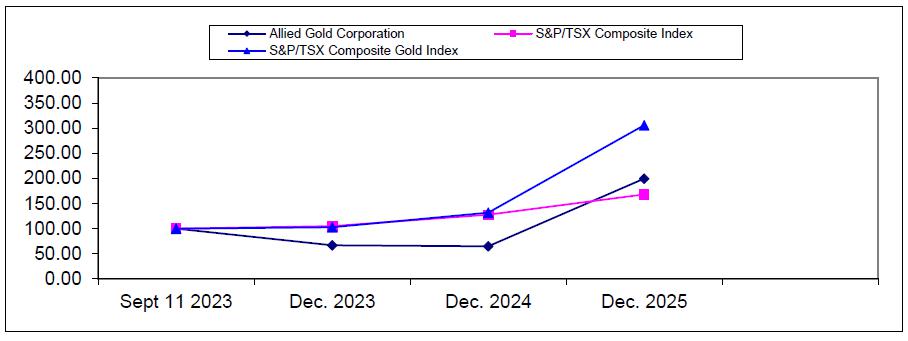
The Company has a strong pay for performance philosophy, with the majority of compensation for NEOs being at-risk (annual bonus payouts and long-term incentives), with pay outcomes linked directly to Company performance (financial, operating, share value).
Performance goals as part of the annual incentive plan align with the longer-term business strategy and are key drivers of share price performance over time.
With long-term equity-based compensation being a significant component of total compensation for NEOs, the value of outstanding long-term incentives tracks directly with the Company’s absolute and relative total shareholder return. This framework reinforces alignment between NEOs and our shareholders and motivates business decisions that will create longer-term value.
14
SUMMARY COMPENSATION TABLE
The table below shows the total compensation paid to our NEOs by the Company for the financial years ended December 31, 2025, 2024 and 2023.
| Non-equity incentive plan compensation | |||||||||||||||||||||||||||
| Name and principal | Salary | Share-based awards(2)(7) | Option- based awards(7) | Annual incentive plans(3) | Long-term incentive plans(4) | Retirement Savings Plan Value | All other compensation(5) | Total compensation | |||||||||||||||||||
| position(1) | Year | ($) | ($) | ($) | ($) | ($) | ($) | ($) | ($) | ||||||||||||||||||
Peter Marrone | 2025 | 927,000 | 6,079,198 | - | 3,000,000 | - | 589,050 | 170,078 | 10,765,326 | ||||||||||||||||||
| Chairman and | 2024 | 900,000 | 3,603,600 | - | 3,500,000 | - | 853,050 | 148,350 | 9,005,000 | ||||||||||||||||||
| CEO | 2023 | 286,027 | - | - | 417,242 | 751,036 | 105,490 | 55,749 | 1,615,544 | ||||||||||||||||||
Daniel Racine | 2025 | 515,000 | 689,250 | - | - | - | 77,250 | 1,112,060 (6) | 2,393,560 | ||||||||||||||||||
| President | 2024 | 500,000 | 1,287,000 | - | 715,000 | 182,250 | 85,729 | 2,769,979 | |||||||||||||||||||
| 2023 | 158,904 | - | - | 231,801 | 417,242 | 58,605 | 17,578 | 884,130 | |||||||||||||||||||
Jason LeBlanc
| 2025 | 386,250 | 1,038,470 | - | 600,000 | - | 147,937 | 71,859 | 2,244,516 | ||||||||||||||||||
| Chief Financial | 2024 | 375,000 | 1,072,500 | - | 650,000 | - | 153,750 | 63,027 | 2,314,277 | ||||||||||||||||||
| Officer | 2023 | 119,178 | - | - | 139,081 | 208,621 | 38,738 | 13,605 | 519,223 | ||||||||||||||||||
Gerardo Fernandez Chief | 2025 | 360,500 | 1,038,470 | - | 600,000 | - | 144,075 | 73,348 | 2,216,393 | ||||||||||||||||||
| Development | 2024 | 350,000 | 1,001,000 | - | 650,000 | - | 210,060 | 73,466 | 2,284,526 | ||||||||||||||||||
| Officer | 2023 | 111,232 | - | - | 129,809 | 194,713 | 36,156 | 12,811 | 484,721 | ||||||||||||||||||
Sofia Tsakos Chief | 2025 | 360,500 | 1,038,470 | - | 600,000 | - | 144,075 | 84,129 | 2,227,174 | ||||||||||||||||||
| Legal Officer and | 2024 | 350,000 | 1,001,000 | - | 650,000 | - | 210,060 | 70,616 | 2,281,676 | ||||||||||||||||||
| Corporate Secretary | 2023 | 111,232 | - | - | 129,809 | 194,713 | 38,738 | 13,605 | 488,097 | ||||||||||||||||||
| (1) | The NEOs were appointed on September 7, 2023. For the partial year 2023, all figures represent compensation earned by the NEO and/or paid by the Company from September 7, 2023 through December 31, 2023. |
| (2) | Consists of long-term awards granted in equity for the year ended December 31, 2025. The market value of the share-based awards is the total number of units multiplied by the closing price of the Common Shares on the TSX on the day before such grant. |
| (3) | For additional information, please refer to ‘annual cash bonuses’ on page 12. |
| (4) | The long-term incentive awards for the year ended December 31, 2023 were paid under the condition that all the after-tax proceeds of the award were to be used to purchase Common Shares by May 31, 2024, which condition was fulfilled. |
| (5) | All other compensation includes perquisites and other taxable benefits. |
| (6) | All other compensation for Daniel Racine includes perquisites, health and fitness benefits in his role as President. It also includes the grant of DSUs and Options in his role as Director. |
| (7) | The level of Mr. Marrone’s long-term incentive award was determined by the Board to be reflective of the numerous direct bilateral and multifaceted engagements and negotiations including the management of evolving geopolitical events directly and with third parties that took place throughout 2025. |
15
Outstanding share-based and option-based awards
The table below shows the outstanding incentive plan awards for each NEO as of December 31, 2025. This includes one-time grants of PSUs and stock options issued in December 2025, for the 2026, 2027 and 2028 compensation years to certain named executive officers.
| Option-based awards | Share-based awards | |||||||||||||||||||||||||
| Name | Number of securities underlying unexercised options (#) | Option exercise price ($) | Option expiration date | Value of unexercised in-the- money options ($) | Number of shares or units of shares that have not vested (#) | Market or payout value of share-based awards that have not vested ($) | Market or payout value of share-based awards not paid out or distributed ($) | |||||||||||||||||||
| Peter Marrone(1) | 500,000 | 22.70 | 16-Dec-32- | 125,000 | 1,072,052 | 24,603,593 | - | |||||||||||||||||||
| Daniel Racine | 60,000 | 22.70 | 16-Dec-32 | 15,000 | 231,343 | 5,309,322 | - | |||||||||||||||||||
| Jason LeBlanc | 135,000 | 22.70 | 16-Dec-32 | 33,750 | 358,562 | 8,228,998 | - | |||||||||||||||||||
| Gerardo Fernandez | 135,000 | 22.70 | 16-Dec-32 | 33,750 | 350,501 | 8,043,998 | - | |||||||||||||||||||
| Sofia Tsakos | 135,000 | 22.70 | 16-Dec-32 | 33,750 | 350,501 | 8,043,998 | - | |||||||||||||||||||
| (1) | On February 19, 2026, 446,970 PSUs were cancelled, leaving Mr. Marrone with 303,030 PSUs as at the date of this circular. |
Value of awards vested or earned in 2025
The table below shows the value on payout or vesting of incentive awards for the year ended December 31, 2025.
| Option-based awards – Value vested during the year | Share-based awards – Value vested or earned during the year | Non-equity incentive plan earned during the year | ||||||||||
| Name | ($) | ($) | ($) | |||||||||
| Peter Marrone | - | 3,671,209 | 3,000,000 | |||||||||
| Daniel Racine | - | 416,237 | - | |||||||||
| Jason LeBlanc | - | 627,152 | 600,000 | |||||||||
| Gerardo Fernandez | - | 627,152 | 600,000 | |||||||||
| Sofia Tsakos | - | 627,152 | 600,000 | |||||||||
Value of options exercised in 2025
There were no Options exercised by NEOs in 2025.
Future long-term incentive grants
For the three-year period 2026 to 2028, the Company granted PSUs and stock options to certain named executive officers that reflect awards in three equal parts for such applicable award years which are intended to support such future service periods. The awards were granted to retain and motivate certain named executive officers. Consistent with the Company’s view that these awards were granted for future compensation years, the grant date fair value of these awards has not been included in the Executive Compensation Table. To provide complete information, the future long-term incentive units held by each NEO are as follows: Mr. Marrone: 303,030 PSUs and 500,000 stock options, and for Messrs. LeBlanc and Fernandez and Ms. Tsakos: 200,000 each in PSUs and 135,000 each in stock options.
16
EQUITY COMPENSATION PLANS
The table below shows a summary of our equity compensation plans that include settlement in common shares.
| Features | RSU Plan | Option Plan |
| Purpose | The purpose of the RSU Plan is to advance the interests of the Company through the motivation, attraction and retention of key employees and consultants, and to secure for the Company and its shareholders the benefits inherent in the ownership of Common Shares by such individuals. | The purpose of the Option Plan is to advance the interests of the Company by encouraging equity participation in the Company through the acquisition of Common Shares. |
| Administration | The RSU Plan and Option Plan will be administered by the board. The board may delegate such administration to a committee of the board, which includes the compensation committee of the board comprised of not less than three (3) directors. The board has authority to interpret and construe any provision of the RSU Plan and Option Plan and to adopt, amend and rescind such rules and regulations for administering the RSU Plan and Option Plan as the board may deem necessary or desirable in order to comply with the requirements of the RSU Plan and Option Plan. All actions taken and all interpretations and determinations made by the board in good faith will be conclusive and binding on the participants and the Company. | |
| Securities | Each RSU provides the holder with a right to receive (i) a Common Share or (ii) at the option of the Company, cash on the date the RSUs are fully vested. | Each Option entitles the holder to purchase a Common Share at an exercise price set at the time of grant. |
| Eligible Participants | Full-time employees and eligible contractors. | Employees, senior officers, directors and consultants. |
| Plan Fixed Maximum | 5,850,232 RSUs | 2,507,242 Options |
| Outstanding Securities Awarded | 3,317,468 RSUs (56.7% of the Plan Fixed Maximum)
If any RSUs are cancelled or terminated in accordance with the RSU Plan without the applicable restricted period having expired (i.e. for which no Common Shares have been issued), the underlying Common Shares will again be available for issuance under the RSU Plan.
|
2,354,498 Options (93.9% of the Plan Fixed Maximum)
If any Options are surrendered, terminated or expire without being exercised (i.e. for which no Common Shares have been issued), new Options may be granted covering the Common Shares not purchased under the lapsed Options.
|
| Remaining Securities Available for Grant | 2,532,764 (43.3% of the Plan Fixed Maximum) | 152,744 Options (6.1% of the Plan Fixed Maximum) |
| Insider Participation Limits | The maximum number of Common Shares (i) issued to insiders within any one-year period and (ii) issuable to insiders at any time, pursuant to the RSU Plan, Option Plan, and any other share compensation arrangements of the Company, shall not exceed 10% of the outstanding Common Shares. | |
| Non-Employee Director Limits | N/A (RSUs are not issuable to directors). | Option grants to non-executive directors shall not exceed 1% of the outstanding issued Common Shares, and the maximum value of Options which may be granted to each non-executive director shall not exceed $100,000 in any fiscal year. |
| Maximum Issuable to One Person | The RSU Plan does not provide for a maximum number of Common Shares which may be issued to an individual (expressed as a percentage or otherwise). | The aggregate Common Shares reserved for issuance to any one person pursuant to the Option Plan shall not exceed 5% of the total number of Common Shares outstanding. |
| Exercise Price | N/A | Determined by the board at the time of grant, but cannot be less than the volume weighted average trading price (“VWAP”) of the Common Shares on the TSX for the five (5) consecutive trading days immediately prior to the grant date. |
| Term/Vesting | RSUs vest at the end of the restricted period determined by the board at the time of grant, which can be no later than December 31 of the third calendar year following the grant date, provided that with respect to any U.S. taxpayer, this date shall be no later than two-and-a-half (2 and ½) months following the calendar year in which the expiry of the restricted period occurs. | Options shall vest and become exercisable at such time or times as may be determined by the board. The period during which Options can be exercised is determined by the board at the time of grant, subject to a maximum term of ten (10) years from the grant date (except if such expiry date is during or falls within two (2) days of a blackout period, then the expiry date will be extended to the tenth (10th) business day following the end of the blackout period). |
17
| Features | RSU Plan | Option Plan |
| Termination of Employment |
· Death: All unvested RSUs (including any Dividend RSUs (as defined below)) will vest on the date of death. The Common Shares represented by the RSUs (and any Dividend RSUs) shall be issued, or cash will be paid, as determined by the board, to the RSU holder’s estate immediately.
· Total disability: All unvested RSUs (and any Dividend RSUs) will vest within 60 days following the date on which the RSU holder is determined to be totally disabled, and the Common Shares represented by the RSUs (and any Dividend RSUs) shall be issued, or cash will be paid, as determined by the board, to the RSU holder immediately.
· Termination without cause or retirement: All unvested RSUs (and any Dividend RSUs) shall vest on the date of termination, and the Common Shares represented by the RSUs (and any Dividend RSUs) shall be issued, or cash will be paid, as determined by the board, to the RSU holder immediately.
· Resignation (not including retirement) or termination with cause: All RSUs (and any Dividend RSUs) will be forfeited and be of no further force and effect as of the date of termination, except as provided for in the RSU grant letter or as determined by the board. |
· Death: Options are exercisable within the earlier of (i) the expiry of the term of the Options and (ii) six (6) months following the date of death.
· Termination other than death: Options are exercisable within the greater of (i) the termination date and (ii) ninety (90) days following the date that is designated by the Company as the last day of the participant’s employment, or as otherwise provided for in the Option grant agreement.
|
| Change of Control | All RSUs (and any Dividend RSUs) outstanding shall immediately vest and be payable in cash on the date immediately prior to the date of change of control notwithstanding the restricted period for the RSUs. The RSU holder will receive a cash payment equal to the aggregate market value of the Common Shares underlying the RSUs (and any Dividend RSUs), calculated as of the date that is two business days prior to the date of change of control. | If there is a consolidation, merger or statutory amalgamation or arrangement of the Company with or into another corporation, a separation of the business of the Company into two or more entities or a transfer of all or substantially all of the assets of the Company to another entity, upon the exercise of an Option, the holder thereof shall be entitled to receive the securities, property or cash which the holder would have received upon such consolidation, merger, amalgamation, arrangement, separation or transfer if the holder had exercised the Option immediately prior to such event, unless the board otherwise determines the basis upon which such Option shall be exercisable. |
| Take-over Bid | In the event that the Company becomes the subject of a take-over bid pursuant to which 100% of the issued and outstanding Common Shares are acquired by the offeror and where consideration is paid in whole or in part in equity securities of the offeror, the board may send notice to all holders of RSUs requiring them to surrender their RSUs within ten (10) days of the mailing of such notice, and the holders of RSUs shall be deemed to have surrendered such RSUs on the tenth (10th) day after the mailing of such notice without further formality, subject to certain conditions set forth in the RSU Plan (where “market value” equals the VWAP of the Common Shares on the TSX for the five (5) consecutive trading days immediately prior to the relevant date). | If there is a take-over bid or issuer bid made for all or any of the issued and outstanding Common Shares, then the board may, by resolution, permit all Options outstanding to become immediately exercisable in order to permit Common Shares issuable under such Options to be tendered to such bid. |
| Dividend | When dividends are paid on any Common Shares, additional RSUs (“Dividend RSUs”) shall be credited to the participant’s account as of the dividend payment date. The number of Dividend RSUs shall be determined by dividing the dollar amount of the distribution payable in respect of the Common Shares underlying the RSUs and any Dividend RSUs then allocated to the participant’s account by the market value of a Common Share on the date the distribution is paid. The Dividend RSUs will be subject to the same restricted period as the initial RSUs for which the Dividend RSUs are issued. | N/A |
18
| Features | RSU Plan | Option Plan |
| Transferability | Except pursuant to a will or by the laws of descent and distribution, no RSU, Dividend RSU or any other right or interest of a participant is assignable or transferable. | The benefits, rights and options accruing to any participant in accordance with the terms and conditions of the Option Plan shall not be transferable or assignable by a participant unless specifically provided therein. During the lifetime of a participant, all benefits, rights and options shall only be exercised by the participant or by their guardian or legal representative. |
| Amendments |
The board may discontinue the RSU Plan at any time without first obtaining shareholder approval, provided that, without the consent of a participant, such discontinuance may not in any manner adversely affect the participant’s rights under any RSU.
The board may, subject to receipt of requisite regulatory and shareholder approval, make the following amendments to the RSU Plan:
· amend the number of securities issuable under the RSU Plan;
· change the definition of “Participant” which would have the potential of narrowing, broadening or increasing insider participation;
· make amendments that may lead to significant or unreasonable dilution to the Company’s outstanding securities, or that may provide additional benefits to participants at the expense of the Company or its shareholders; or
· make amendments to the transferability provisions of the RSU Plan that would permit RSUs, or any other right or interest of a participant under the RSU Plan, to be assigned or transferred, other than for normal estate settlement purposes.
The board may, subject to receipt of requisite regulatory approval, where required, in its sole discretion make all other amendments to the RSU Plan that are not of the type contemplated above, including, without limitation:
· amendments of a housekeeping nature;
· the addition or a change to the vesting provisions of an RSU or the RSU Plan;
· a change to the termination provisions of an RSU or the RSU Plan;
· amendments to reflect changes to applicable securities laws; and
· amendments to ensure that the RSUs (and any Dividend RSUs) granted under the RSU Plan will comply with any provisions respecting income tax and other laws in force in any country or jurisdiction of which a participant may from time to time be resident or a citizen.
|
Subject to the requisite shareholder and regulatory approvals, the board may from time to time amend or revise the terms of the Option Plan or may discontinue the Option Plan at any time provided however that no such right may, without the consent of the optionee, in any manner adversely affect his rights under any Option theretofore granted under the Option Plan.
The board may, subject to receipt of requisite shareholder and regulatory approval, make the following amendments to the Option Plan:
· any amendment to the number of securities issuable under the Option Plan, including an increase to a fixed maximum number of securities or a fixed maximum percentage of securities, as the case may be, or a change from a fixed number to a fixed percentage of securities;
· any amendment that increases limits previously imposed on non-executive director participation in the Option Plan;
· any change to the definition of “Participants” which would have the potential of narrowing or broadening or increasing insider participation;
· any reduction in the exercise price of Options benefiting an insider of the Company;
· any extension of the term of Options benefiting an insider of the Company;
· the addition of any form of financial assistance;
· any amendment to a financial assistance provision which is more favourable to participants;
· any addition of a cashless exercise feature, payable in cash or securities which does not provide for a full deduction in the number of underlying securities from the Option Plan;
· the addition of deferred or restricted share unit or any other provision which results in participants receiving securities while no cash consideration is received by the Company;
· any other amendments that may lead to significant or unreasonable dilution in the Company’s outstanding securities or may provide additional benefits to participants, especially to insiders of the Company, at the expense of the Company and its existing shareholders. |
19
| Features | RSU Plan | Option Plan |
|
The board may, subject to receipt of requisite regulatory approval, where required, in its sole discretion make all other amendments to the Option Plan that are not of the type contemplated above, including, without limitation:
· amendments of a housekeeping nature;
· the addition of or a change to vesting provisions of a security or the Option Plan;
· a change to the termination provisions of a security or the Option Plan which does not entail an extension beyond the original expiry date; and
· the addition of a cashless exercise feature, payable in cash or securities, which provides for a full deduction of the number of underlying securities from the Option Plan reserve.
Notwithstanding the above, the Company shall additionally obtain requisite shareholder approval in respect of amendments to the Option Plan that are contemplated above to the extent such approval is required by any applicable law or regulations. |
You can find a copy of the RSU Plan and Option Plan on the Company’s profile on the SEDAR+ website at www.sedarplus.ca.
RETIREMENT BENEFITS
We introduced a retirement savings plan for NEOs on September 7, 2023. Contributions under the plan are deposited into an individual retirement account for each participant. Participants decide how they want their contribution invested based on a range of investment choices. Account values change based on the contributions and performance of the underlying investment. Future benefits or income are not guaranteed.
2025 retirement benefits
In 2025, we contributed a percentage of each participant’s annual base salary and annual cash bonus to the executive retirement savings plan. NEOs receive 15% of their annual base salary and annual short-term incentive award.
The group registered retirement savings plan is non-contributory and competitive with the market.
Contributions are made up to the maximum amount allowed by the Canada Revenue Agency ($32,490 in 2025) for the Canadian executives. Any excess is paid out in cash for their personal non-registered retirement savings plans.
The table below shows the value of each named executive’s retirement benefits under the retirement savings plan as of December 31, 2025:
| Name | Accumulated value at start of year ($) | Compensatory ($) | Accumulated value at year end ($) | |||||||||
| Peter Marrone | 958,540 | 589,050 | 1,547,590 | |||||||||
| Daniel Racine | 240,855 | 77,250 | 318,105 | |||||||||
| Jason LeBlanc | 192,488 | 147,937 | 340,425 | |||||||||
| Gerardo Fernandez | 246,216 | 144,075 | 390,291 | |||||||||
| Sofia Tsakos | 248,798 | 144,075 | 392,873 | |||||||||
The values noted are before tax amounts. All required tax withholdings are made before contributions are made to an executive’s account.
20
TERMINATION AND CHANGE OF CONTROL
We have employment agreements with each current NEO that provide for payments if their employment is terminated. The agreements include provisions for termination both with and without cause, for “Good Reason”, or for other triggering events in a change of control situation and are described below.
| Name | Notice Period | Severance
on Termination(1) |
Severance
on Double Trigger Change of Control(2) |
Benefits | Stock
Options |
DSUs(3)/RSUs/PSUs |
| Peter Marrone | 90 days written notice | 2.75 times sum of annual salary and two-year average bonus, benefits and perquisites, minus any amount provided the applicable employment standards legislation (multiple increased to 3.5 until September 7, 2026). | 2 times sum of annual salary and two-year average bonus, benefits and perquisites, minus any amount provided the applicable employment standards legislation (multiple increased to 2.75 until September 7, 2026). | Comparable coverage to current health benefits until earlier of new employment and three years | Vested upon notice of termination, exercisable for the earlier of 24 months and the termination date of the option. | DSUs: Redeemed upon date of termination and paid within 60 days.
RSUs: Vested at the time of termination without cause or upon a change of control and paid immediately.
PSUs: Remain outstanding for the vesting period, earn dividend equivalents until the end of the vesting period and be paid out in the usual way.
|
| Jason LeBlanc | 90 days written notice | 2 times sum of annual salary and two-year average bonus, benefits and perquisites, minus any amount provided the applicable employment standards legislation (multiple increased to 2.5 until September 7, 2026). | 2 times sum of annual salary and two-year average bonus, benefits and perquisites, minus any amount provided the applicable employment standards legislation (multiple increased to 2.5 until September 7, 2026). | Comparable coverage to current health benefits until earlier of new employment and two years. | Vested upon notice of termination, exercisable for the earlier of 24 months and the termination date of the option. | RSUs: Vested at the time of termination without cause or upon a change of control and paid immediately.
PSUs: Remain outstanding for the vesting period, earn dividend equivalents until the end of the vesting period and be paid out in the usual way.
|
| Gerardo Fernandez | 90 days written notice | 2 times sum of annual salary and two-year average bonus, benefits and perquisites, minus any amount provided the applicable employment standards legislation (multiple increased to 2.5 until September 7, 2026). | 2 times sum of annual salary and two-year average bonus, benefits and perquisites, minus any amount provided the applicable employment standards legislation (multiple increased to 2.5 until September 7, 2026). | Comparable coverage to current health benefits until earlier of new employment and two years | Vested upon notice of termination, exercisable for the earlier of 24 months and the termination date of the option. | RSUs: Vested at the time of termination without cause or upon a change of control and paid immediately.
PSUs: Remain outstanding for the vesting period, earn dividend equivalents until the end of the vesting period and be paid out in the usual way.
|
21
| Name | Notice Period | Severance
on Termination(1) |
Severance
on Double Trigger Change of Control(2) |
Benefits | Stock Options |
DSUs(3)/RSUs/PSUs |
| Sofia Tsakos | 90 days written notice | 2 times sum of annual salary and two-year average bonus, benefits and perquisites, minus any amount provided the applicable employment standards legislation (multiple increased to 2.5 until September 7, 2026). | 2 times sum of annual salary and two-year average bonus, benefits and perquisites, minus any amount provided the applicable employment standards legislation (multiple increased to 2.5 until September 7, 2026). | Comparable coverage to current health benefits until earlier of new employment and two years | Vested upon notice of termination, exercisable for the earlier of 24 months and the termination date of the option. |
RSUs: Vested at the time of termination without cause or upon a change of control and paid immediately.
PSUs: Remain outstanding for the vesting period, earn dividend equivalents until the end of the vesting period and be paid out in the usual way.
|
| (1) | Severance on termination: Paid on termination for any reason other than cause (not including a change of control). Severance paid on termination for cause is equal to the minimum entitlements provided by the applicable employment standards legislation. | |
| (2) | Severance on double trigger change of control: Paid on a change of control followed by a termination or other triggering event. | |
| (3) | Mr. Marrone is the only NEO eligible to receive DSUs by virtue of his appointment to the board. |
Daniel Racine retired on December 31, 2025 and is not included in this termination and change of control section. Any payments made to Mr. Racine upon his retirement on December 31, 2025 are reflected in the Summary Compensation Table on page 14.
Other than as described above, we and our subsidiaries do not have compensatory plans or arrangements with the NEO that result in a payment following or related to a termination, resignation, retirement, change of control of Allied or a change in responsibilities.
Estimated incremental payments on termination
The table below shows the estimated incremental amount that would have been paid to each NEO if they had been terminated without cause on December 31, 2025, each calculated using the early termination provisions in their employment agreements.
| Name | Base salary ($) | Annual bonus ($) | Other ($) | Total ($) | ||||||||||||
| Peter Marrone | 2,317,500 | 15,853,598 | 1,414,146 | 19,585,244 | ||||||||||||
| Jason LeBlanc | 965,625 | 3,388,732 | 470,224 | 4,824,582 | ||||||||||||
| Gerardo Fernandez | 901,250 | 3,299,357 | 449,003 | 4,649,610 | ||||||||||||
| Sofia Tsakos | 901,250 | 3,299,357 | 452,284 | 4,652,891 | ||||||||||||
| Total | 5,085,625 | 25,841,045 | 2,785,657 | 33,712,327 | ||||||||||||
All stock-based awards would vest on termination as follows:
| · | Options would vest on the date of notice of termination and remain exercisable for the earlier of 24 months from the termination date and the termination date of the applicable option. |
| · | DSUs would be redeemed on the termination date and paid within 60 days, unless an individual continued to be an eligible director of the Company following termination of their employment agreement. |
| · | RSUs would vest at the time of termination without cause and paid immediately. RSUs would be forfeited on resignation or termination for cause subject to any provisions to the contrary in the applicable RSU grant letter. |
| · | PSUs would continue to be credited and paid out as usual on termination without cause until the end of the applicable performance period (including incurring vesting on all dividends, if applicable). Pending PSUs would be forfeited on termination for cause or without Good Reason, subject to the discretion of a committee. |
22
The values of RSUs and PSUs have been calculated using Cdn$31.45 (the closing price of the Common Shares on the TSX on December 31, 2025).
| Name | RSUs / PSUs (Cdn$) | |||
| Peter Marrone | 33,767,236 | |||
| Jason LeBlanc | 11,276,775 | |||
| Gerardo Fernandez | 11,023,256 | |||
| Sofia Tsakos | 11,023,256 | |||
| Total | 67,090,523 | |||
Estimated incremental payments on a double trigger change of control (a change of control followed by a termination or other triggering event)
The table below shows the estimated incremental amount that would have been paid to each named executive if they had been terminated without cause following a change of control on December 31, 2025, each calculated using the early termination provisions in their employment agreements.
| Name | Base salary ($) | Annual bonus ($) | Other ($) | Total ($) | ||||||||||||
| Peter Marrone(1) | 3,244,500 | 22,195,037 | 1,979,805 | 27,419,342 | ||||||||||||
| Jason LeBlanc | 965,625 | 3,388,732 | 470,224 | 4,824,582 | ||||||||||||
| Gerardo Fernandez | 901,250 | 3,299,357 | 449,003 | 4,649,610 | ||||||||||||
| Sofia Tsakos | 901,250 | 3,299,357 | 452,284 | 4,652,891 | ||||||||||||
| Total | 6,012,625 | 32,182,484 | 3,351,316 | 41,546,425 | ||||||||||||
| (1) | This assumes a voluntary reduction of the multiple from 2.75 to 2.5. |
All stock-based awards would vest on a double trigger change of control as follows:
| · | Options would vest on the date of notice of termination and remain exercisable for the earlier of 24 months from the termination date and the termination date of the applicable option. |
| · | DSUs would be redeemed on the termination date and paid within 60 days, unless an individual continued to be an eligible director of the Company following the change of control. |
| · | RSUs would vest upon a change of control and be paid immediately in cash. |
| · | PSUs would vest upon a change of control and be paid within 10 business days. |
How we define change of control
A change of control means any of the following:
Severance is payable upon a change of control if the NEO is terminated without cause within 12 months of the change of control, or if a Triggering Event (as defined in each of the NEOs employment agreement) occurs within 12 months and the NEO resigns within 6 months of the Triggering Event. Payments are made within 10 business days of termination or notice to terminate. The executive must execute a release of claims to receive change of control severance payments.
| · | a consolidation, merger, amalgamation, arrangement or other reorganization or acquisition involving the Company or any of its Affiliates and another corporation or other entity, as a result of which the holders of Common Shares prior to the completion of the transaction hold less than 50% of the outstanding shares of the successor corporation after completion of the transaction; |
| · | the sale, lease, exchange or other disposition, in a single transaction or a series of related transactions, of assets, rights, or properties of the Company and/or any of its Subsidiaries which have an aggregate book value greater than 50% of the book value of the assets, rights and properties of the Company and its subsidiaries on a consolidated basis to any other Person or entity, other than a disposition to a wholly-owned subsidiary of the Company in the course of a reorganization of the assets of the Company and its Subsidiaries; |
| · | a resolution is adopted to wind up, dissolve or liquidate the Company; |
23
| · | any Person, entity or group of Persons or entities acting jointly or in concert (an “Acquiror”) acquires or acquires control (including, without limitation, the right to vote or direct the voting) of Voting Securities of the Company which, when added to the Voting Securities owned of record or beneficially by the Acquiror or which the Acquiror has the right to vote or in respect of which the Acquiror has the right to direct the voting, would entitle the Acquiror and/or Associates and/or Affiliates of the Acquiror (as such terms are defined in applicable securities laws), to cast or to direct the casting of 20% or more of the votes attached to all of the Company’s outstanding Voting Securities which may be cast to elect directors of the Company or the successor corporation (regardless of whether a meeting has been called to elect directors); | |
| · | as a result of or in connection with: (A) a contested election of directors, or (B) a consolidation, merger, amalgamation, arrangement, or other reorganization or acquisitions involving the Company or any of its Affiliates and another corporation or other entity, the nominees named in the most recent Management Information circular of the Company for election to the board shall not constitute a majority of the board; or | |
| · | the board adopts a resolution to the effect that a Change of Control as defined in the employment agreements has occurred or is imminent. |
How we define good reason
A good reason means any of the following events where it occurs without the NEO’s express agreement in writing:
| · | an adverse change in any of the duties, powers, rights, discretion, prestige, salary, benefits or perquisites of the NEO, and with respect to financial entitlements, the conditions under and manner in which they were payable; |
| · | a diminution of the title of the NEO; |
| · | a change in the person or body to whom the NEO reports, provided that this shall not include a change resulting from a promotion in the normal course of business; or |
| · | any other event or occurrence that would constitute or give rise to a claim for constructive dismissal as determined under the common law of Ontario. |