The fund is designed to provide diversification among different asset classes for investors with the approximate retirement year in the fund's name. MFS (Massachusetts Financial Services Company, the fund's investment adviser) invests substantially all of the fund's assets in other MFS mutual funds, referred to as underlying funds.
MFS selects the asset class allocations based on a strategic asset allocation process that takes into account a variety of factors, including historical risk and performance, projected performance, and other factors. MFS’ analyses of projected performance are primarily based on quantitative models using various inputs such as valuation metrics, growth rates, profitability, yields, and inflation. MFS may also consider current market conditions, its qualitative assessment of the risk/return characteristics of asset classes, and other factors in determining these allocations.
MFS employs the strategic asset allocation process described above to determine the amount of the fund's assets invested in (1) underlying funds that invest primarily in equity securities (“Equity Funds”) and underlying funds that provide exposure to less traditional asset classes, currently real estate and commodities (“Non-Traditional Funds”) and (2) underlying funds that invest primarily in debt instruments (“Bond Funds”) and an underlying fund that invests in cash and/or cash equivalents (“Money Market Fund”).
MFS selects the underlying funds within each asset class based on underlying fund classifications, historical risk, historical and projected performance of the represented asset classes, as well as other factors.
Within the Equity Fund allocation, MFS seeks to diversify by geography (by including domestic and international underlying funds, including emerging market underlying funds), in terms of market capitalization (by including large, mid, and small capitalization underlying funds) and by style (by including both growth and value underlying funds). A portion of the fund’s assets is also allocated to Non-Traditional Funds (i.e., asset classes less correlated to the overall equity and debt markets), which MFS believes provides further diversification benefits.
Within the Bond Fund allocation, MFS includes underlying funds with varying degrees of geographic (potentially including emerging market), interest rate and credit exposure, including exposure to below investment grade quality debt instruments. A portion of the fund’s assets may also be allocated to the Money Market Fund.
MFS normally invests the underlying funds’ assets across different industries, sectors, countries, and regions, but MFS may invest a significant percentage of the underlying funds' assets in issuers in a single industry, sector, country, or region.
As of May 27, 2026, the fund’s approximate long-term strategic allocation among asset classes was:
Equity Funds and Non-Traditional Funds | 95% |
Bond Funds and Money Market Fund | 5% |
All percentages are rounded to the nearest percent.
MFS may deviate from the long-term strategic allocations set forth above; however, any deviation from the long-term strategic allocation is not expected to be greater than plus or minus 10% under normal market conditions. At no time, however, will the fund's investments in Equity Funds and Non-Traditional Funds exceed 99%. Additionally, the fund’s allocation to Non-Traditional Funds will not typically exceed 20% of the fund’s assets.
As of May 27, 2026, the fund’s approximate strategic allocation among asset classes was:
Equity Funds and Non-Traditional Funds | 94.0% |
U.S. Equity Funds | 55.5% |
International Equity Funds | 28.5% |
Non-Traditional Funds | 10.0% |
Bond Funds and Money Market Fund | 6.0% |
Bond Funds | 5.0% |
Money Market Fund | 1.0% |
All percentages are rounded to the nearest tenth of a percent. As a result, the sum of the asset class allocations presented in the table may not total 100%.
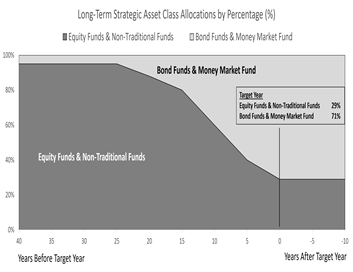
The asset class allocations for the fund, as well as the underlying funds and their weightings, are based on an allocation strategy designed for investors with the approximate retirement year in the fund’s name. Investors should also consider their age, personal circumstances, risk tolerance, and overall investment strategy and allocation. The asset allocation strategy will become increasingly conservative over time, shifting more weight from Equity Funds and Non-Traditional Funds to Bond Funds and the Money Market Fund.
Upon reaching its stated target year, the fund’s allocation strategy will be aligned with the allocation strategy of MFS Lifetime Income
Fund. It is expected that the fund will be combined with MFS Lifetime Income Fund within five years of the date that its asset allocation strategy matches the asset allocation strategy of MFS Lifetime Income Fund. MFS Lifetime Income Fund is designed for investors who intend to withdraw assets over an extended period of time or who want an investment with an asset allocation mix similar to MFS Lifetime Income Fund's long-term strategic asset allocation. The chart below illustrates how the asset allocation strategy of the fund will change over time.