UNITED STATES
SECURITIES AND EXCHANGE COMMISSION
WASHINGTON, D.C. 20549
FORM
OR
For the fiscal year ended
OR
For the transition period from to .
OR
Date of event requiring this shell company report:
Commission file number:
(Exact name of Registrant as Specified in its Charter)
(Jurisdiction of Incorporation or Organization)
(Address of Principal Executive Offices)
Telephone:
E-mail:
(Name, Telephone, E-mail and/or Facsimile Number and Address of Company Contact Person)
Securities registered or to be registered pursuant to Section 12(b) of the Act:
| Title of Each Class | Trading symbol | Name of Each Exchange On Which Registered | ||
| The |
Securities registered or to be registered pursuant to Section 12(g) of the Act:
None
(Title of Class)
Securities for which there is a reporting obligation pursuant to Section 15(d) of the Act:
None
(Title of Class)
The number of outstanding shares of each of the
issuer’s classes of capital or common stock as of December 31, 2025 was:
Indicate by check mark if the registrant is a well-known seasoned issuer, as defined in Rule 405 of the Securities Act.
Yes ☐
If this report is an annual or transition report, indicate by check mark if the registrant is not required to file reports pursuant to Section 13 or 15(d) of the Securities Exchange Act of 1934.
Yes ☐
Indicate by check mark whether the registrant (1) has filed all reports required to be filed by Section 13 or 15(d) of the Securities Exchange Act of 1934 during the preceding 12 months (or for such shorter period that the registrant was required to file such reports), and (2) has been subject to such filing requirements for the past 90 days.
Indicate by check mark whether the registrant has submitted electronically every Interactive Data File required to be submitted pursuant to Rule 405 of Regulation S-T (§232.405 of this chapter) during the preceding 12 months (or for such shorter period that the registrant was required to submit such files).
Indicate by check mark whether the registrant is a large accelerated filer, an accelerated filer, a non-accelerated filer, or an emerging growth company. See definition of “large accelerated filer,” “accelerated filer” and “emerging growth company” in Rule 12b-2 of the Exchange Act. (Check one):
| Large accelerated filer ☐ | Accelerated filer ☐ | Emerging growth company |
If an emerging growth company that prepares its financial statements in accordance with U.S. GAAP, indicate by check mark if the registrant has elected not to use the extended transition period for complying with any new or revised financial accounting standards † provided pursuant to Section 13(a) of the Exchange Act. ☐
| † | The term “new or revised financial accounting standard” refers to any update issued by the Financial Accounting Standards Board to its Accounting Standards Codification after April 5, 2012. |
Indicate by check mark whether the registrant
has filed a report on and attestation to its management’s assessment of the effectiveness of its internal control over financial
reporting under Section 404(b) of the Sarbanes-Oxley Act (15 U.S.C. 7262(b)) by the registered public accounting firm that prepared or
issued its audit report.
If securities are registered pursuant to Section
12(b) of the Act, indicate by check mark whether the financial statements of the registrant included in the filing reflect the correction
of an error to previously issued financial statements.
Indicate by check mark whether any of those error corrections are restatements that required a recovery analysis of incentive-based compensation received by any of the registrant’s executive officers during the relevant recovery period pursuant to §240.10D-1(b). ☐
Indicate by check mark which basis of accounting the registrant has used to prepare the financial statements included in this filing:
| ☒ | ☐ International Financial Reporting Standards as issued by the International Accounting Standards Board | ☐ Other |
If “Other” has been checked in response to the previous question, indicate by check mark which financial statement item the registrant has elected to follow:
Item 17 ☐ Item 18 ☐
If this is an annual report, indicate by check mark whether the registrant is a shell company (as defined in Rule 12b-2 of the Exchange Act).
Yes ☐ No
BTC DIGITAL LTD.
FORM 20-F ANNUAL REPORT
TABLE OF CONTENTS
i
GENERAL INFORMATION
In this annual report on Form 20-F, or this annual report, except where the context otherwise requires and for purposes of this annual report only, references to:
| ● | “we,” “us,” “our Company,” “the Company” and “our” are to BTC Digital Ltd.; |
| ● | “China” or the “PRC” are to the People’s Republic of China, including the special administrative regions of Hong Kong and Macau and excluding for the purposes of this annual report only, Taiwan; |
| ● | “Code” are to the U.S. Internal Revenue Code of 1986, as amended; |
| ● | “former variable interest entities” or “former VIEs” are to Shenzhen Meten International Education Co., Ltd., or Shenzhen Meten, and Shenzhen Likeshuo Education Co., Ltd., or Shenzhen Likeshuo, and their respective direct and indirect subsidiaries, which are PRC companies in which Meten did not have equity interests but whose financial results had been consolidated by Meten in accordance with U.S. GAAP due to Meten being the primary beneficiary of these companies prior to the termination of the VIE agreements in November 2022; |
| ● | “Met Chain” are to Met Chain investment holding company Ltd, a company formed under the laws of the British Virgin Islands; |
| ● | “Met Path” are to Meta Path investing holding company, a company formed under the laws of the Cayman Islands; |
| ● | “Meten Blockchain” are to “METEN BLOCK CHAIN LLC,” a company formed in the State of California; |
| ● | “ordinary shares” are to our ordinary shares, par value US$0.06 per share, carrying one vote per share; |
| ● | “the operating entities” are to the Company and the Company’s subsidiaries with operations, namely Meta Path investing holding company, Met Chain investment holding company Ltd, and METEN BLOCK CHAIN LLC; |
| ● | “dollars,” “US$” and “U.S. dollars” are to the legal currency of the United States; |
| ● | “U.S. GAAP” are to generally accepted accounting principles in the United States; and |
| ● | years are to the calendar year from January 1 to December 31 and references to our fiscal year or years are to the fiscal year or years ended December 31. |
ii
CAUTIONARY NOTE ON FORWARD-LOOKING STATEMENTS
This Annual Report on Form 20-F (this “Report”) contains forward-looking statements that involve risks and uncertainties. You should not place undue reliance on these forward-looking statements. Our actual results could differ materially from those anticipated in the forward-looking statements for many reasons, including the reasons described in our “Business,” “Risk Factors,” and “Management Discussion and Analysis of Financial Condition and Result of Operations” sections, as well as those discussed elsewhere in this Report. In some cases, you can identify these forward-looking statements by terms such as “anticipate,” “believe,” “continue,” “could,” “depends,” “estimate,” “expects,” “intend,” “may,” “ongoing,” “plan,” “potential,” “predict,” “project,” “should,” “will,” “would” or the negative of those terms or other similar expressions, although not all forward-looking statements contain those words.
Our operations and business prospects are always subject to risks and uncertainties including, among others:
| ● | Our ability to secure enterprise clients and deals in the face of growing competition; |
| ● | Assumptions relating to the size of the market for our products and services; |
| ● | Unanticipated regulations of cryptocurrencies that add barriers to adoption and have a negative effect on our business; |
| ● | Our ability to obtain and maintain intellectual property protection for our products; and |
| ● | Our estimates of expenses, future revenue, capital requirements and our needs for, or ability to obtain, additional financing. |
The forward-looking statements in this Report represent our views as of the date of this Report. We anticipate that subsequent events and developments will cause our views to change. However, while we may elect to update these forward-looking statements at some point in the future, we have no current intention to do so except to the extent required by applicable law. You should, therefore, not rely on these forward-looking statements as representing our views as of any date subsequent to the date of this Report.
Unless the context requires otherwise, references in this Report to “we,” “us,” “our,” “our company,” “the Company” or similar terminology refer to BTC Digital Ltd., including its consolidated subsidiaries.
MARKET DATA AND FORECASTS
This annual report also contains data related to global cryptocurrency market that include projections based on a number of assumptions. The global cryptocurrency market may not grow at the rates projected by market data, or at all. The failure of the global cryptocurrency market to grow at the projected rates may have a material adverse effect on our business prospects, results of operations and the market price of our ordinary shares. In addition, the relatively new and rapidly changing nature of the global cryptocurrency market subjects any projections or estimates relating to the growth prospects or future condition of these markets to significant uncertainties. If any one or more of the assumptions underlying the market data turns out to be incorrect, actual results may differ from the projections based on these assumptions. You should not place undue reliance on these forward-looking statements.
iii
PART I
ITEM 1. IDENTITY OF DIRECTORS, SENIOR MANAGEMENT AND ADVISERS
Not Applicable.
ITEM 2. OFFER STATISTICS AND EXPECTED TIMETABLE
Not Applicable.
ITEM 3. KEY INFORMATION
| A. | [Reserved] |
| B. | Capitalization and Indebtedness |
Not Applicable
| C. | Reasons for the Offer and Use of Proceeds. |
Not Applicable.
| D. | Risk Factors |
In addition to the other information contained in this Annual Report and in other documents we file with or furnish to the U.S. Securities and Exchange Commission (the “SEC”), the following risk factors should be considered in evaluating our business. The occurrence of any of the events or developments described below could materially harm our business, financial condition, results of operations and prospects. In such an event, the market price of our ordinary shares could decline. Additional risks and uncertainties not presently known to us or that we currently deem immaterial also may materially impair our business operations.
Summary of Risk Factors
Our business is subject to a number of risks of which you should be aware before making an investment decision. Among these important risks are the following, which are more fully described below:
Risks Related to Our Business and Industry
Risks and uncertainties related to our cryptocurrency business and industry include, but are not limited to, the following:
| ● | We have a limited operating history of blockchain and cryptocurrency business. |
| ● | As the operating entities develop their blockchain and cryptocurrency business, our total revenue and cash flow will become materially dependent on the market value of digital assets and the volume of digital assets received from their mining efforts. If such market value or volume declines, our business, operating results and financial condition would be adversely affected. |
| ● | The cost of acquiring new mining machines has historically been capital intensive, and is likely to continue to be very capital intensive, which may have a material and adverse effect on our business and results of operations. |
| ● | The price of new mining machines may be linked to the market price of bitcoin and other cryptocurrencies, and our costs of obtaining new and replacement mining machines may increase along with the market price of bitcoin and other cryptocurrencies, which may have a material and adverse effect on our financial condition and results of operations. |
1
| ● | Although we currently mine bitcoin as well as certain other cryptocurrencies, including Dogecoin and Litecoin, and also hold other digital assets, including Ethereum, our future success will depend in large part on the market value of bitcoin and other digital assets we mine or hold. Any sustained decline in the value of bitcoin or such other digital assets could adversely affect our business, results of operations, financial condition and liquidity. |
| ● | To the extent that the profit margins of bitcoin mining operations are not high, operators of bitcoin mining operations are more likely to immediately sell bitcoin rewards earned by mining in the market, thereby constraining growth of the price of bitcoin, which could adversely impact us. |
| ● | We are subject to risks associated with our need for significant electrical power. |
| ● | The cryptocurrencies stored by the operating entities may be subject to accidental or unauthorized loss or theft or otherwise may be access restricted. |
Risks Related to Bitcoin
Risks and uncertainties related to bitcoin include, but are not limited to, the following:
| ● | The trading price of bitcoin, which may be subject to pricing risks, including volatility related risks, has historically been subject to wide swings. A material decrease in the price of bitcoin could have a materially adverse effect on our business and results of operations. |
| ● | The markets for bitcoin may be underregulated. As a result, the market price of bitcoin may be extremely volatile. Rapid decreases in the price of bitcoin could have a materially adverse effect on our business and results of operations. |
| ● | Banks and financial institutions may not provide banking services, or may cut off services, to businesses that engage in cryptocurrency-related activities. |
| ● | We have an evolving business model subject to various uncertainties. |
| ● | It may be illegal now, or in the future, to acquire, own, hold, sell or use bitcoin, or other cryptocurrencies, participate in blockchains or utilize similar cryptocurrency assets in one or more countries, the ruling of which would adversely affect us. |
| ● | The development and acceptance of competing blockchain platforms or technologies may cause demand for bitcoin to decrease. |
Risks Related to Governmental Regulation and Enforcement
| ● | If bitcoins are determined to be investment securities, and we hold a significant portion of our assets in bitcoins, investment securities or non-controlling equity interests of other entities, we may inadvertently violate the Investment Company Act of 1940 (the “Investment Company Act”). We could incur large losses to modify our operations to avoid the need to register as an investment company or could incur significant expenses to register as an investment company or could terminate operations altogether. |
| ● | We may be required to register as an investment company under the Investment Company Act. In such event, we may be deemed as operating as an unregistered investment company in violation of the Investment Company Act and required to register as an investment company or to adjust our strategies. |
| ● | We cannot be certain as to how future regulatory developments will impact our business and any such additional regulatory requirements, or changes in how existing requirements are interpreted and applied, may cause us to cease all or certain of our operations or change our business model. |
2
| ● | If U.S. and/or foreign regulators and other government entities assert jurisdictions over cryptocurrencies and cryptocurrency markets, we may be subject to additional regulations imposed by these regulators and government entities and may be required to alter our business operations to gain compliance with these regulations, as a result of which we may experience increased compliance costs and our business operations, financial position and results of operations may be materially and adversely affected. |
| ● | If regulatory changes or interpretations of our activities require us to register under the regulations promulgated by FinCEN under the authority of the U.S. Bank Secrecy Act, or otherwise under state laws, we may incur significant compliance costs, which may have a material negative effect on our business and the results of its operations. |
Risks Related to Our Ordinary Shares and the Trading Market
| ● | Our share price has been volatile and not entirely related to our performance and financial results. The price of our ordinary shares may be subject to further volatility in the future. |
| ● | We may issue additional ordinary shares or other equity securities without your approval, which would dilute your ownership interests and may depress the market price of our ordinary shares. |
| ● | We are not expected to pay dividends on our ordinary shares in the foreseeable future. |
| ● | You may face difficulties in protecting your interests, and your ability to protect your rights through U.S. courts may be limited, because we were formed under Cayman Islands law. |
Risk Factors
Risks Related to Our Business and Industry
We have launched our blockchain and cryptocurrency business in early 2022 and have a limited operating history.
Since early 2022, we have started to transition the business focus to blockchain and cryptocurrency business through the operating entities. Accordingly, we have a limited operating history, which makes an evaluation of our future prospects difficult. Our operating results will likely fluctuate moving forward as we focus on increasing our capacity and as the market price of bitcoin fluctuates. We may need to make business decisions that could adversely affect our operating results, such as modifications to our business structure, or operations. Additionally, as we have limited experience in the blockchain and cryptocurrency business, our efforts in developing such business may not succeed and we may not be able to generate sufficient revenue to cover our investment and become profitable. In the fiscal year ended December 31, 2024, we generated revenue in the amount of $11.7 million from our cryptocurrency business, and generated net loss of $2.0 million from our cryptocurrency business. In the fiscal year ended December 31, 2025, we generated revenue in the amount of $14.0 million from our cryptocurrency business, and generated net loss of $8.9 million from our cryptocurrency business. We may not continue to generate substantial revenue or net income from our blockchain and cryptocurrency business, if at all. If we do not effectively manage our growth, we may not be able to execute on our business plan, respond to competitive pressures or take advantage of market opportunities and our business, financial condition, and results of operations could be materially harmed.
As the operating entities develop their blockchain and cryptocurrency business, our total revenue and cash flow will become materially dependent on the market value of digital assets and the volume of digital assets received from our mining efforts. If such market value or volume declines, our business, operating results and financial condition would be adversely affected.
As we develop our blockchain and cryptocurrency business, the operating cash flow will be materially dependent on our ability to sell cryptocurrency for fiat currency as needed. As such, any declines in the number of cryptocurrencies that we successfully mine, the price of such cryptocurrencies or market liquidity for cryptocurrencies and digital assets generally would adversely affect our revenue and ability to fund the operations.
3
The price of cryptocurrencies and digital assets, and the associated demand for buying, selling and trading them, have historically been highly volatile. For example, Bitcoin’s market capitalization has fluctuated significantly in recent years, falling below and later rising above $1 trillion, and the market price of Bitcoin has experienced substantial swings. In 2025, the market price of one Bitcoin ranged from approximately $60,000 to over $126,000. The price and trading volume of any digital asset is subject to significant uncertainty and volatility, depending on a number of factors, including:
| ● | market conditions across the broader blockchain ecosystem; |
| ● | trading activities on digital asset platforms worldwide, many of which may be unregulated, and may include manipulative activities; |
| ● | investment and trading activities of highly active retail and institutional users, speculators, mining machines and investors; |
| ● | the speed and rate at which digital assets are able to gain worldwide adoption as a medium of exchange, utility, store of value, consumptive asset, security instrument or other financial assets, if at all; |
| ● | changes in user and investor confidence in digital assets and digital asset platforms; |
| ● | publicity and events relating to the blockchain ecosystem, including public perception of the impact of the blockchain ecosystem on the environment; |
| ● | unpredictable social media coverage or “trending” of digital assets; |
| ● | the functionality and utility of digital assets and their associated ecosystems and networks, including digital assets designed for use in various applications; |
| ● | consumer preferences and perceived value of digital assets; |
| ● | increased competition from other payment services or other digital assets that exhibit better speed, security, scalability or other characteristics; |
| ● | the correlation between the prices of digital assets, including the potential that a crash in one digital asset or widespread defaults on one digital asset exchange or trading venue may cause a crash in the price of other digital assets, or a series of defaults by counterparties on digital asset exchanges or trading venues; |
| ● | regulatory or legislative changes and updates affecting the blockchain ecosystem; |
| ● | the characterization of digital assets under the laws of various jurisdictions around the world; |
| ● | the maintenance, troubleshooting and development of the blockchain networks underlying digital assets, including by mining machines, validators and developers worldwide; |
| ● | the ability for digital asset networks to attract and retain mining machines or validators to secure and confirm transactions accurately and efficiently; |
| ● | ongoing technological viability and security of digital assets and their associated protocols, smart contracts, applications and networks, including vulnerabilities against hacks and scalability; |
| ● | fees and speed associated with processing digital asset transactions, including on the underlying blockchain networks and on digital asset platforms; |
| ● | financial strength of market participants; |
4
| ● | interruptions in service from, or failures of, major digital asset trading platforms; |
| ● | availability of an active derivatives market for various digital assets; |
| ● | availability of banking and payment services to support digital asset-related projects; |
| ● | level of interest rates and inflation; and |
| ● | monetary policies of governments, trade restrictions and fiat currency devaluations. |
There is no assurance that any digital asset, including Bitcoin, will maintain its value or that there will be meaningful levels of trading activities to support markets in any digital asset. A decline in the market value of digital assets or in the demand for trading digital assets could lead to a corresponding decline in the value of our cryptocurrency assets, their returns on investments in mining machines, and could adversely affect their business, operating results and financial condition.
Digital assets may be subject to momentum pricing due to speculation regarding future appreciation or depreciation in value, leading to greater volatility. Momentum pricing typically is associated with growth stocks and other assets whose valuation, as determined by the investing public, accounts for future changes in value. It is possible that momentum pricing of digital assets has resulted, and may continue to result, in speculation regarding future changes in the value of digital assets, making digital assets’ prices more volatile. As a result, digital assets may be more likely to fluctuate in value due to changing investor confidence, which could impact future appreciation or depreciation in digital asset prices. As a result, our business, operating results and financial condition could be adversely affected.
The cost of acquiring new mining machines has historically been capital intensive and is likely to continue to be very capital intensive, which may have a material and adverse effect on our business and results of operations.
The success and profitability of our mining operations depend largely on the costs associated with our mining activities, including the costs of mining machines and electricity. We can be profitable only if such costs are lower than the prices of the cryptocurrencies we mine when we sell them. Our mining machines are subject to ordinary wear and tear from operation and may also experience more significant malfunctions caused by factors beyond our control. Over time, we will need to repair, replace or upgrade mining machines that are no longer functional or economically efficient with mining machines sourced from third-party suppliers. As mining technology continues to evolve, we may also need to invest in upgrading our mining fleet and related infrastructure in order to improve efficiency and remain competitive.
All of the mining machines deployed by us will degrade due to ordinary wear and tear from usage. Additionally, all of these machines will eventually become obsolete, and may also be lost or damaged due to factors outside of our control. Once such event happens, these mining machines will need to be repaired or replaced along with other equipment from time to time for us to stay competitive. This upgrading process requires substantial capital investment, and we may face challenges in doing so on a timely and cost-effective basis based on our ability to develop new mining machines with greater processing power and our access to adequate capital resources. If we are unable to obtain adequate numbers of new and replacement mining machines at scale, we may be unable to remain competitive in our highly competitive and evolving industry. If this happens, we may not be able to mine cryptocurrencies through our subsidiaries as efficiently or in similar amounts as our competitors and, as a result, our business and financial results could suffer. This could, in turn, materially and adversely affect the trading price of our securities and our investors could lose part or all of their investment.
The price of new mining machines may be linked to the market price of bitcoin and other cryptocurrencies, and our costs of obtaining new and replacement mining machines may increase along with the market price of bitcoin and other cryptocurrencies, which may have a material and adverse effect on our financial condition and results of operations.
Our financial condition and results of operations are dependent on our ability to sell the bitcoin the operating entities mine at a price greater than our costs to produce that bitcoin. We incur significant up-front capital costs each time we acquire new mining machines, and, if future prices of bitcoin are not sufficiently high, we may not realize the benefit of these capital expenditures. As the price for new mining machines we buy increases, our cost to mine a single bitcoin also increases, therefore requiring a corresponding increase in the price of bitcoin for us to maintain our results of operations, to the extent we sell the bitcoin shortly after mining it.
5
We have observed significant fluctuations in market prices for bitcoin, to the extent that we are unable to reasonably predict future prices for the bitcoin the operating entities mine. The market price of bitcoin could decrease during this time to the point at which it no longer becomes profitable for the operating entities to use such equipment to mine bitcoin and, as a result, our business and financial results could suffer. This could, in turn, materially and adversely affect the trading price of our securities and our investors could lose part or all of their investment.
Reports have been released that the prices of new mining machines are adjusted according to the price of bitcoin. As a result, the cost of new machines can be unpredictable, and could also be significantly higher than our historical cost for new mining machines. As a result, at times, the operating entities may obtain mining machines and other hardware from third parties at higher prices, to the extent they are available. While we cannot know definitively if these two phenomena are linked, we have seen a measurable increase in the prices for new mining machines offered by third party manufacturers during periods of increased market prices for bitcoin, and such prices may continue to track the volatility in the market price of bitcoin.
The supply chain for mining machines and related components may from time to time be adversely affected by concentrated manufacturing, trade restrictions, tariffs, customs delays, geopolitical tensions, logistics disruptions, and shortages of certain semiconductor and electronic components. A significant portion of available mining machines may be acquired by companies with substantial financial resources, which could reduce supply available to us or increase our procurement costs. Prices for mining machines, particularly newer and more efficient models, may be volatile and may increase significantly depending on market demand, bitcoin prices, network hashrate, component availability, and regulatory developments. In addition, because a substantial portion of mining hardware and related components is sourced from China or from suppliers with operations concentrated in a limited number of jurisdictions, any disruption affecting such suppliers could impair our ability to obtain replacement parts or additional mining machines on a timely basis, or at commercially reasonable prices, if at all. Such events could materially and adversely affect our ability to execute our strategy, business, financial condition, results of operations, and the value of our securities.
Because the mining machines owned by the operating entities are designed specifically to mine bitcoin, our future success will depend in large part upon the value of bitcoin, and any sustained decline in its value could adversely affect our business and results of operations.
Our operating results will depend upon the value of bitcoin because it is the only cryptocurrency the operating entities currently mine. Specifically, our revenues from our bitcoin mining operations are based upon two factors: (1) the number of bitcoin rewards the operating entities successfully mine and (2) the value of bitcoin. In addition, our operating results are directly impacted by changes in the value of bitcoin because under the value measurement model, both realized and unrealized changes will be reflected in our statement of operations. This means that our operating results will be subject to changes based upon increases or decreases in the value of bitcoin. The introduction of alternative cryptocurrencies, such as those backed by central banks known as Central Bank Digital Currencies, could significantly reduce the demand for bitcoin. This would reduce both our ability to earn mining rewards and transaction fees and would also impair our ability to monetize the bitcoin we earn.
Our reliance primarily on a limited assortment of miner models from a single manufacturer may subject our operations to increased risk of failure.
The performance and reliability of the operating entities’ mining machines and our technology is critical to our reputation and operations. Because the operating entities currently use a limited assortment of mining machines in their fleet, if there are issues with those machines, such as a design flaw in the ASIC chips they employ, our entire system could be affected. The operating entities currently use a few different models of mining machines, but if there are issues with such machines, we may have to rely on a single model of mining machine. Any system error or failure may significantly delay response times or even cause our system to fail. Any disruption in our ability to continue mining could result in lower yields and harm our reputation and business. Any exploitable weakness, flaw, or error common to the type of mining machines we use affects all such mining machines; therefore, if a defect or other flaw exists and is exploited, all or a substantial portion of our mining operations could go offline simultaneously. Any interruption, delay or system failure could result in financial losses, a decrease in the trading price of shares of our ordinary shares and damage to our reputation.
6
Although we currently mine bitcoin as well as certain other cryptocurrencies, including Dogecoin and Litecoin, our future success will continue to depend in large part on the market value of bitcoin and other digital assets we mine or hold. Any sustained decline in the value of bitcoin or such other digital assets could adversely affect our business, results of operations, financial condition and liquidity.
A substantial portion of our mining revenue is derived from bitcoin mining, and our operating results continue to be materially affected by the market value of bitcoin. Our mining revenues are affected by, among other things, (i) the quantity of bitcoin rewards we successfully mine and (ii) the market value of bitcoin. In addition, we hold digital assets other than bitcoin, including Ethereum, and changes in the market value of the digital assets we mine or hold may directly affect our financial condition, results of operations and liquidity. As a result, our operating results may fluctuate significantly based on increases or decreases in the market value of bitcoin and other digital assets.
The introduction or increased adoption of alternative cryptocurrencies, including central bank digital currencies and other digital assets, could reduce demand for bitcoin or otherwise affect its market value. Any such development could reduce our ability to earn mining rewards and transaction fees, impair our ability to monetize the digital assets we mine or hold, and adversely affect our business, financial condition and results of operations.
To the extent that profit margins of bitcoin mining operations are compressed, operators may be more likely to sell a greater portion of the bitcoin earned from mining, which may create downward pressure on the market price of bitcoin and could adversely affect us.
Over the past several years, bitcoin mining has evolved from activity conducted by individual users with consumer-grade processors and earlier-generation ASIC equipment to large-scale, professionalized mining operations. These professionalized mining operations generally require substantial upfront capital investment in specialized mining hardware and incur significant ongoing operating costs, including facility costs, electricity costs and personnel expenses. As a result, such operators may be more sensitive to short-term changes in bitcoin prices, network difficulty, hashprice and operating costs, and may be more likely than smaller or less capital-intensive miners to sell newly mined bitcoin in order to maintain liquidity, satisfy debt service obligations or preserve operating margins.
The profitability of a bitcoin mining operation generally reflects the value of bitcoin mined less the allocable capital and operating costs required to mine bitcoin. When profit margins are low or negative, some mining operators may sell a higher percentage of newly mined bitcoin, reduce mining activity, delay hardware upgrades or temporarily cease operations. Although the market price of bitcoin is influenced by many factors beyond miner selling activity, increased selling by mining operators during periods of margin compression could contribute to market volatility or downward pressure on the price of bitcoin. Any such decline in the market price of bitcoin could adversely affect our business, financial condition and results of operations.
The operating entities’ mining operations, including the sites in which their mining machines are operated or that are currently under construction, may experience damages, including damages that are not covered by insurance.
The operating entities’ current mining operations and any future mining operations they establish will be subject to a variety of risks relating to their physical condition and operation, including, but not limited to:
| ● | the presence of construction or repair defects or other structural or building damage; |
| ● | any noncompliance with or liabilities under applicable environmental, health or safety regulations or requirements or building permit requirements; |
7
| ● | any damage resulting from natural disasters, such as hurricanes, earthquakes, fires, floods and windstorms; and |
| ● | claims by employees and others for injuries sustained at our properties, including as a result of exposure to high voltage operations, extreme temperature conditions in the operating entities’ mining farms, exposure to on-site contaminants and pollutants and dangers posed by the liquid-cooling reservoirs located at their sites. |
For example, the operating entities’ mining farms could be rendered temporarily or permanently inoperable as a result of fire or other natural disasters, or as a result of terrorist attacks or other hostile acts. The security and other protective measures the operating entities take against these risks may not be sufficient. In addition, the operating entities’ mining farms could be materially adversely affected by power outages, loss of access to the electrical grid, or the loss of cost-effective sources of electrical power generation. Although the operating entities maintain insurance coverage for their mining sites, such insurance may not cover all losses, damages, liabilities or business interruptions, and certain assets, including mining machines, may not be fully insured or insured at all. In the event of a significant loss at any mining site, the operating entities may not be able to remediate the loss in a timely manner or at all, and may lose some or all of the revenues anticipated to be derived from such mining operations.
The operating entities do not maintain any insurance coverage for the cryptocurrency mining machines, and any potential material losses could materially and adversely affect their business and results of operations.
The operating entities maintain insurance coverage for their cryptocurrency mining sites; however, the mining machines are not insured. As a result, any damage or loss of mining machines may require the operating entities to expend additional capital resources for replacement, which could materially and adversely affect their business and results of operations.
Since the mining machines remain uninsured, the operating entities are still exposed to liabilities arising from the operation of their business. Given the high cost of new mining machines, any unexpected losses could impact their financial condition and operational stability.
Furthermore, the bitcoin held by the operating entities is not insured by any government-sponsored investor protection program or otherwise. Therefore, any loss of bitcoin held by the operating entities, either through an information security failure, a mistaken transaction or otherwise, would not be reimbursed. This could adversely affect our operations and, consequently, an investment in our securities.
The operating entities are subject to risks associated with their need for significant electrical power.
The operating entities’ mining operations have historically required significant amounts of electrical power. As the operating entities continue to expand their mining operations, we anticipate the operating entities’ demand for electrical power will continue to grow. If the operating entities are unable to continue to obtain sufficient electrical power to operate their mining machines on a cost-effective basis, we may not realize the anticipated benefits of our significant capital investments in new mining machines.
Additionally, the operating entities’ mining operations could be materially adversely affected by prolonged power outages. Although the operating entities’ mining machines may be powered by backup generators on a temporary basis, it would not be feasible or cost-effective to run mining machines on back-up power generators for extended periods of time. The operating entities would likely need to reduce or cease their operations in the event of an extended power outage or as a result of the unavailability or increased cost of electrical power, which would materially and adversely affect our business and results of operations.
8
The cryptocurrencies stored by the operating entities may be subject to accidental or unauthorized loss or theft or otherwise may become inaccessible.
There is a risk that some or all of the operating entities’ cryptocurrencies could be lost, stolen, misappropriated or become inaccessible. Currently, we primarily hold our digital assets through accounts maintained with third-party cryptocurrency trading platforms, and may also use wallets controlled by us from time to time. As a result, we are exposed not only to risks associated with digital asset custody generally, but also to risks relating to the security, availability, internal controls, solvency, operational stability and regulatory status of such third-party platforms
Any cyberattack, security breach, insolvency event, service interruption, withdrawal restriction, account freeze, operational failure or regulatory action affecting any third-party platform on which we hold digital assets could result in the loss of, or restricted access to, our digital assets. In addition, to the extent that we use wallets controlled by us, the loss, destruction or compromise of the relevant private keys or credentials may be irreversible and could result in our inability to access digital assets held in such wallets.
Hackers or malicious actors may launch attacks to steal, compromise or gain access to digital assets by attacking blockchain networks, exchange platforms, third-party service providers, storage locations, software or related systems, or by other means. As the operating entities’ digital asset holdings increase in size or value, they may become a more attractive target for hackers, malware, cyber-attacks or other security threats. Any of these events could adversely affect the operating entities’ operations and, consequently, our business, financial condition, results of operations and liquidity.
In addition, flaws, vulnerabilities or defects in blockchain protocols, smart contracts, exchange systems, wallet software or other digital asset-related technologies may be exposed by malicious actors. Despite the operating entities’ efforts and processes to prevent such defects and breaches, their devices, mining machines, computer systems and those of third parties used in their operations remain vulnerable to cyber security risks, including viruses, worms, phishing attacks, denial-of-service attacks, physical or electronic break-ins, employee theft or misuse and similar disruptions. Such events could have a material adverse effect on our business, prospects or operations and on the value of any digital assets the operating entities mine, purchase or otherwise hold.
We evaluate custody risk and establish processes designed to safeguard the operating entities’ digital asset holdings. However, there can be no assurance that any processes or controls we or any third-party platform adopt will be secure or effective, or that human error, evolving cybercrime techniques or other unforeseen events will not result in the loss of, or restricted access to, our digital assets.
9
We may not be able to realize the benefits of forks, and forks in the bitcoin network may occur in the future which may affect our operations and financial performance.
The future development and growth of bitcoin is subject to a variety of factors that are difficult to predict and evaluate. Because bitcoin is built on an open source protocol without a centralized governing authority, there is a possibility bitcoin develops in ways which are not foreseeable. An example is modification of the bitcoin protocol by a sufficient number of users (known as a “hard fork”).
The bitcoin protocol has been subject to “hard forks” that resulted in the creation of new networks, including Bitcoin Cash ABC, Bitcoin Cash SV, Bitcoin Diamond, Bitcoin Gold and others. Some of these hard forks have caused fragmentation among trading platforms as to the correct naming convention for the forked cryptocurrencies. Due to the lack of a central registry or rulemaking body, no single entity has the ability to dictate the nomenclature of forked cryptocurrencies, causing disagreements and a lack of uniformity among platforms on the nomenclature of forked cryptocurrencies, which results in further confusion to individuals as to the nature of assets they hold on digital asset trading platforms. In addition, several of these hard forks were contentious and as a result, participants in certain digital asset user and developer communities may harbor ill will toward other communities. As a result, certain community members may take actions that adversely impact the use, adoption, and price of bitcoin or any of its forked alternatives.
Furthermore, hard forks can lead to new security concerns. For instance, when the Bitcoin Cash and Bitcoin Cash SV network split in November 2018, “replay” attacks, in which transactions from one network were rebroadcast on the other network to achieve “double-spending,” plagued platforms that traded bitcoin, resulting in significant losses to some digital asset trading platforms. Another possible result of a hard fork is an inherent decrease in the level of security due to the splitting of some mining power across networks, making it easier for a malicious actor to exceed 50% of the mining power of that network, thereby making digital asset networks that rely on proof-of-work more susceptible to attack in the wake of a fork.
Historically, speculation over a new “hard fork” in the bitcoin protocol has resulted in bitcoin price volatility and future hard forks may occur at any time. A hard fork can lead to a disruption of networks and our information technology systems could be affected by cybersecurity attacks, replay attacks, or security weaknesses, any of which can further lead to temporary or even permanent loss of assets. Such disruption and loss could cause us to be exposed to liability, even in circumstances where we do not intend to support an asset compromised by a hard fork. Additionally, a hard fork may result in a scenario where users running the previous protocol will not recognize blocks created by those running the new protocol, and vice versa. This may render our bitcoin mining hardware incompatible with the new bitcoin protocol. Such changes may have a material effect on our operations, financial position and financial performance.
The reward for adding new blocks to the bitcoin blockchain is subject to halving, and the market price of bitcoin may not increase sufficiently to offset the reduction in block rewards, which could adversely affect our mining revenues.
Halving is a process built into the Bitcoin protocol under which the block reward paid to miners is reduced by half at predetermined block intervals. This mechanism reduces the rate at which new bitcoin are issued over time. For Bitcoin, the block reward was initially set at 50 bitcoin per block and was reduced to 25 bitcoin at block 210,000 on November 28, 2012, then to 12.5 bitcoin at block 420,000 on July 9, 2016, then to 6.25 bitcoin at block 630,000 on May 11, 2020, and most recently to 3.125 bitcoin at block 840,000 in April 2024. This process is expected to continue until the aggregate supply of bitcoin approaches 21 million, which is expected to occur around the year 2140. Although the market price of bitcoin has historically experienced volatility around halving events, there can be no assurance that any increase in the market price of bitcoin, reduction in mining difficulty, increase in transaction fees or improvement in other operating conditions would be sufficient to offset the reduction in block rewards. If they are not, our revenue from bitcoin mining operations could decline, which could have a material adverse effect on our business, financial condition and results of operations.
10
Increased labor costs and the unavailability of skilled workers could hurt our business, financial condition and results of operations.
The operating entities are dependent upon a pool of available skilled employees to operate and maintain their business. The operating entities compete with other cryptocurrency mining businesses and other similar employers to attract and retain qualified personnel with the technical skills and experience required to provide the highest quality service. The demand for skilled workers is high and the supply is limited, and a shortage in the labor pool of skilled workers or other general inflationary pressures or changes in applicable laws and regulations could make it more difficult for the operating entities to attract and retain personnel and could require the operating entities to enhance their wage and benefits packages, which could increase our operating costs.
Interruptions to our power supply and internet access could disrupt our operations or have an adverse effect on the price of bitcoin, which could adversely affect our business and results of operations.
Our bitcoin mining operations require a significant amount of electrical power and access to high-speed internet to be successful. If we are unable to secure sufficient electrical power, or if we lose internet access for a prolonged period, we may be required to reduce our operations or cease them altogether. More broadly, a disruption of the internet may affect the use of bitcoin and subsequently the value of our securities. Generally, bitcoin and our business are dependent upon the internet. A significant disruption in internet connectivity could disrupt the bitcoin network’s operations until the disruption is resolved, which could have a material adverse effect on the price of bitcoin and our ability to mine bitcoin. If any of these events occur, our business and results of operations may suffer, and our investors may be materially and adversely affected.
We may become subject to intellectual property disputes, which are costly and may subject us to significant liability and increased costs of doing business.
In recent years, there has been considerable patent, copyright, trademark, domain name, trade secret and other intellectual property development activity in the crypto economy, as well as litigation, based on allegations of infringement or other violations of intellectual property, including by large financial institutions. Furthermore, individuals and groups can purchase patents and other intellectual property assets for the purpose of making claims of infringement to extract settlements from companies like ours. We cannot guarantee that our self-developed technologies and content do not or will not infringe the intellectual property rights of others. From time to time, our competitors or other third parties may claim that we are infringing upon or misappropriating their intellectual property rights, and we may be found to be infringing upon such rights. Any claims or litigation could cause us to incur significant expenses and, if successfully asserted against us, could require that we pay substantial damages or ongoing royalty payments, prevent us from using certain technologies, force us to implement expensive work-arounds, or impose other unfavorable terms. We expect that the occurrence of infringement claims is likely to grow as the crypto assets market grows and matures. Accordingly, our exposure to damages resulting from infringement claims could increase and this could further exhaust our financial and management resources. Further, during the course of any litigation, we may make announcements regarding the results of hearings and motions, and other interim developments. If securities analysts and investors regard these announcements as negative, the market price of our securities may decline. Even if intellectual property claims do not result in litigation or are resolved in our favor, these claims, and the time and resources necessary to resolve them, could divert the resources of our management and require significant expenditures. Any of the foregoing could prevent us from competing effectively and could have an adverse effect on our business, operating results, and financial condition.
We may be subject to risks in connection with acquisitions.
We may, in the future, pursue asset acquisitions or acquisitions of businesses in the cryptocurrency industry. The process of upgrading acquired assets to our specifications and integrating acquired assets or businesses may involve unforeseen costs and delays or other operational, technical and financial difficulties and may require a significant amount time and resources. Our failure to incorporate acquired assets or businesses into our existing operations successfully or to minimize any unforeseen operational difficulties could have a material adverse effect on our financial condition and results of operations. Such events could also mean an acquisition that we expected to be accretive is not accretive and, in extreme cases, the asset is idle.
11
The continuing efforts of the operating entities’ senior management team and other key personnel are important to the operating entities’ success, and the operating entities’ business may be harmed if they lose these people’s services.
The operating entities have limited operating history in the cryptocurrency industry, and our success and future growth will to a significant degree depend on the skills and services of our management, including our Chief Executive Officer and Acting Chief Financial Officer. We will need to continue to grow our management to alleviate pressure on our existing team and to set up and develop our business. If our management, including any new hires that we may make, fails to work together effectively and to execute our plans and strategies on a timely basis, our business could be significantly harmed. Furthermore, if we fail to execute an effective contingency or succession plan with the loss of any member of management, the loss of such management personnel may significantly disrupt our business.
Furthermore, the loss of key members of our management could inhibit our growth prospects. Our future success depends, in large part, on our ability to attract, retain and motivate key management and operating personnel. As we continue to develop and expand our operations, we may require personnel with different skills and experiences, who have a sound understanding of our business. As bitcoin mining is a developing field, the market for highly qualified personnel in this industry is particularly competitive and we may be unable to attract such personnel. If we are unable to attract such personnel, it could have a material adverse effect on our business, prospects, financial condition, and operating results.
Any natural catastrophes, severe weather conditions, health epidemics, including COVID-19, and other extraordinary events could severely disrupt the operating entities’ business operations.
The occurrence of natural catastrophes such as earthquakes, floods, typhoons, tsunamis or any acts of terrorism may result in significant property damages as well as loss of revenue due to disruptions in the operating entities’ business operations. Any disruption of electricity supply or any outbreaks of fire or similar calamities at the operating entities’ premises may result in the breakdown of their facilities and the disruption to their business. Health epidemics such as outbreaks of avian influenza, severe acute respiratory syndrome (SARS), COVID-19, swine flu (H1N1) or the Influenza A virus, and severe weather conditions such as snowstorm and hazardous air pollution, as well as the government measures adopted in response to these events, could significantly impact the operating entities’ operations.
If we fail to implement and maintain an effective system of internal controls, we may be unable to accurately or timely report the results of operations or prevent fraud, and investor confidence and the market price of our securities may be materially and adversely affected.
Our independent registered public accounting firm did not conduct an audit of our internal control over financial reporting. If we fail to establish and maintain adequate internal controls, we could suffer material misstatements in our financial statements and fail to meet our reporting obligations, which would likely cause investors to lose confidence in our reported financial information. This could limit our access to capital markets, adversely affect our results of operations and lead to a decline in the trading price of our securities. Additionally, ineffective internal controls could expose us to an increased risk of fraud or misuse of corporate assets and subject us to potential delisting from the stock exchange on which we list or to other regulatory investigations and civil or criminal sanctions.
As a public company, we will be subject to Sarbanes-Oxley Act of 2002, or Sarbanes-Oxley Act. As of the date of this report, we are no longer qualified as an “emerging growth company” pursuant to the JOBS Act and are not permitted to take advantage of certain specified reduced reporting and other requirements that are otherwise applicable generally to public companies. Although we are no longer an emerging growth company, we remain a non-accelerated filer and are therefore not required to provide an attestation report of our independent registered public accounting firm on our internal control over financial reporting. Moreover, even if management concludes that our internal control over financial reporting is effective, our independent registered public accounting firm, after conducting its own independent testing, may issue a report that is qualified if it is not satisfied with our internal controls or the level at which our controls are documented, designed, operated or reviewed, or if it interprets the relevant requirements differently from us.
12
During the course of documenting and testing our internal control procedures, we may identify other weaknesses and deficiencies in its internal control over financial reporting. In addition, if we fail to maintain the adequacy of our internal control over financial reporting, as these standards are modified, supplemented or amended from time to time, we may not be able to conclude on an ongoing basis that we have effective internal control over financial reporting in accordance with Section 404. Generally speaking, if we fail to achieve and maintain an effective internal control environment, we could suffer material misstatements in our financial statements and fail to meet our reporting obligations, which would likely cause investors to lose confidence in our reported financial information. This could in turn limit our access to capital markets, harm our results of operations, and lead to a decline in the trading price of our securities. Additionally, ineffective internal control over financial reporting could expose us to increased risk of fraud or misuse of corporate assets and subject us to potential delisting from the stock exchange on which we list, regulatory investigations and civil or criminal sanctions.
Risks Related to Bitcoin
The trading price of bitcoin, which may be subject to pricing risks, including volatility related risks, has historically been subject to wide swings. A material decrease in the price of bitcoin could have a materially adverse effect on our business and results of operations.
The price of bitcoin is highly speculative and is not based on the performance of an underlying business. Furthermore, the price of bitcoin could be subjected to additional influence from fraudulent or illegitimate actors, real or perceived scarcity, and political, economic, regulatory, tax or other conditions. Changes in the legislative or regulatory environment, or actions by governments or regulators that impact the cryptocurrency industry generally, could also affect the price of bitcoin. These factors may inhibit consumer trust in and market acceptance of bitcoin as a means of exchange, which could have a material adverse effect on our business, prospects, or operations and potentially the value of any bitcoin the operating entities mine. The speculative nature of the price of bitcoin and past dramatic volatility in pricing may create risks for the volatile trading price of bitcoin.
Since 2025, the trading price of Bitcoin has significantly surged, rising from a low of approximately $ 60,000 per bitcoin to a high of approximately $ 126,000 per bitcoin. Because our revenue depends, in part, on the ability of the operating entities to sell the bitcoin mined, volatility in the market price of bitcoin, particularly for an extended period of time, has a material adverse effect on our business, prospects, or operations. Additionally, we have observed how the trading price for ordinary shares of companies in the cryptocurrency market respond to the cryptocurrency market. We cannot give any assurances that similar fluctuations in the trading price of bitcoin will not occur in the future. Accordingly, because the trading price of our securities may be correlated to the trading price of bitcoin, if the trading price of bitcoin again experiences a significant decline, we could experience a similar decline in the trading price for our ordinary shares. If this occurs, you may not be able to sell ordinary shares which you purchased at or above the price you paid for them and you may lose part or all of your investment.
The markets for bitcoin may be underregulated. As a result, the market price of bitcoin may be extremely volatile. Rapid decreases in the price of bitcoin could have a materially adverse effect on our business and results of operations.
Cryptocurrencies, such as bitcoin, that are represented and trade on a ledger-based platform may not necessarily benefit from viable trading markets. Stock exchanges have rules and regulations regarding marketplace conduct, and monitor investors transacting on such platform for fraud and other improprieties.
These conditions may not necessarily be replicated on a bitcoin trading platform, depending on the platform’s controls and other policies, and there are no controls regarding transactions that take place outside of organized exchanges. Although some cryptocurrency trading platforms are subject to regulation and monitor for illegal activity, because the bitcoin market itself is unregulated there are few means to prevent manipulation of prices for the overall market. These factors may decrease liquidity or volume or may otherwise increase volatility of bitcoin, which will have a material adverse effect on our ability to monetize the bitcoin mined.
13
Banks and financial institutions may not provide banking services, or may cut off services, to businesses that engage in cryptocurrency-related activities.
A number of companies that engage in Bitcoin and/or other cryptocurrency-related activities have been unable to find banks or financial institutions that are willing to provide them with bank accounts and other services. Similarly, a number of companies and individuals or businesses associated with cryptocurrencies may have had and may continue to have their existing bank accounts closed or services discontinued with financial institutions in response to government action, particularly in China, where regulatory response to cryptocurrencies has been to initially exclude their use for ordinary consumer transactions within China and later to deem all cryptocurrency-related transactions illegal in September 2021.
The public perception of cryptocurrencies could be damaged if banks or financial institutions were to close the accounts of businesses engaging in Bitcoin and/or other cryptocurrency-related activities. This could occur as a result of compliance risk, cost, government regulation or public pressure. The risk applies to securities firms, clearance and settlement firms, national stock and derivatives on commodities exchanges, the over-the-counter market, and the Depository Trust Company (“DTC”), which, if any of such entities adopts or implements similar policies, rules or regulations, could negatively affect our relationships with financial institutions and impede our ability to convert cryptocurrencies to fiat currencies. Such factors could have a material adverse effect on our ability to continue as a going concern or to monetize our mining efforts, which could have a material adverse effect on our business, prospects or operations and harm investors.
We have an evolving business model subject to various uncertainties.
As cryptocurrency assets and blockchain technologies become more widely available, we expect the services and products associated with them to evolve. To stay current with the industry, our business model may need to evolve as well. From time to time, we may modify aspects of our business model relating to our strategy. We cannot offer any assurance that these or any other modifications will be successful or will not result in harm to our business. We may not be able to manage growth effectively, which could damage our reputation and negatively affect our operating results. Further, we cannot provide any assurance that we will successfully identify all emerging trends and growth opportunities in this business sector. Such circumstances could have a material adverse effect on our business, prospects or operations.
The impact of geopolitical and economic events on the supply and demand for bitcoin and other cryptocurrencies is uncertain.
Geopolitical crises may motivate large-scale purchases of bitcoin and other cryptocurrencies, which could rapidly increase the price of bitcoin and other cryptocurrencies. This may increase the likelihood of a subsequent price decrease as crisis-driven purchasing behavior dissipates, adversely affecting the value of our inventory, if any, following such downward adjustment. Such risks are similar to the risks of purchasing other commodities in uncertain times, such as the risk of purchasing, holding or selling gold. Alternatively, as an emerging asset class with limited acceptance as a payment system or commodity, global crises and general economic downturn may discourage investment in bitcoin as investors focus their investment on less volatile asset classes as a means of hedging their investment risk.
Cryptocurrencies, which are relatively new, are subject to supply and demand forces. How such supply and demand will be impacted by geopolitical events is largely uncertain but could be harmful to us and investors in our ordinary shares. Political or economic crises may motivate large-scale acquisitions or sales of cryptocurrencies either globally or locally. Such events could have a material adverse effect on our ability to continue as a going concern or to pursue our strategy at all, which could have a material adverse effect on our business, prospects or operations and potentially the value of any bitcoin mined.
14
Acceptance and/or widespread use of cryptocurrency is uncertain.
There are increasing public reports of businesses, insurance companies and local governments, among other organizations, either holding or planning to utilize cryptocurrencies, specifically bitcoin, as a store of value or as a medium of exchange and payment method. Other companies, typically through partnerships with digital currency processors, have also begun to increase the adoption of cryptocurrencies in the retail and commercial marketplace. Despite these public reports, there is still a relatively limited use of any cryptocurrency in the retail and commercial marketplace, thus contributing to price volatility that could adversely affect an investment in our securities. Banks and other established financial institutions may refuse to process funds for cryptocurrency transactions, process wire transfers to or from cryptocurrency exchanges, cryptocurrency-related companies or service providers, or maintain accounts for persons or entities transacting in cryptocurrency. Conversely, a significant portion of cryptocurrency demand is generated by investors seeking a long-term store of value or speculators seeking to profit from the short- or long-term holding of the asset. Price volatility, slow processing speeds, and high transaction costs undermine bitcoin’s role as a medium of exchange, as retailers are less likely to accept it as a direct form of payment. Market capitalization for bitcoin as a medium of exchange and payment method may always be low.
The relative lack of acceptance of cryptocurrencies in the retail and commercial marketplace, or a reduction of such use, limits the ability of end users to use them to pay for goods and services. Such lack of acceptance or decline in acceptance could have a material adverse effect on our ability to continue as a going concern or to pursue our new strategy at all, which could have a material adverse effect on our business, prospects or operations and potentially the value of bitcoin mined.
Transaction fees may decrease demand for bitcoin and prevent expansion.
A miner that successfully adds a block to the bitcoin blockchain is remunerated with newly mined bitcoins (known as the “block reward”) and may potentially also receive transaction fees. Bitcoin miners will be able to continue earning block rewards through this process until 21 million bitcoins have been mined, which reflects the total fixed supply limit of bitcoin. The bitcoin network’s design regulates supply by only allowing a fixed number of bitcoin to be mined each year and halving the number of block rewards paid to miners after approximately four years. As a result of the bitcoin network’s limitations on mining, it is estimated that the final bitcoin will be minted in 2140, at which time miners will be incentivized to maintain the network solely based on transaction fees. It is currently estimated that approximately 20 million bitcoins will have been mined by the year 2030.
Transaction fees are not pre-determined by the bitcoin protocol and vary based on market factors, such as user demand and the capacity of the network. Decreased transaction fees would have an adverse effect on our financial performance. However, if transaction fees paid for bitcoin transactions become too high, users may be motivated to move away from the bitcoin network entirely. Either the requirement from miners of higher transaction fees in exchange for recording transactions in a blockchain or a software upgrade that automatically charges fees for all transactions may decrease demand for bitcoin and prevent the expansion of the bitcoin network to retail merchants and commercial businesses, either of which could result in a reduction in the price of bitcoin that could adversely impact an investment in our securities. Decreased use and demand for bitcoin may adversely affect its value and result in a reduction in the price of bitcoin and the value of our securities.
It may be illegal now, or in the future, to acquire, own, hold, sell or use bitcoin, or other cryptocurrencies, participate in blockchains or utilize similar cryptocurrency assets in one or more countries, the ruling of which would adversely affect us.
Several countries have taken and may continue taking regulatory actions that could severely restrict the right to acquire, own, hold, sell or use cryptocurrency assets or to exchange them for fiat currency. For example, in China and Russia, it is illegal to accept payment in bitcoin and other cryptocurrencies for consumer transactions and banking institutions are barred from accepting deposits of cryptocurrencies. Additional countries, including the United States, could take similar measures to ban or limit the holding of certain cryptocurrencies such as bitcoin. Such circumstances could have a material adverse effect on our business, prospects or operations and potentially the value of any bitcoin or other cryptocurrencies we mine or otherwise acquire or hold for our own account, and thus harm investors. We do not intend to mine other cryptocurrencies as part of our business model at this time.
15
Our operations, investment strategies and profitability may be adversely affected by competition from other methods of investing in cryptocurrencies.
We compete with other users and/or companies that are mining cryptocurrencies and other potential financial vehicles, including securities backed by or linked to cryptocurrencies through entities similar to us. Market and financial conditions, and other conditions beyond our control, may make it more attractive to invest in other financial vehicles, or to invest in bitcoin or other cryptocurrencies directly, which could limit the market for our shares and reduce their liquidity. The emergence of other financial vehicles and exchange-traded funds have been scrutinized by regulators and such scrutiny and the negative impressions or conclusions resulting from such scrutiny could be applicable to us and impact our ability to successfully pursue our strategy or operate at all, or to establish or maintain a public market for our securities. Such circumstances could have a material adverse effect on our business, prospects or operations and potentially the value of any bitcoin we mine, and thus harm investors.
The development and acceptance of competing blockchain platforms or technologies may cause demand for bitcoin to decrease.
The development and acceptance of competing blockchain platforms or technologies, including competing cryptocurrencies which our mining machines may not be able to mine, such as cryptocurrencies being developed by popular social media platforms, online retailers, or government sponsored cryptocurrencies, may cause consumers to use or hold alternative cryptocurrencies. Our business utilizes presently existent digital ledgers and blockchains and we could face difficulty adapting to emergent digital ledgers, blockchains, or alternatives thereto. This may adversely affect us and our exposure to blockchain technologies and prevent us from realizing the anticipated profits from our investments. Such circumstances could have a material adverse effect on our business, prospects or operations and potentially the value of any bitcoin we mine or otherwise acquire or hold for our own account, which could materially and adversely affect investors’ investments in our securities.
Despite the current first-to-market advantage of the bitcoin network over other cryptocurrency networks, the cryptocurrency market continues to evolve rapidly as the value of existing cryptocurrencies fluctuates and new cryptocurrencies enter the market. Therefore, it is possible that one or more alternative cryptocurrencies could become comparatively more popular than bitcoin in the future. If an alternative cryptocurrency obtains significant market share, this could reduce bitcoin’s market share and value.
A substantial portion of our mining revenue is derived from bitcoin mining, although we also mine certain other cryptocurrencies, including Litecoin and Dogecoin. As a result, our business remains materially affected by the market value, adoption and competitiveness of bitcoin. In addition, our mining fleet is configured for specific algorithms and cryptocurrency networks, and we may incur significant costs to acquire, reconfigure or replace equipment if we determine to expand or shift our mining activities in response to changes in market conditions. Accordingly, the emergence or increased adoption of alternative cryptocurrencies that reduces the market share, demand or value of bitcoin could have a material adverse effect on our business, results of operations and financial condition.
The open-source structure of the bitcoin network protocol means that the contributors to the protocol are generally not directly compensated for their contributions in maintaining and developing the protocol. A failure to properly monitor and upgrade the protocol could damage that network and an investment in us.
The bitcoin network operates based on an open-source protocol maintained by contributors, largely on the Bitcoin Core project on GitHub. As an open source project, bitcoin is not represented by an official organization or authority. Because the bitcoin network protocol is not sold and its use does not generate revenues for contributors, contributors are generally not compensated for maintaining and updating the bitcoin network protocol. The lack of guaranteed financial incentive for contributors to maintain or develop the bitcoin network and the lack of guaranteed resources to adequately address emerging issues with the bitcoin network may reduce incentives to address the issues adequately or in a timely manner, which could have a material adverse effect on our business. Issues with the bitcoin network could result in decreased demand or reduced prices for bitcoin, thus impacting our ability to monetize the bitcoin we mine and also reducing the total number of transactions for which mining rewards and transaction fees can be earned, thus impacting the value of an investment in our securities.
The decentralized nature of the governance of bitcoin may lead to ineffective decision making that slows development or prevents the bitcoin network from overcoming emergent obstacles. Governance of the bitcoin network is by voluntary consensus and open competition with no clear leadership structure or authority. To the extent lack of clarity in corporate governance of the bitcoin network leads to ineffective decision making that slows development and growth of bitcoin, the value of our securities may be adversely affected.
16
We may not adequately respond to rapidly changing technology, which may negatively affect our business.
Competitive conditions within the bitcoin mining and cryptocurrency industry require that we use sophisticated technology in the operation of our business. The industry for blockchain technology is characterized by rapid technological changes, new product introductions, enhancements and evolving industry standards. New technologies, techniques or products could emerge that might offer better performance than the software and other technologies we currently use, and we may have to manage transitions to these new technologies to remain competitive. We may not be successful, generally or relative to our competitors, in timely implementing new technology into our systems, or doing so in a cost-effective manner. During the course of implementing any such new technology into our operations, we may experience system interruptions and failures. Furthermore, there can be no assurances that we will recognize, in a timely manner or at all, the benefits that we may expect as a result of our implementing new technology into our operations. As a result, our business and operations may suffer, and there may be adverse effects on the price of our ordinary shares.
Incorrect or fraudulent bitcoin transactions may be irreversible.
Bitcoin transactions are irrevocable, and stolen or incorrectly transferred bitcoin may be irretrievable. As a result, any incorrectly executed or fraudulent bitcoin transactions could adversely affect our investments and assets. Bitcoin transactions are not, from an administrative perspective, reversible without the consent and active participation of the recipient of the bitcoin from the transaction. In theory, bitcoin transactions may be reversible with the control or consent of a majority of processing power on the network; however, we do not now, nor is it feasible that we could in the future, possess sufficient processing power to effect this reversal. Once a transaction has been verified and recorded in a block that is added to a blockchain, an incorrect transfer of bitcoin or a theft thereof generally will not be reversible and if an incorrect transfer or theft occurs, we may not have sufficient recourse to recover our losses from any such transfer or theft. It is possible that, through computer or human error, or through theft or criminal action, our cryptocurrency rewards could be transferred in incorrect amounts or to unauthorized third parties, or to uncontrolled accounts. As a result, if there is human error, theft, or criminal action, we will need to rely on existing private investigative entities to investigate any potential loss of our bitcoin assets. The third-party service providers rely on data analysis and compliance of internet service providers with traditional court orders to reveal information such as the IP addresses of any attackers who may target us. Our inability to recover any losses from such action, error or theft, could have a material adverse effect on our ability to continue as a going concern or to pursue our new strategy at all, which could have a material adverse effect on our business, prospects or operations of and potentially the value of any bitcoin we mine or otherwise acquire or hold for our own account now or in the future.
If a malicious actor or botnet obtains control of more than 50% of the processing power of the bitcoin network, such actor or botnet could manipulate the bitcoin network to adversely affect us, which could have a material, adverse effect on our business.
If a malicious actor or botnet (a volunteer or hacked collection of computers controlled by networked software coordinating the actions of the computers) obtains a majority of the processing power dedicated to mining bitcoin, it may be able to alter blockchains on which bitcoin transactions reside and rely on by constructing fraudulent blocks or preventing certain transactions from completing in a timely manner, or at all. The malicious actor or botnet could control, exclude or modify the ordering of transactions, though it could not generate new units or transactions using such control. The malicious actor could “double-spend” its own bitcoin (i.e., spend the same bitcoin in more than one transaction) and prevent the confirmation of other users’ transactions for as long as it maintained control. To the extent that such malicious actor or botnet does not yield its control of the processing power on the network or the bitcoin community does not reject the fraudulent blocks as malicious, reversing any changes made to blockchains may not be possible. The foregoing description is not the only means by which the entirety of blockchains or bitcoin may be compromised but is only an example.
Although there are no known reports of malicious activity or control of blockchains achieved through controlling over 50% of the processing power on the network, it is believed that certain mining pools may have exceeded the 50% threshold in bitcoin. The possible crossing of the 50% threshold indicates a greater risk that a single mining pool could exert authority over the validation of bitcoin transactions. To the extent that the bitcoin ecosystem, and the administrators of mining pools, do not act to ensure greater decentralization of bitcoin mining processing power, the feasibility of a botnet or malicious actor obtaining control of the blockchain’s processing power will increase, because such botnet or malicious actor could more readily infiltrate and seize control over the blockchain by compromising a single mining pool, if the mining pool compromises more than 50% of the mining power on the blockchain, than it could if the mining pool had a smaller share of the blockchain’s total hashing power. Conversely, if the blockchain remains decentralized it is inherently more difficult for the botnet or malicious actor to aggregate enough processing power to gain control of the blockchain. However, if this were to occur, the public may lose confidence in the bitcoin blockchain, and blockchain technology more generally. This would likely have a material and adverse effect on the price of bitcoin, which could have a material adverse effect on our business, financial results and operations.
17
If the award of bitcoin rewards for solving blocks is not sufficiently high, miners may not have adequate incentive to continue mining and may cease mining operations, which may make the blockchains they support with their mining activity less stable.
As the number of bitcoin rewards awarded for solving a block in the bitcoin blockchain decreases, the relative cost of mining bitcoin will also increase, unless there is a corresponding increase in demand for that bitcoin. Even relatively stable demand may not be sufficient to support the costs of mining because as new miners begin working to solve blocks, the relative amount of energy expended to obtain a cryptocurrency award will tend to increase. This increased energy directly relates to an increased cost of mining, which means an increased cost of obtaining a bitcoin award. This increased cost, if not met with a corresponding increase in the market price for the bitcoin resulting from increased scarcity and/or demand, may lead miners to conclude they do not have an adequate incentive to continue mining and, therefore, may cease their mining operations. This reduction in active miners supporting a blockchain may result in a reduction in the aggregate hash rate devoted to the blockchain as its bitcoin award is reduced. We believe this would tend to adversely affect the confirmation process for transactions (i.e., temporarily decreasing the speed at which blocks are added to a blockchain until the next scheduled adjustment in difficulty for block solutions) and make bitcoin networks more vulnerable to a malicious actor or botnet. This could permit such malicious actor or botnet to manipulate a blockchain in a manner that adversely affects our activities. A reduction in confidence in the confirmation process or processing power of the network could result and may be irreversible. Such events could have a material adverse effect on our ability to continue to pursue our strategy, which could in turn have a material adverse effect on our business, prospects or operations and potentially the value of any bitcoin we mine or otherwise acquire or hold for our own account now or in the future.
Demand for bitcoins is driven, in part, by its status as a prominent digital asset. It is possible that a digital asset other than bitcoin could have features that make it more desirable to a material portion of the digital asset user base, resulting in a reduction in demand for bitcoin, which could have a negative impact on the price of bitcoin and adversely affect an investment in our securities.
Bitcoin was the first digital asset to gain global adoption and critical mass, and as a result, it has a “first to market” advantage over other cryptocurrencies. In addition, many consortiums and financial institutions are also researching and investing resources into private or permissioned blockchain platforms rather than open platforms like the bitcoin network. Competition from the emergence or growth of alternative cryptocurrencies could have a negative impact on the demand for, and price of, bitcoin and thereby adversely affect an investment in our securities.
Investors may invest in bitcoin directly or through other potential financial vehicles, possibly including securities backed by or linked to bitcoin and digital asset financial vehicles. Market and financial conditions, and other conditions beyond our control, may make it more attractive to invest in other financial vehicles or to invest in bitcoin directly, which could limit the market for, and reduce the liquidity of, our securities.
Bitcoin held by us are not subject to Federal Deposit Insurance Corporation (“FDIC”) or Securities Investor Protection Corporation (“SIPC”) protections.
Bitcoin is not typically held with a banking institution or a member of the FDIC or the SIPC and, therefore, any bitcoin we may hold would not be subject to the protections enjoyed by depositors with FDIC or SIPC member institutions.
Bitcoin may have concentrated ownership and large sales or distributions by holders or bitcoin could have an adverse effect on its market price.
It is possible that certain persons or entities control multiple wallets that collectively hold a significant number of bitcoin, even if they individually only hold a small amount, and it is possible that some of these wallets are controlled by the same person or entity. As a result of this concentration of ownership, large sales or distributions by such holders could lead to volatility and have an adverse effect on the market price of bitcoin.
Our expansion into AI computing infrastructure is at an early stage and subject to significant risks and uncertainties.
In April 2026, we announced an initiative to expand into AI computing infrastructure leveraging our Georgia facility. Although construction of our initial computing infrastructure has been completed, our AI-related operations have not yet commenced. We have not entered into binding agreements with customers, secured committed financing, or generated revenue from AI computing activities. Our ability to execute this initiative is subject to numerous uncertainties, including market demand, customer adoption, competitive dynamics, and access to capital, and there can be no assurance that we will successfully implement this transformation.
In addition, we expect that the development of AI computing infrastructure will require significant capital expenditures. There can be no assurance that we will be able to obtain financing on terms acceptable to us, or at all, or within the expected timeframe.
As a result, our expansion into AI computing infrastructure may materially and adversely affect our results of operations and the market price of our ordinary shares.
We face substantial competition in the AI computing infrastructure market.
The market for AI and high-performance computing infrastructure is highly competitive and rapidly evolving. We expect to compete with a broad range of participants, including large hyperscale cloud providers, established data center operators, specialized AI infrastructure providers, and other companies seeking to repurpose existing computing infrastructure for AI-related workloads. Many of these competitors have significantly greater financial, technical, operational, and marketing resources than we do, as well as more established customer relationships, broader service offerings, and greater brand recognition. As a result, we may face pricing pressure, reduced margins, and difficulties in attracting and retaining customers.
18
The AI computing infrastructure market is also characterized by rapid technological change, including developments in semiconductor technologies, cooling systems, network architecture, and software optimization. Our ability to compete effectively will depend on our ability to timely procure advanced computing equipment, deploy efficient data center technologies, and adapt to evolving customer requirements. Any failure to keep pace with technological developments or to secure adequate equipment supply on commercially reasonable terms could adversely affect our competitiveness.
If we are unable to compete effectively, whether due to our cost structure, technological capabilities, access to capital, or other factors, our ability to successfully develop our AI computing infrastructure business and achieve profitability could be materially adversely affected, which in turn could negatively impact our results of operations and share price.
Risks Related to Governmental Regulation and Enforcement
If bitcoins are determined to be investment securities, and we hold a significant portion of our assets in bitcoins, investment securities or non-controlling equity interests of other entities, we may inadvertently violate the Investment Company Act of 1940 (the “Investment Company Act”). We could incur large losses to modify our operations to avoid the need to register as an investment company or could incur significant expenses to register as an investment company or could terminate operations altogether.
The SEC and its staff previously had taken the position that certain cryptocurrencies fall within the definition of a “security” under the U.S. federal securities laws and had issued reports, orders, and statements that provide guidance on when a cryptocurrency may be a security for purposes of the U.S. federal securities laws. Recent statements and guidance from the SEC and the Commodity Futures Trading Commission (“CFTC”) indicate that certain digital assets, including Bitcoin, may be treated as “digital commodities” rather than securities under U.S. federal securities laws. However, the regulatory framework for digital assets remains evolving, and the classification of any particular digital asset depends on the specific facts and circumstances, including its structure, use, and the manner in which it is offered and sold. Accordingly, there can be no assurance that regulatory authorities will not adopt differing interpretations or that future rulemaking or legislation will not materially alter the current regulatory landscape. If laws and regulations evolve or the SEC changes its position with respect to whether bitcoin is regarded as a type of securities, we may be subject to Investment Company Act and other regulations surrounding securities, notwithstanding the conclusions we may draw based on our risk-based assessment regarding the likelihood that a particular digital asset could be deemed a “security” under applicable laws.
Under the Investment Company Act, a company may fall within the definition of an investment company under section 3(c)(1)(A) thereof if it is or holds itself out as being engaged primarily, or proposes to engage primarily in the business of investing, reinvesting or trading in securities, or under section 3(a)(1)(C) thereof if it is engaged or proposes to engage in business of investing, reinvesting, owning, holding, or trading in securities, and owns or proposes to acquire “investment securities” (as defined) having a value exceeding 40% of its total assets (exclusive of government securities and cash items) on an unconsolidated basis. There is no authoritative law, rule or binding guidance published by the SEC regarding the status of cryptocurrencies as “securities” or “investment securities” under the Investment Company Act. Although we believe that we are not engaged in the business of investing, reinvesting or trading in investment securities, and we do not hold ourselves out as being primarily engaged, or proposing to engage primarily, in the business of investing, reinvesting or trading in securities, to the extent the cryptocurrencies that our subsidiaries mine, own, or otherwise acquire may be deemed “securities” or “ investment securities” by the SEC or a court of competent jurisdiction, we may meet the definition of an investment company. If we fall within the definition of an investment company under the Investment Company Act, we would be required to register with the SEC. If an investment company fails to register, it likely would have to stop doing almost all business, and its contracts would become voidable. Generally non-U.S. issuers may not register as an investment company without an SEC order.
If we were unable to qualify for an exemption from registration as an investment company, or fail to take adequate steps within the one-year grace period for inadvertent investment companies, we would need to register with the SEC as an investment company under the Investment Company Act or cease almost all business, and our contracts would become voidable. Investment company registration is time-consuming and would require a restructuring of our business. Moreover, the operation of an investment company is very costly and restrictive, as investment companies are subject to substantial regulation concerning management, operations, transactions with affiliated persons and portfolio composition, and Investment Company Act filing requirements. The cost of such compliance would result in us incurring substantial additional expenses, and the failure to register if required would have a materially adverse impact on our operations.
There can be no assurances that we will properly characterize any given cryptocurrency as a security or non-security for purposes of determining which cryptocurrencies to mine, hold and trade, or that the SEC or a court, if the question was presented to it, would agree with our assessment. We could be subject to judicial or administrative sanctions for failing to offer or sell cryptocurrencies in compliance with the registration requirements, or for acting as a broker or dealer without appropriate registration. Such an action could result in injunctions, cease and desist orders, as well as civil monetary penalties, fines, and disgorgement, criminal liability, and reputational harm. Further, if any cryptocurrency that our subsidiaries mine, hold and trade is deemed to be a security under the laws of any U.S. federal, state, or foreign jurisdiction, or in a proceeding in a court of law or otherwise, it may have adverse consequences for such cryptocurrency. For instance, all transactions in such supported cryptocurrency would have to be registered with the SEC or other foreign authority, or conducted in accordance with an exemption from registration, which could severely limit its liquidity, usability and transactability. Further, it could draw negative publicity and a decline in the general acceptance of digital assets. Also, it may make it difficult for such cryptocurrency to be traded, cleared, and custodied as compared to other cryptocurrencies that are not considered to be securities.
19
We may be required to register as an investment company under the Investment Company Act. In such event, we may be deemed as operating as an unregistered investment company in violation of the Investment Company Act and required to register as an investment company or to adjust our strategies.
We intend to conduct our operations in such a way that we will not be required to register as an investment company under the Investment Company Act. However, under the Investment Company Act, a company may fall within the definition of an investment company under section 3(a)(1)(C) thereof if it is engaged or proposes to engage in business of investing, reinvesting, owning, holding, or trading in securities, and owns or proposes to acquire “investment securities” (as defined therein) having a value exceeding 40% of its total assets (exclusive of government securities and cash items) on an unconsolidated basis. If the cryptocurrencies we mine or hold, or plan to mind or hold, are determined to be securities, we may be required to register as an investment company or to adjust our business strategies. There can be no assurance that we will be able to maintain our exclusion from registration as an investment company under the Investment Company Act. In addition, as a consequence of our seeking to avoid the need to register under the Investment Company Act on an ongoing basis, we may be limited in the ability to engage in cryptocurrency mining operations or otherwise make certain investments, and these limitations could result in our holding those cryptocurrencies we may wish to sell or selling the cryptocurrencies we may wish to hold, which could materially and adversely affect our business, financial condition and results of operations.
We cannot be certain as to how future regulatory developments will impact our business and any such additional regulatory requirements, or changes in how existing requirements are interpreted and applied, may cause us to cease all or certain of our operations or change our business model.
We cannot be certain as to how future regulatory developments will impact the treatment of cryptocurrencies, and other digital assets under the law. For example, if regulatory changes or interpretations require the regulation digital assets under certain laws and regulatory regimes in the United States such as those administered by the SEC, the CFTC, the Internal Revenue Service (“IRS”), Department of Treasury or other agencies or authorities or similar laws and regulations of other jurisdictions, including if our digital asset activities cause us to be deemed a “money transmitter,” “money services business” or equivalent designation under U.S. federal law, the law of any U.S. state, or foreign jurisdiction in which we operate, we may be required to register, seek licensure and comply with such regulations, including at a federal, state or local level, and implement an anti-money laundering program, reporting and recordkeeping regimes, consumer protective safeguards, and other operational requirements. To the extent that we decide to continue operations, the required registrations and regulatory compliance steps may result in extraordinary, non-recurring expenses or burdens to us, as well as on-going recurring compliance costs, possibly affecting an investment in the ordinary shares or our net income in a material and adverse manner. We may also decide to cease some or all operations. Any termination or disruption of our operations in response to the changed regulatory circumstances may be at a time that is disadvantageous to investors. Furthermore, we and our service providers may not be capable of complying with certain federal or state regulatory obligations applicable to money services businesses or state money transmitters. If we are deemed to be subject to and determined not to comply with such additional regulatory and registration requirements, we may act to dissolve and liquidate our company. Any such action may adversely affect an investment in us.
If we fail to comply with such additional regulatory, licensure and registration compliance requirements, we may seek to cease all or certain of our operations or be subjected to fines, penalties and other governmental action. Such circumstances could have a material adverse effect on our ability to continue as a going concern or to pursue our business model at all, which could have a material adverse effect on our business, prospects or operations and potentially the value of any cryptocurrencies or digital assets we plan to hold or expect to acquire for our own account.
20
Regulatory developments related to cryptocurrencies and cryptocurrency markets may impact our business, financial condition, and results of operations.
Legislators have devoted increasing attention to cryptocurrencies and cryptocurrency markets. Legislatures across states in the U.S. may pass several crypto-related bills that vary in their subject matter and scope and create new regulatory framework or clarify existing regulations. In the event that any proposed crypto-legislature that limits or regulates our business activities is enacted, our business, financial condition, and results of operations may be negatively impacted.
Additionally, regulatory developments related to cryptocurrencies and cryptocurrency markets as well as the regulatory environment in which our subsidiaries operate can impact our operating costs and interfere with our business strategy with respect to where the operating entities operate. Additionally, to the extent that bitcoins, the only type of cryptocurrencies we mine, are affected by regulatory developments, including being categorized and regulated as securities, our business strategy with respect to our future business operations could be interfered as well. Should crypto-legislature that limits or regulates our business activities as such is enacted and/or regulatory environment has changed, our operating costs could significantly increase, and our business strategy with respect to our future business operations.
If U.S. or foreign regulators and other government entities assert jurisdictions over cryptocurrencies and cryptocurrency markets, we may be subject to additional regulations imposed by these regulators and government entities and may be required to alter our business operations to gain compliance with these regulations, as a result of which we may experience increased compliance costs and our business operations, financial position and results of operations may be materially and adversely affected.
There are risks that U.S. or foreign regulators and other government entities may assert jurisdictions over cryptocurrencies and cryptocurrency markets. In such event, we may be subject to additional regulations imposed by these regulators and government entities. For instance, in the complaint of a federal lawsuit filed by the SEC against Ian Balina, an influencer in the cryptocurrency market, for his failure to register a cryptocurrency as a security before launching a 2018 initial coin offering, the SEC suggests that the U.S. has jurisdiction over all Ethereum transactions. Similar assertions concerning other types of cryptocurrencies could be made by the SEC or any other regulator or government entity and, if any part of our business is found subject to jurisdiction of these regulators, we may experience increased compliance costs and we may be required to alter our business operations to gain compliance with these regulations. For example, if the SEC has jurisdictions over the bitcoins the operating entities mine and they are deemed as securities by the SEC, any transactions involving our mined bitcoins and our mining activities may be subject to the regulations of the Securities Act and the Exchange Act, and any additional regulations published by the SEC. In such event, to the extent that we incur material increases in compliance costs or our business operations are no longer compliant with then-existing regulations, our business operations, financial position and results of operations will be materially and adversely affected.
Our transactions in cryptocurrency may expose us to countries, territories, regimes, entities, organizations and individuals that are subject to sanctions and other restrictive laws and regulations.
The Office of Foreign Assets Control of the U.S. Department of Treasury and the U.S. Department of State require us to comply with sanction programs based on foreign policy and national security goals against targeted countries, territories, regimes, entities, organizations and individuals. Because of the pseudonymous nature of blockchain transactions, we may not be able to determine the ultimate identity of the individuals with whom we transact with respect to buying or selling cryptocurrency. To the extent government enforcement authorities enforce laws and regulations that are impacted by blockchain technology, we may be subject to investigation, administrative or court proceedings, and civil or criminal monetary fines and penalties, all of which could harm our reputation and affect the value of our securities.
21
The cryptoeconomy is novel and has limited access to policymakers or lobbying organizations, which may harm our ability to effectively react to proposed legislation and regulation of cryptocurrency or cryptocurrency platforms adverse to our business.
As cryptocurrencies have grown in both popularity and market size, various U.S. federal, state, and local and foreign governmental organizations, consumer agencies and public advocacy groups have been examining the operations of cryptocurrency networks, users and platforms, with a focus on how cryptocurrencies can be used to launder the proceeds of illegal activities, fund criminal or terrorist enterprises, and the safety and soundness of platforms and other service providers that hold cryptocurrencies for users. Many of these entities have called for heightened regulatory oversight and have issued consumer advisories describing the risks posed by cryptocurrencies to users and investors. The cryptoeconomy is novel and has limited access to policymakers and lobbying organizations in many jurisdictions. Competitors from other, more established industries, including traditional financial services, may have greater access to lobbyists or governmental officials, and regulators that are concerned about the potential use of cryptocurrencies for illicit purposes may effect statutory and regulatory changes with minimal or discounted inputs from the cryptoeconomy. As a result, new laws and regulations may be proposed and adopted, or existing laws and regulations may be interpreted in new ways, that harm the cryptoeconomy or cryptocurrency platforms, which could adversely impact our business.
If regulatory changes or interpretations of our activities require us to register under the regulations promulgated by the Financial Crimes Enforcement Network under the authority of the U.S. Bank Secrecy Act, or otherwise under state laws, we may incur significant compliance costs, which may have a material negative effect on our business and the results of its operations.
Cryptocurrencies are treated as “money” by the Financial Crimes Enforcement Network (“FinCEN”), and business engaged in the transfer of money or other payments services are subject to registration and licensure requirements at the U.S. federal level and also under U.S. state laws. While FinCEN has issued guidance that cryptocurrency mining, without engagement in other activities, does not require registration and licensure with FinCEN, this could be subject to change as FinCEN and other regulatory agencies continue their scrutiny of the bitcoin network and cryptocurrencies generally. To the extent that our business activities cause us to be deemed a money services business (“MSB”) under the regulations promulgated by FinCEN under the authority of the U.S. Bank Secrecy Act, we may be required to comply with FinCEN regulations, including those that would mandate us to implement anti-money laundering programs, make certain reports to FinCEN and maintain certain records.
To the extent that our activities would cause us to be deemed a “money transmitter” (“MT”) or equivalent designation under state law in any state in which it may operate, we may be required to seek a license or otherwise register with a state regulator and comply with state regulations that may include the implementation of anti-money laundering programs, including implementing a know-your-counterparty program and transaction monitoring, maintenance of certain records and other operational requirements.
Such additional federal or state regulatory obligations may cause us to incur extraordinary expenses. Furthermore, we may not be capable of complying with certain federal or state regulatory obligations applicable to MSBs and MTs, such as monitoring transactions and blocking transactions, because of the nature of the bitcoin blockchain. If we are deemed to be subject to, and it is determined we are not in compliance with such additional regulatory and registration requirements, we may act to dissolve and liquidate.
The application of the Commodity Exchange Act, as amended (the “CEA”), to our bitcoin mining business is unclear and may be subject to change and therefore difficult to predict. To the extent we become subject to regulation by the CFTC in connection with our business activities, we may incur additional compliance costs, which may be significant.
The CEA does not currently impose any direct obligations on us related to the mining or exchange of bitcoin. However, the CFTC, the federal agency that administers the CEA, generally regards bitcoin as a commodity. This position has been supported by decisions of federal courts.
Changes in the CEA or the regulations promulgated by the CFTC thereunder, as well as interpretations thereof and official statements by the CFTC may impact the classification of bitcoin and subject it to additional regulatory oversight by the CFTC. Although the CFTC to date has not enacted regulations governing non-derivative or nonfinanced, margined or leveraged transactions in bitcoin, it has authority to commence enforcement actions against persons who engage in manipulation or deceptive practices related to transactions in any contract of sale of any commodity, including bitcoin, in interstate commerce.
While no provision of the CEA, or CFTC rules, orders or rulings (except as noted herein) appears to be currently applicable to our business, this is subject to change. We cannot be certain as to how future regulatory developments will impact the treatment of bitcoin under the law. Any requirements imposed by the CFTC related to our bitcoin mining activities or our transactions in bitcoin would cause us to incur additional extraordinary, non-recurring expenses, thereby materially and adversely impacting an investment in our securities.
22
Moreover, if our bitcoin mining activities or transactions in bitcoin were deemed by the CFTC to constitute a collective investment in derivatives for our stockholders, we may be required to register as a commodity pool operator with the CFTC through the National Futures Association. Such additional registrations may result in extraordinary, non-recurring expenses, thereby materially and adversely impacting an investment in our securities. If we determine it is not practicable to comply with such additional regulatory and registration requirements, we may seek to cease certain of our operations. Any such action may adversely affect an investment in our business.
We are subject to risks associated with our need for significant electrical power. Government regulators may potentially restrict the ability of electricity suppliers to provide electricity to bitcoin mining operations, such as ours.
The operation of a bitcoin mining can require massive amounts of electrical power and we anticipate our demand for electrical power will grow as we expand our mining fleet. If we are unable to continue to obtain sufficient electrical power to operate our miners on a cost-effective basis, we may not realize the anticipated benefits of our significant capital investments in new miners. Further, our mining operations can only be successful and ultimately profitable if the costs, including electrical power costs, associated with mining a bitcoin are lower than the price of a bitcoin. As a result, any mine we establish can only be successful if we can obtain sufficient electrical power for that mine on a cost-effective basis, and our establishment of new mines requires us to find locations where that is the case. There may be significant competition for suitable mine locations, and government regulators may potentially restrict the ability of electricity suppliers to provide electricity to mining operations in times of electricity shortage, or may otherwise potentially restrict or prohibit the provision or electricity to mining operations. Additionally, our mines could be materially adversely affected by a power outage. If we are unable to receive adequate power supply and are forced to cease or reduce our operations due to the availability or cost of electrical power, including increased taxes associated with the use of electrical power, our business would experience materially negative impacts.
Climate change, and the regulatory and legislative developments related to climate change, may materially adversely affect our business and financial condition.
The potential physical impacts of climate change on our operations are highly uncertain and would be particular to the geographic circumstances in areas in which we operate or in which our third-party providers operate. These may include changes in rainfall and storm patterns and intensities, water shortages, changing sea levels and changing temperatures. The impacts of climate change may materially and adversely impact the cost, production and financial performance of our operations. Further, any impacts to our business and financial condition as a result of climate change are likely to occur over a sustained period of time and are therefore difficult to quantify with any degree of specificity. For example, extreme weather events may result in adverse physical effects on portions of our infrastructure, which could disrupt our supply chain and ultimately our business operations. In addition, disruption of transportation and distribution systems could result in reduced operational efficiency and customer service interruption. Climate related events have the potential to disrupt our business, including the business of our suppliers, and may cause us to experience higher attrition, losses and additional costs to resume operations.
In addition, a number of governments or governmental bodies have introduced or are contemplating legislative and regulatory changes in response to various climate change interest groups and the potential impact of climate change. Given the very significant amount of electrical power required to operate cryptocurrency miners, as well the environmental impact of mining for the rare earth metals used in the production of mining servers, the cryptocurrency mining industry may become a target for future environmental and energy regulation. Legislation and increased regulation regarding climate change could impose significant costs on us and our suppliers, including costs related to increased energy requirements, capital equipment, environmental monitoring and reporting, and other costs to comply with such regulations. Any future climate change regulations could also negatively impact our ability to compete with companies situated in areas not subject to such limitations. Given the political significance and uncertainty around the impact of climate change and how it should be addressed, we cannot predict how legislation and regulation will affect our financial condition, operating performance and ability to compete. Furthermore, even without such regulation, increased awareness and any adverse publicity in the global marketplace about potential impacts on climate change by us or other companies in our industry could harm our reputation. Any of the foregoing could result in a material adverse effect on our business and financial condition.
23
We are subject to environmental, health and safety laws and regulations that may expose us to significant liabilities for penalties, damages or costs of remediation or compliance.
Our operations and properties are subject to laws and regulations governing occupational health and safety, the discharge of pollutants into the environment or otherwise relating to health, safety and environmental protection requirements in the countries and localities in which we operate. These laws and regulations may impose numerous obligations that are applicable to our operations, including acquisition of a permit or other approval before conducting construction or regulated activities; limitation or prohibition of construction and operating activities in environmentally sensitive areas, such as wetlands; imposing specific health and safety standards addressing worker protection; and imposition of significant liabilities for pollution resulting from our operations, including investigation, remedial and clean-up costs. Failure to comply with these requirements may expose us to fines, penalties or interruptions in our operations that could have a material adverse effect on our financial position, results of operations and cash flows. Certain environmental laws may impose strict, joint and several liability for costs required to clean up and restore sites where hazardous substances have been disposed or otherwise released into the environment, even under circumstances where the hazardous substances were released by prior owners or operators or the activities conducted and from which a release emanated complied with applicable law.
The trend in environmental regulation has been to place more restrictions and limitations on activities that may be perceived to impact the environment, and thus there can be no assurance as to the amount or timing of future expenditures for environmental regulation compliance or remediation. New or revised regulations that result in increased compliance costs or additional operating restrictions could have a material adverse effect on our financial position, results of operations and cash flows.
Our mining business is subject to local government regulation.
We are subject to extensive and varied local government regulation, including regulations relating to public health, safety and zoning codes. We operate each of our locations in accordance with standards and procedures designed to comply with applicable codes and regulations. However, our failure to obtain or retain any required licenses could adversely affect our operations. Although we have not experienced, and do not anticipate experiencing any significant difficulties, delays or failures in obtaining required licenses, permits or approvals, any such problem could delay or prevent us from operating our current sites or further expanding our operations.
Future developments regarding the treatment of bitcoin for U.S. federal income and foreign tax purposes could adversely affect our business.
Due to the new and evolving nature of bitcoin and the absence of comprehensive legal guidance with respect to bitcoin, and bitcoin transactions, many significant aspects of the U.S. federal income and foreign tax treatment of bitcoin are uncertain, and it is unclear what guidance may be issued in the future on the treatment of bitcoin or bitcoin transactions, including bitcoin mining, for U.S. federal income and foreign tax purposes. Current IRS guidance indicates that bitcoin, should be treated and taxed as property (rather than as a currency), and that transactions involving the payment of bitcoin for goods and services should be treated as barter transactions. While this treatment creates a tax reporting requirement for certain exchanges of bitcoin, it preserves the right to apply capital gains (as opposed to ordinary income) treatment to those transactions where bitcoin is held as a capital asset.
There can be no assurance that the IRS or other foreign tax authority will not alter its existing position with respect to bitcoin in the future or that a court would uphold the treatment of bitcoin as property, rather than currency. Any such alteration of existing IRS and foreign tax authority positions or additional guidance regarding bitcoin products and transactions could result in adverse tax consequences for holders of bitcoin and could have an adverse effect on the value of bitcoin and the broader bitcoin markets. The uncertainty regarding the tax treatment of bitcoin transactions, and the potential promulgation of new, or changes to existing, U.S. federal income, state or foreign tax laws, treaties, regulations, administrative practices or guidance relating to bitcoin transactions could adversely impact the price of bitcoin, our business and the trading price of our securities. Further, in the event our business expands, our after-tax profitability and financial results could be adversely affected by expanding, internationally or domestically, to jurisdictions with less favorable or more complex tax laws or greater scrutiny by taxing authorities.
24
Changes to applicable U.S. tax laws and regulations could affect our business and future profitability.
New U.S. laws and policy relating to taxes may have an adverse effect on us and our business and future profitability. Further, existing U.S. tax laws, statutes, rules, regulations or ordinances could be interpreted, changed, modified or applied adversely to us. It is unclear whether Congress will enact any changes and, if enacted, how soon any such changes could take effect. The passage of any legislation could have an adverse effect on our business and future profitability. Additionally, we are evaluating the extent to which recently enacted laws expanding cryptocurrency information and transaction reporting requirements could impact our business and future profitability.
Risks Related to Our Ordinary Shares and the Trading Market
We may issue additional ordinary shares or other equity securities without your approval, which would dilute your ownership interests and may depress the market price of our ordinary shares.
We may issue additional ordinary shares or other equity securities of equal or senior rank in the future for any reason or in connection with, among other things, future acquisitions or repayment of outstanding indebtedness, without shareholder approval.
Our issuance of additional ordinary shares or other equity securities of equal or senior rank would have the following effects:
| ● | our existing shareholders’ proportionate ownership interest in us will decrease; |
| ● | the amount of cash available per share, including for payment of dividends in the future, may decrease; |
| ● | the relative voting strength of each previously outstanding share may be diminished; and |
| ● | the market price of our ordinary shares may decline. |
We are not expected to pay dividends on our ordinary shares in the foreseeable future.
We are not expected to pay dividends on our ordinary shares in the foreseeable future. Instead, for the foreseeable future, it is expected that we will continue to retain any earnings to finance the development and expansion of its business, and not to pay any cash dividends on our ordinary shares. Consequently, you should not rely on an investment in the Company as a source for any future dividend income.
Our board of directors has complete discretion as to whether to distribute dividends, subject to applicable laws. Even if our board of directors decides to declare and pay dividends, the timing, amount and form of future dividends, if any, will depend on, among other things, our future results of operations and cash flow, our capital requirements and surplus, the amount of distributions, if any, received by us from our subsidiaries, our financial condition, contractual restrictions and other factors deemed relevant by our board of directors. Accordingly, the return on your investment in our ordinary shares will likely depend entirely upon any future price appreciation of our ordinary shares. We cannot guarantee that our ordinary shares will appreciate in value or even maintain the price at which you purchased the ordinary shares. You may not realize a return on your investment in our ordinary shares and you may even lose your entire investment in our ordinary shares.
We may become a passive foreign investment company, which could result in adverse United States federal income tax consequences to United States investors.
Based on the projected composition of our income and valuation of our assets, including goodwill, we are not expected to be a passive foreign investment company (“PFIC”) for its current taxable year, and we do not expect to become one in the future, although there can be no assurance in this regard. See “Item 10. Additional Information—E. Taxation—U.S. Holders—Passive Foreign Investment Company.” If we are or were to become a PFIC, such characterization could result in adverse United States federal income tax consequences to you if you are a U.S. investor. For example, if we are a PFIC, its U.S. investors will become subject to increased tax liabilities under U.S. federal income tax laws and regulations and will become subject to burdensome reporting requirements. We cannot assure you that we will not be a PFIC for our current taxable year or any future taxable year.
25
Our amended and restated memorandum and articles of association contains anti-takeover provisions that could have a material adverse effect on the rights of holders of our ordinary shares.
Our amended and restated memorandum and articles of association include provisions to limit the ability of others to acquire control of us or cause us to engage in change-of-control transactions. These provisions could have the effect of depriving our shareholders of an opportunity to sell their shares at a premium over prevailing market prices by discouraging third parties from seeking to obtain control of us in a tender offer or similar transaction. For example, our board of directors has the authority, subject to any resolution of the shareholders to the contrary, to issue preference shares in one or more series and to fix their designations, powers, preferences, privileges, and relative participating, optional or special rights and the qualifications, limitations or restrictions, including dividend rights, conversion rights, voting rights, terms of redemption and liquidation preferences, any or all of which may be greater than the rights associated with our ordinary shares. Preference shares could be issued quickly with terms calculated to delay or prevent a change in control of the Company or make removal of management more difficult. If our board of directors decides to issue preference shares, the price of our ordinary shares may fall and the voting and other rights of the holders of our ordinary shares may be materially and adversely affected.
You may face difficulties in protecting your interests, and your ability to protect your rights through U.S. courts may be limited, because we were formed under Cayman Islands law.
We are an exempted company incorporated under the laws of the Cayman Islands. Our corporate affairs are governed by our amended and restated memorandum and articles of association, the Companies Act of the Cayman Islands and the common law of the Cayman Islands. The rights of our shareholders to take action against our directors, actions by our minority shareholders and the fiduciary duties of our directors to us under Cayman Islands law are to a large extent governed by the common law of the Cayman Islands. The common law of the Cayman Islands is derived in part from comparatively limited judicial precedents in the Cayman Islands as well as from the common law of England, the decisions of whose courts are of persuasive authority, but are not binding, on a court in the Cayman Islands. The rights of our shareholders and the fiduciary duties of our directors under Cayman Islands law are not as clearly established as they would be under statutes or judicial precedents in some jurisdictions in the United States. In particular, the Cayman Islands has a less developed body of securities laws than the United States. Some U.S. states, such as Delaware, have more fully developed and judicially interpreted bodies of corporate law than the Cayman Islands. In addition, Cayman Islands companies may not have standing to initiate a shareholder derivative action in a federal court of the United States.
Shareholders of Cayman Islands exempted companies have no general rights under the Cayman Islands law to inspect corporate records or to obtain copies of lists of shareholders of these companies. Our directors have the discretion under our amended and restated memorandum and articles of association to determine whether or not, and under what conditions, our corporate records may be inspected by shareholders, but are not obliged to make them available to shareholders. This may make it more difficult for you to obtain the information needed to establish any facts necessary for a shareholder motion or to solicit proxies from other shareholders in connection with a proxy contest.
Certain corporate governance practices in the Cayman Islands differ significantly from requirements for companies incorporated in other jurisdictions such as the U.S. To the extent we choose to follow home country practice, shareholders may be afforded less protection than they otherwise would have under rules and regulations applicable to U.S. domestic issuers.
The Cayman Islands courts are also unlikely (i) to recognize or enforce against us judgments of courts of the United States based on certain civil liability provisions of U.S. securities laws, or (ii) to impose liabilities against us, in original actions brought in the Cayman Islands, based on certain civil liability provisions of U.S. securities laws that are penal in nature.
26
There is no statutory recognition in the Cayman Islands of judgments obtained in the United States, although the courts of the Cayman Islands will in certain circumstances recognize and enforce a non-penal judgment of a foreign court of competent jurisdiction without retrial on the merits.
As a result of all of the above, our shareholders may have more difficulty in protecting their interests in the face of actions taken by our management, members of our board of directors or shareholders than they would as shareholders of a company incorporated in the United States.
Certain judgments obtained against us by our shareholders may not be enforceable.
We are a Cayman Islands company and all of our officers and directors, including our chief executive officer and director, Siguang Peng, our acting chief financial officer, Yupeng Guo, our directors, Xu Peng, Zhiyi Xie, Ye Ren and Yuejun Jiang are nationals or residents of the PRC and a substantial portion of their assets are located in the PRC. As a result, it may be difficult or impossible for you to bring an action against us or against these individuals in the United States in the event that you believe that your rights have been infringed under the U.S. federal securities laws or otherwise. Even if you are successful in bringing an action of this kind, the laws of the Cayman Islands and of the PRC may render you unable to enforce a judgment against our assets or the assets of our directors and officers. For more information regarding the relevant laws of the Cayman Islands and the PRC.
As a company incorporated in the Cayman Islands, we are permitted to adopt certain home country practices in relation to corporate governance matters that differ significantly from Nasdaq corporate governance listing standards; these practices may afford less protection to shareholders than they would enjoy if we complied fully with Nasdaq corporate governance listing standards.
As a Cayman Islands company listed on the Nasdaq, we are subject to Nasdaq corporate governance listing standards. However, the Nasdaq rules permit a foreign private issuer like us to follow the corporate governance practices of its home country. Certain corporate governance practices in the Cayman Islands, which is our home country, may differ significantly from Nasdaq corporate governance listing standards. A Cayman Islands company is not required to have annual general meetings. Shareholders of Cayman Islands exempted companies like us have no general rights under Cayman Islands law to inspect corporate records or to obtain copies of lists of shareholders of these companies. Our directors have discretion under our articles of association to determine whether or not, and under what conditions, our corporate records may be inspected by our shareholders, but are not obliged to make them available to our shareholders. This may make it more difficult for you to obtain the information needed to establish any facts necessary for a shareholder motion or to solicit proxies from other shareholders in connection with a proxy contest. To the extent we choose to follow home country practice with respect to corporate governance matters such as the exemption from holding an annual general meeting pursuant to Nasdaq Rule 5620(a), our shareholders may be afforded less protection than they otherwise would under rules and regulations applicable to U.S. domestic issuers. For details as to the corporate governance matters for which we have elected to follow our home country practices, rather than Nasdaq listing standards, please see “Item 16.G—Corporate Governance.”
We have incurred and will continue to incur increased costs as a result of being a public company.
We are a public company and we incur significant accounting, legal and other expenses. The Sarbanes-Oxley Act, as well as rules subsequently implemented by the SEC and the Nasdaq, have detailed requirements concerning corporate governance practices of public companies, including Section 404 of the Sarbanes-Oxley Act of 2002 relating to internal controls over financial reporting. These rules and regulations applicable to public companies have increased our accounting, legal and financial compliance costs and made certain corporate activities more time-consuming and costly. Our management is required to devote substantial time and attention to our public company reporting obligations and other compliance matters. Our reporting and other compliance obligations as a public company may place a strain on our management, operational and financial resources and systems for the foreseeable future.
In the past, shareholders of a public company often brought securities class action suits against the company following periods of instability in the market price of that company’s securities. If we were involved in a class action suit, it could divert a significant amount of our management’s attention and other resources from our business and operations, which could harm our results of operations and require us to incur significant expenses to defend the suit. Any such class action suit, whether or not successful, could harm our reputation and restrict our ability to raise capital in the future. In addition, if a claim is successfully made against us, we may be required to pay significant damages, which could have a material adverse effect on our financial condition and results of operations.
27
ITEM 4. INFORMATION ON THE COMPANY
| A. | History and Development of the Company |
We were formed to serve as a holding company after consummation of the Mergers (defined below) contemplated by the Merger Agreement (defined below). We were formed as a Cayman Islands exempted company on September 27, 2019. Prior to the Mergers, we owned no material assets and did not operate any business. Our principal executive office is located at 61 Robinson Road Level 6 & 7, #738, Singapore 068893, and our phone number is +65 6022 2515.
On December 12, 2019, the Company entered into an Agreement and Plan of Reorganization (the “Merger Agreement”) by and among the Company, EdtechX Holdings Acquisition Corp., a Delaware corporation (“EdtechX”), Meten Education Inc., a Delaware corporation and wholly owned subsidiary of the Company (“EdtechX Merger Sub”), Meten Education Group Ltd., a Cayman Islands exempted company and wholly owned subsidiary of the Company (“Meten Merger Sub”, and together with EdtechX Merger Sub, the “Merger Subs”), and Meten International Education Group, a Cayman Islands exempted company (“Meten”) which, among other things, provided for (i) Meten Merger Sub to merge with and into the Company, with the Company being the surviving entity of such merger (the “Meten Merger”) and becoming a wholly-owned subsidiary of the Company (“Surviving Cayman Islands Company”) and (ii) EdtechX Merger Sub to merge with and into EdtechX, with EdtechX being the surviving entity of the merger (the “EdtechX Merger” and together with the Meten Merger, the “Mergers”) and becoming a wholly-owned subsidiary of the Company.
On March 30, 2020, the parties to the Merger Agreement consummated the Mergers. Immediately prior to the Mergers, Azimut Enterprises Holdings S.r.l. (the “Azimut Investor”) invested US$20 million in EdtechX to purchase 2,000,000 units of EdtechX (with each unit consisting of one ordinary share and one warrant to purchase one ordinary share of EdtechX at a price of US$11.50 per share), which units converted into the same number of our units upon closing of the Mergers. Concurrently with the closing of the Mergers, our PIPE financing with two unaffiliated third-party investors, one of which is ITG Education, in an aggregate investment of US$12 million was completed on March 30, 2020.
On March 30, 2020, our ordinary shares were listed on the Nasdaq Capital Market under the symbol “METX.” Our warrants have been trading on the Nasdaq Capital Market under the symbol “METXW” since May 27, 2020.
On August 11, 2021, we changed our name from “Meten EdtechX Education Group Ltd.” to “Meten Holding Group Ltd.”
On October 20, 2022, pursuant to the terms of the VIE contractual arrangements, Zhuhai Meizhilian Education Technology Co., Ltd. (“Zhuhai Meten”) and Zhuhai Likeshuo Education Technology Co., Ltd. (“Zhuhai Likeshuo”) unilaterally terminated their respective contractual arrangements with 30-day advanced notices to their respective former VIEs. The termination of the VIE contractual arrangements were effective on November 19, 2022. As the VIE structure has been unwound, the financial results of the VIEs and their subsidiaries are no longer consolidated into the Company’s financial statements after the effective date. As of the date of this annual report, the operating entities only operate cryptocurrency mining business in the U.S., and we no longer provide ELT services, which services were provided by the former VIEs.
On August 10, 2023, we held a general meeting of shareholders, during which our shareholders approved the Share Consolidation. As a result, our 500,000,000 issued and unissued ordinary shares of par value of US$0.003 each in the capital of us were consolidated into 25,000,000 ordinary shares of nominal or par value of US$0.06 each (“Share Consolidation”). The Share Consolidation became effective on August 23, 2023, and the ordinary shares began trading on a post-Share Consolidation basis on the Nasdaq Capital Market when the market opened on August 24, 2023 under the symbol “BTCT” but under a new CUSIP number of G6055 H155. No fractional shares were issued in connection with the Share Consolidation. All fractional shares were rounded up to the whole number of shares. Immediately following the Share Consolidation, authorized share capital of us shall be US$1,500,000, divided into 25,000,000 ordinary shares of a nominal or par value of US$0.06 each.
28
The shareholders also approved to change our name from “Meten Holding Group Ltd.” to “BTC Digital Ltd.,” which became effective on August 18, 2023.
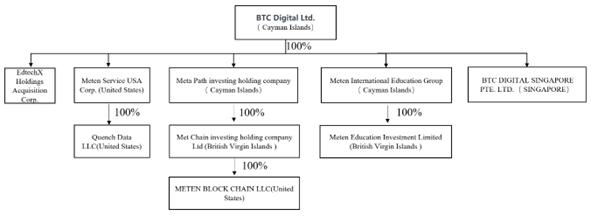
The SEC maintains a website at www.sec.gov that contains reports, proxy and information statements, and other information regarding issuers that file electronically with the SEC using its EDGAR system.
See “Item 5. Operating and Financial Review and Prospects — B. Liquidity and Capital Resources — Capital Expenditures” for a discussion of our capital expenditures.
| B. | Business Overview |
Blockchain and Cryptocurrency Mining Overview
Blockchain is the ledger technology that underlies bitcoin and other cryptocurrencies. The concept was first introduced in 2008 in the form of an anonymous whitepaper that laid out the purpose and the technology behind bitcoin. The first bitcoin was created in 2009.
A blockchain is a decentralized, distributed and encrypted digital public ledger that stores information in a secure, verifiable and permanent way. An advantage of blockchain over other database technologies is that it is completely decentralized, meaning that no entity or computer owns and stores the full database, and blockchain guarantees the security of a record of data and generates trust without the need for a trusted third party. Instead, the blockchain ledger is partially distributed across computers that act as nodes in a peer-to-peer network, which requires every transfer or storage of information in the public ledger to be approved by the majority of nodes in the network.
29
A cryptocurrency is a type of decentralized, encrypted digital asset that acts as a medium of exchange and/or store of value. Cryptocurrencies are a popular application of blockchain technology, enabling transactions on the network to be settled, confirmed and stored in a distributed public ledger through a process called mining. Cryptocurrencies are not backed by a central bank or governmental entity, have no physical form and are usually not tied to a value index. Additionally, the supply of a cryptocurrency may be fixed. Bitcoin, for example, has a maximum supply of 21 million bitcoin, which is expected to be reached in 2140 and after which no additional bitcoin will be minted.
Cryptocurrencies have recently gained extensive mainstream attention as the cryptocurrency market value and adoption rates, both by retail and institutional investors, have experienced accelerated growth. We believe bitcoin specifically continues to gain more trust from investors and financial institutions as it demonstrates its fundamental role in the crypto economy, leading to many companies adopting bitcoin as an alternative to cash on their balance sheets.
We believe blockchain and cryptocurrencies serve multiple purposes and can make a significant impact across multiple business sectors. We believe cryptocurrencies have numerous advantages over fiat currencies, although there are potential risk factors that are not present with fiat currencies. Cryptocurrencies’ advantages include:
| ● | decentralized store of value, supply of which may not be influenced by the monetary policy of governmental authorities or financial institutions; |
| ● | providing simplified and direct access to financial services; |
| ● | encrypted and secure digital asset; |
| ● | immediate settlement of transactions without relying on an intermediary financial institution; and |
| ● | cryptocurrency can be converted to fiat currencies at prevailing market prices for the relevant cryptocurrency. |
Cryptocurrency mining and miners
Cryptocurrency mining is the process of using specialized, high-powered mining machines to perform complex cryptographic computations that validate cryptocurrency transactions and secure the blockchain ledger. Validated transactions are grouped into blocks that must satisfy specific protocol requirements, including proof-of-work, before being added to the blockchain. A miner that successfully validates and adds a new block to the blockchain typically receives block rewards and may also receive transaction fees associated with the transactions included in that block. Such digital assets may then be sold to generate revenue or retained for future use.
The Bitcoin network undergoes “halving” events, in which the block reward paid to miners for processing blocks is reduced by 50%. These events occur every 210,000 blocks, or approximately every four years. To date, the Bitcoin network has experienced four halving events. The initial block reward was 50 bitcoin per block, and the current block reward is 3.125 bitcoin per block. The most recent halving occurred in April 2024 at block 840,000, and the next halving is expected to occur in 2028. The halving mechanism results in a decreasing rate of new bitcoin issuance over time.
Mining pools
An individual miner’s daily expected rewards in mining a type of cryptocurrency are proportionate to its contribution to such cryptocurrency’s aggregate hash rate on its network. However, given the nature of how mining process works, the chance of successfully mining blocks is probabilistically determined by the law of large numbers and there is significant variance involved in mining, especially for individual miners. To address this issue, miners have recently explored methods to increase their probability of being awarded coins by pooling their processing resources into a “mining pool.” A mining pool is a platform where miners contribute their computing power to jointly mine cryptocurrencies and share mining rewards in proportion to the amount of hashing power contributed by each participant. By participating in a mining pool, a miner is more likely to receive a smaller, yet steady, stream of mining rewards. The mining pool operator and the pool software arranges the pool in terms of miners’ hashing capacity, work conducted and rewards earned.
30
Mining machines
Bitcoin is mined on specialized computers that utilize an algorithm to guarantee the integrity of blocks in the blockchain using a specific hash function to solve the algorithm. The hash function can be efficiently computed on a special mining device called ASIC using the SHA-256 cryptography algorithm, which is the block hashing algorithm used by the bitcoin network to hash new blocks on the blockchain. SHA stands for Secret Hash Algorithm, and it converts any input into a 32-byte output, creating output data hashes that always have 256 digits. The main suppliers of bitcoin mining rigs are Bitmain and MicroBT, each of which control a significant amount of the market of mining machines, with other major suppliers including Ebang and Canaan.
Mining machines are rewarded in bitcoin and transaction fees in proportion to their processing contribution to the network. Mining machines are relatively energy intensive and produce a high amount of heat. To operate mining machines efficiently at a low cost, mining companies endeavor to procure low-cost energy sources and implement efficient cooling methods.
Performance metrics
Network hash rate
Mining hardware conducts complex computations to verify transactions in the blockchain and is measured in “hash rate” or “hashes per second.” “Hash rate” is defined as the speed at which a computer can take any set of information and turn it into letters and numbers of a certain length, known as a “hash.” A “hash” is the computation run by mining hardware in support of the blockchain; therefore, a miner’s “hash rate” refers to the rate at which it is capable of solving such computations. The total hash rate is a measure of the computing power of the network. A participant in a blockchain network’s mining function has a hash rate total of mining hardware deployed by such participant seeking to mine a specific digital asset and, network-wide, there is a total hash rate of all miners seeking to mine each specific type of digital asset. If a mining participant has a higher total hash rate than the blockchain network’s total hash rate, this participant generally sees a higher success rate in digital asset rewards over time as compared to other mining participants with relatively lower total hash rates.
Mining Difficulty
Mining difficulty refers to the level of process power, or hash rate, required for solving and authenticating a complex cryptographic block. Mining difficulty automatically adjusts by increasing or decreasing the computing requirement for verifying a block when there is a corresponding increase or decrease in the total hash rate of a network. The higher the number of mining machines in the network effectively results in a higher mining difficulty. As more processing power is added to the network, the difficulty increases.
The process of solving a block in the bitcoin network is tied to ten-minute increments. As miners are added or removed from the network and hash rate increases or decreases, difficulty must adjust periodically to maintain the ten-minute process. This periodic adjustment occurs every 2,016 blocks, which occurs approximately every two weeks.
We have not declared or paid dividends in the past, nor any dividends or distributions were made by a subsidiary or former VIE to our holding company. We do not intend to distribute dividends in the foreseeable future, but we do not have a fixed dividend policy. Our board of directors have complete discretion on whether to distribute dividends, subject to applicable laws. See “Item 3. Key Information—D. Risk Factors—Risks Related to Our Ordinary Shares—We are not expected to pay dividends on our ordinary shares in the foreseeable future.”
AI Computing Infrastructure
In April 2026, we completed the construction of our initial 10 megawatt (“MW”) computing infrastructure project in Georgia, United States. As of the date of this annual report, the facility has completed major construction and is undergoing power interconnection, which is expected to be completed in the first half of 2026. In connection with this development, we announced an initiative to expand its operations into AI computing infrastructure. We plan to develop AI computing capacity at the Georgia location in phases, with the timing, scope and scale of such development dependent on, among other factors, customer demand, availability of financing, and other market and business conditions.
The Company expects that any AI computing infrastructure, if developed, may be utilized for applications such as artificial intelligence model training and inference, high-performance computing and cloud-based services. However, this initiative remains at an early stage. As of the date of this annual report, the Company has not entered into any binding customer agreements, has not secured committed financing for this initiative, and has not generated any revenue from AI computing operations.
The Company expects that its digital asset mining operations will continue to represent a substantial portion of its business for the foreseeable future. There can be no assurance that the Company will successfully implement its expansion strategy or that AI computing infrastructure will become a significant component of its business.
31
Our Competitive Strengths
We believe that the following strengths differentiate us from our competitors:
Diversified Revenue Streams Allowing us to Mitigate Bitcoin Price Fluctuations
Through our subsidiaries, we started generating revenue through mining bitcoins and conducting a mining machines resale and rental business in the fiscal year ended December 31, 2023. For the fiscal year ended December 31, 2023, 31.8%, 60.5% and 7.7% of our total revenue was generated from bitcoin mining, mining machine resale and other mining-related business, respectively. For the fiscal year ended December 31, 2024, 10.2%, 78.1%, 10.1% and 1.6% of our total revenue was generated from bitcoin mining, mining machine resale, mining machine rental and other mining-related business, respectively. For the fiscal year ended December 31, 2025, 12.7%, 72.5%, 5.2% and 9.6% of our total revenue was generated from bitcoin mining, mining machine resale, mining machine rental and other mining-related business, respectively.
We commenced our cryptocurrency business with bitcoin mining. As of the date of this annual report, our subsidiaries owned 2,996 mining machines, all of which were in operation. Our mining machines are primarily located in Arkansas.
Historically, the market price of bitcoin has been highly volatile. In 2025, the trading price of bitcoin ranged from approximately $75,000 to over $126,000. The profitability of our bitcoin mining operations, and our results of operations, have been and may continue to be directly affected by the market price of bitcoin. To diversify our sources of mining-related revenue, we have also developed mining machine resale and rental businesses.
We have maintained a business relationship with AGM Technologies Ltd., from which we source mining machines on an order-by-order basis. In certain cases, such sourcing arrangements may allow us to acquire mining machines at prices below prevailing market prices. We may resell mining machines when market conditions are favorable, including when supply is limited and resale prices are attractive. In addition, from time to time, we rent mining machines to customers pursuant to commercial arrangements designed to generate cash flow from our mining fleet.
We believe that diversified revenue streams may help reduce our exposure to bitcoin price volatility and support the long-term development of our business.
Dedicated Team and Efforts Towards Compliance with Cryptocurrency Laws and Regulations
Over the past few years, countries and regulatory bodies worldwide have implemented an increasing number of laws and regulations on cryptocurrencies. As a new entrant into the cryptocurrency industry, we have dedicated efforts to ensure compliance with cryptocurrency laws and regulations. Towards this goal, we have set up a compliance team, led by our chief executive officer, Mr. Siguang Peng, and comprised of experienced industry professionals and experts and external consultants. The compliance team has the right to veto any operational decision of the Company if it suspects that such decision materially runs the risk of violating cryptocurrency laws and regulations. The compliance team also reviews and analyzes newly implemented regulatory policies, hold internal discussion and research sessions, and consults with industry experts on a regular basis to better its understanding of regulatory policies and implement compliance plans. We believe that our strong emphasis and dedication towards regulatory compliance will help us grow and succeed in the industry in the long run.
Experienced and Visionary Management Team and Partners of the Affiliated Company with Proven Track Records
Our management team is led by our co-founders Mr. Siguang Peng, Mr. Xu Peng and Mr. Yupeng Guo, each of whom has more than 18 years of senior management experience. Additionally, we formed a company (the “Affiliated Company”) focusing on cryptocurrency business, Met Chain Co., Ltd., in which we hold a total of 44.53% equity interests as of the date of this annual report, with Mr. Zhijun Liu, Ms. Yunning Li, Mr. Manning Liao, who have rich experience in the cryptocurrency and blockchain industries. For example, Mr. Zhijun Liu, who serves as a vice president of Hummer Miner, a technology company with a focus on the development and manufacturing of cryptocurrency machines, has extensive experience and expertise in the development of mining machines. Ms. Yunning Li, the former chief marketing officer of ChainPlus, has extensive experience in the cryptocurrency industry.
With their clear vision and long-term commitment to our business strategies, we have achieved success with our current business focus on mining small-cap cryptocurrencies and significant revenue growth in the past few years. We believe that in the future we will continue to benefit from our senior management team’s industry knowledge, diverse background and skills, and clear vision for our ongoing development.
32
Our Strategies
Through our subsidiaries, we plan to implement the following growth strategies:
Growing Our Current Business Lines
We believe that the cryptocurrency industry still has significant growth potentials, and we expect to continue growing our current cryptocurrency business lines through increasing the number of mining machines in our fleet in the future. Benefiting from higher combined hash rate, owning a large number of mining machines would allow us to increase our profitability derived from bitcoin mining when bitcoin prices are high, and gain more bargaining power in mining machines resale and rental operations. Growing our current business lines can also benefit us by further contributing to the diversification of our revenue streams and our continued growth and success.
Increasing Research and Development Efforts
The global cryptocurrency industry is characterized by rapid technological development and continual introduction of new models of mining machines. We believe that our future success depends largely on our ability to mine cryptocurrencies at faster pace and with greater computing power, lower energy costs, and lower environmental impact than our competitors.
Through the Affiliated Company, we have participated in the design and development of equipment dedicated for mining machines and infrastructure, including high voltage power supply, liquid-cooling systems, and hash boards. We plan to continue investing in research and development through our subsidiaries and the Affiliated Company and accumulate knowledge in the cryptocurrency industry. Specifically, we intend to explore the design and develop of proprietary ASIC mining machines dedicated to bitcoin mining. For details, see “— Research and Development.”
To support our subsidiaries’ research and development capabilities, we continued to maintain our existing research and development team and resources in 2025. We plan to further enhance our research and development capabilities as our business needs evolve. As of December 31, 2025, our subsidiaries had six members in their research and development team. Our subsidiaries will aim to attract talented persons specialized in algorithm optimization, software development, and mining machine design, and provide incentives to them for innovation, and continue building a strong research and development team.
Offering Crypto Asset Management Services
As the cryptocurrency industry continues to develop, we expect market demand for digital asset-related services to increase. In 2025, we expanded our service offerings by launching digital asset custody-related solutions. We continue to evaluate additional digital asset-related service offerings, which may include crypto wallet-related services and trust-related services, subject to market demand, regulatory requirements and our operational capabilities. We believe the expansion of our service offerings may help us better meet client needs and enhance our service value chain.
Strategic Expansion into AI Computing Infrastructure
We intend to leverage our existing site, power resources and experience in developing and operating computing infrastructure to support this initiative. We believe that our existing infrastructure assets, including our Georgia site and related power resources, together with our prior experience in computing infrastructure development, may provide an initial basis for the development of AI computing infrastructure. We may also seek to utilize modular deployment and other data center technologies that could support AI-related applications. However, this initiative remains at an early stage, and there can be no assurance that we will be able to successfully develop or operate AI computing infrastructure on a commercially viable basis. The timing, scope and scale of any such development will depend on a number of factors, including customer demand, access to capital, equipment availability, technological developments and other market and business conditions.
Competition
Mining is a constantly evolving business with a wide range of competition. Broadly, we compete with other companies that focus on mining bitcoin at a large scale. We face competition based on securing low-cost, reliable and renewable power, purchasing mining machines and other essential technology, buying or leasing sites to host our mining machines and ultimately producing hash rate. We also face competition in the ability to raise capital and hire qualified personnel.
Our competitors vary from solo enthusiasts to large corporations with significant scale of operations, including their own data centers. We compete with respect to hash rate, access to low-cost renewable power, operational efficiency, technological innovation and return on investment. We believe the recent increase in market prices for bitcoin and other digital assets has allowed new competition to enter the market and allowed existing competitors to access the requisite capital required to quickly scale their operations through large power contracts and additional miners. We expect this trend to continue as bitcoin and other digital assets continue to appreciate in value.
33
We believe that we have several competitive advantages that will be maintained and extended through execution of our strategy, including growing technology capacities, strong marketing team, and a leading management team. However, some of our competitors may have more resources than we do, and may be able to devote greater resources than we can to expand their business. With respect to our mining machines rental business and services offerings we expect to launch in the future, including crypto asset management services, we intend to offer competitive prices to attract more customers and enhance competitiveness.
Proof-of-stake networks also serve as competition to the bitcoin blockchain. As proof-of-stake algorithms create new blocks in a blockchain without resource intensive calculations to validate transactions, companies with significant advantages in terms of scale or low-cost power may be less competitive on a proof-of-stake network.
Cryptocurrency Mining Operations
Mining Machines
As of the date of this annual report, our subsidiaries own a total of 2,996 mining machines, which support our subsidiaries’ mining operations. As of the date of this annual report, all 2,996 mining machines owned by our subsidiaries were in operation.
Set forth below is a summary of each model of cryptocurrency mining machines our subsidiaries own as of the date of this annual report:
| Model | Total Mining Machines Under Operation | |||||
| 1 | Bitmain Antminer T21 190 TH/s | 400 | ||||
| 2 | Bitmain Antminer S21 Pro 234TH/s | 257 | ||||
| 3 | Bitmain Antminer S21 Pro 245TH/s | 177 | ||||
| 4 | Bitmain Antminer S19 XP 140TH/s | 269 | ||||
| 5 | Bitmain Antminer S19j Pro 100TH/s | 1,729 | ||||
| 6 | Bitmain Antminer L9 16G/16.5G | 164 | ||||
| Total: | 2,996 | |||||
Through the operation of these mining machines, our subsidiaries mined cryptocurrencies with an aggregate value of US$2.9 million, US$1.2 million and US$1.8 million for the fiscal years ended December 31, 2023, 2024 and 2025, respectively. As of December 31, 2025, our aggregate hash rate for all mining machines operated was approximately 390.1 PH/s.
Through our subsidiaries, we currently manage and operate our mining machines at a self-operated mining facility in Arkansas. We also equip these facilities with supporting staff to trouble shoot basic everyday technical difficulties. As of December 31, 2025, all the machines owned by our subsidiaries were under operation.
34
The following chart sets forth the details of the mining facilities with the location of our subsidiaries’ mining machines as of December 31, 2025:
| Location | Total Mining Machines | Machines Under Operation | Machines Not Under Operation | |||||||||
| 3101 AR-77, Manila, Arkansas 72442 | 2,996 | 2,996 | - | |||||||||
| Total: | 2,996 | 2,996 | - | |||||||||
Mining Pools
A mining pool is a platform where miners contribute their computing power to jointly mine cryptocurrencies and share mining rewards in proportion to the amount of hashing power contributed by each participant. In a mining pool, the mining process is repeated a large number of times by all of its participants. By aggregating every participant’s hash power, it is more likely for the mining pool to successfully mine any particular block. Mining pools can therefore mutualize the risk of mining and participants can share mining rewards on a pro rata basis depending on each miner’s contribution to computing power to the pool.
Through our subsidiaries, we mine bitcoins exclusively through participating in mining pools. We currently participate in two mining pools, BTC.com pool, and F2Pool, for bitcoin mining. For the fiscal year ended December 31, 2023, we mined 99.7607 bitcoins from participating in F2Pool. For the same year, we paid 0.5% of total bitcoins mined, or 0.4988 bitcoins, to F2Pool as pool fees. For the fiscal year ended December 31, 2024, we mined 19.959 bitcoins from participating in F2Pool. For the same year, we paid 0.5% of total bitcoins mined, or 0.0998 bitcoins, to F2Pool as pool fees. For the fiscal year ended December 31, 2025, we mined 14.127 bitcoins from participating in F2Pool. For the same year, we paid 0.8% of total bitcoins mined, or 0.1130 bitcoins, to F2Pool as pool fees.
Mining Results
We operate our bitcoin mining operations through our subsidiaries. In one respect, we measure the success of our operations by the value of the bitcoins our subsidiaries earn from their mining activities. We believe in the long term growth potential of bitcoins, and we tend to hold most of the bitcoins our subsidiaries mine. Nevertheless, as our subsidiaries continue to produce bitcoins, our subsidiaries may from time to time exchange bitcoins for fiat currency such as U.S. dollars to generate cash flow to fund our business operations, subject to a combination of market and operational conditions. As of the date of this annual report, we do not have a policy in place regarding when and how we will exchange our mined bitcoins for fiat currency and through what exchange. Currently, we do not maintain agreements with any third-party exchange on which we exchange cryptocurrencies into fiat currency.
As of the date of this annual report, we store all of our bitcoins in hot wallets. A hot wallet refers to any cryptocurrency wallet that is connected to the internet. Generally, hot wallets are easier to set up and access as compared to wallets in cold storage, but they are also more susceptible to hackers and other technical vulnerabilities. Cold storage is generally more secure than hot storage, but is not ideal for quick or regular transactions. In the near future, we intend to switch a portion of our bitcoin storage to cold wallets and use a combination of hot wallets and cold wallets for bitcoin storage in the future. We take a series of precaution measures to protect our bitcoins, including opening accounts on reputable and reliable exchanges, setting up complex passwords and changing passwords on a frequent basis, adopting two-factor authentication for log-in, avoid using public Wi-Fi for account access, and staying informed of latest cybersecurity threats.
35
Mining Machines Resale
In addition to cryptocurrency mining, we also engage in the resale of mining machines to generate revenue and diversify our sources of income. We source mining machines from suppliers on an order-by-order basis at negotiated prices and resell them based on market demand and pricing conditions.
In the fiscal year ended December 31, 2023, we sold 815 mining machines in total, with models including Antminer L7 9050 and Antminer L7 8800, to customers, generating revenue in the amount of US$5.5 million, or 60.5% of our total revenue for the fiscal year ended December 31, 2023, representing gross margin of 16.7%. In the fiscal year ended December 31, 2024, we sold 1,191 mining machines in total, with models including Antminer L7 9050 and Antminer L7 8800, to customers, generating revenue in the amount of US$9.1 million, or 78.1% of our total revenue for the fiscal year ended December 31, 2024, representing gross margin of 26.1%. In the fiscal year ended December 31, 2025, we sold 1,602 mining machines in total, with models including Antminer S21 XP and Antminer L9 16.5G, to customers, generating revenue in the amount of US$10.2 million, or 72.5% of our total revenue for the fiscal year ended December 31, 2025, representing a gross margin of negative 6.2%. .
For the fiscal year ended December 31, 2023, Skyline II Acquisition Corporation and Bitmain Technologies Ltd were our main suppliers for our mining machines resale operations, from whom we purchased mining machines in the amount of $4.6 million and $0.5 million, or 89.6% and 10.4%, respectively, of our total mining machine purchases. For the fiscal year ended December 31, 2024, Skyline II Acquisition Corporation, Bitmain Technologies Ltd and YM international CO LTD were our main suppliers for our mining machines resale operations, from whom we purchased mining machines in the amount of $5.5 million, $1.0 million and $0.3 million, or 80.8%, 14.5% and 4.7%, respectively, of our total mining machine purchases. For the fiscal year ended December 31, 2025, Skyline II Acquisition Corporation and EvolvX LLC were our main suppliers for our mining machine resale operations, from whom we purchased mining machines in the amount of US$9.5 million and US$1.3 million, or 87.7% and 12.3%, respectively, of our total mining machine purchases.
We enter into sales orders with mining machine purchasers. For the fiscal year ended December 31, 2023, we sold mining machines to a total of two customers, with sales to New Digital Trading Company Limited, and Morgogo Company Limited constituting 57.0% and 43.0% of our total sales, respectively. For the fiscal year ended December 31, 2024, we sold mining machines to a total of two customers, with sales to New Digital Trading Company Limited, and Morgogo Company Limited constituting 58.4% and 41.6% of our total sales, respectively. For the fiscal year ended December 31, 2025, we sold mining machines to a total of two customers, with sales to New Digital Trading Company Limited and Morgogo Company Limited constituting 44.2% and 55.8% of our total sales, respectively.
Mining Machines Rental
From time to time, we seek to rent out a greater percentage of our fleet at times when bitcoin prices are lower to generate cash flow. Given the fluctuating nature of bitcoin and market demand for mining capacity, we generally seek to rent out our machines for short-term or fixed-term periods based on prevailing market conditions and negotiated commercial terms. We enter into a rental agreement with customers for rental fees calculated based on the total bitcoins mined and the customers will bear the costs of electricity used in such machines’ mining activities. The mining machines rented out will not be physically transferred to the customers’ premises and will still be operated at our hosting facilities.
For the fiscal year ended December 31, 2023, we generated US$0.3 million in revenue from mining machines rental business, representing 2.8% of our total revenue for the fiscal year ended December 31, 2023. In the same fiscal year, we generated rental fees in the amount of US$0.3 million from one customer, DDACE LTD, representing 100% of total rental fees generated.
36
For the fiscal year ended December 31, 2024, we generated US$1.2 million in revenue from our mining machine rental business, representing 10.1% of our total revenue for the fiscal year. In the same fiscal year, we generated US$1.2 million in rental fees from one customer, DDACE LTD, representing 100% of our total rental revenue.
For the fiscal year ended December 31, 2025, we generated US$0.7 million in revenue from our mining machine rental business, representing 5.2% of our total revenue for the fiscal year. In the same fiscal year, we generated US$0.7 million in rental fees from one customer, DDACE LTD, representing 100% of our total rental revenue.
Suppliers
Our subsidiaries value the quality and computing power of their mining machines and, as such, our subsidiaries carefully evaluate potential suppliers. In particular, our subsidiaries take into account factors including, but not limited to, a potential supplier’s operating history, operational scale, industry reputation, product quality, quality control effectiveness, technological expertise, pricing, reliability, and customer services. Our subsidiaries do not maintain strategic framework agreements or long-term procurement agreements with any of the suppliers, and our subsidiaries purchase mining machines from suppliers on an order-by-order basis. Despite that, during the fiscal years ended December 31, 2023, 2024 and 2025, our subsidiaries did not experience any significant difficulties in procuring mining machines.
For the fiscal year ended December 31, 2023, Bitmain Technologies Ltd was our main supplier for the mining machines used in our bitcoin mining operations, from which we purchased $5.32 million of mining machines, representing 100% of the total mining machines purchased for use in our bitcoin mining operations during the fiscal year. For the fiscal year ended December 31, 2024, our newly added mining machines primarily came from our purchases from Bitmain Technologies Ltd in 2023. For the fiscal year ended December 31, 2025, GA Site Management 2, Inc., E-Smart Global Technology Co., Limited, and E2M TECHNOLOGY LIMITED were our main suppliers for the mining machines used in our mining operations, from which we purchased mining machines in the amounts of $2.3 million, $0.3 million and $0.3 million, respectively, representing approximately 80.6%, 10.4% and 9.0%, respectively, of our total mining machine purchases during the fiscal year.
Marketing and Sales, Distribution and Logistics
We rely primarily on word-of-mouth referrals as a marketing tool for our business. For the fiscal year ended December 31, 2025, all of the operating entities’ clients have come through referrals from existing clients. As of the date of this annual report, we have three members in our marketing and branding team. Our marketing team also connects with potential customers through organizing and participating in cryptocurrency events and conferences, and maintains relationship with existing customers through visits and social events.
Research and Development (“R&D”)
Research and development are key to our future innovation and business growth, and we intend to devote significant resources in the research and development of products and services complementary to our bitcoin mining operations.
We also place a strong emphasis on building our subsidiaries’ research and development team. As of December 31, 2025, the operating entities employed a total of six full-time PRC individuals in their research and development team. Many members of the operating entities’ research and development team have prior work experience in blockchain and cryptocurrency and information technology.
Intellectual Property
We do not currently own any intellectual properties in connection with our existing technologies. However, we may in the future rely upon patents, trade secrets, trademarks, service marks, trade names, copyrights or other intellectual property rights. In addition, we expect to continue developing our technologies to enhance our operational efficiency.
37
Employees
We had 20, 21, and 26 full-time employees as of December 31, 2023, 2024 and 2025, respectively. The following table sets forth the number of our employees by function as of December 31, 2025:
| Function | Total | |||
| Management | 4 | |||
| General and administration | 22 | |||
| Total | 26 | |||
All of our 26 employees reside in the PRC. Our officers, including our chief executive officer, Siguang Peng, and our acting chief financial officer, Yupeng Guo, reside in the PRC.
We believe that our success and continued growth depend on our ability to attract, retain, and motivate qualified employees. Through our subsidiaries, we offer our employees competitive salaries, comprehensive training, and other fringe benefits and incentives. We believe that through our subsidiaries, we maintain a good working relationship with our employees, and we have not experienced any material labor disputes or work stoppages. None of our employees or PRC individuals are represented by labor unions, and no collective bargaining agreement has been put in place.
Through our subsidiaries, we enter into standard employment agreements, non-compete agreements, and confidentiality agreements with our employees. Our employees are not covered by any collective bargaining agreement. We believe that we maintain a good working relationship with our employees, and we have not experienced any significant labor disputes as of the date of this annual report.
Environmental Initiatives
For the fiscal years ended December 31, 2023, 2024, and 2025, the total electricity fees we paid in connection with bitcoin mining operations were US$2.2 million, US$0.9 million, and US$1.6 million, respectively, and the costs per kilowatt hour for the respective period were US$0.08, US$0.067, and US$0.045 per kWh.
We are aware of the amount of energy the operating entities use in their business activities and we intend to expand our energy-saving efforts in the future. Specifically, we intend to develop products complementary to our operations that are able to provide greater energy efficiency. Furthermore, accessibility and availability of renewable energy has always been and will continue to be a significant factor in our evaluation process for selecting the sites of operations. We believe that growing with sustainability is important for our success in the long run.
Insurance
We and our subsidiaries do not currently maintain any commercial insurance. As such, we are susceptible to losses including property damage, accidents, or liabilities. In the event that such damages are substantial, we may experience materially negative impact on our business operations, financial condition, and results of operations. See “Item 3. Key Information—D. Risk Factors — Risks Related to Our Business and Industry — The operating entities’ mining operations, including the sites in which their mining machines are operated or that are currently under construction, may experience damages, including damages that are not covered by insurance.”
Seasonality
Mining machines are relatively energy intensive and produce a high amount of heat. Typically, machines operate more efficiently in the colder seasons when operators do not need to utilize as many cooling methods. Additionally, dry seasons may lead to a shortage in power supply, which can negatively impact the business operations of the operating entities if they experience power supply interruption. See “Item 3. Key Information—D. Risk Factors — Risks Related to Our Business and Industry — As the operating entities develop their blockchain and cryptocurrency business, our total revenue and cash flow will become materially dependent on the market value of digital assets and the volume of digital assets received from our mining efforts. If such market value or volume declines, our business, operating results and financial condition would be adversely affected.”
38
Results of our business operations are largely influenced by the market value of bitcoins, and bitcoin bears and bulls are tied to its halving schedule. For details on halving, see “Item 3. Key Information—D. Risk Factors — Risks Related to Our Business and Industry — The reward for adding new blocks to the bitcoin blockchain is subject to halving, and the value of bitcoin may not adjust to compensate us for the reduction in the rewards we receive from our mining efforts.”
Material Contracts
On February 7, 2025, the Company, through its subsidiary, entered into a Land Purchase and Sale Agreement for the acquisition of real property located at 551 Roseburg Rd, Vienna, Dooly County, Georgia 31092 for a purchase price of US$1,870,000. The transaction closed on May 15, 2025.
Government Regulation
Government regulation of blockchain, digital assets and cryptocurrency mining in the United States continues to evolve at the federal and state levels. Our business may be affected by laws, regulations and regulatory guidance relating to, among other things, digital assets, anti-money laundering, sanctions compliance, energy usage, environmental disclosures, banking access and the operation of cryptocurrency mining facilities. In addition, if we expand or modify our service offerings from time to time, including custody-related or other digital asset-related services, we may become subject to additional regulatory requirements, licensing obligations or compliance burdens. We cannot predict the timing, scope or effect of future regulatory developments on our business, financial condition or results of operations.
Certain digital asset-related activities, including the transmission, custody or execution of transactions involving digital assets, may be subject to federal and state laws and regulations, including anti-fraud, anti-money laundering, sanctions and other compliance requirements. Regulatory approaches may vary significantly by jurisdiction, and new legislation, agency guidance or enforcement activity could affect the manner in which we conduct our mining operations and any related service offerings.
Regulatory developments affecting the banking sector may also affect companies operating in the digital asset industry, including our ability to access banking, payment and other financial services. In 2025, U.S. banking regulators took a number of actions affecting the treatment of crypto-asset activities by regulated banks. In March 2025, the FDIC rescinded its prior notification requirement for FDIC-supervised institutions engaging in permissible crypto-related activities. In April 2025, the Federal Reserve withdrew certain prior crypto-asset and dollar-token related guidance. In March 2025 and May 2025, the Office of the Comptroller of the Currency (the “OCC”) issued interpretive guidance confirming that certain crypto-asset custody and related execution activities may be permissible for national banks and federal savings associations, subject to applicable law and safe and sound banking practices. These developments may affect the availability and terms of banking relationships for participants in the digital asset industry, including us.
Recent statements and guidance from the SEC and the Commodity Futures Trading Commission (“CFTC”) indicate that certain digital assets, including Bitcoin, may be treated as “digital commodities” rather than securities under U.S. federal securities laws. However, the regulatory framework for digital assets remains evolving, and the classification of any particular digital asset depends on the specific facts and circumstances, including its structure, use, and the manner in which it is offered and sold. Accordingly, there can be no assurance that regulatory authorities will not adopt differing interpretations or that future rulemaking or legislation will not materially alter the current regulatory landscape.
39
We also face potential regulatory developments relating to environmental and energy matters. In March 2024, the SEC adopted final climate-related disclosure rules, although in March 2025 the SEC voted to end its defense of those rules in litigation. In addition, U.S. government agencies have shown interest in collecting and analyzing electricity usage information relating to cryptocurrency mining operations. Future federal, state or local requirements relating to energy usage, environmental disclosures or the operation of mining facilities could increase our compliance obligations or operating costs.
| C. | Organizational Structure |
The Company is the parent company of a number of subsidiaries held directly and indirectly which operate and are incorporated around the world. All of the Company’s subsidiaries are all, directly or indirectly, owned by the Company. See the Subsidiaries of the Company included as Exhibit 8.1 to this Annual Report for a list of significant subsidiaries.
| D. | Property, Plants and Equipment |
Leases
The Company’s wholly-owned subsidiary, Quench Data LLC, entered into an Assignment of Lease, pursuant to which it assumed the lease of a facility located at 3101 AR-77, Manila, Arkansas 72442. The initial lease term is one year, commenced on May 16, 2024, with automatic renewal for successive one-year periods unless and until either party provides written notice of termination of the lease.
ITEM 4A UNRESOLVED STAFF COMMENTS
None.
ITEM 5. OPERATING AND FINANCIAL REVIEW AND PROSPECTS
Management’s Discussion and Analysis of Financial Condition and Results of Operations
You should read the following discussion and analysis of our financial condition and results of operations together with our consolidated financial statements and related notes appearing elsewhere in this Annual Report. Some of the information contained in this discussion and analysis, including information with respect to our plans and strategy for our business and our expectations with respect to liquidity and capital resources, includes forward-looking statements. These forward-looking statements are subject to numerous risks and uncertainties, including, but not limited to, those risks and uncertainties described in “Item 3. Key Information—D. Risk Factors” and “Cautionary Note on Forward-Looking Statements” sections in this Annual Report. Our actual results could differ materially from the results described in or implied by these forward-looking statements.
Overview
BTC Digital Ltd. (“we”, “us” “our” and the “Company”) is a crypto asset technology company based in the U.S. with a focus on bitcoin mining. We also generate revenue through mining machines resale, mining machine rental and miner hosting services.
40
In fiscal year 2025, a substantial majority of our revenue was generated from bitcoin mining, mining machine resale and mining machine rental activities. We also generated revenue from miner hosting services. We may from time to time exchange bitcoin mined for fiat currency to generate cash flow to fund our business operations. We attribute our growth since we launched our crypto asset business in 2022 to our competitive strengths in diversified revenue streams, dedicated team and efforts towards regulatory compliance, and our experienced and visionary management team.
As of December 31, 2025, we owned a total of 2,996 mining machines. As of the same date, the aggregate hash rate of our bitcoin mining machines in operation was approximately 390.1 PH/s. We manage and operate our mining machines at our facility in Arkansas. For the fiscal year ended December 31, 2025, we mined a total of 14.127 bitcoin and also mined Dogecoin and Litecoin, generating aggregate mining revenue of US$1.8 million.
Historically, the price of bitcoin has fluctuated significantly. The profitability of our bitcoin mining operations and our results of operations have been and will continue to be directly affected by the market price of bitcoin. To mitigate these risks and diversify our revenue streams, we have also developed mining machine resale and rental businesses. We source mining machines from suppliers on an order-by-order basis at negotiated prices and resell them based on market demand and pricing conditions. In addition, we may from time to time rent out mining machines to customers under agreed commercial terms in order to generate cash flow.
We believe research and development capabilities are important to our long-term growth and may enhance our mining efficiency, power efficiency and ability to expand our service and product offerings. Through collaborative arrangements, including the Joint Venture (as defined below), we have been involved in research relating to mining machines and related infrastructure. We plan to continue investing in research and development in line with our business needs.
| A. | Operating Results |
The following table sets forth a summary of our consolidated results of operations, both in absolute amounts and as a percentage of total net revenue, for the period indicated. This information should be read together with our consolidated financial statements and related notes included elsewhere in this report on Form 20-F. The operating results in any period are not necessarily indicative of the results that may be expected for any future period.
| Years ended December 31, | ||||||||||||||||||||||||
| 2023 | 2024 | 2025 | ||||||||||||||||||||||
| US$ | % | US$ | % | US$ | % | |||||||||||||||||||
| Summary Consolidated Statements of Operations: | ||||||||||||||||||||||||
| Revenues | 9,073 | 100.0 | 11,675 | 100.0 | 14,041 | 100.0 | ||||||||||||||||||
| Cost of revenues | (10,208 | ) | (112.5 | ) | (11,560 | ) | (99.0 | ) | (17,200 | ) | (122.5 | ) | ||||||||||||
| Gross profit/(loss) | (1,135 | ) | (12.5 | ) | 115 | 1.0 | (3,159 | ) | (22.5 | ) | ||||||||||||||
| Operating expenses: | ||||||||||||||||||||||||
| Selling and marketing expenses | (225 | ) | (2.5 | ) | (355 | ) | (3.0 | ) | (585 | ) | (4.2 | ) | ||||||||||||
| General and administrative expenses | (1,121 | ) | (12.4 | ) | (2,438 | ) | (20.9 | ) | (5,065 | ) | (36.1 | ) | ||||||||||||
| Loss from operations | (2,481 | ) | (27.3 | ) | (2,678 | ) | (22.9 | ) | (8,809 | ) | (62.7 | ) | ||||||||||||
| Realized gain on exchange of digital assets | 34 | 0.4 | 713 | 6.1 | (418 | ) | (3.0 | ) | ||||||||||||||||
| Interest income | 1 | - | - | - | 191 | 1.4 | ||||||||||||||||||
| Interest expenses | (63 | ) | (0.7 | ) | (48 | ) | (0.4 | ) | (62 | ) | (0.4 | ) | ||||||||||||
| Equity in income on equity method investments | 12 | 0.1 | 75 | 0.6 | 91 | 0.6 | ||||||||||||||||||
| Other, net | (327 | ) | (3.6 | ) | (51 | ) | (0.4 | ) | (54 | ) | (0.4 | ) | ||||||||||||
| Loss before income tax | (2,824 | ) | (31.1 | ) | (1,989 | ) | (17.0 | ) | (9,061 | ) | (64.5 | ) | ||||||||||||
| Income tax expense | - | - | - | - | - | - | ||||||||||||||||||
| Net loss | (2,824 | ) | (31.1 | ) | (1,989 | ) | (17.0 | ) | (9,061 | ) | (64.5 | ) | ||||||||||||
41
For the years Ended of December 31, 2025 Compared to the years Ended of December 31, 2024
Revenues
| Years ended December 31, | ||||||||||||||||||||||||
| 2023 | 2024 | 2025 | ||||||||||||||||||||||
| US$ | % | US$ | % | US$ | % | |||||||||||||||||||
| Cryptocurrency mining | 2,882 | 31.8 | 1,190 | 10.2 | 1,790 | 12.7 | ||||||||||||||||||
| Mining machines resale | 5,485 | 60.5 | 9,124 | 78.1 | 10,177 | 72.5 | ||||||||||||||||||
| Mining machine rental and hosting | 706 | 7.7 | 1,361 | 11.7 | 2,074 | 14.8 | ||||||||||||||||||
| Total | 9,073 | 100.0 | 11,675 | 100.0 | 14,041 | 100.0 | ||||||||||||||||||
Our total revenue increased by 20.3% from US$11.7 million in the years ended December 31, 2024 to US$14.0 million in the years ended December 31, 2025. This was primarily due to (i) an increase in revenue from mining machines resale from US$9.1 million in 2024 to US$10.2 million in 2025, mainly driven by an increase in the number of mining machines sold from 1,191 units in 2024 to 1,602 units in 2025, partially offset by a decrease in the average selling price per unit from approximately US$7,700 in 2024 to approximately US$6,400 in 2025, due to changes in product mix and market pricing conditions for mining machines; (ii) the increase in cryptocurrency mining revenue by 50.4% from US$1.2 million to US$1.8 million, primarily due to an increase in the Company’s average operating hash rate during 2025, together with a higher average bitcoin market price during the year, partially offset by increases in network mining difficulty, and (iii) an increase in mining machine rental and hosting services revenue from US$1.4 million in 2024 to US$2.1 million in 2025, mainly driven by the launch and rapid growth of the Company’s mining machine hosting services in 2025. The hosting services generated revenue of over US$1.0 million in 2025.
Cost of Revenues
Our total cost of revenues increased by 48.8% from US$11.6 million in the years ended December 31, 2024 to US$17.2 million in the years ended December 31, 2025. This increase was primarily attributable to increased sales volume in our mining machine resale operations and higher costs associated with our cryptocurrency mining and other mining-related businesses.
Gross Profit and Gross Profit Margin
As a result of the foregoing, our gross profit decreased from US$115 thousand for the year ended December 31, 2024 to a gross loss of US$3.2 million for the year ended December 31, 2025. Our gross profit margin decreased from 1.0% in 2024 to negative 22.5% in 2025. The decrease was primarily attributable to the significant decline in profitability of our mining machines resale business, which was adversely affected by volatility in cryptocurrency market conditions and demand for mining machines during 2025. As a result, selling prices and gross margins for certain mining machine resale transactions were under pressure, and the selling prices for certain transactions were not sufficient to cover the related purchase costs and direct costs. In addition, our cryptocurrency mining and mining-related hosting operations incurred relatively high direct operating costs, including electricity, facility operating costs and depreciation, which further contributed to the gross loss in 2025.
Selling and Marketing Expenses
Our selling and marketing expenses increased from US$355 thousand in the years ended December 31, 2024 to US$585 thousand in the years ended December 31, 2025. This increase was primarily due to the growth in our mining machine resale business.
42
General and Administrative Expenses
Our general and administrative expenses increased by 107.8% from US$2.4 million in the years ended December 31, 2024 to US$5.1 million in the years ended December 31, 2025. This increase was primarily attributable to (i) employee stock option plan expenses of US$1.8 million, and (ii) the expansion of the Company’s business and the hiring of additional employees, which resulted in a corresponding increase in related expenses.
Interest Expenses
Our interest expenses increased from US$48 thousand in the years ended December 31, 2024 to US$62 thousand in the years ended December 31,2025. This increase is consistent with the increase in short-term loans.
Realized gain on exchange of digital assets
Our Realized gain on exchange of digital assets changed from a realized gain of US$713 thousand to a realized loss of US$418 thousand. This was primarily attributable to fluctuations in the market price of bitcoin and the timing and pricing of our exchanges of digital assets during 2025.
Equity in Income on Equity Method Investments
Our gain on equity method investments was US$75 thousand and US$91 thousand for the years ended December 31, 2024 and 2025, respectively.
Loss Before Income Tax
As a result of the foregoing, we had a loss before income tax of US$2.0 million in the years ended December 31, 2024, as compared to a loss before income tax of US$9.1 million in the years ended December 31, 2025.
Net Loss
As a result of the foregoing, we had a net loss of US$2.0 million in the years ended December 31, 2024, as compared to a net loss of US$9.1 million in the years ended December 31, 2025.
Non-GAAP Financial Measures
To supplement our consolidated financial statements which are presented in accordance with U.S. GAAP, we also use adjusted net income and adjusted EBITDA as additional non-GAAP financial measures. We present these non-GAAP financial measures because they are used by our management to evaluate its operating performance. We also believe that such non-GAAP financial measures provide useful information to investors and others in understanding and evaluating our consolidated results of operations in the same manner as our management and in comparing financial results across accounting periods and to those of its peer companies.
Adjusted net income and adjusted EBITDA should not be considered in isolation or construed as alternatives to net income/(loss) or any other measure of performance or as indicators of our operating performance. Investors are encouraged to compare the historical non-GAAP financial measures with the most directly comparable GAAP measures. Adjusted net income and adjusted EBITDA presented here may not be comparable to similarly titled measures presented by other companies. Other companies may calculate similarly titled measures differently, limiting their usefulness as comparative measures to our data. We encourage investors and others to review our financial information in its entirety and not rely on a single financial measure.
43
Adjusted net loss represents net loss before share-based compensation. The table below sets forth a reconciliation of our adjusted net loss for the periods indicated:
| Years ended December 31, | ||||||||||||
| 2023 | 2024 | 2025 | ||||||||||
| US$ | US$ | US$ | ||||||||||
| (in thousands) | ||||||||||||
| Net loss | (2,824 | ) | (1,989 | ) | (9,061 | ) | ||||||
| Add: | ||||||||||||
| Share-based compensation expenses | 138 | 571 | 1,827 | |||||||||
| Adjusted net loss | (2,686 | ) | (1,418 | ) | (7,234 | ) | ||||||
In addition, adjusted EBITDA represents the net loss before net interest loss, income tax expenses, depreciation and amortization, and excluding share-based compensation expenses. The table below sets forth a reconciliation of our adjusted EBITDA for the periods indicated:
| Years ended December 31, | ||||||||||||
| 2023 | 2024 | 2025 | ||||||||||
| US$ | US$ | US$ | ||||||||||
| (in thousands) | ||||||||||||
| Net loss | (2,824 | ) | (1,989 | ) | (9,061 | ) | ||||||
| Subtract: | ||||||||||||
| Net interest income/(loss) | (62 | ) | (48 | ) | 129 | |||||||
| Add: | ||||||||||||
| Income tax expense | - | - | - | |||||||||
| Depreciation and amortization | 3,151 | 3,671 | 4,141 | |||||||||
| EBITDA | 389 | 1,730 | (5,049 | ) | ||||||||
| Add: | ||||||||||||
| Share-based compensation expenses | 138 | 571 | 1,827 | |||||||||
| Adjusted EBITDA | 527 | 2,301 | (3,222 | ) | ||||||||
Taxation
Cayman Islands
We are incorporated in the Cayman Islands. Under the current law of the Cayman Islands, we are not subject to income or capital gains tax. In addition, dividend payments are not subject to withholding tax in the Cayman Islands.
British Virgin Islands
Under the current laws of the British Virgin Islands, companies formed in the British Virgin Islands are not subject to tax on income or capital gains.
Delaware
The Delaware corporate tax rate is 8.7%. This tax rate applies to limited liability companies that elect to be treated as corporations and report net taxable income. Our subsidiary, Meten Block Chain LLC was formed in Delaware and elects to be treated as a corporation for tax purposes.
44
Hong Kong
Our wholly-owned subsidiary in Hong Kong, Meten Education (Hong Kong) Limited, is subject to an income tax rate of 16.5% for taxable income earned in Hong Kong. No Hong Kong profit tax has been levied in our consolidated financial statements as Meten Education (Hong Kong) Limited had no assessable income for the years ended December 31, 2024 and 2025.
Critical Accounting Policies
We prepare our financial statements in accordance with U.S. GAAP, which requires our management to make judgment, estimates and assumptions that affect our reporting of, among other things, assets and liabilities, contingent assets and liabilities and revenue and expenses. We continually evaluate these judgments, estimates and assumptions based on our own historical experience, knowledge and assessment of relevant current business and other conditions, our expectations regarding the future based on available information and various assumptions that we believe to be reasonable, which together form our basis for making judgments about matters that are not readily apparent from other sources. Since the use of estimates is an integral component of the financial reporting process, our actual results could differ from those estimates. Some of our accounting policies require a higher degree of judgment than others in their application.
The selection of critical accounting policies, the judgments and other uncertainties affecting the application of those policies and the sensitivity of reported results to changes in conditions and assumptions are factors that should be considered when reviewing our financial statements. We believe the following accounting policies involve the most significant judgments and estimates used in the preparation of our financial statements. You should read the following description of critical accounting policies, judgments and estimates in conjunction with our consolidated financial statements and other disclosures included herein.
Share-based compensation
Share-based compensation costs are measured at the grant date. The compensation expense in connection with the shares awarded to employees is recognized using the straight-line method over the requisite service period. Forfeitures are estimated at the time of grant, with such estimate updated periodically and with actual forfeitures recognized currently to the extent they differ from the estimate. In determining the fair value of the shares awarded to employees, the discounted cash flow pricing model has been applied.
| B. | Liquidity and Capital Resources |
Our principal sources of liquidity have been cash generated from operating activities, proceeds from financing activities and, to a lesser extent, our holdings of digital assets, which may be converted into fiat currency from time to time. As of December 31, 2023, 2024 and 2025, we had cash and cash equivalents of US$43,000, US$14.9 million and US$350,000, respectively. As of December 31, 2025, we also held digital assets of US$7.6 million. Cash and cash equivalents consist of cash on hand, deposits with banks or other financial institutions and highly liquid investments that are unrestricted as to withdrawal and use and have original maturities of three months or less when purchased.
As of December 31, 2025, the Company had a relatively low cash and cash equivalents balance of US$350,000 and recorded a net loss of US$9.1 million for the year ended December 31, 2025. In addition, the Company recorded a gross loss and net cash used in operating activities of US$5.3 million for the year ended December 31, 2025. These conditions raised substantial doubt about the Company’s ability to continue as a going concern.
Management has evaluated these conditions and our liquidity plans. These plans include, but are not limited to, generating cash flows from our mining, mining machine resale, rental and hosting businesses, collecting outstanding receivables, including certain receivables collected subsequent to year-end, controlling operating expenses and capital expenditures, liquidating digital assets when necessary, and seeking additional financing through equity or debt financing. As of December 31, 2025, we held digital assets of US$7.6 million, which may be liquidated as needed to support our working capital requirements.
We believe that the above plans, if successfully implemented, together with our current available cash and cash equivalents, expected cash generated from operating activities, available digital asset holdings and available financing resources, will enable us to meet our anticipated working capital requirements and capital expenditure needs in the ordinary course of business for at least the next twelve months from the issuance date of the consolidated financial statements. However, there can be no assurance that we will be able to generate sufficient cash flows from operations, collect outstanding receivables, liquidate digital assets at favorable prices, or obtain additional financing on acceptable terms, or at all.
We may require additional cash resources due to changing business conditions or other future developments, including capital expenditures for our computing infrastructure business and any investment or acquisition we may decide to selectively pursue. If our existing cash resources are insufficient to meet our requirements, we may seek to sell equity or equity-linked securities, sell debt securities, borrow from banks or other financial institutions, or liquidate a portion of our digital asset holdings. We cannot assure you that financing will be available in the amounts we need or on terms acceptable to us, if at all, or that our digital assets can be liquidated at favorable prices due to market volatility. The sale of additional equity securities would result in additional dilution to our shareholders. The incurrence of indebtedness and issuance of debt securities would result in debt service obligations and could result in operating and financial covenants that restrict our ability to pay dividends to our shareholders.
45
The following table sets forth a summary of our cash flows for the periods presented:
| For the Years ended December 31, | ||||||||||||
| 2023 | 2024 | 2025 | ||||||||||
| US$ | US$ | US$ | ||||||||||
| (in thousands) | ||||||||||||
| Summary Consolidated Cash flow Data: | ||||||||||||
| Net cash generated from/(used in) operating activities | 3,808 | 1,557 | (5,258 | ) | ||||||||
| Net cash used in investing activities | (4,620 | ) | (7,000 | ) | (15,454 | ) | ||||||
| Net cash generated from financing activities | 807 | 20,300 | 6,162 | |||||||||
| Net increase/(decrease) in cash and cash equivalents | (5 | ) | 14,857 | (14,550 | ) | |||||||
| Cash and cash equivalents at the beginning of year | 48 | 43 | 14,900 | |||||||||
| Cash and cash equivalents at the end of year | 43 | 14,900 | 350 | |||||||||
Operating Activities
Net cash generated from operating activities amounted to US$3.8 million for the year ended December 31, 2023. The difference between our net loss of US$2.8 million and the net cash generated from operating activities was primarily due to (i) depreciation of US$3.1 million; (ii) increase in accounts receivable of US$3.4 million; and (iii) decrease in prepayments and other current assets of US$3.0 million; partially offset by (iv) decrease in accounts payable of US$3.3 million.
Net cash generated from operating activities amounted to US$1.6 million for the year ended December 31, 2024. The difference between our net loss of US$2.0 million and the net cash generated from operating activities was primarily due to depreciation of US$3.7 million.
Net cash used in operating activities amounted to US$5.3 million for the year ended December 31, 2025. The change from net cash generated from operating activities in 2024 to net cash used in operating activities in 2025 was mainly due to the significant increase in net loss, driven by the deterioration in gross margin and higher operating costs in 2025. The cash outflow was partially offset by non-cash depreciation and amortization and share-based compensation expenses. Operating cash flow was also negatively affected by increases in prepayments and other current assets and cryptocurrency assets, reflecting additional advance payments and digital assets generated or held from operating activities that had not been converted into cash as of year-end.
Investing Activities
Net cash used in investing activities amounted to US$4.6 million for the year ended December 31, 2023. This was primarily attributable to the repayment of advances from related parties of US$2.6 million, purchases of property and equipment of US$2.5 million.
Net cash used in investing activities amounted to US$7.0 million for the year ended December 31, 2024. This was primarily attributable to (i) the repayment of advances from related parties of US$4.7 million, and (ii) purchases of property and equipment of US$2.7 million.
Net cash used in investing activities amounted to US$15.5 million for the year ended December 31, 2025. This was primarily attributable to (i) purchases of digital assets of US$6.0 million, (ii) purchases of property and equipment of US$8.5 million, (iii) repayment of advances from related parties of US$0.5 million, and (iv) an advance to a third party of US$0.3 million.
46
Financing Activities
Net cash flow generated from financing activities amounted to US$0.8 million for the year ended December 31, 2023. This was primarily attributable to proceeds from short term loans of US$0.8 million.
Net cash flow generated from financing activities amounted to US$20.3 million for the year ended December 31, 2024. This was primarily attributable to the proceeds from the S-3 financing of US$19.9 million.
Net cash flow generated from financing activities amounted to US$6.2 million for the year ended December 31, 2025, which was primarily attributable to (i) proceeds from the S-3 financing of US$4.5 million; and (ii) the proceeds from short term loans of US$7.8 million, partially offset by (iii) repayment of short term loans of US$6.1 million.
| C. | Research and Development, Patents and Licenses, etc. |
See “Item 4. Information on the Company—B. Business Overview—Research and Development” and “—Intellectual Property.”
| D. | Trend Information |
Other than as disclosed elsewhere in this annual report, we are not aware of any trends, uncertainties, demands, commitments or events for the period from January 1, 2025 to December 31, 2025 that are reasonably likely to have a material effect on our net revenues, income, profitability, liquidity or capital resources, or that would cause the disclosed financial information to be not necessarily indicative of future operating results or financial conditions.
| E. | Critical Accounting Estimates |
Accounting estimates are an integral part of the financial statements prepared by management and are based on management’s knowledge and experience about past and current events and assumptions about future events. Critical accounting estimates are estimates for which (a) the nature of the estimate is material due to the levels of subjectivity and judgment necessary to account for highly uncertain matters or the susceptibility of such matters to change and (b) the impact of the estimate on financial condition or operating performance is material.
Uses of estimates
In preparing the consolidated financial statements in conformity with U.S. GAAP, management makes estimates and assumptions that affect the reported amounts of assets and liabilities, the disclosure of contingent assets and liabilities at the date of the consolidated financial statements, and the reported amounts of revenues and expenses during the reporting period. These estimates are based on information available as of the date of the consolidated financial statements. Actual results could differ from those estimates, and such differences may be material to the consolidated financial statements.
Significant estimates and judgments required to be made by management include, but are not limited to, revenue recognition, including the determination of whether revenue recognition criteria have been met and the fair value measurement of digital assets received from mining activities; the valuation and recoverability of accounts receivable and other receivables; the useful lives and recoverability of property, plant and equipment and other long-lived assets; the valuation and recoverability of equity method investments; the fair value measurement of digital assets; the fair value of share-based compensation awards; and lease liabilities and right-of-use assets.
47
Accounts receivable, net
We adopted ASU 2016-13, “Financial Instruments — Credit Losses (Topic 326): Measurement on Credit Losses on Financial Instruments”, including certain subsequent amendments, transitional guidance and other interpretive guidance within ASU 2018-19, ASU 2019-04, ASU 2019-05, ASU 2019-11, ASU 2020-02 and ASU 2020-03 (collectively, including ASU 2016-13, “ASC 326”) on July 1, 2022 using the modified retrospective transition approach. ASC 326 introduces an approach based on expected losses to estimate the allowance for credit losses, which replaces the previous incurred loss impairment model. The Company’s estimation of allowance for credit losses consider factors such as historical collection experience and credit-worthiness of the debtors, as well as the age of the individual receivables balance.
We evaluate our accounts receivable for expected credit losses on a regular basis. The Company maintains an estimated allowance for credit losses to reduce its accounts receivable to the amount that it believes will be collected. We consider factors in assessing the collectability of our receivables, such as the age of the amounts due, the customer’s payment history, credit-worthiness and other specific circumstances related to the accounts. We adjust the allowance percentage periodically when there are significant differences between estimated bad debts and actual bad debts. If there is strong evidence indicating that the accounts receivable is likely to be unrecoverable, we also make specific. Our allowance for uncollectible balances as of the fiscal years ended December 31, 2024 and 2025 are disclosed in Note 5 of our accompanying consolidated financial statements.
Revenue recognition
We adopted ASC Topic 606 Revenue from Contracts with Customers (“ASC 606”) on April 1, 2019. Accordingly, the consolidated financial statements for the years ended December 31, 2023, 2024 and 2025 are presented under ASC 606. Under ASC 606, revenue is recognized when control of promised goods or services is transferred to the Company’s customers in an amount of consideration to which an entity expects to be entitled to in exchange for those goods or services. To determine revenue recognition for contracts with customers, we performs the following five steps: (i) identify the contract(s) with the customer, (ii) identify the performance obligations in the contract, (iii) determine the transaction price, including variable consideration to the extent that it is probable that a significant future reversal will not occur, (iv) allocate the transaction price to the respective performance obligations in the contract, and (v) recognize revenue when (or as) we satisfy the performance obligation. VAT that the Company collects concurrent with revenue-producing activities is excluded from revenue.
We recognize revenue for its products sold when it has satisfied a performance obligation by transferring significant risks and rewards of ownership of promised products to the customer. Furthermore, the customer obtains the legal title of and accepts the promised products at a specific time. For each performance obligation satisfied at a point in time, we recognizes revenue at a point in time by measuring whether the performance obligation has been met.
48
ITEM 6. DIRECTORS, SENIOR MANAGEMENT AND EMPLOYEES
| A. | Directors and Senior Management |
| Name | Age | Position | ||
| Siguang Peng | 48 | Chief Executive Officer and Director | ||
| Xu Peng | 46 | Director and Chairman of the Board of Directors | ||
| Yupeng Guo | 48 | Acting Chief Financial Officer | ||
| Ye Ren(1)(2)(3) | 37 | Independent Director and Chair of the Audit Committee | ||
| Zhiyi Xie(1)(2)(3) | 47 | Independent Director and Chair of the Compensation Committee | ||
| Yuejun Jiang(1)(2)(3) | 46 | Independent Director and Chair of the Nominating and Corporate Governance Committee |
| (1) | Member of the Audit Committee |
| (2) | Member of the Nominating and Corporate Governance Committee |
| (3) | Member of the Compensation Committee |
Siguang Peng is our founder and has served as our director and chief executive officer since inception. Prior to starting the former VIEs’ business in 2006, Mr. Peng served as director of teaching department and principal of Quanzhou School of King’s International from 2004 to 2006. Mr. Peng received his EMBA degree from China Europe International Business School in 2011 and his bachelor’s degree in international economics and trading from Changchun University of Science and Technology in 2000.
Xu Peng has served as the chairman of the Company’s board of directors since December 2023. Mr. Xu Peng served as the president of Hailuoda International Consulting Services Co., Ltd. in People’s Republic of China (the “PRC”), a company engaged in overseas trade and investment promotion in Hainan, the PRC, from July 2019 to November 2023, where he was overseeing and managing the overall operations of the company. From August 2012 to June 2019, Mr. Peng served as the president at Ziyou Emotional Intelligence Education Consulting Co., Ltd., an education services provider targeted at children and youth, where he was overseeing and managing the overall operations of the company. Mr. Peng obtained a bachelor’s degree in computer science from College of Applied Arts and Science of Beijing Union University in the PRC in 2003.
Yupeng Guo is our founder and has served as our director and vice president since inception. Prior to starting the former VIEs’ business in 2006, Mr. Guo served as director of marketing department of Quanzhou School of King’s International from 2005 to 2006. Mr. Guo received his EMBA degree from China Europe International Business School in 2012, his master’s degree in business administration from Shanghai Jiao Tong University in 2007 and his bachelor’s degree in trading and economics from Changchun University of Science and Technology in 2000.
Ye Ren has served as our independent director since June 2022. From August 2019 to March 2022, Ms. Ren served as chief financial officer of CN Energy Group Ltd. (Nasdaq: CNEY) where she was responsible for supervising finance team, reviewing and approving financial and accounting transactions, and financial regulation compliance. From April 2017 to July 2018, Ms. Ren served as the Deputy Finance Manager of Zhejiang Yongning Pharmaceutical Co., Ltd., where she was responsible for department budget and internal control. From December 2014 to March 2017, Ms. Ren served as an assistant of the chief financial officer of Tantech Holdings Ltd. From October 2013 to November 2015, Ms. Ren served as a senior auditor of Pan-China Certificated Public Accountants LLP. Ms. Ren obtained her bachelor’s degree in Business Administration from George Fox University in 2010 and her master’s degree in Accountancy from the University of South Carolina in 2013.
Zhiyi Xie has served as our independent director since August 2021. Mr. Zhiyi Xie has been the general manager of Shenzhen Shenghongtao Technology Co., Ltd. since April 2017. Prior to that, Mr. Xie served as the general manager of Shenzhen Haiyue Huifu Investment Management Co., Ltd. from 2016 to 2017. He served as the deputy general manager of Shenzhen Yipu Rui Venture Capital Co., Ltd. from 2010 to 2015. Mr. Xie served as the investment director of Shenzhen Dingchuan Investment Co., Ltd. from 2008 to 2010. Mr. Xie obtained his bachelor’s degree in law from Xiangtan University in 2000. He received his Lawyer’s Qualification Certificate and Fund Qualification Certificate in 2000 and 2017, respectively.
49
Yuejun Jiang has served as our independent director since May 2023. Mr. Yuejun Jiang founded Enotek Technology (Group) Co., Ltd. in the People’s Republic of China (“China” or the “PRC”) in 2008, a company providing full-service industrial logistics solutions to customers, and has since served as the company’s chairman of the board of directors. Mr. Jiang oversees the company’s overall operations and makes major corporate decisions. Mr. Jiang obtained a bachelor’s degree in law from China Central Radio and TV University (currently known as Open University of China) in 2014 and obtained an Executive MBA degree from Cheung Kong Graduate School of Business in the PRC in 2017. Mr. Jiang obtained his Doctor of Business Administration degree from Singapore Management University in 2025.
Executive Employment Agreements
We have entered into employment agreements with each of our executive officers for a specified time period providing that the agreements are terminable for cause at any time. The terms of these agreements are substantially similar to each other. A senior executive officer may terminate his or her employment at any time by 30-day prior written notice. We may terminate the executive officer’s employment for cause, at any time, without advance notice or remuneration, for certain acts of the executive officer, such as conviction or plea of guilty to a felony or any crime involving moral turpitude, negligent or dishonest acts to our detriment, or misconduct or a failure to perform agreed duties.
Each executive officer has agreed to hold in strict confidence and not to use, except for our benefit, any proprietary information, technical data, trade secrets and know-how of our company or the confidential or proprietary information of any third party, including our subsidiaries and clients, received by us. Each of these executive officers has also agreed to be bound by noncompetition and non-solicitation restrictions during the term of his or her employment and typically for two years following the last date of employment.
Family Relationships
There are no family relationships between or among any of the current directors, executive officers or persons nominated or charged to become directors or executive officers.
Board Composition
Our business and affairs are organized under the direction of our board of directors, which consists of 5 members. Our directors hold office until the earlier of their death, resignation, removal, or disqualification, or until their successors have been elected and qualified. Our board of directors does not have a formal policy on whether the roles of Chief Executive Officer and chairman of our board of directors should be separate. The primary responsibilities of our board of directors are to provide oversight, strategic guidance, counseling, and direction to our management. Our board of directors meets on a regular basis.
Director Independence
The Nasdaq Marketplace Rules require a majority of a listed company’s board of directors to be comprised of independent directors within one year of listing. In addition, the Nasdaq Marketplace Rules require that, subject to specified exceptions, each member of a listed company’s audit, compensation and nominating and corporate governance committees be independent and that audit committee members also satisfy independence criteria set forth in Rule 10A-3 under the Exchange Act.
50
Under Rule 5605(a)(2) of the Nasdaq Marketplace Rules, a director will only qualify as an “independent director” if, in the opinion of our board of directors, that person does not have a relationship that would interfere with the exercise of independent judgment in carrying out the responsibilities of a director. In order to be considered independent for purposes of Rule 10A-3 of the Exchange Act, a member of an audit committee of a listed company may not, other than in his or her capacity as a member of the audit committee, the board of directors, or any other board committee, accept, directly or indirectly, any consulting, advisory, or other compensatory fee from the listed company or any of its subsidiaries or otherwise be an affiliated person of the listed company or any of its subsidiaries.
Our board of directors has reviewed the composition of our board of directors and its committees and the independence of each director. Based upon information requested from and provided by each director concerning his background, employment and affiliations, including family relationships, our board of directors has determined that each of Ms. Ye Ren, Mr. Zhiyi Xie and Mr. Yuejun Jiang is an “independent director” as defined under Rule 5605(a)(2) of the Nasdaq Marketplace Rules. Our board of directors also determined that Ms. Ye Ren, Mr. Zhiyi Xie and Mr. Yuejun Jiang, who are members of our audit committee, our compensation committee, and our nominating and corporate governance committee, satisfy the independence standards for such committees established by the SEC and the Nasdaq Marketplace Rules, as applicable. In making such determinations, our board of directors considered the relationships that each such non-employee director has with our company and all other facts and circumstances our board of directors deemed relevant in determining independence, including the beneficial ownership of our capital stock by each non-employee director.
Code of Business Conduct and Ethics
We have adopted a written code of business conduct and ethics that applies to our employees, officers and directors. A current copy of the code is posted on the Corporate Governance section of our website, which is located at https://btct.investorroom.com/code-of-ethics. We intend to disclose future amendments to certain provisions of our code of business conduct and ethics, or waivers of such provisions applicable to any principal executive officer, principal financial officer, principal accounting officer or controller, or persons performing similar functions, and our directors, on our website identified above or in filings with the SEC.
| B. | Compensation |
Overview
For the fiscal year ended December 31, 2025, we and our subsidiaries paid aggregate cash compensation of approximately US377 thousand to our directors and executive officers as a group. We do not pay or set aside any amounts for pensions, retirement or other benefits for officers and directors.
The following table presents the compensation awarded to or earned by or paid to our named executive officers during the fiscal years ended December 31, 2025, 2024 and 2023.
| Name and Principal Position | Year (FY) | Salary ($) | Bonus ($) | Option Awards ($) | Non-Equity Incentive Plan Compensation ($) | Nonqualified Deferred Compensation Earnings ($) | All Other Compensation ($) | Total ($) | ||||||||||||||||||||||||
| Siguang Peng | 2025 | 198,000 | - | - | - | - | - | 198,000 | ||||||||||||||||||||||||
| 2024 | 60,000 | - | - | - | - | - | 60,000 | |||||||||||||||||||||||||
| 2023 | 10,200 | - | - | - | - | - | 10,200 | |||||||||||||||||||||||||
| Yupeng Guo | 2025 | 125,000 | - | - | - | - | - | 125,000 | ||||||||||||||||||||||||
| 2024 | 36,000 | - | - | - | - | - | 36,000 | |||||||||||||||||||||||||
| 2023 | 31,626 | - | - | - | - | - | 31,626 | |||||||||||||||||||||||||
51
Outstanding Equity Awards at Fiscal Year End
The following table summarizes for our employees, directors and service providers the outstanding options granted under the 2020 Plan as of December 31, 2025.
| Name | Our Ordinary Shares | Options Awarded | Exercise Price | Date of Grant | Date of Expiration | |||||||||||||||
| All non-executive employees as a group | 643,000 | 643,000 | 6/23/2025 | |||||||||||||||||
| Total | 643,000 | 643,000 | ||||||||||||||||||
Share Incentive Plans
2013 Plan
Shenzhen Meten adopted the 2013 Plan in January 2013. The purpose of the 2013 Plan is to enhance Shenzhen Meten’s ability to attract and retain highly qualified mid- to high-level management, consultants and other qualified persons, and to motivate such persons to serve us and to expend maximum effort to improve our business results and earnings, by providing such persons an opportunity to share equity interest in our future success.
2018 Plan
Meten adopted a new share incentive plan, or the 2018 Plan, to replace the 2013 Plan in December 2018. Meten rolled over the awards granted under the 2013 Plan with the same amount and terms in December 2018 to the Meten level, and as a result a total of 20,085,242 options were granted to the plan participants according to the awards under our 2013 Plan and the 2018 Plan as described below. Upon the adoption of the 2018 Plan, no additional awards were made under our 2013 Plan.
2020 Plan
In connection with the Mergers, we adopted a new incentive plan to replace the 2018 Plan. We rolled over awards granted under the 2013 Plan and 2018 Plan with the same amount and terms. As a result, options to purchase 397,998 of our ordinary shares were issued and outstanding on December 31, 2022. Additionally, the Company reserved for issuance pursuant to the plan one percent (1%) of the total issued and outstanding ordinary shares on the closing date (being 531,005 ordinary shares), and will reserve an additional 3.5% of then-outstanding shares each year for a period of four years following the first anniversary of the closing date of the Mergers.
The following paragraphs summarize the terms of the 2020 Plan:
Eligibility. Our qualified officers, directors, employees, consultants and other qualified persons are eligible to participate in the 2020 Plan.
Types of Awards. The 2020 Plan permits the awards of options, share appreciation rights, share awards, restricted share units, dividend equivalents or other share-based awards.
Plan Administration. Our board of directors, or a committee designated by our board of directors, will administer the plan, unless otherwise determined by the board of directors.
52
Evidence of award. Awards can be evidenced by an agreement, certificate, resolution or other types of writing or an electronic medium approved by the board of directors or the compensation committee as the plan administrator that sets forth the terms and conditions of the awards granted.
Conditions of Award. The administrator shall determine the participants, types of awards, numbers of shares to be covered by awards, terms and conditions of each award, and provisions with respect to the vesting schedule, settlement, exercise, cancellation, forfeiture or suspension of awards.
Term of Award. The term of each award shall be fixed by the administrator and is stated in the award agreement between recipient of an award and us, provided that the term shall generally be no more than five years from the date of grant thereof.
Vesting Schedule. In general, the plan administration committee determines the vesting schedule, which is specified in the relevant award agreement.
Transfer Restrictions. Unless otherwise determined by the administrator or for certain limited permitted transfers, no award and no right under any such award shall be assignable, alienable, saleable or transferable by the employee holder otherwise than by will or by the laws of descent and distribution.
Amendment, Suspension or Termination. The board of directors may amend, alter, suspend, discontinue or terminate the 2020 Plan, or any award agreement hereunder or any portion hereof or thereof at any time, provided, however, that no such amendment, alteration, suspension, discontinuation or termination shall be made without the consent of the affected recipient of an award with respect to any award agreement, the consent of the affected recipient of an award, if such action would materially and adversely affect the rights of such recipient under any outstanding award.
| C. | Board Practices |
Terms of Directors and Executive Officers
Our officers are elected by and serve at the discretion of our board of directors. Our directors are not subject to a term of office and hold office until such time as they are removed from office by ordinary resolution or the unanimous written resolution of all shareholders. None of our directors has a service contract with us that provides for benefits upon termination of service as a director.
Duties of Directors
Under Cayman Islands law, our directors have a duty of loyalty to act honestly in good faith with a view to our best interests. Our directors also have a duty to exercise the skill they actually possess and such care and diligence that a reasonably prudent person would exercise in comparable circumstances. In fulfilling their duty of care to us, our directors must ensure compliance with our amended and restated memorandum and articles of association. A shareholder has the right to seek damages if a duty owed by our directors is breached.
Board Committees
Our board of directors has established three standing committees - audit, compensation and nominating and corporate governance - each of which operates under a charter that has been approved by our board of directors. Copies of each committee’s charter are posted on the Investor Relations section of our website, which is located at https://btct.us/IR/Team#content. Each committee has the composition and responsibilities described below. Our board of directors may from time to time establish other committees.
53
Audit Committee
Our audit committee consists of Ms. Ye Ren, who is the chair of the audit committee, Mr. Zhiyi Xie and Mr. Yuejun Jiang. Our board of directors has determined that each of the members of our audit committee satisfies the Nasdaq Marketplace Rules and SEC independence requirements. The functions of this committee include, among other things:
| ● | evaluating the performance, independence and qualifications of our independent auditors and determining whether to retain our existing independent auditors or engage new independent auditors; |
| ● | reviewing and approving the engagement of our independent auditors to perform audit services and any permissible non-audit services; |
| ● | reviewing our annual and quarterly financial statements and reports, including the disclosures contained under the caption “Management’s Discussion and Analysis of Financial Condition and Results of Operations,” and discussing the statements and reports with our independent auditors and management; |
| ● | reviewing with our independent auditors and management significant issues that arise regarding accounting principles and financial statement presentation and matters concerning the scope, adequacy and effectiveness of our financial controls; |
| ● | reviewing our major financial risk exposures, including the guidelines and policies to govern the process by which risk assessment and risk management is implemented; and |
| ● | reviewing and evaluating on an annual basis the performance of the audit committee, including compliance of the audit committee with its charter. |
Our board of directors has determined that Ms. Ye Ren qualifies as an “audit committee financial expert” within the meaning of applicable SEC regulations and meets the financial sophistication requirements of the Nasdaq Marketplace Rules. In making this determination, our board has considered extensive financial experience and business background.
Compensation Committee
Our compensation committee consists of Mr. Zhiyi Xie, who is the chair of the compensation committee, Ms. Ye Ren and Mr. Yuejun Jiang. Our board of directors has determined that each of the members of our compensation committee is an outside director, as defined pursuant to Section 162(m) of the Code, and satisfies the Nasdaq Marketplace Rules independence requirements. The functions of this committee include, among other things:
| ● | reviewing, modifying and approving (or if it deems appropriate, making recommendations to the full board of directors regarding) our overall compensation strategy and policies; |
| ● | reviewing and approving the compensation, the performance goals and objectives relevant to the compensation, and other terms of employment of our executive officers; |
| ● | reviewing and approving (or if it deems appropriate, making recommendations to the full board of directors regarding) the equity incentive plans, compensation plans and similar programs advisable for us, as well as modifying, amending or terminating existing plans and programs; |
| ● | reviewing and approving the terms of any employment agreements, severance arrangements, change in control protections and any other compensatory arrangements for our executive officers; |
| ● | reviewing with management and approving our disclosures under the caption “Compensation Discussion and Analysis” in our periodic reports or proxy statements to be filed with the SEC; and |
| ● | preparing the report that the SEC requires in our annual proxy statement. |
54
The compensation committee will take into account may factors in determining recommendations for persons to serve on the board of directors, including the following:
| ● | personal and professional integrity, ethics and values; |
| ● | experience in corporate management, such as serving as an officer or former officer of a publicly-held company; |
| ● | experience as a board member or executive officer of another publicly-held company; |
| ● | strong finance experience; |
| ● | diversity of expertise and experience in substantive matters pertaining to our business relative to other board members; |
| ● | diversity of background and perspective including, without limitation, with respect to age, gender, race, place of residence and specialized experience; |
| ● | experience relevant to our business industry and with relevant social policy concerns; and |
| ● | relevant academic expertise or other proficiency in an area of our business operations. |
Nominating and Corporate Governance Committee
Our nominating and corporate governance committee consists of Mr. Zhiyi Xie, who is the chair of the compensation committee, and Ms. Ye Ren and Mr. Yuejun Jiang. Our board of directors has determined that each of the members of this committee satisfies the Nasdaq Marketplace Rules independence requirements. The functions of this committee include, among other things:
| ● | identifying, reviewing and evaluating candidates to serve on our board of directors consistent with criteria approved by our board of directors; |
| ● | evaluating director performance on the board and applicable committees of the board and determining whether continued service on our board is appropriate; |
| ● | evaluating, nominating and recommending individuals for membership on our board of directors; and |
| ● | evaluating nominations by stockholders of candidates for election to our board of directors. |
Role of Board in Risk Oversight Process
Periodically, our board of directors assesses these roles and the board of directors leadership structure to ensure the interests of the Company and our stockholders are best served. Our board of directors has determined that its current leadership structure is appropriate.
While management is responsible for assessing and managing risks to the Company, our board of directors is responsible for overseeing management’s efforts to assess and manage risk. This oversight is conducted primarily by our full board of directors, which has responsibility for general oversight of risks, and standing committees of our board of directors. Our board of directors satisfies this responsibility through full reports by each committee chair regarding the committee’s considerations and actions, as well as through regular reports directly from officers responsible for oversight of particular risks within our company. Our board of directors believes that full and open communication between management and the board of directors is essential for effective risk management and oversight.
55
Compensation Committee Interlocks and Insider Participation
None of our executive officers serves, or in the past has served, as a member of the board of directors or compensation committee, or other committee serving an equivalent function, of any entity that has one or more executive officers who serve as members of our board of directors or our compensation committee. None of the members of our compensation committee is, or has ever been, an officer or employee of our company.
| D. | Employees |
See the Item 4. Information on the Company — B. Business Overview — Employees.
| E. | Share Ownership |
The following table sets forth information regarding the beneficial ownership based on 9,516,975 shares of our ordinary shares outstanding as of December 31, 2025 based on information obtained from the persons named below, with respect to the beneficial ownership of our shares by:
| ● | each person known by us to be the beneficial owner of more than 5% of our outstanding shares; |
| ● | each of our officers and directors; and |
| ● | all our officers and directors as a group. |
Unless otherwise indicated, we believe that all persons named in the table have sole voting and investment power with respect to all ordinary shares beneficially owned by them.
| Name and Address of Beneficial Owner | Amount of beneficial ownership | Percentage of outstanding ordinary shares | ||||||
| Directors and Executive Officers (1) | ||||||||
| Xu Peng | - | - | ||||||
| Siguang Peng (1) | 10,936 | 0.001 | % | |||||
| Yupeng Guo (2) | 5,599 | 0.001 | % | |||||
| Zhiyi Xie | - | - | ||||||
| Ye Ren | - | - | ||||||
| Yuejun Jiang | - | - | ||||||
| All directors and executive officers as a group | 16,535 | 0.002 | % | |||||
| (1) | Represents 10,936 ordinary shares directly held by AP Education Investment Limited, a business company limited by shares incorporated in British Virgin Islands and wholly owned by AP Education Consulting Limited, a British Virgin Islands company wholly owned and controlled by Siguang Peng. The registered office of AP Education Investment is Commerce House, Wickhams Cay 1, P.O. Box 3140, Road Town, Tortola, British Virgin Islands VG1110. |
56
| (2) | Represents 1 ordinary share held by Mr. Yupeng Guo and 5,598 ordinary shares directly held by RG Education Investment Limited, a business company limited by shares incorporated in British Virgin Islands and wholly owned by RG Education Consulting Limited, a British Virgin Islands company wholly owned and controlled by Yupeng Guo. The registered office of RG Education Investment is Commerce House, Wickhams Cay 1, P.O. Box 3140, Road Town, Tortola, British Virgin Islands VG1110. |
| (3) | Represents 415,602 ordinary shares held by YUN FENG ASSETS INC., a business company limited by shares incorporated in Cayman Islands. The registered office of YUN FENG ASSETS INC. is PO Box 309, Ugland House, Grand Cayman, KY1-1104, Cayman Islands. |
None of our existing shareholders have different voting rights from other shareholders. To our knowledge, we are not owned or controlled, directly or indirectly, by another corporation, by any foreign government or by any other natural or legal persons, severally or jointly. We are not aware of any arrangement that may, at a subsequent date, result in a change of control of our company.
To our best knowledge, as of December 31, 2025, we had 9,516,975 ordinary shares issued and outstanding, among which approximately 82.01% of those ordinary shares are held in the U.S., including CEDE & CO and eleven registered holders of record. The number of beneficial owners of our ordinary shares in the U.S. is likely much larger than the ten record holders of our ordinary shares in the U.S.
6.F. Disclosure of a Registrant’s Action to Recover Erroneously Awarded Compensation
Pursuant to Rule 10D-1 under the Exchange Act and Nasdaq Rule 5608, the Company adopted a Clawback Policy providing that the Company will recover reasonably promptly the amount of erroneously awarded incentive-based compensation from any “Executive Officer” (as such term is defined in Rule 10D-1 under the Exchange Act and Nasdaq Rule 5608) in the event that the Company is required to prepare an accounting restatement due to the material noncompliance of the Company with any financial reporting requirement under the securities laws, including any required accounting restatement to correct an error in previously issued financial statements that is material to the previously issued financial statements, or that would result in a material misstatement if the error were corrected in the current period or left uncorrected in the current period.
During the fiscal year ended December 31, 2025, the Company was not required to recoup any compensation awarded under the Clawback Policy.
ITEM 7. MAJOR SHAREHOLDERS AND RELATED PARTY TRANSACTIONS
| A. | Major Shareholders |
We are required by the Companies Act to keep a register of our shareholders. Under English law, the ordinary shares are deemed to be issued when the name of the shareholder is entered in the register of members. The register of members therefore is prima facie evidence of the identity of our shareholders, and the shares that they hold. The register of members generally provides limited, or no, information regarding the ultimate beneficial owners of our ordinary shares. See Item 6.E. — Share Ownership for a description of our major shareholders.
57
| B. | Related Party Transactions |
The Company’s related parties balance consisted of the following:
Relationship with related parties
| Name of party | Relationship | |
| Mr. Jishuang Zhao | Former Chairman of our Board of Directors | |
| Mr. Yupeng Guo | Acting Chief Financial Officer | |
| Mr. Siguang Peng | Chief Executive Officer and Director | |
| Met Chain Co., Limited | An associate of the Company |
Transactions with related parties
In the year ended December 31, 2025, we advanced to Mr. Yupeng Guo of US$0.2 million, Mr. Siguang Peng of US$0.2 million. From January 1 through May 11, 2026, the date of this report, we have not made any additional advances to Mr. Yupeng Guo or Mr. Siguang Peng.
In the year ended December 31, 2024, we repaid amount due to Mr. Jishuang Zhao of US$2.4 million, Met Chain Co., Limited of US$1.8 million.
In the year ended December 31, 2023, we repaid amount due to Mr. Jishuang Zhao of US$2.5 million.
Amount due to related parties
As of December 31, 2025, our outstanding balance due to Mr. Yupeng Guo was nil, our outstanding balance due to Mr. Jishuang Zhao was nil, and our outstanding balance due to Met Chain Co., Limited was nil. As of May 11, 2026, the date of this report, there have been no material changes to these balances.
As of December 31, 2023, our outstanding balance due to Mr. Yupeng Guo was US$0.3 million, our outstanding balance due to Mr. Jishuang Zhao was US$2.0 million, and our outstanding balance due to Met Chain Co., Limited was US$2.0 million.
Amounts due from related parties
As of December 31, 2025, our outstanding balance due from Mr. Yupeng Guo was US$0.2 million, our outstanding balance due from Mr. Siguang Peng was US$0.2 million, and our outstanding balance due from Met Chain Co., Limited was US$0.2 million. As of May 11, 2026, the date of this report, our outstanding balance due from Mr. Yupeng Guo was US$42,000, our outstanding balance due from Mr. Siguang Peng was US$US$0.2 million, and our outstanding balance due from Met Chain Co., Limited was US$0.2 million.
As of December 31, 2024, our outstanding balance due from Mr. Yupeng Guo was US$12,000, and that due from Met Chain Co., Limited was US$0.2 million.
| C. | Interests of Experts and Counsel |
Not applicable.
58
ITEM 8. FINANCIAL INFORMATION
| A. | Consolidated Statements and Other Financial Information |
The financial statements required by this item may be found at the end of this report on 20-F, beginning on page F-1.
Legal Proceedings
From time to time, we may become a party to various legal or administrative proceedings arising in the ordinary course of our business, including actions with respect to intellectual property infringement, violation of third-party licenses or other rights, breach of contract and labor and employment claims. Except as otherwise disclosed in this annual report, we are currently not a party to, and we are not aware of any threat of, any legal or administrative proceedings that, in the opinion of our management, are likely to have any material and adverse effect on our business, financial condition, cash-flow or results of operations. We may periodically be subject to legal proceedings, investigations and claims relating to our business. We may also initiate legal proceedings to protect our rights and interests.
Dividend Policy
We previously did not declare or pay any cash dividends and have no intention to declare or pay any dividends in the near future on our ordinary shares. We currently intend to retain most, if not all, of our available funds and any future earnings to operate and expand our business.
Our board of directors has complete discretion in deciding whether to distribute dividends. Even if our board of directors decides to pay dividends, the timing, amount and form of future dividends, if any, will depend on, among other things, our future results of operations and cash flow, our capital requirements and surplus, the amount of distributions, if any, received by us from our subsidiaries, our financial condition, contractual restrictions and other factors deemed relevant by our board of directors.
We are a holding company with no material operations of our own. We conduct our operations primarily through our subsidiaries. As a result, our ability to pay dividends and to finance any debt we may incur depends upon dividends paid by our subsidiaries. If our existing subsidiaries or any newly formed subsidiaries incur debt on their own behalf in the future, the instruments governing their debt may restrict their ability to pay dividends to us.
| B. | Significant Changes |
Except as disclosed elsewhere in this annual report, we have not experienced any significant changes since the date of our audited consolidated financial statements included in this annual report.
59
ITEM 9. THE OFFER AND LISTING
| A. | Offer and Listing Details |
Not Applicable.
| B. | Plan of Distribution |
Not Applicable.
| C. | Markets |
Our ordinary shares are currently traded on the NASDAQ Capital Market.
| D. | Selling Shareholders |
Not Applicable.
| E. | Dilution |
Not Applicable.
| F. | Expenses of the Issuer |
Not Applicable.
ITEM 10. ADDITIONAL INFORMATION
| A. | Share Capital |
Not Applicable.
| B. | Memorandum and Articles of Association |
We are a Cayman Islands company limited by shares and our affairs are governed by our memorandum and articles of association and the Companies Act (as amended or modified from time to time) insofar as they relate to the material terms of our ordinary shares.
Our authorized share capital is $1,500,000 divided into 25,000,000 ordinary shares of a par value of US$0.06 each. All options, regardless of grant dates, will entitle holders to an equivalent number of ordinary shares once the vesting and exercising conditions are met. The following are summaries of material provisions of our post-offering amended and restated memorandum and articles of association and the Act insofar as they relate to the material terms of our ordinary shares.
60
Ordinary Shares
General. Our authorized share capital is US$1,500,000 divided into 25,000,000 ordinary shares, with a par value of US$0.06 per share. Holders of ordinary shares will have the same rights. All of our outstanding ordinary shares are fully paid and non-assessable. Certificates representing the ordinary shares are issued in registered form.
Dividends. The holders of our ordinary shares are entitled to such dividends as may be declared by our board of directors. Dividends may be declared and paid out of the funds legally available therefor. Dividends may also be declared and paid out of share premium account or any other fund or account which can be authorized for this purpose in accordance with the Companies Act.
Classes of Ordinary Shares. We have only one class of ordinary shares with all shares carrying equal rights and ranking pari passu with one another.
Voting Rights. In respect of all matters subject to a shareholders’ vote, holders of ordinary shares shall, at all times, vote together as one class on all matters submitted to a vote by the members at any such general meeting. Each ordinary share shall be entitled to one vote on all matters subject to the vote at our general meetings. Voting at any meeting of shareholders is by show of hands unless a poll is demanded. A poll may be demanded by the chairman of such meeting or any one or more shareholders representing not less than 10% of the total voting rights of all the shareholders present in person or by proxy entitled to vote at the meeting.
An ordinary resolution to be passed at a meeting by the shareholders requires the affirmative vote of a simple majority of the votes attaching to the ordinary shares cast at a meeting, while a special resolution requires the affirmative vote of no less than two-thirds of the votes cast attaching to the outstanding ordinary shares at a meeting and includes a unanimous written resolution. A special resolution will be required for important matters such as a change of name, reducing the share capital or making changes to our amended and restated memorandum and articles of association.
Transfer of Ordinary Shares. Subject to the restrictions contained in the Lock-Up Agreements, Amended Stock Escrow Agreement, and as otherwise set forth in the Merger Agreement, and subject to any further restrictions contained in our amended and restated articles of association, any of our shareholders may transfer all or any of his or her ordinary shares by an instrument of transfer in the usual or common form or any other form approved by our board of directors.
Our board of directors may, in its absolute discretion, decline to register any transfer of any ordinary share which is not fully paid up or on which we have a lien. Our board of directors may also decline to register any transfer of any ordinary share unless:
| ● | the instrument of transfer is lodged at the registered office of us or such other place at which the principal register is kept in accordance with the law or the registration office (as the case may be) accompanied by the relevant share certificate(s) and such other evidence as the board of directors may reasonably require to show the right of the transferor to make the transfer (and, if the instrument of transfer is executed by some other person on his behalf, the authority of that person so to do); |
| ● | the instrument of transfer is in respect of only one class of shares; |
| ● | the instrument of transfer is properly stamped, if required; and |
| ● | a fee of such maximum sum as Nasdaq may determine to be payable or such lesser sum as our directors may from time to time require is paid to us in respect thereof. |
If our directors refuse to register a transfer, they shall, within three months after the date on which the instrument of transfer was lodged, send to each of the transferor and the transferee notice of such refusal.
61
The registration of transfers may, after compliance with any notice required of Nasdaq, be suspended and the register of members closed at such times and for such periods as our board of directors may from time to time determine, provided, however, that the registration of transfers shall not be suspended nor the register of members closed for more than 30 days in any year as our board may determine.
Liquidation. On a return of capital on winding-up or otherwise (other than on conversion, redemption or purchase of ordinary shares), assets available for distribution among the holders of ordinary shares shall be distributed among the holders of the ordinary shares on a pro rata basis. If our assets available for distribution are insufficient to repay all of the paid-up capital, the assets will be distributed so that the losses are borne by our shareholders proportionately.
Calls on Ordinary Shares and Forfeiture of Ordinary Shares. Our board of directors may from time to time make calls upon shareholders for any amounts unpaid on their ordinary shares in a notice served to such shareholders at least 14 clear days prior to the specified time of payment. The ordinary shares that have been called upon and remain unpaid are subject to forfeiture.
Redemption of Ordinary Shares. The Companies Act and our amended and restated articles of association permit us to purchase our own shares. In accordance with our amended and restated articles of association and provided the necessary shareholders or board approval have been obtained, we may issue shares on terms that are subject to redemption, at our option or at the option of the holders of these shares, on such terms and in such manner, including out of capital, as may be determined by our board of directors.
Variations of Rights of Shares. All or any of the special rights attached to any class of shares may, subject to the provisions of the Companies Act, be varied with the consent in writing of the holders of not less than two-thirds of the issued shares of that class, or with the sanction of a resolution passed by at least a two-thirds majority of the holders of shares of the class present in person or by proxy at a separate general meeting of the holders of the shares of that class. The rights conferred upon the holders of the shares of any class issued shall not, unless otherwise expressly provided by the terms of issue of the shares of that class, be deemed to be materially adversely varied by or abrogated by, inter alia, the creation or allotment or issue of further shares ranking pari passu with or subsequent to such existing class of shares.
General Meetings of Shareholders. Shareholders’ meetings may be convened by a majority of the board of directors or the chairman of the board of directors, and they shall on a member’s requisition forthwith proceed to convene a general meeting. A member’s requisition is a requisition of shareholders holding at the date of deposit of the requisition shares which carry in aggregate not less than one-third (1/3) of all votes attaching to all issued and outstanding shares that as at the date of the deposit carry the right to vote at our general meetings. Advance notice of at least ten calendar days is required for the convening of our annual general shareholders’ meeting and any other general meeting of shareholders, provided that a general meeting or our shareholders shall be deemed to have been duly convened if it is so agreed:
| ● | in the case of an annual general meeting by all the shareholders (or their proxies) entitled to attend and vote thereat; and |
| ● | in the case of an extraordinary general meeting, by two-thirds (2/3) of the shareholders having a right to attend and vote at the meeting, present in person or by proxy or, in the case of a corporation or other non-natural person, by its duly authorized representative or proxy. |
Any action required or permitted to be taken at any annual or extraordinary general meetings may be taken only upon the vote of the shareholders at an annual or extraordinary general meeting duly noticed and convened in accordance with our amended and restated articles of association and the Companies Act and may not be taken by written resolution of shareholders without a meeting.
Voting Rights Attaching to the Shares. Subject to any rights and restrictions for the time being attached to any ordinary share, on a show of hands every shareholder present in person and every person representing a shareholder by proxy shall, at a shareholders’ meeting, each have one vote and on a poll every shareholder and every person representing a shareholder by proxy shall have one vote for each share of which he or the person represented by proxy is the holder.
62
Inspection of Books and Records. Holders of our ordinary shares will have no general right under Cayman Islands law to inspect or obtain copies of our list of shareholders or corporate records. However, we will provide shareholders with the right to inspect the list of shareholders and to receive annual audited financial statements.
Changes in Capital. We may from time to time by ordinary resolution:
| ● | increase the share capital by such sum, to be divided into shares of such amount, as the resolution shall prescribe; |
| ● | divide the shares into several classes and without prejudice to any special rights previously conferred on the holders of existing shares attach thereto respectively any preferential, deferred, qualified or special rights, privileges, conditions or such restrictions which in the absence of any such determination by our shareholders, as the board of directors may determine; |
| ● | consolidate and divide all or any of the share capital into shares of a larger amount than the existing shares; |
| ● | subdivide the existing shares, or any of them into shares of a smaller amount; or |
| ● | cancel any shares which, at the date of the passing of the resolution, have not been taken or agreed to be taken by any person. |
We may by special resolution, subject to any confirmation or consent required by the Companies Act, reduce our share capital or any capital redemption reserve in any manner permitted by law.
Indemnification of Directors and Officers. Cayman Islands law does not limit the extent to which a company’s memorandum and articles of association may provide for indemnification of officers and directors, except to the extent any such provision may be held by the Cayman Islands courts to be contrary to public policy, such as to provide indemnification against willful default, willful neglect, civil fraud or the consequences of committing a crime. Our amended and restated memorandum and articles of association will provide for indemnification of our officers and directors to the maximum extent permitted by law, including for any liability incurred in their capacities as such, except through their fraud or dishonesty.
Insofar as indemnification for liabilities arising under the Securities Act may be permitted to directors, officers or persons controlling us pursuant to the foregoing provisions, we have been informed that in the opinion of the SEC such indemnification is against public policy as expressed in the Securities Act and is theretofore unenforceable.
| C. | Material Contracts |
We have not entered into any material contracts other than in the ordinary course of business and other than those described in this section, “Item 4. Information on the Company,” “Item 7. Major Shareholders and Related Party Transactions—B. Related Party Transactions” or elsewhere in this annual report.
| D. | Exchange Controls |
There are no governmental laws, decrees, regulations, or other legislation in the Cayman Islands that may affect the import or export of capital, including the availability of cash and cash equivalents for use by us, or that may affect the remittance of dividends, interest, or other payments by us to non-resident holders of our ordinary shares. There is no limitation imposed by the laws of the Cayman Islands or in our amended and restated articles of association currently in effect on the right of non-residents to hold or vote shares.
| E. | Taxation |
The following discussion of the material Cayman Islands and United States federal income tax consequences of an investment in our ordinary shares is based upon laws and relevant interpretations thereof in effect as of the date of this annual report on Form 20-F, all of which are subject to change. This discussion does not deal with all possible tax consequences relating to an investment in our ordinary shares, such as the tax consequences under state, local and other tax laws. Accordingly, each investor should consult its own tax advisor regarding the tax consequences of an investment in our ordinary shares applicable under its particular circumstances.
63
Cayman Islands Taxation
We are incorporated in the Cayman Islands. Under the current law of the Cayman Islands, we are not subject to income or capital gains tax. In addition, dividend payments are not subject to withholding tax in the Cayman Islands.
United States Federal Income Tax Considerations
| ● | The following does not address the tax consequences to any particular investor or to persons in special tax situations such as: |
| ● | banks; |
| ● | financial institutions; |
| ● | insurance companies; |
| ● | regulated investment companies; |
| ● | real estate investment trusts; |
| ● | broker-dealers; |
| ● | persons that elect to mark their securities to market; |
| ● | U.S. expatriates or former long-term residents of the U.S.; |
| ● | governments or agencies or instrumentalities thereof; |
| ● | tax-exempt entities; |
| ● | persons liable for alternative minimum tax; |
| ● | persons holding our ordinary shares as part of a straddle, hedging, conversion or integrated transaction; |
| ● | persons that actually or constructively own 10% or more of our voting power or value (including by reason of owning our ordinary shares); |
| ● | persons who acquired our ordinary shares pursuant to the exercise of any employee share option or otherwise as compensation; |
| ● | persons holding our ordinary shares through partnerships or other pass-through entities; |
| ● | beneficiaries of a Trust holding our ordinary shares; or |
| ● | persons holding our ordinary shares through a Trust. |
Material Tax Consequences Applicable to U.S. Holders of Our Ordinary Shares
The following sets forth the material U.S. federal income tax consequences related to the ownership and disposition of our ordinary shares. It is directed to U.S. Holders (as defined below) of our ordinary shares and is based upon laws and relevant interpretations thereof in effect as of the date of this annual report, all of which are subject to change. This description does not deal with all possible tax consequences relating to ownership and disposition of our ordinary shares or U.S. tax laws, other than the U.S. federal income tax laws, such as the tax consequences under non-U.S. tax laws, state, local and other tax laws.
64
The brief description below of the U.S. federal income tax consequences to “U.S. Holders” will apply to you if you are a beneficial owner of Ordinary Share and you are, for U.S. federal income tax purposes,
| ● | an individual who is a citizen or resident of the United States; |
| ● | a corporation (or other entity taxable as a corporation for U.S. federal income tax purposes) organized under the laws of the United States, any state thereof or the District of Columbia; |
| ● | an estate whose income is subject to U.S. federal income taxation regardless of its source; or |
| ● | a trust that (1) is subject to the primary supervision of a court within the United States and the control of one or more U.S. persons for all substantial decisions or (2) has a valid election in effect under applicable U.S. Treasury regulations to be treated as a U.S. person. |
Taxation of Dividends and Other Distributions on our Ordinary Shares
Subject to the PFIC (defined below) rules discussed below, the gross amount of distributions made by us to you with respect to the ordinary shares (including the amount of any taxes withheld therefrom) will generally be includable in your gross income as dividend income on the date of receipt by you, but only to the extent that the distribution is paid out of our current or accumulated earnings and profits (as determined under U.S. federal income tax principles). With respect to corporate U.S. Holders, the dividends will not be eligible for the dividends-received deduction allowed to corporations in respect of dividends received from other U.S. corporations.
With respect to non-corporate U.S. Holders, including individual U.S. Holders, dividends will be taxed at the lower capital gains rate applicable to qualified dividend income, provided that (1) the ordinary shares are readily tradable on an established securities market in the United States, or we are eligible for the benefits of an approved qualifying income tax treaty with the United States that includes an exchange of information program, (2) we are not a PFIC (defined below) for either our taxable year in which the dividend is paid or the preceding taxable year, and (3) certain holding period requirements are met. Because there is no income tax treaty between the United States and the Cayman Islands, clause (1) above can be satisfied only if the ordinary shares are readily tradable on an established securities market in the United States. Under U.S. Internal Revenue Service authority, ordinary shares are considered for purpose of clause (1) above to be readily tradable on an established securities market in the United States if they are listed on certain exchanges, which presently includes the New York Stock Exchange and the Nasdaq Stock Market. You are urged to consult your tax advisors regarding the availability of the lower rate for dividends paid with respect to our ordinary shares, including the effects of any change in law after the date of this annual report.
Dividends will constitute foreign source income for foreign tax credit limitation purposes. If the dividends are taxed as qualified dividend income (as discussed above), the amount of the dividend taken into account for purposes of calculating the foreign tax credit limitation will be limited to the gross amount of the dividend, multiplied by the reduced rate divided by the highest rate of tax normally applicable to dividends. The limitation on foreign taxes eligible for credit is calculated separately with respect to specific classes of income. For this purpose, dividends distributed by us with respect to our ordinary shares will constitute “passive category income” but could, in the case of certain U.S. Holders, constitute “general category income.”
To the extent that the amount of the distribution exceeds our current and accumulated earnings and profits (as determined under U.S. federal income tax principles), it will be treated first as a tax-free return of your tax basis in your ordinary shares, and to the extent the amount of the distribution exceeds your tax basis, the excess will be taxed as capital gain. We do not intend to calculate our earnings and profits under U.S. federal income tax principles. Therefore, a U.S. Holder should expect that a distribution will be treated as a dividend even if that distribution would otherwise be treated as a non-taxable return of capital or as capital gain under the rules described above.
65
Taxation of Dispositions of Ordinary Shares
Subject to the passive foreign investment company rules discussed below, you will recognize taxable gain or loss on any sale, exchange or other taxable disposition of a share equal to the difference between the amount realized (in U.S. dollars) for the share and your tax basis (in U.S. dollars) in the ordinary shares. The gain or loss will be capital gain or loss. If you are a non-corporate U.S. Holder, including an individual U.S. Holder, who has held the ordinary shares for more than one year, you will generally be eligible for reduced tax rates. The deductibility of capital losses is subject to limitations. Any such gain or loss that you recognize will generally be treated as United States source income or loss for foreign tax credit limitation purposes which will generally limit the availability of foreign tax credits.
Passive Foreign Investment Company (“PFIC”)
A non-U.S. corporation is considered a PFIC, as defined in Section 1297(a) of the U.S. Internal Revenue Code, for any taxable year if either:
| ● | at least 75% of its gross income for such taxable year is passive income; or |
| ● | at least 50% of the value of its assets (based on an average of the quarterly values of the assets during a taxable year) is attributable to assets that produce or are held for the production of passive income (the “asset test”). |
Passive income generally includes dividends, interest, rents and royalties (other than rents or royalties derived from the active conduct of a trade or business) and gains from the disposition of passive assets. We will be treated as owning our proportionate share of the assets and earning our proportionate share of the income of any other corporation in which we own, directly or indirectly, at least 25% (by value) of the stock. In determining the value and composition of our assets for purposes of the PFIC asset test, the value of our assets must be determined based on the market value of our ordinary shares from time to time, which could cause the value of our non-passive assets to be less than 50% of the value of all of our assets on any particular quarterly testing date for purposes of the asset test.
Based on our operations and the composition of our assets we do not expect to be treated as a PFIC under the current PFIC rules. We must make a separate determination each year as to whether we are a PFIC, however, and there can be no assurance with respect to our status as a PFIC for our current taxable year or any future taxable year. Depending on the amount of assets held for the production of passive income, it is possible that, for our current taxable year or for any subsequent taxable year, more than 50% of our assets may be assets held for the production of passive income. We will make this determination following the end of any particular tax year. In addition, because the value of our assets for purposes of the asset test will generally be determined based on the market price of our ordinary shares, our PFIC status will depend in large part on the market price of our ordinary shares. Accordingly, fluctuations in the market price of the ordinary shares may cause us to become a PFIC. In addition, the application of the PFIC rules is subject to uncertainty in several respects and the composition of our income and assets will be affected by how, and how quickly, we spend our liquid assets. We are under no obligation to take steps to reduce the risk of our being classified as a PFIC, and as stated above, the determination of the value of our assets will depend upon material facts (including the market price of our ordinary shares from time to time) that may not be within our control. If we are a PFIC for any year during which you hold ordinary shares, we will continue to be treated as a PFIC for all succeeding years during which you hold ordinary shares. If we cease to be a PFIC and you did not previously make a timely “mark-to-market” election as described below, however, you may avoid some of the adverse effects of the PFIC regime by making a “purging election” (as described below) with respect to the ordinary shares.
If we are a PFIC for your taxable year(s) during which you hold ordinary shares, you will be subject to special tax rules with respect to any “excess distribution” that you receive and any gain you realize from a sale or other disposition (including a pledge) of the ordinary shares, unless you make a “mark-to-market” election as discussed below. Distributions you receive in a taxable year that are greater than 125% of the average annual distributions you received during the shorter of the three preceding taxable years or your holding period for the ordinary shares will be treated as an excess distribution. Under these special tax rules:
| ● | the excess distribution or gain will be allocated ratably over your holding period for the ordinary shares; |
66
| ● | the amount allocated to your current taxable year, and any amount allocated to any of your taxable year(s) prior to the first taxable year in which we were a PFIC, will be treated as ordinary income, and |
| ● | the amount allocated to each of your other taxable year(s) will be subject to the highest tax rate in effect for that year and the interest charge generally applicable to underpayments of tax will be imposed on the resulting tax attributable to each such year. |
The tax liability for amounts allocated to years prior to the year of disposition or “excess distribution” cannot be offset by any net operating losses for such years, and gains (but not losses) realized on the sale of the ordinary shares cannot be treated as capital, even if you hold the ordinary shares as capital assets.
A U.S. Holder of “marketable stock” (as defined below) in a PFIC may make a mark-to-market election under Section 1296 of the US Internal Revenue Code for such stock to elect out of the tax treatment discussed above. If you make a mark-to-market election for first taxable year which you hold (or are deemed to hold) ordinary shares and for which we are determined to be a PFIC, you will include in your income each year an amount equal to the excess, if any, of the fair market value of the ordinary shares as of the close of such taxable year over your adjusted basis in such ordinary shares, which excess will be treated as ordinary income and not capital gain. You are allowed an ordinary loss for the excess, if any, of the adjusted basis of the ordinary shares over their fair market value as of the close of the taxable year. Such ordinary loss, however, is allowable only to the extent of any net mark-to-market gains on the ordinary shares included in your income for prior taxable years. Amounts included in your income under a mark-to-market election, as well as gain on the actual sale or other disposition of the ordinary shares, are treated as ordinary income. Ordinary loss treatment also applies to any loss realized on the actual sale or disposition of the ordinary shares, to the extent that the amount of such loss does not exceed the net mark-to-market gains previously included for such ordinary shares. Your basis in the ordinary shares will be adjusted to reflect any such income or loss amounts. If you make a valid mark-to-market election, the tax rules that apply to distributions by corporations which are not PFICs would apply to distributions by us, except that the lower applicable capital gains rate for qualified dividend income discussed above under “— Taxation of Dividends and Other Distributions on our Ordinary Shares” generally would not apply.
The mark-to-market election is available only for “marketable stock,” which is stock that is traded in other than de minimis quantities on at least 15 days during each calendar quarter (“regularly traded”) on a qualified exchange or other market (as defined in applicable U.S. Treasury regulations), including the Nasdaq Capital Market. If the ordinary shares are regularly traded on the Nasdaq Capital Market and if you are a holder of ordinary shares, the mark-to-market election would be available to you were we to be or become a PFIC.
Alternatively, a U.S. Holder of stock in a PFIC may make a “qualified electing fund” election under Section 1295(b) of the US Internal Revenue Code with respect to such PFIC to elect out of the tax treatment discussed above. A U.S. Holder who makes a valid qualified electing fund election with respect to a PFIC will generally include in gross income for a taxable year such holder’s pro rata share of the corporation’s earnings and profits for the taxable year. However, the qualified electing fund election is available only if such PFIC provides such U.S. Holder with certain information regarding its earnings and profits as required under applicable U.S. Treasury regulations. We do not currently intend to prepare or provide the information that would enable you to make a qualified electing fund election. If you hold ordinary shares in any taxable year in which we are a PFIC, you will be required to file U.S. Internal Revenue Service Form 8621 in each such year and provide certain annual information regarding such ordinary shares, including regarding distributions received on the ordinary shares and any gain realized on the disposition of the ordinary shares.
If you do not make a timely “mark-to-market” election (as described above), and if we were a PFIC at any time during the period you hold our ordinary shares, then such ordinary shares will continue to be treated as stock of a PFIC with respect to you even if we cease to be a PFIC in a future year, unless you make a “purging election” for the year we cease to be a PFIC. A “purging election” creates a deemed sale of such ordinary shares at their fair market value on the last day of the last year in which we are treated as a PFIC. The gain recognized by the purging election will be subject to the special tax and interest charge rules treating the gain as an excess distribution, as described above. As a result of the purging election, you will have a new basis (equal to the fair market value of the ordinary shares on the last day of the last year in which we are treated as a PFIC) and holding period (which new holding period will begin the day after such last day) in your ordinary shares for tax purposes.
67
IRC Section 1014(a) provides for a step-up in basis to the fair market value for our ordinary shares when inherited from a decedent that was previously a holder of our ordinary shares. However, if we are determined to be a PFIC and a decedent that was a U.S. Holder did not make either a timely qualified electing fund election for our first taxable year as a PFIC in which the U.S. Holder held (or was deemed to hold) our ordinary shares, or a mark-to-market election and ownership of those ordinary shares are inherited, a special provision in IRC Section 1291(e) provides that the new U.S. Holder’s basis should be reduced by an amount equal to the Section 1014 basis minus the decedent’s adjusted basis just before death. As such if we are determined to be a PFIC at any time prior to a decedent’s passing, the PFIC rules will cause any new U.S. Holder that inherits our ordinary shares from a U.S. Holder to not get a step-up in basis under Section 1014 and instead will receive a carryover basis in those ordinary shares.
You are urged to consult your tax advisors regarding the application of the PFIC rules to your investment in our ordinary shares and the elections discussed above.
Information Reporting and Backup Withholding
Dividend payments with respect to our ordinary shares and proceeds from the sale, exchange or redemption of our ordinary shares may be subject to information reporting to the U.S. Internal Revenue Service and possible U.S. backup withholding under Section 3406 of the U.S. Internal Revenue Code with at a current flat rate of 24%. Backup withholding will not apply, however, to a U.S. Holder who furnishes a correct taxpayer identification number and makes any other required certification on U.S. Internal Revenue Service Form W-9 or who is otherwise exempt from backup withholding. U.S. Holders who are required to establish their exempt status generally must provide such certification on U.S. Internal Revenue Service Form W-9. U.S. Holders are urged to consult their tax advisors regarding the application of the U.S. information reporting and backup withholding rules.
Backup withholding is not an additional tax. Amounts withheld as backup withholding may be credited against your U.S. federal income tax liability, and you may obtain a refund of any excess amounts withheld under the backup withholding rules by filing the appropriate claim for refund with the U.S. Internal Revenue Service and furnishing any required information. We do not intend to withhold taxes for individual shareholders. However, transactions effected through certain brokers or other intermediaries may be subject to withholding taxes (including backup withholding), and such brokers or intermediaries may be required by law to withhold such taxes.
Under the Hiring Incentives to Restore Employment Act of 2010, certain U.S. Holders are required to report information relating to our ordinary shares, subject to certain exceptions (including an exception for ordinary shares held in accounts maintained by certain financial institutions), by attaching a complete Internal Revenue Service Form 8938, Statement of Specified Foreign Financial Assets, with their tax return for each year in which they hold ordinary shares.
| F. | Dividends and Paying Agents |
Not Applicable.
| G. | Statement by Experts |
Not Applicable.
| H. | Documents on Display |
We are subject to certain of the informational filing requirements of the Exchange Act. Since we are a “foreign private issuer,” we are exempt from the rules and regulations under the Exchange Act prescribing the furnishing and content of proxy statements, and our officers, directors and principal shareholders are exempt from the reporting and “short-swing” profit recovery provisions contained in Section 16 of the Exchange Act, with respect to their purchase and sale of our shares. In addition, we are not required to file reports and financial statements with the SEC as frequently or as promptly as U.S. companies whose securities are registered under the Exchange Act. However, we are required to file with the SEC an Annual Report on Form 20-F containing financial statements audited by an independent accounting firm. We also furnish to the SEC, on Form 6-K, unaudited financial information after each of our first three fiscal quarters. You can request copies of these documents, upon payment of a duplicating fee, by writing to the SEC. The SEC also maintains a website at http://www.sec.gov that contains reports and other information that we file with or furnish electronically with the SEC. Additionally, documents referred to in this Form 20-F may be inspected at our corporate offices, which are located at 61 Robinson Road Level 6 & 7, #738, Singapore 068893.
68
| I. | Subsidiary Information |
Not Applicable.
| J. | Annual Report to Security Holders |
Not Applicable.
ITEM 11. QUANTITATIVE AND QUALITATIVE DISCLOSURES ABOUT MARKET RISK
Credit and Concentration Risk
Our credit risk arises from cash and cash equivalents, short-term investments, prepayments and other current assets, and accounts receivable. The carrying amounts of these financial instruments represent the maximum amount of loss due to credit risk.
We expect that there is no significant credit risk associated with the cash and cash equivalents and short-term investments which are held by reputable financial institutions in the jurisdictions where we are located. We believe that it is not exposed to unusual risks as these financial institutions have high credit quality. We have no significant concentrations of credit risk with respect to its prepayments.
Accounts receivable is typically unsecured and are derived from revenue earned from the mining machine resale business. The risk with respect to accounts receivable is mitigated by credit evaluations performed on them.
ITEM 12. DESCRIPTION OF SECURITIES OTHER THAN EQUITY SECURITIES
| A. | Debt Securities |
Not Applicable.
| B. | Warrants and Rights |
Not Applicable.
| C. | Other Securities |
Not Applicable.
| D. | American Depositary Shares |
Not Applicable.
69
PART II
ITEM 13. DEFAULTS, DIVIDEND ARREARAGES AND DELINQUENCIES
None.
ITEM 14. MATERIAL MODIFICATIONS TO THE RIGHTS OF SECURITY HOLDERS AND USE OF PROCEEDS
Not Applicable.
ITEM 15. CONTROLS AND PROCEDURES
Evaluation of Disclosure Controls and Procedures
Disclosure controls and procedures are designed to ensure that information required to be disclosed by us in our Exchange Act reports is recorded, processed, summarized, and reported within the time periods specified in the SEC’s rules and forms, and that such information is accumulated and communicated to our management, including our principal executive officer and principal financial officer or persons performing similar functions, as appropriate to allow timely decisions regarding required disclosure.
Our management, with the participation of our chief executive officer and chief financial officer, has performed an evaluation of the effectiveness of our disclosure controls and procedures (as defined in Rule 13a-15(e) under the Exchange Act) as of the end of the period covered by this report, as required by Rule 13a-15(b) under the Exchange Act. Based on that evaluation, our management has concluded that, as of December 31, 2025, our disclosure controls and procedures were effective to ensure that the information required to be disclosed by us in reports that we file or submit under the Exchange Act is recorded, processed, summarized and reported within the time periods specified in the SEC’s rules and forms, and that information required to be disclosed in the reports that we file or submit under the Exchange Act is accumulated and communicated to our management, including our chief executive officer and chief financial officer, to allow timely decisions regarding required disclosure.
Management’s Annual Report on Internal Control over Financial Reporting
Our management is responsible for establishing and maintaining adequate internal control over financial reporting as defined in Rules 13a-15(f) and 15d-15(f) under the Securities Exchange Act of 1934, as amended. Our internal control over financial reporting is a process designed to provide reasonable assurance regarding the reliability of our financial reporting and the preparation of financial statements for external purposes in accordance with Generally Accepted Accounting Principles (GAAP) in the United States of America and includes those policies and procedures that (1) pertain to the maintenance of records that, in reasonable detail, accurately and fairly reflect the transactions and dispositions of the assets of our company; (2) provide reasonable assurance that transactions are recorded as necessary to permit preparation of consolidated financial statements in accordance with GAAP, and that receipts and expenditures of our company are being made only in accordance with authorizations of our management and directors; and (3) provide reasonable assurance regarding prevention or timely detection of the unauthorized acquisition, use or disposition of our company’s assets that could have a material effect on the consolidated financial statements.
Because of its inherent limitations, internal control over financial reporting may not prevent or detect all potential misstatements. Also, projections of any evaluation of effectiveness to future periods are subject to the risks that controls may become inadequate because of changes in conditions, or that the degree of compliance with the policies or procedures may deteriorate.
As required by Section 404 of the Sarbanes-Oxley Act of 2002 and related rules as promulgated by the SEC, our management, including our chief executive officer and chief financial officers, assessed the effectiveness of internal control over financial reporting as of December 31, 2025 using the criteria set forth in the report “Internal Control—Integrated Framework (2013)” published by the Committee of Sponsoring Organizations of the Treadway Commission. Based on this evaluation, the management concluded that our internal control over financial reporting was ineffective as of December 31, 2025.
70
The material weaknesses identified relate to (i) our lack of a sufficient number of finance and accounting personnel or sufficiently trained finance and accounting personnel, as well as comprehensive accounting policies in accordance with U.S. GAAP financial reporting; and (ii) our internal control policy does not have a proper approval mechanism, and our lack of internal controls on performing periodic reviews of user accounts and their level of authorization in the financial systems. We plan to implement a number of measures to remedy these material weaknesses. To remedy the identified material weakness and the other control deficiencies, we have implemented and will continue to implement initiatives to improve our internal control over financial reporting to address the material weaknesses that have been identified, including: (i) obtain additional resources, including experienced staff with U.S. GAAP and SEC reporting knowledge, to strengthen the financial reporting function and to set up financial and system control framework; (ii) conducting regular and continuous U.S. GAAP accounting and financial reporting training programs for our accounting and financial reporting personnel, including sending our financial staff to attend external U.S. GAAP training courses; and (iii) optimizing our financial systems by establishing a proper approval mechanism and performing periodic reviews of users accounts and their level of authorization.
As of the date of this report, we are no longer qualified as an “emerging growth company” pursuant to the JOBS Act and are not permitted to take advantage of certain specified reduced reporting and other requirements that are otherwise applicable generally to public companies. Although we are no longer an emerging growth company, we remain a non-accelerated filer and are therefore not required to provide an attestation report of our independent registered public accounting firm on our internal control over financial reporting.
Attestation Report of the Registered Public Accounting Firm
Not Applicable.
Changes in Internal Control
Other than as described above, there were no changes in our internal controls over financial reporting that occurred during the period covered by this annual report on Form 20-F that have materially affected, or are reasonably likely to materially affect, our internal control over financial reporting.
ITEM 16. [RESERVED]
ITEM 16A. AUDIT COMMITTEE FINANCIAL EXPERT
Our board of directors has determined that Ms. Ye Ren, a member of our audit committee (under the standards set forth in Nasdaq Stock Market Rule 5605(a)(2) and Rule 10A-3 under the Exchange Act), is an audit committee financial expert.
ITEM 16B. CODE OF ETHICS
Our board of directors has adopted a Code of Ethics that applies to all of its employees, officers, and directors. This includes our principal executive officer, principal financial officer, and principal accounting officer or controller, or persons performing similar functions. The full text of our Code of Ethics has been posted on its website at https://btct.investorroom.com/code-of-ethics.
ITEM 16C. PRINCIPAL ACCOUNTANT FEES AND SERVICES
The following table sets forth the aggregate fees by categories specified below in connection with certain professional services rendered by Audit Alliance LLP, our independent registered public accounting firm, for the periods indicated. We did not pay any other fees to our independent registered public accounting firm during the periods indicated below.
Audit Alliance LLP
| For the Year Ended December 31, | ||||||||||||
| (in thousands of US$) | 2023 | 2024 | 2025 | |||||||||
| Audit fees(1) | 220 | 220 | 220 | |||||||||
| Audit related fees(2) | 20 | 45 | 30 | |||||||||
| Tax fees(3) | - | - | - | |||||||||
| All other fees | - | - | - | |||||||||
| Total | 240 | 265 | 250 | |||||||||
71
Our audit committee is responsible for the oversight of our independent accountants’ work. The policy of our audit committee is to pre-approve all audit and non-audit services provided by Audit Alliance, including audit services, audit-related services, tax services and other services as described above, other than those for de minimis services which are approved by the audit committee prior to the completion of the audit.
ITEM 16D. EXEMPTIONS FROM THE LISTING STANDARDS FOR AUDIT COMMITTEES
Not Applicable.
ITEM 16E. PURCHASES OF EQUITY SECURITIES BY THE ISSUER AND AFFILIATED PURCHASERS
Our board of directors authorized a share repurchase program, effective from October 1, 2020, under which we may repurchase up to US$2 million our issued and outstanding ordinary shares, subject to relevant rules under the Securities Exchange Act of 1934, as amended. The share repurchases may be made from time to time through open-market transactions, at prevailing market prices, in negotiated transactions, in block trades and/or through other legally permissible means, depending on market conditions and in accordance with applicable rules and regulations.
As of the date of this annual report, no shares have been repurchased under this program.
ITEM 16F. CHANGE IN REGISTRANT’S CERTIFYING ACCOUNTANT
Not Applicable.
ITEM 16G. CORPORATE GOVERNANCE
As a foreign private issuer with shares listed on the Nasdaq Capital Market, we are subject to corporate governance requirements imposed by Nasdaq. Under Nasdaq Stock Market Rule 5615(a)(3), a foreign private issuer such as us may follow its home-country corporate governance practices in lieu of certain of the Nasdaq Stock Market Rules corporate governance requirements. We are committed to a high standard of corporate governance. As such, we strive to comply with most of the Nasdaq corporate governance practices. However, our current corporate governance practices differ from Nasdaq corporate governance requirements for U.S. companies in certain respects, as summarized below:
| ● | we will not provide an annual certification by our chief executive officer that he or she is not aware of any non-compliance with any corporate governance rules of the Nasdaq, as such certification is not required under Cayman Islands law; |
| ● | have regularly scheduled executive sessions with only non-management directors — Cayman Islands law and generally accepted business practices in the Cayman Islands do not require that our board of directors hold regularly scheduled executive sessions with only non-management directors. We currently rely upon the exemption for foreign private issuers with respect to the Nasdaq requirement with respect to executive sessions; or |
72
| ● | shareholder approval — Cayman Islands law and generally accepted business practices in the Cayman Islands do not require us to seek shareholder approval for (i) the establishment, implementation and material revisions of the terms of share incentive plans, (ii) the issuance of more than 1% of our outstanding ordinary shares or more than 1% of our outstanding voting power to a related party, (iii) the issuance of more than 20% of our outstanding ordinary shares or voting power, (iv) an issuance in connection with an acquisition, and (iv) an issuance that would result in a change of control. We currently rely upon exemption for foreign private issuers with respect to the Nasdaq shareholder approval requirements. |
We may determine to voluntarily comply with one or more of the foregoing provisions as required by the Nasdaq Stock Market Rule.
ITEM 16H. MINE SAFETY DISCLOSURE
Not Applicable.
ITEM 16I. DISCLOSURE REGARDING FOREIGN JURISDICTIONS THAT PREVENT INSPECTIONS
Not Applicable.
ITEM 16J. INSIDER TRADING POLICIES
We have
ITEM 16K. CYBERSECURITY
Cybersecurity represents a critical component of the Company’s overall approach to risk management. The Company’s cybersecurity policies, standards and practices are part of the Company’s risk management approach, and cybersecurity risks are among the core enterprise risks that are subject to oversight by the Board of Directors. The Company approaches cybersecurity threats by (i) identifying, preventing and mitigating actual or potential cybersecurity threats to the Company; (ii) preserving the confidentiality, integrity and availability of the information that we collect and store to use in our business; (iii) protecting the Company’s intellectual property; (iv) maintaining the confidence of our customers, clients and business partners; and (v) providing appropriate public disclosure of cybersecurity risks and incidents when required.
We recognize the importance
of assessing, identifying, and managing material risks associated with cybersecurity threats, as such term is defined in Item 106(a) of
Regulation S-K.
Our Response Plan, developed by management and our cybersecurity team, and IT support team, serves as a Company-wide guide to facilitate coordinated, prompt, and systematic responses to any cybersecurity incidents and utilizes four interconnecting phases: (1) Preparation; (2) Detection and Analysis; (3) Containment, Eradication, and Recovery; and (4) Post-Incident Activity.
Upon detection of a cybersecurity incident and initial intake and validation by our cybersecurity team, our incident response team triages and evaluates the cybersecurity incident, and, depending on the severity, escalates the incident to management and a cross-functional working group. Any incident assessed as potentially being or potentially becoming material is immediately escalated for further assessment and reported to executive management. Determination of what resources are needed to address the incident, prioritizing of response activities, forming of action plans, and notification of external parties as needed are then undertaken by executive management and the cross-functional working group, led by our Chief Financial Officer and Manager of Cybersecurity. We consult with outside counsel as appropriate, including on materiality analysis and disclosure matters, and our executive management makes the final materiality and disclosure determinations, among other compliance decisions.
73
PART III
ITEM 17. FINANCIAL STATEMENTS
We have elected to provide financial statements pursuant to Item 18.
ITEM 18. FINANCIAL STATEMENTS
The consolidated financial statements of BTC Digital Ltd. are included at the end of this annual report.
ITEM 19. EXHIBITS
We hereby file as part of this Report the exhibits listed in the attached Exhibit Index. Exhibits that are incorporated herein by reference can be inspected on the SEC website at www.sec.gov.
74
| * | Filed herewith |
| ** | Furnished herewith |
| † | Portions of this exhibit (indicated by asterisks) have been omitted in accordance with Item 601(b)(10)(iv) of Regulation S-K. If requested by the Commission or its staff, the registrant will promptly provide on a supplemental basis an unredacted copy of the exhibit and its materiality and privacy or confidentiality analyses. |
75
SIGNATURES
The registrant hereby certifies that it meets all of the requirements for filing its annual report on Form 20-F and that it has duly caused and authorized the undersigned to sign this annual report on its behalf.
May 11, 2026 |
BTC Digital Ltd. | |
| By: | /s/ Siguang Peng | |
| Siguang Peng | ||
| Chief Executive Officer | ||
76
BTC Digital Ltd.
INDEX TO CONSOLIDATED FINANCIAL STATEMENTS
F-1
Report of Independent Registered Public Accounting Firm
To the Shareholders and Board of Directors
BTC Digital Ltd.
Opinion on the Financial Statements
We have audited the accompanying consolidated balance sheets of BTC Digital Ltd. (the “Company”) and its subsidiaries (the “Group”) as of December 31, 2025 and 2024, the related consolidated statements of operations and comprehensive loss, changes in shareholders’ equity, and cash flows for the years ended December 31,2025, 2024 and 2023, and the related notes (collectively, the “consolidated financial statements”). In our opinion, the consolidated financial statements present fairly, in all material respects, the financial position of the Group as of December 31, 2025 and 2024, and the results of its operations and its cash flows for the years ended December 31, 2025,2024 and 2023, in conformity with accounting principles generally accepted in the United States of America (“U.S. GAAP”).
Material Uncertainty Related to Going Concern
The accompanying consolidated financial statements have been prepared assuming that the Group will continue as a going concern. As discussed in Note 2 to the consolidated financial statements, the Group had net loss of $9.1 million as of December 31,2025, net cash outflow from operating activities amounting to $5.3million for the year ended December 31, 2025 and the accumulated deficit of $197.65 million as of December 31, 2025, that raise substantial doubt about its ability to continue as a going concern. Management’s plans in regard to these matters are also described in Note 2. The consolidated financial statements do not include any adjustments that might result from the outcome of this uncertainty. Our opinion is not modified in respect of this matter.
Basis for Opinion
These consolidated financial statements are the responsibility of the Group’s management. Our responsibility is to express an opinion on the Group’s consolidated financial statements based on our audits. We are a public accounting firm registered with the Public Company Accounting Oversight Board (United States) (‘‘PCAOB’’) and are required to be independent with respect to the Group in accordance with the U.S. federal securities laws and the applicable rules and regulations of the Securities and Exchange Commission and the PCAOB.
We conducted our audits in accordance with the standards of the PCAOB. Those standards require that we plan and perform the audits to obtain reasonable assurance about whether the consolidated financial statements are free of material misstatement, whether due to error or fraud. The Group is not required to have, nor were we engaged to perform, an audit of its internal control over financial reporting. As part of our audits, we are required to obtain an understanding of internal control over financial reporting but not for the purpose of expressing an opinion on the effectiveness of the Group’s internal control over financial reporting. Accordingly, we express no such opinion.
Our audits included performing procedures to assess the risks of material misstatement of the consolidated financial statements, whether due to error or fraud, and performing procedures that respond to those risks. Such procedures included examining, on a test basis, evidence regarding the amounts and disclosures in the consolidated financial statements. Our audits also included evaluating the accounting principles used and significant estimates made by management, as well as evaluating the overall presentation of the consolidated financial statements. We believe that our audit provides a reasonable basis for our opinion.
F-2
Critical Audit Matters-Revenue Recognition of Digital Asset Mining
The critical audit matters communicated below are matters arising from the current-period audit of the consolidated financial statements that were communicated or required to be communicated to the audit committee and that: (1) relate to accounts or disclosures that are material to the financial statements and (2) involved our especially challenging, subjective, or complex judgments. The communication of the critical audit matters does not alter in any way our opinion on the financial statements, taken as a whole, and we are not, by communicating the critical audit matters below, providing a separate opinion on the critical audit matters or on the accounts or disclosures to which they relate.
Recognition of revenue generated from the Digital Asset Mining
Description of the Matter
The Group generates revenue from digital asset mining operations by participating in third-party mining pools and contributing computing power to such mining pools with the mining significant volume. The Group does not independently mine blocks on chain. Mining rewards are allocated by the mining pool operators based on the Group’s contributed computing power and are credited to the Group’s institutional account maintained with a third-party digital asset platform. Revenue from digital asset mining is recognized when the Group obtains control of the digital asset rewards, measured at the fair value of the digital assets received at the time of receipt.
We identified revenue recognition from digital asset mining as a critical audit matter because auditing such revenue involved especially challenging and complex auditor judgment and procedures. The complexity and judgment principally arose from the need to evaluate whether the mining rewards allocated by third-party mining pool operators were complete, accurate, earned by the Group based on its contributed computing power, credited to the Group’s institutional digital asset platform account, recorded in the appropriate reporting period, and measured using appropriate quoted market prices at the time of receipt.
The Group’s mining revenue depends on information from multiple sources, including mining pool settlement records, mining machine operating data, institutional digital asset platform account records, and quoted market prices of digital assets. Significant auditor judgment and effort were required to reconcile these data sources, assess the reliability and completeness of third-party records, evaluate the timing at which the Group obtained control of the digital asset rewards, and test the fair value measurement of the digital assets recognized as revenue, including the need for us to involve IT specialists to assist with the performance of certain audit procedures, including the need for us to involve IT specialists to assist with the performance of certain audit procedures.
How We Addressed the Matter in Our Audit
The procedures we performed to address this critical audit matter included the following:
| ● | We obtained an understanding of internal controls relevant to mining revenue recognition, including mining pool settlement, reward recording, reconciliation to the Group’s institutional digital asset platform account, and price capture. | |
| ● | We performed site visits at the Company’s facilities where the mining hardware is located, which included observations of the physical controls and mining equipment inventory. | |
| ● | We identified the Group’s relevant systems used to process the revenue transactions related to the digital asset mining and tested the general IT controls systems and the information technology application control (“ITAC”), including, user access controls, change management controls, and IT operations controls, with the assistance of our IT specialists; | |
| ● | We tested the completeness and accuracy of the process for recording the volume of mining. We also further tested samples of transactions related to the revenue generated from the digital asset mining with the assistance of our IT specialists; | |
| ● | We tested mining revenue by comparing mining pool settlement records with the Group’s mining machine operating data and institutional digital asset platform account records to evaluate the completeness, occurrence and accuracy of mining rewards allocated to the Group. | |
| ● | We confirmed or otherwise verified the year-end digital asset balances held in the Group’s institutional digital asset platform account. |
/s/
We have served as the Company’s auditor since 2021.
May 11, 2026
F-3
FINANCIAL INFORMATION
BTC DIGITAL LTD.
CONSOLIDATED BALANCE SHEETS
(In thousands of US$, except share data and per share data, or otherwise noted)
| As of December 31, | ||||||||||||
| Note | 2024 | 2025 | ||||||||||
| US$’000 | US$’000 | |||||||||||
| ASSETS | ||||||||||||
| Current assets | ||||||||||||
| Cash and cash equivalents | ||||||||||||
| Accounts receivable | 5 | |||||||||||
| Prepayments and other current assets | 6 | |||||||||||
| Amounts due from related parties | ||||||||||||
| Digital assets | 7 | |||||||||||
| Total current assets | ||||||||||||
| Non-current assets | ||||||||||||
| Equity method investments | 8 | |||||||||||
| Right-of-use asset | ||||||||||||
| Property and equipment, net | 9 | |||||||||||
| Total non-current assets | ||||||||||||
| Total assets | ||||||||||||
| LIABILITIES AND SHAREHOLDERS’ EQUITY | ||||||||||||
| Current liabilities | ||||||||||||
| Accounts payable | ||||||||||||
| Short term loans | 11 | |||||||||||
| Contract liabilities | ||||||||||||
| Current lease liability | ||||||||||||
| Accrued expenses and other payables | ||||||||||||
| Total current liabilities | ||||||||||||
| Non-current liability | ||||||||||||
| Lease liability | ||||||||||||
| Total non-current liability | ||||||||||||
| Total liabilities | ||||||||||||
F-4
BTC DIGITAL LTD.
CONSOLIDATED BALANCE SHEETS (Continued)
(In thousands of US$, except share data and per share data, or otherwise noted)
| As of December 31, | ||||||||||||
| Note | 2024 | 2025 | ||||||||||
| US$’000 | US$’000 | |||||||||||
| Shareholders’ equity | ||||||||||||
| Ordinary shares (US$ | 14 | |||||||||||
| Additional paid-in capital | ||||||||||||
| Accumulated deficit | ( | ) | ( | ) | ||||||||
| Total shareholders’ equity | ||||||||||||
| Total liabilities and shareholders’ equity | ||||||||||||
F-5
BTC DIGITAL LTD.
CONSOLIDATED STATEMENTS OF OPERATIONS LOSS
(In thousands of US$, except share data and per share data, or otherwise noted)
For the Years Ended December 31, | ||||||||||||||||
| Note | 2023 | 2024 | 2025 | |||||||||||||
| US$’000 | US$’000 | US$’000 | ||||||||||||||
| Revenues | ||||||||||||||||
| Cost of revenues | ( | ) | ( | ) | ( | ) | ||||||||||
| Gross profit /(loss) | ( | ) | ( | ) | ||||||||||||
| Operating expenses: | ||||||||||||||||
| Selling and marketing expenses | ( | ) | ( | ) | ( | ) | ||||||||||
| General and administrative expenses | ( | ) | ( | ) | ( | ) | ||||||||||
| Loss from operations | ( | ) | ( | ) | ( | ) | ||||||||||
| Other income (expenses): | ||||||||||||||||
| Realized gain/(loss) on exchange of digital assets | ( | ) | ||||||||||||||
| Interest income | ||||||||||||||||
| Interest expenses | ( | ) | ( | ) | ( | ) | ||||||||||
| Equity in income on equity method investments | ||||||||||||||||
| Other expenses, net | ( | ) | ( | ) | ( | ) | ||||||||||
| Loss before income tax | ( | ) | ( | ) | ( | ) | ||||||||||
| Income tax expense | 10 | |||||||||||||||
| Net Loss | ( | ) | ( | ) | ( | ) | ||||||||||
| Net Loss | ( | ) | ( | ) | ( | ) | ||||||||||
| Net loss per share-Basic | 12 | ( | ) | ( | ) | ( | ) | |||||||||
| Net loss per share- Diluted | ( | ) | ( | ) | ( | ) | ||||||||||
| Weighted average shares used in calculating net loss per share | ||||||||||||||||
| - Basic | ||||||||||||||||
| - Diluted | ||||||||||||||||
F-6
BTC DIGITAL LTD.
CONSOLIDATED STATEMENTS OF CHANGES IN EQUITY
(In thousands of US$, except share data and per share data, or otherwise noted)
| Ordinary shares | Additional paid-in capital | Accumulated deficit | Total equity attributable to shareholders of the Company | Non-controlling interests | Total shareholders’ equity | |||||||||||||||||||||||||||
| Note | Number of shares* | US$’000 | US$’000 | US$’000 | US$’000 | US$’000 | US$’000 | |||||||||||||||||||||||||
| Balances as of December 31, 2022 | ( | ) | ||||||||||||||||||||||||||||||
| Net loss for the year | - | ( | ) | ( | ) | ( | ) | |||||||||||||||||||||||||
| Issuance of ordinary shares | ||||||||||||||||||||||||||||||||
| Share-based compensation | - | |||||||||||||||||||||||||||||||
| Balances as of December 31, 2023 | ( | ) | ||||||||||||||||||||||||||||||
| Net loss for the year | ( | ) | ( | ) | ( | ) | ||||||||||||||||||||||||||
| Issuance of ordinary shares | ||||||||||||||||||||||||||||||||
| Share-based compensation | - | |||||||||||||||||||||||||||||||
| Balances as of December 31, 2024 | ( | ) | ||||||||||||||||||||||||||||||
| Net loss for the year | ( | ) | ( | ) | ( | ) | ||||||||||||||||||||||||||
| Issuance of ordinary shares | ||||||||||||||||||||||||||||||||
| Share-based compensation | ||||||||||||||||||||||||||||||||
| Balances as of December 31, 2025 | ( | ) | ||||||||||||||||||||||||||||||
| * |
F-7
BTC DIGITAL LTD.
CONSOLIDATED STATEMENTS OF CASH FLOWS
(In thousands of US$, except share data and per share data, or otherwise noted)
| For the Years Ended December 31, | ||||||||||||||
| Note | 2023 | 2024 | 2025 | |||||||||||
| US$’000 | US$’000 | US$’000 | ||||||||||||
| Cash flows from operating activities: | ||||||||||||||
| Net loss | ( | ) | ( | ) | ( | ) | ||||||||
| Adjustments to reconcile net loss to net cash generated from operating activities: | ||||||||||||||
| Depreciation | ||||||||||||||
| Realized loss/(gain) on exchange of digital assets | ( | ) | ( | ) | ||||||||||
| Equity income on equity method investments | ( | ) | ( | ) | ( | ) | ||||||||
| Share-based compensation expenses | 13 | |||||||||||||
| Loss on write-off of property and equipment | ||||||||||||||
| Loss on disposal of property and equipment | ||||||||||||||
| Amortization of operating lease right-of-use asset | ||||||||||||||
| Increase/(decrease) in accounts receivable | ( | ) | ||||||||||||
| Increase in right-of-use asset | ( | ) | ||||||||||||
| (Increase)/decrease in prepayments and other current assets | ( | ) | ||||||||||||
| Change of Digital assets | ( | ) | ( | ) | ||||||||||
| Increase/(decrease) in accounts payable | ( | ) | ( | ) | ( | ) | ||||||||
| (Increase)/decrease in deferred revenue | ( | ) | ( | ) | ||||||||||
| Increase/(decrease) in accrued expenses and other payables | ||||||||||||||
| Increase in operating lease liability | ||||||||||||||
| Increase/(decrease) of lease liability-non-current | ( | ) | ||||||||||||
| Net cash flow generated from/(used in) operating activities | ( | ) | ||||||||||||
| Cash flows from investing activities: | ||||||||||||||
| Purchases of property and equipment | ( | ) | ( | ) | ( | ) | ||||||||
| Payment for investment in associate | ( | ) | ||||||||||||
| Repayment of advances from related parties | ( | ) | ||||||||||||
| Purchases of digital assets | ( | ) | ||||||||||||
| Proceeds from disposal of property and equipment | ||||||||||||||
| Advances to related parties | ( | ) | ( | ) | ||||||||||
| Advance to third party | ( | ) | ||||||||||||
| Repayment of advances to related parties | ||||||||||||||
| Net cash used in investing activities | ( | ) | ( | ) | ( | ) | ||||||||
| Cash flows from financing activities: | ||||||||||||||
| Proceeds from short term loans | ||||||||||||||
| Repayment of short term loans | ( | ) | ( | ) | ( | ) | ||||||||
| Proceeds from issuance of ordinary shares, net of issuance costs | ||||||||||||||
| Net cash generated from financing activities | ||||||||||||||
| Net increase/(decrease) in cash and cash equivalents | ( | ) | ( | ) | ||||||||||
| Cash and cash equivalents at the beginning of the year | ||||||||||||||
| Cash and cash equivalents at the end of the year | ||||||||||||||
| Supplemental disclosure of cash flow information: | ||||||||||||||
| Interest paid | ||||||||||||||
| Supplemental disclosure of non-cash flow information: | ||||||||||||||
| Lease liability arising from obtaining right-of-use asset | ||||||||||||||
| Non-cash issuance of common shares for the purchase of equity in a joint venture | ||||||||||||||
| Non-cash issuance of common shares for the payment of mining facility acquisition | ||||||||||||||
| Issuance of ordinary shares for previously received cash proceeds | ||||||||||||||
F-8
BTC DIGITAL LTD.
NOTES TO THE CONSOLIDATED FINANCIAL STATEMENTS
(In thousands of RMB, except share data and per share data, or otherwise noted)
| 1. | Organization and Principal Activities |
| (a) | Principal activities |
Meten EdtechX Education Group Ltd (the “Company”) was incorporated on September 27, 2019 under the law of Cayman Islands as an exempted company with limited liability. Meten EdtechX Education Group Ltd changed its name to “Meten Holding Group Ltd.” on August 11, 2021. On August 11, 2023, the Company changed its name to “BTC Digital Ltd.” The Company and its subsidiaries (the “Group”) are primarily engaged in the bitcoin mining business, and also generates revenue through mining machines resale and rental business operations.
As of December 31, 2025, the details of the Company’s subsidiaries were as follows:
| Entity | Date of incorporation | Place of incorporation | Percentage of direct or indirect economic ownership | Principal activities | ||||
| Major subsidiaries: | ||||||||
| Meten International Education Group | ||||||||
| Meten Education Investment Limited (“Meten BVI”) | Islands (“BVI”) | |||||||
| Likeshuo Education Investment Limited (“Likeshuo BVI”) | ||||||||
| Meten Education (Hong Kong) Limited (“Meten HK”) | ||||||||
| Likeshuo Education (Hong Kong) Limited (“Likeshuo HK”) | ||||||||
| Meta Path investing holding company | ||||||||
| Met Chain investing holding company Ltd | ||||||||
| METEN BLOCK CHAIN LLC | ||||||||
| Meten Service USA Corp. | ||||||||
| BTC DIGITAL SINGAPORE PTE. LTD. | ||||||||
| QUENCH DATA LLC |
| (b) | History of the Group and reorganization |
Organization and General
The Company is authorized to issue
F-9
Reverse recapitalization
On December 12, 2019, the Company entered into an Agreement and Plan of Reorganization (the “Merger Agreement”) by and among the Company, EdtechX Holdings Acquisition Corp., a Delaware corporation (“EdtechX”), Meten Education Inc., a Delaware corporation and wholly owned subsidiary of the Company (“EdtechX Merger Sub”), Meten Education Group Ltd.(“Meten International”), a Cayman Islands exempted company which incorporated on July 10, 2018 and wholly owned subsidiary of the Company (“Meten Merger Sub”, and together with EdtechX Merger Sub, the “Merger Subs”). EdtechX was a blank check company incorporated in Delaware on May 15, 2018 for the purpose of effecting a merger, capital stock exchange, asset acquisition, stock purchase, reorganization or similar business combination with one or more businesses or entities.
On March 30, 2020, the Company consummated
its acquisition of Meten International and EdtechX, pursuant to the Merger Agreement, where the Company acquired
Meten International was determined to be the accounting acquirer given the controller of Meten International effectively controlled the combined entity Meten EdtechX Education Group Ltd after the SPAC Transaction.
The transaction is not a business combination
because EdtechX was not a business. The transaction is accounted for as a reverse recapitalization, which is equivalent to the issuance
of shares by Meten International for the net monetary assets of EdtechX, accompanied by a recapitalization. Meten International is determined
as the predecessor and the historical financial statements of Meten International became the Company’s historical financial statements,
with retrospective adjustments to give effect of the reverse recapitalization. The equity is restated using the exchange ratio of
Immediately prior to the merger transaction,
Azimut Enterprises Holdings S.r.l. invested $
In connection with merger transaction,
on February 28, 2020, March 19, 2020 and March 26, 2020, three unrelated investors agreed to invest USD
Reorganization of Meten International
Prior to the SPAC Transaction, Meten International undertook a series of steps to restructure its business.
Meten International’s history
began in April 2006 with the commencement of operations of Shenzhen Meten International Education Co., Ltd. (“Shenzhen Meten”),
a limited liability company incorporated in the PRC by Mr. Jishuang Zhao, Mr. Siguang Peng and Mr. Yupeng Guo (collectively, the “Founders”).
On December 18, 2017, Shenzhen Meten was converted into a joint stock limited liability company and
F-10
From March 2012 to August 2018, Mr. Yun Feng, Shenzhen Daoge Growth No.3 Investment Fund Partnership (Limited Partnership), Shenzhen Daoge Growth No.5 Investment Fund Partnership (Limited Partnership), Shenzhen Daoge Growth No.6 Investment Fund Partnership (Limited Partnership), Shenzhen Daoge Growth No.11 Investment Fund Partnership (Limited Partnership), Shenzhen Daoge Growth No.21 Investment Fund Partnership (Limited Partnership), Zhihan (Shanghai) Investment Center (Limited Partnership), Hangzhou Muhua Equity Investment Fund Partnership (Limited Partnership) (collectively known as the “Pre-listing Investors”) each acquired certain equity interests in Shenzhen Meten.
In preparation of the listing in capital markets of Shenzhen Meten’s general adult English training, overseas training services, online English training and other English language-related services businesses (the “Business”), Shenzhen Meten underwent a series of reorganization transactions (“Reorganization”) in 2018. The main purpose of the Reorganization is to establish a Cayman Islands holding company for the Business in preparation for its overseas listing.
The Reorganization was executed in the following steps:
| 1) | Meten International was incorporated as an exempted company with limited liability in the Cayman Islands on September 27, 2019 and as offshore holding company of the Group. In July and August 2018, the Founders and Pre-listing Investors subscribed for ordinary shares of Meten International at par value, all in the same proportions as the percentage of the then equity interest they held in Shenzhen Meten. Upon the issuance of ordinary shares to the Founders and Pre-listing Investors, the equity structure of the Meten International is identical to that of Shenzhen Meten. |
| 2) | In July 2018, Meten International further established two wholly-owned subsidiaries in the British Virgin Islands, Meten BVI and Likeshuo BVI. |
| 3) | In August 2018, Meten BVI and Likeshuo BVI established two wholly-owned subsidiaries in Hong Kong, Meten HK and Likeshuo HK, respectively. |
| 4) | In September 2018, Meten HK and Likeshuo HK established two wholly-owned subsidiaries in China, named Zhuhai Meizhilian Education Technology Co., Ltd.(“Zhuhai Meizhilian”) and Zhuhai Likeshuo Education Technology Co., Ltd. (“Zhuhai Likeshuo”), respectively. |
| 5) | In October 2018, Shenzhen Meten was split into three separate legal entities, namely Shenzhen Meten, Shenzhen Likeshuo Education Co., Ltd. (“Shenzhen Likeshuo”) and Shenzhen Yilian Education Investment Co. Ltd. (“Shenzhen Yilian Investment”). |
| 6) | In November 2018, Zhuhai Meten and Zhuhai Likeshuo (collectively the “WFOEs”) entered into a series of contractual arrangements, including a business cooperation agreement, exclusive technical service and management consultancy agreement, exclusive call option agreement, equity pledge agreement and shareholders’ rights entrustment agreement (collectively referred to as the “Contractual Arrangements” as further described below) with Shenzhen Meten, Shenzhen Likeshuo and their shareholders, respectively. Consequently, Shenzhen Meten and Shenzhen Likeshuo became consolidated VIEs of Meten International upon the completion of the relevant reorganization steps. |
| 7) | As part of the Reorganization, Shenzhen Meten transferred its equity interests in certain operations that are not a part of the Business to Shenzhen Yilian Investment and made a net cash distribution of approximately RMB |
F-11
The Reorganization involved the restructuring of the legal structure of the Business, which was under common control and did not result in any changes in the economic substance of the ownership and the Business. The accompanying consolidated financial statements have been prepared as if the VIE structure had been in existence throughout the periods presented and prior to the VIE structure was unwound.
Upon completion of the Reorganization, Meten International’s shares and per share information including the basic and diluted income/(loss) per share have been presented retrospectively as if the number of ordinary shares outstanding immediately after the completion of the Reorganization had been outstanding from the beginning of the earliest period presented, except for the ordinary shares issued in connection with the exchange of Redeemable Owner’s Investment held by the Pre-listing investors during the Reorganization have been weighted for the portion of the period that they were outstanding.
| (c) | Basis of presentation |
The accompanying consolidated financial statements have been prepared in accordance with GAAP’.
The consolidated financial statements are presented in dollars (“US$”), rounded to the nearest thousands except share data and per share data, or otherwise noted.
| (d) | Principles of consolidation |
The consolidated financial statements of the Group include the financial statements of the Company, its subsidiaries, and the VIEs before the VIE structure was unwound, in which it had a controlling financial interest. The results of the subsidiaries and the VIEs are consolidated from the date on which the Group obtained control and continue to be consolidated until the date that such control ceases. A controlling financial interest is typically determined when a company holds a majority of the voting equity interest in an entity. All significant intercompany balances and transactions among the Company, its subsidiaries and the VIEs have been eliminated on consolidation.
| 2. | Going concern |
The accompanying consolidated financial statements have been prepared assuming that the Group will continue as a going concern. The going concern basis assumes that assets are realized and liabilities are settled in the ordinary course of business.
For the year ended December 31, 2025,
the Group incurred a net loss of approximately US$
Management has evaluated these conditions
and has developed plans to mitigate the substantial doubt. These plans include, but are not limited to, generating cash flows from the
Group’s mining, mining machine resale, rental and hosting businesses, collecting outstanding receivables, including certain receivables
collected subsequent to year-end, controlling operating expenses and capital expenditures, liquidating digital assets when necessary,
and seeking additional financing through equity or debt financing. As of December 31, 2025, the Group held digital assets of approximately
US$
Management believes that the above plans, if successfully implemented, will enable the Group to meet its anticipated working capital requirements and capital expenditure needs for at least the next twelve months from the issuance date of the consolidated financial statements. However, there can be no assurance that the Group will be able to generate sufficient cash flows from operations, liquidate digital assets at favorable prices, or obtain additional financing on acceptable terms, or at all.
The Group has prepared the consolidated financial statements on a going concern basis and do not include any adjustments that might result from the outcome of this uncertainty.
F-12
| 3. | Summary of significant accounting policies |
| (a) | Use of estimates |
The preparation of consolidated financial statements in conformity with the U.S. GAAP requires management to make estimates and assumptions that affect the reported amounts of assets and liabilities, disclosure of contingent assets and liabilities as of the date of the consolidated financial statements and the reported amounts of revenue and expenses during the reporting period. Actual results could differ from those estimates, and such differences may be material to the consolidated financial statements. Changes in facts and circumstances may cause the Group to revise its estimates. In accordance with ASC 250, the changes in estimates will be recognized in the same period of changes in facts and circumstances. Significant accounting estimates reflected in the Group’s consolidated financial statements include revenue recognition, including the determination of whether revenue recognition criteria have been met and the fair value measurement of digital assets received from mining activities; the useful lives and recoverability of property and equipment and other long-lived assets; the fair value measurement of digital assets; the allowance for credit losses on accounts receivable and other receivables; the valuation and recoverability of equity method investments; the realization of deferred tax assets; the fair value of share-based compensation awards; lease liabilities and right-of-use assets; and the fair value of identifiable assets acquired, liabilities assumed and non-controlling interests in business combinations. The Group bases its estimates on historical experience and on various other assumptions that are believed to be reasonable, the results of which form the basis for making judgments about the carrying values of assets and liabilities.
| (b) | Functional currency |
The Group use United States dollar (“US$”) as its reporting currency. The functional currency of the Company and its subsidiaries incorporated outside of the PRC is United States dollar (“US$”).
| (c) | Cash and cash equivalents |
Cash and cash equivalents represent cash on hand and cash at bank, which have original maturities of three months or less when purchased and which are unrestricted as to withdrawal and use. In addition, highly liquid investments which have original maturities of three months or less when purchased are classified as cash and cash equivalents.
| (d) | Accounts receivable |
Accounts receivable are presented net of allowance for credit losses. The Group estimates expected credit losses on accounts receivable in accordance with ASC 326, Financial Instruments — Credit Losses, based on historical collection experience, the aging of accounts receivable, current economic conditions, customer-specific facts and circumstances, subsequent collection status, and reasonable and supportable forecasts that affect collectability.
Given the limited number of accounts receivable customers and the specific facts and circumstances associated with each receivable, the Group generally evaluates accounts receivable for expected credit losses on an individual basis. The Group records allowance for credit losses when facts and circumstances indicate that the receivable may not be fully collectible, including, but not limited to, significant financial difficulty of the customer, disputes with customers, deterioration in payment patterns, aging status, or other information indicating increased collection risk.
If receivables with similar risk characteristics are identified in the future, the Group will estimate expected credit losses for such receivables on a collective basis. Accounts receivable are written off against the allowance for credit losses when they are deemed uncollectible after all reasonable collection efforts have been exhausted and the likelihood of recovery is remote.
F-13
| (e) | Digital assets |
Digital asset (including bitcoin) is included in current assets in the accompanying consolidated balance sheets. Digital assets purchased are recorded at cost and digital assets awarded to the Group through its mining activities are accounted for in connection with the Group’s revenue recognition policy disclosed below.
Digital assets held are accounted for as intangible assets with indefinite useful lives. An intangible asset with an indefinite useful life is not amortized but assessed for impairment annually, or more frequently, when events or changes in circumstances occur indicating that it is more likely than not that the indefinite-lived asset is impaired. Impairment exists when the carrying amount exceeds its fair value, which is measured using the quoted price of the digital assets at the time its fair value is being measured. In testing for impairment, the Group has the option to first perform a qualitative assessment to determine whether it is more likely than not that an impairment exists. If it is determined that it is not more likely than not that an impairment exists, a quantitative impairment test is not necessary. If the Group concludes otherwise, it is required to perform a quantitative impairment test. To the extent an impairment loss is recognized, the loss establishes the new cost basis of the asset. Subsequent reversal of impairment losses is not permitted.
Purchases of digital assets by the Group, if any, will be included within investing activities in the accompanying consolidated statements of cash flows, while digital assets awarded to the Group through its mining activities are included within operating activities on the accompanying consolidated statements of cash flows. The sales of digital assets are included within investing activities in the accompanying consolidated statements of cash flows and any realized gains or losses from such sales are included in “realized gain (loss) on exchange of digital assets” in the Consolidated Statements of Operations and Comprehensive Loss. The Group accounts for its gains or losses in accordance with the first-in first-out method of accounting.
| (f) | Equity method investments |
Investee companies over which the Group
has the ability to exercise significant influence, but does not have a controlling interest through investment in common shares or in-substance
common shares, are accounted for using the equity method. Significant influence is generally considered to exist when the Group has an
ownership interest in the voting stock of the investee between
Under the equity method, the Group initially records its investment at cost and subsequently recognizes the Group’s proportionate share of each equity investee’s net income or loss after the date of investment into earnings and accordingly adjusts the carrying amount of the investment. The Group reviews its equity method investments for impairment whenever an event or circumstance indicates that an other-than-temporary impairment has occurred. The Group considers available quantitative and qualitative evidence in evaluating potential impairment of its equity method investments. An impairment charge is recorded when the carrying amount of the investment exceeds its fair value and this condition is determined to be other-than-temporary.
| (g) | Property and equipment, net |
Property and equipment, net are stated at cost less accumulated depreciation and impairment, if any, and depreciated on a straight-line basis over the estimated useful lives of the assets. Cost represents the purchase price of the asset and other costs incurred to bring the asset into its intended use. Depreciation expenses are included in general and administrative expenses.
Estimated useful lives are as follows:
| Miners | ||
| Mining Infrastructure | ||
| Land |
Expenditures for maintenance and repairs, which do not materially extend the useful lives of the assets, are charged to expense as incurred. Expenditures for major renewals and betterments which substantially extend the useful life of assets are capitalized. The cost and related accumulated depreciation of assets retired or sold are removed from the respective accounts, and any gain or loss is recognized in the consolidated statements of operations and comprehensive loss.
F-14
| (h) | Impairment of long-lived assets |
Long-lived assets, such as property and equipment, are reviewed for impairment whenever events or changes in circumstances indicate that the carrying amount of an asset may not be recoverable. If circumstances require a long-lived asset or asset group be tested for possible impairment, the Group first compares undiscounted cash flows expected to be generated by that asset or asset group to its carrying amount. If the carrying amount of the long-lived asset or asset group is not recoverable on an undiscounted cash flow basis, an impairment is recognized to the extent that the carrying amount exceeds its fair value. Fair value is determined through various valuation techniques including discounted cash flow models, quoted market values and third-party independent appraisals, as considered necessary. impairment losses were recorded for the years December 31, 2023, 2024 and 2025.
| (i) | Operating leases |
The Group adopted Accounting Standards Update (“ASU”) 2016-02, Leases (FASB ASC Topic 842). The adoption of Topic 842 resulted in the recognition of operating lease right-of-use (“ROU”) assets and operating lease liabilities on the consolidated balance sheets.
The Group has elected the package of practical expedients, which allows the Group not to reassess whether any expired or existing contracts are or contain leases, the lease classification for any expired or existing leases, and initial direct costs for any expired or existing leases. The Group has also elected the short-term lease exemption for all contracts with lease terms of 12 months or less.
At inception of a contract, the Group assesses whether a contract is, or contains, a lease. A contract is or contains a lease if it conveys the right to control the use of an identified asset for a period of time in exchange for consideration. To assess whether a contract is or contains a lease, the Group assesses whether the contract involves the use of an identified asset, whether it has the right to obtain substantially all of the economic benefits from the use of the asset, and whether it has the right to direct the use of the asset.
The ROU assets and related lease liabilities are recognized at the lease commencement date. The Group recognizes operating lease expenses on a straight-line basis over the lease term.
The Group recognizes ROU assets at the commencement date of the lease, which is the date the underlying asset is available for use. ROU assets are measured at cost, less accumulated amortization and impairment losses, and adjusted for any remeasurement of lease liabilities. The cost of ROU assets includes the amount of lease liabilities recognized, initial direct costs incurred, and lease payments made at or before the commencement date, less any lease incentives received.
Lease liabilities are initially measured at the present value of the outstanding lease payments at the commencement date, discounted using the Group’s incremental borrowing rate, unless the rate implicit in the lease is readily determinable. Lease payments included in the measurement of lease liabilities comprise fixed lease payments, variable lease payments that depend on an index or a rate, amounts expected to be payable under a residual value guarantee, and the exercise price of a purchase option if the Group is reasonably certain to exercise that option.
Lease liabilities are measured at amortized cost using the effective interest method and are remeasured when there is a change in future lease payments, a change in the estimate of amounts expected to be payable under a residual value guarantee, or a change in the Group’s assessment of purchase options, renewal options or termination options.
The Group reviews ROU assets for impairment whenever events or changes in circumstances indicate that the carrying amount may not be recoverable. Impairment losses, if any, are recognized in the consolidated statements of operations.
For arrangements in which the Group acts as a lessor, the Group evaluates the lease classification at lease commencement. The Group’s mining machine arrangements are accounted for as operating leases when the arrangements do not transfer substantially all of the risks and rewards incidental to ownership of the underlying mining machines to the lessee. Lease income from operating leases is recognized on a straight-line basis over the lease term, unless another systematic basis is more representative of the pattern in which benefit is derived from the use of the underlying assets.
| (j) | Revenue recognition |
The Group adopted ASC 606, “Revenue from Contracts with Customers” for all periods presented. Consistent with the criteria of ASC 606, the Group follows five steps for its revenue recognition: (i) identify the contract(s) with a customer, (ii) identify the performance obligations in the contract, (iii) determine the transaction price, (iv) allocate the transaction price to the performance obligations in the contract, and (v) recognize revenue when (or as) the entity satisfies a performance obligation.
F-15
The primary sources of the Group’s revenue is as follows:
| (1) | Digital asset mining |
The Group has entered into digital asset mining pools by executing contracts with the mining pool operators to provide computing power to the mining pool. The contracts are terminable at any time by either party and the Group’s enforceable right to compensation only begins when the Group provides computing power to the mining pool operator. In exchange for providing computing power, the Group is entitled to a fractional share of the fixed digital assets award the mining pool operator receives, for successfully adding a block to the blockchain. The Group’s fractional share is based on the proportion of computing power the Group contributed to the mining pool operator to the total computing power contributed by all mining pool participants in solving the current algorithm.
Providing computing power in digital asset transaction verification services is an output of the Group’s ordinary activities. The provision of such computing power is the only performance obligation in the Group’s contracts with mining pool operators. The transaction consideration the Group receives, if any, is noncash consideration, which the Group measures at fair value on the date received, which is not materially different than the fair value at contract inception or the time the Group has earned the award from the pools. The consideration is all variable. Because it is not probable that a significant reversal of cumulative revenue will not occur, the consideration is constrained until the mining pool operator successfully places a block (by being the first to solve an algorithm) and the Group receives confirmation of the consideration it will receive, at which time revenue is recognized. There is no significant financing component in these transactions.
Fair value of the digital assets award received is determined using the quoted price of the related digital assets at the time of receipt. There is currently no specific definitive guidance under GAAP or alternative accounting framework for the accounting for digital assets recognized as revenue or held, and management has exercised significant judgment in determining the appropriate accounting treatment. In the event authoritative guidance is enacted by the FASB, the Group may be required to change its policies, which could have an effect on the Group’s consolidated financial position and results from operations.
| (k) | Income taxes |
Income taxes are accounted for under the asset and liability method. Deferred income tax assets and liabilities are recognized for the future tax consequences attributable to temporary differences between the financial statement carrying amounts of existing assets and liabilities and their respective tax bases, as well as operating loss and tax credit carryforwards, if any. Deferred income tax assets and liabilities are measured using enacted tax rates expected to apply to taxable income in the periods in which those temporary differences are expected to be recovered or settled. The effect on deferred income tax assets and liabilities of a change in tax rates or tax laws is recognized in the consolidated statements of comprehensive income in the period the change in tax rates or tax laws is enacted.
The Group reduces the carrying amounts of deferred tax assets by a valuation allowance, if based on the available evidence, it is “more-likely-than-not’’ that such assets will not be realized. Accordingly, the need to establish valuation allowances for deferred tax assets is assessed at each reporting period based on a “more-likely-than-not’’ realization threshold. This assessment considers, among other matters, the nature, frequency and severity of current and cumulative losses, forecasts of future profitability, the duration of statutory carryforward periods, and the Group’s experience with operating loss and tax credit carryforwards, if any, not expiring.
The Group recognizes in its financial statements the impact of a tax position if that position is “more-likely-than-not’’ to prevail based on the facts and technical merits of the position. Tax positions that meet the “more-likely-than-not’’ recognition threshold are measured at the largest amount of tax benefit that has a greater than fifty percent likelihood of being realized upon settlement. Changes in recognition or measurement are reflected in the period in which the change in judgment occurs. Interest and penalties recognized related to unrecognized tax benefits are classified as income tax expense in the consolidated statements of comprehensive income.
F-16
| (l) | Share based compensation |
The Group accounts for share-based compensation in accordance with ASC 718, Compensation — Stock Compensation. Share-based awards granted to employees, directors and consultants are measured at the grant-date fair value of the awards and recognized as compensation expense over the requisite service period, with a corresponding credit to additional paid-in capital. For awards that do not require future service or other vesting conditions, the Group recognizes the related compensation expense on the grant date.
The grant-date fair value of share-based awards is determined based on the terms of the awards and available market information. When applicable, the Group uses the closing market price of the Company’s ordinary shares on the grant date as the basis for measuring the fair value of the awards. Forfeitures are accounted for when they occur.
| (m) | Contingencies |
In the normal course of business, the Group is subject to loss contingencies, such as legal proceedings and claims arising out of its business, that cover a wide range of matters, including, among others, government investigations, shareholder lawsuits, and non-income tax matters. An accrual for a loss contingency is recognized when it is probable that a liability has been incurred and the amount of loss can be reasonably estimated. If a potential material loss contingency is not probable but is reasonably possible, or is probable but cannot be estimated, then the nature of the contingent liability, together with an estimate of the range of possible loss if determinable and material, is disclosed.
| (ac) | Fair value measurements |
The Group applies ASC 820, Fair Value measurements and Disclosures, for fair value measurements financial assets and financial liabilities and for fair value measurements of non-financial items that are recognized or disclosed at fair value in the financial statements on a recurring and non-recurring basis. ASC 820 defines fair value as the price that would be received to sell an asset or paid to transfer a liability in an orderly transaction between market participants at the measurement date. When determining the fair value measurements for assets and liabilities required or permitted to be recorded at fair value, the Group considers the principal or most advantageous market in which it would transact and it considers assumptions that market participants would use when pricing the asset or liability. ASC 820 also establishes a framework for measuring fair value and expands disclosures about fair value measurements.
ASC 820 establishes a fair value hierarchy that requires an entity to maximize the use of observable inputs and minimize the use of unobservable inputs when measuring fair value. ASC 820 establishes three levels of inputs that may be used to measure fair value.
The hierarchy gives the highest priority to unadjusted quoted prices in active markets for identical assets or liabilities (Level 1 measurements) and the lowest priority to measurements involving significant unobservable inputs (Level 3 measurements). The three levels of the fair value hierarchy are as follows:
| ● | Level 1 inputs are quoted prices (unadjusted) in active markets for identical assets or liabilities that the Group has the ability to access at the measurement date. |
| ● | Level 2 inputs are inputs other than quoted prices included within Level 1 that are observable for the asset or liability, either directly or indirectly. |
| ● | Level 3 inputs are unobservable inputs for the asset or liability. |
The level in the fair value hierarchy within which a fair value measurement in its entirety falls is based on the lowest level input that is significant to the fair value measurement in its entirety. In situations where there is little, if any, market activity for the asset or liability at the measurement date, the fair value measurement reflects management’s own judgments about the assumptions that market participants would use in pricing the asset or liability. Those judgments are developed by management based on the best information available in the circumstances.
The carrying amounts of cash and cash equivalents, accounts receivable, amounts due from related parties, accounts payable, amounts due to related parties, accrued expenses and other payables as of December 31, 2023, 2024 and 2025 approximate their fair values because of short maturity of these instruments.The carrying amounts of short-term loans approximate their fair values due to their short-term maturities and because the interest rates used to discount the expected cash flows approximate market interest rates.
F-17
| (ad) | Net income/(loss) per share |
Basic net income/(loss) per share is computed by dividing net income/(loss) attributable to shareholders of the Group by the weighted average number of ordinary shares outstanding during the year. Diluted net income/(loss) per share reflects the potential dilution that could occur if securities or other contracts to issue ordinary shares were exercised into common shares. Ordinary share equivalents are excluded from the computation of the diluted net income/(loss) per share in years when their effect would be anti-dilutive. The Group has non-vested shares which could potentially dilute basic income/(loss) per share in the future. To calculate the number of shares for diluted net income/(loss) per share, the effect of the non-vested shares is computed using the treasury stock method.
| (ae) | Recently issued accounting pronouncements |
In September 2023, the FASB issued ASU 2023-09, Income Taxes (Topic 740): Improvements to Income Tax Disclosures. The FASB is issuing the amendments to enhance the transparency and decision usefulness of income tax disclosures. Investors currently rely on the rate reconciliation table and other disclosures, including total income taxes paid, to evaluate income tax risks and opportunities. While investors find these disclosures helpful, they suggested possible enhancements to better (1) understand an entity’s exposure to potential changes in jurisdictional tax legislation and the ensuing risks and opportunities, (2) assess income tax information that affects cash flow forecasts and capital allocation decisions, and (3) identify potential opportunities to increase future cash flows. The FASB decided that the amendments should be effective for public business entities for annual periods beginning after December 15, 2024. Early adoption is permitted. The adoption of this guidance did not have a material impact on its financial position, results of operations and cash flows.
In July 2023, the FASB issued ASU 2023-07, Segment Reporting (Topic 280): Improvements to Reportable Segment Disclosures. The amendments in ASU 2023-07 improve reportable segment disclosure requirements, primarily through enhanced disclosures about significant segment expenses. The amendments in ASU 2023-07 improve financial reporting by requiring disclosure of incremental segment information on an annual and interim basis for all public entities to enable investors to develop more decision-useful financial analyses. The amendments are effective for fiscal years beginning after December 15, 2023, and interim periods within fiscal years beginning after December 15, 2024. Early adoption is permitted. The adoption of this guidance did not have a material impact on its financial position, results of operations and cash flows.
In December 2023, the FASB issued ASU No. 2023-08, Accounting for and Disclosure of Crypto Assets (Subtopic 350-60). This ASU requires certain crypto assets to be measured at fair value separately in the balance sheet and income statement each reporting period. This ASU also enhances the other intangible asset disclosure requirements by requiring the name, cost basis, fair value, and number of units for each significant crypto holding. The ASU is effective for annual periods beginning after December 15, 2024, including interim periods within those fiscal years. Adoption of the ASU requires a cumulative-effect adjustment to the opening balance of retained earnings as of the beginning of the annual reporting period in which an entity adopts the amendments. Early adoption is also permitted, including adoption in an interim period. However, if the ASU is early adopted in an interim period, an entity must adopt the ASU as of the beginning of the fiscal year that includes the interim period. This ASU will result in gains and losses recorded in the consolidated financial statements of operations and additional disclosures when adopted. We are currently evaluating the adoption of this ASU and it will affect the carrying value of our crypto assets held and the gains and losses relating thereto, once adopted.
In March 2024, the FASB issued ASU 2024-01, “Compensation-Stock Compensation (Topic 718): Scope Application of Profits Interest and similar Awards” For public business entities, the amendments in this Update are effective for annual periods beginning after December 15, 2024,and interim periods within those annual periods. For all other entities, the amendments are effective for annual periods beginning after December 15, 2025 and interim periods within those annual periods, Early adoption is permitted for both interim and annual financial statements that have not yet been issued or made available for issuance. if an entity adopts the amendments in an interim period, it should adopt them as of the beginning of the annual period that includes that interim period.
In March 2024, the FASB issued ASU 2024-02, “Codification Improvements — Amendments to Remove References to the Concepts Statements”. This update contains amendments to the Codification that remove references to various FASB Concepts Statements. These changes remove references to various Concepts Statements and the amendments apply to all reporting entities within the scope of the affected accounting guidance. The amendments in this Update are effective for public business entities for fiscal years beginning after December 15, 2024. Early application of the amendments in this Update is permitted for any fiscal year or interim period for which financial statements have not yet been issued (or made available for issuance). The Company believes the future adoption of this ASU is not expected to have a material impact on its financial statements.
In November 2024, the FASB issued ASU 2024-03, Income Statement — Reporting Comprehensive Income — Expense Disaggregation Disclosures (Subtopic 220-40): Disaggregation of Income Statement Expenses (“ASU 2024-03”), and in January 2025, the FASB issued ASU 2025-01, Income Statement — Reporting Comprehensive Income — Expense Disaggregation Disclosures (Subtopic 220-40): Clarifying the Effective Date (“ASU 2025-01”). ASU 2024-03 requires public business entities to disclose additional information about specific expense categories included in relevant expense captions presented on the face of the income statement, including, among others, purchases of inventory, employee compensation, depreciation, amortization and depletion. ASU 2024-03, as clarified by ASU 2025-01, is effective for annual reporting periods beginning after December 15, 2026, and interim reporting periods beginning after December 15, 2027. Early adoption is permitted. The Company is currently evaluating the impact that the adoption of this guidance will have on its consolidated financial statement disclosures.
F-18
In January 2025, the FASB issued ASU 2025-01 Income Statement—Reporting Comprehensive Income—Expense Disaggregation Disclosures (Subtopic 220-40). The Board issued Update 2024-03 on November 4, 2024. Update 2024-03 states that the amendments are effective for public business entities for annual reporting periods beginning after December 15, 2026, and interim reporting periods beginning after December 15, 2027. Following the issuance of Update 2024-03, the Board was asked to clarify the initial effective date for entities that do not have an annual reporting period that ends on December 31 (referred to as non-calendar year-end entities). Because of how the effective date guidance was written, a non-calendar year-end entity may have concluded that it would be required to initially adopt the disclosure requirements in Update 2024-03 in an interim reporting period, rather than in an annual reporting period. The Board’s intent in the basis for conclusions of Update 2024-03 is clear that all public business entities should initially adopt the disclosure requirements in the first annual reporting period beginning after December 15, 2026, and interim reporting periods within annual reporting periods beginning after December 15, 2027. However, the Board acknowledges that there was ambiguity between the intent in the basis for conclusions in Update 2024-03 and the transition guidance that was included in the Codification when Update 2024-03 was issued.
In February 2025, the FASB issued ASU 2025-02, Liabilities (Topic 405): Amendments to SEC Paragraphs Pursuant to SEC Staff Accounting Bulletin No. 122 (“ASU 2025-02”), which amends the Accounting Standards Codification to remove the text of SEC Staff Accounting Bulletin No. 121, Accounting for Obligations to Safeguard Crypto-Assets an Entity Holds for Its Platform Users, following the issuance of SEC Staff Accounting Bulletin No. 122. ASU 2025-02 is effective immediately. The Company currently does not hold crypto-assets for platform users or provide crypto-asset safeguarding services to platform users. Accordingly, the adoption of ASU 2025-02 is not expected to have a material impact on the Company’s consolidated financial statements.
In July 2025, the FASB issued ASU 2025-05, Financial Instruments — Credit Losses (Topic 326): Measurement of Credit Losses for Accounts Receivable and Contract Assets (“ASU 2025-05”). The amendments provide a practical expedient for all entities, and an accounting policy election for entities other than public business entities, when estimating expected credit losses for current accounts receivable and current contract assets arising from transactions accounted for under Topic 606. ASU 2025-05 is effective for annual reporting periods beginning after December 15, 2025, and interim reporting periods within those annual reporting periods. Early adoption is permitted. The Company is currently evaluating the impact that the adoption of this guidance will have on its consolidated financial statements and related disclosures, and does not expect the adoption to have a material impact.
In December 2025, the FASB issued ASU 2025-11, Interim Reporting (Topic 270): Narrow-Scope Improvements, which clarifies the scope, form and content, and disclosure requirements for interim financial statements prepared in accordance with U.S. GAAP. The amendments clarify that ASC 270 applies to all entities that provide interim financial statements and notes in accordance with U.S. GAAP, provide a comprehensive list of interim disclosures currently required by U.S. GAAP, and introduce a disclosure principle requiring entities to disclose events occurring since the end of the most recent annual reporting period that have a material impact on the entity. The amendments are effective for interim reporting periods within annual reporting periods beginning after December 15, 2027. Early adoption is permitted. The Company is currently evaluating the impact that the adoption of this ASU will have on its interim financial statement disclosures.
Other accounting standards that have been issued or proposed by FASB that do not require adoption until a future date are not expected to have a material impact on the consolidated financial statements upon adoption. The Group does not discuss recent pronouncements that are not anticipated to have an impact on or are unrelated to its consolidated financial condition, results of operations, cash flows or disclosures.
| 4. | Risks and Concentration |
Credit and concentration risk
Assets that potentially subject the Group to significant concentration of credit risk primarily consist of cash and cash equivalents. As of December 31, 2025, substantially all of the Group’s cash and cash equivalents were deposited in financial institutions located in the United States, Singapore, and Hong Kong, which management believes are of high credit quality.
F-19
| 5. | Accounts receivables |
| As of December 31, | As of December 31, | |||||||
| 2024 | 2025 | |||||||
| US$’000 | US$’000 | |||||||
| Accounts receivable | ||||||||
| 6. | Prepayments and other current assets |
The prepayments and other current assets consist of the following:
| As of December 31, | As of December 31, | |||||||
| 2024 | 2025 | |||||||
| US$’000 | US$’000 | |||||||
| Prepayments and other current assets | ||||||||
| Prepayment for equipment | ||||||||
| Deposits* | ||||||||
| Others** | ||||||||
| Less: Allowance for credit loss | ( | ) | ( | ) | ||||
| Total | ||||||||
| * | |
| ** |
| 7. | Digital assets |
| As of December 31, | As of December 31, | |||||||
| 2024 | 2025 | |||||||
| US$’000 | US$’000 | |||||||
| BTC | ||||||||
| DOGE | ||||||||
| ETH | ||||||||
| LTC | ||||||||
| Total | ||||||||
F-20
Additional information about digital assets:
For the year ended December 31, 2025, the Company generated digital assets through mining services, including bitcoin, Dogecoin and Litecoin, and also acquired digital assets through purchases, including Ethereum. The following table presents additional information about digital assets for the years ended December 31, 2025 and 2024, respectively:
| As of December 31, | As of December 31, | |||||||
| 2024 | 2025 | |||||||
| US$’000 | US$’000 | |||||||
| Opening balance | ||||||||
| Receipt of digital assets from mining services | ||||||||
| Receipt of digital assets from hosting services | ||||||||
| Purchases of digital assets | ||||||||
| Conversions among digital assets and stablecoins | ( | ) | ( | ) | ||||
| Borrowed from third party / repaid to a third party | ( | ) | ||||||
| Others | ||||||||
| Ending balance | ||||||||
For the years ended December 31, 2023, 2024 and 2025, the Group recognized impairment losses of against bitcoins.
| 8. | Equity method investments |
In December 2021, the Group had entered
into an agreement with industry experts to establish a joint venture, Met Chain Co Limited under the laws of Hong Kong (the “2021
Joint Venture”), specializing in the research and development (“R&D”), production, and sales of cryptocurrency mining
equipment. Upon the formation of the 2021 joint venture, the Group held
The Group recognized gain on equity
method investments of $
| 9. | Property and equipment, net |
Property and equipment consists of the following:
| As of December 31, | As of December 31, | |||||||
| 2024 | 2025 | |||||||
| US$’000 | US$’000 | |||||||
| Cost: | ||||||||
| Digital asset mining facilities and machines | ||||||||
| Land(1) | ||||||||
| Construction in progress | ||||||||
| Total cost | ||||||||
| Less: Accumulated depreciation | ||||||||
| Property and equipment, net | ||||||||
| (1) |
Depreciation expense recognized for
the years ended December 31, 2023, 2024 and 2025 were US$
F-21
| 10. | Income tax |
| (a) | Cayman Islands |
Under the current tax laws of Cayman Islands, the Company is not subject to tax on income, corporation or capital gain, and no withholding tax is imposed upon the payment of dividends to shareholders.
| (b) | BVI |
Under the current tax laws of the BVI, the Company’s BVI subsidiaries are not subject to any income taxes in the BVI.
| (c) | Hong Kong Profits Tax |
Under the current Hong Kong Inland Revenue
Ordinance, the Group’s Hong Kong subsidiaries are subject to Hong Kong profits tax on its taxable income generated from the operations
in Hong Kong. A Two-tiered Profits Tax rates regime was introduced since year 2018 where the first HK$
| 11. | Short term loans |
In 2023, the Group used BTC as collateral
on Binance and applied for a collateralized loan of
| 12. | Loss per share |
Basic and diluted net loss per share for each of the years presented are calculated as follow:
| For the Years Ended December 31, | ||||||||||||
| 2023 | 2024 | 2025 | ||||||||||
| (in thousands of US$,except share data and per share data) | ||||||||||||
| Losses per share—basic | ||||||||||||
| Numerator: | ||||||||||||
| Net loss available to shareholders of the Company - basic and diluted | ( | ) | ( | ) | ( | ) | ||||||
| Denominator | ||||||||||||
| Weighted average number of ordinary shares - basic | ||||||||||||
| Effect of dilutive securities | ||||||||||||
| Dilutive effect of non-vested shares | ||||||||||||
| Denominator for diluted net loss per share | ||||||||||||
| Losses per share — basic | ( | ) | ( | ) | ( | ) | ||||||
| Losses per share — diluted | ( | ) | ( | ) | ( | ) | ||||||
F-22
| 13. | Share-based compensation |
The Group adopted the 2020 employee equity incentive plan (“2020 Plan”) for the granting of share-based awards to executive management, key employees and directors of the Group in exchange for their services.
According to the term of the 2020 Plan, the awarded share units would be contingently redeemable upon the occurrence of certain events. The repurchase price is determined based on a number of factors, including but not limited to the original subscription price of the share units and the business performance of the Group. The Group has made an assessment of the cash settlement feature in the award and the probability of the contingent event’s occurrence. Based on the assessment, the Group concluded that the cash settlement feature could be exercised only on the occurrence of a contingent event that is outside the employee’s control, and is not probable of occurring. Accordingly, the Group classified the award as equity.
The Group accounts for the compensation cost based on the fair value of the awarded share units on the grant-date, on which all criteria for establishing the grant dates are satisfied. The grant-date fair value of the awarded share units is recognized as compensation expense, net of estimated forfeitures, over the period during which an employee is required to provide service in exchange for the award, which is generally the vesting period.
The Company recorded share-based compensation
expenses of $
| 14. | Equity |
Ordinary shares
On September 27, 2019, the Company was
authorized to issue
On July 10, 2018, Meten International
was incorporated as limited liability company with authorized share capital of
In December 2018, Meten International
increased its authorized share capital by creation of
On March 30, 2020, the Company consummated
its acquisition of Meten International and EdtechX, pursuant to the Merger Agreement. A total of
Immediately prior to the Business Combination,
Azimut Enterprises Holdings S.r.l. invested $
In connection with the Business Combination,
on February 28, 2020, March 19, 2020 and March 26, 2020, three unrelated investors agreed to invest US$
F-23
In connection with the Business Combination,
the Company adopted a new incentive plan to replace the 2018 Plan. The Company rolled over awards granted under the 2013 Plan and 2018
Plan with the same amount and terms. As a result, options to purchase
On January 4, 2021, the Company issued
The Company offered
On September 1, 2021, the Company offered
On November 9, 2021, the Company entered
into a securities purchase agreement with certain investors, to sell an aggregate of
On May 4, 2022, the Company completed
a
On June 29, 2022, the Company approved
the proposal to increase their authorized share capital from US$
On August 4, 2022, the Company offered
On November 10, 2022, the Company issued
On June 7, 2023 and July 10, 2023, the
Company has entered into an asset purchase agreement with two unaffiliated third parties to acquire 200 units of Antminer S19j Pro (110
TH/s), Bitcoin mining machines, and has issued to the sellers
F-24
On August 1, 2023, the Company has entered
into subscription agreements with two foreign investors, including an institutional investor, Future Satoshi Ltd, and an individual investor,
for the issue and sale of
On August 23, 2023, the Company completed
a twenty for one share consolidation (the “2023 Share Consolidation”, together with the 2022 Share Consolidation, the “Share
Consolidations”) of its issued and outstanding ordinary shares, par value $
On October 5, 2023, the Company has
entered into an asset purchase agreement with two unaffiliated third parties to acquire
On December 14, 2023, the Company has
entered into subscription agreements with three individual investors, for the issue and sale of
On January 5, 2024 the Company offered
On March 19, 2024, the Company issued
On July 23, 2024 the Company offered
On September 16, 2024, the Company issued
On November 13 and 15, 2024, the Company
issued
On December 9, 2024, the Company offered
In December, 2024, the Company issued
On January 17, 2025, the Company offered
On April 8, 2025, and May 12, 2025,
the Company issued
On July 15, 2025, the Company offered
As of December 31, 2024 and 2025, there
were
F-25
From the legal perspective, the Reverse Split applied to the issued shares of the Company on the date of the Reverse Split and does not have any retroactive effect on the Company’s shares prior that date. However, for accounting purposes only, references to our ordinary shares in this annual report are stated as having been retroactively adjusted and restated to give effect to the Reverse Split, as if the Reverse Split had occurred by the relevant earlier date.
Warrants
As of December 31, 2020, there were
On January 8, 2021, the Company successfully
completed a tender offer for its warrants to purchase ordinary shares at a reduced exercise price of $
The Company raised $
The Company offered its existing loyal
warrant holders the opportunity to exercise their warrants at $
Net proceeds are anticipated to be approximately
$
On February 19, 2021,
The Company offered
On September 1, 2021, the Company offered
Upon effectiveness of the Reverse Split,
each outstanding warrant of the Company became exercisable for 1/30 ordinary share of the Company, and the exercise price of Company’s
outstanding warrants was increased to US$
On August 4, 2022, the Company offered
F-26
As a result of the August 2022 offering,
the exercise price of the Company’s public warrants was reduced to $
On December 9, 2024, the Company offered
| 15. | Related party transactions |
In addition to the related party information disclosed elsewhere in the consolidated financial statements, the Group entered into the following material related party transactions.
| Name of party | Relationship | |
| Mr. Zhao Jishuang | ||
| Mr. Guo Yupeng | ||
| Mr. Peng Siguang | ||
| Met Chain Co., Limited |
| (a) |
| For the years Ended December 31, | ||||||||||||
| 2023 | 2024 | 2025 | ||||||||||
| USD’000 | USD’000 | USD’000 | ||||||||||
| Advances from related parties | ||||||||||||
| - Mr. Zhao Jishuang | - | - | ||||||||||
| - Mr. Peng Siguang | - | - | ||||||||||
| - Mr. Guo Yupeng | - | - | - | |||||||||
| Total | - | - | ||||||||||
| For the years Ended December 31, | ||||||||||||
| 2023 | 2024 | 2025 | ||||||||||
| USD’000 | USD’000 | USD’000 | ||||||||||
| Repayment of advances from related parties | ||||||||||||
| - Mr. Zhao Jishuang | - | |||||||||||
| - Mr. Peng Siguang | - | - | ||||||||||
| - Mr. Guo Yupeng | - | - | ||||||||||
| - Met Chain Co., Limited | - | |||||||||||
| Total | - | |||||||||||
| For the years Ended December 31, | ||||||||||||
| 2023 | 2024 | 2025 | ||||||||||
| USD’000 | USD’000 | USD’000 | ||||||||||
| Advances to related parties | ||||||||||||
| - Mr. Guo Yupeng | - | |||||||||||
| - Met Chain Co., Limited | - | |||||||||||
| - Mr. Peng Siguang | - | - | ||||||||||
| Total | - | |||||||||||
F-27
| (b) |
| As of December 31, | As of December 31, | |||||||
| 2024 | 2025 | |||||||
| USD’000 | USD’000 | |||||||
| Amounts due from related parties | ||||||||
| Current | ||||||||
| - Mr. Guo Yupeng | ||||||||
| - Met Chain Co., Limited | ||||||||
| - Mr. Peng Siguang | ||||||||
| Total | ||||||||
| (i) | Advances from/to these related parties are unsecured, interest free and repayable on demand. |
| 16. | Restricted net assets |
There is no other restriction on use of proceeds generated by the Group’s subsidiaries to satisfy any obligations of the Company.
| 17. | Commitments and contingencies |
Capital commitments
As of December 31, 2025, the Group had capital expenditure commitments
totaling approximately $
Operating lease receivables
The Group, as lessor, leases certain
mining machines to a customer under an operating lease arrangement. For the year ended December 31, 2025, the Group recognized rental
income of approximately $
As of December 31, 2025, future minimum lease payments to be received
under non-cancellable operating lease arrangements were approximately $
Contingencies
From time to time, the Group may be subject to legal proceedings, claims and other contingencies arising in the ordinary course of business. As of December 31, 2025 and through the date of issuance of these consolidated financial statements, the Group was not aware of any material pending or threatened legal proceedings, claims or other contingencies that would have a material adverse effect on the Group’s financial position, results of operations or cash flows.
| 18. | Subsequent events |
Subsequent Acquisition of Additional Equity Interest in Met Chain Co., Limited
On December 17, 2025, the Company entered
into an Equity Transfer Agreement to acquire an additional
Registration Statements on Form S-8
The Group filed with the U.S. Securities
and Exchange Commission Registration Statements on Form S-8 March 14, 2026. This Registration Statement on Form S-8 registers under the
Securities Act an aggregate of
The Company has assessed all subsequent events from December 31, 2025, up through May 11, 2026, which is the date that these consolidated financial statements were available to be issued, and has determined that, there are no additional material subsequent events to disclose in these consolidated financial statements other than noted above.
F-28