| ☒ | Preliminary Proxy Statement | |
| ☐ | Confidential, for Use of the Commission Only (as permitted by Rule 14a-6(e)(2)) | |
| ☐ | Definitive Proxy Statement | |
| ☐ | Definitive Additional Materials | |
| ☐ | Soliciting Material Pursuant to (§)240.14a-12 | |
| ☒ | No fee required. | |||
| ☐ | Fee paid previously with preliminary materials. | |||
| ☐ | Fee computed on table in exhibit required by Item 25(b) per Exchange Act Rules 14a-6(i)(1) and 0-11. | |||
Preliminary Proxy Statement
Subject to completion, dated May 11, 2026
2026 Proxy Statement
Notice of 2026 Annual Meeting of Stockholders
to Be Held on , 2026
Letter to Stockholders
Dear Fellow Owners,
At GameStop, we view our stockholders as partners in the business. Over the last few years, our management team has focused on the basics: cutting waste, fortifying the balance sheet, and returning the Company to profitability.
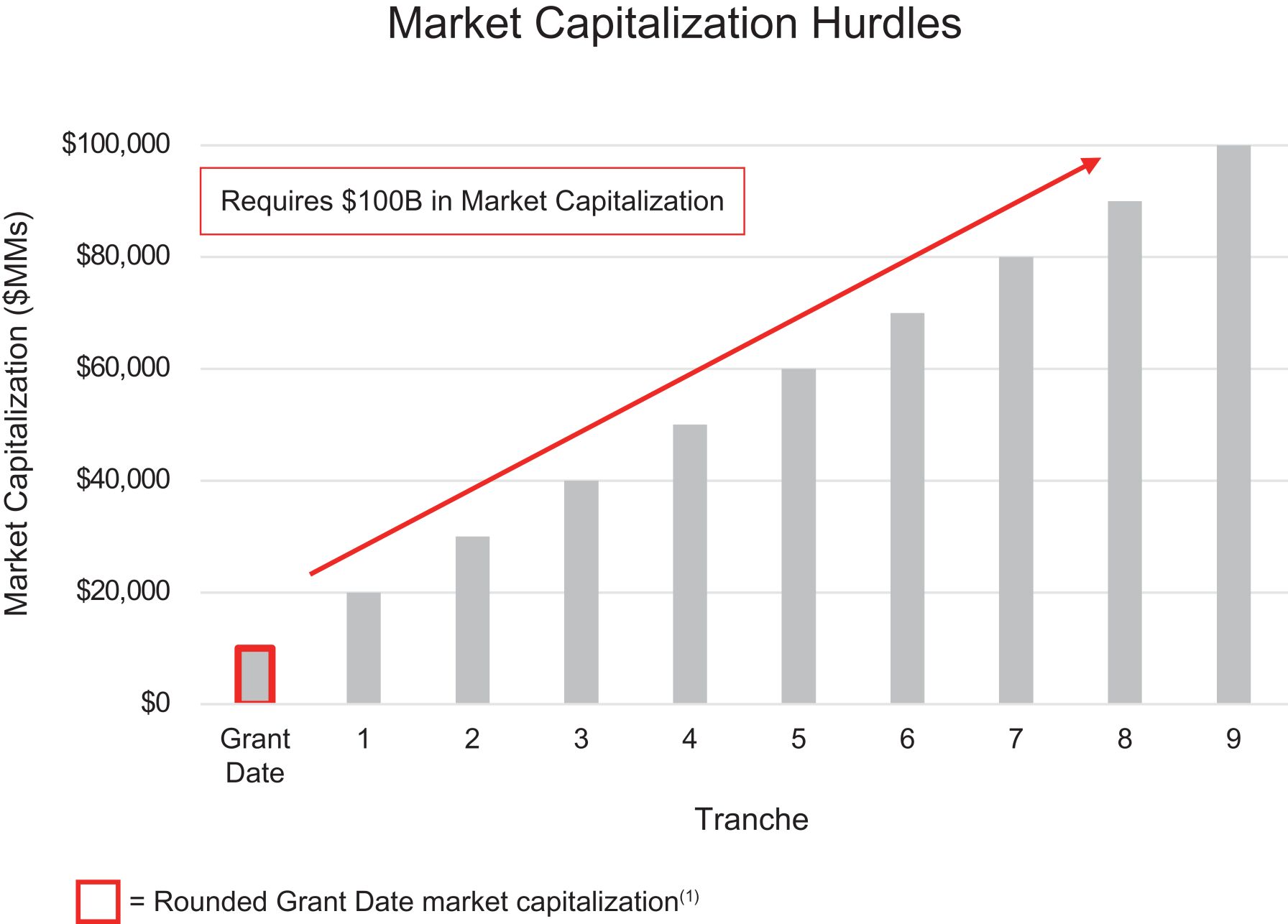
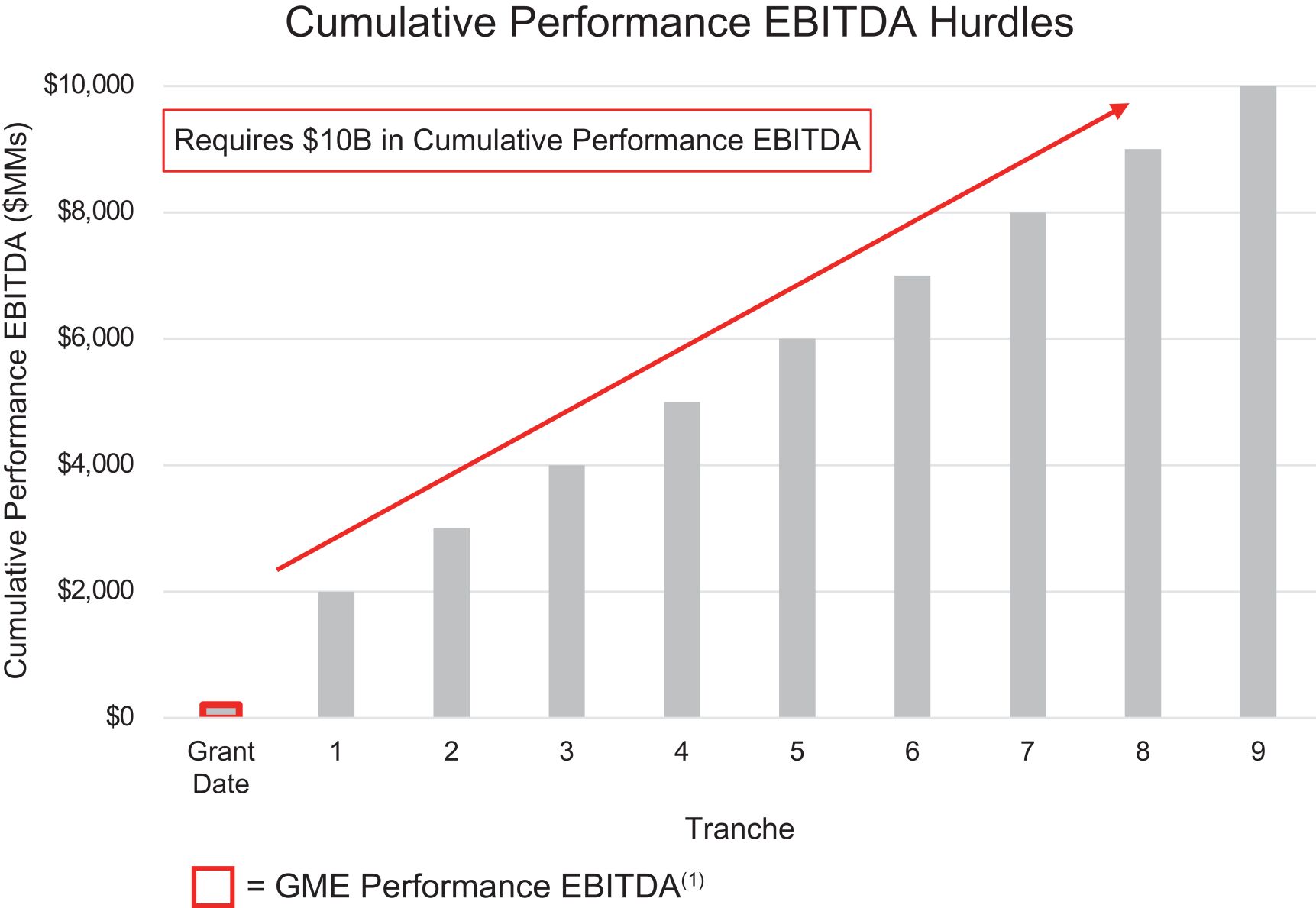
Our Chief Executive Officer, Ryan Cohen, does not draw a salary, take a cash bonus, or receive time-vested stock. His financial interests are tied entirely to the value of the GameStop shares he already owns. The Board is proposing a 100% performance-based option award. The structure is straightforward: Ryan receives nothing unless GameStop’s market capitalization more than doubles to a sustained $20 billion, while the business simultaneously generates billions in actual, cumulative earnings. If he does not clear those hurdles, the award is worthless. If he does, every stockholder benefits alongside him.
We are also asking for your approval to increase our authorized share count. We view our equity as precious and do not intend to issue new shares lightly. A reserve of authorized shares ensures GameStop can act decisively when the right opportunity arises.
Sincerely,
The Board of Directors
Notice of Annual Meeting of Stockholders
Dear Stockholder:
We invite you to attend our 2026 Annual Meeting of Stockholders (“annual meeting”) on , 2026 at 10:00 a.m., Central Daylight Time (“CDT”), at meetnow.global/MPZGKGZ, which will be held in virtual-only format. You will not be able to attend the annual meeting in person.
Our balance sheet, operational improvements, and expanded capabilities position us to pursue opportunities that create meaningful long-term value for stockholders. The proposals before you, including the Authorized Shares Amendment (as defined below) and CEO Performance Award (as defined below), are designed to ensure that we can act decisively when those opportunities arise.
At the annual meeting, you will be asked to:
| (1) | Elect five directors, each to serve as a member of the Board of Directors until the next annual meeting of stockholders and until such director’s successor is elected and qualified; |
| (2) | Provide an advisory, non-binding vote on the compensation of our named executive officers; |
| (3) | Ratify our Audit Committee’s appointment of KPMG LLP as our independent registered public accounting firm for our fiscal year ending January 30, 2027; |
| (4) | Approve the grant of a performance-based nonqualified stock option award to our Chief Executive Officer, Ryan Cohen (the “CEO Performance Award”); |
| (5) | Approve an Amendment No. 2 (the “Authorized Shares Amendment”) to our Third Amended and Restated Certificate of Incorporation to increase the number of authorized shares of our Class A Common Stock (the “common stock”) to 2,500,000,000; and |
| (6) | Transact such other business, if any, as may properly come before the annual meeting and at any postponement or adjournment of the annual meeting. |
Only stockholders of record and beneficial owners holding our shares as of the close of business on , 2026 (the “record date”) are entitled to vote at the annual meeting and any postponement or adjournment thereof. Please see pages 1 – 5 for additional information regarding attendance at the meeting and how to vote your shares. This Proxy Statement provides information that you should consider when you vote your shares.
Your vote is important. Even if you plan to attend the annual meeting virtually, we request that you vote your shares as soon as possible by following the voting instructions contained in this Proxy Statement. We have designed the format of the annual meeting to ensure that stockholders are afforded the same rights and opportunities to participate as they would at an in-person meeting, using online tools to ensure stockholder access and participation.
On or about , 2026, we mailed to our stockholders a copy of this Proxy Statement, the proxy card and our Annual Report on Form 10-K for the fiscal year ended January 31, 2026.
By order of the Board of Directors.
Sincerely,
Mark H. Robinson
General Counsel and Secretary
, 2026
|
This Proxy Statement, form of proxy and 2025 Annual Report are available at http://investor.gamestop.com. Except as otherwise stated, information on our website is not a part of this Proxy Statement.
|
Certain statements in this Proxy Statement contain or may suggest forward-looking statements within the meaning of Section 27A of the Securities Act of 1933, as amended (the “Securities Act”), and Section 21E of the Securities Exchange Act of 1934, as amended (the “Exchange Act”). In some cases, forward-looking statements can be identified by the use of terms such as “anticipates,” “believes,” “continues,” “could,” “estimates,” “expects,” “intends,” “may,” “plans,” “potential,” “predicts,” “pro forma,” “seeks,” “should,” “will” or similar expressions. These statements are only predictions based on current expectations and assumptions and involve known and unknown risks, uncertainties and other factors that may cause our or our industry’s actual results, levels of activity, performance or achievements to be materially different from any future results, levels of activity, performance or achievements expressed or implied by such forward-looking statements. All forward-looking statements included in this Proxy Statement are based upon information available to us as of the filing date of this Proxy Statement, and we undertake no obligation to update or revise any of these forward-looking statements for any reason, whether as a result of new information, future events or otherwise after the date of this Proxy Statement, except as required by law. You should not place undue reliance on these forward-looking statements. The forward-looking statements involve a number of risks and uncertainties. Although we believe that the expectations reflected in our forward-looking statements are reasonable, we cannot guarantee future results, levels of activity, performance or achievements. A number of factors could cause our actual results, performance, achievements or industry results to be materially different from any future results, performance or achievements expressed or implied by these forward-looking statements. Factors that might cause such differences include, but are not limited to, those discussed in Part I, Item 1A of our Annual Report on Form 10-K filed with the SEC on March 24, 2026, under the heading “Risk Factors,” which are incorporated herein by reference. You should carefully consider the risks and uncertainties described in this Proxy Statement and our Annual Report filed on Form 10-K.
TABLE OF CONTENTS
| 1 | ||||
| 1 | ||||
| 7 | ||||
| 7 | ||||
| 7 | ||||
| 7 | ||||
| 8 | ||||
| 9 | ||||
| 9 | ||||
| 10 | ||||
| 10 | ||||
| 10 | ||||
| 11 | ||||
| 11 | ||||
| 11 | ||||
| 11 | ||||
| 12 | ||||
| 12 | ||||
| 12 | ||||
| 12 | ||||
| 13 | ||||
| 13 | ||||
| 14 | ||||
| 14 | ||||
| 14 | ||||
| 14 | ||||
| 15 | ||||
| 15 | ||||
| Communications Between Stockholders and Interested Parties and the Board |
15 | |||
| 15 | ||||
| 15 | ||||
| 15 | ||||
| 16 | ||||
| 17 | ||||
| 17 | ||||
| Security Ownership of Certain Beneficial Owners and Management and Related Stockholder Matters |
18 | |||
| 19 | ||||
| 20 | ||||
| 21 | ||||
| 21 | ||||
| 22 | ||||
| 22 | ||||
| 22 | ||||
| 23 | ||||
| 23 | ||||
| 23 | ||||
| 23 | ||||
| 24 | ||||
| 24 | ||||
| 25 | ||||
| 25 | ||||
| 25 | ||||
| 25 | ||||
| 25 | ||||
| 25 | ||||
| 25 | ||||
| 25 | ||||
| 26 | ||||
| 26 | ||||
| 26 | ||||
| 27 | ||||
| 27 | ||||
| 28 | ||||
| 29 | ||||
| 29 | ||||
| 30 | ||||
| 31 | ||||
| 32 | ||||
| 33 | ||||
| Tabular List of Most Important Financial Performance Measures |
33 | |||
| 33 | ||||
| 34 | ||||
| Securities Authorized for Issuance Under Equity Compensation Plans |
35 | |||
| PROPOSAL 3: RATIFICATION OF APPOINTMENT OF INDEPENDENT REGISTERED PUBLIC ACCOUNTING FIRM |
36 | |||
| 36 | ||||
| 36 | ||||
| 37 | ||||
| 37 | ||||
| 37 | ||||
| 38 | ||||
| 38 | ||||
| 38 | ||||
| Committee Recommends Including the Financial Statements in the Annual Report |
39 | |||
| 39 | ||||
| 39 | ||||
| 40 | ||||
| 41 | ||||
| 41 | ||||
| 44 | ||||
| Aligning the CEO’s Incentives with Maximum Shareholder Value Creation |
44 | |||
| GameStop is at a Critical Juncture in the Company’s Transformation |
45 | |||
| 45 | ||||
| 45 | ||||
| 45 | ||||
| 46 | ||||
| Illustration of Potential Value of Proposed CEO Performance Award |
47 | |||
| 48 | ||||
| 48 | ||||
| The Compensation Committee Retains Independent External Advisors |
49 | |||
| 50 | ||||
| 50 | ||||
| 52 | ||||
| 52 | ||||
| 53 | ||||
| 53 | ||||
| 53 | ||||
| 53 | ||||
| 53 | ||||
| 53 | ||||
| 53 | ||||
| 53 | ||||
| 53 | ||||
| 54 | ||||
| 54 | ||||
| 54 | ||||
| 54 | ||||
| 55 | ||||
| 55 | ||||
| 55 | ||||
| 55 | ||||
| 55 | ||||
| Market Capitalization Hurdle and Performance EBITDA Hurdle Adjustments |
56 | |||
| 56 | ||||
| 56 | ||||
| 56 | ||||
| 56 | ||||
| 56 | ||||
| 56 | ||||
| 56 | ||||
| 56 | ||||
| 56 | ||||
| The Compensation Committee’s Assessment of the CEO Performance Award |
57 | |||
| Preference for Business and Shareholder Alignment Over Institutional Benchmarking |
57 | |||
| 58 | ||||
| Certain Additional Considerations and Risks Associated with Approval of the CEO Performance Award |
58 | |||
| 61 | ||||
| Potential Value that Could be Realized Under the CEO Performance Award |
61 | |||
| Potential Ownership of Securities as a Result of the CEO Performance Award |
61 | |||
| 62 | ||||
| 62 | ||||
| 62 | ||||
| 62 | ||||
| 63 | ||||
| 63 | ||||
| 64 | ||||
| 64 | ||||
| 64 | ||||
| 64 | ||||
| 64 | ||||
| 65 | ||||
| 66 | ||||
| 66 | ||||
| 66 | ||||
| 66 | ||||
| 67 | ||||
| 67 | ||||
| 67 | ||||
| 67 | ||||
| 67 | ||||
| 67 | ||||
| 68 | ||||
| 68 | ||||
| ANNEX A: RECONCILIATIONS OF GAAP AND NON-GAAP FINANCIAL MEASURES |
69 | |||
| 71 | ||||
| 83 | ||||
| 85 | ||||
| 86 | ||||
PROXY STATEMENT SUMMARY
To assist you in reviewing the proposals to be considered and voted upon at our 2026 Annual Meeting of the Stockholders (the “annual meeting”) we have summarized information contained elsewhere in this Proxy Statement or in our Annual Report on Form 10-K for the fiscal year ended January 31, 2026 (“Annual Report”). Please note that our fiscal year is composed of the 52 or 53 weeks ending on the Saturday closest to the last day of January. Fiscal year 2024 consisted of the 52 weeks ended on February 1, 2025 (“fiscal 2024”). Fiscal year 2023 consisted of the 53 weeks ended on February 3, 2024 (“fiscal 2023”). Fiscal year 2022 consisted of the 52 weeks ended on January 28, 2023 (“fiscal 2022”). This summary does not contain all of the information you should consider about the proposals being submitted to stockholders at the annual meeting. We encourage you to read the entire Proxy Statement and Annual Report carefully before voting.
ANNUAL MEETING OF STOCKHOLDERS
Date and Time:
,2026
10:00 a.m., Central Daylight Time
Website:
meetnow.global/MPZGKGZ
Record Date:
, 2026
Anticipated Mailing Date:
, 2026
AGENDA
| Voting Matter | Page | |
| 7 | ||
| 20 | ||
| 3. Ratification of Appointment of Independent Registered Accounting Firm |
36 | |
| 40 | ||
| 5. Approval of an Amendment to the Certificate of Incorporation |
65 | |
How to Cast Your Vote:
|
|
Vote by Internet |
|
By Mail: |
|
By Phone: | |||||
| Shares Held of Record: | Shares Held of Record: | Shares Held of Record: | ||||||||
| meetnow.global/MPZGKGZ | See Proxy Card | |||||||||
| Shares Held in Street Name: | Shares Held in Street Name: | Shares Held in Street Name: | ||||||||
| See Voting Instruction Form |
See Voting Instruction Form | See Voting Instruction Form | ||||||||
Information About the Annual Meeting and Voting
| 1. What am I Voting on? |
The Board of Directors (“Board”) of GameStop Corp. (“GameStop,” the “Company,” “we,” “us,” or “our”) is soliciting your vote for the following:
| Business Items
|
Board Voting Recommendation |
Page Reference | ||
| 1. To elect the five nominees identified in this Proxy Statement to serve as directors |
FOR ALL NOMINEES |
7 | ||
| 2. To approve, on an advisory, non-binding basis, our executive compensation |
FOR | 20 | ||
| FOR | 36 | |||
| FOR | 40 | |||
| FOR | 65 | |||
| 2. Who Is Entitled to Vote? |
Holders of record and beneficial owners of our shares of common stock as of the close of business on , 2026, the record date, are entitled to notice of, and to vote at, the annual meeting. Shares of common stock can be voted only if the stockholder is present or is represented by proxy at the annual meeting. As of the record date, shares of common stock were issued, outstanding and entitled to vote.
| 3. How Do I Vote? |
Stockholders of Record. If you are a stockholder of record, there are several ways for you to vote your shares of common stock at the annual meeting:
| • | Voting by Internet. You may vote your shares electronically at the annual meeting by following the instructions on the virtual annual meeting website at meetnow.global/MPZGKGZ. Before the annual meeting you may vote your shares through the Internet by following the directions on the proxy card. Internet voting is available 24 hours a day, and the procedures are designed to authenticate votes cast by using a personal identification number located on the proxy card. The procedures allow you to appoint a proxy to vote your shares and to confirm that your instructions have been properly recorded. |
| • | Voting by Telephone. You may vote your shares by telephone by following the directions on the proxy card. Telephone voting is available 24 hours a day, and the procedures are designed to authenticate votes cast by using a personal identification number located on the proxy card. The procedures allow you to appoint a proxy to vote your shares and to confirm that your instructions have been properly recorded. |
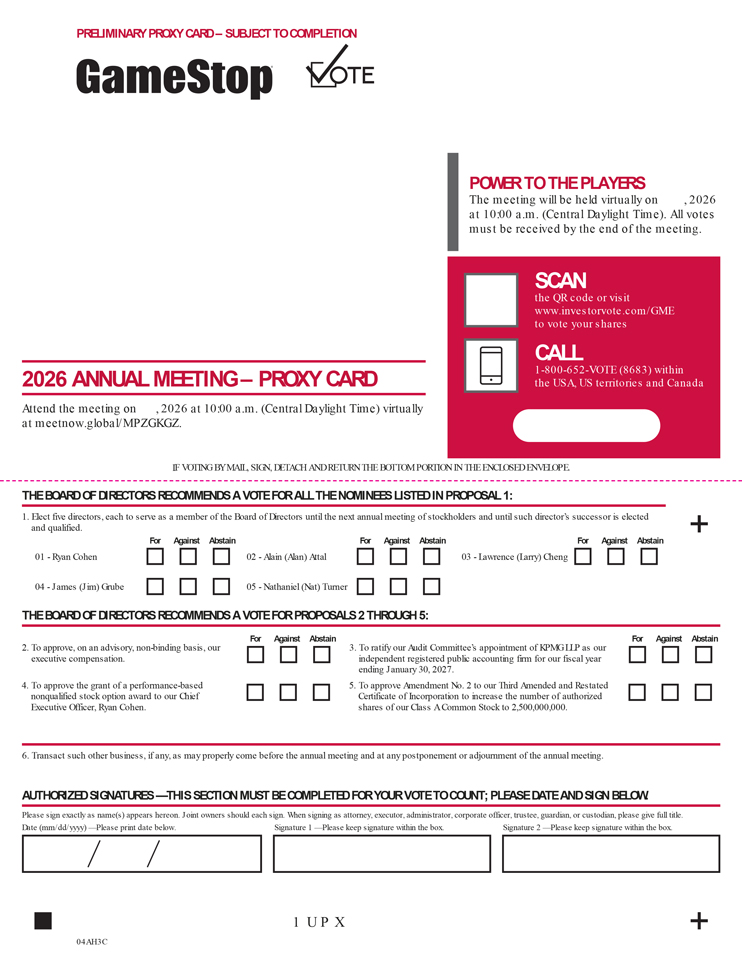
| • | Voting by Mail. You may vote by mail by completing the enclosed proxy card, dating and signing it, and returning it in the postage-paid envelope provided. If you sign your proxy card and return it without marking any voting instructions, your shares will be voted: (1) FOR ALL of the director nominees identified in this Proxy Statement; (2) FOR the approval, on an advisory, non-binding basis, of the compensation of our Named Executive Officers (“NEOs”); (3) FOR the ratification of our Audit Committee’s appointment of KPMG LLP as our independent registered public accounting firm for our fiscal year ending January 30, 2027; (4) FOR the approval of the CEO Performance Award; and (5) FOR the approval of the Authorized Shares Amendment. |
|
|
2026 Proxy Statement | 1 |
| • | Voting by Proxy. If you choose to vote by proxy, you may do so using the Internet, telephone or, if you received a printed copy of your proxy materials, mail. Even if you plan to attend the annual meeting virtually, we recommend that you submit your proxy card by mail or voting instructions via the Internet or by telephone by the applicable deadline so that your vote will be counted if you later decide not to attend the annual meeting. |
Beneficial Owners. If you are a stockholder whose shares are held in “street name” (i.e., in the name of a broker or other custodian) you may vote the shares electronically at the annual meeting only if you obtain a legal proxy from the broker or other custodian giving you the right to vote the shares. Please see the registration options set forth below under “Registering in Advance of the Annual Meeting” and “Registering at the Annual Meeting” and follow the instructions to upload and submit your legal proxy. Alternatively, you may have your shares voted at the annual meeting by following the voting instructions provided to you by your broker or custodian. Although most brokers offer voting via the Internet, by telephone, and mail, availability and specific procedures will depend on their voting arrangements. If you have any questions or need assistance with voting, please contact Okapi Partners LLC, our proxy solicitor, at 1-877-259-6290 (for stockholders) or 212-297-0720 (for banks and brokers).
| 4. How Can I Vote Online at the Annual Meeting? |
Stockholders of Record. If you are a stockholder of record, you may vote at the annual meeting by following the instructions on the notice, email or proxy card that you received to access the annual meeting.
Beneficial Owners. If you are a beneficial owner, please see the registration options set forth below under “Registering in Advance of the Annual Meeting” and “Registering at the Annual Meeting.”
| 5. How May You Revoke or Change Your Vote? |
You may revoke your proxy at any time before it is voted at the annual meeting by any of the following methods:
| • | Submitting a later-dated proxy via the Internet, over the telephone or by mail. |
| • | Sending a written notice to our Secretary. You must send any written notice of a revocation of a proxy so as to be delivered before the taking of the vote at the annual meeting to: |
GameStop Corp.
625 Westport Parkway
Grapevine, Texas 76051
Attention: Secretary
| • | Attending the annual meeting virtually and voting. Your attendance at the annual meeting will not in and of itself revoke your proxy. |
| 6. How can I Attend the Annual Meeting? |
The annual meeting will be held virtually on , 2026 at 10:00 a.m., CDT. You are entitled to attend the annual meeting pursuant to the instructions below if you were a stockholder of record or a beneficial owner of our shares of common stock as of the record date. Participation in the meeting is limited due to the capacity of the host platform, and access to the meeting will be accepted on a first-come, first-served basis once electronic entry begins. Electronic entry to the meeting will begin at or before 9:30 a.m., CDT and the meeting will begin promptly at 10:00 a.m., CDT.
In order to ensure that your shares are represented at the meeting, we strongly encourage you to vote your shares by proxy prior to the annual meeting and further encourage you to submit your proxies electronically—by telephone or by Internet—by following the easy instructions on the enclosed proxy card. Your vote is important, and voting electronically should facilitate the timely receipt of your proxy.
Stockholders of Record. You may attend the annual meeting by following the instructions on the virtual annual meeting website at meetnow.global/MPZGKGZ.
Beneficial Owners. Beneficial owners that want to attend the annual meeting online have two options:
| • | Registering in Advance of the Annual Meeting. You may attend the annual meeting online by registering in advance of the annual meeting. To register, submit proof of your proxy power (“Legal Proxy”) from your broker or bank reflecting your shares of common stock along with your name and email address to Computershare. Requests for registration must be |
| 2 | 2026 Proxy Statement |
|
| labeled as “Legal Proxy” and be received by Computershare no later than 5:00 p.m., Eastern Time, on , 2026. You will receive a confirmation of your registration by email after we receive your registration materials. Requests for registration should be directed to Computershare at the following: |
| • | By email: Forward the email from your broker granting you a Legal Proxy, or attach an image of your Legal Proxy to legalproxy@computershare.com |
| • | By mail: Computershare |
| GameStop Corp. Legal Proxy P.O. Box 43001 Providence, RI 02940-3001 |
| • | Registering at the Annual Meeting. Visit the virtual annual meeting website at meetnow.global/MPZGKGZfor more information on the available options and registration instructions. |
We expect that the vast majority of beneficial owners will be able to attend the annual meeting using the control number received with their voting instruction form. Please note, however, that this option is intended to be provided as a convenience to beneficial owners only, and there is no guarantee that this option will be available for every type of beneficial owner voting control number. The inability to provide this option to any or all beneficial owners shall in no way impact the validity of the annual meeting. Beneficial owners may choose the Registering in Advance of the Annual Meeting option above, if they prefer to use this traditional, paper-based option.
The online meeting will begin promptly at 10:00 a.m., CDT. We encourage you to access the meeting prior to the start time leaving ample time to check in.
| 7. Do I Need to Register to Attend the Annual Meeting Virtually? |
Registration is only required if you are a beneficial owner, as set forth above.
| 8. What Constitutes a Quorum? |
A quorum of common stockholders is required to hold a valid annual meeting of stockholders. Unless a quorum is present at the annual meeting, no action may be taken at the annual meeting, except the adjournment thereof to a later time. The holders of a majority of the outstanding shares of our common stock entitled to vote at the meeting must be present or represented by proxy to constitute a quorum. All valid proxies returned will be included in the determination of whether a quorum is present at the annual meeting. The shares of a stockholder whose ballot on any or all proposals is marked as “abstain” will be treated as present for quorum purposes. If a broker indicates on the proxy that it does not have discretionary authority as to certain shares to vote on a particular matter, those uninstructed shares, constituting “broker non-votes,” will be considered as present for determining a quorum, but will not be voted with respect to that matter.
| 9. What Is a Broker Non-Vote? |
A “broker non-vote” occurs when a nominee (such as a custodian or bank) holding shares for a beneficial owner returns a signed proxy but does not vote on a particular proposal because the nominee does not have discretionary voting power with respect to that item and has not received instructions from the beneficial owner. For routine matters, the New York Stock Exchange (the “NYSE”) gives brokers the discretion to vote, even if they have not received voting instructions from the beneficial owners. Each broker has its own policies that control whether or not it casts votes for routine matters. In this Proxy Statement, the ratification of our independent registered public accounting firm and the approval of the Authorized Shares Amendment are both expected to be considered routine by the NYSE.
| 10.What Vote Is Required to Approve Each Proposal? |
Voting Rights Generally. Each share of common stock is entitled to one vote on each matter to be voted on at the annual meeting. Stockholders have no cumulative voting rights. Although the advisory vote on Proposal 2 is non-binding, as provided by law, the Compensation Committee of the Board and the Board will review the results of the vote and, consistent with our record of stockholder engagement, will consider the results of the vote when making future compensation decisions.
|
|
2026 Proxy Statement | 3 |
Election of Directors. Our Bylaws provide that, in an uncontested election, a nominee for director is elected only if such nominee receives the affirmative vote of a majority of the total votes cast for such nominee. The majority voting standard does not apply in contested elections, and directors are elected by a plurality of the votes cast in a contested election.
The majority voting standard will apply to the election of directors at the annual meeting. Accordingly, a nominee for election to the Board will be elected if the number of votes cast “for” such nominee exceeds the number of votes cast “against” that nominee. Abstentions and broker non-votes will not be treated as votes cast in the election of a director and will therefore have no effect on the result of such vote.
Advisory Vote on Executive Compensation. Approval on an advisory, non-binding basis of the compensation of our NEOs requires the affirmative vote of a majority of the shares present or represented by proxy and entitled to vote at the annual meeting on this proposal. Abstentions (if any) will have the same effect as a vote “against” this proposal. Broker non-votes (if any) will have no effect on this proposal because they are not entitled to vote on this proposal. As an advisory vote, the proposal to approve the compensation of our NEOs is not binding upon us. However, our Compensation Committee, which is responsible for designing and administering our executive compensation programs, and the Board value the opinions expressed by our stockholders and will consider the results of the vote when making future compensation decisions.
Ratification of Appointment of Independent Registered Public Accounting Firm. Ratification of our Audit Committee’s appointment of KPMG LLP (“KPMG”) as our independent registered public accounting firm for our fiscal year ending January 30, 2027 requires the affirmative vote of a majority of the shares present or represented by proxy and entitled to vote at the annual meeting on this proposal. Abstentions (if any) will have the same effect as a vote “against” this proposal. The approval of this proposal is a routine matter on which a broker or other nominee is generally empowered to vote in the absence of voting instructions from the beneficial owner. If the stockholders should not ratify the appointment of KPMG, the Audit Committee will reconsider the appointment.
Approval of CEO Performance Award. The approval of the CEO Performance Award requires:
| • | the affirmative vote of a majority of the shares present or represented by proxy and entitled to vote at the annual meeting on this proposal. Abstentions (if any) will have the same effect as a vote “against” this proposal under this standard. Broker non-votes (if any) will have no effect on this proposal under this standard because they are not entitled to vote on this proposal (the “Bylaws Standard”). |
| • | In addition, as noted in Proposal 4, Approval of CEO Performance Award under the section entitled “Practical Implications of the CEO Performance Award—Delaware Law Considerations,” although it is not a condition to the effectiveness of the CEO Performance Award, the Company is seeking approval of the CEO Performance Award by the affirmative vote of a majority of the total votes of shares of common stock not owned, directly or indirectly, by (x) Ryan Cohen, (y) the Company’s directors and executive officers or (z) any of Ryan Cohen’s direct reports, in each case that are cast in person or by proxy at the annual meeting. Abstentions (if any) and Broker non-votes (if any) will have no effect because they are not considered votes cast on this proposal under this standard (the “Disinterested Standard”). |
Approval of the Authorized Shares Amendment. The approval of the Authorized Shares Amendment, which is not a condition to the CEO Performance Award, requires the affirmative vote of at least a majority of the outstanding shares of common stock entitled to vote at the annual meeting. As determined by NYSE, the approval of this proposal is expected to be a routine matter on which a broker or other nominee is generally empowered to vote in the absence of voting instructions from the beneficial owner. Abstentions (if any) will have the same effect as a vote “against” this proposal.
| 11.Who Counts the Votes? |
We have engaged Computershare, our transfer agent, to act as our independent tabulator to receive and tabulate votes and to act as our inspector of election. Computershare will certify the results and determine the existence of a quorum and the validity of proxies and ballots.
| 12.How can I contact GameStop’s transfer agent? |
Contact our transfer agent by either writing to Computershare Investor Services, PO BOX 43006, Providence, RI, 02940-3006 (courier services should be sent to Computershare Investor Services, 150 Royall Street, Suite 101, Canton, MA 02021), by telephoning stockholder services at 1-800-522-6645 (toll free within the USA, US territories and Canada), or by visiting their Investor Center™ portal at www.computershare.com/investor.
| 4 | 2026 Proxy Statement |
|
| 13.Who Pays the Cost of Solicitation of Proxies? |
We will pay for the cost of preparing, assembling, printing, mailing and distributing these proxy materials. Our directors, officers and employees may solicit proxies or votes in person, by telephone, or by electronic communication. Such individuals will not receive any additional compensation for these solicitation activities. We will, upon request, reimburse brokerage firms and others for their reasonable expenses in forwarding solicitation material to the beneficial owners of our stock. The Company has also retained Okapi Partners LLC to assist with the solicitation of proxies for a fee of $26,000, plus reimbursement of costs and expenses.
| 14.What Does it Mean if I Receive More Than One Proxy Card? |
Some of your shares may be registered differently or held in more than one account. You should vote each of your accounts via the Internet, by telephone or mail. If you mail your proxy cards, please sign, date and return each proxy card to assure that all of your shares are voted.
| 15.How Do I Submit a Stockholder Proposal for Next Year’s Annual Meeting? |
Stockholder proposals may be submitted for inclusion in the Proxy Statement for our 2027 annual meeting of stockholders in accordance with Rule 14a-8 of the Securities and Exchange Commission (“SEC”). See “Other Matters—Proposals Pursuant to Rule 14a-8” later in this Proxy Statement. In addition, eligible stockholders are entitled to nominate and include in our Proxy Statement for our 2027 annual meeting director nominees, subject to limitations and requirements in our Bylaws. See “Other Matters—Proxy Access Director Nominees” later in this Proxy Statement. Any stockholder who wishes to propose any business at the 2027 annual meeting other than for inclusion in our Proxy Statement pursuant to Rule 14a-8 or pursuant to the proxy access provisions in our Bylaws must provide timely notice and satisfy the other requirements for stockholders’ proposals in our Bylaws. See “Other Matters—Other Proposals and Nominees” later in this Proxy Statement. Proposals should be sent via registered, certified, or express mail to: Secretary, GameStop Corp., 625 Westport Parkway, Grapevine, Texas 76051.
| 16.What is Included in the Proxy Materials? |
We have mailed our Annual Report with this Proxy Statement. The Annual Report includes our audited financial statements for fiscal 2025, along with other financial information about us. Our Annual Report is not part of the proxy solicitation materials.
You can also obtain, free of charge, a copy of our Annual Report, which includes our audited financial statements, by:
| • | accessing our website at http://investor.gamestop.com; |
| • | writing to our Secretary, at 625 Westport Parkway, Grapevine, Texas 76051; or |
| • | calling (817) 424-2000. |
You can also obtain a copy of our Annual Report and other periodic filings that we make with the SEC from the SEC’s EDGAR database at www.sec.gov.
| 17.How Can I Access the Proxy Materials Electronically? |
Your proxy card will contain instructions on how to:
| • | view our proxy materials for the annual meeting on the Internet; and |
| • | instruct us to send our future proxy materials to you electronically by e-mail. |
Our proxy materials are also available on our website at http://investor.gamestop.com.
| 18.How Are the Proxy Materials Being Distributed? |
On or about , 2026, we will begin mailing the proxy materials to stockholders of record as of , 2026, and we will post our proxy materials at http://investor.gamestop.com. In addition, the website provides information regarding how you may request to receive proxy materials in printed form by mail or electronically by email on an ongoing basis.
|
|
2026 Proxy Statement | 5 |
| 19.Can Stockholders and Other Interested Parties Communicate Directly with The Board? |
Yes. We invite stockholders and other interested parties to communicate directly and confidentially with the full Board, the Chair of the Board or the non-management directors as a group by writing to the Board, the Chair or the Non-Management Directors, GameStop Corp., 625 Westport Parkway, Grapevine, Texas 76051, Attn: Secretary. The Secretary will forward such communications to the intended recipient or recipients and will retain copies for our corporate records.
| 20.Can I Participate and Ask Questions During the Virtual Annual Meeting? |
Yes. Beginning at least 30 minutes prior to, and during the annual meeting, you will be able to access the Rules of Conduct applicable to the annual meeting. We will hold a Q&A session during the annual meeting, during which we intend to answer questions that are pertinent to the items being brought before the stockholder vote at the annual meeting, as time permits and in accordance with our Rules of Conduct for the annual meeting.
Stockholders of Record. If you are a stockholder of record, you may submit questions by accessing the meeting site at meetnow.global/MPZGKGZ and following the directions.
Beneficial Owners. If you are a beneficial owner, please see the registration options set forth above under “6. How Can I Attend the Annual Meeting?” to submit questions.
| 21. What if I have technical or other “IT” problems logging into or participating in the virtual 2026 Annual Meeting? |
We encourage you to access the meeting site in advance of the annual meeting start time. If you encounter any difficulties accessing the virtual meeting during the check-in or meeting time, please call the technical support line number that will be posted on the virtual meeting site.
| 6 | 2026 Proxy Statement |
|
PROPOSAL 1: ELECTION OF DIRECTORS
Director Nomination Process
The Board has nominated each of the five individuals identified below under “The Director Nominees” to stand for election at the annual meeting. Each of the nominees is currently a director of the Company.
Each director elected at the annual meeting will hold office for a term expiring at the 2027 annual meeting of stockholders and until his or her successor has been elected and qualified, or until his or her earlier death, resignation or removal. Each of the nominees identified in this Proxy Statement has consented to being named as a nominee in our proxy materials and has accepted the nomination and agreed to serve as a director if elected by the stockholders. We have no reason to believe that any of the nominees will be unable to serve as a director. However, should any nominee be unable to serve if elected, the Board may reduce the number of directors or recommend a substitute nominee. The shares represented by all valid proxies may be voted for the election of a substitute if one is nominated by the Board.
The Director Nominees
The following table sets forth the names and ages of the individuals nominated by the Board for election at the annual meeting, the years they first became a director, the positions, if any, they hold with the Company, and the standing committees of the Board, if any, on which they serve as of , 2026:
| Name | Age | Director Since |
Position with the Company | Audit Committee |
Compensation Committee |
Nominating and Corporate Governance Committee | ||||||||||||||||||||||||
| Ryan Cohen(1) |
40 | 2021 | |
President, Chief Executive Officer and Chairman |
|
|
|
|
|
|
|
|
| |||||||||||||||||
| Alain (Alan) Attal |
56 | 2021 | Lead Independent Director | X | X(2) | X(2) | ||||||||||||||||||||||||
| Lawrence (Larry) Cheng |
50 | 2021 | Director | X | X | X | ||||||||||||||||||||||||
| James (Jim) Grube |
55 | 2021 | Director | X(2) | X |
|
|
| ||||||||||||||||||||||
| Nathaniel (Nat) Turner |
40 | 2024 | Director |
|
|
|
|
|
|
|
|
| ||||||||||||||||||
| (1) | Chair of the Board of Directors and Sole Employee-Director |
| (2) | Committee Chair |
Director Nominee Qualifications and Experience
Our business is managed under the direction of the Board, and we strive to maintain a board with a mix of skills and experiences that, taken together, provide us with the variety and depth of knowledge necessary for effective oversight, direction and vision. The following matrix presents qualifications and experiences the Board considered in recommending each director nominee for election:
| Qualifications and Experience |
Ryan Cohen |
Alan Attal |
Larry Cheng |
Jim Grube |
Nat Turner | |||||
| Business experience in a senior leadership position provides the perspective and practical understanding of leading a business organization |
● | ● | ● | ● | ● | |||||
| Finance experience gained from experience as a chief executive officer, finance or accounting executive, or audit committee member is important because effective financial planning, accurate financial reporting and effective internal controls are critical to our success |
● | ● | ● | ● | ● | |||||
| Marketing or brand management experience is valuable because of the strategic importance of consumer positioning and brand management in the retail e-commerce business |
● | ● |
|
|
● | |||||
| Retail experience provides an understanding of strategic and operational issues facing retail e-commerce companies |
● | ● | ● | ● | ● | |||||
| Ecommerce experience helps guide our strategic emphasis on online and mobile channels and building a superior customer experience |
● | ● | ● | ● | ● | |||||
|
|
2026 Proxy Statement | 7 |
Biographies of Director Nominees
The biographies describe each director nominee’s qualifications and relevant experience. The biographies include key qualifications, skills and attributes most relevant to the decision to nominate candidates to serve on the Board.
| RYAN COHEN - President, Chief Executive Officer and Chairman of the Board | ||
| Director Since: 2021 |
Age: 40 | |
| Other Public Company Directorships: |
• None | |
| GameStop Committees: |
• None | |
Ryan Cohen has been a member of the Board since January 2021. He was elected Chairman of the Board in June 2021 and appointed Chief Executive Officer in September 2023. Mr. Cohen is also a sizable stockholder of the Company. Mr. Cohen previously founded and served as the Chief Executive Officer of Chewy, Inc. (NYSE: CHWY), where he oversaw the company’s growth and ascension to market leadership in the pet industry. Mr. Cohen led Chewy through its successful sale to PetSmart Inc. prior to stepping down in 2018.
Director Qualifications: In addition to his ownership perspective, Mr. Cohen brings to the Board his demonstrated leadership experience as a successful entrepreneur and investor and his extensive experience in retail, technology and consumer marketing verticals, having overseen merchandising, marketing, supply chain, ecommerce and business development.
| ALAN ATTAL - Lead Independent Director | ||
| Director Since: 2021 |
Age: 56 | |
| Other Public Company Directorships: |
• None | |
| GameStop Committees: |
• Audit Committee | |
| • Compensation Committee, Chair | ||
| • Nominating and Corporate Governance Committee, Chair | ||
Mr. Attal is an ecommerce executive and entrepreneur with more than two decades of experience building and managing businesses. From 2017 through 2018, Mr. Attal served as the Chief Marketing Officer of Chewy, Inc. (NYSE: CHWY) and oversaw an annual acquisition budget of more than $300 million, which was allocated to broadcast, direct mail and digital advertising and engagement initiatives. From 2011 through early 2017, he served as Chewy’s Chief Operating Officer and oversaw its expansion from three people to more than 10,000 employees and $3 billion in revenues.
Director Qualifications: Mr. Attal brings to the Board more than two decades of experience building and managing businesses, having served in senior management positions overseeing marketing and operations.
| LARRY CHENG - Independent Director | ||
| Director Since: 2021 |
Age: 50 | |
| Other Public Company Directorships: |
• Grove Collaborative Holdings, Inc. | |
| GameStop Committees: |
• Compensation Committee | |
| • Nominating and Corporate Governance Committee | ||
Larry Cheng is Co-Founder and Managing Partner of Volition Capital, LLC, a leading growth equity investment firm based in Boston, Massachusetts and the first investor in Chewy, Inc. (NYSE: CHWY). He has more than two decades of venture capital and growth equity investing experience based on time at Volition Capital, Fidelity Ventures, Battery Ventures, and Bessemer Venture Partners. He presently leads the Internet and Consumer team at Volition Capital, focusing on disruptive companies in ecommerce, internet services, consumer brands, and digital media and gaming. He received his bachelor’s degree from Harvard College where he concentrated in Psychology.
| 8 | 2026 Proxy Statement |
|
Director Qualifications: Mr. Cheng brings to the Board significant experience in capital allocation and deployment, finance, ecommerce, internet services, consumer brands, digital media and gaming.
| JIM GRUBE - Independent Director | ||
| Director Since: 2021 |
Age: 55 | |
| Other Public Company Directorships: |
• None | |
| GameStop Committees: |
• Audit Committee, Chair | |
| • Compensation Committee | ||
Mr. Grube is a business and finance executive with more than two decades of corporate experience. He was most recently the Chief Financial Officer of Rad Power Bikes, a global e-bike mobility company. He previously served as the Chief Financial Officer of Vacasa (NASDAQ: VCSA) from 2019 through 2020, a North American vacation rental management company, and as Chief Financial Officer of Chewy, Inc (NYSE: CHWY) from 2015 through 2018. He was formerly Senior Vice President of Finance at Hilton (NYSE: HLT) from 2009 through 2015 and a Director of Finance at Amazon (NASDAQ: AMZN) from 2007 through 2009. He has a bachelor’s degree in Industrial Engineering from Purdue University and received his master’s degree from the Massachusetts Institute of Technology. Mr. Grube also serves as an independent board member and the Audit Committee Chair of UK-based Job&Talent, an independent board member of Miami-based Carewell, and a director and finance committee member of the Oregon-based non-profit Friends of the Columbia Gorge. In his chief financial officer and audit committee chair roles, Mr. Grube has overseen company cybersecurity readiness assessments, risk reviews, and control effectiveness.
Director Qualifications: Mr. Grube brings to the Board more than two decades of corporate experience, having served in senior management positions overseeing finance, accounting, treasury, tax, and procurement.
| NAT TURNER - Non-Independent Director | ||
| Director Since: 2024 |
Age: 40 | |
| Other Public Company Directorships: |
• None | |
| GameStop Committees: |
• None | |
Nathaniel Turner is a seasoned entrepreneur and business leader. Mr. Turner is currently the Chairman and Chief Executive Officer of Collectors Holdings, Inc., a holding company focused on the collectibles industry. Prior to joining Collectors Holdings, Inc., Mr. Turner co-founded, and was the Chief Executive Officer of, Flatiron Health, Inc., a technology company focused on the oncology industry. He also co-founded and led Invite Media, an advertising technology company. Mr. Turner is an active angel investor and has invested in many startups both personally and through Operator Partners LLC, a venture capital investment firm that invests in early-stage technology companies and founders. Mr. Turner earned a Bachelor of Science degree in economics from the Wharton School at the University of Pennsylvania.
Director Qualifications: Mr. Turner brings to the Board extensive leadership and entrepreneurial experience, having founded several companies, and significant experience in retail, internet services and ecommerce.
THE BOARD UNANIMOUSLY RECOMMENDS THAT STOCKHOLDERS VOTE FOR ALL OF THE BOARD’S FIVE NOMINEES. PROXIES SOLICITED BY THIS PROXY STATEMENT WILL BE VOTED FOR ALL FIVE NOMINEES UNLESS A VOTE AGAINST A NOMINEE OR ABSTENTION IS SPECIFICALLY INDICATED.
The Board of Directors
Board Oversight of Strategy
The Board is deeply engaged and involved in overseeing our long-range strategy, including evaluating key market opportunities, consumer trends and competitive developments as well as capital allocation and deployment strategies. The Board’s oversight of risk is another integral component of the Board’s oversight and engagement on strategic matters. Strategy-related matters are regularly discussed at Board meetings and, as relevant, at Board committee meetings. Matters of strategy also inform committee-level discussions of many issues, including business risk and investment decisions. Engagement of the Board on these issues and other matters of strategic importance continues in between Board meetings, including through updates to the Board on significant items. Each director is expected to and does bring to bear his or her own talents, insights and experiences on these strategy discussions.
|
|
2026 Proxy Statement | 9 |
Meetings and Committees of the Board
The Board met six times during fiscal 2025. Each incumbent director who served on the Board at any time during fiscal 2025 attended 75% or more of the aggregate of the total number of meetings of the Board and the total number of meetings of all committees thereof on which they served (held during the period in fiscal 2025 that they served).
The Board has three standing committees: an Audit Committee, a Compensation Committee, and a Nominating and Corporate Governance Committee.
Audit Committee
The Audit Committee assists the Board in fulfilling its oversight responsibility and reviews:
| • | The adequacy and integrity of our financial statements, financial reporting process and disclosure controls and procedures and internal controls over financial reporting; |
| • | The appointment, termination, compensation, retention and oversight of the independent registered public accountants; |
| • | The scope of the audit performed by the independent registered public accounting firm of our books and records; |
| • | The internal audit function and plan; |
| • | Our compliance with legal and regulatory requirements; and |
| • | With management and the independent auditor, any related party transactions and approves such transactions, if any. |
In addition, the Audit Committee has established procedures for the receipt, retention and treatment of confidential and anonymous complaints regarding our accounting, internal accounting controls and auditing matters. The Board has adopted a written charter setting out the functions of the Audit Committee (the “Audit Committee Charter”), a copy of which is available on our website at http://investor.gamestop.com/corporate-governance and is available in print to any stockholder who requests it in writing to our Secretary, GameStop Corp., 625 Westport Parkway, Grapevine, Texas 76051. As required by the Audit Committee Charter, the Audit Committee will continue to review and reassess the adequacy of the Audit Committee Charter annually and recommend any changes to the Board for approval.
The current members of the Audit Committee are Jim Grube (Chair), Alan Attal and Larry Cheng, each of whom is an “independent” director under the listing standards of the NYSE. The Board has determined that Mr. Grube has the requisite attributes of an “audit committee financial expert” as defined by regulations promulgated by the SEC and that such attributes were acquired through relevant education and/or experience. In addition to meeting the independence standards of the NYSE, each member of the Audit Committee is financially literate and meets the independence standards established by the SEC. The Audit Committee met four times during fiscal 2025.
Compensation Committee
The Compensation Committee is primarily responsible for:
| • | Establishing and reviewing the compensation of the Chief Executive Officer and all other executive officers; |
| • | Establishing and approving the terms of employment for new executive officers and the terms associated with any executive officer’s termination; |
| • | Making recommendations to the Board with respect to incentive-compensation and equity-based plans, which are subject to Board approval; |
| • | Administering and exercising all authority granted to it under any incentive compensation plans covering primarily executive officers or involving the compensatory issuance of Company securities, whether currently existing or hereafter adopted by the Board; and |
| • | The annual report on executive compensation for inclusion in our annual Proxy Statement. |
The Compensation Committee has the authority to engage executive compensation advisers, if desired, to assist the Compensation Committee in conducting its duties.
The current members of the Compensation Committee are Alan Attal (Chair), Larry Cheng and Jim Grube, each of whom meets the independence standards of the NYSE and the SEC. The Board has adopted a written charter setting out the functions of the Compensation Committee, a copy of which is available on our website at http://investor.gamestop.com/corporate-governance and is available in print to any stockholder who requests it in writing to our Secretary, GameStop Corp., 625 Westport Parkway, Grapevine, Texas 76051. The Compensation Committee met ten times during fiscal 2025.
| 10 | 2026 Proxy Statement |
|
Nominating and Corporate Governance Committee
The Nominating and Corporate Governance Committee is primarily responsible for:
| • | Reviewing and recommending to the Board candidates for service on the Board and its committees, including the nomination of existing directors; |
| • | Establishing, maintaining and periodically assessing a process for the receipt and consideration of written recommendations for Board candidates in accordance with applicable rules of the NYSE and any other applicable laws, rules and regulations; |
| • | Periodically reviewing and making recommendations to the Board regarding the size and composition of the Board and its committees; |
| • | Annually reviewing the independence of the directors; |
| • | Overseeing our orientation process for newly elected directors and regularly assessing the adequacy of, and need for, additional director continuing education programs; |
| • | Overseeing the annual performance evaluation of the Board and its committees and management; and |
| • | Periodically reviewing and recommending changes to our Corporate Governance Guidelines. |
The current members of the Nominating and Corporate Governance Committee are Alan Attal (Chair) and Larry Cheng, each of whom meets the independence standards of the NYSE. The Board has adopted a written charter setting out the functions of the Nominating and Corporate Governance Committee, a copy of which can be found on our website at http://investor.gamestop.com/corporate-governance and is available in print to any stockholder who requests it in writing to our Secretary, GameStop Corp., 625 Westport Parkway, Grapevine, Texas 76051. The Nominating and Corporate Governance Committee met three times during fiscal 2025.
Minimum Qualifications
The Nominating and Corporate Governance Committee ensures that the Board possesses the right mix of skills and experiences to provide effective guidance and oversight to management as it executes our short- and long-term strategy. The Nominating and Corporate Governance Committee does not set specific minimum qualifications for directors, except to the extent required to meet applicable legal, regulatory and stock exchange requirements, including, but not limited to, the independence requirements of the NYSE and the SEC, as applicable. Instead, we seek nominees for director who possess business acumen, high integrity, an ownership mentality, and a deep, genuine interest in GameStop. The Board also believes that each director should have a basic understanding of (i) the principal operational and financial objectives and plans and strategies of the Company, (ii) the results of operations and financial condition of the Company and of any significant subsidiaries or business segments, and (iii) the relative standing of the Company and its business segments in relation to its competitors. The Nominating and Corporate Governance Committee does not have a policy regarding the consideration of diversity in identifying nominees for director and does not seek diversity, however defined. The Board has established a director retirement age of 75, unless the Chair of the Board grants a waiver as permitted under the retirement policy. Currently, none of our directors is of retirement age.
Nominating Process
The Nominating and Corporate Governance Committee will consider recommendations for director candidates from a variety of sources (including incumbent directors, stockholders (in accordance with the procedures described below), our management and third-party search firms). When nominating an incumbent director for re-election at an annual meeting, the Nominating and Corporate Governance Committee considers the director’s performance on the Board and its committees and the director’s qualifications in light of the Nominating and Corporate Governance Committee’s assessment of the Board’s needs. The Nominating and Corporate Governance Committee evaluates director candidates recommended by stockholders in substantially the same way that it evaluates candidates recommended by its members, other members of the Board, or other persons, as described above under “Board Composition”.
Consideration of Stockholder-Nominated Directors
In addition to proposing a candidate for possible nomination by the Nominating and Corporate Governance Committee, any stockholder is entitled to directly nominate one or more candidates for election to the Board in accordance with our Bylaws. See “Other Matters—Other Proposals and Nominees” later in this Proxy Statement. Also, our Bylaws include a proxy access provision, which allows a stockholder, or a group of up to 25 stockholders, owning 3% or more of our outstanding common stock continuously for at least three years, to nominate and include in our proxy materials director nominees constituting up to two individuals or 25% of
|
|
2026 Proxy Statement | 11 |
the Board (whichever is greater), provided that the stockholder(s) and the nominee(s) satisfy the requirements specified in Article III of the Bylaws. The complete text of our Bylaws, as amended, is available on our website at http://investor.gamestop.com/corporate-governance and is available in print to any stockholder who requests it in writing to our Secretary, GameStop Corp., 625 Westport Parkway, Grapevine, Texas 76051. See “Other Matters—Proxy Access Director Nominees” elsewhere in this Proxy Statement.
Annual Board Evaluation Process
The Board recognizes that a constructive evaluation process is an essential part of good corporate governance and board effectiveness. The evaluation processes utilized by the Board are designed and implemented under the direction of the Nominating and Corporate Governance Committee and aim to assess Board and committee effectiveness as well as individual Director performance and contribution levels. The Nominating and Corporate Governance Committee and full Board consider the results of these evaluations in connection with their review of director nominees to ensure the Board continues to operate effectively.
Our directors regularly complete governance questionnaires. These questionnaires, and feedback from discussions between members of the Nominating and Corporate Governance Committee and individual directors, facilitate a candid assessment of: (i) the Board’s performance in areas such as business strategy, risk oversight, talent development and succession planning and corporate governance; (ii) the Board’s structure, composition and culture; and (iii) the mix of skills, qualifications and experiences of our directors.
Corporate Governance
Director Independence; Independence Determination
The Board has adopted the definition of independence in the listing standards of the NYSE. In its assessment of director independence, the Board considers all commercial, charitable and other relationships and transactions that any director or member of his or her immediate family may have with us, with any of our affiliates or with any of our consultants or advisers.
The Board has affirmatively determined that, during fiscal 2025, each of Alan Attal, Larry Cheng, and Jim Grube and the Audit Committee, the Compensation Committee and the Nominating and Corporate Governance Committee were independent under the NYSE standards as well as under standards set forth in SEC regulations.
The Board has also affirmatively determined that, except for Ryan Cohen and Nat Turner, each of the director nominees is independent under the NYSE standards as well as under standards set forth in SEC regulations, and that the Audit Committee, the Compensation Committee and the Nominating and Corporate Governance Committee are composed exclusively of independent directors under the foregoing standards. The Board determined that Mr. Cohen is not independent because of his current executive position. In November 2024 and during the second quarter of fiscal 2025, the Company (i) entered into a collaboration with Collectors Holdings, Inc. (“Collectors”), through its Professional Sports Authenticator division (“PSA”) and (ii) launched Power Packs, a digital trading card platform developed in collaboration with PSA. While Mr. Turner is not deemed independent due to his role as Chief Executive Officer and Chairman of Collectors and the Company’s commercial relationship with PSA, the Board determined his deep expertise in the grading and collectibles market is necessary to oversee GameStop’s expansion into this category. To ensure independent oversight, Mr. Turner recuses himself from all Board discussions and votes pertaining to the PSA commercial relationship. For a description of these transactions, see “Certain Relationships and Related Transactions” below.
Our independent and non-management directors hold regularly scheduled executive sessions without management present.
Board Leadership Structure
In June 2023, the Board appointed Ryan Cohen as Executive Chairman of the Board and Alan Attal as Lead Independent Director. Subsequently, in September 2023, the Board appointed Mr. Cohen as the Company’s President, Chief Executive Officer and Chairman. Therefore, the Board’s leadership structure is currently composed of a combined President, Chief Executive Officer and Chair of the Board and a Lead Independent Director.
The Board believes that having a combined President, Chief Executive Officer and Chair of the Board enhances the Board’s oversight of our day-to-day operations and provides additional management expertise with respect to the complexities of our business units.
| 12 | 2026 Proxy Statement |
|
The establishment and maintenance of the Lead Independent Director role is intended to provide an element of Board leadership that is separate and distinct from executive management, thereby facilitating robust, independent and objective contributions from the independent directors. The Lead Director’s principal responsibilities and duties include:
| • | collaborating with the President, Chief Executive Officer and Chairman of the Board; |
| • | coordinating the endeavors of the independent directors; |
| • | presiding at meetings of the Board at which the President, Chief Executive Officer and Chairman of the Board is not present; |
| • | evaluating the performance of the Board and providing Board performance feedback to the President, Chief Executive Officer and Chairman of the Board; |
| • | evaluating the performance of the President, Chief Executive Officer and Chairman of the Board in consultation with the committees of the Board, as necessary; |
| • | coordinating the selection and retention of independent consultants and advisors to the Board, as necessary and appropriate; |
| • | discussing Board governance matters with major stockholders and other stakeholders, if requested; and |
| • | performing such other functions as our Bylaws of the Company provide or as the Board may specify from time to time. |
In addition, all directors play an active role in overseeing our business both at the Board and committee level. This structure, together with our other corporate governance practices, provides independent oversight of management while ensuring clear strategic direction for us. The Board believes that at this time our stockholders are best served by this structure.
Majority Voting in the Election of Directors
Directors must be elected by a majority of the votes cast in elections for which the number of nominees for election does not exceed the number of directors to be elected. A plurality vote standard applies to contested elections where the number of nominees exceeds the number of directors to be elected. Our Bylaws provide that any incumbent director who does not receive a majority of the votes cast in an uncontested election is required to tender his or her resignation for consideration by our Nominating and Corporate Governance Committee. The Nominating and Corporate Governance Committee will make a recommendation to the Board whether to accept or reject the resignation, or whether other action should be taken. The director who tenders his or her resignation will not participate in the Nominating and Corporate Governance Committee’s or the Board’s decision. In determining its recommendation to the Board, the Nominating and Corporate Governance Committee will consider all factors that it deems relevant. Following such determination, we will promptly publicly disclose the Board’s decision, including, if applicable, the reasons for rejecting the tendered resignation.
Codes of Ethics
We have adopted a Code of Ethics for Senior Financial and Executive Officers that is applicable to our Chief Executive Officer, Principal Financial Officer, Principal Accounting Officer, any Executive Vice President, and any Senior Vice President or Vice President employed in a finance or accounting role and any managing director or finance director of all our foreign subsidiaries. We have also adopted a Code of Standards, Ethics and Conduct applicable to all of our associates and non-employee directors. The Code of Ethics for Senior Financial and Executive Officers and the Code of Standards, Ethics and Conduct are available on our website at http://investor.gamestop.com/corporate-governance and are available in print to any stockholder who requests them in writing to our Secretary, GameStop Corp., 625 Westport Parkway, Grapevine, Texas 76051. In accordance with SEC rules, we intend to disclose any amendment (other than any technical, administrative or other non-substantive amendment) to either of the above Codes, or any waiver of any provision thereof with respect to certain specified officers listed above, on our website at http://investor.gamestop.com/corporate-governance within four business days following such amendment or waiver.
|
|
2026 Proxy Statement | 13 |
Executive Officer or Non-employee Director |
Fiscal 2025 Stock Ownership Guidelines | |
Chief Executive Officer |
5 times base salary | |
Named Executive Officer |
3 times base salary | |
Non-employee Director |
$275,000 | |
14 | 2026 Proxy Statement |
|
In order to safeguard the integrity and effectiveness of the Pledging Policy, the following restrictions apply:
| • | Each pledge is a “transaction” for purposes of the Insider Trading Policy and is subject to the pre-clearance and other restrictions set out in the Insider Trading Policy. No pledge can be initiated at any time when the pledgor is aware of any material nonpublic information about the Company. |
| • | The pledgor must provide regular updates (at least quarterly) to the Company’s Compliance Officer (the “Compliance Officer”) regarding his or her pledged stock amount and loan amount. If necessary, the Compliance Officer will report to the Audit Committee any material change in the loan amount or pledged stock amount. |
| • | The Nominating and Corporate Governance Committee will assess the risks to the Company of any pledge arrangement at least annually and at any such other time as is requested by the Compliance Officer. |
| • | Subsequent declines in the value of the Company securities will not require the pledgor to provide additional collateral or reduce the amount of the loan or investment. |
Anti-Hedging Policy
Given that the aim of ownership of common stock is to ensure that employees and directors have a direct personal financial stake in our performance, hedging transactions on the part of employees and directors could be contrary to that purpose. Therefore, we have adopted an anti-hedging policy which states that the implementation by an employee or director of hedging strategies or transactions using short sales, puts, calls or other types of financial instruments (including, but not limited to, prepaid variable forward contracts, equity swaps, collars, and exchange funds) based upon the value of our common stock and applied to equity securities granted to such employee or director, or held, directly or indirectly, by such employee or director, is strictly prohibited.
Corporate Governance Guidelines; Certifications
The Board has adopted Corporate Governance Guidelines. The Corporate Governance Guidelines are available on our website at http://investor.gamestop.com/corporate-governance and are available in print to any stockholder who requests them in writing to our Secretary, GameStop Corp., 625 Westport Parkway, Grapevine, Texas 76051.
On an annual basis, our General Counsel submits to the NYSE the annual certification required by Section 303A.12(a) of the NYSE Listed Company Manual. In addition, we have filed with the SEC as exhibits to our Annual Report the certifications of our Chief Executive Officer and Principal Financial Officer required pursuant to Section 302 of the Sarbanes-Oxley Act relating to the quality of our public disclosure.
Communications Between Stockholders and Interested Parties and the Board
Stockholders and other interested persons seeking to communicate with the Board should submit any communications in writing to our Secretary, GameStop Corp., 625 Westport Parkway, Grapevine, Texas 76051. Any such communication must be accompanied by the following information: (i) if the person submitting the communication is a stockholder, state the number of shares beneficially owned by the stockholder making the communication, and (ii) if the person submitting the communication is not a stockholder and is submitting the communication as an interested party, the nature of the person’s interest in the Company. Our Secretary will forward such communication to the full Board or to any individual director or directors (including the presiding director of the executive sessions of the non-management directors or the non-management directors as a group) to whom the communication is directed.
Attendance at Annual Meetings
All members of the Board are expected to attend the annual meeting and be available to address questions or concerns raised by stockholders. At our 2025 annual meeting of stockholders, all of our then incumbent directors who stood for re-election at the 2025 annual meeting attended the meeting virtually.
Succession Planning
The Board is responsible for succession planning and succession planning issues are discussed as a matter of course at regular Board meetings. In addition, the Nominating and Corporate Governance Committee periodically reviews succession plans for our senior executive officer positions, including the Chief Executive Officer.
Risk Oversight
Responsibility for risk oversight resides with the full Board. Committees help the Board carry out this responsibility by focusing on key areas of risk inherent in the business. The Audit Committee oversees (i) risk associated with financial and accounting matters,
|
|
2026 Proxy Statement | 15 |
including compliance with legal and regulatory requirements, related-party transactions and our financial reporting and internal control systems, (ii) our internal audit function and regularly meets separately with representatives of our internal audit team, the Principal Financial Officer, external auditors and other financial and executive management and (iii) our cybersecurity program, including assessing the measures the Company implements to mitigate and prevent cybersecurity attacks or other compromises. The Compensation Committee oversees risks associated with compensation policies and the retention and development of executive talent, including the development of policies that do not encourage excessive risk-taking by our executives. These policies include various factors to help mitigate risk, including vesting periods, performance goals, equity ownership policies, holding requirements and clawback provisions. The Compensation Committee and management also regularly review our compensation policies to determine effectiveness and to assess the risk they present to us. Based on this review, we have concluded that our compensation policies and procedures are not reasonably likely to have a material adverse effect on us. In addition, at least annually, the Board conducts a formal business review including a risk assessment related to our existing business and new initiatives. Because overseeing risk is an ongoing process and inherent in strategic decisions, the Board also discusses risk throughout the year at other meetings in relation to specific topics or actions.
Director Compensation
Historically, each non-employee director (other than Mr. Cohen) elected at the annual meeting received a restricted stock unit (“RSU”) award with respect to a number of shares determined by dividing $200,000 by the average closing price of our common stock for the 30 trading days immediately preceding the annual meeting. Such RSUs vested upon the earlier of the next regularly scheduled annual meeting following the award date or the grantee’s death. One share of common stock was distributed in respect of each vested RSU within 60 days following the relevant vesting date or event. Under this structure, no cash compensation was paid to our non-employee directors.
Commencing with the 2024 annual meeting, the Board eliminated all compensation for non-employee directors, including for services as committee chairpersons, Lead Independent Director or Chair of the Board. The Board believes that this new policy is consistent with the Company’s philosophy of creating an ownership mentality, encouraging investment by directors in the Company, and aligning the interests of our directors with our stockholders. Under the current policy, our directors are only compensated to the extent their own investment in the Company appreciates, uniquely situating our directors to drive stockholder value. Because the Board believes that it is important for each director to have a financial stake in the Company to help align the director’s interests with those of our stockholders, we require our directors to maintain a certain level of ownership of common stock and the Board’s equity ownership policy described above remains in full force and effect. For a description of the equity ownership policy, see “Corporate Governance-Equity Ownership Policy” above.
Directors who are also executive officers (presently, Mr. Cohen) do not receive additional compensation for their services as directors.
The following table provides information regarding compensation of our current non-employee directors for fiscal 2025.
| Name |
Fees Earned or Paid in Cash |
Stock Awards |
Total | |||||||||
| Current Non-Employee Directors: |
|
|
|
|
|
|
|
|
| |||
| Alan Attal |
$ | — | $ | — | $ | — | ||||||
| Jim Grube |
— | — | — | |||||||||
| Larry Cheng |
— | — | — | |||||||||
| Nat Turner |
— | — | — | |||||||||
We have reimbursed and will continue to reimburse our directors for reasonable expenses incurred in connection with their attendance at Board and committee meetings.
| 16 | 2026 Proxy Statement |
|
Executive Officers
The following table sets forth the names and ages of our executive officers and the positions they hold or held, as applicable, during fiscal 2025:
| Name |
Age | Executive Since |
Title | |||||||
| Ryan Cohen |
40 | 9/27/2023 | President, Chief Executive Officer and Chairman | |||||||
| Daniel (Dan) Moore |
43 | 8/11/2023 | Principal Financial and Accounting Officer | |||||||
| Mark Robinson |
48 | 6/7/2023 | General Counsel and Secretary | |||||||
Business Experience of Executive Officers
Ryan Cohen. For background information on Mr. Cohen, please see “Biographies of Director Nominees.”
Dan Moore. Mr. Moore serves as the Company’s Principal Financial Officer, a role he has had since March 2024, and as the Company’s Principal Accounting Officer, a role he has had since August 2023. Prior to being appointed Principal Financial and Accounting Officer, Mr. Moore served in the following roles since joining the Company in July 2021: interim Principal Financial Officer (August 2023 to March 2024); Vice President, Corporate Global Controller (September 2022 to August 2023); and Vice President, Global Tax (July 2021 to September 2022). Prior to joining the Company in 2021, Mr. Moore served as Vice President, Tax at Elevate Textiles and Director of International Tax at Roper Technologies. Overall, Mr. Moore has more than 20 years’ experience in finance, accounting and tax.
Mark Robinson. Mr. Robinson serves as our General Counsel and Secretary, a role he has had since January 2022. Since joining the Company in August 2015, Mr. Robinson has served in the following roles: General Manager (June 2023 to September 2023); Vice President, Assistant General Counsel (June 2020 to January 2022); and Senior Counsel (August 2015 to June 2020). In his current role, he oversees the legal and human resources functions of the Company. Prior to joining the Company in 2015, Mr. Robinson held positions as an attorney at law firms Norton Rose Fulbright and Jones Day, where he provided counsel on corporate and finance transactions.
|
|
2026 Proxy Statement | 17 |
Security Ownership of Certain Beneficial Owners and Management and Related Stockholder Matters
The following table sets forth the number of shares of our common stock beneficially owned on May 2, 2026 by each director, each of the NEOs, each holder of 5% or more of our common stock and all of our directors and executive officers as a group (including shares of common stock that such person or holder has the right to acquire within 60 days of May 2, 2026). Except as otherwise noted, the individual director or executive officer (including the former executive officer who was a NEO) or his or her immediate family members had sole voting and investment power with respect to the identified securities. Except as otherwise noted, the address of each person listed below is c/o GameStop Corp., 625 Westport Parkway, Grapevine, Texas 76051. The total number of shares of our common stock outstanding as of May 2, 2026 was 448,650,736.
| Beneficial Owner | Shares of Common Stock Beneficially Owned | |||||||||||||||
| Amount (1) | % of Outstanding |
|||||||||||||||
| 5% Stockholders: |
||||||||||||||||
| The Vanguard Group |
25,450,256 | (2) | 5.7% | |||||||||||||
| 100 Vanguard Blvd. |
||||||||||||||||
| Malvern, PA 19355 |
||||||||||||||||
| BlackRock, Inc. |
22,544,527 | (3) | 5.0% | |||||||||||||
| 50 Hudson Yards |
||||||||||||||||
| New York, NY 10001 |
||||||||||||||||
| Directors and Executive Officers: |
||||||||||||||||
| Ryan Cohen |
42,082,626 | (4) | 9.3% | |||||||||||||
| Dan Moore |
140,447 | (5) | * | |||||||||||||
| Mark Robinson |
133,467 | (6) | * | |||||||||||||
| Alan Attal |
596,464 | (7) | * | |||||||||||||
| Larry Cheng |
88,000 | (8) | * | |||||||||||||
| Jim Grube |
29,439 | * | ||||||||||||||
| Nat Turner |
— | |||||||||||||||
| All Directors and Officers as a Group (7 persons) |
43,070,443 | (9) | 9.5% | |||||||||||||
| * | Less than 1.0%. |
| (1) | Shares of common stock that an individual or group has a right to acquire within 60 days after May 2, 2026 pursuant to the exercise of options, warrants or other rights are deemed to be outstanding for the purpose of computing the beneficial ownership of shares and percentage of such individual or group, but are not deemed to be outstanding for the purpose of computing the beneficial ownership of shares and percentage of any other person or group shown in the table. |
| (2) | The Vanguard Group (“Vanguard”) filed Amendment No. 14 to Schedule 13G on February 13, 2024, reporting that it had sole dispositive power with respect to 25,068,626 shares of Common Stock, shared voting power with respect to 93,857 shares of Common Stock, and the shared dispositive power with respect to 381,630 shares of Common Stock and beneficial ownership of an aggregate of 25,450,256 shares of Common Stock in its capacity as an investment adviser in accordance with Rule 13d-1(b)(1)(ii)(E) under the Exchange Act. Vanguard’s address is 100 Vanguard Blvd., Malvern, PA 19355. Vanguard subsequently reported that due to an internal realignment it no longer has, or is deemed to have, beneficial ownership over our Common Stock that is beneficially owned by various subsidiaries and/or business divisions. Vanguard also reported that certain subsidiaries or business divisions that formerly had, or were deemed to have, beneficial ownership with Vanguard will report beneficial ownership separately (on a disaggregated basis). |
| (3) | Based on information included in its Amendment No. 18 to Schedule 13G filed with the SEC on January 26, 2024, BlackRock, Inc. has the sole power to vote or to direct the vote with respect to 21,875,886 of these shares and sole power to dispose or direct the disposition with respect to 22,544,527 of these shares. |
| 18 | 2026 Proxy Statement |
|
| (4) | Based on information included in Amendment No. 14 to Schedule 13D filed with the SEC on January 21, 2026, by Mr. Cohen. The 42,082,626 shares are owned directly by Mr. Cohen and include 3,734,784 warrants to acquire GameStop common stock. As of May 2, 2026, [ ] shares beneficially owned by Mr. Cohen have been deposited into a margin account with Charles Schwab & Co., Inc. in connection with a standard margin loan arrangement whereby margin credit may be extended to Mr. Cohen. Mr. Cohen generally retains voting and investment discretion over such shares prior to any foreclosure on such shares that could be triggered in the event Mr. Cohen fails to timely satisfy any minimum margin maintenance requirements with Charles Schwab & Co., Inc. Such pledging is subject to the limits and governance requirements set forth in the Company’s Pledging Policy described herein, including the 50% loan-to-value cap. |
| (5) | Includes 18,237 unvested restricted stock units. |
| (6) | Includes 18,237 unvested restricted stock units. |
| (7) | As of May 2, 2026, [ ] shares beneficially owned by Mr. Attal have been deposited into a margin account with Charles Schwab & Co., Inc. in connection with a standard margin loan arrangement whereby margin credit may be extended to Mr. Attal. Mr. Attal generally retains voting and investment discretion over such shares prior to any foreclosure on such shares that could be triggered in the event Mr. Attal fails to timely satisfy any minimum margin maintenance requirements with Charles Schwab & Co., Inc. Such pledging is subject to the limits and governance requirements set forth in the Company’s Pledging Policy described herein, including the 50% loan-to-value cap. |
| (8) | All shares are held indirectly via Cheng Capital LLC, of which Mr. Cheng is the sole member. |
| (9) | Of these shares, 36,474 are unvested restricted stock units and 3,734,784 are warrants to acquire GameStop common stock. |
Compensation Committee Interlocks and Insider Participation
The members of the Compensation Committee are Alan Attal (Chair), Larry Cheng and Jim Grube, none of whom has ever been an employee of the Company. No member of the Compensation Committee had a relationship requiring disclosure in this Proxy Statement under Items 404 or 407 of SEC Regulation S-K.
|
|
2026 Proxy Statement | 19 |
| PROPOSAL 2: | ADVISORY VOTE ON EXECUTIVE COMPENSATION |
We believe that it is appropriate to solicit the views of our stockholders regarding the compensation of our NEOs. Accordingly, and in accordance with SEC rules implemented under Section 14A of the Exchange Act, the Company seeks a non-binding advisory vote from our stockholders on the compensation of our NEOs as described in this Proxy Statement. Although the advisory vote on Proposal 2 is non-binding, as provided by law, the Compensation Committee of the Board and the Board will review the results of the vote and, consistent with our record of stockholder engagement, will consider the results of the vote when making future compensation decisions.
As discussed more fully in the “Compensation Discussion and Analysis” in this Proxy Statement, the Compensation Committee believes the NEOs should be compensated commensurate with their success in maintaining a high level of performance necessary for the Company to produce ongoing and sustained value for our stockholders.
We conduct an advisory vote on executive compensation on an annual basis. This is an advisory vote and is not binding upon the Company, the Compensation Committee or the Board. Therefore, stockholders are not ultimately voting for the approval or disapproval of the Board’s recommendation on this proposal. The result of the vote will not impact any compensation that has already been paid or awarded to the executive officers.
Mr. Cohen receives no salary, no cash bonuses, and no equity-based compensation awards that vest based solely on the passage of time. The only item reported for Mr. Cohen under SEC compensation disclosure rules for fiscal 2025 is the Company’s incremental cost of an executive protection program established by the Board for Mr. Cohen. As described in Proposal 4, the Compensation Committee recently approved the CEO Performance Award, the effectiveness of which is subject to approval by the Company’s stockholders. Under the CEO Performance Award, Mr. Cohen’s compensation is entirely “at risk”. The CEO Performance Award is designed to be performance-oriented as nothing is earned until market capitalization and cumulative performance EBITDA goals are achieved.
The compensation for our other executive officers is designed to ensure that such officers are also incentivized to drive long-term stockholder value. We accomplished this goal through a model that purposefully prioritizes equity incentives that are both time- and performance-based. We strongly encourage stockholders to read the “Compensation Discussion and Analysis,” the compensation tables and the accompanying narrative disclosures in this Proxy Statement which discuss in greater detail the compensation of our executive officers, the Company’s compensation philosophy and the factors that the Compensation Committee considered in making compensation decisions.
Accordingly, the Board recommends that stockholders vote FOR the following resolution:
“RESOLVED, that the Company’s stockholders approve, on an advisory basis, the compensation of the NEOs, as disclosed in the Company’s Proxy Statement for the 2026 annual meeting of stockholders pursuant to the compensation disclosure rules of the SEC, including the Compensation Discussion and Analysis, the Summary Compensation Table (“SCT”) and the other related tables and disclosure.”
THE BOARD UNANIMOUSLY RECOMMENDS THAT STOCKHOLDERS VOTE FOR THE APPROVAL, ON A NON-BINDING ADVISORY BASIS, OF THE RESOLUTION ON COMPENSATION OF OUR NAMED EXECUTIVE OFFICERS. PROXIES SOLICITED BY THIS PROXY STATEMENT WILL BE VOTED FOR THIS PROPOSAL UNLESS A VOTE AGAINST THE PROPOSAL OR AN ABSTENTION IS SPECIFICALLY INDICATED.
| 20 | 2026 Proxy Statement |
|
Compensation Discussion and Analysis
Compensation Philosophy
We believe it is mutually beneficial for the Company and our employees to instill an ownership mentality and have a significant majority of compensation in the form of equity. Accordingly, our compensation program is designed to drive ownership of our work, our capital and our relationship to our customers and stockholders as we focus on growth and profitability. Our executive compensation program is administered by the Compensation Committee. The program is based upon the following guiding principles:
| • | The primary compensation opportunities we offer should align the long-term interests of our employees with those of our stockholders, encourage long-term strategic thinking, and motivate and reward executives for achieving go-forward business strategies and maximizing stockholder value. Therefore, a substantial portion of management’s compensation will be in the form of long-term equity compensation. |
| • | To retain and motivate talent, we offer performance-based equity incentive compensation that focuses on aligning employees’ compensation with annual, objective financial goals. Accordingly, management may be entitled to receive short-term incentive compensation if specified annual, objective financial goals are achieved by the Company. If earned, such incentive compensation is paid in equity-based awards that vest over time, ensuring that management continues to be focused on long-term stockholder value creation. |
The Compensation Committee believes our compensation model is reflective of these guiding principles. The vast majority of our executive compensation program, which is primarily comprised of equity incentives, is tied to our stock price, directly aligning the interests of our executives with those of our stockholders. To the extent the Company succeeds in achieving our business strategy, our executives will be rewarded through stock price appreciation; however, failure to achieve our strategy and deliver sustainable stockholder value creation will lead to an erosion of realized pay to our executives. In limited circumstances, we also use short-term equity incentives based on the achievement of objective financial goals. This fundamental commitment to pay for performance underscores our compensation decision-making.
The Company maintains an independently-assessed executive protection program for Mr. Cohen, which was established by the Board, to mitigate operational risks to the business. The Board has determined that the program is a necessary business-related expense incurred for the benefit of the Company because of, and solely in connection with, Mr. Cohen’s service as Chief Executive Officer and Executive Chairman. While we consider this program as necessary for Mr. Cohen to carry out his employment responsibilities, the aggregate incremental cost of the program for fiscal 2025 is reported in the Summary Compensation Table below in accordance with applicable SEC disclosure rules.
Mr. Cohen has declined receipt of a salary, cash bonus and other benefits. Historically, Mr. Cohen has also declined equity-based compensation and therefore primarily has only benefitted to the extent his existing investment in the stock of the Company appreciates. As described in more detail in Proposal 4, on January 6, 2026, the Compensation Committee designed and granted the CEO Performance Award (as defined in Proposal 4) to further align Mr. Cohen’s incentives with maximum stockholder value creation. The CEO Performance Award is subject to approval by our stockholders and will be forfeited if not approved. The CEO Performance Award and the terms thereof are not discussed in this Compensation Discussion and Analysis or the associated tables because any potential entitlements under the CEO Performance Award were not in effect in fiscal year 2025 (and will not become effective unless approved by our stockholders). For a description of the terms of the CEO Performance Award, including the vesting terms and the treatment on a termination of Mr. Cohen’s employment, please see Proposal 4.
The key elements of our compensation program for NEOs (excluding Mr. Cohen) are: base salary, special bonuses and equity incentives, as described below.
| • | Base Salary. The base salaries of our NEOs are purposely designed to provide a modest level of cash compensation that is significantly less than those paid to senior leadership at similarly positioned companies, and significantly less than base salaries historically paid to our former executive officers, allowing a greater portion of their compensation to be equity-based. |
| • | Special Bonuses. NEOs receive a cash bonus typically paid during their first two years of employment to maintain targeted amounts of cash compensation in the near-term while their equity vesting schedule ramps up over time. In addition, cash bonuses may be granted in connection with a NEOs’ promotion or in recognition of their services and contributions to the Company. |
| • | Long-Term Equity Incentives. The primary component of a NEO’s total compensation is equity compensation issued in the form of time-vested restricted stock units. Accordingly, NEOs receive sizable stock-based awards at the time of hire and are |
|
|
2026 Proxy Statement | 21 |
| also eligible for stock-based awards on a periodic basis. Because our compensation program is designed to reward long-term performance and operate over a period of years, NEOs typically receive stock-based awards that vest over a number of years. Annual total compensation as reported in the SCT below includes the entire fair value as of the grant date of a stock award granted in that year, without regard to the fact that the grant vests over a number of years. As a result, our NEO’s total compensation as reported will be higher in years in which they receive a grant compared to years in which they do not receive a grant. While the long-term equity incentives do not vest based on performance targets, due to the structure of our compensation plan, executive interests are directly linked with long-term stockholder performance. |
| • | Performance-Based Equity Incentives. To retain and motivate management to drive performance over annual periods, the Company offers performance-based equity incentive compensation based on the achievement of objective financial goals that, if such performance goals are achieved, are paid in equity-based awards and typically vest over time frames ranging from one to two years. These annual, objective financial goals are selected in order to motivate our executives to focus on achievement of our key short-term financial criteria, specifically emphasizing profitability and growth. By paying these incentives in equity-based awards that vest over time, we ensure that management continues to be focused on long-term stockholder value creation. |
| • | Limited Perquisites. We do not provide perquisite programs to our executives. As described above, the Company maintains an executive protection program for Mr. Cohen which we consider as necessary for Mr. Cohen to carry out his employment responsibilities, but in accordance with applicable SEC disclosure rules, the aggregate incremental cost of the program is reported in the Summary Compensation Table. |
| • | Limited Severance Benefits. All of our NEOs are employed on an at-will basis. We no longer offer employment agreements and provide severance benefits only in very limited circumstances. |
The Compensation Committee oversees risks associated with our compensation policies and the retention and development of executive talent, including the development of policies that do not encourage excessive risk-taking by our executives. These policies include various factors to help mitigate risk, including vesting periods, investment policies, equity ownership policies and clawback provisions. The Compensation Committee and management also regularly review our compensation policies to determine effectiveness and to assess the risk they present to the Company. Based on this review, we have concluded that our compensation policies and procedures are not reasonably likely to have a material adverse effect on the Company.
Named Executive Officers
This Compensation Discussion and Analysis covers the fiscal 2025 compensation for the following NEOs, as determined under SEC rules (titles below reflect executives’ current roles):
| Name |
Title | |
| Ryan Cohen |
President, Chief Executive Officer and Chairman | |
| Dan Moore |
Principal Financial and Accounting Officer | |
| Mark Robinson |
General Counsel and Secretary | |
Response to Advisory Vote on Executive Compensation
A substantial portion of our stockholders (97.0% of votes cast) approved the fiscal 2024 compensation for our NEOs at the 2025 annual meeting of stockholders. We interpreted these results as a validation of our executive compensation program. We believe our current approach ensures that the long-term interests of our employees are aligned with those of our stockholders. The Compensation Committee will continue to consider alternatives based on feedback from its stockholders and revise the executive compensation program as it deems appropriate.
Compensation Determination Process
The Compensation Committee is responsible for developing the compensation levels for our NEOs. In determining the compensation levels for new NEOs, the Compensation Committee considered a variety of factors, including the NEOs’ level of responsibility and expected contributions to our future success. The Compensation Committee may also periodically modify the compensation levels or grant additional equity to existing NEOs and other employees based on the factors set out above as well as past contributions to our performance.
| 22 | 2026 Proxy Statement |
|
Key Elements of Compensation
Our policies with respect to each of the key elements of NEO compensation are discussed below. In addition, while the elements of compensation described below are considered separately, the Compensation Committee also considers and reviews the full compensation package we provide to our executive officers. See below for details on our 2025 compensation program.
Base Salaries
As described above, our compensation program is designed so that the base salaries for our NEOs is a relatively small component of target total compensation (with the primary component of compensation being long-term equity incentives). Mr. Cohen has declined a base salary.
| Name | Annual Fiscal 2025 |
|||
| Ryan Cohen |
$ |
— |
| |
| Dan Moore |
$ |
200,000 |
| |
| Mark Robinson |
$ |
200,000 |
| |
Special Bonuses
Following their hire date, NEOs receive a one-time cash bonus that pays out over time and is intended to maintain targeted amounts of cash total compensation in the near-term while their equity vesting schedule ramps up over time. These bonuses are paid in bi-weekly installments beginning on the hire date and typically decrease over time. While most new hire bonuses span the first two years from hire, they can bridge into subsequent years to address various pay factors as outlined in the Compensation Determination Process section. Given the tenure of our NEOs, no new hire bonuses have been paid in the last two fiscal years.
We also grant special cash bonuses in recognition of promotions or executive contributions. In recognition of his service and contributions to the Company, Mr. Moore’s compensation was increased in 2025, with a goal of bringing Mr. Moore’s compensation in-line with Mr. Robinson’s. As part of that process, Mr. Moore was awarded a one-time special cash bonus of $80,000, which was paid in August 2025. No NEOs are scheduled to have any special cash bonuses paid in fiscal 2026.
Mr. Cohen has declined all forms of cash bonuses.
Long-Term Equity Incentives
The primary component of a NEO’s total compensation is equity-based compensation issued in the form of time-vested RSUs vesting over a number of years. In fiscal 2024 and fiscal 2025, we granted time-vested RSUs to each of Mr. Moore and Mr. Robinson. The RSUs granted to Mr. Moore in fiscal 2024 were granted in connection with his promotion to principal financial and accounting officer and in recognition of his service and contributions to the Company. The RSUs granted to Mr. Robinson in fiscal 2024 were in recognition of his service and contributions to the Company. The RSUs granted to Mr. Moore in fiscal 2025 were to increase his total intended compensation, replace long-term incentive awards that expired in fiscal 2025 and to equitably adjust the existing awards to account for the Company’s warrant dividend. The RSUs granted to Mr. Robinson in fiscal 2025 were to replace long-term incentive awards that expired in fiscal 2025, to equitably adjust the awards to account for the Company’s warrant dividend and in recognition of his service and contributions to the Company. The Company’s goal in these award changes was to provide Mr. Moore and Mr. Robinson with a similar, and market competitive total pay structure. After giving effect to the changes, Mr. Moore and Mr. Robinson both have awards that vest approximately the same number of shares quarterly starting in fiscal 2026 and continuing through July 2027, with a targeted initial annual value of $1,250,000 (and an actual value as of January 30, 2026 of $1.235 million).
The service requirements otherwise applicable to these awards may be waived in certain scenarios; see “Offer Letters and Severance/Change in Control Benefits” elsewhere in this Proxy Statement.
|
|
2026 Proxy Statement | 23 |
Historically, Mr. Cohen has declined equity-based compensation; however, as described in more detail in Proposal 4, the Compensation Committee designed and granted the CEO Performance Award to further align Mr. Cohen’s incentives with maximum stockholder value creation. The CEO Performance Award is subject to approval by our stockholders and will be forfeited if not approved. Because the CEO Performance Award has not been accounted for in the Company’s financial statements and will be forfeited if not approved by our stockholders, in accordance with SEC guidance, the CEO Performance Award is not reported in this year’s Summary Compensation Table and we have excluded it from the table below.
Performance Equity Incentives
On September 5, 2024, the Compensation Committee approved performance awards for Mr. Moore and Mr. Robinson for fiscal 2024 and fiscal 2025 (“STI”). Subject to Mr. Moore and Mr. Robinson’s continued employment, Mr. Moore and Mr. Robinson were eligible to receive the performance awards if the Company achieved $50 million in operating profit (excluding royalties) for the Company’s United States geographic segment for each such fiscal year (“adjusted U.S. Operating Income”).1 To the extent such performance goals were achieved for a given fiscal year, on April 1 following the end of the applicable fiscal year, Mr. Moore and Mr. Robinson would receive a RSU award with grant date value equal to $500,000, which would vest in equal quarterly parts on the grant date and the following July 1, October 1 and January 1.
The performance criteria was not achieved for fiscal 2024 and, therefore, no RSUs were granted on April 1, 2025 with respect to the applicable portion of the STI award. The performance criteria was achieved for fiscal 2025 and, therefore, each of Mr. Moore and Mr. Robinson were granted RSUs on April 1, 2026, which vest in equal quarterly parts on the grant date and the following July 1, October 1 and January 1.
Target Total Compensation Summary
In summary of the compensation elements detailed above, target total compensation for Mr. Moore and Mr. Robinson is approximately $1,950,000, which is comprised of $200,000 of base salary, equity awards with a target grant value of $1,250,000 and $500,000 of performance incentives at the base target.
Mr. Cohen has declined receipt of a salary, cash bonuses, and, other than the executive protection program, benefits. Historically, Mr. Cohen has declined equity-based compensation and therefore primarily has only benefited to the extent his existing investment in the stock of the Company appreciates; however, as described in more detail in Proposal 4, the Compensation Committee designed and granted the CEO Performance Award to further align Mr. Cohen’s incentives with maximum stockholder value creation. The CEO Performance Award is subject to approval by our stockholders and will be forfeited if not approved. Because the CEO Performance Award has not been accounted for in the Company’s financial statements and will be forfeited if not approved by our stockholders, in accordance with SEC guidance, the CEO Performance Award is not reported in this year’s Summary Compensation Table or the Grants of Plan-Based Awards in Fiscal 2025 table and, if approved, will be discussed in next year’s proxy statement.
As described above, the Compensation Committee considers the following when determining total compensation for NEOs (other than Mr. Cohen):
| • | Reward Executives Who Believe in the Company to Achieve Go-Forward Business Strategy: By awarding one-time, new hire RSU grants, our executive team has the potential for significant rewards through this program, but only to the extent the team executes on our long-range business and strategic objectives that result in share price appreciation. Any decrease in stock price will erode the realizable value that could be earned by our executives upon vesting. The structure of this Long-Term Incentive program ensures that we attract and retain executives who are willing to tie the vast majority of their compensation to stockholder value creation, given their belief in our long-term business strategy. |
| • | Retain and Motivate Executives Who Believe in the Company: Periodically providing our executive team with short-term equity incentives encourages achievement of specific one-year financial and management goals. These short-term equity incentives also align executives’ compensation with the Company’s financial performance and strategic initiatives. |
| 1 | See Annex A for reconciliations to the comparable financial measures prepared in accordance with GAAP and a discussion of the reasons why we use non-GAAP financial measures. |
| 24 | 2026 Proxy Statement |
|
Offer Letters and Severance/Change in Control Benefits
We have issued offer letters or continuing employment letters to the NEOs (other than Mr. Cohen) detailing the terms of each NEO’s employment (the “Offer Letters”). The employment of all of our NEOs is “at will” and may be terminated by the Company or the executive at any time, and each executive is restricted from competing with us for a period of time after termination of employment regardless of the reason for the termination.
Under the terms of the Offer Letters, each executive is entitled to all benefits afforded to management personnel or as determined by the Board, including, but not limited to, insurance programs, vacation, sick leave and 401(k) benefits.
Mr. Moore and Mr. Robinson’s Offer Letters also provide for severance payments and equity and bonus vesting protections upon their respective termination of employment without cause to provide them with a guaranteed level of financial protection upon loss of employment, which we consider to be competitive with severance provisions being offered currently in the market. Additional details regarding these payments and benefits and their estimated value upon a hypothetical termination for each of the NEOs and a change in control of our Company, in each case, as of the end of fiscal 2025 are detailed in “Offer Letters and Potential Payments upon Termination or Change in Control” below.
Other Compensation Considerations
Clawback of Awards
We have adopted a formal clawback policy to recover past compensation awards from executive officers in the event of fraud or a restatement. For a description of the clawback policy, see “Corporate Governance—Clawback Policy” above.
Stock Ownership
We have adopted a stock ownership policy which requires our NEOs and non-employee directors to be stockholders. The Compensation Committee believes that ownership of stock of the Company that is material to the income of the individuals involved provides an appropriate incentive to such officers and non-employee directors and aligns their interests with the interests of our stockholders. For a description of the stock ownership policy, see “Corporate Governance—Equity Ownership Policy” above.
Insider Trading Policy
The Company’s Insider Trading Policy promotes compliance with federal, state and foreign securities laws that prohibit certain persons who are aware of material nonpublic information about a company from: (i) trading in securities of that company; or (ii) providing material nonpublic information to other persons who may trade on the basis of that information. For a description of the Company’s Insider Trading Policy, see “Corporate Governance—Equity Ownership Policy” above.
Pledging Policy
The Company’s pledging policy provides its directors and executive officers flexibility in financial planning without having to sell their shares of the Company, aligning their interests with those of our stockholders. For a description of the pledging policy, see “Corporate Governance—Equity Ownership Policy” above.
Anti-Hedging
We have adopted a formal anti-hedging policy prohibiting our employees and non-employee directors from entering into any form of hedging strategies or transactions using short sales, puts, calls or other types of financial instruments to protect against a loss in value of our common stock. For a description of the anti-hedging policy, see “Corporate Governance—Anti-Hedging Policy” above.
Retirement Benefits
Each of our executive officers is entitled to participate in our defined contribution 401(k) plan on the same basis as all other eligible employees. Historically, we matched the contributions of participants, subject to certain criteria. Effective January 1, 2024, the Company eliminated employer matching contributions for all employees. Under the terms of the 2024 401(k) plan, as prescribed by the IRS, the contribution of any participating employee is limited to a maximum percentage of annual pay or a maximum dollar amount ($23,500 pre-tax and $7,500 catch-up for 2025). Our executive officers are subject to these limitations and therefore we do not consider our retirement benefits to be a material portion of the compensation program for our executive officers.
|
|
2026 Proxy Statement | 25 |
Life Insurance
Historically, all of our active NEOs participated in our standard salaried employee group term life insurance program, but have their death benefits under that program increased to three times the employee’s base salary, up to a maximum death benefit of $1,500,000. The Company’s paid life-insurance program was discontinued on January 1, 2024.
Benefits and Perquisites
We maintain traditional health and welfare benefit plans, which are generally offered to all employees (subject to basic plan eligibility requirements) and are consistent with the types of benefits offered by other similar corporations. We believe in a consistent benefit experience for all employees across the organization, regardless of level. As a result, we have eliminated and no longer offer certain executive-level perquisites sometimes offered by similar corporations, including disability insurance commensurate with executive salaries, third-party financial planning services, reimbursement of certain otherwise uninsured medical expenses and annual physical examinations. As discussed above, the Company does provide Mr. Cohen with executive protection services.
Compensation Committee Report on Executive Compensation
The Compensation Committee has reviewed and discussed the Compensation Discussion and Analysis contained in this Proxy Statement with members of our management. Based on such review and discussions and relying thereon, we have recommended to the Board that the Compensation Discussion and Analysis set forth above be included in our 2025 Annual Report on Form 10-K and in this Proxy Statement.
Compensation Committee
Alan Attal, Chair
Larry Cheng
Jim Grube
| 26 | 2026 Proxy Statement |
|
Executive Compensation Tables
Summary Compensation Table
The following table sets forth the compensation earned by our NEOs during the fiscal years indicated. The titles shown in the following table reflect the executives’ current roles.
| Name | Year | Salary(1) | Bonus(2) | Stock Awards(3) |
Non-Equity |
All Other Compensation(4) |
Total | ||||||||||||||||||||||||||||
| Ryan Cohen |
2025 | $ | — | $ | — | $ | — | $ | — | $ | 1,760,467 | $ | 1,760,467 | ||||||||||||||||||||||
| Chief Executive Officer |
2024 | $ | — | $ | — | $ | — | $ | — | $ | 268,553 | $ | 268,553 | ||||||||||||||||||||||
| 2023 | $ | — | $ | — | $ | — | $ | — | $ | — | $ | — | |||||||||||||||||||||||
| Dan Moore |
2025 | $ | 200,000 | $ | 80,000 | $ | 2,086,562 | $ | — | $ | — | $ | 2,366,562 | ||||||||||||||||||||||
| Principal Financial and Accounting Officer |
2024 | $ | 192,615 | $ | 28,877 | $ | 607,723 | $ | — | $ | — | $ | 829,215 | ||||||||||||||||||||||
| 2023 | $ | 166,154 | $ | 105,000 | $ | 166,219 | $ | — | $ | 6,557 | $ | 443,930 | |||||||||||||||||||||||
| Mark Robinson |
2025 | $ | 200,000 | $ | — | $ | 2,409,200 | $ | — | $ | — | $ | 2,609,200 | ||||||||||||||||||||||
| General Counsel and Secretary |
2024 | $ | 200,000 | $ | — | $ | 274,151 | $ | — | $ | — | $ | 474,151 | ||||||||||||||||||||||
| 2023 | $ | 193,846 | $ | 76,154 | $ | 225,990 | $ | 60,000 | $ | 7,657 | $ | 563,647 | |||||||||||||||||||||||
| (1) | Effective as of April 4, 2024, Mr. Moore’s salary increased from $170,000 to $200,000 in connection with his promotion to Principal Financial and Accounting Officer. |
| (2) | The bonus in 2023 for Mr. Moore includes $80,000 in new hire bonuses, with the remaining bonus attributed to a $25,000 spot bonus in recognition of his service and contributions to the Company. The bonus amount in 2023 for Mr. Robinson was composed of a $76,154 bonus attributed to his adoption of the new compensation program beginning in July 2021. The bonus in 2024 for Mr. Moore was issued in connection with Mr. Moore’s promotion to Principal Financial Officer in order to maintain Mr. Moore’s target total compensation near-term while his new equity vesting schedule ramped up over time. The bonus in 2025 for Mr. Moore was granted in recognition of his service and contributions to the Company with a goal of bringing Mr. Moore’s compensation in-line with Mr. Robinson’s. |
| (3) | Reflects the grant date fair value for the designated fiscal years for the restricted stock awards in accordance with ASC 718 based on the common stock price on the date of grant. For a description of the assumptions applied in these calculations, see Note 18 to our consolidated financial statements for the year ended January 31, 2026 (which are included in the Company’s Annual Report on Form 10-K filed with the SEC on March 24, 2026). In accordance with SEC rules and guidance, the 2025 “Stock Awards” column for Mr. Moore and Mr. Robinson do not include the RSUs that were granted to Mr. Moore and Mr. Robinson on April 1, 2026 in connection with the Company’s achievement of the performance criteria for fiscal 2025 performance program. |
| (4) | The amounts reported in the “All Other Compensation” column in fiscal 2024 and fiscal 2025 for Mr. Cohen represent the incremental costs to the Company for the executive protection program maintained for Mr. Cohen to mitigate operational risks to the business. |
|
|
2026 Proxy Statement | 27 |
Grants of Plan-Based Awards in Fiscal 2025
The following table shows all grants of plan-based awards, which consisted of grants of time-vested restricted stock units made in fiscal 2025.
| Name |
Grant Date | Equity Incentive Plan Awards: Number of Shares of Stock or Units(1) |
Grant Date Fair Value of Stock Awards(2) | ||||||||||||
| Ryan Cohen(3) |
— | — | $ | — | |||||||||||
| Dan Moore(4) |
7/1/2025 | 19,843 | $ | 469,882 | |||||||||||
| Dan Moore(5) |
8/11/2025 | 72,141 | $ | 1,616,680 | |||||||||||
| Dan Moore(6) |
12/23/25 | 1,081 | $ | 23,112 | |||||||||||
| Mark Robinson(7) |
7/1/2025 | 92,409 | $ | 2,188,245 | |||||||||||
| Mark Robinson(8) |
12/9/2025 | 9,561 | $ | 220,955 | |||||||||||
| Mark Robinson(9) |
12/23/25 | 967 | $ | 20,674 | |||||||||||
| (1) | Equity Incentive Plan Awards consist of restricted stock units. For additional information on these grants, refer to the discussion under “Long-Term Equity Incentives” in the Compensation Discussion and Analysis above. |
| (2) | The grant date fair value of each equity award was computed in accordance with ASC 718 based on the closing price of common stock on the grant date. |
| (3) | No awards were granted to Mr. Cohen in fiscal 2025. |
| (4) | This award was granted to Mr. Moore to replace long-term incentive awards that expired in fiscal 2025 and vests in 7 equal tranches every 3 months beginning on January 1, 2026 and ending on July 1, 2027. |
| (5) | This award was granted to Mr. Moore in recognition of his service and contributions to the Company and vests in 8 equal tranches every 3 months beginning on September 1, 2025 and ending on July 1, 2027. |
| (6) | This award was granted to Mr. Moore to equitably adjust Mr. Moore’s awards granted on July 1, 2024, July 1, 2025 and August 11, 2025 to account for the Company’s distribution of warrants to our stockholders and convertible noteholders on October 7, 2025 and vests in 7 equal tranches every 3 months beginning on January 1, 2026 and ending on July 1, 2027. |
| (7) | This award was granted to Mr. Robinson to replace long-term incentive awards that expired in fiscal 2025 and vests in 8 equal tranches every 3 months beginning on October 1, 2025 and ending on July 1, 2027. |
| (8) | This award was granted to Mr. Robinson in recognition of his service and contributions to the Company and vests in 7 equal tranches every 3 months beginning on January 1, 2026 and ending on July 1, 2027. |
| (9) | This award was granted to Mr. Robinson to equitably adjust Mr. Robinson’s awards granted on July 1, 2025 to account for the Company’s distribution of warrants to our stockholders and convertible noteholders on October 7, 2025 and vests in 7 equal tranches every 3 months beginning on January 1, 2026 and ending on July 1, 2027. |
| 28 | 2026 Proxy Statement |
|
Outstanding Equity Awards at Fiscal 2025 Year-End
The following table provides information for the NEOs regarding outstanding equity awards held as of January 31, 2026. In accordance with SEC rules, the year-end values in the table for the market value of shares that have not vested have been calculated based on the $23.88 per share closing price of common stock on January 30, 2026 (the last trading date of the fiscal year).
| Stock Awards | |||||||||||||||||||||||||
| Name |
Grant Date | Number of Shares or Units of Stock That Have Not Vested (#)(1) |
Market Value of Shares or Units of Stock That Have Not Vested ($) |
Equity Incentive Plan Awards: Number of Unearned Shares, Units or Rights That Have Not Vested |
Equity Incentive Not Vested ($) | ||||||||||||||||||||
| Ryan Cohen |
— | — | $ | — | — | $ | — | ||||||||||||||||||
| Dan Moore (2) |
7/1/2024 | 10,578 | $ | 252,603 | — | $ | — | ||||||||||||||||||
| Dan Moore (3) |
7/1/2025 | 17,009 | $ | 406,175 | — | $ | — | ||||||||||||||||||
| Dan Moore (4) |
8/11/2025 | 50,016 | $ | 1,194,382 | — | $ | — | ||||||||||||||||||
| Mark Robinson (5) |
7/1/2024 | 69,411 | $ | 1,657,535 | — | $ | — | ||||||||||||||||||
| Mark Robinson (6) |
12/9/2025 | 8,192 | $ | 195,625 | — | $ | — | ||||||||||||||||||
| (1) | Represents unvested restricted stock units outstanding as of January 31, 2026. |
| (2) | Mr. Moore’s July 1, 2024 award vests in 12 equal tranches every 3 months beginning on October 1, 2024 and ending on July 1, 2027. The amount in the table reflects the final 6 tranches of this award. |
| (3) | Mr. Moore’s July 1, 2025 award vests in 7 equal tranches every 3 months beginning on January 1, 2026 and ending on July 1, 2027. The amount in the table reflects the final 6 tranches of this award. |
| (4) | Mr. Moore’s August 11, 2025 award vests in 8 tranches every 3 months beginning on September 1, 2025 and ending on July 1, 2027. The amount in the table reflects the final 6 tranches of this award and also includes 927 RSUs that were granted to Mr. Moore in connection with the distribution of warrants to our stockholders and convertible noteholders on October 7, 2025 and pursuant to the anti-dilution provisions of the 2022 Plan, which has the same vesting schedule as the final 6 tranches of the August 11, 2025 RSUs. |
| (5) | Mr. Robinson’s July 1, 2025 award vests in 8 equal tranches every 3 months beginning on October 1, 2025 and ending on July 1, 2027. The amount in the table reflects the final 6 tranches of this award and also includes 829 RSUs that were granted to Mr. Robinson in connection with the distribution of warrants to our stockholders and convertible noteholders on October 7, 2025 and pursuant to the anti-dilution provisions of the 2022 Plan, which has the same vesting schedule as the final 6 tranches of the July 1, 2025 RSUs. |
| (6) | Mr. Robinson’s December 9, 2025 award vests in 7 equal tranches every 3 months beginning on January 1, 2026 and ending on July 1, 2027. |
Stock Vested and Option Exercises
The following table provides information for the executive officers named in the SCT regarding shares acquired upon vesting of stock awards during fiscal 2025 by those executive officers. There are no outstanding options in fiscal 2025.
| Name |
Stock Awards | |||||||||
| Number of (#) |
Value Realized On Vesting ($)(1) | |||||||||
| Ryan Cohen |
— | $ | — | |||||||
| Dan Moore |
41,316 | $ | 976,470 | |||||||
| Mark Robinson |
48,803 | $ | 1,129,718 | |||||||
| (1) | The value realized on vesting was our closing stock price on the vesting date multiplied by the number of shares vested. All amounts are shown prior to the surrender of shares to cover withholding taxes in connection with the vesting of the shares. |
|
|
2026 Proxy Statement | 29 |
Potential Payments upon Termination or Change in Control
As described above, we have issued Offer Letters to our NEOs (other than Mr. Cohen) detailing the terms of each NEO’s employment, which provide that, upon a termination of the NEO’s employment by the Company without cause (as defined in the applicable Offer Letter), subject to the effectiveness of a release and compliance with restrictive covenants, Mr. Moore and Mr. Robinson would receive (A) six months of base pay, (B) an amount equal to six months of COBRA premiums for Mr. Moore and Mr. Robinson, as applicable, and their respective dependents, (C) to the extent granted, any transformation bonus installments that had not yet been paid, (D) accelerated vesting of the portion of any equity award that was scheduled to vest during the six-month period following termination, and (E) to the extent granted, payment of any long-term incentive cash award that was otherwise scheduled to vest during the six-month period following termination. The amounts set forth in clauses (A), (B) and (C) will be paid in a lump sum within 70 days following termination, and the shares described in clause (D) will be issued (if not already outstanding) and released from transfer restrictions as soon as practicable after the release becomes effective, and in no event later than 70 days after the termination date, and the amounts set forth in clause (E) will be paid at the time set forth in the terms and conditions of the applicable award.
Pursuant to the terms of the 2022 Plan, upon a change in control of the Company (as defined in the 2022 Plan), the Compensation Committee has the discretion to determine the treatment of outstanding RSUs, including the discretion to (i) accelerate, in whole or in part, the vesting of the RSUs; (ii) cancel the RSUs in exchange for restricted stock, restricted stock units or stock appreciation rights in respect of the capital stock of any successor corporation or its parent; (iii) cancel the RSUs in exchange for cash and/or other substitute consideration with a value equal to the fair market value of the underlying shares on the date of the change in control; or (iv) otherwise vest, cancel, adjust, modify or exchange the RSUs in such manner as the Compensation Committee deems appropriate in connection with change in control. For awards that are subject to performance-based vesting conditions, the Compensation Committee may (i) accelerate the end of the applicable performance period and settle the award based on actual performance through that date (with or without adjustment of the relevant performance goals to reflect the abbreviated performance period), (ii) accelerate the end of the applicable performance period and settle the award at the target level of performance (with or without pro-ration of the payout based on the portion of the performance period that has transpired prior to that date), or (iii) adjust the performance goals to equitably reflect the effects of the change in control on the Company or its successor. Except as set forth in the Offer Letters in connection with a termination by the Company without cause, any unvested RSUs are forfeited on a termination of the NEO’s employment.
Hypothetical estimates of the amounts that would be owed to the NEOs upon termination of their employment or upon a change in control are presented in the table directly below. In accordance with rules of the SEC, the hypothetical estimates have been computed on the assumption that the termination or change of control occurred on January 31, 2026, the last day of our most recently completed fiscal year.
| Name |
Benefit | Termination Without Cause |
Termination Without Cause Upon Change In Control |
Termination Upon Death |
Termination Upon Disability |
|||||||||||||
| Ryan Cohen |
Salary Severance Element | $ | — | $ | — | $ | — | $ | — | |||||||||
| Bonus Severance Element | — | — | — | — | ||||||||||||||
| Medical Benefits | — | — | — | — | ||||||||||||||
| Accelerated Restricted Stock | — | — | — | — | ||||||||||||||
|
|
|
|
|
|
|
|
|
|||||||||||
| Total | $ | — | $ | — | $ | — | $ | — | ||||||||||
|
|
|
|
|
|
|
|
|
|||||||||||
| Dan Moore |
Salary Severance Element(1) | $ | 100,000 | $ | 100,000 | $ | — | $ | — | |||||||||
| Bonus Severance Element(2) | — | — | — | — | ||||||||||||||
| Medical Benefits(3) | — | — | — | — | ||||||||||||||
| Accelerated Restricted Stock(4)(5) | 617,895 | 617,895 | — | — | ||||||||||||||
|
|
|
|
|
|
|
|
|
|||||||||||
| Total | $ | 717,895 | $ | 717,895 | $ | — | $ | — | ||||||||||
|
|
|
|
|
|
|
|
|
|||||||||||
| Mark Robinson |
Salary Severance Element(1) | $ | 100,000 | $ | 100,000 | $ | — | $ | — | |||||||||
| Bonus Severance Element(2) | — | — | — | — | ||||||||||||||
| Medical Benefits(3) | 10,467 | 10,467 | — | — | ||||||||||||||
| Accelerated Restricted Stock(4)(5) | 617,895 | 617,895 | — | — | ||||||||||||||
|
|
|
|
|
|
|
|
|
|||||||||||
| Total | $ | 728,362 | $ | 728,362 | $ | — | $ | — | ||||||||||
|
|
|
|
|
|
|
|
|
|||||||||||
| (1) | Pursuant to the terms of their respective Offer Letter, each of Mr. Moore and Mr. Robinson will receive an amount equal to six months of his base salary if terminated without cause. |
| 30 | 2026 Proxy Statement |
|
| (2) | Pursuant to the terms of their respective Offer Letter, in the event of a termination without cause, each of Mr. Moore and Mr. Robinson will receive payment of the unpaid portion of any transformation bonus. As of January 1, 2026, neither Mr. Moore nor Mr. Robinson had any unvested transformation bonuses outstanding. |
| (3) | Pursuant to the terms of their respective Offer Letter, in the event of a termination without cause, each of Mr. Moore and Mr. Robinson is eligible to receive payment of an amount equal to six months of COBRA premiums for Mr. Moore and Mr. Robinson, as applicable, and their eligible dependents. The amount in the table above reflects the estimated value of medical coverage to each of Mr. Moore and Mr. Robinson assuming current COBRA premiums. |
| (4) | The value of potential accelerated restricted stock was calculated based on the closing stock price of $23.88 on January 30, 2026, the last trading day of fiscal 2025. |
| (5) | Pursuant to the terms of their respective Offer Letter, any portion of outstanding equity awards (if any) that was otherwise scheduled to vest in the ordinary course during the six month period immediately following his termination date will become vested. |
CEO Pay Ratio
As required by the Dodd-Frank Wall Street Reform and Consumer Protection Act of 2010, we are disclosing the ratio of the total annual compensation of our Chief Executive Officer to that of our median employee. We identified the median employee among all our employees as of January 31, 2026 (the “determination date”).
We are a global retail company with approximately 5,100 full-time salaried and hourly employees and between 10,000 and 16,000 part-time hourly employees worldwide, depending on the time of year. Mr. Cohen receives no salary, no cash bonus, and no time-vesting equity awards. The only item reported for him under SEC compensation disclosure rules is the incremental cost of the executive protection program described above. As described in more detail in Proposal 4, on January 6, 2026, the Compensation Committee designed and granted the CEO Performance Award to further align Mr. Cohen’s incentives with maximum stockholder value creation. The CEO Performance Award is subject to approval by our stockholders and will be forfeited if not approved. In accordance with SEC guidance, the CEO Performance Award is not reported in this year’s Summary Compensation Table for our most recently completed fiscal year. For fiscal year 2025, Mr. Cohen’s total annualized compensation as of the determination date was $1,760,467. For fiscal 2025, our median employee is a part-time hourly employee in one of our U.S. stores who worked an average of 26.5 hours per week. The annual compensation of the median employee was $17,376.33 for fiscal 2025. Based on this information, the ratio of the fiscal 2025 annual total compensation of our Chief Executive Officer to that of our median employee was approximately 101 to 1.
In order to identify the median employee in terms of compensation across our global population of employees, we utilized total annual earnings from the 2025 calendar year, which include, but are not limited to, salary/hourly wages, overtime, bonus and commissions. We used W-2 earnings for the U.S. employee population and the W-2 equivalent earnings for the international employee population. We annualized the compensation for permanent associates who joined the Company after January 1, 2025. Full-time equivalency adjustments were not performed for part-time associates.
We believe our CEO pay ratio is a reasonable estimate calculated in a manner consistent with the SEC pay ratio rules and methods for disclosure. The SEC rules do not specify a single methodology in identifying the median employee and in calculating that person’s annual compensation. Accordingly, the pay ratio reported by other companies may not be comparable to the Company’s pay ratio disclosed above.
|
|
2026 Proxy Statement | 31 |
Fiscal Year |
Principal Executive Officers (“PEO”) (1) | |||||||||||||||||||||||||||||||||||||||||
Cohen |
Robinson |
Furlong |
Sherman |
Cohen |
Robinson |
Furlong |
Sherman | |||||||||||||||||||||||||||||||||||
SCT Total |
SCT Total |
SCT Total |
SCT Total |
Compensation Actually Paid (2) |
Compensation Actually Paid (2) | |||||||||||||||||||||||||||||||||||
2025 |
$ | $ | $ | $ | $ | $ | $ | $ | ||||||||||||||||||||||||||||||||||
2024 |
$ | $ | $ | $ | $ | $ | $ | $ | ||||||||||||||||||||||||||||||||||
2023 |
$ | $ | $ | $ | $ | $ | ( |
) | $ | ( |
) | $ | ||||||||||||||||||||||||||||||
2022 |
$ | $ | $ | $ | $ | $ | $ | $ | ||||||||||||||||||||||||||||||||||
2021 |
$ | $ | $ | $ | $ | $ | $ | $ | ( |
) | ||||||||||||||||||||||||||||||||
Fiscal Year |
Average SCT Total for Non-PEO NEOs(3) |
Average Compensation Actually Paid to Non- PEO NEOs (2) |
Value of Initial Fixed $100 Investment Based on: |
Net Income (5) ($MM) |
United States Operating Profit (excluding royalties) ($MM) (6) | |||||||||||||||||||||||||||
Company TSR (4) |
Peer Group TSR (4) | |||||||||||||||||||||||||||||||
2025 |
$ | $ | ||||||||||||||||||||||||||||||
2024 |
$ | $ | ( |
) | ||||||||||||||||||||||||||||
2023 |
$ | $ | ( |
) | ( |
) | ||||||||||||||||||||||||||
2022 |
$ | $ | ( |
) | ( |
) | ||||||||||||||||||||||||||
2021 |
$ | $ | ( |
) | ( |
) | ( |
) | ||||||||||||||||||||||||
| (1) | For fiscal 2025 and 2024, our PEO was our current CEO |
| (2) | In calculating the “Compensation Actually Paid” or “CAP” amounts reflected in these columns, the fair value or change in fair value, as applicable, of the equity award adjustments included in such calculations were computed in accordance with FASB ASC Topic 718. Time-vested restricted stock/unit grant date fair values are calculated using the closing stock price as of date of grant. Adjustments have been made using the stock price as of fiscal year-end and as of each date of vest. Performance-vested restricted stock fair values are valued at zero at each respective measurement date, given all outstanding performance-vested restricted stock were accrued at and estimated to be earned below threshold (i.e., all shares forfeited) as of each respective measurement date. The assumptions used to calculate the fair value for purposes of determining the “Compensation Actually Paid” are consistent with the methodology used for calculating the grant date fair value for financial reporting purposes. |
| (3) | non-PEO NEOs were Mark Robinson and Daniel Moore. For fiscal 2024, our non-PEO NEOs were Nir Patel, Mark Robinson and Daniel Moore. For fiscal 2023, our non-PEO NEOs were Diana Saadeh-Jajeh, Nir Patel and Daniel Moore. For fiscal 2022, our non-PEO NEOs were Diana Saadeh-Jajeh, Nir Patel and Michael Recupero. For fiscal 2021, our non-PEO NEOs were Michael Recupero, Diana Saadeh-Jajeh, James A. Bell, Frank M. Hamlin, Chris R. Homeister, and Daniel J. Kaufman. |
| (4) | S-K, assuming an initial investment date of February 1, 2021. The peer group used to determine the Company’s Peer Group TSR for each applicable fiscal year is the Dow Jones Specialty Retailers Index. |
| (5) | Represents the amount of net income (loss), as reflected in the Company’s audited financial statements for the fiscal year indicated. |
| (6) | For purposes of this table, adjusted non-cash and one-time items, including asset impairment charges. For fiscal 2021, amounts in this table reflect United States operating earnings (loss) as reported in the Company’s Annual Report on Form 10-K for the year ended January 29, 2022 filed with the SEC on March 17, 2022. See Annex A for reconciliations to the comparable financial measures prepared in accordance with GAAP and a discussion of the reasons why we use non-GAAP financial measures. |
32 | 2026 Proxy Statement |
|
FY2025 | ||||||||||||
Description of Elements Added / Subtracted to SCT Total to Calculate CAP |
Current PEO Cohen |
Average Other NEOs | ||||||||||
SCT Total |
$ |
$ |
||||||||||
(Minus) Grant Date Fair Value of Awards Granted During the Year |
( |
) | ||||||||||
Plus Fair Value as of Awards Granted During the Year and Unvested as of Year-End |
||||||||||||
Plus (Minus) Change from Prior Year-End in Fair Value of Awards That Vested During the Year |
( |
) | ||||||||||
Plus (Minus) Year-over-Year Change in Fair Value of Unvested Awards Granted in Prior Years |
( |
) | ||||||||||
Plus (Minus) Fair Value of Awards Granted During the Year and Vested During the Year |
||||||||||||
(Minus) Grant Date Fair Value of Awards Granted During the Year |
||||||||||||
CAP Total |
$ |
$ |
||||||||||
|
2026 Proxy Statement | 33 |
34 | 2026 Proxy Statement |
|
Securities Authorized for Issuance Under Equity Compensation Plans
Information for our equity compensation plans, in effect as of January 31, 2026 is as follows (pursuant to SEC rules, the CEO Performance Award is not included in the table below):
| Plan Category | (a) Number of Securities to be Issued Upon Exercise of Outstanding Options, Warrants and Rights |
(b) Weighted- Average Exercise Price of Outstanding Options, Warrants and Rights |
(c) Number of Securities Remaining Available for Future Issuance Under Equity Compensation Plans(1)(2) | ||||||||||||
| Equity compensation plans approved by security holders(3) |
— | Not Applicable | 30,424,998 | ||||||||||||
| Equity compensation plans not approved by security holders |
— | Not Applicable | — | ||||||||||||
|
|
|
|
|
||||||||||||
| Total |
— | 30,424,998 | |||||||||||||
|
|
|
|
|
||||||||||||
| (1) | Excludes securities reflected in Column (a). |
| (2) | All shares reflected in this column relate to our 2022 Plan. No new awards may be granted under the GameStop 2019 Plan or our Amended and Restated 2011 Incentive Plan. |
| (3) | Excludes 2,203,140 time-vested restricted stock awards outstanding under our stockholder approved plans at the end of fiscal 2025. |
|
|
2026 Proxy Statement | 35 |
| PROPOSAL 3: | RATIFICATION OF APPOINTMENT OF INDEPENDENT REGISTERED PUBLIC ACCOUNTING FIRM |
The Audit Committee has selected KPMG as the Company’s independent registered public accounting firm to audit the Company’s consolidated financial statements as of and for the year ended January 30, 2027 (fiscal 2026) and the Company’s internal control over financial reporting as of January 30, 2027. Although the Audit Committee has the sole authority to appoint the independent registered public accounting firm, as a matter of good corporate governance, we are submitting our selection of KPMG for ratification by the stockholders at the annual meeting. If the stockholders do not ratify the appointment of KPMG, the Audit Committee will reconsider the appointment. A representative of KPMG is expected to be present at the annual meeting, will have the opportunity to make a statement and is expected to be available to respond to appropriate questions.
THE BOARD CONSIDERS KPMG TO BE WELL-QUALIFIED AND UNANIMOUSLY RECOMMENDS THAT STOCKHOLDERS VOTE FOR THE RATIFICATION OF THE AUDIT COMMITTEE’S APPOINTMENT OF KPMG AS OUR INDEPENDENT REGISTERED PUBLIC ACCOUNTING FIRM FOR FISCAL 2026. PROXIES SOLICITED BY THIS PROXY STATEMENT WILL BE VOTED FOR THIS PROPOSAL UNLESS A VOTE AGAINST THE PROPOSAL OR ABSTENTION IS SPECIFICALLY INDICATED.
Change in Independent Registered Public Accounting Firm
On December 6, 2024, after completing a competitive proposal process, the Audit Committee selected KPMG as our independent registered public accounting firm for fiscal 2026. This process also resulted in the effective dismissal of Deloitte as the Company’s independent registered public accounting firm.
Deloitte’s dismissal took effect following the completion of its audit and the issuance of its report on the Company’s consolidated financial statements and internal control over financial reporting for the Company’s fiscal year ending February 1, 2025, which was included in the Company’s Annual Report on Form 10-K filed with the SEC on March 25, 2025.
Deloitte’s reports on the Company’s consolidated financial statements as of and for the fiscal years ended January 28, 2023, February 3, 2024 and February 1, 2025 did not contain any adverse opinion or disclaimer of opinion, nor were they qualified or modified as to uncertainty, audit scope, or accounting principles.
During the fiscal years ended January 28, 2023, February 3, 2024, and February 1, 2025 there were: (i) no disagreements within the meaning of Item 304(a)(1)(iv) of Regulation S-K and the related instructions between the Company and Deloitte on any matters of accounting principles or practices, financial statement disclosure, or auditing scope or procedure which, if not resolved to Deloitte’s satisfaction, would have caused Deloitte to make reference thereto in their reports; and (ii) no “reportable events” within the meaning of Item 304(a)(1)(v) of Regulation S-K.
The Company requested that Deloitte furnish a letter addressed to the SEC stating whether or not it agrees with the above statements. A copy of Deloitte’s letter, dated December 10, 2024, is filed as Exhibit 16.1 to our Form 8-K filed with the SEC on December 10, 2024.
During the fiscal years ended January 28, 2023, February 3, 2024, and February 1, 2025, neither the Company nor anyone on its behalf has consulted with KPMG regarding: (i) the application of accounting principles to a specific transaction, either completed or proposed, or the type of audit opinion that might be rendered on the Company’s financial statements, and neither a written report nor oral advice was provided to the Company that KPMG concluded was an important factor considered by the Company in reaching a decision as to any accounting, auditing, or financial reporting issue; (ii) any matter that was the subject of a disagreement within the meaning of Item 304(a)(1)(iv) of Regulation S-K and the related instructions; or (iii) any reportable event within the meaning of Item 304(a)(1)(v) of Regulation S-K.
Independent Registered Public Accounting Firm
KPMG, as our independent registered public accounting firm audits the annual financial statements and provides other permissible audit-related and tax services for us. Management and the Audit Committee have considered the audit-related services provided by KPMG and concluded they are compatible with maintaining the independence of KPMG in our audit and in accordance with the SEC’s rules.
| 36 | 2026 Proxy Statement |
|
As described above, on December 6, 2024, the Audit Committee approved the dismissal of Deloitte and the appointment of KPMG as the Company’s new independent registered public accounting firm, for the fiscal year ended January 31, 2026. The following table sets forth the aggregate fees billed to us for the fiscal year ended January 31, 2026 by KPMG:
| Fiscal Year | ||||
| 2025 | ||||
| Audit Fees(1) |
$ |
1,949,000 |
| |
| Audit Related Fees(2) |
|
65,000 |
| |
| Tax Fees(3) |
|
545,681 |
| |
| Other Fees(4) |
|
49,000 |
| |
|
|
|
|||
| Total |
$ |
2,608,681 |
| |
|
|
|
|||
| (1) | Audit Fees for services rendered by KPMG in fiscal 2025 include professional services for the audit of our annual financial statements and financial statement schedules, for the audit of our effectiveness of internal control over financial reporting, for reviews of our financial statements included in our quarterly reports on Form 10-Q filed with the SEC, for professional services provided in connection with statutory and regulatory filings and for other consultations concerning financial accounting and reporting standards. |
| (2) | Audit-Related Fees for services rendered consist of assurances and related services reasonably related to the audit of our financial statements, inclusive of comfort letters and consents. |
| (3) | Tax Fees for services rendered by KPMG in fiscal 2025 included professional services for domestic and international tax compliance and tax planning and advice. |
| (4) | Other Fees for services rendered by KPMG in fiscal 2025 consist of procedures performed to provide limited assurance on international sustainability and ESG-related disclosures. |
Pre-approval Policies and Procedures
The Audit Committee Charter requires that, among other things, the Audit Committee pre-approve the rendering by our independent registered public accounting firm of all audit and permissible non-audit services. Accordingly, the Audit Committee considers and pre-approves any such audit and permissible non-audit services on a case-by-case basis or through the adoption of preapproval policies and procedures. The Audit Committee approved all of the services provided by KPMG referred to above.
Audit Committee Matters
Primary Responsibilities and Fiscal 2025 Actions
The Audit Committee assists the Board in fulfilling its oversight responsibility and reviews the adequacy and integrity of our financial statements, financial reporting process and internal system of accounting controls; the appointment, termination, compensation, retention and oversight of the independent registered public accountants; the scope of the audit performed by the independent registered public accounting firm of our books and records; the internal audit function and plan; our compliance with legal and regulatory requirements; our Code of Business Conduct and Ethics; and, with management and the independent auditor, any related party transactions and approves such transactions, if any.
For fiscal 2025, in fulfillment of its responsibilities, among other things, the Audit Committee:
| • | Met with the senior members of our financial management team at each regularly scheduled meeting. |
| • | Held separate private sessions, during its regularly scheduled meetings, with senior members of our financial management team, with the independent auditors, with representatives of internal audit and on its own, at which candid discussions regarding financial management, accounting, auditing and internal control issues took place. |
| • | Received periodic updates on management’s process to assess the adequacy of our system of internal control over financial reporting and management’s conclusions on the effectiveness of our internal control over financial reporting. |
| • | Discussed with the independent auditors our internal control assessment process, management’s assessment with respect thereto and the independent auditors’ evaluation of our system of internal control over financial reporting. |
| • | Discussed with senior members of our financial management team and the independent auditors matters associated with accounting principles, critical accounting policies and significant accounting judgments and estimates. |
|
|
2026 Proxy Statement | 37 |
| • | Reviewed and discussed with management our earnings releases and quarterly and annual reports on Form 10-Q and Form 10-K prior to filing with the SEC. |
| • | Reviewed our internal audit plan and the performance of our internal audit function. |
| • | Reviewed with senior members of our financial management team, the independent auditors and representatives of internal audit the overall scope and plans for their respective audits, the results of internal and external audits, evaluations by management and the independent auditors of our internal controls over financial reporting and the quality of our financial reporting. |
| • | Discussed with our counsel legal and regulatory matters that may have a material impact on our financial statements, and compliance policies and programs. |
| • | Discussed with management guidelines and policies governing the process by which our senior management and our relevant departments, including the internal auditing department, identify, assess and manage our exposure to risk, as well as our major financial risk exposures and the steps management has taken to monitor and control such exposures. |
| • | Participated with representatives of management and of the independent auditors in additional discussions as requested by the Audit Committee on areas of our operations. |
Report of the Audit Committee
Roles and Responsibilities
The role of the Audit Committee is to assist the Board in its oversight of our financial reporting process. Management has the primary responsibility for the financial statements and the reporting process, including the system of internal controls over financial reporting.
Our independent registered public accounting firm is responsible for auditing our financial statements and its internal control over financial reporting, in accordance with the standards of the PCAOB, and expressing opinions as to the conformity of the financial statements with accounting principles generally accepted in the United States and the effectiveness of internal control over financial reporting. The Audit Committee is responsible for the appointment, compensation and oversight of the work of our independent registered public accounting firm.
Required Disclosures and Discussions
In the performance of its oversight function, the Audit Committee has reviewed and discussed with management and the independent auditors the Company’s audited financial statements. The Audit Committee has also discussed with the independent auditors the matters required to be discussed by Auditing Standard No. 1301, as adopted by the PCAOB, relating to communications with audit committees. In addition, the Audit Committee has received from the independent auditors the written disclosures and letter required by the applicable requirements of the PCAOB regarding the independent auditors’ communications with the audit committee concerning independence, has discussed with the independent auditors their independence from us and our management, and has considered whether the independent auditors’ provision of non-audit services to us is compatible with maintaining the firm’s independence.
The Audit Committee discussed with our internal auditors and the independent auditors the overall scope and plans for their respective audits. The internal auditors are responsible for preparing an annual audit plan and conducting internal audits under the control of our Head of Internal Audit, who is accountable to the Audit Committee. The Audit Committee met with the internal auditors and the independent auditors, with and without management present, to discuss the results of their examinations, their evaluations of our internal controls and the overall quality of our financial reporting. In addition, the Audit Committee met with our Principal Financial Officer and members of our management of finance and accounting to discuss the processes that they have undertaken to evaluate the accuracy and fair presentation of our financial statements and the effectiveness of our systems of disclosure controls and procedures and internal control over financial reporting.
| 38 | 2026 Proxy Statement |
|
Committee Recommends Including the Financial Statements in the Annual Report
Based on the reviews and discussions referred to above, the Audit Committee recommended to the Board, and the Board approved, that our audited consolidated financial statements be included in our 2025 Annual Report to Stockholders and in our Annual Report on Form 10-K for our fiscal year ended January 31, 2026 for filing with the SEC.
Audit Committee:
Jim Grube, Chair
Alan Attal
Larry Cheng
Delinquent Section 16(a) Reports
Section 16(a) of the Exchange Act requires our executive officers and directors, and persons who own more than ten percent of a registered class of our equity securities, to file initial statements of beneficial ownership (Form 3) and statements of changes in beneficial ownership (Forms 4 and 5) of common stock of the Company with the SEC. Executive officers, directors and greater than ten-percent stockholders are required to furnish us with copies of all such forms they file.
Based solely on our review of the copies of such forms received by us, or written representations from certain reporting persons that no additional forms were required, we believe that all filing requirements applicable to our executive officers, directors and greater than ten-percent stockholders were complied with for the fiscal year ended January 31, 2026.
Certain Relationships and Related Transactions
The Audit Committee Charter requires the Audit Committee to review with management and the independent registered public accountants and approve all transactions and courses of dealing with parties related to us. This obligation of the Audit Committee is described earlier in this Proxy Statement in the “Election of Directors” section, which states that the Audit Committee is responsible for reviewing and approving related party transactions. Also, as described earlier in this Proxy Statement in the “Election of Directors” section, the Company has adopted a Code of Ethics for Senior Financial and Executive Officers and a Code of Standards, Ethics and Conduct applicable to the Company’s management-level employees. The codes require that all of our employees and directors avoid conflicts of interest, defined as situations where the person’s private interests interfere in any way, or even appear to interfere, with our interests as a whole. In addition, at least annually each director and executive officer completes a detailed questionnaire that inquires about any business relationship that may give rise to a conflict of interest and all transactions in which we are involved and in which the executive officer, a director or a related person has a direct or indirect material interest.
It is our policy that any potential conflict of interest transaction with an executive officer or director or any transaction that triggers disclosure under Item 404(a) of Regulation S-K as a result of these inquiries is required to be reviewed and approved or ratified by the Audit Committee. Except as described below, during fiscal 2025, there were no transactions requiring disclosure with, or with an immediate family member of, directors, NEOs or persons who were the beneficial owners of more than 5% of our outstanding shares during the fiscal year.
In November 2024, the Company entered into a collaboration with Collectors through PSA, whereby the Company would become an authorized PSA dealer, and PSA would provide authentication and grading services for trading cards through select Company stores across the United States. Mr. Turner, a director of the Company, is the Chief Executive Officer and Chairman of Collectors. Mr. Turner also owns up to a 10% equity interest in PSA and has been awarded additional unvested equity compensation awards at Collectors, which are subject to forfeiture if certain performance conditions are not satisfied. During fiscal 2025, the approximate dollar value of the transactions between GameStop and PSA pursuant to the collaboration agreement was $39.8 million. During the second quarter of fiscal 2025, the Company launched Power Packs, a digital trading card platform developed in collaboration with PSA. The approximate dollar value of the transactions in connection with this collaboration with PSA was $18.3 million. In accordance with the Company’s policy, the Audit Committee reviewed, and provided prior approval of, the foregoing transactions and determined that such transactions were in the best interest of the Company and its stockholders.
|
|
2026 Proxy Statement | 39 |
| PROPOSAL 4: | APPROVAL OF CEO PERFORMANCE AWARD |
Mr. Cohen receives zero base salary, zero cash bonuses, and zero time-vested equity from GameStop. The CEO Performance Award is 100% performance-based.
GameStop’s market capitalization must more than double from the market capitalization at the time of Board approval, reaching a sustained $20 billion, before a single option vests. For all options to vest, GameStop’s market capitalization must increase to more than 10 times the market capitalization at the time of Board approval reaching a sustained market capitalization of $100 billion and, in addition, Mr. Cohen must achieve financial goals. If Mr. Cohen does not deliver results, he receives nothing. If he does, stockholders benefit first.
On January 6, 2026 (the “Grant Date”) the Compensation Committee and the Board approved and granted, with Mr. Cohen recusing himself from the deliberations and the vote, subject to the approval of the Company’s stockholders under the Bylaws Standard at the Annual Meeting, a performance-based nonqualified stock option award to Mr. Cohen (the “CEO Performance Award”).
The CEO Performance Award is designed to directly align Mr. Cohen’s compensation opportunity with the achievement of long-term stockholder value creation and sustained improvements in the Company’s financial performance.
In designing the CEO Performance Award, the Compensation Committee focused on establishing a structure that would only deliver value to Mr. Cohen in the event that stockholders first realize significant gains, while also providing a sufficiently performance-oriented incentive to motivate the level of sustained performance required to achieve the Company’s strategic objectives. The Compensation Committee determined that, given the scale and duration of the transformation contemplated, including growth in both market capitalization and cumulative performance EBITDA, a performance-based award with a commensurate opportunity tied entirely to the achievement of these outcomes was appropriate. The award is designed so that any realized compensation is directly proportionate to the magnitude of value created for stockholders.
The CEO Performance Award functions as its own standalone equity compensation plan. Although the CEO Performance Award has been granted and approved by the Compensation Committee, it remains subject to the approval of our stockholders under the Bylaws Standard; should our stockholders not approve the CEO Performance Award, it will be automatically forfeited. Unless and until GameStop’s stockholders approve the CEO Performance Award, no portion of the CEO Performance Award may be exercised, regardless of whether any portion of the CEO Performance Award may have otherwise vested before such stockholder approval. Mr. Cohen will have no rights or privileges of a stockholder of GameStop with respect to the shares underlying the CEO Performance Award unless and until shares actually are issued in connection with the exercise of vested options, recorded on the records of GameStop or its transfer agents or registrars, and delivered to Mr. Cohen (which may occur through electronic delivery to a brokerage account).
The following summary does not purport to be a complete description of all the provisions of the CEO Performance Award. It is qualified in its entirety by reference to the complete text of the CEO Performance Award, as set forth in Appendix A.
NYSE rules require stockholder approval of equity compensation plans and issuances of common stock to directors or officers, if such common stock has, or will have upon issuance, voting power equal to or in excess of one percent of the voting power outstanding before the issuance of such common stock, therefore we are presenting the CEO Performance Award to stockholders for approval under NYSE rules. As noted in the section below titled “Practical Implications of the CEO Performance Award—Delaware Law Considerations,” we are also seeking a disinterested vote of the Company’s stockholders under the Disinterested Standard to approve the CEO Performance Award under Delaware law. However, such disinterested approval by the Company’s stockholders is not a condition to the effectiveness of the CEO Performance Award. You should take special note of the discussion below under “The Compensation Committee’s Assessment of the CEO Performance Award—Certain Additional Considerations and Risks Associated with Approval of the CEO Performance Award.”
THE BOARD UNANIMOUSLY RECOMMENDS THAT STOCKHOLDERS VOTE FOR THE CEO PERFORMANCE AWARD. PROXIES SOLICITED BY THIS PROXY STATEMENT WILL BE VOTED FOR THE PERFORMANCE AWARD UNLESS A VOTE AGAINST THE PERFORMANCE AWARD OR ABSTENTION IS SPECIFICALLY INDICATED.
| 40 | 2026 Proxy Statement |
|
Summary of the Proposed CEO Performance Award
Overview
Below is an overview of the proposed CEO Performance Award, which is qualified in its entirety by reference to the full Award Agreement, which is attached hereto as Appendix A.
| Award Term | Details | |
| Equity Type |
Performance-based nonqualified stock options. | |
| Number of Options and Grant Date value of the CEO Performance Award |
171,537,327 options to purchase shares of our common stock.
Because the CEO Performance Award is subject to stockholder approval, its grant date fair value for accounting purposes will not be known until the award is approved by the stockholders. Preliminary estimates based on information available leading up to the Grant Date indicated that the grant date fair value of the CEO Performance Award could be approximately $2.5 billion. Such value may not be representative of the value that will be reported in the 2026 Summary Compensation Table in our Annual Report on Form 10-K for the year ended January 30, 2027 if the CEO Performance Award is approved by our stockholders, which values may be greater or lesser than the value provided above. See the section titled “Accounting and Tax Considerations-Accounting Consequences and Pro Forma Summary Compensation Table” for more information regarding the calculation of the preliminary fair value estimates. | |
| Method for Determining the Number of Options |
The number of Options granted was intended to provide Mr. Cohen, if fully earned and exercised, 20% of the market capitalization created from the Grant Date based on the fully-diluted shares of common stock outstanding, including the number of common shares outstanding and the assumed conversion or vesting, as applicable, of all warrants, notes and compensatory equity awards, in each case, outstanding as of the Grant Date, and the shares underlying the CEO Performance Award. | |
| Exercise Price |
$20.66 per share, which was the closing price per share of our common stock on the Grant Date. | |
| Expiration Date |
The tenth (10th) anniversary of the Grant Date. | |
| Term |
The period from the Grant Date through the Expiration Date. | |
| Performance Hurdles / Vesting: |
Number of Tranches: 9 tranches ranging from 10% to 15% of the Options under the CEO Performance Award, as set forth below: | |
| Tranche | Market Capitalization Hurdles ($B) |
Cumulative Performance EBITDA Hurdles ($B) |
% of Options Under CEO Performance Award | |||||
| 1 | 20 | 2 | 10 | |||||
| 2 | 30 | 3 | 10 | |||||
| 3 | 40 | 4 | 10 | |||||
| 4 | 50 | 5 | 10 | |||||
| 5 | 60 | 6 | 10 | |||||
| 6 | 70 | 7 | 10 | |||||
| 7 | 80 | 8 | 10 | |||||
| 8 | 90 | 9 | 15 | |||||
| 9 | 100 | 10 | 15 | |||||
| 100% | ||||||||
|
|
2026 Proxy Statement | 41 |
| Market Capitalization Hurdles: | ||
| a. 9 hurdles relating to market capitalization (each a “Market Capitalization Hurdle” and together, the “Market Capitalization Hurdles”). | ||
| b. The first Market Capitalization Hurdle is $20.0 billion; the next eight Market Capitalization Hurdles thereafter each require achievement of an additional $10.0 billion in Market Capitalization for the Options underlying such tranche to become earned and eligible to vest, so that the final Market Capitalization Hurdle is achieved at $100 billion. | ||
| c. Sustained market capitalization is required for each Market Capitalization Hurdle to be met, other than in a change in control situation. Specifically, a sixty-trading-day trailing average market capitalization (the “Sixty-Trading-Day Market Capitalization”). | ||
| d. Once a Market Capitalization Hurdle is achieved, it is forever deemed achieved for determining whether a tranche has resulted in Options which are earned and eligible to vest. | ||
| Cumulative Performance EBITDA Hurdles: | ||
| a. 9 hurdles relating to cumulative Performance EBITDA (each a “Cumulative Performance EBITDA Hurdle” and together, the “Cumulative Performance EBITDA Hurdles”, and together with the Market Capitalization Hurdles, the “Performance Hurdles”). | ||
| b. The first Cumulative Performance EBITDA Hurdle is $2.0 billion; the next eight Cumulative Performance EBITDA Hurdles thereafter each require achievement of an additional $1.0 billion in Performance EBITDA (as defined below) for the Options underlying such tranche to become earned and eligible to vest, so that the final Cumulative Performance EBITDA Hurdle is achieved at $10.0 billion Cumulative Performance EBITDA. | ||
| Certification and Vesting: | ||
| The Options underlying each of the nine tranches will be earned and eligible to vest only if both the Market Capitalization Hurdle and the Cumulative Performance EBITDA Hurdle for the applicable tranche are met, generally subject to Mr. Cohen remaining continuously actively employed as GameStop’s Chief Executive Officer, Executive Chairman or in such other comparable position as then reasonably approved by the Board (“Eligible Service”) through the end of the fiscal quarter in which the applicable Performance Hurdles are achieved (a “Vesting Date”) or, if earlier, a change in control of GameStop. | ||
| The current difference, based on fiscal year 2025 financial results and disclosures, between “Performance EBITDA” and “Adjusted EBITDA” is that unrealized gains and losses on investments were historically excluded when calculating Adjusted EBITDA and will not be excluded in calculating Performance EBITDA. While accumulation for Performance EBITDA will not begin being measured for purposes of Mr. Cohen’s performance targets until February 1, 2026, for reference we have included a calculation of Performance EBITDA and a reconciliation of such number to Adjusted EBITDA and Net Income for fiscal year 2025 in Annex A. | ||
| Forfeiture |
If the applicable Performance Hurdles are not achieved by the end of the term, all unvested Options will be forfeited. | |
| If Mr. Cohen’s Eligible Service is terminated prior to a Vesting Date, then any unvested Options will be forfeited upon his termination, except as discussed below upon a Good Leaver Termination or in the event of a change in control. | ||
| 42 | 2026 Proxy Statement |
|
| Termination of Employment Without Cause; Death; Termination due to Disability; or Resignation for Good Reason (each, a “Good Leaver Termination”) |
In the event Mr. Cohen’s Eligible Service is terminated due to a Good Leaver Termination, unvested tranches of the CEO Performance Award will, subject to Mr. Cohen’s execution of a release of claims: | |
| a. be scored in connection with Mr. Cohen’s termination and will become vested in connection with Mr. Cohen’s termination if (i) the Company’s Market Capitalization (determined as of the day immediately before Mr. Cohen’s termination) has exceeded the sum of the immediately preceding tranche’s Market Capitalization Hurdle plus $8.0 billion and (ii) the Cumulative Performance EBITDA (calculated as of the end of the fiscal quarter immediately preceding the date of Mr. Cohen’s termination) has exceeded eighty percent (80%) of the applicable Cumulative Performance EBITDA Hurdle; and | ||
| b. to the extent not vested in accordance with the above, remain outstanding for six (6) months following Mr. Cohen’s termination and be eligible to be earned and vest in connection with a change in control of the Company that occurs during such six (6)-month period. | ||
| Change in Control of GameStop |
In the event of a change in control of GameStop (as defined below), any unvested portion of the CEO Performance Award, including any portion that remains outstanding and eligible to vest in connection with a change in control that occurs during the six (6)-month period following a Good Leaver Termination, will be eligible to be earned and vest if the applicable Market Capitalization hurdle is achieved in connection with the change in control (and the Cumulative Performance EBITDA Performance Hurdle will be disregarded). | |
| Expiration of Options |
Any portion of the CEO Performance Award that becomes vested will remain exercisable until the earlier of the Expiration Date and | |
| a. in the event of a Good Leaver Termination, eighteen (18) months following Mr. Cohen’s termination; | ||
| b. in the event of Mr. Cohen’s voluntary resignation without Good Reason, six (6) months following Mr. Cohen’s termination; or | ||
| c. in the event of Mr. Cohen’s termination for Cause, ninety days following Mr. Cohen’s termination. | ||
| Post-Exercise Holding Period |
To continue to align Mr. Cohen’s interests with those of GameStop’s stockholders, except as required to satisfy taxes due in respect of the exercise of any vested Options or as otherwise required as part of a change in control, Mr. Cohen must hold shares of the Company’s common stock issued upon exercise of any vested portion of the CEO Performance Award for two years from the date of exercise; provided that Mr. Cohen may conduct transactions that involve merely a change in the form in which he owns such shares or as may be permitted by the Company in its discretion consistent with internal policies. | |
| Payment of Exercise Price |
Mr. Cohen may pay the exercise price of the Options (i) in cash or cash equivalents, (ii) subject to Mr. Cohen providing the Company with at least ninety days’ notice, through net exercise, or (iii) if permitted by law, by selling a sufficient number of Shares via a sell-to-cover arrangement or a broker-assisted sale in coordination with the Company through such means as the Company may determine in its sole discretion. | |
|
|
2026 Proxy Statement | 43 |
| Payment of Taxes; Limited Pledging |
Payment of Taxes: Taxes recognized in connection with the exercise of vested Options may be paid by Mr. Cohen (i) in cash or cash equivalents, (ii) subject to Mr. Cohen providing the Company with at least ninety days’ notice, through net exercise, or (iii) if permitted by law, by selling a sufficient number of Shares via a sell-to-cover arrangement or a broker-assisted sale in coordination with the Company through such means as the Company may determine in its sole discretion. | |
| Limited Pledging: Prior to the end of the holding period, Mr. Cohen may pledge shares of the Company’s common stock received in connection with the exercise of any vested portion of the CEO Performance Award solely in order to satisfy taxes due in respect of the exercise thereof. After the holding period, pledging of such shares must be done in accordance with any then-applicable Company policy. | ||
| Clawback and other Policies |
The CEO Performance Award is subject to any Company policies regarding clawback, securities trading and hedging or pledging of securities as of the Grant Date, or as may otherwise be required by applicable law, regulation or exchange listing standard. This includes recovery under GameStop’s SEC and NYSE required clawback policy which includes the mandatory, “no-fault” recovery of erroneously awarded incentive-based compensation in the event the Company is required to prepare an accounting restatement due to material noncompliance with any financial reporting requirement, including both “Big R” restatements and “little r” restatements. | |
| Covenants |
During Mr. Cohen’s Eligible Service, Mr. Cohen will be subject to employment covenants regarding his faithful dedication to GameStop and non-competition and non-solicitation of GameStop employee restrictions. Following the termination of Mr. Cohen’s employment, he will be subject to the non-solicitation of GameStop employee restrictions for twelve (12) months. | |
| Performance Hurdle Adjustments |
The Market Capitalization Hurdles and Cumulative Performance EBITDA Hurdles will be adjusted by the Compensation Committee equitably and proportionately as determined by the Compensation Committee in a manner designed to preserve the economic opportunity provided under the CEO Performance Award, (a) higher to account for acquisition activity for which stock is provided as consideration and (b) lower to account for split-ups, spin-offs, dividends or other distributions (whether in the form of cash, shares, other securities or other property) or divestiture activity, in each case, where such events could be considered material to the achievement of the Market Capitalization Hurdles and Cumulative Performance EBITDA Hurdles, as applicable. | |
Reasons for Approval of the CEO Performance Award
The CEO Performance Award is structured to maximize stockholder value through the use of nonqualified stock options tied to market capitalization and cumulative performance EBITDA goals. The use of nonqualified stock options for the CEO Performance Award ensures that Mr. Cohen will only realize value if the stock price appreciates, regardless of whether the performance goals have been achieved. The CEO Performance Award will only provide economic value to Mr. Cohen to the extent that Options vest and are exercised, and that the per share price of our common stock at the time of exercise exceeds the Exercise Price.
The milestone-based, goal-focused structure of the CEO Performance Award, reflects the Compensation Committee’s belief, supported by its experience working with Mr. Cohen, that he is primarily driven by the mission of accomplishing goals, rather than guaranteed monetary compensation.
Aligning the CEO’s Incentives with Maximum Stockholder Value Creation
The Compensation Committee believes that in order for GameStop to achieve a significant level of stockholder value over the long-term, strong leadership will be required. The Compensation Committee believes that Mr. Cohen has a proven track record of creating and expanding successful businesses. In coming to this conclusion, the Compensation Committee noted numerous reasons why Mr. Cohen should be incentivized, including the below.
| 44 | 2026 Proxy Statement |
|
GameStop is at a Critical Juncture in the Company’s Transformation
| • | GameStop is currently well-capitalized and has significant opportunities for growth and stockholder value creation. |
| • | To unlock this potential growth, our current and future capital must be deployed in a way that translates into long-term, sustainable growth and stockholder value. |
| • | GameStop’s ability to achieve this long-term, sustainable growth objective requires a CEO with demonstrated history of success. |
Mr. Cohen is Uniquely Positioned to Lead GameStop’s Transformation, with a History of High-Growth Success and Stockholder Value Creation
| • | Mr. Cohen previously founded and served as the Chief Executive Officer of Chewy, Inc. (NYSE: CHWY), where he oversaw the company’s growth and ascension to market leadership in the pet industry. Mr. Cohen led Chewy through its successful sale to PetSmart Inc. prior to stepping down in 2018. |
| • | Since joining the Board in January 2021, Mr. Cohen has overseen a significant turnaround of the Company’s financial health and operational efficiency. |
| • | GameStop’s market capitalization has grown significantly under his leadership, from approximately $1.3 billion when he joined the Board in January 2021 to approximately $9.3 billion in January 2026, when the Compensation Committee and the Board approved the CEO Performance Award. |
| • | GameStop’s total Selling, General, and Administrative (SG&A) expenses decreased from $1.7 billion in fiscal year 2021 to $910.2 million in fiscal 2025, representing a 46.8% reduction. |
| • | GameStop transitioned from a net loss of $(381.3) million in fiscal year 2021 to a net income of $418.4 million for fiscal 2025. |
| • | In addition, Mr. Cohen is well-known and has the unique ability to attract and retain highly qualified executives and other key talent necessary to successfully execute the Company’s transformation. |
GameStop has Benefited from Mr. Cohen’s Leadership, and His Continued Absolute Alignment is Critical to Sustaining GameStop’s Go Forward Momentum
| • | Mr. Cohen successfully led and executed efforts to raise billions of dollars of capital for GameStop, including over $4.0 billion in capital in fiscal 2025, creating the opportunity for GameStop’s go-forward transformation. |
| • | For fiscal 2025, the Company reported Adjusted Net Income of $647.4 million2, the highest in more than a decade, reflecting cost reductions, operational efficiency, and capital management initiatives implemented under Mr. Cohen’s leadership. |
| • | GameStop’s cumulative return to stockholders since Mr. Cohen’s appointment to the Board in January 2021 through the Grant Date is 319%, while GameStop’s 5-year cumulative return to stockholders through January 2021 (i.e., prior to Mr. Cohen’s appointment to the Board) was -12%. |
| • | GameStop’s total cumulative return to stockholders since Mr. Cohen’s appointment to the Board in January 2021 through the Grant Date has materially outperformed broad industry benchmarks (e.g., 319%, compared to the S&P 500 over the same period starting on January 10, 2021, which only had a return of 83%). |
Ensuring Mr. Cohen’s Continued Services to GameStop
| • | The Board believes that having the active and engaged services of Mr. Cohen is important to the continued growth and long-term interests of GameStop and that many of GameStop’s past successes were driven significantly by Mr. Cohen’s leadership, as described above. The Compensation Committee designed the CEO Performance Award to incentivize and motivate Mr. Cohen to continue to not only lead GameStop over the long-term, but particularly in light of his other business interests, to devote the necessary time and energy in doing so. The vesting of the Options underlying the CEO Performance Award are generally subject to Mr. Cohen remaining continuously actively employed as GameStop’s Chief Executive Officer, Executive Chairman or in such other comparable position as then reasonably approved by the Board through the end of the fiscal quarter in which the applicable Performance Hurdles are achieved or, if earlier, a change in control of GameStop. This ensures that he will continue to lead the management of GameStop over the long-term or risk forfeiting the CEO Performance Award. |
| 2 | See Annex A for reconciliations to the comparable financial measures prepared in accordance with GAAP and a discussion of the reasons why we use non-GAAP financial measures. |
|
|
2026 Proxy Statement | 45 |
| • | The Compensation Committee recognizes that Mr. Cohen’s existing equity stake aligns his baseline economic interests with our stockholders. However, developing, implementing, and successfully executing a strategy of the magnitude contemplated by the CEO Performance Award, including achieving substantial growth in both market capitalization (up to $100 Billion) and cumulative performance EBITDA (up to $10 Billion), requires an extraordinary and sustained level of focus, commitment, and performance. The Compensation Committee therefore determined that a correspondingly performance-oriented incentive opportunity is necessary to motivate and reward the level of outperformance required to deliver such significant long-term stockholder value creation. Mr. Cohen receives zero base salary, zero cash bonuses, and zero time-vested equity. This bespoke, high-performance structure with no guaranteed minimum payouts is designed to reinforce that his compensation opportunity is directly tied to achieving measurable outcomes that reflect expansion of the Company’s scale, profitability, and intrinsic value. |
Market Capitalization Hurdles with Cumulative Performance EBITDA Hurdles Create Real Value for Stockholders
The combination of Market Capitalization Hurdles with Cumulative Performance EBITDA Hurdles ensures that compensation is strictly tethered to realized, long-term economic gains and sustained fundamental business performance. The Market Capitalization Hurdles require GameStop’s market capitalization as of the end of fiscal 2025 to more than double to $20.0 billion for the first tranche to be earned, to then continue increasing in $10.0 billion increments, up to $100.0 billion, for the final tranche to be earned. In addition, Mr. Cohen’s compensation will also be dependent on GameStop’s achievement of Cumulative Performance EBITDA Hurdles, which represent the sum of the Performance EBITDA for each of our fiscal quarters since February 1, 2026. Performance EBITDA is an amount equal to our “Adjusted EBITDA” with (i) unrealized gain or loss on investments (including unrealized gain or loss on digital assets) added back or deducted (as applicable) to the extent not already included in “Adjusted EBITDA” and (ii) stock-based compensation expense added back to Performance EBITDA to the extent such expenses were already included in computing “Adjusted EBITDA” (i.e., neutralizing the impact of stock-based compensation expense). Performance EBITDA captures the adjusted earnings of GameStop over time and will remain relevant as the Company’s strategy evolves. The addition of the Cumulative Performance EBITDA Hurdles was included to help ensure that the CEO Performance Award will not be earned through the increase of market capitalization solely through the increase in number of outstanding shares without a corresponding increase in stock price. The Cumulative Performance EBITDA Hurdles require a cumulative Performance EBITDA of $2.0 billion for the first tranche to be earned, with each hurdle then increasing in $1.0 billion increments up to $10.0 billion for the final tranche to be earned. Provided below is an illustration of the Market Capitalization and Cumulative Performance EBITDA Hurdles:
| (1) | Reflects rounded Grant Date market capitalization of $10B, which reflects the rounded estimated market capitalization at the time the Compensation Committee contemplated and designed the CEO Performance Award. |
| 46 | 2026 Proxy Statement |
|
| (1) | Reflects GME performance EBITDA for fiscal year 2025. See Annex A for a reconciliation of such amount to Net Income. |
Illustration of Potential Value of Proposed CEO Performance Award
The illustrative calculations in the table below depict the theoretical value, both in dollar value and as a percentage of total value created, that could be realized by Mr. Cohen over various vesting scenarios, as well as the theoretical cumulative stockholder return (at implied stock prices calculated at each Market Cap Hurdle, as described in more detail below). This table is based on the following set of assumptions:
| • | Common shares outstanding as of the Grant Date, including the potential exercises or conversions from then-outstanding compensatory employee equity and then-outstanding convertible notes and warrants, and assuming no change to the common shares outstanding over time |
| • | For each row below, Mr. Cohen does not exercise any stock options of the CEO Performance Award until the respective hurdle is achieved (i.e., each row assumes he exercises all of the cumulatively earned stock options through said respective hurdle) |
| • | Mr. Cohen exercises all stock options upon exercise (i.e., does not net settle), with such cash exercise proceeds being paid to the Company |
| • | The % of Value Realized by CEO via Award, assumes a rounded starting market capitalization of $10.0 Billion, which reflects the rounded estimated market capitalization at the time the Compensation Committee contemplated and designed the CEO Performance Award (recognizing the actual market capitalization on the Grant Date was $9.3 Billion) |
| • | Note: Importantly, this table does not take into account any other future dilutive events (or anti-dilutive events) over the 10-year term of the CEO Performance Award even though such events may occur. Accordingly, this table should only be used for illustrative purposes, recognizing that future dilutive events would significantly decrease the value that Mr. Cohen would realize from the award at each respective market capitalization hurdle (as there would be more shares outstanding, thereby reducing the in-the-money value per stock option at any given market capitalization hurdle) |
| • | In addition, each row of the table also assumes there are no earlier exercises prior to all respective earned stock options being exercised in the respective row; any earlier exercises by Mr. Cohen would also decrease the total realized value that Mr. Cohen would receive from the award upon exercise |
|
|
2026 Proxy Statement | 47 |
| Iterative Value of Proposed CEO Performance Award (20% of Market Cap Value Created) | |||||||||||||||||||||||||
| Total Tranches Earned |
Market Cap Hurdle ($MM) |
Market Cap Created ($MM)(1) |
CEO Value Realized ($MM)(2) |
% of Value Realized by CEO via Award |
Cumulative Stockholder Investment Return(3) | ||||||||||||||||||||
| 0 |
$ | 10,000 | $ | 0 | $ | 0 | 0 | % | 0 | % | |||||||||||||||
| 1 |
$ | 20,000 | $ | 10,000 | $ | 167 | 2 | % | 36 | % | |||||||||||||||
| 2 |
$ | 30,000 | $ | 20,000 | $ | 824 | 4 | % | 100 | % | |||||||||||||||
| 3 |
$ | 40,000 | $ | 30,000 | $ | 1,937 | 6 | % | 161 | % | |||||||||||||||
| 4 |
$ | 50,000 | $ | 40,000 | $ | 3,472 | 9 | % | 219 | % | |||||||||||||||
| 5 |
$ | 60,000 | $ | 50,000 | $ | 5,401 | 11 | % | 275 | % | |||||||||||||||
| 6 |
$ | 70,000 | $ | 60,000 | $ | 7,695 | 13 | % | 328 | % | |||||||||||||||
| 7 |
$ | 80,000 | $ | 70,000 | $ | 10,332 | 15 | % | 378 | % | |||||||||||||||
| 8 |
$ | 90,000 | $ | 80,000 | $ | 13,967 | 17 | % | 422 | % | |||||||||||||||
| 9 |
$ | 100,000 | $ | 90,000 | $ | 18,000 | 20 | % | 463 | % | |||||||||||||||
| (1) | Represents market cap prior to any cash proceeds received by the Company upon exercise |
| (2) | Represents estimated value of CEO Performance Award following cash exercise |
| (3) | Cumulative Stockholder Investment Return assumes an initial investment at a $22.31 stock price, which reflects an implied stock price calculated by dividing the rounded starting $10.0 billion market capitalization by our basic common shares outstanding as of the Grant Date (i.e., reflects the estimated implied stock price had our market capitalization as of the Grant Date been $10.0 billion, and therefore does not account for the potential exercises or conversions from then-outstanding compensatory employee equity and then-outstanding convertible notes and warrants). In each subsequent row, the Cumulative Stockholder Investment Return assumes the respective implied stock price (used to calculate the cumulative return from $22.31) is calculated by dividing the respective Market Cap Hurdle (inclusive of estimated cash proceeds upon exercise of total respective options earned through such hurdle) by our common shares outstanding as of the Grant Date including the potential exercises or conversions from then-outstanding compensatory employee equity and then-outstanding convertible notes and warrants, as well as the total cumulative shares earned through the respective Market Cap Hurdle under the CEO Performance Award. |
These illustrative outcomes demonstrate that Mr. Cohen’s potential value realization under the award is directly proportional to the magnitude of value created for stockholders, and that no value is realized absent significant increases in the Company’s market capitalization. As demonstrated above, stockholders would realize the substantial majority of any value created, with Mr. Cohen’s participation limited to a minority portion that is only realized after significant stockholder gains have been achieved.
Background of the CEO Performance Award
Overview
The Compensation Committee designed and granted the CEO Performance Award to directly align Mr. Cohen’s incentives with, and motivate him to devote the necessary time and energy to achieve, significant stockholder value creation. To achieve this, the following factors were considered:
| • | GameStop is at a critical juncture in the Company’s transformation; the Company is well-capitalized and has significant opportunities for growth potential and stockholder value creation. |
| • | To unlock this potential growth, our current and future capital must be deployed in a way that translates into long-term, sustainable growth and stockholder value. Tying CEO compensation to market capitalization and cumulative performance EBITDA (the metrics included in the CEO Performance Award, both as described in more detail below) directly aligns CEO rewards with metrics that will track with the success of our go-forward transformation. |
| • | Mr. Cohen has demonstrated a track record of operational success, and has demonstrated this specifically for GameStop stockholders through the creation of billions of dollars of stockholder value since his appointment to our Board in January 2021, among other significant financial, operational, and capital-raising achievements. |
| • | In the Compensation Committee’s view, Mr. Cohen’s proven ability to drive significant value and successful company transformations makes Mr. Cohen uniquely qualified for, and critical to, the future success of GameStop’s ongoing transformation. Mr. Cohen’s strategic vision, and his ability to execute his strategic vision, will be key determining factors in GameStop’s ability to effectively deploy our current and future capital. |
| • | The Compensation Committee recognizes that Mr. Cohen’s existing equity stake aligns his baseline economic interests with our stockholders to some extent. However, executing the Company’s strategy requires achieving a $100 Billion market capitalization and $10 Billion in cumulative performance EBITDA. Mr. Cohen receives zero base salary, zero cash bonuses, and zero time-vested equity. This bespoke CEO Performance Award with no minimum guaranteed payout opportunity |
| 48 | 2026 Proxy Statement |
|
| explicitly incentivizes him to prioritize the execution of GameStop’s strategy, rewarding him only if he delivers sustained, measurable increases in market capitalization and cumulative performance EBITDA for our owners. As a result, the CEO Performance Award was designed with the primary objectives of providing significant incentive to Mr. Cohen to drive stockholder value creation as well as continued growth in GameStop’s profitability while ensuring his continued dedication to the Company and its business. The CEO Performance Award is intended to achieve these objectives by providing the potential for a significant payout opportunity to Mr. Cohen, but only if Mr. Cohen achieves performance outcomes that are directly aligned with the interests of our stockholders. Said simply, if Mr. Cohen does not achieve these performance outcomes, his potential payout opportunity will be significantly limited or eliminated. |
| • | Mr. Cohen has previously declined all forms of salary, cash bonuses and other compensation from the Company for his service as an officer and a director. The only reportable compensation for Mr. Cohen is in relation to the executive protection services under the executive protection program established by our Board. |
The CEO Performance Award is intended to be a one-time award and, for the lifecycle of the CEO Performance Award, the only compensation provided to Mr. Cohen; under the award, Mr. Cohen receives no guaranteed pay—no salary, no cash bonuses, and no stock that vests simply over time. Instead, his compensation is entirely “at-risk”—the CEO Performance Award is designed to be highly performance-oriented as no options become earned until market capitalization and cumulative performance EBITDA (earnings before interest, taxes, depreciation and amortization) goals are achieved. The award is designed so that any realized compensation is directly proportionate to the magnitude of value created for stockholders.
The CEO Performance Award consists of 171,537,327 options to purchase shares of GameStop common stock (referred to herein as the “Options”), which number of Options represents the number of shares of our common stock that, as of the Grant Date, was estimated to deliver Mr. Cohen value equivalent to 20% of the market capitalization created from the Grant Date if the maximum performance hurdles are achieved, based on the assumptions described in more detail below. If the performance hurdles are only partially achieved, Mr. Cohen would share in less than 20% of the market capitalization created from the Grant Date. If either of the minimum market capitalization hurdle or the cumulative performance EBITDA hurdle are not achieved, Mr. Cohen will not receive any value under the CEO Performance Award. In determining the structure of the CEO Performance Award, the Compensation Committee evaluated a range of potential sharing percentages and determined that this level of participation was appropriate to incentivize the magnitude of sustained performance required, while ensuring that stockholders retain the substantial majority of value created.
In order for all of the Options to be earned and eligible to vest, all market capitalization hurdles and cumulative performance EBITDA hurdles must be achieved. To meet all of these hurdles, Mr. Cohen must guide the Company to achieve the following: by the beginning of 2036, GameStop’s market capitalization must increase to at least $100 billion, which is more than 10 times GameStop’s market capitalization as of the Grant Date and its cumulative performance EBITDA must increase to at least $10 billion, which is more than 46 times GameStop’s fiscal 2025 performance EBITDA of $213.8 million.3 In the continued spirit of further aligning Mr. Cohen’s interests with those of our stockholders, any shares issued in connection with Mr. Cohen’s exercise of vested Options would remain subject to the two-year holding period that begins on the date the applicable portion of the Options is exercised.
For any portion of the CEO Performance Award to vest, GameStop’s market capitalization must increase to at least $20 billion, which is more than two times GameStop’s market capitalization as of the Grant Date, and its cumulative performance EBITDA must increase to at least $2 billion, which is more than nine times GameStop’s fiscal 2025 performance EBITDA of $213.8 million.1
The Compensation Committee Retains Independent External Advisors
In early September 2025, the Compensation Committee commenced its work with representatives from ClearBridge Compensation Group LLC (“ClearBridge”) to provide independent compensation consulting services to develop the CEO Performance Award, including providing market data on other public companies and compensation structures across industries and similar compensation packages at other companies, and outside counsel in order to provide advice on corporate law and governance matters, including a focus on applicable Delaware law and legal considerations related to executive compensation. ClearBridge’s independence assessment is discussed below.
Prior to engaging ClearBridge to assist in the development of the CEO Performance Award, as part of its independence assessment, the Compensation Committee considered the six factors specified by the SEC in Rule 10C-1 under the Securities Exchange Act of 1934, as amended (the “Exchange Act”), and by Section 303A.05 of the NYSE Listed Company Manual and concluded that ClearBridge’s work for the Compensation Committee is independent and does not raise any conflicts of interest. Prior to 2025, ClearBridge served as an independent compensation advisor to the Compensation Committee advising on proxy disclosure matters.
| 3 | See Annex A for reconciliations to the comparable financial measures prepared in accordance with U.S. generally accepted accounting principles (“GAAP”) and a discussion of the reasons why we use non-GAAP financial measures. |
|
|
2026 Proxy Statement | 49 |
The Compensation Committee assessed the independence of ClearBridge pursuant to applicable SEC and NYSE rules and concluded that no conflict of interest exists that would prevent ClearBridge from independently advising the Committee.
The Company’s outside corporate and securities counsel, White & Case LLP (“White & Case”), assisted the Compensation Committee with the negotiation and implementation of the CEO Performance Award. The Compensation Committee assessed the independence of White & Case from the Company and management and determined that White & Case’s representation of the Company in unrelated matters would not prevent White & Case from independently advising the Compensation Committee.
The Compensation Committee’s Process
The Compensation Committee spent a significant amount of time discussing, reviewing and evaluating numerous factors prior to making its recommendation regarding the CEO Performance Award. As a general matter, the Compensation Committee sought to design a process that would serve the best interest of GameStop and all of its stockholders, including by consulting with and relying on independent expert advisers (such as ClearBridge and White & Case), conducting due diligence, and negotiating directly at arm’s-length with Mr. Cohen’s counsel.
The Compensation Committee conferred with GameStop’s management team (other than Mr. Cohen) to conduct its work on an informed basis and, other than discussions among GameStop’s management team about the changes to the Cumulative Performance EBITDA goals toward the end of negotiations to more closely align that metric with metrics currently tracked and reported by the Company, initiated all negotiations directly with Mr. Cohen’s counsel. The Compensation Committee otherwise limited participation in negotiation sessions regarding the CEO Performance Award exclusively to the Compensation Committee, its independent advisors, and Mr. Cohen and his outside legal advisors with assistance from GameStop’s management (other than Mr. Cohen).
The Compensation Committee reviewed and considered Mr. Cohen’s vision for the future of GameStop, as well as how and when such vision could be implemented operationally. The Compensation Committee worked at its own pace to develop its recommendations and design the compensation proposal.
The Compensation Committee’s Negotiations with Mr. Cohen
Throughout the negotiation process, the Compensation Committee met a total of eight times to consider and approve the CEO Performance Award. These meetings occurred from October 2025 through January 2026. The Compensation Committee met five times prior to approving the initial proposed terms of the award to Mr. Cohen, with representatives from ClearBridge and White & Case present. To align Mr. Cohen’s incentives with, and motivate him to devote necessary energy to achieve, maximum stockholder
value creation, the Compensation Committee considered the rationale and structure of the proposed award, the market capitalization and performance metrics for the award and anticipated stockholder outcomes in the event of market capitalization growth that would be rewarded by the award, as well as tax, legal and other considerations. In addition, representatives of White & Case advised the Compensation Committee on its fiduciary duties in connection with approving any such award. Throughout this process, the Compensation Committee requested and reviewed compensation information provided by ClearBridge, including benchmarking information and other market data, as well as other financial and operational considerations. See the section titled “The Compensation Committee’s Assessment of the CEO Performance Award—Preference for Business and Stockholder Alignment Over Institutional Benchmarking” for further details.
The initial proposed terms of the award were provided by White & Case to Mr. Cohen’s counsel on October 27, 2025, which provided for a performance-based restricted stock award (subject to an offset amount intended to economically mimic a stock option or similar appreciation award) for a number of shares that would deliver to Mr. Cohen up to 10% of the market capitalization created from the board approval date if the highest market capitalization hurdle was achieved based on the fully diluted shares of common stock outstanding, including the number of common shares outstanding and the assumed conversion or vesting, as applicable, of all warrants, notes and compensatory equity awards, in each case, outstanding as of the Grant Date, and the shares underlying the CEO Performance Award (and if the other then-proposed performance goal was achieved at the maximum level). As proposed, the award was eligible to be earned over nine tranches with each tranche eligible to be earned based on both market capitalization goals (ranging from three times to eleven times the starting market capitalization) and book value per share goals (ranging from four and a half times to nine times from the starting book value) within a 10-year performance period. Such number of earned shares was to be reduced by an offset amount based on the fair market value of the shares on the board approval date.
In developing the initial proposed terms of the award, the Compensation Committee considered various analyses and market context provided by ClearBridge, including detail regarding the top fifteen largest equity awards granted to CEOs at companies with greater than one billion market capitalization, CEO pay levels within the S&P 500 in aggregate, CEO pay levels among retail-specific companies within the S&P 500, and CEO pay levels among publicly-traded asset management firms. See the section titled “The Compensation Committee’s Assessment of the CEO Performance Award—Preference for Business and Stockholder Alignment Over Institutional Benchmarking” for further details.
| 50 | 2026 Proxy Statement |
|
On November 20, 2025, Mr. Cohen’s counsel provided a counter proposal to White & Case for a performance-based stock option award for a number of shares that would deliver to Mr. Cohen up to 15% of the market capitalization created from the board approval if the highest market capitalization hurdle was achieved based on the assumptions about common shares outstanding described above (and if the other then-proposed performance goal was achieved at the maximum level) that was eligible to be earned over ten tranches with each tranche eligible to be earned based on both market capitalization goals (ranging from $15 Billion to $60 Billion) and cumulative adjusted EBT (proposing that this be determined by earnings before taxes, including interest income and unrealized gain on investments (including cryptocurrency) and non-operating income and excluding charges for stock-based compensation) (ranging from $1.2 Billion to $12 Billion) within a seven-year performance period. In addition, Mr. Cohen’s counsel proposed a time-based restricted stock or restricted stock unit award equal to 5% of the company’s outstanding equity on a fully diluted basis with vesting tied 100% to a 3-year service requirement (i.e., not tied to achievement of any performance hurdles, and with no requirement of stock price appreciation to realize any value from the award given it was not denominated in an appreciation vehicle). Under this counter proposal, the performance-based stock option award in conjunction with the time-based award would have resulted in Mr. Cohen sharing in more than 20% of the market capitalization created if the highest market capitalization hurdle were to be achieved.
Following receipt of the counter-proposal, the Compensation Committee met twice in order to discuss and develop a response to it, with representatives from ClearBridge and White & Case present. The Compensation Committee considered key terms of the counter proposal as well as additional analyses and market context provided by ClearBridge on the updated performance metrics and design proposed by Mr. Cohen, including potential stockholder dilution compared to the Company’s expected performance if the performance metrics were met.
Following the Compensation Committee’s review, on December 18, 2025, White & Case delivered an updated proposal to Mr. Cohen’s counsel for a performance-based stock option award for a number of shares that would deliver to Mr. Cohen up to 12.5% of the market capitalization created from the board approval date if the highest market capitalization hurdle was achieved based on the assumptions about common shares outstanding described above (and if the other then-proposed performance goal was achieved at the maximum level) that was eligible to be earned over eight tranches with each tranche eligible to be earned based on both market capitalization goals (ranging from two times to nine times the starting market capitalization) and cumulative adjusted EBT (ranging from $2.4 Billion to $19.2 Billion) within a nine-year performance period. The updated proposal did not include any time-based award or full-value award and was entirely performance-based in nature.
On December 28, 2025, Mr. Cohen’s counsel provided an updated counter proposal to White & Case for a performance-based stock option award for a number of shares that would deliver to Mr. Cohen up to 25% of the market capitalization created if the highest market capitalization hurdle was achieved based on the assumptions about common shares outstanding described above (and if the other then-proposed performance goal was achieved at the maximum level) from the board approval date that was eligible to be earned over ten tranches with each tranche eligible to be earned based on both market capitalization goals (ranging from $15 Billion to $100 Billion) and cumulative adjusted EBT (ranging from $1.2 Billion to $12 Billion) within a ten-year performance period and no longer proposed a time-based award of restricted stock or restricted stock units.
After receiving input from the members of the Compensation Committee on the updated proposal, and taking into consideration information provided by ClearBridge on the key economic terms, on December 31, 2025, White & Case provided an updated proposal to Mr. Cohen’s counsel for a performance-based stock option award for a number of shares that would deliver to Mr. Cohen up to 20% of the market capitalization created from the board approval date that was eligible to vest over nine tranches with each tranche eligible to be earned based on both market capitalization goals (ranging from $20 Billion to $100 Billion) and cumulative adjusted EBT (ranging from $2.4 Billion to $21.6 Billion and which would be determined by the “Adjusted EBT” as reported in the earnings release of the Company in Item 2.02 of Form 8-K quarterly, without Mr. Cohen’s counsel’s proposed prescribed modifications) within a ten-year performance period. On January 3, 2026, Mr. Cohen’s counsel provided an updated counter proposal to White & Case pursuant to which the cumulative adjusted EBT goals would range from $1.5 Billion to $15 Billion and would be determined based on EBT (generally, net income (loss) attributable to common stockholders for the applicable fiscal quarter before the provision for income taxes, as determined in accordance with GAAP and set forth in the Company’s consolidated statement of operations included in the Company’s quarterly earnings), adjusted (without duplication) to add back interest expense, stock-based compensation expense, transformation costs, asset impairment charges, costs involving warrant distributions, and losses on divestitures, to subtract gains on divestitures and to include unrealized gain or loss on investments (including unrealized gain or loss on digital assets), to the extent not already reflected in EBT.
Between January 5 and January 6, 2026 White & Case and Mr. Cohen’s counsel finalized the terms of the proposed performance based stock-option award. Terms revised during this time include the revision of cumulative adjusted EBT goals to be cumulative performance EBT goals (which would be determined by making adjustments to “Adjusted Net Income” as reported in the earnings release furnished pursuant to Item 2.02 of form 8-K for the applicable quarter, subject to various adjustments proposed by Mr. Cohen’s counsel and White & Case) with the thresholds otherwise proposed by Mr. Cohen’s counsel. Following discussions
|
|
2026 Proxy Statement | 51 |
between GameStop’s management and Mr. Cohen, the terms were then further revised to be cumulative performance EBIT goals (determined in a similar manner as the cumulative performance EBT goals, but with adjustments for interest expenses or income), ranging from $2 Billion to $10 Billion and then finalized to be Cumulative Performance EBITDA goals (as defined and described in the section titled “Key Terms of the Proposed CEO Performance Award—Cumulative Performance EBITDA Hurdles” below) to more closely align with metrics currently tracked and reported by GameStop, still ranging from $2 Billion to $10 Billion.
On January 6, 2026, the Compensation Committee and the Board (with Mr. Cohen recusing himself) approved the grant of the CEO Performance Award, as described herein.
Throughout the process, White & Case and Mr. Cohen’s counsel discussed and negotiated the framework and the terms and conditions for the CEO Performance Award. Between Compensation Committee meetings, discussions with White & Case and Mr. Cohen’s counsels’ correspondences, the Compensation Committee, ClearBridge and White & Case worked collaboratively to discuss, assess, and refine the proposal, which required over four months of continued work and discussions.
Ultimately, the Compensation Committee believed that incentivizing Mr. Cohen as Chief Executive Officer at this pivotal moment is essential to GameStop’s success and worked with Mr. Cohen and his counsel to establish an award that aligned his compensation with stockholder value creation.
Alternatives Considered by the Compensation Committee
The Compensation Committee conducted a process in determining the CEO Performance Award by evaluating historical context as well as GameStop’s plans for the future, including Mr. Cohen’s expected role in driving long-term stockholder value, engaging with its advisors and holding numerous formal committee meetings and informal working sessions, during which time it evaluated, designed and structured the CEO Performance Award. In addition, the Compensation Committee considered various alternatives to the approach it ultimately proposed, including, but not limited to, granting no award or granting an award of restricted stock subject to offset with both time and performance-based vesting. Granting no award was ultimately determined not to be the best alternative given that the Compensation Committee was focused on creating the right incentive for Mr. Cohen to lead GameStop through a crucial time of what the Compensation Committee hopes will be a period of growth and stockholder value creation.
Once the Compensation Committee determined to grant an award to Mr. Cohen, the Compensation Committee also considered alternative award structures with lower levels of participation in value creation. The Compensation Committee determined that such alternatives would not provide a sufficiently compelling incentive relative to the scale, duration, and execution risk associated with the Company’s long-term transformation objectives. Under the design of the CEO Performance Award, stockholders would realize the substantial majority of any value created, with Mr. Cohen’s participation limited to a minority portion that is only realized after significant stockholder gains have been achieved.
The Compensation Committee determined that an award of performance-based nonqualified stock options is the best structure, as significant performance hurdles must be achieved for any vesting to occur, and stock options ensure that Mr. Cohen does not have the ability to realize any value from the award unless the stock price appreciates from the Grant Date. In addition, Options also do not allow Mr. Cohen the ability to obtain voting power before having an economic stake in the shares underlying the award.
Recommendations of the Compensation Committee and the Board
At a meeting of the Compensation Committee held on January 6, 2026, after reviewing and considering the factors and considerations deemed relevant by the Compensation Committee, and after investigating and considering the benefits and risks of the various alternatives presented, the Compensation Committee determined that the CEO Performance Award is in the best interests of GameStop for the reasons summarized below under the section titled “Proposal 4: Approval of CEO Performance Award—Reasons for Approval of the CEO Performance Award” and recommended that the Board approve the CEO Performance Award. This recommendation followed a process in which the Compensation Committee, assisted by legal and compensation advisors, evaluated a range of potential alternatives, assessed the structure and terms of the proposed award, and determined that the CEO Performance Award was in the best interests of GameStop.
After considering the Compensation Committee’s approval and recommendations to the Board on January 6, 2026, the Board met on January 6, 2026, with Mr. Cohen recusing himself from the deliberations and the vote. On January 6, 2026, the Board, after investigating and considering the benefits and risks, determined that the CEO Performance Award is in the best interests of GameStop, approved the CEO Performance Award, directed that the CEO Performance Award be submitted for consideration by our stockholders for approval at the Annual Meeting and recommended that our stockholders approve the CEO Performance Award.
The determination of the Compensation Committee and the Board that the CEO Performance Award is in the best interests of GameStop, and the decision of the Compensation Committee to recommend to the Board that the Board authorize and approve the CEO Performance Award, were the result of multiple deliberations.
| 52 | 2026 Proxy Statement |
|
Key Terms of the Proposed CEO Performance Award
Equity Type
The CEO Performance Award comprises performance-conditioned nonqualified stock options.
Number of Options Underlying CEO Performance Award
The total number of Options underlying the CEO Performance Award is 171,537,327, which are divided among 9 tranches, with the Options underlying each tranche ranging from 10% to 15% of the total number of Options.
The Options cover a number of shares of our common stock that is estimated to deliver to Mr. Cohen 20% of the market capitalization created from the Grant Date through the date that the highest Market Capitalization Hurdle is achieved based on the fully diluted shares of common stock outstanding, including the number of common shares outstanding and the assumed conversion or vesting, as applicable, of all warrants, notes and compensatory equity awards, in each case, outstanding as of the Grant Date, and the shares underlying the CEO Performance Award.
Exercise Price
The Options underlying the CEO Performance Award have an exercise price of $20.66 per share, which was the closing market price of a share of GameStop’s common stock on the NYSE on the Grant Date.
Expiration Date
The Options shall be earnable and eligible to vest from the Grant Date until the tenth (10th) anniversary of the Grant Date. In the event that any Options do not vest or are not exercised, any such Options shall be cancelled and shall not be re-issuable under any of the Company’s other incentive plans.
Term
The CEO Performance Award has a 10-year term, beginning on the Grant Date, during which tranches that become earned and vest are eligible to be exercised unless such term is shortened in connection with a termination of Mr. Cohen’s employment.
Performance Hurdles
The CEO Performance Award includes nine Market Capitalization Hurdles as well as nine Cumulative Performance EBITDA Hurdles to promote GameStop’s continued focus on generating sustained profitable growth. The Cumulative Performance EBITDA Hurdles are designed to reflect GameStop’s objective of having strong bottom-line performance on a consistent basis.
Market Capitalization Hurdles
The first Market Capitalization Hurdle will be achieved when GameStop’s Market Capitalization equals or exceeds $20 billion and the next eight Market Capitalization Hurdles will be achieved when GameStop’s Market Capitalization again increases by at least $10 billion, so that the final Market Capitalization Hurdle is achieved when GameStop’s market capitalization equals or exceeds $100 billion.
Except in a change in control situation, measurement of the Market Capitalization Hurdles is based on the Sixty-Trading-Day Market Capitalization, which is equal to (i) the sum of the Daily Market Capitalization (as defined below) for each trading day during the 60-trading day period immediately prior to and including the applicable determination date, divided by (ii) 60.
The “Daily Market Capitalization” will be equal to the product of (i) the total number of outstanding shares of our common stock as of the close of the applicable trading day, as reported by our transfer agent, and (ii) the closing price per share as of the close of such trading day, as reported by the NYSE.
Cumulative Performance EBITDA Hurdles
In addition to the achievement of the requisite Market Capitalization Hurdle, for tranches to become earned and eligible to vest, a corresponding Cumulative Performance EBITDA Hurdle must also be achieved.
The first Cumulative Performance EBITDA Hurdle is $2.0 billion and the next eight Cumulative Performance EBITDA Hurdles will be achieved when GameStop’s Performance EBITDA increases by an additional $1.0 billion for the Options underlying such tranche to become earned and eligible to vest, so that the final Cumulative Performance EBITDA Hurdle is achieved with GameStop’s Cumulative Performance EBITDA reaches $10.0 billion.
|
|
2026 Proxy Statement | 53 |
To achieve Cumulative Performance EBITDA Hurdles, the sum of the “Performance EBITDA” for each fiscal quarter completed from and including the fiscal quarter that begins on February 1, 2026 through and including the most recently completed fiscal quarter for which GameStop has reported financial results in an earnings release furnished pursuant to Item 2.02 of Form 8-K (or, if not so furnished, in a Form 10-Q or Form 10-K) as of the applicable determination date, must equal or exceed the applicable Cumulative Performance EBITDA Hurdle. For reference, GameStop has most recently defined “Adjusted EBITDA” prior to the date of this proxy statement as net income before income taxes, plus interest income, net and depreciation and amortization, excluding stock-based compensation, certain transformation costs, business divestitures, asset impairments, unrealized gain (loss) on digital asset, severance and other non-cash charges. Net income is the GAAP financial measure most directly comparable to adjusted EBITDA.
The “Performance EBITDA”, for any fiscal quarter, will be an amount equal to the “Adjusted EBITDA” as reported in the earnings release furnished pursuant to Item 2.02 of Form 8-K for the applicable fiscal quarter, with (i) unrealized gain or loss on investments (including unrealized gain or loss on digital assets) added back or deducted (as applicable) to the extent not already included in “Adjusted EBITDA”; and (ii) stock-based compensation expense added back to Performance EBITDA to the extent such expenses were deducted in computing “Adjusted EBITDA”.
Vesting of Options
Subject to Mr. Cohen’s continued Eligible Service through the applicable Vesting Date, the Options underlying each of the 9 tranches of the CEO Performance Award will become vested upon achievement of both (a) the Market Capitalization Hurdle and (b) the Cumulative Performance EBITDA Hurdle for the applicable tranche. Options subject to a tranche become earned when the Compensation Committee determines, approves and certifies that the requisite conditions have been satisfied and then vest upon Mr. Cohen remaining in Eligible Service until the end of the fiscal quarter in which the applicable Performance Hurdles were met.
Forfeiture
If the applicable Performance Hurdles are not achieved by the 10-year anniversary of the Grant Date, all unvested Options will be forfeited. In addition, unvested Options will be forfeited upon Mr. Cohen’s termination of Eligible Service, except as discussed below upon a Good Leaver Termination or in the event of a change of control.
Effect of Good Leaver Termination (a Termination of Mr. Cohen’s Eligible Service without Cause or due to Disability; Death; or Mr. Cohen’s Resignation for Good Reason)
The Committee included a ‘Good Leaver’ provision so that the CEO is not penalized if his employment is terminated without cause shortly before a performance milestone is achieved. Accordingly, in the event Mr. Cohen’s Eligible Service is terminated due to a Good Leaver Termination, unvested tranches of the CEO Performance Award will, subject to Mr. Cohen’s execution of a release of claims:
(i) be scored in connection with Mr. Cohen’s termination and will become vested in connection with Mr. Cohen’s termination if (i) the Company’s Market Capitalization (determined as of the day immediately before Mr. Cohen’s termination) has exceeded the sum of the immediately preceding tranche’s Market Capitalization Hurdle plus $8.0 billion and (ii) the Cumulative Performance EBITDA (calculated as of the end of the fiscal quarter immediately preceding the date of Mr. Cohen’s termination) has exceeded eighty percent (80%) of the applicable Cumulative Performance EBITDA Hurdle; and
(ii) to the extent not vested in accordance with the above, remain outstanding for six (6) months following Mr. Cohen’s termination and be eligible to be earned and vest in connection with a change in control of the Company that occurs during such six (6)-month period.
Change in Control of GameStop
Subject to Mr. Cohen’s remaining in Eligible Service, except as described above in connection with a Good Leaver Termination, immediately prior to a change in control of GameStop, the Compensation Committee will determine whether any then-unearned Market Capitalization Hurdles were achieved and, if so, the applicable Options will become vested in connection with the change in control, with the measurement of GameStop’s Market Capitalization determined by the product of the total number of outstanding shares of GameStop common stock immediately before the change in control multiplied by the greater of (i) the last closing price of a share of GameStop common stock before the effective date of the change in control and (ii) the per share price (plus the per share value of any other consideration) received by GameStop’s stockholders in the change in control. The Compensation Committee determined, that in the event of a Change in Control, the ultimate measure of value creation is the actual premium delivered to stockholders and that requiring the continued achievement of long-term Cumulative Performance EBITDA targets in the context of a near-term sale could misalign the CEO’s incentives, potentially discouraging him from pursuing a highly lucrative transaction that maximizes immediate stockholder value. Therefore, the Compensation Committee determined that, in the event of a Change of
| 54 | 2026 Proxy Statement |
|
Control, the Cumulative Performance EBITDA Hurdles will be disregarded and vesting is strictly tied to the transaction price meeting the Market Capitalization Hurdles. Any unearned Options that do not become earned and eligible to vest as a result of the change in control will be automatically forfeited.
A “change in control” means a “Change in the Ownership of GameStop,” a “Change in Effective Control of GameStop,” or a “Change in the Ownership of a Substantial Portion of the Assets of GameStop,” all as defined below:
(i) A “Change in the Ownership of GameStop” occurs on the date that any one person, or more than one person acting as a group (within the meaning of Code Section 409A), acquires ownership of stock of GameStop that, together with stock held by such person or group, constitutes more than fifty (50) percent of the total fair market value or total voting power of the stock of GameStop. However, if any one person, or more than one person acting as a group (within the meaning of Code Section 409A), is considered to own more than fifty (50) percent of the total fair market value or total voting power of the stock of GameStop, the acquisition of additional stock by the same person or persons is not considered to cause a “Change in the Ownership of GameStop.
(ii) A “Change in the Effective Control of GameStop” occurs only on the date that either: (A) Any one person, or more than one person acting as a group (within the meaning of Code Section 409A), acquires (or has acquired during the 12-month period ending on the date of the most recent acquisition by such person or persons) ownership of stock of GameStop possessing thirty (30) percent or more of the total voting power of GameStop; or (B) a majority of members of the Board is replaced during any 12-month period by directors whose appointment or election is not endorsed by a majority of the members of the Board prior to the date of the appointment or election.
(iii) A “Change in the Ownership of a Substantial Portion of the Assets of GameStop” occurs on the date that any one person, or more than one person acting as a group (within the meaning of Code Section 409A), acquires (or has acquired during the 12-month period ending on the date of the most recent acquisition by such person or persons) assets from GameStop that have a total gross fair market value equal to or more than forty (40) percent of the total gross fair market value of all of the assets of GameStop immediately prior to such acquisition or acquisitions.
Expiration of Options
Any portion of the CEO Performance Award that becomes vested will remain exercisable until the earlier of the Expiration Date and (i) in the event of a Good Leaver Termination, eighteen (18) months following Mr. Cohen’s termination; (ii) in the event of Mr. Cohen’s voluntary resignation without Good Reason, six (6) months following Mr. Cohen’s termination; or (iii) in the event of Mr. Cohen’s termination for Cause, ninety days following Mr. Cohen’s termination.
Post-Exercise Holding Period
To continue to align Mr. Cohen’s interests with those of GameStop’s stockholders, except as required to satisfy taxes due in respect of the exercise of any vested Options or as otherwise required as part of a change in control, Mr. Cohen must hold shares of the Company’s common stock issued upon exercise of any vested portion of the CEO Performance Award for two years from the date of exercise; provided that Mr. Cohen may conduct transactions that involve merely a change in the form in which he owns such shares or as may be permitted by the Company in its discretion consistent with internal policies.
Payment of Exercise Price
Mr. Cohen may pay the exercise price of the Options (i) in cash or cash equivalents, (ii) subject to Mr. Cohen providing the Company with at least ninety days’ notice, through net exercise, or (iii) if permitted by law, by selling a sufficient number of Shares via a sell-to-cover arrangement or a broker-assisted sale in coordination with the Company through such means as the Company may determine in its sole discretion.
Payment of Taxes and Tax Withholdings
Mr. Cohen may elect to satisfy tax withholding obligations relating to the CEO Performance Award by paying cash to cover the withholding taxes due (including through a sell-to-cover arrangement or a broker-assisted sale in coordination with the Company through such means as the Company may determine in its sole discretion) or, subject to Mr. Cohen providing the Company with at least ninety days’ notice, through net share settlement.
Clawback
The CEO Performance Award is subject to recovery under GameStop’s clawback policy. In accordance with SEC and NYSE rules, this includes the mandatory, “no-fault” recovery of erroneously awarded incentive-based compensation in the event the Company is required to prepare an accounting restatement due to material noncompliance with any financial reporting requirement, including both “Big R” restatements and “little r” restatements.
|
|
2026 Proxy Statement | 55 |
Market Capitalization Hurdle and Performance EBITDA Hurdle Adjustments
The Market Capitalization Hurdles and Cumulative Performance EBITDA Hurdles will be adjusted by the Compensation Committee equitably and proportionately as determined by the Compensation Committee in a manner designed to preserve the economic opportunity provided under the CEO Performance Award, (a) higher to account for acquisition activity for which stock is provided as consideration and (b) lower to account for split-ups, spin-offs, dividends or other distributions (whether in the form of cash, shares, other securities or other property) or divestiture activity, in each case, that could be considered material to the achievement of the Market Capitalization Hurdles and Cumulative Performance EBITDA Hurdles, as applicable.
Stockholder Approval
The Options were granted on January 6, 2026; however, should our stockholders not approve the CEO Performance Award under the Bylaws Standard, within 12 months of the Grant Date, the Options to purchase shares of our common stock underlying the CEO Performance Award shall be automatically forfeited.
Covenants
During Mr. Cohen’s Eligible Service, Mr. Cohen will be required to faithfully serve GameStop in such a manner so as to satisfactorily perform his duties to GameStop; however, Mr. Cohen is expressly permitted to continue to engage in other investment activities, in accordance with the Company’s Code of Standards Ethics & Conduct as in effect on the Grant Date, and Mr. Cohen can serve on the board of directors of any entity in which GameStop has an equity investment, any non-profit, and up to two additional entities that are not “Competitive Businesses” as defined in the CEO Performance Award. In addition, Mr. Cohen can continue to engage in other charitable, professional and/or community activities, in each case, so long as such activities do not conflict or materially interfere with the proper performance of Mr. Cohen’s duties and obligations to GameStop. Mr. Cohen will be subject to non-competition and non-solicitation of GameStop employee restrictions. Following the termination of Mr. Cohen’s employment, he will be subject to the non-solicitation of GameStop employee restrictions for twelve (12) months.
Payment of HSR and Legal Fees
HSR Filing Fee
GameStop will pay all fees payable to a governmental authority associated with any filings required under the U.S. Hart Scott Rodino Antitrust Improvements Act of 1976, as amended, and the rules and regulations promulgated thereunder (the “HSR Act”) in connection with the issuance of shares of our common stock in connection with the exercise of vested Options.
Legal Fees
GameStop will pay reasonable legal fees incurred by Mr. Cohen in connection with (a) the negotiation, documentation, and consummation of the grant of the CEO Performance Award, the execution of the CEO Performance Award agreement and review of any press release, public statement or public document issued, filed or furnished in connection with the CEO Performance Award, up to the aggregate amount of $275,000 and (b) the HSR Act approval for the issuance of shares of our common stock upon any exercise of vested Options, up to the aggregate amount of $100,000.
Other Details Regarding the Proposed CEO Performance Award
Administration
The CEO Performance Award will be administered by the Compensation Committee. The Compensation Committee has the power and authority, in good faith and subject to its fiduciary duties, to construe and interpret the CEO Performance Award and adopt rules for its administration, interpretation and application of its terms. All actions taken, and interpretations and determinations made, by the Compensation Committee in good faith with respect to the CEO Performance Award will be final and binding on Mr. Cohen and any other interested persons.
Limited Pledging
Prior to the end of the holding period, Mr. Cohen may pledge shares of the Company’s common stock received in connection with the exercise of any vested portion of the CEO Performance Award solely in order to satisfy taxes due in respect of the exercise thereof. After the holding period, any pledging of such shares must be done in accordance with any then-applicable Company policy.
Non-transferability
The Options may not be transferred, assigned, pledged or hypothecated prior to exercise in any manner other than by will or the laws of descent or distribution. Shares issued in connection with the exercise of vested Options remain subject to the holding period,
| 56 | 2026 Proxy Statement |
|
subject to certain exceptions discussed above (including for transfers to change the form in which Mr. Cohen holds the Shares, such as through certain family or estate planning trusts, or as permitted by the Compensation Committee, consistent with GameStop’s internal policies).
The Compensation Committee’s Assessment of the CEO Performance Award
Preference for Business and Stockholder Alignment Over Institutional Benchmarking
The Compensation Committee evaluates compensation based on rational business principles (e.g., developing pay programs meant to drive long-term sustainable stockholder value creation) rather than being limited to the results of standard industry benchmarking. Conventional peer-group analysis often highlighted CEO compensation structures that include elements of guaranteed compensation that is completely disconnected from operating performance, such as fixed base salaries and other benefits. We prefer a simpler method when setting CEO pay: Mr. Cohen will be rewarded only if the business delivers actual, realized results for owners. With that said, as context in analyzing the proposed design, structure and magnitude of the CEO Performance Award, the Compensation Committee considered the results of various market analyses conducted by ClearBridge, which included reviewing CEO pay levels and practices in the broad market from multiple perspectives, specifically:
| • | Size and structure of the fifteen largest equity awards granted to CEOs at companies with greater than one billion market capitalization, based on the grant date fair value and as a percentage of common stock outstanding; |
| • | CEO pay levels among the S&P 500; |
| • | CEO pay levels among retail-specific companies within the S&P 500 (included in the S&P 500 Consumer Discretionary Distribution and Retail Industry); and |
| • | CEO pay levels among publicly-traded asset management firms (with assets under management greater than $10 Billion). |
Conducting these analyses provided the Compensation Committee with the spectrum of CEO compensation market practice. Based on a review of the information provided by ClearBridge of the largest equity awards granted to CEOs at companies with greater than one billion market capitalization, the Compensation Committee noted that the initial award it was considering proposing would rank second in size overall in terms of its estimated fair value at grant. The Compensation Committee also noted that:
| • | The annualized target pay levels of CEOs of then-current S&P 500 companies in aggregate ranged from approximately $16 Million (at the 50th percentile) to approximately $71 Million (at the 99th percentile), as compared to the annualized target pay level implied by the annualized grant date fair value of the initial award alternatives that were under consideration in initial Compensation Committee discussions at the time the market data was reviewed of approximately $92 to $551 million, or $245 million for the final CEO Performance Award when annualized over the ten-year Term (see the section titled “Practical Implications of the CEO Performance Award—Accounting and Tax Considerations—Accounting Consequences” for further detail on the estimated grant date fair value); |
| • | The annualized target pay levels of CEOs at companies in the S&P 500 Consumer Discretionary Distribution and Retail Industry ranged from $3 Million to $22 Million, as compared to the annualized target pay level implied by the annualized grant date fair value of the alternative awards that were under consideration in Compensation Committee discussions at the time the market data was reviewed of approximately $187 to $266 million, or $245 million for the final CEO Performance Award when annualized over the ten-year Term; and |
| • | The annualized target pay levels of CEOs at U.S. publicly traded asset management firms with assets under management of greater than $10 Billion ranged from $4 Million to $114 Million, as compared to the annualized target pay level implied by the annualized grant date fair value of the alternative awards that were under consideration in Compensation Committee discussions at the time the market data was reviewed of approximately $187 to $266 million, or $245 million for the final CEO Performance Award when annualized over the ten-year Term. |
In addition, throughout the process of designing the CEO Performance Award, the Compensation Committee considered and discussed a variety of other analyses provided by ClearBridge on the impact of the potential award on the Company and stockholders, including the implied value creation, stockholder dilution, stock price performance (including as compared to relevant market context), and estimated impact on Company Net Income resulting from the potential award and the achievement of the various performance criteria under consideration. The Compensation Committee determined that the compensation package structure predominantly used by what would be considered typical peer companies for GameStop would not motivate Mr. Cohen to accomplish the Company’s goals, and ultimately, the Compensation Committee developed the CEO Performance Award based on what the Compensation Committee believed was appropriate to achieve the critical business objectives of engaging Mr. Cohen, directly aligning Mr. Cohen’s interests with those of our stockholders, and directly aligning Mr. Cohen’s rewards with the success (or not) of our go-forward transformation. The Compensation Committee reviewed broad market data because it was seeking to
|
|
2026 Proxy Statement | 57 |
incentivize Mr. Cohen to focus on value creation through both operational transformation and disciplined capital allocation. The Committee sought to structure an award that motivates Mr. Cohen to actively evaluate and execute on opportunities to acquire, invest in, or partner with businesses that offer long-term strategic value to the Company. These decisions were made with the benefit of the results of the above market data as context, but market data was not the primary driver of the CEO Performance Award size or structure.
Risk Assessment of the CEO Performance Award
The Compensation Committee determined that providing the CEO Performance Award in the form of nonqualified stock options does not encourage Mr. Cohen to take unnecessary or excessive risks. In designing the CEO Performance Award, the Compensation Committee considered the following additional factors as mitigating inappropriate risk-taking:
| • | Mr. Cohen continues to own a sizeable personal financial stake in GameStop and therefore has a strong incentive to promote a long-term perspective in leading and managing its business. |
| • | Mr. Cohen must hold shares of the Company’s common stock issued upon exercise of any vested portion of the CEO Performance Award for two years from the date of exercise, subject to certain limited exceptions, including as required to satisfy taxes due in respect of the exercise of any vested Options or as otherwise required as part of a change in control. |
| • | The CEO Performance Award will be subject to GameStop’s clawback policy. If there were to be a restatement of GameStop’s financial statements in a way that a tranche would not have otherwise vested, it would be subject to recovery under the clawback policy. |
| • | To satisfy the performance hurdles for each tranche, both a market capitalization hurdle and a cumulative performance EBITDA hurdle must be met and, for the market capitalization hurdle to be met, a trailing sixty-day average must be achieved. These features reduce the likelihood of achieving the applicable performance hurdles based on short-term stock price fluctuations, only, and thereby reduce the risk of taking unnecessarily risky actions to drive stock price in the short-term. |
Certain Additional Considerations and Risks Associated with Approval of the CEO Performance Award
Stockholders should also consider the following considerations and risks associated with approving the CEO Performance Award:
There can be no assurance that achievement of the hurdles specified in the CEO Performance Award will result in increased long-term stockholder value and achievement of GameStop’s strategic and financial objectives.
While the Compensation Committee believes in their business judgment that the hurdles specified in the CEO Performance Award chart a path towards continued growth and success for GameStop, the achievement of one or more of these hurdles does not guarantee any sustained stockholder value or improvement in GameStop’s financial position or business outlook over the long term.
There can be no assurance that Mr. Cohen achieves any of the hurdles, which may result in no increase to stockholder value.
The CEO Performance Award specifies a set of hurdles designed to propel GameStop into the next phase of growth and evolution. However, there can be no assurance that Mr. Cohen will achieve any or all of these hurdles or deliver any increase to stockholder value. While Mr. Cohen has created significant stockholder value in the past, leading GameStop through a period of significant growth, those achievements provide no guarantee of a similar result with regard to the hurdles specified in the CEO Performance Award. As a result, the CEO Performance Award may result in no increase—or even a net decrease—in stockholder value.
The CEO Performance Award may not be sufficient to incentivize Mr. Cohen to devote a material portion of his time and attention to GameStop.
Though the contingent, pay-for-performance structure of the CEO Performance Award has been designed to incentivize Mr. Cohen to commit his time to his role as GameStop’s Chief Executive Officer or another comparable position as determined by the Board, it may not be enough to incentivize Mr. Cohen. The contingent nature of the award, as well as any number of factors that are customarily associated with any compensation arrangement, may result in an expected value that is insufficient to incentivize Mr. Cohen. Mr. Cohen is an “at-will” employee and is not party to an employment agreement. Although the CEO Performance Award does require that Mr. Cohen faithfully serve the Company in such a manner so as to satisfactorily perform his duties to the Company, Mr. Cohen is expressly permitted to continue to engage in other investment activities, in accordance with the Company’s Code of Standards Ethics & Conduct as in effect on the Grant Date and expressly provides that he can serve on the board of directors of any entity in which the Company has an equity investment, any non-profit, and up to two additional entities that are not “Competitive Businesses” as defined in the CEO Performance Award. In addition, Mr. Cohen can continue to engage in other charitable,
| 58 | 2026 Proxy Statement |
|
professional and/or community activities, in each case, so long as such activities do not conflict or materially interfere with the proper performance of Mr. Cohen’s duties and obligations to the Company. The Compensation Committee believes that permitting such service by Mr. Cohen outside the Company was essential in retaining his services at the Company, while striking the proper balance in continuing to require that he faithfully perform his duties to the Company, however, there is a risk that the Mr. Cohen’s outside activities will limit his ability to achieve the hurdles set forth in the CEO Performance Award such that it does not fully, or at all, achieve its intended goals. In addition, the Eligible Service requirement in the CEO Performance Award limits GameStop’s obligation to pay Mr. Cohen if hurdles are achieved following a termination of Mr. Cohen’s Eligible Service, Mr. Cohen’s departure or lack of time or attention may nonetheless materially and adversely affect GameStop’s business, results of operations or financial condition given that GameStop is highly dependent on Mr. Cohen’s services for the Company.
The CEO Performance Award is expected to result in significant stock-based compensation accounting charges, and these accounting charges may occur earlier in time than the achievement of any of the hurdles in the award; as such, GameStop’s reported financial results may be negatively impacted even before stockholders receive any benefit from the achievement of the hurdles, if any, and such accounting charges may have a further adverse impact on GameStop.
The CEO Performance Award may result in one or more accounting charges that have a material negative impact on GameStop’s financial results. The maximum fair value of equity awards is determined on the grant date in accordance with applicable rules under FASB Accounting Standards Codification Topic 718, Compensation-Stock Compensation (”ASC Topic 718”) and expensed over the service period, net of actual forfeitures. The expense from stock-based compensation associated with the shares subject to each tranche beginning on the date that assignment of the applicable performance goals is determined to be probable and may vary in amount at each quarterly reporting as a result of potential variability of these estimates and other factors throughout the performance period of the award. Both the inputs to the simulation model and to the probability determination are subjective and generally require significant judgment. As a result, if stockholders approve the CEO Performance Award, the corresponding accounting charges could impact GameStop’s financials as soon as the current fiscal year. Based on the preliminary aggregate maximum fair value estimate as of the Grant Date, the maximum stock-based compensation expense in respect of the CEO Performance Award that GameStop could ever recognize in one reporting period would be $2.5 billion. See the section titled “Practical Implications of the CEO Performance Award—Accounting and Tax Considerations—Accounting Consequences” for further details regarding the accounting consequences of the CEO Performance Award.
The CEO Performance Award, if and to the extent the Options become vested and are exercised, would result in dilution to stockholders, in respect of both voting and economics, and could impact the price of GameStop’s common stock.
If any or all performance hurdles specified in the CEO Performance Award are achieved and any tranches of Options earned and vested thereunder are exercised, Mr. Cohen will receive the right to vote such shares issued in connection with the exercise. Given the magnitude of the award necessary to incentivize Mr. Cohen’s performance, commensurate with the magnitude of the hurdles underlying the CEO Performance Award, if achieved, this would result in dilution of stockholders’ voting power or economic rights and may result in the creation or entrenchment of voting positions that could meaningfully influence the direction of GameStop. If Mr. Cohen were to sell a large portion of his shares, following the required holding periods, it may further impact the share price of GameStop’s common stock.
If achieved and exercised in full, the CEO Performance Award would result in Mr. Cohen acquiring a significant number of additional shares, thereby increasing his existing voting power and influence over the direction of GameStop’s future growth. Mr. Cohen could have the ability to meaningfully influence the outcome of corporate actions requiring stockholder approval, including the election of directors, the results of any proposals related to our governing documents, any merger, consolidation or sale of all or substantially all of our assets, or any other significant corporate transaction.
The CEO Performance Award may not provide adequate incentives for Mr. Cohen to achieve goals that will further the current business goals of GameStop and increase stockholder value.
The Compensation Committee and the Board believe that the CEO Performance Award aligns Mr. Cohen with GameStop’s current strategic goals. However, there is no guarantee that these incentives will be sufficient to motivate Mr. Cohen to achieve long-term stockholder value for GameStop. Accordingly, even if the CEO Performance Award is approved by the stockholders, there can be no assurance that it will result in Mr. Cohen’s achievement of any milestone or increase in stockholder value.
Upon exercise of the Options, Mr. Cohen and/or GameStop could be responsible for paying significant tax obligations, which we may not have the cash to pay and could result in the rapid sale of our shares into the market.
Stockholders should rationally weigh the mechanical costs of this structure—specifically the required GAAP accounting charges and the mechanisms by which Mr. Cohen may satisfy payment of the exercise price and statutory tax withholding—against the economic reality that no equity vests unless ambitious market capitalization and EBITDA thresholds are met. Upon exercise of
|
|
2026 Proxy Statement | 59 |
vested Options, Mr. Cohen may satisfy the exercise price and applicable tax withholding obligations through cash payment, net settlement (with 90 days’ notice to the Company), or a sell-to-cover arrangement coordinated with the Company. Mr. Cohen may also secure financing against pledged shares to facilitate orderly settlement. Due to the size of the CEO Performance Award, any exercise-related share sales or pledge arrangements could be significant and may have a material impact on GameStop’s ability to pay the statutory tax withholding and may significantly impact the market for GameStop’s common stock and GameStop’s common stock price.
In a net settlement, GameStop withholds from the shares otherwise deliverable to Mr. Cohen a number of shares equal to the amount of the exercise price or the tax obligation, as applicable, and if net settled for tax purposes, GameStop then uses cash to pay the taxes. The amount of taxes owed may be significant and may require GameStop to raise capital, either through the sale of equity securities or the issuance or incurrence of debt. These payments would be due upon the exercise of an Option (i.e., the date Mr. Cohen elects to exercise any earned and vested Option). While Mr. Cohen is required to provide at least 90 days’ notice to net settle, there can be no guarantee that GameStop will have sufficient cash on hand to pay such amounts, or that it will be able to raise the funds necessary to pay such amounts on favorable terms, or at all.
If Mr. Cohen elects a sell-to-cover arrangement, while Mr. Cohen must conduct such sales in coordination with GameStop, because of the potential size, such sales could negatively impact the price of GameStop’s common stock. Additionally, in pledge arrangements, lenders typically have the right to force a sale of the pledged shares if the borrower defaults or if the value of the pledged shares fall below certain thresholds. A forced sale of a significant number of shares in the open market, particularly if it occurs rapidly and without sufficient liquidity, could cause a material decline in our stock price.
GameStop must pay, in cash, the employer portion of certain employment taxes arising in connection with the CEO Performance Award, and such cash amounts are expected to be significant.
GameStop is responsible for paying the employer portion of certain employment taxes that arise upon the exercise of Options underlying the CEO Performance Award. For instance, under current U.S. tax law, GameStop is responsible for payment of a Medicare tax that is imposed on employers at the rate of 1.45% of covered wages, which is not subject to a wage base limit and includes income recognized in connection with the CEO Performance Award. The actual amount of GameStop’s tax obligation will depend upon the amount of ordinary income that is recognized by Mr. Cohen at the time of exercise, which is based on the fair market value of GameStop’s stock on the exercise date.
There can be no way to predict the amount of GameStop’s responsibility for such employment taxes, but given the number of options subject to the award and the Market Capitalization Hurdles required to earn such shares, such cash amounts are expected to be significant to GameStop.
The vesting of the CEO Performance Award is generally contingent upon Mr. Cohen’s continued service as CEO. If Mr. Cohen were to depart GameStop for any reason, unvested portions of the award would be forfeited, subject to the limited Good Leaver provisions described above, and further subject to Mr. Cohen’s execution of a release of all employment-related claims against the Company.
Other than the provision of executive protection services in accordance with the executive protection program established by our Board, Mr. Cohen has not received compensation for his services to GameStop since he was appointed to the Board and later as our President, Chief Executive Officer and Chairman.
Mr. Cohen could vest in the CEO Performance Award without having to remain with GameStop for any certain period of time following achievement of the performance hurdles.
Other than in connection with certain good leaver terminations, Mr. Cohen must generally remain employed through the end of the fiscal quarter in which the last performance hurdle for a tranche is met in order to vest in that tranche’s options. Therefore, the company is not guaranteed any period of service before the options can vest, subject only to the achievement of the applicable performance hurdles. If the performance hurdles are achieved in the near term, Mr. Cohen could vest in the options without any meaningful service period following such achievement.
| 60 | 2026 Proxy Statement |
|
Mr. Cohen could realize value from the CEO Performance Award for less than the full achievement of a tranche’s performance hurdles in connection with a good leaver termination.
If Mr. Cohen’s employment is terminated without cause (as defined in the Award Agreement), his service terminates due to death or disability (as defined in the Award Agreement) or he resigns for good reason (as defined in the Award Agreement), Mr. Cohen can vest in a tranche of the options only to the extent that both (i) the Company’s Market Capitalization (determined as of the day immediately before Mr. Cohen’s termination) has exceeded the sum of the immediately preceding tranche’s Market Capitalization Hurdle plus $8.0 billion and (ii) the Cumulative Performance EBITDA (calculated as of the end of the fiscal quarter immediately preceding the date of Mr. Cohen’s termination) has exceeded eighty percent (80%) of the applicable Cumulative Performance EBITDA Hurdle, subject to Mr. Cohen’s execution of a release of employment-related claims. Therefore, it is possible that Mr. Cohen could vest in certain options even if a tranche’s applicable performance hurdles are not fully achieved.
Practical Implications of the CEO Performance Award
Potential Value that Could be Realized Under the CEO Performance Award
It is not possible to reliably estimate the value that could be realized under the CEO Performance Award because that value depends on the amount of dilution that GameStop experiences over the course of the 10-year term of the award. The more dilution, the less value that Mr. Cohen will realize. While GameStop has no way of predicting how much dilution there will be, some amount of future dilution is expected, whether due to additional issuances of equity as part of (i) regular compensation awards to GameStop employees, (ii) capital-raising activities, or (iii) mergers or acquisitions. Thus, it is not possible to know the actual value that Mr. Cohen will realize from the CEO Performance Award even if one were to assume that he were to fully vest in it. Nevertheless, see the table in “Market Capitalization Hurdles with Cumulative Performance EBITDA Hurdles Create Real Value for Stockholders— Proposed CEO Performance Award” above for the maximum theoretical value, both in dollar value and as a percentage of total value created, that could be realized by Mr. Cohen and GameStop stockholders over various vesting scenarios based on the assumptions described therein.
Potential Ownership of Securities as a Result of the CEO Performance Award
It is not possible to reliably estimate the value that could be realized by Mr. Cohen under the CEO Performance Award because that value depends on various factors including (i) the amount of dilution that GameStop experiences over the course of the 10-year term of the award (the more dilution, the less Mr. Cohen will realize under the CEO Performance Award) and (ii) when Mr. Cohen earns the options in a given tranche and exercises and is issued shares of GameStop common stock. Further, it is not possible to reliably estimate the long-term voting power that could be realized by Mr. Cohen under the CEO Performance Award because such voting power will be dependent upon the achievement of the relevant performance measures and Mr. Cohen exercising the options and being issued the shares GameStop common stock. While GameStop has no way of predicting how much dilution there will be, some amount of future dilution is expected, whether due to additional issuances of equity as part of (i) regular compensation awards to GameStop employees, (ii) capital-raising activities or (iii) mergers or acquisitions. GameStop also has no way of predicting when, or if, Mr. Cohen may earn the tranches under the CEO Performance Award. Thus, it is not possible to know the actual value or long-term voting interest that Mr. Cohen could realize from the CEO Performance Award even if one were to assume that he were to achieve all nine tranches during the term of the award and Mr. Cohen were to exercise all of the options.
As of May 2, 2026, Mr. Cohen beneficially owned 42,082,626 shares of GameStop’s common stock. Based on 448,650,736 shares of GameStop’s common stock outstanding as of May 2, 2026, Mr. Cohen beneficially owned 9.3% of the outstanding shares of GameStop common stock (which includes Mr. Cohen’s warrants to acquire GameStop common stock) as of May 2, 2026.
For illustrative purposes only, as of January 6, 2026, if (i) all 171,537,327 shares of common stock subject to the CEO Performance Award were to become fully vested, exercised and issued as outstanding shares (with the Exercise Price and all taxes paid in cash) and held by Mr. Cohen, (ii) all shares of common stock subject to the warrants held by Mr. Cohen that are currently exercisable are exercised and issued as outstanding shares and (iii) estimated dilution as a result of potential exercises or conversions from the existing employee equity pool and the outstanding convertible notes and warrants were to be considered, and there were no other dilutive events of any kind, Mr. Cohen would beneficially own 25.9% of the outstanding shares of GameStop common stock.
Accordingly, the beneficial ownership amounts presented effectively reflect the maximum potential benefit.
However, except as indicated above, this calculation does not account for any dilutive events that could potentially take place over the next ten years, such as the issuance of equity as compensation to employees, as consideration for mergers and acquisitions, or for capital-raising activities, which would have the effect of diluting Mr. Cohen’s ownership of GameStop stock, nor does it account for any sales of GameStop stock nor net settlement of GameStop’s stock in order to cover required taxes upon exercise of the
|
|
2026 Proxy Statement | 61 |
nonqualified stock options following vesting of the CEO Performance Award. Therefore, it is impossible to provide the exact or true percentage of Mr. Cohen’s future total ownership of GameStop stock upon the vesting of one or more tranches of the CEO Performance Award and exercise. Given that some amount of dilution and/or stock sales to cover the Exercise Price or required tax payments will occur, we believe that Mr. Cohen’s future potential ownership of GameStop common stock will be less than 25.9% if 100% of the CEO Performance Award were to vest and be exercised.
Accounting and Tax Considerations
We follow ASC Topic 718, Compensation-Stock Compensation for our stock-based compensation awards. ASC Topic 718 requires companies to measure the compensation expense for all stock-based compensation awards made to employees and directors based on the grant date “fair value” of these awards. Pursuant to ASC Topic 718, this calculation cannot be made for the CEO Performance Award prior to the date the stockholders approve the CEO Performance Award, which will be the “grant date” for accounting purposes.
Pursuant to ASC Topic 718, equity awards that are subject to the approval of stockholders are not deemed granted, solely for accounting purposes, until such approval is obtained. Therefore, the actual aggregate fair value of such awards cannot be computed for accounting purposes prior to the date of such approval. The preliminary aggregate maximum fair value estimate on the date that the CEO Performance Award was granted by our Board (January 6, 2026), pursuant to ASC Topic 718, is $2.5 billion. Such value may not be representative of the value that will be reported in the 2026 Summary Compensation Table in our Annual Report on Form 10-K for the year ended January 30, 2027 if the CEO Performance Award is approved by our stockholders, which values may be greater or lesser than the value provided above.
New Plan Benefits
| Name and Position | Dollar Value (billion) ($)(1) | Number of Units(2) | ||||||
| Ryan Cohen, Chief Executive Officer |
$ |
2.50 |
|
|
171,537,327 |
| ||
| Dan Moore, Principal Financial and Accounting Officer |
|
— |
|
|
— |
| ||
| Mark Robinson, General Counsel and Secretary |
|
— |
|
|
— |
| ||
| Executive Group |
$ |
2.50 |
|
|
171,537,327 |
| ||
| Non-Executive Director Group |
|
— |
|
|
— |
| ||
| Non-Executive Director Employee Group |
|
— |
|
|
— |
| ||
| (1) | This column reflects the preliminary aggregate grant date fair value computed in accordance with ASC Topic 718 of the shares underlying the CEO Performance Award. The assumptions used in the valuation of the CEO Performance Award are set forth in the section above titled “Accounting and Tax Considerations—-Accounting Consequences and Pro Forma Summary Compensation Table .” These amounts do not necessarily correspond to the actual value that may be recognized by Mr. Cohen. |
| (2) | The total number of shares of our common stock underlying the CEO Performance Award is 171,537,327 divided among 9 separate tranches ranging from 10% to 15% of the shares underlying the CEO Performance Award. |
Federal Income Tax Consequences
The following discussion is a brief summary of the principal United States federal income tax consequences of the CEO Performance Award under the Code as in effect on the date of this proxy statement. The following summary assumes that Mr. Cohen is a U.S. taxpayer. The Code and its regulations are subject to change. This summary is not intended to be exhaustive, addresses only United States federal income taxation and does not discuss all of the tax consequences that may be relevant, including foreign, state, local or payroll tax consequences, estate and gift tax consequences, and consequences arising under the alternative minimum tax. The specific tax consequences to Mr. Cohen will depend upon his future individual circumstances.
Tax Effect for Mr. Cohen
Mr. Cohen did not have taxable income from the grant of the CEO Performance Award, nor will he have taxable income from stockholder approval of the CEO Performance Award, if such approval occurs. Mr. Cohen will not have taxable income from the vesting of the CEO Performance Award; however, if and when Mr. Cohen exercises any vested portion of the CEO Performance Award, he will recognize ordinary income in an amount equal to the excess of the fair market value (on the exercise date) of the shares of our common stock purchased over the exercise price of the portion of the Options exercised. Any taxable income recognized in connection with the exercise of some or all of the CEO Performance Award by Mr. Cohen will be subject to tax withholding by us. Any additional gain or loss recognized upon any later disposition of the shares will be capital gain or loss.
| 62 | 2026 Proxy Statement |
|
Tax Effect for GameStop
We will not be entitled to a material tax deduction in connection with the CEO Performance Award. In most cases, companies are entitled to a tax deduction in an amount equal to the ordinary income realized by a participant when the participant exercises a non-statutory stock option and recognizes such income. However, Section 162(m) of the Code limits the deductibility of compensation paid to our Chief Executive Officer and other “covered employees” as defined in Section 162(m) of the Code. No tax deduction is allowed for compensation paid to any covered employee to the extent that the total compensation for that executive exceeds $1,000,000 in any taxable year. Under Section 162(m) of the Code, as most recently amended in July 2025, we expect that Mr. Cohen always will be a covered employee for purposes of Section 162(m) of the Code. Therefore, in any given year in which Mr. Cohen exercises all or part of the CEO Performance Award, we will be able to take a tax deduction of only $1,000,000 or less, regardless of the amount of compensation recognized by Mr. Cohen from the exercise of the CEO Performance Award.
Furthermore, if a Change in Control of the Company occurs, the accelerated vesting of the CEO Performance Award could result in “parachute payments” to Mr. Cohen under Section 280G of the Code. If Section 280G applies, the Company (or its successor) would be denied a federal income tax deduction for the portion of the parachute payment deemed to be an “excess parachute payment.” In addition, Mr. Cohen would be subject to a 20% excise tax under Section 4999 of the Code on the excess parachute payment. The Company has no obligation to provide any “gross-up” or other payment to Mr. Cohen to offset any excise tax.
Delaware Law Considerations
With respect to a transaction with directors and officers of the corporation (or entities in which they serve as directors or officers or have a financial interest), Section 144(a) of the DGCL provides that the safe harbor protections will apply if:
| • | The material facts as to the director’s or officer’s relationship or interest and as to the transaction, including any involvement in the initiation, negotiation or approval of the transaction, are disclosed or are known to all members of the board of directors or a committee of the board of directors, and the board or committee in good faith and without gross negligence authorizes the transaction by the affirmative votes of a majority of the disinterested directors then serving on the board of directors or such committee (as applicable), even though the disinterested directors be less than a quorum; provided that if a majority of the directors are not disinterested directors with respect to the transaction, such transaction shall be approved (or recommended for approval) by a committee of the board of directors that consists of 2 or more directors, each of whom the board of directors has determined to be a disinterested director with respect to the transaction; or |
| • | The transaction is approved or ratified by an informed, uncoerced, affirmative vote of a majority of the votes cast by the disinterested stockholders; or |
| • | The transaction is fair as to the corporation and the corporation’s stockholders. |
The Board determined (with Mr. Cohen recusing himself) that each member of the Compensation Committee was a “disinterested director” as defined in Section 144(e)(4) of the General Corporation Law of the State of Delaware (as amended, supplemented or restated from time to time, the “DGCL”). Outside counsel conducted comprehensive live interviews of the members of the Compensation Committee to support the Board’s determination that they are disinterested directors under Delaware law, based on the fact that no member on the Compensation Committee (i) is a party to the act or transaction or has a material interest in the act or transaction (i.e., no member of the Compensation Committee is a party to, or has a material interest in, the CEO Performance Award) and (ii) has a material relationship with a person that has a material interest in the act or transaction (i.e., no member of the Compensation Committee has a material relationship with Mr. Cohen, who has a material interest in the CEO Performance Award).
In coming to this conclusion, the Board considered (with Mr. Cohen recusing himself) the following:
| • | No Compensation Committee Member jointly owns material assets with Mr. Cohen; |
| • | No Compensation Committee member has a material professional business venture with Mr. Cohen outside of GameStop and Chewy; |
| • | No Compensation Committee member serves on the same board of directors as Mr. Cohen or have any other meaningful professional relationships outside of GameStop and Chewy; |
| • | No Compensation Committee member currently receives compensation for their service as a director to GameStop and has not received any such compensation since GameStop’s 2024 annual meeting of stockholders; and |
| • | Each Compensation Committee member confirmed that he could make decisions regarding the proposed CEO Performance Award that are not influenced by any relationship they have to Mr. Cohen. |
In addition, the Board considered the fact that Messrs. Grube and Attal joined the Board in January 2021 along with Mr. Cohen in connection with the agreement that was entered into between the Company and RC Ventures, an entity managed by Mr. Cohen, and
|
|
2026 Proxy Statement | 63 |
that Mr. Cheng was appointed to the Board in June 2021 after being introduced to the Company by Mr. Cohen. Mr. Cohen believed that Messrs. Grube, Attal and Cheng would bring deep expertise in e-commerce, online marketing, finance and strategic planning to the Company given their prior business experience at Chewy and that their skillsets would support the Company’s continued focus on optimizing its core operations and creating a powerful and exciting ecosystem for games and entertainment.
In considering whether to approve the CEO Performance Award, the Board would like to make the Company’s stockholders aware of the following facts regarding each of the Compensation Committee members:
| • | Each member of the Compensation Committee had a historical role with or investment in Chewy, Inc., a company that Mr. Cohen founded and where he served as Chief Executive Officer. |
| • | Mr. Grube served as Chief Financial Officer of Chewy from 2015 through 2018 and realized financial proceeds in connection with the sale of Chewy to PetSmart in May 2017. |
| • | Mr. Attal has a historical professional relationship with Mr. Cohen, including serving as Chief Operating Officer and Chief Marketing Officer of Chewy between 2011 and 2018, and realized financial proceeds in connection with the sale of Chewy to PetSmart in May 2017. Additionally, Mr. Attal previously served, without compensation, as a trustee in connection with certain estate planning arrangements for Mr. Cohen. |
| • | Mr. Cheng is the Managing Partner of Volition Capital, LLC which invested in Chewy and realized a financial return in connection with the sale of Chewy to PetSmart in May 2017, from which Mr. Cheng benefited. |
Although the Board believes that each member of the Compensation Committee is a disinterested director under the DGCL, the Compensation Committee recommended, and the Board determined to seek to have the CEO Performance Award approved by a vote of a majority of the votes cast by the disinterested stockholders under the Disinterested Standard, which does not include any shares directly or indirectly owned by Mr. Cohen, any of the Company’s directors and executive officers or any of Ryan Cohen’s direct reports. However, such approval is not a condition to the effectiveness of the CEO Performance Award.
Interests of Certain Persons
Mr. Cohen, our President, Chief Executive Officer and Executive Chairman, has a direct interest in the CEO Performance Award since he is the recipient. Mr. Cohen’s only active compensation plans or arrangements with GameStop is the provision of executive protection services in accordance with the executive protection program established by our Board. As a result of this interest, the Compensation Committee recommended, and the Board determined it would be best for Mr. Cohen to recuse himself from any deliberations and votes regarding Proposal Four when considering these matters as a director of GameStop.
Registration
If this proposal to approve the CEO Performance Award receives the requisite stockholder approval, the Company intends to register the shares of Common Stock available for issuance upon exercise of the stock options issuable under the CEO Performance Award on a registration statement on Form S-8 under the Securities Act of 1933, as amended, as soon as reasonably practicable following receipt of approval.
Conclusion
After careful review of all of the factors, taken together, the Compensation Committee and the Board believe that approval of the CEO Performance Award is in the best interests of GameStop, and the Board (with Mr. Cohen recusing himself) recommends that stockholders vote FOR the CEO Performance Award.
Effect of Not Obtaining the Required Vote for Approval
If the proposal to approve the CEO Performance Award fails to receive the requisite vote for approval under the Bylaws Standard, the CEO Performance Award will not be approved.
Required Vote
We ask our stockholders to approve the CEO Performance Award. The proposal to approve the CEO Performance Award requires the affirmative vote of a majority of the shares present or represented by proxy and entitled to vote. Although it is not a required condition to the effectiveness of the CEO Performance Award, we are also seeking approval of a majority of the total votes of shares of common stock cast that are not owned, directly or indirectly, by (x) Ryan Cohen (y) the Company’s directors and executive officers or (z) any of Ryan Cohen’s direct reports. For additional information, see the section titled “Practical Implications of the CEO Performance Award—Delaware Law Considerations.”
| 64 | 2026 Proxy Statement |
|
| PROPOSAL 5: | APPROVAL OF AMENDMENT NO. 2 TO OUR CERTIFICATE OF INCORPORATION TO INCREASE AUTHORIZED SHARES OF COMMON STOCK |
We are asking our stockholders to approve an amendment to our Third Amended and Restated Certificate of Incorporation, as amended by the Certificate of Amendment dated June 2, 2022 (the “Existing Charter”), to increase the number of authorized shares of our common stock to 2,500,000,000, and correspondingly increase the number of authorized shares of all classes of our stock to 2,505,000,000 for the reasons discussed below. Our Existing Charter currently authorizes the issuance of 1,000,000,000 shares of common stock and 5,000,000 shares of preferred stock.
If our stockholders approve this proposal at the Annual Meeting, Article FOURTH (a) of the Existing Charter would be amended and restated in its entirety to read as follows:
“(a) Authorized Capital Stock. The total number of shares of stock that the Corporation shall have authority to issue is 2,505,000,000 of which (i) 2,500,000,000 shares shall be shares of Class A Common Stock, par value $.001 per share (the “Class A Common Stock” or “Common Stock”), and (ii) 5,000,000 shares shall be shares of Preferred Stock, par value $.001 per share (the “Preferred Stock”), issuable in one or more series as hereinafter provided. The number of authorized shares of any class or classes of capital stock of the Corporation may be increased or decreased (but not below the number of shares thereof then outstanding) by the affirmative vote of the holders of a majority of the voting power of the stock of the Corporation entitled to vote generally in the election of directors (“Voting Stock”) irrespective of the provisions of Section 242(b)(2) of the GCL or any corresponding provision hereinafter enacted.”
A copy of the proposed amendment to our Existing Charter is attached hereto as Appendix B.
We last increased the number of shares of capital stock that we are authorized to issue under our Existing Charter in 2022 to facilitate a four-for-one split of the Company’s Class A common stock in the form of a stock dividend.
If our stockholders approve this proposal at the Annual Meeting, we intend to file a Certificate of Amendment reflecting the proposed amendment to our Existing Charter with the Secretary of State of the State of Delaware as soon as practicable following the Annual Meeting, at which time the increase in the number of authorized shares of common stock would become effective.
As of May 2, 2026, there were 448,650,736 shares of common stock issued and outstanding and 268,967,562 shares of common stock available for future issuance. The following table sets forth the number of authorized, outstanding, reserved and unreserved shares of common stock as of May 2, 2026:
| Total Authorized Shares of Common Stock |
1,000,000,000 | |||
| Less: Issued and Outstanding Shares |
448,650,736 | |||
| Shares of Common Stock Available for Future Issuance: |
||||
| Shares of Common Stock Reserved for Future Issuance under: |
||||
| GameStop Corp. 2022 Incentive Plan (including issued and unvested RSUs) |
32,256,704 | |||
| GameStop Corp. 2019 Incentive Plan |
— | |||
| Amended and Restated GameStop Corp. 2011 Incentive Plan |
— | |||
| Warrants Issued to Convertible Noteholders |
59,086,378 | |||
| Convertible Senior Notes due 2032 |
69,087,450 | |||
| Convertible Senior Notes due 2030 |
121,951,170 | |||
| Shares Available for Future Issuance, Less Reserved Shares |
268,967,562 | |||
| Less: Shares of Common Stock Available for Future Issuance under CEO Performance Award |
171,537,327 | |||
| Shares Available for Future Issuance, Less Reserved Shares and Shares Available for Future Issuance under CEO Performance Award |
97,430,235 | |||
|
|
2026 Proxy Statement | 65 |
THE BOARD UNANIMOUSLY RECOMMENDS THAT STOCKHOLDERS VOTE FOR THE APPROVAL OF THE AUTHORIZED SHARES AMENDMENT. PROXIES SOLICITED BY THIS PROXY STATEMENT WILL BE VOTED FOR THIS PROPOSAL UNLESS A VOTE AGAINST THE PROPOSAL OR AN ABSTENTION IS SPECIFICALLY INDICATED.
Purpose of the Authorized Shares Amendment
The Board is requesting the Authorized Shares Amendment to enable the Board to issue additional shares of common stock for general corporate purposes. To maximize long-term value, the Company believes it must maintain maximum flexibility. This includes having the structural capacity to execute transformational acquisitions, large-scale investments, or other avenues of value creation, should the right opportunity meet our investment criteria. Other corporate purposes for which our Board may issue additional shares of common stock include capital-raising or financing transactions involving common stock, convertible securities or other equity securities, stock splits, stock dividends and current or future equity compensation plans. This authorization ensures the Board can pursue opportunities that meaningfully enhance intrinsic value per share without procedural delays.
Except for shares of common stock that have already been reserved for issuance summarized above, as of the date of this proxy statement, the Company has no binding agreements to issue any of the additional authorized shares of capital stock; however, the Board reviews and evaluates potential transactions and other corporate actions on an on-going basis to determine if such actions would be in the best interests of the Company and the Company’s stockholders.
If the proposed Authorized Shares Amendment is adopted, the Company would be permitted to issue authorized shares without further stockholder approval, except to the extent otherwise required by law or by a securities exchange. It is worth noting that the NYSE, on which the Company’s common stock is now listed, currently requires stockholder approval as a prerequisite to listing shares in certain instances, including acquisition transactions, where the issuance could increase the number of outstanding shares by 20% or more.
Stockholder approval of the Authorized Shares Amendment is not necessary for the Company to issue shares of common stock upon exercise of up to 100% of the options underlying the CEO Performance Award. However, upon such issuance, the Company would only have approximately 97,430,235 authorized but unissued shares of common stock available for future stock issuances. The Authorized Shares Amendment is intended to maintain an appropriate level of authorized but unissued shares of common stock for the reasons discussed above for potential future stock issuances if the Company issues shares of common stock representing 100% of the options underlying the CEO Performance Award.
Possible Effects of Authorized Shares Amendment
The additional shares of common stock for which the Company is seeking approval would have the same rights and privileges as the shares of common stock currently issued and outstanding. Holders of shares of our common stock do not have preemptive rights to acquire additional shares of common stock. Therefore, while the adoption of the Certificate of Amendment would not have an immediate dilutive effect on the ownership interest in the Company of existing stockholders, any future issuance of additional common stock or other securities convertible into common stock could dilute the respective percentage ownership and voting rights attributable to our current stockholders and could have a negative effect on the market price of the common stock. The Board is mindful of the potential for dilution upon the issuance of the additional shares of common stock. The current intent of the Board in seeking this authorization is not to fund the Company’s daily operations, but to allow the Company to execute on its strategic priorities.
Anti-takeover Considerations
The proposed increase in the number of authorized shares is not intended to impede a change of control of the Company, and we are not aware of any current efforts to acquire control of the Company. It is possible, however, that the Authorized Shares Amendment could enable the Board to delay or prevent a change in control by providing the Company the capability to engage in actions that would be dilutive to a potential acquirer, pursue alternative transactions or otherwise increase the potential cost to acquire control of the Company. Thus, while the Company currently has no intent to employ the additional authorized shares as an anti-takeover device, the proposed Authorized Shares Amendment may have the effect of discouraging future unsolicited takeover attempts. The additional authorized shares also provide flexibility for the Company to pursue strategic acquisitions that enhance long-term stockholder value.
Effective Date of Authorized Shares Amendment
If the Authorized Shares Amendment is adopted by the required vote of stockholders, such amendment will become effective on the date the Certificate of Amendment is filed with the Secretary of State of the State of Delaware.
| 66 | 2026 Proxy Statement |
|
Reservation of Right to Abandon Authorized Shares Amendment
Our Board reserves the right to not proceed with the Authorized Shares Amendment without further action by our stockholders at any time before the effectiveness of the filing of the Certificate of Amendment with the Secretary of State of the State of Delaware, even if the Authorized Shares Amendment is adopted and approved by our stockholders at the Annual Meeting. By voting in favor of the Authorized Shares Amendment, you are expressly also authorizing our Board to delay, not proceed with, and abandon, the proposed amendment if it should so decide, in its sole discretion, that such action is in the best interests of GameStop and its stockholders. If the Board elects to abandon the Authorized Shares Amendment, the number of authorized shares of common stock will remain at 1,000,000,000 and the Authorized Shares Amendment will not be effected.
OTHER MATTERS
We do not intend to present any other business for action at the annual meeting and do not know of any other business intended to be presented by others. If any matters other than the matters described in the Notice of Annual Meeting of Stockholders and this Proxy Statement should be presented for stockholder action at the annual meeting, it is the intention of the persons designated in the proxy to vote thereon in accordance with their best judgment.
Financial and Other Information
We are furnishing our Annual Report for the fiscal year ended January 31, 2026, including consolidated financial statements, together with this Proxy Statement.
Cautionary Statement Regarding Forward Looking Statements
This Proxy Statement contains forward-looking statements within the meaning of the Private Securities Litigation Reform Act of 1995. Such statements may include, but are not limited to, statements related to risks associated with our compensation programs, our future performance, our plans, objectives, expectations and intentions, potential strategic transactions, acquisitions, capital deployment and other statements that are not historical facts. Such statements are based upon the current beliefs and expectations of our management and are subject to significant risks and uncertainties. Actual results may differ from those set forth in the forward-looking statements. We undertake no obligation to publicly update or revise any forward-looking statements except as required by law. Factors that may cause actual results to differ materially from those contemplated by the statements in this Proxy Statement can be found in our most recent Annual Report filed with the SEC on March 24, 2026.
Proposals Pursuant to Rule 14a-8
Proposals of stockholders pursuant to Rule 14a-8 of the Exchange Act intended to be presented for inclusion in our proxy materials for the annual meeting of stockholders to be held in 2027 must meet the requirements under Rule 14a-8 and be received by the Secretary, at GameStop Corp., 625 Westport Parkway, Grapevine, Texas 76051, no later than . However, if the date of the 2027 annual meeting is more than 30 days before or after , 2026, then the deadline for submitting any stockholder proposal for inclusion in the proxy materials relating to such annual meeting will be a reasonable time before we begin to print and mail such proxy materials.
Proxy Access Director Nominees
Under the proxy access provisions of our Bylaws, stockholders are entitled to nominate and include in our proxy materials director nominees, provided that the eligibility and procedural requirements specified in our Bylaws, including advance notice requirements, are satisfied. The notice must be delivered to the Secretary at our principal executive offices, at 625 Westport Parkway, Grapevine, Texas 76051, not less than 120 days nor more than 150 days prior to the first anniversary of the date on which we first mailed our Proxy Statement in connection with the most recent annual meeting of stockholder. As a result, any notice given by a stockholder pursuant to the proxy access provisions of our Bylaws with respect to the 2027 annual meeting must be received no earlier than , and no later than the close of business on . However, in the event that the date of the 2027 annual meeting is more than 30 days before , 2027 or more than 60 days after then the notice, to be timely, must be delivered not earlier than the close of business on the 120th day prior to the date of the 2027 annual meeting and not later than the close of business on the later of (x) the 90th day prior to the date of the 2027 annual meeting or (y) the 10th day following the day of the first public announcement of the date of the 2027 annual meeting.
The complete requirements for submitting a nominee for inclusion in our proxy materials are set forth in our Bylaws, a copy of which can be obtained upon request directed to the Secretary at our principal executive offices at the address set forth above or on our website at http://investor.gamestop.com/corporate-governance.
|
|
2026 Proxy Statement | 67 |
Other Proposals and Nominees
Any stockholder who wishes to propose any business to be considered by the stockholders at the 2027 annual meeting or who wants to nominate a person for election to the Board at that meeting, other than (i) a proposal for inclusion in the Proxy Statement pursuant to Rule 14a-8 or (ii) pursuant to the proxy access Bylaw provisions, in each case as described above, must provide a written notice that sets forth the specified information described in our Bylaws concerning the proposed business or nominee. To be timely, a stockholder’s notice must be delivered to or mailed and received at our principal executive offices not less than 90 days nor more than 120 days prior to the first anniversary date of our immediately preceding annual meeting, which, with respect to the 2027 annual meeting, would be no earlier than the close of business on and no later than . However, in the event that the date of the 2027 annual meeting is more than 25 days before or after , then the notice, to be timely, must be delivered not later than the close of business on the tenth day following the date on which the notice of the date of the meeting is mailed or publicly announced. In addition to the requirements contained in our Bylaws, to comply with the universal proxy rules, stockholders who intend to solicit proxies in support of director nominees other than our nominees must provide notice that sets forth the information required by Rule 14a-19 under the Exchange Act no later than (the 60th day prior to the first anniversary of the annual meeting for the preceding year’s annual meeting).
Householding of Proxy Materials
SEC rules permit companies and intermediaries such as brokers to satisfy delivery requirements with respect to two or more stockholders sharing the same address by delivering a single annual report and proxy statement addressed to those stockholders. This process, which is commonly referred to as “householding”, can reduce the volume of duplicate information received at households. While the Company does not household, a number of brokerage firms with account holders have instituted householding. Once a stockholder has consented or receives notice from their broker that the broker will be householding materials to the stockholder’s address, householding will continue until the stockholder is notified otherwise or until one or more of the stockholders revokes their consent. If your annual report and proxy statement have been and you wish to receive separate copies of these documents now and/or in the future, or if your household is receiving multiple copies of these documents and you wish to request that future deliveries be limited to a single copy, you may notify your broker. You can also request and we will promptly deliver a separate copy of the proxy materials by: writing to our Secretary, GameStop Corp., 625 Westport Parkway, Grapevine, Texas 76051; or by telephoning (817) 424-2000.
STOCKHOLDERS ARE URGED TO SUBMIT THEIR PROXY CARDS WITHOUT DELAY. A PROMPT RESPONSE WILL BE GREATLY APPRECIATED.
| 68 | 2026 Proxy Statement |
|
| ANNEX A: | RECONCILIATIONS OF GAAP AND NON-GAAP FINANCIAL MEASURES |
As a supplement to our financial results presented in accordance with U.S. generally accepted accounting principles (GAAP), we may use certain non-GAAP measures, such as adjusted net income, adjusted earnings before interest, taxes, depreciation and amortization (adjusted “EBITDA”) and performance EBITDA. Performance EBITDA is an amount equal to the “adjusted EBITDA” with (i) unrealized gain or loss on investments (including unrealized gain or loss on digital assets) added back or deducted (as applicable) to the extent not already included in “adjusted EBITDA”; and (ii) stock-based compensation expense added back to Performance EBITDA to the extent such expenses were deducted in computing “adjusted EBITDA”. Net income is the GAAP financial measure most directly comparable to adjusted net income, adjusted EBITDA and performance EBITDA. In addition, given that we use adjusted U.S. Operating Income as the performance criteria for our Short-Term Equity Incentive program, we’ve included this measure as our company selected measure for purposes of our pay vs. performance disclosure. Operating income for our U.S. segment is the GAAP financial measure that is most directly comparable to adjusted U.S. Operating Income. Our non-GAAP financial measures should not be considered as an alternative to the most directly comparable GAAP financial measure. Furthermore, non-GAAP financial measures have limitations as an analytical tool because they exclude some but not all items that affect the most directly comparable GAAP financial measures. Some of these limitations include:
| • | certain items excluded from adjusted EBITDA and performance EBITDA are significant components in understanding and assessing a company’s financial performance, such as a company’s cost of capital and tax structure; |
| • | neither adjusted EBITDA or performance EBITDA reflect our cash expenditures or future requirements for capital expenditures or contractual commitments; |
| • | neither adjusted EBITDA nor performance EBITDA reflect changes in, or cash requirements for our working capital needs; |
| • | although depreciation and amortization are non-cash charges, the assets being depreciated and amortized will often have to be replaced in the future, and neither adjusted EBITDA nor performance EBITDA reflect any cash requirements for such replacements; and |
| • | our computations of adjusted EBITDA and performance EBITDA may not be comparable to other similarly titled measures of other companies. |
We compensate for the limitations of adjusted Net Income, adjusted U.S. Operating Income, adjusted EBITDA and performance EBITDA as analytical tools by reviewing the comparable GAAP financial measure, understanding the differences between the GAAP and non-GAAP financial measures and incorporating these data points into our decision-making process. Adjusted Net Income, adjusted U.S. Operating Income, adjusted EBITDA and performance EBITDA are provided in addition to, and not as an alternative to, the Company’s financial results prepared in accordance with GAAP, and should not be considered in isolation or as a substitute for analysis of our results as reported under GAAP. Because adjusted Net Income, adjusted U.S. Operating Income, adjusted EBITDA and performance EBITDA may be defined and determined differently by other companies in our industry, our definitions of these non-GAAP financial measures may not be comparable to similarly titled measures of other companies, thereby diminishing their utility.
We believe these non-GAAP financial measures provide useful information to investors in evaluating our core operating performance. Additionally, our Compensation Committee has used certain non-GAAP financial measures, specifically, cumulative performance EBITDA, in setting targets for performance-based compensatory awards for Mr. Cohen, as discussed in the section titled “Proposal 4: Approval of CEO Performance Award”. As described in such section, cumulative performance EBITDA will begin being measured for purposes of achieving Mr. Cohen’s performance targets on February 1, 2026, however, for illustrative purposes we have provided information on the performance EBITDA calculation for fiscal year 2025.
The following table reconciles the Company’s net income as presented in its consolidated statements of operations and prepared in accordance with GAAP to its adjusted net income:
| Reconciliation of Net Income to Adjusted Net Income | FY 2025 | |||
| Net income (loss) |
$ | 418.40 | ||
| Transformation costs (1) |
3.60 | |||
| Asset Impairments (2) |
53.80 | |||
| Divestitures and other |
(2.20) | |||
| Warrants issued to Convertible Noteholders (3) |
42.20 | |||
| Loss on digital assets and related receivables |
131.60 | |||
|
|
|
|||
| Adjusted Net Income |
647.40 | |||
|
|
|
|||
|
|
2026 Proxy Statement | 69 |
| (1) | Transformation costs include severance, stock-based compensation forfeitures related to workforce optimization efforts and departures of key personnel, adjustments to reserves for expenses for consultants and advisors related to transformation initiatives, and other costs in connection with our transformation initiatives |
| (2) | Asset impairments include amounts incurred in connection with plans initiated during the first quarter of fiscal 2025 to divest our operations in Canada and France, amounts incurred in connection with the wind down of our operations in New Zealand, and other store-level asset impairment. |
| (3) | Non-cash interest expense related to the issuance of warrants during the third quarter of fiscal 2025 to the holders of our Convertible 2030 and Convertible 2032 Notes. |
The following table reconciles the Company’s adjusted EBITDA and performance EBITDA to their nearest GAAP measure (in millions):
| Reconciliation of Net Income to Adjusted EBITDA and Performance EBITDA | 2025 | |||
| Net income (loss) |
$ | 418.40 | ||
| Interest expense, net |
(271.50) | |||
| Depreciation and amortization |
19.40 | |||
| Income tax (benefit) expenses |
(34.40) | |||
|
|
|
|||
| EBITDA |
131.90 | |||
| Stock-based compensation |
26.70 | |||
| Transformation costs (1) |
3.60 | |||
| Asset Impairments (2) |
53.80 | |||
| Divestitures and other |
(2.20) | |||
| Loss on digital assets and related receivables |
131.60 | |||
|
|
|
|||
| Adjusted EBITDA |
345.40 | |||
|
|
|
|||
| Loss on digital assets and related receivables |
(131.60) | |||
|
|
|
|||
| Performance EBITDA |
$ | 213.80 | ||
|
|
|
|||
| (1) | Transformation costs include severance, stock-based compensation forfeitures related to workforce optimization efforts and departures of key personnel, adjustments to reserves for expenses for consultants and advisors related to transformation initiatives, and other costs in connection with our transformation initiatives |
| (2) | Asset impairments include amounts incurred in connection with plans initiated during the first quarter of fiscal 2025 to divest our operations in Canada and France, amounts incurred in connection with the wind down of our operations in New Zealand, and other store-level asset impairment. |
The following table reconciles operating income for the Company’s United States segment (“U.S. operating income”) as presented in its consolidated statements of operations and prepared in accordance with GAAP to its adjusted U.S. operating income:
| Reconciliation of U.S. Operating Income to Adjusted U.S. Operating Income | FY 2025 | |||
| U.S. Operating Income |
$ | 283.20 | ||
| Intercompany Royalties |
(11.15) | |||
| Foreign Currency Translation Adjustment |
4.19 | |||
| Other intercompany transfers |
4.64 | |||
| Loss (Gain) on Sale or Disposal of Assets |
5.77 | |||
| Asset Impairments (1) |
1.11 | |||
| Transformation Costs (2) |
2.20 | |||
| Other income, net |
7.50 | |||
|
|
|
|||
| Adjusted U.S. Operating Income |
$ | 297.46 | ||
|
|
|
|||
| (1) | Asset impairments include store-level asset impairment. |
| (2) | Transformation costs include severance, stock-based compensation forfeitures related to workforce optimization efforts and departures of key personnel, adjustments to reserves for expenses for consultants and advisors related to transformation initiatives, and other costs in connection with our transformation initiatives |
| 70 | 2026 Proxy Statement |
|
| APPENDIX A: | CEO PERFORMANCE AWARD AGREEMENT |
GAMESTOP CORP.
NONQUALIFIED STOCK OPTION AWARD GRANT NOTICE
GameStop Corp., a Delaware corporation (the “Company”), hereby grants to Ryan Cohen (the “Participant”) an award of Options (as defined below) pursuant to the terms and conditions of this Nonqualified Stock Option Award Grant Notice (the “Grant Notice”) and in the Nonqualified Stock Option Award Terms and Conditions attached hereto (the “Terms and Conditions”). Together, this Grant Notice and the attached Terms and Conditions constitute the “Agreement” and the award granted hereby constitutes this “Award.” The Grant of this Award is made on the Grant Date (as defined below) (which is the date on which this Award was approved by the Board (as defined below)) subject to the approval by the Company’s stockholders of the Award. If the Company’s stockholders do not approve this Award, this Agreement shall be void ab initio and the Options will be forfeited. Any capitalized term that is defined in the Grant Notice shall have the same meaning ascribed thereto in the Terms and Conditions and any capitalized term that is used in the Terms and Conditions shall have the same meaning ascribed thereto in this Grant Notice.
| Grant Date |
January 6, 2026 | |
| Number of Shares Subject to Option |
171,537,327 | |
| Exercise Price |
$20.66 | |
| Expiration Date |
The date that is ten (10) years from the Grant Date | |
| Term |
The period from the Grant Date through the Expiration Date | |
I. Performance Requirements
a. Generally. This Award is a performance-based award of nonqualified stock options to purchase shares of the Company’s Class A common stock, par value $.001 (“Shares”) as set forth in this Agreement (the “Options”). As detailed in the table below, this Award is divided into nine (9) tranches (each a “Tranche”). Each Tranche is numbered from 1 through 9 and represents a portion of this Award covering the number of Options specified next to the applicable Tranche number in the table below.
Each Tranche shall be earned subject to achieving both a “Market Capitalization Hurdle” and the corresponding “Cumulative Performance EBITDA Hurdle”, each as referred to in the table and described in more detail below (collectively, the “Performance Hurdles”) during the Term, so long as the Participant remains continuously actively employed as the Company’s Chief Executive Officer, Executive Chairman or in such other comparable position as then reasonably approved by the Board of Directors of the Company (the “Board”) (such employment, “Eligible Service”) through the applicable Vesting Date (as defined below).
No Tranche shall be earned and eligible to vest until the Committee determines, approves and certifies that the requisite Performance Hurdles for the applicable Tranche have been satisfied (a “Certification”), which Certification shall not be unreasonably withheld, conditioned, or delayed and shall be effective as of the date on which the final Performance Hurdle for such Tranche is determined by the Committee, or finally adjudicated by a court of competent jurisdiction, to have been achieved. The Committee may determine, approve and certify on different dates the achievement of the Market Capitalization Hurdle and the Cumulative Performance EBITDA Hurdle applicable to a given Tranche; however, for the avoidance of doubt, the Tranche shall not be earned and eligible to vest until both Performance Hurdles have been achieved for the applicable Tranche.
The Committee shall, as soon as reasonably practicable following the end of each fiscal quarter after the Grant Date, and in any event within sixty (60) days after the end of each such fiscal quarter, and upon the written request of the Participant, assess the extent to which the requisite Performance Hurdles have been satisfied. If the Committee fails to timely make a determination or issue a Certification, the Participant shall have the right to seek judicial relief to enforce the terms of this Agreement.
|
|
2026 Proxy Statement | 71 |
b. Performance Hurdles
| Tranche # |
Percentage of Options Subject to Tranche |
Market Capitalization Hurdles |
Cumulative Performance EBITDA Hurdles | |||
| 1 | 10% | $20.0B | $2.0B | |||
| 2 | 10% | $30.0B | $3.0B | |||
| 3 | 10% | $40.0B | $4.0B | |||
| 4 | 10% | $50.0B | $5.0B | |||
| 5 | 10% | $60.0B | $6.0B | |||
| 6 | 10% | $70.0B | $7.0B | |||
| 7 | 10% | $80.0B | $8.0B | |||
| 8 | 15% | $90.0B | $9.0B | |||
| 9 | 15% | $100.0B | $10.0B | |||
1 Subject to other terms of this Agreement, in order for a particular Tranche to be earned and eligible to vest, both the Market Capitalization Hurdle and Cumulative Performance EBITDA Hurdle set forth next to such Tranche must be achieved during the Term. More than one (1) Tranche may be earned and eligible to vest simultaneously upon effectiveness of a Certification, provided that the requisite Market Capitalization Hurdle and Cumulative Performance EBITDA Hurdle for each Tranche have been met. For example, assume that none of the Tranches have been earned and eligible to vest, and upon a Certification, the Market Capitalization is determined to be $40.0B and the Cumulative Performance EBITDA is determined to be $4.0B. As of the effective date of such Certification, and subject to Participant remaining in Eligible Service through the applicable Vesting Date (as described in Section III), Tranches 1, 2 and 3 will be earned. For the avoidance of doubt, no Options will be earned if a Market Capitalization Hurdle of at least $20.0B is not achieved or if a Cumulative Performance EBITDA Hurdle of at least $2.0B is not achieved, and there will be no interpolation between hurdles.
2 The Performance Hurdles are subject to adjustment pursuant to the terms of this Agreement relating to certain corporate transactions. See Section II of this Grant Notice.
c. Determining Achievement of Market Capitalization Hurdles
For purposes of this Award:
When measuring the Market Capitalization to determine whether a Market Capitalization Hurdle is met, “Market Capitalization” on a particular day (each, a “Determination Date”) refers to the “Sixty-Trading-Day Market Capitalization” determined in accordance with the following:
i. A trading day refers to a day on which the primary stock exchange or national market system on which the Shares trade (or on which it last traded if the Shares are no longer listed) (the “Primary Exchange”) is open for trading.
ii. The Company’s daily market capitalization for a particular trading day is equal to the product of (a) the total number of outstanding Shares as of the close of such trading day, as reported by the Company’s transfer agent, and (b) the closing price per Share as of the close of such trading day, as reported by the Primary Exchange (or other reliable source selected by the Committee if the Primary Exchange is not reporting a closing price for that day) (such product, the “Daily Market Capitalization”).
iii. The “Sixty-Trading-Day Market Capitalization” is equal to the quotient of (a) the sum of the Daily Market Capitalization of the Company for each trading day during the sixty (60)-trading day period immediately prior to and including the Determination Date, divided by (b) 60.
iv. The Market Capitalization Hurdle set forth in the table above for a particular Tranche is met if the Sixty-Trading-Day Market Capitalization is equal to or exceeds the applicable Market Capitalization Hurdle on the Determination Date. Once a Market Capitalization Hurdle is achieved, it is forever deemed achieved for purposes of the eligibility of the Tranches to be earned and eligible vest.
d. Determining Achievement of Cumulative Performance EBITDA Hurdles
For purposes of this Award:
“Performance EBITDA” means, for any fiscal quarter, an amount equal to the “Adjusted EBITDA” as reported in the earnings release furnished pursuant to Item 2.02 of Form 8-K for such fiscal quarter; provided that (i) unrealized gain or loss on
| 72 | 2026 Proxy Statement |
|
investments (including unrealized gain or loss on digital assets) shall be added back or deducted (as applicable) to the extent not already included in “Adjusted EBITDA”; and (ii) stock-based compensation expense will be added back to Performance EBITDA to the extent such expenses were deducted in computing “Adjusted EBITDA”.
“Cumulative Performance EBITDA” means, as of any Determination Date, the sum of the Performance EBITDA for each fiscal quarter of the Company completed from and including the fiscal quarter that begins on February 1, 2026 through and including the most recently completed fiscal quarter for which the Company has reported financial results in an earnings release furnished pursuant to Item 2.02 of Form 8-K (or, if not so furnished, in a Form 10-Q or Form 10-K) as of such Determination Date.
Performance EBITDA (and Cumulative Performance EBITDA) shall be calculated and applied in a manner consistent from period to period. No amendment, modification, reinterpretation, reclassification or other change to the Performance EBITDA definition (including through changes in accounting policies, financial statement presentation, or non-GAAP adjustment practice) shall apply for purposes of this Agreement without the Participant’s prior written consent. To the extent a change in GAAP (or related reporting presentation) affects the calculation of Performance EBITDA (and Cumulative Performance EBITDA), the Award shall be amended (to the extent necessary) to preserve the original economic intent of Performance EBITDA (and Cumulative Performance EBITDA) as of the Grant Date. If the Company does not publicly report Performance EBITDA for any fiscal quarter, the Company shall provide the Participant and the Committee with a written calculation of Performance EBITDA for such fiscal quarter (including a reconciliation to the most directly comparable GAAP measure) within fifteen (15) days following the public release of the Company’s financial results for such fiscal quarter.
e. Determination of Vesting upon Change in Control. Notwithstanding Section I(c) and Section I(d) of this Grant Notice, in the event of a Change in Control, the Cumulative Performance EBITDA Hurdles shall be disregarded and the Committee shall assess, in accordance with the below, the extent to which any previously unsatisfied Market Capitalization Hurdles will be satisfied as a result of the Change in Control and the number of Options that are earned and eligible to vest on account of the Change in Control. To the extent that Options allocated to a Tranche have not been earned and vested as of immediately before the effective time of the Change in Control and do not become eligible to be earned and eligible vest as a result of the Change in Control as described herein, such Tranche shall be forfeited automatically as of the effective time of the Change in Control.
In the event of a Change in Control, the Market Capitalization shall equal the product of (a) the total number of outstanding Shares immediately prior to the effective time of such Change in Control, as reported by the Company’s transfer agent, and (b) the greater of (i) the most recent closing price per Share immediately prior to the effective time of such Change in Control, as reported by the Primary Exchange (or other reliable source selected by the Committee if the Primary Exchange is not reporting a closing price for that day), and (ii) the per Share price (plus the per Share value of any other consideration, as determined by the Committee) received by the Company’s stockholders in the Change in Control.
II. Milestone Adjustments in Event of Certain Corporate Transactions. The Performance Hurdles will be adjusted by the Committee equitably and proportionately as determined by the Committee in a manner designed to preserve the economic opportunity provided under the Award, (a) higher to account for acquisition activity for which stock is provided as consideration; and (b) lower to account for a split-up, spin-off, dividend or other distribution (whether in the form of cash, shares, other securities, or other property) or divestiture activity, in each case, that could be considered material to the achievement of the Performance Hurdles, as applicable.
III. Vesting.
a. Generally. Subject to Section III(b) of this Grant Notice and the Terms and Conditions below, Options shall vest and become exercisable on the applicable Vesting Date or, if earlier, a Change in Control, subject to the Participant continuing in Eligible Service through such date. Except as provided under Section III(b), if the Participant ceases Eligible Service for any reason, then any portion of this Award that has not vested by the date the Participant ceases Eligible Service will be forfeited automatically as of such date and never shall become vested. For the avoidance of doubt, for purposes of Section III(c), the Participant’s cessation of Eligible Service after the applicable Vesting Date (as defined below) but before Certification in connection therewith shall not result in forfeiture of such vested portion of the Award. For purposes of vesting on account of a Change in Control, the requirement that the Participant remain in Eligible Service through the Change in Control shall be deemed satisfied if the Participant’s Eligible Service terminated in a Good Leaver Termination that occurred no more than six (6) months prior to the Change in Control.
For purposes of this Agreement, “Vesting Date” means the last day of the fiscal quarter during which the final Performance Hurdle for the applicable Tranche(s) was achieved.
b. Termination Without Cause, Disability, Death or Resignation for Good Reason. Notwithstanding Section III(a) above and subject to this Section III(b), if the Company terminates the Participant’s Eligible Service without Cause, the Participant’s Eligible Service terminates due to Disability or death or the Participant resigns for Good Reason (each a “Good Leaver
|
|
2026 Proxy Statement | 73 |
Termination”), then each Tranche for which, as of the applicable Determination Date, (1) the Market Capitalization (determined as of the day immediately before the date of the Good Leaver Termination) has exceeded the sum of the immediately preceding Tranche’s Market Capitalization Hurdle plus $8.0B and (2) the Cumulative Performance EBITDA (calculated as of the end of the fiscal quarter immediately preceding the date of the Good Leaver Termination) has exceeded eighty percent (80%) of the applicable tranche’s Cumulative Performance EBITDA Hurdle shall be deemed achieved (each, a “Deemed Achieved Tranche” and collectively, “Deemed Achieved Tranches”), and the Options allocated to each Deemed Achieved Tranche shall immediately vest and become exercisable as of the date of the Good Leaver Termination; provided that any such Options that have not vested prior to or in connection with the Good Leaver Termination shall remain outstanding for six (6) months following the Good Leaver Termination and be eligible to be earned and vest in accordance with the last sentence of Section III(a) and subject to Section I(c) and, if not vested in accordance therewith shall be forfeited automatically as of the date of the six (6)-month anniversary of the Good Leaver Termination date. For example, assume that none of the Tranches have been earned and eligible to vest prior to the Participant’s Good Leaver Termination, and at the time of such Good Leaver Termination, the Market Capitalization is determined to exceed $38.0B and the Cumulative Performance EBITDA is determined to exceed $3.2B, Tranches 1, 2 and 3 will Deemed Achieved Tranches while, if such Market Capitalization is determined to be $32.0B and the Cumulative Performance EBITDA is determined to exceed $3.2B, only Tranches 1 and 2 will be Deemed Achieved Tranches. The Committee shall determine, approve and certify the extent to which any Deemed Achieved Tranches have been achieved as soon as reasonably practicable. The vesting of Options allocated to a Deemed Achieved Tranche shall be conditioned upon the Participant’s (or the Participant’s authorized representative’s) execution, delivery and non-revocation of a release of claims in favor of the Company and its Affiliates in the form attached as Exhibit B (the “Release”) within sixty (60) days following the Good Leaver Termination. The Release shall (i) release only claims relating to the Participant’s employment or termination of employment and shall not include claims held by the Participant in the Participant’s capacity as a stockholder, and (ii) not release any rights to indemnification, advancement of expenses, or coverage under any directors’ and officers’ insurance policies. If the Release does not become effective within such sixty (60)-day period, then no Deemed Achieved Tranche shall be deemed achieved for purposes of this subsection (1) (it being understood that any Options vested as of the Good Leaver Termination shall remain exercisable in accordance with Section IV).
For purposes of this Agreement:
“Cause” means any one of the following: (i) the Participant’s willful refusal to perform the Participant’s duties to the Company or the lawful direction of the Board (other than due to Disability); (ii) the Participant’s willful misconduct, whether or not in the performance of the Participant’s duties to the Company, which results (or that, if publicized, would be reasonably likely to result) in material damage to the business or reputation of the Company or any of its affiliates or subsidiaries; (iii) the Participant’s material breach of any agreement with, policy of or duty owed to the Company or any of its affiliates or subsidiaries that results (or that, if publicized would reasonably be likely to result) in material damage to the business or reputation of the Company or any of its affiliates or subsidiaries; provided, however, an act or omission described in this clause (iii) will constitute “Cause” only if it is not cured to the reasonable satisfaction of the Board or its delegate following a reasonable opportunity to cure following written notice by the Company (such notice to state with specificity the nature of the breach); or (iv) the Participant’s conviction of, or plea of nolo contendere to, a crime involving fraud, dishonesty or misappropriation, which results (or that, if publicized, would be reasonably likely to result) in material damage to the business or reputation of the Company or any of its affiliates or subsidiaries. For purposes of this definition, no act, failure to act or omission on the Participant’s part shall be considered “willful” unless done, or omitted to be done, by the Participant in bad faith and without reasonable belief that such act or omission was in, or not opposed to, the best interests of the Company. A termination due to the Participant’s death or Disability will not constitute a termination for Cause.
“Disability” means a medically determinable physical or mental impairment that would entitle the Participant to income replacement benefits under any long-term disability plan maintained or sponsored by the Company.
“Good Reason” means the occurrence of any of the following events without the Participant’s prior written consent: (i) the assignment to the Participant of duties that result in a substantial diminution of the duties that the Participant assumed on the Grant Date (including reporting to anyone other than solely and directly to the Board); (ii) the assignment to the Participant of a title that is different from the Participant’s current title as Executive Chairman or that is different from and subordinate to the title of Executive Chairman of the Company (provided, however, that, in no case shall failure of the Participant to be re-elected to the Board constitute Good Reason); and (iii) any requirement that Participant relocate the Participant’s primary residence. The Participant must provide written notice to the Company of the existence of the circumstances providing grounds for termination for Good Reason within thirty (30) days of the initial existence of such grounds and the Company will have sixty (60) days from the date on which such notice is provided to cure such circumstances. If such circumstance remains uncured and the Participant does not terminate employment for Good Reason within thirty (30) days after the end of the cure period, then the Participant will be deemed to have waived the right to terminate for Good Reason with respect to such grounds.
c. Expiration of the Term. No later than the Expiration Date and with respect to any Options that have not then-been earned and vested, the Committee shall promptly assess whether the Performance Hurdles in Section I(b) of this Grant Notice have
| 74 | 2026 Proxy Statement |
|
been satisfied as of the Determination Date that coincides with or immediately precedes the Expiration Date and provide a Certification in respect of the same effective as of the day prior to the last day of the Term as soon as reasonably practicable. Any Tranches for which both Performance Hurdles have not been achieved during the Term will be forfeited automatically as of the Expiration Date and never shall become vested.
IV. Expiration of Options. The Options shall terminate and no longer be exercisable on the Expiration Date, or if earlier, as provided in this Section IV. For the avoidance of doubt, no Options which have vested may be exercised after the Expiration Date.
a. Good Leaver Termination. If the Participant’s Eligible Service is terminated as a result of a Good Leaver Termination, the Participant may exercise Options which have vested until the earlier of (1) eighteen (18) months following the termination of the Participant’s Eligible Service or (2) the Expiration Date.
b. Termination for Cause. If the Participant’s Eligible Service is terminated by the Company for Cause, the Participant may exercise Options which have vested until the earlier of (1) ninety (90) days following the termination of the Participant’s Eligible Service or (2) the Expiration Date.
c. Resignation by the Participant without Good Reason. If the Participant resigns without Good Reason, the Participant may exercise Options which have vested until the earlier of (1) six (6) months following the termination of the Participant’s Eligible Service or (2) the Expiration Date.
V. No Stockholder Rights. Neither the Participant nor any person claiming under or through the Participant shall have any of the rights of stockholder of the Company in respect of any Shares deliverable hereunder, including any right to vote or receive dividends or distributions (whether in cash or in kind), unless and until such Options have been exercised and certificates representing such Shares (which may be in book entry form) will have been issued, recorded on the records of the Company or its transfer agents or registrars, and delivered to Participant (including through electronic delivery to a brokerage account). After such issuance, recordation and delivery, the Participant will have all the rights of a stockholder of the Company with respect to voting such Shares and receipt of dividends and distributions on such Shares.
VI. Holding Period. During the Participant’s lifetime, except as required to satisfy taxes due in respect of the exercise of Options which have vested under this Award (including without limitation withholding required by Section 7 of the Terms and Conditions) or otherwise required as part of a Change in Control, the Participant shall not sell or dispose of Shares acquired upon exercise of the Options until after the two (2) year anniversary of the applicable date of exercise of such Options; provided, however, that the Participant may conduct transactions that involve merely a change in the form in which the Participant owns such Shares (e.g., transfer Shares to an inter vivos trust for which Participant is the beneficiary during Participant’s lifetime) or as may be permitted by the Committee in its discretion consistent with the Company’s internal policies. For the avoidance of doubt, the requirements of this Section VI will continue following any termination of the Participant’s employment.
VII. Limited Pledging. Prior to the expiration of the holding period described in Section VI above, the Company agrees that, solely in order to satisfy any taxes due in respect of the exercise of Options which have vested (including, without limitation, the withholding required by Section 7 of the Terms and Conditions), the Participant may pledge Shares to be received in connection with the exercise of the Options. Otherwise, pledging of Shares received in connection with the exercise of Options is not allowed prior to the expiration of the holding period under any circumstances except as expressly permitted by the Committee. After the expiration of the holding period described in Section VI above, the Participant may pledge Shares acquired upon exercise of the Options in accordance with the Company’s then-applicable policies.
VIII. Failure to Obtain Stockholder Approval. In the event that the Company’s stockholders (a) do not approve the Award within twelve (12) months following the Grant Date, or (b) vote upon the Award at any meeting of the Company’s stockholders and do not approve the Award by the requisite vote, in each case in accordance with the applicable rules of the New York Stock Exchange (or other primary stock exchange or national market system on which the Common Stock trades), the Award automatically will be forfeited as of such date and the Participant shall have no further rights to the Award, the Options or any Shares underlying the Options. In no event may the Options or any portion thereof be exercised, or any Shares be issued upon exercise, before the Company’s stockholders approve the Award, notwithstanding any vesting of all or a portion of the Options prior to such stockholder approval.
* * *
[Rest of the Page Intentionally Left Blank]
|
|
2026 Proxy Statement | 75 |
By the Participant’s signature and the signature of the representative of the Company below, the Participant and the Company agree that this Award of Options is granted under and governed by the terms, conditions and restrictions of this Agreement, including the Option Award Terms and Conditions, attached hereto, all of which are made a part of this document. The Participant acknowledges and agrees that by accepting this Agreement either electronically through the electronic acceptance procedure established by the Company or through written acceptance delivered to the Company in a form satisfactory to the Company, such acceptance will constitute the Participant’s acceptance of and agreement with all of the terms and conditions of this Agreement. The Participant has reviewed this Agreement in its entirety, has had an opportunity to obtain the advice of counsel prior to executing this Agreement and fully understands all provisions of this Agreement. The Participant hereby agrees to accept as binding, conclusive and final all decisions or interpretations of the Committee upon any questions relating to this Agreement.
| PARTICIPANT: | GAMESTOP CORP. | |||||||
| /s/ Ryan Cohen | By: | /s/ Mark Robinson | ||||||
| Ryan Cohen | Name: | Mark H. Robinson | ||||||
| Title: | General Counsel | |||||||
| 76 | 2026 Proxy Statement |
|
GAMESTOP CORP.
NONQUALIFIED OPTION AWARD TERMS AND CONDITIONS
1. Additional Definitions. For purposes of this Agreement, the following terms shall have the meanings set forth below:
(a) “Affiliate” means any entity that, directly or indirectly, is controlled by, controls or is under common control with, the Company or in which the Company has a significant equity interest, in either case as determined by the Board; provided, however, that the definition of Affiliate shall be limited to entities that are eligible issuers of service recipient stock (as defined in Treas. Reg. Section 1.409A-1(b)(5)(iii)(E), or applicable successor regulation) for Awards that would otherwise be subject to Code Section 409A, unless the Committee determines otherwise.
(b) “Change in Control” means a “Change in the Ownership of the Company,” a “Change in Effective Control of the Company,” or a “Change in the Ownership of a Substantial Portion of the Assets of the Company,” all as defined below:
(i) A “Change in the Ownership of the Company” occurs on the date that any one person, or more than one person acting as a group (within the meaning of Code Section 409A), acquires ownership of stock of the Company that, together with stock held by such person or group, constitutes more than fifty (50) percent of the total fair market value or total voting power of the stock of the Company. However, if any one person, or more than one person acting as a group (within the meaning of Code Section 409A), is considered to own more than fifty (50) percent of the total fair market value or total voting power of the stock of the Company, the acquisition of additional stock by the same person or persons is not considered to cause a “Change in the Ownership of the Company.”
(ii) A “Change in the Effective Control of the Company” occurs only on the date that either: (A) Any one person, or more than one person acting as a group (within the meaning of Code Section 409A), acquires (or has acquired during the 12-month period ending on the date of the most recent acquisition by such person or persons) ownership of stock of the Company possessing thirty (30) percent or more of the total voting power of the Company; or (B) A majority of members of the Board is replaced during any 12-month period by directors whose appointment or election is not endorsed by a majority of the members of the Board prior to the date of the appointment or election.
(iii) A “Change in the Ownership of a Substantial Portion of the Assets of the Company” occurs on the date that any one person, or more than one person acting as a group (within the meaning of Code Section 409A), acquires (or has acquired during the 12-month period ending on the date of the most recent acquisition by such person or persons) assets from the Company that have a total gross fair market value equal to or more than forty (40) percent of the total gross fair market value of all of the assets of the Company immediately prior to such acquisition or acquisitions.
(a) “Code” shall mean the Internal Revenue Code of 1986, as amended.
(b) “Committee” means the Compensation Committee of the Board or any successor committee the Board may designate to administer this Award, provided such Committee consists of no fewer than two Directors, each of whom is (i) a “Non-Employee Director” within the meaning of Rule 16b-3 of the Exchange Act, and (ii) an “independent director” for purposes of the rules and regulations of the New York Stock Exchange. Notwithstanding the foregoing, the Committee, in accordance with applicable state law, may appoint to one or more officers of the Company the authority to grant Awards to Participants who are not subject to the requirements of Section 16 of the Exchange Act, in that case and with respect to the issuance of such Awards, any reference herein to “the Committee” will also mean the officer or officers so appointed.
(c) “Director” shall mean any member of the Board.
(d) “Exchange Act” means the Securities Exchange Act of 1934, as amended.
(e) “Fair Market Value” of Shares as of a specified date shall mean, if the Shares are listed or admitted to trading on a securities exchange registered under the Exchange Act, the closing price of the Shares for the date as of which Fair Market Value is being determined as reported on an established securities market (within the meaning of Treasury Regulations Section 1.897-1(m)) on which the Shares are traded, or, if such date is not a trading day, the closing price for the most recently preceding trading day. If the Shares are not listed or admitted to trading on any such exchange, Fair Market Value shall be determined by the Committee in its sole discretion using appropriate criteria. Notwithstanding the foregoing, the Fair Market Value of Shares shall be determined in accordance with Code Section 409A, to the extent necessary for an Award to comply with or be exempt from Code Section 409A.
|
|
2026 Proxy Statement | 77 |
(f) “Tax Obligations” means any Federal, state or local withholding or other taxes of any type whatsoever required to be paid or withheld by the Company with respect to the exercise of the Options or the issuance of Shares upon exercise of the Options, and any other Company tax obligations which the Participant has agreed to bear with respect to the Options or Shares. For the avoidance of doubt, “Tax Obligations” includes, without limitation, all Federal, state and local taxes (including the Participant’s Federal Insurance Contributions Act (FICA) obligation) that are required to be paid or withheld by the Company with respect to the Options or Shares, which are attributable to the Participant’s tax obligations.
2. Additional Conditions to Issuance of Stock. If at any time the Company will determine, in its discretion, that the listing, registration, qualification or rule compliance of the Shares upon any securities exchange or under any state, federal or non-U.S. law, the tax code and related regulations or under the rulings or regulations of the SEC or any other governmental regulatory body or the clearance, consent or approval of the SEC or any other governmental regulatory authority (together, the “Issuance Requirements”) is necessary or desirable as a condition to the purchase by, or issuance of Shares to, the Participant (or the Participant’s estate) hereunder, such purchase or issuance will not occur unless and until such Issuance Requirements will have been completed, effected or obtained free of any conditions not acceptable to the Company. Shares will not be issued pursuant to the exercise of the Options unless the exercise of the Options and the issuance and delivery of such Shares will comply with applicable laws and, to the extent the Company determines to be appropriate, will be further subject to the approval of counsel for the Company with respect to such compliance. Subject to the terms of the Award, the Company shall not be required to issue any certificate or certificates for Shares hereunder prior to the lapse of such reasonable period of time following the date of exercise of the Options as the Committee may establish from time to time for reasons of administrative convenience. The Company will make all reasonable efforts to meet the Issuance Requirements. Assuming such satisfaction of the Issuance Requirements, for income tax purposes the exercised shares will be considered transferred to the Participant on the date the Options are exercised with respect to such exercised shares. The inability of the Company to meet the Issuance Requirements deemed by the Company’s counsel to be necessary or advisable for the issuance and sale of any Shares hereunder, will relieve the Company of any liability in respect of the failure to issue or sell such Shares as to which such Issuance Requirements will not have been met. As a condition to the exercise of the Options, the Company may require the person exercising the Options to represent and warrant at the time of any such exercise that the Shares are being purchased only for investment and without any present intention to sell or distribute such Shares if, in the opinion of counsel for the Company, such a representation is required.
3. Non-Transferability of Options. The Options may not be sold, pledged, assigned, hypothecated, gifted, transferred, otherwise encumbered or disposed of in any manner, either voluntarily or involuntarily, by operation of law or otherwise, other than by will or by the laws of descent and distribution and will not be subject to sale under execution, attachment or similar process. Any attempt to sell, pledge, hypothecate, gift, transfer or otherwise dispose of the Options in violation of this Agreement, or upon any attempted sale under any execution, attachment or similar process in violation of this Agreement, will be null and void.
4. Investment Representations. The Participant represents and warrants to the Company that the Participant is acquiring the Options for investment for the Participant’s own account, not as a nominee or agent, and not with a view toward any distribution or resale thereof. As a further condition to the issuance of the Options, the Company may require that certain agreements, undertakings, representations, certificates, and/or information or other matters, as the Company may deem necessary or advisable, be executed, agreed to and/or provided to the Company to assure compliance with all applicable laws or regulations.
5. Section 409A. This Award is intended to be exempt from Section 409A of the Code pursuant to Treas. Reg. Sec. 1.409A-1(b)(5) as a stock right and should be interpreted accordingly.
6. Exercise of Options.
(a) Manner of Exercise. Notwithstanding anything herein to the contrary, the Options may not be exercised, and no Shares may be issued upon exercise, unless and until the Company’s stockholders approve the Award. The Participant may exercise all or any portion of the Options which have vested (but for the avoidance of doubt, not for any fractional Shares) by delivering written or electronic notice in a form approved by the Committee, or in a manner and pursuant to such procedure as the Committee may determine, which shall state the election to exercise the Options which have vested, the number of Shares with respect to which the Option is being exercised and contain such other representations and agreements as may be required by the Company (the “Exercise Notice”). For the avoidance of doubt, the Options may be exercised only within the Term set out in the Grant Notice, and may be exercised during such Term only in accordance with the Award and these Terms and Conditions. The Exercise Notice will be accompanied by payment of the aggregate Exercise Price as to all exercised shares together with any Tax Obligations. The Option shall be deemed to be exercised upon receipt by the Company of such fully executed Exercise Notice accompanied by such aggregate Exercise Price.
| 78 | 2026 Proxy Statement |
|
(b) Payment of Exercise Price. The Exercise Price shall be payable (i) in cash or by certified check or bank check or wire transfer of immediately available funds, (ii) subject to the Participant providing the Company with at least ninety (90) days’ notice, through net exercise, upon which the Participant shall receive a number of Shares equal to the aggregate number of Shares being purchased upon exercise of such Option less the number of Shares having a Fair Market Value equal to the aggregate purchase price of the Shares as to which the Option is being exercised or (iii) if permitted by law, selling a sufficient number of Shares via a sell-to-cover arrangement or a broker-assisted sale in coordination with the Company through such means as the Company may determine in its sole discretion.
(c) Issuance of Shares. As soon as administratively practicable following the date any portion of the Options which have vested are deemed exercised pursuant to Section 6(a) and Section 6(b), subject to the withholding referred to in Section 7, and except as otherwise provided herein as may be determined by the Committee, the Company shall issue (or cause to issue) such Shares promptly after the Option is exercised.
(d) HSR Fee. The Company shall pay all fees payable to a governmental authority associated with any filings required under the U.S. Hart Scott Rodino Antitrust Improvements Act of 1976, as amended, and the rules and regulations promulgated thereunder (the “HSR Act”) in connection with the issuance of Shares under this Agreement. The Participant and the Company will make commercially reasonable efforts in respect of any exercise of the Options to comply with the HSR Act requirements, including making any filings required under the HSR Act. In no event may any Shares be issued upon exercise unless and until the HSR Condition is satisfied. For purposes of this Agreement, the “HSR Condition” means the termination or expiration of any waiting period under the HSR Act to the extent applicable to the Participant’s acquisition of Shares upon exercise of the Options.
7. Withholding.
(c) Payment of Tax Withholdings. The Company shall require the payment of any Tax Obligations arising with respect to this Agreement not later than the date such Tax Obligations arise. Subject to the Participant providing the notice described below, the Participant may satisfy any Tax Obligations, in whole or in part, as permitted under applicable laws, by electing to have the Company withhold a number of Shares otherwise issuable to the Participant as a result of the exercise of the Options which have vested having a Fair Market Value equal to (rounded up to the nearest whole Share) up to the maximum statutory rate for such Tax Obligations (“net-settlement”) and the Company may take such steps to fund such amount as the Committee determines appropriate. In order to make the aforementioned election, the Participant must provide notice to the Company of this election at least ninety (90) days prior to the Tax Obligation arising. To the extent the Participant does not timely elect to have the Company withhold Shares in accordance with the immediately preceding sentence, then the Participant may satisfy any Tax Obligations by paying cash or, if permitted by law, selling a sufficient number of Shares otherwise deliverable to the Participant via a sell-to-cover arrangement or a broker-assisted sale in coordination with the Company through such means as the Company may determine in its sole discretion. If the Participant provides a notice under this Section 7(a) of the Participant’s election of net-settlement in connection with the exercise of Options and the Participant subsequently fails to exercise such Options, any failure by the Participant to again exercise Options following a subsequent net-settlement notice under this section 7(a) will be considered a breach of this Agreement.
(d) Tax Obligations. The Participant acknowledges that, regardless of any action taken or not taken by the Company, the ultimate liability for any Tax Obligations is and remains the Participant’s responsibility and may exceed the amount actually withheld by the Company. The Participant further acknowledges that the Company (A) makes no representations or undertakings regarding the tax treatment of any aspect of the Award, including, but not limited to, the grant, vesting, exercise of Options or subsequent sale of the underlying Shares, and (B) does not commit to and is under no obligation to structure the terms of the grant or administer any aspect of the Award to reduce or eliminate the Participant’s tax liability or to achieve any particular tax result. Further, if the Participant is subject to Tax Obligations in more than one (1) jurisdiction between the Grant Date and the date of any relevant taxable or tax withholding event, as applicable, the Participant acknowledges that the Company may be required to withhold or account for Tax Obligations in more than one (1) jurisdiction. If the Participant fails to make satisfactory arrangements for the payment of any required Tax Obligations hereunder at the time of the applicable taxable event, the Participant acknowledges and agrees that the Company may refuse to issue or deliver the Shares.
(e) Tax Consequences. The Participant has reviewed with the Participant’s own tax advisors the U.S. Federal, state, local and non-U.S. tax consequences of the transactions contemplated by this Agreement. With respect to such matters, the Participant relies solely on such advisors and not on any statements or representations of the Company or any of its agents, written or oral. The Participant understands that the Participant (and not the Company) shall be responsible for the Participant’s own tax obligations and any other tax-related liabilities that may arise as a result of the transactions contemplated by this Agreement.
8. Legends. A legend may be placed on any certificate(s) or other document(s) delivered to the Participant indicating restrictions on transferability of the Shares pursuant to this Agreement or under the rules, regulations and other requirements of the
|
|
2026 Proxy Statement | 79 |
Securities and Exchange Commission, any stock exchange upon which the Shares are listed or any national securities association system upon whose system the Shares are quote, any applicable Federal or state securities law, and any applicable corporate law.
9. Company Policies and Plans. In consideration for the grant of this Award, the Participant agrees to be subject to any policies of the Company regarding clawback, securities trading and hedging or pledging of securities as of the Grant Date, or as may otherwise be required by applicable law, regulation or exchange listing standard. The Committee may require the Participant to forfeit, return or reimburse the Company all or a portion of the Options and any amounts paid thereunder pursuant to the terms of any such clawback policy or as necessary or appropriate to comply with applicable law.
10. Covenants. In consideration for, and as a condition of, the grant of this Award, the Participant agrees to the covenants attached hereto as Exhibit A (collectively, the “Covenants”). The Participant acknowledges and agrees that the Participant’s receipt of the Options granted under this Agreement further aligns the Participant’s interests with the long-term business interests of the Company and the Company Group (as defined in the Covenants). The Participant agrees and acknowledges that the Covenants are an integral part of this Agreement, the Participant acknowledges that the Participant’s agreement to the terms of this Agreement, including Exhibit A attached hereto, is a material inducement for the Company to provide the Award, and the Participant would not have been granted the Options hereunder had the Participant not agreed to be bound by the terms and conditions of the Covenants.
11. Notice. Any notice or communication by the Company or the Participant to the other is duly given if in writing and delivered in person or mailed by first-class mail (registered or certified, return receipt requested), facsimile transmission, email or overnight air courier guaranteeing next day delivery, to the others’ address:
| if to the Company: |
625 Westport Parkway, Grapevine, Texas 76051 | |
| Telephone: (817) 424-2000 | ||
| Facsimile: (817) 722-2928 | ||
| Attention: General Counsel and Secretary | ||
| With a copy (which shall not constitute notice) to: | ||
| White & Case LLP 1221 Avenue of the Americas New York, NY 10020 Telephone: (212) 763-1818 | ||
| Attention: Richard Brand; Erica Hogan; and Robin Melman | ||
| if to the Participant: |
At the Participant’s address as shown in the records of the Company | |
12. Binding Agreement. Subject to the limitation on the transferability of this grant contained herein, this Agreement will be binding upon and inure to the benefit of the heirs, legatees, legal representatives, successors and assigns of the parties hereto.
13. Successors and Assigns. The Company may assign any of its rights under this Agreement to single or multiple assignees; and this Agreement shall inure to the benefit of the successors and assigns of the Company. Subject to the restrictions on transfer herein set forth, this Agreement shall be binding upon the Participant and the Participant’s heirs, legatees, legal representatives. executors, administrators, successors and assigns. The rights and obligations of the Participant under this Agreement may be assigned only with the prior written consent of the Committee.
14. Administration. The Participant represents that the Participant has read this Agreement and is familiar with its terms, and hereby accepts the Award subject to the terms and provisions of this Agreement. It is expressly understood that the Committee is authorized to administer, construe and interpret this Agreement and may adopt rules and regulations as it may deem appropriate for the administration of this Award, all of which will be final, conclusive and binding upon all persons, including the Company, its Affiliates, stockholder, Directors, employees, and the Participant and beneficiaries. All actions of the Committee shall be taken by majority vote of its members. The Committee and its members shall not be liable for any action or determination made in good faith with respect to this Agreement.
15. Adjustments. To prevent the dilution or enlargement of benefits or potential benefits intended to be made available under this Agreement, in the event of any corporate transaction or event such as a stock dividend, extraordinary dividend or other similar distribution (whether in the form of cash, Shares, other securities or other property), recapitalization, stock split, reverse stock split, reorganization, merger, consolidation, split-up, spin-off, combination, repurchase, or exchange of Shares or other securities, the
| 80 | 2026 Proxy Statement |
|
issuance of warrants or other rights to purchase Shares or other securities, or other similar corporate transaction or event affecting the Shares (any such transaction or event, a “Transaction”), then the Committee shall, in such manner as the Committee deems equitable adjust the number of Options subject hereto. No such adjustment shall be authorized to the extent that such adjustment would cause the Options to violate the provisions of Section 409A of the Code. Any adjustments made by the Committee shall be binding on the Participant. If the Committee determines that an adjustment in accordance with the provisions of this Section 15 would not be fully consistent with the purposes of this Agreement or the purposes of the Options, the Committee may make such other adjustments, if any, that the Committee reasonably determines are consistent with the purposes of this Agreement.
16. Amendment. The Committee may, with the consent of the Participant, at any time or from time to time amend the terms and conditions of this Award.
17. Severability. The invalidity, illegality or unenforceability of all or any portion of any provision in Exhibit A shall not in any way affect, impair, invalidate or render unenforceable this Agreement or Exhibit A or any other portion of such provision or any other provision hereof. In the event that any provision herein is determined to be invalid, illegal or unenforceable, for any reason (including by reason of the geographical or business scope or duration thereof), any court (or arbitrator) having jurisdiction thereof shall have the power to reform such provision to the extent necessary for such provision to be enforceable to the maximum extent compatible with applicable law. If a court of competent jurisdiction (or arbitrator) cannot modify an offending provision (or portion thereof) to be made valid or enforceable (or if the court is restricted by applicable law from performing such modification), then it shall sever only the offending provision (or portion thereof) from Exhibit A, and all remaining provisions (and portions thereof) shall remain enforceable.
18. Waiver. The failure of either party hereto to enforce any provision or provisions of this Agreement shall not in any way be construed as a waiver of any such provision or provisions, or prevent that party from thereafter enforcing each and every other provision of this Agreement. The rights granted to both parties herein are cumulative and shall not constitute a waiver of either party’s right to assert all other legal remedies available to it under the circumstances. The waiver by any party hereto of a breach by any other party hereto of a provision of Exhibit A shall not operate or be construed as a waiver of any subsequent breach by such party. Any settlement or decision not to enforce the terms of Exhibit A with respect to any other employee shall have no effect on the Participant’s obligations hereunder and shall not be deemed a waiver of Exhibit A.
19. No Continuation of Service. This Award will not confer upon the Participant any right to continue in service with the Company, nor affect the right of the Company to terminate the Participant’s service at any time, for any reason, even if such termination would result in the forfeiture of this Award. The Participant acknowledges and agrees that the vesting of Options pursuant to the vesting provisions of this Agreement is earned only by (among other things) the Participant’s continued service with the Company and not through the act of being granted the Award.
20. Entire Agreement. This Agreement (including Exhibits A and B) contains the parties’ entire understanding and agreement regarding the Award and merges and supersedes all prior and contemporaneous discussions, agreements and understandings of every nature relating to the Award. The Participant expressly warrants the Participant is in no way relying on any promises, representations, or inducements other than those contained herein.
21. Governing Law; Venue. This Agreement will be construed in accordance with the laws of the State of Delaware, without regard to the application of the principles of conflicts of laws; provided, however, that Exhibit A will be construed in accordance with the laws of the State of Texas, without regard to the application of the principles of conflicts of laws. Any action or proceeding by either of the parties relating to or arising out of this Agreement shall be brought only in a state or federal court located in the state of Delaware. The parties hereby irrevocably submit to the exclusive jurisdiction of such courts and waive the defense of inconvenient forum to the maintenance of any such action or proceeding in such venue.
22. Exculpation. This Award and all documents, agreements, understandings and arrangements relating hereto have been issued on behalf of the Company by officers acting on its behalf and not by any person individually. None of the officers, Directors or stockholders of the Company shall have any personal liability with respect to this Award. The Participant shall look solely to the assets of the Company for satisfaction of any liability of the Company in respect of this Award and will not seek recourse or commence any action against any of the Directors, officers or stockholders of the Company, or any of their personal assets, for the performance or payment of any obligation hereunder. The foregoing shall also apply to any future documents, agreements, understandings, arrangements and transactions between the parties with respect to this Award. To the maximum extent permitted by applicable law and to the extent not covered by insurance, each officer or former officer and member or former member of the Committee or of the Board and any designated person shall be indemnified and held harmless by the Company against any cost or expense (including reasonable fees of counsel reasonably acceptable to the Company) or liability (including any sum paid in settlement of a claim with the approval of the Company), and advanced amounts necessary to pay the foregoing at the earliest time
|
|
2026 Proxy Statement | 81 |
and to the fullest extent permitted, arising out of any act or omission to act in connection with this Agreement, except to the extent arising out of such officer’s or former officer’s, member’s or former member’s, or designated person’s own fraud or bad faith. Such indemnification shall be in addition to any rights of indemnification the officers, directors or members or former officers, directors or members may have under applicable law.
23. Payment of Participant’s Legal Fees. The Company has agreed to pay (a) reasonable legal fees incurred by the Participant in connection with the negotiation, documentation, and consummation of the grant of this Award, the execution of this Agreement and review of the Public Statements (as defined below), up to the aggregate amount of $275,000 and (b) reasonable legal fees incurred by the Participant in connection with the HSR approval for the issuance of Shares upon any exercise of the Options, up to the aggregate amount of $100,000. For the avoidance of doubt, the obligation to pay legal fees under this Section 23 is in addition to the Company’s obligation to pay fees for any HSR Act filings as provided in Section 6(d) above.
24. Public Statements. Prior to the date of any press release, public statement or public document (including any U.S. Securities and Exchange Commission filing or other regulatory related document) issued, filed or furnished in connection with the grant of the Award or the applicable HSR Act approval (collectively, the “Public Statements”), the Company shall consult with and provide the Participant reasonable opportunity to review such Public Statement prior to the issuance thereof.
25. Captions; Construction. The captions in this Agreement are for convenience of reference only, and are not intended to narrow, limit or affect the substance or interpretation of the provisions contained herein. The term “including” as used in this Agreement and any Exhibit shall be deemed followed by the words “without limitation.”
26. No Advice Regarding Grant; Advisors. The Company is not providing any tax, legal or financial advice, nor is the Company making any recommendations regarding this Agreement or the Participant’s acquisition or sale of the Shares. The Participant is hereby advised to consult with the Participant’s own tax, legal and financial advisors prior to signing the Covenants and regarding this Agreement before taking any action related to this Agreement, and the Participant represents that the Participant has consulted with an attorney before entering into this Agreement.
27. Electronic Delivery of Documents. The Participant authorizes the Company to deliver electronically any prospectuses or other documentation related to this Award and any other compensation or benefit plan or arrangement in effect from time to time (including, without limitation, reports, proxy statements or other documents that are required to be delivered to participants in such plans or arrangements pursuant to federal or state laws, rules or regulations). For this purpose, electronic delivery will include, without limitation, delivery by means of e-mail or e-mail notification that such documentation is available at a specified website address. Upon written request, the Company will provide to the Participant a paper copy of any document also delivered to the Participant electronically. The authorization described in this paragraph may be revoked by the Participant at any time by written notice to the Company.
28. Errors. The Committee at any time may take any action it deems equitable, in good faith, to correct any manifest error made under this Agreement without prejudice to the Company.
[Exhibits A and B follow.]
| 82 | 2026 Proxy Statement |
|
EXHIBIT A
COVENANTS
1. Confidential Information. In the course of the Participant’s employment or continued employment with the Company, the Company will provide the Participant with, and the Participant will have access to, Confidential Information (as defined below). The Participant agrees that: (i) upon termination of employment, and at any other time upon the Company’s request, the Participant will promptly return to the Company all materials and all copies of materials constituting, reflecting, or involving any Confidential Information in the Participant’s possession, custody or control; (ii) during and after employment with the Company (unless as necessary to carry out the Participant’s obligations as an employee of the Company), the Participant shall not (x) disclose, in whole or in part, directly or indirectly, any Confidential Information to any person, firm, corporation, association or other entity for any reason or purpose whatsoever or (y) use, in whole or in part, directly or indirectly, any Confidential Information for the Participant’s own purposes or for the benefit of any person, firm, corporation, association or other entity (except for the Company Group (as defined below)); and (iii) the Participant shall follow all Company policies and protocols regarding the security of all documents and other materials containing Confidential Information (regardless of the medium on which Confidential Information is stored). Except to the extent required for the performance of the Participant’s duties on behalf of the Company, the Participant shall not remove from the facilities, premises, or computer systems of the Company any equipment, drawings, notes, reports, manuals, invention records, computer software, customer information, or other data or materials that relate in any way to the Confidential Information, whether paper or electronic and whether produced by the Participant or obtained by the Company. The covenants of this Section 1 shall apply to all Confidential Information, whether now known or later to become known to the Participant during the period that the Participant is employed by or affiliated with the Company.
2. Covenants During and After Employment.
a. Faithful Service; Outside Activities. During the Participant’s Eligible Service, the Participant will faithfully serve the Company in such a manner so as to satisfactorily perform the Participant’s duties to the Company. Notwithstanding the foregoing, the Company acknowledges and agrees that the Participant has engaged and continues to engage in other investment activities, and nothing in this Agreement shall be interpreted to foreclose the continuation of those activities during or at any time after the Term (subject to the Company’s Code of Standards Ethics & Conduct as in effect on the Grant Date). In addition, the Participant may (i) serve as a member of the board of directors (or similar governing body) of any entity in which the Company has an equity investment, any non-profit entity and up to two additional entities that are not Competitive Businesses, and (ii) engage in charitable, professional and/or community activities, in each case, so long as such activities do not conflict or materially interfere with the proper performance of the Participant’s duties and obligations to the Company.
b. Non-Compete. During the Participant’s Eligible Service, the Participant will not, directly or indirectly, become associated with, interested in or engage in any Competitive Business as an individual, partner, stockholder, member, creditor, director, manager, officer, principal, agent, employee, trustee, consultant, advisor or in any other relationship or capacity; provided that a passive ownership of stock representing less than five percent (5%) of the capital stock of a publicly held corporation shall not be deemed a breach of this covenant.
c. Non-Solicit of Employees and Contractors. During the Participant’s Eligible Service and for twelve (12) months following the termination of the Participant’s Eligible Service (the “Restricted Period”), the Participant will not (directly or indirectly) solicit any employee or independent contractor of the Company or any other member of the Company Group to terminate such person’s employment or independent contractor relationship with, or otherwise cease providing services to, the Company or any member of the Company Group.
3. Definitions.
d. “Competitive Business” means any activity that constitutes engaging in: (i) the sale, rental or licensing of new and/or used products or other merchandise in the video game, games or gaming categories (the “Categories”) through any channel or means of distribution; (ii) the publication and sale of a magazine related to the Categories; (iii) the purchase, collection, refurbishment, sale and/or trading of pre-owned consumer devices in the Categories; and (iv) such other businesses mutually agreed to by the parties in which the Company may engage in the last twenty-four (24) months of the Participant’s Eligible Service and for which the Participant has direct or indirect responsibility or about which the Participant has Confidential Information.
e. “Confidential Information” shall mean information that is proprietary or confidential or competitively valuable to the Company or any subsidiary or affiliate of the Company (collectively, the Company and its subsidiaries and affiliates are referred to herein as the “Company Group”), including all designs, ideas, concepts, improvements, product developments, discoveries and
|
|
2026 Proxy Statement | 83 |
inventions, whether patentable or not, that are conceived, made, developed or acquired by or disclosed to the Participant, individually or in conjunction with others, during the Participant’s employment (whether during business hours or otherwise and whether on Employer’s premises or otherwise) that relate to the Company Group’s businesses or properties, products or services including all such information relating to corporate opportunities, operations, future plans, methods of doing business, business plans, strategies for developing business and market share, research, financial and sales data, pricing terms, evaluations, opinions, interpretations, acquisition prospects, the identity of customers or their requirements, the identity of key contacts within customers’ organizations, customer lists; customer product purchasing histories; product information; sales and training manuals; data (including sales and inventory data for retail stores, and the analysis of such data); proprietary technology, computer programs, listings, prospect lists, manuals, processes, marketing strategies; methods of operation; distribution strategies; the terms of retail store leases; information relating to the planned location of new retail stores, manufacturing processes, employee evaluations, salary and employee benefits, the terms of the Agreement to which this Exhibit A is attached, and any other operational and strategic information essential to the conduct of the business of the Company Group. Confidential Information shall not include any information that (a) is or becomes generally available to the public other than as a result of a disclosure or wrongful act of the Participant or any of the Participant’s agents; (b) was available to the Participant on a non-confidential basis before its disclosure by the Company Group; or (c) becomes available to the Participant on a non-confidential basis from a source other than the Company Group; provided that such source is not bound by a confidentiality agreement with, or other obligation with respect to confidentiality to the Company Group.
f. “Engaging in” means the Participant’s employment in or providing services to departments or divisions of companies that engage in a Competitive Business; provided that the restrictions in Section 1.b. shall not apply to a company for which, during the twelve (12)-month period prior to the Participant’s termination of Eligible Service, gross revenue from the Competitive Business constituted less than $5 million and less than one percent (1%) of aggregate gross revenues.
4. Permitted Disclosures. Notwithstanding the foregoing provisions, nothing in these Covenants (including in Section 1) shall prohibit or restrict the Participant from lawfully: (i) initiating communications directly with, cooperating with, providing information to, causing information to be provided to, or otherwise assisting in an investigation by, any governmental authority regarding a possible violation of any law; (ii) responding to any inquiry or legal process directed to the Participant from any such governmental authority; (iii) testifying, participating or otherwise assisting in any action or proceeding by any such governmental authority relating to a possible violation of law; or (iv) making any other disclosures that are protected under the whistleblower provisions of any applicable law. Additionally, pursuant to the federal Defend Trade Secrets Act of 2016, an individual shall not be held criminally or civilly liable under any federal or state trade secret law for the disclosure of a trade secret that: (A) is made (1) in confidence to a federal, state or local government official, either directly or indirectly, or to an attorney and (2) solely for the purpose of reporting or investigating a suspected violation of Law; (B) is made to the individual’s attorney in relation to a lawsuit for retaliation against the individual for reporting a suspected violation of Law; or (C) is made in a complaint or other document filed in a lawsuit or proceeding, if such filing is made under seal. Nor do these Covenants require the Participant to obtain prior authorization from Employer before engaging in any conduct described in this Section 3 or to notify Employer that Participant has engaged in any such conduct. Nothing in these Covenants shall prohibit, limit, interfere, or restrict in any way the Participant’s right to exercise of any rights, including under the National Labor Relations Act, or properly utilize any Company Group policy allowing the Participant to discuss, address, or raise concerns about matters involving their employment or any member of the Company Group.
| 84 | 2026 Proxy Statement |
|
EXHIBIT B
FORM OF RELEASE OF CLAIMS
This Release of Claims (this “Release”) is entered into by and between Ryan Cohen (the “Releasor”) and GameStop Corp., a Delaware corporation (the “Company”), effective as of the Release Effective Date (as defined below). This Release is delivered pursuant to the Nonqualified Stock Option Award Agreement dated as of January 6, 2026 (the “Award Agreement”), in connection with the Releasor’s termination of Eligible Service that constitutes a Good Leaver Termination under the Award Agreement.
1. Consideration. In consideration for the benefits provided to Releasor under Section III(a) of the Grant Notice to the Award Agreement (including the vesting and continued outstanding status of certain Options), to which Releasor would not otherwise be entitled absent this Release, and other good and valuable consideration, the receipt and sufficiency of which are hereby acknowledged, Releasor agrees to the terms of this Release.
2. Release of Claims. Except as provided in Section 3 below, Releasor, on behalf of Releasor and Releasor’s heirs, executors, administrators, representatives and assigns, hereby irrevocably and unconditionally releases and forever discharges the Company and each member of the Company Group, and each of their related entities and insurers and its and their predecessors, successors and assigns, and, with respect to each and all of the foregoing (including the Company and each member of the Company Group), all of its and their respective current and former directors, officers, employees, agents, attorneys, members, owners, unit holders, partners, representatives, stockholders or shareholders, trustees, employee benefit plans, and administrators or fiduciaries of such plans and each of their successors and assigns (collectively, the “Released Parties”), from any and all claims, demands, causes of action, obligations, damages, and liabilities of every kind and nature, whether known or unknown, suspected or unsuspected, arising on or before the date Releasor executes this Release, that in any way relate to Releasor’s employment with the Company or the termination of that employment. This release includes, without limitation, claims arising under federal, state or local constitutions, statutes, regulations or ordinances, and claims arising under common law, including claims for breach of contract, tort, fraud, misrepresentation, defamation, discrimination, harassment, retaliation, wages, bonuses, severance, commissions, benefits or compensation, and claims under the Age Discrimination in Employment Act of 1967, as amended (“ADEA”), Title VII of the Civil Rights Act of 1964, as amended, the Americans with Disabilities Act, as amended, and any similar federal, state or local law.
3. Excluded Claims. Notwithstanding Section 2 above, this Release does not release (and Releasor expressly retains): (a) any rights or claims that arise after the date Releasor executes this Release; (b) any rights or claims to enforce the Award Agreement or any other written agreement with the Company (including, without limitation, any rights with respect to vested equity awards, and any rights that by their terms survive termination of Eligible Service); (c) any rights or claims held by Releasor in Releasor’s capacity as a stockholder of the Company (including, without limitation, claims relating to the ownership of equity securities, disclosure obligations, fiduciary duties, appraisal rights, or derivative claims); (d) any claims that cannot be released as a matter of law; and (e) any rights to file a charge or participate in an investigation or proceeding with a governmental agency (provided that Releasor waives the right to recover individual monetary relief in connection with any such charge, investigation or proceeding to the fullest extent permitted by law). For the avoidance of doubt, the Participant’s rights to indemnification, advancement of expenses, limitation of liability, or coverage under directors’ and officers’ insurance policies (including any tail policies), in each case, are unaffected by this Agreement.
4. ADEA; Review and Revocation. Releasor acknowledges and agrees that: (a) Releasor is hereby advised in writing to consult with an attorney prior to executing this Release; (b) Releasor has been provided at least twenty-one (21) days to consider this Release; (c) Releasor may revoke this Release within seven (7) days after signing it by delivering written notice of revocation to the Company in accordance with the notice provisions of the Award Agreement; and (d) this Release will not become effective or enforceable until the revocation period has expired without revocation (the “Release Effective Date”).
5. No Admission. This Release does not constitute an admission by any Released Party of any wrongdoing, liability, or violation of law.
6. Governing Law. This Release will be construed in accordance with the laws of the State of Delaware, without regard to the application of the principles of conflicts of laws.
| RELEASOR: |
COMPANY:
GAMESTOP CORP. | |||||
| By: |
|
By: |
| |||
| Name: |
Ryan Cohen |
Name: |
[●] | |||
| Title: |
[●] | |||||
|
|
2026 Proxy Statement | 85 |
| APPENDIX B: | CERTIFICATE OF AMENDMENT NO. 2 |
CERTIFICATE OF AMENDMENT NO. 2
OF THE
THIRD AMENDED AND RESTATED CERTIFICATE OF INCORPORATION
OF
GAMESTOP CORP.
GAMESTOP CORP., a corporation duly organized and existing under the General Corporation Law of the State Of Delaware (the “GCL”), does hereby certify that:
FIRST: The name of the corporation is GameStop Corp. (the “Corporation”). The original Certificate of Incorporation of the Corporation was filed with the Secretary of State of the State of Delaware on April 13, 2005. A Certificate of Amendment of the Certificate of Incorporation of the Corporation was filed with the Secretary of State of the State of Delaware on June 3, 2022.
SECOND: The amendments to the Corporation’s Third Amended and Restated Certificate of Incorporation set forth below were duly adopted in accordance with the provisions of Section 242 of the GCL and have been consented to by the requisite vote of the stockholders of the Corporation at a meeting called in accordance with Section 222 of the GCL.
THIRD: ARTICLE FOURTH (a) of the Corporation’s Third Amended and Restated Certificate of Incorporation is hereby amended and restated in its entirety to read as follows:
“(a) Authorized Capital Stock. The total number of shares of stock that the Corporation shall have authority to issue is 2,505,000,000 of which (i) 2,500,000,000 shares shall be shares of Class A Common Stock, par value $.001 per share (the “Class A Common Stock” or “Common Stock”), and (ii) 5,000,000 shares shall be shares of Preferred Stock, par value $.001 per share (the “Preferred Stock”), issuable in one or more series as hereinafter provided. The number of authorized shares of any class or classes of capital stock of the Corporation may be increased or decreased (but not below the number of shares thereof then outstanding) by the affirmative vote of the holders of a majority of the voting power of the stock of the Corporation entitled to vote generally in the election of directors (“Voting Stock”) irrespective of the provisions of Section 242(b)(2) of the GCL or any corresponding provision hereinafter enacted.”
Signature Page Follows
| 86 | 2026 Proxy Statement |
|
IN WITNESS WHEREOF, the Corporation has caused this Certificate of Amendment to be signed by its duly authorized officer on this [●] day of [●] 2026.
| GAMESTOP CORP. | ||
| By: |
||
| Name: | ||
| Title: | ||
|
|
2026 Proxy Statement | 87 |
PRELIMINARYPROXYCARD– SUBJECTTOCOMPLETION POWERTOTHEPLAYERS The meeting will be held virtually on , 2026 at 10:00 a.m. (Central Daylight Time). All votes mus t be received by the end of the meeting. 2026 ANNUALMEETING– PROXYCARD Attend the meeting on , 2026 at 10:00 a.m. (CentralDaylight Time) virtually at meetnow.global/MPZGKGZ. SCAN the QR code or vis it www.inves torvote.com/GME to vote your s hares CALL 1-800-652-VOTE (8683) within the USA, US territories and Canada IF VOTING BY MAIL, SIGN, DETACH AND RETURN THE BOTTOM PORTION IN THE ENCLOSED ENVELOPE. THE BOARD OF DIRECTORS RECOMMENDS A VOTE FOR ALL THE NOMINEES LISTED INPROPOSAL1: 1. Elect five directors, each to serve as a member of the Board of Directors until the next annual meeting of stockholders and until such director’s successor is elected and qualified. 01—Ryan Cohen 04—James (Jim) Grube For Against Abstain 02 -Alain (Alan) Attal 05 -Nathaniel (Nat) Turner For Against Abstain 03—Lawrence (Larry) Cheng For Against Abstain THE BOARD OF DIRECTORS RECOMMENDS A VOTE FOR PROPOSALS 2 THROUGH 5: 2. To approve, on an advisory, non-binding basis, our executive compensation. 4. To approve the grant of a performance-based nonqualified stock option award to our Chief Executive Officer, Ryan Cohen. For Against Abstain 3. To ratify our Audit Committee’s appointment of KPMGLLP as our independent registered public accounting firm for our fiscal year ending January 30, 2027. 5. To approve Amendment No. 2 to our Third Amended and Restated Certificate of Incorporation to increase the number of authorized shares of our Class ACommon Stock to 2,500,000,000. For Against Abstain 6. Transact such other business, if any, as may properly come before the annualmeeting and at any postponement or adjournment of the annualmeeting. AUTHORIZED SIGNATURES—THIS SECTION MUST BE COMPLETED FOR YOUR VOTE TO COUNT; PLEASE DATE AND SIGN BELOW. Please sign exactly as name(s) appears hereon. Joint owners should each sign. When signing as attorney, executor, administrator, corporate officer, trustee, guardian, or custodian, please give full title. Date (mm/dd/yyyy)—Please print date below. Signature 1 —Please keep signature within the box. Signature 2 —Please keep signature within the box. 1 U P X 04AH3C
ATTEND POWER TO THE PLAYERS , 2026 at 10:00 a.m. (Central • Daylight Time). • • To acces s the virtual meeting, you mus t have the login details in the white circle located on the revers e s ide. Have a voice Stay informed Keep your account active SAVETIME AND PAPER… Choose to receive future proxy materials electronically when you vote online at www.investorvote.com/GME. IF VOTING BY MAIL, SIGN, DETACH AND RETURN THE BOTTOM PORTION IN THE ENCLOSED ENVELOPE. 2026 ANNUAL MEETING– PROX YCARD PROXY SOLICITED BY BOARD OF DIRECTORS FOR ANNUAL MEETING— , 2026 Ryan Cohen, Alan Attal and Mark H. Robinson, or any of them (the “Proxies”), each with the power of substitution, are hereby authorized to represent and vote the shares of the undersigned,with all the powers which the undersigned would possess if personally present, at the AnnualMeeting of Stockholders of GameStop Corp. to be held virtually on , 2026 or at any postponement or adjournment thereof. Shares represented by this proxy will be voted as directed by the stockholder. If no such directions are indicated, the Proxies will have authority to vote FOR the Election of the nominees named in Proposal 1, and FOR Proposals 2 through5. In their discretion, the Proxies are authorized to vote upon such other business as may properly come before the meeting. (Items to be voted appear on reverse side) NON-VOTINGITEMS Change of Address—Please print new address below. Comments—Please print your comments below. the meeting virtually on