CONTENTS

Throughout 2025, our developing member countries (DMCs) navigated a world of increasing complexity and uncertainty. In response, the Asian Development Bank (ADB) delivered at scale and provided tailored solutions to help them adapt and turn challenges into opportunities to be more connected, resilient, and prosperous. This Annual Report summarizes the bank’s operational, institutional, and financial highlights in 2025.
Asia and the Pacific faced unprecedented uncertainty and increasingly fragmented supply chains, which together are reshaping trade and investment and making cross-border cooperation harder when it is most needed. To counter these challenges, ADB made private sector development its first priority. ADB is uniquely equipped for this task as our public and private sector operations are under one roof, form one legal entity, and have one balance sheet. Our combined public and private sector approach creates efficiency and development impact, spurring a vibrant private sector that generates the jobs, investment, and innovation essential for a more prosperous and resilient region.
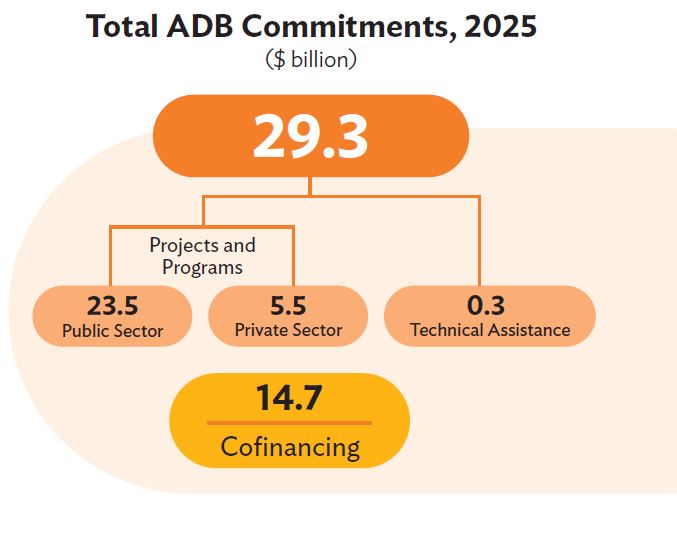
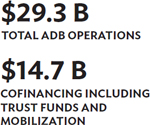
We scaled up for impact in 2025. Our operations committed in the past year are expected to generate more than 3.3 million jobs and ultimately benefit over 180 million people across Asia and the Pacific. These commitments—comprising loans, grants, equity investments, guarantees and technical assistance—amounted to $29.3 billion, 20% more than in 2024. This is coupled with $14.7 billion from our partners. Of our commitments, $23.5 billion was for programs and projects in the public sector, while $5.5 billion were directed to the private sector. Half of our commitments in the public sector directly supported infrastructure, reforms, and institutions to unlock private investments.
Our private sector investments are helping to address many of the region’s most pressing needs. We are enhancing digital connectivity for businesses and communities, building modern and reliable energy infrastructure to meet growing power demand, and expanding access to bank finance for small businesses, including many that are women-owned.
We are also addressing barriers that are holding back the private sector in challenging markets. In the Pacific,
we launched our Wayfinder Program, an innovative suite of tailored solutions designed to support businesses that traditional lenders often overlook.
The challenges facing Asia and the Pacific do not stop at national borders. Trade, energy, biodiversity protection, and digital connectivity, among other priorities, all demand regional solutions. In response, we are deepening our leadership in regional platforms. In Southeast Asia, ADB is supporting the development of the ASEAN Power Grid, which connects the electricity networks and strengthens the energy security of the 10 members of the Association of Southeast Asian Nations (ASEAN). Regional platforms such as this foster the connectivity and collaboration that will shape Asia and the Pacific’s future prosperity.
Many of our DMCs are highly exposed to more frequent and extreme weather events as well as other shocks. When disasters strike, ADB moves quickly to provide support and help communities rebuild with dignity. In the past year, we provided emergency assistance to people in earthquake-affected areas in Afghanistan and Myanmar, as well as to communities devastated by floods in Sri Lanka, Thailand, and Viet Nam.
As we delivered strong operational results in 2025, we also accelerated institutional reforms and policy updates to make ADB faster, stronger, and more responsive.
We adopted our first-ever Charter amendment—a defining moment in ADB history— which removes the bank’s lending limitation and enables a 50% increase in our financing capacity without requiring a general capital increase from shareholders. We updated our energy policy to better support energy access and security for our DMCs, including by enabling ADB to invest in nuclear energy where it aligns with country needs and meets the highest standards of safety, security, and environmental safeguards. We adopted a new approach for supporting critical minerals-to-manufacturing value chains, designed to help the region responsibly and sustainably capitalize on the rising demand for materials essential for renewable energy and digital

technologies. We also finalized procurement reforms that strengthen ADB’s commitment to quality, sustainability, and value for money. These reforms will create more local jobs and help deliver high-quality infrastructure that provides lasting development impact.
Together with the World Bank Group, we introduced a historic cofinancing approach, the Full Mutual Reliance Framework, that enables DMCs to benefit from faster project implementation, lower transaction costs, and continued adherence to high policy standards by fully eliminating duplication between the two institutions.
A key ingredient of ADB’s delivery is its Staff. Since 2023, we have increased the number of our staff in the field by 16%. A larger presence in our DMCs allows us to enhance the quality and frequency of dialogue with governments, have a deeper understanding of local challenges and deliver results faster on the ground.
Our progress in scaling up efforts and deepening our impact in 2025 was made possible through the collective dedication of ADB’s Management and Staff, Board of Directors, and
our development partners. I am sincerely grateful for the continued confidence and support from our donors, as well as our bilateral and multilateral partners. I value the insight and guidance of our Board of Directors and Board of Governors, whose stewardship is crucial. Finally, I extend my deep gratitude to ADB Staff, contractors, and consultants for their continued commitment and hard work.
The year 2026 marks a pivotal milestone—six decades of ADB partnership and impact across Asia and the Pacific. Our 60th anniversary provides an opportunity to reflect on our achievements, while also challenging us to further strengthen our institution, enhance delivery, and generate greater impact. In doing so, we can better serve the people of Asia and the Pacific as they work to solve increasingly complex challenges and achieve inclusive, resilient, and sustainable growth.

Masato Kanda
President and Chairperson
of the Board of Directors
|
|
||
|
Left to right: Vice-Presidents Bruce Gosper, Roberta Casali, Fatima Yasmin, Scott Morris, Bhargav Dasgupta, Yingming Yang; The Secretary Bruno Carrasco. |
The Board of Directors is responsible for the strategic direction of ADB’s operations. It approves policies, strategies, and individual projects over a certain value. The Board undertakes fiduciary oversight through its standing committees. It also represents the interests of shareholders in ensuring the bank is responsive to the needs of developing member countries (DMCs).
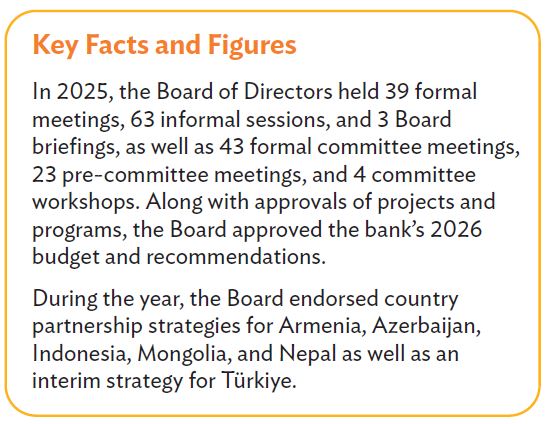
Board activity was significant in 2025, overseeing major policy decisions that increased ADB’s lending capacity to expand assistance for its DMCs throughout the Asia and Pacific region. The Board approved 158 new projects, programs, and financing facilities to scale up operations across the region.
The Board endorsed ADB’s new Policy Architecture, establishing a clearer governance framework for managing policies and directional and guidance documents. In addition, the Board approved the Full Mutual Reliance Framework— an innovative cofinancing option undertaken jointly with the World Bank—to help deliver faster, more impactful, and more responsive development financing. It also approved the updated Sovereign Financial Intermediation Lending Policy to accelerate private sector-led growth through financing mechanisms that strengthen crisis response across DMCs.
Committee and Working Group Highlights
Board members continued serving on committees and working groups monitoring and guiding ADB’s operations and providing recommendations to ADB Management.
The Audit and Risk Committee assists the Board of Directors in carrying out its responsibilities on matters relating to financial reporting, internal and external audits, internal controls, risk management, cybersecurity and artificial intelligence, business continuity, and organizational resilience. Considerations in 2025 focused on ADB’s Capital Adequacy Framework and implications of the Charter lending limit. The committee monitored the implementation of ADB’s new operating model and reviewed the new Policy Architecture. It examined risks related to generative artificial intelligence, cybersecurity, organizational resilience, and disaster risk management. It also assessed quarterly financial and risk reports, internal audit work, and progress on integrity and anticorruption measures.
The Budget Review Committee reviews the bank’s annual administrative budget, institutional business plans, and capital expenditures to ensure they align with ADB’s
strategic priorities. The committee assessed ADB’s 2025 budget utilization, the 2026−2028 budget framework, the proposed 2026 budget, and capital expenditure pipelines for 2026–2028. It reviewed consultant procurement and the implementation of the Workforce Rebalancing Framework, and held joint discussions with the Human Resources Committee on workforce analysis and the 2026 salary and benefits proposals.
The Compliance Review Committee—acting as liaison to ADB’s independent Compliance Review Panel—reviewed five eligibility reports on complaints (two each from India and Nepal; one from Indonesia) and agreed with the Panel’s recommendation to conduct a compliance review on the Nepal case. The committee cleared the compliance review terms of reference for the Nepal case, following the Board’s authorization of the panel’s recommendation to conduct the review. It also contributed to the ongoing review of the 2012 Accountability Mechanism Policy with the joint Board−Management Working Group.
The Development Effectiveness Committee ensures ADB’s operations, policies, and strategies achieve desired development outcomes efficiently. In 2025, the committee reviewed major evaluations covering ADB’s support for education, health, and livable cities as well as the evaluation of the Kazakhstan country assistance program. Discussions also covered corporate evaluations of ADB’s Trade and Supply Chain Finance Program, ADB-administered trust funds and other cofinancing programs, and implementation of the bank’s new operating model. The committee approved the Independent Evaluation Department’s work program for 2026–2028.
BOARD OF DIRECTORS 5 
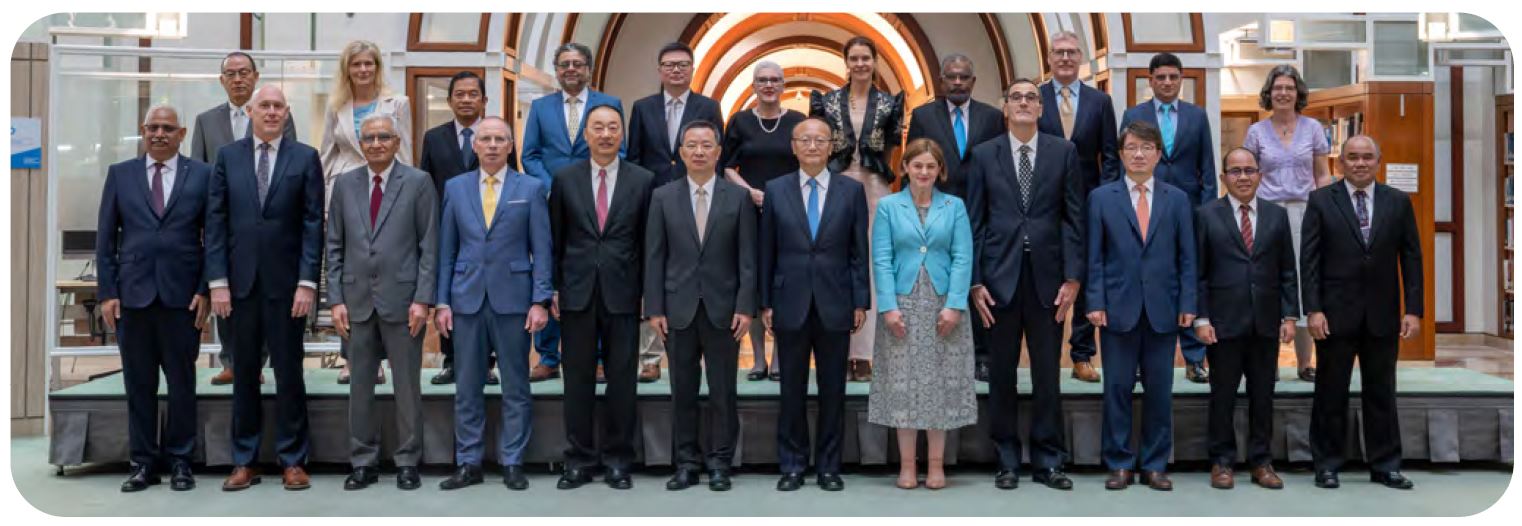
ADB Board of Directors as of 31 December 2025. Front, left to right: Directors L. Satya Srinivas Lolla, Martin Tabi, Noor Ahmed, Helmut Fischer, Shigeo Shimizu, Weihua Liu, President and Chairperson of the Board Masato Kanda, Directors Rachel Thompson, Bertrand Furno, Dongil Kim, Parjiono, Amiruddin Muhamed. Back, left to right: Alternate Directors Nim Dorji, Maja Sverdrup, Rolando Tungpalan, Shantanu Mitra, Shu Zhan, Lisa Wright, Ludivine Halbrecq, Mahinda Siriwardana, Llewellyn Roberts, Shreekrishna Nepal, Abigail Demopulos.
Inset photo: Alternate Director Haruka Sekiya.

The Human Resources Committee reviews, monitors, and recommends workplace strategies and policies to the Board, focusing on recruitment, compensation, benefits, and staff welfare. The committee discussed the Strategic Human Resources Framework and laid the groundwork for the 2026 Comprehensive Review of Compensation and Benefits. Priorities included the gender pay gap, internal dispute resolution mechanisms, performance management, and learning and development. The committee also reviewed recruitment performance, job architecture implementation, and staff engagement survey results, and held a joint session with the Budget Review Committee on the 2026 salary and benefits proposals and 2025 workforce analysis.
Three Board Working Groups deepened engagement with ADB’s digital agenda, advanced the review of ADB’s Accountability Mechanism Policy (2012), and continued to maintain an institutional focus on gender balance at the Board level. The first working group contributed to the Digital Transformation Operational Approach (ADB Digital), supported the redesign of the Board Information System, and explored new knowledge products, including for disaster risk analysis. A second working group gathered stakeholder views on implementing the Accountability Mechanism Policy, commissioning a report to present strategic options on proposed revisions to the policy. Meanwhile, a third working group held a panel discussion in March featuring current and former women Board members who highlighted their leadership experiences and underscored the importance of gender diversity at the Board of Directors level and of broader perspectives in decision-making.
Board–Management Relations and Engagement
Board–Management relations ensure institutional cohesion on topics such as private sector development, regional cooperation and public goods, and organizational resilience. ADB now holds two forums for dialogue and exchange of ideas on such matters: the annual Board and Management Retreat and the Board Week. The retreat, held in June in Clark, Pampanga, featured speakers from the International Finance Corporation, Asian Development Bank Institute, and the Clark Development Agency. The inaugural Board Week was held in March at ADB headquarters, with in-depth discussions on policy priorities, the macroeconomic outlook, the bank’s new operating model, and its new Policy Architecture.
Partnerships and Dialogue
Strengthening partnerships and promoting dialogue with DMCs remained a core part of the Board’s work in 2025. Board group visits were held in Bhutan, the People’s Republic of China, India, Mongolia, Nauru, Papua New Guinea, and Solomon Islands, while a familiarization visit took place in the island province of Palawan in the Philippines. These missions enabled Board members to discuss development priorities with government counterparts and communities; observe ADB-supported projects; meet clients; and engage with development partners, civil society, and the private sector.
|
Asia and the Pacific Development Context
In 2025, the Asia and Pacific region again demonstrated its capacity to adapt, recover, and move forward amid global and regional uncertainty. Despite significant trade policy shifts, changing import and export flows, and devastating disasters, the region closed the year with solid economic performance and measurable social progress.
Regional economic growth reached 5.4%. Growth was buoyed by strong exports, particularly of electronics and artificial intelligence (AI)-related equipment, along with a recovery in tourism and proactive fiscal and monetary responses. These gains occurred despite significant trade policy uncertainty, elevated debt levels in many of ADB’s developing member countries (DMCs), and geopolitical risks—including renewed upheaval in the Middle East, border tension in Southeast Asia, and Russia’s war in Ukraine—adding to economic volatility.
South Asia benefited from strong domestic demand and expanding services exports. Southeast Asia remained a key destination for foreign direct investment. Economies in Central and West Asia maintained momentum through fiscal expansion and household spending, while those in the Pacific posted gains in mining, liquefied natural gas, tourism, and infrastructure. In East Asia, policy support helped cushion property market weaknesses and maintain stability.
At the same time, regional inflation fell to 1.4%, mainly due to lower food and energy prices. This provided relief for low- and middle-income families, even as utility costs and currency pressures kept prices elevated in some Central Asian economies.
Extreme poverty in the region—while low at just over 3%—remained difficult to eliminate. About 9% were in moderate poverty, living on $3 to $4.20 a day. People experiencing poverty in 2025 were often those hardest to reach: isolated communities, households with limited access to education and health care, and those repeatedly affected by disasters. Deprivations in health, education, and living standards remained significant, with multidimensional poverty affecting nearly half a billion people. |
SCALING UP FOR IMPACT 7
ADB Driving Impact
ADB’s financial and technical support is transforming lives and economies across Asia and the Pacific—fueling prosperity, strengthening communities, and protecting the planet.
In 2025, ADB sharpened its focus on promoting private sector development as a key driver of inclusive, resilient, and sustainable growth. ADB’s 2025 investments across Asia and the Pacific are expected to generate more than 3.3 million jobs.
The 49 private sector projects ADB committed in 2025 are helping unlock a total of $9.5 billion in private sector financing, of which $4.7 billion is direct private capital mobilization, enabling larger and more ambitious investments that advance sustainable growth.
Of the 115 public sector projects committed by ADB in 2025, 50% directly supported infrastructure, reforms, and institutions to unlock private investments. ADB’s expanded use of innovative financial solutions in 2025, such as risk-bearing instruments, enhanced project bankability, boosted investor confidence, and attracted additional investors.
About 120 million people in the Asia and Pacific region are projected to benefit from improved infrastructure, financial services, and agricultural productivity because of ADB’s investments in 2025.
Approximately 61 million people are expected to benefit from improved health care services, education provision, or social protection, and ADB’s operations are expected to directly help improve the living standards of more than 9 million people living in poverty and vulnerable situations.
ADB also achieved significant progress in advancing the environment and nature agenda across Asia and the Pacific in 2025. It supported 17 DMCs to enhance nature-based solutions that strengthen resilience, protect biodiversity, restore coastal and marine ecosystems, reduce pollution, and promote nature-positive supply chains.
Overall, ADB committed $29.3 billion in loans, grants, equity investments, guarantees, and technical assistance—the highest level outside the coronavirus disease (COVID-19) emergency period and a 20% increase on 2024 commitments. Total public sector financing was $23.5 billion, while ADB’s own resources for the private sector reached $5.5 billion. Technical assistance amounting to $286 million remained critical for project design, policy reform, institutional strengthening, and regional integration. To amplify the impacts of these commitments, the bank again sought the contributions of valued cofinancing partners, who contributed $14.7 billion in additional resources supporting larger, more ambitious development solutions than ADB could achieve alone.
Scaling Up for Impact: Progress Toward Five Strategic Focus Areas
| 2024 | 2025 | ||
| Private Sector Development | |||
| Financing for private investment ($ billion) | 6.8 | 9.5 |  |
| Of which is direct private capital mobilization ($ billion) | 3.6 | 4.7 |  |
| Public sector operations contributing to private sector development (%) | 45 | 50 | |
| Regional Cooperation and Integration | |||
| Operations supporting regional cooperation and public goods (%) | 18 | 22 | |
| Digital Transformation | |||
| Operations supporting digital transformation (%) | 9 | 29 | |
| Climate Action | |||
| Financing for climate action (%) | 51 | 51 | |
| Operations supporting disaster risk management, and environment and nature (%) | 24 | 35 | |
| (2023 data) | |||
| Resilience and Empowerment | |||
| Operations supporting poverty reduction and inclusiveness (%) | 60 | 43 |  |
| (2023 data) | |||
| Private sector operations in frontier economies (%) | 33 | 27 | |
| Financing for fragile and conflict-affected situations, and small island developing states (%) | 7.5 | 5.5 |  |
| Operations promoting gender equality (%) | 50 | 71 | |
| (2023 data) |
Target met On track to achieve target On track to achieve target but performance declined from previous year Not on track to achieve target
 8 ANNUAL REPORT 2025
Policy and Institutional Changes for Greater Scale and Impact
ADB made institutional changes in 2025 that allow the bank to scale up for development impact well into the future.
The ADB Board of Governors voted to amend the bank’s founding charter and remove its lending limitation. This will enable ADB to better support developing member countries (DMCs) in addressing critical priorities in the region, without requiring a general capital increase from shareholders. In addition, the bank’s Capital Utilization Plan outlines a pathway for increasing ADB’s annual financing commitments to more than $36 billion by 2034.
ADB also introduced new guidance for integrating private sector solutions at every stage of the project cycle. The approach focuses on improving enabling environments through policy reforms, developing bankable projects, and mobilizing private capital to complement public investments.
The bank updated its energy policy in 2025, strengthening its commitment to increasing energy access and improving energy security for DMCs. While continuing with strong support for renewable energy generation, the changes enable ADB to support nuclear power—subject to rigorous assessments; strong safety, security, and environmental and social safeguards; and whole-of-life cost assessments. ADB is partnering with the International Atomic Energy Agency to support countries exploring nuclear energy options. The new policy also allows financing for certain projects that manage methane and curb routine gas-flaring and some projects in carbon capture, utilization, and storage. In addition, it enables the development of responsible critical-minerals-to-manufacturing value chains, which are crucial to energy transition.
ADB’s updated Results-Based Lending Policy introduces greater flexibility to help DMCs deliver sustainable outcomes. Results-based lending can now be combined with other types of ADB financing—such as investment loans—to strengthen government institutions and support complementary projects.
Increasing Prosperity Through Vibrant Economies
ADB in 2025 provided a broad range of investments and knowledge work to stimulate private investment in the region, streamline regional connectivity and cooperation, accelerate digital transformation, and bolster public financial management and financial markets to support economic growth and development.
Boosting Private Investment
Helping the private sector grow and flourish brings numerous benefits to developing economies. Aside from encouraging entrepreneurial activity and creating jobs, it helps mobilize private funding for development projects, expands technical and vocational education, and strengthens capital markets. These activities transform lives and livelihoods and, in turn, drive sustainable economic growth.
In 2025, expanding private sector engagement remained central to ADB’s strategies for unlocking new growth opportunities across Asia and the Pacific.
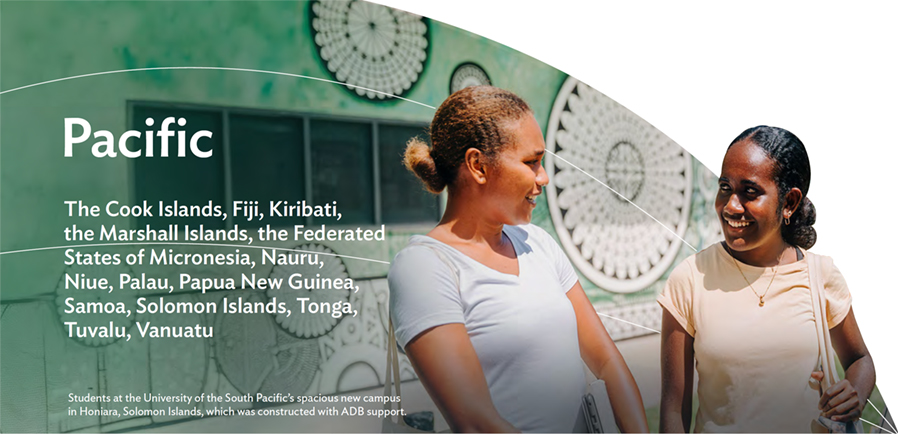
In the Pacific, ADB established the Pacific Wayfinder program to boost private sector investment in small island developing states and fragile and conflict-affected situations. In the Philippines, the bank invested in a water company’s initial public offering, mobilizing finance to expand and modernize water and wastewater infrastructure. In Pakistan, a policy-based guarantee is helping mitigate credit risk for commercial bank lending to smaller enterprises and mobilize commercial financing of $1 billion.
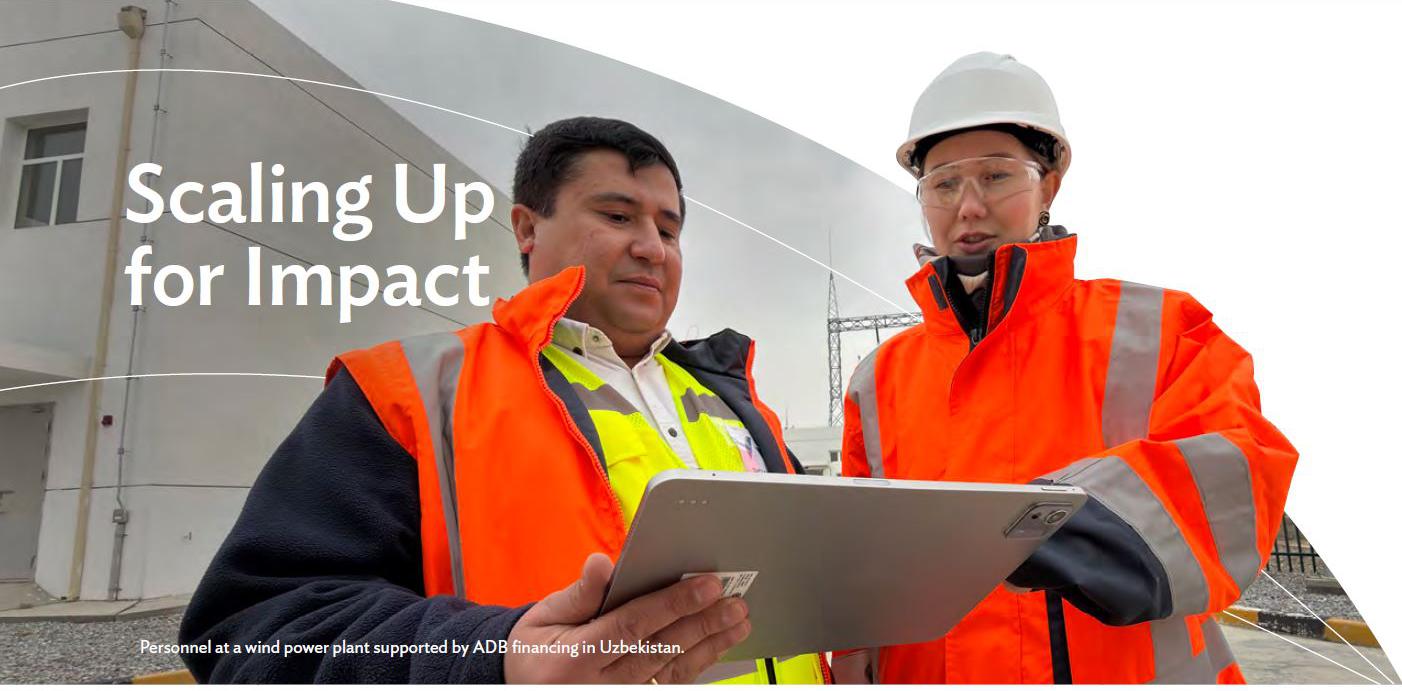
Meanwhile, in Uzbekistan, ADB is helping unlock the country’s renewable energy potential and boost economic development. The bank mobilized $1.2 billion in total private and partner capital for two 500-megawatt solar projects.
Collaboration between governments and private enterprise on infrastructure projects also remains a priority. Under ADB’s approach for supporting critical minerals-to-manufacturing value chains, the bank approved an innovative financing package for a copper-gold mine in Pakistan to strengthen the global copper supply chain. ADB’s financing will help unlock greater private capital by derisking the investment. The bank also achieved financial
SCALING UP FOR IMPACT 9
closure on two public–private partnership projects—a pumped-storage hydropower plant in the Philippines and a 300-megawatt solar project in Uzbekistan—securing $781.2 million in private investment. ADB also trained over 300 officials in nine DMCs on how to prepare and deliver well-structured public–private partnership projects.
ADB’s Trade and Supply Chain Finance Program grew over 15% in 2025. It delivered 24,700 guarantees and loans valued at $5.7 billion, of which $3.5 billion was mobilized from the private sector, and supported cross-border transactions for 15,000 small and medium-sized enterprises. In addition to partnering with banks to help companies diversify their international trading relationships, the program supported $3.6 billion in intra-regional trade, including $727 million in transactions between DMCs. ADB’s Microfinance Program, which helps firms access working capital, supported income generation, livelihood activities, and micro-housing through financing for more than 800,000 micro and small enterprise borrowers, totaling $434 million. It also entered new markets.
ADB expanded its local currency lending in 2025 to help mitigate currency risks for borrowers and to help open local markets to foreign investment and development finance. For many of the projects that ADB supports, foreign currency-denominated loans would not be feasible. The bank debuted in the Uzbekistan sum market and returned to the Chinese yuan, Georgian lari, Kazakh tenge, Mongolian togrog, and Philippine peso bond markets. Seven out of the 15 local currency bonds issued in 2025 were thematic bonds, totaling $104.8 million in United States dollar equivalent, in green, education, gender, and health themes.
Enhancing Regional Cooperation and Integration
Strengthening regional connectivity contributes to shared economic prosperity through mutually beneficial trade as well as cooperation on core development issues.
Throughout 2025, ADB continued to help improve regional transport systems and cross-border power links; expand trade and investment opportunities; and support the delivery of regional public goods such as healthy oceans and the blue economy, glaciers and water security, biodiversity and ecosystem management, as well as clean air and pollution control. Responding to increased uncertainty in global trade, ADB and the World Trade Organization convened a high-level forum on Central Asia and neighboring economies within the multilateral trading system to help identify new opportunities for cooperation. ADB technical assistance is also developing a framework to reinforce the building blocks of economic corridor development under the South Asia Subregional Economic Cooperation program, enhancing prospects for trade and value chain integration.
ADB’s partnership with the Association of Southeast Asian Nations (ASEAN) and the World Bank on the ASEAN Power Grid—a regional effort to connect the electricity networks of ASEAN’s 10 member countries—will strengthen economic ties through energy trading. In 2025, a new financing initiative for the grid was launched—which was backed by an initial $6 million in ADB technical assistance—to mobilize funding for projects to connect power networks across land and sea borders. This initiative complemented an earlier ADB announcement of up to $10 billion to support the grid’s development.
ADB also supports special economic zones, which can serve as catalysts for creating economic corridors and value chains. In July 2025, ADB and Indonesia brought together officials from the Brunei Darussalam–Indonesia–Malaysia–Philippines East ASEAN Growth Area, the Indonesia– Malaysia–Thailand Growth Triangle, and the Greater Mekong Subregion to advance special economic zone development and identify new avenues for collaboration. In Indonesia, ADB provided a policy-based loan to accelerate cross-border trade. The program will introduce reforms to reduce logistics costs; provide incentives to micro, small, and medium-sized enterprise exporters; and pursue and implement additional free trade agreements.
Advancing the Digital Transformation
Digital technology is a critical enabler of economic prosperity. While digitalization and AI can deliver significant productivity and efficiency gains, their rapid adoption must be properly governed to avoid issues such as data misuse, cybersecurity breaches, and the potential exclusion of people without digital access.
10 ANNUAL REPORT 2025
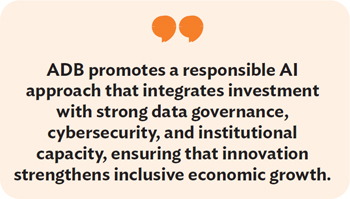
ADB promotes a responsible AI approach that integrates investment with strong data governance, cybersecurity, and institutional capacity, ensuring that innovation strengthens inclusive economic growth. As one example of this approach, the Asian Development Bank Institute, ADB, and partners co-organized an event on AI applications in health care, which underscored the technology’s potential to transform diagnostics, expand access, and deliver personalized services, while stressing the need for equitable and ethical adoption.
In 2025, ADB launched a digitalization index, which measures the progress of national digital transformation, helps understand the challenges faced by DMCs, and offers actionable insights for policymakers.
In Azerbaijan, the bank is helping digitize rail operations to increase efficiency, enhance safety, and reduce emissions. The modernized railway system will connect the economies in East and Central Asia with Caucasus and Europe. In Georgia, ADB is supporting the use of big data to boost productivity across national logistics chains. In Thailand, it is helping finance the construction and operation of a 25.6-megawatt green data center, strengthening the country’s digital economy by leasing data capacity to large, global technology companies and AI firms.
Meanwhile, an ADB regional technical assistance program is identifying digital opportunities in Fiji, Maldives, and Nepal. The bank will also provide advisory support to Pakistan and Tonga and prepare road maps for digital skills development in Papua New Guinea and Solomon Islands. Another technical assistance program is integrating cybersecurity measures in development projects in Bangladesh, the Philippines, Sri Lanka, and Tajikistan.
Modernizing Public Institutions
In many developing economies, comprehensive reforms to fiscal management can create space for vital development projects and ramp up growth led by the private sector.
ADB supports the Asia Pacific Tax Hub to drive learning and innovations in tax policy and administration. In 2025, the hub convened peer learning platforms such as the Regional Tax Conference held in November, the Digital Economy Taxation Network Conference held in February, as well as training courses on cross-border tax risks in Fiji and tax expenditure analyses in Bangladesh.
In Cambodia, ADB’s policy-based lending is strengthening revenue and expenditure management, with reforms expected to generate more than $2 billion in additional revenues and over $3 billion in efficiency savings by 2028. In Bangladesh and Sri Lanka, ADB provided support for banking reforms to bolster financial stability and modernize the sector by improving asset quality, capital liquidity, and the supervisory and regulatory capacity of central banks.
ADB is supporting supreme audit institutions in Maldives and the Marshall Islands to integrate data analytics in audit processes, which will improve audit quality and effectiveness and enhance public financial accountability.
In addition, ADB policy advice on state-owned enterprise reform is helping governments across the region strengthen oversight; enhance financial and operational performance; and expand access to commercial and green finance in priority sectors such as energy, transport, and water.
| SCALING UP FOR IMPACT | 11 | |
Promoting People’s Well-Being and Empowerment
Across Asia and the Pacific, approximately 135 million people still live in extreme poverty, while another 373 million struggle to meet their basic needs. Currently, 500 million people lack access to clean water, 400 million either have no electricity or inadequate supply, and more than 1 billion are unable to easily access basic health services.
ADB works to reduce poverty and inequality by investing in the education and employability of the region’s people, expanding access to quality jobs and livelihoods, improving access to health services, and strengthening social protection programs. The bank also ensures specific initiatives for women and girls, particularly around physical safety, quality education, and financial inclusion.
Improving Access to Quality Education
Education and skills training remain key drivers of raising people out of poverty and ensuring long-term socioeconomic well-being.
ADB supports its DMCs by investing in broader access to quality education, teacher development in areas such as digital learning, and technical and vocational education and training that is appropriate to modern, sustainable economies.
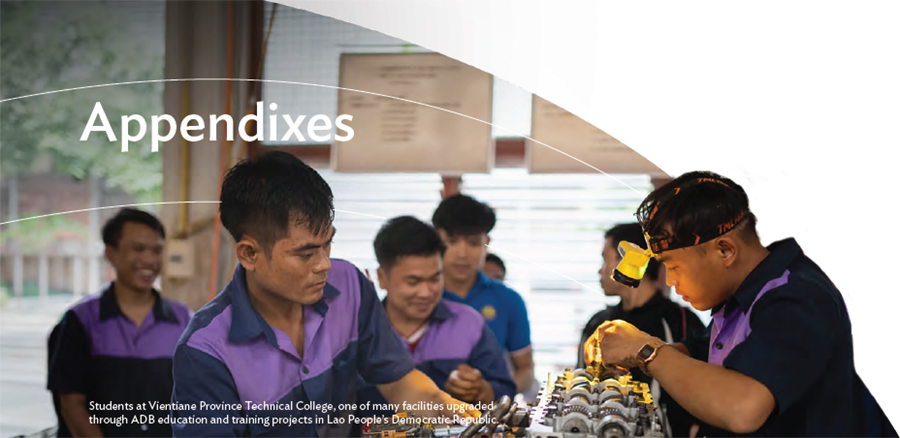
In 2025, ADB committed a financing package that aligns technical and vocational education and training with labor market needs in the Lao People’s Democratic Republic (Lao PDR). This investment will upskill more than 1,000 female students from poor families in automotive and other key occupational areas.
In India, ADB provided financing to the country’s national flagship skilling program to produce highly employable youth aligned with industry needs. In Viet Nam, the bank provided a sustainability-linked private sector loan to improve access to quality education by financing new educational facilities for 20,400 students in the urban areas of Ha Noi, Ho Chi Minh City, and Hung Yen.
An ADB-financed project in Kiribati is removing barriers for 950 children each year by funding student transport, enhancing digital curricula, upskilling teachers, and incorporating disability-accessible facilities and resilient school infrastructure.
In September 2025, ADB and the Asian Development Bank Institute hosted a professional development program on AI in education. Held in Tokyo, the
event drew on Japan’s AI experience in schools to train participants on leading digital transformation in their education systems.
Building a Healthier Future
Every year, millions of people in DMCs are pushed below the poverty line by health care costs. Governments continue to request development assistance to improve the quality, efficiency, and governance of health services.
Designed for DMCs across the region, the first-ever ADB Health Forum in July provided cutting-edge knowledge to advance innovation and transform health systems. It also launched a new regional platform for collaboration on universal health coverage.
In Sri Lanka, ADB is supporting a nationwide program to expand surgical and specialist services in 82 secondary hospitals, establish a center for disease control, and enhance public health laboratory capacity and accreditation. It is also strengthening pharmaceutical quality assurance and sector governance.
ADB is supporting the establishment of a specialized facility for noncommunicable diseases in Vanuatu. This facility will provide comprehensive diagnosis and treatment for chronic conditions such as diabetes and cervical cancer, while promoting healthy lifestyles for nearly half of the population.
In Turkmenistan, ADB is improving equitable access to quality care for the people of Ashgabat and surrounding regions. The project will provide better-qualified nurses and midwives, and increase their number, by constructing a new nursing school and modernizing teaching methods and nursing education curricula.
Expanding Social Protection to Safeguard Livelihoods
Social protection is a central tenet of inclusive development, allowing societies to remain cohesive and unify toward sustainable economic growth, particularly
|
12 | ANNUAL REPORT 2025 |
through skills programs and new employment pathways. These safety nets are critical in the wake of disasters and other emergencies.
In 2025, grants from ADB’s Asia Pacific Disaster Response Fund provided urgent shelter, food, and medical assistance in the aftermath of severe flooding in Sri Lanka, Thailand, and Viet Nam.
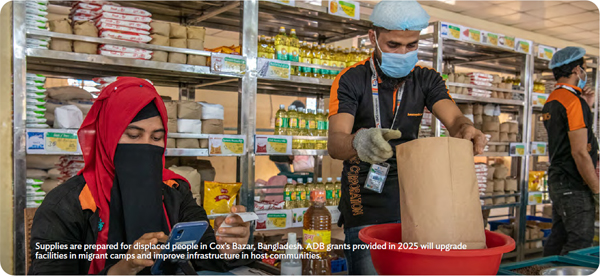
In Bangladesh, ADB is investing to improve living conditions and create livelihood opportunities for more than 71,000 displaced people from Myanmar and members of host communities. The bank’s financing is helping construct food centers, temporary schools that double as cyclone shelters, bridges, a water treatment plant, and water supply and energy systems.
In Armenia, ADB’s results-based lending program is supporting long-term, sustainable housing for about 109,000 Armenian refugees who arrived in 2023. The program will also improve access to social protection, finance, and economic opportunities for affected households.
ADB is advancing social protection systems in Cambodia, Indonesia, the Lao PDR, and the Philippines through technical assistance that strengthens policies, operations, digital systems, and institutional capacity.
Meanwhile, the bank provided emergency support— including shelter, food, water, sanitation services, essential health supplies, trauma counseling, and temporary learning spaces—for more than 400,000 people in Myanmar’s earthquake-affected communities. ADB also provided emergency food and cash assistance to approximately 60,000 people affected by the earthquake in Afghanistan.
Empowering Women and Girls
Governments in developing economies continue to raise their ambitions for improving the lives of women and girls. ADB responded again in 2025 by strengthening its approach and raising its level of ambition for mainstreaming support for women and girls. It designed projects that directly address specific challenges and support innovative approaches to closing gaps between females and males.
ADB is providing advisory support to create safer public transport, improve personal security, and tackle violence against women and girls across Asia and the Pacific by enabling stakeholders in the region’s health and transport sectors to explicitly address inequalities in project design and implementation.
In Pakistan, ADB is investing in girls’ education and participation in science, technology, engineering, and mathematics subjects. Through technical assistance, it is helping Armenia, Indonesia, Mongolia, Nauru, Solomon Islands, and Uzbekistan integrate women’s inequality assessments and make budgets work for women and girls through fiscal policymaking and public financial management.
Fostering private ventures, ADB is providing financing to a commercial bank in Uzbekistan to expand lending to micro, small, and medium-sized enterprises owned or led by women as well as first-time borrowers. It is also helping establish Tonga’s first credit risk- sharing facility to ease collateral constraints and unlock bank lending for about 300 women entrepreneurs. An associated fund will provide grants to improve the bankability of unregistered businesses led by women.
Enhancing Livelihoods in Remote and Rural Areas
For people in remote and rural areas, investments in modern infrastructure, sustainable employment, and agricultural supply chains, along with better management of water and land resources, are essential to build prosperous and harmonious communities.
Among a number of investments in rural development during 2025, ADB is improving living conditions for 363,000 people in remote regions of Viet Nam, including 187,000 people from ethnic minorities. Investments in transport and water infrastructure will connect farms with crop-processing facilities and markets; expand access to health, education, and other services; and improve safe water supply and irrigation.
In Mongolia, ADB is providing working capital to a private company to purchase wheat from local farmers. The initiative supports 250 farming enterprises and small wheat producers while creating sustainable employment in rural areas.
Improving Urban Living Standards
Across Asia and the Pacific, about 600 million people still live in informal settlements, while rapid urbanization continues to place massive pressure on the ability of DMCs to deliver basic services.
In 2025, ADB scaled up its investments in urban development, adopting integrated approaches to help DMCs build inclusive and sustainable cities.
The bank’s first public sector loan to Türkiye is restoring and expanding drinking water supply and wastewater and drainage services for more than 163,000 people
| SCALING UP FOR IMPACT | 13 | |
across provinces affected by the 2023 earthquake. In Cambodia, a 2025 commitment will benefit over 2 million people in 14 cities across 12 districts through improved urban planning; better water supply, sanitation, and waste management; and updated flood control.
Reflecting India’s complex challenges, ADB copublished a concept note on creative urban redevelopment with the Government of India and the World Bank, outlining innovative approaches for restoring critical spaces that were once vibrant.
ADB also hosted the Water and Urban Development Forum in May 2025, drawing 672 attendees from 30 DMCs to share solutions on sustainable services, urban transformation, and investment mobilization. In December, the bank launched the Asian Water Development Outlook 2025, which assessed water security in 50 economies and identified priority reforms and associated investments—totaling $4 trillion between 2025 and 2040—to enhance water management.
Building a Healthy Planet
Across Asia and the Pacific, many DMCs are highly exposed to severe typhoons, floods, droughts, extreme heat, sea-level rise, and glacier retreat, which are exacerbated by a changing climate. Meanwhile,
ecosystems, livelihoods, and communities are being threatened by biodiversity loss, degradation of natural resources, and declining water security.
ADB is strategically scaling up investments that build the region’s momentum to help protect the planet. In 2025, the bank committed over $13.5 billion in climate finance.
Strengthening Resilience
In 2025, several DMCs experienced catastrophic flooding, intense monsoon rains, and powerful tropical cyclones, while melting glaciers caused floods across the Hindu Kush Himalayas, impacting Afghanistan, Nepal, and Pakistan.
ADB responded with advanced disaster risk management solutions to better prepare for, reduce, and respond to climate-and disaster-related risks, including post-disaster needs.
The bank is helping build resilient water and agriculture systems for 13 million people, including farmers and vulnerable communities, in glacier-dependent regions of Central Asia, the South Caucasus, and Pakistan. This work is made possible via $250 million from the Green Climate Fund.
In Bhutan, ADB committed support for the government’s flagship initiative to address flood risks from the Omchhu River, which are intensified by unpredictable riverbank erosion, landslides, and worsening weather-related impacts.
ADB and the World Bank Partner to Increase Impact
In 2025, ADB and the World Bank signed the Full Mutual Reliance Framework, an agreement designed to streamline cofinancing and boost development impact.
Under the framework, cofinanced projects are prepared and supervised using the agreements of a single lead lender, allowing client countries to follow one set of requirements for project preparation and supervision. This eliminates duplication of effort, shortens preparation time, and reduces transaction costs, while keeping high policy standards intact.
The pioneering framework aims to help countries achieve better results with fewer procedural hurdles, allowing governments to focus more on project implementation and impact. The framework also responds to calls from the G20 for multilateral development banks to work together and deliver greater collective impact.
During 2025, two groundbreaking projects were launched under the framework in the Pacific. ADB is the lead lender for a project supporting sustainable economic corridors and urban resilience in Tonga, the largest development partner-financed investment in the country’s history. Meanwhile, the World Bank is leading a project to transform and modernize primary health care across several Pacific island countries with ADB supporting the Fiji component. Both projects intend to demonstrate how aligned processes can help small island states address climate, health, and infrastructure challenges more efficiently. The framework is exploring other projects beyond the Pacific, setting the stage for deeper collaboration between the two institutions.
|
14 | ANNUAL REPORT 2025 |
The project will help mitigate risks for 12,500 people in Phuentsholing and enable safer riverfront development.
In the Kyrgyz Republic and Tajikistan, ADB is helping establish a new disaster relief finance program combining rapid budget support for medium-severity natural hazards and health emergencies with a world-first catastrophe bond delivering quick liquidity following high-severity disasters.
Accelerating Energy Access and Affordability
Facing frequent and intense disasters, along with deteriorating air quality and ecological conditions, Asia and the Pacific is responsible for over half of annual global greenhouse gas emissions.
Throughout 2025, ADB invested significantly to expand energy access and accelerate affordable and clean energy development across the region. In India, the bank is helping accelerate rooftop solar adoption and expand access to clean and affordable energy for 10 million households by 2027.
In Timor-Leste, ADB support saw the country reach a major milestone in its energy security by signing a power purchase agreement for a 72-megawatt solar power plant paired with a 36-megawatt-hour battery storage system. The facility will generate enough power for 80,000 households, reducing reliance on imported diesel.
ADB is also supporting Uzbekistan through landmark, private sector investments such as a utility-scale wind-plus-storage project that is expected to generate
728 gigawatt-hours of clean energy annually and cut 400,000 tons of carbon dioxide equivalent. Additionally, two solar photovoltaic plants with battery storage will deliver clean power to 600,000 households and offset 1.3 million tons of carbon dioxide each year.
Transforming Food Systems
At the bank’s 58th Annual Meeting in May 2025, ADB President Masato Kanda announced a $40 billion ambition to transform food systems across Asia and the Pacific by 2030. It will support long-term food and nutrition security by prioritizing ecosystem protection and nutrition improvement and will scale up financing for agribusinesses.
In Sri Lanka, ADB is investing in the country’s largest multiuse water resources development initiative to strengthen agriculture sector resilience and enhance food security. The transformative trans-basin project will directly benefit 35,600 climate-vulnerable farming households in the dry zone, irrigating 14,912 hectares of paddy field and providing water for high-value crops across 5,039 hectares of upland fields.
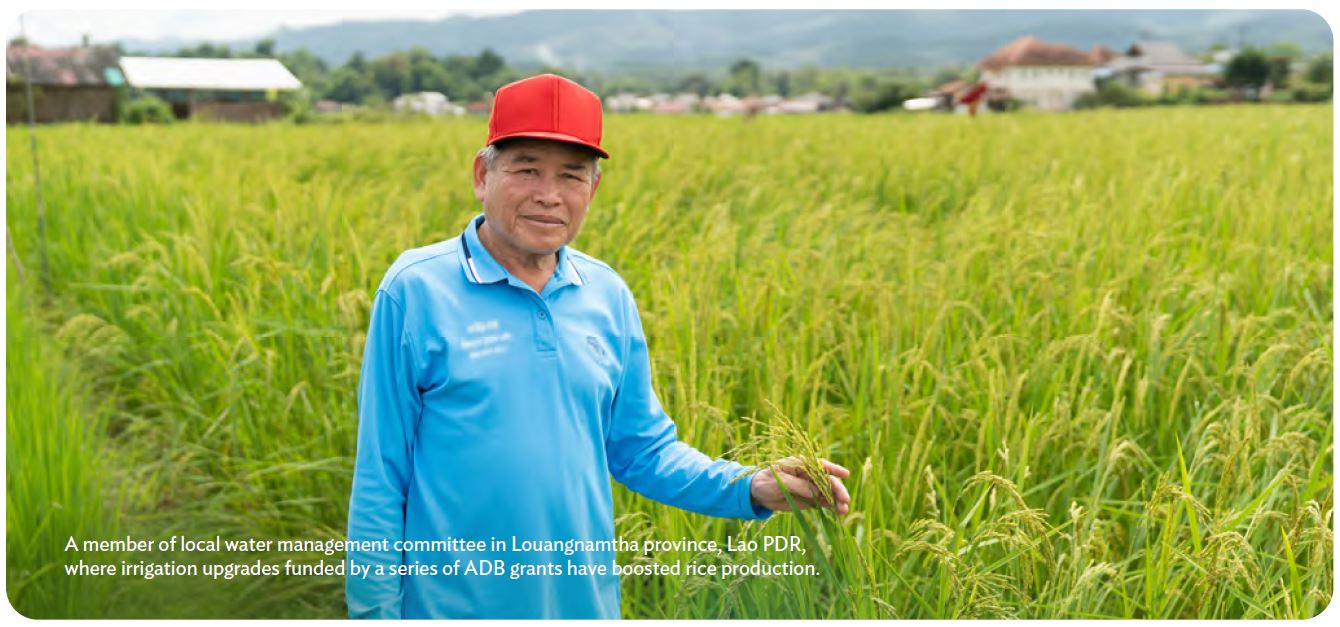
Meanwhile, in the Lao PDR, ADB is boosting nutritious food production and agrifood systems geared to the export of high-value commodities. The bank is funding the construction or rehabilitation of irrigation facilities as well as community-based technical advisory services, training, and on-farm demonstrations. ADB is also providing capital for eligible enterprises investing in agricultural value chains and supporting the modernization of food safety laboratories.
| SCALING UP FOR IMPACT | 15 | |
Investing in Biodiversity and Nature
Many developing economies across Asia and the Pacific recognize that biodiversity conservation and the protection of natural assets can be critical for improving food security, protecting cultural heritage, and spurring sustainable economic transformation.
ADB is prioritizing investments that protect and restore nature. The bank’s program for healthy oceans and sustainable blue economies, for instance, has quadrupled investments to over $1 billion, up from about $270 million in 2019. At the United Nations Ocean Conference in June 2025, ADB was recognized as a pioneer in advancing blue bonds and other innovative ocean finance initiatives.
In the People’s Republic of China (PRC), the bank is helping conserve more than 220 hectares of coastal wetlands and mangroves and transform over 630 hectares into sustainable aquaculture and farmland under its Regional Flyway Initiative. The project is also upgrading infrastructure and ecosystem services and reducing flood risks for at least 4.4 million people.
In Fiji, ADB is helping upgrade a wastewater facility to reduce pollutants entering Laucala Bay and restore marine ecosystems, including mangrove forests and coral reefs. Meanwhile, ADB initiated technical assistance to accelerate private sector investment in carbon-positive nature-based solutions, including fast-growing crops and renewable biological resources, across DMCs.
Promoting Smart Waste Management
Asia and the Pacific generates an estimated 1.8 billion tons of municipal waste annually, yet systems to manage waste remain critically underdeveloped in many economies.
In 2025, ADB supported responsible waste management with financing for recycling and circular economy activities, infrastructure upgrades, and holistic planning.
In the Philippines, the bank is supporting the recycling of plastics and solid waste to prevent these items from entering marine ecosystems, while also helping rejuvenate coastal areas. It is also exploring the use of recycled plastic waste in Papua New Guinea’s asphalt roads to improve durability under hot temperatures and reduce landfill.
In the PRC, ADB is helping address land-based pollution in Ningxiang City by improving wastewater management through a private sector loan. The project will help protect Dongting Lake, the PRC’s second-largest freshwater lake and a wetland critical for flood regulation and biodiversity conservation.
Partnering for Greater Impact
Scaling up for impact across a wide and diverse region is possible only through strong and strategic partnerships. In 2025, ADB worked closely with governments, shareholders, development organizations, the private sector, and civil society to deliver solutions that are larger in scale, faster in implementation, and more effective.
By combining financing, expertise, technology, and knowledge, ADB’s partnerships deliver project efficiencies and economies of scale that allow DMCs to tackle the region’s most pressing challenges and advance toward a more inclusive, resilient, and sustainable future.
Several European partners expanded their commitments in 2025. Germany’s KfW added $2 billion to its cofinancing agreement with ADB through to 2028, supporting clean energy, water, sanitation, and climate resilience. ADB and France’s Agence Française de Développement doubled their joint cofinancing target to $6 billion for 2026–2028. Italy scaled up support through Cassa Depositi e Prestiti for climate and biodiversity projects and through its export credit agency to broaden opportunities for Italian industries in ADB-supported initiatives.
Shoring up food security and rural livelihoods, ADB and the International Fund for Agricultural Development expanded their cooperation through to 2028. The bank also signed the Master Framework Agreement for Sustainable Infrastructure with 10 global insurers, with the potential to mobilize up to $2.8 billion in private capital and enabling ADB to share credit risk with the insurance market.
ADB launched the Market Acceleration Platform for Asia and the Pacific Trust Fund, supported by Japan, to bring private sector solutions to development challenges, and introduced the Sustainable and Resilient Maritime Fund to support greener, more-efficient shipping.
The bank also signed an agreement with the Gates Foundation to broaden collaboration on health, digital innovation, agriculture, and inclusive growth.
ADB further extended its cooperation with civil society organizations (CSOs) through the inaugural CSO Listening Sessions, dedicated partnership days, and targeted consultations on key topics, which together reached 2,200 representatives of 1,500 CSOs.
BY THE NUMBERS
ADB OPERATIONAL HIGHLIGHTS
Commitments, 2021–2025 ($ million)
| Item | 2021 | 2022 | 2023 | 2024 | 2025 | ||||||||||||
| A. Loans, Grants, and Others | |||||||||||||||||
| By Source | |||||||||||||||||
| Regular Ordinary Capital Resources | 19,531 | 16,134 | 18,359 | 18,311 | 24,239 | ||||||||||||
| Loansa | 16,195 | 13,232 | 16,210 | 15,679 | 20,918 | ||||||||||||
| Equity Investments | 265 | 147 | 105 | 407 | 417 | ||||||||||||
| Guarantees | - | 19 | 27 | - | 500 | ||||||||||||
| Trade and Supply Chain Finance Program and Microfinance Programb | 3,072 | 2,736 | 2,018 | 2,225 | 2,404 | c | |||||||||||
| Long term (maturity of 365 days or more) | 221 | 269 | 340 | 435 | 533 | ||||||||||||
| Short term (maturity of less than 365 days) | 2,851 | 2,467 | 1,678 | 1,789 | 1,871 | ||||||||||||
| Concessional Resources | 2,993 | 4,074 | 4,932 | 5,689 | 4,739 | ||||||||||||
| Concessional Ordinary Capital Resources Loans | 2,648 | 3,136 | 4,159 | 4,610 | 3,479 | ||||||||||||
| Asian Development Fund | 344 | 938 | 774 | 1,079 | 1,260 | ||||||||||||
| Grants | 344 | 932 | 770 | 1,079 | 1,255 | ||||||||||||
| Guarantees | - | 5 | 3 | - | 5 | d | |||||||||||
| Regular Ordinary Capital and Concessional Resources | 22,524 | 20,208 | 23,292 | 24,000 | 28,977 | ||||||||||||
| Special Fundse | 5 | 7 | 6 | 6 | 12 | ||||||||||||
| Grants | 5 | 7 | 6 | 6 | 12 | ||||||||||||
| Subtotal (A) | 22,529 | 20,216 | 23,297 | 24,005 | 28,989 | ||||||||||||
| By Operations | |||||||||||||||||
| Public Sector | 18,272 | 16,349 | 19,533 | 19,167 | 23,483 | ||||||||||||
| Loans | 17,922 | 15,389 | 18,760 | 18,082 | 21,716 | ||||||||||||
| Grants | 349 | 940 | 764 | 1,085 | 1,267 | ||||||||||||
| Guarantees | - | 19 | 9 | - | 500 | ||||||||||||
| Private Sector | 4,258 | 3,867 | 3,764 | 4,838 | 5,506 | ||||||||||||
| Loansa | 921 | 979 | 1,608 | 2,207 | 2,680 | ||||||||||||
| Equity Investments | 265 | 147 | 105 | 407 | 417 | ||||||||||||
| Grants | - | - | 12 | - | - | ||||||||||||
| Guarantees | - | 5 | 21 | - | 5 | d | |||||||||||
| Trade and Supply Chain Finance Program and Microfinance Programb | 3,072 | 2,736 | 2,018 | 2,225 | 2,404 | c | |||||||||||
| Long term (maturity of 365 days or more) | 221 | 269 | 340 | 435 | 533 | ||||||||||||
| Short term (maturity of less than 365 days) | 2,851 | 2,467 | 1,678 | 1,789 | 1,871 | ||||||||||||
| Subtotal (A) | 22,529 | 20,216 | 23,297 | 24,005 | 28,989 | ||||||||||||
| B. Technical Assistance | |||||||||||||||||
| Public Sector | 209 | 243 | 250 | 281 | 267 | ||||||||||||
| Private Sector | 21 | 14 | 14 | 17 | 19 | ||||||||||||
| Subtotal (B) | 230 | 257 | 264 | 298 | 286 | ||||||||||||
| TOTAL ADB OPERATIONS (A + B) | 22,759 | 20,473 | 23,562 | 24,304 | 29,275 | ||||||||||||
| ADB Operations Without Trade and Supply Chain Finance Program and Microfinance Programb | 19,687 | 17,736 | 21,544 | 22,079 | 26,871 | ||||||||||||
| C. Cofinancing Including Trust Funds and Resource Mobilized | |||||||||||||||||
| Public Sector | 4,967 | 4,330 | 9,528 | 6,178 | 4,431 | ||||||||||||
| Trust Funds Administered by ADB | 116 | 92 | 129 | 189 | 254 | ||||||||||||
| Bilateral | 2,051 | 1,830 | 3,110 | 2,906 | 2,798 | ||||||||||||
| Multilateral | 2,680 | 2,340 | 6,137 | 3,083 | 1,379 | ||||||||||||
| Othersf | 120 | 69 | 152 | - | 1 | ||||||||||||
| Private Sector | 7,543 | 6,999 | 6,423 | 6,612 | 9,443 | ||||||||||||
| Trust Funds Administered by ADB | 103 | 81 | 261 | 87 | g | 51 | |||||||||||
| Bilateral | 2 | - | - | 2 | - | ||||||||||||
| Multilateral | 5 | 25 | - | 45 | 5 | ||||||||||||
| Commercialh | 1,643 | 1,554 | 3,015 | 3,257 | g | 5,699 | |||||||||||
| Trade and Supply Chain Finance Program and Microfinance Program | 5,790 | 5,340 | 3,146 | 3,221 | 3,688 | c | |||||||||||
| Long term (maturity of 365 days or more) | 218 | 218 | 418 | 612 | 525 | ||||||||||||
| Short term (maturity of less than 365 days) | 5,572 | 5,122 | 2,729 | 2,609 | 3,163 | ||||||||||||
| Transaction Advisory Services | 397 | 60 | 443 | i | 2,075 | 781 | j | ||||||||||
| TOTAL COFINANCING | 12,907 | 11,390 | 16,394 | 14,865 | 14,656 | ||||||||||||
| Long-Term Direct Mobilizationk | 1,502 | 1,286 | 2,637 | 4,641 | 6,535 | ||||||||||||
– = nil, ADB = Asian Development Bank.
Notes:
| 1. | Commitment is the financing approved by the ADB Board of Directors or Management for which the legal agreement has been signed by the borrower, recipient, or the investee company and ADB. It comprises the amount indicated in the investment agreement, which—depending on the exchange rate at the time of signing—may or may not be equal to the approved amount. In the case of official and commercial cofinancing not administered by ADB for which the signed amount is not readily available, the approved amount is used. |
| 2. | Commitments from ADB’s internal resources include the Trade and Supply Chain Finance Program and Microfinance Program. Inclusion of ADB’s exposure (or committed redeployed capital) under these programs fully reflects the total financing committed. ADB also reports on cofinancing mobilized by these programs. |
| 3. | Numbers may not sum precisely because of rounding. |
| a | Includes commitments classified as debt securities in financial statements in accordance with accounting standards. |
| b | The Trade and Supply Chain Finance Program (TSCFP) and Microfinance Program are private sector credit enhancement products and loans financed from ADB’s regular ordinary capital resources. |
| c | Includes $2.2 billion (or $5.7 billion including cofinancing) from the TSCFP. |
| d | Consists of a private sector guarantee committed to Tajikistan under the Asian Development Fund private sector window managed by ADB. |
| e | Comprises funds other than the Asian Development Fund such as the Asia Pacific Disaster Response Fund and the Climate Change Fund. |
| f | Includes concessional cofinancing for public sector operations from public and private entities other than official development assistance sources, such as state-owned commercial banks, foundations, corporate social responsibility programs, and civil society organizations. |
| g | This figure has been adjusted since Annual Report 2024 due to the reclassification of $147 million private sector cofinancing for five projects. |
| h | Includes B loans and parallel loans, among others. B loans are cofinancing arrangements for a single borrower that are funded by commercial banks and other eligible financial institutions, helping to distribute related risks, with ADB acting as the lender of record. |
| i | Excludes a $37 million A-loan mobilized under Transaction Advisory Services, which is reported under private sector ADB financing, and $150 million that is reported under private sector cofinancing. |
| j | Excludes $141 million that is reported under private sector cofinancing. |
| k | Refers to financing on commercial terms from another entity that was made possible by ADB’s active and direct involvement. |
| SCALING UP FOR IMPACT | 17 | |
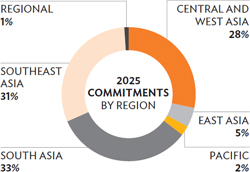
Commitments by Region, 2021–2025 ($ million)
| Region | 2021 | 2022 | 2023 | 2024 | 2025 |
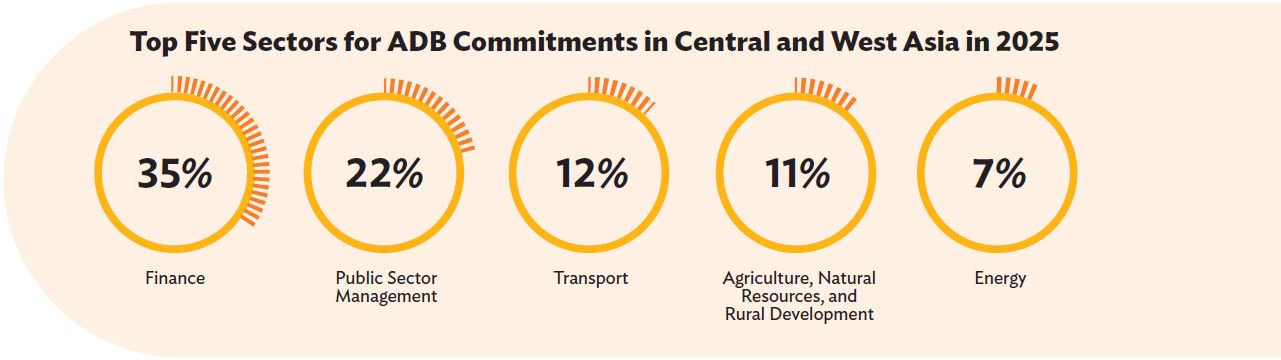
| Central and West Asia | 5,193 | 5,962 | 4,323 | 5,606 | 8,287 |
| East Asia | 2,034 | 2,089 | 2,127 | 1,852 | 1,381 |
| Pacific | 853 | 994 | 253 | 1,271 | 680 |
| South Asia | 8,819 | 5,127 | 8,836 | 8,942 | 9,668 |
| Southeast Asia | 5,579 | 6,028 | 7,940 | 6,174 | 8,956 |
| Regional | 282 | 272 | 83 | 459 | 302 |
| TOTAL | 22,759 | 20,473 | 23,562 | 24,304 | 29,275 |
| Note: Numbers may not sum precisely because of rounding. | |||||
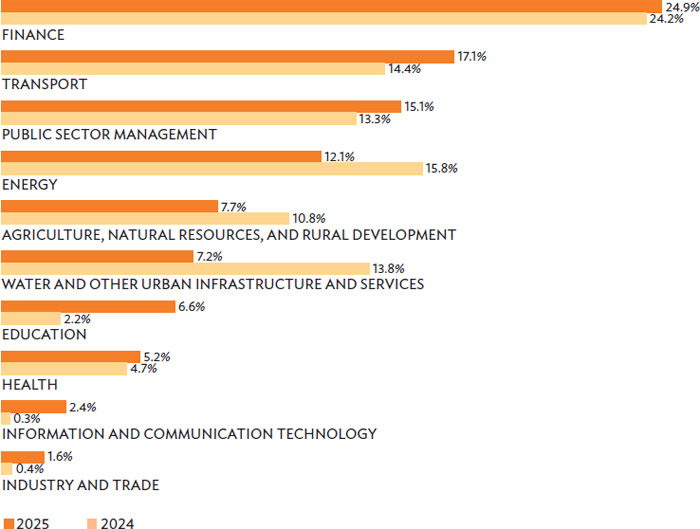
Commitments by Sector, 2021–2025 ($ million)
| Sector | 2021 | 2022 | 2023 | 2024 | 2025 |
| Agriculture, Natural Resources, and Rural Development | 1,490 | 2,218 | 3,228 | 2,637 | 2,250 |
| Education | 975 | 799 | 1,389 | 543 | 1,915 |
| Energy | 1,837 | 1,446 | 2,227 | 3,829 | 3,516 |
| Finance | 4,116 | 5,686 | 3,611 | 5,886 | 7,263 |
| Health | 5,882 | 823 | 2,275 | 1,145 | 1,526 |
| Industry and Trade | 716 | 238 | 661 | 98 | 465 |
| Information and Communication Technology | 55 | 86 | 94 | 71 | 701 |
| Multisector | 10 | 11 | 6 | 21 | 23 |
| Public Sector Management | 2,294 | 3,725 | 3,354 | 3,220 | 4,391 |
| Transport | 3,396 | 4,344 | 4,779 | 3,506 | 4,991 |
| Water and Other Urban Infrastructure and Services | 1,989 | 1,098 | 1,919 | 3,348 | 2,105 |
| TOTAL | 22,759 | 20,473 | 23,542a | 24,304 | 29,145b |
Note: Numbers may not sum precisely because of rounding.
a A $20 million commitment is not included in this total as the project’s sector assignment was waived due to its specific nature.
b A $130 million commitment is not included in this total as the project’s sector assignment was waived due to its specific nature.
COMMITMENTS BY SECTOR, 2025 AND 2024
|
18 | ANNUAL REPORT 2025 |
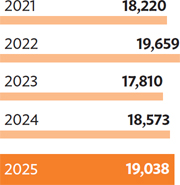
DISBURSEMENTS FOR LOANS, GRANTS, OTHER DEBT SECURITIES, AND EQUITY INVESTMENTS, 2021–2025
($ million)
Portfolio, 2021–2025 ($ million)
| Item | 2021 | 2022 | 2023 | 2024 | a | 2025 | |||||||||||
| A. Ongoing Projectsb | |||||||||||||||||
| By Source | |||||||||||||||||
| Regular Ordinary Capital Resources | |||||||||||||||||
| Loans | 80,967 | 78,504 | 78,634 | 78,657 | 81,798 | ||||||||||||
| Other Debt Securities | 915 | 712 | 664 | 719 | 898 | ||||||||||||
| Guarantees | 2,754 | 2,540 | 2,177 | 2,499 | 3,160 | ||||||||||||
| Equity Investments | 1,940 | 1,958 | 2,058 | 2,360 | 2,756 | ||||||||||||
| Concessional Resources | |||||||||||||||||
| Loans | 19,531 | 20,079 | 22,255 | 22,965 | 22,231 | ||||||||||||
| Grants | 5,146 | 5,768 | 5,698 | 6,369 | 6,943 | ||||||||||||
| Other Special Funds | |||||||||||||||||
| Grants | 39 | 18 | 13 | 8 | 15 | ||||||||||||
| By Operations | |||||||||||||||||
| Public Sectorc | 97,243 | 96,804 | 99,672 | 100,526 | 102,728 | ||||||||||||
| Private Sector | 14,050 | 12,774 | 11,826 | 13,053 | 15,075 | ||||||||||||
| Total | 111,292 | 109,579 | 111,499 | 113,578 | 117,803 | ||||||||||||
| B. Disbursements | |||||||||||||||||
| By Source | |||||||||||||||||
| Regular Ordinary Capital Resources | |||||||||||||||||
| Loans | 14,726 | 16,154 | 14,204 | 14,243 | 14,394 | ||||||||||||
| Equity Investments | 141 | 197 | 142 | 115 | 319 | ||||||||||||
| Other Debt Securities | 43 | 62 | 81 | 186 | 136 | ||||||||||||
| Concessional Resources | |||||||||||||||||
| Loans | 2,918 | 2,421 | 2,651 | 3,367 | 3,322 | ||||||||||||
| Grants | 380 | 818 | 729 | 659 | 852 | ||||||||||||
| Other Special Funds | |||||||||||||||||
| Grants | 12 | 6 | 4 | 4 | 14 | ||||||||||||
| By Operations | |||||||||||||||||
| Public Sectorc | 16,559 | 18,003 | 16,357 | 16,927 | 16,054 | ||||||||||||
| Private Sector | 1,661 | 1,655 | 1,453 | 1,646 | 2,984 | ||||||||||||
| Total | 18,220 | 19,659 | 17,810 | 18,573 | 19,038 | ||||||||||||
| C. Net Resources Transfer to Developing Member Countriesd | 7,924 | 8,097 | 650 | (2,002 | ) | (1,009 | ) | ||||||||||
| ( ) = negative value. | |
| Note: Numbers may not sum precisely because of rounding. | |
| a | The 2024 figures differ from those in Annual Report 2024 due to adjustments after year-end. |
| b | Comprises ADB’s public sector and private sector portfolios. Public sector portfolio consists of loans, grants, equity investments, and guarantees committed and not financially closed. Private sector portfolio consists of (i) the committed loan, other debt security and equity (carrying or fair value) portfolio, comprised of outstanding balances plus undisbursed balances; (ii) the committed guarantee portfolio, comprised of outstanding and unissued project guarantees and guarantees under private sector programs; and (iii) the undisbursed balance of grants. |
| c | Includes the Asian Development Fund and other Special Funds grants. |
| d | Comprises the net amount of disbursements in excess of (or lower than) payments of principal, interest, and other charges. Includes loans, other debt securities, equity investments, the Asian Development Fund, and other Special Fund grants. |
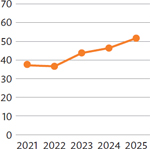
INTERNAL ADMINISTRATIVE EXPENSES PER $1 MILLION DISBURSEMENT,
2021–2025
($’000, 3-year average)
ADB INSTITUTIONAL HIGHLIGHTS
| Item | 2021 | 2022 | 2023 | 2024 | 2025 |
| A. Total Staffa | 3,687 | 3,769 | 3,888 | 4,134 | 4,429 |
| International Staff and Board Staff | 1,337 | 1,365 | 1,414 | 1,495 | 1,625 |
| By Location | |||||
| Resident Missionsb | 186 | 196 | 204 | 235 | 273 |
| Headquarters | 1,151 | 1,169 | 1,210 | 1,260 | 1,352 |
| By Gender | |||||
| Male | 830 | 837 | 851 | 893 | 952 |
| Female | 507 | 528 | 563 | 602 | 673 |
| Local Staff | 2,350 | 2,404 | 2,474 | 2,639 | 2,804 |
| B. Internal Administrative Budget ($ ’000) | 771,188 | 782,068 | 841,105 | 907,858 | 991,808 |
| a | Refers to all managerial and technical international staff, Board staff (i.e., Director’s Advisors), and technical local staff. The figures exclude Management, Board of Directors, and Secondees assigned to the Asian Development Bank (ADB), but include staff on special leave without pay and staff on external assignment to other organizations. |
| b | Includes staff in outposted positions and in ADB’s Philippines Country Office. |
| FINANCIAL HIGHLIGHTS | 19 | |
ADB RESOURCES AND FINANCIAL DATA ($ million)
| Item | 2021 | 2022 | 2023 | 2024 | 2025 | |
| A. Ordinary Capital Resources | ||||||
| Selected Balance Sheet Data | ||||||
| Total Assets | 282,084 | 290,658 | 301,607 | 314,602 |
349,050 | |
| of which | ||||||
| Loans Outstanding - Operations | 137,163 | 144,325 | 150,986 | 153,864 | 161,063 | |
| Investments for Liquidity Purpose | 43,287 | 45,294 | 47,250 | 46,695 | 57,725 | |
| Equity Investments - Operations | 1,322 | 1,438 | 1,583 | 1,627 | 1,992 | |
| Derivative Assets | 92,860 | 93,436 | 96,283 | 105,605 | 122,695 | |
| Total Liabilities | 229,229 | 236,444 | 246,313 | 258,167 | 291,040 | |
| of which | ||||||
| Outstanding Borrowingsa | 134,071 | 131,571 | 143,265 | 146,517 | 165,951 | |
| Derivative Liabilities | 91,947 | 102,965 | 101,486 | 109,816 | 121,724 | |
| Total Equityb | 52,855 | 54,214 | 55,294 | 56,435 | 58,010 | |
| Paid-in Capital | 7,381 | 7,042 | 7,113 | 6,928 | 7,289 | |
| Reservesc | 45,474 | 47,172 | 48,181 | 49,507 | 50,721 | |
| Income Statement Data | ||||||
| Total Revenue | 2,399 | 4,565 | 10,039 | 11,029 | 9,980 | |
| Total Expenses | (1,227) | (3,441) | (8,551) | (9,431) | (8,406) | |
| of which | ||||||
| Borrowings and Related Expenses | (460) | (2,640) | (7,913) | (8,717) | (7,521) | |
| Administrative Expenses | (819) | (775) | (680) | (729) | (817) | |
| Net Realized Gains (Losses) | 159 | 19 | (15) | (5) | 13 | |
| Net Unrealized Gains (Losses) | (601) | 1,026 | (535) | 36 | 316 | |
| Net Income | 730 | 2,169 | 938 | 1,629 | 1,903 | |
| Allocable Net Incomed | 1,161 | 1,099 | 1,423 | 1,539 | 1,460e | |
| Allocation to Ordinary Reserve | 778 | 716 | 1,005 | 1,016 | 926 | |
| Allocation to ADF | 292 | 292 | 293 | 394 | 394 | |
| Allocation to Other Special Funds | 90 | 90 | 125 | 130 | 140 | |
| Annual Borrowingsf | 35,761 | 36,109 | 28,913 | 33,130 | 41,704 | |
| of which | ||||||
| Thematic Bonds and Green Bonds | 5,125 | 5,750 | 3,982 | 5,148 | 5,544 | |
| Local Currency Fundingg | 880 | 335 | 349 | 2,168 | 3,964 | |
| Capital Utilization Ratio (%)h | 74.0 | 83.9 | 70.0 | 71.5 | 72.6 | |
| B. Available Asian Development Fund Resourcesi | 2,322 | 1,787 | 2,441 | 2,387 | 2,053 | |
| C. Special Fund Resources (Other than ADF)—Uncommitted Balances | ||||||
| Technical Assistance Special Fund | 464 | 285 | 213 | 94 | 518 | |
| Japan Special Fundj | 112 | 110 | 112 | 111 | 107 | |
| ADB Institute | 26 | 27 | 26 | 22 | 20 | |
| Regional Cooperation and Integration Fund | 12 | 4 | 1 | 2 | 0 | |
| Climate Change Fund | 20 | 15 | 15 | 12 | 12 | |
| Asia Pacific Disaster Response Fund | 56 | 49 | 47 | 34 | 22 | |
| Financial Sector Development Partnership | 3 | 5 | 5 | 1 | 2 | |
| Special Fund | ||||||
| Total | 694 | 495 | 419 | 276 | 681 | |
( ) = negative value, 0 = less than $500,000, ADF = Asian Development Fund.
Notes: Numbers may not sum precisely because of rounding.
| a | Includes accrued interest and commission, unamortized premium, and/or discounts. |
| b | As of 31 December 2025, authorized and subscribed capital amounted to $145,833 million. |
| c | Includes ordinary reserve, special reserve, surplus, net income after appropriation, net notional amounts required to maintain value of currency holdings, cumulative revaluation adjustment, and accumulated other comprehensive income or loss. |
| d | Defined as net income after appropriation of guarantee fees to special reserve and certain adjustments set aside in the cumulative revaluation adjustments account. This is the amount that ADB may, subject to approval by the Board of Governors, annually allocate to reserves and surplus, and transfer to Special Funds. |
| e | Subject to the approval of the Board of Governors at the ADB Annual Meeting in 2026. |
| f | Excludes short-term borrowings from euro-commercial paper issuances. |
| g | Includes bonds and swaps. |
| h | Defined as the ratio of the total economic capital used (numerator) to usable equity (denominator). The 2023–2025 capital utilization ratio is based on the 2023 Capital Adequacy Framework. Capital utilization ratios for 2021–2022 were based on the 2020 Capital Adequacy Framework. |
| i | Includes the total fund balance and nonnegotiable, noninterest-bearing demand obligations on account of contributions. |
| j | Resources include the Asian Currency Crisis Support Facility (ACCSF). In 2021, the ACCSF was closed and its residual balance transferred to the Japan Special Fund. |
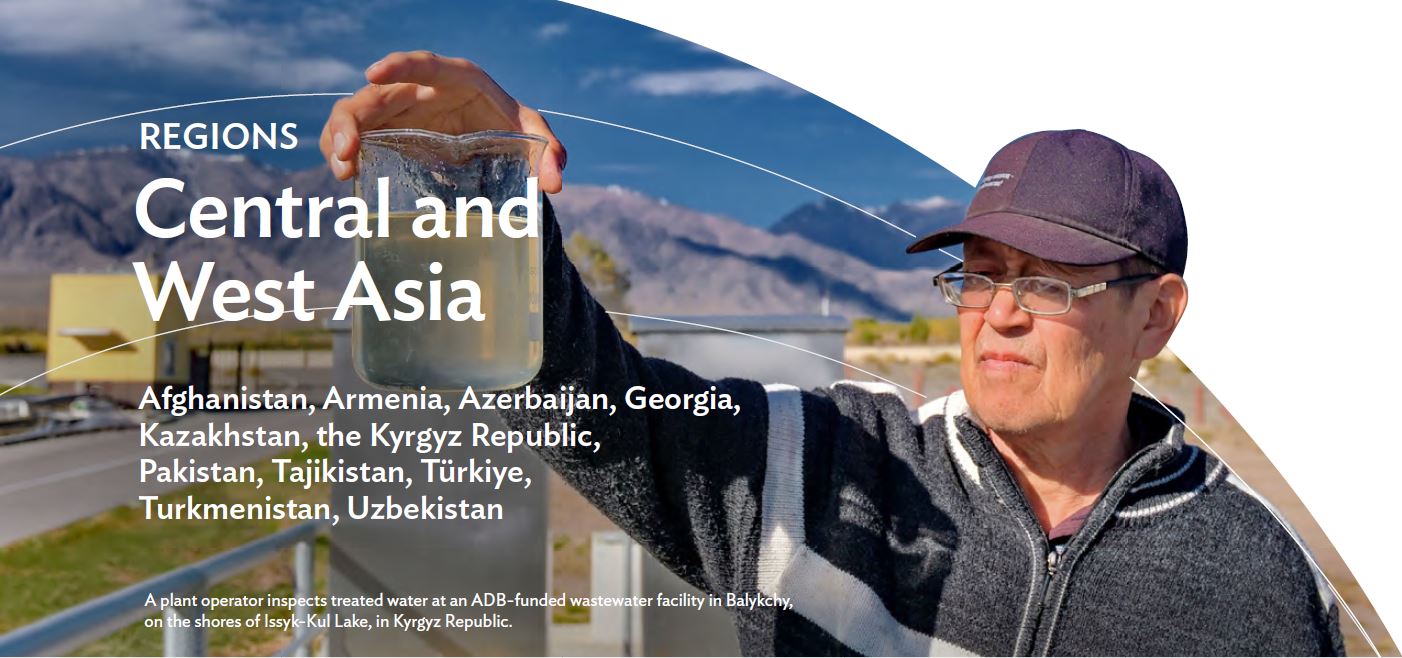
Central and West Asia achieved robust economic growth in 2025, supported by a lift in private consumption and steady expansion in services and construction. The Kyrgyz Republic and Tajikistan recorded some of the region’s highest growth rates, driven largely by rising industrial output and increased remittance inflows, while Georgia’s economy grew strongly on the back of rebounding tourism.
Despite this momentum, ADB’s developing member countries (DMCs) in the region continued to face significant external and internal challenges. While several benefited from higher commodity prices, others remained vulnerable to regional and global trade tensions. Inflation also accelerated in some DMCs due to higher food prices, utility tariff adjustments, and currency depreciation.
Central and West Asia has a rapidly expanding youth population, offering significant potential for long-term prosperity, but persistent skills gaps and limited access to quality jobs—particularly for women—continue to constrain this economic advantage. Private sector growth is held back by high state involvement, limited competition, and institutional barriers, leaving less space for commercial start-ups, business innovation, and economic diversification.
Helping the region expand private sector engagement and address other development priorities, ADB
committed $8.3 billion for Central and West Asia in 2025, comprising $7.2 billion in public sector commitments and $1.1 billion in private sector investments.
The bank officially commenced operations in Türkiye, rolling out new programs to promote economic resilience. Across its other DMCs, ADB helped vulnerable communities with expanded access to affordable housing, social protection, nursing and midwifery services, and safe water supply.
The bank fostered private sector development through initiatives to hasten digital transformation, build resilient financial systems, and improve financial inclusion for women. In addition, ADB provided grants to support fiscal reforms and the development of micro, small, and medium-sized enterprises.
ADB continued to promote regional trade and economic integration through investments that enhance transport, enable renewable electricity trade, and interconnect national power systems.
Extending its record on green transformation and disaster management in the region, ADB financed projects in glacier monitoring, community-based early warning systems, provision of clean and renewable energy, and sustainable livestock farming.

| CENTRAL AND WEST ASIA | 21 | |
Increasing Prosperity Through Vibrant Economies
Economies in Central and West Asia are looking to escalate business activity and attract greater levels of investment by accelerating digital connectivity, encouraging sustainable and inclusive development and entrepreneurship, and ensuring fiscal and financial stability.
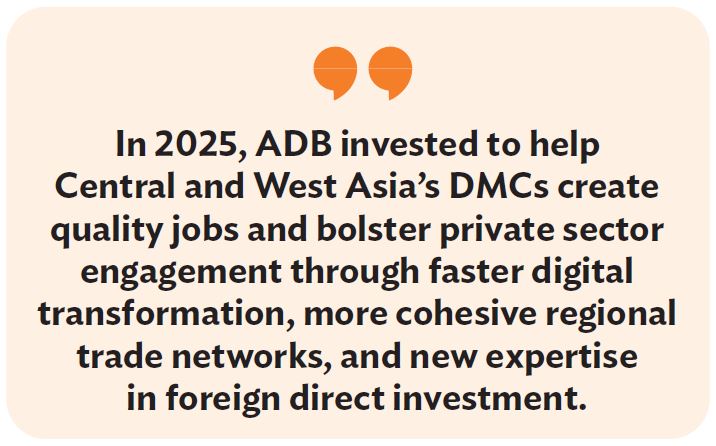
In 2025, ADB invested to help the region’s DMCs create quality jobs and bolster private sector engagement through new measures for faster digital transformation, more cohesive regional trade networks, and new expertise in foreign direct investment. The bank also sought to create more prosperous economies by freeing up government resources through improved public financial management and reforms to make state-owned enterprises more efficient.
The Need for Digital Transformation
Tajikistan continues to face significant gaps in digital connectivity, particularly in rural areas, where most people live. In response, ADB is helping communities connect and thrive through a private sector loan of $32.1 million in the local currency equivalent to help Indigo Tajikistan Closed Joint Stock Company expand and modernize the country’s mobile phone network. As well as creating jobs, the project will improve service quality and enhance access to digital education, health care, and financial services.
Through an airport infrastructure project in Georgia, ADB is supporting the use of data-driven tools to strengthen logistics planning and operations across national supply chains. By applying big data analytics, the digital systems will help reduce downtime, improve asset utilization, and enhance coordination among transport agencies and operators, improving the efficiency and reliability of Georgia’s trade flows. The initiative complements government efforts to position Georgia as a regional transport and logistics hub.
Streamlining Trade and Investment
Azerbaijan’s location between Asia and Europe gives it strong potential as a regional transport hub, but aging rail infrastructure is hampering the country’s ability to capitalize. In 2025, ADB committed a $47 million loan to modernize Azerbaijan Railways and underpin the country’s position along two key regional trade corridors. The project will digitalize key processes, including cargo management, asset maintenance, investment planning, client information systems, and corporate governance, while complementary technical assistance will upgrade workforce skills.
Building on financing for regional transport connectivity, ADB and the World Trade Organization convened a high-level forum on Central Asia’s engagement in the multilateral trading system. The forum brought together senior officials and experts to help navigate trade challenges amid increasing global uncertainty. Centering on expanded market access and economic diversification, discussions highlighted the roles of rules-based trade, trade facilitation, and digital services in strengthening regional participation in global value chains.
With economic integration for many DMCs relying on international investment, ADB partnered with Uzbekistan’s Ministry of Investment, Industry and Trade to deliver training on the international legal frameworks governing foreign direct investment. The workshop helped officials better understand how to attract sustainable investment, reduce dispute risks, and apply modern approaches in investment agreements to support ongoing reforms.
Prosperous Economies Through Fiscal Stability
Large territorial inequalities across Kazakhstan’s oblasts (administrative regions) create prosperity imbalances and represent barriers to national efficiency and growth. ADB and the Government of Kazakhstan have been working together since 2013 to ensure social equity and expand
|
22 | ANNUAL REPORT 2025 |
economic capacity by strengthening the country’s fiscal management and governance. This includes ADB analytical work in 2025 on fiscal decentralization. Drawing on global best practices and national data, the study provides a road map for more balanced and sustainable economic growth and explores equitable tax redistribution designed to address socioeconomic disparities.
Pakistan also continues to face fiscal pressures that limit investment in essential services and inclusive development. In 2025, ADB committed an $800 million package—including a $300 million policy-based loan and up to $500 million policy-based guarantee—that enables the government to mobilize $1 billion in additional financing. The program aims to reduce public deficits and debt to create more space for social spending. It focuses on improving tax policy, administration, and compliance; enhancing public expenditure and cash management; and promoting digitalization and private investment.
Promoting People’s Well-Being and Empowerment
In 2025, communities across Central and West Asia were again confronted by a diverse set of challenges, including geopolitical and cultural tensions, aging societies and rising diseases, a lack of safe and affordable housing, low levels of financial support for women in business, and limited educational opportunities for girls. ADB devoted significant financing and knowledge resources to tackle these and other issues, helping to improve living conditions, expand income opportunities, and strengthen support systems for those most at risk.
Targeted Support for Poor and Vulnerable People
Afghanistan continues to face severe food insecurity and limited access to basic services, especially for women and children. Reflecting ADB’s commitment to protecting lives and livelihoods amid humanitarian crises, the bank committed $600 million in Asian Development Fund (ADF)
grants to support the people of Afghanistan. The support package, provided with United Nations agencies, is helping sustain essential health services in 17 provinces and deliver vital medicines, immunizations, and care for mothers and children. With the Aga Khan Foundation and World Food Programme, ADB is also providing emergency food assistance in hunger hot spots and helping vulnerable households produce more food through provision of seeds, livestock, and other agricultural inputs. At the same time, community initiatives are strengthening resilience to weather- and disaster-related shocks.
In Turkmenistan, an aging population and rising noncommunicable diseases are increasing pressure on the health system. Recognizing the need for better-skilled health workers in greater numbers, ADB committed a $74.7 million loan in 2025 to build a stronger nursing and midwifery workforce for Turkmenistan. The project will construct a modern nursing school in Ashgabat, enhance nursing education and training, and align curricula with global standards.
Tackling Shortfalls in Affordable Housing
Armenia continues to face growing demand for housing following the arrival of more than 100,000 refugees in 2023. ADB has responded by approving a $250 million loan and administering a $16.5 million grant from the Global Concessional Finance Facility to help vulnerable families access affordable, disaster-resilient homes. The program will create a centralized beneficiary database and raise building standards for energy efficiency and seismic resilience, helping provide sustainable housing for more than 7,000 families over 5 years. It will also improve housing finance systems and update real estate regulations.
Housing affordability is similarly an issue in Uzbekistan, where limited access to mortgage finance—especially for women and young borrowers—is hampering entry into the real estate market. In 2025, ADB supported the Mortgage Refinancing Company of Uzbekistan with a $30.1 million private sector loan to encourage a shift from government-backed to market-based financing. Building on earlier ADB technical support during the company’s establishment, the loan will help expand access to housing and renovation financing and promote more-inclusive lending: At least 35% of onlending will go to women, 20% to youth, and 10% to green renovation projects.
Boosting Income Opportunities for Women
Pakistan continues to face one of the world’s widest gaps in economic participation, largely due to women’s limited access to finance and their low representation in formal employment. To help close the finance gap— estimated at about 37%—ADB committed $350 million
| CENTRAL AND WEST ASIA | 23 | |
Partnering with Türkiye in a Time of Need
Türkiye entered a new chapter in its partnership with ADB in 2025. After decades as a nonregional member, the country was reclassified as a regional member, enabling deeper cooperation at a pivotal moment for an economy rocked by earthquakes in 2023 and 2025.
To guide this new level of engagement, ADB launched its interim country partnership strategy for Türkiye through to 2027. The strategy focuses on two key pillars: supporting earthquake recovery and tremor-resilient infrastructure; and positioning Türkiye as a key regional transport, energy, and digital hub linking Asia and Europe.
Building momentum quickly, ADB committed five projects totaling about $1.3 billion for Türkiye in 2025. These were a $100 million private sector loan to help Akbank finance small and medium-sized enterprises; a $100 million debt investment in DenizBank’s green notes; a $173.5 million loan supporting post-earthquake rehabilitation; and two loans totaling $913.1 million to stimulate recovery, resilience, and job creation led by the private sector.
ADB expects to scale up financing to about $3 billion annually in 2026 and 2027. Priority areas include water supply and urban development, agriculture and natural resources, sustainable infrastructure, and financial inclusion.
Beyond public sector activities, ADB is deepening its engagement with Türkiye’s private sector, mobilizing capital, sharing global know-how, and partnering to accelerate green growth.
to foster business ventures owned by women. The support comprises a $300 million policy-based loan to strengthen legal and regulatory frameworks to include women and a $50 million financial intermediation loan to expand credit and guarantees for women entrepreneurs. The program aims to empower 2 million women, enhance their entrepreneurial abilities, and advance reforms that promote equitable economic opportunities nationwide.
Promoting women’s economic participation is also a priority in Georgia, where women own or lead one in four micro, small, and medium-sized enterprises (MSMEs) yet still face significant barriers to accessing commercial credit. In 2025, ADB committed $100.1 million (in Georgian lari equivalent) for TBC Bank to expand MSME and green financing, with a particular focus on businesses owned or led by women. This private sector loan to TBC is expected to increase both the volume of MSME lending as well as the number of borrowers.
Gaps in medium- and long-term financing have historically constrained MSME growth and job creation in Armenia, including for women entrepreneurs. In 2025, ADB partnered with Armeconombank Open Joint Stock Company to expand access to finance for MSMEs and vulnerable households through a local currency loan. The $15.1 million private sector loan will enable more than 1,000 MSMEs—including more than 300 women-led enterprises—to access commercial loans, stimulating
investment in productivity-enhancing technologies and environmentally sustainable business practices while reducing exposure to foreign exchange risks. This initiative underpins employment growth through private enterprise and aligns with ADB’s strategic focus on inclusive and sustainable private sector development in Armenia.
Uzbekistan faces similar challenges to Armenia, with MSMEs accounting for more than 74% of employment and contributing 51% of gross domestic product, despite having only limited access to bank credit. In response, ADB provided a $20.8 million private sector loan for Davr Bank to expand local currency financing for underserved MSMEs, including first-time borrowers with no credit history. At least 50% of the onlending will support MSMEs owned or led by women.
Helping create the next generation of women entrepreneurs and professionals, ADB committed a policy-based loan to extend science, technology, engineering, and mathematics (STEM) education in Punjab Province, Pakistan. The program will finance the construction of at least 1,700 multipurpose STEM laboratories in selected schools, at least 50% of which will be established in girls’ schools, with a particular focus on marginalized communities where negative social norms discourage female students’ STEM participation. ADB’s $100 million loan for the program is accompanied by a $7 million grant from the ADF.
|
24 | ANNUAL REPORT 2025 |
Building a Healthy Planet
Central and West Asian DMCs have called for ongoing development assistance to negate their high exposure to disasters and the changing climate, reverse persistent reliance on fossil fuels for energy generation, and boost agricultural productivity to combat fragilities in food security.
ADB support in 2025 was designed to deliver more expansive and innovative disaster financing, support advanced environmental monitoring and early warning systems, accelerate green transformation through major renewable energy investments and regional cooperation, and ramp up digitalization in agriculture and sustainable farming practices.
New Responses to Disasters and a Changing Climate
The Kyrgyz Republic and Tajikistan are among the world’s most disaster-prone countries, but limited budget reserves and financial tools make it difficult for them to respond effectively. In 2025, ADB mobilized $53.1 million from the ADF and $3.3 million from the Asia-Pacific Climate Finance Fund to help both countries plan, finance, and manage disaster risks more effectively. The investment centers around an innovative disaster financing program that combines contingent disaster financing—offering rapid budget support for medium-severity disasters—with a disaster relief bond to ensure quick liquidity after major events.
In Tajikistan, higher air temperatures are causing glaciers to shrink rapidly, threatening water supplies during key agricultural seasons, jeopardizing livelihoods, and putting food and energy security at risk. ADB moved to curtail these impacts by approving a $3 million grant from the Japan Fund for Prosperous and Resilient Asia and the Pacific. The project will strengthen glacier monitoring, build technical skills in hazard forecasting, and improve community-based early warning systems.
In 2025, Tajikistan also hosted the first High-Level International Conference on Glaciers’ Preservation. This resulted in the adoption of the Dushanbe Glaciers Declaration and Appeal, which calls for stronger international cooperation to protect the cryosphere— the parts of the earth covered in ice or snow—and glaciers. ADB was a key partner in the event, providing both financial and technical support.
More broadly, ADB is helping nine glacier-dependent countries, including Tajikistan, improve water management and build long-term resilience to the impacts of glacier melt. This assistance is made possible through funding from the bank’s $3.5 billion Glaciers to Farms initiative, supported by the Green Climate Fund.
Shaping a Cleaner, Greener Energy Future
With Uzbekistan’s economy still dependent on aging gas-fired power generation, ADB made one of its largest-ever renewable energy investments in Central Asia. The
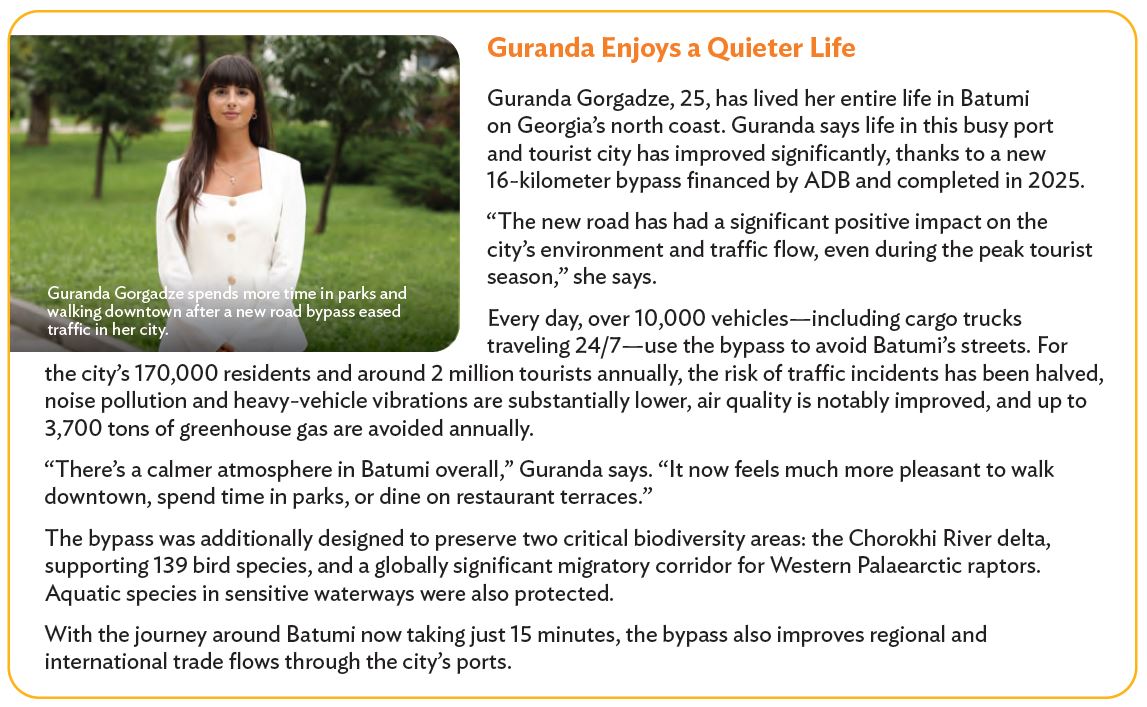
| CENTRAL AND WEST ASIA | 25 | |
bank supported two major solar and battery storage facilities in Samarkand and Bukhara, which will supply clean electricity to about 600,000 households and avoid 1.3 million tons of carbon dioxide emissions each year. Financed through a $155 million private financing package from ADB, the project will add 1,000 megawatts of solar power and 1,336 megawatt-hours of storage to Uzbekistan’s grid, along with new transmission lines and two new substations to improve grid stability. ADB additionally coordinated environmental and social standards for the projects.
The new plants in Samarkand and Bukhara are complemented by an investment near Guzar, where a $12.5 million private sector loan committed in 2025, along with cofinancing from ADB-administered funds, is helping build a 300-megawatt solar plant with a 75-megawatt-hour battery system.
Further expanding Uzbekistan’s clean energy supply, ADB provided a $25.4 million private sector loan and mobilized the same amount to support ACWA Power in developing a wind power and battery storage facility in Qorao’zak District in the Republic of Karakalpakstan. The project will also finance new transmission infrastructure and upgrades to the Beruniy substation. It is expected to reduce carbon dioxide emissions by more than 400,000 tons annually and create over 200 jobs.
In Turkmenistan, ADB initiated technical assistance in 2025 to help the country expand its solar energy potential. The work will prepare a national solar road map, generate prefeasibility studies, pilot small-scale installations for new solar capacity, and deliver skills training for government agencies and communities. This technical assistance will ultimately help diversify Turkmenistan’s energy mix and reduce reliance on natural gas.
ADB technical assistance and a new partnership agreement are also working to bolster energy cooperation across Central and West Asia. In 2025, ADB and the Asian Infrastructure Investment Bank signed a memorandum of understanding with Azerbaijan, Kazakhstan, and Uzbekistan to support a new feasibility study for the Caspian Green Energy Corridor. Part of a broader ADB regional technical assistance initiative, the study will help the three countries develop a shared framework for renewable electricity trade and interconnect their power systems. The Caspian corridor is expected to substantially boost the regional economy by exporting clean energy to Europe via the Black Sea Cable.
Advancing Food Security and Sustainable Agriculture
In Tajikistan, smallholder livestock farming—largely performed by women—is a cornerstone of rural livelihoods, but farmers struggle with animal diseases, weak veterinary systems, and weather-related risks. In 2025, ADB provided a $14 million grant to help these farmers produce healthier animals and earn more stable incomes, while improving access to nutritious food across Tajikistan. The project will set up a national digital livestock system to track animal health, control livestock movement, and certify animals for domestic markets or exports. It will also upgrade pasture areas, equip mobile clinics and veterinary centers with diagnostic tools, improve public breeding services, and offer scholarships to budding women veterinarians.
Also promoting a more sustainable agriculture sector in Georgia, ADB provided a $50 million private sector loan for JSC Rustavi Azot to modernize its ammonium nitrate fertilizer facilities and improve energy efficiency at the plants. Complementary technical assistance will educate farmers—especially women farmers—on efficient fertilizer use to protect soil health and boost cropping productivity, while also improving fertilizer access and financial literacy. The project is expected to reduce energy use and cut greenhouse gas emissions by approximately 120,000 tons of carbon dioxide annually, while strengthening the fertilizer supply chain.
Green and Diversified Growth for Azerbaijan
In 2025, ADB launched a new country partnership strategy for Azerbaijan through to 2029. Centered around knowledge work, innovation, and catalytic finance, the strategy focuses on delivering green and diversified growth, promoting low-carbon connectivity, and fostering high-value industries. It also supports stronger implementation of Azerbaijan’s national priorities, such as developing a skilled workforce to build a more competitive economy.
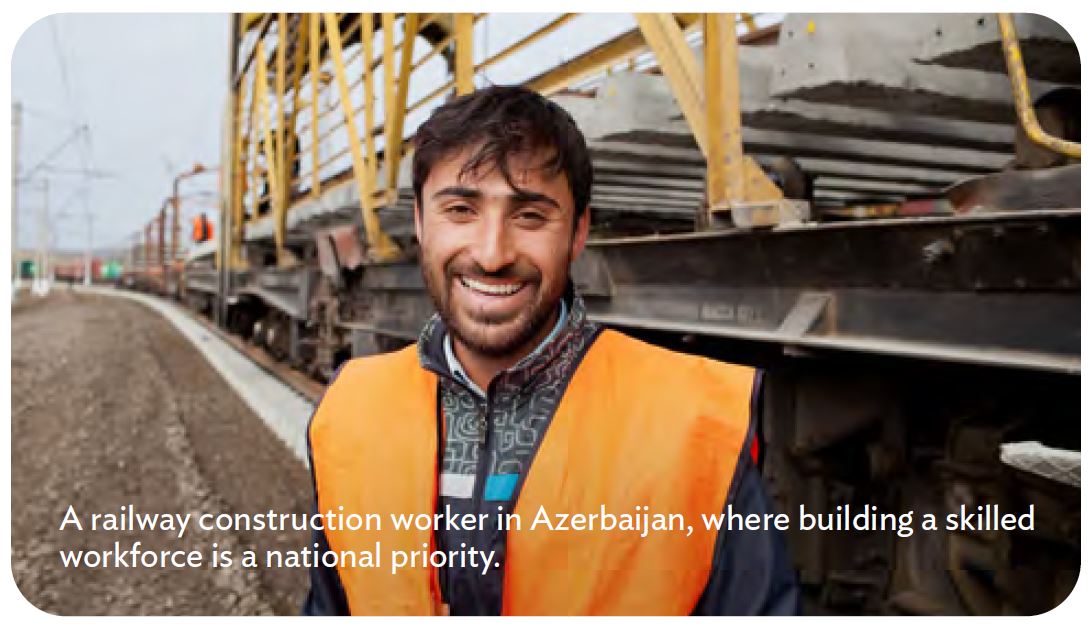
The People’s Republic of China (PRC) demonstrated economic resilience in 2025, amid subdued consumer and investor confidence and a challenging global environment. Growth in high-technology sectors and exports provided a notable boost, even as the property market remained strained.
Reflecting its commitment to fostering high-quality development, the Government of the PRC implemented policies to ease fiscal pressures, stabilize the property market, stimulate household consumption, advance the green transition, and promote innovation. These measures included increased local government bond quotas, a consumer goods and equipment trade-in program, welfare support, and fiscal stimulus to support domestic investment in strategic areas and emerging sectors.
In Mongolia, economic growth remained robust. Rising household incomes, supported by higher public sector salaries and an increase in the minimum wage, bolstered domestic consumption. In addition to a record year in mineral exports, the agriculture sector rebounded in 2025 after two consecutive harsh winters, restoring livelihoods for herder communities.
ADB’s support for East Asia in 2025 centered on improving the health and employability of the region’s people, enhancing economic and environmental resilience, creating quality jobs, and promoting inclusive and sustainable growth. The bank committed $1.1 billion
in the PRC, consisting of $596.9 million in public sector financing and $507.4 million in private sector financing. For Mongolia, ADB committed $276.9 million, consisting of $102.7 million in public sector operations and $174.1 million in private sector financing.
With a continued focus on the PRC’s interconnected challenges, ADB advanced a range of transformative projects in 2025. These included operations delivering global public goods that also have an impact outside PRC, such as those addressing climate change and greenhouse gases emissions, and restoring biodiversity and natural ecosystems. The bank also expanded its knowledge work and nonlending operations within the PRC, fostering greater policy dialogue with the government, while also ramping up knowledge sharing and cooperation between the PRC and other ADB developing member countries (DMCs). The ADB–PRC Regional Knowledge Sharing Initiative (RKSI), various topical forums, and knowledge exchanges that promoted innovation, productivity, and inclusive development contributed to greater collaboration.
ADB’s support for Mongolia was concentrated on strengthening disaster preparedness through advanced systems and technologies, modernizing public transport in the capital Ulaanbaatar, improving the reach and quality of elderly care, and advancing science and technology subjects in secondary schools. The bank also prioritized food security by expanding inclusive financial services in rural areas.

| EAST ASIA | 27 | |
Increasing Prosperity Through Vibrant Economies
ADB continues to help the PRC and Mongolia advance policies and investments that will improve the lives and livelihoods of East Asia’s people. Operations in 2025 included supporting agricultural supply chains; improving fiscal sustainability and fairness; promoting evidence-based policymaking to stimulate private enterprise; and fostering regional trade, investment, and knowledge sharing.
New Financing for Commercial Agriculture
Despite its upper middle-income status, Mongolia continues to face significant development challenges, particularly in rural areas. For instance, although wheat flour is one of the country’s staple foods, local farmers face persistent difficulties arising from the short growing season, harsh weather, and limited market access. Meanwhile, women face ongoing barriers to resources and training.
In 2025, ADB signed a $10 million private sector loan with Ulaanbaatar Flour LLC to shore up domestic production, ensure stable food supply, and boost rural income. The loan will help expand procurement from about 250 local wheat farms, more than one-third of which are owned and/or operated by women. Complementary technical assistance will train farmers, particularly women, in sustainable practices and financial management.
ADB is also expanding rural financial inclusion and supporting economic diversification in Mongolia. A $100 million loan to Khan Bank JSC will providing access to finance for agricultural and livestock processing enterprises, herders, farmers, and rural micro, small, and medium-sized enterprises, including women-owned ones.
Building Business-Oriented Policy Systems
Mongolia continues to lay strong policy foundations for sustainable growth, with ADB supporting the government in enhancing fiscal resilience and stimulating job creation.
These initiatives include measures to increase domestic resource mobilization, promote private investment, and expand opportunities for small and medium-sized enterprises.
As one example of ADB’s contribution, technical assistance initiated in 2025 is exploring tax reforms that can balance Mongolia’s taxpayer rights and responsibilities, reduce compliance costs, and counter tax avoidance and evasion, ensuring a fairer and more efficient tax system for individuals, enterprises, and private investors.
Mongolia is also prioritizing more evidence-based and coordinated planning and development. ADB is helping the Ministry of Economy and Development strengthen policies and systems to encourage economic diversification and promote business-enabling reforms in key sectors such as agriculture, energy, tourism, trade, and finance. This new technical assistance will also frame the development of an integrated policy and planning database with a centralized geographic information system.
ADB has been similarly integral to Mongolia’s fintech and supervisory technology reforms, bringing together key institutions to create a consensus-based approach to comprehensive sector strategies. In partnership with global experts, the bank trained over 60 regulators at a 2-day fintech innovation forum and held other interactive training sessions throughout 2025. ADB also provided a fintech innovation road map drawing from research on global best practices and consultations with the public and private sectors.
In the PRC, progress toward high-quality development will require careful rebalancing of the economy. To help improve debt sustainability of local governments, ADB published a policy brief analyzing European best practices in fiscal rules and debt management. As local governments are responsible for most expenditure on
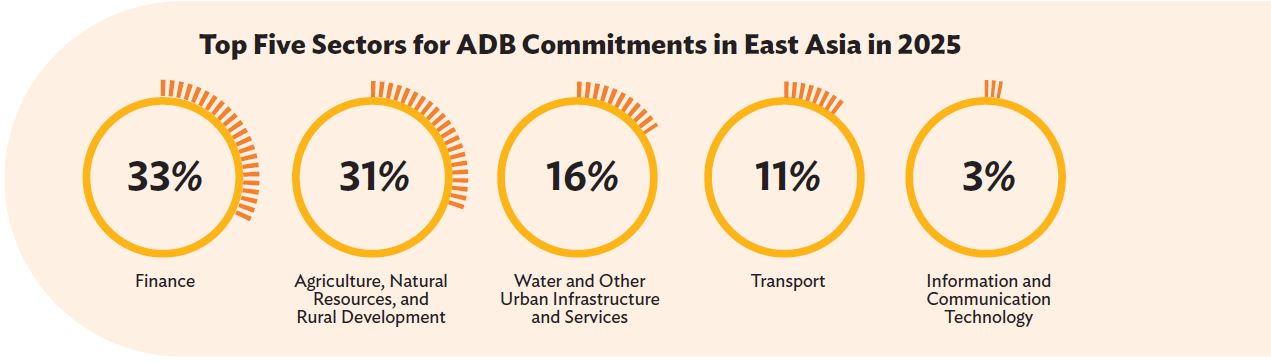
|
28 | ANNUAL REPORT 2025 |
public services but collect only limited revenues, the brief outlines options for policymakers to reconsider local government revenue sources, improve access to capital markets, and increase fiscal transparency.
Knowledge Platforms for Sustainable Long-Term Growth
ADB continued to foster the sharing of development lessons among its members through the East Asia Forum 2025 in Beijing, which centered on the key factors driving strong development, innovation, and economic openness. The event attracted 135 participants, including 45 officials from 22 DMCs, who exchanged fresh insights and shared best practices. It was followed by a seminar on artificial intelligence applications in the PRC, discussing how other ADB developing members might benefit from the country’s experiences.
Homing in on economic prosperity for the Greater Mekong Subregion, an ADB workshop in Yunnan Province, PRC, explored streamlining trade and investment. The workshop, attended by 47 local officials and private sector representatives, covered topics such as cross-border financial services; public health; food safety; green logistics; and environmental, social, and governance practices.
ADB also co-organized the third annual forum on integrity compliance, bringing together stakeholders to share approaches and foster collaboration on business integrity across Asia and the Pacific. The event helped PRC-based suppliers to ADB projects better understand global integrity standards and investigation processes.
Promoting People’s Well-Being and Empowerment
During 2025, ADB’s operations in East Asia continued to focus on improving access to quality health care, especially for older people and vulnerable communities, while fine-tuning education and skills training,
especially for the region’s youth. The bank reinforced its commitment to advancing opportunities for women and girls through specialized research, knowledge events, and technical assistance. There was also an emphasis on improving the lives of city dwellers while considering long-term urban sustainability.
Delivering Quality Health Care and Insurance
As Mongolia’s population ages, elderly care services in rural areas are increasingly stretched by a shortage of trained workers and service providers. In response, ADB committed a $3 million grant financed by the Japan Fund for Prosperous and Resilient Asia and the Pacific to strengthen the country’s community-based care. In addition to updating the government’s national legal and policy framework for elderly care, the financing will provide medical equipment, ambulances, and diagnostic devices for five facilities and train 200 staff in geriatric services.
In the PRC, public health insurance coverage remains insufficient to meet the medical needs of patients, particularly older people. ADB is supporting reforms to the health system to expand national medical insurance coverage and improve digital care models, referral systems, primary health care, and chronic disease management. The initiative will explore new service delivery and payment models to expand access to health care in underserved communities.
In a complementary commitment to the PRC’s health insurance market, ADB made an equity investment of the local currency (yuan) equivalent of $37.2 million in Fosun United Health Insurance Company Limited. The investment will expand access to long-term care and medical insurance, with specific considerations for women and older people. Fosun United will also introduce financial literacy programs for women, champion disability inclusion in the workplace, and develop new products tailored to women’s needs.
Fostering greater innovation and new treatment in health, ADB committed an equity investment of up to $40 million in Qiming Venture Partners IX-A, L.P., a venture capital fund focused on health care and technology. The investment will help create jobs, spur technological innovation, and embrace small businesses owned or led by women.
Better Skills and Income Opportunities
As Mongolia transitions to a technology- and knowledge-based economy, demand for new skills is growing. In 2025, ADB committed a $3 million grant financed by the Japan Fund for Prosperous and Resilient Asia and the Pacific to advance the teaching of science, technology, and IT
| EAST ASIA | 29 | |
Driving Urban Mobility in Ulaanbaatar
Ulaanbaatar is the heart of Mongolia’s economy. The capital is home to nearly half the country’s population and continues to grow rapidly, but its transport system is struggling to keep pace.
Ulaanbaatar’s private vehicle numbers have increased more than thirteenfold since 2000, while road expansion and maintenance have lagged because of funding gaps, flooding, and strained capacity. Combined with weak land-use planning and limited enforcement of traffic regulations, these pressures have led to severe congestion, long travel times, and rising pollution.
The city’s public transport system faces similar challenges. Buses remain the primary mode of travel, yet they operate on congested roads with uneven service quality, prompting more people to rely on private cars and informal taxis, which further compounds the gridlock.
In 2025, ADB committed $60 million to upgrade key sections of Ulaanbaatar’s road network and develop a modern bus corridor for rapid transit. The high-capacity system—featuring dedicated lanes, level boarding, and traffic-signal priority—will reduce disruptions, improve reliability and connectivity, and cut travel times for at least 200,000 passengers every day.
By creating a faster, cleaner, and more accessible transport system, the initiative will contribute to a more connected, inclusive, and resilient capital city for Mongolia.
subjects in the country’s secondary schools. The project will benefit about 35,000 students, teachers, and school managers, with an emphasis on young people most in need of support. About 50% of the school placements are allocated to girls and at least 50% of participants will come from marginalized groups, including ger (traditional Mongolian dwelling) communities, herder families, low-income households, and people with disabilities.
Further addressing youth unemployment and the growing gap between education and labor market needs, ADB and the Government of Mongolia convened a national forum in Ulaanbaatar in October 2025. Centered on the transition from education to employment for young people, the event attracted more than 250 representatives from government, civil society, the private sector, and development organizations, with in-depth discussions on practical measures for expanding access to quality jobs.
The PRC, meanwhile, faces a different set of challenges, with an aging population and declining fertility rates shrinking the workforce, increasing retirement burdens, and straining social support systems. To address labor shortages, ADB is helping the government develop policies that promote family-friendly workplaces and better work–life balance. A technical assistance project initiated in 2025 will assess existing national employment policies, analyze international best practices, and develop policy recommendations.
Protecting and Empowering Women and Girls
Violence against women, girls, and children remains a major barrier to Mongolia’s social cohesion, undermining human rights and hindering inclusive economic progress. An ADB study exploring why some men in Mongolia use violence against women and girls underscores the need for coordinated approaches to prevent and address it. Key recommendations include strengthening child protection in schools and dormitories, and expanding mental health support to build violence-free communities.
ADB also supported knowledge events in 2025 for the protection and empowerment of women and girls across Asia and the Pacific. In May, ADB and the Government of Mongolia cohosted an international conference on equality for women and resilience. The event convened more than 230 participants from 8 countries and 11 development partners to discuss how actions to build resilience can better include women. The discussions examined measures for improving rural livelihoods, promoting fair access to finance, and supporting women’s leadership.
Issues around career advancement for women are similarly evident in underdeveloped areas of the PRC’s Gansu Province, where ADB is providing technical assistance on digital skills programs to expand employment opportunities. The project will train 200 women in digital literacy, support 200 e-commerce entrepreneurs, and generate policy recommendations to enhance women’s participation in the digital economy.
|
30 | ANNUAL REPORT 2025 |
Expanded Access to Essential Services
Across East Asia, governments are seeking to make cities more livable, resilient, and inclusive amid rapid urbanization and economic transformation. In the PRC cities of Chibi and Xianning, ADB committed $151.9 million to modernize transport and water systems and to promote safer, more efficient urban services. The project will expand public transport infrastructure, improve digital coordination for flood risks and transport planning, and provide access to a reliable water supply for more than 115,000 households. It will directly benefit 1.1 million people, including more than 530,000 women, 346,900 rural residents, and 24,700 people with disabilities.
Building a Healthy Planet
ADB committed financing in 2025 for influential projects in biodiversity conservation, disaster risk management, and the clean energy transition across East Asia. These investments, combined with specialized knowledge work, showcased innovative approaches such as nature-based solutions, green fiscal incentives, and developments in pollution reduction and green technologies.
Conserving Biodiversity, Managing Disaster Risk
The PRC’s Chishui River Basin faces severe ecosystem degradation caused by deforestation, soil erosion, and pollution, threatening the area’s biodiversity and heightening disaster risks. In 2025, ADB committed
$151.9 million to promote nature conservation and low-carbon development in the basin. The project will introduce biodiversity credits to mobilize public and private green funding and directly benefit about 265,000 residents by enhancing river basin management and creating jobs in professions such as solar energy management, ecotourism, and environmental education.
Meanwhile, the biodiversity around coastal cities in the PRC’s Fujian Province is increasingly vulnerable to cyclones, flooding, and extreme heat. ADB has responded by committing $144.2 million to strengthen flood risk management and natural ecosystem conservation in the province’s Fuzhou municipality and Yunxiao county, home to two nationally protected wetlands under ADB’s Regional Flyway Initiative. The project will improve drainage systems, biodiversity monitoring, ecosystem services, and technology infrastructure in the Minjiang and Zhangjiang river estuaries, benefiting 4.4 million people. The investment will also restore habitats for migratory waterbirds and support sustainable livelihoods.
In Hunan Province, ADB is helping to protect biodiversity-rich ecosystems through a private sector loan in the local currency (yuan) equivalent of $99.8 million for China Water Affairs Group Limited. The investment will finance a new digitally enabled wastewater treatment plant with a capacity of 100,000 cubic meters per day, rehabilitate an existing facility, and upgrade aging water supply pipelines in Hunan and other provinces. While enhancing water quality
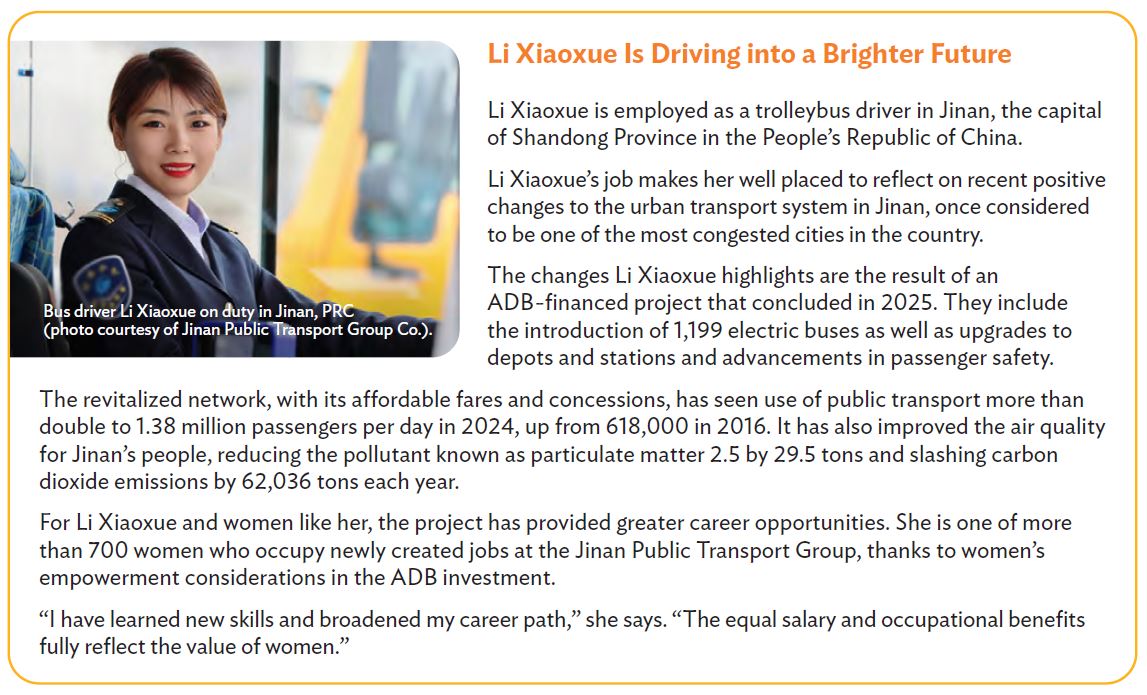
| EAST ASIA | 31 | |
and supply, the investment also supports Hunan’s efforts to protect a globally significant wetland within the Yangtze River Economic Belt.
Supported by RKSI, a delegation of parliamentarians and government officials from Mongolia visited the PRC, where they exchanged experiences on desertification control, grassland restoration, and waste management. The delegation visited ADB project sites around Chao Lake and learned about initiatives to transform the livestock sector into a green, integrated value chain.
Throughout 2025, Mongolia’s weather-related disasters continued to inflict severe socioeconomic and health impacts, especially among women and herder communities. ADB committed $30 million in loans and a $2 million grant from the Asian Development Fund to enhance early warning systems for dzuds (severe winter conditions), floods, storms, wildfires, and earthquakes. An estimated 3.5 million people will benefit from improved preparedness and response capacity to local and national disasters.
Advancing cross-border collaboration on disaster risk management, ADB initiated technical assistance to the PRC on earthquake science, including the creation of a regional information-sharing platform. The program promotes the use of artificial intelligence and large-scale modeling to establish real-time earthquake monitoring systems and guide disaster mitigation strategies. Such advancements are particularly relevant for members of the Association of Southeast Asian Nations (ASEAN), countries that are situated in a region prone to seismic and volcanic activity.
Investments to Accelerate the Green Transition
In the PRC’s Sichuan Province—where methane emissions from rice cultivation and other unsustainable agricultural practices are a major source of greenhouse gases—ADB committed a $142.8 million results-based lending program to encourage greener alternatives. The investment will help train 50,000 farmers, including 22,500 women and 5,000 people from vulnerable groups, in low-carbon agriculture. The project is expected to enhance climate resilience across 35,000 hectares of farmland and cut greenhouse gas emissions by 1 million tons of carbon dioxide equivalent by 2032.
Extending its focus beyond agriculture, ADB committed a $100.1 million private sector loan to financial leasing company Far East Horizon Limited to help the firm’s commercial and industrial clients transition to cleaner production methods. By promoting leasing as an alternative to bank financing, the project will enable enterprises to overcome up-front cost barriers and deploy green technologies such as smart energy systems and energy-efficient manufacturing.
Sharing Knowledge for Cleaner Air and Greener Growth
ADB continued to share lessons from the PRC on improving air quality and promoting green innovation, with a number of notable knowledge events held in 2025.
In March, an RKSI seminar brought together senior policymakers from India, Mongolia, Pakistan, the Philippines, and Thailand to discuss how the PRC’s experiences in air quality management can guide efforts to combat air pollution in developing countries.
Additionally, ADB published a working paper outlining how its collaboration with the PRC—including on policy and regulatory reform, the adoption of low-carbon technologies in small and medium-sized enterprises, and the development of energy-efficient heating and cooling systems—has helped improve air quality management in the Greater Beijing−Tianjin−Hebei region.
In April, ADB and the Hong Kong Green Finance Association cohosted a knowledge-sharing event to explore ways of scaling up investment in green technologies, enhancing climate resilience, and supporting sustainable finance initiatives across Asia and the Pacific. A panel of private sector experts shared their experiences in driving innovation for green business practices.
Diversified and Inclusive Growth in Mongolia
During 2025, ADB launched a new country partnership strategy for Mongolia through to 2028. The updated strategy focuses on public sector and macroeconomic management; sustainability and resilience through policy reforms, green finance, and infrastructure investments; and improvements in education, health, and social protection. Crosscutting initiatives will advance private sector development, climate action, governance, digitalization, and gender equality.
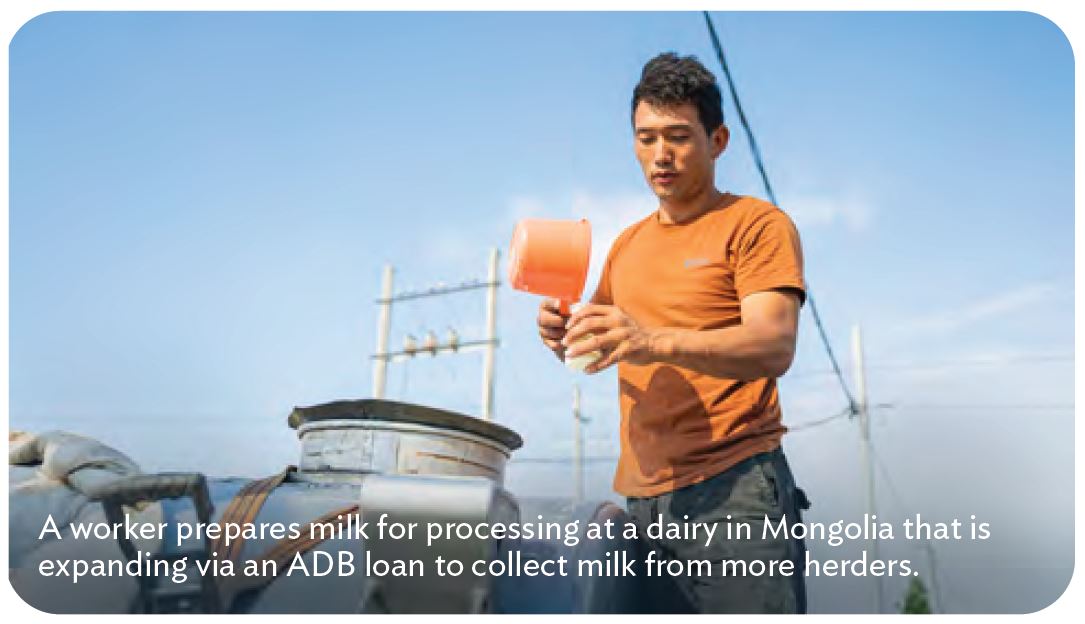
The Pacific region delivered sustained economic growth in 2025, thanks to improved commodity output, higher public spending, and the ongoing recovery in tourism activity.
In the region’s largest economy, Papua New Guinea (PNG), strong mining and liquefied natural gas production, together with higher agricultural exports, drove economic expansion. Robust mineral exports also underpinned growth in Solomon Islands, while visitor arrivals continued to rise across many of the Pacific’s tourism-dependent economies. In contrast, Vanuatu’s post-pandemic economic recovery was hindered by the December 2024 earthquake.
Public spending continued to drive growth in many Pacific economies, particularly in smaller island and atoll countries. However, capacity constraints, undersized local workforces, and institutional gaps hampered the implementation of some initiatives. Political transitions and elections in several countries also temporarily affected the delivery of government programs. For instance, Samoa’s snap elections in August 2025 slowed government operations for a short period, but the passing of the new budget is likely to bring public spending back on track.
Against this backdrop, ADB’s engagement in the Pacific during 2025 prioritized ongoing economic sustainability while advancing structural reforms, strengthening
environmental resilience, and promoting regional cooperation. The bank emphasized quality policy, legislative, and regulatory environments for its Pacific developing member countries (DMCs), helping build an enabling environment to boost private sector activity while encouraging sustainable development.
In 2025, ADB committed $679.8 million for its Pacific DMCs, including $214.4 million in grants from the Asian Development Fund (ADF). The bank also provided technical assistance to support capacity building, policy development, and sector studies across the region.
ADB continues to invest in country collaboration and regional engagement as a central tenet of its operations in the Pacific. The establishment of its Solomon Islands Resident Mission, which was formally opened in February 2026, marks a key milestone for development relations and shores up ADB’s long-term commitment to the country.
In 2025, a high-level ADB mission participated in the 50th anniversary of PNG’s independence. The bank’s representatives met with key government officials and private sector stakeholders to highlight ADB’s commitment to driving connectivity and inclusive growth, showcasing how strategic investments and close partnerships have transformed lives across the country.

| PACIFIC | 33 | |
Increasing Prosperity Through Vibrant Economies
Throughout 2025, ADB dedicated significant financial and knowledge resources to attracting and growing private enterprise in the Pacific. These objectives were underpinned by investments to expand access to business finance and foster innovation in commercial activities. The bank also continued to help Pacific governments plan and implement viable infrastructure projects and expand financial services for the people of the Pacific. ADB’s policy-based lending programs supported improvements in tax systems, budget planning, and the broader business environment, laying stronger foundations for long-term growth and greater private investment.
Expanded Support for Private Sector Development
Across ADB’s 14 developing members in the Pacific, the private sector contributes an average of just 44% of gross domestic product, well below the global average of 60%. This reflects the impacts of small and fragile economies, high operating costs, limited access to services, and institutional capacity constraints.
In 2025, ADB ramped up efforts to boost private sector participation in the Pacific—a market often overlooked by traditional investors—by launching the Pacific Wayfinder program. Designed to support job creation and boost innovation while contributing to the development of capital markets, the program comprises a suite of tailored tools— including concessional finance and technical assistance—to help businesses access finance more quickly and scale up investment in the region. Pacific Wayfinder complements ADB’s broader work on regulatory reforms and project preparation to stimulate private sector engagement.
At the core of the Pacific’s private sector aspirations are the region’s small and medium-sized enterprises, which remain key drivers of jobs and economic growth. These enterprises, however, often struggle to access capital because of collateral requirements and perceived risks.
ADB’s Frontier program is helping fill this gap and deepen local capital markets to enable finance for smaller enterprises that have the potential to transform and strengthen local industries. With 2025 as its first full year of operation in the Pacific, the program has signed five cost-recoverable technical assistance agreements across the region. Three of these are with enterprises in Fiji: a saltwater prawn producer helping commercialize the prawn industry and promote food security; a renewable-energy company installing on- and off-grid solutions for commercial and residential businesses; and a performance arts company creating jobs for local youth. Another agreement has been signed with a bakery creating local jobs in Samoa, while the fifth involves an aerial mapping company that is improving coastal data collection and usability across the Pacific.
To grow the private sector in Niue, ADB provided technical assistance to support the national statistics office in conducting the country’s first-ever census of business establishments. The result is a comprehensive baseline of private sector data—including business characteristics, ownership, employment, and operational barriers—to guide future policy and investment decisions.
Improving Services via Sustainable Infrastructure
Infrastructure development in the Pacific has long been inhibited by limited government resources, a lack of local expertise and contractor governance, and low private sector participation.
In 2025, ADB worked with Pacific DMCs to strengthen procurement practices and deliver higher-quality, more-sustainable infrastructure projects. This included an ADB-led initiative to establish a roster of qualified consulting firms, enabling governments to access experienced designers and construction supervisors more quickly and manage performance more effectively. Pacific DMCs continued to use merit-point evaluations to select contractors under ADB-financed projects,
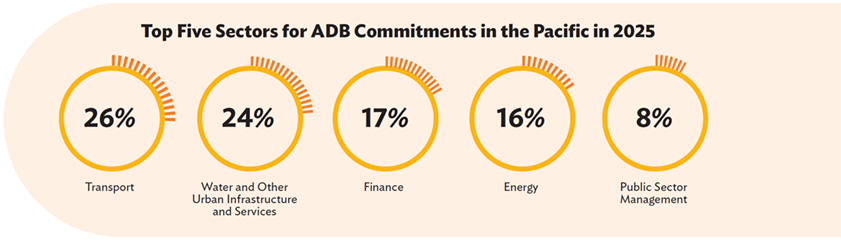
| |
34 | ANNUAL REPORT 2025 |
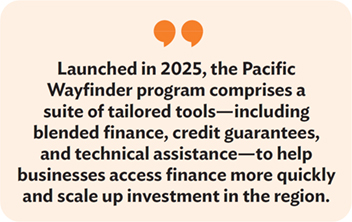
while promoting local participation in contracts and engaging the market early. Such measures help to increase competition for contracts and enhance the local economic benefits of ADB-financed projects.
In parallel, ADB provided technical assistance to the Cook Islands, Fiji, Samoa, and Tonga to help strengthen how public–private partnerships are planned and managed. The assistance supports governments in identifying, structuring, and implementing viable public-private partnership projects, while improving risk management and long-term service delivery.
Measures for More Inclusive and Fairer Growth
Despite having the largest finance sector in the Pacific, about 80% of PNG’s population has either limited or no access to banking services. This imbalance exists largely because of regulatory gaps, geographic barriers, low literacy and employment levels, and high poverty rates. As part of its broader efforts to overcome these inequities, ADB committed a $100 million loan in 2025 supporting the Government of PNG’s finance sector development strategy. The program will expand access to financial services for households and micro, small, and medium-sized enterprises; reinforce the regulatory and supervisory framework for financial institutions; and enhance sector integrity.
ADB also advanced regional dialogue to ensure long-term prosperity by keeping Pacific economies connected to the global financial system. In April, the bank convened a solutions lab on correspondent bank de-risking, exploring topics such as artificial intelligence-driven compliance, stronger digital identity systems, and regulatory innovations. The session produced a road map for immediate and longer-term reforms, with key takeaways also shared at the 5th Asia Finance Forum and Singapore FinTech Festival.
Fairness in taxation is vital to creating dynamic economies that deliver equitable and inclusive growth. In 2025, ADB and the Pacific Islands Tax Administrators Association held a clinic on transfer pricing and information exchange
for high-risk industries. The workshop strengthened tax officials’ skills in identifying high-risk cases, conducting transfer pricing audits, and using information-exchange mechanisms. Participants also discussed practical actions to improve compliance and transparency across the Pacific.
Promoting People’s Well-Being and Empowerment
During 2025, communities across the Pacific continued to face difficulties due to weather-related events, disrupted access to essential services, shortfalls in health care provision, and barriers to women’s career and livelihood opportunities. In response, ADB disbursed emergency relief funding and made investments in climate-resilient infrastructure and transport assets, disease prevention and treatment, and programs that allow women to participate more fully in the economy. This public and private sector financing was supported by a combination of specialist publication releases and knowledge events.
Providing Relief at Critical Times
In the aftermath of the 7.3-magnitude earthquake that shook Vanuatu’s capital, Port Vila, in December 2024, ADB provided critical support into 2025. The event triggered landslides and caused widespread damage that left more than 80,000 people, including more than 14,000 children, in urgent need. Following $5 million in emergency support provided in late 2024, ADB disbursed another $0.5 million from the Asia Pacific Disaster Response Fund in January 2025. This combined financing supported immediate relief and early recovery efforts such as the delivery of emergency aid packages, restoration of essential services, and assistance to help households begin rebuilding their lives.
The earthquake also severely disrupted access to Port Vila’s main wharves, with immediate and longer-term consequences for travel, trade, and essential services. In response, ADB committed a $24.4 million grant from the ADF to rehabilitate the partially damaged wharf road using disaster-resilient materials and structures. The project will restore safe access for local communities and about 110,000 people who arrive on cruise ships annually. The ADB investment will additionally help improve government expertise in weather-resilient road design, procurement, and contract management.
New Investments to Connect Communities
On Tongatapu, Tonga’s main island, climate threats— including coastal flooding, cyclones, and sea-level rise— continue to jeopardize critical infrastructure, livelihoods, and access to essential services. ADB committed an $80 million ADF grant and expects to get $40 million in
| PACIFIC | 35 | |
Improving Education Outcomes in Kiribati’s Outer Islands
Kiribati faces persistent challenges in delivering high-quality education. This is especially so in the outer Gilbert Islands, where many schools lack permanent classrooms, reliable electricity, and safe learning environments. Students with disabilities face additional barriers, while boys in particular have low retention in secondary education.
ADB is responding to these challenges through a $30 million Asian Development Fund grant to upgrade school facilities, expand teacher training, and improve the curriculum. The funding was complemented by $5 million in cofinancing from the Global Partnership for Education.
Temporary classrooms in nine primary schools will be replaced with weather-resilient, disability-accessible buildings, while dormitories will be upgraded at a secondary boarding school and Kiribati’s teachers college. The project will also establish computer labs in junior secondary schools and update digital curricula.
Teachers will receive training in digital skills, recognizing the needs of boys and girls, and strategies to better engage boys, with a dropout prevention program further supporting student retention. The Asian Development Fund support will also help strengthen family life education to promote equality for girls, prevent violence against women, and increase reproductive health awareness.
Each year, the initiative is expected to benefit about 950 students in schools across the outer Gilbert Islands.
cofinancing from the World Bank to build a 720-meter bridge across the island’s Fanga'uta Lagoon. The financing will also help construct 2.1 kilometers of approach roads, upgrade drainage and water supply systems, and improve road network management. The project is a first for ADB, serving as the lead lender, under the Full Mutual Reliance Framework with the World Bank.
Connectivity is equally important in PNG, where air travel over mountainous terrain remains essential for remote communities. Because the local airline, Air Niugini, has an aging fleet with high maintenance costs and regular service disruptions, ADB is financing predelivery payments for six Airbus A220-100 aircraft. With the payments financed under two private sector loans—$19 million from ADB’s ordinary capital resources and $16.9 million through the Leading Asia’s Private Infrastructure Fund 2—the new Airbuses will replace less reliable and fuel-inefficient planes.
Expansion in Disease Treatment and Prevention
Pacific island countries have some of the world’s highest rates of premature death from noncommunicable diseases (NCDs), including heart disease, stroke, cancer, and diabetes. In Vanuatu, the growing NCD burden is placing increasing pressure on already-limited health services. In 2025, ADB committed a $10 million ADF grant to expand access to quality NCD care across the northern provinces of Malampa, Penama, Sanma, and Torba, including establishing a dedicated NCD clinic in
Luganville. The project is expected to benefit more than 150,000 people, reduce NCD caseloads in Vanuatu’s hospitals, and promote healthier lifestyles.
Supporting Business and Leadership Roles for Women
Women entrepreneurs in the Pacific continue to face a range of barriers to starting and/or growing a business. An ADB report released in 2025 examines how fiscal policies oriented to women—such as simpler tax rules, streamlined administration requirements, and better use of sex-disaggregated data—can reduce these barriers and help women-led businesses prosper. The report highlights practical reforms to improve access to markets, commercial assets, and business finance, along with recommendations to assist women with registering or formalizing a business.
Some of the barriers noted in the report are experienced by women in Tonga, where the climate -vulnerable economy constrains entrepreneurship and women often lack access to finance and business support. ADB is working to resolve these issues through a $9 million project, financed by the ADF, to foster entrepreneurship by Tongan women. This project will introduce financing tools—including Tonga’s first risk-sharing facility that supports borrowers with their repayments—and tailored advisory services for women, while improving data systems to support financial products and services that are inclusive for women. It aims to expand access
| |
36 | ANNUAL REPORT 2025 |
to finance for at least 300 women entrepreneurs and enable about 200 businesses to transition into the formal economy.
Despite progress in some areas, significant gaps remain in women’s leadership across the region. The Pacific Women Leaders Program aims to build the confidence, skills, and networks women need to inspire and influence others. In June 2025, the program trained 20 senior women leaders from PNG’s state-owned enterprises and private sector organizations. Later that month, the program was held for the Marshall Islands, the Federated States of Micronesia, and Palau, bringing together 21 women leaders from government ministries, civil society organizations, and ADB country offices.
Strengthening Partnerships with Civil Society
In October 2025, ADB held a Civil Society Partnership Days event in PNG, which brought together representatives from the Government of PNG and civil society organizations to strengthen dialogue and collaboration. The event gathered nearly 100 participants to discuss how civil society contributes to service delivery, policy engagement, and opportunities for development partnership. This third Civil Society Partnership Days event, which followed similar events in Bhutan and Mongolia, continued to emphasize collaboration, knowledge sharing, and building practical skills for effective engagement in ADB operations.
Building a Healthy Planet
ADB continues to help Pacific governments respond to growing pressures, including from sea level rise and extreme weather events. In 2025, the bank’s focus was on expanding clean energy generation, strengthening disaster resilience, and promoting more environmentally sustainable resource use. By improving energy security, reducing vulnerability to extreme weather, and protecting unique ecosystems, ADB is striving to secure and improve the livelihoods of people in the Pacific.
Diverse Solutions for Renewable Energy
Fiji aims to achieve 90% clean energy by 2035, but current renewable generation is at about 50%. To bring the target closer, ADB is providing Energy Fiji Limited with technical assistance on high-priority studies that will inform solar, wind, and electricity grid projects valued at $103 million. These efforts are expected to boost renewable energy use, cut emissions, and deliver more reliable power to households and businesses.
National clean energy targets are also being jeopardized by infrastructure gaps and institutional limitations across Nauru, Solomon Islands, and Vanuatu. In 2025, ADB initiated technical assistance to advance sector policy and strategy, improve project development, expand stakeholder coordination, and engage private sector investors across the three countries. The bank’s input is focused on
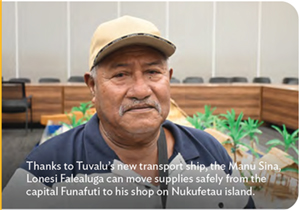 |
New Ship Delivers the Goods for Lonesi
Lonesi Falealuga, 71, runs a small mixed business on Nukufetau, one of Tuvalu’s remote islands.
Lonesi says he has long struggled with unreliable shipping of his goods, including food items, fishing gear, and motorcycle parts.
“There was a lot of damage to my merchandise on the other ship before,” he says.
That scenario changed with the arrival in 2025 of the Manu Sina, Tuvalu’s new passenger and cargo vessel financed through ADB’s Asian Development Fund. Replacing one of the two ocean-going vessels in the country, the Manu Sina has restored safe and reliable transport between Tuvalu’s outer islands and its capital, Funafuti, as well as operating to and from Fiji and Kiribati. |
|
The new ship is designed to withstand harsh ocean conditions and offers universal passenger access, including for older people and for passengers with disabilities. It provides safe passage for trade cargo, commuting workers and students, and patients needing specialized care.
“I really like how cargo is handled on the Manu Sina,” Lonesi says. “There are these cargo bins that make handling dangerous and fragile goods a lot better.”
The Manu Sina also reunited Lonesi with his son, daughter-in-law, and four grandchildren, who recently returned on it from Kiribati, after many years abroad. |
|
| PACIFIC | 37 | |
supporting these countries to reach their goal of 100% renewable energy by 2030.
In Samoa, recurring power shortages—including a 30-day state of emergency in March 2025—highlight persistent reliability challenges and dependence on imported petroleum. By providing the Australian dollar equivalent of $2.8 million as a private sector loan, ADB is helping Sun Pacific Energy Limited expand its 4.2-megawatt-peak solar farm on Upolu island (partly funded by ADB in 2017) to 6 megawatts. The upgraded facility, which will generate 9.6 gigawatt-hours of clean energy annually and avoid 1,944 tons of carbon dioxide emissions, supports Samoa’s goals of reducing greenhouse gas emissions by 26% by 2030 and achieving at least 70% renewable energy by 2031.
Inadequate power supply also remains a major challenge in PNG, where fewer than 20% of people have access to electricity. To help modernize the country’s power sector, ADB committed a $100 million loan supporting policy reforms and targeted investments, while promoting renewable energy development and private sector participation. The program aims to increase PNG’s electricity access to 30% by 2030, halve the duration of power interruptions, and improve the national utility’s financial sustainability.
The loan to PNG was complemented by a national power sector forum that was held to draw on the experiences and expertise of senior government officials, representatives of academia and the private sector, and specialists from development organizations. Discussions focused on two strategic priorities: strengthening infrastructure planning to accelerate electrification and renewable energy; and improving financial sustainability through reforms, privatization, and tariff frameworks. The forum produced a road map and reform framework to guide sector development to 2030.
Recognizing capacity constraints across the Pacific’s small island developing states, ADB hosted a regional knowledge event alongside the Asia Clean Energy Forum. Policymakers, regulators, utilities, and development partners participated in workshops covering clean energy transitions, regulatory reform, artificial intelligence-enabled utility management, and cross-sector development. The event strengthened regional cooperation and equipped Pacific stakeholders with practical tools to advance sustainable energy systems.
Managing Disaster Risks and Environmental Assets
Pacific DMCs are highly vulnerable to climate and disaster risks, which can severely disrupt social and economic progress. ADB’s long-term support for disaster risk
management in the Pacific was expanded in 2025, when the bank initiated technical assistance to design and implement innovative disaster risk financing mechanisms. The assistance, financed by the Japan Fund for Prosperous and Resilient Asia and the Pacific, will expand financing options, enhance regional collaboration and data-sharing, and support measures that reflect the different needs of men and women in Pacific island countries.
In Fiji, rapid urbanization and aging water infrastructure strain the water supply in the Greater Suva Area and contribute to rising marine pollution. ADB responded in 2025 by committing a $135 million loan and a $10 million ADF grant to upgrade the Kinoya wastewater treatment plant, benefiting more than 295,000 people. The project will use a performance-based contract to cut water losses to at least 30% and double wastewater treatment to improve the health of Laucala Bay’s mangrove forests and coral reefs.
Through its Law and Policy Reform Program, ADB also supported the drafting of Fiji’s new Forestry Bill (passed by Parliament in late 2025) to replace the 1992 Forest Act. Shaped by extensive consultations with communities, government agencies, industry players, landowners, and civil society, the new bill establishes a holistic framework that promotes livelihoods, climate resilience, biodiversity, and cultural heritage.
Building Blue Economy Growth in Kiribati, the Marshall Islands, and Tuvalu
In 2025, ADB published a paper setting out practical options for the atoll nations of Kiribati, the Marshall Islands, and Tuvalu to use their marine resources more sustainably. Outlining evidence-based policies, opportunities for regional cooperation, and priority investment areas, the paper’s insights can guide governments in driving sustainable blue economy growth across vulnerable island communities.
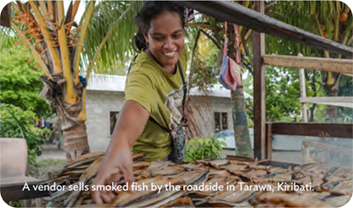
Despite heightened global trade tensions and geopolitical uncertainty, South Asian economies remained broadly resilient in 2025. Across much of the region, stronger agricultural output and favorable weather conditions helped ease food prices, allowing inflation to moderate.
India’s economy continued to grow robustly, driven by ongoing infrastructure investment, a rebound in agriculture, and buoyant services exports that cushioned the impact of elevated tariffs.
Bhutan also maintained solid growth, supported by hydropower development and continued recovery in tourism and agriculture. In Maldives, tourism remained the main growth driver, complemented by a strong fisheries sector, although rising public debt and low foreign exchange reserves pose concerns.
Nepal’s economy grew steadily in the first half of 2025, supported by a favorable monsoon and increased electricity generation, but civil unrest in September dampened business activity and tourism. Similarly, political uncertainty in Bangladesh contributed to softer growth and weaker domestic demand, which was also impacted by tight fiscal and monetary policies.
For most of the year, Sri Lanka continued its economic recovery, with improved consumption, strong remittance inflows, and a rise in private credit. Fiscal reforms remained on track. However, the country’s prospects may
be dampened by the impacts of Cyclone Ditwah, which struck in late November, causing extensive loss of life and damage to property and infrastructure.
Across much of the region, stronger agricultural output and favorable weather conditions helped ease food prices, allowing inflation to moderate in 2025.
ADB responded quickly in the aftermath of the cyclone in Sri Lanka, providing a $3 million grant from the Asia Pacific Disaster Response Fund to support emergency relief and humanitarian efforts in flood-ravaged communities. This was soon followed by $40 million in emergency trade finance assistance to help finance essential imports, including medicines and critical supplies, as Sri Lanka rebuilds.
This vital support was part of the bank’s total commitments of $9.7 billion for South Asia in 2025, comprising $7.8 billion in public sector finance and $1.8 billion for private sector operations.
ADB’s investments for its South Asian developing member countries generally responded to demand for better infrastructure, broader environmental resilience, increased social protection, faster digital transformation, and greater private sector activity. The bank also committed significant resources to advancing regional cooperation, especially in trade and value chain integration.

| SOUTH ASIA | 39 | |
Increasing Prosperity Through Vibrant Economies
Helping people to prosper and communities to flourish relies on expanding economic opportunities, fostering sustainable livelihoods, and improving financial inclusion for both households and enterprises. In 2025, ADB’s operations in South Asia enabled developing member countries to promote entrepreneurship, spur private sector participation, drive engagement in the digital economy, strengthen financial and budgetary systems, and support strong and equitable economic growth.
Support for Sustainable and Inclusive Enterprise
In India’s northeastern state of Tripura, a lack of quality infrastructure is deterring private investment and limiting job creation and manufacturing-led growth. Building on earlier work to support economic and industrial corridor development, ADB committed $85.4 million in 2025 to upgrade nine industrial estates with weather-resilient roads and drainage; reliable power distribution; and improved water, sanitation, and security systems. The project will introduce buses fueled by natural gas and electric vehicles supported by charging stations in key industrial estates. This ADB investment has been made to enhance Tripura’s integration into regional value chains, with special considerations for businesses owned or led by women and the promotion of women’s employment through new day care centers and skills programs.
Helping create a future-ready workforce for India’s manufacturing and emerging technology sectors, ADB committed $846 million in financing to support the country’s national flagship skilling program. The investment will help upgrade 650 industrial training institutes across 12 states to modernize them into industry-driven centers of excellence, boosting skills and improving the employability of 1.3 million youth in the manufacturing and emerging technology sectors.
Throughout South Asia, citizens and businesses increasingly expect governments to provide digital systems, solutions, and services necessary to power modern economies, with digital public infrastructure— the foundation for digital identification, digital payments, and data sharing—becoming the catalyst for more-efficient public services and longer-term growth. Released in 2025, a new ADB study examines the digital public infrastructure landscape in South Asia, highlighting India’s role as a leading practitioner and knowledge hub, and identifying opportunities for investment, knowledge sharing, and partnerships.
Digital technologies are also a key element of new ADB technical assistance to develop a framework for economic corridor development and regional trade and value chain integration. This work combines analytical studies, capacity building, and policy dialogue to better link physical infrastructure, digital systems, institutions, and value chains across six participating countries. By aligning national corridor initiatives and identifying opportunities for cross-border integration, the assistance aims to improve trade connectivity and industrial competitiveness across South Asia.
More Inclusive Financial and Fiscal Systems
The banking sector dominates Bangladesh’s financial system, but years of weak governance, inadequate oversight, and poor capitalization have hindered its ability to deliver efficient and inclusive services. These issues constrain access to credit, especially for small and medium-sized enterprises, and limit financial inclusion for many households.
In 2025, ADB provided $500 million to strengthen Bangladesh’s banking supervision, improve governance and asset quality, and modernize liquidity management. The program will encourage digitalization and expand access to affordable finance to drive stronger growth in the private sector and help stabilize the banking sector.
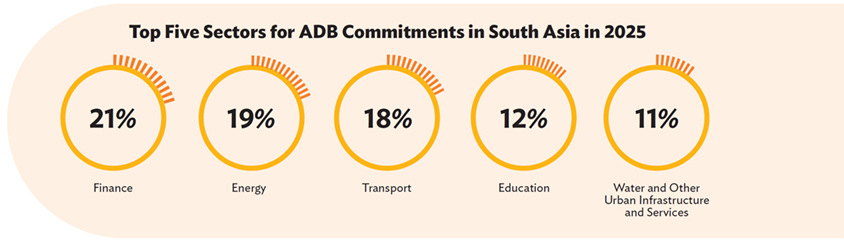
| |
40 | ANNUAL REPORT 2025 |
In Nepal, the transition to federalism has highlighted weaknesses in public financial management. These weaknesses affect expenditure planning and debt management at the national level and resource planning and management at the subnational and local levels. Supporting structural fiscal reforms, ADB committed $100 million for a second subprogram that is helping improve Nepal’s expenditure and debt management and resource planning. Key policy actions include adopting a strengthened legal framework and strategy for debt management; reforming public enterprises; and digitizing expenditure recording across federal, provincial, and local governments.
Fostering Jobs and Growth Through Tourism
Tourism is central to the economies of Maldives and Sri Lanka, creating jobs, driving foreign exchange earnings, and linking communities to global markets. To sustain growth and reduce vulnerability to external economic shocks, both countries are working to broaden their tourism appeal and encourage private sector participation.
Through a series of workshops in 2025, ADB and Maldives’ Ministry of Economic Development and Trade brought together tourism stakeholders to develop new products and business concepts that are linked to culture and heritage and reflect emerging tourism trends. The ministry has since established an intellectual property office that protects the rights of innovators and opens pathways for creative entrepreneurs to earn from their creations.
In Sri Lanka, the tourism sector continues to recover from successive external shocks, but underlying weaknesses, such as shortfalls in infrastructure and limited private sector engagement, are hindering its performance. ADB has responded by committing $100 million in 2025 to improve sector governance and asset management, boost promotion and marketing of sustainable tourism, update vendor skills training, and advance digitalization.
Targeting two major tourism destinations, Dambulla (including Sigiriya) and Trincomalee, the program seeks to open up untapped areas, including marine tourism, increase visitor stay and spend, and encourage women’s participation in the sector.
Promoting People’s Well-Being and Empowerment
From its remote rural villages to its rapidly growing cities, the South Asia region continues to call for significant investment in essential services and critical infrastructure. ADB’s investments and knowledge work in 2025 sought to improve basic living standards; reinforce health and social protection systems; empower women by providing access to finance and jobs; and deliver vital infrastructure that can boost trade, better connect communities, and improve urban life.
Essential Services for Communities in Need
In Cox’s Bazar, Bangladesh continues to host more than 1 million displaced people from Myanmar, placing a heavy strain on local infrastructure and services. ADB reaffirmed its support with a $58.6 million grant from the Asian Development Fund and a $28.1 million loan to upgrade migrant camp facilities and improve infrastructure in host communities. This includes expanding access to safe water and sanitation and installing 12,500 solar-powered streetlights to improve safety, particularly for women and children. By reducing pressure on local resources, the project will help improve cohesion between camp residents and their host communities.
The people of Sri Lanka are also in need of support as the health system strains under an aging population and a rise in noncommunicable diseases. In 2025, ADB committed a $100 million loan to upgrade 82 hospitals, modernize diagnostic capacity across 9 public health laboratories, and establish a national Center for Disease Control. Investments in digital health, procurement systems, and staff training—including for more than 5,000 health workers—will improve service quality and efficiency. The program is expected to benefit more than 10 million people, contributing to better care and curtailing future health threats.
Supporting Businesses Owned by Women
Micro, small, and medium-sized enterprises owned by women are essential to India’s economy but many still face difficulties accessing credit due to lack of income records, collateral constraints, and limited digital and financial literacy. ADB is helping bridge this gap through
| SOUTH ASIA | 41 | |
Financing a Greener Textile Industry for Bangladesh
The garment industry is the backbone of Bangladesh’s economy, generating more than 80% of export earnings. As global buyers demand greener production, textile manufacturers face mounting pressure to modernize operations and reduce environmental impacts.
In 2025, ADB signed a $30 million sustainability-linked private sector loan with Envoy Textiles Limited, Bangladesh’s leading denim fabric producer and a global pioneer in energy efficiency and environmental design in fabric manufacturing.
A follow-on investment to the bank’s 2022 engagement with the company, the new financing will help fund an energy-efficient spinning unit that adds 4,550 tons of annual yarn capacity at Envoy’s manufacturing plant in Jamirdia, with enhanced employment opportunities for women. It will also support the installation of 3.5 megawatts of rooftop solar panels at the factory as well as refinancing short-term working capital loans to increase liquidity for raw-material purchases.
As a sustainability-linked loan, the financing is tied to measurable performance targets, including increased renewable energy capacity and associated reductions in greenhouse gas emissions.
By accelerating cleaner production and strengthening operational efficiencies, the investment supports Bangladesh’s shift toward a greener and more globally competitive textile industry.
a $100 million private sector loan to Five Star Business Finance Limited, a nonbank lender in southern India. Targeting lower-income women borrowers, the initiative will expand lending by using tailored income-assessment methods to qualify loans, helping women entrepreneurs grow their businesses and participate more fully in the economy.
Access to credit also remains limited for enterprises owned or led by women in Sri Lanka, despite recent improvements in the country’s financial stability. In 2025, ADB committed a third $100 million policy-based loan to complete a series of structural reforms that will enhance banking governance, improve asset quality, and expand financial inclusion. A key outcome of the program is the establishment of the National Credit Guarantee Institution Limited, which helps micro and small enterprises, especially those owned by women, overcome collateral constraints and secure the financing they need to start or grow businesses.
Modernizing Transport and Essential Services
Bangladesh’s inadequate transport infrastructure continues to raise business costs, reduce competitiveness, and limit regional trade. In 2025, ADB committed $688 million to upgrade and construct a key section of railway between Chattogram and Dohazari, which is part of a South Asia Subregional Economic Cooperation
corridor. This investment will help improve passenger and freight movement, support resilient railway operations, and introduce energy-efficient locomotives. With training for railway staff further enhancing safety and operational standards, the improved connectivity is expected to reduce travel times, increase intraregional trade, and support Bangladesh’s goal of becoming a regional transport hub.
In Sri Lanka—where rural communities continue to endure poor road conditions that restrict access to markets, schools, and essential services—ADB committed $90 million to complete critical works delayed during the 2022 economic crisis. The support includes upgrading about 500 kilometers (km) of rural access roads, rehabilitating 23 km of national roads, and improving 100 km of rural roads to all-weather standards. The project will improve mobility and services for around 800,000 people and nearly half its works will be in the conflict-affected Northern and Eastern provinces.
To complement investments in urban transport and services, ADB copublished a concept framework on creative redevelopment with the Government of India and the World Bank. The framework outlines practical solutions to transforming urban spaces using approaches that integrate land use with transport and economic planning.
| |
42 | ANNUAL REPORT 2025 |
ADB is applying the principles of the framework in India’s northeastern state of Sikkim, where seven rapidly growing towns continue to face gaps in water supply, sanitation, mobility, and disaster-resilient infrastructure. In 2025, the bank provided a $179.1 million loan to ensure continuous water supply; upgrade sanitation facilities; and modernize transit hubs with parking management, commercial zones, and community spaces that double as disaster relief centers. In addition, upgraded roads, stormwater drains, and pedestrian-friendly infrastructure will enhance safety and accessibility across all seven towns, benefiting more than 100,000 residents.
Building a Healthy Planet
Building environmentally resilient communities and infrastructure, accelerating the clean energy transition, and reinforcing food and water security are core elements of sustainable economic development. ADB financing and specialist knowledge in 2025 helped protect communities from the impacts of extreme weather, advance renewable power and modernize electricity systems, and scale irrigation solutions that improve agricultural productivity and safeguard livelihoods.
Holistic Initiatives in Resilience
Phuentsholing, one of Bhutan’s major economic centers, faces persistent weather- and disaster-related risks, largely due to its location in a seismically active,
landslide-prone area of the Himalayan foothills. Despite previous development works, the town continues to experience monsoon-related flooding and rapid debris flows along the Omchhu River. In 2025, ADB committed a $30 million loan and a $15 million Asian Development Fund grant to reinforce flood protection; pilot ground-stabilization measures; and bolster risk mapping, monitoring, and disaster preparedness. Through better planning and by improving riverbank stability, the project will make daily life safer for about 12,500 residents while supporting sustainable riverfront development.
The financing package for Phuentsholing was accompanied by an ADB development effectiveness brief that outlines the wide spectrum of initiatives supporting the city’s development. As well as flood protection, the brief analyzes measures to streamline customs processes, upgrade road transport, and improve housing and health services, while also looking at ways to support women entrepreneurs as part of Phuentsholing’s sustainable and inclusive transformation.
Fast-Tracking Energy Affordability and Accessibility
India, with the world’s largest population, has become a focal point for accelerating the global clean energy transition. Meeting future demand will require new generation capacity, more-reliable power transmission, better storage solutions, and weather-resilient
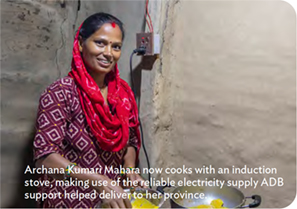 |
Clean Cooking Lets Archana Breathe Easy
Archana Kumari Mahara, 28, keeps house in Birendra Bazar in Madhesh Province, one of Nepal’s most disadvantaged regions.
The mother of two recalls long hours spent over a smoky firewood stove on summer afternoons, when temperatures could soar above 42°C.
“In that heat, cooking felt like torture,” she says.
In 2025, Archana took receipt of a brand-new electric induction cookstove courtesy of a broader household electrification and clean energy initiative supported by ADB.
|
|
Under the project, around 42,000 Nepalese households are expected to gain new or improved electricity connections by 2027, with local governments upgrading electricity systems and commercial partners subsidizing the cost of cookstoves.
By the end of 2025, more than 1,100 new cookstoves had been connected across Madhesh Province.
For Archana, the change has been transformative. She is now able to cook quickly and without smoke, then switch off the stove and step outside to relax or do other household chores while the food stays warm.She even cooks with a cooling fan on, something impossible with an open flame.
“The kitchen stays clean, and I can breathe!” Archana exclaims. |
|
| SOUTH ASIA | 43 | |
distribution. ADB is supporting India’s transition through numerous investments that expand renewable energy supply; advance grid stability; and improve access for households, communities, and industry.
India’s growing demand for renewable energy has heightened the need for continuous clean power and storage systems to stabilize intermittent supply. In 2025, ADB committed $290.6 million in private sector loans and debt security for ReNew Vyoman Power Private Limited to develop a hybrid wind–solar renewable energy plant in Andhra Pradesh. The project integrates clean energy generation with advanced battery storage to ensure a reliable power supply to distribution companies in Assam and Chhattisgarh, two of India’s lagging states. It is expected to generate 1,641 gigawatt-hours of clean energy and avoid about 1.19 million tons of carbon dioxide emissions annually.
Within India’s industrial sector, the aluminum industry is highly energy-intensive, accounting for about 80% of sector emissions. ADB has responded by providing an $84 million private sector loan—and mobilizing an additional $84 million from Leading Asia’s Private Infrastructure Fund 2 and up to $177.1 million from parallel lenders—for Serentica Renewables India 1 Private Limited to develop a solar–wind hybrid renewable energy project in Karnataka. The facility comprises 191.4 megawatts of solar power generation and 204 megawatts of wind capacity, with ADB’s financing dedicated to the solar component. The plant will supply renewable power to a major aluminum producer, helping reduce carbon dioxide emissions by more than 22 million tons over its lifetime.
Greater investment in solar power generation is also necessary for India’s low- and middle-income households, which face many barriers to adopting rooftop systems, including high up-front costs, weak grid integration, and limited access to affordable financing. In 2025, ADB committed $650 million to support India’s national rooftop solar program, which aims to scale solar adoption for 10 million households. The financing will support structural reforms, policy harmonization across states, improved technical standards, targeted subsidies, and business incentives, helping improve affordability and expand green jobs.
Meanwhile, in Bangladesh, rapid development has driven energy demand and increased dependence on fossil fuels. An ADB study released in 2025 examines the country’s clean energy transition and future low-carbon pathways. The bank’s modeling shows that a shift toward low-carbon solutions is achievable, but will require strong policy support, investment, and behavioral change.
New Investment in Sustainable Agriculture
Farmers in Sri Lanka’s dry zone continue to struggle with unreliable irrigation, water shortages, and increasing weather-related pressures. Large sections of the North Central Province Canal system remain unfinished, limiting water flow to farms and nearby towns. In 2025, ADB committed $200 million to support the government’s Mahaweli Development Program by completing key tunnel and canal works and upgrading local irrigation networks. The system will improve water supply for 35,600 farming households and provide safe water for 200,000 people, enhancing Sri Lanka’s agricultural productivity and rural development.
To share knowledge and best practices on sustainable agriculture, food security, and adaptation to changing weather patterns, ADB and the Asian Development Bank Institute held a conference in Thimphu, Bhutan, in March 2025. This event was attended by researchers, government officials, farmers and agricultural enterprises, donor partners, and private sector representatives from across Asia and the Pacific. It discussed policy frameworks, financing mechanisms, and investment opportunities to address challenges in sustainable agriculture, while also showcasing Bhutan’s carbon-negative policies and successful regional projects.
Ensuring Development Coordination in Nepal
In 2025, ADB approved a new country partnership strategy for Nepal through to 2029. Prepared in coordination with the World Bank, the strategy lays the groundwork for deeper collaboration between Nepal’s two largest development partners. It centers on private sector-led, green economic transformation; intensive job creation and human capital development; and enhanced environmental sustainability.
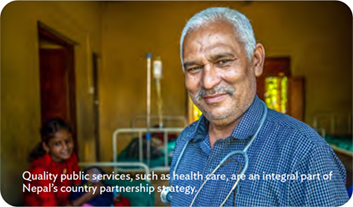
While economic growth in Southeast Asia slowed to 4.5% in 2025, the regional outlook remains strong due to sound macroeconomic fundamentals, resilient domestic demand, and robust policymaking. The Philippines continued its dynamic post-pandemic recovery, while notable expansion was observed for Indonesia, Malaysia, and Viet Nam late in the year.
However, wide gaps in economic prosperity remained across the region. The Lao People’s Democratic Republic (Lao PDR), Myanmar, and Timor-Leste again experienced significant food insecurity, with severe weather events—including typhoons, floods, and droughts—greatly impacting agriculture and high food and energy prices continuing to distress the poorest households. Meanwhile, border tensions between Thailand and Cambodia affected trade and labor movements.
To cope with weaker global growth and rising trade uncertainty, many of ADB’s developing member countries (DMCs) in the region implemented fiscal stimulus and lowered policy rates to boost domestic demand. They also pursued diversification into new sectors such as smart electronics, renewable energy, and green data centers.
ADB deepened its collaboration with the Association of Southeast Asian Nations (ASEAN) to support regional integration and address common issues. This included a leading role to mobilize technical and financial support for the ASEAN Power Grid, the region’s flagship program to accelerate the clean energy transition. In the Philippines,
ADB delivered a comprehensive support package for the country’s ASEAN Chairship in 2026. In 2025, Timor-Leste became a full member of ASEAN, marking a historic milestone supported by ADB’s long-standing engagement with the country.
Assisting with these and other development objectives, ADB delivered a robust support program for Southeast Asia in 2025, combining policy-based lending, investment and knowledge projects, regional cooperation initiatives, and technical assistance. The bank committed $9 billion for the region, comprising $7.3 billion in public sector finance and $1.6 billion for private sector operations. It continued to meet demand from DMCs by supporting socioeconomic resilience, bolstering food security, improving ocean and marine management, and expanding sustainable infrastructure in renewable energy and transport.
ADB invested strongly in the economic future of the region’s people, with particular emphasis on boosting productivity; developing market-oriented skills; and improving outcomes in nutrition, education, and health. The bank further advanced support for women and girls, including support for women entrepreneurs, and helped strengthen public financial management and fiscal resilience to build more sustainable and inclusive economies.
In conjunction with United Nations agencies, ADB delivered critical humanitarian assistance to the people of Myanmar, Thailand, and Viet Nam after devastating disasters.

| SOUTHEAST ASIA | 45 | |
Increasing Prosperity Through Vibrant Economies
DMCs in Southeast Asia aim to deliver prosperity for their people by boosting economic competitiveness and green growth, creating better jobs and skills for employment, and improving the quality and reach of public services.
In 2025, ADB supported the region’s DMCs with targeted investments and strategic knowledge platforms to improve business environments and promote trade, while assisting governments in the delivery of vital community infrastructure and services.
Fostering Business Expansion and Trade Integration
Indonesia aims to attain high-income status by 2045 through sustained growth and structural reforms. ADB is supporting this ambition through a $478.1 million policy-based loan committed in 2025 and $447.4 million in cofinancing to boost the country’s competitiveness, spur green growth, support smaller enterprises, and accelerate trade. Building on two previous initiatives, the program streamlines business licensing, reduces trade bureaucracy, and empowers local businesses, particularly those owned by women.
In the Philippines, ADB provided a $388.9 million policy-based loan to support government reforms that create an enabling environment for dynamic business. Through the loan, the government will improve regulatory requirements and boost digital service delivery to enterprises and investors.
ADB also supported key knowledge events in 2025 to promote trade and value chain integration for Southeast Asian DMCs. In April, the bank helped deliver executive training sessions for Cambodian businesses and government officials to better understand compliance with international rules on the origin of goods and explore strategies for leveraging trade preferences for major exports such as textiles, bicycles, and travel goods. In
July, ADB and Indonesia brought together officials from the Brunei Darussalam–Indonesia–Malaysia–Philippines East ASEAN Growth Area (BIMP-EAGA) and the Indonesia–Malaysia–Thailand Growth Triangle (IMT-GT) to increase their understanding of special economic zones, which serve as catalysts for new value chains and regional economic growth.
Transformative Measures in the Digital Economy
In Thailand, ADB is showcasing its integrated approach to growing the digital economy. The bank committed a $26.7 million private sector loan to finance a 25.6-megawatt IT-load energy-efficient green data center serving technology and artificial intelligence firms. Associated ADB technical assistance provided an analysis of greenhouse gas emission projections from the country’s data center sector, supporting Thailand’s goals to cut carbon dioxide emissions by 30% by 2030, achieve carbon neutrality by 2050, and reach net zero by 2065, while pursuing digital transformation.
Digitalization will also play a key role in reshaping the Philippine insurance industry, which lacks the scale to support sustainable long-term economic growth and ensure social protection. Through a $381.5 million policy-based loan committed in 2025, ADB is helping modernize and expand the country’s insurance services through reforms that improve efficiencies, accelerate digitalization, and expand financial inclusion.
Exploring how digitalization can drive regional integration, ADB contributed to the Greater Mekong Subregion Innovation Week 2025 in Viet Nam. The event showcased innovative policy and technological solutions and fostered dialogue on financing mechanisms to support digital transformation.
Freeing Up Revenue for Critical Infrastructure
Indonesia’s strong fiscal discipline has helped stabilize its economy, but more investment is needed in infrastructure and public services. In 2025, ADB
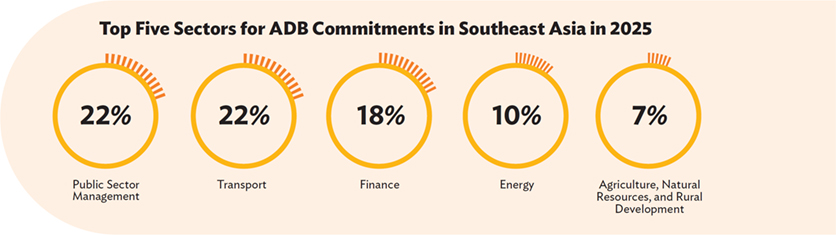
| |
46 | ANNUAL REPORT 2025 |
committed a $494.9 million loan to help increase the availability of government revenue for financing new infrastructure and service delivery. The project seeks to improve Indonesia’s tax administration, use of digital systems, and international tax cooperation.
Cambodia also continues to face challenges that limit infrastructure investment. In response, ADB committed a $50 million policy-based loan to update revenue and expenditure management, expand digital public services, improve budget efficiency, and help local governments collect more revenue. This is expected to generate more than $3.1 billion in additional revenue and efficiency savings by 2028, benefiting millions of citizens through improved infrastructure and social services.
New Investment to Improve Public Services
For legions of commuters in the Philippines’ Central Luzon region, transport bottlenecks continue to make life difficult. In 2025, ADB committed a $1.45 billion loan under the Malolos–Clark Railway Project to complete the remaining works for 53.1 kilometers (km) of elevated railway and seven new stations. The line will cut travel time between Metro Manila and Clark to under an hour and improve access to jobs and markets for up to 696,000 passengers daily when the full North–South Commuter Railway opens. The Japan International Cooperation Agency is providing cofinancing of up to $2 billion for the overall project.
Also in the Philippines, the government marked a milestone with the commercial and financial close of the 796-megawatt Caliraya–Botocan–Kalayaan hydroelectric complex—the country’s first pumped-storage facility. With ADB serving as transaction advisor, the project mobilized $699.6 million in capital investments from Cleanergy 9 Power Inc to take over and operate the facilities, in one of the region’s largest renewable energy deals. Proceeds will help retire power sector liabilities and strengthen the sector’s financial position.
In Viet Nam, demand for clean water is escalating in the rapidly growing Binh Duong Province, which has now merged into Ho Chi Minh City. ADB has responded by providing a $6 million private sector loan, with equivalent cofinancing from the Japan International Cooperation Agency, to Thu Dau Mot Water Joint Stock Company. The project will increase capacity at the Bau Bang water treatment plant from 30,000 to 80,000 cubic meters per day, ensuring clean water for homes and businesses and supporting government reforms to reduce reliance on public financing. The investment includes company training in water ecology, smart energy management, and carbon neutrality.
In the Philippines, ADB invested $100 million in the Maynilad Water Services, Inc. initial public offering on the Philippines Stock Exchange and mobilized $45 million to expand, modernize, and enhance the resilience of water and wastewater services, while contributing to the development of capital markets. The company is one of two water utility concessionaires operating waterworks and sewerage services in Metro Manila.
Promoting People’s Well-Being and Empowerment
Across 2025, ADB supported the people of Southeast Asia with programs to ensure adequate and nutritious food, expand access to education and health, and improve daily life through essential infrastructure and services. The bank also fostered new education opportunities for girls and greater economic participation by women.
Support for Communities in Need
In March 2025, a 7.7-magnitude earthquake deepened Myanmar’s humanitarian crisis. ADB responded quickly with $3 million in emergency relief funding, partnering with the World Food Programme to deliver food and cash assistance to 186,400 people. The bank also fast-tracked a $100 million grant provided with United Nations agencies to restore community infrastructure; shore up household budgets; and improve access to food, shelter, health care, and education. In late 2025, ADB similarly provided $2 million each to disaster-ravaged Thailand and Viet Nam for emergency items such as medical kits and clean drinking water.
Under technical assistance for longer-term social safety nets, ADB is advising on shock-responsive social protection systems in Cambodia, Indonesia, the Lao PDR, and the Philippines.
Strengthening Food Security and Nutrition
One in five rural households in the Lao PDR faced food insecurity in 2024. In 2025, ADB provided a $30 million
| SOUTHEAST ASIA | 47 | |
Driving Energy Security and Regional Integration
Southeast Asia’s energy demand is expected to triple by 2050. Without action, the region could face power shortages, higher electricity costs, and increased dependence on fossil fuels. At the same time, some Association of Southeast Asian Nations (ASEAN) countries produce surplus energy while others face shortages.
Supporting affordable and reliable electricity supply for more than 680 million people, the ASEAN Power Grid is designed to connect the electricity networks of ASEAN countries and maximize the use of renewables, with fully integrated grid operation expected by 2045.
ADB, the World Bank, and ASEAN have established the ASEAN Power Grid Financing Initiative to mobilize large-scale funding for cross-border power interconnections across land and on the seabed. ADB and the World Bank will offer financing from their own balance sheets and catalyze funds from other organizations to take projects from concept to completion.
The initiative will help develop a strong pipeline of projects and enable ASEAN’s national utilities and sponsors to request support from a community of financiers, including international financial institutions, donors, commercial banks, and philanthropists.
In addition to boosting energy security, the ASEAN Power Grid will enhance regional integration. It will foster stronger economic ties through energy trade while encouraging the integration of diverse energy sources, including vast renewable energy resources available in the region.
loan and a $5 ADF million grant to improve the country’s agrifood systems and promote weather-resilient farming. The project will expand value chains for high-value crops such as bamboo, tea, and coffee; upgrade rural infrastructure; and deliver education on nutrition for vulnerable households.
In the Philippines, ADB committed a $400 million loan and $370 million in cofinancing to support the government’s flagship Walang Gutom (Zero Hunger) program by delivering monthly e-vouchers to 750,000 food-insecure households, coupled with nutrition education, especially for poor and vulnerable women and children.
New Momentum in Education and Health
Rapid urbanization in Viet Nam is increasing demand for schooling in suburban districts. In 2025, ADB structured and syndicated a $150 million sustainability-linked private sector loan, comprised of a $40 million ADB loan and $110 million in parallel loans, to the Vinschool Joint Stock Company. The financing will support nine new campuses and purchase three existing ones in Ha Noi, Ho Chi Minh City, and Hung Yen, providing access to quality education for more than 20,000 students.
In Timor-Leste, the technical and vocational education and training (TVET) system calls for new and advanced curricula and deeper industry ties. ADB responded by
providing a $3 million grant from the Japan Fund for Prosperous and Resilient Asia and the Pacific to upgrade TVET facilities and curricula, increase private sector collaboration, and provide quality schooling for over 2,500 students annually.
Meanwhile, health systems are lagging in the Lao PDR’s poor and remote communities. ADB committed a $30 million loan and a $10 million Asian Development Fund (ADF) grant to improve primary care for about 900,000 people, half from ethnic communities. The project will upgrade 27 hospitals and health centers in 14 districts, expand digital health services, and train more health workers to ensure continuity of care.
Improving Rural and Urban Living Standards
Many of Timor-Leste’s rural communities need better connectivity to markets and essential services, particularly in disaster-prone areas. In response, ADB committed $75 million in concessional financing to upgrade 42 km of roads between Lospalos and Iliomar and rehabilitate three critical bridges, benefiting more than 70,000 people. The financing will additionally assist with community-led adaptation measures in six flood-and drought-prone villages. In the remote region of Ermera, a $4 million ADF grant will upgrade roads and enhance the government’s capacity to plan and maintain them.
| |
48 | ANNUAL REPORT 2025 |
Safe travel is also an issue in rural Viet Nam, where ADB provided a $59 million loan to improve 133 km of district roads while also upgrading water supply in Phu Yen and Quang Tri provinces. The project will directly benefit about 363,000 people, including 187,000 people from ethnic minorities, as well as bolstering early disaster warning and response.
In Cambodia, ADB is helping connect 150,000 households to safe water and improve flood protection for over 2 million people via a $763.3 million financing program and $158 million in cofinancing committed in 2025. The program will upgrade water supply, sanitation, drainage, and solid waste systems in 14 cities across 12 districts.
Educating and Empowering Women and Girls
The Lao PDR requires greater investment in TVET to equip young people—particularly women—with skills for emerging sectors and green jobs. In 2025, building on an earlier project, ADB committed a $30 million loan and $3 million ADF grant to upgrade 11 TVET schools, expand training in high-demand fields, and provide safer dormitories and leadership training for girls, including stipends for more than 1,000 girls from poor families.
For women entrepreneurs in Thailand, access to affordable finance is generally limited, with an estimated funding gap of $37 billion. ADB is helping close this
gap through a $200 million private sector loan package, comprised of a $75 million ADB loan and $125 million in b-loans, with Muangthai Capital, Thailand’s largest nonbank lender. The ADB funds will be used to expand lending to more than 200,000 women-led micro and small businesses operating in rural areas and with limited credit history.
In Cambodia, women and girls often face disproportionate risks from weather-related events due to gaps in access to land, finance, and education. With support from ADB and UN Women, a national policy dialogue in 2025 helped assess these gaps and integrate the perspectives of women and girls into Cambodia’s next climate action plan. ADB’s country partnership strategy for Cambodia also prioritizes environmental resilience and responsive development, in particular for women and girls.
Building a Healthy Planet
As evidenced during 2025, Southeast Asia continues to be confronted by destructive disasters and longer-term environmental issues. ADB investments and knowledge work focused on expanding provision of renewable energy, improving disaster planning and response, shoring up sustainable agrifood systems and livelihoods, and supporting circular economy and low-carbon initiatives.
 |
Aon Is Stitching Together a New Career Path
Aon Phommachanh, 19, lives with her parents and two siblings in Vientiane Province, Lao People’s Democratic Republic (Lao PDR).
After finishing secondary school, Aon worried that financial hardship would prevent her from pursuing further education and building a better future for her family.
When she attended a local jobs fair, Aon learned about technical and vocational education and training and associated financial assistance for youth from low-income households. She found she was eligible and immediately enrolled in a garment-making course.
|
|
“I didn’t know how to make any clothes at all,” she says.
Aon, and more than 5,000 disadvantaged students like her, received a stipend for the training via support from ADB’s Asian Development Fund. These stipends—covering enrollment fees, accommodation, a living allowance, and certain training and travel expenses—were part of a $25 million project that modernized eight technical training colleges and introduced demand-oriented courses across the Lao PDR . The investment reflects ADB’s long-term commitment to help reduce poverty in the Lao PDR by developing youth skills that meet labor market needs.
Although she is still studying, Aon earned her first money from her dressmaking skills in 2025.
“I’ve started making Lao skirts,” Aon says. “After graduation, I plan to open a tailoring shop. I’m confident with my skills and hard work, I will earn more money for my family.” |
|
| SOUTHEAST ASIA | 49 | |
Broad Investment in Building Resilience
Efforts to meet rapidly growing energy demand in Cambodia are inhibited by limited power transmission and grid reliability. In 2025, ADB committed a $52.7 million loan to expand transmission infrastructure, upgrade nine substations, and build high-voltage lines, supporting the country’s goal of 70% renewable energy by 2030.
The bank is also helping Indonesia develop its geothermal energy potential—the world’s largest at about 29 gigawatts. ADB has been supporting PT Geo Dipa Energi—an Indonesian state-owned company—in developing two 55-megawatt geothermal plants to provide baseload electricity to the Java–Bali grid, avoiding more than 550,000 tons of carbon dioxide emissions each year. Additional financing of $180 million in 2025 will help complete construction of the two plants.
In a major step for its clean energy transition, Timor-Leste reached commercial close on a public-private partnership for its first utility-scale renewable energy facility in 2025, for which ADB provided transaction advisory services. The project will benefit 80,000 households through a 72-megawatt solar plant and a 36-megawatt-hour battery energy storage system, meeting about 30% of national electricity demand and reducing diesel imports.
Preparing for Disasters and Climate Impacts
The Philippines is among the world’s most disaster-exposed countries, with frequent typhoons, earthquakes, and other natural hazards. In 2025, ADB committed a $500 million policy-based loan to enhance disaster planning and coordination across the government and introduce new financing tools, including insurance mechanisms with quick payouts after disasters. The program will help make disaster plans more inclusive of women, people with disabilities, and vulnerable groups.
ADB is also supporting the Philippines’ 2.3 million coastal fisherfolk, whose livelihoods are threatened by environmental degradation and the impacts of climate change on coastal and marine resources. The bank committed a $483.6 million policy-based loan and secured $469.8 million in cofinancing to improve marine ecosystem management, improve plastic and other solid waste disposal, and integrate the protection of natural resources and ecosystems into Philippine planning and investment strategies.
Support for Key Environmental Initiatives
Malaysia’s paper-based packaging industry is enjoying rising demand for sustainable, high-grade alternatives to single-use plastic packaging. Helping expand domestic
paper recycling and reduce landfill, ADB provided a $60.2 million private sector loan to Jingxing Holdings Malaysia Sdn Bhd to expand its wastepaper recycling and packaging paper production facility in Selangor. The loan will fund the installation of state-of-the-art technology that will increase the facility’s annual production capacity by 600,000 tons.
In Thailand, ADB published a policy assessment and action plan to accelerate low-carbon transport and e-mobility. Developed with the Ministry of Transport, the action plan helps position the country as a regional electric vehicle hub and attract investment in sustainable transport networks. Supporting the Thailand Sponge City Program, ADB also conducted detailed assessments in five flood-prone cities and launched the Youth for Climate-Resilient Urban Cities Initiative.
Pathways for Sustainable Growth in Indonesia
In 2025, ADB launched a new country partnership strategy for Indonesia through to 2029. The strategy is built around three strategic pathways: investing in people, advancing economic competitiveness, and enhancing environmental resilience and sustainability. These pathways are underpinned by crosscutting priorities, including female empowerment and inclusion, digitalization, stronger governance and institutions, and regional cooperation and integration.
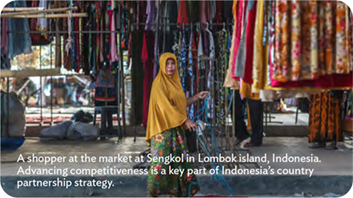
In 2025, ADB made its support even faster, clearer, and more responsive to the needs of its developing member countries (DMCs). The bank introduced a host of generational reforms and new initiatives that have expanded its financing capacity and provided developing members with solutions to embrace a greener and more prosperous, inclusive, and sustainable future. Improvements made across the year are already delivering efficiency benefits to DMCs while also providing a vibrant working environment for ADB’s people.
Escalating Development Ambitions
ADB made landmark operational amendments during 2025 to provide greater and more flexible financing to DMCs, including those in vulnerable or crisis situations.
Scaling Up Our Impact
In February, ADB approved a new Capital Utilization Plan to scale up operations. By optimizing the bank’s capital base, the plan will raise capacity for annual financing commitments, without resorting to a general capital increase, from $24 billion in 2024 to more than $36 billion by 2034. Lending is expected to rise significantly in 2026 and 2027, supported by additional staff and technical assistance, while private sector operations will grow from 20% to 27% of commitments, helping to grow a balanced and diversified portfolio.
ADB also adopted the first-ever amendment to its Charter, removing the lending limit on ordinary operations. The amendment was approved by the
ADB Board of Governors on 30 November 2025 and entered into force for all members on 1 March 2026. Concurrently, ADB’s board of directors approved the introduction of a nominal leverage ratio into ADB’s Capital Adequacy Framework to complement the risk-based Capital Utilization Ratio, which also took effect on 1 March 2026. The new leverage ratio is in line with guidance from Basel Committee on Banking Supervision, and its adoption by ADB increases transparency and comparability with other financial institutions. These historic reforms align the bank with G20 recommendations for multilateral development banks (MDBs) to adopt more modern and dynamic capital adequacy frameworks.
To further increase lending capacity, ADB signed a $3 billion sovereign exposure exchange agreement with the World Bank. The agreement reduces portfolio concentration risk and capital usage. It also reduces net exposure to borrowers in the exchange, providing additional lending headroom under ADB’s limits framework.
Greater Financing Flexibility
ADB’s updated Results-Based Lending Policy introduces greater flexibility to help DMCs deliver sustainable outcomes. Results-based lending can now be combined with other types of ADB financing—such as investment loans—to strengthen government institutions and support complementary projects. A new multiphase approach enables ADB to remain engaged with programs for longer periods, allowing countries to pursue deeper reforms and adjust as they learn. Aligned with other
| ORGANIZATIONAL EFFECTIVENESS | 51 | |
MDBs’ approaches, the policy offers disbursements against the results achieved before loan signing and introduces universal procurement to reduce transaction costs for governments.
ADB also expanded its debt deferral clauses to cover a wider range of disasters, enhancing the fiscal resilience of vulnerable DMCs in the event of such shocks. These clauses now cover all disasters triggered by natural hazards, as well as public health emergencies. Eligible borrowers, which include ADB’s small and vulnerable DMCs, may defer debt service for up to 2 years following a qualifying disaster. Complemented by technical assistance to improve public sector debt management, this mechanism preserves critical liquidity and fiscal space in the aftermath of shocks, allowing governments to finance emergency response, early recovery, and reconstruction efforts without undermining long-term debt sustainability.
The bank’s updated Sovereign Financial Intermediation Lending Policy enhances innovation and ADB’s crisis response. The policy gives more flexibility in financial solutions provided by financial intermediaries to development projects. In addition to loans, they can now use tools such as quasi-equity, guarantees, and insurance products to support diverse projects. The policy also introduces a new contingent financing option that enables ADB to release funds quickly in response to disasters or economic shocks or when certain milestones are achieved.
Ensuring a Robust Resource Base
ADB completed 257 borrowing transactions across 25 currencies in 2025, raising $41.7 billion (resulting in total proceeds of $38.2 billion). The bank continued to diversify its funding sources by issuing large benchmark bonds in United States dollars alongside public offerings and private placements in other currencies, helping ensure stable and low-cost financing for DMCs.
ADB maintained its focus on local currency financing to support financial stability and help deepen domestic capital markets. During the year, the bank issued its first local currency bond in Uzbekistan’s sum market and expanded activity in several others, including the Chinese yuan, Georgian lari, Kazakh tenge, Mongolian togrog, and Philippine peso.
Thematic bonds continued to demonstrate strong support from investors with more than $5.5 billion in principal (resulting in total proceeds of $5.4 billion) issued in public offerings and private placement formats across six themes: ocean health and blue economy, education, gender, green development, health, and
water. Thematic issuances comprised 13% of the total borrowing program in 2025 and enabled ADB to diversify its investor base.
Helping Our Developing Members Evolve
In 2025, ADB continued to help its DMCs address contemporary societal and business-related issues as they strive for more economically and environmentally sustainable growth.
High-Quality Procurement
ADB issued a new Procurement Directive for ADB Borrowers (effective 1 January 2026) that requires the use of merit point criteria and places greater emphasis on quality when selecting contractors for internationally advertised bids. Under the directive, bids are assessed not only on price but also on how well proposals demonstrate innovation, social inclusion, health and safety, environmental benefits, and long-term performance. The directive underscores the importance of engaging local labor to support domestic job creation and economic growth. For internationally tendered contracts, the directive mandates the use of early market engagement.
ADB strengthened the use of procurement tools to improve the quality and environmental sustainability of its investments.
The bank is piloting carbon measurement in the construction sector—across five countries and eight contracts—in collaboration with global industry partners. This lays the foundation for the use of merit point criteria and contract mechanisms to reward low-carbon building solutions.
ADB also launched a new Standard Bidding Document on Collaborative Operation and Maintenance. The document drives more effective public−private collaboration and results-based service delivery by creating a contractual environment that better aligns responsibilities, incentives, and performance expectations.
| |
52 | ANNUAL REPORT 2025 |
During the year, ADB delivered procurement training to 500 officials across 14 DMCs. The bank worked with other MDBs to embed sustainability into procurement practices and called for policy briefs to help advance procurement solutions that support resilient and inclusive development.
Additionally, in 2025, ADB became a full partner in the Public Expenditure and Financial Accountability program. ADB will, alongside the World Bank, International Monetary Fund, and other donors, shape the global use of the program’s diagnostics tools to strengthen public financial accountability mechanisms across its DMCs.
Artificial Intelligence
The 2025 edition of AIxADB—ADB’s flagship platform for advancing artificial intelligence (AI) readiness, adoption, and capacity building—brought together more than 20 countries to explore how AI can be applied responsibly to improve public services, fiscal resilience, institutional governance, and regional cooperation. Participants explored AI’s role in areas such as tax administration, public financial management, social services, and trade facilitation. They also examined regulatory, ethical, and legal considerations for the responsible adoption of AI systems.
Anticipating Change and Potential Adversity
New organizational structures, updated operational frameworks, and specialized analyses help ADB become more dynamic and resilient amid a complex global operating environment.
Digital Transformation
In 2025, ADB completed Stage 1 of its Digital Agenda 2030, delivering 47 initiatives to modernize and connect the bank’s IT systems. One example is the new Disaster Risk Analytics Explorer, which integrates geospatial data and predictive analytics to help project teams assess and mitigate weather-related and disaster risks.
ADB also expanded its IT Delivery and Resiliency Center in Valencia, Spain. By operating outside the bank’s headquarters in Manila, the center reduces the concentration of risks and supports business continuity for critical IT systems that underpin ADB operations.
Data and Analytics
Established in 2025, the Office of Business Intelligence and Operations Coordination (BIOC) now serves as ADB’s central hub for operational data and analytics. It aims to improve how data are collected, managed, and used across the institution.
In its first year, BIOC assumed ownership of ADB’s corporate data system for public sector operations. It introduced a single, end-to-end operations planning system that brings together all inputs needed for public sector operations planning, including timelines and resource needs, replacing multiple manual spreadsheets. This reduces the time staff spend preparing, validating, and consolidating the operations program. This system will provide the foundation for data-driven operations and strengthen data integrity, transparency, and institutional insight.
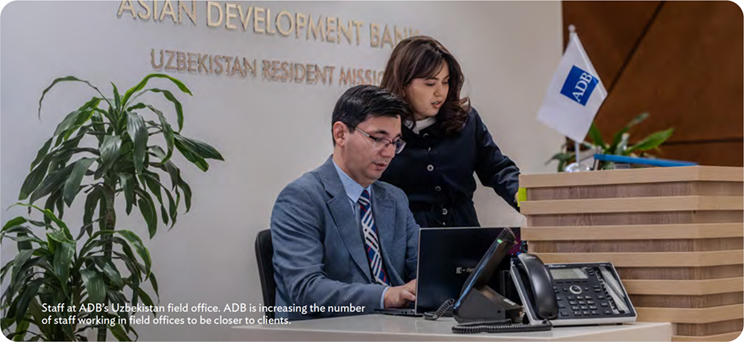
| ORGANIZATIONAL EFFECTIVENESS | 53 | |
Operational Risk Management
ADB moved to protect its processes that cannot be allowed to fail—including those that move funds, change exposures, and record obligations—by conducting a bank-wide risk assessment of 207 critical processes and systems. This helped identify key dependencies across departments and prioritize controls essential for uninterrupted operations.
Crisis Preparedness
ADB reinforced its commitment to protecting its people and ensuring operations can continue even during major emergencies and disruptions, maintaining its certification under the international standard for business continuity.
Training in emergency response—such as search and rescue exercises, systems recovery drills, home emergency scenarios, and use of emergency communication tools—helped strengthen staff preparedness. ADB also upgraded internal communications systems and expanded crisis management briefings.
In October, the bank conducted a comprehensive crisis management exercise simulating a major earthquake in Metro Manila and a broader cybersecurity attack. The exercise—which included search and rescue demonstrations—tested the real-time decision-making of the ADB community.
Enhancing Accountability and Assurance
Constant review of ADB’s internal systems and processes underpins the stability, transparency, and accountability of the bank’s operations and ensures its responsibilities to wider society.
Policy Development
ADB’s new Policy Architecture establishes a streamlined governance framework for all policies and guidance documents. It clarifies roles, simplifies processes, and ensures clear and consistent policy updating and drafting across the institution. This includes establishing clear authority and accountability for the approval and updating of policies and guidance documents.
Internal Audit
ADB’s audit and advisory work in 2025 focused on operations, treasury, IT investment, data privacy, and field office administration.
As part of a review of the bank’s IT capital expenditure program, internal audit services identified ways to
improve transparency and oversight. These included improving how projects are prepared, strengthening the tracking of costs and benefits for projects with multiple phases or funding sources, and better managing IT administrative expenses.
Internal auditing also reviewed how personal data privacy and protection are applied across ADB, sharing insights on governance arrangements, policies and guidelines, and protocols in other international organizations.
For treasury operations, internal auditing increased the use of automated checks on payment transactions to expedite recurring audits and improve efficiency.
Knowledge-building sessions on emerging topics, including sustainability and the use of AI, were provided to staff.
Accounting and Internal Controls
External auditors confirmed that ADB’s financial statements for 2025 were presented fairly in all material respects and that the bank maintained effective internal controls over financial reporting.
ADB expanded its offshore resilience team at the Thailand Resident Mission to support the processing of disbursement for loans, grants, technical assistance, and administrative expenses.
The bank continued to support the International Public Sector Accounting Standards Board through knowledge events in August and September on public sector sustainability reporting standards. It also conducted 42 seminars on loan and grant disbursement and accounting, involving 1,408 participants from 17 DMCs.
Anticorruption, Integrity, and Ethics
ADB strengthened its management of integrity risks across its operations. The bank advanced work toward a unified approach that aims to strengthen prevention and increase staff and other stakeholder awareness of integrity issues.
ADB held 44 events that drew 1,999 participants in more than 20 DMCs to strengthen capacity for managing integrity risks in ADB projects. ADB also supported two DMCs in strengthening frameworks to address money laundering and the financing of terrorism.
The bank continued to enforce its zero-tolerance approach to fraud and corruption throughout the year. It debarred 583 firms and 23 individuals and cross-debarred 41 entities. It also issued 1,180 integrity
| |
54 | ANNUAL REPORT 2025 |
advisories and conducted 11 proactive integrity reviews to ensure operations facing integrity issues could continue to be implemented.
ADB upholds professional conduct and ethical standards within the organization and its wider community. During 2025, the bank received 174 reports of alleged code of conduct violations and responded to 493 requests for guidance regarding conflicts of interest involving staff. Workplace concerns were addressed through mediation and coaching and, where necessary, referrals for investigation.
Disclosure and Transparency
ADB’s Access to Information Policy underpins the bank’s commitment to openness and accountability by guiding how information is shared with the public and how information requests are handled.
The bank continued to proactively disclose information on its activities, making 5,302 project documents available during 2025.
It received 3,510 formal requests for information, of which 3,168 were considered valid. ADB acknowledged 60% of valid requests within the required 7-day period and responded to 73% of them within the required 30 days. By the end of the year, responses had been issued for 85% of all valid requests.
Environmental and Social Protection
Throughout 2025, ADB carried out extensive preparations for its new Environmental and Social Framework, which came into effect in January 2026.
The Framework strengthens protections for people and the environment where there may be potential adverse impacts from projects the bank is supporting.
The preparatory work included publishing guidance notes for the 10 environmental and social standards, and delivering training to more than 500 staff. Orientation sessions and workshops were held in 31 of ADB’s 41 DMCs.
ADB also supported governments and other clients in conducting environmental and social safeguards due diligence for 182 projects in 39 countries. These included 13 projects with the potential for significant adverse impacts and risks.
Promoting good practices is another core element of ADB’s safeguards. ADB delivered 94 training courses attended by 683 participants from DMCs and 2,669 bank staff. It also issued a good practice note to strengthen grievance mechanisms. ADB advanced innovative safeguards solutions in 2025, including the use of genetic testing technologies to identify threatened species in aquatic ecosystems in India, Nepal, and the Pacific.
Recourse for People Affected by Projects
ADB’s Accountability Mechanism provides a formal, independent process to respond to individuals and communities who believe they have been adversely affected by ADB-assisted projects.
The Accountability Mechanism received and processed 68 complaints from 10 countries in 2025. These related to resettlement and land acquisition, environmental impacts, disclosure of or access to information, and consultation.
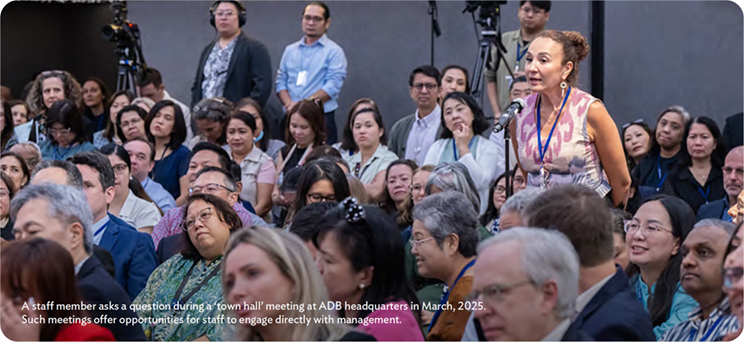
| ORGANIZATIONAL EFFECTIVENESS | 55 | |
After initial assessment, 29 complaints were forwarded for problem-solving, 2 of which were later transferred for compliance review; 9 were forwarded for compliance review, including the aforementioned 2; 6 were withdrawn by complainants; 14 were administratively closed for failure to meet the minimum information requirements; 1 was closed after being merged with a similar complaint; and 11 remained pending at the end of the year.
Of the 29 complaints forwarded for problem-solving, the Special Project Facilitator deemed 11 eligible, while 10 were ineligible because they did not meet the Accountability Mechanism’s criteria on good faith efforts. Of the remaining 8 complaints, 3 were out of scope, 2 were withdrawn, and 3 are pending eligibility determination. Including cases from previous years, the total number of eligible complaints handled in 2025 was 26, of which 11 were closed.
Of the 9 complaints forwarded for compliance review, the Compliance Review Panel completed 5 eligibility determinations, for 3 of which it recommended the
Board approve compliance review. Of those 3, 1 is still being investigated, Board authorization of compliance review for another is pending, and the third was closed after ADB financing for the associated project was no longer requested. The other 2 complaints reviewed by the panel were deemed ineligible. Of the other 4 complaints forwarded for compliance review, 3 were found to be not admissible and 1 was withdrawn.
ADB also conducted training sessions on approaches to address retaliation risks. These sessions attracted 320 participants from private sector clients and government agencies in Indonesia, Tajikistan, Thailand, and Uzbekistan, as well as 82 civil society representatives and academics from Fiji and Tajikistan.
ADB continued the formal review of its Accountability Mechanism Policy (2012), which began in 2024. From March to July, the Board–Management Working Group conducted 34 consultations with persons affected by ADB-assisted projects, ADB members, civil society organizations, private sector clients, ADB Staff and
Independent Evaluation Department
The Independent Evaluation Department (IED) supports accountability and learning by assessing the effectiveness of ADB’s policies, programs, and operations.
During 2025, IED completed major evaluations on the implementation of ADB’s new operating model, investments in education and health, and support for livable cities. It also examined the evolution of ADB’s Trade and Supply Chain Finance Program and the platform for establishing and deploying trust funds and other cofinancing. The 2025 Annual Evaluation Review highlighted ADB’s work in promoting regional cooperation and integration.
Across the year, IED conducted a country assistance program evaluation using a new approach for Kazakhstan and completed country assistance program final review validations for the People’s Republic of China, Indonesia, Pakistan, Papua New Guinea, and Tajikistan. It prepared a synthesis note on the Philippines and a topical paper on domestic resource mobilization, and validated 183 projects.
IED shared evaluation insights through its three platforms: What Works, What Doesn’t and Why enabled staff, Management, and the Board of Directors to discuss major evaluations; Evaluation Matters provided an informal forum on topical papers; and Evaluation Guru used short videos to make evaluation approaches practical and relatable.
IED continued to reinforce evaluation as a vital tool for institutional improvement and development effectiveness, delivering training programs and other initiatives for 15 developing member countries. In September, IED celebrated the 10th Asian Evaluation Week in Xi’an, People’s Republic of China. The event brought together 239 participants from 50 countries and covered topics such as technology and innovation, climate considerations, and the role of evaluation in private enterprise.
| |
56 | ANNUAL REPORT 2025 |
Management, and development partners. The policy update is expected by December 2026, which will allow time for more engagement and the consideration of diverse perspectives.
Fostering Career Development and a Safe, Flexible Workplace
In 2025, ADB strived to ensure that all Staff are provided with adequate career opportunities and feel supported and equipped to contribute effectively to the bank’s work.
Workplace Transformation
ADB worked to create safer and more inclusive workplaces to support Staff well-being, with renovation work progressing across multiple levels of the bank’s Manila
Staff in ADB Field Offices
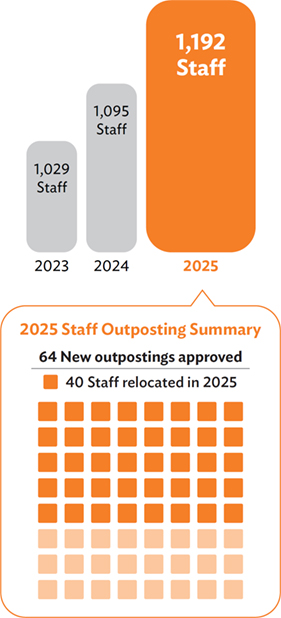
headquarters. Outdated furniture and equipment were replaced by modern workstations with ergonomic desks and chairs, while access was improved for people with disabilities and two new mothers’ rooms were opened.
ADB also strengthened the management of information and shared spaces across its headquarters campus. The bank introduced an electronic documentation system to improve how institutional records are organized, stored, and retrieved. A digital media management system was launched to centrally manage more than 100 display screens across the campus, enabling better information sharing and messaging during major events and emergencies.
In addition, more electric vehicle charging stations were installed, along with the systems required to manage and maintain them.
Throughout the year, ADB continued upgrading its field offices, with projects completed in Fiji, Georgia, the Kyrgyz Republic, Myanmar, Thailand, and Uzbekistan. With a similar design and the same sustainability standards used at headquarters, these upgrades optimized space and infrastructure to support field staff collaboration.
Staff Outposting, Recruitment, and Development
ADB has been increasing the number of staff working in field offices to be in closer proximity to clients. This enables faster project preparation and implementation, stronger policy dialogue, and improved coordination with governments and development partners.
Sixty-four international staff positions were approved for relocation to field offices during the year, strengthening country management teams and supporting operational delivery. By the end of 2025, 40 had relocated.
Throughout the organization, ADB continued to support staff learning and mobility, with 67% of all Staff completing either online or instructor-led training and 94% rating these programs positively. Additionally, 269 staff participated in external learning programs and 101 undertook short-term assignments across different roles, helping build skills and share experiences across departments.
Staff Health and Well-Being
In 2025, ADB launched a good practice note on workplace mental health and well-being, developed in partnership with the European Bank for Reconstruction and Development. The guidance offers practical recommendations to help project managers and stakeholders promote healthy workplaces.
| ORGANIZATIONAL EFFECTIVENESS | 57 | |
In October, the annual Health and Well-Being, Safety, and Resilience Fair and the Mental Health Week attracted more than 2,000 attendees.
ADB delivered 9 mental health training sessions for the bank’s leadership. This helped equip 27 members of the Board, 23 heads of department, and 98 directors and managers with skills to better recognize and address mental distress in the workplace.
Balanced Employment
ADB remains committed to fostering an inclusive and equitable workplace. Female representation has risen steadily: 41.4% in international roles and 33.6% in managerial positions, and women now comprise 49.1% of new international staff hired.
The bank also completed a benchmarking exercise toward workplace adjustments that better support staff with disabilities and those with diverse needs and circumstances.
Managing Conflict
ADB’s ombuds services provide a confidential and independent resource to help staff address workplace concerns. These services supported more than 420 cases in 2025, assisting individuals and teams in managing workplace relationship issues, supervision, and interpersonal dynamics.
The ombuds services specifically examined case data to better understand the challenges women face in the organization. The findings will inform a special report to support organizational change and contribute to ongoing efforts toward gender equality.
Asian Development Bank Institute
In 2025, the Asian Development Bank Institute (ADBI)—ADB’s Tokyo-based think tank—expanded its research and capacity-building program in support of sustainable development across Asia and the Pacific.
ADBI launched a flagship initiative, Shaping Asia’s Future Prosperity with Quality Growth. Under the initiative, ADBI—together with ADB and other regional and international partners—will develop research, policy dialogues, and capacity-building activities to support inclusive and sustainable growth in middle-income economies.
The institute published more than 40 articles in peer-reviewed academic journals, along with 15 open access books, 34 working papers, 22 policy briefs, 6 journal special issues, and 10 case studies. These publications presented research on key challenges, including food and nutrition security, digitalization, small enterprise ecosystems, agricultural finance, and education systems.
ADBI also organized 80 research and capacity-building events in 2025. These events engaged about 5,000 policymakers and stakeholders, with women accounting for 46% of participants.
In November, ADBI convened leading global scholars at its annual conference to discuss how regional cooperation can support high-quality growth in Asia and the Pacific.
Meanwhile, the institute supported five knowledge events to advance climate finance leadership, while a series of six webinars examined protection gaps and risk resilience across ASEAN+3. In addition, ADBI introduced a new program to promote leadership in alternative dispute resolution systems through e-learning and workshops in collaboration with the ASEAN Secretariat.
| APPENDIXES | 59 | |
Appendix 1: Commitments by Country, 2025 ($ million)
| Loans, Grants, and Others | Cofinancinga | ||||||||||||||
| Regular OCR | ADF | ||||||||||||||
| Country | Public Sector |
Private Sector |
TSCFP and MFPb, c |
Concessional OCR |
Grant | Guarantee | Other SF |
Subtotal | T Ad | Project | T A | TSCFP and MFPc |
TAS | Subtotal | Total |
| Afghanistane | – | – | – | – | 600.0 | – | 3.0 | 603.0 | 2.4 | 29.4 | – | – | – | 29.4 | 634.8 |
| Armenia | 553.7 | 15.1 | 49.8 | – | – | – | – | 618.6 | 2.2 | 128.3 | 0.4 | 70.4 | – | 199.2 | 820.0 |
| Azerbaijan | 47.0 | – | 1.2 | – | – | – | – | 48.2 | 2.9 | – | 2.4 | 5.3 | – | 7.7 | 58.8 |
| Bangladesh | 1,553.0 | 30.0 | 674.7 | 958.1 | 58.6 | – | – | 3,274.4 | 13.1 | 739.9 | 8.1 | 1,174.6 | – | 1,922.6 | 5,210.1 |
| Bhutan | – | – | – | 40.0 | 22.0 | – | – | 62.0 | 5.7 | 3.0 | 0.5 | – | – | 3.5 | 71.2 |
| Cambodia | – | – | 0.2 | 322.7 | 20.0 | – | – | 342.9 | 8.3 | 190.5 | 8.3 | – | – | 198.8 | 550.0 |
| China, People’s Republic of | 590.8 | 371.3 | 136.0 | – | – | – | – | 1,098.1 | 6.2 | 351.3 | 0.3 | 246.3 | – | 597.9 | 1,702.2 |
| Cook Islands | – | – | – | – | – | – | – | – | 1.8 | – | 0.8 | – | – | 0.8 | 2.6 |
| Fiji | – | – | – | 135.0 | 10.0 | – | – | 145.0 | 8.3 | 50.0 | 4.1 | – | – | 54.1 | 207.4 |
| Georgia | 707.0 | 150.1 | 72.9 | – | – | – | – | 930.0 | 3.9 | – | 0.1 | 78.3 | – | 78.4 | 1,012.4 |
| India | 4,238.1 | 934.7 | 127.3 | – | – | – | – | 5,300.1 | 20.8 | 897.0 | 14.3 | 137.3 | – | 1,048.5 | 6,369.4 |
| Indonesia | 2,410.0 | 149.5 | 98.7 | – | – | – | – | 2,658.2 | 6.9 | 1,465.2 | 14.1 | 242.5 | – | 1,721.8 | 4,387.0 |
| Kazakhstan | – | – | 7.5 | – | – | – | – | 7.5 | 4.3 | – | 2.1 | 7.5 | – | 9.6 | 21.4 |
| Kiribati | – | – | – | – | 40.0 | – | – | 40.0 | 2.7 | 19.2 | 2.9 | – | – | 22.1 | 64.8 |
| Kyrgyz Republic | – | – | 1.1 | 143.0 | 115.1 | – | – | 259.2 | 6.0 | – | 2.5 | 0.6 | – | 3.1 | 268.3 |
| Lao People’s Democratic Republic | – | – | – | 95.0 | 23.0 | – | – | 118.0 | 6.8 | 31.0 | 3.8 | – | – | 34.8 | 159.6 |
| Malaysia | – | 60.2 | – | – | – | – | – | 60.2 | 0.4 | – | 0.3 | – | – | 0.3 | 60.9 |
| Maldives | – | – | – | – | – | – | – | – | 2.0 | – | 0.4 | – | – | 0.4 | 2.4 |
| Marshall Islands | – | – | – | – | – | – | – | – | 2.6 | – | 0.6 | – | – | 0.6 | 3.2 |
| Micronesia, Federated States of | – | – | – | – | – | – | – | – | 1.5 | – | 0.4 | – | – | 0.4 | 1.9 |
| Mongolia | 72.0 | 117.5 | 55.8 | 18.0 | 2.0 | – | – | 265.3 | 11.6 | 6.5 | 0.8 | 37.9 | – | 45.2 | 322.0 |
| Myanmarf | – | – | – | – | 100.0 | – | 3.0 | 103.0 | – | – | – | – | – | – | 103.0 |
| Nauru | – | – | – | – | – | – | – | – | 1.4 | – | 0.4 | – | – | 0.4 | 1.8 |
| Nepal | – | – | 8.3 | 100.0 | – | – | 2.0 | 110.3 | 12.5 | – | 11.8 | 2.9 | – | 14.7 | 137.5 |
| Niue | – | – | – | – | – | – | – | – | 1.3 | – | 0.4 | – | – | 0.4 | 1.7 |
| Pakistan | 1,485.0 | 5.0 | 226.4 | 966.8 | 7.0 | – | – | 2,690.2 | 14.0 | 544.0 | 3.8 | 419.6 | – | 967.5 | 3,671.7 |
| Palau | – | – | – | – | – | – | – | – | 1.3 | 2.0 | 0.1 | – | – | 2.1 | 3.4 |
| Papua New Guinea | 235.0 | 19.0 | – | 30.0 | – | – | – | 284.0 | 7.1 | 62.7 | 2.1 | – | – | 64.8 | 355.9 |
| Philippines | 4,104.0 | 129.8 | 13.6 | – | – | – | – | 4,247.4 | 10.2 | 1,818.5 | 20.3 | 13.6 | 699.6 | 2,551.9 | 6,809.5 |
| Samoa | – | 2.8 | 0.0 | – | – | – | – | 2.8 | 5.2 | – | 0.7 | – | – | 0.7 | 8.7 |
| Solomon Islands | – | – | – | – | 4.0 | – | – | 4.0 | 2.7 | – | 5.2 | – | – | 5.2 | 11.9 |
| Sri Lanka | 520.0 | – | 61.2 | 270.0 | – | – | 3.0 | 854.2 | 13.3 | 111.9 | 6.1 | 177.6 | – | 295.6 | 1,163.1 |
| Tajikistan | – | 42.1 | 2.7 | – | 88.9 | 5.0g | – | 138.7 | 7.8 | 49.3 | 1.3 | 1.2 | – | 51.8 | 198.3 |
| Thailand | 68.7 | 320.6 | 68.0 | – | – | – | – | 457.3 | 5.2 | 918.2 | 2.3 | 68.0 | – | 988.4 | 1,450.9 |
| Timor-Leste | – | – | – | 75.0 | 4.0 | – | – | 79.0 | 3.8 | 6.0 | 2.6 | – | – | 8.6 | 91.4 |
| Tonga | – | – | – | – | 99.0 | – | – | 99.0 | 3.5 | 82.4 | 1.1 | – | – | 83.5 | 186.0 |
| Türkiye | 1,086.6 | 200.0 | – | – | – | – | – | 1,286.6 | 0.3 | 20.0 | 0.0 | – | – | 20.0 | 1,306.9 |
| Turkmenistan | 74.7 | – | – | – | – | – | – | 74.7 | 1.1 | – | 3.1 | – | – | 3.1 | 78.9 |
| Tuvalu | – | – | – | – | 7.0 | – | – | 7.0 | 2.1 | 14.3 | 2.5 | – | – | 16.8 | 26.0 |
| Uzbekistan | 933.1 | 158.9 | 158.2 | 325.0 | – | – | – | 1,575.2 | 10.6 | 1,680.2 | 2.7 | 167.7 | 81.6h | 1,932.2 | 3,518.0 |
| Vanuatu | – | – | – | – | 54.4 | – | 0.5 | 54.9 | 1.6 | 40.5 | 0.5 | – | – | 41.0 | 97.6 |
| Viet Nam | 59.0 | 146.0 | 640.6 | – | – | – | – | 845.6 | 2.8 | 274.0 | 6.1 | 836.3 | – | 1,116.4 | 1,964.8 |
| Regionali | – | 244.3 | – | – | – | – | – | 244.3 | 57.7j | 478.2 | 33.2 | – | – | 511.4 | 813.4 |
| Total ADB | 18,737.8 | 3,096.9 | 2,404.0 | 3,478.6 | 1,255.0 | 5.0 | 11.5 | 28,988.8 | 285.8 | 10,013.3 | 173.6 | 3,687.7 | 781.2 | 14,655.8 | 43,930.5 |
– = nil; 0.0 = less than $500,000; ADB = Asian Development Bank; ADF = Asian Development Fund; MFP = Microfinance Program; OCR = ordinary capital resources; SF = Special Funds; TA = technical assistance; TAS = Transaction Advisory Services; TSCFP = Trade and Supply Chain Finance Program.
Notes:
| 1. | Commitment is the financing approved by the ADB Board of Directors or Management for which the legal agreement has been signed by the borrower, recipient, or the investee company and ADB. It comprises the amount indicated in the investment agreement, which—depending on the exchange rate at the time of signing—may or may not be equal to the approved amount. In the case of official and commercial cofinancing not administered by ADB for which the signed amount is not readily available, the approved amount is used. |
| 2. | Numbers may not sum precisely because of rounding. |
| a | Including trust funds. |
| b | The TSCFP and MFP are private sector credit enhancement products and loans financed from ADB’s regular OCR. |
| c | TSCFP supply chain finance commitments are reported under recipient countries, even when the borrower is incorporated elsewhere. |
| d | Refers to Technical Assistance Special Fund and other SF. |
| e | ADB placed its regular assistance to Afghanistan on hold effective 15 August 2021, but since 2022 has supported the Afghan people through a special arrangement with the United Nations to address basic human needs, including critical food support, and health and education services. |
| f | Effective 1 February 2021, ADB placed a temporary hold on public sector project disbursements and new contracts in Myanmar, but since 2023 has supported the people of Myanmar through a special arrangement with United Nations agencies to deliver humanitarian assistance. |
| g | Consists of a private sector guarantee committed under the ADF private sector window managed by ADB. |
| h | Excludes $141 million that is reported under project cofinancing. |
| i | Includes private sector operations that involve two or more countries. |
| j | Except for research and training benefiting all members, financing for regional technical assistance operations that are identifiable to individual countries is included in the country-specific technical assistance amounts. |
| |
60 | ANNUAL REPORT 2025 |
Appendix 2: Loans and Grants Committed, 2025
Regular and Concessional Ordinary Capital Resources Commitments ($ million)
| Concessional | |||||||
| Region/Country/Loan or Grant Title | Modality | Regular OCR | OCR | ADF | Total | ||
| A. PUBLIC SECTOR OPERATIONS | 18,737.8 | 3,478.6 | 1,255.0 | 23,471.5 | |||
| Central and West Asia | 4,887.1 | 1,434.8 | 811.0 | 7,133.0 | |||
| Afghanistana | – | – | 600.0 | 600.0 | |||
| Community-Led Disaster Risk Management (Support for Afghan People) | Project | – | – | 100.0 | 100.0 | ||
| Payments of Verified Expenditures | Project | – | – | 130.0 | 130.0 | ||
| Strengthening Access to Essential Food Security and Health Services (Support for Afghan People) | Project | – | – | 370.0 | 370.0 | ||
| Armenia | 553.7 | – | – | 553.7 | |||
| Health Care Quality Improvement Program | RBL | 47.6 | – | – | 47.6 | ||
| Resilient and Inclusive Road Sector Improvement | Project | 256.1 | – | – | 256.1 | ||
| Transformative Housing Reforms for Improved Vitality and Empowerment Program | RBL | 250.0 | – | – | 250.0 | ||
| Azerbaijan | 47.0 | – | – | 47.0 | |||
| Azerbaijan Railways Digital Transformation | Project | 47.0 | – | – | 47.0 | ||
| Georgia | 707.0 | – | – | 707.0 | |||
| Batumi–Sarpi Road | Project | 359.7 | – | – | 359.7 | ||
| Energy Storage and Green Hydrogen Sector Development | Project | 111.8 | – | – | 111.8 | ||
| Airport Infrastructure Improvement | SEFF | 2.5 | – | – | 2.5 | ||
| Clean, Local, Equitable Access to Reliable Water Program | RBL | 233.0 | – | – | 233.0 | ||
| Kyrgyz Republic | – | 143.0 | 115.1 | 258.1 | |||
| Climate Change and Disaster-Resilient Water Resources Sector— Additional Financing | Project | – | 20.0 | 27.0 | 47.0 | ||
| Almaty–Bishkek Economic Corridor Regional Improvement of Border Services | Project | – | 15.0 | 15.7 | 30.7 | ||
| Preparing Additional Financing for the Urban Transport Electrification Project (Activity 1) | SEFF | – | – | 2.0 | 2.0 | ||
| Bishkek Low-Carbon Municipal Building Upgrading Pilot (Activity 2) | SEFF | – | 3.0 | – | 3.0 | ||
| Preparing the Solid Waste Environmental Enhancement Project (Activity 8) | SEFF | – | – | 1.0 | 1.0 | ||
| Renewable Energy Sector Development—Floating Solar Project at Hydropower Plant 5 (Activity 4) | SEFF | – | – | 0.5 | 0.5 | ||
| Preparing the Jalal–Abad Water Supply and Sanitation Program (Activity 9) | SEFF | – | – | 1.0 | 1.0 | ||
| Skills Development System Transformation Program (Activity 5) | SEFF | – | – | 1.0 | 1.0 | ||
| CAREC Transport Connectivity Project Preparation (Activity 7) | SEFF | – | – | 1.0 | 1.0 | ||
| Hospital Infrastructure Improvement and Modernization (Activity 6) | SEFF | – | – | 1.7 | 1.7 | ||
| Improving Service Delivery of Business Support Centers (Activity 3) | SEFF | – | – | 1.0 | 1.0 | ||
| Green Transformation in Public Buildings Program | RBL | – | 20.0 | 5.0 | 25.0 | ||
| Advancing Green Investment and Resilient Economic Growth Program (Subprogram 1) | PBL | – | 40.0 | 10.0 | 50.0 | ||
| Enhancing Housing Finance for Affordable and Energy-Efficient Housing | Project | – | 45.0 | 20.0 | 65.0 | ||
| Risk-Layered Disaster Relief Finance Program | Project/CDF | – | – | 28.2 | 28.2 | ||
| Pakistan | 1,485.0 | 966.8 | 7.0 | 2,458.8 | |||
| Balochistan Water Resources Development Sector— Additional Financing | Project | – | 48.0 | – | 48.0 | ||
| Sindh Coastal Resilience Sector Project | Project | – | 140.0 | – | 140.0 | ||
| Responsive, Ready, and Resilient Science, Technology, Engineering, and Mathematics Secondary Education in Punjab Program | RBL | – | 100.0 | 7.0 | 107.0 | ||
| Improved Resource Mobilization and Utilization Reform Program (Subprogram 2) | PBG/PBL | 800.0 | – | – | 800.0 | ||
| Punjab Climate-Resilient and Low-Carbon Agriculture Mechanization | Project | – | 120.0 | – | 120.0 | ||
| Punjab Nursing and Health Workforce Reform Program | RBL | – | 150.0 | – | 150.0 | ||
continued on next page
| APPENDIXES | 61 | |
Appendix 2 continued
| Concessional | |||||||
| Region/Country/Loan or Grant Title | Modality | Regular OCR | OCR | ADF | Total | ||
| Accelerating State-Owned Enterprises Transformation Program | RBL | 400.0 | – | – | 400.0 | ||
| Women-Inclusive Finance Sector Development Program (Subprogram 1)—Additional Financing | Project | – | 50.0 | – | 50.0 | ||
| Women-Inclusive Finance Sector Development Program (Subprogram 2) | PBL | – | 300.0 | – | 300.0 | ||
| Second Power Transmission Strengthening | Project | 285.0 | 45.0 | – | 330.0 | ||
| Preparing the Railway Improvement Project | PRF | – | 10.0 | – | 10.0 | ||
| Preparing Sustainable Bus Rapid Transit Network Quetta, Balochistan | PRF | – | 3.8 | – | 3.8 | ||
| Tajikistan | – | – | 88.9 | 88.9 | |||
| Digital Agriculture Management for Improved Food Security | Project | – | – | 14.0 | 14.0 | ||
| Enabling Climate-Responsive Business Environment Improvement Program (Subprogram 2) | PBL | – | – | 50.0 | 50.0 | ||
| Risk-Layered Disaster Relief Finance Program | Project/CDF | – | – | 24.9 | 24.9 | ||
| Turkmenistan | 74.7 | – | – | 74.7 | |||
| Improving Nursing Quality and Capacity | Project | 74.7 | – | – | 74.7 | ||
| Türkiye | 1,086.6 | – | – | 1,086.6 | |||
| Post-Disaster Municipal Services Improvement and Resilience (Sector) | Project | 173.5 | – | – | 173.5 | ||
| Resilient Earthquake Recovery Through Infrastructure Financing and Capacity-Enhancing Loans | Project | 326.1 | – | – | 326.1 | ||
| Empowering Export-Oriented Enterprises with Long-Term Financing to Drive Earthquake Recovery, Build Resilience, and Boost Job Creation | Project | 587.0 | – | – | 587.0 | ||
| Uzbekistan | 933.1 | 325.0 | – | 1,258.1 | |||
| Economic Management Improvement Program, Phase 2 (Subprogram 2) | PBL | 500.0 | – | – | 500.0 | ||
| Science, Technology, Engineering, and Mathematics in Secondary Education | Project | – | 100.0 | – | 100.0 | ||
| Climate-Smart Water Management Improvement | Project | – | 125.0 | – | 125.0 | ||
| Central Asia Regional Economic Cooperation Road Corridor 2 Resilience and Modernization | Project | 233.1 | – | – | 233.1 | ||
| Inclusive Finance Sector Development Program (Subprogram 2) | PBL | 200.0 | 100.0 | – | 300.0 | ||
| East Asia | 662.8 | 18.0 | 2.0 | 682.8 | |||
| China, People’s Republic of | 590.8 | – | – | 590.8 | |||
| Chishui River Basin Ecological Protection and Green Development | Project | 151.9 | – | – | 151.9 | ||
| Sichuan Climate-Smart Low-Carbon Agriculture Development Demonstration Program | RBL | 142.8 | – | – | 142.8 | ||
| Hubei Xianning Low-Carbon and Climate-Resilient Urban Development | Project | 151.9 | – | – | 151.9 | ||
| Fujian Coastal Cities Climate-Resilient Development and Biodiversity Conservation | Project | 144.2 | – | – | 144.2 | ||
| Mongolia | 72.0 | 18.0 | 2.0 | 92.0 | |||
| Strengthening Integrated Early Warning System in Mongolia | Project | 12.0 | 18.0 | 2.0 | 32.0 | ||
| Ulaanbaatar Transport Improvement 1 | Project | 60.0 | – | – | 60.0 | ||
| Pacific | 235.0 | 165.0 | 214.4 | 614.4 | |||
| Fiji | – | 135.0 | 10.0 | 145.0 | |||
| Healthy Oceans and Water Security Improvement | Project | – | 135.0 | 10.0 | 145.0 | ||
| Kiribati | – | – | 40.0 | 40.0 | |||
| Sustainable and Inclusive Economic Recovery Program (Subprogram 2) | PBL | – | – | 10.0 | 10.0 | ||
| Equitable Access to Quality Education | Project | – | – | 30.0 | 30.0 | ||
| Papua New Guinea | 235.0 | 30.0 | – | 265.0 | |||
| Sustainable Energy Sector Development Program (Subprogram 1) | SDP | 100.0 | – | – | 100.0 | ||
| Transport Project Readiness Facility | PRF | 35.0 | 30.0 | – | 65.0 | ||
| Improving Financial Access Program (Subprogram 1) | PBL | 100.0 | – | – | 100.0 | ||
continued on next page
| |
62 | ANNUAL REPORT 2025 |
Appendix 2 continued
| Concessional | |||||||
| Region/Country/Loan or Grant Title | Modality | Regular OCR | OCR | ADF | Total | ||
| Solomon Islands | – | – | 4.0 | 4.0 | |||
| Transport Project Readiness Facility | PRF | – | – | 4.0 | 4.0 | ||
| Tonga | – | – | 99.0 | 99.0 | |||
| Sustainable Economic Corridors and Urban Resilience | Project | – | – | 80.0 | 80.0 | ||
| Improving Economic Management Program (Subprogram 2) | PBL | – | – | 10.0 | 10.0 | ||
| Women Entrepreneurs Leveraging Innovative Finance in Tonga | Project | – | – | 9.0 | 9.0 | ||
| Tuvalu | – | – | 7.0 | 7.0 | |||
| Supporting Public Sector Management Reform Program (Subprogram 1) | PBL | – | – | 7.0 | 7.0 | ||
| Vanuatu | – | – | 54.4 | 54.4 | |||
| Northern Provinces Health and Treatment Project | Project | – | – | 10.0 | 10.0 | ||
| Enduring Fiscal Position Program (Subprogram 1) | PBL/CDF | – | – | 20.0 | 20.0 | ||
| Wharf Road Earthquake Recovery Emergency Assistance | EAG | – | – | 24.4 | 24.4 | ||
| South Asia | 6,311.1 | 1,368.1 | 80.6 | 7,759.8 | |||
| Bangladesh | 1,553.0 | 958.1 | 58.6 | 2,569.7 | |||
| Second Small and Medium-Sized Enterprises Development (Phase 2) | Project | – | 100.0 | – | 100.0 | ||
| South Asia Subregional Economic Cooperation Dhaka–Northwest Corridor Road, Phase 2—Tranche 4 | MFF | 204.0 | – | – | 204.0 | ||
| Climate-Resilient Inclusive Development Program (Subprogram 2) | PBL | – | 400.0 | – | 400.0 | ||
| Technical and Vocational Education and Training Teachers for the Future Program | RBL | – | 150.0 | – | 150.0 | ||
| Khulna Water Supply (Phase 2) | Project | 50.0 | 100.0 | – | 150.0 | ||
| Power Transmission Strengthening and Integration of Renewable Energy | Project | 200.0 | – | – | 200.0 | ||
| Northwest Distribution Network Modernization | Project | 91.0 | – | – | 91.0 | ||
| South Asia Subregional Economic Cooperation: Chattogram–Dohazari Railway | Project | 508.0 | 180.0 | – | 688.0 | ||
| Integrated Services and Livelihood for Displaced People from Myanmar and Host Communities Improvement | Project | – | 28.1 | 58.6 | 86.7 | ||
| Stabilizing and Reforming the Banking Sector Program (Subprogram 1) | PBL | 500.0 | – | – | 500.0 | ||
| Bhutan | – | 40.0 | 22.0 | 62.0 | |||
| Climate-Resilient Omchhu River Basin | Project | – | 30.0 | 15.0 | 45.0 | ||
| Preparing the National Highway Expansion Project (Lhamoizingkha–Sarpang) | PRF | – | – | 2.0 | 2.0 | ||
| Strengthening the Banking and Capital Markets Reforms Program (Subprogram 1) | PBL | – | 10.0 | 5.0 | 15.0 | ||
| India | 4,238.1 | – | – | 4,238.1 | |||
| Kerala Urban Water Services Improvement | Project | 170.0 | – | – | 170.0 | ||
| Delhi–Meerut Regional Rapid Transit System Investment—Tranche 4 | MFF | 295.4 | – | – | 295.4 | ||
| Indore Metro Rail | Project | 174.0 | – | – | 174.0 | ||
| Chennai Metro Rail Investment—Tranche 2 | MFF | 240.0 | – | – | 240.0 | ||
| Kolkata Municipal Corporation Sustainability, Hygiene, and Resilience (Sector) Project | Project | 200.0 | – | – | 200.0 | ||
| Sustainable, Inclusive, and Climate-Resilient Tourism Development at Tehri Lake Area | Project | 126.4 | – | – | 126.4 | ||
| Sikkim Integrated Urban Development | Project | 179.1 | – | – | 179.1 | ||
| Assam Urban Sector Development | Project | 125.0 | – | – | 125.0 | ||
| Tripura Industrial Infrastructure Development | Project | 85.4 | – | – | 85.4 | ||
| Gujarat Skills Development Program | RBL | 110.0 | – | – | 110.0 | ||
| West Bengal Drinking Water Sector Improvement— Additional Financing | Project | 101.0 | – | – | 101.0 | ||
| Integrated Ecotourism and Sustainable Agri-Based Livelihood Development in Meghalaya | Project | 77.0 | – | – | 77.0 | ||
| Maharashtra Power Distribution Enhancement Program for Agricultural Solarization | RBL | 460.0 | – | – | 460.0 | ||
| Supporting Pradhan Mantri Skilling and Employability Transformation Through Upgraded Industrial Training Institutes Program | RBL | 846.0 | – | – | 846.0 | ||
continued on next page
| APPENDIXES | 63 | |
Appendix 2 continued
| Concessional | |||||||
| Region/Country/Loan or Grant Title | Modality | Regular OCR | OCR | ADF | Total | ||
| Assam State Tertiary Health Care Augmentation | Project | 398.8 | – | – | 398.8 | ||
| Accelerating Affordable and Inclusive Rooftop Solar Systems Development Program | PBL | 650.0 | – | – | 650.0 | ||
| Nepal | – | 100.0 | – | 100.0 | |||
| Strengthening Public Financial Management and Devolved Service Delivery Program (Subprogram 2) | PBL | – | 100.0 | – | 100.0 | ||
| Sri Lanka | 520.0 | 270.0 | – | 790.0 | |||
| Second Integrated Road Investment Program—Tranche 5 | MFF | 90.0 | – | – | 90.0 | ||
| Power Sector Reforms and Financial Sustainability Program (Subprogram 2) | PBL | 100.0 | – | – | 100.0 | ||
| Sustainable Tourism Sector Development Program (Subprogram 1) | SDP | 30.0 | 70.0 | – | 100.0 | ||
| Strengthening Integrated Health Care and Governance for Universal Health Coverage Program | RBL | 100.0 | – | – | 100.0 | ||
| Strengthening Macroeconomic Resilience and Transparency Program (Subprogram 1) | PBL | – | 100.0 | – | 100.0 | ||
| Mahaweli Water Security Investment Program Stage 2 | Project | 200.0 | – | – | 200.0 | ||
| Financial Sector Stability and Reforms Program (Subprogram 3) | PBL | – | 100.0 | – | 100.0 | ||
| Southeast Asia | 6,641.8 | 492.7 | 147.0 | 7,281.5 | |||
| Cambodia | – | 322.7 | 20.0 | 342.7 | |||
| Energy Transition Sector Development Program (Subprogram 2) | PBL | – | 50.0 | – | 50.0 | ||
| Grid Expansion | Project | – | 52.7 | – | 52.7 | ||
| Livable, Resilient, and Water-Secure Cities Investment Program— Tranche 1 | MFF | – | 120.0 | 20.0 | 140.0 | ||
| Strengthening Governance for Improved Service Delivery Program (Subprogram 1) | PBL | – | 50.0 | – | 50.0 | ||
| Inclusive and Sustainable Finance Development Program (Subprogram 1) | PBL | – | 50.0 | – | 50.0 | ||
| Indonesia | 2,410.0 | – | – | 2,410.0 | |||
| Geothermal Power Generation—Second Additional Financing | Project | 180.0 | – | – | 180.0 | ||
| Competitiveness, Industrial Modernization, and Trade Acceleration Program (Subprogram 3) | PBL | 478.1 | – | – | 478.1 | ||
| Boosting Productivity Through Human Capital Development Program (Subprogram 3) | PBL | 503.9 | – | – | 503.9 | ||
| Trans South–South Java Road | Project | 283.1 | – | – | 283.1 | ||
| Accelerating Indonesia’s Clean Energy Transition Program (Phase 1) | RBL | 470.0 | – | – | 470.0 | ||
| Domestic Resource Mobilization Program (Subprogram 1) | PBL | 494.9 | – | – | 494.9 | ||
| Lao People’s Democratic Republic | – | 95.0 | 23.0 | 118.0 | |||
| Sustainable Agrifood Systems Sector | Project | – | 30.0 | 5.0 | 35.0 | ||
| Skills Enhancement for Inclusive and Green Economic Development | Project | – | 30.0 | 3.0 | 33.0 | ||
| Green Primary Care | Project | – | 30.0 | 10.0 | 40.0 | ||
| Responsible Forestry (Phase 1) | PRF | – | 5.0 | 5.0 | 10.0 | ||
| Myanmarb | – | – | 100.0 | 100.0 | |||
| Social Protection and Resilience for Communities | Project | – | – | 100.0 | 100.0 | ||
| Philippines | 4,104.0 | – | – | 4,104.0 | |||
| Malolos–Clark Railway—Tranche 2 | MFF | 1,450.0 | – | – | 1,450.0 | ||
| Business and Employment Recovery Program (Subprogram 2) | PBL | 500.0 | – | – | 500.0 | ||
| Insurance Reform Program (Subprogram 1) | PBL | 381.5 | – | – | 381.5 | ||
| Second Disaster Resilience Improvement Program | CDF | 500.0 | – | – | 500.0 | ||
| Reducing Food Insecurity and Undernutrition with Electronic Vouchers | Project | 400.0 | – | – | 400.0 | ||
| Marine Ecosystems for Blue Economy Development Program (Subprogram 1) | PBL | 483.6 | – | – | 483.6 | ||
| Business Environment Strengthening with Technology Program (Subprogram 1) | PBL | 388.9 | – | – | 388.9 | ||
continued on next page
|
64 | ANNUAL REPORT 2025 |
Appendix 2 continued
| Region/Country/Loan or Grant Title | Modality | Regular OCR | Concessional OCR |
ADF | Total | ||
| Thailand | 68.7 | – | – | 68.7 | |||
| Climate-Resilient Connectivity for the Eastern Economic Corridor: The Intercity Motorway No. 7 (Extension to Link with U-Tapao International Airport) |
Project | 68.7 | – | – | 68.7 | ||
| Timor-Leste | – | 75.0 | 4.0 | 79.0 | |||
| Climate-Resilient Connectivity Enhancement | Project | – | – | 4.0 | 4.0 | ||
| National Road Networks Upgrading (Road Section from Lospalos to Iliomar and Bridges Between Baucau to Lautem) | Project | – | 75.0 | – | 75.0 | ||
| Viet Nam | 59.0 | – | – | 59.0 | |||
| Climate Resilient Inclusive Infrastructure for Ethnic Minorities II | Project | 59.0 | – | – | 59.0 | ||
| B. PRIVATE SECTOR OPERATIONS | 5,500.9 | – | 5.0 | 5,505.9 | |||
| Armenia | 64.8 | – | – | 64.8 | |||
| Armeconombank Expanding Access to Finance for Micro, Small, and Medium-Sized Enterprises and Households | Loan | 15.1 | – | – | 15.1 | ||
| Trade and Supply Chain Finance Program | TSCFP | 49.8 | – | – | 49.8 | ||
| Azerbaijan | 1.2 | – | – | 1.2 | |||
| Trade and Supply Chain Finance Program | TSCFP | 1.2 | – | – | 1.2 | ||
| Bangladesh | 704.7 | – | – | 704.7 | |||
| Envoy Sustainability-Linked Loan | Loan | 30.0 | – | – | 30.0 | ||
| Trade and Supply Chain Finance Program | TSCFP | 600.0 | – | – | 600.0 | ||
| Microfinance Program | MFP | 74.7 | – | – | 74.7 | ||
| Cambodia | 0.2 | – | – | 0.2 | |||
| Trade and Supply Chain Finance Program | TSCFP | 0.2 | – | – | 0.2 | ||
| China, People’s Republic of | 507.3 | – | – | 507.3 | |||
| Henan Tian Lun Safety Enhancement and Methane Leakage Reduction | Loan | 24.2 | – | – | 24.2 | ||
| Fosun United Health Insurance Supporting Commercial Medical and Long-Term Care Insurance Development | Equity | 37.2 | – | – | 37.2 | ||
| Luli Sustainable Wood Panel Processing | Loan | 50.0 | – | – | 50.0 | ||
| CWA Wastewater Integration and Pipeline Rehabilitation | Loan | 99.8 | – | – | 99.8 | ||
| Qiming Venture Partners IX-A, L.P. | Equity | 40.0 | – | – | 40.0 | ||
| Far East Horizon Transition Finance | Loan | 100.1 | – | – | 100.1 | ||
| Yaodou Pharma Supply Chain | Loan | 20.1 | – | – | 20.1 | ||
| Trade and Supply Chain Finance Program | TSCFP | 136.0 | – | – | 136.0 | ||
| Georgia | 223.1 | – | – | 223.1 | |||
| TBC Bank Expanding Access to Micro, Small, and Medium-Sized Enterprises and Enterprise Finance | Loan | 100.1 | – | – | 100.1 | ||
| Rustavi Azot Indorama Energy-Efficient Fertilizer | Loan | 50.0 | – | – | 50.0 | ||
| Trade and Supply Chain Finance Program | TSCFP | 69.7 | – | – | 69.7 | ||
| Microfinance Program | MFP | 3.3 | – | – | 3.3 | ||
| India | 1,062.0 | – | – | 1,062.0 | |||
| ReNew Peak Power | Loan | 290.6 | – | – | 290.6 | ||
| Maharashtra and Assam Electric Bus Financing | Debt Security |
47.9 | – | – | 47.9 | ||
| Piramal Finance Supporting Onlending to Micro, Small, and Medium-Sized Enterprises | Loan | 150.0 | – | – | 150.0 | ||
| Serentica 1 Power | Loan | 84.0 | – | – | 84.0 | ||
| Five-Star Social Loan Improving Access to Micro, Small, and Medium-Sized Enterprises Finance for Lower-Income Women Borrowers | Loan | 100.0 | – | – | 100.0 | ||
| Motilal Oswal Comprehensive Financing Facility | Debt Security |
100.0 | – | – | 100.0 | ||
| Krsnaa Diagnostics Network Expansion | Debt Security |
47.3 | – | – | 47.3 | ||
| Aavas Financiers Expanding Access to Finance for Lower-Income Housing and Micro, Small, and Medium-Sized Enterprises | Debt Security |
100.0 | – | – | 100.0 | ||
continued on next page
| APPENDIXES | 65 | |
Appendix 2 continued
| Region/Country/Loan or Grant Title | Modality | Regular OCR | Concessional OCR |
ADF | Total | ||
| Blume Ventures GIFT Fund V | Equity | 15.0 | – | – | 15.0 | ||
| Trade and Supply Chain Finance Program | TSCFP | 48.4 | – | – | 48.4 | ||
| Microfinance Program | MFP | 78.9 | – | – | 78.9 | ||
| Indonesia | 248.2 | – | – | 248.2 | |||
| Link Net Last Mile Digital Connectivity | Loan | 149.5 | – | – | 149.5 | ||
| Trade and Supply Chain Finance Program | TSCFP | 79.9 | – | – | 79.9 | ||
| Microfinance Program | MFP | 18.7 | – | – | 18.7 | ||
| Kazakhstan | 7.5 | – | – | 7.5 | |||
| Microfinance Program | MFP | 7.5 | – | – | 7.5 | ||
| Kyrgyz Republic | 1.1 | – | – | 1.1 | |||
| Trade and Supply Chain Finance Program | TSCFP | 1.1 | – | – | 1.1 | ||
| Malaysia | 60.2 | – | – | 60.2 | |||
| Zhejiang Jingxing Paper Recycling and Circular Economy | Loan | 60.2 | – | – | 60.2 | ||
| Mongolia | 173.3 | – | – | 173.3 | |||
| Khan Bank Green Bond Investment | Debt Security |
7.5 | – | – | 7.5 | ||
| UBF Wheat Value Chain | Loan | 10.0 | – | – | 10.0 | ||
| Khan Bank Rural Inclusive Finance and Agriculture Value-Addition | Loan | 100.0 | – | – | 100.0 | ||
| Trade and Supply Chain Finance Program | TSCFP | 25.8 | – | – | 25.8 | ||
| Microfinance Program | MFP | 30.0 | – | – | 30.0 | ||
| Nepal | 8.3 | – | – | 8.3 | |||
| Trade and Supply Chain Finance Program | TSCFP | 8.3 | – | – | 8.3 | ||
| Pakistan | 231.4 | – | – | 231.4 | |||
| SAFCO Sustainable Aviation Fuel Project | Loan | 5.0 | – | – | 5.0 | ||
| Trade and Supply Chain Finance Program | TSCFP | 226.4 | – | – | 226.4 | ||
| Papua New Guinea | 19.0 | – | – | 19.0 | |||
| Air Niugini Aircraft Fleet Renewal and Safety | Loan | 19.0 | – | – | 19.0 | ||
| Philippines | 143.3 | – | – | 143.3 | |||
| Fuse Enabling Financial Inclusion Through GCash’s Online Lending Platform | Loan | 29.8 | – | – | 29.8 | ||
| Project Tulip Initial Public Offering | Equity | 100.0 | – | – | 100.0 | ||
| Trade and Supply Chain Finance Program | TSCFP | 13.6 | – | – | 13.6 | ||
| Samoa | 2.8 | – | – | 2.8 | |||
| Sun Pacific Solar Expansion | Loan | 2.8 | – | – | 2.8 | ||
| Trade and Supply Chain Finance Program | TSCFP | 0.0 | – | – | 0.0 | ||
| Sri Lanka | 61.2 | – | – | 61.2 | |||
| Trade and Supply Chain Finance Program | TSCFP | 61.2 | – | – | 61.2 | ||
| Tajikistan | 44.8 | – | 5.0 | 49.8 | |||
| Tcell Mobile Network Expansion | Loan | 32.1 | – | – | 32.1 | ||
| Eskhata Bank Expanding Access to Sustainable Finance for Micro, Small, and Medium-Sized Enterprises | Loan/ Guarantee |
10.0 | – | 5.0c | 15.0 | ||
| Trade and Supply Chain Finance Program | TSCFP | 2.7 | – | – | 2.7 | ||
| Thailand | 388.6 | – | – | 388.6 | |||
| GWTE Circular Economy | Loan | 93.4 | – | – | 93.4 | ||
| GSA Energy-Efficient Green Data Center Project | Loan | 26.7 | – | – | 26.7 | ||
| Thai Union Sustainable Shrimp Value Chain | Loan | 50.1 | – | – | 50.1 | ||
| Muangthai Capital Social Loan to Women-Owned Micro, Small, and Medium-Sized Enterprises in Rural Thailand | Loan | 75.0 | – | – | 75.0 | ||
| GRE Solar and Energy Storage | Loan | 75.4 | – | – | 75.4 | ||
| Trade and Supply Chain Finance Program | TSCFP | 68.0 | – | – | 68.0 | ||
| Türkiye | 200.0 | – | – | 200.0 | |||
| Akbank Small and Medium-Sized Enterprises Financing | Loan | 100.0 | – | – | 100.0 | ||
| DenizBank Green Note | Debt Security |
100.0 | – | – | 100.0 | ||
continued on next page
|
66 | ANNUAL REPORT 2025 |
Appendix 2 continued
| Region/Country/Loan or Grant Title | Modality | Regular OCR | Concessional OCR |
ADF | Total | ||
| Uzbekistan | 317.0 | – | – | 317.0 | |||
| Guzar Solar and Battery Energy Storage | Loan | 12.5 | – | – | 12.5 | ||
| Samarkand 1 Solar PV and BESS | Loan | 35.0 | – | – | 35.0 | ||
| Samarkand 2 Solar PV and BESS | Loan | 35.0 | – | – | 35.0 | ||
| Nukus 2 Wind and Battery Energy Storage | Loan | 25.4 | – | – | 25.4 | ||
| UzMRC Inclusive Mortgage Market Development Facility | Loan | 30.1 | – | – | 30.1 | ||
| Davr Bank Supporting Inclusive Access to Finance for Micro, Small, and Medium-Sized Enterprises | Loan | 20.8 | – | – | 20.8 | ||
| Trade and Supply Chain Finance Program | TSCFP | 154.4 | – | – | 154.4 | ||
| Microfinance Program | MFP | 3.8 | – | – | 3.8 | ||
| Viet Nam | 786.6 | – | – | 786.6 | |||
| Thu Dau Mot Water Expansion | Loan | 6.0 | – | – | 6.0 | ||
| BIDV Supporting Sustainable Agriculture and Expanding Access to Finance for Women-Owned Small and Medium-Sized Enterprises Lending | Loan | 100.0 | – | – | 100.0 | ||
| Vinschool Sustainable Education Project | Loan | 40.0 | – | – | 40.0 | ||
| Trade and Supply Chain Finance Program | TSCFP | 640.6 | – | – | 640.6 | ||
| Regional | 244.3 | – | – | 244.3 | |||
| ISQ Growth Markets Infrastructure Fund II (UST), L.P. | Equity | 50.0 | – | – | 50.0 | ||
| OrbiMed Asia Partners VI, L.P. | Equity | 100.0 | – | – | 100.0 | ||
| Tegeta Sustainability-Linked Transport Bond | Debt Security |
19.3 | – | – | 19.3 | ||
| TPG Rise Climate Global South Initiative, L.P. | Equity | 75.0 | – | – | 75.0 | ||
| TOTAL | 24,238.7 | 3,478.6 | 1,260.0 | 28,977.3 | |||
– = nil, ADF = Asian Development Fund, BESS = battery energy storage system, BIDV = Joint Stock Commercial Bank for Investment and Development of Vietnam, CAREC = Central Asia Regional Economic Cooperation, CDF = contingent disaster financing, CWA = China Water Affairs Group Limited, EAG = emergency assistance grant, GIFT = Gujarat International Finance Tec-City, GRE = Gulf Renewable Energy Company Limited, GSA = Gulf Energy Development Public Company Limited, Singapore Telecommunications Limited, and Advanced Info Service Public Company Limited, GWTE = Gulf Waste to Energy Holdings Company Limited, ISQ = I Squared Capital, L.P. = limited partnership, MFF = multitranche financing facility, MFP = Microfinance Program, OCR = ordinary capital resources, PBG = policy-based guarantee, PBL = policy-based lending, PRF = project readiness facility, PV = photovoltaic, RBL = results-based lending, SAFCO = SAFCO Venture Holdings Limited, SDP = sector development program, SEFF = small expenditure financing facility, TBC = Tbilisi Business Centre, TPG = TPG Inc., TSCFP = Trade and Supply Chain Finance Program, UBF = Ulaanbaatar Flour Limited Liability Company, UST = US taxable, UzMRC = Mortgage Refinancing Company of Uzbekistan.
Notes:
| 1. | Commitment is the financing approved by the ADB Board of Directors or Management for which the legal agreement has been signed by the borrower, recipient, or the investee company and ADB. It comprises the amount indicated in the investment agreement, which—depending on the exchange rate at the time of signing—may or may not be equal to the approved amount. In the case of official and commercial cofinancing not administered by ADB for which the signed amount is not readily available, the approved amount is used. |
| 2. | Numbers may not sum precisely because of rounding. |
| a | ADB placed its regular assistance to Afghanistan on hold effective 15 August 2021, but since 2022 has supported the Afghan people through a special arrangement with the United Nations to address basic human needs, including critical food support, and health and education services. |
| b | Effective 1 February 2021, ADB placed a temporary hold on public sector project disbursements and new contracts in Myanmar, but since 2023 has supported the people of Myanmar through a special arrangement with United Nations agencies to deliver humanitarian assistance. |
| c | Consists of a private sector guarantee committed under the ADF private sector window managed by ADB. |
| Appendix 3: Approvals, 2021–2025 ($ million) | APPENDIXES | 67 | |
| Item | 2021 | a | 2022 | a | 2023 | a | 2024 | a | 2025 | |||||||||||||
| A. Loans, Grants, and Others | ||||||||||||||||||||||
| By Source | ||||||||||||||||||||||
| Regular Ordinary Capital Resources | 15,095 | 13,436 | 18,575 | 14,515 | 23,939 | |||||||||||||||||
| Loans | 14,840 | b | 13,201 | c | 18,385 | d | 14,245 | e | 22,578 | f | ||||||||||||
| Equity Investments | 246 | 215 | 170 | 270 | 510 | |||||||||||||||||
| Guarantees | 10 | 20 | 20 | – | 852 | |||||||||||||||||
| Concessional Resources | 3,054 | 3,965 | 5,157 | 5,353 | 4,758 | |||||||||||||||||
| Loans | 2,769 | 3,001 | 4,390 | 4,297 | 3,479 | |||||||||||||||||
| Grants | 284 | 958 | 763 | 1,056 | 1,274 | |||||||||||||||||
| Guarantees | – | 5 | 3 | – | 5 | g | ||||||||||||||||
| Special Fundsh | 1 | 7 | 6 | 8 | 13 | |||||||||||||||||
| Grants | 1 | 7 | 6 | 8 | 13 | |||||||||||||||||
| Subtotal (A) | 18,150 | 17,408 | 23,737 | 19,877 | 28,710 | |||||||||||||||||
| By Operations | ||||||||||||||||||||||
| Public Sector | 17,096 | 16,025 | 21,638 | 17,516 | 24,440 | |||||||||||||||||
| Loans | 16,801 | 15,051 | 20,871 | 16,452 | 22,302 | |||||||||||||||||
| Grants | 285 | 955 | 767 | 1,064 | 1,287 | |||||||||||||||||
| Guarantees | 10 | 20 | – | – | 852 | |||||||||||||||||
| Private Sector | 1,054 | 1,382 | 2,099 | 2,360 | 4,270 | |||||||||||||||||
| Loans | 808 | b | 1,151 | c | 1,904 | d | 2,090 | e | 3,755 | f | ||||||||||||
| Equity Investments | 246 | 215 | 170 | 270 | 510 | |||||||||||||||||
| Grants | – | 11 | 1 | – | – | |||||||||||||||||
| Guarantees | – | 5 | 23 | – | 5 | g | ||||||||||||||||
| Subtotal (A) | 18,150 | 17,408 | 23,737 | 19,877 | 28,710 | |||||||||||||||||
| B. Technical Assistance | ||||||||||||||||||||||
| Public Sector | 211 | 243 | 249 | 280 | 266 | |||||||||||||||||
| Private Sector | 21 | 14 | 14 | 17 | 19 | |||||||||||||||||
| Subtotal (B) | 232 | 257 | 263 | 297 | 285 | |||||||||||||||||
| TOTAL ADB OPERATIONS (A + B) | 18,382 | 17,665 | 24,001 | 20,174 | 28,995 | |||||||||||||||||
| C. Cofinancing including Trust Funds and Resource Mobilized | ||||||||||||||||||||||
| Public Sector | 4,470 | 6,282 | 7,797 | 5,888 | 5,589 | |||||||||||||||||
| Trust Funds Administered by ADB | 117 | 82 | 142 | 182 | 258 | |||||||||||||||||
| Bilateral | 1,690 | 3,342 | 1,334 | 2,905 | 3,143 | |||||||||||||||||
| Multilateral | 2,639 | 2,857 | 6,009 | 2,717 | 2,188 | |||||||||||||||||
| Othersi | 25 | 0 | 312 | 85 | 1 | |||||||||||||||||
| Private Sectorj | 7,757 | 8,433 | 6,038 | 6,696 | 9,136 | |||||||||||||||||
| Trust Funds Administered by ADB | 130 | 158 | 275 | 67 | k | 82 | ||||||||||||||||
| Bilateral | 17 | 35 | – | 2 | – | |||||||||||||||||
| Multilateral | 11 | 26 | 11 | 123 | 35 | |||||||||||||||||
| Commercial | 1,809 | 2,874 | 2,606 | 3,283 | k,l | 5,331 | ||||||||||||||||
| Trade and Supply Chain Finance Programg and Microfinance Program |
5,790 | 5,340 | 3,146 | 3,221 | 3,688 | |||||||||||||||||
| Transaction Advisory Services | 397 | 60 | 443 | m | 2,075 | 781 | n | |||||||||||||||
| TOTAL COFINANCING | 12,624 | 14,775 | 14,278 | 14,659 | 15,506 | |||||||||||||||||
– = nil; 0 = less than $500,000; ADB = Asian Development Bank. Note: Numbers may not sum precisely because of rounding.
| a | Excludes terminated loans, grants, equity investments, guarantees, and technical assistance. |
| b | Includes $128 million classified as debt securities in financial statements in accordance with accounting standards. |
| c | Includes $149 million classified as debt securities in financial statements in accordance with accounting standards. |
| d | Includes $151 million classified as debt securities in financial statements in accordance with accounting standards. |
| e | Includes $210 million classified as debt securities in financial statements in accordance with accounting standards. |
| f | Includes $840 million classified as debt securities in financial statements in accordance with accounting standards. |
| g | Consists of a private sector guarantee approved under the Asian Development Fund private sector window managed by ADB. |
| h | Comprises funds other than the Asian Development Fund such as the Asia Pacific Disaster Response Fund and the Climate Change Fund. |
| i | Includes concessional cofinancing for public sector operations from public and private entities other than official development assistance sources, such as state-owned commercial banks, foundations, corporate social responsibility programs, and civil society organizations. |
| j | Includes commercial cofinancing such as B loans, risk transfers, and parallel loans, among others. |
| k | This figure has been adjusted since Annual Report 2024 due to the reclassification of $191 million private sector cofinancing for six projects. |
| l | This figure has been adjusted since Annual Report 2024 due to commercial cofinancing for 10 projects that were approved in 2024 but recorded only in 2025. |
| m | Excludes a $37 million A-loan mobilized under Transaction Advisory Services, which is reported under private sector ADB financing, and $150 million that is reported under private sector cofinancing. |
| n | Excludes $141 million that is reported under private sector cofinancing. |
Approvals by Region, 2021–2025 ($ million)
| Region | 2021 | 2022 | 2023 | 2024 | 2025 | |||||||||||||||
| Central and West Asia | 6,509 | 7,843 | 7,165 | 7,828 | 11,719 | |||||||||||||||
| East Asia | 1,729 | 2,373 | 2,807 | 2,056 | 2,088 | |||||||||||||||
| Pacific | 1,344 | 1,368 | 366 | 1,730 | 872 | |||||||||||||||
| South Asia | 11,665 | 7,854 | 13,265 | 10,360 | 14,162 | |||||||||||||||
| Southeast Asia | 8,330 | 11,992 | 14,258 | 12,038 | 14,971 | |||||||||||||||
| Regional | 1,429 | 1,009 | 418 | 821 | 690 | |||||||||||||||
| TOTAL | 31,007 | 32,439 | 38,279 | 34,833 | 44,502 | |||||||||||||||
Note: Numbers may not sum precisely because of rounding.
|
68 | ANNUAL REPORT 2025 |
Appendix 4: ADB Regional and Nonregional Members
(as of 31 December 2025)
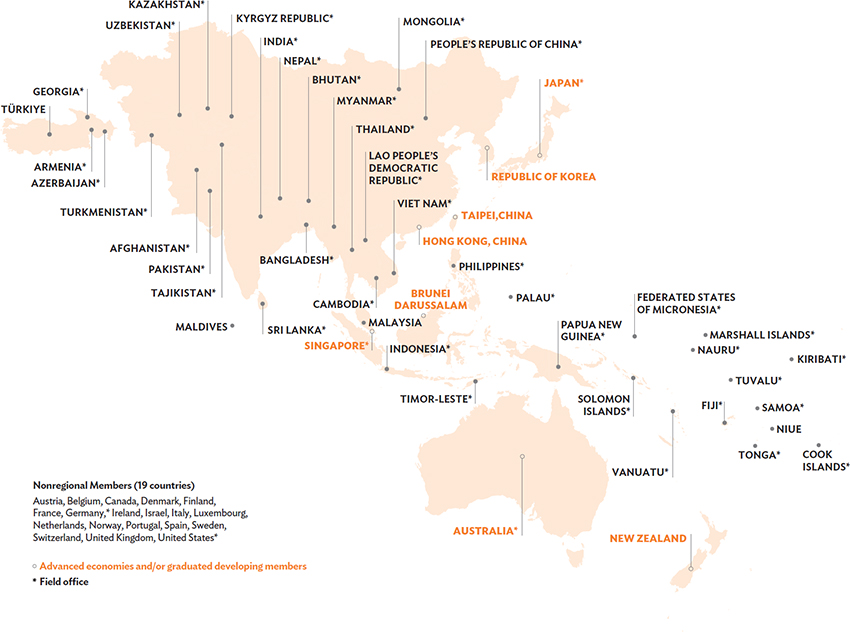
APPENDIXES 69
Appendix 5: ADB Members, Capital Stock, and Voting Power
(as of 31 December 2025)
| Subscribed | Voting | ||
| Year of | Capitala | Powerb | |
| Member | Membership | (% of total) | (% of total) |
| REGIONAL | |||
| Afghanistan | 1966 | 0.034 | 0.317 |
| Armenia | 2005 | 0.298 | 0.528 |
| Australia | 1966 | 5.773 | 4.908 |
| Azerbaijan | 1999 | 0.444 | 0.645 |
| Bangladesh | 1973 | 1.019 | 1.105 |
| Bhutan | 1982 | 0.006 | 0.295 |
| Brunei Darussalam | 2006 | 0.351 | 0.571 |
| Cambodia | 1966 | 0.049 | 0.329 |
| China, People’s Republic of | 1986 | 6.429 | 5.433 |
| Cook Islands | 1976 | 0.003 | 0.292 |
| Fiji | 1970 | 0.068 | 0.344 |
| Georgia | 2007 | 0.341 | 0.562 |
| Hong Kong, China | 1969 | 0.543 | 0.725 |
| India | 1966 | 6.317 | 5.343 |
| Indonesia | 1966 | 5.434 | 4.637 |
| Japan | 1966 | 15.571 | 12.747 |
| Kazakhstan | 1994 | 0.805 | 0.934 |
| Kiribati | 1974 | 0.004 | 0.293 |
| Korea, Republic of | 1966 | 5.026 | 4.311 |
| Kyrgyz Republic | 1994 | 0.298 | 0.529 |
| Lao People’s Democratic Republic | 1966 | 0.014 | 0.301 |
| Malaysia | 1966 | 2.717 | 2.463 |
| Maldives | 1978 | 0.004 | 0.293 |
| Marshall Islands | 1990 | 0.003 | 0.292 |
| Micronesia, Federated States of | 1990 | 0.004 | 0.293 |
| Mongolia | 1991 | 0.015 | 0.302 |
| Myanmar | 1973 | 0.543 | 0.725 |
| Nauru | 1991 | 0.004 | 0.293 |
| Nepal | 1966 | 0.147 | 0.407 |
| New Zealand | 1966 | 1.532 | 1.516 |
| Niue | 2019 | 0.001 | 0.291 |
| Pakistan | 1966 | 2.173 | 2.029 |
| Palau | 2003 | 0.003 | 0.292 |
| Papua New Guinea | 1971 | 0.094 | 0.365 |
| Philippines | 1966 | 2.377 | 2.192 |
| Samoa | 1966 | 0.003 | 0.292 |
| Singapore | 1966 | 0.340 | 0.561 |
| Solomon Islands | 1973 | 0.007 | 0.295 |
| Sri Lanka | 1966 | 0.579 | 0.753 |
| Taipei,China | 1966 | 1.087 | 1.159 |
| Tajikistan | 1998 | 0.286 | 0.518 |
| Thailand | 1966 | 1.358 | 1.377 |
| Timor-Leste | 2002 | 0.010 | 0.298 |
| Tonga | 1972 | 0.004 | 0.293 |
| Türkiye | 1991 | 0.340 | 0.561 |
| Turkmenistan | 2000 | 0.253 | 0.492 |
| Tuvalu | 1993 | 0.001 | 0.291 |
| Uzbekistan | 1995 | 0.672 | 0.828 |
| Vanuatu | 1981 | 0.007 | 0.295 |
| Viet Nam | 1966 | 0.341 | 0.562 |
| Subtotal | 63.729 | 65.476 |
| Subscribed | Voting | ||
| Year of | Capitala | Powerb | |
| Member | Membership | (% of total) | (% of total) |
| NONREGIONAL | |||
| Austria | 1966 | 0.340 | 0.561 |
| Belgium | 1966 | 0.340 | 0.561 |
| Canada | 1966 | 5.219 | 4.465 |
| Denmark | 1966 | 0.340 | 0.561 |
| Finland | 1966 | 0.340 | 0.561 |
| France | 1970 | 2.322 | 2.148 |
| Germany | 1966 | 4.316 | 3.743 |
| Ireland | 2006 | 0.340 | 0.561 |
| Israel | 2024 | 0.001 | 0.291 |
| Italy | 1966 | 1.803 | 1.732 |
| Luxembourg | 2003 | 0.340 | 0.561 |
| Netherlands | 1966 | 1.023 | 1.109 |
| Norway | 1966 | 0.340 | 0.561 |
| Portugal | 2002 | 0.340 | 0.561 |
| Spain | 1986 | 0.340 | 0.561 |
| Sweden | 1966 | 0.340 | 0.561 |
| Switzerland | 1967 | 0.582 | 0.756 |
| United Kingdom | 1966 | 2.038 | 1.920 |
| United States | 1966 | 15.571 | 12.747 |
| Subtotal | 36.271 | 34.524 | |
| TOTAL | 100.000 | 100.000 |
ADB = Asian Development Bank.
Notes:
| 1. | Subtotals may not sum precisely and percentages may not total 100% because of rounding. |
| 2. | For other details, see table on Statement of Subscriptions to Capital Stock and Voting Power (OCR-8) in the Financial Statements of Annual Report 2025. |
| a | Refers to a member’s subscription to shares of the capital stock of ADB. |
| b | The total voting power of each member consists of the sum of its basic votes and proportional votes. The basic votes of each member consist of such number of votes as results from the equal distribution among all members of 20% of the aggregate sum of the basic votes and proportional votes of all members. The number of proportional votes of each member is equal to the number of shares of the capital stock of ADB held by that member. |
70 ANNUAL REPORT 2025
Appendix 6: Contributions to the Asian Development Fund ($ million)
| Cumulative | of which, | ||
| Effective Amounts | ADF 14 | ||
| Contributor | Committeda | (2025–2028) | |
| Armenia | 1 | 1 | |
| Australia | 3,148 | 255 | |
| Austria | 310 | –b | |
| Azerbaijan | 3 | 2 | |
| Belgium | 244 | – | |
| Brunei Darussalam | 21 | 0 | |
| Canada | 2,183 | 75 | |
| China, People’s Republic of | 384 | 107 | |
| Denmark | 276 | 11 | |
| Finland | 213 | 5 | |
| France | 1,481 | 30 | |
| Georgia | 2 | 2 | |
| Germany | 2,070 | 68 | |
| Hong Kong, China | 150 | 14 | |
| India | 153 | 48 | |
| Indonesia | 45 | 9 | |
| Ireland | 132 | 13 | |
| Israel | 7 | 7 | |
| Italy | 1,263 | 35 | |
| Japan | 14,540 | 879 | |
| Kazakhstan | 8 | – | |
| Korea, Republic of | 779 | 73 | |
| Luxembourg | 70 | 5 | |
| Malaysia | 36 | – | |
| Nauru | 0 | – | |
| Netherlands | 801 | 14 | |
| New Zealand | 200 | –c | |
| Norway | 347 | 20 | |
| Philippines | 5 | 3 | |
| Portugal | 92 | – | |
| Singapore | 32 | 4 | |
| Spain | 506 | 13 | |
| Sweden | 527 | 20 | |
| Switzerland | 434 | 9 | |
| Taipei,China | 133 | 10 | |
| Thailand | 23 | 2 | |
| Türkiye | 127 | 2 | |
| United Kingdom | 1,929 | 118 | |
| United States | 4,813 | – | |
| TOTAL | 37,489 | 1,852 |
– = nil; 0 = less than $500,000; ADF = Asian Development Fund.
Note: Numbers may not sum precisely because of rounding.
| a | Valued at the Asian Development Bank Board of Governors’ Resolutions exchange rates. Based on submitted and acknowledged instruments of contribution of ADF I to ADF 14 as of 31 December 2025. Includes the proportionate share of ADF donors in the transferred assets as of 1 January 2017 of $29,309 million and excludes cumulative contributions allocated to the Technical Assistance Special Fund of $2,642 million. |
| b | Austria’s ADF 14 instrument of contribution was received by ADB on 11 December 2025, its acceptance approved on a no objection basis by ADB’s Board of Directors on 13 February 2026, and acknowledged by the President on 25 February 2026. ADB received 79% of Austria’s total ADF 14 contribution on 30 December 2025. |
| c | New Zealand’s ADF 14 instrument of contribution was received by ADB on 25 November 2025, its acceptance approved on a no objection basis by ADB’s Board of Directors on 15 January 2026, and acknowledged by the President on 25 February 2026. ADB received 45% of New Zealand’s total ADF 14 contribution on 18 December 2025. |
APPENDIXES 71
Appendix 7A: Project-Specific Public Sector Cofinancing Commitments, 2025 ($ million)
| Financing Partner | Loan | Grant | Technical Assistance |
| Bilateral | |||
| Australia | – | 31 | 4 |
| France | 1,054 | – | – |
| Germany | 1,033 | – | – |
| Ireland | – | – | 2 |
| Japan | 645 | – | 0 |
| Korea, Republic of | – | – | 1 |
| New Zealand | – | 19 | 0 |
| Norway | – | – | 6 |
| United Kingdom | – | – | 3 |
| Subtotal (Bilaterals) | 2,732 | 50 | 16 |
| Multilateral | |||
| ASEAN Infrastructure Fund | 40 | – | – |
| Asian Infrastructure Investment Bank | 400 | – | – |
| Climate Investment Fundsa | 40 | 5 | 11 |
| European Bank for Reconstruction and Development | 40 | – | – |
| European Investment Bank | 108 | – | – |
| European Union | – | 4 | – |
| Global Concessional Finance Facility | – | 16 | – |
| Global Environment Facility | – | – | 8 |
| Global Infrastructure Facility | – | – | 0 |
| Global Partnership for Education Fund | – | 5 | 1 |
| Green Climate Fund | 28 | 31 | 1 |
| International Fund for Agricultural Development | 42 | 1 | – |
| New Development Bank | 225 | – | – |
| OPEC Fund for International Development | 210 | – | – |
| Pandemic Prevention, Preparedness and Response Fund | – | 7 | – |
| World Bank | 50 | 99 | 10 |
| Women Entrepreneurs Finance Initiative | – | – | 0 |
| Subtotal (Multilaterals) | 1,183 | 169 | 27 |
| Othersb | |||
| Global Energy Alliance for People and Planet LLC | – | – | 0 |
| Ocean Risk and Resilience Action Alliance Inc. | – | – | 0 |
| Subtotal (Others) | – | – | 1 |
| TOTAL | 3,915 | 219 | 48 |
– = nil, 0 = less than $500,000, ASEAN = Association of Southeast Asian Nations, OPEC = Organization of the Petroleum Exporting Countries.
Notes:
| 1. | Excludes cofinancing commitments from Asian Development Bank-administered trust funds. |
| 2. | Numbers may not sum precisely because of rounding. |
| a | Comprises the Clean Technology Fund and the Strategic Climate Fund. |
| b | Comprises public and private entities—including state-owned commercial banks, foundations, corporate social responsibility programs, and civil society organizations—that provide concessional cofinancing from sources other than official development assistance for public sector operations. |
72 ANNUAL REPORT 2025
Appendix 7B: Active Trust Funds and Special Funds ($ million)
| Cumulative | ||||||
| Year of | Contributions | Contribution as of | Committed | |||
| Fund Name | Partner(s) | Establishment | for 2025a | 31 December 2025b | for 2025c | |
| Single-Partner Trust Funds | ||||||
| Japan Scholarship Programd | Japan | 1988 | 8.0 | 228.4 | NA | |
| Japan Fund for Prosperous and Resilient Asia and the Pacifice | Japan | 2000 | 21.8 | 1,082.8 | 59.6 | |
| Spanish Cooperation Fund for Technical Assistance | Spain | 2000 | 8.7 | 31.1 | 4.5 | |
| Japan Fund for Information and Communication Technology | Japan | 2001 | – | 10.8 | – | |
| Cooperation Fund for Project Preparation in the Greater | France | 2004 | – | 10.8 | 0.3 | |
| Mekong Subregion and in Other Specific Asian Countries | ||||||
| People’s Republic of China Poverty Reduction and | People’s Republic of China | 2005 | – | 88.0 | 2.2 | |
| Regional Cooperation Funde | ||||||
| Republic of Korea e-Asia and Knowledge Partnership Funde | Republic of Korea | 2006 | – | 254.3 | 15.6 | |
| Asian Clean Energy Fund under the Clean Energy Financing | Japan | 2008 | – | 55.7 | – | |
| Partnership Facility | ||||||
| Investment Climate Facilitation Fund under the Regional | Japan | 2008 | – | 29.8 | – | |
| Cooperation and Integration Financing Partnership Facility | ||||||
| Canadian Climate Fund for the Private Sector in Asia under | Canada | 2013 | – | 77.3 | – | |
| the Clean Energy Financing Partnership Facility | ||||||
| Sanitation Financing Partnership Trust Fund under | Gates Foundation | 2013 | – | 27.0 | – | |
| the Water Financing Partnership Facility | ||||||
| Japan Fund for the Joint Crediting Mechanism | Japan | 2014 | 1.3 | 139.9 | 11.0 | |
| Leading Asia’s Private Infrastructure Fund | Japan | 2016 | 25.0f | 1,500.0g | – | |
| Canadian Climate Fund for the Private Sector in Asia II | Canada | 2017 | – | 149.5 | – | |
| ASEAN Australia Smart Cities Trust Fund under | Australia | 2019 | – | 14.9 | – | |
| the Urban Financing Partnership Facility | ||||||
| Ireland Trust Fund for Building Climate Change | Ireland | 2019 | – | 15.8 | – | |
| and Disaster Resilience in Small Island Developing States | ||||||
| Australian Climate Finance Partnership | Australia | 2020 | – | 93.1 | 1.4 | |
| Smart Energy Innovation Fund under the Clean Energy | United Kingdom | 2021 | – | 13.9 | 6.3 | |
| Financing Partnership Facility | ||||||
| Project Preparation and Implementation Support Trust Fund | OPEC Fund for | 2022 | – | 3.0 | – | |
| International Development | ||||||
| European Union–ASEAN Catalytic Green Finance Facility | European Union | 2023 | – | 60.1 | 30.0 | |
| Trust Fund | ||||||
| GEAPP Energy Access and Transition Trust Fund | Global Energy Alliance for | 2023 | – | 25.5 | 5.0 | |
| People and Planet LLC | ||||||
| Leading Asia’s Private Infrastructure Fund 2 | Japan | 2023 | 295.0f | 1,500.0g | h | |
| United Kingdom–ASEAN Catalytic Green Finance Facility | United Kingdom | 2023 | – | 139.9 | 22.8 | |
| Trust Fund | ||||||
| Canadian Climate and Nature Fund for the Private Sector | Canada | 2024 | – | 267.0 | 4.0 | |
| in Asia | ||||||
| Multi-Partner Trust Funds | ||||||
| Gender and Development Cooperation Fundi | Australia, Canada, Denmark, | 2003 | – | 11.7 | – | |
| Ireland, Norway | ||||||
| Financial Sector Development Partnership Fund | Luxembourg | 2006 | – | 6.4 | – | |
| Water Innovation Trust Fund under the Water Financing | Australia, Austria, Norway, | 2006 | – | 56.8 | 2.3 | |
| Partnership Facility | Spain, Switzerland | |||||
| Clean Energy Fund under the Clean Energy Financing | Australia, Germany, Norway, | 2007 | – | 140.7 | 8.6 | |
| Partnership Facility | Spain, Sweden, United Kingdom |
|||||
| Afghanistan Infrastructure Trust Fundj | ANA Trust Fund, Canada, | 2010 | – | 745.5 | – | |
| Germany, Japan, | ||||||
| United Kingdom, United States |
||||||
| Credit Guarantee Investment Facilityd | ADB, Brunei Darussalam, | 2010 | – | 1,158.0 | NA | |
| Cambodia, People’s | ||||||
| Republic of China, | ||||||
| Indonesia, Japan, Republic | ||||||
| of Korea, Lao People’s | ||||||
| Democratic Republic, | ||||||
| Malaysia, Myanmar, | ||||||
| Philippines, Singapore, | ||||||
| Thailand, Viet Nam | ||||||
| Urban Climate Change Resilience Trust Fund under | Rockefeller Foundation, | 2013 | – | 113.6 | – | |
| the Urban Financing Partnership Facility | Switzerland, | |||||
| United Kingdom, | ||||||
| United States | ||||||
| Regional Malaria and Other Communicable Disease Threats | Australia, Canada, | 2013 | – | 35.8 | 0.3 | |
| Trust Fund under the Health Financing Partnership Facility | United Kingdom |
continued on next page
APPENDIXES 73
Appendix 7B continued
| Cumulative | ||||||
| Year of | Contributions | Contribution as of | Committed | |||
| Fund Name | Partner(s) | Establishment | for 2025a | 31 December 2025b | for 2025c | |
| Asia Pacific Project Preparation Facility | Australia, Canada, Japan, | 2014 | 2.0 | 76.3 | 5.8 | |
| Republic of Korea | ||||||
| Domestic Resource Mobilization Trust Fund | Japan, International | 2017 | 2.1 | 15.7 | 0.9 | |
| Cooperation and | ||||||
| Development Fund | ||||||
| High-Level Technology Fund | Japan | 2017 | 7.3 | 106.4 | 9.1 | |
| Asia-Pacific Climate Finance Fund | Germany | 2017 | – | 33.3 | 9.8 | |
| Cities Development Initiative for Asia Trust Fund under | Austria, Germany, Spain, | 2017 | – | 14.4 | – | |
| the Urban Financing Partnership Facility | Switzerland | |||||
| ADB Ventures Investment Fund 1 under the ADB Ventures | Climate Investment Fund, | 2020 | – | 59.7 | – | |
| Financing Partnership Facility | Finland, Republic of Korea, | |||||
| Korea Venture Investment | ||||||
| Corporation, Nordic Development Fund |
||||||
| Climate Action Catalyst Fundd | Norway, Sweden | 2021 | 50.0 | 82.1 | NA | |
| Community Resilience Partnership Program Trust Fund | France, Nordic | 2021 | – | 66.5 | 7.6 | |
| under the Community Resilience Financing | Development Fund, | |||||
| Partnership Facility | United Kingdom | |||||
| Climate Innovation and Development Fund | Bloomberg Philanthropies, | 2022 | – | 25.0 | – | |
| Goldman Sachs | ||||||
| Energy Transition Mechanism Partnership Trust Fund | Germany, Japan, | 2022 | – | 81.5 | 1.5 | |
| under the Clean Energy Financing Partnership Facility | New Zealand | |||||
| Water Resilience Trust Fund under the Water Financing | Netherlands | 2023 | – | 20.0 | 3.4 | |
| Partnership Facility | ||||||
| Urban Resilience Trust Fund under the Urban Financing | Rockefeller Foundation, | 2023 | 2.6 | 89.3 | 18.8 | |
| Partnership Facility | United Kingdom | |||||
| Ocean Resilience and Coastal Adaptation Trust Fund | Nordic Development Fund, | 2023 | – | 13.3 | 3.1 | |
| United Kingdom | ||||||
| Nonsovereign Revolving Trust Fund | Australia, Canada, | 2023 | 22.7 | 35.2 | 4.9 | |
| Republic of Korea, | ||||||
| Luxembourg, New Zealand, | ||||||
| Switzerland, United States | ||||||
| ADB Ventures Investment Fund 2 under the ADB Ventures | Climate Investment Fund, | 2024 | 20.6 | 30.6 | – | |
| Financing Partnership Facility | Finland | |||||
| Innovative Finance Facility for Climate in Asia and the Pacific | Japan | 2024 | – | 25.0 | 1.5 | |
| Grant Trust Fund | ||||||
| Central Asia Regional Economic Cooperation Climate | People’s Republic of China, | 2024 | 1.0 | 4.0 | 0.2 | |
| and Sustainability Project Preparatory Fund | Republic of Korea | |||||
| ADB Market Acceleration Platform for Asia and the Pacific | Japan | 2025 | 20.5 | 20.5 | – | |
| Trust Fund | ||||||
| Special Fundsk | ||||||
| Japan Special Fund | Japan | 1988 | – | 1,124.7 | 9.1 | |
| ADB Instituted | Australia, People’s Republic | 1996 | 8.7 | 370.0 | NA | |
| of China, Indonesia, Japan, | ||||||
| Republic of Korea, Malaysia | ||||||
| Regional Cooperation and Integration Fund | ADB, Japan | 2007 | – | 99.6 | 1.9 | |
| Asia Pacific Disaster Response Fund | ADB, Japan | 2009 | – | 167.7 | 11.5 | |
| Financial Sector Development Partnership Special Fund | ADB, Luxembourg | 2013 | 2.8 | 32.4 | 2.7 |
– = nil, ADB = Asian Development Bank, ASEAN = Association of Southeast Asian Nations, GEAPP = Global Energy Alliance for People and Planet LLC, NA = not applicable, OPEC = Organization of the Petroleum Exporting Countries.
| a | Consists of additional and new commitments made during the year. |
| b | Entries are net of cancellation of commitments, if any, and revalued at reporting date, as applicable. Entries for contributions made in currencies other than US dollars may differ from the legally documented contributions as the actual contributions will depend on the conversion rate applied under the donor agreements. |
| c | Comprises the amount of trust fund cofinancing in the form of loans, equity investments, grants, and technical assistance signed in 2025. |
| d | ADB is the trustee for the fund; the fund does not finance ADB’s loans, grants, or technical assistance activities. |
| e | Includes transfer of contributions to and from various trust funds. |
| f | The 2025 contribution from Japan is part of the original commitment. |
| g | Represents the maximum possible contribution of Japan to the fund. |
| h | ADB is limited in its ability to disclose the fund balance of the Leading Asia’s Private Infrastructure Fund 2. |
| i | The Gender and Development Cooperation Fund closed in November 2025. |
| j | ADB placed its regular assistance to Afghanistan on hold effective 15 August 2021, but since 2022 has supported the Afghan people through a special arrangement with the United Nations to address basic human needs, including critical food support, and health and education services. |
| k | Special funds (except the Japan Special Fund) get contributions from ADB through transfers from ordinary capital resources. The list of special funds excludes the Asian Development Fund (ADF), the Technical Assistance Special Fund (TASF), and the Climate Change Fund. Contributions to the ADF are presented in Appendix 6. Contributions to the TASF are made through direct and voluntary contributions from members and through allocations from the ADF replenishments. No external partners contribute to the Climate Change Fund. |
|
|
APPENDIXES 75 |
Appendix 8A: Organizational Structure
(as of 31 December 2025)
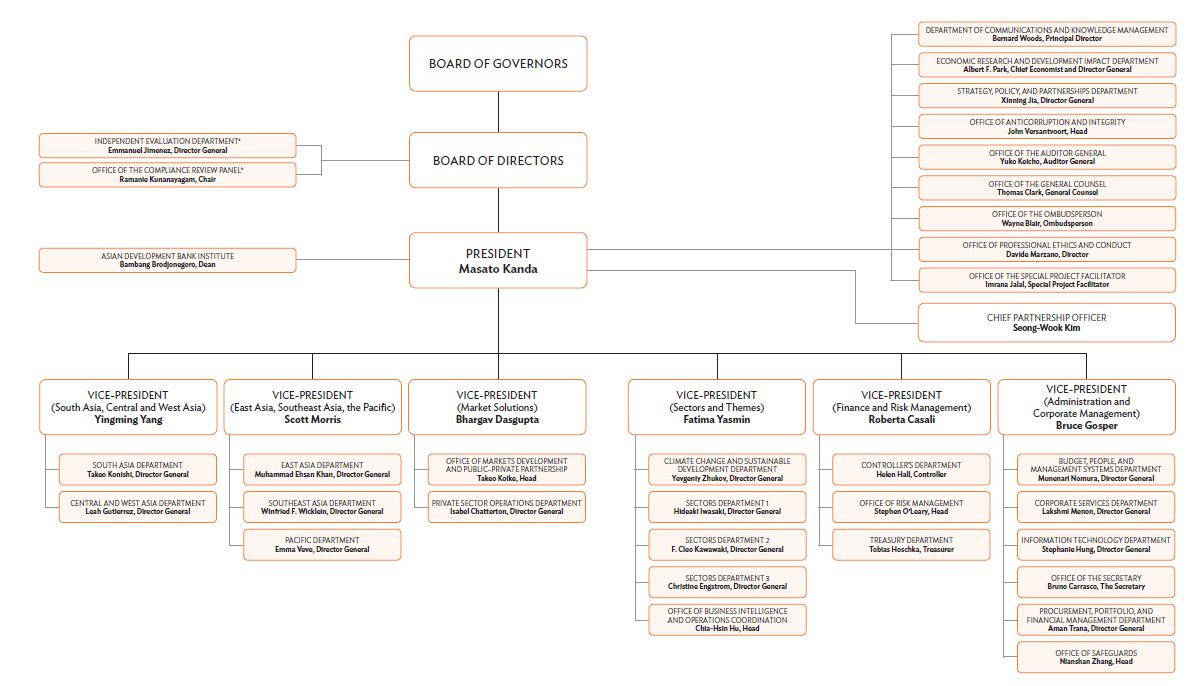
| a | The Independent Evaluation Department reports to the Board of Directors through the Development Effectiveness Committee. |
| b | The Compliance Review Panel reports to the Board of Directors. |
76 ANNUAL REPORT 2025
Appendix 8B: Sectors and Themes
(as of 31 December 2025)
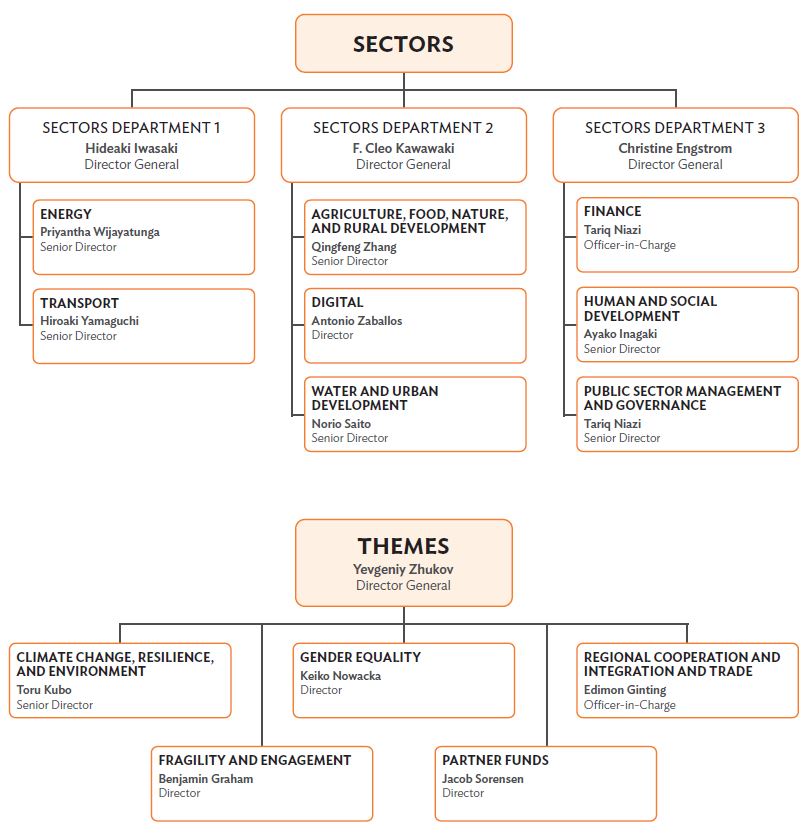
APPENDIXES 77
| A. | Key Corporate Overview Reports |
| • | ADB Sustainability Reports |
| • | Development Effectiveness Reports: Private Sector Operations |
| • | Development Effectiveness Review |
| B. | Treasury, Finance, and Risk Management |
| • | ADB Information Statement |
| C. | Operations |
| 1. | Overview of ADB Operations |
| • | ADB Projects and Tenders: Project Data Sheets for Loans, Grants, and Technical Assistance |
| • | Statement of the ADB Operations Series |
| 2. | Portfolio Reports |
| • | Annual Reports on Portfolio Performance |
| • | Quarterly Portfolio Updates |
| 3. | Country Operations |
| • | ADB Member Fact Sheets |
| • | Annual Report on the Country Performance Assessment Exercise |
| 4. | Partnership Reports |
| • | ADB Cooperation with Civil Society Annual Reports |
| • | ADB–Japan Scholarship Program Annual Reports |
| • | Annual Partnership Reports |
| • | ASEAN Catalytic Green Finance Facility Annual Reports |
| • | Clean Energy Financing Partnership Facility Progress Reports |
| • | Community Resilience Partnership Program Trust Fund Annual Reports |
| • | Financial Sector Development Partnership Special Fund and Financial Sector Development Partnership Fund Annual Reports |
| • | Gender and Development Cooperation Fund Progress Reports |
| • | Japan Fund for Prosperous and Resilient Asia and the Pacific Progress Reports |
| • | People’s Republic of China Regional Cooperation and Poverty Reduction Fund Annual Reports |
| • | Republic of Korea e-Asia and Knowledge Partnership Fund Annual Reports |
| • | Urban Financing Partnership Facility Annual Reports |
| • | Water Financing Partnership Facility Progress Reports |
| D. | Planning and Budget |
| • | Budget of the Asian Development Bank Series |
| • | Work Program and Budget Framework Series |
| E. | Accountability |
| • | ADB Accountability Mechanism Annual Reports |
| F. | Audit |
| • | Annual Report of the Audit and Risk Committee of the Board 2024–2025 |
| G. | Independent Evaluation |
| • | ADB-Administered Trust Funds and Other Cofinancing, 2015–2024 |
| • | An Evaluation of ADB’s Support for Education in Asia and the Pacific |
| • | Annual Evaluation Reviews |
| • | Country Assistance Program Evaluation for Kazakhstan, 2012–2024 |
| • | Evaluation of ADB’s Support for Health in Asia and the Pacific |
| • | Indonesia: Validation of the Country Partnership Strategy Final Review, 2020–2024 |
| • | Mongolia: Validation of the Country Partnership Strategy Final Review, 2021–2024 |
| • | Renewing, Revitalizing, and Reforming the Asian Development Bank: An Evaluation of the New Operating Model |
| • | Strengthening Development Outcomes in the Philippines—Lessons from ADB and World Bank Projects |
| • | Tajikistan: Validation of the Country Assistance Program Review, 2021–2025 |
| • | Thematic Evaluation on ADB’s Support for Livable Cities, 2017–2024 |
| • | Validation of Country Partnership Strategy Final Reviews |
| • | Validation of the Pakistan 2020–2024 Country Assistance Program Review |
| • | Work Program: Independent Evaluation Department |
| H. | Key Economic and Financial Research |
| • | Asia Bond Monitor Series |
| • | Asian Development Outlook Series |
| • | Asian Development Review Series |
| • | Asian Economic Integration Reports |
| • | Basic Statistics Series |
| • | Economics Working Papers |
| • | Key Indicators for Asia and the Pacific Series |
| I. | ADB Institute |
| • | ADBI Policy Briefs |
| • | ADBI Three-Year Rolling Work Program and Budget |
| • | ADBI Working Papers |
| J. | Other Reports |
| • | Annual Procurement Reports |
| • | Anticorruption and Integrity Reports |
| • | Fragile and Conflict-Affected Situations and Small Island Developing States Approach Annual Reports |
| • | Office of Professional Ethics and Conduct Annual Reports |
| • | Office of the Ombudsperson Annual Reports |
| |
78 | ANNUAL REPORT 2025 |
Appendix 10: Operational Data and Organizational Information
(as of 31 December 2025)
The tables and other information listed below are available for download in PDF and XLS format from https://www.adb.org/documents/adb-annual-report-2025.
| Operational Data |
| Total Operations, by Sector and by Region, 2025 |
| Public Sector Commitments, 2025 |
| Private Sector Commitments, 2025 |
| Commitments by Modality, 2024–2025 |
| Public and Private Sector Commitments, 2024–2025 |
| Sector Distribution (Public Sector and Private Sector Commitments Including Cofinancing), 2024–2025 |
| Private Sector Commitments by Year, 2009–2025 Private Sector Commitments by Country, 2009–2025 |
| Top Recipients by Commitment Including Cofinancing, 2025 Top Recipients by Commitment Excluding Cofinancing, 2025 Private Sector Commitments by Top Countries, 2024–2025 Projects Involving Direct Mobilization, 2025 |
| Technical Assistance Commitments, 2025 |
| Technical Assistance Grant Commitments |
| Amount of Loans and Grants Made Effective, Contracts Awarded, and Disbursements |
| Number of Projects Under Administration, At Risk, Completed, and Project Completion Reports/Extended Annual Review Reports/Project Performance Evaluation Reports Circulated |
| Net Transfer of Resources (Ordinary Capital Resources, Concessional OCR, and Grants from the Asian Development Fund and Other Special Funds), 2024–2025 |
| Evaluation Results for Public Sector Operations by Member Country, Cumulative by Evaluation Year, 2015–2025 |
| Evaluation Results for Public Sector Operations by Sector, Cumulative by Evaluation Year, 2015–2025 |
| Evaluation Results for Private Sector Operations by Member Country, Cumulative by Evaluation Year, 2015–2025 |
| Evaluation Results for Private Sector Operations by Sector, Cumulative by Evaluation Year, 2015–2025 |
| Cofinancing Arrangements, 2024–2025 ($million) |
| Cofinancing Arrangements, 2024–2025 (Number of Projects) |
| Projects Involving Public Sector Cofinancing, 2025 Projects Involving Public Sector Grant Cofinancing, 2025 |
| Overall Procurement of Goods, Works, and Consulting Services, 2025: Loans, Grants, and Technical Assistance Operations Combined, by Origin of Goods and Services |
| Overall Procurement of Goods, Works, and Consulting Services, 2025: Loans, Grants, and Technical Assistance Operations Combined, by ADB Member |
| Cumulative Contracts Awarded by Origin of Goods and Services as of 31 December 2025: Loans, Grants, and Technical Assistance Operations |
| Cumulative Contracts Awarded by ADB Members as of 31 December 2025: Loans, Grants, and Technical Assistance Operations |
| Asian Development Fund-Contributed Resources |
| Japan Special Fund—Regular and Supplementary Contributions: Statement of Activities and Change in Net Assets, 1988–2025 |
| Japan Special Fund—Asian Currency Crisis Support Facility: Statement of Activities and Change in Net Assets, 1999–2025 |
| Organizational Information |
| Resolutions of the Board of Governors Adopted in 2025 |
| Selected Policy, Strategy, and Financial Papers Discussed by the Board in 2025 |
| Board of Governors |
| Board of Directors and Voting Groups |
| Committees of the Board of Directors |
| ADB Institute Advisory Council, 2024–2026 |
| Summary of Internal Administrative Expenses—2025 and Budget for 2026 |
| Remuneration of the Board of Directors and ADB Management |
| Management and Staff Representation of ADB Members |
| Number of Assigned Positions in Field Offices |
| Growth in Field Offices and Assigned Staff Positions, 2016–2025 |
| Financial statements incorporated by reference. Management’s Discussion and Analysis and the Annual Financial Statements of the Asian Development Bank shall be deemed to be incorporated in and to form part of this Annual Report. The Financial Report, organizational information, and operational data are available at https://www.adb.org/documents/adb-annual-report-2025 and via the QR code on this page. |  |
ACKNOWLEDGMENTS
Board of Directors’ Working Group on Annual Report 2025: Shantanu Mitra (chair), Nim Dorji, Llewellyn Roberts, Haruka Sekiya, Mahinda Siriwardana, Lisa Wright, and Shu Zhan.
Annual Report 2025 Secretariat: John Jeong (Office of the President); Roqueña Domingo and Nicole Pesado (Office of the Secretary); Claus Astrup, Ilaria Caetani, Vanessa Dimaano, and Maria Christina Dueñas (Strategy, Policy, and Partnerships Department); David Kruger and Shobhna Decloitre (Department of Communications and Knowledge Management).
Publisher Bernard Woods • Managing Editor Shobhna Decloitre • Project Manager Luke Dunstan • Associate Project Manager Hershey Homol.
Editing Paul Dent and Sunita Rappai • Copyediting Ma. Theresa Arago, Melanie Kelleher • Proofreading Monina Gamboa,
Joy Quitazol • Art Direction Anthony Victoria • Design and Information Graphics Cleone Baradas • Typesetting Edith Creus, Prince Nicdao.
The Board of Directors’ Working Group on the Annual Report 2025 would like to thank all ADB departments and offices for their significant contributions to this report.
Every effort has been made to ensure the accuracy of the data used in this publication. Variations in data in ADB publications often result from different publication dates, although differences may also come from the source and interpretation of data. ADB accepts no responsibility from any consequence of their use. By making any designation of or reference to a particular territory or geographic area in this document, ADB does not intend to make any judgments as to the legal or other status of any territory or area.
In this publication:
| • | “$” refers to United States dollars, unless otherwise stated. ADB recognizes “China” as the People’s Republic of China; “Hong Kong” as Hong Kong, China; “Korea” as the Republic of Korea; and “Vietnam” as Viet Nam. |
| • | “Public sector” ADB operations, which were referred to as “sovereign” in previous Annual Reports, refers to loans, grants and technical assistance extended to governments or guaranteed by the government. |
| • | “Private sector” ADB operations which were referred to as “nonsovereign” in previous Annual Reports, refers to any loan, equity investment, guarantee, or other financing arrangement that is (i) not guaranteed by a government; or (ii) guaranteed by a government under terms that do not allow ADB, upon default by the guarantor, to accelerate, suspend, or cancel any other loan or guarantee between ADB and the related sovereign. |
© 2026 Asian Development Bank
ISBN 978-92-9277-705-0 (print); 978-92-9277-706-7 (PDF)
Publication Stock No. FLS260077
DOI: http://dx.doi.org/10.22617/FLS260077
Asian Development Bank
6 ADB Avenue, Mandaluyong City
1550 Metro Manila, Philippines
pubsmarketing@adb.org
www.adb.org
All photos by ADB unless otherwise indicated.
Cover photo (left to right): A local woman performs at the commissioning of the Queen Salote Wharf in Tonga in 2025; a business owner displays his merchandise of recycled handicrafts in Sri Lanka; a farmer in rice fields in Indonesia; a farm management student in Tajikistan; a resident of Mongolia’s Khuvsgul Lake region.