
Exhibit 99.3 Sustainability Report 2025
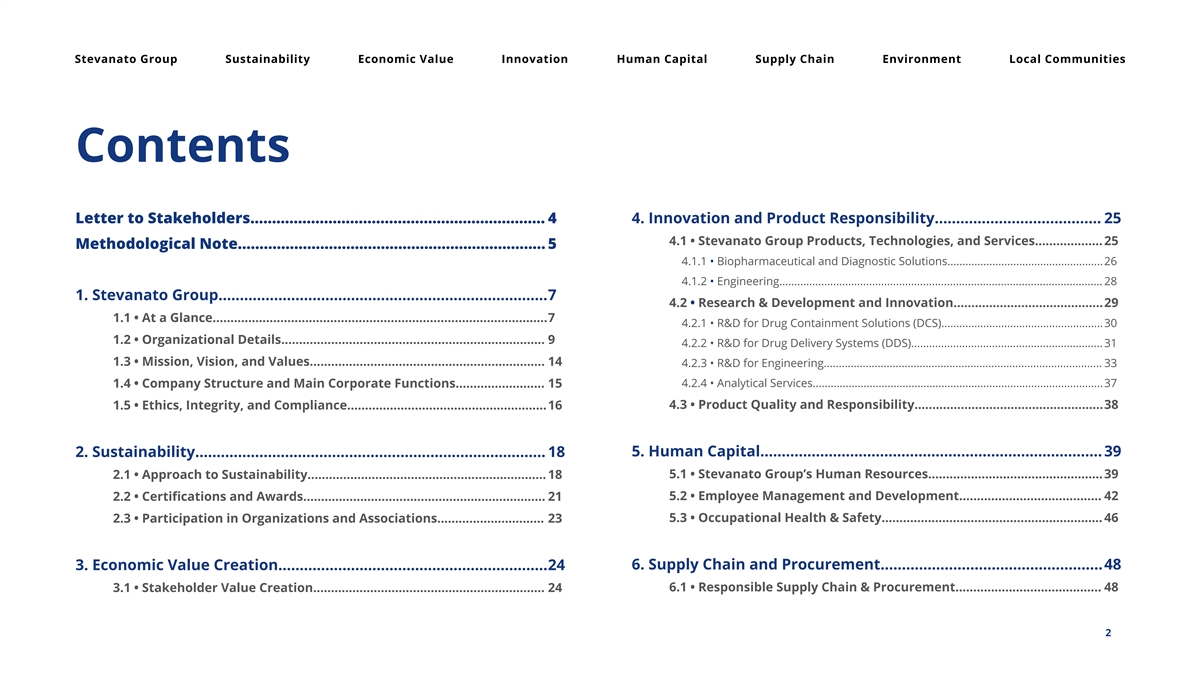
Stevanato Group Sustainability Economic Value Innovation Human Capital Supply Chain Environment Local Communities Contents Letter to Stakeholders.................................................................... 4 4. Innovation and Product Responsibility....................................... 25 4.1 • Stevanato Group Products, Technologies, and Services................... 25 Methodological Note....................................................................... 5 4.1.1 • Biopharmaceutical and Diagnostic Solutions.................................................... 26 4.1.2 • Engineering............................................................................................................ 28 1. Stevanato Group............................................................................. 7 4.2 • Research & Development and Innovation.......................................... 29 1.1 • At a Glance.............................................................................................. 7 4.2.1 • R&D for Drug Containment Solutions (DCS)...................................................... 30 1.2 • Organizational Details.......................................................................... 9 4.2.2 • R&D for Drug Delivery Systems (DDS)................................................................ 31 1.3 • Mission, Vision, and Values.................................................................. 14 4.2.3 • R&D for Engineering............................................................................................. 33 4.2.4 • Analytical Services................................................................................................. 37 1.4 • Company Structure and Main Corporate Functions......................... 15 4.3 • Product Quality and Responsibility..................................................... 38 1.5 • Ethics, Integrity, and Compliance........................................................ 16 5. Human Capital................................................................................ 39 2. Sustainability.................................................................................. 18 5.1 • Stevanato Group’s Human Resources................................................. 39 2.1 • Approach to Sustainability................................................................... 18 5.2 • Employee Management and Development........................................ 42 2.2 • Certifications and Awards.................................................................... 21 5.3 • Occupational Health & Safety.............................................................. 46 2.3 • Participation in Organizations and Associations.............................. 23 6. Supply Chain and Procurement.................................................... 48 3. Economic Value Creation............................................................... 24 6.1 • Responsible Supply Chain & Procurement......................................... 48 3.1 • Stakeholder Value Creation................................................................. 24 2
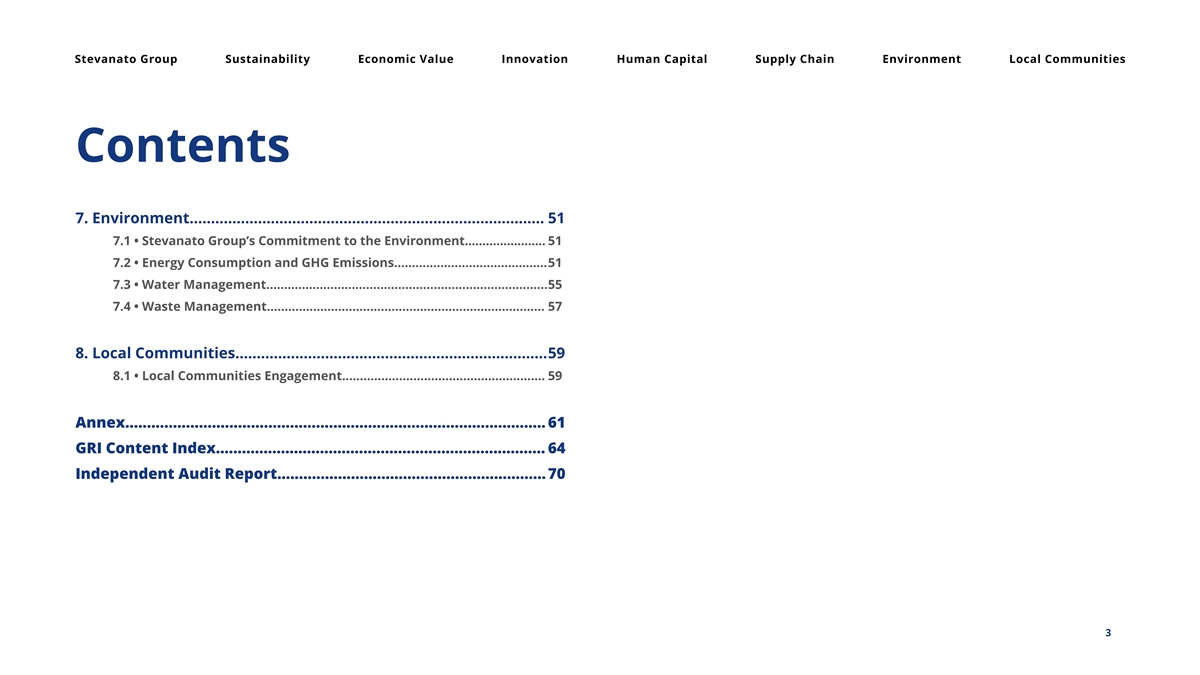
Stevanato Group Sustainability Economic Value Innovation Human Capital Supply Chain Environment Local Communities Contents 7. Environment................................................................................... 51 7.1 • Stevanato Group’s Commitment to the Environment....................... 51 7.2 • Energy Consumption and GHG Emissions........................................... 51 7.3 • Water Management............................................................................... 55 7.4 • Waste Management.............................................................................. 57 8. Local Communities......................................................................... 59 8.1 • Local Communities Engagement......................................................... 59 Annex................................................................................................. 61 GRI Content Index............................................................................ 64 Independent Audit Report.............................................................. 70 3
Stevanato Group Sustainability Economic Value Innovation Human Capital Supply Chain Environment Local Communities Letter to Stakeholders Over our 75-year history, we have earned a reputation for high quality and reliability that has Notwithstanding a dynamic and uncertain political and economic context, we keep to support enabled us to become a partner of choice for more than 700 companies globally. our stakeholders and we are committed to embedding sustainability in our strategic plan, We have secured a leadership position within the drug product development and delivery policies and practices. value chain through our investment in research and development and the expansion of our To accomplish this, we have a sustainability strategy structured in three pillars: global footprint and capabilities. Our priority is to provide flexible solutions that preserve the integrity of pharmaceutical • Sustainable processes and products; products and enable our customers to deliver safe and effective treatments to patients while • Sustainable value chain; reducing time to market, total cost of ownership and supply chain risk. We achieve this by • People and governance. developing our products and solutions in close collaboration with our customers, leveraging our scientific research capabilities, technical expertise, and engineering and manufacturing The main goal is to pursue a regenerative business innovation journey while asserting our excellence to meet the quality and performance requirements of pharmaceutical and position as an interdependent and responsible member of the community in line with the biotech customers. United Nations’ Sustainable Development Goals. Since our founding, the delivery of innovation has been a fundamental characteristic of our Group, and we embed science and technology in what we do every day to bring life-changing In 2025, we progressed in our regenerative business innovation journey as shown in such medicines to patients. Sustainability Report on a voluntary basis. With regard to the environment, we progressed in our plan and measurement including Scope 3 in alignment with Science-Based Target initiative Our goal is to be the global partner of choice to biopharma customers for the full spectrum and its reduction targets. According to such GHG emissions reduction plan, we progressed of end-to-end solutions, from drug development through life-cycle management. We operate mainly in respect to efficiency-related initiatives and sourcing of renewables-based electricity. in attractive, growing end markets with favorable secular tailwinds. Innovation across the industry continues to advance patient care and we remain mission critical to the delivery of In addition, we improved our waste management practices with an increase in the amount innovative biologics. Biologics are expected to remain our fastest growing end market and of waste recovered and diverted from landfills. With regard to the people we aim to foster a a key driver to top-line growth and margin expansion as we continue to move up the value workplace of Merit, Inclusion & Belonging, we improved in our gender balance program on chain. In Latina and Fishers, we expect to increasingly benefit from improved utilization, females holding senior positions. With reference to the Governance area, we strengthened efficiencies, and operating leverage, as we support our customers with quality and reliability. and further improved our sustainable corporate model. 4
Stevanato Group Sustainability Economic Value Innovation Human Capital Supply Chain Environment Local Communities With regard to Ratings, we significantly improved our disclosure with an overall Best-in-Class positioning among peers. On Ecovadis, we’ve been awarded with Silver Medal and score Methodological Note 75/100 placing us among the top 15% of all companies assessed. On S&P’s CSA, we are in leading position, as well as in Carbon Disclosure Project (CDP). This Sustainability Report clearly outlines Stevanato Group’s environmental, social, and We confirm our goal is to continue growing and supporting customers throughout our economic achievements in a transparent and structured manner for the 2025 financial year regenerative business innovation while making a positive impact everywhere we work and (January 1–December 31) and aligned with the Company’s financial reporting, and it shows do business. We are continuously working to improve processes, to innovate on technologies the commitment and initiatives undertaken by the Group toward its goal of sustainable and eco-designed products & packaging, and sustainable solutions. Our team is dedicated development. The annual reporting cycle provides internal and external stakeholders with to delivering on our promise by working collaboratively to drive continuous improvement, a summary of Stevanato Group’s business performance, results, and impacts in relation to acting as an example of our Values and Guiding Principles. Therefore, we are pursuing this material sustainability in the 2025 financial year. important journey with confidence and determination toward an increasingly sustainable and responsible future. This document represents the Sustainability Report of the companies belonging to Stevanato Group S.p.A. and its subsidiaries (hereinafter also referred to as “the Company,” “Stevanato,” Franco Stevanato, Chairman and CEO the “Stevanato Group,” or “the Group”). The list of entities is aligned with the 2025 Annual Stevanato Group S.p.A. Via Molinella 17, 35017 Piombino Dese · Padova · Italy 20-F Filing. The Sustainability Report includes data about the parent company, Stevanato Group S.p.A., and its subsidiaries, which are directly or indirectly consolidated on a line-by-line basis. Note that for some of Group’s commercial entities/sites, only part of the data has been 1 included in the environmental, health, and safety data due to the limited scope . Stevanato Group reports sustainability information with reference to the Global Reporting Initiative (GRI) Standards 2021. For more details on the GRI Standards, please see the “GRI Content Index” section. The contents of the Sustainability Report were selected based on the results of a materiality analysis published in this document and described in Chapter 2. 1 Limitation of scope with part of the data for Stevanato Group International a.s., Ompi of Japan Co., Ltd., Medirio SA, and Stevanato Group India Private Limited. The main environmental data for such entities are included. 5
Stevanato Group Sustainability Economic Value Innovation Human Capital Supply Chain Environment Local Communities The discussion of materiality in connection with the sustainability material assessment is Stevanato Group commissioned this external auditor to provide a limited assurance report, not an indication that such information or topics are necessarily material under U.S. federal “limited assurance engagement,” in accordance with the criteria in the ISAE 3000 Revised securities laws or the rules and regulations of the U.S. Securities and Exchange Standard, which is attached at the end of this document. It contains a description of what Commission (SEC). has been assured and on what basis, including the assurance standard used, the level of assurance obtained, any limitations of the assurance process, and the relationships between Quality criteria and reporting scope information were defined according to GRI principles the organization and the assurance provider. and encompassed positive and negative impacts, comparability, accuracy, timeliness, clarity, and verifiability. Specifically, the information included in this report was taken from both the For further information and suggestions regarding Stevanato Group’s Sustainability Report, Group’s IT system and the sustainability reporting package. please contact: To properly manage the reporting process, a Sustainability Reporting Procedure was sustainability@stevanatogroup.com. established in 2021 and updated in 2025, in line with GRI Standards 2021, which illustrates how to prepare the Group’s Sustainability Report, including the timing, tools, roles, and Stevanato Group presents its inclusion and belonging data and policies in accordance with the responsibilities of the functions and individuals. To ensure responsiveness and proper GRI Standards. Stevanato is aware of US Executive Order 14173 (the “EO”) signed in January application of the procedure, the reporting process was extensively discussed and agreed 2025, under which the U.S. Office of Federal Contract Compliance Programs must, among upon by the working group. other things, immediately cease promoting diversity and allowing or encouraging U.S. federal contractors and subcontractors to engage in workforce balancing based on race, color, sex, The information presented in this report refers to 2025 and includes a comparison with sexual preference, religion, or national origin. As a foreign private issuer listed on the New the previous year. Any information restated from previous reporting periods is indicated York Stock Exchange (NYSE), Stevanato continues to review the implications of the EO. appropriately, where necessary, throughout the report. The information collected and Our Inclusion & Belonging policies will not apply to Stevanato’s U.S. employees to the extent reported is based on measurable data. To provide an accurate overview of the Group’s that this would conflict with the EO or other applicable laws, regulations, or orders. performance and help ensure data reliability, the use of estimates has been limited as much as possible. If they are provided, they have been made using the best methods available and are properly identified. This report presents both positive and negative aspects equally, with a comment on the results when appropriate. This report was approved by the Board of Directors of Stevanato Group S.p.A. in April of 2026. The process of seeking external assurance involved a preliminary evaluation based on different providers and relative core competencies and resulted in the selection and approval of PricewaterhouseCoopers Business Services S.r.l. as an external auditor. 6
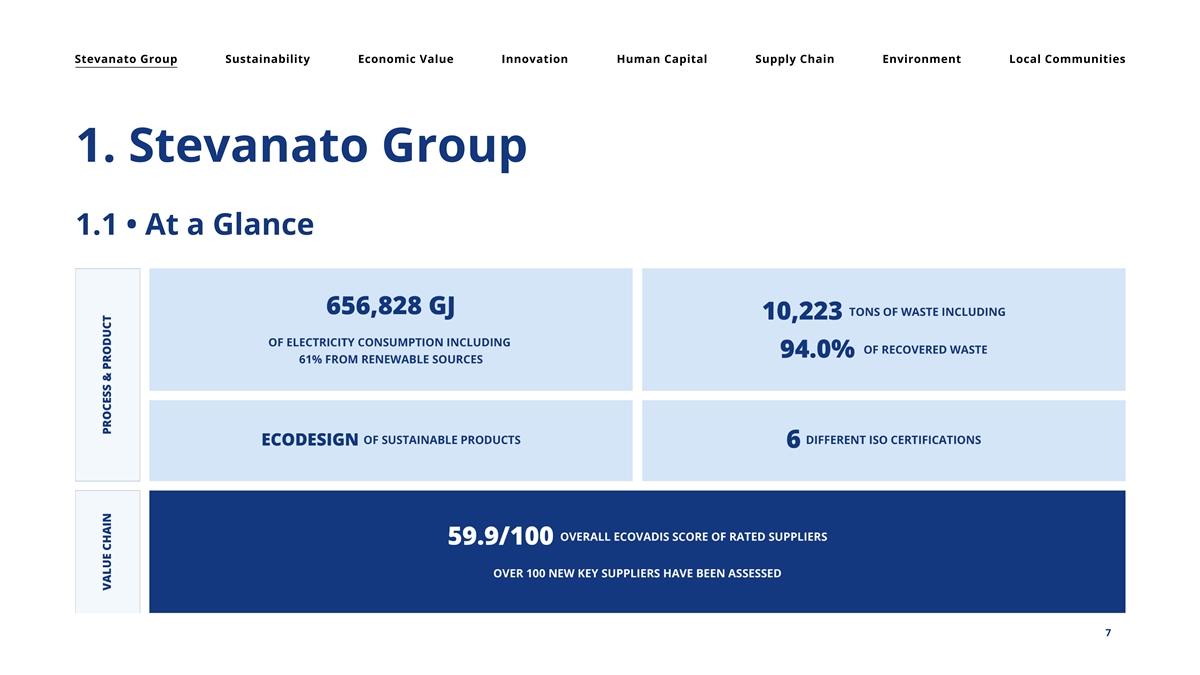
Stevanato Group Sustainability Economic Value Innovation Human Capital Supply Chain Environment Local Communities 1. Stevanato Group 1.1 • At a Glance 7
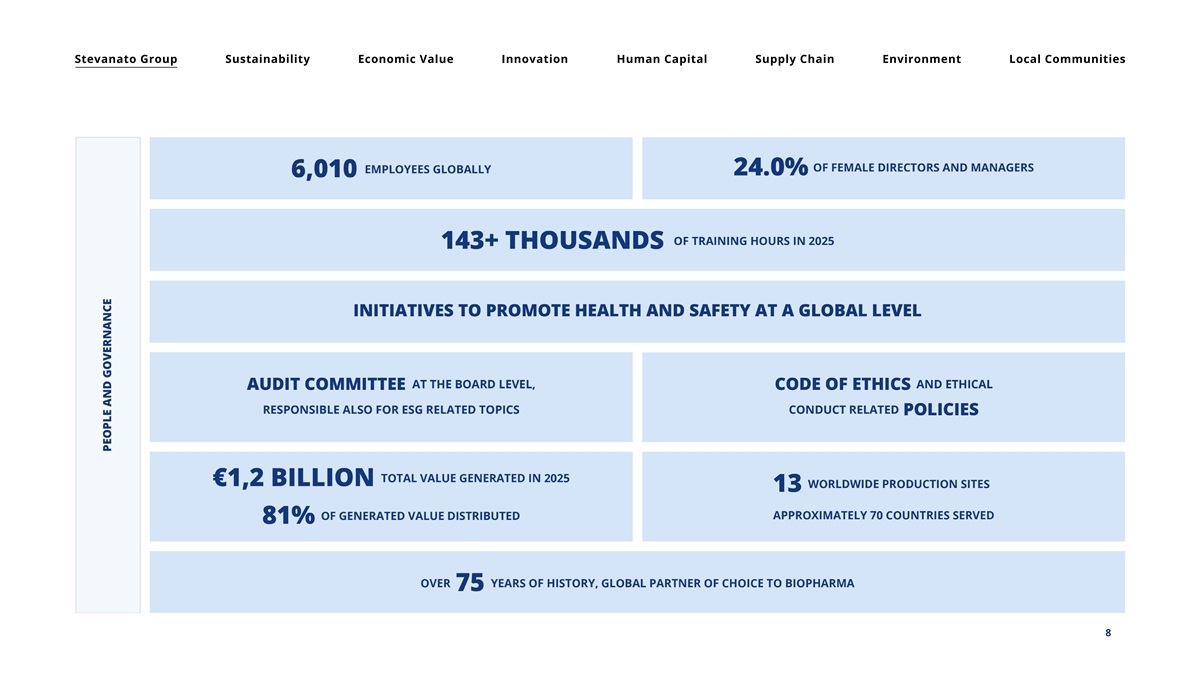
Stevanato Group Sustainability Economic Value Innovation Human Capital Supply Chain Environment Local Communities 8
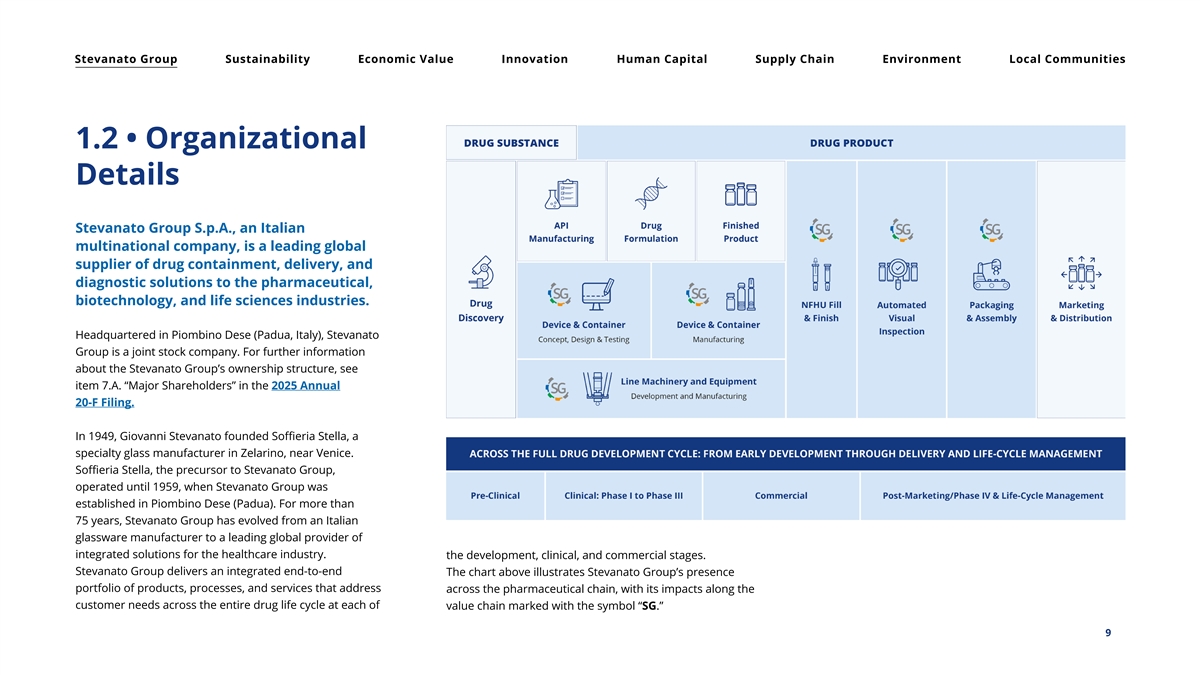
Stevanato Group Sustainability Economic Value Innovation Human Capital Supply Chain Environment Local Communities 1.2 • Organizational Details Stevanato Group S.p.A., an Italian multinational company, is a leading global supplier of drug containment, delivery, and diagnostic solutions to the pharmaceutical, biotechnology, and life sciences industries. Headquartered in Piombino Dese (Padua, Italy), Stevanato Group is a joint stock company. For further information about the Stevanato Group’s ownership structure, see item 7.A. “Major Shareholders” in the 2025 Annual 20-F Filing. In 1949, Giovanni Stevanato founded Soffieria Stella, a specialty glass manufacturer in Zelarino, near Venice. Soffieria Stella, the precursor to Stevanato Group, operated until 1959, when Stevanato Group was established in Piombino Dese (Padua). For more than 75 years, Stevanato Group has evolved from an Italian glassware manufacturer to a leading global provider of integrated solutions for the healthcare industry. the development, clinical, and commercial stages. Stevanato Group delivers an integrated end-to-end The chart above illustrates Stevanato Group’s presence portfolio of products, processes, and services that address across the pharmaceutical chain, with its impacts along the customer needs across the entire drug life cycle at each of value chain marked with the symbol “SG.” 9
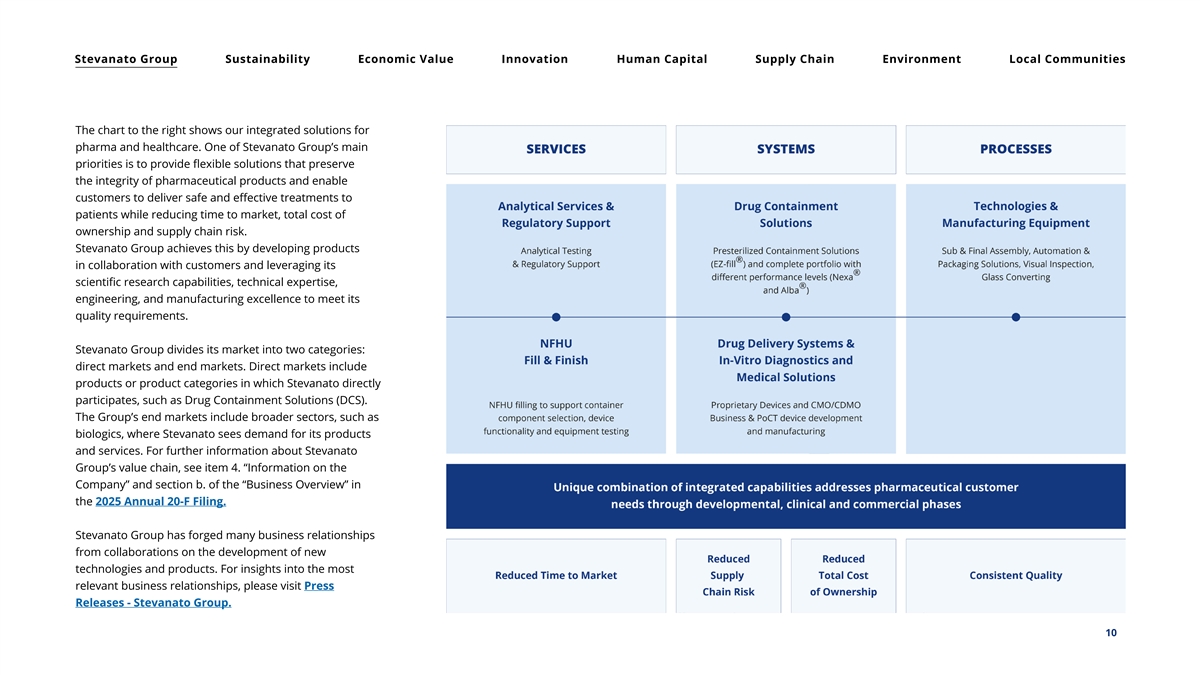
Stevanato Group Sustainability Economic Value Innovation Human Capital Supply Chain Environment Local Communities The chart to the right shows our integrated solutions for pharma and healthcare. One of Stevanato Group’s main priorities is to provide flexible solutions that preserve the integrity of pharmaceutical products and enable customers to deliver safe and effective treatments to patients while reducing time to market, total cost of ownership and supply chain risk. Stevanato Group achieves this by developing products in collaboration with customers and leveraging its scientific research capabilities, technical expertise, engineering, and manufacturing excellence to meet its quality requirements. Stevanato Group divides its market into two categories: direct markets and end markets. Direct markets include products or product categories in which Stevanato directly participates, such as Drug Containment Solutions (DCS). The Group’s end markets include broader sectors, such as biologics, where Stevanato sees demand for its products and services. For further information about Stevanato Group’s value chain, see item 4. “Information on the Company” and section b. of the “Business Overview” in the 2025 Annual 20-F Filing. Stevanato Group has forged many business relationships from collaborations on the development of new technologies and products. For insights into the most relevant business relationships, please visit Press Releases - Stevanato Group. 10
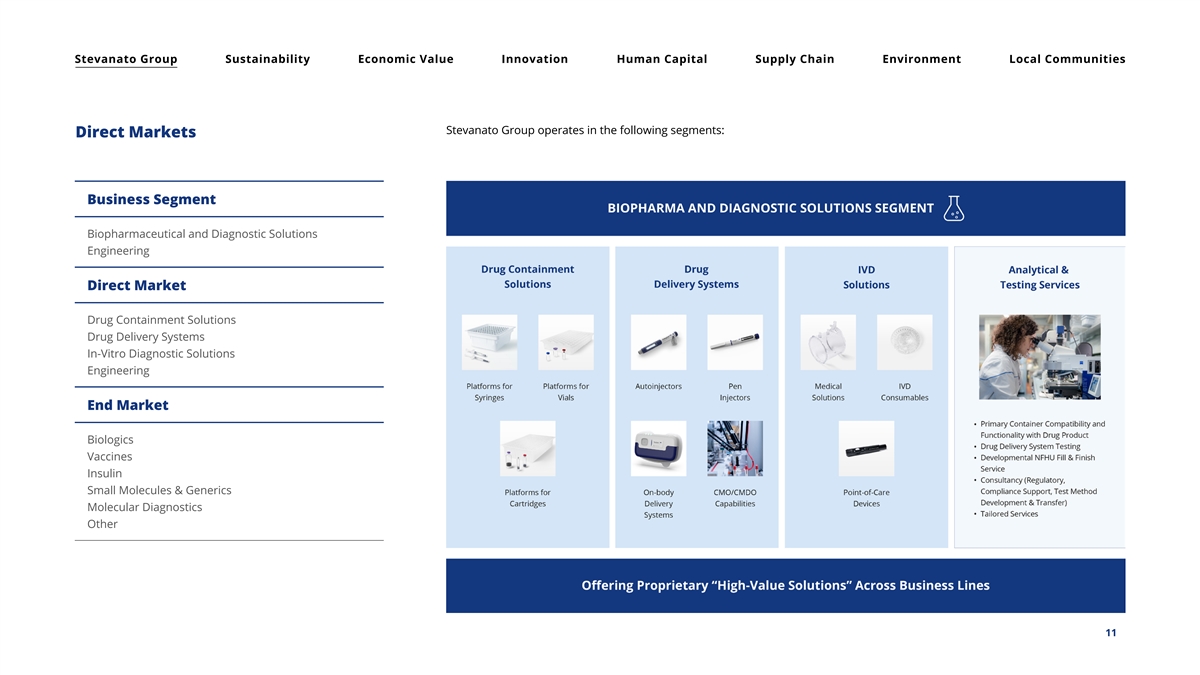
Stevanato Group Sustainability Economic Value Innovation Human Capital Supply Chain Environment Local Communities Stevanato Group operates in the following segments: Direct Markets Business Segment Biopharmaceutical and Diagnostic Solutions Engineering Direct Market Drug Containment Solutions Drug Delivery Systems In-Vitro Diagnostic Solutions Engineering End Market Biologics Vaccines Insulin Small Molecules & Generics Molecular Diagnostics Other 11
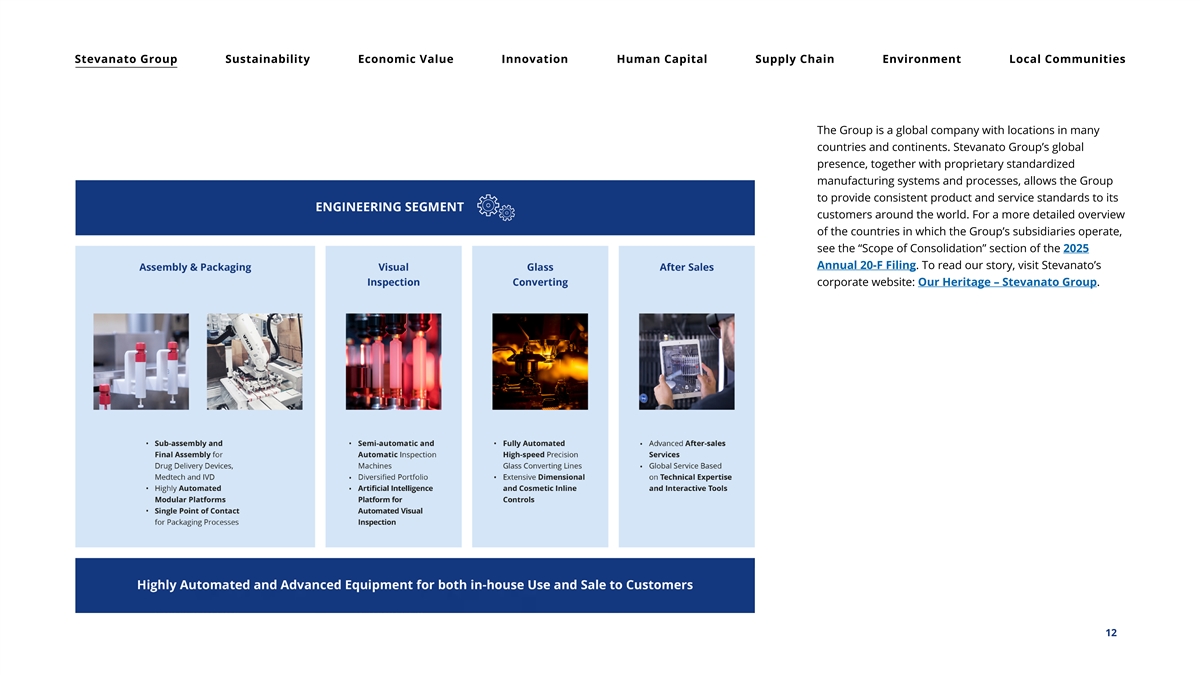
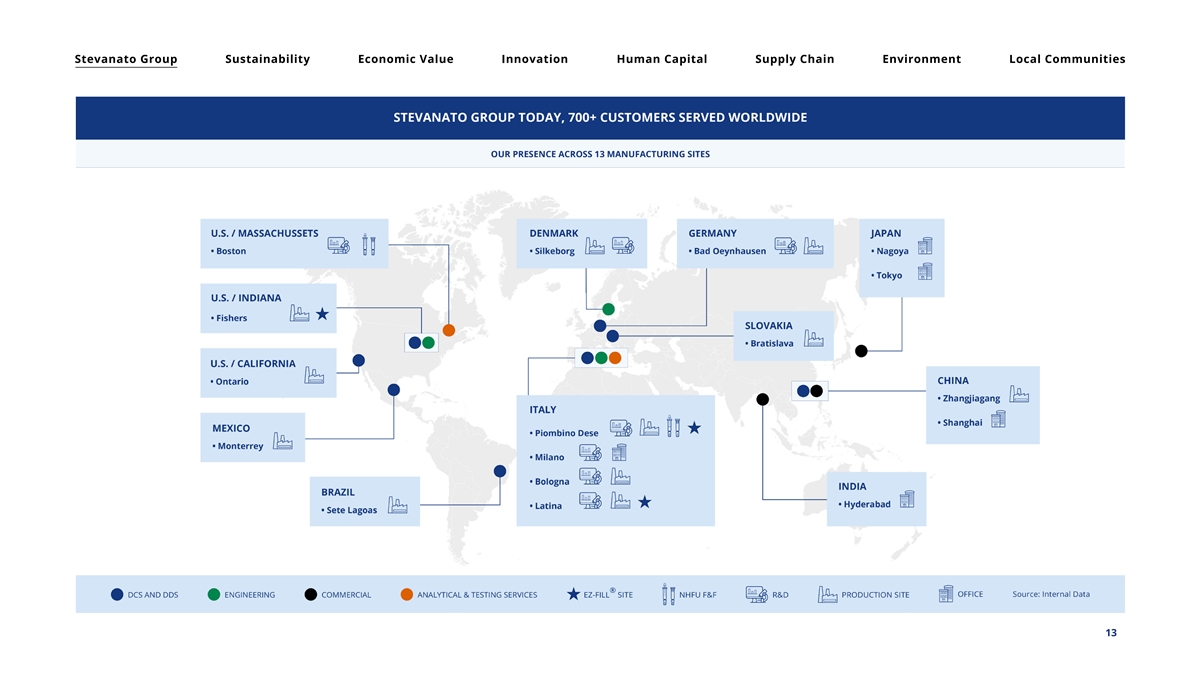
Stevanato Group Sustainability Economic Value Innovation Human Capital Supply Chain Environment Local Communities The Group is a global company with locations in many countries and continents. Stevanato Group’s global presence, together with proprietary standardized manufacturing systems and processes, allows the Group to provide consistent product and service standards to its customers around the world. For a more detailed overview of the countries in which the Group’s subsidiaries operate, see the “Scope of Consolidation” section of the 2025 Annual 20-F Filing. To read our story, visit Stevanato’s corporate website: Our Heritage – Stevanato Group. 12
Stevanato Group Sustainability Economic Value Innovation Human Capital Supply Chain Environment Local Communities 13
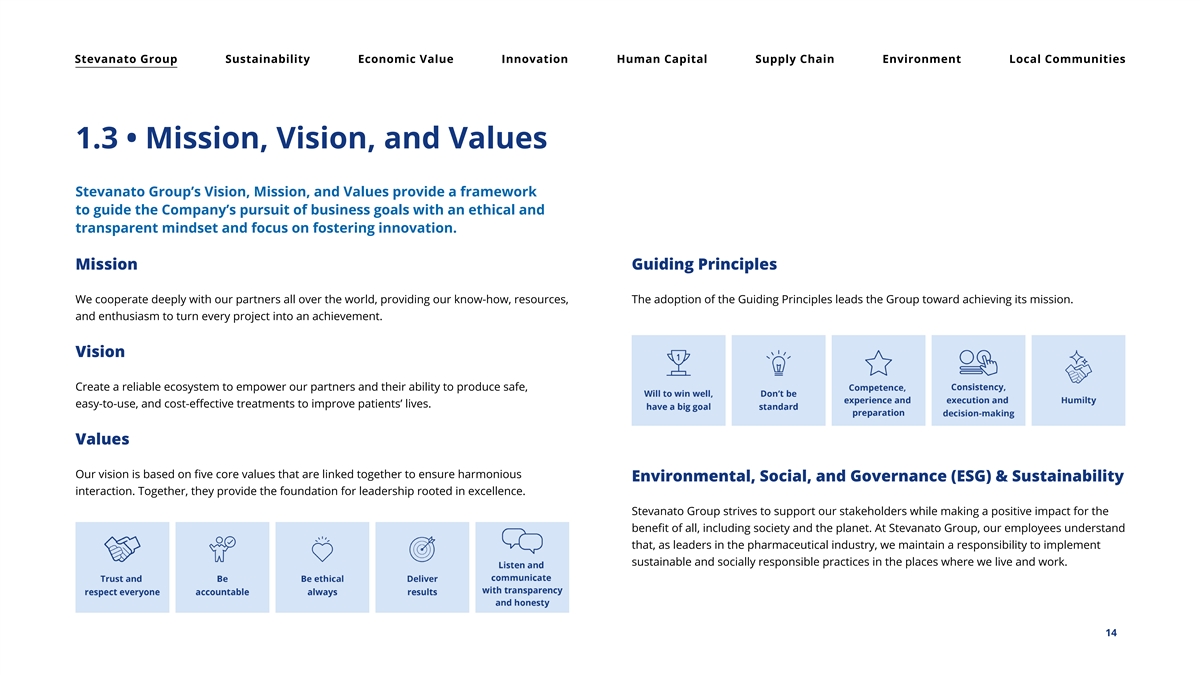
Stevanato Group Sustainability Economic Value Innovation Human Capital Supply Chain Environment Local Communities 1.3 • Mission, Vision, and Values Stevanato Group’s Vision, Mission, and Values provide a framework to guide the Company’s pursuit of business goals with an ethical and transparent mindset and focus on fostering innovation. Mission Guiding Principles We cooperate deeply with our partners all over the world, providing our know-how, resources, The adoption of the Guiding Principles leads the Group toward achieving its mission. and enthusiasm to turn every project into an achievement. Vision Create a reliable ecosystem to empower our partners and their ability to produce safe, easy-to-use, and cost-effective treatments to improve patients’ lives. Values Our vision is based on five core values that are linked together to ensure harmonious Environmental, Social, and Governance (ESG) & Sustainability interaction. Together, they provide the foundation for leadership rooted in excellence. Stevanato Group strives to support our stakeholders while making a positive impact for the benefit of all, including society and the planet. At Stevanato Group, our employees understand that, as leaders in the pharmaceutical industry, we maintain a responsibility to implement sustainable and socially responsible practices in the places where we live and work. 14
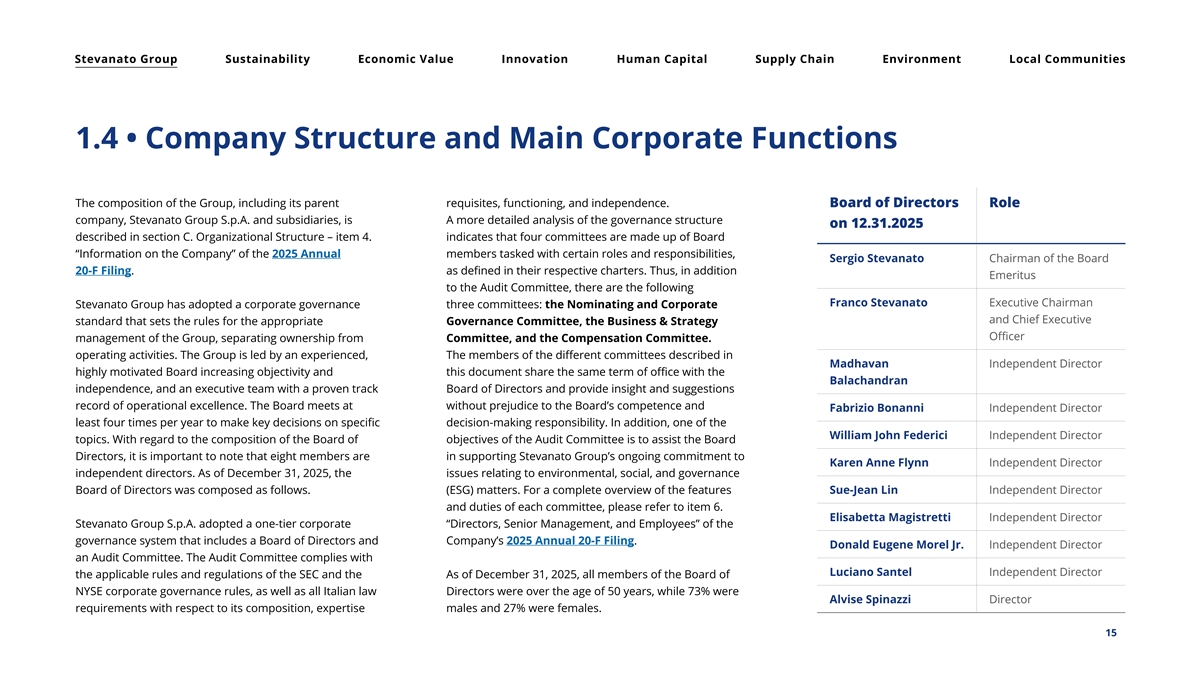
Stevanato Group Sustainability Economic Value Innovation Human Capital Supply Chain Environment Local Communities 1.4 • Company Structure and Main Corporate Functions The composition of the Group, including its parent requisites, functioning, and independence. Board of Directors Role company, Stevanato Group S.p.A. and subsidiaries, is A more detailed analysis of the governance structure on 12.31.2025 described in section C. Organizational Structure – item 4. indicates that four committees are made up of Board “Information on the Company” of the 2025 Annual members tasked with certain roles and responsibilities, Sergio Stevanato Chairman of the Board 20-F Filing. as defined in their respective charters. Thus, in addition Emeritus to the Audit Committee, there are the following Franco Stevanato Executive Chairman Stevanato Group has adopted a corporate governance three committees: the Nominating and Corporate and Chief Executive standard that sets the rules for the appropriate Governance Committee, the Business & Strategy Officer management of the Group, separating ownership from Committee, and the Compensation Committee. operating activities. The Group is led by an experienced, The members of the different committees described in Madhavan Independent Director highly motivated Board increasing objectivity and this document share the same term of office with the Balachandran independence, and an executive team with a proven track Board of Directors and provide insight and suggestions record of operational excellence. The Board meets at without prejudice to the Board’s competence and Fabrizio Bonanni Independent Director least four times per year to make key decisions on specific decision-making responsibility. In addition, one of the William John Federici Independent Director topics. With regard to the composition of the Board of objectives of the Audit Committee is to assist the Board Directors, it is important to note that eight members are in supporting Stevanato Group’s ongoing commitment to Karen Anne Flynn Independent Director independent directors. As of December 31, 2025, the issues relating to environmental, social, and governance Board of Directors was composed as follows. (ESG) matters. For a complete overview of the features Sue-Jean Lin Independent Director and duties of each committee, please refer to item 6. Elisabetta Magistretti Independent Director Stevanato Group S.p.A. adopted a one-tier corporate “Directors, Senior Management, and Employees” of the governance system that includes a Board of Directors and Company’s 2025 Annual 20-F Filing. Donald Eugene Morel Jr. Independent Director an Audit Committee. The Audit Committee complies with Luciano Santel Independent Director the applicable rules and regulations of the SEC and the As of December 31, 2025, all members of the Board of NYSE corporate governance rules, as well as all Italian law Directors were over the age of 50 years, while 73% were Alvise Spinazzi Director requirements with respect to its composition, expertise males and 27% were females. 15
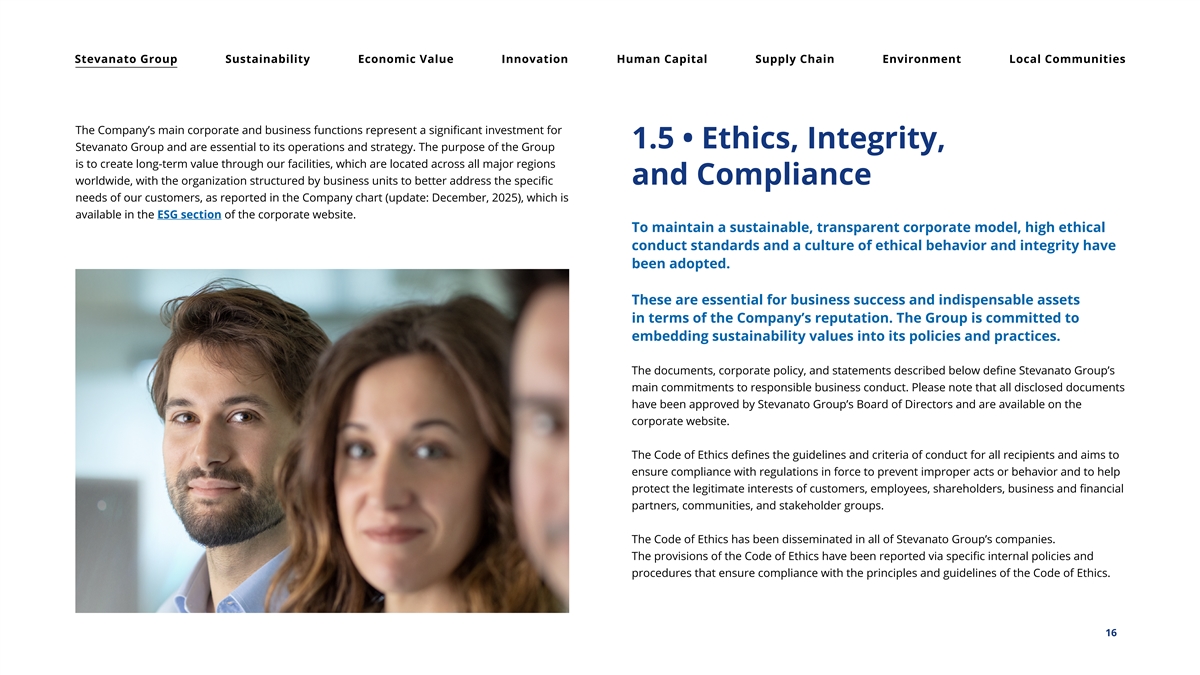
Stevanato Group Sustainability Economic Value Innovation Human Capital Supply Chain Environment Local Communities The Company’s main corporate and business functions represent a significant investment for 1.5 • Ethics, Integrity, Stevanato Group and are essential to its operations and strategy. The purpose of the Group is to create long-term value through our facilities, which are located across all major regions worldwide, with the organization structured by business units to better address the specific and Compliance needs of our customers, as reported in the Company chart (update: December, 2025), which is available in the ESG section of the corporate website. To maintain a sustainable, transparent corporate model, high ethical conduct standards and a culture of ethical behavior and integrity have been adopted. These are essential for business success and indispensable assets in terms of the Company’s reputation. The Group is committed to embedding sustainability values into its policies and practices. The documents, corporate policy, and statements described below define Stevanato Group’s main commitments to responsible business conduct. Please note that all disclosed documents have been approved by Stevanato Group’s Board of Directors and are available on the corporate website. The Code of Ethics defines the guidelines and criteria of conduct for all recipients and aims to ensure compliance with regulations in force to prevent improper acts or behavior and to help protect the legitimate interests of customers, employees, shareholders, business and financial partners, communities, and stakeholder groups. The Code of Ethics has been disseminated in all of Stevanato Group’s companies. The provisions of the Code of Ethics have been reported via specific internal policies and procedures that ensure compliance with the principles and guidelines of the Code of Ethics. 16
Stevanato Group Sustainability Economic Value Innovation Human Capital Supply Chain Environment Local Communities For further details on the Code of Ethics and other policies, please refer to the following links: The above-mentioned Italian companies in the Group proceeded with the renewal of the Supervisory Body, which will expire in 2026, pursuant to the aforementioned Legislative • Code of Ethics Decree responsible for monitoring compliance and operating and updating the model. • Anti-Bribery and Anti-Corruption Policy • Related Party Transactions Policy According to internal procedures, if reports concerning Legislative Decree 231/01 are received • Anti-Discrimination Policy through the Whistleblowing Platform, the Whistleblowing Committee promptly informs the • Whistleblowing Policy Supervisory Body. For its foreign companies, the Group is currently working to strengthen • Supplier Code of Conduct management systems to ensure compliance with local laws in consideration of the provisions of the Model of Organization, Management, and Control 231. The Code of Ethics and the Anti-Discrimination Policy cover internationally recognized human rights that are disclosed directly throughout the documentation. Regarding business relationships, Stevanato Group has established a Supplier Code of Conduct that is shared with its suppliers. For more information, see section ”6.1 Responsible In 2025, all the above-mentioned policies were confirmed by the Board of Directors, including Supply Chain & Procurement.” any changes from the previous year. Stevanato Group complies with all applicable laws and regulations to protect its rights and interests. In 2025, no significant instances of In 2025, no reports and/or complaints were received regarding non-compliance with laws or non-compliance with laws and regulations were registered. regulations or legal action taken regarding anti-competitive behavior, anti-trust, or monopoly violations either in or out of court. Stevanato Group maintains a whistleblowing procedure to manage the reporting of violations and irregularities concerning the Code of Ethics. The whistleblowing procedure was updated, For an overview of Stevanato Group’s risk management, see item 3.D. “Risk Factors” of the and a new platform was implemented according to EU Directive 2019/1937. As of December 2025 Annual 20-F Filing. 31, 2025, no incidents of corruption had been reported through the Whistleblowing Platform. With regard to human rights, three complaints related to alleged discrimination were ongoing in 2025 in the U.S.; the Company continues to take all appropriate actions with regard to these complaints. The Italian entities in the Group (i.e., Stevanato Group S.p.A., Nuova Ompi S.r.l., and Spami S.r.l.) have an Organizational, Management, and Control model pursuant to Legislative Decree No. 231/01. 17
Stevanato Group Sustainability Economic Value Innovation Human Capital Supply Chain Environment Local Communities 2. Sustainability 2.1 • Approach to Sustainability Based Targets initiative and its target. Main contribution it Stevanato Group aims to ensure its The Company seeks to create a regenerative is in respect to efficiency-related initiatives and sourcing of long-term success based on its ability to business innovation model while remaining renewables-based electricity. In addition, the Group took respond to trends and risks related to an interdependent and responsible member action aligned with climate science and has committed Environmental, Social and Governance (ESG) of the community. to set near-term emissions reductions in line with the matters that make up the complex context Science-Based Target initiative to reduce GHG emissions To address ESG trends and risks, Stevanato Group in which the Group operates. according to its trajectory and respective targets. developed a sustainability strategy structured Furthermore, Stevanato Group has progressed in waste in three pillars: Sustainability is a primary means to improve management with a greater quota of waste recovered with such opportunity and risk management, second life applications. • Sustainable processes and products, to minimize any while fostering higher efficiency, potential negative environmental impacts; cutting-edge innovation and strategic As part of its corporate sustainability and circular • Sustainable value chain, to collaborate with partners on decisions on technologies, products, innovation measures, Stevanato continued to analyze improving societal and environmental impacts; processes and value chain definition. selected products and packaging from a life cycle • People and governance, to establish and maintain a perspective while advancing eco-design solutions to sustainable and transparent corporate model. reduce, reuse, replace, and recycle while engaging Stevanato Group pursues a sustainable also with suppliers and partners along the value chain. development journey as per its materiality To help safeguard the environment, Stevanato Group Stevanato Group has also introduced new sustainability analysis which is aligned with the United progressed further in GHG emissions reduction plan, practices as part of its corporate sustainability and circular Nations’ Sustainable Development Goals. included Scope 3 GHG emissions, in line with the Science innovation measures, with a particular emphasis on 18
Stevanato Group Sustainability Economic Value Innovation Human Capital Supply Chain Environment Local Communities identifying alternative materials, renewable-based energy, most significant impacts on the economy, environment, 3. GHG emissions and innovative processes that provide more sustainable and people, including impacts on their human rights. 4. Energy consumption solutions. As part of its corporate sustainability and Such Materiality Analysis was approved by Board of 5. Occupational Health & Safety circular innovation measures, Stevanato Group dialogued Directors as reported in Methodological Note. 6. Business ethics, governance and compliance with customers on a sustainable version of secondary The process of determining material topics was informed 7. Human capital management and development packaging for syringes, focusing on biopolymers and by the organization’s ongoing identification and 8. Economic performance and value creation recycled plastic as well as packaging and process assessment of impacts. 9. Responsible supply chain and procurement improvements to reduce related emissions and other In particular, the process of defining material topics 10. Waste management sustainable measures. followed four steps: 11. Employee well-being With regard to the people we aim to foster a workplace 12. Human rights of Merit, Inclusion & Belonging, we improved in our • Understanding the organization’s context through 13. Water management gender balance program on females holding senior scenario and benchmarking analysis of the main 14. Local communities’ engagement positions. Finally, with reference to the Governance area, potential ESG trends, risks and opportunities; we strengthened and further improved our sustainable • Identifying actual and potential, positive or negative The Group’s 2025 Sustainability Report was prepared corporate model with regular measures of impacts using impacts, starting from the previous context and based on a structured reporting practices formalized the GRI Standards as a framework for transparency benchmarking analysis; by the Sustainability Reporting Procedure according and accountability. • Assessing the significance of the impacts; to GRI Standards 2021. It defines and outlines how the • Prioritizing the most significant impacts grouped Group’s Sustainability Report should be prepared at the The management of sustainability is distributed across into topics. operational level in line with the Sustainability Reporting the Stevanato Group through dedicated ESG-related Guidelines issued by GRI. committees at both Board and Management levels, Each impact was assessed and rated on a significance Such procedure includes the timing, tools, roles and with the Head of ESG leading the whole process since dimension, and the weighted average of grouped impacts responsibilities of the functions and individuals’ roles in the beginning as head of the ESG & Sustainability on topics was used to calculate a comprehensive score the working group (approximately 100 individuals across function, coordinating efforts of functions and sites for each topic. The resulting most relevant topics above a the Group). It also ensures the engagement and proper across the Group. given threshold, in line with the context and sustainability application of all procedures. Finally, it is important to strategy of Stevanato Group, are: note that the process required correct and compliant GRI Stevanato Group conducted a Materiality Analysis process Key Performance Indicators (KPIs) associated with the in accordance with the requirements of GRI Standards 1. Product quality and responsibility functions involved and was coordinated by the Process 3:2021 to identify the material topics that represent the 2. Research & Development and innovation Owner, as assigned by the Board of Directors. 19
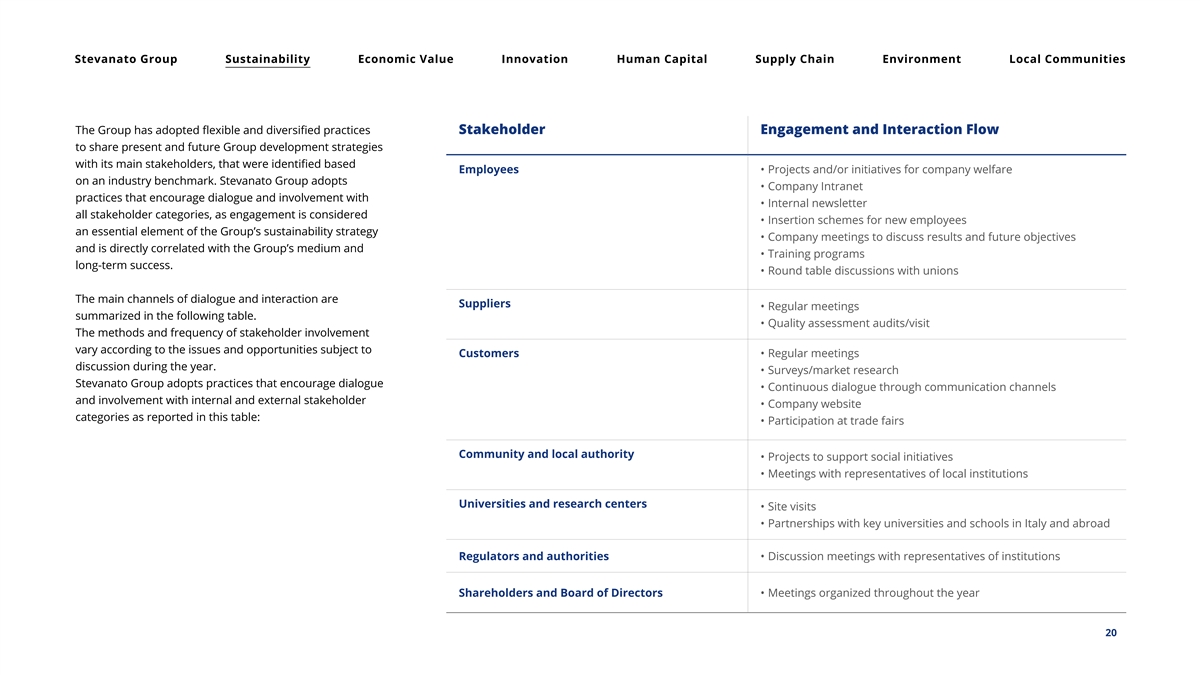
Stevanato Group Sustainability Economic Value Innovation Human Capital Supply Chain Environment Local Communities The Group has adopted flexible and diversified practices Stakeholder Engagement and Interaction Flow to share present and future Group development strategies with its main stakeholders, that were identified based Employees • Projects and/or initiatives for company welfare on an industry benchmark. Stevanato Group adopts • Company Intranet practices that encourage dialogue and involvement with • Internal newsletter all stakeholder categories, as engagement is considered • Insertion schemes for new employees an essential element of the Group’s sustainability strategy • Company meetings to discuss results and future objectives and is directly correlated with the Group’s medium and • Training programs long-term success. • Round table discussions with unions The main channels of dialogue and interaction are Suppliers • Regular meetings summarized in the following table. • Quality assessment audits/visit The methods and frequency of stakeholder involvement vary according to the issues and opportunities subject to Customers • Regular meetings discussion during the year. • Surveys/market research Stevanato Group adopts practices that encourage dialogue • Continuous dialogue through communication channels and involvement with internal and external stakeholder • Company website categories as reported in this table: • Participation at trade fairs Community and local authority • Projects to support social initiatives • Meetings with representatives of local institutions Universities and research centers • Site visits • Partnerships with key universities and schools in Italy and abroad Regulators and authorities • Discussion meetings with representatives of institutions Shareholders and Board of Directors • Meetings organized throughout the year 20
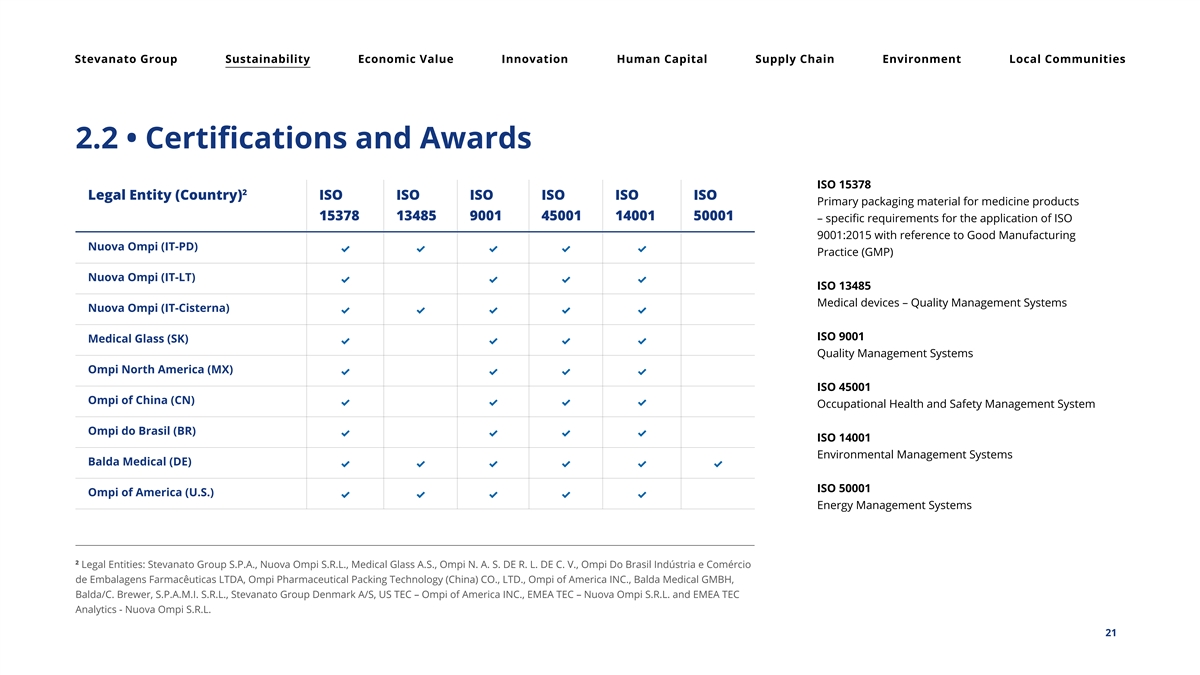
Stevanato Group Sustainability Economic Value Innovation Human Capital Supply Chain Environment Local Communities 2.2 • Certifications and Awards ISO 15378 2 Legal Entity (Country) ISO ISO ISO ISO ISO ISO Primary packaging material for medicine products 15378 13485 9001 45001 14001 50001 – specific requirements for the application of ISO 9001:2015 with reference to Good Manufacturing Nuova Ompi (IT-PD) ✓ ✓ ✓ ✓ ✓ Practice (GMP) Nuova Ompi (IT-LT) ✓ ✓ ✓ ✓ ISO 13485 Medical devices – Quality Management Systems Nuova Ompi (IT-Cisterna) ✓ ✓ ✓ ✓ ✓ ISO 9001 Medical Glass (SK) ✓ ✓ ✓ ✓ Quality Management Systems Ompi North America (MX) ✓ ✓ ✓ ✓ ISO 45001 Ompi of China (CN) ✓ ✓ ✓ ✓ Occupational Health and Safety Management System Ompi do Brasil (BR) ✓ ✓ ✓ ✓ ISO 14001 Environmental Management Systems Balda Medical (DE) ✓ ✓ ✓ ✓ ✓ ✓ ISO 50001 Ompi of America (U.S.) ✓ ✓ ✓ ✓ ✓ Energy Management Systems 2 Legal Entities: Stevanato Group S.P.A., Nuova Ompi S.R.L., Medical Glass A.S., Ompi N. A. S. DE R. L. DE C. V., Ompi Do Brasil Indústria e Comércio de Embalagens Farmacêuticas LTDA, Ompi Pharmaceutical Packing Technology (China) CO., LTD., Ompi of America INC., Balda Medical GMBH, Balda/C. Brewer, S.P.A.M.I. S.R.L., Stevanato Group Denmark A/S, US TEC – Ompi of America INC., EMEA TEC – Nuova Ompi S.R.L. and EMEA TEC Analytics - Nuova Ompi S.R.L. 21
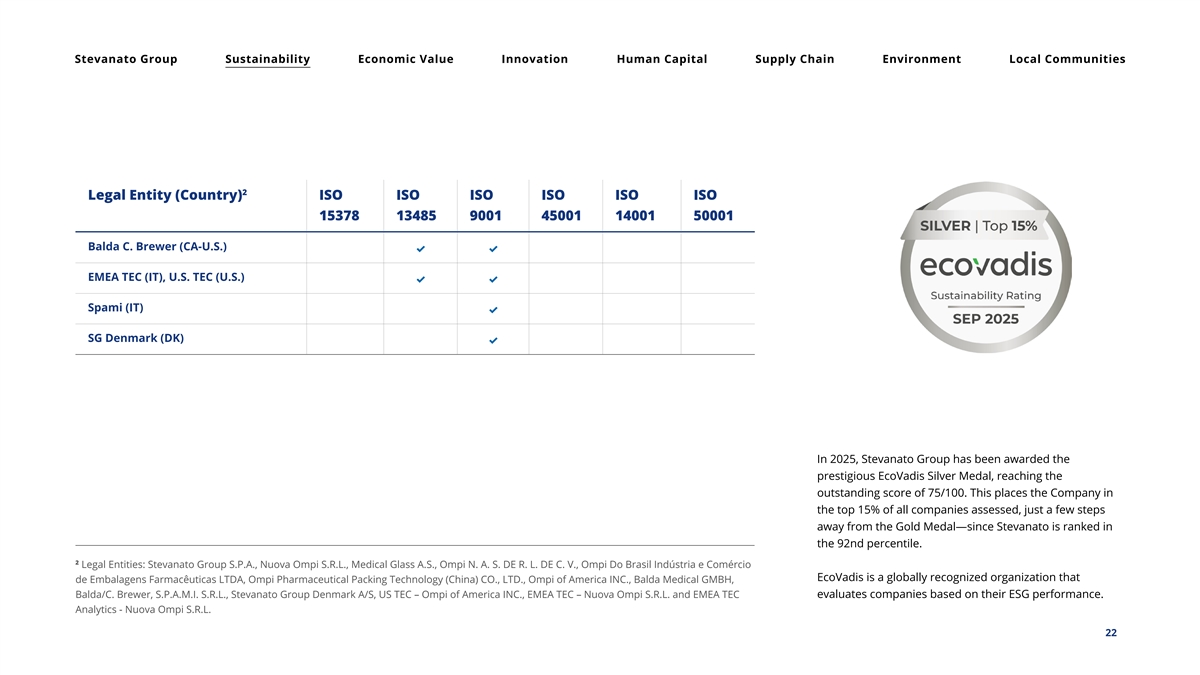
Stevanato Group Sustainability Economic Value Innovation Human Capital Supply Chain Environment Local Communities 2 Legal Entity (Country) ISO ISO ISO ISO ISO ISO 15378 13485 9001 45001 14001 50001 Balda C. Brewer (CA-U.S.) ✓ ✓ EMEA TEC (IT), U.S. TEC (U.S.) ✓ ✓ Spami (IT) ✓ SG Denmark (DK) ✓ In 2025, Stevanato Group has been awarded the prestigious EcoVadis Silver Medal, reaching the outstanding score of 75/100. This places the Company in the top 15% of all companies assessed, just a few steps away from the Gold Medal—since Stevanato is ranked in the 92nd percentile. 2 Legal Entities: Stevanato Group S.P.A., Nuova Ompi S.R.L., Medical Glass A.S., Ompi N. A. S. DE R. L. DE C. V., Ompi Do Brasil Indústria e Comércio EcoVadis is a globally recognized organization that de Embalagens Farmacêuticas LTDA, Ompi Pharmaceutical Packing Technology (China) CO., LTD., Ompi of America INC., Balda Medical GMBH, Balda/C. Brewer, S.P.A.M.I. S.R.L., Stevanato Group Denmark A/S, US TEC – Ompi of America INC., EMEA TEC – Nuova Ompi S.R.L. and EMEA TEC evaluates companies based on their ESG performance. Analytics - Nuova Ompi S.R.L. 22
Stevanato Group Sustainability Economic Value Innovation Human Capital Supply Chain Environment Local Communities 2.3 • Participation in Organizations and Associations Stevanato Group participates in initiatives organized In 2025, Stevanato did not participate in any by trade associations and organizations, facilitating the political-related and lobbying activities, and Stevanato exchange of ideas and knowledge. had no monetary contributions to political-related and lobbying groups. 23
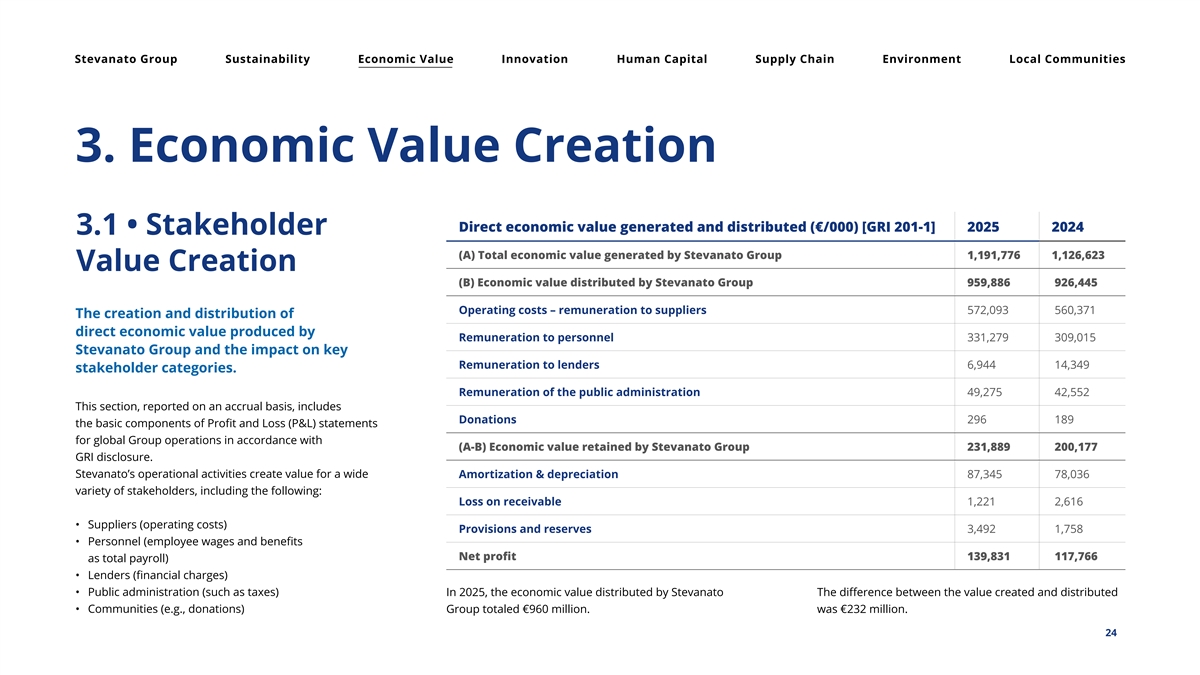
Stevanato Group Sustainability Economic Value Innovation Human Capital Supply Chain Environment Local Communities 3. Economic Value Creation Direct economic value generated and distributed (€/000) [GRI 201-1] 2025 2024 3.1 • Stakeholder (A) Total economic value generated by Stevanato Group 1,191,776 1,126,623 Value Creation (B) Economic value distributed by Stevanato Group 959,886 926,445 Operating costs – remuneration to suppliers 572,093 560,371 The creation and distribution of direct economic value produced by Remuneration to personnel 331,279 309,015 Stevanato Group and the impact on key Remuneration to lenders 6,944 14,349 stakeholder categories. Remuneration of the public administration 49,275 42,552 This section, reported on an accrual basis, includes Donations 296 189 the basic components of Profit and Loss (P&L) statements for global Group operations in accordance with (A-B) Economic value retained by Stevanato Group 231,889 200,177 GRI disclosure. Stevanato’s operational activities create value for a wide Amortization & depreciation 87,345 78,036 variety of stakeholders, including the following: Loss on receivable 1,221 2,616 • Suppliers (operating costs) Provisions and reserves 3,492 1,758 • Personnel (employee wages and benefits Net profit 139,831 117,766 as total payroll) • Lenders (financial charges) • Public administration (such as taxes) In 2025, the economic value distributed by Stevanato The difference between the value created and distributed • Communities (e.g., donations) Group totaled €960 million. was €232 million. 24
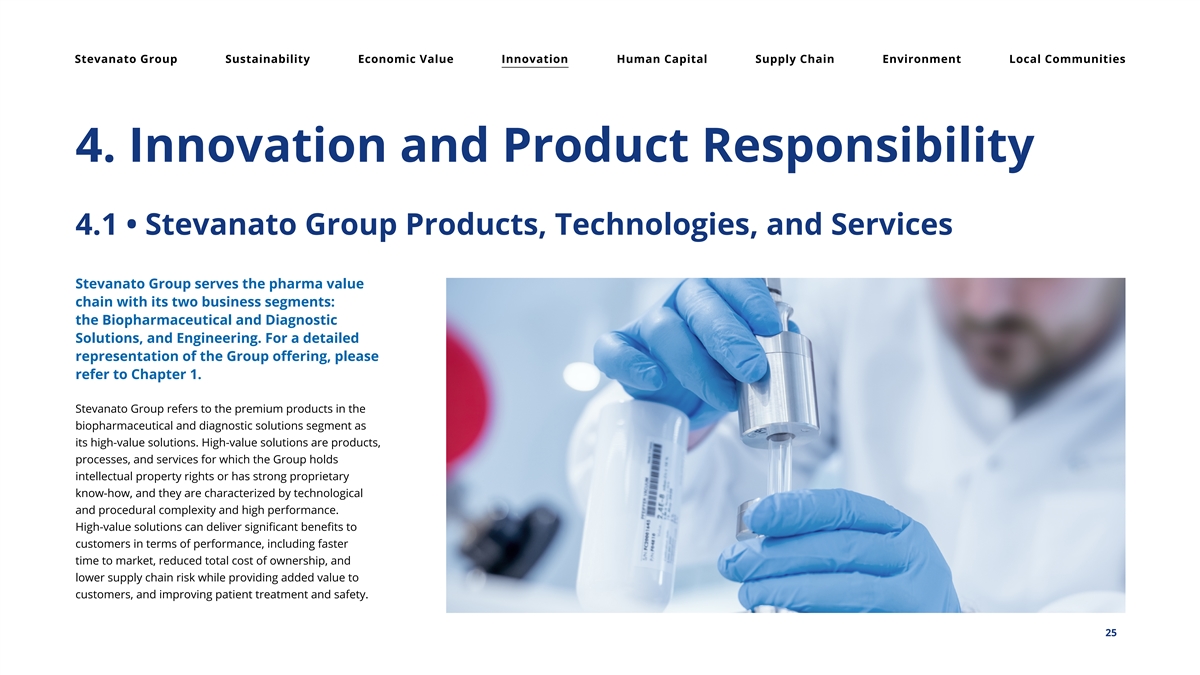
Stevanato Group Sustainability Economic Value Innovation Human Capital Supply Chain Environment Local Communities 4. Innovation and Product Responsibility 4.1 • Stevanato Group Products, Technologies, and Services Stevanato Group serves the pharma value chain with its two business segments: the Biopharmaceutical and Diagnostic Solutions, and Engineering. For a detailed representation of the Group offering, please refer to Chapter 1. Stevanato Group refers to the premium products in the biopharmaceutical and diagnostic solutions segment as its high-value solutions. High-value solutions are products, processes, and services for which the Group holds intellectual property rights or has strong proprietary know-how, and they are characterized by technological and procedural complexity and high performance. High-value solutions can deliver significant benefits to customers in terms of performance, including faster time to market, reduced total cost of ownership, and lower supply chain risk while providing added value to customers, and improving patient treatment and safety. 25
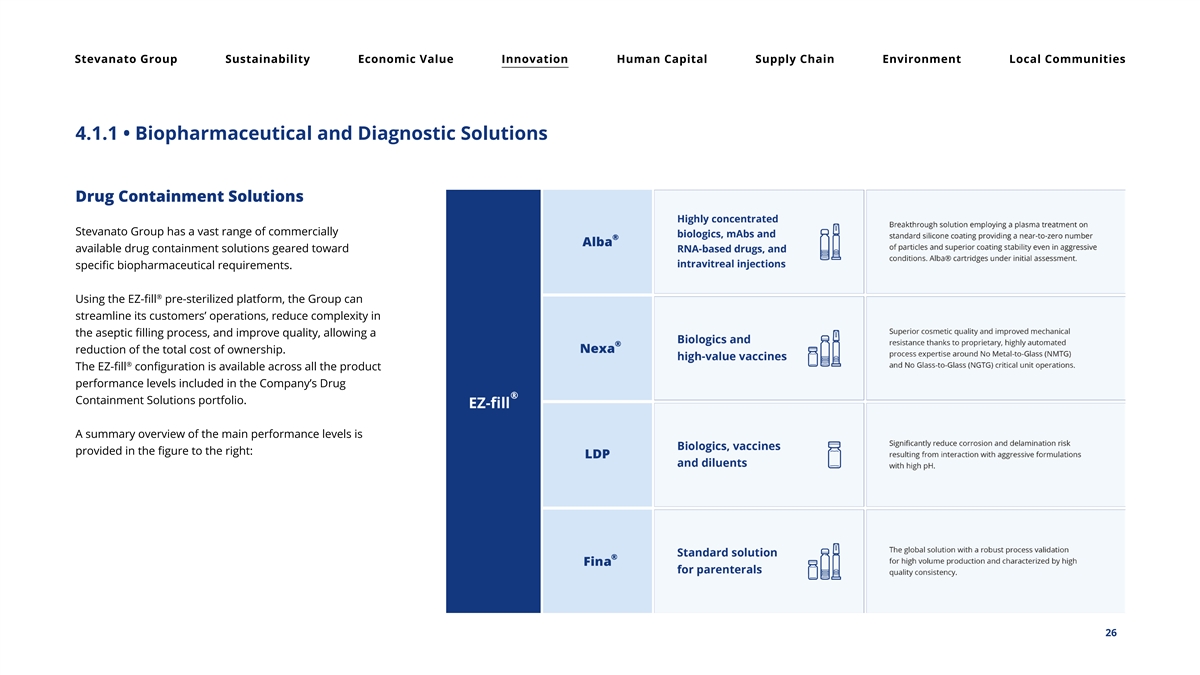
Stevanato Group Sustainability Economic Value Innovation Human Capital Supply Chain Environment Local Communities 4.1.1 • Biopharmaceutical and Diagnostic Solutions Drug Containment Solutions Stevanato Group has a vast range of commercially available drug containment solutions geared toward specific biopharmaceutical requirements. ® Using the EZ-fill pre-sterilized platform, the Group can streamline its customers’ operations, reduce complexity in the aseptic filling process, and improve quality, allowing a reduction of the total cost of ownership. ® The EZ-fill configuration is available across all the product performance levels included in the Company’s Drug Containment Solutions portfolio. A summary overview of the main performance levels is provided in the figure to the right: 26
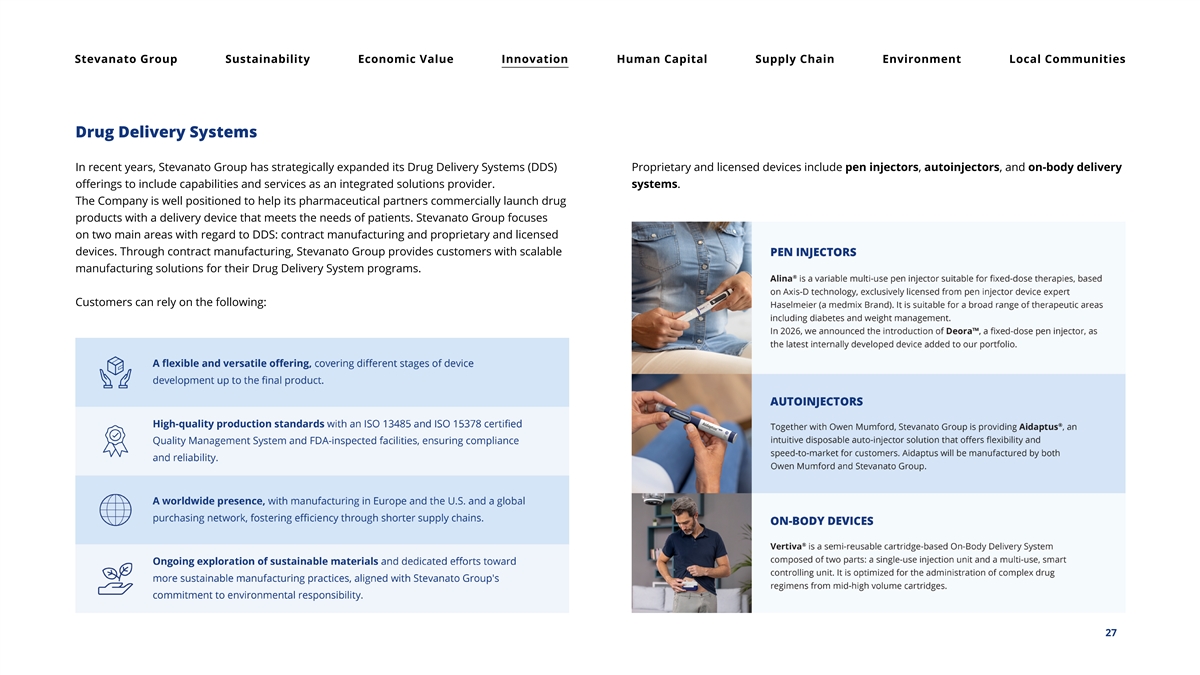
Stevanato Group Sustainability Economic Value Innovation Human Capital Supply Chain Environment Local Communities Drug Delivery Systems In recent years, Stevanato Group has strategically expanded its Drug Delivery Systems (DDS) Proprietary and licensed devices include pen injectors, autoinjectors, and on-body delivery offerings to include capabilities and services as an integrated solutions provider. systems. The Company is well positioned to help its pharmaceutical partners commercially launch drug products with a delivery device that meets the needs of patients. Stevanato Group focuses on two main areas with regard to DDS: contract manufacturing and proprietary and licensed devices. Through contract manufacturing, Stevanato Group provides customers with scalable manufacturing solutions for their Drug Delivery System programs. Customers can rely on the following: 27
Stevanato Group Sustainability Economic Value Innovation Human Capital Supply Chain Environment Local Communities IVD Solutions 4.1.2 • Engineering As a one-stop solution provider and manufacturer, the Group offers an integrated process, Stevanato Group’s vast portfolio of technologies and equipment includes state-of-the-art from process development to delivery of the final product, packaged, and sterilized as solutions for life science companies. needed, including point-of-care devices and in-vitro diagnostic consumables. • The Group specializes in fully automated glass-converting machines that are suitable for transforming glass tubes into vials, cartridges, syringes, and ampules. • The Group also provides flexible visual inspection solutions for containers filled with Analytical & Testing Services any drug, from transparent drugs to suspensions, and from liquid to gels, powders, or lyophilized drugs. Its portfolio ranges from benchtop to semiautomated and fully As a branch of research and development, Stevanato Group Technology Excellence Centers automatic equipment. (TECs) focus on the following: • Stevanato Group designs and manufactures medical-device assembly and packaging equipment suitable for various stages, from device characterization with small-scale • investigating the physical-chemical properties of primary packaging materials and production to high-speed commercial assembly and packaging solutions. The technology is components and studying the interactions between drug containment solutions and suitable for pen injectors, autoinjectors, wearable devices, and nasal sprays, and it includes injectable drug products; packaging solutions for cartoning, case packing, and palletizing modules, with integrated • providing laboratory services for engineering characterization and design verification of serialization and tamper-evident units compliant with the latest requirements. pharmaceutical packaging, medical devices, and components comprising • All Stevanato Group equipment in operation is supported by a global after-sales combination products; organization: a 24/7 support service that ensures continuous assistance to help customers • supporting customers in screening and selecting the most suitable container system resume production promptly as needed. Customer productivity is a top priority, and we solution for their injectable drug product platforms. offer a team of support specialists who are available to provide expert troubleshooting assistance in different areas of support: mechanical, electrical, automation, and vision. Stevanato Group relies on a multidisciplinary team of highly skilled scientists. • Stevanato Group also supports customers with a comprehensive portfolio of services, Their knowledge and experience cover a range of specialized areas, including drug including training, production support, and maintenance assistance, as well as products, containment solutions and drug delivery devices. such as spare parts and retrofit kits, enabling them to manage the entire life cycle of their equipment efficiently. 28
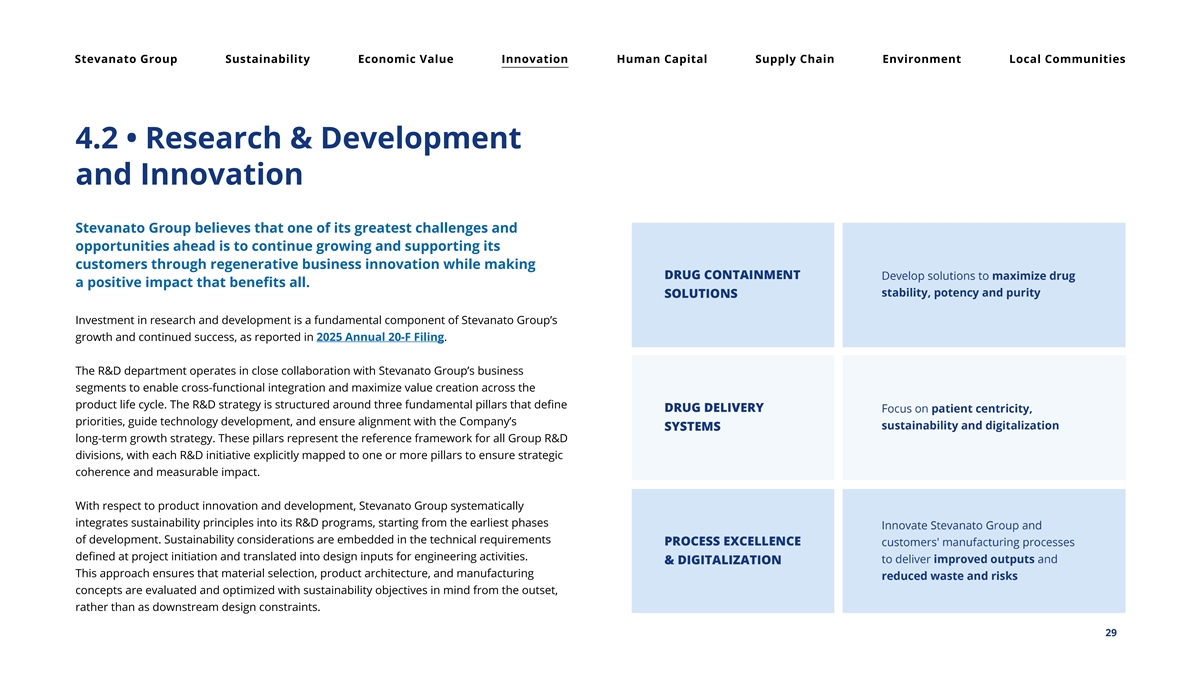
Stevanato Group Sustainability Economic Value Innovation Human Capital Supply Chain Environment Local Communities 4.2 • Research & Development and Innovation Stevanato Group believes that one of its greatest challenges and opportunities ahead is to continue growing and supporting its customers through regenerative business innovation while making a positive impact that benefits all. Investment in research and development is a fundamental component of Stevanato Group’s growth and continued success, as reported in 2025 Annual 20-F Filing. The R&D department operates in close collaboration with Stevanato Group’s business segments to enable cross-functional integration and maximize value creation across the product life cycle. The R&D strategy is structured around three fundamental pillars that define priorities, guide technology development, and ensure alignment with the Company’s long-term growth strategy. These pillars represent the reference framework for all Group R&D divisions, with each R&D initiative explicitly mapped to one or more pillars to ensure strategic coherence and measurable impact. With respect to product innovation and development, Stevanato Group systematically integrates sustainability principles into its R&D programs, starting from the earliest phases of development. Sustainability considerations are embedded in the technical requirements defined at project initiation and translated into design inputs for engineering activities. This approach ensures that material selection, product architecture, and manufacturing concepts are evaluated and optimized with sustainability objectives in mind from the outset, rather than as downstream design constraints. 29
Stevanato Group Sustainability Economic Value Innovation Human Capital Supply Chain Environment Local Communities 4.2.1 • R&D for Drug Containment Solutions (DCS) Stevanato Group’s DCS team is dedicated to designing, developing, and manufacturing polymers is obtained from renewably sourced feedstocks derived solely from waste. syringes, vials, and cartridges that provide higher drug compatibility between the primary This reduces fossil resource consumption and emissions associated with the life cycle packaging and the drug products (i.e., with the lowest particle generation, reduced, or even of the product while ensuring the same level of quality. Hence, Stevanato Group could no extractable release, and metal-free options). The Drug Containment Solutions are offered be International Sustainability and Carbon Certification (ISCC+) ready, as in the past, in in standard bulk or pre-sterilized, ready-to-use formats. The team is also responsible for the compliance with the mass balance approach, which helps maintain trust among customers identification and development of Stevanato Group solutions for biologics needs, such as and throughout the value chain. GLP-1s, mAbs, ADCs, and RNA-based drugs. The Group remains committed to innovation, and Stevanato Group’s next-generation EZ-fill ® The DCS team strives to ensure compatibility between our primary packaging and the Group’s Smart is expected to offer low-temperature vaporized hydrogen peroxide (VHP) sterilization, proprietary and licensed devices, as well as the devices selected from customers, through a more environmentally friendly method than traditional ethylene oxide (EtO) sterilization, appropriate testing and proper applicability of the Drug Delivery Systems to the glass primary which can result in improved safety. It is intended to improve sustainability and increase packaging technical requirements specifications. packaging efficiency using biopolymers and recycled plastic. Stevanato Group has also introduced new sustainability practices as part of its corporate Over the past few years, Stevanato Group has concluded the Life Cycle Assessment (LCA) sustainability and circular innovation measures, with an emphasis on identifying alternative of some of its DCS product platforms. This rigorous process plays a pivotal role in making materials and processes that provide more sustainable sterilization techniques while informed, data-driven decisions aimed at reducing the environmental impact of products. maintaining the overall performance of the materials post-sterilization cycle. By pinpointing critical areas and designing future processes, the Group can quantify the potential benefits of sustainability initiatives and select the most promising ones. As part of its corporate sustainability and circular innovation measures, Stevanato Group regularly dialogues with customers on a sustainable version of secondary packaging focused In addition, Stevanato Group investigated how to reduce the environmental impact of on biopolymers and recycled plastic as well as packaging and process improvements to glass-based end-of-life Drug Containment Solutions while identifying improved circular reduce related emissions and other sustainable measures. Stevanato Group aims to reduce end-of-life solutions and creating upcycling solutions for glass-based products. In the past, emissions and the use of fossil resources. Ready-to-use drug containers require single-use Stevanato Group won first prize in an open innovation competition. The Company’s R&D polymers for pharmaceutical secondary packaging (Nest and Tub) to help ensure sterility and department partners with the regulatory department to assess the impact of the Plastic processability. Indeed, a biocircular version of polystyrene and polypropylene that is used to Packaging Waste Regulation on the existing product portfolio and on the new products produce secondary packaging of syringes has been identified. The raw material for producing to be developed. 30
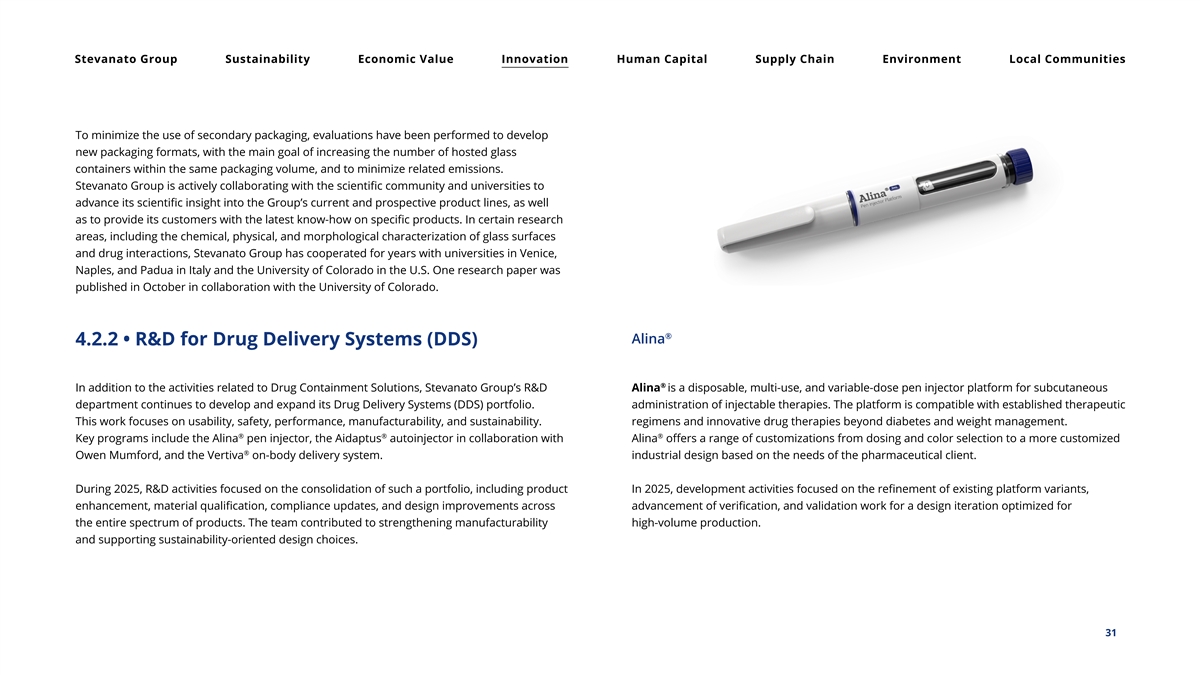
Stevanato Group Sustainability Economic Value Innovation Human Capital Supply Chain Environment Local Communities To minimize the use of secondary packaging, evaluations have been performed to develop new packaging formats, with the main goal of increasing the number of hosted glass containers within the same packaging volume, and to minimize related emissions. Stevanato Group is actively collaborating with the scientific community and universities to advance its scientific insight into the Group’s current and prospective product lines, as well as to provide its customers with the latest know-how on specific products. In certain research areas, including the chemical, physical, and morphological characterization of glass surfaces and drug interactions, Stevanato Group has cooperated for years with universities in Venice, Naples, and Padua in Italy and the University of Colorado in the U.S. One research paper was published in October in collaboration with the University of Colorado. ® Alina 4.2.2 • R&D for Drug Delivery Systems (DDS) ® In addition to the activities related to Drug Containment Solutions, Stevanato Group’s R&D Alina is a disposable, multi-use, and variable-dose pen injector platform for subcutaneous department continues to develop and expand its Drug Delivery Systems (DDS) portfolio. administration of injectable therapies. The platform is compatible with established therapeutic This work focuses on usability, safety, performance, manufacturability, and sustainability. regimens and innovative drug therapies beyond diabetes and weight management. ® ® ® Key programs include the Alina pen injector, the Aidaptus autoinjector in collaboration with Alina offers a range of customizations from dosing and color selection to a more customized ® Owen Mumford, and the Vertiva on-body delivery system. industrial design based on the needs of the pharmaceutical client. During 2025, R&D activities focused on the consolidation of such a portfolio, including product In 2025, development activities focused on the refinement of existing platform variants, enhancement, material qualification, compliance updates, and design improvements across advancement of verification, and validation work for a design iteration optimized for the entire spectrum of products. The team contributed to strengthening manufacturability high-volume production. and supporting sustainability-oriented design choices. 31
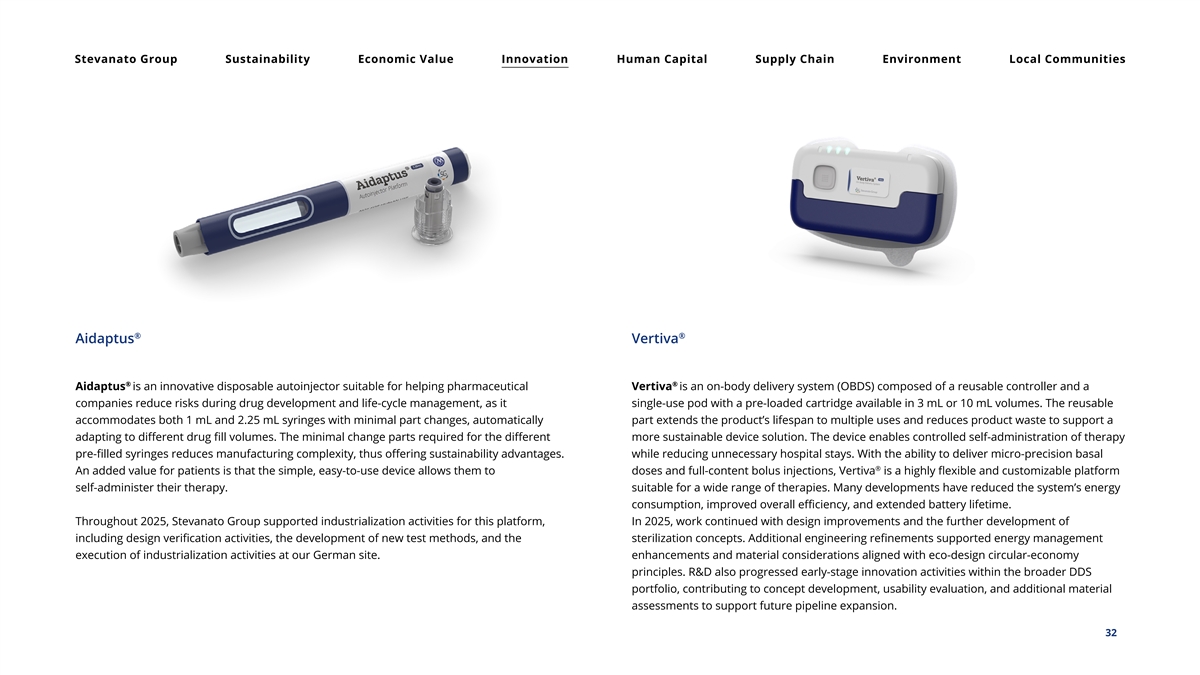
Stevanato Group Sustainability Economic Value Innovation Human Capital Supply Chain Environment Local Communities ® ® Aidaptus Vertiva ® ® Aidaptus is an innovative disposable autoinjector suitable for helping pharmaceutical Vertiva is an on-body delivery system (OBDS) composed of a reusable controller and a companies reduce risks during drug development and life-cycle management, as it single-use pod with a pre-loaded cartridge available in 3 mL or 10 mL volumes. The reusable accommodates both 1 mL and 2.25 mL syringes with minimal part changes, automatically part extends the product’s lifespan to multiple uses and reduces product waste to support a adapting to different drug fill volumes. The minimal change parts required for the different more sustainable device solution. The device enables controlled self-administration of therapy pre-filled syringes reduces manufacturing complexity, thus offering sustainability advantages. while reducing unnecessary hospital stays. With the ability to deliver micro-precision basal ® An added value for patients is that the simple, easy-to-use device allows them to doses and full-content bolus injections, Vertiva is a highly flexible and customizable platform self-administer their therapy. suitable for a wide range of therapies. Many developments have reduced the system’s energy consumption, improved overall efficiency, and extended battery lifetime. Throughout 2025, Stevanato Group supported industrialization activities for this platform, In 2025, work continued with design improvements and the further development of including design verification activities, the development of new test methods, and the sterilization concepts. Additional engineering refinements supported energy management execution of industrialization activities at our German site. enhancements and material considerations aligned with eco-design circular-economy principles. R&D also progressed early-stage innovation activities within the broader DDS portfolio, contributing to concept development, usability evaluation, and additional material assessments to support future pipeline expansion. 32
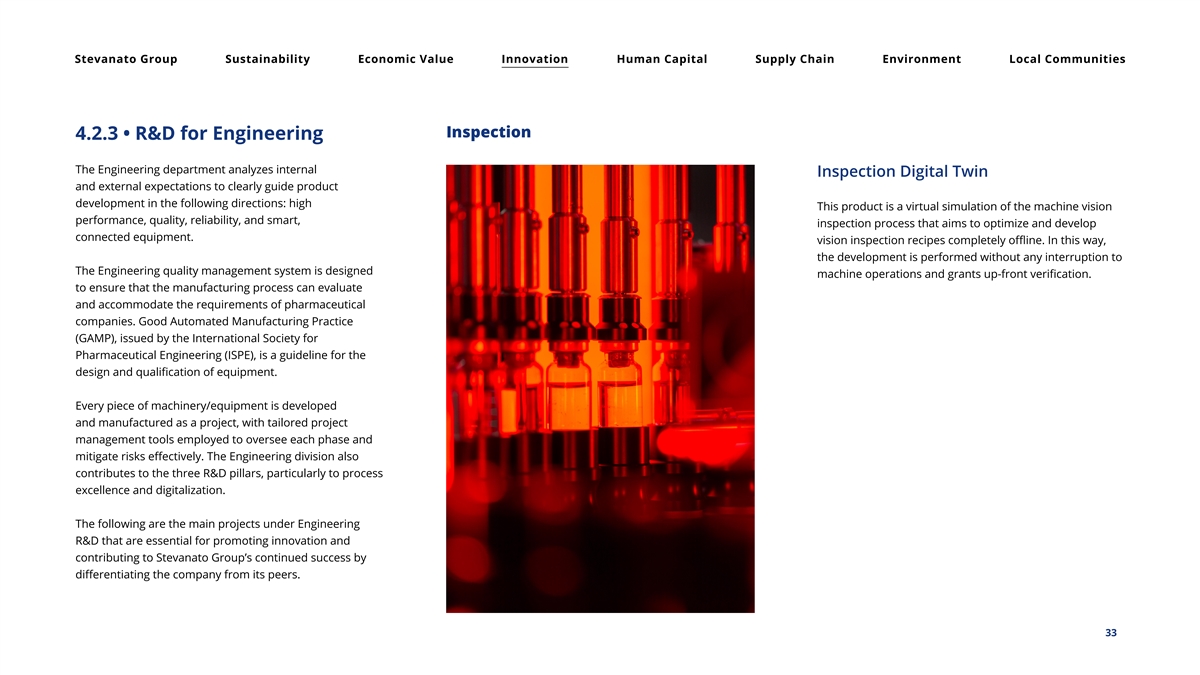
Stevanato Group Sustainability Economic Value Innovation Human Capital Supply Chain Environment Local Communities Inspection 4.2.3 • R&D for Engineering The Engineering department analyzes internal Inspection Digital Twin and external expectations to clearly guide product development in the following directions: high This product is a virtual simulation of the machine vision performance, quality, reliability, and smart, inspection process that aims to optimize and develop connected equipment. vision inspection recipes completely offline. In this way, the development is performed without any interruption to The Engineering quality management system is designed machine operations and grants up-front verification. to ensure that the manufacturing process can evaluate and accommodate the requirements of pharmaceutical companies. Good Automated Manufacturing Practice (GAMP), issued by the International Society for Pharmaceutical Engineering (ISPE), is a guideline for the design and qualification of equipment. Every piece of machinery/equipment is developed and manufactured as a project, with tailored project management tools employed to oversee each phase and mitigate risks effectively. The Engineering division also contributes to the three R&D pillars, particularly to process excellence and digitalization. The following are the main projects under Engineering R&D that are essential for promoting innovation and contributing to Stevanato Group’s continued success by differentiating the company from its peers. 33
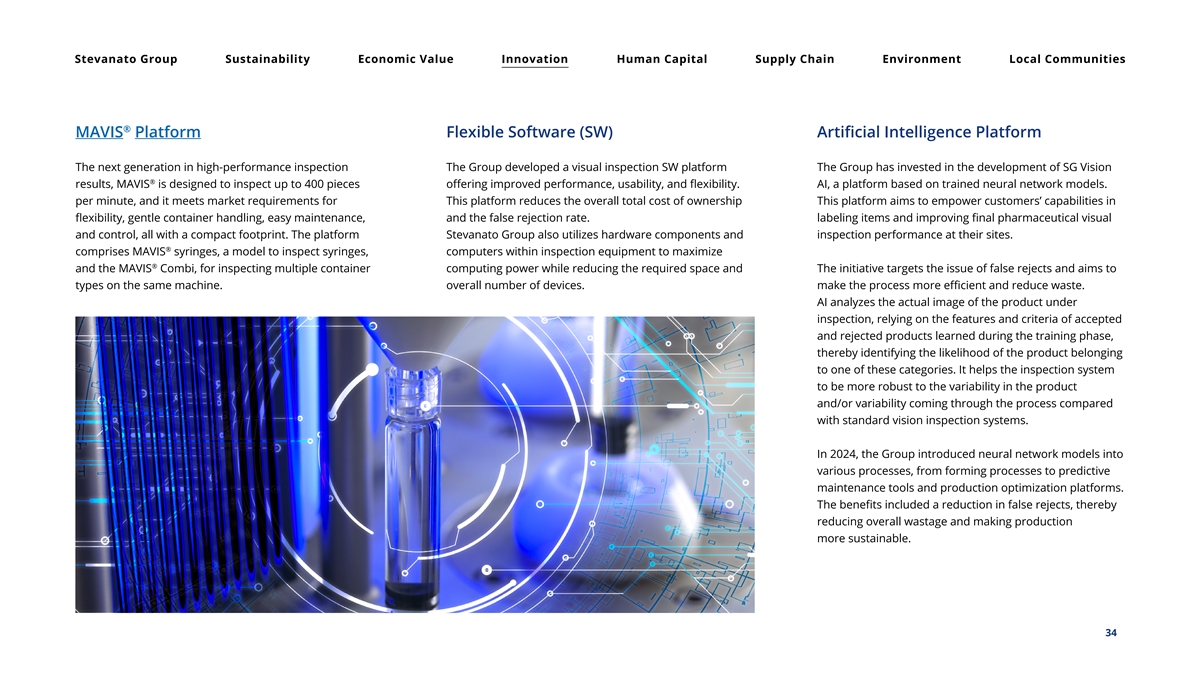
Stevanato Group Sustainability Economic Value Innovation Human Capital Supply Chain Environment Local Communities ® MAVIS Platform Flexible Software (SW) Artificial Intelligence Platform The next generation in high-performance inspection The Group developed a visual inspection SW platform The Group has invested in the development of SG Vision ® results, MAVIS is designed to inspect up to 400 pieces offering improved performance, usability, and flexibility. AI, a platform based on trained neural network models. per minute, and it meets market requirements for This platform reduces the overall total cost of ownership This platform aims to empower customers’ capabilities in flexibility, gentle container handling, easy maintenance, and the false rejection rate. labeling items and improving final pharmaceutical visual and control, all with a compact footprint. The platform Stevanato Group also utilizes hardware components and inspection performance at their sites. ® comprises MAVIS syringes, a model to inspect syringes, computers within inspection equipment to maximize ® and the MAVIS Combi, for inspecting multiple container computing power while reducing the required space and The initiative targets the issue of false rejects and aims to types on the same machine. overall number of devices. make the process more efficient and reduce waste. AI analyzes the actual image of the product under inspection, relying on the features and criteria of accepted and rejected products learned during the training phase, thereby identifying the likelihood of the product belonging to one of these categories. It helps the inspection system to be more robust to the variability in the product and/or variability coming through the process compared with standard vision inspection systems. In 2024, the Group introduced neural network models into various processes, from forming processes to predictive maintenance tools and production optimization platforms. The benefits included a reduction in false rejects, thereby reducing overall wastage and making production more sustainable. 34
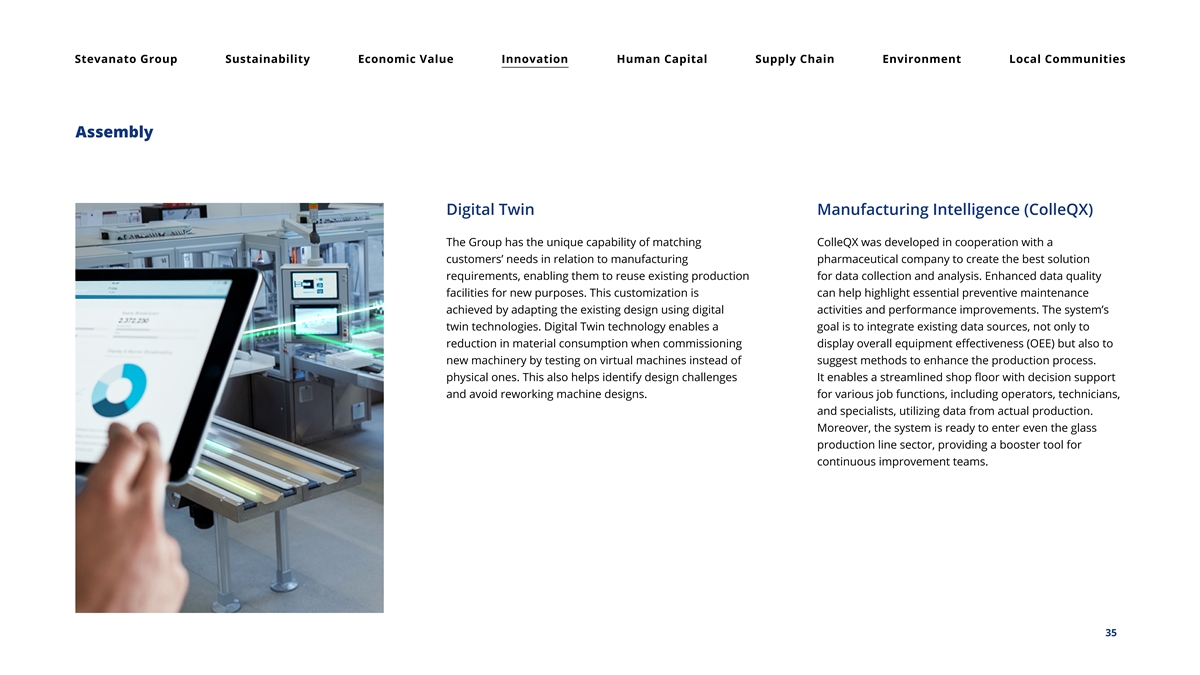
Stevanato Group Sustainability Economic Value Innovation Human Capital Supply Chain Environment Local Communities Assembly Digital Twin Manufacturing Intelligence (ColleQX) The Group has the unique capability of matching ColleQX was developed in cooperation with a customers’ needs in relation to manufacturing pharmaceutical company to create the best solution requirements, enabling them to reuse existing production for data collection and analysis. Enhanced data quality facilities for new purposes. This customization is can help highlight essential preventive maintenance achieved by adapting the existing design using digital activities and performance improvements. The system’s twin technologies. Digital Twin technology enables a goal is to integrate existing data sources, not only to reduction in material consumption when commissioning display overall equipment effectiveness (OEE) but also to new machinery by testing on virtual machines instead of suggest methods to enhance the production process. physical ones. This also helps identify design challenges It enables a streamlined shop floor with decision support and avoid reworking machine designs. for various job functions, including operators, technicians, and specialists, utilizing data from actual production. Moreover, the system is ready to enter even the glass production line sector, providing a booster tool for continuous improvement teams. 35
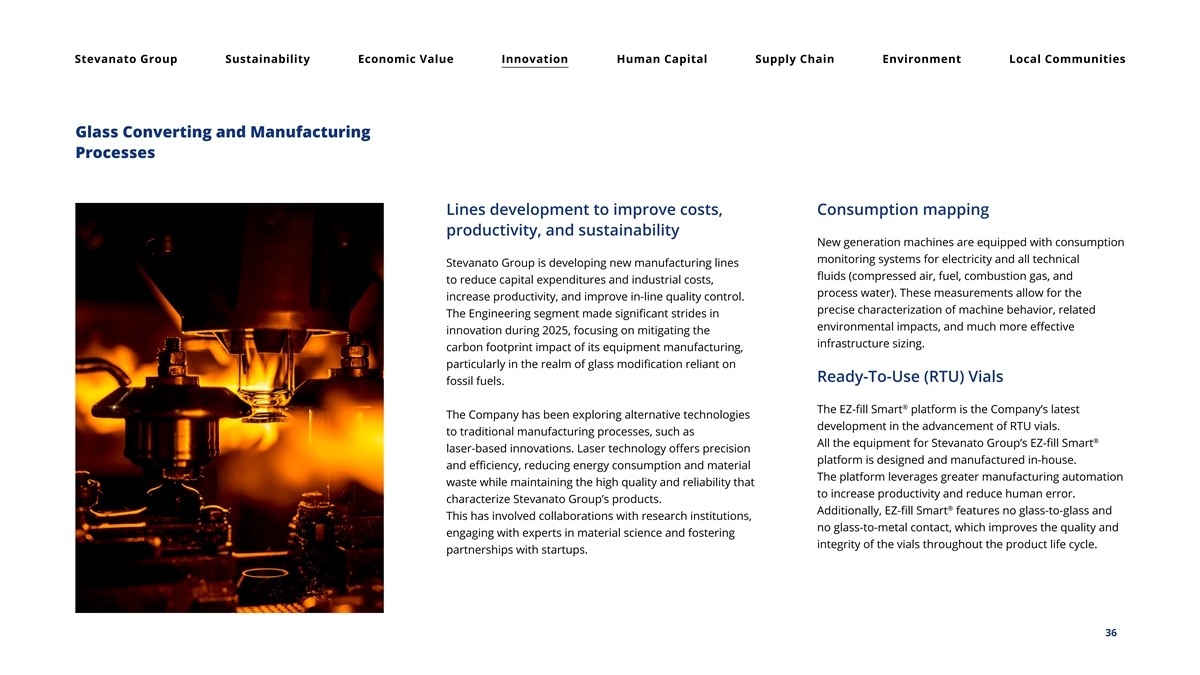
Stevanato Group Sustainability Economic Value Innovation Human Capital Supply Chain Environment Local Communities Glass Converting and Manufacturing Processes Lines development to improve costs, Consumption mapping productivity, and sustainability New generation machines are equipped with consumption monitoring systems for electricity and all technical Stevanato Group is developing new manufacturing lines fluids (compressed air, fuel, combustion gas, and to reduce capital expenditures and industrial costs, process water). These measurements allow for the increase productivity, and improve in-line quality control. precise characterization of machine behavior, related The Engineering segment made significant strides in environmental impacts, and much more effective innovation during 2025, focusing on mitigating the infrastructure sizing. carbon footprint impact of its equipment manufacturing, particularly in the realm of glass modification reliant on Ready-To-Use (RTU) Vials fossil fuels. ® The EZ-fill Smart platform is the Company’s latest The Company has been exploring alternative technologies development in the advancement of RTU vials. to traditional manufacturing processes, such as ® All the equipment for Stevanato Group’s EZ-fill Smart laser-based innovations. Laser technology offers precision platform is designed and manufactured in-house. and efficiency, reducing energy consumption and material The platform leverages greater manufacturing automation waste while maintaining the high quality and reliability that to increase productivity and reduce human error. characterize Stevanato Group’s products. ® Additionally, EZ-fill Smart features no glass-to-glass and This has involved collaborations with research institutions, no glass-to-metal contact, which improves the quality and engaging with experts in material science and fostering integrity of the vials throughout the product life cycle. partnerships with startups. 36
Stevanato Group Sustainability Economic Value Innovation Human Capital Supply Chain Environment Local Communities Expanding Manufacturing Intelligence 4.2.4 • Analytical Services Platform (ColleQX-based) to Glass Converting and Visual Inspection Stevanato Group is expanding its ColleQX-based Stevanato Group’s Technology Excellence Centers drug product development by providing the analytical Manufacturing Intelligence Platform, initially developed (TECs) employ more than 45 people located in Piombino and scientific support required to obtain the relevant for assembly processes, to include glass converting and Dese (Italy) and Boston, MA (U.S.), and they have broad regulatory authorizations. visual inspection machines. ColleQX is a data collection experience in chemistry, engineering, physics, materials, and analysis platform that enhances production efficiency and pharmaceutical sciences. TECs investigate the • The design, development, validation, and execution of through real-time insights, helping to monitor equipment physicochemical and mechanical properties of primary engineering and verification testing of medical devices performance, identify areas for improvement, and enable packaging materials and components, and the functional and combination products. The TECs have implemented predictive maintenance. characterization of drug delivery devices. innovative tools to support the understanding of This expansion will provide operators and technicians with phenomena (e.g., mathematical modeling) that have deeper visibility into critical processes, ensuring consistent Their research and expertise focus on the following: been or will be used to de-risk the development quality and optimizing resource use, thereby reflecting initiatives of the new product platforms within Stevanato Group’s commitment to smart technologies and • By studying the interaction between drug containment Stevanato Group. Furthermore, the TECs have continued operational excellence. solutions and drug products, we provide valuable data to support strategic collaboration with worldwide to customers for defining the optimal drug containment academia, contract research organizations, and public or delivery solution. This allows us to engage with or private institutions to identify the next-generation our clients earlier in the development phase of their technologies (products and processes) associated with drugs and position ourselves well to become suppliers medical devices and combination products. for their containment solution and, potentially, their More recently, alongside university partners, we have drug delivery systems and related process equipment. begun studying the interaction between specific drug The containment and delivery solution we provide is product formulations and primary containers. an integral part of the drug product itself, and it is a mandatory inclusion in regulatory filings before commercialization. We also assist our customers in this phase of their 37
Stevanato Group Sustainability Economic Value Innovation Human Capital Supply Chain Environment Local Communities 4.3 • Product Quality and Responsibility System and the Stevanato Group Quality Policy to maximize the quality and integrity of the As a commitment to the production of high-quality products, Stevanato Group’s products. Group has adopted a Group Quality Policy that supports collaboration with customers throughout the life cycles of their products, from Drug containment, diagnostic, and delivery solutions have often come from years of concept development to commercialization and post-sales support. collaboration with customers to develop the optimal method for containing a drug product This policy reflects the Group’s dedication to delivering high-quality and delivering it to the patient community. The customized solutions provided vary depending products, advanced technologies, and services that fulfill and anticipate on the characteristics and chemical composition of the pharmaceutical products, logistical its customers’ needs while avoiding market recalls and maximizing the needs (e.g., transport, and shelf life), factors such as the designated patient community quality and integrity of the Group’s products. With ISCC+ certification (potentially including the geographic location), and specific regulatory requirements. readiness, the Group can create a chain of custody for the processing of The containment and delivery solution provided is an integral component of the drug product sustainable materials along the value chain. itself and is part of the regulatory filings required to approve drug product marketing and commercialization. Hence, the quality and dependability of drug containment and delivery The Group is committed to creating high-quality systems, processes, and services that solutions are critical to obtaining commercialization and marketing approval from regulatory enhance the integrity of medicines. To ensure product quality, Stevanato Group meets the agencies. As a result, it is often the case that drug product containment and delivery solutions certification standards (refer to section 2.2). In particular, the readiness for ISCC+, which is cannot be changed without amending the regulatory filings that have been specifically a globally recognized certification system for recycled and biocircular materials, could allow approved by the relevant regulatory agency. compliance with social and environmental sustainability criteria. This certification could help to ensure compliance with checks at every point in the supply chain to establish integrity and In 2025, Stevanato Group neither initiated a recall from the market nor received any formal clear evidence of sustainable material processing. In addition, this certification could enhance communication from a third party regarding initiating a recall from the market due to our product portfolio as the Group broadens its sustainable development practices when the our product. market is ready to pursue regenerative business innovation. Every employee in Stevanato Group, at all levels, is accountable and strives to ensure the continuous improvement and effectiveness of the Stevanato Group Quality Management 38
Stevanato Group Sustainability Economic Value Innovation Human Capital Supply Chain Environment Local Communities 5. Human Capital 5.1 • Stevanato Group’s Human Resources self-development for all candidates, while ensuring promoting a social environment that creates a sense of Values are the behavioral compass of fairness and inclusiveness in the selection process. belonging, valuing inclusion at all levels and locations. Stevanato Group and the roots of our • People development: Offering paths to learning and leadership in excellence. We foster a development that nurture and retain talent and support Our Values serve as common ground and a compass for culture that respects Inclusion & Belonging 3 the Group’s growth. Training courses that bolster the Group’s Human Capital Management strategy and and encourages individual contributions technical, managerial, and organizational skills to along with a focus on customer centricity, are the essence while rewarding merit and measurable support employees’ continuous improvement and tools of our corporate culture, which the Group is committed to achievements. The Group’s policies focus that assess employee performance help individuals disseminating and promoting through dedicated training on ensuring fair treatment in terms constantly evolve and pursue their personal objectives. and communication campaigns. of compensation, benefits, and career • Talent management and succession planning: development and embrace Merit, Inclusion Adopting a proactive and integrated approach to talent The Group is guided by legislation and international & Belonging as the first step of the journey. management, ensuring that the right capabilities are principles and is committed to maintaining a climate of nurtured to support business growth and innovation. trust and respect that promotes inclusion and team spirit. Stevanato Group’s Human Capital Management strategy Succession planning is a cornerstone of this strategy, The Code of Ethics sets out the standards of conduct endeavors to build a strong team and foster the Group’s enabling us to identify and develop future leaders while identified by the Group. sustainable growth through the following key areas safeguarding organizational continuity. of intervention: • Engagement and reward: Implementing clear policies All stakeholders shall respect the guidelines that represent to reward merit and measurable achievements in a the Company’s pillars of business: legality, fairness, • Talent attraction and acquisition: Attracting talent transparent, equal, and fair way while guaranteeing through competitive offers in terms of career and welfare programs that support employee well-being and 3 See section 1.3 “Mission, Vision and Values” for further details. 39
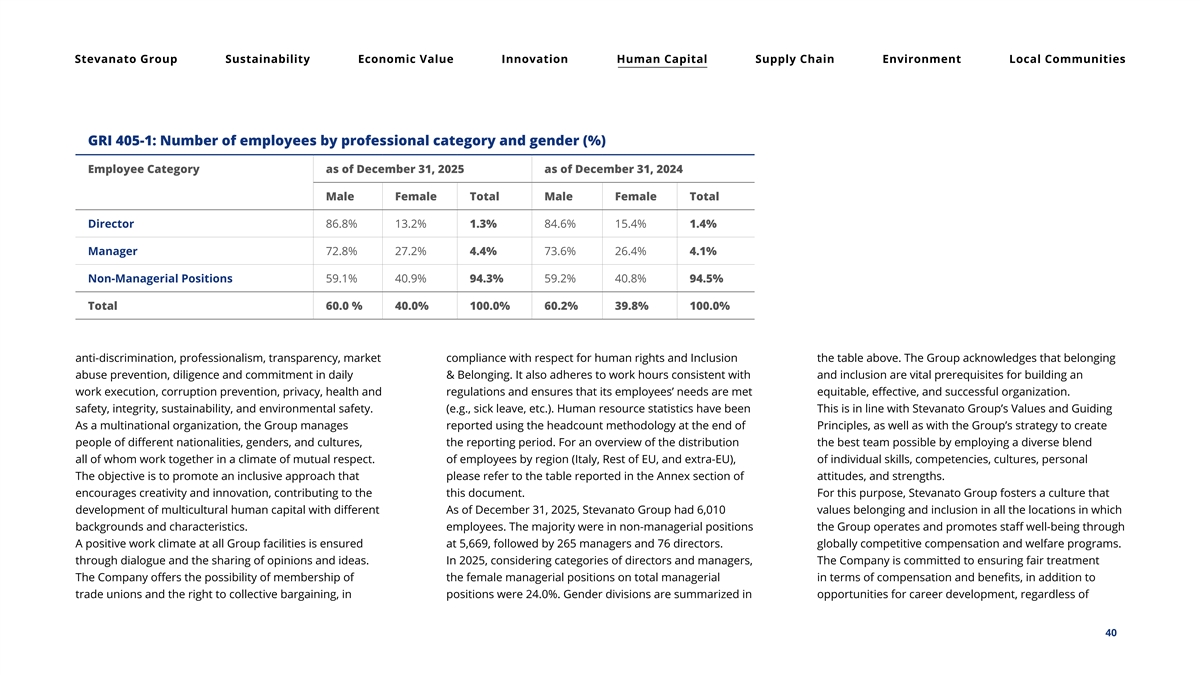
Stevanato Group Sustainability Economic Value Innovation Human Capital Supply Chain Environment Local Communities GRI 405-1: Number of employees by professional category and gender (%) Employee Category as of December 31, 2025 as of December 31, 2024 Male Female Total Male Female Total Director 86.8% 13.2% 1.3% 84.6% 15.4% 1.4% Manager 72.8% 27.2% 4.4% 73.6% 26.4% 4.1% Non-Managerial Positions 59.1% 40.9% 94.3% 59.2% 40.8% 94.5% Total 60.0 % 40.0% 100.0% 60.2% 39.8% 100.0% anti-discrimination, professionalism, transparency, market compliance with respect for human rights and Inclusion the table above. The Group acknowledges that belonging abuse prevention, diligence and commitment in daily & Belonging. It also adheres to work hours consistent with and inclusion are vital prerequisites for building an work execution, corruption prevention, privacy, health and regulations and ensures that its employees’ needs are met equitable, effective, and successful organization. safety, integrity, sustainability, and environmental safety. (e.g., sick leave, etc.). Human resource statistics have been This is in line with Stevanato Group’s Values and Guiding As a multinational organization, the Group manages reported using the headcount methodology at the end of Principles, as well as with the Group’s strategy to create people of different nationalities, genders, and cultures, the reporting period. For an overview of the distribution the best team possible by employing a diverse blend all of whom work together in a climate of mutual respect. of employees by region (Italy, Rest of EU, and extra-EU), of individual skills, competencies, cultures, personal The objective is to promote an inclusive approach that please refer to the table reported in the Annex section of attitudes, and strengths. encourages creativity and innovation, contributing to the this document. For this purpose, Stevanato Group fosters a culture that development of multicultural human capital with different As of December 31, 2025, Stevanato Group had 6,010 values belonging and inclusion in all the locations in which backgrounds and characteristics. employees. The majority were in non-managerial positions the Group operates and promotes staff well-being through A positive work climate at all Group facilities is ensured at 5,669, followed by 265 managers and 76 directors. globally competitive compensation and welfare programs. through dialogue and the sharing of opinions and ideas. In 2025, considering categories of directors and managers, The Company is committed to ensuring fair treatment The Company offers the possibility of membership of the female managerial positions on total managerial in terms of compensation and benefits, in addition to trade unions and the right to collective bargaining, in positions were 24.0%. Gender divisions are summarized in opportunities for career development, regardless of 40
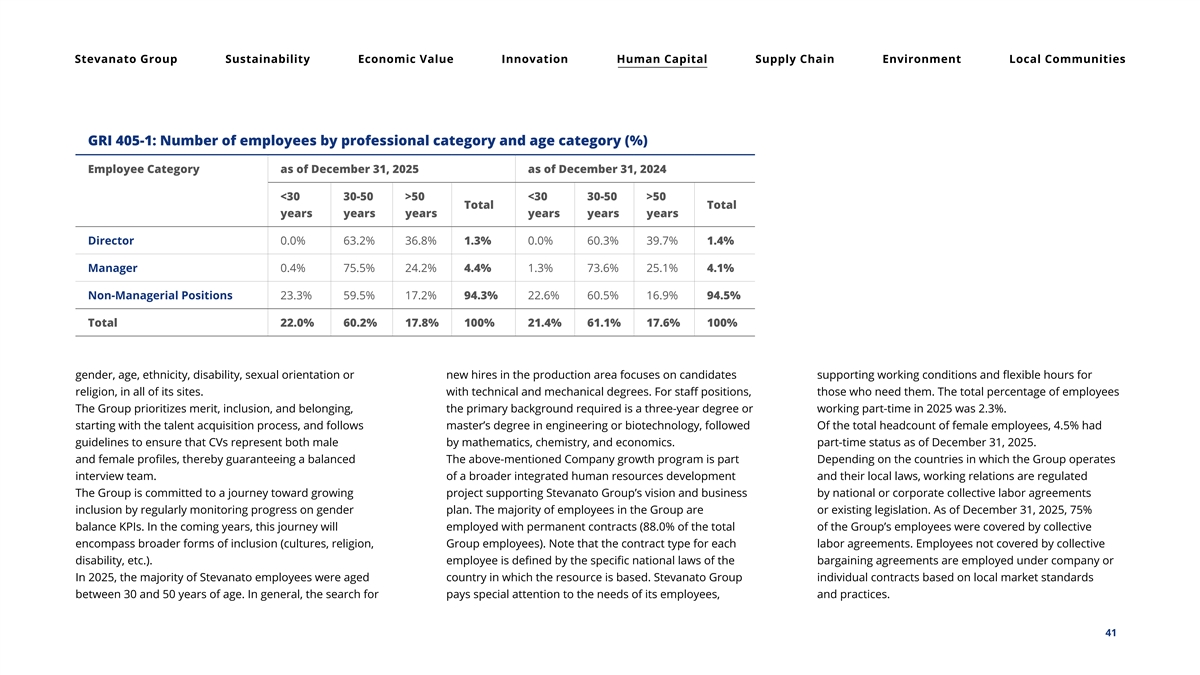
Stevanato Group Sustainability Economic Value Innovation Human Capital Supply Chain Environment Local Communities GRI 405-1: Number of employees by professional category and age category (%) Employee Category as of December 31, 2025 as of December 31, 2024 <30 30-50 >50 <30 30-50 >50 Total Total years years years years years years Director 0.0% 63.2% 36.8% 1.3% 0.0% 60.3% 39.7% 1.4% Manager 0.4% 75.5% 24.2% 4.4% 1.3% 73.6% 25.1% 4.1% Non-Managerial Positions 23.3% 59.5% 17.2% 94.3% 22.6% 60.5% 16.9% 94.5% Total 22.0% 60.2% 17.8% 100% 21.4% 61.1% 17.6% 100% gender, age, ethnicity, disability, sexual orientation or new hires in the production area focuses on candidates supporting working conditions and flexible hours for religion, in all of its sites. with technical and mechanical degrees. For staff positions, those who need them. The total percentage of employees The Group prioritizes merit, inclusion, and belonging, the primary background required is a three-year degree or working part-time in 2025 was 2.3%. starting with the talent acquisition process, and follows master’s degree in engineering or biotechnology, followed Of the total headcount of female employees, 4.5% had guidelines to ensure that CVs represent both male by mathematics, chemistry, and economics. part-time status as of December 31, 2025. and female profiles, thereby guaranteeing a balanced The above-mentioned Company growth program is part Depending on the countries in which the Group operates interview team. of a broader integrated human resources development and their local laws, working relations are regulated The Group is committed to a journey toward growing project supporting Stevanato Group’s vision and business by national or corporate collective labor agreements inclusion by regularly monitoring progress on gender plan. The majority of employees in the Group are or existing legislation. As of December 31, 2025, 75% balance KPIs. In the coming years, this journey will employed with permanent contracts (88.0% of the total of the Group’s employees were covered by collective encompass broader forms of inclusion (cultures, religion, Group employees). Note that the contract type for each labor agreements. Employees not covered by collective disability, etc.). employee is defined by the specific national laws of the bargaining agreements are employed under company or In 2025, the majority of Stevanato employees were aged country in which the resource is based. Stevanato Group individual contracts based on local market standards between 30 and 50 years of age. In general, the search for pays special attention to the needs of its employees, and practices. 41
Stevanato Group Sustainability Economic Value Innovation Human Capital Supply Chain Environment Local Communities 5.2 • Employee Management and Development To navigate an ever-changing market and fulfill Stevanato Group’s mission, the HR department’s primary strategic objective is to build the strongest possible team to support the Company’s growth. A cohesive and efficient team is a vital asset that drives success by leveraging the unique talents and strengths of each individual. Stevanato Group strengthened and refined its existing processes to align with these priorities, By investing in its people and fostering a culture that values individual contributions, the establishing a clear path for continuous development and long-term success. Group is building a resilient and agile team capable of meeting the challenges of today and We are dedicated to fostering both personal and professional growth, ensuring favorable tomorrow, ensuring the long-term success of our Company. working conditions, and creating an environment in which Merit, Inclusion & Belonging, and individual performance are recognized and valued. Through our structured performance Talent and Performance Management: A Strategic Priority management process, we provide tailored development pathways that enable employees to realize their full potential by enhancing their skills and knowledge. The management team has At Stevanato Group, we recognize that the management of performance and the development defined this as a strategic priority, allocating substantial resources to develop a competent of talent are fundamental assets for sustaining long-term success. Our commitment goes and engaged workforce. beyond operational excellence; it is rooted in the belief that empowering people and Stevanato Group’s remuneration policy underscores our commitment to fairness and fostering their growth drive innovation, resilience, and value creation. By aligning individual transparency. Guided by the principle of meritocracy, we ensure equal opportunity for performance with organizational objectives and investing in continuous learning, we ensure employees by consistently monitoring market compensation trends and through alignment that our workforce remains engaged, agile, and prepared to meet the challenges of a rapidly with our professional framework, which encompasses technical, professional, and managerial evolving global landscape. roles. Compensation is determined by a combination of qualitative factors, such as adherence Among the HR processes managed at the corporate level, the Learning & Development (L&D) to predefined performance steps and alignment with the Company’s values, and quantitative team oversees the Annual People Development Cycle (APDC), which mainly involves globally factors, including the achievement of specific KPIs. 42
Stevanato Group Sustainability Economic Value Innovation Human Capital Supply Chain Environment Local Communities office workers and is made up of three milestones: performance appraisal, talent review, and and setting expectations for the following months and finally creating a formal occasion to succession planning. Performance appraisal begins with a goal-setting phase at the beginning reinforce positive behaviors and correct ineffective ones. of the year, in which goals can be entered into the dedicated system by either managers or employees themselves, and are subsequently approved by the manager. The definition of The Talent Review phase consists of Talent Identification, aimed at aligning what is meant by a goals follows the SMART-ER methodology and is aligned with the responsibilities of the role, as “talented” employee and driving the process throughout the organization, followed by Talent well as with the Company’s strategic priorities. Acceleration, which equips talents with the skills and experiences necessary for growth within the Company. The Succession Planning phase leads to identifying and developing the talent Goal setting defines what can be expected from people and how they can contribute to pool for key positions that have a significant impact on the mission of the organization. the achievement of the Company’s goals. It provides individuals with a clear vision of the expectations related to their role, in line with Company objectives and priorities and fosters Learning Initiatives: Supporting the Development of the creation of a culture oriented toward responsible people development. Stevanato Group Employees Over the year, there is continuous monitoring of the progress of the goals to reinforce, and support the efforts made by individuals in the pursuit of those same objectives throughout the year, with priorities and resources modified according to the upcoming changes. Stevanato Group considers ongoing employee training and development an essential part of In addition to goal setting, attention is also given to the developmental journey, which the Company philosophy. The continuous development of specialized skills and abilities not emerges from a dialogue between employees and their managers. Its purpose is to identify only maintains the Group’s competitive advantage but also ensures that its customers receive professional aspirations and develop the competencies and skills needed to support the technical solutions in line with their needs, both in terms of quality and innovation. achievement of career goals. During the year, a mid-year discussion also takes place, in The Learning & Development team manages and coordinates training and development which the manager and employee review the progress of activities to date. This provides an activities at the corporate level. opportunity for open and honest communication based on facts, fostering improvement, development, and growth. A key process managed by the L&D department pertains to training that starts at the very beginning of an employee’s professional career. In addition, EHS training is provided during At the end of the year, managers evaluate their team members on the goals previously set, the probation period and repeated according to the frequency and manner prescribed by a questionnaire on potential (connected to the talent definition), and five values considered law. During 2025, the Group provided 22,930 hours of employee training related to EHS and to be behavioral compasses that reflect how company values are lived and applied in the required by law, and 79,711 hours of training on the Quality Management System, which is professional sphere. Beyond the opportunity to self-evaluate their goals, collaborators also explained in detail in the following section. The Group’s remaining training activities classified carry out self-evaluations on Values, and this comparison stimulates the discussion during the as “not mandatory” amounted to 41,082 hours and included training in induction, language feedback moment through an open and transparent dialogue. The purpose is to provide an skills, technical skills, soft skills, job instruction, and training related to corporate initiatives. opportunity to foster motivation and engagement by sharing feedback on yearly performance In total, the Company provided 143,723 hours of training during 2025. 43
Stevanato Group Sustainability Economic Value Innovation Human Capital Supply Chain Environment Local Communities In this context, the Company recognizes that managers are one of the most important Values and Customer Centricity: Reinforce Stevanato Group assets for the success and sustainability of the Group. For this reason, we dedicated time Culture and resources to delivering a customized program at the corporate level: the Managerial Development Training Program. It consisted of a three-day global training initiative involving At Stevanato Group, company values are considered the behavioral compass of the Company, the worldwide population of people managers, over 300 participants, covering the modules of so much so that the five corporate values were recently revamped, accompanied by a global leading people, leading organizations, and leading change. activity plan to promote our new values identity to be launched in January 2026. Company values also form the foundation of any learning and development initiative. The program was aimed at strengthening leadership skills and creating a common, globally aligned framework for people managers, as the ability to navigate these critical areas is In 2025, the platform through which the Annual People Development Cycle is managed has essential for driving success within their teams and across the organization. been streamlined to be even more intuitive and effective and has been enriched with new elements. During the Managerial Development Training Program, several references were also made to the importance of the APDC process to reinforce the importance of this yearly cycle and Furthermore, during 2025, the Group continued the program aimed to foster and strengthen the power of transparent conversation between managers and collaborators in a a customer-centric mindset through the training of a primarily productive population to cross-culture environment. raise awareness among an increasing number of people on the importance of a customer-centricity approach. Quality Training Connected to the training initiative, and with the aim of shifting the mindset and building In compliance with ISO standards and the applicable principle of GMP (Good Manufacturing a culture of continuous learning –from traditional training delivery to continuous Practices), quality training is provided regularly and mapped for all employees. learning– the design and structuring of a new educational hub was initiated. It encompasses the following: In relation to GMP, the training includes the risk of contamination and cross-contamination, potential hazards to the end user and/or patient, and the impact of any deviations from • company programs, which have a strategic impact and are mandatory for specific target specified procedures, processes, or specifications on product and service quality or to the populations globally; end user. • business units/function programs, consisting of on-demand training pathways designed to address specific business needs of a given area or group; In addition, specific training in microbiological and particulate contamination and the potential • individual boost initiatives, a training offer aimed at supporting individual development and risk of contamination to the patient is provided to select employees. including training catalogues. 44
Stevanato Group Sustainability Economic Value Innovation Human Capital Supply Chain Environment Local Communities Finally, “Lean Six Sigma” and “SG STEPS” programs have been developed to further upgrade • trade unions (in almost all countries of the Group); and improve Stevanato employees’ skills: • retirement and pensions (in almost all countries of the Group); • insurance; • Lean Six Sigma is a training program designed to enhance employees’ skills and • flexibility, work–life balance, and well-being (e.g., several sites have emotional well-being competencies, ultimately improving efficiency, speed, and execution quality. programs with psychological support provided by a dedicated professional); In 2025, the Company engaged some employees in a structured certification process. • GoFluent (launched in 2025, this is a language learning platform available 24/7 and This program contributes as a key enabler of business benefits, including enhanced safety, designed to strengthen language skills, offering digital content and conversation classes progressive quality, cost savings, increased productivity, and higher customer satisfaction. in 18 languages. Between the platform’s launch in 2025 and the year-end, a total of 1,534 • SG STEPS involves employees at sites, aiming to provide a common model for all processes people were registered). and driving the transformation toward Best-in-Class Operations Management. The program consists of key building blocks, with the education and training pillar Partnerships with Training Institutes and Universities supporting professional growth and fostering a culture of continuous improvement, in alignment with the SG STEPS journey. In 2025, employees trained through this program Stevanato Group is strongly committed to discovering and cultivating employees of the played a crucial role in project execution, providing the benefits of upskilled employees future. To this end, the Company promotes close collaborations with schools and universities to the Group. to establish school–work alternation and internship opportunities, as well as other forms of collaboration for hiring and research purposes, research grants and fellowships, and joint laboratories. The Group regards these esteemed partnerships as a pivotal element Benefits in Stevanato Group of its sustainability strategy, as they directly improve students’ career prospects and their placement in the labor market. Over the years, Stevanato Group has initiated various Stevanato Group is currently implementing benefits policies at all of its sites worldwide. collaborations with schools and universities in the areas where the Company’s sites are located. Locally based partnerships are the best way to promote the Company and The main topics covered by such policies are as follows and vary according to local laws attract talent. and regulations: • maternity and family support (e.g., some countries guarantee a fragility and birth bonus, or an extended maternity leave period); • healthcare; • disability (e.g., permits for taking care of disabled/ill minor children, or retention of the job until full recovery in the event of life-threatening illness requiring ongoing treatment); 45
Stevanato Group Sustainability Economic Value Innovation Human Capital Supply Chain Environment Local Communities 5.3 • Occupational Health & Safety Stevanato Group is committed to operating its business under the principles of ZERO accidents, safe behavior, and the highest work environment standards. Stevanato Group prioritizes the Health and Safety of its At the Group level, EHS is overseen by the headquarters’ • involvement in the development and revision of EHS employees through physical and mental harm prevention EHS Group Director, while local site EHS coordinators policies, objectives and goals; and the promotion of employee health. ensure the implementation of Group policies • periodic meetings held in accordance with the The Company complies with occupational Health and and programs. frequency and method of local legislation. Safety regulations, a Code of Ethics, and the Group’s EHS Each entity establishes a documented training program, policy and guidelines. Risk assessments are regularly allowing employees to acquire the necessary EHS skills. Employees are requested to inspect workplaces for performed to detect and assess workplace hazards, and Stevanato provides EHS education and training to all potential risks every day before starting work or a new to engage employees in the development, implementation, employees (22.930 hours WW in 2025). job, reporting each hazardous condition via TAG formats. and performance evaluation of occupational Health and The Improvement Team on Safety, led by the department Safety management systems. Employees and their representatives’ participation supervisors, addresses follow-up activities and and consultation in the development, implementation, corrective-action tracing. Monthly safety inspections of Stevanato manages various aspects of health, safety, and evaluation of the occupational Health and Safety responsibility areas are performed by supervisors and and environmental impacts through its EHS Policy, management system are obtained through the following: shift leaders, with checklists periodically reviewed by local management system corporate policies, reference top management. Formal investigations of incidents with standard procedures, and supporting documents. • involvement and prior consultation regarding the no serious consequences are led by department leaders Stevanato Group companies are mostly ISO 45001:2018 identification of hazards, risk assessment, control with the involvement of top management as needed. certified (for details, please see section 2.2). measures, preventive measures, and accident analysis; Corrective actions are taken to avoid repeating accidents, 46
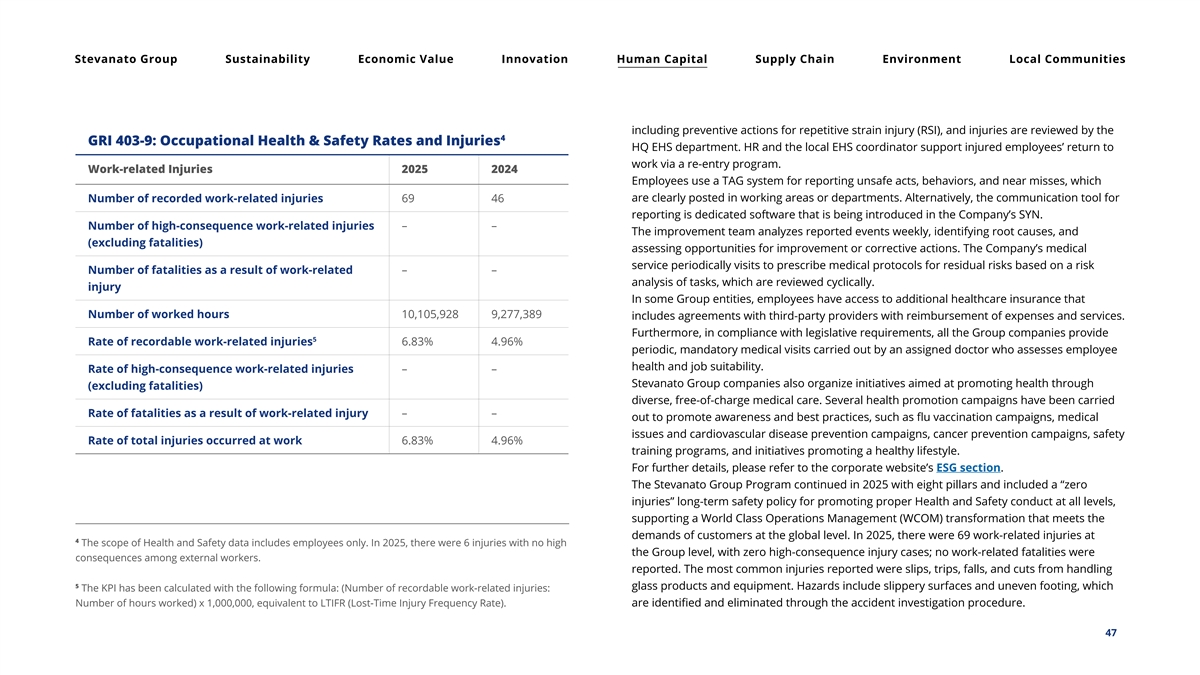
Stevanato Group Sustainability Economic Value Innovation Human Capital Supply Chain Environment Local Communities including preventive actions for repetitive strain injury (RSI), and injuries are reviewed by the 4 GRI 403-9: Occupational Health & Safety Rates and Injuries HQ EHS department. HR and the local EHS coordinator support injured employees’ return to work via a re-entry program. Work-related Injuries 2025 2024 Employees use a TAG system for reporting unsafe acts, behaviors, and near misses, which are clearly posted in working areas or departments. Alternatively, the communication tool for Number of recorded work-related injuries 69 46 reporting is dedicated software that is being introduced in the Company’s SYN. Number of high-consequence work-related injuries – – The improvement team analyzes reported events weekly, identifying root causes, and (excluding fatalities) assessing opportunities for improvement or corrective actions. The Company’s medical service periodically visits to prescribe medical protocols for residual risks based on a risk Number of fatalities as a result of work-related – – analysis of tasks, which are reviewed cyclically. injury In some Group entities, employees have access to additional healthcare insurance that Number of worked hours 10,105,928 9,277,389 includes agreements with third-party providers with reimbursement of expenses and services. Furthermore, in compliance with legislative requirements, all the Group companies provide 5 Rate of recordable work-related injuries 6.83% 4.96% periodic, mandatory medical visits carried out by an assigned doctor who assesses employee health and job suitability. Rate of high-consequence work-related injuries – – Stevanato Group companies also organize initiatives aimed at promoting health through (excluding fatalities) diverse, free-of-charge medical care. Several health promotion campaigns have been carried Rate of fatalities as a result of work-related injury – – out to promote awareness and best practices, such as flu vaccination campaigns, medical issues and cardiovascular disease prevention campaigns, cancer prevention campaigns, safety Rate of total injuries occurred at work 6.83% 4.96% training programs, and initiatives promoting a healthy lifestyle. For further details, please refer to the corporate website’s ESG section. The Stevanato Group Program continued in 2025 with eight pillars and included a “zero injuries” long-term safety policy for promoting proper Health and Safety conduct at all levels, supporting a World Class Operations Management (WCOM) transformation that meets the demands of customers at the global level. In 2025, there were 69 work-related injuries at 4 The scope of Health and Safety data includes employees only. In 2025, there were 6 injuries with no high the Group level, with zero high-consequence injury cases; no work-related fatalities were consequences among external workers. reported. The most common injuries reported were slips, trips, falls, and cuts from handling 5 glass products and equipment. Hazards include slippery surfaces and uneven footing, which The KPI has been calculated with the following formula: (Number of recordable work-related injuries: Number of hours worked) x 1,000,000, equivalent to LTIFR (Lost-Time Injury Frequency Rate). are identified and eliminated through the accident investigation procedure. 47
Stevanato Group Sustainability Economic Value Innovation Human Capital Supply Chain Environment Local Communities 6. Supply Chain and Procurement 6.1 • Responsible Supply Chain & Procurement Stevanato Group aims to have an optimized and risk-mitigated supply chain and manufacturing network with a diversified supplier base and ongoing engagement with key partners. Stevanato Group’s supplier selection process and purchasing conditions are inspired by the procedures designed by Stevanato Procurement functions focused on documentation values and criteria of competitiveness, objectivity, respectability, correctness, impartiality, fair management, production processes, and other factors. For key suppliers, on-site audits are pricing, and quality. Procurement processes aim to achieve competitive results for the also performed. Stevanato Group is also audited by its own customers. Group while ensuring fairness and impartiality toward every supplier in possession of the Supplier engagement is considered an essential element of the Group’s sustainability strategy necessary prerequisites. and is directly correlated to its medium-and long-term success. Since 2021, Stevanato Group 6 Contractual relationships involving Stevanato Group are subject to an initial assessment at has required all suppliers to adhere to its Code of Conduct for oversight of ESG topics in the the time of purchase and are regularly monitored. The Company has specified analytical value chain. purchasing rules regarding contractual conditions that govern the purchase of raw materials, semi-finished products, or preparations and services. 6 The Group mandates suppliers to follow legal and ethical standards, promote equal opportunities, Stevanato Group’s supply chain is composed of more than 5,000 suppliers, of which more prevent any forms of child labour as per ILO conventions. Regarding employees’ safety, the Code than 600 are equivalent to about 90% of spending. Stevanato Group works relentlessly to highlights the need for suppliers to take responsibility for staff by implementing precautionary measures, preventing accidents and providing H&S training. Finally, suppliers must follow environmental laws and meet the evolving pharmaceutical quality and regulatory industry standards for products and regulations, secure and maintain required environmental permits, operate sustainably, reducing energy services. To do so, it carries out quality control audits on its suppliers by following specific use and emissions, promote waste recycling and handle hazardous materials according to the law. 48
Stevanato Group Sustainability Economic Value Innovation Human Capital Supply Chain Environment Local Communities Adherence to the code helps to ensure compliance with existing laws, regulations, and other and corrective-action plans. In addition, a supplier questionnaire is distributed to suppliers, standards, as well as respect for the environment, human rights, and workers’ rights. including an ESG section survey. Based on the collected data, Stevanato Group requests more Any conduct that differs from those set forth in our Code of Conduct could potentially result comprehensive data and corrective actions where necessary. in the termination of the business relationship or be a precluding factor for additional collaboration. Stevanato Group requires its suppliers and service providers to comply with Stevanato Group has mapped its supplier base, focusing specifically on the most significant applicable laws and regulations and with recognized international standards of ethical suppliers based on expenditures. Moreover, through the EcoVadis program, Stevanato Group conduct. Thus, Stevanato’s procurement practices with its suppliers are continuously reviewed has trained its Group’s buyers and/or internal stakeholders, as per their roles, on ESG topics to ensure alignment with the Code of Conduct and to avoid potential risks and conflicts with and the importance of using the EcoVadis platform. By the end of 2025, 337 suppliers (more ESG requirements. than 61% of the total supplier base spending) were requested to participate in the EcoVadis questionnaire, which is aimed at assessing them on ESG topics. Since 2021, Stevanato Group has been collaborating with EcoVadis on an ongoing basis to strengthen its supplier sustainability practices and monitor its environmental and social Supplier assessment through the EcoVadis platform has the following objectives: responsibility throughout the value chain. With the support of EcoVadis, Stevanato Group has assessed its supplier base by prioritizing ESG topics and related risks, including • obtaining a clear set of environmental and social KPIs; climate-related issues, and applying a threshold, corrective-action plans when necessary, and • defining effective action plans in case of an assessment evaluated under ESG requirements within the purchasing process. a specific threshold. This process enables the Company to effectively monitor and address dependencies, impacts, The results of the assessment showed an overall score of 59.9 based on reviews of all 337 risks, and opportunities (IROs) across the value chain. Both the sustainability and procurement suppliers, as shown in the table in the following page. Stevanato Group has higher than departments play a key role in their implementation. In particular, the procurement average scores across all four areas compared to the EcoVadis benchmark. In addition, 82% department actively engaged local buyers at each site, encouraging their suppliers to join the of suppliers have a score above 45. Stevanato Group started to require corrective-action plans EcoVadis program. Buyers regularly meet with suppliers to assess performance and, when for suppliers with an EcoVadis rating below a pre-determined threshold, which is equivalent to necessary, implement corrective actions if evaluations fall below the threshold defined by about less than 7% of the suppliers assessed. Moreover, periodic monitoring is conducted for the Company. suppliers whose ratings exceed this threshold to ensure ESG oversight. In 2025, the onboarding of at least five suppliers into the EcoVadis program was established as a KPI for all local buyers, reinforcing ESG integration within the supply chain and driving continuous improvement in supplier sustainability performance. Through the EcoVadis platform, suppliers are offered training, education programs, benchmarks, 49
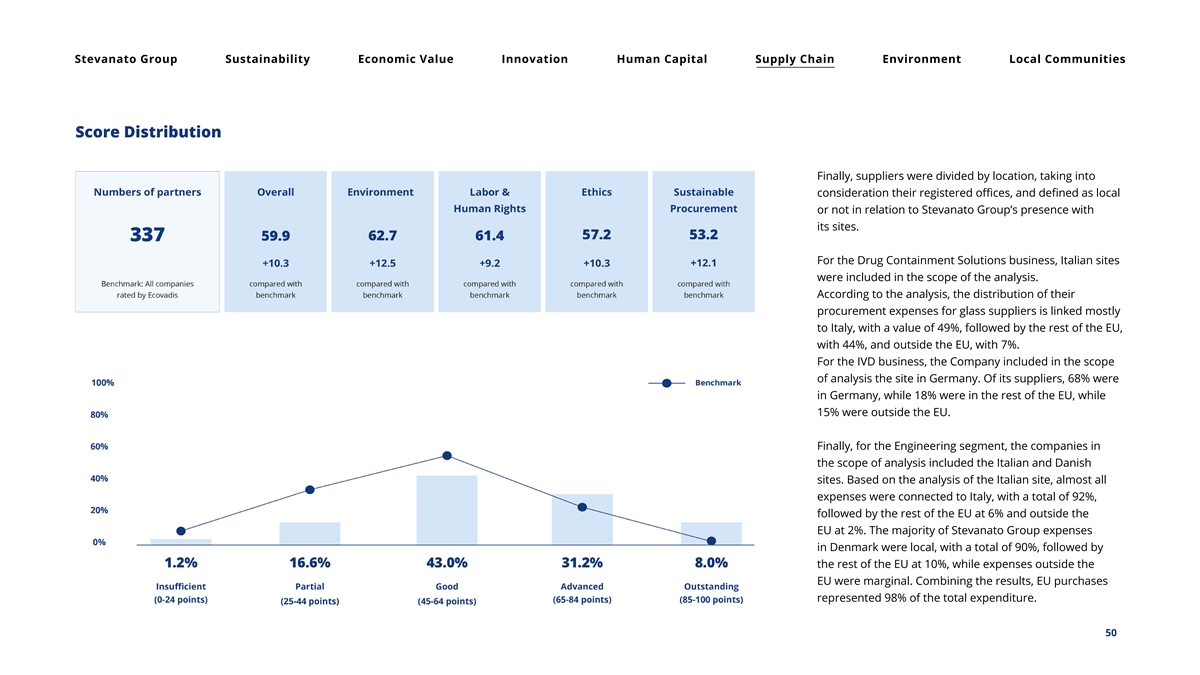
Stevanato Group Sustainability Economic Value Innovation Human Capital Supply Chain Environment Local Communities Score Distribution Finally, suppliers were divided by location, taking into consideration their registered offices, and defined as local or not in relation to Stevanato Group’s presence with its sites. For the Drug Containment Solutions business, Italian sites were included in the scope of the analysis. According to the analysis, the distribution of their procurement expenses for glass suppliers is linked mostly to Italy, with a value of 49%, followed by the rest of the EU, with 44%, and outside the EU, with 7%. For the IVD business, the Company included in the scope of analysis the site in Germany. Of its suppliers, 68% were in Germany, while 18% were in the rest of the EU, while 15% were outside the EU. Finally, for the Engineering segment, the companies in the scope of analysis included the Italian and Danish sites. Based on the analysis of the Italian site, almost all expenses were connected to Italy, with a total of 92%, followed by the rest of the EU at 6% and outside the EU at 2%. The majority of Stevanato Group expenses in Denmark were local, with a total of 90%, followed by the rest of the EU at 10%, while expenses outside the EU were marginal. Combining the results, EU purchases represented 98% of the total expenditure. 50
Stevanato Group Sustainability Economic Value Innovation Human Capital Supply Chain Environment Local Communities 7. Environment 7.1 • Stevanato Group’s 7.2 • Energy Consumption and Commitment to the Environment GHG Emissions Stevanato Group seeks to reduce any potential negative environmental Attention to the environment is one of the priorities of the ESG & impact of its processes and products as part of the ESG & Sustainability Sustainability Group Strategy. This includes managing its energy Group Strategy. Accordingly, the Group aims to deal with consumption while aiming to increase renewable-based sources. climate-change and nature-related risks through the optimization of natural resource consumption, improved efficiency, and innovative According to work conducted as part of the ESG & Sustainability Strategy—in particular, on solutions, as reflected in the Group’s EHS Policy. the development of the plan to reduce GHG emissions—Stevanato Group performed energy audits and analyses to identify the causes of inefficiency and find solutions. To monitor its environmental footprint, Stevanato Group set up a global management system that identifies potential risks, enacting preventive measures and attentive supervision. For companies in the Drug Containment Solutions business, the main energy sources are The Environmental Management System is compliant with ISO 14001 (for details, please natural gas and electricity, whereas for Drug Delivery Systems, In-Vitro Diagnostic Solutions, see section 2.2). Stevanato Group has identified the possible environmental impact areas of and the Engineering segment, the main energy vector is electricity. its business through materiality analysis (see section 2.1 Approach to Sustainability), which includes energy consumption, GHG emissions, water management, and waste management. Additional consumption derives from diesel and gasoline fuel both for heating and for The Group regularly monitors and manages these impact areas to ensure compliance with the emergency electrical generators at the Drug Containment Solutions sites in Piombino Dese, applicable legal requirements of the countries in which it operates. It should be noted that the Brazil, and Mexico and for transportation of the Company’s logistical vehicles and Company environmental data of Stevanato Group has been restated thanks to improved measurement cars. To foster sustainable mobility, the Group began upgrading its fleet to hybrid vehicles of consumption at sites. This allows greater comparability and consistency at the Group level. in 2021. 51
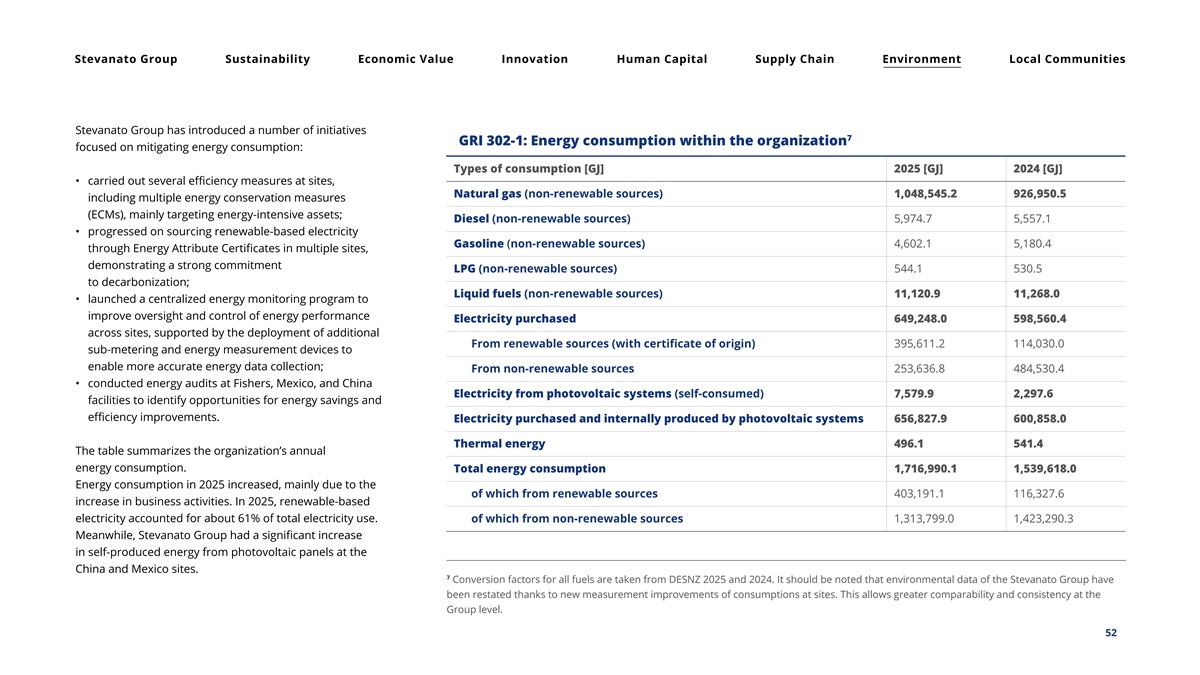
Stevanato Group Sustainability Economic Value Innovation Human Capital Supply Chain Environment Local Communities Stevanato Group has introduced a number of initiatives 7 GRI 302-1: Energy consumption within the organization focused on mitigating energy consumption: Types of consumption [GJ] 2025 [GJ] 2024 [GJ] • carried out several efficiency measures at sites, Natural gas (non-renewable sources) 1,048,545.2 926,950.5 including multiple energy conservation measures (ECMs), mainly targeting energy-intensive assets; Diesel (non-renewable sources) 5,974.7 5,557.1 • progressed on sourcing renewable-based electricity Gasoline (non-renewable sources) 4,602.1 5,180.4 through Energy Attribute Certificates in multiple sites, demonstrating a strong commitment LPG (non-renewable sources) 544.1 530.5 to decarbonization; Liquid fuels (non-renewable sources) 11,120.9 11,268.0 • launched a centralized energy monitoring program to improve oversight and control of energy performance Electricity purchased 649,248.0 598,560.4 across sites, supported by the deployment of additional From renewable sources (with certificate of origin) 395,611.2 114,030.0 sub-metering and energy measurement devices to enable more accurate energy data collection; From non-renewable sources 253,636.8 484,530.4 • conducted energy audits at Fishers, Mexico, and China Electricity from photovoltaic systems (self-consumed) 7,579.9 2,297.6 facilities to identify opportunities for energy savings and efficiency improvements. Electricity purchased and internally produced by photovoltaic systems 656,827.9 600,858.0 Thermal energy 496.1 541.4 The table summarizes the organization’s annual energy consumption. Total energy consumption 1,716,990.1 1,539,618.0 Energy consumption in 2025 increased, mainly due to the of which from renewable sources 403,191.1 116,327.6 increase in business activities. In 2025, renewable-based electricity accounted for about 61% of total electricity use. of which from non-renewable sources 1,313,799.0 1,423,290.3 Meanwhile, Stevanato Group had a significant increase in self-produced energy from photovoltaic panels at the China and Mexico sites. 7 Conversion factors for all fuels are taken from DESNZ 2025 and 2024. It should be noted that environmental data of the Stevanato Group have been restated thanks to new measurement improvements of consumptions at sites. This allows greater comparability and consistency at the Group level. 52
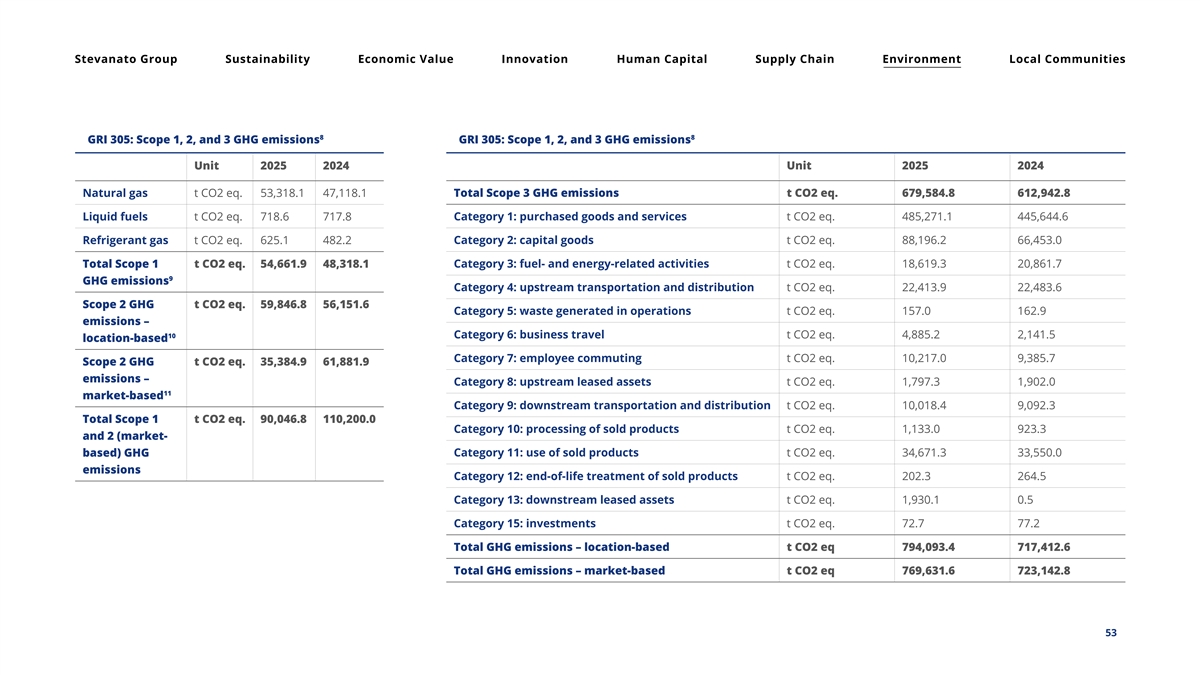
Stevanato Group Sustainability Economic Value Innovation Human Capital Supply Chain Environment Local Communities 8 8 GRI 305: Scope 1, 2, and 3 GHG emissions GRI 305: Scope 1, 2, and 3 GHG emissions Unit 2025 2024 Unit 2025 2024 Natural gas t CO2 eq. 53,318.1 47,118.1 Total Scope 3 GHG emissions t CO2 eq. 679,584.8 612,942.8 Category 1: purchased goods and services t CO2 eq. 485,271.1 445,644.6 Liquid fuels t CO2 eq. 718.6 717.8 Refrigerant gas t CO2 eq. 625.1 482.2 Category 2: capital goods t CO2 eq. 88,196.2 66,453.0 Total Scope 1 t CO2 eq. 54,661.9 48,318.1 Category 3: fuel- and energy-related activities t CO2 eq. 18,619.3 20,861.7 9 GHG emissions Category 4: upstream transportation and distribution t CO2 eq. 22,413.9 22,483.6 Scope 2 GHG t CO2 eq. 59,846.8 56,151.6 Category 5: waste generated in operations t CO2 eq. 157.0 162.9 emissions – 10 Category 6: business travel t CO2 eq. 4,885.2 2,141.5 location-based Category 7: employee commuting t CO2 eq. 10,217.0 9,385.7 Scope 2 GHG t CO2 eq. 35,384.9 61,881.9 emissions – Category 8: upstream leased assets t CO2 eq. 1,797.3 1,902.0 11 market-based Category 9: downstream transportation and distribution t CO2 eq. 10,018.4 9,092.3 Total Scope 1 t CO2 eq. 90,046.8 110,200.0 Category 10: processing of sold products t CO2 eq. 1,133.0 923.3 and 2 (market- based) GHG Category 11: use of sold products t CO2 eq. 34,671.3 33,550.0 emissions Category 12: end-of-life treatment of sold products t CO2 eq. 202.3 264.5 Category 13: downstream leased assets t CO2 eq. 1,930.1 0.5 Category 15: investments t CO2 eq. 72.7 77.2 Total GHG emissions – location-based t CO2 eq 794,093.4 717,412.6 Total GHG emissions – market-based t CO2 eq 769,631.6 723,142.8 53
Stevanato Group Sustainability Economic Value Innovation Human Capital Supply Chain Environment Local Communities The table in the previous page shows the main types of emissions related to the above-mentioned energy sources. In particular, to report greenhouse gas emissions, Stevanato Group follows Greenhouse Gas (GHG) Protocol guidelines, distinguished in Scope 1, 2, and 3. In addition, GHG emissions are calculated according to location and market methodologies using appropriate emission factors. In sum, in 2025, Stevanato Group registered a value for total emissions (Scope 1, 2 and 3) of 794,093.4 tons of CO2e of location-based and 769,631.6 of market-based. Whereas, Scope 1 & 2 market-based counts for 12% and Scope 3 88% out of total. In particular, Scope 1 & 2 market-based registered at 90,046.8 tons of CO2e in 2025 with a decrease of 18.3% compared to 2024 year. Whilst, main categories of Scope 3 are purchased goods and services, and capital goods. 8 Figures refer to CO2 equivalents when available. It should be noted that environmental data of the Stevanato Group have been restated thanks to new measurement improvements of consumptions at sites. This allows greater comparability and consistency at the Group level. 9 These figures have been calculated using DESNZ 2025 and 2024 emission factors according to the GHG Protocol methodology. The consolidation approach for the Group’s emissions is the operational control. Data are presented without consideration of any offsetting instruments. 10 The conversion factors used for Scope 2 – Location-Based method – are taken from Terna Confronti Internazionali 2022. 11 The conversion factors used for Scope 2 – Gross Market-Based method – are taken from European Residual Mix: AIB 2024. When an AIB emission factor is not available, conversion factors are taken from Terna. 54
Stevanato Group Sustainability Economic Value Innovation Human Capital Supply Chain Environment Local Communities 7.3 • Water Management 3 Water management is a key aspect of the Company’s Companies in the DDS, IVD, and Engineering segments withdrawal by 10,000 m /year at the Piombino Dese site. environmental approach and a significant topic noted by use water almost exclusively for hygiene, cleaning, In Mexico and Brazil, water from production processes is Stevanato Group stakeholders in the materiality analysis in and catering purposes. The water used in these sites treated and made suitable for irrigation and gardening. relation to the following: comes from public utilities. The sites that are ISO 14001 certified are reported in section 2.2. Overall water use Since 2020, water withdrawal at production sites has been • define strategies to increase efficiency and reduce water was assessed according to the protocols dictated by monitored to assess locally based water stress. use, especially for the Group’s production activities, certification standards as part of the environmental impact The Group utilizes the Water Resource Institute Tool to including water reuse and recycling methods; analyses. The data obtained are periodically reviewed identify water stress areas of the organization’s water • implement and monitor effective measures for the by the Group, communicated to local authorities, and use and water-related impacts and to identify possible correct management of industrial wastewater discharge, monitored for environmental performance. measures to manage them. According to the Water especially discharges containing dangerous substances, The environmental impact is related to water withdrawn Resource Institute Tool, the Group’s Latina (Italy), Mexico, in full compliance with current regulations. and water discharged. and California sites are located in high- and extremely 12 high-water-stressed areas . Stevanato Group draws 38% of its water from local The quality of the water discharged by the Group’s sites underground sources, with the remaining 62% coming during normal operations has little impact on external from the public water supply. Water is used in the water courses and treatment sites. However, the amount production process in the following operations: of water withdrawn by Stevanato and the quantity of its discharges can impact the ecosystem. To minimize • washing and sanitizing semi-finished glass products for the withdrawal of groundwater and its impact on local pharmaceutical companies; communities, starting in 2020, the Group modified the • as a carrier fluid in cooling systems; water distribution system at its Company headquarters, • as a cleaner for hygienic uses; channeling, filtering, and cooling water from the • for catering in the Company canteen. semi-finished product sanitizing process water for injection (WFI) so that it can be reutilized. 12 For the identification and measurement, reference was made to This innovative solution has helped reduce water the interactive map of the Aqueduct Water Risk Atlas. 55
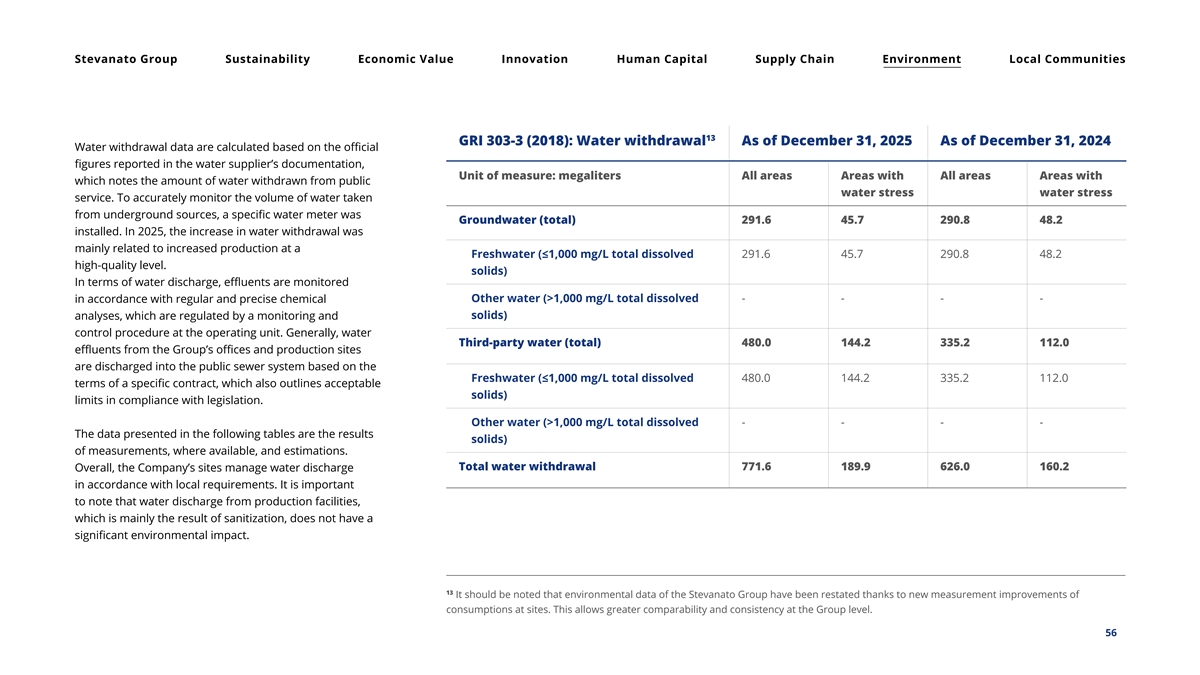
Stevanato Group Sustainability Economic Value Innovation Human Capital Supply Chain Environment Local Communities 13 GRI 303-3 (2018): Water withdrawal As of December 31, 2025 As of December 31, 2024 Water withdrawal data are calculated based on the official figures reported in the water supplier’s documentation, Unit of measure: megaliters All areas Areas with All areas Areas with which notes the amount of water withdrawn from public water stress water stress service. To accurately monitor the volume of water taken from underground sources, a specific water meter was Groundwater (total) 291.6 45.7 290.8 48.2 installed. In 2025, the increase in water withdrawal was mainly related to increased production at a Freshwater (≤1,000 mg/L total dissolved 291.6 45.7 290.8 48.2 high-quality level. solids) In terms of water discharge, effluents are monitored Other water (>1,000 mg/L total dissolved - - - - in accordance with regular and precise chemical solids) analyses, which are regulated by a monitoring and control procedure at the operating unit. Generally, water Third-party water (total) 480.0 144.2 335.2 112.0 effluents from the Group’s offices and production sites are discharged into the public sewer system based on the Freshwater (≤1,000 mg/L total dissolved 480.0 144.2 335.2 112.0 terms of a specific contract, which also outlines acceptable solids) limits in compliance with legislation. Other water (>1,000 mg/L total dissolved - - - - The data presented in the following tables are the results solids) of measurements, where available, and estimations. Total water withdrawal 771.6 189.9 626.0 160.2 Overall, the Company’s sites manage water discharge in accordance with local requirements. It is important to note that water discharge from production facilities, which is mainly the result of sanitization, does not have a significant environmental impact. 13 It should be noted that environmental data of the Stevanato Group have been restated thanks to new measurement improvements of consumptions at sites. This allows greater comparability and consistency at the Group level. 56
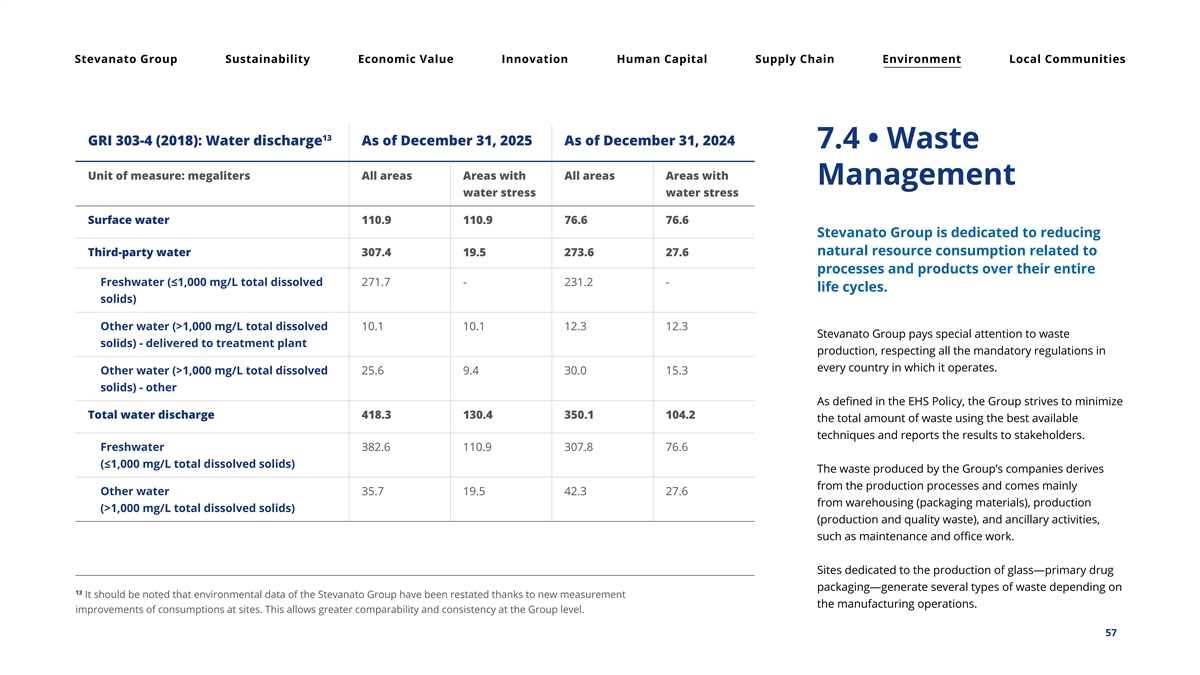
Stevanato Group Sustainability Economic Value Innovation Human Capital Supply Chain Environment Local Communities 13 GRI 303-4 (2018): Water discharge As of December 31, 2025 As of December 31, 2024 7.4 • Waste Unit of measure: megaliters All areas Areas with All areas Areas with Management water stress water stress Surface water 110.9 110.9 76.6 76.6 Stevanato Group is dedicated to reducing natural resource consumption related to Third-party water 307.4 19.5 273.6 27.6 processes and products over their entire Freshwater (≤1,000 mg/L total dissolved 271.7 - 231.2 - life cycles. solids) Other water (>1,000 mg/L total dissolved 10.1 10.1 12.3 12.3 Stevanato Group pays special attention to waste solids) - delivered to treatment plant production, respecting all the mandatory regulations in every country in which it operates. Other water (>1,000 mg/L total dissolved 25.6 9.4 30.0 15.3 solids) - other As defined in the EHS Policy, the Group strives to minimize Total water discharge 418.3 130.4 350.1 104.2 the total amount of waste using the best available techniques and reports the results to stakeholders. Freshwater 382.6 110.9 307.8 76.6 (≤1,000 mg/L total dissolved solids) The waste produced by the Group’s companies derives from the production processes and comes mainly Other water 35.7 19.5 42.3 27.6 from warehousing (packaging materials), production (>1,000 mg/L total dissolved solids) (production and quality waste), and ancillary activities, such as maintenance and office work. Sites dedicated to the production of glass—primary drug packaging—generate several types of waste depending on 13 It should be noted that environmental data of the Stevanato Group have been restated thanks to new measurement the manufacturing operations. improvements of consumptions at sites. This allows greater comparability and consistency at the Group level. 57
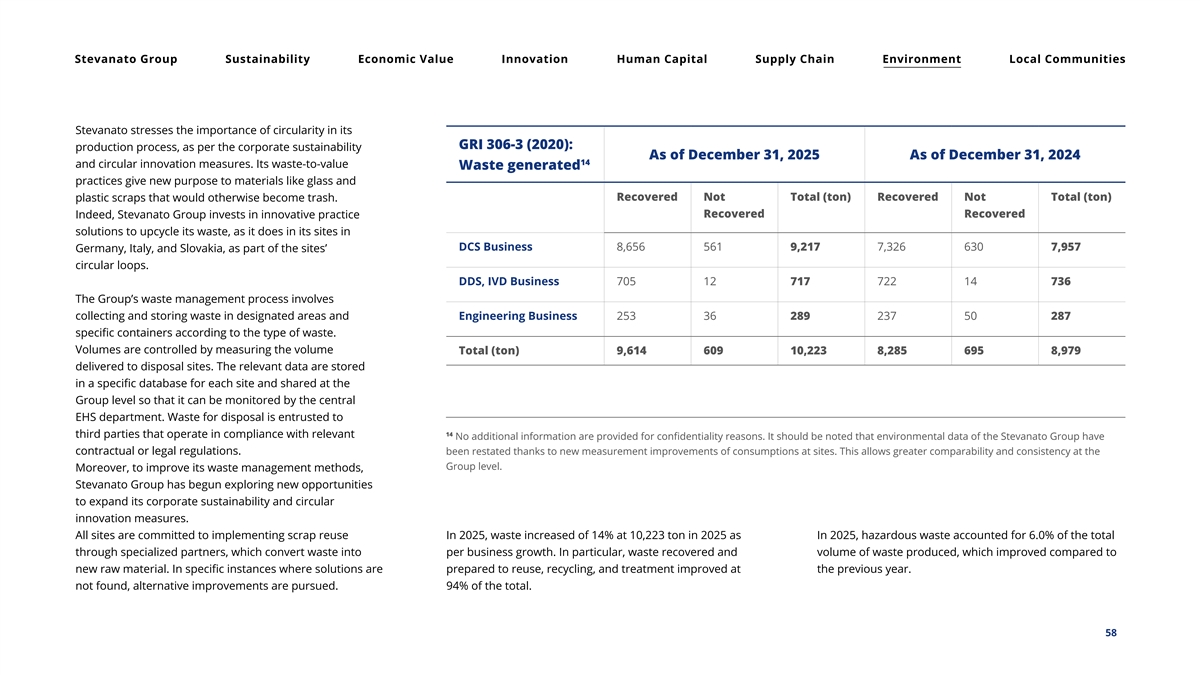
Stevanato Group Sustainability Economic Value Innovation Human Capital Supply Chain Environment Local Communities Stevanato stresses the importance of circularity in its GRI 306-3 (2020): production process, as per the corporate sustainability As of December 31, 2025 As of December 31, 2024 14 and circular innovation measures. Its waste-to-value Waste generated practices give new purpose to materials like glass and Recovered Not Total (ton) Recovered Not Total (ton) plastic scraps that would otherwise become trash. Recovered Recovered Indeed, Stevanato Group invests in innovative practice solutions to upcycle its waste, as it does in its sites in DCS Business 8,656 561 9,217 7,326 630 7,957 Germany, Italy, and Slovakia, as part of the sites’ circular loops. DDS, IVD Business 705 12 717 722 14 736 The Group’s waste management process involves collecting and storing waste in designated areas and Engineering Business 253 36 289 237 50 287 specific containers according to the type of waste. Volumes are controlled by measuring the volume Total (ton) 9,614 609 10,223 8,285 695 8,979 delivered to disposal sites. The relevant data are stored in a specific database for each site and shared at the Group level so that it can be monitored by the central EHS department. Waste for disposal is entrusted to 14 third parties that operate in compliance with relevant No additional information are provided for confidentiality reasons. It should be noted that environmental data of the Stevanato Group have contractual or legal regulations. been restated thanks to new measurement improvements of consumptions at sites. This allows greater comparability and consistency at the Group level. Moreover, to improve its waste management methods, Stevanato Group has begun exploring new opportunities to expand its corporate sustainability and circular innovation measures. All sites are committed to implementing scrap reuse In 2025, waste increased of 14% at 10,223 ton in 2025 as In 2025, hazardous waste accounted for 6.0% of the total through specialized partners, which convert waste into per business growth. In particular, waste recovered and volume of waste produced, which improved compared to new raw material. In specific instances where solutions are prepared to reuse, recycling, and treatment improved at the previous year. not found, alternative improvements are pursued. 94% of the total. 58
Stevanato Group Sustainability Economic Value Innovation Human Capital Supply Chain Environment Local Communities 8. Local Communities 8.1 • Local Communities Engagement Stevanato Group has always been closely linked to the land and the communities in which it operates. In Italy, where it has been present for more than 75 years, Stevanato Group has demonstrated its commitment to the local area for decades, reconciling its industrial development by improving the overall quality of people’s lives. As in the past, Stevanato Group is increasing its engagement with its local communities, as children and families, including creative projects and interactive experiences. evidenced by locally led initiatives through the Group’s various sites around the world. These activities allowed children to explore real-world professions through practical learning, fostering curiosity, and inspiring future aspirations. • In Piombino Dese (Italy), as an education initiative, students at a local high school took • In the United States (Indiana), as a social engagement initiative, employees successfully Yellow Belt courses and certifications on quality and process improvements. Moreover, the collected and donated 431 pounds (196 kg) of food to help families in the local community. site launched a new SG Technical School edition, offering young local talents a month of intensive training in manufacturing fundamentals and specialized roles. In 2025, the Stevanato Foundation continued its mission, focusing on the areas of social • In Slovakia, as a social engagement initiative, employees continued to provide Christmas welfare, social health, education, and training, with special attention to children and youth, by gifts to elderly residents in retirement homes and hospitals. Safety shoes were donated for implementing a series of initiatives. charity purposes with a second-life use. • In Mexico, as a social engagement initiative, the local staff organized various activities for 59
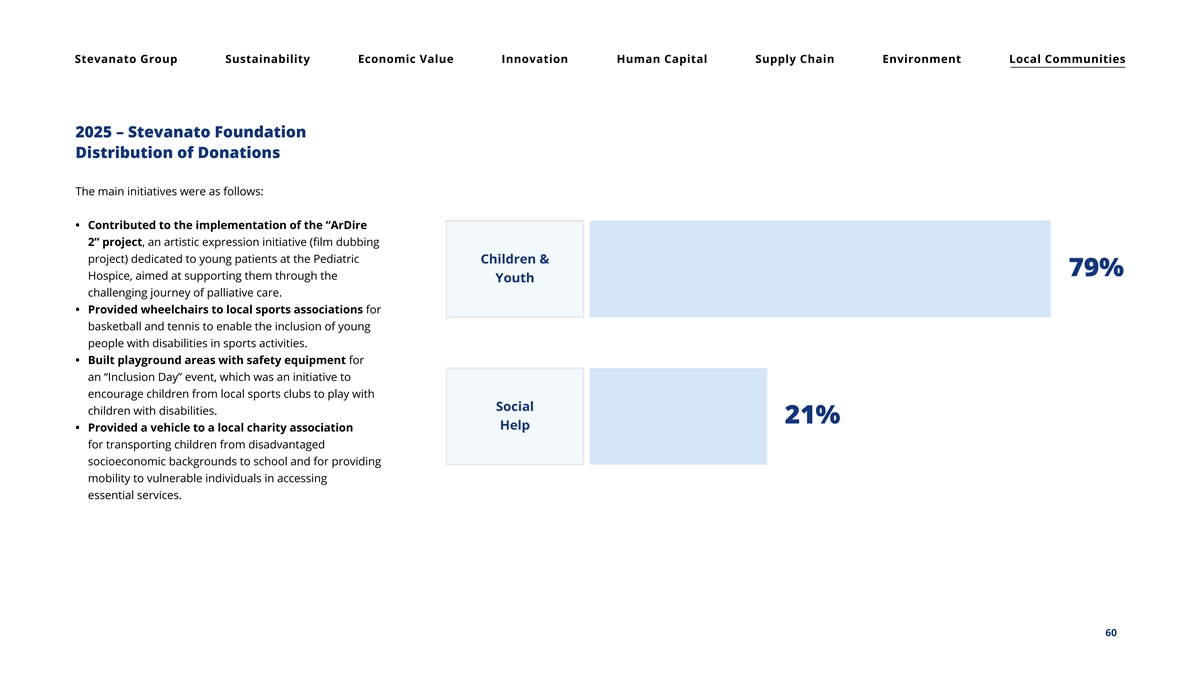
Stevanato Group Sustainability Economic Value Innovation Human Capital Supply Chain Environment Local Communities 2025 – Stevanato Foundation Distribution of Donations The main initiatives were as follows: • Contributed to the implementation of the “ArDire 2” project, an artistic expression initiative (film dubbing project) dedicated to young patients at the Pediatric Hospice, aimed at supporting them through the challenging journey of palliative care. • Provided wheelchairs to local sports associations for basketball and tennis to enable the inclusion of young people with disabilities in sports activities. • Built playground areas with safety equipment for an “Inclusion Day” event, which was an initiative to encourage children from local sports clubs to play with children with disabilities. • Provided a vehicle to a local charity association for transporting children from disadvantaged socioeconomic backgrounds to school and for providing mobility to vulnerable individuals in accessing essential services. 60
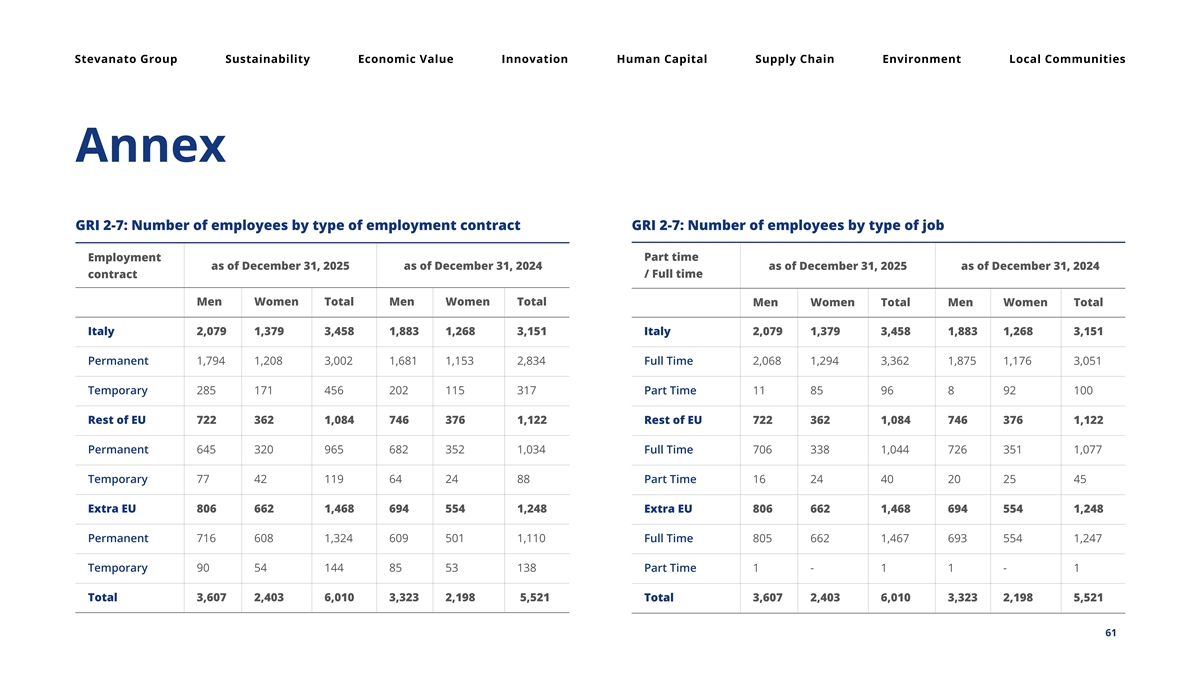
Stevanato Group Sustainability Economic Value Innovation Human Capital Supply Chain Environment Local Communities Annex GRI 2-7: Number of employees by type of employment contract GRI 2-7: Number of employees by type of job Part time Employment as of December 31, 2025 as of December 31, 2024 as of December 31, 2025 as of December 31, 2024 / Full time contract Men Women Total Men Women Total Men Women Total Men Women Total Italy 2,079 1,379 3,458 1,883 1,268 3,151 Italy 2,079 1,379 3,458 1,883 1,268 3,151 Permanent 1,794 1,208 3,002 1,681 1,153 2,834 Full Time 2,068 1,294 3,362 1,875 1,176 3,051 Temporary 285 171 456 202 115 317 Part Time 11 85 96 8 92 100 Rest of EU 722 362 1,084 746 376 1,122 Rest of EU 722 362 1,084 746 376 1,122 Permanent 645 320 965 682 352 1,034 Full Time 706 338 1,044 726 351 1,077 Temporary 77 42 119 64 24 88 Part Time 16 24 40 20 25 45 Extra EU 806 662 1,468 694 554 1,248 Extra EU 806 662 1,468 694 554 1,248 Permanent 716 608 1,324 609 501 1,110 Full Time 805 662 1,467 693 554 1,247 Temporary 90 54 144 85 53 138 Part Time 1 - 1 1 - 1 Total 3,607 2,403 6,010 3,323 2,198 5,521 Total 3,607 2,403 6,010 3,323 2,198 5,521 61
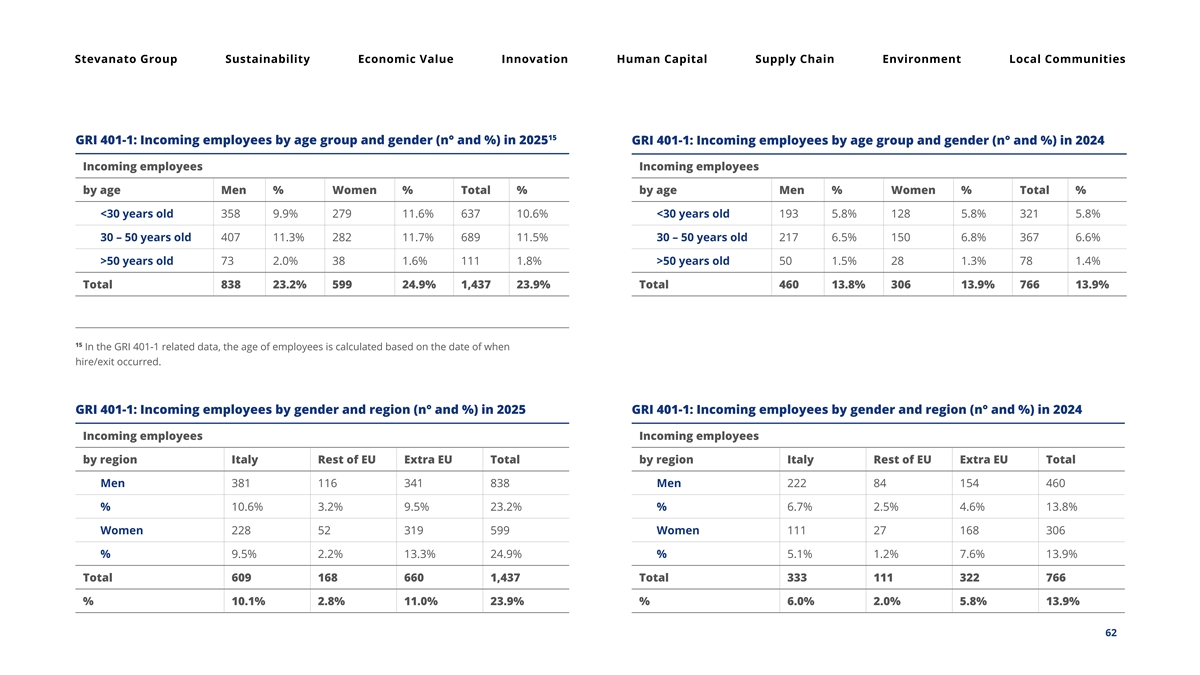
Stevanato Group Sustainability Economic Value Innovation Human Capital Supply Chain Environment Local Communities 15 GRI 401-1: Incoming employees by age group and gender (n° and %) in 2025 GRI 401-1: Incoming employees by age group and gender (n° and %) in 2024 Incoming employees Incoming employees by age Men % Women % Total % by age Men % Women % Total % <30 years old 358 9.9% 279 11.6% 637 10.6% <30 years old 193 5.8% 128 5.8% 321 5.8% 30 – 50 years old 407 11.3% 282 11.7% 689 11.5% 30 – 50 years old 217 6.5% 150 6.8% 367 6.6% >50 years old 73 2.0% 38 1.6% 111 1.8% >50 years old 50 1.5% 28 1.3% 78 1.4% Total 838 23.2% 599 24.9% 1,437 23.9% Total 460 13.8% 306 13.9% 766 13.9% 15 In the GRI 401-1 related data, the age of employees is calculated based on the date of when hire/exit occurred. GRI 401-1: Incoming employees by gender and region (n° and %) in 2025 GRI 401-1: Incoming employees by gender and region (n° and %) in 2024 Incoming employees Incoming employees by region Italy Rest of EU Extra EU Total by region Italy Rest of EU Extra EU Total Men 381 116 341 838 Men 222 84 154 460 % 10.6% 3.2% 9.5% 23.2% % 6.7% 2.5% 4.6% 13.8% Women 228 52 319 599 Women 111 27 168 306 % 9.5% 2.2% 13.3% 24.9% % 5.1% 1.2% 7.6% 13.9% Total 609 168 660 1,437 Total 333 111 322 766 % 10.1% 2.8% 11.0% 23.9% % 6.0% 2.0% 5.8% 13.9% 62
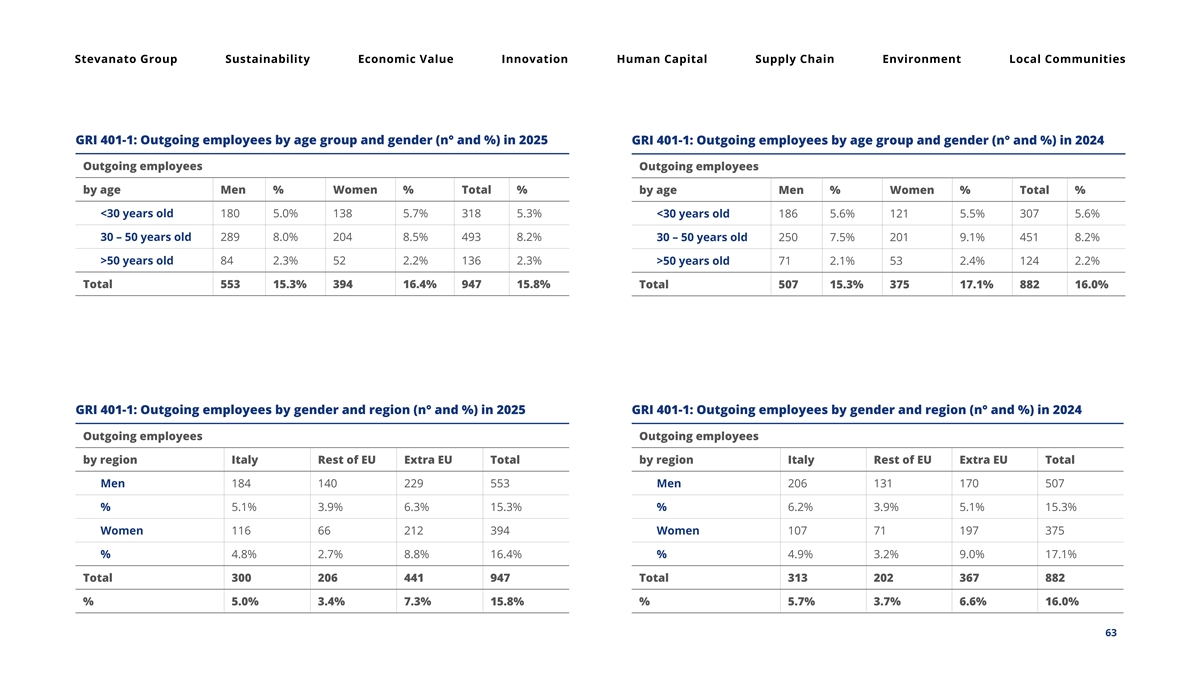
Stevanato Group Sustainability Economic Value Innovation Human Capital Supply Chain Environment Local Communities GRI 401-1: Outgoing employees by age group and gender (n° and %) in 2025 GRI 401-1: Outgoing employees by age group and gender (n° and %) in 2024 Outgoing employees Outgoing employees by age Men % Women % Total % by age Men % Women % Total % <30 years old 180 5.0% 138 5.7% 318 5.3% <30 years old 186 5.6% 121 5.5% 307 5.6% 30 – 50 years old 289 8.0% 204 8.5% 493 8.2% 30 – 50 years old 250 7.5% 201 9.1% 451 8.2% >50 years old 84 2.3% 52 2.2% 136 2.3% >50 years old 71 2.1% 53 2.4% 124 2.2% Total 553 15.3% 394 16.4% 947 15.8% Total 507 15.3% 375 17.1% 882 16.0% GRI 401-1: Outgoing employees by gender and region (n° and %) in 2025 GRI 401-1: Outgoing employees by gender and region (n° and %) in 2024 Outgoing employees Outgoing employees by region Italy Rest of EU Extra EU Total by region Italy Rest of EU Extra EU Total Men 184 140 229 553 Men 206 131 170 507 % 5.1% 3.9% 6.3% 15.3% % 6.2% 3.9% 5.1% 15.3% Women 116 66 212 394 Women 107 71 197 375 % 4.8% 2.7% 8.8% 16.4% % 4.9% 3.2% 9.0% 17.1% Total 300 206 441 947 Total 313 202 367 882 % 5.0% 3.4% 7.3% 15.8% % 5.7% 3.7% 6.6% 16.0% 63
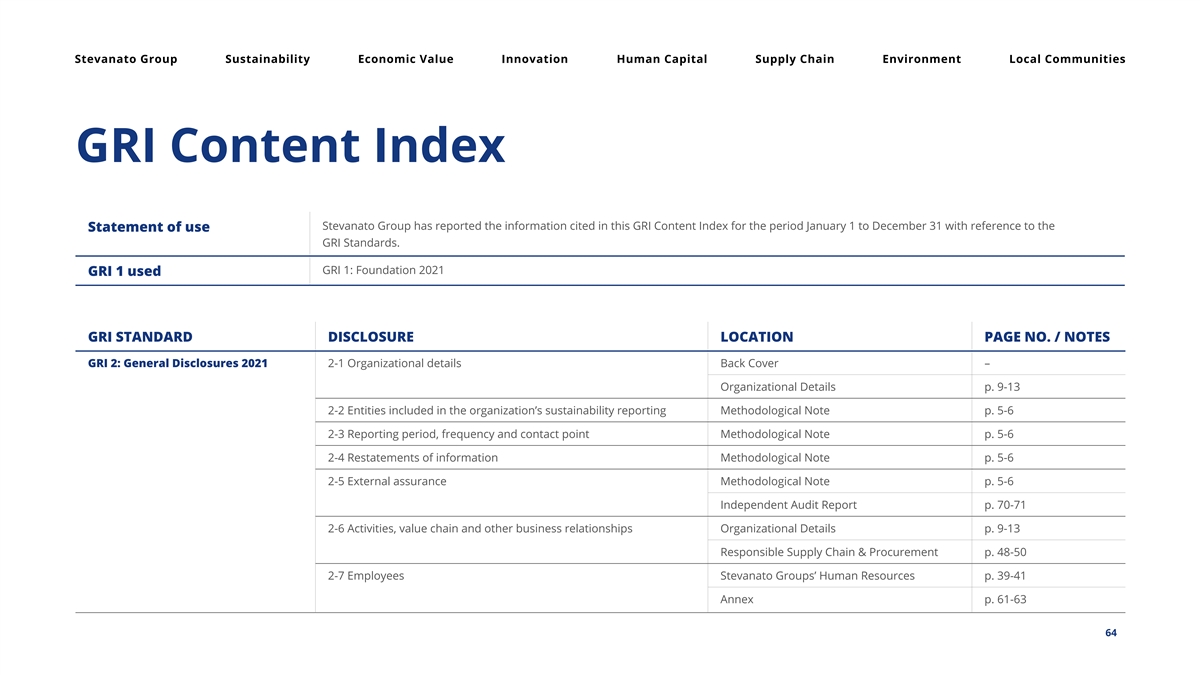
Stevanato Group Sustainability Economic Value Innovation Human Capital Supply Chain Environment Local Communities GRI Content Index Stevanato Group has reported the information cited in this GRI Content Index for the period January 1 to December 31 with reference to the Statement of use GRI Standards. GRI 1: Foundation 2021 GRI 1 used GRI STANDARD DISCLOSURE LOCATION PAGE NO. / NOTES GRI 2: General Disclosures 2021 2-1 Organizational details Back Cover – Organizational Details p. 9-13 2-2 Entities included in the organization’s sustainability reporting Methodological Note p. 5-6 2-3 Reporting period, frequency and contact point Methodological Note p. 5-6 2-4 Restatements of information Methodological Note p. 5-6 2-5 External assurance Methodological Note p. 5-6 Independent Audit Report p. 70-71 2-6 Activities, value chain and other business relationships Organizational Details p. 9-13 Responsible Supply Chain & Procurement p. 48-50 2-7 Employees Stevanato Groups’ Human Resources p. 39-41 Annex p. 61-63 64
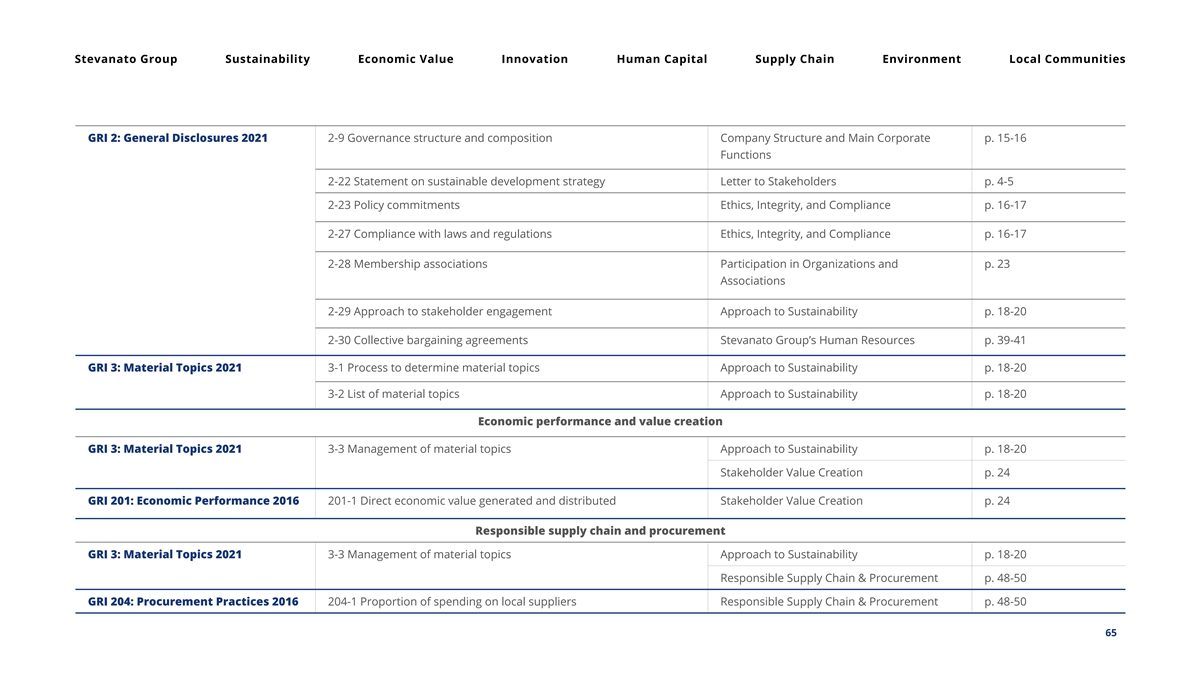
Stevanato Group Sustainability Economic Value Innovation Human Capital Supply Chain Environment Local Communities GRI 2: General Disclosures 2021 2-9 Governance structure and composition Company Structure and Main Corporate p. 15-16 Functions 2-22 Statement on sustainable development strategy Letter to Stakeholders p. 4-5 2-23 Policy commitments Ethics, Integrity, and Compliance p. 16-17 2-27 Compliance with laws and regulations Ethics, Integrity, and Compliance p. 16-17 2-28 Membership associations Participation in Organizations and p. 23 Associations 2-29 Approach to stakeholder engagement Approach to Sustainability p. 18-20 2-30 Collective bargaining agreements Stevanato Group’s Human Resources p. 39-41 GRI 3: Material Topics 2021 3-1 Process to determine material topics Approach to Sustainability p. 18-20 3-2 List of material topics Approach to Sustainability p. 18-20 Economic performance and value creation GRI 3: Material Topics 2021 3-3 Management of material topics Approach to Sustainability p. 18-20 Stakeholder Value Creation p. 24 GRI 201: Economic Performance 2016 201-1 Direct economic value generated and distributed Stakeholder Value Creation p. 24 Responsible supply chain and procurement GRI 3: Material Topics 2021 3-3 Management of material topics Approach to Sustainability p. 18-20 Responsible Supply Chain & Procurement p. 48-50 GRI 204: Procurement Practices 2016 204-1 Proportion of spending on local suppliers Responsible Supply Chain & Procurement p. 48-50 65
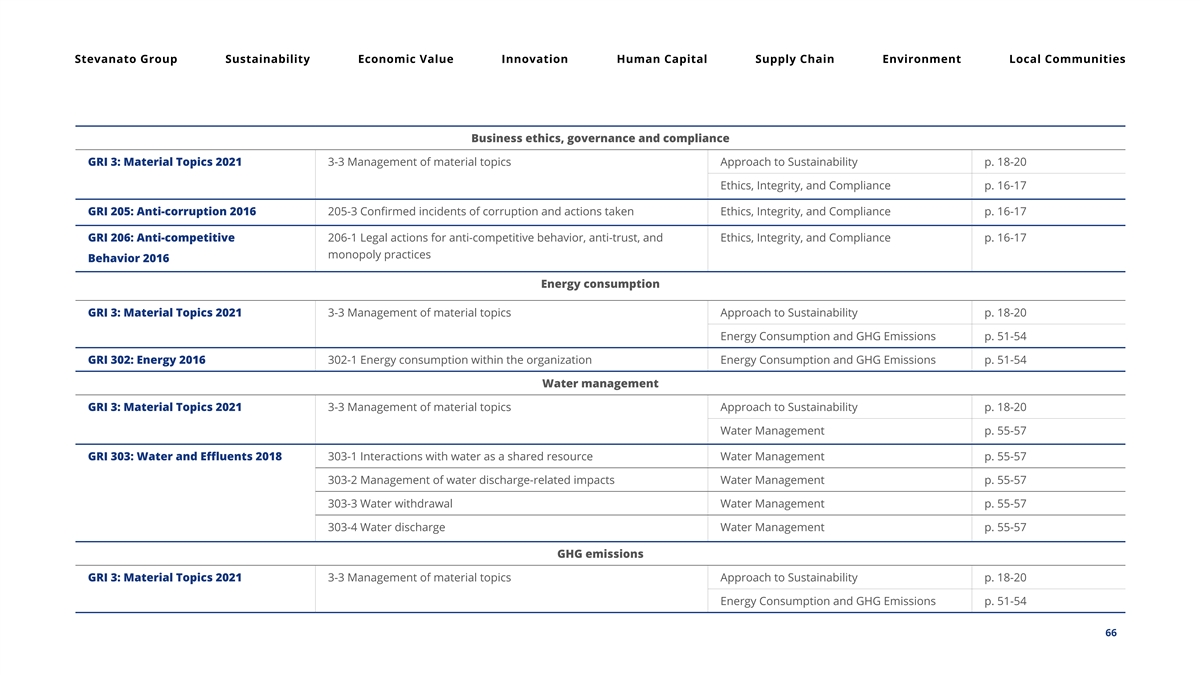
Stevanato Group Sustainability Economic Value Innovation Human Capital Supply Chain Environment Local Communities Business ethics, governance and compliance GRI 3: Material Topics 2021 3-3 Management of material topics Approach to Sustainability p. 18-20 Ethics, Integrity, and Compliance p. 16-17 GRI 205: Anti-corruption 2016 205-3 Confirmed incidents of corruption and actions taken Ethics, Integrity, and Compliance p. 16-17 GRI 206: Anti-competitive 206-1 Legal actions for anti-competitive behavior, anti-trust, and Ethics, Integrity, and Compliance p. 16-17 monopoly practices Behavior 2016 Energy consumption GRI 3: Material Topics 2021 3-3 Management of material topics Approach to Sustainability p. 18-20 Energy Consumption and GHG Emissions p. 51-54 GRI 302: Energy 2016 302-1 Energy consumption within the organization Energy Consumption and GHG Emissions p. 51-54 Water management GRI 3: Material Topics 2021 3-3 Management of material topics Approach to Sustainability p. 18-20 Water Management p. 55-57 GRI 303: Water and Effluents 2018 303-1 Interactions with water as a shared resource Water Management p. 55-57 303-2 Management of water discharge-related impacts Water Management p. 55-57 303-3 Water withdrawal Water Management p. 55-57 303-4 Water discharge Water Management p. 55-57 GHG emissions GRI 3: Material Topics 2021 3-3 Management of material topics Approach to Sustainability p. 18-20 Energy Consumption and GHG Emissions p. 51-54 66
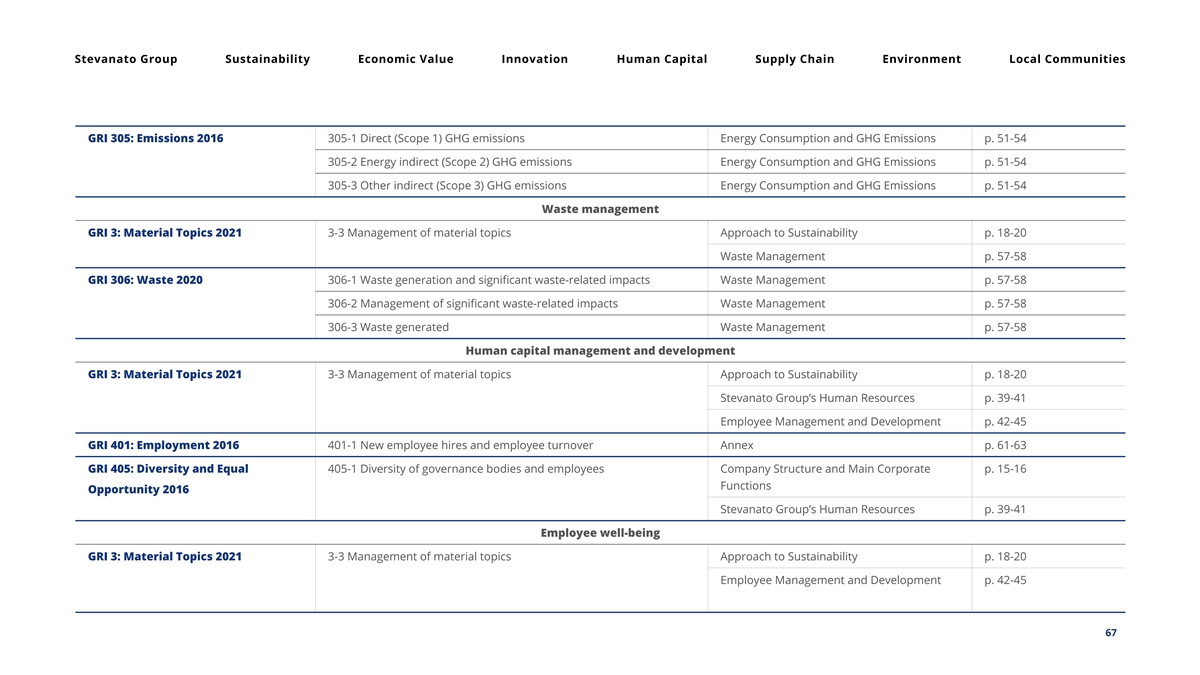
Stevanato Group Sustainability Economic Value Innovation Human Capital Supply Chain Environment Local Communities GRI 305: Emissions 2016 305-1 Direct (Scope 1) GHG emissions Energy Consumption and GHG Emissions p. 51-54 305-2 Energy indirect (Scope 2) GHG emissions Energy Consumption and GHG Emissions p. 51-54 305-3 Other indirect (Scope 3) GHG emissions Energy Consumption and GHG Emissions p. 51-54 Waste management GRI 3: Material Topics 2021 3-3 Management of material topics Approach to Sustainability p. 18-20 Waste Management p. 57-58 GRI 306: Waste 2020 306-1 Waste generation and significant waste-related impacts Waste Management p. 57-58 306-2 Management of significant waste-related impacts Waste Management p. 57-58 306-3 Waste generated Waste Management p. 57-58 Human capital management and development GRI 3: Material Topics 2021 3-3 Management of material topics Approach to Sustainability p. 18-20 Stevanato Group’s Human Resources p. 39-41 Employee Management and Development p. 42-45 GRI 401: Employment 2016 401-1 New employee hires and employee turnover Annex p. 61-63 GRI 405: Diversity and Equal 405-1 Diversity of governance bodies and employees Company Structure and Main Corporate p. 15-16 Functions Opportunity 2016 Stevanato Group’s Human Resources p. 39-41 Employee well-being GRI 3: Material Topics 2021 3-3 Management of material topics Approach to Sustainability p. 18-20 Employee Management and Development p. 42-45 67
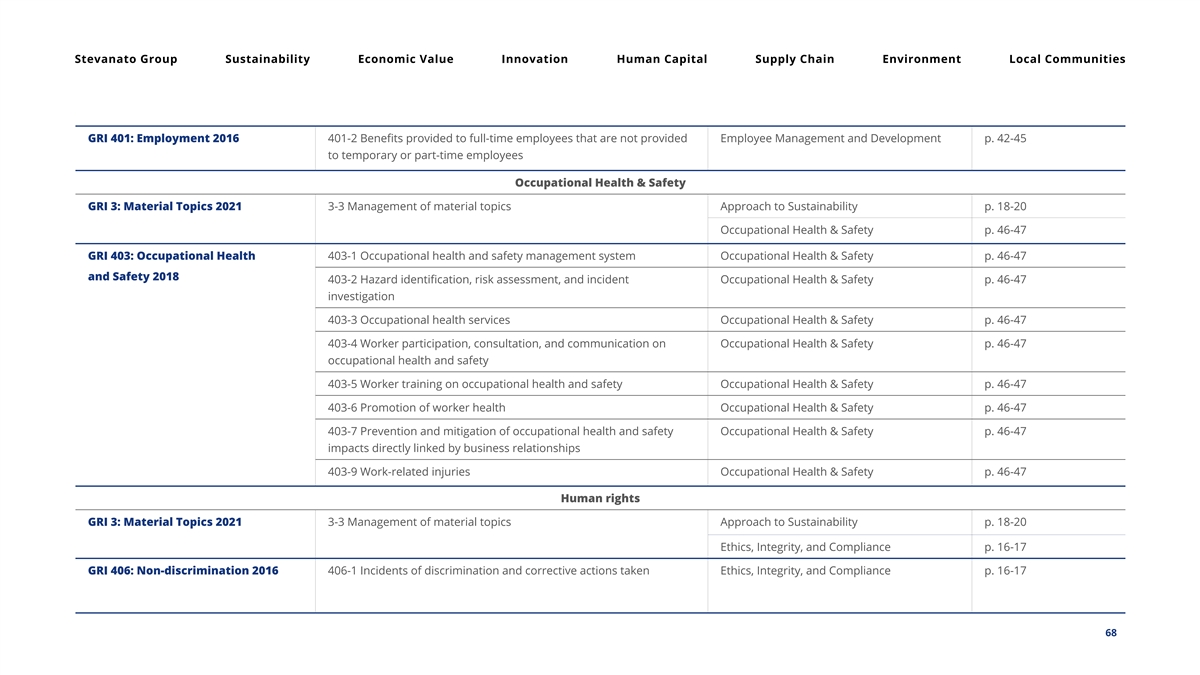
Stevanato Group Sustainability Economic Value Innovation Human Capital Supply Chain Environment Local Communities GRI 401: Employment 2016 401-2 Benefits provided to full-time employees that are not provided Employee Management and Development p. 42-45 to temporary or part-time employees Occupational Health & Safety GRI 3: Material Topics 2021 3-3 Management of material topics Approach to Sustainability p. 18-20 Occupational Health & Safety p. 46-47 GRI 403: Occupational Health 403-1 Occupational health and safety management system Occupational Health & Safety p. 46-47 and Safety 2018 403-2 Hazard identification, risk assessment, and incident Occupational Health & Safety p. 46-47 investigation 403-3 Occupational health services Occupational Health & Safety p. 46-47 403-4 Worker participation, consultation, and communication on Occupational Health & Safety p. 46-47 occupational health and safety 403-5 Worker training on occupational health and safety Occupational Health & Safety p. 46-47 403-6 Promotion of worker health Occupational Health & Safety p. 46-47 403-7 Prevention and mitigation of occupational health and safety Occupational Health & Safety p. 46-47 impacts directly linked by business relationships 403-9 Work-related injuries Occupational Health & Safety p. 46-47 Human rights GRI 3: Material Topics 2021 3-3 Management of material topics Approach to Sustainability p. 18-20 Ethics, Integrity, and Compliance p. 16-17 GRI 406: Non-discrimination 2016 406-1 Incidents of discrimination and corrective actions taken Ethics, Integrity, and Compliance p. 16-17 68
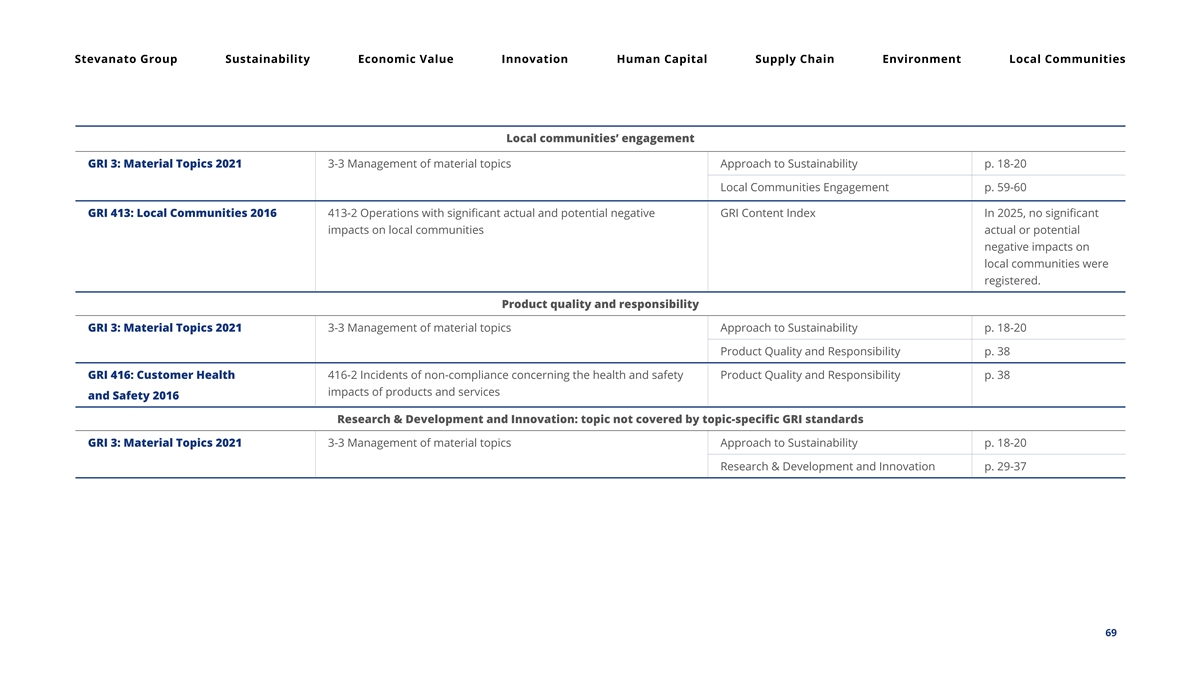
Stevanato Group Sustainability Economic Value Innovation Human Capital Supply Chain Environment Local Communities Local communities’ engagement GRI 3: Material Topics 2021 3-3 Management of material topics Approach to Sustainability p. 18-20 Local Communities Engagement p. 59-60 GRI 413: Local Communities 2016 413-2 Operations with significant actual and potential negative GRI Content Index In 2025, no significant impacts on local communities actual or potential negative impacts on local communities were registered. Product quality and responsibility GRI 3: Material Topics 2021 3-3 Management of material topics Approach to Sustainability p. 18-20 Product Quality and Responsibility p. 38 GRI 416: Customer Health 416-2 Incidents of non-compliance concerning the health and safety Product Quality and Responsibility p. 38 impacts of products and services and Safety 2016 Research & Development and Innovation: topic not covered by topic-specific GRI standards GRI 3: Material Topics 2021 3-3 Management of material topics Approach to Sustainability p. 18-20 Research & Development and Innovation p. 29-37 69
Stevanato Group Sustainability Economic Value Innovation Human Capital Supply Chain Environment Local Communities Independent Audit Report 70
Stevanato Group Sustainability Economic Value Innovation Human Capital Supply Chain Environment Local Communities Independent Audit Report 71

Headquarters Via Molinella, 17 35017 Piombino Dese, Padova, Italy Global footprint with operating units and commercial offices in 10 countries. Visit our website to contact us. stevanatogroup.com