| PROSPECUTS | Filed Pursuant to Rule 424(b)(4) Registration No. 333-291845 |
CONEXEU SCIENCES INC.
9,481,123 Shares of Common Stock
This prospectus relates to the registration of the resale of up to 9,481,123 shares of common stock of Conexeu Sciences Inc. (the "Company") that may be offered and sold, from time to time, by the securityholders (the "Registered Securityholders") identified in this prospectus. These shares consist of: (a) 750,000 shares of common stock issued by the Company pursuant to a debt settlement agreement on September 15, 2024 (the "Debt Settlement Agreement"), which were subsequently transferred to another party; (b) 3,750,000 shares of common stock issued by the Company pursuant to a private placement that closed on May 16, 2025 (the "Private Placement"); (c) 416,667 shares of common stock issued by the Company pursuant to a business advisory agreement on May 16, 2025 (the "Business Advisory Agreement"); (d) 397,789 shares of common stock issued by the Company pursuant to its Regulation Crowdfunding ("Reg CF") offering on September 19, 2025 or October 9, 2025; (e) up to 3,750,000 shares of common stock issuable upon exercise of common stock purchase warrants (the "Private Placement Warrants") issued pursuant to the Private Placement; and (f) up to 416,667 shares of common stock issuable upon exercise of common stock purchase warrants (the "Business Advisory Warrants", and together with the Private Placement Warrants, the "Warrants") issued pursuant to the Business Advisory Agreement.
We are not offering any shares of our common stock for sale under this prospectus. We are registering the offer and resale of the shares of common stock of the Registered Securityholders issued by us in connection with the Debt Settlement Agreement, Private Placement, Business Advisory Agreement and the Reg CF offering, as well as the shares of common stock issuable upon exercise of the Warrants. Our registration of the shares of common stock covered by this prospectus does not mean that the Registered Securityholders will offer or sell any of the shares. Any shares of common stock subject to resale hereunder will have been issued by us and acquired by the Registered Securityholders prior to any resale of such shares pursuant to this prospectus. No underwriter or other person has been engaged to facilitate the sale of the shares in this offering. The Registered Securityholders will pay or assume discounts, commissions, fees of underwriters, selling brokers, dealer managers or similar expenses, if any, incurred for the sale of shares of our common stock.
Unlike an initial public offering, the resale by the Registered Securityholders is not being underwritten by any investment bank. The Registered Securityholders may, or may not, elect to sell their shares of our common stock covered by this prospectus, as and to the extent they may determine. Such sales, if any, will be made through brokerage transactions on Nasdaq Capital Market ("Nasdaq"), or other public exchanges or registered alternative trading venues at prevailing market prices, if our common stock is then listed or, if applicable, admitted to trade on such markets. See "Plan of Distribution." If the Registered Securityholders choose to sell their shares of common stock, we will not receive any proceeds from the sale of shares of common stock by the Registered Securityholders. However, we will receive proceeds from the exercise of the Warrants if the applicable Registered Securityholder exercises the Warrants for cash.
No public market for our common stock currently exists. In addition, our common stock has a limited history of trading in private transactions. On July 30, 2025, we commenced the Reg CF offering at a price of $2.00 per share, which concluded on October 9, 2025. We issued and sold 2,449,962 shares of common stock pursuant to the Reg CF offering.
We have applied for the listing of our common stock on Nasdaq under the symbol "CNXU." We expect our common stock to begin trading on Nasdaq on or about May 21, 2026.
If our Nasdaq application is not approved or we otherwise determine that we will not be able to secure the listing of our common stock on Nasdaq, we will not complete the direct listing. No assurance can be given that our Nasdaq application will be approved and that our common stock will be listed on Nasdaq. This offering is conditional on approval of such listing.
Recent purchase prices of our common stock in private transactions may have little or no relation to the opening public price of our shares of common stock on Nasdaq or the subsequent trading price of our shares of common stock on Nasdaq. For more information, see "Sale Price History of Our Capital Stock." Further, the listing of our common stock on Nasdaq without a firm-commitment underwritten offering is a less typical method for commencing public trading in shares of common stock and, consequently, the trading volume and price of shares of our common stock may be more volatile than if shares of our common stock were initially listed in connection with an initial public offering underwritten on a firm-commitment basis.
On the day that our shares of common stock are initially listed on Nasdaq, Nasdaq will begin accepting, but not executing, pre-opening buy and sell orders and will begin to continuously generate the indicative Current Reference Price (as defined below) on the basis of such accepted orders. The Current Reference Price is calculated each second and, during a 10-minute "Display Only" period, is disseminated, along with other indicative imbalance information, to market participants by Nasdaq on its NOII and BookViewer tools. Following the "Display Only" period, a "Pre-Launch" period begins, during which H.C. Wainwright & Co., LLC, in its capacity as our financial advisor (in such capacity, the "Advisor"), to perform the functions under Nasdaq Rule 4120(c)(8), must notify Nasdaq that our shares are "ready to trade." Once the Advisor has notified Nasdaq that our shares of common stock are ready to trade, Nasdaq will calculate the Current Reference Price for our shares of common stock, in accordance with Nasdaq rules. If the Advisor then approves proceeding at the Current Reference Price, Nasdaq will conduct a price validation test in accordance with Nasdaq Rule 4120(c)(8). As part of conducting such price validation test, Nasdaq may consult with the Advisor if the price bands need to be modified and to select the new price bands for purposes of applying such test iteratively until the validation tests yield a price within such bands. Upon completion of such price validation checks, the applicable orders that have been entered will be executed at such price and regular trading of our shares of common stock on Nasdaq will commence. Under Nasdaq rules, the "Current Reference Price" means: (i) the single price at which the maximum number of orders to buy or sell can be matched; (ii) if there is more than one price at which the maximum number of orders to buy or sell can be matched, then it is the price that minimizes the imbalance between orders to buy or sell (i.e. minimizes the number of shares that would remain unmatched at such price); (iii) if more than one price exists under (ii), then it is the entered price (i.e. the specified price entered in an order by a customer to buy or sell) at which our shares of common stock will remain unmatched (i.e. will not be bought or sold); and (iv) if more than one price exists under (iii), a price determined by Nasdaq in consultation with the Advisor in its capacity as our financial advisor. In the event that more than one price exists under (iii), the Advisor will exercise any consultation rights only to the extent that it can do so consistent with the anti-manipulation provisions of the federal securities laws, including Regulation M, or applicable relief granted thereunder. Neither we nor the Registered Securityholders will be involved in Nasdaq's price-setting mechanism, including any decision to delay or proceed with trading, nor will we or they control or influence the Advisor in carrying out its role as a financial adviser. The Advisor will determine when our shares of common stock are ready to trade and approve proceeding at the Current Reference Price primarily based on considerations of volume, timing and price. In particular, the Advisor will determine, based primarily on pre-opening buy and sell orders, when a reasonable amount of volume will cross on the opening trade such that sufficient price discovery has been made to open trading at the Current Reference Price. For more information, see "Plan of Distribution."
We may amend or supplement this prospectus from time to time by filing amendments or supplement as required. You should read the entire prospectus and any amendments or supplements carefully before you make your investment decision.
We agreed to bear substantially all of the expenses in connection with the registration and resale of the shares offered hereby (other than selling commissions).
The purchase of the securities offered by this prospectus involves a high degree of risk. You should invest in our shares of common stock only if you can afford to lose your entire investment. You should carefully read and consider the section of this prospectus entitled "Risk Factors" beginning on page 19 before buying any shares of our common stock.
Neither the Securities and Exchange Commission nor any state securities commission has approved or disapproved of these securities or determined if this prospectus is truthful or complete. Any representation to the contrary is a criminal offence.
The date of this prospectus is May 11, 2026
TABLE OF CONTENTS
You should rely only on the information contained in this prospectus, any amendment or supplement to this prospectus or any free writing prospectus prepared by or on our behalf. Neither we, nor the Registered Securityholders, have authorized any other person to provide you with different or additional information. Neither we, nor the Registered Securityholders, take responsibility for, nor can we provide assurance as to the reliability of, any other information that others may provide. The Registered Securityholders are offering to sell, and seeking offers to buy, shares of their common stock only under circumstances and in jurisdictions where it is lawful to do so. The information contained in this prospectus is accurate only as of the date of this prospectus, regardless of the time of delivery of this prospectus or of any sale of our common stock. Our business, financial condition, results of operations and/or prospects may have changed since such dates.
This prospectus includes industry and market data that we obtained from periodic industry publications, third-party studies and surveys, filings of public companies in our industry and internal company surveys. These sources include government and industry sources. Industry publications and surveys generally state that the information contained therein has been obtained from sources believed to be reliable. Although we believe the industry and market data to be reliable as of the date of this prospectus, this information could prove to be inaccurate. Industry and market data could be wrong because of the method by which sources obtained their data and because information cannot always be verified with complete certainty due to the limits on the availability and reliability of raw data, the voluntary nature of the data gathering process and other limitations and uncertainties. In addition, we do not know all of the assumptions regarding general economic conditions or growth that were used in preparing the forecasts from the sources relied upon or cited herein.
Except as otherwise set forth in this prospectus, neither we nor the Registered Securityholders have taken any action to permit a public offering of these securities outside the United States or to permit the possession or distribution of this prospectus outside the United States. Persons outside the United States who come into possession of this prospectus must inform themselves about and observe any restrictions relating to the offering of these securities and the distribution of this prospectus outside the United States.
Our name, our logo and other trademarks or service marks of ours appearing in this prospectus are the property of Conexeu Sciences Inc. Trade names, trademarks, and service marks of other companies appearing in this prospectus are the property of their respective holders.
Through and including June 15, 2026 (the 25th day after the listing date of our common stock), all dealers that effect transactions in these securities, whether or not participating in this listing, may be required to deliver a prospectus.
FORWARD-LOOKING STATEMENTS
Certain statements contained in this prospectus constitute "forward-looking statements." These statements appear in a number of places in this prospectus and documents included or incorporated by reference herein and include statements regarding Conexeu's intent, belief or current expectations, and that of Conexeu's officers and directors. These forward-looking statements involve known and unknown risks and uncertainties that may cause Conexeu's actual results, performance or achievements to be materially different from any future results, performance or achievements expressed or implied by such forward-looking statements. In certain cases, forward-looking statements can be identified by the use of words such as "believe", "intend", "may", "will", "should", "plans", "anticipates", "believes", "potential", "intends", "expects" and other similar expressions. These statements are based on Conexeu's current plans and are subject to risks and uncertainties, and as such Conexeu's actual future activities and results of operations may be materially different from those set forth in the forward-looking statements.
Any or all of the forward-looking statements in this prospectus may turn out to be inaccurate and as such, you should not place undue reliance on these forward-looking statements. Conexeu has based these forward-looking statements largely on its current expectations and projections about future events and financial trends that it believes may affect its financial condition, results of operations, business strategy and financial needs. The forward-looking statements can be affected by inaccurate assumptions or by known or unknown risks, uncertainties and assumptions due to a number of factors. Important factors that you should also consider, include, but are not limited to, the factors discussed under "Risk Factors" in this prospectus. In addition, Conexeu cannot assess the impact of each factor on its intended business or the extent to which any factor, or combination of factors, may cause actual results to differ materially from those contained in any forward-looking statements.
These forward-looking statements speak only as of the date on which they are made. Conexeu assumes no obligation to update or to publicly announce the results of any change to any of the forward-looking statements contained or included herein to reflect actual results, future events or developments, changes in assumptions or changes in other factors affecting the forward-looking statements, other than where a duty to update such information or provide further disclosure is imposed by applicable law, including applicable United States federal securities laws.
TERMS USED IN THIS PROSPECTUS
Unless the context otherwise requires, in this prospectus: (i) the terms "we", "us", "our", "Company", "Conexeu" and "our business" refer to Conexeu Sciences Inc.; (ii) "SEC" refers to the Securities and Exchange Commission; (iii) "Securities Act" refers to the United States Securities Act of 1933, as amended; (iv) "Exchange Act" refers to the United States Securities Exchange Act of 1934, as amended; and (v) all dollar amounts refer to United States dollars unless otherwise indicated.
PROSPECTUS SUMMARY
The following summary highlights, and should be read in conjunction with, the more detailed information contained elsewhere in this prospectus. You should read carefully the entire document, including our financial statements and related notes, to understand our business, our Common Shares and the other considerations that are important to your decision to invest in our Common Shares. You should pay special attention to the "Risk Factors" section on page 10.
All references to "$" or "dollars", are expressed in United States dollars unless otherwise indicated.
THE COMPANY
Overview and Corporate Information
Conexeu is a company focused on building a new class of collagen-based regenerative tissue products. The Company was incorporated on November 2, 2022 under the Business Corporations Act (British Columbia) and was continued out of British Columbia and domesticated into the State of Nevada under the laws of the State of Nevada on April 10, 2025.
On November 17, 2023, the Company effected a share consolidation (reverse stock split) on the basis of one (1) old common share for 0.34165385 of a common share. On April 22, 2025, the Company effected a reverse stock split on the basis of four (4) old shares of common stock for each one (1) new share of common stock.
Our principal executive offices are located at 50 West Liberty Street Reno, Suite 880, Nevada, 89501, USA, and our telephone number is 424-333-5622.
Our website address is www.conexeu.com. Information contained on, or accessible through, our websites do not constitute a part of and is not incorporated into this prospectus, and the only information that you should rely on in making your decision whether to invest in our common stock is the information contained in this prospectus.
Conexeu is an early-stage medical device company formed to acquire and commercialize intellectual property ("IP") developed over more than a decade at the University of British Columbia (the "University") and the BC Professional Firefighters Burn and Wound Healing Laboratory. In November 2023, the Company entered into a patent assignment agreement with the University pursuant to which the Company acquired an assignment of the University's right, title, and interest in the applicable patents and patent applications related to the underlying technology.
The Company's only device candidate is the CXU™ scaffold device candidate, which is in preclinical development and has not been approved or cleared for marketing in any jurisdiction. The Company is conducting preclinical research and preparing for regulatory engagement to evaluate potential use in wound care and other medical applications. Any potential benefits to patients, providers, or healthcare systems have not been established and will require further study and regulatory review.
CXU™ is a temperature-responsive, collagen-based extracellular matrix ("ECM") formulation designed to transition from a liquid to a gel-like scaffold following topical application or injection, typically within approximately ten minutes (the "10 Minute Tissue™" concept). The device IP is protected by issued and pending patents and is being evaluated in preclinical studies for its ability to provide an ECM-like environment associated with cellular infiltration, vascularization, and organized tissue remodeling in non-clinical models.
We intend to seek U.S. Food and Drug Administration ("FDA") clearance in the United States for the CXU™ scaffold device candidate through the 510(k) premarket notification process as a Class II medical device; however, the FDA has not yet determined the appropriate classification or regulatory pathway for our device candidate, may require additional data or a different pathway, and there can be no assurance that we will obtain clearance or that the device candidate will become commercially available.
CAUTION: CXU™ IS A DEVICE CANDIDATE IN PRECLINICAL DEVELOPMENT AND IS NOT CLEARED OR APPROVED FOR MARKETING IN THE UNITED STATES OR ANY OTHER JURISDICTION.
History
The CXU™ scaffold technology originated from research conducted over more than a decade at the University, including work led and co-authored by our founders, Dr. Claudia Chavez-Munoz, M.D., Ph.D., and Dr. Ryan Hartwell, Ph.D., who were involved in the technology's formulation and preclinical evaluation from its early development. This body of work includes graduate research at the University focused on an in-situ forming scaffold for wound repair. The technology was subsequently advanced at the University and disseminated through peer-reviewed publications that describe the underlying material concepts and preclinical investigations.1
Patent Assignment Agreement and Loan Agreement
The University had conducted research activities during the course of which it invented, developed and/or acquired certain patent rights relating to UBC UILO file 14-063, titled "Engineered In-situ forming composite tissue graft" (the "University Technology"). The Company's founders, Dr. Ryan Hartwell and Dr. Claudia Chavez-Munoz, participated in certain early discovery and research activities undertaken in the development of the University Technology while affiliated with the University.
On November 20, 2023, Conexeu entered into the following agreements with the University: (i) a patent assignment agreement (the "Patent Assignment Agreement"), and a (ii) loan agreement (the "Loan Agreement"). Pursuant to the Patent Assignment Agreement, the University agreed to transfer, sell and assign to Conexeu all of the University's right, title, and interest in and to the Patents, with the Patent Assignment Agreement being held in escrow until no later than November 20, 2027 and released to Conexeu when the Company pays the University CAD$50,000 (US$40,060) for expenses incurred and fully pays the loan of CAD$136,539 (US$98,117 as of October 31, 2024) plus accrued interest from the Loan Agreement. The Loan Agreement matures on November 20, 2026 with the loan bearing interest at 15%. If Conexeu fails to fully settle both payments by November 20, 2027, the Patent Assignment Agreement will not be released and will be destroyed. In addition, as part of the Patent Assignment Agreement, Conexeu issued 1,031,251 Shares which had a fair value of US$48,526. On March 4, 2025, the Company paid the University a total of CAD$213,795 (US$148,037) in full settlement of the expenses payment noted above and loan and accrued interest under the Loan Agreement. On April 7, 2025, the University assigned to the Company the Patents and on April 7, 2025, the Company was officially registered as the patent owner.
The Patent Assignment Agreement provided that the consideration for the assignment and transfer of the Assigned Patents would be satisfied through the issuance by the Company of certain securities to the University and/or specified stakeholders associated with the University, the cash repayment of expenses as described above, and required the cash repayment of a loan and accrued interest as contained in the Loan Agreement (the "Assignment Consideration"). The Company's capitalization reflects the issuance of such securities.
Pursuant to the Patent Assignment Agreement, the University agreed to assign to the Company, and the Company agreed to accept, a 100% assignment of the University's right, title, and interest in and to the patents and patent applications identified in the Patent Assignment Agreement, together with associated rights worldwide (collectively, the "Assigned Patents").
The Assigned Patents include, to the extent applicable, (i) any letters patent that have issued or may issue on such applications, (ii) any validations and foreign counterparts, and (iii) any continuations, divisionals, continuations-in-part (to the extent included in the Assigned Patents as defined in the Patent Assignment Agreement), reissues, renewals, and extensions associated with the foregoing.
On April 7, 2025, the University executed and delivered, and the Company accepted, the assignment and transfer instruments effecting the conveyance of all of the University's right, title, and interest worldwide in and to the Assigned Patents from the University to the Company, subject to the terms and conditions of the Patent Assignment Agreement. As a result, as of April 7, 2025, the Company acquired the University's assigned ownership interest in the Assigned Patents, including the rights described above in any resulting letters patent and related continuations, divisionals, and reissues to the extent encompassed by the Patent Assignment Agreement.
__________________________________________
1 Example peer-reviewed publication (Acta Biomaterialia, 2011) describing an injectable ECM concept (ScienceDirect abstract page); UBC Library Open Collections - Hartwell thesis page ("Development and application of an in-situ forming, biohybrid scaffold for wound repair").
Corporate Development of the CXU™ scaffold technology
Following the Company's formation in 2022 and the acquisition of the intellectual property underlying the CXU™ scaffold technology, the Company initiated a structured translation of the academic research platform into a defined medical device candidate under a commercial development program. While an early device history file and Device Master Record ("DMR") framework had been generated during the academic phase (including documentation dating to 2015), the Company began developing a commercially focused DMR, quality documentation, and supporting standard operating procedures ("SOPs") consistent with customary medical device development practices and anticipated future FDA submissions for a 510(k) medical device candidate. These activities included establishing design and documentation controls, defining product and process specifications, and initiating manufacturing scale-up planning and supplier readiness efforts.
Beginning in April 2025, the Company initiated Company-sponsored, non-GLP preclinical activities intended to support commercial development, including a rabbit study designed to evaluate persistence, local tissue response, and handling of CXU™ formulations over time, as well as bench testing to assess rheological characteristics and repeatability of gelation and handling properties. In September 2025, the Company expanded its commercial development program to include manufacturing process development, supplier qualification activities, biocompatibility testing program planning, regulatory strategy development, and formalized design and documentation processes. With respect to regulatory engagement, the Company initiated regulatory engagement, with the FDA in April of 2024 and September 2025. Collectively, these activities reflect the Company's transition of the CXU™ scaffold technology from an academic research platform into a device candidate being advanced through a staged, pre-commercial medical device development program.
Intellectual Property
The Company's proprietary formula, CXUTM, is an ECM scaffold device candidate protected by patents (collectively, the "Patents") in Australia, and the European Union (validated in Belgium, Switzerland, Germany, Spain, France, Great Britain, Ireland, Italy, and the Netherlands), Japan, and the USA, which form a critical barrier to entry and secure our competitive advantage in regenerative medicine. Origin and ownership of the Company's core patent rights were assigned from the University. Patent protection in Canada for such proprietary ECM scaffold technology remains pending. The Patents are summarized in the table below:
| Jurisdiction | Patent No. | Grant Date (Expiry Date) |
Technology | Claim Type |
| United States | 10,865,811 | December 2020 (February 2036) |
ECM scaffold technology | Composition; method of preparing the composition |
| European Union | 3,253,417 | June 2023 (February 2036) |
ECM scaffold technology | Composition; method of preparing the composition; use of a composition |
| Australia | 2016214910 | January 2022 (February 2036) |
ECM scaffold technology | Composition; method of preparing the composition |
| Japan | 6,937,696 | September 2021 (February 2036) |
ECM scaffold technology | Composition; method of preparing the composition |
| Canada | 2,974,209 | Pending (February 2036) |
ECM scaffold technology | Composition; method of preparing the composition; product; use |
The Patents are directed to and protect critical aspects of our ECM scaffold technology, including formulation, methods and temperature-triggered gelation, forming a significant barrier to entry for potential competitors. Certain aspects of our manufacturing processes remain as trade secrets.
While we believe our IP strategy is robust, no assurance can be given that newly filed patent applications will be granted or that issued patents will provide complete protection against competitive threats. Additionally, third-party patents, existing or newly granted, could potentially impact our ability to develop, manufacture, or market our current or pipeline products. By coupling stringent internal controls with strategic IP filings and continuous R&D, Conexeu aims to maintain and enhance our competitive edge in the regenerative medicine market for advanced wound care, aesthetic applications, and beyond.
Our Technology and Products
Conexeu has developed a proprietary platform built around its patented device candidate; CXUTM Scaffold, an extra cellular matrix (ECM) scaffold designed to support the body's natural regenerative processes. At its core, this platform leverages a temperature-sensitive collagen-based solution that becomes a gel-like scaffold upon injection or application in the body, typically within about ten minutes. This scaffold supports cell growth, tissue integration, and faster healing, making it well-suited for a range of medical and aesthetic applications.
In wound care, Conexeu's CXU™ scaffold has demonstrated wound-healing performance in preclinical pilot studies 2 that we believe may be favorable in wound care, including observations consistent with reduced scarring and contracture and improved tissue quality;3 these findings are preliminary, derived from non-clinical models, and may not be predictive of clinical outcomes. The scaffold is formulated as a liquid intended to conform to irregular wound geometries prior to transitioning at body temperature to a scaffold, and we are evaluating potential applications in acute wounds, burns, and complex wound presentations, including tunneling and dehiscent wounds.
Separately, we are conducting preclinical research to evaluate potential aesthetic applications of the same underlying collagen-based scaffold technology, including as an injectable soft-tissue filler for facial indications and, over time, larger-volume applications; we have not obtained FDA clearance or approval for any wound care or aesthetic indication, and any future development would be subject to additional research, demonstrated safety and performance, and applicable regulatory authorizations.
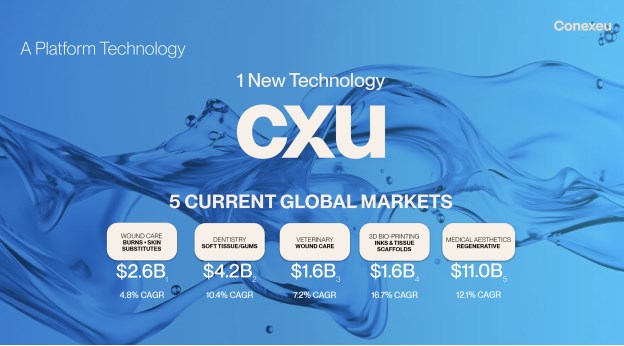
Overall, Conexeu's patent may offer a novel approach to tissue engineering, offering a versatile framework that can potentially be deployed in multiple areas of the body. The Company has secured patent protection worldwide (including the US, EU, Japan, Australia, Canada (pending)) that has significant preclinical research. As a platform technology, it has the potential to become a new standard of care in both wound repair and regenerative aesthetics, with additional future possibilities in areas like 3D bioprinting and other organ-supportive applications.
Implications of Being an Emerging Growth Company
As a company with less than $1.235 billion in revenue during our last fiscal year, we qualify as an "emerging growth company," as defined in the Jumpstart Our Business Startups Act, or the JOBS Act, enacted in April 2012. An "emerging growth company" may take advantage of certain reduced reporting requirements and is relieved of certain other significant requirements that are otherwise generally applicable to public companies. In particular, as an emerging growth company, the Company:
__________________________________________
2 Tissue Engineering Part A (2015), infra note [*3]; Gels (2022), infra note [*10]; Gels (2023), infra note [*11]; Company data (animal data on file): We have generated internal preclinical data evaluating administration, local tissue response, and histologic remodeling in animal models; these internal datasets have not been peer-reviewed and may not be predictive of clinical outcomes.
3 Company data (animal data on file): We have generated internal preclinical data evaluating administration, local tissue response, and histologic remodeling in animal models; these internal datasets have not been peer-reviewed and may not be predictive of clinical outcomes.
• will not be required to obtain an auditor attestation on its internal controls over financial reporting pursuant to the Sarbanes-Oxley Act of 2002;
• will not be required to provide a detailed narrative disclosure discussing its compensation principles, objectives and elements and analyzing how those elements fit with its principles and objectives (commonly referred to as "compensation discussion and analysis");
• will not be required to obtain a non-binding advisory vote from its shareholders on executive compensation or golden parachute arrangements (commonly referred to as the "say-on-pay," "say-on-frequency" and "say-on-golden-parachute" votes);
• will be exempt from certain executive compensation disclosure provisions requiring a pay-for-performance graph and CEO pay ratio disclosure;
• may present only two years of audited financial statements and only two years of related Management's Discussion and Analysis of Financial Condition and Results of Operations ("MD&A"); and
• will be eligible to claim longer phase-in periods for the adoption of new or revised financial accounting standards.
The Company intends to take advantage of all of these reduced reporting requirements and exemptions, including the longer phase-in periods for the adoption of new or revised financial accounting standards under Section 107 of the JOBS Act. The Company's election to use the phase-in periods may make it difficult to compare its financial statements to those of non-emerging growth companies and other emerging growth companies that have opted out of the phase-in periods under Section 107 of the JOBS Act.
Under the JOBS Act, the Company may take advantage of the above-described reduced reporting requirements and exemptions for up to five years after the Company's initial sale of common equity pursuant to a registration statement declared effective under the Securities Act, or such earlier time should it no longer meet the definition of an emerging growth company. In this regard, the JOBS Act provides that the Company would cease to be an "emerging growth company" if the Company has more than $1.235 billion in annual revenues, has more than $700 million in market value of its common stock held by non-affiliates, or issues more than $1 billion in principal amount of non-convertible debt over a three-year period.
Certain of these reduced reporting requirements and exemptions are also available to the Company due to the fact that it may also qualify as a "smaller reporting company" under the SEC's rules. For instance, smaller reporting companies are not required to obtain an auditor attestation on their assessment of internal control over financial reporting; are not required to provide a compensation discussion and analysis; are not required to provide a pay-for-performance graph or CEO pay ratio disclosure; and may present only two years of audited financial statements and related MD&A disclosure.
The Direct Listing
We have applied to list our common stock on Nasdaq under the symbol "CNXU." As described in more detail below in the section titled “Risk Factors - Risks Related to our Direct Listing and Ownership of our Common Stock”, the direct listing process differs significantly from an initial public offering underwritten on a firm-commitment basis in several significant ways, which include, but are not limited to, the following:
Nasdaq Listing Requirements
We intend to list our common stock on Nasdaq under the Equity Standard (the “Equity Standard”) for Direct Listing Requirements. To meet the Equity Standard, we must satisfy the following requirements:
Stockholders’ Equity: We must have stockholders’ equity of $5 million or more. At this time, we have stockholders’ equity of $6,826,402 as at January 31, 2026.
Valuation Based Market Value of Unrestricted Publicly Held Shares: We must have a minimum valuation based market value of unrestricted publicly held shares of $30 million. At this time, we have 5,314,456 shares of common stock held by non-affiliates, which will be based on a valuation-based bid price of at least $8.00 or more per share subject to review and approval of Nasdaq, which will result in a valuation based market value of unrestricted publicly held shares of at least $42,515,648; accordingly, subject to Nasdaq’s acceptance of the third-party valuation, we will meet this requirement.
Operating History: We must have an operating history of 2 years. At this time, we have been in operations for more than three years.
Unrestricted Publicly Held Shares: We must have a minimum of 1,000,000 unrestricted publicly held shares. Upon this registration statement being declared effective, we will have 5,314,456 shares of common stock held by non-affiliates; accordingly we will meet this requirement.
Unrestricted Round Lot Shareholders: We must have a minimum of 300 unrestricted round lot shareholders. Upon this registration statement being declared effective, we will have 1,274 unrestricted round lot shareholders; accordingly we meet this requirement.
Market Makers: We must have at least three registered and active market makers for our common stock. Our Advisor will work in consultation with a minimum of at least three market makers; accordingly we will meet this requirement.
Valuation Based Bid Price: Our stock price must have a minimum valuation based bid price of $8.00 per share at the time of listing. We will have received a valuation from a third-party which will indicate a valuation bid price of at least $8.00 per share, subject to review and approval of Nasdaq; accordingly, subject to Nasdaq’s acceptance of the third-party valuation, we will meet this requirement.
While we believe that we currently satisfy these requirements, there can be no assurance that Nasdaq will approve our listing application. Accordingly, there is a risk that we will not be able to list our common stock on Nasdaq. If our Nasdaq application is not approved, we will not complete this direct listing.
THE OFFERING
| The Issuer: | Conexeu Sciences Inc. Address: 50 West Liberty Street, Suite 880, Reno, NV 89501 Telephone: 424-333-5622 |
| The Registered Securityholders and Common Stock offered by the Registered Securityholders: | The registered securityholders (each, a "Registered Securityholder") are comprised of: (i) the holders of 750,000 shares of common stock issued pursuant to the Debt Settlement Agreement, (ii) the holders of 3,750,000 shares of common stock and 3,750,000 shares of common stock issuable upon exercise of the Private Placement Warrants, which were issued in the Private Placement, (iii) the holders of 416,667 shares of common stock and 416,667 shares of common stock issuable upon exercise of the Business Advisory Warrants, which were issued pursuant to the Business Advisory Agreement, and (iv) the holders of 397,789 shares of common stock issued pursuant to the Reg CF offering. |
| Offering Price: | On the day that our shares of common stock are initially listed on Nasdaq, Nasdaq will begin accepting, but not executing, pre-opening buy and sell orders and will begin to continuously generate the indicative Current Reference Price on the basis of such accepted orders. The Current Reference Price is calculated each second and, during a 10-minute "Display Only" period, is disseminated, along with other indicative imbalance information, to market participants by Nasdaq on its NOII and BookViewer tools. Following the "Display Only" period, a "Pre-Launch" period begins, during which the Advisor, in its capacity as our financial advisor to perform the functions under Nasdaq Rule 4120(c)(8), must notify Nasdaq that our shares are "ready to trade." Once the Advisor has notified Nasdaq that our shares of Common stock are ready to trade, Nasdaq will calculate the Current Reference Price for our shares of Common stock, in accordance with Nasdaq rules. If the Advisor then approves proceeding at the Current Reference Price, Nasdaq will conduct a price validation test in accordance with Nasdaq Rule 4120(c)(8). As part of conducting such price validation test, Nasdaq may consult with the Advisor, if the price bands need to be modified, to select the new price bands for purposes of applying such test iteratively until the validation tests yield a price within such bands. Upon completion of such price validation checks, the applicable orders that have been entered will be executed at such price and regular trading of shares of our common stock on Nasdaq will commence. The Advisor will determine when our shares of common stock are ready to trade and approve proceeding at the Current Reference Price primarily based on considerations of volume, timing and price. In particular, the Advisor will determine, based primarily on pre-opening buy and sell orders, when a reasonable amount of volume will cross on the opening trade such that sufficient price discovery has been made to open trading at the Current Reference Price. If the Advisor does not approve proceeding at the Current Reference Price (for example, due to the absence of adequate preopening buy and sell interest), the Advisor will request that Nasdaq delay the open until such a time that sufficient price discovery has been made to ensure a reasonable amount of volume crosses on the opening trade. For more information, see "Plan of Distribution." |
| Use of Proceeds: | We will not receive any proceeds from the resale of shares of our common stock by the Registered Securityholders. However, we will receive proceeds from the exercise of the Warrants if the applicable Registered Securityholder exercises the Warrants for cash. We will, however, incur all costs associated with this registration statement and prospectus. |
| Proposed Listing: | Our common stock is not currently listed for trading on any securities exchange. We have applied to list our common stock on the Nasdaq Capital Market under the symbol "CNXU". |
| Outstanding Shares of Common Stock: |
There were 20,916,173 shares of common stock outstanding as of April 16, 2026. |
| Risk Factors: | See "Risk Factors" and the other information in this prospectus for a discussion of the factors you should consider before deciding to invest in our securities. |
GLOSSARY OF TECHNICAL TERMS
In this prospectus, the following scientific or technical terms have the meanings indicated below.
| Term | Meaning |
| 2D culture | Cells grown as a flat monolayer on a culture surface rather than in a three-dimensional matrix. |
| Adipogenesis | Formation of fat cells from precursor cells. |
| Adverse event | Harmful or unintended medical occurrence associated with product use. |
| Administration | Method of delivering or applying a medical product. |
| Allogeneic | Derived from a genetically different individual of the same species. |
| ANOVA (analysis of variance) |
Statistical method used to determine whether there are significant differences among the means of three or more groups. |
| Angiogenesis | Formation of new blood vessels from existing vasculature. |
| Antibacterial activity | Ability of a substance or material to inhibit or kill bacteria. |
| Aseptic fill-finish | Sterile filling and sealing process used to prevent microbial contamination of a product. |
| Autograft | Tissue transplanted from one location to another in the same individual. |
| Bioengineered skin substitute | Laboratory-developed material designed to replace or support damaged skin. |
| Biomaterials | Materials engineered to interact with biological systems for medical purposes. |
| Biomimetic | Designed to imitate natural biological structures or functions. |
| Biostimulatory | Stimulating the body's natural biological processes, such as collagen production. |
| Biotechnology | Use of biological systems, organisms, or components to develop medical or industrial products. |
| Borate network | Crosslinked structure formed using borate ions to strengthen hydrogels. |
| Calcium hydroxylapatite (CaHA) | Calcium-based mineral compound used in certain injectable fillers. |
| CBC (complete blood count) |
Laboratory test measuring blood cell components. |
| CD3 | Cell-surface marker used to identify T lymphocytes. |
| CD31 | Endothelial cell marker commonly used to identify blood vessels. |
| CD45 | Leukocyte marker used to identify white blood cells. |
| Cell compatibility | Ability of a material to support cell survival and function without causing harm. |
| Cellular infiltration | Movement of cells into and through a material or scaffold. |
| Cellular ingrowth | Migration and proliferation of host cells into a material. |
| CE marking | Certification indicating conformity with European Union medical device regulations. |
| CFU (colony-forming unit) |
Measure of viable bacterial cells capable of replication. |
| cGMP | Current Good Manufacturing Practice quality standards. |
| Class I medical device | Lowest-risk category of medical devices subject primarily to general regulatory controls. |
| Class II medical device | Moderate-risk medical devices subject to general and special regulatory controls, often cleared via 510(k). |
| Term | Meaning |
| Class III medical device | Highest-risk devices typically requiring Premarket Approval (PMA). |
| Clinical data | Information collected from human use or clinical studies. |
| Clinical development | Process of testing a medical product in humans to assess safety and performance. |
| Clinical trial | Structured human study conducted to evaluate safety and effectiveness. |
| Collagenase | Enzyme that breaks down collagen. |
| Collagen-based | Made primarily from collagen, a structural protein in connective tissue. |
| Collagen-GAG | Composite of collagen and glycosaminoglycans, components of extracellular matrix. |
| Comparator | Reference treatment or material used for comparison in a study. |
| Conformity assessment | Regulatory process to verify compliance with applicable standards. |
| Construct (tissue construct) | Engineered assembly of cells and scaffold material intended to support tissue formation. |
| Contraction index | Quantitative measure of wound or graft shrinkage over time. |
| Contracture | Tightening of tissue during healing that restricts movement. |
| Crosslinking | Chemical bonding between polymer chains to enhance structural stability. |
| Critical quality attributes (CQAs) | Measurable properties required to ensure product safety and performance. |
| Cytotoxicity | Capacity of a material or substance to damage or kill cells. |
| Data blinding | Masking treatment assignment to reduce bias in study results. |
| Degradation resistance | Ability of a material to resist enzymatic or structural breakdown. |
| Dehiscence | Reopening or separation of a surgical wound. |
| De Novo pathway | FDA regulatory pathway for novel moderate-risk devices without a predicate. |
| Dermal | Relating to the dermis layer of the skin. |
| Dunnett post hoc test | Statistical method comparing multiple treatment groups against a single control following ANOVA. |
| ECM (extracellular matrix) | Structural network of proteins and polysaccharides that supports cells in tissues. |
| Efficacy | Ability to produce the intended beneficial effect. |
| Endogenous | Originating within the body. |
| Enzymatic degradation | Breakdown of a material by enzyme activity. |
| Epithelialization (re-epithelialization) |
Regrowth of epithelial cells to restore surface coverage of a wound. |
| Excisional wound | Wound created by surgically removing tissue. |
| Fat grafting | Transfer of a patient's own fat to another area for volume restoration. |
| Fibroblast | Connective tissue cell responsible for producing collagen and extracellular matrix. |
| Fibrillation (fibrillogenesis) | Formation of collagen fibrils during gel assembly. |
| Fibrotic | Characterized by excessive fibrous connective tissue formation. |
| Flowable | Capable of being delivered as a liquid or semi-liquid. |
| Foreign body reaction | Local immune response to implanted or injected material. |
| Free-floating gel assay | Contraction model in which a gel is not attached to a surface. |
| Term | Meaning |
| GAG (glycosaminoglycan) | Long-chain polysaccharide component of extracellular matrix. |
| Gelation | Process by which a liquid forms a gel network. |
| Gel batch | Single prepared lot of gel material. |
| Gel-like | Semi-solid, water-rich network that holds its shape. |
| Gel strength | Measure of firmness or structural stability of a gel. |
| GFP-positive | Cells expressing green fluorescent protein for tracking purposes. |
| GLP-1 agonists | Medications that activate the glucagon-like peptide-1 receptor. |
| Graft | Transplanted tissue or scaffold material placed into a recipient site. |
| Graft survival | Duration transplanted tissue remains functional before failure. |
| Granuloma | Localized inflammatory nodule formed by immune cells. |
| Gross pathology | Macroscopic examination of tissues without microscopy. |
| GSIS (glucose-simulated insulin secretion) | Measurement of insulin release under varying glucose conditions. |
| Handling properties | Practical physical characteristics affecting ease of clinical use. |
| HGF (hepatocyte growth factor) | Signaling protein involved in tissue repair and angiogenesis. |
| Histology | Microscopic study of tissue structure. |
| Hydrogel matrix | Water-swollen polymer network used in biomedical applications. |
| Hydroxyproline assay | Method for quantifying collagen content via hydroxyproline measurement. |
| Hypertrophic scar | Raised scar formed from excessive collagen deposition. |
| IDE (Investigational Device Exemption) | FDA authorization permitting clinical investigation of certain devices. |
| IDO (indoleamine 2,3-dioxygenase) | Enzyme involved in tryptophan metabolism and immune regulation. |
| IDO mRNA | Messenger RNA encoding IDO, used as gene expression readout. |
| ImageJ | Image analysis software used for quantitative measurement of biological images. |
| Immunofluorescence | Fluorescent antibody-based technique for detecting proteins in tissues. |
| Immunohistochemistry (IHC) | Antibody-based staining method to localize proteins in tissue sections. |
| Immunogenicity | Ability of a substance to trigger an immune response. |
| Implantology | Dental specialty involving placement of implants. |
| Indication | The specific condition or use a product is authorized to treat. |
| Injectability | Ease with which a material can be delivered through a syringe or needle. |
| In situ | At the site of application within the body. |
| Intradermal | Within the dermis layer of the skin. |
| In vitro | Performed outside a living organism in a laboratory setting. |
| In vivo | Conducted within a living organism. |
| IRB (Institutional Review Board) | Committee that reviews and oversees human clinical research ethics. |
| Term | Meaning |
| Islet | Cluster of pancreatic endocrine cells that produce insulin. |
| ISO 10993-5 | International standard specifying in vitro cytotoxicity testing for medical devices. |
| Labeling | Official instructions and approved claims for product use. |
| Laxity | Looseness or loss of tissue firmness. |
| Live/Dead assay | Fluorescent assay distinguishing viable from non-viable cells. |
| Masson's Trichrome | Histologic stain used to visualize collagen deposition. |
| Mechanical behavior | Material response to applied forces. |
| Medical Devices Regulation (EU MDR) | European Union regulation governing medical device safety and performance. |
| Metabolic | Relating to biochemical processes within cells. |
| Microstructure | Fine structural organization visible at microscopic scale. |
| MSTSG | Meshed split-thickness skin graft. |
| Murine | Relating to mice or rodents. |
| n (sample size) | Numbers of samples analyzed in a study. |
| Nanocomposite | Material incorporating nanoscale components within a matrix. |
| Native tissue | The body's original, unmodified tissue. |
| Nodule | Small, localized lump of tissue that may form under the skin. |
| Off-label | Use of a medical product for an unapproved indication. |
| PCL (polycaprolactone) | Biodegradable polyester used in certain medical materials. |
| Periodontitis | Inflammatory disease affecting the tissues supporting teeth. |
| Pharmacologic | Relating to drug-based biochemical activity. |
| Pharmacovigilance | Ongoing monitoring for safety issues and adverse events. |
| Physiologic temperature | Normal body temperature, approximately 37°C. |
| PMA (Premarket Approval) |
FDA regulatory review process for high-risk medical devices. |
| Poly-L-lactic acid (PLLA) | Biodegradable synthetic polymer used in certain fillers. |
| Polymethylmethacrylate (PMMA) | Non-biodegradable synthetic microsphere material used in permanent fillers. |
| Polymer modification | Chemical alteration of polymers to adjust material performance. |
| Polyvinyl alcohol (PVA) | Synthetic polymer used to modify hydrogel properties. |
| Porcine | Relating to pigs |
| Preclinical | Tested in lab and/or animal models before human studies. |
| p-value | Statistical probability measure used to evaluate evidence against a null hypothesis. |
| Quality system | Documented controls ensuring consistent safe manufacture. |
| Rabbit ear hypertrophic scar model | Preclinical scarring model using rabbit ear wounds. |
| Re-epithelialization | Regrowth of epithelial layer to close a wound surface. |
| Regenerative tissue | Tissue intended to support repair and regrowth after injury. |
| Regulatory approval | Authorization by a regulatory authority to market a product. |
| Term | Meaning |
| Replicates | Repeated samples or measurements used to ensure reliability. |
| Resorbed | Gradually broken down and absorbed by the body. |
| Rheology | How a material flows and deforms (e.g. viscosity and gel strength), which can affect handling and injectability. |
| RT-PCR | Laboratory technique used to quantify gene expression by measuring RNA levels. |
| Scar elevation index | Measurement comparing scar height to surrounding tissue. |
| Scaffold | Structural framework designed to support tissue formation. |
| Side effect | Unintended effect occurring with product use. |
| Significance threshold | Predefined p-value cutoff used to determine statistical significance. |
| Silver nanoparticles | Nanoscale silver particles with antimicrobial properties. |
| Simulation index | Ratio of insulin secretion under high vs. low glucose. |
| Splenocyte | Immune cell isolated from the spleen for laboratory testing. |
| Splinted wound model | Wound model using a stabilizing device to reduce contraction. |
| Statistical significance | Determination that observed differences are unlikely due to chance based on statistical testing. |
| Stimulation index | Ratio of response under stimulated versus baseline conditions. |
| Stromal cells | Supportive connective tissue cells within organs or tissues. |
| Subcutaneous | Beneath the skin. |
| Thermosensitive | Material that changes physical properties in response to temperature. |
| Tissue construct | Engineered assembly; a scaffold designed to support functional tissue |
| Tissue graft | Material placed to repaid/replace damaged tissue. |
| Tissue regeneration | Restoration of damaged tissue toward normal structure and function. |
| Tissue remodeling | Structural reorganization of tissue during healing. |
| Topical | Applied to the body surface or wound site. |
| t-test | Statistical test comparing means between two groups. |
| Tukey / Tukey-Kramer test | Post-ANOVA multiple comparison statistical methods. |
| Turbidity | Optical measurement of cloudiness used to track gel formation. |
| Validate (validation) | Confirming a process performs reliably as intended. |
| Vascular occlusion | Blockage of a blood vessel. |
| Vascularization | Formation of blood vessels within tissue. |
| Vasculogenesis | Formation of new blood vessels from precursor cells. |
| VEGF (vascular endothelial growth factor) | Protein that promotes blood vessel formation. |
| Viscoelastic | Exhibiting both liquid-like and solid-like mechanical behavior. |
RISK FACTORS
An investment in our common stock involves a number of very significant risks. You should carefully consider the following risks and uncertainties in addition to other information in this prospectus in evaluating our company and our business before purchasing shares of our common stock. Our business, operating results and financial condition could be seriously harmed due to any of the following risks. The risks described below may not be all of the risks facing our company. Additional risks not presently known to us or that we currently consider immaterial may also impair our business operations. You could lose all or part of your investment due to any of these risks.
Risks Related to Our Business and Strategy
We have a limited operating history and have incurred significant losses since our inception and anticipate that we will continue to incur losses for the foreseeable future. We have only one device candidate and no commercial sales, which, together with our limited operating history, make it difficult to assess our future viability.
We are an early-stage biotechnology company with a limited operating history. Medical product development is a highly speculative undertaking and involves a substantial degree of risk. To date, we have invested substantially all of our efforts and financial resources in the clinical development and regulatory approval of, and commercial planning for, CXU™, which is currently our only device candidate. We are not profitable and have incurred losses in each year since our inception in 2022. We have a limited operating history upon which you can evaluate our business and prospects. Consequently, any predictions about our future success, performance or viability may not be as accurate as they could be if we had a longer operating history or an approved product on the market. In addition, we have limited experience and have not yet demonstrated an ability to successfully overcome many of the risks and uncertainties frequently encountered by companies in the medical aesthetics and biotechnology field. We expect the CXU™ device candidate to be regulated as a Class II medical device and currently anticipate seeking FDA clearance through the 510(k) premarket notification pathway; however, the FDA has not determined the appropriate classification or regulatory pathway for CXU™, and the FDA may require additional data, including clinical data, may determine that CXU™ is a Class III device subject to a premarket approval ("PMA") application, may require a De Novo classification request, or may determine that another regulatory pathway applies. Any such determination could increase the time and cost of development and could delay, limit, or prevent commercialization., we will not be permitted to market CXU™ unless and until we obtain the required authorization from the U.S. Food and Drug Administration ("FDA"). Medical devices are regulated by the FDA and are classified as Class I, Class II, or Class III.
To date, we have not obtained any regulatory approvals for CXU™ or generated any revenue from product sales relating to CXU™. We continue to incur significant expenses related to regulatory approval and commercialization operations CXU™. We expect to continue to incur losses for the foreseeable future, and we anticipate these losses will increase as we continue to seek regulatory approval for, and begin to commercialize, CXU™, if approved. Our ability to achieve revenue and profitability is dependent on our ability to obtain necessary regulatory approvals and successfully market and commercialize CXU™. We currently have only one device candidate, CXU™, and our business presently depends entirely on our ability to obtain the necessary regulatory authorizations and to successfully commercialize CXU™ on a timely basis, if at all. Even if we obtain FDA clearance or approval, we may be subject to significant ongoing regulatory obligations, including requirements related to manufacturing, labeling, adverse event reporting, quality systems, and post-market surveillance, and the FDA may impose limitations on the indications for use, require additional studies, or take enforcement action if we fail to comply with applicable requirements. In addition, the regulatory classification and requirements for CXU™ may depend on its final design, intended use, and claims, and changes to the device candidate or its intended uses could require additional regulatory submissions or approvals. As a result, there can be no assurance that we will obtain FDA authorization for CXU™ on the timeline we expect, or at all, or that we will be able to successfully commercialize CXU™ if such authorization is obtained.
We have limited experience in successfully commercializing a device candidate once approved. Even if we achieve profitability in the future, we may not be able to sustain profitability in subsequent periods. Our prior losses, combined with expected future losses, may adversely affect the market price of our common stock and our ability to raise capital and continue operations. We have no products approved or cleared for sale in any jurisdiction and we have generated no product revenue. If we are unable to obtain regulatory authorization for CXU™ or if commercialization is delayed or unsuccessful, we may be unable to continue operations, raise additional capital on acceptable terms, or execute our business plan.
We currently depend entirely on the successful and timely regulatory approval and commercialization of our only device candidate, CXU™. CXU™ may not receive regulatory approval or, if it does receive regulatory approval, we may not be able to successfully commercialize it.
We do not know if or when we will receive any such approvals or whether we will need to make modifications or significant additional expenditures to obtain any such approvals. In addition, even if we receive approval in one country, we may not receive approval in any other jurisdiction. Our near-term prospects, including our ability to finance our company and generate revenue, as well as our future growth, depend entirely on the successful and timely regulatory approval and commercialization of CXU™.
The regulatory and commercial success of CXU™ will depend on a number of factors, including the following:
• whether we are required by the FDA, or other similar regulatory authorities to conduct additional clinical trials or meet other requirements to support the approval of CXU™;
• our success in educating physicians and consumers about the benefits, administration and use of CXU™, if approved;
• the prevalence, duration and severity of potential side effects experienced with CXU™ ;
• the timely receipt of necessary marketing approvals from the FDA, and other similar regulatory authorities;
• achieving and maintaining compliance with all regulatory requirements applicable to CXU™.
• the ability to raise additional capital on acceptable terms, or at all, if needed, to support the commercial launch of CXU™;
• the acceptance by physicians and consumers of the safety and efficacy of CXU™, if approved;
• our ability to successfully commercialize CXU™, if approved, whether alone or in collaboration with others;
• the ability of our current manufacturer and any third parties with whom we may contract to manufacture CXU™ to remain in good standing with regulatory agencies and develop, validate and maintain commercially viable manufacturing processes that are compliant with cGMP requirements; and
• the availability, perceived advantages, relative cost, relative safety and relative efficacy of competing products.
If we do not achieve one or more of these factors, many of which are beyond our control, in a timely manner or at all, we could experience significant delays or an inability to obtain regulatory approvals or commercialize CXU™. Even if regulatory approvals are obtained, we may never be able to successfully commercialize CXU™ or any future device candidates. In addition, we will need to transition at some point from a company with a development focus to a company capable of supporting commercial activities. We may not be successful in such a transition. Accordingly, we may not be able to generate sufficient revenue through the sale of CXU™ or any future device candidates to continue our business.
We may require additional financing to fund our future operations, and a failure to obtain additional capital when so needed on acceptable terms, or at all, could force us to delay, limit, reduce or terminate our operations and execute our business plan.
We have currently utilized substantial amounts of cash since our inception in order to conduct clinical development to support regulatory approval of CXU™ initially in the United States. We expect that we will continue to expend substantial resources for the foreseeable future in order to finalize regulatory approval for CXU™, to commercialize CXU™, for the development of any other indications of CXU™, and for the clinical development of any additional device candidates we may choose to pursue. In the near term, these expenditures will include costs associated with the development and expansion of our sales force and commercialization infrastructure in connection with commercializing CXU™, if approved. In the long term, these expenditures will include costs associated with the continued commercialization of CXU™, if approved, and any of our future device candidates, such as research and development, conducting preclinical studies and clinical trials and manufacturing and supplying as well as marketing and selling any products approved for sale. In addition, other unanticipated costs may arise. Because the regulatory approval process and commercialization expenditures needed to meet our sales objectives is highly uncertain, we cannot reasonably estimate the actual amounts necessary to successfully complete the development and commercialization of CXU™ or any future device candidates. We expect to incur additional costs such as hiring additional personnel and expanding our operations.
If we raise additional capital through marketing and distribution arrangements or other collaborations, strategic alliances or licensing arrangements with third parties, we may have to relinquish certain valuable rights to our device candidates, technologies, future revenue streams or research programs or grant licenses on terms that may not be favorable to us. If we raise additional capital through public or private equity offerings or offerings of securities convertible into our equity, the ownership interest of our existing stockholders will be diluted and the terms of any such securities may have a preference over our common stock. Debt financing, receivables financing and royalty financing may also be coupled with an equity component, such as warrants to purchase our capital stock, which could also result in dilution of our existing stockholders' ownership, and such dilution may be material. Additionally, if we raise additional capital through debt financing, we may have increased fixed payment obligations and may be subject to covenants limiting or restricting our ability to take specific actions, such as incurring additional debt or making capital expenditures to meet specified financial ratios, and other operational restrictions, any of which could restrict our ability to commercialize our device candidates or operate as a business and may result in liens being placed on our assets. If we were to default on any of our indebtedness, we could lose such assets.
Even if CXU™ or future device candidates, if any, receive regulatory approval, they may fail to achieve the broad degree of healthcare practitioner adoption and use necessary for commercial success.
Even if CXU™ receives marketing approval, it may nonetheless fail to gain sufficient market acceptance by healthcare practitioners, consumers and others in the medical aesthetics community. The commercial success of CXU™ and any future device candidates, if approved, will depend significantly on the broad adoption and use of the resulting product by healthcare practitioners for approved indications, including, in the case of CXU™, wound care and other aesthetic indications that we may seek to pursue. We are aware that other companies are seeking to develop alternative products and treatments, any of which could impact the demand for CXU™.
The degree and rate of healthcare practitioner adoption of CXU™ and any future device candidates, if approved, depend on a number of factors, including:
• the effectiveness, ease of use, and safety of CXU™ and any future device candidates as compared to existing products or treatments;
• healthcare practitioners and consumer willingness to adopt CXU™ for wound care or other aesthetic indications we may pursue over products and brands with which consumers and healthcare practitioners may have more familiarity or recognition or additional approved uses;
• overcoming any biases healthcare practitioners or consumers may have toward the use, safety and efficacy of existing products or treatments and successful marketing of the benefits of CXU™;
• the cost of CXU™ and any future device candidates in relation to alternative products or treatments and willingness to pay for the product or treatment, if approved, on the part of consumers;
• proper training and administration of CXU™ and any future device candidates by healthcare practitioners;
• consumer satisfaction with the results and administration of CXU™ and any future device candidates and overall treatment experience;
• changes in pricing, promotional and bundling efforts by competitors;
• consumer demand for wound care or other aesthetic indications that may be approved in the future;
• the willingness of consumers to pay for CXU™ and any future device candidates relative to other discretionary items, especially during economically challenging times;
• the revenue and profitability that CXU™ and any future device candidates may offer a healthcare practitioner as compared to alternative products or treatments;
• the effectiveness of our sales, marketing and distribution efforts and our ability to develop our brand awareness;
• any adverse impact on our brand resulting from key opinion leader relationships with our parent organizations, whether or not related to us;
• our ability to compete with our competitors' product bundling offerings as we plan to initially launch CXU™ as a stand-alone product; and
• adverse publicity about our device candidates, competitive products, or the industry as a whole, or favorable publicity about competitive products.
If CXU™ or any future device candidates are approved for use but fail to achieve the broad degree of healthcare practitioner adoption necessary for commercial success, our operating results and financial condition will be adversely affected, which may delay, prevent or limit our ability to generate revenue and continue our business.
If CXU™ or any of our future device candidates are approved for marketing, and we are found to have improperly promoted off-label uses, or if healthcare practitioners misuse our products or use our products off-label, we may become subject to prohibitions on the sale or marketing of our products, significant fines, penalties, sanctions, or product liability claims, and our image and reputation within the industry and marketplace could be harmed.
The FDA and other regulatory agencies strictly regulate the marketing and promotional claims that are made about pharmaceutical products, such as CXU™, if approved. In particular, a product may not be promoted for uses or indications that are not approved by the FDA or other similar regulatory authorities as reflected in the product's approved labeling. If we receive marketing approval for CXU™, healthcare practitioners could use CXU™ on their patients in a manner that is inconsistent with the approved label, potentially including for the treatment of other aesthetic or therapeutic indications. If we are found to have promoted such off-label uses, we may receive warning letters and be subject to other enforcement actions from the FDA and other regulatory agencies, and become subject to significant liability, which would materially harm our business. The federal government has levied large civil and criminal fines against companies for alleged improper promotion and has enjoined several companies from engaging in off-label promotion. If we become the target of such an investigation or prosecution based on our marketing and promotional practices, we could face similar sanctions, which would materially harm our business. In addition, management's attention could be diverted from our business operations, significant legal expenses could be incurred, and our reputation could be damaged. The FDA has also required that companies enter into consent decrees or permanent injunctions under which specified promotional conduct is changed or curtailed in order to resolve FDA enforcement actions. If we are deemed by the FDA to have engaged in the promotion of our products for off-label use, we could be subject to FDA prohibitions or other restrictions on the sale or marketing of our products and other operations or significant fines and penalties, and the imposition of these sanctions could also affect our reputation and position within the industry.
Healthcare practitioners may also misuse CXU™ or any future device candidates, if approved, or use improper techniques, potentially leading to adverse results, side effects or injury, which may lead to product liability claims. If CXU™ or any future device candidates, if approved, are misused or used with improper techniques or are determined to cause or contribute to consumer harm, we may become subject to costly litigation by our customers or their patients. Product liability claims could divert management's attention from our core business, be expensive to defend, result in sizable damage awards against us that may not be covered by insurance and subject us to negative publicity resulting in reduced sales of our products. Furthermore, the use of CXU™ or any future device candidates, if approved, for indications other than those cleared by the FDA may not effectively treat such conditions, which could harm our reputation in the marketplace among healthcare practitioners and consumers. Any of these events could adversely affect our business and results of operations and cause the value of our stock to decline.
We may have significant product liability exposure and our insurance may not cover all potential claims.
We are exposed to potential product liability and other claims in the event that our technologies or products are alleged to have caused harm. We may not be able to obtain insurance for the potential liability on acceptable terms with adequate coverage or at reasonable costs. Any potential product liability claims could exceed the amount of our insurance coverage or may be excluded from coverage under the terms of the policy. Our insurance may not be renewed at a cost and level of coverage comparable to that then in effect. Any of the foregoing could adversely affect our business and results of operations.
Defects, failures or quality issues associated with our potential products could lead to product recalls or safety alerts, adverse regulatory actions, product liability lawsuits and other litigation and negative publicity that could materially adversely affect our reputation, business, results of operations and financial condition.
Quality is extremely important to us and our future customers due to the serious and costly consequences of product failure. Quality and safety issues may occur with respect to any of our potential products, and our future operating results will depend on our ability to maintain an effective quality control system and effectively train and manage our workforce with respect to our quality system. The development, manufacture and control of medical products are subject to extensive and rigorous regulation by numerous government agencies, including the FDA and similar foreign agencies. Compliance with these regulatory requirements is subject to continual review and is monitored rigorously through periodic inspections by the FDA and foreign regulatory authorities. The FDA and foreign regulatory authorities may also require post-market testing and surveillance to monitor the performance of products cleared or approved for use in their jurisdictions. Our intended manufacturing facilities and those of our suppliers and any independent sales agencies will be subject to periodic regulatory inspections. If the FDA or other regulatory authority were to conclude that we or our suppliers have failed to comply with any of these requirements, it could institute a wide variety of enforcement actions, ranging from a public warning letter to more severe sanctions, such as product recalls or seizures, withdrawals, monetary penalties, consent decrees, injunctive actions to halt the manufacture or distribution of products, import detentions of products made outside the United States, export restrictions, restrictions on operations or other civil or criminal sanctions. Civil or criminal sanctions could be assessed against our officers, employees, or us. Any adverse regulatory action, depending on its magnitude, may restrict us from effectively manufacturing, marketing, and selling our products.
We could face product liability lawsuits or other similar proceedings relating to actual or alleged injuries, defects, deficiencies, failures, and/or representations relating to our products. We do not have, and do not anticipate obtaining, contractual indemnification from parties supplying raw materials or parties marketing the products we plan to sell. In any event, even if we were able to obtain contractual indemnity from such parties, indemnification from the manufacturers of our products or from any other party is limited by the terms of the indemnity and by the creditworthiness of the indemnifying party. A successful product liability or other applicable claim or series of claims brought against us could result in judgments, fines, damages and liabilities that could have a material adverse effect on our business. We may incur significant expense investigating and defending these claims, even if they do not result in liability. Moreover, even if no judgments, fines, damages or liabilities are imposed on us, our reputation could suffer as result of any such claim, which could have a material adverse effect on our business.
Product liability insurance for the healthcare industry may become prohibitively expensive, to the extent it is available at all. We may not be able to maintain such insurance on acceptable terms or be able to secure increased coverage as commercialization of our products progresses, nor can we be sure that existing or future claims against us will be covered by our product liability insurance. In the event that we do not have adequate insurance or contractual indemnification, product liability claims relating to defective products could have a material adverse effect on our business.
In addition, we cannot predict the results of future legislative activity or future court decisions, any of which could increase regulatory requirements, subject us to government investigations or expose us to unexpected litigation. Any regulatory action or litigation, regardless of the merits, may result in substantial costs, divert management's attention from other business concerns and place additional restrictions on our sales or the use of our products. In addition, negative publicity, including regarding a quality or safety issue, could damage our reputation, reduce market acceptance of our products, cause us to lose customers and decrease demand for our products. Any actual or perceived quality issues may also result in issuances of physician's advisories against our products or cause us to conduct voluntary recalls. Any product defects or problems, regulatory action, litigation, negative publicity or recalls could disrupt our business and have a material adverse effect on our business, results of operations and financial condition.
Worldwide economic and market conditions, an unstable economy, a decline in consumer demand or spending levels for our products and other adverse developments, including inflation, could adversely affect our business, results of operations and liquidity.
Many economic and other factors are outside of our control, including general economic and market conditions, consumer and commercial credit availability, inflation, unemployment, consumer debt levels and other challenges affecting the global economy. Increases in the rates of unemployment, reduced access to credit and issues related to domestic and international politics may adversely affect consumer confidence and disposable income levels. Lower consumer confidence and disposable incomes could lead to reduced consumer spending and lower demand for our products and services. Decreases in the number of healthcare practitioners and medical offices or financial hardships for healthcare practitioners may also adversely affect distribution channels of our products. A weak or declining economy could also strain our suppliers, possibly resulting in supply disruption. In addition, historically, during economic downturns, there have been reductions in spending on elective procedures as well as pressure for extended billing terms and other financial concessions. While Conexeu has not specifically identified any material impact to its operations based on recent inflationary pressures, historically during inflationary periods, individuals tend to reduce discretionary spending, which would include aesthetic medical procedures. A severe or prolonged economic downturn could also limit our ability to raise additional capital when needed on acceptable terms, if at all. These factors could have a negative impact on our potential sales and operating results.
Our product faces, and any of our future device candidates may face, significant competition and our failure to effectively compete may prevent us from achieving significant market penetration and expansion.
We are in a highly competitive market. Successful competitors in our market have the ability to efficiently and effectively develop or acquire products, obtain patents, develop, test and obtain regulatory approvals for products, and effectively commercialize, market and promote approved products, including communicating the safety and value of products to actual and prospective customers and medical staff. Numerous companies are engaged in developing, patenting, manufacturing and marketing products which we expect will compete with our product. Many of these competitors are large, experienced companies that enjoy significant competitive advantages, such as substantially greater financial, research and development, manufacturing, testing, personnel and marketing resources, greater brand recognition and more experience and expertise in obtaining marketing approvals from the FDA and other regulatory authorities. It is possible that competitors will succeed in developing technologies that are safer, more effective, more convenient or that have a lower cost of goods and price than our product or future products being developed by us, or that would render our product and technology obsolete or noncompetitive. Competition could also result in reduced profit margins and limited sales, which would harm our business, financial condition and results of operations.
Government regulation of healthcare creates risks and challenges with respect to our compliance efforts and our business strategies.
The healthcare industry is highly regulated and is subject to changing political, legislative, regulatory, and other influences. Existing and new laws and regulations affecting the healthcare industry could create unexpected liabilities for us, could cause us to incur additional costs, and could restrict our operations, including preventing, limiting or delaying regulatory approval of our device candidates. Many healthcare laws are complex, and their application to specific products and services may not be clear. In particular, many existing healthcare laws and regulations, when enacted, did not anticipate the services that we aim to provide. However, these laws and regulations may nonetheless be applied to our business. We cannot predict the likelihood, nature or extent of government regulation that may arise from future legislation or administrative action, either in the United States or abroad. If we are slow or unable to adapt to changes in existing requirements or the adoption of new requirements or policies, or if we are not able to maintain regulatory compliance, we may lose any marketing approval that we may have obtained, and we may not achieve or maintain profitability. Our failure to accurately anticipate the application of these laws and regulations, or other failure to comply, could therefore create liability for us, result in adverse publicity and materially affect our business, financial condition, and results of operations.
If we are unable to hire, retain or motivate qualified personnel, consultants, independent contractors, and advisors, we may not be able to grow effectively.
Our performance will be largely dependent on the talents and efforts of highly skilled individuals. The loss of one or more members of our management team or other key employees or consultants could materially harm our business, financial condition, results of operations and prospects. Our future success depends on our continuing ability to identify, hire, develop, motivate and retain highly qualified personnel for all areas of our organization. We face competition for personnel and consultants from other companies, universities, public and private research institutions, government entities and other organizations. If we do not succeed in attracting excellent personnel or in retaining or motivating them, we may be unable to grow effectively. In addition, our future success will depend in large part on our ability to retain key consultants and advisors. We cannot assure that any skilled individuals will agree to become an employee, consultant, or independent contractor of the Company. Our inability to retain their services could negatively impact our business and our ability to execute our business strategy.
Any negative publicity concerning our products could harm our business and reputation and negatively impact our financial results.
If approved, the reactions of potential patients, healthcare practitioners, the news media, legislative and regulatory bodies and others to information about complications or alleged complications of our product could result in negative publicity and could materially reduce market acceptance of our product. These reactions, or any investigations and potential resulting negative publicity, may have a material adverse effect on our business and reputation and negatively impact our financial condition, results of operations or the market price of our common stock. In addition, significant negative publicity could result in an increased number of product liability claims against us.
Risks Related to Our Intellectual Property and Privacy Legislation
If we are unable to obtain and maintain patent protection for our technology and products, or if our partners or licensors are unable to obtain and maintain patent protection for the technology or products that we license from them, or if the scope of the patent protection obtained is not sufficiently broad, our competitors could develop and commercialize technology and products similar or identical to that of ours, and our ability to successfully commercialize our technology and products may be adversely affected.
Our success will depend on our ability to obtain and maintain patent and other IP protection with respect to our device candidates. The Company has sought to protect our proprietary position by filing patent applications in the United States, Canada, the European Union, Australia, and Japan related to CXU™ and our ECM scaffold technology. This process is expensive and time-consuming, and we may not be able to file and prosecute all necessary or desirable patent applications at a reasonable cost or in a timely manner. In addition, a patent might not be issued or granted with respect to our patent application in Canada that is currently pending, and issued or granted patents might later be found to be invalid or unenforceable, be interpreted in a manner that does not adequately protect our current product or any future products or fail to otherwise provide us with any competitive advantage. The patent position of biotechnology and pharmaceutical companies is generally uncertain because it involves complex legal and factual considerations and in recent years has been the subject of much litigation. The standards applied by the United States Patent and Trademark Office and foreign patent offices in granting patents are not always applied uniformly or predictably. As a result, the issuance, scope, validity, enforceability and commercial value of the Company's and our partners' or licensors' patent rights are highly uncertain. The degree of future protection that we will have on our proprietary ECM scaffold technology, if any, is uncertain and a failure to obtain adequate IP protection with respect to our device candidates and proprietary technology could have a material adverse impact on the success of our business.
Even if our owned and licensed patent applications issue as patents, they may not issue in a form that will provide us with any meaningful protection, prevent competitors from competing with us or otherwise provide us with any competitive advantage. Our competitors may be able to circumvent our owned or licensed patents by developing similar or alternative technologies or products in a non-infringing manner. The issuance of a patent is not conclusive as to its scope, validity or enforceability, and our owned and licensed patents may be challenged in the courts or patent offices in the United States, Canada, and abroad. Such challenges may result in patent claims being narrowed, invalidated or held unenforceable, which could limit our ability to or stop or prevent us from stopping others from using or commercializing similar or identical technology and products, or limit the duration of the patent protection of our technology and products. Given the amount of time required for the development, testing and regulatory review of new device candidates, patents protecting such candidates might expire before or shortly after such candidates are commercialized. As a result, our owned and licensed patent portfolio may not provide us with sufficient rights to exclude others from commercializing products similar or identical to ours.
If we are unable to protect the confidentiality of our trade secrets, our innovative capacity and competitive position could be harmed.
We rely on trade secrets, including unpatented know-how, technology and other proprietary information, to maintain our competitive position, in addition to filing patents for some of our technology and products. The types of protections available for trade secrets are particularly important with respect to certain aspects of our manufacturing processes. We seek to protect these trade secrets, in part, by entering into non-disclosure and confidentiality agreements with parties who have access to them, such as our employees, corporate collaborators, outside scientific collaborators, sponsored researchers, contract manufacturers, consultants, advisors and other third parties. We may also enter into confidentiality and invention or patent assignment agreements (or have language governing such in employment or consulting agreements) with our employees and consultants, as applicable. Despite these efforts, any of these parties may breach the agreements and disclose our proprietary information, including our trade secrets, and we may not be able to obtain adequate remedies for such breaches. Enforcing a claim that a party illegally disclosed or misappropriated a trade secret is difficult, expensive and time-consuming, and the outcome is unpredictable. In addition, courts in certain jurisdictions are less willing or unwilling to protect trade secrets. If any of our trade secrets were to be lawfully obtained or independently developed by a competitor, we would have no right to prevent them from using that technology or information to compete with us. If any of our trade secrets were to be disclosed to or independently developed by a competitor, our competitive position would be harmed.
We may become involved in lawsuits to protect or enforce our patents, which could be expensive, time-consuming and whether successful or unsuccessful, limit the commercial value of our product or have a material adverse effect on our business.
Competitors may infringe any of our current or future patents. To counter infringement or unauthorized use, we may be required to file expensive and time-consuming infringement claims. Also, the court may decide in an infringement proceeding that a specific patent held by us is not valid or enforceable or may refuse to stop the other party from using our intellectual technology at issue on the grounds that our patents do not cover the IP being disputed. An adverse result in any litigation proceeding could put one or more of our patents at risk of being invalidated or interpreted narrowly. Additionally, due to the substantial amount of discovery required in connection with IP litigation, there is a risk that some of our confidential information could be compromised by disclosure during this type of litigation.
Our commercial successes depend upon our ability and the ability of our partners and other collaborators to develop, manufacture, market and sell our device candidates and use our proprietary technologies without infringing the proprietary rights of third parties. Third parties may assert infringement claims against us based on existing patents or patents that may be granted in the future which at this time cannot be known to us. We may become party to, or threatened with, future adversarial proceedings or litigation regarding IP rights with respect to our products and technology, including interference proceedings before the United States Patent and Trademark Office or other similar regulatory authorities. If the third party is successful and we are found to infringe on their IP rights, we could be forced to negotiate the rights to the third party's IP in order to continue to develop and market our products and technology. There is no guarantee that we will be able to obtain any required license on commercially reasonable terms or at all. Even if we were able to obtain a license, it could be non-exclusive, thereby giving our competitors access to the same technologies licensed to us. If we are not able to obtain a license for the rights to their technology, we could be forced, including by court order, to cease commercializing the infringing technology or product. In addition, we could be found liable for additional monetary damages. A finding of infringement could prevent us from commercializing our device candidates, or delay commercialization during adjudication of a patent dispute, or force us to cease some of its business operations, pay royalties and/or damages to companies holding the patents that were infringed, all of which could materially harm our business. Claims that we have misappropriated the confidential information or trade secrets of third parties could have a similar negative impact on our business.
Litigation or other legal proceedings relating to IP claims may cause us to incur significant expenses and could distract our employees from their normal responsibilities, even if it is resolved in our favour. Also, any public announcements of the results of hearings, motions or other interim proceedings or developments could be perceived to be negative by securities analysts or investors, leading to a potential adverse effect on the price of our common stock. These types of litigation or proceedings could substantially increase our operating losses and reduce the resources available for product development activities. We may not have sufficient financial or other resources to adequately conduct such litigation or proceedings. Some of our competitors may be able to sustain the costs of such litigation or proceedings more effectively than we can because of their greater financial resources. Uncertainties resulting from the initiation and continuation of patent litigation or other proceedings could have a material adverse effect on our ability to compete in the marketplace.
We must protect and manage confidential personal health information, including reporting from marketed product adverse event reporting and clinical trials. Accidental release of information could harm us.
As our programs advance in development, we expect to generate or otherwise obtain clinical data that may include personal information and personal health information. These data are required for successful development and commercialization of pharmaceutical products, such as clinical trial data to support regulatory submissions and pharmacovigilance data to monitor for potential adverse events following product launch. We recognize the sensitivity of this data and will apply protections to minimize the risk of release, including strict data blinding protocols and secure information technology infrastructure. However, despite these measures, it is possible that personal information or personal health information could be released and may expose us to substantial reputational risk and legal liabilities. Regardless of merit or eventual outcome, liability claims may result in decreased demand for any device candidates or products that it may develop, injury to our reputation and significant negative media attention, withdrawal of clinical trial participants, significant costs to defend the related litigation, substantial monetary awards to trial participants or patients, loss of revenue and the inability to commercialize any products that we may develop.
Risks Related to our Direct Listing and Ownership of our Common Stock
Our listing differs significantly from an underwritten initial public offering.
This is not an underwritten initial public offering. This listing differs from an underwritten initial public offering in several significant ways, which include, but are not limited to, the following:
There are no underwriters. Consequently, prior to the opening of trading on Nasdaq, there will be no book building process and no price at which underwriters initially sold shares to the public to help inform efficient price discovery with respect to the opening trades on Nasdaq. Therefore, buy and sell orders submitted prior to and at the opening of trading of our common stock on Nasdaq will not have the benefit of being informed by a price at which the underwriters initially sold shares to the public. Moreover, there will be no underwriters assuming risk in connection with the initial resale of our common stock. Additionally, because there are no underwriters, there is no underwriters' option to purchase additional shares to help stabilize, maintain, or affect the public price of our common stock on Nasdaq immediately after the listing. In an underwritten initial public offering, the underwriters may engage in "covered" short sales in an amount of shares representing the underwriters' option to purchase additional shares. To close a covered short position, the underwriters purchase shares in the open market or exercise the underwriters' option to purchase additional shares. In determining the source of shares to close the covered short position, the underwriters typically consider, among other things, the price of shares available for purchase in the open market as compared to the price at which they may purchase shares through the underwriters' option to purchase additional shares. Purchases in the open market to cover short positions, as well as other purchases underwriters may undertake for their own accounts, may have the effect of preventing a decline in the market price of shares. Given that there will be no underwriters' option to purchase additional shares or otherwise underwriters in engaging in stabilizing transactions, there could be greater volatility in the public price of our common stock during the period immediately following the listing. See "An active trading market may not develop or continue to be liquid and the market price of shares of our common stock may be volatile."
Other than the Restricted Securityholders (as defined herein and in the section titled "Shares Eligible for Future Sale"), none of our Registered Securityholders have entered into contractual lock-up agreements or other contractual restrictions on transfer. However, certain of our securityholders other than the Registered Securityholders and certain of our directors and officers have entered into pooling agreements that contractually restrict transfers of their securities. See "Shares Eligible for Future Sale - Pooling Agreements." In an underwritten initial public offering, it is customary for an issuer's officers, directors, and most of its other shareholders to enter into a 180-day contractual lock-up arrangement with the underwriters to help promote orderly trading immediately after listing. Consequently, our Registered Securityholders and certain of our shareholders, including certain directors and officers who own our common stock, may sell any or all of their common stock at any time (subject to any restrictions under applicable law), including immediately upon listing. If such sales were to occur in a significant quantum, it may result in an oversupply of our common stock in the market, which could adversely impact the public price of our common stock.
Such differences from an underwritten initial public offering could result in a volatile market price for our common stock and uncertain trading volume and may adversely affect your ability to sell your common stock.
Limitations on investors' ability to trace their shares to this registration statement may preclude claims under Sections 11 and 12 of the Securities Act, potentially reducing our liability exposure and limiting investors remedies.
In connection with this direct listing, we are registering 9,481,123 shares of our common stock, all of which may be sold into the public market. Unlike in a traditional initial public offering, where all shares sold in the public market are issued pursuant to a registration statement, in a direct listing, both registered and unregistered shares may become freely tradeable simultaneously. As a result, purchasers in the public market following our direct listing may not be able to determine whether their shares were acquired pursuant to this registration statement.
The ability to bring a claim under Section 11 of the Securities Act of 1933 requires that the security purchased be traceable to the allegedly defective registration statement. In Slack Technologies, LLC v. Pirani, 598 U.S. 759 (2023), the U.S. Supreme Court held that Section 11 applies only to shares that are actually issued pursuant to the registration statement. The U.S. Court of Appeals for the Ninth Circuit, in its 2025 opinion on remand, confirmed that the tracing requirement applies in the context of direct listings and that tracing shares to a registration statement is particularly difficult where registered and unregistered shares begin trading at the same time.
Accordingly, if you purchase our common stock in the open market following this direct listing, you may not be able to assert claims under Section 11 or Section 12(a)(2) of the Securities Act for any material misstatements or omissions in this registration statement or related prospectus. This limitation may reduce the potential remedies available to investors, limit recovery in the event of a violation of the federal securities laws, and adversely affect the market price of our common stock. Moreover, because our potential liability under the Securities Act may be reduced as compared to a traditional IPO, investors may face greater risk in the event of inaccurate or incomplete disclosures.
The uncertainty associated with the fact that few companies have undertaken direct listings to date may lead to increased volatility and pricing challenges for our shares of common stock.
Few companies have conducted direct listings, and the process by which shares of our common stock will be listed on Nasdaq is a novel process. The absence of a traditional underwritten offering may result in a less orderly market for our common stock, increased volatility in the trading price, and potential difficulties in achieving a stable market price. Unlike an initial public offering, there is no firm-commitment underwritten offering to help inform efficient and sufficient price discovery. Consequently, the public price of our common stock may be more volatile than it would be if shares were initially listed in connection with a firm-commitment underwritten initial public offering. In addition, the trading volume and price of shares of our common stock may be more volatile and subject to greater fluctuations due to the direct listing method.
There is no assurance that we will successfully list on Nasdaq.
There is uncertainty regarding our Company’s ability to list on Nasdaq, and even if achieved, maintaining such listing is not assured. Our eligibility for Nasdaq listing is contingent upon meeting specific quantitative requirements, financial and corporate governance criteria. Although we currently believe we meet these requirements, there is no assurance of continued compliance in the future. Possible rejection of our listing application by Nasdaq or encountering delays and issues that impede or postpone our listing are potential scenarios. If our listing application is rejected by Nasdaq, then this offering will not proceed. Failure to secure a Nasdaq listing, or delisting subsequent to initial listing, might necessitate exploring alternative listing arrangements or operating within an over-the-counter market. Such outcomes could adversely affect our capacity to raise capital, diminish liquidity, and impact the marketability of our securities. The inability to list on Nasdaq may also have detrimental effects on our reputation, business outlook, and financial standing.
Certain directors and officers may be subject to conflicts of interest.
The Company may be subject to various potential conflicts of interest because of the fact that some of its officers and directors may be engaged in a range of business activities. In addition, the Company's executive officers and directors may devote time to their outside business interests, so long as such activities do not materially or adversely interfere with their duties to the Company. In some cases, the Company's executive officers and directors may have fiduciary obligations associated with these outside business interests, which could require significant time and attention that interfere with their ability to devote adequate time to the Company's business and affairs and could adversely affect the Company's operations.
The public price of our common stock, upon listing on Nasdaq, may have little or no relationship to the historical sales prices of our common stock in private transactions.
Prior to listing on Nasdaq, there has been no public market for our common stock. In the section titled "Sale Price History of Our Capital Stock," we have provided the historical sales prices of our common stock in private transactions. However, this information may have little or no relation to broader market demand for our common stock and thus the initial public price of our common stock on Nasdaq once trading begins. As a result, you should not place undue reliance on these historical sales prices as they may differ materially from the opening public prices and subsequent public prices of our common stock on Nasdaq. For more information about how the initial listing price on Nasdaq will be determined, see "Plan of Distribution."
An active trading market may not develop or continue to be liquid and the market price of shares of our common stock may be volatile.
We have applied to have our common stock listed and traded on Nasdaq. Prior to the listing on Nasdaq, there has not been a public market for any of our securities, and an active market for our common stock may not develop or be sustained after the listing, which could depress the market price of shares of our common stock and could affect the ability of our stockholders to sell our common stock. In the absence of an active public trading market, investors may not be able to liquidate their investments in our common stock. An inactive market may also impair our ability to raise capital by selling shares of our common stock, our ability to motivate our employees through equity incentive awards and our ability to acquire other companies, products or technologies by using shares of our common stock as consideration.
In addition, we cannot predict the prices at which our common stock may trade on Nasdaq following the listing of our common stock, and the market price of our common stock may fluctuate significantly in response to various factors, some of which are beyond our control. In particular, as this listing is taking place through a less typical process that is not a firm-commitment underwritten initial public offering, there will be no traditional book building process and no price at which traditional underwriters initially sold shares to the public to help inform efficient price discovery other than the published "reference price" with respect to the opening trades on Nasdaq.
On the day that our shares of common stock are initially listed on Nasdaq, Nasdaq will begin accepting, but not executing, pre-opening buy and sell orders and will begin to continuously generate the indicative Current Reference Price on the basis of such accepted orders. The Current Reference Price is calculated each second and, during a 10-minute "Display Only" period, is disseminated, along with other indicative imbalance information, to market participants by Nasdaq on its NOII and BookViewer tools. Following the "Display Only" period, a "Pre-Launch" period begins, during which the Advisor, in its capacity as our financial advisor to perform the functions under Nasdaq Rule 4120(c)(8), must notify Nasdaq that our shares are "ready to trade." Once the Advisor has notified Nasdaq that our shares of Common stock are ready to trade, Nasdaq will calculate the Current Reference Price for our shares of Common stock, in accordance with Nasdaq rules. If the Advisor then approves proceeding at the Current Reference Price, Nasdaq will conduct a price validation test in accordance with Nasdaq Rule 4120(c)(8). As part of conducting such price validation test, Nasdaq may consult with the Advisor, if the price bands need to be modified, to select the new price bands for purposes of applying such test iteratively until the validation tests yield a price within such bands. Upon completion of such price validation checks, the applicable orders that have been entered will be executed at such price and regular trading of shares of our common stock on Nasdaq will commence. The Advisor will determine when our shares of common stock are ready to trade and approve proceeding at the Current Reference Price primarily based on considerations of volume, timing and price. In particular, the Advisor will determine, based primarily on pre-opening buy and sell orders, when a reasonable amount of volume will cross on the opening trade such that sufficient price discovery has been made to open trading at the Current Reference Price. If the Advisor does not approve proceeding at the Current Reference Price (for example, due to the absence of adequate preopening buy and sell interest), the Advisor will request that Nasdaq delay the open until such a time that sufficient price discovery has been made to ensure a reasonable amount of volume crosses on the opening trade. For more information, see "Plan of Distribution."
Additionally, prior to the opening trade, there will not be a price at which underwriters initially sold shares of common stock to the public as there would be in a firm-commitment underwritten initial public offering. The absence of a predetermined initial public offering price could impact the range of buy and sell orders collected by Nasdaq from various broker-dealers. Consequently, upon listing on Nasdaq, the public price of our common stock may be more volatile than in a firm-commitment underwritten initial public offering and could decline significantly and rapidly.
Furthermore, because of our less typical listing process on Nasdaq, Nasdaq's rules for ensuring compliance with its initial listing standards, such as those requiring a valuation or other compelling evidence of value, are untested. In the absence of a prior active public trading market for our common stock, if the price of our common stock or our market capitalization falls below those required by Nasdaq's eligibility standards, we may not be able to satisfy the ongoing listing criteria and may be required to delist.
In addition, because of our less typical listing process and the potentially lower consumer awareness and brand recognition of the Company, individual investors, retail or otherwise, may have greater influence in setting the opening public price and subsequent public prices of our common stock on Nasdaq and may participate more in our initial trading than is typical for a firm-commitment underwritten initial public offering. These factors could result in a public price of our common stock that is higher than other investors (such as institutional investors) are willing to pay, which could cause volatility in the trading price of our common stock and an unsustainable trading price if the price of our common stock significantly rises upon listing and institutional investors believe our common stock is worth less than retail investors, in which case the price of our common stock may decline over time. Further, if the public price of our common stock is above the level that investors determine is reasonable for our common stock, some investors may attempt to short our common stock after trading begins, which would create additional downward pressure on the public price of our common stock. To the extent that there is a lack of consumer awareness among retail investors, such a lack of consumer awareness could reduce the value of our common stock and cause volatility in the trading price of our common stock.
The public price of our common stock following the listing also could be subject to wide fluctuations in response to the risk factors described in this prospectus and others beyond our control, including:
changes in the industries in which we operate;
variations in our operating performance and the performance of our competitors in general;
actual or anticipated fluctuations in our quarterly or annual operating results;
publication of research reports by securities analysts about us or our competitors or our industry;
the public's reaction to our press releases, our other public announcements and our filings with the SEC;
our failure or the failure of our competitors to meet analysts' projections or guidance that we or our competitors may give to the market;
additions and departures of key team members and personnel;
changes in laws and regulations affecting our business;
commencement of, or involvement in, litigation involving us;
changes in our capital structure, such as future issuances of securities or the incurrence of additional debt;
the volume of shares of our common stock available for public sale; and
general economic and political conditions such as recessions, interest rates, fuel prices, foreign currency fluctuations, international tariffs, social, political and economic risks and acts of war or terrorism.
In addition, securities exchanges have experienced price and volume fluctuations that have affected and continue to affect the market prices of equity securities of many companies. Stock prices of many companies have fluctuated in a manner often unrelated to the operating performance of those companies. These fluctuations may be even more pronounced in the trading market for our common stock shortly following the listing of our common stock on Nasdaq as a result of the supply and demand forces described above. In the past, stockholders have instituted securities class action litigation following periods of market volatility. If we were to become involved in securities litigation, it could subject us to substantial costs, divert resources and the attention of management from our business and harm our business, results of operations and financial condition.
If we issue additional common stock, stockholders may experience dilution in their ownership of the Company.
Our Articles of Incorporation, as amended, authorizes the issuance of up to 250,000,000 shares of common stock, par value $0.001 per share and 50,000,000 shares of preferred stock, par value of $0.001 per share. Our board of directors (the "Board") has the authority to issue additional shares of our capital stock to provide additional financing or for acquisitions in the future and designate the rights of the preferred stock, which may include voting, dividend, distribution or other rights that are preferential to those held by the common stockholders. Consequently, stockholders may experience more dilution in their ownership of us in the future. Our Board and majority stockholders have the power to amend our certificate of incorporation in order to effect forward and reverse stock splits, recapitalizations, and similar transactions without the consent of our other stockholders. The issuance of additional common stock would dilute stockholders' ownership in the Company.
Because we do not intend to pay any cash dividends on our Common Shares, our shareholders will not be able to receive a return on their shares unless they sell them.
We intend to retain any future earnings to finance the development and expansion of our business. We do not anticipate paying any cash dividends on our common shares in the foreseeable future. Declaring and paying future dividends, if any, will be determined by our Board, based upon earnings, financial condition, capital resources, capital requirements, restrictions in our Articles of Incorporation, contractual restrictions, and such other factors as our Board deems relevant. Unless we pay dividends, our shareholders will not be able to receive a return on their shares unless they sell them. There is no assurance that shareholders will be able to sell shares when desired.
We will incur increased costs as a result of operating as a public reporting company, and our management team will be required to devote substantial time to new compliance requirements.
If we become a public reporting company, we will incur significant legal, accounting and other expenses that we did not incur as a private company. In addition, many rules and regulations exist for companies listed on stock exchanges that impose various requirements on public companies, including the establishment and maintenance of effective disclosure and financial controls and corporate governance practices. Our management and other personnel would need to devote a substantial amount of time to these compliance initiatives. Moreover, these rules and regulations will increase our legal and financial compliance costs and will make some activities more time-consuming and costly.
We will use our commercially reasonable efforts to list our common stock for trading on a securities exchange; however, it is uncertain when our common stock will be listed on an exchange for trading, if ever.
There is currently no public market for our common stock and there can be no assurance that one will ever develop. Our Board, in its sole discretion, may choose to take actions necessary to list our common stock on a national securities exchange, but is not obligated to do so. As a result, our common stock may not be listed on a securities exchange for an extended period of time, if at all. If our common stock is not listed on an exchange, it may be difficult to sell or trade in our common stock.
We are eligible to be treated as an "emerging growth company" as defined in the Jumpstart Our Business Startups Act of 2012, and we cannot be certain if the reduced disclosure requirements applicable to emerging growth companies will make our common shares less attractive to investors.
We are an "emerging growth company", as defined in the Jumpstart Our Business Startups Act of 2012, or the JOBS Act. For as long as we continue to be an emerging growth company, we may take advantage of exemptions from various reporting requirements that are applicable to other public companies that are not emerging growth companies, including (1) not being required to comply with the auditor attestation requirements of Section 404 of the Sarbanes-Oxley Act, (2) reduced disclosure obligations regarding executive compensation in our periodic reports and proxy statements and (3) exemptions from the requirements of holding a nonbinding advisory vote on executive compensation and shareholder approval of any golden parachute payments not previously approved. In addition, as an emerging growth company, we are only required to provide two years of audited financial statements and two years of selected financial data in this prospectus. We could be an emerging growth company for up to five years, although circumstances could cause us to lose that status earlier, including if the market value of our common shares held by non-affiliates exceeds $700.0 million as of the last business day of April before that time or if we have total annual gross revenue of $1.235 billion or more during any fiscal year before that time, in which cases we would no longer be an emerging growth company as of the following October 31 or, if we issue more than $1.0 billion in non-convertible debt during any three-year period before that time, we would cease to be an emerging growth company immediately. Even after we no longer qualify as an emerging growth company, we may still qualify as a "smaller reporting company" which would allow us to take advantage of many of the same exemptions from disclosure requirements, including not being required to comply with the auditor attestation requirements of Section 404 of the Sarbanes-Oxley Act, not being required to provide selected financial data in the registration statements and periodic reports that we file with the SEC, and reduced disclosure obligations regarding executive compensation in our periodic reports and proxy statements. We cannot predict if investors will find our common shares less attractive because we may rely on these exemptions. If some investors find our common shares less attractive as a result, and if our common shares become publicly traded, such trading market may be less active than it otherwise could be if we were not to take advantage of such exemptions, and our share price may be more volatile.
If we fail to establish and maintain an effective system of internal controls, we may not be able to report our financial results accurately or prevent fraud. Any inability to report and file our financial results accurately and timely could harm our reputation and adversely impact the trading price of our common shares.
Upon becoming a public company, we will be required to comply the Sarbanes-Oxley Act, which will require management to certify financial and other information in our quarterly and annual reports and provide an annual management report on the effectiveness of our internal control over financial reporting commencing with our second annual report after this offering. To achieve compliance with the Sarbanes-Oxley Act within the prescribed period, we will need to continue to dedicate internal resources, engage outside consultants and continue to execute on a detailed work plan to assess and document the adequacy of our internal control over financial reporting, continue taking steps to improve control processes, as appropriate, validate through testing that controls are functioning as documented and implement a continuous reporting and improvement process for internal control over financial reporting. Despite our efforts, there is a risk that we will not be able to conclude, within the prescribed timeframe or at all, that our internal control over financial reporting is effective.
The failure to achieve and maintain effective internal control over financial reporting could have a material adverse effect on our business, financial condition and results of operations. In the event that we are not able to successfully remediate the existing material weaknesses in our internal control over financial reporting or identify additional material weaknesses, or if our internal control over financial reporting is perceived as inadequate or it is perceived that we are unable to produce timely or accurate financial statements, investors may lose confidence in our results of operations, the price of our shares of common stock could decline, we could become subject to investigations by the stock exchange on which our common stock is listed, the SEC or other regulatory agencies, which could require additional financial and management resources, or our common stock may not be able to remain listed on such exchange.
During the periods presented in our financial statements included elsewhere in this prospectus material weaknesses in internal control over financial reporting was identified in connection with complex debt and equity transactions. A material weakness is a deficiency, or a combination of deficiencies, in internal control over financial reporting, such that there is a reasonable possibility that a material misstatement of our financial statements will not be prevented or detected on a timely basis. We plan to enhance our processes to identify and appropriately apply applicable accounting requirements to better evaluate debt and equity accounting requirements that apply to our financial statements. Our plans at this time include providing enhanced access to accounting literature and research materials, and increased communication among our personnel and third-party professionals.
Risks Related to Being and Reporting as a Public Company
If we are successful in listing our common stock on the Nasdaq Capital Market, we will incur increased costs as a result of being a public reporting company, and our board of directors will be required to devote substantial time to oversight of new compliance requirements and corporate governance practices.
If we are successful in our application to list our common stock on the Nasdaq Capital Market, we would become a public reporting company. As a public company listed in the United States, we would incur significant legal, accounting and other expenses that we do not incur as a private company. In addition, the Sarbanes-Oxley Act of 2002, as amended, the Dodd-Frank Wall Street Reform and Consumer Protection Act, the listing requirements of the Nasdaq Capital Market, and other applicable securities rules and regulations impose various requirements on public companies, including the establishment and maintenance of effective disclosure controls and procedures and corporate governance practices. Our board of directors, management and other personnel will need to devote a substantial amount of time to these compliance initiatives. Moreover, these rules and regulations will increase our legal and financial compliance costs and will make some activities more time-consuming and costly. For example, we expect that these rules and regulations may make it more difficult and more expensive for us to obtain director and officer liability insurance, which in turn could make it more difficult for us to attract and retain qualified members of our board of directors.
These rules and regulations may be subject to varying interpretations due to their lack of specificity, and, as a result, their application in practice may evolve over time as new guidance is provided by regulatory and governing bodies. This could result in continuing uncertainty regarding compliance matters and higher costs necessitated by ongoing revisions to disclosure and governance practices.
Assuming Nasdaq Capital Market approves our listing application, we may fail to comply with the continued listing standards of the Nasdaq Capital Market, which may result in a delisting of our Shares.
We have applied to list our common stock on the Nasdaq Capital Market under the symbol "CNXU." Although we expect to meet the continued listing standards set forth in Nasdaq Listing Rules, we cannot assure you that our common stock will continue to be listed on Nasdaq Capital Market in the future. For continued listing on the Nasdaq Capital Market, we must: (a) (i) maintain at least two registered and active market makers, one of which may be a market maker entering a stabilizing bid; (ii) have a minimum bid price of at least $1.00 per share; (iii) have at least 300 public holders; (iv) have at least 500,000 publicly held shares; and (v) have a market value of publicly held shares of at least $1 million; and (b) have stockholders' equity of at least $2.5 million.
If Nasdaq Capital Market determines to delist our common stock and we are not able to list our common stock on another national securities exchange, a reduction in some or all of the following may occur, each of which could have a material adverse effect on the holders of our shares of common stock:
the liquidity of our shares;
the market of our shares;
our ability to obtain financing for the continuation of our operations;
the number of investors that will consider investing in our shares;
the number of market makers in our shares;
the availability of information concerning the trading prices and volume of our shares; and
the number of broker-dealers willing to execute trades in our shares.
Upon becoming a public company, we expect to qualify as an "emerging growth company" under the Jumpstart Our Business Startups Act of 2012 and a "smaller reporting company" within the meaning of the Exchange Act, and we would thereby be eligible to take advantage of certain exemptions from disclosure requirements available to emerging growth companies and smaller reporting companies, as applicable. We plan to take advantage of such exemptions, with the result that our shares of common stock may be less attractive to investors and may make it more difficult to compare our performance with other public companies.
If, as we expect, we qualify as an "emerging growth company" under the under the Jumpstart Our Business Startups Act of 2012 (or the "JOBS Act") after we become a public reporting company, then, among other things: we would not be required to comply with the auditor attestation requirements of Section 404 of the Sarbanes-Oxley Act; we would not be required to provide compensation discussion and analysis; we would not be required to obtain a non-binding advisory vote from our shareholders on executive compensation or golden parachute arrangements; we would be exempt from certain executive compensation disclosure provisions requiring a pay-for-performance graph and CEO pay ratio disclosure; we could provide two years of audited financial statements and only two years of related Management's Discussion and Analysis of Financial Condition and Results of Operations ("MD&A"), instead of three years in our filings with the SEC; and, under section 107 of the JOBS Act, we could claim longer phase-in periods for the adoption of new or revised financial accounting standards. We intend to take advantage of all of these reduced reporting requirements and exemptions. Our election to use the phase-in periods under Section 107 of the JOBS Act may make it difficult to compare our financial statements to those of non-emerging growth companies and other emerging growth companies that have opted out of those phase-in periods.
We will cease to be an "emerging growth company" five years after the initial sale of our common equity pursuant to a registration statement declared effective under the Securities Act, or such earlier time should we no longer meet the definition of an "emerging growth company." We will also cease to be an "emerging growth company" if our Company has more than $1.235 billion in annual revenues, has more than $700 million in market value of its common stock held by non-affiliates, or issues more than $1 billion in principal amount of non-convertible debt over a three-year period.
Certain of these reduced reporting requirements and exemptions will also be available to our Company due to the fact that we are also likely to qualify, once listed, as a "smaller reporting company" under the Commission's rules. For instance, smaller reporting companies: are not required to obtain an auditor attestation on their assessment of internal control over financial reporting; are not required to provide a compensation discussion and analysis; are not required to provide a pay-for-performance graph or CEO pay ratio disclosure; and may present only two years of audited financial statements and related MD&A disclosure. We will continue to qualify as a "smaller reporting company" provided that: (a) the market value of our common stock held by non-affiliates is less than $250 million; or (b) the market value of our common stock held by non-affiliates is less than $700 million and our annual revenues will continue to be less than $100 million.
We cannot predict if investors will find our shares of common stock less attractive because we may rely on these exemptions. If some investors find our shares of common stock less attractive as a result, there may be a less active trading market for our shares of common stock and our stock price may be more volatile. We may take advantage of these reporting exemptions until we are no longer an emerging growth company and/or a smaller reporting company.
USE OF PROCEEDS
All shares of our common stock offered by this prospectus are being registered for the account to the Registered Securityholders and we will not receive any proceeds from the sale of these shares by the Registered Securityholders. However, we will receive proceeds of up to $1,666,666.80 from the cash exercise of the Warrants.
The Registered Securityholders will pay any underwriting fees, discounts, selling commission, stock transfer taxes and certain legal expenses incurred by such Registered Securityholders in disposing of their shares of common stock, and we will bear all other costs, fees and expenses incurred in effecting the registration of such securities covered by this prospectus, including, without limitation, all registration and filing fees, and fees and expenses of our counsel and our independent registered public accountants.
DIVIDEND POLICY
We have never declared or paid any cash dividends on our shares of common stock to date and do not intend to pay cash dividends. We anticipate that we will retain all available funds and any future earnings, if any, for use in the operation of our business and do not anticipate paying cash dividends in the foreseeable future. In addition, future debt instruments, if any, may materially restrict our ability to pay dividends on our shares of common stock. Payment of future cash dividends, if any, will be at the discretion of the board of directors after taking into account various factors, including our financial condition, operating results, current and anticipated cash needs, the requirements of then-existing debt instruments, if any, and other factors the board of directors deems relevant.
CAPITALIZATION
The following table sets forth our cash, cash equivalents and capitalization as of January 31, 2026. This table should be read in conjunction with "Management's Discussion and Analysis of Financial Condition and Results of Operations" and the Company's financial statements and notes thereto appearing elsewhere in this prospectus.
| As of January 31, 2026 | |
| Cash and cash equivalents | $6,255,388 |
| Stockholders' equity: | |
| Common Stock, par value $0.001, 250,000,000 shares authorized, 19,846,196 shares issued and outstanding | $19,846 |
| Additional paid-in capital | $13,046,899 |
| Accumulated deficit | $(6,240,343) |
| Total stockholders' equity | $6,826,402 |
| Total capitalization | $12,483,186 |
MANAGEMENT'S DISCUSSION AND ANALYSIS OF FINANCIAL CONDITION
AND RESULTS OF OPERATIONS
The following discussion and analysis should be read in conjunction with "Selected Financial Data" and our financial statements and related notes included elsewhere in this prospectus. This discussion and analysis and other parts of this prospectus contain forward-looking statements based upon current beliefs, plans and expectations that involve risks, uncertainties and assumptions, such as statements regarding our plans, objectives, expectations, intentions and projections. Our actual results and the timing of selected events could differ materially from those anticipated in these forward-looking statements as a result of several factors, including those set forth under "Risk Factors" and elsewhere in this prospectus. You should carefully read the "Risk Factors" section of this prospectus to gain an understanding of the important factors that could cause actual results to differ materially from our forward-looking statements. Please also see the section entitled "Special Note Regarding Forward-Looking Statements."
Overview
The Company is in the business of developing a patented collagen-based scaffold to support natural tissue regeneration. Originating from the University research, its platform aims to improve healing in aesthetics and wound care by replacing synthetic materials. The Company targets high-growth markets with strong scientific backing and ongoing regulatory studies.
Results of Operations
Results of Operations for the Three Months Ended January 31, 2026 Compared to Three Months Ended January 31, 2025
Selected Financial Information
The table below discloses selected financial information for the periods indicated.
| Three Months Ended January 31, | |||
| 2026 | 2025 | Change | |
| Revenue | nil | nil | nil |
| Total operating expenses | ($1,722,958) | ($333,453) | ($1,389,505) |
| Total other income / (expenses) | $4,135 | $43,389 | ($39,254) |
| Net loss | ($1,718,823) | ($290,064) | ($1,428,759) |
| Weighted average shares | 20,081,121 | 8,874,727 | 11,206,394 |
| Net loss per share (1) | ($0.09) | ($0.03) | ($0.06) |
(1) Basic and fully diluted net loss per share.
Revenues - We did not generate any revenues for the three months ended January 31, 2026 and 2025.
Net Loss - We had a net loss of $1,718,823 for the three months ended January 31, 2026 as compared to a net loss of $290,064 for the three months ended January 31, 2025. The increased loss of $1,428,759 was reflective of the Company's increased business activity and expansion during the three months ended January 31, 2026, compared to the same period in 2025. Noteworthy is $186,733 of the increased loss is related to stock-based compensation rewarded to employees and consultants during the three months ending January 31, 2026, and the expensing of $155,231 prepaid expenses paid with stock-based compensation issued during the year ended October 31, 2025. Having successfully raised capital in 2025 and in the three months ending January 31, 2026, the Company initiated efforts to bolster key management, science, technical positions and to engage consultants that will help the Company navigate the demands of becoming and being a publicly listed and traded company. Additionally, monies were spent on the research and development that had been initiated in 2024 and accelerated through 2025 and continued preparation for the regulatory filing of a 510K with the FDA in the United States of America.
The primary expenses for the three months ended January 31, 2026 (as compared to the three months ended January 31, 2025), included:
Business Development: $97,045 (2025 - $37,883) The increase of $59,162 was due to the Company beginning to attend conferences worldwide and commencement of an awareness program regarding its patent protected platform. In January 2026, the Company attended in Paris, France, the annual conference entitled International Master Course on Aging Science ("IMCAS"), wherein the Company's senior management, science and medical officers were successful in having multiple face-to-face meetings with numerous companies and key opinion leaders ("KOLs") from around the world.
Consulting: $534,471 (2025 - $47,010) This includes stock-based compensation rewarded to third-party consultants and advisors of $42,824 during the three months ending January 31, 2026, and $155,232 of stock-based prepaid compensation issued during the year ended October 31, 2025, that was expensed during the three months ended January 31, 2026 (2025 - $nil). The increase, excluding stock-based compensation, of $289,315 year-over-year is due to an increased engagement of third-party consultants and advisors to assist the Company develop its business and finance strategies, identify global markets, and provide other support services as the Company's general business activity increased. During the three months ending January 31, 2026, the company engaged consultants to guide and assist the Company in its 510K submission with the FDA and engaged a Contract Development and Manufacturing ("CDMO") to commence the rigorous path to commercialization.
Management and Directors Salaries and Fees: $721,820 (2025 - $209,686) This expense includes salaries and benefits, and fees paid to officers and directors and increased as the Company began to engage individuals and consultants to assist in managing and directing the Company moving forward to prepare for increased compliance demands. In October 2025, the Company's senior management team all became employees and on January 1, 2026, all employees were full-time employees ("FTEs"). An amount of this expense ($143,909) is non-cash fair valued compensation granted to incentivize individual engagement and performance with the Company.
Professional Fees: $267,230 (2025 - $5,391) This consists primarily of legal fees involved with the multitude of engagements and associated agreements and other expenses incurred in aligning the Company's structure to be compliant in its pursuit of becoming a publicly traded company. Included are audit costs for the year ended October 31, 2025, and for basic accounting services for the three months ending January 31, 2026, and 2025.
Research and Development: $62,562 (2025 - $23,667) This includes fees paid to consultants and for materials used in the ongoing research and development program of the Company's patented IP. The research and development (R&D) program of the Company involves advancing the Company's core biomaterial technology and building the Company's future product pipeline. R&D activities focus on developing, testing, and expanding the applications of the Company's proprietary collagen-based platform across multiple medical and surgical markets. The increase includes consulting fees, and materials purchased during the three months as the research and development program began to take shape and in support of the Company's 510K premarket submission with the FDA.
Other Income / Expenses: During the three months ended January 31, 2026, the Company recorded a net total other income of $4,135 (2025 - $43,389). This amount consisted of interest income earned of $11,290 on the Company's investments (2025 - $nil) and foreign exchange loss of $7,155. For the three months ended January 31, 2025, the Company reported a non-cash gain on conversion of payables of $43,176, a foreign exchange gain of $3,823 and interest expense on the Company's loans payable of $3,610, for a net other income total of $43,389.
Results of Operations for the Fiscal Year Ended October 31, 2025 Compared to Period Ended October 31, 2024
Selected Financial Information
The table below discloses selected financial information for the periods indicated.
| Years Ended Oct 31, | |||
| 2025 | 2024 | Change | |
| Revenue | nil | nil | nil |
| Total operating expenses | ($3,962,446) | ($643,883) | ($3,318,563) |
| Total other income / expenses | $38,889 | $172,016 | ($133,127) |
| Net Loss | ($3,923,557) | ($471,867) | ($3,451,690) |
| Weighted average shares | 12,642,004 | 6,733,707 | 5,908,297 |
| Net loss per share (1) | ($0.31) | ($0.07) | ($0.24) |
| Total assets | $7,688,711 | $533,940 | $7,154,771 |
| Total liabilities | $336,018 | $438,976 | ($102,958) |
| Shareholders' equity | $7,352,693 | $94,964 | $7,257,729 |
| Working capital | $7,122,395 | $6,378 | $7,116,017 |
(1) Basic and fully diluted net loss per share.
Revenues - We did not generate any revenues for the fiscal years ended October 31, 2025, and 2024.
Net Loss - We had a net loss of $3,923,557 for the fiscal year ended October 31, 2025 as compared to a net loss of $471,867 for the fiscal year ended October 31, 2024. The increased loss of $3,451,690 was reflective of the Company's increased business activity during the year ended October 31, 2025, compared to the same period in 2024. Having successfully raised capital, the Company initiated efforts to bolster key management, science and technical positions. Additionally, monies were spent to accelerate the research and development that had been initiated in 2024 and to begin the regulatory work for filing a 510K with the Food and Drug Administration ("FDA") in the United States of America. Finally, during the year ended October 31, 2025, the Company successfully completed a Regulation Crowdfunding ("Reg CF") and raised $5 million dollars.
The primary expenses for the fiscal year ended October 31, 2025 (as compared to the fiscal year ended October 31, 2024), included:
Advertising and Promotion: $54,389 (2024 - $10,461) The increase is primarily due to the ongoing development of the Company's digital presence. Work had begun on the Company's digital presence prior to October 31, 2024, but efforts intensified during this year end.
Business Development: $205,470 (2024 - $42,352) The increase was due to the Company beginning to attend conferences worldwide and commencement of an awareness program regarding its patent protected platform.
Consulting: $791,415 (2024 - $19,293) This includes stock-based compensation expensed to third-party consultants and advisors of $173,891 and $0 during the years ended October 31, 2025 and 2024, respectively. The increase is due to an increased engagement of third-party consultants and advisors to assist the Company develop its business and finance strategies, identify global markets, and provide other support services as the Company's general business activity increased.
Management and Directors Salaries and Fees: $2,271,581 (2024 - $273,858) This expense includes fees paid to officers and directors and increased as the Company began to engage individuals and consultants to assist in managing and directing the Company moving forward. A significant amount of this expense ($1,655,767) is non-cash fair valued compensation paid to incentivize the individual's engagement with the company. Noteworthy is that by the year end October 31, 2025, all four senior officers were now employed as employees of the Company.
Professional Fees: $310,875 (2024 - $59,349) consist primarily of legal fees associated with the transition of the Company from Canada to the U.S., fees involved with the multiple engagements and associated agreements, worldwide patent registration, and accounting fees related to the reviews and audits for the year ended October 31, 2024 and the nine months ended July 31, 2025.
Research and Development Costs: $272,699 (2024 - $237,729) includes fees paid to consultants and for materials used in the ongoing research and development program of the Company's patented IP. The research and development (R&D) program of the Company involves advancing the Company's core biomaterial technology and building the Company's future product pipeline. R&D activities focus on developing, testing, and expanding the applications of the Company's proprietary collagen-based platform across multiple medical and surgical markets. The increase includes consulting fees, and materials purchased during the year as the research and development program began to take shape and in support of the Company's 510K premarket submission with the FDA.
Other Income / Expenses: During the year ended October 31, 2025, the Company recorded a net total other income of $38,889 (2024 - $172,016). This amount consisted of income earned for a gain on conversion of payables of $43,176 and interest income of $1,731. These amounts were offset by interest expense on the Company's loans payable of $4,949 and a foreign exchange loss of $1,069.
Liquidity and Capital Resources
The following table sets out our cash and working capital as of January 31, 2026 and October 31, 2025:
|
|
As at January 31, 2026 |
|
As at October 31, 2025 |
|
Cash and cash equivalents |
$6,255,388 |
|
$4,808,965 |
|
Working capital surplus (deficit) |
$6,582,316 |
|
$7,122,395 |
At January 31, 2026, we had cash and cash equivalents of $6,255,388, as compared to cash and cash equivalents of $4,808,965 at October 31, 2025. The increase in the cash reserves is mainly due to the closing of private placements during the three months ended January 31, 2026.
The continuation of the Company as a going concern is dependent upon its ability to obtain necessary debt or equity financing to continue operations until it begins generating positive cash flow. No assurance can be given that any future financing will be available or, if available, that it will be on terms that are satisfactory to the Company. Due to this, there is substantial doubt about the Company's ability to continue as a going concern. Even if the Company is able to obtain additional financing, it may contain undue restrictions on our operations, in the case of debt financing, or cause substantial dilution for our stockholders, in the case of equity financing.
| Cash Flows | |||
| Three Months Ended January 31, | |||
| 2026 | 2025 | Change | |
| Net cash used in operating activities | ($1,536,356) | ($235,853) | ($1,300,503) |
| Net cash used in investing activities | ($4,744) | ($13,508) | $8,764 |
| Net cash provided by financing activities | $3,416,131 | $550,000 | $2,866,131 |
Cash Used in Operating Activities
Cash used in operating activities during the three months ended January 31, 2026, was $1,536,356 (2025 - $235,853). The difference of $182,467 between the net loss of $1,718,823 (2025 - loss of $290,064) and the net cash used in operating activities was due to an add-back of non-cash transactions related to amortization and depreciation and issuance of stock-based compensation totaling $195,914 (2025 - $50,073, included in this amount for 2025 is the negative effect of a unique gain on conversion of payables of $43,176). Additionally, the total net cash used for changes in operating assets and liabilities was a negative $13,447 for the three months ended January 31, 2026, versus for the same period in 2025 a positive effect of $4,138.
Cash Used in Investing Activities
Cash used in investing activities during the three months ended January 31, 2026, was a negative $4,744 (2025 - negative $13,508). For both periods this represents purchases of fixed assets, mostly comprised of computer equipment.
Cash Provided by Financing Activities
Cash from financing activities during the three months ended January 31, 2026, was $3,416,131 (2025 - $550,000). The increase in cash was a result of financing activities driven by non-brokered private placements, that were closed during the three months ended January 31, 2026, resulting in proceeds received, net of issuance costs, of $1,005,299 (2025 - $550,000). Additionally, proceeds of $2,000,000, previously held in trust, was received for a private placement that closed on October 28, 2025, and $428,566 of restricted cash was received and being held in a trust account in the Company's name for warrants exercised under the Warrant Inducement Program but for which shares had yet to be issued. Finally, the Company received $500 for milestone incentive warrants that were exercised resulting in the issuance of 500,000 common shares of the Company. An amount of $18,224 (2025 - $nil) in cash was used toward offering costs for future offerings.
Plan of Operations
The continuation of our current plan of operations, and our forward-looking strategy, requires us to raise additional capital. From November 1, 2024 through to January 31, 2026, we have already raised a little over $10.1 million as well as additional amounts discussed in the subsequent events below.
We will require the following capital as outlined in the table below to carry out the following near-term and longer-term goals. The approximate timing and estimated costs associated with these target milestones are also summarized below. These target dates and cost estimates may change subject to multiple factors including, but not limited to, the following: (i) the current government shutdown; (ii) FDA requirements for new validations and resubmissions; (iii) supplier variability and sterilization/packaging validation failures; (v) regulatory process delays; and (vi) market and industry acceptance of the Company's products.
|
|
Target Milestone |
Target Start Date |
Target Completion Date |
Cost Estimate |
|
1. |
510(k) submission to FDA |
Q1 Fiscal 2026 |
Q1 Fiscal 2027 |
$1,621,000 |
|
2. |
Manufacturing Scale-Up |
Q1 Fiscal 2027 |
Q3 Fiscal 2027 |
$250,000 |
|
3. |
Market Entry & Pilot Program |
Q2 Fiscal 2027 |
Q4 Fiscal 2027 |
$225,000 |
Off-Balance Sheet Arrangements
There are no off-balance sheet arrangements that have or are reasonably likely to have a current or future effect on our financial condition, changes in financial condition, expenses, results of operations, liquidity, or capital resources that is material to investors.
Subsequent Events
On February 9, 2026, the Company granted three advisors and one consultant, 50,000 stock options each for a total of 200,000 options issued. Twenty-five percent of the options will vest every three months, the exercise price is $2.30 per share, and the expiration date is February 9, 2031.
On February 11, 2026, the Company issued a total of 563,573 shares of common stock and equivalent number of new warrants under the Incentive Program for total proceeds of $428,492. The Company had received a total of $428,556, as reported as a liability to settle with shares on the balance sheet as at January 31, 2026, resulting in an excess of $64 that was returned to the subscribers.
In February 2026, the Company's lawyers received in trust $78,855, being held in their lawyer's trust account, for the purchase of shares of common stock at $4.00 per share.
Critical Accounting Policies
Cash and Cash Equivalents
Cash and cash equivalents include cash on hand, deposits held with banks, funds in transit and when applicable, short-term, highly liquid deposits which are either cashable or with original maturities of no more than three months. Cash equivalents were $5,308,387 and $0 as of January 31, 2026, and October 31, 2025. At times, the Company's cash balance exceeds the federally insured limits. The total uninsured cash and cash equivalents balance as of January 31, 2026, and October 31, 2025, were $993,567 and $4,554,887, respectively.
Restricted Cash
Restricted Cash equaling $453,763 represents the following: $25,207 held in a guaranteed investment certificate as collateral for the credit cards issued to the Company and $428,556 that were received from certain warrant holders who were exercising 563,573 warrants for 563,573 shares under the Company's warrant inducement program. The monies received for the warrants are held in a trust account in the Company's name, that requires the Company's lawyers to approve transfers out of the account and are restricted until the warrants are issued. The shares for these warrants exercised were issued subsequent to January 31, 2026, see Note 11 Subsequent Events. As of January 31, 2026, the Company recorded a liability to be settled in shares of $428,556.
Fair Value of Financial Instruments
Our financial assets and liabilities measured at fair value on a recurring basis consist primarily of prepaid expenses, accounts payable and accrued liabilities, due to shareholders, and loan payable. The carrying amount of prepaid expenses, accounts payable and accrued liabilities, due to shareholders approximate fair value because of the short-term maturity of such instruments.
We have categorized our assets and liabilities that are valued at fair value on a recurring basis into a three-level fair value hierarchy in accordance with U.S. GAAP. Fair value is defined as the exchange price that would be received for an asset or paid to transfer a liability (an exit price) in the principal or most advantageous market for the asset or liability in an orderly transaction between market participants on the measurement date. The fair value hierarchy gives the highest priority to quoted prices in active markets for identical assets and liabilities (Level 1) and lowest priority to unobservable inputs (Level 3).
Assets and liabilities recorded in the balance sheets at fair value are categorized based on a hierarchy of inputs, as follows:
Level 1 - Unadjusted quoted prices in active markets for identical assets or liabilities
Level 2 - Quoted prices for similar assets or liabilities in active markets that are observable for the asset or liability either directly or indirectly through market corroboration, for substantially the full term of the financial instrument
Level 3 - Unobservable inputs for the asset or liability
The Company had no assets or liabilities required to be accounted for under the fair value hierarchy.
Advertising Expenses
Advertising expenses are expensed as incurred. Advertising expenses for the three months ended January 31, 2026, and 2025 were $11,454 and $7,892, respectively.
Research and Development Expenses
Research and development expenses are expensed as incurred and consist principally of internal and external costs, which include the cost of contract research services, laboratory supplies and development and manufacture of preclinical compounds and consumables for preclinical testing. Research and development expenses for the three months ended January 31, 2026, and 2025 were $62,562 and $23,667, respectively.
Stock-Based Compensation
The Company applies the provisions of ASC 718, Compensation-Stock Compensation ("ASC 718"), which requires the measurement and recognition of compensation expense for all stock-based awards made to employees, including employee stock options and warrants, in the statements of operations.
For stock options and warrants issued to employees and members of the Company's Board of Directors (the "Board") for their services, the Company estimates each option's grant-date fair value using the Black-Scholes option pricing model. The use of the Black-Scholes option pricing model requires management to make assumptions with respect to the expected term of the option and warrant, the expected volatility of the Common Stock consistent with the expected life of the option and warrant, risk-free interest rates, and expected dividend yields of the Common Stock. For awards subject to service-based vesting conditions, including those with a graded vesting schedule, the Company recognizes stock-based compensation expense equal to the grant date fair value of stock options and warrants on a straight-line basis over the requisite service period, generally the vesting term. Forfeitures are recorded as incurred instead of estimated at the time of grant and revised.
Under Accounting Standards Update ("ASU") 2018-07, Compensation-Stock Compensation (Topic 718): Improvements to Non-Employee Share-Based Payment Accounting, the Company accounts for stock options and warrants issued to non-employees for their services in accordance with ASC 718. The Company uses valuation methods and assumptions to value the stock options and warrants that are in line with the process for valuing employee stock options and warrants noted above.
The fair value of the Company's stock was determined by management and, in doing so, considered in part upon third-party 409A valuations through July 31, 2025. A 409A valuation is an independent appraisal of a private company's common stock fair market value. The valuations were performed on the following dates: inception through December 30, 2024, December 31, 2024, June 5, 2025, and July 31, 2025.
The Company determined the fair value of the Company's stock from inception through December 30, 2024 by using the asset approach, as this was believed to be the most appropriate method due to very limited equity issuances, limited operations, and there being significant doubt about the Company's ability to continue as a going concern. The fair value of the shares from this valuation was determined to be $0.05.
The fair value of the Company's stock as of December 31, 2024, June 5, 2025, and July 31, 2025 was determined by using the market approach which was believed to be the most appropriate valuation methodology, whereby the fair value was equal to the price of the shares purchased in the most recent equity raises. The Company determined these dates for the valuations due to achievement of significant business milestones, including but not limited to, the continuation and restructuring of the Company from British Columbia, Canada to Nevada, USA, assignment of the IP patent, successes in the research and development programs and an increasing scope of potential markets for the Company's IP. The December 31, 2024, June 5, 2025, and July 31, 2025, valuations concluded that the fair value was equal to the most recent sale of equity securities, which was $0.80 (price post 4:1 reverse split), $0.40, and $2.00 respectively.
Subsequent to July 31, 2025, management determined the fair value of the shares was equal to the last raised price, as on July 31, 2025, the date the Company started its Regulation Crowdfunding offering at $2.00.
Based on management's use of the market approach valuation, on October 28, 2025, the Company completed a private placement issuing 891,306 shares at a price of $2.30 per share. Therefore, effective this date forward, until there is a raise supported at a different price, management determined that the fair market value of a Company's share was now $2.30.
Net Loss per Share
The Company computes net loss per share in accordance with ASC 260, Earnings per Share ("EPS"). The Company computes basic loss per share by dividing the loss attributable to holders of Common Stock for the period by the weighted average number of shares of Common Stock outstanding during the period. The Company's warrants could potentially be exercised or converted into Common Stock and then share in the earnings of the Company. However, these convertible instruments were excluded when calculating diluted loss per share because such inclusion would be anti-dilutive for the periods presented. As a result, diluted loss per share is the same as basic loss per share for the periods presented.
Potentially dilutive securities, which are not included in diluted weighted average shares outstanding for the three months ended January 31, 2026 and 2025, consist of the following (in common stock equivalents):
|
|
January 31, 2026 |
January 31, 2025 |
|
Warrants |
8,733,226 |
1,566,554 |
|
Options |
685,000 |
- |
Basic EPS as calculated in these accompanying unaudited condensed interim financial statements have included the potential dilutive effect of the weighted average of vested penny warrants outstanding. Therefore, 500,000 penny warrants have been excluded in the total anti-dilutive warrants as disclosed in the table above
Fixed Assets
Fixed assets are stated at cost less accumulated depreciation. Maintenance and repair charges are expensed as incurred. Fixed assets are depreciated under the straight-line method using the following estimated useful lives:
Subsequent Events
The Company evaluated subsequent events through March 11, 2026, the date in which the unaudited condensed interim financial statements were issued.
Recently Adopted Accounting Pronouncements
In November 2023, the FASB issued ASU No. 2023-07, Segment Reporting (Topic 280) - Improvements to Reportable Segment Disclosures ("ASU 2023-07"), which requires an enhanced disclosure of segments on an annual and interim basis, including the title of the chief operating decision maker, significant segment expenses, and the composition of other segment items for each segment's reported profit. The Company adopted ASU 2023-07 as of January 1, 2024, which had no material impact on the Company's consolidated financial statements.
Recently Issued Accounting Pronouncements Not Yet Adopted
In November 2023, the FASB issued ASU No. 2023-07, Segment Reporting (Topic 280) - Improvements to Reportable Segment Disclosures ("ASU 2023-07"), which requires an enhanced disclosure of segments on an annual and interim basis, including the title of the chief operating decision maker, significant segment expenses, and the composition of other segment items for each segment's reported profit. The Company adopted ASU 2023-07 as of January 1, 2024, which had no material impact on the Company's audited financial statements.
In October 2023, the FASB issued ASU No. 2023-06, which incorporates 14 of the 27 disclosures referred to by the SEC in their SEC Release No. 33-10532, Disclosure Update and Simplification, issued on August 17, 2018. The amendments in this ASU modify the disclosure or presentation requirements of a variety of Topics in the Codification and apply to all reporting entities within the scope of the affected Topics unless otherwise indicated. The amendments in this ASU should be applied prospectively. For public business entities, the effective date for each amendment will be the date on which the SEC's removal of that related disclosure from Regulation S-X or Regulation S-K becomes effective, with early adoption prohibited. The Company has evaluated the effects of the adoption of ASU No. 2022-03, and it is not expected to have an impact on the Company's Financial Statements.
In December 2023, the FASB issued ASU No. 2023-08, "Accounting for and Disclosure of Crypto Assets", which amends and enhances the disclosure requirements for crypto assets. The new requirements will be effective for public business entities for fiscal periods beginning after December 15, 2024. The Company has evaluated the effects of the adoption of ASU No. 2022-08, and it is not expected to have an impact on the Company's Financial Statements.
In December 2023, the FASB issued ASU 2023-09, "Income Taxes (Topic 740): Improvements to Income Tax Disclosures," which requires public business entities to disclose consistent categories and greater disaggregation of information in the rate reconciliation and for income taxes paid. It also includes certain other amendments to improve the effectiveness of income tax disclosures. The guidance is effective for financial statements issued for annual periods beginning after December 15, 2024, with early adoption permitted. The accounting pronouncement is not expected to have a material impact on the Company's related disclosures.
In November 2024, the FASB issued ASU No. 2024-03, "Income Statement-Reporting Comprehensive Income-Expense Disaggregation Disclosures (Subtopic 220-40)". The amendments in ASU No. 2024-03 require disclosure, in the notes to financial statements, of specified information about certain costs and expenses. The amendments require that at each interim and annual reporting period an entity: 1. Disclose the amounts of (a) purchases of inventory, (b) employee compensation, (c) depreciation, (d) intangible asset amortization, and (e) depreciation, depletion, and amortization recognized as part of oil and gas-producing activities (DD&A) (or other amounts of depletion expense) included in each relevant expense caption. A relevant expense caption is an expense caption presented on the face of the income statement within continuing operations that contains any of the expense categories listed in (a)-(e). 2. Include certain amounts that are already required to be disclosed under U.S. GAAP in the same disclosure as the other disaggregation requirements. 3. Disclose a qualitative description of the amounts remaining in relevant expense captions that are not separately disaggregated quantitatively. 4. Disclose the total amount of selling expenses and, in annual reporting periods, an entity's definition of selling expenses. For all public business entities, the amendments in ASU No. 2024-03 are effective for annual reporting periods beginning after December 15, 2026, and interim reporting periods beginning after December 15, 2027. Early adoption is permitted. The Company is currently assessing the impact of adopting this standard on the Company's Financial Statements.
In November 2024, the FASB issued ASU No. 2024-04, "Debt with Conversion and Other Options (Subtopic 470-20): Induced Conversions of Convertible Debt Instruments". The amendments in ASU No. 2024-04 clarify the requirements for determining whether certain settlements of convertible debt instruments should be accounted for as an induced conversion, applicable only to conversions that include the issuance of all equity securities issuable pursuant to the conversion privileges provided in the terms of the debt at issuance, and make additional clarifications to assist stakeholders in applying the guidance. For all entities, the amendments in this Update are effective for annual reporting periods beginning after December 15, 2025, and interim reporting periods within those annual reporting periods. Early adoption is permitted for all entities that have adopted the amendments in ASU 2020-06. The Company is currently assessing the impact of adopting this standard on the Company's Financial Statements.
BUSINESS
Overview
Conexeu is an early-stage medical technology company developing a CXUTM as a single, patented device candidate that we believe may support multiple potential product opportunities over time. Our strategy is to advance a common, patented device foundation and subject to further development and regulatory requirements, evaluate additional indications and use settings using related product configurations. We intend to pursue a staged approach-developing manufacturing and quality capabilities around the core formula for our device and, if regulatory authorizations are obtained, expanding commercialization by indication and clinical application, including potential uses in wound care, aesthetics, dentistry, and biomaterials. CXU™ as a device candidate is regulated as a medical device in the United States.
One Technology, multiple global markets:
1. Wound Care (acute & burns) ($2.6B in 2023 and is forecast to reach $4.2 billion in 2033, at a CAGR of 4.8%) 4 - In-situ, optimized liquid ECM scaffold, fills irregular wound geometry, supports faster, higher-quality closure, and simplifies bedside use.
2. Dental ($4.2B in 2025 and is forecast to reach $11.3B by 2035, at a CAGR of 10.4%) 5 - In-situ, optimized liquid ECM scaffold, fills irregular wound geometry, supports faster, higher-quality closure, and simplifies bedside use.
3. Veterinary Care ($1.6B in 2023 and is forecast to reach $6.5B by 2032, at a CAGR of 7.2%) 6 - Same CXUTM device architecture, translates to animal trauma/surgical healing with predictable handling.
__________________________________________
4 https://media.market.us/wound-care-devices-market-news
5 https://www.futuremarketinsights.com/reports/periodontal-market The $4.2B figure is a Company estimate derived from third-party market data and internal assumptions; actual market size may differ. Future Market Insights ("FMI"), Periodontal Market: Global Forecast 2025 to 2035; Company analysis.
6 https://www.marketresearch.com/VPA-Research-v4245/Animal-Wound-Care-Size-Share-42060937
4. 3D Bio-printed Tissue ($1.6B in 2023 and is forecast to reach $6.5B by 2032, at a CAGR of 16.7%) 7 - We are evaluating potential research-use-only ("RUO") applications of our CXU™ scaffold technology as a printable collagen-based ECM for laboratory and research workflows including fabrication of tissue constructs for research and development.
5. Medical Aesthetics ($11B and is forecast to reach $24B by 2032, at a CAGR of 12.1%) 8 - Regenerative filler approach for natural outcomes and all-natural crosslinking formula, with large volume contouring potential.
Our strategy is to evaluate whether a single underlying technology can support multiple potential device candidates and, if successful, may allow us to pursue opportunities across several end markets; any such opportunities would depend on further development, demonstrated safety and performance, and applicable regulatory authorizations.
About Conexeu Sciences Inc.
Conexeu is an early-stage medical technology company, focused on developing regenerative biomaterials that address significant needs in wound care, dentistry, and aesthetics. We seek to provide physicians with device-based solutions that improve healing, restore soft tissue, and enhance patient outcomes across multiple clinical settings.
Built around patented IP, our core device candidate, CXU™, is a temperature-responsive ECM scaffold formulation intended to transition in-situ to a gel-like ECM within approximately minutes ("Ten-Minute Tissue™"). The scaffold is being evaluated in preclinical studies for its ability to support tissue integration processes, including cellular infiltration and vascularization, and organized tissue regeneration.
We intend to assess whether this single, collagen-based technology can serve as a common foundation for multiple potential device candidates across different indications and care settings; including wound care, dentistry, veterinary applications, aesthetics, and 3D tissue constructs. Any expansion beyond an initial indication would be subject to additional development, demonstrated safety and performance, and applicable regulatory authorizations.
Conexeu intends to target large, durable, and growing addressable markets in regenerative aesthetics, wound care (including acute wounds and burns), 3D-printed tissue structures, veterinary wound repair, and dental soft-tissue regeneration. Management believes that a unified IP estate and manufacturing architecture can create operating leverage across these verticals by concentrating investment in a common process, analytics, and regulatory controls can create a strong operational framework, while pursuing diversified revenue opportunities. The company's origins in academic research, combined with preclinical data and patent protection, are intended to support clinical translation towards commercialization.
The timing, scope, and success of development, regulatory interactions, and commercialization remain subject to risks typical of early-stage life sciences companies. Conexeu intends to advance its regulatory roadmap, expand manufacturing readiness, and progress preclinical work to enable future regulatory submissions that could accelerate market access and scale.
CAUTION: CXU™ IS A DEVICE CANDIDATE IN PRECLINICAL DEVELOPMENT AND IS NOT CLEARED OR APPROVED FOR MARKETING IN THE UNITED STATES OR ANY OTHER JURISDICTION.
Competitive Strengths
1. Proprietary Regenerative Platform with Multi-Market Scope
Our CXU™ scaffold device candidate is a temperature-responsive ECM formulation that is intended to transition in situ to a gel-like scaffold at body temperature. We are evaluating whether this same underlying technology can support multiple potential device candidates over time, including in wound care, aesthetics, and research-use applications such as 3D bioprinting, subject to further development and applicable regulatory authorizations.
__________________________________________
7 https://www.grandviewresearch.com/industry-analysis/3d-bioprinting-market
8 https://www.grandviewresearch.com/industry-analysis/us-aesthetic-injectable-market-report
2. Defensible Intellectual Property Across Key Jurisdictions.
We hold the sole and exclusive ownership of patents granted in the United States, Japan, the European Union, and Australia, with additional filings under examination. Patent claims cover both compositions and methods of use, creating barriers to entry in our target markets.
3. Clinically Differentiated Product Profile
In preclinical pilot studies, the CXU™ scaffold has demonstrated wound-healing performance that we believe may be favorable in wound care, including observations consistent with reduced scarring and contracture and improved tissue quality;9 these findings are preliminary, derived from non-clinical models, and may not be predictive of clinical outcomes.
4. Regulatory Path
Our near-term development strategy is intended to prioritize device indications for which we currently anticipate seeking FDA clearance through the 510(k) pathway, while we expect that certain aesthetic indications, if pursued, may require a longer and more resource-intensive regulatory process, potentially including premarket approval (PMA), depending on the FDA's classification and regulatory determinations.
5. Advantage in Medical Aesthetics Injectables.
Our CXU™ device candidate is a collagen-based injectable scaffold in preclinical development that is designed to avoid hyaluronic acid ("HA") and HA-related crosslinking agents. We believe our development timeline may provide an earlier entry opportunity relative to certain potential competitors; however, we have not obtained regulatory clearance or approval, and our ability to compete and gain market share will depend on further development, demonstrated safety and performance, regulatory outcomes, and market adoption.
6. Large-Volume Body Aesthetics Opportunity
Certain current approaches to breast and buttock augmentation, including fat grafting and implants, are surgical procedures that may involve higher cost, variability in outcomes, and procedure-related risks. We are conducting preclinical research to evaluate whether our collagen-based injectable scaffold could be developed for larger-volume aesthetic applications; however, we have not obtained regulatory clearance or approval for any aesthetic indication, and any potential market opportunity remains uncertain and subject to further development, clinical evidence, and applicable regulatory authorizations.
7. GLP-1 (Ozempic®) Expanding Demand
GLP-1 therapies such as Ozempic® and Wegovy®, Mounjaro® are accelerating demand 10 for restorative aesthetics, in medical aesthetics with tens of millions of prescriptions expected globally by 2029. 11 Patients frequently report facial hollowing due to tissue loss and skin laxity following rapid weight loss. We are conducting research using CXUTM as regenerative, volume-restoring injectable, and the potential for use in medical aesthetic applications to address these unmet needs. These concepts are at an early stage, we have not obtained FDA clearance or approval for any injectable use, and the FDA has not determined the classification or regulatory pathway for any such application.
__________________________________________
9 Company data (animal data on file): We have generated internal preclinical data evaluating administration, local tissue response, and histologic remodeling in animal models; these internal datasets have not been peer-reviewed and may not be predictive of clinical outcomes.
10 GLP-1: A medication worth $126 billion in sales by 2029. online: ubs.com/global/en/investment-bank/insights-and-data/2024/glp-1-a-medication.html.
11 GLP-1s are boosting demand for medical aesthetics: https://www.mckinsey.com/industries/life-sciences/our-insights/glp-1s-are-boosting-demand-for-medical-aesthetics
8. Cash-Pay Market Advantage
We intend to commercialize in cash-pay markets such as aesthetics and dentistry, which are not constrained by third-party government payor reimbursement. This approach is expected to allow greater pricing flexibility, faster adoption cycles, and stronger gross margin potential.
9. Strong Scientific Validation
Our CXU™ scaffold technology has been the subject of approximately 10 years of academic development and is supported by 11 peer-reviewed publications. Including work led and co-authored by our founders, Dr. Claudia Chavez-Munoz, M.D., Ph.D., who was involved in the technology's and is a co-author of 2 peer-reviewed publications.12
In preclinical studies, the scaffold has been evaluated for its ability to provide an ECM-like environment associated with cellular infiltration and vascularization and with observations consistent with organized tissue remodeling and a low inflammatory response. These findings are derived from non-clinical models and may not be predictive of clinical outcomes.13
10. Experienced Leadership with Relevant Track Records
Our leadership team combines capital markets execution with industry expertise. Our Chief Executive Officer previously led Galderma USA, the North American division of global aesthetics company, Galderma Group AG. Our Chief Scientific Officer, Dr. Claudia Chavez-Munoz, M.D., Ph.D., has been involved with the CXU™ device candidate since its inception and has more than a decade of experience with the underlying material, including co-authoring published research on the material.14 Our Chief Medical Officer has over 25 years of dermatology and aesthetics experience, including senior roles at Merz and Suneva. Our medical advisory board includes Dr. Paul Lorenc, who guided Johnson & Johnson's $159 million acquisition of Evolence®.
11. Clear M&A and Partnership Pathways
Industry transactions demonstrate strong appetite for collagen-based technologies, including Johnson & Johnson's $159 million acquisition of Evolence, Allergan's $103 million recombinant human collagen deal,15 and the >$1.3 billion acquisition by Coloplast for Kerecis fish-skin graft business.16 With multiple indications under development, we believe Conexeu is positioned for strategic partnering or acquisition interest.
12. Multi-Billion-Dollar Addressable Market Opportunity
Our target addressable markets include injectable fillers (>$11 billion),17 and wound care (> $2.6 billion).18 Each vertical could independently support billion-dollar enterprises, providing diversification
Company Strategy
Conexeu is intending to build a durable, multi-vertical business centered on its CXUTM ECM device candidate. If the scaffold is regulated as a medical device in the United States, the company will focus commercialization in wound care applications, where clinical need and market access are most favorable. The Company may develop applications in aesthetics and 3D-printed constructs as longer-term potential opportunities. This approach may allow Conexeu to generate real-world evidence and revenue sooner, while expanding into high-value, global markets over time.
__________________________________________
12 Acta Biomaterialia (2011), infra note [*1]; Canadian Journal of Diabetes (2013), infra note [*2]
13 Acta Biomaterialia (2011), infra note [*1]; Canadian Journal of Diabetes (2013), infra note [*2]; Tissue Engineering Part A (2015), infra note [*3]; Biomedical Materials (2016), infra note [*5]; Journal of Burn Care & Research (2019), infra note [*6]
14 Acta Biomaterialia (2011), infra note [*1]; Tissue Engineering Part A (2015), infra note [*3]
15 CollPlant Announces Development and Global Commercialization Agreement with Allergan Aesthetics, an AbbVie company, for rhCollagen in Dermal and Soft Tissue Filler Products, online: prnewswire.com/il/news-releases/collplant-announces-development-and-global-commercialization-agreement-with-allergan-aesthetics-an-abbvie-company-for-rhcollagen-in-dermal-and-soft-tissue-filler-products-301223772.html.
16 Coloplast announces agreement to acquire Kerecis and raises long-term growth expectations, online: prnewswire.com/il/news-releases/collplant-announces-development-and-global-commercialization-agreement-with-allergan-aesthetics-an-abbvie-company-for-rhcollagen-in-dermal-and-soft-tissue-filler-products-301223772.html.
17 Aesthetic Injectable Market (2024 - 2030), online: grandviewresearch.com/industry-analysis/aesthetic-injectable-market-report.
18 Wound Care Devices Market to Hit USD 4.2 Bn by 2033 at 4.8% CAGR, online: media.market.us/wound-care-devices-market-news.
The strategy rests on several core pillars: (i) and we currently anticipate pursuing clearance through the FDA's 510(k) pathway as a Class II medical device, with potential applications in wound repair and burns as an initial focus. The FDA, however, has not made any determination regarding classification or regulatory pathway for our device candidate, and the FDA may classify the product differently; (ii) scaling manufacturing through staged GMP readiness for finished devices; (iii) generating targeted clinical evidence with leading specialists to validate outcomes. Execution will be based on strong process controls, quality systems, and IP protection to ensure reliability and defensibility, and subject to all and regulatory reviews and approvals.
Strategic Pillars
Wound Care Entry Point
Our first regulatory program focuses on acute wounds and burns, markets where current biologics are costly, inconsistent, and often hard to use. Conexeu's CXUTM device candidate is an extra cellular matrix (ECM) scaffold can be applied as a liquid at room temperature, then gels quickly in the body to form tissue a scaffold framework. Early pre-clinical testing suggests ease of application and support for cellular ingrowth and endogenous protein synthesis for long-term structural stability19 in wound healing.
3D-Printed Tissue Engineering
Looking further ahead, Conexeu sees a significant opportunity in patient-specific scaffolds created through 3D printing. We currently expect that any near-term commercialization activities in the 3D bioprinting market, if pursued, would be limited to RUO applications. Our collagen inks already demonstrate compatibility with leading bioprinters, and near-term sales into research settings may generate early revenue. In the medical arena, we aim to validate constructs that match the shape and function of native tissue. This approach positions Conexeu at the intersection of regenerative medicine and personalized care, while maintaining a device-first regulatory pathway.
Medical Aesthetics
We are conducting a staged, preclinical research program to evaluate potential aesthetic applications of our CXU™ device candidate, initially focusing on small-volume facial indications and, over time, exploring larger-volume applications such as body contouring and volume restoration; this work is expected to progress through animal and other feasibility studies and subsequent regulatory engagement. We have not obtained FDA clearance or approval for any aesthetic indication.
Manufacturing & Quality
Conexeu does not currently manufacture its products. Our near-term execution focus is to develop a scalable, high-quality manufacturing capability through qualified contract development and manufacturing organizations (CDMOs) while we build the internal quality system and technical specifications that govern production. We are defining critical quality attributes for full-length collagen and finished devices, establishing validated analytical methods, and qualifying partners for aseptic fill-finish, sterilization, packaging, and stability programs. Our quality management system is being built to GMP standards to support supplier qualification, change control, and audit readiness. Over time, we intend to expand capacity and redundancy across our partner network to improve supply reliability and cost efficiency.
Clinical Evidence and KOL Network
Adoption depends on evidence and trusted voices. Conexeu intends to conduct controlled, limited commercial release to a small number of real-world customers/sites to validate market assumptions, serviceability, training, pricing, and channel operations after 510(k) clearance pilot studies across wound care and dental indications. These efforts will be shared through scientific meetings, and targeted training. Clinician training modules-ranging from procedural playbooks to on-site proctoring may help new users integrate the technology. Our expanding network of key opinion leaders will guide product positioning, validate clinical utility, and accelerate market adoption.
__________________________________________
19 Acta Biomaterialia (2011), infra note [*1]
Partnerships & Commercialization
Commercial execution will combine focused distribution in wound care and dentistry. Strategic partnerships in aesthetics and 3D printing will provide optionality-co-development, supply agreements, or licensing-while preserving Conexeu's margin profile. Early pilots will inform pricing, training, and logistics. Over time, a mix of direct and partnered commercialization is expected to expand reach, accelerate adoption, and drive operating leverage across all product lines.
Risk Management
Conexeu manages execution with a disciplined gatekeeping process. Key risks include regulatory review, regulatory approvals, manufacturing scale-up, clinician adoption, and supply chain reliability. Mitigation plans include early FDA engagement, staged chemistry, manufacturing, and controls validation, dual sourcing of critical inputs, and structured KOL-led training. Clinical, regulatory, and commercial milestones will govern capital allocation. By sequencing programs across wound care, dentistry, aesthetics, and 3D printing, Conexeu maintains flexibility, diversifies risk, and builds multiple value-creation pathways.
History
The pioneering work on the CXU™ scaffold has evolved over a decade of rigorous research and development ("R&D") at the University. The development includes graduate research at the University focused on an in-situ forming scaffold for wound repair. The technology was subsequently advanced at the University and disseminated through peer-reviewed publications that describe the underlying material concepts and preclinical investigations.20
The research path demonstrates the transition from lab to patented technology.
The Company's research has been included in numerous peer-reviewed publications, including:
(i) Hartwell R., Leung V., Chavez-Munoz C., et al., A novel hydrogel-collagen composite improves functionality of an injectable ECM. Acta Biomaterialia (2011) 7; 3060-3069. [*1]
(ii) Hosseini-Tabatabaei A., Jalili R., Hartwell R., et al. Embedding Islet in a liquid scaffold increases islet viability and function. Canadian Journal of Diabetes (2012) 37; 27-35. [*2]
(iii) Hartwell R., Poursmasjedi-Meibod MS., Chavez-Munoz C., et al. An in-situ forming skin substitute improves healing outcome in a hypertrophic scar model. Tissue Engineering Part A (2015)21(5); 1085-1094. [ *3]
__________________________________________
20 Tissue Engineering Part A (2015), infra note [*3]
[*1] Acta Biomaterialia (2011) "A novel hydrogel-collagen composite improves functionality of an injectable extracellular matrix"
https://conexeu.com/wp-content/uploads/2025/04/Acta-Biomaterialia-2011-A-novel-hydrogel-collagen-composite-improves-functionality-of-an-injectable.pdf [Acta Biomaterialia (2011)]
[*2] Canadian Journal of Diabetes (2013) "Embedding Islet in a Liquid Scaffold Increases Islet Viability and Function"
https://conexeu.com/wp-content/uploads/2025/05/Canadian-Journal-of-Diabetes-2013-Embedding-Islet-in-a-Liquid-Scaffold-Increases-Islet-Viability-and-Function.pdf [Canadian Journal of Diabetes (2013)]
[*3] Tissue Engineering Part A (2015) "An In-Situ Forming Skin Substitute Improves Healing Outcome in a Hypertrophic Scar Model"
https://conexeu.com/wp-content/uploads/2025/05/Tissue-Engineering-Part-A-2015-An-In-Situ-Forming-Skin-Substitute-Improves-Healing.pdf
[Tissue Engineering Part A (2015)]
(iv) Hosseini-Tabatabaei A., Jalili R., Khosravi-Maharlooei M., et al. Immunoprotection and functional improvement of allogeneic islets in diabetic mice, using stable indoleamine 2,3-Dioxygenase producing scaffold. Transplantation (2015) 99;1342-1348. [*4]
(v) Hartwell R., Chan B., Elliot K., et al. Polyvinyl alcohol-graft-polyethylene glycol hydrogels improve utility and biofunctionality of injectable collagen biomaterials. Biomedical Materials (2016) 11; 035013. [ *5]
(vi) Forbes D., Russ B., Kilani RT., et al. Liquid dermal scaffold with adipose-derived stem cells improves tissue quality in a murine model of impaired wound healing. Journal of Burn Care & Research (2019)40(5); 550-557. [*6]
(vii) Pourghadiri A., Alnojeidi H., Jalili R., et al., In situ forming nutritional and temperature sensitive scaffold improves the aesthetic outcome of meshed split-thickness skin grafts in a porcine model. Advances in Wound Care (2021) 10(3); 113-122. [ *7]
(viii) Pangli H., Vatanpour S., Hortamani S., et al. Incorporation of silver nanoparticles in hydrogel matrices for controlling wound infection. Journal of Burn Care & Research (2021) 42(4); 785-793. [ *8]
(ix) Pakyari M., Jalili R., Kilani R.T., et al., Studying the in vivo application of a liquid dermal scaffold in promoting wound healing. Experimental Dermatology (2021)31; 715-724. [*9]
(x) Alnojeidi H., Kilani RT., Ghahary A. Evaluating the biocompatibility of an injectable wound matrix in a murine model. Gels (2022) 8,49. [*10]
(xi) Amiri N., Ghaffari S., Hassanpour I., et al., Antibacterial thermosensitive silver-hydrogel nanocomposite improves would healing. Gels (2023) 9,542. [*11]
See "Summary of CXUTM Preclinical Studies and Research Publications" for further details with respect to the foregoing peer-reviewed publications. All peer-reviewed publications relating to the CXU™ technology were generated and published through the University's research program, and the Company did not fund the published research described in these papers.
Corporate Development of the CXU™ scaffold technology
Following the Company's formation in 2022 and the acquisition of the intellectual property underlying the CXU™ scaffold technology, the Company initiated a structured translation of the academic research platform into a defined medical device candidate under a commercial development program. While an early device history file and Device Master Record ("DMR") framework had been generated during the academic phase (including documentation dating to 2015), the Company began developing a commercially focused DMR, quality documentation, and supporting standard operating procedures ("SOPs") consistent with customary medical device development practices and anticipated future U.S. Food and Drug Administration (FDA) submissions for a 510(k) medical device candidate. These activities included establishing design and documentation controls, defining product and process specifications, and initiating manufacturing scale-up planning and supplier readiness efforts.
__________________________________________
[*4] Transplantation (2015) "Immunoprotection and functional improvement of allogeneic islets in diabetic mice, using stable indoleamine 2,3-Dioxygenase producing scaffold" [Transplantation (2015)]
[*5] Biomedical Materials (2016) "Polyvinyl alcohol-graft-polyethylene glycol hydrogels improve utility and biofunctionality of injectable collagen biomaterials" [Biomedical Materials (2016)]
[*6] Journal of Burn Care & Research (2019) Annual Meeting Abstract/Poster "Liquid Dermal Scaffold With Adipose-Derived Stem Cells Improve Tissue Quality in a Murine Model of Impaired Wound Healing" [Journal of Burn Care & Research (2019)]
[*7] Advances in Wound Care (2021) "In situ forming nutritional and temperature sensitive scaffold improves the aesthetic outcome of meshed split-thickness skin grafts in a porcine model" [Advances in Wound Care (2021)]
[*8] Journal of Burn Care & Research (2021) "Incorporation of silver nanoparticles in hydrogel matrices for controlling wound infection. "[Journal of Burn Care & Research (2021)]
[*9] Experimental Dermatology (2021) "Studying the in vivo application of a liquid dermal scaffold in promoting wound healing." [Experimental Dermatology (2021)]
[*10] Gels (2022) "Evaluating the Biocompatibility of an Injectable Wound Matrix in a Murine Model"
https://conexeu.com/wp-content/uploads/2025/05/Gels-2022-Studying-the-in-vivo-application-of-a-liquid-dermal-scaffold-in.pdf [Gels (2022)]
[*11] Gels (2023) "Antibacterial thermosensitive silver-hydrogel nanocomposite improves would healing." [Gels (2023)]
Beginning in April 2025, the Company initiated Company-sponsored, non-GLP preclinical activities intended to support commercial development, including a rabbit study designed to evaluate persistence, local tissue response, and handling of CXU™ formulations over time, as well as bench testing to assess rheological characteristics and repeatability of gelation and handling properties. In September 2025, the Company expanded its commercial development program to include manufacturing process development, supplier qualification activities, biocompatibility testing program planning, regulatory strategy development, and formalized design and documentation processes. With respect to regulatory engagement, the Company initiated regulatory engagement, with the FDA in April of 2024 and September 2025. Collectively, these activities reflect the Company's transition of the CXU™ scaffold technology from an academic research platform into a device candidate being advanced through a staged, pre-commercial medical device development program.
Intellectual Property
The Company's proprietary formula, CXUTM, is an ECM scaffold device candidate protected by patents (collectively, the "Patents") in Australia, and the European Union (validated in Belgium, Switzerland, Germany, Spain, France, Great Britain, Ireland, Italy, and the Netherlands), Japan, and the USA, which form a critical barrier to entry and secure our competitive advantage in regenerative medicine. Origin and ownership of the Company's core patent rights were assigned from the University. Patent protection in Canada for such proprietary ECM scaffold technology remains pending. The Patents are summarized in the table below:
| Jurisdiction | Patent No. | Grant Date (Expiry Date) |
Technology | Claim Type |
| United States | 10,865,811 | December 2020 (February 2036) |
ECM scaffold technology | Composition; method of preparing the composition |
| European Union | 3,253,417 | June 2023 (February 2036) |
ECM scaffold technology | Composition; method of preparing the composition; use of a composition |
| Australia | 2016214910 | January 2022 (February 2036) |
ECM scaffold technology | Composition; method of preparing the composition |
| Japan | 6,937,696 | September 2021 (February 2036) |
ECM scaffold technology | Composition; method of preparing the composition |
| Canada | 2,974,209 | Pending (February 2036) |
ECM scaffold technology | Composition; method of preparing the composition; product; use |
The Patents are directed to and protect critical aspects of our ECM scaffold technology, including formulation, methods and temperature-triggered gelation, forming a significant barrier to entry for potential competitors. Certain aspects of our manufacturing processes remain as trade secrets.
While we believe our IP strategy is robust, no assurance can be given that newly filed patent applications will be granted or that issued patents will provide complete protection against competitive threats. Additionally, third-party patents, existing or newly granted, could potentially impact our ability to develop, manufacture, or market our current or pipeline products. By coupling stringent internal controls with strategic IP filings and continuous R&D, Conexeu aims to maintain and enhance our competitive edge in the regenerative medicine market for advanced wound care, aesthetic applications, and beyond.
Our Technology and Products
Conexeu was established to acquire and develop the patented device candidate, CXUTM an extra cellar matrix scaffold, an ECM technology designed to support a natural regenerative processes. In wound care, the CXU™ scaffold device candidate has demonstrated wound-healing performance in preclinical pilot studies 21 that we believe may be favorable in wound care, including observations consistent with reduced scarring and contracture and improved tissue quality;15 these findings are preliminary, derived from non-clinical models, and may not be predictive of clinical outcomes. The scaffold is formulated as a liquid intended to conform to irregular wound geometries prior to transitioning at body temperature to a scaffold, and we are evaluating potential applications in acute wounds, burns, and complex wound presentations, including tunneling and dehiscent wounds.
Separately, we are conducting preclinical research to evaluate potential aesthetic applications using the same underlying CXUTM scaffold technology, including use as an injectable soft-tissue filler for facial indications and, over time, larger-volume applications in medical aesthetics.
Overall, Conexeu is developing a scaffold device candidate intended to support tissue integration across a range of potential clinical applications. The Company holds issued and pending patents in multiple jurisdictions, including the United States, Europe, and Japan, and has completed preclinical research to date. We are evaluating potential initial applications in wound care and, separately, potential aesthetic applications, and we may also explore additional research-use and other applications over time, including 3D bioprinting. We have not obtained FDA clearance or approval for any wound care or aesthetic indication, and any future development would be subject to additional research, demonstrated safety and performance, and applicable regulatory authorizations.
CXU™ Scaffold - 10 Minute Tissue™
Overview
CXU™ is an extra cellular matrix (ECM) scaffold device candidate that enables in-situ placement. The product is delivered as a flowable liquid that, upon exposure to body temperature (~37°C), quickly transforms into a stable gel within approximately 10 minutes. Its flowable form at room temperature allows precise application to irregular or deep wounds, while the temperature-triggered gelation ensures it conforms seamlessly to the target area. 22
The scaffold is designed to support cellular infiltration and vascular ingrowth, supporting constructive tissue remodeling with organized regeneration signals rather than fibrotic scar formation. In preclinical models, intradermal placement has been associated with fibroblast migration, stimulation of new collagen formation, and vasculogenesis, while subcutaneous placement has been associated with collagen formation, adipogenesis, and vasculogenesis.23
__________________________________________
21 Tissue Engineering Part A (2015), supra note [*3]; Gels (2022), supra note [*10]; Gels (2023), supra note [*11]; Company data (animal data on file): We have generated internal preclinical data evaluating administration, local tissue response, and histologic remodeling in animal models; these internal datasets have not been peer-reviewed and may not be predictive of clinical outcomes.
22 Tissue Engineering Part A (2015), supra note [*3]; Journal of Burn Care & Research (2019), supra note [*6]; Advances in Wound Care (2021), supra note [*7]; Experimental Dermatology (2021), supra note [*9]; Gels (2022), supra note [*10]; Gels (2023), supra note [*11]
23 Tissue Engineering Part A (2015), supra note [*3]; Journal of Burn Care & Research (2019), supra note [*6]; Advances in Wound Care (2021), supra note [*7]; Experimental Dermatology (2021), supra note [*9]; Gels (2022), supra note [*10]
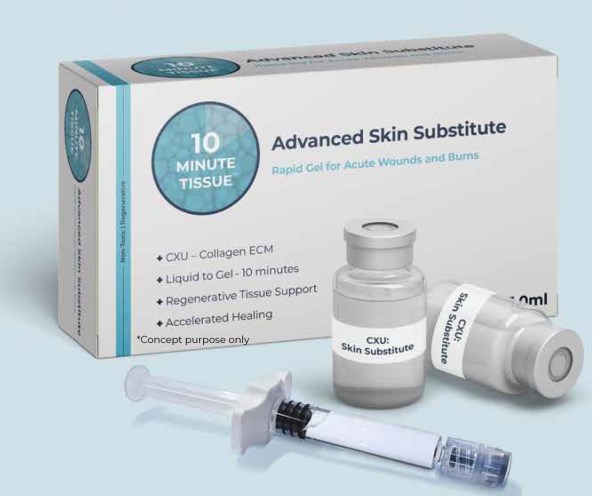
Preclinical Evidence and Material Characteristics Overview
The CXU™ scaffold platform is supported by a series of peer-reviewed nonclinical publications spanning 2011 through 2023. These publications include bench and in vitro characterization of injectable collagen-based scaffold formulations, in vitro studies evaluating cell compatibility and functional endpoints, and in vivo evaluations in murine, rabbit, porcine, and rat models examining host response, tissue integration, wound closure metrics, histologic outcomes, and, for certain modified formulations, antibacterial activity.24
Proposed Mechanism of Action (Preclinical)
Based on published nonclinical research, CXU™ is a flowable, thermosensitive collagen-based ECM scaffold device candidate intended to transition in situ to a gel-like, three-dimensional collagen matrix near physiologic temperature, providing temporary structural support and conforming to the local tissue geometry. 25 The scaffold is intended to function as a temporary framework that supports host cell infiltration and vascular ingrowth as part of normal tissue repair, and to be gradually remodeled and resorbed through endogenous processes over time.26 This proposed mechanism is primarily physical/structural rather than pharmacologic or metabolic activity.27 All findings were generated in controlled laboratory settings or animal models. Reporting of adverse events in these publications is generally narrative and most publications do not present standardized adverse event tabulations. Animal physiology differs from human physiology, and rodent wound healing in particular differs from human wound healing dynamics. Accordingly, these nonclinical findings may not be predictive of clinical performance or safety in humans.28
__________________________________________
24 Acta Biomaterialia (2011), supra note [*1]; Canadian Journal of Diabetes (2013), supra note [*2]; Tissue Engineering Part A (2015), supra note [*3]; Transplantation (2015), supra note [*4]; Biomedical Materials (2016), supra note [*5]; Journal of Burn Care & Research (2019), supra note [*6]; Advances in Wound Care (2021), supra note [*7]; Journal of Burn Care & Research (2021), supra note [*8]; Experimental Dermatology (2021), supra note [*9]; Gels (2022), supra note [*10]; Gels (2023), supra note [*11]
25 Acta Biomaterialia (2011), supra note [*1]; Biomedical Materials (2016), supra note [*5]
26 Engineering Part A (2015), supra note [*3]; Journal of Burn Care & Research (2019), supra note [*6]; Advances in Wound Care (2021), supra note [*7]; Experimental Dermatology (2021), supra note [*9]; Gels (2022), supra note [*10]
27 Acta Biomaterialia (2011), supra note [*1]; Biomedical Materials (2016), supra note [*5]; Gels (2022), supra note [*10]
28 Advances in Wound Care (2021), supra note [*7]; Experimental Dermatology (2021), supra note [*9]; Gels (2022), supra note [*10]; Gels (2023), supra note [*11]
• Material transition at the site of use (physical transformation): The published work describes a flowable collagen formulation that undergoes temperature-dependent fibrillogenesis and forms a 3D matrix in situ, which is a mechanistic step that enables how the material functions after delivery.29
• Structural scaffold function (architecture as the mode of effect): After gelation, the material functions as a porous ECM-like collagen network that provides temporary structural support and a framework for tissue interaction-i.e., the structure itself is the mechanism, not a released drug.30
• Host-driven cellular infiltration/integration (natural response to the scaffold): In animal models and histology-based evaluations, investigators report cell presence/infiltration within or at the scaffold-tissue interface, consistent with a scaffold that supports host integration as part of normal repair.31
• Vascular ingrowth and remodeling over time (constructive remodeling pathway): Published in vivo studies report findings consistent with vascular structures/markers and remodeling features in the presence of the scaffold, supporting the mechanistic concept that the material can participate in host-mediated tissue repair and remodeling.32
• Resorption/replacement (temporary scaffold lifecycle): The literature describes collagen scaffold behavior consistent with gradual enzymatic degradation and replacement by host tissue, which is a core part of a resorbable scaffold's mechanism (temporary support → remodeling). 33
Wound closure and tissue integration (preclinical). Published nonclinical studies report observations consistent with improved wound healing dynamics, including reduced wound size and integration of an in situ-forming scaffold with host tissue, as assessed (where reported) by serial wound-area/size measurements (e.g., 2D photographic planimetry) and histologic evaluation, and including in vivo sample size where reported in the cited publication (for example, the murine impaired-healing study reports N=12 mice (N=4 per group); N is not specified in certain other cited sources).34
Inflammatory response, remodeling signals, and cell viability (preclinical/in vitro). In published nonclinical studies, authors report findings consistent with a low inflammatory profile and constructive remodeling signals in treated tissues for cell proliferation, neovascularization, and tissue remodeling, and in vitro studies report non-cytotoxicity and formulation-dependent differences in physical/functional measures relevant to scaffold behavior, based on local tissue response assessments such as histology and immune-marker staining/quantification (where reported), and narrative observations in certain studies; and including in vivo sample size where reported in the cited publication (for example, a murine impaired-healing study reports N=12 mice (N=4 per group), a murine biocompatibility study reports n=3 per week (total n=6) across 1- and 2-week harvests, and a rabbit hypertrophic scar/wound model reports n=8 wounds per group (with certain mRNA analyses reported as n=4)), while N is not specified in certain other cited sources.35
__________________________________________
29 Acta Biomaterialia (2011), supra note [*1]; Biomedical Materials (2016), supra note [*5]
30 Acta Biomaterialia (2011), supra note [*1]; Biomedical Materials (2016), supra note [*5]
31 Engineering Part A (2015), supra note [*3]; Journal of Burn Care & Research (2019), supra note [*6]; Experimental Dermatology (2021), supra note [*9]; Gels (2022), supra note [*10]
32 Engineering Part A (2015), supra note [*3]; Journal of Burn Care & Research (2019), supra note [*6]; Advances in Wound Care (2021), supra note [*7]; Experimental Dermatology (2021), supra note [*9]; Gels (2022), supra note [*10]
33 Acta Biomaterialia (2011), supra note [*1]; Advances in Wound Care (2021), supra note [*7]; Experimental Dermatology (2021), supra note [*9]; Gels (2022), supra note [*10]
34 Tissue Engineering Part A (2015), supra note [*3]; Journal of Burn Care & Research (2019), supra note [*6]; Advances in Wound Care (2021), supra note [*7]; Experimental Dermatology (2021), supra note [*9]; Gels (2022), supra note [*10]; Gels (2023), supra note [*11]
35 Acta Biomaterialia (2011), supra note [*1]; Canadian Journal of Diabetes (2013), supra note [*2]; Tissue Engineering Part A (2015), supra note [*3]; Transplantation (2015), supra note [*4]; Journal of Burn Care & Research (2019), supra note [*6]; Advances in Wound Care (2021), supra note [*7]; Gels (2022), supra note [*10]; Gels (2023), supra note [*11]
Summary of CXUTM Preclinical Studies and Research Publications
The Company's research has been included in numerous peer-reviewed publications (see "Business - History"). Below is a summary of the material characteristics of such publications, including the study type, design and scope, primary assessments, secondary assessments, statistical significance, and adverse effects.
Acta Biomaterialia (2011) - Injectable ECM formulation and bench/in vitro characterization36
• Study type / model: Bench + in vitro (laboratory assays; multiple cell types).
• Design & scope: The authors compared multiple collagen-GAG gel/scaffold formulations, including crosslinked variants and variants incorporating polyvinyl alcohol (PVA)-borate networks, to evaluate properties relevant to injectability, gelation/fibrillation kinetics, mechanical behavior, degradation resistance, and cell compatibility. Replicates are described as representing different gel batches (e.g., tensile testing described as six different batches in figure text; other assays report n=3 or n=9 in figure legends).
• Primary assessments (as described):
o Fibril formation / gelation kinetics (turbidity-based measures and timing)
o Mechanical properties (e.g., tensile modulus/strength measures)
o Enzymatic degradation resistance (collagenase digestion quantified via hydroxyproline)
o Cell viability / cytotoxicity (live/dead-type assays across cell types)
o Contraction behavior in free-floating fibroblast-populated scaffolds (surface area over time)
• Secondary/additional assessments: Cellular organization in more complex constructs (e.g., multicellular skin substitute-type constructs) and scaffold microstructure/organization measures.
• Statistical significance (examples reported): PVA-containing variants were reported as having higher tensile strength (P<0.05), faster fibril formation (P<0.001), reduced collagenase digestion (P<0.01), and reduced contraction in a fibroblast-populated gel model (P<0.001), among other reported comparisons in figures/results.
• Adverse events: Not applicable (nonclinical bench/in vitro study; no animal adverse-event reporting).
Canadian Journal of Diabetes (2013) - Islet embedding in collagen composite scaffolds (in vitro + in vivo transplantation context).37
• Study type / model: In vitro assays (islet viability/function; fibroblast proliferation; enzyme activity measures) plus in vivo transplantation/histology context (the paper describes graft evaluation timepoints and immunostaining of retrieved grafts).
• Design & scope: Mouse islets were evaluated under 2D culture versus embedding within collagen matrix conditions (including fibroblast-populated variants). The paper reports multi-timepoint follow-up (e.g., days 1, 15, and 30 for in vitro viability/function assays) and describes long-term graft evaluation (e.g., 100 days post transplantation images/sections referenced in the text).
• Primary assessments (as described):
o Islet viability (Live/Dead viability/cytotoxicity assay at multiple timepoints)
o Glucose-stimulated insulin secretion (insulin release in low vs. high glucose, reported as stimulation index)
• Secondary/additional assessments:
o Fibroblast proliferation under different matrix conditions (cell counts over time)
o IDO activity readouts (e.g., tryptophan catabolism markers over time) and gene expression measures (e.g., IDO mRNA over extended timepoints described).
o Histology / immunostaining for insulin and glucagon is described for graft morphology/function evaluation.
• Statistical significance (examples reported):
__________________________________________
36 Acta Biomaterialia (2011), supra note [*1]
37 Canadian Journal of Diabetes (2013), supra note [*2]
o Glucose responsiveness changes are reported with specific p-values in places (e.g., a stimulation index change reported as p<0.001 for a comparison; another comparison reported as p>0.05).
o Fibroblast proliferation differences across conditions are reported with p<0.001 in the results text.
• Adverse events: The publication discusses "nontoxic"/viability-related observations in vitro; animal adverse-event reporting is not presented in the manner typical of clinical studies, and specific "adverse event" tables are not described in the extracted sections.
Tissue Engineering Part A (2015) - In situ-forming scaffold in a rabbit hypertrophic scar model38
• Study type / model: In vivo (preclinical) rabbit ear hypertrophic scar model with histology and immunostaining; includes molecular/marker assessments.
• Design & scope: Full-thickness rabbit ear wounds were treated and evaluated at defined timepoints, using histologic scoring/metrics and immunohistochemistry; the paper describes group sizes at the wound level (e.g., the methods text references n=8 wounds per group for histology assessments and n=4 for certain mRNA analyses).
• Primary assessments (as described):
o Healing quality/scar metrics (including scar elevation index and scar thickness/cellularity-type measures described in the methods/results)
o Histology (including collagen staining approaches described)
• Secondary/additional assessments:
o Immunohistochemistry for immune and tissue features (e.g., CD3 and other markers) and measures of vessel-like/nerve-like structures (marker-based).
o Gene expression / mRNA analyses in subsets.
• Statistical significance: The methods describe ANOVA with Tukey's multiple comparisons and a p<0.05 significance threshold; the results section reports selected endpoints reaching statistical significance (p<0.05) in the model.
• Adverse events: Specific adverse-event reporting (e.g., infections/mortality tables) is not described in the extracted sections.
Transplantation (2015) - IDO-producing scaffold and allogeneic islet outcomes in diabetic mice39
• Study type / model: In vivo (preclinical) mouse model (allogeneic islets in diabetic mice) plus immune function assays.
• Design & scope: The paper describes an IDO-producing scaffold approach, including immune response assays (e.g., splenocyte proliferation) and graft survival/time-to-failure outcomes in diabetic mice; detailed statistical methods are referenced as being in supplemental content, while the main text reports p-values for key comparisons.
• Primary assessments (as described):
o Immune response measures (e.g., splenocyte proliferation readouts)
o Graft survival (time-based survival comparison)
• Secondary/additional assessments: Tissue-level evaluations and functional measures are discussed; the paper notes additional methodological/statistical detail in supplemental materials.
• Statistical significance (examples reported): The results text reports statistically significant differences for certain immune and survival comparisons (e.g., p<0.05 for immune assay comparisons and p<0.01 for a graft survival comparison as reported).
• Adverse events: Specific adverse-event reporting is not described in the extracted sections.
__________________________________________
38 Tissue Engineering Part A (2015), supra note [*3]
39 Transplantation (2015), supra note [*4]
Biomedical Materials (2016) - Bench/in vitro tunability of injectable collagen biomaterials (handling/gelation-related properties)40
• Study type / model: Bench + in vitro.
• Design & scope: The paper evaluates injectable collagen biomaterial behavior as a function of polymer modifications (e.g., PVA-related variants), focusing on gelation/fibrillation kinetics, handling-related properties, and cell-related assays in vitro, with multiple reported comparisons and p-values for selected endpoints.
• Primary assessments (as described):
o Fibrillation/gelation kinetics measures and related physical properties
o Mechanical/handling-relevant properties (laboratory characterization)
• Secondary/additional assessments: In vitro cell compatibility/migration-type assessments are included as part of "biofunctionality" characterization.
• Statistical significance (examples reported): The publication reports statistically significant differences for selected kinetic/physical parameters (e.g., p<0.01 reported for certain comparisons).
• Adverse events: Not applicable (bench/in vitro study).
Journal of Burn Care & Research (2019) - Murine impaired wound healing model (full paper) with liquid scaffold ± adipose-derived stem cells41
• Study type / model: In vivo (preclinical) murine model of impaired/delayed healing, with histology, immunostaining, and gene expression.
• Design & scope: Full-thickness wounds were assigned to no treatment, liquid dermal scaffold (LDS), or LDS + adipose-derived stem cells (ASCs) with serial follow-up (e.g., days 7, 10, and 14 are reported for wound area).
• Primary assessments (as described):
o Wound open area / closure progression via 2D photographic analysis at defined timepoints
o Re-epithelialization supported by histology (Masson's Trichrome)
• Secondary/additional assessments:
o Epidermal thickness, collagen staining area, and related tissue quality measures
o Angiogenesis markers (e.g., CD31 capillary structures)
o Cell tracking / incorporation (e.g., GFP-positive cells described for ASC group)
o Gene expression (e.g., VEGF-α and HGF RT-PCR described)
• Statistical significance (examples reported): The authors report specific p-values for wound area differences (e.g., p=.008, p=.006, p<.001 in certain comparisons/timepoints) and other endpoints (e.g., collagen content p=.009; angiogenesis readouts p<.001). Statistical methods include ANOVA (Tukey-Kramer) and t-tests, with p<0.05 as the stated threshold.
• Adverse events: The paper focuses on histologic and healing endpoints; discrete adverse-event reporting (e.g., systemic toxicity tables) is not described in the extracted sections.
Advances in Wound Care (2021) - Porcine skin graft model (PubMed abstract-level detail)42
• Study type / model: In vivo (preclinical) porcine model involving meshed split-thickness skin grafts.
• Design & scope: The abstract describes a comparison of a MSTSG surgical protocol outcomes with an in situ-forming thermosensitive scaffold applied in a porcine graft setting, with follow-up assessments at specific post-procedure timepoints.
• Primary assessments (as described in abstract): Model-specific "aesthetic/healing" outcome metrics (including scar elevation index and contraction index) and gross appearance scoring.
• Secondary/additional assessments: The abstract references histology and systemic blood testing (CBC/chemistry-type) as part of safety/tolerability characterization.
__________________________________________
40 Biomedical Materials (2016), supra note [*5]
41 Journal of Burn Care & Research (2019), supra note [*6]
42 Advances in Wound Care (2021), supra note [*7]
• Statistical significance: The abstract reports statistically significant differences for certain scar/contracture metrics and appearance measures (reported as p<0.05 for selected endpoints).
• Adverse events: The abstract notes blood-analysis findings (systemic parameters) but does not present clinical-style adverse-event tables.
Journal of Burn Care & Research (2021) - Silver nanoparticles in hydrogel matrices (review article)43
• Study type / model: Literature review (no preclinical experiment).
• Design & scope: The publication is described as a literature review addressing silver nanoparticle incorporation into hydrogel matrices for infection control applications.
• Endpoints / statistics / adverse events: Because it is a review, it generally does not define primary/secondary endpoints or report p-values/adverse events for one discrete study; it synthesizes findings from multiple sources.
Experimental Dermatology (2022) - Liquid dermal scaffold in murine wound/burn models (PubMed abstract-level detail)44
• Study type / model: In vivo (preclinical) murine models full-thickness excisional wounds [A surgical procedure in which a cut is made through the skin to remove an entire lump] and deep burns are described in the abstract.
• Design & scope: The abstract describes application of a liquid dermal scaffold and evaluation of wound repair outcomes, including burn-related endpoints (e.g., scarring/contracture-type measures) and histologic outcomes.
• Primary assessments (as described in abstract): Wound closure dynamics and model-specific healing/scar endpoints (e.g., scar elevation index/contracture-type measures are referenced).
• Secondary/additional assessments: Histologic findings, including features consistent with tissue quality (e.g., hair-follicle-related observations described in the abstract).
• Statistical significance: The abstract uses "significant" language; specific p-values are not presented in the PubMed abstract.
• Adverse events: Not described in the abstract as clinical-style adverse events.
Gels (2022) - Murine biocompatibility and early host response after sub-dermal application45
• Study type / model: In vivo (preclinical) murine biocompatibility/host response model with histology and immunofluorescence quantification.
• Design & scope: Scaffolds were placed in sub-dermal pockets in mice; samples harvested after 1 and 2 weeks; assessments included Masson's Trichrome and immunofluorescence staining/quantification for cell infiltration and immune markers.
• Primary assessments (as described):
o Integration/host response on histology (including presence/absence of "foreign body reaction" features)
o Cell infiltration (stromal and immune cell markers; quantification)
• Secondary/additional assessments: Marker-specific breakdown (e.g., Vim+, CD45+, CD3+) and time course changes in these markers.
• Statistical significance: Statistical plan states triplicate experiments (n=3) and one-factor ANOVA with Tukey, with p<0.05 as significant. The results report significantly greater cellular infiltration in the liquid scaffold condition versus Integra® Flowable Wound Matrix and controls (e.g., p<0.01 and p<0.05 reported for certain comparisons) and no significant differences for certain T-cell measures (reported as p>0.05).
__________________________________________
43 Journal of Burn Care & Research (2021), supra note [*8]
44 Experimental Dermatology (2021), supra note [*9]
45 Gels (2022), supra note [*10]
• Adverse events: The results text states "no evident adverse foreign body reaction" in the local tissue response context; systemic adverse-event reporting is not described.
Gels (2023) - Antibacterial thermosensitive silver-hydrogel nanocomposite (bench/in vitro + rat in vivo)46
• Study type / model: Bench/in vitro (cytotoxicity + antibacterial assays) and in vivo (rat infected wound and splinted wound healing model described in figures/captions).
• Design & scope (from reported figure descriptions and methods snippets): The study evaluates thermosensitive collagen-GAG hydrogel formulations loaded with different silver concentrations and assesses cell compatibility, antibacterial activity, and wound healing in vivo.
• Primary assessments (as described):
o Cytotoxicity / cell viability in human dermal fibroblasts, evaluated under an ISO 10993-5-referenced framework (per caption text).
o Antibacterial activity (in vitro enumeration of bacteria after exposure; and in vivo infected wound CFU outcomes are described).
o Wound area reduction / closure in a rat splinted full-thickness wound model (ImageJ-based wound area measurement described in captions).
• Secondary/additional assessments: Histology (Masson's Trichrome) and qualitative epithelialization observations are referenced in figure captions.
• Statistical significance: The statistical methods section reports use of t-tests and one-way/two-way ANOVA with Dunnett post hoc testing and significance thresholds (p<0.05, p<0.01, p<0.001). Figure captions describe statistically significant differences across selected antibacterial and wound-healing comparisons (with significance markers and p-thresholds).
• Adverse events: The publication's extracted sections emphasize antibacterial and wound closure outcomes; clinical-style adverse-event reporting is not presented in the extracted lines.
Limitations of nonclinical evidence
The referenced studies include bench, in vitro, and animal model experiments that vary in design, duration, and sample size. Follow up durations are generally short to mid term. Most publications do not present standardized adverse event tabulations, and safety observations are typically described narratively within the context of the study model. Animal physiology differs from human physiology, including differences in wound contraction dynamics and skin architecture. Accordingly, these nonclinical findings may not be predictive of safety or effectiveness in humans.
CAUTION: CXU™ IS A DEVICE CANDIDATE IN PRECLINICAL DEVELOPMENT AND IS NOT CLEARED OR APPROVED FOR MARKETING IN THE UNITED STATES OR ANY OTHER JURISDICTION.
Optimized for Better Tissue Integration
CXU™ device candidate demonstrates in preclinical studies improved conformability, placement, tissue integration in wounds through: (i) flowable application. (i) as a liquid at room temperature, the scaffold flows into irregular geometries and conforms to fill complex wound beds, (ii) thermosensitive setting; (def. material is responsive, or sensitive to heat or changes in temperature) gels in ~10 minutes, and forms a stable, elastic scaffold.
Viscosity, Flow, and Gelation Dynamics
As a flowable scaffold CXU™ maintains a low-viscosity liquid state at room temperature (viscosity: measuring flow resistance, where high viscosity means slow flow and low viscosity means easy flow), making it easier to apply and contour into complex wound beds and micro-defects where sheets, meshes, and powders can lack integration into the wound bed. Viscosity, flow and gelation dynamics of the CXU™ device candidate include: (i) flowability; (ii) temperature triggered gelation; (iii) safety and bio-composition; and (iv) ease in dosage and administration.47
__________________________________________
46 Gels (2023), supra note [*11]
47 Acta Biomaterialia (2011), supra note [*1]; Tissue Engineering Part A (2015), supra note [*3]; Biomedical Materials (2016), supra note [*5]; Advances in Wound Care (2021), supra note [*7]; Gels (2022), supra note [*10]
CXU™ is low-viscosity liquid at room temperature that can be applied on deep or irregular wound profiles (trauma, burns, and full-thickness defects). The scaffold exhibits rapid gelation and transitions from liquid to gel at ~37 °C, achieving a stable scaffold in about ten minutes.48
The product is delivered as a flowable liquid that, upon exposure to body temperature (~37°C), quickly transforms into a stable gel within approximately 10 minutes.
Material handling and gelation behavior is evidenced through published work describing handling characterization relevant to wound coverage and injectability and scaffold formation, including temperature-dependent changes and gellation properties, which may inform handling characteristics in future laboratory and clinical settings.49
Preclinical studies have shown no adverse safety signals, and composition closely mirrors native extra cellular (ECM) for optimized integration. CXU™ is intended to be developed as a single 1.5 cc- 3cc application in the wound site, with potential for additional doses based on wound assessment, and is intended for one-time use per treatment site, ensuring sterility and consistent product performance.
Technical and Commercial Advantages
CXU™ has several technical and commercial advantages, including: (i) shelf stability; (ii) adaptable formulation and reconstitution; (iii) versatile delivery; and (iv) user-friendly operation.
CXU™ in lyophilized "powder" form (freeze-dried, water is removed create a dry material, storeable and later reconstituted before use) eliminates the need for refrigeration, significantly extending shelf-life and facilitating global distribution. Additionally, the collagen formula utilizes bovine collagen. CXU™ rehydrates in plasma, saline, or nutrient-rich media, allowing user-friendly reconstitution for different clinical scenarios. It is delivered through a simple syringe application and maintains stable flow properties at room temperature, adapting to standard surgical or wound care devices.
Competitive Advantage
Single-material backbone for multiple potential indications. The CXU™ collagen-based scaffold is being evaluated as a common material foundation that, if successfully developed and authorized, could support multiple potential product candidates across different care settings while leveraging shared formulation, characterization, and quality-system development.50
If achieved, this "single-backbone" approach may provide a commercial advantage by enabling staged expansion into multiple global verticals with reuse of core manufacturing and quality infrastructure, potentially improving speed-to-market by indication and supporting more efficient scaling, subject to regulatory authorization and market adoption.
Flowable placement and in situ conformity. CXU™ is intended to be delivered in a flowable form (flowable: capable of being delivered/spread as a liquid or semi-liquid) and to transition in situ (in situ: at the site of application in the body) to a gel-like scaffold, which may support placement across irregular wound and tissue geometries.51
__________________________________________
48 Acta Biomaterialia (2011), supra note [*1]; Biomedical Materials (2016), supra note [*5]; Advances in Wound Care (2021), supra note [*7]; Experimental Dermatology (2021), supra note [*9]
49 Acta Biomaterialia (2011), supra note [*1]; Biomedical Materials (2016), supra note [*5];
50 Acta Biomaterialia (2011), supra note [*1]; Canadian Journal of Diabetes (2013), supra note [*2]; Tissue Engineering Part A (2015), supra note [*3]; Transplantation (2015), supra note [*4]; Biomedical Materials (2016), supra note [*5]; Journal of Burn Care & Research (2019), supra note [*6]; Advances in Wound Care (2021), supra note [*7]; Experimental Dermatology (2021), supra note [*9]; Gels (2022), supra note [*10]; Gels (2023), supra note [*11]
51 Acta Biomaterialia (2011), supra note [*1]; Biomedical Materials (2016), supra note [*5]; Advances in Wound Care (2021), supra note [*7]; Experimental Dermatology (2021), supra note [*9]
If this conformability supports more consistent contact with the wound bed and tissue interfaces, it may support tissue integration and handling in clinical workflows, which could support adoption and, if validated in clinical studies, improved patient outcomes.52
ECM-scaffold architecture designed for tissue integration. CXU™ is a collagen-based ECM scaffold (ECM: structural network that supports cells in tissues) intended to provide a temporary architecture that may support cellular infiltration and vascular ingrowth (vascular ingrowth: formation of blood vessels into tissue) as part of constructive remodeling, based on preclinical observations.53
If these integration processes are confirmed in further studies, they may support more organized tissue remodeling and durable repair, which could translate into clinically meaningful outcomes and support adoption, subject to further study.
Competitive Landscape - Flowable / Particulate Wound Matrices
The U.S. advanced wound care market includes a range of FDA 510(k)-cleared flowable and particulate wound matrices, including collagen-GAG flowable matrices, porcine urinary bladder matrix (UBM) particulates, bovine collagen gels, and synthetic hydrogel matrices, which are generally intended for wound management and are offered in formats designed to conform to wound contours in accordance with their labeling. Representative examples include Integra® Flowable Wound Matrix (collagen-GAG flowable matrix),54 MicroMatrix® (porcine UBM particulate),55 and Excellagen® (bovine collagen gel).56
MARKET
Market
Overview
Market: Wound Care and Acute Wounds
The global advanced wound care market represents a large and expanding opportunity driven by demographic, clinical, and economic factors. Chronic and acute wounds - including diabetic foot ulcers, venous leg ulcers, pressure ulcers, surgical dehiscence, and complex burns - pose a significant and growing healthcare burden. Rising incidence of diabetes, obesity, and vascular disease, together with an aging population, is fueling demand for advanced therapies that accelerate healing, reduce complications, and lower overall treatment costs.57
Traditional wound care approaches, including standard dressings and skin grafts, are associated with inconsistent outcomes, elevated infection risk, and suboptimal cosmetic results.58 Despite substantial expenditures, many wounds remain slow to heal, recurrent, or refractory to existing treatments, leading to higher hospitalization rates and long-term costs. In the United States alone, annual direct spending on chronic wounds exceeds $28 billion, underscoring the urgent need for innovative solutions.59
__________________________________________
52 Acta Biomaterialia (2011), supra note [*1]; Canadian Journal of Diabetes (2013), supra note [*2]; Tissue Engineering Part A (2015), supra note [*3]; Biomedical Materials (2016), supra note [*5]; Journal of Burn Care & Research (2019), supra note [*6]; Gels (2022), supra note [*10]; Company data (animal data on file): We have generated internal preclinical data evaluating administration, local tissue response, and histologic remodeling in animal models; these internal datasets have not been peer-reviewed and may not be predictive of clinical outcomes; Company data on file. Ongoing Company bench rheology data using published rheologic methods and comparator benchmarks. (e.g. Sundaram H, Voigts B, Beer K, Meland M. Comparison of the Rheological Properties of Viscosity and Elasticity in Two Categories of Soft Tissue Fillers: Calcium Hydroxylapatite and Hyaluronic Acid. Dermatologic Surgery. 2010;36(Suppl 3):1859-1865. DOI: 10.1111/j.1524-4725.2010.01743.x.https://eurekamag.com/research/052/247/052247840.pdf; ] Lorenc ZP, Pilcher B, McArthur T, Patel N. Rheology of Polymethylmethacrylate-Collagen Gel Filler: Physiochemical Properties and Clinical Applications. Aesthetic Surgery Journal. 2021;41(3):NP88-NP93. DOI: 10.1093/asj/sjaa314.https://academic.oup.com/asj/article/41/3/NP88/5998105).
53 Ibid.
54 https://www.accessdata.fda.gov/cdrh_docs/pdf7/K072113.pdf?
55 https://www.accessdata.fda.gov/cdrh_docs/pdf15/K153754.pdf?our
56 https://www.accessdata.fda.gov/cdrh_docs/pdf11/K110318.pdf?
57 Sen, C.K. et al., "Human Wounds and Its Burden: An Updated Compendium of Estimates," Advances in Wound Care (2021).
58 Nussbaum, S.R. et al., "Health and Economic Burden of Chronic Wounds," Value in Health (2018).
59 U.S. chronic wound cost estimates, Value in Health (2018), CMS data; updated by MedMarket Diligence (2023).
Advanced wound care technologies - spanning biologically active dressings, ECM scaffolds, and bioengineered skin substitutes - are increasingly adopted by hospitals, burn centers, and outpatient facilities. These products seek to replicate or enhance the body's natural regenerative processes, enabling faster wound closure, reduced scarring, and improved quality of life for patients. Industry research estimates that the global advanced wound care market was valued at $10.3 billion in 2022 and is projected to reach $17.8 billion by 2032, reflecting a 5.6% compound annual growth rate (CAGR).60 The broader wound dressing segment, valued at $14.2 billion in 2023, is likewise expected to expand steadily at 4.2% CAGR through 2030.61
These growth drivers - rising chronic wound prevalence, increasing healthcare cost pressures, and regulatory emphasis on measurable patient outcomes-position next-generation regenerative biomaterials as a compelling market opportunity. Innovative scaffolds designed to provide biomimetic tissue environments, faster integration, and reduced inflammation have the potential to displace incumbent products and establish new standards of care. Companies that can deliver consistent, scalable solutions that shorten healing timelines and improve clinical outcomes are expected to capture meaningful share within a high-value, globally expanding sector.
Market: Dental Soft Tissue
Market Overview and Market Opportunity
The global dental soft tissue market represents a significant and underpenetrated opportunity at the intersection of periodontics, implantology, and oral reconstruction. Gum disease is among the most prevalent chronic conditions worldwide, with more than 42% of U.S. adults over the age of 30 showing signs of periodontitis and nearly 70% of those over 65 affected.62 The burden is similar in the European Union, where aging demographics and high prevalence of diabetes and smoking amplify risk factors for periodontal disease.63 This widespread incidence creates sustained demand for therapeutic interventions to regenerate or augment soft tissue and restore long-term oral health.
Within the dental sector, soft tissue procedures focus primarily on pocket reduction, connective tissue grafting, and soft tissue augmentation around implants. Connective tissue grafts harvested from the patient's palate remain the clinical "gold standard" for treating gingival recession, but limitations such as donor site morbidity, procedure complexity, and patient discomfort have created strong demand for biomaterial substitutes.64 Collagen-based membranes and ECM scaffolds are widely utilized to stabilize clots, guide healing, and enhance attachment around teeth and implants. Geistlich's Bio-Gide® collagen membrane, derived from porcine pericardium, is the leading global product in this category and demonstrates the commercial viability of collagen scaffolds in dentistry.65
According to industry research and the Company's analysis of that research, the global periodontal device market relevant to soft- and hard-tissue support is estimated by the Company at approximately $4.2 billion in 2025, with soft tissue and gum regeneration representing a meaningful share of this total.66 Growth is expected to continue at a mid-single-digit CAGR through 2030, driven by rising implant procedures, greater awareness of periodontal disease, and broader adoption of regenerative biomaterials. In addition, the introduction of next-generation scaffolds-engineered to mimic the natural human ECM and provide more predictable soft tissue integration-offers the potential to expand the market beyond current collagen membranes and autograft substitutes.
__________________________________________
60 Grand View Research, Advanced Wound Care Market Size Report, 2023-2032.
61 Fortune Business Insights, Wound Dressings Market Size Report, 2024-2030.
62 Centers for Disease Control and Prevention (CDC), National Health and Nutrition Examination Survey (NHANES) 2009-2010; CDC Oral Health Surveillance Report, 2022.
63 European Federation of Periodontology ("EFP"), Dossier on Periodontal Disease (2020).
64 American Academy of Periodontology, "Gum Graft Surgery," clinical guidance, 2023.
65 iData Research, Global Dental Barrier Membrane Market Report (2023); Company publications.
66 The $4.2B figure is a Company estimate derived from third-party market data and internal assumptions; actual market size may differ. Future Market Insights ("FMI"), Periodontal Market: Global Forecast 2025 to 2035; Company analysis.
In the United States alone, an estimated 1.2 million periodontal flap and graft procedures are performed annually, with average treatment costs ranging from $1,000 to $3,000 per quadrant.67 At a device cost of approximately $250 per use. These procedure volumes illustrate only a segment of the broader global periodontal device market context and represent a portion of the addressable global markets annual opportunity for regenerative scaffolds in periodontal soft tissue repair. The Company estimates that ECM-based tissue support technologies may have an addressable market opportunity of approximately $4.2 billion in the global periodontal device market.
Market: Medical Aesthetics
Market Overview and Market Opportunity
The global medical aesthetics sector has evolved rapidly over the past decade, shifting from traditional volumizing treatments toward regenerative and biostimulatory solutions that restore tissue quality and promote natural, long-lasting results. A central trend is the move away from "anti-aging" toward "aging-well," with patients seeking subtle, natural enhancements that support healthy appearance over time rather than dramatic, short-term changes.68 Industry surveys, including the Allergan Aesthetics Global Survey 2021, confirm that a significant share of consumers now prioritize outcomes linked to natural collagen restoration and durability.69 This consumer shift has expanded the total addressable market for biologically based injectables and accelerated demand for products that can stimulate tissue renewal rather than simply displace lost volume.
Market fundamentals are strong
The International Society of Aesthetic Plastic Surgery (ISAPS) has reported consistent global growth in both female and male aesthetic procedures, reflecting broader acceptance across age groups and geographies.70 The worldwide soft-tissue filler market reached approximately $5.08 billion in 2023 and is projected to exceed $10 billion by 2032, representing nearly a doubling of market size in under a decade.71 The momentum is supported by expanding consumer segments, including younger "prejuvenation" patients entering the market earlier, thereby increasing lifetime value per patient.
Impact of GLP-1 weight-loss drugs
A new driver of growth is the widespread adoption of GLP-1 agonists such as Ozempic™ and Wegovy™, which have triggered visible facial and body tissue volume loss-a phenomenon colloquially known as "Ozempic Face."72 Surgeons report increased demand for fillers, fat grafting, and adjunctive procedures to address hollowed features and skin laxity due to tissue loss, with nearly one in four clinicians forecasting sustained demand linked to GLP-1 therapies.73 This structural trend represents an emerging large-volume opportunity not well served by existing hyaluronic acid (HA) fillers, which are primarily designed for temporary small, localized corrections.
Biostimulatory injectables are outpacing the category
While HA fillers dominate current sales, the biostimulatory filler market - led by products with calcium hydroxylapatite (CaHA), poly-L-lactic acid (PLLA), polycaprolactone (PCL), and polymethylmethacrylate (PMMA) - remains a concentrated but high-growth niche. CaHA fillers alone generated approximately $650 million in global sales in 2023 and is projected to more than double to $1.6 billion by 2030, reflecting clinician preference for products that stimulate endogenous collagen and elastin production.74 This trend underscores the growing demand for safer, more effective materials that deliver regenerative benefits rather than temporary volume.
__________________________________________
67 ADA Survey of Dental Fees (CDT codes D4240/D4241 flap surgery and/or D4260/D4261 osseous surgery).
68 Allergan Aesthetics, Global Aesthetics Survey 2021.
69 Ibid.
70 International Society of Aesthetic Plastic Surgery (ISAPS), Global Survey of Aesthetic Procedures, 2022.
71 Market Data: Grand View Research, Soft Tissue Filler Market Size Report, 2024-2032.
72 Arianna Johnson, "Cosmetic Surgery Trends: Weight Loss Drugs Drove Spike in Fillers and Facelifts Last Year," Forbes, June 25, 2024.
73 Lori Solomon, "New Facial Plastic Surgery Survey Illustrates Impact of GLP-1 Receptor Agonists," Dermsquared, February 7, 2025.
74 Grand View Research, Global Calcium Hydroxylapatite (CaHA) Filler Market Size & Outlook, 2024.
Changing consumer and regulatory dynamics
Several forces are reshaping product demand:
Opportunity for a collagen-based injectable. In preclinical development, our CXU™ scaffold device candidate is being evaluated for potential in medical aesthetics. This is early-stage and subject to additional development and applicable regulatory authorizations. Potential aesthetic opportunities may include:
(i) small-volume facial applications, with a large addressable market
(ii) larger-volume soft-tissue restoration applications, to address patient populations experiencing tissue volume loss, and
(iii) applications within the broader "biostimulatory" category, where tissue regeneration is a key feature
This market opportunity and competitive environment remains uncertain and would depend on demonstrated safety and performance, regulatory approvals, clinical outcomes, and adoption by clinicians and patients.
GOVERNMENT REGULATION
U.S. Regulation of Medical Devices
510(k) Clearance Marketing Pathway
To obtain 510(k) clearance, a company must submit to the FDA a premarket notification demonstrating that the proposed device is "substantially equivalent" to a legally marketed predicate device. A predicate device is a legally marketed device that is not subject to premarket approval, such as devices marketed before May 28, 1976, devices reclassified from Class III to Class II or I, or devices found substantially equivalent through the 510(k) process.
The FDA's 510(k) review usually takes three to twelve months but may take longer. The FDA may request additional information, including clinical data, to make a determination regarding substantial equivalence. FDA also collects user fees for certain submissions and annual establishment fees.
If the FDA agrees that the device is substantially equivalent to a predicate, it grants clearance for commercial marketing. If it determines the device is "not substantially equivalent," the device is automatically designated as Class III. The sponsor must then either pursue the more rigorous PMA process or request a risk-based classification under the de novo pathway.
Once a device receives clearance, any modification that could significantly affect its safety or effectiveness, or that would constitute a major change in intended use, requires a new 510(k) or possibly PMA approval. Manufacturers must determine whether a change requires resubmission, but the FDA can review and overrule such determinations. If the FDA disagrees, it can require cessation of marketing or a recall until authorization is granted. Noncompliance may result in significant penalties.
In the United States, medical devices are subject to regulation by the FDA, including classification into Class I, Class II, or Class III. The FDA ultimately determines the device classification and applicable regulatory pathway.
PMA Approval Pathway
Class III devices generally require PMA approval before marketing. The PMA process is more demanding than 510(k) and requires manufacturers to demonstrate safety and effectiveness with extensive preclinical and clinical data. PMAs must also include a full device description, manufacturing methods and facilities, quality controls, and proposed labeling.
Once submitted, the FDA first determines whether the PMA is sufficiently complete for review. While the statutory review period is 180 days, in practice the process can take several years. The FDA may convene an advisory panel of outside experts to evaluate the application. In addition, the FDA generally conducts pre-approval inspections of manufacturing facilities to ensure compliance with the Quality System Regulation (QSR). PMA applications are subject to user fees, which are higher than those for 510(k).
The FDA approves a PMA if the data provide valid scientific evidence and demonstrate reasonable assurance of safety and effectiveness. Approval may be conditional, requiring post-approval studies, long-term follow-up, labeling restrictions, or surveillance commitments. Failure to comply with post-approval requirements can result in withdrawal of approval.
Certain changes to an approved device, such as modifications in design, manufacturing facilities, or quality controls, may require a PMA supplement. Some changes are significant enough to require a new PMA, particularly where they affect intended use, operating principles, or performance in a way that constitutes a new generation of the device.
In the United States, the FDA approves premarket approval applications ("PMA") and are generally required before commercial marketing. The FDA ultimately determines the appropriate device classification and regulatory pathway for a device candidate, and may require additional data, including clinical data, as part of any PMA review.
De Novo Classification
In the United States, the FDA's De Novo classification process provides a pathway for certain novel medical devices for which there is no legally marketed predicate device. If a De Novo request is granted, the device may be classified as Class I or Class II and may establish a new device type that can serve as a predicate for future 510(k) submissions. Following De Novo classification, certain modifications to the device, or changes in intended use, may require additional FDA review or authorization, which could include a new 510(k) submission, an additional De Novo request, or, depending on the circumstances, approval of a PMA.
Medical device types that have not previously been classified default to Class III, regardless of risk. The de novo classification process provides a pathway for low- to moderate-risk devices without a predicate to be down-classified into Class I or II.
Manufacturers may now request de novo classification directly, without first submitting a 510(k). The FDA is required to decide within 120 days, though in practice it often takes longer. If the request is granted, the device may be legally marketed. However, the FDA may deny the request if it identifies a suitable predicate, determines the device is not low-to-moderate risk, or finds that special controls cannot adequately mitigate risks.
Once de novo classification is granted, subsequent modifications that significantly affect safety or effectiveness may require a new 510(k), another de novo request, or even PMA approval.
Clinical Trials
Clinical trials are often required to support PMA or de novo classification and sometimes for 510(k) submissions. All such trials must comply with FDA's Investigational Device Exemption (IDE) regulations, which govern labeling, prohibit promotion, and set requirements for monitoring, reporting, and record-keeping.
If a device poses a "significant risk" to health, an IDE application must be submitted and approved by FDA before starting human trials. Non-significant risk devices do not require an IDE submission but must still meet abbreviated IDE requirements. A significant risk device is typically one that is implanted, sustains life, or poses potential for serious harm.
Clinical studies must also be approved and overseen by Institutional Review Boards (IRBs). Even after approval, the FDA, sponsor, or IRB may suspend or terminate a trial if risks outweigh benefits. Sponsors and investigators must follow FDA requirements, including informed consent, adverse event reporting, trial monitoring, and strict protocol adherence.
Post-Market Regulation of Medical Devices
After market entry, devices remain subject to numerous FDA requirements, including:
Manufacturers must maintain device master files, history files, and complaint files, and are subject to routine and unscheduled inspections. Noncompliance can result in recalls, enforcement actions, or plant shutdowns. The FDA has broad enforcement powers, including:
Foreign Regulation of Medical Devices
In addition to U.S. requirements, devices are subject to foreign regulations.
European Union Regulation
Medical devices in the EU are governed by Regulation (EU) No. 2017/745 (Medical Devices Regulation, MDR), which replaced the Medical Devices Directive in May 2021. Unlike directives, regulations apply directly across member states.
Devices must comply with general safety and performance requirements. To demonstrate compliance, manufacturers undergo conformity assessments, usually with a notified body, unless the device is low-risk (Class I). Successful assessment results in a certificate of conformity, enabling CE marking and market entry across the EU.
Manufacturers are also subject to ongoing audits, incident reporting, and field safety corrective actions. Serious incidents and corrective actions must be reported to authorities.
Coverage and Reimbursement
In the U.S., commercial success depends on third-party payor coverage and reimbursement. Devices are typically reimbursed as part of the surgical procedure in which they are used. Coverage varies among payors but is often contingent on:
– Medical necessity
– Cost effectiveness
– Non-experimental use
Payors increasingly scrutinize pricing, billing, and care settings, and some require prior authorization for new or innovative technologies. Limited coverage or reimbursement can reduce demand even for FDA-cleared products.
Other U.S. Healthcare Laws
Medical device companies must also comply with other healthcare laws, including:
– Federal and state anti-kickback statutes
– Civil and criminal false claims laws
– Civil Monetary Penalty Laws
– HIPAA fraud provisions
– Physician Payments Sunshine Act transparency requirements
Violations can result in civil or criminal penalties, fines, exclusion from federal programs, and even imprisonment.
Healthcare Reform
Ongoing healthcare reforms and cost-containment efforts may limit coverage or reimbursement, placing additional pressure on medical device pricing and utilization. These measures could directly impact revenue and profitability across the industry.
Overview of Strategic Plan
Our strategic plan is focused on advancing our CXU™ scaffold device candidate through key development activities, including regulatory and clinical planning, manufacturing scale-up, and commercialization preparation. We intend to pursue a staged approach to market entry, initially focusing in North America on advanced wound care, veterinary care, dental applications, 3D bioprinting/research-use applications, and medical aesthetics. Over the longer term, and subject to obtaining applicable regulatory authorizations, we intend to enter these global markets.
Short-Term Objectives
Regulatory and Clinical Milestones
Within 12 months, the Company intends to finalize its initial submission to the FDA. We believe our device candidate may be regulated as a Class II medical device and anticipate seeking FDA clearance via the 510(k) premarket notification pathway. The FDA ultimately determines the device classification and applicable regulatory pathway, and the FDA may require additional data, may determine that the product is Class III, or may determine that a different regulatory pathway applies.
We intend to address any FDA queries promptly and ensure robust safety/efficacy data is provided as it relates to wound closure and tissue integration.
Manufacturing Scale-Up (Concurrent)
Concurrently with other short-term objectives, the Company intends to source CDMOs for manufacturing scale-up and aims to validate Current Good Manufacturing Practice ("cGMP") processes. This includes planning capacity expansion for near-future demand.
Market Entry & Pilot Programs
The Company would like to conduct early outreach and engage leading burn units, trauma wards, and specialized wound care clinics. If the device candidate receives 510(k) clearance by the FDA, the Company intends to begin investigating pilot studies to establish claims data.
Post 510(k) Clearance
The Company intends to pursue the following short-term objectives for device candidate CXUTM pending clearance by the FDA:
Immediate CDMO review and retain (1-3months pre-510k submission)
Objective: Liaise with CMDO's, and establish contract manufacturing capabilities
Reimbursement Strategy & Code Determination (9-12 months post-approval)
Objective: Access the U.S. reimbursement landscape and determine whether an existing Q-code or C-code applies, or if a new code is needed by engaging reimbursement consultants and gathering supporting documentation.
Healthcare Common Procedure Coding System ("HCPCS") Application Prep (9-12 months post-approval)
Objective: Submit a complete application for a Q-code or C-code during the Centers for Medicare & Medicaid Services ("CMS") specified windows by assembling clinical data, economic evidence, and pilot usage results and to begin partial early usage via transitional billing.
Market Entry & Pilot Programs (9-12 months post-approval)
A controlled, limited commercial release to a small number of real-world customers/sites to validate market assumptions, serviceability, training, pricing, and channel operations after 510(k) clearance (and any other necessary listings/registrations).
Pre-Commercialization
The Company aims to transition from pilot programs to broader market entry in North America for full-scale commercialization, once manufacturing can be established and the device has received clearance from the FDA.
The Company has the following mid-term research and market objectives:
Objective: Conduct larger patient cohort studies for additional FDA indications (e.g., deeper wounds and burns) by using real-world data to support coverage discussions with Medicare Administrative Contractors ("MACs") and private insurers.
Objective: Solidify stable reimbursement pathways under newly assigned codes or coverage guidelines by presenting robust clinical and economic data and monitoring Local Coverage Determinations ("LCDs") or potential National Coverage Determinations ("NCDs").
Advocacy & Health Economics (Ongoing)
Objective: Reinforce the value proposition with real-world cost savings by conducting pilot studies focusing on shorter hospital stays, infection rate reductions, and lower recurrence rates and engaging key opinion leaders ("KOLs").
Long-Term Objectives
The Company has the following long-term objectives:
Objective: Leverage final coverage adoption for expansions into new wound types or updated labeling (e.g., post-surgical incisions and complex burn reconstructions) by developing next-generation ECM scaffolds and tissue for partial mastectomy repairs, potential large-volume reconstructive applications, or synergy with advanced 3D bio-printing.
Objective: Achieve robust Medicare, Medicaid, and private payer acceptance by maximizing operational efficiency and securing global regulatory clearances and partnerships with top-tier group purchasing organizations ("GPOs").
Objective: File for updated coverage or codes if new data supports advanced usage scenarios to maintain product relevance, ensure high patient adoption, and fortify the Company's reputation as a leading innovator in regenerative medicine.
Three-Year PMA Strategy for Aesthetic Applications and R&D
Our three-year strategy for potential aesthetic applications is focused on advancing a 510k pathway premarket approval ("PMA") development program by generating preclinical and, if pursued and permitted, clinical evidence to support potential FDA approval of our collagen-based injectable device candidate. This strategy includes targeted research and development activities, preclinical testing, and staged clinical planning. Any human clinical investigation, if pursued, would be subject to FDA review and other applicable regulatory requirements, and the FDA may require additional data or different study designs other than currently contemplated.
Year 2026: Preclinical Optimization and Animal Studies
The Company has the following preclinical objectives for 2026:
Study purpose. The Company is conducting an ongoing nonclinical rabbit study to evaluate local tissue response, persistence, and histologic remodeling following injection of CXU™ collagen gel scaffold in a total of 24 New Zealand White rabbits, with planned assessments at approximately 3, 6, and 12 months (April 2025-July 2026). (Animal data on file.)
Study design and scope. Rabbits (approximately 2-5 kg) are randomized by injection site and scheduled for termination at predefined timepoints. Test materials are administered subcutaneously (panniculus adiposus) in prepared sites at least 2 cm from the midline, with injection sites permanently marked. Animals are monitored post-procedure, and tissues from injection sites and selected organs are collected at termination for histopathology and immunohistochemistry using multiple stains/antibodies to evaluate tissue response and remodeling. (Animal data on file.)
• Local tissue response at injection sites (e.g., inflammatory cell infiltrate, foreign body response, fibrosis/capsule formation, necrosis) by histopathology/immunohistochemistry. (Animal data on file.)
• Systemic observations (e.g., clinical observations, body weight) and gross pathology of major organs as applicable. (Animal data on file.)
• Persistence/retention of injected material at each timepoint, including caliper-based measurements where applicable. (Animal data on file.)
• Histologic evidence of tissue ingrowth/remodeling at injection sites (e.g., cellular infiltration and vascularization markers), evaluated descriptively. (Animal data on file.)
Conducting on ongoing bench testing to characterize the rheologic properties of CXU™ formulations (e.g., viscosity and elastic/viscoelastic parameters) and to assess gelation behavior and to compare viscoelastic properties across commercially available dermal filler material under controlled conditions using published rheologic methods and comparator benchmarks.77
Complete a comprehensive rheological analysis to confirm gelation kinetics (targeting 10 ± 1 minutes at body temperature) and validate mechanical properties compared to market-leading hyaluronic acid and biostimulatory dermal fillers.
Year 2027: Preclinical Evaluation and Data Expansion
The Company has the following objectives for 2027:
__________________________________________
75 Company data (animal data on file): We have generated internal preclinical data evaluating administration, local tissue response, and histologic remodeling in animal models; these internal datasets have not been peer-reviewed and may not be predictive of clinical outcomes.
76 Company data on file. Ongoing Company bench rheology data using published rheologic methods and comparator benchmarks.
77 Company data on file. Ongoing Company bench rheology data using published rheologic methods and comparator benchmarks.; Sundaram H, Voigts B, Beer K, Meland M. Comparison of the Rheological Properties of Viscosity and Elasticity in Two Categories of Soft Tissue Fillers: Calcium Hydroxylapatite and Hyaluronic Acid. Dermatologic Surgery. 2010;36(Suppl 3):1859-1865. DOI: 10.1111/j.1524-4725.2010.01743.x.https://eurekamag.com/research/052/247/052247840.pdf; Lorenc ZP, Pilcher B, McArthur T, Patel N. Rheology of Polymethylmethacrylate-Collagen Gel Filler: Physiochemical Properties and Clinical Applications. Aesthetic Surgery Journal. 2021;41(3):NP88-NP93. DOI: 10.1093/asj/sjaa314.https://academic.oup.com/asj/article/41/3/NP88/5998105
Engage the FDA in an early Q-Sub meeting to confirm proposed IDE/PMA pathways, for a pilot human clinical study design, and bench-testing requirements for CXU™, mitigating regulatory risk and aligning timelines before full submission.
We intend to engage with the FDA to obtain feedback to determine a regulatory pathway for aesthetic indications, including whether a 510K or PMA pathway and clinical study authorization (which may include IDE requirements) would apply, to align on key preclinical expectations before initiating any human study.
Conduct an FDA approved and expanded small-volume GMP animal study (e.g., rabbit models) to evaluate injection performance, tissue integration, and inflammatory responses.
Initiate a pilot safety and feasibility GLP animal trial, focusing on small volume and large volume aesthetic applications such as facial rejuvenation and body contouring, respectively.
Primary endpoints include safety, tolerability, and preliminary efficacy.
Years 2028/29: Pilot Human Clinical Trial
Pending FDA Guidance, the Company has the following objectives for 2028/29:
Regulatory Note: Any human clinical investigation, if pursued, would be subject to FDA review and other applicable regulatory requirements, and the FDA may require an Investigational Device Exemption ("IDE")-particularly if the study is deemed a significant risk device study-as well as additional data or different study designs than currently contemplated.
Year 2030: Final PMA Submission
Pending FDA Guidance, the Company has the following objectives for 2030:
Lock database, complete statistical report, integrated safety summary, manufacturing & modules
Quality-system readiness audit
Compile and file PMA with interactive review pathway
Initiate manufacturing scale-up commercial launch preparation
Regulatory Note: Any commercialization would remain subject to the FDA's final review on an approved regulatory path, there can be no assurance that approval will be obtained.
Years 2027/28: Veterinary Medicine Market Strategy
The Company's CXUTM scaffold has been validated in animal models through preclinical research, demonstrating safety, efficacy, and tissue integration in animal models. Building on this foundation, we intend to strategically expand into the veterinary market to address tissue wounds in animals such as dogs, cats, and horses. Any commercialization will be subject to the Company's ability to scale manufacturing and produce a device for this market.
The Company has the following market strategy for veterinary medicine:
Years 2026/27: 3D Bioink Market Strategy
Conexeu is evaluating potential RUO of its CXU™ scaffold device candidate in the 3D bioprinting setting, including adapting the formulation and printing protocols to support laboratory fabrication of tissue construct prototypes for research and development purposes. In the near term, any activities in this area are expected to be limited to RUO workflows (e.g., in vitro characterization and nonclinical prototype development), and we do not currently expect to commercialize CXU™ for implantation or other clinical bioprinting uses without additional development and applicable regulatory authorization.
The Company has the following bioink research objectives:
The Company has the following bio-printing objectives:
__________________________________________
78 Company data (animal data on file): We have generated internal preclinical data evaluating administration, local tissue response, and histologic remodeling in animal models; these internal datasets have not been peer-reviewed and may not be predictive of clinical outcomes.
79 Company data (animal data on file): We have generated internal preclinical data evaluating administration, local tissue response, and histologic remodeling in animal models; these internal datasets have not been peer-reviewed and may not be predictive of clinical outcomes.
If the Company seeks to develop CXU™ for use as a medical-grade bioink intended for implantation or other clinical applications, the Company expects that additional development work would be required and that any clinical investigation, if pursued, would be subject to FDA review and other applicable regulatory requirements. Commercialization for any medical use would require applicable regulatory authorization, and there can be no assurance that the Company will obtain clearance or approval for such use.
Research-use activities may remain subject to FDA and other regulatory oversight depending on labeling, intended use, and other facts and circumstances.
Compliance with Environmental Laws
Compliance with foreign, federal, state and local laws that have been enacted or adopted regulating the discharge of materials into the environment, or otherwise relating to the protection of the environment, have not had a material effect on our capital expenditures, earnings or competitive position.
Properties
Our corporate headquarters is located at Suite 880, 50 West Liberty Street, Reno, Nevada, 89501, USA. We do not own any real property.
Legal Proceedings
In the ordinary course of business, we may from time to time become subject to legal proceedings and claims arising in connection with ongoing business activities. The results of litigation and claims cannot be predicted with certainty, and unfavorable resolutions are possible and could materially affect our results of operations, financial condition or cash flows. In addition, regardless of the outcome, litigation could have an adverse impact on us as a result of legal fees, the diversion of management's time and attention and other factors.
There are no matters as of April 16, 2026 that in the opinion of management might have a material adverse effect on our results of operations, financial condition or cash flows, or that are required to be disclosed under the rules of the SEC.
Securities Authorized for Issuance under Equity Compensation Plans
On June 7, 2025, our Board authorized and approved the adoption of the Company's 2025 Stock Incentive Plan (the "2025 Stock Incentive Plan"), under which an aggregate of 3,000,000 of our shares of common stock may be issued pursuant to all awards granted or that may be granted under the 2025 Stock Incentive Plan. The Company's 2025 Stock Incentive Plan was approved by the written consent of our stockholders holding a majority of the outstanding shares of common stock on July 10, 2025.
The purpose of our 2025 Stock Incentive Plan is to enhance our long-term stockholder value by offering opportunities to our directors, officers, employees and eligible consultants to acquire and maintain stock ownership in order to give these persons the opportunity to participate in our growth and success, and to encourage them to remain in our service.
The 2025 Stock Incentive Plan is to be administered by our Compensation Committee or any other committee appointed by the Board to administer the 2025 Stock Incentive plan, or else the Board, which shall determine, among other things: (i) the persons to be granted awards under the 2025 Stock Incentive Plan; (ii) the number of shares or amount of other awards to be granted; and (iii) the terms and conditions of the awards granted. The Company may issue restricted shares, stock options, restricted stock units, stock appreciation rights, deferred stock rights and dividend equivalent rights, among others, under the 2025 Stock Incentive Plan. As indicated above, an aggregate of 3,000,000 of our shares may be issued pursuant to the grant of awards under the 2025 Stock Incentive Plan.
An award may not be exercised after the termination date of the award and may be exercised following the termination of an eligible participant's continuous service only to the extent provided by the administrator under the 2025 Stock Incentive Plan. If the administrator under the 2025 Stock Incentive Plan permits a participant to exercise an award following the termination of continuous service for a specified period, the award terminates to the extent not exercised on the last day of the specified period or the last day of the original term of the award, whichever occurs first. In the event an eligible participant's service has been terminated for "cause", he or she shall immediately forfeit all rights to any of the awards outstanding.
The 2025 Stock Incentive Plan contains the best practice provisions that reinforce the alignment between stockholders' interests and equity compensation agreements. These provisions include, but are not limited to:
No discounted awards: the exercise price of an award must not be lower than 100% of the fair market value of the shares on the stock exchange or system on which the shares are traded or quoted at the time the award is granted;
No buyout without shareholder approval: outstanding options or non-qualified stock options ("SARs") may not be bought out or surrendered in exchange for cash unless shareholder approval is received;
No repricing without shareholder approval: the Company may not, without shareholder approval, reprice an award by reducing the exercise price of a stock option or exchanging a stock option for cash, other awards or a new stock option with a reduced exercise price;
Minimum vesting requirements for "full-value" awards: except in the case of an award granted in substitution and cancellation of an award granted by an acquired organization and shares delivered in lieu of fully vested cash awards, any equity-based awards granted under the 2025 Stock Incentive Plan will have a vesting period of not less than one year from the date of grant; provided, however, that this minimum vesting restriction will not be applicable to equity-based awards not in excess of 5% of the number of shares available for grant under the 2025 Stock Incentive Plan. For avoidance of doubt, the foregoing restrictions do not apply to the Board's discretion to provide for accelerated exercisability or vesting of any award in case of death or disability. The treatment of awards in connection with a change of control are described below;
No accelerated vesting of outstanding unvested awards and double-trigger change of control requirements: no acceleration of any unvested awards shall occur except in the case of the death or disability of the grantee or upon a change of control. In this respect the 2025 Stock Incentive Plan requires a "double-trigger" - both a change of control and a qualifying termination of continuing services - to accelerate the vesting of awards. In connection with a change in control, time-based awards shall only be accelerated if the awards are not assumed or converted following the change in control and performance-based awards shall only be accelerated: (i) to the extent of actual achievement of the performance conditions; or (ii) on a prorated basis for time elapsed in ongoing performance period(s) based on target or actual level achievement. In connection with vesting of outstanding awards following a qualifying termination after a change in control (i.e., double-trigger vesting), the same conditions set forth in the preceding sentence will apply;
Transferability: the awards granted under the 2025 Stock Incentive Plan generally may not be sold, transferred, pledged, assigned or otherwise alienated or hypothecated, other than by will, by the laws of descent and distribution;
No automatic grants: the 2025 Stock Incentive Plan does not provide for automatic grants to any eligible participant; and
No evergreen provision: the 2025 Stock Incentive Plan does not provide for an "evergreen" feature pursuant to which the shares authorized for issuance under the 2025 Stock Incentive Plan can be automatically replenished.
The foregoing summary of the 2025 Stock Incentive Plan is not complete and is qualified in its entirety by reference to the 2025 Stock Incentive Plan, which is attached as Exhibit 10.15 to this registration statement.
MANAGEMENT
All Conexeu directors hold office until the next annual general meeting of the shareholders unless his office is earlier vacated in accordance with our Articles or he becomes disqualified to act as a director. Conexeu officers are appointed by our Board and hold office until their earlier death, retirement, resignation or removal.
Conexeu executive officers and directors and their respective ages as of the date hereof are as follows:
| Name and Position | Age | Term of Office | Positions Held During the Last Five Years |
| Miles Harrison President, Chief Executive Officer ("CEO") and Director |
61 | October 23, 2025 to present | President, CEO and director of Conexeu Sciences Inc. (Oct 2025 to present); Director of Castle Biosciences, Inc. (2020 to present); Co-Founder, President and CEO of Novaestiq, (2021 to Jul 2025); President and GM of Galderma (2014 to 2021) |
| Stephen D. Inouye Chief Financial Officer ("CFO") Secretary and Treasurer |
65 | November 13, 2023 to present (CFO) April 8, 2025 to present (Secretary and Treasurer) |
President of SDI Consulting, Inc. (1995 to present) |
| Dr. Brian K. Pilcher, PhD Chief Medical Officer ("CMO") |
57 | April 8, 2025 to present (CMO) April 8, 2025 to October 23, 2025 (President) May 14, 2025 to October 23, 2025 (Director) |
President, CMO, and Director of Critical Mass Medical Affairs and Scientific Strategy Consultants (2017 to present); Chief Science Officer of Suneva Medical (2019 to 2024) |
| Name and Position | Age | Term of Office | Positions Held During the Last Five Years |
| Dr. Claudia Chavez-Munoz, PhD Chief Science Officer ("CSO") |
46 | April 8, 2025 to present (CSO) October 16, 2023 to April 8, 2025 (Chief Medical Officer) |
Research Scientist of Vancouver Coastal Health, Prostate Centre (2018 to 2024) |
| Jeff Sharpe Non-executive Chairman and Director |
54 | May 14, 2025 to present (Director) October 23, 2025 to present (Non-executive Chairman) |
Director, CEO, and President of 1030630 B.C. Ltd. (2017 to present) |
| Sebastian Purcell Director |
46 | October 23, 2025 to present | Associate Professor, State University of New York (SUNY) at Cortland (Sept. 2011 to present); CEO and Co-Founder, OnePointTwo Capital Management LLC (March 2022 to present); CEO and Co-Founder, OnePointTwo Labs Analytics LLC (Sept. 2016 to present) |
| Aaron Farberg Director |
40 | October 31, 2025 to present | Chief Medical Officer of Bare Derm Group, Inc.; Executive Director at Reveal Research Institute, PLLC; Adjust Clinical Assistant Professor and Assistant Residency Program Director at UNT Health Science Center, Fort Worth, TX; |
| David Bogart Director |
56 | November 13, 2023 to present | CEO, President, and Director of 0865546 B.C. Ltd. dba Coal Harbour Capital (2009 to present) |
| Dr. Paul Lorenc Director |
71 | May 14, 2025 to present | CEO and Director of Lorenc Aesthetic Plastic Surgery (1988 to present) |
The following is a brief account of the education and business experience of each director, executive officer and key employee during at least the past five years, indicating each person's principal occupation during the period, and the name and principal business of the organization by which he or she was employed, and including other directorships held in reporting companies.
Executive Team
Miles Harrison, President, Chief Executive Officer and Director
Miles Harrison is a healthcare and aesthetics executive with a proven record of scaling global businesses, driving innovation, and creating shareholder value.
He currently serves on the Board of Castle Biosciences (NASDAQ: CSTL) and sits on the Compensation Committee and Nominating and Governance Committee, Castle Biosciences provides test solutions for the diagnosis and treatment of dermatologic cancers. Previously, Miles co-founded and led Novaestiq Corp., building a novel aesthetics platform, raising $10.5M in early financing, and securing strategic distribution with Croma Pharma in North America. He successfully positioned Novaestiq for a significant strategic exit in 2025.
Before Novaestiq, Miles was President & General Manager, North America at Galderma, leading three business units-Aesthetics, Consumer, and Prescription-across North America, with an expansive employee base and over $2.0B in revenue. He drove sustained growth and margin expansion, and scaled several iconic consumer, aesthetic and prescription brands including Cetaphil®, Differin®, Dysport®, Sculptra®, Restylane® and Epiduo®. Miles was part of the executive leadership team that supported EQT's $10.2B acquisition of Galderma in late 2019.
Earlier, at Nestlé Skin Health, he built the U.S. Consumer Business Unit from the ground up, delivering double-digit organic growth and leading the first FDA-approved RX-to-OTC acne switch in 30 years (Differin® Gel).
Miles seeks to bring a blend of boardroom discipline and entrepreneurial drive to his next role as CEO of Conexeu Sciences Inc. Known for building high-performing teams and shaping cultures that thrive under change, he combines governance depth, capital strategy expertise, and hands-on operating leadership. At Conexeu, he will lead the charge to bring first-in-class disruptive technologies to market across aesthetics, wound care, and regenerative medicine-pioneering a category that sits at the intersection of science, patient impact, and long-term value creation.
Stephen D. Inouye, Chief Financial Officer, Secretary and Treasurer
Mr. Inouye was appointed as Chief Financial Officer of the Company on November 13, 2023, and as Secretary and Treasurer of the Company on April 8, 2025. Mr. Inouye is a financial executive, boasting a robust career of nearly 40 years in accounting and tax management. His experience includes strategic financial guidance to a wide array of private and public organizations, serving in pivotal leadership roles in both sectors. His expertise, including serving as a director and senior officer to a number of publicly listed companies, spans startup and small-cap public market sectors, underscored by a strong command over capital market advisory services. Mr. Inouye has an impressive track record in providing guidance for 'go-public' transactions, contributing significantly to effective capital raising initiatives fueling corporate growth. His vast experience also encompasses U.S. and Canadian securities, public company regulations, and corporate governance.
Dr. Brian K. Pilcher, PhD, Chief Medical Officer
Dr. Pilcher was appointed as Chief Medical Officer of the Company on April 8, 2025. Dr. Pilcher draws on 25+ years of expertise in Dermatology, Plastic Surgery, and Aesthetics, developing medical affairs, clinical education, and research programs across multiple leading organizations. From serving as Chief Scientific Officer at Suneva Medical to Vice Presidential roles at Merz North America, BioForm Medical, and Cutanix Corporation, he has guided cross-functional teams in bringing innovative therapies to market.
At Suneva, Dr. Pilcher spearheaded initiatives that transitioned a single-product dermal filler focus into a comprehensive regenerative aesthetics portfolio, overseeing product launches, thought-leader engagement, clinical education and scientific communications. During his tenure at Merz North America, he managed medical affairs strategies across multiple business units, including Aesthetics, Medical Dermatology and Neurology, while supervising a 55-member field force responsible for medical and clinical training across Radiesse, Belotero, Xeomin, and Ulthera. His ability to forge strategic relationships with key opinion leaders was equally evident at BioForm Medical, where he orchestrated a multi-disciplinary National Medical Education Faculty leading to innovation in new indications for Radiesse dermal filler and furtherance of clinical education initiatives globally.
Academically, Dr. Pilcher earned his PhD in Cell and Molecular Biology from the University of Oklahoma College of Medicine, followed by postdoctoral training in Dermatology at Washington University in St. Louis, MO. He later served as an Assistant Professor at UT Southwestern Medical Center, focusing on the cellular and molecular mechanisms of wound repair. This strong scientific background, combined with commercial acumen, informs his commitment bringing innovations to market with an emphasis on efficacy and patient safety.
Dr. Claudia Chavez-Munoz, MD, PhD, Chief Science Officer
Dr. Claudia Chavez-Munoz is a distinguished surgeon-scientist recognized internationally for her pioneering contributions to burn care, wound healing, and tissue regeneration. She is the co-founder of Conexeu Science Inc., established in 2023. Initially appointed as the company's Chief Medical Officer (October 16, 2023 - April 8, 2025), she now serves as Chief Science Officer, leading innovation in regenerative therapeutics.
Dr. Chavez-Munoz earned her medical degree from the National Autonomous University of Mexico (UNAM), followed by training in Plastic and Reconstructive Surgery in Mexico City. Her clinical experience includes a rotation at the renowned Burn Unit of Massachusetts General Hospital (Boston, MA). Motivated by the limitations of conventional wound treatments, she pursued a Ph.D. in Experimental Medicine at the University, where she discovered a novel regulatory protein cluster (SPARC/SFN) involved in collagen type I synthesis. Her work also identified a previously unknown mode of intercellular communication between keratinocytes and fibroblasts via exosomes, contributing significantly to the field of scar modulation.
Following her doctoral studies, Dr. Chavez-Munoz completed a post-doctoral fellowship at Northwestern University's Feinberg School of Medicine. There, she developed an implantable in vivo (in a living organism e.g., results generated from research in live animals or humans, as opposed to a lab dish or test tube) bioreactor-subsequently patented and licensed to the U.S. Army-that enabled controlled skin and muscle regeneration. Her research in adipose-derived stem cells, decellularized matrices, and advanced biomaterials has garnered numerous accolades, including the Wound Healing Society's New Investigator Award, CIHR scholarships, and multiple distinctions from the University and Vancouver Coastal Health.
Currently, Dr. Chavez-Munoz serves as an Adjunct Professor in the Faculty of Medicine at the University, where she has mentored graduate trainees (2 MSc, 2 PhD) and contributes to the Undergraduate MD Program through lectures in regenerative biology and surgical innovation. Her academic research continues to focus on ECM-based therapies and 3D organ reseeding. At Conexeu, she leads the scientific direction of the CXU™ scaffold platform, translating more than a decade of high-impact research into next-generation, clinically actionable solutions for complex wound healing, reconstructive surgery, and regenerative medicine.
Directors
Jeff Sharpe, Non-executive Chairman & Director
Mr. Sharpe was appointed as Chief Executive Officer and director of the Company on May 14, 2025. Most recently, Mr. Sharpe stepped aside to allow for Miles Harrison to become the newly appointed Chief Executive Officer and Mr. Sharpe was appointed as the Chairman of the Board of Directors on October 23, 2025. Mr. Sharpe has 30 years of entrepreneurial experience leading high-potential ventures from inception to public listing. He has helped raise approximately $100 million through a combination of private and public market financings, including a notable Canadian biotech IPO that secured $30 million in approximately nine months. His operational background spans industries such as health, fitness, and digital media, yet his passion lies in guiding innovative start-ups through complex regulatory environments and strategic transactions. Jeff employs a hands-on leadership style that fosters stakeholder relationships and drives sustainable growth. He is adept at orchestrating mergers and acquisitions, maintaining robust corporate governance, and steering investor engagement. At Conexeu, Jeff leverages his capital-raising expertise and strategic vision to advance the CXU™ platform, ensuring efficient market entry and long-term shareholder value.
David Bogart, Director
Mr. Bogart was appointed as a director of the Company on November 13, 2023. He founded Conexeu to commercialize the CXU™ ECM scaffold IP into a market-ready platform. Under his leadership, the Company secured its core patent portfolio locking in worldwide rights to the patented technology that positions and assembled a world-class team, positioning Conexeu at the forefront of the regenerative aesthetics and tissue engineering market. David Bogart brings extensive expertise in capital markets, corporate finance, and strategic business development to his role as a director of Conexeu. He has facilitated numerous private and public market transactions, including IPOs, reverse mergers, and M&A deals, collectively raising over $100 million. Mr. Bogart's background in investor relations and public market strategy enables him to formulate impactful commercial roadmaps and distribution networks for emerging biotech products. He specializes in refining go-to-market plans that balance accelerated revenue growth with regulatory compliance. Throughout his career, Mr. Bogart has guided teams in building strong partnerships, nurturing investor confidence, and expanding global market footprints.
Sebastian Purcell, PhD, Director
Sebastian Purcell, Ph.D. is the Chief Executive Officer and Chief Investment Officer of OnePointTwo Capital, an alternative investment management firm spanning digital assets, venture, and macro strategies. His academic research bridges ethics and mathematical logic, with publications in areas including transfinite mathematics, paraconsistent logics, complex systems theory, environmental ethics, and Aztec philosophy.
Dr. Purcell earned his Ph.D. and M.A. in Philosophy from Boston College, both with highest honors. He has published dozens of academic papers and two books, and his work has earned awards and grants from the American Philosophical Association, the National Endowment for the Humanities, and the National Endowment for the Arts. He has lectured at Princeton, Columbia, and McGill Universities, and his research and commentary have been featured in The Guardian, BBC World, and Time Magazine.
Beyond academia, Dr. Purcell is recognized for his contributions to financial education, with over 61 million views across platforms for his writing and video content on investing and behavioral finance. His work integrates rigorous logical frameworks with practical investment insights, reflecting a rare combination of philosophical depth and real-world application.
Dr. Aaron Farberg, Director
Aaron S. Farberg, M.D., is a double board-certified dermatologist and fellowship-trained Mohs surgeon specializing in skin cancer, inflammatory diseases, and cosmetic dermatology. A summa cum laude graduate of Emory University, Dr. Farberg earned his medical degree from the University of Michigan, where he also completed additional residency years in Plastic and Reconstructive Surgery. He further advanced his training in New York as a clinical research fellow affiliated with the National Society for Cutaneous Medicine and New York University, followed by a dermatology residency at the Icahn School of Medicine at Mount Sinai Hospital, where he served as chief resident. Dr. Farberg is the founder of a large group private practice in Dallas, Texas, and serves as an Assistant Professor at the UNT Health Science Center, where he is also the Assistant Program Director for the Dermatology residency program. In addition to patient care, he has served as a clinical investigator on numerous studies, including FDA clinical trials, and has authored over 100 peer-reviewed publications, 76 abstracts, and seven books (one currently in completion). He is a member of several editorial boards, including Dermatology & Therapy and SKIN, and founded the Dermatology Science and Research Foundation to advance dermatology education for both patients and peers. Recognized as one of Dallas's leading dermatologists, Dr. Farberg has received numerous honors, including being ranked by his dermatology colleagues in Newsweek Magazine as the #1 medical dermatologist in Texas and #5 in the United States.
Dr. Z. Paul Lorenc, Director
Dr. Lorenc was appointed as a director of the Company on May 14, 2025. Dr. Z. Paul Lorenc is a board-certified aesthetic plastic surgeon internationally recognized for pioneering advancements in minimally invasive aesthetic medicine. Renowned for his research on dermal fillers and injectables, he played a pivotal role in the Evolence® collagen filler study - a key clinical trial that supported Johnson & Johnson's $159 million acquisition of Evolence. With a practice in New York City, Dr. Lorenc has authored numerous peer-reviewed articles and textbooks on aesthetic plastic surgery and has lectured extensively on emerging technologies and best practices in facial rejuvenation.
In addition to his clinical work, Dr. Lorenc serves on advisory boards and scientific panels, guiding innovations in collagen-based implants, neurotoxins, and energy-based devices. His deep understanding of clinical trial design and Make-A-Wish regulatory navigation allows him to effectively translate cutting-edge research into safe, effective treatments for patients seeking natural, long-lasting results. Dr. Lorenc's philosophy centers on patient safety, rigorous scientific validation, and a commitment to enhancing quality of life through aesthetic solutions. At Conexeu, he provides strategic input on product development, clinical validation, and market positioning for the CXU™ scaffold, ensuring it aligns with the evolving demands of a global aesthetic market.
Medical Advisory Board
There are five members of our Medical Advisory Board: Dr. Peter Randelzhofer; Dr. Vijay S. Gorantla; Dr. Anthony Papp; Dr. Scott K. Rineer; and Dr. Z. Paul Lorenc. Below is a summary of each member's education and professional experience, other than Dr. Z. Paul Lorenc whose background is described above:
Dr. Peter Randelzhofer, Medical Advisor
Dr. Peter Randelzhofer is an internationally recognized specialist in implantology, prosthetics, and regenerative bone techniques. A graduate of the Ludwig Maximilian University of Munich and former Assistant Professor at the University of Freiburg, he pioneered the first online-navigated mandibular implant in cooperation with Stryker-Leibinger.
He later co-founded the Implant Competence Centrum in Munich, has co-authored seminal publications-including work with Professor Carlo Maiorana of the University of Milan-and holds the patent for the RMB Resorbable Modular Bone Shield, an innovation advancing spatial bone regeneration.
As an educator, lecturer, and editorial advisor to leading journals, Dr. Randelzhofer continues to shape the evolution of modern implantology across Europe and beyond.
Dr. Vijay S. Gorantla, MD, PhD, FRC, Medical Advisor
Dr. Vijay S. Gorantla is a tenured Professor of Surgery at Wake Forest University School of Medicine and the Wake Forest Institute for Regenerative Medicine, where he directs the Vascularized Composite Allotransplantation (VCA) Program at Atrium Health Wake Forest Baptist. A reconstructive transplant surgeon by training, his career sits at the intersection of transplantation immunology, regenerative medicine, tissue engineering, and trauma care-with a particular emphasis on restoring function after complex injuries in both military and civilian populations.
Educated at NTR University of Health Sciences (MBBS, 1995), Dr. Gorantla completed surgical training in the U.K.'s Greater Manchester program, followed by advanced fellowships in microsurgery, plastic and reconstructive surgery, and hand surgery at the Christine M. Kleinert Institute/University of Louisville. He earned a PhD from the University of Louisville focused on the immunology of composite tissue allografts and later completed an MMM at Carnegie Mellon University, sharpening his leadership in healthcare innovation and precision health. Early in his career, he helped perform the first U.S. hand transplant (1999) at Louisville. He subsequently led the VCA and VA Hand Transplant Programs at UPMC, guiding landmark cases including bilateral and full-forearm transplants, before joining Wake Forest in 2017 to build and lead its VCA enterprise.
A recognized field-builder, Dr. Gorantla has served as Vice-Chair of the United Organ Sharing Vascularized Composite (UNOS VCA) Committee, Immediate Past President of the International Society of Vascularized Composite Allotransplantation (ISVCA), and a founding member of the American Society for Reconstructive Transplantation (ASRT). His research portfolio spans cell-based therapies, nanomedicine, biosensing, and engineered tissues aimed at immune tolerance and functional regeneration. He has authored 100+ scientific papers and 15 book chapters, and served as PI on large Department of Defense-funded translational and clinical programs exceeding $14 million, including multi-institutional consortia standardizing hand and face transplantation protocols with partners such as Yale.
Guided by a clinician-engineer mindset, Dr. Gorantla's work advances a shift from "repair" to "regeneration," prioritizing durable function, reduced treatment burden, and seamless host integration. His mission is to deliver next-generation solutions for devastating tissue loss-bringing together multidisciplinary teams, rigorous science, and compassionate care to restore independence and quality of life for injured service members and civilians alike.
Dr. Anthony Papp, MD PhD FRCSC, Medical Advisor
Dr. Papp did his medical training in Finland and graduated from the University of Kuopio, Finland 1989. Following this he specialized in General Surgery (1995) and Plastic Surgery (1998). Since then, he was a senior consultant in the Department of Plastic Surgery in Kuopio University Hospital, where he was in charge of a national burn center. He also acted as the Head of Plastic Surgery there before he relocated to Vancouver in 2007.
Currently Dr. Papp works in Vancouver General Hospital, where he acts as the Medical Director for the BC Professional Firefighters' Burn Unit. He leads the Provincial Burn Program with responsibilities in teaching and research in addition to his clinical patient care. He is also the plastic surgeon responsible for the Spinal Cord Injury Wound Clinic and Complex Wound Clinic. He is a Clinical Professor of Plastic Surgery at University of British Columbia.
Dr. Papp is an internationally recognized plastic surgeon, burn and wound healing expert. He has 50 scientific publications in peer reviewed journals, 90 conference presentations and has written 22 book chapters in medical textbooks. He has served as a visiting professor in Winnipeg and Kuwait City. Dr. Papp was recognized by the International Association of Plastic Surgeons as the "Leading Physician of the World" and "Top Plastic Surgeon in British Columbia", Canada in 2015 and has qualified for the 2015 edition of the "Bristol's Who Is Who" book.
Dr. Scott K. Rineer, M.D., CAPT MC (FS/FMF), USN (Ret.), Medical Advisor
Dr. Scott K. Rineer is an emergency physician in Tampa Bay who spent many years in uniformed service. After graduating from the Uniformed Services University of the Health Sciences with an M.D. in 1990, he embarked on diverse military assignments that included flight surgery training in Pensacola and missions to Antarctica ("Deep Freeze"). Designated a USN/USMC parachutist and holder of the Army's expeditionary field medical badge, Dr. Rineer provided medical coverage for space shuttle operations as a NASA flight surgeon and deployed to MCAS Iwakuni, Japan, among other posts.
He completed an Emergency Medicine residency at Naval Medical Center San Diego, engaging in Tactical Emergency Medicine and supporting local, state, and federal agencies. Additional duties took him to the USS Ronald Reagan (CVN-76) as Senior Medical Officer, followed by stateside and overseas roles, including disaster relief efforts after Hurricane Katrina. Dr. Rineer remains a Fellow of the American Academy of Emergency Medicine, reflecting a career equally defined by clinical excellence, operational expertise, and an enduring commitment to serving patients under the most challenging circumstances.
General Advisory Board
In addition to the Medical Advisory Board, the Company has engaged three members to sit on its General Advisory Board: Andrew Costa; Ana Lucia Bastiani-Posner; and April Burke. Below is a summary of each member's education and professional experience:
Andrew Costa
Andrew Costa is a Co-Managing Partner at RX3 Growth Partners ("RX3"), responsible for overseeing all aspects of the fund's investment process, including sourcing, diligence, investment committee and portfolio management. Prior to RX3, Andrew was the Chief Investment Officer at Roth Capital where he oversaw Roth's holding company investment activity. Prior to joining Roth Capital, Andrew was a Vice President in the Investment Banking Division at Morgan Stanley where he led numerous landmark M&A and equity transactions in the retail, marketplace and eCommerce sectors. Prior to Morgan Stanley, Andrew was an Investment Banker at J.P. Morgan Chase & Co., and prior to that, served as a Captain in the U.S. Air Force. Andrew is a Board member of Therabody, Inc. Mr. Costa graduated from the U.S. Air Force Academy with a B.Sc. in Systems Engineering Management and earned an MBA from USC's Marshall School of Business.
Ana Lucia Bastiani-Posner
Ana Bastiani-Posner is a C-suite executive qualified to serve as a financial expert with over 30 years of experience in Fortune 500 companies and non-profit academic research organization. Ana brings a strong understanding of M&A transactions as she managed efforts for successful completion of large deals in the highly complex and regulated pharmaceutical business. Her experience in M&A includes the proposed mega-merger of Pfizer-Allergan and her leadership spans from deal model generation to synergy identification and business integration. Ms. Bastiani-Posner is also a trusted partner in driving organic growth with experience in business consolidation, scale-up of operations and growth acceleration. She is a highly respected member of the executive team and a strategic partner to the President.
Ms. Bastiani-Posner is the Executive Vice-President and CFO at Kyowa Kirin, Inc., a Japanese pharmaceutical company with North America revenues of approximately $1.2B. As an executive committee member and company officer, Ana leads the strategic direction and implementation of long-term goals. She sponsored business integration, which led to consolidation of legal entities, unified processes, simplification, and growth acceleration. Her leadership enabled the company to triple the business in 5 years. Prior to Kyowa Kirin, Ms. Bastiani-Posner held the position of Senior Vice President, Finance and Administration at the New York Genome Center and served as a member of the executive team. In this role, she oversaw finance, IT, HR, facilities and grants management. She restructured the finance function with clear definition of roles & responsibilities and instilled a strong sense of direction, rigor and process in the management of grants with increase in application and awards by $7M in one year. In the last 20 years, Ms. Bastiani-Posner held positions of increasing responsibility in the pharmaceutical industry at Schering-Plough, Novartis and Allergan across multiple functions including R&D, G&A, commercial finance, and corporate financial planning & analysis. Her diversified experience in finance enabled her to develop a deep knowledge of the pharmaceutical industry and shaped her approach to problem-solving. She demonstrated to be a successful leader with a track record of performance and a results-oriented mindset.
Ms. Bastiani-Posner is originally from Brazil where she began her finance career in the banking industry. She holds a bachelor's degree from the Pontifícia Universidade Católica-RS and a master of international management from Thunderbird School of Global Management. Passionate about ESG Climate, she has demonstrated her commitment to outstanding modern leadership and ESG excellence by completing the Diligent Climate Leadership Certification, presented by the Diligent Institute in 2023. The certification focus on climate risk and related business strategy, the board's related fiduciary obligations, climate-related government regulations, reporting and disclosure requirements, and investor engagement. Ms. Bastiani-Posner is BoardReady certified by Latino Corporate Directors Association . She speaks Portuguese, English, and basic Spanish.
Ms. Bastiani-Posner was previously awarded 2023 NJBIZ Best 50 Women in Business, 2023 Top People Leaders and CHROs by Mogul, and 2022 Top 25 Healthcare Technology Leader of New Jersey by The Healthcare Technology Report. She has also engaged as a member of The Wall Street Journal CFO Network.
April Burke
April Burke has over 20 years of executive financial leadership experience across consumer-packaged goods, manufacturing and medical device industries. She has served as Chief Financial Officer and senior finance leadership for both public and private companies, where she was responsible for financial strategy, governance and compliance, and operational transformation. She has extensive experience in M&A transactions, including buy-side and sell-side processes, post-acquisition integration, and financial structuring.
Ms. Burke is currently the Executive Vice President and CFO at Lucid Hearing, a medical device manufacturer, where she leads all aspects of corporate development, finance, accounting, and treasury. During her tensure, she has led strategic planning initiatives, optimized working capital, strengthened internal controls, and supported enterprise growth through disciplined capital deployment and operational execution.
Earlier in her career, Ms. Burke held senior finance roles at Nutrabolt, Dean Foods, and Cadbury Schweppes, where she gained experience in large-scale manufacturing operations, and complex, multi-channel distribution environments, including pricing and marketing investments.
Ms. Burke also brings significant expertise in financial governance, ERP and finance transformation, and enterprise risk management. She has deep experience presenting to boards of directors, lenders, and institutional stakeholders and has led finance organizations through periods of growth, operational transformation, and regulatory scrutiny.
Ms. Burke holds a BBA in Finance from the McCombs School of Business at The University of Texas at Austin. The company believes Ms. Burke's financial leadership experience, strategic perspective, and operational discipline qualify her to serve on our Board of Directors.
Significant Employees
Other than Miles Harrison, Stephen Inouye, Dr. Brian Pilcher and Dr. Claudia Chavez-Munoz, the Company does not have any significant employees.
Family Relationships
There are currently no family relationships between any of the members of the Board of Directors or the executive officers.
Director Independence
The Company's Board has determined that Aaron Farberg, David Bogart, Paul Lorenc, and Sebastian Purcell are independent directors under Section 803 of the NYSE American Company Guide.
Involvement in Certain Legal Proceedings
Except as disclosed in this registration statement, during the past ten years none of the following events have occurred with respect to any of our directors or executive officers:
1. A petition under the Federal bankruptcy laws or any state insolvency law was filed by or against, or a receiver, fiscal agent or similar officer was appointed by a court for the business or property of such person, or any partnership in which he was a general partner at or within two years before the time of such filing, or any corporation or business association of which he was an executive officer at or within two years before the time of such filing;
2. Such person was convicted in a criminal proceeding or is a named subject of a pending criminal proceeding (excluding traffic violations and other minor offenses);
3. Such person was the subject of any order, judgment, or decree, not subsequently reversed, suspended or vacated, of any court of competent jurisdiction, permanently or temporarily enjoining him from, or otherwise limiting, the following activities:
a. Acting as a futures commission merchant, introducing broker, commodity trading advisor, commodity pool operator, floor broker, leverage transaction merchant, any other person regulated by the Commodity Futures Trading Commission, or an associated person of any of the foregoing, or as an investment adviser, underwriter, broker or dealer in securities, or as an affiliated person, director or employee of any investment company, bank, savings and loan association or insurance company, or engaging in or continuing any conduct or practice in connection with such activity;
b. Engaging in any type of business practice; or
c. Engaging in any activity in connection with the purchase or sale of any security or commodity or in connection with any violation of Federal or State securities laws or Federal commodities laws;
4. Such person was the subject of any order, judgment or decree, not subsequently reversed, suspended or vacated, of any Federal or State authority barring, suspending or otherwise limiting for more than 60 days the right of such person to engage in any activity described in paragraph (3)(i) above, or to be associated with persons engaged in any such activity;
5. Such person was found by a court of competent jurisdiction in a civil action or by the Commission to have violated any Federal or State securities law, and the judgment in such civil action or finding by the Commission has not been subsequently reversed, suspended, or vacated;
6. Such person was found by a court of competent jurisdiction in a civil action or by the Commodity Futures Trading Commission to have violated any Federal commodities law, and the judgment in such civil action or finding by the Commodity Futures Trading Commission has not been subsequently reversed, suspended or vacate.
7. Such person was the subject of, or a party to, any Federal or State judicial or administrative order, judgment, decree, or finding, not subsequently reversed, suspended or vacated, relating to an alleged violation of:
a. Any Federal or State securities or commodities law or regulation; or
b. Any law or regulation respecting financial institutions or insurance companies including, but not limited to, a temporary or permanent injunction, order of disgorgement or restitution, civil money penalty or temporary or permanent cease-and-desist order, or removal or prohibition order; or
c. Any law or regulation prohibiting mail or wire fraud or fraud in connection with any business entity; or
8. Such person was the subject of, or a party to, any sanction or order, not subsequently reversed, suspended or vacated, of any self-regulatory organization (as defined in Section 3(a)(26) of the Exchange Act), any registered entity (as defined in Section 1(a)(29) of the Commodity Exchange Act), or any equivalent exchange, association, entity or organization that has disciplinary authority over its members or persons associated with a member.
There are currently no legal proceedings to which any of our directors or officers is a party adverse to us or in which any of our directors or officers has a material interest adverse to us.
EXECUTIVE AND DIRECTOR COMPENSATION
General
For the purposes of this section:
"Accrued Obligations" means all accrued and unpaid wages earned through the executive's last day of employment, together with accrued but unused paid time off as at the effective date of termination, and any other vested amounts or benefits required to be paid in accordance with applicable law or the Executive Agreement.
"Board Agreement" means the board member agreement entered into between the Company and the applicable director, including any amendments or related ancillary agreements.
"CEO" means an individual who acted as the Chief Executive Officer of Conexeu, or acted in a similar capacity, for any part of the most recently completed financial year;
"CFO" means an individual who acted as the Chief Financial Officer of Conexeu, or acted in a similar capacity, for any part of the most recently completed financial year;
"CMO" means an individual who acted as the Chief Medical Officer of Conexeu, or acted in a similar capacity, for any part of the most recently completed financial year;
"CSO" means an individual who acted as the Chief Science Officer of Conexeu, or acted in a similar capacity, for any part of the most recently completed financial year;
"Executive Agreement" means the executive employment agreement entered into between the Company and the applicable NEO, including any amendments or related ancillary agreements.
"incentive plan" means any plan providing compensation that depends on achieving certain performance goals or similar conditions within a specified period;
"incentive plan award" means compensation awarded, earned, paid or payable under an incentive plan;
"Initial Base Salary" means executive's starting annual base salary as set out in the Executive Agreement, payable in accordance with the Company's standard payroll practices, and subject to potential adjustments as determined by the Board.
"Named Executive Officer" or "NEO" means each of the following individuals: (a) a CEO; (b) a CFO; (c) a CMO; and (d) a CSO.
"option-based award" means an award under an equity incentive plan of options, including, for greater certainty, share options, share appreciation rights and similar instruments that have option-like features; and
"Severance Benefits" means the severance entitlements payable to the executive under the Executive Agreement in connection with a termination of employment without cause or a resignation for good reason, in addition to the Accrued Obligations, and subject to the executive's compliance with the terms of the Executive Agreement and any required separation agreement.
"share-based award" means an award under an equity incentive plan of equity-based instruments that do not have option-like features, including, for greater certainty, common shares, restricted shares, restricted share units, deferred share units, phantom shares, phantom share units, common share equivalent units, and stock.
Summary Compensation Table
Our named executive officers for the fiscal year ended October 31, 2025 ("Fiscal 2025") consist of (i) Miles Harrison, President and CEO, (ii) Dr. Brian Pilcher, CMO and former President, (iii) Stephen D. Inouye, CFO, Secretary and Treasurer, (iv) Claudia Chavez-Munoz, CSO, and (v) Jeff Sharpe, chairman and former CEO and director.
Our named executive officers for the fiscal year ended October 31, 2024 ("Fiscal 2024") were: (i) Michael Wright, former CEO, (ii) Ryan Hartwell, former CEO; (iii) Stephen D. Inouye, CFO, secretary and treasurer, and (iv) Mark Pace-Floridia, former CEO.
We have no other executive officers. The following Summary Compensation Table sets forth the compensation earned by or paid to our named executive officers for Fiscal 2025 and Fiscal 2024 are as follows:
| Name and Principal Position |
Year | Salary ($) |
Bonus ($) |
Stock awards ($) |
Option awards ($)(3) |
Non- equity incentive plan compensation ($) |
Non- qualified deferred compensation earnings ($) |
All other compensation ($) |
Total ($) |
| Miles Harrison(1) President, CEO and Director |
2025 | $15,000 | N/A | $175,722 | N/A | N/A | N/A | $8,723 | $199,445 |
| 2024 | N/A | N/A | N/A | N/A | N/A | N/A | N/A | N/A | |
| Stephen D. Inouye(2) CFO and Corporate Secretary |
2025 | $47,200 | N/A | $87,861 | $26,843 | N/A | N/A | N/A | $161,904 |
| 2024 | $18,825 | N/A | N/A | N/A | N/A | N/A | N/A | $18,825 | |
| Dr. Brian K. Pilcher, PhD(3) CMO |
2025 | $80,000 | $35,000 | $175,722 | $57,527 | N/A | N/A | $12,500 | $360,749 |
| 2024 | N/A | N/A | N/A | N/A | N/A | N/A | N/A | N/A | |
| Dr. Claudia Chavez-Munoz, PhD(4) CSO |
2025 | $70,000 |
N/A | $175,722 | $7,320 | N/A | N/A | $30,000 | $283,042 |
| 2024 | N/A | N/A | N/A | N/A | N/A | N/A | N/A | N/A | |
| Mark Pace-Floridia(5) Former CEO |
2025 | N/A | N/A | N/A | N/A | N/A | N/A | N/A | N/A |
| 2024 | $21,000 | N/A | $1,235 | N/A | N/A | N/A | N/A | $22,235 | |
| Jeff Sharpe(6) Former CEO and Director |
2025 | $75,000 | N/A | $275,287 | N/A | N/A | N/A | $65,625 | $415,912 |
| 2024 | N/A | N/A | N/A | N/A | N/A | N/A | N/A | N/A | |
| Michael Wright(7) Former CEO and Director |
2025 | $173,500 | N/A | $230,330 | $17,895 | N/A | N/A | N/A | $421,725 |
| 2024 | $136,860 | N/A | $4,217 | N/A | N/A | N/A | N/A | $141,077 | |
| Ryan Hartwell(8) Former CEO and Director |
2025 | N/A | N/A | N/A | N/A | N/A | N/A | N/A | N/A |
| 2024 | $2,971 | N/A | N/A | N/A | N/A | N/A | N/A | $2,971 |
Notes:
(1) Mr. Harrison was appointed President and CEO on October 15, 2025.
(2) Mr. Inouye was appointed as CFO on November 13, 2023.
(3) Dr. Pilcher was appointed as President and CMO on April 8, 2025. Dr. Pilcher resigned as the President on October 22, 2025.
(4) Dr. Chavez-Munoz was appointed as CSO on May 1, 2025 and was the CMO from October 16, 2023 to April 8, 2025.
(5) Mr. Pace-Florida was appointed CEO on March 21, 2024. He resigned as the CEO on October 1, 2024.
(6) Mr. Sharpe was appointed as CEO on May 14, 2025. He resigned as the CEO on October 22, 2025.
(7) Mr. Wright was appointed CEO on April 8, 2025. He resigned as the CEO on May 13, 2025. He resigned as a director on October 23, 2025.
(8) Mr. Hartwell was appointed CEO on November 2, 2022 and was removed as CEO on February 15, 2024.
During our most recently completed financial years, we did not provide any executive compensation to our named executive officers other than as set forth in the summary compensation table above.
Executive Employment Agreements
As of April 16, 2026, we have the following employment agreements with our NEOs:
Executive Agreement with Miles Harrison
We entered into an Executive Agreement with Miles Harrison on October 23, 2025, but having an effective date of October 15, 2025, pursuant to which he serves as our President and CEO. Under the Executive Agreement, Mr. Harrison is responsible for performing the duties and responsibilities normally and reasonably associated with the position of CEO, together with such other reasonable duties as may be assigned to him by the Board.
Mr. Harrison is entitled to an annual base salary of not less than US$300,000 as the Initial Base Salary. The Board may consider increases to the Initial Base Salary upon the achievement of certain commercial and business milestones. Mr. Harrison is also eligible to earn milestone-based bonuses of up to 40% of his base salary then in effect. Based on the Initial Base Salary, this would total up to US$120,000, and as further described in the Executive Agreement. In addition, Mr. Harrison is entitled to an initial equity award and milestone-based equity awards of up to an aggregate maximum of 5.0% of our Company's common shares on an issued and outstanding basis at the time of each grant. Until a company-sponsored health plan is established, we will reimburse Mr. Harrison US$2,000 per month toward health insurance premiums.
The agreement provides for at-will employment, hence either party may terminate the executive agreement at any time, with or without cause, upon written notice of termination. Upon termination for any reason, Mr. Harrison is required to resign from all positions and terminate any relationships as an employee, advisor, officer or director with the Company. Upon termination, we will pay all Accrued Obligations. If we terminate Mr. Harrison's employment without cause, or if he resigns for good reason, and provided he remains in compliance with the executive agreement, he will be entitled to Severance Benefits, in addition to the Accrued Obligations. If the involuntary termination occurs within the first three months of employment, the Severance Benefits will consist of cash severance equal to three months of the Initial Base Salary. If the involuntary termination occurs between month four and month twelve of employment, the Severance Benefits will consist of cash severance equal to one-twelfth of the Initial Base Salary for each month of completed service. If the involuntary termination occurs following twelve months of service, the Severance Benefits will consist of cash severance equal to twelve months of the then-current base salary. Severance Benefits will be paid in accordance with our regular payroll schedule over the applicable severance period, subject to the effectiveness of a separation agreement. If Mr. Harrison resigns without good reason, if we terminate his employment for cause, or upon his death or disability, then all compensation payments will cease immediately (other than amounts already earned), and he will not be entitled to any Severance Benefits beyond the Accrued Obligations.
Mr. Harrison has entered into a non-disclosure, non-solicitation and non-compete agreement with us which provides for certain non-disclosure, non-solicitation and non-compete covenants that will survive termination of the Executive Agreement for a period of 12 months. Mr. Harrison may serve on up to two other boards of directors (public or private), provided such service does not involve competing services, products or brands.
Executive Agreement with Dr. Claudia Chavez-Munoz
We entered into an Executive Agreement with Dr. Claudia Chavez-Munoz on October 23, 2025, but having an effective date of October 15, 2025, pursuant to which she serves as our CSO. Under the Executive Agreement, Dr. Chavez-Munoz is responsible for performing the duties and responsibilities normally and reasonably associated with the position of CSO, together with such other reasonable duties as may be assigned to her by the CEO or the Board.
Dr. Chavez-Munoz is entitled to an annual base salary of not less than US$240,000 as the Initial Base Salary. The Board may consider increases to the base salary upon the achievement of defined commercial and business milestones. Dr. Chavez-Munoz is also eligible to earn milestone-based bonuses of up to 31.25% of her base salary then in effect. Based on the Initial Base Salary, this would total up to US$75,000, and as further described in the executive agreement. In addition, Dr. Chavez-Munoz is entitled to an initial equity award and milestone-based equity awards of up to an aggregate maximum of 2.0% of our Company's common shares on an issued and outstanding basis at the time of each grant.
The executive agreement provides for at-will employment. Accordingly, either party may terminate the Agreement at any time, with or without cause, upon written notice of termination. Upon termination for any reason, Dr. Chavez-Munoz is required to resign from all positions and terminate any relationships as an employee, advisor, officer or director with the Company. Upon termination, we will pay all Accrued Obligations. If we terminate Dr. Chavez-Munoz's employment without cause, or if she resigns for good reason, and provided she remains in compliance with the Agreement, she will be entitled to Severance Benefits, in addition to the Accrued Obligations, consisting of cash severance equal to 9 months of the Initial Base Salary. Severance Benefits will be paid in accordance with our regular payroll schedule over the 9-month period following her separation from service, subject to the effectiveness of a separation agreement. If Dr. Chavez-Munoz resigns without good reason, if we terminate her employment for cause, or upon her death or disability, then (i) all compensation payments will cease immediately (other than amounts already earned), and (ii) she will not be entitled to any Severance Benefits beyond the Accrued Obligations.
Dr. Chavez-Munoz has entered into a non-disclosure, non-solicit and non-compete agreement with Conexeu which provided for certain non-disclosure, non-solicit and non-compete covenants that will survive termination of the Executive Agreement for a period of 12 months.
Executive Agreement with Stephen Inouye
We entered into an Executive Agreement with Stephen Inouye on October 23, 2025, but having an effective date of October 15, 2025, pursuant to which he serves as our CFO and Corporate Secretary. Under the Executive Agreement, Mr. Inouye is responsible for performing the duties and responsibilities normally and reasonably associated with the positions of CFO and Corporate Secretary, together with such other reasonable duties as may be assigned to him by the CEO or the Board.
Mr. Inouye is entitled to an annual full-time base salary of not less than US$216,000, being the base salary, payable in accordance with our standard payroll practices. As at the effective date of the Executive Agreement, Mr. Inouye's expected time commitment is anticipated to be 75% of a full-time commitment and, accordingly, the base salary payable to him is not less than a prorated annual base salary of US$108,000, the Initial Base Salary. If Mr. Inouye's time commitment increases during the term of the Executive Agreement, the Initial Base Salary will be adjusted on a pro rata basis, but in no event to exceed US$216,000 unless mutually agreed to by the parties. The Board may consider increases to the Base Salary upon the achievement of defined commercial and business milestones. Mr. Inouye is also eligible to earn milestone-based bonuses of up to 25% of his base salary then in effect, as further described in the Executive Agreement. In addition, Mr. Inouye is entitled to an initial equity award and milestone-based equity awards of up to an aggregate maximum of 1% of our Company's common shares on an issued and outstanding basis at the time of each grant. Effective, January 1, 2026, Mr. Inouye began working as a full-time employee with the Company.
The executive agreement provides for at-will employment. Accordingly, either party may terminate the Executive Agreement at any time, with or without cause, upon written notice of termination. Upon termination for any reason, Mr. Inouye is required to resign from all positions and terminate any relationships as an employee, advisor, officer or director with the Company. Upon termination, we will pay all Accrued Obligations. If we terminate Mr. Inouye's employment without cause, or if he resigns for good reason, and provided he remains in compliance with the Executive Agreement, he will be entitled to Severance Benefits, in addition to the Accrued Obligations, consisting of cash severance equal to 9 months of base salary, calculated using the average monthly base salary paid to him over the trailing 12-month period (or, if employed for less than 12 months, the average monthly base salary earned during such period), provided that such monthly amount shall not exceed the monthly equivalent of the base salary of US$216,000. Severance Benefits will be paid in accordance with our regular payroll schedule over the 9-month severance period, subject to the effectiveness of a separation agreement. If Mr. Inouye resigns without good reason, if we terminate his employment for cause, or upon his death or disability, then all compensation payments will cease immediately (other than amounts already earned), and he will not be entitled to any Severance Benefits beyond the Accrued Obligations.
Mr. Inouye has entered into a non-disclosure, non-solicitation and non-compete agreement with us which provides for certain non-disclosure, non-solicitation and non-compete covenants that will survive termination of the Executive Agreement for a period of 12 months.
Executive Agreement with Dr. Brian K. Pilcher
We entered into an Executive Agreement with Dr. Brian K. Pilcher on October 23, 2025, but having an effective date of October 15, 2025, pursuant to which he serves as our CMO. Under the Executive Agreement, Dr. Pilcher is responsible for performing the duties and responsibilities normally and reasonably associated with the position of CMO, together with such other reasonable duties as may be assigned to him by the CEO or the Board.
Dr. Pilcher received a one-time payment of US$35,000 as an inducement to enter into the Executive Agreement. Dr. Pilcher is entitled to an annual base salary of not less than US$240,000, the Initial Base Salary. The Board may consider increases to the Initial Base Salary upon the achievement of defined commercial and business milestones. Dr. Pilcher is also eligible to earn milestone-based bonuses of up to 31.25% of his base salary then in effect, as further described in the Executive Agreement. In addition, Dr. Pilcher is entitled to an initial equity award and milestone-based equity awards of up to an aggregate maximum of 2.0% of our Company's common shares on an issued and outstanding basis at the time of each grant. Until a company-sponsored health plan is established, we will reimburse Dr. Pilcher US$3,000 per month toward health insurance premiums.
The Executive Agreement provides for at-will employment. Accordingly, either party may terminate the Executive Agreement at any time, with or without cause, upon written notice of termination. Upon termination for any reason, Dr. Pilcher is required to resign from all positions and terminate any relationships as an employee, advisor, officer or director with the Company. Upon termination, we will pay all Accrued Obligations. If we terminate Dr. Pilcher's employment without cause, or if he resigns for good reason, and provided he remains in compliance with the Executive Agreement, he will be entitled to Severance Benefits, in addition to the Accrued Obligations, consisting of cash severance equal to 9 months of the Initial Base Salary. Severance Benefits will be paid in accordance with our regular payroll schedule over the 9-month severance period, subject to the effectiveness of a separation agreement. If Dr. Pilcher resigns without good reason, if we terminate his employment for cause, or upon his death or disability, then all compensation payments will cease immediately (other than amounts already earned), and he will not be entitled to any Severance Benefits beyond the Accrued Obligations.
Dr. Pilcher has entered into a non-disclosure, non-solicitation and non-compete agreement with us which provides for certain non-disclosure, non-solicitation and non-compete covenants that will survive termination of the Executive Agreement for a period of 12 months.
Outstanding Equity Awards Held by Named Executive Officers at Fiscal Year End
The following table sets forth information as at October 31, 2025, relating to equity awards that have been granted to the Named Executive Officers:
| Name | Option awards | Stock awards | |||||||
| Number of securities underlying unexercised options (#) exercisable |
Number of securities underlying unexercised options (#) unexercisable |
Equity incentive plan awards: Number of securities underlying unexercised unearned options (#) |
Option exercise price ($) |
Option expiration date |
Number of shares or units of stock that have not vested (#) |
Market value of shares of units of stock that have not vested ($) |
Equity incentive plan awards: Number of unearned shares, units or other rights that have not vested (#) |
Equity incentive plan awards: Market or payout value of unearned shares, units or other rights that have not vested ($) |
|
| Miles Harrison President, CEO and Director |
N/A | N/A | N/A | N/A | N/A | N/A | N/A | 351,445 | $702,890 |
| Stephen D. Inouye CFO |
75,000 | N/A | N/A | $0.40 | June 09, 2030 | N/A | N/A | N/A | N/A |
| Dr. Brian K. Pilcher, PhD CMO |
100,000 | N/A | N/A | $0.40 | April 1, 2027 | N/A | N/A | N/A | N/A |
| Dr. Claudia Chavez-Munoz, PhD CSO |
N/A | 50,000 | N/A | $0.40 | June 9, 2030 | N/A | N/A | N/A | N/A |
Pension Plan Benefits
We have no pension plans that provide for payments or benefits at, following or in connection with retirement.
Compensation Policies and Practices and Risk Management
The Board of Directors has reviewed the Company's compensation policies and practices as they relate to risk management and has concluded that such policies and practices are not reasonably likely to have a material adverse effect on the Company.
As an emerging growth company engaged in the research, development, and regulatory advancement of a patented medical device platform designed to support tissue regeneration, the Company's compensation philosophy emphasizes the attraction and retention of highly qualified personnel whose skills and experience are essential to achieving its scientific and operational objectives. Because the Company is currently in the development stage and has not yet generated commercial revenue, its compensation structure is relatively straightforward and equity-oriented, focusing on long-term value creation rather than short-term financial results.
The Board of Directors oversees the design and implementation of the Company's executive and employee compensation programs and assesses whether these programs could encourage inappropriate or excessive risk-taking. In conducting this review, the Board of Directors considered the following elements of the Company's approach to compensation and risk oversight:
First, the Company's executive compensation program places significant emphasis on long-term incentives, generally in the form of stock options or restricted stock units that vest over several years. This structure aligns the interests of the Company's executives and employees with those of its stockholders by linking compensation to the creation of long-term enterprise value rather than short-term outcomes.
Second, the Company presently makes limited use of variable or performance-based cash compensation. Because its operations are primarily focused on research and development, regulatory submissions, and the establishment of manufacturing and clinical capabilities, the Company does not maintain commission-based or revenue-driven incentive plans. This reduces the potential for compensation arrangements to encourage excessive risk-taking or imprudent short-term decision-making.
Third, any milestone-based or performance-contingent equity awards are tied to the achievement of specific, objectively measurable scientific, operational, or regulatory milestones approved by the Board of Directors. These milestones are structured to encourage progress toward sustainable value creation and compliance with all applicable ethical and regulatory standards.
Finally, the Board of Directors periodically engages independent compensation consultants to review the competitiveness and risk characteristics of the Company's compensation programs. This independent oversight helps ensure that the design and administration of compensation policies remain consistent with market practices and prudent risk management principles.
Based on this review, the Board of Directors concluded that the Company's compensation policies and practices are appropriately designed to support its strategic objectives, promote compliance and ethical conduct, and do not encourage risks that are reasonably likely to have a material adverse effect on the Company. The Board of Directors will continue to monitor the Company's compensation practices as its business evolves toward commercialization to ensure that they remain consistent with sound risk management and long-term value creation principles.
Director Compensation
As of April 16, 2026, we have six directors. Below is a description of all agreements and compensation arrangements relating to our directors.
Miles Harrison, President, CEO and Director
Mr. Harrison will serve on the Board until the earlier of resignation, removal or termination in accordance with our bylaws or an appointment or election of a successor. Mr. Harrison is not entitled to any compensation for service on the Board. We agreed to reimburse the Mr. Harrison for reasonable and pre-approved out-of-pocket expenses incurred in connection with his service as director.
Jeff Sharpe, Chairman and Director
We entered into a Board Agreement with Jeff Sharpe effective October 31, 2025, pursuant to which he was appointed to serve on the Board. Mr. Sharpe will serve on the Board until the earlier of resignation, removal or termination in accordance with our bylaws or an appointment or election of a successor. As compensation for service on the Board, Mr. Sharpe is entitled to a quarterly retainer of $15,000. We agreed to reimburse the Mr. Sharpe for reasonable and pre-approved out-of-pocket expenses incurred in connection with his service as director.
Aaron Farberg, Director
We entered into a Board Agreement with Aaron Farberg effective October 31, 2025, pursuant to which he was appointed to serve on the Board. Mr. Farberg will serve on the Board until the earlier of resignation, removal or termination in accordance with our bylaws or an appointment or election of a successor. As compensation for service on the Board, Mr. Farberg is entitled to a quarterly retainer of $15,000. We agreed to reimburse the Mr. Farberg for reasonable and pre-approved out-of-pocket expenses incurred in connection with his service as director.
Sebastian Purcell, Director
We entered into a Board Agreement with Sebastian Purcell effective October 23, 2025, pursuant to which he was appointed to serve on the Board. Mr. Purcell will serve on the Board until the earlier of resignation, removal or termination in accordance with our bylaws or an appointment or election of a successor. As compensation for service on the Board, Mr. Purcell is entitled to a quarterly retainer of $15,000. We agreed to reimburse the Mr. Purcell for reasonable and pre-approved out-of-pocket expenses incurred in connection with his service as director.
David Bogart, Director
We entered into a Board Agreement with David Bogart effective October 31, 2025, pursuant to which he was appointed to serve on the Board. Mr. Bogart will serve on the Board until the earlier of resignation, removal or termination in accordance with our bylaws or an appointment or election of a successor. As compensation for service on the Board, Mr. Bogart is entitled to a quarterly retainer of $15,000. We agreed to reimburse the Mr. Bogart for reasonable and pre-approved out-of-pocket expenses incurred in connection with his service as director.
We entered into a Consulting Services Agreement with Mr. Bogart on May 14, 2025, whereby Mr. Bogart would assist us with strategic planning, corporate services, introductions to entities which could form strategic alliances or partnerships and negotiations with such potential strategic alliances, in exchange for a consulting fee in the amount of $10,000 per month. On November 1, 2025, we entered into an Addendum No. 1 to the Consulting Services Agreement with Mr. Bogart whereby monthly fee payable to Mr. Bogart under the Consulting Services Agreement was reduced from $10,000 to $9,900 per month.
Dr. Z. Paul Lorenc, Director
We entered into a Board Agreement with Dr. Paul Lorenc effective October 23, 2025, pursuant to which he was appointed to serve on the Board. Dr. Lorenc will serve on the Board until the earlier of resignation, removal or termination in accordance with our bylaws or an appointment or election of a successor. As compensation for service on the Board, Dr. Lorenc is entitled to a quarterly retainer of $15,000 to be paid in common shares of the Company based on the price of the most recent financing at the time of payment, and or if the Company is publicly traded, the 20-day volume weighted average pricing of the common shares immediately prior to the payment. In addition, Dr. Lorenc is also entitled to receive a one-time equity grant of 135,000 common shares of the Company, vesting immediately.
On October 23, 2025, we entered into a medical advisory board agreement with Dr. Lorenc pursuant to which Dr. Lorenc agreed to serve as a member of our medical advisory board. As compensation for Dr. Lorenc's role on the medical advisory board, we agreed to pay a monthly base compensation of US$9,900 to be paid in common shares of the Company based on the price of the most recent financing at the time of payment, and or if the Company is publicly traded, the 20-day volume weighted average pricing of the common shares immediately prior to the payment. In addition, if Dr. Lorenc is directly responsible for a referral or introduction to an arm's length third party that results in (a) an investment in the Company or its assets, or (b) the acquisition of all or any portion of the Company's assets, Dr. Lorenc will be entitled to a transaction fee equal to 2.5% of the value of such transaction, up to a maximum of US$5 million (the "Transaction Bonus"). The Transaction Bonus may be paid, at the Company's sole discretion, in the same form of consideration paid in connection with the transaction, in cash, in equity, or in any combination thereof. If Dr. Lorenc is no longer serving as an advisor to the Company at the time a qualifying transaction is completed, he will remain entitled to the Transaction Bonus provided that the transaction is completed within 12 months following the termination of the agreement and resulted from a direct referral or introduction made by him. Pursuant to the terms of the Medical Advisory Board Agreement, Dr. Lorenc also agreed to certain confidentiality, non-compete, and non-solicitation covenants. The non-solicitation covenants will survive the termination of the medical advisory board agreement for a period of 12 months.
The following table set forth information relating to the compensation paid to our non-executive directors for Fiscal 2025:
| Name | Fees earned or paid in cash ($) |
Stock awards ($) |
Option awards ($)(1) |
Non-equity incentive plan compensation ($) |
Nonqualified deferred compensation earnings ($) |
All other compensation ($) |
Total ($) |
| Jeff Sharpe(1) Chairman and Director |
$75,000 | $275,287 | N/A | N/A | N/A | $65,625 | $415,912 |
| Sebastian Purcell(2) Director |
N/A | N/A | N/A | N/A | N/A | N/A | N/A |
| Aaron Farberg(3) Director |
N/A | N/A | N/A | N/A | N/A | N/A | N/A |
| David Bogart(4) Director |
$110,000 | $137,648 | $17,895 | N/A | N/A | N/A | $265,543 |
| Dr. Z. Paul Lorenc(5) Director |
N/A | $270,000 | N/A | N/A | N/A | N/A | $270,000 |
| Michael Wright (6) Former Director |
$173,500 | $230,330 | $17,895 | N/A | N/A | N/A | $421,725 |
Notes:
(1) Mr. Sharpe was appointed as a director on May 14, 2025.
(2) Mr. Purcell was appointed as a director on October 23, 2025.
(3) Mr. Farberg was appointed as a director on October 31, 2025.
(4) Mr. Bogart was appointed as a director on November 13, 2023.
(5) Dr. Z. Paul Lorenc was appointed as a director on May 14, 2025.
(6) Mr. Wright resigned as a director on October 23, 2025.
As at October 31, 2025, Mr. Bogart held stock options to acquire 50,000 shares of our common stock. In addition, Mr. Wright who resigned as a director on October 23, 2025 held 50,000 stock options to purchase 50,000 shares of our common stock, and pursuant to a separation agreement with Mr. Wright the Board of Directors allowed the stock options held by Mr. Wright to be exercisable until June 9, 2030.
RELATED PARTY TRANSACTIONS
Except as described herein, none of the following parties (each a "Related Party") has had any material interest, direct or indirect, in any transaction with us or in any presently proposed transaction that has or will materially affect us:
any of our directors or officers;
any person proposed as a nominee for election as a director;
any person who beneficially owns, directly or indirectly, shares carrying more than 10% of the voting rights attached to our outstanding shares of common stock; or
any member of the immediate family (including spouse, parents, children, siblings and in- laws) of any of the above persons.
Our Board reviews any proposed transaction involving Related Parties and considers whether such transactions are fair and reasonable and in the Company's best interests.
Fiscal Year Ended October 31, 2025
| Specific Person | Relationship to Issuer |
Nature of Interest in Transaction | Amount of Interest |
| Critical Mass Scientific Strategy Consultants, LLC ("Critical Mass") and Brian Pilcher | Company owned by Brian Pilcher, the Chief Medical Officer of Conexeu Sciences Inc. | Conexeu entered into a services agreement dated April 1, 2025 (the "Services Agreement") with Critical Mass Scientific Strategy Consultants, LLC ("Critical Mass") for a term of six months from April 1, 2025, unless terminated sooner in accordance with the provisions therein. Pursuant to the Services Agreement, Brian Pilcher, Conexeu's President and Chief Medical Officer, will provide Conexeu with services relating to strategic direction, scientific support, business development support, research programs, budgeting, and medical affairs. On October 23, 2025, Mr. Pilcher resigned from his position as President and Director. Effective October 15, 2025, Mr. Pilcher became a full-time employee of the Company and entered into an executive employment agreement with Conexeu. |
|
| Specific Person | Relationship to Issuer |
Nature of Interest in Transaction | Amount of Interest |
|
Stephen D. Inouye and/or SDI Consulting Inc. |
CFO, Secretary and Treasurer, company owned by CFO |
On November 13, 2023, the Company entered into a Consulting Services Agreement with SDI Consulting Inc., a company controlled by Stephen D. Inouye, pursuant to which SDI Consulting would provide bookkeeping and administrative services to the Company. Effective April 8, 2025, additional services as Secretary and Treasurer of the Company were added. Effective October 15, 2025, Mr. Inouye became an employee of the Company. The company controlled by Mr. Inouye, SDI Consulting will continue to provide bookkeeping and administrative services to the Company. These services are independent of Mr. Inouye's employment agreement with the Company. Effective January 1, 2026, Mr. Inouye became a full-time employee with the Company. |
Conexeu will pay Mr. Inouye and/or SDI a minimum consulting fee of US$95 per billable hour and the Company will issue to Mr. Inouye 75,000 Options to acquire one share of common stock in the capital of Conexeu (an "Option Share") at an exercise price of US$0.40 per Option Share for 60 months from the date of issuance. For the year ended October 31, 2025, in accordance with his consulting agreement, the Company incurred expenses of $47,200 paid to SDI. On November 30, 2024, the Company converted outstanding payables of $10,875 owed to the CFO into 13,594 shares with a fair value of $640. On June 9, 2025, the Company granted to the CFO 75,000 stock options with an exercise price of $0.40 and that vested immediately. The FMV of the stock options was determined to be $26,843. Effective October 15, 2025, the Company entered into an executive employment agreement (the "EEA") with Stephen Inouye to employ Mr. Inouye as the CFO and Secretary on an at-will basis. The compensation to be paid to Mr. Inouye pursuant to the EEA is (i) an annual base salary of no less than $216,000, (iii) eligibility for milestone bonuses totaling up to 25% of the base salary in effect from time to time, and (iii) an initial equity award of 43,931 shares and milestone-based equity awards of up to a maximum of 0.75% of the outstanding shares at the time of each equity grant as outlined in the EEA. |
| Specific Person | Relationship to Issuer |
Nature of Interest in Transaction | Amount of Interest |
|
David Bogart |
Co-founder and Director |
Conexeu entered into a consulting services agreement dated May 14, 2025 with Mr. Bogart for an indefinite term unless and until terminated in accordance with the terms therein. Pursuant to such consulting service agreement, Mr. Bogart will (i) provide the Company with corporate management services, (ii) provide the Company with introductions to certain entities which could form strategic alliances or partnerships with the Company, including assisting with negotiations with respect to any such alliance or partnership, and (iii) assist the Company with strategic planning. This consulting services agreement replaces and supersedes the Bogart Agreement described above. |
Milestone 1 - 250,000 Warrants shall vest upon the Company completing and receiving the results of the three-month Collagen Study in Boston, MA. The grant date fair value of these warrants was $99,778. This milestone was successfully achieved on July 8, 2025. The fair value of these warrants is expensed over the expected vesting term. The expense for the year ended October 31, 2025, was $99,778 and is included within management and directors' salaries and fees on the statements of operations. Milestone 2 - 250,000 Warrants shall vest upon the Company listing its shares of common stock on The Nasdaq Stock Market, LLC, or any such other recognized stock exchange in North America. The grant date fair value of these warrants was $99,782. The fair value of these warrants will be expensed in its entirety upon achievement of this milestone. No expense was recorded during the year ended October 31, 2025. Milestone 3 - 250,000 Warrants shall vest upon the Company's listed shares of common stock trading for at least 20 consecutive trading days at a market capitalization of $80,000,000 or greater in the currency of the recognized stock exchange in North America on which the shares of common stock are listed. The grant date fair value of these warrants was $99,783. The fair value of these warrants will be expensed in its entirety upon achievement of this milestone. No expense was recorded during the year ended October 31, 2025. Milestone 4 - 250,000 Warrants shall vest upon the Company submitting a 510(k) application to the FDA. The grant date fair value of these warrants was $99,782. The Company assessed a greater than 70% probability that this would occur and anticipates this occurring by June 30, 2026. The fair value of these warrants is expensed over the expected vesting term. The expense for the year ended October 31, 2025, was $37,866 and is included within management and directors' salaries and fees on the statements of operations.
|
| Specific Person | Relationship to Issuer |
Nature of Interest in Transaction | Amount of Interest |
|
Milestone 3 - 250,000 Warrants shall vest upon the Company's listed shares of common stock trading for at least 20 consecutive trading days at a market capitalization of $80,000,000 or greater in the currency of the recognized stock exchange in North America on which the shares of common stock are listed. The grant date fair value of these warrants was $99,783. The fair value of these warrants will be expensed in its entirety upon achievement of this milestone. No expense was recorded during the year ended October 31, 2025. Milestone 4 - 250,000 Warrants shall vest upon the Company submitting a 510(k) application to the FDA. The grant date fair value of these warrants was $99,782. The Company assessed a greater than 70% probability that this would occur and anticipates this occurring by June 30, 2026. The fair value of these warrants is expensed over the expected vesting term. The expense for the year ended October 31, 2025, was $37,866 and is included within management and directors' salaries and fees on the statements of operations.
|
|||
|
N3GU Investments LLC ("N3GU") (Michael Wright) |
Company owned by former director and former CEO |
Conexeu entered into a consulting services agreement dated May 14, 2025 with N3GU for an indefinite term unless and until terminated in accordance with the terms therein. Pursuant to such consulting service agreement, N3GU will (i) provide the Company with corporate management services, (ii) provide the Company with introductions to certain entities which could form strategic alliances or partnerships with the Company, including assisting with negotiations with respect to any such alliance or partnership, and (iii) assist the Company with strategic planning. This consulting services agreement replaces and supersedes the Wright Agreement described above.
|
|
| Specific Person | Relationship to Issuer |
Nature of Interest in Transaction | Amount of Interest |
|
Effective October 23, 2025, Mr. Wright resigned from his position as a Director, and the consulting agreement with N3gU was terminated. |
Milestone 1 - 250,000 Warrants shall vest upon the Company completing and receiving the results of the three-month Collagen Study in Boston, MA. The grant date fair value of these warrants was $99,778. This milestone was successfully achieved on July 8, 2025. The fair value of these warrants is expensed over the expected vesting term. The expense for the year ended October 31, 2025, was $99,778 and is included within management and directors' salaries and fees on the statements of operations. Milestone 2 - 250,000 Warrants shall vest upon the Company listing its shares of common stock on The Nasdaq Stock Market, LLC, or any such other recognized stock exchange in North America. The grant date fair value of these warrants was $99,782. The fair value of these warrants will be expensed in its entirety upon achievement of this milestone. No expense was recorded during the year ended October 31, 2025. Milestone 3 - 250,000 Warrants shall vest upon the Company's listed shares of common stock trading for at least 20 consecutive trading days at a market capitalization of $80,000,000 or greater in the currency of the recognized stock exchange in North America on which the shares of common stock are listed. The grant date fair value of these warrants was $99,783. The fair value of these warrants will be expensed in its entirety upon achievement of this milestone. No expense was recorded during the year ended October 31, 2025. Milestone 4 - 250,000 Warrants shall vest upon the Company submitting a 510(k) application to the FDA. The grant date fair value of these warrants was $99,782. The Company assessed a greater than 70% probability that this would occur and anticipates this occurring by June 30, 2026. The fair value of these warrants is expensed over the expected vesting term. The expense for the year ended October 31, 2025, was $37,866 and is included within management and directors' salaries and fees on the statements of operations.
|
| Specific Person | Relationship to Issuer |
Nature of Interest in Transaction | Amount of Interest |
| 1036030 B.C. Ltd. ("103 B.C.") (Jeff Sharpe) |
Company owned by the Non-Executive Chairman and Director | Conexeu entered into a consulting services agreement dated May 14, 2025 with 103 B.C. for an indefinite term unless and until terminated in accordance with the terms therein, pursuant to which Mr. Sharpe would provide CEO services through 103 B.C. On October 23, 2025, Mr. Sharpe resigned from his position as CEO and was appointed as Chairman of the Board of Directors. |
|
| Specific Person | Relationship to Issuer |
Nature of Interest in Transaction | Amount of Interest |
|
|
Milestone 1 - 500,000 Warrants shall vest upon the Company completing and receiving the results of the three-month Collagen Study in Boston, MA. The grant date fair value of these warrants was $199,555. This milestone was successfully achieved on July 8, 2025. The fair value of these warrants is expensed over the expected vesting term. The expense for the year ended October 31, 2025, was $199,555 and is included within management and directors' salaries and fee on the statements of operations. Milestone 2 - 500,000 Warrants shall vest upon the Company listing its shares of common stock on The Nasdaq Stock Market, LLC, or any such other recognized stock exchange in North America. The grant date fair value of these warrants was $199,563. The fair value of these warrants will be expensed in its entirety upon achievement of this milestone. No expense was recorded during the year ended October 31, 2025. Milestone 3 - 500,000 Warrants shall vest upon the Company's listed shares of common stock trading for at least 20 consecutive trading days at a market capitalization of $80,000,000 or greater in the currency of the recognized stock exchange in North America on which the shares of common stock are listed. The grant date fair value of these warrants was $199,566. The fair value of these warrants will be expensed in its entirety upon achievement of this milestone. No expense was recorded during the year ended October 31, 2025. Milestone 4 - 500,000 Warrants shall vest upon the Company submitting a 510(k) application to the FDA. The grant date fair value of these warrants was $199,563. The Company assessed a greater than 70% probability that this would occur and anticipates this occurring by June 30, 2026. The fair value of these warrants is expensed over the expected vesting term. The expense for the year ended October 31, 2025, was $75,732 and is included within management and directors' salaries and fees on the statements of operations. |
||
|
Dr. Claudia Chavez-Munoz |
Chief Science Officer |
Conexeu entered into a consulting services agreement dated May 30, 2025 (the "Chavez-Munoz Agreement") with Dr. Claudia Chavez-Munoz for an indefinite term until terminated by either party with written notice at least 30 calendar days prior to the effective date of termination. Pursuant to the Chavez-Munoz Agreement, Dr. Chavez-Munoz will act as Chief Science Officer of Conexeu and provide services, including but not limited to, advancing the Company's core biomaterial technology, building the Company's future product pipeline, develop, test, and expand the applications of the Company's proprietary collagen-based platform across multiple medical and surgical markets Effective October 15, 2025, Dr. Chavez-Munoz became a full-time employee of the Company. |
Conexeu will pay Dr. Chavez-Munoz a consulting fee of US$10,000 per month and issue to Dr. Chavez-Munoz 50,000 Options to acquire one share of common stock in the capital of Conexeu (an "Option Share") at an exercise price of US$0.40 per Option Share for 60 months from the date of issuance. The total expense incurred in connection with this agreement was $60,000 during the year ended October 31, 2025. The expense is included within management and directors' salaries and fees on the statements of operations. On June 9, 2025, the Company granted to the CSO, 50,000 stock options with an exercise price of $0.40 and that vest 12 months from the grant date. The fair value of the stock options granted was determined to be $18,553 and as at October 31, 2025, a total value of $7,320 had vested and was expensed as stock-based compensation and the remaining balance of $11,233 will be expensed as they vest in the coming months. Effective October 15, 2025, the CSO became a full-time employee and agreed to a remuneration package of an annual salary of $240,000 or $20,000 per month and, when available, access to a Company benefits plan. Additionally, the CSO was granted shares of the Company equaling 0.5% of the common shares of the Company on an issued and outstanding basis at the time of the effective date of the employment agreement, to be immediately vested. On October 15, 2025, this represented a total of 87,861 common shares with a fair value of $2.00 per share or a total of $175,723, expensed as part of the management and director salaries and fees.
|
| Specific Person | Relationship to Issuer |
Nature of Interest in Transaction | Amount of Interest |
|
Miles Harrison |
CEO, President and Director |
Effective October 15, 2025, Mr. Harrison became a full-time employee of the Company. |
Effective October 15, 2025, the new CEO became a full-time employee and agreed to a remuneration package of an annual salary of $300,000 or $25,000 per month and, when available, access to a Company benefits plan. Until that plan is in place it was agreed to pay the CEO an additional monthly stipend of $2,000 for medical coverage. Additionally, the CEO was granted shares of the Company up to 2.5% of the common shares of the Company on an issued and outstanding basis at the time of the effective date of the employment agreement. This amounted to a total of 439,306 shares granted with a fair value of $878,612. Of these shares, 0.5% (87,861) will vest immediately on the effective date of this agreement and then 0.5% (87,861) will vest each year for four (4) years on the anniversary date of this agreement. For the year ended October 31, 2025, the Company expensed $175,722 as part of the management and directors' salaries and fees on the statements of operations relating to these shares. As of October 31, 2025, there is potential future unrecognized expense of $702,890. As at October 31, 2025, the Company recognized a payroll expense of $15,000 within management and directors' salaries and fees on the statements of operations however, as these wages were yet to be paid, they were reported as wages payable on the balance sheets as of the same date. |
PRINCIPAL AND REGISTERED SECURITYHOLDERS
Unless the context otherwise requires, as used in this prospectus, "Registered Securityholders" refers to the Registered Securityholders named in this prospectus, or certain transferees, assignees or other successors-in-interest that may receive our securities from the Registered Securityholders.
We have prepared this prospectus to allow the Registered Securityholders to sell or otherwise dispose of, from time to time, up to 9,481,123 shares of common stock, which are comprised of (i) 750,000 shares of common stock issued by the Company pursuant the Debt Settlement Agreement, which were subsequently transferred to another party, (ii) 3,750,000 shares of common stock issued by the Company pursuant to the Private Placement, (iii) 416,667 shares of common stock issued by the Company pursuant to the Business Advisory Agreement, (iv) 397,789 shares of common stock issued by the Company pursuant to the Reg CF offering; (v) 3,750,000 shares of common stock issuable upon exercise of the Private Placement Warrants issued pursuant to the Private Placement, and (vi) 416,667 shares of common stock issuable upon exercise of the Business Advisory Warrants issued pursuant to the Business Advisory Agreement. Except for the beneficial ownership of securities of the Company, neither the Registered Securityholders nor any persons who have control over the Registered Securityholders have had any material relationship with us within the past three years.
On September 15, 2024, we entered into the Debt Settlement Agreement with 0865546 B.C. Ltd. whereby we issued 750,000 shares of common stock (pre-reverse split - 3,000,000 shares) in exchange for the settlement of an outstanding liability in the amount of $22,500 owing to 0865546 B.C. Ltd. for services rendered to the Company. The 750,000 shares were subsequently transferred to San Spirito Trust on July 7, 2025.
On May 16, 2025, we entered into the Business Advisory Agreement with Urs Meier, whereby Mr. Meier provides strategic analysis and advice on the Company's business objectives in Europe, including organizational meetings and developing the Company's business strategy in Europe, in exchange for the issuance to Mr. Meier of 416,667 Units at a deemed price of $0.40 per Unit. Each Unit consisted of one share of our common stock and one Warrant with each Warrant entitling the holder thereof to purchase one additional Warrant Share at an exercise price of $0.40 per Warrant Share having an expiry date of three years from the date of issuance of the Warrants.
On September 19, 2025 and October 9, 2025, we issued an aggregate of 2,499,962 shares of our common stock pursuant to our Reg CF offering, of which we are registering for resale 397,789 shares of our common stock issued in such Reg CF offering.
The table below sets forth:
each of the directors and executive officers, individually;
all directors and executive officers as a group; and
each person known to us to own beneficially more than 5% of any class of our voting securities; and
The Registered Securityholders include certain stockholders with "restricted securities" (as defined in Rule 144 under the Securities Act) who, because they acquired their capital stock from an affiliate or from us within the prior 12 months, would be unable to sell their securities pursuant to Rule 144 until we have been subject to the reporting requirements of Section 13 or Section 15(d) the Exchange Act for a period of at least 90 days. The Registered Securityholders may, or may not, elect to sell their shares of common stock covered by this prospectus, as and to the extent they may determine. Such sales, if any, will be made through brokerage transactions on Nasdaq at prevailing trading prices. As such, we will have no input if and when any Registered Securityholder may, or may not, elect to sell their shares of common stock or the prices at which any such sales may occur. See "Plan of Distribution." The number of shares of common stock being registered does not represent the number of shares of common stock eligible for future sale in the public market following our listing on Nasdaq. See "Shares Eligible for Future Sale."
Information concerning the Registered Securityholders may change from time to time and any changed information will be set forth in supplements to this prospectus, if and when necessary. The Registered Securityholders may sell all, some, or none of the shares of common stock covered by this prospectus, and therefore, we cannot determine the number of such shares of common stock that will be sold by the Registered Securityholders, or the amount or percentage of shares of common stock that will be held by the Registered Securityholders upon consummation of any particular sale.
In addition, the Registered Securityholders listed in the table below may have sold, transferred, or otherwise disposed of, or may sell, transfer, or otherwise dispose of, at any time and from time to time, shares of common stock in transactions exempt from the registration requirements of the Securities Act, after the date on which they provided the information set forth in the table below. The Registered Securityholders have not, nor have they within the past three years had, any position, office, or other material relationship with us, other than as disclosed in this prospectus.
| Shares Beneficially Owned (1) | Shares of Common Stock Being Registered |
||
| Name of Beneficial Owner | Number | Percentage | |
| Executive Officers and Directors | |||
| Mike Harrison President, CEO and Director c/o Conexeu Sciences Inc., Suite 880, 50 West Liberty Street, Reno, NV 89501, USA |
237,861(2) | 1.1% | - |
| Jeff Sharpe Non-executive Chairman and Director c/o Conexeu Sciences Inc., Suite 880, 50 West Liberty Street, Reno, NV 89501, USA |
1,000,000(3) | 4.7% | - |
| Dr. Brian K. Pilcher Chief Medical Officer c/o Conexeu Sciences Inc., Suite 880, 50 West Liberty Street, Reno, NV 89501, USA |
187,861(4) | * | - |
| Dr. Claudia Chavez-Munoz, PhD CSO c/o Conexeu Sciences Inc., Suite 880, 50 West Liberty Street, Reno, NV 89501, USA |
494,111(5) | 2.4% | - |
| Stephen D. Inouye CFO, Secretary, and Treasurer c/o Conexeu Sciences Inc., Suite 880, 50 West Liberty Street, Reno, NV 89501, USA |
132,525(6) | * | - |
| Sebastian Purcell Director c/o Conexeu Sciences Inc., Suite 880, 50 West Liberty Street, Reno, NV 89501, USA |
2,734,240(7) | 12.7% | - |
| Aaron Farberg Director c/o Conexeu Sciences Inc., Suite 880, 50 West Liberty Street, Reno, NV 89501, USA |
10,869(8) | * | - |
| David Bogart Director c/o Conexeu Sciences Inc., Suite 880, 50 West Liberty Street, Reno, NV 89501, USA |
2,043,750(9) | 9.5% | - |
| Dr. Z. Paul Lorenc Director c/o Conexeu Sciences Inc., Suite 880, 50 West Liberty Street, Reno, NV 89501, USA |
422,148(10) | 2.0% | - |
| Shares Beneficially Owned (1) | Shares of Common Stock Being Registered |
||
| Name of Beneficial Owner | Number | Percentage | |
| All executive officers and directors as a group (9 persons) |
7,263,365(11) | 31.8% | - |
| Greater than 5% stockholders: | |||
| Michael Wright 18 Chemin Victor, Mille-Isles, QC J0R 1A0, Canada |
2,631,643(12) | 12.3% | - |
| OnePointTwo Capital Performance LLC 8 The Green Ste A, Dover DE 19901, USA |
2,734,240(13) | 12.7% | - |
| Paisley Capital Holdings Corp. Pasea Estate, Road Town, Tortola BVI |
1,800,000(14) | 8.6% | 1,800,000 |
| Alpha Nine Ventures, Ltd. 1461 Glenneyre St., Suite E, Laguna Beach, CA 92651 |
1,200,000(15) | 5.7% | - |
| Quintus Growth Fund (subfund of Multi-Valor AIF Umbrella Fund SICAV) c/o VP Fund Solutions (Liechtenstein) AG, Aeulestrasse 6, 9490 Vaduz, Of Liechtenstein |
2,200,000(16) | 9.5% | 2,200,000 |
| Other Registered Securityholders: | |||
| Glen Tait | 625,000(17) | 2.9% | 625,000 |
| Jason Pamer | 625,000(18) | 2.9% | 625,000 |
| Geppetto Holdings Ltd. | 625,000(19) | 2.9% | 625,000 |
| Viola Mae Suffron | 1,000,000(20) | 4.7% | 1,000,000 |
| Richard Christensen | 625,000(21) | 2.9% | 625,000 |
| Urs Meier | 833,334(22) | 3.9% | 833,334 |
| San Spirito Trust | 750,000(23) | 3.6% | 750,000 |
| 3 Circle LLC | 10,000(24) | * | 325 |
| Abbas Chothia | 5,000 | * | 325 |
| Abdu Bahta | 1,000 | * | 325 |
| Abigail Tarockoff | 250 | * | 250 |
| Adriano Basile | 3,000 | * | 325 |
| Agnes Fok | 1,000 | * | 325 |
| Agustin Padilla | 1,500 | * | 325 |
| Akiko Kanazawa | 1,000 | * | 325 |
| Alan Jones | 1,000 | * | 325 |
| Alan Ryan | 2,500 | * | 325 |
| Alberto Bautista | 1,000 | * | 325 |
| Alcee Whitehead Jr | 500 | * | 325 |
| Shares Beneficially Owned (1) | Shares of Common Stock Being Registered |
||
| Name of Beneficial Owner | Number | Percentage | |
| Aleksandar Novakovic | 500 | * | 325 |
| Aleš Koncilja | 1,500 | * | 325 |
| Aleta Gunsul | 500 | * | 325 |
| Alex Liao | 5,000 | * | 325 |
| Alexandra Simakis | 250 | * | 250 |
| Alfonso Trevino | 5,000 | * | 325 |
| Aline Weaver | 250 | * | 250 |
| Alison Sheppard | 250 | * | 250 |
| Allan Ashley | 260 | * | 260 |
| Allen Glushakow | 10,000 | * | 325 |
| AltoIRA Custodian FBO Allen Collins ROTH IRA | 1,000(25) | * | 325 |
| AltoIRA Custodian FBO Ansel Drummond | 1,500(26) | * | 325 |
| AltoIRA Custodian FBO Carolyn Luu | 820(27) | * | 325 |
| AltoIRA Custodian FBO Daniel Denham | 3,750(28) | * | 325 |
| AltoIRA Custodian FBO Denise Squires | 500(29) | * | 325 |
| AltoIRA Custodian FBO Edith Falls | 1,250(30) | * | 325 |
| AltoIRA Custodian FBO Garo Artinian | 1,000(31) | * | 325 |
| AltoIRA Custodian FBO Hayward Babin | 250(32) | * | 250 |
| AltoIRA Custodian FBO Jay Reichert | 4,988(33) | * | 325 |
| AltoIRA Custodian FBO Jeannette Miller Berman | 550(34) | * | 325 |
| AltoIRA Custodian FBO John Hwung | 700(35) | * | 325 |
| AltoIRA Custodian FBO John Peoples | 690(36) | * | 325 |
| AltoIRA Custodian FBO Joseph Brady-Amoon | 250(37) | * | 250 |
| AltoIRA Custodian FBO Karen Zicht | 1,250(38) | * | 325 |
| AltoIRA Custodian FBO Lewis Kemmerer, Jr | 700(39) | * | 325 |
| AltoIRA Custodian FBO Lloyd Thomason | 1,000(40) | * | 325 |
| AltoIRA Custodian FBO Martha Thomas | 1,500(41) | * | 325 |
| AltoIRA Custodian FBO Michael Hlavin | 450(42) | * | 325 |
| AltoIRA Custodian FBO Michael Hu | 10,000(43) | * | 325 |
| AltoIRA Custodian FBO MICHAEL LEE | 5,000(44) | * | 325 |
| AltoIRA Custodian FBO MONI MOSHARAF | 1,000(45) | * | 325 |
| AltoIRA Custodian FBO Ralph Kato | 10,000(46) | * | 325 |
| AltoIRA Custodian FBO Richard Nelson | 2,500(47) | * | 325 |
| AltoIRA Custodian FBO Robert Abel | 2,540(48) | * | 325 |
| AltoIRA Custodian FBO Sawako Suzuki | 619(49) | * | 325 |
| Shares Beneficially Owned (1) | Shares of Common Stock Being Registered |
||
| Name of Beneficial Owner | Number | Percentage | |
| AltoIRA Custodian FBO Shane Carr | 2,500(50) | * | 325 |
| AltoIRA Custodian FBO Steven Marks | 1,111(51) | * | 325 |
| AltoIRA Custodian FBO Thomas Happensack | 5,000(52) | * | 325 |
| Alvin Gipson | 10,000 | * | 325 |
| Amir Mayer | 1,000 | * | 325 |
| Amy Bunker | 750 | * | 325 |
| Analyn Krebs | 250 | * | 250 |
| Andrea Biel | 6,000 | * | 325 |
| Andreas Pabst | 1,000 | * | 325 |
| Andrei Hoha | 780 | * | 325 |
| Andres Layrisse | 2,500 | * | 325 |
| Andrew Bausch | 2,000 | * | 325 |
| Andrew Matheson | 2,500 | * | 325 |
| Andrew Nguyen | 250 | * | 250 |
| Andrew Pipon | 1,000 | * | 325 |
| Andrew Schlag | 500 | * | 325 |
| Andrew Talison | 999 | * | 325 |
| Andrew Wolf | 25,000 | * | 325 |
| Andy Lee | 1,000 | * | 325 |
| Angus Tagg | 500 | * | 325 |
| Ann Kemp | 400 | * | 325 |
| Anna Jansson | 1,250 | * | 325 |
| Anne Guarino | 600 | * | 325 |
| Anthony De Vrught | 2,000 | * | 325 |
| Anthony Doyle | 2,000 | * | 325 |
| Anthony Ehikhamhen | 5,000 | * | 325 |
| Anthony LoMonaco | 1,500 | * | 325 |
| Anthony Lucci | 250 | * | 250 |
| Anthony Malone | 1,000 | * | 325 |
| Anthony Pache | 1,000 | * | 325 |
| Anthony Pedicino | 500 | * | 325 |
| Anthony Przymus | 250 | * | 250 |
| Anthony Terrana | 10,000 | * | 325 |
| Anthony Zarra | 2,000 | * | 325 |
| Antony Farinas | 2,000 | * | 325 |
| Shares Beneficially Owned (1) | Shares of Common Stock Being Registered |
||
| Name of Beneficial Owner | Number | Percentage | |
| Anuj Gupta | 500 | * | 325 |
| Aoidin Finbarr O'Boyle | 2,500 | * | 325 |
| Archimedes Ramirez | 500 | * | 325 |
| Archworx Ltd | 700(53) | * | 325 |
| Arend Boer | 25,000 | * | 325 |
| Armando Sanchez | 1,250 | * | 325 |
| Arnold Conway | 500 | * | 325 |
| Arthur Meunier | 250 | * | 250 |
| Ashley Blair | 2,600 | * | 325 |
| Aspire Asset Management, LLC | 500(54) | * | 325 |
| Attila Hevesy | 1,000 | * | 325 |
| Attila Szabo | 2,500 | * | 325 |
| B&P Management LLC | 1,000(55) | * | 325 |
| BA Gold Enterprises Inc | 15,000(56) | * | 325 |
| Babu Rao | 2,500 | * | 325 |
| Bakers Ten Trust | 261(57) | * | 261 |
| Barbara Lair Murry | 2,500 | * | 325 |
| Barbara Pieske | 2,000 | * | 325 |
| Barry Boone | 7,500 | * | 325 |
| Barry Forester | 250 | * | 250 |
| Barry Naft | 10,000 | * | 325 |
| Barry Zilin | 5,000 | * | 325 |
| Bart Albrigo | 1,000 | * | 325 |
| Bart Kosters | 582 | * | 325 |
| Barton Hickson | 2,000 | * | 325 |
| Basudev Adhikari | 500 | * | 325 |
| Benjamin Franklin | 500 | * | 325 |
| Benjamin McCrary | 2,500 | * | 325 |
| Bernard Flath | 2,000 | * | 325 |
| Bernard Katz | 10,000 | * | 325 |
| Bill Barnhart | 500 | * | 325 |
| Bill Gile | 1,250 | * | 325 |
| Bina Souri | 500 | * | 325 |
| Blackhurst Family Trust - 9 September 2004 | 3,500(58) | * | 325 |
| Blair Whiting | 1,000 | * | 325 |
| Shares Beneficially Owned (1) | Shares of Common Stock Being Registered |
||
| Name of Beneficial Owner | Number | Percentage | |
| Boris Aronov | 10,000 | * | 325 |
| Brad Behrendt | 1,000 | * | 325 |
| Bradley Blanchard | 10,000 | * | 325 |
| Bradley Orthmann | 1,000 | * | 325 |
| Brenda Hanneman | 1,000 | * | 325 |
| Brenda Norgren | 500 | * | 325 |
| Brent DeFeo | 3,000 | * | 325 |
| Brett Muir | 500 | * | 325 |
| Brian Adolph | 500 | * | 325 |
| Brian Budenz | 290 | * | 290 |
| Brian Effron | 2,500 | * | 325 |
| Brian Hammer | 2,500 | * | 325 |
| Brian Jaynes | 1,500 | * | 325 |
| Brian Maggs | 1,000 | * | 325 |
| Brian Pradko | 2,500 | * | 325 |
| Brian Samway | 2,000 | * | 325 |
| Brian Wisinski | 250 | * | 250 |
| Brian Young | 1,250 | * | 325 |
| Bridgette Stoltz | 600 | * | 325 |
| Brindusa Bunea | 985 | * | 325 |
| Bruce Havel | 1,250 | * | 325 |
| Bruce Lantelme | 1,500 | * | 325 |
| Bruce Vanyo | 1,000 | * | 325 |
| Bryan Koepp | 10,000 | * | 325 |
| Bryan Tanaka | 2,500 | * | 325 |
| Calum Townsend | 2,500 | * | 325 |
| Cameron Smith | 500 | * | 325 |
| Candice Buchanan | 500 | * | 325 |
| Carefree Connections Holding Ltd. | 5,000(59) | * | 325 |
| Carl Spain | 500 | * | 325 |
| Carla Amill | 300 | * | 300 |
| Carlos Diaz | 1,000 | * | 325 |
| Carlos Monge | 300 | * | 300 |
| Carlos Valverde | 500 | * | 325 |
| Carmen Fontanez | 1,000 | * | 325 |
| Shares Beneficially Owned (1) | Shares of Common Stock Being Registered |
||
| Name of Beneficial Owner | Number | Percentage | |
| Carol B Zelazny | 500 | * | 325 |
| Carolyn Luu | 1,000 | * | 325 |
| Carolyn Patrick | 2,000 | * | 325 |
| Cary Swindle | 1,000 | * | 325 |
| Casey Keefer | 300 | * | 300 |
| Catherine Boe | 2,000 | * | 325 |
| Catherine Nnabuife | 1,000 | * | 325 |
| Catherine Richards | 500 | * | 325 |
| Chalk Creek Investments LLP | 5,000(60) | * | 325 |
| Chandrarajan Arianayagam | 500 | * | 325 |
| Chantal Froehlich | 1,500 | * | 325 |
| Charles A Kohls | 700 | * | 325 |
| Charles Blalock | 3,000 | * | 325 |
| Charles Desjardins | 500 | * | 325 |
| Charles Giangreco | 300 | * | 300 |
| Charles Herring | 1,000 | * | 325 |
| Charles Northcutt Jr. | 1,750 | * | 325 |
| Charles OCain | 500 | * | 325 |
| Charles Paxton | 5,000 | * | 325 |
| Charles Robertson | 12,500 | * | 325 |
| Charles Sargent | 5,000 | * | 325 |
| Charles Stouffer | 2,000 | * | 325 |
| Charles Swartz | 1,000 | * | 325 |
| Charlotte Clement | 250 | * | 250 |
| Charlotte OBrien | 250 | * | 250 |
| Charmel Bowden | 500 | * | 325 |
| Chelston Farm Pty Ltd | 3,220(61) | * | 325 |
| Cheng En Boo | 1,000 | * | 325 |
| Chris Graebe | 1,250 | * | 325 |
| Chris Kelly | 600 | * | 325 |
| Chris Lancashire | 5,000 | * | 325 |
| Chris Patterson | 5,000 | * | 325 |
| Chris Raykowski | 500 | * | 325 |
| Christianus Matheus PA van Dam | 1,500 | * | 325 |
| Christine A Nawrocki Living Trust | 500(62) | * | 325 |
| Shares Beneficially Owned (1) | Shares of Common Stock Being Registered |
||
| Name of Beneficial Owner | Number | Percentage | |
| Christine Bagley | 500 | * | 325 |
| Christine L Mallette | 250 | * | 250 |
| Christine Murray | 5,000 | * | 325 |
| Christopher Allen | 1,000 | * | 325 |
| Christopher Gregory | 1,000 | * | 325 |
| Christopher Hansen | 250 | * | 250 |
| Christopher Karsa | 400 | * | 325 |
| Christopher Kirby | 500 | * | 325 |
| Christopher Middendorf | 7,500 | * | 325 |
| Chuck Moon | 1,000 | * | 325 |
| Clare Murray | 5,000 | * | 325 |
| Clarence Berkompas | 2,500 | * | 325 |
| Clarence Bry | 500 | * | 325 |
| Clark Wood | 1,250 | * | 325 |
| Clearwater Land Investments LLC | 1,721(63) | * | 325 |
| Clifford Olsen | 500 | * | 325 |
| Clinton Moon | 1,250 | * | 325 |
| Clyde Farrell | 7,500 | * | 325 |
| Clyde Smithson | 6,250 | * | 325 |
| Coachdesk Pty Limited | 1,000(64) | * | 325 |
| Cole Family Trust Edward M Cole TTEE, Kathryn P Cole TTEE, dated 11/15/1999 | 1,500(65) | * | 325 |
| Colin Lawrence | 10,000 | * | 325 |
| Colin Toyo | 1,000 | * | 325 |
| Colleen Riley | 250 | * | 250 |
| Coral Joan Kline TTEE, The Coral Living Trust U/A DTD 12/17/1991 | 1,000(66) | * | 325 |
| Craig Lodico | 2,000 | * | 325 |
| Craig Quaglia | 2,500 | * | 325 |
| Craig Strickland | 5,000 | * | 325 |
| Curtis Clark | 1,500 | * | 325 |
| Cynthia Hockman | 300 | * | 300 |
| Da Gimi Trust UAD 05/04/2009 | 10,000(67) | * | 325 |
| Daena Lenkey | 1,000 | * | 325 |
| Dale Christie | 10,000 | * | 325 |
| Dale Wilbourn | 7,000 | * | 325 |
| Shares Beneficially Owned (1) | Shares of Common Stock Being Registered |
||
| Name of Beneficial Owner | Number | Percentage | |
| Dan King | 500 | * | 325 |
| Dan Robertson | 2,000 | * | 325 |
| Dana Beckhorn | 500 | * | 325 |
| Dana Drew | 1,000 | * | 325 |
| Dania Seiglie | 5,000 | * | 325 |
| Daniel Bullis | 2,500 | * | 325 |
| Daniel Castro | 5,000 | * | 325 |
| Daniel Gonzalez | 1,500 | * | 325 |
| Daniel Jones | 250 | * | 250 |
| Daniel Kremin | 1,000 | * | 325 |
| Daniel McTyre | 250 | * | 250 |
| Daniel Neeson | 1,100 | * | 325 |
| Daniel Sharon | 750 | * | 325 |
| Daniel Walters | 500 | * | 325 |
| Daniel Wood | 1,500 | * | 325 |
| Danski Family Revocable Trust | 10,000(68) | * | 325 |
| Darlene Marcellay-Hyland | 1,000 | * | 325 |
| Darren Allgeyer | 2,250 | * | 325 |
| Darwin Subart | 750 | * | 325 |
| David Adams | 1,500 | * | 325 |
| David Adolphson | 5,000 | * | 325 |
| David Alford | 5,000 | * | 325 |
| David Bowen | 500 | * | 325 |
| David Brummond | 1,000 | * | 325 |
| David Bunnell | 2,000 | * | 325 |
| David Clayton | 500 | * | 325 |
| David Costal | 2,500 | * | 325 |
| David Donnell | 1,250 | * | 325 |
| David E Mraz | 1,000 | * | 325 |
| David E. Heinzman | 250 | * | 250 |
| David Edwards | 1,000 | * | 325 |
| David Formas | 500 | * | 325 |
| David Friedholm | 1,000 | * | 325 |
| David Gallop | 250 | * | 250 |
| David Heberlein | 2,000 | * | 325 |
| Shares Beneficially Owned (1) | Shares of Common Stock Being Registered |
||
| Name of Beneficial Owner | Number | Percentage | |
| David Jackson | 500 | * | 325 |
| David Jaeger | 3,000 | * | 325 |
| David John Boersma | 2,500 | * | 325 |
| David Lidford | 2,000 | * | 325 |
| David Lopian | 700 | * | 325 |
| David McDermott | 1,500 | * | 325 |
| David Moscovitz | 250 | * | 250 |
| David Noble | 8,000 | * | 325 |
| David Ogden | 5,000 | * | 325 |
| David R Moton | 2,500 | * | 325 |
| David Santamaria | 250 | * | 250 |
| David Scheiffele | 500 | * | 325 |
| David Scholten | 5,000 | * | 325 |
| David Shaffer | 1,250 | * | 325 |
| David Stuckey | 2,500 | * | 325 |
| Dawn Lawrence | 1,000 | * | 325 |
| Dawn Pennington | 250 | * | 250 |
| Dawn Woods | 1,000 | * | 325 |
| Dean Pang | 1,500 | * | 325 |
| Dean Westad | 300 | * | 300 |
| Deanna Ronsani | 1,000 | * | 325 |
| Deborah Barber | 300 | * | 300 |
| Deborah Francis | 400 | * | 325 |
| Deborah Rice | 500 | * | 325 |
| Debra Weicht | 750 | * | 325 |
| Delton Alderman | 250 | * | 250 |
| Denise Fowkes | 1,000 | * | 325 |
| Denise Squires | 250 | * | 250 |
| Dennis Bradshaw | 300 | * | 300 |
| Dennis OConnor | 1,000 | * | 325 |
| Dennis Pratt | 1,000 | * | 325 |
| Dennis Solomon | 5,000 | * | 325 |
| Denzle Harrison | 250 | * | 250 |
| Derek Graham | 500 | * | 325 |
| Derek Tom | 2,500 | * | 325 |
| Shares Beneficially Owned (1) | Shares of Common Stock Being Registered |
||
| Name of Beneficial Owner | Number | Percentage | |
| Deron Cherry | 1,000 | * | 325 |
| Desiree Hogervorst-Ortiz | 260 | * | 260 |
| Desmond Geddings | 1,000 | * | 325 |
| Detra Younger | 250 | * | 250 |
| Dhana Giardina | 500 | * | 325 |
| Dian Warep | 2,500 | * | 325 |
| Dirk Minatre | 1,000 | * | 325 |
| Divina Arnecilla | 1,500 | * | 325 |
| Djeto Ivezaj | 500 | * | 325 |
| DJolivet Fam Fund | 500(69) | * | 325 |
| Don Clarke | 750 | * | 325 |
| Don McQuary | 2,500 | * | 325 |
| Don Nguyen | 2,500 | * | 325 |
| Donald DeVeny | 500 | * | 325 |
| Donald Hay | 1,000 | * | 325 |
| Donald Howard | 500 | * | 325 |
| Donald Prasek | 1,500 | * | 325 |
| Dorcas Wilson-Nkosi | 1,000 | * | 325 |
| Doris Kotarski | 2,500 | * | 325 |
| Doug Dunsmoor | 1,800 | * | 325 |
| Doug Luebbe | 3,750 | * | 325 |
| Douglas Dickey | 5,000 | * | 325 |
| Douglas Dykstra | 500 | * | 325 |
| Douglas Feinberg | 250 | * | 250 |
| Douglas Gillette | 2,250 | * | 325 |
| Douglas Hoffman | 500 | * | 325 |
| Douglas Pominville | 2,000 | * | 325 |
| Douglas Russell | 7,500 | * | 325 |
| Doyle Waggle | 1,000 | * | 325 |
| Dr. Hubert Gotthard TSCHOPP | 5,000 | * | 325 |
| DRP Roth Investments LLC | 5,000(70) | * | 325 |
| Duane Kerr | 250 | * | 250 |
| Duane Rieck | 300 | * | 300 |
| Duncan Hoge | 1,200 | * | 325 |
| Dwight Bailey | 500 | * | 325 |
| Shares Beneficially Owned (1) | Shares of Common Stock Being Registered |
||
| Name of Beneficial Owner | Number | Percentage | |
| Ed LeCam | 1,000 | * | 325 |
| Ed Painz | 1,500 | * | 325 |
| Eddy White | 1,000 | * | 325 |
| Edward Cobb | 2,500 | * | 325 |
| Edward DiNardo | 1,500 | * | 325 |
| Edward Hernandez | 625 | * | 325 |
| Edward Hoelck | 1,500 | * | 325 |
| Edward Kosakoski | 1,500 | * | 325 |
| Edward l Brink | 1,000 | * | 325 |
| Edward Leverock | 3,000 | * | 325 |
| Edward Mccullen | 500 | * | 325 |
| Edward Murphy | 250 | * | 250 |
| Edward Shober and Virginia Shober | 2,500 | * | 325 |
| Edward Swanson | 3,000 | * | 325 |
| Efrain Rios | 500 | * | 325 |
| Efren Aquino | 2,500 | * | 325 |
| Efren Valdez | 250 | * | 250 |
| Elanthiraiyan Manivannan | 2,000 | * | 325 |
| Elias Fakouri | 1,500 | * | 325 |
| Elias Semaan | 1,100 | * | 325 |
| Eliot Jonesi | 650 | * | 325 |
| Elisa J Castro | 800 | * | 325 |
| Eliseo Fernandez Cano | 2,500 | * | 325 |
| Elizabeth Dunevant | 2,500 | * | 325 |
| Elizabeth Maltman | 1,225 | * | 325 |
| Elizabeth O Courouleau | 250 | * | 250 |
| EMaia EMaia | 250 | * | 250 |
| Emile Martin | 1,000 | * | 325 |
| Enda Reilly | 300 | * | 300 |
| Enrico Bignotti | 1,500 | * | 325 |
| Equity Trust Company Custodian FBO andrew rountree IRA | 2,000(71) | * | 325 |
| Equity Trust IRA Custodian FBO Stephen Lewis, 200667748 | 500(72) | * | 325 |
| Eric Arnold | 1,500 | * | 325 |
| Eric Berghorn | 2,000 | * | 325 |
| Shares Beneficially Owned (1) | Shares of Common Stock Being Registered |
||
| Name of Beneficial Owner | Number | Percentage | |
| Eric Blackburn | 300 | * | 300 |
| Eric Blackwell | 5,000 | * | 325 |
| Eric Palmer | 250 | * | 250 |
| Ernest Carson | 500 | * | 325 |
| Ernest Lane | 250 | * | 250 |
| Ersen Tanitkan | 500 | * | 325 |
| Eva Estifan | 750 | * | 325 |
| Evan Lloyd | 5,000 | * | 325 |
| Eve Storm Johnson | 250 | * | 250 |
| Fairfax Randall | 1,000 | * | 325 |
| Farid Boulkoroum | 260 | * | 260 |
| Felipe Jones | 500 | * | 325 |
| Ferdinand Wirth III | 500 | * | 325 |
| Flordeliza Pajela | 1,500 | * | 325 |
| Florence Gellman | 500 | * | 325 |
| Florence Jason | 1,000 | * | 325 |
| Florence Kho | 1,000 | * | 325 |
| Florence Lau | 1,000 | * | 325 |
| Floyd Lee | 300 | * | 300 |
| Folmer Andersen | 500 | * | 325 |
| Francis Sels | 600 | * | 325 |
| Frank Gilsenan | 500 | * | 325 |
| Frank Kerkemeyer | 2,500 | * | 325 |
| Frank Kockler | 750 | * | 325 |
| Frank Sallee | 2,500 | * | 325 |
| Frank Winkelman | 250 | * | 250 |
| Fred Bray | 1,000 | * | 325 |
| Fred Christopher | 2,500 | * | 325 |
| Fred Lehmann | 2,500 | * | 325 |
| Freddie L Woodard | 1,500 | * | 325 |
| Frederic William Laude | 500 | * | 325 |
| Frederick Roemer | 1,000 | * | 325 |
| Frederick Yeboah | 850 | * | 325 |
| G.W. White | 250 | * | 250 |
| Galen Peiser | 250 | * | 250 |
| Shares Beneficially Owned (1) | Shares of Common Stock Being Registered |
||
| Name of Beneficial Owner | Number | Percentage | |
| Gardner Crittenden | 3,000 | * | 325 |
| Garvin Malcolm Kilpatrick | 400 | * | 325 |
| Gary Baughman | 2,500 | * | 325 |
| Gary Carter | 1,000 | * | 325 |
| Gary Fickle | 500 | * | 325 |
| Gary H Nelson | 1,500 | * | 325 |
| Gary Harper | 500 | * | 325 |
| Gary Hokanson | 10,000 | * | 325 |
| Gary Kopacka | 1,250 | * | 325 |
| Gary Maughan | 1,250 | * | 325 |
| Gary McClernan | 300 | * | 300 |
| Gary Pawelko | 500 | * | 325 |
| Gary Schlipf | 2,500 | * | 325 |
| Gary Walgenbach | 1,250 | * | 325 |
| Gavin Magor | 4,000 | * | 325 |
| Gavin Smyth | 5,000 | * | 325 |
| Gawsworth Superannuation Fund | 500(73) | * | 325 |
| Gaylina Reachi | 12,550 | * | 325 |
| Gene Parker | 7,500 | * | 325 |
| Gene Sloan | 250 | * | 250 |
| Geoffrey Abbott | 2,500 | * | 325 |
| George Chesley | 15,000 | * | 325 |
| George Lambert | 25,000 | * | 325 |
| George Levy | 3,500 | * | 325 |
| George Liburd | 1,500 | * | 325 |
| Georgie Stafford | 2,500 | * | 325 |
| Gerald Barr | 1,700 | * | 325 |
| Gerald McCracken | 7,500 | * | 325 |
| Gerald Orr | 500 | * | 325 |
| Gerhard Van Niekerk | 500 | * | 325 |
| Gianny Malemusa | 4,750 | * | 325 |
| Giorgio Roverato | 250 | * | 250 |
| Giuseppe Cardamone | 2,000 | * | 325 |
| Glenn Cunningham | 2,000 | * | 325 |
| Glenn Jochim | 10,000 | * | 325 |
| Shares Beneficially Owned (1) | Shares of Common Stock Being Registered |
||
| Name of Beneficial Owner | Number | Percentage | |
| Godfrey Smith | 5,000 | * | 325 |
| GP US Capital Inc. | 1,000(74) | * | 325 |
| Grace Almeida | 1,250 | * | 325 |
| Graham Jones | 2,500 | * | 325 |
| Greenwich Global Holdings Limited | 25,000(75) | * | 325 |
| Greg Bartels | 3,000 | * | 325 |
| Greg Geertsen | 250 | * | 250 |
| Greg Studdard | 2,500 | * | 325 |
| Gregory Adams | 1,250 | * | 325 |
| Gregory Baratoff | 1,000 | * | 325 |
| Gregory Hardy | 250 | * | 250 |
| Gregory Hunter | 350 | * | 325 |
| Gregory Keefer | 1,000 | * | 325 |
| Gregory Kreinbrook | 1,000 | * | 325 |
| Gregory Simao | 1,000 | * | 325 |
| Gregory Wilmoth | 500 | * | 325 |
| Grey Seal LLC | 2,000(76) | * | 325 |
| Gulzaib Mohy Ud Din | 1,000 | * | 325 |
| Gun Landwehr | 6,000 | * | 325 |
| Gunter Neumeier | 500 | * | 325 |
| Guy Brown | 250 | * | 250 |
| Guy Brown III and Jacqueline V. Brown Living Trust | 500(77) | * | 325 |
| Hammond Callaway | 500 | * | 325 |
| Hannah Vallerie | 500 | * | 325 |
| Hannes Kasper | 300 | * | 300 |
| Hans Knaevelsrud | 1,250 | * | 325 |
| Harishbhai Dahyabhai Patel | 250 | * | 250 |
| Harjit Sud Streeter | 2,000 | * | 325 |
| Harleynda Wilcox | 500 | * | 325 |
| Harold Harder | 2,500 | * | 325 |
| Harold Pratt | 1,000 | * | 325 |
| Harriet Johnson | 500 | * | 325 |
| harvey Kalish | 1,250 | * | 325 |
| Hasko Eckel | 2,500 | * | 325 |
| Heather Wellman | 7,500 | * | 325 |
| Shares Beneficially Owned (1) | Shares of Common Stock Being Registered |
||
| Name of Beneficial Owner | Number | Percentage | |
| Hector Martinez | 500 | * | 325 |
| Hector Paredes | 500 | * | 325 |
| Hennek Family Revocable Trust - July 12, 2023 | 1,000(78) | * | 325 |
| Henry Myers | 500 | * | 325 |
| Herbert Bilick | 300 | * | 300 |
| Herman Family Trust | 1,000(79) | * | 325 |
| Hermann Oppermann | 500 | * | 325 |
| Herschel Housel | 1,250 | * | 325 |
| Howard Agranat | 1,500 | * | 325 |
| Howard Bubel | 2,500 | * | 325 |
| Huiru Zhang | 1,000 | * | 325 |
| Huw Leach | 12,000 | * | 325 |
| IAK Capital Venture LLC | 6,000(80) | * | 325 |
| Ian Birky | 1,000 | * | 325 |
| Ian Bride | 1,000 | * | 325 |
| Idrees Ahmad | 2,500 | * | 325 |
| Ilke Hanloser | 1,000 | * | 325 |
| Irene Radke | 250 | * | 250 |
| Isaiah Bachelee | 1,500 | * | 325 |
| Itamar Cagan | 1,500 | * | 325 |
| Ivan Campbell | 2,500 | * | 325 |
| Ivan Widman | 500 | * | 325 |
| Jac Nuijten | 2,500 | * | 325 |
| Jack Brouhard | 500 | * | 325 |
| Jack Pinkstaff | 500 | * | 325 |
| Jacob Judd | 500 | * | 325 |
| Jacob Roush | 250 | * | 250 |
| James and Laurie Olson Trust dated March 14, 2017 | 1,000(81) | * | 325 |
| James Blaney | 2,500 | * | 325 |
| James Brown | 500 | * | 325 |
| James (Jim) Brown | 500 | * | 325 |
| James Cave | 500 | * | 325 |
| James Corder | 1,500 | * | 325 |
| James Cupek | 1,600 | * | 325 |
| James DeLise | 2,000 | * | 325 |
| Shares Beneficially Owned (1) | Shares of Common Stock Being Registered |
||
| Name of Beneficial Owner | Number | Percentage | |
| James Dixon | 1,250 | * | 325 |
| James Dunn | 1,000 | * | 325 |
| James Feutz | 1,000 | * | 325 |
| James Gavin | 1,000 | * | 325 |
| James Gelwick | 400 | * | 325 |
| James Glasgow | 600 | * | 325 |
| James Glover | 1,000 | * | 325 |
| James Goohs | 600 | * | 325 |
| James Hakansson | 250 | * | 250 |
| James Kathrein | 2,500 | * | 325 |
| James Mancini | 5,000 | * | 325 |
| James Meadows | 500 | * | 325 |
| James Mikula | 500 | * | 325 |
| James Mohr | 1,000 | * | 325 |
| James Muhammed | 250 | * | 250 |
| James Nelson | 250 | * | 250 |
| James Ng | 2,500 | * | 325 |
| James Rickard (Rick) Benallack | 750 | * | 325 |
| James Rohan | 500 | * | 325 |
| James Scott Cook Rev. Liv. Trust - March 24, 2005 | 3,000(82) | * | 325 |
| James Spain | 250 | * | 250 |
| James Spicer | 1,500 | * | 325 |
| James Taske | 2,000 | * | 325 |
| James Thurmond | 500 | * | 325 |
| James W. Kelly Family Trust dated June 1, 2022 | 500(83) | * | 325 |
| James Williams | 2,500 | * | 325 |
| Jan Harst | 1,250 | * | 325 |
| Jan Kirkpatrick | 1,000 | * | 325 |
| Jan Pearse | 500 | * | 325 |
| Jan Teitelbaum | 2,000 | * | 325 |
| Jan Valak | 500 | * | 325 |
| Jan van Stiphout | 6,000 | * | 325 |
| Janet Nicodemus | 250 | * | 250 |
| Janice L Ruark LLC | 25,000(84) | * | 325 |
| Janice McNary | 2,500 | * | 325 |
| Shares Beneficially Owned (1) | Shares of Common Stock Being Registered |
||
| Name of Beneficial Owner | Number | Percentage | |
| Janice Snell | 1,000 | * | 325 |
| Janie Wimberly | 250 | * | 250 |
| Jared Gosnell | 250 | * | 250 |
| Jared Jenson | 250 | * | 250 |
| Jason Jemmott | 2,500 | * | 325 |
| Jason Johnson | 1,500 | * | 325 |
| Jason Nakatani | 1,000 | * | 325 |
| Jason Paulson | 1,000 | * | 325 |
| Jason Sudmann | 500 | * | 325 |
| Jason Thurman | 250 | * | 250 |
| Jauder Diaz | 500 | * | 325 |
| Jay Abeles | 500 | * | 325 |
| Jay Lacklen | 2,500 | * | 325 |
| Jay Mccloskey | 1,500 | * | 325 |
| Jay Proctor | 5,000 | * | 325 |
| Jayhe Bojar | 5,000 | * | 325 |
| Jean Claverie | 1,800 | * | 325 |
| Jean Wise | 2,500 | * | 325 |
| Jeanne Marie O'Regan | 375 | * | 325 |
| Jed Karpinski | 250 | * | 250 |
| Jeff Davis | 250 | * | 250 |
| Jeff Fenske | 500 | * | 325 |
| Jeff Hammer | 2,000 | * | 325 |
| Jeff Smodish | 500 | * | 325 |
| Jeffery Reineke | 500 | * | 325 |
| Jeffrey Chu | 5,000 | * | 325 |
| Jeffrey Healey | 2,000 | * | 325 |
| Jeffrey Li | 1,000 | * | 325 |
| Jeffrey Sment | 5,000 | * | 325 |
| Jeffrey Starman | 2,000 | * | 325 |
| Jenevereth Myers | 500 | * | 325 |
| Jenny Williams | 750 | * | 325 |
| Jerald Levine | 5,000 | * | 325 |
| Jeramie Dwyer | 500 | * | 325 |
| Jeramy Bennett | 2,500 | * | 325 |
| Shares Beneficially Owned (1) | Shares of Common Stock Being Registered |
||
| Name of Beneficial Owner | Number | Percentage | |
| Jeremy Greiner | 1,250 | * | 325 |
| Jeremy Mott | 1,005 | * | 325 |
| Jeremy Stringer | 250 | * | 250 |
| Jerry Cail | 800 | * | 325 |
| Jerry Dover | 250 | * | 250 |
| Jerry Hanson | 5,000 | * | 325 |
| Jerry Hujar | 2,500 | * | 325 |
| Jerry Rose | 500 | * | 325 |
| Jerry Wood | 300 | * | 300 |
| Jim Bates | 500 | * | 325 |
| Jim Hall | 1,250 | * | 325 |
| Jim Mcvey | 1,000 | * | 325 |
| Jim Miller | 1,000 | * | 325 |
| Jimmie Bennett | 1,000 | * | 325 |
| Jimmy Crow | 2,000 | * | 325 |
| Jo Ellen Dascenzo | 250 | * | 250 |
| Jo Stephens | 250 | * | 250 |
| Joan DeNoyelles | 300 | * | 300 |
| Joan Ochs | 500 | * | 325 |
| Joe Firestone | 500 | * | 325 |
| Johan Sels | 500 | * | 325 |
| John & Krisitna Schmitz Revocable Trust Dtd Aug 8, 2007 as Amended and Restated | 1,250(85) | * | 325 |
| John A Pedro | 1,000 | * | 325 |
| John Anderson | 5,000 | * | 325 |
| John Atkins Jr | 1,000 | * | 325 |
| John Bruderlin | 5,000 | * | 325 |
| John Caputo | 500 | * | 325 |
| John Cowan | 258 | * | 258 |
| John Dulaney | 1,000 | * | 325 |
| John Earnhardt | 500 | * | 325 |
| John Foster | 5,000 | * | 325 |
| John Gilbride | 5,000 | * | 325 |
| John Jung | 500 | * | 325 |
| John K Ebner | 250 | * | 250 |
| John Killough | 500 | * | 325 |
| Shares Beneficially Owned (1) | Shares of Common Stock Being Registered |
||
| Name of Beneficial Owner | Number | Percentage | |
| John Knudsen | 5,000 | * | 325 |
| John Linskey | 1,500 | * | 325 |
| John Maguire | 10,000 | * | 325 |
| John Martin | 750 | * | 325 |
| John Mascarenas | 500 | * | 325 |
| John Randall | 250 | * | 250 |
| John Ricks | 1,000 | * | 325 |
| john Sanderson | 1,500 | * | 325 |
| John Simms | 1,500 | * | 325 |
| John Snead | 4,000 | * | 325 |
| John Taylor | 1,000 | * | 325 |
| john Taylor | 5,000 | * | 325 |
| John Tomchek | 2,000 | * | 325 |
| John Wright | 1,000 | * | 325 |
| John Yule | 5,000 | * | 325 |
| Johnny Coppedge | 2,500 | * | 325 |
| Johnny Reineke | 250 | * | 250 |
| Joice Motamedi | 500 | * | 325 |
| Jon Reynolds | 500 | * | 325 |
| Jon Stewart | 1,600 | * | 325 |
| Jonathan Hechler | 18,000 | * | 325 |
| Jonathan Kavanagh | 750 | * | 325 |
| Jonathan Zide | 1,000 | * | 325 |
| Jose Antonio Gómez Ramón | 1,000 | * | 325 |
| Jose Paredes | 1,500 | * | 325 |
| Jose Ricardo Salaverria | 2,500 | * | 325 |
| Joseph Adkins | 2,500 | * | 325 |
| Joseph Brady-Amoon | 250 | * | 250 |
| Joseph Bua | 250 | * | 250 |
| Joseph Dobos | 2,500 | * | 325 |
| Joseph Esau | 950 | * | 325 |
| Joseph Graham Young III | 333 | * | 325 |
| Joseph Haller | 1,000 | * | 325 |
| Joseph Pecchia | 2,500 | * | 325 |
| Joseph Silvio | 500 | * | 325 |
| Shares Beneficially Owned (1) | Shares of Common Stock Being Registered |
||
| Name of Beneficial Owner | Number | Percentage | |
| Joseph Szostek | 4,000 | * | 325 |
| Joseph Tassone | 10,000 | * | 325 |
| Josephine Cusi | 250 | * | 250 |
| Joyce Smith | 1,000 | * | 325 |
| Judah Fertig | 5,000 | * | 325 |
| Judith Costanzo | 1,250 | * | 325 |
| Judith Froehlich | 2,000 | * | 325 |
| Juergen Muenster | 500 | * | 325 |
| Julia Sitko | 1,500 | * | 325 |
| Julio Ugarte | 250 | * | 250 |
| June Harter | 250 | * | 250 |
| Jurgen Jandeleit | 5,000 | * | 325 |
| Justin Fuhrman | 300 | * | 300 |
| Justina Blake | 250 | * | 250 |
| Kamel Abou kaoud | 500 | * | 325 |
| Karen Kluge | 500 | * | 325 |
| Karen McMahon | 10,000 | * | 325 |
| Karen Rigsby | 500 | * | 325 |
| Karrson Livingston | 500 | * | 325 |
| Katherine Glore | 1,000 | * | 325 |
| Katheryn W Slack | 2,500 | * | 325 |
| Kathleen Meyer | 500 | * | 325 |
| Kathleen Noble | 250 | * | 250 |
| Kathy Law | 5,000 | * | 325 |
| Keith Frey | 2,000 | * | 325 |
| Keith Stennes | 5,000 | * | 325 |
| Keith Turner | 500 | * | 325 |
| Kellie Rados | 400 | * | 325 |
| Ken Phillips, Jr. | 5,000 | * | 325 |
| Ken Scholz | 10,000 | * | 325 |
| Kenneth Connell | 7,500 | * | 325 |
| Kenneth Pederson | 2,000 | * | 325 |
| Kenneth Simmons | 1,500 | * | 325 |
| Kent Hyer | 500 | * | 325 |
| Kent Suyenaga | 1,500 | * | 325 |
| Shares Beneficially Owned (1) | Shares of Common Stock Being Registered |
||
| Name of Beneficial Owner | Number | Percentage | |
| Kerry Brown | 500 | * | 325 |
| Kevin Budenz | 1,467 | * | 325 |
| Kevin Dwyer | 500 | * | 325 |
| Kevin Flynn | 2,500 | * | 325 |
| Kevin Jenkins | 250 | * | 250 |
| Kevin Kohnke | 500 | * | 325 |
| Kevin Robertson | 250 | * | 250 |
| Kevin Stennes | 5,000 | * | 325 |
| Khanh Luong | 500 | * | 325 |
| Kieran Murray | 15,000 | * | 325 |
| Kieran Power | 2,500 | * | 325 |
| Kim VanWagner | 2,000 | * | 325 |
| Kim Wright | 1,000 | * | 325 |
| Kirk Johnson | 500 | * | 325 |
| Kirk Nielson | 1,000 | * | 325 |
| Kishorekumar Erriboyina | 750 | * | 325 |
| KMH Stoic Trading LLC | 1,000(86) | * | 325 |
| Koinonia Group, LLC | 1,300(87) | * | 325 |
| Kok Sheong Heng | 300 | * | 300 |
| Kok Yun Cheang | 6,000 | * | 325 |
| Konrad Osterhues | 500 | * | 325 |
| Konstantin Pecheskiy | 9,760 | * | 325 |
| KPM Investments LLC | 10,000(88) | * | 325 |
| Kristan Meyerer | 10,000 | * | 325 |
| Krzysztof Slazak | 500 | * | 325 |
| Kunho Yang | 1,000 | * | 325 |
| Kunjar Bhaduri | 250 | * | 250 |
| Kurt Linderman | 500 | * | 325 |
| Kyle Berry | 1,000 | * | 325 |
| Kyle Orvik | 750 | * | 325 |
| Kyle Rosson | 1,500 | * | 325 |
| L Ted Larson | 500 | * | 325 |
| Lance Barnett | 250 | * | 250 |
| Lance Laybourn | 1,500 | * | 325 |
| Larry Bielski | 1,000 | * | 325 |
| Shares Beneficially Owned (1) | Shares of Common Stock Being Registered |
||
| Name of Beneficial Owner | Number | Percentage | |
| Larry Brown | 750 | * | 325 |
| Larry Carley | 5,000 | * | 325 |
| Larry E McLester | 1,000 | * | 325 |
| Larry Hawkins | 250 | * | 250 |
| Larry Ophaug | 8,000 | * | 325 |
| Larry Strother | 500 | * | 325 |
| Larry Willingham | 300 | * | 300 |
| Laurence A and Maureen A Wildes Living Trust U/A 1/28/2000 | 500(89) | * | 325 |
| Laurence Stuppy II | 1,500 | * | 325 |
| Laurette Venter | 1,000 | * | 325 |
| Lawrence Graham | 14,000 | * | 325 |
| Lee Lewis | 5,000 | * | 325 |
| Lee Living Trust - Nov 22, 2021 | 2,500(80) | * | 325 |
| Lee Salas | 1,250 | * | 325 |
| Leo Brennan | 5,000 | * | 325 |
| Leon Kelly | 1,000 | * | 325 |
| Leonard Bass | 1,000 | * | 325 |
| Leonard Russell | 2,500 | * | 325 |
| Lester C Patmore III | 400 | * | 325 |
| Lin Wong | 2,500 | * | 325 |
| Linda Galla | 300 | * | 300 |
| Linda Marcum | 2,500 | * | 325 |
| Linda Nibbelink | 2,000 | * | 325 |
| Linda Patrick | 500 | * | 325 |
| Linda Rhue | 250 | * | 250 |
| Linda Weidkamp | 1,000 | * | 325 |
| Linda White | 1,000 | * | 325 |
| Lindon Sherman | 500 | * | 325 |
| Ling Shih | 3,000 | * | 325 |
| Lisa Relou | 1,000 | * | 325 |
| Lois Oetker | 500 | * | 325 |
| Lorenzo Calloway | 4,000 | * | 325 |
| Lori Moldovan | 1,000 | * | 325 |
| Lorraine Hanna | 3,750 | * | 325 |
| Lorraine Sanders | 500 | * | 325 |
| Shares Beneficially Owned (1) | Shares of Common Stock Being Registered |
||
| Name of Beneficial Owner | Number | Percentage | |
| Louis Steinberg | 2,500 | * | 325 |
| Lucy Dahl | 2,500 | * | 325 |
| Luis Guarda | 550 | * | 325 |
| luis Villegas | 2,500 | * | 325 |
| Lurie Family Trust 01-09-98 | 5,000(91) | * | 325 |
| Lynda Renate Sapsai and Andrei Sapsai Jr Revocable Trust | 5,000(92) | * | 325 |
| Lynne Wilson Koles | 250 | * | 250 |
| Madison Trust Company FBO David Bolling, Acct# M25084805 | 10,000(93) | * | 325 |
| Maninder Syalee | 250 | * | 250 |
| Manoj Barman | 500 | * | 325 |
| Mansfield Snevily | 250 | * | 250 |
| Mansour El-Alwi | 1,500 | * | 325 |
| Manuel Cordero | 500 | * | 325 |
| Marc Smeets | 250 | * | 250 |
| Marcell Benkes-Toth | 250 | * | 250 |
| Marcus Schaufele | 5,000 | * | 325 |
| Margaret Carey | 500 | * | 325 |
| Margaret Clark | 250 | * | 250 |
| Margaret Sweeney | 1,500 | * | 325 |
| Maria Fitton | 5,000 | * | 325 |
| Marie McCaffrey | 250 | * | 250 |
| Marie Walters Gill | 500 | * | 325 |
| Marilou Magat | 1,500 | * | 325 |
| Marilyn Pugh | 2,500 | * | 325 |
| Marisela Ornelas | 300 | * | 300 |
| Mark Blomquist | 1,000 | * | 325 |
| Mark Bowland | 10,000 | * | 325 |
| Mark Croft | 4,500 | * | 325 |
| Mark Eggerling | 1,500 | * | 325 |
| Mark Franey | 12,500 | * | 325 |
| Mark Hass | 2,000 | * | 325 |
| Mark Heitkamp | 2,500 | * | 325 |
| Mark Hutchinson | 1,250 | * | 325 |
| Mark Johnson | 1,000 | * | 325 |
| Shares Beneficially Owned (1) | Shares of Common Stock Being Registered |
||
| Name of Beneficial Owner | Number | Percentage | |
| Mark Koppelman | 2,500(93) | * | 325 |
| Mark Lane | 1,500 | * | 325 |
| Mark Lenz | 250 | * | 250 |
| Mark Matthews | 1,000 | * | 325 |
| Mark Mauldin | 300 | * | 300 |
| Mark Maurice | 1,250 | * | 325 |
| Mark Reece | 5,000 | * | 325 |
| Mark Roger Senekal | 1,000 | * | 325 |
| Mark Schonhoff | 2,500 | * | 325 |
| Mark Stennes | 5,000 | * | 325 |
| Mark Wadlow | 2,500 | * | 325 |
| Marlene K Hamlet | 1,000 | * | 325 |
| Martha Wallace | 500 | * | 325 |
| Marthinus Burger | 250 | * | 250 |
| Martin Begun | 500 | * | 325 |
| Martin Stern | 2,000 | * | 325 |
| Martin Weiss | 2,500 | * | 325 |
| Marvin Vaishnani | 1,000 | * | 325 |
| Mary Heeney | 250 | * | 250 |
| Mary Jane Krzys-Wheeler | 500 | * | 325 |
| Mary Jensen | 1,000 | * | 325 |
| Mary Kirin | 5,000 | * | 325 |
| Mary Phillippe | 250 | * | 250 |
| Mary Van Fossen | 1,500 | * | 325 |
| MaryAnn Truscott | 2,500 | * | 325 |
| Maryellen Babbitt | 250 | * | 250 |
| Matt Fowles | 1,000 | * | 325 |
| Mattner Family Trust - Sept 15, 2014 | 1,000(94) | * | 325 |
| Max Hoerr | 2,000 | * | 325 |
| Max Zahner | 800 | * | 325 |
| May Ling McKee | 5,000 | * | 325 |
| Mazen Ismail | 1,700 | * | 325 |
| Mckinley Dailey | 250 | * | 250 |
| Melody Smolkin | 500 | * | 325 |
| Melvin Chiogioji | 1,500 | * | 325 |
| Shares Beneficially Owned (1) | Shares of Common Stock Being Registered |
||
| Name of Beneficial Owner | Number | Percentage | |
| Melvin Hymas | 1,000 | * | 325 |
| Melvin Won | 2,000 | * | 325 |
| Meng Chia | 1,000 | * | 325 |
| Merritt Groff | 500 | * | 325 |
| Michah Tuttle | 1,250 | * | 325 |
| Michael Amoroso | 2,000 | * | 325 |
| Michael Applebaum | 500 | * | 325 |
| Michael Bosco | 30,000 | * | 325 |
| Michael Bronson | 1,000 | * | 325 |
| Michael Brown | 1,000 | * | 325 |
| Michael Buckner | 500 | * | 325 |
| Michael Byrnes | 1,000 | * | 325 |
| Michael DeFreece | 5,000 | * | 325 |
| Michael Dietrich | 250 | * | 250 |
| Michael Figi | 250 | * | 250 |
| Michael Gartner | 3,000 | * | 325 |
| Michael Germono | 250 | * | 250 |
| Michael Gumkowski | 2,000 | * | 325 |
| Michael H Young Sr | 3,750 | * | 325 |
| Michael Jantz | 500 | * | 325 |
| Michael Johnson | 500 | * | 325 |
| Michael Kropinski | 2,500 | * | 325 |
| Michael Lee | 250 | * | 250 |
| Michael Mathieu | 500 | * | 325 |
| Michael McManus | 2,500 | * | 325 |
| Michael Mohoric | 1,000 | * | 325 |
| Michael Moss | 500 | * | 325 |
| Michael O'Connor | 250 | * | 250 |
| Michael Omori | 5,000 | * | 325 |
| Michael Phillips | 2,500 | * | 325 |
| Michael Rabie | 500 | * | 325 |
| Michael Roseman | 2,500 | * | 325 |
| Michael Rosenthal | 500 | * | 325 |
| Michael Secondo | 250 | * | 250 |
| Michael Smith | 5,500 | * | 325 |
| Shares Beneficially Owned (1) | Shares of Common Stock Being Registered |
||
| Name of Beneficial Owner | Number | Percentage | |
| Michael Stankoski | 2,500 | * | 325 |
| Michael Underwood | 2,500 | * | 325 |
| Michael Walsh | 500 | * | 325 |
| Michelle Stanley | 250 | * | 250 |
| Mickey Constam | 500 | * | 325 |
| Miguel Ollada | 500 | * | 325 |
| Mike Becker | 5,250 | * | 325 |
| Mike Zigan | 500 | * | 325 |
| Mildred Brown | 250 | * | 250 |
| Miltiadis Samaras | 500 | * | 325 |
| Minetta Markey-McGuire | 250 | * | 250 |
| Ming Yao Sie | 3,000 | * | 325 |
| Miriam Pinckney | 250 | * | 250 |
| Mirko Turrina | 1,000 | * | 325 |
| Mitchell Simmons | 250 | * | 250 |
| MMJM LLC | 2,500(95) | * | 325 |
| Moana Henry | 2,500 | * | 325 |
| Mohan Rangan | 400 | * | 325 |
| Mohd Fardhi Ahmad | 500 | * | 325 |
| Moni Mosharaf | 7,500 | * | 325 |
| Monica Jones | 500 | * | 325 |
| Monio Oy | 750(96) | * | 325 |
| Muhammad Malik | 250 | * | 250 |
| Murali Nagarajan | 1,000 | * | 325 |
| Muriel Akana | 250 | * | 250 |
| MYOL Holdings LLC | 1,000(97) | * | 325 |
| Nancy Anne Jones | 500 | * | 325 |
| Nancy Ashe | 400 | * | 325 |
| Nancy Eisenberg | 2,500 | * | 325 |
| Nancy Garman | 500 | * | 325 |
| Nancy LePage | 250 | * | 250 |
| Nancy Vest | 1,250 | * | 325 |
| Naveen Kadiyala | 250 | * | 250 |
| Naylor Living Trust February 4, 2019 | 500(98) | * | 325 |
| Nchaupe P Mathosa | 1,000 | * | 325 |
| Shares Beneficially Owned (1) | Shares of Common Stock Being Registered |
||
| Name of Beneficial Owner | Number | Percentage | |
| Near Horizons Investments,LLC | 5,000(99) | * | 325 |
| Neil Murphy Jr | 1,000 | * | 325 |
| Neil Netley | 500 | * | 325 |
| Nelia M Jimenez | 2,500 | * | 325 |
| Niall Sheahan | 2,500 | * | 325 |
| Nicholas Behrendt | 250 | * | 250 |
| Nicholas Lauda | 750 | * | 325 |
| Nick Fulmerhouser | 1,000 | * | 325 |
| Nida Casuga | 1,000 | * | 325 |
| Nitin Kher | 2,900 | * | 325 |
| Norio Nakajima | 500 | * | 325 |
| Norman Gentry | 1,000 | * | 325 |
| Norman Hall | 5,000 | * | 325 |
| Norman Nicol | 1,000 | * | 325 |
| NWC Investments LLC | 2,000(100) | * | 325 |
| O'Reilly Superannuation Pry Ltd | 1,300(101) | * | 325 |
| Ofelia Carmen Nath | 2,500 | * | 325 |
| Oilstout Investments, LLC | 2,500(102) | * | 325 |
| Olina Rule | 500 | * | 325 |
| Owen Murray | 5,000 | * | 325 |
| Owen Osagie | 2,000 | * | 325 |
| Ozark Tidewater Holdings, LLC | 2,500(103) | * | 325 |
| P Gregory Shupe | 1,000 | * | 325 |
| Padraigh Plunkett | 1,750 | * | 325 |
| Paltaur Investments Pty Ltd as Trustee for Zentaur Super Fund | 500(104) | * | 325 |
| Pamela Haller | 250 | * | 250 |
| Patagonia LLC | 500(105) | * | 325 |
| Patricia Bennett | 1,000 | * | 325 |
| Patricia Marek | 250 | * | 250 |
| Patrick Chin | 1,000 | * | 325 |
| Patrick Downs | 2,000 | * | 325 |
| Patrick Levan | 500 | * | 325 |
| Patrick Miller | 300 | * | 300 |
| Patrick Ottavio Harsono | 250 | * | 250 |
| Patrick Silverwise | 250 | * | 250 |
| Shares Beneficially Owned (1) | Shares of Common Stock Being Registered |
||
| Name of Beneficial Owner | Number | Percentage | |
| Paul Bland | 500 | * | 325 |
| Paul Chang | 480 | * | 325 |
| Paul Chubb | 2,500 | * | 325 |
| Paul Craig | 1,250 | * | 325 |
| Paul Gelinas | 500 | * | 325 |
| Paul Juraschek | 500 | * | 325 |
| Paul Lewis | 2,500 | * | 325 |
| Paul Robinson | 1,500 | * | 325 |
| Paul Roland | 1,600 | * | 325 |
| Paul Taxter | 1,000 | * | 325 |
| Paul Turman III | 1,000 | * | 325 |
| Paula Wilbert | 3,775 | * | 325 |
| Pedro Carvalho | 250 | * | 250 |
| Perpetuo Redito | 1,000 | * | 325 |
| Peter Dorn | 500 | * | 325 |
| Peter Fitchett | 10,000 | * | 325 |
| Peter Giolitto | 500 | * | 325 |
| Peter Simko | 1,250 | * | 325 |
| Peter Stefanic | 2,500 | * | 325 |
| Peter Vilters | 250 | * | 250 |
| Peter Wood | 1,500 | * | 325 |
| Pheobe Egu | 500 | * | 325 |
| Philip Edwards | 1,250 | * | 325 |
| Phillip Sisk | 1,000 | * | 325 |
| Primus Reviresco Terra | 3,100(106) | * | 325 |
| Pritesh Parbhoo | 500 | * | 325 |
| Quinton Crawford | 2,000 | * | 325 |
| R G Alexander | 500 | * | 325 |
| Rafael Aybar | 2,500 | * | 325 |
| Raimo Salminen | 1,250 | * | 325 |
| Rala Brubaker | 600 | * | 325 |
| Raleigh White | 10,000 | * | 325 |
| Ralph Preziosi | 500 | * | 325 |
| Ralph Stoddard | 4,500 | * | 325 |
| Ralph Willis | 500 | * | 325 |
| Shares Beneficially Owned (1) | Shares of Common Stock Being Registered |
||
| Name of Beneficial Owner | Number | Percentage | |
| Ramadan Sopi | 500 | * | 325 |
| Rami Taha | 2,000 | * | 325 |
| Ramon Sanchez | 300 | * | 300 |
| Ramsey Pharmacy Group Superannuation Fund | 5,000(107) | * | 325 |
| Randall Bowman | 2,500 | * | 325 |
| Randall Brown | 500 | * | 325 |
| Randall Kroese | 500 | * | 325 |
| Randall Nielsen | 500 | * | 325 |
| Randy Greer | 250 | * | 250 |
| Ray Guy | 250 | * | 250 |
| Raymond Poling | 4,000 | * | 325 |
| Raymond Putt | 500 | * | 325 |
| Raymond Sienkiewicz | 500 | * | 325 |
| Raymond Thertulien | 5,000 | * | 325 |
| Reed Gilmore | 5,000 | * | 325 |
| Reed Larsen | 1,500 | * | 325 |
| Reginald Victoria | 2,000 | * | 325 |
| Renee Balas | 500 | * | 325 |
| Resa Robertson | 1,000 | * | 325 |
| Richard Aven | 1,000 | * | 325 |
| Richard B Byrd | 2,500 | * | 325 |
| Richard Boyer | 375 | * | 325 |
| Richard Brier | 2,000 | * | 325 |
| Richard Campbell | 1,000 | * | 325 |
| Richard Carey | 1,000 | * | 325 |
| Richard Catling | 5,000 | * | 325 |
| Richard Chapman | 1,000 | * | 325 |
| Richard Ferry | 1,250 | * | 325 |
| Richard Harris | 500 | * | 325 |
| Richard Hayes | 500 | * | 325 |
| Richard Johnson | 500 | * | 325 |
| Richard Kahaly | 5,000 | * | 325 |
| Richard Keith Psolka | 1,000 | * | 325 |
| Richard Kindt | 500 | * | 325 |
| Richard Leonhardt | 375 | * | 325 |
| Shares Beneficially Owned (1) | Shares of Common Stock Being Registered |
||
| Name of Beneficial Owner | Number | Percentage | |
| Richard Nelson | 1,500 | * | 325 |
| Richard PK & Noella A Michaud JT TEN | 1,000(108) | * | 325 |
| Richard Pujol | 250 | * | 250 |
| Richard Rhoads | 500 | * | 325 |
| Richard S. Tanner | 2,500 | * | 325 |
| Richard Smith | 6,500 | * | 325 |
| Richard Snyder | 1,000 | * | 325 |
| Richard Sojka Investment Trust | 2,000(109) | * | 325 |
| Richard Starr | 500 | * | 325 |
| Richard Stephenson | 1,000 | * | 325 |
| Richard Stevens | 4,000 | * | 325 |
| Richard Stites | 2,500 | * | 325 |
| Richard Thompson | 1,000 | * | 325 |
| Richard Walker | 5,000 | * | 325 |
| Richard Weil | 300 | * | 300 |
| Rick Schiff | 4,000 | * | 325 |
| Ricky Harris | 1,500 | * | 325 |
| Rinaldi Capital LLC | 5,000(110) | * | 325 |
| Rita Gerald | 300 | * | 300 |
| Rivelino Hendricks jr | 250 | * | 250 |
| Rob Smith | 500 | * | 325 |
| Robert Beeson | 250 | * | 250 |
| Robert Bell | 350 | * | 325 |
| Robert Billet | 500 | * | 325 |
| Robert Bishop | 1,000 | * | 325 |
| Robert Boyd | 750 | * | 325 |
| Robert Brady | 1,500 | * | 325 |
| Robert Breckenridge | 500 | * | 325 |
| Robert D Iannucci | 250 | * | 250 |
| Robert de Vries | 750 | * | 325 |
| Robert Dombrowski | 500 | * | 325 |
| Robert Helmer | 2,500 | * | 325 |
| Robert Houston | 25,000 | * | 325 |
| Robert Jackson | 250 | * | 250 |
| Robert Moyer | 500 | * | 325 |
| Shares Beneficially Owned (1) | Shares of Common Stock Being Registered |
||
| Name of Beneficial Owner | Number | Percentage | |
| Robert Pfister | 5,000 | * | 325 |
| Robert Resnick | 350 | * | 325 |
| Robert Rosholt | 1,000 | * | 325 |
| Robert Sharpe | 12,500 | * | 325 |
| Robert Slater | 500 | * | 325 |
| Robert W Noonan | 2,000 | * | 325 |
| Robert Williams | 2,500 | * | 325 |
| Robyn Wells | 500 | * | 325 |
| Rochelle Sadek | 1,000 | * | 325 |
| Rodney Rulon | 1,000 | * | 325 |
| Roger Herres | 5,000 | * | 325 |
| Roger Runser | 1,000 | * | 325 |
| Roger Wallace | 250 | * | 250 |
| Rohan Teasdale | 1,500 | * | 325 |
| Roland Mueller | 500 | * | 325 |
| Rolf Bergmann | 4,000 | * | 325 |
| Ron Krieger | 1,000 | * | 325 |
| Ron Ross | 1,000 | * | 325 |
| Ronald Brenz | 300 | * | 300 |
| Ronald Creech | 1,000 | * | 325 |
| Ronald Gelok | 500 | * | 325 |
| Ronald Lash | 1,000 | * | 325 |
| Ronald Martinka | 500 | * | 325 |
| Ronald Mattarolo | 5,000 | * | 325 |
| Ronald Robinette | 1,000 | * | 325 |
| Ronald Rodney | 1,250 | * | 325 |
| Ronald Shelton | 3,888 | * | 325 |
| Ronald Slaughter | 250 | * | 250 |
| Ronald Tarockoff | 5,000 | * | 325 |
| Rosalyn Farmer | 2,000 | * | 325 |
| Rose Flood | 500 | * | 325 |
| Roy Atkinson | 4,000 | * | 325 |
| Roy Harris | 1,125 | * | 325 |
| Roy Kluge | 2,000 | * | 325 |
| Ruby Gelok | 500 | * | 325 |
| Shares Beneficially Owned (1) | Shares of Common Stock Being Registered |
||
| Name of Beneficial Owner | Number | Percentage | |
| Russell Lukes | 5,000 | * | 325 |
| Russell Ritchie | 2,200 | * | 325 |
| Russell Wyatt | 300 | * | 300 |
| Ryan Eddy | 1,250 | * | 325 |
| Ryan Vicknair | 500 | * | 325 |
| Sabrina Villalobos | 300 | * | 300 |
| Salvatore Costa | 1,500 | * | 325 |
| Sandall Sdira LLC | 5,000(111) | * | 325 |
| Sandor Rudin | 1,000 | * | 325 |
| Sandra Cole | 5,000 | * | 325 |
| Sandra North | 250 | * | 250 |
| Scott Andrews | 250 | * | 250 |
| Scott Brinker | 2,500 | * | 325 |
| Scott Campbell | 500 | * | 325 |
| Scott Pfeiffer | 250 | * | 250 |
| Scott R Maddox Living Trust Dated April 13, 2017 | 1,250(112) | * | 325 |
| Scott Ricard | 500 | * | 325 |
| Scott Zins | 1,000 | * | 325 |
| Sean LaPine | 250 | * | 250 |
| Severino Silva | 3,000 | * | 325 |
| Shane Kirk | 1,250 | * | 325 |
| Sharon Higuchi | 1,000 | * | 325 |
| Sharon McMahon | 500 | * | 325 |
| Shawn A Yarley Show | 500 | * | 325 |
| Sherri Parchem | 250 | * | 250 |
| Sherrill McFaddin | 500 | * | 325 |
| Shirlene Messner | 500 | * | 325 |
| Shirley Janovich | 250 | * | 250 |
| Shirley Moentnish | 750 | * | 325 |
| Shubhro Pal | 5,000 | * | 325 |
| Sidney Springer | 250 | * | 250 |
| Sienag Holdings, LLC | 2,500(113) | * | 325 |
| Sier Nominees Pty Ltd ATF Sier Nominees Superannuation Fund | 550(114) | * | 325 |
| Siksik Jalal | 2,230 | * | 325 |
| Shares Beneficially Owned (1) | Shares of Common Stock Being Registered |
||
| Name of Beneficial Owner | Number | Percentage | |
| Simon Recnik | 500 | * | 325 |
| Skylr Monaghan | 250 | * | 250 |
| Sniper Investments LLC | 2,000(115) | * | 325 |
| Soetadji Ranoewidjojo | 1,000 | * | 325 |
| Sookdei Nandkishore | 250 | * | 250 |
| Stanley Clark | 1,250 | * | 325 |
| Stanley H Greenberg Trust 05-12-2008 | 2,500(116) | * | 325 |
| Stanley Muindi | 500 | * | 325 |
| Stanley Segal | 4,500 | * | 325 |
| Steen McGhie | 500 | * | 325 |
| Stéphane Peraud | 850 | * | 325 |
| Stephanie Martins | 250 | * | 250 |
| Stephen Fell | 2,500 | * | 325 |
| Stephen Fileman | 500 | * | 325 |
| Stephen M Richardson | 7,500 | * | 325 |
| Stephen Northway | 5,000 | * | 325 |
| Stephen Sergent | 2,000 | * | 325 |
| Steve DeRaleau | 10,000 | * | 325 |
| Steve Newlun | 1,000 | * | 325 |
| Steve Skorko | 250 | * | 250 |
| Steve Taylor | 1,800 | * | 325 |
| Steven Cook | 2,000 | * | 325 |
| Steven Dziabis | 300 | * | 300 |
| Steven Estes | 1,000 | * | 325 |
| Steven Fradkin | 5,000 | * | 325 |
| Steven Francis | 1,000 | * | 325 |
| Steven Hauser | 500 | * | 325 |
| Steven Marcus | 10,000 | * | 325 |
| Steven McMahon | 1,500 | * | 325 |
| Steven Sederquest | 1,750 | * | 325 |
| Steven Stern | 1,250 | * | 325 |
| Stuart Asselin | 2,500 | * | 325 |
| Stuart Hodgson | 1,000 | * | 325 |
| Stuart Knowles | 4,750 | * | 325 |
| Subbarao Ivaturi | 1,000 | * | 325 |
| Shares Beneficially Owned (1) | Shares of Common Stock Being Registered |
||
| Name of Beneficial Owner | Number | Percentage | |
| Subrahmanya Tatti | 300 | * | 300 |
| Sudhakar Reddy | 1,000 | * | 325 |
| Sunae Vanmeter | 350 | * | 325 |
| Sunni Blankenship | 500 | * | 325 |
| Suresh Subramanian | 550 | * | 325 |
| Susan Bendixen | 5,000 | * | 325 |
| Susan Dindot | 500 | * | 325 |
| Susan Duke | 1,250 | * | 325 |
| Susan Dunne-Laughland | 250 | * | 250 |
| Susan Wooten | 1,500 | * | 325 |
| Suzanne Russell | 3,000 | * | 325 |
| Suzanne Urso | 250 | * | 250 |
| Suzette Wood | 400 | * | 325 |
| Sylvan Ventures LLC | 500(117) | * | 325 |
| Talmadge Reid | 500 | * | 325 |
| Tarique Choudhury | 2,500 | * | 325 |
| Tate Stillwell | 4,000 | * | 325 |
| Temucin Adiguzel | 1,500 | * | 325 |
| Terence Ward | 3,000 | * | 325 |
| Teresa Christie | 1,000 | * | 325 |
| Terri Richter | 1,500 | * | 325 |
| Terry Argento | 3,750 | * | 325 |
| Terry Donohue | 1,000 | * | 325 |
| Terry Nerby | 250 | * | 250 |
| The Design Office of MB & Assoc., Inc | 1,500(118) | * | 325 |
| The Judith Diane Hazelett Living Trust | 250(119) | * | 250 |
| The MD Kinser & EG Kinser JLT Trust Dated December 18, 2007 | 250(120) | * | 250 |
| The Roy Family Trust dated May 29-1999 | 2,500(121) | * | 325 |
| The Santos Family Trust, September 30, 1998 | 1,500(122) | * | 325 |
| The Whitley Family Trust | 5,000(123) | * | 325 |
| Theresa Hauman | 500 | * | 325 |
| Thom Myers DVM | 500 | * | 325 |
| Thomas Billman | 1,000 | * | 325 |
| Thomas Bolland | 1,000 | * | 325 |
| Thomas Gordon | 250 | * | 250 |
| Shares Beneficially Owned (1) | Shares of Common Stock Being Registered |
||
| Name of Beneficial Owner | Number | Percentage | |
| Thomas H Clore | 750 | * | 325 |
| Thomas Hofbauer | 1,000 | * | 325 |
| Thomas Hopfenspirger | 1,000 | * | 325 |
| Thomas Ingrassia | 2,000 | * | 325 |
| Thomas J Streeter | 250 | * | 250 |
| Thomas J Williams | 2,500 | * | 325 |
| Thomas Kelsen | 1,000 | * | 325 |
| Thomas King | 350 | * | 325 |
| Thomas Knauf | 2,500 | * | 325 |
| Thomas Lindsay | 5,000 | * | 325 |
| Thomas Mele | 500 | * | 325 |
| Thomas Mohr | 1,000 | * | 325 |
| Thomas Petrone | 250 | * | 250 |
| Thomas Punnamattathil | 250 | * | 250 |
| Thomas Reischel | 500 | * | 325 |
| Thomas Thetford | 750 | * | 325 |
| Thomas Wolf | 1,000 | * | 325 |
| Thomas Worcester | 1,000 | * | 325 |
| Tim Riner | 5,000 | * | 325 |
| Tim Spitler | 5,000 | * | 325 |
| Timothy Bailey | 500 | * | 325 |
| Timothy Beeson | 750 | * | 325 |
| Timothy Brewer | 500 | * | 325 |
| Timothy Burns | 250 | * | 250 |
| Timothy Cool | 500 | * | 325 |
| Timothy Dineen | 1,000 | * | 325 |
| Timothy Fuelling | 1,000 | * | 325 |
| Timothy Mork | 5,000 | * | 325 |
| TJN Holdings LLC | 1,950(124) | * | 325 |
| Tod Liu | 500 | * | 325 |
| Tolulope Ade-Ojo | 8,500 | * | 325 |
| Tom Robinson | 2,500 | * | 325 |
| Tony Bengtson | 500 | * | 325 |
| Tony da Silva | 1,610 | * | 325 |
| Tony Trovao | 1,000 | * | 325 |
| Shares Beneficially Owned (1) | Shares of Common Stock Being Registered |
||
| Name of Beneficial Owner | Number | Percentage | |
| Tracy Van Hook | 250 | * | 250 |
| Trenton Wieland | 500 | * | 325 |
| Trevor McPherson | 1,000 | * | 325 |
| Trissa Koda | 1,500 | * | 325 |
| Troy Johns | 2,500 | * | 325 |
| Tu Cam Nguyen | 1,100 | * | 325 |
| Tully Currie | 3,000 | * | 325 |
| Tyler Westover | 300 | * | 300 |
| Tyler Wieland | 500 | * | 325 |
| Umidjon Kadirov | 5,000 | * | 325 |
| Unlimited Opportunities LLC | 1,000(125) | * | 325 |
| Unordinary Family Trust | 300(126) | * | 300 |
| Venkat Ramaswamy | 500 | * | 325 |
| Vernon Isaac | 500 | * | 325 |
| Vernon Scott | 1,000 | * | 325 |
| Vesa Koskinen | 750 | * | 325 |
| Victor Menashe | 1,000 | * | 325 |
| Vijay Venkatachalam | 4,000 | * | 325 |
| Vincent J Archetto | 500 | * | 325 |
| Vincent Smith | 2,000 | * | 325 |
| Virginia Howard | 2,320 | * | 325 |
| Vladimir Martin | 700 | * | 325 |
| W&K OBrien Investments LLC | 1,250(127) | * | 325 |
| Wallace Tourtellotte Jr | 1,250 | * | 325 |
| Walter Sherman | 1,500 | * | 325 |
| Warren Bauche | 250 | * | 250 |
| Warren Ross | 2,500 | * | 325 |
| Wayne Hoyt | 250 | * | 250 |
| Wayne Marek | 250 | * | 250 |
| Wayne Westlake | 1,250 | * | 325 |
| Wehhyon Jo | 1,200 | * | 325 |
| Wes Olson | 1,250 | * | 325 |
| Whit Dross | 500 | * | 325 |
| William Bullock | 500 | * | 325 |
| William Byrne | 250 | * | 250 |
| Shares Beneficially Owned (1) | Shares of Common Stock Being Registered |
||
| Name of Beneficial Owner | Number | Percentage | |
| William D Hoefle Revocable Trust - 11-03-2020 | 2,000(128) | * | 325 |
| William Dapper | 2,000 | * | 325 |
| William Emery | 1,250 | * | 325 |
| William Guidi | 250 | * | 250 |
| William Hanna | 500 | * | 325 |
| William Harrington | 2,000 | * | 325 |
| William Hobbs | 2,500 | * | 325 |
| William Hughes | 5,000 | * | 325 |
| William Jarvis | 7,500 | * | 325 |
| William Jones | 1,000 | * | 325 |
| William Martin Miller | 1,750 | * | 325 |
| William Neeley | 500 | * | 325 |
| William Pollard | 10,000 | * | 325 |
| William Pugh | 500 | * | 325 |
| William Ristau | 1,000 | * | 325 |
| William Rodriguez, Jr | 1,000 | * | 325 |
| William Rys | 400 | * | 325 |
| William Stracker | 250 | * | 250 |
| William Sullivan | 1,000 | * | 325 |
| William Vaughan Jr | 500 | * | 325 |
| William Wade | 500 | * | 325 |
| William Wechsler | 650 | * | 325 |
| William Wieland | 15,600 | * | 325 |
| Willie Chester | 500 | * | 325 |
| Witold Kostrzewski | 1,000 | * | 325 |
| Yair Shelef | 4,050 | * | 325 |
| Yassin Ied | 500 | * | 325 |
| Zhenyu Teng | 1,000 | * | 325 |
| Zita Mavris | 250 | * | 250 |
| Zoe Bridgers | 1,500 | * | 325 |
Notes:
* Less than one percent.
(1) Under Rule 13d-3 of the Exchange Act a beneficial owner of a security includes any person who, directly or indirectly, through any contract, arrangement, understanding, relationship or otherwise has or shares: (i) voting power, which includes the power to vote or to direct the voting of shares; and (ii) investment power, which includes the power to dispose or direct the disposition of shares. Certain shares may be deemed to be beneficially owned by more than one person (if, for example, persons share the power to vote or the power to dispose of the shares). In addition, shares are deemed to be beneficially owned by a person if the person has the right to acquire the shares (for example, upon exercise of an option) within 60 days of the date as of which the information is provided. In computing the percentage ownership of any person, the amount of shares outstanding is deemed to include the amount of shares beneficially owned by such person (and only such person) by reason of these acquisition rights. The applicable percentage of ownership is based on 20,916,173 shares of our common stock issued and outstanding as of April 16, 2026.
(2) This figure consists of (i) 87,861 shares of common stock held directly by Mr. Harrison, and (ii) 150,000 shares of common stock held of record by Mr. Harrison's spouse.
(3) This figure consists of (i) 500,000 shares of common stock held directly by Mr. Sharpe, and (ii) 500,000 performance warrants held by Mr. Sharpe to acquire 500,000 shares of common stock, which will vest within 60 days.
(4) This figure consists of (i) 87,861 shares of common stock held directly by Mr. Pilcher, and (ii) 100,000 stock options held by Critical Mass Scientific Strategy Consultants, LLC, over which Mr. Pilcher has sole voting and dispositive power, to acquire 100,000 shares of common stock, which have vested.
(5) This figure consists of (i) 444,111 shares of common stock held by Ms. Chavez-Munoz, and (ii) 50,000 stock options to acquire 50,000 shares of common stock, which will vest within 60 days.
(6) This figure consists of (i) 57,525 shares of common stock held by Mr. Inouye, and (ii) 75,000 stock options to acquire 75,000 shares of common stock which have vested.
(7) This figure consists of (i) 625,000 shares of common stock held by OnePointTwo Capital Ventures LLC, (ii) 1,484,240 shares of common stock held by OnePointTwo Capital Ventures II LLC, and (iii) 625,000 warrants held by OnePointTwo Capital Ventures LLC to acquire 625,000 shares of common stock. OnePointTwo Capital Performance LLC is the managing member of OnePointTwo Capital Ventures LLC and OnePointTwo Capital Ventures II LLC, and Sebastian Purcell has voting and dispositive power over these securities. Mr. Purcell disclaims beneficial ownership of the securities reported herein, except to the extent of his pecuniary interest therein.
(8) This figure consists of 10,869 shares of common stock held by Caloosa Consulting PLLC, over which Mr. Farberg has sole voting and dispositive power.
(9) This figure consists of (i) 1,062,500 shares of common stock held directly by Mr. Bogart, (ii) 431,250 shares of common stock held by 0865546 B.C. Ltd., over which Mr. Bogart has sole voting and dispositive power, (iii) 50,000 stock options to acquire 50,000 shares of common stock, which have vested, and (iv) 500,000 performance warrants held by Mr. Bogart to acquire 500,000 shares of common stock, which have vested or will vest within 60 days.
(10) This figure consists of 422,148 shares of common stock held directly by Dr. Lorenc.
(11) This figure consists of (i) 5,081,431 shares of common stock, (ii) 275,000 stock options to acquire 275,000 shares of common stock, which have vested, (iii) 625,000 warrants to acquire 625,000 shares of common stock, which have vested, and (iv) 1,000,000 performance warrants to acquire 1,000,000 shares of common stock, which have vested or will vest within 60 days.
(12) This figure consists of (i) 750,000 shares of common stock held directly by Mr. Wright, (ii) 1,353,048 shares of common stock held by N3GU Investments LLC, over which Mr. Wright has sole voting and dispositive power, (iii) 50,000 stock options to acquire 50,000 shares of common stock, which have vested, (iv) 78,595 warrants to acquire 78,595 shares of common stock held by N3GU Investments LLC, and (v) 400,000 performance warrants held by N3GU Investments LLC to acquire 400,000 shares of common stock, which have vested or will vest within 60 days.
(13) This figure consists of (i) 625,000 shares of common stock held by OnePointTwo Capital Ventures LLC, (ii) 1,484,240 shares of common stock held by OnePointTwo Capital Ventures II LLC, and (iii) 625,000 warrants held by OnePointTwo Capital Ventures LLC to acquire 625,000 shares of common stock. OnePointTwo Capital Performance LLC is the managing member of OnePointTwo Capital Ventures LLC and OnePointTwo Capital Ventures II LLC, and Sebastian Purcell has voting and dispositive power over these securities.
(14) This figure consists of 1,800,000 shares of common stock held by Paisley Capital Holdings Corporation. Each of Franz Buser and Jacqueline Elsener have voting and dispositive power over these shares.
(15) This figure consists of 1,200,000 shares of Common Stock held by Alpha Nine Ventures, Ltd. Ryan McMillan is the managing member of Alpha Nine Ventures, Ltd. and has voting and dispositive power of such shares.
(16) This figure includes 2,200,000 warrants to acquire 2,200,000 shares of our common stock exercisable within 60 days, however, Quintus Growth Fund may not exercise any portion of the warrants to the extent such exercise would cause Quintus Growth Fund, together with its affiliates, to beneficially own a number of shares of common stock which would exceed 9.99% of our then outstanding common stock. Each of Sven Soro and Wilhelm Zehender have voting and dispositive power over these securities.
(17) This figure includes: (i) 312,500 shares of our common stock held by Mr. Tait; and (ii) 312,500 warrants to purchase 312,500 shares of our common stock exercisable within 60 days.
(18) This figure includes: (i) 312,500 shares of our common stock held by Mr. Pamer; and (ii) 312,500 warrants to purchase 312,500 shares of our common stock exercisable within 60 days.
(19) This figure includes: (i) 312,500 shares of our common stock held by Geppetto Holdings Ltd.; and (ii) 312,500 warrants to purchase 312,500 shares of our common stock exercisable within 60 days. Philip Tapley has voting and dispositive power over these shares.
(20) This figure includes: (i) 700,000 shares of our common stock held by Ms. Suffron; and (ii) 300,000 warrants to purchase 300,000 shares of our common stock exercisable within 60 days.
(21) This figure includes: (i) 312,500 shares of our common stock held by Mr. Christensen; and (ii) 312,500 warrants to purchase 312,500 shares of our common stock exercisable within 60 days.
(22) This figure includes: (i) 416,667 shares of our common stock held by Mr. Meier; and (ii) 416,667 warrants to purchase 416,667 shares of our common stock exercisable within 60 days.
(23) This figure includes 750,000 shares of our common stock only. Diana Claxton-Whittaker has voting and dispositive power over these shares.
(24) Kerry Anne Merkt has voting and dispositive power over these shares.
(25) Allen Collins has voting and dispositive power over these shares.
(26) Ansel Drummond has voting and dispositive power over these shares.
(27) Carolyn Luu has voting and dispositive power over these shares.
(28) Daniel Denham has voting and dispositive power over these shares.
(29) Denise Squires has voting and dispositive power over these shares.
(30) Edith Falls has voting and dispositive power over these shares.
(31) Garo Artinian has voting and dispositive power over these shares.
(32) Hayward Babin has voting and dispositive power over these shares.
(33) Jay Reichert has voting and dispositive power over these shares.
(34) Jeannette Berman has voting and dispositive power over these shares.
(35) John Hwung has voting and dispositive power over these shares.
(36) John Peoples has voting and dispositive power over these shares.
(37) Joseph Brady Amoon has voting and dispositive power over these shares.
(38) Karen Zicht has voting and dispositive power over these shares.
(39) Lewis Kemmerer, Jr has voting and dispositive power over these shares.
(40) Lloyd Thomason has voting and dispositive power over these shares.
(41) Martha Thomas has voting and dispositive power over these shares.
(42) Michael Hlavin has voting and dispositive power over these shares.
(43) Michael Hu has voting and dispositive power over these shares.
(44) Michael Lee has voting and dispositive power over these shares.
(45) Moni Mosharaf has voting and dispositive power over these shares.
(46) Ralph Kato has voting and dispositive power over these shares.
(47) Richard Nelson has voting and dispositive power over these shares.
(48) Robert Abel has voting and dispositive power over these shares.
(49) Sawako Suzuki has voting and dispositive power over these shares.
(50) Shane Carr has voting and dispositive power over these shares.
(51) Steven Marks has voting and dispositive power over these shares.
(52) Thomas Happensack has voting and dispositive power over these shares.
(53) Krishnan Rambadhran has voting and dispositive power over these shares.
(54) Michael Wiltsey has voting and dispositive power over these shares.
(55) Scott Yancy has voting and dispositive power over these shares.
(56) Boris Aronovhas voting and dispositive power over these shares.
(57) Terri Labberton has voting and dispositive power over these shares.
(58) Don Blackhurst has voting and dispositive power over these shares.
(59) Adwynna Mackenzi has voting and dispositive power over these shares.
(60) Richard Bloomfield has voting and dispositive power over these shares.
(61) Graham Mitchell has voting and dispositive power over these shares.
(62) Christine Nawrocki has voting and dispositive power over these shares.
(63) Dave LaRose has voting and dispositive power over these shares.
(64) Owen Hammond has voting and dispositive power over these shares.
(65) Kathryn Cole has voting and dispositive power over these shares.
(66) Coral Kline has voting and dispositive power over these shares.
(67) James Burian has voting and dispositive power over these shares.
(68) Jon Danski has voting and dispositive power over these shares.
(69) David Jolivet has voting and dispositive power over these shares.
(70) Donald Peven has voting and dispositive power over these shares.
(71) Andrew Rountree has voting and dispositive power over these shares.
(72) Stephen Lewis has voting and dispositive power over these shares.
(73) Owen Hammond has voting and dispositive power over these shares.
(74) Guillaume Plourde has voting and dispositive power over these shares.
(75) William Miller has voting and dispositive power over these shares.
(76) Barry Cote has voting and dispositive power over these shares.
(77) Guy Brown has voting and dispositive power over these shares.
(78) Keith Hennek has voting and dispositive power over these shares.
(79) Jo Anne Herman has voting and dispositive power over these shares.
(80) Ijaz Khan has voting and dispositive power over these shares.
(81) James Olson has voting and dispositive power over these shares.
(82) James Cook has voting and dispositive power over these shares.
(83) James Kelly has voting and dispositive power over these shares.
(84) Kevin Ruark has voting and dispositive power over these shares.
(85) Jihn Schmitz has voting and dispositive power over these shares.
(86) Kirk Hirano has voting and dispositive power over these shares.
(87) Lealand Dean has voting and dispositive power over these shares.
(88) Kenneth Morrow has voting and dispositive power over these shares.
(89) Laurence Wildes has voting and dispositive power over these shares.
(90) Albert Lee has voting and dispositive power over these shares.
(91) Philip Lurie has voting and dispositive power over these shares.
(92) Lynda Sapsai has voting and dispositive power over these shares.
(93) David Bolling has voting and dispositive power over these shares.
(94) Robert Koppelman has voting and dispositive power over these shares.
(95) Craig Mattner has voting and dispositive power over these shares.
(96) Mike Mathioudakis has voting and dispositive power over these shares.
(97) Vesa Koskinen has voting and dispositive power over these shares.
(98) Eugene Hoang has voting and dispositive power over these shares.
(99) Naylor Trust has voting and dispositive power over these shares.
(100) David Meade has voting and dispositive power over these shares.
(101) Neal Clements has voting and dispositive power over these shares.
(102) Ross O'Reilly has voting and dispositive power over these shares.
(103) Patrick Sklodowski has voting and dispositive power over these shares.
(104) Andrew Keethler has voting and dispositive power over these shares.
(105) Paul Bull has voting and dispositive power over these shares.
(106) Michael Kinne has voting and dispositive power over these shares.
(107) Cynthia McEwans Haynes has voting and dispositive power over these shares.
(108) Jeffrey Ramsey has voting and dispositive power over these shares.
(109) Richard Michaud has voting and dispositive power over these shares.
(110) Richard Sojka has voting and dispositive power over these shares.
(111) Maximiliano Rinaldi has voting and dispositive power over these shares.
(112) Darrel Sandall has voting and dispositive power over these shares.
(113) Scott Maddox has voting and dispositive power over these shares.
(114) Hoa Tran has voting and dispositive power over these shares.
(115) Vincent Sier has voting and dispositive power over these shares.
(116) Scott Haugh has voting and dispositive power over these shares.
(117) Stanley Greenberg has voting and dispositive power over these shares.
(118) Sylvan Stoltzfoos has voting and dispositive power over these shares.
(119) Mark Burnworth has voting and dispositive power over these shares.
(120) Judith Hazelett has voting and dispositive power over these shares.
(121) Merl Kinser has voting and dispositive power over these shares.
(122) Dale Roy has voting and dispositive power over these shares.
(123) Mario santos has voting and dispositive power over these shares.
(124) John Whitley has voting and dispositive power over these shares.
(125) John Newhouser has voting and dispositive power over these shares.
(126) Jeffrey Li has voting and dispositive power over these shares.
(127) Andrew Rountree has voting and dispositive power over these shares.
(128) Walter Obrien has voting and dispositive power over these shares.
(129) William Hoefle has voting and dispositive power over these shares.
DESCRIPTION OF CAPITAL STOCK
The registration statement of which this Prospectus forms a part has been filed with the SEC in accordance with the requirements of the Securities Act in order to register (a) the 750,000 shares of common stock issued by the Company pursuant to the Debt Settlement Agreement dated September 15, 2024, which were subsequently transferred to another person; (b) the 3,750,000 shares of common stock issued by the Company pursuant to the Private Placement that closed on May 16, 2025; (c) 416,667 shares of common stock issued by the Company pursuant to the Business Advisory Agreement dated May 16, 2025; (d) the 397,789 shares of common stock issued by the Company pursuant to the Reg CF offering on September 19, 2025 or October 9, 2025; (e) the 3,750,000 shares of common stock issuable upon exercise of the Private Placement Warrants issued pursuant to the Private Placement; and (f) the 416,667 shares of common stock issuable upon exercise of the Business Advisory Warrants issued pursuant to the Business Advisory Agreement.
Authorized Capital
We are authorized to issue 250,000,000 shares of common stock, having a par value of $0.001 per share, and 50,000,000 shares of preferred stock, having a par value of $0.001 per share.
Outstanding Capital Stock
As of April 16, 2026, we have 20,916,173 shares of common stock issued and outstanding and we have 1,329 registered holders of our shares of common stock. As of April 16, 2026, we have 735,000 stock options outstanding to acquire 735,000 shares of our common stock held by employees, directors, officers and consultants, as well as 9,233,226 warrants outstanding to purchase 9,233,226 shares of common stock.
Common Stock
Dividends
Subject to the rights of holders of any Preferred Stock having preference as to dividends and except as otherwise provided by the Articles of Incorporation, as amended from time to time (hereinafter, the "Articles") or the Nevada Revised Statutes (hereinafter, the "NRS"), the holders of Common Stock shall be entitled to receive dividends when, as and if declared by the board of directors (the "Board") out of assets legally available therefor.
Voting Rights
Except as otherwise provided by the NRS, the holders of the issued and outstanding shares of Common Stock shall be entitled to one vote for each share of Common Stock. No holder of shares of Common Stock shall have the right to cumulate votes.
Liquidation Rights
In the event of liquidation, dissolution, or winding up of the affairs of the Company, whether voluntary or involuntary, subject to the prior rights of holders of Preferred Stock to share ratably in the Company's assets, the Common Stock and any shares of Preferred Stock which are not entitled to any preference in liquidation shall share equally and ratably in the Company's assets available for distribution after giving effect to any liquidation preference of any shares of Preferred Stock. A merger, conversion, exchange or consolidation of the Company with or into any other person or sale or transfer of all or any part of the assets of the Company (which shall not in fact result in the liquidation of the Company and the distribution of assets to stockholders) shall not be deemed to be a voluntary or involuntary liquidation, dissolution or winding up of the affairs of the Company.
No Conversion, Redemption, or Pre-emptive Rights
The holders of Common Stock shall not have any conversion, redemption, or pre-emptive rights.
Preferred Stock
The total number of shares of preferred stock that the Company has authority to issue is 50,000,000 shares. As of the date of this prospectus, the Company has no shares of preferred stock issued and outstanding.
The Board vested with the authority to provide by resolution for the issuance of shares of preferred stock in one or more series not exceeding the aggregate number of shares of preferred stock authorized by the Articles, and to prescribe with respect to each such series the voting powers, if any, designations, preferences, and relative, participating, optional, or other special rights, and the qualifications, limitations, or restrictions relating thereto, including, without limiting the generality of the foregoing: the voting rights relating to the shares of preferred stock of any series (which voting rights, if any, may be full or limited, may vary over time, and may be applicable generally or only upon any stated fact or event); the rate of dividends (which may be cumulative or noncumulative), the condition or time for payment of dividends and the preference or relation of such dividends to dividends payable on any other class or series of capital stock; the rights of holders of preferred stock of any series in the event of liquidation, dissolution, or winding up of the affairs of the Company; the rights, if any, of holders of preferred stock of any series to convert or exchange such shares of preferred stock ck of such series for shares of any other class or series of capital stock of for any other securities, property, or assets of the Company or any subsidiary (including the determination of the price or prices or the rate or rates applicable to such rights to convert or exchange and the adjustment thereof, the time or times during which the right to convert or exchange shall be applicable, and the time or times during which the right to convert or exchange shall be applicable, and the time or times during which a particular price or rate shall be applicable); whether the shares of any series of preferred stock shall be subject to redemption by the Company and if subject to redemption, the times, prices, rates, adjustments and other terms and conditions of such redemption. The powers, designations, preferences, limitations, restrictions and relative rights may be made dependent upon any fact or event which may be ascertained outside the Articles or the resolution if the manner in which the fact or event may operate on such series is stated in the Articles or resolution.
As used in this section "fact or event" includes, without limitation, the existence of a fact or occurrence of an event, including, without limitation, a determination or action by a person, government, governmental agency or political subdivision of a government. The Board is further authorized to increase or decrease (but not below the number of such shares of such series then outstanding) the number of shares of any series subsequent to the issuance of shares of that series. Unless the Board provides to the contrary in the resolutions which fixes the characteristics of a series of preferred stock, neither the consent by series, or otherwise, of the holders of any outstanding common stock shall be required for the issuance of any new series of preferred stock regardless of whether the rights and preferences of the new series of preferred stock are senior or superior, in any way, to the outstanding series of preferred stock or the common stock.
Transfer Agent and Registrar
Our transfer agent is Nevada Agency and Transfer Company located at 50 West Liberty Street, Suite 880, Reno, Nevada 89501.
Holders
As of April 16, 2026, there were approximately 1,329 holders of record of our common stock as reported by our transfer agent, Nevada Agency and Transfer Company.
MATERIAL U.S. FEDERAL INCOME TAX CONSEQUENCES TO HOLDERS OF OUR COMMON STOCK
The following is a summary of the material U.S. federal income tax consequences of the ownership and disposition of our common stock acquired in this direct listing, but does not purport to be a complete analysis of all the potential tax considerations relating thereto. This summary is based upon the provisions of the Internal Revenue Code of 1986, as amended (the "Code"), federal income tax regulations promulgated thereunder (the "Treasury Regulations"), administrative rulings, and judicial decisions, all as of the date hereof. These authorities may be changed, possibly retroactively, so as to result in U.S. federal income tax consequences different from those set forth below. No ruling from the Internal Revenue Service (the "IRS"), has been, or will be, sought with respect to the tax consequences discussed herein, and there can be no assurance that the IRS will not take a position contrary to the tax consequences discussed below or that any position taken by the IRS would not be sustained. This discussion assumes that any distributions made (or deemed made) by us on our common stock and any consideration received (or deemed received) by a holder in consideration for the sale or other disposition of our common stock will be in U.S. dollars.
This summary does not address the tax considerations arising under the laws of any non-U.S., state, or local jurisdiction, or under U.S. federal gift and estate tax laws, except to the limited extent set forth below. In addition, this discussion does not address the application of the Medicare contribution tax on net investment income or any tax considerations applicable to a holder's particular circumstances or holders that may be subject to special tax rules, including, without limitation:
In addition, if an entity classified as a partnership for U.S. federal income tax purposes holds our common stock, the tax treatment of a partner in the partnership generally will depend on the status of the partner and upon the activities of the partnership. Accordingly, partnerships that hold our common stock, and partners in such partnerships, should consult their tax advisors about the particular U.S. federal income tax consequences to them of acquiring, holding and disposing of our common stock.
YOU ARE URGED TO CONSULT YOUR TAX ADVISOR WITH RESPECT TO THE APPLICATION OF THE U.S. FEDERAL INCOME TAX LAWS TO YOUR PARTICULAR SITUATION, AS WELL AS ANY TAX CONSEQUENCES OF THE ACQUISITION, OWNERSHIP, AND DISPOSITION OF OUR COMMON STOCK ARISING UNDER THE U.S. FEDERAL ESTATE OR GIFT TAX RULES, UNDER THE LAWS OF ANY STATE, LOCAL, NON-U.S., OR OTHER TAXING JURISDICTION, OR UNDER ANY APPLICABLE TAX TREATY.
Tax Consequences to U.S. Holders
This section applies to you if you are a "U.S. holder." A "U.S. holder" means a beneficial owner of our common stock (other than an entity treated as a partnership for United States federal income tax purposes) that is, for United States federal income tax purposes, any of the following:
i. an individual citizen or resident of the United States;
ii. a corporation or other entity taxable as a corporation created or organized in the United States or under the laws of the United States or any political subdivision thereof or other entity treated as such for U.S. federal income tax purposes;
iii. an estate whose income is subject to U.S. federal income tax regardless of its source; or
iv. a trust (x) whose administration is subject to the primary supervision of a U.S. court and which has one or more "United States persons" (within the meaning of Section 7701(a)(3) of the Code) who have the authority to control all substantial decisions of the trust or (y) which has made a valid election under applicable U.S. Treasury Regulations to be treated as a U.S. person.
Taxation of Distributions
In the event that we make a distribution of cash or other property (other than certain pro rata distributions of our stock) in respect of our common stock, the distribution generally will be treated as a dividend for United States federal income tax purposes to the extent it is paid from our current or accumulated earnings and profits, as determined under United States federal income tax principles. Any portion of a distribution that exceeds our current and accumulated earnings and profits generally will be treated first as a tax-free return of capital, causing a reduction in the adjusted tax basis of a U.S. holder's common stock, and to the extent the amount of the distribution exceeds a U.S. holder's adjusted tax basis in our common stock, the excess will be treated as gain from the disposition of our common stock (the tax treatment of which is discussed below under "-Sale, Exchange or Other Taxable Disposition of our Common Stock"). Dividends we pay to a U.S. holder that is a taxable corporation generally will qualify for the dividends received deduction if the requirements relating to the requisite holding period are satisfied. With certain exceptions, and provided certain holding period requirements are met, dividends we pay to a non-corporate U.S. holder generally will constitute "qualified dividends" that currently are subject to tax at preferential long-term capital gains rates.
Sale, Exchange or Other Taxable Disposition of our Common Stock
Upon sales, exchanges or other taxable dispositions of our common stock, a U.S. holder generally will recognize capital gain or loss equal to the difference between (i) the amount of cash and the fair market value of all other property received upon such disposition and (ii) such U.S. holder's adjusted tax basis in its common stock. Such capital gain or loss will be long-term capital gain or loss if the U.S. holder's holding period in the common stock is more than one year at the time of the taxable disposition. Long-term capital gains recognized by certain non-corporate U.S. holders (including individuals) generally are subject to reduced rates of U.S. federal income tax. The deductibility of capital losses is subject to limitations.
Information Reporting and Backup Withholding
Information reporting requirements generally will apply to payments to a U.S. holder of dividends on shares of common stock and the proceeds of a sale of common stock, unless the U.S. holder is an exempt recipient (such as a corporation). Backup withholding (currently at a 24% rate) will apply to those payments if the U.S. holder fails to provide its correct taxpayer identification number, or certification of exempt status, or if the U.S. holder is notified by the Internal Revenue Service ("IRS") that it has failed to report in full payments of interest and dividend income.
Backup withholding is not an additional tax. Any amounts withheld under the backup withholding rules will be allowed as a refund or a credit against the U.S. holder's U.S. federal income tax liability provided the required information is furnished timely to the IRS.
Tax Consequences to Non-U.S. Holders
For purposes of this discussion, you are a non-U.S. holder if you are a beneficial owner of our common stock that is not a partnership (or entity or arrangement treated as a partnership or any other entity treated as a pass-through entity for U.S. federal income tax purposes) and is not any of the following:
Distributions
As described in the section titled "Dividend Policy," we have never declared or paid cash dividends on our capital stock and do not anticipate paying any dividends on our capital stock in the foreseeable future. However, if we do make distributions on our common stock, those payments will constitute dividends for U.S. federal income tax purposes to the extent paid from our current or accumulated earnings and profits, as determined under U.S. federal income tax principles. To the extent those distributions exceed both our current and our accumulated earnings and profits, they will constitute a return of capital and will first reduce your basis in our common stock (determined separately with respect to each share of our common stock), but not below zero, and then will be treated as gain from the sale of stock as described below under "Gain on Taxable Disposition of Our Common Stock."
Except as otherwise described below in the discussions of effectively connected dividends (in the next paragraph), backup withholding and FATCA, any dividend paid to you generally will be subject to U.S. withholding tax either at a rate of 30% of the gross amount of the dividend or such lower rate as may be specified by an applicable income tax treaty between the United States and your country of residence. In order to receive a reduced treaty rate, you must timely provide us or our paying agent with an applicable IRS Form W-8, including any required attachments and your taxpayer identification number, certifying qualification for the reduced rate; additionally, you will be required to update such Forms and certifications from time to time as required by law. If your shares of our common stock are eligible for a reduced rate of U.S. withholding tax pursuant to an income tax treaty, you may obtain a refund of any excess amounts withheld by timely filing an appropriate claim for refund with the IRS. If you hold our common stock through a financial institution or other agent acting on your behalf, you will be required to provide appropriate documentation to the agent, which then will be required to provide certification to us or our paying agent, either directly or through other intermediaries. You should consult your tax advisor regarding your entitlement to benefits under an applicable income tax treaty.
Dividends received by you that are effectively connected with your conduct of a U.S. trade or business (and, if required by an applicable income tax treaty, attributable to a permanent establishment or fixed base maintained by you in the United States) are generally exempt from such withholding tax, subject to the discussions below on backup withholding and FATCA withholding. In order to obtain this exemption, you must provide us or our paying agent with an applicable IRS Form W-8, including any required attachments and your taxpayer identification number; additionally, you will be required to update such forms and certifications from time to time as required by law. Such effectively connected dividends, although not subject to U.S. federal withholding tax, are includable on your U.S. income tax return and generally taxed to you at the same graduated rates applicable to U.S. persons, net of certain deductions and credits. If you are a corporate non-U.S. holder, dividends you receive that are effectively connected with your conduct of a U.S. trade or business may also be subject to a branch profits tax at a rate of 30% or such lower rate as may be specified by an applicable income tax treaty between the United States and your country of residence. You should consult your tax advisor regarding any applicable tax treaties that may provide for different rules.
Gain on Taxable Disposition of Our Common Stock
Except as otherwise described below in the discussion of backup withholding and FATCA, you generally will not be subject to U.S. federal income tax on any gain realized upon the sale or other disposition of our common stock unless:
Generally, a corporation is a "United States real property holding corporation" if the fair market value of its United States real property interests equals or exceeds 50% of the sum of the fair market value of its worldwide real property interests and its other assets used or held for use in a trade or business (all as determined for United States federal income tax purposes). We believe that we are not currently and will not become a USRPHC for U.S. federal income tax purposes, and the remainder of this discussion assumes this is the case. However, because the determination of whether we are a USRPHC depends on the fair market value of our U.S. real property relative to the fair market value of our other business assets, there can be no assurance that we will not become a USRPHC in the future. Even if we become a USRPHC, however, as long as our common stock is regularly traded on an established securities market, such common stock will be treated as U.S. real property interests only if you actually or constructively hold more than 5% of such regularly traded common stock at any time during the shorter of the five-year period preceding your disposition of, or your holding period for, our common stock. No assurance can be provided that our common stock will be regularly traded on an established securities market at all times for purposes of the rules described above.
If you are a non-U.S. holder described in the first bullet above, you will generally be required to pay tax on the net gain derived from the taxable disposition under regular graduated U.S. federal income tax rates (and a corporate non-U.S. holder described in the first bullet above also may be subject to the branch profits tax at a 30% rate), unless otherwise provided by an applicable income tax treaty, on your effectively connected earnings and profits for the taxable year, as adjusted for certain items.
If you are a non-U.S. holder described in the second bullet above, you will generally be required to pay a flat 30% tax (or such lower rate specified by an applicable income tax treaty between the United States and your country of residence) on the gain derived from the sale or other taxable disposition, which gain may be offset by certain U.S. source capital losses (provided you have timely filed U.S. federal income tax returns with respect to such losses). You should consult your tax advisor with respect to whether any applicable income tax or other treaties may provide for different rules.
You should consult your tax advisor regarding the application of the foregoing rules in light of your particular facts and circumstances.
Backup Withholding and Information Reporting
Generally, we must report annually to the IRS the amount of dividends paid to you, your name and address, and the amount of tax withheld, if any. A similar report will be sent to you. Pursuant to applicable income tax treaties or other agreements, the IRS may make these reports available to tax authorities in your country of residence. These information reporting requirements apply even if no withholding was required (because the distributions were effectively connected with the holder's conduct of a U.S. trade or business, or withholding was reduced or eliminated by an applicable income tax treaty).
Payments of dividends or of proceeds on the disposition of stock made to you may be subject to information reporting and backup withholding at a current rate of 24% unless you establish an exemption, for example, by timely and properly certifying your non-U.S. status on an IRS Form W-8BEN, IRS Form W-8BEN-E, or another appropriate version of IRS Form W-8. Notwithstanding the foregoing, backup withholding and information reporting may apply if either we or our paying agent has actual knowledge, or reason to know, that you are a U.S. person.
Backup withholding is not an additional tax; rather, the U.S. federal income tax liability of persons subject to backup withholding will be reduced by the amount of tax withheld. If withholding results in an overpayment of taxes, a refund or credit may generally be obtained from the IRS, provided that the required information is furnished to the IRS in a timely manner. If any amount is withheld under the backup withholding rules, you should consult with your tax advisor regarding the possibility of and procedure for obtaining a refund or a credit against your U.S. federal income tax liability, if any.
FATCA
Sections 1471 through 1474 of the Code and the Treasury Regulations and administrative guidance promulgated thereunder (commonly referred to as "FATCA") impose a U.S. federal withholding tax of 30% on dividends on and gross proceeds from the sale or other disposition of our common stock paid to a "foreign financial institution" (as specially defined under these rules), unless such institution enters into an agreement with the U.S. government to withhold on certain payments and to collect and provide to the U.S. tax authorities substantial information regarding the U.S. account holders of such institution (which includes certain equity and debt holders of such institution, as well as certain account holders that are foreign entities with U.S. owners) or otherwise establishes an exemption. FATCA also generally imposes a U.S. federal withholding tax of 30% on dividends on and gross proceeds from the sale or other disposition of our common stock paid to a "non-financial foreign entity" (as specially defined under these rules) unless such entity provides the withholding agent with a certification identifying certain substantial direct and indirect U.S. owners of the entity, certifies that there are none, or otherwise establishes and certifies to an exemption. The withholding provisions under FATCA generally apply to dividends on our common stock. The Treasury Secretary has issued proposed regulations providing that the withholding provisions under FATCA do not apply with respect to payment of gross proceeds from a sale or other disposition of our common stock, which may be relied upon by taxpayers until final regulations are issued. An intergovernmental agreement between the United States and your country of tax residence may modify the requirements described in this paragraph. If a dividend payment is both subject to withholding under FATCA and subject to the withholding tax discussed above under "- Distributions," the withholding under FATCA may be credited against, and therefore reduce, such other withholding tax. You should consult your tax advisor regarding the possible implications of FATCA on your investment in our common stock.
Federal Estate Tax
Our common stock beneficially owned by an individual who is not a citizen or resident of the United States (as defined for U.S. federal estate tax purposes) at the time of their death will generally be includable in the decedent's gross estate for U.S. federal estate tax purposes, unless an applicable estate tax treaty provides otherwise. You should consult your tax advisor regarding the U.S. federal estate tax consequences of the ownership or disposition of our common stock.
THE PRECEDING SUMMARY AND DISCUSSION OF U.S. FEDERAL INCOME TAX CONSIDERATIONS IS FOR GENERAL INFORMATIONAL PURPOSES ONLY. IT IS NOT TAX ADVICE. EACH PROSPECTIVE INVESTOR SHOULD CONSULT ITS OWN TAX ADVISOR
REGARDING THE PARTICULAR U.S. FEDERAL, STATE, LOCAL AND NON-U.S. TAX CONSEQUENCES OF PURCHASING, HOLDING AND DISPOSING OF OUR COMMON STOCK, INCLUDING THE TAX CONSEQUENCES OF ANY CHANGE IN APPLICABLE LAWS AS WELL AS ANY TAX CONSEQUENCES ARISING UNDER ANY STATE, LOCAL, OR NON-U.S. TAX LAWS AND ANY OTHER U.S. FEDERAL TAX LAWS.
SHARES ELIGIBLE FOR FUTURE SALE
Prior to the effectiveness of the registration statement of which this prospectus forms a part, there has been no public market for our common stock. Future sales of substantial amounts of our common stock in the public market could adversely affect market prices prevailing from time to time. Furthermore, because only a limited number of shares of common stock will be available for sale shortly after the effectiveness of the registration statement of which this prospectus forms a part due to existing contractual and legal restrictions on resale as described below, there may be sales of substantial amounts of our common stock in the public market after the restrictions lapse. This may adversely affect the prevailing market price and our ability to raise equity capital in the future.
Upon the effectiveness of the registration statement of which this prospectus forms a part, we will have 20,916,173 shares of common stock outstanding assuming no exercise of any options and warrants outstanding as of April 16, 2026. All shares sold using this registration statement will be freely transferable without restriction or registration under the Securities Act, except for any shares purchased by our "affiliates," as that term is defined in Rule 144 under the Securities Act. The remaining outstanding shares of our common stock will be deemed "restricted securities" (as defined in Rule 144 under the Securities Act). Restricted securities may be sold in the public market only if they are registered or if they qualify for an exemption from registration under Rule 144 or Rule 701 under the Securities Act, which rules are summarized below. After our initial listing on Nasdaq, all of our shares of common stock registered pursuant to this prospectus may be sold by the Registered Securityholders, and 90 days after we have become subject to the reporting obligations under section 13 of the Exchange Act, 1,837,975 shares of our common stock may be sold by other existing shareholders in accordance with Rule 144 of the Securities Act.
Rule 144
In general, under Rule 144 as currently in effect, once we have been subject to and in compliance with public company reporting requirements of Section 13 or Section 15(d) of the Exchange Act for at least 90 days, an eligible shareholder is entitled to sell such shares without complying with the manner of sale, volume limitation or notice provisions of Rule 144, subject to compliance with the public information requirements of Rule 144. To be an eligible shareholder under Rule 144, such shareholder must not be deemed to have been one of our affiliates for purposes of the Securities Act at any time during the 90 days preceding a sale and who has beneficially owned the shares of common stock proposed to be sold for at least six months, including the holding period of any prior owner other than our affiliates. If such a person has beneficially owned the shares of common stock proposed to be sold for at least one year, including the holding period of any prior owner other than our affiliates, then such person is entitled to sell such shares without complying with any of the requirements of Rule 144.
Persons who have beneficially owned shares of our common stock that are restricted securities for at least six months but who are our affiliates at the time of, or any time during the 90 days preceding, a sale, would be subject to additional restrictions, by which such person would be entitled to sell within any three month period only a number of shares of common stock that does not exceed the greater of either of the following:
provided, in each case, that we are subject to, and in compliance with certain of, the Exchange Act periodic reporting requirements for at least 90 days before the sale. Such sales both by affiliates and by non-affiliates must also comply with the manner of sale, current public information and notice provisions of Rule 144 to the extent applicable.
Rule 701
In general, under Rule 701, any of our employees, directors, officers, consultants or advisors who purchases shares from us in connection with a compensatory stock or option plan or other written agreement before the effective date of this registration statement is entitled to resell such shares 90 days after such effective date, in reliance on Rule 144. Under Rule 701, an affiliate of the issuer can resell shares in reliance on Rule 144 without having to comply with the holding period requirement, and non-affiliates of the issuer can resell shares in reliance on Rule 144 without having to comply with the current public information and holding period requirements.
The SEC has indicated that Rule 701 will apply to typical stock options granted by an issuer before it becomes subject to the reporting requirements of the Exchange Act, along with the shares acquired upon exercise of such options, including exercises after we become subject to the reporting requirements of the Exchange Act.
Pooling Agreements
In connection with the Company's intention to seek a listing of its shares of common stock on a national securities exchange or trading system in North America, we entered into voluntary pooling agreements with certain securityholders of the Company (the "Restricted Securityholders") pursuant to which the Restricted Securityholders have agreed to pool their shares of common stock and common stock purchase warrants held by such Restricted Securityholders, whereby the securityholders shall not directly or indirectly sell, assign, transfer, pledge, mortgage, or otherwise dispose of or encumber any legal or beneficial interest in such securities, which will be released from such pooling with either 100% being released from the pooling on the day which is 12 months after the listing of our shares of common stock on a stock exchange or trading system in North America, or 20% being released from the pooling on the day which is 12 months after the listing of our shares of common stock on a stock exchange or trading system in North America and 20% of such securities being release from the pooling every six months thereafter.
As of April 16, 2026, a total of 11,292,031 of the 20,916,173 shares of common stock outstanding and 1,566,559 of the 9,233,226 common stock purchase warrants outstanding are subject to either the one-year or three-year pooling arrangements.
SALE PRICE HISTORY OF OUR COMMON STOCK
We have applied to list our common stock on Nasdaq under the symbol "CNXU." This prospectus relates to the registration of the resale of up to 9,481,123 shares of our common stock, which includes 5,314,456 shares of our common stock already outstanding and held by the Registered Securityholders and 4,166,667 shares of our common stock issuable upon exercise of outstanding Warrants. Prior to the listing of our common stock on Nasdaq, there has been no public market for our common stock. Our common stock has a limited history of trading in private transactions and is not quoted on any over-the-counter market.
The Company has issued shares of common stock (other than pursuant to the exercise of warrants) pursuant to the following exempt offerings of securities since its domestication into the State of Nevada on April 10, 2025:
1. On May 16, 2025, we issued 3,750,000 Units (consisting of one share of common stock and one Warrant) at a price of $0.40 per Unit for aggregate gross proceeds of $1,500,000 pursuant to a private placement. We relied on the exemption from the registration requirements provided by Rule 903(b) of Regulation S promulgated under the Securities Act for the issuance of the Units to non-U.S. persons.
2. On May 16, 2025, we issued 416,667 Units (consisting of one share of common stock and one Warrant) at a deemed price of $0.40 per Unit to one individual pursuant to the Business Advisory Agreement. We relied on the exemption from the registration requirements provided by Rule 903(b) of Regulation S promulgated under the Securities Act for the issuance of the Units to the non-U.S. person.
3. On June 5, 2025, we issued 1,200,000 shares of common stock at a price of $0.001 for gross proceeds of $1,200 pursuant to a private placement relying on the exemption from the registration requirements provided by Rule 506(b) of Regulation D promulgated under the Securities Act.
4. On September 19, 2025, we issued 2,348,136 shares of common stock at a price of $2.00 per share for gross proceeds of $4,696,273 pursuant to our Regulation Crowdfunding offering. We relied upon the exemption from registration requirements of the Securities Act provided by Section 4(a)(6) of the Securities Act for the issuance of the 2,348,136 shares under the Regulation Crowdfunding offering.
5. On October 9, 2025, we issued 151,826 shares of common stock at a price of $2.00 per share for gross proceeds of $303,652 pursuant to our final closing under the Regulation Crowdfunding offering. We relied upon the exemption from registration requirements of the Securities Act provided by Section 4(a)(6) of the Securities Act for the issuance of the 151,826 shares under the Regulation Crowdfunding offering.
6. On October 28, 2025, we issued 592,514 shares of common stock at a deemed price of $2.00 per share pursuant to executive employment agreements, a Board member agreement and pursuant to the settlement of previously granted RSUs to a consultant. We relied upon the exemption from the registration requirements of the Securities Act provided by Rule 506(b) of Regulation D for the issuance of shares to U.S. persons, and upon the exclusion from the registration requirements of the Securities Act provided by Rule 903(b) of Regulation S for the issuance of shares to non-U.S. persons in offshore transactions.
7. On October 28, 2025, we issued 891,306 shares of common stock at a price of $2.30 per share for gross proceeds of $2,050,004 pursuant to a private placement. We relied upon the exemption from the registration requirements of the Securities Act provided by Rule 506(b) of Regulation D for the issuance of shares to the one U.S. person, and upon the exclusion from the registration requirements of the Securities Act provided by Rule 903(b) of Regulation S for the issuance of shares to one non-U.S. person in an offshore transaction.
8. On November 14, 2025, we issued 87,956 shares of common stock at a price of $2.30 per share for gross proceeds of $202,299 pursuant to a private placement. We relied upon the exemption from the registration requirements of the Securities Act provided by Rule 506(b) of Regulation D for the issuance of shares to the U.S. persons.
9. On January 26, 2026, we issued 352,174 shares of common stock at a price of $2.30 per share for gross proceeds of $810,000 pursuant to a private placement. We relied upon the exemption from the registration requirements of the Securities Act provided by Rule 506(b) of Regulation D for the issuance of shares to the U.S. person.
10. On February 11, 2026, we issued 563,573 shares of Common Stock at prices ranging from $0.72 to $0.80 per share for gross proceeds of $427,928 pursuant to the exercise of outstanding warrants pursuant to a warrant incentive program. We relied upon the exemption from the registration requirements of the Securities Act provided by Rule 506(b) of Regulation D for the issuance of shares to the seven U.S. persons, and upon the exclusion from the registration requirements of the Securities Act provided by Rule 903(b) of Regulation S for the issuance of shares to the one non-U.S. person in an offshore transaction.
11. On March 16, 2026, we issued 19,434 shares of Common Stock at a deemed price of $2.30 per share pursuant to the board member agreement and a medical advisory board agreement entered into by us and a director, each dated October 23, 2025. We relied upon the exemption from the registration requirements of the Securities Act provided by Rule 506(b) of Regulation D for the issuance of the shares to the director who is a U.S. person.
12. On March 25, 2026, we issued 486,970 shares of Common Stock at a price of $4.00 per share for gross proceeds of $1,947,880 pursuant to a private placement. We relied upon the exemption from the registration requirements of the Securities Act provided by Rule 506(b) of Regulation D for the issuance of shares to U.S. persons, and upon the exclusion from the registration requirements of the Securities Act provided by Rule 903(b) of Regulation S for the issuance of shares to non-U.S. persons in offshore transactions.
While the Advisor is expected to consider this information in connection with setting the opening public price of our common stock, this information may have little or no relation to broader market demand for our common stock and thus the opening public price and subsequent public price of our common stock on Nasdaq. As a result, you should not place undue reliance on this historical private sale price as it may differ materially from the opening public price and subsequent public price of our common stock on Nasdaq. See the section titled "Risk Factors - Risks Related to our Direct Listing and Ownership of our Common Stock - The public price of our common stock, upon listing on Nasdaq, may have little or no relationship to the historical sales prices of our common stock in private transactions."
PLAN OF DISTRIBUTION
We are registering 9,481,123 shares of our common stock covered by this prospectus on behalf of the Registered Securityholders, which includes 5,314,456 shares of our common stock already outstanding and held by the Registered Securityholders and 4,166,667 shares of our common stock issuable upon exercise of outstanding Warrants. The shares owned by the Registered Securityholders are being registered pursuant to Rule 415 under the Securities Act, which Rule pertains to delayed and continuous offerings and sales of securities. In regard to the Registered Securityholders' shares of common stock offered under Rule 415, we have made certain undertakings in Part II of the registration statement of which this Prospectus is a part pursuant to which, in general, we have committed to keep this Prospectus current during any period in which offers or sales are made pursuant to Rule 415. We plan to use reasonable efforts to keep the registration statement effective to allow the Registered Securityholders to sell their registered shares until such shares can be sold pursuant to Rule 144 without having to comply with the current information requirements and until the earlier of the filing of our Annual Report on Form 10-K for the fiscal year ended October 31, 2026, and January 29, 2027.
The Registered Securityholders, and their pledgees, donees, transferees, assignees, or other successors in interest may sell their shares of common stock covered hereby pursuant to brokerage transactions on Nasdaq, or other public exchanges or registered alternative trading venues, at prevailing market prices at any time after our common stock is listed for trading. We are not party to any arrangement with any Registered Securityholder or any broker-dealer with respect to sales of shares of common stock by the Registered Securityholders, except we have engaged a financial advisor with respect to certain other matters relating to the registration and listing of our common stock, as further described below. As such, we do not anticipate receiving notice as to if and when any Registered Securityholder may, or may not, elect to sell their shares of common stock or the prices at which any such sales may occur, and there can be no assurance that any Registered Securityholders will sell any or all of their shares of common stock covered by this prospectus.
We will not receive any proceeds from the sale of shares of common stock by the Registered Securityholders. We will recognize costs related to this direct listing and our transition to a publicly-traded company consisting of professional fees and other expenses. We will expense these amounts in the periods incurred and therefore we will not deduct these costs from net proceeds to the issuer as they would be in an initial public offering involving a primary offering by an issuer.
We have engaged the Advisor to determine when our shares of common stock are ready to trade and to approve proceeding with the opening of trading at the Current Reference Price (as defined below). However, the Advisor has not been engaged to participate in investor meetings or to otherwise facilitate or coordinate price discovery activities or sales of our common stock in consultation with us, except as described herein.
On the day that our shares of common stock are initially listed on Nasdaq, Nasdaq will begin accepting, but not executing, pre-opening buy and sell orders and will begin to continuously generate the indicative Current Reference Price on the basis of such accepted orders. The Current Reference Price is calculated each second and, during a 10-minute "Display Only" period, is disseminated, along with other indicative imbalance information, to market participants by Nasdaq on its NOII and BookViewer tools. Following the "Display Only" period, a "Pre-Launch" period begins, during which the Advisor, in its capacity as our financial advisor to perform the functions under Nasdaq Rule 4120(c)(8), must notify Nasdaq that our shares are "ready to trade." Once the Advisor has notified Nasdaq that our shares of common stock are ready to trade, Nasdaq will calculate the Current Reference Price for our shares of common stock in accordance with Nasdaq rules. If the Advisor then approves proceeding at the Current Reference Price, Nasdaq will conduct a price validation test in accordance with Nasdaq Rule 4120(c)(8). As part of conducting such price validation test, Nasdaq may consult with the Advisor if the price bands need to be modified and to select the new price bands for purposes of applying such test iteratively until the validation tests yield a price within such bands. Upon completion of such price validation checks, the applicable orders that have been entered will then be executed at such price and regular trading of our shares of common stock on Nasdaq will commence.
Under Nasdaq rules, the Current Reference Price means: (i) the single price at which the maximum number of orders to buy or sell can be matched; (ii) if there is more than one price at which the maximum number of orders to buy or sell can be matched, then it is the price that minimizes the imbalance between orders to buy or sell (i.e. minimizes the number of shares that would remain unmatched at such price); (iii) if more than one price exists under (ii), then it is the entered price (i.e. the specified price entered in an order by a customer to buy or sell) at which our shares of common stock will remain unmatched (i.e. will not be bought or sold); and (iv) if more than one price exists under (iii), a price determined by Nasdaq in consultation with the Advisor in its capacity as our financial advisor. In the event that more than one price exists under (iii), the Advisor will exercise any consultation rights only to the extent that it can do so consistent with the anti-manipulation provisions of the federal securities laws, including Regulation M, or applicable relief granted thereunder.
In determining the Current Reference Price, Nasdaq's cross algorithms will match orders that have been entered into and accepted by Nasdaq's system. This occurs with respect to a potential Current Reference Price when orders to buy shares of common stock at an entered bid price that is greater than or equal to such potential Current Reference Price are matched with orders to sell a like number of shares of common stock at an entered asking price that is less than or equal to such potential Current Reference Price. To illustrate, as a hypothetical example of the calculation of the Current Reference Price, if Nasdaq's cross algorithms matched all accepted orders as described above, and two limit orders remained - a limit order to buy 500 shares of common stock at an entered bid price of $10.01 per share and a limit order to sell 200 shares of common stock at an entered asking price of $10.00 per share - the Current Reference Price would be selected as follows:
The Advisor, as the designated financial advisor under Nasdaq Rule 4120(c)(8), will determine when our shares of common stock are ready to trade and approve proceeding at the Current Reference Price primarily based on considerations of volume, timing and price. In particular, the Advisor will determine, based primarily on pre-opening buy and sell orders, when a reasonable amount of volume will cross on the opening trade such that sufficient price discovery has been made to open trading at the Current Reference Price. If the Advisor does not approve proceeding at the Current Reference Price (for example, due to the absence of adequate pre-opening buy and sell interest), the Advisor will request that Nasdaq delay the opening until such a time that sufficient price discovery has been made to ensure that a reasonable amount of volume crosses on the opening trade.
Further, in the highly unlikely event that Nasdaq consults with the Advisor as described in clause (iv) of the definition of Current Reference Price, the Advisor would request that Nasdaq delay the opening to ensure a single opening price within clauses (i), (ii) or (iii) of the definition of the Current Reference Price. Under Nasdaq rules, in the event of such delay, prior to terminating such delay, there will be a 10-minute "Display Only" period during which market participants may enter quotes and orders in shares of our common stock in Nasdaq systems. In addition, beginning at 4:00 a.m., market participants may enter orders in shares of our common stock on Nasdaq. Such orders will be accepted and entered into the system. After the conclusion of the 10-minute "Display Only" period, our common stock will enter a "Pre-Launch" period of indeterminate duration. The "Pre-Launch" period will end and shares of our common stock will be released for trading by Nasdaq when certain conditions are met, including Nasdaq's receipt of notice from the Advisor that our shares of common stock are ready to trade, after which the Nasdaq system will calculate the Current Reference Price at that time and display it to the Advisor. If the Advisor then approves proceeding, the Nasdaq system will conduct certain validation checks. The Advisor, with concurrence of Nasdaq, may determine at any point during the delay process up through the conclusion of the "Pre-Launch" period to postpone and reschedule the direct listing. Neither we nor the Registered Securityholders (except the Advisor) will be involved in Nasdaq's price-setting mechanism nor will we or they coordinate or be in communication with the Advisor including with respect to any decision by the Advisor to delay or proceed with trading.
Similar to a Nasdaq-listed firm-commitment underwritten initial public offering, in connection with the listing of our shares of common stock, buyers and sellers who have subscribed will have access to Nasdaq's Order Imbalance Indicator (the "Net Order Imbalance Indicator"), a widely available, subscription-based data feed, prior to submitting buy or sell orders. Nasdaq's electronic trading platform simulates auctions every second to calculate a Current Reference Price, the number of shares of common stock that can be paired off the Current Reference Price, the number of shares of common stock that would remain unexecuted at the Current Reference Price and whether a buy-side or sell-side imbalance exists, or whether there is no imbalance, to disseminate that information continuously to buyers and sellers via the Net Order Imbalance Indicator data feed.
However, because this is not an initial public offering being conducted on a firm-commitment underwritten basis, there will be no traditional book building process (that is, an organized process pursuant to which buy and sell interest is coordinated in advance to some prescribed level). Moreover, prior to the opening trade, there will not be a price at which underwriters initially sold shares of common stock to the public, as there would be in a firm-commitment underwritten initial public offering. The lack of an initial public offering price could impact the range of buy and sell orders collected by Nasdaq from various broker-dealers. Consequently, the price of our shares of common stock may be more volatile than in an initial public offering underwritten on a firm-commitment basis and could, upon being listed on Nasdaq, decline significantly and rapidly.
In addition, to list on Nasdaq, we are also required to have at least three registered and active market makers. Our Advisor will work in consultation with a minimum of at least three market makers.
In addition to sales made pursuant to this prospectus, the shares of common stock covered by this prospectus may be sold by the Registered Securityholders in private transactions exempt from the registration requirements of the Securities Act. Under the securities laws of some states, shares of common stock may be sold in such states only through registered or licensed brokers or dealers.
A Registered Securityholder may from time to time transfer, distribute (including distributions in kind by Registered Securityholders that are investment funds), pledge, assign, or grant a security interest in some or all the shares of common stock owned by it and, if it defaults in the performance of its secured obligations, the transferees, distributees, pledgees, assignees, or secured parties may offer and sell the shares of common stock from time to time under this prospectus, or under an amendment to this prospectus under applicable provisions of the Securities Act amending the list of the Registered Securityholders to include the transferee, distributee, pledgee, assignee, or other successors in interest as Registered Securityholders under this prospectus. The Registered Securityholders also may transfer the shares in other circumstances, in which case the transferees, distributees, pledgees, or other successors in interest will be the registered beneficial owners for purposes of this prospectus.
A Registered Securityholder that is an entity may elect to make an in-kind distribution of common stock to its members, partners, or stockholders pursuant to the registration statement of which this prospectus forms a part by delivering a prospectus.
If any of the Registered Securityholders utilize a broker-dealer in the sale of the shares of common stock being offered by this prospectus, such broker-dealer may receive commissions in the form of discounts, concessions or commissions from such Registered Securityholder or commissions from purchasers of the shares of common stock for whom they may act as agent or to whom they may sell as principal.
In connection with its engagement, the Advisor received an advisory fee of $125,000 upon execution of the engagement letter and $125,000 upon the consummation of the direct listing on Nasdaq. The Advisor will not be engaged to otherwise facilitate or coordinate price discovery activities or the solicitation or sales of shares of our common stock in consultation with us, and will not be permitted to, and will not be instructed by us to, plan or actively participate in any investor education activities, except as described herein. Prior to the financial advisory services provided by the Advisor to us in connection with the listing of our securities, neither the Advisor nor any affiliates of the Advisor have provided services of any kind to us.
INTERESTS OF NAMED EXPERTS AND COUNSEL
Except as disclosed herein, no expert or counsel named in this prospectus as having prepared or certified any part of this prospectus or having given an opinion upon the validity of the securities being registered or upon other legal matters in connection with the registration or offering of the common stock offered hereby was employed on a contingency basis, or had, or is to receive, in connection with such offering, a substantial interest, direct or indirect, in the Company, nor was any such person connected with the Company as a promoter, managing or principal underwriter, voting trustee, director, officer or employee.
McMillan LLP, our independent legal counsel, has provided an opinion on the validity of the shares of our common stock that are the subject of this prospectus.
The financial statements of the Company as of and for the years ended October 31, 2025 and October 31, 2024, included in this prospectus and registration statement, have been audited by Adeptus Partners, LLC, an independent registered public accounting firm as set forth in its report, and are included in reliance upon such report given on the authority of such firm as experts in accounting and auditing. The report contains an explanatory paragraph regarding the Company's ability to continue as a going concern.
DISCLOSURE OF COMMISSION POSITION ON INDEMNIFICATION FOR SECURITIES ACT LIABILITIES
Our Articles of Incorporation provide for the indemnification of our directors and officers to the fullest extent permitted by the Nevada Revised Statutes. This right to indemnification will inure whether or not the claim asserted is based on matters that predate our Articles of Incorporation, will continue as to an indemnitee who has cased to hold the position by virtue of which he or she was entitled to indemnification, and will inure to the benefit of his or her heirs and personal representatives. The right to indemnification and to the advancement of expenses conferred by Article VIII of our Articles of Incorporation are not exclusive of any other rights that an indemnitee may have or acquired under any statute, bylaws, agreement, vote of stockholders or disinterested directors, our Articles of Incorporation or otherwise.
Further, our Bylaws provide that we shall, to the fullest and broadest extent permitted by law, indemnify all persons whom we may indemnify pursuant thereto. We may, but shall not be obligated to, maintain insurance, at our expense, to protect ourselves and any other person against any liability, cost or expense. We shall not indemnify persons seeking indemnity in connection with any threatened, pending or completed action, suit or proceeding voluntarily brought or threatened by such person unless such action, suit or proceeding has been authorized by a majority of the entire Board of Directors.
Insofar as indemnification for liabilities arising under the Securities Act may be permitted to directors, officers and controlling persons of the registrant pursuant to the foregoing provisions, the registrant has been advised that in the opinion of the SEC such indemnification is against public policy as expressed in the Securities Act, and is, therefore, unenforceable.
WHERE YOU CAN FIND MORE INFORMATION
Our website address is www.conexeu.com. Information contained on, or accessible through, our website does not constitute a part of and is not incorporated into this prospectus, and the only information that you should rely on in making your decision whether to invest in our common stock is the information contained in this prospectus.
We have filed with the SEC a registration statement on Form S-1 under the Securities Act with respect to our securities being offered pursuant to this prospectus. This prospectus forms a part of that registration statement. This prospectus does not contain all of the information set forth in the registration statement or the exhibits to the registration statement. The registration statement contains additional information about us and the securities being offered pursuant to this prospectus. You may read a copy of the registration statement which is available to the public over the internet at the SEC's website at http://www.sec.gov.
You may also request a copy of any filings we make with the SEC, excluding exhibits, from us at no cost. Any such request should be addressed to us at c/o 50 West Liberty Street, Suite 880, Reno, Nevada 89501, Attention: Miles Harrison.
INDEX TO FINANCIAL STATEMENTS
CONEXEU SCIENCES INC.
TABLE OF CONTENTS

CONEXEU SCIENCES INC.
CONDENSED INTERIM FINANCIAL STATEMENTS
Unaudited
(Expressed in United States Dollars)
For the three months ended January 31, 2026 and 2025
CONEXEU SCIENCES INC.
Condensed Balance Sheets
(Expressed in United States Dollars)
| Audited | ||||||
| January 31, 2026 | October 31, 2025 | |||||
| ASSETS | ||||||
| CURRENT ASSETS | ||||||
| Cash and cash equivalents | $ | 6,255,388 | $ | 4,808,965 | ||
| Restricted cash | 453,763 | 25,155 | ||||
| Share subscription receivable | - | 2,000,000 | ||||
| Tax receivable | - | 3,037 | ||||
| Convertible note receivable | 71,326 | 71,326 | ||||
| Prepaid expenses | 678,114 | 549,930 | ||||
| TOTAL CURRENT ASSETS | 7,458,591 | 7,458,413 | ||||
| NON-CURRENT ASSETS | ||||||
| Deferred offering costs | 60,401 | 42,177 | ||||
| Fixed assets, net of accumulated depreciation of $7,882 and $7,431, respectively | 11,144 | 11,237 | ||||
| Patent, net of accumulated amortization of $14,162 and $9,819, respectively | 172,541 | 176,884 | ||||
| TOTAL ASSETS | $ | 7,702,677 | $ | 7,688,711 | ||
| LIABILITIES AND SHAREHOLDERS' EQUITY | ||||||
| CURRENT LIABILITIES | ||||||
| Accounts payable and accrued liabilities | $ | 352,197 | $ | 256,296 | ||
| Accounts payable and accrued liabilities - related parties | 47,100 | - | ||||
| Wages payable | - | 76,000 | ||||
| Liabilities to be settled with shares | 473,256 | - | ||||
| Due to shareholders | 3,722 | 3,722 | ||||
| TOTAL LIABILITIES | 876,275 | 336,018 | ||||
| COMMITMENTS AND CONTINGENCIES (See Notes 8 and 9) | ||||||
| SHAREHOLDERS' EQUITY | ||||||
| Preferred Stock, par value $0.001, 50,000,000 shares authorized, 0 shares issued and outstanding as of January 31, 2026 and October 31, 2025, respectively | - | - | ||||
| Common Stock, par value $0.001, 250,000,000 shares authorized, 19,846,196 and 18,906,066 shares issued and outstanding as of January 31, 2026 and October 31, 2025, respectively | 19,846 | 18,906 | ||||
| Additional paid-in capital | 13,046,899 | 11,855,307 | ||||
| Accumulated deficit | (6,240,343 | ) | (4,521,520 | ) | ||
| TOTAL SHAREHOLDERS' EQUITY | 6,826,402 | 7,352,693 | ||||
| TOTAL LIABILITIES AND SHAREHOLDERS' EQUITY | $ | 7,702,677 | $ | 7,688,711 |
The accompanying notes are an integral part of these unaudited condensed interim financial statements
CONEXEU SCIENCES INC.
Condensed Interim Statements of Operations
(Unaudited)
(Expressed in United States Dollars)
| Three months ended | ||||||
| January 31, 2026 | January 31, 2025 | |||||
| OPERATING EXPENSES | ||||||
| Advertising and promotion | $ | 11,454 | $ | 7,892 | ||
| Depreciation and amortization | 6,439 | 563 | ||||
| Bank charges | 2,031 | 732 | ||||
| Business development | 97,045 | 37,883 | ||||
| Consulting | 534,471 | 47,010 | ||||
| Filing fees | 7,640 | - | ||||
| Insurance | 4,252 | - | ||||
| Investor relations | 1,040 | - | ||||
| Management and directors' salaries and fees - related parties | 721,820 | 209,686 | ||||
| Office and general administrative | 6,974 | 629 | ||||
| Professional fees | 267,230 | 5,391 | ||||
| Research and development | 62,562 | 23,667 | ||||
| Total operating expenses | 1,722,958 | 333,453 | ||||
| LOSS FROM OPERATIONS | (1,722,958 | ) | (333,453 | ) | ||
| OTHER INCOME (EXPENSES) | ||||||
| Gain on conversion of payables | - | 43,176 | ||||
| Interest income | 11,290 | - | ||||
| Interest expense | - | (3,610 | ) | |||
| Foreign exchange gain (loss) | (7,155 | ) | 3,823 | |||
| Total other income (expenses) | 4,135 | 43,389 | ||||
| LOSS BEFORE TAXES | (1,718,823 | ) | (290,064 | ) | ||
| Income tax benefit (expense) | - | - | ||||
| NET LOSS | $ | (1,718,823 | ) | $ | (290,064 | ) |
| Net loss per common share, basic and diluted | $ | (0.09 | ) | $ | (0.03 | ) |
| Weighted average of common shares outstanding, basic and diluted | 20,081,121 | 8,874,727 | ||||
The accompanying notes are an integral part of these unaudited condensed interim financial statements
CONEXEU SCIENCES INC.
Condensed Interim Statements of Shareholders' Equity
(Unaudited)
(Expressed in United States Dollars)
| Preferred Stock | Common Stock | ||||||||||||||||||||
| Additional Paid-in | Accumulated | Shareholders' | |||||||||||||||||||
| Shares | Amount | Shares | Amount | Capital | Deficit | Equity | |||||||||||||||
| Balance , November 1, 2024 | - | $ | - | 8,528,024 | $ | 8,528 | $ | 684,399 | $ | (597,963 | ) | $ | 94,964 | ||||||||
| Private placement | - | - | 687,500 | 688 | 549,312 | - | 550,000 | ||||||||||||||
| Shares issued for services | - | - | 82,500 | 82 | 65,918 | - | 66,000 | ||||||||||||||
| Warrants issued for services | - | - | - | - | 26,686 | - | 26,686 | ||||||||||||||
| Shares issued for conversion of payables | - | - | 207,594 | 208 | 122,690 | - | 122,898 | ||||||||||||||
| Net loss | - | - | - | - | - | (290,064 | ) | (290,064 | ) | ||||||||||||
| Balance, January 31, 2025 | - | $ | - | 9,505,618 | $ | 9,506 | $ | 1,449,005 | $ | (888,027 | ) | $ | 570,484 | ||||||||
| Balance , November 1, 2025 | - | $ | - | 18,906,066 | $ | 18,906 | $ | 11,855,307 | $ | (4,521,520 | ) | $ | 7,352,693 | ||||||||
| Private placements, net of issuance costs | - | - | 440,130 | 440 | 1,004,859 | - | 1,005,299 | ||||||||||||||
| Shares issued for exercise of warrants | - | - | 500,000 | 500 | - | - | 500 | ||||||||||||||
| Stock-based compensation expense | - | - | - | 186,733 | - | 186,733 | |||||||||||||||
| Net loss | - | - | - | - | - | (1,718,823 | ) | (1,718,823 | ) | ||||||||||||
| Balance, January 31, 2026 | - | $ | - | 19,846,196 | $ | 19,846 | $ | 13,046,899 | $ | (6,240,343 | ) | $ | 6,826,402 | ||||||||
The accompanying notes are an integral part of these unaudited condensed interim financial statements
CONEXEU SCIENCES INC.
Condensed Interim Statements of Cash Flows
(Unaudited)
(Expressed in United States Dollars)
| Three months ended | ||||||
| January 31, 2026 | January 31, 2025 | |||||
| Cash flows from operating activities | ||||||
| Net loss | $ | (1,718,823 | ) | $ | (290,064 | ) |
| Adjustments to reconcile net loss to net cash used in operating activities | ||||||
| Amortization expense | 4,343 | - | ||||
| Depreciation expense | 2,097 | 563 | ||||
| Fixed asset, disposed | 2,741 | - | ||||
| Gain on conversion of payables | - | (43,176 | ) | |||
| Warrants issued for services | - | 26,686 | ||||
| Options issued for services | 186,733 | - | ||||
| Shares issued for services | - | 66,000 | ||||
| Changes in operating assets and liabilities: | ||||||
| Accounts payable and accrued liabilities | 95,901 | 87,329 | ||||
| Accounts payable and accrued liabilities - related parties | 47,100 | (44,518 | ) | |||
| Taxes receivable | 3,037 | (5,261 | ) | |||
| Wages payable | (76,000 | ) | - | |||
| Prepaid expenses | (128,185 | ) | (33,412 | ) | ||
| Liabilities to be settled with shares | 44,700 | - | ||||
| Net cash used in operating activities | (1,536,356 | ) | (235,853 | ) | ||
| Cash flow from investing activities | ||||||
| Purchase of fixed assets | (4,744 | ) | (13,508 | ) | ||
| Net cash used in investing activities | (4,744 | ) | (13,508 | ) | ||
| Cash flow from financing activities | ||||||
| Receivable from issuance of private placement shares | 2,000,000 | - | ||||
| Proceeds received for warrant inducement program | 428,556 | - | ||||
| Proceeds from private placement, net of issuance costs | 1,005,299 | 550,000 | ||||
| Warrant exercise | 500 | - | ||||
| Offering costs paid for future offering | (18,224 | ) | - | |||
| Net cash provided by financing activities | 3,416,131 | 550,000 | ||||
| Effect of exchange rate changes on cash | - | (2,982 | ) | |||
| Increase in cash, cash equivalents and restricted cash | 1,875,031 | 300,639 | ||||
| Cash, cash equivalents and restricted cash at beginning of period | 4,834,120 | 314,616 | ||||
| Cash, cash equivalents and restricted cash at end of period | $ | 6,709,151 | $ | 612,273 | ||
| Supplemental cash flow information | ||||||
| Cash paid for interest | $ | - | $ | - | ||
| Cash paid for taxes | $ | - | $ | - | ||
| Non-cash investing and financing activities | ||||||
| Shares issued for conversion of payables | $ | - | $ | 122,898 | ||
The accompanying notes are an integral part of these unaudited condensed interim financial statements
| Conexeu Sciences Inc. Notes to the Unaudited Condensed Interim Financial Statements For the three months ended January 31, 2026 and 2025 (Expressed in United States Dollars) |
1. Nature of Operations
Conexeu Sciences Inc. ("CONEXEU" or the "Company") was incorporated on November 2, 2022, pursuant to the Business Corporations Act of British Columbia, Canada. CONEXEU is a regenerative medicine company committed to developing and commercializing novel cellular therapies for skin restoration in wound care and aesthetics through use of patent protected advanced tissue engineering and biomaterial innovations. The Company has a fiscal year-end of October 31. On April 10, 2025, the Company was continued from the jurisdiction of British Columbia, Canada to a newly incorporated Nevada corporation. The registered offices of the Company, effective April 10, 2025, is located at 50 W Liberty St., Suite 880, Reno, Nevada, 89501.
Risks and Uncertainties
Disruption of global financial markets and a recession or market correction, including the ongoing military conflicts between Russia and Ukraine and the related sanctions imposed against Russia as well as the conflict between Israel and Hamas, the ongoing effects of the COVID-19 pandemic, the significant tariffs imposed by the United States on imports from other countries, the military action taken against Iran and other global macroeconomic factors such as inflation and rising interest rates, could reduce the Company's ability to access capital, which could in the future negatively affect the Company's liquidity and could materially affect the Company's business and the value of its common stock.
Segment Reporting
ASC Topic No. 280, Segment Reporting ("ASC 280"), establishes standards for the way that public business enterprises report information about operating segments in their financial statements and requires that those enterprises report selected information about operating segments in interim financial reports. ASC 280 also establishes standards for related disclosures about products and services, geographic areas, and major customers. The Company's business segments are based on the organization structure used by the chief operating decision maker for making operating and investment decisions and for assessing performance. Our chief executive officer, who is our chief operating decision maker, views the Company's operations and manages its business in one operating segment, which is developing and commercializing novel cellular therapies for skin restoration in wound care and aesthetics through use of patent protected advanced tissue engineering and biomaterial innovations.
2. Basis of Presentation
Basis of Presentation
These unaudited condensed interim financial statements have been prepared in accordance with the accounting principles generally accepted in the United States of America ("GAAP") for interim financial information and with the instructions to Form 10-Q and Article 8 of Regulation S-X. Accordingly, they do not include all of the information and footnotes required by GAAP for complete financial statements. These unaudited condensed interim financial
statements should be read in conjunction with the audited financial statements included in the Company's Annual
Report for the fiscal year ended October 31, 2025. The accompanying unaudited condensed interim financial statements include all adjustments that are of a normal recurring nature and necessary for the fair presentation of the results for the interim periods presented. Results for interim periods are not necessarily indicative of results to be expected for the full year.
The functional and presentation currency of the Company is the United States Dollars.
Prior to its incorporation as a Nevada corporation, the Company's articles of incorporation had three classes of stock, Preferred Series A, Common Class A and Common Class B. The articles of incorporation allowed for unlimited shares each type to be issued and the shares had no par value.
On April 10, 2025, the Company became incorporated in Nevada. The Nevada articles of incorporation authorized two types of shares, preferred stock and common stock. Each class of stock has a par value of $0.001 per share. At the date of conversion, the Company only had Common Class A shares outstanding. These converted into common stock at a ratio of 1:1.
On April 21, 2025, the Board of Directors approved a 4:1 reverse stock split.
These unaudited condensed interim financial statements have been adjusted retrospectively for the change of incorporation and the reverse stock split.
| Conexeu Sciences Inc. Notes to the Unaudited Condensed Interim Financial Statements For the three months ended January 31, 2026 and 2025 (Expressed in United States Dollars) |
2. Basis of Presentation (cont'd)
Use of Estimates
The preparation of these unaudited condensed interim financial statements in conformity with U.S. GAAP requires management to make estimates and assumptions that affect the reported amounts of assets and liabilities and disclosures of contingent assets and liabilities at the date of these unaudited condensed interim financial statements and reported amounts of revenues and expenses during the reporting period. Actual results could materially differ from those estimates.
Going Concern
These unaudited condensed interim financial statements have been prepared on a going concern basis, which contemplates the realization of assets and the settlement of liabilities and commitments in the normal course of business. During the three months ended January 31, 2026, and 2025, the Company recorded a net loss of $1,718,823 and $290,064, respectively. As of January 31, 2026, and October 31, 2025, the Company had an accumulated deficit of $6,240,343 and $4,521,520, respectively.
These factors raise substantial doubt about the Company's ability to continue as a going concern within one year after the date of these unaudited condensed interim financial statements being issued. The ability of the Company to continue as a going concern is dependent upon the Company's ability to raise additional funds and implement its business plan. These unaudited condensed interim financial statements do not include any adjustments that might be necessary if the Company is unable to continue as a going concern. Such adjustments could be material.
As of January 31, 2026, the Company had cash and cash equivalents in the amount of $6,255,388. The continuation of the Company as a going concern is dependent upon its ability to obtain necessary debt or equity financing to continue operations until it begins generating positive cash flow. No assurance can be given that any future financing will be available or, if available, that it will be on terms that are satisfactory to the Company. Even if the Company is able to obtain additional financing, it may contain undue restrictions on our operations, in the case of debt financing, or cause substantial dilution for our stockholders, in the case of equity financing.
3. Summary of Significant Accounting Policies
The significant accounting policies applied in the preparation of these unaudited condensed interim financial statements are consistent with the accounting policies disclosed in the Company's audited financial statements for the year ended October 31, 2025.
Cash and Cash Equivalents
Cash and cash equivalents include cash on hand, deposits held with banks, funds in transit and when applicable, short-term, highly liquid deposits which are either cashable or with original maturities of no more than three months. Cash equivalents were $5,308,387 and $0 as of January 31, 2026, and October 31, 2025. At times, the Company's cash balance exceeds the federally insured limits. The total uninsured cash and cash equivalents balance as of January 31, 2026, and October 31, 2025, were $993,567 and $4,554,887, respectively.
Restricted Cash
Restricted Cash equaling $453,763 represents the following: $25,207 held in a guaranteed investment certificate as collateral for the credit cards issued to the Company and $428,556 that were received from certain warrant holders who were exercising 563,573 warrants for 563,573 shares under the Company's warrant inducement program. The monies received for the warrants are held in a trust account in the Company's name, that requires the Company's lawyers to approve transfers out of the account and are restricted until the warrants are issued. The shares for these warrants exercised were issued subsequent to January 31, 2026, see Note 11 Subsequent Events. As of January 31, 2026, the Company recorded a liability to be settled in shares of $428,556.
Fair Value of Financial Instruments
Our financial assets and liabilities measured at fair value on a recurring basis consist primarily of prepaid expenses, accounts payable and accrued liabilities, due to shareholders, and loan payable. The carrying amount of prepaid expenses, accounts payable and accrued liabilities, due to shareholders approximate fair value because of the short-term maturity of such instruments.
| Conexeu Sciences Inc. Notes to the Unaudited Condensed Interim Financial Statements For the three months ended January 31, 2026 and 2025 (Expressed in United States Dollars) |
3. Summary of Significant Accounting Policies (cont'd)
Fair Value of Financial Instruments (cont'd)
We have categorized our assets and liabilities that are valued at fair value on a recurring basis into a three-level fair value hierarchy in accordance with U.S. GAAP. Fair value is defined as the exchange price that would be received for an asset or paid to transfer a liability (an exit price) in the principal or most advantageous market for the asset or liability in an orderly transaction between market participants on the measurement date. The fair value hierarchy gives the highest priority to quoted prices in active markets for identical assets and liabilities (Level 1) and lowest priority to unobservable inputs (Level 3).
Assets and liabilities recorded in the condensed balance sheets at fair value are categorized based on a hierarchy of inputs, as follows:
Level 1 - Unadjusted quoted prices in active markets for identical assets or liabilities
Level 2 - Quoted prices for similar assets or liabilities in active markets that are observable for the asset or liability either directly or indirectly through market corroboration, for substantially the full term of the financial instrument
Level 3 - Unobservable inputs for the asset or liability
The Company had no assets or liabilities required to be accounted for under the fair value hierarchy.
Advertising Expenses
Advertising expenses are expensed as incurred. Advertising expenses for the three months ended January 31, 2026, and 2025 were $11,454 and $7,892, respectively.
Research and Development Expenses
Research and development expenses are expensed as incurred and consist principally of internal and external costs, which include the cost of contract research services, laboratory supplies and development and manufacture of preclinical compounds and consumables for preclinical testing. Research and development expenses for the three months ended January 31, 2026, and 2025 were $62,562 and $23,667, respectively.
Stock-Based Compensation
The Company applies the provisions of ASC 718, Compensation-Stock Compensation ("ASC 718"), which requires the measurement and recognition of compensation expense for all stock-based awards made to employees, including employee stock options and warrants, in the statements of operations.
For stock options and warrants issued to employees and members of the Company's Board of Directors (the "Board") for their services, the Company estimates each option's grant-date fair value using the Black-Scholes option pricing model. The use of the Black-Scholes option pricing model requires management to make assumptions with respect to the expected term of the option and warrant, the expected volatility of the Common Stock consistent with the expected life of the option and warrant, risk-free interest rates, and expected dividend yields of the Common Stock. For awards subject to service-based vesting conditions, including those with a graded vesting schedule, the Company recognizes stock-based compensation expense equal to the grant date fair value of stock options and warrants on a straight-line basis over the requisite service period, generally the vesting term. Forfeitures are recorded as incurred instead of estimated at the time of grant and revised.
Under Accounting Standards Update ("ASU") 2018-07, Compensation-Stock Compensation (Topic 718): Improvements to Non-Employee Share-Based Payment Accounting, the Company accounts for stock options and warrants issued to non-employees for their services in accordance with ASC 718. The Company uses valuation methods and assumptions to value the stock options and warrants that are in line with the process for valuing employee stock options and warrants noted above.
The fair value of the Company's stock was determined by management and, in doing so, considered in part upon third-party 409A valuations through July 31, 2025. A 409A valuation is an independent appraisal of a private company's common stock fair market value. The valuations were performed on the following dates: inception through December 30, 2024, December 31, 2024, June 5, 2025, and July 31, 2025.
| Conexeu Sciences Inc. Notes to the Unaudited Condensed Interim Financial Statements For the three months ended January 31, 2026 and 2025 (Expressed in United States Dollars) |
3. Summary of Significant Accounting Policies (cont'd)
Stock-Based Compensation (cont'd)
The Company determined the fair value of the Company's stock from inception through December 30, 2024 by using the asset approach, as this was believed to be the most appropriate method due to very limited equity issuances, limited operations, and there being significant doubt about the Company's ability to continue as a going concern. The fair value of the shares from this valuation was determined to be $0.05.
The fair value of the Company's stock as of December 31, 2024, June 5, 2025, and July 31, 2025 was determined by using the market approach which was believed to be the most appropriate valuation methodology, whereby the fair value was equal to the price of the shares purchased in the most recent equity raises. The Company determined these dates for the valuations due to achievement of significant business milestones, including but not limited to, the continuation and restructuring of the Company from British Columbia, Canada to Nevada, USA, assignment of the IP patent, successes in the research and development programs and an increasing scope of potential markets for the Company's IP. The December 31, 2024, June 5, 2025, and July 31, 2025, valuations concluded that the fair value was equal to the most recent sale of equity securities, which was $0.80 (price post 4:1 reverse split), $0.40, and $2.00 respectively.
Subsequent to July 31, 2025, management determined the fair value of the shares was equal to the last raised price, as on July 31, 2025, the date the Company started its Regulation Crowdfunding offering at $2.00.
Based on management's use of the market approach valuation, on October 28, 2025, the Company completed a private placement issuing 891,306 shares at a price of $2.30 per share. Therefore, effective this date forward, until there is a raise supported at a different price, management determined that the fair market value of a Company's share was now $2.30.
Net Loss Per Share
The Company computes net loss per share in accordance with ASC 260, Earnings per Share ("EPS"). The Company computes basic loss per share by dividing the loss attributable to holders of Common Stock for the period by the weighted average number of shares of Common Stock outstanding during the period. The Company's warrants could potentially be exercised or converted into Common Stock and then share in the earnings of the Company. However, these convertible instruments were excluded when calculating diluted loss per share because such inclusion would be anti-dilutive for the periods presented. As a result, diluted loss per share is the same as basic loss per share for the periods presented.
Potentially dilutive securities, which are not included in diluted weighted average shares outstanding for the three months ended January 31, 2026 and 2025, consist of the following (in common stock equivalents):
| January 31, 2026 | January 31, 2025 | |||||
| Warrants | 8,733,226 | 1,566,554 | ||||
| Options | 685,000 | - |
Basic EPS as calculated in these accompanying unaudited condensed interim financial statements have included the potential dilutive effect of the weighted average of vested penny warrants outstanding. Therefore, 500,000 penny warrants have been excluded in the total anti-dilutive warrants as disclosed in the table above.
Fixed Assets
Fixed assets are stated at cost less accumulated depreciation. Maintenance and repair charges are expensed as incurred. Fixed assets are depreciated under the straight-line method using the following estimated useful lives:
| Conexeu Sciences Inc. Notes to the Unaudited Condensed Interim Financial Statements For the three months ended January 31, 2026 and 2025 (Expressed in United States Dollars) |
3. Summary of Significant Accounting Policies (cont'd)
Subsequent Events
The Company evaluated subsequent events through March 11, 2026, the date in which these unaudited condensed interim financial statements were issued.
4. Fixed Assets
Fixed Assets consist of the following:
| January 31, 2026 | October 31, 2025 | |||||
| Furniture and fixtures | 661 | 400 | ||||
| Computer equipment | 18,365 | 18,268 | ||||
| 19,026 | 18,668 | |||||
| Less: accumulated depreciation | 7,882 | 7,431 | ||||
| Fixed Assets, net | 11,144 | 11,237 |
Depreciation expense was $2,096 and $563 for the three months ended January 31, 2026 and 2025, respectively.
5. Taxes Receivable
The Company has filed with the Canada Revenue Agency ("CRA") a Goods and Services Tax ("GST") return to claim the GST paid on Canadian expenses paid between September 21, 2024 (date of registration) and up to April 10, 2025, when the Company continued from the jurisdiction of British Columbia, Canada to a newly incorporated Nevada corporation and no longer qualified for claiming any GST paid. The outstanding amount due at January 31, 2026, and October 31, 2025, was $0 and $3,037, respectively.
6. Convertible Note Receivable
On May 14, 2025, the Company entered into a Memorandum of Understanding (the "MOU") with a private company (the "Target Company"), related to the potential acquisition of 100% of the assets of the Target Company. Although the general terms of the MOU were non-binding, the Company agreed to provide specific financing under terms that were binding for both parties. The Company entered into a convertible note receivable with the Target Company for an amount up to $87,500. The convertible note accrues interest at 8% and has a maturity date of six months from the earlier of when the Company agrees to terminate the MOU or August 22, 2025. If the closing date of the acquisition occurs prior to the maturity date, all amounts owed will be forgiven and no amounts will remain due. If the note matures prior to an acquisition occurring or due to the termination of the MOU, on the maturity date the outstanding amount must either be paid by the Target Company or the Company, at its discretion, can convert all of the outstanding principle and interest into Series Seed Preferred Stock of the Target Company at a price of $3.6905 per share. On October 10, 2025, the Target Company and the Company mutually agreed to not extend and terminate an MOU and conclude any further acquisition negotiations, and the Company exercised its option to convert all principal and interest into shares under the terms of the Convertible Debenture. As of January 31, 2026 and October 31, 2025, $71,326 was outstanding under the note. Through the date these unaudited condensed interim financial statements are issued, the note has not yet been converted into shares of the Target Company.
| Conexeu Sciences Inc. Notes to the Unaudited Condensed Interim Financial Statements For the three months ended January 31, 2026 and 2025 (Expressed in United States Dollars) |
7. Patent
Patent Assignment Agreement with University of British Columbia ("UBC")
On November 20, 2023, the Company entered into a Patent Assignment Agreement ("PAA") with UBC. Under the terms of the agreement, UBC agrees to transfer, sell and assign to the Company all of UBC's right, title and interest in and to the Patents. However, the PAA will not be released to the Company until the Company has paid UBC $40,060 ($50,000 CAD) for expenses incurred and also fully pay the loan amount of $98,117 ($136,539 CAD) from the Loan Agreement entered into by both parties on November 20, 2023 (see Note 8). Until that time, the PAA will be held in escrow until no later than November 20, 2027. Should the Company fail to fully settle both payments on or before November 20, 2027, the PAA will not be released and will be destroyed.
The Company fully paid the loan and all interest due on March 4, 2025. The Patent Assignment was completed on April 7, 2025.
The total capitalized costs less amortization as of January 31, 2026 and October 31, 2025 was $172,541 and $176,884, respectively.
The patent has an expiration date of February 3, 2036. Amortization expense for the three months ended January 31, 2026, and 2025 was $4,343 and $0, respectively. Accumulated amortization as of January 31, 2026 and October 31, 2025, was $14,162 and $9,819, respectively.
8. Debt
Loan Agreement with University of British Columbia ("UBC")
In connection with the purchase of the patent, on November 20, 2023, the Company entered into a loan agreement with UBC. The loan was for $136,539 CAD, bearing interest at 15%, and had a maturity date of November 20, 2026. There are no required payments under the loan, as the full amount was due upon maturity.
As of October 31, 2024, the outstanding principal was $98,117 ($136,539 CAD).
On March 4, 2025, the Company paid UBC a total of $148,037 ($213,795 CAD) in settlement of the PAA. The settlement included interest of $27,256 CAD and an accounts payable of $50,000 CAD.
Interest expense was $0 and $3,610 during the three months ended January 31, 2026, and 2025, respectively.
9. Related Party Transactions
Founder and Former CEO
The Founder and then Chief Executive Officer ("CEO") made non-interest bearing advances to the Company with no specific terms of repayment that are due on demand. The outstanding amounts as of January 31, 2026, and October 31, 2025, were $3,722 and $3,722, respectively. These are disclosed as due to shareholder on the condensed balance sheets.
Director 1 (Former)
The Company entered into a consulting agreement with a company of which Director 1 controls in October 2023. In accordance with the agreement, it was agreed to provide consulting services, including but not limited to, provide the Company with corporate management services, (ii) provide the Company with introductions to certain entities which could form strategic alliances or partnerships with the Company, including assisting with negotiations with respect to any such alliance or partnership, and (iii) assist the Company with strategic planning and, Director 1 received a monthly fee of $7,500 and could earn discretionary performance-based bonuses. This agreement was in effect through March 2025. Effective April 2025, the Company entered into a new consulting agreement with Director 1, which had an indefinite term, and increased the monthly fee of $10,000.
| Conexeu Sciences Inc. Notes to the Unaudited Condensed Interim Financial Statements For the three months ended January 31, 2026 and 2025 (Expressed in United States Dollars) |
9. Related Party Transactions (cont'd)
Director 1 (Former) (cont'd)
Director 1 earned certain discretionary bonuses in the form of shares and warrants during the three months ended January 31, 2025.
During the three months ended January 31, 2025, Director 1 was granted 82,500 shares and 82,500 warrants. The shares vested immediately and had a fair value of $66,000. The warrants vested immediately, had an exercise price of $0.80 and a life of two years. The fair value of the warrants was $26,686. The share-based compensation expense for the three months ended January 31, 2025 was $92,686.
The total expense, exclusive of the share-based compensation, was $88,500 during the three months ended January 31, 2025. These expenses are included within management and directors' salaries and fees on the unaudited condensed interim statements of operations.
On June 5, 2025, the Company and Director 1 entered into a consulting service agreement for 1,000,000 Performance Warrants. The warrants have an exercise price of $0.001 and a term of 5 years. The milestones are as follows:
1. Milestone 1 - 250,000 Warrants shall vest upon the Company completing and receiving the results of the three-month Collagen Study in Boston, MA. The grant date fair value of these warrants was $99,778. This milestone was successfully achieved on July 8, 2025. The fair value of these warrants is expensed over the expected vesting term. No expense was recorded during the three months ended January 31, 2026.
2. Milestone 2 - 250,000 Warrants shall vest upon the Company listing its shares of common stock on The Nasdaq Stock Market, LLC, or any such other recognized stock exchange in North America. The grant date fair value of these warrants was $99,782. The fair value of these warrants will be expensed in its entirety upon achievement of this milestone. No expense was recorded during the three months ended January 31, 2026.
3. Milestone 3 - 250,000 Warrants shall vest upon the Company's listed shares of common stock trading for at least 20 consecutive trading days at a market capitalization of $80,000,000 or greater in the currency of the recognized stock exchange in North America on which the shares of common stock are listed. The grant date fair value of these warrants was $99,783. The fair value of these warrants will be expensed in its entirety upon achievement of this milestone. No expense was recorded during the three months ended January 31, 2026.
4. Milestone 4 - 250,000 Warrants shall vest upon the Company submitting a 510(k) application to the FDA. The grant date fair value of these warrants was $99,782. The Company assessed a greater than 70% probability that this would occur. As of October 31, 2025, the Company anticipated that this would occur on June 30, 2026. As of January 31, 2026, the Company anticipates that this will now occur on February 28, 2027. The expense for the three months ended January 31, 2026, was $11,745 and is included within management and directors' salaries and fees on the unaudited condensed interim statements of operations.
On October 23, 2025, Director 1 resigned from the board and the consulting agreement with the company of which Director 1 is a director was mutually terminated.
On November 4, 2025, the Company and former Director 1 reached a separation agreement wherein a one-time lump sum payment of $50,000 was paid to the company in which the former director is a director. It was also agreed that the options previously granted to the former director on June 9, 2025 would continue to maintain the original expiry date of June 8, 2030, rather than expiring 90 days following termination or resignation or January 31, 2026. The full $50,000 of this expense was incurred during the three months ended January 31, 2026, and is included within management and director's salaries and fees on the unaudited condensed interim statements of operations.
Director 2
The Company entered into a consulting agreement with Director 2 in October 2023. In accordance with the agreement, it was agreed to provide consulting services, including but not limited to, provide the Company with corporate management services, provide the Company with introductions to certain entities which could form strategic alliances or partnerships with the Company, including assisting with negotiations with respect to any such alliance or partnership, and assist the Company with strategic planning and, Director 2 received a monthly fee of $7,500 and could earn discretionary performance-based bonuses. The agreement was in effect through February 2025.
| Conexeu Sciences Inc. Notes to the Unaudited Condensed Interim Financial Statements For the three months ended January 31, 2026 and 2025 (Expressed in United States Dollars) |
9. Related Party Transactions (cont'd)
Director 2 (cont'd)
Effective March 2025, the Company entered into a new consulting agreement with Director 2, which had an indefinite term, and increased the monthly fee of $10,000. On November 1, 2025, this amount was decreased to $9,900 per month and then on January 1, 2026, an increase was approved to $15,000 per month.
The total expense incurred in connection with these agreements was $34,800 and $22,500 during the three months ended January 31, 2026, and 2025, respectively and are included within management and directors' salaries and fees on the unaudited condensed interim statements of operations.
On June 5, 2025, the Company and Director 1 entered into a consulting service agreement for 1,000,000 Performance Warrants. The warrants have an exercise price of $0.001 and a term of 5 years. The milestones are as follows:
1. Milestone 1 - 250,000 Warrants shall vest upon the Company completing and receiving the results of the three-month Collagen Study in Boston, MA. The grant date fair value of these warrants was $99,778. This milestone was successfully achieved on July 8, 2025. The fair value of these warrants is expensed over the expected vesting term. No expense was recorded during the three months ended January 31, 2026.
2. Milestone 2 - 250,000 Warrants shall vest upon the Company listing its shares of common stock on The Nasdaq Stock Market, LLC, or any such other recognized stock exchange in North America. The grant date fair value of these warrants was $99,782. The fair value of these warrants will be expensed in its entirety upon achievement of this milestone. No expense was recorded during the three months ended January 31, 2026.
3. Milestone 3 - 250,000 Warrants shall vest upon the Company's listed shares of common stock trading for at least 20 consecutive trading days at a market capitalization of $80,000,000 or greater in the currency of the recognized stock exchange in North America on which the shares of common stock are listed. The grant date fair value of these warrants was $99,783. The fair value of these warrants will be expensed in its entirety upon achievement of this milestone. No expense was recorded during the three months ended January 31, 2026.
4. Milestone 4 - 250,000 Warrants shall vest upon the Company submitting a 510(k) application to the FDA. The grant date fair value of these warrants was $99,782. The Company assessed a greater than 70% probability that this would occur. As of October 31, 2025, the Company anticipated that this would occur on June 30, 2026. As of January 31, 2026, the Company anticipates that this will now occur on February 28, 2027. The expense for the three months ended January 31, 2026, was $11,745 and is included within management and directors' salaries and fees on the unaudited condensed interim statements of operations.
Director 3 and former CEO (May to October 2025)
The Company entered into a consulting agreement with Director 3 in May 2025 to serve as the CEO. In accordance with the agreement, through a company that Director 3 controls, he would provide services related to his role as CEO, including but not limited to, the overall business strategy, identify and develop relationships with strategic business partners and provide oversight of the overall day-to-day business activities and received a monthly fee of $12,500. The agreement had an indefinite term.
The total expense incurred in connection with this agreement was $37,500 during the year ended October 31, 2025. The expense is included within management and directors' salaries and fees on the unaudited condensed interim statements of operations.
During the three months ended January 31, 2026, Director 3 earned a one-time incentive payment of $100,000 in recognition of their efforts to date in helping the Company achieve its short-term goals and building to achieve its longer-term goals.
As of January 31, 2026, $0 remained unpaid.
| Conexeu Sciences Inc. Notes to the Unaudited Condensed Interim Financial Statements For the three months ended January 31, 2026 and 2025 (Expressed in United States Dollars) |
9. Related Party Transactions (cont'd)
Director 3 and former CEO (May to October 2025) (cont'd)
On June 5, 2025, the Company and Director 3 entered into a consulting service agreement for 2,000,000 Performance Warrants. The warrants have an exercise price of $0.001 and a term of 5 years. The milestones are as follows:
1. Milestone 1 - 500,000 Warrants shall vest upon the Company completing and receiving the results of the three-month Collagen Study in Boston, MA. The grant date fair value of these warrants was $199,555. This milestone was successfully achieved on July 8, 2025. The fair value of these warrants is expensed over the expected vesting term. No expense was recorded during the three months ended January 31, 2026.
2. Milestone 2 - 500,000 Warrants shall vest upon the Company listing its shares of common stock on The Nasdaq Stock Market, LLC, or any such other recognized stock exchange in North America. The grant date fair value of these warrants was $199,563. The fair value of these warrants will be expensed in its entirety upon achievement of this milestone. No expense was recorded during the three months ended January 31, 2026.
3. Milestone 3 - 500,000 Warrants shall vest upon the Company's listed shares of common stock trading for at least 20 consecutive trading days at a market capitalization of $80,000,000 or greater in the currency of the recognized stock exchange in North America on which the shares of common stock are listed. The grant date fair value of these warrants was $199,566. The fair value of these warrants will be expensed in its entirety upon achievement of this milestone. No expense was recorded during the three months ended January 31, 2026.
4. Milestone 4 - 500,000 Warrants shall vest upon the Company submitting a 510(k) application to the FDA. The grant date fair value of these warrants was $199,563. The Company assessed a greater than 70% probability that this would occur. As of October 31, 2025, the Company anticipated that this would occur on June 30, 2026. As of January 31, 2026, the Company anticipates that this will now occur on February 28, 2027. The expense for the three months ended January 31, 2026, was $23,490 and is included within management and directors' salaries and fees on the unaudited condensed interim statements of operations.
The CEO resigned October 22, 2025, and continued as a non-executive Director.
Effective November 1, 2025, Director 3 entered into a board agreement to serve on the Company's board of directors for an indefinite term. In connection with this agreement, Director 3 is entitled to a $15,000 quarterly directors' fee. During the three months ended January 31, 2026, the total expense incurred in connection with this agreement was $15,000.
As at January 31, 2026, $15,000 was unpaid and reported as accounts payable - related parties on the condensed balance sheet as of January 31, 2026.
In December 2025, Director 3 exercised 500,000 of their vested milestone warrants for gross proceeds of $500.
CMO, former Director 4 and former President
The Company entered into a consulting agreement with a company that Director 4 controls in April 2025 to serve as the Chief Medical Officer ("CMO"). In accordance with the agreement, Director 4 would provide services, including but not limited to, strategic direction, scientific support, business development support, research programs, budgeting, and medical affairs and received a monthly fee of $10,000. The agreement was in effect through October 2025.
On April 1, 2025, the Company granted the CMO 100,000 stock options with an exercise price of $0.40, that vest 6 months from the effective date of their service agreement or from April 1, 2025 and have a 24-month expiry date from the grant date or April 1, 2027. The fair value of the stock options granted was determined to be $57,527.
| Conexeu Sciences Inc. Notes to the Unaudited Condensed Interim Financial Statements For the three months ended January 31, 2026 and 2025 (Expressed in United States Dollars) |
9. Related Party Transactions (cont'd)
CMO, former Director 4 and former President (cont'd)
On October 15, 2025, the CMO became a full-time employee and agreed to a remuneration package of an annual salary of $240,000 or $20,000 per month, along with an inducement signing bonus of $35,000 and, when available, access to a Company benefits plan. Until that plan is in place it was agreed to pay the CMO an additional monthly stipend of $3,000 for medical coverage. Additionally, the CMO was granted shares of the Company equaling 0.5% of the common shares of the Company on an issued and outstanding basis at the time of the effective date of the employment agreement, to be immediately vested. On October 15, 2025, this represented a total of 87,861 common shares with a fair value of $2.00 per share or a total of $175,723.
On October 22, 2025, he resigned from his role as President and Director, while maintaining his position as CMO.
As at October 31, 2025, the Company recognized wages payable of $45,000 on the condensed balance sheets.
Director 5
On May 14, 2025, a new Director 5 was appointed to the Company's board of directors.
On October 23, 2025, Director 5 entered into a new board agreement with the Company. The agreement has an effective date of October 23, 2025, an indefinite term, and beginning November 2025, entitles the Director to quarterly compensation of $15,000 to be paid in common shares, based on the price of the Company's most recent financing at the time.
On November 1, 2025, Director 5 entered into a new medical advisory agreement. In accordance with the agreement, the director will be compensated monthly $9,900 which will be paid through issuance of common shares based on the most recent financing at the time of issuance, and or if the Company is publicly traded the 20-day volume weighted average pricing of common shares immediately prior to the payment date. Additionally, should the Director be directly responsible for a referral or introduction to a third party that makes an investment in the Company, or its assets, or acquires all or portion of the Company's assets the Director will be entitled to a fee equal to 2.5% of the value of the transaction, to a maximum of $5,000,000. This fee can be paid either in shares or cash, at the discretion of the director. The agreement had an indefinite term.
As at January 31, 2026, a total of $44,700 was included in liabilities to be settled in shares on the unaudited condensed balance sheet of the same date.
CEO, President and Director 6
On October 15, 2025, the new CEO became a full-time employee and agreed to a remuneration package of an annual salary of $300,000 or $25,000 per month and, when available, access to a Company benefits plan. Until that plan is in place it was agreed to pay the CEO an additional monthly stipend of $2,000 for medical coverage. Additionally, the CEO was granted shares of the Company up to 2.5% of the common shares of the Company on an issued and outstanding basis at the time of the effective date of the employment agreement. This amounted to a total of 439,306 shares granted with a fair value of $878,612. Of these shares, 0.5% (87,861) will vest immediately on the effective date of this agreement and then 0.5% (87,861) will vest each year for four (4) years on the anniversary date of this agreement.
For the three months ended January 31, 2026, the Company expensed $92,253 as part of the management and directors' salaries and fees on the unaudited condensed interim statements of operations relating to these shares. As of January 31, 2026, there is potential future unrecognized expense of $610,637. As at October 31, 2025, the Company recognized wages payable of $15,000 on the condensed balance sheets.
| Conexeu Sciences Inc. Notes to the Unaudited Condensed Interim Financial Statements For the three months ended January 31, 2026 and 2025 (Expressed in United States Dollars) |
9. Related Party Transactions (cont'd)
CFO
The Company entered into a consulting agreement with a company that is controlled by the Chief Financial Officer ("CFO") in November 2023. In accordance with the agreement, it was agreed that in addition to fulfilling the responsibilities of the Company's CFO, additional services would include, but are not limited to, oversight of all accounting matters, bookkeeping services and general day-to-day operations and the CFO received minimum monthly compensation of $1,500. This agreement was in effect through January 2025. Effective February 2025, the Company entered into a new consulting agreement with the CFO, which had an indefinite term, and increased the minimum monthly compensation to $4,000.
The total expense incurred in connection with these agreements was $0 and $6,300 during the three months ended January 31, 2026, and 2025, respectively. These expenses are included within management and directors' salaries and fees on the unaudited condensed interim statements of operations.
As of January 31, 2026, and October 31, 2025, $0 and $0, respectively, were unpaid and are included in accounts payable and accrued liabilities in the unaudited condensed balance sheets.
During the three months ended January 31, 2025, the Company converted outstanding payables of $10,875 owed to the CFO into 13,594 shares with a fair value of $640. This resulted in a gain on conversion of $10,235. This is included within gain on conversion of payables on the unaudited condensed interim statements of operations.
On October 15, 2025, the CFO became a part-time employee and agreed to a remuneration of a maximum annual salary of $216,000 or $18,000 per month. At the time of agreeing to this employment agreement, the CFO was committing an estimate one-third of his time. Additionally, the CFO was granted shares of the Company equaling 0.25% of the common shares of the Company on an issued and outstanding basis at the time of the effective date of the employment agreement, to be immediately vested. On October 15, 2025, this represented a total of 43,931 common shares with a fair value of $2.00 per share or a total of $87,861.
As at October 31, 2025, the Company recognized wages payable of $6,000 on the condensed balance sheets.
As at January 31, 2026, an amount of $1,100 was reported as accounts payable - related parties on the unaudited condensed balance sheets for an outstanding accounts payable to a company that is controlled by the CFO and that provides bookkeeping services to the Company.
CSO
The Company entered into a consulting agreement with this consultant in May 2025 to serve as the Chief Science Officer ("CSO"). In accordance with the agreement, the CSO agreed to provide services, including but not limited to, advancing the Company's core biomaterial technology, building the Company's future product pipeline, develop, test, and expand the applications of the Company's proprietary collagen-based platform across multiple medical and surgical markets. The CSO received a monthly fee of $10,000. The agreement had an indefinite term.
For the three months ended January 31, 2026, the Company expensed $4,676 as part of the management and directors' salaries and fees on the unaudited condensed interim statements of operations related to the value of the options granted and now vested.
On June 9, 2025, the Company granted to the CSO, 50,000 stock options with an exercise price of $0.40 and that vest 12 months from the grant date. The fair value of the stock options granted was determined to be $18,553. During the three months ended January 31, 2026, the Company expensed $4,676 as part of the management and directors' salaries and fees on the unaudited condensed statements of operations related to the value of the options granted and now vested. The remaining balance of $6,557 will be expensed as they vest in the coming months.
| Conexeu Sciences Inc. Notes to the Unaudited Condensed Interim Financial Statements For the three months ended January 31, 2026 and 2025 (Expressed in United States Dollars) |
9. Related party transactions (cont'd)
CSO (cont'd)
On October 15, 2025, the CSO became a full-time employee and agreed to a remuneration package of an annual salary of $240,000 or $20,000 per month and, when available, access to a Company benefits plan. Additionally, the CSO was granted shares of the Company equaling 0.5% of the common shares of the Company on an issued and outstanding basis at the time of the effective date of the employment agreement, to be immediately vested. On October 15, 2025, this represented a total of 87,861 common shares with a fair value of $2.00 per share or a total of $175,723.
As at October 31, 2025, the Company recognized wages payable of $10,000 on the condensed balance sheets.
Director 7
On October 23, 2025, the Company appointed a new director to the board of directors, Director 7. The agreement has an effective date of October 23, 2025, an indefinite term, and beginning November 2025, entitles the Director to quarterly compensation of $15,000.
On October 28, 2025, a company to which Director 7 is related, subscribed to purchase 869,566 common shares of the Company at $2.30 per share for a total investment of $2,000,001.
During the three months ended January 31, 2026, the total expense incurred in connection with the board agreement was $15,000 and is included within management and directors' salaries and fees on the unaudited condensed interim statements of operations. As of January 31, 2026, $15,000 remains unpaid, and is included within accounts payable and accrued liabilities - related parties on the unaudited condensed balance sheets.
On December 1, 2025, the Company entered into a consulting agreement with a company to which Director 7 is related. The agreement had a total contract amount of $100,000. Per the agreement, $25,000 was due up front, with monthly payments of $6,250 to be made through the remaining 12-month term of the agreement. During the three months ended January 31, 2026, the Company expensed $16,667 in connection with this agreement and is included within consulting on the unaudited condensed interim statements of operations. As of January 31, 2026, $28,788 is included within prepaid expenses on the unaudited condensed balance sheet.
During the three months ended January 31, 2026, a company to which Director 7 is related subscribed to purchase 352,174 common shares of the Company at $2.30 per share for a total investment of $810,000.
Director 8
Effective November 1, 2025, the Company appointed a new director to the board of directors, Director 8. The agreement has an effective date of October 31, 2025, an indefinite term, and beginning November 2025, entitles the Director to quarterly compensation of $15,000. During the three months ended January 31, 2026, the total expense incurred in connection with this agreement was $15,000.
As at January 31, 2026, $15,000 was unpaid and reported as accounts payable - related parties on the unaudited condensed balance sheet as of January 31, 2026.
10. Share capital
Private Placements - Non-brokered
The Company closed several non-brokered private placements in December 2024 and January 2025. The private placements consisted of units which were comprised of 1 share of common stock and 1 warrant. The warrants vested immediately, have a two-year life, and an exercise price equal to the price of the unit in the placement. The price of the units of the private placements was $0.80. The Company issued a total of 687,500 shares for total proceeds of $550,000.
| Conexeu Sciences Inc. Notes to the Unaudited Condensed Interim Financial Statements For the three months ended January 31, 2026 and 2025 (Expressed in United States Dollars) |
10. Share capital (cont'd)
Private Placements - Non-brokered (cont'd)
The Company closed a non-brokered private placement in April and May 2025. The private placement consisted of units which were comprised of 1 share of common stock and 1 warrant. The warrants vested immediately, have a two-year life, and an exercise price equal to the price of the unit in the placement. The price of the units of the private placements was $0.40. The Company issued a total of 3,750,000 shares for total proceeds of $1,500,000. During the year ended October 31, 2025, in connection with the private placements the Company incurred costs of $31,587.
The fair value of the warrants issued in the private placements during the three months ended January 31, 2026 and the year ended October 31, 2025, was determined using the following Black-Scholes Pricing model assumptions:
| January 31, 2026 | October 31, 2025 | |
| Share price | - | $0.80 |
| Exercise price | - | $0.40 - $0.80 |
| Expected life | - | 2.00 - 3.00 years |
| Volatility | - | 102.64% to 122.96% |
| Risk-free interest Rate | - | 3.69% - 4.31% |
On October 23, 2025, the Company received board approval, to open a non-brokered private placement of up to $10,000,000, offering shares at a price of $2.30 per share. On October 28, 2025, the Company closed the first tranche and issued 891,306 shares for total proceeds of $2,050,004. During this private placement, the Company sold shares to a company to which a member of the board of directors is related.
On November 12, 2025, the Company closed the second tranche of the non-brokered private placement and issued 87,956 shares for total proceeds of $202,299. The Company incurred $7,000 of offering costs in connection with this non-brokered private placement.
On January 26, 2026, the Company closed the third and final tranche of the non-brokered private placement and issued 352,174 shares for total proceeds of $810,000.
Private Placements - Brokered
On July 31, 2025, the Company filed with the Securities and Exchange Commission ("SEC") a Regulation Crowdfunding ("Reg CF") to raise up to $5,000,000 at a price of $2.00 per common share of the Company.
On September 2, 2025, the first tranche of the raise was closed with total gross proceeds of $2,726,303, representing a commitment of the Company to issue 1,363,151 common shares. After associated fees and costs of $278,364, the net amount of $2,447,938 was advanced to the Company.
On September 18, 2025, a second tranche of the raise was closed with total gross proceeds of $1,969,970, representing a commitment of the Company to issue 984,985 common shares. After associated fees and costs of $200,100, the net amount of $1,769,860 was advanced to the Company.
On October 7, 2025, the third and final tranche of the raise was closed with total gross proceeds of $303,652, representing a commitment of the Company to issue 151,826 common shares. After associated fees and costs of $31,299, the net amount of $272,353 was advanced to the Company. With the close of this final tranche, the Company issued a total of 2,499,962 common shares with total gross proceeds equaling $4,999,925 less total issuance costs of $509,773 for a net amount received of $4,490,152.
In connection with these raises the Company also issued 49,999 shares of common stock to the broker with a fair value of $99,998.
| Conexeu Sciences Inc. Notes to the Unaudited Condensed Interim Financial Statements For the three months ended January 31, 2026 and 2025 (Expressed in United States Dollars) |
10. Share capital (cont'd)
Shares Issued for Services
On May 8, 2025, the Company entered into a service agreement in which it was agreed that the consultant would provide advisory and consultancy services related to the Company's Form C disclosure documents required for a planned Regulation Crowdfunding ("Reg CF") offering, advising the Company on marketing, organizational and financial issues and business development. The agreement was for a twelve (12) month period from its effective date of May 8, 2025 and includes a one-time cash payment of $75,000 as a retainer to be expensed monthly over the term of the agreement and is included in the consulting expense on the statements of operations. As at October 31, 2025, a balance of $37,500 remained outstanding and was included in the prepaid expenses on the condensed balance sheets. In addition to performing the defined services, the vendor was to make a one-time purchase of 1,200,000 shares of the Company's common stock at a price of $0.001 per share for gross proceeds of $1,200 which is accounted for as a reduction of the fair value of the shares issued. The fair value of the shares was determined to be $480,000, which, net of the $1,200, is to be expensed over the term of the agreement. As of October 31, 2025, $247,927 was included in prepaid expenses on the condensed balance sheet. During the three months ended January 31, 2026, a total of $121,680 was expensed as consulting fees on the unaudited condensed interim statements of operations and a balance of $126,247 remained in prepaid expense as at January 31, 2026.
On June 27, 2025, the Company granted 150,000 Restricted Share Units ("RSUs") to an advisor, having a fair value of $121,091. The RSUs vested immediately and were expensed as consulting expense. The RSUs may not be sold, transferred, pledged, assigned or otherwise alienated or hypothecated, other than under specific circumstances as defined in the Restricted Share Unit Awards Agreement.
During the three months ended January 31, 2025, Director 1 received 82,500 shares of common stock for a fair value of $66,000 as disclosed in Note 10 - Related Party Transactions. The stock vested immediately and $66,000 was expensed and is included within management and directors' salaries and fees on the unaudited condensed interim statements of operations.
During the year ended October 31, 2025, the Company also issued 416,667 shares of common stock to a consultant for a fair value of $166,667, which was expensed over the 24-month term of the agreement. As of October 31, 2025, $126,484 is included in prepaid expenses in the condensed balance sheets. During the three months ended January 31, 2026, a total of $21,233 was expensed as consulting fees on the unaudited condensed interim statements of operations and a balance of $105,251 remained in prepaid expense as at January 31, 2026.
During the year ended October 31, 2025, the Company also issued 442,514 shares of common stock to employees and a Director of the Company as part of their employment and board of director's agreements with a fair value of $885,028. The terms of these agreements were indefinite and the shares vested immediately.
Shares Issued for Conversion of Payables
During the three months ended January 31, 2025, the Company issued 207,594 shares of common stock with a fair value of $122,898 to settle outstanding payables. These transactions resulted in a gain on conversion of payables of $43,176.
Warrants
Warrants Issued for Services
On January 21, 2025, the Company issued 82,500 warrants to Director 1 for a fair value of $26,686. The warrants vested immediately. During the year ended October 31, 2025, an expense of $26,686 was incurred and was included within management and directors' salaries and fee on the unaudited condensed interim statements of operations.
| Conexeu Sciences Inc. Notes to the Unaudited Condensed Interim Financial Statements For the three months ended January 31, 2026 and 2025 (Expressed in United States Dollars) |
10. Share capital (cont'd)
Warrants (cont'd)
Warrants Issued for Services (cont'd)
On June 5, 2025, the Company granted milestone warrants to three Directors. The milestones were defined as follows:
1. Milestone 1 - One quarter of the warrants granted Warrants shall vest upon the Company completing and receiving the results of the three-month Collagen Study in Boston, MA.
2. Milestone 2 - Second quarter of the warrants granted shall vest upon the Company listing its shares of common stock in The Nasdaq Stock Market, LLC, or any such other recognized stock exchange in North America.
3. Milestone 3 - Third quarter of the warrants granted shall vest upon the Company's listed shares of common stock trading for at least 20 consecutive trading days at a market capitalization of $80,000,000 or greater in the currency of the recognized stock exchange in North America on which the shares of common stock are listed.
4. Milestone 4 - Fourth and final quarter if the warrants granted shall vest upon the Company submitting a 510(k) application to the FDA.
On July 8, 2025, the first milestone was achieved, and the Company recorded a total expense of $399,111 within management and directors' salaries and fees on the unaudited condensed interim statements of operations during the year ended October 31, 2025.
The expense for the second and third milestones will be recognized on the date the milestone is met.
For the fourth milestone, the Company assessed a greater than 70% probability that this would occur. As of October 31, 2025, the Company anticipated that this would occur on June 30, 2026. As of January 31, 2026, the Company anticipates that this will now occur on February 28, 2027. The expense for the three months ended January 31, 2026, was $11,745 and is included within management and directors' salaries and fees on the unaudited condensed interim statements of operations. See Note 10 - Related Party Transactions for details.
During the year ended October 31, 2025, the Company issued 416,667 warrants with a fair value of $102,912 to a consultant for a 24-month consulting agreement. As of October 31, 2025, $78,100 was reported as a prepaid expense on the condensed balance sheet. During the three months ended January 31, 2026, a total of $12,318 was expensed as consulting fees on the unaudited condensed interim statements of operations and a balance of $65,782 remained in prepaid expense as at January 31, 2026.
On October 1, 2025, the Board of Directors approved a Warrant Exercise Incentive Program (the "Incentive Program"), inviting current warrant holders to exercise their warrants early at the existing exercise price and if they choose to do so, they are then entitled to subscribe for a new full warrant for each warrant exercised, with a purchase price of $0.001, a 36-month expiry date and an exercise price of $2.30. The initial expiry date of the Incentive Program was December 31, 2025, however, on December 15, 2025, the Board agreed to extend the expiry date of the Incentive Program to April 30, 2026.
On December 23, 2025, a Director of the Company, exercised 500,000 milestone warrants for a total amount of proceeds of $500. The Company issued 500,000 common shares in connection with the warrant exercise.
The fair value of the warrants issued as compensation during the three months ended January 31, 2026, and the year ended October 31, 2025, was determined using the following Black-Scholes Pricing model assumptions:
| January 31, 2026 | October 31, 2025 | |
| Share price | - | $0.40 - $0.80 |
| Exercise price | - | $0.001 - $0.80 |
| Expected life | - | 1.00 - 3.15 years |
| Volatility | - | 105.57% to 139.13% |
| Risk-free interest Rate | - | 3.90% - 4.19% |
The stock price in the model was based on the methodology disclosed in Note 3, the volatility was based on the historical volatility of comparable public companies, and the expected term is determined using the Simplified Method.
| Conexeu Sciences Inc. Notes to the Unaudited Condensed Interim Financial Statements For the three months ended January 31, 2026 and 2025 (Expressed in United States Dollars) |
10. Share capital (cont'd)
Warrants (cont'd)
A summary of common stock warrant activity during the three months ended January 31, 2026, and the year ended October 31, 2025, is as follows:
| Number of Warrants |
Weighted Average exercise price |
Weighted Average remaining contractual life |
Aggregate intrinsic value |
|||||||||
| Outstanding at November 1, 2024 | 796,559 | 0.75 | - | - | ||||||||
| Granted | 8,936,667 | 0.26 | - | - | ||||||||
| Exercised | - | - | - | - | ||||||||
| Cancelled/Forfeited | - | - | - | - | ||||||||
| Outstanding at October 31, 2025 | 9,733,226 | 0.30 | 3.12 | 19,505,021 | ||||||||
| Granted | - | - | - | - | ||||||||
| Exercised | 500,000 | - | - | - | ||||||||
| Cancelled/Forfeited | - | - | - | - | ||||||||
| Outstanding at January 31, 2026 | 9,233,226 | 0.31 | 2.79 | 18,355,521 | ||||||||
| Exercisable at January 31, 2026 | 6,233,226 | 0.46 | 2.04 | 11,458,521 |
As at January 31, 2026, there remained an unrecognized stock-based compensation expense for the unvested warrants of $200,684 excluding milestones 2 and 3.
Options
On June 7, 2025, the Company approved a Stock Incentive Plan (the "Plan") and Stock-Based Compensation Agreement. The Plan allows for a maximum of 3,000,000 common shares to be granted under the Plan.
Options Issued for Services
During the three months ended January 31, 2026, a total of 10,000 stock options were granted to an employee with a total fair value of $17,087.
The fair value of the stock options during the three months ended January 31, 2026, and the year ended October 31, 2025, was determined using the following weighted average Black-Scholes Option Pricing model assumptions:
|
|
January 31, 2026 |
October 31, 2025 |
|
Share price |
$2.30 |
$0.40 - $1.01 |
|
Exercise price |
$2.30 |
$0.40 - $0.80 |
|
Expected life |
3.00 years |
0.50 - 3.00 years |
|
Volatility |
127.39% |
124.45% - 170.85% |
|
Risk-free interest Rate |
3.61% |
3.72% - 4.23% |
The stock price in the model was based on the methodology disclosed in Note 3, the volatility was based on the historical volatility of comparable public companies, and the expected term is determined using the Simplified Method.
| Conexeu Sciences Inc. Notes to the Unaudited Condensed Interim Financial Statements For the three months ended January 31, 2026 and 2025 (Expressed in United States Dollars) |
10. Share capital (cont'd)
Options (cont'd)
A summary of common stock options activity during the three months ended January 31, 2026, and the year ended October 31, 2025, is as follows.
|
|
Number of |
Weighted |
Weighted |
Aggregate |
|
Outstanding, November 1, 2024 |
- |
- |
- |
- |
|
Granted |
675,000 |
$0.61 |
3.22 |
- |
|
Exercised |
- |
- |
- |
- |
|
Cancelled or forfeited |
- |
- |
- |
- |
|
Outstanding, October 31, 2025 |
675,000 |
$0.61 |
3.22 |
- |
|
Granted |
10,000 |
$2.30 |
4.75 |
- |
|
Exercised |
- |
- |
- |
- |
|
Cancelled or forfeited |
- |
- |
- |
- |
|
Outstanding, January 31, 2026 |
685,000 |
$0.63 |
2.99 |
1,142,500 |
|
Exercisable, January 31, 2026 |
525,000 |
$0.59 |
2.56 |
897,500 |
As at January 31, 2026, there remained an unrecognized stock-based compensation expense for the unvested options of $80,937.
11. Subsequent Events
On February 11, 2026, the Company issued a total of 563,573 common shares and equivalent number of new warrants under the Incentive Program for total proceeds were $428,492. The Company had received a total of $428,556, as reported as a liability to settle with shares on the balance sheet as at January 31, 2026, resulting in an excess of $64 that was returned to the subscriber.
On February 9, 2026, the Company granted three advisors and one consultant, 50,000 stock options each for a total of 200,000 options issued. Twenty-five percent of the options will vest every three months, the exercise price is $2.30 per share, and the expiration date is February 9, 2031.
In February 2026, the Company received $78,855, being held in its lawyer's trust account, for the purchase of shares at $4.00 per share. As at March 11, 2026, the Company had not yet issued shares for the funds received.

REPORT OF INDEPENDENT REGISTERED PUBLIC ACCOUNTING FIRM
To the Board of Directors and Stockholders of Conexeu Sciences, Inc.
Opinion on the Financial Statements
We have audited the accompanying balance sheets of Conexeu Sciences, Inc. (the Company) as of October 31, 2025 and 2024, and the related statements of operations, changes in stockholders' equity (deficit), and cash flows for the years then ended, and the related notes (collectively referred to as the financial statements). In our opinion, the financial statements present fairly, in all material respects, the financial position of the Company as of October 31, 2025 and 2024, and the results of its operations and its cash flows for the years ended October 31, 2025 and 2024, in conformity with accounting principles generally accepted in the United States of America.
Substantial Doubt about the Company's Ability to Continue as a Going Concern
The accompanying financial statements have been prepared assuming that the Company will continue as a going concern. As discussed in Note 2 to the financial statements, the Company has a net loss from operations, negative cash flows from operations, and an accumulated deficit and that raises substantial doubt about its ability to continue as a going concern. Management's plans in regard to these matters are also described in Note 2. The financial statements do not include any adjustments that might result from the outcome of this uncertainty.
Basis for Opinion
These financial statements are the responsibility of the Company's management. Our responsibility is to express an opinion on the Company's financial statements based on our audits. We are a public accounting firm registered with the Public Company Accounting Oversight Board (United States) (PCAOB) and are required to be independent with respect to the Company in accordance with the U.S. federal securities laws and the applicable rules and regulations of the Securities and Exchange Commission and the PCAOB.
We conducted our audits in accordance with the standards of the PCAOB. Those standards require that we plan and perform the audits to obtain reasonable assurance about whether the financial statements are free of material misstatement, whether due to error or fraud. The Company is not required to have, nor were we engaged to perform, an audit of its internal control over financial reporting. As part of our audits, we are required to obtain an understanding of internal control over financial reporting, but not for the purpose of expressing an opinion on the effectiveness of the Company's internal control over financial reporting. Accordingly, we express no such opinion.
Our audits included performing procedures to assess the risks of material misstatement of the financial statements, whether due to error or fraud, and performing procedures that respond to those risks. Such procedures included examining, on a test basis, evidence regarding the amounts and disclosures in the financial statements. Our audits also included evaluating the accounting principles used and significant estimates made by management, as well as evaluating the overall presentation of the financial statements. We believe that our audits provide a reasonable basis for our opinion.
We have served as the Company's auditor since 2025.
/s/ Adeptus Partners, LLC
PCAOB ID: 3686
Ocean, New Jersey
January 30, 2026 except for additional disclosure added to Notes 3 and 11, as to which the date is February 25, 2026
CONEXEU SCIENCES INC.
Balance Sheets
As of October 31, 2025 and 2024
(Expressed in United States Dollars)
| October 31, 2025 | October 31, 2024 | |||||
| ASSETS | ||||||
| CURRENT ASSETS | ||||||
| Cash and cash equivalents | $ | 4,808,965 | $ | 314,616 | ||
| Restricted cash | 25,155 | - | ||||
| Share subscription receivable | 2,000,000 | - | ||||
| Tax receivable | 3,037 | - | ||||
| Convertible note receivable | 71,326 | - | ||||
| Prepaid expenses | 549,930 | 32,621 | ||||
| TOTAL CURRENT ASSETS | 7,458,413 | 347,237 | ||||
| NON-CURRENT ASSETS | ||||||
| Deferred offering costs | 42,177 | - | ||||
| Fixed assets, net of accumulated depreciation of $7,431 and $0, respectively | 11,237 | - | ||||
| Patent, net of accumulated amortization of $9,819 and $0, respectively | 176,884 | 186,703 | ||||
| TOTAL ASSETS | $ | 7,688,711 | $ | 533,940 | ||
| LIABILITIES AND SHAREHOLDERS' EQUITY | ||||||
| CURRENT LIABILITIES | ||||||
| Accounts payable and accrued liabilities | $ | 256,296 | $ | 178,769 | ||
| Accounts payable and accrued liabilities - related parties | - | 154,178 | ||||
| Wages payable | 76,000 | - | ||||
| Due to shareholders | 3,722 | 7,912 | ||||
| TOTAL CURRENT LIABILITIES | 336,018 | 340,859 | ||||
| LONG-TERM LIABILITIES | ||||||
| Loan payable | - | 98,117 | ||||
| TOTAL LIABILITIES | 336,018 | 438,976 | ||||
| COMMITMENTS AND CONTINGENCIES (See Notes 9 and 10) | ||||||
| SHAREHOLDERS' EQUITY | ||||||
| Preferred Stock, par value $0.001, 50,000,000 shares authorized, 0 shares issued and outstanding as of October 31, 2025 and 2024, respectively | - | - | ||||
| Common Stock, par value $0.001, 250,000,000 shares authorized, 18,906,066 and 8,528,024 shares issued and outstanding as of October 31, 2025 and 2024, respectively | 18,906 | 8,528 | ||||
| Additional paid-in capital | 11,855,307 | 684,399 | ||||
| Accumulated deficit | (4,521,520 | ) | (597,963 | ) | ||
| TOTAL SHAREHOLDERS' EQUITY | 7,352,693 | 94,964 | ||||
| TOTAL LIABILITIES AND SHAREHOLDERS' EQUITY | $ | 7,688,711 | $ | 533,940 |
The accompanying notes are an integral part of these financial statements
CONEXEU SCIENCES INC.
Statements of Operations
(Expressed in United States Dollars)
| Year ended October 31, 2025 |
Year ended October 31, 2024 |
|||||
| OPERATING EXPENSES | ||||||
| Advertising and promotion | $ | 54,389 | $ | 10,461 | ||
| Depreciation and amortization | 17,250 | - | ||||
| Bank charges | 4,117 | 841 | ||||
| Business development | 205,470 | 42,352 | ||||
| Consulting | 791,415 | 19,293 | ||||
| Filing fees | 9,088 | - | ||||
| Insurance | 8,296 | - | ||||
| Investor relations | 475 | - | ||||
| Management and directors' salaries and fees - related parties | 2,271,581 | 273,858 | ||||
| Office and general administrative | 16,791 | - | ||||
| Professional fees | 310,875 | 59,349 | ||||
| Research and development | 270,738 | 216,729 | ||||
| Research and development - related parties | 1,961 | 21,000 | ||||
| Total operating expenses | 3,962,446 | 643,883 | ||||
| LOSS FROM OPERATIONS | (3,962,446 | ) | (643,883 | ) | ||
| OTHER INCOME (EXPENSES) | ||||||
| Gain on conversion of payables | 43,176 | 140,932 | ||||
| Gain on conversion of related party payables | - | 6,973 | ||||
| Gain on conversion of notes payable and accrued interest | - | 70,478 | ||||
| Loss on debt extinguishment | - | (35,232 | ) | |||
| Interest income | 1,731 | - | ||||
| Interest expense | (4,949 | ) | (16,505 | ) | ||
| Foreign exchange gain (loss) | (1,069 | ) | 5,370 | |||
| Total other income (expenses) | 38,889 | 172,016 | ||||
| LOSS BEFORE TAXES | (3,923,557 | ) | (471,867 | ) | ||
| Income tax benefit (expense) | - | - | ||||
| NET LOSS | $ | (3,923,557 | ) | $ | (471,867 | ) |
| Net loss per common share, basic and diluted | $ | (0.31 | ) | $ | (0.07 | ) |
| Weighted average of common shares outstanding, basic and diluted | 12,642,004 | 6,733,707 |
The accompanying notes are an integral part of these financial statements
CONEXEU SCIENCES INC.
Statements of Shareholders' Equity
(Expressed in United States Dollars)
| Preferred Stock | Common Stock | ||||||||||||||||||||
| Additional Paid-in | Accumulated | Shareholders' | |||||||||||||||||||
| Shares | Amount | Shares | Amount | Capital | Deficit | Equity (Deficit) | |||||||||||||||
| Balance , November 1, 2023 | - | $ | - | 4,156,250 | $ | 4,156 | $ | - | $ | (39,625 | ) | $ | (35,469 | ) | |||||||
| Assumption of notes payable from related party | - | - | - | - | - | (86,471 | ) | (86,471 | ) | ||||||||||||
| Shares issued for debt extinguishment | - | - | 750,000 | 750 | 34,482 | - | 35,232 | ||||||||||||||
| Private placement | - | - | 711,213 | 711 | 530,289 | - | 531,000 | ||||||||||||||
| Shares issued for services | - | - | 522,846 | 523 | 9,459 | - | 9,982 | ||||||||||||||
| Warrants issued for services | - | - | - | - | 201 | - | 201 | ||||||||||||||
| Shares issued for conversion of payables | - | - | 192,714 | 193 | 8,876 | - | 9,069 | ||||||||||||||
| Shares issued for patent | - | - | 1,031,251 | 1,031 | 47,495 | - | 48,526 | ||||||||||||||
| Shares issued for conversion of notes payable and accrued interest | - | - | 387,500 | 388 | 17,846 | - | 18,234 | ||||||||||||||
| Shares issued to settle related party payables | - | - | 776,250 | 776 | 35,751 | - | 36,527 | ||||||||||||||
| Net loss | - | - | - | - | - | (471,867 | ) | (471,867 | ) | ||||||||||||
| Balance, October 31, 2024 | - | $ | - | 8,528,024 | $ | 8,528 | $ | 684,399 | $ | (597,963 | ) | $ | 94,964 | ||||||||
| Balance , November 1, 2024 | - | $ | - | 8,528,024 | $ | 8,528 | $ | 684,399 | $ | (597,963 | ) | $ | 94,964 | ||||||||
| Private placements, net of issuance costs | - | - | 7,878,767 | 7,879 | 8,416,078 | - | 8,423,957 | ||||||||||||||
| Shares issued for services | - | - | 2,291,681 | 2,292 | 1,716,495 | - | 1,718,787 | ||||||||||||||
| Warrants issued for services | - | - | - | - | 680,170 | - | 680,170 | ||||||||||||||
| Stock-based compensation expense | - | - | - | - | 235,474 | - | 235,474 | ||||||||||||||
| Shares issued for conversion of payables | - | - | 207,594 | 207 | 122,691 | - | 122,898 | ||||||||||||||
| Net loss | - | - | - | - | - | (3,923,557 | ) | (3,923,557 | ) | ||||||||||||
| Balance, October 31, 2025 | - | $ | - | 18,906,066 | $ | 18,906 | $ | 11,855,307 | $ | (4,521,520 | ) | $ | 7,352,693 | ||||||||
The accompanying notes are an integral part of these financial statements
CONEXEU SCIENCES INC.
Statements of Cash Flows
(Expressed in United States Dollars)
| Year ended | Year ended | |||||
| October 31, 2025 | October 31, 2024 | |||||
| Cash flows from operating activities | ||||||
| Net loss | $ | (3,923,557 | ) | $ | (471,867 | ) |
| Adjustments to reconcile net loss to net cash used in operating activities | ||||||
| Amortization expense | 9,819 | - | ||||
| Depreciation expense | 7,431 | - | ||||
| Gain on conversion of payables | (43,176 | ) | (140,932 | ) | ||
| Gain on conversion of related party payables | - | (6,973 | ) | |||
| Gain on conversion of notes payable and accrued interest | - | (70,478 | ) | |||
| Loss on debt extinguishment | - | 35,232 | ||||
| Warrants issued for services | 602,070 | 201 | ||||
| Options issued for services | 235,474 | - | ||||
| Shares issued for services | 1,344,376 | 6,807 | ||||
| Changes in operating assets and liabilities: | ||||||
| Accounts payable and accrued liabilities | 243,601 | 313,214 | ||||
| Accounts payable and accrued liabilities - related parties | (154,178 | ) | 138,803 | |||
| Taxes receivable | (3,037 | ) | - | |||
| Wages payable | 76,000 | - | ||||
| Prepaid expenses | (64,798 | ) | (29,446 | ) | ||
| Net cash used in operating activites | (1,669,975 | ) | (225,439 | ) | ||
| Cash flow from investing activities | ||||||
| Monies loaned for convertible note | (71,326 | ) | - | |||
| Purchase of fixed assets | (18,668 | ) | - | |||
| Net cash used in investing activities | (89,994 | ) | - | |||
| Cash flow from financing activities | ||||||
| Repayments on due to shareholders | (4,190 | ) | 3,637 | |||
| Proceeds from private placement, net of issuance costs | 6,423,957 | 531,000 | ||||
| Repayment of loan payable | (94,206 | ) | - | |||
| Offering costs paid for future offering | (42,177 | ) | - | |||
| Net cash provided by financing activities | 6,283,384 | 534,637 | ||||
| Effect of exchange rate changes on cash | (3,911 | ) | 5,418 | |||
| Increase in cash, cash equivalents and restricted cash | 4,523,415 | 309,198 | ||||
| Cash, cash equivalents and restricted cash at beginning of period | 314,616 | - | ||||
| Cash, cash equivalents and restricted cash at end of period | $ | 4,834,120 | $ | 314,616 | ||
| Supplemental cash flow information | ||||||
| Cash paid for interest | $ | 17,547 | $ | - | ||
| Cash paid for taxes | $ | - | $ | - | ||
| Non-cash investing and financing activities | ||||||
| Warrants issued for prepaid expenses | $ | - | $ | 3,175 | ||
| Warrants issued for services | $ | 78,100 | $ | - | ||
| Unpaid patent costs | $ | - | $ | 40,060 | ||
| Loan payable for purchase of patent | $ | - | $ | 98,117 | ||
| Share subscription receivables | $ | 2,000,000 | $ | - | ||
| Shares issued for purchase of patent | $ | - | $ | 48,526 | ||
| Shares issued for services | $ | 374,411 | $ | - | ||
| Shares issued for conversion of related party payables | $ | - | $ | 36,527 | ||
| Shares issued for conversion of payables | $ | 122,898 | $ | 9,069 | ||
| Assumption of related party notes payable | $ | - | $ | 86,471 | ||
| Shares issued for conversion of notes payable | $ | - | $ | 18,234 |
The accompanying notes are an integral part of these financial statements
1. Nature of Operations
Conexeu Sciences Inc. ("CONEXEU" or the "Company") was incorporated on November 2, 2022, pursuant to the Business Corporations Act of British Columbia, Canada. CONEXEU is a regenerative medicine company committed to developing and commercializing novel cellular therapies for skin restoration in wound care and aesthetics through use of patent protected advanced tissue engineering and biomaterial innovations. The Company has a fiscal year-end of October 31. On April 10, 2025, the Company was continued from the jurisdiction of British Columbia, Canada to a newly incorporated Nevada corporation. The registered offices of the Company, effective April 10, 2025, is located at 50 W Liberty St., Suite 880, Reno, Nevada, 89501.
Risks and Uncertainties
Disruption of global financial markets and a recession or market correction, including the ongoing military conflicts between Russia and Ukraine and the related sanctions imposed against Russia as well as the conflict between Israel and Hamas, the ongoing effects of the COVID-19 pandemic, the significant tariffs imposed by the United States on imports from other countries and other global macroeconomic factors such as inflation and rising interest rates, could reduce the Company's ability to access capital, which could in the future negatively affect the Company's liquidity and could materially affect the Company's business and the value of its common stock.
Segment Reporting
ASC Topic No. 280, Segment Reporting ("ASC 280"), establishes standards for the way that public business enterprises report information about operating segments in their financial statements and requires that those enterprises report selected information about operating segments in interim financial reports. ASC 280 also establishes standards for related disclosures about products and services, geographic areas, and major customers. The Company's business segments are based on the organization structure used by the chief operating decision maker for making operating and investment decisions and for assessing performance. Our chief executive officer, who is our chief operating decision maker, views the Company's operations and manages its business in one operating segment, which is developing and commercializing novel cellular therapies for skin restoration in wound care and aesthetics through use of patent protected advanced tissue engineering and biomaterial innovations.
2. Basis of Presentation
Reclassifications
Certain prior year amounts have been reclassified to conform with the current year's presentation.
Basis of Presentation
These financial statements have been prepared in accordance with U.S. generally accepted accounting principles (U.S. GAAP). References to the "ASC" hereafter refer to the Accounting Standards Codification established by the Financial Accounting Standards Board ("FASB") as the source of authoritative U.S. GAAP.
The functional and presentation currency of the Company is the United States Dollars.
Prior to its incorporation as a Nevada corporation, the Company's articles of incorporation had three classes of stock, Preferred Series A, Common Class A and Common Class B. The articles of incorporation allowed for unlimited shares each type to be issued and the shares had no par value.
On April 10, 2025, the Company became incorporated in Nevada. The Nevada articles of incorporation authorized two types of shares, Preferred Series A and common stock. Each class of stock has a par value of $0.001. At the date of conversion, the Company only had Common Class A shares outstanding. These converted into common stock at a ratio of 1:1.
On April 21, 2025, the Board of Directors approved a 4:1 reverse stock split.
These financial statements have been adjusted retrospectively for the change of incorporation and the reverse stock split.
2. Basis of Presentation (cont'd)
Use of Estimates
The preparation of financial statements in conformity with U.S. GAAP requires management to make estimates and assumptions that affect the reported amounts of assets and liabilities and disclosures of contingent assets and liabilities at the date of the financial statements and reported amounts of revenues and expenses during the reporting period. Actual results could materially differ from those estimates.
Going Concern
The financial statements have been prepared on a going concern basis, which contemplates the realization of assets and the settlement of liabilities and commitments in the normal course of business. During the years ended October 31, 2025 and 2024, the Company recorded a net loss of $3,923,557 and $471,867, respectively. As of October 31, 2025 and 2024, the Company had an accumulated deficit of $4,521,520 and $597,963, respectively.
These factors raise substantial doubt about the Company's ability to continue as a going concern within one year after the date of the financial statements being issued. The ability of the Company to continue as a going concern is dependent upon the Company's ability to raise additional funds and implement its business plan. The financial statements do not include any adjustments that might be necessary if the Company is unable to continue as a going concern. Such adjustments could be material.
As of October 31, 2025, the Company had cash in the amount of $4,808,965. The continuation of the Company as a going concern is dependent upon its ability to obtain necessary debt or equity financing to continue operations until it begins generating positive cash flow. No assurance can be given that any future financing will be available or, if available, that it will be on terms that are satisfactory to the Company. Even if the Company is able to obtain additional financing, it may contain undue restrictions on our operations, in the case of debt financing, or cause substantial dilution for our stockholders, in the case of equity financing.
3. Summary of Significant Accounting Policies
Cash and Cash Equivalents
Cash and cash equivalents include cash on hand, deposits held with banks, and when applicable, short-term, highly liquid deposits which are either cashable or with original maturities of no more than three months. There are no cash equivalents as of October 31, 2025 or 2024. At times, the Company's cash balance exceeds the federally insured limits. The total uninsured cash and cash equivalents balance as of October 31, 2025 and 2024, were $4,554,887 and $214,616, respectively.
Restricted Cash
Restricted Cash equaling $25,155 represents funds held in a guaranteed investment certificate as collateral for the credit cards issued to the Company.
Deferred Offering Costs
The Company complies with the requirements of ASC 340-10-S99-1 and SEC Staff Accounting Bulletin Topic 5A, Expenses of Offering. ASC 340-10-S99-1 states that specific incremental costs directly attributable to a proposed or actual offering of equity securities incurred prior to the effective date of the offering may be deferred and charged against the gross proceeds of the offering when the offering occurs. As of October 31, 2025, the Company capitalized deferred offering costs of $42,177 related to private placements as detailed in Note 11.
Patents
Patent costs reflect the costs incurred by the Company to acquire the patents from the original patent holders. Capitalized patent costs are amortized on a straight-line basis over the patent term. Costs related to filing and maintenance of the patents, including legal and consulting expenses related to making such applications, are expensed as incurred. Impairment of patent costs was evaluated as of October 31, 2025 by management, to identify whether events or changes in circumstances require an impairment assessment. Capitalized patent costs are amortized on a straight-line basis over the patent term.
3. Summary of Significant Accounting Policies (cont'd)
Fair Value of Financial Instruments
Our financial assets and liabilities measured at fair value on a recurring basis consist primarily of prepaid expenses, accounts payable and accrued liabilities, due to shareholders, and loan payable. The carrying amount of prepaid expenses, accounts payable and accrued liabilities, due to shareholders approximate fair value because of the short-term maturity of such instruments.
We have categorized our assets and liabilities that are valued at fair value on a recurring basis into a three-level fair value hierarchy in accordance with U.S. GAAP. Fair value is defined as the exchange price that would be received for an asset or paid to transfer a liability (an exit price) in the principal or most advantageous market for the asset or liability in an orderly transaction between market participants on the measurement date. The fair value hierarchy gives the highest priority to quoted prices in active markets for identical assets and liabilities (Level 1) and lowest priority to unobservable inputs (Level 3).
Assets and liabilities recorded in the balance sheets at fair value are categorized based on a hierarchy of inputs, as follows:
Level 1 - Unadjusted quoted prices in active markets for identical assets or liabilities
Level 2 - Quoted prices for similar assets or liabilities in active markets that are observable for the asset or liability either directly or indirectly through market corroboration, for substantially the full term of the financial instrument
Level 3 - Unobservable inputs for the asset or liability
The Company had no Level 3 assets that were required to be valued at fair value as of October 31, 2025 or October 31, 2024.
Advertising Expenses
Advertising expenses are expensed as incurred. Advertising expenses for the years ended October 31, 2025 and 2024 were $54,389 and $10,461, respectively.
Research and Development Expenses
Research and development expenses are expensed as incurred and consist principally of internal and external costs, which include the cost of contract research services, laboratory supplies and development and manufacture of preclinical compounds and consumables for preclinical testing. Research and development expenses for the years ended October 31, 2025 and 2024 were $272,699 and $237,729, respectively.
Stock-Based Compensation
The Company applies the provisions of ASC 718, Compensation-Stock Compensation ("ASC 718"), which requires the measurement and recognition of compensation expense for all stock-based awards made to employees, including employee stock options and warrants, in the statements of operations.
For stock options and warrants issued to employees and members of the Company's Board of Directors (the "Board") for their services, the Company estimates each option's grant-date fair value using the Black-Scholes option pricing model. The use of the Black-Scholes option pricing model requires management to make assumptions with respect to the expected term of the option and warrant, the expected volatility of the Common Stock consistent with the expected life of the option and warrant, risk-free interest rates, and expected dividend yields of the Common Stock. For awards subject to service-based vesting conditions, including those with a graded vesting schedule, the Company recognizes stock-based compensation expense equal to the grant date fair value of stock options and warrants on a straight-line basis over the requisite service period, generally the vesting term. Forfeitures are recorded as incurred instead of estimated at the time of grant and revised.
3. Summary of Significant Accounting Policies (cont'd)
Stock-Based Compensation (cont'd)
Under Accounting Standards Update ("ASU") 2018-07, Compensation-Stock Compensation (Topic 718): Improvements to Non-Employee Share-Based Payment Accounting, the Company accounts for stock options and warrants issued to non-employees for their services in accordance with ASC 718. The Company uses valuation methods and assumptions to value the stock options and warrants that are in line with the process for valuing employee stock options and warrants noted above.
The fair value of the Company's stock was determined by management and, in doing so, considered in part upon third-party 409A valuations through July 31, 2025. A 409A valuation is an independent appraisal of a private company's common stock fair market value. The valuations were performed on the following dates: inception through December 30, 2024, December 31, 2024, June 5, 2025, and July 31, 2025.
The Company determined the fair value of the Company's stock from inception through December 30, 2024 by using the asset approach, as this was believed to be the most appropriate method due to very limited equity issuances, limited operations, and there being significant doubt about the Company's ability to continue as a going concern. The fair value of the shares from this valuation was determined to be $0.05.
The Company of the Company's stock as of December 31, 2024, June 5, 2025, and July 31, 2025 was determined by using the market approach was the most appropriate valuation methodology, whereby the fair value was equal to the price of the shares purchased in the most recent equity raises. The Company determined these dates for the valuations due to achievement of significant business milestones, including but not limited to, the continuation and restructuring of the Company from British Columbia, Canada to Nevada, USA, assignment of the IP patent, successes in the research and development programs and an increasing scope of potential markets for the Company's IP. The December 31, 2024, June 5, 2025, and July 31, 2025, valuations concluded that the fair value was equal to the most recent sale of equity securities, which was $0.80 (price post 4:1 reverse split), $0.40, and $2.00 respectively.
Subsequent to July 31, 2025, management determined the fair value of the shares was equal to the last raised price, as on July 31, 2025, the date the Company started its Regulation C Offering at $2.00.
Warrants
Warrants are accounted for in accordance with applicable accounting guidance provided in ASC 815. Derivatives and Hedging - Contracts in Entity's Own Equity as equity instruments based on the specific terms of the warrant agreement. Warrants classified as equity instruments are initially recognized at fair value and are not subsequently remeasured.
Net Loss Per Share
The Company computes net loss per share in accordance with ASC 260, Earnings per Share ("EPS"). The Company computes basic loss per share by dividing the loss attributable to holders of Common Stock for the period by the weighted average number of shares of Common Stock outstanding during the period. The Company's warrants could potentially be exercised or converted into Common Stock and then share in the earnings of the Company. However, these convertible instruments were excluded when calculating diluted loss per share because such inclusion would be anti-dilutive for the periods presented. As a result, diluted loss per share is the same as basic loss per share for the periods presented.
Potentially dilutive securities, which are not included in diluted weighted average shares outstanding for the years ended October 31, 2025 and 2024, consist of the following (in common stock equivalents):
| October 31, 2025 | October 31, 2024 | |||||
| Warrants | 8,733,226 | 796,559 | ||||
| Options | 675,000 | - |
Basic EPS as calculated in these accompanying financial statements have included the potential dilutive effect of the weighted average of vested penny warrants outstanding. Therefore, 1,000,000 penny warrants have been excluded in the total anti-dilutive warrants as disclosed in the table above.
3. Summary of Significant Accounting Policies (cont'd)
Income Taxes
Income tax consists of current and deferred tax expense. Current tax and deferred tax are recognized in the statements of operations except to the extent that it relates to a business combination or items recognized directly in equity or in other comprehensive loss/income.
Current income taxes are recognized for the estimated income taxes payable or receivable on taxable income or loss for the current year and any adjustment to income taxes payable in respect of previous years. Current income taxes are determined using tax rates and tax laws that have been enacted or substantively enacted by the year-end date.
Deferred tax is recorded using the liability method, providing for temporary differences, between the carrying amounts of assets and liabilities for financial reporting purposes and the amounts used for taxation purposes. Temporary differences are not provided for relating to goodwill not deductible for tax purposes, the initial recognition of assets or liabilities that affect both accounting or taxable loss, and differences relating to investments in subsidiaries to the extent that they will probably not reverse in the foreseeable future. The amount of deferred tax provided is based on the expected manner of realization or settlement of the carrying amount of assets and liabilities, using tax rates enacted or substantively enacted at the date of the balance sheets.
Income Taxes (cont'd)
Recognition of deferred tax assets for unused tax losses, tax credits and deductible temporary differences is restricted to those instances where it is probable that future taxable profit will be available against which the deferred tax asset can be utilized. At the end of each reporting year the Company reassesses unrecognized deferred tax assets. The Company recognizes a previously unrecognized deferred tax asset to the extent that it has become probable that future taxable profit will allow the deferred tax asset to be recovered. There were no unrecognized tax benefits and no amounts accrued for interest and penalties as of October 31, 2025 or 2024.
Related Parties
Parties, which can be a corporation or individual, are considered to be related if the Company has the ability, directly or indirectly, to control the other party or exercise significant influence over the other party in making financial and operational decisions. Companies are also considered to be related if they are subject to common control or common significant influence.
Subsequent Events
The Company evaluated subsequent events through January 30, 2026, the date in which these audited financial statements were issued.
Recently Adopted Accounting Pronouncements
In November 2023, the FASB issued ASU No. 2023-07, Segment Reporting (Topic 280) - Improvements to Reportable Segment Disclosures ("ASU 2023-07"), which requires an enhanced disclosure of segments on an annual and interim basis, including the title of the chief operating decision maker, significant segment expenses, and the composition of other segment items for each segment's reported profit. The Company adopted ASU 2023-07 as of January 1, 2024, which had no material impact on the Company's audited financial statements.
In October 2023, the FASB issued ASU No. 2023-06, which incorporates 14 of the 27 disclosures referred to by the SEC in their SEC Release No. 33-10532, Disclosure Update and Simplification, issued on August 17, 2018. The amendments in this ASU modify the disclosure or presentation requirements of a variety of Topics in the Codification and apply to all reporting entities within the scope of the affected Topics unless otherwise indicated. The amendments in this ASU should be applied prospectively. For public business entities, the effective date for each amendment will be the date on which the SEC's removal of that related disclosure from Regulation S-X or Regulation S-K becomes effective, with early adoption prohibited. The Company has evaluated the effects of the adoption of ASU No. 2022-03, and it is not expected to have an impact on the Company's Financial Statements.
3. Summary of Significant Accounting Policies (cont'd)
Recently Adopted Accounting Pronouncements (cont'd)
In December 2023, the FASB issued ASU No. 2023-08, "Accounting for and Disclosure of Crypto Assets", which amends and enhances the disclosure requirements for crypto assets. The new requirements will be effective for public business entities for fiscal periods beginning after December 15, 2024. The Company has evaluated the effects of the adoption of ASU No. 2022-08, and it is not expected to have an impact on the Company's Financial Statements.
In December 2023, the FASB issued ASU 2023-09, "Income Taxes (Topic 740): Improvements to Income Tax Disclosures," which requires public business entities to disclose consistent categories and greater disaggregation of information in the rate reconciliation and for income taxes paid. It also includes certain other amendments to improve the effectiveness of income tax disclosures. The guidance is effective for financial statements issued for annual periods beginning after December 15, 2024, with early adoption permitted. The accounting pronouncement is not expected to have a material impact on the Company's related disclosures.
In November 2024, the FASB issued ASU No. 2024-03, "Income Statement-Reporting Comprehensive Income-Expense Disaggregation Disclosures (Subtopic 220-40)". The amendments in ASU No. 2024-03 require disclosure, in the notes to financial statements, of specified information about certain costs and expenses. The amendments require that at each interim and annual reporting period an entity: 1. Disclose the amounts of (a) purchases of inventory, (b) employee compensation, (c) depreciation, (d) intangible asset amortization, and (e) depreciation, depletion, and amortization recognized as part of oil and gas-producing activities (DD&A) (or other amounts of depletion expense) included in each relevant expense caption. A relevant expense caption is an expense caption presented on the face of the income statement within continuing operations that contains any of the expense categories listed in (a)-(e). 2. Include certain amounts that are already required to be disclosed under U.S. GAAP in the same disclosure as the other disaggregation requirements. 3. Disclose a qualitative description of the amounts remaining in relevant expense captions that are not separately disaggregated quantitatively. 4. Disclose the total amount of selling expenses and, in annual reporting periods, an entity's definition of selling expenses. For all public business entities, the amendments in ASU No. 2024-03 are effective for annual reporting periods beginning after December 15, 2026, and interim reporting periods beginning after December 15, 2027. Early adoption is permitted. The Company is currently assessing the impact of adopting this standard on the Company's Financial Statements.
In November 2024, the FASB issued ASU No. 2024-04, "Debt with Conversion and Other Options (Subtopic 470-20): Induced Conversions of Convertible Debt Instruments". The amendments in ASU No. 2024-04 clarify the requirements for determining whether certain settlements of convertible debt instruments should be accounted for as an induced conversion, applicable only to conversions that include the issuance of all equity securities issuable pursuant to the conversion privileges provided in the terms of the debt at issuance, and make additional clarifications to assist stakeholders in applying the guidance. For all entities, the amendments in this Update are effective for annual reporting periods beginning after December 15, 2025, and interim reporting periods within those annual reporting periods. Early adoption is permitted for all entities that have adopted the amendments in ASU 2020-06. The Company is currently assessing the impact of adopting this standard on the Company's Financial Statements.
4. Fixed Assets
Fixed Assets consist of the following:
| October 31, 2025 |
October 31, 2024 |
|||||
| Furniture and fixtures | 400 | - | ||||
| Computer equipment | 18,268 | - | ||||
| 18,668 | - | |||||
| Less: accumulated depreciation | 7,431 | - | ||||
| Fixed Assets, net | 11,237 | - |
Depreciation expense was $7,431 and $0 for the years ended October 31, 2025, and 2024, respectively.
5. Taxes Receivable
The Company has filed with the Canada Revenue Agency ("CRA") a Goods and Services Tax ("GST") return to claim the GST paid on Canadian expenses paid between September 21, 2024 (date of registration) and up to April 10, 2025, when the Company continued from the jurisdiction of British Columbia, Canada to a newly incorporated Nevada corporation and no longer qualified for claiming any GST paid. The outstanding amount due at October 31, 2025, and October 31, 2024, was $3,037 and $0, respectively.
6. Convertible Note Receivable
On May 14, 2025, the Company entered into a Memorandum of Understanding (the "MOU") with a private company (the "Target Company"), related to the potential acquisition of 100% of the assets of the Target Company. Although the general terms of the MOU were non-binding, the Company agreed to provide specific financing under terms that were binding for both parties. The Company entered into a convertible note receivable with the Target Company for an amount up to $87,500. The convertible note accrues interest at 8% and has a maturity date of six months from the earlier of when the Company agrees to terminate the MOU or August 22, 2025. If the closing date of the acquisition occurs prior to the maturity date, all amounts owed will be forgiven and no amounts will remain due. If the note matures prior to an acquisition occurring or due to the termination of the MOU, on the maturity date the outstanding amount must either be paid by the Target Company or the Company, at its discretion, can convert all of the outstanding principle and interest into Series Seed Preferred Stock of the Target Company at a price of $3.6905 per share. On October 10, 2025, the Target Company and the Company mutually agreed to not extend and terminate an MOU and conclude any further acquisition negotiations. As at October 31, 2025, the Company advanced a total of $69,750 and accrued total interest of $1,576, the Company exercised its option to convert all principal and interest into shares under the terms of the Convertible Debenture. The total convertible debt equaled $71,326 as at October 31, 2025.
7. Patent
Patent Assignment Agreement with University of British Columbia ("UBC")
On November 20, 2023, the Company entered into a Patent Assignment Agreement ("PAA") with UBC. Under the terms of the agreement, UBC agrees to transfer, sell and assign to the Company all of UBC's right, title and interest in and to the Patents. However, the PAA will not be released to the Company until the Company has paid UBC $40,060 ($50,000 CAD) for expenses incurred and also fully pay the loan amount of $98,117 ($136,539 CAD) from the Loan Agreement entered into by both parties on November 20, 2023 (see Note 8). Until that time, the PAA will be held in escrow until no later than November 20, 2027. Should the Company fail to fully settle both payments on or before November 20, 2027, the PAA will not be released and will be destroyed. The Company fully paid the loan and all interest due on March 4, 2025. The Patent Assignment was completed on April 7, 2025.
Additionally, as part of the Patent Assignment agreement the Company issued 1,031,251 common shares which had a fair value of $48,526.
The total capitalized costs less amortization as of October 31, 2025 and 2024 was $176,884 and $186,703, respectively.
The patent has an expiration date of February 3, 2036. Amortization expense for the years ended October 31, 2025, and 2024 was $9,819 and $0, respectively. Accumulated amortization as of October 31, 2025 and 2024 was $9,819 and $0, respectively.
7. Patent (cont'd)
Patent Assignment Agreement with University of British Columbia ("UBC") (cont'd)
Future amortization expense for the fiscal years ended October 31 is as follows:
| 2026 | 17,235 | ||
| 2027 | 17,235 | ||
| 2028 | 17,235 | ||
| 2029 | 17,235 | ||
| 2030 | 17,235 | ||
| Remaining | 90,709 | ||
| Total | $ | 176,884 |
8. Accounts Payable and Accrued Liabilities
Accounts payable and accrued liabilities consist of the following as of October 31, 2025 and 2024:
| October 31, 2025 | October 31, 2024 | |||||
| Accounts payable and accrued liabilities | $ | 256,296 | $ | 164,846 | ||
| Accounts payable and accrued liabilities - related parties | - | 154,178 | ||||
| Accrued interest payable | - | 13,923 | ||||
| Total Accounts payables and accrued liabilities | $ | 256,296 | $ | 332,947 |
9. Debt
Loan Agreement with University of British Columbia ("UBC")
In connection with the purchase of the patent, on November 20, 2023, the Company entered into a loan agreement with UBC. The loan was for $136,539 CAD, bearing interest at 15%, and had a maturity date of November 20, 2026. There are no required payments under the loan, as the full amount was due upon maturity.
As of October 31, 2024, the outstanding principal was $98,117 ($136,539 CAD).
On March 4, 2025, the Company paid UBC a total of $148,037 ($213,795 CAD) in settlement of the PAA. The settlement included interest of $27,256 CAD and an accounts payable of $50,000 CAD.
Interest expense was $4,949 and $14,264 during the years ended October 31, 2025, and 2024, respectively.
Promissory Notes
On November 20, 2023, the Company assumed six promissory notes from a Company owned by the Founder and then CEO of the Company. The notes all contained the same terms and had a combined outstanding principal balance of $86,471. The Company received no consideration for assuming these notes, and therefore, the transaction is accounted for as distribution.
The notes originally bore interest at 8% and were to automatically convert into shares of the Company based on predetermined percentages specified in the individual note agreements upon a triggering event. The triggering event occurred on November 20, 2023.
9. Debt (cont'd)
Loan Agreement with University of British Columbia ("UBC") (cont'd)
On November 20, 2023, upon assumption by the Company, the notes were cancelled and new notes were issued. All new notes contained the same terms. As part of this transaction, the conversion terms were removed, the interest rate remained 8%, the outstanding principal and interest were combined to be the principal of the new note, a maturity date of November 23, 2027, was established, and a combined total of 750,000 shares of common stock were issued to the noteholders. The fair value of these shares was $35,232. The new notes do not have required payments and the full amounts are due at maturity.
It was determined that this should be accounted for as debt extinguishment. In accordance with debt extinguishment, the fair value of the shares was immediately expensed and is recorded as Loss on Debt Extinguishment on the statements of operations.
In September 2024, all noteholders agreed to debt settlement agreements, which issued shares to settle the outstanding interest and principal in full. In connection with the debt settlement agreements, the Company issued 387,500 shares of common stock for a fair value of $18,234. At the time of settlement, there was $86,471 of outstanding principal and $2,241 of accrued interest. This settlement resulted in a gain on settlement of debt and accrued interest of $70,478.
Interest expense for these notes was $2,241 for the year ended October 31, 2024.
10. Related Party Transactions
Founder and Former CEO
The Founder and then Chief Executive Officer ("CEO") made non-interest-bearing advances to the Company with no specific terms of repayment that are due on demand. The outstanding amounts as of October 31, 2025, and October 31, 2024, were $3,722 and $7,912, respectively. These are disclosed as due to shareholder on the balance sheets.
During the twelve months ended October 31, 2024, the Company assumed notes payable from an entity owned by the Founder, resulting in a distribution of $86,471.
Director 1
The Company entered into a consulting agreement with a company of which Director 1 controls in October 2023. In accordance with the agreement, it was agreed to provide consulting services, including but not limited to, provide the Company with corporate management services, (ii) provide the Company with introductions to certain entities which could form strategic alliances or partnerships with the Company, including assisting with negotiations with respect to any such alliance or partnership, and (iii) assist the Company with strategic planning and, Director 1 received a monthly fee of $7,500 and could earn discretionary performance-based bonuses. This agreement was in effect through March 2025. Effective April 2025, the Company entered into a new consulting agreement with Director 1, which had an indefinite term, and increased the monthly fee of $10,000.
Director 1 earned certain discretionary bonuses in the form of shares and warrants during the years ended October 31, 2025 and 2024.
During the year ended October 31, 2025, Director 1 was granted 82,500 shares and 82,500 warrants. The shares vested immediately and had a fair value of $66,000. The warrants vested immediately, had an exercise price of $0.80 and a life of two years. The fair value of the warrants was $26,686. The share-based compensation expense for the year ended October 31, 2025 was $92,686.
10. Related Party Transactions (cont'd)
Director 1 (cont'd)
During the year ended October 31, 2024, Director 1 was granted 85,345 shares and 85,345 warrants. The shares vested immediately and had a fair value of $4,016. The warrants vested immediately, had exercise prices that ranged between $0.72 - $0.80 and a life of two years. The fair value of the warrants was $201. The share-based compensation expense for the year ended October 31, 2025 was $4,217.
The total expense, inclusive of the share-based compensation, was $173,500 and $136,860 during the years ended October 31, 2025 and 2024, respectively. These expenses are included within management and directors' salaries and fees on the statements of operations.
As of October 31, 2025 and 2024, $0 and $76,284, respectively, were unpaid and are included in accounts payable and accrued liabilities in the balance sheets.
On June 5, 2025, the Company and Director 1 entered into a consulting service agreement for 1,000,000 Performance Warrants. The warrants have an exercise price of $0.001 and a term of 5 years. The milestones are as follows:
1. Milestone 1 - 250,000 Warrants shall vest upon the Company completing and receiving the results of the three-month Collagen Study in Boston, MA. The grant date fair value of these warrants was $99,778. This milestone was successfully achieved on July 8, 2025. The fair value of these warrants is expensed over the expected vesting term. The expense for the year ended October 31, 2025, was $99,778 and is included within management and directors' salaries and fees on the statements of operations.
2. Milestone 2 - 250,000 Warrants shall vest upon the Company listing its shares of common stock on The Nasdaq Stock Market, LLC, or any such other recognized stock exchange in North America. The grant date fair value of these warrants was $99,782. The fair value of these warrants will be expensed in its entirety upon achievement of this milestone. No expense was recorded during the year ended October 31, 2025.
3. Milestone 3 - 250,000 Warrants shall vest upon the Company's listed shares of common stock trading for at least 20 consecutive trading days at a market capitalization of $80,000,000 or greater in the currency of the recognized stock exchange in North America on which the shares of common stock are listed. The grant date fair value of these warrants was $99,783. The fair value of these warrants will be expensed in its entirety upon achievement of this milestone. No expense was recorded during the year ended October 31, 2025.
4. Milestone 4 - 250,000 Warrants shall vest upon the Company submitting a 510(k) application to the FDA. The grant date fair value of these warrants was $99,782. The Company assessed a greater than 70% probability that this would occur and anticipates this occurring by June 30, 2026. The fair value of these warrants is expensed over the expected vesting term. The expense for the year ended October 31, 2025, was $37,866 and is included within management and directors' salaries and fees on the statements of operations.
On June 9, 2025, the Company granted Director 1, 50,000 stock options with an exercise price of $0.40, vested immediately and had an expiry date of five years from the grant date or June 8, 2030. The fair market value ("FMV") of the stock options was determined to be $17,895 and was expensed as stock-based compensation.
On October 23, 2025, Director 1 resigned from the board and the consulting agreement with the company of which Director 1 is a director was mutually terminated.
10. Related Party Transactions (cont'd)
Director 2
The Company entered into a consulting agreement with Director 2 in October 2023. In accordance with the agreement, it was agreed to provide consulting services, including but not limited to, provide the Company with corporate management services, provide the Company with introductions to certain entities which could form strategic alliances or partnerships with the Company, including assisting with negotiations with respect to any such alliance or partnership, and assist the Company with strategic planning and, Director 2 received a monthly fee of $7,500 and could earn discretionary performance-based bonuses. This agreement was in effect through February 2025. During the year ended October 31, 2024, Director 2 received performance-based bonuses of $9,267. Effective March 2025, the Company entered into a new consulting agreement with Director 2, which had an indefinite term, and increased the monthly fee of $10,000.
The total expense incurred in connection with these agreements was $110,000 and $99,267 during the years ended October 31, 2025 and 2024, respectively. These expenses are included within management and directors' salaries and fees on the statements of operations.
As of October 31, 2025 and 2024, $0 and $59,069, respectively, were unpaid and are included in accounts payable and accrued liabilities in the balance sheets.
During the year ended October 31, 2024, the Company issued Director 2, 750,000 shares to settle a payable of $22,500. The shares had a fair value of $35,292. This resulted in a loss on conversion of related party payables of $12,792, which is a part of gain on conversion of related party payables on the statements of operations.
Director 2 is a director of an advertising company. During the year ended October 31, 2024, the Company incurred $7,250 in expenses that are included in advertising and promotion expenses on the statements of operations. As of October 31, 2024, there are no amounts owed to this entity.
On June 5, 2025, the Company and Director 2 entered into a consulting service agreement for 1,000,000 Performance Warrants. The warrants have an exercise price of $0.001 and a term of 5 years. The milestones are as follows:
1. Milestone 1 - 250,000 Warrants shall vest upon the Company completing and receiving the results of the three-month Collagen Study in Boston, MA. The grant date fair value of these warrants was $99,778. This milestone was successfully achieved on July 8, 2025. The fair value of these warrants is expensed over the expected vesting term. The expense for the year ended October 31, 2025, was $99,778 and is included within management and directors' salaries and fees on the statements of operations.
2. Milestone 2 - 250,000 Warrants shall vest upon the Company listing its shares of common stock on The Nasdaq Stock Market, LLC, or any such other recognized stock exchange in North America. The grant date fair value of these warrants was $99,782. The fair value of these warrants will be expensed in its entirety upon achievement of this milestone. No expense was recorded during the year ended October 31, 2025.
3. Milestone 3 - 250,000 Warrants shall vest upon the Company's listed shares of common stock trading for at least 20 consecutive trading days at a market capitalization of $80,000,000 or greater in the currency of the recognized stock exchange in North America on which the shares of common stock are listed. The grant date fair value of these warrants was $99,783. The fair value of these warrants will be expensed in its entirety upon achievement of this milestone. No expense was recorded during the year ended October 31, 2025.
4. Milestone 4 - 250,000 Warrants shall vest upon the Company submitting a 510(k) application to the FDA. The grant date fair value of these warrants was $99,782. The Company assessed a greater than 70% probability that this would occur and anticipates this occurring by June 30, 2026. The fair value of these warrants is expensed over the expected vesting term. The expense for the year ended October 31, 2025, was $37,866 and is included within management and directors' salaries and fees on the statements of operations.
10. Related Party Transactions (cont'd)
Director 2 (cont'd)
On June 9, 2025, the Company granted Director 2, 50,000 stock options with an exercise price of $0.40, vested immediately and had an expiry date of five years from the grant date or June 8, 2030. The FMV of the stock options was determined to be $17,895 and was expensed as stock-based compensation.
Former CEO (April to September 2024)
The Company engaged in a consulting agreement with a consultant to serve as CEO and to provide oversight to the business in this capacity, effective April 2024 through September 2024. The agreement entitled the consultant to a monthly fee of $3,500. The Company incurred an expense of $21,000 which is included in research and development expenses in the statements of operations. The fees earned were paid with 26,250 shares which had a fair value of $1,235. This resulted in a gain in conversion of related party payables of $19,765. As of October 31, 2025 and 2024, there were no amounts due to this related party.
Director 3 and former CEO (May to October 2025)
The Company entered into a consulting agreement with Director 3 in May 2025 to serve as the CEO. In accordance with the agreement, through a company that Director 3 controls, he would provide services related to his role as CEO, including but not limited to, the overall business strategy, identify and develop relationships with strategic business partners and provide oversight of the overall day-to-day business activities and received a monthly fee of $12,500. The agreement had an indefinite term.
The total expense incurred in connection with this agreement was $75,000 during the year ended October 31, 2025. The expense is included within management and directors' salaries and fees on the statements of operations.
As of October 31, 2025, $0 remained unpaid.
On June 5, 2025, the Company and Director 3 entered into a consulting service agreement for 2,000,000 Performance Warrants. The warrants have an exercise price of $0.001 and a term of 5 years. The milestones are as follows:
1. Milestone 1 - 500,000 Warrants shall vest upon the Company completing and receiving the results of the three-month Collagen Study in Boston, MA. The grant date fair value of these warrants was $199,555. This milestone was successfully achieved on July 8, 2025. The fair value of these warrants is expensed over the expected vesting term. The expense for the year ended October 31, 2025, was $199,555 and is included within management and directors' salaries and fee on the statements of operations.
2. Milestone 2 - 500,000 Warrants shall vest upon the Company listing its shares of common stock on The Nasdaq Stock Market, LLC, or any such other recognized stock exchange in North America. The grant date fair value of these warrants was $199,563. The fair value of these warrants will be expensed in its entirety upon achievement of this milestone. No expense was recorded during the year ended October 31, 2025.
3. Milestone 3 - 500,000 Warrants shall vest upon the Company's listed shares of common stock trading for at least 20 consecutive trading days at a market capitalization of $80,000,000 or greater in the currency of the recognized stock exchange in North America on which the shares of common stock are listed. The grant date fair value of these warrants was $199,566. The fair value of these warrants will be expensed in its entirety upon achievement of this milestone. No expense was recorded during the year ended October 31, 2025.
4. Milestone 4 - 500,000 Warrants shall vest upon the Company submitting a 510(k) application to the FDA. The grant date fair value of these warrants was $199,563. The Company assessed a greater than 70% probability that this would occur and anticipates this occurring by June 30, 2026. The fair value of these warrants is expensed over the expected vesting term. The expense for the year ended October 31, 2025, was $75,732 and is included within management and directors' salaries and fees on the statements of operations.
The CEO resigned October 22, 2025 and continued as a non-executive Director.
10. Related Party Transactions (cont'd)
CMO, former Director 4 and former President
The Company entered into a consulting agreement with a company that Director 4 controls in April 2025 to serve as the Chief Medical Officer ("CMO"). In accordance with the agreement, Director 4 would provide services, including but not limited to, strategic direction, scientific support, business development support, research programs, budgeting, and medical affairs and received a monthly fee of $10,000. The agreement was in effect through October 2025.
The total expense incurred in connection with this agreement was $70,000 during the year ended October 31, 2025. The expense is included within management and directors' salaries and fees on the statements of operations.
As of October 31, 2025, $0 remained unpaid.
On April 1, 2025, the Company granted the CMO 100,000 stock options with an exercise price of $0.40, that vest 6 months from the effective date of their service agreement or from April 1, 2025 and have a 24-month expiry date from the grant date or April 1, 2027. The FMV of the stock options granted was determined to be $57,527 and that as at October 31, 2025, the stock options were fully expensed as part of the management and directors' salaries and fees on the statements of operations.
On October 15, 2025, the CMO became a full-time employee and agreed to a remuneration package of an annual salary of $240,000 or $20,000 per month, along with an inducement signing bonus of $35,000 and, when available, access to a Company benefits plan. Until that plan is in place it was agreed to pay the CMO an additional monthly stipend of $3,000 for medical coverage. Additionally, the CMO was granted shares of the Company equaling 0.5% of the common shares of the Company on an issued and outstanding basis at the time of the effective date of the employment agreement, to be immediately vested. On October 15, 2025, this represented a total of 87,861 common shares with a fair value of $2.00 per share or a total of $175,723, expensed as part of the management and directors' salaries and fees on the statements of operations.
As at October 31, 2025, the Company recognized a payroll expense of $45,000 within management and directors' salaries and fees on the statements of operations however, as these wages were yet to be paid, they were reported as wages payable on the balance sheets as of the same date.
On October 22, 2025, the President and Director 4 resigned from both positions, while maintaining his position as CMO.
Director 5
On May 14, 2025, a new Director 5 was appointed to the Company's board of directors. Director 5 is a director of an aesthetics company and during the period from their appointment to October 31, 2025, the Company purchased medical materials totaling $1,961 that are included in the research and development expenses. As at October 31, 2025, there are no amounts owed to this entity.
On October 23, 2025, Director 5 entered into a new board agreement with the Company. The agreement has an effective date of October 23, 2025, an indefinite term, and beginning November 2025, entitles the Director to quarterly compensation of $15,000 to be paid in common shares, based on the price of the Company's most recent financing at the time. In addition to this, on October 23, 2025, the Director was issued a one-time equity grant of 135,000 common shares with a fair value of $270,000. These shares vested immediately and are fully expensed within management and directors' salaries and fees on the statements of operations.
10. Related Party Transactions (cont'd)
CEO, President and Director 6
On October 15, 2025, the new CEO became a full-time employee and agreed to a remuneration package of an annual salary of $300,000 or $25,000 per month and, when available, access to a Company benefits plan. Until that plan is in place it was agreed to pay the CEO an additional monthly stipend of $2,000 for medical coverage. Additionally, the CEO was granted shares of the Company up to 2.5% of the common shares of the Company on an issued and outstanding basis at the time of the effective date of the employment agreement. This amounted to a total of 439,306 shares granted with a fair value of $878,612. Of these shares, 0.5% (87,861) will vest immediately on the effective date of this agreement and then 0.5% (87,861) will vest each year for four (4) years on the anniversary date of this agreement. For the year ended October 31, 2025, the Company expensed $175,722 as part of the management and directors' salaries and fees on the statements of operations relating to these shares. As of October 31, 2025, there is potential future unrecognized expense of $702,890. As at October 31, 2025, the Company recognized a payroll expense of $15,000 within management and directors' salaries and fees on the statements of operations however, as these wages were yet to be paid, they were reported as wages payable on the balance sheets as of the same date.
CFO
The Company entered into a consulting agreement with a company that is controlled by the Chief Financial Officer ("CFO") in November 2023. In accordance with the agreement, it was agreed that in addition to fulfilling the responsibilities of the Company's CFO, additional services would include, but are not limited to, oversight of all accounting matters, bookkeeping services and general day-to-day operations and the CFO received minimum monthly compensation of $1,500. This agreement was in effect through January 2025. Effective February 2025, the Company entered into a new consulting agreement with the CFO, which had an indefinite term, and increased the minimum monthly compensation to $4,000.
The total expense incurred in connection with these agreements was $47,200 and $18,825 during the years ended October 31, 2025 and 2024, respectively. These expenses are included within management and directors' salaries and fees on the statements of operations.
As of October 31, 2025 and 2024, $0 and $18,825, respectively, were unpaid and are included in accounts payable and accrued liabilities in the balance sheets.
During the year ended October 31, 2025, the Company converted outstanding payables of $10,875 owed to the CFO into 13,594 shares with a fair value of $640. This resulted in a gain on conversion of $10,235. This is included within gain on conversion of payables on the statements of operations.
On June 9, 2025, the Company granted 75,000 stock options to the CFO with an exercise price of $0.40, vested immediately and had an expiry date of five years from the grant date or June 8, 2030. The FMV of the stock options was determined to be $26,843 and was expensed as part of the management and directors' salaries and fees on the statements of operations.
On October 15, 2025, the CFO became a part-time employee and agreed to a remuneration of a maximum annual salary of $216,000 or $18,000 per month. At the time of agreeing to this employment agreement, the CFO was committing an estimate one-third of his time. Additionally, the CFO was granted shares of the Company equaling 0.25% of the common shares of the Company on an issued and outstanding basis at the time of the effective date of the employment agreement, to be immediately vested. On October 15, 2025, this represented a total of 43,931 common shares with a fair value of $2.00 per share or a total of $87,861, expensed as part of the management and director salaries and fees. As at October 31, 2025, the Company recognized a payroll expense of $6,000 within management and directors' salaries and fees on the statements of operations however, as these wages were yet to be paid, they were reported as wages payable on the balance sheets as of the same date.
10. Related Party Transactions (cont'd)
CSO
The Company entered into a consulting agreement with this consultant in May 2025 to serve as the Chief Science Officer ("CSO"). In accordance with the agreement, the CSO agreed to provide services, including but not limited to, advancing the Company's core biomaterial technology, building the Company's future product pipeline, develop, test, and expand the applications of the Company's proprietary collagen-based platform across multiple medical and surgical markets. The CSO received a monthly fee of $10,000. The agreement had an indefinite term.
The total expense incurred in connection with this agreement was $60,000 during the year ended October 31, 2025. The expense is included within management and directors' salaries and fees on the statements of operations.
As of October 31, 2025, $0 remained unpaid.
On June 9, 2025, the Company granted to the CSO, 50,000 stock options with an exercise price of $0.40 and that vest 12 months from the grant date. The fair value of the stock options granted was determined to be $18,553 and as at October 31, 2025, a total value of $7,320 had vested and was expensed as stock-based compensation and the remaining balance of $11,233 will be expensed as they vest in the coming months.
On October 15, 2025, the CSO became a full-time employee and agreed to a remuneration package of an annual salary of $240,000 or $20,000 per month and, when available, access to a Company benefits plan. Additionally, the CSO was granted shares of the Company equaling 0.5% of the common shares of the Company on an issued and outstanding basis at the time of the effective date of the employment agreement, to be immediately vested. On October 15, 2025, this represented a total of 87,861 common shares with a fair value of $2.00 per share or a total of $175,723, expensed as part of the management and director salaries and fees.
As at October 31, 2025, the Company recognized a payroll expense of $10,000 within management and directors' salaries and fees on the statements of operations however, as these wages were yet to be paid, they were reported as wages payable on the balance sheets as of the same date.
Director 7
On October 23, 2025, the Company appointed a new director to the board of directors, Director 7. On October 28, 2025, a company to which Director 7 is related, subscribed to purchase 869,566 common shares of the Company at $2.30 per share for a total investment of $2,000,001.
11. Share capital
Private Placements - Non-brokered
The Company closed on non-brokered private placements from April 2024 through October 2024. The private placements consisted of units which were comprised of 1 share of common stock and 1 warrant. The warrants vested immediately, have a two-year life, and an exercise price equal to the price of the unit in the placement. The price of the units of the private placements ranged from $0.72 to $0.80. During the year ended October 31, 2024, the Company issued 711,213 units for total proceeds of $531,000.
The Company closed several non-brokered private placements in December 2024 and January 2025. The private placements consisted of units which were comprised of 1 share of common stock and 1 warrant. The warrants vested immediately, have a two-year life, and an exercise price equal to the price of the unit in the placement. The price of the units of the private placements was $0.80. The Company issued a total of 687,500 shares for total proceeds of $550,000.
11. Share capital
Private Placements - Non-brokered (cont,d)
The Company closed a non-brokered private placement in April and May 2025. The private placement consisted of units which were comprised of 1 share of common stock and 1 warrant. The warrants vested immediately, have a two-year life, and an exercise price equal to the price of the unit in the placement. The price of the units of the private placements was $0.40. The Company issued a total of 3,750,000 shares for total proceeds of $1,500,000. During the year ended October 31, 2025 in connection with the private placements the Company incurred costs of $31,587.
The fair value of the warrants issued in the private placements was determined using the following Black-Scholes Pricing model assumptions:
|
|
October 31, 2025 |
October 31, 2024 |
|
Share price |
$0.80 |
$0.05 |
|
Exercise price |
$0.40 - $0.80 |
$0.72 - $0.80 |
|
Expected life |
2.00 - 3.00 years |
2.00 years |
|
Volatility |
102.64% to 122.96% |
100% |
|
Risk-free interest Rate |
3.69% - 4.31% |
3.27% - 4.35% |
On October 23, 2025, the Company received board approval, to open a non-brokered private placement of up to $10,000,000, offering shares at a price of $2.30 per share. On October 28, 2025, the Company closed the first tranche and issued 891,306 shares for total proceeds of $2,050,004. During this private placement, the Company sold shares to a company to which a member of the board of directors is related. See Note 10 - Related Party Transactions and Note 13 - Subsequent Events.
Private Placements - Brokered
On July 31, 2025, the Company filed with the Securities and Exchange Commission ("SEC") a Regulation Crowdfunding ("Reg CF") to raise up to $5,000,000 at a price of $2.00 per common share of the Company.
On September 2, 2025, the first tranche of the raise was closed with total gross proceeds of $2,726,303, representing a commitment of the Company to issue 1,363,151 common shares. After associated fees and costs of $278,364, the net amount of $2,447,938 was advanced to the Company.
On September 18, 2025, a second tranche of the raise was closed with total gross proceeds of $1,969,970, representing a commitment of the Company to issue 984,985 common shares. After associated fees and costs of $200,100, the net amount of $1,769,860 was advanced to the Company.
On October 7, 2025, the third and final tranche of the raise was closed with total gross proceeds of $303,652, representing a commitment of the Company to issue 151,826 common shares. After associated fees and costs of $31,299, the net amount of $272,353 was advanced to the Company. With the close of this final tranche, the Company issued a total of 2,499,962 common shares with total gross proceeds equaling $4,999,925 less total issuance costs of $509,773 for a net amount received of $4,490,152.
In connection with these raises the Company also issued 49,999 shares of common stock to the broker with a fair value of $99,998.
Shares Issued for Services
The fair value of the shares in these transactions was determined based on the methodology disclosed in Note 3.
During the year ended October 31, 2024, a Director 1 received 85,345 shares of common stock for a fair value of $4,016 as disclosed in Note 10 - Related Party Transactions.
During the year ended October 31, 2024, the Company also issued 437,501 shares of common stock to various consultants.
11. Share capital (cont'd)
Shares Issued for Services (cont'd)
The respective consulting agreements had terms that ranged between twelve months and an indefinite term. The common stock issued vested immediately and had a fair value of $5,921, of which $2,746 was expensed within consulting fees on the statements of operations. As of October 31, 2024, $3,175 was included in prepaid expenses on the balance sheets.
On May 8, 2025, the Company entered into a service agreement in which it was agreed that the consultant would provide advisory and consultancy services related to the Company's Form C disclosure documents required for a planned Regulation Crowdfunding ("Reg CF") offering, advising the Company on marketing, organizational and financial issues and business development. The agreement was for a twelve (12) month period from its effective date of May 8, 2025 and includes a one-time cash payment of $75,000 as a retainer to be expensed monthly over the term of the agreement and is included in the consulting expense on the statements of operations. As at October 31, 2025, a balance of $37,500 remained outstanding and was included in the prepaid expenses on the balance sheets. In addition to performing the defined services, the vendor was to make a one-time purchase of 1,200,000 shares of the Company's common stock at a price of $0.001 per share for gross proceeds of $1,200 which is accounted for as a reduction of the fair value of the shares issued. The fair value of the shares was determined to be $480,000, which, net of the $1,200, is to be expensed over the term of the agreement. As of October 31, 2025, $230,873 had been expensed as consulting fees on the statements of operations and $247,927 was included in prepaid expenses.
On June 27, 2025, the Company granted 150,000 Restricted Share Units ("RSUs") to an advisor, having a fair value of $121,091. The RSUs vested immediately and were expensed as consulting expense. The RSUs may not be sold, transferred, pledged, assigned or otherwise alienated or hypothecated, other than under specific circumstances as defined in the Restricted Share Unit Awards Agreement.
During the year ended October 31, 2025, Director 1 received 82,500 shares of common stock for a fair value of $66,000 as disclosed in Note 10 - Related Party Transactions. The stock vested immediately and $66,000 was expensed and is included within management and directors' salaries and fees on the statements of operations.
During the year ended October 31, 2025, the Company also issued 416,667 shares of common stock to a consultant for a fair value of $166,667, which was expensed over the 24-month term of the agreement. As of October 31, 2025, $40,183 had been expensed as consulting fees and $126,484 is included in prepaid expenses.
During the year ended October 31, 2025, the Company also issued 442,514 shares of common stock to employees and a Director of the Company as part of their employment and board of director's agreements with a fair value of $885,028. The terms of these agreements were indefinite, the shares vested immediately and were expensed under management and directors' salaries and fees on the statements of operations.
Shares Issued for Conversion of Payables
The fair value of the shares in these transactions was determined based on the methodology disclosed in Note 3.
During the year ended October 31, 2024, the Company issued 192,714 shares of common stock with a fair value of $9,069 to settle $150,000 of outstanding payables. These transactions resulted in a gain on conversion of payables of $140,932.
During the year ended October 31, 2025, the Company issued 207,594 shares of common stock with a fair value of $122,898 to settle outstanding payables. These transactions resulted in a gain on conversion of payables of $43,176.
11. Share capital (cont'd)
Warrants
Warrants Issued for Services
On January 21, 2025, the Company issued 82,500 warrants to Director 1 for a fair value of $26,686. The warrants vested immediately. During the year ended October 31, 2025, an expense of $26,686 was incurred and was included within management and directors' salaries and fee on the statements of operations.
On June 5, 2025, the Company granted milestone warrants to three Directors. The milestones were defined as follows:
1. Milestone 1 - One quarter of the warrants granted Warrants shall vest upon the Company completing and receiving the results of the three-month Collagen Study in Boston, MA.
2. Milestone 2 - Second quarter of the warrants granted shall vest upon the Company listing its shares of common stock in The Nasdaq Stock Market, LLC, or any such other recognized stock exchange in North America.
3. Milestone 3 - Third quarter of the warrants granted shall vest upon the Company's listed shares of common stock trading for at least 20 consecutive trading days at a market capitalization of $80,000,000 or greater in the currency of the recognized stock exchange in North America on which the shares of common stock are listed.
4. Milestone 4 - Fourth and final quarter if the warrants granted shall vest upon the Company submitting a 510(k) application to the FDA.
On July 8, 2025, the first milestone was achieved, and the Company recorded a total expense of $399,111 within management and directors' salaries and fees on the statements of operations. Additionally, as management had assessed a high likelihood of achieving the fourth milestone, an additional total expense of $151,462 was also recognized and recorded within the management and directors' salaries and fees on the statements of operations. See Note 10 - Related Party Transactions for details,
During the year ended October 31, 2025, the Company issued 416,667 warrants with a fair value of $102,912 to a consultant for a 24-month consulting agreement. As of October 31, 2025, $24,812 was expensed as consulting fees and the remaining balance of $78,100 was reported as a prepaid expense.
The fair value of the warrants issued as compensation was determined using the following Black-Scholes Pricing model assumptions:
|
|
October 31, 2025 |
October 31, 2024 |
|
Share price |
$0.40 - $0.80 |
- |
|
Exercise price |
$0.001 - $0.80 |
- |
|
Expected life |
1.00 - 3.15 years |
- |
|
Volatility |
105.57% to 139.13% |
- |
|
Risk-free interest Rate |
3.90% - 4.19% |
- |
The stock price in the model was based on the methodology disclosed in Note 3, the volatility was based on the historical volatility of comparable public companies, and the expected term is determined using the Simplified Method. See Note 10 - Related Party Transactions and inputs relating to milestone warrants.
11. Share capital (cont'd)
Warrants Issued for Services (cont'd)
A summary of common stock warrant activity during the years ended October 31, 2025 and 2024 is as follows:
| Number of Warrants |
Weighted Average exercise price |
Weighted Average remaining contractual life |
Aggregate intrinsic value |
|||||||||
| Outstanding at November 1, 2023 | - | - | - | - | ||||||||
| Granted | 796,559 | 0.75 | - | - | ||||||||
| Exercised | - | - | - | - | ||||||||
| Cancelled/Forfeited | - | - | - | - | ||||||||
| Outstanding at October 31, 2024 | 796,559 | 0.75 | 1.80 | - | ||||||||
| Granted | 8,936,667 | 0.26 | - | - | ||||||||
| Exercised | - | - | - | - | ||||||||
| Cancelled/Forfeited | - | - | - | - | ||||||||
| Outstanding at October 31, 2025 | 9,733,226 | 0.30 | 3.12 | 19,505,021 | ||||||||
| Exercisable at October 31, 2025 | 6,733,221 | 0.43 | 2.47 | 12,608,201 |
Options
On June 7, 2025, the Company approved a Stock Incentive Plan (the "Plan") and Stock-Based Compensation Agreement. The Plan allows for a maximum of 3,000,000 common shares to be granted under the Plan.
Options Issued for Services
During the year ended October 31, 2025, a total of 675,000 stock options were granted to advisors, consultants and employees with a total fair value of $346,860. During the year ended October 31, 2025, $127,480 was expensed as management and director salaries and fees and $107,994 and was expensed as consulting.
The fair value of the stock options was determined using the following weighted average Black-Scholes Option Pricing model assumptions:
|
|
October 31, 2025 |
October 31, 2024 |
|
Share price |
$0.40 - $1.01 |
- |
|
Exercise price |
$0.40 - $0.80 |
- |
|
Expected life |
0.50 - 3.00 years |
- |
|
Volatility |
124.45% - 170.85% |
- |
|
Risk-free interest Rate |
3.72% - 4.23% |
- |
The stock price in the model was based on the methodology in Note 3, the volatility was based on the historical volatility of comparable public companies, and the expected term is determined using the Simplified Method.
11. Share capital (cont'd)
Options (cont'd)
Options Issued for Services (cont'd)
A summary of common stock options activity during the years ended October 31, 2025 and 2024 is as follows.
| Number of options |
Weighted Average exercise price |
Weighted Average remaining contractual life |
Aggregate intrinsic value |
|
| Outstanding, November 1, 2023 | - | - | - | - |
| Granted | - | - | - | - |
| Exercised | - | - | - | - |
| Cancelled or forfeited | - | - | - | - |
| Outstanding, October 31, 2024 | - | - | - | - |
| Granted | 675,000 | $0.61 | 3.22 | - |
| Exercised | - | - | - | - |
| Cancelled or forfeited | - | - | - | - |
| Outstanding, October 31, 2025 | 675,000 | $0.61 | 3.22 | 1,142,500 |
| Exercisable, October 31, 2025 | 475,000 | $0.57 | 2.62 | 822,500 |
As at October 31, 2025, there remained an unrecognized stock-based compensation expense for the unvested options of $111,386.
12. Income Taxes
Income (Loss) Before Income Taxes
Income (loss) before income taxes by jurisdiction was as follows:
| Year Ended October 31, 2025 |
|||
| Canada | (644,096 | ) | |
| United States | (3,279,461 | ) | |
| Total | (3,923,557 | ) |
Provision for Income Taxes
The components of income tax expense (benefit) are as follows:
| Current | Deferred | Total | |||||||
| Canada | - | - | - | ||||||
| United States | - | - | - | ||||||
| Total | - | - | - |
12. Income Taxes (cont'd)
Effective Tax Rate Reconciliation
The Company's effective tax rate for the year ended October 31, 2025, is zero due to the Company's pre-tax loss and the impact of a full valuation allowance recorded against the deferred tax assets.
| Year Ended October 31, 2025 |
|
| U.S. federal statutory rate | 21.00% |
| State income taxes, net of federal benefit | 0.00% |
| Foreign jurisdiction tax rate differences | 0.00% |
| Derecognition of Canadian deferred tax assets | 0.00% |
| Permanent Items | (0.01%) |
| Valuation allowance | (20.99%) |
| Other | 0.00% |
| Effective tax rate | 0.00% |
Deferred Tax Assets and Liabilities
Deferred tax assets and liabilities reflect the tax effects of temporary differences between the carrying amounts of assets and liabilities for financial reporting purposes and the amounts used for income tax purposes.
| Year Ended October 31, 2025 |
|||
| Deferred tax assets: | |||
| Net operating loss carry forwards | 214,762 | ||
| Accrued expenses and reserves | 15,960 | ||
| Depreciation and Amortization | 1,194 | ||
| Stock based compensation | 402,623 | ||
| Capitalization and amortization of R&E expenses | 53,860 | ||
| Gross deferred tax assets | 688,399 | ||
| Valuation allowance: | (688,399 | ) | |
| Deferred tax liabilities: | - | ||
| Net | - |
Derecognition of Canadian Deferred Tax Assets
On April 10, 2025, the Company completed a redomestication, continuing its corporate existence from British Columbia, Canada, to the State of Nevada. In connection with the cessation of its Canadian operations and the filing of final statutory tax returns, management evaluated the realizability of its Canadian deferred tax assets (DTAs).
Because the DTAs were previously subject to a full valuation allowance, their derecognition resulted in a net-zero impact on the provision for income taxes and the effective tax rate for the period.
12. Income Taxes (cont'd)
Valuation Allowance
The Company evaluates the realizability of deferred tax assets based on whether it is more likely than not that the assets will be realized. This assessment considers all available positive and negative evidence, including historical operating results, cumulative losses, projected future taxable income, and tax planning strategies.
As of October 31, 2025, the Company determined that the negative evidence-principally its cumulative loss position and limited operating history in the U.S.-outweighed the positive evidence. Accordingly, the Company maintained a full valuation allowance against its U.S. deferred tax assets, as the realization of such assets does not meet the more-likely-than-not threshold.
The valuation allowance activity was as follows:
| Year Ended October 31, 2025 |
|||
| Beginning balance | $ | - | |
| Additions | $ | 688,399 | |
| Reductions | $ | - | |
| Ending balance | $ | 688,399 |
Net Operating Loss Carry Forwards
As of October 31, 2025, the Company had U.S. federal net operating loss carry forwards of approximately $1,022,678 which may be carried forward indefinitely under current tax law, subject to an annual limitation of 80% of taxable income. State net operating loss carry forwards were $0 as the company operates in Nevada, which does not impose a corporate income tax.
Uncertain Tax Positions
The Company accounts for uncertain tax positions in accordance with ASC 740. As of October 31, 2025, the Company had no material unrecognized tax benefits. The Company's policy is to recognize interest and penalties related to unrecognized tax benefits, if any, as a component of other income (expense). As of October 31, 2025, no such interest or penalties have been recorded.
The Company does not anticipate any significant changes to its unrecognized tax benefits within the next twelve months.
Open Tax Years
The Company is subject to income taxes in the United States and Canada. The following tax years remain subject to examination:
The Company is not currently under examination by any tax authority.
13. Subsequent Events
On November 1, 2025, the Company granted 10,000 stock options to a new employee with an exercise price of $2.30 per share, vesting 12 months from the effective date of the employment agreement and expiring 5 years from the grant date.
13. Subsequent Events (cont'd)
On November 4, 2025, the Company and a former director reached a separation agreement wherein a one-time lump sum payment of $50,000 was paid to the company in which the former director is a director. It was also agreed that the options previously granted to the former director on June 9, 2025 would continue to maintain the original expiry date of June 8, 2030, rather than expiring 90 days following termination or resignation or January 31, 2026.
On November 5, 2025, the Company received $2,000,000 that had been previously held in trust in settlement of the Share Subscription Receivable as at October 31, 2025.
On November 12, 2025, the Company issued 87,956 shares of common stock at a price of $2.30 per share for gross proceeds of $202,299 pursuant to a non-brokered private placement.
On October 1, 2025, the Board of Directors approved a Warrant Exercise Incentive Program (the "Incentive Program"), inviting current warrant holders to exercise their warrants early at the existing exercise price and if they choose to do so, they are then entitled to subscribe for a new full warrant for each warrant exercised, with a purchase price of $0.001, a 36-month expiry date and an exercise price of $2.30. The initial expiry date of the Incentive Program was December 31, 2025, however, on December 15, 2025, the Board agreed to extend the expiry date of the Incentive Program to April 30, 2026. From November 1, 2025, through the date of these financial statements, a total of $428,556 had been received by the Company representing a total number of shares to be issued of 563,573 common shares and new warrants issued of 563,573.
On December 23, 2025, a Director of the Company, exercised 500,000 milestone warrants for a total amount of proceeds of $500. The Company issued 500,000 common shares in connection with the warrant exercise.
On January 9, 2026, the Company entered into a two-year agreement with a consultant to provide marketing expertise related to brand awareness, market influence and the Company's overall marketing strategy. The consultant will be paid quarterly the equivalent of $10,000, in either cash or common share of the Company, at the discretion of the consultant. The calculation of the amount of common shares of the Company to be issued will be based on the most recent financing common share price if the Company is private at the time, and if the Company is publicly traded on a recognized North American stock exchange, then the calculation will be based on the 20 day volume weighted average pricing immediately prior to the payment date. In addition, at the end of each year of the initial term of the agreement and second term, if the agreement is extended, the consultant shall be granted 50,000 common shares of the Company.
On January 26, 2026, the Company issued 352,174 shares of common stock at a price of $2.30 per share for gross proceeds of $810,000 pursuant to a non-brokered private placement.
CONEXEU SCIENCES INC.
9,481,123 Shares of Common Stock
PROSPECTUS
May 11, 2026
Through and including June 15, 2026 (the 25th day after the listing date of our common stock), all dealers that effect transactions in these securities, whether or not participating in this listing, may be required to deliver a prospectus.