As filed with the Securities and Exchange Commission on May 11, 2026
1933 Act File No. 033‑57986
1940 Act File No. 811‑07470
SECURITIES AND EXCHANGE COMMISSION
Washington, D.C. 20549
FORM N-1A
REGISTRATION STATEMENT
UNDER
|
THE SECURITIES ACT OF 1933
|
|
☒
|
|
Pre‑Effective Amendment No.
|
|
☐
|
|
Post-Effective Amendment No. 129
|
|
☒
|
and/or
REGISTRATION STATEMENT
UNDER
|
THE INVESTMENT COMPANY ACT OF 1940
|
|
☒
|
|
Amendment No. 130
|
|
☒
|
|
(Check appropriate box or boxes.)
|
||
CARILLON SERIES TRUST
(Exact name of Registrant as Specified in Charter)
880 Carillon Parkway
St. Petersburg, FL 33716
(Address of Principal Executive Office) (Zip Code)
Registrant’s Telephone Number, including Area Code: (727) 567‑3526
SUSAN L. WALZER, PRINCIPAL EXECUTIVE OFFICER
880 Carillon Parkway
St. Petersburg, FL 33716
(Name and Address of Agent for Service)
Copy to:
KATHY KRESCH INGBER, ESQ.
K&L Gates LLP
1601 K Street, NW
Washington, D.C. 20006-1600
It is proposed that this filing will become effective (check appropriate box)
|
|
☐
|
immediately upon filing pursuant to paragraph (b)
|
|
|
☐
|
on (date) pursuant to paragraph (b)
|
|
|
☒
|
60 days after filing pursuant to paragraph (a)(1)
|
|
|
☐
|
on (date) pursuant to paragraph (a)(1)
|
|
|
☐
|
75 days after filing pursuant to paragraph (a)(2)
|
|
|
☐
|
on (date) pursuant to paragraph (a)(2) of Rule 485.
|
If appropriate, check the following box:
|
|
☐
|
This post-effective amendment designates a new effective date for a previously filed post-effective amendment.
|
CARILLON SERIES TRUST
CONTENTS OF REGISTRATION STATEMENT
This registration document is comprised of the following:
Cover Sheet
Contents of Registration Statement
Prospectus for RJ ClariVest Capital Appreciation ETF (the “Fund”)
Statement of Additional Information for the Fund
Part C of Form N-1A
Signature Page
Exhibits
The information in this Prospectus is not complete and may be changed. We may not sell these securities until the
registration statement filed with the Securities and Exchange Commission is effective. This Prospectus is not an offer to sell these securities and it is not soliciting an offer to buy these securities in any state where the offer or sale
is not permitted.
Carillon Exchange-Traded Funds
Prospectus | [ ], 2026
Ticker
|
RJ ClariVest Capital Appreciation ETF
|
[ ] |
Fund shares are not individually redeemable. Fund shares are listed on NYSE Arca, Inc. (the “Exchange”).
These securities have not been approved or disapproved by the Securities and Exchange Commission (“Commission”), nor has the Commission passed upon the
accuracy or adequacy of the fund’s Prospectus. Any representation to the contrary is a criminal offense.
Table of Contents
|
Summaries
|
[ ] |
|
RJ ClariVest Capital Appreciation ETF
|
[ ]
|
|
Additional Information About the Fund
|
[ ]
|
|
Additional Information Regarding Investment Strategies
|
[ ]
|
|
Additional Information About Principal Risk Factors
|
[ ]
|
|
Investment Adviser
|
[ ]
|
|
Subadvisers
|
[ ]
|
|
Portfolio Managers
|
[ ]
|
|
Distributor
|
[ ]
|
|
Payments to Financial Intermediaries
|
[ ]
|
|
How To Invest
|
[ ]
|
|
Premium/Discount Information
|
[ ]
|
|
Investments by Registered Investment Companies
|
[ ]
|
|
Continuous Offering
|
[ ]
|
|
Beneficial Ownership
|
[ ]
|
|
Valuing Your Shares
|
[ ]
|
|
Account and Transaction Policies
|
[ ]
|
|
Dividends, Other Distributions and Taxes
|
[ ]
|
|
Description of Indices
|
[ ]
|
|
Financial Highlights
|
[ ]
|
| For More Information | [ ] |
|
|
Carillon Exchange-Traded Funds
|
|
|
SUMMARY OF RJ CLARIVEST CAPITAL APPRECIATION ETF | [ ] 2026
|
|
|
|
RJ ClariVest Capital Appreciation ETF
Investment objective | The RJ ClariVest Capital Appreciation ETF (“Capital Appreciation ETF” or
the “fund”) seeks long-term capital appreciation.
Fees and expenses of the fund | The table that follows describes the fees and expenses that you
may pay if you buy, hold, and sell shares of the Capital Appreciation ETF. You may pay other fees, such as brokerage commissions and other fees to financial intermediaries, which are not reflected in the
table and examples below.
Annual fund operating expenses (expenses that you pay each year as a percentage of the value of
your investment):
|
Management Fees
|
0.60%
|
|
Distribution and Service (12b-1) Fees
|
0.00%
|
|
Other Expenses (a)
|
0.01%
|
|
Total Annual Fund Operating Expenses (b)
|
0.61%
|
| (a) |
Other Expenses are estimated for the current fiscal year.
|
| (b) |
The fund is the successor to the Carillon ClariVest Capital Appreciation Fund (“Predecessor Fund”), pursuant to a reorganization that occurred on [ ],
2026 (“Closing Date”), in which the shares of the fund adopted the financial statements and performance history of the Class I shares of the Predecessor Fund. The Total Annual Fund Operating Expenses of the fund’s shares do not
correlate to the ratio of expenses to average net assets provided in the Financial Highlights for the Class I shares of the Predecessor Fund, but instead reflect the fund’s estimated expenses.
|
Expense example | This example is intended to help you compare the cost of investing in the fund
with the cost of investing in other funds. The example assumes that you invest $10,000 in the fund for the time periods indicated and then redeem all of your shares at the end of those periods. The example also assumes that your investment
has a 5% return each year and that the fund’s operating expenses remain the same. Your costs would be the same whether you sold your shares or continued to hold them at the end of the period. Although your actual costs may be higher or
lower, based on these assumptions your costs would be:
|
|
Year 1 |
Year 3 |
| $62 | $195 |
Portfolio turnover | The fund pays transaction costs, such as commissions, when it buys and sells
securities (or “turns over” its portfolio). A higher portfolio turnover rate may indicate higher transaction costs and may result in higher taxes when fund shares are held in a taxable account. These costs, which are not reflected in annual
fund operating expenses or in the example, affect the fund’s performance. During the most recent fiscal year, when it operated as a mutual fund, the fund’s portfolio turnover rate was 16% of the average value of its portfolio.
rjetfs.com | 3
|
|
Management of Exchange-Traded Funds
|
|
PROSPECTUS | [ ] 2026
|
|
|
|
|
Principal investment strategies | The fund is an actively managed exchange-traded fund. During
normal market conditions, the fund seeks to achieve its objective by investing at least 65% of its net assets in common stocks of companies that have the potential for attractive long-term growth in earnings, cash flow and total worth of
the company. In addition, the portfolio management team prefers to purchase stocks that appear to be underpriced in relation to the company’s long-term growth fundamentals. The portfolio management team uses fundamental and technical
characteristics such as earnings revisions, valuation, free cash flow yield, and price momentum as part of its quantitative process to identify stocks for the fund’s portfolio. The fund typically invests in the stocks of large- and
mid-capitalization companies, but may invest in the stocks of companies of any size without regard to market capitalization. Although the portfolio management team generally does not seek to emphasize investment in any particular investment
sector or industry as part of its investment process, from time to time, a significant portion of the fund may be invested in the securities of companies in the information technology sector. The fund may sell securities when they no longer
meet the portfolio management team’s investment criteria. The fund may lend its securities to broker-dealers and other financial institutions to earn additional income.
Principal risks | The greatest risk of investing in the fund is that you could lose money. The
fund invests primarily in securities whose values may increase and decrease in response to the activities of the companies that issued such securities, general market conditions and/or economic conditions. As a result, the fund’s net asset
value (“NAV”) may also increase and decrease. An investment in the fund is not a deposit with a bank and is not insured or guaranteed by the Federal Deposit Insurance Corporation or any other government agency. Investments in the fund are
subject to the following primary risks. The most significant risks of investing in the fund as of the date of this Prospectus are listed first below, followed by the remaining risks in alphabetical order. Each risk summarized below is
considered a “principal risk” of investing in the fund, regardless of the order in which it appears. Different risks may be more significant at different times depending on market conditions or other factors.
|
•
|
Equity securities are subject to market risk. In general, the values of stocks and other equity securities
fluctuate, sometimes widely, in response to changes in a company’s financial condition as well as general market, economic and political conditions and other factors. The fund may invest in the following equity securities, which
may expose the fund to the following additional risks:
|
Common stocks. The value of a company’s common stock may fall as a result of
factors affecting the company, companies in the same industry or sector, or the financial markets overall. Common stock generally is subordinate to preferred stock upon the liquidation or bankruptcy of the issuing company;
|
•
|
Growth stock risk is the risk of a growth company not providing an expected sales or earnings increase or
dividend yield. When these expectations are not met, the prices of these stocks may decline, even if earnings showed an absolute increase. If a growth investment style shifts out of favor based on market conditions and investor
sentiment, the fund could underperform funds that use a value or other non-growth approach to investing or have a broader investment style;
|
rjetfs.com | 4
|
|
Management of Exchange-Traded Funds
|
|
PROSPECTUS | [ ] 2026
|
|
|
|
|
|
•
|
Market risk is the risk that markets may at times be volatile, and the values of the fund’s holdings may
decline, sometimes significantly and/or rapidly, because of adverse issuer-specific conditions or general market conditions, including a broad stock market decline, which are not specifically related to a particular issuer.
Geopolitical and other events, including war, terrorism, economic uncertainty, trade disputes, pandemics, public health crises, natural disasters and related events have led, and in the future may continue to lead, to instability
in world economies and markets generally and reduced liquidity in equity, credit and fixed-income markets, which may disrupt economies and markets and adversely affect the value of your investment. The imposition by the U.S. of
tariffs on goods imported from foreign countries and reciprocal tariffs levied on U.S. goods by those countries also may lead to volatility and instability in domestic and foreign markets. Policy changes by the U.S. government
and/or Federal Reserve and political events within the U.S. and abroad, such as changes in the U.S. presidential administration and Congress, the U.S. government’s inability at times to agree on a long-term budget and deficit
reduction plan, the threat or occurrence of a federal government shutdown and threats or the occurrence of a failure to increase the federal government’s debt limit, which could result in a default on the government’s obligations,
may affect investor and consumer confidence and may adversely impact financial markets and the broader economy, perhaps suddenly and to a significant degree. These and other conditions may cause broad changes in market value, the
general outlook for corporate earnings, public perceptions concerning these developments or adverse investment sentiment generally. Changes in the financial condition of a single issuer, industry or market segment also can impact
the market as a whole. In addition, adverse market events may lead to increased redemptions, which could cause the fund to experience a loss when selling securities to meet redemption requests by shareholders. Adverse market
conditions may be prolonged and may not have the same impact on all types of securities. Conversely, it is also possible that, during a general downturn in the securities markets, multiple asset classes may decline in value
simultaneously. Changes in value may be temporary or may last for extended periods. The financial markets generally move in cycles, with periods of rising prices followed by periods of declining prices. The value of your
investment may reflect these fluctuations.
|
Recent market events risk includes risks arising from current and recent
circumstances impacting markets. Both U.S. and international markets have experienced significant volatility in recent months and years. As a result of such volatility, investment returns may fluctuate significantly.
National economies are substantially interconnected, as are global financial markets, which creates the possibility
that conditions in one country or region might adversely impact issuers in a different country or region. However, the interconnectedness of economies and/or markets may be changing, which may impact such economies and markets in ways that
cannot be foreseen at this time.
Some countries, including the U.S., have adopted more protectionist trade policies, including trade tariffs and other
trade barriers, which is a trend that appears to be continuing globally. Slowing global economic growth, the rise in protectionist trade policies, inflationary pressures, changes to some major international trade and security agreements,
risks associated with trade and security agreements between countries and regions, including the U.S. and other foreign nations, political or economic dysfunction within some countries or regions, including the U.S., and dramatic changes in
consumer sentiment, commodity prices and currency values could affect the economies and markets of many nations, including the U.S., in ways that cannot necessarily be foreseen at the present time and may create significant market
volatility. In addition, these policies, including the impact on the U.S. dollar, may change foreign demand for U.S. assets in ways that cannot be foreseen, which could have a negative impact on certain issuers and/or industries.
rjetfs.com | 5
|
|
Management of Exchange-Traded Funds
|
|
PROSPECTUS | [ ] 2026
|
|
|
|
|
The Federal Reserve and certain foreign central banks have started to lower interest rates, though economic or other
factors, such as inflation, could stop such changes. It is difficult to accurately predict the pace at which interest rates might change, the timing, frequency or magnitude of any such changes in interest rates, or when such changes might
stop or again reverse course.
Additionally, various economic and political factors could cause the Federal Reserve or another foreign central bank to
change their approach in the future and such actions may result in an economic slowdown in the U.S. and abroad. Unexpected changes in interest rates could lead to significant market volatility or reduce liquidity in certain sectors of the
market.
Deteriorating economic fundamentals may, in turn, increase the risk of default or insolvency of particular issuers,
negatively impact market value, cause credit spreads to widen, and reduce bank balance sheets. Any of these could cause an increase in market volatility, reduce liquidity across various markets or decrease confidence in the markets.
Tensions, war, or open conflict between nations, such as among the United States, Israel and Iran, between Russia and Ukraine, otherwise in the Middle East or in eastern Asia
could affect the economies of many nations, including the United States and may contribute to increased volatility and uncertainty in the financial markets. The extent and duration of ongoing hostilities and any sanctions and the
repercussions of such events cannot be predicted. Those events have presented and could continue to present material uncertainty and risk with respect to markets globally, including in the oil and gas markets and potentially other
industries and sectors, and the performance of the fund and its investments or operations could be negatively impacted.
Regulators in the U.S. have adopted a number of changes to regulations involving the markets and issuers, some of which apply to the fund. The full effect of such regulations
is not currently known and certain changes to regulations could limit the fund’s ability to pursue its investment strategies or make certain investments, or may make it more costly for the fund to operate, which may impact performance.
Additionally, it is possible that such regulations could be further revised or rescinded, which creates material uncertainty regarding their impact to the fund.
Advancements in technology, including advanced development and increased regulation of artificial intelligence, may
adversely impact market movements and liquidity. As artificial intelligence is used more widely, which can occur rapidly, the profitability and growth of certain issuers and industries may be negatively impacted in ways that cannot be
foreseen and could adversely impact its performance.
High public debt in the U.S. and other countries creates ongoing systemic and market risks and policymaking
uncertainty. There is no assurance that the U.S. Congress will act to raise the nation’s debt ceiling; a failure to do so could cause market turmoil and substantial investment risks that cannot now be fully predicted. Unexpected political,
regulatory and diplomatic events within the U.S. and abroad may affect investor and consumer confidence and may adversely impact financial markets and the broader economy.
Global climate change can have potential effects on property and security values. Certain issuers, industries and
regions may be adversely affected by the impacts of climate change in ways that cannot be foreseen. The impact of legislation, regulation and international accords related to climate change, including any direct or indirect consequences,
may negatively impact certain issuers, industries and regions;
|
•
|
Cybersecurity and technology risk. The fund, its
service providers, third-party fund distribution platforms and other market participants increasingly depend on complex information technology and communications systems, including artificial intelligence, which are subject to a
number of different threats and risks that could adversely affect the fund and its shareholders. Cybersecurity and other operational and technology issues may result in financial losses to the fund and its shareholders;
|
rjetfs.com | 6
|
|
Management of Exchange-Traded Funds
|
|
PROSPECTUS | [ ] 2026
|
|
|
|
|
|
•
|
Exchange-traded funds, such as the fund, are subject to the following risks:
|
Authorized participants concentration risk. The fund has a limited number of
financial institutions that may act as authorized participants (i.e., large institutions that have entered into agreements with the distributor of the fund’s shares and are authorized to transact in Creation Units (described below) with the
fund) (“Authorized Participants”). Only an Authorized Participant may transact in Creation Units directly with the fund, and none of those Authorized Participants is obligated to engage in creation and/or redemption transactions. To the
extent they exit the business or are otherwise unable to proceed in creation and redemption transactions with the fund and no other Authorized Participant is able to step forward to create or redeem shares, then shares of the fund may be
more likely to trade at a premium or discount to net asset value (“NAV”) and possibly face trading halts or delisting. Authorized Participant concentration risk may be heightened for ETFs that invest in securities or instruments that have
lower trading volumes;
Cash transactions risk. Like other ETFs, the fund sells and redeems its shares
primarily in large blocks called “Creation Units” and only to Authorized Participants. To the extent that the fund effects its creations and redemptions partially or fully for cash, rather than in-kind securities, an investment in the fund
may be less tax-efficient than an investment in other ETFs, because the fund may recognize a capital gain that it could have avoided by making redemptions in-kind. As a result, the fund would in such a scenario pay out higher capital gains
distributions than ETFs that redeem in-kind. Further, paying redemption proceeds in cash rather than through in-kind delivery of portfolio securities would require the fund to dispose of or sell portfolio investments to obtain the cash
needed to distribute redemption proceeds, which may occur at an inopportune time;
Premium/discount risk. There may be times when the market price of the fund’s
shares is more than its NAV (at a premium) or less than its NAV (at a discount). As a result, shareholders of the fund may pay more than NAV when purchasing shares and receive less than NAV when selling fund shares. This risk is heightened
in times of market volatility or periods of steep market declines. In such market conditions, market or stop loss orders to sell fund shares may be executed at prices well below NAV;
Secondary market trading risk. Investors buying or selling shares in the
secondary market will normally pay brokerage commissions, which are often a fixed amount and may be a significant proportional cost for investors buying or selling relatively small amounts of shares. In addition, such investors may incur
the cost of the “spread” also known as the bid-ask spread, which is the difference between what investors are willing to pay for fund shares (the “bid” price) and the price at which they are willing to sell fund shares (the “ask” price).
The bid-ask spread varies over time based on, among other things, trading volume, market liquidity and market volatility. Due to the fund’s active trading strategy, it may be more difficult for market participants making a market in the
fund’s shares to hedge their exposure to fund shares, which may lead to wider bid-ask spreads.
Trading in fund shares may be halted by the Exchange (as defined below) because of market conditions or other reasons.
If a trading halt occurs, a shareholder may temporarily be unable to purchase or sell shares of the fund. In addition, although the fund’s shares are listed on the Exchange, there can be no assurance that an active trading market for shares
will develop or be maintained or that the fund’s shares will continue to be listed;
|
•
|
Inflation risk. Inflation risk is the risk that the
value of assets or income from investments will be less in the future as inflation decreases the value of money. As inflation increases, the present value of the fund’s assets and distributions may decline;
|
|
•
|
Issuer risk is the risk that the value of a security
may decline for a reason directly related to the issuer, such as management performance, financial leverage and reduced demand for the issuer’s goods or services;
|
rjetfs.com | 7
|
|
Management of Exchange-Traded Funds
|
|
PROSPECTUS | [ ] 2026
|
|
|
|
|
|
•
|
Large cap company risk arises because large-cap companies may be less responsive to competitive challenges
and opportunities, and may be unable to attain high growth rates, relative to smaller companies;
|
|
•
|
Large shareholder risk is the risk that certain large shareholders, including the investment adviser, a
subadviser or an affiliate of either, other funds or accounts advised by the investment adviser or a subadviser or an affiliate of either, or Authorized Participants, may from time to time own a substantial amount of the fund’s
shares. There is no requirement that these shareholders maintain their investment in the fund, and there can be no assurance that any large shareholder would not redeem its investment or that the fund would continue to meet
applicable listing requirements. There is a risk that such large shareholders or that the fund’s shareholders generally may redeem all or a substantial portion of their investments in the fund in a short period of time, which
could have a significant negative impact on the fund’s NAV, liquidity, brokerage costs, and expenses. Large redemptions could also result in tax consequences to shareholders and impact the fund’s ability to implement its
investment strategy, and there is no guarantee that the fund could maintain sufficient assets to continue operations, in which case the fund may be liquidated. To the extent these large shareholders transact in shares on the
secondary market, such transactions may account for a large percentage of the trading volume on the listing exchange and may, therefore, have a material upward or downward effect on the market price of the shares. In addition, the
fund may be a constituent of one or more adviser asset allocation models. Being a component of such a model may greatly affect the trading activity of the fund, the size of the fund, and the market volatility of the fund’s shares.
Inclusion in a model could increase demand for the fund and removal from a model could result in outsized selling activity in a relatively short period of time. As a result, the fund’s NAV could be negatively impacted, and the
fund’s market price may be below the fund’s NAV during certain periods. In addition, model rebalances may potentially result in increased trading activity.
|
|
•
|
Management and strategy risk is the risk that the value of your investment depends on the judgment of the
fund’s subadviser about the quality, relative yield or value of, or market trends affecting, a particular security, industry, sector, region or market segment, or about the economy or interest rates generally. This judgment may
prove to be incorrect or otherwise may not produce the intended results, which may result in losses to the fund. Investment strategies employed by the fund’s subadviser in selecting investments for the fund may not result in an
increase in the value of your investment or in overall performance equal to other investments;
|
|
•
|
Micro-capitalization company risk arises because micro-cap companies may have less predictable earnings and
revenues; experience significant losses; lack an operating history, product lines, or financial resources; have volatile share prices and less liquid markets; and trade less frequently than larger, more established companies;
|
|
•
|
Mid-cap company risk arises because mid-cap companies may have narrower commercial markets, limited
managerial and financial resources, more volatile performance, and less liquid stock, compared to larger, more established companies. Stocks of these companies often trade less frequently and in limited volume and their prices may
fluctuate more than stocks of large-capitalization companies. As a result, it may be relatively more difficult for the fund to buy and sell securities of mid-capitalization companies;
|
|
•
|
New adviser risk. The adviser and subadviser have each only recently begun serving as an investment
adviser to ETFs. As a result, investors do not have a long-term track record of managing an ETF from which to judge the adviser or the subadviser, and the adviser and subadviser may not achieve the intended result in managing
the fund;
|
rjetfs.com | 8
|
|
Management of Exchange-Traded Funds
|
|
PROSPECTUS | [ ] 2026
|
|
|
|
|
|
•
|
Quantitative strategy risk is the risk that the success of the fund’s investment strategy may depend in part
on the effectiveness of the quantitative tools for screening securities used by ClariVest Asset Management LLC (“ClariVest”), one of the fund’s subadvisers. These strategies may incorporate factors that may not be predictive of a
security’s value. ClariVest’s stock selection can be adversely affected if it relies on insufficient, erroneous or outdated data or flawed models or computer systems. The increased use of artificial intelligence or other evolving
or emerging technologies presents significant risks and may exacerbate the aforementioned risks;
|
|
•
|
Sector risk is the risk associated with the fund holding a core portfolio of stocks invested in similar
businesses, all of which could be affected by similar economic or market conditions. The prices of securities of issuers in a particular industry or sector may be more susceptible to fluctuations due to changes in economic or
business conditions, government regulations, availability of basic resources or supplies, contagion risk within a particular industry or sector or to other industries or sectors, or other events that affect the industry or sector
more than securities of issuers in other industries and sectors. As the fund’s portfolio changes over time, the fund’s exposure to a particular sector may become higher or lower.
|
Information technology sector risk is the risk that products of information
technology companies may face rapid product obsolescence due to technological developments and frequent new product introduction, unpredictable changes in growth rates and competition for the services of qualified personnel. These companies
may be smaller or newer and may have limited product lines, markets, financial resources or personnel. Failure to introduce new products, develop and maintain a loyal customer base or achieve general market acceptance for their products
could have a material adverse effect on a company’s business. Companies in the information technology sector also may be subject to increased government scrutiny or adverse government regulatory action. Additionally, companies in the
information technology sector are heavily dependent on intellectual property and the loss of patent, copyright and trademark protections may adversely affect the profitability of these companies. The market prices of information
technology-related securities tend to exhibit a greater degree of interest rate risk and market risk and may experience sharper price fluctuations than other types of securities. These securities may fall in and out of favor with investors
rapidly, which may cause sudden selling and dramatically lower market prices;
|
•
|
Securities lending risk is the risk that, if the fund lends its portfolio securities and receives collateral
in the form of cash that is reinvested in securities, those securities may not perform sufficiently to cover the return collateral payments owed to borrowers, and the fund can lose money if investments made with cash collateral
decline in value. In addition, delays may occur in the recovery of securities from borrowers, which could interfere with the fund’s ability to vote proxies or to settle transactions and there may be a loss of rights in the
collateral should the borrower fail financially;
|
|
•
|
Small-cap company risk arises because small-cap companies involve greater risks than investing in large-
capitalization companies. Small-cap companies generally have lower volume of shares traded daily, less liquid stock, a more volatile share price, a limited product or service base, narrower commercial markets and more limited
access to capital, compared to larger, more established companies. These factors increase risks and make these companies more likely to fail than companies with larger market capitalizations, and could increase the volatility of
the fund’s portfolio and performance. Generally, the smaller the company size, the greater these risks; and
|
|
•
|
Value stock risk arises from the possibility that a stock’s intrinsic value may not be fully realized by
the market or that its price may decline. If a value investment style shifts out of favor based on market conditions and investor sentiment, the fund could underperform funds that use a non-value approach to investing or have
a broader investment style.
|
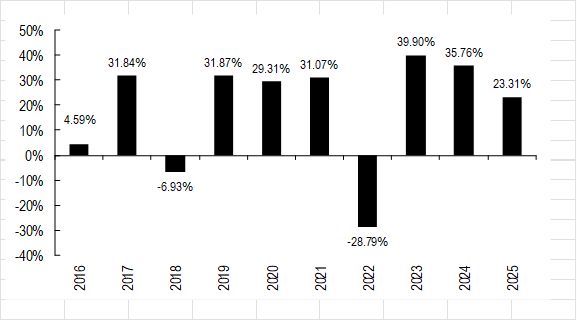
Performance | The bar chart that follows illustrates annual fund returns for the periods
ended December 31. The table that follows compares the fund’s returns for various periods with those of a broad-based securities market index, as well as an additional market index with characteristics that are similar to those of
the fund.
rjetfs.com | 9
|
|
Management of Exchange-Traded Funds
|
|
PROSPECTUS | [ ] 2026
|
|
|
|
|
The fund had not commenced operations prior to the date hereof. The fund acquired the Carillon ClariVest Capital Appreciation Fund
(“Predecessor Fund”) in a reorganization that closed on [ ], 2026. In connection with this reorganization, the shares of the fund adopted the performance history and financial statements of the Class I shares of the Predecessor Fund. The
information shown below is for the Class I shares of the Predecessor Fund. This information is intended to give you some indication of the risk of investing in the fund by demonstrating how its returns have varied over time. The bar chart
shows the fund’s performance from one year to another, as represented by the performance of the Predecessor Fund’s Class I shares.
While the fund would have substantially similar annual returns to the Class I shares of the Predecessor Fund, its performance may differ
from that shown because the fund has lower expenses than the Predecessor Fund. Performance has not been adjusted to reflect the fund’s lower expenses than those of the Predecessor Fund. Performance for the Predecessor Fund is based on the
NAV per share of the Predecessor Fund shares rather than on market-determined prices.
The fund’s past performance (before and after taxes) is not necessarily an indication of how the fund will perform in the future. To
obtain more current performance data as of the most recent month‑end, please visit our website at rjetfs.com.
rjetfs.com | 10
|
|
Management of Exchange-Traded Funds
|
|
PROSPECTUS | [ ] 2026
|
|
|
|
|
|
During 10 Year Period (Class I shares)
|
||
|
Return
|
Quarter Ended
|
|
|
Best Quarter
|
27.28%
|
June 30, 2020
|
|
Worst Quarter
|
(19.92)%
|
June 30, 2022
|
|
Average annual total returns (for the periods ended December 31, 2025):
|
||||
|
Fund return (after deduction of sales charges and expenses)
|
||||
|
Inception Date
|
1-yr
|
5-yr
|
10-yr
|
|
|
Class I – Before Taxes
|
3/21/06
|
23.31%
|
16.93%
|
16.94%
|
|
After Taxes on Distributions
|
22.17%
|
14.23%
|
14.59%
|
|
|
After Taxes on Distributions and Sale of Fund Shares
|
14.64%
|
12.89%
|
13.48%
|
|
|
Index (reflects no deduction for fees, expenses or taxes)
|
||||
|
S&P 500® Index
|
17.88%
|
14.42%
|
14.82%
|
|
|
Russell 1000® Growth Index
|
18.56%
|
15.32%
|
18.13%
|
|
After-tax returns are calculated using the historically highest individual federal marginal income tax rates and do not reflect the
impact of state and local taxes. Actual after-tax returns depend on an investor’s tax situation and may differ from those shown. After-tax returns shown are not relevant to investors who hold their fund shares through tax-deferred
arrangements, such as a 401(k) plan or individual retirement account (“IRA”). The return after taxes on distributions and sale of fund shares may exceed the return before taxes due to an assumed tax benefit from any losses on a sale of fund
shares at the end of the measurement period.
Investment Adviser | Carillon Tower Advisers, Inc. is the fund’s investment adviser.
Subadvisers | ClariVest Asset Management LLC (“ClariVest”) and Tidal Investments LLC serve as subadvisers to the fund.
rjetfs.com | 11
|
|
Management of Exchange-Traded Funds
|
|
PROSPECTUS | [ ] 2026
|
|
|
|
|
Portfolio Managers | Ed Wagner, CFA®, Amanda Freeman, CFA®, C. Frank Feng,
Ph.D., and Todd N. Wolter, CFA®, of ClariVest, have served as Portfolio Co-Managers of the fund since its inception in [ ] 2026, and are jointly and primarily responsible for the day-to-day management of the fund. Messrs. Wagner
and Feng served as Portfolio Co-Managers of the Predecessor Fund from 2013 through [ ], 2026. Ms. Freeman served as Portfolio Co-Manager of the Predecessor Fund from April 2024 through [ ], 2026. Mr. Wolter served as Portfolio Co-Manager
of the Predecessor Fund from 2019 through [ ], 2026.
Purchase and sale of fund shares | The fund is an exchange-traded fund. Individual fund shares
may only be purchased and sold on a national securities exchange through a broker-dealer and may not be purchased or redeemed directly with the fund. Shares of the fund are listed for trading on NYSE Arca, Inc. (“Exchange”). Shares may be
purchased and redeemed from the fund only in Creation Units of 25,000 shares, or multiples thereof. As a practical matter, only institutions and large investors, such as market makers or other large broker-dealers, purchase or redeem
Creation Units. Most investors will buy and sell shares of the fund on the Exchange. Individual shares can be bought and sold throughout the trading day like other publicly traded securities through a broker-dealer on the Exchange. These
transactions do not involve the fund. The price of an individual fund share is based on market prices, which may be different from its NAV. As a result, the fund’s shares may trade at a price greater than the NAV (at a premium) or less than
the NAV (at a discount). An investor may incur costs attributable to the difference between the highest price a buyer is willing to pay to purchase shares of the fund (“bid”) and the lowest price a seller is willing to accept for shares of
the fund (“ask”) when buying or selling shares in the secondary market (the “bid-ask spread”). Most investors will incur customary brokerage commissions and charges when buying or selling shares of the fund through a broker-dealer.
Recent information regarding the fund, including its NAV, market price, premiums and discounts, and bid-ask spreads, are available on the
fund’s website at rjetfs.com.
Tax information | The dividends you receive from the fund will be taxed as ordinary income or net
capital gain (i.e., the excess of net long-term capital gain over net short-term capital loss) unless you are investing through a tax-deferred arrangement, such as a 401(k) plan or an IRA, in which case you may be subject to federal income
tax on withdrawals from the arrangement.
Payments to broker-dealers and other financial intermediaries | If you purchase shares of the
fund through a broker-dealer or other financial intermediary (such as a bank), the fund and its related companies may pay the intermediary for the sale of fund shares and related services. These payments may create a conflict of interest by
influencing the broker-dealer or other intermediary and your salesperson to recommend the fund over another investment. Ask your salesperson or visit your financial intermediary’s website for more information.
rjetfs.com | 12
|
|
Carillon Exchange-Traded Funds
|
|
PROSPECTUS | [ ] 2026
|
|
|
|
|
Additional Information About the Fund
The fund’s investment objective is non-fundamental and may be changed by its Board of Trustees without shareholder approval.
As a temporary defensive measure because of market, economic or other conditions, the fund may invest up to 100% of its assets in
high-quality, short-term debt instruments or may take positions that are inconsistent with its principal investment strategies. The fund may also invest its assets in cash, cash equivalent securities, repurchase agreements or money market
instruments as a temporary defensive measure. To the extent that the fund takes such a temporary defensive position, its ability to achieve its investment objective may be affected adversely.
Additional Information Regarding Investment Strategies
RJ ClariVest Capital Appreciation ETF | In selecting securities for the fund, the subadviser
utilizes quantitative tools to implement a “bottom-up,” fundamentally based, investment process. A bottom-up method of analysis seeks to de-emphasize the significance of economic and market cycles. The subadviser constructs a portfolio that
seeks to maximize expected return, subject to constraints designed to meet long-run expected active risk goals. This framework builds toward the goal of sustainable performance relative to the Russell 1000® Growth Index, which is
a growth-oriented index.
The fund will invest primarily in the common stocks of large- and mid-capitalization U.S. companies that the portfolio management team
believes have the potential for earnings growth and improvement in investor sentiment. In addition, as a non-principal investment strategy, the fund may invest in common stocks of foreign companies. The intrinsic worth of the companies’
stocks may not be recognized by the market or the stocks may be currently out of favor with investors. The fund may sell securities when they no longer meet the portfolio managers’ investment criteria and/or to take advantage of more
attractive investment opportunities.
Additional Information About Principal Risk Factors
The greatest risk of investing in the fund is that its returns will fluctuate and you could lose money. Turbulence in financial markets
and reduced liquidity in equity, credit and fixed income markets may negatively affect many issuers worldwide, which could have an adverse effect on the fund. Additionally, while the portfolio managers seek to take advantage of investment
opportunities that will maximize the fund’s investment returns, there is no guarantee that such opportunities will ultimately benefit the fund. There is no assurance that the portfolio managers’ investment strategy will enable the fund to
achieve its investment objective. An investment in the fund is not a deposit with a bank and is not insured or guaranteed by the Federal Deposit Insurance Corporation or any other government agency.
The principal risks of investing in the fund listed below are presented in alphabetical order and not in order of importance or potential
exposure. Among other matters, this presentation is intended to facilitate your ability to find particular risks and compare them with the risks of other funds. Each risk summarized below is considered a “principal risk” of investing in the
fund, regardless of the order in which it appears.
Cybersecurity and technology | The fund, its service providers, market makers, listing exchange, Authorized Participants, third-party fund distribution platforms and
other market participants increasingly depend on complex information technology and communications systems, including artificial intelligence (“AI”), which are subject to a number of different threats and risks that could adversely affect
the fund and its shareholders. These risks include, among others, theft, misuse, and improper release of confidential or highly sensitive information relating to the fund and its shareholders, as well as compromises or failures to
systems, networks, devices and applications relating to the operations of the fund and its service providers, including those relating to the performance and effectiveness of security procedures used by the fund or its service providers
to protect the fund’s assets. Power outages, natural disasters, equipment malfunctions and processing errors that threaten these systems, as well as market events that occur at a pace that overloads these systems, may also disrupt
business operations or impact critical data, or impact shareholders’ ability to invest in or trade the fund. There may be an increased risk of cyber-attacks during periods of geopolitical or military conflict, and geopolitical tensions
may increase the scale and sophistication of deliberate cybersecurity attacks, particularly those from nation-states or from entities with nation-state backing. Any problems relating to the performance and effectiveness of security
procedures used by the fund or its service providers to protect the fund’s assets, such as algorithms, codes, passwords, multiple signature systems, encryption and telephone call-backs, may have an adverse impact on an investment in the
fund.
The fund and its service providers, including its investment adviser and subadvisers, as well as the market makers, listing exchange, Authorized Participants, third-party fund distribution platforms and
other market participants, may utilize AI technologies, including machine learning models and generative AI, to improve operational efficiency and in connection with research. In addition, counterparties used by the fund may utilize AI
in their business activities. While the investment adviser may restrict certain uses of AI tools, the fund and its investment adviser are not in a position to control the use of AI in third-party products or services. The use of AI
introduces numerous potential challenges and the use of AI can lead to reputational damage, legal liabilities, and competitive disadvantages, as well as negatively impact business operations, which may occur with or without
mismanagement in the use of the AI. AI requires the collection and processing of substantial amounts of data, which poses risks of data inaccuracies, incompleteness, and inherent biases, and which can degrade the technology’s
effectiveness and reliability. Such data can include proprietary information, the use of which by AI may be unauthorized and subject to potential liability. Rapid technological advancements further complicate risk predictions, and
competitors who adopt AI more swiftly may gain a competitive edge. The complexity and opacity of AI systems raise significant accountability and ethical concerns. AI has enhanced the ability of threat actors to amplify the potency,
scale, and speed of cybersecurity attacks. AI’s role in increasing automation raises concerns about job displacement and may lead to economic and social disruptions. The unpredictable nature of AI’s impact on market dynamics complicates
traditional risk assessment models, making it challenging to identify risks and opportunities using historical data. Legal and regulatory frameworks governing AI’s use, particularly concerning data privacy and protection, are evolving
rapidly. These changes could materially alter how AI is used, which may negatively impact the fund.
rjetfs.com | 13
|
|
Management of Exchange-Traded Funds
|
|
PROSPECTUS | [ ] 2026
|
|
|
|
|
Cybersecurity, AI and other operational and technology issues may result in financial losses to the fund and its shareholders, impede business transactions, violate privacy and other laws, subject
the fund to certain regulatory penalties and reputational damage, and increase compliance costs and expenses. Furthermore, as the fund’s assets grow, it may become a more appealing target for cybersecurity threats such as hackers
and malware. Although the fund has developed processes, risk management systems and business continuity plans designed to reduce these risks, the fund does not directly control the cybersecurity defenses, operational and
technology plans and systems of their service providers, financial intermediaries and companies in which they invest or with which they do business. The fund and its shareholders could be negatively impacted as a result. Similar
types of cybersecurity risks also are present for issuers of securities in which the fund invests, which could result in material adverse consequences for such issuers, and may cause the fund’s investment in such securities to
lose value.
Equity securities | The fund’s equity securities investments are subject to market risk. In general, the values of stocks and other equity securities fluctuate,
sometimes widely, in response to changes in a company’s financial condition as well as general market, economic and political conditions and other factors. The fund may experience a significant or complete loss on its investment in an
equity security. In addition, stock prices may be particularly sensitive to rising interest rates, which increase borrowing costs and the costs of capital. The fund may invest in the following equity securities, which may expose the
fund to the following additional risks:
|
•
|
Common Stocks. The value of a company’s common stock may fall as a result of factors directly relating to that company, such as decisions made by its
management or decreased demand for the company’s products or services. A stock’s value may also decline because of factors affecting not just the company, but also companies in the same industry or sector. The price of a company’s
stock may also be affected by changes in financial markets that are unrelated to the company, such as changes in interest rates, exchange rates or industry regulation. Companies that pay dividends on their common stock generally
only do so after they invest in their own business and make required payments to bondholders and on other debt and preferred stock. Therefore, the value of a company’s common stock will usually be more volatile than its bonds,
other debt and preferred stock. Common stock generally is subordinate to preferred stock upon the liquidation or bankruptcy of the issuing company. In the event of an issuer’s bankruptcy, there is substantial risk that there will
be nothing left to pay common stockholders after payments, if any, to bondholders and preferred stockholders have been made.
|
Exchange-traded funds | As an ETF, the fund is subject to the following risks:
|
•
|
Authorized participants concentration. The fund has a limited number of financial institutions that may act
as Authorized Participants. Only an Authorized Participant may transact in Creation Units directly with the fund, and none of those Authorized Participants is obligated to engage in creation and/or redemption transactions. To the
extent they exit the business or are otherwise unable to proceed in creation and redemption transactions with the fund and no other Authorized Participant is able to step forward to create or redeem shares, then shares of the fund
may be more likely to trade at a premium or discount to NAV and possibly face trading halts or delisting. Authorized Participant concentration risk may be heightened for ETFs that invest in securities issued by non-U.S. issuers or
other securities or instruments that have lower trading volumes.
|
|
•
|
Cash transactions. Like other ETFs, the fund sells and redeems its shares primarily in large blocks called
Creation Units and only to Authorized Participants, and in doing so, seeks to avoid realizing gains in connection with redemption requests. To the extent that the fund effects its creations and redemptions partially or fully for
cash, rather than in-kind securities, this may cause the fund to sell portfolio securities in order to obtain the cash needed to distribute redemption proceeds. Such dispositions may occur at an inopportune time, resulting in
potential losses to the fund or difficulties in meeting shareholder redemptions, and involve transaction costs. If the fund recognizes gain on these sales, this generally would cause the fund to recognize gain it might not
otherwise have recognized if it were to distribute portfolio securities in-kind or to recognize such gain sooner than would otherwise have been required. The fund generally would intend to distribute any such gains to shareholders
to avoid being taxed on this gain at the fund level and otherwise comply with the special tax rules that apply to it. This may cause shareholders to be subject to tax on gains they would not otherwise be subject to, or at an
earlier date than, if they had made an investment in another ETF. In addition, cash transactions may have to be carried out over several days if the securities market in which the fund is trading is less liquid and may involve
considerable transaction expenses and taxes. These brokerage fees and taxes, which will be higher than if the fund sold and redeemed its shares entirely in-kind, may be passed on to purchasers and redeemers of Creation Units in
the form of creation and redemption transaction fees. However, the fund has capped the total fees that may be charged in connection with the redemption of Creation Units at 2% of the value of the Creation Units redeemed and capped
the total fees that may be charged in connection with the creation of Creation Units at 3% of the value of the Creation Units created. To the extent transaction and other costs associated with a redemption exceed that cap, those
transaction costs will be borne by the fund’s remaining shareholders. These factors may result in wider spreads between the bid and the offered prices of the fund’s shares than for other ETFs.
|
rjetfs.com | 14
|
|
Management of Exchange-Traded Funds
|
|
PROSPECTUS | [ ] 2026
|
|
|
|
|
|
•
|
Premium/discount. The NAV of the fund’s shares will generally fluctuate with changes in the market value of
the fund’s securities holdings. The market prices of fund shares will generally fluctuate in accordance with changes in the fund’s NAV and supply and demand of shares on the secondary market. It cannot be predicted whether fund
shares will trade below their NAV (at a discount), at their NAV, or above their NAV (at a premium) or less than its NAV (at a discount). As a result, shareholders of the fund may pay more than NAV when purchasing shares and
receive less than NAV when selling fund shares. This risk is heightened in times of market volatility or periods of steep market declines. In such market conditions, market or stop-loss orders to sell fund shares may be executed
at market prices that are significantly below NAV. Price differences may be due, in part, to the fact that supply and demand forces at work in the secondary trading market for shares may be closely related to, but not identical
to, the same forces influencing the prices of the fund’s holdings. The market prices of fund shares may deviate significantly from the NAV of the shares during periods of market volatility or if the fund’s holdings are or become
more illiquid. Disruptions to creations and redemptions may result in trading prices that differ significantly from the fund’s NAV. In addition, market prices of fund shares may deviate significantly from the NAV if the number of
fund shares outstanding is smaller or if there is less active trading in fund shares. Investors purchasing and selling fund shares in the secondary market may not experience investment results consistent with those experienced by
those creating and redeeming directly with the fund.
|
|
•
|
Secondary market trading. Investors buying or selling shares in the secondary market will normally pay
brokerage commissions, which are often a fixed amount and may be a significant proportional cost for investors buying or selling relatively small amounts of shares. In addition, such investors may incur the cost of the “spread”
also known as the bid-ask spread, which is the difference between what investors are willing to pay for fund shares (the “bid” price) and the price at which they are willing to sell fund shares (the “ask” price). The bid-ask
spread varies over time based on, among other things, trading volume, market liquidity and market volatility, and is generally lower if the fund’s shares have more trading volume and market liquidity and higher if the fund’s
shares have little trading volume and market liquidity. Increased market volatility may cause increased bid-ask spreads. Shares of the fund may trade in the secondary market at times when the fund does not accept orders to
purchase or redeem shares. At such times, shares may trade in the secondary market with more significant premiums or discounts than might be experienced at times when the fund accepts purchase and redemption orders. Although
fund shares are listed for trading on the Exchange, there can be no assurance that an active trading market for such shares will exist or that the fund’s shares will continue to be listed. If the fund is delisted, any resulting
liquidation of the fund could create transaction costs for the fund and adverse federal income tax consequences for investors. Trading in fund shares may be halted due to market conditions or for reasons that, in the view of the
Exchange, make trading in shares inadvisable. In addition, trading in shares is subject to trading halts caused by extraordinary market volatility pursuant to Exchange “circuit breaker” rules. There can be no assurance that the
requirements of the Exchange necessary to maintain the listing of the fund will continue to be met or will remain unchanged or that the shares will trade with any volume, or at all. Shares of the fund, similar to shares of other
issuers listed on a stock exchange, may be sold short and are therefore subject to the risk of increased volatility and price decreases associated with being sold short. In addition, trading activity in derivative products based
on the fund may lead to increased trading volume and volatility in the secondary market for the shares of the fund.
|
|
•
|
Growth stocks | Growth companies are expected to increase their sales or earnings, or their dividend
yield, at a certain rate. When these expectations are not met, the prices of these stocks may decline, even if earnings showed an absolute increase. Growth company stocks also typically lack the dividend yield that can cushion
stock prices in market downturns. The price of a growth company’s stock may fail or not approach the value that has been placed on it. If a growth investment style shifts out of favor based on market conditions and investor
sentiment, the fund could underperform funds that use a value or other non-growth approach to investing or have a broader investment style.
|
Inflation | Inflation risk is the risk that the value of assets or income from investments
will be less in the future as inflation decreases the value of money. As inflation increases, the present value of the fund’s assets and distributions may decline.
rjetfs.com | 15
|
|
Management of Exchange-Traded Funds
|
|
PROSPECTUS | [ ] 2026
|
|
|
|
|
Issuer | The value of a security may decline for a number of reasons which directly relate
to the issuer, such as management performance, financial leverage and reduced demand for the issuer’s goods or services, as well as the historical and prospective earnings of the issuer and the value of its assets.
Large-cap companies | Investments in large-cap companies may underperform other segments of the
market, in some cases for extended periods of time, because such companies may be less responsive to competitive challenges and opportunities, such as changes in technology and consumer tastes. Large-cap companies generally are expected to
be less volatile than companies with smaller market capitalizations. However, large-cap companies may be unable to attain the high growth rates of successful smaller companies, especially during periods of economic expansion, and may
instead focus their competitive efforts on maintaining or expanding their market share.
Large shareholder | Certain large shareholders, including the investment adviser, a subadviser or
an affiliate of either, other funds or accounts advised by the investment adviser or a subadviser or an affiliate of either, or Authorized Participants, may from time to time own a substantial amount of the fund’s shares. There is no
requirement that these shareholders maintain their investment in the fund, and there can be no assurance that any large shareholder would not redeem its investment or that the fund would continue to meet applicable listing requirements. If
the fund fails to maintain a certain level of size or scale, the fund may be negatively impacted. There is a risk that such large shareholders or that the fund’s shareholders generally may redeem all or a substantial portion of their
investments in the fund in a short period of time, which could have a significant negative impact on the fund’s NAV, liquidity, brokerage costs, and expenses.
Dispositions of a large number of shares by these shareholders may adversely affect the fund’s liquidity and net assets to the extent such
transactions are executed directly with the fund in the form of redemptions through an Authorized Participant, rather than in the secondary market. Large redemptions could also result in tax consequences to shareholders and impact the
fund’s ability to implement its investment strategy, such as by forcing the fund to sell portfolio securities when it might not otherwise do so, which may negatively impact the fund’s NAV and increase the fund’s brokerage costs. There is no
guarantee that the fund could maintain sufficient assets to continue operations, in which case the fund may be liquidated. The fund’s ability to pursue its investment objective after one or more large scale redemptions may be impaired and,
as a result, the fund may invest a larger portion of its assets in cash or cash equivalents. To the extent these large shareholders transact in shares on the secondary market, such transactions may account for a large percentage of the
trading volume on the listing exchange and may, therefore, have a material upward or downward effect on the market price of the shares.
In addition, the fund may be a constituent of one or more adviser asset allocation models. Being a component of such a model may greatly
affect the trading activity of the fund, the size of the fund, and the market volatility of the fund’s shares. Inclusion in a model could increase demand for the fund and removal from a model could result in outsized selling activity in a
relatively short period of time. As a result, the fund’s NAV could be negatively impacted, and the fund’s market price may be below the fund’s NAV during certain periods. In addition, model rebalances may potentially result in increased
trading activity. To the extent buying or selling activity increases, the fund can be exposed to increased brokerage costs and adverse tax consequences, and the market price of the fund can be negatively affected.
Management and strategy | The value of your investment depends on the judgment of the subadviser
about the quality, relative yield or value of, or market trends affecting, a particular security, industry, sector, region, or market segment, or about the economy or interest rates generally. This judgment may prove to be incorrect or
otherwise may not produce the intended results, which may result in losses to the fund. Investment strategies employed by the subadviser in selecting investments for the fund may not result in an increase in the value of your investment or
in overall performance equal to other investments.
Market | The fund is subject to the risk that the securities markets will move down, sometimes
rapidly and unpredictably, based on overall economic conditions and other factors, which may negatively affect the fund’s performance. Equity securities generally have greater price volatility than fixed-income securities, although under
certain market conditions fixed-income securities may have comparable or greater price volatility. During a general downturn in the securities markets, multiple asset classes may decline in value simultaneously. In some cases, traditional
market participants have been less willing to make a market in some types of debt instruments, which has affected the liquidity of those instruments. During times of market turmoil, investors tend to look to the safety of securities issued
or backed by the U.S. Treasury, causing the prices of these securities to rise and the yields to decline. Reduced liquidity in fixed income and credit markets may negatively affect many issuers worldwide. Prices in many financial markets
have increased significantly over the last 10-15 years, but there have also been periods of adverse market and financial developments and cyclical change during that timeframe, which have resulted in unusually high levels of volatility in
domestic and foreign financial markets that has caused losses for investors and may occur again in the future, particularly if markets enter a period of uncertainty or economic weakness. Periods of unusually high volatility in the financial
markets and restrictive credit conditions, sometimes limited to a particular sector or geographic region, continue to recur.
rjetfs.com | 16
|
|
Management of Exchange-Traded Funds
|
|
PROSPECTUS | [ ] 2026
|
|
|
|
|
The value of a security may decline due to adverse issuer-specific conditions or general market conditions unrelated to a particular
issuer, such as real or perceived adverse geopolitical, regulatory, market, economic or other developments that may cause broad changes in market value, changes in the general outlook for corporate earnings, changes in interest, currency or
inflation rates, lack of liquidity in the markets, public perceptions concerning these developments or adverse market sentiment generally. The value of a security may also decline due to factors that affect a particular industry or
industries, such as tariffs, labor shortages or increased production costs and competitive conditions within an industry. Changes in the financial condition of a single issuer or market segment also can impact the market as a whole.
Geopolitical and other events, including war, terrorism, economic uncertainty, trade disputes, pandemics, public health crises, natural
disasters and related events have led, and in the future may continue to lead, to instability in world economies and markets generally and reduced liquidity, which may adversely affect the value of your investment. The imposition of tariffs
by the U.S. on goods imported from foreign countries and reciprocal tariffs levied on U.S. goods by those countries also may lead to volatility and instability in domestic and foreign markets. Such market disruptions have caused, and may
continue to cause, broad changes in market value, negative public perceptions concerning these developments, a reduction in the willingness and ability of some lenders to extend credit, difficulties for some borrowers in obtaining financing
on attractive terms, if at all, and adverse investor sentiment or publicity. Changes in value may be temporary or may last for extended periods. Adverse market events may also lead to increased shareholder redemptions, which could cause the
fund to sell investments at an inopportune time to meet redemption requests by shareholders and may increase the fund’s portfolio turnover, which could increase the costs that the fund incurs and lower the fund’s performance. Even when
securities markets perform well, there is no assurance that the investments held by the fund will increase in value along with the broader market.
Policy changes by the U.S. government and/or Federal Reserve and political events within the U.S. and abroad, such as changes in the U.S.
presidential administration and Congress, the U.S. government’s inability at times to agree on a long-term budget and deficit reduction plan, the threat of a federal government shutdown and threats not to increase the federal government’s
debt limit which could result in a default on the government’s obligations, may affect investor and consumer confidence and may adversely impact financial markets and the broader economy, perhaps suddenly and to a significant degree. The
severity or duration of adverse economic conditions may also be affected by policy changes made by governments or quasi-governmental organizations. Global economies and financial markets are becoming increasingly interconnected, which
increases the possibility of many markets being affected by events in a single country or events affecting a single or small number of issuers.
Markets and market participants are increasingly reliant upon both publicly available and proprietary information data systems. Data
imprecision, software or other technology malfunctions, programming inaccuracies, unauthorized use or access, the execution of ransomware and other cyberattacks, and similar circumstances may impair the performance of these systems and may
have an adverse impact upon a single issuer, a group of issuers, or the market at large. In certain cases, an exchange or market may close or issue trading halts on either specific securities or even the entire market, which may result in
the fund being, among other things, unable to buy or sell certain securities or financial instruments or accurately price its investments. These fluctuations in securities prices could be a sustained trend or a drastic movement. The
financial markets generally move in cycles, with periods of rising prices followed by periods of declining prices. The value of your investment may reflect these fluctuations.
Recent market events | Both U.S. and international markets have experienced significant volatility in recent months and years. As a result of such volatility,
investment returns may fluctuate significantly.
National economies are substantially interconnected, as are global financial markets, which creates the possibility that conditions in one country or region might adversely impact issuers in a different
country or region. However, the interconnectedness of economies and/or markets may be changing, which may impact such economies and markets in ways that cannot be foreseen at this time.
Some countries, including the U.S., have adopted more protectionist trade policies, including trade tariffs and other trade barriers, which is a trend that appears to be continuing globally. Slowing
global economic growth, the rise in protectionist trade policies, inflationary pressures, changes to some major international trade and security agreements, risks associated with trade and security agreements between countries and
regions, including the U.S. and other foreign nations, political or economic dysfunction within some countries or regions, including the U.S., and dramatic changes in consumer sentiment, commodity prices and currency values could affect
the economies and markets of many nations, including the U.S., in ways that cannot necessarily be foreseen at the present time and may create significant market volatility. In addition, these policies, including the impact on the U.S.
dollar, may change foreign demand for U.S. assets in ways that cannot be foreseen, which could have a negative impact on certain issuers and/or industries.
rjetfs.com | 17
|
|
Management of Exchange-Traded Funds
|
|
PROSPECTUS | [ ] 2026
|
|
|
|
|
The Federal Reserve and certain foreign central banks have started to lower interest rates though economic or other factors, such as inflation, could reverse or stop such changes. It is difficult to
accurately predict the pace at which interest rates might change, the timing, frequency or magnitude of any such changes in interest rates, or when such changes might stop or again reverse course.
Additionally, various economic and political factors could cause the Federal Reserve or other foreign banks to change their approach in the future and such actions may result in an economic slowdown both in
the U.S. and abroad. Unexpected changes in interest rates could lead to significant market volatility or reduce liquidity in certain sectors of the market. Deteriorating economic fundamentals may, in turn, increase the risk of default or
insolvency of particular issuers, negatively impact market value, cause credit spreads to widen, and reduce bank balance sheets. Any of these could cause an increase in market volatility, reduce liquidity across various markets or
decrease confidence in the markets. Also, regulators have expressed concern that changes in interest rates may cause investors to sell fixed income securities faster than the market can absorb them, contributing to price volatility.
Historical patterns of correlation among asset classes may break down in unanticipated ways during times of high volatility, disrupting investment programs and potentially causing losses.
Tensions, war or open conflict between nations, such as among the United States, Israel and Iran, between Russia and Ukraine, otherwise in the Middle East or in eastern Asia could affect the economies of
many nations, including the United States and may contribute to increased volatility and uncertainty in the financial markets. The extent and duration of ongoing hostilities and any sanctions and related events, including the potential
for cyber warfare, remain uncertain and cannot be predicted. Those events have presented and could continue to present material uncertainty and risk with respect to markets globally, including in the oil and gas markets and potentially
other industries and sectors, and the performance of the fund and its investments or operations could be negatively impacted whether or not the fund invests in securities of issuers located in or with significant exposure to the countries
or regions directly affected. For example, the armed conflict among the United States, Israel and Iran that commenced in February 2026 has contributed to increased volatility and uncertainty in financial markets as well as significant
volatility in the oil and natural gas markets, which has created widespread economic disruption.
Regulators in the U.S. have adopted a number of changes to regulations involving the markets and issuers, some of which apply to the fund. The full effect of such regulations is not currently known and
certain changes to regulations could limit the fund’s ability to pursue its investment strategies or make certain investments, or may make it more costly for the fund to operate, which may impact performance. Additionally, it is possible
that such regulations could be further revised or rescinded, which creates material uncertainty regarding their impact to the fund.
rjetfs.com | 18
|
|
Management of Exchange-Traded Funds
|
|
PROSPECTUS | [ ] 2026
|
|
|
|
|
Further, advancements in technology may also adversely impact market movements and liquidity and may affect the overall performance of the
fund. Advancements in technology, including advanced development and increased regulation of artificial intelligence, may adversely impact market movements and liquidity. As artificial intelligence is used more widely, which can occur
rapidly, the profitability and growth of certain issuers and industries may be negatively impacted in ways that cannot be foreseen, which could impact the overall performance of the fund.
High public debt in the U.S. and other countries creates ongoing systemic and market risks and policymaking uncertainty. There is no
assurance that the U.S. Congress will act to raise the nation’s debt ceiling; a failure to do so could cause market turmoil and substantial investment risks that cannot now be fully predicted. Unexpected political, regulatory and diplomatic
events within the U.S. and abroad may affect investor and consumer confidence and may adversely impact financial markets and the broader economy.
Certain illnesses spread rapidly and have the potential to significantly and adversely affect the global economy. The impact of epidemics
and/or pandemics that may arise in the future could negatively affect the economies of many nations, individual companies and the global securities and commodities markets, including their liquidity, in ways that cannot necessarily be
foreseen at the present time and could last for an extended period of time.
China’s economy, which has been sustained largely through debt-financed spending on housing and infrastructure, appears to be experiencing
a significant slowdown and growing at a lower rate than prior years. While the Chinese government appears to be taking measures to address these issues, due to the size of China’s economy, the resolution of these issues could impact a
number of other countries.
Global climate change can have potential effects on property and security values. Certain issuers, industries and regions may be adversely
affected by the impact of climate change in ways that cannot be foreseen. The impact of legislation, regulation and international accords related to climate change, including any direct or indirect consequences, may negatively impact
certain issuers, industries and regions.
A rise in sea levels, a change in weather patterns, including an increase in powerful storms and large wildfires, and/or a climate-driven
increase in flooding could cause properties to lose value or become unmarketable altogether. Unlike previous declines in the real estate market, properties in affected zones may not ever recover their value. Regulatory changes and
divestment movements tied to concerns about climate change could adversely affect the value of certain land and the viability of industries whose activities or products are seen as accelerating climate change.
Micro-cap companies | Investments in micro-cap companies are subject to substantially greater
risks of loss and price fluctuations, sometimes rapidly and unpredictably, because their earnings and revenues tend to be less predictable. In addition, some companies may experience significant losses. Since micro-capitalization companies
may not have an operating history, product lines, or financial resources, their share prices also tend to be more volatile and their markets less liquid than companies with larger market capitalizations, and they can be sensitive to changes
in overall economic conditions, interest rates, borrowing costs and earnings. The shares of micro-capitalization companies tend to trade less frequently than those of larger, more established companies, which can adversely affect the
pricing of these securities and the future ability to sell these securities. Micro-capitalization companies face greater risk of business failure, which could increase the volatility of the fund’s portfolio.
rjetfs.com | 19
|
|
Management of Exchange-Traded Funds
|
|
PROSPECTUS | [ ] 2026
|
|
|
|
|
Mid-cap companies | Investments in mid-cap companies generally involve greater risks than
investing in large-capitalization companies. Mid-cap companies may have narrower commercial markets and limited managerial and financial resources compared to larger, more established companies. The performance of mid-cap companies can be
more volatile, and their stocks less liquid, compared to larger, more established companies, which could increase the volatility of the fund’s portfolio and performance. Shareholders of the fund that invests in mid-cap companies should
expect that the value of the fund’s shares will be more volatile than the fund that invests exclusively in large-cap companies. Generally, the smaller the company size, the greater these risks.
New adviser | The adviser and subadviser have each only recently begun serving as an investment
adviser to ETFs. As a result, investors do not have a long-term track record of managing an ETF from which to judge the adviser or subadviser, and the adviser and subadviser may not achieve the intended result in managing the fund.
Quantitative strategy | The success of the fund’s investment strategy may depend in part on the
effectiveness of the quantitative tools for screening securities used by ClariVest Asset Management LLC (“ClariVest”), one of the fund’s subadvisers. Securities selected using quantitative analysis can react differently to issuer,
political, market, and economic developments than the market as a whole or securities selected using only fundamental analysis, which could adversely affect their value. ClariVest’s quantitative tools may use factors that may not be
predictive of a security’s value, and any changes over time in the factors that affect a security’s value may not be reflected in the quantitative model. The quantitative tools may not react as expected to market events, resulting in losses
for the fund. Data for some companies, particularly non-U.S. companies, may be less available and/or less current than data for other companies. There may also be errors, omissions, imperfections or malfunctions in the computer code for the
quantitative model or in the model itself, or issues relating to the computer systems used to screen securities. ClariVest’s stock selection can be adversely affected if it relies on insufficient, erroneous or outdated data or flawed models
or computer systems. Historical data inputs may be subject to revision or correction, which may diminish the reliability and predictive quality of results. Additionally, a previously successful strategy may become outdated or inaccurate,
which may not be identified by ClariVest and therefore may also result in losses. Changing and unforeseen market dynamics could also lead to a decrease in the short-term or long-term effectiveness of a model. Models may lose their validity,
leading to potential losses. No assurance can be given that a model will be successful under all or any market conditions. The increased use of artificial intelligence or other evolving or emerging technologies presents significant risks
and may exacerbate the aforementioned risks.
Sectors | The fund may hold a significant amount of investments in issuers conducting business in
a related group of industries within the same economic sector, which may be similarly affected by particular economic or market events. To the extent the fund has substantial holdings within a particular sector, the risks to the fund
associated with that sector increase and the fund may perform poorly during a downturn in one or more of the industries within that sector. In addition, when the fund focuses its investments in certain sectors of the economy, its
performance could fluctuate more widely than if the fund invested more evenly across sectors. Individual sectors may be more volatile, and may perform differently, than the broader market. As the fund’s portfolio changes over time, the
fund’s exposure to a particular sector may become higher or lower.
rjetfs.com | 20
|
|
Management of Exchange-Traded Funds
|
|
PROSPECTUS | [ ] 2026
|
|
|
|
|
Information technology sector | The information technology sector includes
companies engaged in internet software and services, technology hardware and storage peripherals, electronic equipment, instruments and components, and semiconductors and semiconductor equipment. Information technology companies face
intense competition, both domestically and internationally, which may have an adverse effect on profit margins. Information technology companies may have limited product lines, markets, financial resources or personnel. These companies may
be smaller or newer and may have limited product lines, markets, financial resources or personnel. The market prices of information technology-related securities tend to exhibit a greater degree of interest rate risk and market risk and may
experience sharper price fluctuations than other types of securities. These securities may fall in and out of favor with investors rapidly, which may cause sudden selling and dramatically lower market prices. The products of information
technology companies may face rapid product obsolescence due to technological developments and frequent new product introduction, unpredictable changes in growth rates and competition for the services of qualified personnel. Failure to
introduce new products, develop and maintain a loyal customer base or achieve general market acceptance for their products could have a material adverse effect on a company’s business. Companies in the information technology sector also may
be subject to increased government scrutiny or adverse government regulatory action. Additionally, companies in the information technology sector are heavily dependent on intellectual property and the loss of patent, copyright and trademark
protections may adversely affect the profitability of these companies.
Securities lending | The fund may lend its portfolio securities to brokers, dealers and financial institutions to seek income. Borrowers of the fund’s securities
typically provide collateral in the form of cash that is reinvested in securities. The fund will be responsible for the risks associated with the investment of cash collateral. The fund may lose money on its investment of cash collateral
or may fail to earn sufficient income on its investment to meet obligations to the borrower, and the fund can lose money if investments made with cash collateral decline in value. There is a risk that a borrower may default on its
obligations to return loaned securities; however, the fund’s securities lending agent may indemnify the fund against that risk. There is a risk that the assets of the fund’s securities lending agent may be insufficient to satisfy any
contractual indemnification requirements to the fund. In addition, delays may occur in the recovery of securities from borrowers, which could interfere with the fund’s ability to vote proxies or to settle transactions, and there is the
risk of possible loss of rights in the collateral should the borrower fail financially. In any case in which the loaned securities are not returned to the fund before an ex-dividend date, the payment in lieu of the dividend that the fund
receives from the securities’ borrower would not be treated as a dividend for federal income tax purposes and thus would not qualify for treatment as “qualified dividend income.”
Small-cap companies | Investments in small-cap companies generally involve greater risks than
investing in large-capitalization companies. Companies with smaller market capitalizations generally have lower volume of shares traded daily, less liquid stock and more volatile stock prices. Companies with smaller market capitalizations
also tend to have a limited product or service base and limited access to capital. Newer companies with unproven business strategies also tend to be smaller companies. The above factors increase risks and make these companies more likely to
fail than companies with larger market capitalizations, and could increase the volatility of the fund’s portfolio and performance. Shareholders of the fund that invests in small-cap companies should expect that the value of the fund’s
shares will be more volatile than the fund that invests exclusively in mid-cap or large-cap companies. Generally, the smaller the company size, the greater these risks.
Value stocks | Investments in value stocks are subject to the risk that their true worth may not
be fully realized by the market or that their prices may decline. This may result in the value stocks’ prices remaining undervalued for extended periods of time. The fund’s performance also may be affected adversely if value stocks remain
unpopular with or lose favor among investors. If a value investment style shifts out of favor based on market conditions and investor sentiment, the fund could underperform funds that use a non-value approach to investing or have a broader
investment style.
rjetfs.com | 21
|
|
Management of Exchange-Traded Funds
|
|
PROSPECTUS | [ ] 2026
|
|
|
|
|
Investment Adviser
Carillon Series Trust (the “Trust” or the “Carillon Family of Funds”) is a Delaware statutory trust, and is registered under the
Investment Company Act of 1940, as amended, as an open-end diversified management investment company. The Trust offers shares in separate series (each a “fund” and collectively the “funds”), each of which is advised by Carillon Tower
Advisers, Inc. (“Carillon” or “Manager”). On September 30, 2022, Carillon began also doing business as Raymond James Investment Management. This did not involve any change in Carillon’s structure, ownership, or control.
Carillon, located at 880 Carillon Parkway, St. Petersburg, Florida 33716, serves as investment adviser and administrator for the fund.
Carillon manages, supervises and conducts the business and administrative affairs of the fund. Carillon is a wholly owned subsidiary of Raymond James Financial, Inc. (“RJF”) which, together with its subsidiaries, provides a wide range of
financial services to retail and institutional clients. As of December 31, 2025, Carillon and its investment management affiliates collectively had approximately $114.1 billion in assets under management.
The basis for the Board’s approval of each Investment Advisory Agreement with Carillon will be included in Item 11 of the fund’s Form N-CSR as filed with the SEC for the period ended December 31, 2026. The
Investment Advisory Agreements provide for the fund to pay Carillon an annualized management fee based on a percentage of the fund’s average daily net assets calculated and accrued according to the following schedule.
|
Fund
|
Average Daily Net
Assets
|
Fee Rate Charged
|
|
RJ ClariVest Capital Appreciation ETF
|
$0 to $1 billion
|
0.60%
|
|
Over $1 billion
|
0.55%
|
Under the Investment Advisory Agreement, Carillon has contractually agreed to pay all operating expenses of the fund
(also known as a “unitary advisory fee”), except (i) interest and taxes (including, but not limited to, income, excise, transaction, transfer and withholding taxes); (ii) expenses of the fund incurred with respect to the acquisition, voting
and/or disposition of portfolio securities and the execution of portfolio transactions, including brokerage commissions; (iii) acquired fund fees and expenses; (iv) dividend and interest expenses relating to short sales; (v) expenses
incurred in connection with any distribution plan adopted by the Trust in compliance with Rule 12b-1 under the 1940 Act, including distribution fees; (vi) the compensation payable to the Manager under the management agreement; (vii)
securities lending expenses; (viii) costs of holding shareholder meetings and proxy related expenses; (ix) legal expenses including litigation and indemnification expenses; (x) tax reclaim expenses; (xi) compensation and expenses of counsel
to the Independent Trustees and (xii) any extraordinary expenses.
The fund has entered into an Administration Agreement with Carillon under which Carillon provides various administrative services.
Carillon is paid for these services out of the unitary advisory fee under the Investment Advisory Agreement.
Carillon is registered as an investment adviser under the Investment Advisers Act of 1940, as amended. On behalf of the fund, either an
exemption from regulation as a commodity pool operator under the Commodity Exchange Act has been claimed with the National Futures Association or registration is not applicable with respect to the fund, and Carillon is exempt from
registration as a commodity trading adviser under Commodity Futures Trading Commission Regulation 4.14(a)(8) with respect to the fund.
rjetfs.com | 22
|
|
Management of Exchange-Traded Funds
|
|
PROSPECTUS | [ ] 2026
|
|
|
|
|
As the fund’s asset levels change, its fees and expenses may differ from those reflected in the fund’s fee tables. For example, as asset
levels decline, expense ratios may increase. Carillon has contractually agreed to waive its investment advisory fee and/or reimburse certain expenses of the fund to the extent that annual operating expenses exceed a percentage of the fund’s
average daily net assets through [ ], 2028 as follows:
Contractual Expense Limitations
|
RJ ClariVest Capital Appreciation ETF
|
0.61%
|
For the fund, the expense limitation excludes interest, taxes, brokerage commissions, costs relating to investments in other investment
companies (acquired fund fees and expenses), dividend and interest costs, and extraordinary expenses.
The contractual fee waivers can be changed only with the approval of a majority of the Board. Any reimbursement of fund expenses or
reduction in Carillon’s investment advisory fees is subject to recoupment by Carillon within the following two fiscal years, provided that such recoupment will not cause the fund’s expense ratio to exceed both the expense cap at the time
such amounts were waived or reimbursed, or the fund’s then-current expense cap. With respect to ClariVest Asset Management LLC (“ClariVest”), the amount of the subadvisory fee paid by Carillon to ClariVest is reduced in proportion to the
amount of the fees waived and/or expenses reimbursed by Carillon and Carillon provides to ClariVest any recoupment that Carillon receives from the fund in proportion to the amount of the recoupment.
Subadvisers
Carillon has selected the following subadvisers to provide investment advice and portfolio management services to the fund’s portfolio:
|
•
|
ClariVest, 3611 Valley Centre Drive, Suite 100, San Diego, CA 92130, serves as a subadviser to the RJ ClariVest Capital Appreciation ETF.
ClariVest is responsible for the management of the fund’s portfolio.
|
|
•
|
Tidal Investments LLC (“Tidal”), located at 234 West Florida Street, Suite 203, Milwaukee, Wisconsin 53204, serves as a subadviser to the fund.
Tidal is responsible for trading the fund’s portfolio securities and performing related services, providing tax optimization services, assisting in basket creation, reporting and monitoring, and providing portfolio compliance
monitoring and reporting.
|
The basis for the Board’s approval of each Subadvisory Agreement will be included in Item 11 of the fund’s Form N-CSR as filed with
the SEC for the period ended December 31, 2026.
The fund currently operates in a multi-manager structure pursuant to an exemptive order issued by the Securities and Exchange Commission
(“SEC”). The order permits Carillon, subject to certain conditions, to enter into new or modified subadvisory agreements with existing or new subadvisers without the approval of fund shareholders, but subject to approval by the Board.
Carillon has the ultimate responsibility for overseeing the fund’s subadvisers and recommending their hiring, termination and replacement, subject to oversight by the Board. The order also grants Carillon and the fund relief with respect
to the disclosure of the advisory fees paid to individual subadvisers in various documents filed with the SEC and provided to shareholders. Pursuant to this relief, the fund may disclose the aggregate fees payable to Carillon and
wholly-owned subadvisers and the aggregate fees payable to unaffiliated subadvisers and subadvisers affiliated with Carillon or RJF, other than wholly-owned subadvisers.
rjetfs.com | 23
|
|
Management of Exchange-Traded Funds
|
|
PROSPECTUS | [ ] 2026
|
|
|
|
|
If the fund relies on the order to hire a new subadviser, the fund will provide shareholders with certain information regarding the
subadviser within 90 days of hiring the new subadviser, as required by the order.
In addition, the fund has received an exemptive order from the SEC that, subject to certain conditions, permits the Board, including a majority of those Board members who are not parties to a contract or
agreement or “interested persons” of any such party, as defined in the 1940 Act, to enter into or materially amend subadvisory agreements at a non-in-person meeting, called for the purpose of voting on such approval, in which Board
members may participate by any means of communication that allows Board members to hear each other simultaneously during the meeting. In addition, management must represent that the materials provided to the Board for the non-in-person
meeting include the same information the Board would have received at an in-person meeting, the notice of any such non-in-person meeting must explain the need for considering such matters at a non-in-person meeting, and Board members must
have an opportunity to request that these matters be considered at an in-person meeting.
In the future, Carillon may propose the addition of one or more additional subadvisers, subject to approval by the Board and, if required
by the 1940 Act, or any applicable exemptive relief, fund shareholders. The Prospectus will be supplemented if additional investment subadvisers are retained or the contract with any existing subadviser is terminated.
Portfolio Managers
The following portfolio managers are responsible for the day-to-day management of the investment portfolio:
|
•
|
RJ ClariVest Capital Appreciation ETF – Ed Wagner, CFA®, Amanda Freeman, CFA®, C. Frank Feng, Ph.D., and Todd N. Wolter, CFA®,
of ClariVest, have served as Portfolio Co-Managers of the fund since its inception in [ ] 2026 and are jointly and primarily responsible for the day-to-day management of the fund.
|
Mr. Wagner and Dr. Feng served as Portfolio Co-Managers of the Predecessor Fund from 2013 through [ ], 2026. Dr. Feng
has served as a portfolio manager at ClariVest since co-founding it in 2006. Mr. Wagner joined ClariVest in 2007 as a portfolio manager. Prior to forming ClariVest in 2006, Dr. Feng was a portfolio manager at Nicholas-Applegate Capital
Management. Prior to joining ClariVest in 2007, Mr. Wagner was a business analyst at Advent Software. Mr. Wolter, Chief Investment Officer – U.S. and Alternative Strategies for ClariVest, provides strategic direction and oversight for the
investment process used for the fund. Mr. Wolter served as Portfolio Co-Manager of the Predecessor Fund from 2019 through [ ], 2026. Mr. Wolter has served as a portfolio manager at ClariVest since co-founding the firm in 2006. Ms. Freeman
served as Portfolio Co-Manager of the Predecessor Fund from April 2024 through [ ], 2026. Ms. Freeman joined ClariVest in 2017. Prior to joining ClariVest in 2017, Ms. Freeman worked as a Development Officer at the Marine Corps Scholarship
Foundation and a Senior Consultant at Booz Allen Hamilton. Ms. Freeman earned a Bachelor of Arts degree in English from Ohio University; a Master of Business Administration from the University of Phoenix; a Master in Public Administration
from Harvard Kennedy School; and a Master of Finance from the University of California, San Diego. She began her investment career in 2017.
Additional information about portfolio manager compensation, other accounts managed by the portfolio managers, and portfolio manager
ownership of fund shares is found in the Statement of Additional Information (“SAI”).
rjetfs.com | 24
|
|
Management of Exchange-Traded Funds
|
|
PROSPECTUS | [ ] 2026
|
|
|
|
|
Distributor
Quasar Distributors, LLC (“Distributor”), is a broker-dealer registered with the SEC. The Distributor distributes Creation Units for the
fund on an agency basis and does not maintain a secondary market in the shares of the fund. The Distributor has no role in determining the policies of the fund or the securities that are purchased or sold by the fund. The Distributor’s
principal address is 190 Middle Street, Suite 301, Portland, ME 04101.
Payments to Financial Intermediaries
Carillon and/or its affiliates (at their own expense) may pay compensation to financial intermediaries for shareholder-related services
and, if applicable, distribution-related services, including administrative, sub-transfer agency type, recordkeeping and shareholder communication services. Such payments, which may be significant to the intermediary, are not made by the
fund, are not reflected in the fees and expenses of the fund disclosed in this Prospectus and do not change the price paid by investors for the purchase of the fund’s shares or the amount received by a shareholder as proceeds from the sale
of shares of the fund. Rather, such payments are made by Carillon or its affiliates from their own resources, including profits from advisory fees received from the fund, and constitute what it sometimes referred to as “revenue sharing.”
Such fees may also include the payment of a lump sum or fixed amount. In certain cases, the payments may be subject to certain minimum payment levels.
The amount of compensation paid to different financial intermediaries may differ. The compensation paid to a financial intermediary may be
based on a variety of factors, including average assets under management in accounts distributed and/or serviced by the financial intermediary, gross sales by the financial intermediary, the number of accounts serviced by the financial
intermediary that invest in the fund, redemption rates, the financial intermediary’s ability to attract and retain assets, the financial intermediary’s reputation, the level and/or type of shareholder-related services, marketing assistance
and educational activities provided by the financial intermediary, the financial intermediary’s level of participation in the fund’s sales and marketing programs, and the asset class of the fund for which these payments are provided.
Compensation received by a financial intermediary from Carillon or an affiliate of Carillon may include payments for marketing and/or
training expenses incurred by the financial intermediary, including expenses incurred by the financial intermediary in educating itself and its salespersons with respect to fund shares. For example, such compensation may include
reimbursements for expenses incurred in attending educational seminars regarding the fund, including travel and lodging expenses. It may also cover the development of technology platforms and reporting systems, data provision services,
financial intermediaries making shares of the fund available to sales representatives and/or customers of the fund supermarket platform or similar program sponsor, services provided in connection with such fund supermarket platforms and
programs, costs incurred by financial intermediaries in connection with their efforts to sell fund shares, including costs incurred compensating registered sales representatives, preparing, printing and distributing sales literature, or
data regarding the fund or another fund in the Carillon Family of Funds, such as statistical information regarding sales of shares of the Carillon Family of Funds through financial intermediaries.
Any compensation received by a financial intermediary and the prospect of receiving it may create conflicts of interest between the
intermediary and its customers and may provide the financial intermediary with an incentive to recommend the shares of the fund or another fund in the Carillon Family of Funds over other potential investments, and may cause it to make
decisions about the level of services provided to its customers based on the payments or other financial incentives it is eligible to receive. Similarly, the compensation may cause financial intermediaries to elevate the prominence of the
fund within their organization by, for example, placing it on a list of preferred funds. You can contact your financial intermediary for details about any such payments it receives from Carillon or its affiliates, or any other fees,
expenses, or commissions your financial intermediary may charge you in addition to those disclosed in this Prospectus.
rjetfs.com | 25
|
|
Accounts and Transaction Policies
|
|
PROSPECTUS | [ ] 2026
|
|
|
|
|
Your Investment
How To Invest
Shares are listed on the Exchange and trade in the secondary market. The secondary markets are closed on weekends and also are generally
closed on the following holidays: New Year’s Day, Martin Luther King, Jr. Day, Presidents’ Day, Good Friday, Memorial Day (observed), Juneteenth, Independence Day, Labor Day, Columbus Day, Veterans Day, Thanksgiving Day, and Christmas Day.
When you buy or sell the fund’s shares in the secondary market, you will pay or receive the market price. The price at which you buy or sell shares (i.e., the market price) may be more or less than the NAV of the shares. Unless imposed by
your broker, there is no minimum dollar amount you must invest in the fund and no minimum number of Shares you must buy. Shares can be bought and sold throughout the trading day like other publicly traded securities. Most investors will buy
and sell shares through a broker and, thus, will incur customary brokerage commissions and charges when buying or selling shares.
Shares of the fund may be purchased or redeemed directly from the fund only by Authorized Participants and only in Creation Units or
multiples thereof. Please see the SAI for more information about purchases and redemptions of Creation Units. Except when aggregated in Creation Units, shares are not redeemable by the fund. Authorized Participants may create or redeem
Creation Units for their own accounts or for their customers, including, without limitation, affiliates of the fund. In addition, certain affiliates of the fund and the Manager or a subadviser may purchase and resell fund shares pursuant to
this Prospectus.
For more information on how to buy and sell shares of the fund, call 800.421.4184 or visit rjetfs.com.
rjetfs.com | 26
|
|
Your Investment
|
|
PROSPECTUS | [ ] 2026
|
|
|
|
|
Premium/Discount Information
Information showing the number of days the market price of the fund’s shares was greater than the fund’s NAV per share (i.e., at a premium)
and the number of days it was less than the fund’s NAV per share (i.e., at a discount) for various time periods will be available by visiting the fund’s website at rjetfs.com. The premium and discount information contained on the website
will represent past performance and cannot be used to predict future results.
Investments by Registered Investment Companies
Section 12(d)(1) of the 1940 Act restricts investments by investment companies in the securities of other investment companies, including shares of the fund.
Registered investment companies are permitted to invest in the fund beyond the limits set forth in Section 12(d)(1) subject to certain terms and conditions set forth in an SEC exemptive relief, including that such investment companies enter
into an agreement with the fund.
Continuous Offering
The method by which Creation Units of fund shares are created and traded may raise certain issues under applicable securities laws.
Because new Creation Units of shares are issued and sold by the fund on an ongoing basis, a “distribution,” as such term is used in the Securities Act of 1933 (the “Securities Act”), may occur at any point. Broker-dealers and other persons
are cautioned that some activities on their part may, depending on the circumstances, result in their being deemed participants in a distribution in a manner which could render them statutory underwriters and subject them to the prospectus
delivery requirement and liability provisions of the Securities Act.
For example, a broker-dealer firm or its client may be deemed a statutory underwriter if it takes Creation Units after placing an order
with the Distributor, breaks them down into constituent shares and sells the shares directly to customers or if it chooses to couple the creation of a supply of new shares with an active selling effort involving solicitation of secondary
market demand for shares. A determination of whether one is an underwriter for purposes of the Securities Act must take into account all the facts and circumstances pertaining to the activities of the broker-dealer or its client in the
particular case, and the examples mentioned above should not be considered a complete description of all the activities that could lead to a characterization as an underwriter.
Broker-dealer firms should also note that dealers who are not “underwriters” but are effecting transactions in shares, whether or not
participating in the distribution of shares, are generally required to deliver a prospectus. This is because the prospectus delivery exemption in Section 4(3) of the Securities Act is not available in respect of such transactions as a
result of Section 24(d) of the 1940 Act. As a result, broker-dealer firms should note that dealers who are not “underwriters” but are participating in a distribution (as contrasted with engaging in ordinary secondary market transactions)
and thus dealing with the shares that are part of an overallotment within the meaning of Section 4(3)(C) of the Securities Act, will be unable to take advantage of the prospectus delivery exemption provided by Section 4(3) of the Securities
Act. For delivery of prospectuses to exchange members, the prospectus delivery mechanism of Rule 153 under the Securities Act is only available with respect to transactions on a national exchange.
Dealers effecting transactions in the fund’s shares, whether or not participating in this distribution, are generally required to deliver
a prospectus. This is in addition to any obligation of dealers to deliver a prospectus when acting as underwriters.
rjetfs.com | 27
|
|
Your Investment
|
|
PROSPECTUS | [ ] 2026
|
|
|
|
|
Beneficial Ownership
The Depository Trust Company (“DTC”) serves as securities depository for the fund’s shares. DTC, or its nominee, is the owner of record for
all outstanding shares. Beneficial owners of the fund’s shares are not entitled to have shares registered in their names, will not receive or be entitled to receive physical delivery of certificates in definitive form and are not considered
the registered holder thereof. Accordingly, to exercise any rights of a holder of shares, each beneficial owner must rely on the procedures of: (i) DTC; (ii) the securities brokers and dealers, banks, trust companies, clearing corporations
and certain other organizations, some of whom (and/or their representatives) own DTC (“DTC Participants”), and (iii) brokers, dealers, banks and trust companies that clear through or maintain a custodial relationship with a DTC Participant,
either directly or indirectly, through which such beneficial owner holds its interests (“Indirect Participants”). The Trust understands that, under existing industry practice, in the event the fund requests any action of holders of shares,
or a beneficial owner desires to take any action that DTC, as the record owner of all outstanding shares, is entitled to take, DTC would authorize the DTC Participants to take such action and that the DTC Participants would authorize the
Indirect Participants and beneficial owner s acting through such DTC Participants to take such action and would otherwise act upon the instructions of beneficial owners owning through them. For more detailed information, see “Book Entry
Only System” in the fund’s Statement of Additional Information.
Valuing Your Shares
The fund’s NAV per share is computed by adding total assets, subtracting all of the fund’s liabilities, and dividing the result by the
total number of shares outstanding, which may differ from the fund’s market price. Investors that purchase and sell the fund in the secondary market will transact at market prices, which may be lower or higher than the NAV per share. The
fund normally determines the NAV of its shares each business day as of the scheduled close of regular trading on the New York Stock Exchange (NYSE) and the Nasdaq, (typically 4:00 p.m. ET). The NYSE and NASDAQ normally are open for business
Monday through Friday except the following holidays: New Year’s Day, Martin Luther King Day, President’s Day, Good Friday, Memorial Day, Juneteenth, Independence Day, Labor Day, Thanksgiving Day and Christmas Day. The fund will not treat an
intraday unscheduled disruption in trading on either the NYSE or Nasdaq as a closure of that particular market, and will price its shares as of the normally scheduled close of the NYSE and Nasdaq if the disruption directly affects only one
of those markets. If the NYSE or other securities exchange modifies the published closing price of securities traded on that exchange after the NAV is calculated, the fund is not required to recalculate its NAV. The fund does not price its
shares on days that the NYSE is closed.
Generally, portfolio securities for which market quotations are readily available are valued at market value; however, the market
quotation price may be adjusted to reflect events that occur between the close of those markets and the time of the fund’s determination of the NAV. A market quotation may be considered unreliable or unavailable for various reasons, such as
(1) the quotation may be stale, (2) the quotation may be unreliable because the security is not actively traded, (3) trading on the security halted before the close of the trading market, (4) the security is newly issued, (5) issuer
specific or vendor-specific events occurred after the security halted trading, or (6) due to the passage of time between the close of the market on which the security trades and the close of the NYSE and the Nasdaq. Issuer specific events
that may cause the last market quotation to be unreliable include (1) a merger or insolvency, (2) events which affect a geographical area or an industry segment, such as political events or natural disasters, or (3) market events, such as a
significant movement in the U.S. markets.
rjetfs.com | 28
|
|
Your Investment
|
|
PROSPECTUS | [ ] 2026
|
|
|
|
|
For most securities, both the latest transaction prices and adjustments are furnished by independent pricing services. All other
securities and assets for which market quotations are unavailable or unreliable are valued at their fair value in good faith using the investment adviser’s Pricing and Valuation Procedures (“Procedures”), which have been approved by the
Board. For example, small-cap securities that are thinly traded or illiquid may be fair valued. Fair value is the amount that the owner might reasonably expect to receive for the security upon its current sale. Fair value requires
consideration of all appropriate factors, including indications of fair value available from independent pricing services. A fair value price is an estimated price and may vary from the prices used by other mutual funds to calculate their
NAV.
Rule 2a-5 under the Investment Company Act (the “Valuation Rule”) establishes requirements for determining fair value in good faith for
purposes of the Investment Company Act, including related oversight and reporting requirements. The rule also defines when market quotations are “readily available” for purposes of the Investment Company Act, the threshold for determining
whether the fund must fair value a security.
The Valuation Rule permits the fund’s board to designate the fund’s primary investment adviser as “valuation designee” to perform the
fund’s fair value determinations subject to board oversight and certain reporting and other requirements intended to ensure that the registered investment company’s board receives the information it needs to oversee the investment adviser’s
fair value determinations.
The Board has designated Carillon as valuation designee under the Valuation Rule to perform fair value functions in accordance with the
requirements of the Valuation Rule. Carillon performs these duties through a Valuation Committee, comprised of employees of Carillon and/or its wholly-owned affiliates.
Carillon’s Valuation Committee monitors for circumstances that may necessitate the use of fair value. In the event that (1) market
quotations are not readily available, (2) readily available market quotations are not reflective of market value (prices deemed unreliable), or (3) a significant event has been recognized in relation to a security or class of securities,
the Valuation Committee will determine such securities’ fair value in accordance with the Procedures. Significant events include, but are not limited to, single-issuer events such as corporate announcements or earnings, multiple-issuer
events such as natural disasters and significant market fluctuations.
There can be no assurance, however, that a fair value price used on any given day will more accurately reflect the market value of a
security than the market price of such security on that day, as fair valuation determinations may involve subjective judgments made by the Valuation Committee. Fair value pricing may deter shareholders from trading the fund’s shares on a
frequent basis in an attempt to take advantage of arbitrage opportunities resulting from potentially stale prices of portfolio holdings. However, it cannot eliminate the possibility of frequent trading. Specific types of securities are
valued as follows:
|
•
|
Domestic Exchange Traded Equity Securities — Market quotations are generally available and reliable for domestic exchange-traded equity securities.
If the prices provided by the independent pricing service and independent quoted prices are unavailable or unreliable, the Valuation Committee will fair value the security using the Procedures.
|
rjetfs.com | 29
|
|
Your Investment
|
|
PROSPECTUS | [ ] 2026
|
|
|
|
|
|
•
|
Foreign Equity Securities — If market quotations are available and reliable for foreign exchange-traded equity securities, the securities will be
valued at the market quotations. Because trading hours for certain foreign securities end before the close of the NYSE and the Nasdaq, closing market quotations may become unreliable. Consequently, fair valuation of portfolio
securities may occur on a daily basis. The Valuation Committee, using the Procedures, may fair value a security if certain events occur between the time the trading of a particular security ends in a foreign market and the fund’s
NAV calculation. The Valuation Committee, using the Procedures, may also fair value a particular security if the events are significant and make the closing price unavailable or unreliable. If an issuer-specific event has occurred
that the Valuation Committee determines, in its judgment, is likely to have affected the closing price of a foreign security, it will price the security at fair value. The Valuation Committee also utilizes a screening process from
a pricing vendor to indicate the degree of certainty, based on historical data, that the closing price in the principal market where a foreign security trades is not the current market value as of the close of the NYSE. Securities
and other assets quoted in foreign currencies are valued in U.S. dollars based on exchange rates provided by an independent pricing service. The pricing vendor, pricing methodology or degree of certainty may change from time to
time. Fund securities primarily traded on foreign markets may trade on days that are not business days of the fund. Because the NAV of the fund’s shares is determined only on business days of the fund, the value of the portfolio
securities of the fund that invests in foreign securities may change on days when shareholders would not be able to purchase or redeem shares of the fund.
|
|
•
|
Fixed Income Securities — Government bonds, corporate bonds, asset-backed bonds, municipal bonds, short-term securities (investments that have a
maturity date of 60 days or less) and convertible securities, including high yield or junk bonds, normally are valued on the basis of evaluated prices provided by independent pricing services. Evaluated prices provided by the
independent pricing services may be determined without exclusive reliance on quoted prices, and may reflect appropriate factors and appropriate methodologies that have been considered, such as institution-size trading in similar
groups of securities, developments related to special securities, dividend rate, maturity and other market data. If the evaluated prices provided by the independent pricing service and independent quoted prices are unavailable or
unreliable, the Valuation Committee will fair value the security using the Procedures.
|
|
•
|
Futures and Options — Futures and options are valued on the basis of market quotations, if available and reliable. If prices provided by independent
pricing services and independent quoted prices are unavailable or unreliable, the Valuation Committee will fair value the security using the Procedures.
|
|
•
|
Credit Default Swaps — Credit default swaps are valued with prices provided by independent pricing services. If prices provided by independent
pricing services are unavailable or unreliable, the Valuation Committee will fair value the security using the Procedures.
|
|
•
|
Forward Contracts — Forward contracts are valued daily at current forward rates provided by an independent pricing services. If prices provided by
independent pricing services and independent quoted prices are unavailable or unreliable, the Valuation Committee will fair value the security using the Procedures.
|
|
•
|
Investment Companies and ETFs — Investments in other open-end investment companies are valued at their reported NAV. The prospectuses for these
companies explain the circumstances under which these companies will use fair value pricing and the effect of the fair value pricing. In addition, investments in closed-end funds and other ETFs are valued on the basis of market
quotations, if available and reliable. If the prices provided by independent pricing services and independent quoted prices are unavailable or unreliable, the Valuation Committee will fair value the security using the Procedures.
|
rjetfs.com | 30
|
|
Accounts and Transaction Policies
|
|
PROSPECTUS | [ ] 2026
|
|
|
|
|
Account and Transaction Policies
Market timing | Market timing typically refers to the practice of frequent trading in the shares
of mutual funds in order to exploit inefficiencies in fund pricing. Such transactions include trades that occur when the fund’s NAV does not fully reflect the value of the fund’s holdings — for example, when the fund owns holdings, such as
foreign or thinly traded securities, that are valued in a manner that may not reflect the most updated information possible. The Trust’s Board of Trustees has determined not to adopt policies and procedures designed to prevent or monitor
for frequent purchases and redemptions of the fund’s shares because the fund sells and redeems its shares at NAV only in Creation Units pursuant to the terms of an Authorized Participant Agreement between the Authorized Participant and the
Distributor, and such direct trading between the fund and Authorized Participants is critical to ensuring that the fund’s shares trade at or close to NAV. Further, the vast majority of trading in fund shares occurs on the secondary market,
which does not involve the fund directly and therefore does not cause the fund to experience many of the harmful effects of market timing, such as dilution and disruption of portfolio management. In addition, the fund imposes a transaction
fee on Creation Unit transactions, which is designed to offset transfer and other transaction costs incurred by the fund in connection with the issuance and redemption of Creation Units and may employ fair valuation pricing to minimize
potential dilution from market timing.
The fund reserves the right to reject any purchase order at any time and reserves the right to impose restrictions on disruptive,
excessive, or short-term trading.
Disclosure of portfolio holdings | Each day the fund is open for business, the Trust publicly
disseminates the fund’s full portfolio holdings as of the close of business on the previous day through the fund’s website at rjetfs.com. A description of the fund’s policies and procedures regarding the disclosure of portfolio holdings is
available in the SAI, which you may also access on the fund’s website at rjetfs.com or by calling 800.421.4184 to request a free copy.
Householding | In an effort to decrease costs, the fund intends to reduce the number of duplicate
Prospectuses, supplements and other similar documents you receive by sending only one copy of each to those addresses shared by two or more accounts and to shareholders we reasonably believe are from the same family or household. Once
implemented, if you would like to discontinue householding for your accounts, please call toll-free at 800.421.4184 to request individual copies of these documents. Once the fund receives notice to stop householding, we will begin sending
individual copies thirty days after receiving your request. This policy does not apply to account statements.
Dividends, Other Distributions and Taxes
General | The fund distributes all or substantially all of its net investment income and net
capital and foreign currency gains, if any, to its shareholders every year. The fund distributes dividends from its net investment income (“dividends”) to its shareholders annually. Net investment income generally consists of dividends and
interest income received on investments, less expenses.
The fund will declare and pay income and capital gain distributions, if any, in cash. Distributions in cash may be reinvested
automatically in additional whole shares only if the broker through whom you purchased shares makes such option available. Your broker is responsible for distributing the income and capital gain distributions to you.
rjetfs.com | 31
|
|
Accounts and Transaction Policies
|
|
PROSPECTUS | [ ] 2026
|
|
|
|
|
The dividends you receive from the fund generally will be taxed as ordinary income. A portion of those dividends may be eligible for the
maximum federal income tax rates applicable to “qualified dividend income” distributed to individual and certain other non-corporate shareholders (each, a “non-corporate shareholder”) who satisfy certain holding period and other
restrictions with respect to their fund shares. Those maximum rates are 15% for a single shareholder with taxable income not exceeding $545,500, ($613,700 for married shareholders filing jointly) and 20% for non-corporate shareholders with
taxable income exceeding those respective amounts, which apply for 2026 and will be adjusted for inflation annually. Qualified dividend income consists of dividends received from U.S. corporations and certain qualifying non-U.S.
corporations when the fund satisfies certain holding period requirements with respect to the shares on which such dividends are paid.
The fund also distributes net capital gains (and, in the case of certain funds, net gains from foreign currency transactions), if any, to
its shareholders, normally once a year. The fund generates capital gains when it sells assets in its portfolio for profit. Capital gain distributions are taxed differently depending on how long the fund held the asset(s) that generated the
gain (not on how long you hold your shares in the fund). Distributions to you of net capital gains recognized on the sale of assets held for one year or less are taxed as ordinary income; distributions to you of net capital gains recognized
on the sale of assets held longer than one year are taxed at the maximum federal income tax rates mentioned above.
If the fund’s distributions exceed its taxable and tax-exempt interest income and capital gains realized during a taxable year, all or a
portion of the distributions made in the same taxable year may be recharacterized as a return of capital to shareholders. A return of capital distribution will generally not be taxable, but will reduce each shareholder’s cost basis in the
fund and result in a higher reported capital gain or lower reported capital loss when those shares on which the distribution was received are sold.
Generally, fund distributions are taxable to you in the year you receive them. However, any distributions that are declared in October,
November or December but paid in January generally are taxable as if received on December 31. Tax laws and rates often change over time. Please consult a tax professional for more information.
In general, selling shares and receiving distributions are all taxable events. Fund transactions typically are treated for federal income
tax purposes as follows:
|
Type of transactions
|
Federal income tax status
|
|
Income dividends
|
Ordinary income, except in the case of exempt-interest dividends
|
|
Net short-term capital gain* and foreign currency gain distributions
|
Ordinary income
|
|
Net capital gain** distributions
|
Long-term capital gains; eligible for 15%/20% maximum rates for non-corporate shareholders
|
|
Sales of fund shares owned for more than one year
|
Long-term capital gains or losses (rates noted above)
|
|
Sales of fund shares owned for one year or less
|
Gains are taxed at the same rate as ordinary income; losses are subject to special rules
|
*The excess of net short-term capital gain over net long-term capital loss.
**The excess of net long-term capital gain over net short-term capital loss.
rjetfs.com | 32
|
|
Accounts and Transaction Policies
|
|
PROSPECTUS | [ ] 2026
|
|
|
|
|
An individual must pay a 3.8% tax on the lesser of (1) the individual’s “net investment income,” which generally includes dividends and
other distributions the fund pays and net gains realized on a sale of the fund’s shares, or (2) the excess of the individual’s “modified adjusted gross income” over a threshold amount ($250,000 for married persons filing jointly and
$200,000 for single taxpayers). This tax is in addition to any other taxes due on that income. A similar tax applies to estates and trusts. Shareholders should consult their own tax advisors regarding the effect, if any, this provision may
have on their investment in the fund.
Taxes on Creations and Redemptions of Creation Units | A person who purchases a Creation Unit by
exchanging securities in-kind generally will recognize a gain or loss equal to the difference between (i) the sum of the market value of the Creation Units at the time of the exchange and any net amount of cash received by the Authorized
Participant in the exchange and (ii) the sum of the purchaser’s aggregate basis in the securities surrendered and any net amount of cash paid for the Creation Units. A person who redeems Creation Units and receives securities in-kind from
the fund will generally recognize a gain or loss equal to the difference between the redeemer’s basis in the Creation Units, and the aggregate market value of the securities received and any net cash received. The IRS, however, may assert
that a loss realized upon an in-kind exchange of securities for Creation Units or an exchange of Creation Units for securities cannot be deducted currently under the rules governing “wash sales,” or on the basis that there has been no
significant change in economic position. Persons effecting in-kind creations or redemptions should consult their own tax adviser with respect to these matters.
The fund has the right to reject an order for Creation Units if the purchaser (or a group of purchasers) would, upon obtaining the shares
so ordered, own 80% or more of the outstanding shares of the fund and if, pursuant to section 351 of the Code, the fund would have a basis in the deposit securities different from the market value of such securities on the date of deposit.
The fund also has the right to require information necessary to determine beneficial share ownership for purposes of the 80% determinations.
Each year, the fund’s shareholders will receive tax information regarding fund distributions and dispositions of fund shares to assist
them in preparing their income tax returns.
Because everyone’s tax situation is unique, always consult your tax professional about federal, state and local tax consequences.
Additional Information
The Board oversees generally the operations of the fund. The Trust enters into contractual arrangements with various parties, including
among others, the fund’s manager, subadvisers, custodian, transfer agent, and accountants, who provide services to the fund. Shareholders are not parties to any such contractual arrangements or intended beneficiaries of those contractual
arrangements, and those contractual arrangements are not intended to create in any shareholder any right to enforce them directly against the service providers or to seek any remedy under them directly against the service providers.
Account and Transaction Policies
This Prospectus provides information concerning the fund that you should consider in determining whether to purchase fund shares. Neither
this Prospectus nor the Statement of Additional Information is intended, or should be read, to be or give rise to an agreement or contract between the Trust or the fund and any investor, or to give rise to any rights in any shareholder or
other person other than any rights under federal or state law that may not be waived. Nothing in this Prospectus, the Statement of Additional Information or the fund’s reports to shareholders is intended to provide investment advice and
should not be construed as investment advice.
rjetfs.com | 33
|
|
Carillon Exchange-Traded Funds
|
|
PROSPECTUS | [ ] 2026
|
|
|
|
|
Description of Indices
The Russell 1000® Growth Index measures the performance of the large‑cap growth segment of the U.S. equity universe. It includes those Russell 1000 Index companies with higher price‑to‑book ratios and higher forecasted growth values. Its returns do not include the effect of any sales charges. That means that actual returns would be lower if they included the effect of
sales charges.
The S&P 500® Index is an unmanaged index of
500 U.S. stocks and gives a broad look at how stock prices have performed. The index includes 500 leading companies and captures approximately 80% coverage of available market capitalization. Its returns do not include the effect of any
sales charges. That means that actual returns would be lower if they included the effect of sales charges.
Financial Highlights
The financial highlights table is intended to help you understand the performance of the fund for the periods indicated. Certain
information reflects financial results for a single fund share. The total returns in the table represent the rate that an investor would have earned (or lost) on an investment in the fund (assuming reinvestment of all dividends and other
distributions). This table is a part of the fund’s financial statements.
The financial highlights shown below for the fund represent the financial history of the Class I shares of the Predecessor Fund, which was
a separate series of the Trust. The Predecessor Fund was acquired by the fund in a reorganization on [ ], 2026. All figures have been derived from the financial statements audited by [ ], the fund’s independent registered public accounting
firm, which are incorporated by reference into the Statement of Additional Information (available on our website and upon request). Their report, along with full financial statements, also appears in the Predecessor Fund’s most recent Form
N-CSR, which is available upon request (see back cover).
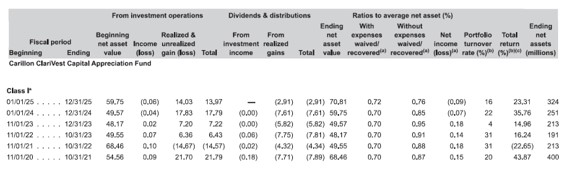
* Per share amounts have been calculated using the daily average share method.
rjetfs.com | 34
For More Information
More information on the fund is available free upon request, including the following:
Statement of additional information (“SAI”) | Additional information the fund and its policies
may be found in the SAI. A current SAI is on file with the Securities and Exchange Commission (“Commission”) and is incorporated herein by reference (meaning it is legally considered part of this Prospectus).
Shareholder reports | Additional information about the fund’s investments will be available in
the fund’s annual and semi-annual reports to shareholders. In the fund’s annual report, you will also find a discussion of the market conditions and investment strategies that materially affected the fund’s performance during the reporting
period. In Form N-CSR, you will find the fund’s annual and semi-annual financial statements, as well as the report of the fund’s independent registered public accounting firm in the annual financial statements.
To obtain the SAI, Prospectus, annual report (when available), semiannual report (when available), annual and semiannual N-CSR (when available), the annual
report, semiannual report and annual and semiannual N-CSR of the Predecessor Fund, privacy notice, performance information for the Predecessor Fund, a schedule of portfolio holdings found on Form N-PORT for the Predecessor Fund, other
information or to make an inquiry, without charge, contact the Carillon Family of Funds:
|
|
By mail: |
P.O. Box 23572
St. Petersburg, FL 33742
|
|
|
|
|
|
|
By telephone: |
1.800.421.4184 |
|
|
|
|
|
|
By internet: |
rjetfs.com |
|
|
|
|
These documents and other information about the fund can be viewed on-screen or downloaded from the EDGAR Database on the Commission’s
Internet website at www.sec.gov; or after paying a duplicating fee, by electronic request at the following email address: publicinfo@sec.gov.
The Carillon Family of Funds is pleased to offer the convenience of viewing shareholder communications, including fund prospectuses,
annual reports, and proxy statements, online at rjetfs.com.
The Investment Company and Securities Act registration numbers are:
|
|
Investment Company Act |
811-07470 |
|
|
|
|
|
|
Securities Act |
033-57986 |
|
|
|
|
rjetfs.com | 35
1GO Paperless with eDelivery
eDelivery is the most convenient, economical and
environmentally-conscious way to receive information about your fund.
environmentally-conscious way to receive information about your fund.
|
Environmentally friendly.
|
Efficient.
|
Easy.
|
||
|
Go green with eDelivery by reducing the number of trees used to produce paper
|
Stop waiting on regular mail. You will be sent an email as soon your home computer with a few clicks.
|
Download and save files using. as your documents are available.
|
To enroll, please visit carillontower.com/eDelivery
The information in this Statement of Additional Information (“SAI”) is not complete and may be changed. We may not sell
these securities until the registration statement filed with the Securities and Exchange Commission is effective. This SAI is not an offer to sell these securities and it is not soliciting an offer to buy these securities in any state where
the offer or sale is not permitted.
STATEMENT OF ADDITIONAL INFORMATION
CARILLON EXCHANGE-TRADED FUNDS
RJ CLARIVEST CAPITAL APPRECIATION ETF
This Statement of Additional Information (“SAI”) dated [ ], 2026, should be read in conjunction with the Prospectus dated [ ], 2026, describing the shares of one
series of the Carillon Series Trust (the “Trust”), which is the RJ ClariVest Capital Appreciation ETF (the “fund”).
This SAI is not a prospectus itself. The financial statements and accompanying notes for the fund are not provided because the fund had
not commenced operations prior to the date of this SAI. Copies of the Prospectus are available, and copies of the Annual and Semi-Annual Shareholder Reports, and financial statements and accompanying notes will be available, without charge,
upon request by writing to Carillon Family of Funds at P.O. Box 23572, St. Petersburg, FL 33742, calling 800.421.4184, or by visiting our website at rjetfs.com.
It is currently contemplated that before the fund commences operations, all of the assets of another investment company advised by
Carillon Tower Advisers, Inc., Carillon ClariVest Capital Appreciation Fund (the “Predecessor Fund”), will be transferred to the fund in a tax-free reorganization. The Predecessor Fund’s financial statements, notes thereto and the report of
its independent registered public accounting firm are incorporated by reference from the Predecessor Fund’s annual report to
shareholders into (and are therefore legally part of) this SAI.
These may be obtained without charge, upon request by writing to Carillon Family of Funds at P.O. Box 23572, St. Petersburg, FL 33742,
calling 800.421.4184, or by visiting rjinvestmentmanagement.com.
Ticker
|
RJ ClariVest Capital Appreciation ETF
|
[ ] |
Fund shares are not individually redeemable. Fund shares are listed on NYSE Arca, Inc. (the “Exchange”).
Carillon Tower Advisers, Inc.
P.O. Box 23572, St. Petersburg, Florida 33742
Table of Contents
|
I.
|
GENERAL INFORMATION
|
[ ]
|
|
|
II.
|
INVESTMENT INFORMATION
|
[ ]
|
|
|
|
A. |
Investment Policies, Strategies and Risks
|
[ ]
|
|
|
B. |
Industry or Sub-Industry Classifications
|
[ ]
|
|
III.
|
INVESTMENT LIMITATIONS
|
[ ]
|
|
| |
A. |
Fundamental Investment Policies
|
[ ]
|
|
IV.
|
NET ASSET VALUE
|
[ ]
|
|
|
V.
|
DISCLOSURE OF PORTFOLIO HOLDINGS
|
[ ]
|
|
|
VI.
|
TAXES
|
[ ]
|
|
|
VII.
|
SHAREHOLDER INFORMATION
|
[ ]
|
|
|
VIII.
|
FUND INFORMATION
|
[ ]
|
|
| A. |
Management of the Fund
|
[ ]
|
|
| B. |
Control Persons and Principal Holders of Securities
|
[ ]
|
|
| C. |
Proxy Voting Policies and Procedures
|
[ ]
|
|
| D. |
Investment Adviser and Administrator; Subadvisers
|
[ ]
|
|
| E. |
Portfolio Managers
|
[ ]
|
|
| F. |
Portfolio Turnover and Brokerage Practices
|
[ ]
|
|
| G. |
Distribution of Shares
|
[ ]
|
|
|
|
H. |
Payments to Intermediaries
|
[ ]
|
|
IX.
|
Creation and Redemption of Creation Units
|
[ ]
|
|
|
X.
|
Additional Services to the Fund
|
[ ]
|
|
|
APPENDIX A
|
A-1 |
||
|
APPENDIX B
|
B-1 |
||
|
I.
|
GENERAL INFORMATION
|
The fund is a separate series of Carillon Series Trust (the “Trust”), which was established as a Delaware statutory
trust on May 5, 2017. The Trust is registered as an open-end diversified management investment company under the Investment Company Act of 1940, as amended (the “1940 Act”). The Trust offers shares in separate series (each a “fund” and
collectively the “funds”), each of which is advised by Carillon Tower Advisers, Inc. (“Carillon,” “Carillon Tower” or “Manager”). On September 30, 2022, Carillon Tower began also doing business as Raymond James Investment Management. This
did not involve any change in Carillon’s structure, ownership, or control.
The fund issues and redeems shares at net asset value (“NAV”) only in aggregations of a specified number of shares
(“Creation Units”), generally in exchange for a basket of securities (“Basket”), together with a specified cash payment, or, in certain circumstances, for an all cash payment. Unlike mutual funds, shares are not individually redeemable.
Certain employees of the fund’s adviser and/or subadviser may be responsible for interacting with market participants
that transact in Baskets for one or more Creation Units. As part of these discussions, these employees may discuss with a market participant the securities the fund is willing to accept in connection with a purchase (“creation”) of shares,
and securities that the fund will provide on a redemption of shares. The employees may also discuss portfolio holdings-related information with broker/dealers in connection with settling the fund’s transactions, as may be necessary to
conduct business in the ordinary course.
Shares of the fund are listed on NYSE Arca, Inc. (the “Exchange”), a national securities exchange, and trade in the
secondary market, where most investors will buy and sell them at market prices that change throughout the day. Such market prices may be lower, higher or equal to NAV. Accordingly, when transacting in the secondary market, investors may pay
more than NAV when purchasing shares and receive less than NAV when selling shares. Investors may also pay brokerage commissions and similar charges when purchasing and selling shares.
On [ ], 2026, the fund acquired all the assets and assumed all the liabilities of the Predecessor Fund. Since the
fund’s investment objective and policies are the same in all material respects as those of the Predecessor Fund, and since the Fund has engaged the Manager and ClariVest Asset Management LLC (“ClariVest”), which provided advisory and
subadvisory services, respectively, to the Predecessor Fund, the fund adopted the prior performance and financial history of the Predecessor Fund. The fund had not commenced operations prior to the date of this SAI.
The fund described in this SAI operates for many purposes as if it were an independent company. The fund has its own
objective(s), policies, strategies and portfolio managers, among other characteristics. The fund is “diversified,” as that term is defined by the 1940 Act.
|
II.
|
INVESTMENT INFORMATION
|
|
A.
|
Investment Policies, Strategies and Risks
|
This section provides a detailed description of the securities in which the fund may invest to achieve its investment
objective(s), the strategies it may employ and the corresponding risks of such securities and strategies. For more information regarding the description of various types of securities in which the fund may invest, please refer to Appendix
A, Investment Types Glossary. The fund may invest in the types of assets in which the fund may invest, either directly or indirectly, unless otherwise noted. For more information on the fund’s principal strategies and risks, please see the
fund’s Prospectus.
Equity Securities:
Common Stocks. The fund may invest in common stocks, which represent an equity or ownership interest in an issuer. In the event an issuer is
liquidated or declares bankruptcy, the claims of bondholders, other debt holders, owners of preferred stock, and general creditors take precedence over the claims of those who own common stock. Common stocks fluctuate in price in response
to many factors including historical and prospective earnings of the issuer, the value of its assets, general economic conditions, interest rates, investor perceptions and market liquidity. An adverse event, such as an unfavorable
earnings report, may depress the value of a particular common stock.
Small- and Mid-Capitalization Stocks. The fund may invest in stock of companies with market capitalizations that are small compared to other
publicly traded companies. Investments in larger companies present certain advantages in that such companies generally have greater financial resources, more extensive research and development, manufacturing, marketing and service
capabilities, and more stability and greater depth of management and personnel. Investments in smaller, less seasoned companies may present greater opportunities for growth but also may involve greater risks than customarily are
associated with more established companies. The securities of smaller companies may be subject to more abrupt or erratic market movements than larger, more established companies. These companies may have limited product lines, markets or
financial resources, or they may be dependent upon a limited management group. Their securities may be traded in the over-the-counter market or on a regional exchange, or may otherwise have limited liquidity. As a result of owning large
positions in this type of security, the fund is subject to the additional risk of possibly having to sell portfolio securities at disadvantageous times and prices if redemptions require the fund to liquidate its securities positions. In
addition, it may be prudent for the fund, as its asset size grows, to limit the number of relatively small positions it holds in securities having limited liquidity in order to minimize its exposure to such risks, to minimize transaction
costs, and to maximize the benefits of research. As a consequence, as the fund’s asset size increases, the fund may reduce its exposure to illiquid small capitalization securities, which could adversely affect performance.
1
The fund may also invest in stocks of companies with medium market capitalizations (i.e., mid cap companies). Such investments share some of the risk
characteristics of investments in stocks of companies with small market capitalizations described above, although mid cap companies tend to have longer operating histories, broader product lines and greater financial resources and their
stocks tend to be more liquid and less volatile than those of smaller capitalization issuers.
Convertible Securities, Including Convertible Preferred Securities. The fund may invest in convertible securities. A convertible security is a bond,
debenture, note, preferred stock, or other security or debt obligation that may be converted into or exchanged for a prescribed amount of common stock of the same or a different issuer within a particular period of time at a specified
price or formula. A convertible security entitles the holder to receive the interest paid or accrued on debt or the dividend paid on preferred stock until the convertible security matures or is redeemed, converted or exchanged.
Convertible securities, including convertible preferred securities, generally have features of, and risks associated with, both equity and fixed income instruments. While no securities investment is without some risk, investments in
convertible securities generally entail less risk than the issuer’s common stock, although the extent to which such risk is reduced depends in large measure upon the degree to which the convertible security sells above its value as a
fixed income security. The market value of convertible securities tends to decline as interest rates increase and, conversely, increases as interest rates decline. While convertible securities generally offer lower interest or dividend
yields than nonconvertible debt securities of similar quality, they do enable the investor to benefit from increases in the market price of the underlying common stock.
Other Investment Companies, including money market funds and ETFs. The fund may invest in shares of other open-end or closed-end investment
companies, including money market funds and exchange-traded funds (“ETFs”), up to the limits prescribed in the 1940 Act, the rules thereunder and any exemptive relief. Investments in the securities of other investment companies (which
may, in turn invest in equities, bonds, and other financial vehicles) may involve duplication of advisory fees and certain other expenses. By investing in another investment company, the fund becomes a shareholder of that investment
company. As a result, fund shareholders indirectly bear the fund’s proportionate share of the fees and expenses paid by shareholders of the other investment company, in addition to the fees and expenses fund shareholders directly bear in
connection with the fund’s own operations.
S&P’s Depositary Receipts, S&P’s Mid Cap 400 Depositary Receipts, and other similar index securities are ETFs and are considered investments in
other investment companies (“Index Securities”). Index Securities are subject to the risks of an investment in a broadly based portfolio of common stocks.
As a shareholder, the fund must rely on the other investment company to achieve its investment objective. If the other investment company or ETF fails to
achieve its investment objective, the value of the fund’s investment will decline, adversely affecting the fund’s performance. In addition, because ETFs are listed on national stock exchanges and are traded like stocks listed on an
exchange, ETF shares may potentially trade at a discount or a premium. Investments in ETFs are also subject to brokerage and other trading costs, which could result in greater expenses to the fund. Finally, because the value of ETF shares
depends on the demand in the market, the portfolio manager may not be able to liquidate the fund’s holdings of ETF shares at the most optimal time, adversely affecting the fund’s performance.
2
The fund’s investment in securities of other investment companies, except for money market funds, is generally limited to: (i) 3% of the total voting stock
of any one investment company, (ii) 5% of the fund’s total assets with respect to any one investment company and (iii) 10% of the fund’s total assets in all investment companies in the aggregate. However, the fund may exceed these limits
when investing in shares of an ETF or other investment company, subject to a statutory exemption or to the terms and conditions of an exemptive order from the SEC.
Rule 12d1-4 under the 1940 Act, permits various types of fund of fund arrangements without an exemptive order under certain conditions, including limits on
control and voting of acquired funds’ shares, evaluations and findings by investment advisers, fund investment agreements, and limits on most three-tier fund structures. Additionally, as part of the streamlining of the fund of fund
arrangements, the SEC rescinded certain exemptive orders and withdrew certain no-action letters.
Preferred Stock. The fund may invest in preferred stock which is subordinated to all debt obligations in the event of insolvency. An issuer’s
failure to make a dividend payment is normally not considered a default entitling the preferred shareholder to take action. Preferred stock generally has no maturity date, meaning that its market value is dependent on the issuer’s future
potential for growth over an unspecified period of time. Distributions on preferred stock are generally considered dividends and treated as such for federal income tax purposes.
Real Estate Investment Trusts (“REITs”). The fund may invest in REITs. The risks associated with REITs include defaults by borrowers,
self-liquidation, declines in the value of real estate, risks related to general and local economic conditions or changes in demographic trends or tastes, increases in operating expenses, lack of availability of mortgage funds or
financing, adverse governmental, legal or regulatory action, failure to qualify for tax-free pass-through of distributed net income and net realized gains under the federal tax law, failure to qualify as an exempt entity under the 1940
Act and the fact that REITs may not be diversified geographically or by property or tenant type.
Large-Capitalization Stocks. The fund may invest in large-cap companies. The risk associated with large-cap stocks arises because they may be less
responsive to competitive challenges and opportunities, and may be unable to attain high growth rates, relative to smaller companies.
Growth Stocks. Growth stocks are those of companies are those that are expected to have the potential for above-average or rapid growth. Growth
companies are expected to increase their earnings at a certain rate. When these expectations are not met or earnings decrease, the prices of these securities may decline, sometimes sharply, even if earnings showed an absolute increase.
The fund’s investments in growth stocks may be more sensitive to company earnings and more volatile than the market in general primarily because their stock prices are based heavily on future expectations. If an assessment of the
prospects for a company’s growth is incorrect, then the price of the company’s stock may fall or not approach the value placed on it. Growth stocks may lack the dividend yield that can cushion prices in market downturns. Growth companies
may have limited operating histories and greater business risks, and their potential for profitability may be dependent on regulatory approval of their products or regulatory developments affecting certain sectors, which could have an
adverse impact upon growth companies’ future growth and profitability. Different investment styles tend to shift in and out of favor, depending on market conditions and investor sentiment. The fund’s growth style could cause it to
underperform funds that use a value or non-growth approach to investing or have a broader investment style.
3
Value Stocks. Value stocks are those of companies are subject to the risk that their intrinsic or full value may never be realized by the market,
that a stock judged to be undervalued may be appropriately priced, or that their prices may go down. While the fund’s investments in value stocks may limit its downside risk over time, the fund may produce more modest gains than riskier
stock funds as a trade-off for this potentially lower risk. Different investment styles tend to shift in and out of favor, depending on market conditions and investor sentiment. The fund’s investments in value stocks may underperform
growth or non-value stocks that have a broader investment style.
Warrants and Rights. The fund may invest in warrants and rights. Rights are instruments that permit the fund to acquire, by subscription, the
capital stock of a corporation at a set price, regardless of the market price for such stock. The market price of warrants is usually significantly less than the current market price of the underlying stock. Thus, there is a greater risk
that warrants might drop in value at a faster rate than the underlying stock.
Special Purpose Acquisition Companies (“SPACs”). The fund may invest in the common stock, warrants, and other securities of special purpose
acquisition companies or similar special purpose entities (collectively, “SPACs”) that pool funds to seek potential acquisition opportunities. A SPAC is a publicly traded company that raises investment capital via an initial public
offering (“IPO”) for the purpose of acquiring an existing company. The shares of a SPAC are typically issued in “units” that include one share of common stock and one right or warrant (or partial right or warrant) conveying the right to
purchase additional shares or partial shares. At a specified time following the SPAC’s IPO (generally 1-2 months), the rights and warrants may be separated from the common stock at the election of the holder, after which they become
freely tradeable. After going public, and until an acquisition is completed, a SPAC generally invests the proceeds of its IPO (less a portion retained to cover expenses), which are held in trust, in U.S. Government securities, money
market securities and cash. If a SPAC does not complete an acquisition within a specified period of time after going public, the SPAC is dissolved, at which point the invested funds are returned to the entity’s shareholders (less certain
permitted expenses) and any rights or warrants issued by the SPAC expire worthless. Because SPACs and similar entities have no operating history or ongoing business other than seeking acquisitions, the value of their securities is
dependent on the ability of the entity’s management to identify and complete a profitable acquisition. During the period when management of the SPAC seeks to identify a potential acquisition or merger target, typically most of the capital
raised for that purpose (less a portion retained to cover expenses) is invested in income-producing investments, such as U.S. Government securities and money market fund securities, and cash. To the extent the SPAC is invested in cash or
similar securities, this may impact the fund’s ability to meet its investment objective. The fund may invest in SPACs for a variety of investment purposes, including to achieve capital gains. SPACs may provide the opportunity for common
shareholders to have some or all of their shares redeemed by the SPAC at or around the time a proposed merger or acquisition is expected to occur. However, unless it is subject to a restriction on resale, the fund may sell its investment
in a SPAC at any time, including before, at or after the time of a merger or acquisition. If an acquisition that meets the requirements for the SPAC is not completed within a pre-established period of time, the invested funds are returned
to the entity’s shareholders. Certain SPACs in which the fund may invest, or the securities of an acquisition target, may not be registered under the Securities Act of 1933, as amended, or no public market may otherwise exist for such
securities. Such investments in unregistered SPACs may have extended restrictions on their resale, be considered illiquid or otherwise involve a high degree of risk, which could cause the fund to lose all or part of its investment.
An investment in a SPAC is subject to a variety of additional risks, including that (i) a significant portion of the monies raised by the SPAC for the
purpose of identifying and effecting an acquisition or merger may be expended during the search for a target transaction; (ii) an attractive acquisition or merger target may not be identified and the SPAC will be required to return any
remaining monies to shareholders; (iii) any proposed merger or acquisition may be unable to obtain the requisite approval, if any, of SPAC shareholders; (iv) an acquisition or merger, once effected, may prove unsuccessful and an
investment in the SPAC may lose value; (v) the warrants or other rights held by the fund with respect to the SPAC may expire worthless or may be repurchased or retired by the SPAC at an unfavorable price; (vi) the fund will be delayed in
receiving any redemption or liquidation proceeds from a SPAC to which it is entitled; (vii) an investment in a SPAC may be diluted by additional later offerings of interests in the SPAC or by other investors exercising existing rights to
purchase shares of the SPAC; (viii) the values of investments in SPACs may be highly volatile and may depreciate significantly over time; and (ix) some SPACs may pursue acquisitions only within certain industries or regions, which may
increase the volatility of their prices. Securities and Exchange Commission (“SEC”) rule amendments relating to SPACs require, among other things, enhanced disclosure requirements for SPAC offerings and procedural requirements in the
completion of transactions.
4
Investment Grade and Lower Rated Securities:
Investment Grade Securities. The fund may invest in debt securities rated investment grade. Securities rated in the lowest category of investment
grade are considered to have speculative characteristics and changes in economic conditions are more likely to lead to a weakened capacity to pay interest and repay principal than is the case with higher-grade bonds. The fund may retain a
security that has been downgraded below investment grade if, in the opinion of its portfolio manager, it is in the fund’s best interest.
Short-Term Money Market Instruments:
Bankers’ Acceptances. The fund may invest in bankers’ acceptances. A bankers’ acceptance is a negotiable instrument in the form of a bill of
exchange or time draft drawn on and accepted by a commercial bank. The instrument’s marketability is affected primarily by the reputation of the accepting bank and market demand. The fund may invest in bankers’ acceptances of domestic
banks and savings and loans that have assets of at least $1 billion and capital, surplus and undivided profits of over $100 million as of the close of their most recent fiscal year. The fund may also invest in instruments that are insured
by the Bank Insurance Fund or the Savings Institution Insurance Fund of the Federal Deposit Insurance Corporation (“FDIC”).
Certificates of Deposit (“CDs”). The fund may invest in CDs issued by domestic institutions with assets in excess of $1 billion. CDs carry a minimal
amount of inflation risk due to their fixed interest rate and early withdrawal penalties.
Bank Time Deposits. The fund may invest in bank time deposits, which are monies kept on deposit with banks or savings and loan associations for a
stated period of time at a fixed rate of interest. There may be penalties for the early withdrawal of such time deposits, in which case the yields of these investments will be reduced.
U.S. Government Securities:
U.S. Government Securities and/or Government-Sponsored Enterprises. The fund may invest in U.S. Government Securities and/or Government-Sponsored
Enterprises. U.S. Government Securities are securities issued or guaranteed by the U.S. Government, its agencies or instrumentalities or sponsored enterprises. Some obligations issued by U.S. Government agencies and instrumentalities are
supported by the full faith and credit of the U.S. Treasury; others by the right of the issuer to borrow from the U.S. Treasury; others by the discretionary authority of the U.S. Government to purchases certain obligations of the agency
or instrumentality; and others only by the credit of the agency or instrumentality. Those securities bear fixed, floating or variable rates of interest. Interest may fluctuate based on generally recognized reference rates or the
relationship of rates. While the U.S. Government currently provides financial support to such U.S. Government-sponsored agencies or instrumentalities, no assurance can be given that it will always do so, since it is not so obligated by
law. U.S. Government Securities include U.S. Treasury bills, notes and bonds, obligations of GNMA, FHLB, FFCB, Fannie Mae, Freddie Mac, the Federal Farm Credit Bureau, other U.S. Government agency obligations and repurchase agreements
secured thereby. U.S. government agency securities are subject to credit risk, interest rate risk and market risk.
Foreign Securities Exposure:
European Securities. The fund’s performance may be affected by political, social and economic conditions in Europe, such as growth of the economic
output (the gross national product of the countries in the region), the rate of inflation, the rate at which capital is reinvested into European economies, the success of governmental actions to reduce budget deficits, the resource
self-sufficiency of European countries, interest rates in European countries, monetary exchange rates between European countries, and conflict between European countries. Most developed countries in Western Europe are members of the
European Union (“EU”), and many are also members of the European Economic and Monetary Union (“EMU” or “Eurozone”). The EMU is comprised of EU members that have adopted the Euro currency. As part of EMU membership, member states
relinquish control of their own monetary policies to the European Central Bank. The EMU requires Eurozone countries to comply with restrictions on interest rates, deficits, debt levels, and inflation rates; fiscal and monetary controls;
and other factors. Although the EMU has adopted a common currency and central bank, there is no fiscal union; therefore, money does not automatically flow from countries with surpluses to those with deficits. These restrictions and
characteristics may limit the ability of EMU member countries to implement monetary policy to address regional economic conditions and may significantly impact every European country and their economic partners, including those countries
that are not members of the EMU. In addition, those EU member states that are not currently in the Eurozone (except Denmark) are required to seek to comply with convergence criteria to permit entry to the Eurozone. The economies and
markets of European countries are often closely connected and interdependent, and events in one country in Europe can have an adverse impact on other European countries. Changes in imports or exports, changes in governmental or European
regulations on trade, changes in the exchange rate of the Euro, the threat of default or actual default by one or more European countries on its sovereign debt, and/ or an economic recession in one or more European countries may have a
significant effect on the economies of other European countries and their trading partners.
The European financial markets have experienced and may continue to experience volatility and adverse trends due to concerns relating to economic
downturns; national unemployment; aging populations; rising government debt levels and the possible default on government debt in several European countries; public health crises; political unrest; economic sanctions; inflation; energy
crises; the future of the Euro as a common currency; and war and military conflict, such as the Russian invasion of Ukraine. These events have affected the exchange rate of the Euro and may continue to significantly affect European
countries. Responses to financial problems by European governments, central banks, and others, including austerity measures and other reforms, may not produce the desired results, may result in social unrest and may limit future growth
and economic recovery or may have unintended consequences. In order to prevent further economic deterioration, certain countries, without prior warning, can institute “capital controls.” Countries may use these controls to restrict
volatile movements of capital entering and exiting their country. Such controls may negatively affect the fund’s investments. In addition, one or more countries may abandon the Euro and/or withdraw from the EU. The impact of these
actions, especially if they occur in a disorderly fashion, could be significant and far-reaching.
5
Many European nations are susceptible to economic risks associated with high levels of debt. Non-governmental issuers, and even certain governments, have
defaulted on, or been forced to restructure, their debts, and other issuers have faced difficulties obtaining credit or refinancing existing obligations. A default or debt restructuring by any European country could adversely impact
holders of that country’s debt and sellers of credit default swaps linked to that country’s creditworthiness, which may be located in other countries. Such a default or debt restructuring could affect exposures to other European countries
and their companies as well. Further defaults on, or restructurings of, the debt of governments or other entities could have additional adverse effects on economies, financial markets and asset valuations around the world. In addition,
issuers have faced difficulties obtaining credit or refinancing existing obligations; financial institutions have in some cases required government or central bank support, have needed to raise capital, and/or have been impaired in their
ability to extend credit; and financial markets in Europe and elsewhere have experienced extreme volatility and declines in asset values and liquidity. Furthermore, certain European countries have had to accept assistance from
supranational agencies such as the International Monetary Fund, the European Stability Mechanism or others. The European Central Bank has also intervened to purchase Eurozone debt in an attempt to stabilize markets and reduce borrowing
costs. There can be no assurance that any creditors or supranational agencies will continue to intervene or provide further assistance, and markets may react adversely to any expected reduction in the financial support provided by these
creditors.
Certain European countries have experienced negative interest rates on certain fixed-income instruments. A negative interest rate is an unconventional
central bank monetary policy tool where nominal target interest rates are set with a negative value (i.e., below zero percent) intended to help create self-sustaining growth in the local economy. Negative interest rates may result in
heightened market volatility and may detract from the fund’s performance to the extent the fund is exposed to such interest rates.
Certain European countries have also developed increasingly strained relationships with the U.S., and if these relationships were to worsen, they could
adversely affect European issuers that rely on the U.S. for trade. In addition, the national politics of European countries have been unpredictable and subject to influence by disruptive political groups and ideologies. Secessionist
movements, as well as government or other responses to such movements, may create instability and uncertainty in a country or region. European governments may be subject to change and such countries may experience social and political
unrest. Unanticipated or sudden political or social developments may result in sudden and significant investment losses. The occurrence of terrorist incidents throughout Europe also could impact financial markets, as could military
conflicts. The impact of these or other events is not clear but could be significant and far-reaching and materially impact the value and liquidity of the fund’s investments.
Russia’s war with Ukraine has negatively impacted European economic activity. Additionally, Russia may continue to attempt to assert its influence in the
Eastern Europe region through economic or even military measures. The Russia/ Ukraine war and Russia’s response to sanctions imposed by the U.S., EU, United Kingdom and others have and could continue to severely impact the performance of
economies of European and other countries, including adverse effects to global financial and energy markets, global supply chains and global growth, and inflation. For example, exports in Eastern Europe have been disrupted for certain key
commodities, pushing commodity prices to record highs, and energy prices in Europe have increased significantly. Certain countries have applied to become new member countries of the EU, and these candidate countries’ accessions may become
more controversial to the existing EU members. Some member states may repudiate certain candidate countries joining the EU due to concerns about the possible economic, immigration and cultural implications. Also, Russia may be opposed to
the expansion of the EU to members of the former Eastern Bloc (i.e. ex-Soviet Union-controlled countries in Europe) and may, at times, take actions that could negatively impact European economic activity.
The United Kingdom withdrew from the European Union on January 31, 2020. The United Kingdom and the European Union have reached an agreement on the terms
of their future trading relationship, which principally relates to the trading of goods rather than services, including financial services. Notwithstanding this agreement, the longer term economic, legal, and political framework between
the United Kingdom and the EU may lead to ongoing political and economic uncertainly and periods of increased volatility in the United Kingdom, Europe, and the global market. Investments in companies with significant operations and/or
assets in the United Kingdom could be adversely impacted by past or future changes to the legal, political, and regulatory environment, whether by increased costs or impediments to the implementation of business plans. The uncertainty
resulting from any further exits from the EU, or the possibility of such exits, would also be likely to cause market disruption in the EU and more broadly across the global economy, as well as introduce further legal, political, and
regulatory uncertainty in Europe.
Illiquid and Restricted Securities:
The fund will not purchase or otherwise acquire any illiquid security, if, as a result, more than 15% of its net assets (taken at current value) would be
invested in investments that the fund reasonably expects cannot be sold or disposed of in current market conditions in seven calendar days or less without the sale or disposition significantly changing the market value of the investment.
6
Securities that have not been registered under the Securities Act include those sold in private placement offerings made in reliance on the “private
placement” exemption from registration afforded by Section 4(a)(2) of the Securities Act, and/or resold to qualified institutional buyers pursuant to Rule 144A under the Securities Act. In addition, Regulation S under the Securities Act
permits the sale abroad of securities that are not registered for sale in the U.S. and includes a provision for U.S. investors, such as the fund, to purchase such unregistered securities if certain conditions are met. Unregistered
securities are restricted as to disposition under the federal securities laws, and generally are sold to institutional investors, such as the fund, that agree they are purchasing the securities for investment and not with an intention to
distribute to the public. These securities may be sold only in a privately negotiated transaction or pursuant to an exemption from registration.
The fact that there are contractual or legal restrictions on the resale of restricted securities to the general public or to certain institutions may not
be indicative of their liquidity, and not all restricted securities are considered illiquid. There is a large institutional market for certain securities that are not registered under the Securities Act of 1933, as amended (“1933 Act”),
including repurchase agreements, commercial paper, foreign securities, municipal securities and corporate bonds and notes. Section 4(a)(2) securities normally are resold to other institutional investors through or with the assistance of
the issuer or dealers that make a market in the Section 4(a)(2) securities, thus providing liquidity. Institutional investors depend on an efficient institutional market in which the unregistered security can be readily resold or on an
issuer’s ability to honor a demand for repayment.
In addition, Rule 144A is designed to facilitate efficient trading among institutional investors by permitting the sale of unregistered securities to
qualified institutional buyers. Institutional markets for restricted securities that have developed as a result of Rule 144A may provide both readily ascertainable values for certain restricted securities and the ability to liquidate an
investment to satisfy share redemption orders. A determination could be made that certain securities qualified for trading under Rule 144A are liquid. However, to the extent that such securities are deemed to be illiquid, the fund will be
subject to the 15% limitation described above.
Limitations on resale may have an adverse effect on the marketability of portfolio securities, and the fund might be unable to dispose of restricted or
other illiquid securities promptly or at reasonable prices and might thereby experience difficulty satisfying redemptions within seven calendar days. In addition, the fund may get only limited information about an issuer of such a
security, so it may be less able to predict a loss. Certain of the fund’s investments in private placements may consist of direct investments and may include investments in smaller, less seasoned issuers, which may involve greater risks.
These issuers may have more limited product lines, markets or financial resources, or they may be dependent on a limited management group. The fund also might have to register such restricted securities in order to dispose of them,
resulting in additional expense and delay. Adverse market conditions could impede such a public offering of securities. The illiquidity of the market, as well as the lack of publicly available information regarding these securities, also
may make it difficult to determine a fair value for certain securities for purposes of computing the fund’s NAV.
Generally, foreign securities freely tradable in their principal market are not considered restricted or illiquid, even if they are not registered in the
U.S.
Sector Risk:
From time to time, based on market or economic conditions, the fund may have significant positions in one or more sectors of the market. To the extent the
fund invests more heavily in one sector, industry, or sub-sector of the market, its performance will be especially sensitive to developments that significantly affect those sectors, industries, or sub-sectors. An individual sector,
industry, or sub-sector of the market may be more volatile, and may perform differently, than the broader market. The industries that constitute a sector may all react in the same way to economic, political or regulatory events. The
fund’s performance could also be affected if the sectors, industries, or sub-sectors do not perform as expected. Alternatively, the lack of exposure to one or more sectors or industries may adversely affect performance.
Other Investment Practices:
Loans of Portfolio Securities. The fund may loan portfolio securities to qualified broker-dealers. The primary objective of securities lending is to
supplement the fund’s income through investment of the cash collateral in short-term interest bearing obligations. The collateral for the fund’s loans will be marked-to-market daily so that at all times the collateral exceeds 100% of the
value of the loan. The fund may terminate such loans at any time and the market risk applicable to any security loaned remains its risk. Although voting rights, or rights to consent, with respect to the loaned securities pass to the
borrower, the fund retains the right to call the loans at any time on reasonable notice, and it may do so in order that the securities may be voted by it if the holders of such securities are asked to vote upon or consent to matters
materially affecting the investment. The fund also may call such loans in order to sell the securities involved. The borrower must add to the collateral whenever the market value of the securities rises above the level of such collateral.
Securities loans involve some risk. There is a risk that a borrower may default on its obligations to return loaned securities; however, the fund’s securities lending agent may indemnify the fund against that risk. The fund could incur a
loss if the borrower should fail financially at a time when the value of the loaned securities is greater than the collateral, and the fund could lose rights in the collateral should the borrower fail financially. The securities in which
the collateral is invested may not perform sufficiently to cover the return collateral payments owed to borrowers. In addition, delays may occur in the recovery of securities from borrowers, which could interfere with the fund’s ability
to vote proxies or to settle transactions. The fund will also be responsible for the risks associated with the investment of cash collateral. In any case in which the loaned securities are not returned to the fund before an ex-dividend
date, the payment in lieu of the dividend that the fund receives from the securities’ borrower would not be treated as a dividend for federal income tax purposes and thus would not qualify for treatment as “qualified dividend income” (as
described under “Taxes” below).
7
Temporary Defensive Purposes. For temporary defensive purposes during anticipated periods of general market decline, the fund may invest up to 100%
of its net assets in: (1) money market instruments, including securities issued by the U.S. Government, its agencies or instrumentalities and repurchase agreements secured thereby; (2) bank CDs and bankers’ acceptances issued by banks
having net assets of at least $1 billion as of the end of their most recent fiscal year; (3) high-grade commercial paper; and (4) other long- and short-term debt instruments that are rated A or higher by S&P, Moody’s or Fitch. For a
description of S&P, Moody’s and Fitch’s commercial paper and corporate debt ratings, see Appendix B. The fund may also take positions that are inconsistent with its principal investment strategies.
Cyber Security:
With the increased use of technologies such as the Internet and the dependence on computer systems to perform necessary business functions, the fund and
its service providers may be prone to operational and information security risks resulting from cybersecurity incidents, including cyber-attacks. In general, cybersecurity incidents can result from deliberate attacks or unintentional
events. Cyber-attacks include, among other behaviors, stealing or corrupting data maintained online or digitally (e.g., through “hacking,” computer viruses or other malicious software coding), the theft and holding for ransom of
proprietary or confidential information or data (sometimes referred to as “ransomware” attacks), denial of service attacks on websites, “phishing” attempts and other social engineering techniques aimed at personnel or systems, and the
unauthorized release of confidential information. Cyber-attacks affecting the fund, its investment adviser, its subadvisers, custodian, transfer agent, intermediaries and other third-party service providers may adversely impact the fund.
For instance, cyber-attacks may interfere with the processing of shareholder transactions, result in the loss or theft of shareholder data or funds, impact the fund’s ability to calculate NAV per share, cause the release of private
shareholder information or confidential business information, result in violations of applicable privacy and other laws, impede trading, subject the fund to regulatory fines or financial losses and/or cause reputational damage. A
cyber-attack may also result in shareholders or service providers being unable to access electronic systems (also known as “denial of services”), loss or theft of proprietary information or corporate data, physical damage to a computer or
network system, or remediation costs associated with system repairs. The fund may also incur additional compliance costs for corrective measures or cyber security risk management purposes, and such costs may be ongoing because threats of
cyber-attacks are constantly evolving as cyber-attackers become more sophisticated and their techniques become more complex. Similar types of cyber security risks are also present for issuers or securities in which the fund may invest,
which could result in material adverse consequences for such issuers, and may cause the fund’s investment in such companies to lose value. Adverse consequences also could result from cybersecurity incidents affecting counterparties with
which the fund engages in transactions, governmental and other regulatory authorities, exchanges and other financial market operators, banks, brokers, dealers, insurance companies, other financial institutions and other parties.
Furthermore, as a result of cyber-attacks, disruptions or failures, an exchange or market may close or issue trading halts on specific securities or the entire market, which may result in the fund being, among other things, unable to buy
or sell certain securities or unable to accurately price its investments. The fund’s service providers also may be negatively impacted due to operational risks arising from non-cybersecurity related factors such as processing errors and
human errors, inadequate or failed internal or external processes, failures in systems and technology errors or malfunctions, changes in personnel, and errors caused by fund service providers or counterparties.
In addition, other events or circumstances—whether foreseeable, unforeseeable, or beyond the fund’s control, such as acts of war, other conflicts,
terrorism, natural disaster, widespread disease, pandemic or other public health crises may result in, among other things, quarantines and travel restrictions, workforce displacement and loss or reduction in Personnel and other resources.
In the above circumstances, the fund and the Service Providers’ operations may be significantly impacted, or even temporarily halted. The fund’s securities market counterparties or vendors may face the same or similar systems failure,
cybersecurity breaches and other business disruptions risks.
Any of these results could have a substantial adverse impact on the fund and its shareholders. For example, if a cybersecurity incident results in a denial
of service, shareholders could lose access to their electronic accounts and be unable to buy or sell Shares for an unknown period of time, and service providers could be unable to access electronic systems to perform critical duties for
the fund, such as trading, NAV calculation, shareholder accounting or fulfillment of fund share purchases and redemptions. Cybersecurity incidents could cause the fund or fund service provider to incur regulatory penalties, reputational
damage, additional compliance costs associated with corrective measures, or financial loss of a significant magnitude and could result in allegations that the fund or fund service provider violated privacy and other laws. There are
inherent limitations in risk management systems that seek to reduce the risks associated with cybersecurity and business continuity plans in the event there is a cybersecurity breach, including the possibility that certain risks may not
have been adequately identified or prepared for, in large part because different or unknown threats may emerge in the future. Furthermore, the fund does not control the cybersecurity systems and plans of the issuers of securities in which
the fund invests or the fund’s third-party service providers or trading counterparties or any other service providers whose operations may affect the fund or its shareholders. The widespread use of remote work arrangements may increase
operational and information security risks.
The use of cloud-based service providers could heighten or change these risks. In addition, remote and hybrid arrangements by the fund, the Manager or
their service providers could increase all of the above risks, create additional data and information accessibility concerns, and make the fund, the Manager or their service providers susceptible to operational disruptions, any of which
could adversely impact their operations.
8
|
B.
|
Industry or Sub-Industry Classifications
|
For purposes of determining industry or sub-industry classifications, the fund relies primarily upon classifications published by Standard & Poor’s
Global Industry Classification Standard (“GICS®”). If GICS® does not have an industry or sub-industry classification for a particular security, Carillon Tower, the fund’s investment adviser, will then rely upon
classifications published by Bloomberg L.P. If the designated industry or sub-industry no longer appears reasonable, or if any classifications are determined by Carillon Tower to be so broad that the primary economic characteristics of
issuers within a single class are materially different, the fund will classify issuers within that class according to the Directory of Companies Filing Annual Reports with the Commission.
|
III.
|
INVESTMENT LIMITATIONS
|
|
A.
|
Fundamental Investment Policies
|
The fund has adopted the following fundamental policies, which may not be changed without the approval by “vote of a majority of the outstanding voting
securities” of the fund as defined in the 1940 Act. The 1940 Act provides that the “vote of a majority of the outstanding voting securities” of the fund means the vote, at the annual or a special meeting of the security holders of such
fund duly called, (A) of 67% or more of the voting securities present at such meeting, if the holders of more than 50% of the outstanding voting securities of such company are present or represented by proxy; or (B) of more than 50% of
the outstanding voting securities of the fund, whichever is the less. The fund will not concentrate in any industry or group of industries except as disclosed herein.
Borrowing. The fund may not borrow money, except to the extent permitted by the 1940 Act, the rules and regulations thereunder and any applicable
exemptive relief.
Commodities. The fund may not purchase or sell commodities or commodity contracts unless acquired as a result of ownership of securities or other
instruments issued by persons that purchase or sell commodities or commodities contracts; but this shall not prevent the fund from purchasing, selling and entering into financial futures contracts (including futures contracts on indices
of securities, interest rates and currencies), options on financial futures contracts (including futures contracts on indices of securities, interest rates and currencies), warrants, swaps, forward contracts, foreign currency spot and
forward contracts or other derivative instruments that are not related to physical commodities.
Concentration. Except for any fund that is ‘concentrated’ in an industry or group of industries within the meaning of the 1940 Act, the fund may not
purchase the securities of any issuer (other than tax-exempt securities issued or guaranteed by the U.S. Government, U.S. states, District of Columbia, U.S. territories and possessions, and any of the political subdivisions of the
aforementioned entities) if, as a result, more than 25% of the fund’s total assets would be invested in the securities of companies whose principal business activities are in the same industry.
Diversification. Except to the extent permitted by the 1940 Act, the rules and regulations thereunder and any applicable exemptive relief, the fund
may not with respect to 75% of the fund’s total assets, purchase the securities of any issuer (other than securities issued or guaranteed by the U.S. Government or any of its agencies or instrumentalities, and securities of other
investment companies) if, as a result, (a) more than 5% of the fund’s total assets would be invested in the securities of that issuer, or (b) the fund would hold more than 10% of the outstanding voting securities of that issuer.
Loans, Repurchase Agreements and Loans of Portfolio Securities. The fund may make loans only as permitted under the 1940 Act, the rules and
regulations thereunder and any applicable exemptive relief.
Real Estate. The fund may not purchase or sell real estate, except that, to the extent permitted by applicable law, the fund may (1) invest in
securities or other instruments directly or indirectly secured by real estate, and (2) invest in securities or other instruments issued by issuers that invest in real estate.
Senior Securities. The fund may not issue senior securities, except to the extent permitted by the 1940 Act, the rules and regulations thereunder
and any applicable exemptive relief.
Underwriting. The fund may not underwrite securities issued by others, except to the extent that the fund may be considered an underwriter within
the meaning of the 1933 Act in the disposition of restricted securities or in connection with investments in other investment companies.
Except with respect to borrowing money, if a percentage limitation is adhered to at the time of the investment, a later increase or decrease in the
percentage resulting from any change in value of net assets will not result in a violation of such restriction.
9
|
IV.
|
NET ASSET VALUE
|
The fund’s NAV per share is computed by adding total assets, subtracting all of the fund’s liabilities, and dividing the result by the total number of
shares outstanding, which may differ from the fund’s market price. Investors that purchase and sell the fund in the secondary market will transact at market prices, which may be lower or higher than the NAV per share. The NAV per share of
the fund is normally determined each business day as of the scheduled close of regular trading on the New York Stock Exchange (the “NYSE”) and the NASDAQ, (typically 4 p.m. Eastern time). The fund will not treat an intraday unscheduled
disruption in trading on either the NYSE or NASDAQ as a closure of that particular market, and will price its shares as of the normally scheduled close of the NYSE and NASDAQ if the disruption directly affects only one of those markets.
The NYSE and NASDAQ normally are open for business Monday through Friday except the following holidays: New Year’s Day, Martin Luther King Day, President’s Day, Good Friday, Memorial Day, Juneteenth, Independence Day, Labor Day,
Thanksgiving Day and Christmas Day.
The Board has designated Carillon Tower its valuation designee, with responsibility for the day-to-day (1) calculation of the fund’s NAV and (2) carrying
out certain functions relating to the valuation of portfolio securities and other instruments in connection therewith. Carillon Tower performs these duties through a Valuation Committee, comprised of employees of Carillon Tower and/ or
its wholly-owned affiliates. Carillon Tower’s Valuation Committee will monitor for circumstances that may necessitate the use of fair value. In the event that (1) market quotations are not readily available, (2) readily available market
quotations are not reflective of market value (prices deemed unreliable), or (3) a significant event has been recognized in relation to a security or class of securities, the Valuation Committee shall determine such securities’ fair value
in accordance with Carillon Tower’s, Pricing and Valuation Procedures, which have been approved by the Board. Significant events include, but are not limited to, single-issuer events such as corporate announcements or earnings,
multiple-issuer events such as natural disasters and significant market fluctuations.
As described further in the Prospectus, the fund values securities or assets held in its portfolio as follows:
Credit Default Swaps. Credit default swaps are valued with prices provided by independent pricing services. A newly issued credit default swap may
be priced at cost for up to one business day after a purchase if a market price is not available from an approved independent pricing service.
Equity Securities. A security listed or traded on a domestic exchange is valued at its last sales price at the close of the principal exchange on
which it is traded. A security listed principally on the NASDAQ Stock Market is normally valued at the NASDAQ Official Closing Price (“NOCP”) provided by NASDAQ each business day. The NOCP is the most recently reported price as of 4:00:02
p.m. Eastern time, unless that price is outside the range of the “inside” bid and asked prices; in that case, NASDAQ will adjust the price to equal the “inside” bid or ask price, whichever is closer. If no last sale is reported at that
time or the security is traded in the OTC market, market value is based on the most recent quoted bid price.
Foreign Equity Securities. Portfolio securities traded primarily on foreign exchanges generally are valued at the last quoted sales price, or the
most recently determined closing price calculated according to local market convention, available at the time the fund is to be valued. If no sale is reported at that time on any foreign market in which the security trades, the market
value shall be based on the most recent quoted bid price. At times, an exchange may modify a published closing price after the fund is priced; in such cases, the fund is not required to be revalued. Because trading hours for certain
foreign securities end before the close of the NYSE and the NASDAQ, closing market quotations may become unreliable. Consequently, fair valuation of portfolio securities may occur on a daily basis. The Valuation Committee, using the
Pricing and Valuation Procedures, may fair value a security if certain events occur between the time the trading of a particular security ends in a foreign market and the fund’s NAV calculation. The Valuation Committee, using the Pricing
and Valuation Procedures, may also fair value a particular security if the events are significant and make the closing price unavailable or unreliable. If an issuer-specific event has occurred that the Valuation Committee determines, in
its judgment, is likely to have affected the closing price of a foreign security, it will price the security at fair value. The Valuation Committee also utilizes a screening process from a pricing vendor to indicate the degree of
certainty, based on historical data, that the closing price in the principal market where a foreign security trades is not the current market value as of the close of the NYSE. Securities and other assets quoted in foreign currencies are
valued in U.S. dollars based on exchange rates provided by an independent pricing service. The pricing vendor, pricing methodology or degree of certainty may change from time to time. Fund securities primarily traded on foreign markets
may trade on days that are not business days of the fund. Because the NAV of the fund’s shares is determined only on business days of the fund, the value of the portfolio securities of the fund that invests in foreign securities may
change on days when shareholders would not be able to purchase or redeem shares of the fund.
10
Fixed Income Securities. Government bonds, corporate bonds, asset-backed bonds, municipal bonds, short-term securities (investments that have a
maturity date of 60 days or less) and convertible securities, including high yield or junk bonds, normally are valued on the basis of evaluated prices provided by independent pricing services. Medium Term Notes may be valued using prices
provided by independent pricing services or broker quotes. Evaluated prices provided by the independent pricing services may be determined without exclusive reliance on quoted prices, and may reflect appropriate factors and appropriate
methodologies that have been considered such as institution-size trading in similar groups of securities, developments related to special securities, dividend rate, maturity and other market data. If the evaluated prices provided by the
independent pricing service and independent quoted prices are unavailable or unreliable, the Valuation Committee will fair value the security using the Pricing and Valuation Procedures.
Forward Contracts. Forward contracts are valued daily at current forward rates provided by an independent pricing service. If prices provided by
independent pricing services and independent quoted prices are unavailable or unreliable, the Valuation Committee will fair value the security using the Pricing and Valuation Procedures.
Investment Companies and ETFs. Investments in other open-end investment companies are valued at their reported NAV. The prospectuses for these
companies explain the circumstances under which these companies will use fair value pricing and the effect of the fair value pricing. In addition, investments in closed-end funds and ETFs are valued on the basis of market quotations, if
available and reliable. If the prices provided by independent pricing services and independent quoted prices are unavailable or unreliable, the Valuation Committee will fair value the security using the Procedures.
Options and Futures. Options and futures positions are valued based on market quotations, if available and reliable. Futures and options with no
readily available fair market value shall be valued using quotations obtained from independent brokers or, if no quotations are available, the Valuation Committee will fair value the security using the Procedures.
The fund is open each Business Day. Trading in securities on European and Far Eastern securities exchanges and OTC markets normally is completed well
before the fund’s close of business on each Business Day. In addition, trading in various foreign markets may not take place on all Business Days or may take place on days that are not Business Days and on which the fund’s NAVs per share
are not calculated. The fund calculates NAV per share and, therefore, effect sales and redemptions, as of the close of regular trading on the NYSE each Business Day. If events materially affecting the value of such securities or other
assets occur between the time when their prices are determined (including their value in U.S. dollars by reference to foreign currency exchange rates) and the time when the fund’s NAV is calculated, such securities and other assets may be
valued at fair value by methods as determined in good faith by or under procedures established by the Board.
|
V.
|
DISCLOSURE OF PORTFOLIO HOLDINGS
|
The fund’s policy is to protect the confidentiality of information relating to non-public portfolio holdings and to prevent the selective disclosure of
non-public information. To this extent, neither the fund nor Carillon Tower will provide portfolio holdings information to any individual, investor, Plan Administrator or other person unless specifically authorized by the fund’s Chief
Compliance Officer (“CCO”) or as described below.
The fund will disclose on its website at the start of each Business Day (as defined below) the identities and quantities of the securities and other assets
held by the fund that will form the basis of the fund’s calculation of its NAV on that Business Day. The fund’s entire portfolio holdings are also publicly disseminated each day the fund is open for business through financial reporting
and news services including publicly available internet web sites. In addition, each day a basket composition file, which includes the security names and share quantities to deliver in exchange for fund shares, together with estimates and
actual cash components, is publicly disseminated daily via the NSCC (as defined below). The basket represents one Creation Unit of the fund.
The fund’s portfolio holdings as of the end of each fiscal quarter are reported on Form N-PORT and are reported on Form N-CSR for its semiannual and annual
periods. See the Prospectus under “Account and Transaction Policies” for more information regarding public disclosure of the fund’s portfolio holdings.
The fund’s officers and certain Carillon Tower and subadviser employees have regular access to the fund’s non-public portfolio holdings. The CCO may
approve access to such portfolio holdings by other persons in Carillon Tower for a limited period of time upon determining that the access is in the best interest of the fund’s shareholders. The Code of Ethics for Carillon Tower and the
subadvisers, other than Tidal Investments LLC (“Tidal”), prohibits employees from revealing non-public information other than to: (1) persons whose responsibilities require knowledge of the information; (2) regulatory authorities who have
appropriate jurisdiction with respect to such matters or (3) third parties who utilize such information for ratings or performance analysis. Tidal’s Code of Ethics generally requires that any personnel with knowledge of the fund’s
portfolio holdings that has not yet been publicly disclosed is prohibited from disclosing such information to any other person, except as authorized in the course of their required duties of employment, until such information is made
public pursuant to the fund’s portfolio holdings policy. All Carillon Tower and subadviser personnel must annually certify compliance with the relevant Code of Ethics.
11
The fund, Carillon Tower and the subadvisers are prohibited from entering into any arrangement to disclose the fund’s non-public portfolio holdings for any
type of consideration.
Certain employees of Carillon Tower and/or the subadvisers are responsible for interacting with Authorized Participants (as defined below) and liquidity
providers with respect to discussing custom basket proposals as described in the Custom Baskets section of this SAI. As part of these discussions, these employees may discuss with an Authorized Participant or liquidity provider the
securities the fund is willing to accept for a creation, and securities that the fund will provide on a redemption. These employees may also discuss portfolio holdings-related information with broker/dealers, in connection with settling
the fund’s transactions, as may be necessary to conduct business in the ordinary course in a manner consistent with the disclosure in the fund’s current registration statement.
From time to time, employees of Carillon Tower and/or a subadviser may discuss portfolio holdings information with the applicable Exchange for the fund as
needed to meet the exchange listing standards.
Certain information may be provided to employees of investment advisers who manage funds that invest a significant percentage of their assets in shares of
the fund (“acquiring fund”) as necessary to manage the acquiring fund’s investment objective and strategy.
The CCO may provide an entity including the fund’s subadviser and custodian (“Authorized Service Provider”) with access to the fund’s non-public portfolio
holdings more frequently than is publicly available after the CCO’s determination that such access serves a legitimate business purpose, subject to restrictions on selective disclosure imposed by applicable law. An Authorized Service
Provider may not receive such portfolio holdings information unless it signs a confidentiality agreement.
The CCO will assess each ad hoc request for access on a case-by-case basis. Each request and the CCO’s response will be documented in writing, provided to
Carillon Tower’s compliance department for approval and posted on the fund’s website. The CCO will send a response to the person making an ad hoc request at least one day after it is posted on the fund’s website. All ad hoc disclosure
requests will be reported to the fund’s Board at its next meeting.
In the event portfolio holdings disclosure made pursuant to the policy present a conflict of interest between the fund’s shareholders and Carillon Tower, a
subadviser, the Distributor or any affiliated person of the fund, the disclosure will not be made unless a majority of the Independent Trustees (as defined below) or a majority of a board committee consisting solely of Independent
Trustees approves such disclosure.
The CCO will make an annual report to the fund’s Board on the operation and effectiveness of the policy and any changes thereto. In addition, the Board
will receive any interim reports that the CCO may deem appropriate.
|
VI.
|
TAXES
|
General. The fund is treated as a separate corporation for federal tax purposes and intends to continue to
qualify for favorable tax treatment as a “regulated investment company” under the Code (“RIC”). By so qualifying, the fund (but not its shareholders) will be relieved of federal income tax on the part of its investment company taxable
income and net capital gain (the excess of net long-term capital gain over net short-term capital loss) that it distributes to its shareholders.
To continue to qualify for treatment as a RIC, the fund must distribute annually to its shareholders at least the sum of 90% of its investment company
taxable income (generally consisting of net investment income, the excess of net short-term capital gain over net long-term capital loss and net gains and losses from certain foreign currency transactions, all determined without regard to
any deduction for dividends paid) and 90% of its net exempt interest income (“Distribution Requirement”) and must meet several additional requirements. With respect to the fund, these requirements include the following: (1) the fund must
derive at least 90% of its gross income each taxable year from dividends, interest, payments with respect to securities loans and gains from the sale or other disposition of stock, securities or foreign currencies, or other income
(including gains from options, futures or forward currency contracts) derived with respect to its business of investing in stock, securities or those currencies and net income derived from interests in qualified publicly traded
partnerships (“Income Requirement”); and (2) at the close of each quarter of the fund’s taxable year, (a) at least 50% of the value of its total assets must be represented by cash and cash items, Government securities, securities of other
RICs and other securities, with those other securities limited, in respect of any one issuer, to an amount that does not exceed 5% of the value of the fund’s total assets and that does not represent more than 10% of the issuer’s
outstanding voting securities, and (b) at the close of each quarter of the fund’s taxable year, not more than 25% of the value of its total assets may be invested in securities (other than Government securities or the securities of other
RICs) of any one issuer or of two or more issuers the fund controls (by owning 20% or more of their voting power) that are determined to be engaged in the same, similar or related trade or business or the securities of one or more
qualified publicly traded partnerships (each, a “Diversification Requirement”).
12
If the fund failed to qualify for treatment as a RIC for any taxable year — either (1) by failing to satisfy the Distribution Requirement, even if it
satisfied the Income Requirement and both Diversification Requirements, or (2) by failing to satisfy the Income Requirement and/or either Diversification Requirement and was unable to, or determined not to, avail itself of Code provisions
that enable a RIC to cure a failure to satisfy any of the Income and Diversification Requirements as long as the failure “is due to reasonable cause and not due to willful neglect” and the RIC pays a deductible tax calculated in
accordance with those provisions and meets certain other requirements — it would be taxed on the full amount of its taxable income for that year without being able to deduct the distributions it makes to its shareholders. Additionally,
the shareholders would treat all those distributions, including distributions of net capital gain, as dividends to the extent of the fund’s earnings and profits, taxable as ordinary income (except that, for individual and certain other
non-corporate shareholders (each, a “non-corporate shareholder”), all or part of those dividends may be Qualified Dividend Income (defined below)). In addition, the fund could be required to recognize unrealized gains, pay substantial
taxes and interest and make substantial distributions before requalifying for RIC treatment.
The fund will be subject to a nondeductible 4% excise tax (“Excise Tax”) to the extent it fails to distribute by the end of any calendar year substantially
all of its ordinary income for that year and its capital gain net income for the one-year period ending on October 31 of that year, plus certain other amounts.
Disposition of Fund Shares and Distributions. A sale of fund shares will result in a taxable gain or loss
to the selling shareholder, depending on whether the sale proceeds are more or less than the shareholder’s adjusted basis in the shares. In addition, if shares of the fund are purchased (whether pursuant to the reinstatement privilege or
otherwise) within 30 days before or after selling other shares of that fund at a loss, all or a portion of that loss will not be deductible and will increase the basis in the newly purchased shares. Any capital gain a non-corporate
shareholder recognizes on a sale of his or her fund shares that have been held for more than one year will qualify for maximum federal income tax rates of 15% for a single shareholder with taxable income not exceeding $545,500 ($613,700
for married shareholders filing jointly) and 20% for non-corporate shareholders with taxable income exceeding those respective amounts, which are effective for 2026 and will be adjusted for inflation annually.
If shares of the fund are sold at a loss after being held for six months or less, the loss will be treated as long-term, instead of short-term, capital
loss to the extent of any capital gain distributions received on those shares. Investors also should be aware that if shares are purchased shortly before the record date for a dividend or other distribution, the shareholder will pay full
price for the shares and receive some portion of the price back as a taxable distribution.
Dividends and other distributions the fund declares in the last quarter of any calendar year that are payable to shareholders of record on a date in that
quarter will be deemed to have been paid by the fund and received by those shareholders on December 31 of that year if the fund pays them during the following January. Accordingly, those distributions will be taxed to those shareholders
for the taxable year in which that December 31 falls.
Dividends from the fund’s investment company taxable income, whether received in cash or reinvested in additional fund shares, are generally taxable to its
shareholders as ordinary income, to the extent of its earnings and profits. A portion of those dividends, however, attributable to the aggregate dividends the fund receives from most domestic corporations and certain foreign corporations,
or all of those dividends if that aggregate is at least 95% of its gross income (as specially computed) for the taxable year (“Qualified Dividend Income”), may be eligible to be taxed at the 15% / 20% maximum federal income tax rates for
non-corporate shareholders mentioned above. In addition, the availability of those rates is subject to satisfaction by the fund, and by the shareholder with respect to the fund shares on which the dividends are paid, of certain holding
period and other restrictions. A portion of the fund’s dividends – not exceeding the aggregate dividends it receives from domestic corporations only – also may be eligible for the dividends-received deduction allowed to corporations,
subject to similar holding period and other restrictions. Distributions of the fund’s net capital gain are taxable to its shareholders as long-term capital gains, whether received in cash or reinvested in additional fund shares and
regardless of the length of time the shares have been held. A distribution of an amount in excess of the fund’s current and accumulated earnings and profits will be treated by a shareholder as a return of capital which is applied against
and reduces the shareholder’s basis in his or her shares. To the extent that the amount of any such distribution exceeds the shareholder’s basis in his or her shares, the excess will be treated by the shareholder as gain from a sale of
the shares. Distributions of gains from the sale of investments that the fund owned for one year or less will be taxable as ordinary income.
The fund may elect to retain its net capital gain or a portion thereof for investment and be taxed at corporate rates on the amount retained In such case,
it may designate the retained amount as undistributed capital gains in a notice to its shareholders who will be treated as if each received a distribution of his pro rata share of such gain, with the result that each shareholder will (i)
be required to report his pro rata share of such gain on his tax return as long-term capital gain, (ii) receive a refundable tax credit for his pro rata share of tax paid by the fund on the gain and (iii) increase the tax basis for his
shares by an amount equal to the deemed distribution less the tax credit.
13
For federal income tax purposes, net capital losses incurred by the fund in a particular taxable year can be carried forward to offset net capital gains in
any subsequent year until such loss carry forwards have been fully used, and such capital losses carried forward will retain their character as either short-term or long-term capital losses. To the extent subsequent net capital gains are
offset by such losses, they would not result in federal income tax liability to the fund and would not be distributed as such to shareholders.
Since the fund has not commenced operations as of the date of this SAI, the fund has not had any capital loss carry forwards.
As of December 31, 2025, the Predecessor Fund did not have any capital loss carryforwards available. The
Predecessor Fund did have post-October capital losses of approximately $539,375.
Shareholders receive federal income tax information regarding dividends and other distributions after the end of each year from the intermediary through
which they invested in fund shares.
Basis Election and Reporting. A shareholder’s basis in shares of the fund that he or she acquired or acquires after December 31, 2011 (“Covered
Shares”), will be determined in accordance with an intermediary’s default method, unless the shareholder affirmatively elects in writing (which may be electronic) to use a different acceptable basis determination method, such as a
specific identification method. The method the fund shareholder elects (or the default method) may not be changed with respect to a sale of Covered Shares after the settlement date of the sale.
In addition to the requirement to report the gross proceeds from sales of fund shares, the intermediary through which a shareholder invests in fund shares
must report to the Internal Revenue Service (“IRS”) and furnish to its shareholders the basis information for Covered Shares and indicate whether they had a short-term (one year or less) or long-term (more than one year) holding period.
Fund shareholders should consult with their tax advisers to determine the best IRS-accepted basis determination method for their tax situation and to obtain more information about how the basis reporting law applies to them.
Income from Foreign Securities. Dividends and interest the fund receives, and gains it realizes, on foreign securities may be subject to income,
withholding or other taxes imposed by foreign countries and U.S. possessions (“foreign taxes”) that would reduce the total return on its securities. Tax conventions between certain countries and the United States may reduce or eliminate
foreign taxes, however, and many foreign countries do not impose taxes on capital gains in respect of investments by foreign investors.
The fund may invest in the stock of passive foreign investment companies (“PFICs”). A PFIC is any foreign corporation (with certain exceptions) that, in
general, meets either of the following tests for a taxable year: (1) at least 75% of its gross income is passive or (2) an average of at least 50% of its assets produce, or are held for the production of, passive income. Under certain
circumstances, the fund will be subject to federal income tax on a portion of any “excess distribution” it receives on the stock of a PFIC and of any gain on disposition of the stock (collectively “PFIC income”), plus interest thereon,
even if the fund distributes the PFIC income as a taxable dividend to its shareholders. The balance of the PFIC income will be included in the fund’s investment company taxable income and, accordingly, will not be taxable to it to the
extent it distributes that income to its shareholders. Fund distributions thereof will not be treated as Qualified Dividend Income.
If the fund invests in a PFIC and is able to and elects to treat the PFIC as a qualified electing fund (“QEF”), then in lieu of the foregoing tax and
interest obligation, the fund would be required to include in income each year its pro rata share of the QEF’s annual ordinary earnings and net capital gain -which the fund most likely would have
to distribute to satisfy the Distribution Requirement and avoid imposition of the Excise Tax -even if the fund did not receive those earnings and gain from the QEF. In most instances it will be very difficult, if not impossible, to make
this election because of certain requirements thereof.
The fund may elect to mark-to-market its stock in any PFIC in which event it likely would be required to distribute to its shareholders any mark-to-market
gains to satisfy the Distribution Requirement and avoid imposition of the Excise Tax. “Marking-to-market,” in this context, means including in gross income each taxable year (and treating as ordinary income) the excess, if any, of the
fair market value of a PFIC’s stock over the fund’s adjusted basis therein as of the end of that year. Pursuant to the election, the fund also would be allowed to deduct (as an ordinary, not a capital, loss) the excess, if any, of its
adjusted basis in PFIC stock over the fair market value thereof as of the taxable year-end, but only to the extent of any net mark-to-market gains with respect to that stock the fund included in income for prior taxable years under the
election. The fund’s adjusted basis in each PFIC’s stock subject to the election would be adjusted to reflect the amounts of income included and deductions taken thereunder.
14
Investors should be aware that determining whether a foreign corporation is a PFIC is a fact-intensive determination that is based on various facts and
circumstances and thus is subject to change, and the principles and methodology used therein are subject to interpretation. As a result, the fund may not be able, at the time it acquires a foreign corporation’s shares, to ascertain
whether the corporation is a PFIC and a foreign corporation may become a PFIC after the fund acquires shares therein. While the fund generally will seek to minimize its investments in PFIC shares, and to make appropriate elections when
they are available, to lessen the adverse tax consequences detailed above, there are no guarantees that it will be able to do so; and the fund reserves the right to make such investments as a matter of its investment policy.
Gains or losses (1) from the disposition of foreign currencies, including forward currency contracts, (2) on the disposition of a
foreign-currency-denominated debt security that are attributable to fluctuations in the value of the foreign currency between the dates of acquisition and disposition of the security and (3) that are attributable to exchange rate
fluctuations between the time the fund accrues dividends, interest or other receivables, or expenses or other liabilities, denominated in a foreign currency and the time the fund actually collects the receivables or pays the liabilities,
generally will be treated as ordinary income or loss. These gains or losses will increase or decrease the amount of the fund’s investment company taxable income available to be distributed to its shareholders as ordinary income, rather
than affecting the amount of its net capital gain.
Hedging Strategies. The use of hedging strategies, such as writing (selling) and purchasing options and
futures contracts and entering into forward currency contracts, involves complex rules that will determine, for federal income tax purposes, the amount, character and timing of recognition of the gains and losses the fund realizes in
connection therewith. Gains from the disposition of foreign currencies (except certain gains that may be excluded by future regulations), and gains from options, futures and forward currency contracts the fund derives with respect to its
business of investing in securities or foreign currencies, will be treated as qualifying income under the Income Requirement.
Some futures, foreign currency contracts and “non-equity options” (i.e., certain listed options, such as those on
a “broad-based” securities index) -but excluding any “securities futures contract” that is not a “dealer securities futures contract” (both as defined in the Code) and any interest rate swap, currency swap, basis swap, interest rate cap,
interest rate floor, commodity swap, equity swap, equity index swap, credit default swap, or similar agreement -in which the fund may invest will be subject to section 1256 of the Code (“Section 1256 Contracts”). Section 1256 Contracts
the fund holds at the end of each taxable year, other than Section 1256 Contracts that are part of a “mixed straddle” with respect to which it has made an election not to have the following rules apply, must be “marked-to-market” for
federal tax purposes, with the result that unrealized gains or losses will be treated as though they were realized. Sixty percent of any net gain or loss recognized on these deemed sales, and 60% of any net realized gain or loss from any
actual sales of Section 1256 Contracts, will be treated as long-term capital gain or loss, and the balance will be treated as short-term capital gain or loss. Section 1256 Contracts also may be marked-to-market for purposes of the Excise
Tax. These rules may operate to increase the amount that the fund must distribute to satisfy the Distribution Requirement (i.e., with respect to the portion treated as short-term capital gain,
which will be taxable to its shareholders as ordinary income when distributed to them), and to increase the net capital gain the fund recognizes, without in either case increasing the cash available to the fund.
Code section 1092 (dealing with straddles) also may affect the taxation of certain Derivatives in which the fund may invest. That section defines a
“straddle” as offsetting positions with respect to actively traded personal property; for these purposes, options, futures and forward currency contracts are positions in personal property. Under that section, any loss from the
disposition of a position in a straddle generally may be deducted only to the extent the loss exceeds the unrealized gain on the offsetting position(s) of the straddle. In addition, these rules may postpone the recognition of loss that
otherwise would be recognized under the mark-to-market rules discussed above. The regulations under section 1092 also provide certain “wash sale” rules, which apply to transactions where a position is sold at a loss and a new offsetting
position is acquired within a prescribed period, and “short sale” rules applicable to straddles. If the fund makes certain elections, the amount, character and timing of recognition of gains and losses from the affected straddle positions
would be determined under rules that vary according to the elections made. Because only a few of the regulations implementing the straddle rules have been promulgated, the federal income tax consequences to the fund of straddle
transactions are not entirely clear.
If the fund has an “appreciated financial position” – generally, an interest (including an interest through an option, futures or forward currency contract
or short sale) with respect to any stock, debt instrument (other than “straight debt”) or partnership interest the fair market value of which exceeds its adjusted basis – and enters into a “constructive sale” of the position, the fund
will be treated as having made an actual sale thereof, with the result that it will recognize gain at that time. A constructive sale generally consists of a short sale, an offsetting notional principal contract or futures or forward
currency contract the fund or a related person enters into with respect to the same or substantially identical property. In addition, if the appreciated financial position is itself a short sale or such a contract, acquisition of the
underlying property or substantially identical property will be deemed a constructive sale. The foregoing will not apply, however, to any transaction by the fund during any taxable year that otherwise would be treated as a constructive
sale if the transaction is closed within 30 days after the end of that year and the fund holds the appreciated financial position unhedged for 60 days after that closing (i.e., at no time during
that 60-day period is the fund’s risk of loss regarding that position reduced by reason of certain specified transactions with respect to substantially identical or related property, such as having an option to sell, being contractually
obligated to sell, making a short sale or granting an option to buy substantially identical stock or securities).
15
Original Issue Discount and Pay-in-Kind Securities. The fund may acquire zero coupon, step coupon or other securities issued with original issue
discount (“OID”). As a holder of those securities, such the fund must include in its income the OID that accrues on them during the taxable year, even if it receives no corresponding payment on them during the year. Similarly, the fund
must include in its gross income each taxable year the securities it receives as “interest” on pay-in-kind securities during the year. Because the fund annually must distribute substantially all of its investment company taxable income,
including any OID and other non-cash income, to satisfy the Distribution Requirement and avoid imposition of the Excise Tax, it may be required in a particular year to distribute as a dividend an amount that is greater than the total
amount of cash it actually receives. Those distributions will be made from the fund’s cash assets or from the proceeds of sales of portfolio securities, if necessary. The fund may realize capital gains or losses from those sales, which
would increase or decrease its taxable income and/or net capital gain.
REITs. The fund may invest in REITs. The fund’s investment in REIT equity securities may result in the receipt of cash in excess of the REIT’s
earnings and profits. If the fund distributes the excess, that distribution could constitute a “return of capital” (i.e., a non-taxable reduction in each shareholder’s basis in his or her fund shares, with any amount exceeding that
reduction taxed to the shareholder as capital gain) to the fund’s shareholders for federal income tax purposes. Dividends the fund receives from a REIT generally will not constitute Qualified Dividend Income. The fund distribution to
foreign shareholders may be subject to certain federal withholding and other requirements if the distribution is related to a distribution the fund receives from a REIT that is attributable to a sale of U.S. real property interests.
After calendar year-end, REITs can and often do change the category (e.g., ordinary income dividend, capital gain
distribution, or return of capital) of one or more of the distributions they have made during that year, which would result at that time in the fund’s also having to re-categorize some of the distributions it made to its shareholders.
These changes would be reflected in the annual Forms 1099 sent to shareholders, together with other tax information. Those forms generally will be distributed to shareholders in February of each year, although the fund may, in one or more
years, request from the IRS an extension of time to distribute those forms to enable it to receive the latest information it can from the REITs in which it invests and thereby accurately report that information to each shareholder on a
single form (rather than having to send them amended forms).
The Code generally allows non-corporate persons a deduction for 20% of “qualified REIT dividends.” Regulations allow a RIC to pass the character of its
qualified REIT dividends through to its shareholders provided certain holding period requirements are met. As a result, a shareholder in the fund that invests in REITs will be able to receive the benefit of the 20% deduction with respect
to the fund’s dividends that are based on REIT dividends received by the fund.
The fund may invest in REITs that (1) hold residual interests in “real estate mortgage investment conduits” (“REMICs”) or (2) engage in mortgage
securitization transactions that cause the REITs to be taxable mortgage pools (“TMPs”) or have a qualified REIT subsidiary that is a TMP. A part of the net income allocable to REMIC residual interest holders may be an “excess inclusion.”
The Code authorizes the issuance of regulations dealing with the taxation and reporting of excess inclusion income of REITs and RICs that hold residual REMIC interests and of REITs, or qualified REIT subsidiaries that are TMPs. Although
those regulations have not yet been issued, the U.S. Treasury and the IRS issued a notice in 2006 (“Notice”) announcing that, pending the issuance of further guidance (which has not yet been issued), the IRS would apply the principles in
the following paragraphs to all excess inclusion income, whether from REMIC residual interests or TMPs.
The Notice provides that a REIT must (1) determine whether it or its qualified REIT subsidiary (or a part of either) is a TMP and, if so, calculate the
TMP’s excess inclusion income under a “reasonable method,” (2) allocate its excess inclusion income to its shareholders generally in proportion to dividends paid, (3) inform shareholders that are not “disqualified organizations” (i.e., governmental units and tax-exempt entities that are not subject to tax on their “unrelated business taxable income” (“UBTI”)) of the amount and character of the excess inclusion income allocated
thereto, (4) pay tax (at the highest federal income tax rate imposed on corporations) on the excess inclusion income allocable to its shareholders that are disqualified organizations, and (5) apply the withholding tax provisions with
respect to the excess inclusion part of dividends paid to foreign persons without regard to any treaty exception or reduction in tax rate. Excess inclusion income allocated to certain tax-exempt entities (including qualified retirement
plans, individual retirement accounts, and public charities) constitutes UBTI to them.
A RIC with excess inclusion income is subject to rules identical to those in clauses (2) through (5) above (substituting “that are nominees” for “that are
not ‘disqualified organizations’” in clause (3) and inserting “record” after “its” in clause (4)). The Notice further provides that a RIC is not required to report the amount and character of the excess inclusion income allocated to its
shareholders that are not nominees, except that (1) a RIC with excess inclusion income from all sources that exceeds 1% of its gross income must do so and (2) any other RIC must do so by taking into account only excess inclusion income
allocated to the RIC from REITs the excess inclusion income of which exceeded 3% of its dividends. The fund will not invest directly in REMIC residual interests and does not intend to invest in REITs that, to its knowledge, invest in
those interests or are TMPs or have a qualified REIT subsidiary that is a TMP.
16
Foreign Account Tax Compliance Act (“FATCA”). Under FATCA, “foreign financial institutions” (“FFIs”) and “non-financial foreign entities” (“NFFEs”)
that are fund shareholders may be subject to a generally nonrefundable 30% withholding tax on income dividends the fund pays. Proposed regulations (effective while pending) eliminate the withholding tax with respect to capital gain
distributions and the proceeds of sales of fund shares that was scheduled to go into effect in 2019.
The FATCA withholding tax generally can be avoided (a) by an FFI, if it reports certain information regarding direct and indirect ownership of financial
accounts U.S. persons hold with the FFI, and (b) by an NFFE that certifies its status as such and, in certain circumstances, reports information regarding substantial U.S. owners.
An FFI can avoid FATCA withholding by becoming a “participating FFI,” which requires the FFI to enter into a tax compliance agreement with the IRS under
the Code. Under such an agreement, a participating FFI agrees to (1) verify and document whether it has U.S. accountholders, (2) report certain information regarding their accounts to the IRS, and (3) meet certain other specified
requirements.
The U.S. Treasury has negotiated intergovernmental agreements (“IGAs”) with certain countries with respect to one or more alternative approaches to
implement FATCA. An entity in one of those countries may be required to comply with the terms of the IGA instead of U.S. Treasury regulations. An FFI resident in a country that has entered into a Model I IGA with the United States must
report to that country’s government (pursuant to the terms of the applicable IGA and applicable law), which will, in turn, report to the IRS. An FFI resident in a Model II IGA country generally must comply with U.S. regulatory
requirements, with certain exceptions, including the treatment of recalcitrant accountholders. An FFI resident in one of those countries that complies with whichever of the foregoing applies will be exempt from FATCA withholding.
An NFFE that is the beneficial owner of a payment from the fund can avoid FATCA withholding generally by certifying its status as such and, in certain
circumstances, either that (1) it does not have any substantial U.S. owners or (2) it does have one or more such owners and reports the name, address, and taxpayer identification number of each such owner. The NFFE will report to the fund
or other applicable withholding agent, which may, in turn, report information to the IRS.
Those foreign shareholders also may fall into certain exempt, excepted, or deemed compliant categories established by U.S. Treasury regulations, IGAs, and
other guidance regarding FATCA. An FFI or NFFE that invests in the fund will need to provide the fund with documentation properly certifying the entity’s status under FATCA to avoid FATCA withholding. The requirements imposed by FATCA are
different from, and in addition to, the tax certification rules to avoid backup withholding described in the Prospectus. Foreign investors are urged to consult their tax advisers regarding the application of these requirements to their
own situation and the impact thereof on their investment in the fund.
Additional Tax Considerations
At the start of operations, the fund may acquire a material amount of assets through one or more in-kind contributions that are intended to qualify as
tax-deferred transactions governed by Section 351 of the Internal Revenue Code. If one or more of the in-kind contributions were to be determined later to fail to qualify for tax-deferred treatment, then the fund would not take a
carryover tax basis in the applicable contributed assets and would not benefit from a tacked holding period in those assets. This could cause the fund to incorrectly calculate and report to shareholders the amount of gain or loss
recognized and/or the character of gain or loss (e.g., as long-term or short-term) on the subsequent disposition of such assets. This also could result in the fund’s failure to distribute all of its gains during an applicable year, which
could result in the imposition of income tax on the fund with respect to the undistributed gain and, in some circumstances, pose a risk that the fund would lose its qualification as a regulated investment company.
The failure of a contribution to satisfy the requirements of Section 351 would cause the contribution to be treated as a taxable event and the contributing
Shareholder would recognize an immediate gain or loss on the contributed assets. If such failure is not discovered until a later time, this could also cause the contributing Shareholder to incorrectly calculate and report gain or loss on
its disposition of its fund shares.
The fund makes no representations as to whether any of such in-kind contributions qualify for Section 351 treatment, or as to any ancillary tax
consequences. Additionally, future changes in the Code or regulations and interpretations applicable to Section 351 may impact the ability of contributing investors to take advantage of the deferral of immediate gains or losses on
contributed assets. Investors making in-kind contributions to the fund are urged to consult their own tax advisors.
17
Taxes on Creations and Redemptions of Creation Units.
A person who purchases a Creation Unit by exchanging securities in-kind generally will recognize a gain or loss equal to the difference between (i) the sum
of the market value of the Creation Units at the time of the exchange and any net amount of cash received by the Authorized Participant in the exchange and (ii) the sum of the purchaser’s aggregate basis in the securities surrendered and
any net amount of cash paid for the Creation Units. A person who redeems Creation Units and receives securities in-kind from the fund will generally recognize a gain or loss equal to the difference between the redeemer’s basis in the
Creation Units, and the aggregate market value of the securities received and any net cash received. The IRS, however, may assert that a loss realized upon an in-kind exchange of securities for Creation Units or an exchange of Creation
Units for securities cannot be deducted currently under the rules governing “wash sales,” or on the basis that there has been no significant change in economic position. Persons effecting in-kind creations or redemptions should consult
their own tax adviser with respect to these matters. The fund has the right to reject an order for Creation Units if the purchaser (or a group of purchasers) would, upon obtaining the fund shares so ordered, own 80% or more of the
outstanding shares of the fund and if, pursuant to section 351 of the Code, the fund would have a basis in the deposit securities different from the market value of such securities on the date of deposit. The fund also has the right to
require information necessary to determine beneficial share ownership for purposes of the 80% determinations.
* * *
The foregoing is only a general summary of some of the important federal tax considerations generally affecting the fund and its shareholders. No attempt
is made to present a complete explanation of the federal tax treatment of the fund’s activities, and this discussion is not intended as a substitute for careful tax planning. Accordingly, potential investors are urged to consult their own
tax advisers for more detailed information and for information regarding the treatment of an investment in the fund under state and local tax laws, which may differ from the federal tax treatment described above.
|
VII.
|
SHAREHOLDER INFORMATION
|
Each share of the fund gives the shareholder one vote in matters submitted to shareholders for a vote. In matters affecting only a particular fund, only
shares of that fund are entitled to vote. As a Delaware statutory trust, the Trust is not required to hold annual shareholder meetings. Shareholder approval will be sought only for certain changes in the Trust’s or the fund’s operation
and for the election of Trustees under certain circumstances. A special meeting of shareholders shall be called by the Trustees upon the written request of shareholders owning at least 25% of the Trust’s outstanding shares.
|
VIII.
|
FUND INFORMATION
|
|
A.
|
Management of the Fund
|
Board of Trustees. The fund is governed by the Board of Trustees (“Board”). The Board is responsible for
and oversees the overall management and operations of the Trust and the fund, which includes the general oversight and review of the fund’s investment activities, in accordance with federal law and applicable state law, as well as the
stated policies of the fund. The Board oversees the fund’s officers and service providers, including Carillon Tower, which is responsible for the management of the day-to-day operations of the fund based on policies and agreements
reviewed and approved by the Board. In carrying out these responsibilities, the Board regularly interacts with and receives reports from senior personnel of service providers, including Carillon Tower personnel, and the fund’s Chief
Compliance Officer, who reports regularly to the Board. The Board also is assisted by the fund’s independent auditor (who reports directly to the fund’s Audit Committee), independent counsel and other experts as appropriate, all of whom
are selected by the Board.
Risk Oversight
Consistent with its responsibility for oversight of the Trust and the fund, the Board oversees the management of risks relating to the administration and
operation of the Trust and the fund. Carillon Tower, as part of its responsibilities for the day-to-day operations of the fund, is responsible for day-to-day risk management for the fund. The Board, in the exercise of its reasonable
business judgment, also separately considers potential risks that may impact the fund. The Board performs this risk management oversight directly and, as to certain matters, through its committees (described below) and through the
Independent Trustees. The following provides an overview of the principal, but not all, aspects of the Board’s oversight of risk management for the Trust and the fund.
18
In general, the fund’s risks include, among others, investment risk, credit risk, liquidity risk, valuation risk and operational risk. The Board has
adopted, and periodically reviews, policies and procedures designed to address risks to the Trust and the fund. In addition, under the general oversight of the Board, Carillon Tower, the fund’s subadviser(s) and other service providers to
the fund have themselves adopted a variety of policies, procedures and controls designed to address particular risks to the fund. Different processes, procedures and controls are employed with respect to different types of risks. Further,
Carillon Tower oversees and regularly monitors the investments, operations and compliance of the fund’s subadviser(s).
The Board also oversees risk management for the Trust and the fund through review of regular reports, presentations and other information from officers of
the fund and other persons. The fund’s CCO and senior officers of Carillon Tower regularly report to the Board on a range of matters, including those relating to risk management. The Board also regularly receives reports from Carillon
Tower and the fund’s subadviser(s) with respect to the fund’s investments. In addition to regular reports from Carillon Tower, the Board also receives reports regarding other service providers to the fund, either directly or through
Carillon Tower or the fund’s CCO, on a periodic or regular basis. At least annually, the Board receives a report from the fund’s CCO regarding the effectiveness of the fund’s compliance program. Also, on an annual basis, the Board
receives reports, presentations and other information from Carillon Tower, the fund’s subadviser(s), and the fund’s principal underwriter in connection with the Board’s consideration of the renewal of: (1) the Trust’s agreements with
Carillon Tower and the fund’s subadviser(s); (2) the Trust’s agreements with Quasar Distributors, LLC, the fund’s principal underwriter; and (3) the Trust’s distribution plans under Rule 12b-1 under the 1940 Act.
The Trust’s Treasurer and Principal Financial Officer also reports regularly to the Audit Committee on fund valuation matters. In addition, the Audit
Committee receives regular reports from the fund’s independent registered public accounting firm on internal control and financial reporting matters. On an annual basis, the Independent Trustees meet with the fund’s CCO to discuss matters
relating to the fund’s compliance program.
Not all risks that may affect the fund can be identified nor can controls be developed to eliminate or mitigate their occurrence or effects. It may not be
practical or cost effective to eliminate or mitigate certain risks, the processes and controls employed to address certain risks may be limited in their effectiveness, and some risks are simply beyond the reasonable control of Carillon
Tower, the fund, the subadviser(s) or other service providers. Moreover, it is necessary to bear certain risks (such as investment-related risks) in seeking to achieve the fund’s goals. As a result of the foregoing and other factors, the
Board’s ability to manage risk is subject to substantial limitations.
Board Structure and Related Matters
Board members who are not “interested persons” of the fund as defined in Section 2(a)(19) of the 1940 Act (“Independent Trustees”) constitute at least
three-quarters of the Board. In addition, the Chair of the Board is an Independent Trustee. The Chair presides at all meetings of the Board and acts as a liaison with officers, attorneys, and other Trustees between meetings. The Board
believes that its leadership structure, including having an Independent Trustee as Chair, allows for effective communication between the Trustees and fund management and enhances the independent oversight of the fund.
The Trustees discharge their responsibilities collectively as a Board, as well as through Board committees. The Board has established four standing
committees, each of which operates pursuant to a charter approved by the Board that delineates the specific responsibilities of that committee: the Audit Committee, the Compliance Committee, the Nominating Committee and the Qualified
Legal Compliance Committee. For example, the Audit Committee is responsible for specific matters related to oversight of the fund’s independent auditors, subject to approval of the Audit Committee’s recommendations by the Board. The
members and responsibilities of each Board committee are summarized below.
The Board periodically evaluates its structure and composition as well as various aspects of its operations. The Board believes that its leadership
structure, including its Independent Trustees, Independent Board Chair and Board committees, is appropriate for the fund in light of, among other factors, the asset size and nature of the fund, the number of funds overseen by the Board,
the arrangements for the conduct of the fund’s operations, the number of Trustees, and the Board’s responsibilities. On an annual basis, the Board conducts a self-evaluation that considers, among other matters, whether the Board and its
committees are functioning effectively and whether, given the size and composition of the Board and each of its committees, the Trustees are able to oversee effectively the number of funds in the complex.
The Board holds four regularly scheduled in-person meetings each year. The Board may hold special meetings, as needed, either in person or by telephone, to
address matters arising between regular meetings. During a portion of each in-person meeting, the Independent Trustees meet outside of the presence of management and any Interested Trustees. The Independent Trustees may hold special
meetings, as needed, either in person or by telephone. The Board held four regular meetings during the most recent fiscal year. In addition, the Board held special meetings virtually following meetings of the Nominating Committee four
times during the last fiscal year. The Trust does not hold annual shareholder meetings and, therefore, does not have a policy with respect to Trustees’ attendance at such meeting. The Trustees are identified in the tables below, which
provide information as to their principal business occupations held during at least the last five years and certain other information.
19
Background of Trustees and Officers. The following is a list of the Trustees of the Trust with their principal occupations and present positions
held during at least the last five years, including any affiliation with Carillon Tower, a principal underwriter or Raymond James Financial, Inc. (“RJF”), the parent company of Carillon Tower, the length of service to the Trust, and the
position, if any, they hold on the board of directors/trustees of companies other than the Trust. The first section of the table lists information for each Trustee who is deemed an Interested Trustee. Information for each Trustee who is
deemed an Independent Trustee appears in the second portion of the table. The address of each Trustee is 880 Carillon Parkway, St. Petersburg, FL 33716, and shareholders may contact them directly, individually or collectively as a Board,
at such address.
|
Trustees
|
|||
|
Name, Birth Year and
Position, Term of
Office(a) and Length
of Time Served
|
Principal Occupation(s)
During Past Five Years
|
Number of Funds
Overseen in Fund
Complex(b)
|
Other
Directorships
held by Trustee
|
|
Interested Trustee:
|
|||
|
Christopher A. Staples (c) (1970)
Trustee since 2026 (Carillon Series Trust)
|
Senior Vice President, Transamerica Asset Management since 2006; Lead Portfolio Manager, Transamerica Asset Management since 2007; Senior Director, Investments,
Transamerica Asset Management since 2016; Vice President and Chief Investment Officer, Advisory Services, Transamerica Funds and Transamerica Series Trust since 2007; Vice President and Chief Investment Officer, Advisory Services,
Transamerica Asset Allocation Variable Funds, 2007 – 2023; Vice President and Chief Investment Officer, Transamerica ETF Trust, 2017 – 2024; Trust Officer, Massachusetts Fidelity Trust
|
19
|
N/A
|
|
Independent Trustees:
|
|||
|
Camille Alexander, CFA® (1968)
Trustee since 2026 (Carillon Series Trust)
|
Global Head of Sales and Distribution, BNY Advisors, 2021 – 2023; President, Washington, D.C. Region, BNY Wealth, 2020 – 2021; Senior Director, BNY Wealth, 2020;
President’s Council Representative, CFA Institute, 2019 – 2021; Co-Chair, US Society Advocacy Advisory Council, CFA Institute, 2016 – 2020
|
19
|
Independent Board Director and Audit Committee Chair, Schurz Communications (digital infrastructure company), since 2022; Investment Committee
Member, American Psychological Association, since 2016; National Advisory Board Member, Community Renewal International, since 2013
|
20
|
Trustees
|
|||
|
Name, Birth Year and
Position, Term of
Office(a) and Length
of Time Served
|
Principal Occupation(s)
During Past Five Years
|
Number of Funds
Overseen in Fund
Complex(b)
|
Other
Directorships
held by Trustee
|
|
John Carter (1961)
Trustee since 2017 (Carillon Series Trust)
Trustee from 2016 to 2017 (Eagle Series Trust)
|
Founder and President, Carter Legal, PLLC, since 2025; Special Counsel, Osprey Law Firm, PA 2015-2025; Founder, Global Recruiters of St. Petersburg 2012 – 2015; President
and Chief Executive Officer, Transamerica Asset Management 2006 – 2012; Chairman, Board Member, Transamerica Partners Portfolios, Transamerica Partners Funds Group, Transamerica Partners Funds Group II and Transamerica Asset
Allocation Variable Funds 2007 - 2012
|
19
|
Trustee, RiverNorth Funds since 2013 (11 funds)
|
|
Liana Marante (1963)
Trustee since 2017 (Carillon Series Trust)
Trustee from 2014 to 2017 (Eagle Series Trust)
|
Managing Member, Bay Consulting Partners, LLC since 2010
|
19
|
N/A
|
|
Arvind Rajan, PhD, CFA® (1960 )
Trustee since 2026 (Carillon Series Trust)
|
Co-Founder and Managing Partner, Basis Point Global Solutions, LLC (investment and market research) since January 2020; International Chief Investment Officer/Head of
Global and Macro, PGIM Fixed Income, 2011 - 2020; Head of Quantitative Research and Risk Management, Prudential Fixed Income, 2008 - 2011; Proprietary Trader, Citigroup, 2005 - 2008; Co-Head of Fixed Income Strategy/Global Head of
Structured Credit Research, Citigroup, 2003 - 2005; Global Head of Emerging Markets Quantitative Research, Salomon Brothers/Citigroup, 1997 - 2003
|
19
|
N/A
|
|
Deborah L. Talbot, PhD (1950)
Chair of the Board of Trustees since 2018, Trustee since 2017 (Carillon Series Trust)
Trustee from 2002 to 2017 (Eagle Series Trust)
|
Independent Consultant, since 1996; Principal, Lazure Enterprises, 2013 - 2019; Deans’ Advisory Board, College of Arts and Sciences, University of Memphis since 2002
|
19
|
N/A
|
21
|
Trustees
|
|||
|
Name, Birth Year and
Position, Term of
Office(a) and Length
of Time Served
|
Principal Occupation(s)
During Past Five Years
|
Number of Funds
Overseen in Fund
Complex(b)
|
Other
Directorships
held by Trustee
|
|
Jerry A. Webman, PhD, CFA® (1949)
Trustee since 2018
(Carillon Series Trust)(d) |
Chief Economist, OppenheimerFunds 2006 - 2016; Senior Investment Officer, Director of Fixed Income, OppenheimerFunds 1996 - 2009
|
19
|
Board of Trustees since 2010, New Jersey Law and Education Empowerment Project (NJ LEEP);
Trustee and Investment Committee Member since 2015, Board Treasurer and Finance Committee Chair since 2022, Community Service Society;
President, Board of Managers, 275 W. 10th St. Condominium since 2018
|
|
Scott M. Weiner, PhD (1972)
Trustee since 2026 (Carillon Series Trust)
|
Global Head of Quantitative Solutions, Janus Henderson Investors, 2017 - May 2024; Managing Member, Oxbridge, LLC (executive coaching and education services), since 2024;
Founder, Veterans on Wall Street, 2010
|
19
|
N/A
|
(a) Trustees serve for life or until they are removed, resign or retire. The Board has adopted a Board Governance Policy that requires Independent Trustees
to retire no later than at the end of the meeting which occurs immediately after his or her 76th birthday, subject to any extension of this policy granted by the Board. Accordingly, Dr. Talbot is expected to retire from the Board
following the November 2026 Board meeting.
(b) “Fund Complex” is comprised of registered investment companies for which Carillon Tower serves as investment adviser.
(c) Mr. Staples is deemed to be an “interested person,” as defined by the 1940 Act, by virtue of his position with Transamerica Asset Management, Inc.,
certain of its affiliates, and certain registered investment companies for which it serves as investment adviser. Mr. Staples retired from these positions on February 5, 2026.
(d) Dr. Webman is expected to retire from the Board immediately following the meetings on May 20-21, 2026.
In addition to the information set forth in the table above and other relevant qualifications, experience, attributes or skills applicable to a particular
Trustee, the following provides further information about the qualifications and experience of each Trustee.
22
Interested Trustee
Christopher Staples: Mr. Staples has extensive experience in the investment management business, including as a senior vice president, senior director,
lead portfolio manager and chief investment officer for a global asset management firm and service as an officer of registered investment companies.
Independent Trustees
Camille Alexander: Ms. Alexander has extensive experience in the investment management business, including as global head of sales and distribution and
regional president for an asset management firm, a portfolio manager for a number of registered investment companies, and as the head of the separately managed account business for an asset management firm. Ms. Alexander also has
experience serving as an independent corporate board member and audit committee chair.
John Carter: Mr. Carter has extensive experience in the investment management business, including as president, chief executive officer and general counsel
of a global asset management firm and service as a chairman of the board of registered investment companies and multiple years of service as a Trustee.
Liana Marante: Ms. Marante has extensive financial and organizational management experience, including as founder of a private consulting business,
president and CEO of a private company, partner in a public accounting firm, director of numerous private companies and multiple years of service as Board member of the Florida Prepaid College Board and as a Trustee.
Arvind Rajan, PhD: Dr. Rajan has extensive experience in investment research and data as cofounder of an investment and markets research firm,
international chief investment officer, head of global and macro investing and head of quantitative research and risk management at a global asset manager, and a proprietary trader, co-head of U.S. fixed income strategy, global head of
structured credit research, global head of emerging markets quantitative research and strategy and mortgage researcher and modeler at a global investment bank.
Deborah L. Talbot, PhD: Dr. Talbot has extensive financial and organizational management experience, including service as an executive of a global
financial services firm, service on the advisory boards of one private university and one public university, director of community development organizations and multiple years of service as a Trustee.
Jerry A. Webman, PhD: Dr. Webman has extensive financial and organizational management experience, including service as a portfolio manager, director of
fixed income and chief economist of an asset management firm and as a board and investment committee member of several philanthropic organizations.
Scott Weiner, PhD: Dr. Weiner has extensive experience in the investment management business, including his roles as global head of quantitative solutions
for a global asset management firm, lead portfolio manager for a number of exchange-traded funds, and author of a book on exchange-traded fund portfolio management.
Board Committees
The Board has an Audit Committee, consisting of Ms. Alexander, Ms. Marante, Dr. Webman and Dr. Weiner, each of whom is an Independent Trustee. Ms. Marante serves as Chairperson
of the Audit Committee and is the funds’ designated Audit Committee Financial Expert. All members of the Audit Committee are Independent Trustees and, with respect to the fund, independent under the applicable rule of the exchange on
which the fund is listed. The primary responsibilities of the Audit Committee are, as set forth in its charter, are to oversee and monitor the following activities on behalf of the Trust: (1) the accounting and financial reporting
policies and practices of the Trust; (2) the internal audit activities to the extent that they affect financial reporting; (3) the internal controls and procedures of service providers to the Trust to the extent that the Audit Committee
deems appropriate; (4) the integrity, quality and objectivity of the financial statements of the Trust and the independent audit of those statements; (5) the independent auditors of the Trust, including their qualifications, independence
and performance; (6) the process for reviewing the integrity and soundness of the Trust’s internal controls relating to financial reporting; (7) compliance with legal and regulatory requirements that relate to the Trust’s accounting and
financial reporting, internal controls relating to financial reporting and independent audits of the Trust’s financial statements; and (8) such other matters as the Board reasonably shall assign to the Audit Committee from time to time.
The Audit Committee met four times during the last fiscal year.
23
The Board also has a Compliance Committee, consisting of Mr. Carter, Dr. Rajan, Mr. Staples and Dr. Talbot, each of whom is an Independent Trustee. Mr. Carter serves as
Chairperson of the Compliance Committee. The primary responsibilities of the Compliance Committee are: to oversee the funds’ compliance with all regulatory obligations arising under the applicable federal securities law, rules and
regulations and oversee management’s implementation and enforcement of the funds’ compliance policies and procedures. The Compliance Committee met four times during the last fiscal year.
The Board also has a Nominating Committee, consisting of Ms. Alexander, Mr. Carter, Ms. Marante, Dr. Rajan, Dr. Talbot, Dr. Webman and Dr. Weiner, each of whom is an
Independent Trustee. The Nominating Committee’s primary responsibilities, as set forth in its charter, are to: (1) identify and recommend for nomination candidates to serve as Trustees who are Independent Trustees; and (2) evaluate and to
make recommendations to the full Board regarding potential Board candidates who are Interested Trustees. In determining potential candidates’ qualifications for Board membership, the Nominating Committee considers all factors it
determines to be relevant to fulfilling the role of being a member of the Board. The Nominating Committee considers potential candidates for nomination identified by one or more shareholders of a fund. Shareholders can submit
recommendations in writing to the attention of the Chair of the Nominating Committee at an address set forth above. In order to be considered by the Nominating Committee, any shareholder recommendation must include certain information,
such as the candidate’s business, professional or other relevant experience and areas of expertise, current business and home addresses and contact information, other board positions or prior experience and any knowledge and experience
relating to investment companies and investment company governance. Successful candidates must meet several other criteria as set forth in the Nominating Committee charter. The Nominating Committee met six times during the last fiscal
year.
The Board also has a Qualified Legal Compliance Committee, consisting of Ms. Alexander, Mr. Carter, Ms. Marante, Dr.Rajan, Dr. Talbot, Dr. Webman and Dr.
Weiner, each of whom is an Independent Trustee. The primary responsibilities of the Qualified Legal Compliance Committee, as set forth in its charter, are to: (1) receive, review and take appropriate action with respect to any report made
or referred to the Qualified Legal Compliance Committee by an attorney of evidence of a material violation of applicable international or U.S. federal or state securities law, material breach of a fiduciary duty under international or
U.S. federal or state law; or a similar material violation by the Trust or by any officer, director, employee, or agent of the Trust; (2) otherwise fulfill the responsibilities of a qualified legal compliance committee pursuant to Section
307 of the Sarbanes-Oxley Act of 2022 and the rule promulgated thereunder; and (3) perform such other duties as may be assigned to it, from time to time, by the Board. The Qualified Legal Compliance Committee meets as necessary, and did
not meet during the last fiscal year.
As of the date of this SAI, the fund was new and had not yet issued any shares.
The following table shows the amount of equity securities in all series of the Trust owned by the Trustees as of December 31, 2025:
|
Camille Alexander
|
John Carter
|
Liana Marante
|
Arvind Rajan
|
Christopher Staples
|
Deborah L. Talbot
|
Jerry Webman
|
Scott Weiner
|
|
|
Aggregate Dollar Range of Securities in the Trust
|
None
|
Over $100,000
|
Over $100,000
|
None
|
None
|
Over $100,000
|
Over $100,000
|
None
|
As of the date of this SAI, the Trustees and officers of the Trust, as a group, did not own beneficially or of record any of the outstanding shares of the
fund since the fund had not commenced operations as of the date of this SAI. The Trust’s Agreement and Declaration of Trust provides that the Trustees will not be liable for errors of judgment or mistakes of fact or law. However, they are
not protected against any liability to which they would otherwise be subject by reason of willful misfeasance, bad faith, gross negligence or reckless disregard of the duties involved in the conduct of their office. In addition, Delaware
law provides that a trustee or other person managing the Trust shall not be personally liable to any person other than the trust or a shareholder for any act, omission or obligation of the Trust or any trustee thereof.
24
Effective January 1, 2026, each Independent Trustee of the Trust who is not an employee of Carillon Tower or its affiliates receives an annual retainer of
$127,000 and an additional fee of $8,000 for each combined quarterly meeting of the Trust attended in-person, and 25% of this fee for each combined quarterly meeting of the Trust attended via telephone. For this purpose, the Board
considers attendance at regular meetings held by videoconference when in-person meetings are not feasible to constitute in-person attendance at a Board meeting. In addition, each Audit Committee and Compliance Committee member receives
$2,000 per meeting (in person or telephonic). The Independent Chair receives an annual retainer of $35,000, the Audit Committee Chairperson receives an annual retainer of $20,000, and the Compliance Committee Chairperson receives an
annual retainer of $20,000. Trustees’ fees and expenses are paid by each fund based on its average net assets. Because Carillon Tower and other unaffiliated service providers perform substantially all of the services necessary for the
operation of the Trust, the Trust requires no employees. No officer, director or employee of Carillon Tower receives any compensation from the Trust for acting as a director or officer. The following table shows the compensation earned by
each Trustee during the period January 1, 2025, to December 31, 2025. Ms. Alexander, Dr. Rajan, Mr. Staples and Dr. Weiner commenced serving as Trustees on April 24, 2026.
|
Total Compensation from the Carillon Series Trust Paid to Trustees(a)
|
|
|
Trustee Name
|
Aggregate Compensation from the Trust/Fund Complex(b)
|
|
John Carter
|
$175,000
|
|
Liana Marante
|
$175,000
|
|
Krishna K. Memani (c)
|
$116,250
|
|
Deborah L. Talbot
|
$190,000
|
|
Jerry A. Webman
|
$155,000
|
(a) No compensation was paid to the Trustees for attendance at meetings of the Nominating Committee and Board held in connection with the identification
and nomination of the nominees.
(b) “Fund Complex” is comprised of registered investment companies for which Carillon Tower serves as investment adviser.
(c) Mr. Memani received compensation from the Trust up to his resignation from the Board on September 6, 2025.
No Trustee will receive any benefits upon retirement. Thus, no pension or retirement benefits have accrued as part of any of the Trust’s expenses.
The following is a list of the Officers of the Trust with their principal occupations and present positions, including any affiliation with Carillon Tower,
a principal underwriter or RJF. The address of each Officer is 880 Carillon Parkway, St. Petersburg, FL 33716, and shareholders may contact them directly at such address.
|
Officers
|
|
|
Name, Birth Year and Position, Term of
Office(a) and Length of Time Served
|
Principal Occupation(s) During Past
Five Years
|
|
Susan L. Walzer (1967)
|
Director of Carillon Tower (also d/b/a Raymond James Investment Management), since 2019; Director of Carillon Fund Services,
Inc., 2019-2020; Director of Chartwell Investment Partners, LLC, since 2022; Director of Carillon Fund Distributors, Inc., since 2019; Director of Scout Investments, Inc., since 2019; Senior Vice President of Fund Administration,
Carillon Tower (also d/b/a Raymond James Investment Management), since 2018.
|
|
President since March 2021 (Carillon Series Trust)
Principal Executive Officer since 2017 (Carillon Series Trust)
Principal Executive Officer from 2011 to 2017 (Eagle Family of Funds)
|
|
25
|
Carolyn K. Gill (1978)
Principal Financial Officer and Treasurer since 2017 (Carillon Series Trust)
Principal Financial Officer and Treasurer from 2011 to 2017 (Eagle Family of Funds)
|
Vice President of Fund Administration, Carillon Tower (also d/b/a Raymond James Investment Management), since 2018.
|
|
Javier Alvarez (1984)
Chief Compliance Officer and Secretary since 2025 (Carillon Series Trust)
|
Vice President of Compliance, RJF, since 2022; Chief Compliance Officer, Eagle Asset Management, Inc., since 2022; Chief
Compliance Officer, ClariVest Asset Management LLC, since 2024; Director of Compliance, Carillon Tower (also d/b/a Raymond James Investment Management), 2018-2022; Registered Representative, Carillon Fund Distributors, Inc., since
2018; Registered Representative, Raymond James & Associates, Inc., since 2022.
|
(a) Officers each serve one year terms.
|
B.
|
Control Persons and Principal Holders of Securities
|
Control Persons are those beneficial owners who may have the power to exercise a controlling influence over the management or policies of a company as a result of their ownership of more than 25% of the
voting securities of the company. The fund had not commenced operations prior to the date of this SAI and therefore did not have any beneficial owners that owned greater than 5% of the outstanding voting securities as of the date of
this SAI.
|
C.
|
Proxy Voting Policies and Procedures
|
The Board has adopted Proxy Voting Policies and Procedures (“Proxy Policies”) wherein the Trust has delegated to Carillon Tower, and Carillon Tower has
delegated to its Head of Sustainable Investing and Corporate Responsibility, who is the Chair of its Stewardship Committee, the responsibility for voting proxies relating to portfolio securities held by the fund in accordance with the
Carillon Tower Advisers Proxy Voting Guidelines (“Proxy Guidelines”) as part of its investment advisory services, subject to the supervision and oversight of Carillon Tower. All such proxy voting duties shall be subject to the Board’s
continuing oversight. Notwithstanding this delegation of responsibilities, however, the fund retains the right to vote proxies relating to its portfolio securities. The fundamental purpose of the Proxy Policies is to ensure that each vote
will be in a manner that reflects the best interest of the fund and its shareholders, taking into account the long-term economic value of the fund’s portfolio securities.
Proxy Voting Services. Carillon Tower has engaged an independent proxy voting service to assist in the voting of proxies. Such service would be
responsible for coordinating with the fund’s custodian to ensure that all applicable proxy materials received by the custodian are processed in a timely fashion. The Stewardship Committee Chair is responsible for overseeing and conducting
due diligence on proxy voting service providers. The proxy voting service also provides advice on how to vote proxies, the Stewardship Committee members are responsible for determining whether such advice is consistent with the Proxy
Guidelines and ensuring that any additional information that may become available regarding a proxy proposal subsequent to receiving the proxy service’s advice is considered in making a voting determination.
Carillon Tower Advisers Proxy Voting Guidelines. The Stewardship Committee is the main body responsible for proxy voting and includes
representatives from certain subadvisers as well as fund’s Chief Compliance Officer (“CCO”). Proxy voting issues are evaluated by the Stewardship Committee Chair and members representing the fund’s subadviser for which proxies are being
voted. Through this process, proxies will be voted in accordance with the Proxy Guidelines. Every reasonable effort shall be made to vote proxies. However, Carillon Tower is not required to vote a proxy if it is not practicable to do so
or if the potential costs or restrictions involved with voting a proxy outweigh the potential benefits to the fund. On the occasion where Stewardship Committee member(s) may recommend a vote contrary to the Proxy Guidelines, the
Stewardship Committee Chair must document the rationale behind the recommendation to vote contrary to the Proxy Guidelines.
26
Conflicts of Interest. The Proxy Policies also address procedures to be used when there is a
conflict of interest between the interests of its respective fund shareholders and those of Carillon Tower, a sub-adviser, the fund’s principal underwriter or other affiliated persons of the fund. Upon the discovery of a conflict of
interest, the Chair of the Stewardship Committee will consult with the fund’s CCO to determine a resolution and, after such consultation, the Chair of the Stewardship Committee will document the issue, including how and why the proxy was
voted in a particular manner. In addition, Carillon Tower will provide a quarterly report to the Board that includes information as to how each conflict was resolved.
More Information. Information regarding how proxies for the Carillon Family of Funds were voted
during the most recent twelve-month period ended June 30 is available without charge, upon request by calling toll-free, 800.421.4184, visiting our website, rjetfs.com, or by accessing the Trust’s most recently filed report on Form N-PX
on the Commission’s website at www.sec.gov.
|
D.
|
Investment Adviser and Administrator; Subadvisers
|
Carillon Tower serves as the investment adviser and administrator for the fund. Carillon Tower was organized as a Florida corporation in 2014. All the
capital stock of Carillon Tower is owned by RJF. RJF is a diversified financial services holding company that, through its subsidiaries, is engaged primarily in providing customers with a wide variety of financial services in connection
with securities brokerage, limited partnerships, options, investment banking, asset management and related fields.
With respect to the fund, Carillon Tower is responsible for managing the fund’s investment and noninvestment affairs, subject to the direction of the
fund’s Board. The Trust, on behalf of each of its series, has entered into an Investment Advisory Agreement with Carillon Tower. Under the Investment Advisory Agreement, Carillon Tower provides a continuous investment program for the fund
and determines what securities and other investments will be purchased, retained, sold or loaned by the fund and what portion of such assets will be invested or held uninvested as cash. Carillon Tower also is responsible for effecting
transactions for the fund and selecting brokers or dealers to execute such transactions for the fund. Carillon Tower may delegate these duties subject to Board approval, and if required by the 1940 Act, shareholder approval.
Under separate Subadvisory Agreements (each, a “Subadvisory Agreement”), subject to the direction of Carillon Tower and the Trust’s Board, the following
firms provide investment advice and portfolio management services to the fund, as noted, for a fee payable by Carillon Tower:
|
Subadviser
|
Fund
|
|
ClariVest Asset Management, LLC (“ClariVest”)
|
RJ ClariVest Capital Appreciation ETF
|
|
Tidal Investments LLC (“Tidal”)
|
RJ ClariVest Capital Appreciation ETF
|
ClariVest is a wholly-owned subsidiary of Eagle Asset Management, Inc. (“Eagle”). Eagle is a wholly-owned subsidiary of Carillon Tower. ClariVest is
responsible for the management of the fund’s portfolio. Tidal is responsible for trading the fund’s portfolio securities and performing related services, providing tax optimization services, assisting in basket creation, reporting and
monitoring, and providing portfolio compliance monitoring and reporting. The subadvisory fee rate is 0.02%. Pursuant to a Capital Markets Services Agreement with Carillon Tower, Tidal also provides certain services, including coordinating
with the Manager to explore opportunities for securing seed capital from lead market makers, monitoring fund trading spreads and coordinating with liquidity providers to manage them, assisting with large fund executions to mitigate risks,
providing training and education on operational matters, including the creation and redemption process, and monitoring fund trading activity to highlight materially adverse execution prices for the Manager. The fee rate for these services
is 0.02%. The foregoing fees are paid by Carillon Tower pursuant to the unitary advisory fee. As the fund had not commenced operations prior to the date of this SAI, no fees have been paid to Tidal by Carillon Tower.
The Advisory Agreement and the Subadvisory Agreements were approved by the Board (including all of the Trustees who are not “interested persons” of
Carillon Tower or a subadviser, as defined under the 1940 Act) and by the shareholders of the fund in compliance with the 1940 Act. Each Agreement provides that it will be in force for an initial two-year period and it must be approved
each year thereafter by (1) a vote, cast in person at a meeting called for that purpose, of a majority of those Trustees who are not “interested persons” of Carillon Tower, a subadviser or the Trust, and by (2) the majority vote of either
the full Board or the vote of a majority of the outstanding shares of the fund.
27
The Advisory and Subadvisory Agreements automatically terminate on assignment, and each is terminable on not more than 60 days written notice by the Trust
to either party. In addition, the Advisory Agreement may be terminated on not less than 60 days written notice by Carillon Tower, as applicable, to the fund and the Subadvisory Agreements may be terminated on not less than 60 days written
notice by Carillon Tower as applicable, or 90 days written notice by a subadviser. Under the terms of the Advisory Agreement, Carillon Tower automatically becomes responsible for the obligations of a subadviser upon termination of the
Subadvisory Agreements. In the event Carillon Tower ceases to be the investment adviser of the fund or the Distributor ceases to be principal distributor of shares of the fund, the right of the fund to use the identifying name of
“Carillon” may be withdrawn.
Carillon Tower and a subadviser shall not be liable to any fund or any shareholder for anything done or omitted by them, except acts or omissions involving
willful misfeasance, bad faith, gross negligence or reckless disregard of the duties imposed upon them by their agreements with the fund or for any losses that may be sustained in the purchase, holding or sale of any security.
Under the Advisory Agreement, Carillon has agreed to pay all expenses of the fund, except for the payments to Carillon under the investment advisory
agreement (also known as a “unitary advisory fee”), except (i) interest and taxes (including, but not limited to, income, excise, transaction, transfer and withholding taxes); (ii) expenses of the fund incurred with respect to the
acquisition, voting and/or disposition of portfolio securities and the execution of portfolio transactions, including brokerage commissions; (iii) acquired fund fees and expenses; (iv) dividend and interest costs; (v) expenses incurred in
connection with any distribution plan adopted by the Trust in compliance with Rule 12b-1 under the 1940 Act, including distribution fees; (vi) the compensation payable to the Manager under the management agreement; (vii) securities
lending expenses; (viii) costs of holding shareholder meetings and proxy related expenses; (ix) legal expenses including litigation and indemnification expenses; (x) tax reclaim expenses; (xi) compensation and expenses of counsel to the
Independent Trustees and (xii) any extraordinary expenses.
All of the officers of the fund are officers or directors of Carillon Tower or its affiliates. These relationships are described under “Management of the
Fund.”
Advisory and Administrative Fees.
Because the fund had not commenced operations prior to the date of this SAI, no fees have been paid to Carillon Tower or a subadviser.
Carillon Tower has entered into an administration agreement with the Trust, on behalf of the fund. Under the administration agreement, Carillon Tower
provides to the fund certain administrative and clerical services deemed necessary or advisable for the operation of the fund. Carillon Tower pays all salaries, fees and expenses of Officers and Trustees of the fund who are affiliated
with Carillon Tower. Carillon Tower pays the salary, fees and expenses of the fund’s Chief Compliance Officer. Carillon Tower oversees the activities of the subadviser, custodian, distributor, transfer agent and other service providers.
Carillon Tower also provides office facilities, equipment, and personnel, prepares required regulatory filings, prepares Board materials and coordinates mailing of Prospectuses, notices, proxy statements and other shareholder or investor
communications. Carillon is paid for these services out of the unitary advisory fee under the Advisory Agreement. Carillon Tower has entered into a sub-administration agreement with U.S. Bancorp Fund Services, LLC, doing business as U.S.
Bank Global Fund Services (“Global Fund Services”). Under the sub-administration agreement, Global Fund Services provides the fund certain financial reporting and tax services.
The fund’s current advisory fee rates are as follows:
|
Fund
|
Average Daily
Net Assets
|
Rate Charged
|
|
RJ ClariVest Capital Appreciation ETF
|
$0 to $1 billion |
0.60%
|
| Over $1 billion |
0.55% |
Carillon Tower has contractually agreed to waive its investment advisory fee and/or reimburse certain expenses of the fund. The expense
limitations exclude interest, taxes, brokerage commissions, costs related to investments in other investment companies (acquired fund fees and expenses), dividend and interest costs, and extraordinary expenses. The contractual fee waiver
can be changed only with the approval of a majority of the fund’s Board of Trustees, which may agree to change fee limitations or reimbursements without the approval of fund shareholders. Any reimbursement of fund expenses or reduction in
Carillon Tower’s investment advisory fees is subject to reimbursement by Carillon within the following two fiscal years, provided that such recoupment will not cause the fund’s expense ratio to exceed both the expense cap at the time such
amounts were waived or reimbursed, or the fund’s then-current expense cap. The following table summarizes the expense cap in effect through [], 2028.
28
|
Fund
|
Expense Cap
|
|
RJ ClariVest Capital Appreciation ETF
|
0.61%
|
With respect to ClariVest, the amount of the subadvisory fee paid by Carillon to ClariVest, as applicable, is reduced in proportion the amount of the fees
waived and/or expenses reimbursed by Carillon Tower, and Carillon provides to the subadviser the applicable proportion of any recoupment that Carillon receives from the fund. Carillon Tower also may receive payments from the fund’s
subadviser for certain marketing and related expenses.
Securities Lending U.S. Bank National Association (USB) serves as securities lending agent for the fund and, in
that role, administers the fund’s securities lending program pursuant to the terms of a securities lending agreement entered into between the Trust, on behalf of the fund, and USB (“Securities Lending Agreement”).
As securities lending agent, USB is responsible for the implementation and administration of the fund’s securities lending program. USB’s responsibilities
include: (1) lending available securities to approved borrowers; (2) continually monitoring the creditworthiness of approved borrowers and potential borrowers; (3) determining whether a loan shall be made and negotiating the terms and
conditions of the loan with the borrower, provided that such terms and conditions are consistent with the terms and conditions of the Securities Lending Agreement; (4) receiving and holding, on the fund’s behalf, or transferring to a fund
account, upon instruction by the fund, collateral from borrowers to secure obligations of borrowers with respect to any loan of available securities; (5) marking loaned securities and collateral to their market value each business day;
(6) obtaining additional collateral, as needed, to maintain the value of the collateral relative to the market value of the loaned securities at the levels required by the Securities Lending Agreement; (7) returning the collateral to the
borrower, at the termination of the loan, upon the return of the loaned securities; (8) investing cash collateral in permitted investments; and (9) establishing and maintaining records related to the fund’s securities lending activities.
Additionally, USB has indemnified the fund for borrower default as it relates to the securities lending program administered by USB.
USB is compensated for the above-described services from its securities lending revenue split, as provided in the Securities Lending Agreement.
Because the fund had not commenced operations prior to the date of this SAI, it has not paid any securities lending fees.
|
E.
|
Portfolio Managers
|
Carillon Tower does not employ any portfolio managers for the fund. For the fund, Carillon Tower has delegated the responsibility for portfolio management
to a subadviser. The subadviser has provided information regarding their portfolio managers:
1) ClariVest (RJ ClariVest Capital Appreciation ETF)
ClariVest has adopted policies regarding material conflicts of interest and portfolio manager compensation. Specific information regarding the portfolio
managers’ compensation follows. This information is provided as of December 31, 2025.
Material Conflicts of Interest: Because portfolio managers manage accounts for multiple clients, conflicts of
interest may arise in connection with the portfolio managers’ management of the fund on the one hand and accounts for other clients on the other hand. For example, a portfolio manager may have conflicts of interest in allocating time,
resources and investment opportunities among the fund and the other client accounts that he or she manages. In addition, due to differences in the investment strategies or restrictions between the fund and the other clients, a portfolio
manager may take action with respect to another client that differs from the action taken with respect to the fund. In some cases, another account managed by a portfolio manager may compensate the investment adviser based on the
performance of the securities held by that account or otherwise provide more revenue to the investment adviser. While these factors may create conflicts of interest for a portfolio manager in the allocation of time, resources and
investment opportunities, the portfolio managers will endeavor to exercise their discretion in a manner that they believe is equitable to all interested persons.
Compensation: Compensation paid by ClariVest to its portfolio managers has three primary components: (1) a base
salary, (2) a bonus, and (3) a deferred compensation plan. The portfolio managers also receive certain retirement, insurance, and other benefits that are broadly available to all ClariVest employees. The intent of this compensation plan
is to achieve a market competitive structure. ClariVest seeks to compensate portfolio managers in a manner commensurate with their responsibilities, contributions and performance, and that is competitive with other firms within the
investment management industry. Salaries, bonuses, and deferred distributions are also influenced by the operating performance of ClariVest.
29
Bonus calculations are not directly tied to short term investment performance, as we believe the payment of bonuses in that manner is counterproductive to
the environment at ClariVest. All members of the investment team are expected to be active contributors to the team, irrespective of whether their engagement primarily benefits the strategies on which they are the named portfolio manager.
A. Ed Wagner, Amanda Freeman, C. Frank Feng, and Todd N. Wolter (RJ ClariVest Capital Appreciation ETF)
As of December 31, 2025, Mr. Wagner is responsible for the day-to-day management of the following other accounts:
|
Number of accounts
|
Total assets
|
|
|
Registered investment companies
|
0
|
$0
|
|
Other pooled investment vehicles
|
1
|
$80,359,056
|
|
Other accounts
|
7
|
$204,304,433
|
As of December 31, 2025, Ms. Freeman is responsible for the day-to-day management of the following other accounts:
|
Number of accounts
|
Total assets
|
|
|
Registered investment companies
|
1
|
$19,697,022
|
|
Other pooled investment vehicles
|
0
|
$0
|
|
Other accounts
|
10
|
$496,430,899
|
As of December 31, 2025, Mr. Feng is responsible for the day-to-day management of the following other accounts:
|
Number of accounts
|
Total assets
|
|
|
Registered investment companies
|
0
|
$0
|
|
Other pooled investment vehicles
|
0
|
$0
|
|
Other accounts
|
2
|
$301,007
|
As of December 31, 2025, Mr. Wolter is responsible for the day-to-day management of the following other accounts:
|
Number of accounts
|
Total assets
|
|
|
Registered investment companies
|
1
|
$19,697,022
|
|
Other pooled investment vehicles
|
0
|
$0
|
|
Other accounts
|
12
|
$496,973,646
|
In none of the above “other accounts” is the advisory fee payable to ClariVest based upon the account’s performance and none of the
assets managed pay a performance fee.
As of the date of this SAI, Mr. Wagner, Ms. Freeman, Mr. Feng and Mr. Wolter did not own any of the outstanding shares of the fund since the fund had not
commenced operations as of the date of this SAI. As of December 31, 2025, Mr. Wagner owned between $100,001 and $500,000 of the Predecessor Fund; Mr. Wolter, Dr. Feng, and Ms. Freeman do not own any shares of the Predecessor Fund.
30
|
F.
|
Portfolio Turnover and Brokerage Practices
|
The fund may engage in short-term transactions under various market conditions to a greater extent than certain other funds with similar investment
objectives. Thus, the turnover rate may vary greatly from year to year or during periods within a year. The fund’s portfolio turnover rate is computed by dividing the lesser of purchases or sales of securities for the period by the
average value of portfolio securities for that period. A 100% turnover rate would occur if all the securities in the fund’s portfolio, with the exception of securities whose maturities at the time of acquisition were one year or less,
were sold and either repurchased or replaced within one year. A high rate of portfolio turnover (100% or more) generally leads to higher transaction costs and may result in a greater number of taxable transactions.
The fund’s portfolio turnover rate for the two most recent fiscal years is not provided because the fund had not commenced operations prior to the date of
this SAI.
Carillon Tower or a subadviser, as applicable, is responsible for the execution of the fund’s portfolio transactions and must seek the most favorable price
and execution for such transactions. Best execution, however, does not mean that the fund necessarily will be paying the lowest commission or spread available. Rather, the fund will take into account such factors as size of the order,
difficulty of execution, efficiency of the executing broker’s facilities and any risk assumed by the executing broker.
It is a common practice in the investment advisory business for advisers of investment companies and other institutional investors to receive research,
statistical and quotation services from broker-dealers who execute portfolio transactions for the clients of such advisers. Consistent with the policy of most favorable price and execution, Carillon Tower or the subadviser may give
consideration to research, statistical and other services furnished by brokers-dealers, and to potential access to initial public offerings (“IPOs”) that may be made available by such broker-dealers. In addition, Carillon Tower or a
subadviser, as applicable, may place orders with brokers who provide supplemental investment and market research and securities and economic analysis and may pay to these brokers a higher brokerage commission or spread than may be charged
by other brokers, provided that Carillon Tower or a subadviser determines in good faith that such commission or spread is reasonable in relation to the value of brokerage and research services provided. Such research and analysis may be
useful to Carillon Tower or a subadviser in connection with services to clients other than the fund. The fund also may purchase and sell portfolio securities to and from dealers who provide it with research services. However, portfolio
transactions will not be directed by the fund to dealers on the basis of such research services.
Carillon Tower or a subadviser, as applicable, also may use an affiliated broker-dealer, its affiliates or certain affiliates of Carillon Tower as a broker
for agency transactions in listed and OTC securities at commission rates and under circumstances consistent with the policy of best execution. Commissions paid to affiliates of Carillon Tower will not exceed “usual and customary brokerage
commissions.” Rule l7e-1 under the 1940 Act defines “usual and customary” commissions to include amounts that are “reasonable and fair compared to the commission, fee or other remuneration received or to be received by other brokers in
connection with comparable transactions involving similar securities being purchased or sold on a securities exchange during a comparable period of time.”
Carillon Tower or the subadviser, as applicable, also may select other brokers to execute portfolio transactions. In the OTC market, the fund generally
deals with primary market makers unless a more favorable execution can otherwise be obtained.
The fund may not buy securities from, or sell securities to, an affiliate as a principal transaction. However, the Board has adopted procedures in
conformity with Rule 10f-3 under the 1940 Act whereby the fund may purchase securities that are offered in underwritings in which an affiliate is a participant. The Board will consider the ability to recapture fund expenses on certain
portfolio transactions, such as underwriting commissions and tender offer solicitation fees, by conducting such portfolio transactions through affiliated entities, but only to the extent such recapture would be permissible under
applicable regulations, including the rules of the Financial Industry Regulatory Authority, Inc. and other self-regulatory organizations. Payments to affiliates in the preceding table were made to RJF.
Pursuant to Section 11(a) of the Securities Exchange Act of 1934, as amended, the fund has expressly consented to the Distributor executing transactions on
an exchange on its behalf.
Pursuant to Section 17(j) of the 1940 Act and Rule 17j-1 thereunder, Carillon Tower, the subadviser and the Distributor have adopted Codes of Ethics
(“Codes”). These Codes permit portfolio managers and other access persons of the applicable fund to invest in securities that may be owned by the fund, subject to certain restrictions. The Codes are on public file with, and may be
obtained from, the Commission.
31
Securities of Regular Broker-Dealers. The fund may acquire securities issued by one or more of its “regular brokers or dealers,” as defined in Rule
10b-1 under the 1940 Act. Rule 10b-1 provides that a “regular broker or dealer” is one of the ten brokers or dealers that, during the fund’s last fiscal year: (1) received the greatest dollar amount of brokerage commissions from
participating, either directly or indirectly, in the fund’s portfolio transactions, (2) engaged as principal in the largest dollar amount of the fund’s portfolio transactions or (3) sold the largest dollar amount of the fund’s securities.
The fund had not commenced operations as of the date of this SAI. Accordingly: no brokerage commissions have been paid by the fund, the fund directed no
transactions to brokers in part because of research services provided and paid no commissions on such transactions, and the fund did not hold securities issued by a broker-dealer (or its parent) that one was of the top ten brokers or
dealers through which the fund executed transactions or sold shares.
|
G.
|
Distribution of Shares
|
Distribution. Quasar Distributors, LLC, a wholly owned subsidiary of Foreside Financial Group, LLC (doing business as ACA Group) (“Quasar” or
“Distributor”) is the distributor and principal underwriter of the fund’s shares.
Quasar’s principal address is 190 Middle Street, Suite 301, Portland, ME 04101. Quasar is a registered broker-dealer and is a member of FINRA. Quasar is
not affiliated with the Manager, a subadviser or any national securities exchange. Under a Distribution Agreement with the Trust, the Distributor acts as the distributor and principal underwriter of the Trust in connection with the
continuous offering of shares of the fund. The Distributor continually distributes shares of the fund on a best efforts basis. The Distributor has no obligation to sell any specific quantity of the fund’s shares. Shares are continuously
offered for sale by the fund through the Distributor only in Creation Units, as described in the Prospectus and below in the “Creation and Redemption of Creation Units” section. Shares in less than Creation Units are not distributed by
the Distributor. Since the fund had not commenced operations prior to the date of this SAI, no underwriting commissions have been paid to, or retained by, the Distributor.
Continuous Offering. The method by which Creation Units of shares are created and traded may raise certain issues under applicable securities laws. Because
new Creation Units of shares are issued and sold by the fund on an ongoing basis, at any point a “distribution,” as such term is used in the Securities Act, may occur. Broker-dealers and other persons are cautioned that some activities on
their part may, depending on the circumstances, result in their being deemed participants in a distribution in a manner which could render them statutory underwriters and subject them to the prospectus delivery requirement and liability
provisions of the Securities Act.
For example, a broker-dealer firm or its client may be deemed a statutory underwriter if it takes Creation Units after placing an order with the
Distributor, breaks them down into constituent shares, and sells such shares directly to customers, or if it chooses to couple the creation of a supply of new shares with an active selling effort involving solicitation of secondary market
demand for shares. A determination of whether one is an underwriter for purposes of the Securities Act must take into account all the facts and circumstances pertaining to the activities of the broker-dealer or its client in the
particular case, and the examples mentioned above should not be considered a complete description of all the activities that could lead to a categorization as an underwriter.
Broker-dealer firms should also note that dealers who are not “underwriters” but are effecting transactions in shares, whether or not participating in the
distribution of shares, generally are required to deliver a prospectus. This is because the prospectus delivery exemption in Section 4(3) of the Securities Act is not available in respect of such transactions as a result of Section 24(d)
of the 1940 Act.
The fund’s investment adviser or its affiliates (the “Selling Shareholder”) may purchase fund shares in secondary market transactions or by placing
creation orders with one or more Authorized Participants. Because the Selling Shareholder may be deemed an affiliate of the fund, the shares are being registered to permit the resale by the Selling Shareholder of these fund shares from
time to time after purchase. The fund will not receive any proceeds from the resale by the Selling Shareholder of these fund shares.
The Selling Shareholder intends to sell all or a portion of fund shares owned by it and offered hereby from time to time directly to certain broker-dealers
who may also be Authorized Participants (as defined below) of the fund at prevailing market prices at the time of the sale or at negotiated prices, and may also hedge such positions. In doing so, the Selling Shareholder may use ordinary
brokerage transactions through brokers or dealers (who may act as agents or principals) or sell directly to one or more such purchasers in privately negotiated transactions or through any other method permitted by applicable law.
32
The Selling Shareholder and any broker-dealer or agents participating in the distribution of fund shares may be deemed to be “underwriters” in connection
with such distribution. In such event, any commissions paid to any such broker-dealer or agent and any profit from the resale of fund shares purchased by them may be deemed to be underwriting commissions or discounts under the 1933 Act.
The Selling Shareholder who may be deemed an “underwriter” will be subject to the applicable prospectus delivery requirements of the 1933 Act. The Selling
Shareholder has informed the fund that it is not a registered broker-dealer and does not have any written or oral agreement or understanding, directly or indirectly, with any person to distribute fund shares. Upon the fund being notified
in writing by the Selling Shareholder that any material arrangement has been entered into with a broker-dealer for the sale of fund shares through a block trade, special offering, exchange distribution or secondary distribution or a
purchase by a broker or dealer, a supplement to this statement of additional information will be filed, if required, pursuant to Rule 497 under the 1933 Act, disclosing (i) the name of each Selling Shareholder and of the participating
broker-dealer(s), (ii) the number of fund shares involved, (iii) the price at which such fund shares were sold, (iv) the commissions paid or discounts or concessions allowed to such broker-dealer(s), where applicable, (v) that such
broker-dealer(s) did not conduct any investigation to verify the information set out or incorporated by reference in the fund’s prospectus and statement of additional information, and (vi) other facts material to the transaction.
The Selling Shareholder and any other person participating in such distribution will be subject to applicable provisions of the Securities Exchange Act of
1934, as amended (the “1934 Act”) and the rules and regulations thereunder, including, without limitation, to the extent applicable, Regulation M of the 1934 Act, which may limit the timing of purchases and sales of any of fund shares by
the Selling Shareholder and any other participating person. To the extent applicable, Regulation M may also restrict the ability of any person engaged in the distribution of fund shares to engage in market-making activities with respect
to fund shares. All of the foregoing may affect the marketability of the fund shares and the ability of any person or entity to engage in market-making activities with respect to the fund shares. There is a risk that the Selling
Shareholder may redeem its investments in the fund or otherwise sell its fund shares to a third party that may redeem. As with redemptions by other large shareholders, such redemptions could have a significant negative impact on the fund
and its shares.
Exchange Listing and Trading. A discussion of exchange listing and trading matters associated with an investment in the fund is contained in the
Prospectus. The discussion below supplements, and should be read in conjunction with, such sections of the Prospectus.
The shares of the fund are listed and traded on the Exchange identified on the cover of this SAI at prices that may differ from the fund’s NAV. There can
be no assurance that the Exchange requirements necessary to maintain the listing of the shares of the fund will continue to be met. The Exchange may, but is not required to, remove the shares of the fund from listing if, among other
matters: (i) the Exchange becomes aware that the fund is no longer eligible to operate in reliance on Rule 6c-11 of the 1940 Act; (ii) the fund no longer complies with the requirements set forth by the Exchange; (iii) following the
initial 12-month period after commencement of trading of the fund, there are fewer than fifty (50) Beneficial Owners (as that term is defined below) of the shares of the fund; or (iv) such other event shall occur or condition exist that,
in the opinion of the Exchange, makes further dealings on the Exchange inadvisable. The Exchange will remove the shares of the fund from listing and trading upon termination of the fund. Trading prices of shares on the Exchange may differ
from the fund’s daily NAV. Market forces of supply and demand, economic conditions and other factors may affect the trading prices of shares.
As in the case of other stocks traded on the Exchange, broker commissions on purchases or sales of shares in market transactions will be based on
investors’ negotiated commission rates.
The Trust reserves the right to adjust the price levels of shares in the future to help maintain convenient trading ranges for investors. Any adjustments
would be accomplished through stock splits or reverse stock splits, which would have no effect on the net assets of the fund.
Book Entry Only System. The information below supplements and should be read in conjunction with the Prospectus, and is provided by the Depository Trust
Company.
The Depository Trust Company (“DTC”), will act as securities depository for the fund’s shares (in this section, the “Securities”). The Securities will be
issued as fully-registered securities registered in the name of Cede & Co. (DTC’s partnership nominee) or such other name as may be requested by an authorized representative of DTC. One fully-registered Security certificate will be
issued for the Securities, in the aggregate principal amount of such issue, and will be deposited with DTC.
33
DTC, the world’s largest securities depository, is a limited-purpose trust company organized under the New York Banking Law, a “banking organization”
within the meaning of the New York Banking Law, a member of the Federal Reserve System, a “clearing corporation” within the meaning of the New York Uniform Commercial Code, and a “clearing agency” registered pursuant to the provisions of
Section 17A of the Securities Exchange Act of 1934. DTC holds and provides asset servicing for over 3.5 million issues of U.S. and non-U.S. equity issues, corporate and municipal debt issues, and money market instruments (from over 100
countries) that DTC’s participants (“Direct Participants” or “DTC Participants”) deposit with DTC. DTC also facilitates the post-trade settlement among Direct Participants of sales and other securities transactions in deposited
securities, through electronic computerized book-entry transfers and pledges between Direct Participants’ accounts. This eliminates the need for physical movement of securities certificates. Direct Participants include both U.S. and
non-U.S. securities brokers and dealers, banks, trust companies, clearing corporations, and certain other organizations. DTC is a wholly-owned subsidiary of The Depository Trust & Clearing Corporation (“DTCC”). DTCC is the holding
company for DTC, NSCC (as defined below) and Fixed Income Clearing Corporation, all of which are registered clearing agencies. DTCC is owned by the users of its regulated subsidiaries. Access to the DTC system is also available to others
such as both U.S. and non-U.S. securities brokers and dealers, banks, trust companies, and clearing corporations that clear through or maintain a custodial relationship with a Direct Participant, either directly or indirectly (“Indirect
Participants”). DTC has a Standard & Poor’s rating of AA+. The DTC Rules applicable to its Participants are on file with the SEC. More information about DTC can be found at www.dtcc.com.
Purchases of Securities under the DTC system must be made by or through Direct Participants, which will receive a credit for the Securities on DTC’s
records. The ownership interest of each actual purchaser of each Security (“Beneficial Owner”) is in turn to be recorded on the Direct and Indirect Participants’ records. Beneficial Owners will not receive written confirmation from DTC of
their purchase. Beneficial Owners are, however, expected to receive written confirmations providing details of the transaction, as well as periodic statements of their holdings, from the Direct or Indirect Participant through which the
Beneficial Owner entered into the transaction. Transfers of ownership interests in the Securities are to be accomplished by entries made on the books of Direct and Indirect Participants acting on behalf of Beneficial Owners. Beneficial
Owners will not receive certificates representing their ownership interests in Securities, except in the event that use of the book-entry system for the Securities is discontinued.
To facilitate subsequent transfers, all Securities deposited by Direct Participants with DTC are registered in the name of DTC’s partnership nominee, Cede
& Co., or such other name as may be requested by an authorized representative of DTC. The deposit of Securities with DTC and their registration in the name of Cede & Co. or such other DTC nominee do not effect any change in
beneficial ownership. DTC has no knowledge of the actual Beneficial Owners of the Securities; DTC’s records reflect only the identity of the Direct Participants to whose accounts such Securities are credited, which may or may not be the
Beneficial Owners. The Direct and Indirect Participants will remain responsible for keeping account of their holdings on behalf of their customers.
Conveyance of notices and other communications by DTC to Direct Participants, by Direct Participants to Indirect Participants, and by Direct Participants
and Indirect Participants to Beneficial Owners will be governed by arrangements among them, subject to any statutory or regulatory requirements as may be in effect from time to time.
Redemption notices shall be sent to DTC. If less than all of the Securities within an issue are being redeemed, DTC’s practice is to determine by lot the
amount of the interest of each Direct Participant in such issue to be redeemed.
Neither DTC nor Cede & Co. (nor any other DTC nominee) will consent or vote with respect to Securities unless authorized by a Direct Participant in
accordance with DTC’s Money Market Instrument Procedures. Under its usual procedures, DTC mails an omnibus proxy (“Omnibus Proxy”) to the Trust as soon as possible after the record date. The Omnibus Proxy assigns Cede & Co.’s
consenting or voting rights to those Direct Participants to whose accounts Securities are credited on the record date (identified in a listing attached to the Omnibus Proxy).
Redemption proceeds, distributions, and dividend payments on the Securities will be made to Cede & Co., or such other nominee as may be requested by an
authorized representative of DTC. DTC’s practice is to credit Direct Participants’ accounts upon DTC’s receipt of funds and corresponding detail information from the Trust or its agent, on payable date in accordance with their respective
holdings shown on DTC’s records. Payments by Participants to Beneficial Owners will be governed by standing instructions and customary practices, as is the case with securities held for the accounts of customers in bearer form or
registered in “street name,” and will be the responsibility of such Participant and not of DTC, the Trust’s agent, or the Trust, subject to any statutory or regulatory requirements as may be in effect from time to time. Payment of
redemption proceeds, distributions, and dividend payments to Cede & Co. (or such other nominee as may be requested by an authorized representative of DTC) is the responsibility of the Trust or its agent, disbursement of such payments
to Direct Participants will be the responsibility of DTC, and disbursement of such payments to the Beneficial Owners will be the responsibility of Direct and Indirect Participants.
34
A Beneficial Owner shall give notice to elect to have its Securities purchased or tendered, through its Participant, to the Trust’s tender agent, and shall
effect delivery of such Securities by causing the Direct Participant to transfer the Participant’s interest in the Securities, on DTC’s records, to the Trust’s tender agent. The requirement for physical delivery of Securities in
connection with an optional tender or a mandatory purchase will be deemed satisfied when the ownership rights in the Securities are transferred by Direct Participants on DTC’s records and followed by a book-entry credit of tendered
Securities to the Trust’s tender agent’s DTC account.
DTC may discontinue providing its services as depository with respect to the Securities at any time by giving reasonable notice to the Trust or its agent.
Under such circumstances, in the event that a successor depository is not obtained, Security certificates are required to be printed and delivered.
The Trust may decide to discontinue use of the system of book-entry-only transfers through DTC (or a successor securities depository). In that event,
Security certificates will be printed and delivered to DTC.
The information in this section concerning DTC and DTC’s book-entry system has been obtained from sources that the Trust believes to be reliable, but the
Trust takes no responsibility for the accuracy thereof.
|
H.
|
Payments to Intermediaries
|
Carillon Tower and/or one or more of its corporate affiliates (collectively, the “Affiliates”) may make cash payments to intermediaries in connection with
the promotion and sale of shares of funds. Affiliates make these payments from their own resources. Such payments constitute what it sometimes referred to as “revenue sharing.” Such fees may also include the payment of a lump sum or fixed
amount. In certain cases, the payments may be subject to certain minimum payment levels.
The categories of cash payments described below are not mutually exclusive. The same financial intermediary may receive payments under more than one or all
categories. Many financial intermediaries that sell shares of funds receive one or more types of these cash payments. Financial intermediaries negotiate the cash payments to be paid on an individual basis. Where services are provided, the
costs of providing the services and the overall package of services provided may vary from one financial intermediary to another. Affiliates do not make an independent assessment of the cost of providing such services. The amount of
compensation paid to different financial intermediaries may differ. The compensation paid to a financial intermediary may be based on a variety of factors, including average assets under management in accounts distributed and/or serviced
by the financial intermediary, gross sales by the financial intermediary, the number of accounts serviced by the financial intermediary that invest in the fund, redemption rates, the financial intermediary’s ability to attract and retain
assets, the financial intermediary’s reputation, the level and/or type of shareholder-related services, marketing assistance and educational activities provided by the financial intermediary, the financial intermediary’s level of
participation in the funds’ sales and marketing programs, the financial intermediary’s compensation program for its registered representatives who sell fund shares and provide services to fund shareholders, and the asset class of the
funds for which these payments are provided.
In this context, “financial intermediaries” include any broker, dealer, bank (including bank trust departments), registered investment advisor, financial
planner, retirement plan administrator and any other financial intermediary having a selling, administration or similar agreement with one or more of the Affiliates.
Revenue Sharing Payments. Affiliates make revenue sharing payments as incentives to certain financial
intermediaries to promote and sell shares of funds, or for services rendered in connection with fund/investment selection and monitoring. Because an intermediary may make decisions about what investment options it will make available or
recommend, and what services to provide in connection with various products, based on payments it receives or is eligible to receive, such payments create conflicts of interest for the intermediaries. For example, these financial
incentives may cause the intermediaries to recommend a fund over other investments.
Revenue sharing arrangements are not financed by the funds, and thus, do not result in increased fund expenses. They are not reflected in the fees and
expenses of the fund disclosed in the Prospectus and do not change the price paid by investors for the purchase of the fund’s shares or the amount received by a shareholder as proceeds from the sale of shares of the fund. The benefits
that Affiliates receive when they make these payments include, among other things, placing funds on the financial intermediary’s funds sales system, placing funds on the financial intermediary’s preferred or recommended fund list, and
access (in some cases on a preferential basis over other competitors) to individual members of the financial intermediary’s sales force, conferences and meetings or to the financial intermediary’s management. Revenue sharing payments are
sometimes referred to as “shelf space” payments because the payments compensate the financial intermediary for including funds in its fund sales system (on its “sales shelf”). Affiliates compensate financial intermediaries differently
depending typically on the level and/or type of considerations provided by the financial intermediary.
35
Revenue sharing payments Affiliates make may be calculated on sales of shares of funds (“Sales-Based Payments”). Such payments also may be calculated on
the average daily net assets of the applicable funds attributable to that particular financial intermediary (“Asset-Based Payments”). Sales-Based Payments primarily create incentives to make new sales of shares of funds and Asset-Based
Payments primarily create incentives to retain previously sold shares of funds in investor accounts. Affiliates may pay a financial intermediary either or both Sales-Based Payments and Asset-Based Payments.
Administrative and Processing Support Payments. Affiliates may make payments to certain financial
intermediaries that sell fund shares for certain administrative services, including record keeping and sub-accounting shareholder accounts. Payments for these services typically are not expected to exceed 0.25% of average annual assets.
Affiliates also may make payments to certain financial intermediaries that sell fund shares in connection with client account maintenance support, statement preparation and transaction processing. Affiliates may make payments, out of
their own assets, to those financial intermediaries as compensation and/or reimbursement for marketing support and/or program servicing to selected intermediaries that are registered as holders or dealers of record for accounts invested
in one or more funds or that make fund shares available through certain selected no-transaction fee institutional platforms and fee-based wrap programs at certain financial intermediaries. Such payments may apply to employee benefit
plans, such as retirement plans, or fee-based advisory programs, and may also apply to retail sales and assets in certain situations.
Services for which a financial intermediary receives payments may include, but are not limited to, record keeping, reporting or transaction processing,
shareholder communications and other account administration services, services rendered in connection with fund/investment selection and monitoring, employee enrollment and education, plan balance rollover or separation, or other similar
services. A financial intermediary may perform such services itself or may arrange with a third party to perform such services.
Other Cash Payments. From time to time, Affiliates, at their expense, may provide additional compensation or
waive or reimburse costs to financial intermediaries which sell or arrange for the sale of shares of the fund. This additional compensation, waiver or reimbursement may be offered to the extent not prohibited by state laws or any
self-regulatory agency, such as the Financial Industry Regulatory Authority, Inc. Affiliates may make payments for entertainment or other events they deem appropriate, subject to Affiliate guidelines and applicable law. These payments,
waivers or reimbursements may vary depending upon the nature of the event or the relationship. Such compensation provided by Affiliates may include financial assistance to financial intermediaries that enable Affiliates to
|
•
|
participate in and/or present at conferences or seminars, sales or training programs for invited registered representatives and other employees,
|
|
•
|
client entertainment, client and investor events, and other financial intermediary-sponsored events, and
|
|
•
|
travel expenses, including lodging incurred by registered representatives and other employees in connection with client prospecting, retention and
due diligence trips.
|
Affiliates are motivated to make the payments, waivers or reimbursements described above since they promote the sale of fund shares and the retention of
those investments by clients of financial intermediaries. To the extent financial intermediaries sell more shares of funds or retain shares of funds in their clients’ accounts, Affiliates benefit from the incremental management and other
fees paid to Affiliates by the fund with respect to those assets.
In certain cases the payments described above could be significant to the financial intermediary, and/or could establish contractual obligations on the
part of such financial intermediaries to provide the Carillon Family of Funds, Carillon or the Affiliates, or their clients, with certain exclusive or preferred access to the use of the subject technology or programs or preferable
placement or inclusion with such financial intermediaries’ platforms, programs or products. Your financial intermediary may charge you additional fees or commissions other than those disclosed in this Prospectus and SAI. You can ask your
financial intermediary about any payments it receives from Affiliates or the funds, as well as about fees and/or commissions it charges.
|
IX.
|
CREATION AND REDEMPTION OF CREATION UNITS
|
General. The Trust issues and redeems shares of the fund only in Creation Units on a continuous basis through the Transfer Agent, without a sales
load but subject to the transaction fees described below, at the NAV next determined after receipt, on any Business Day (as defined below), of an order in proper form. A “Business Day”, as used herein, is any day on which the New York
Stock Exchange (“NYSE”) is open for business. As of the date of this SAI, the NYSE observes the following holidays: New Year’s Day, Martin Luther King Jr. Day, Presidents’ Day, Good Friday, Memorial Day, Juneteenth National Independence
Day, Independence Day, Labor Day, Thanksgiving Day and Christmas Day, but may be closed at other times. When a holiday observed by the Exchange falls on a Saturday, the Exchange will not be open for business on the preceding Friday unless
unusual business conditions exist, such as the ending of a monthly or yearly accounting period.
36
Currently, the number of shares that constitutes a Creation Unit is 25,000 shares. In its discretion, the Board or the Manager, as the Board’s delegate,
establishes the number of shares in a Creation Unit and reserves the right to increase or decrease the number of the fund’s shares that constitutes a Creation Unit. The Board reserves the right to declare a split or a consolidation in the
number of shares outstanding of the fund, and to make changes in the number of shares constituting a Creation Unit, including in the event that the per share price in the secondary market rises (or declines) to an amount that falls
outside the range deemed desirable by the Board.
Creation Units may be purchased and redeemed only by or through (i) a “Participating Party,” i.e., a broker-dealer or other participant in the clearing
process through the Continuous Net Settlement System (“CNS System”) of the National Securities Clearing Corporation (“NSCC”) (the “Clearing Process”), a clearing agency that is registered with the SEC, or (ii) a DTC Participant that has
entered into an authorized participant agreement with the Transfer Agent (an “Authorized Participant”). Such Authorized Participant will agree, pursuant to the terms of such authorized participant agreement and on behalf of itself or any
investor on whose behalf it will act, to certain conditions, including those set forth below, the authorized participant agreement and any handbook governing the Authorized Participants (collectively, the “AP Agreement”). Investors who
are not Authorized Participants must make appropriate arrangements with an Authorized Participant to purchase or redeem Creation Units. Investors should be aware that their particular broker may not be a DTC Participant or may not have
executed an AP Agreement with the Transfer Agent and that Creation Unit orders may have to be placed by the investor’s broker through an Authorized Participant. As a result, orders placed through an Authorized Participant may result in
additional charges to such investor. A list of current Authorized Participants may be obtained from the Transfer Agent.
Investors who are not Authorized Participants may purchase and sell shares of the fund through an Authorized Participant or on the secondary market.
Because the investments of the fund may trade on days that the Exchange is closed or are otherwise not Business Days for the fund, shareholders may not be
able to purchase or redeem their shares of the fund, or purchase or sell shares of the fund on the Exchange, on days when the NAV of the fund could be significantly affected by events in the relevant non-U.S. markets.
An investor in the fund, including an Authorized Participant, a lead market maker or other third party investor (including a separately managed account or
a private fund managed by a subadviser) or an affiliate of the fund or Carillon may sell some or all of the shares underlying the Creation Unit(s) held by them pursuant to the registration statement for the fund (a “Selling Shareholder”),
which shares have been registered to permit the resale from time to time after purchase. The fund will not receive any of the proceeds from the resale by the Selling Shareholders of these shares. Selling Shareholders may sell shares owned
by them directly or through broker-dealers, in accordance with applicable law, on any national securities exchange on which the shares may be listed or quoted at the time of sale.
Any Selling Shareholder and any broker-dealer or agents participating in the distribution of shares may be deemed to be “underwriters” within the meaning
of Section 2(a)(11) of the 1933 Act, in connection with such sales. Any Selling Shareholder and any other person participating in such distribution will be subject to applicable provisions of the 1934 Act and the rules and regulations
thereunder.
Custom Baskets. The Basket of securities comprising a Fund Deposit and a Fund Redemption (each, as defined below) may be representative of the
fund’s portfolio holdings; or the fund may utilize Custom Baskets provided that certain conditions are met. A “Custom Basket” is (i) a basket that is composed of a non-representative selection of the fund’s portfolio holdings, (ii) a
representative Basket that is different from the initial Basket used in transactions on the same Business Day, or (iii) a Basket that contains bespoke cash and/or security substitutions, including for a single Authorized Participant. The
Trust has adopted policies and procedures that govern the construction and acceptance of Baskets, including heightened requirements for Custom Baskets. Such policies and procedures provide detailed parameters for the construction and
acceptance of Custom Baskets, establish processes for revisions to, or deviations from, such parameters, and specify the titles and roles of the employees of the Manager or its affiliate, and/or subadviser who are required to review each
Custom Basket for compliance with those parameters. In connection with the construction and acceptance of Custom Baskets, the Manager or subadviser (as applicable) may consider various factors, including, but not limited to: (1) whether
the securities, assets and other positions comprising a Basket are consistent with the fund’s investment objective, policies and disclosure; (2) whether the securities, assets and other positions can legally and readily be acquired,
transferred and held by the fund and/or Authorized Participant(s), as applicable; (3) whether and to what extent to utilize cash in the Basket, either in lieu of securities or other instruments or as a cash balancing amount; (4) whether
the Custom Basket increases the liquidity of the fund’s portfolio, noting that a Custom Basket may not be accepted which adversely affects the liquidity position of the fund’s portfolio when other Basket options exist; (5) whether the use
of Custom Baskets may reduce costs, increase (tax) efficiency and improve trading in Fund shares; and (6) with respect to index-based strategies, whether the securities, assets and other positions aid the fund to track its underlying
index. The policies and procedures apply different criteria to different types of Custom Baskets in order to mitigate against potential overreaching by an Authorized Participant, although there is no guarantee that such policies and
procedures will be effective.
37
Purchases of Creation Units. The consideration for the purchase of Creation Units of the fund consists of an in-kind deposit of a designated
portfolio of securities (“Deposit Securities”) or cash for all or any portion of such securities (“Deposit Cash”) (collectively, the “Deposit Basket”) and the “Cash Component,” which is an amount equal to the difference between the
aggregate NAV of a Creation Unit and the Deposit Basket. Together, the Deposit Basket and the Cash Component constitute the “Fund Deposit.”
The Custodian makes available through the NSCC on each Business Day, prior to the opening of regular trading on the Exchange, the list of names and the
required number of shares of each Deposit Security and/or Deposit Cash, as applicable, in the Deposit Basket, and the estimated amount of the Cash Component to be included in the current Fund Deposit. Such Fund Deposit will normally be
applicable, subject to any adjustments as described below, in order to effect purchases of Creation Units of the fund until such time as the next-announced Fund Deposit is made available. The means by which the Deposit Basket and Cash
Component are to be delivered by the Authorized Participant to the fund are set forth in the AP Agreement, except to the extent the Transfer Agent and the Authorized Participant otherwise agree. Fund shares will be settled through the DTC
system.
The identity and number of shares of the Deposit Securities change pursuant to, among other matters, changes in the composition of the fund’s portfolio and
as rebalancing adjustments and corporate action events are reflected from time to time. The composition of the Deposit Securities may also change in response to adjustments to the weighting or composition of the component securities
constituting the fund’s Index, if any.
Cash purchases of Creation Units will be effected in essentially the same manner as in-kind purchases. The Authorized Participant will pay the cash
equivalent of the Deposit Securities as Deposit Cash plus or minus the same Cash Component.
The Manager or subadviser (as applicable), on behalf of the fund, may convert subscriptions that are made in whole or in part in cash, including Deposit
Cash, into the relevant foreign currency (as necessary) prior to investment at the applicable exchange rate and subject to the applicable spread. Those purchasing Creation Units of the fund bear the risk associated with changes in the
currency exchange rate between the time they place their order and the time that the fund invests any cash received in foreign investments.
Placement of Purchase Orders. To initiate an order for a Creation Unit, an Authorized Participant must submit to the Transfer Agent or its agent an
irrevocable order in proper form to purchase the fund’s shares (a “Purchase Order”). Such Purchase Order must be received by the Transfer Agent or its agent no later than the cut-off time designated by the fund (the “Cutoff Time”) on any
Business Day to receive the applicable day’s NAV. Investors who are not Authorized Participants and seek to place a Purchase Order for a Creation Unit through an Authorized Participant should allow sufficient time to permit proper
submission of the Purchase Order to the Transfer Agent by the Cutoff Time on the applicable Business Day. Custom Purchase Orders, if accepted by the fund, must normally be received in proper form and accepted by the Trust at least two
hours prior to Cutoff Time.
The AP Agreement sets forth the different methods whereby Authorized Participants can submit Purchase Orders. A Purchase Order is considered to be in
proper form if a request in a form satisfactory to the fund is (1) received by the Transfer Agent from an Authorized Participant on behalf of itself or another person within the time period set above, and (2) all the procedures and other
requirements applicable to the method used by the Authorized Participant to submit the Purchase Order are properly followed.
Creation Unit Purchase Orders must be transmitted by an Authorized Participant by a method acceptable to the Transfer Agent. Economic or market disruptions or changes, or
telephone or other communication failure, may impede transmissions between the Transfer Agent and an Authorized Participant. Purchase Orders to create shares of the fund that are submitted on the Business Day immediately preceding a
holiday or a day (other than a weekend) when a foreign market in which the fund may invest are closed may not be accepted or may be charged the maximum transaction fee; and those purchasing Creation Units will bear the risk of changes in
the value of the fund’s investments and the currency exchange rate between the time they place their order and the time that the fund invests any cash received in such markets. The Transfer Agent, in its discretion, may permit the
submission of Purchase Orders and requests by or through an Authorized Participant via communication through the facilities of a proprietary website maintained for this purpose. A Purchase Order, if accepted by the Trust, will be
processed based on the NAV as of the next Cutoff Time.
Acceptance of Orders for, and Issuance of, Creation Units. All questions as to whether a Purchase Order has been submitted in proper form and the
number of shares of each security in the Deposit Securities and the validity, form, eligibility and acceptance for deposit of any securities to be delivered shall be determined by the fund and the fund’s determination shall be final and
binding.
38
The fund reserves the right to reject or revoke acceptance of a Purchase Order, for any reason, provided that such action is not in contravention of Rule
6c-11 and the SEC’s positions thereunder. For example, the fund may reject or revoke acceptance of a Purchase Order including, but not limited to, when (i) the Purchase Order is not in proper form; (ii) the investor(s), upon obtaining the
shares ordered, would own 80% or more of the currently outstanding shares of the fund; (iii) the Deposit Securities delivered do not conform to the identity and number of shares specified; (iv) acceptance of the fund Deposit is not
legally required or would, in the opinion of counsel, be unlawful; or (v) circumstances outside the control of the fund, the Transfer Agent, the subadviser and the Manager make it impracticable to process Purchase Orders. The Transfer
Agent shall notify a prospective purchaser of a Creation Unit and/or the Authorized Participant acting on behalf of such purchaser of the rejection or revocation of acceptance of such Purchase Orders. The fund, the Custodian, the
sub-custodian and the Transfer Agent are under no duty, however, to give notification of any defects or irregularities in the delivery of Fund Deposits nor shall any of them incur any liability for failure to give such notification.
Except as provided in the following paragraph, a Creation Unit will not be issued until the transfer of good title to the fund of the Deposit Securities
and the payment of the Cash Component, Deposit Cash and creation transaction fees have been completed. In this regard, the Custodian will require, prior to the issuance of a Creation Unit, that the sub-custodian confirm to the Custodian
that the Deposit Securities have been delivered to the account of the fund at the sub-custodian(s). If the fund does not receive the foregoing by the time specified herein the Creation Unit may not be delivered or the Purchase Order may
be rejected.
The fund may issue Creation Units to an Authorized Participant, notwithstanding the fact that all Deposit Securities have not been received, in reliance on
the undertaking of the Authorized Participant to deliver the missing Deposit Securities as soon as possible, which undertaking shall be secured by such Authorized Participant’s delivery and maintenance of collateral having a value of up
to 115% of the value of the missing Deposit Securities. The only collateral that is acceptable is cash in U.S. dollars. Such cash collateral must be delivered no later than 2:00 p.m., Eastern Time on the contractual settlement date of the
Creation Unit(s). The Fund may buy the missing Deposit Securities at any time, and the Authorized Participant will be liable for any shortfall between the cost to the fund of purchasing such securities and the cash collateral. In
addition, the cash collateral may be invested at the risk of the Authorized Participant, and any income on invested cash collateral will be paid to that Authorized Participant. Information concerning the fund’s current procedures for
collateralization of missing Deposit Securities is available from the Transfer Agent.
In certain cases, an Authorized Participant may create and redeem Creation Units on the same trade date. In these instances, the fund reserves the right to
settle these transactions on a net basis or, in its sole discretion, to require a representation from the Authorized Participant that the creation and redemption transactions are for separate Beneficial Owners.
Once the fund has accepted a Purchase Order, upon the next determination of the NAV of the shares, the fund may confirm the issuance of a Creation Unit,
against receipt of payment, at such NAV. A confirmation of acceptance will then be transmitted to the Authorized Participant that placed the Purchase Order. Creation Units typically are settled within one business day, subject to certain
exceptions. However, the fund reserves the right to settle Creation Unit transactions on a different basis, including in order to accommodate non-U.S. market holiday schedules, closures and settlement cycles, and to account for different
treatment among non-U.S. and U.S. markets of dividend record dates and ex-dividend dates.
Creation Transaction Fees. A standard creation transaction fee is imposed to offset transfer and other costs associated with the issuance of
Creation Units. The standard creation transaction fee is charged to the Authorized Participant on the day such Authorized Participant creates a Creation Unit, and is the same, regardless of the number of Creation Units purchased by the
Authorized Participant on the applicable Business Day.
The Authorized Participant may also be required to pay a variable transaction fee (up to the maximum amount shown in the table below) to cover certain
brokerage, tax, foreign exchange, execution, market impact and other costs and expenses. Authorized Participants will also bear the costs of transferring the Deposit Securities, including any stamp duty or other similar fees and expenses.
The standard creation transaction fee and maximum variable transaction fee for a Creation Unit are set forth below:
|
Fund
|
STANDARD
TRANSACTION
FIXED FEE
(In Kind) |
STANDARD
TRANSACTION
FIXED FEE
(In Cash) |
MAXIMUM
VARIABLE
TRANSACTION
FEE*
|
|
RJ ClariVest Capital Appreciation ETF
|
$300
|
$300
|
3.00%
|
* As a percentage of the value of the Creation Unit(s) purchased.
39
The Manager may adjust the transaction fees from time to time based on actual experience. Redemptions of Creation Units. The consideration paid by
the fund for the redemption of
Creation Units consists of an in-kind basket of designated securities (“Redemption Securities”) or cash for all or any portion of such securities
(“Redemption Cash”) (collectively, the “ETF Fund Securities” or “Fund Securities”) and the Cash Component, which is an amount equal to the difference between the aggregate NAV of a Creation Unit and the fund Securities. Together, the fund
Securities and the Cash Component constitute the “Fund Redemption.”
The Custodian normally makes available through NSCC on each Business Day, prior to the opening of regular trading on the Exchange, a complete list of the
fund’s portfolio holdings, and may also make available through NSCC the list of names and the number of shares of each Redemption Security and/or Redemption Cash, as applicable, and the estimated amount of the Cash Component to be
included in the current Fund Redemption. Such Fund Redemption is applicable, subject to any adjustments as described below, for redemptions of Creation Units of the fund until such time as the next-announced Fund Redemption is made
available. The delivery of Fund shares will be settled through the DTC system. The means by which Fund Securities and Cash Component are to be delivered to the Authorized Participant by the fund are set forth in the AP Agreement, except
to the extent the Transfer Agent and the Authorized Participant otherwise agree. The identity and number of shares of the Redemption Securities change pursuant to, among other matters, changes in the composition of the fund’s portfolio
and as rebalancing adjustments and corporate action events are reflected from time to time. The composition of the Redemption Securities may also change in response to adjustments to the weighting or composition of the component
securities constituting the fund’s investments and may not be the same as the Deposit Securities.
Cash redemptions of Creation Units will be effected in essentially the same manner as in-kind redemptions. The Authorized Participant will receive the cash
equivalent of Fund Securities as Redemption Cash plus or minus the same Cash Component.
The Manager or a subadviser, as applicable, on behalf of the fund, may sell investments denominated in foreign currencies and convert such proceeds into
U.S. dollars at the applicable exchange rate and subject to the applicable spread for redemptions that are made in whole or in part for cash, including Redemption Cash. Those redeeming Creation Units of the fund bear the risk associated
with changes in the currency exchange rate between the time they place their Redemption Order and the time that the fund converts any investments into U.S. dollars.
Placement of Redemption Orders. To initiate a redemption order for a Creation Unit, an Authorized Participant must submit to the Transfer Agent or
its agent an irrevocable order in proper form to redeem shares of the fund (a “Redemption Order”). Such Redemption Order must be received by the Transfer Agent or its agent no later than the cut-off time designated by the fund (the
“Cutoff Time”) on any Business Day to receive the applicable day’s NAV. Investors who are not Authorized Participants and seek to place a Redemption Order for a Creation Unit through an Authorized Participant should allow sufficient time
to permit proper submission of the Redemption Order to the Transfer Agent by the Cutoff Time on the applicable Business Day. Custom Redemption Orders, if accepted by the fund, must normally be received in proper form and accepted by the
Trust at least two hours prior to Cutoff Time.
The AP Agreement sets forth the different methods whereby Authorized Participants can submit redemption requests. A redemption request is considered to be
in proper form if a request in a form satisfactory to the fund is (1) received by the Transfer Agent from an Authorized Participant on behalf of itself or another person within the time period set above, and (2) all the procedures and
other requirements applicable to the method used by the Authorized Participant to submit the Redemption Order, such as, in the case of Redemption Orders submitted through the Transfer Agent’s (as defined below) website, the completion of
all required fields, and provided that instructions as set forth in the AP Agreement are properly followed.
Redemption Orders must be transmitted by an Authorized Participant by a method acceptable to the Transfer Agent. Economic or market disruptions or changes,
or telephone or other communication failure, may impede transmissions to an Authorized Participant. Redemption Orders to redeem shares of the fund that are submitted on the Business Day immediately preceding a holiday or a day (other than
a weekend) when the securities markets in a foreign market in which the fund may invest are closed may be charged the maximum transaction fee; and those redeeming Creation Units will bear the risk of changes in the value of the fund’s
investments and the currency exchange rate between the time they price their order and the time that the fund is able to convert its investments to cash in such markets. The Transfer Agent, in its discretion, may permit the submission of
Redemption Orders by or through an Authorized Participant via communication through a proprietary website maintained for this purpose. A redemption request, if accepted by the Trust, will be processed based on the next-calculated NAV.
40
Acceptance of Orders for, and Redemption of, Creation Units. All questions as to whether a Redemption Order has been submitted in proper form and
the requisite number of Fund shares and transaction fees have been delivered shall be determined by the fund and the fund’s determination shall be final and binding.
The Fund reserves the absolute right to reject a Redemption Order if the Redemption Order is not in proper form. In addition, the right of redemption may
be suspended or the date of payment postponed with respect to the fund (i) for any period during which the NYSE is closed (other than customary weekend and holiday closings), (ii) for any period during which trading on the NYSE is
suspended or restricted, (iii) for any period during which an emergency exists as a result of which disposal of the shares of the fund’s portfolio securities or determination of its NAV is not reasonably practicable; or (iv) in such other
circumstance as is permitted by the SEC. The Fund or Transfer Agent will notify the Authorized Participant of such rejection, but the fund, Custodian, sub-custodian and Transfer Agent shall not be liable for any failure to give such
notification.
The payment by the fund of Fund Securities, including Redemption Securities and/or Redemption Cash, as applicable, and Cash Component will not be issued
until the transfer of the Creation Unit(s) and the applicable redemption transaction fees has been completed. If the Transfer Agent does not receive the investor’s shares through DTC’s facilities and the applicable redemption transaction
fees by the required time, the redemption request may be rejected.
To the extent contemplated by the AP Agreement, in the event the Authorized Participant has submitted a redemption request in proper form but is unable to
transfer all or part of the Creation Unit to be redeemed to the fund’s Transfer Agent, the Transfer Agent will nonetheless accept the redemption request in reliance on the undertaking by the Authorized Participant to deliver the missing
shares as soon as possible. Such undertaking may be secured by the Authorized Participant’s delivery and maintenance of collateral consisting of cash having a value (marked to market daily) of up to 115% of the value of the missing
shares, which the Trust may change from time to time. The current procedures for collateralization of missing shares require, among other things, that any cash collateral shall be in the form of U.S. dollars in immediately available funds
and shall be held by the Custodian and marked to market daily, and that the fees of the Custodian and any sub-custodians in respect of the delivery, maintenance and redelivery of the cash collateral shall be payable by the Authorized
Participant. The AP Agreement will permit the Trust, on behalf of the fund, to purchase the missing Fund shares at any time and will subject the Authorized Participant to liability for any shortfall between the cost to the Trust of
purchasing such shares and the value of the collateral.
A redeeming Beneficial Owner or Authorized Participant acting on behalf of such Beneficial Owner must maintain appropriate security arrangements with a
qualified broker-dealer, bank or other custody providers in each jurisdiction where Redemption Securities are customarily traded and will be delivered. If neither the redeeming Beneficial Owner nor the Authorized Participant acting on
behalf of such redeeming Beneficial Owner has appropriate arrangements to take delivery of Redemption Securities in the applicable non-U.S. jurisdiction and it is not possible to make other such arrangements, or if it is not possible to
effect deliveries of Redemption Securities in such jurisdiction, the Trust may in its sole discretion elect to redeem shares in Redemption Cash, and the redeeming Beneficial Owner will be required to receive its redemption proceeds as
Redemption Cash.
In addition, because redemptions of shares for Redemption Securities will be subject to compliance with applicable U.S. federal and state securities laws,
the fund (whether or not it otherwise permits cash redemptions) reserves the right to redeem Creation Units for cash to the extent that the fund cannot lawfully deliver specific Redemption Securities or cannot do so without first
registering the security under such laws.
Once the fund has accepted a Redemption Order, upon the next determination of the NAV of the shares, the fund may confirm the redemption of a Creation
Unit, against receipt of payment, at such NAV. The Transfer Agent will then transmit a confirmation of acceptance to the Authorized Participant that placed the Redemption Order. Deliveries of redemption proceeds by the fund typically are
settled within one business day, but may be made up to seven days later, particularly in stressed market conditions. The Fund reserves the right to settle redemption transactions up to 15 days later to accommodate non-U.S. market holiday
schedules (see “Postponement of Redemptions” below for further information), closures and settlement cycles, to account for different treatment among non-U.S. and U.S. markets of dividend record dates and dividend ex-dates (i.e., the last
date the holder of a security can sell the security and still receive dividends payable on the security sold), and in certain other circumstances.
In certain cases, an Authorized Participant may create and redeem Creation Units on the same trade date. In these instances, the fund reserves the right to
settle these transactions on a net basis or, in its sole discretion, to require a representation from the Authorized Participant that the creation and redemption transactions are for separate Beneficial Owners.
Redemption Transaction Fees. A standard redemption transaction fee is imposed to offset transfer and other costs associated with the redemption of
Creation Units. The standard redemption transaction fee is charged to the Authorized Participant on the day such Authorized Participant redeems a Creation Unit, and is the same regardless of the number of Creation Units redeemed by an
Authorized Participant on the applicable Business Day.
41
The Authorized Participant may also be required to pay a variable transaction fee (up to the maximum amount shown in the table below) to cover certain
brokerage, tax, foreign exchange, execution, market impact and other costs and expenses. Authorized Participants will also bear the costs of transferring the Redemption Securities, including any stamp duty or other similar fees and
expenses. Investors who use the services of a broker or other financial intermediary may be charged a fee for such services.
The standard redemption transaction fee and maximum variable transaction fee for a Creation Unit are set forth below:
|
Fund
|
STANDARD
TRANSACTION
FIXED FEE
(In Kind) |
STANDARD
TRANSACTION
FIXED FEE
(In Cash) |
MAXIMUM
VARIABLE
TRANSACTION
FEE*
|
|
RJ ClariVest Capital Appreciation ETF
|
$300
|
$300
|
2.00%
|
* As a percentage of the value of the Creation Unit(s) redeemed.
The Manager may adjust the transaction fees from time to time based on actual experience.
Taxation on Creation and Redemptions of Creation Units. An Authorized Participant generally will recognize either gain or loss upon the exchange of
Deposit Securities for Creation Units. This gain or loss will generally equal the difference between (i) the sum of the market value of the Creation Units at the time of the exchange and any net amount of cash received by the Authorized
Participant in the exchange and (ii) the sum of the Authorized Participant’s aggregate basis in the Deposit Securities exchanged therefor and any net amount of cash paid for the Creation Units. However, the U.S. Internal Revenue Service
may apply the wash sales rules to determine that any loss realized upon the exchange of Deposit Securities for Creation Units is not currently deductible. Authorized Participants should consult their own tax advisers.
Current U.S. federal tax laws dictate that capital gain or loss realized from the redemption of Creation Units will generally create long-term capital gain
or loss if the Authorized Participant holds the Creation Units for more than one year, or short-term capital gain or loss if the Creation Units were held for one year or less, if the Creation Units are held as capital assets.
Postponement of Redemptions. For every occurrence of one or more intervening holidays in applicable non-U.S. markets, the redemption settlement
cycle may be extended by the number of days of such intervening holidays. In addition to holidays, other unforeseeable closings in a non-U.S. market due to emergencies may also prevent the Trust from delivering securities within normal
settlement cycle. In no event will the settlement cycle be longer than 15 calendar days.
The Fund reserves the right to suspend redemptions or postpone the date of payment for more than seven days (i) when the Exchange is closed (other than for
customary weekend and holiday closings); (ii) when trading on the Exchange is restricted; (iii) when the SEC determines that an emergency exists so that disposal of the fund’s investments or determination of its NAV per share is not
reasonably practicable; or (iv) by order of the SEC for protection of the fund’s shareholders.
|
X.
|
ADDITIONAL SERVICES TO THE FUND
|
Transfer Agent and Fund Accounting Services. U.S. Bancorp Global Fund Services, with its principal place of
business at 615 East Michigan Street, Third Floor, Milwaukee, WI 52302, is the transfer and dividend disbursing agent (“Transfer Agent”), fund accountant and shareholder servicing agent for the fund. These fees are paid by Carillon Tower
pursuant to the unitary advisory fee.
Equiniti Trust Company, LLC, 28 Liberty Street, 53rd Floor, New York, NY 10005, will serve as stock
transfer agent for the fund.
Custodian. U.S. Bank National Association, 1555 North RiverCenter Drive, Suite 302, Milwaukee, WI 53212,
serves as custodian of the fund’s assets. The custodian also serves as the fund’s securities lending agent and provides portfolio accounting and certain other services for the fund. These fees are paid by Carillon Tower pursuant to the
unitary advisory fee.
Legal Counsel. K&L Gates LLP, 1601 K Street NW, Washington, D.C. 20006, serves as counsel to the fund.
42
Independent Registered Public Accounting Firm. [ ] is the independent registered public accounting firm
for the fund.
Potential Liability
Delaware statutory trust law entitles shareholders to the same limitation of personal liability extended to stockholders of Delaware for-profit
corporations. The Trust’s Agreement and Declaration of Trust provides that shareholders shall be entitled, to the fullest extent permitted by law, to the same limitation of personal liability as is extended under the Delaware General
Corporation Law to shareholders of private corporations for profit.
Delaware law provides that, except to the extent otherwise provided in the governing instrument of a Delaware statutory trust, a trustee or any other
person managing the trust, when acting in such capacity, will not be personally liable to any person other than the trust or a shareholder of the trust for any act, omission or obligation of the trust or any trustee thereof. The Agreement
and Declaration of Trust of the Trust provides that trustees, officers, employees and agents of the trust are not personally liable for an obligation of the trust unless they have engaged in willful misfeasance, bad faith, gross
negligence or reckless disregard of the duties of their office. The Trust’s Agreement and Declaration of Trust also states that, except as required by the 1940 Act, no trustee, officer, employee or agent of the trust shall owe any
fiduciary duties to the trust or any series or to any shareholder or any other person.
43
APPENDIX A
INVESTMENT TYPES GLOSSARY
Equity Securities:
Common Stocks. Common stocks represent the residual ownership interest in the issuer. They are entitled to the income and increase in the value of
the assets and business of the entity after all of its obligations, including preferred stock, are satisfied. Common stocks generally have voting rights. Common stocks fluctuate in price in response to many factors including historical
and prospective earnings of the issuer, the value of its assets, general economic conditions, interest rates, investor perceptions and market liquidity.
Convertible Securities. Convertible securities include corporate bonds, notes and preferred stock that can be converted into or exchanged for a
prescribed amount of common stock of the same or a different issuer within a particular period of time at a specified price or formula. A convertible security entitles the holder to receive interest paid or accrued on debt or dividends
paid on preferred stock until the convertible stock matures or is redeemed, converted or exchanged. While no securities investment is without some risk, investments in convertible securities generally entail less risk than the issuer’s
common stock, although the extent to which such risk is reduced depends in large measure upon the degree to which the convertible security sells above its value as a fixed income security. The market value of convertible securities tends
to decline as interest rates increase and, conversely, increases as interest rates decline. While convertible securities generally offer lower interest or dividend yields than nonconvertible debt securities of similar quality, they do
enable the investor to benefit from increases in the market price of the underlying common stock. Please see the discussion of “Investment Grade/Lower Rated Securities” below for additional information.
Money Market Instruments. The fund intends to hold some cash, short-term debt obligations, government securities or other high-quality money market
investments for reserves to cover redemptions and unanticipated expenses. The fund may also invest in shares of one or more money market funds, as described below. There may also be times when the fund attempts to respond to adverse
market, economic, political or other conditions by investing a higher percentage of its assets in cash or in those types of money market investments for temporary, defensive purposes. During those times, the fund may not be able to pursue
its investment objective or follow its principal investment strategies and, instead, will focus on preserving your investment. The types of short-term debt obligations, government securities or other high-quality money market investments
readily changeable into cash in which the fund may invest are:
(1) direct obligations of the U.S. Government such as bills, notes and other debt securities issued by the U.S. Treasury;
(2) certificates of deposit, bankers’ acceptances and other short-term obligations issued domestically by U.S. commercial banks having assets of at least $1
billion and which are members of the FDIC or holding companies of such banks;
(3) commercial paper of companies rated P-2 or higher by Moody’s or A-2 or higher by S&P®, or if not rated by either Moody’s or S&P®,
a company’s commercial paper may be purchased by the fund if the company has an outstanding bond issue rated Aa or higher by Moody’s or AA or higher by S&P®;
(4) short-term debt securities that are non-convertible, have one year or less remaining to maturity at the date of purchase, and are rated Aa or higher by
Moody’s or AA or higher by S&P®;
(5) negotiable certificates of deposit and other short-term debt obligations of savings and loan associations having assets of at least $1 billion and which
are members of the Federal Home Loan Banks Association and insured by the Federal Savings and Loan Insurance Corporation; and
(6) repurchase agreements secured by issues of the U.S. Treasury or U.S. Government and other collateral acceptable to the Advisor.
Exchange-Traded Funds (“ETFs”) and Closed-End Funds. Closed-end funds and ETFs trade like stocks on major stock exchanges. Many ETFs are index
funds. ETFs provide an inexpensive alternative for investing in whole indexes, industries or sectors. ETFs are also available for individual corporations, real estate investment trusts, international securities, bonds, and commodities.
Unlike traditional mutual funds, ETFs and closed-end funds can be purchased throughout the normal trading day and the market price of the ETFs and closed-end fund shares may trade at a discount to their NAV. The shares of closed-end funds
may involve the payment of substantial premiums to, and may sell at substantial discounts to, the value of the portfolio securities.
A-1
Preferred Stock. A preferred stock blends some of the characteristics of a bond and common stock. It can offer the higher yield of a bond and has
priority over common stock in equity ownership but does not have the seniority of a bond, and its participation in the issuer’s growth may be limited. Preferred stock has preference over common stock in the receipt of dividends and in any
residual assets after payment to creditors if the issuer is dissolved. Although the dividend is set at a fixed annual rate, in some circumstances it can be changed or omitted by the issuer.
Real Estate Investment Trusts (“REITs”). Equity REITs own real estate properties, and their revenue comes principally from rent. Mortgage REITs loan
money to real estate owners, and their revenue comes principally from interest earned on their mortgage loans. Hybrid REITs combine characteristics of both equity and mortgage REITs. The value of an equity REIT may be affected by changes
in the value of the underlying property, while a mortgage REIT may be affected by the quality of the credit extended. The performance of both types of REITs depends upon conditions in the real estate industry, management skills and the
amount of cash flow. The risks associated with REITs include defaults by borrowers, self-liquidation, failure to qualify for tax-free pass-through of distributed net income and net realized gains under the Code, failure to qualify as an
exempt entity under the 1940 Act and the fact that REITs are not diversified.
Master Limited Partnerships (“MLPs”). MLPs issue units that are registered with the SEC and are freely tradable on a securities exchange or in the
OTC market. An MLP may have one or more general partners, who conduct the business, and one or more limited partners, who contribute capital. The general partner or partners are jointly and severally responsible for the liabilities of the
MLP. An MLP also may be an entity similar to a limited partnership, such as an LLC, which has one or more managers or managing members and non-managing members (who are like limited partners).
Warrants and Rights. Warrants may be either perpetual or of limited duration but they usually do not have voting rights or pay dividends. The market
price of warrants is usually significantly less than the current price of the underlying stock. Thus, there is a greater risk that warrants might drop in value at a faster rate than the underlying stock.
Debt Securities:
Debt Securities. The market value of debt securities is influenced primarily by changes in the level of interest rates. Generally, as interest rates
rise, the market value of debt securities decreases. Conversely, as interest rates fall, the market value of debt securities increases. Factors that could result in a rise in interest rates, and a decrease in the market value of debt
securities, include an increase in inflation or inflation expectations, an increase in the rate of U.S. economic growth, an increase in the federal budget deficit or an increase in the price of commodities such as oil.
Corporate Debt Obligations. Corporate debt securities include corporate bonds, debentures, notes and other similar corporate debt instruments.
Investors in corporate debt securities lend money to the issuing corporation in exchange for interest payments and repayment of the principal at a set maturity date. Rates on corporate debt securities are set according to prevailing
interest rates at the time of the issue, the credit rating of the issuer, the length of the maturity and other terms of the security, such as a call feature. The rate of interest on a corporate debt security may be fixed, floating or
variable, and may vary inversely with respect to a reference rate. Please see the discussion of “Investment Grade/Lower Rated Securities” below for additional information.
Fixed and Floating Rate Loans. Fixed and floating rate loans (“Loans”) are loans arranged through private negotiations between a corporate borrower
or a foreign sovereign entity and one or more financial institutions (“Lenders”). Loans may be in the form of participations in Loans (“Participations”) and assignments of all or a portion of Loans from third parties (“Assignments”).
These investments are considered to be investments in debt securities.
Foreign Debt Securities. A foreign debt security may have fixed and floating rate income securities (including emerging market securities), all or a
portion of which may be non-U.S. dollar denominated and which include: (a) debt obligations issued or guaranteed by foreign national, provincial, state, municipal or other governments with taxing authority or by their agencies or
instrumentalities; (b) debt obligations of supranational entities; (c) debt obligations of the U.S. Government issued in non-dollar securities; (d) debt obligations and other fixed income securities of foreign corporate issuers (both
dollar and non-dollar denominated); and (e) U.S. corporate issuers (both Eurodollar and non-dollar denominated).
A-2
Investment Grade/Lower Rated Securities:
Investment Grade Securities. Investment grade securities include securities rated BBB or above by Standard & Poor’s (“S&P”), Baa or above by
Moody’s Investors Service, Inc. (“Moody’s”), or BBB or above by Fitch Ratings Ltd. (“Fitch”) or, if unrated, are deemed to be of comparable quality by the fund’s portfolio managers. Securities may be rated by other nationally recognized
statistical rating organizations (“NRSROs”) and these ratings may be higher or lower. When ratings from multiple agencies are available, the highest is used, consistent with the fund’s portfolio investment processes. Credit quality
ratings are subject to change without notice. For more information on S&P’s rating methodology, please visit standardandpoors.com and select “Understanding Ratings” under Rating Resources on the homepage. For more information on
Moody’s rating methodology, please visit moodys.com and select “Rating Methodologies” under Research & Ratings on the homepage. For more information on Fitch’s rating methodology, please visit fitchratings.com and select “Ratings
Definitions” at the bottom of the homepage.
A subadviser performs its own fundamental credit analysis of each security. As part of its fundamental credit analysis, a subadviser considers various
criteria, including industry specific actions, peer comparisons, payment ranking, and structure-specific characteristics. Any securities that are not rated by S&P, Moody’s, or Fitch are analyzed and monitored by a subadviser on an
ongoing basis. For these securities, a subadviser uses its own credit analysis to assign ratings in categories similar to those of S&P or Moody’s. The use of similar categories is not an indication that a subadviser’s credit analysis
process is consistent or comparable with that of S&P’s, Moody’s, Fitch’s or any other NRSRO’s process were S&P, Moody’s, Fitch or any other NRSRO to rate the same security. Government securities that are issued or guaranteed as to
principal and interest by the U.S. Government are not rated, but are treated by the fund as being rated AAA and Aaa for credit quality purposes.
Lower Rated / High Yield Securities. Lower rated/high-yield securities are securities rated below investment grade, i.e., rated below BBB by S&P, below Baa by Moody’s, or below BBB by Fitch, or unrated securities determined to be below investment grade by its portfolio manager. These securities are commonly referred to as “high
yield securities” and are deemed to be predominantly speculative with respect to the issuer’s capacity to pay interest and repay principal and may involve major risk exposure to adverse conditions. These securities are subject to specific
risks that may not be present with investments of higher grade securities.
Variable- or Floating-Rate Securities:
Variable-rate securities provide for automatic establishment of a new interest rate at fixed intervals (e.g.,
daily, monthly, semi-annually, etc.). Floating-rate securities generally provide for automatic adjustment of the interest rate whenever some specified interest rate index changes. The interest rate on variable- or floating-rate securities
is ordinarily a percentage of a bank’s prime rate or is determined by reference to the 90-day U.S. Treasury bill rate, the rate of return on commercial paper or bank certificates of deposit, an index of short-term interest rates or some
other objective measure.
Variable- or floating-rate securities frequently include a demand feature entitling the holder to sell the securities to the issuer at par. In many cases,
the demand feature can be exercised at any time on seven days’ notice. In other cases, the demand feature is exercisable at any time on 30 days’ notice or on similar notice at intervals of not more than one year. Some securities which do
not have variable or floating interest rates may be accompanied by puts producing similar results and price characteristics. When considering the maturity of any instrument which may be sold or put to the issuer or a third party, the fund
may consider that instrument’s maturity to be shorter than its stated maturity.
Municipal Obligations:
Municipal obligations are issued by or on behalf of states, the District of Columbia and U.S. territories and possessions and their political subdivisions,
agencies and instrumentalities. The interest on municipal obligations is generally excludable from gross income for federal income tax purposes (“tax-exempt”) but may be an item of tax preference for purposes of the federal alternative
minimum tax. The fund will rely on an opinion of the issuer’s bond counsel at the time municipal obligations are issued to determine the excludability of interest thereon.
There are many different types of municipal obligations. The principal types include “general obligation” securities, which are backed by a municipality’s
full taxing power, and “revenue” securities, which are backed only by the income from a specific project, facility or tax. Municipal obligations also include (1) private activity bonds (“PABs”), which are issued by or on behalf of public
authorities but are not backed by the credit of any governmental or public authority, (2) “anticipation notes,” which are issued by municipalities in expectation of future proceeds from the issuance of bonds or from taxes or other
revenues and are payable from those bond proceeds, taxes or revenues and (3) tax-exempt commercial paper, which is issued by municipalities to help finance short-term capital or operating requirements.
A-3
Short-Term Money Market Instruments:
Bankers’ Acceptances. Bankers’ acceptances generally are negotiable instruments (time drafts) drawn to finance the export, import, domestic shipment
or storage of goods. They are termed “accepted” when a bank writes on the draft its agreement to pay it at maturity, using the word “accepted.” The bank is, in effect, unconditionally guaranteeing to pay the face value of the instrument
on its maturity date. The acceptance may then be held by the accepting bank as an asset, or it may be sold in the secondary market at the going rate of interest for a specified maturity. Maturities on bankers’ acceptances that are
eligible for purchase usually range from 20 to 180 days but may extend for longer periods.
Bank Time Deposits. Bank time deposits, which are monies kept on deposit with banks or savings and loan associations for a stated period of time at
a fixed rate of interest. There may be penalties for the early withdrawal of such time deposits, in which case the yields of these investments will be reduced.
Certificates of Deposit (“CDs”). CDs available for investment by the fund are issued by domestic institutions with assets in excess of $1 billion.
The FDIC is an agency of the U.S. Government that insures the deposits of certain banks and savings and loan associations up to $250,000 per deposit. The interest on such deposits may not be insured to the extent this limit is exceeded.
Current federal regulations also permit such institutions to issue insured negotiable CDs in amounts of $250,000 or more, without regard to the interest rate ceilings on other deposits. To remain fully insured, these investments must be
limited to $250,000 per insured bank or savings and loan association.
Commercial Paper. Commercial paper includes notes, drafts or similar instruments payable on demand or having a maturity at the time of issuance not
exceeding nine months, exclusive of days of grace or any renewal thereof. See Appendix B for a description of commercial paper ratings.
Repurchase and Reverse Repurchase Agreements:
Repurchase Agreements. A repurchase agreement is a transaction in which the fund purchases securities and commits to resell the securities to the original
seller at an agreed upon date. The resale price reflects a market rate of interest that is unrelated to the coupon rate or maturity of the purchased securities.
U.S. Government and Zero Coupon Securities:
U.S. Government Securities. U.S. Government Securities are securities issued or guaranteed by the U.S. Government or its agencies or instrumentalities.
Some obligations issued by U.S. Government agencies and instrumentalities are supported by the full faith and credit of the U.S. Treasury; others by the right of the issuer to borrow from the U.S. Treasury; others by discretionary
authority of the U.S. Government to purchases certain obligations of the agency or instrumentality; and others only by the credit of the agency or instrumentality. Those securities bear fixed, floating or variable rates of interest.
Interest may fluctuate based on generally recognized reference rates or the relationship of rates.
Zero Coupon and Step Coupon Securities and Pay-In-Kind Bonds. Zero coupon and step coupon securities are debt obligations that do not entitle the
holder to any periodic payment of interest prior to maturity or a specified date when the securities begin paying current interest. Zero coupon and step coupon securities are issued and traded at a discount from their face amount or par
value, which discount rate varies depending on the time remaining until cash payments begin, prevailing interest rates, liquidity of the security, and the perceived credit quality of the issuer.
Pay-in-kind bonds pay all or a portion of their interest in the form of debt or equity securities.
Pay-in-kind bonds may also be issued by a wide variety of corporate and governmental issuers.
Foreign Securities Exposure:
Depositary Receipts. Sponsored or unsponsored American Depositary Receipts (“ADRs”), European Depositary Receipts (“EDRs”), Global Depositary
Receipts (“GDRs”), International Depositary Receipts (“IDRs”), Special Drawing Rights (“SDRs”) or other similar securities represent interests in or convertible into securities of foreign issuers (collectively, “Depositary Receipts”).
Depositary Receipts are not necessarily denominated in the same currency as the underlying securities into which they may be converted and are subject to foreign securities risks, as discussed below.
A-4
EDRs and IDRs are receipts typically issued by a European bank or trust company evidencing ownership of the underlying foreign securities. GDRs are issued
globally for trading in non-U.S. securities markets and evidence a similar ownership arrangement.
Euro/Yankee Bonds. The fund may invest in dollar-denominated bonds issued by foreign branches of domestic banks (“Eurobonds”) and dollar-denominated
bonds issued by a U.S. branch of a foreign bank and sold in the U.S. (“Yankee bonds”).
Foreign Securities. The fund may invest in securities of companies that are organized in, based in, and/or have their primary listing on non-U.S.
markets including emerging markets.
American Depositary Receipts (“ADRs”):
Sponsored and unsponsored ADRs are receipts that represent interests in, or are convertible into, securities of foreign issuers. These receipts are not
necessarily denominated in the same currency as the underlying securities into which they may be converted.
ADRs may be purchased through “sponsored” or “unsponsored” facilities and also include New York Shares (“NYRs”). A sponsored facility is established
jointly by the issuer of the underlying security and a depositary whereas a depositary may establish an unsponsored facility without participation by the issuer of the depositary security. Generally, ADRs in registered form are designed
for use in the U.S. securities market and ADRs in bearer form are designed for use outside the U.S. For purposes of certain investment limitations, ADRs are considered to be foreign securities and are subject to many of the risks inherent
in investing in foreign securities, as discussed previously.
Derivatives - Futures, Forwards, Options and Hedging Transactions:
General Description. Certain financial instruments (“Derivatives”), including futures contracts (sometimes referred to as “futures”) and options,
may be used to attempt to hedge the fund’s investment portfolio as discussed below.
Hedging strategies can be broadly categorized as “short hedges” and “long hedges.” A short hedge is the purchase or sale of a Derivative intended partially
or fully to offset potential declines in the value of one or more investments held in the fund’s investment portfolio. Thus, in a short hedge, the fund takes a position in a Derivative whose price is expected to move in the opposite
direction of the price of the investment being hedged. A long hedge is the purchase or sale of a Derivative intended partially or fully to offset potential increases in the acquisition cost of one or more investments that the fund intends
to acquire. Thus, in a long hedge, the fund takes a position in a Derivative whose price is expected to move in the same direction as the price of the prospective investment being hedged.
Derivatives on securities generally are used to hedge against price movements in one or more particular securities positions that the fund owns or intends
to acquire. Derivatives on indices may be used to hedge broad market sectors.
Options:
Options may include options on securities, equity and debt indices and currencies.
Characteristics of Options Trading. A call option gives the purchaser the right to buy, and obligates the writer to sell, the underlying investment
at the agreed-upon price during the option period. A put option gives the purchaser the right to sell, and obligates the writer to buy, the underlying investment at the agreed-upon price during the option period. Purchasers of options pay
an amount, known as a premium, to the option writer in exchange for the right under the option contract.
Futures:
Guidelines and Characteristics of Futures Trading. The purchase of futures can serve as a long hedge, and the sale of futures can serve as a short
hedge. Futures contracts can also be purchased and sold to attempt to enhance income or yield.
A-5
Stock and Bond Index Futures. A stock or bond index assigns relative values to the common stocks or bonds comprised in the index. In an index
futures contract, a party agrees to take or make delivery of an amount of cash equal to a specified dollar amount times the difference between the index value at the close of the last trading day of the contract and the price at which the
futures contract is originally struck. No physical delivery of the underlying securities in the index is made.
The risk of imperfect correlation between movements in the price of an index futures contract and movements in the price of the securities that are the
subject of the hedge increases as the composition of the fund’s portfolio diverges from the securities included in the applicable index. The price of the index futures may move more than or less than the price of the securities being
hedged. If the price of the futures contract moves less than the price of the securities that are the subject of the hedge, the hedge will not be fully effective but, if the price of the securities being hedged has moved in an unfavorable
direction, the fund would be in a better position than if it had not hedged at all. If the price of the securities being hedged has moved in a favorable direction, this advantage will be partially offset by the futures contract. If the
price of the futures contract moves more than the price of the securities, the fund will experience either a loss or a gain on the futures contract that will not be completely offset by movements in the price of the securities that are
the subject of the hedge. To compensate for the imperfect correlation of movements in the price of the securities being hedged and movements in the price of the index futures contracts, the fund may buy or sell index futures contracts in
a greater dollar amount than the dollar amount of securities being hedged if the historical volatility of the prices of such securities is more than the historical volatility of the index. It is also possible that, where the fund has sold
futures contracts to hedge its securities against decline in the market, the market may advance and the value of securities held by the fund may decline. If this occurred, the fund would lose money on the futures contract and also
experience a decline in value in its portfolio securities. However, while this could occur for a very brief period or to a very small degree, over time the value of a diversified portfolio of securities will tend to move in the same
direction as the market indices upon which the futures contracts are based.
Where index futures contracts are purchased to hedge against a possible increase in the price of securities before the fund is able to invest in securities
in an orderly fashion, it is possible that the market may decline instead. If the fund then concludes not to invest in securities at that time because of concern as to possible further market decline for other reasons, it will realize a
loss on the futures contract that is not offset by a reduction in the price of the securities it had anticipated purchasing.
Combined Transactions. The fund may purchase and write options in combination with each other, or in combination with futures or forward contracts,
to adjust the risk and return characteristics of its overall position. For example, the fund may purchase a put option and write a call option on the same underlying instrument, in order to construct a combined position whose risk and
return characteristics are similar to selling a futures contract. Another possible combined position would involve writing a call option at one strike price and buying a call option at a lower price, in order to reduce the risk of the
written call option in the event of a substantial price increase. Because combined options positions involve multiple trades, they result in higher transaction costs and may be more difficult to open and close out.
The fund’s options and futures activities may affect its turnover rate and brokerage commission payments. The exercise of calls or puts written by the
fund, and the sale or purchase of futures contracts, may cause it to sell or purchase related investments, thus increasing its turnover rate. Once the fund has received an exercise notice on an option it has written, it cannot effect a
closing transaction in order to terminate its obligation under the option and must deliver or receive the underlying securities at the exercise price. The exercise of puts purchased by the fund may also cause the sale of related
investments, and increasing turnover; although such exercise is within the fund’s control, holding a protective put might cause it to sell the related investments for reasons that would not exist in the absence of the put. The fund will
pay a brokerage commission each time it buys or sells a put or call or purchases or sells a futures contract. Such commissions may be higher than those that would apply to direct purchases or sales.
Illiquid and Restricted Securities:
Illiquid securities are securities that are illiquid by virtue of the absence of a readily available market or legal or contractual restrictions on resale.
Restricted securities may be sold only in privately negotiated transactions or in a public offering with respect to which a registration statement is in effect under the Securities Act of 1933. Not all restricted securities are deemed
illiquid.
Index Securities:
Index Securities represent interests in a fixed portfolio of common stocks designed to track the price and dividend yield performance of a broad-based
securities index, such as the Standard & Poor’s 500 Composite Stock Index (“S&P 500 Index”), but are traded on an exchange like shares of common stock. The value of Index Securities fluctuates in relation to changes in the value
of the underlying portfolio of securities. However, the market price of Index Securities may not be equivalent to the pro rata value of the index it tracks. Index Securities are subject to the
risks of an investment in a broadly based portfolio of common stocks.
A-6
When-Issued and Delayed Delivery Transactions:
These transactions involve a commitment by the fund to purchase or sell securities with payment and delivery to take place at a future date, typically one
to two months after the date of the transaction. The payment obligations and interest rate are fixed at the time the buyer enters into the transaction.
A-7
APPENDIX B
SHORT-TERM RATINGS
The rating services’ descriptions of commercial paper ratings in which the fund may invest are:
Description of Moody’s Investors Service, Inc. (“Moody’s”) Short-Term Ratings
Credit Ratings are assigned on Moody’s rating scales and are forward-looking opinions of the relative credit risks of financial obligations issued by
non-financial corporates, financial institutions, structured finance vehicles, project finance vehicles, and public sector entities. Moody’s defines credit risk as the risk that an entity may not meet its contractual financial obligations
as they come due and any estimated financial loss in the event of default or impairment. The contractual financial obligations addressed by Moody’s ratings are those that call for, without regard to enforceability, the payment of an
ascertainable amount, which may vary based upon standard sources of variation (e.g., floating interest rates), by an ascertainable date. Moody’s rating addresses the issuer’s ability to obtain cash sufficient to service the obligation,
and its willingness to pay. Moody’s ratings do not address non-standard sources of variation in the amount of the principal obligation (e.g., equity indexed), absent an express statement to the contrary in a press release accompanying an
initial rating.
Short-term ratings are assigned to obligations with an original maturity of thirteen months or less and reflect both on the likelihood of a default or
impairment on contractual financial obligations and the expected financial loss suffered in the event of default or impairment. Moody’s issues ratings at the issuer level and instrument level. Typically, ratings are made publicly
available although private and unpublished ratings may also be assigned.
Moody’s employs the following designations to indicate the relative repayment ability of rated issuers:
P-1: Ratings of Prime-1 reflect a superior ability to repay short-term obligations.
P-2: Ratings of Prime-2 reflect a strong ability to repay short-term obligations.
P-3: Ratings of Prime-3 reflect an acceptable ability to repay short- term obligations.
NP: Issuers (or supporting institutions) rated Not Prime do not fall within any of the Prime rating categories.
Description of S&P Global Ratings’s Short-Term Issue Ratings
An S&P Global Ratings issue credit rating is a forward-looking opinion about the creditworthiness of an obligor with respect to a specific financial
obligation, a specific class of financial obligations, or a specific financial program (including ratings on medium-term note programs and commercial paper programs). It takes into consideration the creditworthiness of guarantors,
insurers, or other forms of credit enhancement on the obligation and takes into account the currency in which the obligation is denominated. The opinion reflects S&P Global Ratings’s view of the obligor’s capacity and willingness to
meet its financial commitments as they come due, and this opinion may assess terms, such as collateral security and subordination, which could affect ultimate payment in the event of default.
While S&P Global Ratings has obtained information from sources it believes to be reliable, it does not perform an audit and undertakes no duty of due
diligence or independent verification of any information it receives. Ratings and other opinions may be changed, suspended, or withdrawn at any time.
Short-term issue credit ratings are generally assigned to those obligations considered short-term in the relevant market, typically with an original
maturity of no more than 365 days. Short-term issue credit ratings are also used to indicate the creditworthiness of an obligor with respect to put features on long-term obligations. S&P Global Ratings would typically assign a
long-term issue credit rating to an obligation with an original maturity of greater than 365 days. However, the ratings assigned to certain instruments may diverge from these guidelines based on market practices.
B-1
A-1: A short-term obligation rated ‘A-1’ is rated in the highest category by S&P Global Ratings. The obligor’s capacity to meet its financial
commitment on the obligation is strong. Within this category, certain obligations are designated with a plus sign (+). This indicates that the obligor’s capacity to meet its financial commitment on these obligations is extremely strong.
A-2: A short-term obligation rated ‘A-2’ is somewhat more susceptible to the adverse effects of changes in circumstances and economic conditions than
obligations in higher rating categories. However, the obligor’s capacity to meet its financial commitment on the obligation is satisfactory.
A-3: A short-term obligation rated ‘A-3’ exhibits adequate protection parameters. However, adverse economic conditions or changing circumstances are more
likely to weaken an obligor’s capacity to meet its financial commitments on the obligation.
B: A short-term obligation rated ‘B’ is regarded as vulnerable and has significant speculative characteristics. The obligor currently has the capacity to
meet its financial commitments; however, it faces major ongoing uncertainties that could lead to the obligor’s inadequate capacity to meet its financial commitments.
C: A short-term obligation rated ‘C’ is currently vulnerable to nonpayment and is dependent upon favorable business, financial, and economic conditions for
the obligor to meet its financial commitments on the obligation.
D: A short-term obligation rated ‘D’ is in default or in breach of an imputed promise. For non-hybrid capital instruments, the ‘D’ rating category is used
when payments on an obligation are not made on the date due, unless S&P Global Ratings believes that such payments will be made within any stated grace period. However, any stated grace period longer than five business days will be
treated as five business days. The ‘D’ rating also will be used upon the filing of a bankruptcy petition or the taking of a similar action and where default on an obligation is a virtual certainty, for example due to automatic stay
provisions. A rating on an obligation is lowered to ‘D’ if it is subject to a distressed debt restructuring.
Note: Dual Ratings. Dual ratings may be assigned to debt issues that have
a put option or demand feature. The first component of the rating addresses the likelihood of repayment of principal and interest as due, and the second component of the rating addresses only the demand feature. The first component of the
rating can relate to either a short-term or long-term transaction and accordingly use either short-term or long-term rating symbols. The second component of the rating relates to the put option and is assigned a short-term rating symbol
(for example, ‘AAA/A-1+’ or ‘A-1+/A-1’). With U.S. municipal short-term demand debt, the U.S. municipal short-term note rating symbols are used for the first component of the rating (for example, ‘SP-1+/A-1+’).
Description of Fitch’s Short-Term Issuer Ratings
A short-term issuer or obligation rating is based in all cases on the short-term vulnerability to default of the rated entity and relates to the capacity
to meet financial obligations in accordance with the documentation governing the relevant obligation. Short-term deposit ratings may be adjusted for loss severity. Short-Term Ratings are assigned to obligations whose initial maturity is
viewed as “short term” based on market convention (a long-term rating can also be used to rate an issue with short maturity). Typically, this means a timeframe of up to 13 months for corporate, sovereign, and structured obligations, and
up to 36 months for obligations in U.S. public finance markets.
F1: Highest short-term credit quality assigned by Fitch’s national scale.
Indicates the strongest intrinsic capacity for timely payment of financial commitments; may have an added “+” to denote any exceptionally strong credit
feature.
F2: Good short-term credit quality.
Good intrinsic capacity for timely payment of financial commitments.
F3: Fair short-term credit quality.
B-2
The intrinsic capacity for timely payment of financial commitments is adequate.
B: Speculative short-term credit quality.
Minimal capacity for timely payment of financial commitments, plus heightened vulnerability to near term adverse changes in financial and economic
conditions.
C: High short-term default risk.
Default is a real possibility.
RD: Restricted default.
Indicates an entity that has defaulted on one or more of its financial commitments, although it continues to meet other financial obligations. Typically
applicable to entity ratings only.
D: Default
Indicates a broad-based default event for an entity, or the default of a short-term obligation.
LONG-TERM RATINGS
The rating services’ descriptions of corporate debt ratings in which the fund may invest are:
Description of Moody’s Investors Service, Inc. Long-Term Corporate Obligation Ratings
Moody’s long-term rating scale are forward-looking opinions of the relative credit risk of financial obligations issued by non-financial corporates,
financial institutions, structured finance vehicles, project finance vehicles, and public sector entities. Long-term ratings are assigned to issuers or obligations with an original maturity of eleven months or more and reflect both on the
likelihood of a default or impairment on contractual financial obligations and the expected financial loss suffered in the event of default or impairment.
Aaa: Obligations rated Aaa are judged to be of the highest quality by Moody’s national scale, subject to the lowest
level of credit risk.
Aa: Obligations rated Aa are judged to be of high quality and are subject to very low credit risk.
A: Obligations rated A are judged to be upper-medium grade and are subject to low credit risk.
Baa: Obligations rated Baa are judged to be medium-grade and are subject to moderate credit risk and as such may
possess certain speculative characteristics.
Ba: Obligations rated Ba are judged to be speculative and are subject to substantial credit risk.
B: Obligations rated B are considered speculative and are subject to high credit risk.
Caa: Obligations rated Caa are judged to be speculative of poor standing and are subject to very high credit risk.
Ca: Obligations rated Ca are highly speculative and are likely in, or very near, default, with some prospect of
recovery of principal and interest.
C: Obligations rated C are the lowest rated and are typically in default, with little prospect for recovery of
principal or interest.
B-3
Note: Moody’s appends numerical modifiers 1, 2, and 3 to each generic rating classification from Aa through Caa.
The modifier 1 indicates that the obligation ranks in the higher end of its generic rating category; the modifier 2 indicates a mid-range ranking; and the modifier 3 indicates a ranking in the lower end of that generic rating category.
Additionally, a “(hyb)” indicator is appended to all ratings of hybrid securities issued by banks, insurers, finance companies, and securities firms. By their terms, hybrid securities allow for the omission of scheduled dividends,
interest, or principal payments, which can potentially result in impairment if such an omission occurs. Hybrid securities may also be subject to contractually allowable write-downs of principal that could result in impairment. Together
with the hybrid indicator, the long-term obligation rating assigned to a hybrid security is an expression of the relative credit risk associated with that security.
Description of S&P Global Ratings’s Long-Term Issue Credit Ratings
Issue ratings are an assessment of default risk, but may incorporate an assessment of relative seniority or ultimate recovery in the event of default.
Junior obligations are typically rated lower than senior obligations, to reflect lower priority in bankruptcy, as noted above. (Such differentiation may apply when an entity has both senior and subordinated obligations, secured and
unsecured obligations, or operating company and holding company obligations.)
Issue credit ratings are based, in varying degrees, on S&P Global Ratings’ analysis of the following considerations:
|
•
|
Likelihood of payment—the capacity and willingness of the obligor to meet its financial commitments on an obligation in accordance with the terms
of the obligation;
|
|
•
|
Nature of and provisions of the obligation, and the promise S&P Global Ratings imputes; and
|
|
•
|
Protection afforded by, and relative position of, the obligation in the event of bankruptcy, reorganization, or other arrangement under the laws of
bankruptcy and other laws affecting creditors’ rights.
|
AAA: An obligation rated ‘AAA’ has the highest rating assigned by S&P Global Ratings. The obligor’s capacity to
meet its financial commitments on the obligation is extremely strong.
AA: An obligation rated ‘AA’ differs from the highest-rated obligations only to a small degree. The obligor’s
capacity to meet its financial commitments on the obligation is very strong.
A: An obligation rated ‘A’ is somewhat more susceptible to the adverse effects of changes in circumstances and
economic conditions than obligations in higher-rated categories. However, the obligor’s capacity to meet its financial commitments on the obligation is still strong.
BBB: An obligation rated ‘BBB’ exhibits adequate protection parameters. However, adverse economic conditions or
changing circumstances are more likely to weaken the obligor’s capacity to meet its financial commitments on the obligation.
Note: BB, B, CCC, CC, and C. Obligations rated ‘BB’, ‘B’, ‘CCC’, ‘CC’, and
‘C’ are regarded as having significant speculative characteristics. ‘BB’ indicates the least degree of speculation and ‘C’ the highest. While such obligations will likely have some quality and protective characteristics, these may be
outweighed by large uncertainties or major exposure to adverse conditions.
BB: An obligation rated ‘BB’ is less vulnerable to nonpayment than other speculative issues. However, it faces
major ongoing uncertainties or exposure to adverse business, financial, or economic conditions that could lead to the obligor’s inadequate capacity to meet its financial commitments on the obligation.
B: An obligation rated ‘B’ is more vulnerable to nonpayment than obligations rated ‘BB’, but the obligor currently
has the capacity to meet its financial commitments on the obligation. Adverse business, financial, or economic conditions will likely impair the obligor’s capacity or willingness to meet its financial commitments on the obligation.
CCC: An obligation rated ‘CCC’ is currently vulnerable to nonpayment, and is dependent upon favorable business,
financial, and economic conditions for the obligor to meet its financial commitments on the obligation. In the event of adverse business, financial, or economic conditions, the obligor is not likely to have the capacity to meet its
financial commitments on the obligation.
B-4
CC: An obligation rated ‘CC’ is currently highly vulnerable to nonpayment. The ‘CC’ rating is used when a default
has not yet occurred, but S&P Global Ratings expects default to be a virtual certainty, regardless of the anticipated time to default.
C: An obligation rated ‘C’ is currently highly vulnerable to nonpayment, and the obligation is expected to have
lower relative seniority or lower ultimate recovery compared with obligations that are rated higher.
D: An obligation rated ‘D’ is in default or in breach of an imputed promise. For non-hybrid capital instruments,
the ‘D’ rating category is used when payments on an obligation are not made on the date due, unless S&P Global Ratings believes that such payments will be made within the next five business days in the absence of a stated grace period
or within the earlier of the stated grace period or the next 30 calendar days. The ‘D’ rating also will be used upon the filing of a bankruptcy petition or the taking of similar action and where default on an obligation is a virtual
certainty, for example due to automatic stay provisions. A rating on an obligation is lowered to ‘D’ if it is subject to a distressed debt restructuring.
Note: Plus (+) or minus (-). The ratings from ‘AA’ to ‘CCC’ may be
modified by the addition of a plus (+) or minus (-) sign to show relative standing within the rating categories.
Description of Fitch’s Long-Term Issuer Credit Ratings
Rated entities in Several sectors, including financial and non-financial corporations, sovereigns, insurance companies and some sectors within public
finance, are generally assigned Issuer Default Ratings (IDRs). IDRs are also assigned to certain entities or enterprises in global infrastructure, project finance and public finance. IDRs opine on an entity’s relative vulnerability to
default (including by way of a distressed debt exchange) on financial obligations. The threshold default risk addressed by the IDR is generally that of the financial obligations whose non-payment would best reflect the uncured failure of
that entity. As such, IDRs also address relative vulnerability to bankruptcy, administrative receivership or similar concepts.
In aggregate, IDRs provide an ordinal ranking of issuers based on the agency’s view of their relative vulnerability to default, rather than a prediction of
a specific percentage likelihood of default.
AAA: Highest credit quality assigned by Fitch’s national scale.
‘AAA’ ratings denote the lowest expectation of default risk. They are assigned only in cases of exceptionally strong capacity for payment of financial
commitments. This capacity is highly unlikely to be adversely affected by foreseeable events.
AA: Very high credit quality.
‘AA’ ratings denote expectations of very low default risk. They indicate very strong capacity for payment of financial commitments. This capacity is not
significantly vulnerable to foreseeable events.
A: High credit quality.
‘A’ ratings denote expectations of low default risk. The capacity for payment of financial commitments is considered strong. This capacity may,
nevertheless, be more vulnerable to adverse business or economic conditions than is the case for higher ratings.
BBB: Good credit quality.
‘BBB’ ratings indicate that expectations of default risk are currently low. The capacity for payment of financial commitments is considered adequate but
adverse business or economic conditions are more likely to impair this capacity.
BB: Speculative.
‘BB’ ratings indicate an elevated vulnerability to default risk, particularly in the event of adverse changes in business or economic conditions over time;
however, business or financial flexibility exists that supports the servicing of financial commitments.
B-5
B: Highly speculative.
‘B’ ratings indicate that material default risk is present, but a limited margin of safety remains. Financial commitments are currently being met; however,
capacity for continued payment is vulnerable to deterioration in the business and economic environment.
CCC: Substantial credit risk.
Very low margin for safety.
Default is a real possibility.
CC: Very high levels of credit risk.
Default of some kind appears probable.
C: Near default.
A default or default-like process has begun, or the issuer is in standstill, or, for a closed funding vehicle, payment capacity is irrevocably impaired.
Conditions that are indicative of a ‘C’ category rating for an issuer include:
a. the issuer has entered into a grace or cure period following non-payment of a material financial obligation;
b. the formal announcement by the issuer or their agent of a distressed debt exchange; or
c. a closed financing vehicle where payment capacity is irrevocably impaired such that it is not expected to pay interest and/or principal in full during
the life of the transaction, but where no payment default is imminent.
RD: Restricted default.
‘RD’ ratings indicate an issuer that in Fitch Ratings’ opinion has experienced an uncured payment default or distressed debt exchange on a bond, loan or
other material financial obligation, but which has not entered into bankruptcy filings, administration, receivership, liquidation or other formal winding-up procedure, and which has not otherwise ceased operating. This would include:
a. the selective payment default on a specific class or currency of debt;
b. the uncured expiry of any applicable grace period, cure period or default forbearance period following a payment default on a bank loan, capital markets
security or other material financial obligation;
c. the extension of multiple waivers or forbearance periods upon a payment default on one or more material financial obligations, either in series or in
parallel; ordinary execution of a distressed debt exchange on one or more material financial obligations.
d. execution of a distressed debt exchange on one or more material financial obligations.
D: Default.
‘D’ ratings indicate an issuer that in Fitch Ratings’ opinion has entered into bankruptcy filings, administration, receivership, liquidation or other
formal winding-up procedure, or that has otherwise ceased business.
Default ratings are not assigned prospectively to entities or their obligations; within this context, non-payment on an instrument that contains a deferral
feature or grace period will generally not be considered a default until after the expiration of the deferral or grace period, unless a default is otherwise driven by bankruptcy or other similar circumstance, or by a distressed debt
exchange.
B-6
In all cases, the assignment of a default rating reflects the agency’s opinion as to the most appropriate rating category consistent with the rest of its
universe of ratings, and may differ from the definition of default under the terms of an issuer’s financial obligations or local commercial practice.
Note:
The modifiers “+” or “-” may be appended to a rating to denote relative status within major rating categories. Such suffixes are not added to the ‘AAA’
Long-Term IDR category, or to Long-Term IDR categories below ‘B’.
B-7
PART C. OTHER INFORMATION
Item 28. Exhibits
|
(a)
|
(i)
|
|
|
(ii)
|
||
|
(b)
|
||
|
(c)
|
Shareholders’ rights are contained in Articles III, IV, VI, VII, IX, X and XI of the Registrant’s Agreement and Declaration of Trust and Articles III,
VII and IX of the Registrant’s By-laws
|
|
|
(d)
|
(i)
|
|
|
(ii)
|
||
|
(iii)
|
||
|
(iv)
|
Amended Schedule A to Investment Advisory Agreement between Registrant and Carillon Tower with respect to Exchange-Traded Funds, dated [ ], 2026 — to be
filed by subsequent amendment
|
|
|
(v)
|
||
|
(vi)
|
||
|
(vii)
|
||
|
(viii)
|
||
|
(ix)
|
||
|
(x)
|
|
(xi)
|
||
|
(xii)
|
||
|
(xiii)
|
||
|
(xiv)
|
||
|
(xv)
|
||
|
(xvi)
|
||
|
(xvii)
|
Amended Schedule A to Subadvisory Agreement between Carillon Tower and Tidal, dated [ ], 2026 — to be filed by subsequent amendment
|
|
|
(xviii)
|
Subadvisory Agreement between Carillon Tower and ClariVest with respect to RJ ClariVest Capital Appreciation ETF, dated [ ], 2026 — to be filed by
subsequent amendment
|
|
|
(xix)
|
||
|
(xx)
|
Expense Limitation Agreement between Registrant and Carillon Tower with respect to RJ ClariVest Capital Appreciation ETF, dated [ ], 2026 — to be filed
by subsequent amendment
|
|
|
(e)
|
(i)
|
|
|
(ii)
|
||
|
(iii)
|
||
|
(iv)
|
Amended Exhibit A to Distribution Agreement between Registrant and Quasar, dated [ ], 2026 — to be filed by subsequent amendment
|
|
|
(f)
|
Bonus, profit sharing or pension plans — none
|
|
|
(g)
|
(i)
|
|
|
(ii)
|
||
|
(iii)
|
||
|
(iv)
|
|
(v)
|
Amended Exhibit A to Custody Agreement between Registrant and U.S. Bank with respect to Exchange-Traded Funds, dated [ ], 2026 — to be filed by
subsequent amendment
|
|
|
(h)
|
(i)
|
|
|
(ii)
|
||
|
(iii)
|
||
|
(iv)
|
||
|
(v)
|
||
|
(vi)
|
Amended Exhibit A to Transfer Agent Servicing Agreement between Registrant and USBFS with respect to Exchange-Traded Funds, dated [ ], 2026 — to be
filed by subsequent amendment
|
|
|
(vii)
|
||
|
(viii)
|
||
|
(ix)
|
||
|
(x)
|
Amended Schedule A to Administration Agreement between Registrant and Carillon Tower with respect to Exchange-Traded Funds, dated [ ], 2026 — to be
filed by subsequent amendment
|
|
|
(xi)
|
||
|
(xii)
|
||
|
(xiii)
|
||
|
(xiv)
|
Amended Exhibit A to Fund Sub-Administration Servicing Agreement between Carillon and USBFS with respect to Exchange-Traded Funds, dated [ ], 2026 — to
be filed by subsequent amendment
|
|
|
(xv)
|
||
|
(xvi)
|
||
|
(xvii)
|
||
|
(xviii)
|
Amended Exhibit A to Fund Accounting Servicing Agreement between Registrant and USBFS with respect to Exchange-Traded Funds, dated [ ], 2026 — to be
filed by subsequent amendment
|
|
|
(xiv)
|
|
(xx)
|
Amended Exhibit A to Securities Lending Agreement between U.S. Bank and Carillon Series Trust, dated [ ], 2026 — to be filed by subsequent amendment
|
|
|
(xxi)
|
||
|
(xxii)
|
||
|
(i)
|
Opinion and consent of counsel — to be filed by subsequent amendment
|
|
|
(j)
|
Consent of Independent Registered Certified Public Accounting Firm — to be filed by subsequent amendment
|
|
|
(k)
|
Financial statements omitted from prospectus — none
|
|
|
(l)
|
||
|
(m)
|
(i)
|
|
|
(ii)
|
||
|
(iii)
|
||
|
(iv)
|
||
|
(v)
|
||
|
(vi)
|
||
|
(vii)
|
||
|
(n)
|
(i)
|
|
|
(ii)
|
||
|
(iii)
|
||
|
(p)
|
(i)
|
|
|
(ii)
|
||
|
Other Exhibits
|
||
Item 29. Persons Controlled by or under Common Control with Registrant
None
Item 30. Indemnification
Article IX, Section 9.2 of the Trust’s Agreement and Declaration of Trust provides that:
(a) Subject to the exceptions and limitations contained in paragraph (b) below, every person who is or has been a Trustee or an officer or
employee of the Trust or is or was serving at the request of the Trust as a trustee, director, officer, employee or agent of another organization in which the Trust has any interest as a shareholder, creditor or otherwise (a “Covered Person”) shall
be indemnified by the Trust to the fullest extent permitted by law against liability and against all expenses reasonably incurred or paid by him in connection with any claim, action, suit or proceeding in which he becomes involved as a party or
otherwise by virtue of being or having been a Covered Person and against amounts paid or incurred by him in the settlement thereof. As used herein, the words “claim”, “action”, “suit” or “proceeding” shall apply to all claims, actions, suits or
proceedings (civil, criminal, investigative or other, including appeals), actual or threatened, and the words “liability” and “expenses” shall include, without limitation, attorney’s fees, costs, judgments, amounts paid in settlement, fines,
penalties and other liabilities whatsoever.
(b) To the extent required under the 1940 Act, but only to such extent, no indemnification shall be provided hereunder to a Covered Person:
(i) who shall have been adjudicated by a court or body before which the proceeding was brought to be liable to the Trust or its Shareholders by reason of willful misfeasance, bad faith, gross negligence or reckless disregard of his duties expressly
set forth herein; or (ii) in the event of a settlement, unless there has been a determination that such Covered Person did not engage in willful misfeasance, bad faith, gross negligence or reckless disregard of the duties involved in the conduct of
his office (A) by the court or other body approving the settlement, (B) by at least a majority of those Trustees who are neither interested persons of the Trust nor parties to the matter based upon a review of readily available facts (as opposed to
a full trial-type inquiry), or (C) by written opinion of independent legal counsel based upon a review of readily available facts (as opposed to a full trial-type inquiry).
(c) To the extent that any determination is required to be made as to whether a Covered Person engaged in conduct for
which indemnification is not provided as described herein, or as to whether there is reason to believe that a Covered Person ultimately will be found entitled to indemnification, the person or persons making the determination shall afford the
Covered Person a rebuttable presumption that the Covered Person has not engaged in such conduct and that there is reason to believe that the Covered Person ultimately will be found entitled to indemnification.
(d) To the maximum extent permitted by law, expenses in connection with the preparation and presentation of a defense to
any claim, action, suit or proceeding of the character described in paragraph (a) of this Section 9.2 shall be paid by the Trust from time to time prior to final disposition thereof upon receipt of an undertaking by or on behalf of such Covered
Person that such amount will be paid over by him to the Trust if it is ultimately determined that he is not entitled to indemnification under this Section 9.2; provided, however, that any such advancement will be made in accordance with any
conditions required by the Commission. The advancement of any expenses pursuant to this paragraph (d) shall under no circumstances be considered a “loan” under the Sarbanes-Oxley Act of 2002 or for any other reason.
(e) Any repeal or modification of this Article IX or adoption or modification of any other provision of this Declaration
of Trust inconsistent with this Article IX shall be prospective only to the extent that such repeal or modification would, if applied retrospectively, adversely affect any limitation on the liability of any Covered Person or indemnification or
right to advancement of expenses available to any Covered Person with respect to any act or omission that occurred prior to such repeal, modification or adoption.
(f) Notwithstanding any other provision in this Declaration of Trust to the contrary, any liability and/or expense against
which any Covered Person is indemnified under this Section 9.2 and any advancement of expenses that any Covered Person is entitled to be paid under paragraph (d) shall be deemed to be joint and several obligations of the Trust and each Series, and
the assets of the Trust and each Series shall be subject to the claims of any Covered Person therefor under this Article IX; provided that (i) any such liability, expense or obligation may be allocated and charged by the Trustees between or among
the Trust and/or any one or more Series (and Classes) in such manner as the Trustees in their sole discretion deem fair and equitable; and (ii) the Trustees may determine that any such liability, expense, or obligation should not be allocated to
one or more Series (and Classes), and such Series or Classes shall not be liable therefor as provided under Section 3.2(a).
(g) The rights of indemnification herein provided may be insured against by policies maintained by the Trust, shall be
severable, shall not be exclusive of or affect any other rights to which any Covered Person may now or hereafter be entitled, and shall inure to the benefit of the heirs, executors and administrators of a Covered Person.
(h) Nothing contained herein shall affect any rights to indemnification to which any Covered Person or other person may be
entitled by contract or otherwise under law or prevent the Trust from entering into any contract to provide indemnification to any Covered Person or other person. Without limiting the foregoing, the Trust may, in connection with any transaction
permitted by this Declaration of Trust, including the acquisition of assets subject to liabilities or a merger or consolidation pursuant to Section 10.2 hereof, assume the obligation to indemnify any person, including a Covered Person, or otherwise
contract to provide such indemnification, and such indemnification shall not be subject to the terms of this Article IX unless otherwise required under applicable law.
Article IX, Section 9.1 of the Trust’s Agreement and Declaration of Trust further provides that:
(a) Except as required by the 1940 Act, no Trustee, officer, employee or agent of the Trust shall owe any fiduciary duties
to the Trust or any Series or to any Shareholder or any other person. The Trustees, officers, employees and agents of the Trust shall only have the duty to perform their respective obligations expressly set forth herein in a manner that does not
constitute willful misfeasance, bad faith, gross negligence or reckless disregard of their respective duties as a Trustee, officer, employee or agent expressly set forth in this Declaration of Trust.
(b) To the extent that, at law (common or statutory) or in equity, the Trustees, officers, employees or agents of the
Trust otherwise have duties (including fiduciary duties) and liabilities relating thereto, such duties (including fiduciary duties) and liabilities are eliminated and replaced by the duties and liabilities of the Trustees, officers, employees and
agents of the Trust as expressly set forth herein
(c) Except as otherwise expressly set forth herein, the officers, employees and agents of the Trust shall not have any
personal liability to any person other than the Trust or its Shareholders for any act, omission or obligation of the Trust or any Trustee. No officer, employee or agent of the Trust shall be liable to the Trust or its Shareholders for any act or
omission or any conduct whatsoever; provided that nothing contained herein shall protect any officer, employee or agent against any liability to the Trust or its Shareholders to which he would otherwise be subject by reason of willful misfeasance,
bad faith, gross negligence or reckless disregard of his duties as an officer, employee or agent as expressly set forth herein.
(d) A Trustee shall be liable for his own willful misfeasance, bad faith, gross negligence or reckless disregard of his
duties expressly set forth herein, and for nothing else, and shall not be liable for errors of judgment or mistakes of fact or law. Subject to the foregoing: (i) the Trustees shall not be responsible or liable in any event for any neglect or
wrongdoing of any other person, including any officer, agent, employee, independent contractor or consultant, nor shall any Trustee be responsible for the act or omission of any other Trustee; (ii) the Trustees may rely upon advice of legal counsel
or other experts and shall be under no liability for any act or omission in accordance with such advice or for failing to follow such advice; and (iii) the Trustees shall be entitled to rely upon the records of the Trust and upon information,
opinions, reports or statements presented by another Trustee or any officer, employee or agent of the Trust, or by any other person, as to matters reasonably believed to be within such person’s professional or expert competence. The appointment,
designation or identification of a Trustee as an expert on any topic or in any area (including an audit committee financial expert), or any other special appointment, designation or identification of a Trustee, shall not impose on that Trustee any
standard of care or liability that is greater than that imposed on him as a Trustee in the absence of the appointment, designation or identification, and no Trustee who has special skills or expertise, or is appointed, designated or identified as
aforesaid, shall be held to a higher standard of care by virtue thereof. The Trustees shall not be required to give any bond as such, nor any surety if a bond is obtained.
According to Article XI, Section 11.1 of the Trust’s Declaration of Trust, the Trust is a trust, not a partnership.
Trustees are not liable personally to any person extending credit to, contracting with or having any claim against the Trust or any Series. A Trustee, however, is not protected from liability due to willful misfeasance, bad faith, gross negligence
or reckless disregard of the duties involved in the conduct of his office.
Paragraph 8 of the Investment Advisory Agreement provides that Carillon Tower shall not be liable for any error of
judgment or mistake of law or for any loss suffered by the Trust or any Series in connection with the matters to which the Advisory Agreement relate except a loss resulting from the willful misfeasance, bad faith or gross negligence on its part in
the performance of its duties or from reckless disregard by it of its obligations and duties under the Advisory Agreement. Any person, even though also an officer, partner, employee, or agent of Carillon Tower, who may be or become an officer,
Board member, employee or agent of the Trust shall be deemed, when rendering services to the Trust or acting in any business of the Trust, to be rendering such services to or acting solely for the Trust and not as an officer, partner, employee, or
agent or one under the control or direction of Carillon Tower even though paid by it.
Paragraph 8 of the Investment Advisory Agreement with respect to the Exchange-Traded Funds provides that Carillon Tower
shall not be liable for any error of judgment or mistake of law or for any loss suffered by the Trust or any Series, and its or their shareholders, in connection with the matters to which the Advisory Agreement relate except a loss resulting from
the willful misfeasance, bad faith or gross negligence on its part in the performance of its duties or from reckless disregard by it of its obligations and duties under the Advisory Agreement. Any person, even though also an officer, director,
partner, employee, or agent of Carillon Tower, who may be or become an officer, Board member, employee or agent of the Trust shall be deemed, when rendering services to the Trust or any Series or acting in any business of the Trust or such Series,
to be rendering such services to or acting solely for the Trust or such Series and not as an officer, director, partner, employee, or agent or one under the control or direction of Carillon Tower even though paid by it.
Paragraph 9 of the Subadvisory Agreements with ClariVest provides that, in the absence of its willful misfeasance, bad faith, gross
negligence or reckless disregard of its obligations and duties hereunder, the Subadviser shall not be subject to any liability to Carillon Tower, the Trust or their directors, Trustees, officers or shareholders, for any act or omission in the
course of, or connected with, rendering services under the Subadvisory Agreement. However, the Subadviser shall indemnify and hold harmless such parties from any and all claims, losses, expenses, obligations and liabilities (including reasonable
attorneys’ fees) which arise or result from the Subadviser’s willful misfeasance, bad faith, gross negligence or reckless disregard of its duties under the Subadvisory Agreement.
Paragraph 9 of the Subadvisory Agreements with Eagle provides that, in the absence of its willful misfeasance, bad faith,
gross negligence or reckless disregard of its obligations and duties hereunder, the Subadviser shall not be subject to any liability to Carillon Tower, the Trust or their directors, Trustees, officers or shareholders, for any act or omission in the
course of, or connected with, rendering services hereunder. However, the Subadviser shall indemnify and hold harmless such parties from any and all claims, losses, expenses, obligations and liabilities (including reasonable attorneys’ fees) which
arise or result from the Subadviser’s willful misfeasance, bad faith, gross negligence or reckless disregard of its duties hereunder.
Paragraph 9 of the Subadvisory Agreement with Scout Investments provides that, in the absence of its willful misfeasance,
bad faith, gross negligence or reckless disregard of its obligations and duties hereunder, the Subadviser shall not be subject to any liability to Carillon Tower, the Trust or their directors, Trustees, officers or shareholders, for any act or
omission in the course of, or connected with, rendering services hereunder. However, the Subadviser shall indemnify and hold harmless such parties from any and all claims, losses, expenses, obligations and liabilities (including reasonable
attorneys’ fees) which arise or result from the Subadviser’s willful misfeasance, bad faith, gross negligence or reckless disregard of its duties hereunder.
Paragraph 9 of the Subadvisory Agreements with Chartwell provides that, in the absence of its willful misfeasance, bad
faith, gross negligence or reckless disregard of its obligations and duties hereunder, the Subadviser shall not be subject to any liability to Carillon Tower, the Trust or their directors, Trustees, officers or shareholders, for any act or omission
in the course of, or connected with, rendering services under the Subadvisory Agreement. However, the Subadviser shall indemnify and hold harmless such parties from any and all claims, losses, expenses, obligations and liabilities (including
reasonable attorneys’ fees) which arise or result from the Subadviser’s willful misfeasance, bad faith, gross negligence or reckless disregard of its duties under the Subadvisory Agreement.
Paragraph 14 of the Subadvisory Agreement with Tidal provides that:
14.1. The Subadviser shall exercise due care and diligence and use the same skill and care in providing its
services hereunder as it uses in providing services to other investment companies, accounts and customers, but the Subadviser and its affiliates and their respective agents, control persons, directors, officers, employees, supervised persons and
access persons shall not be liable for any action taken or omitted to be taken by the Subadviser in the absence of willful misfeasance, bad faith, negligence or reckless disregard of its duties. Notwithstanding the foregoing, federal securities
laws and certain state laws impose liabilities under certain circumstances on persons who have acted in good faith, and therefore nothing herein shall in any way constitute a waiver or limitation of any right which the Trust, a Fund or any
shareholder of a Fund may have under any federal securities law or state law the applicability of which is not permitted to be contractually waived.
14.2. The Subadviser shall indemnify the Trust, each Fund, the Manager and each of their respective affiliates,
agents, control persons, directors, members of the Board, officers, employees and shareholders (the “Manager Indemnified Parties”) against, and hold them harmless from, any costs, expense, claim, loss, liability, judgment, fine, settlement or
damage (including reasonable legal and other expenses) (collectively, “Losses”) arising out of any claim, demands, actions, suits or proceedings (civil, criminal, administrative or investigative) asserted or threatened to be asserted by any third
party (collectively, “Proceedings”) in so far as such Loss (or actions with respect thereto) arises out of or is based upon: (i) any material misstatement or omission of a material fact in information regarding the Subadviser furnished in writing
to the Manager by the Subadviser for use in the Registration Statement, proxy materials or reports filed with the SEC; or (ii) the willful misfeasance, bad faith, negligence, or reckless disregard of obligations or duties of the Subadviser in the
performance of its duties under this Agreement (collectively, “Subadviser Disabling Conduct”).
14.3. Notwithstanding anything to the contrary contained herein, the Subadviser, its affiliates and their
respective agents, control persons, directors, partners, officers, employees, supervised persons and access persons shall not be liable to, nor shall they have any indemnity obligation to, the Manager, any Designee, their respective officers,
directors, agents, employees, controlling persons or shareholders or to a Fund, Trust or their shareholders for: (i) any material misstatement or omission of a material fact in a Fund’s Prospectus, Registration Statement, proxy materials or
reports filed with the SEC, unless and to the extent such material misstatement or omission was made in reliance upon, and is consistent with, the information furnished to the Manager by or on behalf of the Subadviser specifically for use
therein; (ii) any action taken or failure to act in good faith reliance upon (A) information, instructions or requests, whether oral or written, with respect to a Fund made to the Subadviser by a duly authorized officer of the Manager, a
Designee, or the Trust; (B) the advice of counsel to the Trust; or (C) any written instruction of the Board; or (iii) acts of the Subadviser which are the result of or arise from acts or omissions of the Manager or a Designee, including, but not
limited to, a failure of the Manager or a Designee to provide accurate and current information with respect to any records maintained by Manager or a Designee, which records are not also maintained by the Subadviser; provided, however, that the
limitations on the Subadviser’s liability and indemnification obligations described in (i) through (iii) above shall not apply with respect to, and to the extent, any portion of liability is attributable to Subadviser Disabling Conduct.
14.4. The Subadviser shall not be deemed by virtue of this Agreement to have made any representation or warranty
that any level of investment performance or level of investment results, either relative or absolute, will be achieved.
14.5. For the avoidance of doubt, neither Fund shareholders nor the members of the Board shall be personally liable
under this Agreement.
14.6. The Manager shall indemnify the Subadviser and each of its respective affiliates, agents, control persons,
directors, officers, employees and shareholders (the “Subadviser Indemnified Parties”) against, and hold them harmless from, any Losses arising out of any Proceedings in so far as such Loss (or actions with respect thereto) arises out of or is
based upon: (i) any material misstatement or omission of a material fact in information regarding the Manager furnished by or on behalf of the Manager in writing for use in the Registration Statement, proxy materials or reports filed with the
SEC; or (ii) the willful misfeasance, bad faith, negligence, or reckless disregard of obligations or duties of the Manager or a Designee in the performance of their respective duties under this Agreement (collectively, “Manager Disabling
Conduct”).
14.7. Notwithstanding anything to the contrary contained herein, the Manager, its affiliates and their respective
agents, control persons, directors, partners, officers, employees, supervised persons and access persons shall not be liable to, nor shall they have any indemnity obligation to, any Subadviser Indemnified Party for: (i) any material misstatement
or omission of a material fact in a Fund’s Prospectus, Registration Statement, proxy materials or reports filed with the SEC, to the extent such material misstatement or omission was made in reliance upon, and is consistent with, the information
furnished to the Manager by or on behalf of the Subadviser specifically for use therein; (ii) any action taken or failure to act in good faith reliance upon acts or omissions of the Subadviser or which results from or is based upon acts or
omissions of the Subadviser, including, but not limited to, a failure of the Subadviser to provide accurate and current information with respect to any records maintained by Subadviser; provided, however, that the limitations on the Manager’s
liability and indemnification obligations described in this Section 14.7 shall not apply with respect to, and to the extent, that portion of liability that is attributable to Manager Disabling Conduct.
14.8. The Manager shall not be deemed by virtue of this Agreement to have made any representation or warranty that any level of
investment performance or level of investment results, either relative or absolute, will be achieved.
Paragraph 9 of the Distribution Agreement with CFD provides that the Trust agrees to indemnify, defend and hold harmless
the Distributor, its several officers and directors, and any person who controls the Distributor within the meaning of Section 15 of the 1933 Act from and against any and all claims, demands, liabilities and expenses (including the cost of
investigating or defending such claims, demands or liabilities and any counsel fees incurred in connection therewith) which the Distributor, its officers or directors, or any such controlling person may incur under the 1933 Act or under common law
or otherwise arising out of or based upon any alleged untrue statement of a material fact contained in the Registration Statement, Prospectus or Statement of Additional Information or arising out of or based upon any alleged omission to state a
material fact required to be stated in either thereof or necessary to make the statements in either thereof not misleading, provided that in no event shall anything contained in the Distribution Agreement be construed so as to protect the
Distributor against any liability to the Trust or its shareholders to which the Distributor would otherwise be subject by reason of willful misfeasance, bad faith, or gross negligence in the performance of its duties, or by reason of its reckless
disregard of its obligations and duties under the Distribution Agreement. The Trust shall not indemnify the Distributor for certain conduct, including any alleged untrue statement of a material fact contained in information furnished in writing by
the Distributor to the Trust for use in the Registration Statement, Prospectus or Statement of Additional Information or arising out of or based upon any alleged omission to state a material fact in connection with such information required to be
stated in the Registration Statement, Prospectus or Statement of Additional Information or necessary to make such information not misleading. The Distributor agrees that it shall look only to the assets of a particular Series, as applicable, and
not to any other Series for satisfaction of any obligation created by this Section or otherwise arising under the Distribution Agreement.
Paragraph 6 of the Distribution Agreement with Quasar states that:
(a) The Trust agrees to indemnify and hold free and harmless the Distributor, its affiliates and each of their respective
directors, officers and employees and agents and any person who controls the Distributor within the meaning of Section 15 of the 1933 Act (any of the Distributor, its officers, employees, agents and directors or such control persons, for purposes
of this paragraph, a “Distributor Indemnitee”) against any loss, liability, claim, damages or expense (including the reasonable cost of investigating or defending any alleged loss, liability, claim, damages or expense and reasonable outside counsel
fees incurred in connection therewith) (“Losses”) that a Distributor Indemnitee may incur arising out of or based upon: (i) any willful misfeasance, bad faith, or gross negligence of the Trust or any Trust Indemnitee (as defined below) in
connection with its duties, representations or responsibilities in this Agreement; (ii) any claim that the Registration Statement, shareholder reports, and Marketing Materials specifically approved by the Trust and an ETF Fund’s investment
adviser(s) and filed or made public by or on behalf of the Trust (as from time to time amended) included an untrue statement of a material fact or omitted to state a material fact required to be stated therein or necessary in order to make the
statements therein (and in the case of the Prospectus, in light of the circumstances under which they were made) not misleading under the 1933 Act, or any other statute or the common law, unless such statement or omission was made in reasonable
reliance upon, and in conformity with, information furnished to the Trust, in writing, by the Distributor for use in the Registration Statement; (iii) the material breach by the Trust of any obligation, representation or warranty contained in this
Agreement; or (iv) the Trust’s failure to comply in any material respect with applicable securities laws including SEC and FINRA regulations, unless such failure is related to the willful misfeasance, bad faith or gross negligence of the
Distributor. The Distributor shall act in good faith and in a commercially reasonable manner to mitigate any Losses it may suffer to the extent possible.
(b) The Distributor agrees to indemnify and hold harmless the Trust and each of its Trustees and officers and any person
who controls the Trust within the meaning of Section 15 of the 1933 Act (for purposes of this paragraph, the Trust and each of its Trustees and officers and its controlling persons are collectively referred to as the “Trust Indemnitees”) against
any Losses arising out of or based upon (i) any willful misfeasance, bad faith or gross negligence of the Distributor or any of its Distributor Indemnitee in connection with its duties, representations or responsibilities pursuant to this
Agreement; (ii) the material breach of any obligation, representation or warranty contained in this Agreement by the Distributor; (iii) the Distributor’s failure to comply in any material respect with applicable securities laws, including
applicable SEC and FINRA regulations; or (iv) any allegation that the Registration Statement, shareholder reports, any information or materials relating to the ETF Funds (as described in Section 3(f)) or other information filed or made public by or
on behalf of the Trust (as from time to time amended) included an untrue statement of a material fact or omitted to state a material fact required to be stated therein or necessary in order to make the statements therein (and in the case of the
Prospectus, in light of the circumstances under which they were made) not misleading under the 1933 Act, or any other statute or the common law, insofar as such statement or omission was made in reasonable reliance upon, and in conformity with
information furnished to the Trust, in writing, by the Distributor for use in the Registration Statement. The Trust shall act in good faith and in a commercially reasonable manner to mitigate any Losses it may suffer to the extent possible.
In no case (i) is the indemnification described in Sections 6(a) and 6(b) above provided by an indemnifying party to be
deemed to protect it against any liability the indemnified party would otherwise be subject to by reason of its own willful misfeasance, bad faith, fraud or gross negligence in the performance of its duties or by reason of its reckless disregard of
its obligations and duties under this Agreement, or (ii) is the indemnifying party to be liable under the indemnity agreement contained in this Section with respect to any claim made against any indemnified party unless the indemnified party
notifies the indemnifying party in writing of the claim within a reasonable time after the summons or other first written notification giving information of the nature of the claim shall have been served upon the indemnified party (or after the
indemnified party shall have received notice of service on any designated agent).
Notwithstanding the foregoing, failure to notify the indemnifying party of any claim shall not relieve the indemnifying
party from any liability that it may have to the indemnified party against whom such action is brought, on account of this Section, unless failure or delay to so notify the indemnifying party prejudices the indemnifying party’s ability to defend
against such claim. The indemnifying party shall be entitled to participate at its own expense in the defense or, if it so elects, to assume the defense of any suit brought to enforce the claim, but if the indemnifying party elects to assume the
defense, the defense shall be conducted by counsel chosen by it and satisfactory to the indemnified party. In the event that indemnifying party elects to assume the defense of any suit and retain counsel, the indemnified party shall bear the fees
and expenses of any additional counsel retained by the indemnified party. If the indemnifying party does not elect to assume the defense of any suit, it will reimburse the indemnified party for the reasonable fees and expenses of any counsel
retained by them. The indemnifying party agrees to notify the indemnified party promptly of the commencement of any litigation or proceedings against it or any of its officers or directors in connection with the purchase or redemption of any of the
Creation Units or the Shares.
(c) No indemnified party shall settle any claim against it for which it intends to seek indemnification from the
indemnifying party, under the terms of Section 6(a) or 6(b) above, without prior written notice to and consent from the indemnifying party, which consent shall not be unreasonably withheld. No indemnified or indemnifying party shall settle any
claim unless the settlement contains a full release of liability with respect to the other party in respect of such action. This Section 6 shall survive the termination of this Agreement.
(d) The Trust acknowledges and agrees that as part of its duties, Distributor will negotiate and enter into AP Agreements
with certain Authorized Participants for the purchase and redemption of Creation Units. The APs may insert and require that Distributor agree to certain representations, undertakings and indemnifications that are not included in the form-of AP
Agreement (“Non-Standard Representations”). The Distributor will submit to the Trust or its counsel for review, comment and approval prior to execution by the Distributor, any AP Agreement with such Non-Standard Representations and any other AP
Agreement containing material changes from the “form of” AP Agreement as approved by the Trust (each, a “Non-Standard AP Agreement”). For avoidance of doubt, so long as a Non-Standard AP Agreement was executed by the Distributor only in accordance
with this Section 6(d), the Trust shall indemnify, defend and hold the Distributor Indemnitees harmless from and against Losses arising out of any Non-Standard AP Agreement. In no event shall anything contained herein be so construed as to protect
the Distributor Indemnitees against any liability to the Trust or its shareholders to which the Distributor Indemnitees would otherwise
be subject by reason of willful misfeasance, bad faith, or gross negligence in the performance of Distributor’s
obligations or duties under the Non-Standard AP Agreement or by reason of Distributor’s reckless disregard of its obligations or duties under the Non-Standard AP Agreement.
(e) Notwithstanding anything contained herein to the contrary, neither party shall be liable to the other party for any
indirect, special or consequential damages (“Indirect Damages”); provided that the foregoing limitation shall not apply with respect to Indirect Damages arising out of or relating to that party’s fraud or willful misconduct.
Paragraph 12 of the Administration Agreement states that the Administrator shall not be liable for any error of judgment or mistake of law
or for any loss suffered by the Trust or any Series in connection with the matters to which the Administration Agreement relate except a loss resulting from the willful misfeasance, bad faith or gross negligence on its part in the performance of
its duties or from reckless disregard by it of its obligations and duties under the Administration Agreement. Any person, even though also an officer, partner, employee, or agent of the Administrator, who may be or become an officer, trustee,
employee or agent of the Trust shall be deemed, when rendering services to the Trust or acting in any business of the Trust, to be rendering such services to or acting solely for the Trust and not as an officer, partner, employee, or agent or one
under the control or direction of the Administrator even though paid by it.
Paragraph 12 of the Administration Agreement with respect to the Exchange-Traded Funds states that the Administrator shall not be liable for
any error of judgment or mistake of law or for any loss suffered by the Trust or any Series, and its or their shareholders in connection with the matters to which the Administration Agreement relate except a loss resulting from the willful
misfeasance, bad faith or gross negligence on its part in the performance of its duties or from reckless disregard by it of its obligations and duties under the Administration Agreement. Any person, even though also an officer, director, partner,
employee, or agent of the Administrator, who may be or become an officer, board member, employee or agent of the Trust shall be deemed, when rendering services to the Trust or any Series or acting in any business of the Trust or such Series, to be
rendering such services to or acting solely for the Trust or such Series and not as an officer, director, partner, employee, or agent or one under the control or direction of the Administrator even though paid by it.
Section 6.A. of the Sub-Administration Servicing Agreement with USBFS, dated August 31, 2015, provides that USBFS shall at
all times act in good faith and exercise reasonable care and due diligence in the performance of its duties under this Agreement. USBFS shall not be liable for any error of judgment or mistake of law or for any loss suffered by Carillon Tower in
connection with its duties under this Agreement, including losses resulting from mechanical breakdowns or the failure of communication or power supplies beyond USBFS’ reasonable control, except a loss arising out of or relating to USBFS’ refusal or
failure to comply with the terms of this Agreement or from its bad faith, negligence, or willful misconduct in the performance of its duties under this Agreement. Notwithstanding any other provision of this Agreement, if USBFS has acted in good
faith and exercised reasonable care and due diligence in the performance of its duties under this Agreement, Carillon Tower shall indemnify and hold harmless USBFS from and against any and all third party claims, demands, losses, expenses, and
liabilities (including reasonable attorneys’ fees and costs) that USBFS may sustain or incur or that may be asserted against USBFS by any person arising out of any action taken or omitted to be taken by it in performing the services hereunder
(i) in accordance with the foregoing standards, or (ii) in reliance upon any written or oral instruction provided to USBFS by any duly authorized officer of Carillon Tower, or any duly authorized officer of a Trust approved by the Trust’s Board of
Trustees, except for any and all claims, demands, losses, expenses, and liabilities arising out of or relating to USBFS’ refusal or failure to comply with the terms of this Agreement or from its bad faith, negligence or willful misconduct in the
performance of its duties under this Agreement. This indemnity shall be a continuing obligation of Carillon Tower, its successors and assigns, notwithstanding the termination of this Agreement. As used in this paragraph, the term “USBFS” shall
include USBFS’ directors, officers and employees USBFS shall indemnify and hold Carillon Tower harmless from and against any and all third party claims, demands, losses, expenses, and liabilities (including reasonable attorneys’ fees and costs)
that Carillon Tower may sustain or incur or that may be asserted against Carillon Tower by any person arising out of or related to any action taken or omitted to be taken by USBFS as a result of USBFS’ refusal or failure to comply with the terms of
this Agreement, or from its bad faith, negligence, or willful misconduct in the performance of its duties under this Agreement, or from any allegations that the services provided by USBFS misappropriated, infringes and/or violates and/or Carillon
Tower’s or Trusts’ use of USBFS’ services in accordance with the terms of this Agreement constitutes a misappropriation, infringement and/or violation of any intellectual property rights of any party. This indemnity shall be a continuing obligation
of USBFS, its successors and assigns, notwithstanding the termination of this Agreement. As used in this paragraph, the term “Carillon Tower” shall include its directors, officers and employees.
Neither party to this Agreement shall be liable to the other party for consequential, special or punitive damages under
any provision of this Agreement.
Section 6 of the Sub-Administration Servicing Agreement with USBFS with respect to the Exchange-Traded Funds, provides
that:
|
A.
|
USBFS shall exercise reasonable care in the performance of its duties under this Agreement. USBFS nor any of its affiliates shall be
liable for any error of judgment; mistake of law; fraud or misconduct by the Administrator; or for any loss suffered by the Administrator in connection with USBFS’ duties under this Agreement, including losses resulting from mechanical
breakdowns or the failure of communication or power supplies beyond USBFS’ control, except a loss arising out of or relating to USBFS’ refusal or failure to comply with the terms of this Agreement (other than where such compliance would
violate applicable law) or from its bad faith, negligence, or willful misconduct in the performance of its duties under this Agreement. Notwithstanding any other provision of this Agreement, if USBFS has exercised reasonable care in the
performance of its duties under this Agreement, the Administrator shall indemnify and hold harmless USBFS and its affiliates from and against any and all claims, demands, losses, expenses, and liabilities of any and every nature
(including reasonable attorneys’ fees) that USBFS or its affiliates may sustain or incur or that may be asserted against USBFS or its affiliates by any person arising out of any action taken or omitted to be taken by it in performing the
services hereunder (i) in accordance with the foregoing standards, or (ii) in reliance upon any written or oral instruction provided to USBFS by any duly authorized officer of the Administrator, except for any and all claims, demands,
losses, expenses, and liabilities arising out of or relating to USBFS’ refusal or failure to comply with the terms of this Agreement (other than where such compliance would violate applicable law) or from its bad faith, negligence or
willful misconduct in the performance of its duties under this Agreement. This indemnity shall be a continuing obligation of the Administrator, its successors and assigns, notwithstanding the termination of this Agreement. As used in
this paragraph, the term “USBFS” shall include USBFS’ directors, officers and employees.
|
USBFS and its affiliates shall indemnify and hold the Administrator harmless from and against any
and all claims, demands, losses, expenses, and liabilities of any and every nature (including reasonable attorneys’ fees) that the Administrator may sustain or incur or that may be asserted against the Administrator by any person arising out of or
related to any action taken or omitted to be taken by USBFS or its affiliates as a result of USBFS’ or its affiliates’ refusal or failure to comply with the terms of this Agreement, or from USBFS’ or its affiliates’ bad faith, negligence, or
willful misconduct in the performance of its duties under this Agreement. This indemnity shall be a continuing obligation of USBFS and its affiliates, their successors and assigns, notwithstanding the termination of this Agreement. As used in
this paragraph, the term “Administrator” shall include the Administrator’s trustees, officers and employees.
In no case shall either party be liable to the other for (i) any special, indirect or consequential
damages, loss of profits or goodwill (even if advised of the possibility of such), or (ii) any delay by reason of circumstances beyond its control, including acts of civil or military authority, national emergencies, labor difficulties, fire,
mechanical breakdown, flood or catastrophe, acts of God, insurrection, war, riots, or failure beyond its control of transportation or power supply.
In the event of a mechanical breakdown or failure of communication or power supplies beyond its
reasonable control, USBFS shall take all reasonable steps to minimize service interruptions for any period that such interruption continues. USBFS shall as promptly as possible under the circumstances notify the Administrator in the event of any
service interruption that impacts USBFS’ services under this Agreement. USBFS will make every reasonable effort to restore any lost or damaged data and correct any errors resulting from such a breakdown at the expense of USBFS as soon as
practicable. USBFS agrees that it shall, at all times, have reasonable business continuity and disaster recovery contingency plans with appropriate parties, making reasonable provision for emergency use of electrical data processing equipment to
the extent appropriate equipment is available. Representatives of the Administrator shall be entitled to inspect USBFS’ premises and operating capabilities and the books and records maintained on behalf of the Administrator at any time during
regular business hours of USBFS, upon reasonable notice to USBFS. Moreover, USBFS shall provide the Administrator, at such times as the Administrator may reasonably require, copies of reports rendered by independent accountants on the internal
controls and procedures of USBFS relating to the services provided by USBFS under this Agreement.
Notwithstanding the above, USBFS reserves the right to reprocess and correct administrative errors
at its own expense. USBFS shall promptly notify the Administrator upon discovery of any administrative error and shall consult with the Administrator about the actions it intends to take to correct the error prior to taking such actions.
|
B.
|
In order that the indemnification provisions contained in this section shall apply, it is understood that if in any case the
indemnitor may be asked to indemnify or hold the indemnitee harmless, the indemnitor shall be fully and promptly advised of all pertinent facts concerning the situation in question, and it is further understood that the indemnitee will
use all reasonable care to notify the indemnitor promptly concerning any situation that presents or appears likely to present the probability of a claim for indemnification. The indemnitor shall have the option to defend the indemnitee
against any claim that may be the subject of this indemnification. In the event that the indemnitor so elects, it will so notify the indemnitee and thereupon the indemnitor shall take over complete defense of the claim, and the
indemnitee shall in such situation initiate no further legal or other expenses for which it shall seek indemnification under this section. The indemnitee shall in no case confess any claim or make any compromise in any case in which the
indemnitor will be asked to indemnify the indemnitee except with the indemnitor’s prior written consent.
|
|
C.
|
The indemnity and defense provisions set forth in this section shall indefinitely survive the termination and/or assignment of this
Agreement.
|
|
D.
|
If USBFS is acting in another capacity for the Administrator pursuant to a separate agreement, nothing herein shall be deemed to
relieve USBFS of any of its obligations in such other capacity.
|
|
E.
|
In conjunction with the tax services provided to the Fund by USBFS hereunder, USBFS shall not be deemed to act as an income tax return
preparer for any purpose including as such term is defined under Section 7701(a)(36) of the IRC, or any successor thereof. Any information provided by USBFS to a Fund for income tax reporting purposes with respect to any item of income,
gain, loss, or credit will be performed solely in USBFS’ administrative capacity. USBFS shall not be required to determine, and shall not take any position with respect to whether, the reasonable belief standard described in Section 6694
of the IRC has been satisfied with respect to any income tax item. Each Fund, and any appointees thereof, shall have the right to inspect the transaction summaries produced and aggregated by USBFS, and any supporting documents thereto,
in connection with the tax reporting services provided to each Fund by USBFS. USBFS shall not be liable for the provision or omission of any tax advice with respect to any information provided by USBFS to a Fund. The tax information
provided by USBFS shall be pertinent to the data and information made available to USBFS, and is neither derived from nor construed as tax advice.
|
Section 9.01 of the Custody Agreement with U.S. Bank, dated August 31, 2015, provides that the Custodian shall act on
good faith and exercise reasonable care and diligence such as a person having responsibility for the provision of such services to a management investment company, registered under the 1940 Act would exercise in the performance of its duties under
this Agreement. The Custodian shall not be liable for any error of judgment or mistake of law or for any loss suffered by the Trusts in connection with its duties under this Agreement, except a loss arising out of or relating to the Custodian’s
(or a Sub-Custodian’s) refusal or failure to comply with the terms of this Agreement (or any sub-custody agreement) or from its (or a Sub-Custodian’s) bad faith, negligence or willful misconduct in the performance of its duties under this Agreement
(or any sub-custody agreement). The Custodian shall be entitled to rely on and may act upon advice of counsel on all matters, and shall be without liability for any action reasonably taken or omitted pursuant to such advice. The Custodian shall
promptly notify the Trusts of any action taken or omitted by the Custodian pursuant to advice of counsel.
Article X of the Custody Agreement with U.S. Bank with respect to the Exchange-Traded Funds, provides that
10.01 Indemnification by Trust. The Trust shall indemnify and hold harmless the Custodian, any Sub-Custodian and any
nominee thereof (each, an “Indemnified Party” and collectively, the “Indemnified Parties”) from and against any and all claims, demands, losses, reasonable expenses and liabilities of any and every nature (including reasonable attorneys’ fees)
that an Indemnified Party may sustain or incur or that may be asserted against an
Indemnified Party by any person arising directly or indirectly (i) from the fact that Securities are
registered in the name of any such nominee, (ii) from any action taken or omitted to be taken by the Custodian or such Sub-Custodian (a) at the request or direction of or in reliance on the advice of the Trust, or (b) upon Written Instructions,
or (iii) from the performance of its obligations under this Agreement or any sub-custody agreement, provided that neither the Custodian nor any such Sub-Custodian shall be indemnified and held harmless from and against any such claim, demand,
loss, expense or liability arising out of or relating to its refusal or failure to comply with the terms of this Agreement (or any sub-custody agreement), or from its bad faith, negligence or willful misconduct in the performance of its duties
under this Agreement (or any sub-custody agreement), or from any allegations that the Trust misappropriates, infringes and/or violates any intellectual property right of any party. This indemnity shall be a continuing obligation of the Trust,
its successors and assigns, notwithstanding the termination of this Agreement. As used in this paragraph, the terms “Custodian” and “Sub-Custodian” shall include their respective directors, officers and employees.
10.02 Indemnification by Custodian. The Custodian shall indemnify and hold harmless the Trust from and against any and
all claims, demands, losses, expenses, and liabilities of any and every nature (including reasonable attorneys’ fees) that the Trust may sustain or incur or that may be asserted against the Trust by any person arising directly or indirectly out
of any action taken or omitted to be taken by an Indemnified Party as a result of the Indemnified Party’s refusal or failure to comply with the terms of this Agreement (or any sub-custody agreement), or from its bad faith, negligence or willful
misconduct in the performance of its duties under this Agreement (or any sub-custody agreement), or from any allegations that the services provided by the Custodian misappropriate, infringe and/or violate any intellectual property right of any
party. This indemnity shall be a continuing obligation of the Custodian, its successors and assigns, notwithstanding the termination of this Agreement. As used in this paragraph, the term “Trust” shall include the Trust’s trustees, officers and
employees.
10.03 Security. If the Custodian advances cash or Securities to a Fund for any purpose, either at the Trust’s request or
as otherwise contemplated in this Agreement, or in the event that the Custodian or its nominee incurs, in connection with its performance under this Agreement, any claim, demand, loss, expense or liability (including reasonable attorneys’ fees)
(except such as may arise from its or its nominee’s bad faith, negligence or willful misconduct), then, in any such event, any property at any time held for the account of a Fund shall be security therefor, and should a Fund fail promptly to
repay or indemnify the Custodian within 30 days of the parties’ agreement as to the amount owed, the Custodian shall be entitled to utilize available cash of such Fund and to dispose of other assets of such Fund to the extent necessary to obtain
reimbursement or indemnification.
10.04 Miscellaneous.
Neither party to this Agreement shall be liable to the other party for consequential, special or punitive damages under
any provision of this Agreement.
The indemnity provisions of this Article shall indefinitely survive the termination and/or assignment of this Agreement.
In order that the indemnification provisions contained in this Article X shall apply, it is understood that if in any case
the indemnitor may be asked to indemnify or hold the indemnitee harmless, the indemnitor shall be fully and promptly advised of all pertinent facts concerning the situation in question, and it is further understood that the indemnitee will use all
reasonable care to notify the indemnitor promptly concerning any situation that presents or appears likely to present the probability of a claim for indemnification. The indemnitor shall have the option to defend the indemnitee against any claim
that may be the subject of this indemnification. In the event that the indemnitor so elects, it will so notify the indemnitee and thereupon the indemnitor shall take over complete defense of the claim, and the indemnitee shall in such situation
initiate no further legal or other expenses for which it shall seek indemnification under this Article X. The indemnitee shall in no case confess any claim or make any compromise in any case in which the indemnitor will be asked to indemnify the
indemnitee except with the indemnitor’s prior written consent.
Section 7.A. of the Transfer Agent Servicing Agreement with USBFS, dated August 31, 2015, provides that USBFS shall at all times act in good
faith and exercise reasonable care and due diligence in the performance of its duties under this Agreement. USBFS shall not be liable for any error of judgment or mistake of law or for any loss suffered by the
Trusts in connection with its duties under this Agreement, including losses resulting from mechanical breakdowns or the failure of
communication or power supplies beyond USBFS’s reasonable control, except a loss arising out of or relating to USBFS’s refusal or failure to comply with the terms of this Agreement or from its bad faith, negligence, or willful misconduct in the
performance of its duties under this Agreement. Notwithstanding any other provision of this Agreement, if USBFS acted in good faith and exercised reasonable care and due diligence in the performance of its duties under this Agreement, the Trust
shall indemnify and hold harmless USBFS from and against any and all third party claims, demands, losses, expenses, and liabilities (including reasonable attorneys’ fees and costs) that USBFS may sustain or incur or that may be asserted against
USBFS by any person arising out of any action taken or omitted to be taken by it in performing the services hereunder (i) in accordance with the foregoing standards, or (ii) in reliance upon any written or oral instruction provided to USBFS by any
duly authorized officer of the Trust, as approved by its Board of Trustees (the “Board of Trustees”), except for any and all claims, demands, losses, expenses, and liabilities arising out of or relating to USBFS’s refusal or failure to comply with
the terms of this Agreement or from its bad faith, negligence or willful misconduct in the performance of its duties under this Agreement. This indemnity shall be a continuing obligation of the Trust, its successors and assigns, notwithstanding the
termination of this Agreement. As used in this paragraph, the term “USBFS” shall include USBFS’s directors, officers and employees.
USBFS shall indemnify and hold the Trust harmless from and against any and all third party claims, demands, losses,
expenses, and liabilities (including reasonable attorneys’ fees and costs) that the Trust may sustain or incur or that may be asserted against the Trust by any person arising out of or related to any action taken or omitted to be taken by USBFS as
a result of USBFS’s refusal or failure to comply with the terms of this Agreement, or from its bad faith, negligence, or willful misconduct in the performance of its duties under this Agreement, or from any allegations that the services provided by
USBFS misappropriated, infringes and/or violates and/or the Trust’s use of the USBFS services in accordance with the terms of this Agreement constitutes a misappropriation, infringement and/or violation of any intellectual property right of any
party. This indemnity shall be a continuing obligation of USBFS, its successors and assigns, notwithstanding the termination of this Agreement. As used in this paragraph, the term “Trust” shall include the Carillon Family of Funds’ trustees,
officers and employees.
Neither party to this Agreement shall be liable to the other party for consequential, special or punitive damages under
any provision of this Agreement.
Section 7 of the Transfer Agent Servicing Agreement with USBFS with respect to the Exchange-Traded Funds, provides that:
A. USBFS shall exercise reasonable care in the performance of its duties under this Agreement. Neither USBFS nor any of its
affiliates shall be liable for any error of judgment; mistake of law; fraud or misconduct by the Trust or any Fund; or for any loss suffered by the Trust, or a Fund, in connection with USBFS’ duties under this Agreement, including losses
resulting from mechanical breakdowns or the failure of communication or power supplies beyond USBFS’ control, except a loss arising out of or relating to USBFS’ refusal or failure to comply with the terms of this Agreement (other than where such
compliance would violate applicable law) or from its bad faith, negligence, or willful misconduct in the performance of its duties under this Agreement. Notwithstanding any other provision of this Agreement, if USBFS has exercised reasonable
care in the performance of its duties under this Agreement, the Trust shall indemnify and hold harmless USBFS and its affiliates from and against any and all claims, demands, losses, expenses, and liabilities of any and every nature (including
reasonable attorneys’ fees) that USBFS or its affiliates may sustain or incur or that may be asserted against USBFS or its affiliates by any person arising out of any action taken or omitted to be taken by it in performing the services hereunder
(i) in accordance with the foregoing standards, or (ii) in reliance upon any written or oral instruction provided to USBFS by any duly authorized officer of the Trust, except for any and all claims, demands, losses, expenses, and liabilities
arising out of or relating to USBFS’ refusal or failure to comply with the terms of this Agreement (other than where such compliance would violate applicable law) or from its bad faith, negligence or willful misconduct in the performance of its
duties under this Agreement. This indemnity shall be a continuing obligation of the Trust, its successors and assigns, notwithstanding the termination of this Agreement. As used in this paragraph, the term “USBFS” shall include USBFS’
directors, officers and employees.
USBFS and its affiliates shall indemnify and hold the Trust harmless from and against any and all claims, demands, losses,
expenses, and liabilities of any and every nature (including reasonable attorneys’ fees) that the Trust may sustain or incur or that may be asserted against the Trust by any person arising out of or related to any action taken or
omitted to be taken by USBFS or its affiliates as a result of USBFS’ or its affiliates’ refusal or failure to comply with
the terms of this Agreement, or from USBFS’ or its affiliates’ bad faith, negligence, or willful misconduct in the performance of its duties under this Agreement. This indemnity shall be a continuing obligation of USBFS and its affiliates, their
successors and assigns, notwithstanding the termination of this Agreement. As used in this paragraph, the term “Trust” shall include the Trust’s trustees, officers and employees.
In no case shall either party be liable to the other for (i) any special, indirect or consequential damages, loss of
profits or goodwill (even if advised of the possibility of such), or (ii) any delay by reason of circumstances beyond its control, including acts of civil or military authority, national emergencies, labor difficulties, fire, mechanical breakdown,
flood or catastrophe, acts of God, insurrection, war, riots, or failure beyond its control of transportation or power supply.
In the event of a mechanical breakdown or failure of communication or power supplies beyond its control, USBFS shall take
all reasonable steps to minimize service interruptions for any period that such interruption continues. USBFS shall as promptly as possible under the circumstances notify the Trust in the event of any service interruption that impacts USBFS’
services under this Agreement. USBFS will make every reasonable effort to restore any lost or damaged data and correct any errors resulting from such a breakdown at the expense of USBFS as soon as practicable. USBFS agrees that it shall, at all
times, have reasonable business continuity and disaster recovery contingency plans with appropriate parties, making reasonable provision for emergency use of electrical data processing equipment to the extent appropriate equipment is available.
Representatives of the Trust shall be entitled to inspect USBFS’ premises and operating capabilities and the books and records maintained on behalf of the Trust at any time during regular business hours of USBFS, upon reasonable notice to USBFS.
Moreover, USBFS shall provide the Trust, at such times as the Trust may reasonably require, copies of reports rendered by independent accountants on the internal controls and procedures of USBFS relating to the services provided by USBFS under this
Agreement.
Notwithstanding the above, USBFS reserves the right to reprocess and correct administrative errors at its own expense.
USBFS shall promptly notify the Trust upon discovery of any administrative error, and shall consult with the Trust about the actions it intends to take to correct the error prior to taking such actions.
B. In order that the indemnification provisions contained in this section shall apply, it is understood that if in any case
the indemnitor may be asked to indemnify or hold the indemnitee harmless, the indemnitor shall be fully and promptly advised of all pertinent facts concerning the situation in question, and it is further understood that the indemnitee will use
all reasonable care to notify the indemnitor promptly concerning any situation that presents or appears likely to present the probability of a claim for indemnification. The indemnitor shall have the option to defend the indemnitee against any
claim that may be the subject of this indemnification. In the event that the indemnitor so elects, it will so notify the indemnitee and thereupon the indemnitor shall take over complete defense of the claim, and the indemnitee shall in such
situation initiate no further legal or other expenses for which it shall seek indemnification under this section. The indemnitee shall in no case confess any claim or make any compromise in any case in which the indemnitor will be asked to
indemnify the indemnitee except with the indemnitor’s prior written consent.
C. The indemnity and defense provisions set forth in this section shall indefinitely survive the termination and/or assignment
of this Agreement.
D. If USBFS is acting in another capacity for the Trust pursuant to a separate agreement, nothing herein shall be deemed to
relieve USBFS of any of its obligations in such other capacity.
Section 9.A of the Fund Accounting Services Agreement with USBFS, dated August 31, 2015, provides that USBFS shall at all
times act in good faith and exercise reasonable care and due diligence in the performance of its duties under this Agreement. Neither USBFS nor its suppliers shall be liable for any error of judgment or mistake of law or for any loss suffered by
the Trusts or any third party in connection with its duties under this Agreement, including losses resulting from mechanical breakdowns or the failure of communication or power supplies beyond USBFS’ reasonable control, except a loss arising out of
or relating to USBFS’ refusal or failure to comply with the terms of this Agreement or from its bad faith, negligence, or willful misconduct in the performance of its duties under this Agreement or its suppliers’ bad faith, negligence, or willful
misconduct. Notwithstanding any other provision of this Agreement, if USBFS acted in good faith and exercised reasonable care and due diligence in the performance of its duties under this Agreement, the Trust shall indemnify and hold harmless USBFS
and its suppliers from and against any and all third
party claims, demands, losses, expenses, and liabilities (including reasonable attorneys’ fees and costs) that USBFS may
sustain or incur or that may be asserted against USBFS by any person arising out of or related to (X) any action taken or omitted to be taken by it in performing the services hereunder (i) in accordance with the foregoing standards, or (ii) in
reliance upon any written or oral instruction provided to USBFS by any duly authorized officer of the Trust, as approved by its Board of Trustees, or (Y) the Data, or any information, service, report, analysis or publication derived therefrom,
except for any and all claims, demands, losses, expenses, and liabilities arising out of or relating to USBFS’ refusal or failure to comply with the terms of this Agreement or from its bad faith, negligence or willful misconduct in the performance
of its duties under this Agreement or its suppliers’ bad faith, negligence, or willful misconduct. This indemnity shall be a continuing obligation of the Trust, its successors and assigns, notwithstanding the termination of this Agreement. As used
in this paragraph, the term “USBFS” shall include USBFS’ directors, officers and employees.
The Trust acknowledges that the Data are intended for use as an aid to institutional investors, registered brokers or professionals of
similar sophistication in making informed judgments concerning securities. The Trust accepts responsibility for, and acknowledges it exercises its own independent judgment in, its selection of the Data, its selection of the use or intended use of
such, and any results obtained. Nothing contained herein shall be deemed to be a waiver of any rights existing under applicable law for the protection of investors.
USBFS shall indemnify and hold the Trust harmless from and against any and all third party claims, demands, losses,
expenses, and liabilities (including reasonable attorneys’ fees and costs) that the Trust may sustain or incur or that may be asserted against the Trust by any person arising out of or related to any action taken or omitted to be taken by USBFS as
a result of USBFS’ refusal or failure to comply with the terms of this Agreement, or from its bad faith, negligence, or willful misconduct in the performance of its duties under this Agreement, or from any allegations that the services or Data
provided by USBFS misappropriated, infringes and/or violates and/or the Trust’s use of the services or Data provided by USBFS in accordance with the terms of this Agreement constitutes a misappropriation infringement and/or violation of any
intellectual property right of any party. This indemnity shall be a continuing obligation of USBFS, its successors and assigns, notwithstanding the termination of this Agreement. As used in this paragraph, the term “Trust” shall include the
Carillon Family of Funds’ trustees, officers and employees.
Section 9 of the Fund Accounting Servicing Agreement with USBFS with respect to the Exchange-Traded Funds, provides that
A. USBFS shall exercise reasonable care in the performance of its duties under this Agreement. Neither USBFS nor any of its
affiliates shall be liable for any error of judgment; mistake of law; fraud or misconduct by the Trust or any Fund; or for any loss suffered by the Trust or a Fund in connection with USBFS’ duties under this Agreement, including losses resulting
from mechanical breakdowns or the failure of communication or power supplies beyond USBFS’ control, except a loss arising out of or relating to USBFS’ refusal or failure to comply with the terms of this Agreement (other than where such compliance
would violate applicable law) or from its bad faith, negligence, or willful misconduct in the performance of its duties under this Agreement. Notwithstanding any other provision of this Agreement, if USBFS has exercised reasonable care in the
performance of its duties under this Agreement, the Trust shall indemnify and hold harmless USBFS and its affiliates from and against any and all claims, demands, losses, expenses, and liabilities of any and every nature (including reasonable
attorneys’ fees) that USBFS or its affiliates may sustain or incur or that may be asserted against USBFS or its affiliates by any person arising out of or related to (X) any action taken or omitted to be taken by it in performing the services
hereunder (i) in accordance with the foregoing standards, or (ii) in reliance upon any written or oral instruction provided to USBFS by any duly authorized officer of the Trust, as approved by the Board of Trustees of the Trust, or (Y) the Data,
or any information, service, report, analysis or publication derived therefrom, except for any and all claims, demands, losses, expenses, and liabilities arising out of or relating to USBFS’ refusal or failure to comply with the terms of this
Agreement (other than where such compliance would violate applicable law) or from its bad faith, negligence or willful misconduct in the performance of its duties under this Agreement. This indemnity shall be a continuing obligation of the
Trust, its successors and assigns, notwithstanding the termination of this Agreement. As used in this paragraph, the term “USBFS” shall include USBFS’ directors, officers and employees.
The Trust acknowledges that the Data is intended for use as an aid to institutional investors, registered brokers or
professionals of similar sophistication in making informed judgments concerning securities. The Trust accepts responsibility for, and acknowledges it exercises its own independent judgment in, its selection of the Data, its selection of the use or
intended use of such, and any results obtained. Nothing contained herein shall be deemed to be a waiver of any rights existing under applicable law for the protection of investors.
USBFS and its affiliates shall indemnify and hold the Trust harmless from and against any and all claims, demands, losses,
expenses, and liabilities of any and every nature (including reasonable attorneys’ fees) that the Trust may sustain or incur or that may be asserted against the Trust by any person arising out of or related to any action taken or omitted to be
taken by USBFS or its affiliates as a result of USBFS’ or its affiliates’ refusal or failure to comply with the terms of this Agreement, or from USBFS’ or its affiliates’ bad faith, negligence, or willful misconduct in the performance of its duties
under this Agreement. This indemnity shall be a continuing obligation of USBFS and its affiliates, their successors and assigns, notwithstanding the termination of this Agreement. As used in this paragraph, the term “Trust” shall include the
Trust’s trustees, officers and employees.
In the event of a mechanical breakdown or failure of communication or power supplies beyond its reasonable control, USBFS
shall take all reasonable steps to minimize service interruptions for any period that such interruption continues. USBFS shall as promptly as possible under the circumstances notify the Trust in the event of any service interruption that impacts
USBFS’ services under this Agreement. USBFS will make every reasonable effort to restore any lost or damaged data and correct any errors resulting from such a breakdown at the expense of USBFS as soon as practicable. USBFS agrees that it shall,
at all times, have reasonable business continuity and disaster recovery contingency plans with appropriate parties, making reasonable provision for emergency use of electrical data processing equipment to the extent appropriate equipment is
available. Representatives of the Trust shall be entitled to inspect USBFS’ premises and operating capabilities and the books and records maintained on behalf of the Trust at any time during regular business hours of USBFS, upon reasonable notice
to USBFS. Moreover, USBFS shall provide the Trust, at such times as the Trust may reasonably require, copies of reports rendered by independent accountants on the internal controls and procedures of USBFS relating to the services provided by USBFS
under this Agreement.
Notwithstanding the above, USBFS reserves the right to reprocess and correct administrative errors at its own expense.
USBFS shall promptly notify the Trust upon discovery of any administrative error and shall consult with the Trust about the actions it intends to take to correct the error prior to taking such actions.
In no case shall either party be liable to the other for (i) any special, indirect or consequential damages, loss of
profits or goodwill (even if advised of the possibility of such); (ii) any delay by reason of circumstances beyond its control, including acts of civil or military authority, national emergencies, labor difficulties, fire, mechanical breakdown,
flood or catastrophe, acts of God, insurrection, war, riots, or failure beyond its control of transportation or power supply; or (iii) any claim that arose more than one year prior to the institution of suit therefor.
B. In order that the indemnification provisions contained in this section shall apply, it is understood that if in any case
the indemnitor may be asked to indemnify or hold the indemnitee harmless, the indemnitor shall be fully and promptly advised of all pertinent facts concerning the situation in question, and it is further understood that the indemnitee will use
all reasonable care to notify the indemnitor promptly concerning any situation that presents or appears likely to present the probability of a claim for indemnification. The indemnitor shall have the option to defend the indemnitee against any
claim that may be the subject of this indemnification. In the event that the indemnitor so elects, it will so notify the indemnitee and thereupon the indemnitor shall take over complete defense of the claim, and the indemnitee shall in such
situation initiate no further legal or other expenses for which it shall seek indemnification under this section. The indemnitee shall in no case confess any claim or make any compromise in any case in which the indemnitor will be asked to
indemnify the indemnitee except with the indemnitor’s prior written consent.
C. The indemnity and defense provisions set forth in this Section 9 shall indefinitely survive the termination and/or
assignment of this Agreement.
D. If USBFS is acting in another capacity for the Trust pursuant to a separate agreement, nothing herein shall be deemed to
relieve USBFS of any of its obligations in such other capacity.
Item 31.
I. Business and Other Connections of Investment Adviser
Carillon Tower Advisers, Inc. (“Carillon Tower”) is a Florida corporation and a registered investment adviser that offers
investment management services. Carillon Tower provides investment advisory services to all Funds of the Trust. Carillon Tower’s offices are located at 880 Carillon Parkway, St. Petersburg, Florida 33716. Information as to the directors and
officers of Carillon Tower is included in its current Form ADV filed with the SEC (File No. 801-100356). Raymond James Financial, Inc. (“RJF”) owns all shares of stock of Carillon Tower.
II. Business and Other Connections of Subadvisers
ClariVest Asset Management LLC (“ClariVest”), 3611 Valley Centre Drive, Suite 100, San Diego, CA 92130, is a Delaware
limited liability company that offers subadvisory services and is a registered investment adviser. ClariVest provides subadvisory services to the Carillon ClariVest Capital Appreciation Fund and Carillon ClariVest International Stock
Fund. Information as to the officers and directors of ClariVest is included in the current Form ADV filed with the SEC (File No. 801-66386). Eagle (as defined below) owns all shares of stock of ClariVest.
Eagle Asset Management, Inc. (“Eagle”), 880 Carillon Parkway, St. Petersburg, Florida 33716, is a Florida corporation and
a registered investment adviser that offers subadvisory services. Eagle provides subadvisory services to Carillon Eagle Growth & Income Fund, Carillon Eagle Mid Cap Growth Fund, Carillon Eagle Small Cap Growth Fund, RJ Eagle Municipal Income
ETF, RJ Eagle Vertical Income ETF, and RJ Eagle GCM Dividend Select Income ETF. Information as to the officers and directors of Eagle is included in its current Form ADV filed with the SEC (File No. 801-21343). RJF owns all shares of stock of
Eagle.
Scout Investments, Inc. (“Scout Investments”), 1201 Walnut Street, 21st Floor, Kansas City, MO 64106, is a Missouri
corporation and a registered investment adviser that offers investment advisory and subadvisory services. Scout Investments provides subadvisory services to Carillon Reams Core Bond Fund, Carillon Reams Core Plus Bond Fund, Carillon Scout Mid Cap
Fund and Carillon Reams Unconstrained Bond Fund. Information as to the officers and directors of Scout Investments is included in its current Form ADV filed with the SEC (File No. 801-60188). RJF owns all shares of stock of Scout Investments.
Chartwell Investment Partners (“Chartwell”), 1205 Westlakes Drive, Suite 100, Berwyn, PA 19312, is a Pennsylvania limited
liability company and SEC registered investment adviser that offers subadvisory services to open-end and closed-end funds as well as investment advisory services to institutional and high net worth clients. Chartwell provides subadvisory services
to Carillon Chartwell Mid Cap Value Fund, Carillon Chartwell Small Cap Fund, Carillon Chartwell Small Cap Growth Fund, Carillon Chartwell Small Cap Value Fund, Carillon Chartwell Real Income Fund, Carillon Chartwell Short Duration High Yield Fund
and RJ Chartwell Premium Income ETF. Information as to the officers and directors of Chartwell is included in the current Form ADV filed with the SEC (File No. 801-54124). RJF owns all shares of stock of Chartwell.
Tidal Investments LLC (“Tidal”), 234 West Florida Street, Suite 203, Milwaukee, Wisconsin 53204 is a Florida limited
liability corporation and SEC registered investment adviser that offers investment advisory and subadvisory services. Tidal provides subadvisory services to RJ Chartwell Premium Income ETF, RJ Eagle GCM Dividend Select Income ETF and, as of July 1,
2026, the Carillon ClariVest Capital Appreciation Fund. Information as to the officers and directors of Tidal is included in its current Form ADV filed with the SEC (File No. 801-76857).
Item 32. Principal Underwriter
(a)(1) CFD, 880 Carillon Parkway, St. Petersburg, Florida 33716, is a principal underwriter for the Carillon ClariVest
Capital Appreciation Fund, Carillon ClariVest International Stock Fund, Carillon Eagle Growth & Income Fund, Carillon Eagle Mid Cap Growth Fund, Carillon Eagle Small Cap Growth Fund, Carillon Scout Mid Cap Fund, Carillon Chartwell Small Cap
Fund, Carillon Reams Core Bond Fund, Carillon Reams Core Plus Bond Fund, Carillon Reams Unconstrained Bond Fund, Carillon Chartwell Real Income Fund, Carillon Chartwell Short Duration High Yield Fund, Carillon Chartwell Mid Cap Value Fund, Carillon
Chartwell Small Cap Growth Fund and Carillon Chartwell Small Cap Value Fund. Eagle owns all shares of stock of CFD.
(a)(2) Quasar, 190 Middle Street, Suite 301, Portland, ME 04101, is a principal underwriter for the RJ Chartwell Premium Income ETF, RJ Eagle Municipal Income
ETF, RJ Eagle Vertical Income ETF and RJ Eagle GCM Dividend Select Income ETF. Quasar serves as the principal underwriter for the following investment companies registered under the Investment Company Act of
1940, as amended:
|
1.
|
Abacus FCF ETF Trust
|
|
2.
|
Advisor Managed Portfolios
|
|
3.
|
Antares Private Credit Fund
|
|
4.
|
Capital Advisors Growth Fund, Series of Advisors Series Trust
|
|
5.
|
Chase Growth Fund, Series of Advisors Series Trust
|
|
6.
|
Davidson Multi-Cap Equity Fund, Series of Advisors Series Trust
|
|
7.
|
Edgar Lomax Value Fund, Series of Advisors Series Trust
|
|
8.
|
Huber Large Cap Value Fund, Series of Advisors Series Trust
|
|
9.
|
Huber Mid Cap Value Fund, Series of Advisors Series Trust
|
|
10.
|
Huber Select Large Cap Value Fund, Series of Advisors Series Trust
|
|
11.
|
Huber Small Cap Value Fund, Series of Advisors Series Trust
|
|
12.
|
Logan Capital Broad Innovative Growth ETF, Series of Advisors Series Trust
|
|
13.
|
Medalist Partners MBS Total Return Fund, Series of Advisors Series Trust
|
|
14.
|
Medalist Partners Short Duration Fund, Series of Advisors Series Trust
|
|
15.
|
O’Shaughnessy Market Leaders Value Fund, Series of Advisors Series Trust
|
|
16.
|
PIA BBB Bond Fund, Series of Advisors Series Trust
|
|
17.
|
PIA High Yield (MACS) Fund, Series of Advisors Series Trust
|
|
18.
|
PIA High Yield Fund, Series of Advisors Series Trust
|
|
19.
|
PIA MBS Bond Fund, Series of Advisors Series Trust
|
|
20.
|
PIA Short-Term Securities Fund, Series of Advisors Series Trust
|
|
21.
|
Poplar Forest Cornerstone Fund, Series of Advisors Series Trust
|
|
22.
|
Poplar Forest Partners Fund, Series of Advisors Series Trust
|
|
23.
|
Pzena Emerging Markets Value Fund, Series of Advisors Series Trust
|
|
24.
|
Pzena International Small Cap Value Fund, Series of Advisors Series Trust
|
|
25.
|
Pzena International Value ETF, Series of Advisors Series Trust
|
|
26.
|
Pzena International Value Fund, Series of Advisors Series Trust
|
|
27.
|
Pzena Mid Cap Value Fund, Series of Advisors Series Trust
|
|
28.
|
Pzena Small Cap Value Fund, Series of Advisors Series Trust
|
|
29.
|
Pzena U.S. Large Cap Value ETF, Series of Advisors Series Trust
|
|
30.
|
Vox Populi ETF, Series of Advisors Series Trust
|
|
31.
|
Scharf ETF, Series of Advisors Series Trust
|
|
32.
|
Scharf Global Opportunity ETF, Series of Advisors Series Trust
|
|
33.
|
Scharf Multi-Asset Opportunity Fund, Series of Advisors Series Trust
|
|
34.
|
Shenkman Capital Floating Rate High Income Fund, Series of Advisors Series Trust
|
|
35.
|
Shenkman Capital Short Duration High Income Fund, Series of Advisors Series Trust
|
|
36.
|
The Aegis Funds
|
|
37.
|
Allied Asset Advisors Funds
|
|
38.
|
Angel Oak Funds Trust
|
|
39.
|
Angel Oak Strategic Credit Fund
|
|
40.
|
Brookfield Infrastructure Income Fund Inc.
|
|
41.
|
Brookfield Investment Funds
|
|
42.
|
Buffalo Funds
|
|
43.
|
RJ Eagle GCM Dividend Select Income ETF, Series of Carillon Series Trust
|
|
44.
|
RJ Eagle Municipal Income ETF, Series of Carillon Series Trust
|
|
45.
|
RJ Eagle Vertical Income ETF, Series of Carillon Series Trust
|
|
46.
|
DoubleLine Funds Trust
|
|
47.
|
AAM Brentview Dividend Growth ETF, Series of ETF Series Solutions
|
|
48.
|
AAM Crescent CLO ETF, Series of ETF Series Solutions
|
|
49.
|
AAM Low Duration Preferred and Income Securities ETF, Series of ETF Series Solutions
|
|
50.
|
AAM S&P 500 High Dividend Value ETF, Series of ETF Series Solutions
|
|
51.
|
AAM Sawgrass U.S. Large Cap Quality Growth ETF, Series of ETF Series Solutions
|
|
52.
|
AAM Sawgrass U.S. Small Cap Quality Growth ETF, Series of ETF Series Solutions
|
|
53.
|
AAM SLC Low Duration Income ETF, Series of ETF Series Solutions
|
|
54.
|
AAM Todd International Intrinsic Value ETF, Series of ETF Series Solutions
|
|
55.
|
AAM Transformers ETF, Series of ETF Series Solutions
|
|
56.
|
Acquirers Small and Micro Deep Value ETF, Series of ETF Series Solutions
|
|
57.
|
Aptus April Buffer, Series of ETF Series Solutions
|
|
58.
|
Aptus Collared Investment Opportunity ETF, Series of ETF Series Solutions
|
|
59.
|
Aptus Deferred Income ETF, Series of ETF Series Solutions
|
|
60.
|
Aptus Defined Risk ETF, Series of ETF Series Solutions
|
|
61.
|
Aptus Drawdown Managed Equity ETF, Series of ETF Series Solutions
|
|
62.
|
Aptus Enhanced Yield ETF, Series of ETF Series Solutions
|
|
63.
|
Aptus International Enhanced Yield ETF, Series of ETF Series Solutions
|
|
64.
|
Aptus January Buffer ETF, Series of ETF Series Solutions
|
|
65.
|
Aptus July Buffer ETF, Series of ETF Series Solutions
|
|
66.
|
Aptus Laddered Buffer ETF, Series of ETF Series Solutions
|
|
67.
|
Aptus Large Cap Enhanced Yield ETF, Series of ETF Series Solutions
|
|
68.
|
Aptus Large Cap Upside ETF, Series of ETF Series Solutions
|
|
69.
|
Aptus October Buffer ETF, Series of ETF Series Solutions
|
|
70.
|
Bahl & Gaynor Dividend ETF, Series of ETF Series Solutions
|
|
71.
|
Bahl & Gaynor Income Growth ETF, Series of ETF Series Solutions
|
|
72.
|
Bahl & Gaynor Small Cap Dividend ETF, Series of ETF Series Solutions
|
|
73.
|
Bahl & Gaynor Small/Mid Cap Income Growth ETF, Series of ETF Series Solutions
|
|
74.
|
BTD Capital Fund, Series of ETF Series Solutions
|
|
75.
|
Carbon Strategy ETF, Series of ETF Series Solutions
|
|
76.
|
ClearShares OCIO ETF, Series of ETF Series Solutions
|
|
77.
|
ClearShares Piton Intermediate Fixed Income Fund, Series of ETF Series Solutions
|
|
78.
|
ClearShares Ultra-Short Maturity ETF, Series of ETF Series Solutions
|
|
79.
|
Colterpoint Net Lease Real Estate ETF, Series of ETF Series Solutions
|
|
80.
|
Distillate International Fundamental Stability & Value ETF, Series of ETF Series Solutions
|
|
81.
|
Distillate Small/Mid Cash Flow ETF, Series of ETF Series Solutions
|
|
82.
|
Distillate U.S. Fundamental Stability & Value ETF, Series of ETF Series Solutions
|
|
83.
|
ETFB Green SRI REITs ETF, Series of ETF Series Solutions
|
|
84.
|
Hoya Capital High Dividend Yield ETF, Series of ETF Series Solutions
|
|
85.
|
Hoya Capital Housing ETF, Series of ETF Series Solutions
|
|
86.
|
LHA Market State Tactical Beta ETF, Series of ETF Series Solutions
|
|
87.
|
LHA Market State Tactical Q ETF, Series of ETF Series Solutions
|
|
88.
|
LHA Risk-Managed Income ETF, Series of ETF Series Solutions
|
|
89.
|
McElhenny Sheffield Managed Risk ETF, Series of ETF Series Solutions
|
|
90.
|
Opus Small Cap Value ETF, Series of ETF Series Solutions
|
|
91.
|
The Acquirers Fund, Series of ETF Series Solutions
|
|
92.
|
The Brinsmere Fund - Conservative ETF, Series of ETF Series Solutions
|
|
93.
|
The Brinsmere Fund - Growth ETF, Series of ETF Series Solutions
|
|
94.
|
U.S. Global GO GOLD and Precious Metal Miners ETF, Series of ETF Series Solutions
|
|
95.
|
U.S. Global JETS ETF, Series of ETF Series Solutions
|
|
96.
|
U.S. Global Sea to Sky Cargo ETF, Series of ETF Series Solutions
|
|
97.
|
U.S. Global Technology and Aerospace & Defense ETF, Series of ETF Series Solutions
|
|
98.
|
US Vegan Climate ETF, Series of ETF Series Solutions
|
|
99.
|
First American Funds Trust
|
|
100.
|
First Eagle ETF Trust
|
|
101.
|
FundX Investment Trust
|
|
102.
|
The Glenmede Fund, Inc.
|
|
103.
|
The GoodHaven Funds Trust
|
|
104.
|
Harding, Loevner Funds, Inc.
|
|
105.
|
Hennessy Funds Trust
|
|
106.
|
Horizon Funds
|
|
107.
|
Hotchkis & Wiley Funds
|
|
108.
|
Intrepid Capital Management Funds Trust
|
|
109.
|
Jacob Funds Inc.
|
|
110.
|
The Jensen Quality Growth Fund Inc.
|
|
111.
|
Kirr, Marbach Partners Funds, Inc.
|
|
112.
|
Core Alternative ETF, Series of Listed Funds Trust
|
|
113.
|
Optimized Equity Income ETF, Series of Listed Funds Trust
|
|
114.
|
Wahed Dow Jones Islamic World ETF, Series of Listed Funds Trust
|
|
115.
|
Wahed FTSE USA Shariah ETF, Series of Listed Funds Trust
|
|
116.
|
LKCM Funds
|
|
117.
|
LoCorr Investment Trust
|
|
118.
|
MainGate Trust
|
|
119.
|
ATAC Rotation Fund, Series of Managed Portfolio Series
|
|
120.
|
Cove Street Capital Small Cap Value Fund, Series of Managed Portfolio Series
|
|
121.
|
Kensington Active Advantage Fund, Series of Managed Portfolio Series
|
|
122.
|
Kensington Defender Fund, Series of Managed Portfolio Series
|
|
123.
|
Kensington Dynamic Allocation Fund, Series of Managed Portfolio Series
|
|
124.
|
Kensington Hedged Premium Income ETF, Series of Managed Portfolio Series
|
|
125.
|
Kensington Managed Income Fund, Series of Managed Portfolio Series
|
|
126.
|
LK Balanced Fund, Series of Managed Portfolio Series
|
|
127.
|
Leuthold Core ETF, Series of Managed Portfolio Series
|
|
128.
|
Leuthold Core Investment Fund, Series of Managed Portfolio Series
|
|
129.
|
Leuthold Global Fund, Series of Managed Portfolio Series
|
|
130.
|
Leuthold Grizzly Short Fund, Series of Managed Portfolio Series
|
|
131.
|
Leuthold Select Industries ETF, Series of Managed Portfolio Series
|
|
132.
|
Muhlenkamp Fund, Series of Managed Portfolio Series
|
|
133.
|
Nuance Concentrated Value Fund, Series of Managed Portfolio Series
|
|
134.
|
Nuance Mid Cap Value Fund, Series of Managed Portfolio Series
|
|
135.
|
Olstein All Cap Value Fund, Series of Managed Portfolio Series
|
|
136.
|
Olstein Strategic Opportunities Fund, Series of Managed Portfolio Series
|
|
137.
|
Port Street Quality Growth Fund, Series of Managed Portfolio Series
|
|
138.
|
Reinhart Genesis PMV Fund, Series of Managed Portfolio Series
|
|
139.
|
Reinhart International PMV Fund, Series of Managed Portfolio Series
|
|
140.
|
Reinhart Mid Cap PMV Fund, Series of Managed Portfolio Series
|
|
141.
|
Tremblant Global ETF, Series of Managed Portfolio Series
|
|
142.
|
Greenspring Income Opportunities Fund, Series of Manager Directed Portfolios
|
|
143.
|
Hood River Emerging Markets Fund, Series of Manager Directed Portfolios
|
|
144.
|
Hood River International Opportunity Fund, Series of Manager Directed Portfolios
|
|
145.
|
Hood River New Opportunities Fund, Series of Manager Directed Portfolios
|
|
146.
|
Hood River Small-Cap Growth Fund, Series of Manager Directed Portfolios
|
|
147.
|
SanJac Alpha Core Plus Bond ETF, Series of Manager Directed Portfolios
|
|
148.
|
SanJac Alpha Low Duration ETF, Series of Manager Directed Portfolios
|
|
149.
|
SWP Growth & Income ETF, Series of Manager Directed Portfolios
|
|
150.
|
Vert Global Sustainable Real Estate ETF, Series of Manager Directed Portfolios
|
|
151.
|
Mason Capital Fund Trust
|
|
152.
|
Matrix Advisors Funds Trust
|
|
153.
|
Monetta Trust
|
|
154.
|
Nicholas Equity Income Fund, Inc.
|
|
155.
|
Nicholas Fund, Inc.
|
|
156.
|
Nicholas II, Inc.
|
|
157.
|
Nicholas Limited Edition, Inc.
|
|
158.
|
Oaktree Asset-Backed Income Fund Inc.
|
|
159.
|
Oaktree Diversified Income Fund Inc.
|
|
160.
|
Permanent Portfolio Family of Funds
|
|
161.
|
Procure ETF Trust II
|
|
162.
|
Professionally Managed Portfolios
|
|
163.
|
Provident Mutual Funds, Inc.
|
|
164.
|
Abbey Capital Futures Strategy Fund, Series of The RBB Fund, Inc.
|
|
165.
|
Abbey Capital Multi-Asset Fund, Series of The RBB Fund, Inc.
|
|
166.
|
Adara Smaller Companies Fund, Series of The RBB Fund, Inc.
|
|
167.
|
Aquarius International Fund, Series of The RBB Fund, Inc.
|
|
168.
|
Boston Partners All Cap Value Fund, Series of The RBB Fund, Inc.
|
|
169.
|
Boston Partners Global Equity Fund, Series of The RBB Fund, Inc.
|
|
170.
|
Boston Partners Long/Short Equity Fund, Series of The RBB Fund, Inc.
|
|
171.
|
Boston Partners Long/Short Research Fund, Series of The RBB Fund, Inc.
|
|
172.
|
Boston Partners Small Cap Value Fund II, Series of The RBB Fund, Inc.
|
|
173.
|
Campbell Systematic Macro Fund, Series of The RBB Fund, Inc.
|
|
174.
|
F/m 10-Year Investment Grade Corporate Bond ETF, Series of The RBB Fund, Inc.
|
|
175.
|
F/m 2-Year Investment Grade Corporate Bond ETF, Series of The RBB Fund, Inc.
|
|
176.
|
F/m 3-Year Investment Grade Corporate Bond ETF, Series of The RBB Fund, Inc.
|
|
177.
|
F/m Callable Tax-Free Municipal ETF, Series of The RBB Fund, Inc.
|
|
178.
|
F/m Compoundr High Yield Bond ETF, Series of The RBB Fund, Inc.
|
|
179.
|
F/m Compoundr U.S. Aggregate Bond ETF, Series of The RBB Fund, Inc.
|
|
180.
|
F/m Emerald Life Sciences Innovation ETF, Series of The RBB Fund, Inc.
|
|
181.
|
F/m Emerald Special Situations ETF, Series of The RBB Fund, Inc.
|
|
182.
|
F/m High Yield 100 ETF, Series of The RBB Fund, Inc.
|
|
183.
|
F/m Investments Large Cap Focused Fund Series of The RBB Fund, Inc.
|
|
184.
|
F/m Opportunistic Income ETF, Series of The RBB Fund, Inc.
|
|
185.
|
F/m Ultrashort Treasury Inflation-Protected Security (TIPS) ETF Series of The RBB Fund, Inc.
|
|
186.
|
F/m US Treasury 10 Year Note ETF, Series of The RBB Fund, Inc.
|
|
187.
|
F/m US Treasury 12 Month Bill ETF, Series of The RBB Fund, Inc.
|
|
188.
|
F/m US Treasury 2 Year Note ETF, Series of The RBB Fund, Inc.
|
|
189.
|
F/m US Treasury 20 Year Bond ETF, Series of The RBB Fund, Inc.
|
|
190.
|
F/m US Treasury 3 Month Bill ETF, Series of The RBB Fund, Inc.
|
|
191.
|
F/m US Treasury 3 Year Note ETF, Series of The RBB Fund, Inc.
|
|
192.
|
F/m US Treasury 30 Year Bond ETF, Series of The RBB Fund, Inc.
|
|
193.
|
F/m US Treasury 5 Year Note ETF, Series of The RBB Fund, Inc.
|
|
194.
|
F/m US Treasury 6 Month Bill ETF, Series of The RBB Fund, Inc.
|
|
195.
|
F/m US Treasury 7 Year Note ETF, Series of The RBB Fund, Inc.
|
|
196.
|
Motley Fool 100 Index ETF, Series of The RBB Fund, Inc.
|
|
197.
|
Motley Fool Capital Efficiency 100 Index ETF, Series of The RBB Fund, Inc.
|
|
198.
|
Motley Fool Global Opportunities ETF, Series of The RBB Fund, Inc.
|
|
199.
|
Motley Fool Innovative Growth Factor ETF, Series of The RBB Fund, Inc.
|
|
200.
|
Motley Fool Mid-Cap Growth ETF, Series of The RBB Fund, Inc.
|
|
201.
|
Motley Fool Momentum Factor ETF, Series of The RBB Fund, Inc.
|
|
202.
|
Motley Fool Next Index ETF, Series of The RBB Fund, Inc.
|
|
203.
|
Motley Fool Small-Cap Growth ETF, Series of The RBB Fund, Inc.
|
|
204.
|
Motley Fool Value Factor ETF, Series of The RBB Fund, Inc.
|
|
205.
|
MUFG Japan Small Cap Active ETF, Series of The RBB Fund, Inc.
|
|
206.
|
Oakhurst Fixed Income Fund, Series of The RBB Fund, Inc.
|
|
207.
|
SGI Dynamic Tactical ETF, Series of The RBB Fund, Inc.
|
|
208.
|
SGI Enhanced Core ETF, Series of The RBB Fund, Inc.
|
|
209.
|
SGI Enhanced Global Income ETF, Series of The RBB Fund, Inc.
|
|
210.
|
SGI Enhanced Market Leaders ETF, Series of The RBB Fund, Inc.
|
|
211.
|
SGI Global Equity Fund, Series of The RBB Fund, Inc.
|
|
212.
|
SGI Peak Growth Fund, Series of The RBB Fund, Inc.
|
|
213.
|
SGI Prudent Growth Fund, Series of The RBB Fund, Inc.
|
|
214.
|
SGI Small Cap Core Fund, Series of The RBB Fund, Inc.
|
|
215.
|
SGI U.S. Large Cap Core ETF, Series of The RBB Fund, Inc.
|
|
216.
|
SGI U.S. Large Cap Equity Fund, Series of The RBB Fund, Inc.
|
|
217.
|
WPG Partners Select Small Cap Value Fund, Series of The RBB Fund, Inc.
|
|
218.
|
WPG Partners Small Cap Value Diversified Fund, Series of The RBB Fund, Inc.
|
|
219.
|
The RBB Fund Trust
|
|
220.
|
RBC Funds Trust
|
|
221.
|
Rockefeller Municipal Opportunities Fund
|
|
222.
|
SEG Partners Long/Short Equity Fund
|
|
223.
|
Series Portfolios Trust
|
|
224.
|
Thompson IM Funds, Inc.
|
|
225.
|
Tortoise Capital Series Trust
|
|
226.
|
Bright Rock Mid Cap Growth Fund, Series of Trust for Professional Managers
|
|
227.
|
Bright Rock Quality Large Cap Fund, Series of Trust for Professional Managers
|
|
228.
|
CrossingBridge Low Duration High Income Fund, Series of Trust for Professional Managers
|
|
229.
|
CrossingBridge Nordic High Income Bond Fund, Series of Trust for Professional Managers
|
|
230.
|
CrossingBridge Responsible Credit Fund, Series of Trust for Professional Managers
|
|
231.
|
CrossingBridge Ultra-Short Duration Fund, Series of Trust for Professional Managers
|
|
232.
|
RiverPark Strategic Income Fund, Series of Trust for Professional Managers
|
|
233.
|
Dearborn Partners Rising Dividend Fund, Series of Trust for Professional Managers
|
|
234.
|
Jensen Global Quality Growth Fund, Series of Trust for Professional Managers
|
|
235.
|
Jensen Quality MidCap Fund, Series of Trust for Professional Managers
|
|
236.
|
Rockefeller Climate Solutions Fund, Series of Trust for Professional Managers
|
|
237.
|
Rockefeller US Small Cap Core Fund, Series of Trust for Professional Managers
|
|
238.
|
Wall Street EWM Funds Trust
|
(b)(1) The directors and officers of CFD are:
|
Name
|
|
Position with Underwriter
|
|
Position with Registrant
|
|
Susan Walzer
|
|
Senior Vice President, Fund Administration, Director
|
|
President & PEO
|
|
Jordan Lillian
|
Chief Executive Officer and President, Principal Operations Officer, Assistant AML and OFAC Sanctions Officer, Compliance Officer, Privacy Officer,
Director
|
None
|
||
|
Bryan Gervais
|
|
Chief Financial Officer, Director, Financial and Operations Principal
|
|
None
|
|
Tsvetelina Georgiev
|
|
Chief Compliance Officer, Vice President
|
|
None
|
|
Damian Sousa
|
Director
|
None
|
||
|
Michael Scharmer
|
|
Anti Money Laundering and OFAC Sanctions Officer
|
|
Anti-Money Laundering Compliance Officer and Sanctions Compliance Officer
|
|
Robert Morrison
|
|
Secretary
|
|
None
|
|
Cassandra Cook Stevenson
|
Assistant Treasurer
|
None
|
||
|
Ryan Memoli
|
Vice President, Finance and Strategy
|
None
|
||
|
Andrew Zolper
|
Chief Information Security Officer
|
None
|
||
The business address for each of the above directors and officers is 880 Carillon Parkway, St. Petersburg, Florida 33716.
(b)(2) The directors and officers of Quasar are:
|
Name
|
Position with Underwriter
|
Position with Registrant
|
||
|
Teresa Cowan
|
President/Manager
|
None
|
||
|
Chris Lanza
|
Vice President
|
None
|
||
|
Kate Macchia
|
Vice President
|
None
|
||
|
Susan L. LaFond
|
Vice President and Chief Compliance Officer and Treasurer
|
None
|
||
|
Kelly B. Whetstone
|
Secretary
|
None
|
||
|
Weston Sommers
|
Financial and Operations Principal and Chief Financial Officer
|
None
|
The business address for each of the above directors and officers is 190 Middle Street, Suite 301, Portland, ME 04101.
(c) Not applicable.
Item 33. Location of Accounts and Records
The books and other documents required by Rule 31a-1 under the Investment Company Act of 1940, as amended (“1940 Act”) are
maintained in the physical possession of the Trust’s Custodian through February 28, 1994, except that: Carillon Tower and U.S. Bancorp maintain some or all of the records required by the 1940 Act; and the Subadvisers will maintain some or all of
the records required by the 1940 Act. Since March 1, 1994, all required records are maintained by Carillon Tower at 880 Carillon Parkway, St. Petersburg, Florida 33716 and U.S. Bancorp at 615 East Michigan Street, Milwaukee, Wisconsin 53202.
Item 34. Management Services
None.
Item 35. Undertakings
Not Applicable.
SIGNATURES
Pursuant to the requirements of the Securities Act of 1933, as amended, and the Investment Company
Act of 1940, as amended, the Registrant has duly caused this Post-Effective Amendment No. 129 to its Registration Statement on Form N-1A to be signed on its behalf by the undersigned, thereunto duly authorized, in the City of St. Petersburg and the
State of Florida, on the day of May 11, 2026.
|
CARILLON SERIES TRUST
|
|||
|
By:
|
|
/s/ Susan L. Walzer
|
|
|
|
Susan L. Walzer
|
||
|
|
President & Principal Executive Officer
|
||
Pursuant to the requirements of the Securities Act of 1933, as amended, this Post-Effective Amendment
No. 129 to the Registration Statement has been signed by the following persons in the capacities and on the date indicated.
|
Signature
|
Title
|
Date
|
||
|
/s/ Susan L. Walzer
|
President & Principal Executive Officer
|
May 11, 2026
|
||
|
Susan L. Walzer
|
||||
|
/s/ Deborah L. Talbot*
|
Board Chair
|
May 11, 2026
|
||
|
Deborah L. Talbot
|
||||
|
/s/ Camille Alexander*
|
Trustee
|
May 11, 2026
|
||
|
Camille Alexander
|
||||
|
/s/ John Carter*
|
Trustee
|
May 11, 2026
|
||
|
John Carter
|
||||
|
/s/ Liana Marante*
|
Trustee
|
May 11, 2026
|
||
|
Liana Marante
|
|
/s/ Arvind Rajan*
|
Trustee
|
May 11, 2026
|
||
|
Arvind Rajan
|
||||
|
/s/ Christopher Staples*
|
Trustee
|
May 11, 2026
|
||
|
Christopher Staples
|
||||
|
/s/ Jerry A. Webman*
|
Trustee
|
May 11, 2026
|
||
|
Jerry A. Webman
|
||||
|
/s/ Scott Weiner*
|
Trustee
|
May 11, 2026
|
||
|
Scott Weiner
|
||||
|
/s/ Carolyn K. Gill
|
Principal Financial Officer and Treasurer
|
May 11, 2026
|
||
|
Carolyn K. Gill
|
|
*By:
|
|
/s/ Susan L. Walzer
|
|
|
|
Susan L. Walzer
|
||
|
|
Attorney-In-Fact
|
||
EXHIBIT INDEX
|
Exhibit
|
|
Description
|
|
None
|
||